/














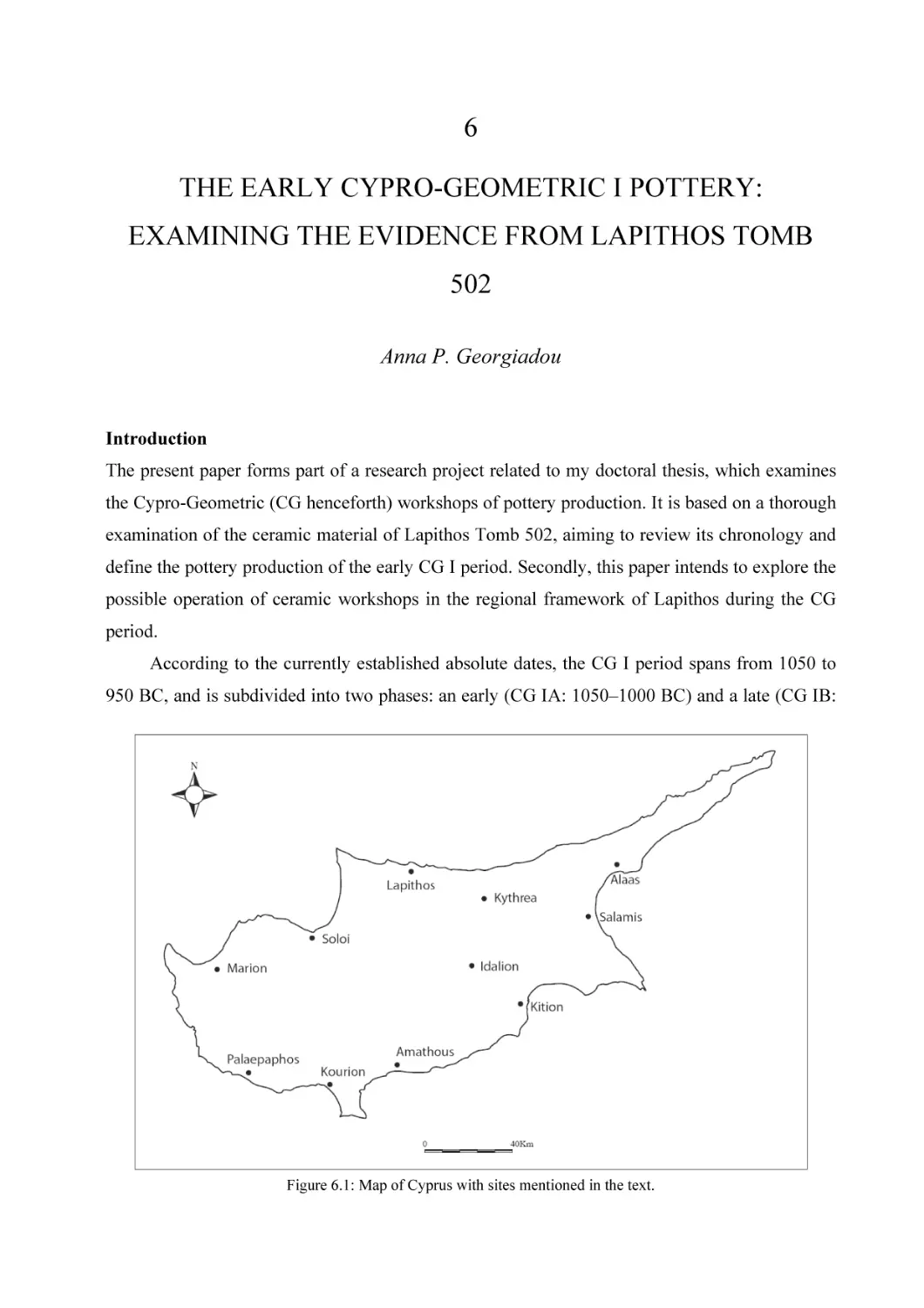
























Теги: history culture cultural history ancient history ancient greece cyprus oxbow books publisher
ISBN: 978-1-84217-440-1
Год: 2012


Текст
                    CYPRUS
An Island Culture

CYPRUS
An Island Culture
Society and Social Relations
from the Bronze Age to the Venetian Period

edited by
Artemis Georgiou

Oxbow Books
Oxford and Oakville

Published by
Oxbow Books, Oxford, UK
© Oxbow Books and the individual authors, 2012
ISBN 978-1-84217-440-1
A CIP record for this book is available from the British Library
This book is available direct from
Oxbow Books, Oxford, UK
and
The David Brown Book Company
PO Box 511, Oakville, CT 06779, USA
(Phone: 860-945-9329; Fax: 860-945-9468)
or from our website
www.oxbowbooks.com
Library of Congress Cataloging-in-Publication Data
Cyprus, an island culture : society and social relations from the Bronze Age to the Venetian period / edited by
Artemis Georgiou.
p. cm.
“Proceedings of the 9th annual conference in postgraduate Cypriot archaeology (POCA 2009) ... held at the
Ioannou Centre for Classical and Byzantine Studies, University of Oxford from the 19th to the 21st of November
2009”--Preface.
Includes bibliographical references.
ISBN 978-1-84217-440-1
1. Cyprus--Antiquities--Congresses. 2. Social archaeology--Cyprus--Congresses. 3. Archaeology and history-Cyprus--Congresses. 4. Excavations (Archaeology)--Cyprus--Congresses. 5. Historic sites--Cyprus--Congresses. 6.
Material culture--Cyprus--History--Congresses. 7. Landscapes--Social aspects--Cyprus--History--Congresses. 8.
Human settlements--Greece--Cyprus--History--Congresses. 9. Cyprus--Social conditions--Congresses. I. Georgiou,
Artemis. II. POCA 2009.
DS54.3.C9315 2012
939'.37--dc23
2012011925

Cover Illustration: “Astarte on the Ingot”, Ashmolean Museum,
Oxford (AN1971.888).

Printed in Great Britain by
Short Run Press, Exeter

CONTENTS

Preface
Acknowledgements
Abbreviations
1. TEXT MEETS MATERIAL IN LATE BRONZE AGE CYPRUS.......................................... 1
(Edgar Peltenburg)

Settlements, Burials and Society in Ancient Cyprus
2.

EXPANDING AND CHALLENGING HORIZONS IN THE CHALCOLITHIC:
NEW RESULTS FROM SOUSKIOU-LAONA .................................................................... 24
(David A. Sewell)

3. THE NECROPOLIS AT KISSONERGA-AMMOUDHIA: NEW CERAMIC EVIDENCE
FROM THE EARLY-MIDDLE BRONZE AGE IN WESTERN CYPRUS.......................... 38
(Lisa Graham)
4. DETECTING A SEQUENCE: STRATIGRAPHY AND CHRONOLOGY OF THE
WORKSHOP COMPLEX AREA AT ERIMI-LAONIN TOU PORAKOU............................ 48
(Luca Bombardieri)
5. PYLA-KOKKINOKREMOS AND MAA-PALAEOKASTRO: A COMPARISON OF TWO
NATURALLY FORTIFIED LATE CYPRIOT SETTLEMENTS ....................................... 65
(Artemis Georgiou)
6. THE EARLY CYPRO-GEOMETRIC I POTTERY: EXAMINING THE EVIDENCE
FROM LAPITHOS TOMB 502.............................................................................................. 84
(Anna P. Georgiadou)
7. THE ANCHORAGE SITE AT KOUKLIA-ACHNI, SOUTHWEST CYPRUS:
PROBLEMS AND PERSPECTIVES ................................................................................... 104
(Duncan S. Howitt-Marshall)

8. ETEOCYPRIOT: LINGUISTIC AND ARCHAEOLOGICAL EVIDENCE....................... 122
(Philippa M. Steele)

Religion, Cult and Iconography in Ancient Cyprus
9.

COPPER AND CULT IN BRONZE AGE CYPRUS ........................................................... 133
(Matthew D. Spigelman)

10. OF “GODDESSES” AND “WARRIORS”. GENDER ASPECTS OF THE CYPRIOT
“GODDESS WITH UPRAISED ARMS” ............................................................................. 153
(Katarzyna Zeman-Wiśniewska)
11. HATHOR, LA GRANDE DÉESSE ET L’INDUSTRIE DU CUIVRE CHYPRIOTE ........ 161
(Aurélie Carbillet)
12. CULT AND ICONOGRAPHY: VOTIVE SCULPTURE FROM THE ARCHAIC
TO EARLY HELLENISTIC SANCTUARY AT MARONI-VOURNES ............................. 177
(Anja Ulbrich)

Ancient Cyprus and the Mediterranean
13. FRAGRANT COPYING? MYCENAEAN PERFUMED OIL AND THE ROLE
OF CYPRUS.......................................................................................................................... 196
(Lesley Bushnell)
14. SOME NOTES ON THE JEWELLERY OF CYPRUS AND GREECE: THE ART OF
GOLDSMITHS AND COPPERSMITHS FROM THE LATE BRONZE AGE TO
THE EARLY IRON AGE ..................................................................................................... 210
(Anna Paule)
15. IMITATION OR INNOVATION? STYLE, DECORATION AND SYNTAX OF
GREEK AND CYPRIOT POTTERY DURING THE GEOMETRIC PERIOD .................. 224
(Alexander Vacek)
16. THE ATTIC POTTERY FROM KITION – A CONTEXTUAL APPROACH.................... 241
(Iva Chirpanlieva)

17. CYPRUS AND CILICIA: AMPHORA PRODUCTION, TRADE AND RELATIONS
IN THE EARLY ROMAN ERA........................................................................................... 251
(Caroline Autret)
18. VENETIAN ELEMENTS IN THE ICONOSTASIS OF CYPRUS....................................... 268
(Iosif Hadjikyriakos)

PREFACE
This volume presents the proceedings of the 9th annual conference in Postgraduate Cypriot
Archaeology (POCA 2009), which was held at the Ioannou Centre for Classical and Byzantine
Studies, University of Oxford from the 19th to the 21st of November 2009. POCA 2009
encompassed 24 presentations by postgraduate students and young researchers, coming from a
number of institutions and universities in Europe and the United States. The meeting provided a
unique opportunity for the new generation of Cypriot archaeologists to present their work and
interact in a friendly and productive environment.
The conception of a conference at which postgraduate students of Cypriot Archaeology
could present their ongoing research was first conceived by Dr Kirsi Lorenz, who organised the
first Postgraduate Cypriot Archaeology meeting at the University of Cambridge in 2001. From
that year onwards, POCA continued as an annual meeting and has been successfully organised by
a number of universities in the United Kingdom, Ireland, Cyprus and Belgium. Nowadays, POCA
has become a well established international institution for students in Cypriot Archaeology. This
growth of the POCA meetings coincides with the increasing popularity of Cypriot Archaeology
itself, which has been established in recent years as a significant discipline in its own right.
Following the tradition set by the organisers of POCA 2005 in Dublin, and judging by the
high standards and original contribution of the 9th POCA meeting, it was decided that the
proceedings should be published. All papers were subject to anonymous peer-reviews in order to
ensure the quality of the papers presented in this volume.
The keynote article of this volume is based on the plenary presentation by Edgar
Peltenburg. In this contribution, Professor Peltenburg discusses the political landscape of Cyprus
during the Late Bronze Age, attempting to combine textual and archaeological sources. The rest
of the volume’s contributions are divided in three sections. The first, entitled “Settlements,
Burials and Society in Ancient Cyprus” begins with a paper by David Sewell, who presents new
results from the excavations at the Chalcolithic cemetery of Souskiou-Laona. The following
contribution by Lisa Graham discusses the ceramic production of the Early and Middle Bronze
Age, based on new excavations from the necropolis of Kissonerga-Ammoudhia. In the subsequent
articles, Luca Bombardieri presents preliminary results from the ongoing excavations at the site
Erimi-Laonin tou Porakou and Artemis Georgiou compares and contrasts the topographical,
architectural and artefactual characteristics of two short-lived Late Bronze Age settlements, Pyla-

Kokkinokremos and Maa-Palaeokastro. Anna Georgiadou presents the ceramic production from a
significant tomb discovered at Lapithos and discusses matters of chronology and circulation in
the Early Geometric period. In the following contribution, Duncan Howitt-Marshall presents the
underwater activities at the site Kouklia-Achni and discusses problems and perspectives. Finally,
this section closes with the contribution by Philippa Steele, who examines the linguistic and
archaeological evidence for the “Eteocypriot” language.
The second section of this publication is entitled “Religion, Cult and Iconography in
Ancient Cyprus” and begins with a paper by Matthew Spigelman, re-examining the relation of
copper and cult in the Late Bronze Age. In the following articles, Katarzyna Zeman-Wisniewska
discusses gender aspects of the Cypriot terracotta production in the Early Iron Age and Aurélie
Caribillet scrutinizes the relation of Hathor, the Great Goddess and the production of copper in
Cyprus. The paper by Anja Ulbrich presents the votive sculpture from the sanctuary at MaroniVournes and explores the cult and iconography at this religious context.
The final part, entitled “Ancient Cyprus and the Mediterranean” is dedicated to the contacts
of ancient Cyprus with the Mediterranean world. Lesley Bushnell discusses the role of Cyprus in
relation to the circulation of Mycenaean perfumed oil. Anna Paule presents her ongoing doctoral
research on the jewellery of Cyprus and Greece and attempts to reproduce the relation of these
two areas in the Late Bronze Age and Early Iron Age. In the subsequent contribution Alexander
Vacek explores the connections between the production of Greek and Cypriot pottery during the
Geometric period. The following article by Iva Chirpanlieva contextualises the presence of Attic
pottery from Kition and draws interesting results on the significance of this pottery in this
particular context. Caroline Autret elaborates on the production and circulation of amphoras in
Cyprus and Cilicia during the Early Roman era and discusses the relations between these two
areas. Finally, Iosif Hadjikyriakos presents the Venetian elements in the iconostasis of Cyprus
and examines the connotations of these aspects for the Medieval society of the island.
The papers included in this volume cover a wide time-span, ranging chronologically from
the Chalcolithic period to the Medieval times. They present the results of new archaeological
excavations and research, and comprise archaeological, anthropological and scientific approaches
to the material culture of ancient Cyprus.

ACKNOWLEDGEMENTS
The organisation of the 9th Annual POCA meeting at Oxford was made possible thanks to the
generous financial contribution of the Craven Committee, the Cyprus Tourism Organisation, the
Classics Centre Faculty Board and the Meyerstein Committee. In particular, I would like to
extend my gratitude to Anne Smith of the Classics Centre and Costas Catsellis and Orestis
Rossides of the Cyprus Tourism Organisation.
Particular thanks are due to Professor Edgar Peltenburg who presented a stimulating
plenary lecture at the opening of the 2009 POCA meeting. I am additionally grateful to Professor
Peltenburg for agreeing to the inclusion of his paper in this volume. Dr Niki Katsaouni addressed
a welcome on behalf of the Republic of Cyprus and I am indebted for her involvement. I wish to
especially thank Irene S. Lemos, Professor of Classical Archaeology at the University of Oxford,
for addressing a welcome to the participants and presenting the conference’s closing remarks. I
am further grateful to Professor Lemos for her encouragement and guidance throughout the
preparation of the conference and the publication of the proceedings.
A number of people also contributed to the realisation of POCA 2009 and I am thankful for
their input. Jeremy Worth designed and updated the conference’s website and Matthew Lloyd,
Caroline Thurston and Alice Gardner assisted with the organisation of the meeting. The
chairpersons of each session regulated and stimulated discussions after the end of each paper and
their input is greatly appreciated. I also wish to address special thanks to the administrative staff
of the Classics Centre for their availability and support. Finally, I wish to acknowledge Anna
Satraki, Skevi Christodoulou and Ariane Jacobs, past organisers of the POCA meetings, for their
invaluable guidance in matters pertaining to the organisation of the conference.
I additionally wish to thank Oxbow Books Publications for agreeing to publish the
proceedings of POCA 2009. In particular, I am thankful to Julie Gardiner and Val Lamb for their
hard work in preparing this volume for publication and for their good will and support. Caroline
Thurston provided valuable help with the editing of the papers and I thank her for her help. The
anonymous reviewers of each paper kindly granted their time and expertise and through their
fruitful and constructive feedback, they have greatly benefited the authors’ contributions. I cannot
thank them enough for their input in the realisation of this volume. Finally, I wish to thank the
authors for their punctuality and benevolence during the preparation of this volume.
Artemis Georgiou

ABBREVIATIONS
Journals and Book Series
AA
AASOR
ActaArch
AfO
AJA
AnatSt
AntJ
AntK
ARA
BASOR
BCH
BSA
CAJ
CCEC
CurrAnthr
IEJ
IJNA
JAnthArch
JAR
JFA
JHS
JMA
JNES
JOBG
JRS
MDOG
MeditArch
OJA
OpArch
OpAth
QDAP
RDAC
RLA
SIMA
SMEA
TelAviv
WorldArch
ZA

Archäologischer Anzeiger
Annual of the American Schools of Oriental Research
Acta archaeological
Archiv für Orientforschung
American Journal of Archaeology
Anatolian Studies. Journal of the British Institute of Archaeology at Ankara
The Antiquaries Journal. The Journal of the Society of Antiquaries of London
Antike Kunst
Annual Review of Anthropology
Bulletin of the American Schools of Oriental Research
Bulletin de Correspondance Hellénique
Annual of the British School at Athens
Cambridge Archaeological Journal
Cahier du Centre d´Études Chypriotes
Current Anthropology
Israel Exploration Journal
International Journal of Nautical Archaeology and Underwater Exploration
Journal of Anthropological Archaeology
Journal of Archaeological Research
Journal of Field Archaeology
Journal of Hellenic Studies
Journal of Mediterranean Archaeology
Journal of Near Eastern Studies
Jahrbuch der österreischichen byzantinischen Gesellschaft
Journal of Roman Studies
Mitteilungen der Deutschen Orient-Gesellschaft zu Berlin
Mediterranean Archaeology. Australian and New Zealand Journal for the Archaeology of
the Mediterranean World
Oxford Journal of Archaeology
Opuscula archaeologica
Opuscula atheniensia
Quarterly of the Department of Antiquities in Palestine
Report of the Department of Antiquities, Cyprus
Reallexikon der Assyriologie und vorderasiatischen Archäologie
Studies in Mediterranean Archaeology
Studi micenei ed egeo-anatolici
Tel Aviv. Journal of the Tel Aviv University, Institute of Archaeology
World Archaeology
Zeitschrift für Assyriologie und vorderasiatische Archäologie

Other Abbreviations
Bichr

Bichrome

BlSl

Black Slip

CA

Cypro-Archaic

CG

Cypro-Geometric

DP

Drab Polished ware

EBA

Early Bronze Age

EC

Early Cypriot

EPG

Early Protogeometric

FS

Furumark Shape

HBW

Handmade Burnished ware

LBA

Late Bronze Age

LC

Late Cypriot

LChal

Late Chalcolithic

LG

Late Geometric

LH

Late Helladic

LM

Late Minoan

MBA

Middle Bronze Age

MC

Middle Cypriot

MChal

Middle Chalcolithic

MG

Middle Geometric

MM

Middle Minoan

Psc

Pendent semicircle(s)

PWP

Proto-White Painted

RLWM

Red Lustrous Wheelmade ware

RP

Red Polished ware

RPSC

Red Polished South Coast ware

SM

Submycenaean

WP

White Painted

WPWm III

White Painted Wheelmade III

1
TEXT MEETS MATERIAL
IN LATE BRONZE AGE CYPRUS
Edgar Peltenburg

Current concerns about the role of the state in modern western society resonate strongly with key
narratives about the nature of governance and society in Late Bronze Age (LBA) Cyprus.1 Just as
there are some who are ideologically opposed to the “big state”, so too are there scholars who
argue against a centrally administered, island-wide LBA polity model. It is nonetheless generally
agreed that the situation was not static over the five centuries of the LBA, c. 1600–1100 BC.
Much of the debate concerns the role and identification of Alašiya with all or part of Cyprus
(recently: Knapp 2008; Merrillees 2011).
A breakthrough from unexpected quarters has not entirely overcome the impasse between
nay-sayers, those who remain sceptical of an association with Cyprus, and believers who are
sometimes driven to exasperation: “why do Cypriot archaeologists still hesitate in accepting the
identification [of Alašiya with Cyprus]” (Muhly 1996, 49). The breakthrough stems from
archaeological science, from petrographic analyses of tablets of the king of Alašiya found at
Amarna in Egypt, and possibly at Ugarit in Syria. They prove to be consistent with clay sources
from the south-eastern margins of the Troodos Mountains on Cyprus. From this, Goren et al.
(2003) argue that the political and administrative centre in the 14th-13th centuries was located at
one of two sites in that region, Alassa-Paliotaverna or Kalavasos-Ayios Dhimitrios. Not all are
convinced, not least because we need to apply a battery of analytical techniques to sourcing
issues rather than just one (e.g. Merrillees 2011). But there is little doubt that these petrographic
results have bolstered the case for the identification of Alašiya with all or part of LBA Cyprus,
one that is accepted in this paper.
There are several models for the socio-political organisation of LBA Cyprus (Bolger
2003; Steel 2004, 181–186 and Knapp 2008, 144–153 for overviews). In terms of methodology,
we can divide them roughly into three groups. Most archaeologists privilege material culture in
their reconstructions. A second group, comprised largely of Assyriologists, refers almost
exclusively to textual evidence (e.g. Malbran-Labat 1999; Singer 1999, 721; Steiner 1962). Lastly

2

EDGAR PELTENBURG

are those researchers who attempt a combination of the two (e.g. Steel 2004; Eriksson 2007).
Knapp (2008) has been a leading exponent of the third approach, advocating the need for a
synthesis of both the material evidence and the documentary. But even using all the evidence to
hand, many uncertainties prevail. In her overview, Steel highlights as an outstanding unresolved
problem of LBA Cypriot studies the socio-political organisation that underpinned substantive
economic and social transformations, increase in population, new settlements, hierarchical
settlement patterns, urbanisation and international trade (Steel 2004, 150). So tenuous is the
evidence that scholars make fundamental re-appraisals. Thus, Knapp once argued for the
existence of local polities administered by local elites in the 14th-13th centuries BC, yet recently
he opts for the existence of a king who controlled the entire island (Knapp 2008, 340–341; cf.
1997, 66–68; 2006, 52). But what kind of territorial polity (or polities) was it? What was
distinctive about the organisation of LBA Cyprus to have produced the recovered material culture
record? What was the role of the king? To try to address these and other questions, I re-visit what
we mean by the problematic term “state” in the context of Alašiya and explore the intersections
between text and material culture, following on from an earlier effort to account for the
beginnings of a state on the island, one in which I had shied away from considering the evolved
characteristics of that kingdom, its extent, or its government (Peltenburg 1996, 28). Specifically, I
would like to evaluate what I see as an apparent conflict between textual evidence which projects
Alašiya as comparable to other great states of the Ancient Near East and the contemporary
material record which lacks so many features evident in neighbouring archaic states, that is
entities that have left us explicit paraphernalia of formal institutions of government. This is
potentially a revealing tension that merits investigation, one which acknowledges that contrasts
between documentary sources and material culture evidence are commonplace in historical
archaeology, a field where there is often “no easy way to resolve these ..... viewpoints into a
comfortable narrative” (Foxall 2004, 83).
The shift in scholarly emphasis away from the neo-evolutionary project that seeks
material correlates for artificially discrete stages of development has impacted on Cyprus.
Scholars like Diane Bolger (2003), Bernard Knapp (2008), Joanna Smith (1994) and Jennifer
Webb (2005), acknowledging the existence of a complex polity or polities, have chosen instead to
investigate their operational mechanics. Priscilla Keswani’s influential model of a heterarchical
society in the east, hierarchical in the south points to the likely existence of intra-island variation
and to evolving rather than static systems (Keswani 1996). Highlighting the role of the political
economy, I tried to apply the notion of territories, that is, an urban core that mobilised its
resource-rich hinterland, as fundamental to the emergence of one or more polities on the island

1. Text meets material in Late Bronze Age Cyprus

3

(Peltenburg 1996; see also Iacovou in press). In that regional treatment, export-oriented centres
like Enkomi may have controlled or been closely allied with forts on the routes to the mines to
ensure supplies of copper. But with a few notable exceptions, these and other studies have largely
sidestepped the implications of relevant textual evidence.
When we turn to the royal texts which portray Alašiya as other Near Eastern states, we need
to address the issue of why the material evidence of Cyprus does not match the evidence for
archaic states found amongst its correspondents. The issue gains traction in light of a spate of
studies on emulation as a key structuring principle in the emergence of complex socio-political
organisation on Cyprus (e.g. Keswani 2004, 139; Knapp 2006; Webb 2005). Most concern the
acquisition by elites of eastern valuables that served as insignia to define class membership and
the manufacture of prestige items bearing a complex, foreign inspired iconography. Jennifer
Webb has forcefully argued for the role of seals, with their exotic presentation scenes, horned
divinities, lions and griffins, as “wholesale adoption of motifs drawn from foreign (primarily
Near Eastern) cosmologies .... symptomatic of the profound and rapid change in material culture
which accompanied secondary state formation on the island” (Webb 2005, 180). Emulation, in
other words, played a significant role in the materialisation of an ideology to promote and
legitimate the new order. Following Helms, this view applies to the concept of kingship itself,
since in cases of newly formed states on the periphery of well established civilizations, “kingship
was at least partly legitimised by association with foreign political ideologies derived from
outside polities” (Helms 1988, 148). In the case of Cypriot elites, Webb proposes that they
acquired “the conceptual means to implement their authority from the same sources which
provided the suites of prestige objects which served as a visible manifestation of that authority.
Foreign models of political ideology, that is, appear to have offered Cypriot elites a blueprint for
domination” (Webb 2005, 181). Before turning to the question of agency and on-the-ground
heterogeneity in adaptive behaviours (cf. Keswani 2007), it is instructive to note a key element of
contemporary Amarna letters in the context of the above appropriations.
Documentary evidence regarding Alašiya mainly concerns external relations and so it tells
us little about domestic socio-political arrangements. But there are hints, and it is possible to
make inferences of a general nature (see below). The texts from Alašiya recovered in the
Egyptian capital at Amarna are written in provincial Akkadian and they deploy the conventional
salutations used amongst the royal houses of the Near East. Eastern scribes were brought to
Cyprus for this purpose and they gave a standardised account of the sender: “For me all goes
well. For my household, my wives, my sons, my magnates, my horses, my chariots, and in my
country, all goes very well” (e.g. EA 35; Malbran-Labat 1999). In the eyes of the addressee the

4

EDGAR PELTENBURG

word household would typically refer to a governmental infrastructure attached to the royal
household, that is, the palace (Schloen 2001). Such palaces, then, are a key element of the letters,
they are emblematic of states of the time, and, as we have seen, the elites of Cyprus in both their
material culture and Akkadian writings were well integrated into the contemporary international
political milieu. But closer inspection reveals fissures in this neat equation. For example, we
would expect that this elite-driven orientalising process would entail the construction of palaces
such as those uncovered in Egypt, Hatti and the lands of other Great Kings, the metaphorical
“brothers” or diplomatic equals of the king of Alašiya. Even minor and vassal states such as those
at Qatna, Alalakh and Megiddo have kings and imposing palaces as befit their status (Pfälzner
2007; Woolley 1955; Bunimovitz 1994). The best known and nearest instance is the 7000 sq m
palace of a long line of kings at Ugarit (Yon 1997). So, it is relevant that in the correspondence
between Alašiya and Ugarit, the king of Ugarit holds an inferior rank to the king of Alašiya.
Given the close, personalised relations between international royal households and the
orientalising dynamic, we might anticipate the material manifestation of those ranked relations in
quite a grand edifice on the island. And of course, despite the excavation of a large number of
LBA sites, there is no unambiguous occurrence of a palace on the island (for an alternative view:
Wright 1992, 278). What we have in terms of large structures are forts, elegant buildings often
with storage facilities, and temples. Ashlar Building X at Kalavasos-Ayios Dhimitrios is only 900
sq m, Building II at Alassa-Paliotaverna 1421 sq m (South 1989, 320–322; Hadjisavvas 2003).
There are no imposing structures equalling the size of even modest palaces in the Levant, ones
with quarters for bureaucrats and dependent labourers. The usual apex of LBA state hierarchy is
missing, even though the texts would seem to call for its existence.
There are other characteristic features of states intimately connected with Alašiya that are
also missing on the island. In spite of her best efforts to argue for the use of seals as sphragistic
devices for administration, Jennifer Webb acknowledges that the extreme scarcity of sealings,
that is impressions made from stone seals, is problematic (Webb 1999, 306). Joanna Smith
regards the single example from Enkomi as local, Edith Porada as an import (Smith 2002, 16).
Inferred wooden rollers for impressed storage jars, especially at Alassa, and other evidence
indicates that some of these devices were used for administrative purposes, but the virtual
absence of sealings from stone seals suggests that the customary bureaucratic practices so closely
associated with Near Eastern states were appreciably modified by islanders who so assiduously
copied and, more significantly, adapted eastern models. The widespread distribution of the stone
seals could be due to a number of reasons, but in the absence of sealings they remain equivocal
signs of centralised administration of the island. Without independent supporting evidence, other

1. Text meets material in Late Bronze Age Cyprus

5

material indicators marshalled for centrist interpretations such as standardised bull rhyta, female
terracotta images, repeated depiction of deities, ashlar masonry, monumental complexes and
common imagery on prestige goods (Webb 1999, 307; Knapp 2008, 339–340) seem too
precarious a basis for concluding the existence of a sovereign state that controlled the whole
island. Such cultural production of symbolic resources may well be equated with maintenance of
elite status which, while important for the cohesiveness and shared identity of LBA society,
speaks to the existence of a complex society, but not the details of its political organisation (cf.
Wright 2004, 77–78). Cyprus lacks the more explicit evidence, well attested on the mainland, of
palatial centres, dynastic regalia and iconography of a ruling ideology that would more
convincingly sustain the argument for a centrally administered state (Manning and De Mita 1997,
108–109). And yet, an entity that was internationally recognised in documentary sources as a
highly ranked kingdom, the equivalent of what by convention are called states elsewhere, did
exist on Cyprus.
In sum, there is a disjuncture between traditional expectations from the texts and material
culture patterning, a lack of fit between archaeology and evolutionary constructs, one that
prompts re-consideration of the models that have often provided the interpretive frameworks for
socio-political narratives of LBA Cyprus (cf. Fischer 2007, 48–49). Two critical aspects that have
informed models and shaped narratives are our notions of what constitutes an archaic state and
the textual evidence.
The archaic state
Disenchantment with the regularities of neo-evolutionism, the growth of archaeological
information and more elaborate analyses have increasingly led to questions about the usefulness
of the term “state” for an understanding of what conventionally pass for archaic or early states.
After ranging widely over the concept, and especially its material manifestations, A. Smith
abandons the term altogether in preference for “early complex polities” (Smith 2003, 94–111; cf.
Adams 2006 for “early complex societies”). He is not the first to do so. And yet the term archaic
state is retained for its heuristic value in a wide-ranging review of the concept by archaeologists,
even though some amongst them are driven to describe certain ancient complex societies such as
the Indus Valley civilization as a “non-state” (Feinman and Marcus 1998; Possehl 1998). There is
an enormous literature on early states, but rather than get snared in typological boxes, many
scholars acknowledge the broad spectrum of early complex polities and now prefer to ask
questions like “what did early complex societies actually do” (Smith 2003, 25). There are
numerous approaches. Campbell, for example, advocates that the “nature of... networks of power,

EDGAR PELTENBURG

6

the boundaries of political community, and their relationships through time [should] become
three foci of investigation to replace the study of the state” (Campbell 2009, 823). Before turning
to such approaches in relation to LBA Cyprus, we should first look at its eastern neighbours,
since, as shown above, the islanders became entangled with long-established states there, and
were deeply influenced by them.
Until recently, studies of the state in the Ancient Near East have laboured under the dual
hegemony of neo-evolutionism and the Mesopotamian state model (Yoffee 2005 for critique).
The former led to the identification of archaeological correlates for the described features of
states, trait lists which effectively foreclosed explorations into the dynamics of authority,
resistance and change. The latter owes much to the work of scholars like Johnson and Wright
who were concerned with pristine state formation in South Mesopotamia where hierarchically
organised bureaucratic controls of surplus production and redistribution played a decisive role in
irrigation-based economies (Johnson 1982; Wright and Johnson 1975). Starting with Diakonoff’s
(1974) assertion of the role of the extended family and the commune, it has become clear that
power at the centre was more severely constrained than assumed, to the extent that, according to
Stein (2001, 369), “the state concept itself needs fundamental rethinking”. One of the outcomes
of this re-thinking is the delineation of more locally empowered households and more corporate
forms of political action and agency, especially on the fringes of Mesopotamia, but also within
Mesopotamia itself (e.g. Pollock 1999; Renger 2003; Ur 2010; Van de Mieroop 1997). Yoffee
(2005, 61, 109–112) gives examples of authoritative councils, assemblies and groups of elders in
Sumer, Babylonia, Assyria, Anatolia and Syria. Since these alternative sources of power existed
in politically complex societies usually referred to as states, it is worth looking briefly at some
from Syria, a region with which Cyprus was in close contact. In doing so I select examples which
highlight the plurality of authority in complex systems as a counterpoint to the dominance of the
palace or temple in the normative Mesopotamian model.
Texts of the 3rd millennium refer to the widespread occurrence of confederacies of
independent authorities as well as the EN, usually translated as king. In the east, texts from
Beydar recount how an EN has to attend a council of local chiefs (Lerberghe 1996, 121). In the
west, Ebla, with its celebrated royal palace and archives, supplies more varied evidence. The EN
there seems to have shared power with a council of elders (Archi 1987). It formed a kind of
senate which checked the authority of the EN, played a significant role in international affairs and
was indispensible in decision making. The elders sat “near the throne”, resided in outlying cities,
had their own “house”, and were also lodged in administrative headquarters (Astour 2002, 150–
152). The EN was elected and only once is there evidence for dynastic succession. So constrained

1. Text meets material in Late Bronze Age Cyprus

7

was the power of the EN that it may be preferable to think of him in terms of the chief executive
officer of a council rather than a monarch (Klengel 1992, 27). The Eblaite example is useful as an
analogy for Cyprus in that its textual information pertains to a secondary state not long after its
formation. Analogies, of course, come with health warnings.
Other cities in north and west Syria also furnish textual evidence for the existence of
collective governance that limited the exercise of royal power. Emar and Tuttul on the midEuphrates, and Urkesh in the north had robust, collective decision-making structures. Emar
provides the most detailed evidence (Adamthwaite 2001; Fleming 2004, 211–212). In the early
2nd millennium there is no evidence for a king there, and actions were taken by elders and an
assembly or council known as the taÌtamun meeting at its own initiative (Durand 1990). But the
political situation was unstable and power shifted between groups. Before that time, it was ruled
by an EN, later, a dynasty with restricted authority. Other places, like Azu and Ekalte on the bend
of the Euphrates River, had several coexisting bodies, including a community of city elders, the
temple priesthood and the “Brothers”, who exercised much of the real power. Material evidence
for these distinct, competing bases of control exists in the issue of different, communal and royal,
seal types (Yamada 1994). In many places in Syria, therefore, elders and other groups constituted
independent governing bodies pursuing their own agendas within a volatile equilibrium of
authority. Power-sharing was negotiated, and elders sometimes appear to have had equal power
to the king, in one case removing him (Astour 1992, 51).
Further insights into power-sharing exist at LBA Ugarit, the city with which Alašiya had
the closest relations. In his House of the Father as Fact and Symbol: Patrimonialism in Ugarit
and the Ancient Near East, David Schloen uses the evidence from Ugarit to argue how the
celebrated palace in the Ancient Near East should be regarded as a household headed by a king.
In this sense, the king’s household is first among many. At Ugarit, his power was tempered by
administrative nuclei headed by the prefect (sākinu), queen, elders and the great ones with
devolved centres dealing with affairs of state and, significantly, private administration (Heltzer
2004; Vita 1999, 468–471). Thus, the Hittite king addresses the elders of Ugarit separately
(Malbran-Labat 1995, 39–40), and councils of elders are found widely in the kingdom (MalbranLabat 2006, 65). When Courtois (1990) showed that the Palais Sud, or Petit Palais, was in fact the
private residence of Yabninu it became clear that devolved centres were private houses. So
entangled were affairs of the state and private households that Assyriologists have serious
problems in distinguishing which of the c. 600 tablets from the House of Urtenu, located well
outside the palace, deal with royal matters, which private (Malbran-Labat 2004).

EDGAR PELTENBURG

8

Recognising this interdependence in the political economy of the kingdom, Routledge and
McGeough (2009, 28) adopt critical network theory to show that there was no public sector since
“the palace operated not as manager of a state-economy but as the biggest household in a network
of households”. Devised for modern economics, the theory emphasizes the socially embedded
framework for exchange transactions, the lack of a formal source of sovereign authority in them
and the existence of informal hierarchies (McGeough 2007, 31–32). Monroe also finds that the
palace was often a facilitator with more interest in access and investment than control (Monroe
2009, 279). This embedded system occurred much more widely in the Ancient Near East. In
contemporary Assyria, Postgate (1986, 27) remarks how the royal house was derived from one
among many family businesses with procedures for agents that formed a commercial structure
that could be adapted to the task of government. These examples suggest that, with palace and
private interests so intertwined, especially with respect to trade, it may be misleading to
distinguish sharply between private and public spheres in the LBA political economy.
In addressing the issue of Cypriot adaptation of eastern political structures, therefore, it is
clear that many of the potential Levantine models comprised constrained palatial systems, with
devolved powers embedded in a matrix of households, especially in economic and judicial
matters, rather than monolithic, homogenous hierarchies. With that in mind, it may be helpful to
move away from bipolar, structuralist approaches to the nature of LBA Cypriot society that have
tended to treat interdependent aspects as exclusive models (e.g. Royal : Non-royal, Hierarchy :
Heterarchy, Class : Kinship, State-controlled trade : Entrepreneurial trade, Luxury goods : Valueadded substitutes, Any ships : Round boats), and to treat them instead as dynamic historical
processes. Documentary evidence, however, is biased and so requires particular care.
The textual evidence
Many of the pertinent documents comprise international diplomatic correspondence between the
king of Alašiya and Egypt (the Amarna letters), the Hittites (de Martino 2008) and Ugarit (Knapp
1996; Malbran-Labat 1999). With the exception of some Hittite texts, which, when explicit, treat
the Alašiyan king as a vassal, he is regarded as one of the Great Kings, the superior of the king of
Ugarit. As noted above, these letters from Alašiya were written in peripheral Akkadian and so
Akkadian scribes came to the island to make possible diplomatic and concomitant trade
interactions. One of these, attached to the royal household of Alašiya, was the servant of the king
of Ugarit (Malbran-Labat 1999, 122–123). The scribes were versed in centuries-old conventions
of diplomatic letter-writing that expedited international contacts between the ruling courts of
disparate states. Mario Liverani (1996, 285) emphasizes the propagandistic nature of this

1. Text meets material in Late Bronze Age Cyprus

9

correspondence, and, as he has shown, the need to read any text as a “message” with an issuing
source, an audience, a purpose and a code. But what audience was there on Cyprus for something
the size of a tablet that no one, other than the visiting scribe, could read? As shown by the later
Bar-Rekub stele, the process of international communication was most likely confined to an oral
delivery by the king in one language and a fair copy by the scribe in another (Frankfort 1970,
305, ill. 358). The question of the extent of literacy on the island does not arise here, for society
at large was not involved, even if discussion with envoys took place in privileged circles. In such
circumstances, we should not expect that the stereotyped royal ideology of the texts will convey
the more complicated reality of socio-political organisation suggested by material culture
patterning on the island (Monroe 2009, 246–247; cf. Campbell 2009, 830). To quote Helck,
referring to similar Egyptian texts of the time, “the sources hide the reality of ancient political
factions and their competition for power” (1987).
In general, no matter what the situation was on the ground, the Akkadian scribes of the
time adhered to the existing formulae of courtly ideology as the necessary and acceptable means
of communication, the only ones that were understandable to interlocutors. And their fixed
terminology covered what in fact were such disparate realities that it is an insensitive tool for
understanding the socio-political structures it purports to signal. We are therefore dealing with
parallel realities. As Liverani (1990, 288) has repeatedly pointed out, the existence of different
cultural backgrounds and different political systems and languages in the Levant gave rise to
misunderstandings and ambiguities in these texts. Others go further.
Meier cautions that terms in the Amarna letters “are being used in a cosmopolitan
environment that strips the words of their cultural moorings in order to attain a more generic
utility, transcending specific cultures and inevitably weakening their semantic content .......the
terminology…was too impoverished and debased to convey adequately the meaning brought by
each participant to the international dialogue” (Meier 2000, 168). And so, “the term king, šarru,
in the international milieu meant something different to the various kings who used it” (Meier
2000, 170). This gloss is echoed in the material world where many luxury objects similarly
convey “a hybridized expression of generalized kingship and suppressed cultural affiliation”
(Feldman 2006, 16). Nor was this flexibility an innovation of the Amarna period. In earlier 2nd
millennium Syria the term šarru was used for rulers of many entities, ranging from large
territorial states to towns, fortified, ritual and administrative centres, with small or large
populations (Fleming 2004, 105, 193). Regarding Cyprus, Sherratt (1998, 297) entirely dismisses
the utility of the terminology for an appreciation of the political arrangements on the island.

10

EDGAR PELTENBURG
Viewed in this way, no matter what the political organisation of Cyprus, standardised

Akkadian titles for leaders were used for communication abroad. The terms had symbolic
malleability, they were fit for purpose, but that purpose was not intended as an objective
description of the island’s socio-political organisation. It may have been so different that, even if
they wanted to, scribes simply had no vocabulary to make it intelligible to the outside world.
Instead, they were there to facilitate meaningful relations using titles that were internationally
comprehensible, not to provide us with an accurate picture. So, to take these generic labels at face
value is to misunderstand agency, that is, the practices and intentions of professional LBA scribes
engaged in international diplomacy. The chaîne opératoire of letter-writing and the
contextualised meaning of the terms caution against a straightforward reading of these texts for
an understanding of the socio-political organisation in Cyprus. Thus, the term šarru, king, was
used for a position of authority in Alašiya, but the absence of royal symbolism suggests that even
if the term gained real currency internally, its meaning was adapted to local structures. After
addressing similar issues, Liverani succinctly asks: “given the deeply biased nature of the official
sources....could we ever hope to write a nonbiased history?” (Liverani 1996, 286).
Taking into account the receptiveness of islanders to the oriental goods that flooded highstatus markets, it seems unlikely that such formulae had no effect at all on the privileged few.
Telling influences on manners and traditions are evident in several statements in the letters. For
example, the Alašiyan king acknowledges the timing of coronation rites of his Egyptian
counterpart: “I have heard that you are seated on the throne of your father’s house. You said let
us have transported back and forth gifts of peace” (EA 33). It was customary in the Near East to
restate expressions of friendliness upon the accession of a new ruler (Moran 1992, 104–105, n.
4). In another instance, the king is made aware of the date of a festival for the performance of a
sacrifice in Egypt: “As to your having written me, ‘Why did you not send your messenger to
me?’, the fact is that I had not heard that you were going to perform a sacrifice” (EA 34). It seems
clear from these statements that the Alašiyan king and presumably his entourage had detailed
knowledge of foreign ways and were expected to acknowledge them. And just as exotica were
locally manipulated to sustain power differentials, so was there an impetus for leaders to engage
in extra-local exchange by embedding foreign systems as much as possible. Yet, the lack of rulercentred paraphernalia implies that antipathetic sentiment probably existed to the overt display of
kingly forms. While some islanders may have promoted its acceptance, I suspect that local kinbased society, having only relatively recently begun to engage meaningfully with Near Eastern
stratified societies, retained strong resistance in status quo quarters and that tensions existed

1. Text meets material in Late Bronze Age Cyprus

11

between traditional Cypriot kinship ways and the “new” politically stratified template. Effects,
therefore, were mediated according to local conditions.
Within the fixed patterns of international diplomacy, deviations from the norm are
revealing of local political identity. For example, the form of address and greeting in two letters
from Alašiya, EA 35 and 40, is highly unusual, but it is not obvious how to interpret these
anomalies (Mynářová 2007, 46, 100–101; Moran 1992, xxii–xxiii, n. 53). There are however four
cases which furnish clearer, though not entirely unambiguous, insights into the political
organisation of Alašiya. First, the king of Alašiya admits to the loss of villages within his own
land (EA 38). It would seem that he has little control over parts of Alašiya allegedly involved
with the Lukki. While vassal kings repeatedly express concerns about the loss of territory to the
Egyptian king, this is exceptional amongst the great kings classed as brothers. It is not the same
as Babylon’s admission of the loss of a caravan since that involves claims for compensation (EA
8). The situation in Alašiya could have been temporary, although the alleged depredations of
Madduwattas and others reinforce the notion that territory was vulnerable (Goetze 1928). Second,
the revelation by a sovereign of one of the great states, Alašiya, that he is in fact acting upon
complaints from independent sectors within his domain, is also unusual. In this case, he asserts
that payment is due to certain groups for timber that was sent to Egypt as the king’s timber (EA
35). Here it is shown that the king of Alašiya acts like a CEO and the passage emphasizes the
distinctive, multi-centric structure of the Alašiyan political economy. In Liverani’s translation,
the king of Alašiya states that the people “protest” to him about the lack of payment in order to
press his case to Egypt, but at the same time it provides a revealing insight into the workings of
island authority (Liverani 2001, 118). The third case to distinguish Alašiya from normative
diplomacy is the exceptional commercial tenor of its Amarna letters, one that is only paralleled
by Assyria, another land intensively involved with trade (Liverani 2001, 148–149). The anomaly
suggests that Alašiya is only weakly involved with the game of prestige gift giving, one that
reinforces the divergent nature of the Alašiyan polity. Last is the significant role of the rābiṣu, the
“great” or “senior” governor/representative of Alašiya (CAD 14 1999, 20–23).
The rābiṣu writes to his opposite number in Egypt about the same things that often
concern the king: greeting gifts, return of men and ship (EA 40). Governors do write to each
other, as did Takhulinu of Ugarit and Haya of Egypt (Singer 1983), but this is the only case in the
Amarna state archives. Mynářová (2007, 184) provides a survey of correspondents that include
princes, queen and citizens, but not rābiṣu. It could be mere chance that this letter survives, and
none from other centres, were it not for the recurrence of missives from several governors again
some 150 years later, in correspondence between Alašiya and the royal court at Ugarit. In these

12

EDGAR PELTENBURG

cases, they all wrote directly to the king of Ugarit and we have their names: Ešuwara (RS 20.18)
in the Rapanou archive, and Šinama (RS 94.2173) and Šangiwa (RS 94.2447+) in the Urtenu
archive. The last addresses king Niqmaddu, presumably Niqmaddu III who reigned c. 1210–1200
BC (Yon 2007, 18–19). Hittite texts not only confirm the remarkable prominence of the rābiṣu of
the island, they hint at a dual power-sharing arrangement (cf. Smith 1994, 16–18; Knapp 2008,
336). In a treaty with Hatti, the rābiṣu was treated as the equal of the Alašiyan king and both the
king and the rābiṣu (LUpidduri in the Hittite texts: de Martino 2008, 255) are held responsible for
paying the tribute to the sun god of Arinna. In the same correspondence with Hatti, the rābiṣu is
noted as living in a separate city from the Alašiyan king, in “.....umma” (Steiner 1962, 13–16;
Otten 1963, 10–13). For some 150 years, therefore, this Alašiyan office is uncommonly
conspicuous in international diplomatic correspondence where it functions on the highest level.
Together with the recurrence of the office of king, it confirms a structural consistency within the
distinct political organisation of Alašiya during the 14th-13th centuries BC, with networks of
power and dispersed centres of authority in the land.
Discussion
We have seen that many Cypriot communities were variably influenced by the eastern world with
which they became increasingly entangled from the mid-2nd millennium and that that world
possessed a range of political systems in which there was a strong tradition of multiple centres of
power. Schloen (2001) has put the patriarchal household at the heart of these political systems.
Major institutions we refer to as “palaces” and “temples” were mainly organised along the
metaphor of the household. Relationships between these institutional households were framed in
terms of kinship, rather than the rational bureaucratic terminology most often used in
archaeological and epigraphic reconstructions (Ur 2010). Thus the use of titles like “father” and
“brother” were deployed knowledgably in the Amarna texts because they conformed to the
endogenous conceptions of the basic organisation of society (Schloen 2001, 257–261). That
organisation crystallised with the ascendency of Amorite kin groups across Syro-Mesopotamia in
the early 2nd millennium BC. At the risk of over-generalisation, Wossink (2009, 119–137)
usefully outlines the way in which shifting identities were negotiated in this emergence, how
Amorite elite identity structured an international, long-lasting world of kin groups, how agropastoralism involving caprines and textiles played such an important role, and factionalism,
especially tribal, remained one of its characteristics. There is no evidence to suggest that these
formative developments also occurred on Cyprus.

1. Text meets material in Late Bronze Age Cyprus

13

In trying to assess what local factors are likely to have come into play when Cypriot subgroups adapted oriental modes of behaviour, it is important to characterise, however sketchily,
the likely organisation of the communities to which they belonged. As Netting remarked,
“…….political development takes place internally and voluntarily rather than by imposition or
wholesale borrowing from neighbouring groups, and ... the main lines of development and
channels for change are prefigured in existing institutions and patterns of behaviour….” (Netting
1972, 232). What were those existing configurations?
Island society differed fundamentally from mainland neighbours in many ways. Here I
mention just two aspects. Instead of an emphasis on urbanism and pastoralism involving caprines,
early 2nd millennium Cypriot communities were small-scale and still gave prominence to deer
exploitation, having also recently taken up plough agriculture. The animal economy was
traditionally, and perhaps uniquely in this part of the world, focussed on the Mesopotamian
fallow deer (Wasse 2007). A special deer-hunting camp is attested in the 3rd millennium (Webb
et al. 2009). Even with the diversification of the animal economy in the earlier 2nd millennium,
fallow deer remained prominent, with per capita meat yields as common as caprines at Middle
Bronze Age Marki, the site with the largest analysed faunal assemblage of the period (Croft 2006,
279). As is evident from the depictions of deer on vases, the focus on hunting and deer played a
significant social role (e.g. Morris 1985, 185–189, 265–271). Also, unlike the Near East where
urbanism and stratified society were well established, the social landscape during the EarlyMiddle Cypriot period consisted of rural, loosely integrated settlements, with positions of
leadership, but no obvious institutionalised hierarchies. There is general consensus that prior to
the LBA Cyprus consisted of kin-based associations in which the potential for social stratification
was unrealised (Keswani 2004, 146–150; Frankel forthcoming).
The demographic shift to coastal localities especially in the south and east in the mid-2nd
millennium was a proactive attempt by households and perhaps whole communities to take
advantage of increasing long-distance exchange (Keswani 2004, 154–155; Knapp 2008, 134–139;
exchanges: Maguire 2009; Crewe in press). To judge by the social distance between buildings in
the earliest phases at Enkomi and the replacement of cemetery burial by house-related burial, preexisting community cohesion was loosened in favour of individual households in this
transformation (Keswani 2004, 157–158). The change to intra-mural burial is particularly striking
at Enkomi, but it is hardly unique. Indeed, it is widely attested with the founding of urban centres
in the Ancient Near East and the consequent strengthening of the role of separate households
within society (Laneri 2007, 261–264). As just noted, the earliest settlement at Enkomi consisted
of dispersed co-residential structures, with by far the most imposing located at the “Fortress”. In

14

EDGAR PELTENBURG

general terms, Cowgill asks if such a situation implies “a relatively weak central political
authority or multiple hierarchies” (Cowgill 2004, 535). This phase precedes the texts we have
referred to, but it is in any case likely that aggregation of kin-based households in these newly
established, outward-looking centres would have led to competition for resources and trade
partners that required enhanced types of conflict-resolution bodies, that is, the development of
new practices, and social and political institutions.
Shaped by kin-based traditions and varied community backgrounds, the institutions
probably had a strong corporate character and mercantile basis. But since so much trade was
structured around diplomatic relations between royal households in the Ancient Near East,
Cypriot coastal communities required something similar if they were to engage successfully with
the international world to which they had turned. A representative leader, the king of Alašiya,
seems to have been the outcome of this process. Given the conduct of much intersocietal
exchange by rulers, it would have been in the interests of regionally-based groups to have become
stakeholders in a segmented enterprise. This accounts for the widespread dissemination of
luxuries on the island. In other Near Eastern confederated systems, a major role of the king was
also for the conduct of foreign relations (cf. Fleming 2004, 111–112). The transformation to this
overarching system with authoritative leaders may have happened well before the time of the
Amarna letters from Alašiya since EA 38 refers to relations between the ancestors of the two
corresponding kings. Crewe (2007, 9) allows for it in the late 15th century BC. But Cyprus had
no tradition of kingship like the rest of the Ancient Near East, and it had its own varied sociopolitical traditions which demanded that mainland models be translated into local meaning.
Kardulias’ (2007) term “negotiated peripherality,” the idea that peripheral groups actively
negotiate the terms of their own incorporation into expanding networks, is useful here. In this
reconstruction, the creation of “kingship” as denoted in the textual evidence was at least partly
managerial, that is, to expedite independent Cypriot engagement with prevailing systems of
exchange. The role may not have been so much control of people’s labour, let alone land (cf.
Adams 2006), as the right to a proportion of profit by taxes or tribute. If this was the case, it
differs considerably from better known pathways to kingship, especially the appointment of
“temporary” leaders by community assemblies for military purposes, as with Gilgamesh in
Mesopotamia or Roman dictators (cf. Jacobsen 1957). There is as yet no evidence in support of
other pathways, namely sacred leadership that transcends attachments to specific kin groups or
places (e.g. Netting 1972), or factional leaders who engage in supra-kin initiatives (e.g. Wright
2004).

1. Text meets material in Late Bronze Age Cyprus

15

We have little idea of leaders’ internal role, though considerable latitude was probably
given to autonomous timber and copper enterprises. Recall the protests of EA 35 mentioned
above. It is consistent with much of the archaeological evidence to suggest that, like many
corporate states, Alašiya functioned as a devolved polity with decentralised councils and
negotiation to resolve conflicts. The absence of splendid palaces, royal seals with named
individuals, royal sculptures, monumental royal inscriptions and royal tombs is unsurprising in
this reconstruction. The king’s domestic power was downplayed and probably masked by a sociopolitical structure that severely constrained projection of the symbols of authority of a great
household within the social network of privileged households on the island. Internally, he was a
primus inter pares, as many have thought possible, externally a šarru whose prized copper and
timber allowed him to punch above his weight (e.g. Goren et al. 2003, 252; Keswani 2004, 84–
85; Fisher 2007, 49–50; Knapp 2008, 335–336). The basis of power was networks of enduring
households rather than a unified state apparatus. Such a structure overcomes problems inherent in
the bipolar debate of centrally administered state vs. regional polities. The devolved system
allowed for the continued importance of kin-based filiation and regional polities as attested in the
persistence and widespread occurrence of rich tombs used over successive generations until the
LC IIC–IIIA (Keswani 2004, 84–144). Such households probably formed the broad core of
resistance to the Near Eastern model of accumulation of power and wealth in the hands of leaders
beyond local, socially prescribed limits. In contrast, externally the leader was viewed as a Great
King, under whose auspices many (all?) of the more or less independent commercial households
of Alašiya were able to engage in international trade.
Although beyond the scope of this paper, investigation of particular building complexes is
needed to assess the role of households. For example, individual structures preserve evidence for
production of bun-shaped ingots of the types found in shipwrecks, and for small-scale, private
coppersmithing, evidence cited by Monroe to contest the existence of a centralised administration
for all the island’s production and foreign exchange. The Wenamun evidence which he also
includes postdates the period considered here (Monroe 2009, 246–247). Diachronic evidence is
also significant for monitoring trends and changing fortunes of places. Enkomi’s lengthy
occupation should provide useful information for this aspect, but only Dikaios sought to
investigate chronological depth. It is interesting, therefore, that in his two meaningful exposures
he revealed the long-lived histories of two buildings, one in each of Areas I and III. To be sure,
there were destructions and re-buildings (Crewe 2007, 158), but the structures retained essentially
the same plans, ones that grew and became more elaborate over time. Their evolution suggests
that dispersed households expanded and prospered over the centuries, so lending support to the

EDGAR PELTENBURG

16

argument for a household-based, distinct social structure and political culture of Cyprus. Dikaios’
excavations also make clear that the Area III “Fortress” continued to flourish long after all the
other forts on the island had ceased to be occupied. While this history sets it apart from those
forts, it is not merely a matter of longevity. Its persistence demonstrates the historical reality of an
exceptionally successful organisation for the acquisition, production and distribution of copper
based in what must have been widely recognised as one of the most important households of
LBA Cyprus.
Another of the many problems requiring further investigation is how cohesion was
achieved and maintained across such a fragmented political landscape, an issue that concerns the
permeable boundaries of Alašiya. This would involve spatial analysis of data, especially linked to
formalised practices resulting from elite social practices along the lines of Adams’ 2006 study of
Neopalatial Crete. In the absence of walled towns until late in the LBA, its animating ideology
seems to have worked by consensus rather than coercion. Since unity needs to be continually
produced, sustainable mechanisms for imparting dominant values and ideas must have existed in
the face of a segmented polity which by definition would be vulnerable to collapse. Ritual is
often regarded as a means to foster integration in archaic states (e.g. Blanton 1998, 163–166).
There is ample evidence in LBA Cyprus for the increasingly important role of temples and ritual
paraphernalia, suggesting that ritual played a part in sustaining order and integration (Knapp
1986; Webb 1999). There is also some evidence for the existence of arenas of power.
Many of the most imposing structures of LBA Cyprus have open, three-sided courts
suitable for the assembly of large numbers of people (e.g. Dikaios 1969, pls. 267–269, 271–272).
The most impressive Π-shaped example is Building II at Alassa-Paliotaverna (Hadjisavvas
2003). Its 440 sq m court, larger than the 360 sq m central court of the Cretan palace at Kato
Zakro, is likely to have functioned as a venue for an assembly that could expand beyond its open
side. The space exceeds the needs of an extended household and so probably served at times as a
public hall (Fisher 2007, 292, and the isovist 390, fig. 7.31). Numerous bulk storage pithoi in and
beside it symbolised wealth and so it may have been an arena for tribute giving or for redistribution of commodities. In any case, its openness suggests a forum suitable for the gathering
of many people and formal processes of consultation, one that contrasts sharply with the
sequestered courts of palaces on the mainland. Since large-scale built environments are
constitutive of political authority, the enclosed courts on the mainland materialise a more
exclusive political landscape, the open space of Alassa-Paliotaverna a receptiveness consistent
with the expression of a more inclusive ideology (cf. Smith 2003). We still do not know if it was
used as a supra-local centre, nor the nature of the integrative ideology that may have found

1. Text meets material in Late Bronze Age Cyprus

17

expression here. And, as Fisher notes, the absence of spaces for large-scale gatherings at Enkomi
sets its organisation apart from other centres (Fisher 2007, 290–291).
Faced with the uncomfortable recurrence of evidence for states with devolved powers,
scholars such as Blanton (1998) and Feinman (2000) have tried to categorise this diversity. Yet,
inconsistencies between archaeological evidence and the trait lists of these categories abound
(e.g. Routledge 2004). Alašiya, as outlined here, also fails to meet the requirements of two major
types of strategies for leadership in complex polities: network and corporate. The latter is
characterised by the collective, non-personalised type of society which emphasises public
constructions, large cooperative labour tasks and suppressed economic differentiation (Feinman
2000, 155–160). These faceless systems are at odds with the existence of named rulers of Alašiya
and significant disparities of wealth in tombs, distinct features of a highly individualised, network
society. Rather than attempt to slot LBA Cyprus into pre-defined socio-political categories, I
have sought to show how indigenous society, far from being passively influenced by eastern
models, accommodated the alien concept of inter-regional leadership, aka šarru. Having
committed much of its economy to overseas trade, especially with the Near East, the means to
secure that economy favoured the adoption of kingship. The model was not absolute rule but one
in which households and regional authorities were intimately involved in the structures of power,
one that inhibited exclusionary strategies of personalised leadership and, above all, one that
ensured the persistence of distinctive island traditions and regional histories (cf. Manning and De
Mita 1997, 109–110, 114).
Towards the end of the 13th century BC, the king of Alašiya, Kušmešuša, is regarded as
the superior of the king of Ugarit and is capable of sending copper ingots just like his
predecessors in the previous century (Malbran-Labat 1999). Prior to the discovery of the
Kušmešuša text, many scholars claimed the dissolution of a centralised state in favour of the
existence of regional polities in the 13th century BC (e.g. Knapp 1997, 66; 2006, 52; Manning
1998; Peltenburg 1996, 28, 36; Steel 2004, 181–186; Webb 1999, 4, 305; 2005, 177). The
evidence comes from the growth of wealthy centres at sites such as Maroni, Kalavasos-Ayios
Dhimitrios and Alassa-Paliotaverna. But wealth does not necessarily equate with political
independence. There is probably no need to treat them as totally autonomous, even if dispersed
establishments provided opportunities for resistance and withdrawal. Against the enticements of
independence were the advantages of a royal system that facilitated access to foreign markets
necessary to support local elites and their economies. So, in spite of the prosperity and control
mechanisms evident in regional centres, a king of Alašiya is still in power at the end of the 13th
century BC and he still dealt with foreign relations. But with the fall or transformation of so many

18

EDGAR PELTENBURG

interacting palace-based organisations about 1200 BC, the role of the Alašiyan king as overseer
of most foreign relations could not be sustained as before. Just as elsewhere in the Near East
where fragmentation of large political entities ensued, in Cyprus this led to the disappearance of
the Alašiyan polity and the emergence of smaller political units that we see in its Iron Age
kingdoms.
Summary
The premise of this paper is that limited textual evidence pertaining to LBA Cyprus (Alašiya) and
material culture patterning on the island allow a coherent set of inferences about the existence of
a distinctive complex polity. Behind the conventionalities of diplomacy-speak in the texts there
are intimations of a regionally devolved system of political authority on the island consistent with
the absence of secure signs for central government. This devolved organisation is poorly
understood, but assessment of eastern models and the application by islanders of a strategy of
negotiated peripherality provide insights into possible dynamics of the formative process.
Consideration of eastern models for this process is justified on the evidence for the widespread
acceptance in Cyprus of high-value eastern goods and symbols, both in imported and emulated
form. Rather than the hierarchically and centrally organised state model, it is argued that the
“networked households” model noted at Ugarit and elsewhere in Syria was adapted by the diverse
households, or factions, from different communities that moved to expanding coastal emporia.
The incentive for accepting the institution of a primus inter pares, referred to in the texts as a
“king”, was to ensure and expand the successful export of high value copper and other insular
resources by joining the existing framework of the international gift exchange system. That
system required a “king”, and, as far as Alašiya was concerned, it enabled merchants to operate
effectively under the aegis of the Alašiyan leader. No doubt merchants worked independently too,
but the trade in metals was especially the concern of elites of the highest rank. The reconstruction
of devolved authority, theoretically grounded in critical network and patrimonial household
models, largely overcomes the problems inherent in overly rigid views of what constitutes an
early state, in the debate of such bipolar opposites as hierarchy and heterarchy, and in the
disjuncture that is often felt to exist between the Alašiya texts and the lack of compelling
evidence for a unified state on the island. While the model of networked households provides an
alternative hypothesis for the socio-political organisation of LBA Cyprus, we remain especially
poorly informed about the evolving ideological and political mechanics of cohesion within
Alašiya, its boundaries and the proportion of external trade under kingly auspices.

1. Text meets material in Late Bronze Age Cyprus

19

Acknowledgements
I am grateful to Lindy Crewe, Maria Iacovou, David Frankel and Robert Merrillees for kindly
providing me with preprints of forthcoming papers. Diane Bolger and Bruce Routledge were
good enough to make constructive comments on some of the ideas expressed here, but
responsibility for mistakes remains mine. Particular thanks to Artemis Georgiou and the
organisers of POCA at Oxford for the invitation to such a stimulating conference.
Note
1 Special abbreviations in this paper:
CAD: Gelb, I. et al. (1956), The Assyrian Dictionary, Oriental Institute of the University of Chicago.
EA: Amarna letter number in Moran 1992.
RS: Field number for tablets and other finds recovered by the Mission archéologique française de Ras ShamraOugarit.

List of References
Adamthwaite, M. (2001) Late Hittite Emar. The Chronology, Synchronisms, and Socio-Political Aspects
of a Late Bronze Age Fortress Town, Ancient Near Eastern Studies Supplement 8, Louvain, Peeters.
Adams, E. (2006) “Social Strategies and Spatial Dynamics in Neopalatial Crete: An Analysis of the
North-Central Area” in AJA 110/1, 1–36.
Archi, A. (1987) “Les Titres de en et Lugal à Ebla et des Cadeaux pour le Roi de Kish” in MARI 5, 37–52.
Astour, M. C. (1992) “An Outline of the History of Ebla (Part 1)” in C. H. Gordon and G. A. Rendsburg
(eds), Eblaitica 3: Essays on the Ebla Archives and Eblaite Language, Winona Lake, Eisenbrauns,
3–82.
Astour, M. C. (2002) “A Reconstruction of the History of Ebla (Part 2)” in C. H. Gordon and G. A.
Rendsburg (eds), Eblaitica 4: Essays on the Ebla Archives and Eblaite Language, Winona Lake,
Eisenbrauns, 57–195.
Blanton, R. (1998) “Beyond Centralization: Steps towards a Theory of Egalitarian Behavior in Archaic
States” in G. Feinman and J. Marcus (eds), Archaic States, Sante Fe, School of American Research
Press, 135–172.
Bolger, D. (2003) Gender in Ancient Cyprus. Narratives of Change on a Mediterranean Island, Walnut
Creek, AltaMira Press.
Bunimovitz, S. (1994) “On the Edge of Empires – Late Bronze Age (1500–1200 BCE)” in T. Levy (ed.),
The Archaeology of Society in the Holy Land, London, Leicester University Press, 320–331.
Campbell, R. (2009) “Toward a Networks and Boundaries Approach to Early Complex Polities: The Late
Shang Case” in Current Anthropology 50, 821–848.
Catling, H. (1962) “Patterns of Settlement in Bronze Age Cyprus” in OpAth 4, 129–169.
Courtois, J.-C. (1990) “Yabninu et le Palais sud d’Ougarit” in Syria 67/1, 103–142.
Cowgill, G. (2004) “Origins and Development of Urbanism: Archaeological Perspectives” in ARA 33,
525–549.
Crewe, L. (2007) Early Enkomi. Regionalism, Trade and Society at the Beginning of the Late Bronze Age
on Cyprus, BAR International Series 1706, Oxford, Archaeopress.
Crewe, L. (in press) “Beyond copper: commodities and values in Middle Bronze Cypro-Levantine
exchanges” in OJA 31.3.
Croft, P. (2006) “Animal bones” in D. Frankel and J. Webb (eds), Marki Alonia. An Early and Middle
Bronze Age Settlement in Cyprus. Excavations 1995–2000, Studies in Mediterranean Archaeology
123/2, Sävedalen, Paul Åströms förlag, 263–281.
de Martino, S. (2008) “Relations between Ëatti and Alašiya according to Textual and Archaeological
Evidence” in G. Wilhelm (ed.) Ëattuša-Boğazköy. Das Hethiterreich im Spannungsfeld des Alten

20

EDGAR PELTENBURG

Orients. 6. Internationales Colloquium der Deutschen Orient-Gesellschaft 22.–24. Marz 2006,
Würzburg, Wiesbaden, Harrossowitz, 247–263.
Diakonoff, I. (1974) Structure of Society and State in Early Dynastic Sumer, Monographs of the Ancient
Near East 3.1, Malibu, Undena Publications.
Dikaios, P. (1969) Enkomi. Excavations 1948–1958. Volume I: The Architectural Remains and the Tombs,
Mainz am Rhein, Philipp von Zabern.
Durand, J.-M. (1990) “La cité-état d’Imar à l’époque des rois de Mari” in MARI 6, 39–92.
Eriksson, K. (2007) The Creative Independence of Late Bronze Age Cyprus. An Account of the
Archaeological Importance of White Slip Ware, Vienna, Österreichischen Akademie der
Wissenschaften.
Feinman, G. (2000) “Corporate/Network: A New Perspective on Leadership in the American Southwest”
in M. Diehl (ed.), Hierarchies in Action, Cui Bono?, Carbondale, Southern Illinois University Press,
152–180.
Feinman, G. and Marcus, J. (eds) (1998) Archaic States, Sante Fe, School of American Research Press.
Feldman, M. (2006) Diplomacy by Design. Luxury Arts and an ‘International Style’ in the Ancient Near
East, 1400-1200 BCE, London, University of Chicago Press.
Fisher, K. D. (2007) Building Power: Monumental Architecture, Place and Social Interaction in Late
Bronze Age Cyprus, Toronto: Department of Anthropology, University of Toronto, Unpublished PhD
dissertation.
Fleming D. E. (2004) Democracy's Ancient Ancestors: Mari and Early Collective Governance,
Cambridge, Cambridge University Press.
Foxall, L. (2004) “Field Sports: Engaging Greek Archaeology and History” in E. Sauer (ed.), Archaeology
and Ancient History. Breaking down the Boundaries, London, Routledge, 76–84.
Frankfort, H. (1970) The Art and Architecture of the Ancient Orient, 4th edition, Harmondsworth,
Penguin.
Frankel, D. (forthcoming) “Cyprus in the Middle Bronze Age” in M. L. Steiner and A. E. Killebrew (eds),
The Oxford Handbook of the Archaeology of the Levant (ca. 8000–332 BCE), Oxford, Oxford
University Press.
Goetze, A. (1928) Madduwattas, Mitteilungen der Vorderasiatische-Aegyptischen Gesellschaft 32/1,
Leipzig.
Goren, Y., Bunimovitz, S., Finkelstein, I. and Na’aman, N. (2003) “The Location of Alashiya: New
Evidence from Petrographic Investigation of Alashiyan Tablets from El-Amarna and Ugarit” in AJA
107/2, 233–255.
Hadjisavvas, S. (2003) “Ashlar Buildings” in S. Hadjisavvas (ed.), From Ishtar to Aphrodite. 3200 Years
of Cypriot Hellenism. Treasures from the Museums of Cyprus, New York, Alexander. S. Onassis
Public Benefit Foundation, 31–34.
Helck, W. (1987) “The Dissolution of the Palace Economy in the Ramesside Period” in R. Hägg and N.
Marinatos (eds), The Function of the Minoan Palaces, Stockholm, Svenska institutet i Athen, 17–19.
Helms, M. (1988) Ulysses’ Sail: An Ethnographic Odyssey of Power, Knowledge, and Geographical
Distance, Princeton, Princeton University Press.
Heltzer, M. (2004) “The ‘Elders’ (šibūtē) and the ‘Great Ones’ (GAL.MEŠ ) in the Levant in the XIII
Cent. B.C.E.” in Zeitschrift für Altorientalische und Biblische Rechtsgeschichte 10, 213–218.
Iacovou, M. (in press) “Cyprus’s Political Trajectory in Antiquity: State Formation and the Minimum
Requirement Economic Model” in G. Cadogan et al. (eds), Parallel lives: Ancient Island Societies in
Crete and Cyprus, British School at Athens 20, 351–363.
Jacobsen, T. (1957) “Early Political Development in Mesopotamia” in ZA 52/1, 91–140.
Johnson, G. (1982) “Organizational Structure and Scalar Stress” in C. Renfrew, M. Rowlands and B.
Segraves (eds), Theory and Explanation in Archaeology, New York, Academic Press, 389–421.
Kardulias, N. (2007) “Negotiation and Incorporation on the Margins of World-Systems: Examples from
Cyprus and North America” in Journal of World-Systems Research 13/1, 55–82.
Keswani, P. (1996) “Hierarchies, Heterarchies, and Urbanization Processes: The View from Bronze Age
Cyprus” in JMA 9, 211–250.
Keswani, P. (2004) Mortuary Ritual and Society in Bronze Age Cyprus, London, Equinox.

1. Text meets material in Late Bronze Age Cyprus

21

Keswani, P. (2007) “Beyond Emulation and Hierarchy: Diverse Expressions of Social Identity in Late
Cypriot Mortuary Ritual” in S. Antoniadou and A. Pace (eds), Mediterranean Crossroads, Athens,
Pierides Foundation, 509–535.
Klengel, H. (1992) Syria 3000 to 300 BC: A Handbook of Political History, Berlin, Akademie Verlag.
Knapp, A. B. (1986) Copper Production and Divine Protection: Archaeology, Ideology and Social
Complexity on Bronze Age Cyprus, Studies in Mediterranean Archaeology Pocket-book 42, Göteborg,
Paul Åströms Förlag.
Knapp, A. B. (ed.) (1996) Near Eastern and Aegean Texts from the Third to the First Millennia BC,
Sources for the History of Cyprus II, New York, Cyprus Research Centre.
Knapp, A. B. (1997) The Archaeology of Late Bronze Age Cypriot Society: the Study of Settlement, Survey
and Landscape, Glasgow, Department of Archaeology, University of Glasgow.
Knapp, A. B. (2006) “Orientalization and Prehistoric Cyprus: the Social Life of Oriental Goods” in C.
Riva and N. Vella (eds), Debating Orientalization. Multidisciplinary Approaches to Change in the
Ancient Mediterranean, London, Equinox, 48–65.
Knapp, A. B. (2008) Prehistoric and Protohistoric Cyprus. Identity, Insularity and Connectivity, Oxford,
Oxford University Press.
Laneri, N. (2007) “Burial Practices at Titriş Höyük, Turkey: An Interpretation” in JNES 66/4, 241–266.
Lerberghe, K. (1996) “The Beydar Tablets and the History of the Northern Jazirah” in F. Ismail, W.
Sallaberger, P. Talon, K. Lerberghe (eds), Administrative Documents from Tell Beydar (Seasons 1993–
1995), (Subartu II), Turnhout, Brepols, 119–122.
Liverani, M. (1990) Prestige and Interest. International Relations in the Near East ca. 1600–1100 B.C.,
Padova, Sargon srl.
Liverani, M. (1996) “2084: Ancient Propaganda and Historical Criticism” in J. Cooper and G. Schwartz
(eds), The Study of the Ancient Near East in the Twenty-First Century. The William Foxwell Albright
centennial Conference, Winona Lake, Eisenbrauns, 283–289.
Liverani, M. (2001) International Relations in the Ancient Near East, 1600–1100 BC, Houndmills,
Palgrave.
Maguire, L. (2009) Tell el Dab’a XXI: The Cypriot Pottery and its Circulation in the Levant.
Ausgrabugen in Tell el-Dab’a (ed. M. Bietak), Österreichische Akademie der Wissenschaften
Denkschriften der Gesamtakademie 51, Vienna, Österreichischen Akademie der Wissenschaften.
Malbran-Labat, F. (1995) “L’épigraphie akkadienne. Rétrospective et perspectives” in M. Yon, M.
Sznycer and P. Bordreuil (eds), Le pays d’Ougarit autour de 1200 av. J.-C. (Ras Shamra-Ougarit XI),
Paris, Éditions Recherche sur les Civilisations, 33–40.
Malbran-Labat, F. (1999) “Nouvelles données épigraphiques sur Chypre et Ougarit” in RDAC, 122–124.
Malbran-Labat, F. (2004) “Les Archives de la ‘Maison d’Ourtenou’ sont-elles des archives privées?” in
Dossiers d’Archéologie Hors Série 10, 54–59.
Malbran-Labat, F. (2006) “Où est le ‘Palais’” in P. Butterlin, M. Lebeau, J.-Y. Monchambert, J. L.
Montero Fenellós and B. Muller (eds), Les Espaces Syro-Mésopotamiens: Dimensions de l’Expérience
Humaine au Proche-Orient ancien; Volume d'Hommage offert á Jean-Claude Margueron, (Subartu
17), Turnhout, Brepols, 61–66.
Manning, S. (1998) “Changing Pasts and Socio-political Cognition in Late Bronze Age Cyprus” in
WorldArch 30/1, 39–58.
Manning, S. and de Mita, F. (1997) “Cyprus, the Aegean and Maroni-Tsaroukkas” in D. Christou (ed.),
Proceedings of the International Conference: Cyprus and the Aegean in Antiquity, Nicosia,
Department of Antiquities, 103–142.
McGeough, K. (2007) Exchange relationships at Ugarit, Ancient Near Eastern Studies Supplement 26,
Leuven, Peeters.
Meier, S. (2000) “Diplomacy and International Marriages” in R. Cohen and R. Westbrook (eds), Amarna
Diplomacy. The Beginnings of International Relations, London, John Hopkins, 165–173.
Merrillees, R. (2011) “Alashiya: a Scientific Quest for its Location”, in P. Betancourt and S. Ferrence
(eds), Metallurgy: Understanding How, Learning Why. Studies in Honor of James D. Muhly, INSTAP
Academic Press, 255-264.

22

EDGAR PELTENBURG

Monroe, C. (2009) Scales of Fate. Trade, Tradition and Transformation in the Eastern Mediterranean ca.
1350–1175 BCE, Alter Orient und Altes Testament 357, Münster, Ugarit-Verlag.
Moran, W. L. (1992) The Amarna Letters, London, Johns Hopkins.
Morris, D. (1985) The Art of Ancient Cyprus, Oxford, Phaidon Press.
Muhly, J. (1996) “The Significance of Metals in the Late Bronze Age Economy of Cyprus” in V.
Karageorghis and D. Michaelides (eds), The Development of the Cypriot Economy from the Prehistoric
Period to the Present Day, Nicosia, University of Cyprus and Bank of Cyprus, 45–59.
Mynářová, J. (2007) Language of Amarna – Language of Diplomacy. Perspectives on the Amarna Letters,
Prague, Czech Institute of Egyptology.
Netting, R. (1972) “Sacred Power and Centralization: Aspects of Political Adaptation in Africa” in B.
Spooner (ed.), Population Growth: Anthropological Implications, Cambridge, MIT Press, 219–244.
Otten, H. (1963) “Neue Quellen zum Ausklang des Hethitischen Reiches” in MDOG 94, 1–23.
Peltenburg, E. (1996) “From Isolation to State Formation in Cyprus, c. 3500–1500 BC” in V.
Karageorghis and D. Michaelides (eds), The Development of the Cypriot Economy from the Prehistoric
Period to the Present Day, Nicosia, University of Cyprus and Bank of Cyprus, 17–44.
Pfälzner, P. (2007) “Archaeological Investigations in the Royal Palace of Qatna” in D. Morandi-Bonacossi
(ed.), Urban and Natural Landscapes of an Ancient Syrian Capital: Settlement and Environment of
Tell Mishrifeh/Qatna and in Central-Western Syria, Proceedings of the International Conference held
in Udine 9–11 December 2004, Udine, Forum, 29–64.
Pollock, S. (1999) Ancient Mesopotamia, Cambridge, Cambridge University Press.
Possehl, G. (1998) “Sociocultural Complexity Without the State: The Indus Civilization” in G. Feinman
and J. Marcus (eds), Archaic States, Sante Fe, School of American Research Press, 261–291.
Postgate, N. (1986) “Middle Assyrian tablets: the Instruments of Bureaucracy” in AfO 13, 10–39.
Renger, J. (2003) “Oikos, Oikoswirtschaft” in RLA 10, 43–45.
Routledge, B. (2004) Moab in the Iron Age. Hegemony, Polity, Archaeology, Philadelphia, University of
Pennsylvania Press.
Routledge, B. and McGeough, K. (2009) “Just what Collapsed? A Network Perspective on ‘Palatial’ and
‘Private’ trade at Ugarit” in C. Bachhuber and G. Roberts (eds), Forces of Transformation: The End of
the Bronze Age in the Mediterranean, Themes from the Ancient Near East BANEA Publication Series
1, Oxford, Oxbow Books, 22–29.
Schloen, J. (2001) House of the Father as Fact and Symbol: Patrimonialism in Ugarit and the Ancient
Near East, Winona Lake, Eisenbrauns.
Sherratt, S. (1998) “‘Sea Peoples’ and the Economic Structure of the Late Second Millennium in the
Eastern Mediterranean” in S. Gitin, A. Mazar and E. Stern (eds), Mediterranean Peoples in Transition.
Thirteenth to Early Tenth Centuries BCE, Jerusalem, Israel Exploration Society, 292–313.
Singer, I. (1983) “Takhulini and Haya: two Governors in the Ugarit Letter from Tel Aphek” in TelAviv 10,
3–25.
Singer, I. (1999) “A Political History of Ugarit” in W. Watson and N. Wyatt (eds) Handbook of Ugaritic
Studies (Handbuch der Orientalistik, Erste Abteilung. Nahe und der Mittlere Osten, Band 39), Leiden,
Brill, 603–733.
Smith, A. (2003) The Political Landscape: Constellations of Authority in Early Complex Polities,
Berkeley, University of California Press.
Smith, J. S. (1994) Seals for Sealing in the Late Cypriot Period, Unpublished PhD dissertation, Bryn
Mawr College.
Smith, J. (2002) “Problems and Prospects in the Study of Script and Seal Use on Cyprus in the Bronze and
Iron Ages” in J. Smith (ed.), Script and Seal Use on Cyprus in the Bronze and Iron Ages, Boston,
Archaeological Institute of America, 1–47.
South, A. (1989) “From Copper to Kingship: Aspects of Bronze Age Society Viewed from the Vasilikos
Valley” in E. Peltenburg (ed.), Early Society in Cyprus, Edinburgh, Edinburgh University Press, 315–
335.
Steel, L. (2004) Cyprus Before History. From the Earliest Settlers to the End of the Bronze Age, London,
Duckworth.
Stein, G. (2001) “Understanding Ancient State Societies in the Old World” in G. Feinman and T. Douglas

1. Text meets material in Late Bronze Age Cyprus

23

Price (eds), Archaeology at the Millennium, New York, Kluwer Academic/Plenum Publishers, 353–
379.
Steiner, G. (1962) “Neue Alašija-Texte” in Kadmos 1, 130–138.
Ur, J. (2010) “Cycles of Civilization in Northern Mesopotamia, 4400–2000 BC” in JAR 18, 387–431.
Van de Mieroop, M. (1997) The Ancient Mesopotamian City, Oxford, Clarendon.
Vita, J-. P. (1999) “The Society of Ugarit” in W. Watson and N. Wyatt (eds) Handbook of Ugaritic
Studies (Handbuch der Orientalistik, Erste Abteilung. Nahe und der Mittlere Osten, Band 39) Leiden,
Brill, 455–498.
Wasse, A. (2007) “Climate, Economy and Change: Cyprus and the Levant during the Late Pleistocene to
Mid Holocene” in J. Clarke (ed.), On the Margins of southwest Asia. Cyprus during the 6th to 4th
Millennia BC, Oxford, Oxbow Books, 43–63.
Webb, J. (1999) Ritual Architecture, Iconography and Practice in the Late Cypriote Bronze Age, Studies
in Mediterranean Archaeology 75, Jonsered, Paul Åströms Förlag.
Webb, J. (2005) “Ideology, Iconography and Identity. The Role of Foreign Goods and Images in the
Establishment of Social Hierarchy in Late Bronze Age Cyprus” in J. Clarke (ed.), Archaeological
Perspectives on the Transmission and Transformation of Culture in the Eastern Mediterranean,
Levant Supplementary Series 2, Oxford, Oxbow Books, 177–182.
Webb, J., Frankel, D., Croft, P. and McCartney, C. (2009) “Excavations at Politiko Kokkinorotsos. A
Chalcolithic Hunting Station in Cyprus” in Proceedings of the Prehistoric Society 75, 189–237.
Woolley, C. L. (1955) Alalakh, London, Society of Antiquaries.
Wossink, A. (2009) Challenging Climate Change. Competition and Cooperation among Agropastoralists
and Agri-culturalists in Northern Mesopotamia (c. 3000–1600 BC), Leiden, Sidestone Press.
Wright, G. (1992) Ancient Building in Cyprus, Leiden, Brill.
Wright, H. and Johnson, G. (1975) “Population, Exchange, and Early State Formation in Southwestern
Iran” in American Anthropologist 77, 267–289.
Wright, J. (2004) “The Emergence of Leadership and the Rise of Civilization in the Aegean” in J. Barrett
and P. Halstead (eds), The Emergence of Civilization Revisited, Sheffield Studies in Aegean
Archaeology 6, Oxford, Oxbow Books, 64–89.
Yamada, M. (1994) “The Dynastic Seal and Ninurta’s Seal: Preliminary Remarks on Sealing by the Local
Authorities of Emar” in Iraq 56, 59–62.
Yoffee, N. (2005) Myths of the Archaic State. Evolution of the Earliest Cities, States, and Civilizations,
Cambridge, Cambridge University Press.
Yon, M. (1997) La cité d’Ougarit sur le tell de Ras Shamra, Paris, Éditions Recherche sur les
Civilisations.
Yon, M. (2007) “Au roi d’Alasia, mon père…” in Cahiers du Centre d’Études Chypriotes 37, 15–39.

2
EXPANDING AND CHALLENGING HORIZONS IN THE
CHALCOLITHIC: NEW RESULTS FROM
SOUSKIOU-LAONA
David A. Sewell
Introduction
The complex of Chalcolithic cemeteries at Souskiou is one of the best known sites of the Erimi
culture of the 4th millennium BC (see Peltenburg et al. 2006 for fuller discussion). They contain
many unique objects and artefacts but are however somewhat of an enigma, positioned on a spur
of the Dhiarizos valley and associated with what has been regarded as a small and insignificant
settlement.
“The small size and the unprepossessing location of the Souskiou settlement would not lead
one to expect such a concentration of exotica or rarities.”
Crewe et al. 2005
Since 2005 excavations by the University of Edinburgh under the direction of Edgar
Peltenburg have endeavoured to cast some light on this settlement (Peltenburg et al. 2006 for first
preliminary report). The results of these excavations have been highly rewarding, if challenging,
and this paper presents some preliminary findings from the excavations. These fundamentally call
into question the previously widely accepted importance of the cemeteries versus the settlement.
The new evidence indicates that the settlement was quite large in size, with multi-phase
occupation and building construction hierarchy, but that it has suffered much greater impact from
the vagaries of time and erosion. It was a vibrant, complex community in which the art of
picrolite jewellery manufacture, found so frequently in the cemetery assemblage, was widely
practiced. This paper will concentrate on the Operation D (Op. D) excavations from the 2008 and
2009 seasons on the west spur of the site (see Figs. 2.1–2 for location). The excavations have also
started to reveal how the inhabitants dealt and interacted with the geology, landscape and
topography of their chosen location. The extramural placement of the cemeteries is possibly as
much due to these factors as to a significant theoretical change in burial practice.

2. New Results from Souskiou-Laona

25

Location and setting of the Souskiou Complex
The Souskiou complex of settlement and cemeteries is concentrated on a spur formed by the
confluence of the Dhiarizos and Argakin Vathin rivers in the south west of Cyprus. The spur
itself is designated by the toponym Laona and consists of the settlement and a single cemetery
300m apart. The spur forms a hogs-back hill overlooking the Vathin river to the south and the
Dhiarizos river valley to the northwest. The Dhiarizos side is steep with precipitous falls of 100m
down to the valley floor. The other side is slightly gentler and largely follows the line of the
Vathin stream. Two profiles through the hill are shown in Fig. 2.2. On both sides of the spur from
the 140m contour line down to the valley beds the slope is very steep and sheer and there is
unlikely to be intact archaeology within its original position. On the south side of the Vathin river
directly opposite the settlement there are three further cemeteries eroding from a limestone ridge
that forms the Vathyrkakas plateau.
The underlying geology consists of interleaving beds of tabular limestone and softer marls
whilst the top of the Laona east ridge is capped by a paleo-beach of small pebbles and gravels
with occasional boulders. On top of the west ridge is a capping of harder kafkalla limestone.
Erosion is active with significant colluvial deposits in places and erosion gullies. There is no
current agricultural activity although the presence of two olive trees and semi-wild grasses hints
at relatively recent activity, probably from the abandoned village of Souskiou. Goat and sheep
herds are active on the hillside as are hunters and the tabular stone beds are sometimes used as a
convenient quarry source.

Figure 2.1: Map of Cyprus showing locations of the Souskiou and Erimi sites and of the Lemba Cluster. The
Dhiarizos and Kouris Rivers are also shown.

DAVID A. SEWELL

26

The Dhiarizos river valley is a major communication route inland to the Troodos massif.
There has been major progradation by the Dhiarizos river and the complex would have been at no
great distance from the sea, possibly less than one kilometre. Behind the Vathyrkakas cemeteries
is an extensive area of relatively flat land forming a plateau. But longer distance travel in an
easterly direction would probably have been more difficult as the land quickly becomes hilly with
deeply incised ravines for some considerable distance, effectively forming a barrier until the
Kouris river valley and the site of Erimi is reached. To the west however the land opens up to the
Ktima lowlands which would have been relatively easy to navigate and in this direction lies the
Lemba/Kissonerga Chalcolithic cluster at a distance of 20km.
The survey and excavation has designated four broad zones or operations of interest (Fig.
2.2). Op. A is on the south slopes of the eastern ridge, Op. B on the top of the east ridge, Op. C is
the Laona cemetery and Op. D the west ridge.
Previous work
To date archaeological research has concentrated on the Souskiou cemeteries and in particular
those on the Vathyrkakas side of the ravine. The results of disparate excavations by a number of
teams is summarised and reviewed in the recent work edited by Peltenburg (2006). Rescue work

Figure 2.2: Local topography of the Souskiou Complex. The East and West ridges of the settlement area are
indicated as well as the general location of Operations A-D. The cemetery areas are indicated in black. Two profiles
through the hillside are shown below. In profile A-A1 there is a steep slope down to the Dhiarizos valley but the top
of the hill at Op. B is a relatively gentle slope. The plateau of Op. A is clearly visible. In profile B-B1 the hillside is
steep on both sides of the hill and Op. D clings precariously to the side of the hill. The valley of the Argakin Vathin
is a much more pronounced U shape indicating that more of the hillside has either eroded or been lost through
landslip.

2. New Results from Souskiou-Laona

27

was also undertaken by a team from the University of Edinburgh at Op. C, the Laona cemetery,
and the results from these excavations are summarised in Crewe et al. 2005. The settlement was
first identified in 1951 by Typhonas A Koulermou and the custodian of Kouklia, George Pastos
(Illife and Mitford 1952). There then followed two surveys, firstly by Hadjisavvas (1977) and
then by the Canadian Palaipaphos Survey project (CPSP) in 1991 (Rupp et al. 1992). The CPSP
suggested that the settlement occupied 1.4ha on the southern slopes of the Laona ridge and that
the pottery evidence indicated the period of occupation was mainly Middle Chalcolithic (MChal)
with the possibility of some Late Chalcolithic (LChal) presence (Rupp et al. 1992, 297–300). In
1992 trial excavations took place under the auspices of the University of Edinburgh in Op. A.
These confirmed the existence of a Chalcolithic building dating to the MChal period (Peltenburg
1993). The current series of excavations began in 2005 and this paper will focus on results from
the 2008 and 2009 excavation seasons.
Summary of results for Operation A
Op. A was the first area targeted for excavation in 1992, and consists of a small plateau
approximately 30m by 40m and at 140m above sea level. The excavations have shown that there
is a boundary wall that surrounds the plateau on two sides and that this has probably helped to
limit the erosion in this area. On the evidence of artefacts found within the boundary wall itself it
is probably dated to the Roman period or later. There is a considerable build up of colluvium and
in places over 2m of colluvium had to be removed to reach the in-situ Chalcolithic archaeology.
A number of Chalcolithic roundhouses have been excavated. In places buildings were stratified
on top of each other, although none are complete as erosion has removed much of the southern,
downslope side. As is often the case with Chalcolithic buildings, there were a number of artefacts
left on the floors of the buildings. There are also substantial expanses of open areas where the
inhabitants had levelled the bedrock and manipulated the geology to form flatter working
surfaces. Here patches of burning and items such as querns and rubbers were found. On the
evidence of initial study of the pottery the area can be largely dated to the MChal period.
Summary of Operation B
Op. B is situated on the top of the eastern ridge. Two Chalcolithic roundhouses have been
discovered in this area. Again the effects of erosion are in evidence and only crescent sections of
the roundhouses have been recovered, preserved on their northern side. These two buildings are
in stark contrast to the river boulder construction of those found in Op. A. Here the buildings are
made of flat tabular limestone laid in courses with much greater attention paid to their

DAVID A. SEWELL

28

Figure 2.3: Results from the 2005 survey of the site prior to excavation. In the left image each dot indicates a single
sherd. It can be seen that the tract in the Op. D area produced relatively few results and this is particularly the case in
the area of T27 and T29. This is probably because they ran slightly behind the surviving houses but also because of
the severe scarp in this area that swept finds away very quickly. The four trenches in the Op. D area are indicated. In
the right image the sherds from the survey are shown as pie charts with the size of the pie indicating the quantity of
sherds recovered. The sherds were sorted into sub-phases where they could be identified. This shows that there is
early and late MChal presence in Op. A and B whilst Op. D has no apparent evidence of early MChal occupation.

construction. As with Op. A there was significant cultural material in-situ which comprised a
number of artefacts including SL554, a coiled copper ornament (Peltenburg et al. 2006, 98, fig.
21). One of these buildings contained a number of burial pits cut into it. Analyses of these
features and their contents will help to elucidate the relationship between the settlement and the
cemeteries. The pottery in this area, as with Op. A, has only undergone initial examination at this
stage but the suggestion is that the pottery is later in date and is late MChal or possibly
transitional LChal.
Operation D
As noted in Peltenburg et al. 2006 a number of pedestrian survey transects were undertaken at the
site before excavation took place. Most of these were concentrated in the area between Op. A and
Op. B. Transect G, however, took place on the south slopes of the west ridge (Fig. 2.3). This
suggested that there was a possibility of a smaller but highly eroded locus of activity at the end of
the west ridge, clearly separate from the main site area. As part of the fieldwork of 2008 I
undertook a coring exercise to ascertain the depth of soil across the site, and as part of this
exercise the west ridge was re-visited.
On walking over the west ridge four particular areas of interest were noted. In two places,
fresh sherds were seen eroding from the small scarp generated by a goat track. These were lying
flat and were on a level plane unlike the normal slopewash material. In conjunction with the

2. New Results from Souskiou-Laona

29

sherds, ephemeral lines of stones crossed the goat path.
The arc and construction of these lines of stones
suggested that they might represent Chalcolithic
roundhouses. In another area, half of an exquisitely
produced picrolite figurine (SL1692) was found lying
on the surface (Fig. 2.4). A series of hollows and cuts
in the kafkalla at the top of the west ridge suggested
the presence of graves since they were similar to those
seen eroding from the edges of the Laona and
Vathyrkakas cemeteries. Finally a fourth locus of
Figure 2.4: Picrolite figurine SL1692 found on
the surface in the Op. D area. (Photo by E.
Peltenburg).

interest was identified when a particular concentration
of picrolite debitage was noted eroding in one small
area, suggesting a Chalcolithic picrolite working area.

It should be noted that all of these signs were quite ephemeral and could easily have been
missed even by a relatively experienced survey team. Four seasons of experience of the Souskiou
site conditions, the work of the local goats as well as luck were all significant factors. The
following year there were considerable winter rains and hence ground visibility was much
reduced due to vegetation growth, so it is doubtful if these loci would have been so readily
observed. Excavation has now revealed some of the characteristics of these new areas and they
are presented in greater detail below.
Trench 27
Trench 27 was initially located by the presence of two or three fresh sherds lying on a goat track
and two or three stones crossing the same track about 7m apart. It was felt that these could
represent the arc of a Chalcolithic roundhouse, with cultural material lying on the floor which had
fallen a few centimetres on to the track and so were unabraded. The slope in the area was quite
steep and there was a major scarp on the other side of the goat track, which made conditions
challenging. Excavations immediately came down on to a disarticulated stone rubble layer. When
this was removed the preserved arc of Building 850 was revealed. On its western edge there was
an accumulation of stone-work which may represent another building. The trench was therefore
extended, revealing Building 915 attached to the larger Building 850. In 2009 the excavation of
Building 915 was completed and it was found to link to a third structure, Building 984. The plan
of the preserved sections of the buildings is shown in Fig. 2.5. All three buildings were
constructed of river boulders roughly aligned in courses. Building 915 had at least six courses of

DAVID A. SEWELL

30

Figure 2.5: Plan of Trench 27. The conjoined building complex of B850, B915 and B984.

stones and a large quantity of rubble inside it, suggesting that this building would have been
substantially constructed of stone, and was not just a stone socle footing with a pisé
superstructure. A number of these stones were broken and reused sections of larger stone tools
and artefacts such as basins, querns and rubbers suggesting that there was an earlier settlement
area from which they came.
The diameter of Building 850 is difficult to estimate, because of the erosion, but it would
have been in the order of 7 to 9m. On the internal preserved face of wall 845 thick plaster was
found still adhering to the wall and a quantity of it found collapsed onto the remaining segment of
the floor. Building 915 had a small plaster feature set off to one side. This was possibly a hearth.
Building 984 contained less rubble than Building 915 and its superstructure may have had fewer
courses of stone work.
The three buildings were largely devoid of objects compared to other buildings found in the
settlement, the one obvious exception being Building 984. Here, the smashed sections of a large
mortar, SL2044, were found on the floor (Fig. 2.6). The bottom of this mortar had worn through
and the way that the object had broken into over 15 pieces suggested that it was deliberately
discarded.
Trench 28
Located on the top of the west ridge, the geology in this area consists of a hard kafkalla limestone
rather than the tabular limestone beds or marly layers. Within the side and scarp of this ridge a
number of hollowed out pits were observed. Although it is possible these were natural
phenomena, perhaps created by water or wind erosion, they do resemble the pit cuts found at the
edges of the cemetery areas. Trench 28 was opened to try and clarify these features. Removing
the topsoil exposed a series of cuts and pits but unfortunately none could be conclusively stated
as belonging to a grave and no in situ bone was found. A number of the pits could, however, be

2. New Results from Souskiou-Laona

31

positively attributed to the Chalcolithic.
These findings further confirm the extent
of the settlement area and that it
consisted of open areas as well as
buildings with the possibility of graves.
Trench 29
On approximately the same contour line
of 140m above sea-level as Trench 27 a
Figure 2.6: Mortar SL2044 smashed on the floor of B984.
(Photo by E. Peltenburg).

similar cluster of two or three sherds with
little abrasion and lying flat were noted

in the slight scarp cut by a goat track. The arrangement of sherds was contained within what was
seen as a faint discontinuous arc of stones. Excavation revealed the remains of a Chalcolithic
roundhouse with an arc of stones, seven courses high at its greatest extent, though only
approximately 15% of the building was actually preserved and the rest had eroded down the
hillside. A thin sliver of floor was preserved with some pottery, ground-stone artefacts and a
burnt area that may represent a hearth. The assemblage was consistent with Trench 27 and is
preliminarily dated to the late MChal or transitional LChal period.
Trench 30
This small area of erosional wash is of major importance as it has within it a large amount of
debitage from picrolite artefact manufacture. There are not only waste flakes but also raw
nodules, figurine blanks and a finished pendant. Careful excavation and sieving has now revealed
over 40 pieces within this area. The initial picrolite pieces were found either lying on the surface
or in modern wash layers. The main source of the artefacts though appears to be a slightly mixed
redeposited natural that probably represents debitage from an exposed working area being
washed away and mixing with slopewash relatively soon after deposition. This is not unlikely,
given that we know from Op. A that large areas of natural bedrock were exposed during the
Chalcolithic to use as working areas.
Discussion of new work
The main conclusions that can be drawn from this work are firstly that the settlement area is far
larger than previously envisaged and secondly that the amount of erosion is possibly greater than
had been envisaged before and has destroyed large amounts of the site. A conservative estimate

32

DAVID A. SEWELL

for the settlement size of the new area in Op. D is around 1ha. Combined with the previous
estimate of the settlement size of 1.4ha this would give a new site size of 2.4ha. The most
generous estimate taking into account those areas in between our known concentrations with
buildings would suggest a maximum size of 4ha. It should be noted though that this does not
include the cemetery complexes. This compares to Kissonerga-Mosphilia at around 12ha, though
as can be seen in Peltenburg et al. 1998, fig. 16 this is probably somewhat more variable and sees
a major expansion in Kissonerga Period 4 LChal.
Using GIS analyses with the locations of the new trenches taken into consideration, then
viewsheds generated for the settlement area produce quite different results. Whereas previously
the main viewshed focus was on the Argakin Vathin stream and the Vathyrkakas side of the
gulley, the focus is now widened to include the Dhiarizos valley looking north to the Troodos,
south to the coast and west to the Ktima lowlands.
Picrolite production appears to be distributed across the site and is not limited to one
specific area or period. The ubiquity of this material is in sharp contrast to most Chalcolithic sites
and suggests that the site was a major, if not the major, production centre for finished picrolite
objects. This also means that it was a major consumer of picrolite in its raw form and we need to
reconsider the procurement strategy of the raw material.
Reconsidering the landscape of the Souskiou complex
The recognition that the site has been severely affected by erosion should make us look again at
the way that the modern viewer sees the wider Souskiou landscape. The site is most often
approached from the direction of a dirt road that links Kouklia and the abandoned village of
Souskiou. If one leaves the car at the Souskiou-Laona cemetery there is then a significant walk to
the settlement area down the spur. There are views of the Dhiarizos but this is a tamed river, and
there is no running water in sight. Likewise the Argakin Vathin stream is now nearly always still.
The sea appears some kilometres in the distance, and the erosion of the site reinforces the
apparent desolation and isolation of its location.
A re-analysis of the site in its Chalcolithic landscape suggests that the site was a far more
favourable location in the period. The Argakin Vathin stream would have been much higher and
therefore closer to the site and probably provided perennial water. The Dhiarizos river valley
would have provided excellent agricultural resources and the mouth of the river would have been
much closer, facilitating communication within Cyprus and possibly abroad as well. There may
possibly have been a marsh or delta area nearby providing another resource-rich habitat. The
plateau behind the Vathyrkakas cemeteries would have provided another resource zone and

2. New Results from Souskiou-Laona

33

possibly good land for deer, pigs and caprines. The river valley itself provided communication
inland and the site offers an impressive vantage point. In her examination of Erimi, Bolger
highlighted five factors which influenced the choice of site (1985, 41); all of these factors can
equally be applied to Souskiou.
1) Proximity to the Kouris River, for water supply and essential raw materials.
2) Proximity to perennial springs.
3) Proximity to adequate areas of arable land, and perhaps to various soil types which could
foster economic diversity.
4) Location within a vegetative regime suitable for grazing.
5) Command of a good view and vantage point.
The two major factors that made the Souskiou complex stand out in the archaeological record
were the extra-mural location of its cemeteries and the apparent wealth that was buried there
(Peltenburg 2006; Keswani 2004; 2005). If we now accept the size and importance of the site
then this can explain the apparent wealth but it does not explain why the cemeteries were placed
where they were. I believe that their location was dictated by the geology of the site which was
actually or potentially unstable; this made the construction of burial pits within the confines of
the settlement inherently dangerous. The focus of the manipulation of the geology at the
settlement appears to be in providing level areas of bedrock, possibly digging out the limestone
seams to help achieve this. The construction of pit burials under the buildings would directly
counteract these measures. Once the decision had been made to place the burials elsewhere then
the choice of hard kafkalla rock becomes more obvious. Combined with their visibility within the
landscape as viewed from the settlement they were as close to intra-mural as was possible.
Through time the burial pits start to reflect the social stratification of the living that might not
have been possible if they had remained within the settlement area and confined to individual
households, and it could be argued that this reaches its zenith in Tomb 73 (Peltenburg 2006).
The uneven distribution of burial remains and the predominance of adult burials at
Souskiou-Vathyrkakas could be explained by the geological instability of the site. The area
containing the majority of child burials might simply have been lost to landslip and earthquake.
The trench 27 complex of buildings is cut back into the bedrock and it may be that this indicates a
desire for greater stability for their buildings. The current topography in front of Trenches 27, 29
and 30 is different to that in front of Op. A and suggests that there has been a landslip in this area,
rather than simply representing erosion through undercutting by the Argakin Vathin.

DAVID A. SEWELL

34
Souskiou as a regional centre

If we accept the argument of the new data that Souskiou was of greater significance than had
previously been realised, how should we view it within the wider context of the Cypriot
Chalcolithic? Bolger (1987, 70 and 1989) included the Souskiou complex within the western
group of Chalcolithic sites and highlighted our lack of knowledge about it but noted its
separateness from the other two clusters in western Cyprus, Kissonerga and Meladhia. I would
propose that the Souskiou complex is the major site within a third western Cyprus grouping
centred on the Dhiarizos Valley (see Rupp et al. 1992 and Sørenson and Rupp 1993 for location
of sites within the CPSP area). In essence Souskiou assumes the same role as the type site of
Erimi within the Kouris Valley.
Knapp (1993, 88) lists six criteria that he sees as being important for the incipient rise of
social complexity on Cyprus:
•
•
•
•
•
•

Specialised/intensified production
Control over/access to basic resources
Demographic growth/centralisation
Social ranking/stratification
Regional/interregional exchange systems
External contacts/external demand
We can make a strong case that the Souskiou complex meets virtually all of these criteria

and adds to the growing picture of social and site complexity within the MChal. Recent
excavations at Politiko-Kokkinorotsos have revealed a hunting station or temporary camp
specialising in butchery and hunting (Webb et al. 2009). This suggests that we should no longer
be thinking of MChal sites as having a standard toolkit of objects, building practices and
subsistence economy. In terms of Souskiou we should possibly be examining Chalcolithic sites in
the area as temporary or specialist sites directly linked to a Souskiou regional centre.
Picrolite and specialised production
The re-assessment of Souskiou means that we should re-examine some of the existing literature
that discusses the site. This is particularly relevant with regard to one of the most important
object types, the soft stone picrolite and the pendants and figurines in to which it was made (see
Peltenburg 1991; Vagnetti 1991; Xenophontos 1991). Through a detailed hands-on knowledge of
Cypriot geology and a visual inspection of the river valleys of Cyprus, Xenophontos stated in
1991 that only two rivers, the Kouris and Karyotis, contain waterworn occurrences of picrolite.
He further suggests that these rivers are the only sources of this material during the Neolithic and

2. New Results from Souskiou-Laona

35

Chalcolithic periods, and that “From the lower reaches of those two streams men traded the raw
material to all other parts of the island” (Xenophontos 1991, 137).
However, the new data from Souskiou indicates other possible means of picrolite
procurement. Firstly, some of the raw picrolite material from Souskiou does not appear to be
waterworn. Rather, they appear to be flat slabs of picrolite that may instead have been quarried.
Secondly, the sheer amount of material from Souskiou suggests that not all of it would have come
through Erimi and the Kouris valley in some form of exchange mechanism. There are now over
300 pieces of picrolite recovered from the settlement, nearly 90 from the Laona cemetery and
over 100 from the Vathyrkakas cemeteries.
“The exceptional quality and number of picrolites at Souskiou–a settlement that remained small
even if some of it has been eroded by the Vathyrkakas River–may be due to source capture, or to
its role as a special redistribution centre along a frontier, or as a ceremonial centre.”
Peltenburg 1991, 118
With the data available at the time Peltenburg tried to explain the apparently anomalous
scenario of picrolite artefacts from the cemeteries and a small site with no known picrolite
(1991). A ceremonial centre, for example, where artefacts were brought in from other sites,
would explain the apparent wealth of the cemetery and the apparent dearth in the settlement.
However, the evidence from the recent excavations presents a different picture, with the main
anomalous point about the entire Souskiou complex being the quantity of picrolite from the
cemetery and settlement rather than the dichotomy between them.
In his summary Peltenburg suggests that the “Production of picrolite ornaments remained
un-specialised in pre-Bronze Age Cyprus” (1991, 117). Perhaps we should reconsider this in light
of the recent Souskiou evidence which seems to suggest that the settlement did in fact specialise
in picrolite object production. As demonstrated by the Vathyrkakas cemetery picrolite artefacts,
this was a specialisation which celebrated variety rather than conformity (Peltenburg 2006, 167).
The BASOR 1991 special issue from which the Peltenburg, Vagnetti and Xenophontos articles
came is now over 20 years old and it is likely that new theories of procurement and exchange will
be formulated by the time the new excavations have finished. The occurrence of faience and
metal within the Souskiou tombs and now metal within the Op. B settlement is also a significant
factor. Peltenburg discusses a number of options and issues regarding the possible source of these
artefacts, whether on Cyprus or off the island but none is clear and convincing (Peltenburg 2006,
168). Taking a lead from the recent results from Politiko-Kokkinorotsos, then maybe we should

DAVID A. SEWELL

36

be concentrating on looking for a temporary specialised camp within the picrolite-bearing area of
the Troodos to help answer these questions.
Conclusions
It can be seen that the recent excavations and reconsideration of the landscape have led to a major
re-interpretation of the Souskiou complex in terms of its size, complexity and role in MChal
Cyprus. Previous assumptions about the small size of the settlement area have been revised. The
settlement area has been confirmed on the East and West ridges and a conservative estimate of
the total size, excluding cemeteries, would be around 4ha. We can now see that there was a
considerable variability of features within the settlement area, with open working areas, single
buildings and connected complexes all being uncovered, as well as a variety of building
construction types.
The reassessment of the settlement within the Chalcolithic landscape has demonstrated that
it occupied a nexus position that allowed it to exploit a number of landscape zones. This position
facilitated the incipient rise of social complexity and it is probable that Souskiou occupied a
significant role within its own region but also within the wider MChal milieu. The Souskiou
complexes’ procurement strategy and re-distribution of picrolite is a good demonstration of this
role. It is likely that contrary to previous thought some of the picrolite was sourced directly from
the picrolite outcrops in the Troodos rather than as waterworn pebbles that had passed through
the hands of the site of Erimi.
Acknowledgements
I would like to thank Eddie Peltenburg for his encouragement in attending POCA 2009. The
interpretation of the excavation results are though entirely my own. As I did at POCA I would
like to dedicate it to him in appreciation of his work and his commitment to Cyprus and his
encouragement of younger scholars. I would like to thank him and Diane Bolger for discussions
regarding the work at Souskiou. As with everything, this is for my sons.

List of References
Bolger, D. (1985) Erimi-Pamboula: A study in light of recent evidence, University of Cincinnati,
Unpublished PhD thesis.
Bolger, D. (1987) “Is there a western Cyprus? A Chalcolithic viewpoint” in D. W. Rupp (ed.) Western
Cyprus: Connections, Studies in Mediterranean Archaeology 77, Göteborg, Paul Åströms Förlag, 69–
81.

2. New Results from Souskiou-Laona

37

Bolger, D. (1989) “Regionalism, Cultural Variation and the Culture-Area Concept in Later Prehistoric
Cypriot Studies” in E. J. Peltenburg (ed.), Early Society in Cyprus, Edinburgh, Edinburgh University
Press, 142–152.
Crewe, L., Lorentz. K., Peltenburg, E. and Spanou, S. (2005) “Treatments of the Dead: Preliminary Report
of Investigations at Souskiou-Laona Chalcolithic Cemetery, 2001–2004” in RDAC, 41–67.
Hadjisavvas, S. (1977) “The Archaeological Survey of Paphos. A Preliminary Report” in RDAC, 222–231.
Iliffe, J. and Mitford, T. (1952) “Excavations at Aphrodite’s Sanctuary at Paphos” in Liverpool Bulletin 2,
24–66.
Keswani, P. S. (2004) Mortuary Ritual and Society in Bronze Age Cyprus, London, Equinox.
Keswani, P. S. (2005) “Death, Prestige, and Copper in Bronze Age Cyprus” in AJA 109/3, 341–401.
Knapp, A. B. (1993) “Social Complexity: Incipience, Emergence and Development on Prehistoric
Cyprus” in BASOR 292, 85–106.
Peltenburg, E. J. (1982) “Early Copperwork in Cyprus and the Exploitation of Picrolite: Evidence from the
Lemba Archaeological Project” in J. D. Muhly, R. Maddin and V. Karageorghis (eds), Early
Metallurgy in Cyprus, 4000–500 B.C. Nicosia, Pierides Foundation, 41–62.
Peltenburg, E. J. (1991), “Local Exchange in Prehistoric Cyprus: An Initial Assessment of Picrolite” in
BASOR 282–283, 107–126.
Peltenburg, E. J. (1993) “Souskiou-Laona” in D. Christou (ed.) “Chronique des fouilles et découvertes
archéologiques à Chypre en 1992” in BCH 117, 730–732.
Peltenburg, E. J. (2006) The Chalcolithic Cemetery of Souskiou-Vathyrkakas, Cyprus. Investigations of
Four Missions from 1950 to 1997, Nicosia, Department of Antiquities.
Peltenburg, E. J. et al. (1998) Lemba Archaeological Project (Cyprus) II.1A: Excavations at KissonergaMosphilia, 1979–1992, Studies in Mediterraean Archaeology 70.2, Göteborg, Paul Åströms Förlag.
Peltenburg, E., Bolger, D., Kincey, M., McCarthy, A., McCartney, C. and Sewell, D. A. (2006)
“Investigations at Souskiou-Laona settlement, Dhiarizos Valley, 2005” in RDAC, 77–105.
Rupp, D., Clarke, J. T., D’Annibale C. and Stewert, S. (1992) “Canadian Palaipaphos Survey Project:
1991 field season” in RDAC, 285–292.
Sørensen, L. W. (Section 1) and Rupp, D. W. (Section 2) (eds) (1993) The Land of the Paphian Aphrodite,
Volume 2. The Canadian Palaipaphos Survey Project. Artifact and Ecofactual Studies, Studies in
Mediterranean Archaeology 104/2, Göteborg, Paul Åströms Förlag.
Vagnetti, L. (1991) “Stone Sculpture in Chalcolithic Cyprus” in BASOR 282–283, 131–151.
Webb, J. M., Frankel, D., Croft, P. and McCartney, C. (2009) “Excavations at Politiko Kokkinorotsos. A
Chalcolithic hunting station in Cyprus” in Proceedings of the Prehistoric Society 75, 189–237.
Xenophontos, C. (1991) “Picrolite, Its Nature, Provenance, and Possible Distribution Patterns in the
Chalcolithic Period of Cyprus” in BASOR 282–283, 127–138.

3
THE NECROPOLIS AT KISSONERGA-AMMOUDHIA: NEW
CERAMIC EVIDENCE FROM THE EARLY-MIDDLE
BRONZE AGE IN WESTERN CYPRUS
Lisa Graham

The prehistoric Bronze Age in western Cyprus (c. 2300–1650 BC) can to some extent still be
described as a terra incognita to archaeologists. While recent excavations in the south and centre
of the island have vastly increased our understanding of societies during this period, the west has
remained largely unknown. Indeed, it was presumed that the area was largely unpopulated
(Catling 1962, 131) due mainly to the lack of White Painted Ware (WP), the definitive ware for
the latter part of the period. Surveys and recent excavations have shown that this is not the case,
but still little is known about western society at this time. My ongoing PhD research involves the
study of ceramics from the cemetery of Kissonerga-Ammoudhia, which is one of the few
excavated western sites of this period. This paper presents findings from the complete
Ammoudhia assemblage and discusses how these may contribute to a comprehensive typology
and chronology of the Cypriot Bronze Age.
Criteria establishing the chronology of the Cypriot Bronze Age were set by Stewart (1962)
and Åström (1972) as part of the Swedish Cyprus Expedition, using primarily ceramics from sites
in the north excavated in the 1930s such as Vounous and Lapithos (Fig. 3.1). These criteria have
been used for island-wide contexts until very recently, when excavations in the south and centre
such as Sotira-Kaminoudhia (Swiny et al. 2003), Alambra-Mouttes (Coleman et al. 1996) and
Marki-Alonia (Frankel and Webb 1996; 2006) illustrated the particularly regional nature of
Cypriot Bronze Age ceramics (Herscher 1981, 80). This regionality has raised questions
regarding any pan-Cypriot typologies, as each site appears to have its own peculiarities with
several types of Red Polished Ware (RP) described in recent literature. The west is no exception;
indeed the ceramics found here show, if anything, even more regional variations, indicating
strong local traditions (Graham 2006; 2008).
The modern village of Kissonerga is situated in the Ktima lowlands, approximately 5km
north of modern Paphos. The area around Kissonerga has a long history of human occupation,

3. The Necropolis of Kissonerga-Ammoudhia: New Ceramic Evidence

39

Figure 3.1: Map of Cyprus showing sites mentioned in the text.

dating back to the very early Cypro-Pre-Pottery Neolithic B site of Mylouthkia. The nearby
Chalcolithic site of Mosphilia is also archaeologically important, being the only known site to
show continuous occupation from the Neolithic through to the Philia culture (Peltenburg et al.
1998). The Ammoudhia cemetery is situated to the south of the modern village, close to what may
be a contemporaneous settlement site of Kissonerga-Skalia which is currently under investigation
(Crewe et al. 2008). Part of what may prove to be a very large necropolis was excavated by Dr
Stathis Raptou and a team from the Paphos District Museum in August 2000 as a rescue
excavation, after two tombs (7 and 11) were severely disturbed by modern construction activities;
material from that excavation forms the basis of the present research. The excavations uncovered
19 rock-cut chamber tombs containing a number of co-mingled and poorly preserved skeletons
and a large amount of pottery.
The ubiquitous ware for this period is RP, occurring in many different forms, the most
common being bowls and pouring vessels. RP accounts for the majority of pottery from every
known excavated site dated to the prehistoric Bronze Age (for example it accounts for over 90%
of the vast Marki-Alonia corpus [Frankel and Webb 1996, 135; 2006, Tables 4.1–4.2]). While
RP is well represented at Ammoudhia, the dominant ware is Drab Polished (DP or Drab Polished
Blue Core) ware. This ware was named by Åström (1972) and Herscher (1981) because it is

LISA GRAHAM

40

usually of a buff, drab colour and is fired
at very high temperatures often giving it a
DP
RP
CW
COOKPOT

distinctive hard blue core. Although DP is
generally a minor ware in contemporary
sites,

it

accounts

for

65%

of

the

Ammoudhia assemblage (Fig. 3.2). Recognised as local to the south-west, it was
Figure 3.2: Graph showing percentages of wares (general) at
Kissonerga-Ammoudhia.

originally seen as another local variant of
RP (Philip 1983, 48); however, recent

research has illustrated that this is an entirely separate ware with particularly sophisticated
manufacturing traditions (Herscher and Fox 1993, 71; Graham 2006; 2008). Although it was
originally dated to the MC II-III (Åström 1972, 179), current studies suggest a much earlier date,
and further indicate that DP may even have its origins in the preceding Chalcolithic period
(Herscher and Fox 1993, 156).
The large amount of DP from Ammoudhia supports the hypothesis that this is a southwestern ware and Kissonerga is certainly the only area so far identified where DP dominates. The
sheer number of DP vessels found here, as well as the very fine nature of the vessels, is certainly
suggestive of this being the “home” of DP (Graham 2006). Some vessels found at other sites on
the island, such as Marki-Alonia, appear to be exported from the Kissonerga area (Frankel and
Webb 2006, 140). However, differences in manufacturing techniques argue that sites in the south,
such as Sotira-Kaminoudhia and Episkopi-Phaneromeni, had their own workshops manufacturing
DP using local clays and slightly different decorative motifs and manufacturing techniques.
The DP at Ammoudhia is typically very hard-fired and thin-walled (Fig. 3.7). The oxidised
fabric is usually obscured by the distinctive blue core, which frequently occupies the whole
section. The fabric colour, when visible, is invariably bright red (Munsell 2.5YR 5/8). The clay is
very fine and well levigated, usually with few small white calcareous inclusions. Surfaces are
generally matte or slightly lustrous with a thin slip, occasionally mottled. Slip colours are
typically reddish yellow/yellowish red (5YR 6/6, 5YR 5/6) and incised decoration occurs with
some frequency, particularly on smaller juglets. 70% of vessels occur in the shape of pouring
vessels (jugs and juglets); bowls account for 15%, whereas amphoras and pithoi make up the rest.
The red colour of the majority of slips calls into question the nomenclature of “drab” for this type
of pottery, and also questions why it cannot be referred to as another local variant of RP.
However, as discussed above, the manufacturing traditions for RP and DP differ greatly,

3. The Necropolis of Kissonerga-Ammoudhia: New Ceramic Evidence

41

particularly in clay sourcing and firing techniques (Herscher and Fox 1993, 71; Graham 2006;
2008) and it is clear that these are two distinct traditions at work.
RP accounts for 24% of the assemblage (Fig. 3.2). Whilst still clearly following a local
tradition, the RP from Ammoudhia conforms well enough to the typical RP III typology, with a
medium-soft fabric, usually fully oxidised, generally calcareous with a medium amount of small
(usually white) inclusions and a thin, but lustrous, red (2.5YR 5/6–5YR 5/6) slip. It is generally
more abraded than the harder DP and occurs mainly in open shapes. Small bowls are the most
common RP shapes and decoration is generally rare.
Whilst not part of this discussion, it should also be noted that there is a small but significant
number of cooking pots occurring in several tombs, accounting for 6% of the assemblage. The
reason why domestic cooking pots (often showing signs of use) were placed in tombs is a
question that is beyond the scope of this paper. However, this issue will be fully investigated in
the forthcoming thesis.
The fact that this assemblage is so regionally idiosyncratic makes it extremely difficult to
fit into the traditional Early Cypriot-Middle Cypriot chronology. With the caveat that establishing
a chronology on the basis of unstratified tomb deposits is difficult, it is still possible to obtain
some meaningful chronological information. Although originally dated to the later MC (Åström
1972, 179), evidence from recent excavations suggests that DP dates to earlier than what was
previously thought. At Alambra (Fig. 3.1) DP is found in consistent MC contexts (Barlow 1996,
264). Excavations at Marki, however, have yielded enough DP from secure contexts to date it to
EC III-MC I (Frankel and Webb 2006, 140); and if the DP here is a south-west import, as Frankel
and Webb suggest (2006, 140), then it can be argued that it must have at least a somewhat earlier
date in the south-west. It is also found in small amounts at the EC III-LC I settlement and
cemeteries at Episkopi-Phaneromeni. It also occurs at nearby Sotira-Kaminoudhia, which has
been dated to the EC (Herscher 2003, 495–505). However, DP in this site is rare, represented by
one tankard in the Sotira cemetery and a few incomplete vessels in the settlement, which
Herscher suggests are not locally made but imported from elsewhere (2003, 152–153). Recent
evidence at Kissonerga-Skalia is also suggestive of an EC date for the emergence of DP at least
in the Kissonerga area (Crewe, personal communication) and it is hoped that further excavations
will provide more information.
Generally, the wares and shapes of the DP and RP vessels from the Kissonerga-Ammoudhia
assemblage point to an EC III-MC III date. There are, however, a few other wares and particular
vessel-forms that fit into the traditional typologies and can be more securely dated, helping to
provide a more comprehensive date for the Ammoudhia cemetery.

LISA GRAHAM

42

Firstly, a significant number of Red Polished
South Coast (RPSC) vessels occur in a few of the
Ammoudhia tombs. According to Stewart this ware
is a south coast variant of RP I, dating to the EC I-II
(1962, 225; see also Herscher 2003, 150). It has
been found at Sotira, Episkopi and the Vasilikos
Valley, almost entirely in cemeteries. It usually has
a medium-soft to soft buff fabric and a thick dark
red to almost black lustrous slip. Like examples
from elsewhere, all of the RPSC vessels from
Ammoudhia are highly decorated with deeply
incised motifs. Many of these motifs are common,
such as multi-linear bands (Morris 1985, 293), but
several others are not seen in the existing repertoire
and may suggest a local provenance. The same
Figure 3.3: Example of RPSC Jug from Tomb 1
(Drawing by the author).

decorative motifs occur on several vessels and are
so similar as to suggest that they are products of the
same workshop, if not the same hand. RPSC occurs

in six tombs at Ammoudhia, and, with the exception of one conical bowl, all examples are closed
vessels and highly decorated, often with elaborate lugs and appendages (Fig. 3.3). While they are
generally very similar to RPSC from sites in the south, they appear to be finer, thinner-walled and
with a harder fabric. The decorative motifs show similarities with those on RPSC vessels in the
Zintilis collection, which unfortunately are without context (although Lubsen-Admiraal suggests
that they are from a limited area around Erimi [2003, 10]). If traditional dating holds, then the
presence of RPSC at Ammoudhia strongly suggests that some tombs can be dated as far back as
EC I-II.
Examples of RPSC bottles occur in Tombs 4, 12, 13 and 18, but the majority of RPSC
vessels occur in Tombs 1 and 6. Both are large tombs containing around two hundred vessels,
many of which appear to be of EC date. In particular, Tomb 1 has no typically MC shapes, such
as the small decorated juglets found in every other tomb. With the exception of a rim which
appears to be from a large, deep conical bowl (Stewart 1962, pl. CVII), all of the RPSC vessels
from Tombs 1 and 6 are rather large jugs with long plank like handles (Fig. 3.3), very similar to
vessels 106–113 in the Zintilis Collection (Lubsen-Admiraal 2003, pls. X-XI).

3. The Necropolis of Kissonerga-Ammoudhia: New Ceramic Evidence

43

As well as RPSC, these tombs also contain a large number of vessels of a type of RP which
may be a local RP I. This ware has a red fabric (2.5YR 5/8), a thick black core and is very soft
with a “soapy” texture. It has a lustrous red slip (2.5YR 5/6) and is defined by the large amount
of red inclusions both in section and erupting on the surface (initial studies suggest these are
poorly mixed clay particles). This type of RP occurs solely in medium to large vessels often with
wavy line decoration (Fig. 3.4), including unusual conical bowls similar to those described by
Stewart (1962, 330, pl. CXLII:20) and dated to EC I. Two of these conical bowls occur in Tomb
6 and are very similar in size and shape. One, however, is made in the expected RP I, and the
other is in DP. In fact, while Tombs 1 and 6 clearly have early ceramics, the vast majority of
vessels in both tombs are DP. Also, unlike the remainder of tombs, DP bowls are more common
than closed vessels. Whether this is indicative of a long period of use for these tombs or of the
existence of DP in the EC I-II is still unclear. However, the lack of small juglets and other MC
shapes is suggestive that the vessels in Tomb 1 – if not in other tombs as well – were deposited
during the EC I-II.
Elaborate large “disc” lugs also occur with some frequency (Fig. 3.4). These distinctive
attachments in the form of an elongated stem with a round flat disc on top are very rare in the
archaeological record and have so far only occurred in RP I and RPSC wares, again suggesting an
EC I-II date. Five vessels displaying this feature are found in the Zintilis Collection (LubsenAdmiraal 2003, 143–145), four of which are deep conical bowls with rims very similar to that
found in Tomb 6. Disc-shaped handles also occur on an unpublished vessel from EpiskopiPhaneromeni (MacLaurin 1980, 139). Otherwise they are unknown. No less than 17 examples
occur in four Ammoudhia tombs (1, 3, 6 and 12); seven occur in RPSC and two in the distinctive

Figure 3.4: Example of local RPI with disc lugs from
Tomb 1.

Figure 3.5: Example of flask showing typical west
coast decorative motives from Tomb 15.

44

LISA GRAHAM

RP I described above (all from Tombs 1 and 6), one from a RP black-topped vessel (Tomb 1),
and the remainder examples – again surprisingly in DP – were found in each of the four tombs. It
is entirely possible that these large disc shapes are the precursor to the “cotton-reel” lugs that
occur mostly in DP (Fig. 3.5) in the later EC and MC in the south-west and are generally
accepted to come from the Paphos region. Stylistically they are very similar, being thrust through
the vessel body in the same manner as handles. Cotton reel lugs are found in several tombs,
almost always on small incised flasks. The tradition may have carried on in the south-west, with
the lugs getting longer and the flat disc shrinking to a smaller, cotton-reel shape.
The remainder of the Ammoudhia assemblage is consistent with an EC III-MC III date.
However, as well as the earlier markers mentioned above, there are several tombs that contain
solely what may be described as later markers. If Tombs 1 and 6 are the earliest, then Tombs 16
and 19 appear to be the latest in date, probably belonging to the later MC and possibly continuing
into LC I. While still having DP as the most common ware, the fabric is consistently very fine
indeed and shapes differ from those found in the earlier tombs; small incised juglets are very
common, often occurring in discrete deposits within the tombs (Raptou, personal
communication). Bowls often have wishbone or elongated tablet handles. Wishbone handles are
generally believed to be of MC date (Åström 1972, 78) and are found only in the later Phases H
and I at Marki (Frankel and Webb 2006, 113). Here, they occur in Tombs 13, 16 and 19, often
with opposing tablet lugs. Decorated bowls also occur in these tombs, incised with the formulaic
west coast motifs of circles with central dots and parallel lines enclosing a line of dots. These
bowls tend to have an extremely elongated tablet lug with a vertical loop handle, extending from
the underside of the lug to the base of the bowl (Fig. 3.6). Again, this form of handle is
unprecedented in the archaeological record and appears to be a local tradition.

Figure 3.6: Example of ring based bowl with elongated tablet lugs and west coast decoration from Tomb 16
(Drawing by the author).
Note: The shaded areas of decoration indicate incised decoration, the unshaded indicate where white filling remains.

3. The Necropolis of Kissonerga-Ammoudhia: New Ceramic Evidence

Figure 3.7: Typical DP jug clearly showing blue core
and red slip (from Tomb 15) (Photo by the author).

45

Figure 3.8: Example of possible Proto-BR from tomb
16 (Photo by the author).

There are very few ring based vessels. At other sites, ring bases are not usually seen until
the late MC III at the earliest (Herscher 2003, 218). Two occur at Marki but appear to be
anomalies (Frankel and Webb 2006, 115). While flat bases tend to define the earliest Bronze Age
ceramics (EC I-II), MC bases are predominantly rounded, pointed or nipple-shaped. Ring bases,
while rare, occur in four of the Ammoudhia tombs (2, 10, 16 and 19). In all cases they occur on
bowls and all are DP (Fig. 3.6).
Base Ring ware (BR) is one of the few types of ceramic to be adopted island-wide on
Cyprus and is the dominant ware of the Late Bronze Age (LBA) (c.1650–1100 BC). True BR
does not occur until LC I-II but Proto-BR has been identified earlier and Herscher (2003, 218)
argues that DP with its very hard, thin walls and sophisticated pyrotechnology may in fact be the
precursor to BR. Ammoudhia Tombs 16 and 19 contain DP bowls with ring bases, as well as a
number of jugs and juglets that could also be Proto-BR (Fig. 3.8). While still conforming to the
traditional DP criteria, these vessels are extremely hard and fine with the typical blue core which
continues to occur in BR. Surface colours change from red to a dull brown/grey or nearly black
(5YR 3/1) and are matte and generally undecorated. This evidence is highly suggestive of a MC
III-LC I date for Tombs 16 and 19.
The occurrence of EC I material along with MC III-LC I vessels is an indication of the
cemetery being particularly long-lived. However, the fact remains that all tombs are dominated
by DP and the existence of DP vessels together with RP I and RPSC, often in the same forms
with similar decoration, strongly suggests that, at least in the Kissonerga area, DP can be dated
from the earlier part of the EC. Similarly, the existence of DP ring bases and the possibility that

LISA GRAHAM

46

DP evolved into Proto-BR suggests that DP provides a ceramic link between the earliest periods
of the Bronze Age through to the LBA.
Kissonerga-Ammoudhia is the first ceramic assemblage found to contain large amounts of
DP and this is therefore the first time that a detailed study of this potentially vital ware has been
undertaken. Initial results strongly suggest that this is a long-lived ware with particularly
sophisticated manufacturing techniques. It may be that these strong local traditions in this fairly
isolated area explain why RP is not the dominant ware here, as it is everywhere else during this
period. The sophisticated and strongly rooted tradition may also be responsible for the evolution
of DP into Proto-BR and finally BR which becomes the ubiquitous ware of the LBA.
This is still a work in progress. Further studies will concentrate on a microscopic analysis
of DP to answer questions regarding manufacturing, particularly the exploitation of clay sources
and firing technology. The results may then be compared to, for example, BR to ascertain if these
fabrics are only superficially similar or if they are in fact manufactured with the same techniques
and traditions. Initial research has already brought Ammoudhia into the Cypriot Bronze Age
dialogue. Further studies will hopefully aid understanding the ceramic typology, chronology and
social processes across the whole island.
Acknowledgements
I would like to extend my thanks to the following: Dr. E. Peltenburg, Dr. A. McCarthy, Dr. L.
Crewe and the Department of Antiquities of Cyprus, especially Dr. E. Raptou and the staff at the
Paphos District Archaeological Museum.

List of References
Åström, P. (1972) The Swedish Cyprus Expedition, Vol. IV Part 1B: The Middle Cypriote Bronze Age,
Lund, Swedish Cyprus Expedition.
Barlow, J. A. (1996) “Part F. Pottery” in J. Coleman, J. Barlow, M. Mogelonsky and K. Schaar (eds),
Alambra: A Middle Bronze Age Settlement in Cyprus, Studies in Mediterranean Archaeology 118,
Jonsered, Paul Åströms förlag, 237–323.
Catling, H.W. (1962) “Patterns of Settlement in Bronze Age Cyprus” in OpAth 4, 129–169.
Crewe, L., Croft, P., Graham, L. and McCarthy, A. (2008) “First Preliminary Report of Excavations at
Kissonerga-Skalia, 2007” in RDAC, 105–121.
Frankel, D. and Webb, J. M. (1996) Marki-Alonia, an Early and Middle Bronze Age Town in Cyprus;
Excavations 1990–1994, Studies in Mediterranean Archaeology 123:1, Jonsered, Paul Åströms förlag.
Frankel, D. and Webb, J. M. (2006) Marki-Alonia, an Early and Middle Bronze Age Settlement in Cyprus;
Excavations 1995–2000, Studies in Mediterranean Archaeology 123:2, Sävedalen, Paul Åströms
förlag.
Graham, L. (2006) Manufacturing Identity: an Isochrestic Approach to the Ceramics from KissonergaAmmoudhia, Unpublished MSc thesis, University of Edinburgh.

3. The Necropolis of Kissonerga-Ammoudhia: New Ceramic Evidence

47

Graham, L. (2008) “Manufacturing Identity: An Isochrestic Approach to the Ceramics from KissonergaAmmoudhia” in A. McCarthy (ed.), Island Dialogues: Cyprus in the Mediterranean network.
Proceedings of the Postgraduate Cypriot Archaeology Conference (POCA) 2006, University of
Edinburgh Archaeology Occasional Papers 21, Edinburgh, 100–119.
Hadjisavvas, S. (1977) “The Archaeological Survey of Paphos, a Preliminary Report” in RDAC, 222–232.
Herscher, E. (1976) “South Coast Ceramic Styles at the End of the Middle Cypriote” in RDAC, 11–19.
Herscher, E. (1981) “Southern Cyprus, the Disappearing Early Bronze Age and the Evidence from
Phaneromeni” in J. Biers and D. Soren (eds), Studies in Cypriote Archaeology, Los Angeles, Regents
of the University of California, 79–85.
Herscher, E. (1991) “Beyond Regionalism: Towards an Island-Wide Early and Middle Cypriot Sequence”
in J. A. Barlow, D. R. Bolger and B. Kling (eds), Cypriot Ceramics, Reading the Prehistoric Record,
Philadelphia, University of Pennsylvania Press, 45–50.
Herscher, E. (2003) “The Ceramics” in S. Swiny, G. Rapp and E. Herscher (eds), Sotira Kaminoudhia: An
Early Bronze Age Site in Cyprus, Cyprus American Archaeological Research Institute Monograph
Series 4. Boston, American Schools of Oriental Research, 145–204.
Herscher, E. and Fox, S. (1993) “A Middle Bronze Age Tomb from Western Cyprus” in RDAC, 69–80.
Lubsen-Admiraal, S. M. (1999) “The T. N. Zintilis Collection of Early Cypriot South Coast Ware” in
RDAC, 35–70.
Lubsen-Admiraal, S. M. (2003) Corpus of Cypriote Antiquities 25. Ancient Art in the T. N. Zintilis
Collection, Studies in Mediterranean Archaeology 20:25, Göteborg, Paul Åströms förlag.
MacLaurin, M. L. G. (1980) Cypriote Red Polished Pottery and its Regional Variations, Unpublished PhD
thesis, University of London.
Morris, D. (1985) The Art of Ancient Cyprus, Oxford, Phaidon Press.
Peltenburg, E. et al. (1998) Excavations at Kissonerga-Mosphilia 1979–1992, Lemba Archaeological
Project II.1A, Studies in Mediterranean Archaeology 70/2, Jonsered, Paul Åströms förlag.
Philip, G. (1983) “Kissonerga-Skalia ceramics” in E. J. Peltenburg et al. (eds) “The prehistory of Western
Cyprus: Ktima lowlands investigations 1979–1982” in RDAC, 46–52.
Stewart, J. R. B. (1962) The Swedish Cyprus Expedition IV 1A: The Early Cypriote Bronze Age, Lund,
The Swedish Cyprus Expedition.
Swiny, S., Rapp G. and Herscher, E. (2003) Sotira Kaminoudhia: an Early Bronze Age Site in Cyprus,
Cyprus American Archaeological Research Institute Monographs 4, Boston, Archaeological Society of
Oriental Research.

4
DETECTING A SEQUENCE: STRATIGRAPHY AND
CHRONOLOGY OF THE WORKSHOP COMPLEX AREA
AT ERIMI-LAONIN TOU PORAKOU
Luca Bombardieri

Introduction: aims and preliminary remarks
The aim of the present article is to preliminarily outline the chronological sequence of occupation
at the site of Erimi-Laonin tou Porakou. The focus of the study will be on Period 2, which is the
most represented period within the sequence, broadly ranging from Early Cypriot (EC) III to Late
Cypriot (LC) IA. Period 2 burials were excavated in the southern cemetery area (Area E), and
contemporary Period 2 levels were also evidenced at the top mound area (Area A), and in the first
lower terrace area (Area B) (Fig. 4.1). Primarily, the stratigraphy recorded in Area A will be
presented. In this area, a workshop complex was excavated, which was subdivided into two
phases (Phases A and B), highlighting a development scheme in the Period 2 sequence of
occupation. The sequence of the two phases in Area A corresponds to the evidence excavated in
the Area E cemetery. The material at our disposal from Area B up until now did not offer enough
data for a detailed study. This is mainly due to the limited area of excavation.
This study discusses at first the preliminary analysis of the Area A stratigraphic deposit and
the collection of associated findings. Secondly, the comparable material evidence from the
contemporary cemetery Area E will be presented, in order to outline the chronology and features
of the EC III-LC IA sequence of occupation at these two areas of Erimi-Laonin tou Porakou.
The site
The site of Erimi-Laonin tou Porakou was identified during the survey of the middle and lower
Kouris valley (Jasink et al. 2008, 167–168; Bombardieri 2009, 284–285). The survey project
aimed at collecting new data for the study of the ancient occupation sequence in the valley area,
and further possible elements for a wider analysis of the settlement patterns in the Kourion
region. The area was extensively surveyed in 2007 and 2008 within a 9km2 transect covering the

4. The Workshop Complex Area at Erimi-Laonin tou Porakou

49

Figure 4.1: Erimi-Laonin tou Porakou. The site and areas of excavation (Areas A, B, E). DTM realised by the
isohypses on topographical map 1:5.000.

western as well as the eastern riverbank, from the northern part of the villages of Erimi and
Kandou to the Kouris Dam, south of Alassa. The data-processing of the surface material
collections and the analysis of the cartography, satellite and aerial photographs – attained through
a dedicated multilayer GIS-system – allowed the identification of 14 different sites distributed on
the two slopes of the middle and lower Kouris valley. The chronological sequence of the
surveyed sites showed evidence of a relevant continuity in the occupation sequence from EC-MC,
throughout the Iron Age to the Byzantine and Medieval periods, as well as an interesting
development within the relationship system among different sites in the valley area (Bombardieri
2010, 38–39; Bombardieri and Jasink 2010, 263–265).
The preliminary survey results pointed out the particular relevance of site 10, located on the
middle eastern slope of the river valley, which lies on a high plateau facing southward towards
the modern Kouris Dam, on the boundary between the Ypsonas and Erimi villages. This site
corresponds to the area of Erimi-Laonin tou Porakou (Cadastral Sheet LIII, Plan 46, Plots 331–
336, 384; geo-coordinates 34°42’43.00” N, 32° 55’23.00” E) (Fig. 4.1).
Two basic aspects coincided in encouraging further investigations at this site:
1. Material assemblage. The high density of the surface findings is critical. It corresponds to 5.66
sherds per 100 square metres, while the standard density values we recorded from other surveyed

50

LUCA BOMBARDIERI

sites in the Kouris valley range from 3.5 to 4.0 sherds per 100 square metres (Bombardieri and
Chelazzi forthcoming). Furthermore, the percentage distribution of datable remains from the
surface collection suggested the existence of two distinct chronological phases of occupation. An
EC III-LC IA period of occupation (Period 2) was largely demonstrated by the surface collections
of the whole site area. An average of 22% of the pottery assemblage consists of Red Polished
(RP) ware, mostly pertaining to a Middle Cypriot (MC) II-III repertoire (Bombardieri and
Chelazzi forthcoming). The absence of standard LC Plain ware and White Slip ware, as well as
the almost complete lack of diagnostic Iron Age decorated wares, pointed to a possible
abandonment of the site after LC IA (Bombardieri 2009, 285; Jasink et al. 2008, 167). Finally,
the scanty occurrence of Plain ware and Sigillata ware (whose frequency makes up less than 5%
of the pottery assemblage) suggested a possible later period of occupation during the Hellenistic
and Roman periods (Period 1) (Bombardieri et al. 2009, 134–138).
2. Topography. The site showed interesting topographical peculiarities concerning both its
position in terms of the geomorphology of the wider valley system, and also its space
arrangement with regards to the smaller scale of the site areas. As to the first aspect, the site lies
on one of the highest hilltops of the western Kouris river bank, and therefore there is a wide view
of the coast from the top mound, corresponding to the Kourion gulf area, as well as a wide view
of the Kouris river valley, and of the eastern riverbank’s lower terraces towards the west and the
north. Hence, the position suggested a possible function as a sighting point overlooking the
network system of the valley. Concerning the second aspect, the topographical layout of the site
is naturally characterised by a plain top mound area, surrounded by a wider lower terrace and a
series of additional smaller terraces sloping southward. These aspects suggested a possible
favourable condition for settlement, in particular with respect to the top mound and first terrace
areas. Similarly, the topographical features of the cemetery areas and the southern terraces of
Erimi-Laonin tou Porakou seem to follow the standard arrangements for small chamber burials,
comparable to examples in Cyprus widely documented by previous surveys (Catling 1962, 139;
Karageorghis 1972, 1008; Swiny 1981, 61–64), general studies (Keswani 2004, 55–62) and
recent rescue excavations carried out by the Department of Antiquities in the nearby necropolis
areas of Erimi-Kafkalla, Kandou and Alassa (Flourentzos 1991; 2010, 9–10).
During 2008 and 2009 our investigations focused on the combined use of differently
oriented on-site investigations (such as intensive field survey, geo-perspections, magnetometry
and excavation), aiming to clarify the evidence which was inferred by the preliminary survey.

4. The Workshop Complex Area at Erimi-Laonin tou Porakou

551

The geo-perspection survey and the excavation of trial trenches (Trenches A1 and B2)
indicated a terracing-wall system which marks three main zones on the top mound as well as on
the lower terraces (Bombardieri et al. 2009, 131–134). Therefore, the excavations were
undertaken in three areas. The first, Area A, located on the top mound was largely occupied by a
workshop, with the working areas being directly linked to a storage area that contained a rich
ceramic assemblage as well as storage devices. The second area (Area B), found on the first
lower terrace, was possibly occupied by a domestic quarter. Finally, Area E, a cemetery area set
out on a series of smaller terraces sloping southwards, was also located. A series of five rock-cut
tombs (Tombs 228–232) with a single chamber and small incoming dromoi were excavated here
(Bombardieri 2009, 286–287) (Fig. 4.1).
The workshop complex area
Stratigraphic sequence and context of finds
The workshop complex cleared on the top mound (Area A) extends over the 20 x 15m area
currently under investigation. The extent of this complex, which highlights peculiar spatial
organisation and work installations on display (Bombardieri 2009, 285–286; 297, fig. 3;
Bombardieri forthcoming), seems to indicate the existence of some form of industrial activity
(possibly textile dyeing or leather processing). In any case, it is anticipated that the evaluation of
further evidence, retrieved both from the extension of the excavated area as well as from the
results of dedicated analyses, will lead to a clearer definition of the use and function of the
workshop complex area, and, hopefully, of the entire range of industrial processes performed.
As far as the spatial organisation of the workshop is concerned, the natural limestone topmound bedrock was worked out in order to form a combined system of carved deep basins on
different depths, connected to each other by a series of flow channels (Fig. 4.2). The whole
workshop complex was most likely organised into four distinct areas. Within the workshop
complex three work areas, namely WA I on the north, WA II on the northwest and WA III on the
southeast of the excavated area, and one storage area (SA I), can be distinguished. The work
areas are separated from each other by a straight long cut step, while the storage area was created
by directly carving the borders into the limestone bedrock, in the same manner as the WA I-III
basins. Therefore, the cut bedrock comprised the foundation of the standing walls. The lower part
of the walls was possibly built using pebbles and small square stones, while the top part was
made of mudbricks. The storage area SA I covers an area of 27 square metres, and is currently
under investigation (Fig. 4.2).

52
LUCA BOMBARDIERI

Figure 4.2: Area A. The workshop complex with the storage area SA I. Plans showing Phases A and B of SA I.

4. The Workshop Complex Area at Erimi-Laonin tou Porakou

53

Concerning the stratigraphy, in all three working areas WA I-III the surface filling soil
(U.S. 342) covers the natural limestone bedrock floor. The inside wall of most of the basins was
lined with a hard grey plaster covering (U.S. 341), possibly for the purpose of waterproofing.
Plaster lining was also used, presumably to flatten and regularise some zones of the bedrock
floor, as well as to build small working installations. This is the case for the mortar-like
installation (U.S. 336) in WA I, which was established using an andesite mortar fixed in place
inside a basin (U.S. -329) using the same plaster.
Storage Area (SA I) indicated a complete and well preserved stratigraphical deposit, where
a sequence of two phases (Phases A and B) was attested, as stated above. The general
stratigraphic sequence is sketched in Fig. 4.3.
During the earlier phase (Phase B) the storage area consisted of a single room. A small
stone bench (U.S. 357) which measures 0.70 x 0.50m was found in the SW area, flanked by a
stone rectangular basin (U.S. 373), partly extending over the southern border of the excavation
area. Both of these structures were arranged with small stone slabs vertically displayed and
leaned against the SW limit wall. A niche (U.S. -361) (0.45 x 0.15m) and a bigger basin (U.S.
-359), which cover an area of 0.90 x 0.70m, were found on the same wall-line (Fig. 4.2).
All of the excavated vessels were found crushed within a filling layer mixed with soil,
mudbricks and ashes (U.S. 362). This deposit was presumably the result of the collapse of the
walls of SA I, which were possibly brought down after a fire, marking the end of Phase B.
The SA I area was re-occupied during Period 2, as stated above. In the latest phase (Phase
A), the storage area was subdivided into two rooms by a small NE-SW wall (U.S. 355) built
elevated on single series of stones and with a mudbrick superstructure.

Figure 4.3: Area A. SA I. Outline of the occupation sequence (Phases A and B).

LUCA BOMBARDIERI

54

The wider room (Room 1) was paved with a hard plaster floor (Floor U.S. 360) covering
the underlying layer of debris U.S. 362 (Phase B) as well as the stone basin U.S. 373, which
leaned on the sides of the bench U.S. 357, and was evidently also used during the Phase A
occupation of SA I (Fig. 4.2).
On the northern area of SA I the floor directly flanking the northern limit wall of the
storage area was also well preserved. Two big RP ware pithoi were found crushed here in situ.
The first (KVP09.354.SA. 3) was found leaning on the floor U.S. 360, and the second one
(KVP09.354.SA. 1) was found inserted into the floor, with a small spouted juglet
(KVP09.354.SA. 9) found inside it at the bottom. Both of these pithoi were surrounded by a
circle of large irregular stones (U.S. 374, 376) in order to stabilise them and possibly guarantee a
better arrangement. A similar structure, where two small bowls (KVP09.354.SA. 8 and 19) were
recovered, was set between the mentioned pithoi. Another bowl (KVP09.354.SA. 2) was
recovered on the floor next to the pithos KVP09.354.SA. 1. Two other small vessels were found
lying directly on the floor near niche U.S.-361 (KVP09.354.SA. 5, 6). A third pithos
(KVP09.354.SA. 4), bigger in size than the other two, was found near the central area of SA I.
This last one was displayed on the floor without any surrounding structure.
A large number of sherds originating from the three collapsed pithoi and other ceramic
vessels were found in a deep layer of soil, mixed with mudbricks and small and medium sized
stones (U.S. 354). This layer completely covers the stone bench installation (U.S. 357) and
originates from the collapse of the Phase A surrounding structures of SA I. There were no
indications of fire related to the collapse of these structures.
The presence of storage pithoi and ceramic vessels in situ clearly indicates a sudden
disastrous event, after which the area was abandoned. In fact, within the stratigraphic deposit, the
collapsed layer (U.S. 354) was completely covered by a top filling layer of humus (U.S. 342),
largely characterised by mixed sporadic materials, which was found all across the WA I-III area
as well, and which constitutes the uppermost layer of the stratigraphic deposit.
Material assemblage
The WA I-III stratigraphic deposit, which corresponds to the cut-out basin area and the more
complex and preserved deposits recorded in the Storage area SA I, is almost completely free from
evidence of post-Bronze Age pottery contamination. Concerning the SA I deposit in particular, an
interesting sequence can be documented. Within the filling layer U.S. 362, which corresponds to

4. The Workshop Complex Area at Erimi-Laonin tou Porakou

55

the earlier Phase B, a wide typological
repertoire was recorded, mainly from the
central SA I area.
A RP III medium-sized jar with two
vertical handles and an applied rope-like
pattern on the neck (KVP09.362.SA. 10),
and a medium-sized RP III jug with an
applied wavy motif on the outer wall
(KVP09.362.SA. 12) have been found
within the deposit (Fig. 4.4). This type of
vessel is generally referable to the Group A1
Type v2 of Stewart’s classification (Stewart
1988, fig. 4: 6). It is similar to examples
from Lapithos and can be dated to the MC Iearly MC II period. Within the south coast
region a comparable jug with an almost
identical applied decorative pattern was
found in a burial at Avdemou, as part of a
rescue excavation (Tomb 20/1) (Christou
Figure 4.4: The ceramic assemblage of SA I (Phase B) and
the cemetery Area E (Tomb 231).

1996, 1056, fig. 8).
Other jugs similar to KVP09.362.SA.
12 from SA I are in accordance with

findings from the cemetery Area E at Erimi-Laonin tou Porakou. A RP III ovoid-bodied jug was
found in Tomb 232 (KVP09.T 232. 2) with an analogous wavy applied decoration on the
shoulder and a similar incised zig-zag motif on the handle (Fig. 4.5). This jug can be generally
categorised under the Group A1 Type y of Stewart’s classification (Stewart 1988, fig. 4:5) and in
this case the twisted handle, which is different from the example found in SA I, finds a parallel in
RP IV from Tomb 5 in Katydhata, dating to the MC II period (Åström and Flourentzos 1989,
103, fig. 92). A similar example of a RP III jug either with a narrow neck and cut-away spout or
with a twisted handle and an applied decoration in similar wavy pattern comes from PyrgosMavroraki (Belgiorno 2006, 49, cat. 7). Other analogous examples from Erimi-Laonin tou
Porakou cemetery Area E are the globular-bodied jugs with backward-tilted neck from Tomb 228
(KVP.08.T228.2) (Bombardieri et al. 2009, fig. 31) and Tomb 231 (KVP09.T231.18) (Fig. 4.4).

LUCA BOMBARDIERI

56

Figure 4.5: The ceramic assemblage of SA I (Phase B) and the cemetery Area E (Tomb 232).

The latter resembles the Drab Polished ware jug found at the necropolis area of PsematismenosKoliokremmos in the Maroni valley, which is incised with a comparable two-line vertical zig-zag
on the front of the neck. Both vessels come from a homogeneous context dating to the MC I
period (Webb et al. 2007, fig. 8:26).
In addition, there is a medium-sized spouted basin with a single horizontal handle
(KVP09.362.SA. 11) which fits into the same context (Fig. 4.5). The fabric is mixed lithic
(mainly calcareous inclusions and small grits) and tempered with small chaff. Its colour is light
orange and the thick slip is very carefully polished to a soapy, smooth finish. There are good
parallels from Pyrgos, where a similar example comes from a tomb within the village area (Tomb
2a), dated to EC III-MC II (Belgiorno 2002, 17, fig. 7:28).
A RP III hemispherical bowl with a simple pointed rim (KVP09.362.SA. 18) fits into this
production as well (Fig. 4.4). It is of a fine lithic- and organic-tempered fabric, brown in colour,
with carefully burnished thin slip. The bowl represents a common type largely documented in
Marki-Alonia during Phases F-G (EC III-MC I) (Frankel and Webb 2006, 150, fig. 4:58) and as
far as the profile and the dimensions are concerned, a good counterpart can be found in the
nearby area from a tomb in Alassa (Flourentzos 1991, fig. 2). The collection of materials from the

4. The Workshop Complex Area at Erimi-Laonin tou Porakou

57

tomb, which was excavated by the Department of Antiquities in the area of Arkatjin tou
Rhothesiou during the salvage operations before the construction of the Kouris Dam, indicates
that it dates to EC III (Flourentzos 1991, 2).
Finally, a fragmentary RP ovoidal jar with incised decoration (KVP09.362.SA. 17) comes
from the same Phase B context (Fig. 4.5). The fabric is again fine, mixed lithic- and organictempered, of a greyish colour and has a well-polished thin slip. A good parallel for its shape
comes from Anoyira, where a similar RP IV jar was found in a tomb excavated by the
Department of Antiquities (Karageorghis 1978, 894, fig. 38).
Two larger ceramic assemblages come from the Floor U.S. 360 and from the top filling
layer U.S. 354, corresponding to the former Phase A of occupation of SA I.
Three RP pithoi come from the layers of this Phase, as stated above. The first,
(KVP09.354.SA. 1) has a short neck, an ovoid body, a round base and is decorated with a wavy
pattern on the handle and on the shoulder. The second (KVP09.354.SA. 1) is smaller in size, has
a longer neck, a disc-shaped base and pointed handles with a motif of round finger impressions
on the handles and on the neck. The third pithos (KVP09.354.SA. 4) has the largest dimensions, a
short neck and angled vertical handles with incised decoration consisting of a linear pattern. The
pithoi show grits and an organic-tempered fabric; their core colours range from dark brown to
blackish grey. The medium thick slip is generally polished with visible marks from burnishing.
As far as the repertoire of small vessels is concerned, a series of four hemispherical bowls
were found in this deposit (KVP09.354.SA. 2, 5, 8, 19) (Fig. 4.6). Their fabric colour ranges
from light orange to brown and the slip is carefully polished. Among these vessels, the RP IV
bowl KVP09.354.SA. 8 (Fig. 4.6) with a small lug below the rim represents a common variant,
generally corresponding to the group of RP IV hemispherical bowls with pierced lug (Åström
1972, 78, Type I d. β), parallels of which were found at the northern cemeteries, such as in Ayios
Iakovos (Åström 1972, pl. XIX:4), dating back to the MC III period. The repertoire of RP IV
bowls from the Deneia cemeteries, widely discussed by David Frankel and Jennifer Webb
(Frankel and Webb 2008; Deneia Archive on-line at http://www.lunacommons.org) shows
affinities with our Phase A assemblage. Similarly shaped lugs can also be found attached to larger
basins, such as the examples from Alampra-Mouttes (Georgiou 2008, 136, Fig. 4:2), from a MC
III context recently cleared by rescue excavations carried out by the Department of Antiquities. A
comparable bowl in Red Polished Mottled ware, possibly from Alampra as well, can be found in
the Cesnola collection of the Semitic Museum at Harvard University (Sem.Mus No. 1995.10.674,
at http://www.fas.harvard.edu/~semitic/Cesnola/). This bowl, assigned to the Alambra Red

LUCA BOMBARDIERI

58

Figure 4.6: The ceramic assemblage of SA I (Phase A).

Polished A category by Jane Barlow, can be similarly dated to the end of MC period. In the
Kourion region, this type is widely found as well, and we can locate counterparts from the
cemetery of Alassa-Palialona, in particular Tomb 1, which was dated to the late MC II period
(Flourentzos 1991, pl. XVII:55).
Three other RP III-IV small bowls (KVP09.354.SA. 2, 5 and 19) (Fig. 4.6) show standard
dimensional variations of the same type with a hemispherical rounded base and a simple pointed
rim. This type is well represented in the area by the MC II-III findings from the necropolis of
Alassa-Palialona (Flourentzos 1991, pl. XIV:11; pl. XVIII:61).
A small RP IV spouted juglet (KVP09.354.SA. 9) with incised decoration consisting of a
simple pattern of vertical and horizontal triple lines comes from this context as well (Fig. 4.7). Its
fabric colour is light orange with thin carefully polished slip. This type is reminiscent of a deep
Drab Polished ware bowl with a collar rim originating from a chamber tomb in Mesoyi-

4. The Workshop Complex Area at Erimi-Laonin tou Porakou

59

Katarraktis, of MC III-LC IA date (Herscher and Fox 1993, 72, fig. 2), although this example is
considerably larger than the one from Erimi. Parallels from Evdhimou-Kiladhes and from a LC
IA burial in Pendayia-Mandres decorated with impressed circles can also be found (Karageorghis
1965, fig. 17:18). The closest examples in the region were found in Alassa-Palialona Tomb 1,
where a series of several comparable spouted juglets or spouted miniature tankards were
discovered (Flourentzos 1991, pl. XVI:36, pl. XVIII:57), and in Pyrgos-Kipos, from a tomb
investigated by the Department of Antiquities (Christou 1994, 657, fig. 26), which dates back to
the end of the MC period.
Finally, the pyxis KVP09.354.SA. 6 is undoubtedly more unusual with regards to both its
shape and the decorative pattern (see Figs. 4.6–7). The fabric is a buff color and its surface is
burnished smooth with a soapy texture. The pyxis has an incoming wall, with a simple and
slightly everted rounded rim and four small symmetric horizontal lugs on the upper part of the
wall. The incised decoration covers the entire outer wall. Under the rim there is a series of sets of
three horizontal lines on top of continuous triangles filled with punctures or hatches. Below the
horizontal top decoration there is a series of vertical bands with zig-zag and lozenges that outline
wider areas occupied by rectangular panels similarly filled with a dense punctured decoration.
The broad profile as well as the shape of the horizontal lugs resemble the RP III pyxides,
dating to the EC III-MC I period, documented at sites on the north coast, particularly in the
Vounous and Lapithos cemeteries (Gjerstad et al. 1934, pl. CXXVIII:7,8; Dikaios 1940, pl.

Figure 4.7: The ceramic assemblage of SA I (Phase A)

LUCA BOMBARDIERI

60

LIV:1–13). Examples referable to the Type IX Cc3 of the Stewart classification come from Tomb
322 at Lapithos and can also be found in the Ashmolean Museum collection (Gjerstad et al. 1934,
pl. CII:L322 B31; Dikaios and Stewart, pl. CXXVIII:7–8; Frankel 1983, pl. 11:135). Nonetheless
the bigger size, the rounded profile of the base and the pattern of the incised decoration clearly
differs from the general features of the north coast production documented at Vounous and
Lapithos, hinting at a different type. Furthermore, the globular depressed body and the presence
of symmetrical small horizontal lugs are similar to a RP III pyxis from Pyrgos-Mavroraki
(Belgiorno 2006, 82, cat. 49), although this example lacks the everted rim. The pyxis from Pyrgos
in fact differs from the SA I example in the number of the lugs and their location: it has two lugs
and two symmetrical knobs under the rim. It is also different in the general features of the
decoration pattern.
The technique and general patterns of the decoration seem rather close to the typical
punctured decoration of the so-called Episkopi ware (Tatton-Brown 1979, 35–36). This variety
was defined by Stuart Swiny as Red Polished Punctured ware because of its standard recurrent
incised decoration (Carpenter 1981, 64). It was first discovered in a stratified context at EpiskopiPhaneromeni as a diagnostic decorative style of the LC IA period (Herscher 1976, 11–19).
Different versions of incised and punctured decoration are also seen in a series of Black Slip and
Black Burnished ware juglets coming from LC IA-B funerary deposits at Pendayia-Mandres,
from the “necropoli a mare” at Ayia Irini-Paleokastro and from Toumba tou Skourou, on the
Morphou bay (Negbi 1978, 140–143; Karageorgis 1965, 54–55; Pecorella 1977, 116, fig. 283;
Eriksson 2007, 171–173). In particular, Tomb 5 from Toumba tou Skourou has yielded a series of
four juglets (Group III), which are considered to be imitations of Tell el-Yahudiyeh ware types
with locally adapted peculiar punctured decorative patterns (Negbi 1978, figs. 5–9).
The punctured decoration variety of RP ware from Episkopi-Phaneromeni, which displays
“meticulously incised hook and key patterns, lozenges and triangles filled with punctures or
hatches” (Carpenter 1981, 64) is largely represented, constituting 37% of the ceramic assemblage
of Area A. This decorative treatment is applied in a repertoire of wide vessels consisting of
juglets, jars, as well as bowls and theriomorphic askoi (Swiny 1991, 38, tab. 4.1). The similarities
in general patterns and decoration techniques lead us to consider the pyxis KVP09.354.SA. 6
from SA I as an (unusual) example and as a possible variation within this peculiar ceramic style
(Carpenter 1981, 78, fig. 3–17).
In Erimi-Laonin tou Porakou this kind of punctured decoration is also documented in the
cemetery Area E, where a Black Slip II jug and a Black Slip II small deep bowl with a globular

4. The Workshop Complex Area at Erimi-Laonin tou Porakou

61

depressed body and a decoration of impressed circles were found inside Tomb 228 (Bombardieri
et al. 2009, fig. 29; Bombardieri 2009, fig. 5c). A few sherds were also found in the disturbed
filling layer near Tomb 229, which was looted in antiquity. The finds from both tombs belong to
the same peculiar variety of punctured decorated vessels largely witnessed in the South Coast
pottery production (Åström 1972, 95, Type VIII B 6e; Herscher 1976; 1991; Merrillees 1991,
238).
Conclusions
From the discussion of the material remains and the interpretation of the stratigraphic deposit, an
occupation sequence throughout the two phases A and B can be established, thus outlining the
chronology of the workshop complex area in Erimi-Laonin tou Porakou. A time span ranging
from EC III to LC IA can be inferred from the ceramic evidence. This corresponds to the most
represented period (Period 2) in the general occupation sequence established up to now at ErimiLaonin tou Porakou. A close analysis of the stratified material assemblage from SA I suggests a
possible EC III-MC I/II time span for the earlier phase (Phase B), and a possible MC II/III-LC IA
time span for the latest phase (Phase A). Comparably dated material has been extensively found
in Erimi-Laonin tou Porakou from the tombs 228–232 as well, confirming that the southern
cemetery (Area E), was a contemporary of the top mound workshop area (Area A), and that it
was in use throughout both Phase A and B.
Thus, from the evidence of the occupation sequence cleared at Erimi-Laonin tou Porakou,
further data can be obtained for an updated analysis of the complex and dynamic settelement
pattern-system during the EC-LC I periods at the Kouris area. This scheme is likely to have
influenced the development of the LC urban centres in the Kouris area.
Two corresponding aspects can be emphasised in a wider analysis: the diffusion of EC to
LC I clusters in the upper and lower Kouris Valley and localised reorganisation phenomena at the
end of the period, during LC I. While EC to LC I material evidence is documented in the upper
and lower Kouris (mostly in the Alassa-Palialona, Erimi-Laonin tou Porakou, Erimi-Kafkalla,
Episkopi-Phaneromeni), none of these areas were settled in the subsequent LC II-III. The
evidence of discontinuity, also confirmed by the occupation sequence in Erimi-Laonin tou
Porakou, seems to agree with a number of reorganisation phenomena that took place during the
later stage of the LC I period.
As to the lower Kouris Valley, the development of the cemetery area of Erimi-Kafkalla
suggests that there was a reorganisation of the space, for instance a possible realignment of the

LUCA BOMBARDIERI

62

boundaries of the necropolis area in the MC III-LC I period (Swiny 1981, 61–64; Kiely 2010).
The recent excavations by the Department of Antiquities can broaden the evidence at our disposal
and better clarify whether this reassessment could be related to the new role played by the
cemetery and the settlement area of Erimi-Pitharka in LC II and III. At the same time, the
abandonment of the settlement areas in Episkopi-Phaneromeni (Carpenter 1981, 62), and
possibly also at the Episkopi village (Swiny 1981, 59–60) after LC IA, has been considered to be
connected with the development of Episkopi-Bamboula (Swiny 1981, 86; Kiely 2010; for general
discussions regarding the development of the role of Episkopi-Bamboula see Iacovou 2007, 15;
Knapp 2008, 136–142; Keswani 1993).
With regards to the upper Kouris area, the abandonment of Erimi-Laonin tou Porakou after
LC IA, can be paralleled with the evidence from Episkopi-Phaneromeni. It also corresponds to
the relationship of the EC-MC cemeteries at Alassa with the settlement area of Alassa-Pano
Mantilaris before the construction of the official area in Paliotaverna (Hadjisavvas 1989; 1996),
which still remain unclear.
It could be argued that the complex settlement-system of a number of quite localised
centres, which was developed during the EC-LC IA period in the Kouris valley, survived
throughout the LC II-III period, without the emergence of a model focused on a single centre.
Acknowledgements
The archaeological research project of the University of Florence at Erimi-Laonin tou Porakou is
carried out thanks to the scientific collaboration of the Department of Antiquities of Cyprus. I
wish to express my gratitude to former Director Dr. Pavlos Flourentzos, the Director Dr. Maria
Hadjikosti and to Mr. Yiannis Violaris and the kind cooperation of the staff of the District
Archaeological Museum of Limassol. Their support and suggestions greatly aided our research. I
am also grateful to, to Ms. Maria Lucia Amadio, who supervised the excavations of the workshop
complex area in 2008-2010, to Ms. Mara Faggi, who supervised the pottery descriptions and
ceramic archive, to Ms. Maria Lucia Amadio and Ms. Vittoria Cardini, who made the drawings
and to Ms. Francesca Chelazzi for the DTM elaboration of the Satellite images of the site area. I
owe my gratitude to Prof. Anna Margherita Jasink, University of Florence - KVP, and to the staff
of the Italian Embassy in Nicosia for their support, particularly the Ambassador Dr. Alfredo
Bastianelli and Dr. Massimo Carnelos, Deputy Head of Mission. Finally, I wish to thank Prof.
Giampaolo Graziadio for his helpful suggestions and comments. The project is grateful to the
Institute of Aegean Prehistory of Philadelphia (INSTAP), the Italian Ministry of Foreign Affairs,

4. The Workshop Complex Area at Erimi-Laonin tou Porakou

63

the University of Florence - Facoltà di Lettere e Filosofia and the Ente CRF for funding and
support during the 2008-2010 field seasons.

List of References
Åström, P. (1972) The Swedish Cyprus Expedition, Vol. IV Part 1B: The Middle Cypriote Bronze Age,
Lund, Berlingska Boktryckeriet.
Åström, P. and Flourentzos, P. (1989) Katydhata. A Bronze Age Site in Cyprus, Partille, Paul Åströms
Förlag.
Belgiorno, M. R. (2002) “Rescue-excavated Tombs of the Early and Middle Bronza Age from Pyrgos
(Limassol)” in RDAC, 1–32.
Belgiorno, M. R. (2006) Aromata Cypria. L’olio di oliva nei profumi e nei medicinali di Cipro nel 2000
a.C., Perugia, Era Nuova.
Bombardieri, L. (2009) “The MBA-LBA I period in the Kourion Region: New Evidence from ErimiLaonin tou Porakou (Lemesos, Cyprus)” in Antiguo Oriente 7, 281–300.
Bombardieri, L. (2010) “Surveying the Kourion Land: Kouris Valley Survey and Preliminary Excavations
at Erimi-Laonin tou Porakou (2007–2008 Seasons)” in L. Bombardieri and A. M. Jasink (eds),
Researches in Cypriote History and Archaeology. Proceedings of the Meeting Held in Florence, April
29-30 2009, Firenze, Firenze University Press, 33–52.
Bombardieri, L. (forthcoming) “Excavations at Erimi-Laonin tou Porakou: 2009 Preliminary Report” in
RDAC.
Bombardieri, L., Menozzi, O., Fossataro, D. and Jasink, A. M. (2009) “Preliminary Excavations at ErimiLaonin tou Porakou (Lemesos)” in RDAC, 131–162.
Bombardieri, L. and Chelazzi, F. (forthcoming) “Land Use and Settlement Patterns in the Kourion Region:
A Cross Analysis of the MC-LC Topography and Pottery Evidence” in K. Nys and A. Jacobs (eds),
Cypriot Material Culture Studies: from Picrolite Carving to Proskynetaria. Proceedings of the 8th
Annual Postgraduate Cypriot Archaeology Conference Held in Memory of Paul Åström, at the Vrije
Universiteit Brussel (Belgium) from 27 to 29th November 2008.
Carpenter, J. R. (1981) “Excavations at Phaneromeni, 1975–1978” in J. C. Biers and D. Soren (eds),
Studies in Cypriote Archaeology, Los Angeles, 59–78.
Catling, H. W. (1962) “Patterns of Settlement in Bronze Age Cyprus” in OpAth 4, 129–169.
Christou, D. (1994) “Chronique des fouilles et découvertes archéologiques à Chypre en 1993” in BCH
118/2, 647–693.
Christou, D. (1996) “Chronique des fouilles et découvertes archéologiques à Chypre en 1995” in BCH
120/2, 1051–1100.
Dikaios, P. (1940) “The Excavations at Vounous-Bellapais in Cyprus, 1931–32” in Archeologia 88, 1–
174.
Dikaios, P. and Stewart, J. R. (1962) The Swedish Cyprus Expedition, Vol. IV Part 1A: The Stone Age and
the Early Bronze Age in Cyprus, Lund, The Swedish Cyprus Expedition.
Eriksson, K. (2007) The Creative Independence of Late Bronze Age Cyprus. An Account of the
Archaeological Importance of White Slip Ware, Vienna, Österreichischen Akademie der
Wissenschaften.
Flourentzos, P. (1991) Excavations in the Kouris Valley. I. The Tombs, Nicosia, Department of
Antiquities.
Flourentzos, P. (2010) “Contributo alla topografia di Kourion durante l’Età del Bronzo: una nuova
proposta” in L. Bombardieri and A. M. Jasink (eds), Researches in Cypriote History and Archaeology.
Proceedings of the meeting held in Florence, April 29-30 2009, Firenze, Firenze University Press, 9–
18.
Frankel, D. (1983) Corpus of Cypriote Antiquities 7. Early and Middle Bronze Age Material in the
Ashmolean Museum, Oxford, Gothenburg, Paul Åströms Förlag.

64

LUCA BOMBARDIERI

Frankel, D. and Webb, J. (2006) Makri-Alonia. An Early and Middle Bronze Age Town in Cyprus.
Excavations 1995–2000, Sävedalen, Paul Åströms Förlag.
Frankel, D. and Webb, J. (2008) The Bronze Age Cemeteries at Deneia in Cyprus, Sävedalen, Paul
Åströms Förlag.
Georgiou, G. (2008) “The Settlement at Alampra-Mouttes Revisited” in RDAC, 133–144.
Gjerstad, E., Lindros, J., Sjöqvist, E. and Westholm, A. (1934) The Swedish Cyprus Expedition, Vol. I:
Finds and Results of the Excavations in Cyprus 1927–1931, Stockholm, The Swedish Cyprus
Expedition.
Hadjisavvas, S. (1989) “A Late Cypriote Community at Alassa” in E. Peltenburg (ed.), Early Society in
Cyprus, Edinburgh, Edinburgh University Press, 32–42.
Hadjisavvas, S. (1996) “Alassa: A Regional Center of Alasia?” in P. Åström and E. Herscher (eds), Late
Bronze Age Settlement in Cyprus: Function and Relationships, Jonsered, Paul Åströms Förlag, 23–38.
Herscher, E. (1976) “South Coast Ceramic Style at the End of Middle Cypriote” in RDAC, 11–19.
Herscher, E. (1991) “Beyond Regionalism: Toward an Islandwide Middle Cypriote Sequence” in J. A.
Barlow, D. L. Bolger and B. Kling (eds), Cypriot Ceramics: Reading the Prehistoric Record,
Philadelphia, University of Pennsylvania Museum of Archaeology and Anthropology, 45–50.
Herscher, E. and Fox, S. C. (1993) “A Middle Bronze Age Tomb from Western Cyprus” in RDAC, 69–80.
Iacovou, M. (2007) “Site Size Estimates and the Diversity Factor in Late Cypriot Settlement Histories” in
BASOR 348, 1–23.
Jasink, A. M., Bombardieri, L., Menozzi, O. and Fossataro, D. (2008) “The Kouris River Survey Project:
2007 Preliminary Report” in RDAC, 159–182.
Karageorghis, V. (1965) Nouveaux documents pour l’étude du bronze récent à Chypre, Paris, E. de
Boccard.
Karageorghis, V. (1972) “Chronique des fouilles et dècouvertes archéologiques à Chypre en 1971” in
BCH 96/1, 1005–1088.
Karageorghis, V. (1978) “Chronique des fouilles et dècouvertes archéologiques à Chypre en 1977” in
BCH 102/2, 879–938.
Keswani, P. (1993) “Models of Local Exchange in Late Bronze Age Cyprus” in BASOR 292, 73–83.
Keswani, P. (2004) Mortuary Ritual and Society in Bronze Age Cyprus, London, Equinox.
Kiely, T. (2010) “Prestige Goods and Social Complexity at Episkopi-Bamboula” in L. Bombardieri and A.
M. Jasink (eds), Researches in Cypriote History and Archaeology. Proceedings of the meeting held in
Florence, April 29–30 2009, Firenze, Firenze University Press, 53–74.
Knapp, A. B. (2008) Prehistoric and Protohistoric Cyprus. Identity, Insularity and Connectivity, Oxford,
Oxford University Press.
Merrillees, R. (1991) “The Principles of Cypriot Bronze Age Pottery Classification” in J. A. Barlow, D. L.
Bolger and B. Kling, (eds), Cypriote Ceramics: Reading the Prehistoric Record, Philadelphia,
University of Pennsylvania Museum of Archaeology and Anthropology, 237–240.
Negbi, O. (1978) “Cypriote Imitations of Tell el-Yahudiyeh Ware from Toumba tou Skourou” in AJA 82,
137–149.
Pecorella, P. E. (1977) Le Tombe dell’ Età del Bronzo Tardo della necropoli a mare di Ayia IriniPaleokastro, Roma, Edizioni dell’Ateneo, C.N.R. Istituto per gli Studi Micenei ed Egeo-Anatolici.
Stewart, J. R. (1988) Corpus of Cypriot artefacts of the Early Bronze Age. I. Gothenburg, Paul Åströms
Förlag.
Swiny, S. (1981) “Bronze Age Settlement Patterns in South-West Cyprus” in Levant 13, 51–87.
Swiny, S. (1991) “Reading the Prehistoric Record: A View from the South in the Late Third Millennium
BC” in J. A. Barlow, D. L. Bolger and B. Kling (eds), Cypriot Ceramics: Reading the Prehistoric
Record, Philadelphia, University of Pennsylvania Museum of Archaeology and Anthropology, 37–44.
Tatton-Brown, V. (1979) Cyprus BC: 7000 Years of Hstory, London, Publication for the trustees of the
British Museum.
Webb, J., Frankel, D., Manning, S. W. and Sewell, D. A. (2007) “Psematismenos-Koliokremmos/Palia:
Tomb PKK/94” in RDAC, 105–132.

5
PYLA-KOKKINOKREMOS AND MAA-PALAEOKASTRO:
A COMPARISON OF TWO NATURALLY FORTIFIED LATE
CYPRIOT SETTLEMENTS
Artemis Georgiou

Introduction
Since the earliest excavations of Pyla-Kokkinokremos and Maa-Palaeokastro by Dikaios in the
early 1950s and the more systematic research at the two sites by Karageorghis in the 1980s,
similarities between the two settlements have been repeatedly noted (Dikaios 1969–71, 911–912;
Karageorghis and Demas 1984, 263). What is more, the two sites are usually approached as a pair
in discussions relating to the close of the Late Bronze Age (LBA) in Cyprus (e.g. Karageorghis
1984, 20–22; 2001, 1–4; 2002, 73–81; Knapp 2008, 237–239).
As it has been rightly stressed in past scholarship, Pyla and Maa represent several common
features. They were both newly founded at the transition from Late Cypriot (LC) IIC (roughly the
13th century BC) to LC IIIA (roughly the 12th century BC) (Manning et al. 2001) on top of
naturally fortified areas. They are also both singularly short-lived sites, persisting for only a few
decades before their abandonment. These temporal similarities notwithstanding, the two sites
present an array of significant differences, mostly in their material culture. The aim of this paper
is to compare Pyla-Kokkinokremos and Maa-Palaeokastro in terms of their topographical setting,
their architectural remains, and their ceramic and metallurgical finds, in order to perceive their
correlation, and establish how similar or dissimilar they were. This task is significant when
attempting to define the roles and functions fulfilled by Pyla-Kokkinokremos and MaaPalaeokastro. In extension, the thorough examination and comparison between Pyla and Maa
aims to highlight their particular character and indicate the LC regional responses to the
Mediterranean-wide “Crisis”.
Cyprus during the “Crisis Years”
The transition from the 13th to the 12th century BC marks a time when politically and
economically powerful polities in the eastern Mediterranean were brought to demise. In the

66

ARTEMIS GEORGIOU

Figure 5.1: Map of Cyprus with sites mentioned in the text.

Aegean, the second half of the 13th century BC coincided with the collapse of the Mycenaean
palaces, both as architectural complexes and as administrative centres (Rutter 1992; DegerJalkotzy 1996, 716–717). In western Anatolia, the beginning of the 12th century marked the last
period of the Hittite Empire (Hoffner 1992, 47; Klengel 2002, 108). The majority of the longstanding prosperous city-states along the Syro-Palestinian coast were abandoned after having
suffered great destructions (Dever 1992, 101; Yon 2006, 22). For Pharaonic Egypt this was a
period of disorder and instability during the reign of kings Merneptah and Rameses III. The latter
illustrates at length his expeditions against the “Sea Peoples” in a propagandistically victorious
fashion at his funerary temple at Medinet Habu (O’Connor 2000).
The events that took place in Cyprus during these turbulent years should not be
presupposed to have been the same or in line with the events elsewhere in the Mediterranean,
bearing in mind the island’s distinctive geo-political structures (Iacovou 2007a, 461). Unlike
neighbouring states, Cyprus’ first urbanised polities were developed only after the dawn of the
LBA. This much belated episode was stimulated by the need to develop a complex organisation
for the extraction of copper, located at the metalliferous zones of the Troodos Mountains in the
centre of the island, and its subsequent processing and transportation to the coast, from where it
was exported to other polities of the Mediterranean (Keswani 1996, 219).

5. Pyla-Kokkinokremos and Maa-Palaeokastro: A comparison

67

The urban status of the LC polities is evident by the participation in the “international”
trade, the construction of monumental structures with ashlar masonry and the use the CyproMinoan script and seals to control the management and distribution of resources (Knapp 2008,
133). The development of social stratification, especially seen through mortuary elite-display, is
an additional indication of the development of urbanised societies (Keswani 2004, 158–159).
These centres do not appear to have been united under an island-wide state. The archaeological
record suggests that the island consisted of a series of largely autonomous polities, with varying
administrative patterns (See discussion in Sherratt 1998, 297; Keswani 1996, 239; 2004, 85;
Iacovou 2005, 129; Peltenburg this volume; cf. Knapp 2008, 340).
The opening of the 12th century BC in Cyprus saw a decrease in the number of the LC
urban centres (Iacovou 2008, 631). The site of Morphou-Toumba tou Skourou in the north was
abandoned at the close of the 13th century (Vermeule and Wolsky 1990, 396), as were the two
thriving coastal sites of Kalavasos-Ayios Dhimitrios and Maroni-Vournes. Excavations have
reported no evidence of violent destruction prior to their desertion (South 1988, 227; Cadogan et
al. 2001, 84). The peaceful abandonment of Kalavasos and Maroni was a decision made by the
inhabitants, who were not fleeing the threat of an approaching enemy, but were rather breaking
away from the failure of their polities to sustain the trading activities with the rest of the
Mediterranean, in the light of the general crisis and the decrease of the external demand for
Cypriot copper (Knapp 1997, 68). The fact that the inhabitants never returned to reoccupy the
deserted, still-standing structures is a further indication of their conscious decision (Iacovou
forthcoming).
Despite the general turbulence in the eastern Mediterranean, and the extensive restructuring
of the LC landscape, Cyprus did not suffer the impact of an urban breakdown (Iacovou 2006a,
325). Areas I and III at Enkomi suffered destruction at the end of the LCIIC period, marking the
end of Level IIB (Dikaios 1969–71, 487), but whether this was expanded to cover the entire
polity is as yet not substantiated. Regardless, the site was not abandoned and continued as a major
urban centre in the succeeding LCIIIA period (Courtois et al. 1986, 20). Hala Sultan Tekke also
survived the crisis, and continued to serve as a cosmopolitan trading polity on the south-east of
the island during the LCIIIA period (Åström 1996). The settlement was peacefully abandoned at
the end of the 11th century BC following the silt-up of its port (Åström 1986, 8).
The two other urban centres that survived the crisis, namely Kition and Palaepaphos, appear
to have benefited from the crisis and the subsequent upturn of the settlement pattern of the island
to expand into two centres of paramount importance. The collapse of the regional urban centres
of Kalavasos-Ayios Dhimitrios and Maroni-Vournes situated between Kition and Palaepaphos left

ARTEMIS GEORGIOU

68

a “power vacuum” that was apparently filled by the two sites located on the southeast and
southwest of the island respectively (Iacovou 2006a, 326). Amidst a presumed crisis, Kition
undertook the erection of the massive ashlar-built Temple 1 and simultaneously Palaepaphos
realised the construction of the megalithic Temenos I (Webb 1999, 292). The re-organisation of
the sacred precincts at Kition and Palaepaphos in an unprecedented monumental level evidently
reflects the wealth attained by these two polities during this period (Iacovou 2008, 637).
All in all, the effect of the Mediterranean “crisis” in Cyprus caused upheavals in the geopolitical structures of the island, but it was by no means devastating. The crisis could not have
been overwhelming throughout Cyprus, because there was no central political administrative
system to be lost to begin with. It affected only the regional systems, and this is why we see such
divergent responses (Webb 1999, 286; Iacovou 2008, 631).
A comparison of two short-lived Late Cypriot settlements
Pyla-Kokkinokremos and Maa-Palaeokastro stand out in any overview of the settlement pattern
of the 12th century BC in Cyprus. They are the only two settlements that were newly established
during the transition from the 13th to the 12th century BC, and their foundation coincides with
upheavals in the settlement pattern of the island. What is more, both sites were extremely shortlived, and were abandoned a couple of generations after their establishment. As such, they
function as “time-capsules” (Iacovou 2007b, 12), and their study is crucial in order to perceive
the series of events that took place in Cyprus during this period.
Archaeological research
Pyla-Kokkinokremos and Maa-Palaeokastro were not excavated to the same extent. The seven
seasons of excavation at Maa during 1979–1986 unearthed a substantial portion of the settlement,
estimated to have covered approximately 46,000m2 (Karageorghis and Demas 1988, 1).
In contrast, the two short excavation-seasons at Kokkinokremos at Area II during 1981–
1982 exposed an area of barely over 1000m2. Two additional excavation-seasons took place in
2010–2011, concentrating on the southeast of Area II. In total, the area excavated so far at
Kokkinokremos constitutes a tiny fraction of the postulated extent of the settlement, estimated at
270,000m2 (Karageorghis and Demas 1984, 4–5). The suggested size of the settlement on top of
the Kokkinokremos plateau is considered to be significantly larger compared to that of Maa, and
this is somewhat an oddity considering its very limited time-span. As it has been recently pointed
out by Iacovou, the estimated size of Pyla does not necessarily correspond to 27ha of built-up
space (2007b, 11). This remains to be substantiated through an extensive survey of the plateau.

5. Pyla-Kokkinokremos and Maa-Palaeokastro: A comparison

69

Topographical setting
Both Pyla and Maa were established in areas
where natural defence prevailed. In the case
of

Pyla,

the

settlement

was

securely

protected by the high altitude (63m above
sea-level) of the Kokkinokremos plateau and
the precipitous cliffs that surrounded it. The
Palaeokastro settlement, on the other hand,
was defended by means of the steeply rising
cliffs along the Maa peninsula.
Both sites also enjoyed a strategic view

Figure 5.2: Map showing the copper outcrops near MaaPalaeokastro and the shortest path to the site from the
Sanctuary at Palaepaphos (prepared by A. Agapiou).

of the surrounding region. The settlement on
top of the Kokkinokremos plateau is privileged with a view that commanded the inland routes
linking the fertile Mesaoria plain to the coast, and the sea-routes of the southern coast, and
especially the Larnaka bay (Karageorghis 1990, 9). It is perhaps not incidental that the word Pyla
(Πύλα) means gate, further indicating the strategic location of the area (Karageorghis 2001, 2).
Correspondingly, the settlement at the Maa promontory overlooks the sea-lanes along the western
coast of Cyprus.
Furthermore, both sites were established by the coast, with access to port facilities. The
case of Maa is straightforward: the settlement along the promontory was flanked by two wellsheltered bays, suitable for the anchorage of small ships (Karageorghis and Demas 1988, 1). The
eastern bay in particular provided an ideal open port, protected from the western winds. The
Kokkinokremos hill is nowadays located further inland, at about 1km from the shore. However, as
indicated by recent fieldwork in the area, much of the surrounding plateau was submerged in
antiquity (Caraher et al. 2005, 246–247, map 1), suggesting that the site had direct access to the
coast.
Both settlements shared the disadvantages of the lack of water from within the settlement
area. Maa-Palaeokastro and Pyla-Kokkinokremos are described as waterless sites, since their
respective locations do not allow the creation of springs, and consequently the establishment of
wells (Karageorghis 1990, 7, 26). Water was, nonetheless, available from sources in the vicinity
of both settlements.
An additional point can be made for the proximity of the two sites to cupriferous zones.
Pyla was established less than 10km to the south-east of the rich Trouli copper-mines (Fig. 5.1).

ARTEMIS GEORGIOU

70

Maa, on the other hand, was situated less than 1.5km to the south-west of a small copper outcrop,
as indicated by the results of a recent GPS project (Agapiou 2010, 38) (Fig. 5.2).
The evidence for sites in the immediate vicinity of the two settlements is scanty. Limited
excavations at Pyla-Verghi, Steno, and Koukkoufouthkia, close to Pyla-Kokkinokremos revealed a
number of tombs and very limited architectural evidence (Megaw 1957, 25; Dikaios 1969–71,
896, 918). These sites were evidently abandoned before the establishment of Kokkinokremos.
Peyia-Koutsouros and Elia tou Vatani, situated c. 1.5–2km to the north of Maa are only known
through surface pottery-scatters, and preliminarily date to LC IIC (Baird 1985, 343–345).
Pyla-Kokkinokremos is located less than 10km from Kition, whereas Maa-Palaeokastro
was established approximately 25km to the northwest of Palaepaphos. The distance between the
latter two sites has no significant barriers and is therefore easily walked (Fig. 5.2) (Agapiou 2010,
fig. 102). Analyses of the visibility-range indicate that sea-traffic to and from Maa-Palaeokastro
was visible from the megalithic temenos of the sanctuary at Palaepaphos (Agapiou 2010, 45),
erected in the LC IIC/IIIA period.
Architectural remains
Both Pyla-Kokkinokremos and Maa-Palaeokastro are considered to be fortified sites. However,
the man-made defensive systems protecting the two settlements differ greatly. The fortifications
at Maa (Fig. 5.4) are prominent and consist of two parts: the Northern Fortification wall along the
landward end of the peninsula, and the Southern Fortification wall along the seaward edge. The
fortifications at Maa were built with large boulders that are characteristic of the so-called
“Cyclopean” construction (Karageorghis and Demas 1988, 63). A postulated “Tower” (Rooms 45
and 46) was also excavated at Maa, which presumably controlled sea-traffic (Karageorghis and
Demas 1988, 50–52).
In contrast, the “fortifications” at Kokkinokremos comprised merely the enhancement in
width of the eastern wall of the residential complexes (Fig. 5.3) (Karageorghis and Demas 1984,
23). This wide casemate wall provided a reinforcement of the site’s natural defences, but is
considered unstable without the buttressing of the residential complexes (Wright 1992, 243). It
was established to define and envelope the settlement rather than to firmly protect it. In that
respect, although the site’s natural protection was enhanced, these defensive arrangements cannot
be compared to the robust means of fortification at Maa-Palaeokastro.
In both sites there is an element of advanced planning. The complexes excavated at
Kokkinokremos reveal regularity in their layout (Fig. 5.3). The excavators indicate that “It is clear
from the chronology of the site and the advanced planning inherent in the scheme of the

5. Pyla-Kokkinokremos and Maa-Palaeokastro: A comparison

71

Figure 5.3: Ground plan of the 1981-1982 excavations in Area II at Pyla-Kokkinokremos (from Karageorghis and
Demas 1984, fig. 4).

architecture that the complexes were erected at one time”. They further suggest that the
settlement “is not the result of gradual growth and haphazard development” (Karageorghis and
Demas 1984, 26). Correspondingly, the settlement at Maa was laid out orderly, with the
structures set alongside a street (Fig. 5.4) (Karageorghis and Demas 1988, figs. 2, 4). A further
indication for organised building at Maa is the excessive cutting of the bedrock for the foundation
of walls. The large scale of this operation is rather unusual for a settlement of such a small size
and brief occupation (Karageorghis and Demas 1988, 91).
The excavations at Pyla-Kokkinokremos exposed five distinct complexes with attached
side-walls, clustered together along the plateau’s ridge (Fig. 5.3) (Karageorghis and Demas 1984,
fig. 4). The complexes are of similar dimensions and plan. Complexes A and B have a practically
identical ground-plan, whereby half of the space is occupied by a large open courtyard and the
rest by a number of rooms. This basic plan is repeated for the rest of the structures at
Kokkinokremos, with some variations in the number and location of the rooms.
At Maa-Palaeokastro, the four main buildings assigned to Floor II have four different
house plans (Fig. 5.4). Building I is probably the closest to the Pyla-Kokkinokremos structures, in
that it represents a large rectangular building subdivided into smaller rooms symmetrically
arranged. Buildings II and IV both consist of a large room on one side and smaller ancillary
rooms surrounding it. Finally, Building III has a very particular ground plan with long and
narrow corridor-like rooms. This structure was evidently dedicated to (supra-household) storage
(Karageorghis and Demas 1988, 34).

ARTEMIS GEORGIOU

72

The settlement at Maa-Palaeokastro
suffered destruction, which marked the end
of Floor II, and was followed by the
rebuilding activities of Floor I. The apparent
continuity in material culture between the
two building phases suggests that Floor I
reconstructions were not executed by an
intrusive foreign element (Karageorghis
1990, 26). Floor I building activities are
characterised by hasty constructions. The
structures assigned to Floor I occupation are
much more numerous compared to these of
Floor II, presumably indicating a population
increase.
The use of ashlar masonry for the
construction of walls is confined to the
settlement of Maa-Palaeokastro, and this
constitutes an essential difference between
the two sites. Ashlar masonry is used
exclusively for Building I and the “Tower”

Figure 5.4: Schematic plan of Floor II at MaaPalaeokastro (from Karageorghis and Demas 1988, fig.
2).

only for Floor II, and not in a uniform fashion. For instance, only the south wall of Building I has
an ashlar facade, and only its eastern segment preserves more than one course. For the rest of the
building’s walls, and also for the construction of the “Tower”, ashlar masonry was applied
inconsistently, mainly for marking openings. The ashlar blocks from Maa are of a very poor
quality and the excavators have put forward the possibility that these are re-used from earlier
buildings from a neighbouring settlement (Karageorghis and Demas 1988, 55), albeit the absence
of a known LBA site with monumental structures in the vicinity.
Built hearths were only excavated at Maa-Palaeokastro. The ones dated to Floor II are
distinguished into two types: elliptically shaped, such as the one housed inside Room 64
(Building II), and U-shaped, such as the ones found in Room 75 (Building IV) and Room 76. The
only hearth dated to Floor I was found in Room 48 and is mudbrick-lined. Hearth-rooms are
entirely absent from Pyla, but are found at Enkomi (e.g. Dikaios 1969–71, 186) and other LC
sites (Karageorghis 1998, 278).

5. Pyla-Kokkinokremos and Maa-Palaeokastro: A comparison

73

Pottery
The bulk of pottery from both Pyla-Kokkinokremos and Maa-Palaeokastro are Plain White
wares. Handmade medium sized jugs are rather common at both sites (e.g. P-K1 1, 24, 88A, 128,
140; M-P 550, 615) with slight differences in the attachment of the vertical handle, possibly
indicating regional variations. Plain White ware pithoi are also commonly found at Pyla and
especially at Maa (e.g. M-P 611, 589, 563, 627, 210). They are preserved mostly in fragments
and a large number comprises fragmentary Group II pithoi (Keswani 1989, 15–16). Pithoi of this
type are decorated with wavy and straight bands in relief with applied clay. During my research
at Maa, I was able to identify some fragments which may belong to the pithoi of Group III (e.g.
M-P Room 68/Tray1–5; Room 85/Tray 3; Room 44A/Tray 6). This group constitutes the largest
of the storage vessels of LBA Cyprus, attested at Kalavasos-Ayios Dhimitrios and Palaepaphos,
among others (Keswani 1989, fig. 18:1–9; 2009; Maier 1977, fig. 3). This class of pithoi can
only be linked with supra-household/communal storage, judging by their immense size and
capacity (Webb and Frankel 1994, 12).
Excavations at Maa-Palaeokastro revealed fragments of pithoi and pithoid jars decorated
with impressed cylinder-seal friezes. These compositions were produced by rolling a cylindrical
seal, presumably made of wood, over an additional band of clay, usually of a lighter colour
(Smith 1994). In the case of fragments M-P 597 and M-P 619 the cylinder seal was rolled directly
on the rim of the vessel. Two different cylinder seals were used for the production of relieffriezes at Maa: the first depicts a chariot-hunting scene (Fig. 5.5), and the second shows pairs of
goats feeding from olive trees (Fig. 5.6) (Porada 1988, 301–303). Such relief-friezes are known
from a number of contemporary LC sites (Webb 1992, fn. 7), including Alassa (Hadjisavvas
2001) and Palaepaphos (Maier and Karageorghis 1984, 96, figs. 79–80). These elaborate friezes,
apart from their decorative function, plausibly represent devices conveying particular messages,
related to the centralised control and management of agricultural production (Webb and Frankel
1994, 18). It is therefore, not incidental that the vast majority of the pithos fragments with relieffriezes from Maa were found inside Building III (or pits related to Building III), which was
dedicated to storage activities. No such relief-friezes on pithoi were found at Pyla.
Another peculiarity of the Maa ceramic assemblage is the occurrence of several miniature
handmade vases, mostly small juglets in Plain White ware (e.g. M-P 76, 235). They are
uncharacteristic of domestic assemblages, and are better in place in religious contexts (Webb
1999, 12), perhaps indicating that some form of religious practices (at a household level) were
taking place inside the LC residences at Maa.

74

ARTEMIS GEORGIOU

Figure 5.5 (left): Body fragment of a Plain White ware pithos/pithoid jar with a cylinder-seal impression depicting a
chariot-hunting scene (M-P 684, photo by the author).
Figure 5.6 (right): Shoulder fragment of a Plain White ware pithos/pithoid jar with a cylinder-seal impression
depicting goats feeding from olive-trees (M-P 624, photo by the author).

A few clay bathtubs were excavated at both sites (P-K 30, 30A, 117, M-P 393, 588, 616).
They are of a similar type, approximately rectangular with rounded corners, vertical
straight/slightly convex sides widening upwards with a thick rim, and two sets of opposing
vertical handles on either side of the long faces. Their base is flat and they all preserve a
perforation near the bottom. The function of clay bathtubs remains unknown; it is possible that
they were multifunctional, used as watering troughs for animals, washing basins for textiles
(Karageorghis and Demas 1988, 34), or had religious/ideological connotations.
“Canaanite” jars are quite popular at Pyla, but they are especially prevalent at Maa, where
they are found in large numbers (Hadjicosti 1988). The most common type of “Canaanite” jar
from both sites has a plain rim, short concave neck, carinated shoulder, ovoid body, vertical
handles and button-toe base (e.g. P-K 109, 111, M-P 310, 319). Other examples are found
exclusively at Maa and include jars with rounded base (eg. M-P 265+500, 339), or four vertical
handles (M-P 545). The great numbers of “Canaanite” jars at Pyla and especially at Maa are
indications that the sites were very active in trading activities. Petrographic analysis on the Maa
“Canaanite” jars has demonstrated that they were manufactured in different centres or workshops
and that at least some of them are of Cypriot origin (Jones and Vaughan 1988, 393).
The majority of the fine-wares from both sites are White Painted Wheelmade (WPWm) III
vessels, which entail Aegean-style wheelmade vessels of local production. The bell-krater from
Pyla, bearing the depiction of a human figure flanked by two chariots, on either side of the
handle-zone is a rare find for settlement-contexts, and was possibly locally produced (Iacovou

5. Pyla-Kokkinokremos and Maa-Palaeokastro: A comparison

75

Figure 5.7 (left): WPWm III deep bowl from Pyla-Kokkinokremos decorated with antithetic spirals on handle-zone
(P-K 1952/22, photo by the author).
Figure 5.8 (right): WPWm III deep bowl from Maa-Palaeokastro decorated with curve-stemmed antithetic spirals, in
between a vertical frieze (M-P 385, photo by the author).

2006b, 193; cf. Karageorghis 1982, 81). It bears reparation marks with lead attachments, which
further enhance its importance (Karageorghis 1982).
The range of WPWm III shapes from Pyla is limited to deep bowls (Fig. 5.7), shallow
bowls, amphoroid- and bell-kraters and very few jugs and juglets. Maa has a broader spectrum of
shapes in WPWm III. The vast majority of this ware comprises deep bowls (Fig. 5.8), although
shallow bowls, kylikes and bell-kraters are also rather frequent. A peculiarity of the deep bowls
from Maa is the common use of monochrome solid paint on the interior (Kling 1988, 334).
Closed vessels such as stirrup jars, jugs, feeding bottles, strainer jugs and amphoriskoi are much
rarer.
Decoration on WPWm III vessels consists of linear motifs, most commonly spiral
decorations (Figs. 5.7–8), lozenges, quirks and others. More rarely, pictorial depictions are also
portrayed. Pyla has depictions of bulls in the “Pastoral Style” (P-K 1953/V 21–25) which are not
found in the ceramic repertory of Maa. Conversely, the pottery from Maa includes pictorial
depictions of fish and birds (e.g. M-P 9, 90, 91, 107, 250) that are not found at Pyla. With the
profound exception of the Pyla chariot-krater, which remains a unique pictorial vase in the
context of LCIIC-IIIA (Iacovou 2006b, 193) none of the ceramic assemblages of the two sites
portrays human figures.
Pyla and Maa also have the usual array of traditional handmade LC IIC wares, represented
mostly by Base Ring II and White Slip II fragmentary vessels. Base Ring wares are more
frequent, and mostly include Y-shaped bowls with a wishbone handle (e.g. P-K Gr. K/a-g, M-P
171), while bowls with a lug handle, jugs and juglets are rarer (e.g. M-P Courtyard A/Trays 18–

76

ARTEMIS GEORGIOU

20, 32, Room 77/Trays 1–4). Some fragments preserve decoration in applied white paint (e.g. MP North of Area 99/Tray 10). White Slip vases from Pyla and Maa include mainly bowls with
painted decoration of the “ladder” motif (e.g. P-K Gr. A/a-i, M-P Courtyard A/Tray 32, Room
6/Tray 1). White Shaved ware fragments, all coming from juglets of the spindle-type with pointed
bases, were found in small numbers at both Pyla and Maa (e.g. P-K Gr. I, M-P Courtyard A/Tray
2a).
Maa produced small numbers of imported Late Helladic vessels decorated with
characteristically lustrous paint (M-P 128, Room 45/Tray 2, Street B/Tray 1). A significant
corpus of imported material from Pyla comprises Late Minoan pithoi. Apart from the well-known
examples of the large octopus amphoroid pithos (P-K 20) and the massive pithos decorated with
birds, bucrania and a snake (P-K 1953/III-9/1), more such large pithoi fragments were identified
(Karageorghis and Georgiou forthcoming).
Handmade Burnished ware (HBW) vessels from Pyla and Maa amount to a handful. HBW
pottery is characterised by coarse clay with inclusions and a burnished surface. It is handmade, at
a time when the wheel was in full use, even in Cyprus that had opted to continue the slow-wheel
production of its fine-wares as late as the 13th century BC. At Maa a HBW jar has four lughandles and pie crust ornamentation (M-P 255) (Fig. 5.9). A juglet decorated with two applied
hook-like curves and a burnished surface found at Maa (M-P 529), originally identified as HBW,
belongs to the Apliki Ware category. The HBW vessel from Pyla, which was brought to light
during the 2010 expedition, has a short collar neck, ovoid body, two opposed handles with a
broad lower part and flattened base. It was mended in antiquity by means of two sheets of lead,
and analyses have shown that it was made in Sardinia (Karageorghis 2011, 89–90). Examples of
HBW vessels in Cyprus were found in a number of LC sites, most of which were excavated at
Kition, Enkomi and Hala Sultan Tekke (Pilides 1994). Despite the significance of this ware, it is
important to stress that the examples discovered so far constitute merely a tiny fraction of the
ceramic assemblage in LC settlements.
Maa has also revealed clay spools, which entail cylindrical objects of unbaked/roughly
baked clay (M-P 406A-E, 485A-I). Their exact function remains unspecified, but they have been
related to weaving activities (Rahmstorf 2005, 156). Spools recovered from the MaaPalaeokastro settlement are often found in sets, further corroborating this suggestion. Pyla has
produced no clay spools, and in fact very limited evidence related to textile-processing activities.

5. Pyla-Kokkinokremos and Maa-Palaeokastro: A comparison

77

Figure 5.9 (left): Handmade Burnished ware jar, with
“pie-crust” decoration from Maa-Palaeokastro (M-P
255, photo by the author).
Figure 5.10 (above): Bronze “violin-bow type” fibula,
with engraved platform from Maa-Palaeokastro (M-P
2, photo by the author).

Metallic artefacts and metallurgical activities
Excavations at Pyla, both official and illicit, have brought to light three hoards of metal objects.
The “Gold Hoard” of Pyla, excavated in 1952 by looters, includes gold earrings, gold beads, and
thick gold sheets (Karageorghis and Demas 1984, 60–62). The initial view put forward by
Dikaios that this constitutes a votive offering at an altar, (1969–71, 899), has been abandoned due
to the absence of any religious connotations in the area and following the excavation of other
hoards from the site. The excavators consider this hoard as part of the collection of a goldsmith
who deposited it at a time of danger, but failed to retrieve it (Karageorghis and Demas 1984, 62).
The second hoard from Kokkinokremos, known as the “Founder’s Hoard”, contains fragments of
a copper ingot, scrap metal, and bronze objects (Karageorghis and Demas 1984, 55–57). The
third hoard from the site consists of two silver ingots, and a fragmentary silver bowl
(Karageorghis and Demas 1984, 64–65), probably a silversmith’s safe-keeping hoard, analogous
to the goldsmith’s and coppersmith’s (or “Founder’s”) hoard. No hoards were discovered at the
site of Maa, and in fact almost no gold artefacts.
Numerous weapons were excavated at Maa-Palaeokastro, such as arrowheads (M-P 5, 16,
23, 24, 32, 64, 128) and daggers (M-P 17, 36, 44, 70, 118), unlike Pyla where the only weapon
excavated was a spearhead (P-K 61). Neither Pyla nor Maa revealed any Naue II swords. These
cut-and-thrust swords, appeared in the Aegean in the 13th century, and their presence in Cyprus

ARTEMIS GEORGIOU

78

(so far at Enkomi and unprovenanced contexts [Pilides 1994, 99–101]) has been linked to the
presence of Aegean immigrants on the island (Karageorghis 1990, 19).
Two fibulae of the fiddle-bow type (M-P 2, 662) were found at Maa. M-P 2 (Fig. 5.9) has a
raised bow with engraved platform, similar to Catling’s Type A:c (1964, 241). These metallic
artefacts have been associated with the introduction of a new style of clothing (Steel 2004, 196).
The Kokkinokremos settlement produced a bronze weight with a loop handle (P-K 60),
which formed part of the “Founder’s Hoard”. The weight is hollow and was perhaps filled with
lead, similar to the examples from Kalavasos-Ayios Dhimitrios (Courtois 1983, 123–124, K-AD
448–449). P-K 34 is a circular lead weight with a Cypro-Minoan sign engraved on one side. The
amygdaloid/elliptically-shaped M-P 646 and 262 from Maa were identified as sling-bullets by the
excavators; however, a row of projections on the outer part perhaps indicated metric values. It is
therefore possible that these artefacts functioned as weights.
Apart from metallic finds, the excavations from the two settlements have also revealed
instruments and remains of metallurgical activity. Such instruments include tuyère-fragments (MP 1954.10) and a fragmentary pot-bellows (M-P 256) found at Maa. What is more, both sites
contained significant amounts of copper slag, and Maa produced lead slag as well. Present
evidence suggests that, at least in the case of Maa, and possibly also Pyla, smelting as well as
melting and alloying of copper was carried out at the site (Zwicker 1988, 430).
Preliminary Conclusions
Both Pyla and Maa are in essence settlements “without past or future” (Iacovou forthcoming),
established from scratch at the end of the 13th century BC, only to be abandoned a couple of
generations after their establishment. Pyla appears to have had an even shorter time-span than
Maa, and merely a single phase of occupation. The Pyla-hoards indicate that the inhabitants were
unable to return and retrieve their hidden valuables, whereas in the case of Maa, the almost
complete absence of gold artefacts might be an indication that the inhabitants either left willingly,
or that they had enough time to rescue their most valued possessions.
The excavated remains of Pyla-Kokkinokremos and Maa-Palaeokastro present a number of
differences, most importantly the fact that Pyla lacks the robust “Cyclopean” fortification system
of Maa and structures using ashlar masonry. The ceramic finds from the two sites further indicate
regional and perhaps also temporal differences. Pyla has produced several amphoroid kraters with
“Pastoral-style” depictions, which are entirely absent from Maa, but are rather popular in sites of
eastern Cyprus (such as Kition [e.g. Karageorghis 1981, pls. IX-XIII]). The corpus of WPWm III
vessels from Maa shows close affinities with assemblages found inside tombs at Palaepaphos

5. Pyla-Kokkinokremos and Maa-Palaeokastro: A comparison

79

(e.g. Evreti [Maier 1997], Marchello [Maier 2008, fig. 273:115–122] etc). The monochrome
interiors of open vessels, the curve-stemmed antithetic spirals on deep bowls, and the popularity
of the kylikes are common features between these two sites. Maa-Palaeokastro further displays
close links with Alassa-Paliotaverna in terms of the decorative treatment of Plain White ware
pithoi and the occurrence of cylinder-seal impressions on such storage vessels (Keswani 2009,
123).
The excavated remains suggest that the two sites had similar functions, related to protection
and defence. However, their role was not confined to security, and it is evident from the
archaeological record that they were used for storage and also for metalworking activities.
Furthermore, they were possibly related to activities involving sea-borne trade, as is testified by
the great amounts of imported goods, as well as the numerous metallic and lithic weights
excavated at the two sites (Courtois 1984; 1988). Both sites produced numerous Cypro-Minoan
signs inscribed on pottery, and Maa-Palaeokastro has also produced a number of Cypro-Minoan
inscriptions on the shoulders of pithoi (M-P 140, 530, 598), not unlike other LC settlements (for
instance at Maroni-Vournes [Cadogan, Driessen, and Ferrara, 2009]). This might indicate that
Pyla and Maa had some form of administrative functions. This is especially true for Maa where
stamp- and cylinder-seals were also discovered (M-P 188, 420, 560, 639).
Due to their topography and limited period of occupation, Pyla-Kokkinokremos and MaaPalaeokastro cannot be considered as urban centres on their own account. They were,
nonetheless, prosperous sites which maintained the cosmopolitan character of LC coastal polities
during the 13th century BC. One may note that at Maa there are more displays of wealth, as is
suggested by the “Cyclopean” walls, ashlar masonry, faience vessels, seals and relief decorated
pithoi. The architectural monumentality of Maa and the wealth of the excavated remains should
be associated with a central authority that invested in the establishment of a fortified site.
Correspondingly, the advanced planning of Pyla suggests that a central authority was also
responsible for the project.
The identification of the raison d’être of the two sites is beyond the scope of the present
paper and here I present some preliminary conclusions. The excavators have suggested that the
two sites may represent the earliest establishments of Aegean people, who fled from their
homeland and established themselves on the island (Karageorghis and Demas 1988, 263–266).
However, no cultural indicia, such as language, religion or mortuary practices, that would
effectively enable us to trace intrusive “foreign” elements (see Hall 1997, 20–23; Iacovou
forthcoming), were excavated at either Pyla-Kokkinokremos or Maa-Palaeokastro. On the same
grounds, the presence of immigrants living and working at the two sites cannot be excluded.

80

ARTEMIS GEORGIOU

Their challenged topography and short-duration notwithstanding, the material culture of Pyla and
Maa does not differentiate them from other contemporary LC settlements. The architectural
remains suggest that the two sites were well-organised ventures, which must have necessitated
substantial investment in wealth and labour for their realisation. It has been suggested that Pyla
and Maa represent the combined efforts of the inhabitants from the surrounding regions to
nucleate in single areas (a form of “synoecism” [Steel 2004, 190]). This remains to be
substantiated through archaeological investigations in the neighbouring areas. Alternatively,
Pyla-Kokkinokremos and Maa-Palaeokastro might represent the initiative of the two urban
centres of Kition and Palaeapaphos which rose to prominence during the transition from the 13th
to the 12th century BC (Iacovou 2008, 631–632). The establishment of these two safeguarded
sites may reflect the endeavours of the urban centres to consolidate their domains, to manage
land/sea traffic and ensure the continuous and safeguarded copper processing and trade during
these ‘Crisis’ years. These conclusions are of a preliminary character and should be validated
pending on future archaeological investigations and further research.
Acknowledgements
I am indebted and thankful to Professor Vassos Karageorghis for giving me permission to study
the material excavated at Pyla-Kokkinokremos and Maa-Palaeokastro as part of my D.Phil thesis
at the University of Oxford and for his continuous support. I am also grateful to Professors Irene
S. Lemos and Maria Iacovou, as well as the paper’s reviewer for useful comments on drafts of
this text. My D.Phil research is funded by the A. G. Leventis Foundation and the Greek
Archaeological Committee UK, to which I extend my warmest thanks.
Note
1 I use the abbreviation P-K to denote the publication of Pyla-Kokkinokremos by Karageorghis and Demas 1984.
The abbreviation M-P is used for the publication of Maa-Palaeokastro (Karageorghis and Demas 1988). The
numbers that follow represent the Inventory Number of individual objects from the corresponding publications.

List of References
Agapiou, A. (2010) The Topography of the Extended Paphos Area During the 3rd and 2nd Millennia and
the Study of the Process of Urbanisation Applying Global Positioning Systems (GPS), Unpublished
MA thesis, University of Cyprus.
Åström, P. (1986) “Hala Sultan Tekke – An International Harbour Town of the Late Cypriot Bronze Age”
in OpAth 16, 7–17.
Åström, P. (1996), “Hala Sultan Tekke: a Late Cypriot Harbour town” in P. Åström and E.
Herscher (eds), Bronze Age Settlement in Cyprus: Function and Relationship, Jonsered, Paul Åströms
Förlag, 9–14.

5. Pyla-Kokkinokremos and Maa-Palaeokastro: A comparison

81

Baird, D. (1985) “Survey in Peyia Village Territory, Paphos, 1983” in RDAC, 340–349.
Cadogan, C., Driessen, J. and Ferrara, S. (2009) “Four Cypro-Minoan Inscriptions from Maroni-Vournes”
in SMEA 51, 145–164.
Cadogan, G., Herscher, E., Russel, P. and Manning, S. (2001) “Maroni-Vournes: A Long White Slip
Sequence and its Chronology” in V. Karageorghis (ed.), The White Slip Ware of Late Bronze Age
Cyprus, Wien, Verlag der Österreichischen Akademie der Wissenschaften, 75–88.
Caraher, W., Moore, R. S., Noller, J. and Pettegrew, D. (2005) “The Pyla-Koutsopetria Archaeological
Project: First Preliminary Report (2003–2004 Seasons)” in RDAC, 245–268.
Catling, H. W. (1964) Cypriot Bronzework in the Mycenaean World, Oxford Monographs on Classical
Achaeology, Oxford, Clarendon Press.
Courtois, J.-C. (1983) “Le trésor de poids de Kalavasos-Ayios Dhimitrios” in RDAC, 117–130.
Courtois, J.-C. (1984) “Les poids de Pyla-Kokkinokremos. Etude métrologique” in V. Karageorghis and
M. Demas (eds), Pyla-Kokkinokremos, A Late 13th Century B.C. Fortified Settlement in Cyprus,
Nicosia, Department of Antiqutities, Cyprus, 80–85.
Courtois, J.-C (1988) “Les poids de Maa-Palaeokastro. Etude métrologique” in V. Karageorghis and M.
Demas (eds), Excavations at Maa-Palaeokastro 1979–1986, Nicosia, Department of Antiquities,
Cyprus, 404–414.
Courtois, J.-C., Lagarce, J. and Lagarce, E. (1986), Enkomi et le Bronze Récent à Chypre, Nicosia,
Zavallis Press.
Deger-Jalkotzy, S. (1996) “On the Negative Aspects of the Mycenaean Palace System” in E. De Miro, L.
Godart, A. Sacconi (eds), Atti e memorie del secondo congresso intrenazionale di Micenologia, Rome,
Gruppo editorial internazionale, 715–728.
Dever, W. G. (1992) “The Late Bronze Age – Early Iron I in Syria-Palestine” in W. A. Ward and M.
Sharp Joukowsky (eds), The Crisis Years: The 12th Century B.C. from Beyond the Danube to the
Tigris, Iowa, Kendall/Hunt Publishing, 99–110.
Dikaios, P. (1969–71) Enkomi. Excavations 1948–1958, Mainz am Rhein, Philipp von Zabern.
Hadjicosti, M. (1988) “‘Canaanite’ Jars from Maa-Palaeokastro” in V. Karageorghis and M. Demas (eds),
Excavations at Maa-Palaeokastro 1979–1986, Nicosia, Department of Antiquities, Cyprus, 340–385.
Hadjisavvas, S. (2001) “Seal Impressed Pithos Fragments from Alassa: Some Preliminary Thoughts” in P.
M. Fischer (ed.), Contributions to the Archaeology and History of the Bronze and Iron Ages in the
Eastern Mediterranean, Studies in Honour of Paul Åström, Vienna, Österreichisches Archäologishes
Institut, 61–67.
Hall, J. M. (1997) Ethnic Identity in Greek Antiquity, Cambridge, Cambridge University Press.
Hoffner, H. A. Jr. (1992) “The Last Days of Khattusha” in W. A. Ward and M. Sharp Joukowsky (eds),
The Crisis Years: The 12th Century B.C. from Beyond the Danube to the Tigris, Iowa, Kendall/Hunt
Publishing, 46–52.
Iacovou, M. (2005) “Cyprus at the Dawn of the First Millennium BC: Cultural Homogenisation versus
the Tyranny of Ethnic Identifications” in J. Clarke (ed.), Archaeological Perspectives on the
Transmission and Transformation of Culture in the Eastern Mediterranean, Oxford, Oxbow Books,
125–134.
Iacovou, M. (2006a) “From the Mycenaean Qa-si-re-u to the Cypriot Pa-si-le-wo-se: The Basileus in the
Kingdoms of Cyprus” in S. Deger-Jalkotzy and I. S. Lemos (eds), Ancient Greece: From the
Mycenaean Palaces to the Ages of Homer, Edinburgh, Edinburgh University Press, 315–335.
Iacovou, M. (2006b) “À contretemps. Late Helladic IIIC syntax and context of Early Iron Age Pictorial
Pottery in Cyprus” in E. Rysted and B. Wells (eds), Pictorial Pursuits. Figurative Painting on
Mycenaean and Geometric Pottery, Stockholm, Svenska Institutet i Athen, 191–203.
Iacovou, M. (2007a) “Advocating Cyprocentricism: An Indigenous Model for the Emergence of State
Formation on Cyprus” in S. W. Crawford et al. (eds), “Up to the Gates of Ekron” Essays on the
Archaeology and History of the Eastern Mediterranean in Honor of Seymour Gitin, The W. F. Albright
Institute of Archaeological Research, The Israel Exploration Society, 461–475.
Iacovou, M. (2007b) “Site Size Estimates and the Diversity Factor in Late Cypriot Settlement Histories”
in BASOR 348, 1–23.

82

ARTEMIS GEORGIOU

Iacovou, M. (2008) “Cultural and Political Configurations in Iron Age Cyprus: The Sequel to a
Protohistoric Episode” in AJA 112/4, 625–657.
Iacovou, M. (forthcoming) “Aegean-style material culture in Late Cypriot IIIA. Minimal Evidence,
Maximal Interpretation” in A. Killebrew, G. Lehmann and M. Artzy (eds), Philistines and Other ‘Sea
Peoples’: Aegean-style Material Culture in the Eastern Mediterranean during the 12th Century BCE.
Jones, R. E. and Vaughan, S. J. (1988) “A Study of Some ‘Canaanite’ Jar Fragments from MaaPalaeokastro by Petrographic and Chemical Analysis” in V. Karageorghis and M. Demas (eds),
Excavations at Maa-Palaeokastro 1979–1986, Nicosia, Department of Antiquities, Cyprus, 386–398.
Karageorghis, V. (1981) “Aegean and Derivative Wares” in V. Karageorghis et al. (eds), Excavations at
Kition. IV. The Non-Cypriote Pottery, Nicosia, Department of Antiquities, Cyprus, 1–17.
Karageorghis, V. (1982) “A Late Mycenaean IIIB Chariot Crater from Cyprus” in RDAC, 77–82.
Karageorghis, V. (1984) “New Light on Late Bronze Age Cyprus in V. Karageorghis and J. D. Muhly
(eds), Cyprus at the Close of the Late Bronze Age, Nicosia, A. G. Leventis Foundation, 19–22.
Karageorghis, V. (1990) The End of the Late Bronze Age in Cyprus, Nicosia, Pierides Foundation.
Karageorghis, V. (1998) “Hearths and Bathtubs in Cyprus: A ‘Sea Peoples’ Innovation?” in S. Gitin, A.
Mazar and E. Stern (eds), Mediterranean Peoples in Transition, Thirteenth to Early Tenth Centuries
BCE, Jerusalem, Israel Exploration Society, 276–282.
Karageorghis, V. (2001) “Patterns of fortified settlements in the Aegean and Cyprus c. 1200 B.C.” in V.
Karageorghis and C. Morris (eds), Defensive Settlements of the Aegean and the Eastern Mediterranean
After c. 1200 B.C., Nicosia, Trinity College Dublin and A. G. Leventis Foundation, 1–12.
Karageorghis, V. (2002) Early Cyprus, Crossroads of the Mediterranean, Los Angeles, J. P. Getty.
Karageorghis, V. (2011) “Handmade Burnished Ware in Cyprus and Elsewhere in the Eastern
Mediterranean” in V. Karageorghis and O. Kouka (eds), On Cooking Pots, Drinking Cups,
Loomweights and Ethnicity in Bronze Age Cyprus and Neighbouring Regions. An International
Archaeological Symposium Held in Nicosia, November 6th-7th 2010, Nicosia, A. G. Leventis
Foundation, 87–112.
Karageorghis, V. and Demas M. (1985) Excavations at Kition V. The Pre-Phoenician Levels, Nicosia,
Department of Antiquities, Cyprus.
Karageorghis, V. and Demas, M. (1988) Excavations at Maa-Palaeokastro 1979–1986, Nicosia,
Department of Antiquities, Cyprus.
Karageorghis, V. and Georgiou, A. (forthcoming) “Corpus of Late Minoan IIIB Pottery from PylaKokkinokremos” in RDAC.
Keswani, P. S. (1989) “The Pithoi and Other Plain Ware Vessels” in A. South, P. Russel and P. S.
Keswani (eds), Vasilikos Valley Project 3: Kalavasos-Ayios Dhimitrios II, Ceramics, Objects, Tombs,
Specialist Studies, Göteborg, Paul Åströms Förlag, 12–21
Keswani, P. S. (1996) “Hierarchies, Heterarchies and Urbanization Processes: the View from Bronze Age
Cyprus” in JMA 9/2, 211–250.
Keswani, P. S. (2004) Mortuary Ritual and Society in Bronze Age Cyprus, London, Equinox.
Keswani, P. S. (2009) “Exploring Regional Variation in Late Cypriot II-III Pithoi: Perspectives from
Alassa and Kalavasos” in I. Hein (ed.), The Formation of Cyprus in the 2nd Millennium B.C. Studies in
Regionalism During the Middle and Late Bronze Ages. Proceedings of a Workshop Held at the 4th
Cyprological Congress, May 2nd 2008, Lefkosia, Cyprus, Vienna, Verlag der Österreichischen
Akademie der Wissenschaften, 107–125.
Klengel, H. (2002) “Problems in Hittite History, Solved and Unsolved” in K. Aslihan Yener and H. A.
Hoffner Jr. (eds), Recent Developments in Hittite Archaeology and History. Papers in Memory of Hans
G. Güterbock, Indiana, Eisenbrauns, 101–109.
Kling, B. (1988) “Some stylistic Remarks on the Pottery of Mycenaean IIIC:1 Style from MaaPalaeokastro” in V. Karageorghis and M. Demas (eds), Excavations at Maa-Palaeokastro 1979–1986,
Nicosia, Department of Antiquities, Cyprus, 317–339.
Knapp, A. B. (1997) The Archaeology of Late Bronze Age Cypriot Society: The Study of Settlement,
Survey and Landscape, Glasgow, Department of Archaeology, University of Glasgow.
Knapp, A. B. (2008) Prehistoric and Protohistoric Cyprus. Identity, Insularity and Connectivity, Oxford,
Oxford University Press.

5. Pyla-Kokkinokremos and Maa-Palaeokastro: A comparison

83

Maier, F. G. (1977) “Excavations at Kouklia (Palaepaphos), Ninth Preliminary Report: Season 1976” in
RDAC, 133–140.
Maier, F. G. (1997) “The Mycenaean Pottery of Palaipaphos Reconsidered” in Proceedings of the
International Archaeological Conference ‘Cyprus and the Aegean in Antiquity. From the Prehistoric
Period to the 7th Century A.D.’, Nicosia, Department of Antiquities, Cyprus, 93–102.
Maier, F. G. (2008) Nordost-Tor und persische Belagerungsrampe in alt-Paphos, Alt-Paphos 6, Mainz am
Rhein, Philipp von Zabern.
Maier, F. G. and Karageorghis, V. (1984) Paphos: History and Archaeology, Nicosia, A. G. Leventis
Foundation.
Manning, S. W., Weninger, B., South, A. K., Kling, B., Kuniholm, P. I., Muhly, J. D.,
Hadjisavvas, S., Sewell, D. A. and G. Cadogan (2001) “Absolute Age Range of the Late Cypriot IIC
period on Cyprus” in Antiquity 75, 328–340.
Megaw, A. H. S. (1957) “Archaeology in Cyprus, 1956” in JHS, 24–31.
O’Conner, D. (2000) “The Sea Peoples and the Egyptian Sources” in E. D. Oren (ed.), The Sea Peoples
and their world: A Reassessment, Philadelphia, University of Pennsylvania, 85–102.
Pilides, D. (1994) Handmade Burnished Wares of the Late Bronze Age in Cyprus, Jonsered, Paul Åströms
Förlag.
Porada, E. (1988) “Relief Friezes and Seals from Maa-Palaeokastro” in V. Karageorghis and M. Demas
(eds), Excavations at Maa-Palaeokastro 1979–1986, Nicosia, Department of Antiquities, Cyprus, 301–
313.
Rahmstorf, L. (2005) “Ethnicity and Changes in Weaving Technology in Cyprus and the eastern
Mediterranean in the 12th century BC” in V. Karageorghis, H. Matthäus, S. Rogge (ed.), Cyprus:
Religion and Society from the Late Bronze Age to the End of the Archaic Period. Proceedings of an
International Symposium on Cypriote Archaeology, Erlangen, 23–24 July 2004, Nurenburg and
Münster, Bibliopolis, 143–169.
Rutter, J. B. (1992) “Cultural Novelties in the Post-Palatial Aegean World: Indicates of Vitality or
Decline?” W. A. Ward and M. Sharp Joukowsky (eds), The Crisis Years: The 12th Century B.C. from
Beyond the Danube to the Tigris, Iowa, Kendall/Hunt Publishing, 61–78.
Sherratt, E. S. (1998) “‘Sea Peoples’ and the Economic Structure of the Late Second Millennium in the
Eastern Mediterranean” in S. Gitin, A. Mazar and E. Stern (eds), Mediterranean Peoples in Transition.
Thirteenth to Early Tenth Centuries BCE, Jerusalem, 292–313.
Smith, J. S. (1994) Seals for Sealing in the Late Cypriot Period, Unpublished PhD dissertation, Bryn
Mawr College.
South, A. K. (1988) “Kalavasos-Ayios Dhimitrios 1987: An Important Ceramic Group from Building X”
in RDAC 223–228.
Steel, L. (2004) Cyprus Before History. From the Earliest Settlers to the End of the Bronze Age, London,
Duckworth.
Vermeule, E. and Wolsky, F. Z. (1990) Toumba tou Skourou. A Bronze Age Potters’ Quarter on Morphou
Bay in Cyprus, Boston, Harvard University-Museum of Fine Arts, Boston Cyprus Expedition.
Webb, J. M. (1992) “Cypriote Bronze Age Glyptic: Style, Function and Social Context” in R. Laffineur
and J. Crowley (eds), EIKON. Aegean Bronze Age Iconography: Shaping a Methodology, Aegaeum 8,
Liège, Université de Liège, Histoire de l’art et archéologie de la Grèce antique, 113–121.
Webb, J. M. (1999) Ritual Architecture, Iconography and Practice in the Late Cypriote Bronze Age,
Studies in Mediterranean Archaeology 75, Jonsered, Paul Åströms Förlag.
Webb, J. M. and Frankel, D. (1994) “Making an Impression: Storage and Surplus Finance in Late Bronze
Age Cyprus” in JMA 7/1, 5–26.
Wright, G. (1992) Ancient Building in Cyprus, Leiden, Brill.
Yon, M. (2006) The City of Ugarit at Tell Ras Shamra, Indiana, Eisenbrauns.
Zwicker, U. (1988) “Investigations of Material from Maa-Palaeokastro and Copper Ores from the
Surrounding Area in V. Karageorghis and M. Demas (eds), Excavations at Maa-Palaeokastro 1979–
1986, Nicosia, Department of Antiquities, Cyprus, 427–448.

6
THE EARLY CYPRO-GEOMETRIC I POTTERY:
EXAMINING THE EVIDENCE FROM LAPITHOS TOMB
502
Anna P. Georgiadou

Introduction
The present paper forms part of a research project related to my doctoral thesis, which examines
the Cypro-Geometric (CG henceforth) workshops of pottery production. It is based on a thorough
examination of the ceramic material of Lapithos Tomb 502, aiming to review its chronology and
define the pottery production of the early CG I period. Secondly, this paper intends to explore the
possible operation of ceramic workshops in the regional framework of Lapithos during the CG
period.
According to the currently established absolute dates, the CG I period spans from 1050 to
950 BC, and is subdivided into two phases: an early (CG IA: 1050–1000 BC) and a late (CG IB:

Figure 6.1: Map of Cyprus with sites mentioned in the text.

6. The Early Cypro-Geometric I Pottery: Lapithos Tomb 502

85

1000–950 BC) (Gjerstad 1948, 427). Although the conventional date of 1050 BC is considered to
mark the initial phase of the Iron Age in Cyprus (Gjerstad 1944), the first half of the 11th century
BC (Late Cypriot [LC] IIIB: 1125/1100–1050 BC) is increasingly being recognised as the
inception of the Early Iron Age (Iacovou 2006, 191).
The archaeological record of the 11th (LC IIIB and CG IA) and 10th (CG IB-II) centuries
introduces novel cultural aspects. These include alterations in the settlement pattern, funerary
architecture and mortuary practices, language and pottery production (Iacovou 1999, 145–152).
Currently, our knowledge of the CG period is provided to a great extent by mortuary data.
Settlement, architectural and even epigraphical evidence are very insubstantial. As a result, the
socio-political structures of the CG horizon remain difficult to comprehend. Even so, CG
necropoleis have been excavated throughout the island, specifically at sites that had been
previously occupied during the LC period – Palaepaphos, Kition, Idalion – and at other sites that
were newly founded in the course of the 11th and 10th centuries BC – Salamis, Amathous,
Kourion, Lapithos, Kythrea, Soloi, Marion (Iacovou 1994) (Fig. 6.1). Kition stands out as the
only site to date with stratigraphic settlement evidence of the CG period (Karageorghis and
Demas 1985, 266–267, 278–279). Accordingly, we are forced to base our understanding of the
CG period on the mortuary evidence, and as such, the study of the large quantities of vases
deposited in CG tombs is of great significance.
General background of the study
A perspective for approaching the CG pottery is the analysis of the evolutional process that led to
its creation. Although the first attempts to produce wheelmade vessels were made in the LC IA
(16th century BC) (Crewe 2007), it was only during the LC IIC and LC IIIA periods (13th-12th
centuries BC) that pottery production was characterised by the establishment and further
development of a wheelmade ceramic ware that is essentially Aegean in type. At the same time,
however, it was accompanied by a wide range of different styles of pottery following local
traditions (Sherratt 1991, 191–193).
In the subsequent LC IIIB horizon (first half of the 11th century BC) the variform pottery
production was terminated by the appearance of a wheelmade ware, the Proto-White Painted
(PWP henceforth) (Iacovou 1988, 1). As it is well established, the PWP ware represents the
highest quality of Aegean-style pottery manufacture with the largest repertory of shapes of
Aegean origin that are standardised and mass-produced (Sherratt, 1991, 193).
Therefore, the emergence of the White Painted I ware (WP I henceforth) which marks the
pottery production of the following CG I period is inextricably linked with PWP ware, its natural

ANNA P. GEORGIADOU

86

predecessor of the LC IIIB period. In effect, the main aspects of the manufacture of PWP ware
are further consolidated, such as wheelmade technology and mainly the mass-produced and
standardised character. Moreover, the WP I ware together with the newly introduced Bichrome I
ware in the CG I repertory are distinguished by a remarkably long duration of production and
circulation from the Cypro-Geometric to the Cypro-Classical period.
Let us now turn to a more practical ground for the approach of the pottery of the CG period.
In the first half of the 20th century Einar Gjerstad set up the typological and chronological system
of the Cypriot Iron Age pottery largely based on tomb groups excavated by the Swedish Cyprus
Expedition (Gjerstad 1948). To this date Gjerstad’s system constitutes the major point of
reference for the Cypriot Iron Age and undoubtedly sets the foundation for every ceramic study
(Nys 2008).
Nevertheless, it has been pointed out by several scholars (Iacovou 1988, 7; Adelman 1976,
2–3) that the typological classification of the CG pottery, as it is founded in the Swedish Cyprus
Expedition Vol.2/IV (Gjerstad 1948) and slightly adapted afterwards (Gjerstad 1960) presents
numerous inconsistencies regarding the classification and the dating of several vases and
therefore tomb groups. Furthermore, the classification system is inadequate in terms of regional
typological variations since it does not encompass a corpus of the typological varieties of the
shapes but is based on the principal forms only (Adelman 1976, 2; Nys 2008, 68–69). This
inadequacy to determine and establish local variations of the CG pottery repertoire becomes
compelling in light of recent excavations and resultant new material that cannot be fitted in the
established typology.
Consequently, it is necessary to determine the operation of regional pottery production and
workshops. In fact, Gjerstad had already perceived a regional style of the late CG III pottery
production and divided the island into two cultural unities: the eastern and the western (Gjerstad
1948, 64). The work of Adelman, however, has taken the study of the CG pottery a step further,
since he approached several CG tomb groups from various regions with the ultimate purpose of
identifying distinctive workshops of pottery production as well as the hand of potters/painters
(Adelman 1976). As is demonstrated in the study of Adelman, the regional element in CG pottery
can be traced through the manufacture and the popularity of particular shapes, and decorative
patterns associated with specific regions. The character of the CG pottery production, so far
recognised as homogeneous and standardised between the various regions, has obscured the
regional elements. Thus, the identification of regional production centres of CG pottery will
contribute to an understanding of the interactions between specific CG centres and their
connections with other sites of the eastern Mediterranean.

6. The Early Cypro-Geometric I Pottery: Lapithos Tomb 502

87

In this paper I discuss the ceramic evidence of Lapithos Tomb 502, which constitutes an
interesting case for analysis because of the wide range of its ceramic material.
Lapithos Tomb 502
The CG horizon of Lapithos is known exclusively from necropoleis, which are situated at
different localities. Regrettably, there is no topographical map with all the known localities of
Lapithos. Evidence from the LC IIIB period is displayed by a tomb assemblage illustrated by
Ohnefalsch-Richter (1893, 296) but there is no information regarding its exact location. Another
LC IIIB burial with an upper burial of CG I period was found in Tomb 503 located at Agia
Anastasia (Pieridou 1972; Gjerstad 1944, 103) alongside the tomb under discussion here.
The Swedish Cyprus Expedition excavated 29 CG tombs (Tombs 401–429) from the
locality Kastros (Gjerstad et al. 1934, 172–265) and three CG tombs (Tombs 601–603) at the
locality Plakes (Gjerstad et al. 1934, 265–276). The Philadelphia Museum also excavated a CG
necropolis at the site Prostemenos, which remains unpublished with the exception of Tomb 74
published by Pieridou (1965). The material from Lapithos-Kastros (Lower Cemetery) also from
the excavations of the University of Pennsylvania Museum was examined in the unpublished
thesis of J. Donochoe (1992). This thesis notes that the site Prostemenos should be properly
identified as the Kastros-Upper Cemetery (Donochoe 1992, 11, note 14; this necropolis is
currently being examined by S. Diakou, Bryn Mawr College, in her doctoral thesis). Four other
CG tombs were discovered at the locality of Karavas which were also published by Pieridou
(1964).
Tomb 502 under consideration is otherwise known as T.2 and was published in 1966 by A.
Pieridou who produced the catalogue of its burial gifts. It was located at the plateau of Agia
Anastasia and was excavated by the Curator of the Cyprus Museum Markides in 1915. Gjerstad
subsequently tried to locate the tomb and registered it under the number 502 (Gjerstad et al. 1934,
162–164). Unfortunately, there is neither a plan for the tomb (only a description of the plan is
provided: chamber tomb with a dromos) nor information regarding the skeletal remains, the
number of inhumations and the arrangement of the objects in the tomb. On the other hand, this
tomb constitutes a quite particular and unique case: the CG burial stratum was found on top of a
LC IIC-LC IIIA burial (Pieridou 1966, 11). For the needs of the present paper I will concentrate
on the CG material, which I was able to examine in the Cyprus Museum following the kind
permission of the former Director of the Department of Antiquities, Dr. P. Flourentzos.

ANNA P. GEORGIADOU

88
Methodology

In her article, Pieridou clearly pointed out the significance of this material regarding the range of
CG shapes, which are all assigned to the CG I period. She only distinguished some pottery types
as early CG I. However, in her 1973 study of PWP pottery she illustrated several vases of the
tomb as PWP types (analysed below). In addition, in Pieridou’s article the ceramic assemblage
was not adequately illustrated and there were no drawings.
The examination of the tomb group shows that it can be properly assigned to the CG IA
period following a comparative study of its stylistic and contextual attributes with other securely
dated CG tomb deposits. Specifically, a reliable relative chronological sequence of LC IIIB and
CG I deposits is provided by the publication of the LC IIIB necropolis of Alaas (Karageorghis
1975), the study of Iacovou (1988, 4–11) and the study by Adelman on several CG I tombs from
Lapithos-Kastros (1976, 58–60) in combination with the work of Steel on the chronology of the
CG tombs from Kourion-Kaloriziki and Episkopi-Bamboula (1993). Furthermore, the typology of
the CG I ceramic types of the necropolis at Palaepaphos-Skales has improved our knowledge of
the respective material (Karageorghis 1983, 351–368), as well as the publication of a CG IA
burial deposit from Amathous (Iacovou 2002) and finally the settlement strata from Kition from
Floors II, I-II and I (Karageorghis and Demas 1985, 266–267, 278–279).
In addition to the definition of the chronological framework of the tomb under discussion,
the designation of the contemporary regional framework is also of great significance for the
present study. This implies a further comparison of the tomb with the other CG tomb deposits
from Lapithos in an attempt to identify characteristics of the respective pottery production. In this
case, the basis of pottery comparanda are drawn from Agia Anastasia T.503B (Pieridou 1972),
Prostemenos T.74 (Pieridou 1965) and from Kastros T.406, T.417, T.420 (Gjerstad et al. 1934,
194–201, 226–232, 234–240). All these tombs are safely dated to the CG IA period. Finally, it
should be noted that the following ceramic analysis is complementary to Pieridou’s article and is
based on the descriptions of her catalogue.
Ceramic analysis
(The inventory numbers of the vases are in accordance with the first registration of the tomb as
Tomb 2)
As indicated in Fig. 6.2 which presents the analysis of the relative date of the tomb, the existence
of several PWP vases testifies to its early character. The occurrence of LC IIIB survivals in CG
IA deposits is a well established fact (Iacovou 1988, 7–8). Thus, in a total of 69 vases there is a
minimum of 16 vases dated to the late LC IIIB or transitional LC IIIB-CG I period. Fig. 6.3 also

6. The Early Cypro-Geometric I Pottery: Lapithos Tomb 502
Date
Ware
PWP/ PWP-WP I
LCIIIB Bichrome
WP
Bichrome
Black Slip
Plain White
Coarse Ware
Foreign Ware

LC IIIB/
LC IIIB-CG I
13
1

CG I

Undetermined

Total

2

13
1
37
4
6
3
3
2

2

69

37
4
6
1
3

2

16

Total

89

51

Shallow and wide bowl
Deep bowl
Miniature bowl
Footed deep bowl
Stemmed bowl
Kalathos
Cup
Amphora belly-handled
Amphora vertical-handled
Amphora vertical-handled on
belly
Amphora neck-handled
Jug trefoil-mouthed
Jug side-spouted
Jug round-mouthed
Flask
Globular Jug
Jar
Bottle
Kernos (?)
Ritual vase
Rhyton
Total

3
4
1
2

1
1
1

1

8
3
2
2
2
2
2

1
1

1
3
3

2
1

3
1
5
1
1

1
3

37

4

1

1
1
1
13

1

2

3
4
9
5
2
2
3
4
5
1

2

1

Total

Foreign
Ware

Coarse
Ware

Plain White
I

Black
Slip I

Bichrome I

WP I

Plain White
LCIIIB

SHAPES

PWPBichrome

WARES

PWP/PWPWPI

Figure 6.2: Distribution of the vases from T.502 according to relative dates and pottery wares.

6

1

3

Figure 6.3: Distribution of vases from T.502 according to shape and relative date.

2

5
3
2
4
4
8
1
1
1
1
1
69

ANNA P. GEORGIADOU

90

clearly illustrates the early CG I date of this material as evidenced by the predominance of the
WP I ware in contrast with the Bichrome I (Bichr I) and Black Slip I (BlSl I) wares. The two
latter wares prevail only during the subsequent CG IB phase. The wide range of open and closed
forms from this tomb group is remarkable.
The PWP ware is distinct from WP I in terms of technical, morphological, and decorative
differentiations. Particular significance has been attributed to the distinctiveness of the paint of
the two wares (Iacovou 1991, 200). According to naked-eye observations of the present ceramic
assemblage, the fabric of PWP ware is either buff-brownish or buff-pinkish and more rarely
greenish. The clay is hard- to medium hard-fired and more rarely soft-fired and is variably well
sifted and somewhat gritty. The surface of the vases is covered with either a diluted coating of the
same clay, which is smooth and often flakes off, or a thick beige to beige-brownish encrustation,
well smoothed and sometimes polished. When washy, the matte black paint changes after the
firing to orange or light brown tones. This quality of the paint constitutes a distinctive trait of the
PWP vases. The black to dark brown paint is sometimes rather thickly applied on the surface and
usually flakes off after firing.
As for WP I ware, the fabric appears to have the same colours as PWP. It is medium hard to
soft and the clay is well sifted. A diluted clay coating is sometimes observable on the surface.
The matte black paint is, as a rule, applied in a thin layer which does not flake off, and has a
dense or washy composition.
Open Shapes
Footed deep bowls/skyphoi: T.2/24; T.2/25; T.2/27; T.2/28; T.2/29 (Pieridou 1966, pl. III; not
illustrated T.2/24). This shape occurs repeatedly in the CG IA Lapithian tomb deposits and
continues to be produced during the entire CG period. Specimens T.2/27 and T.2/24 (Fig. 6.4)
represent the earliest variant of the type already known from other LC IIIB sites, such as Alaas
(Karageorghis 1975, pl. XVIII). The skyphos T.2/27 should be reclassified as PWP and not as
WP I on the basis of its shape, with the double curved outline and the form of its conical foot, as
well as its fabric. Pieridou also included this vase in her study of PWP ware (Pieridou 1973, tab.
4:2). The example T.2/24 is a transitional PWP-WP I type. Aside from the broad-banded
decoration on the skyphoi, observed on the above specimens, a new decorative scheme appeared
on the handle zone at the end of the LCIIIB, that of the panelled abstract linear decoration.
(Iacovou 1988, 37 with notes). The bowl T.2/29, clearly dated to CG IA, is thoroughly discussed
by Iacovou for its figurative composition (1988, 52, 67, 70). The other bowl worth mentioning is
T.2/28 (Fig. 6.4). This shape, with the decorative composition on the handle zone of a central

6. The Early Cypro-Geometric I Pottery: Lapithos Tomb 502

91

Figure 6.4: Footed deep bowls (T.2/27, T.2/24, T.2/28) and cups (T.2/22, T.2/23, T.2/21) (Drawings by the author).

metope constituted by an elaborated lozenge and flanked by two narrow vertical panels filled
with a chain of latticed lozenges, finds numerous parallels in the early CG I Lapithian tomb
deposits (Kastros: T.406, T.417; Prostemenos: T.74). Specifically, Adelman has already observed
this particular production of such lavishly decorated deep bowls in Lapithian tomb groups (1976,
52–57). Indeed, the identical manner of rendering this abstract decorative composition led
Adelman to identify the hand of an individual potter/painter.
Cups: T.2/21; T.2/22; T.2/23 (Fig. 6.4) (Pieridou 1966, pl. III, illustrated only T.2/21). Although
the cup has PWP antecedents, it is not a regular shape in the LC IIIB deposits. For instance, at
Alaas there is only one specimen in PWP (T.17/1 [Karageorghis 1975, pl. LXI]) and none in the
LC IIIB burial of Lapithos T.503. However, the shape occurs in large numbers from the end of
LC IIIB onwards as is indicated, for example, by the CG IA Tomb I from Salamis (Yon 1971, pl.
38). Their production also seems to increase at Lapithos during CG IA. Cup T.2/22, judging from
its shape, with the more elegant, curved body and conical foot, and the quality of the fabric
should be reclassified as PWP. The examples of T.2/21 and T.2/23 depict variations of the same
form in WP I ware of the CG IA period.
Footed carinated bowls: T.2/17; T.2/18 (Not illustrated in Pieridou 1966). These are two identical
vases of WP I ware. The WP I bowl (Fig. 6.5, T.2/17) has a shallower body with a less

92

ANNA P. GEORGIADOU

Figure 6.5: Kalathos (T.2/14) and Bowls (T.2/17, T.2/16, T.2/13, T.2/8, T.2/12) (Drawings by the author).

pronounced carination below the vertical plain rim compared to its PWP counterpart (Pieridou
1973, tab. 3:1). The strap handles, and the conical foot remain almost the same. The decoration is
restricted to a few horizontal lines. Generally, this bowl is a rare type in CG IA tombs at Lapithos
and its production ceases at the end of the period. The closest parallel for T.2/17 comes from
T.406/44 (Gjerstad et al. 1934, pl. CXXIII).
Kalathoi: T.2/14; T.2/15 (Not illustrated in Pieridou 1966). Two identical small versions of the
flat-base type of kalathos in WP I ware were found in the tomb group (Fig. 6.5, T.2/14). The
kalathos is a prevailing shape in the repertory of LC IIIB (see for example Alaas [Karageorghis
1975, pl. XXX]). It characterises the early CG I tomb deposits of Lapithos. After the end of this
period kalathoi become an obsolete form. The decoration of the example here with the narrow
vertical latticed panels is an advanced feature from PWP equivalents which are, as a rule,

6. The Early Cypro-Geometric I Pottery: Lapithos Tomb 502

93

decorated with inverted latticed triangles or with wider panels filled with motifs at the end of LC
IIIB. Close parallels are T.420/51 (Gjerstad et al. 1934, pl. CXXIV) and T.74/31 and T.74/274
(Pieridou 1965).
Bowls: T.2/16; T.2/19; T.2/20 (Not illustrated in Pieridou 1966). There are three almost identical
small bowls in this tomb. They have deep hemispherical bodies, convex sides and two horizontal
arched handles, on a small, slightly raised flat base (Fig. 6.5, T.2/16). This variation of bowl,
which recalls metallic prototypes, is present in the LC IIIB tomb deposits (Pieridou 1973, 75; tab.
2) but it is not a common feature of the ceramic repertoire. The present examples of bowls should
be reclassified as PWP judging by their fabric and their shape, especially the form of the base.
The WP I equivalents in the CG IA tomb groups of Lapithos have a shallower and wider body on
a base-ring or a clearly formed raised flat base, for example T.406/29 (Gjerstad et al. 1934, pl.
CXXIII) and T.74/47 (Pieridou 1965).
Bowl T.2/13 (Fig. 6.5) (Pieridou 1966, pl. III, 1) constitutes a rare variant of the shape. It
has a conical body, with convex sides, slightly incurved rim and a narrow flat base. Its decorative
syntax is divided into two registers and consists of groups of vertical lines on the upper part and a
horizontal frieze of double framed solid triangles on the lower sides. Bowls with the decoration
divided into two registers with the lower one invariably filled with a frieze of solid or latticed
triangles are known from tomb assemblages of the end of the LC IIIB and beginning of CG I, for
instance the tomb group of T.I of Salamis (Yon 1971, pl. 37). On the basis of its shape and
decoration, bowl T.2/13 could be considered as a PWP-WP I transitional type. In the CG IA this

Figure 6.6: Series of miniature bowls and wide and shallow bowls deposited in Tomb 502 (Photo by the author).

ANNA P. GEORGIADOU

94

ceramic type has many variants with a wider and shallower
body such as T.420/55, T.420 /70 (Gjerstad et al. 1934, pl.
CXXIII).
Miniature bowls: T.2/4; T.2/5; T.2/6; T.2/7; T.2/8; T.2/9;
T.2/10; T.2/11; T.2/12 (illustrated only T.2/12, Pieridou
1966, pl. III, 3). Bowls T.2/12 and T.2/8 (Fig. 6.5) are the
most representative of this abundant series of miniatures.
Bowl T.2/12 with conical body, everted flat rim and a flat
base is decorated in the handle zone with an inverted double
framed latticed triangle, while the rest of the body is covered
with horizontal lines and bands. This ceramic form
constitutes a fairly rare type in the ceramic repertory of
Figure 6.7: Wide and shallow bowl
(T.2/1) (Drawing by the author).

Lapithos not only because of its small size but also its
decoration. Its closest parallels can be traced in Salamis
Tomb I (Yon 1971, pl. 36/148,149).

The other bowl T.2/8 demonstrates clearly developed features, judging by its shape,
decoration and fabric in comparison with the former T.2/12. Thus, T.2/12 should be classified
under the transitional phase PWP-WP I and T.2/8 as representative of WP I ware. Furthermore,
parallels for the latter bowl are found in other tomb groups of Lapithos such as T.74/178 and 179
(Pieridou 1965). Finally, it should be noted that six examples of this category (T.2/5, T.2/6, T.2/7,
T.2/9, T.2/10, T.2/11) are identical in size, shape and decoration. This suggests that they were
made by the same hand (Fig. 6.6).
Shallow and wide bowl: T.2/1; T.2/2; T.2/3 (Not illustrated in Pieridou 1966). During the early
CG I period, an increasing production of a shallower and wider variant of the bowl on a base
(Fig. 6.7, T.2/1) is observed in the Lapithian deposits at the expense of the deeper bowl. As a
shape, it is distinct from the plates which are shallower with a wider base. The latter form appears
in the course of the CG IB and has a restricted production during the CG period only (Iacovou
1988, 39). The fact that there are no plates in the present ceramic assemblage indicates an early
CG I date. The wide and shallow bowl acquires a decorative composition on the flat base. In
particular, the present example is decorated with the specific composition of a horizontal panel in
the axis of handles, which is filled with a chain of solid lozenges and two radiating latticed
triangles symmetrically placed. This decorative pattern is confined to Lapithian production. The

6. The Early Cypro-Geometric I Pottery: Lapithos Tomb 502

95

three examples from this tomb are almost identical in shape and in decoration (Fig. 6.6). This
precise decorative composition is also found on various bowls and plates in the locality of
Kastros and is not confined to CG I deposits (T.406, T.413, T.420) but also appears in tomb
groups of the latter CG period (T.408, T.425, T.428, T.601, T.602).
Closed shapes
Belly-handled amphorae: T.2/39; T.2/41; T.2/43 (Pieridou 1966, pl. IV:3). Overall, this shape is
the hallmark of the LC IIIB period and continues to be popular in CG IA. In Lapithos particularly
it has a continuous and steady circulation during the entire CG period. Starting with the amphora
T.2/39 (Fig. 6.8), it should be reclassified to the LC IIIB Bichrome ware (see also Pieridou 1973,
pl. 19:8). In fact, after having examined material from the necropolis of Alaas, I would suggest
that this amphora could be attributed to the Alaas workshop. It displays very close affinities in
terms of the rendering of its shape as well as the choice and the manner of the linear decoration. It
also has the same fabric with respective specimens from Alaas, such as T.15/1, T.15/5, T.17/6
(Karageorghis 1975, pls. VI, XIV, XXII). It should also be noted that the bichrome technique is
applied on this vase with the use of a second purple colour for outlining and filling the linear
motifs.

Figure 6.8: Belly-handled amphorae T.2/39 and T.2/41 (Photo by the author).

ANNA P. GEORGIADOU

96

The fragmentary belly-handled amphora T.2/41 (Fig. 6.8) in WP I ware represents a CG IA
variant of the shape in the Lapithian context. A close parallel is T.417/87 (Gjerstad et al. 1934, pl.
CXXVIII). Similar belly-handled amphorae are found in Tombs 406 and 417 (Gjerstad et al.
1934, pls. XLV and L).
Vertical-handled amphoriskoi/amphoroid krateriskoi: T.2/32; T.2/33; T.2/34; T.2/35; T.2/85
(Pieridou 1966, pl. IV, illustrated only T.2/34). The amphoriskos, in contrast with the large
vertical handled amphora, was a common shape during the last phase of LC IIIB and continued to
be popular during the CG IA period (Iacovou 1988, 35). The abundant examples from the tomb
group testify to the popularity of the form in CG I tombs of Lapithos. The specimens here are
executed in WP I ware (T.2/32, T.2/33, T.2/34) and in Plain White I ware (T.2/35, T.2/85).
However, the amphoriskos T.2/34 (Fig. 6.9) should be classified as a late PWP type judging by
its shape – the upward tapering neck, the form of the conical foot – and its fabric. A close parallel
for this shape is T.503/13A in Plain White ware, dated to LC IIIB (Pieridou 1972, pl. XLI). The

Figure 6.9: Vertical-handled amphoriskoi (T.2/34, T.2/33), Neck-handled amphoriskos (T.2/36), Amphoriskos with
vertical handles on the belly (T.2/37), Bottle (T.2/38) (Drawings by the author).

6. The Early Cypro-Geometric I Pottery: Lapithos Tomb 502

97

example T.2/33 (Fig. 6.9) is assigned to WP I judging by its concave neck, globular depressed
body and conical splaying foot, its decoration, and fabric. Parallels for this type are found in
T.74/33, T.74/36, T.74/126 (Pieridou 1965, pl. XIII).
Neck-handled amphorae and amphoriskoi: T.2/36; T.2/42; T.2/65; T.2/66; T.2/67 (Pieridou 1966,
pl. IV, illustrated only T.2/65). The specimens T.2/36 and T.2/42 are rendered in WP I ware and
T.2/65, T.2/66 and T.2/67 are in Black Slip I ware. This form of amphora which occurs in the
repertory of LC IIIB (Pieridou 1973, tab. 22) is rather uncommon. Example T.2/36 (Fig. 6.9) is a
WP I amphoriskos. The only parallel for its shape comes from tomb T.74/72 (Pieridou 1965, pl.
XIV). According to the evidence from Lapithos, the circulation of the WP I version of the shape
during the CG IA period is limited. Conversely, Black Slip I neck-handled amphoriskoi are better
represented. However, the full-size vessel in WP I (here T.2/42) is a more frequent shape (for
parallels see Gjerstad et al. 1934, pl. CXXIX, T.406/98).
Amphoriskos with vertical handles on the belly: T.2/37 (Fig. 6.9) (Pieridou 1966, pl. IV). This
shape derives from the imitation of so-called Canaanite jars (Bikai 1987, pls. XXI, XXII, XXII)
and is known from the end of LC IIIB (Pieridou 1973, 71; tab. 22, 8–9). The present specimen is
of WP I ware and has a more developed shape than its LC IIIB predecessors which mostly have
base-rings. It cannot be considered as a regular form of the CG IA Lapithian repertory. However,
its manufacture, though limited, continues during the CG period and onwards. No exact parallels
are found in the early CG I tomb deposits of Lapithos, although they are found more frequently at
other sites such as Salamis T.I (Yon 1971, pl. 23).
Bottle: T.2/38 (Fig. 6.9) (Pieridou 1966, pl. IV). This shape with cylindrical body, carinated
shoulder and two pierced lug handles at carination is also of eastern inspiration, specifically
Philistine pottery (Dothan 1982, 160–161, figs. 34–35). The example of this ceramic assemblage
is a WP I type developed from its PWP counterparts (Pieridou 1973, tab. 12). In Lapithos it is not
a regular shape and its production ceased after the end of CG I. A very close, almost identical,
parallel for the bottle T.2/38 comes from T.406/32 (Gjerstad et al. 1934, pl. CXXX).
Jar: T.2/30 (Pieridou 1966, pl. III). It should be noted that this WP I jar with vertical handles on
the shoulder and a wide stemmed conical foot is a ceramic form following Syro-Palestinian
models (Pieridou 1966, 12). This shape has no LC IIIB antecedents, and it first appears in CG IA

ANNA P. GEORGIADOU

98

Figure 6.10: Flasks (T.2/56, T.2/53) and Globular Jugs (T.2/60, T.2/59, T.2/62, T.2/63) (Drawings by the author).

contexts. It is an uncommon ceramic type in Lapithos although its production continues during
the ensuing periods. A parallel of this vase is to be found in T.74/158 (Pieridou 1965, pl. XIII).
Imports: The tomb group has also produced two Levantine imports: the bichrome amphoriskos
T.2/40 and the pilgrim flask T.2/55 (Pieridou 1966, pl. IV). While the former is an extremely rare
imported vessel, the pilgrim flask constitutes the most common Phoenician import deposited in
LC IIIB and CG I tomb assemblages throughout the island (Bikai 1987, pl.VII; Iacovou 1988, 8).
It was immediately incorporated in the Cypriot ceramic repertoire of the PWP ware and
subsequently in the WP I and Bichrome I wares. The specimen T.2/56 (Fig. 6.10) is a locally
produced miniature flask executed in Bichrome I technique. In general, numerous examples
imported and locally made are recorded from the CG I tombs of Lapithos, for instance in T.74
(Pieridou 1965, pl. XIII).
Besides the double-handled flask, the variant of the one-handled flask is represented in this
case by examples T.2/53 (Fig. 6.10) and T.2/54 (Pieridou 1966, pl. III/14 and 15 respectively –

6. The Early Cypro-Geometric I Pottery: Lapithos Tomb 502

99

wrong inventory number in text and plate). In fact, this shape is already encountered in LC IIIB
contexts in both local and imported forms (such as at Alaas [Karageorghis 1975, pls. VII:
T.15/13; XV: T.17/26]). Concerning the relative date of the example T.2/53, it should be
reclassified as PWP judging from its shape, decoration, and fabric (see also Pieridou 1973, pl.
9:2). A parallel for this shape comes from T.417/57 as well as T.417/42 (Gjerstad et al. 1934, pl.
CXXVII). This variant is apparent in the early CG I Lapithian deposits but its production ceased
at the end of the period.
Globular jugs: T.2/57; T.2/58; T.2/60; T.2/61 (Pieridou 1966, pl. IV: T.2/61 and T.2/57). These
constitute another shape abundantly represented in the tomb group, comprising a large variety of
forms (Fig. 6.10, T.2/60). The globular neck-ridged jug is a Phoenician shape that was firstly
imported to the island during the CG IA period (Iacovou 1988, 8, 36–37; Bikai 1987, pls. IV, VI).
This form of jug was also imitated and adopted in the CG I ceramic repertory. The examples
represented in the tomb comprise local imitations of the shape in WP I ware (T.2/60, T.2/58) and
Bichrome I (T.2/57; T.2/61).
When the shape of the globular body acquires more prominence on each side of the handle
it forms a barrel-shaped body. The barrel-shaped jug T.2/61 (Fig. 6.11) is executed in Bichrome I
ware. It is a popular shape during CG I and onwards at tombs in Lapithos. In general, the
significant impact of this shape on the Cypriot ceramic repertoire is expressed firstly by the
introduction of the Bichrome technique of the Iron Age (Iacovou 1988, 49–50). At this point it
should be noted that the Bichrome I ware is considerably different from that of LC IIIB, since the
second colour, red, supplements the principal black paint, and is employed only for the filling of
horizontal bands and not for outlining.

Figure 6.11: Barrel-shaped jug (T.2/61) (Drawing by the author).

100

ANNA P. GEORGIADOU
Furthermore, a range of globular round-based jugs appeared for the first time in the Cypriot

ceramic repertoire during the CG IA period. These are all indigenous pottery creations,
influenced by the shape of the globular neck-ridged jug. Thus, the present assemblage provides
evidence for the ceramic forms of the juglet with globular body T.2/62 (Fig. 6.10) in Bichrome I
ware (Pieridou 1966, pl. III), the juglet with squat body T.2/63 (Fig. 6.10) and T.2/64 in WP I
and for the type of the globular jug T.2/59 (Fig. 6.10) decorated with sets of concentric circles
with a Maltese cross at the centre or with sets of spirals (Pieridou 1966, pl. III). Parallels of these
three forms are attested in other CG I tombs of Lapithos (Gjerstad et al. 1934, pl. CXXVII:
T.408/62, T.409/8 and T.406/19 respectively). Nevertheless, the first two juglets cannot be
regarded as regular types, while the last example is more common than the previous ones.
In addition to the new ceramic forms of jugs and juglets manufactured in CG IA other types
of jugs already known from the LC IIIB tradition are represented in the tomb group. The sidespouted jugs T.2/51 and T.2/52 (Pieridou 1966, pl. III) executed in WP I have clear PWP
antecedents (Pieridou 1973, tab. 9). The specimens here combine a vertical handle and a tubular
spout without a cutaway formation and strainer. As a rule, the jug with tubular spout and a basket
handle, otherwise known as feeding bottle, is a more frequent type in the Lapithian context than
the vertical-handled type (see for example Gjerstad et al. 1934, pl. CXXVI:10, 11,12).
Before concluding the examination of the ceramic evidence of Tomb 502, it should be
emphasised that the WP I ware represents the majority of the material, and that the other wares of
the CG I period have a meagre presence (Figs. 6.2–3). Thus, the Bichrome I ware occurs only on
ceramic forms of eastern inspiration which have been discussed above (flasks, globular jugs). The
Black Slip I ware vessels from the tomb group include neck-handled amphoriskoi (analysed
above) and trefoil-mouthed jugs (T.2/68, T.2/69; not illustrated in Pieridou 1966), which
constitute the two preferential shapes rendered in Black Slip I ware. The standardised decoration
of this ware is the vertical ribbing on the body of the vessel. The ceramic form of the trefoilmouthed jug, a shape already known from the PWP repertory (Pieridou 1973, 66), appears in CG
IA Black Slip ware and becomes a very popular type in the subsequent CG IB-II period (for
parallels see Gjerstad et al. 1934, pl. CXXXVII:4).
Another type of jug is the round-mouthed T.2/84 (Pieridou 1966, pl. IV) in Plain White
ware. The Plain White I ware is represented in the tomb by amphoriskoi with vertical handles
(T.2/35; T.2/85 analysed above). In fact, the similarities between the shape and technical aspects
of jug T.2/84 and examples of LC IIIB date from Tomb 503 suggest that this example should also
be classified as LC IIIB Plain White (Pieridou 1972, pl. XLII:19, 20, 22). Another version of a
round-mouthed jug with a wider orifice and neck is also produced in Coarse ware (T.2/86,

6. The Early Cypro-Geometric I Pottery: Lapithos Tomb 502

101

T.2/87, T.2/90, not illustrated in Pieridou 1966; for parallels Gjerstad et al. 1934, pl. CXXXIX/
12, 16). Finally, in this early CG I tomb there are three more sophisticated ceramic forms: the
horse-shaped rhyton T.2/80 in PWP-WP I ware (Pieridou 1966, pl. IV), the ritual vase T.2/31 also
in PWP-WP I ware (Pieridou 1966, pl. IV) and a fragmentary belly-handled amphoriskos
probably detached from a kernos (not illustrated). They constitute exuberant ceramic types
following local traditions (Pieridou 1973, 64, 74). Overall, they are well known forms in the CG
IA assemblages of Lapithos but not abundantly represented (for parallels see Gjerstad et al. 1934,
pl. CXXX).
Conclusions
In sum, the examination of Lapithos Tomb 502 indicates that it can be properly assigned to the
CG IA period (1050–1000 BC). Thus, it is contemporary with the earliest CG tombs from the
necropoleis of Palaepaphos-Skales, Kourion-Kaloriziki, Salamis Tomb I and the burial ceramic
assemblage from Amathous (Iacovou 2002).
Primarily, the ceramic evidence of Tomb 502 – in accordance with the data from the other
well known CG IA contexts – demonstrates that the early CG I horizon is characterised by a
specific ceramic phase. This can be identified in an apparent continuation of several pottery
traditions from the former LC IIIB period, as numerous types of vessels represented in the PWP
repertoire (such as drinking sets, tableware and large containers) that are either of Aegean type,
local inspiration or eastern origin (such as flasks, bottles and amphoriskoi with the handles on the
belly, Fig. 6.9), were developed stylistically in WP I forms.
At the same time, during the CG IA period new vessel shapes were manufactured under
either the influence of traditions from the Phoenician coast (globular neck-ridged jugs, globular
juglets, jars) or according to local needs and traditions (wide and shallow bowls). Moreover, the
new vessels began to be executed in a wider variety of wares, namely the Bichrome I technique.
As analysed above, this technique is a novelty for the CG IA repertoire and is differentiated from
the Bichrome technique of the LC IIIB period. These additions to the ceramic repertoire imply a
differentiation in the needs, choices and tastes of the local clientele of the pottery production,
expressed by the novel functions of these vessels: small vessels probably for unguents (such as
juglets T.2/86, T.2/63 Fig. 6.10), larger slow-pouring vessels (Fig. 6.10–11) and wider and larger
bowls probably for dry food (Fig. 6.7).
Secondly, this paper provides a starting point for the consideration of the existence of
regional production. The examination of the ceramic evidence of T.502 in the framework of the
contemporary CG IA Lapithian funeral context has indicated the existence of stylistic

ANNA P. GEORGIADOU

102

peculiarities expressed by a predilection of specific shapes decorated with specific motifs. They
are proved to be part of a distinctive ceramic production of Lapithos, since they are found in large
quantities, dispersed to known localities in the area. It is also important to note that a considerable
number of identical vessels produced by the same potter/painter, which clearly represent a
fraction of exact series of pottery production, were deposited in this tomb group (Fig. 6.6).
Moreover, the identification of a vessel produced by the Alaas workshop (Fig. 6.8, T.2/39) in this
tomb indicates the existence of exchanges between the two sites in the north and eastern part of
the island.
It is necessary to create different typo-chronologies in order to conduct an in-depth study of
pottery production in each region. In this manner, other aspects which characterise a regional
production may become apparent. Aside from the stylistic features in the manufacture and
evolution of specific shapes, other chronological aspects of the production could be observed,
such as the first appearance, the duration and circulation of the ceramic types. Finally, further
scientific techniques for ceramic analysis such as petrographic and chemical studies could
contribute to this endeavour.
Acknowledgements
I wish to thank Prof. Maria Iacovou (University of Cyprus) and Prof. Antoine Hermary
(Université de Provence) for providing valuable comments and discussion on this paper as well as
the anonymous reviewer for their comments. My thanks are also due to Artemis Georgiou for
checking my English and for her friendly support throughout the preparation of this paper.

List of References
Adelman, C. M. (1976) Cypro-Geometric Pottery: Refinements in Classification, Studies in Mediterranean
Archaeology 47, Göteborg, Paul Åströms Förlag.
Bikai, P. (1987) The Phoenician Pottery of Cyprus, Nicosia, A. G. Leventis Foundation.
Crewe, L. (2007) “Sophistication in Simplicity: The First Production of Wheelmade Pottery on Late
Bronze Age Cyprus” in JMA 20/2, 209–238.
Donohoe, J. M. (1992) The Lapithos-Lower Geometric Cemetery: An Early Iron Age Necropolis in
Cyprus (Report of the 1931–1932 Excavations of the Cyprus Expedition of the University of the
Pennsylvania Museum), University of Pennsylvania, Unpublished PhD thesis.
Dothan, T. (1982) The Philistines and Their Material Culture, Jerusalem, Israel Exploration Society.
Gjerstad, E. (1944) “The Initial Date of the Cypriote Iron Age” in OpArch 3, 73–106.
Gjerstad, E. (1948) The Swedish Cyprus Expedition, Vol. IV Part 2: The Cypro-Geometric, Cypro-Archaic
and Cypro-Classical Periods, Stockholm, The Swedish Cyprus Expedition.
Gjerstad, E., Lindros, J., Sjöqvist, E. and Welstholm, A. (1934) The Swedish Cyprus Expedition, Vol. I:
Finds and Results of Excavations in Cyprus 1927–1931, Stockholm, The Swedish Cyprus Expedition.
Gjerstad, E. (1960) “Pottery Types: Cypro-Geometric to Cypro-Classical” in OpAth 3, 105–122.

6. The Early Cypro-Geometric I Pottery: Lapithos Tomb 502

103

Iacovou, M. (1988) The Pictorial Pottery of Eleventh Century B.C. Cyprus, Studies in Mediterranean
Archaeology 79, Göteborg, Paul Åströms Förlag.
Iacovou, M. (1991) “Proto-White Painted Pottery: a Classification of the Ware” in J. A. Barlow, D. L.
Bolger and B. Kling (eds), Cypriot Ceramics: Reading the Prehistoric Record. Proceedings of an
International Conference Philadelphia October 1989, Philadelphia, University of Pennsylvania
Museum of Archaeology and Anthropology, 199–205.
Iacovou, M. (1994) “The Topography of Eleventh Century B.C. Cyprus” in V. Karageorghis (ed.), Cyprus
in the Eleventh Century B.C., Nicosia, A. G. Leventhis Foundation, 149–165.
Iacovou, M. (1999) “Excerpta Cypria Geometrica: Materials for a History of Geometric Cyprus” in M.
Iacovou and D. Michaelides (eds), Cyprus, The Historicity of the Geometric Horizon, Nicosia,
University of Cyprus, 141–166.
Iacovou, M. (2002) “Amathous an Early Iron Age Polity in Cyprus: the Chronology of its Foundation” in
RDAC, 101–122.
Iacovou, M. (2006) “A Contretemps. The Late Helladic IIIC Syntax and Context of Early Iron Age
Pictorial Pottery in Cyprus” in E. Rystedt and B. Wella (eds), Pictorial Pursuits Figurative Painting on
Mycenaean and Geometric Pottery, Stockholm, Swedish Institute in Athens, 191–203.
Karageorghis, V. (1975) Alaas, a Protogeometric Necropolis in Cyprus, Nicosia, Department of
Antiquities, Cyprus.
Karageorghis, V. (1983) Palaepaphos-Skales. An Iron Age Cemetery in Cyprus (Ausgrabungen in AltPaphos auf Cypren 3), Constance, Universitätsverlag Konstanz.
Karageorghis, V. and Demas, M. (1985) Excavations at Kition V. The Pre-Phoenician Levels, Nicosia,
Department of Antiquities, Cyprus.
Nys, K. (2008) “The Study of Cypriote Iron Age Pottery after the Swedish Cyprus Expedition: Inflation or
Deflation of Gjerstad’s Legacy?” in P. Åström and K. Nys (eds) The Swedish Cyprus Expedition 80
Years, Proceedings of the Symposium in Honour of the Memory of Einar Gjerstad, Held in the Royal
Academy of Letters, Stockholm 28 September 2007, Sävedalen, Paul Aströms förlag, 67–91.
Ohnefalsch-Richter, M. (1893) Kypros, the Bible and Homer. Oriental Civilization, Art and Religion in
Ancient Times, London, Asher & Co.
Pieridou, A. (1964) “A Cypro-Geometric Cemetery at ‘Vathyrkakas’, Karavas” in RDAC, 114–129.
Pieridou, A. (1965) “An Early Cypro-Geometric Tomb at Lapithos” in RDAC, 74–111.
Pieridou, A. (1966) “A Tomb Group from Lapithos Ayia Anastasia” in RDAC, 1–12.
Pieridou, A. (1972) “Τάφος υπ’αρ. 503 εκ Λαπήθου, Αγία Αναστασία” in RDAC, 237–250.
Pieridou, A. (1973) Ο Πρωτογεωμετρικός Ρυθμός εν Κύπρω, Athens.
Sherratt, S. (1991) “Cypriot Pottery of Aegean type in LCII-III: Problems of Classification, Chronology
and Interpretation” in J. A. Barlow, D. L. Bolger and B. Kling (eds), Cypriot Ceramics: Reading the
Prehistoric Record. Proceedings of an International Conference Philadelphia October 1989,
Philadelphia, University of Pennsylvania Museum of Archaeology and Anthropology, 185–198.
Steel, L. (1996) “Transition from Bronze to Iron at Kourion: A Review of the Tombs from EpiskopiBamboula and Kaloriziki” in BSA 91, 287–300.
Yon, M. 1971, Salamine de Chypre II: La Tombe T.I du XIe s. av. J.-C., Paris, E de Boccard.

7
THE ANCHORAGE SITE AT KOUKLIA-ACHNI,
SOUTHWEST CYPRUS: PROBLEMS AND PERSPECTIVES
Duncan S. Howitt-Marshall

Introduction
Maritime connectivity has played a key role in the social, political and economic development of
Cyprus from prehistory to the modern age. Mineral rich with copper, the island was drawn into
the international frenzy of trade and exchange in the Late Bronze Age (LBA c. 1650–1100 BC,
traditionally Middle Cypriot [MC] III to Late Cypriot [LC] III), the height of which in the 14th
and 13th centuries BC had a fundamental impact on the future development of social and political
organisation. Exploitation of copper during this period facilitated the emergence of an economic
elite, which controlled the trade of luxury imports and prestige items (Steel 2004, 150) and shifted
the paradigm of early society on the island from small-scale provincial settlements to large-scale
regional urban centres.
The advent of international trade, an early form of “globalisation”, and the establishment of
an economic elite on Cyprus in the LBA was made possible by dramatic developments in ancient
boat- and shipbuilding technology. The arrival of the square-rigged sail at the beginning of the
second millennium BC (McGrail 2001, 112) and the construction of deep-hulled wooden vessels
prompted an increase in seafaring and mercantile activity in the eastern Mediterranean. Indeed,
advances in seafaring technology significantly decreased the risk of going to sea and Bronze Age
mariners were able to transport raw materials and luxury goods in large robust vessels along
established trading routes. Sea-going vessels were able to carry large cosmopolitan cargoes of
prestige items, ceramics and raw materials from port to port around the region, and many may
have been representative of centralised commercial ventures. Cypriot urban centres were very
much at the forefront of maritime trade and exchange, especially Enkomi, Kition and Hala Sultan
Tekke on the east and southeast coast of the island.
It is something of a paradox that Palaepaphos on the southwest coast was missed off the
maritime archaeological map despite being such an important political and religious centre during
the LBA and Iron Age. In the western district more emphasis was placed on the harbour facilities

7. The Anchorage Site at Kouklia-Achni, Southwest Cyprus

105

at Nea Paphos during the later Hellenistic and Roman periods, which became the largest military
and commercial port on the island by the end of the first millennium BC (see Daszewski 1981;
1987; Hohlfelder 1992; 1995; Hohlfelder and Leonard 1993; Leonard and Hohlfelder 1993;
Leonard et al. 1998). Yet little has been done to investigate the nature and development of
maritime communication along this coastline in earlier periods, especially in the vicinity of the
ancient settlement at Kouklia (Palaepaphos), the site of the first capital of the Iron Age Paphian
Kingdom. Following the discovery of 120 stone anchors at the nearby site of Kouklia-Achni in
2005 (Fig. 7.1), this paper is a first attempt to give focused insight into the problems and
perspectives of studying maritime connectivity in southwest Cyprus during the later prehistoric
and protohistoric periods.
Southwest Cyprus in context
The setting of this research has its origin in the long-established tradition that southwest Cyprus
is a distinct geographical region of the island (e.g. Rupp 1987), with a unique and dynamic
cultural history. It is ostensibly the most remote region of Cyprus, furthest away from the
continental landmasses of western Asia and the ancient civilisations of Anatolia, the Levant and
Egypt. The region’s early archaeological record was until the mid-1970s viewed as displaying a
lack of material outside of a few notable Neolithic and Chalcolithic sites, and the only major
urban settlement of any prominence in southwest Cyprus during the LBA was Palaepaphos.

Figure 7.1: Map of Cyprus showing the location of Kouklia-Achni. The shaded areas indicate land over 400 m
(Illustration by Blake Sawicky and Duncan S. Howitt-Marshall).

DUNCAN S. HOWITT-MARSHALL

106

Since that time, however, the region has undergone a number of systematic, diachronic
archaeological surveys, including Rupp (1981), Rupp et al. (1984; 1986; 1992; 1993), Maier and
von Wartburg (1985) and the ongoing work of Maria Iacovou and the Archaeological Research
Unit of the University of Cyprus at Kouklia (Palaepaphos) (Iacovou 2008, 263–289). Despite the
paucity of visible monuments that relate to the structure and formation of urban settlements in the
wider area, these studies have yielded a great deal of information on the archaeo-cultural record
of Palaepaphos throughout the LBA and Iron Age. Palaepaphos was also the site of the famous
Sanctuary of Aphrodite, and despite its obvious geographical orientation towards Greece and the
Aegean, many artefacts found display an amalgam of artistic styles and traditions from the Near
East and Egypt. Regardless of the relative physical isolation, cultural contacts with the outside
world were seemingly diverse and imported items indicate trade relations with Syria and the
Levant during the LBA and Early Iron Age, as well as Crete and the Aegean.
The Greek historian and geographer, Strabo (63/64 BC-c. 24 AD) mentioned Palaepaphos
and its harbour in his Geographica, as well as other mooring places along the southwest coast. He
attributes the founding myth to Agapenor, an Arcadian king washed ashore in a storm on Cyprus
while voyaging home from the Trojan War. The text explicitly mentions that the settlement was
situated “at about 10 stadia above the sea” and has “well-built temples” (Strabo XIV.6.3). Current
efforts to locate the original harbour by Maria Iacovou and the Palaepaphos Urban Landscape
Project have tentatively concluded that the area to the east of the terrace on which the Paphian
Sanctuary is situated provides the most likely candidate (Iacovou 2008, 271). This low-lying area
is called Loures, which literally means “strips”, and would have once formed a well-protected
cove in antiquity. Yet the location of the offshore anchorage to the south of Palaepaphos at
Kouklia-Achni adds an interesting twist to the debate. What was the nature and extent of harbour
facilities that served the Paphian Kingdom in the Iron Age? Could the anchorage at KoukliaAchni be an earlier maritime terminus that once served the southwest region in the Bronze Age?
Fieldwork 2005–2007
In early 2005 I was introduced to Dr. Filios Saziedes, a practising cardiologist from Limassol
with a life-long passion for the sea. Like so many underwater archaeological discoveries around
the world, local knowledge and assistance from fishermen, divers and sailors is crucial to the
protection and preservation of submerged cultural sites. In May 2005 Dr. Saziedes told me about
an area approximately two and a half kilometres south of the modern village of Kouklia where he
had sighted a number of large stone anchors lying on the seabed. This area is clearly visible from
the coast road travelling from Limassol to Paphos and is situated off a small spit of land adjacent

7. The Anchorage Site at Kouklia-Achni, Southwest Cyprus

107

Figure 7.2: View of the anchorage site at Kouklia-Achni facing west. The A6 Motorway (Limassol to Paphos) in the
foreground runs adjacent to the old coast road (B6), and a fish farm is located to the right of the site. A wave can be
seen breaking over a submerged rocky outcrop to the left of the spit as sediments travel along the length of the
landform; evidence of westerly winds and the longshore drift (Photo by Blake Sawicky).

to a modern fish farm (Fig. 7.2). We snorkelled approximately 50m from the shoreline and
promptly located 15 or so stone anchors in 4 to 5m of water. The seabed in this area consists
mainly of rocky outcrops and dense sea-grass meadows (Posidonia oceanica), and the anchors
were situated in clusters of twos and threes in deep troughs and around the edges of the outcrops.
From the outset it was clear that the site was an anchorage or mooring haven of some
significance.
The anchors were recognisably similar to shapes and types classified by Honor Frost in
other contexts around Cyprus and the eastern Mediterranean as Middle and Late Bronze Age
(Frost 1970a). Only a small number of underwater surveys around the island have located so
many stone anchors in one place – significantly Sturt Manning and his team at Maroni in the late
1990s (Manning et al. 2000; Manning et al. 2002), Honor Frost’s work at Kition and Hala Sultan
Tekke (Frost 1970b), and the early surveys by Jeremy Green off Cape Andreas in the late 1960s
(Green 1973).
Subsequently, in the summer of 2005 an underwater search and survey was launched in
collaboration with the Cyprus Department of Antiquities and members of the Institute of Nautical
Archaeology at Texas A&M University, with financial and logistical support from the THETIS
Foundation. The team spent three weeks in June and July searching the area using basic diver-deployed

DUNCAN S. HOWITT-MARSHALL

108

shallow water swim-lines. Divers worked their
way out from the shoreline in pairs and
methodically searched broad swaths of the
seabed. Visibility was excellent on most days
(15 to 20m) and during the course of the first
season 120 stone anchors were discovered,
including 24 three-holed “composite” anchors
and 96 single-holed “weight” anchors (HowittMarshall and Leidwanger in press; Leidwanger
and Howitt-Marshall 2006; 2008). Each anchor
was photographed in situ using 1m and 0.5m
scale sticks and a north arrow. A draft sketch
was made followed by a series of careful

Figure 7.3: Stalo Eleftheriou, a diver-qualified archaeologist
from the Cyprus Department of Antiquities, recording stone
anchor “KSA 018”. Note the thick layer of marine algae
covering the anchor and surrounding seabed. These dense
deposits of vegetation help to conceal the anchors from
would-be looters (Photo by the author).

measurements: anchor height, width, thickness
and the diameter of the hole(s) (Fig. 7.3). These dimensions were then entered into a data spreadsheet and
scale drawings were made of each anchor (Fig. 7.4). A weighted line was attached to a surface marker buoy
(SMB) and each anchor was position-fixed from the surface using a hand-held GPS (Fig. 7.5).
Two more swim-line surveys were carried out in 2006 and 2007 to establish the full extent
of the site, including a series of overlapping sweeps with a sidescan sonar further offshore.
General purpose nautical ropes were laid across the seabed at 20m increments and each end of the
200m swim-lines were position-fixed by an SMB. Pairs of divers made their way along the lines
recording depths and seabed topography, noting the positions of anchors en route. The sidescan
sonar survey in 2006 was conducted by trailing a towfish behind the motor vessel, Alexia II. This
gathered important data on any anomalies in the offshore approaches to the site, and gave a
general impression of the nature of the seabed. It was found that the approaches were generally
flat and featureless expanses of fine grain sand, pockmarked with rocky outcrops and dense
meadows of sea-grass. Much of the sidescan sonar survey was conducted beyond depths
achievable by scuba diving, but anomalies within safe range (i.e. to 30m) were verified
accordingly.
The discovery of so many stone anchors on the seabed at Kouklia-Achni presents us with a
number of problems in terms of understanding their context and origin. The underwater zone is
strewn with rocky outcrops and sea-grass, and without any clear stratigraphic levels, analysis of
these artefacts is condensed to basic typologies based on shape and size. These typologies were
primarily established following the discovery of stone anchors in stratified and datable contexts

7. The Anchorage Site at Kouklia-Achni, Southwest Cyprus

109

Figure 7.4: Scale drawings of five stone anchors recorded at Kouklia-Achni. These examples are a cross-section of
the various shapes and types located at the site, including a three-holed “composite” anchor, single-holed “weight”
anchors, and a large triangular Byblian anchor “KSA 027” (Drawings by Polly Westlake and the author).

on land, including temple complexes and tombs. Yet attributing a specific stone anchor to a
specific region is fraught with problems, and is prone to the assumption that regional shapes and
forms remained unchanged for centuries. Following the groundbreaking work on stone anchors in
the eastern Mediterranean by Honor Frost (see discussion below), Dan McCaslin developed a
refined typology for the LBA based on shapes, but conceded that stone anchors by themselves are
not enough to determine sustained maritime communication (1980, 116). In the case of Cyprus,
however, there are a number of sites that have contributed to our understanding of the broader
significance of stone anchors in the LBA, as well as the characteristic styles that are particular to
the eastern Mediterranean region.
For example, one stone anchor from the coastal settlement at Enkomi bears a distinctive
Cypro-Minoan inscription (see McCaslin 1980, 26–27, fig.13.1). It was found at the bottom of a
well and according to the excavator, Porphyrios Dikaios, may have been a votive offering
(Dikaios 1969–71, 891). Stone anchors found at Hala Sultan Tekke were located in habitation
levels, including walls, and several fragments were found in tombs, which may suggest a
funerary connection (McCaslin 1980, 25). At Kition, Karageorghis cites dozens of votive anchors
in a temple context located in stratigraphic levels dating to the 13th and 12th centuries BC
(Karageorghis 1976, 60). Perhaps the most striking thing about the temple complex at Kition is

110

DUNCAN S. HOWITT-MARSHALL

Figure 7.5: Satellite image of the anchorage site at Kouklia-Achni showing the positions of survey points (swimlines) and individual stone anchors (Justin Leidwanger and the author. Image source: Google Earth).

its close proximity to the copper workshops and the harbour; stone anchors may have provided an
association between metallurgy and religion (McCaslin 1980, 25).
A few words on stone anchors
It was the pioneering work of Honor Frost in the 1960s, 1970s and 1980s that led to the first
established typology of stone anchors in the eastern Mediterranean (Frost 1963a; 1963b; 1969a;
1969b; 1970a; 1970b; 1970c; 1973; 1979; 1982; 1986). The two main types of stone anchors
found at Kouklia-Achni are composite and weight anchors. These types were classified by Frost
primarily on their function: three-holed composite anchors for sandy and rocky bottoms, and
single-holed weight anchors for low-lying reefs and rocky sea beds. We know from iconography
and shipwreck archaeology that ancient vessels carried more than one of each type of anchor in
anticipation of the various sea bottoms encountered en route. For example, the LBA merchant
ship discovered at Uluburun off the southwest coast of Anatolia was carrying 24 stone anchors of
both types when it sank in the late 14th century BC (Steffy 1994, 36–37).
At Kouklia-Achni the 120 anchors range in size from 30cm to over a metre in length. As the
project was only granted a survey permit no anchors were excavated for weighing or stone
sampling, but based on sheer size I estimate a number of anchors to be well in excess of 500kg.

7. The Anchorage Site at Kouklia-Achni, Southwest Cyprus

111

The shapes range from simple ovals and crudely-carved rectangles to carefully crafted trapezoids
and triangular forms. This last shape is reminiscent of examples found in the Levant, particularly
the Neve-Yam group recorded by Ehud Galili and his team in the 1980s (Galili 1985; 1987; Galili
et al. 1994). These triangular anchors with apical pierced holes have been classified by Frost
(1970a, 381) as Byblian, and there are several examples from Kouklia-Achni that fit the visual
characteristics and indices laid out by Galili et al. (1994, 97–106).
One of the most striking aspects of the assemblage of anchors at Kouklia-Achni is the
disparity between the number of composite and weight anchors at the site. There are exactly three
times as many weight anchors, 96 compared to 24. The reason for this may be very simple: the
smaller single-holed weight anchors may in fact represent line weights. Indeed, Green (1973,
171–175) describes the principle of anchors and anchor-lines in his paper on the Cape Andreas
Survey. In modern seafaring it is the anchor chain that holds the vessel and not the actual anchor.
Metal anchor chains were not available in the Bronze Age, so the principle may have been
achieved by the use of multiple single-holed line weights spaced at regular intervals along the
hawser line with a large three-holed composite anchor at the end. This may explain the presence
of clusters of both types of anchors in close relation to each other on the sea bed. As Green points
out, if one anchor on the line gets “fouled” the hawser line may be severed to preserve the rest of
the anchors (1973, 175). I would also argue that if the composite anchor at the end of the hawser
line was fouled it may have been necessary to cut the rope relatively close to the gunwales of the
vessel, thereby resulting in the loss of multiple anchors and line weights.
Environmental factors
In terms of the physical environment it is easy to see why southwest Cyprus has been missed off the
maritime archaeological map. Travelling on the coast road from Limassol to Paphos, particularly along the
area around Petra tou Romiou, the high cliffs on the edge of the Mamonia geological complex plunge
steeply into the sea and the coastal plain is very narrow. The coastline is conspicuously devoid of natural
bays or inlets for anchorages, and offers little protection from the prevailing winds coming from the west and
northwest that blow throughout much of the year (see Murray 1995, 38–43). One of the key questions
concerning this study is how much the coastline has changed over the last three millennia. Gifford (1978;
King 1987, 10) estimated that sea-level rose approximately 2.52m per 1,000 years from the period 5,000 to 0
BC, reaching 0.5m below its current elevation at the end of that period. Flemming (1969; King 1987, 10)
also concluded that sea-level in the Mediterranean has remained approximately at its current position over
the last 2000 years. Based on these conclusions it would seem safe to assume that the modern coastline of
southwest Cyprus looks more or less as it did at the end of the LBA. Yet we know that this region forms part

DUNCAN S. HOWITT-MARSHALL

112

of a tectonically complex zone and major
earthquakes and other seismic activity were
commonplace during this period. Localised
subsidence, uplift and inundation from
drainage systems have dramatically changed
the coastline in the last three millennia and
further research needs to be done to provide a
more accurate picture of the geomorphology
in this region over time.
Andrew McCarthy in his analysis
of the nearby Souskiou-Laona ridge and
the

Middle

Chalcolithic

“Souskiou

Complex” in a paper on the Dhiarizos
Valley noted that the viewshed from the
settlement

is

conspicuously

linear

Figure 7.6: Viewshed of southwest Cyprus (shaded areas) from
the Kouklia Manor House (Chiflik) based on a 25m digital
elevation model. This building overlooks the Sanctuary of
Aphrodite and commands a panoramic vista of the surrounding
landscape and seascape. The anchorage at Kouklia-Achni,
however, is not intervisible with the sanctuary complex at
Kouklia (Zomenia Zomeni, Geological Survey Department,
Cyprus).

(Peltenburg et al. 2006, 101–102). He
suggests that the location of the settlement in relationship to the sea may have been at the
“interface” of a key transport route linking the low-lying coastal plain to the uplands of the
islands interior. This argument brings into play questions of visibility and the environment, which
were critical to site location and communication networks. The site at Kouklia-Achni lies at the
foot of the Dhiarizos Valley and may well have been intervisible with settlements, cemeteries and
other landmarks in the uplands. The deep-time religious significance of this landscape continued
to have resonance in the LBA and Iron Age, and the site location of Kouklia-Achni may have
served as a vital maritime gateway to the Sanctuary of Aphrodite at Palaepaphos.
Archimandrite Kyprianos’ description of the area around Kouklia (Palaepaphos) in
Αρχιμανδρίτου Κυπριανού Ιστορία Χρονολογική της Νήσου Κύπρου published in Venice in 1788
makes reference to a lake near the sanctuary that was large enough to serve as a port but silted up
sometime in Antiquity. Interestingly, he goes on to mention that the still stagnant waters of the
lake “made the air unhealthy and caused many illnesses” (Kyprianos 1788, 18). Indeed, longshore
drift (the transport of sediments along a coastline) in the direction of the prevailing north-westerly
winds along the western seaboard has no doubt been a major factor in re-shaping the coastline
since the Bronze Age. Remote sensing in 2006 using sidescan sonar tracked large amounts of
sedimentation in the area immediately offshore the nearby Dhiarizos River (Howitt-Marshall and
Hühnerbach 2006), and may have been one of the principle reasons why the original port silted

7. The Anchorage Site at Kouklia-Achni, Southwest Cyprus

113

up. Maria Iacovou has effectively argued that the port would have been positioned in an area
where it would have been inter-visible with the Paphian Sanctuary (Iacovou 2008, 271). Indeed,
it seems logical that a coastal settlement would locate the harbour in an area where it can oversee
and administer to its operation. Despite the high vantage point and relatively short distance
(2.5km) it is not possible to see the anchorage site at Kouklia-Achni from the sanctuary at
Palaepaphos (Fig. 7.6). So, why was the anchorage site located there and what function did it
serve?
Prevailing winds and currents in the eastern Mediterranean suggest that Bronze Age ships
adopted an “anti-clockwise circulation” when under sail, and it is likely that long-distance
voyages were divided into legs-cabotage or tramping (McGrail 2001, 112). Therefore, ships
travelling around the basin from ports in Egypt and the Levant may well have sailed via the south
coast of Cyprus to destinations in the west. Kouklia-Achni would have provided a convenient
way-station for mariners needing to take onboard fresh provisions before crossing the open sea to
southwest Anatolia and the Aegean. Yet the absence of proper mooring facilities and a harbour
mole to provide much-needed protection from the prevailing westerly and north-westerly winds
meant mariners may well have had to cut their anchor lines to escape severe conditions in a
seemingly unsheltered location. Alternatively, large anchors could have been left in situ on the
seabed for vessels to affix their mooring lines and weather the storm; a kind of “proto-harbour” or
mooring haven (for a full account of the evolution of proto-harbours in the early Levant, see Frost
1995, 1–22). There is certainly no evidence for any kind of harbour construction or engineering
in the archaeological record at Kouklia-Achni, but more research needs to be done to determine
the nature of the coastline during the second millennium BC and whether or not there were bays
and natural inlets to provide shelter. A thorough study on the coastal geomorphology of the
region is paramount to understanding the changing nature of this coastline at any given period.
Discussion
Despite the unfavourable location of Kouklia-Achni in terms of prevailing winds and currents,
Honor Frost noted that “seamanship and local knowledge compensate for navigational
difficulties” (1995, 1). The conspicuous absence of harbour facilities therefore does not
necessarily preclude Kouklia-Achni as an important maritime terminus in the Bronze Age. It is
important to stress that there are no known harbour moles or breakwaters from Early or Middle
Bronze Age coastal sites in Cyprus, or elsewhere in the Levant (Raban 1995, 145). Despite this,
numerous coastal sites were being established throughout the region at this time, including
Byblos and Ugarit. By the LBA in Cyprus, “primary coastal centres” at Enkomi, Hala Sultan

DUNCAN S. HOWITT-MARSHALL

114

Tekke and Kition (see Knapp 1997; 2008) were constructing harbour facilities in response to the
rising tide of seaborne trade. The physical settings of these maritime sites on the east and
southeast coast of the island – better suited for direct trade with emporia on the Levantine coast –
illustrate a number of key comparisons to Kouklia-Achni in the southwest:
1. The east coast site at Enkomi, located approximately 4km inland on the common estuary
of the Pediaeos and Yialias rivers, had an estuarine port with year-round protection from
the prevailing southerly winds (Sawicky 2007, 19–20). Seacraft were able to access the port
via a navigable channel leading inland from Salamis Bay. Yet despite the sheltered
location, the high sediment load of the Pediaeos-Yialias river system eventually silted up
the channel at the end of the LBA. Indeed, Lindy Crewe attributes the abandonment of
Enkomi in the 11th century BC to the silting up of this channel and the eventual relocation
of the site to Salamis on the coast (Crewe 2007, 69; Murray et al. 1900, 1; Dalongville and
Sanlaville 1980).
2. The site at Hala Sultan Tekke is situated on the western shore of the Larnaca Salt Lake
on the southeast coast. Like Enkomi, the harbour facilities were located in the relative
shelter of a coastal lagoon with a navigable outlet to the sea. The build-up of alluvium by
the mid-LBA eventually rendered the harbour obsolete, and the site was destroyed and
abandoned sometime around 1200 BC (Karageorghis 2002, 73).
3. Perhaps the most significant comparison is with Kition, a major harbour town on the
southeast coast with a large complex of temples and metallurgy workshops. Its location on
a long, exposed stretch of coastline is at odds with Strabo’s description of a closed harbour
(XIV.6.3) with navigable channels to the sea. A number of studies have attempted to
reconstruct the palaeocoastline and find evidence for natural bays or an offshore ridge (e.g.
Gifford 1978; Morhange et al. 2000; Nicolaou 1976). A recent synthesis of this research by
Blake Sawicky surmised that Kition was exposed to prevailing southerly winds and was a
“less-than-ideal location” for a harbour (2007, 32). The exposed nature of the site and close
association with a large temple complex is similar to Kouklia-Achni, but its connectivity
with production sites in the hinterland and international emporia in the adjacent Levant
allowed it to thrive as a major maritime terminus. Kition is a good example of a large
coastal settlement that contended with an unfavourable coastline and maintained its position

7. The Anchorage Site at Kouklia-Achni, Southwest Cyprus

115

as a primary centre of production, administration, commercialism and ceremony throughout
the LBA and into the Iron Age.
The evidence from the stone anchors at Kouklia-Achni presents us with a unique insight into the
maritime connectivity of early southwest Cyprus. As problematic as stone anchors are to date and
provenance, there are a number of examples found on the seabed that are consistent with shapes,
sizes and types located in abundance elsewhere in Cyprus and the eastern Mediterranean. Several
anchors are identical to types located in temple complexes at Byblos and Ugarit from the 14th
and 13th centuries BC (McCaslin 1980, 44–47). Other examples are consistent with Cypriot
anchors recorded in the 1960s and 1970s by Honor Frost and Dan McCaslin from Capes Kiti,
Pyla and Greco, as well as Enkomi, Kition and Hala Sultan Tekke (Frost 1970a; 1970b; 1970c;
1973; 1982; 1985; McCaslin 1977; 1980). Perhaps most importantly the anchors span a time
period from at least the LBA through the Early Iron Age, stopping before the presence of
Classical stone stock and later Hellenistic and Roman lead stock anchors, which are a regular
feature of underwater sites around the Mediterranean basin. Theoretically, the anchorage could
have been in use throughout the LBA and Iron Age, and silted up sometime in the 4th century
BC; the nearby Dhiarizos River pumping vast amounts of sediments into the sea just north of the
anchorage, and the long-shore current running north to south pushing these sediments over the
site. But the question remains: how did the anchors get there?
•

Scenario 1: Accidental deposition

It is highly unlikely that the anchors at Kouklia-Achni represent actual shipping losses. Three
seasons of underwater search and survey of the site have yielded very few fragmentary and intact
ceramic remains, most notably a small number of medieval jugs. Scenario one is that they
represent accidental deposition. If the anchors are indicative of vessels becoming snagged on the
rocky seabed then what extent of time does the site represent? If we say that the anchorage was in
use from the beginning of the LBA (c. 1650 BC) to the 4th century BC, 120 stone anchors
represent nine or ten centuries worth of ancient mariners severing their hawser lines in order to
cut themselves free, which is not a significantly high number of anchor losses (around 12 per
century). What if the site represents a much smaller time period, say only a few decades or at
most a century? This line of enquiry relies heavily on understanding the coastal geomorphology
of the region, a task not yet tackled by this study. The promontory around which the anchors are
situated, however, is most probably a recent build-up of riverine silt. Remote sensing offshore in
2006 tracked large amounts of silt that has spewed out from the previously mentioned Dhiarizos

116

DUNCAN S. HOWITT-MARSHALL

River to the north of the site. Could even more anchors lie underneath the promontory? As it
stands, the discovery of 120 stone anchors in one relatively small area is a major find and points
to the fact that this site was at one time a busy maritime thoroughfare. But in terms of finding
more stone anchors and other artefacts or architectural features relating to an ancient anchorage
site, it may be just the “tip of the iceberg”.
•

Scenario 2: Deliberate deposition

Another scenario could be the ritual or deliberate deposition of the anchors. Ships’ crews, grateful
for safe passage from their point of origin, may have deliberately cut the hawser line to deposit an
anchor – a tribute to the Goddess Aphrodite, her birthplace and the Sanctuary nearby.
Unpublished votive figurines of the Goddess with uplifted arms, Astarte figurines and a royal
dedicatory inscription by the Paphian King Nikokles to the Goddess were recently studied by Dr.
Anja Ulbrich at the Paphos Museum (pers. comm. June 2009). These artefacts were located in the
area near the modern fish farm and may indicate a possible sanctuary down by the shore dating to
the Cypro-Archaic period. This particular stretch of coastal landscape may have had a deeprooted sacred and religious significance for ancient mariners plying these waters, and the
anchorage at Kouklia-Achni may well have been the point of disembarkation for pilgrims coming
to the famous Sanctuary. One thing we do know is that stone anchors were ritually deposited at
coastal sanctuaries in the Levant, famously at the Temple of the Obelisks at Byblos and the
Temple of Baal at Ugarit (e.g. Frost 1973; McCaslin 1980), as well as at the sacred quarter at
Kition in close proximity to the harbour (Frost 1985; Karageorghis 2002). This may be why there
are so many anchors concentrated in one place adjacent to the Sanctuary – the ritual deposition by
superstitious seafarers.
Conclusion
Based on the sheer number of stone anchors at Kouklia-Achni, it is clear that Palaepaphos was an
important maritime thoroughfare from the Middle to the Late Bronze Age in Cyprus. Despite the
physical disadvantages of locating an anchorage in an area that was seemingly buffeted by yearround westerly and north-westerly winds, its position on the southwest coast would have served
as a convenient way-station for vessels tramping west. The religious importance of the Sanctuary
of Aphrodite also brought in significant wealth and tribute to the region, and the large number of
stone anchors present offshore perhaps bears testament to an influx of pilgrims and traders from
overseas, which encouraged Palaepaphos to flourish during the centuries after the end of the
LBA. Even so, before we are able to trace evidence of a much bigger port facility that served

7. The Anchorage Site at Kouklia-Achni, Southwest Cyprus

117

Palaepaphos and the Paphian Kingdom in the Iron Age, I believe that the anchorage site at
Kouklia-Achni indicates a level of maritime activity previously unseen in the underwater
archaeological record of the southwest region of Cyprus. The anchorage almost certainly predates the much larger Iron Age port and judging by the stone anchors we can confidently
conclude that many examples conform to types and styles found in datable Middle and Late
Bronze Age contexts.
The coastline has changed a great deal in the last three millennia and much of the modern
low-lying coastal zone has been created by the steady build up of silt from the nearby Dhiarizos
River. Kouklia-Achni was likely a precursor to the later port, a kind of proto-harbour that served
the region in the Bronze Age. It may have also been a “purpose-built” anchorage with in situ
mooring stones that served the Sanctuary of Aphrodite, depositing pilgrims on their way up the
sacred way to the famous cultic site. The high number of stone anchors found at this small
shallow water site presents us with a unique assemblage of finds relating to early maritime
activity in southwest Cyprus. Further study in this area will add an important chapter to the
maritime history of the island, as well as the typology of stone anchors in the eastern
Mediterranean.
Acknowledgements
I would like to extend my thanks to the following foundations and academic institutions for
providing essential support for this research: the A. G. Leventis Foundation, the Council for
British Research in the Levant, the John Morrison Fund for Hellenic Maritime Studies, Mr.
Adonis Papadopoulos and the THETIS Foundation for financial and logistical support in the field
in 2005/06, and the Leathersellers’ Company, who very kindly provided much-needed funding
for my PhD studies at Cambridge University from 2006 onwards. I would also like to thank my
friends and colleagues for their help and support during the fieldwork stages of this research:
Blake Sawicky, Veit Hühnerbach, Fraser Sturt, Kieran Westley, Stalo Eleftheriou and members
of the Southwest Cyprus Maritime Landscape Project team in 2006 and 2007. Justin Leidwanger
and the team from Texas A&M University’s Institute of Nautical Archaeology also deserve
special mention for their hard efforts in the field during the initial underwater survey in 2005.
I would like to express my appreciation to Dr. Pavlos Flourentzos and the Cyprus
Department of Antiquities for granting me a survey permit to carry out this work, and to Dr. Tom
Davis and the staff at the Cyprus American Archaeological Research Institute in Nicosia for their
support and encouragement. I would also like to thank my PhD supervisor, Dr. Simon Stoddart,
who has been a great source of academic motivation over the last four years. This paper was first

118

DUNCAN S. HOWITT-MARSHALL

presented at the Postgraduate Cypriot Archaeology (POCA) conference at Oxford University in
November 2009, and I thank the organisers and attendees for their thoughts and comments. In
particular, I would like to thank Dr. David Sewell for his ideas on site location and the origin of
some of the stone anchors in the session discussion. Volume editor, Artemis Georgiou, and an
anonymous reviewer have greatly improved and streamlined the text. All outstanding errors
remain my own. Lastly, my eternal gratitude goes to Dr. Filios Saziedes, the man who first
discovered the underwater site at Kouklia-Achni. Without his love and enthusiasm for the sea and
Cyprus’ maritime cultural heritage this research would not have been possible.

List of References
Crewe, L. (2007) Early Enkomi. Regionalism, Trade and Society at the Beginning of the Late Bronze Age
on Cyprus, BAR International Series 1706, Oxford, Archeopress.
Dalongeville, R. and Sanlaville, P. (1980) “Les changements de la ligne de rivage en méditerranée
orientale, à l’époque historique” in M. Yon (ed.), Colloques Internationaux du CNRS Salamine de
Chypre: Historie et Archaeologie, Paris, Éditions CNRS, 19–22.
Daszewski, W. A. (1981) “Port glowny i przystanie pomocnicze w Nea Paphos w swietle obserwacji
podwodnych (The main harbour and auxiliary anchorages of Nea Paphos in light of underwater
observations)” in Meander 6, 327–336.
Daszewski, W. A. (1987) “Nicocles and Ptolemy – Remarks on the Early History of Nea Paphos” in
RDAC, 171–175.
Dikaios, P. (1969–71) Enkomi. Excavations 1948–1958, Mainz am Rhein, Philipp von Zabern.
Flemming, N. C. (1969) Archaeological Evidence for Eustatic Change of Sea Level and Earth Movements
in the Western Mediterranean During the Last 2,000 years, Boulder, Geological Society of America.
Frost, H. (1963a) Under the Mediterranean, London, Routledge and Regan Paul.
Frost, H. (1963b) “From Rope to Chain: on the Development of the Anchor in the Mediterranean” in
Mariner’s Mirror 49, 1–20.
Frost, H. (1969a) “The Stone-anchors of Byblos” in Mélanges de l’Université Saint-Joseph, Beyrouth 45,
425–442.
Frost, H. (1969b) “The Stone-anchors of Ugarit” in C. F. A. Schaeffer (ed.), Ugaritica VI publié à
l’occasion de la XXXe campagne de fouilles à Ras Shamra (1968), Paris, Libraire orientaliste Paul
Geuthner, 235–245.
Frost, H. (1970a) “Bronze-Age Stone-anchors from the Eastern Mediterranean: Dating and Identification”
in Mariner’s Mirror 56, 377–394.
Frost, H. (1970b) “Some Cypriot Stone-anchors from Land Sites and from the Sea” in RDAC, 14–24.
Frost, H. (1970c) “Stone-anchors as Indications of Early Trade Relations” in M. Mollat (ed.) Sociétés et
Compagnies de Commerce en Orient et dans l’Ocean indien [Actes du 8ième Colloque International
d’Histoire Maritime, Beirut 1966], Paris, 55–61.
Frost, H. (1973) “Anchors, the Potsherds of Marine Archaeology: on the Recording of Pierced Stones
from the Mediterranean” in D. J. Blackman (ed.) Marine Archaeology. Proceedings of the Twenty-third
Symposium of the Colston Research Society held in the University of Bristol, April 4th to 8th, 1971,
London, Butterworths, 397–409.
Frost, H. (1979) “Egypt and Stone Anchors: Some Recent Discoveries” in Mariner’s Mirror 65, 137–161.
Frost, H. (1982) “Stone Anchors as Clues to Bronze Age Trade Routes” in Thracia Pontica 1, 280–289.
Frost, H. (1985) “The Kition Anchors” in V. Karageorghis and M. Demas (eds) Excavations at Kition V.
The Pre-Phoenician Levels, Nicosia, Department of Antiquities, 281–321.
Frost, H. (1986) “Stone Anchors: Criteria for a Corpus” in Thracia Pontica 3, 354–369 and 520.

7. The Anchorage Site at Kouklia-Achni, Southwest Cyprus

119

Frost, H. (1995) “Harbours and Proto-Harbours; Early Levantine Engineering” in V. Karageorghis and D.
Michaelides (eds) Cyprus and the Sea: Proceedings of the International Symposium: Organised by the
Archaeological Research Unit of the University of Cyprus and the Cyprus Ports Authority, Nicosia,
25–26 September 1993, Nicosia, University of Cyprus, 1–22.
Galili, E. (1985) “A Group of Stone Anchors from Neve-Yam” in IJNA 14, 143–153.
Galili, E. (1987) “A Group of Stone Anchors from Neve-Yam: Corrections and Additions to Galili, E.
(1985)” in IJNA 16, 167–168.
Galili, E., J. Sharvit, and M. Artzy (1994) “Reconsidering Byblian and Egyptian Stone Anchors Using
Numerical Methods: New Finds from the Israeli Coast” in IJNA 23/2, 93–107.
Gifford, J. A. (1978) Palaeogeography of Archaeological Sites of the Larnaca Lowlands, Southeastern
Cyprus, Department of Geology, University of Minnesota, Unpublished PhD dissertation.
Green, J. N. (1973) “An Underwater Archaeological Survey of Cape Andreas, Cyprus, 1969–70: a
Preliminary Report” in D. J. Blackman (ed.) Marine Archaeology. Proceedings of the Twenty-Third
Symposium of the Colston Research Society held in the University of Bristol, April 4th to 8th, 1971,
London, Butterworths, 141–180.
Hohlfelder, R. L. (1992) “The Paphos Ancient Harbour Excavations” in RDAC, 255–256.
Hohlfelder, R. L. (1995) “Ancient Paphos beneath the Sea: A Survey of the Submerged Structures” in V.
Karageorghis and D. Michaelides (eds) Cyprus and the Sea: Proceedings of the International
Symposium: Organised by the Archaeological Research Unit of the University of Cyprus and the
Cyprus Ports Authority, Nicosia, 25–26 September 1993, Nicosia, University of Cyprus, 191–210.
Hohlfelder, R. L. and Leonard, J. R. (1993) “Underwater Explorations at Paphos, Cyprus: The Preliminary
Survey” in AASOR 51, 45–62.
Howitt-Marshall, D. S. (2003) “Cyprus Underwater Project 2002: A Preliminary Report” in Enalia 7, 28–
37.
Howitt-Marshall, D. S. and Hühnerbach, V. (2006) Southwest Cyprus Maritime Landscape Project
2006/2007: Technical Cruise Report, R/V Alexia II, 28th August-10th September 2006, Unpublished
report, National Oceanography Centre, Southampton.
Howitt-Marshall, D. S. and Leidwanger, J. (in press) “The Maritime Face of Southwest Cyprus: Current
Research and Future Potential” in Tropis IX Conference Proceedings, Athens, Hellenic Institute for the
Preservation of Nautical Tradition.
Iacovou, M. (2008) “‘The Palaepaphos Urban Landscape Project’: Theoretical Background and
Preliminary Report 2006–2007” in RDAC, 263–289.
Karageorghis, V. (1976) Kition. Mycenaean and Phoenician Discoveries in Cyprus. London, Thames and
Hudson.
Karageorghis, V. (2002) Early Cyprus: Crossroads of the Mediterranean, Los Angeles, J. Paul Getty
Museum.
King, R. H. (1987) “Western Cyprus: The Palaeoenvironment” in D.W. Rupp (ed.) Western Cyprus:
Connections, Studies in Mediterranean Archaeology 77, Göteborg, Paul Åströms Förlag, 7–17.
Knapp, A. B. (1997) The Archaeology of Late Bronze Age Cypriot Society: The Study of Settlement,
Survey and Landscape, Department of Archaeology, University of Glasgow, Glasgow.
Knapp, A. B. (2008) Prehistoric and Protohistoric Cyprus. Identity, Insularity, and Connectivity, Oxford,
Oxford University Press.
Kyprianos, A. (1788) Αρχιμανδρίτου Κυπριανού Ιστορία Χρονολογική της Νήσου Κύπρου (reprinted in Th.
Papadopoullos (ed.) (1971), Κυπρολογική Βιβλιοθήκη 1: 1971, Nicosia, Palingenesia).
Leidwanger, J. (2005) “The Underwater Survey at Episkopi Bay: A Preliminary Report on the 2004 Field
Season” in RDAC, 269–277.
Leidwanger, J. (2007) “Two Late Roman Wrecks from Southern Cyprus” in IJNA 36/2, 308–316.
Leidwanger, J. (2008) “Cyprus” in J. P. Delgado (ed.), “Nautical and Maritime Archaeology, 2006–2007
Seasons” in AJA 112, 321–323.
Leidwanger, J. and Howitt-Marshall, D. S. (2006) “Episkopi Bay and Beyond: Recent Collaborative
Fieldwork and New Prospects on Cyprus” in Institute of Nautical Archaeology Quarterly 32/2, 13–22.
Leidwanger, J. and Howitt-Marshall, D. S. (2008) “Archaeological Applications for Remote Sensing in
the Coastal Waters of Cyprus: The Experience of Recent Fieldwork and Methodology for the Future”

120

DUNCAN S. HOWITT-MARSHALL

in A. McCarthy (ed.) Island Dialogues: Cyprus in the Mediterranean Network. Proceedings of the
Postgraduate Cypriot Archaeology Conference (POCA) 2006, University of Edinburgh Archaeology
Occasional Papers 21, 15–33.
Leonard, J. R. (2005) Roman Cyprus: Harbors, Hinterlands, and Hidden Powers, State University of New
York at Buffalo, Unpublished Ph.D. dissertation.
Leonard, J. R., and Demesticha, S. (2004) “Fundamental Links in the Economic Chain: Local Ports and
International Trade in Roman and Early Christian Cyprus” in J. Eiring and J. Lund (eds), Transport
Amphorae and Trade in the Eastern Mediterranean. Acts of the International Colloquium at the
Danish Institute at Athens, September 26–29, 2002, Monographs of the Danish Institute at Athens 5.
Athens, Danish Institute at Athens, 189–202.
Leonard, J. R., Dunn, R. K. and Hohlfelder, R. L. (1998) “Geoarchaeological Investigations in Paphos
Harbour, 1996” in RDAC, 141–157.
Leonard, J. R. and Hohlfelder, R. L. (1993) “Paphos Harbour, Past and Present: The 1991–1992
Underwater Survey” in RDAC, 365–379.
Maier, F.-G., and von Wartburg, M.-L. (1985) “Reconstructing History from the Earth, c. 2800 BC – 1600
AD: Excavating at Palaepaphos, 1966–1984” in V. Karageorghis (ed.), Archaeology in Cyprus 1960–
1985, Nicosia, A. G. Leventis Foundation, 142–172.
Manning, S. W., Monks, S., Sewell, D. and Demesticha, S. (2000) “Late Roman Type 1A Amphora
Production at the Late Roman Site of Zygi-Petrini, Cyprus” in RDAC, 233–227.
Manning, S. W., Sewell, D. A. and Herscher, E. (2002) “Late Cypriot 1A Maritime Trade in Action:
Underwater Survey at Maroni Tsaroukkas and the Contemporary East Mediterranean Trading System”
in BSA 97, 97–162.
McCaslin, D. E. (1977) “The 1977 [Cape Kiti, Cyprus] Underwater Report” in P. Åström (ed.), Hala
Sultan Tekke 4: Excavations in Area 8 in 1974 and 1975 and the 1977 Underwater Report, Studies in
Mediterranean Archaeology 45/4, Göteborg, Paul Åströms Förlag, 97–157.
McCaslin, D. E. (1980) Stone Anchors in Antiquity: Coastal Settlements and Maritime Trade-routes in the
Eastern Mediterranean ca. 1600–1050 BC, Studies in Mediterranean Archaeology 61, Göteborg, Paul
Åströms Förlag.
McGrail, S. (2001) Boats of the World, Oxford, Oxford University Press.
Morhange, C., Goiran, J-P., Bourcier, M., Carbonel, P., Le Campion, J., Rouchy J.-M. and Yon, M. (2000)
“Recent Holocene Palaeo-environment Evolution and Coastline Changes of Kition, Larnaca, Cyprus,
Mediterranean Sea” in Marine Geology 170, 205–230.
Murray, A. S., Smith, A. H. and Walters, H. B. (1900) Excavations in Cyprus, London, British Museum
Press.
Murray, W. M. (1995) “Ancient Sailing Winds in the Eastern Mediterranean: The Case for Cyprus” in V.
Karageorghis and D. Michaelides (eds), Cyprus and the Sea: Proceedings of the International
Symposium: Organised by the Archaeological Research Unit of the University of Cyprus and the
Cyprus Ports Authority, Nicosia, 25–26 September 1993, Nicosia, University of Cyprus, 33–44.
Nicolaou, K. (1976) The Historical Topography of Kition, Studies in Mediterranean Archaeology 43,
Göteborg, Paul Åströms Förlag.
Peltenburg, E., Bolger, D., Kincey, M., McCarthy, A., McCartney, C. and D. A. Sewell (2006)
“Investigations at Souskiou-Laona Settlement, Dhiarizos Valley, 2005” in RDAC, 77–105.
Raban, A. (1995) “The Heritage of Ancient Harbour Engineering in Cyprus and the Levant” in V.
Karageorghis and D. Michaelides (eds) Cyprus and the Sea: Proceedings of the International
Symposium: Organised by the Archaeological Research Unit of the University of Cyprus and the
Cyprus Ports Authority, Nicosia, 25–26 September 1993, Nicosia, University of Cyprus, 139–189.
Rupp, D. W. (1981) “Canadian Palaipaphos Survey Project: Preliminary Report of the 1979 Season” in
RDAC, 251–268.
Rupp, D. W. (ed.) (1987) Western Cyprus: Connections. Studies in Mediterranean Archaeology 77,
Göteborg, Paul Åströms Förlag.
Rupp, D. W., Sorensen, L., King, R. H. and Fox, W. A. (1984) “Canadian Palaipaphos (Cyprus) Survey
Project: Second Preliminary Report, 1980–1982” in JFA 11, 133–154.

7. The Anchorage Site at Kouklia-Achni, Southwest Cyprus

121

Rupp, D. W., Sorensen, L. W., Lund, J., King, R. H., Fox, W. A. Gregory, T. E. and Stewart, S. T. (1986)
“The Canadian Palaipaphos (Cyprus) Survey Project: Third Preliminary Report, 1983–1985” in
ActaArch 57, 27–45.
Rupp, D. W., Clarke, J. T., D’ Annibale, C. and Stewart, S. (1992) “The Canadian Palaipaphos Survey
Project: 1991 Field Season” in RDAC, 285–317.
Rupp, D. W., Clarke, J. T., D’ Annibale, C., Croft, P. and Κing, R. H. (1993) “The Western Cyprus
Project: 1992 Field Season” in RDAC, 381–412.
Sawicky, B. A. (2007) Enkomi and Kition: Cypriot Case Studies of the Late Bronze Age Eastern
Mediterranean Maritime Landscape. University College London, Unpublished MA dissertation.
Steel, L. (2004) Cyprus Before History. From the Earliest Settlers to the End of the Bronze Age, London,
Duckworth.
Steffy, J. R. (1994) Wooden Shipbuilding and the Interpretation of Shipwrecks, College Station, Texas A
& M University Press.

8
ETEOCYPRIOT:
LINGUISTIC AND ARCHAEOLOGICAL EVIDENCE
Philippa M. Steele

“Eteocypriot” is a topic that has been somewhat controversial, and especially so in the last fifteen
or twenty years. Scholars have long been divided as to how to treat the Eteocypriot language and
the population that must have spoken it. The uncertainties and vague definitions that have
inevitably followed have led to assertions that not only the language but also any population
speaking it did not exist (Given 1998, following scepticism in other authors such as Reyes 1994).
This paper sets out to reconcile the state of knowledge: firstly, by demonstrating the existence of
the Eteocypriot language; secondly, by clarifying how much we currently know about the extent
and context of that language; and thirdly, by showing that the lack of firm archaeological
evidence for an Eteocypriot-speaking population is not in itself problematic. To present an
argument for the coherence of Eteocypriot as a language is not in itself innovative (cf. early
works including Bork 1930; Friedrich 1932, etc.; most recently Petit 2007 and the brief but
salutary treatment in Egetmeyer 2010b), but in the light of recent discussions, especially those
anchored in a positive identification of the language as related to another known language (e.g.
Petit 1997/1998), a reassessment that takes us “back to basics” will, I hope, allow the current
state of knowledge to be approached in a more critical and open-minded way.
If we are to discuss Eteocypriot, we must begin with a definition; indeed, it was the absence
of firm definitions that led to weaknesses in our understanding of Eteocypriot. “Eteocypriot”
refers primarily to a specific ancient language, which cannot be understood, although it can be
“read” in the sense that we have a reasonably good idea of its phonetic/phonological properties
because the script in which it is written, the Cypriot Syllabary (or “Cypro-Greek” cf. Egetmeyer
2010a), is a deciphered script that was mainly used to write Greek on the island during the 1st
millennium BC. Most attestations of this language have been found at the city of Amathous on
the south coast of Cyprus, though a few were found elsewhere, and date to the period between the
8th and 4th centuries BC. However, very few inscriptions survive, and in my opinion fewer than
25 can be identified with certainty (Steele 2010, 116–120). The term “Eteocypriot” was coined in

8. Eteocypriot: Linguistic and Archaeological Evidence

123

the 1930s (Friedrich 1932) by analogy with the ancient term “Eteocretan” used for the indigenous
population of ancient Crete, and so has been seen as having an interpretive bias, because it
suggests that the speakers of Eteocypriot must somehow be an indigenous population of ancient
Cyprus.
Perhaps the most significant critic of Eteocypriot has been Michael Given who, following a
discussion of the use and abuse of the term “Eteocypriot” over the course of the 20th century and
the state of archaeological and linguistic evidence, concluded that “the Eteocypriots never
existed” (Given 1998, 4). His discussion of the political pressure influencing scholarly
discussions in different periods was extremely elucidating and remains an important reminder
that the cultural and political context of academic debate may affect its conclusions significantly.
However, his dismissal of a population speaking Eteocypriot was unwarranted. Even though he
admitted that “there is no doubt that there do exist a few examples of a non-Greek language with
characteristic verbal patterns and inflections and perhaps proper names” (Given 1998, 21), he
nevertheless went on to state that “ten short inscriptions do not make an ethnolinguistic group”
(Given 1998, 22). It is obvious that his knowledge of the evidence for the Eteocypriot language
was imperfect (there are certainly more than ten inscriptions, and it would be exceedingly
overambitious to look for verbal patterns in any of them), which inevitably undermines what is
otherwise a valuable discussion. However, it is perhaps more important to question what he
seems to have been searching for: the concept of an “ethno-linguistic group” (for which, cf. also
Petit 1999, 117). What this means, and whether it is attainable, will be considered later in this
paper.
Following Given’s pronouncement that Eteocypriot did not exist, there was inevitably a
backlash from scholars who attempted to prove that the language was real. The most prominent
exponent was Thierry Petit, who sought to demonstrate that “there did exist, in Archaic and
Classical times, on the territory of the Amathousian kingdom, a distinct population speaking a
peculiar dialect” (Petit 1999, 118). However, in restyling the language as “Amathousian” (Petit
1999, 117), his discussion was potentially somewhat misleading because of the implication that it
must have been confined to Amathous, a matter that cannot be resolved on the current basis of
evidence. The substitution of one biased term for another is not helpful, and I would suggest that
it is more important to examine and understand the implications of the biases, thereby
neutralising their effect (cf. terms such as “Minoan” and “Mycenaean”), than to overhaul the
terminology in the hope of finding a label that has none (“X” would be fairly neutral, but hardly
seems fitting).

124

PHILIPPA M. STEELE
Probably the most significant obstacle to a general acceptance of Petit’s work on

Eteocypriot, despite his comprehensive discussions of potential linguistic features (e.g. Petit
1995, 1997/1998), was his conviction that it may be linked to Hurrian (see especially Petit
1997/1998), an agglutinating ancient Near Eastern language that has been proposed as a cognate
to many problematic unknown languages of the Mediterranean (including one or more of the
unknown languages underlying the 2nd millennium BC “Cypro-Minoan” inscriptions of Cyprus
[e.g. Masson 1976; Faucounau 2007; 2008. Knapp and Marchant 1982 is also noteworthy in
considering the potential archaeological evidence for Hurrians in Cyprus, but their conclusion is
negative]) and therefore has considerable interpretive “baggage”. Critics have pointed out that the
linguistic features of Hurrian do not match the surviving evidence for Eteocypriot very well, with
Egetmeyer suggesting that Petit’s discussion of the Eteocypriot language was forced to fit a preconceived Hurrian model (Egetmeyer 2010b, 87). To show that a language is agglutinating, it
would be necessary to demonstrate phenomena such as the appearance of sequences of multiple
morphological elements, but within Eteocypriot, which is written in a syllabic script that obscures
many phonological details, any possible evidence for agglutination is extremely limited and open
to alternative explanation. However, Petit’s tables that seek to demonstrate the presence of just
such a phenomenon in Eteocypriot (Petit 1995, 55; 1997/1998, 252; 2007, 94) make an
assumption that known Eteocypriot sequences can be divided up into segments carrying separate
grammatical meaning. Based on the extremely limited evidence currently available, I would
argue strongly that this assumption is unsubstantiated. Furthermore, any potential
lexical/etymological links between Hurrian and Eteocypriot seem to me somewhat convoluted (I
discuss this further at Steele 2010, 135, 152–153).
The primary argument against an identification of Eteocypriot as related to Hurrian,
however, remains in the current state of knowledge that we simply do not have enough evidence
for the Eteocypriot language to identify more than one or two of its linguistic features with any
degree of certainty at all; to attempt to elucidate Eteocypriot linguistic features through a
discussion of a proposed cognate language is backward, and inevitably circular, reasoning (cf.
comments in Egetmeyer 2010b, 86–88). Similarly, it is unhelpful that Petit’s “corpus
amathousien”, a list of Eteocypriot inscriptions on which his assessment is based (Petit
1997/1998, 261–262), does not tell us how the inscriptions that he includes as Eteocypriot texts
were identified. Such an explanation would be a basic but vital adjunct to the identification of
Eteocypriot linguistic features, because without it we are reminded of the long-running trend of
labelling any Cypriot Syllabic inscription that has no satisfactory Greek interpretation as an
Eteocypriot text (cf. the range of texts labelled Eteocypriot, tentatively or otherwise, in the work

8. Eteocypriot: Linguistic and Archaeological Evidence

125

of Olivier Masson, e.g. Masson 1983). Petit was certainly successful in showing that Given’s
complete dismissal of Eteocypriot was flawed, but his arguments regarding the identification of
cognates to Eteocypriot are somewhat problematic.
My own work on the Eteocypriot language has disregarded any search for cognates (which
in my opinion are currently impossible to identify) and has concentrated instead on a reappraisal
of linguistic features from first principles and without any assumptions concerning its linguistic
affiliation. For a full discussion, my doctoral thesis may be consulted (Steele 2010, 124–153), but
here I concentrate on a preliminary idea of how a linguistic appraisal may be attempted, and what
(or rather, how little) it demonstrates about the Eteocypriot language. As a starting point, it is
fortunate that a small number of bilingual inscriptions are known in Eteocypriot and Greek, of
which only one survives completely intact, incised on a slab of black marble that was found at
Amathous and is dated to the late 4th century BC (Masson 1983, no. 196 and pl. XXIX; for a
recent reassessment of the date of the inscription see Petit 2007). It has two parts, which are kept
visibly separate: at the top, we see the Eteocypriot text written in the Cypriot Syllabary, reading
from right to left; underneath we have the Koine Greek text written in the Greek alphabet and
reading from left to right. We can be sure that the two parts written in different languages bear
some relation to each other, because we can read the same Greek name in both: Aristōn son of
Aristo[wa]nax. The complete text is as follows (with the name highlighted in bold):
Eteocypriot:
1. a-na · ma-to-ri · u-mi-e-sa-i-mu-ku-la-i-la-sa-na · a-ri-si-to-no-se · a-ra-to-wa-na-ka-soko-o-se
2. ke-ra-ke-re-tu-lo-se ·? ta-ka-na-?-?-so-ti · a-lo · ka-i-li-po-ti
Greek:
1. hē polis hē Amathousiōn Aristōna
2. Aristōnaktos eupatridēn
“The city of the Amathousians [honours] Aristōn son of Aristōnax the well-born.”
If anything can demonstrate the existence of the language that we call “Eteocypriot”, it is
this inscription, where the unknown language can be seen in parallel to a known language
(Greek).
Already in the above bilingual inscription, we can detect a number of linguistic features,
which give us a starting point for investigating the Eteocypriot language. Firstly, we can see that,

PHILIPPA M. STEELE

126

while Greek uses a standard formula that puts the father’s name in the genitive to express a
patronymic relationship, Eteocypriot has a different strategy: the father’s name has a sequence -oko-o- inserted between the main part of the name and a following (probably morphological)
ending. This is perhaps the most famous observation that has been made by scholars treating the
Eteocypriot material. Furthermore, the Greek name, Aristōn son of Aristo[wa]nax, has different
endings in the Eteocypriot part of the text: while the Greek has an accusative of the son’s name in
-ōna and a genitive of the father’s name in -os, Eteocypriot has both the son’s and father’s name
ending in a syllabic sequence -o-se (which could represent -os, -ōs, -ons, -ose, etc.). Since we
know that a name is a noun, we are justified in thinking in terms of noun endings here. We may
also note that the Eteocypriot word ke-ra-ke-re-tu-lo-se has the same ending, and so, if we are
correct to think in terms of morphological noun endings, it may be parallel to the word in the
Greek part of the inscription that is in the same case as the name, eupatridēn (“well-born”). Very
little more can be said concerning potential linguistic features in this inscription without straying
into the realms of unsupported speculation.
If we then move on to some of the other, monolingual, inscriptions from ancient Amathous
that are written in the Cypriot Syllabic script but have no satisfactory Greek interpretation, we
may observe whether or not they display similar patterns to those attested in the bilingual
inscription above. Fortunately for our interpretive process, they do. We may take as an example
another 4th century stone inscription from Amathous (Masson 1983, no. 195):
1. ṃị-ṭạ-ṛạ-wa-no '? ṃạ-ḷụ-?-?-ni-ka-to-ro ' a-ra-to-ke-ne-so-ko-o-?-na-?-?-? // la-wa-ni //
ku-ḳọ-ra // mu-sa-?-?-ke
2. ?-ma //? na-ki //? e-ro-ko-ro '? ḳọ-?-ṣạ-o-na-sa-ko-ra-no-ti //? ?-ya // XX II ?-?-ra // ona-sa-ko-ra-ni // pa-po-no // a-sa-to-wa-na-ka-so-ko-?
3. ta-ṣạ-ma ' ?-ḳụ-re-se-a-na-ta-ḳẹ // pu-ru-wa-no-ti // tu-?-so // a-li-o-ti // ?-?-ro-so //? o?-?-ta-?-no-ti // e-?-?-mo-ti-p̣ị-sa-ḳọ
4. a-sa-ta-ra-to-no-ko-o-? '? ke-ra-ka-re-tu-lo-ti // o-e-lo-ti-mo-ti-tu-sa-so-ko-so-ti // ?-?-?ṣọ-ḳọ // ti-ma-ku // te-ḳọ-?-ṣọ
5. o-?-ko-ti ' a-no-ti // ?-ka-no-ti // o-na-i-ti-mo // a-li-o-ti // ta-?-p̣ị-?-i-na // ta-su // pu-ruwa-no
6. o-ta-ko '? p̣ụ-ḷạ-?-?-?-mo-ṭị-?-no-o // e-lo-ti-mo-no '? o-a-ya-ko // i-no // ti-ḳạ-no // ama-ti-ke-e

8. Eteocypriot: Linguistic and Archaeological Evidence

127

Because we do not yet understand some of the fundamental features of the Eteocypriot language,
such as its verbal system or most of its vocabulary, it is difficult to make sense of a long text such
as this one. However, it is possible to identify a large number of Greek names, which are
highlighted in bold above (Aristogenes, Onasagoras, Aristowanax, Purwa, Straton, Onasitimos;
see Masson 1983, 205–206, for these identifications). Again we see the Eteocypriot patronymic
formula (whose function we may be certain we understand, from the evidence of the bilingual
inscription previously discussed) in a-ra-to-ke-ne-so-ko-o-?- (l.1) and a-sa-ta-ra-to-no-ko-o-?
(l.4), and probably a-sa-to-wa-na-ka-so-ko-? (l.2), thus providing further confirmation of -o-ko-oas a linguistic feature. There is also a recurrence of the Eteocypriot word ke-ra-ke-re-tu-lo-se
(here ke-ra-ka-re-tu-lo-ti, with a different ending and slightly different vocalisation, which may
suggest a consonant cluster in the middle of the word). The Greek names in this inscription again
vary in their endings, which are obviously not of Greek origin, with some pairs showing that the
same name can take different endings in different contexts (o-na-sa-ko-ra-no-ti / o-na-sa-ko-rani; pu-ru-wa-no-ti / pu-ru-wa-no). By building up a list of these and other occurrences of Greek
names in other inscriptions, we begin to gain a clearer picture of what seems to be some sort of
nominal suffixing morphology, though again it is impossible to be certain of the exact
significance of this phenomenon, taking into account the current limited evidence (at Steele 2010,
131–135, I have tentatively suggested a case system, but other explanations such as ergativity
cannot be ruled out).
Because noun endings in particular, along with some other lexical features, can be traced in
other inscriptions, we are then able to draw up a list of otherwise uninterpreted Cypriot Syllabic
inscriptions that may reasonably be assumed to be examples of the Eteocypriot language. The
resulting list of texts then allows a survey of features such as repeating lexical items and other
patterns such as the phenomena noted above, which in turn become the building blocks for our
knowledge – limited though it is – of the Eteocypriot language. We may hope that further texts
come to light in the future, and so add to our small corpus and increase the data on which our
understanding of the language is based. One day, it may be possible to prove beyond doubt that
Eteocypriot is a particular type of language, agglutinating or otherwise, or that it is related to
other known languages, but for now this is out of our reach. Although it is possible to begin to list
potential linguistic features of the language through the above exercise (discussed further at
Steele 2010, ch. 2), it is important to acknowledge for now just how limited our knowledge of
Eteocypriot is. Nevertheless, based on observations such as those made above, the existence of
the language is surely beyond doubt.

128

PHILIPPA M. STEELE
The above discussion is intentionally limited to a very basic introduction to identifying the

language that we label “Eteocypriot”, but it is sufficient, I think, to demonstrate that it is possible
to find real, repeating linguistic features among the non-Greek inscriptions of ancient Amathous,
even though it is a difficult task to ascertain their precise nature. It is these real features that must
be used as criteria for identifying other Eteocypriot texts. Because this gives us a much more
secure basis for recognising the language, it has then been possible to trace identifiable
Eteocypriot linguistic features in areas outside of Amathous (in particular, Paphos and Kourion,
and one inscription from Egypt: see Steele 2010, 121–123), showing that the language was not
necessarily confined to the population of Amathous. However, in spite of the strict
methodological basis I have tried to employ, or rather because of it, the number of texts that may
be identified with certainty or near certainty (allowing for example the possibility of chance
similarities) as examples of Eteocypriot remains very small: my own study has identified 22
(Steele 2010, 118–120), discounting any inscriptions that did not obey linguistic criteria for
inclusion (indeed, even less strict criteria could not result in a corpus of more than 50 extant
texts). Nevertheless, I hope that this discussion has gone some way to demonstrating that when
we speak of “Eteocypriot”, there is a real language underlying it, whatever other conclusions we
may arrive at concerning the population that may have spoken it.
This brings us back to the Eteocypriot “ethnolinguistic group” for which Given was
searching (1998, 22), and whose existence he rejected. What is an “ethnolinguistic group” and
how may we identify it? If it simply means a population speaking a particular language, then
surely by demonstrating the existence of the language we have demonstrated the existence of the
group: almost all languages are or have been spoken by at least some group of people. However,
to look for “ethnolinguistic” traits to characterise that group suggests that the language alone is
not enough, and this is where the “ethno-” part of the word becomes problematic. One of the
main areas of focus of Given’s refutation of the existence of the “Eteocypriots” was on the
archaeological record of Amathous, where he could find no trace of a distinct group of people;
that is to say that there was no group of people distinguishing itself in terms of material culture
from the island’s other populations (who were known to speak at least two other languages,
Greek and Phoenician). But should we really expect a separate language always to be
distinguished strongly “on the ground”?
Cyprus is quite a small island, and in the mid-1st millennium BC we know that it was home
to at least three different languages (Greek, Phoenician, Eteocypriot), which seem from the extant
epigraphic record to have been concentrated largely in particular areas where the local
administrations spoke the language in question (e.g. Greek in the south-west, Phoenician in the

8. Eteocypriot: Linguistic and Archaeological Evidence

129

south-east) but nevertheless clearly had considerable levels of contact with each other. Not only
was the island home to a mixed population in this regard, but also, as a significant trading post
that lay at the heart of several eastern Mediterranean merchant networks, it was open to
influences from a wide range of civilizations (Greeks to the west, Assyrians and Persians as well
as Phoenicians to the east, Egyptians to the south, etc.). The population of Cyprus in this period
was “fortemont composite” (Dupont-Sommer 1974, 87), and the island itself may fairly be
described as “cosmopolitan” (Karageorghis 1981, 57). In such a multicultural situation, it is
hardly surprising that the archaeological record may not present a clear-cut picture of separate
populations speaking different languages. Indeed, even for the Phoenicians of Cyprus, whose
styles and artefacts are easier to trace because of the wealth of archaeological evidence that we
have for Phoenicians, both in Cyprus and elsewhere, it does not seem that they were expressing
themselves materially in significantly distinct ways from the island’s Greek speakers. Recent
studies have emphasised mixed and specifically Cypro-Phoenician styles (e.g. Yon 2007, 119),
and the fact that Phoenician speakers in Phoenician-dominant cities such as Kition generally
seem to have been taking part in a cultural matrix common to other Cypriot cities (e.g. Yon 1997,
15; Iacovou 2006, 44). If even the well-documented Phoenicians cause some confusion in this
regard, it is easy to see how it might be difficult to identify markers of an “Eteocypriot”
population, whose origins are unknown.
Essentially, Given’s search for an Eteocypriot “ethnolinguistic” group is frustrated because
the archaeological record of Amathous does not give any indication of the presence of separate
populations that were intentionally portraying themselves as distinct through their day-to-day
material culture. To imply that speakers of a different language necessarily must distinguish
themselves in cultural practice is a fundamental misunderstanding of the concept of “ethnicity”,
which is increasingly being understood by scholars as a complex process of negotiations, rather
than a simple matter of equating a set of material culture with a single language or an isolated
population speaking it. For example, Jones has shown that “the construction of ethnicity is
grounded in the shared subliminal dispositions of social agents which shape, and are shaped by,
objective commonalities of practice” (1997, 128). While language could be one of the features
that a society chooses to present as an ethnic trait, or a criterion for self-identifying as a member
of a particular group, there is no reason to suppose that it is always treated in this way, and there
are many other features that might be preferred (for a recent theoretical treatment of ancient
ethnicity, see MacSweeney 2009).
Amathous gives every appearance of having been a busy port during the 1st millennium
BC, with wide-ranging contacts with the Aegean (Karageorghis 1988, 157) and Phoenicia (Reyes

PHILIPPA M. STEELE

130

1994, 138; Gjerstad 1979, 243), as well as other areas. Arguments for the presence of Greek
speakers in Amathous have generally rested on some attestations of the Greek alphabet (from the
7th century BC onwards), rather than on characteristically “Greek” material culture (e.g. Aupert
2003; Petit 1991). We may also note that the known coins of Amathous contain Greek kings’
names, although one or more may be inflected as Eteocypriot (see Steele 2010, 160). Meanwhile,
the archaeological record strongly suggests a Phoenician presence in the city that may have been
long-standing (Hermary 1987; 2000; Caubet 2007), which is accompanied by the attestation of a
few Phoenician inscriptions. The evidence for Eteocypriot speakers is quite similar to the
evidence for Greek speakers in that it is founded on epigraphic rather than archaeological data.
If there is any distinction being drawn at Amathous during the 1st millennium BC in terms
of cultural practice, it does not seem that it is a strong three-way distinction between Phoenician
and Greek and Eteocypriot speakers. It may be the case that areas of specifically Phoenician
activity can be traced in the city (e.g. in the Western Necropolis [Christou 1998]), but even so
there is no clear evidence for any strong division between Phoenician speakers and nonPhoenician speakers. There may be a further clue to the complexity of this situation in the fact
that so many Greek names are attested in Eteocypriot inscriptions, even the monolingual ones.
The Greek names that we see in Eteocypriot preserve archaic features such as the sound [w] (as
in Aristowanax, which was equated with Aristōnax, where the [w] had been lost from
orthography as well as pronunciation, in the Greek part of the bilingual inscription discussed
above), and generally seem to have been in use over a long period of time. Whether this process
involved Greek speakers beginning to speak Eteocypriot but retaining their own names, or –
perhaps more likely – Eteocypriot speakers adopting Greek names because they were seen as a
mark of prestige, is difficult to ascertain (discussed in detail at Steele 2010, 142–146). It is very
likely that there was contact between Greek and Eteocypriot speakers at an early stage, and over
time this may have given rise to a situation where their cultural practices were not strongly
distinguished. This might also have involved some residents of Amathous being bilingual in
Eteocypriot and Greek, a situation that may have pervaded to the upper levels of society if it is
correct that some coins bearing Greek kings’ names are in fact Eteocypriot language texts (see
above).
There remain many mysteries surrounding “Eteocypriot”. We are still ignorant of many of
the features of this language, and cannot in the current state of knowledge identify any other
languages to which it might be related. We do not know how widely it was spoken, nor whether
this changed over time. Likewise, we do not know for certain whether it was a language of high
or low prestige at Amathous, and/or how widely its speakers were integrated into the general

8. Eteocypriot: Linguistic and Archaeological Evidence

131

population. To appreciate these limitations is not a negative, but a positive step. I hope that this
paper has shown that even without a sophisticated understanding of linguistic features we can be
certain that the Eteocypriot language did exist, whatever we choose to call it and however
restricted our knowledge of it may be. Its speakers may or may not have identified themselves
strongly through their language, but at some basic level at least those speakers must have existed.

Acknowledgements
I would like to thank Torsten Meissner for his continued guidance and support when I was
working on the material that underpins this paper. Thanks are also owed to Artemis Georgiou for
accepting my presentation for POCA 2009, and to the many participants of that conference whose
questions and comments aided me in writing up this final version.

List of References
Aupert, P. (2003) “Le dépôt archaïque du rempart Nord d’Amathonte II. Les premières inscriptions
grecques alphabétiques d’Amathonte (Inscriptions d’Amathonte VI)” in BCH 127, 107–121.
Bork, F. (1930) Die Sprache von Alasija, Leipzig, O. Harrassowitz.
Caubet, A. (2007) “Chypre” in W. Fontan, and H. Le Meaux (eds), La Méditerranée des Phéniciens: de
Tyr à Carthage, Paris, Institut du monde arabe, 277–279.
Christou, D. (1998) “Cremations in the Western Necropolis of Amathus” in V. Karageorghis and N.
Stampolidis (eds), Eastern Mediterranean: Cyprus-Dodecanese-Crete 16th–6th cent. B.C. Proceedings
of the International Syposium at Rethymnon, Crete, May 1997, Athens, University of Crete and A.G.
Leventis Foundation, 207–215.
Dupont-Sommer, A. (1974) “Les Phéniciens à Chypre” in RDAC, 75–94.
Egetmeyer, M. (2010a) Le dialecte grec ancien de Chypre. Vol. I: Grammaire. Vol. II: Répertoire des
inscriptions en syllabaire chypro-grec, Berlin/New York, de Gruyter.
Egetmeyer, M. (2010b) “The recent debate on Eteocypriote people and language” (Mycenological
Colloquium 11, Austin/Texas 2000) in Pasiphae 3 2010, 69–90.
Faucounau, J. (2007) Les inscriptions chypro-minoennes, Paris, l’Harmattan.
Faucounau, J. (2008) Les inscriptions chypro-minoennes II, Paris, l’Harmattan.
Friedrich, J. (1932) Kleinasiatische Sprachdenkmäler, Berlin, de Gruyter.
Given, M. (1998) “Inventing the Eteocypriots: Imperialist Archaeology and the Manipulation of Ethnic
Identity” in JMA 11/1, 3–29.
Gjerstad, E. (1979) “The Phoenician Colonization and Expansion in Cyprus” in RDAC, 230–254.
Hermary, A. (1987) “Amathonte de Chypre et les Phéniciens” in E. Lipiński (ed.), Phoenicia and the East
Mediterranean in the First Millennium B.C. Proceedings of the Conference held in Leuven from the
14th to the 16th of November 1985, Studia Phoenicia 5, Leuven, Orientalia Lovaniensia Analecta, 375–
388.
Hermary, A. (2000) “Nouveaux documents phéniciens à Amathonte” in E. Aubet and M. Barthélemy
(eds), Actas del IV congreso internacional de estudios fenicios y púnicos. Cádiz, 2 al 6 de Octubre de
1995, Cadiz, Servicio de Publicaciones de la Universidad de Cádiz, 1047–1060.
Iacovou, M. (2006) “‘Greeks’, ‘Phoenicians’ and ‘Eteocypriots’. Ethnic Identities in the Cypriote
Kingdoms” in J. Chrysostomides and C. Dendrinos (eds), “Sweet Land...” Lectures on the History and
Culture of Cyprus, Camberley, Porphyrogenitus, 27–59.

132

PHILIPPA M. STEELE

Jones, S. (1997) The Archaeology of Ethnicity: Constructing identities in the past and present, Oxford,
Routledge.
Karageorghis, V. (1981) Ancient Cyprus. 7,000 Years of Art & Archaeology, Baton Rouge and London,
Louisiana State University Press.
Karageorghis, V. (1988) “Cyprus” in S. Moscati (ed.), The Phoenicians, Milan, Bompiani, 152–165.
Knapp, A. B. and Marchant, A. (1982) “Cyprus, Cypro-Minoan and Hurrians” in RDAC, 15–30.
MacSweeney, N. (2009) “Beyond Ethnicity: The Overlooked Diversity of Group Identities” in JMA 22/1,
101–126.
Masson, E. (1976) “À la recherche des vestiges proche-orientaux à Chypre. Fin du Bronze moyen et début
du Bronze recent” in AA, 139–165.
Masson, O. (1983) Les Inscriptions Chypriotes Syllabiques. Recueil Critique et Commenté. 2nd edition,
Paris, E. de Boccard.
Petit, T. (1991) “Syllabaire et alphabet au ‘palais’ d’Amathonte de Chypre vers 300 avant notre ère” in C.
Baurain, C. Bonnet and V. Krings (eds), Phoinikeia Grammata. Lire et écrire en Méditerranée. Actes
du Colloque de Liège, 15-18 novembre 1989, Studia Phoenicia. Collection d’ Études Classiques 6,
Namur, Peeters, 481–495.
Petit, T. (1995) “Amathous (Autochthones eisin). De l’identité amathousienne à l’époque des royaumes
(VIIIe-IVe siècles av. J.-C.)” in Sources. Travaux historiques 43-45 (“‘Kyprios Character’: Quelle
identité chypriote? Particularismes insulaires et utopie pluri-culturelle”), 51–64.
Petit, T. (1997/1998) “La langue étéocypriote ou l’ ‘amathousien’. Essai d’interprétation grammatical” in
AfO 44/5, 244–271.
Petit, T. (1999) “Eteocypriot Myth and Amathusian Reality” in JMA 12/1, 108–120.
Petit, T. (2007) “The Hellenization of Amathus in the 4th century B.C.” in P. Flourentzos (ed.) From
Evagoras to the Ptolemies... The Transition from the Classical to the Hellenistic Period in Cyprus.
Proceedings of the International Archaeological Conference, Nicosia 29-30 November 2002, Nicosia,
Department of Antiquities, Cyprus, 93–114.
Reyes, A. T. (1994) Archaic Cyprus. A Study of the Textual and Archaeological Evidence, Oxford,
Clarendon Press.
Steele, P. M. (2010) A Linguistic History of Cyprus. The Non-Greek Languages, and their Relations with
Greek, c. 1600–300 BC, unpublished PhD thesis, University of Cambridge. Forthcoming with
Cambridge University Press.
Yon, M. (1997) “Kition in the Tenth to Fourth Centuries B.C.” in BASOR 308, 9–17.
Yon, M. (2007) “La Culture chypro-phénicienne: Art phénicien, Art chypriote” in E. Fontan and H. Le
Meaux (eds), La Méditerranée des Phéniciens: de Tyr à Carthage, Paris, Institut du monde arabe, 118–
125.

9
COPPER AND CULT IN BRONZE AGE CYPRUS
Matthew D. Spigelman

This paper investigates the connection between copper and cult in Late Bronze Age (LBA)
Cyprus, arguing that a number of distinct functional and symbolic interactions existed between
copper production and ritual practice during this time. Models of social organisation derived from
ethnographic research are drawn upon (e.g. Dietler and Herbich 2001; Wallace 1956), to
complement and contrast with models of state level society (e.g. D’Altroy and Earle 1985;
Wright and Johnson 1975) employed in previous research. The paper begins with a review of
previously proposed models for the Cypriot copper industry, followed by a chronological
examination of the archaeological evidence utilised in their formulation. It concludes with a
presentation of anthropological models for institutions, work feasts, ritual authority and social
movements, using them to re-interpret the organisation of copper production in LBA Cyprus.
Models of Copper and Cult in Late Bronze Age Cyprus
Scholars began connecting copper and cult in LBA Cyprus after Claude Schaeffer’s 1963
discovery at Enkomi of the statuette known as the “Ingot God”, a male warrior standing atop an
oxhide ingot, which he declared to be the protector of the copper mines (Schaeffer 1965). Hector
Catling advanced this connection in his publication of the unprovenanced Bomford statuette, a
female figure standing atop an oxhide ingot, which he argued was the consort of the Ingot God
(Catling 1971). Catling dated these and other bronze finds (e.g. Bass 1967; Catling 1964) largely
to the 12th century, Late Cypriot (LC) III period, associating them with an influx of Aegean
settlers to Cyprus. It was these settlers, Catling argued, who reorganised and expanded the
Cypriot copper industry, introducing the oxhide ingot form (Catling 1964, 302). They also
brought production under the management of temple institutions and the protection of the gods
(Catling 1971, 29–32). The identification of these gods has been the subject of much subsequent
debate (Carless Hulin 1989; Kassianidou 2005; Mätthaus and Schumacher-Mätthaus 1986, 172);
however, it falls beyond the scope of this paper.
James Muhly began in the early 1970s to argue for the equation of Alašiya with ancient
Cyprus, thereby pushing back large scale Cypriot copper production into the Amarna Period, the

MATTHEW D. SPIGELMAN

134

14th century BCE (Muhly 1972, 1973, 192–199), roughly contemporary with the LC IIB to LC
IIC transition on Cyprus (Manning et al. 2001; Merrillees 1992). Muhly (1982) thus shifted
attention away from the 12th century, where Catling had placed it, and towards the 14th and 13th
centuries, notably during the LC IIC period with its impressive archaeological remains and
widespread evidence of metalworking, some of which was located in religious contexts (Maddin
et al. 1983; Muhly et al. 1980; Stech et al. 1985).
Bernard Knapp, in a pair of groundbreaking and influential 1986 publications (Knapp
1986a; 1986b; see also Knapp 1988; most recently Knapp 2008), developed a socio-political
model for the appearance of complexity in Bronze Age Cyprus. At the core of this argument
(Knapp 1986b) is a political-economic model of the gradual development of elite control over
copper production and international trade. This model presents a continuous process, which
began in the 18th century and extended through to the 11th. In this model, elites developed
hierarchically organised, administratively specialised, decision making institutions (sensu Wright
and Johnson 1975) in their attempts to fulfil foreign demand for Cypriot copper and increase their
own power and prestige within society (Knapp 1986b, 39–42; see also Knapp 1988, 148–155;
Muhly 1989).
Knapp (1986a) contends that elites on Cyprus gained economic and political control
through the creation of an obfuscating religious ideology, sensu Marx. This ideology linked
copper production with an elite administered cult, thereby naturalising coercive and exploitative
relationships through the creation of a false consciousness among the population (Knapp 1986a,
62–69; see also Knapp 1988, 135–140). The evidence for this elite sponsored ideology is largely
drawn from iconographic representations of oxhide ingots, some of which, Knapp argues, show
an individual carrying an ingot towards a “sacred tree” (Knapp 1986a, 6–42). Knapp
acknowledges that these representations were recovered primarily from 13th and 12th century
contexts (see below). He argues, however, that the social changes they helped to bring about
began in the 18th century, during the ill-defined periods known as the MC III and LC I (Knapp
1986a, 70–84). Knapp also reconstructs continuity between the 13th and 12th centuries, arguing
against those who would see an invasion of Aegean immigrants to Cyprus at this time (e.g.
Catling 1971; Dikaios 1969–71).
Priscilla Keswani, in a pair of publications in the 1990s (Keswani 1993; 1996), proposed
models of political integration, in which regional elites controlled copper production through
networks of tribute and/or exchange. Elites in close proximity to copper deposits collected and redistributed “staples”, while those farther away utilised objects of “wealth” in exchange for copper
and other resources (sensu D’Altroy and Earle 1985). These more extensive systems utilised rural

9. Copper and Cult in Bronze Age Cypus

135

sanctuaries, such as Athienou-Bamboulari tis Koukouninas (Dothan and Ben-Tor 1983) and
Myrtou-Pigadhes (Du Plat Taylor 1957), as transshipment points, for the collection of tribute,
processing of copper and redistribution of wealth (see also Catling 1962; Keswani and Knapp
2003; Knapp 1993; 1997; 2008). Keswani (1993, 78) refers to these systems as organised by
“temple institutions” with “dependents and functionaries” (see also Keswani 1996, 235; Mätthaus
and Schumacher-Mätthaus 1986, 172).
Chronological Considerations
Knapp (1986a, 6–42) identifies representations of oxhide ingots on five categories of objects:
decorated ceramic kraters, bronze statuettes, bronze stands, miniature oxhide ingots and engraved
cylinder seals (see also Mätthaus and Schumacher-Mätthaus 1986, 169–172; Papasavvas 2009b).
Decorated Ceramic Kraters
The decorated ceramic kraters are the chronologically earliest line of evidence. Three examples
exist of Mycenaean kraters in the LH IIIA:2 style with supposed representations of oxhide ingots
upon them. The kraters themselves were manufactured in Greece during the 14th century
(Manning et al. 2009; Wiener 2003). Two of the kraters were found at Enkomi, one in Swedish
Tomb 17 (Gjerstad et al. 1934, 541–545, pl.120) and the other in British Museum Tomb 45
(Walters 1912, 66–67, figs. 112a, b). The third krater was found at Pyla-Verghi, in Tomb 1
(Dikaios 1969–71, 915–916, pl. 230.1). Knapp (1986a, 35–37), following Dikaios (1969–71,
918–919), identifies the figures on these kraters as ingot bearers. This identification has been
challenged by a number of scholars, who note that the depiction appears to be of an open frame,
rather than a solid object, either a snare or bow for hunting (Vermeule and Karageorghis 1982,
15, 19–20, 30) or a camp stool (Akerstrom 1987, 100–102; Rystedt 1987).
Cylinder Seals
Knapp (1986a, 37–42) presents a corpus of common style cylinder seals with depictions of
oxhide ingots as further evidence of an elite sponsored religious ideology (see also Graziadio
2003; Webb 1999, 276–279). Many of these seals are either unprovenanced or were excavated in
an unscientific manner. Those from secure contexts (Fig. 9.1), however, all date to the LC II,
15th century, or later, as noted by Knapp (1986a, 37–40). The seal from Enkomi Swedish Tomb 2
(object number 68) was originally dated to the LC I, as the burial in which it was found lacked
Mycenaean ceramics (Gjerstad et al. 1934, 475). In the final publication of the Swedish Cyprus

MATTHEW D. SPIGELMAN

136
Context
Enkomi, Swedish Tomb 2
Enkomi, British Tomb 67, BM
97.4–1.361
Hala Sultan Tekke-Vyzakia,
Tomb 1.41
Dromolaxia-Trypes Tomb 1.35

Date
LC IIA (Åström and Åström
1972, 648)
LC IIA-IIB, (LC IB?-IIC?),
(Keswani 2004, 232, Table 5:9b)
LC IIB-IIC, (Åström et al. 1976,
89)
LC I-LC IIC

Enkomi, Level IIB, Inv. 1624

LC IIC (Dikaios 1969–71, 451–
456, 484–487)

Akaki-Trounalli
Nicosia-Lymbouris, CS 2591:2

LC II
LC II

Enkomi, British Tomb 74, BM
97.4–1690
Enkomi, French Excavations
1960, Quartiere 5E, Point Top
366, Depth 1.45 m, CS 13.122
Kition, Area II, Room 16,
between Floors I and II
Ayia Irini, No. 2752, Period 4

LC III (Gjerstad 1926, 284–285)

Thebes (Boeotia), No. 206
Tell Abu Hawam, No. 415,
Stratum V, Rockefeller
Museum 34.186

LC IIIA
LC IIIB (Karageorghis and
Demas 1985, 137–138, 158–159)
CA I-II
13th century (c. LC IIC)
13th century (c. LC IIC) (Balensi
1985, 68)

Reference & Illustration
Gjerstad et al. 1934, 474 no. 68,
pl. LXXVI:2
Murray et al. 1900, 37 no. 361,
pl. IV
Porada 1976, 101–102, figs. 77,
80
Lubsen-Admiraal 1982, 43, 52
no. 35, fig. 5, pl. III:19
Porada 1971, 797 no. 13; Dikaios
1969–71, pls. 179:13, 181:13,
186:13
Karageorghis 1970, 205–206
Karageorghis 1980, 766, 768, fig.
20
Murray et al. 1900, 38 no. 690,
pl. IV
Schaeffer-Forrer 1983, 58,
Enkomi-Alasia 13.122; Courtois
and Webb 1987, 55–57
Porada 1985, 252–253 no. 851,
fig. A:4
Gjerstad et al. 1935, 773 no.
2752, pl. CCXLIII:21
Porada 1981, 19–21, no. 5
Frankfort 1939, XLI, 303, pl.
XLVI:r; Hamilton 1935, 64, no.
415, pl. XXVI

Figure 9.1: Cylinder seals with depictions of oxhide ingots found in secure archaeological contexts.

Expedition, however, this burial was re-dated to the LC IIA, based on the presence of three White
Slip II vessels (Åström 1972, 648).
Bronze Stands
Knapp’s identification of ingot bearers approaching sacred trees finds its most visually evocative
example on the four-sided bronze stand said to be from Kourion, located in the British Museum
(Inv. No. 1920/12–20/1) (Catling 1971, 31, fig. 12). Ingot bearers can also be found on
unprovenanced fragments of stands in the Bible Lands Museum (Achilles 1981) and Royal
Ontario Museum (Karageorghis and Papasavvas 2001). All three of these figural stands are,
unfortunately, without secure archaeological context. However, fragments of bronze tripod and
four-sided stands have been recovered in deposits dating to the late 13th century, end of the LC
IIC, and later, suggesting that their production began at that time (Catling 1984). This dating is
corroborated by their iconographic details, which are similar to those on seals and wooden rollers

9. Copper and Cult in Bronze Age Cypus

137

of this date (Achilles 1981; Frankel and Webb 1994, 81–86; Karageorghis and Papasavvas 2001,
345; Papasavvas 2009b; Porada 1973, 264–268; 1981, 16–19). A mould for creating the wax
figures used in casting the stands was recovered from a 12th century, LC III, context at Hala
Sultan Tekke (Karageorghis 1989), suggesting that their production continued into the 12th
century (Papasavvas 2009b, 81).
Statuettes
As noted above, there are two known examples of bronze statuettes standing atop oxhide ingot
bases, the so called “Ingot God” (Schaeffer 1965) and the Bomford figurine (Catling 1971). The
“Ingot God” is a male statuette, holding a spear in one hand and a shield in the other. It was
discovered by Claude Schaeffer at Enkomi in a building that he termed the “Sanctuary of the
Ingot God”, located in Quarter 5E. This building was constructed during the final phase of
habitation at the site, around 1200 BCE (Courtois 1971), and remained in use after the rest of the
site had been abandoned (Iacovou 1989, 55). The statuette, along with a vast array of cultic
paraphernalia, notably large numbers of bucrania, was purposefully buried around 1100 BCE by
the laying of a new floor level (Webb 1999, 102–113; 2001).
Muhly (1980, 159–160) suggests that the Ingot God statuette was produced in the 13th
century, during the LC IIC period, only to be deposited at a later date. Knapp (1986a, 87, 101–
111) similarly argues that the statue and other metal depictions of ingots had “long been revered
in Cypriote society”. Detailed inspection of the statuette by Papasavvas (2009a; 2011), however,
shows it to have had a complex production history (previously noted by Zwicker, see Courtois
1982, 175), created first as a striding figure of the Near Eastern type (e.g. Negbi 1976, 29–41),
and only later, using the casting on technique, was given its present standing posture and
miniature oxhide ingot base. A 12th century, LC III, date for the addition of the miniature oxhide
ingot base is therefore suggested, and is corroborated by the dating of all other miniature oxhide
ingots (see below).
The Bomford figurine (Catling 1971) is a female statuette standing atop a miniature oxhide
ingot base. Though it lacks provenance, Catling dates it to the LC III through stylistic
comparisons with the females depicted on the bronze stand from the British Museum Tomb 97 at
Enkomi (Gjerstad 1926, 284–285; Murray et al. 1900, 10, fig. 18) and the stylistic features of a
class of female terracotta figurines, dated to the end of the LC IIC and the LC IIIA (Åström and
Åström 1972, 512–513; Webb 1999, 209–211). To this corpus of comparanda can now be added
a bronze statuette from Tomb 104 at Palaepaphos-Teratsoudhia, which is nearly identical to the
Bomford figurine save for its missing base (Karageorghis 1990, 29, pls. XXI, LII). The

MATTHEW D. SPIGELMAN

138
Provenience
Enkomi
Enkomi
Enkomi
Enkomi
Enkomi
Mathiati
Hoard
Mathiati
Hoard
Alassa

Identification
Number
Dikaios
No.774
Dikaios No.
885
Dikaios No.
1995

Context

Date

Reference

Level: IIIC

Dikaios 1969–71, 301, 764,
pls. 147:35, 148:4, 176:42
Dikaios 1969–71, 294, 729,
pl. 138:2
Dikaios 1969–71, 294, 691,
pls.138:1, 148:5, 171:14

French
Excavations.
No. 53.2
French
Excavations.
No. 53.3
Harvey Mudd
College (?)
1936/VII–17/9

Chypriote Fer I

LC IIIB
12th century
LC IIIA-B
12th century
LC IIC-IIIA
Late 13th-early
12th century
LC IIIA-B
12th-11th century

Chypriote Fer I

LC IIIA-B
12th-11th century

Masson 1971, 454, fig. 4

Hoard from
Mathiati mine
Hoard from
Mathiati mine
Room Π

12th century (?)

Catling 1964, 269, pl.
52.b:37
Kassianidou 2009; Catling
1964, 268, pl. 49:g
Hadjisavvas 1986, 66, pl.
XVIII:6

Level: Middle
IIIB
Level: IIB-IIIA

12th century (?)
LC IIIA
(Webb 1999, 123–
125; Manning et al.
2001)

Masson 1971, 451–454,
fig. 3

Figure 9.2: Miniature oxhide ingots found in secure archaeological contexts

Teratsoudhia figurine is dated by its associated tomb contents to the “very beginning of the LC
IIIA… or the transitional LCIIC/IIIA” (Karageorghis 1990, 60).
Miniature Oxhide Ingots
The final class of artefacts to be considered are the miniature oxhide ingots (Fig. 9.2), many of
which are inscribed in Cypro-Minoan (Masson 1971). Knapp (1986a, 26–27) provides a corpus
of fifteen miniature ingots or miniature ingot fragments, although only six are from secure
archaeological contexts on Cyprus. An additional two miniature ingots with secure provenance
have since been identified, one from the Mathiati hoard (Kassianidou 2009) and another from the
excavations at Alassa-Pano Mandilaris (Hadjisavvas 1986). All eight of these contextualised
examples are dated to the 12th century, the LC IIIA-B, save for one recovered in a mixed LC
IIC/IIIA context at Enkomi.
Knapp (1986a, 26–27) includes in his corpus, with reservations, the oxhide ingot fragment
discovered by Albright at Tell Beit Mirsim (Albright 1938) because it is listed as miniature by
Bass (1967). Knapp (1986a, 26) notes, however, that the scale bar in the photo (Albright 1938, pl.
41) seems to refer only to the smaller objects above and not to the oxhide ingot (#13) and chisels

9. Copper and Cult in Bronze Age Cypus

139

(#14 and 15) below. Albright (1938, 53–54) describes the ingot and chisels as full sized,
providing full sized objects as comparanda, thereby suggesting that the oxhide ingot fragment
from Tell Beit Mirsim is full sized and not miniature. Knapp also includes the four miniature
oxhide ingots found by Sir Flinders Petrie at Thebes in Egypt. These are described by Petrie as
made of “sheet copper” (Bass 1967, 172–174) which, along with the inscription of the cartouche
of Siptah on one, suggests that they were produced in Egypt and are only coincidentally related to
the Cypriot examples (Papasavvas 2009b, 101).
Rural Sanctuaries
Keswani (1993; 1996) proposed that coastal sites located at a distance from the copper mines,
such as Enkomi, used rural sanctuaries, such as Athienou (Dothan and Ben-Tor 1983) and
Myrtou-Pigadhes (Du Plat Taylor 1957), as transhipment points for copper production, tribute
collection and redistribution. The excavations at Athienou recovered evidence of copper
production and/or refining (Maddin et al. 1983), albeit using a rather inefficient and labour
intensive method (Kassianidou 2005, 137–138). The site also recovered thousands of miniature
vessels (Dothan and Ben-Tor 1983, 53–110), the faunal remains of juvenile sheep and goats
(Reese 2005), and a well-built structure containing large storage pithoi and a plastered courtyard
(Dothan and Ben-Tor 1983, 111–117). Keswani interpreted these data to suggest that copper
production, cultic rituals and agricultural storage were bound together in a web of exchange and
tribute relationships (Keswani 1993, 78–79). Jennifer Webb (1999, 21–29) has noted, however,
that the material from Athienou is separated into distinct strata. The miniature vessels, roasting
conglomerate and juvenile faunal remains are associated with Stratum III, dated to the 16th-13th
centuries, the LC IB-IIC. The pithoi and more impressive courtyard building are associated with
Stratum II, dated to 12th century, principally the LC IIIA. Based on these stratigraphic
relationships, it is not possible to reconstruct the simultaneous practice at the site of miniature
vessel use, copper production and agricultural storage.
Chronological Conclusions
This review of chronological evidence has demonstrated that each of the categories of objects
discussed have a distinct chronological range, which do not entirely overlap. Iconographic
representations of oxhide ingots on cylinder seals do not appear before the 15th century, the LC
IIA period, and the majority are found in contexts dating to the 13th century, LC IIC, or later. The
production of bronze stands, several of which have images of ingot bearers, is not evidenced
before the late 13th century, the end of the LC IIC, and appears to continue into the 12th century,

MATTHEW D. SPIGELMAN

140

the LC IIIA. Miniature oxhide ingots, both as bases for statuettes and objects themselves, are not
found before the beginning of the 12th century, the LC IIIA. Lastly, the evidence for cult, copper
production and agricultural storage at Athienou is not contemporaneous; use of the site shifted in
the transition from the 13th to 12th centuries, the LC IIC to IIIA.
Models of Society
In light of these chronological disparities, new models for the connection between copper and
cult in LBA Cyprus are introduced, drawing on ethnographic research in small scale and middle
range societies.
Informal and Formal Institutions
Institutions provide the “rules of the game” (North 1990, 3), the set of choices and constraints
available to people and groups as they attempt to negotiate economic gain, social position and the
project of personhood (Ortner 1984). Institutions do not always emerge with optimal efficiency,
in fact they rarely do; rather, they develop and persist within societies because they regularise
human interactions, thereby decreasing uncertainty and lowering transaction costs (North 1990).
Individuals and groups employ strategies in their attempts to both succeed within established
institutions and, simultaneously, to alter these institutions to their perceived advantage (e.g.
Leach 1962, 133; see also Barrett 2000; Giddens 1979).
The economist Douglass North (1990) draws the useful heuristic distinction between
informal and formal institutions. Informal institutions are based on socially agreed upon norms of
behaviour and shared responsibility for enforcement. Formal institutions, in contrast, are based on
codified rules and constraints, either written or oral, which include officials responsible for
enforcement. Hastorf (1990, 149) makes the insightful distinction between “power to organize”
and “power over the organization” (emphasis in original), which can be applied to the difference
between positions of power in informal and formal institutions.
The Work Feast
The model of the “work feast” has been developed by Michael Dietler and Ingrid Herbich (2001),
stemming from their ethnographic research on iron production in East Africa. The work feast is
typically an informal institution, which allows individuals to recruit labour on a temporary basis,
providing a celebratory meal of food and drink in return. There is no expectation that the
participants will share in the products of their labour, as the event is understood more as a social
occasion than as work per se. The “power to organize” a work feast is available to anyone in the

9. Copper and Cult in Bronze Age Cypus

141

community able to raise the necessary resources, notably large quantities of food and alcohol. In
ethnographic contexts, these are typically the individuals who have excelled in the negotiation of
marriage relations, by virtue of which they possess the necessary renown, resources and labour to
sponsor a work feast (Dielter and Herbich 2001, 249–256). When the ability to produce durable
forms of wealth, such as metal, using work feasts is based on marriage relations, it is difficult to
transmit and maintain this success across generations. The work feast, therefore, allows
individuals within the community to organise large labour projects and accumulate significant
quantities of wealth, but is not suited to the establishment of a distinct elite class within society
(Dietler and Herbich 2001, 257–258).
Dietler and Herbich (2001, 241–246; see also Moore 1975) position the “work feast” as one
pole in a continuum of labor mobilisation strategies they term “collective work events”. At the
other end is the “work exchange”, in which the host provides only the basic food and drink, but
accrues an obligation to provide reciprocal labour at a later date (e.g. Long 2003). This range of
practices allows for what are initially mutually beneficial relationships (i.e. work exchanges) to
gradually be transformed into exploitative ones (i.e. work feasts) from which the participants
receive little long-term material benefit.
Ritual and Technical Specialists
Metal production in traditional societies, typically iron smelting, has been ethnographically
observed to require specialised technical and ritual knowledge, both of which are considered
integral to the success of the project (e.g. Childs 1998, 113–115; Schmidt 1997). The organiser of
a production event, however, need not command this knowledge, as specialists can be retained on
a temporary basis for each of these tasks, receiving payment and/or a share of the finished
product in return. Ames (1995), working with ethnographic and archaeological data from
American Northwest Coast societies, shows that specialists were “hired” by elites for individual
projects, rather than being permanently “attached” to those elites (cf. Brumfiel and Earle 1987).
In this arrangement, specialists, either technological or ritual, may hold a place of distinction
within the community, due to their access to restricted knowledge. These specialists, however,
have no “power over” others, save for novice apprentices (Childs 1998, 112–113). Evidence for
specialised technical and/or ritual knowledge in the archaeological record need not, therefore, be
interpreted as indicating the emergence of an elite priestly class and temple institutions.

MATTHEW D. SPIGELMAN

142
Revitalization Movements

Social movements are characterised by their sudden appearance and the attempts of their
participants to enact rapid change in society (Nicholas 1973). The “revitalization movement”
model was developed by Anthony Wallace (1956) based on ethnographic accounts of indigenous
groups who, after traumatic contact with western colonial powers, sought to “revitalize” their
society, returning it to an earlier, idealised state of existence. Revitalization movements are based
on the appeal of a charismatic leader (sensu Weber [1922] 1978, 241–245) who provides their
followers with a means of subverting failing institutions, legitimating these efforts through
promises of a return to a lost past and/or a messianic future (Nicholas 1973). Famous examples of
revitalization movements include the Ghost Dance in North America (LaBarre 1972; Mooney
[1896] 1965), the Cargo Cults of the South Pacific (Lindstrom 1993) and the beginnings of
Buddhism, Christianity and Islam in Asia (Wallace 1956, 264).
Movements differ from institutions, as defined above, because of their rapid pace of change
and short-term period of existence; movements also lack regularised codes of conduct and
bureaucratic positions of authority. Movements may develop into institutions (e.g. Buddhism,
Christianity and Islam); however, this transition is difficult to achieve (Weber [1922] 1978, 246–
254). Archaeology, with its diachronic perspective, is well suited to the investigation of
institutions, given their long-term development and slow pace of change (e.g. Childe 1934;
Renfrew 1972). The archaeological record, however, has only rarely been used to investigate
social movements (cf. Bradley 1996; Fry 1985; Liebmann 2008; Preucel 2000; Webster 1999);
with instances of rapid change in social practices and material culture more commonly
interpreted as evidence for invasion or migration (e.g. Catling 1971; Dikaios 1969–71).
New Models for Copper and Cult in Late Bronze Age Cyprus
The frameworks and models introduced above are used here to reinterpret the evidence from
LBA Cyprus.
Informal Institutions for Copper Production
The work feast model provides a compelling explanation for the material recovered from Stratum
III at Athienou (miniature vessels, juvenile sheep and goat bones, and ore extraction/refining
debris) (Dothan and Ben-Tor 1983, 14–20, 25–110; Maddin et al. 1983; Reese 2005) and the
parallel finds from Kalopsidha-Koufos, Trench 9 (Åström 1966, 48–115). These remains suggest
that work feasts, rather than tribute or exchange relationships, motivated the participation of
labourers in the transport of copper ore or roasting conglomerate from the distant Troodos or

9. Copper and Cult in Bronze Age Cypus

143

Trouli mines to these sites. The miniature vessels indicate that a small allotment of a precious
liquid was distributed to the participants, perhaps a psychotropic substance of some sort (e.g.
Merrillees 1962). The complex process of metal production necessitates that technical specialists
were recruited for these events, and ritual specialists were most likely employed as well, as
suggested by the recovery of a decorated ivory rhyton with matching ivory plug in Athienou
stratum III (Dothan and Ben-Tor 1983, 123–125). The remains from Athienou and Kalopsidha
show that copper production organised through informal institutions, such as work feasts, began
as early as the 17th century, LC IA, and extended through the urbanised 13th century, LC IIC.
The work feast model also fits comfortably with the results of recent excavations at the
primary copper smelting site of Politico-Phorades, dated to the 17th and 16th centuries, LC I
(Knapp 2003; Knapp et al. 1998; Knapp et al. 1999; 2002). Phorades preserves the remains of a
primary smelting site, located on a stream bank, some 800m from the ore deposit. Excavations
revealed a sequence of anthropogenic terraces, covered in debris from the smelting process: slag,
furnace fragments, and tuyeres. No traces of permanent structures were found, and the debris on
the terraces was interspersed with the shells of land snails, leading the excavators to reconstruct
seasonal activity at the site. They calculate, based on the 3.5 tons of slag recovered from the site,
that the total output, after further refining, would have been about 300 kg of copper (Knapp et al.
2002). Thus individual production events would have been quite small, suitable to meet local
demand (Knapp 2003, 563–564). This scale of production also corresponds with the relatively
small quantities (<150 kg) of Cypriot copper recorded as having been traded abroad at this time
(Sasson 1996).
Knapp (2003) discusses the temporary nature of the community of workers at production
sites such as Phorades, but puts forth no model for the means by which their labour was
motivated and organised. The work feast provides a social mechanism consistent with the
demands for temporary labour associated with small-scale mining and primary smelting. The
practices of feasting at Phorades is suggested by the near exclusive recovery of fine ware
ceramics (Knapp 2003, 561; Knapp et al. 1999, 134–135), which, in conjunction with exotic
and/or copious amounts of food and drink, would have provided the labourers with access to an
event outside the norms of their daily lives. The complex smelting activities at Phorades would
have required the services of technical specialists. The involvement of a ritual specialist is
suggested by the presence of a large conical diabase boulder, a non-local stone, with a small
deposit of bone at its base (Knapp et al. 1998, 257–258; 1999, 134).

MATTHEW D. SPIGELMAN

144

Formal Institutions for Copper Production
The small-scale and/or inefficient copper production evidenced at Athienou, Kalopsidha and
Phorades is difficult to reconcile with the large-scale export of Cypriot copper evidenced in the
14th, 13th and early 12th centuries, LC II-IIIA. Literary sources (Knapp 1985; Moran 1996) and
shipwrecks (Bass 1967; Pulak 1998) both demonstrate that single copper shipments could be 10
tons or larger, and that hundreds of tons of Cypriot copper were exported from the island during
this portion of the LBA. The sheer magnitude of this trade would seem to necessitate the
development of formal institutions for the management of copper production, overland transport
and seaborne shipping (Keswani 1993; 1996; Knapp 1986b, 44–46; 1988, 151–153).
The copper mining site of Apliki-Karamallos (Du Plat Taylor 1952; Kling and Muhly
2007) preserves the remains of permanent structures and facilities for long term habitation
consistent with the development of formal institutions for copper production. Apliki is located on
the northern slopes of the Troodos Massif, adjoining the Apliki ore body and c. 5km from the
Mavrovouni and Skouriotissa ore bodies. The excavated areas of the site were constructed at the
end of 14th century, though other areas may have been inhabited earlier. Parts of the site were
destroyed by fire, either around 1200 BCE or in the mid 12th century (Manning 2007). The
ceramic evidence agrees with an abandonment during the LC IIC to IIIA transition in the early to
mid 12th century (Kling 2007, 168).
Excavations at Apliki revealed portions of four house structures, of which House A was the
best preserved and most extensively explored (Du Plat Taylor 1952, 133–144). House A
contained a rich assemblage of imported and Cypriot objects, metallurgical remains, and a
storage room with up to 15 large pithoi (e.g. Keswani 1989). The other three houses, House I, II
and III (du Plat Taylor 1952, 144–149), were not extensively explored, but their remains are
notably devoid of imported items or storage facilities. Keswani (1993; 1996) and Knapp (1993;
1997; see also Keswani and Knapp 2003), following Helbaek (1962), contend that the location of
Apliki on the Troodos slopes would have made it dependent on farming villages at lower
elevations for the subsistence needs of its inhabitants. As argued by Keswani (1993, 77), the
inhabitants of House A were part of a formal institutional organisation, with “power over the
organization” of copper production (sensu Hastorf 1990) predicated on their control, through
tribute or exchange relationships, of the import and distribution of prestige goods and subsistence
commodities to the settlement.
The 13th century, LC IIC, sees the urbanisation of Cyprus (Negbi 1986), the construction of
impressive buildings (Fisher 2007) and wealthy burial assemblages (Keswani 2004) at a number
of coastal sites. These data are convincingly interpreted to suggest that a distinct elite class arose

9. Copper and Cult in Bronze Age Cypus

145

in many regions of the island at this time (Keswani 1993). It remains unclear, however, the extent
to which various regional centres, and their resident elites, particularly those on the south coast
(e.g. Goren et al. 2003; Manning 1998; South 1989), were integrated into the formal institutional
structures that produced copper for shipment abroad in oxhide ingot form. The isotopic chemistry
of oxhide ingots from 13th century and later contexts is inconsistent with the ore deposits
associated with the southern ore bodies (Gale 2001; Stos-Gale and Gale 2009). The 13th and 12th
centuries, LC IIC, therefore, witnessed both the development of formal institutions for large-scale
copper production and the continued use of informal institutions for the production of smaller
quantities.
A Revitalization Movement – Post 1200 BCE Social Change
The years around 1200 BCE were by all accounts a chaotic time in the eastern Mediterranean (see
papers in Gitin et al. 1998). Demand for Cypriot copper decreased, as state level societies
throughout the region broke down and communities began exploiting local iron resources. Within
Cyprus many coastal settlements were abandoned, and those that remained had fortification walls
erected around them (see papers in Karageorghis and Muhly 1984). It is unclear to what extent
oxhide ingot production continued into the LC IIIA (see the discussion of Apliki above). This
12th century, LC IIIA, setting was a fertile environment for the rise of a revitalization movement,
one which promised a return to a lost past, in which oxhide ingots were produced for trade
abroad, and foreign goods flowed back to Cyprus in return.
The miniature oxhide ingots, a novel class of objects that first appear in the LC IIIA (see
above), are interpreted here as the material remains of a revitalization movement that arose at this
time. Liebmann (2008, 361–362) has stressed the materiality (sensu Miller 2005) of revitalization
movements, how novel and distinctive objects are created that reference a lost past, but are in
actuality creations of the present (Wallace 1956, 276). He argues that these objects are a key
component of how revitalization movements are organised, legitimated and practiced.
Miniature oxhide ingots are, as Webb (1999, 300) notes, found in non-sanctuary contexts,
and therefore not directly associated with formal religious institutions. The majority of the
miniature oxhide ingots have been discovered at Enkomi (see Fig. 9.2) and these examples are all
complete. Miniature ingots found elsewhere, at Mathiati and Alassa, however, are all broken,
often deliberately at their “waist”. This practice of dividing and separating parts of a whole object
is interpreted by Chapman (2000; Chapman et al. 2007) as “fragmentation and enchainment”, the
linking together of people and communities through shared possession of a purposefully broken
object. The distribution of miniature oxhide ingots in LC IIIA Cyprus can be interpreted as the

146

MATTHEW D. SPIGELMAN

practice of a revitalization movement centred at Enkomi and spreading outwards from there.
While all miniature oxhide ingots have been found in non-temple contexts, the Ingot God, an
older statuette cast on to a miniature oxhide ingot base, was found in a clearly ritual setting at
Enkomi (see above). This short-lived sanctuary (Webb 2001) can be interpreted as a failed
attempt to transform a revitalization movement into a formal institution.
Conclusions
This paper introduces two models for the mobilisation and organisation of labour, technical and
ritual expertise, in the production of copper in LBA Cyprus. Further, it suggests that the symbolic
link between oxhide ingots and cult developed only at the very end of the period. The first of
these models is the work feast, an informal institution, which was utilised throughout the LBA. It
allowed for the production of small amounts of copper as needed, based on the ability of
powerful individuals to recruit the necessary labour and expertise. These events contained a ritual
component, performed by ritual specialists contracted for the task. Bureaucratically controlled
production of copper by a formal institution did not develop until the LC II period, reaching a
peak in the LC IIC. This official production, in oxhide ingot form and primarily for international
exchange, coincided with the continued use of work feasts throughout the island to produce
smaller quantities of copper. The production and use of miniature oxhide ingots in cultic practice
developed only in the LC IIIA period. These artefacts were the material components of a
revitalization movement, which attempted to overthrow a failing bureaucratic authority with
promises of a return to an earlier, more prosperous, era.
Acknowledgements
The research and writing of this paper was made possible by the support of the Cyprus Fulbright
Commission and my host institution of CAARI, as well as my home institution of the Department
of Anthropology at New York University, where I am pursuing my PhD. The ideas presented
here have benefited from the teaching and advising of Rita Wright and Pam Crabtree, both at
NYU, and from conversations with Giorgos Papasavvas, Lina Kassianidou, Joanna Smith, Sturt
Manning and Bernard Knapp, as well as with fellow graduate students Dave Collard, Michael
Brown and Nicholas Blackwell. Any errors are, however, strictly my own. I would also like to
thank Artemis Georgiou for organising the POCA 2009 meeting and editing this volume.
Postscript
In a recently published article Vassos Karageorghis (2011) also reinterprets the Athienou Stratum III
material as evidence for feasting. He too recognises that while the events that took place at the site

9. Copper and Cult in Bronze Age Cypus

147

included a ritual component, they are more productively interpreted as social engagements. We differ,
however, in the models of feasting upon which we draw. Karageorghis applies a model in which powerful
individuals use feasting to attract followers and cement tribute relationships. This article, in contrast,
utilises the work feast model in which feasting serves to recruit short term labour but not to generate long
term indebtedness.

List of References
Achilles, D. (1981) “Fragmentary Four-Sided Openwork Stand” in O. W. Muscarella (ed.), Ladders to
Heaven: Art Treasures from Lands of the Bible, Toronto, McClelland and Stewart, 254–260.
Åkerström, Å. (1987) Berbati Vol. 2: The Pictorial Pottery, Stockholm, Svenska Institutet i Athen.
Albright, W. F. (1938) The Excavation of Tell Beit Mirsim, Vol. II: The Bronze Age, New Haven, CT, The
American Schools of Oriental Research.
Ames, K. M. (1995) “Chiefly Power and Household Production on the Northwest Coast” in T. D. Price
and G. M. Feinman (eds), Foundations of Social Inequality, New York, Plenum Press, 155–187.
Åström, L. and Åström, P. (1972) The Swedish Cyprus Expedition, Vol. IV Part 1D: The Late Cypriote
Bronze Age. Other Arts and Crafts, Relative and Absolute Chronology, Lund, The Swedish Cyprus
Expedition.
Åström, P. (1966) Excavations at Kalopsidha and Ayios Iacovos in Cyprus, Lund, Paul Åströms Förlag.
Åström, P. (1972) The Late Cypriot Bronze Age: Relative and Absolute Chronology, Foreign Relations,
Historical Conclusions, Lund, The Swedish Cyprus Expedition.
Åström, P., Bailey, D. M. and Karageorghis, V. (1976) Hala Sultan Tekke 1: Excavations 1897–1971,
Göteborg, Paul Åströms Förlag.
Balensi, J. (1985) ”Revising Tell Abu Hawam” in BASOR 257, 65–74.
Barrett, J. C. (2000) “A Thesis on Agency” in M.-A. Dobres and J. E. Robb (eds), Agency in Archaeology,
London, Routledge, 61–68.
Bass, G. F. (1967) Cape Gelidonya: A Bronze Age shipwreck, Philadelphia, Transactions of the American
Philosophical Society 57/8.
Bradley, B. A. (1996) “Pitchers to Mugs: Chacoan Revival at San Canyon Pueblo” in Kiva 61/3, 241–255.
Brumfiel, E. M. and Earle, T. K. (1987) “Specialization, Exchange, and Complex Societies: an
Introduction” in E. M. Brumfiel and T. K. Earle (eds), Specialization, Exchange, and Complex
Societies, Cambridge, UK, Cambridge University Press, 1–9.
Carless Hulin, L. (1989) “The Identification of Cypriot Cult Figures through Cross-cultural Comparison:
Some Problems” in E. Peltenburg (ed.), Early Society in Cyprus, Edinburgh, Edinburgh University
Press, 127–139.
Catling, H. W. (1962) “Patterns of Settlement in Bronze Age Cyprus” in OpAth 4, 129–169.
Catling, H. W. (1964) Cypriot Bronzework in the Mycenaean World, Oxford, Clarendon Press.
Catling, H. W. (1971) “A Cypriot Bronze Statuette in the Bomford Collection” in C. F. A. Schaeffer (ed.),
Alasia I: Mission Archeologique d’Alasia IV, Paris, Klincksieck, 15–32.
Catling, H. W. (1984) “Workshop and Heirloom: Prehistoric Bronze Stands in the East Mediterranean” in
RDAC, 69–91.
Chapman, J. (2000) Fragmentation in Archaeology: People, Places, and Broken Objects in the Prehistory
of South Eastern Europe, London, Routledge.
Chapman, J., Gaydarska, B., Raduncheva, A. and Koleva, B. (2007) Parts and Wholes: Fragmentation in
Prehistoric Context, Oxford, Oxbow Books.
Childe, V. G. (1934) New Light on the Most Ancient East: The Oriental Prelude to European Prehistory,
London, K. Paul, Trench, Trubner and Co.
Childs, S. T. (1998) “Social Identity and Craft Specialization among Toro Iron Workers in Western
Uganda” in C. L. Costin and R. P. Wright (eds), Craft and Social Identity, Arlington, VA, American
Anthropology Association, 109–121.

148

MATTHEW D. SPIGELMAN

Courtois, J.-C. and Webb, J. M. (1987) Les Cylindres-Sceaux d’Enkomi (Fouilles Françaises 1957–1970).
Mission Archeologique Francaise d’Alasia, Nicosia, Zavallis Press.
Courtois, J. C. (1971) “Le sanctuaire du dieu au lingot d’Enkomi-Alasia” in C. F. A. Schaeffer (ed.),
Alasia I, Paris, Mission Archéologique d’Alasia, 151–362.
Courtois, J. C. (1982) “L’activité métallurgique et les bronzes d’Enkomi au Bronze Récent (1650–1100
avant J.-C.)” in J. D. Muhly, R. Maddin and V. Karageorghis (eds), Early Metallurgy in Cyprus, 4000–
500 B.C., Nicosia, Pierides Foundation, 155–175.
D’Altroy, T. N. and Earle, T. K. (1985) “Staple Finance, Wealth Finance, and Storage in the Inka Political
Economy” in CurrAnthr 26/2, 187–206.
Dietler, M. and Herbich, I. (2001) “Feasts and Labor Mobilization” in M. Dietler and B. Hayden (eds),
Feasts: Archaeological and Ethnographic Perspectives on Food, Politics, and Power, Washington,
D.C., Smithsonian Institution Press, 240–266.
Dikaios, P. (1969–71) Enkomi. Excavations 1948–1958, Mainz am Rhein, Philipp von Zabern.
Dothan, T. K. and Ben-Tor, A. (1983) Excavations at Athienou, Cyprus, Jerusalem, Institute of
Archaeology, Hebrew University.
Du Plat Taylor, J. (1952) “A Late Bronze Age Settlement at Apliki, Cyprus” in AntJ 32, 133–167.
Du Plat Taylor, J. (1957) Myrtou-Pighades: A Late Bronze Age Sanctuary in Cyprus, Oxford, Ashmolean
Museum.
Fisher, K. D. (2007) Building Power: Monumental Architecture, Place and Social Interaction in Late
Bronze Age Cyprus, Toronto: Department of Anthropology, University of Toronto, Unpublished PhD
dissertation.
Frankel, D. and Webb, J. M. (1994) “Making an Impression: Storage and Surplus Finance in Late Bronze
Age Cyprus” in JMA 7, 5–26.
Frankfort, H. (1939) Cylinder Seals: A Documentary Essay on the Art and Religion of the Ancient Near
East, London, Macmillan and Co.
Fry, R. E. (1985) “Revitalization Movements among the Postclassic Lowland Maya” in A. F. Chase and P.
M. Rice (eds), Lowland Maya Postclassic, Austin, University of Texas Press, 19–41.
Gale, N. H. (2001) “Archaeology, Science-Based Archaeology and the Mediterranean Bronze Age Metals
Trade: A Contribution to the Debate” in European Journal of Archaeology 4/1, 113–130.
Giddens, A. (1979) Central Problems in Social Theory: Action, Structure, and Contradiction in Social
Analysis, Berkeley, University of California Press.
Gitin, S., Mazar, A. and Stern, E. (eds) (1998) Mediterranean Peoples in Transition Thirteenth to Early
Tenth Centuries BCE, Jerusalem, Israel Exploration Society.
Gjerstad, E. (1926) Studies on prehistoric Cyprus, Uppsala.
Gjerstad, E., Lindros, J., Sjoqvist, E. and Westholm, A. (1934) The Swedish Cyprus Expedition, Vol. I:
Finds and Results of the Excavations in Cyprus 1927–1931, Stockholm, The Swedish Cyprus
Expedition.
Gjerstad, E., Lindros, J., Sjoqvist, E. and Westholm, A. (1935) The Swedish Cyprus Expedition, Vol. II:
Finds and Results of the Excavations in Cyprus 1927–1931, Stockholm, The Swedish Cyprus
Expedition.
Goren, Y., Bunimovitz, S., Finkelstein, I. and Na’aman, N. (2003) “The Location of Alashiya: New
Evidence from Petrographic Investigation of Alashiyan Tablets from El-Amarna and Ugarit” in AJA
107/2, 233–255.
Graziadio, d. G. (2003) “I Lingotti Ox-Hide Nella Glittica Cipriota” in SMEA 45/1, 27–69.
Hadjisavvas, S. (1986) “Alassa. A new Late Cypriote site” in RDAC, 62–67.
Hamilton, R. W. (1935) “Excavations at Tell Abu Hawam” in QDAP 4, 1–69.
Hastorff, C. A. (1990) “One Path to the Heights: Negotiating Political Inequality in the Sausa of Peru” in
S. Upham (ed.), The Evolution of Political Systems; Sociopolitics in Small-Scale Sedentary Societies,
Cambridge, UK, Cambridge University Press, 146–176.
Helbaek, H. (1962) “Late Cypriote Vegetable Diet at Apliki” in OpAth 4, 171–186.
Iacovou, M. (1989) “Society and Settlement in Late Cypriot III” in E. Peltenburg (ed.), Early Society in
Cyprus, Edinburgh, Edinburgh University Press, 52–59.

9. Copper and Cult in Bronze Age Cypus

149

Karageorghis, V. (1970) “Chronique de fouilles et decouvertes archeologiques a Chypre en 1969” in
BCH 94, 191–300.
Karageorghis, V. (1980) “Chronique de fouilles et decouvertes archeologiques a Chypre en 1979” in
BCH 104, 761–803.
Karageorghis, V. (1989) “A Bronze Age Stone Mould from Hala Sultan Tekke” in BCH 113, 439–446.
Karageorghis, V. (1990) Tombs at Palaepaphos 1. Teratsoudhia 2. Eliomylia, Nicosia, A. G. Leventis
Foundation.
Karageorghis, V. (2011) “A Metallurgical Feast?” in P. P. Betancourt and S. C. Ferrence (eds),
Metallurgy: Understanding How, Learning Why. Studies in Honor of James D. Muhly, Philadelphia,
INSTAP Academic Press, 30–40.
Karageorghis, V. and Muhly, J. D. (eds) (1984) Cyprus at the Close of the Late Bronze Age, Nicosia, A.
G. Leventis Foundation.
Karageorghis, V. and Papasavvas, G. (2001) “A Bronze Ingot-Bearer from Cyprus” in OJA 20/4, 339–
354.
Kassianidou, V. (2005) “Was Copper Production under Divine Protection in Late Bronze Age Cyprus?
Some Thoughts on an Old Question” in V. Karageorghis, H. Matthaus and S. Rogge (eds), Cyprus:
Religion and Society from the Late Bronze Age to the End of the Archaic Period, Mohnesee-Wamel,
Bibliopolis, 127–141.
Kassianidou, V. (2009) “Oxhide Ingots in Cyprus” in F. Lo Schiavo, J. D. Muhly, R. Maddin and A.
Giumlia-Mair (eds), Oxhide Ingots in the Central Mediterranean, Rome, Instituto di studi sulle Civilta
dell’Egeo e del Vicino Oriente, 41–82.
Keswani, P. (1989) “The Pithoi and Other Plain Ware Vessels” in A. K. South, P. J. Russel and P. S.
Keswani (eds), Vasilikos Valley Project 3: Kalavasos-Ayios Dhimitrios II. Ceramics, Tombs, Specialist
Studies, Göteborg, Paul Åströms Förlag, 12–21.
Keswani, P. S. (1993) “Models of Local Exchange in Late Bronze Age Cyprus” in BASOR 292, 73–83.
Keswani, P. S. (1996) “Hierarchies, Heterarchies, and Urbanization Processes: The View from Bronze
Age Cyprus” in JMA 9/2, 215–250.
Keswani, P. S. (2004) Mortuary Ritual and Society in Bronze Age Cyprus, London, Equinox.
Keswani, P. S. and Knapp, A. B. (2003) “Bronze Age Boundaries and Social Exchange in North-West
Cyprus” in OJA 22/3, 213–223.
Kling, B. (2007) “Pottery from Apliki Karamallos” in B. Kling and J. D. Muhly (eds), Joan du Plat
Taylor's Excavations at the Late Bronze Age Mining Settlement at Apliki Karamallos, Cyprus, Part 1,
Sävedalen, Paul Åströms Förlag, 95–227.
Kling, B. and Muhly, J. D. (2007) Joan du Plat Taylor's Excavations at the Late Bronze Age Mining
Settlement at Apliki Karamallos, Cyprus, Part 1, Sävendalen, Paul Åströms Förlag.
Knapp, A. B. (1985) “Review: Alashiya, Caphtor/Keftiu, and Eastern Mediterranean Trade: Recent
Studies in Cypriote Archaeology and History” in JFA 12/2, 231–250.
Knapp, A. B. (1986a) Copper Production and Divine Protection: Archaeology, Ideology and Social
Complexity on Bronze Age Cyprus, Studies in Mediterranean Archaeology Pocket-book 42, Göteborg,
Paul Åströms Förlag.
Knapp, A. B. (1986b) “Production, Exchange and Socio-political Complexity on Bronze Age Cyprus” in
OJA 5, 35–60.
Knapp, A. B. (1988) “Ideology, Archaeology and Polity” in Man 23/1, 133–163.
Knapp, A. B. (1993) “Social Complexity: Incipience, Emergence, and Development on Prehistoric
Cyprus” in BASOR 292, 85–106.
Knapp, A. B. (1997) The Archaeology of Late Bronze Age Cypriot Society: The Study of Settlement,
Survey and Landscape, Glasgow, Department of Archaeology, University of Glasgow.
Knapp, A. B. (2003) “The Archaeology of Community on Bronze Age Cyprus: Politiko Phorades in
Context” in AJA 107, 559–580.
Knapp, A. B. (2008) Prehistoric and Protohistoric Cyprus. Identity, Insularity, and Connectivity, Oxford,
Oxford University Press.
Knapp, A. B., Donnelly, M. and Kassianidou, V. (1998) “Excavations at Politiko-Phorades 1997” in
RDAC, 247–268.

150

MATTHEW D. SPIGELMAN

Knapp, A. B., Kassianidou, V. and Donnelly, M. (1999) “Excavations at Politiko-Phorades 1998” in
RDAC, 125–146.
Knapp, A. B., Kassianidou, V. and Donnelly, M. (2002) “Excavations at Politiko Phorades: A Bronze Age
Copper Smelting Site on Cyprus” in Antiquity 76, 319–320.
LaBarre, W. (1972) The Ghost Dance: The Origins of Religion, New York, Dell.
Leach, E. (1962) “On Certain Unconsidered Aspects of Double Descent Systems” in Man 62, 130–134.
Liebmann, M. (2008) “The Innovative Materiality of Revitalization Movements: Lessons from the Pueblo
Revolt of 1680” in American Anthropologist 110/3, 360–372.
Lindstrom, L. (1993) Cargo Cult: Strange Stories of Desire from Melanesia and Beyond, Honolulu,
University of Hawaii Press.
Long, S. E. (2003) The Complexity of Labor Exchange among Amish Farm Households in Holmes
County, Ohio, Ohio State University, Unpublished PhD dissertation.
Lubsen-Admiraal, S. M. (1982) “Late Bronze Age Tombs from Dromolaxia” in RDAC, 39–59.
Maddin, R., Muhly, J. D. and Wheeler, T. S. (1983) “Metal Working” in T. K. Dothan and A. Ben-Tor
(eds), Excavations at Athienou, Cyprus 1971–1972, Jerusalem, The Institute of Archaeology, The
Hebrew University of Jerusalem, 132–138.
Manning, S. W. (1998) “Changing Pasts and Socio-Political Cognition in Late Bronze Age Cyprus” in
World Archaeology 30/1, 39–58.
Manning, S. W. (2007) “Absolute Dating at Apliki Karamallos” in B. Kling and J. D. Muhly (eds), Joan
du Plat Taylor's Excavations at the Late Bronze Age Mining Settlement at Apliki Karamallos, Cyprus,
Part 1, Sävedalen, Paul Åströms Förlag, 325–335.
Manning, S. W., Pulak, C., Kromer, B., Talamo, S., Ramsey, C. B. and Dee, M. (2009) “Absolute Age of
the Uluburun Shipwreck: A Key Late Bronze Age Time-Capsule for the East Mediterranean” in S. W.
Manning and M. J. Bruce (eds), Tree-Rings, Kings, and Old World Archaeology and Environment:
Papers Presented in Honor of Peter Ian Kuniholm, Oxford, Oxbow Books, 163–187.
Manning, S. W., Weninger, B., South, A. K., Kling, B., Kuniholm, P. I., Muhly, J. D., Hadjisavvas, S.,
Sewell, D. A. and Cadogan, G. (2001) “Absolute Age Range of the Late Cypriot IIC Period on
Cyprus” in Antiquity 75, 328–340.
Masson, O. (1971) “Deux petits lingots de cuivre inscrits d’ Enkomi (1953)” in C. F. A. Schaeffer (ed.),
Alasia I: Mission Archeologique d’Alasia, Paris, Klincksieck, 449–455.
Mätthaus, H. and Schumacher-Mätthaus, G. (1986) “Zyprishe Hortfunde: Kult und Metallhandswerk in
der Späten Bronzezeit“ in O.-H. Frey, U. Roth and C. Dobiat (eds), Gedenkschrift für Gero con
Merhart zum 100. Geburtstag, Marbrug/Lahn, Wolfram Hitzeroth Verlag, 129–191.
Merrillees, R. S. (1962) “Opium Trade in the Bronze Age Levant” in Antiquity 36, 287–292.
Merrillees, R. S. (1992) “The Absolute Chronology of the Bronze Age in Cyprus: A Revision” in BASOR
288, 47–52.
Miller, D. (ed.) (2005) Materiality, Durham, NC, Duke University Press.
Mooney, J. ([1896] 1965) The Ghost Dance Religion and the Sioux Outbreak of 1890, Chicago, University
of Chicago Press.
Moore, M. (1975) “Cooperative Labour in Peasant Agriculture” in The Journal of Peasant Studies 2, 270–
291.
Moran, W. L. (1996) “Akkadian Documents from Amarna” in A. B. Knapp (ed.) Near Eastern and
Aegean Texts from the Third to the First Millennis BC, Altmont, NY, Greece and Cyprus Research
Center, Inc., 21–25.
Muhly, J. D. (1972) “The Land of Alashiya: References to Alashiya in the Texts of the Second
Millennium B.C. and the History of Cyprus in the Late Bronze Age” in First International Congress of
Cypriote Studies, Vol. I, Nicosia, 201–219.
Muhly, J. D. (1973) Copper and Tin: The Distribution of Mineral Resources and the Nature of the Metals
Trade in the Bronze Age, New Haven, CT, The Connecticut Academy of Arts and Sciences.
Muhly, J. D. (1980) “Bronze Figurines and Near Eastern Metalwork” in IEJ 3/3–4, 148–161.
Muhly, J. D. (1982) “The Nature of Trade in the LBA Eastern Mediterranean: The Organization of the
Metals’ Trade and the Role of Cyprus” in J. D. Muhly, R. Maddin and V. Karageorghis (eds) Early
Metallurgy in Cyprus, 4000–500 B.C., Nicosia, Pierides Foundation, 251–266.

9. Copper and Cult in Bronze Age Cypus

151

Muhly, J. D. (1989) “The Organisation of the Copper Industry in Late Bronze Age Cyprus” in E.
Peltenburg (ed.), Early Society in Cyprus, Edinburgh, Edinburgh University Press, 298–314.
Muhly, J. D., Maddin, R. and Wheeler, T. S. (1980) “The Oxhide Ingots from Enkomi and Mathiati and
Late Bronze Age Copper Smelting in Cyprus” in RDAC, 84–99.
Murray, A. S., Smith, A. H. and Walters, H. B. (1900) Excavations in Cyprus (Bequest of Miss E. T.
Turner to the British Museum), London, The British Museum.
Negbi, O. (1976) Canaanite Gods in Metal: An Archaeological Study of Ancient Syro-Palestinian
Figurines, Tel Aviv, Tel Aviv University, Institute of Archaeology.
Negbi, O. (1986) “The Climax of Urban Development in Bronze Age Cyprus” in RDAC, 97–121.
Nicholas, R. W. (1973) “Social and Political Movements” in Annual Review of Anthropology 2, 63–84.
North, D. C. (1990) Institutions, Institutional Change, and Economic Performance, Cambridge,
Cambridge University Press.
Ortner, S. B. (1984) “Theory in Anthropology since the Sixties” in Comparative Studies in Society and
History 26/1, 126–166.
Papasavvas, G. (2009a) “The Double Life of the Ingot God” Lecture Presented at the Cyprus American
Archaeological Research Institute (CAARI), Nicosia, Cyprus, 29 October 2009.
Papasavvas, G. (2009b) “The Iconography of the Oxhide Ingots” in F. Lo Schiavo, J. D. Muhly, R.
Maddin and A. Giumlia-Mair (eds), Oxhide Ingots in the Central Mediterranean, Rome, Instituto di
studi sulle Civilta dell'Egeo e del Vicino Oriente, 83–132.
Papasavvas, G. (2011) “From Smiting into Smithing: The Transformation of a Cypriot God” in P. P.
Betancourt and S. C. Ferrence (eds), Metallurgy: Understanding How, Learning Why. Studies in Honor
of James D. Muhly, Philadelphia, INSTAP Academic Press, 59–66.
Porada, E. (1971) “Appendix 1: Seals” in P. Dikaios (ed.) Enkomi 1948-1958, Mainz am Rhein, Verlag
Philip von Zabern, 783–800.
Porada, E. (1973) “On the Complexity of Style and Iconography in Some Groups of Cylinder Seals from
Cyprus” in V. Karageorghis (ed.) The Mycenaeans in the Eastern Mediterranean. Acts of the
International Archaeological Symposium, Nicosia, Department of Antiquities, 260–273.
Porada, E. (1976) “Three Cylinder Seals from Tombs 1 and 2 of Hala Sultan Tekke” in P. Åström, D. M.
Bailey and V. Karageorghis (eds) Hala Sultan Tekke 1: Excavations 1897–1971, Goteborg, Paul
Åströms Forlag, 98–103.
Porada, E. (1981) “The Cylinder Seals Found at Thebes in Boeotia” in AfO 28, 1–78.
Porada, E. (1985) “Seals” in V. Karageorghis and M. Demas (eds) Excavations at Kition V: The PrePhoenician Levels, Nicosia, Department of Antiquities, Cyprus.
Preucel, R. W. (2000) “Living on the Mesa: Hanat Kotyiti, a Post-Revolt Cochiti Community in Northern
Mexico” in Expedition 42, 8–17.
Pulak, C. (1998) “The Uluburun Shipwreck: an Overview” in IJNA 27, 188–224.
Reese, D. S. (2005) “Faunal Remains from Israeli Excavations at Athienou-Pampoulari tis Koukkouninas”
in RDAC, 87–108.
Renfrew, C. (1972) The Emergence of Civilization: Cyclades and the Aegean in the Third Millennium
B.C., English, Methuen Publishing Ltd.
Rystedt, E. (1987) “Oxhide Ingots or Camp Stools? Notes on a Motif in Mycenaean Pictorial VasePainting” in RDAC, 49–55.
Sasson, J. M. (1996) “Akkadian Documents from Mari and Babylonia (Old Babylonian Period)” in A. B.
Knapp (ed.) Near Eastern and Aegean Texts from the Third to the First Millennia BC, Altmont, NY,
Greece and Cyprus Research Center, Inc., 17–19.
Schaeffer-Forrer, C. F. A. (1983) Corpus I des cylindres-sceaux de Ras Shamra-Ugarit et d’EnkomiAlasia, Paris, Editions Recherche sur les Civilisations.
Schaeffer, C. F. A. (1965) “An Ingot God from Cyprus” in Antiquity 39 (153), 56–57.
Schmidt, P. R. (1997) Iron Technology in East Africa: Symbolism, Science, and Archaeology,
Bloomington, Indiana University Press.
South, A. (1989) “From Copper to Kingship: Aspects of Bronze Age Society Viewed from the Vasilikos
Valley” in E. Peltenburg (ed.), Early Society in Cyprus, Edinburgh, Edinburgh University Press, 315–
324.

152

MATTHEW D. SPIGELMAN

Stech, T., Maddin, R. and Muhly, J. D. (1985) “Copper Production at Kition in the Late Bronze Age” in
V. Karageorghis and M. Demas (eds) Excavations at Kition V: The Pre-Phoenician Levels, Areas I and
II, Part I, Nicosia, The Department of Antiquities, Cyprus, 388–402.
Stos-Gale, Z. and Gale, N. (2009) “Metal Provenancing Using Isotopes and the Oxford Archaeological
Lead Isotope Database (OXALID)” in Archaeological and Anthropological Sciences 1/3, 195–213.
Vermeule, E. and Karageorghis, V. (1982) Mycenaean Pictorial Vase Painting, Cambridge, MA, Harvard
University Press.
Wallace, A. F. C. (1956) “Revitalization Movements” in American Anthropologist 58/2, 264–281.
Walters, H. B. (1912) Catalogue of the Greek and Etruscan Vases in the British Museum. Cypriote, Italian
and Etruscan Pottery, London, British Museum.
Webb, J. M. (1999) Ritual Architecture, Iconography and Practice in the Late Cypriot Bronze Age,
Studies in Mediterranean Archaeology 75, Jonsered, Paul Åströms Förlag.
Webb, J. M. (2001) “The Sanctuary of the Ingot God at Enkomi A New Reading of its Construction, Use
and Abandonment” in P. M. Fischer (ed.) Contributions to the Archaeology and History of the Bronze
and Iron Ages in the Eastern Mediterranean: Studies in Honor of Paul Åström, Wien, Österreichisches
Archäologisches Institut, 69–82.
Weber, M. ([1922] 1978) Economy and Society, Berkeley, University of California Press.
Webster, J. (1999) “At the End of the World: Druidic and Other Revitalization Movements in PostConquest Gaul and Britain” in Britannia 30, 1–20.
Wiener, M. H. (2003) “The Absolute Chronology of Late Helladic III A2 Revisited” in BSA 98, 239–250.
Wright, H. T. and Johnson, G. A. (1975) “Population, Exchange, and Early State Formation in
Southwestern Iran” in American Anthropologist 77/2, 267–289.

10
OF “GODDESSES” AND “WARRIORS”.
GENDER ASPECTS OF THE CYPRIOT “GODDESS WITH
UPRAISED ARMS”
Katarzyna Zeman-Wiśniewska

Many Cypriot figurines of both the Late Bronze Age (LBA) and Early Iron Age lack information
about their provenance or archaeological context. These examples form part of a substantial body
of antiquities illegally excavated, robbed, and traded. As a result, scholars generally tend to
approach figurines with a traditional, art-historical methodology, focusing on manufacturing
processes and creating typologies. This has proved to be a useful instrument which provides
possibilities to acquire data from the objects themselves. However, when this methodology
moves beyond its conventional fields of research and interpretation such as style, aesthetics or
technology, it cannot be considered to be free from assumptions concerning, for example, social
systems, including gender constructions. This suggests that a change of approach is needed.
Methodology suited both to the type of object and data, as well as to our specific research
questions, should provide us with more reliable answers.
In this paper I review some of the Early Iron Age Cypriot figurines. Figurines were
produced and used as representations of gods, worshippers or ancestors, but also as objects
communicating certain ideas on social identities (Mina 2008, 215). The beginning of the 1st
millennium BC is one of the most interesting periods in the archaeology of the island. Its
character was established at the end of the Bronze Age (Late Cypriot [LC] IIIB period) marked
by changes in settlement patterns and by the growing presence of foreign influences incorporated
by the local culture (Iacovou 1989, 54–57). There were also visible changes in cult practice
indicated by the appearance of new figurine types, known from the sanctuaries rather than the
mortuary context, as was the case in previous periods (Karageorghis 1977, 7). The subsequent
Cypro-Geometric period is one of continuity and further development of the above elements
(Iacovou 2008). Traditionally, Early Iron Age Cypriot figurines are classified primarily by sex,
and their social role and meaning is assumed according to their masculine/feminine category,
such as “Goddesses” or “Warriors”. In this paper I would like to focus on gender understood as a

154

KATARZYNA ZEMAN-WIŚNIEWSKA

cultural process, which also leaves open the possibility of there being more than two categories,
such as that of gender ambiguity.
The subject of dual-sexed and gender-ambiguous figurines in Cyprus has been widely
discussed. Starting with the Neolithic and Chalcolithic material, this can be illustrated by the
multi-representational examples from Khirokitia (Dikaios 1953, pl. 95) and Sotira (Dikaios 1961,
209–213), and picrolite figurines with breasts and phallic-shaped necks (Bolger 2003, 105). Also,
the sexual and gender identity of Bronze Age plank figurines has led to a wide discussion that
included the problem of the lack of any sex-based biological markers, evident in many examples,
or the presence of both a beard and breasts, as exhibited in a plank figurine from Nicosia-Ayia
Paraskevi (Budin 2009, 76–79). Terracottas representing minotaurs with breasts and male
genitals were attested in the Iron Age sanctuary of Ayia Irini (Christou 2009). Also, as I will
discuss further in this paper, such representations occur among the Early Iron Age figurines.
As case studies I review some of the so-called “Goddesses with Upraised Arms”, a type of
anthropomorphic figurines attested in Cyprus from the LC III down to the Classical period, which
were especially common during Cypro-Geometric period. They depict a standing human figure
wearing a long skirt, with arms stretched upwards, sometimes wearing a polos or tiara, and are
considered to represent females. The earliest examples, dated to LC III, were found at Kition and
Limassol-Komissariato. Figurines from the Cypro-Geometric period have been reported from
Ayios Iakovos, Lapithos, Kition, Enkomi, Idalion, Palaepaphos-Skales, Ormidhyia, Ayia Irini,
and Morphou-Toumba tou Skourou (Karageorghis 1977; 1993, 59–61). They were found
predominantly in sanctuaries, with only three such figurines reported from mortuary contexts,
from Lapithos (Karageorghis 1977, 15–16), Paleapaphos-Skales (Vandenabeele 1991, 67–68) and
Kition-Chrysopolitissa (Smith 2009, 127). There are also further examples dated to this period,
but these are of unknown provenance (Karageorghis 1993, 85). It should be noted that the
material conventionally included in this group consists of numerous figurines which vary in
decoration, size, frequency of occurrence at individual sites, and techniques of production. The
examples I propose to focus on in this paper are dated to the Cypro-Geometric period, a time
when the so-called “Goddesses with Upraised Arms” were a predominant type of
anthropomorphic coroplastic form. I will be considering them alongside a second group, the socalled “Warrior” figurines, which are said to represent a standing male with a long skirt, one or
two arms outstretched, usually wearing a helmet and holding a spear and shield. Examples of this
type have been found, for example, in the sanctuary and adjacent areas in Salamis, and in tombs
in Amathus and Rizokarpaso-Latsia; however, many of them lack provenance (Karageorghis

10. Of “Goddesses” and “Warriors”

155

1993, 79–81). “Goddesses with Upraised Arms”
and “Warrior” figurines were popular during the
same

periods,

and

bear

a

strong

visual

resemblance to one another.
Both “Goddess” and “Warrior” figurines
from the Cypro-Geometric and Cypro-Archaic
periods depict human figures dressed in a similar
long garment covering the body. The skirts are
highly

decorated,

and

jewellery,

such

as

bracelets and necklaces with pendants, can be
identified in both cases. The figurines also have
some

features

traditionally

considered

as

indications of gender. Beards are either painted
or depicted as an articulated chin. Breasts were
made in relief or more commonly attached as
pellets and were often additionally painted. They
Figure 10.1: Wheelmade figurine (CyproGeometric II or III), 14cm in height. (Drawing by
the author).

were not always prominent but nonetheless they
were highly visible in the majority of the
examples identified as “Goddesses” figurines.

The representation of both beard and breasts cannot be considered accidental and should not be
overlooked. Some examples of the “Goddess” type of figurine preserve traces of paint on their
chin, and it has been suggested that this might represent part of a band around the neck or just an
articulation of facial characteristics (Karageorghis 1993). However, the paint does not usually
continue to the back of the neck and is sometimes accompanied by a moustache, which makes its
interpretation as a beard more probable.
Additional gender differentiations include attributes, such as the polos worn by some of
the “Goddesses” and the helmets and weapons of “Warriors”. As one might observe, the figurines
themselves do not draw our attention to the body as such, since their physical characteristics are
schematic and in most cases not prominent. In other words, the representations do not focus on
gender, but rather on social roles, presented in the form of specific gestures and attributes.
Whether the figurines represent priestesses or priests, worshippers or warriors, it was their social
function that was primarily depicted. However, these social roles were themselves clearly
gendered. For instance weapons and beard are depicted together, as much as upraised arms are
shown together with breasts. Of special importance here are figurines which are not easily

KATARZYNA ZEMAN-WIŚNIEWSKA

156

categorised as “Goddesses” or “Warriors”. These are
examples which have mixed elements, and attributes
that are characteristic of both types (Morris 1999).
One of the figurines I would like to consider –
now exhibited in the Cyprus Museum – is 14cm in
height, and has been dated on stylistic grounds to the
Cypro-Geometric II or III period by Karageorghis
(1993, 25) (Fig. 10.1). A similar figurine was found in
tomb 198 in Amathus (Karageorghis 1993, 25). The
body of the figurine is wheelmade and decorated with
painted parallel lines and encircling bands. There are
visible traces of paint round the wrists and a painted
necklace with triangular pendant. The characteristic
elements are separate legs, pierced at the upper part,

Figure 10.2: Wheelmade figurine of an
“Adorant” (Cypro-Geometric), 11cm in
height (Drawing by the author).

which were attached to perforations on each side of the
skirt, in a manner similar to some of the “Warrior” figurines. It has well rendered facial
characteristics including a defined and painted black chin, together with attached pellet breasts
(Vandenabeele 1973, 47–49). Its gender was defined as female (“Goddess”) by Vandenabeele
(1973, 48), and as male (“Warrior”) by Karageorghis (1993, 25).
A second example, called an “Adorant” by Vandenabeele (1973, 55), is 11cm in height and
is now kept in the Munich Staatliche Antikensammlungen und Glyptothek. It is also wheelmade
and dated to the Cypro-Geometric period (Fig. 10.2). The skirt is decorated with a red band and
there are also painted bands on the arms (possibly bracelets). The figurine most probably had
separate legs, similar to those of the previous example, judging from the perforations on each side
of the skirt. It has upraised arms but no breasts. However, it has an articulated chin and is also
wearing a helmet (Vandenabeele 1973, 55). There is a similar figurine exhibited in the Museum
of the University of Amsterdam; this example also has a visible painted beard (Karageorghis
1993, 79).
Another example is a figurine measuring 13.8cm in height, now in the Glasgow Art Gallery
and Museum, dating also to the Cypro-Geometric period (Fig. 10.3). The decoration consists of
horizontal bands in black and purple around the lower part of the skirt and on the arms. The face
is well depicted with depressions for the eyes with a circle in black paint around them, and a
horizontal groove for the mouth. It also has holes for fixing mobile legs. It is depicted wearing a

10. Of “Goddesses” and “Warriors”

157

helmet and carrying a sword, and has a
painted moustache and beard. However,
this figurine also has a pair of breasts
shown in relief (Karageorghis 1993, 80).
“Goddesses with Upraised Arms”
were found in sanctuaries associated
with Aphrodite or Astarte, and are
therefore associated with female deities.
However, many examples of these
terracottas were also found in the
sanctuary of the Ingot God at Enkomi.
This might suggest that the cult of
which they were part was not gender
specific. More importantly, none of
these terracottas was identified as a
main

cult

statue.

Despite

their

conventional name, they most likely
Figure 10.3: Figurine of a “Warrior” (Cypro-Geometric),
13.8cm in height (Drawing by the author).

represented

female

worshippers

or

priestesses engaged in cult activity, and
were

deposited

in

sanctuaries

as

offerings. The latter is supported by the presence of “Goddesses” in bothroi at Kition together
with other offerings placed there, which were covered to make space for new ones brought to the
temple (Smith 2009, 128–134). The nature of the ritual activity that these figurines depicted is not
clear, although examples from Enkomi might give us a small insight. Judging from the presence
of figurines of male-musicians and fragments of circular plaques, they were most probably
arranged in groups of dancers as in later examples (Webb 1999, 213–215). This suggests that the
gesture of upraised arms could be not only emblematic or symbolic, but also a part of active
performance. “Goddesses with Upraised Arms” may therefore represent participants of ritual that
were engaged in dance or other forms of cultic activity. However, it is important to stress that
these were gendered female. There is a visible predominance of female imagery in these
sanctuaries, and a gesture of upraised arms seems to be originally strictly associated with female
representations.
“Warrior” figurines were more widely distributed, and they were found in both mortuary
and ritual contexts. They are also more widely interpreted; both Monloup (1994) and

KATARZYNA ZEMAN-WIŚNIEWSKA

158

Karageorghis (1993, 79–81), while not ruling out entirely their ritual functions, proposed that
they might represent toys, because of their movable legs and the suspension holes in their
helmets. Karageorghis (1993, 81) interprets them as a kind of puppet, which might be made to
move to become “dancing warriors” as he describes them, “a theme which would be appealing
for a toy”. But, why should warriors be dancing, especially with their armour on, one might ask?
In later periods such a custom, known as pyrriches (military dance), was part of the funerary rites
of Cypriot kings, probably including the famous funeral organised by Nicocles for his father,
Evagoras (Hadjistephanou 1991, 31–32). Armed warriors led the funeral procession dancing.
According to Aristotle, Achilles himself started this tradition during the Trojan War, at the
funeral of his friend Patroclos. It was also said to originate from a similar ritual which was
performed by warriors before going to battle in Homeric times (Hadjistephanou 1991, 37–39).
Thus, if the custom is as old as literary tradition suggests, these figurines might not be toys but
rather performers of the pyrriche or a similar rite, especially since they are found in mortuary
contexts. Their movable legs and often bell-shaped skirts also would support this interpretation
(Carstens 2009, 94).
I would like to argue that both “Goddesses” and “Warriors” are illustrations of different
strategies employed by gender groups to negotiate their social status. The activities in which they
were engaged and their emblematic attributes form part of these strategies. “Goddess” figurines
represent claims to authority by promoting a special female relationship with the divine, achieved
by participation in special cult activities. “Warriors” employ military iconography to proclaim
male claims to prestige by manifesting physical strength and war skills. Moreover both male and
female rites – military or ritual dances – could be publicly performed and were thus visible to
members of the community and comprised an important part of the processes of constructing the
gender relations within Cypriot society.
Thus, the representation of the “upraised arms” gesture together with a beard, or the
depiction of a helmeted person with breasts cannot be accidental, because the aforementioned
link between the depiction of ritual and the gender of the performers was too strong and too
important. Rather, the figurines presented above, which combine aspects of both male and female
characteristics, might be considered as an attempt to illustrate the concept of transgressing gender
boundaries by participating in certain rites, reserved for the opposite gender. Performance of
differently gendered social roles and usage of symbols of prestige, usually attributed to another
group would not only redefine one’s social role, but also one’s gender status.
However, the figurines from Cyprus, examples of which I have presented above, do not
form a homogenous group but rather present a variety of possibilities; they are a mix-and-match

10. Of “Goddesses” and “Warriors”

159

of different elements indicating gender and social roles. They do not seem to represent an actual
third-gender recognised by the society, similar to those known from ethnographic material (Herdt
1994). However, there is no evidence that they are representations of individuals (for an
illustration of this approach see Bailey 1994, and Knapp and Meskell 1997). In addition, later
standardisation of the “Goddesses with Upraised Arms” type, visible especially in the Archaic
period, would suggest that these terracottas were not used to represent individuals. As I stated
before, they do not represent a group, but rather different ways of transgressing gender
boundaries, which might occasionally have occurred within the specific context of rituals
represented by “Goddesses” and “Warriors” figurines. Thus, they did not take on a concrete,
standard form, but the notion of crossing such boundaries was clearly present. At the beginning
of the 1st millennium BC – a period when new social and gender relations were being constructed
in Cyprus – these figurines illustrate the existence of a wide range of possibilities for negotiating
one’s role and place within the community and how dynamic these processes were.
The case studies presented above argue that these figurines illustrate ideologies concerning
social structures and relations. Also, it should not be assumed that they formed easily defined
categories with clear and sharp boundaries, since typologies and classifications are a modern
invention used by the scholars who study terracottas and not necessarily by those who produced
them. Just as social structures are considered dynamic processes, so too figurines, which do not
conform to standard categories, could be described as illustrations of this dynamism and
creativity. I argue that different analytical perspectives could be applied to the study of
anthropomorphic terracottas, which would constitute complementary rather than antagonistic
perspectives. Figurines had multiple meanings and might have served many purposes for those
who produced and used them. Similarly, they should be interpreted using different approaches,
and in this way reveal different kinds of information about the culture of which they formed a
part.

Acknowledgements
This paper is a part of my PhD project, which is funded by the Irish Research Council for the
Humanitites and Social Sciences. I would like to thank Dr Christine Morris, Dr Stephanie L.
Budin and Dr Lærke Recht for their suggestions and comments.

160

KATARZYNA ZEMAN-WIŚNIEWSKA

List of References
Bailey, D. W. (1994) “Reading Prehistoric Figurines as Individuals” in WorldArch 25/3, 321–331.
Bolger, D. (2003) Gender in Ancient Cyprus. Narratives of Social Change on a Mediterranean Island,
Walnut Creek, AltaMira Press.
Budin, S. L. (2009) “Girl, Woman, Mother, Goddesses: Bronze Age Cypriot Terracotta Figurines” in S.
Houby-Nielson (ed.), Finds and Results from the Swedish Cyprus Expedition 1927-1931: A Gender
Perspective, Medelhavsmuseet. Focus on the Mediterranean 5, 76–88.
Carstens, A. M (2009) “Cypriot Built Chamber Tombs – Evidence of Multiculturalism” in S. HoubyNielson (ed.), Finds and Results from the Swedish Cyprus Expedition 1927–1931: A Gender
Perspective, Medelhavsmuseet. Focus on the Mediterranean 5, 89–97.
Christou, S. A. (2009) “The Dual-Sexed Images at Ayia Irini and their Cypriot Ancestors” in S. HoubyNielson (ed.), Finds and Results from the Swedish Cyprus Expedition 1927–1931: A Gender
Perspective, Medelhavsmuseet. Focus on the Mediterranean 5, 98–109.
Dikaios, P. (1953) Khirokitia, Final Report on the Excavation of a Neolithic Settlement in Cyprus on
Behalf of the Department of Antiquities, 1936–1946, Oxford, Oxford University Press.
Dikaios, P. (1961) Sotira, Philadelphia, University Museum Monographs.
Hadjistephanou, C. C. (1991) Athletics in Ancient Cyprus and the Greek Tradition: From 15th/14th
Century BC-AD 330, Unpublished PhD Thesis, California State University.
Herdt, G. (ed.) (1994) Third Sex, Third Gender: Beyond Sexual Dimorphism in Culture and History, New
York, Zone Books.
Iacovou, M. (1989) “Society and Settlements in Late Cypriot III” in E. Peltenburg (ed.) Early Society in
Cyprus, Edinburgh, Edinburgh University Press, 52–59.
Iacovou, M. (2008) “Cultural and Political Configurations in Iron Age Cyprus: The Sequel to A
Protohistoric Episode” in AJA 112/4, 625–657.
Karageorghis, V. (1977) The Goddess with Uplifted Arms in Cyprus, Scripta Minora 2, Humanistiska
Vetenskapssamfundet I Lund.
Karageorghis, V. (1993) The Coroplastic Art of Ancient Cyprus II: Late Cypriot II - Cypro-Geometric III,
Nicosia, A. G. Leventis Foundation.
Knapp, A. B, Meskell, L. (1997) “Bodies of Evidence on Prehistoric Cyprus” in CAJ 7/2, 183–204.
Smith, J. S. (2009) Art and Society in Cyprus from the Bronze Age into the Iron Age, Cambridge,
Cambridge University Press.
Mina, M. (2008) “Carving out Gender in the Prehistoric Aegean: Anthropomorphic Figurines of the
Neolithic and Early Bronze Age” in JMA 21/2, 213–239.
Monloup, T. (1994) Les Terres Cuites Classiques, Lyon, Maison de l’ Orient méditerranéen.
Morris, C. (1999) “‘Cypriot Figurines’, Reviewed works: V. Karageorghis, The Coroplastic Art of
Ancient Cyprus: VA. The Cypro-Archaic Perios Small Figurines: Handmade/Wheelmade Figurines,
VI. The Cypro-Archaic Period: Monsters, Animals and Miscellanea” in The Classical Review 49/2,
520–522.
Vandenabeele, F. (1973) “Figurines de terre cuite chypriotes aux jambes articulées” in BCH 97, 47–57.
Vandenabeele, F. (1991) “The Terracottas of the Cypro-Geometric Period” in F. Vandenabeele and R.
Laffineur (eds), Cypriot Terracottas. Proceedings of the First International Conference of Cypriote
Studies, Brussels-Liege-Amsterdam, 29 May-1 June 1989, Nicosia, A.G. Leventis Foundation, Vrije
Universiteit Brussel-Université de Liège, 57–68.
Webb, J. (1999) Ritual architecture, iconography and practice in the late Cypriot Bronze Age, Studies in
Mediterranean Archaeology Pocket-book 75, Jonsered, Paul Åströms Förlag.

11
HATHOR, LA GRANDE DÉESSE ET L’INDUSTRIE DU
CUIVRE CHYPRIOTE
Aurélie Carbillet

La théologie égyptienne développait un discours sur les minéraux très élaboré et propre à séduire
toutes les populations qui, comme les Chypriotes, tiraient bénéfice du commerce des ressources
minières, et notamment métallifères. Selon les croyances égyptiennes, la production des mines
dépendait d’un cycle végétatif qu’il s’agissait d’entretenir par des rites appropriés adressés à des
forces divines spécialisées, lesquelles créaient les minéraux ou étaient identifiées à l’objet de la
prospection (Aufrère 1998, 33). Ces forces divines étaient toutes générées à partir d’un seul
modèle : l’Hathor de Dendera, divinité attachée à toutes les productions, qu’elles soient de nature
métallique, minérale, gommeuse ou résineuse. Parmi ses multiples attributions, la déesse Hathor
était en effet chargée d’assurer la fertilité des mines et de protéger et d’encourager la recherche et
le commerce des ressources naturelles, et plus particulièrement des métaux précieux tels que le
cuivre. Comme telle, Hathor porte l’épithète “nbt mfk³t”, “Dame de la turquoise”, terme qui sert
également à désigner le cuivre, la malachite ou n’importe quel minerai de couleur bleu-vert
(Pinch 1993, 49). Ce qualificatif lui vient du rôle qu’elle joua notamment à Serabit el-Khadim, au
Sinaï (Valbelle et Bonnet 1996, 37), où, depuis la XIIe dynastie, la déesse était adorée par les
Égyptiens venus, lors d’expéditions, extraire de la turquoise et du minerai de cuivre. Hathor “nbt
mfk³t” était également vénérée à Timna, un site exclusivement lié à l’extraction du cuivre
(Rothenberg 1988) et mentionnée dans des inscriptions du Moyen Empire découvertes à
Maghara, Ouadi Kharit et Bir nasib, trois sites en relation avec l’extraction et la fusion du cuivre
(Černý 1955, 68–72 ; Giveon 1977 ; Giveon 1978, 76–78).
Ainsi, la découverte à Chypre, l’île du cuivre, de plus d’une centaine d’effigies hathoriques
permet de nous interroger sur la diffusion de ces concepts théologiques égyptiens au sein des
croyances insulaires. L’image de la déesse égyptienne jouit en effet d’une certaine popularité sur
l’île, particulièrement aux VIe-Ve s. av. J.-C. où elle est largement diffusée (Fig. 11.1). Ses
multiples représentations témoignent, plus que d’un emprunt iconographique, d’une véritable
transposition de l’imagerie égyptienne. De fait, les importations égyptiennes sur lesquels figure la

162

AURELIE CARBILLET

Figure 11.1: Carte de répartition des images hathoriques à Chypre selon leur contexte de découverte.

déesse sont rares sur l’île, tout comme le sont également les copies locales fidèles à son
iconographie égyptienne. Ses images sont majoritairement découvertes dans des tombes (sur des
pendentifs, des vases, des sceaux, des amulettes, etc.), domaine au sein duquel elle exerce,
comme en Égypte, ses fonctions régénérantes (Carbillet à paraître). Plusieurs de ses effigies, et
notamment les plus monumentales, proviennent par ailleurs d’un contexte royal et/ou cultuel. Ces
dernières ont, pour la plupart, été découvertes sur des sites étroitement liés à la métallurgie ou au
commerce du cuivre, tels qu’Amathonte, Kition et Tamassos. L’abondance de gisements
cuprifères, associée au développement de l’industrie minière et de son commerce, contribua
largement à l’essor économique et à la renommée de l’île. L’accès et le contrôle de cette richesse
naturelle éveillèrent très tôt la convoitise des peuples avoisinants et constituèrent aussi, à une
échelle locale, un enjeu décisif dans le développement des sites qui détenaient le contrôle de la
production et de l’exportation du précieux minerai. L’archéologie a ainsi apporté la preuve qu’à
partir du Bronze Récent, alors que Chypre se trouvait au cœur d’un vaste commerce
méditerranéen qu’elle alimentait en minerai, ces activités lucratives furent sacralisées et placées
sous protectorat divin (Knapp 1986 ; Kassianidou 2005). Existait-il alors un rapport entre ces
divinités chypriotes, patronnes des activités minières et métallurgiques, et la présence de ces

11. Hathor, la Grande Déesse et l’industrie du cuivre chypriote

163

images hathoriques dans l’île ? Une série d’indices archéologiques et d’associations divines et
contextuelles relevée, au Bronze Récent et à l’Âge du Fer, sur certains sites étroitement liés à
l’industrie du cuivre semble bien l’attester.
Genèse de l’association Hathor-cuivre-Grande Déesse : les découvertes d’Enkomi au
Bronze Récent
Au Bronze Récent, l’exploitation du cuivre connaît, à Chypre, une explosion qui s’accompagne
d’une industrialisation de ce secteur d’activité (Mulhy 1989). De cette époque nous sont
également parvenues les plus anciennes attestations archéologiques d’un culte de divinités
associées à la métallurgie (Knapp 1986 ; Kassianidou 2005). Les découvertes d’Enkomi et du
complexe cultuel de Kition-Kathari fournissent des témoignages éloquents d’une religiosité
conditionnée par ces nouveaux aspects du développement économique basé sur le commerce du
cuivre. À Kition-Kathari, les fouilles du Département des Antiquités Chypriotes révélèrent
l’existence, entre la fin du XIIIe s. et le début du XIIe s. av. J.-C., d’ateliers métallurgiques en
relation avec la fonte du cuivre, installés à l’intérieur du sanctuaire, dont certains présentaient un
accès direct aux édifices cultuels (Karageorghis 1976, 72–74 ; Karageorghis 1985, 6–10, 253–
254). Les découvertes d’Enkomi, et celles, notamment, du sanctuaire du “dieu au lingot”
suggèrent, quant à elles, l’existence, aux XIIIe-XIIe s. av. J.-C., d’un couple divin de la fertilité et
de la fécondité adoré comme protecteur de ces activités (Courtois 1971 ; Courtois, Lagarce et
Lagarce 1986, 66–67). On s’accorde aujourd’hui à reconnaître l’image du dieu protecteur de
l’industrie du cuivre (Schaeffer 1966, 61–69) dans la célèbre statuette en bronze mise au jour à
l’intérieur de cet édifice, qui représente un guerrier debout sur un lingot chypriote du type dit en
“peau de bœuf” (Schaeffer 1971, 506–510, pls. I–VII). Certains chercheurs ont tenté d’identifier
ce dieu local avec diverses divinités sémites – Baal, Nergal ou Reshef (Schaeffer 1971, 509–510 ;
Lambert 1991, 184) – ou grecques – Héphaïstos (Catling 1971, 29–30 ; Negbi 1976, 39) –,
associées à la métallurgie ; mais, en l’absence de documents épigraphiques, il est difficile de lui
assigner un théonyme précis.
Dans la partie occidentale du sanctuaire a également été découvert un grand nombre de
statuettes anthropomorphes en terre cuite associé à une idole féminine de plus grande taille
(Courtois 1971, 326–356). La majorité de ces figurines représente le type des “déesses aux bras
levés”. À l’origine, elles étaient groupées sur de petits socles circulaires en terre cuite. Ces
trouvailles révèlent ainsi l’existence d’un culte d’une divinité féminine de la fécondité dans
l’enceinte même du sanctuaire. Cette parèdre du “dieu au lingot” d’Enkomi a été reconnue dans
une série de statuettes en bronze, dit du “type Bomford”,1 figurant une divinité féminine nue, qui

AURELIE CARBILLET

164

repose, comme son homologue masculin, sur un lingot chypriote en “peau de bœuf” (Catling
1971). Ses attributs sexuels bien marqués (triangle pubien et seins protubérants) ainsi que le
caractère local de son iconographie la situent dans la lignée des déesses chypriotes de la
fécondité. L’association symbolique de cette figure divine au minerai indique explicitement que
la Grande Déesse avait, au Bronze Récent, étendu ses fonctions à la fécondité des mines de
cuivre, dont elle garantissait désormais la production.2
Parallèlement à ces développements théologiques apparaissent, dans la cité, les premières
représentations hathoriques qui témoignent d’une assimilation entre la déesse égyptienne et la
Grande Déesse insulaire. L’iconographie de deux sceaux-cylindres traduit explicitement ce
processus syncrétique : sur le premier (Fig. 11.2), la déesse hathorique, figurée sous une forme
locale mais cependant reconnaissable à sa coiffe composée de deux cornes qui enserrent un
disque solaire, s’apprête à recevoir, de prêtres masqués, des capridés en sacrifice, animaux
généralement dédiés à la Grande Déesse (Courtois, Lagarce et Lagarce 1986, 184–185) ; sur le
second (Fig. 11.3), elle est représentée comme une Potnia Therôn, une divinité féconde toute
puissante qui maîtrise les forces terrestres. Celles-ci sont incarnées par le lion qu’elle surmonte et
les capridés qu’elle tient en main. Le caractère sacré de la déesse est en outre assuré par les deux
sphinx qui encadrent sa tête.
L’association Hathor-Grande Déesse semble ainsi fonctionner pour le Bronze Récent, dans
la cité d’Enkomi au moins, et ce parallèlement à l’association cuivre-Grande Déesse que nous
avons précédemment établie. L’association Hathor-cuivre – dérivé logique des deux précédentes
– a, quant à elle, récemment été mise en perspective par les travaux d’E. J. Peltenburg. L’auteur a

Figure 11.2: (gauche) Sceau-cylindre, Chypriote Récent II, Enkomi, Cyprus Museum, n° 1437. (D’après Dikaios
1969, pl. 180:4).
Figure 11.3: (droite) Sceau-cylindre chypriote, vers 1300 av. J.-C., provenance inconnue, Collège de France, n°
Chypre A2. (Dessin d’après Cornelius 2004, cat. 5.11, 126).

11. Hathor, la Grande Déesse et l’industrie du cuivre chypriote

165

en effet souligné l’association récurrente, en Égypte, d’un type particulier de bols en faïence,
appelés “common bowls” à Hathor, et démontré de manière décisive la corrélation entre la
présence de ces bols à Chypre et le commerce du cuivre (Peltenburg 2007). Datés des XIXe–XXe
dynasties, ces bols présentent la particularité d’être décorés de lotus bleus épanouis, de tilapia
nilotica, de scènes de marécages, d’allaitement, etc., motifs directement rapportés aux concepts
hathoriques de fécondité, de renaissance et de régénération (Pinch 1993, 308–315 ; Caubet 2005 ;
Peltenburg 2007, 382). Bien que la déesse ne soit jamais explicitement figurée sur ces vases, la
couleur bleue, la scène du médaillon central suffisent à l’évoquer. En Égypte, ces bols constituent
une variante de bols produits entre les XVIIIe et XXe dynasties, appelés “lotus bowls” ou
“Nunschale” (Strauss 1974). Ces derniers sont exclusivement découverts dans les sanctuaires
hathoriques, dont la plupart sont en connexion avec l’exploitation du cuivre : on en dénombre
ainsi à Serabit el-Khadim, Faras et Timna (Pinch 1993, 308–315). En Égypte, les “common
bowls”, qui correspondent aux types trouvés à Chypre et – dans une moindre mesure – au Levant,
ont été mis au jour dans des tombes ou dans des contextes domestiques, jamais dans des
sanctuaires. Ces bols ont donc vraisemblablement été fabriqués dans des faïenceries qui
travaillaient en dehors de la sphère religieuse et royale. Contrairement aux “lotus bowls”, ces
“common bowls” faisaient sans doute l’objet d’échanges à caractère commercial (Peltenburg
2007, 386).
À Chypre, ces bols ont principalement été découverts sur des sites du Bronze Récent
étroitement liés à l’extraction, au raffinage et au commerce du cuivre. On relève ainsi une forte
concentration à Kition et Enkomi, mais on en trouve aussi à Hala Sultan Tekké (Åström, Bailey
et Karageorghis 1976, pls. IV, LXIII ; Åström 1984, fig. 11), Klavdhia, Maroni, KalavassosAyios Dhimitrios, Episkopi-Bamboula, Kouklia, Ayios Sozomenos (Peltenburg 1986, 155–161 ;
Jacobsson 1994, 33–42 ; Courtois, Lagarce et Lagarce 1986, 143–146). Peltenburg propose alors
de mettre en relation la présence de ces bols à Chypre avec le commerce du cuivre. L’auteur
considère en effet ces artefacts comme de prestigieux cadeaux offerts par les Égyptiens aux
principaux acteurs de ce commerce (Peltenburg 2007, 390). Ces dons unilatéraux étaient, semblet-il, vraisemblablement destinés à garantir les termes de l’échange. L’Égypte comptait en effet
parmi les principaux acheteurs de cuivre chypriote (Garenne-Marot 1984, 104–105). Huit lettres
d’El Amarna, dans lesquelles sont mentionnés les échanges entre l’Égypte et Chypre/Alašiya,
signalent des envois de cuivre (Moran 1992, 104–113, EA 33–40). Chypre figure également
parmi les pays producteurs de cuivre mentionnés dans les listes géographiques d’Edfou (Aufrère
1998, 29), ainsi que sur une paroi du temple construit à Louxor par Ramsès II (Lalouette 1979,
341). Hors de Chypre, la concentration de ces objets à Ougarit semble confirmer l’existence de

166

AURELIE CARBILLET
ces échanges : la cité était en effet un relais
commercial dans la diffusion du cuivre
chypriote vers l’Égypte et le Levant. Ainsi, par
ce don, les Égyptiens voulaient sans doute,
d’une part, s’assurer les faveurs de leurs
différents partenaires commerciaux, et, d’autre
part, placer d’une manière ingénieuse ce
commerce sous l’égide d’une divinité dont les
domaines d’action correspondaient parfaitement
aux exigences de ces activités. En effet, parmi
ses multiples fonctions, la déesse égyptienne
était

également

chargée

de

protéger

la

navigation et de veiller sur les Égyptiens qui se
Figure 11.4: Statuette en bronze à l’effigie d’une
divinité féminine, découverte dans le “Sanctuaire du
dieu cornu” à Enkomi, datée des XIIIe-XIIe s. av. J.-C.
(D’après Courtois, Lagarce, Lagarce 1986, pl. XVIII,9).

rendaient en territoires étrangers (Bleeker 1973,
72). Transférés dans le contexte chypriote, ces
bols,

symboliquement

chargés

de

ces

croyances, avaient sans doute vocation à
favoriser la régénération des ressources terrestres et la production minière.
Sur l’île, ces bols ont principalement été découverts dans des tombes, et vraisemblablement
celles des riches commerçants, entrepreneurs ou aristocrates chypriotes qui contrôlaient ce
lucratif commerce du cuivre. En qualité d’exotica, ces objets étaient certainement considérés
comme des marqueurs de statut importants qui accompagnaient leur propriétaire jusque dans la
mort. En outre, ces bols étaient porteurs d’une iconographie dont la symbolique liée à la
régénération et à la renaissance était en adéquation avec l’eschatologie chypriote. Déposés auprès
du défunt, ils attestent la croyance en l’espérance d’une vie nouvelle dans l’Au-delà. Ces objets
étaient donc vraisemblablement vecteurs des concepts théologiques égyptiens dont ils étaient
symboliquement chargés, ces derniers étant au moins partiellement compris par leurs récepteurs.
Un argument décisif permet de confirmer cette hypothèse : en dehors des tombes, ces bols ont en
effet été dédiés au sanctuaire de Kition, celui-ci étant, nous l’avons vu, étroitement associé à la
métallurgie du cuivre. Acquises dans le cadre de ce prestigieux commerce du cuivre, ces
offrandes étaient sans doute destinées à soutenir la “propagande” élitaire qui prétendait ainsi
légitimer son statut auprès de la divinité (Knapp 1986, 77–79). Nous pouvons également
imaginer que, de façon non spécifiquement “politique”, ces élites espéraient aussi attirer la
protection de leur divinité sur les ressources du territoire.

11. Hathor, la Grande Déesse et l’industrie du cuivre chypriote

167

À côté de ces bols en faïence, la cité d’Enkomi a enfin livré une figurine biface en bronze, à
l’effigie d’une divinité féminine, qui gagne tout notre intérêt (Fig. 11.4). Datée des XIIIe-XIIe s.
av. J.-C., celle-ci fut découverte dans le “sanctuaire du dieu cornu” d’Enkomi. Reconnu dans la
célèbre statuette éponyme (Courtois, Lagarce et Lagarce 1986, pl. XVIII,5), ce dieu est
généralement identifié au Grand Dieu de la fécondité, chef du panthéon local, duquel le “dieu au
lingot”, protecteur du métal, devait sans doute être un avatar. Trois petits lingots votifs en “peau
de bœuf” ont en effet été découverts à l’intérieur et à proximité immédiate de ce sanctuaire
(Courtois, Lagarce et Lagarce 1986, 67, pl. XVIII,11–12). D’après son lieu de découverte, la
petite statuette féminine peut être considérée comme une image de la parèdre du Grand Dieu
cornu (Courtois, Lagarce et Lagarce 1986, 77). Elle est figurée debout, nue, les mains ramenées
sur la poitrine, iconographie qui l’inscrit dans la longue série des déesses nues du Proche-Orient
et de Chypre, et qui représentent la Grande Déesse de la fécondité et de la fertilité, aux multiples
attributions. Les tresses qui constituent sa coiffure l’apparentent étroitement à la série des
figurines de “type Bomford”, images de la Grande Déesse protectrice du cuivre et parèdre du
“dieu au lingot”. Or, fait remarquable, cette figure divine comporte clairement des
caractéristiques hathoriques : il s’agit de sa coiffure d’une part, avec le galbe caractéristique, qui
suit la courbe du visage, puis tombe en avant des épaules en deux masses amincies (Courtois,
Lagarce et Lagarce 1986, 77, 80) ; et de sa bifrontalité d’autre part, qui constitue, cette fois-ci, un
trait exceptionnel pour la période qui nous concerne. Elle évoque pourtant celle des chapiteaux
hathoriques égyptiens contemporains et des chapiteaux hathoriques chypriotes du Ier millénaire
av. J.-C. dont nous reparlerons ci-après.
Les témoignages que nous venons de présenter sont autant d’indices qui argumentent en
faveur de l’interaction qui s’est opérée entre la personnalité de l’égyptienne Hathor et celle de la
Grande Déesse insulaire au Bronze Récent. Au contact de la déesse égyptienne, la Grande Déesse
chypriote s’est visiblement enrichie de nouvelles fonctions alors dictées par les enjeux
économiques liés au développement de l’industrie du cuivre. On ne peut toutefois affirmer que la
Grande Déesse spécialisée dans la fécondité des mines ait été, à cette époque, directement
identifiée à Hathor, mais on ne peut douter du rôle que cette dernière a joué dans la formation de
cette idéologie, ce que viennent encore nous confirmer les découvertes de l’Âge du Fer.
L’hathorisation des forces divines de la métallurgie à l’Âge du Fer
Survivance de l’association cuivre-Grande Déesse
Les découvertes des sanctuaires d’Aphrodite à Tamassos (Buchholz 1973, 361–363) et d’Astarté
à Kition-Kathari (Karageorghis 1976, 113–114) et Kition-Bamboula (Yon 2006, 96) trahissent la

168

AURELIE CARBILLET

reprise, à l’Âge du Fer, des traditions cultuelles liées à l’industrie du cuivre, héritées du Bronze
Récent. Les fouilles de ces enceintes sacrées ont en effet révélé l’existence d’ateliers
métallurgiques liés à la fonte du cuivre, actifs aux époques archaïque, classique et parfois même
hellénistique, et implantés à l’intérieur même du sanctuaire. Ces ateliers communiquaient
directement avec les lieux de culte, suggérant ainsi que ces activités industrielles dépendaient du
pouvoir religieux, qui lui-même était probablement sous contrôle royal. Ces sanctuaires étaient
dédiés à la Grande Déesse de la fécondité, qui aura, semble-t-il, supplanté le Grande Dieu dans
ces fonctions. Ces témoignages apportent ainsi la preuve de la survivance de l’association cuivreGrande Déesse à l’Âge du Fer. Qu’en était-il de l’association Hathor-cuivre ?
Les chapiteaux hathoriques et l’industrie du cuivre
Aucune effigie hathorique n’est attestée sur l’île entre la fin du Chypriote Récent III et les
Chypro-géométrique III/Chypro-archaïque I. Ce n’est qu’à partir du VIIIe s. av. J.-C., alors que
se forment les premières royautés chypriotes, que l’imagerie hathorique refait surface en divers
endroits de l’île. Celle-ci se décline à présent sur une variété de supports (bols en argent, vases en
céramique, terres cuites, sculptures en pierre, bijoux en or et en argent, amulettes en faïence, etc.)
fabriqués par des artisans locaux. Ces images sont, dans un premier temps, concentrées dans de
riches tombes et notamment celles des élites dirigeantes des royautés naissantes, comme en
témoignent les découvertes de la tombe royale 79 de Salamine (Karageorghis 1973, 84, 112–113,
pls. LXXXIX, CCLXXII, CCXLIII, CCXLVI) et de la tombe royale IV de Tamassos (Buchholz
1993, 197, fig. 1f). À partir de la 2de moitié du VIe s. av. J.-C., ces représentations se
monumentalisent : certaines adoptent alors la forme d’un chapiteau hathorique biface, sculpté à
l’effigie de la déesse dont la tête émerge d’une ombelle de papyrus (Fig. 11.5). Ces chapiteaux
sont les premiers chapiteaux figuratifs que Chypre ait produits, et la manifestation la plus
éloquente de la prédominance, à cette époque, de l’imagerie hathorique sur l’île. À Chypre, la
production de ces artefacts s’échelonne entre le 2e quart du VIe et la seconde moitié du Ve s. av.
J.-C. (Carbillet 2009, 156–157). Certains ont été découverts dans des sanctuaires consacrés à la
Grande Déesse (pour Amathonte : Hermary 2000, n° 972, 148–149, pl. 87 ; Kition-Bamboula :
Caubet, Pic 1982 ; Tamassos : Buchholz 1993, 202, n° 22–23, pl. LV), attestant ainsi de la
pérennité de l’association Hathor-Grande Déesse ; d’autres dans les palais d’Amathonte
(Hermary 2000, n° 969–971, pls. 83–86 ; Carbillet 2008), d’Idalion (Hadjicosti 1997, 56, fig. 21)
et de Vouni (Von Mercklin 1962, 21, fig. 92 ; Hermary 1985, 667, fig. 13), prouvant, qu’au
moins dans ces cités, l’imagerie hathorique était également devenue une prérogative royale (Petit
1995, 137–139 ; Carbillet 2006, 33 ; Carbillet 2009, 330–331).

11. Hathor, la Grande Déesse et l’industrie du cuivre chypriote

169

L’usage de ces sculptures monumentales
n’est sans doute pas unique. Certaines ont pu
être utilisées en tant que chapiteaux porteurs,
comme le laisse suggérer la présence, sur un
petit nombre d’entre elles, de mortaises au lit
d’attente ; d’autres avoir été placées sur des
bases ou au sommet de colonnes ou de piliers
indépendants
fonction

(Carbillet à

cultuelle

est

paraître).
en

Leur

revanche

formellement assurée par diverses trouvailles
archéologiques, et notamment par un fragment
d’amphorisque

décoré

dans

le

style

d’Amathonte, daté du début du Ve s. av. J.-C.,
sur lequel figure une scène de culte adressé à
un chapiteau hathorique d’un type identique à
ceux découverts en fouille (Musée du Louvre,
n° AM 393d, Carbillet à paraître, fig. 5).
À Chypre, ce culte du pilier hathorique
semble avoir été directement emprunté à
l’Égypte. Il ne connaît en effet aucun
équivalent levantin. En Égypte par contre,
Figure 11.5: Chapiteau hathorique supposé provenir du
sanctuaire d’Astarté de Kition-Bamboula, daté de la 2de
moitié du VIe s. av. J.-C., conservé au Musée du Louvre
à Paris, n° inv. AM 93.

l’offrande à des figures en relief et à des
statues colossales situées dans les aires
extérieures des temples est une pratique

attestée au Nouvel Empire (Yoyotte 1960, 42–44). Le culte du pilier hathorique est lui-même
évoqué sur des stèles datées de la XVIIIe dynastie, qui figurent une colonne-sistre hathorique
flanquée de deux adorants (Schroer 1989, figs. 144, 146). Or, en Égypte, ce culte du pilier
hathorique est précisément attesté, au Nouvel Empire, sur des sites en relation avec l’extraction
du cuivre. À Serabit el-Khadim par exemple, une colonne hathorique non architectonique a été
découverte in situ au centre de la cour à ciel ouvert du sanctuaire, colonne qui, selon le fouilleur,
devait constituer un objet de culte en soi (Petrie 1906, 86). Du début de la XVIIIe au début de la
XXe dynastie, des colonnes hathoriques miniatures ont en outre été offertes sur le site (Pinch
1993, 146, pl. 29), prouvant qu’il s’agissait là d’une forme sous laquelle la déesse était adorée.
Un petit ex-voto en bois, daté de la XVIIIe dynastie et découvert dans le sanctuaire de Deir el-

AURELIE CARBILLET

170

Bahari confirme encore cette hypothèse : il figure une colonne
hathorique non architectonique qui repose sur un podium
triangulaire flanqué de deux escaliers symétriques (Fig. 11.6). Cet
objet est gravé au nom d’Hathor, “Dame de Dendera”, divinité qui,
rappelons-le, est spécialisée dans la production des minéraux et
métaux précieux.
À Chypre, ces chapiteaux ont été découverts dans les
sanctuaires et les palais des cités-royaumes qui jalonnaient l’une des
principales routes du cuivre chypriote, celle qui reliait les mines
situées à proximité de Tamassos à la cité côtière de Kition et à son
port. Depuis les poèmes homériques (Odyssée I.184) jusqu’à
l’époque romaine, Tamassos est connue pour la présence de mines
Figure 11.6: Ex-voto en bois
gravé au nom d’ Hathor
“Dame de Denderah”, XVIIIe
Dynastie, Deir el-Bahari,
(D’après Von Mercklin 1962,
fig. 7).

de cuivre sur son territoire (Strabon, Géographie, 14.6.5 ; Etienne
de Byzance, Ethniques, 599, 1.6). Kition, quant à elle, est une cité
côtière contrôlée par les Phéniciens, lesquels s’y sont installés dès la
fin du IXe s. av. J.-C. afin de s’approvisionner en matières
premières et notamment en cuivre. Nous savons, par ailleurs, que la

cité de Tamassos fournissait du minerai à Kition et qu’elle fut même annexée, vers le milieu du
IVe s. av. J.-C., par Pumayyaton de Kition, qui voulait probablement renforcer le contrôle des
mines et sécuriser la chaîne de production du cuivre, des sites d’extraction du minerai jusqu’aux
ateliers de métallurgie implantés sur les sites côtiers. Deux chapiteaux hathoriques furent
découverts dans le sanctuaire de Kition-Bamboula et les fragments de deux autres proviennent du
sanctuaire de Tamassos. Ces deux sanctuaires étaient, rappelons-le, consacrés à la Grande Déesse
locale, protectrice de l’industrie métallurgique qui prenait symboliquement place en leur sein. La
concordance semble ici trop forte pour être fortuite.
Sur cette route du cuivre, localisée entre les mines situées à proximité de Tamassos et le
port de Kition, se trouvait également Idalion. La cité constituait un point stratégique qui lui coûta
son annexion au royaume de Kition entre 470 et 450 av. J.-C. (Hermary 2005), les Phéniciens
désirant sécuriser et contrôler cette route commerciale. Dans la couche d’abandon du palais
phénicien, datée de la fin du IVe s. av. J.-C. par une monnaie d’Evagoras II et de Pumayyaton de
Kition, a également été découvert un fragment de chapiteau hathorique. Ce dernier provient d’une
pièce située à l’intérieur des magasins du palais, lesquels livrèrent des traces d’activités
métallurgiques (Christou 1993, 742 ; Hadjisavvas 1998, 674). Ces monuments balisent ainsi
chacun des points stratégiques situés sur cette route du cuivre.

11. Hathor, la Grande Déesse et l’industrie du cuivre chypriote

171

Les découvertes de la cité d’Amathonte vont également dans le sens d’une telle
interprétation. La prospérité de cette cité était en grande partie assurée par l’industrie du cuivre et
l’exportation de sa production vers l’Égypte, le Levant et la Grèce via le port de la cité.
Amathonte est elle-même qualifiée de gravida metallis par Ovide (Métamorphoses, X, 220).
Cette industrie minière constituait une préoccupation majeure du royaume et de son autorité. Le
choix de “Bès” comme avatar du Grand Dieu de la cité, parèdre de la Grande Déesse, y fait
directement référence. I. Tassignon s’est attachée à montrer les liens étroits qui unissaient cette
figure divine à la protection des mines (Tassignon 2005). Les nains sont en effet depuis toujours
associés, dans l’imaginaire collectif, à la gestion des ressources terrestres. Les travaux de Th.
Petit ont par ailleurs révélé que le roi amathousien s’identifiait directement à cette figure divine
égyptisante (Petit 2006). L’autorité royale se plaçait ainsi comme la garante de l’exploitation des
mines et du contrôle de leur production. La fécondité des mines était, elle, vraisemblablement
assurée par sa parèdre, la Grande Déesse, qui revêtait alors les traits de l’égyptienne Hathor. Aux
VIe-Ve s. av. J.-C., la cité connaît en effet une recrudescence des images hathoriques, marquée
notamment par l’apparition, au palais, des chapiteaux monumentaux qui comptent parmi les plus
anciens découverts à Chypre. Leur prépondérance au palais, d’où semblent provenir pas moins
de neuf exemplaires (Carbillet 2009, 187–190), indique que la figure hathorique avait été choisie
par le pouvoir royal comme l’image de la divinité poliade, avatar de la Kypria, la Grande Déesse
locale (Petit 1995, 135). Le choix du couple divin de cette cité est particulièrement significatif :
Hathor et Bès sont respectivement les images de la prospérité et du messager, garants de
l’économie. Les figurations égyptisantes du couple divin amathousien paraissent donc clairement
répondre à des impératifs économiques. L’adoption de ces figures divines témoigne expressément
de l’influence de l’Égypte sur l’élaboration du panthéon divin et des croyances religieuses
amathousiennes, par la diffusion d’une partie des concepts théologiques qui avaient cours dans la
Vallée du Nil.
À la lumière de tous ces témoignages, on peut alors supposer, qu’à Chypre comme en
Égypte, le culte du pilier hathorique était précisément lié aux activités métallurgiques qui
prenaient place dans ces cités. Les effigies chypriotes de la déesse comportent cependant une
caractéristique qui les différencie pleinement de leurs archétypes égyptiens et qui atteste, bien
plus qu’une simple diffusion, d’une véritable transposition de ces concepts : il s’agit des oreilles
bovines, attributs indissociables des représentations égyptiennes de la déesse, remplacées, à
Chypre, par de larges oreilles humaines. Cette transformation n’est vraisemblablement pas
fortuite, comme l’attestent les quelques représentations de manufacture locale sur lesquelles
apparaissent ces oreilles bovines,

3

mais bien le résultat d’un choix tout à fait signifiant : ces

172

AURELIE CARBILLET

oreilles humanisées permettaient l’identification de cette figure divine à la Grande Déesse ; à
Chypre, les attributs bovins sont par ailleurs l’apanage exclusif du Grand Dieu et sont totalement
étrangers à la déesse chypriote. Les chapiteaux hathoriques pourraient donc avoir été, aux VIe-Ve
s. av. J.-C., des substituts de la Grande Déesse honorée pour ses fonctions fécondes et protectrices
des activités liées à l’exploitation, sous toutes ses formes, du métal.
Excursus économique et géographique
Aux VIe-Ve s. av. J.-C. s’opère, à Chypre, une hathorisation des forces divines de la métallurgie.
Ce phénomène survient à la suite d’un véritable bouleversement dans les réseaux économiques
entretenus par l’Égypte. Entre les VIIIe et VIe s. av. J.-C., les Phéniciens, qui contrôlaient alors
les différentes routes de l’étain, du plomb argentifère en Andalousie, alimentaient en matériaux
bruts l’ensemble du Bassin Méditerranéen et notamment l’Égypte. S’interrogeant sur la
corrélation entre l’arrivée croissante de bronze en Égypte et l’expansion phénicienne, notamment
vers la Péninsule Ibérique, J. Padrό I Parcerisa démontra que l’accroissement des relations
phénico-égyptiennes qui s’observe entre les XXIIe et XXVIe dynasties était dû à l’existence d’un
important commerce de minerais de cuivre. À ce dernier correspond une amélioration de la fonte
du bronze en Égypte, depuis l’époque libyenne jusqu’à l’époque saïte (Padrό I Parcerisa 1998).
Aussi, au début du VIe s. av. J.-C., l’intégration de la Phénicie dans l’empire assyrien priva ipso
facto l’Égypte de son principal fournisseur de cuivre. Afin de suppléer l’éloignement des
Phéniciens du marché du cuivre en Méditerranée orientale, les Égyptiens concentrèrent alors leur
attention sur Chypre. Ce bouleversement des rapports économiques donna lieu à une
intensification du commerce du cuivre entre ces deux régions. Le pharaon Amasis (vers 570–526
av. J.-C.) tenta même de mettre la main sur l’île et sur son cuivre si convoité (Caprez-Csornay
2006, 218–219). La multiplication des petits objets égyptiens et égyptisants dans l’île et des
manifestations du style et de l’iconographie égyptisants dans la plastique chypriote à cette époque
constitue un indice en faveur de l’existence de relations privilégiées, principalement
économiques, entre ces deux régions de la Méditerranée. C’est précisément dans ce contexte de
renouveau économique que fut introduit, à Chypre, le culte du pilier hathorique. D’un point de
vue chypriote, cette figure divine assurait la fécondité de la Terre et avec elle la prospérité des
cités attachées au commerce de ses richesses. D’un point de vue égyptien, la reconnaissance
d’une Hathor chypriote favorisait probablement les transactions liées à ce commerce.
Pour clore cet excursus, nous devons également considérer la cité de Byblos et sa Baalat
Gubal. Celles-ci ont vraisemblablement joué un rôle qu’il est difficile de déterminer dans la
diffusion de ces concepts hathoriques. La Baalat Gubal, la divinité suprême locale, eut une

11. Hathor, la Grande Déesse et l’industrie du cuivre chypriote

173

histoire tout à fait particulière marquée par la forte empreinte égyptienne qui s’exerça sur les
cultes de la cité, à la faveur des liens économiques étroits que les Égyptiens entretenaient avec les
Giblites : ces derniers échangeaient en effet du bois résineux contre l’or et des produits
originaires des rives du Nil (Montet 1928, 9). Divinité poliade, protectrice du commerce et des
échanges diplomatiques giblites, spécialisée dans la navigation, la Baalat Gubal était vénérée
sous les traits d’une Hathor phénicisée (Bonnet 1996, 20). À l'iconographie d'Hathor, la Baalat
Gubal emprunta en particulier la couronne dite hathorique, pourvue de cornes enserrant un disque
solaire. Dès l’Ancien Empire, l’identification entre Hathor, “Dame de Dendera” et la Baalat
Gubal est assurée par divers textes. Celle-ci perdurera tout au long du IIe millénaire av. J.-C.
(Montet 1928, 275 ; Lipinski 1995, 70 ; Bonnet 1996, 21). L’adaptation du panthéon syrocananéen aux impératifs religieux égyptiens s’inscrit donc dans un processus tout à fait similaire
à celui qui s’opère à Chypre aux VIe-Ve s. av. J.-C. Il semble ainsi qu’aux IIe et Ier millénaires
av. J.-C., sous l’influence de l’Égypte, les forces divines régissant le commerce méditerranéen se
soient homogénéisées en un concept diffusé et adopté sur le pourtour de la Méditerranée
orientale.
Conclusion
La théologie égyptienne semble donc avoir été une source d’inspiration pour les Chypriotes.4 Ces
derniers y puisèrent des concepts divins qu’ils transposèrent à leurs propres besoins.
L’hathorisation des forces divines de la métallurgie prouve que les Chypriotes avaient une
connaissance approfondie de la personnalité de la déesse égyptienne, à la faveur, sans doute, des
relations économiques privilégiées entretenues entre l’île et l’Égypte depuis le IIe millénaire av.
J.-C., et sur lesquelles, nous l’avons vu, cette divinité régnait en maître.
Summary in English
The Egyptian goddess Hathor oversees the research and the trade of natural resources, and, more
particularly, of precious metals such as copper. Since the Middle Kingdom, Hathor “nbt mfk³t”
“Lady of the Turquoise”, was specialized in the protection of mining sites such as Serabit elKhadim, Timna and Gebel Zeit. The discovery of representations of this goddess in Cyprus, the
island of copper, allows us to examine the diffusion of these Egyptian theological concepts.
Introduced in the Late Bronze Age, images of the Egyptian goddess reached a certain level of
popularity, particularly in the 6th–5th centuries BC. The discoveries of Enkomi reveal that from
the 13th century BC the image of the Egyptian goddess was obviously identified with that of the
“Great Goddess” who shared with her the duties of the guardian of mining. This city supplied

174

AURELIE CARBILLET

Egypt with copper. In order to facilitate this trade, the Egyptians provided the main actors of the
Cypriot copper trade with prestigious furniture with hathoric connotation: the presence at
Enkomi, of a particular series of Egyptian faience bowls shows the diffusion of the theological
concepts associated to this Egyptian goddess. In the 6th-5th centuries BC, this diffusion is still
present and is confirmed by a series of contextual and divine associations founded on sites which
benefited from the exploitation of Cypriot copper and its trade. The transposition of these
theological concepts is particularly revealed by the presence of hathoric capitals of local
manufacture in the sanctuaries of Aphrodite at Tamassos and Astarte at Kition-Bamboula, and in
the palaces of Amathous and Idalion. Such monuments in Cyprus appear to have been linked, as
in the case of Egypt, with the worship of the protective goddess of the mining activities.
Notes
1 Deux autres fragments de statuettes en bronze provenant de Nicosie et de Paphos présentent une iconographie
similaire mais leurs jambes ont disparu ; pour la statuette de Nicosie, cf. Dikaios 1936, 109–110, pl. XXXIV,3;
pour celle de Paphos, cf. Karageorghis 1990, 29, n° K.5, 59–60, pl. XXI.
2 Pour d’autres témoignages de cette association au Bronze Récent, voir également Webb 1999, 298–302.
3 Ces oreilles bovines figurent, par exemple, sur l’une des plus anciennes représentations chypriotes de la déesse :
il s’agit d’une plaquette en ivoire décorée d’un masque hathorique, datée du Chypriote Récent I et découverte
dans une tombe d’Enkomi, cf. Courtois, Lagarce et Lagarce 1986, 130, pl. XXV:5. Elles apparaissent
sporadiquement à l’Âge du Fer : sur une plaquette en or provenant d’une tombe amathousienne datée du CG III,
cf. Laffineur 1992, pl. VIII ; sur les appliques d’un chaudron en bronze daté du milieu du VIIIe s. av. J.-C.,
découvert dans la tombe royale 79 de Salamine, cf. Hermary 1985, fig. 24 ; sur plusieurs sculptures datées du VIe
s. av. J.-C. découvertes à Golgoi, cf. Palma di Cesnola 1885–1903, vol. I, pl. XVIII:27 (stèle funéraire),
pl. XXII:50 (masque hathorique décorant le devanteau de shenti d’une statue masculine égyptisante), pl. XXII:51
(chapiteau proto-éolique).
4 Pour d’autres exemples d’éléments de la théologie égyptienne repris dans l’iconographie chypriote, notamment à
l’époque archaïque, cf. Fourrier 2009 ; Flourentzos 2009.

Références
Åström, P. (1984) “Aegyptica at Hala Sultan Tekke” dans OpAth 15, 17–24.
Åström, P., Bailey, D. et Karageorghis, V. (1976) Hala Sultan Tekke 1, Göteborg, Paul Åströms Förlag.
Aufrère, S. (1998) “Un prolongement méditerranéen du mythe de la Lointaine à l'époque tardive” dans N.
Grimal, B. Menu (éds), Le commerce en Égypte ancienne, Le Caire, IFAO, 19–39.
Bleeker, C. (1973), Hathor and Thoth, Two Key Figures of the Ancient Egyptian Religion, Leiden, Brill.
Bonnet, C. (1996) Astarté : dossier documentaire et perspectives historiques, Rome, Consiglio nazionale
delle Ricerche.
Buchholz, H. G. (1973) “Tamassos, Zypern, 1970–1972” dans AA 88, 295–388.
Buchholz, H. G. (1993) “Ägyptisierendes aus Tamassos” dans RDAC, 195–206.
Caprez-Csornay, B. (2006) “A Relationship in Flux: Egypt and Cyprus During the Iron Age” dans RDAC,
213–221.
Carbillet, A. (2006) “À propos d'un sceau chypriote du British Museum” dans Cahiers du Centre d'Études
Chypriotes 36, 31–41.
Carbillet, A. (2008) “Hathor et le ‘Maître des Pégases’ à Amathonte de Chypre” dans Ktema 33, 299–308.
Carbillet, A. (2009), La figure hathorique à Chypre (IIe–Ier mill. av. J.-C.), mémoire de thèse, Université
de Strasbourg.

11. Hathor, la Grande Déesse et l’industrie du cuivre chypriote

175

Carbillet, A. (à paraître) “Some Aspects of the Hathoric Figure in Amathous during the Cypro-Archaic II
Period” dans P. Åström et K. Nys (éds), The Swedish Cyprus Expedition 80 Years, Studies in
Mediterranean Archaeology Pocket-Book 175, Sävedalen, Paul Åströms Förlag.
Catling, H. (1971) “A Cypriot Bronze Statuette in the Bomford Collection” dans C. F. A. Schaeffer (éd.),
Alasia I, Mission archéologique d'Alasia IV, Paris, 15–32.
Caubet, A. (2005) “Le lotus, le tilapia et le rouget barbet” dans Cahiers du Centre d'Études Chypriotes 35,
89–97.
Caubet, A. et Pic, M. (1982) “Un culte hathorique à Kition-Bamboula” dans R. Saidah (éd.), Archéologie
au Levant. Recueil à la mémoire de Roger Saidah, Lyon, Maison de l’Orient, 237–247.
Černý, J. (1955) The Inscriptions of Sinai. Part II, Translations and Commentary, Londres, Egypt
Exploration Society.
Christou, D. (1993), “Chronique des fouilles et découvertes archéologiques à Chypre en 1992” dans BCH
117, 719–755.
Cornelius, I. (2004) The Many Faces of the Goddess: the Iconography of the Syro-Palestinian Goddesses
Anat, Astarte, Qedeshet, and Asherah c. 1500–1000 BCE, Fribourg, Academic Press.
Courtois, J.-C. (1971) “Le sanctuaire du dieu au lingot d'Enkomi-Alasia” dans C. F. A. Schaeffer (éd.),
Alasia I, Mission archéologique d'Alasia IV, Paris, 151–362.
Courtois, J.-C., Lagarce, J. et Lagarce, E. (1986) Enkomi et le Bronze Récent à Chypre, Nicosie, Zavallis.
Dikaios, P. (1936) “A Bronze Statuette from Nicosia” dans RDAC, 109–110.
Dikaios, P. (1969) Enkomi. Excavations 1948–1958,Volume IIIa: Plates, Mainz am Rhein, Philipp von
Zabern.
Flourentzos, P. (2009) “The Relations of Egyptian Iconography and Symbolism with the Royal Ideology
of Cypriot City Kingdoms” dans D. Michaelides, V. Kassianidou et R. S. Merrillees (éds), Egypt and
Cyprus in Antiquity: Proceedings of the International Conference, Nicosia 3–6 April 2003, Oxford,
Oxbow Books, 67–77.
Fourrier, S. (2009) “Divinités égyptiennes à Chypre à l'époque archaïque” dans D. Michaelides, V.
Kassianidou et R. S. Merrillees (éds), Egypt and Cyprus in Antiquity: Proceedings of the International
Conference, Nicosia 3–6 April 2003, Oxford, Oxbow Books, 97–103.
Garenne-Marot, L. (1984) “Le Cuivre en Égypte pharaonique : sources et métallurgie” dans Paléorient
10/1, 97–126.
Giveon, R. (1977) “Inscriptions of Sahure and Sesostris I from Whadi Kharig (Sinai)” dans BASOR 226,
61–63.
Giveon, R. (1978) The Impact of Egypt on Canaan, Fribourg-Göttingen, Universitätsverlag.
Hadjicosti, M. (1997) “The Kingdom of Idalion in the Light of New Evidence” dans BASOR 308, 49–63.
Hadjisavvas, S. (1998), “Chronique des fouilles et découvertes archéologiques à Chypre en 1997” dans
BCH 122, 665–703.
Hermary, A. (1985) “Un nouveau chapiteau hathorique trouvé à Amathonte” dans BCH 109, 658–699.
Hermary, A. (2000) Amathonte V. Les figurines en terre cuite archaïques et classiques. Les sculptures en
pierre, Athènes, École française d'Athènes: Fondation A.G. Leventis.
Hermary, A. (2005) “Les derniers temps du royaume d'Idalion et son annexion par Kition. Le témoignage
des sculptures” dans Cahiers du Centre d'Études Chypriotes 35, 99–126.
Jacobsson, I. (1994) Aegyptiaca from Late Bronze Age Cyprus, Jonsered, Paul Åströms Förlag.
Karageorghis, V. (1973) Salamis. Volume 5. Excavations in the Necropolis of Salamis III, Nicosie,
Department of Antiquities.
Karageorghis, V. (1976) Kition: Mycenaean and Phoenician discoveries in Cyprus, Londres, Thames and
Hudson.
Karageorghis, V. (1990) Tombs at Paleapaphos 1. Teratsoudhia 2. Eliomylia. Nicosie, A.G. Leventis
Foundation.
Kassianidou, V. (2005) “Was Copper Production Under Divine Protection in Late Bronze Age Cyprus?
Some Thoughts on an Old Question” dans V. Karageorghis, H. Matthäus et S. Rogge (éds), Cyprus:
Religion and Society from the Late Bronze Age to the End of the Archaic Period, Proceedings of an
International Symposium of Cypriote Archaeology, Erlangen 23–24 July 2004, Möhnesee, Bibliopolis,
127–141.

176

AURELIE CARBILLET

Knapp, A. B. (1986) Copper Production and Divine Protection: Archaeology, Ideology and Social
Complexity on Bronze Age Cyprus, Göteborg, Paul Åströms Förlag.
Laffineur, R. (1992) “Bijoux et orfèvrerie” dans V. Karageorghis, O. Picard, C. Tytgat (éds), La
nécropole d'Amathonte, tombes 113–367, VI. Bijoux, armes, verre, astragales et coquillages,
squelettes, Nicosie, A.G. Leventis Foundation, Ecole Française d'Athènes, 1–42.
Lalouette, C. (1979) “Le ‘firmament du cuivre’. Contribution à l'étude du mot [bja]” dans Bulletin de
l'Institut Français d'Archéologie Orientale 79, 333–353.
Lambert, W. G. (1991) “Metal-working and its Patron Deities in the Early Levant” dans Levant 23, 183–
186.
Lipinski, E. (1995) Dieux et déesses de l'univers phénicien et punique, Louvain, Peeters.
Montet, P. (1928) Byblos et l'Égypte, Paris, P. Geuthner.
Moran, W. (1992) The Amarna Letters, Londres, Johns Hopkins University Press.
Muhly, D. (1989) “The organization of the copper industry in Late Bronze Age Cyprus” dans E. J.
Peltenburg (éd.), Early Society in Cyprus, Edinbourg, Edinburgh University Press, 298–313.
Negbi, O. (1976) Canaanite Gods in Metal: An Archeological Study of Ancient Syro-Palestinian
Figurines, Tel Aviv, Tel Aviv University, Institute of Archaeology.
Padrò I Parcerisa, J. (1998) “Les relations commerciales entre l’Égypte et le monde phénico-punique”
dans N. Grimal et B. Menu (éds), Le commerce en Égypte ancienne, Le Caire, IFAO, 41–58.
Palma di Cesnola, L. (1885–1903) A Descriptive Atlas of the Cesnola Collection of Cypriote Antiquities in
the Metropolitan Museum of Art, New York, Boston, J.R. Osgood.
Peltenburg, E. J. (1986) “Ramesside Egypt and Cyprus” dans V. Karageorghis (éd.), Acts of the
International Archaeological Symposium “Cyprus Between the Orient and the Occident” Nicosia, 8–
14 September 1985, Nicosie, Department of Antiquities, 149–179.
Peltenburg, E. J. (2007) “Hathor, faience and copper” dans Cahiers du Centre d'Études Chypriotes 37,
375–394.
Petit, T. (1995) “Objets égyptisants et idéologie royale à Amathonte” dans Transeuphratène 9, 131–147.
Petit, T. (2006) “MALIKA : l’identité composite du Dieu-Roi d'Amathonte sur le sarcophage de NewYork” dans S. Fourrier et G. Grivaud (éds), Identités croisées en un milieu méditerranéen : le cas de
Chypre (Antiquité - Moyen-Âge), Rouen, Universités de Rouen et du Havre, 61–97.
Petrie, W. F. (1906) Researches in Sinai, Londres, J. Murray.
Pinch, G. (1993) Votive Offerings to Hathor, Oxford.
Rothenberg, B. (1988) The Egyptian Mining Temple at Timna, Londres, Institute for ArchaeoMetallurgical Studies.
Schaeffer, C. F. A. (1966) “Götter der Nord und Inselvolker in Zypern” dans AfO 21, 59–69.
Schaeffer, C. F. A. (éd.) (1971) Alasia I, Mission archéologique d’Alasia IV, Paris, Mission
archéologique d’Alasia.
Schroer, S. (1989) “Die Göttin auf den Stempelsiegeln aus Palästina/Israel” dans O. Keel, H. Keel-Leu et
S. Schroer (éds), Studien zu den Stempelsiegeln aus Palästina/Israel, Fribourg/Göttingen,
Universitätsverlag, 89–212.
Strauss, E. (1974) Die Nunschale: eine Gefässgruppe des Neuen Reiches, Berlin, Deutscher Kunstverlag.
Tassignon, I. (2005) “Réflexions sur les fragments statuaires du ‘Maître des lions’ d’Amathonte (Chypre)”
dans Revue des Études Grecques 118, 367–381.
Valbelle, D. et Bonnet, C. (1996) Le sanctuaire d’Hathor, maîtresse de la turquoise de Serǎbit el-Khadim,
Paris, Picard.
Von Mercklin, E. (1962) Antike Figuralkapitelle, Berlin, De Gruyter.
Yon, M. (2006) Kition de Chypre, Paris, Recherche sur les civilisations.
Yoyotte, J. (1960) Les pèlerinages dans l’ Égypte ancienne, Paris, Éditions du Seuil.

12
CULT AND ICONOGRAPHY: VOTIVE SCULPTURE FROM
THE ARCHAIC TO EARLY HELLENISTIC SANCTUARY
AT MARONI-VOURNES
Anja Ulbrich

Maroni-Vournes on the south coast of Cyprus, halfway between Limassol and Larnaca, is mainly
known as a Late Bronze Age (LBA) site occupied from Late Cypriot (LC) I to LC IIC. In its final
phase, Vournes III, it was equipped with the monumental Ashlar Building and the West Building,
separated by a street, both serving administrative and economic purposes, including olive-oil and
textile production (Cadogan 1992, 52, fig. 1). The complex was abandoned at about 1200 BC
without any sign of destruction (Cadogan 1998, 8; forthcoming with further references). After
that, there is no evidence of any occupation or use of the site for about 450 years. Finds of large
amounts of Archaic and later, almost exclusively Cypriot, pottery from inside the Ashlar Building
indicate that from about the mid-8th century BC onwards the front and central parts of this
building were restored and re-used as a sanctuary by people living nearby (cf. area-map in
Ulbrich forthcoming, fig. 1). The style of votive-figures of local limestone and terracotta and the
lack of any distinctive Hellenistic pottery suggests that it was in use until about the end of the 3rd
century BC when it was abandoned with no evidence of destruction of any kind (Cadogan 1983,
156–157, pls. XXII-XXIII:2; 1986, 44, pl. IX:4; Ulbrich forthcoming).
Worshippers approached the temenos (Fig. 12.1) from a levelled open square with a lime,
pebble and stone-chip floor in the southeast of the complex (space A) through a frontal porch
(space B), its roof supported by a monumental square pillar (CU).1 The actual entrance was, as in
the 13th century BC, situated asymmetrically in the north-eastern back corner of the porch. In the
Archaic period, however, it was intentionally narrowed by a newly erected, approximately kneeheight angular stone-structure (DB). It contained various small Archaic and Classical juglets and
was originally tentatively identified as a child’s cenotaph (Cadogan 1992, 57, pl. 15:2–3). As no
such thing is attested for any Cypriot sanctuary in any period, and since the structure is positioned

178

ANJA ULBRICH

Figure 12.1: Plan of the LBA Ashlar Building at Maroni-Vournes showing its re-use from the Archaic to the
Hellenistic period.

directly at the only entrance to the temenos, it must have rather served as a built bothros for
entrance-offerings, possibly libations (Ulbrich forthcoming).
The votaries then stepped into a central courtyard (C), probably with a wide porch along its
southwest side, its roof supported by a pillar on base CK.2 There was a built offering bench (AT)
in the roofed area, and just outside the porch was an offering table, DA, built from recycled ashlar
blocks from unused parts of the LBA Ashlar building.
At the back of the partly roofed courtyard, there were two rooms: Room E was completely
open towards the porch and yielded a bothros in a central position made of a cut-off LBA pithos-

12. Votive Sculpture from the Archaic to early Hellenistic Sanctuary at Maroni-Vournes 179
neck. Various juglets found in its immediate vicinity suggest that it was probably used for
libations (Cadogan 1983, 156, pl. 22:2). In contrast, Room F was only accessible through a
narrow door and featured an altar or offering table (BZ) which was built from re-used ashlar
blocks against its north-eastern ashlar wall (BB).

Votive-figures from Maroni-Vournes
It was in these rooms as well as in the courtyard and porch towards the north-western backside of
the whole sanctuary that, beside fragmentary pottery, lamps and ash-shovels, the fragments of
some 35 terracotta figures and 70 limestone statuettes were found (Cadogan, 1983, 156–157, pl.
XXII:4–8; 1986, 44, pl. IX:4; Ulbrich 2008, 282–283 [AM 18]; forthcoming, figs. 3–12). Their
relatively small number, in comparison with other sanctuaries, some of which yielded hundreds
or even thousands of votive figures, suggests that they represent the last set of votive-figures
displayed in the temenos before it was abandoned at about the end of the 3rd century BC. This
suggestion is corroborated by the fact that the majority of the limestone statuettes date to the 4th
and 3rd century BC (Cadogan 1983, 156–157; Ulbrich forthcoming, figs. 8–11).
Most of the fragmentarily preserved terracottas seem to be of an earlier date, as they are
made in the style of the Archaic period (Cadogan 1983, 156). In particular, the small, handmade
and solid terracottas of animals and humans could have escaped earlier clearouts, a practice
which is well attested at many sanctuaries in Cyprus and Greece. On the other hand, solid
figurines of this style could have been produced well down to the Classical and possibly even the
Hellenistic period in Cyprus, even after the introduction and production of mould-made Greekstyle types from the 5th century BC onwards. Of the latter, Maroni yielded only one example, a
figurine of a female votary. However, there were fragments of up to life-size, partly wheel-made,
hollow terracotta figures which suggest that these Archaic pieces (such as Ulbrich forthcoming,
figs. 6–7) might have been intentionally kept in the temenos during the whole time-span of its
use, probably for cult-related reasons. Considering the evidence from other Cypriot sanctuary
sites, it can be safely assumed that there existed favissae for discarded votive-figures near
Maroni-Vournes, but these were not found during the excavations between 1983 and 1994.
Maroni-Vournes yielded no dedicatory inscriptions identifying the deity or deities
worshipped at the site, as is the case for almost 170 of the more than 200 archaeologically
attested Cypriot sanctuaries of the Archaic and Classical period (Ulbrich 2008, 49–50 including
catalogue and tables in 263–504). Therefore, the iconography of the votive-figures from Maroni
is the only way to determine the identity of the deity or deities and to assess their meaning and

ANJA ULBRICH

180

function for the local community. Furthermore, the iconography elucidates elements of the cult
proper.
Such “iconographic identification” is made possible thanks to a distinctly gender-related
votive-practice in Cyprus from the Archaic to the early Hellenistic period. In essence, the sex of
the deity or deities worshipped at a site is clearly reflected in the sex of the vast majority of the
votive-figures dedicated there. This applies not only to the relatively rare certain or possible
examples of deity-images, but also to the votary-figures (further elaborated in Ulbrich 2008, 49–
63, pls. 6–7). This practice, which is well attested for sanctuaries in which the deities are
identified epigraphically, allows the attribution of epigraphically unidentified temene through the
iconography of the votive-figures. For example, more than 80% of several hundred votive-figures
from the epigraphically identified sanctuary of “Aphrodite Kypria” on the acropolis at Amathous
depict females, including all certain and possible images of the goddess herself, and the vast
majority of the votaries (Ulbrich 2008, 51, 268–271 [AM 1]; Hermary 2000 with plates). The
sanctuary of “Apollon” or “Reschef” at Tamassos-Frangissa, securely identified by epigraphic
testimonia, such as Greek and Phoenician bilingual dedicatory inscriptions, yielded a similarly
large corpus of votive-figures, more than 80% of which depicted males (Ulbrich 2008, 51, 475–
476 [TA 4] with references and pl. 7; Buchholz 1991, 5–15, pls. 3–6). Furthermore, there is
epigraphic evidence of sanctuaries dedicated to a divine couple which is also reflected in a more
balanced numerical proportion between male and female types of votaries, and the presence of
male and female deity representations side by side. One case in point is the sanctuary of Astarte
and Melqart in Kition (Ulbrich 2008, 345–348 [KI 2]; Gjerstad 1937, 1–75, pls. V-XXXIX;
Calvet 1993, 116–122 with figures; Bonnet 1996, 70–73). Principally, the number of deityfigures in Cypriot sanctuaries constitutes a fraction of the total number of votive-figures in
terracotta or local limestone. In their majority they represent votaries and, less frequently,
animals. Nevertheless, these deity figures, however small in number, provide the most explicit or
diagnostic indicators for the sex and the function of the deity worshipped at any site,
complemented by the iconography of the rest of the votive figures (Ulbrich 2008, 53–62).
Deity images
Despite the relatively small number of votive-figures preserved at Maroni-Vournes, three types of
statuettes representing a deity, albeit fragmentary, were found within the temenos.
The earliest is a head of the so-called “Goddess with vegetal crown”, dated to the second
half of the 5th century BC (Ulbrich forthcoming, fig. 10) (Fig. 12.2). The crown is rather stylised
but clearly derived from more elaborate examples of this type, e.g. from Idalion (cf. Ulbrich

12. Votive Sculpture from the Archaic to early Hellenistic Sanctuary at Maroni-Vournes 181
2010, 182, fig. 9:6; Hermary 1989, 406–410,
particularly nos. 823, 826, 834). Female figures
with either a cylindrical or kalathos-shaped
vegetal crown of leaves and flowers, some
additionally decorated with divine symbols or
animals, are well attested by small to up to lifesize or even colossal votive sculptures and
terracottas dedicated in Cypriot sanctuaries from
the 6th to the 4th century BC (on the type see
Ulbrich 2010, 181–184, fig. 182; 2008, 85–89, pl.
18; Hermary 1989, 398–410 with figures and
further references). All epigraphically identified
sanctuaries, for which this type is attested, are
attributed to Cypriot Aphrodite or her Phoenician
counterpart in Kition or Lapithos, Astarte (cf.
Ulbrich 2008, 547–548, tab. 10). This suggests
Figure 12.2: Head of a goddess with vegetal crown
(Photo by the author).

that most of such votive-figures can be identified
with the “Great Goddess of Cyprus” or Cypriot
Aphrodite herself, or at least her priestess (cf. also

J. Karageorghis 2005, 177–178, figs. 100–202, 206, figs. 239–240; Karageorghis 1998, 201–210,
figs. 150–152, 154–158).
Such interpretation is corroborated further by divine symbols on some of the crowns, as
well as the appearance of heads of such figures on Cypriot coins, invariably depicting deities or
divine and royal symbols (Ulbrich 2008, 42–47; Karageorghis 1998, 136–139 with figures).
Examples include coins from Paphos, home of Aphrodite’s most famous sanctuary in the ancient
world, and Salamis (Hill 1904, 44, no. 47, pl. 8:9; Karageorghis 1998, 138, no. 84a-b). Even
more compelling is a limestone sculpture of Aphrodite with vegetal crown and winged Eros on
her arm from one of the sanctuaries around Golgoi (Ulbrich 2010, 190, 192, fig. 9:9;
Karageorghis 1998, 207, fig. 154). The majority of the figures with vegetal crowns, including the
earliest and most elaborate, come from cult-sites in the fertile Mesaoria plain, mostly from extraurban temene in the territories of Idalion, Golgoi and Salamis (Ulbrich 2008, 88–89, 547–548,
tab. 10). The vegetal crown depicts the goddess as a deity of vegetal fertility (Ulbrich 2010, 181–
184) which is also poetically reflected in Hesiod’s Theogonia, 195–197. It narrates that grass
started to grow rapidly under the goddess’ feet when she first set foot on the island of Cyprus,

182

ANJA ULBRICH
and was greeted and adorned with flowers by the horai, the
“seasons”. The dedication of such a figure at Maroni-Vournes
in the 5th century BC and the fact that it had been kept within
the sanctuary precinct until its abandonment at the end of the
3rd century BC suggests that Cypriot Aphrodite was
worshipped there as goddess of vegetal fertility.
This suggestion is strengthened by the find of a later,
well attested image-type of Cypriot Aphrodite, represented by
just one small 3rd-century BC head of a limestone statuette:
the goddess with turreted or mural crown and veil (Ulbrich
forthcoming, fig. 11) (Fig. 12.3). The facial features and
crown of this fragmentary limestone statuette are again rather

Figure 12.3: Head of a goddess with
turreted crown (Photo by the author).

stylised or “impressionistic”, but typical for the period and its
size (cf. Hermary 1989, 418, no. 847, 437, no. 901). This
iconographic type was created in Cyprus in the late 5th

century BC as a variation of the goddess with vegetal crown, and was dedicated in Cypriot
sanctuaries far into the Hellenistic period (for this type see Ulbrich 2010, 188, fig. 9:8, 192; 2008,
95–96, pl. 22; Hermary 1982, 169–173, pl. XXXVII; 1989, 416–418, figs. 843–848; Monloup
1994, 32; Papageorgiou 1997, 69–70, 73–76, 140–143, 158–160, including figures). In the 4th
century BC, this image-type of Cypriot Aphrodite is attested on coins struck at Salamis and
Paphos, depicting the goddess with either a combined vegetal and turreted crown or with a mural
crown (Hermary 1982, pl. XXXVII:3; Karageorghis 1998, 141–143, figs. 88b, 93a). Again,
epigraphically identified sanctuaries, which yielded figures with turreted crowns, were invariably
dedicated to Cypriot Aphrodite (cf. Ulbrich 2008, 522–523, tab. 15), thus suggesting that these
sculptures represented Cypriot Aphrodite herself (cf. J. Karageorghis 2005, 103, fig. 99, 220, figs.
322–324; Karageorghis 1998, 210–211, figs. 159–160). This is supported by a Hellenistic
sculpture with turreted crown from the epigraphically identified sanctuary of Aphrodite Kypria at
Amathous which carries a dove, the sacred animal of Aphrodite (J. Karageorghis 2005, 103, fig.
99; Pirenne-Delforge 1994, 415–417; Delivorrias 1984, 4 with reference to Sappho). The turreted
crown, which was known in the Near East and Anatolia already since the 2nd millennium BC
(Metzler 1994), appears in Cypriot divine imagery before it is attested elsewhere in the
Hellenistic world (e.g. the famous Tyche from Antioch). The mural crown characterises the deity
as a strong invincible city-goddess in the broadest sense, who protected and blessed the city or, in
the case of rural Maroni, the local community.

12. Votive Sculpture from the Archaic to early Hellenistic Sanctuary at Maroni-Vournes 183
Also in the 3rd century BC, other deity statuettes
were dedicated at Maroni-Vournes. Two limestone
statuettes were found representing a naked young man
with long hair, goat ears, goat horns right on top of his
head, and a Pan-flute or syrinx in his left hand, his
cloak covering only his shoulders and back (Ulbrich
forthcoming, fig. 9; cf. Hermary 1989, 312–314, figs.
621–625;

Flourentzos

1989,

pls.

XXIV-XXIX;

Karageorghis 1998, 192–194, figs. 140–142) (Fig.
12.4).

He can be identified as Cypriot Pan or

Apollon/Opaon Melanthios, the “Opaon” denoting
Greek “o´ pá-on” (herdsman, pastor), which is the
origin of the name of the Greek god Pan (Karageorghis
1998, 192; Flourentzos 1989, 121; Hermary 1989,
311; 1994, 54–55; Boardman 1997, 923; Bennett
1980,

354–355;

441–446).

This

image

type,

exclusively rendered in limestone, is not attested in
Cyprus before the very end of the 4th century BC or
the beginning of the Hellenistic period, which might
indicate a link with the establishment of Ptolemaic rule
Figure 12.4: Statuette of Cypriot Pan/Opaon
Melanthios (Photo by the author).

and the associated surge of hellenisation of the island
(Karageorghis 1998, 193; Hermary 1989, 313).
Such

statuettes

were

found

in

various

sanctuaries, mostly extra-urban or rural. Examples come from the temenos at Vavla-Kapsalaes, c.
18km northeast of Maroni on a high mountain ridge in the lower Troodos mountains (Ulbrich
2008, 281–282 [AM 17]; Morden and Todd 1994, pl. 15:c), the peri-urban site of Voni, c. 4km
southwest of ancient Chytroi (Ulbrich 2008, 289–290 [CHY 5], pl. 24:10; Ohnefalsch-Richter
1893, pl. 42:5), Golgoi-Agios Photios (Ulbrich 2008, 299 [GO 3]; Cesnola 1885, pl. CXIX, nos.
856–868; Counts 2008, 22, fig. 11), Petrofani (also known as Athienou)-Malloura (Ulbrich 2008,
303 [GO 6]; Tomazou et al. 1998, 378; Counts 2004, 181, including note 30), the
Apollon/Reschef sanctuary in the city-kingdom of Idalion (Ulbrich 2008, 319–321 [ID 4]; Senff
1993, pl. 49:d-f), and the 6km distant peri-urban temenos of Potamia-Ellines (Ulbrich 2008, 327–
328 [ID 16]; Karageorghis 1979, pl. XLIV:2, 4, 12, 42, 83, 23, 48, 148). They are also attested at
a temenos at Pyla-Stavros (Ulbrich 2008, 357–358 [KI 13]; Hermary 1989, 311, no. 619, 313, no.

ANJA ULBRICH

184

622) and at Lefkonoiko (Ulbrich 2008, 433–434 [SA 12]; Myres 1946, 65, nos. 370–374, pl. 19
lower photograph). In the sanctuaries where the male deity who received such “Pan”-votive
figures is identified by dedicatory inscriptions, the god is invariably “Apollon”, like at Voni,
Chytroi, Agios Photios, Idalion or Pyla, or his Phoenician counterpart “Reschef” at Idalion, but
not before the end of the 5th or even the 4th century BC (cf. Ulbrich 2008, 502–504, tab. 2:b). All
these sanctuaries yielded other, older and contemporary, male deity images which most probably
represented the same local god (“Apollon”). These other images are (cf. Counts 2004, 180–182,
187, tab. 1):
1. “Zeus Ammon” or “Baal Hammon”, first ram-headed, then with ram-horns on a human
head, and often seated on a throne flanked by rams, or as a figure riding a ram functioning
as a stand for the bowl of a thymiaterion (incense burner) dedicated from the 6th century
BC until the beginning of the Hellenistic period (cf. Sophocleous 1985, 58–69, pls. XIIIXVI:1; Hermary 1989, 305–310 nos. 608–618; Counts 2004, 178–181, 189, figs. 2–3;
Counts 2008, 19–21 fig. 10).
2. Club-wielding or club-holding “Herakles-Melqart”, “Cypriot Herakles” or the “Master of
the Lion” (Counts 2008, 20, tab. 1) from the later 6th to the 4th century BC (Sophocleous
1985, 28–56, pls. V:3-IX; Hermary 1989, 299–304, nos. 597–607; Counts 2004, 180, 190,
fig. 5).
3. Long-haired beardless Apollon from the 5th century BC onwards (Sophocleous 1985, 156;
Hermary 1989, 315–319, nos. 627–630; Ohnefalsch-Richter 1893, pl. XLII:1).
It is the first of these types which, through its ram association, is iconographically and
iconologically more closely connected with the Pan-statuettes and their goat iconography, which
obviously replaced the “ram-god” at the beginning of the Hellenistic period (cf. Hermary 1989,
305; Counts 2004, 180–181; 2008, 19–22, figs. 10–11). Cults of Zeus and his Phoenician
counterpart Baal are epigraphically attested in Cyprus and, like Apollon and Reschef (see above),
they were identified with the Cypriot “grand dieu” as counterpart of Cypriot Aphrodite (Bennett
1980, 453, 454, 480; Sophocleous 1985, 26–28, 156). Zeus in Greece and Baal in Phoenicia
functioned, among other things, as weather gods. As such, through the rain-dependent fertility of
the pastures, they were highly significant for the survival of livestock (cf. Sophocleous 1985, 26;
Röllig 1992, 55; Dils 1992, 500–501; Lipinski 1992, 57–58). Livestock in Cyprus consisted
mostly of sheep and goats which also were the predominant sacrificial animals, e.g. for Cypriot
Aphrodite in Amathous (cf. Hermary and Columeau 2006, 167–181). The function of the Great

12. Votive Sculpture from the Archaic to early Hellenistic Sanctuary at Maroni-Vournes 185
Cypriot god as “pastoral god” or shepherd god (Counts 2004, 183: “divine shepherd”), who
granted the survival and fertility of livestock, is visualised equally by the older and the newer
image with ram- or goat-iconography, “Zeus Amon/Baal Hammon” (cf. Bennett 1980, 470–471)
as well as “Cypriot Pan”. Both depict the same god and do not mark a change of cult or deity
worshipped through their dedication as already argued above. At Maroni, this Cypriot god is
exclusively attested by the “Pan”-imagery, and obviously functioned primarily as fertility god of
livestock and pasture, an appropriate parhedros of Cypriot Aphrodite as vegetation goddess in
this rural area.
There is no archaeological, epigraphic or literary evidence from Greek or Cypriot
sanctuaries demonstrating that one god worshipped at any given site was essentially replaced by a
different one; however, another god or goddess could join the original deity at a later point. The
iconography of the few probably Archaic terracottas from Maroni is rather inconclusive as to the
identity of the deity or deities worshipped here from the foundation of the sanctuary onwards, at
about 750 BC. However, a number of Archaic male votaries, a centaur (see below) and animal
figurines that were excavated at Maroni seem to point to a male pastoral fertility god, which was
eventually depicted as Cypriot Pan in the 3rd century BC. However, at least from the 5th century
BC onwards, Cypriot Aphrodite was worshipped here as his female parhedros as evidenced from
the head with vegetal crown. Together, this divine couple granted the fertility of land, vegetation
and livestock, all of which constituted the existential basis for the prosperity of the rural
community at ancient Maroni. In this function, both deities also acted as city- or village-gods in
the broader sense, visualised by the latest image-type of the goddess wearing a mural crown.
Centaur
Among the Archaic terracottas from Maroni-Vournes is a piece which explicitly refers to the
male god worshipped here: It is a life-size humanoid head, moulded fully in the round, with
rather distorted features, a wide and somewhat angular face with a wide open mouth, and traces
of a bump on the left corner of his forehead which can be identified as a broken off bull-horn
(Ulbrich forthcoming, fig. 7) (Fig. 12.5). It can be identified as an image of a Cypriot “centaur”,
depicted mostly with a bull-horned head and upper body of a human figure on a quadruped’s
(bull or horse) body. This type is attested by much smaller terracotta figurines (cf. Karageorghis
1996, 1–9, figs. 1–6, pls. I-VI, particularly 7, figs. 4–5 and pl. III:3 and V:3; Monloup 1984, 107–
110, no. 438 and fig. 7). From Cyprus, we also know depictions of humans with bull-masks, but
these are invariably depicted with a bovine and not a human face (cf. Hermary 1989, 291, no.
588; 2000, 133, no. 877, pl. 71; Karageorghis 1995, pl. XXVII:8-XXVIII:3).

ANJA ULBRICH

186

Bulls and bull-figurines are of great significance in Cypriot
cult already from the Middle Bronze Age, as some sanctuary
models from a tomb at Kotchati show (Karageorghis 1991, 142–
143, pl. CII:2-CIII:4). Bull cult was also important during the
LBA (cf. Webb 1999, 216–219; Karageorghis 1993a, 35–43, pls.
XXI-XXII). Even deity-figures had horns or horned helmets,
such as the Horned God or the Ingot God from Enkomi (cf.
Karageorghis 1998, 30–34, figs. 7–8; Webb 1999, 223–228). In
the Geometric and Archaic periods, bull-figurines, as well as
centaurs, were common votive-figurines, predominantly in
Figure 12.5: Head of a centaur
(Photo by the author).

sanctuaries of male deities, such as at Ayia Irini, Meniko and
Kourion (cf. Karageorghis 1993a, 67–69, 71–73, pls. XXIXXXXI, 92–94, pls. XLI-XLII; 1996, 1–9, pls. I-VI (centaurs), 29–

35, pls. XV-XX). Therefore, the monumental Cypriot centaur-figure from Maroni-Vournes,
unique in its size, seems to explicitly refer to the male fertility god worshipped there, which was
later depicted as a shepherd-god in the image of Pan (see above). In fact, the cultic meaning of
this centaur-figure might be the very reason why it was kept, apparently for centuries, in the
sanctuary precinct until its final abandonment, and was excavated there 2000 years later.
Votaries
The other fragmentary anthropomorphic votive-figures of Maroni-Vournes represent male as well
as female votaries. In view of the gender-related votive-practice addressed above, this is just
another indication for the worship of a divine couple at Maroni-Vournes. Some of the votaries
carry offerings which further elucidate the identity and various aspects of the gods worshipped
through the dedication of such figures. This applies also to the animal-figures dedicated to the
deities.
The terracotta votaries, most of them male, do not carry votive gifts, as far as they are
preserved. They range from the small handmade figurines in snowman technique (one depicted
with beard and possibly a peaked helmet or cap), to almost life-size wheel- and handmade
figures, all with some kind of fillet (Ulbrich forthcoming, figs. 5–6). A wheelmade tubular body
is marked as female by the indication of the breasts (cf. bodies in Karageorghis 1993b, LIV:3,
LIX:2, LX:1), while a mould-made head, with somewhat African features, on a kind of socket
must have been inserted in such a tubular body, albeit smaller (Cadogan 1986, 44, pl. IX:4). The

12. Votive Sculpture from the Archaic to early Hellenistic Sanctuary at Maroni-Vournes 187
only late and mould-made figurine depicts a small female votary of the late 4th century BC (cf. J.
Karageorghis 2005, 195, figs. 248–249 for dress and hairstyle).
Male votaries in limestone from Vournes are all beardless and rather youthful and are
mostly depicted wearing a wreath of leaves, some of the examples as big as a low crown
(Cadogan 1983, 156, pl. XXII:7), probably visualising the vegetation aspect of the god. As per
the gender related votive-practice in Cyprus, a male god generally received images of male
votaries (see above). Such figures were dedicated in Cypriot sanctuaries from the 6th century BC
until the end of the Hellenistic period (Hermary 1989, 112, examples in 113–218, nos. 219–441).
Other male votaries wear the Macedonian kausia (Fig. 12.6), which was fashionable in Cypriot
votive-sculpture since Cyprus was submitted to Alexander the Great and continued until the end
of the 3rd century BC. This headdress was often, but not exclusively, worn by the so-called
“temple-boys”, representing crouching male infants (Hermary 1989, 236–243, figs. 476–491).
All male votaries carry a variety of votive gifts, for example a bird, identified as a duck or a
goose, judging by its shape (Fig. 12.6). The latter bird is one of Aphrodite’s sacred animals
(Pirenne-Delforge 1994, 417; Delivorrias et al. 1984, 4, 96–98, nos. 905–915, pls. 89–90).
Another votary probably carries a bird, possibly a dove, judging by its upturned wing (Fig. 12.7).
The dove is a well attested offering in Cypriot votive sculpture from the 5th century BC onwards
(e.g. Karageorghis 2000, 209, no. 335). Alternatively, this figurine could be depicted carrying a
ram’s head, which would constitute a rather unique representation. In any case, this detail of the
statuette is too worn to securely identify it. A dove would refer to Aphrodite at Maroni, the dove
being one of her sacred animals and an appropriate gift to the goddess (Pirenne-Delforge 1994,
415–417; see Delivorrias et al. 1984, 4 for the literary and epigraphic evidence). A ram’s head
could be interpreted as part of such an animal sacrifice or as a votive gift which could be
associated with both deities at Maroni: Aphrodite could be associated with rams, sheep and goats
(Delivorrias et al. 1984, 98–100, nos. 947–976, pls. 93–95; Pirenne-Delforge 1994, 415), as she
received not only figurines but real sacrifices of sheep and goats in her sanctuaries in Greece as
well as in Cyprus, for example in her sanctuary at Amathous (Pirenne-Delforge 1994, 384–388;
Hermary and Columeau 2006, 167–181 with tables and graphs). However, the ram-head could
equally well refer to the pastoral god worshipped at Maroni in the Cypriot “Pan”-image with
goat’s ears and horns (Fig.12.3). In the case of Maroni this is even more likely. In fact, a Panstatuette from Pyla depicts the god carrying a ram’s head himself (Hermary 1989, 311, no. 619;
Karageorghis 1998, 193, fig. 141).

188

ANJA ULBRICH

Figure 12.6 (left): Male votary with duck or goose (Photo by the author).
Figure 12.7 (right): Male votary with ram’s head (or dove) in his left, and a bread-roll in his right hand
(Drawing by Clara Vasitsek).

Other votive gifts include an ear of wheat and a small round or elliptical cushion-like object
with rounded edges (e.g. Fig. 12.7 right hand). In publications on Cypriot stone sculptures, such
objects are either completely ignored (cf. Karageorghis 2000, 230, no. 362 depicted in the left
hand of a temple boy) or just vaguely described as “round-shaped” or “disc-shaped” objects (cf.
Karageorghis 2002, 216–216, nos. 280–281, depicted in the left or right hand of two temple
boys). Because of their shape, these objects cannot be identified with a pyxis, which is clearly
shown as a cylindrical object with a disc-shaped lid, larger than the body, and carried more
upright and in front of the votary (cf. Karageorghis 2000, 246–247, no. 402). The cushion-like
objects carried by some of the Maroni votaries look, in shape and size, rather like the small
bread-rolls or cakes known in Cypriot coroplastic art. I would consider the latter suggestion more
viable for their identification (cf. Karageorghis 2006, 121–129, figs. 104–106, and figs. 110–

12. Votive Sculpture from the Archaic to early Hellenistic Sanctuary at Maroni-Vournes 189

Figure 12.8 (left): Female votary with partridge (Photo by the author).
Figure 12.9 (right): Female votary touching her left breast (Photo by the author).

116). The ear of wheat (Cadogan 1983, 156, pl. XXII.8) and such possible bread-rolls or cakes,
unambiguously refer to the fertility of the arable land. Such offerings point to the agricultural
aspect of the gods of Maroni, mostly of the goddess herself, who was characterised as a
vegetation goddess, judging by the vegetal crown in one of her two images at Maroni. Both the
wheat and the (possible) bread link Cypriot Aphrodite closely to Greek Demeter as goddess of
agriculture, who is often presented with an ear of wheat (Beschi 1988, 844–847, e.g. 850–851,
nos. 31 and 34, see images in 1988-II, 564–565, 858, no. 121). However, the cult of Demeter is
not securely epigraphically attested in Cyprus before the 3rd century BC (Ulbrich 2008, 168–172;
Bennett 1980, 380–384).
The majority of the female votary-figures in stone, dating to the 4th and 3rd centuries BC,
do not carry any votive-gifts. Many are clothed in long garments with their mantle or a veil pulled
over their hair (cf. heads in Cadogan 1983, 156–157, pl. XX:5). One of them, however, carries a
bird which, by the shape of body and beak could be identified as a partridge (Fig. 12.8). This bird
is most probably a gift or even a sacrifice for the Kypris of Maroni, as Aphrodite is associated
with various birds (Delivorrias et al. 1984, 4; Pirenne-Delforge 1994, 444–445, Sophocles

ANJA ULBRICH

190

fragment 941). A partridge is among the sacrificial animals attested in the sanctuary of Aphrodite
Kypria on the acropolis of Amathous (Hermary and Columeau 2006, 167, tab. 7).
Additionally, two female figures from Maroni of the 3rd century BC seem to be touching
their breasts with one hand (Fig. 12.9), thereby imitating the gesture of some Astarte figurines
(cf. J. Karageorghis 1999, pls. XXXIV-XXXVII:3). These two figures are rather exceptional, as
such Astarte figurines are usually rendered in terracotta and in their majority they are shown
supporting both breasts (J. Karageorghis 1999, pls. I-XIX), as can be seen in older votary-figures
from a temenos of Cypriot Aphrodite at Achna (J. Karageorghis 1999, pls. XII-XVIII and
XXXVI; 2005, 208 figs. 284–290). Naked Near Eastern type Astarte-figurines and their partly
clothed Cypriot variants were found in numerous sanctuaries of Cypriot Aphrodite and her
Phoenician counterpart Astarte. They represent yet another type of deity image, in use since the
7th century BC, and depict the goddess as one of female sexuality and fertility (for the type see J.
Karageorghis 1999; Ulbrich 2010, 175–177, fig. 9.2; 2008, 70–77, 512–514, tab. 6, pls. 11–12).
With their gesture, these two votaries directly address that specific characteristic of the goddess at
Maroni.
Animals
Among the animal figures dedicated at Maroni are quadrupeds which, due to their fragmentary
preservation and their general crude style could depict horses, donkeys, bovines, goats or sheep
(cf. animal figurines in Karageorghis 1996, 23–39, pls. XI-XIV, XIX-XXII). However, there are
two fragments of a cloven-hoofed animal, which excludes a horse, but suggests a rather big bullfigurine, with a hollow and wheelmade body. Several such bull-figurines were found for example
in the sanctuaries of Agia Irini and Potamos tou Kambou near Soloi, both dedicated to a male
fertility god (cf. Karageorghis 1996, 29–33, pls. XV-XVII passim). Bovines, goats and sheep
were suitable sacrifices for both deities worshipped at Maroni-Vournes, Cypriot Aphrodite and
Apollon or Opaon Melanthios. All these animals constituted the vast majority of the animals
sacrificed to Aphrodite Kypria in her sanctuary on the acropolis of Amathous according to the
faunal evidence from the site (Hermary and Coloumeau 2006, 167, tab. 7, 170–174 including
tables and graphs).
Among the late Classical or Hellenistic terracottas are a rooster or hen (Fig. 12.10), and a
pig or piglet (Cadogan 1983, 156, pl. XXII:4; cf. Karageorghis 1996, 39–40). Both are possible
animals for sacrifice. A terracotta votive relief from Locri shows a female votary offering a
rooster to Aphrodite, who is depicted with a goose or swan (Delivorrias et. al. 1984, 89, nos. 810,
pl. 81). Although the pig is occasionally sacrificed to Aphrodite (Delivorrias et al., 1984, 4 with

12. Votive Sculpture from the Archaic to early Hellenistic Sanctuary at Maroni-Vournes 191

Figure 12.10 (left): Head of a rooster, front view, double crest (Drawing by Clara Vasitsek).
Figure 12.11 (right): Turtle/Tortoise, head broken off (Photo by the author).

reference to Kallimachos, fragment 200a), in the sanctuary of Aphrodite Kypria at Amathous
only one pig-sacrifice is attested (Hermary and Columeau 2006, 170, tab. 11, 178), which might
explicitly refer to Demeter who received such animals as a regular sacrifice and is sometimes
depicted carrying a piglet (cf. Cadogan 1983, 156; Beschi 1988, 845–846, examples 847, nos.
105–106, 864, fig. 214). Like for Demeter in Greece, patronage of agriculture is one, if not the
primary, function of Cypriot Aphrodite at Maroni, as shown by the wheat-ears depicted as votivegifts in votive-sculpture (see above). The goddess of Maroni-Vournes might even have been
identified with Demeter during the 3rd century BC. Such identification is actually attested
epigraphically in the sanctuary of Apollon and Aphrodite at Golgoi-Agios Photios in the 3rd
century BC (Ulbrich 2008, 169, 297–301, 499, tab. 2:a).
However, a tortoise or a turtle, made of marble in the 3rd century BC and dedicated at
Maroni (Fig. 12.11), would rather refer to Aphrodite, being one of her sacred animals
(Delivorrias et al. 1984, 4; Pirenne-Delforge 1994, 234–236). An alphabetic Greek, thus
Hellenistic or Roman, dedicatory inscription to Aphrodite from her famous sanctuary in Paphos
has a tortoise or turtle carved on top (Gardner et al. 1888, 253, no. 117), but dedications of such
figures were by no means exclusive for Aphrodite, and their interpretation seems completely
uncertain and ambiguous (Bevan 1988, 1–6). If the figure from Maroni indeed represents a turtle,
this sea-animal would refer to Aphrodite as a goddess of the sea. After all, she was not only born
from the sky and rose from the sea according to Hesiod (Theogonia, 176–188) but was
worshipped as a goddess of seafaring (“euploia” and “eleémon”) as well (Ulbrich 2008, 105–106;

ANJA ULBRICH

192

Pirenne-Delforge 1994, 433–439; J. Karageorghis 2005, 224). The
shore is just 500m away from Maroni-Vournes (cf. map in Ulbrich
forthcoming, fig. 1).
Cult at Maroni must have included animal sacrifice as well
as offerings of fruit, ears of wheat and possibly bread. The large
corpus of pottery from Maroni – mostly bowls, but also some
cooking ware – suggests ritual drinking and dining (Ulbrich
forthcoming). But there was also music, attested by the fragment
of a tambourine player and two statuettes of female lyre-players.
One of them even seems to wear a vegetal or turreted crown, like
the goddess for whom she performs (Fig. 12.12) (Ulbrich,
forthcoming, fig. 8; cf. Hermary 1989, 437, nos. 899 and 901). The
ash-shovels found at Maroni could suggest either burnt sacrifice,
for which there is, however, no further evidence, or incenseFigure 12.12: Female lyre-player
with vegetal crown (Photo by the
author).

burning. Bones and other organic material from the site still await
investigation, but most of the material comes from LBA contexts.

Conclusions
Despite the relatively small number of votive-figures from Maroni-Vournes, the range of their
iconography identifies the deity or deities worshipped at this site as a divine couple: Cypriot
Aphrodite and her male counterpart Apollon. The gods of Maroni were venerated as
complementary fertility deities in the broadest sense, but most specifically of arable land, pasture
and livestock. As such they granted the prosperity of the rural community or communities living
in eye-sight and walking distance around the little knoll of Vournes, beside a small stream in this
still fertile land, sloping down to the sea, not 500m away.
The worship of Cypriot Aphrodite and Cypriot Apollon at this remote place near the
territorial border of the city-kingdom of Amathous towards Kition lasted uninterruptedly –
though with a few changes in the iconographic repertoire – from the foundation of the temenos at
about 750 BC until its abandonment in the late 3rd century BC, long after the final abolishment of
the city-kingdoms by Ptolemaic rule in 294 BC (Maier 1994, 333–334).
Acknowledgements
The author wishes to thank Gerald Cadogan, director of excavations at Maroni-Vournes, for the
permission to publish the Archaic to Roman remains from the site; the Deutsche

12. Votive Sculpture from the Archaic to early Hellenistic Sanctuary at Maroni-Vournes 193
Forchungsgemeinschaft for funding a postdoctoral research fellowship to prepare this
publication, and the A.G. Leventis Foundation for funding various other associated expenses of
this project.
I would also like to thank Clara Vasitsek for the drawings (Figs. 12.7 and 12.10). The
photographs were taken and edited by the author.
Notes
1 The letters in brackets refer to the structures as indicated in Fig. 12.1. For a description see Ulbrich forthcoming.
2 According to Jan Driessen, who is studying the Bronze Age architecture for the final publication, a porch along
the southwest side of the court is more likely than a porch in front of the two backrooms as assumed in Ulbrich,
forthcoming. Personal communication with Jan Driessen.

List of References
Bennett, C. G. (1980) The Cults of the Ancient Greek Cypriotes, PhD thesis, University of Pennsylvania,
Ann Arbor, Michigan, University of Michigan microfiche.
Beschi, L. (1988) “Demeter” in Lexicon Iconographicum Mythologiae Classicae (LIMC) IV, Zürich and
München, Artemis Verlag, 844–892.
Bevan, E. (1988) “Ancient Deities and Tortoise-Representations in Sanctuaries” in BSA 83, 1–6.
Boardman, J. (1997) “Pan” in Lexicon Iconographicum Mythologiae Classicae (LIMC) VIII, Zürich and
München, Artemis Verlag, 923–941.
Bonnet, C. (1996) Astarté: Dossier documentaire et perspectives historiques, Contributi alla stroria della
religione fenicio-punica II, Colezzione de studi fenici 37, Rome, Consiglio nazionale della ricerché.
Buchholz, H.-G. (1991) “Tamassos-Phrangissa 1885” in CCEC 16/2, 3–15.
Cadogan, G. (1983) “Maroni I” in RDAC, 154–157.
Cadogan, G. (1986) “Maroni II” in RDAC, 40–44.
Cadogan, G. (1992) “Maroni VI” in RDAC, 51–58.
Cadogan, G. (1998) “The Thirteenth-Century Changes in Cyprus in Their East Mediterranean Context” in
S. Gitin, A. Mazar and E. Stern (eds), Mediterranean Peoples in Transition: Thirteenth to Early Tenth
Centuries BCE, Jerusalem, Israel Exploration Society, 7–12.
Cadogan, G. (forthcoming) “Bronze Age Maroni-Vournes: a review” in A. Demetriou et al. (eds),
Proceedings of the IV. International Cyprological Congress, Lefkosia 28 April - 3 May 2008.
Calvet, Y. (1993) “Kition, travaux de la mission française” in M. Yon (ed.), Kinyras: L´Archéologie
française à Chypre: table-ronde tenue à Lyon, 5–6 novembre 1991, Traveaux de la Maison de l’Orient
22, Lyon, Maison de l´Orient, Paris, De Boccard, 107–138.
Cesnola, L. P. di (1885) A Descriptive Atlas of the Cesnola Collection of Cypriote Antiquities in the
Metropolitan Museum of Art, New York. I: Sculptures. Boston, J.R. Osgood.
Counts, D. (2004) “Art and Religion in the Cypriot Mesaoria” in CCEC 34, 173–190.
Counts, D. (2008) “Master of the Lion: Representation and Hybridity in Cypriot Sanctuaries” in AJA
112/3, 3–28.
Delivorrias, A. (1984) “Aphrodite” in Lexicon Iconographicum Mythologiae Classicae (LIMC) II,
Zürich and München, Artemis Verlag, 2–141.
Dils, P. (1992) “Zeus Ammon” in E. Lipinski (ed.), Dictionnaire de la civilisation phénicienne et punique,
Tornhout, Brepols, 500–501.
Flourentzos, P. (1989) “The Iconography of the God Pan in Cypriote Sculpture” in RDAC, 121–126.
Gardner et al. (1888) “Excavations in Cyprus, 1887–1888: Paphos, Leontari, Amargetti” in JHS 9, 192–
260.
Gjerstad, E. (1937) The Swedish Cyprus Expedition, Vol. III: Finds and Results of the Excavations in
Cyprus 1927–1931, Stockholm, The Swedish Cyprus Expedition.
Hermary, A. (1982) “Divinités chypriotes I” in RDAC, 164–173.

194

ANJA ULBRICH

Hermary, A. (1989) Catalogue des antiquités de Chypre: Sculpture, Musée de Louvre, Départment des
antiqutiés orientales, Paris, Réunion des musées nationeaux.
Hermary, A. (1994) “Opaon Melanthios” in Lexicon Iconographicum Mythologiae Classicae (LIMC)
VII.1, Zürich and München, Artemis Verlag, 54–55.
Hermary, A. (2000) Les figurines en terre cuite archaïque et classiques. Les sculptures pierres. Amathonte
V, Études Chypriotes 15, Athens, École Française d’ Athènes, Fondation A. G. Leventis.
Hermary, A. and Columeau, P. (2006) “Les restes faunique” in S. Fourrier and A. Hermary (eds), Le
sanctuaire d’ Aphrodite des origines au début de l´époque impériale, Amathonte VI, Études Chypriotes
17, Athens, École Française d’ Athènes, 165–181.
Hill, G. F. (1904) A Catalogue of Greek Coins of Cyprus, Catalogue of Greek Coins in the British
Museum, London, Trustees of the British Museum.
Karageorghis, J. (1999) The Coroplastic Art of Ancient Cyprus V: The Cypro-Archaic Period: Small
Female Figurines: B. Figurines moulées, Nicosia, A. G. Leventis Foundation.
Karageorghis, J. (2005) Kypris: The Aphrodite of Cyprus: Ancient Sources and Archaeological Evidence,
Nicosia, A. G. Leventis Foundation.
Karageorghis, V. (1979) “Material from a Sanctuary at Potamia” in RDAC, 289–315.
Karageorghis, V. (1991) The Coroplastic Art of Ancient Cyprus I: Chalcolithic-Late Cypriot I, Nicosia, A.
G. Leventis Foundation.
Karageorghis, V. (1993a) The Coroplastic Art of Ancient Cyprus II: Late Cypriote II-Cypro-Geometric
III, Nicosia, A. G. Leventis Foundation.
Karageorghis, V. (1993b) The Coroplastic Art of Ancient Cyprus III: The Cypro-Archaic Period: Large
and Medium Size Sculpture, Nicosia, A. G. Leventis Foundation.
Karageorghis, V. (1995) The Coroplastic Art of Ancient Cyprus IV: The Cypro-Archaic Period: Small
Male Figurines, Nicosia, A. G. Leventis Foundation.
Karageorghis, V. (1996) The Coroplastic Art of Ancient Cyprus VI: The Cypro-Archaic Period: Monsters,
Animals and Miscellanea, Nicosia, A. G. Leventis Foundation, Nicosia.
Karageorghis, V. (1998) Greek Gods and Heroes in Ancient Cyprus, Athens, Commercial Bank of Greece.
Karageorghis, V. (2000) Ancient Art from Cyprus: The Cesnola Collection in The Metropolitian Museum
of Art, New York, The Metropolitan Museum of Art.
Karageorghis, V. and Boardman, J. (2002), Ancient Art from Cyprus in the Collection of George and
Nefeli Giabra Pierides, Nicosia, Bank of Cyprus Cultural Foundation.
Lipinski, E. (1992) “Baal Hamon” in E. Lipinski (ed.), Dictionnaire de la civilisation phénicienne et
punique, Tornhout, Brepols, 500–501.
Maier, F. G. (1994) “Cyprus and Phoenicia” in The Cambridge Ancient History, VI. The Fourth Century,
2nd Edition, Cambridge, Cambridge University Press.
Metzler, D. (1994) “Mural Crowns in the Ancient Near East and Greece” in S. B. Matheson (ed.), An
Obsession with Fortune: Tyche in Greek and Roman Art. Catalogue for the Exhibition Held at the Yale
University Art Gallery, Sept. 1-Dec. 31, 1994, New Haven, Connecticut, Yale University Art Gallery,
76–85.
Monloup, T. (1984) Salamine de Chypre XII. Les figurines de terre cuite de tradition archaïque, Paris, De
Boccard.
Monloup, T. (1994) Salamine de Chypre XIV: Les terres cuties classiques: Un sanctuaire de la Grande
Déesse, Paris, De Boccard.
Morden, M. and Todd, I. (1994) “Vavla-Kapsalaes: An Archaic Sanctuary Site” in Archaeologia Cypria 3,
53–74.
Myres, J. L. (1946) “A Sanctuary Site at Lefkoniko” in BSA 41, 54–68.
Ohnefalsch-Richer, M. (1893) Kypros, the bible and Homer, London, Asher & Co.
Papageorgiou, G. (1997) Το Τειχόμορφο Στέμμα στην Tέχνη της Μέσης Ανατολής και της Αρχαίας Ελλάδας
έως το Τέλος της Ελληνιστικής Εποχής, Thessaloniki, Aristoteleion Panepistimion.
Pirenne-Delforge, V. (1994) L’ Aphrodite grecque, Kernos supplement 4, Athènes/Liège, Centre
International d’ Étude de la Religion grecque Antique.
Röllig, W. (1992) “Baal”, in E. Lipinski (ed.), Dictionnaire de la civilisation phénicienne et punique,
Tornhout, Brepols, 55.

12. Votive Sculpture from the Archaic to early Hellenistic Sanctuary at Maroni-Vournes 195
Senff, R. (1993), Das Apollonheiligtum von Idalion. Architektur und Statuenausstattung eines zyprischen
Heiligtums, Studies in Mediterranean Archaeology (SIMA) 94, Jonesered. Paul Åströms Förlag.
Sophocleous, S. (1985) Atlas des représentations Chypro-Archaïques des divinités, Studies in
Mediterranean Archaeology, Pocket-Book 33, Göteborg, Paul Åströms Förlag.
Tomazou, M. et al. (1998) “The 99th Annual Meeting of the Archaeological Institute of America:
Athienou Archaeological Project 1997: The Eight Season of Investigations at Athienou-Malloura” in
AJA, 102/2, 378.
Ulbrich, A. (2008) Kypris: Heiligtümer weiblicher Gottheiten auf Zypern in der kyproarchaischen und
kyproklassischen Epoche (Königszeit), Alter Orient and Altes Testament (AOAT) 44, Münster, Ugarit
Verlag.
Ulbrich, A. (2010) “Images of Cypriot Aphrodite in her Sanctuaries During the Age of the CityKingdoms” in A. C. Smith and S. Pickup (eds), Brill’s Companion to Aphrodite, Leiden/Boston, Brill,
167–194.
Ulbrich, A. (forthcoming) “The Archaic to Early Hellenistic Sanctuary at Maroni-Vournes” in A.
Demetriou et al. (eds), Proceedings of the IV. International Cyprological Congress, Lefkosia 28 April3 May 2008.
Webb, J. (1999) Ritual Architecture, Iconography and Practice in the Late Cypriot Bronze Age, Studies in
Mediterranean Archaeology and Literature, Pocket-book 75, Jonsered, Paul Åströms Förlag.

13
FRAGRANT COPYING?
MYCENAEAN PERFUMED OIL
AND THE ROLE OF CYPRUS
Lesley Bushnell

Introduction
Perfumed oil was a popular commodity throughout the eastern Mediterranean during the Late
Bronze Age (LBA). It is attested in the archaeological record, in figural representations and in
contemporary textual references. One of the most ubiquitous archaeological artefacts which
support the use of perfumed oil is the juglet. The term “juglet” is applied to a range of small
closed ceramic forms such as small jugs, flasks and bottles that have narrow necks to restrict the
flow of liquids. Thus, their contents were a precious commodity, such as perfumed oil, intended
to be dispensed in small, controllable quantities (Maguire 1995, 55). In the LBA, Linear B
archives from the Mycenaean palaces and nearby settlement contexts have suggested the
possibility of dedicated perfume industries, as for example, at Pylos.
At the same time the large quantities of Mycenaean pottery found beyond the Aegean,
particularly in the eastern Mediterranean, has led to the speculation that palatial production of
perfumed oil was primarily for export trade or gift exchange with other polities (Foster 1977;
Hamilakis 1996; Shelmerdine 1985), although Bennet (2008) has argued that the production
process was independent of palatial control. Active marketing by Mycenaean producers to
particular Levantine customers has even been proposed (Dabney 2007, 191–192). However, I
believe that the combined interest generated by the Linear B texts and by the widespread
distribution of Mycenaean pottery abroad has led to an exaggerated view of the role of the
Aegean as producers of perfumed oil. The following discussion emphasises that perfumed-oil
manufacture and consumption was almost certainly not a Bronze Age Aegean tradition but one
probably introduced as a direct result of eastern Mediterranean exchanges, with Cypriot traders as
the likely conduit.

13. Fragrant Copying? Mycenaean Perfumed oil and the role of Cyprus

197

The ideological role of perfumed oil in the eastern Mediterranean
In the eastern Mediterranean, the juglet commodities were used as early as the Early Bronze Age
(EBA), where it would seem they fulfilled similar ideological roles across several different
regions, and were particularly important as components of funerary assemblages (Baker 2006;
Bietak 1997; Gittlen 1981; Guy 1938; Keswani 2004). In considering the use of such products I
found it helpful to refer to major theoretical works by Douglas and Isherwood (1979) and
Appadurai (1986) that linked the consumption of goods to the communication of critical social
messages. Social identities, boundaries and shared meanings can be defined and reproduced
through the consumption of goods. Applying such theory to ancient burial practices, the
deposition of juglets as part of the funeral kit displayed conformity to established social customs
and reproduced group identities. Production met the consumption requirements and hence
preserved the status quo. Until the end of the Middle Bronze Age (MBA), juglets found in most
tombs across the eastern Mediterranean were locally made. For example, in the southern Levant,
standard burial deposits included the local cylindrical or piriform red slipped and burnished juglets
and dipper juglets (Petrie 1931; 1932; 1933; 1934), trefoil-mouth juglets were preferred in Syria,
Tell el-Yahudiyeh juglets were found in Egyptian graves (Kaplan 1980) and Red and Black Slip
juglets or White Painted juglets were consumed in different areas of Cyprus (Åström 1972).
Douglas and Isherwood underlined (1979, 62–63, 83–85) the importance of access to goods
(together with their meanings) as a mark of relative rank and value. In this light, while local
juglets and their contents may have been regarded as standard possessions, exotic foreign juglets
might have carried greater prestige. Certainly by the end of the MBA, there was some interregional exchange of juglets and it seems that highly patterned imports were particularly favoured
over the plain local products. The Cypriot White Painted juglets, for example, which were
handmade and hand painted were popular in the southern Levant and Egypt (Johnson 1982;
Maguire 2009). What was the attraction? Were the imported products actually superior? Or did
the packaging make them seem more desirable? I think that the foreign products stood out in the
funeral assemblage as innovative in a very traditional arena; they may have been used as status
markers declaring the consumers to be people who had impressive access to foreign imports for
use during the funerary ceremony or to leave with their dead kin. When consumption of goods is
used like this in the production of identities, it can be referred to as “productive consumption”
(Jansson 2002). Knowledge of the way commodities are used in constructing meaning or identity
can be manipulated by producers in designing products which help to create or reinforce social
meanings (Appadurai 1986, 42–43). This in turn generates demand. In the modern world,

LESLEY BUSHNELL

198

producers can react to consumption practices with niche marketing, targeted selling and
commodity branding. I think productive consumption may have been responsible for the myriad
new Cypriot juglet products which began to appear at the start of the Late Cypriot (LC) period.
Indeed, there even appears to have been some regional competition in Cyprus in designing these
new commodities.
Base Ring juglets are the best known of these initially regional Cypriot products, not least
for their possible association with opium (Merrillees 1962). They were fine-walled and hardbaked, with a metallic finish and applied decoration. Whether their widespread and long-lasting
popularity was due to their visual distinction, their contents, or both, they were highly successful,
not only in Cyprus where they were made but also in the Levant and Egypt (Gittlen 1977;
Merrillees 1968). Other new juglet forms from LC IA included the short-lived Black Lustrous
Wheelmade juglets which were popular in Palestine (especially at Megiddo, Tell el-‘Ajjull and
Lachish), in Egypt (especially in the Memphis-Faiyum region) and as far south as Nubia
(Hörburger 2007; Oren 1969; Yannai 2007). White Shaved juglets seem to have been designed
exclusively for Palestinian consumers based as they were on a traditional and highly popular
southern Levantine shape, the dipper juglet. They were also possibly imitative of southern
Levantine stone vessels, especially the gypsum juglets that were blade- and/or chisel-carved and
hence had similar surface finishes to White Shaved pottery (Bevan 2007, 105–110, 153). Red
Lustrous Wheelmade (RLWM) spindle bottles were also produced from the end of LC IA, and
although there is some debate over their origin, I follow Eriksson (1993, 57–58) who argues
convincingly for a Cypriot provenance. Their distinctive forms and highly polished finishes were
excellent goods for signalling status. They were also widely imitated, another indicator of their
prestige value. The first RLWM containers were found primarily in Egypt and may have
represented another example of targeted distribution. The distribution of these precious
commodities was not merely coincidental to other trade such as copper; it was pro-active and
directed. Such trading patterns demonstrate targeted marketing.
At the start of the LBA, the Cypriot production, consumption and distribution patterns of
juglet commodities are in marked contrast to those in the Mycenaean homeland where perfumedoil use may not have been a tradition.
Perfumed oil may not have been a Mycenaean tradition
In early Mycenaean communities of Late Helladic (LH) I-IIIA:1, juglets were not a feature of
burial practices. The surprise in examining the ceramic repertoire for the period is the dearth of

13. Fragrant Copying? Mycenaean Perfumed oil and the role of Cyprus

199

Figure 13.1: Stirrup jar FS 170 > 20cm in height (Photo by the author, with permission by the British Museum).

Figure 13.2: Stirrup jar FS 171 c. 11cm in height (Photo by the author, with permission by the British Museum).

LESLEY BUSHNELL

200

Figure 13.3 (left): Stirrup jar FS 178, 6–11cm in height (Photo by the author, with permission by the British Museum).
Figure 13.4 (right): Alabastron FS 85 or FS 94 (Photo by the author, with permission by the British Museum).

Domestic contexts
Date

Dominant

Common

LH I

Vapheio cup

piriform jar, rounded cup

LH IIA

goblet

alabastron, squat jar, Vapheio cup

LH IIB

goblet

alabastron, Vapheio cup

LH IIIA:1

goblet

piriform jar, alabastron, krater, cup

LH IIIA:2

kylix

piriform jar, stirrup jar, stemmed bowl

LH IIIB

deep bowl

piriform jar, stirrup jar, kylix

LH IIIC

deep bowl

amphoriskos, stirrup jar

Funerary contexts
Date

Dominant

Common

LH I

piriform jar, alabastron

squat jug

LH IIA

alabastron, squat jug

piriform jar

LH IIB

alabastron

ring-handled cup

LH IIIA:1

piriform jar, alabastron

jugs, kylix

LH IIIA:2

piriform jar, stirrup jar

alabastron, jugs, high-handed kylix

LH IIIB

stirrup jar

LH IIIC

stirrup jar, amphoriskos

piriform jar, alabastron, jugs, high-handled
kylix
lekythos, jugs, deep bowl, feeding bottle

Figure 13.5: The consumption of Mycenaean pottery forms in Late Helladic Greece (after Mountjoy 1993, 120, 127).

13. Fragrant Copying? Mycenaean Perfumed oil and the role of Cyprus

201

small, narrow-necked containers. At this time, the small stirrup jar, which may be considered as a
functional equivalent of the juglet, did not exist on the mainland. Minoan Crete had introduced
the stirrup jar in Middle Minoan (MM) III and this shape was introduced on the mainland, firstly
as the very short-lived LH IIA Palatial style (FS 169) and later in LH IIIA:2 as the plainer storage
jar (FS 170 or FS 164). These vessels were quite large and miniaturisation did not occur until
later (Fig. 13.1-3).1 A very few MM III/Late Minoan IA and Late Cycladic I small stirrup jars
have been attested on Crete and the Cyclades (Haskell 1985, 224, 226–229). Miniature Chamaizi
jugs also existed on Protopalatial Crete although these were relatively thick-walled and widenecked (Poursat and Knappett 2005, 83, pl. 36). Small Mycenaean fine-ware stirrup jars which
eventually became so popular both in Greece and the eastern Mediterranean did not appear until
LH IIIA:2. Instead, alabastra were traditional grave goods and the most frequent funerary deposit
until the end of LH IIIA:1 (Fig. 13.4). After this time there was a change in popularity from the
alabastra to the small stirrup jars as burial offerings (Fig. 13.5). Even in domestic contexts stirrup
jars replaced alabastra.
Changes in preference from alabastra to stirrup jars suggest a change in consumption
practices since the two vessel types probably had different contents. In this regard an important
functional distinction has been made between the alabastra and stirrup jars with the former
interpreted by Leonard as containers for thicker unguents that were extracted with the fingers or
utensils. In contrast, he suggested that stirrup jars and flasks were better suited to storage,
transportation and dispensing of thinner, liquid products (Leonard 1981, 91–96). These
morphological and functional distinctions are supported by Linear B texts for products that are
for smearing on (we-a-re-pe) or for outpouring (po-ro-ko-wa). There is also Linear B evidence
that a distinction was made between oils and unguents in the use of the ideogram for oil (OLE),
and word with corresponding ideogram for unguent (ar-re-pa-zo-o, AREPA). Although the latter
is sometimes recorded as a liquid measure, as on document PY Un 6 and Fr 1198,2 I agree with
Shelmerdine that it could have referred to a product, which while thicker than oil, was not
completely solid fat (Shelmerdine 1985, 17, fn. 26). In Pylos tablet Un 267 the perfume maker
was referred to as an “unguent boiler” and there is no mention of oil in this list.
.1 Thus Alxoitas gave
.2 to Thyestes the unguent-boiler
.3 aromatics for unguent
.4 destined for boiling
.5 coriander AROMATIC 576 l.
.6 cyperus AROMATIC 576 l. …. 16 units
.7 FRUITS 240 l. WINE 576 l. HONEY 58 l.
.8 WOOL 6 kg MUST 58 l.

202

LESLEY BUSHNELL
From this evidence, I would contend that perfumed creams were consumed by the

Mycenaean population until the end of LH IIIA:1. Crucially, the stylistic and functional history of
ceramic containers implies that Mycenaean communities had not started manufacturing the liquid
contents of miniature stirrup jars, usually assumed to be perfumed oil, until after trading
connections with the eastern Mediterranean had already become established. Certainly they had
not started packaging and distributing such commodities in small amounts for individual
consumption until the start of LH IIIA:2, when oil-based perfumes became the product of choice.
They may have offered an improvement over unguents, which do need heavy perfuming and can
become rancid, but they may also have represented an innovative commodity in a novel container
that was part of a prestigious wave of international consumerism.
Trading patterns of Mycenaean pottery might support this view. During the 15th-14th
centuries BC, the international trading arena had expanded and Mycenaean goods started to arrive
in the eastern Mediterranean. The first LH I-LH IIA ceramic exports were thinly dispersed and
mainly confined to coastal sites (Mountjoy 1993, 166–167). They included dinner vessels and
semi-globular cups (van Wijngaarden 2002, 186). The increased quantity and wider distribution
of LH IIB-LH IIIA:1 Mycenaean pottery indicates a period of exploration of trading
opportunities. The exports at this time comprised mainly cups, bowls, jugs and alabastra
(Cadogan 1973, 168; Jones and Catling 1986, 592–596). The presence of the latter provides a
clue that perfumed unguents may have reached the eastern markets before perfumed oils. During
the next period LH IIIA:2 and into LH IIIB:1, the Mycenaean trade in ceramics stepped up a
gear. In the LH IIIA:2 period, Mycenaean pottery arrived in the eastern Mediterranean in such
large quantities and with such specialised forms that it is difficult to escape the conclusion that
they were part of planned trading missions, possibly under palatial control. The most frequent
Mycenaean imports to Cyprus and the Levant changed to closed shapes and the stirrup jar entered
the repertoire there at the same time as they became popular with the domestic consumers.
From this time onwards, some Mycenaean vessel shapes appear to have been especially
commissioned for their eastern consumers since they were rare in Greece (Sherratt 1994, 36). The
most renowned of these are the Pictorial Style amphoroid kraters often depicting chariots, but
there were also cups, bowls and chalices which collectively have been interpreted as elite
drinking sets since they were usually found in elite funerary or ceremonial contexts (Cadogan
2005, 318; Keswani 2004; Mountjoy 1993, 138; Sherratt 1994, 36). Flasks (FS 188–190) were
probably also developed to appeal to the eastern Mediterranean market, since consumers there
were already familiar with lentoid flasks made in the region. It is therefore worth considering

13. Fragrant Copying? Mycenaean Perfumed oil and the role of Cyprus

203

whether the first small stirrup jars (FS 171, FS 173 and FS 178) had originally been conceived as
a special export commission designed for a growing sub-elite group3 already familiar with the
commodity, but keen for the status associated with the exotic Mycenaean-ware containers. If so,
they were also readily adopted by the domestic communities.
At first sight Crete seems to be a more logical choice for the conception of the Mycenaean
perfumed-oil industry. The stirrup jar obviously originated there, so why not the contents also?
Larger stirrup jars on Crete have been related to systematic production of olive oil, but most of
the evidence for manufacture points to the post-palatial period (Hamilakis 1996, 23; Haskell
1985, 223–224). Furthermore, even on Crete small stirrup jars (i.e. those around 10–12cm in
height and not including the larger FS 169) were very rare before LM IIIA, and there is little
evidence for the earlier production of perfumed oil. On the other hand, perfumed unguents may
have been produced in the MM period as suggested by organic residue analysis on some MM
vessel sherds from the site of Chamalevri (c. 2160–2000 BC) which detected the presence of an
iris plant component in a waxy, rather than oily, carrier (Beck, Stout and Lee 2008, 23–28). The
Linear B texts from Knossos which refer to perfumed oil date from LM IIIA:2 to LM IIIB so
while they pre-date the Pylos perfume tablets they do not help in establishing a lengthy precedent
for Cretan manufacture of perfumed oil. This is in marked contrast to the juglet commodities
which had been produced and consumed in the eastern Mediterranean since the EBA. Even if the
idea for perfumed oil travelled from Crete to the Peloponnese, it may have first been inspired by
contact with Cyprus for which there is evidence in LC IA.
Cypriot involvement in production and distribution of perfumed oil
In addition to the archaeological evidence already discussed, there is some documentary evidence
for the presence of Cypriot traders in the eastern Mediterranean and for trade in Cypriot oil. In the
Amarna letters, several documents (EA 34–37, 39, 40) refer to high-level trade between Egypt
and Alašiya and some (EA 34 and 35) mention sweet oil specifically (Moran 1992, 105–113).
Ugaritic documents (RS 18.42, 1–2; RS 20.168, 11 and 17) also record trade in oil between
Ugarit and Cyprus. The former, dating to late 13th century BC, details a large quantity of oil (660
heavy measures) despatched to an Alašiyan individual named Abrm (Knapp 1996, 38).
That Cyprus was a distribution centre for Mycenaean pottery destined for the eastern
Mediterranean has been the subject of discussion for some time (Cadogan 1973, 170; Hankey
1967). More recent analytical studies on the relative range and quantities of Mycenaean and
Cypriot pottery at various sites in Cyprus and the Levant have, in the main, supported a down-

LESLEY BUSHNELL

204

the-line trade model between the Aegean and the Levant via Cyprus, with directional links
between Cypriot ports and specific destinations along the Levantine littoral (Artzy 2005; Bell
2005). In addition, many of the pots received an incised post-firing pot-mark, a particularly
Cypriot habit, and some of the marks have been identified as specifically Cypro-Minoan symbols.
The fact that some Mycenaean vessels in the Aegean have been found with such pot-marks
suggests not only Cypriot handling, but further that a Cypriot or Mycenaean individual concerned
with exports to Cyprus was active in the Aegean (Hirschfeld 1993, 313).
In some Mycenaean documents the Linear B term ku-pi-ri-jo may be interpreted as
evidence of Cypriot involvement in perfumed oil manufacture in the Aegean. Meanings of ku-piri-jo in relation to Cyprus rely on the association with the Homeric word for Cyprus, Kupros,
even though the place-name Kupros has not been attested in Linear B documents (Bubenik 1974,
245). Parallel possibilities exist for Knossian texts referring to a-ra-si-jo or Alasios which would
relate to the place-name Alašiya and this name has been attested in contemporary or earlier
eastern texts which probably refer to Cyprus or a place in Cyprus (Bubenik 1974; Gallavotti
1976). Meanings of ku-pi-ri-jo have been much debated and there are several interpretations
based on its grammatical form and its functional context. These include use as an ethnonym
meaning “the Cypriot”, as a personal name “Kuprios”, as a professional title, or as an ethnic
adjective standing for Cypriot or of Cypriot type (Bennett, Jr et al. 1989; Bubenik 1974; Godart
1968; Knapp 1996).
Particularly interesting is the number of times ku-pi-ri-jo appears in conjunction with
Linear B words or signs which have affinities with oil and perfume manufacture or which have
some links with trade (Bubenik 1974, 246–247; Foster 1977, 20–24). On several documents, the
word ku-pi-ri-jo has been associated with disbursements of oil and aromatics which could have
been used in the manufacture of perfumed oil (KN Fh 347, Fh 361, Fh 371, Fh 5246, Fh 5446, Fh
5447, Fp(2) 5472, Ga (1) 676, Ga (1) 677) or with vessels which might have been used in storing
oil: namely ka-ra-re-we, possibly a Mycenaean name for stirrup jar (X468) and ke vessels, whose
meaning is unknown (K(2) 773).
If ku-pi-ri-jo is taken to mean the ethnonym “the Cypriot”, then there are some interesting
implications for these affinities. In the manufacture of perfume the implication is that an
individual of Cypriot origin could have been overseeing Mycenaean perfumed-oil manufacture
as, for example in some of the texts where “the Cypriot” received oil for boiling (Fh 361),
aromatics MU (Fh 347.1, 371 or Fh 5452), coriander (Ga 676, Ga 677) and a range of other
ingredients (Foster 1977, 29–32). A suggestion by Godart (1968, 64–70) that ku-pi-ri-jo in the

13. Fragrant Copying? Mycenaean Perfumed oil and the role of Cyprus

205

Knossos documents was a professional title adopted for perfume manufacturers is interesting in
this light since it does link the craft with Cyprus. This is an attractive idea but it could not, for
example, explain why ku-pi-ri-jo was also used in conjunction with wool production4 and bronze
working as on the Pylos tablets Cn 131, Cn 719, Jn 320 and Un 443. On the other hand, the
broader ethnic meaning would work for these and especially so for bronze-working considering
that Cyprus was a source of copper.
Ku-pi-ro-jo or ku-pi-ri-ja has also been interpreted as an adjectival form meaning “Cypriot”
or “of Cypriot type”, a term applied to commodities originating in or destined for Cyprus (Melena
1983, 202–205). As discussed above, where these were plausible perfume ingredients such as
with Cypriot coriander or with Cypriot oil (Bubenik 1974, 246–247), there is still an implied
connection between Cyprus and Mycenaean perfumed-oil manufacture. The possibility of ku-piri-jo being translated as a type of spice or as “henna-perfumed” was suggested by Palmer (1963,
260) for the KN Fh series but this does not seem a plausible suggestion when it is found in
combination with other aromatics or with bronze or sheep.
Ku-pi-ri-jo in the texts also has associations with trade; the word o-no interpreted as
meaning benefit or purchase price, has frequently appeared alongside ku-pi-ri-jo. So, if the latter
stands for the ethnic origin of the individual, then the implications are that “the Cypriots” could
have been traders or middlemen. In one particular document (Un 443) this interpretation would
mean that the Cypriot was paid in cloth or wool for some alum, of which Cyprus is a source
(Gallavotti 1976, 52).
It should be noted that amongst Linear B scholars, the interpretation of ku-pi-ri-jo as an
individual of Cypriot origin seems to be out of favour and this is due to some contextual
problems for some of the texts. Two such citations (PY Cn 131.3; PY Cn 719.7) documented
shepherds, actually looking after a number of sheep, as opposed to trading cloth (Bubenik 1974,
245). In such cases, it seems more plausible that ku-pi-ri-jo stood for a personal name where the
context of the document indicated a function such as an administrative official or “collector”. An
individual with the personal name of Kuprios, as suggested originally by Olivier (1967, 327) and
supported by Knapp (1996, 53–57), might seem a more realistic translation than the ethnonym
“the Cypriot”. It should be remembered that personal names could very easily have been given to
individuals with connections with Cyprus, either in terms of origin or trade. Such interpretations
allow for a wider usage of the term so that the appellation may have been applied to natives or
foreigners who had dealings with Cyprus.

LESLEY BUSHNELL

206

I agree with Bubenik (1974, 245) that different interpretations need not be mutually
exclusive; different tablets need not have identical meanings and ku-pi-ri-jo may be a personal
name in one and an ethnic derivation in another. The important point for this argument is that,
with the exception of a few interpretations, texts indicate some kind of Cypriot involvement.
Since Cypriot juglets did not reach the Aegean in any quantity, an alternative to local
imitation must be sought to account for the transmission of the idea of perfumed oil. This may
have been executed via middle-men. The concept of independent entrepreneurs is not new,
having been suggested by Manning and De Mita (1997, 114–115) and Sherratt and Sherratt
(1998, 337) amongst others. Such people, who have been termed “trade facilitators”, would have
been significant operators capable of mobilising sufficient production to meet export demand.
They may have been foreigners rather than indigenous people and whilst they could have been
the official diplomats involved in high-level international gift exchange of contemporary texts,
this role would not necessarily have ruled out some additional lower-level wholesale trading.
Such merchants or wholesalers could help to explain how the highly regionalised polities of MC
III-LC I Cyprus were able to participate in the international arena and particularly how a diverse
range of juglet commodities found selected markets. The term rabisu of Alašiya from Ugaritic
text RS20.18 (Vincentelli 1976, 45) or from the Amarna letters (Moran 1992, xxvi, no.70) or the
Linear B ku-pi-ri-jo could have referred to such a role. These trade facilitators would have been
able to transmit local knowledge on consumption practices back to producers. They would also
have had the authority to mobilise oil for perfume making, mark pots for specific destinations and
take payment for the transactions they carried out. More than that, they may have predicted,
encouraged or even actively promoted consumption trends at the export destinations.
Having seen, for example, how Mycenaean table-wares were used to build social prestige
amongst elite consumers, they would have understood how the popularity of Mycenaean pottery
could be extended to a much wider, sub-elite consumer base. In the case of small Mycenaean
stirrup jars, it may have been the ku-pi-ri-jo who started a trend in both the consumer and the
producer markets.
Summary and conclusions
Until the early 14th century BC, it would appear that Mycenaean communities did not use
perfumed oil, at least from small containers designed for individual consumption. Their
preference for alabastra suggests that instead they used more solid unguents. The appearance of
small stirrup jars in the Aegean coincided with the peak of the trade in Mycenaean ceramics to

13. Fragrant Copying? Mycenaean Perfumed oil and the role of Cyprus

207

Cyprus and the eastern Mediterranean. There is plentiful archaeological evidence for this trade,
and for some targeted marketing of specific goods, while textual documentation also suggests a
possible Cypriot link. Since Cyprus had the greatest experience and the knowledge in producing
and distributing juglet commodities, it seems entirely plausible that the idea for perfumed oil in
the Mycenaean version of juglets, and possibly even the know-how for manufacturing their
contents, were transmitted from Cyprus to the Aegean by traders, craftspeople and other Cypriot
intermediaries.
Notes
1 In this paper stirrup jars are referred to by their Furumark type using the prefix FS (Furumark 1941). They have
been described as large when over 20cm in height (often plain storage types), medium-sized when around 15–
20cm in height such as decorated types like FS 169, or small when around 10–12cm in height with a similar
capacity to typical eastern Mediterranean juglets.
2 The identification numbers of Linear B documents have three parts. The first two capital letters indicate the site,
so PY refers to Pylos, KN to Knossos etc. The next letters refer to series of tablets from that site dealing with
different topics. The final number is the one assigned on excavation.
3 The term sub-elite was coined and used by Susan Sherratt to refer to a group of consumers who had access to less
prestigious or exotic substitutes of valuable commodities (Sherratt and Sherratt 1991, 363).
4 There is a suggestion that wi-ri-za or wool could relate to wool-fat or lanolin and hence an ingredient in the
production of ointments or unguents has been discussed as has the use of wool as a filter (Beck and Beck 1978).

List of References
Appadurai, A. (1986) “Introduction: Commodities and the Politics of Value” in A. Appadurai (ed.), The
Social Life of Things. Commodities in Cultural Perspective, Cambridge, Cambridge University Press,
3–63.
Artzy, M. (2005) “Emporia on the Carmel Coast? Tel Akko, Tell Abu Hawan and Tel Nami of the Late
Bronze Age” in R. Laffineur and E. Greco (eds), Emporia. Aegeans in the Central and Eastern
Mediterranean, Aegaeum 25. Liège, University of Liège, 355–362.
Åström, P. (1972) Swedish Cyprus Expedition. Vol. IV. Part 1B, Lund, Swedish Cyprus Expedition.
Baker, J. L. (2006) “The Funeral Kit: A Newly Defined Canaanite Mortuary Practice Based on the Middle
and Late Bronze Age Tomb Complex” in Levant 38, 1–31.
Beck, C. W., Stout, E., and Lee, K. C. (2008) “Analysis of Organic Remains in the Fabric of Minoan and
Mycenaean Pottery Sherd by Gas Chromatography - Mass Spectrometry” in Y. Tzedakis, H. Martlew,
and M. K. Jones (eds), Archaeology Meets Science. Biomolecular Investigations in Bronze Age Greece.
The Primary Scientific Evidence 1997–2003, Oxford, Oxbow Books, 12–35.
Beck, L. Y. and Beck, C. W. (1978) “Wi-ri-za Wool on Linear B Tablets of Perfume Ingredients” in AJA
82, 213–215.
Bell, C. (2005) “Wheels Within Wheels? A View of Mycenaean Trade from the Levantine Emporia” in R.
Laffineur and E. Greco (eds), Emporia. Aegeans in the Central and Eastern Mediterranean, Aegaeum
25, Liège, University of Liège, 363–370.
Bennet, J. (2008) “Palace™: Speculations on Palatial Production in Mycenaean Glass” in C. M. Jackson
and E. C. Wager (eds), Vitreous Material in the Late Bronze Age Aegean: A Window to the East
Mediterranean World, Oxford, Oxbow Books, 151–172.
Bennett, E. L. Jr., Driessen, J. M., Killen, J. T., Melena, J. L. and Olivier, J.-P. (1989) “436 raccords et
quasi-raccords de fragments inédits dans KT 5” in Minos 24, 199–242.

208

LESLEY BUSHNELL

Bevan, A. (2007) Stone Vessels and Values in the Bronze Age Mediterranean, New York and Cambridge,
Cambridge University Press.
Bietak, M. (1997) “The Center of Hyksos Rule: Avaris (Tell el-Dab'a)” in E. D. Oren (ed.), The Hyksos,
New historical and archaeological perspectives, University Symposium Series 8, Philadelphia,
University Museum, University of Pennsylvania, 88–139.
Bubenik, V. (1974) “Evidence for Alašija in Linear B Texts” in Phoenix 28, 245–250.
Cadogan, G. (1973) “Patterns in the Distribution of Mycenaean Pottery in the East Mediterranean” in Acts
of the International Archaeological Symposium “The Mycenaeans in the Eastern Mediterranean”,
Nicosia 27th March-2nd April 1972, Nicosia, Department of Antiquities, 166–174.
Cadogan, G. (2005) “The Aegean and Cyprus in the Late Bronze Age: It Takes Two to Tango” in R.
Laffineur and E. Greco (eds), Emporia. Aegeans in the Central and Eastern Mediterranean, Aegaeum
25, Liège, University of Liège, 313–321.
Dabney, M. K. (2007) “Marketing Mycenaean Pottery in the Levant” in P. P. Betancourt, M. C. Nelson
and H. Williams (eds), Krinoi kai Limenes: Studies in Honor of Joseph and Maria Shaw, Philadelphia,
INSTAP Academic Press, 191–197.
Douglas, M. and Isherwood, B. (1979) The World of Goods. Towards an Anthropology of Consumption,
London, Allen Lane.
Eriksson, K. (1993) Red Lustrous Wheel-made Ware, Studies in Mediterranean Archaeology 103,
Jonsered, Paul Åströms Förlag.
Foster, E. D. (1977) “An Administrative Department at Knossos Concerned with Perfumery and
Offerings” in Minos 16, 19–51.
Furumark, A. (1941) The Mycenaean Pottery, Analysis and Classification, Kungl, Vitterhets historie och
antikuitets akademien.
Gallavotti, C. (1976) “Alasios e Kuprios nei documenti miceni” in Studi ciprioti e rapporti di scavo
(Antichità di Bibliotheca cipriota) 2, 51–58.
Gittlen, B. M. (1977) Studies in the Late Cypriote Pottery Found in Palestine, Unpublished PhD thesis,
University of Pennsylvania.
Gittlen, B. M. (1981) “The Cultural and Chronological Implications of the Cypro-Palestinian Trade during
the Late Bronze Age” in BASOR 241, 49–59.
Godart, J. T. (1968) “Ku-pi-ro-jo dans les textes mycéniens” in Studi Micenei ed Egeo-Anatolici 5, 64–70.
Guy, P. L. O. (1938) Megiddo Tombs, Chicago, University of Chicago Press.
Hamilakis, Y. (1996) “Wine, Oil and the Dialectics of Power in Bronze Age Crete: A Review of the
Evidence” in OJA 15/1, 1–32.
Hankey, V. (1967) “Mycenaean Pottery in the Middle East” in BSA 62, 107–147.
Haskell, H. W. (1985) “The Origin of the Aegean Stirrup Jar and its Earliest Evolution and Distribution
(MB III-LBI)” in AJA 89/2, 221–229.
Hirschfeld, N. (1993) “Incised Marks (Post-Firing) on Aegean Wares” in C. Zerner, P. Zerner, and J.
Winder, (eds), Wace and Blegen: Pottery as Evidence for Trade in the Aegean Bronze Age:
Proceedings of the International Conference Held at the American School of Classical Studies at
Athens, Dec 2–3, 1989, Amsterdam, J. C. Gieben, 311–318.
Hörburger, J. O. (2007) “Black Lustrous Wheel-made Ware in Egypt: The Distribution of a Cypriot
Import” in I. Hein (ed.), The Lustrous Wares of Late Bronze Age Cyprus and the Eastern
Mediterranean. Papers of a Conference Vienna 5–6th November, 2004, Contributions to the
Chronology of the Eastern Mediterranean 13, Vienna, Verlag der Österreichischen der Wissenschaften,
107–113.
Jansson, A. (2002) “The Mediatization of Consumption: Towards an Analytical Framework of Image
Culture” in Journal of Consumer Culture 2, 5–31.
Johnson, P. (1982) “The Middle Cypriote Pottery Found in Palestine” in OpAth 14, 49–72.
Jones, R. E. and Catling, H. W. (1986) “Cyprus, 2500–500 BC; the Aegean and the Near East, 1500–1050
BC” in R. E. Jones (ed.), Greek and Cypriot Pottery: A Review of Scientific Studies, Fitch Laboratory
Occasional Paper No.1, Athens, British School at Athens, 523.
Kaplan, M. F. (1980) The Origin and Distribution of Tell el Yahudiyeh Ware, Studies in Mediterranean
Archaeology 62, Göteborg, Paul Åströms Förlag.

13. Fragrant Copying? Mycenaean Perfumed oil and the role of Cyprus

209

Keswani, P. S. (2004) Mortuary Ritual and Society in Bronze Age Cyprus, London and Oakville, Equinox.
Knapp, A. B. (1996) Near Eastern and Aegean Texts from the Third to the First Millennia BC. Sources
for the History of Cyprus II, (P. W. Wallace and A. G. Orphanides eds) Altamont, New York, Greece
and Cyprus Research Center.
Leonard, A. Jr. (1981) “Considerations of Morphological Variation in the Mycenaean Pottery from the
Southeastern Mediterranean” in BASOR 241, 87–101.
Maguire, L. C. (1995) “Tell el-Dab’a. The Cypriot Connection” in W. V. Davies and L. Schofield (eds),
Egypt, the Aegean and the Levant. Interconnections in the Second Millennium BC., London, British
Museum Trust, 54–65.
Maguire, L. C. (2009) Tell el-Dab'a XXI. The Cypriot Pottery and its Circulation in the Levant.
Ausgrabugen in Tell el-Dab’a (M. Bietak ed.), Österreichische Akademie der Wissenschaften
Denkschriften der Gesamtakademie 51, Vienna, Österreichischen Akademie der Wissenschaften.
Manning, S. W. and De Mita, F. A. (1997) “Cyprus, the Aegean, and Maroni-Tsaroukkas” in D. Christou
(ed.), Proceedings of the International Conference “Cyprus and the Aegean in Antiquity. From the
Prehistoric to the 7th Century AD”, Nicosia 8–10 December 1995, Nicosia, Department of Antiquities,
103–141.
Melena, J. L. (1983) “Olive Oil and Other Sorts of Oil in the Mycenaean Tablets” in Minos 18, 89–123.
Merrillees, R. S. (1962) “Opium Trade in the Bronze Age Levant” in Antiquity 36, 287–292.
Merrillees, R. S. (1968) The Cypriote Bronze Age Pottery Found in Egypt. Studies in Mediterranean
Archaeology 17, Lund, Paul Åströms Förlag.
Moran, W. L. (1992) The Amarna Letters, Baltimore and London, John Hopkins University Press.
Mountjoy, P. A. (1993) Mycenaean Pottery. An Introduction, Oxford, Oxbow Books.
Olivier, J.-P. (1967) “91 raccords de fragments dans les tablettes de Cnossos” in BSA 62, 325–336.
Oren, E. D. (1969) “Cypriot Imports in the Palestinian Late Bronze I Context” in OpAth 9, 127–150.
Palmer, L. R. (1963) The Interpretation of Mycenaean Greek Texts, Oxford, Clarendon Press.
Petrie, W. F. M. (1931) Ancient Gaza I, London, British School of Archaeology in Egypt.
Petrie, W. F. M. (1932) Ancient Gaza II, London, British School of Archaeology in Egypt.
Petrie, W. F. M. (1933) Ancient Gaza III, London, British School of Archaeology in Egypt.
Petrie, W. F. M. (1934) Ancient Gaza IV, London, British School of Archaeology in Egypt.
Poursat, J.-P. and Knappett, C. (2005) La poterie du Minoen Moyen II: Production et utilisation, Études
Crétoises 33, Paris, École Française d’Athènes.
Shelmerdine, C. W. (1985) The Perfume Industry of Mycenaean Pylos, Studies in Mediterranean
Archaeology Pocket-book 34, Göteborg, Paul Åströms Förlag.
Sherratt, A. and Sherratt, E. (1991) “From Luxuries to Commodities: The Nature of Mediterranean Bronze
Age Trading Systems” in N. H. Gale (ed.), Bronze Age Trade in the Mediterranean, Studies in
Mediterranean Archaeology 90, Göteborg, Paul Åströms Förlag, 351–386.
Sherratt, A. and Sherratt, E. (1998) “Small Worlds: Interaction and Identity in the Ancient Mediterranean”
in E. H. Cline and D. Harris-Cline (eds), The Aegean and the Orient in the Second Millennium,
Proceedings of the 50th Anniversary Symposium, University of Cincinnati, 18–20 April 1997,
Aegaeum 18, Liège and Austin, TX, University of Texas at Austin, 329–342.
Sherratt, E. S. (1994) “Patterns of Contact between the Aegean and Cyprus in the 13th and 12th Centuries
BC” in Archaeologia Cypria 3, 35–46.
Van Wijngaarden, G. J. (2002) The Use and Appreciation of Mycenaean Pottery in the Levant, Cyprus
and Italy (1600–1200 BC), Amsterdam Archaeological Studies 8, Amsterdam, Amsterdam University
Press.
Vincentelli, I. (1976) “Alasia: per una storia di Cipro nell’eta del Bronzo” in Studi ciprioti e rapporti di
scavo (Antichità di bibliotheca cipriota) 2, 9–49.
Yannai, E. (2007) “New Typology and Chronology of the Grey Lustrous Wheel Made Ware in Israel” in
Ägypten und Levante 17, 295–321.

14
SOME NOTES ON THE JEWELLERY OF CYPRUS AND
GREECE: THE ART OF GOLDSMITHS AND
COPPERSMITHS FROM THE LATE BRONZE AGE
TO THE EARLY IRON AGE
Anna Paule

Introduction
The attempt to study prehistoric jewellery from Cyprus and Greece under the same perspectives
is tempting in many respects. To begin with, it will be adequate to point briefly to the historical
framework at about 1200 BC for which the conception of a “Greek Dark Age” following the
Mycenaean period is often cited. Because of the lack of monumental architecture and other signs
of advanced civilization, this traditional idea explains the visible changes in the material culture
as a time of pauperism and less spectacular arts and crafts. This also implies a decrease in
manufacture and use of jewellery. However, later discoveries in a number of sites such as Perati
and Lefkandi suggest that trading links with the Cyclades and Cyprus were not completely
disrupted. The latter island in particular was not as badly affected by the historical events
believed to have caused these “Dark Ages” but instead appears to have acted as an important
mediator between Orient and Occident, though I would avoid this cliché. Quite the contrary,
studying these early beginnings of Greek art will always remain fascinating. In the effort to make
a small contribution to this field of research, the present article deals with the evolution of ancient
jewellery after the decline of the Mycenaean culture with the focus on possible changes or signs
of continuity. Being concerned with both material and textual sources, the influence of Cypriot
art is an essential ingredient to any study about the prehistoric gold jewellery.
However, the objective of this article is not just to give an introduction to this research area
but rather to inspire further discussions of prehistoric material whose interpretation is related to
specific issues such as chronology or technological progress: the first use of fibulae and the
introduction of iron are good examples for this.1 The first steps of iron technology are all the
more interesting since gold jewellery is often imitated using inferior materials. This can be partly

14. Some Notes on the Jewellery of Cyprus and Greece

211

explained with different goldsmithing traditions or an acute lack of high-quality material.
Therefore, the first part of this article is concerned with the study of applied technology and
methods of jewellery production during this period. The second part focuses on specific questions
about possible cultural interactions (trade connections). All these links will be shown by giving
some concrete examples of gold and bronze which support my hypotheses about Cypriot imports
or Cypriot-inspired objects.

Major types and manufacturing techniques of ancient jewellery
As of the Late Bronze Age (LBA), the jewellery consists of attachments for the hair, bracelets,
earrings, fibulae, hair bands or diadems, other decorative bands and plaques (among them socalled “mouthpieces” to cover the lips), necklaces and pendants, pins and different rings which
were not only for fingers but also for noses and toes. One has to consider, however, that not every
cemetery yields pieces of all categories or of high quality: discoveries of (bronze) bracelets are
restricted to certain depositories (Late Cypriot [LC] III, Enkomi, hoard of bronzes, see Schaeffer
1952, 44–45, nos. 10–11, 13–17 and 29–34, figs. 2 and 4) or locations, mostly Enkomi (LC III,
Courtois 1981, 165, nos. 229, 289, 305; Courtois 1984, 31–32, nos. 272–274, figs. 5, 48 and 54,
figs. 10, 15 and 18), later Amathous (Cypro-Archaic [CA] I, Laffineur 1992, 13–14, type b) and

Figure 14.1: Map of the eastern Mediterranean with sites mentioned in the text (From Dickinson 2006, 31, fig. 2.4).

212

ANNA PAULE

Idalion (CA I-II, Gjerstad et al. 1935, 604–605, types 2 and 4–5 for further examples). Nose rings
(Gjerstad et al. 1934, pl. LV, 2/13 and CLV, 1; Gjerstad 1948, 2, 162 and fig. 34) are rather
known from sculptures such as a Phoenician mask made of terracotta wearing a golden one which
was found at Carthage (6th century BC, Quillard 1987, II, pl. XXXIV).
Occasionally, the same types of jewellery (dress pins, finger ring, fibulae) can be found as
bronze imitations. Such bronze copies are confined to simple, heavy pieces which were produced
by casting and hammering. These are typical works of the prehistoric European goldsmiths or
rather coppersmiths, while more elaborate gold works assembled of thin gold sheets, wire and
granules have a long tradition in the Near East and Western Asia (Ogden 1998, 14). At the end of
the LBA, all current (modern) gold work techniques like casting and hammering, assembling and
decorating sheets of gold with engraving, filigree and granulations are already present. The
technique of granulation was well known in the Aegean Bronze Age. It seems, however, that the
knowledge of granulation disappeared for some time while the Mycenaean empire collapsed.
That might also be the reason for the close parallels to Mycenaean granulated beads as in the case
of the famous Cypro-Archaic necklace from the sanctuary at Arsos (CA I, Pierides 1971, 27–28,
pl. XV) to name just one example2 which documents the phenomenon of a reintroduction or
rather resumption of certain techniques and styles as mentioned above.
At the beginning of the Iron Age and technology, some more imitations of jewellery in iron
can be found – mostly pins and rings, but also fibulae – which is rather due to the attempt of a
first dealing with a new metal than the later and more common use of iron for working
implements (Snodgrass 1982, 285, “stage I” of iron technology). Concerning the earliest
jewellery made of iron in Cyprus, there is a small iron pin which was found at Hala Sultan Tekke
(LC II or about 1250 BC, Waldbaum 1978, 18 and footnote 27). This item can be regarded as one
of the first Cypriot pieces of jewellery made of this metal. The general use of iron in a greater
degree in Cyprus is first seen in LC III (Gjerstad 1948, 558). Further pins entirely made of iron or
decorated with an ivory head are noted for the LC III period (e.g. Enkomi, tomb 74, Murray,
Smith and Walters 1970, 53). In Greece, first iron pins with a flat disc-head and a globe on the
upper shaft (mostly of bronze but also in ivory) appear at about 1050 BC in Athens, Lefkandi and
in the Argolid (SM, Kilian-Dirlmeier 1984, 69 and 71–74, SM types B2–4, pls. 8–12; Lemos
2002, type 2/1, 104–105, fig. 1). Furthermore, this comparison of Cypriot and Greek jewellery of
iron is not only limited to pins but can be also extended to further categories of iron jewellery,
primarily fibulae or rings as mentioned above.

14. Some Notes on the Jewellery of Cyprus and Greece

213

Cypriot jewellery: a definition
After dealing with major types and manufacturing techniques, a short definition of Cypriot
jewellery will be given. In this article, the term “jewellery” is not only used for gold objects but
also for imitations made of bronze or iron which are commonly brought together to form the
category of “personal objects” (e.g. Catling 1964, 230–247). This deliberately broad definition
refers not only to the initially intact surface of these objects whose colour was similar to gold or
silver but also points to the intended use which implies a desire for gilding parts of the body and
cloths.
In addition, we can assume that some pieces were imported due to the trading community
of the various population of this island. Therefore, the essay to determine different centres of
manufacture must be a research objective, even though exact information about their location and
their distribution density in Cyprus is – despite some notes for possible workshops like finds of
jewellery moulds or tools – often missing. As a consequence, the main interest focuses on pieces
which can be clearly distinguished from the basic simple everyday form such as simple rings or
dress pins. Because of their elaborate decoration, gold plaques or earrings are ideal for
discussions about origin and distribution. The first-mentioned gold plaques can be divided into
two groups. At first, there are numerous thin individual sheets of gold with an embossed
decoration which is usually obtained with the help of one, sometimes more chasing tools. A
typical example is a diadem with an embossed decoration of ram’s heads or bucrania from
Enkomi, tomb 61 (LC III, Murray, Smith and Walters 1970, 43, no. 232, pl. VII; see our Fig.
14.2). Secondly, there is a smaller group of identical gold plaques with the same embossed
decoration. Such pieces were obviously produced with a cavity plate allowing a serial production
of the same pattern as in the case of some gold plaques which were excavated by M. Ohnefalsch-

Figure 14.2: Diadem with embossed decoration of bucrania from Enkomi, Tomb 61 (verso and recto).

ANNA PAULE

214

Richter at Amathous (CA I, Kapera 1981, 106–144,
pl. XIV, 3 and pl. XV, 1–2; see also our Fig. 14.3
which belongs to a set of four gold plaques with an
identical decoration: a chariot scene in the lower part
and women holding flowers in the upper part). This
complex copying process also implies the presence of
some craftsmen who are experienced in this area such
as the goldsmiths from a local workshop. As a
consequence, later discoveries of identical gold
plaques on several places would also hint at
superregional contacts established by one certain
centre of fabrication. Unluckily, such elaborately
decorated gold plaques seem rather to be found at
single locations even if the topic of decoration is
essentially well known of similar, but not identical

Figure 14.3: Golden plaque showing women
holding flowers and a chariot scene.

pieces. Therefore, a customer-oriented exchange of
gold work technology by mobile artisans or by trading with cavity plates is an assumption which
can be only proved by chance. The same copying method, however, is not limited to Cyprus but
can be also found in Greece. There, some identical gold strips found at the Athenian Kerameikos,
tomb 72, are decorated with a simple animal frieze which was obviously obtained with a cavity
plate (Geometric or, more precisely, from the 8th century BC Kübler 1954, 22, 185, 190, 296 and
pl. 158). Due to this fact, these gold strips are considered as works of Eastern craftsmen
(probably from Rhodes or Cyprus).
Concerning the large amount of Cypriot earrings, a frequently found type is most
interesting for a reassessment. Until now, approximately 190 pieces in the form of a bull’s head
were found, which were in use during the LBA or LC II-III periods of Cyprus (14th–12th
centuries BC). Just a few pieces were exported to Greece (eight) or to Egypt (four). Eighteen
more pendants of similar style were found at Ialysos, Rhodes, where they were worn as a
necklace (Buchholz 1986, 133 and seqq., figs 16–20). Another type of earring is not only
regarded as Cypriot but also as Phoenician in style. Its distinctive feature is a cubic pendant with
a pyramid of granules and a u-shaped support which is attached to a more frequent leech-shaped,
open-ended hoop with pointed ends (CA I, but primarily dated to the 7th-6th centuries BC,
Quillard 1979, I, 50 and seqq., pl. XXI, figs 9–12). Nevertheless, it is difficult to understand the
given shape of such pendants which is often interpreted as a stylized measuring vessel or bushel

14. Some Notes on the Jewellery of Cyprus and Greece

215

for cereals. Compared to the earrings in form of a bucranium mentioned above, this type is
predominantly noted for regions outside of Cyprus: from the Near East and Rhodes until
Sardinia, Sicily and North Africa (Algeria, Morocco, and Tunisia), a fact, in which we can
recognise the Phoenician maritime trade connections. Moreover, the superregional study of
certain types of jewellery and their distribution in the whole Mediterranean region hints at a
significant contribution for further discussions about possible trade routes in the ancient times.

The problems of interpretation
This part of this article is dedicated to a short demonstration of three current problems which
occur while working on a comparison of Cypriot and Greek jewellery. This can be done using the
following examples whose importance for questions about cultural interactions is most likely
even higher than suggested by different studies.
First of all, we are confronted with certain Cypriot gold works which were found in Greece.
Some of these objects cannot be seen as signs for direct trade connections but rather as
“heirlooms” as in case of several earrings found at Perati in Attica. This site is particularly wellknown for its LH IIIC cemetery which has provided also some foreign types of jewellery, for
example, three gold earrings in the form of a bucranium. One of them, found in tomb 11, reminds
of the most elaborate Cypriot type with granulation (LH IIIC2 or 1165/1160–1160/1100 BC,
Iakovidis 1969–70, vol. I, M. 39, 314–316; vol. II, 454; vol. III, pl. 97β; see our Fig. 14.4). The
obvious similarity to Cypriot items supports the interpretation of such articles as imported ones.
This can be illustrated by one of the similar earrings found in the ancient town of Enkomi,
Quartier 2E (LC IIC, Courtois 1984, 51, no. 464, fig. 45, 28, pl. XXIV:8; see our Fig. 14.5).3 But
as already mentioned above, these Cypriot earrings such as the given example are spread over an
earlier period between the 14th until the 12th century BC. Not only therefore but also because of
a general lack of archaeological evidence for trading links until after the end of the LBA, the idea

Figure: 14.4: Gold earring in the form of a
bucranium from Perati.

Figure: 14.5: Gold earring in the form of a
bucranium from Enkomi.

216

ANNA PAULE

of a continuous trade with the Early Iron Age Greece is often not accepted. How controversial the
current opinions about possible links are can be shown by using some more material from Perati.
In this context, it has been stated (Deger-Jalkotzy 2002, 47–74) that the general lack of imported
objects during this period would suggest a displacement of Cypriot trading interests: instead of
former contacts with the Aegean, a preference for Egypt or Syria as trade destinations in the
eastern Mediterranean and for Italy (Sardinia, Sicily) in the western Mediterranean seems to be
plausible. This would also imply that the obviously Cypriot earrings mentioned above should be
interpreted as heirlooms of the former Mycenaean period. At the same time, (Deger-Jalkotzy
2002, 68), some contemporaneous Egyptian amulets have been accepted as one of the exceptional
cases of imported objects during this time with Cyprus as possible trading partner. As can be seen
from recent surveys taking up this very question one should, however, bear in mind that the
earrings mentioned above which seem to be products of the previous period were found in a later
context (e.g. Dickinson 2006, 204). Furthermore, there is no need to interpret them as “hoarded
heirlooms” even when the earrings from Perati were longer in use than usual. As a consequence,
cultural interactions cannot be excluded but also not proved beyond doubt.
Finally, it can be stated that such considerations about possible heirlooms concern single
find pieces. They, however, should not exclude the trading of goods in the Aegean particularly by
the Phoenicians. Their role as sailors and as merchants but also their elaborate metal works (vases
and jewellery) are already described in the Homeric narratives of the Trojan War4 which refer to
the time at about 1200 BC. Later discoveries of orientalising gold jewellery5 which belong to the
following centuries suggest not only the presence of Eastern craftsmen – such as Phoenicians – in
Greece and at Crete but also allow stating explicitly a re-establishment of contacts.
In addition to the discoveries of jewellery it will be right to briefly point to other signs of a
resumption of trading links after the decline of the Mycenaean culture. This can be recognised
when examining some vases from Athens and Lefkandi which are comparable with Late Cypriot
IIIB types (1075 BC, Dickinson 2006, 129 and ch.1). Even if such documents are not too
numerous, they complete not only the given impression of possible cultural interactions at that
time but are also important for the dividing of the Early Iron Age Greece into periods.
Secondly, it can be shown that trading links are not limited to Cypriot articles. Among the
Late Mycenaean types of (bronze) jewellery which were found in Cyprus, early types of fibulae
are particularly interesting. In connection with this should be noted that the appearance of the
fibula in the Aegean keeps still discussions about their initial phase going. The earliest pieces are
called violin-bow fibulae or leaf-shaped bow fibulae. The latter is a variant of the first-mentioned
type. Both fibulae were named after the typical form of their bows. First examples are known of

14. Some Notes on the Jewellery of Cyprus and Greece

Figure 14.6: Fibula from the Kerameikos.

Figure 14.8: Bracelet from Kourion.

217

Figure 14.7: Fibula from Enkomi.

Figure 14.9: Bracelet from Perati.

Greece and Crete, where they occur during the 13th century BC or before the beginning of LH
IIIC; but they are also known from Cyprus. This can be illustrated with one (somewhat later)
specimen from the Athenian Kerameikos, tomb 108, and another one from Enkomi, tomb 38 (SM
and LC III or 1200–1050 BC, Kraiker and Kübler 1939, 47–48, pl. 28 and Murray, Smith and
Walters 1970, 16–17, no. 788, fig. 27; see our Figs 14.6–7). They are considered as (northern?)
Mycenaean types or even as pieces which were imported by maritime links with Italy (Dickinson
2006, 161–162; Lemos 2002, 109. This hypothesis was also discussed by Giesen 2000–01, 40–54
referring to previous studies as of Blinkenberg 1926.). A foreign origin would also explain the
slightly earlier appearance of the more elaborate violin-bow fibulae in contrast to the later but
technically simpler arched fibulae which are considered as Aegean or Cypriot products (for the
latter, the variant with a swelling and two beads at the bow is particularly well known). After all,
the last problem of non-Cypriot jewellery which was, however, found in Cyprus should be
argued. Such pieces suggest not only an influence of Eastern art but can be seen as direct imports
from the Eastern countries (“Orientalia”). Some of them also appear in Greece. This can be
illustrated using two last examples (Figs 14.8–9): a bronze bracelet of adjustable size found at
Kourion-Episkopi, tomb 101 (c. LC II-III or 1300–1050 BC, Murray, Smith and Walters 1970,

218

ANNA PAULE

81, no. 1) and another one from Perati, tomb 131 (LH IIIC2 or 1165/1160–1160/1100 BC,
Iakovidis 1969–70, M 174, vol. I, 453 and 455; vol. II, 297 and 454; vol. III, pl. 136α). This type
which was fastened with twisted overlapping ends is primarily known from sites such as Meggido
and Ras Shamra. There, such bracelets appear during the 13th and 12th centuries BC. But the
earliest specimens which were recorded in Mesopotamia date to a period as of the second half of
the third millennium BC. Therefore, the Orient can be regarded as the initial origin of these
bracelets (Schaeffer 1952, 43 and 63–66). Later, they were found again at various sites in Asia
Minor, Cyprus, Crete and Greece which indicates that they are well known at the end of the LBA.

Literary sources and other evidence for overseas contacts
After dealing with some specific examples for a possible long-distance exchange with Cyprus,
another more general point of view on this topic should be considered. It is commonly assumed
that different population groups such as Phoenicians, Cypriots, Mycenaeans, and the Egyptians
had a long tradition in seafaring in the Mediterranean basin. Because of a lack of written sources,
little is known about the extent or the motivation of their overseas contacts at the end of the
Bronze Age (Dickinson 2006, 30–35). According to the archaeological evidence of the LBA,
including some Linear B tablets reporting some exotic materials such as gold, ivory and spices as
well as some terms (personal names) referring to a Near Eastern origin (Cline 1994, 128–131,
E1–18), it seems that at least the major Mycenaean and Minoan centres benefitted from such
relations. This may have taken place in the context of diplomatic or ceremonial gift exchange
between the ruling elites (as known from the Egyptian “Amarna letters”, Cline 1994, 39–41, EA
14 and 17) rather than by commercial trade. This seems to exclude the presence of palaceindependently operating merchants. Nevertheless, a single case of such a merchant is documented
by the Cape Gelidonya shipwreck, sunken around 1200 BC (Bass 1967). Its identification as a
Phoenician merchantman has not only evoked some associations with such merchants known
from the Iliad and Odyssey but also led to some criticism since such descriptions do not
necessarily reflect the historical setting at about 1200 BC (e.g. Bass 1991, 69–74). These
passages could also hint at the later period of Phoenician westwards expansion and mining
interests such as told in more recent Greek literature (cf. Herodotus VI, 47 describing Thasos and
its gold mines which have attracted the Phoenicians; see also Morris 1992, 143–144 for a critical
examination). A few small objects from the same shipwreck, however, clearly reflect Near
Eastern influence and trade connections. This applies in particular to some so-called sphendonoid
(sling bullet) balance weights. They refer not only to the Egyptian qedet, mentioned as a standard
unit of measurement in the eastern Mediterranean during the second mill. BC (c. 9.3 gr.), but also

14. Some Notes on the Jewellery of Cyprus and Greece

219

document a still existing long-distance exchange system since such weights are known also from
various sites which were in use during the final stages of the LBA (Rahmstorf 2008, 159–163). 6
Taking these points into account together with the archaeological evidence of artefacts, in
particular, the jewellery from the LH IIIC period on which was the central part of our
considerations, a continuation of long-distance trading links until after the decline of the palace
centres seems possible, at least at some places such as Perati (for example, with Phoenicians or
Cypriots as trading partners). Furthermore, a general decrease of imported articles during this
period as well as a reorientation of trading interests (metals instead of pottery, etc.) in the Aegean
has been identified (Cline 1994). This new desire for metals might have been the basic cause for
the coming Iron Age and for the subsequent revitalisation of overseas contacts, as documented
also by some jewellery, for example, from Athens (see above) and Lefkandi.

Conclusions
Finally, this article can be regarded as a brief survey of problems while working on prehistoric
jewellery from Cyprus and Greece. As has been stressed in the introduction, there are many
reasons why both types of jewellery can be argued in form of a comparative study. This research
area is all the more interesting since most of the LBA civilizations in the Aegean collapsed at
about 1200 BC. As a consequence, the following centuries were once commonly regarded as a
“Dark Age” on account of the lack of monumental architecture and other signs of material
prosperity such as the manufacture or use of jewellery. Because of the results of later excavations
in important Early Iron Age sites it seems, however, that trading links with Cyprus were not
completely interrupted.
Cypriot jewellery shows the influence of both Eastern and European goldsmithing
traditions. Therefore, the large amount of jewellery can be roughly classified into skilfully
arranged gold works and simple cast and hammered objects usually made of bronze. Only a few
pieces consist of iron. In this respect, also fibulae must be regarded as innovative products of this
period. Questions about the initial centres of manufacture can only be given a general answer.
Large amounts of jewellery which were found in some depositories and cemeteries suggest the
presence of a local centre of production. Furthermore, it should be possible to distinguish
between different workshops using elaborate or well-known types of jewellery.
The last part of the article is dedicated to the point where visual analyses reach their limits.
The present research tasks would often require condensed information from different information
sources. In order to solve these tasks, a reassessment of other imported articles such as the
contemporaneous pottery or the application of interdisciplinary research methods could be

220

ANNA PAULE

helpful. As it can be stated using both textual and material sources, however, the prerequisites for
superregional trade connections during this period were for certain given. Therefore, it is all the
more probable that also the jewellery will follow this line of arguments.

Suggested reading
In order to avoid an unnecessary number of additional footnotes, the literary references are
confined to some main publications. Further surveys provide useful information about specific
topics such as granulation (Wolters 1983), hammering techniques (Treister and Hargrave 2001),
and the manufacturing of ancient jewellery (Nicolini 1990). In addition to studies on Greek and
Roman jewellery tracing back to Higgins 1961, there is a major text on prehistoric western
Asiatic jewellery (Maxwell-Hyslop 1971). Furthermore, the famous Cretan jewellery from the
Tekke tholos tomb was reevaluated (Hoffman 1997). Recent studies on Cypriot jewellery are
mostly provided by previous Ph.D. theses (e.g. Goring 1983, Giesen 2000–01, and Kontomichali
2002). Useful summaries about Greek jewellery are given in new surveys on prehistoric Greece
(Lemos 2002, 101–134; Dickinson 2006, 158–171). Different types of jewellery such as violinbow and leaf-shaped bow fibulae (Blinkenberg 1926, 41–58) or dress-pins (Jacobsthal 1956) are
now updated (see Kilian 1985; Kilian-Dirlmeier 1990 or Giesen 2000–01, 40–54). A useful
outline of the continuity of some prehistoric goldsmithing traditions is given in various papers
(such as Laffineur 1978, 73–92 or Laffineur 1998, 9–14, and Ogden 1998, 14–22). Different
surveys on trade from LBA to Iron Age provide detailed summaries of imported articles (see
Cline 1994, and Dickinson 2006, 191–218 for recent references).

Acknowledgements
I am most grateful to the following persons for their kind permission to illustrate this article with
some photos of jewellery as a basis for discussion: Th. Kiely (British Museum, London. The
following photos were taken by professional camera: Figs. 14.1, 14.2, 14.3 and 14.8), N. Kaltsas
(National Archaeological Museum, Athens, Figs. 14.4 and 14.9), M. Hadjicosti (Cyprus Museum,
Nicosia, Fig. 14.5) and V. Orphanou (Kerameikos Museum, Athens, Fig. 14.6). Furthermore, I
would like to thank Prof. A. Hermary for his helpful comments on earlier drafts of this article. 7

Notes
1 Previous publications (before the studies of Waldbaum 1978 and Wertime and Muhly 1980) suggest an arrival of
new people such as Dorians in Greece and the Philistines in Palestine as a solution for the cultural progress at the
end of the Late Bronze Age as demonstrated by the use of iron or smaller changes of material culture like in
dress-style as demonstrated by the use of fibulae.

14. Some Notes on the Jewellery of Cyprus and Greece

221

2 See also some similar granulated beads from Ephesos (8th century BC, Marshall 1969, 77, nos. 995–997, pl. IX
which are in more recent literature dated to the second half of the 7th century BC, cf. Pülz 2009, 78–79 with
further examples). Furthermore, some recent discoveries of Mycenaean jewellery have increased our knowledge
of granulated beads (LH II or c. 1500–1400 BC; see Higgins 1961; 1980, 73–74, fig. 13). We should, for
instance, refer to sites such as Nichoria (McDonald and Wilkie 1992, 293, footnote 158–159) or Aidonia (KazaPapageorgiou 2006, 62, no. 43). Four more beads from Crete are dated to the LM IIIA1 period (c. 1420–1380
BC, Effinger 1996, 26 and footnote 393).
3 Most similar to the pieces from Perati are two earrings from Kouklia-Skales which belong to the previous LC II
period (Winkelmann 2008, 275, no. 158). Probably, these earrings make part of a continuation line starting with
earlier, so-called “mulberry cluster” types: simple circular or oval earrings with pointed ends which are decorated
with some gold granules at the bottom. In this sense, similar pieces with a more or less elaborate conical pendant
could be seen as first attempts to create earrings in form of a stylised bull’s head (Laffineur 1980, 282–296.
Buchholz 1986, 129–130 has doubt but presents the same pattern of classification in his survey on this jewellery).
4 We hear about a silver vessel serving as a competitive price at the funerary games for Patroclus which was
brought from the Phoenician merchants over the dark waters (Iliad, XXIII, 741–750) and about Phoenician
merchants offering a piece of gold work and amber before the later kidnapping of the little Eumaeus (Odyssey,
XV, 454–461).
5 A fine example is the pair of gold earrings from the so-called “tomb of the rich Athenian lady” from the Agora in
Athens (Geometric or about 850 BC; Higgins 1969, 144–145, pl. 34, j-k and Smithson 1968, 77 and seqq., pl. 32,
77 a-b). Other items were found at Crete, Khaniale Tekke, tomb 2 (PG or 850–820 BC, Boardman 1967, 57–77).
The evidence of links with the Levant, Cyprus or Egypt is not limited to jewellery but also known of further
objects mainly found at Athens, Lefkandi or at Crete (Knossos) during the 10th and 9th centuries BC. A brief
survey on this topic was recently given by Dickinson (2006, ch. 7).
6 The most recent examples were found in the Toumba cemetery at Lefkandi, tomb 79 (A “warrior trader’s” tomb?
SPG or c. 875–850 BC, Popham and Lemos 1995, 154 and 156, pl. 8).
7 The article refers to a presentation given at the POCA conference held in Oxford from 19–21 November 2009
(title: “Some notes on prehistoric jewellery of Cyprus and Greece: a first interim report of a thesis about ancient
gold work, grave customs and possible trade connections between 1200 and 600 BC”). The author is an Austrian
Ph.D. student at the Université de Provence, France, where her thesis project about ancient jewellery from Cyprus
is held at the MMSH, Centre Camille Jullian, under the supervision of A. Hermary.

List of References
Bass, G. F. (1967) Cape Gelidonya: a Bronze Age Shipwreck, Transactions of the American Philosophical
Society 57/8.
Bass, G. F. (1991) “Evidence of Trade from Bronze Age Shipwrecks” in N. H. Gale, Bronze Age Trade in
the Mediterranean. Papers Presented at the Conference Held at Rewley House, Oxford, in December
1989, Studies in Mediterranean Archaeology 90, Jonsered, Paul Åströms förlag.
Blinkenberg, C. (1926) Lindiaka V: Fibules grecques et orientales, Copenhagen, Andr. Fred. Høst & Søn,
Bianco Lunos Bogtrykkeri.
Boardman, J. (1967) “The Khaniale Tekke Tombs, II” in BSA 62, 57–75.
Buchholz, H.-G. (1986) “Spätbronzezeitliche Ohrringe Zyperns in Gestalt von Rinderköpfen und ihr
Auftreten in Griechenland” in Acta Praehistorica et Archaeologica 18, 117–155.
Catling, H. W. (1964) Cypriot Bronzework in the Mycenaean World, Oxford Monographs on Classical
Archaeology, Oxford, Clarendon Press.
Cline, E. H. (1994), Sailing the Wine-Dark Sea: International Trade and the Late Bronze Age Aegean,
BAR International Series 591, Oxford, Archaeopress.
Courtois, J.-C. (1981) Alasia II. Les tombes d’Enkomi. Le mobilier funéraire. Fouilles C. F.-A. Schaeffer
1947–1965), Paris, Mission archéologique d’Alasia V.
Courtois, J.-C. (1984) Alasia III. Les objets des niveaux stratifiés d’Enkomi. Fouilles C. F.- A. Schaeffer
(1947–1970), Paris, Mission archéologique d’AlasiaVI.
Deger-Jalkotzy, S. (2002) “Innerägäische Beziehungen und auswärtige Kontakte des mykenischen
Griechenland in nachpalatialer Zeit” in E. A. Braun-Holzinger and H. Matthäus (eds), Die nahöstlichen
Kulturen und Griechenland an der Wende vom 2. zum 1. Jahrtausend v. Chr. Kontinuität und Wandel
von Strukturen und Mechanismen kultureller Interaktion. Kolloquium des Sonderforschungsbereiches

222

ANNA PAULE

295 “Kulturelle und sprachliche Kontakte” der Johannes-Gutenberg-Universität Mainz, 11.-12.
Dezember 1998. Möhnesee, Bibliopolis, 47–74.
Dickinson, O. (2006) The Aegean from Bronze Age to Iron Age. Continuity and Change Between the
Twelfth and Eight Centuries BC, London, Routledge.
Dikaios, P. (1969–71) Enkomi. Excavations 1948–1958, Mainz am Rhein, Philipp von Zabern.
Effinger, M. (1996) Minoischer Schmuck, Oxford, Tempus Reparatum.
Giesen, K. (2000–01) Zyprische Fibeln. Typologie und Chronologie, Studies in Mediterranean
Archaeology Pocket-Book 161, Tübingen and Jonsered, Paul Åströms förlag.
Gjerstad, E. (1948) The Swedish Cyprus Expedition, Vol. IV: The Cypro-Geometric, Cypro-Archaic and
Cypro-Classical Periods, Stockholm, The Swedish Cyprus Expedition.
Gjerstad, E., Lindros, J., Sjöqvist, E., and Westholm, A. (1934) The Swedish Cyprus Expedition, Vol. I:
Finds and Results of the Excavations in Cyprus 1927–1931, Stockholm, The Swedish Cyprus
Expedition.
Gjerstad, E., Lindros, J., Sjöqvist, E., and Westholm, A. (1935) The Swedish Cyprus Expedition, Vol. II:
Finds and Results of the Excavations in Cyprus 1927–1931, Stockholm, The Swedish Cyprus
Expedition.
Goring, E. S. (1983) Late Cypriot Goldwork, Bedford College, London, Unpublished Ph. D. thesis.
Higgins, R. A. (1961) Greek and Roman jewellery, 2nd edition, London, Methuen and Co.
Higgins, R. A. (1969) “Early Greek Jewellery” in BSA 64, 143–153.
Hoffman, G. (1997) Imports and Immigrants. Near Eastern Contacts with Iron Age Crete, Ann Arbor,
The University of Michigan Press.
Iakovidis, S. E. (1969–70) Περατί. Το Νεκροταφείον, Athens, The Library of the Archaeological Society
in Athens, No. 97.
Jacobsthal, P. (1956) Greek Pins and their Connexions with Europe and Asia, Oxford, Clarendon Press.
Kapera, Z. P. (1981) “The Amathous gold plaques from the old Gołuchów Collection” in RDAC, 106–114.
Kaza-Papageorgiou, K. (2006) “Part III. Finds from the Excavation of the Mycenaean Cemetery at
Aidonia, 1978–1980. Seals and jewellery” in K. Demakopoulou (ed.), The Aidonia Treasure. Seals and
Jewellery of the Aegean Late Bronze Age, second edition, Athens, Archaeological Receipts Fund.
Catalogue of exhibition, 48–67.
Kilian-Dirlmeier, I. (1984) Nadeln der frühhelladischen bis archaischen Zeit von der Peloponnes,
Prähistorische Bronzefunde Abteilung XIII/8.
Kontomichali, M. (2002) La bijouterie à Chypre aux époques chypro- géometrique et chypro- archaïque,
Lyon, Unpublished Ph. D. dissertation.
Kraiker, W. and Kübler, K. (1939) Kerameikos. Ergebnisse der Ausgrabungen I: Die Nekropole des 12.
bis 10. Jahrhunderts, Berlin, de Gruyter.
Kübler, K. (1954) Kerameikos. Ergebnisse der Ausgrabungen V: Die Nekropole des 10. bis 8.
Jahrhunderts, Berlin, de Gryter.
Laffineur, R. (1978) “Der Zusammenhang von Mykenischem und Frühgriechischem in der
Goldschmiedekunst” in E. Thomas (ed.), Forschungen zur aegaeischen Vorgeschichte. Das Ende der
mykenischen Welt. Akten des internationalen Kolloquiums 7.-8. Juli 1984 in Köln, Cologne,
Archäologisches Institut der Universität, 73–92.
Laffineur, R. (1980) “Les pendants d’oreilles minoens en forme de bucrane” in Πεπραγμένα του Δ’
Διεθνούς Κρητολογικού Συνεδρίου (Ηράκλειο, 29 Αυγούστου-3 Σεπτεμβριου 1976), A/1, University of
Crete, Athens, 281–296.
Laffineur, R. (1992) “VI. Bijoux, armes, verre, astragales et coquillages, squelettes”, in La Nécropole
d’Amathonte : Tombes 113–367, Etudes Chypriotes XIV, 1–43.
Laffineur, R. (1998) “Bronze Age Traditions in Dark Age and Orientalising Jewellery” in D. Williams
(ed.), The Art of the Greek Goldsmith, London, British Museum Press, 9–14.
Lemos, I. S. (2002) The Protogeometric Aegean. The Archaeology of the Late Eleventh and Tenth
Centuries B.C., Oxford, Oxford University Press.
Marshall, F. H. (1969) Catalogue of the Jewellery, Greek, Etruscan, and Roman, in the Departments of
Antiquities, British Museum, second edition, London, Trustees of the British Museum.
Maxwell-Hyslop, K. R. (1971) Western Asiatic Jewellery ca. 3000–612 B.C., London, Methuen.

14. Some Notes on the Jewellery of Cyprus and Greece

223

McDonald, W. A. and Wilkie, N. C. (1992) Excavations at Nichoria in southwest Greece. The Bronze Age
Occupation (Vol. II.), Minneapolis, University of Minnesota Press.
Morris, S. P. (1992) Daidalos and the Origins of Greek Art, Princeton, Princeton University Press.
Murray, A. S., Smith, A. H. and Walters, H. B. (1970) Excavations in Cyprus, 2nd edition, London,
British Museum Press.
Nicolini, G. (1990) Techniques des ors antiques. La bijouterie ibérique du VIIe au IVe siècle. Paris,
Picard.
Ogden, J. (1998) “The Jewellery of Dark Age Greece: Construction and Cultural Connections” in D.
Williams (ed.), The Art of the Greek Goldsmith, London, British Museum Press, 14–21.
Pierides, A. G. (1971) Jewellery in the Cyprus Museum, Nicosia, Zavallis.
Popham, M. R. and Lemos, I. S. (1995) “A Euboean Warrior Trader” in OJA, 14/2, 151–157.
Pülz, A. M. (2009) Goldfunde aus dem Artemision von Ephesos, Forschungen in Ephesos XII/5, Vienna,
Verlag der Österreichischen Akademie der Wissenschaften.
Quillard, B. (1979) Bijoux carthaginois. I. les Colliers : d’après les collections du Musée National du
Bardo et du Musée National de Carthage, Aurifex 2, Louvain-la-Neuve, Belgium, Imprimerie
Orientaliste.
Quillard, B. (1987) Bijoux carthaginois. II. Porte-amulettes, sceaux-pendentifs, pendants, boucles,
anneaux et bagues : d’après les collections du Musée National du Bardo et du Musée National de
Carthage, Aurifex 3, Louvain-la-Neuve, Belgium, Imprimerie Orientaliste.
Rahmstorf, L. (2008) Kleinfunde aus Tiryns. Terracotta, Stein, Bein und Glas/Fayence vornehmlich aus
der Spätbronzezeit, Tiryns. Forschungen und Berichte, vol. XVI, Wiesbaden, Reichert.
Schaeffer, C. F.-A. (1952) Enkomi-Alasia I. Nouvelles missions en Chypre, 1946–1950, Paris,
Klincksieck.
Smithson, E. L. (1968) “The Tomb of a Rich Athenian Lady” in Hesperia 37, 77–116.
Snodgrass, A. (1982) “Cyprus and the Beginnings of Iron Technology in the Eastern Mediterranean” in J.
D. Muhly, R. Maddin, V. Karageorghis (eds), Early Metallurgy in Cyprus, 4000-500 B.C. Acta of the
International Archaeological Symposium, Larnaca, 1st-6th of June 1981, Nicosia, Geo. Stavrinides,
295–294.
Treister, M. and Hargrave, J. (2001) Hammering Techniques in Greek and Roman Jewellery and
Toreutics, Colloquia Pontica 8, Leiden, Brill.
Waldbaum, J. C. (1978) From Bronze to Iron: The Transition from the Bronze Age to the Iron Age in the
Eastern Mediterranean, Studies in Mediterranean Archaeology 54, Gothenburg, Paul Åströms förlag.
Wertime, T. A. and Muhly, J. D. (eds) (1980) The Coming of the Age of Iron, New Haven and London,
Yale University Press.
Winkelmann, C. (2008) (Part of) “Catalogue” in Badisches Landesmuseum Karlsruhe (ed.), Zeit der
Helden. Die “dunklen Jahrhunderte” Griechenlands 1200–700 v. Chr. Catalogue of exposition
(Badisches Landesmuseum Schloss Karlsruhe, 15th of October-15th of Febuary), Darmstadt, Primus
Verlag, 274– 275.
Wolters, J. (1983) Die Granulation. Geschichte und Technik einer alten Goldschmiedekunst, Munich,
Callwey.

15
IMITATION OR INNOVATION? STYLE, DECORATION
AND SYNTAX OF GREEK AND CYPRIOT POTTERY
DURING THE GEOMETRIC PERIOD
Alexander Vacek
Introduction
Similarities in pottery style, comparable decorative elements and decoration systems are very
often seen as evidence for close ties between regions (Kourou 1998, 167). Imitations also deserve
attention in this respect. Classical archaeologists are mainly, although not exclusively, interested
in imitations because of their capacity to prove the existence of foreign residents and craftsmen
(Boardman 1959). Such a view of the phenomenon neglects some other important considerations
and problems. What are the main reasons to imitate pottery? At what point can we speak of true
imitations or innovative creations? What criteria need to be fulfilled in order to speak of a true
imitation? What sorts of variations can be found within the group of imitations or new
innovations? And finally, who are the addressees of these imitations and why did they prefer
them to local forms and decorative syntax? Boardman (2002, 5) pointed out that Greek pots in a
foreign cultural environment can be understood as signs of varying degrees of direct contacts,
especially when we can see that consumer preferences were apparently observed by the producer.
In that sense the imitations or innovations, which reflect consumer preferences, can be considered
as evidence for close cultural contacts.
The introduction or absorption of foreign decorative elements into a traditional stock of
decorative patterns is strongly related to these questions. By foreign I do not necessarily mean a
foreign culture. The term “foreign” is used here whenever morphological features or decorative
designs that do not derive from the local artistic tradition are discussed. The introduction of Attic
motifs into Euboean decoration also fits into this category, as do Cypriot motifs. While imitations
or new creations can be identified relatively easily, the process of the introduction of foreign
motifs into a familiar and traditional design system is not always straightforward. The original
source might not always be clear. Furthermore, the manner and route of dissemination cannot be
followed since we only see the results in the archaeological record while the dynamic process
behind them does not leave any traces. Open questions related to internal chronological

15. Imitation or Innovation?

225

developments of different regional pottery styles are not very helpful either. While in Classical
archaeology the above mentioned phenomena usually received the attention of scholars, a rigid
and clear set of methodological tools and defined criteria that should be employed when
analysing these processes and the involved artefacts is lacking.
During the first half of the first millennium BC, constant links between Cyprus and Greece
are highlighted by imports of Greek pots in Cyprus from the Protogeometric period onwards
(Gjerstad 1977) while on the other hand Cypriot imports in Greece are few but not entirely
absent. In the Early Iron Age, Euboea is one of the regions that received Cypriot pottery imports
among other artefacts (Karageorghis and Kahil 1967). Interestingly, Euboean vessels dominate
the spectrum of imports in Cyprus from 750 to 700 BC. Moreover, Cypriot and Euboean pottery
have similar distribution patterns in the East, especially during the Late Geometric period
(Sørensen 1997, fig. 1:2). These phenomena raise questions about the relationship between these
two islands during the Early Iron Age, in particular during the 8th century BC. Various aspects
need to be considered in this respect but this paper focuses on the possible mutual influences on
the pottery production of both islands. Questions regarding the processes that induce change and
lead to new artistic developments in vase painting are strongly related to this.
First and foremost it is necessary to develop a set of criteria that allows us to distinguish
between various categories of imitations. Further, I want to focus on the role of foreign pots and
decoration styles within the development of the local regional styles. Can they be seen as
instigators of new developments as suggested by Franken (1982, 142)? This paper does not claim
to be of a complete character or to collect the whole corpus of available material. It is designed to
outline some principle methodological problems that have to be considered within the study of
imitations and new innovations of vessel forms and decorative styles.
Classifying Imitations
For a systematic approach towards the recognition of the impact and infusion of foreign styles,
syntax and decoration, the classification of the artefacts has to pave the way for the interpretation.
It is needed to describe the phenomenon and to identify various different degrees of the
integration and adaption of foreign decoration traditions that are probably represented in the
artefacts in various degrees.
In his 1935 study of early “Hellenisation of Latium and Etruria”, Blakeway (1935, 129)
classified the excavated pottery into four groups. He essentially distinguished between imports,
local pottery made by Greeks, local pottery made by “barbarians” and local pottery of
“barbarian” shape and workmanship but with decoration derived (albeit not strictly copied) from

ALEXANDER VACEK

226

Greek designs. Classical archaeologists such as Coldstream used Blakeway’s system to describe
and interpret imitations of Greek pottery (Coldstream 1979, 268; 2010, 23). The problem with
Blakeway’s system is that he did not separate description and interpretation; furthermore he did
not outline the underlying principles of his classification and the subsequent grouping of the
artefacts.
Instead of using Blakeway’s “interpretation-integrated” model, I prefer to use a more
descriptive system before attempting to group and interpret the various pots. The following
system is simply based on theoretical options that are summarised from morphological and
decorative combinations. The system is divided into four main groups:
Group A
1. Pure local form with few foreign decorative patterns.
The local repertoire is still more dominant, either through one large main decorative
motif or through the application of repeated local minor motifs that stand out clearly
against the foreign major decoration elements.
2. Pure local form with dominating foreign decorative motifs.
This time foreign elements clearly dominate the decoration in their execution and their
arrangement on the surface. However, local elements can still be observed.
Group B
1. Foreign form with purely local decorative syntax.
The potting, the surface treatment etc resemble local types.
2. Foreign form with a mixture of local and foreign decoration patterns.
This group can be divided in three subgroups (similar to A 2) where a) the local tradition
dominates, b) the foreign tradition dominates through a major decorative motif or the application
of several minor decoration patterns and c) a new design is applied on the surface that cannot be
found otherwise in the local stock of motifs.
Group C
1. Pure imitations.
In this case the vessels as well as the decorative motifs are copied. They are also applied in
the same manner and with the same syntax as on the original. Only technical variations in the
colour of the paint and different clay compositions can be observed.

15. Imitation or Innovation?

227

Group D
1. A hybrid vessel form with a mixture of local and foreign decorative patterns.
This classification should only be a guideline. There will not always be clear separation
between these groups or the subdivisions among the groups. However, I consider this system to
be more objective than Blakeway’s since the reasons for assigning one vessel to a particular
group are clearly outlined.
Imitations and Style
Before the various aspects of imitations or innovations are discussed, it is necessary to devote
some attention to style and its possible function within a society. The functions of style and
decoration have been interpreted differently in archaeology. Style can be divided into emblemic
or iconic style (Sackett 1982), which is consciously used to transfer messages to a particular
target group, and the assertive style that unconsciously signals messages (Wiessner 1983, 257–
258). Sackett (1985, 157), speaking of isochrestic variation, understands style as the product of
craft traditions that were imbedded within the social group to which the artisan belonged. If we
accept that style is functional or endowed with a meaning used to communicate particular
information, we have to agree that this phenomenon may also apply for imitations. The question
that arises from this discussion is whether also imitations communicate certain messages and if
so, which social group is being addressed. The basic messages of imitations of Greek pots might
be as simple as non-Cypriot, exotic, valuable and so on. Embedded messages can be directed
towards different purposes, targeting not only different social factions but also distinct consumer
groups. Stylistic changes may occur through changes in the form of objects (groups B and C),
through the change of a design’s complexity (group A) or through both (group D). The difficulty
lies in assessing the meaning of the groups A, B and D. The explanation that suggests the mixture
of foreign and local design elements to be production related – in many cases linked directly to
the origin of the producer or to the quality of their craftsmanship – does not explain the
phenomenon properly. Decorative motifs are often very simple and could have been easily
implemented even by the unskilled painter. It seems more likely that the combinations of foreign
and local motifs were a careful selection designed to appeal to the consumer in certain ways.
While studying the imitations it is necessary to keep in mind that introduction of foreign
elements or changes of the morphology and the design may occur due to different sets of
circumstances. These may not necessarily be related in any way, although we cannot exclude the
possibility entirely (Kramer 1985, 95). In a conservative craftsmanship milieu (Kramer 1985, 92–
93) the mechanism of demand and consumption is an important factor that induces change.

ALEXANDER VACEK

228

Furthermore, the acquisition and use of an object is surrounded by a package of emotions, needs
and desires that structure the social life of a thing (Appadurai 1986). This was conceptualised by
Fincham as discrepant consumption (2001, 36). One of the major functions of the imitation seems
to me to “manipulate” this consumption process by evoking a set of emotions, which of course
must already exist or be known to the consumer. In that sense, imitations have to be considered as
“emblemic” since the producer is actively signalling a certain set of messages. What remains
open is the question of whether an exact imitation is needed in order to evoke a certain set of
emotions or whether only an initial impact is necessary to stimulate desires for foreign objects.
Imitations
Indications of Cypriot influence on Euboean pottery can be observed from the Early
Protogeometric (EPG) period onwards. In particular the lentoid flasks, a common shape in
Cyprus, appear in Euboean tombs. The shape originated in the Near East and was relatively
common in Greece during the Late Bronze Age. Its appearance during the Early Iron Age might
be due to the survival of the shape in Cyprus rather than in Greece itself (Gjerstad 1948, 283–
284). The earliest example is decorated in a local fashion and therefore it can be assigned to
group B 1 (Popham et al. 1979, pl. 92: Pyre 1a2). Among them one can find close copies of
Black Slip I ware (Popham and Lemos 1996, pl. 42:9) that can be classified as group C. Further
examples such as the flask from Tomb 3 of the Palia Perivolia cemetery (Popham et al. 1979, pl.
126:9) belong to group B 2 (b). Another flask (group B 2 [a]) from Tomb 40 of the Toumba
cemetery combines a foreign shape with local and foreign motifs (Popham and Lemos 1996, pl.
44:1). The painter certainly had difficulties decorating this shape as indicated by the five vertical
strokes below the neck. They fill an otherwise empty space that was too small for a decorative
element that would match the other motifs and the consistency of the overall arrangement.
Among the flasks one finds pieces that can be assigned to group D 1 (b) (Popham et al. 1979, pl.
145, T 31, 6) and D 1 (c) (Popham et al. 1979, pl. 126:8). The trefoil lip as well as the flat base is
a feature that is alien to Cypriot originals but can be found in Athens (Desborough 1980b, 331–
332). Finally, on one Euboean flask (group B 1) found on Skyros the decoration departs
completely from Cypriot originals, not only in its motifs, but also in the way the decoration is
arranged on the surface (Lemos 2002, 80, pl. 97:4).
This short discussion demonstrates a variety of different groups. No clear development
from close copy to freer adaptation can be made out. Close imitations are restricted to one or two
examples. Imitations of open shapes are missing. Interestingly, Cypriot imports, which would
explain the transfer of shape and decoration, have not yet been excavated.

15. Imitation or Innovation?

229

The picture is quite different in Cyprus. Cypriot pottery shows familiarity with Aegean
traditions already in the Late Bronze Age (Iacovou 1988, 84; Sherratt 1991). The earliest and
only Cypriot vase that shows influence of the Greek Protogeometric style is probably a bellyhandled amphora from Salamis (Yon 1984, fig. 1:b). The shape is only slightly different from
Attic originals but the decoration is foreign. Three concentric circles drawn with a multiple brush
dominate the decoration panel. The chain of hatched lozenges is unusual for Attic contemporary
EPG examples but very common in the stock of Cypriot decorative motifs (Gjerstad 1948, fig.
5:14). The amphora from Salamis follows the Proto-White Painted style that corresponds to the
EPG phase in Attica (Desborough 1980a, 111–112). The decoration is a mix of local and foreign
motifs as well as syntax but the shape is common in the local repertoire. Therefore the amphora
can be assigned to group A 2.
The earliest drinking pot that can be recognised as an imitation is a local Bichrome version
of a pendent semicircle (psc) skyphos (Coldstream 1987, 23–24). It is dated to 800–750 BC and
is the earliest attempt to imitate an imported Greek vessel. The skyphos departs from the
prototype in decoration technique and in morphology. The pot is painted in the local Bichrome
technique. Encircling bands dominate the surface of the lower part of the vessel instead of the
usual fully glazed zone. The interior is also not glazed like the Greek examples and the pendent
semicircles are drawn free hand rather than with a compass and multiple brush, a tool obviously
unknown to the painter. Taking all characteristics together, the pot fits best into group B 2 (b).
Besides this example, one further skyphos of the same Bichrome style is known from Cyprus but
instead of the pendent semicircles, three vertical zigzag lines appear in the decoration panel
(Gjerstad 1948, fig. 21). This time the painter did not try to imitate the pendent semicircles by
applying them in free hand but he chose a different design. Interestingly he did not use a motif
from the local existing repertoire. In order to create a convincing Greek imitation he invented a
new motif that cannot be found on local drinking cups or on contemporary Greek originals.
Another group of cups inspired by Greek prototypes appears in Cyprus during the 9th to 8th
centuries BC. They are copies of psc-skyphoi but they lack the typical motif of the pendent
semicircles, leaving an empty space in the decoration zone. The class was summarised by Catling
(1973, 182–183) and updated by Coldstream (1987, 23). They are decorated either in the
Bichrome, or in the White Painted style (Gjerstad 1948, fig. 18; Coldstream 1987, pl. 10). The
date of these skyphoi is disputed and ranges from 900 to 700 BC (Catling 1973, 183). Two
skyphoi from Amathous Tomb 7, third burial stratum, (Gjerstad et al.1934, pl. 12, top row fourth
from left; second row seventh from left) can be added to the group.

ALEXANDER VACEK

230

The classification of the latter group as well as the skyphos with zigzag lines is not clear.
Although the morphological features resemble Greek prototypes closely, the typical motif of
Greek originals is missing and is not replaced by a Cypriot one. Since the Bichrome style is a
distinct local feature and unpainted decoration zones can be found on contemporary Cypriot
bowls (Gjerstad 1948, fig. 12), a classification as group B 2 (a) seems to be the most appropriate
option.
Black-on-Red I skyphos from Amathus Tomb 16 can be closely related to the above
mentioned group. The shape is more globular but the example has the distinct carination
(Gjerstad et al.1934, pl. 113). This type may also go with our group B 2 (a).
A series of local imitations begin to appear in Cyprus at around 750 BC. Coldstream
analysed this group extensively in an article (1979). One example belongs to group A 2 (Fig.
15.1) but the majority belongs to group B 2 (b). Some can be classified as B 1 and a few as B 2
(a). Only two pieces might be considered as pure imitations and can be classified as group C
(Coldstream 1979, pl. 31, 4. 29, 5–6). One skyphos combines a meander with two flanking birds
and the other is decorated with groups of vertical lines. Similar decorative features can be found
in the Euboean regional style, although only rarely (Verdan et al. 2008, pl. 18:61; 49:218).
Apart from skyphoi, other shapes also appear among Cypriot imitations. One Cypriot krater
is a remarkable copy of Greek originals (Fig. 15.2). The Bichrome style is a clear Cypriot trait.
The proportion of foot and body departs slightly from Greek prototypes although the potter tried
to imitate the characteristics of the shape such as the ribbed foot and the stirrup handles. The

Figure 15.1: Cypriot footed bowl of Bichrome IV style from Ay. Iakovos. Group A 2. MA 272, 1945
(From Coldstream 1979, 259, pl. 29:4, Number 5).

15. Imitation or Innovation?

231

Figure 15.2: Krater of Bichrome IV style. Group B 2 (b). Pierides Foundation Museum, Larnaca
(From Karageorghis 1985, 187, fig. 178).

decoration as well as syntax is very close to Greek originals. The centre is dominated by one
motif flanked only by secondary decorative elements such as vertical lines and w-patterns. The
latter pattern departs slightly from the typical M-motif applied by Attic potters during the Middle
Geometric (MG) period of which one example was exported to Cyprus (Gjerstad 1977, pl. 5:1).
The major element is a pattern that recalls the meander even though it is quite different from
Greek counterparts. A branch-like motif in the centre is another feature, which is not found on
Greek prototypes. From this it follows that the krater, like the majority of the skyphoi, is a
combination of a foreign shape with foreign decorative elements applied in foreign syntax and
identifiable local elements. Therefore the crater belongs to group B 2 (b).
It is striking that apart from two examples, close imitations are missing. Even the group
with the meander in the decoration zone departs from the originals either because of the use of
local ancillary motifs or because the meander is applied in a different way (only one turn). The
meander-like motif of the krater highlights again that Cypriot potters were inspired by foreign
designs, but turned them into something new. Some of the skyphoi testify also that the painters
were aware of the original compositions on Greek examples. The change of the motif therefore
was a deliberate choice by the painter and not due to a lack of craftsmanship or knowledge.
Furthermore, some skyphoi seem to show motifs that are otherwise not found in Greece or on
local Cypriot shapes (Coldstream 1979, pl. 31:2–3). These can be assigned to group B 2 (c). The
majority of the so-called Al Mina ware with groups of scribbles or latticed squares (Boardman
1959, pl. 24) is assigned to this subgroup. Only two skyphoi depart from the rule by using a

232

ALEXANDER VACEK

Figure 15.3: Skyphos of Bichrome IV style. Group B 2 (a). Severis Collection
(From Karageorghis 1999, 232, fig. 183).

popular local motif and therefore belong to B 2 (a). One piece deserves closer attention (Fig.
15.3). A rather sloppy lotus occupies the centre of the skyphos. This decorative pattern is
frequently found on Bichrome IV bowls (Karageorghis 2002, 89, 102). The glazed interior and
the dashes on the lip that discontinue over the handle zone are characteristics of MG Greek
traditions (Coldstream 1979, 263). The lotus is executed in a way that is not found on Cypriot
originals. The Bichrome style is “degenerated” since the red is transformed into brown and the
interior of the hanging leaves is left blank. The ancillary patterns resemble herringbone motifs
rather than the w-pattern or chevrons. It is also noteworthy that the skyphos is covered with a
white slip, a practice that is not very often found in Greece, at least not before 750 BC.
Coldstream interpreted most of the skyphoi as made by Cypriot potters (Coldstream 1979,
269) and the same might be true for the krater discussed above. His basic arguments are that the
decorative motifs depart from Greek originals and that the quality of the execution does not
match Greek originals. Compared with the best Attic examples this might be true but what if we
compare these imitations against pieces of lesser quality? Several examples found in the
Kerameikos at Athens (Kübler 1954, pl. 92) highlight the range of execution of the meander
motif. Concerning the quality of execution our interpretations rest too often on the best Attic
examples and we have to ask ourselves if we would come to the same conclusions when we
compare the imitations against vessels from other regions, such as the meander on a Boeotian
krater for instance (Coldstream 1968, pl. 44:h). The basic problem is to distinguish the hand of a
less talented Greek painter from a Cypriot one who imitated Greek motifs probably for the first
time. If we apply Coldstream’s criteria to the skyphos with the lotus motif (Fig. 15.3) we have to
come to the conclusion that this skyphos was made by a Greek painter because a local Cypriot
painter would be familiar with a popular motif such as the lotus flower and its application on
pottery. The dashes on the lip that stop above the handle zone also indicate a painter who can be

15. Imitation or Innovation?

233

Figure 15.4 (left): Cypriot footed bowl of Bichrome III
style. Ashmolean Museum, Oxford, AN 1961.413 (From
Karageorghis and des Gagniers 1974, 278, pl. XXIV:A8).
Figure 15.5 (right): Euboean Late Geometric one-bird
skyphos from Cyprus. (From Gjerstad 1977, pl. 6:8, Cat.
No. 61).

linked to a MG Greek craftsmanship tradition rather than to a Cypriot pottery milieu where
dashes as well as the custom to stop with the lip decoration at the handle zone has no antecedents.
If my interpretation is correct we also have to consider whether the phenomenon of covering the
surface of the pots with a white slip in Late Geometric Greece was stimulated by Greek potters in
Cyprus who introduced this technique on Euboea and in the Cyclades (Aloupi and Kourou 2007).
The variety of imported skyphoi which show a broad variety in terms of their decoration
reveals that the motifs used by local Cypriot potters could have been easily adopted from
imported examples. In theory, the presence of foreign potters is not the only acceptable model for
the dissemination of foreign motifs although it cannot be excluded (Papadopoulos 1997, 451). In
the majority of cases the painters were reluctant to abandon local techniques such as the
Bichrome style. This would have been a necessity if they wanted to produce a close imitation.
Furthermore, in some cases the Cypriot painters demonstrated that they were able to copy some
motifs and distinct morphological characteristics perfectly. The krater from Salamis (Fig. 15.2)
suggests that they were probably also able to apply these motifs in a coherent Greek syntax. This
phenomenon together with the combination of foreign and local decorative elements strongly
indicates that the Cypriot potters never intended to produce close imitations.
Another class of drinking cups should be discussed at this point. It belongs to the group of
footed bowls with a bird in the central metope flanked by vertical lines (Fig. 15.4). The earliest
type belongs to Bichrome III style. It shows similarities to the one-bird skyphoi imported from
Euboea (Fig. 15.5). Coldstream believes that Euboeans adopted the motif from the Attic one-bird
oinochoai towards the end of the MG II period (Coldstream 1982, 26–27). Recent findings from
Eretria suggest that this type did not appear before 750 BC on Euboea (Verdan et al. 2008, 79).

234

ALEXANDER VACEK

The class is not as rare on Euboea as was once believed but the skyphoi were exported to sites in
Italy and were also found at Al Mina (Descoeudres and Kearsley 1983, 35–36; Kearsley 1995,
35, no. 130, pl. 2:1, 36, no. 136). Their presence in Cyprus, where another category of local
drinking bowls with the same design exists, raises the question of whether Euboean potters were
inspired by Cypriot prototypes rather than by Attic ones, especially since the bird has a long
tradition in Cyprus as outlined by Benson (1975, 133). Furthermore, the Cypriot type appeared
already during Cypro-Geometric III, which, according to Smith (2009, tab. 3), starts considerably
earlier than hitherto thought. The consequences for all single types of vessels of this revised
chronology are not fully clear yet but it seems appropriate to reconsider Cyprus’ role in the
context of the development of the Greek Late Geometric pottery style. Coldstream’s argument in
connection to the chronological relationship between the Attic models and the Euboean
counterparts is interesting in this respect. Before the discovery of the possibly earlier Euboean
one-bird skyphoi at Veii, Coldstream dated the one-bird oinochoe from Athens to the beginning
of the Late Geometric I period (Coldstream 1982, 27). Instead of concluding that the Attic potters
were inspired by probable earlier Euboean models, he suggested that the one-bird oinochoai must
be slightly earlier even though the context of the other finds associated with the one-bird
oinochoai previously led him to a different interpretation. Such a strong belief in the dominance
of the Attic pottery school does not take into account Euboea’s important role within Aegean
trading networks and the possible artistic connections that occur with them. Contacts with foreign
material culture that has different decoration systems and foreign markets with different demands
might act as an important stimulus for potters to try something new. The one-bird skyphoi have to
be seen against this background of Euboean activities. Their distribution abroad as well as
stylistic similarities with Cypriot vessels might be an indication that Euboean potters tried to
adapt Cypriot decorative elements in order to attract local consumers. The Euboean potters’
active reaction to market demands was also suggested in connection with the psc-plates by
Coldstream (1995, 200). Further, the Cesnola painter introduced themes on his famous crater that
were quite common in Cyprus but unknown in Greece. I think this is another indicator of an
active response to foreign markets (Kahane, 1975, 155–173) although an Attic inspiration cannot
be excluded (Coldstream 1994). Only the clarification of the chronological development of
Cypriot pottery styles and their possible regional diversity will allow us to understand how this
motif and type was transferred and in what direction. Stratified material will be necessary to
understand the dissemination process of this type. Stylistic analyses that are based on the
hypothesis “Attica first” only prejudice the outcome of the study and are not useful to answer this
question.

15. Imitation or Innovation?

235

Signs of mutual artistic exchanges
So far categories of the group B were the focus of
the study. A brief look at Euboea and Cyprus by
focussing on probable vessels assigned to group A
might shed some further light on the artistic relations
between Cyprus and Greece. The popular pscskyphoi must have stimulated the decoration of two
bowls of Black-on-Red II decoration found in a tomb
at Kouklia (Karageorghis and Kahil 1967, pl. 37:3–
4). Some further minor decorative elements were
Figure 15.6: Cypriot White Painted IV jug from
Ay. Phyla, Tomb 2. Limassol District Museum
No. 164.61 (Photo Courtesy of the Director of
the Department of Antiquities, Cyprus).

probably introduced into Euboea during the 8th
century BC although Euboea might not be the only
region that adapted them. The row of double or triple
circles on tall lips probably derives from Cypriot

originals (Coldstream 1982, 23; Verdan et al. 2008, pl. 24:96). They can be found on Cypriot
footed bowls of Bichrome IV style (Karageorghis 2002, 89, 102). The gap between these two
types is somehow filled by a Euboean import found in Cyprus that carries circles on its lip
(Gjerstad 1977, pl. 7:7). Rows of circles are not confined to the lip alone. On some Euboean
examples they can be found in the main decoration zone (Verdan et al. pl. 64:311) and again a
similar comparison can be found in Cyprus on a footed bowl of Bichrome IV type (Karageorghis
2002, 91, 108), which has forerunners in Cypro-Geometric II (Karageorghis 2002, 73, 77).
Interestingly, a Cypro-Archaic I skyphos of Cypriot production has the same motif in the handle
zone (Karageorghis 1999, 251, 202). Therefore, we find the same decorative element on a local
Cypriot shape, on a Cypriot imitation of a Greek skyphos and on a Greek skyphos of Euboean
production. It is hard to verify in which direction the motif “travelled” but it is another proof of
an obviously intimate relation between these two regional schools.
A final example should end this brief discussion. A motif that deserves attention is the
snake surrounded by dots. It is found on the shoulders of two oinochoai made by the Cesnola
painter that were exported to Cyprus (Moore 2004, 85–86, pl. 50). In Cyprus it can be found on a
Bichrome IV stamnos (Karageorghis and des Gagniers 1974, 220) and a similar motif is shown
on a White Painted IV jug from Ayia Phyla (Fig. 15.6). Again we cannot really say who invented
the motif and who adopted it. However, if the motif was taken over from Greek prototypes then
the oinochoai that were exported to Cyprus may have acted as the stimulus for Cypriot potters. If

ALEXANDER VACEK

236

it was the other way round however, the two oinochoai can be seen as further evidence of an
active reaction to local Cypriot customs by the Cesnola painter.
Conclusion
I hope this brief discussion has highlighted some problems and phenomena of imitations and the
infusion of artistic elements into the local culture. Different categories of imitations could be
identified. I assigned them to different groups in order to highlight the various degrees of
absorption of foreign motifs among the groups of imitations. While the established system of
groups might help to distinguish between different forms of imitations, it also has its limits and
problems. A locally produced Cypriot skyphos with a row of concentric circles in the handle zone
can be either assigned to group B 1 or B 2 (b) according to the original source of concentric
circles as a main decorative element. The question of whether it is possible to assign the various
groups to artisans of different ethnic backgrounds remains open. Ethno-archaeological studies
suggest that potters and painters are extremely flexible with their decorative styles and that they
can adapt their decoration according to various consumer demands (Lathrap 1976, 205–207).
Variations in the technical standard are consistently used as evidence for foreign resident potters
or understood as an attempt to imitate an imported vessel of higher technical quality. But more
than one factor may be responsible for variations in technical quality. Restricted access to proper
clay sources has to be taken into account as well as the possibility of less talented painters or
simply the products of unskilled apprentices. The rim fragment of a Bichrome skyphos from Al
Mina (Boardman 1959, pl. 24:1, fig. 1:4) warns us against being too optimistic in identifying
local or foreign potters or painters according to technical standards and decoration style. This
skyphos is decorated with groups of horizontal lines on the rim and has several reserved bands on
the interior as well as the bird with raised angular wings, which are all typical features found on
Euboea. The technique however is of the familiar Cypriot Bichrome style. We are either dealing
here with a Cypriot potter who perfectly imitated main and ancillary motifs or a Greek (probably
Euboean) potter who was familiar with the Bichrome technique.
The introduction of foreign Greek shapes suggests a certain demand for Greek vessels in
the local Cypriot cultural environment (Coldstream 2010, 23–24). Since the typical Greek
skyphos is not a specific vessel that serves functional needs that cannot be otherwise supplied by
local forms, its introduction in Cyprus was probably more due to social attributes that surrounded
these objects (see above). Social attributes need a driving force that stimulates them. The vessels
alone cannot just generate these attributes by themselves. One such driving force could be the
local elite that had access to Greek pottery imports only (Crielaard 1999, 273–274). Therefore,

15. Imitation or Innovation?

237

one possible reason for the production of “imitations” was to overcome the restricted access to
Greek pottery imports. This is supported by the fact that “imitations” and imports are not found
together in the same grave contexts. In this model the function of the skyphoi in Cyprus could be
completely different from their function in Greece since the attractiveness of Greek imports may
simply lie in the fact that only a small group had access to them (Coldstream 2010, 22). The
second possibility of course would be the presence of Greeks or constant contacts between
Cypriots and Greeks that directly activated the demand of such forms in Cyprus (Osborne 2009,
86–87). In this case the customs that “surrounded” the objects were probably the driving force
rather than their ability to act as a marker of social distinction.
How can we explain the fact that most vessels belong to group B 2 (b) or B 2 (c)? I have
already outlined the reasons for my conclusion that the combination of foreign and local syntax
as well as decoration cannot be reduced to a sketchy artistic adoption of Greek prototypes. The
function of style is controversially debated in archaeology and scholars have not provided any
generally accepted conclusions so far. Nevertheless, imitations or better innovations were
certainly able to convey simple messages such as “Greek” or “foreign” because that was the main
reason for their production and why consumers purchased them. One explanation for a mixture of
foreign and local decorative patterns might be that local motifs – in many cases confined only to
the secondary motifs or to the application technique – allowed the local consumer to identify his
or her own cultural or artistic traditions within a general foreign design thus reducing any
possible bias or reservation local consumers might have towards new shapes and designs. Hence,
this decoration compromise might be interpreted as a local potter’s strategy aiming to bring
together different consumer demands in one vessel category, thereby widening the range of
possible customers. This may explain the different groups of imitations. The same explanation
possibly also applies to the simple decoration of the Al Mina ware (group B 2 c), which in the
majority of the cases is only decorated with simple vertical lines or latticed fields. It cannot be
seen as a result of artistic degeneration or as a sign of increasing “mass production” since at the
same time such decoration is missing on local shapes that are elaborately decorated. The simple
decorative patterns are restricted to foreign Greek skyphoi and can probably be understood as the
lowest common denominators of a “foreign” decorative style. Another interpretation would be
that the Cypriot potters were only “simulating” a foreign “Greek” style for their consumers like
the indigenous painters of the Shipibo-Conibo ceramics who were constructing an “artificial”
local style for the tourists while producing the regular ware for themselves (Lathrap 1976, 202–
204). That of course suggests that the producer and the consumer knew the foreign Greek
skyphos shape but were not so familiar with the Greek decoration principles. A possible

ALEXANDER VACEK

238

explanation for this phenomenon could be that the general characteristics of the shape did not
change very much over the period of time and the import of this vessel form over a long period
led to an awareness of the shape among the local Cypriots. The decoration on the other hand was
more likely to be subject to changes and this probably resulted in reduced familiarity of Greek
decorative patterns among Cypriot potters and Cypriot consumers alike.
Additionally, links between Euboea and Cyprus raise the question of a possible Cypriot
impact on changes in Greek pottery designs and technique such as the introduction of cream slip.
These sorts of questions are not restricted to this particular case. The stimulus of change in an
otherwise very conservative craftsmanship needs more attention in Classical archaeology (Rice
1984, 243, tab. 2). In the case of the white slip one has to concede that the technique was already
known to Greek Bronze Age potters and in some regions a white slip was occasionally applied on
pots during the Protogeometric period (Walter-Karydi 1972, 386). It is therefore possible that the
tradition was somehow conserved over the centuries. Even though the technique was probably
not taken over from Cypriot potters, Cypriot pottery may still have triggered the application of
this technique in the Greek mainland and on some of the Aegean islands.
I have interpreted the class of Cypriot bird bowls as a stimulator for the introduction of the
one-bird skyphos in Greek Geometric pottery. This assumption is based on the longer tradition of
this decorative style in Cyprus, the near-absence of the one-bird skyphos in Greece and on the
imports of Euboean one-bird skyphoi in Cyprus. Furthermore, the strong relations between
Cyprus and Euboea are not only confined to the imports found in Cyprus but they are also visible
in the adoption of a few foreign Cypriot decorative motifs. This suggests that Cyprus should not
be reduced to being a passive recipient of foreign cultural traits and that interconnectivity
between regions probably played an important role in the development of Greek Geometric vase
painting.
List of References
Aloupi, E. and Kourou, N. (2007) “Late Geometric Slipped Pottery. Technological Variations and
Workshop Attributions (Euboean, Cycladic and Attic Workshops)” in A. Mazarakis Ainian (ed.),
Oropos and Euboea in the Early Iron Age, Volos, University of Thessaly Press, 287–318.
Appadurai, A. (1986) “Introduction: Commodities and the Politics of Value” in A. Appadurai (ed.),
The Social Life of Things, Cambridge, Cambridge University Press, 3–63.
Benson, J. L. (1975) “Birds on Cypro-Geometric Pottery” in N. Robertson (ed.), The Archaeology of
Cyprus. Recent Developments, Park Ridge, New Jersey, Noyes Press, 129–150.
Blakeway, A. (1935) “‘Demaratus’ A Study in some Aspects of the Earliest Hellenisation of Latium
and Etruria” in JRS 25, 129–149.
Boardman, J. (1959) “Greek Potters at Al Mina?” in AnatSt 9, 163–169.
Boardman J. (2002) “Greeks in Syria. Pots and People” in G. R. Tsetskhladze and A. Snodgrass
(eds), Greek Settlements in the Eastern Mediterranean and the Black Sea, London, Hadrian Books,
1–16.

15. Imitation or Innovation?

239

Catling, H. (1973) “A Pendent Semicircle Skyphos from Cyprus and a Cypriot Imitation” in RDAC,
181–185.
Coldstream, J. N. (1968) Greek Geometric Pottery. A Survey of Ten Local Styles and Their
Chronology, London, Methuen.
Coldstream, J. N. (1979) “Geometric Skyphoi in Cyprus” in RDAC, 255–269.
Coldstream, J. N. (1982) “Some Problems of Eighth-Century Pottery in the West, Seen from the Greek
Angle” in La Céramique Grecque ou de Tradition Grecque au VIIIe siècle en Italie centrale et
méridionale, Naples, Institut français de Naples, 21–38.
Coldstream, J. N. (1987) “The Greek Geometric and Archaic Imports” in V. Karageorghis and O.
Picard (eds), La Nécropole d’ Amathonte Tombes 113–367, Nicosia, Leventis Foundation, 21–31.
Coldstream, J. N. (1994) “A Figured Attic Geometric Kantharos from Kition” in RDAC, 155–159.
Coldstream, J. N. (1995) “Greek Geometric and Archaic Imports from the Tombs of Amathus-II” in
RDAC, 199–214.
Coldstream, J. N. (2010) “Cypriot Taste in Early Greek Ceramic Imports” in Ancient West & East 8,
21–36.
Crielaard, J. P. (1999) “Early Iron Age Greek Pottery in Cyprus and North Syria: A ConsumptionOriented Approach” in J. P. Crielaard and V. Stissi and G. J. van Wijngaarden (eds), The Complex
Past of Pottery, Amsterdam, J. C. Gieben, 261–290.
Desborough, V. R. d’A. (1980a) “An Amphora from Salamis” in M. Yon (ed.), Salamine de Chypre,
Paris, Centre National de la Recherche Scientifique, 111–114.
Desborough V. R. d’A. (1980b) “The Dark Age Pottery (SM-SPG III) from Settlement and
Cemeteries” in M. Poham, and L. H. Sackett, and P. G. Themelis (eds), Lefkandi I, The Iron Age,
Text, Athens, The British School at Athens, 281–354.
Descoeudres, J.- P. and Kearsley, R. A. (1983) “Greek Pottery at Veii: Another Look” in BSA 78, 9–
53.
Fincham, G. (2001) “Consumer Theory and Roman North Africa: A Post-Colonial Approach to the
Ancient Economy” in M. Carruthers, C. van Driel-Murray, A. Gardner, J. Lucas, L. Revell and E.
Swift (eds), TRAC 2001. Proceedings of the Eleventh Annual Theoretical Roman Archaeology
Conference, Oxford, Oxbow Books, 34–44.
Franken, H. J. (1982) “A Technological Study of Iron Age I Pottery from Tell Deir ‘Alla” in Studies in
the History and Archaeology of Jordan 1, 141–144.
Gjerstad, E. (1948) The Swedish Cyprus Expedition, Vol. IV Part 2: The Cypro-Geometric, CyproArchaic and Cypro-Classical Periods, Stockholm, The Swedish Cyprus Expedition.
Gjerstad, E. (1977) Greek Geometric and Archaic Pottery found in Cyprus, Stockholm, Paul Aströms
Förlag.
Gjerstad, E., Lindros, J., Sjöqvist, E. and Westholm, A. (1934) The Swedish Cyprus Expedition, Vol. I:
Finds and results of the excavations in Cyprus 1927–1931, Stockholm, The Swedish Cyprus
Expedition.
Iacovou, M. (1988) The Pictorial Pottery of Eleventh Century B.C. Cyprus, Göteborg, Paul Aströms
Förlag.
Kahane, P. (1975) “The Cesnola Krater from Kourion in the Metropolitan Museum of Art: An
Iconological Study in Greek Geometric Art” in N. Robertson (ed.), The Archaeology of Cyprus.
Recent Developments, Park Ridge, New Jersey, Noyes Press, 151–210.
Karageorghis, V. (1967) “An Early 11th Century B.C. Tomb from Palaepaphos” in RDAC, 1–24.
Karageorghis, V. (1985) Ancient Cypriot Art in the Pierides Foundation Museum, Larnaca, Pierides
Foundation
Karageorghis, V. (1999) Ancient Cypriot Art in the Severis Collection, Athens, Kapon Editions.
Karageorghis, V. (2002) Ancient Art from Cyprus in the Collection of George and Nefeli Giabra
Pierides, Athens, Kapon Editions.
Karageorghis, V. and des Gagniers, J. (1974) La céramique chypriote de style figuré, Roma, Instituto
per gli studi micenei ed egeo-anatolici.
Karageorghis, V. and des Gagniers, J. (1979) La céramique chypriote de style figuré. Supplément,
Roma, Instituto per gli studi micenei ed egeo-anatolici.

240

ALEXANDER VACEK

Karageorghis, V. and Kahil, L. G. (1967) “Témoignages Eubéens à Chypre et chypriotes à Érétrie” in
AntK 10/2, 133–135.
Kearsley, R. A. (1995) “The Greek Geometric Wares from Al Mina Levels 10-8 and Associated
Pottery” in MeditArch 8, 7–81.
Kourou, N. (1998) “Euboea and Naxos in the Late Geometric Period: the Cesnola Style” in M. Bats
and B. D’Agostino (eds), Euboica: l’Euboea e la presenza euboica in Calcidica e in Occidente,
Napoli, Centre Jean Bérard, Dipartimento del mondo classico,167–177.
Kramer, C. (1985) “Ceramic Ethnoarchaeology” in Annual Review of Anthropology 14, 77–102.
Kübler, K. (1954) Kerameikos. Ergebnisse der Ausgrabungen V: Die Nekropole des 10. bis 8.
Jahrhunderts, Berlin, De Gruyter.
Lathrap, D. W. (1976) “Shipibo Tourist Art” in N. H. H. Graburn (ed.), Ethnic and Tourist Arts,
Berkeley, Los Angeles, London, University of California Press, 197–207.
Lemos, I. (2002) The Protogeometric Aegean, Oxford, Oxford University Press.
Moore M. B. (2004) Corpus Vasorum Antiquorum, USA 37, The Metropolitan Museum of Art New
York 5, New York, Metropolitan Museum of Art.
Osborne, R. (2009) “What Travelled with Greek Pottery?” in I. Malkin, C. Constantakopoulou and K.
Panagopoulou (eds), Greek and Roman Networks in the Mediterranean, London, New York,
Routledge, 83–93.
Papadopoulos, J. K. (1997) “Innovations, Imitations and Ceramic Style” in R. Laffineur and P. P.
Betancourt (eds), Techne. Craftsmen, Craftswomen and Craftsmanship in the Aegean Bronze Age 2,
Liège, Austin Texas, Université de Liège, University Texas at Austin, 449–462.
Popham, M. and Lemos, I. (1996) Lefkandi III, The Toumba Cemetery, Plates, Athens, The British
School at Athens.
Poham, M., Sackett, L. H. and Themelis, P. G. (1979) Lefkandi I, The Iron Age, Plates, Athens, The
British School at Athens.
Rice, P. M. (1984) “Change and Conservatism in Pottery-Producing Systems” in S. van der Leeuw
and A. C. Pritchard (eds), The Many Dimensions of Pottery, Amsterdam, University of Amsterdam,
231–288.
Sackett, J. R. (1982) “Approaches to Style in Lithic Archaeology” in JAnthArch 1, 59–112.
Sackett, J. R. (1985) “Style and Ethnicity in the Kalahari: A Reply to Wiessner” in American Antiquity
50/1, 154–159.
Sherratt, S. (1991) “Cypriot Pottery of Aegean type in LCII-III: Problems of Classification,
Chronology and Interpretation” in J. A. Barlow, D. L. Bolger and B. Kling (eds), Cypriot
Ceramics: Reading the Prehistoric Record. Proceedings of an International Conference
Philadelphia October 1989, Philadelphia, University of Pennsylvania Museum of Archaeology
and Anthropology, 185–198.
Smith, J. S. (2009) Art and Society in Cyprus from the Bronze Age into the Iron Age, Cambridge,
Cambridge University Press.
Sørensen, L. W. (1997) “Travelling Pottery Connections Between Cyprus, the Levant, and the Greek
World in the Iron Age” in S. Swiny and R. L. Hohlfelder and H. W. Swiny (eds), Res Maritimae,
Atlanta, Georgia, Scholars Press, 285–299.
Verdan, S., Kenzelmann, A. P. and Léderrey, C. (2008) Eretria 20, Céramique géométrique d’Érétrie,
Lausanne, Ecole Suisse d’archéologie en Grèce.
Walter-Karydi, E. (1972) “Geometrische Keramik aus Naxos” in AA 87, 386–421.
Wiessner, P. (1983) “Style and Social Information in Kalahari San Projectile Points” in American
Antiquity 48/2, 253–276.
Yon, M. (1984) “Céramiques Grecques et imitations Chypriotes” in H. A. G. Brijder (ed.), Ancient
Greek and Related Pottery, Amsterdam, Allard Pierson Museum, 234–238.

16
THE ATTIC POTTERY FROM KITION –
A CONTEXTUAL APPROACH
Iva Chirpanlieva

Introduction
The present paper aims to examine the approach of contextualisation of imported ceramics and
the theoretical concept of consumption taking as example the import of Attic ceramics at the site
of Kition in Cyprus. The pottery produced in Athens throughout the 5th and 4th centuries BC
circulated widely and was used and praised by different communities within the eastern
Mediterranean. During the Classical period, the inhabitants of Kition showed a great interest in
Attic pottery and we can observe that these imports increased significantly from the previous
period. Our discussion will focus on the use and appreciation of these vessel wares and we shall
try to understand their meaning in the Phoenician cultural context.
Contextualisation and consumption
Contextualisation is an approach that goes beyond the traditional chronological, typological and
distributional interests of archaeologists. Indeed, the contextual approach developed by Ian
Hodder during the past 20 years proposes a new direction in archaeological research (1986; 2007;
see also Cumberpatch and Blinkhorn 1997). According to his work, the archaeological record is
the consequential result of cultural choices made by social actors, and therefore archaeological
objects can only be understood within their cultural context. What we seek is to understand the
cultural attitudes regarding material culture, admitting that artefacts are always used and
produced for a given purpose, which can sometimes be inferred from an analysis of their ultimate
context of deposition. Therefore, the ways in which objects are used and appreciated are
culturally determined. According to Hodder, any study of ancient trade and exchange should take
into account the meaning of the exchanged artefact in the receiving society. This means that the
imported objects need to be re-contextualised in the framework of the receiver culture.
In this paper, I am interested in Attic fine-ware pottery imported into a Phoenician cultural
context, as it is attested at Kition. As such, we can accept that the Attic pottery found at Kition is

242

IVA CHIRPANLIEVA

integrated within a society profoundly marked by the Phoenician cultural tradition (Yon 2006).
Thus, when fine decorated pottery travels beyond the limits of the society that produced it, and is
integrated within the material culture of another society, it attains new functions and meanings.
Hence, we need to understand how these imported Attic pottery wares relate to the tastes and
practices in the Phoenician cultural context, and also why they were appreciated and how they
were used. A starting point in such a study is the detailed examination of the distribution pattern
of Greek pottery imports in specific find contexts such as funerary, religious and domestic. Then
we can try to understand how they were used. Therefore, in the case of imported Greek fine-ware
pottery, archaeological artefacts represent patterns of use, rather than the act of exchange. Hence,
it is remarkable that even if the traded pottery is generally found in the contexts in which it was
used or discarded, rather than in circumstances related to its production or circulation,
consumption of pottery has not been sufficiently studied (Appadurai 1986). The study of
consumption has gained interest in archaeology since the later 1980s. Since this date, more
attention has been given to the consumption of Greek pottery and its function in cultural contexts
(Crielaard et al. 1999; Schmaltz and Söldner 2003). However, in the Near East this kind of
approach has only been applied by Keith de Vries concerning the import of Attic ceramics in the
Persian Empire, but no systematic research has been undertaken (De Vries 1977, 544–548).
Pottery produced in Athens during the Classical period has been widely distributed
throughout the eastern Mediterranean. Traditionally, these distribution patterns have been
interpreted in terms of colonisation, hellenisation or acculturation (Boardman 1999; Elayi 1983,
227–233; Petit 2007, 9–32; Waldbaum 1997, 1–19). The use of Greek pots by non-Greeks is
explained as the spread of Greeks or Greek cultural phenomena. This variability of interpretations
on the basis of the same archaeological data shows that the role of the Attic pottery in
international exchange is not properly understood. It is not immediately apparent and I consider
that this role is dependent on the use of these vessels within the context of the recipient
communities. Therefore, I take the consumer as a starting point for this study and seek to
determine the contexts of use and the patterns of consumption. Indeed, very little research has
been carried out on the consumption of Attic pottery in Phoenician society. The chronological
and geographical study of Perreault, followed by that of Collombier, mentions only the
distribution of forms and painters without any exhaustive contextual analysis (Perreault 1986,
145–175). Their intention is to explain historical events using archaeological data, showing no
real interest for the use and appreciation of Attic wares. Another topic that has tempted
researchers for a long time is the hypothesis of “Hellenisation” of Phoenician and Cypriot
populations (Raptou 1999a; Raptou 1999b, 47–66; Elayi 1983, 227–233). Research focused on

16. The Attic Pottery from Kition – A Contextual Approach

243

Figure 16.1: The range of shapes of the Attic red-figured vases at Kition.

Figure 16.2: The range of shapes of the Attic black-glazed vases at Kition.

how to prove this “Hellénisme” using ceramics without any methodological approach. We need
to be careful with generalisations and over-subjective interpretations imposed on the data. Thus,
it seems that research should abandon the idea of “Hellenism” which has lasted too long and that
the different Mediterranean cultures must no longer be considered as monoliths interposing on
one another.1 Therefore it is necessary to rethink the forms of collaboration and exchange
between civilisations and the complex forms of reception and consumption.
The Attic pottery from Kition
In this article I will focus on the city of Kition, which is found on the south-east coast of Cyprus.
In the 5th and the beginning of the 4th centuries BC Kition was a prosperous Phoenician kingdom

IVA CHIRPANLIEVA

244

and an active urban centre of a cosmopolitan character. Although subject to Persian domination,
being part of the fifth satrapy of the Persian Empire, the kingdom enjoyed relative autonomy and
developed flourishing economic activity. Thus, we can observe intensification and extension of
its commercial exchange, facilitated by the shift from a royal to urban economic system. During
this period a significant quantity of Attic ceramics, mainly fine-wares, was imported into Kition.2
In this study, I would like to examine the distribution pattern of these imported Attic fine-wares
in the various contexts of use identified.
Let us first investigate the religious context. Our primary archaeological evidence comes
from the excavations of the Phoenician sanctuaries of Kition-Kathari and Kition-Bamboula. The
two sacred areas yielded an important quantity of Attic ceramics dating from the limited 200-year
period, from the second half of the 6th century BC into the third quarter of the 4th century BC.
The largest quantity is dated from 420 to 350 BC and we find mostly red-figured and blackglazed ceramics. The black-figure pottery is represented only by a few examples of amphoras,
drinking cups, such as lip- and band-cups, skyphoi, cup-skyphoi and lekythoi. The red-figure
pottery appears only from the beginning of the 5th century BC. We can observe a very restricted
range of shapes: we find only one example of an amphora, one of a pelike and four of lekanides,
kraters and drinking cups, which were the most appreciated forms at that time (Fig. 16.1). We
also find examples of vases used as oil or perfume containers, such as lekythoi and askoi. The
black-glazed vases represent the biggest part of the imported Attic vases. The group of drinking
vessels seems to be the most appreciated: bowls, skyphoi, cups, bolsals (Fig. 16.2). We also find
a few examples of oil and perfume vases such as the lekythos and the askos already cited.
In sum, Attic imports at Kition largely consist of drinking vessels constituting drinking
sets. These drinking sets comprised large wine container vessels, such as the amphoras for the
black figure and the kraters for the red figure, and drinking vases, mainly black glazed (Fig.
16.3–4). They were found together in some of the rooms of the sanctuary of Astarte in the area of
Kathari. Other Attic types imported at Kition include perfume containers, such as lekythoi and
askoi. All these shapes were regularly used in religious rituals and are also types commonly
found throughout the Near East and the Phoenician world at this time. The material was found
mostly in bothroi together with drinking vessels of Phoenician or Cypriot types as well as wine
amphoras.
What interests us next is the distribution pattern of Attic ceramics in the funerary context.
The necropoleis of Kition which occupy the territories to the north, west, south-west and south of
the city have yielded an interesting body of imported material from the Classical period. From the
different cemeteries that have been excavated, it seems that most of the Attic imports have been

16. The Attic Pottery from Kition – A Contextual Approach

245

Figure 16.3: Set of Attic red-figure and black-glazed drinking wares from the sanctuary of Kathari, room 53,
including fragments of kraters, skyphos and bowls (Photo by the author).

Figure 16.4: Set of Attic black-glazed drinking wares from the sanctuary of Kition-Bamboula including a skyphos,
bolsal, bowl with shallow wall and convex-concave profile, bowl with incurving rim and a small bowl
(Photo by the author).

found in graves at Turabi and Sotiros in rich burials. Those burials contained both Greek and
imported Egyptian vases but mainly Phoenician pottery. The distribution pattern of the imported
material shows that specific vessel types were popular in funerary ceremonies. A much
appreciated form is the lekythos, either black- or red-figured. An Athenian black-figure lekythos
in the Larnaca Museum, dating from 500–470 BC, probably from the Edinburgh painter (Fig.
16.5) originates from a funerary context. Other types of vessels are drinking shapes, essentially

246

IVA CHIRPANLIEVA

Figure 16.5: (left) Athenian black-figure lekythos from
Kition, c. 525–475 BC (photo by the author).
Figure 16.6: (above) Athenian black-glazed mug, Pheidias
shape, from Kition, c. 450–425 BC (photo by the author).

black glazed. Here, I give the example of an Athenian black-glazed mug (Pheidias shape) in the
Larnaca Museum, dating from 450–425 BC (Fig. 16.6). It is interesting to note that no large
drinking containers (amphoras or kraters) have been found in these Phoenician graves.3 The
presence of some Athenian lamps should also be noted.
The type of imported material corresponds to what we usually find in Phoenician graves.
The depositional funerary practices of the Phoenicians consist of various tomb goods. In fact, the
deceased was provided with all the requirements for the afterlife. The most essential of utilitarian
items were pottery vessels, such as storage jars, wine containers, jugs, juglets, oil bottles, plates,
cups, cooking pots, tripod-bowls, lamps etc. The imported Attic vessels deposited in tombs at
Kition include drinking vases, perfume vessels, lamps, and therefore these imported types match
the local types found in these contexts and probably indicate a similar pattern of use.
Unfortunately, the domestic context of the Classical period is not documented at Kition. The
archaeological evidence is scanty and difficult to use in this kind of study.

16. The Attic Pottery from Kition – A Contextual Approach

247

Conclusion
After this brief examination of the various contexts of use, let us now try to determine the
consumption pattern of Athenian pottery at Kition during the Classical period. If we analyse the
distribution pattern of the Attic imports, the most striking fact is that the range of shapes is
generally restricted to drinking vessels, perfume containers and some lamps, which suggest that
they were mostly used for wine and perfume. This selective presence of Attic vessel types can be
interpreted as some kind of a fashion, rather than as an aspect of early Hellenisation of the
Phoenician cities. As Appadurai has pointed out, demand and consumption are socially regulated
and this is done through taste-making mechanisms such as fashion (Appadurai 1986; Tal 2003,
271–273). Furthermore, the use of commodities, dependent on fashion, is an attribute of a cultural
way of urban life and Attic pottery was an integral part of this urban culture. The consumption of
wine and the use of perfumed oil characterise this urban lifestyle. So it is not surprising to
exclusively find fine-wares, drinking vases and perfume flasks in the pattern of imported Attic
pottery from Kition (Foxhall 2005, 233–248; on the trade of wine see Ballard 2000, 1591–1620).
As we know, during the 5th and 4th centuries BC the Mediterranean is largely urbanised due to
an increasing concentration of population since the 7th century BC. This development of urban
centres has been observed at many Phoenician sites, and several large urban polities along the
Levantine coast have produced large amounts of Attic pottery. These coastal urban centres,
characterised by cosmopolitism and multiculturalism, created a distinct milieu that favoured the
exchange of ideas through the interaction of individuals. An important consequence is that all the
distinct traditions, customs, languages, beliefs and tastes of the Greek and Phoenician cultures
were finally mutually understood. I do not suggest that those two cultures became
indistinguishable, but rather that this context of urban life made possible the exchange of ideas.
An important factor is also the high degree of connectivity, as defined by Horden and Purcell
(2000). In the Mediterranean of the Classical period, a great interaction of regions is observed,
and both Phoenicians and Greeks took part in these networks of trade and exchange.
In summary, the use of Attic pottery as a luxury commodity and the consumption of wine
and perfume at Kition are in accordance with the fashion that was popular in the Mediterranean
during this period. This does not mean that local cultural identities became indistinguishable.
Thus, we can observe a specific choice in the import of Attic ceramics, especially in the shapes of
the vases, determined by the local cultural tradition. In the religious and funerary contexts of
Kition, these assemblages no longer reflected the producers’ cultural “identity”, but that of the
receivers. After this closer examination of the material, it becomes clear that Attic pots
constituted a foreign element which reached Kition following maritime exchanges rather than

IVA CHIRPANLIEVA

248

acculturation processes.4 Indeed, the consumption of wine and perfume in Phoenician religious or
private contexts is confirmed by several sources (textual, epigraphic and archaeological). These
drinking sets were probably used during feasts and rituals in honour of the two deities celebrated
in the sanctuaries at Kition: Melqart and Astarte. They may also have been used during the
celebrations of the marzeah, a religious activity which was regularly celebrated and included
cultic feasts or funerary banquets marked by heavy drinking (Luke 2003, 48 with further
references). There is a strong tradition of banqueting in the Near East including the consumption
of wine, the use of drinking sets (metal or ceramic), the use of perfume, beautiful clothing,
flowers, music and dancing. These Attic imports were probably incorporated into ritual as part of
the “right way” to perform it. This is attested from an earlier date, since Greek imports with the
same characteristics were found in Phoenician contexts from as early as the Geometric period.
The same may be suggested for the funerary depositional practices. We notice that imports had a
particular function in the funerary practices. Attic imports are associated with other imports. For
example, we generally find Greek and Egyptian imports as luxury items in Phoenician graves. It
seems that the exotic nature of the Attic vessels made them desirable and appropriate as part of
rituals and as prestige offerings.
As it has become clear from the discussion above, the appreciation of Attic pottery is
related to the urban way of life, to the cultural practices of the Phoenicians and to the foreign
character of those vases. Maritime exchange was a very important aspect at Kition, and the
products associated with these activities held a special significance. It appears that it was the
wealthiest citizens of Kition who were able to deposit Attic vases in their graves. As we know, in
the Classical period an urban elite of merchants operated in the Phoenician cities and the role of
the king and the palace institution was diminished (Elayi 1990; Sommer 2010). On the one hand,
this class of merchants is probably one of the prime markets for Attic imports (Elayi 1990;
Scheidel, Morris and Saller 2007). On the other hand, the class of priests probably also
commanded specific drinking sets, which were used for rituals.
In this pottery-based discussion, I have proposed that the vases should be considered more
as manifestations of the social reality in which they are produced and used, if we want to write
cultural history from archaeological evidence.
Notes
1 The hypothesis of “hellenisation” is an ethnocentric one, belonging to the theoretical framework of the “blocs”
elaborated in the intellectual context of the “Cold war” (Etienne 2010).
2 The published material: for Kition-Bamboula see Gjerstad 1935; 1937; Salles 1983; Yon 2006. For KitionKathari see Karageorghis et al. 1981. Some examples from the necropoleis are published: Hadjisavvas 2003,

16. The Attic Pottery from Kition – A Contextual Approach

249

653; Karageorghis 1960, 569; 1964, 410–411; 1980, 789–790; 1982, 705–707; Nicolaou 1976. My observations
are also based on unpublished material from Kition-Bamboula and graves.
3 I would like to mention that we can observe this same distribution pattern on other sites from the Palestinian coast
marked by Phoenician presence, where we found only Attic lekythoi, as well as in graves at Ras Shamra in Syria.
4 Some scholars have already questioned the concept of acculturation. See Arafat and Morgan 1994, 108–134; De
Vries 1977, 544–548; Dietler 1990, 352–406.

List of References
Appadurai, A. (ed.) (1986) The Social Life of Things. Commodities in Cultural Perspective, Cambridge,
Cambridge University Press.
Arafat, K. and Morgan, C. (1994) “Athens, Etruria and the Heuneburg: Mutual Misconceptions in the
Study of Greek-Barbarian Relations” in I. Morris (ed.), Classical Greece: Ancient Histories and
Modern Archaeologies, Cambridge, Cambridge University Press, 108–134.
Ballard, R. D. et al. (2000) “The Discovery of Ancient History in the Deep Sea Using Advanced Deep
Submergence Technology” in Deep-Sea Research 1 (47), 1591–1620.
Boardman, J. (1999) The Greeks Overseas: Their Early Colonies and Trade, 4th edition, London, Thames
and Hudson.
Crielaard, J. P. et al. (eds) (1999) The Complex Past of Pottery: Production, Circulation and Consumption
of Mycenaean and Greek Pottery (Sixteenth to Early Fifth centuries BC), Amsterdam, Brill Academic
Publishers.
Cumberpatch, C. G. and Blinkhorn, P. W. (1997) Not So Much a Pot, More a Way of Life. Current
Approaches to Artefact Analysis in Archaeology, Oxford, Oxbow Books.
Dietler, M. (1990) “Driven by Drink: The Role of Drinking in the Political Economy and the Case of
Early Iron Age France” in Anthropological Archaeology 9, 352–406.
De Vries, K. (1977) “Attic Pottery in the Achaemenid Empire” in AJA 81/4, 544–548.
Elayi, J. (1983) “L’importation de vases attiques en Phénicie à l’époque perse” in Atti del I Congresso
internazionale di Studi fenici e punici, Roma 5–10 novembre 1979, I-III, Rome, Collezione di studi
fenici 16, 227–233.
Elayi, J. (1990) Economie des cités phéniciennes sous l’Empire perse, Naples, Annali dell’Istituto
Orientale di Napoli Supplement 50.
Elayi, J. and Sayegh, H. (1998) Un quartier du port phénicien de Beyrouth au Fer III/ Perse. Les objets,
Supplément n°6 à Transeuphratène, Paris, Éditions Gabalda.
Elayi, J. and Sayegh, H. (2000) Un quartier du port phénicien de Beyrouth au Fer III/ Perse. Archéologie
et histoire, Supplément no. 7 à Transeuphratène, Paris, Éditions Gabalda.
Etienne, R. (ed.) (2010), La Méditerranée au VIIe siècle av. J.-C. Essais d’analyses archéologiques, Paris,
De Boccard.
Foxhall, L. (2005) “Village to City: Staples and Luxuries? Exchange Networks and Urbanization” in R.
Osborne and B. Cunliffe (eds), Mediterranean Urbanisation, 800–600 BC, Oxford, Oxford University
Press, 233–248.
Gjerstad, E. et al. (1935) The Swedish Cyprus Expedition, Vol. II: Finds and Results of the Excavation in
Cyprus 1927–1931, Stockholm, The Swedish Cyprus Expedition.
Gjerstad, E. et al. (1937) The Swedish Cyprus Expedition, Vol. III: Finds and Results of the Excavation in
Cyprus 1927–1931, Stockholm, The Swedish Cyprus Expedition.
Hadjisavvas, S. (2003) “Chronique des fouilles et découvertes archéologiques à Chypre en 2002” in BCH
127.
Hodder, I. (1986) Reading the Past. Current Approaches to Interpretation in Archaeology, Cambridge,
Cambridge University Press.
Hodder, I. (ed.) (2007) The Archaeology of Contextual Meanings, Cambridge, Cambridge University
Press.
Horden, P. and Purcell, N. (2000) The Corrupting Sea. A Study of Mediterranean history, Oxford,
Blackwell Publishers.
Karageorghis, V. (1960) “Chronique des fouilles et découvertes archéologiques à Chypre en 1959” in
BCH 84.

250

IVA CHIRPANLIEVA

Karageorghis, V. (1964) “Chronique des fouilles et découvertes archéologiques à Chypre en 1963” in
BCH 88.
Karageorghis, V. (1980) “Chronique des fouilles et découvertes archéologiques à Chypre en 1979” in
BCH 104.
Karageorghis, V. (1982) “Chronique des fouilles et découvertes archéologiques à Chypre en 1981” in
BCH 106.
Karageorghis, V. et al. (1981) Excavations at Kition, IV. The non-Cypriote pottery, Nicosia, The
Department of Antiquities, Cyprus.
Luke, J. (2003) Ports of Trade, Al Mina and Geometric Greek Pottery in the Levant, BAR International
Series 1100, Oxford, Archaeopress.
Nicolaou, K. (1976) The Historical Topography of Kition, Studies in Mediterranean Archaeology 43,
Göteborg, Paul Åströms förlag.
Perreault, J.-Y. (1986) “Céramique et échanges : les importations attiques au Proche-Orient du VIe au
milieu du Ve av. J.-C. - Les données archéologiques” in BCH 110, 145–175.
Petit, T. (2007) “Aspects de l’hellénisme chez les dynastes orientaux (Asie Mineure, Phénicie et Chypre) à
l’époque classique” in A. Laronde and J. Leclant (eds), La Méditerranée d’une rive à l’autre : culture
classique et cultures périphériques, Actes du 17e colloque de la Villa Kérylos à Beaulieu-sur-Mer, les
20–21 octobre 2006, Paris, De Boccard, 9–32.
Raptou, E. (1999a) Athènes et Chypre à l’époque perse (VIe–IVe s. av. J.C.), Collection de la Maison de l’
Orient méditerranéen 28, Série archéologique 14, Lyon, Maison de l’Orient.
Raptou, E. (1999b) “Η Αθήνα και το Κίτιον κατά τον 5ο και 4ο αιώνα π.Χ.” in Πρακτικά του Δεύτερου
Κιτιακού Συμποσίου. Κίτιον-Λάρνακα δια μέσου των αιώνων, Λάρνακα, 27–28 Απρ. 1996, Larnaca, 47–
66.
Salles, J.-F. (1983) Kition-Bamboula II: Les égouts de la ville classique, Paris, Éditions Recherche sur les
civilisations.
Salles, J.-F. (1986) “Un cratère à figures rouges à Kition-Bamboula” in V. Karageorghis (ed.), Acts of the
International Archaeological Symposium ‘Cyprus between the Orient and the Occident’ (1985:
Nicosia, Cyprus), Nicosia, The Department of Antiquities, Cyprus, 295–299.
Scheidel, W., Morris, I. and Saller, R. P. (eds) (2007) The Cambridge Economic History of the GrecoRoman World, Cambridge, Cambridge University Press.
Schmaltz, B. and Söldner, M. (eds) (2003) Griechische Keramik im kulturellen Kontext. Akten des
Internationalen Vasen-Symposions in Kiel vom 24–28.9.2001, Münster, Archäologisches Institut der
Christian-Abrechts-Universität zu Kiel.
Sommer, M. (2010) “Shaping Mediterranean Economy and Trade: Phoenician Cultural Identities in the
Iron Age” in S. Halles and T. Hodos (eds), Material Culture and Social Identities in the Ancient World,
Cambridge, Cambridge University Press, 114–137.
Stern, E. (1995) Excavations at Dor, Final Report, Qedem Reports IA-IB, Jérusalem, Israel Exploration
Society.
Stuart, A. and Martin, S. R. (2005) “Attic Imported Pottery at Tel Dor, Israel: An Overview” in BASOR
337, 79–94.
Tal, O. (2003) “Some Cultural Trends in Plain Black Attic Imports Found in the Coastal Plain of
Palestine” in B. Schmaltz and M. Söldner (eds), Griechische Keramik im kulturellen Kontext. Akten des
Internationalen Vasen-Symposions in Kiel vom 24–28.9.2001, Münster, Archäologisches Institut der
Christian-Abrechts-Universität zu Kiel, 271–273.
Waldbaum, J. C. (1997) “Greeks in the East or Greeks and the East? Problems in the Definition and
Recognition of Presence” in BASOR 305, 1–19.
Yon, M. (2006) Kition de Chypre, Paris, Éditions Recherches sur les Civilisations.

17
CYPRUS AND CILICIA: AMPHORA PRODUCTION,
TRADE AND RELATIONS IN THE EARLY ROMAN ERA
Caroline Autret

The remarkable proximity of the island of Cyprus and the south coast of Turkey, ancient Cilicia,
has long been acknowledged by those familiar with the region. This proximity was not only
geographical but also administrative since for a brief period the two areas were brought together
as a single Roman province. Roman intervention in the region began in 102 BC, when “Cilicia”
was declared a Roman provincia, an authorised sphere of military operations, in order to combat
Cilician piracy. However, the history of Cilicia as a settled Roman province did not commence
until 67 BC, when Cn. Pompeius Magnus consolidated Cilicia Aspera and Cilicia Pedias,
following his defeat of the pirates. Still preoccupied with King Mithradates VI and other
adversaries, Pompey hastily combined the two Cilicias with several other newly acquired
territories, including Pamphylia, the southern parts of Phrygia and Lycaonia, and Cyprus
(Mutafian 1988, 196).
Pompey’s provincial reorganisation remained unsanctioned until 58 BC, and due to the
political turmoil of the era, even this proved short lived. The unification of Cilicia with Cyprus
lasted approximately one decade; in 47 BC C. Julius Caesar, as dictator, restored the island to
Ptolemaic rule. All of the remaining component territories became detached from Cilicia by 43
BC (Mutafian 1988, 209). M. Antonius and Cleopatra attempted to consolidate these regions into
a hybrid eastern Mediterranean realm. However, with the defeat of these rivals by Octavian in 31
BC, Cyprus was restored to Roman authority and ceded by Octavian, now the Roman emperor
Augustus, to senatorial rule in 22 BC (Michaelides 1994, 112). These attempts to combine
Cyprus with Cilicia demonstrate a clear understanding on the part of Roman authorities of the
common geographical, cultural, and economic interests of these two neighbouring regions. An
economic relationship between the two areas is attested in the archaeological record, and
especially by the presence of various ceramic types such as finewares and amphoras. For
instance, as early as the late 2nd century BC, Cypriot Sigillata dominated the markets of small

CAROLINE AUTRET

252

Figure 17.1: Map showing the location of kilns in Cilicia.

coastal harbours of Rough Cilicia (Lund forthcoming), and within a century the two regions
began to transport surplus produce such as wine and oil in similar amphora types.
The purpose of this paper is to give an overview of the commercial relationships that linked
Cilicia and Cyprus during the Roman period, by focusing on the question of regional amphora
production in Cilicia and Cyprus. This study is based on amphoras for the reason that these
ceramics were containers designed to carry various commodities intended to be traded overseas.
The paper will consequently focus on known locations of the production centres of amphoras, as
well as on the typologies of the concerned amphoras, and their geographical distribution pattern
in Cyprus. To achieve this end, we will rely on analysis drawing on published and unpublished
materials relating to Cilician amphora production. The unpublished materials involve the results
of on-going research at various sites in western Rough Cilicia, and especially from work at
recently identified kiln sites.
The amphora production centres
Recently conducted field surveys and excavations have revealed a number of kiln sites along the
coasts of Rough and Flat Cilicia. Altogether, there are no less than eight possible amphora
workshops (Fig. 17.1). It is important to stress that most of these kiln sites were identified
through field-walking surveys and are generally attested by surface concentrations of fragments,
representing a limited number of ceramic forms. These are invariably accompanied by misfired
and vitrified amphora fragments and large lumps of fired clay that are presumed to represent kiln

17. Cyprus and Cilicia

253

lining (Rauh and Slane 2000, 321, 323, 326; Williams 1989, 94). Kiln structures per se are almost
always lacking. In two instances–at the Anemurium kiln site in 1985 (Williams 1989, 94) and at
the Biçkici kiln site in 2003 (Autret and Rauh 2010) – magnetometric surveys demonstrated the
presence of anomalies that indicate the presence of kiln structures. Systematic excavation is
required to confirm these preliminary findings.
Evidence for amphora production centres in Rough Cilicia during the early Roman period
remains significant. At Anemurium the kiln site presents itself as a small but extensive mound
entirely covered with amphora sherds. The mound is situated on a plain near the coast at the north
end of the ancient city.1 Three other production centres were identified in western Rough Cilicia
during field-walking surveys conducted by the Rough Cilicia Archaeological Survey Project
(RCASP), directed by N. K. Rauh (Purdue University). They are situated at a short distance from
each other, in the vicinity of the modern town of Gazipasha, where investigation is continuing.
The Biçkici and the Syedra kiln sites are approximately 10km apart. Both are located near the
mouths of rivers, the Biçkici and the Yeşil Öz respectively.2 The Biçkici site is situated at the
lower part of abandoned agricultural terraces that now accommodate residential housing for local
employees of the Turkish Forestry Ministry. A tower dating to the Roman period looms above a
field exhibiting a significant concentration of ceramic debris. Directly above the site there is a
large promontory, surmounted by the ruins of an Early Byzantine monastery (the Biçkici Kale).
The promontory indicates the existence of a karstic environment and it is hollowed out by large
caverns containing fresh water springs.3 Clay deposits are also present in the caves, thus attesting
the presence of the useful triad of fresh water, ceramic material, and close proximity to the shore.
The kiln debris of the so-called “Syedra Kiln Site” lies strewn behind a broad undulating
dune formation directly above the beach, in close proximity to the mouth of the Yeşil Öz River.
The south side of the kiln site rests literally on the bank of the river. Agricultural activity along
the bank of the river has exposed the remains of stone built foundations, including a fragment of
floor tile, which is set in a thick block of concrete foundation. The general surface area of the kiln
debris measures 67m north/south by 43m east/west. Fragments of kiln-lining, over-fired,
deformed and vitrified ceramic fragments, as well as the identification in 2003 of a coin dated by
the reign of Roman emperor Maximinus Daia II to 305/310 AD, indicate that a ceramics
production complex was active here during the Late Roman Era.4 A third production centre in
Antiochia ad Cragum, the modern village of Güney, was identified near a dry stream bed in an
agricultural field that sits on a ridge high above the sea. Due to the heterogeneity of the fabric of
sherds recovered from this area, however, the “Antioch Kiln Site” is less substantiated than the
other two. A fourth possible kiln site in the Gazipasha vicinity, known as the Delice Kiln Site

CAROLINE AUTRET

254

after the nearby river, is located some 2km north of the Biçkici Kiln Site, on the same coast. At
this site, also set back behind a line of dunes that frame the beach, the survey team recorded a
large walled enclosure with a ruined structure exhibiting doorposts in situ. When the site was
investigated by the RCASP in 1997, local farmers had exposed a clay pit directly behind the
remains. Lumps of fired clay and overfired fragments of Pinched Handle (Carolyn Williams Type
B) and Yassi Ada (LRA 1) amphoras were identified in and around the courtyard. The initial
investigators remained sceptical, however, that the remains were adequate to confirm the
presence of a kiln site (Rauh and Slane 2000, 326).
In eastern Cilicia Pedias a few dumps of amphora workshops were identified during field
surveys in the 1980s. One kiln site has actually been excavated at Tarsus. However, this one
seems unlikely to have manufactured amphoras (Goldman 1950, 274). The remains of other kiln
sites have gradually disappeared due to the expanding urban development in neighbouring cities.
As a result, their precise disposition is difficult to assess (Empereur and Picon 1989, 233, 242).
At least four possible amphora production centres have been identified in this region. Two were
located near the ancient coastal city of Elaioussa Sebaste (Empereur and Picon 1989, 321–322).
As noted above, one kiln site is attested in Tarsus, located on the bank of the ancient Cydnus river
(Strabo XIV, 343; Pliny the Elder V, 91), and two more have been posited outside the city
(Empereur and Picon 1989, 226, 241). Other workshops have been identified near the ancient site
of Aigeai (Yumurtalık), a city situated further north in the Gulf of Issus and known during
Antiquity for its harbour (Strabo, XIV, 355, a mooring place). Finally, field-walking surveys
revealed a workshop in Seleucia on the Orontes, also called Seleucia Pieria, a city situated near
the mouth of the Orontes river, at the southeastern perimeter of Cilicia Pedias (Empereur and
Picon 1989, 237).
After investigating these various sites and collecting sherd samples, researchers concluded
that several kinds of amphoras were manufactured at these kiln sites, although further research
and systematic excavations are required to confirm their location, and to ascertain which ceramic
forms were produced locally. By relying on published amphora assemblages from excavated sites
in Italy (Panella 1986), Greece (Robinson 1959), and Egypt (Majcherek 2007), it becomes
possible to identify Cilician amphora typologies and assign them approximate circulation
chronologies.
Amphora typologies and distribution patterns in Cilicia and Cyprus
The distribution patterns of amphoras produced at kiln sites in Cyprus, as well as in Cilicia, help
to establish the economic relationship between these two neighbouring regions during the Roman

17. Cyprus and Cilicia

255

Figure 17.2.a (left): Type 1 amphora (Drawing by K. Leaman, from Rauh
and Slane 2000).
Figure 17.2.b (above left): Type 1 handles (Syedra, n° inv. SKS 2008-1
and SKS 2008-2. Photo by the author).
Figure 17.2.c (above right): Type 1 base (Syedra, n° inv. SKS 2008-18.
Photo by the author).

period. Before we address this matter, we need to identify the typologies of Cilician transport
containers, as well as their distribution patterns in Cyprus.5 The distribution pattern of Cilician
amphoras in Cyprus (Fig. 17.7) is based on published material originating from systematic
excavations or field-walking surveys.
A. Cilician Type 1 = Schoene-Mau XXVII-XXVIII, Pinched-handle amphora, Zemer 41
(Fig. 17.2)6
As the name of this type indicates, it is characterised by pseudo-double-rolled handles, pinched at
the angular turn toward the shoulder, a cylindrical and slightly ridged body, and a simple or a
mushroom-shaped toe.
This amphora type was produced between the second half of the 1st century and the 4th
century AD. The version produced during the two first centuries was larger, about twice the size
of the form produced during the 3rd and 4th centuries. This difference was first noticed by
Robinson (1959) at the excavations of the Athenian Agora. The form of the earlier, larger
Pinched-handle amphora corresponds to Robinson’s Agora G 199 (fragmentary [1959, 43, plate
16]), whereas the later, smaller amphora corresponds to Robinsons’s smaller Agora L 11 and M
239 (1959, 75, pl. 16, 108, pl. 28). It is important to stress that the larger form of the Cilician type
1 amphora appears to have been produced at a minimum of four known workshops in Rough
Cilicia, namely Anemurium (Williams 1989, 91), Bickici, Antiochia ad Cragum and Syedra

CAROLINE AUTRET

256

(Rauh and Slane 2000, 325, 321), but at least six different fabrics have been posited for this form
(Rauh et al. 2006). Thus far, only the Syedra kiln site, beside the Yeşil Öz River, has been
identified as a production centre for the smaller, fractional form (Rauh 2004, 330). Another likely
production area for the Cilician type 1 amphora was Cyprus. Researchers have recorded
fragments of the Pinched-handle amphora in a red micaceous fabric and a beige fabric without
mica. Scholars such as Hayes (1991, 91) and Lund (2000) have proposed that the presence of
mica distinguishes the origins of these forms, and that the micaceous ones originate from Cilicia
and the non micaceous ones from Cyprus.7 However, petrological analyses are required to
confirm this origin. It is assumed that the Cilician type 1 amphora carried wine, a suggestion that
is corroborated by the find of a large Pinched-handle amphora with pale, micaceous fabric during
an underwater survey conducted at Antiochia ad Cragum in 2004. Its interior was thickly lined
with black pine resin (Rauh et al. 2006, 58, 86, fig. 5).
In Cyprus, Type 1 is the most widespread type (Fig. 17.7). Its remains have been identified
at Paphos (Hayes 1991, 91–92, pl. 23:3–4), at Yeroskipou near Paphos (Autret and Marangou
2011), at Palaepaphos (Lund 1993, 126–127, 138), and in the Akamas peninsula (at Kioni
anchorage: Leonard 1995, 144–145, figs. 17–19, 153). Along the south coast, the Cilician type 1
amphora has been found at Kourion and in its vicinity (Leonard Jr. 1987, 106–109, fig. 63b-e), at
Amathous and in its surrounding territory (Autret and Marangou 2011), in the Akrotiri peninsula
(Leonard and Demesticha 2004, 189), at Kition (Marquié 2003, 393 and no. 24), and Aradippou
(Sørensen and Jacobsen 2006). This type is also the only one known to have reached the eastern
shore of Cyprus where it is attested at Ayios Philon (du Plat Taylor and Megaw 1981, 248, no.
479, fig. 61), Agia Irini (Quilici 1971, 131–132, fig. 83:40) and Salamis (Karageorghis 1967, pl.
CVII and CL, no. 182).
B. Type 2 = Bell-shaped pseudo-Koan Amphora (Pseudo-Cos en Cloche), Schoene-Mau XIII
(Fig. 17.3)
The name of this amphora arises from its distinctive shape: a rounded, bell-shaped neck and
shoulder that comprises half the length of the jar. The horned, sharply bowing, pseudo-doublerolled handles (attached just below the rim and at the base of the bell-shaped shoulder) offer
another unique characteristic. Below the flat, bevelled rim (deeply incised at its base) the
amphora’s neck flares outward and downward to a join at the body’s midsection. Below this
distinctive join the lower half of the body tapers gradually inward to a small, solid knob toe.
These amphoras often display red dipinti on the neck.

17. Cyprus and Cilicia

257

Figure 17.3.a (left): Type 2 (From Empereur 1998).
Figure 17.3.b (above): Type 2 fragment from Amathous (n° inv.
05.102.1. Photo by the author. See Autret and Marangou 2011, fig. 4,
for more illustrations of this type from Amathous).

Production of the Cilician type 2 amphora is attested during the 1st and 2nd centuries AD,
with a few specimens recorded in early 3rd century contexts (Reynolds 2005, 588). Unlike the
Cilician type 1 amphora, type 2 production appears to have been confined to Cilicia Pedias,
where its manufacture is attested near Elaioussa Sebaste and at Aigeai. It was possibly
manufactured at Tarsus and Seleucia on the Orontes as well (Empereur and Pincon 1989, 230–
232). The type 2 fabric is pinkish-brown and is often covered with a beige-yellowish slip. The
portrayal of this type in a miniature terracotta indicates that it was intended to carry wine (Autret
and Marangou 2011).
The Cilician type 2 is a very common Roman amphora form recorded in Cyprus (Fig.
17.7). Amathous offers a perfect example of the significant volume of trade that occurred with
this form on the island. The type 2 is by far the most commonly excavated amphora form; its
remains are encountered in the city itself as well as in its surrounding territory (Autret and
Marangou forthcoming). The Cilician type 2 has also been identified at Paphos (Hayes 1991, 93–
94, pl. 25:3, fig. 68:d), at Kourion and near the city on the Yerokarka hill (Leonard Jr. 1987, 106–
109, fig. 63a; Kaldeli forthcoming), at Kition-Kathari (Marquié 2004, 260), further east in Ayia
Napa (Hadjisavvas 1997, 83, fig. 67, no. 13, 121, fig. 102, no. 2), and in the cargo of a shipwreck
near Protaras (Leidwanger 2010, 10, fig. 3).
C. Type 3 = Pompei V amphora (Fig. 17.4)
As its name indicates, the Cilician type 3 amphora was first identified at Pompei, where
significant quantities of the form have been unearthed. The Cilician type 3 amphora is a small

CAROLINE AUTRET

258

container, approximately 50cm tall. Due to its short stature it
is often mistaken for a “table amphora”, especially when it
occurs with a flat base (see the almost complete specimens
from Egypt [Majchereck 2007, 14:5, fig. 4, no. 28, fig. 5,
nos. 29–31]). Its distinctive features include a narrow
flattened rim, tall conical neck, rounded shoulder, and long,
sharply turned “strap” handles.
The circulation period of this amphora was relatively
brief, approximately from the first half of the 1st century to
the middle of the 2nd century AD. One single workshop
near Aigeai has been identified for this type (Empereur and
Figure 17.4: Type 3 (From Empereur
1998).

Picon 1989, 237 and no. 31); however, fabric descriptions of
specimens obtained from throughout the Mediterranean
point to the existence of at least five additional workshops

(Reynolds 2005, 565). One specimen of a Cilician type 3 amphora was found near a kiln site in
Tarsus but the isolated character of this find suggests that it did not originate from there
(Goldman 1950, 268). The fabric of the Cilician type 3 amphora is generally similar to that of the
Cilician type 2, suggesting that both amphoras were produced at the same workshops. The
Cilician type 3 amphora is believed to have transported wine; an example found in Egypt with a
resin-lined interior appears to confirm this hypothesis (Marchand 2007, 181–182).
The Cilician type 3 amphora is quite rare in Cyprus. Thus far, examples have been
identified at three sites (Fig. 17.7): Amathous (see Autret and Marangou forthcoming, fig. 6 for
illustrations of this type from Amathous), Paphos (Hayes 1991, fig. 71:13) and Kition (Marquié
2003, 393 and no. 23). Usually the Cilician type 3 is found in the same contexts as the Cilician
type 2.
D. Type 4 = Dressel 2–4 amphora (Fig. 17.5)
This form, also known as the Koan-style amphora, is well known throughout the Mediterranean.
It was produced at numerous amphora workshops from the late 1st century BC to the late 2nd
century AD (Empereur and Hesnard 1987, 36). Due to the fragmentary nature of the evidence for
the production of the Koan style amphora in Cilicia, the diagnostic elements of locally produced
forms remain difficult to articulate. Generally speaking, the features of the Cilician type 4
amphora resemble those of the Hellenistic Koan prototype, namely, a rounded mouth, a straight,
cylindrical neck, a broad, sloping shoulder, and a cylindrical body that tapers toward a small

17. Cyprus and Cilicia

259

button toe in its lowest part. The form’s
most recognisable feature is its “bifide”
or double-rolled handles. Joined to the
neck just below the rim, the handles
tend to turn at a sharp, upright angle and
descend to the outer part of the shoulder.
From the turn the handles tend to be
long and straight.
The Cilician type 4 was produced
at both ends of the territory, at the
mouth of the Biçkici River in western

Figure 17.5.a (left): Type 4 (From
Desbat and Picon 1986).
Figure 17.5.b (above): Type 4
handle from Biçkici (n° inv. BCK
28b-21b-4-168. Photo by the
author).

Rough Cilicia (Rauh and Slane 2000,
325, figs. 14–15, 17–18) and in the vicinity of Aigeai and Seleucia Pieria in eastern Flat Cilicia
(Empereur and Picon 1989, 328). This suggests that it was probably produced elsewhere along
the Cilician coast. Variations in fabric indicate, for example, that similar forms or variants were
produced in Cyprus (Hayes 1991, 90–91). However, the data necessary to distinguish a Cypriot
type remain inadequate (Kaldeli 2009, 378). Accurate circulation chronologies for these CilicianCypriot forms are equally difficult to determine. Their production dates most probably conform
with those of the Dressel 2–4 forms produced elsewhere in the Mediterranean, namely from the
end of the 1st century BC to the late 2nd century AD (Desbat and Picon 1986; Empereur 1986,
603 and no. 14). Based on the fairly abundant evidence of Koan-style forms produced elsewhere,
the contents of this amphora were most likely wine.
In Cyprus the remains of the Cilician type 4 amphora have been identified at Paphos (Hayes
1991, 94, fig. 70:17), Palaepaphos (Lund 1993, 123–124, 137), Amathous (Kaldeli 2009, 375),
and Kition. At the latter site, remains of the Cilician type 4 were recorded in a pit dated
approximately to late 2nd-early 3rd centuries AD (Marquié 2003, 393, pl. 29:5) (Fig. 17.7).
E. Type 5 = Pamphylian amphora (Fig. 17.6)
Prior to the discovery of any associated kiln sites, the Cilician type 5 amphora was associated
with the urban centres of Pamphylia, based on the discovery of handles stamped with the
uniquely local script of the Pamphylian dialect (Grace 1973; Brixhe 1976). Dated to the early 1st
century BC, its initial form has been identified in contexts as far afield as Delos and the Athenian
Agora (Grace 1973). Variants of the form dating to the Late Roman period are generally
unstamped. Their diagnostic features include large bowing handles that are oval in section, a

CAROLINE AUTRET

260

narrow rolled rim, a short
cylindrical neck, and a body
exhibiting a rounded sloping
shoulder that turns just above
the mid-section and tapers
inward to a solid, round button
Figure 17.6.a: Type 5 (Drawing by K.
Leaman based on Grace 1973,
recording local features from Syedra,
Rauh and Slane 2000).
Figure 17.6.b: Type 5 handle from
Syedra (n° inv. SKS 2008-3. Photo by
the author).

toe. In later productions the
form was gradually elongated
before returning to a shape that
closely resembles its initial
form (Grace 1973, 198; Döğer
1992, 120–124).

The Cilician type 5 was manufactured from the second quarter of the 1st century BC to the
end of the 3rd century AD. Interestingly, the only production centre attested for this type thus far
is the so-called “Syedra Kiln Site,” located at the western edge of Rough Cilicia (Rauh and Slane
2000, 323, figs. 12 and 13). It should be stressed that Cilicia’s western border with the province
of Pamphylia remains difficult to identify, and Roman contemporary sources, such as Strabo and
Pliny the Elder, offer divergent testimonies. The former says that Cilicia began in the vicinity of
Korakesion (modern day Alanya) which is described as its first city (XIV, 325, 327), whereas
Pliny (V, 91) places the border further West at the Melas river in central Pamphylia.
Disagreement about the precise border of Pamphylia and Cilicia continues to this day (Rauh et al.
2000, 154). The form produced at the kiln site appears most closely to resemble Grace’s form 13
(1973, 196, 1st century AD). Assuming that the Syedra River (4.5km west of the kiln site)
marked the border of the Roman province of Pamphylia at this time, the kiln site would have
been located in neighbouring Rough Cilicia. However, the kiln site was in any event sufficiently
close to the cultural reach of Pamphylian communities to explain the production of the type 5
form at this locale. Grace (1973, 198) described the fabric of the Cilician type 5 as buff reddish, a
description that appears to match the fabric recorded at the Syedra Kiln Site (see Rauh 2004, 329
for a detailed description). Investigators remain equally uncertain about the commodity that was
transported in the Cilician type 5 amphora; both wine and olive oil have been suggested (Rauh et
al. 2006).
In Cyprus Pamphylian amphoras are quite rare. They have been excavated only at Paphos
and Amathous (Kaldeli 2009, 373–375) (Fig. 17.7). Fabric descriptions capable of confirming the

17. Cyprus and Cilicia

261

association of these finds with the form produced at the Syedra Kiln Site remain unavailable at
this time.
Discussion
As previously mentioned, the distribution of Cilician amphora types in Cyprus is based on
published material. Quantitative data are not always available. Moreover, the various contexts of
findings (systematic excavations or field-walking surveys) prevail upon using quantifications
when given. Despite the neglect of analysis, the distribution patterns indicate that all the Roman
amphoras so far known to be manufactured in Cilicia were imported in Cyprus, where they were
identified at sites located all over the island, even if evidence from the north coast is rather
scarce. Type 1 is the most widespread amphora on the island, as it was within the Empire. This
type was indeed recovered in the eastern Mediterranean as in the western provinces, as far as
Gaule (Lemaître 2000, 473). Type 4 is also well represented at Roman sites, but because of the
numerous workshops that manufactured this form, it is more difficult to ascertain its origin.
Those two types, both produced in Cilicia and Cyprus, are very common in the Paphos region,
where they were likely manufactured. Finally, another significant form found in Cyprus is the
Type 2, the production of which was located in Flat Cilicia.
The Exchange Relationship between Cyprus and Cilicia as evidenced by the amphoras
The amphora types presented here, produced in Cilicia, and their wide distribution in Cyprus
testify to the extremely close commercial relations that existed between the island and
neighbouring Cilicia during the Roman Imperial era. Based on the available evidence from
amphora circulation chronologies and the kiln sites themselves, a commercial relationship
involving foodstuffs began shortly after Cyprus and Cilicia were incorporated into the Roman
Empire. The identification of Cilician type 5 amphora fragments in Cyprus, the particular form of
which was, according to Grace (1973, 198), produced during the Augustan era verifies that the
two regions were already engaged in trade by this time. Connections based on the evidence of the
Cilician type 4 amphora are more difficult to determine since, as we have previously noted, this
particular transport container appears to have been manufactured in both regions. Based on the
evidence of the other four types, the trend toward Cypriot-Cilician commercial exchanges
appears to have persisted from the beginning of the Imperial era until the end of the 4th century
AD.
The production and circulation of common amphora forms in Cilicia and Cyprus reflects
not only the intensity of trade connections between these two regions, but also the expansion of

262

CAROLINE AUTRET

Figure 17.7: Map of Cyprus with the distribution of Types 1–5.

their respective local economies. The widespread production of so many amphora forms
demonstrates that, in addition to the volume of maritime exchanges, the scale of production of
agricultural surplus rose to unprecedented levels. The effect of Roman rule on provincial
commerce and specialised agricultural production has been well-established for other provinces
such as Crete (Marangou 1996); a similar phenomenon appears to have occurred in contemporary
Cilicia and Cyprus. Recurring evidence of interiors lined with pine resin among the amphoras in
question points to the production of wine as the region’s principal surplus commodity. This
hypothesis is corroborated by literary sources such as Pliny the Elder (XIV, 81), who praises a
contemporary vintage of passum, or raisin wine, produced in Cilicia (see Rauh and Will 2002).
Equally popular were Cilician wines flavoured with aromatic plants such as capers (hyssopus),
that thrived naturally at the time as they also do nowadays in the Taurus mountains. Pliny the
Elder (XIV, 109) asserts that a superior vintage of wine known as Hyssopites was likewise
produced in Rough Cilicia. Cypriot wine was also famous during the Roman period according to
ancient sources such as Strabo (XIV, 6, 5) and Pliny the Elder (XIV, 74). Only the contents of the
Cilician type 5 or “Pamphylian” amphora remains uncertain. Although Pamphylia was better

17. Cyprus and Cilicia

263

known for its olive oil production, both wine and olive oil seem possible (for a detailed
discussion of the amphora production and agricultural commodities produced in Rough Cilicia
during Antiquity see Rauh et al. 2006).
Another indicator that wine was the principal commodity produced in Cilicia and Cyprus
and exported to other regions is provided by the Late Roman Amphora 1 (LRA 1). From a
commercial perspective the LRA 1 dominated all other forms of the Proto-Byzantine/Byzantine
era, whether with respect to its numbers in circulation or its geographical distribution. Designed
to carry wine, the LRA 1 was produced in both Cyprus and Cilicia from the second half of the 4th
century to the 7th century AD (see Piéri 2005, 69–85 for a typology of this type, and especially
fig. 38 for the workshops). Some of the kiln sites that produced the early Roman amphoras
studied here were later utilised in the manufacture of the LRA 1. This transition may represent
the culmination of an economic impulse that started at the beginning of the early Roman period
and revealed itself through the production of the five maritime transport jars discussed in this
paper.
Regional production of another ceramic commodity, Cypriot Sigillata fineware, appears to
underscore the same commercial links, only this time in reverse. This type of pottery is
contemporary with the Roman amphoras produced in Cyprus and Cilicia. Large quantities of
Cypriot Sigillata fineware have been recorded in numerous sites in Rough and Flat Cilicia,
including Tarsus (Goldman 1950, 272), Elaiussa Sebaste (Ferazzoli 2003, 653–655), and virtually
all the kiln sites identified in Rough Cilicia (Anemurium: Williams 1989, 1–2; Syedra and
Biçkici: Rauh and Slane 2000, 323, 325 and Antiochia: see the website dedicated to the Rough
Cilicia Archaeological Survey Project: https://engineering.purdue.edu/~cilicia/ and for instance
the imported fineware, SC 74B or SC 79A). Moreover, Cypriot Sigillata wares occur in large
quantities at nearly every archaeological site surveyed in Rough Cilicia, including urban coastal
sites such as Kestros (SC 77A) and Iotape (SC 78B) and hinterland highland sites such as Lamos,
Juliosebaste, and Sivaste (personal communication with Rauh and Slane; see the website and
especially the maps at the GIS archive for a presentation of ceramic finds from 2000 to 2004).
Initial tabulations based on unrefined survey data for the Rough Cilicia Archaeological Survey
Project indicate that Cypriot Sigillata fragments represent 74% of the processed Roman era
fineware in the survey region (Lund forthcoming). The abundant quantities of Cypriot fineware
fragments found in Rough Cilicia may represent one example of a Cypriot “surplus commodity”
that was produced in exchange for the wine and oil shipped in Cilician amphoras to Cyprus.
Cypriot Sigillata was shipped as a supplementary commodity in cargoes that probably transported
perishable goods (Lund 1998, 208–209) such as wine, produced locally or more widely in the

CAROLINE AUTRET

264

province, since the Cypriot fineware distribution pattern is congruent with that of the Cilician
amphora type 1 in Mediterranean sites (Lund 2000, 571–572).
As we have seen, the evidence of kiln site production and distribution patterns of amphoras
produced in Cilicia and Cyprus demonstrates the existence of a close economic interdependency
between the two neighbouring regions that dated from at least the beginning of the Roman era.
The integration of Cilicia and Cyprus in the Roman Empire forged a commercial partnership that
lasted for many centuries. Given the limited information available about regional kiln sites,
particularly those in Flat Cilicia not to mention Cyprus, our conclusions are preliminary and
dependent on further investigations of the sites in question, and on petrological analysis of the
clay. The limited information that is available about these early Roman kiln sites seriously
impedes our understanding of the mechanisms and modes of organisation necessary to stimulate
economic development in these provinces. The extensive production of Cilician type 1 “Pinchedhandle” amphoras in Cilicia and Cyprus during the early Roman era, for example, appears to
foreshadow that of the LRA 1 amphora in the later period. Although the last form was initially
produced in Cilicia, for some unexplained reason its production expanded to and was sustained
by amphora workshops in Cyprus (Piéri 2007, 613–614).
Acknowledgments
I am most grateful to N. K. Rauh and K. Warner Slane for the opportunity to work on these
amphora production centres as well as for allowing me to collect samples, and for their invaluable
help in doing so. I am also indebted to J. Leidwanger for kindly inviting me to participate in his
underwater excavations. I would also like to take the opportunity to thank A. Marangou for her
invaluable advice and comments regarding the amphora typologies and the authorisation to use
material from Amathous, and A. Kaldeli for the information with which she provided me
concerning the Cypriot amphoras. I would also like to thank P. Reynolds for details of the origin
of the amphoras. Finally, I must thank N. K. Rauh again for his assistance with the English prose
in this paper.
Notes
1 As noted, the kiln structure was never exposed and is located just outside the excavation zone.
2 In English, this is translated as “Wood Cutter’s” and “Pure Green” rivers respectively (Rauh 2004, 330).
3 The spring water of the most accessible cavern is still used as drinking water by Forestry Ministry residents who
guard it assiduously.
4 Among the recovered fragments was a deformed half-worked amphora toe that was apparently fire-hardened.
Context pottery collected with the wasters and amphoras is mostly Hellenistic or early Roman (see Rauh and
Slane 2000, 323). The attempt of the survey-team to conduct a magnetometric survey in 2003 was inconclusive.

17. Cyprus and Cilicia

265

5 Only the distribution pattern in Cyprus will be studied since the lack of attested kiln sites dated to the early
Roman period on the island makes it difficult to assign with certainty a Cypriot origin to the amphoras. Only their
difference in fabric distinguishes them from the Cilician production. Based on the similarity of a few types’
fabrics with local coarse wares, an insular origin was first attributed to a few amphora types by Hayes (1991, 90–
91). However, petrological analyses are required to confirm this suggestion, and allow us to study the
Cilician/Cypriot amphoras’ distribution patterns in both regions. More importantly, such analyses would enable
us to reconstruct the distribution patterns inherent in each area, since the evidence provided by one amphora type
indicates that the distribution pattern of Cilician and Cypriot productions was probably different Lund (2000).
6 A new nomenclature is used in this paper in order to simplify this study. Some types have a plethora of names
(especially Type 1) that can sometimes be misleading. For instance, Type 3 (Pompei V) was not manufactured in
Italy but was, as often, named after the site where it was first identified. Moreover, the numerous names used for
a single amphora type often reflect the limited knowledge of their distribution, since many amphora types are
named from various sites where they have been found, and not according to the area of origin.
7 This distinction reveals itself in the Mediterranean distribution pattern of the form as well; see Lund (2000).
Since the form is the same, this distinction will not be taken into account when discussing its distribution in
Cyprus.

List of References
Autret, C. and Marangou-Lerat, A. (2011) “L’importation des amphores ciliciennes à Chypre à l’époque
impériale” in Acts of the Fourth International Congress of Cypriot Studies (Nicosia, 29 April–3 May
2008), vol. A Ancient Section, Nicosia, Cypriot Studies.
Autret, C. and Rauh, N. K. (2010) “Roman Amphora Production in Roman Rough Cilicia” in Ü.
Aydınoğlu and A. K. Şenol (eds), Olive oil and wine production in Anatolia during Antiquity,
International Symposium Proceedings (06–08 November 2008, Mersin, Turkey), Istanbul, Research
Center for Cilician Archaeology (KAAM), 109–122.
Brixhe, C. (1976) Le Dialecte grec de Pamphylie, Paris, Maisonneuve.
Desbat, A. and Picon, M. (1986) “Les importations d’amphores de Méditerranée orientale à Lyon (fin du
Ier siècle avant J.-C. et Ier siècle après)” in J.-Y. Empereur and Y. Garlan (eds), Recherches sur les
amphores grecques, BCH Supplement 13, Athens and Paris, École française d’Athènes, De Boccard,
637–648.
Döğer, E. (1992) Antik Cağda Amphoralar, Istanbul, Sergi Yayınevi.
Empereur, J.-Y. (1986) “Un atelier de Dressel 2–4 en Égypte au IIIe siècle de notre ère” in J.-Y. Empereur
and Y. Garlan (eds), Recherches sur les amphores grecques, BCH Supplement 13, Athens and Paris,
École française d’Athènes, De Boccard, 603–608.
Empereur, J.-Y. (1998) “Les amphores complètes du Musée d’Alexandrie: importations et imitations
locales” in J.-Y. Empereur (ed.), Commerce et artisanat dans l’Alexandrie hellénistique et romaine,
Actes du colloque d’Athènes, 11–12 décembre 1988, BCH Supplement 33, Athens and Paris, École
française d’Athènes, De Boccard, 393–399.
Empereur, J.-Y. and Hesnard, E. (1987) “Les amphores hellénistiques du monde égéen” in P. Levêque and
J.-P. Morel (eds), Céramiques hellénistiques et romaines II, Paris, Les Belles Lettres, 10–49.
Empereur, J.-Y. and Picon, M. (1989) “Les régions de production d’amphores impériales” in F. Zevi (ed.),
Amphores romaines et histoire économique: dix ans de recherches, Actes du colloque de Sienne, 22–24
mai 1986, Rome and Paris, “L’Erma” di Bretschneider, De Boccard, 223–248.
Ferazzoli, A. F. (2003) “Tipologia dei reperti ceramici ed aspetti delle produzioni e della circolazione dei
materiali” in E. Equini-Schneider (ed.), Elaiussa Sebaste II. Un porto tra Oriente e Occidente, 2,
Rome, “L’Erma” di Bretschneider, 649–508.
Goldman, H. (1950) Tarsus I, Excavations at Gözlü Küle. The Hellenistic and Roman periods, Princeton,
Princeton University Press.
Grace, V. (1973) “Imports from Pamphylia” in Études déliennes, BCH Supplement 1, Athens and Paris,
École française d’Athènes, De Boccard, 183–208.
Hadjisavvas, S. (1997) Agia Napa,Excavations at Makronisos and the archaeology of the region, Nicosia,
Cyprus Department of Antiquities.

266

CAROLINE AUTRET

Hayes, J. W. (1991) Paphos, III. The Hellenistic and Roman Pottery, Nicosia, Department of Antiquities
of Cyprus.
Kaldeli, A. (2009) “Trade and the transmission of Roman values to Cyprus, as evidenced by the
amphorae” in Cahiers du Centre des Études chypriotes, 39, Paris, 365–386.
Kaldeli, A. (forthcoming) “Reconstructing the trade and consumption trends of early Roman Cyprus: a
socio-economic analysis based on the amphorae” in Acts of the Fourth International Congress of
Cypriot Studies, Nicosia, Cypriot Studies.
Karageorghis, V. (1967) Salamis, Volume 2. Excavations in the Necropolis of Salamis, I, Nicosia,
Department of Antiquities of Cyprus.
Leidwanger, J. (2010) “Amphoras from an Early Imperial Shipwreck at Fig Tree Bay, Cyprus.
International imports and local imitations” in Rei Cretariae Romanae Fautorum Acta 41, 9–15.
Lemaître, S. (2000) “Les importations d’amphores de Méditerranée orientale à Lyon au IIIe siècle ap. J.C.” in Rei Cretariae Romanae Fautorum Acta 36, 467–476.
Leonard, Jr. A. (1987) “A brief survey” in D. Soren (ed.), The Sanctuary of Apollo Hylates at Kourion,
Cyprus, Tucson, The University of Arizona Press.
Leonard, J. R. (1995) “The Anchorage at Kioni” in J. Fejfer (ed.), Ancient Akamas I, Settlement and
Environment, Aarhus, Aarhus University Press, 80–116.
Leonard, J. R. and Demesticha, S. (2004) “Fundamental links in the Economic Chain: Local Ports and
International Trade in Roman and Early Christian Cyprus” in J. Lund and J. Eiring (eds), Transport
Amphorae and Trade in the Eastern Mediterranean, Acts of the International Colloquium at the
Danish Institute at Athens (September 26–29, 2002), Aarhus, Aarhus University Press, 189–202.
Lund, J. (1993) “Pottery of the Classical, Hellenistic and Roman Periods” in L. W. Sørensen and D. W.
Rupp (eds), The Land of Paphian Aphrodite, vol. 2, Studies in Mediterranean Archaeology 104/2,
Göteborg, Paul Ǻströms Förlag.
Lund, J. (1998) “The Distribution of Cypriot Sigillata as Evidenced of Sea-trade involving Cyprus” in S.
Swiny, R. Hohlfelder and H. Wylde Swiny (eds), Res Maritimae. Cyprus and the Eastern
Mediterrnean from Pehistory to Late Antiquity, Proceedings of the Second International symposium
“Cities on the sea”, Nicosia, Cyprus, October 18–22, 1994, Atlanta, Scholars Press, 201–215.
Lund, J. (2000) “The Pinched-handle transport amphorae as evidence of the wine trade of Roman Cyprus”
in G. K. Ioannidis and S. A. Hadjistyllis (eds), Acts of the Third International Congress of the Cypriot
Studies (Nicosia, April 16–20 1996), vol. A Ancient Section, Nicosia, Cypriot Studies, 565–578.
Lund, J. (forthcoming) “Connections between Rough Cilicia and North Western Cyprus between 200 B.C.
and A.D. 200: the ceramic evidence and its possible implications” in M. Hoff and R. Townsend (eds),
Rough Cilicia, New Archaeological and Historical Approaches. Oxford, Oxbow Books.
Majcherek, G. (2007) “Aegean and Asia Minor Amphorae from Marina El-Alamein” in S. Marchand and
A. Marangou (eds), Amphores d’Égypte de la Basse Époque à l’époque arabe, Le Caire, Institut
Français des Études Orientales (CCÉ 8), 9–32.
Marangou-Lerat, A. (1996) Le vin et les amphores de Crète: de l’époque classique à l’époque impériale,
Athens and Paris, École française d’Athènes, De Boccard.
Marchand, S. (2007) “Les amphores égyptiennes et importées de la Basse Époque à l’époque arabe, Abou
Rawash (1995–2004)” in S. Marchand and A. Marangou (eds), Amphores d’Égypte de la Basse Époque
à l’époque arabe, Le Caire, Institut Français des Études Orientales (CCÉ 8), 175–188.
Marquié, S. (2003) “Un lot de céramiques de la première moitié du IIIe siècle de notre ère dans le Secteur
I” in V. Karageorghis (ed.), Excavations at Kition, VI. The Phoenician and later levels, part II,
Appendix VII, Nicosia, Department of Antiquity of Cyprus, 387–412.
Marquié, S. (2004) “Un dépôt de la deuxième moitié du Ier s. de notre ère à Kition-Kathari (Chypre)” in J.
Lund and J. Eiring (eds), Transport Amphorae and Trade in the Eastern Mediterranean, Acts of the
International Colloquium at the Danish Institute at Athens (September 26–29, 2002), Aarhus, Aarhus
University Press, 251–262.
Michaelides, D. (1994) “The Roman period: 30 BC-AD 330” in D. Hunt (ed.), Footprints in Cyprus,
London, Trigraph, 110–135.
Mutafian, C. (1988) La Cilicie au carrefour des Empires, Paris, Les Belles Lettres.

17. Cyprus and Cilicia

267

Panella, C. (1986) “Oriente ed Occidente: considerazioni su alcune anfore “egee” di età imperiale a Ostia”
in J.-Y. Empereur and Y. Garlan (eds), Recherches sur les amphores grecques, BCH Supplement 13,
Athens and Paris, École française d’Athènes, De Boccard, 609–636.
Piéri, D. (2005) Le commerce du vin oriental à l’époque byzantine (Ve–VIIe siècles). Le témoignage des
amphores en Gaule, Beyrouth, Institut français du Proche-Orient.
Piéri, D. (2007) “Les centres de production d’amphores en Méditerranée orientale durant l’antiquité
tardive: quelques remarques” in M. Bonifay and L.-M. Tréglia (eds), LRCW2, Late Roman Coarse
Wares, cooking wares and amphorae in the Mediterranean: archaeology and archaeometry, 2, BAR
International Series 1662, Oxford, Archaeopress, 622–625.
Du Plat Taylor, J. and Megaw, A. H. S. (1981) “Excavations at Ayios Philon, The Ancient Carpasia” in
RDAC, 209–250.
Quilici, L. (1971) “Lo scavo all’ interno della cinta urbana, prima relazione” in Studi Ciprioti e Rapporti
di Scavo, Fascicolo 1, Rome, Instituto per gli Studi Micenei ed Egeo-Anatolici, 63–162.
Rauh, N. K., Townsend, R. F., Hoff M. and Wandsnider, L. (2000) “Pirates in the bay of Pamphylia: an
archaeological inquiry” in G. J. Oliver, R. Brock, T. J. Cornell and S. Hodkinson (eds), The Sea in
Antiquity, BAR International Series 899, Oxford, Archaeopress, 151–180.
Rauh, N. K. and Slane K. W. (2000) “Possible amphora kiln sites in Western Rough Cilicia” in JRS 13,
319–330.
Rauh, N. K. and Will, E. L. (2002) “‘My Blood of the Covenant’ What Did the Apostles Drink at the Last
Supper?” in Archaeology Odyssey 5.5, 46–51, 62–63.
Rauh, N. K. (2004) “Pirated Knock-offs: Cilician Imitations of Internationally Traded Amphoras” in J.
Eiring and J. Lund (eds), Transport amphorae and Trade in the Eastern Mediterranean, Acts of the
International colloquium at the Danish Institue in Athens, September 26–29, 2002, Aarhus, Aarhus
University Press, 329–336.
Rauh, N. K., Dillon, M. J., Dore, C., Rothaus, R. and Korsholm M. (2006) “Viticulture, oleiculture and
economic development in Roman Rough Cilicia” in Roman Rough Cilicia, Münster Beiträge fur
Antike Handelsgeschichte 25, 49–98.
Reynolds, P. (2005) “Levantine amphorae from Cilicia to Gaza: a typology and analysis of regional
production trends from the 1st to the 7th centuries” in J. M. Gurt i Esparraguera, J. Buxeda i Garrigos
and M. A. Cau Ontiveros (eds), LCRW 1, Late Roman Coarse Ware, cooking wares and amphorae in
the Mediterranean: archaeology and archaeometry, BAR International Series 1340, Oxford,
Archaeopress, 563–611.
Robinson, H. (1959) The Athenian Agora volume 5, Pottery of the Roman Period (Chronology), Princeton,
The American School of Classical Studies at Athens.
Sørensen, L. W. and Jacobsen K. W. (2006) Panayia Ematousa, Aarhus, Aarhus University Press.
Williams, C. (1989) Anemurium: the Roman and Early Byzantine Pottery, Toronto, Pontifical Institute of
Mediaeval Studies.

18
VENETIAN ELEMENTS IN THE ICONOSTASIS OF CYPRUS
Iosif Hadjikyriakos

The aim of this paper is to examine the stylistic and morphological aspects of the iconostasis in
Cyprus at the end of the 15th century AD in relation to the architecture of the Venetian
Renaissance, and try to identify the relationships, sequences and reasons for such phenomena.
Therefore, this article is an attempt to understand the origins of the iconostasis in Cyprus, and its
development in the form that has become known today.
The structure of the iconostasis is the historical, therefore natural, evolution of the Early
Christian presbytery enclosure (Krautheimer 1992, 26; Milburn 1991, 83–121; Davies 1952, 61–
78). Through a series of structural changes and adaptations in the Sancto Sanctorum and its
functions during mass, especially after the Grate Entrance in the reign of Justinian II (565–578
AD) (Lowrie 1906, 171–172), the presbytery enclosure became a divisorium, that is, the structure
that separates the ieron (the holy-of-holies) from the rest of the naos. In brief, the empty spaces
above the plutei and between the columns were filled, and were probably covered with fabrics,
often embroidered with decorative motifs and symbols (Milburn 1991, 1–9). It was not until
much later – in some rare cases contemporaneously – that the spaces between the columns were
covered with painted wooden panels, before developing into icons (Epstein 1981).
As far as we know, no presbytery enclosure dated to the Byzantine period can be found in
churches in Cyprus. Archaeological finds include slabs of plutei and screens which, when
compared with the rare testimonies of the dating of these in churches, correspond to the
contemporary evidence from other areas of the oriental Byzantine world (Papageorghiou 1986,
492). Furthermore, very few examples have survived from the entire period of the Lusignan rule,
such as the iconostasis of the church of Archangelos Michael in Pedoulas, that of Agios Mamas
in Louvaras and that of Agios Heraklidios in the Agios Ioannis Lambadistis monastery church.
The latter, found at Kalopanagiotis village, on the northern slope of the Troodos mountain, can be
considered to be the oldest and best preserved example on the island. Its original establishment
probably dates to the 13th century AD (Stylianou and Stylianou 1996), and was later reassembled
during the 17th-18th centuries AD. The iconostasis is found in the most ancient part of the Agios
Ioannis Lambadistis monastic church. It is made of carved wood and is completely painted with

18. Venetian Elements in the Iconostasis of Cyprus

269

Figure 18.1: Detail of the iconostasis of Agios Herakidios, Agios Ioannis Lambadistis, Kalopanagiotis
(Photo by the author).

lacquered tempera. It consists of four octagonal columns, two on the side walls and two in the
centre, which create the opening of the Orea Pyli (main entrance). There are two thorakia at the
bottom and a canopy covering above. There are also two icons between the columns with two
panels above, and a third moulded panel above the door. The motifs used for decoration are
mainly of a heraldic and geometric-floral nature (Fig. 18.1). The colours – red and blue with
black and white details – and the arrangement of the motifs in the decorated space create patterns
that are reminiscent of French crusade fabrics of the early 13th century AD (Carlano and Salmon
1985, 17; Folda 2005, 476). We do not know whether these elements were created especially for
the aforementioned church; what we do know for certain is that the general arrangement of the
columns, thorakia or podes, and the upper beams is the original one. The unrefined changes
made, as well as the evidence of some attempts to resolve certain problems, such as the badly
made cuts on the wood, suggest that this iconostasis may in fact derive from a larger structure
that originally stood somewhere else. The above mentioned iconostases in Pedoulas and
Louvaras are made in similar style and taste.
In Cyprus, which was not part of the Byzantine Empire at the end of the 12th century AD,
western influences on religious art had a considerable impact (Folda 2005, 71). It suffices to cite

270

IOSIF HADJIKYRIAKOS

Figure 18.2: The iconostasis of Panaghia Podithou, Galata (Photo by the author).

Panaghia tou Arakos in Lagoudera, Panaghia Forviotissa in Assinou, Stavròs and Panaghia
Katholiki in Pelentri, Panaghia Podithou in Galata, as well as a long series of icons (Stylianou
and Stylianou 1996; Stylianou 1982, 523–529) to give a clear idea of the stylistic promiscuity and
complex style expressed by the local and foreign artists that were active in Cyprus during that
period. This promiscuity was characteristic of all arts, and was not restricted only to those
pertinent to religion. On the contrary, it can be said that western influence had a greater impact in
the social, rather than in the ecclesiastical, circles (Folda 1995, 239). The co-existence of western
and eastern elements is perhaps the most important characteristic of Cypriot art and society in all
historical periods. It is manifested in the language, writing, music, dressing, cuisine, sculpture

18. Venetian Elements in the Iconostasis of Cyprus

271

and also painting (Weyl Carr 2005, 99; Mouriki 1986). The chronicles from the Frankish and
Venetian periods, the frescoes naming the donors in churches, the bas-reliefs in the cathedrals,
and the archival documents all reflect a multicultural society.
The arrival of the Venetians on the island at 1489 AD (Arbel 1996) marked a change in the
iconostasis, not so much regarding its conception, but mostly concerning its decoration. During
this period, the decoration of the iconostasis became the main function of the wooden partition.
The examples that are examined here are mainly concentrated in the area of the northern slopes of
Troodos, but I do not propose to study any of them in particular. I will instead use them for
illustrative and comparative purposes. Examples of iconostases throughout the island are very
similar to one another, with a limited variety of motifs and quality of craftsmanship (Fig. 18.2).
Nearly all the columns are square and are positioned on the walls, and on the sides of doors. Very
often there are three columns, one in the centre and two on the sides. The thorakia or podes cover
the lower part of the structure. Their superstructure ends in a window-like opening, where the
icon is placed. Above the icons there are parallel strips of decorated cornices and rows of icons,
usually depicting the Dodecaorto and the Deisis. At the top we have the sculptural group of
Lypira, which depicts the group of the Calvary with the Cross and two figures or more (usually
the Virgin and Saint John) at its base.
The decoration is always in relief sculpture, painted and/or gilded, covering the entire
surface of the structure. The columns are generally decorated with a floral ornamental structure
that rises from a vase at the bottom, culminating in a flower. The capitals are Neo-Corinthian and
often have a volute in the centre. There is ornate decoration around the icons in the first order
(those for adoration). It is very often floral, with garlands of acanthus, flowers and fruit. The
decoration in the upper part of the icons is particular and often has a round or multi-lobed arch or,
less frequently, a pointed flourished Gothic arch. The triangles between the arch and the frame
are filled with garlands of acanthus that allude to the virtuosity of Islamic geometry with birds
and animals. These knots often arise from vases, ending at the top with compositions of birds or
animals facing one another, or with complex floral patterns. The door arches, and in particular
that of the Orea Pyli have the same decorations and are therefore also similar in style. Of
particular note are also the decorations of the antae. These are sometimes replaced by fabrics or,
more rarely, a combination of the two is used. The antae are usually low and often embellished
with tracery. They are painted with two-mirror scenes, frequently the Annunciation and a
separate row of saints. The antae with their carved decorations are often Gothic in form and style
and exhibit the form of pointed arches with pinnacles and acanthus, twisted mullions and small,
gothic-style capitals. The first decorated fascia above the icons often depict the evolution of the

IOSIF HADJIKYRIAKOS

272

ornamentation around the icons. In short, they
present the gradual expansion of garlands of
grapevines and acanthus with flowers, fruit,
pinecones, animals and birds. The pattern used
to unite the decorative fascia in the centre,
above the Orea Pyli is particularly interesting,
since it develops a mirror pattern. A colonnade
of icons of the Dodecaorto follows higher up,
with a second parallel fascia above, often
decorated with open shells that correspond to
the icons below. The small columns are
decorated, often twisted and have Gothic
capitals. The same decoration is repeated in the
upper order, if present. The decoration rarely
changes and if it does, it repeats the style of the
first fascia above the icons. The iconostasis Figure. 18.3: Miracolo di san Bernardino (detail), Pietro
di Cristoforo Vannucci, called Perugino, 1473, Galleria

ends with a tracery-frieze, either with twisted Nazionale dell’Umbria.
and crocket floral motifs, or with a simple

decoration depicting the crucifix, with the figures of the Virgin Mary and Saint John in the centre
(Lypira).
The same decoration, style and patterns are applied for the Proskynetaria to embellish their
sides. In fact, the entire wood-carved decoration in the church follows the same decorative
patterns and the general style as the iconostasis. This observation is valid only when the church’s
interior is contemporary to the decorations. Regrettably, all too often this is not the case. Most of
the churches underwent a series of changes over the centuries, in terms of both reconstruction and
redecoration. During these activities, the pre-existing elements formed the nucleus of the new
arrangement, which was completed by new features. The re-use of carved wood staff is common
for iconostases, and this makes their dating and interpretation all the more challenging. It is
important to note that the examples dating to the late 15th and early 16th centuries AD were
elaborated much more over the following two centuries. During this period, the iconostasis
became part of the local taste and tradition and was evolved in the same way as the rest of the
local art, based on historical and social evolution.
Let us now turn to particular aspects of the decoration of iconostasis. Bearing in mind
examples from the preceding Lusignan period, it is remarkable when one considers how

18. Venetian Elements in the Iconostasis of Cyprus

273

substantially iconostases changed in style in such a short period of time. The elements that form
the decoration of iconostases in Cyprus during the Venetian period correspond to examples of
Florentine Renaissance architecture from the middle of the 15th century AD (Furnari 1995;
Benevolo 1973, 215–319), in terms of both their appearance and also the way these were used.
First and foremost, the shades of blue, red and gold were a key element in the Renaissance
revival of the ancient world. Polychromatic elements of this kind have not survived today in
architecture but, as we can see in contemporary paintings, such as Perugino’s famous work in the
Umbria National Gallery, dated to 1473 AD (Fig. 18.3), the use of such colours was extremely
fashionable, as were the entire decorative apparatus and garments.
In addition to the shading, the decorative means used in Cypriot iconostases were elements
that were revived from ancient times, both separately and as a whole, and were developed and
adapted to the styles and tastes of the time. The decoration of the columns and the garlands of
acanthus are clearly elements that are linked to the revival of grotesque painting and the reliefs of
the Triumphal Roman arches. Even the shell is an element that was revived from ancient times: in
this context, it was given a Christian meaning. The same can be said for all the elements that were
used and adapted with appropriate additions and changes. The use of grapevines and birds eating
grapes, a subject typical of the Hellenistic period and Late Antiquity, was revived during the
Renaissance with a symbolic value (the grapevine of life), similar to the one used in early
Christianity. Therefore, I do not believe that these elements survived in the Christian art of the
Late Middle Ages to the Renaissance on Cyprus and even less so in Italy. The use of diverse
decorative patterns and their skilful combination with secondary elements, such as ribbons and
pearl necklaces at the edges of frames, suggest that that the local craftsmen were familiar with the
art of Renaissance. In other words, the examples the Cypriot craftsmen were reproducing from
were perfectly coherent with the Florentine style. This naturally leads to the question of how such
models reached Cyprus. However, beforehand, one needs to ask why such examples, which were
linked to the peak of Catholic fashion, were imitated in an apparently conservative and distant
environment, such as the Orthodox Church in Cyprus. In answer to the latter, it is easy to see how
private donors, who wanted to establish or re-configure themselves, used such decorative
elements that were innovative, but still were clear and suitable as symbols of their own power.
The Venetian Republic as the new ruler of the island, first through Caterina Cornaro and then
directly, exercised its regime in administrative matters partly in line with that of the Lusignan
dynasty, involving the local patricians and subjects of the Republic who were already present on
the island. The above mentioned social groups, wishing to promote themselves as the true local
governors (Stylianou and Stylianou 1960, 97–128), took up the role of donors through their

274

IOSIF HADJIKYRIAKOS
offerings of places of worship for the entire
community. In this manner, the ruling class
of Cyprus in the Venetian period not only
tried to command the faith and respect of the
population, but also wished to express their
own

power.

Additionally,

the

donors

attempted to link their authority to the
central, unquestionable power, of the ultimate
ruler of the island, Venice. The Cypriot
Church itself sought to adopt the socioeconomic

and

aesthetic

values

of

Renaissance art, without necessarily associating these with the Catholic Church.
Returning now to the question of the
presence of Florentine prototypes in Cyprus,
it is first necessary to look at contemporary
Venice more closely, in order to identify and
establish the links it had with the Tuscan
cultural environment. In the middle of the
Figure 18.4:“Peri archon, sue de moderanda Venetiorum
aristocratia ad Leonardum Loretanum” by Francesco
Negri and illuminated by Bernardo Bordon.

15th century AD, the Venetian Republic felt
the compelling need for deep Renovatio that
would ensure the maintenance of its

supremacy over the Mediterranean (Concina 2006, 193–215), in particular after the fall of
Constantinople, and therefore over what remained of the Byzantine Empire (Nicol 1992, 381–
407; Concina 2006 53–84). In actual fact, Venice had already attempted a Translatio Imperii after
the Fourth Crusade (1204 AD), but it was not until after the Byzantine Empire had fallen that this
became operative. Furthermore, Venice also felt the need for renewal in the sense of
modernisation, both from the institutional and the formal stylistic points of view. Above all, the
humanists in Venice were promoting such trends, in association to their intellectual homeland,
Florence (Gilbert 1980, 13–26; Cooper 2005, 365; Concina 2006, 196). If we look at the first
miniature following the incipit of the Marciano manuscript Lat. VI, 6 entitled “Peri archon, sue
de moderanda Venetiorum aristocratia ad Leonardum Loretanum” by Francesco Negri and
illuminated by Bernardo Bordon, we can see that the illuminated borders are filled with drawings

18. Venetian Elements in the Iconostasis of Cyprus

275

Figure 18.5: Santa Maria dei Miracoli, Pietro Lombardo, Venice (Photo by the author).

that are very much in line with the Fiorentine style, and also that they evoke Cypriot examples
(Fig. 18.4).
During the middle part of the 15th century AD, a number of architects and stonemasons
from – or educated in – Tuscany and Lombardy arrived in Venice and set about working on
public and religious buildings (Concina 2006, 281–389). Venice was the perfect place for the
Tuscan Renaissance architectural style to develop, not only because of its financial prosperity,
but also thanks to the cultural complexity of the city. This is obviously neither the time nor the
place to dwell on such a broadly studied and well-published subject. Here, it suffices to state that
the evolution of the architectural style and its ornaments at Venice was influenced by the
considerable presence of Byzantine culture in the city, the appreciation of the Islamic culture, the

IOSIF HADJIKYRIAKOS

276

Roman sites on the mainland, the coexistence of a particular
Gothic style in Venice, as well as the local traditional style
(Antonelli 1876).
Let us now look at the architectural examples that were
the result of the intervention of the Venetian humanists who,
for almost an entire century, occupied an unrivalled status in
Venetian high society (Fig. 18.5). We need to pay particular
attention to the details of the decorative patterns on structural
elements, such as columns, screens and capitals. In all
buildings, whether of a religious or secular nature, the columns
are always decorated with vertical fascia that rise upwards
from vases, imitating spidery plants with compositions of fruit,
leaves and animals. Other examples evoke Roman grotesques,
while the most refined limit themselves to floral motifs. In
these examples, the symbolic value of the decoration as well as
the evolution of the Renaissance style that followed in the
paths of Palladio and Sansovino should be noted. However, this
is outside the scope of this study (Ackerman 2000; Puppi 1976;
Mariacher 1962).
The capitals are another fundamental decorative element
that is of considerable value. In this context, they are of
composite Corinthian and Ionic forms, with the addition of
Hellenistic and Roman elements, such as the large acanthus
Figure 18.6: Funerary monument of
Pietro Mocenigo, Santi Giovanni e
Paolo, Venice (Photo by the author).

and birds, in the early examples, an eagle but then followed by
a more generic type of a volatile. The borders are decorated
with series of branches, with a variety of foliage, garlands and

fruit, often with fanciful animals in the twists or joints, placed in the centre or in the corners. The
shell often appears in sequence in the arch-vaults or as the dominant element of the arch atop the
building. The triangles between the external frame of the arch and the frieze are also of interest.
The garlands develop with great creativity and the additional elements vary. The column plinths
are high and majestic, often with exaggerated proportions in comparison to the height of the
column itself. They are decorated with patterns of the same ornamental themes.
The funerary monuments of the elites (Fig. 18.6), which were placed inside the church,
imitated architectural façades and therefore presented the same decorative motifs. The Venetian

18. Venetian Elements in the Iconostasis of Cyprus

277

artists also followed this style and used it, not only in their paintings, but to a greater extend in
carved compositions made of wood, where painted canvases and panels were placed (Fig. 18.7)
(Gentili 1998, 5; Lucco and Villa 2008, 202). These altar structures were developed by Veneto
and Veneto-Byzantine artists during the 13th and 14th centuries AD, and were specifically
created for altars. Such wooden altars were decorated with the same elements that were common
in the architectural style of the particular period.
These were, therefore, the visual experiences that were encountered by the Cypriots living
in the city of Venice and the Venetian residents in Cyprus. Under these circumstances, a new
style emerged together with a new way of depicting the sacred. This perfection of style – as was
intended by Renaissance architecture – appears to have become a characteristic of the social elites
of the period. In other words, the creation, the actual commission and the dedication of such
objects in such a style by the ruling class reflect not only their direct devotion towards the
transcendent but are also clear elements of social communication among the inhabitants in the
city. The fact that the new styles had become fashionable amongst humanist intellectuals, both
civil and religious, made this expressive mode the “optimum” and, therefore, necessary and
obligatory for those who wished to appear as such.
The examples presented above demonstrate a clear picture concerning the relationship
between the various decorative motifs (Fig. 18.8). If we take the decoration of the columns-

Figure 18.7: Polyptich of San Giovanni Ferrei, Giovanni Bellini, Santi Giovanni e Paolo, Venice
(Photo by the author).

IOSIF HADJIKYRIAKOS

278

pilasters as the first example, we can trace Cypriot descent from the Venetian examples, evident
in the use of the same type of vase and the same decorative elements, often simplified but always
coherent. The same can be said for all the decorative fascia and patterns used such as dragons,
dolphins and birds, with or without the presence of coats of arms or scrolls. The garlands, leafs
and animals also present similar poses in the examples from Venice and Cyprus, and leave no
doubt for their correlation. The pendentives and decorative ornamental motives, the NeoCorinthian capitals and the presence of the volute, as well as the sequences of small arches with
shells, are all evidence of a direct line uniting the two geographical areas, at least from a stylistic
point of view.
The transmission of this style from Venice to Cyprus did not involve the physical
transportation of altars, and even less so of architectural elements, from one area to the other.
This was instead the result of the transportation of small objects from Venice to Cyprus, such as
benches and small frames or icons, engravings and books. The Renaissance style became then
popular among publishers, and subsequently xylographers who began decorating editions of
various kinds with such decorative styles (Branca 1983, 568; Dionissotti 1995, 37). The fashion
of dress was also influenced. The patterns on the fabrics, laces and embroidery make such a case.
Moreover, the pamphlets printed in Venice in the early and middle 16th century, with the most
fashionable motifs for yarn, lace and embroidery, were known across the world, and presumably
also reached Cyprus, (Pagan 1550; Vavassore 1525).
A closer look at the sculptural techniques of the Cypriot craftsmen during this period
reveals further similarities with Venetian techniques, especially in the earliest examples, such as
Ioannis Lambadistis, Panaghia Chrisokourdaliotissa in Kourdali, Panaghia Katholiki in Pelendri,
Agios Neophytos monastery in Paphos district, and also, although not as clearly, Podithou.
Similarities are observed with regards to the tools used, for example the use of the chisel, drills
and the files of the stonemason. Certain similarities between the Cypriot and Venetian examples
are obvious owing to the general techniques involved when using specific materials. However,
other elements in the Cypriot repertoire, such as voids and spaces, display the fluidity of
movement, levelling and smoothing of the background planes that was developed in Venice
aiming to fulfil particular local needs. These techniques and styles were, somehow transplanted in
Cyprus.
Furthermore, the finishing treatment observed in wooden sculptures is a fundamental
element in Venetian art, also observed in Cyprus. The particular use of files and fraises, as well as
the final plaster are characteristic elements of the Veneto technique. It is, however, true that such
working techniques existed elsewhere. For instance, the technique of plastering wood before

18. Venetian Elements in the Iconostasis of Cyprus

279

Figure 18.8:a. Dolphin mirror pattern: Left: Detail of the Iconostasis of Agios Ioannis Lambadistis, Kalopanagiotis,
Cyprus. Right: Detail of Portal from Scuola Grande San Marco, Venice (Photos by the author).

Figure 18.8:b. Birds and Foliage scrolls pattern: Left: Detail of the Iconostasis of Stavros tou Agiasmati, Platanistasa,
Cyprus. Right: Detail of the facade Clock Tower, Venice (Photos by the author).

Figure 18.8:c. Griffins and Floral scrolls mirror pattern: Left: Detail of the Iconostasis of Stavros, Pelentri, Cyprus.
Right: Detail of the facade of Scuola Grande San Marco (Photos by the author).

Figure 18.6:d. Shell pattern: Left Detail of Iconostasis, Museum of the Kykkos Monastery, Cyprus.
Right: Detail of the Facade of San Zaccharia, Venice (Photos by the author).

Figure 18.8:e. Vase and plant pattern: Left: The Proskynetarion at Agios Ioannis Lambadistis, Kalopanagiotis, Cyprus.
Right: The Polyptich of San Giovanni Ferrei, G. Bellini, Santi Giovanni e Paolo, Venice (Photos by the author).

IOSIF HADJIKYRIAKOS

280

painting or gilding it also existed in international Romanesque art and, as a result, also in Gothic
art. There are numerous examples, both in sculptures and in reliefs from this period found at a
wide geographical area spanning from the Scandinavian seas to the straits of Gibraltar (Gross
1965). However, the use of thick, liquid plaster with a red bolus base, and roundings made by the
use of the wolf or jade teeth or the like, are techniques that were developed in an effort to make
wooden surfaces appear as marble. This technique is attested in Venice in the 15th century AD
and was also used by the Cypriot artists. However, in certain cases, the technique of plastering in
Cyprus differs: it is thinner and harder or at times it is omitted. In the latter case, the colours and
the gold are applied directly onto the wood. It is not possible to say much about the technique of
applying gold because the Venetians adopted this skill from the Byzantines. The direct use of
colour in Cyprus during the Venetian period is different from the previous periods. If we look at
the Frankish iconostasis in Lambadistis, we can observe that thick lacquers were used, applying
mastic and oil. In some of the later iconostases we can observe real lacquers of the Veneto kind,
or rather tempera mixed with hard animal glue and finished with gum that is as hard and as shiny
as lacquer.
Technical details can also be used as an element of comparison to differentiate between
direct copies of examples from the Veneto, and imitations mediated by other variable copies of
the original pieces. We are unable to ascertain whether any Venetian blacksmiths or wood
engravers were working in Cyprus, or whether there were any Cypriot apprentices in Venice. It is
certain that there was some form of contact but, as discussed earlier, not all the examples were
the fruit of direct interaction between the two areas. We know that wood-working craftsmen
arrived in Cyprus from Asia Minor during the Ottoman period (Gazioglu 1990, 297–298) to train
local craftsmen. We can also hypothesise that the latter were present in the craft guilds and trade
unions of the Empire. A change in the technique and aesthetic conception of the reliefs of
iconostases in Cyprus can be seen even during Ottoman rule. However, the technical vocabulary
used concerning the techniques and tools remains Venetian, probably because of the initial
imprinting that was very decisive, or because of the fact that blacksmiths’ tools until the 19th
century were imported by Venetian subjects from Venice (ASVe Consolato Veneto del Regno di
Cipro, B. 5:163).
This discussion presented a number of suggestions that still require further study. Once the
earliest iconostases had been completed and displayed in the churches, the cultural and stylistic
passage was complete. Iconostases of this kind in Cyprus were initially linked to the ruling class,
with its particular aesthetic and social fascination. They were therefore the perfect examples, or
perhaps the prototypes, for future iconostases. Subsequently, this type of iconostasis became very

18. Venetian Elements in the Iconostasis of Cyprus

281

popular in Cypriot churches, and can still be seen today. The Church itself, or someone
representing it, accepted such a style and in the end, between the 17th and 18th centuries AD,
they identified with it (Hadjikyriakos 2009). Iconostasis obviously continued with its natural
developments and additions connected to new styles, for example Baroque, Rococo, Islamic art,
followed by the Neo-Gothic and Neo-Classic. As the style developed, so did the techniques.
However, that is another chapter, one that is just as interesting, but which requires further study.
It is interesting to consider the similarities regarding both the 16th century AD iconostases
of this kind, and its evolution throughout the Greek speaking world, in regions of present-day
Greece as well as in the East (Koutelakis 1986; Sioulis 2008). The structure and decoration are
very similar and the historical affinities with Cyprus make later influences obvious. As has
already been discussed, I do not believe that this is linked to extended imitation in Orthodox
territories, but rather that this is a parallel and natural aesthetic evolution. Style, as is the case
with any form of aesthetics, is linked to socio-economic and political factors that make it an
integral part of the peoples’ lifestyle throughout social classes. The element of imitation is clear
between centre and periphery, big and small centres, primary and secondary and so on. However,
it always remains within the limits of the same cultural and stylistic basis. This is another aspect
that requires further study.
This was a preliminary study regarding the relations between the Venetian architecture of
the Renaissance and the Cypriot iconostasis. As such, it represents reflections based on the
materials present in the two islands and their technical and aesthetic aspects. I have tried to
identify the origins of the Cypriot iconostasis ornamentation and have looked for the reasons for
such presence. I have suggested a link between the decoration and structure of the contemporary
examples from Venice and Cyprus, based on the change of taste of the local populations and
especially the upper layers of society. It was possible to identify the patterns the Cypriots adopted
for ornamentation in the Venetian churches and funerary monuments. I have also suggested that
analyses of the technical aspects of the iconostasis in terms of both carving and gilding permit us
to trace the relations of the local craftsmen with their Venetian colleagues. Additionally, the
circulation of forms and patterns can demonstrate the real dimensions of the taste evolution in
Cyprus as a result of the social, economic and political changes.
List of References
Ackerman, J. S. (2000), Palladio, Centro Internazionale di studi di Architettura Andrea Palladio, Milano
Einaudi.
Antonelli, G. (1876) Collezione de’ Migliori Ornamenti Antichi della Citta di Venezia, Genova, Mario
Morando.

282

IOSIF HADJIKYRIAKOS

Arbel, B. (1984) “Cypriot Population under the Venetian Rule: A Demographic Study” in Μελέται και
Υπομνήματα 1, 183–215.
Αrbel, B. (1989) “Résistance ou Collaboration? Les Chypriotes sous la Domination Vénitienne” in M. E.
Balard (ed.), Etat et colonization au Moyen Age et à la Renaissance, Lyon, La Manufacture, 131–143.
Arbel, B. (1996) “Η Κύπρος υπό Eνετική κυριαρχία” in T. Papadopoullos (ed.). Ιστορία της Κύπρου,
Volume 4:A, Nicosia, Makarios III Foundation, 455–536.
Benevolo, L. (1973) Storia dell’architettura del Rinascimento, Roma, Editori Laterza.
Carlano, M. and Salmon, L. (1985) French Textiles: from the Middle Ages through the Second Empire,
Hartford, Wadsworh Atheneum.
Branca, V. (1983) Umanesimo e Rinascimento a Firenze e Venezia, Firenze, L. S. Olschki.
Castellani, C. (1889) La stampa in Venezia dalla sua origine alla morte di Aldo Manuzio seniore, Venice,
F. Ongania.
Concina, E. (2006) Tempo Novo, Venezia e il Quattrocento, Venice, Marsilio.
Cooper, T. E. (2005) Palladio’s Venice: Architecture and Society in a Renaissance Republic, London,
Yale University Press.
Davies, J. G. (1952) The Origin and Development of Early Christian Church Architecture, London,
Philosophical Library New York.
Dionisotti, C. (1995) Aldo Manuzio: umanista e editore, Milano, Il Polifilo.
Englesakis, B. (1995) Studies on the History of the Church of Cyprus, Aldershot, Variorum.
Enlart, C. (1899) L’ art gothique et la Renaissance en Chypre, Paris, E. Leroux.
Epstein, A. W. (1981) “The Middle Byzantine Sanctuary Barrier: Templon or Iconostasis?” in Journal of
the British Archaeological Association 134, 1–28.
Folda, J. (1995) “Crusader Art in the Kingdom of Cyprus, 1275–1291, Reflections on the State of the
Question” in N. Coureas and S. Riley-Smith (eds) Η Κύπρος και οι Σταυροφορίες, Nicosia, Cyprus
Research Centre, 209–237.
Folda, J. (2005) Crusader art in the Holy Land: from the Third Crusade to the Fall of Acre 1187–1291,
Cambridge, New York and Melbourne, Cambridge University Press.
Furnari, M. (1995) Formal Design in Renaissance Architecture from Brunelleschi to Palladio, New York,
Rizzoli.
Gazioglu, A. C. (1990) The Turks in Cyprus, A Province of the Ottoman Empire (1571–1878), London, K.
Rustem.
Gentili, A. (1998) Giovanni Bellini, Firenze, Giunti.
Gilbert, F. (1980) “Humanism in Venice” in S. Bertelli, N. Rubinstein and C. H. Smyth (eds), Florence
and Venice, Comparisons and Relations, Florence, La Nuova Italia, 13–26.
Gross, C. (1965) The Technique of Wood Sculpture, New York, Arco Publishing Co.
Hadjikyriakos, I. (2009) “The Decorative Arts in Cyprus: Representation of a Society from the 17th to the
19th Century” in M. N. Michael, M. Kappler and E. Gavriel (eds) Ottoman Cyprus. A collection of
Studies on History and Cutlure, Wiesbaden, Harrasowitz Vergal, 259–283.
Koutelakis, H. M. (1986) Ξυλόγλυπτα Τέμπλα της Δωδεκανήσου, Dodoni, Athens.
Krautheimer, R. (1992) Early Christian and Byzantine Architecture, 4th Edition, Yale University Press,
Pelican History of Art, London.
Labalme, P. H. (1969) Bernardo Giustiniani: a Venetian of the Quattrocento, Roma, Edizioni di Storia e
Letteratura.
Lowrie, W. (1906), Monuments of the Early Church, New York, Macmillan.
Lucco, M. and Villa, G. C. F. (2008), Giovanni Bellini, Milani, Silvana.
Mariacher, G. (1962) Il Sansovino, Verona, A. Mondatori.
Milburn, R. (1991) Early Christian Art and Architecture, Berkeley, University of California Press.
Mouriki, D. (1986) “Thirteenth-century Icon Painting in Cyprus” in The Griffon (1985–1986), New York,
Cambridge University Press, 9–112.
Nicol, D. M. (1992) Byzantium and Venice: A Study in Diplomatic and Cultural Relations, Cambridge,
Cambridge University Press.
Pagan, M. (1550) L’honore del vertuoso desiderio che hanno le donne di nobil ingegno circa lo imparare
i punti tagliati a fogliami, Venice.

18. Venetian Elements in the Iconostasis of Cyprus

283

Paoletti, P. (1893) L’architettura e la scultura del rinascimento in Venezia, Venice, Ongania-Naya.
Papageorghiou, A. (1986) “Foreign Influences on the Early Christian Architecture of Cyprus” in V.
Karageorghis (ed.), Acts of the International Archaeological Symposium “Cyprus between the Orient
and the Occident” (1985: Nicosia, Cyprus), Nicosia, The Department of Antiquities, Cyprus, 490–504.
Pertusi, A. (1974) Venezia e il Levante fino al secolo XV, Firenze, Olschki.
Puppi, P. (1973) Andrea Palladio, Milano, Electa.
Sioulis, T. A. (2008) Ο ξυλόγλυπτος διάκοσμος των εκκλησιών στην Ήπειρο και οι τεχνίτες του ξύλου,
Ioannina, Committee of Heperotic Studies.
Stylianou, A. (1982) “Sociological Reflections in the Painted Churches of Cyprus” in Congrès
International d’ Etudes Byzantines XVI, II/5, 523–529.
Stylianou, A. and Stylianou J. A. (1960) “Donors and dedicatory inscriptions, supplicants and
supplications in the painted churches of Cyprus” in JOBG 9, 97–128.
Stylianou, A. and Stylianou J. A. (1996) “Η Βυζαντινή Τέχνη κατά την περίοδο της Φραγκοκρατίας,
1191–1570” in Papadopoulos, T. (ed.) Ιστορία της Κύπρου, Vol. IV, Nicosia, Makarios III Foundation
1239–1408.
Tafuri, M. (1972) Jacopo Sansovino e l’architettura del ‘500 a Venezia, Padova, Marsilio.
Tafuri, M. (1969) L’architettura dell’Umanesimo, Bari.
Vavassore, G. A. (1525) Opera Nova Universale intitulata corona di riccami, Venice.
Weyl Carr, A. (2005) Cyprus and the Devotional Arts of Byzantium in the Era of the Crusades, Aldershot,
Ashgate.
Winter, S. (2006) Venezia, l’altro e l’altrove: aspetti della percezione reciproca, Roma, Deutsches
Studienzentrum in Venedig.