/


Теги: история ссср
Год: 1973

Текст
мп од
der UdSSR
Dienststellen des Presidiums
Obersten Sowjets der UdSSR
Ge-
der
Gran Palacio del Kremlin, sede
del Soviet Supremo de la URSS
2. El Palacio de los Congresos del
Kremlin
3. El edificio del Presidium del Soviet
Supremo de la URSS
4. El edificio del Consejo de Ministros
de la URSS
5. Dependencies administrativas del
Presidium del Soviet Supremo de la
URSS
1. Der GroBe Kremlpalast—das
baude des Obersten Sowjets
UdSSR
2. Der KongreBpalast im Kreml
3. Das Gebaude des Presidiums
Obersten Sowjets der UdSSR
М»
1-
Palace—tht
Supreme So
>4i..
да<« Ц
1.
1.
Congresses
4.
2.
3.
2.
3.
Le Grand palais du Kremlin, siege
du Soviet Supreme de I'U.R.S.S.
Le Palais des congres du Kremlin
Siege du Presidium du Soviet Su-
preme de I'U.R.S.S.
Siege du Conseil des Ministres de
I'U.R.S.S.
Bailment administratif du Presidium
du Soviet Supreme de I'U.R.S.S.

1.	The Grand Kremlin
building of the USSR
viet
2.	The Kremlin Palace of
3.	The building of the Presidium of the
USSR Supreme Soviet
4.	The building of the USSR Council of
Ministers
5.	The office building of the Presidium
of the USSR Supreme Soviet
Большой Кремлевский дворец —
здание Верховного Совета СССР
Кремлевский Дворец съездов
Здание Президиума Верховного
Совета СССР
Здание Совета Министров СССР
5. Служебное здание Президиума
Верховного Совета СССР
★
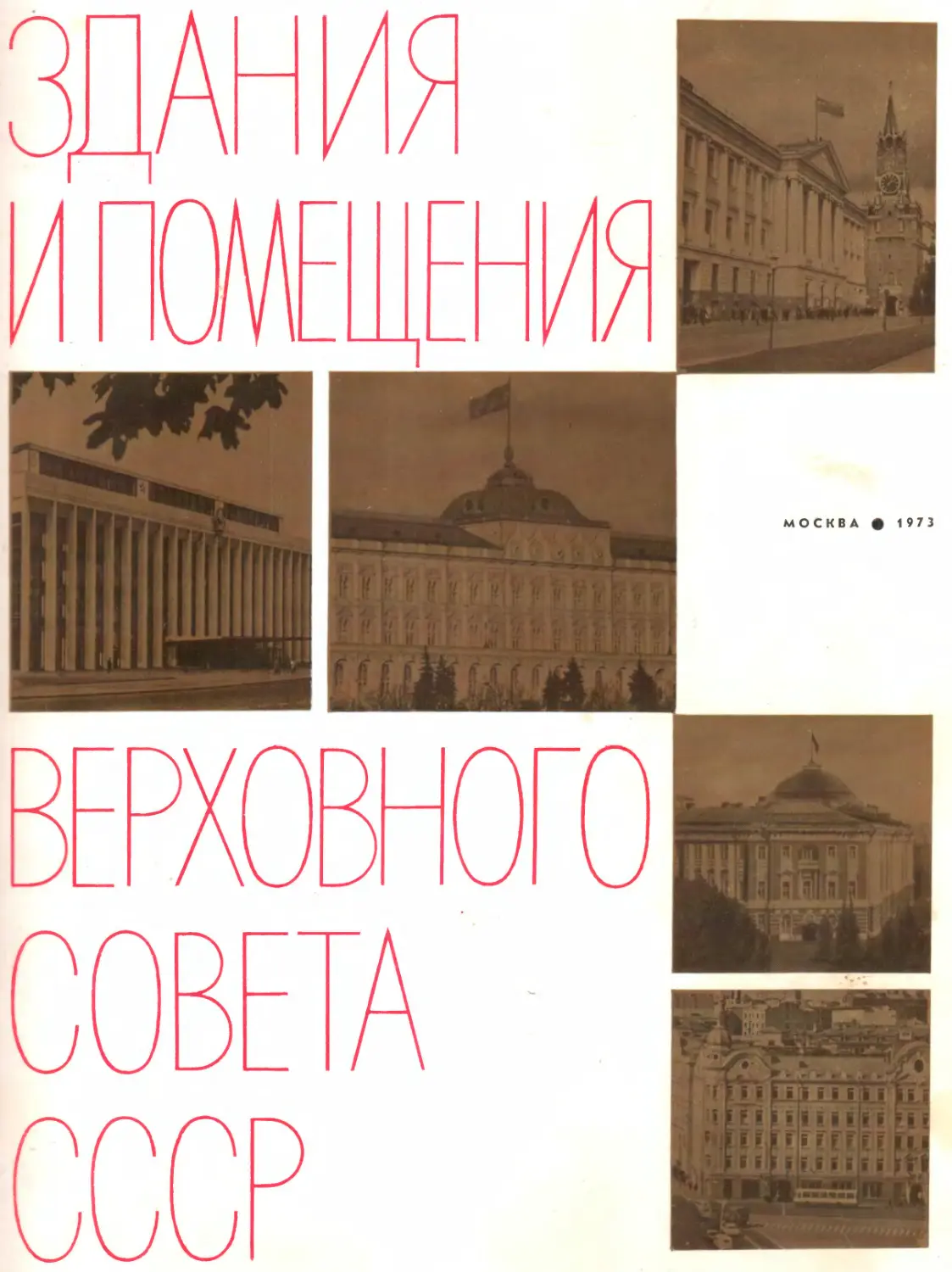
ЗДАНИЯ И ПОМЕЩЕНИЯ ВЕРХОВНОГО СОВЕТА СССР
OF I HF USSR
SUPREME
SO/IET
ЗД/'м 1И>
И now ЩЕН ИЯ
ВЕРХОВНО О
СОВЕ IА
СССР
ИЗДАТЕЛЬСТВО «ИЗВЕСТИЯ»
МОСКВА • 1 973
Настоящий альбом содержит более 130 цвет-
ных и черно-белых фотографий зданий и поме-
щений, занимаемых Верховным Советом СССР,
Президиумом Верховного Совета СССР, постоян-
ными комиссиями Совета Союза и Совета Нацио-
нальностей. В альбоме показаны залы заседаний,
залы и комнаты для протокольных и других меро-
приятий, проводимых высшими органами государ-
ственной власти Союза ССР, показаны служеб-
ные комнаты и помещения технических служб,
обеспечивающих работу депутатов Верховного
Совета СССР.
Вступительная статья к альбому дается на
русском и одном из иностранных языков: англий-
ском, французском, немецком, испанском. Пояс-
нения к фотографиям даются на русском языке,
а в конце альбома — на четырех указанных выше
иностранных языках.
Этот альбом рассказывает о зданиях и помещениях, в которых
работает высший орган государственной власти Советской страны —
Верховный Совет СССР.
Ежедневно со всех концов земли идут в Москву письма с адре-
сом: «Москва. Кремль. Верховный Совет СССР». К высшему органу
власти Советского государства обращаются не только граждане
Союза ССР. Сюда пишут главы зарубежных государств, парламента-
рии, общественные и государственные деятели. У многих людей раз-
личных национальностей, различного общественного положения
могут быть вопросы к Верховному Совету СССР. Адрес, по которому
они пишут, лаконичен и прост. Его никогда не перепутает почта,
и письмо в Верховный Совет будет доставлено точно по адресу:
«Москва. Кремль».
Сочетание этих двух слов привычно и широко известно. Каждый
государственный акт высших органов власти Советского Союза —
Закон СССР, Указ Президиума Верховного Совета СССР — после
положенных по Конституции подписей Председателя и Секретаря
Президиума заканчивается словами: «Москва. Кремль».
В Кремле работает Верховный Совет СССР — источник советских
законов, орган, несущий всю полноту государственной власти.
В Кремле работает Советское правительство — Совет Министров
СССР.
В каких же зданиях Кремля заседают депутаты, где ведут они
свою сложную законодательную работу, где проводятся всевоз-
можные официальные мероприятия, что представляют собой все
эти помещения? В настоящем альбоме и содержится ответ на эти
вопросы.
The album is devoted to the buildings and premises in which sits the
USSR Supreme Soviet, the Soviet Union's highest organ of power.
Letters bearing the address "The USSR Supreme Soviet, the Kremlin,
Moscow" pour in to the Soviet capital from all parts of the country and
from abroad. The correspondents are not only Soviet citizens, they in-
clude also heads of foreign governments, members of parliaments, public
figures and statesmen. People of various nationalities and various social
status have questions to ask the USSR Supreme Soviet. The address
they write on the envelope is laconic and simple, but all letters reach the
addressee—the Kremlin, Moscow—without fail.
The combination of these two words is customary and widely known.
Every legislative act of the highest organ of power of the Soviet Union—
a law of the USSR or a decree of the Presidium of the USSR Supreme
Soviet—is signed by President and Secretary of the Presidium, as stipul-
ated by the Constitution, and concluded with the words "The Kremlin,
Moscow".
Functioning in the Kremlin is the USSR Supreme Soviet, the source
of Soviet laws, the organ vested with full state power. The Soviet Gov-
ernment—the USSR Council of Ministers—is seated in the Kremlin.
In what buildings of the Kremlin do deputies have their sessions,
where do they carry on their complex legislative work, where are
various official events held, what are all these premises like? The answers
to these questions will be found in the present album.
On October 25 (November 7), 1917, the revolutionary masses seized
the Winter Palace, the residence of Russia's last bourgeois government.
25 октября (7 ноября) 1917 года революционными массами был
взят Зимний дворец — резиденция последнего буржуазного правитель-
ства России. На смену капитализму пришел новый — социалистиче-
ский строй. О его победе возвестил основатель Коммунистической
партии и Советского государства Владимир Ильич Ленин, выступая
на II Всероссийском съезде Советов. Революция подвела черту под
всем прошлым отсталой, угнетенной России и открыла путь России
социалистической. Было создано первое Советское правительство —
Совет Народных Комиссаров, который возглавил В. И. Ленин. Был
образован и высший законодательный, распорядительный и контроли-
рующий орган Всероссийский Центральный Исполнительный Коми-
тет (ВЦИК) во главе с видным революционным деятелем Я. М. Сверд-
ловым. На первых порах и Совнарком и ВЦИК размещались в
Смольном — Петроградском штабе революции.
С победой революции, вскоре после всемирно известного Декрета
о земле, постепенно были также национализированы банки, заводы,
фабрики, дворцы. Все это стало достоянием народа.
Рабочие и крестьяне, пришедшие к власти, не имели опыта госу-
дарственного руководства. Бывшие чиновники саботировали деятель-
ность правительства: все приходилось брать с бою-—деньги, доку-
менты, помещения. Государственная машина царизма была сломана
революцией. Новый строй требовал нового — социалистического
механизма управления, и он был пущен в ход. Созданные револю-
ционным народом свои органы власти — Советы депутатов трудя-
щихся быстро распространились по всей стране. Но новая власть
встретила ожесточенное сопротивление уходящих со сцены истории
классов. Шла гражданская война. Белогвардейские войска подошли
Capitalism was replaced by a new, socialist, system. Its victory was an-
nounced by Vladimir Ilyich Lenin, the founder of the Communist Party
and the Soviet state, at the Second All-Russia Congress of Soviets. The
Revolution drew a line under the past of the old and oppressed Russia
and paved the way to a socialist Russia. The first Soviet Government—
the Council of People's Commissars, headed by V. I. Lenin—was formed.
The legislative, supreme executive and controlling organ, the All-Russia
Central Executive Committee, was headed by Y. M. Sverdlov, a prom-
inent revolutionary. At first, the Council of People's Commissars and the
All-Russia Central Executive Committee presided in Smolny—the Petro-
grad headquarters of the Revolution.
After the victory of the Revolution, soon after the adoption of the
world-known Decree on Land, banks, factories, plants and palaces were
nationalized. All this became the property of the people.
The workers and peasants who took over power had no experience
of state management. The former officials sabotaged the new govern-
ment's work; everything—money, documents, premises—had to be taken
by force. The state machinery of tsarism was broken up by the Revolu-
tion. The new system called for a new—socialist state machinery—and
built it. The Soviets of Working People's Deputies—the organs of power
created by the revolutionary people—spread all over the country. The
outgoing classes fiercely resisted the new power. The Civil War was on.
The White Guard troops approached the outskirts of Petrograd, the birth-
place of the Revolution. The socialist Motherland was in danger. In this
complicated situation the Party decided to transfer the capital of the
вплотную к колыбели революции — красному Питеру. Социалистиче-
ское отечество было в опасности. В этой сложной обстановке
партия приняла решение перенести столицу государства в Москву.
Москва была историческим центром России, славилась революцион-
ными традициями, обладала закаленным рабочим классом.
В марте 1918 года правительство молодой Советской республики,
все ее только что созданные центральные учреждения перемещаются
в Москву. Отныне отсюда будет вестись управление страной, здесь
будут приниматься важнейшие исторические решения.
Москва не была столицей России уже два столетия, с той поры
как властная рука Петра I перенесла главный город России на нев-
ские берега. Именно там, в важном и сановном Петербурге, строи-
лись все эти двести лет здания для правительственных и других
высших государственных учреждений, особняки для иностранных
посольств, царские и княжеские дворцы.
В то время Москва полуофициально звалась второй столицей.
Конечно, правители этой второй столицы не забывали себя. Великие
князья, генерал-губернаторы, московская знать, богатейшие москвичи-
фабриканты строили немало красивых дворцов и особняков. Возво-
дились дворцы и на случай пребывания в Москве императорской
фамилии. Средств на это не жалели. Но все эти великолепные здания
не были, конечно, приспособлены для того, чтобы разместить государ-
ственные службы по управлению страной.
Поэтому в тяжелых условиях весны 1918 года переезжавшему
в Москву руководству молодой Советской республики не приходи-
лось особенно выбирать. Первым главным зданием Советского госу-
дарства в новой столице стала гостиница «Метрополь». Именно там
state to Moscow, the historical centre of Russia, famed for its revolutio-
nary traditions, a city with the battle-hardened working class.
In March 1918, the Government of the young Soviet Republic and all
of its newly-established central institutions moved to Moscow, from
where the country would henceforth be administered, and where im-
portant historic decisions would be adopted.
Before that, Moscow had not been the capital of Russia for two cen-
turies since the time when Peter the First made the city on the Neva the
Russian capital. Therefore, it was in pompous Petersburg that the build-
ings for government and other highest state institutions, embassies, royal
and princely palaces were built over these 200 years.
At that time Moscow was semi-officially referred to as the second
capital. Of course, the rulers of this second capital did not forget their
own interests. Members of the royal family, governor-generals, the Mos-
cow nobility and the wealthy Moscow bourgeoisie built many beautiful
palaces and mansions, which included residences of the imperial family
where it stayed while on a visit to Moscow. No expense was stinted for
the purpose. But all these magnificent buildings were not intended for
housing government services, of course.
That is why the Government of the young Soviet Republic did not
have much of a choice after it had moved to Moscow in the trying con-
ditions of spring 1918. The Metropol Hotel became the first official resi-
dence of the Soviet Government in the new capital. The organs of Soviet
power moved into it after its arrival in Moscow while the Kremlin build-
ings, damaged in the period of a clash with the counter-revolutionary
forces during the armed uprising, were being repaired.
КОНСТИТУЦИЯ
{ осныннай	)
РОГ4 МИСКОЙ СОЦНАЛИ< 1ИЧП КОЙ
ФГЛГРЛТНННОЯ < <>В1 тской
РК пуьлмни
разместились по прибытии в Москву органы Советской власти
пока готовились помещения в Кремле, поврежденном во врем£
схватки с контрреволюционными силами в дни вооруженного вос-
стания.
С 12 марта 1918 года резиденцией Президиума Всероссийского
Центрального Исполнительного Комитета и Совета Народные
Комиссаров РСФСР становится Московский Кремль — по праву счи-
тающийся сердцем России. В бывшем здании Сената в Кремле разме-
стились государственные и правительственные учреждения Советское
республики.
Ныне в этих стенах гости Кремля встречаются с самой Историей
Здесь работал и жил в те далекие грозные годы В. И. Ленин
В напряженные дни и бессонные ночи Ильича здесь возникал тот
неудержимый заряд знаменитых декретов, постановлений, речей, пи-
сем — всего, что расходилось по стране, становилось и знаменем 1
оружием в борьбе за победу нового строя. Рядом с Лениным работала
его соратники и помощники. Здесь же собирались на свои заседание
ВЦИК и Центральный Комитет Коммунистической партии.
Советская власть всегда была сильна своей неразрывной связьк
с народом. Ни одного шага не делала она без воли народа, без егс
одобрения. Принятая в 1918 году первая Советская Конституцш
закрепила как высший орган государственной власти Всероссий
ский съезд Советов. Эти съезды и олицетворяли народную волю
разрабатывали пути движения Советского государства.
На съезды собирались многочисленные представители трудящих
ся со всех концов страны. Для их работы требовались обширные
залы, вмещающие тысячи людей. Самым большим помещением длз

u».wrr испазн квшите** »г w »ы«г 1««>-
лотлгайглот дхпггяыыюг’ истинитклъмоп
KOr-tHl f T/t Л. С Г\.Н И. ЛКПУТ4ТО»
м о с к » я
* Ч 1	*
As from March 12, 1918, the Moscow Kremlin, which is by righ
considered the heart of Russia, was the residence of the Presidium of th<
All-Russia Central Executive Committee and of the Council of People'.
Commissars of the RSFSR. The state and government institutions of the
Soviet Republic were accommodated in the former Senate building in th<
Kremlin.
Today, visitors to the Kremlin come face to face with History itsel
in this building. V. I. Lenin lived and worked here in those distant ant
grim years. It was from here that the famous decrees, decisions, speeche
and letters, born on Lenin's busy days and in his sleepless nights, spreat
all over the country and became the banner and a weapon in th<
struggle for the victory of the new system. Lenin's comrades-in-arms ant
assistants worked by his side. The All-Russia Central Executive Com
mittee and the Central Committee of the Communist Party gathered hen
for their sessions.
The strength of Soviet power lies in its unbreakable links with tin
people. It has not taken a single step without the people's will and con
sent. The first Soviet Constitution, adopted in 1918, consolidated the All
Russia Congress of Soviets as the highest organ of state power. These Con
gresses embodied the people's will and mapped out the road of the Sovie
state.
The Congresses drew numerous representatives of working peopb
from all corners of the country. Their work called for big halls whicl
would seat thousands of people. The Bolshoi Theatre was the bigges
building Moscow of those times had for holding such forums. In th<
проведения подобных форумов, которым располагала тогдашняя Мос-
ква, был Большой театр. В его огромном зале собирались в двадцатые
годы избранники народа — рабочие, крестьянские, солдатские депу-
таты, обсуждали вопросы внутренней и внешней политики страны,
решали, как лучше, быстрее разрешить задачи, поставленные партией.
Жизнь настоятельно требовала более тесного сплочения нацио-
нальных республик, образовавшихся на обширных просторах бывшей
Российской империи. Эти республики провозгласили у себя Совет-
скую власть, отстояли ее с помощью русского народа в героиче-
ской борьбе. Теперь нужны были более тесные взаимосвязи
для объединения сил в борьбе с окружающими Советскую страну
врагами, для создания единой, крепкой экономики, для совместного
труда в строительстве нового общества.
В декабре 1922 года I Всесоюзный съезд Советов, собравшийся
в Большом театре, провозгласил образование Союза ССР. А год
спустя, в январе 1924 года, II Всесоюзный съезд Советов принял
Конституцию Союза ССР.
Согласно этой Конституции систему высших органов власти
составляли: съезд Советов СССР, Центральный Исполнительный
Комитет СССР и Президиум Центрального Исполнительного Коми-
тета СССР. Высшим органом государственного управления был Совет
Народных Комиссаров СССР.
Съезд Советов состоял из многочисленных представителей всех
народов Союза ССР, число депутатов достигало двух с половиной —
трех тысяч человек. Поэтому понятно, что основным местом проведе-
ния съездов Советов в тот период оставался по-прежнему Большой
театр.
ПОДПИСАЛИ
Анаите*»** ДЛЙЛГАЦЭ*
twenties, the elected representatives of the people—worker, peasant and
soldier deputies—gathered in its enormous hall to discuss problems
of the country's home and foreign policy and to work out the quickest
and the most efficient ways of solving the problems posed by the Party.
Life insistently demanded a closer cohesion of the national Republics
which had emerged on the vast expanses of the former Russian Empire.
These Republics proclaimed Soviet power, and upheld it with the help of
the Russian people in heroic struggle against the enemy. It was now
necessary to establish close inter-relationships between them so as to pool
their efforts in the struggle against the enemies which surrounded the So-
viet Union, in building up a single and strong economy, in the construc-
tion of new society.
The First All-Union Congress of Soviets, held at the Bolshoi Theatre
in December 1922, proclaimed the formation of the USSR. A year later, in
January 1924, the Second All-Union Congress of Soviets adopted the Con-
stitution of the USSR.
Under this Constitution, the system of the highest organs of power
was as follows: the Congress of Soviets of the USSR, the Central Executive
Committee of the USSR and the Presidium of the Central Executive Com-
mittee of the USSR. The supreme organ of state power was the Council of
People's Commissars of the USSR.
The Congress of Soviets consisted of numerous representatives of all
the peoples of the USSR. The number of deputies ran into 2,500-3,000. It
is quite natural, therefore, that the Bolshoi Theatre remained the venue of
Congresses of Soviets at the time.
ОСНОВНОЙ ЗАКОН
(КОНСТИТУЦИЯ!
СОЮЗА
СОВЕТСКИХ СОЦИАЛИСТИЧЕСКИХ
РЕСПУБЛИК.
ИЗДАНИЕ ЦЕНТРАЛЬНОЮ ИьПОЯН1ПЕЙ>Н1Я U КОМИТ*ТА
CvtO3A СОВЕТСКИХ СОЦИАЛИСТИЧЕСКИХ РЕСПУБЛИК.
192« — Крем «к
В помещении Большого театра проходили также съезды партии,
юржественные заседания... У государства было множество неотлож-
ных задач, и проблема размещения органов власти и управления
в свете всех грандиозных дел, которые под руководством партии
вершил советский народ, казалась второстепенной.
Заседания органов с меньшим числом участников — пленумы
ЦК партии, заседания ЦИК СССР и другие происходили, как правило,
в Кремле, хотя иногда для этих целей использовался Колонный зал
Дома союзов — одного из красивейших зданий Москвы.
К середине тридцатых годов, когда начал претворяться в жизнь
генеральный план реконструкции Москвы, в Кремле для размещения
высших органов власти был также перестроен ряд зданий и поме-
щений.
Победа социализма в СССР, укрепление общественного строя,
окончательная ликвидация эксплуататорских классов поставили
перед советским народом вопрос о новой Конституции. После все-
народного обсуждения проект Конституции, разработанный Централь-
ным Комитетом Коммунистической партии, был поставлен на обсуж-
дение VIII Всесоюзного Чрезвычайного съезда Советов и 5 декабря
1936 года единодушно принят делегатами съезда. Этот съезд происхо-
дил в новом, реконструированном зале Большого Кремлевского двор-
ца, том самом зале, где ныне заседает Верховный Совет СССР.
Новая Конституция отразила победу социализма в СССР, закре-
пила морально-политическое единство советского общества. В Консти-
туции нашли свое выражение исторические победы ленинской нацио-
нальной политики, рост числа союзных республик. Ныне в СССР вхо-
дят 15 союзных республик, в которых состоят 20 автономных респуб-
лик, 8 автономных областей и 10 национальных округов.
Party Congresses and solemn sessions were also held at the
Bolshoi Theatre. .. The state had many urgent matters to attend to,
and the problem of accommodating the organs of power and state manage-
ment seemed of secondary importance in the light of the titanic work
done by the Soviet people under Party leadership.
The organs with a smaller number of participants—the Plenary Meet-
ings of the Central Committee, meetings of the Central Executive Com-
mittee and others—had their sessions in the Kremlin and, sometimes,
in the Hall of Columns of the House of Trade Unions, one of the most
beautiful buildings in Moscow.
By the mid-thirties, when the realization of master plan of Moscow's
reconstruction began, a number of buildings was rebuilt in the Kremlin
for the highest organs of power.
The victory of socialism in the USSR, the strengthening of the social
system, the abolition of the exploiting classes—all this called for a nevv
Constitution. After a nation-wide discussion, the draft Constitution, drawn
up by the Central Committee of the Communist Party, was submitted
to the 8th All-Union Extraordinary Congress of Soviets and unanimously
adopted by its delegates on December 5, 1936. The Congress was held ir
the newly reconstructed hall of the Grand Kremlin Palace, the hall where
the USSR Supreme Soviet now meets in session.
The new Constitution reflected the triumph of socialism in the USSR
cemented the moral and political unity of Soviet society. The historic vic
tories of the Leninist nationalities policy and the growth of the number о
Union Republics found their reflection in the Constitution. Today the USSF
Высшим органом власти Союза ССР по Конституции является
Верховный Совет СССР. Его депутаты — представители народа изби-
раются непосредственно гражданами СССР, достигшими ко дню вы-
боров 18-летнего возраста.
Верховный Совет СССР состоит из двух палат — Совета Союза
и Совета Национальностей. Двухпалатная структура Верховного
Совета обусловлена многонациональным составом государства. В Вер-
ховном Совете восьмого созыва 1517 депутатов, в том числе в Совете
Союза — 767 депутатов, в Совете Национальностей — 750 депутатов.
Депутатами избраны представители 62 национальностей. Около одной
трети депутатов — женщины, более чем четвертая часть — беспартий-
ные. Половина депутатов — рабочие и колхозники, непосредственно
занятые на производстве, среди депутатов ученые, врачи, учителя,
деятели литературы и искусства, партийные, государственные,
профсоюзные, комсомольские работники, представители многих слоев
населения.
Верховный Совет СССР, являясь высшим органом государствен-
ной власти, осуществляет все права, присвоенные Союзу ССР; только
он обладает законодательной властью. Ни один другой орган в стране
не может издавать общесоюзные законы.
Верховный Совет избирает Президиум Верховного Совета, обра-
зует Правительство — Совет Министров СССР, избирает Верховный
Суд и назначает Генерального Прокурора.
Президиум Верховного Совета СССР избирается на совместном
заседании палат в составе: Председателя Президиума Верховного
Совета, пятнадцати заместителей Председателя—по одному от каж-
дой союзной республики, Секретаря Президиума и двадцати членов
comprises 15 Union Republics which consist of 20 Autonomous Republics,
8 Autonomous Regions and 10 National Areas.
Under the Constitution, the USSR Supreme Soviet is the highest organ
of power in the USSR. Its deputies representing the people are elected
directly by the citizens of the USSR who by the time of the elections
have reached the age of 18.
The USSR Supreme Soviet consists of two Chambers—the Soviet of
the Union and the Soviet of Nationalities. The two-Chamber structure of
the Supreme Soviet is the outcome of the multinational composition of the
state. The Supreme Soviet of the Eighth Convocation has 1,517 deputies
(767 deputies in the Soviet of the Union and 750 deputies in the Soviet of
Nationalities). Representatives of 62 nationalities have been elected
deputies. Women account for about a third of the deputies, and non-Party
men, for more than a uarter. Half the deputies are workers and
collective farmers directly employed in production. Among the deputies
there are scientists, schoolteachers, doctors, men of literature and art,
Party functionaries, statesmen, trade union and Komsomol workers,
representatives of all walks of life.
Being the highest organ of state power, the USSR Supreme Soviet
exercises all the rights vested in the Soviet Union. It is the only organ to
possess legislative power. No other body in the country can issue national
laws.	— '
The Supreme Soviet elects the Presidium of the Supreme Soviet,
forms the Government—the USSR Council of Ministers, elects the Su-
preme Court and appoints the Procurator General.

Президиума Верховного Совета. Во всей своей деятельности Прези-
диум Верховного Совета подотчетен Верховному Совету СССР.
Регулярно работают постоянные комиссии палат Верховного
Совета. Они избираются из числа депутатов, как правило, на первой
сессии Верховного Совета каждого созыва на весь срок его
полномочий. В Верховном Совете СССР восьмого созыва образованы
комиссии — мандатные, законодательных предположений, планово-
бюджетные, по иностранным делам, по делам молодежи, по промыш-
ленности, по транспорту и связи, по строительству и промышленности
строительных материалов, по сельскому хозяйству, по здравоохране-
нию и социальному обеспечению, по народному образованию, науке
и культуре, по торговле, бытовому обслуживанию и коммунальному
хозяйству, по охране природы. В каждой из них от 31 до 51 депутата.
Всего в Совете Союза и Совете Национальностей восьмого созы-
ва избрано двадцать шесть постоянных комиссий, в составе которых
912 депутатов.
Верховный Совет СССР имеет широкие связи с парламентами
стран мира. Депутаты Верховного Совета образуют Парламентскую
группу СССР, которая входит в Межпарламентский Союз.
Президиум Верховного Совета осуществляет непосредственные
контакты с главами иностранных государств. Здесь принимаются
председатели Государственных советов, президенты, ведутся пере-
говоры. При Президиуме Верховного Совета аккредитованы
послы зарубежных государств.
Если войти в Кремль через Боровицкие ворота, то, поднявшись
немного вверх по кремлевскому холму, видишь расположенное с левой
стороны здание Большого Кремлевского дворца. Большой Кремлев-
The Presidium of the USSR Supreme Soviet is elected at a joint
session of the Chambers in the following composition: the President of
the Presidium of the Supreme Soviet, fifteen Vice-Presidents (one for each
Union Republic), Secretary of the Presidium and 20 members of the Presi-
dium of the Supreme Soviet. In all its activities, the Presidium of the Su-
preme Soviet is accountable to the USSR Supreme Soviet.
The standing commissions of the Chambers of the Supreme Soviet
work regularly. They are elected from among the deputies, at the first
session of the Supreme Soviet of each convocation, for its entire term of
office. The USSR Supreme Soviet of the Eighth Convocation has the
following commissions: mandatory, legislative proposals, planning and
budget, foreign affairs youth affairs, industrial transport and communica-
tions, construction and building materials industry, agricultural, health
and social maintenance, public education, science and culture, trade,
everyday services and municipal economy, nature protection. Each com-
mission comprises from 31 to 51 deputies.
Altogether, the Soviet of the Union and the Soviet of Nationalities of
the Eighth Convocation had elected 26 standing commissions with a total
of 912 deputies.
The USSR Supreme Soviet maintains extensive contacts with parlia-
ments of foreign countries. The deputies of the Supreme Soviet form the
Parliamentary Group of the USSR which is affiliated to the Interparliamen-
tary Union.
The Presidium of the Supreme Soviet maintains direct contacts with
the heads of foreign states. Here chairmen of state councils and presidents
ский дворец как бы венчает собой кремлевский холм. Его сверкающая
в солнечных лучах громада высоко возвышается над кремлевскими
стенами и видна издалека. Центр здания увенчан куполом с флаг-
штоком. У парадного входа — две мраморные доски: «Верховный
Совет СССР» и «Верховный Совет РСФСР».
Под словами «Большой Кремлевский дворец» мы обычно пони-
маем целый комплекс зданий, построенных в разные эпохи, но
объединенных одной крышей.
Собственно Большой Кремлевский дворец был построен в
1838—1849 гг. взамен снесенных ветхих старинных построек
XV—XVIII веков. Строили его архитекторы Н. И. Чичагов, П. А. Ге-
расимов, В. А. Бакарев, Ф. Ф. Рихтер и другие. Возглавлял строитель-
ство архитектор К. А. Тон. Длина Дворца по южному, обращенному
к Москве-реке, фасаду—125 метров, высота — 45 метров. Снаружи
Дворец кажется трехэтажным, на самом деле в нем два этажа: по-
мещения второго этажа очень высоки и имеют два ряда окон. Дворец
украшен искусной резьбой по белому камню.
До революции Дворец служил парадной резиденцией русских им-
ператоров во время их приездов в Москву. Каждый его зал, каж-
дое помещение отделаны в своем стиле, с подчеркнутой роскошью и
выглядят очень эффектно. Нижний этаж предназначался для жилья
(так называемая «Собственная половина»), а верхний — для всевоз-
можных официальных приемов. В частности, в ритуал придворной
жизни входили праздники в честь учрежденных в империи орденов.
Поэтому целый ряд залов получил наименование по названию соот-
ветствующих орденов — Георгиевский, Екатерининский, Андреевский,
Александровский, Владимирский.
are received, and negotiations are conducted. Ambassadors of foreign
states are accredited to the Presidium of the Supreme Soviet.
If you enter the Kremlin through the Borovitskiye Gates and go a
little way up the gently sloping Kremlin hill, you will see the building of
the Grand Kremlin Palace on your left. The Grand Kremlin Palace crowns
the Kremlin hill. Its great bulk, glittering in the sun, towers over the
Kremlin walls and is seen from afar. The centre of the building is crowned
with a cupola and a flagstaff. Two marble signboards flanking its
door read: "The USSR Supreme Soviet" and "The Supreme Soviet of the
Russian Federation".
By the "Grand Kremlin Palace" we usually mean a whole complex of
buildings erected in various epochs under one and the same roof.
The Grand Kremlin Palace proper was built in 1838-1849 on the site
of the old structures, dating back to the 15th-18th centuries, which had
been pulled down. It was erected by architects N. Chichagov, P. Gerasi-
mov, V. Bakarev, F. Rikhter, and others. The chief architect was K. Ton.
The length of the Palace's southern facade, facing the Moskva River, is
125 metres, and its height is 45 metres. From the outside, the Palace looks
three-storeyed, but actually it has two floors, the top-floor premises being
very high and having two rows of windows. The Palace is ornamented
with skilfully carved white stone.
Before the Revolution, the Palace served as a place of residence for
the Russian emperors during their visits to Moscow. Each hall and each
room is decorated in a style of its own, with ostentatious luxury, and has
Другая, более древняя часть Большого Кремлевского двор-
ца (Грановитая палата, царские жилые помещения, дворцовые церкви
и т. д.) имеет большое историческое и художественное значе-
ние. Здесь до наших дней донесены черты быта и жизни русских
царей XV—XVII веков, большой талант художников и архитекторов
того времени.
Отданный в 1917 году народу Дворец зажил теперь совершенно
новой жизнью. Депутаты Верховного Совета — простые трудящиеся
люди, приезжающие на сессии со всех концов страны. Из бывших
царских покоев в полный голос заговорил устами своих представи-
телей могучий советский народ. В стенах Дворца рождаются
и выходят в жизнь законы, с помощью которых граждане СССР под
руководством партии строят коммунистическое общество.
Андреевский и Александровский залы Дворца в начале трид-
цатых годов по проекту архитектора И. А. Иванова-Шица были
соединены в один обширный зал, где теперь проводятся совместные
заседания Совета Союза и Совета Национальностей Верховного
Совета СССР.
Высокие окна зала расположены в два яруса, из них открывается
широкая перспектива Москвы-реки. Зал хорошо освещен скрытыми
за карнизами лампами. Он выглядит торжественно, парадно и вместе
с тем очень просто. Это рабочее помещение Верховного Совета.
В глубокой нише над местами президиума возвышается гранитная
статуя В. И. Ленина работы известного советского скульптора
С. Д. Меркурова. В зале 2500 мест, из которых около 900 мест распо-
ложены на балконе и предназначаются для гостей, советской и иност-
ранной прессы.
striking appeal. The ground floor was residential (the so-called "Residen-
tial Quarters"), and the top floor was designed for official receptions. The
ritual of court life included, in particular, festive occasions in honour of
the orders instituted in the empire. Therefore, many halls are named
after these orders: St. George, St. Catherine, St. Andrew, Alexander,
St. Vladimir.
The other, more ancient, part of the Grand Kremlin Palace (Faceted
Hall, tsars' chambers, palace churches, etc.) has a still greater historical
and artistic significance. They brought down to us the traits of life of Rus-
sian tsars of the 15th-17th centuries and the talent of the artists and archi-
tects of those times.
Taken over by the people in 1917, the Palace has become a public
edifice. The deputies of the Supreme Soviet are rank-and-file working peo-
ple coming to sessions from all corners of the country. In the former royal
chambers, rings the voice of the powerful Soviet nation in the person of
its representatives. The laws, which emerge and are adopted in the Palace,
help the Soviet people to build communist society under the leadership
of the Party.
In the early thirties, the St. Andrew and Alexander halls of the
Palace were linked into one vast hall, designed by architect I. Ivanov-
Shi ts, where joint sessions of the Soviet of the Union and the Soviet of
Nationalities of the USSR Supreme Soviet are now held.
From double row of windows in the hall, abroad panorama of the
Moskva River opens up. The hall is well illuminated by screened ceiling
lights. It looks festive and very unpretentious at one and the same time.
Депутатские места в зале заседаний оборудованы специальными
радиоусилителями и аппаратурой для трансляции в необходимых
случаях перевода речей и выступлений на языках союзных респуб-
лик, входящих в Союз ССР, а также на иностранных языках. Перед
каждым депутатским креслом расположен выдвижной пюпитр для
ведения записей во время заседаний.
На боковой стене зала расположены ложи-балконы для диплома-
тов, посещающих заседания Верховного Совета СССР. Эти ложи имеют
выход в дипломатическое фойе. Все важнейшие мероприятия Верхов-
ного Совета СССР неизменно привлекают самое пристальное вни-
мание зарубежных представителей и корреспондентов печати, теле-
видения, радио. Для их работы в зале созданы все необходимые
условия.
Как правило, официальные иностранные парламентские делега-
ции, находящиеся в СССР в период сессий Верховного Совета, при-
глашаются на его заседания. Им отводятся места в зале, обеспечи-
вается перевод хода обсуждения вопросов. Главы таких делегаций,
а также руководители зарубежных государств и другие высокие
гости приглашаются в президиум сессии.
Места в президиуме состоят из трех лож — центральной,
ложи Президиума Верховного Совета СССР и ложи Правительства
СССР. За председательским столом во время заседаний Верховного
Совета СССР находятся председатели Совета Союза и Совета
Национальностей, которые поочередно ведут заседания, и восемь их
заместителей.
В центральной ложе — руководители Советского государства и
Коммунистической партии Советского Союза.
This is where the USSR Supreme Soviet presides. In a deep niche over the
Presidium seats there towers a granite statue of V. I. Lenin by the well-
known Soviet sculptor S. Merkurov. The hall has 2,500 seats, of which
about 900 on the balcony are reserved for guests and Soviet and foreign
newspapermen.
The seats of the deputies in the hall are equipped with special radio
amplifiers and earphones through which translations of speeches into the
languages of the Soviet Republics and into foreign languages is provided.
Each deputy has a pull-out writing desk before his seat.
The balconies for diplomats attending sessions of the USSR Supreme
Soviet stretch along a side wall. These boxes communicate with the diplo-
matic foyer. All the major undertakings of the USSR Supreme Soviet in-
variably attract the closest attention of foreign representatives, newspaper-
men, television and radio correspondents. All necessary facilities are pro-
vided in the hall for their work.
As a rule, official foreign parliamentary delegates, staying in the
USSR in the period when the Supreme Soviet is in session, are invited to
these sessions. Special seats are set aside for them, and all the questions
disussed are interpreted into their languages. The heads of such delega-
tions, and also the leaders of foreign states and other distinguished guests
are invited to the Presidium of the session.
The seats reserved for the Presidium are in three boxes—the central
box, the box for the Presidium of the USSR Supreme Soviet and the
box for the USSR Government. Seated at the Chairman's lesk during the
sessions of the USSR Supreme Soviet are Chairmen of the Soviet of the
Восемь широких дверей ведут из зала заседаний в фойе и в
Георгиевский зал.
Георгиевский зал — один из больших и красивейших залов
Кремлевского дворца. Длина его — 61 метр, ширина — 20,5 и высота —
до 17,5 метра. Название зала связано с военным дореволюционным
орденом св. Георгия. Награждение им производилось за личную
храбрость и подвиги. Имена всех кавалеров ордена и наименова-
ния награжденных воинских частей нанесены на мраморные
доски в нишах зала. Георгиевский зал олицетворяет собой славные
подвиги русского оружия.
Зал украшен 18 витыми колоннами, над каждой из них статуи
со щитами, на которых изображены гербы губерний и краев, входив-
ших в состав России. Автор статуй — скульптор И. П. Витали.
Достопримечательностью зала является паркет из 20 пород цен-
ного дерева и шесть ажурных бронзовых золоченых люстр.
В Георгиевском зале проводятся многие общественно-политиче-
ские, государственные мероприятия, торжественные празднества,
вручения орденов и медалей награжденным. Здесь происходил прием
участников парада Победы в 1945 году, устраивались приемы
в честь покорителей космоса, большие приемы по случаю пребывания
в СССР зарубежных государственных деятелей. Во время сессий здесь
производится регистрация депутатов, раздаются материалы к заседа-
ниям сессии. Обычной является картина, когда в перерывах между
заседаниями депутаты, прогуливаясь по этому великолепному залу,
продолжают оживленно обсуждать волнующие их вопросы.
Из зала заседаний можно выйти и в Кавалергардский зал, начи-
нающий собой анфиладу парадных комнат, которые во время сессий
Union and the Soviet of Nationalities who conduct the sessions in turn
and eight of their vice-chairmen.
The leaders of the Soviet state and of the Communist Party of the So-
viet Union are seated in the central box.
Eight wide doors lead from the session hall to the foyer and the
St. George Hall.
The St. George Hall is one of the biggest and the most magnificent
at the Kremlin Palace. It is 61 metres long, 20.5 metres wide and up tc
17.5 metres high. The Hall is named after the prerevolutionary military
order of St. George, which was awarded for outstanding valour. The names
of all holders of the order and of the military units awarded the decora-
tion are inscribed on the walls. The St. George Hall is a monument to the
glorious feats of .Russian arms.
The Hall is adorned with 18 coiled columns, each crowned with c
statue with a shield depicting the emblems of the regions and territorie<
forming parts of Russia. The author of the statues is sculptor I. Vitaly
A distinguishing feature of the Hall is its parquet floor laid out ii
20 kinds of valuable wood and its six open-work bronze gilded chan
deliers.
The St. George Hall has been the scene of many socio-political, stab
and other grand occasions, such as order and medal presentatioi
ceremonies. A reception of the participants in the Victory Parade ii
1945 was held here; receptions in honour of cosmonauts, as well a
grand receptions on the occasion of visits of foreign statesmen to th*
USSR, are also arranged there. At sessions, deputies are registered an*
используются как служебные помещения Верховного Совета СССР.
Называли его так по имени Кавалергардского полка царской гвар-
дии, офицеры которого дежурили в этом зале. Кавалергардский зал
используется как фойе президиума сессии, в нем также располага-
ется управление службой связи.
Соседний зал — Екатерининский, один из наиболее красивых
залов Дворца. Зал был посвящен дореволюционному ордену св. Екате-
рины, учрежденному Петром I в 1714 году. Этот зал используется
Верховным Советом для заседаний различных комиссий в период про-
ведения сессий, а также для заседаний постоянных комиссий Совета
Союза и Совета Национальностей. Здесь проводятся встречи и беседы
с иностранными парламентскими делегациями, главами государств и
правительств, здесь же вручаются награжденным ордена и медали
СССР.
Следующие залы второго этажа, так называемые зеленый и крас-
ный — по их отделке, служили ранее парадными царскими покоями.
В залах полностью сохранен интерьер XIX века. Все эти художествен-
ные ценности тщательно оберегаются и поддерживаются в хорошем
состоянии. В этих залах в период сессий работает аппарат Верховного
Совета СССР, а в другое время происходят встречи и приемы приез-
жающих в Верховный Совет СССР гостей.
Полторы тысячи депутатов Верховного Совета СССР во время
сессий заполняют помещения обширного Кремлевского дворца.
Непосредственно к Георгиевскому залу примыкает Владимирский
зал, где во время сессий депутаты получают от специалистов необ-
ходимые им по работе консультации, статистические данные и
справочные материалы. Этот восьмигранный под высоким куполом
handed materials foi the sessions there. During intermissions, deputies
walk round this gorgeous hall, often continuing to discuss problems of
concern to them.
The session hall opens out into the Cavalry Guards Hall, which is the
first in the suite of reception rooms used as service premises of the USSR
Supreme Soviet during sessions. The Hall is named after the Cavalry
Regiment of the Royal Guards whose officers were on duty in that Hali.
The Cavalry Guards Hall is used as a foyer for the session's Presidium;
it also houses the communication services.
The hall adjoining it, St. Catherine, is one of the most beautiful halls
in the Palace. The Hall was built in honour of the prerevolutionary Order
of St. Catherine instituted by Peter the First in 1714. Nowadays this Hall
is used by the Supreme Soviet for the meetings of various commissions
during session periods and also for meetings of the standing commissions
of the Soviet of the Union and the Soviet of Nationalities. Here meetings
and talks with foreign parliamentary delegations, heads of state and
government, are arranged, and orders and medals of the USSR are
presented.
The next top-floor halls, the so-called green and red ones (named after
the colour predominating in their interior decoration), used to serve as
royal chambers. Their 19th-century interior has been preserved intact. All
these works of art are carefully preserved and maintained in excellent
condition. The staff of the USSR Supreme Soviet work in these halls dur-
ing sessions, and in between sessions the guests of the USSR Supreme So-
viet are received there.
зал украшен изображениями знаков бывшего российского ордена
св. Владимира, в честь которого он получил свое название. Зал за-
нимает особое место в архитектуре Большого Кремлевского дворца,
являясь связующим звеном между новой частью здания и старинны-
ми помещениями.
Через «Святые сени», украшенные росписями на сюжеты из
библии и русской истории, можно пройти в наиболее древнюю часть
Дворца — Грановитую палату, построенную в 1487—1491 гг. Своим
названием она обязана, очевидно, белому граненому камню, украшаю-
щему ее парадный восточный фасад. Внутренние стены Грановитой
палаты расписаны русскими художниками на библейские темы. Своды
палаты опираются на массивный столб, расположенный в центре.
В XV веке Грановитая палата была самым обширным помещением
Московской Руси и служила тронным залом великих князей и царей.
В Грановитой палате в ходе сессии собираются для обсуждения
отдельных вопросов группы депутатов, заседают комиссии. Ранее
здесь собирались Советы Старейшин. В Грановитой палате вручаются
государственные награды Союза ССР, проводятся протокольные встре-
чи и приемы.
На первом этаже Большого Кремлевского дворца, как уже гово-
рилось, расположена «Собственная половина» — анфилада парадных
комнат, служивших ранее жилыми помещениями императорской
семьи во время ее приезда в Москву. Эти комнаты отделаны русскими
мастерами и художниками, они сохраняют свое великолепие и в на-
стоящее время.
Помещения первого этажа используются главным образом для
встреч, бесед и приемов делегаций, приезжающих из-за рубежа. Во
During sessions, 1,500 deputies of the USSR Supreme Soviet fill th
halls of the vast Kremlin Palace.
The St. Vladimir Hall adjoins the St. George's Hall. During session
in St. Vladimir Hall, the deputies obtain from specialists the necessar
consultations, statistical data and reference materials. This octagone
Hall under a high cupola is decorated with pictures of the forme
Russian order of St. Vladimir after which the Hall is named. The Hall he
a special place in the architecture of the Grand Kremlin Palace an
serves as a connecting link between the new part of the building and i
ancient premises.
There is a way through the "Holy Vestibule", adorned with painting
on Biblical and Russian historical motifs, to the most ancient part of If
Palace—the Faceted Hall built in 1487-1491. It probably owes its name 1
the white faceted stone adorning its Eastern facade. The inner walls be<
frescoes by Russian artists on Biblical motif. The vaulted ceiling rests c
a massive pillar towering in the centre of the hall.
In the 15th century the Faceted Hall was the biggest in Moscow Ri
and served as the throne-room of grand dukes and tsars.
During sessions, groups of deputies gather in the Faceted Hall to di
cuss special problems; besides, commissions have their meetings thei
Previously, the Chamber was the seat of the Council of Elders. Sta
decorations of the USSR are presented, and protocol meetings and rece
tions are held there.
The ground floor of the Grand Kremlin Palace is "Resident]
Quarters"—a suite of beautifully furnished and decorated rooms whi
время сессий здесь работают депутаты, собираются комиссии. Ранее
в течение длительного времени в этих помещениях происходило вру-
чение верительных грамот Председателю Президиума Верховного
Совета СССР послами иностранных государств.
Все украшения — скульптура, настенная живопись, отделка,
ткани, паркет Большого Кремлевского дворца бережно сохраняются
и в необходимых случаях реставрируются.
Кроме Большого Кремлевского дворца Верховный Совет СССР
использует в Кремле и другие здания.
Рядом с Троицкими воротами Кремля сверкает огромными стек-
лами, прозрачный как хрусталь, Кремлевский Дворец съездов —
современное здание, воздвигнутое в наши дни. Каждый век, каждая
эпоха оставляли в Кремле свои приметы, свои памятники, и они всегда
уживались, сочетались друг с другом. Здесь соборы XV века стоят
рядом с Арсеналом петровских времен, Грановитая палата — непода-
леку от здания Сената, построенного в конце XVIII века, древний
Успенский собор — напротив административного здания 30-х годов
нашего века. А теперь и Кремлевский Дворец съездов нашел здесь
свое место.
Дворец — самое молодое здание Кремля построен менее чем за два
года. 17 октября 1961 года в нем начал работать XXII съезд КПСС.
Здание имеет форму прямоугольника размером 120 на 70 метров.
Его фасады украшены пилонами, облицованными белым мрамором,
между которыми зеркальное стекло. Чтобы Дворец не подавлял окру-
жающие здания своей величиной, часть его служебных помещений
served as residence for the imperial family during its visits to Moscow.
These rooms, decorated by Russian craftsmen and artists, have lost none
of their magnificence to this day.
The rooms are used chiefly for meetings, talks and receptions of
foreign delegations. During sessions, deputies work and commissions
gather there. For a long time, these rooms were set aside for the presenta-
tion of credentials to the President of the Presidium of the USSR Supreme
Soviet by foreign ambassadors.
All the adornments—sculptures, frescoes, interior finishing,
upholstery and parquet floors of the Grand Kremlin Palace—are being
carefully preserved and, if need be, restored.
Besides the Grand Kremlin Palace, the USSR Supreme Soviet uses
other buildings in the Kremlin.
Next to the Kremlin's Trinity Gate there stands a gleaming glass
building of the Kremlin Palace of Congresses erected quite recently. Each
century and each epoch left its imprints and monuments in the Kremlin,
and they always agreed, harmonized. The cathedrals of the 15th century
stand next to the arsenal of the days of Peter the First, the Faceted Hall
is situated near the Senate building put up at the end of the 18th century,
the ancient Cathedral of the Assumption faces an administrative office
block built in the 1930's. And now the Kremlin Palace of Congresses has
been added to the ensemble.
The Palace, the youngest building in the ancient Kremlin. It took less
than two years to build. On October 17, 1961, the 22nd CPSU Congress
was opened there.
размещена ниже уровня земли. Сцену от зала заседаний отделяет
широко известный ныне металлический занавес, в центре которого
как бы на алом знамени в солнечных лучах помещен портрет В. И. Ле-
нина. Специальное радиотехническое оборудование позволяет вести
передачу в зрительный зал на 29 языках. Зрительный зал Дворца вме-
щает 6000 человек.
Дворец съездов в Кремле построен по проекту группы архитек-
торов и инженеров, из которых М. В. Посохин, А. А. Мндоянц,
Е. Н. Стамо, П. П. Штеллер, Г. Н. Львов, А. Н. Кондратьев, И. И. Ко-
четов удостоены Ленинской премии.
Дворец включает в себя множество самых различных помеще-
ний — фойе и кулуары, переговорные пункты, почту, рабочие ком-
наты для президиума, прессы, редакторов, банкетный зал на 2500
мест. Имеются залы и комнаты для дипломатического корпуса и
иностранной прессы, связанные с основными помещениями посред-
ством стеклянной галереи.
Специальными переходами, в одном из которых расположен зим-
ний сад, Дворец съездов соединяется с Большим Кремлевским двор-
цом. Депутаты во время сессий Верховного Совета СССР или торже-
ственных заседаний могут пользоваться обоими этими великолепными
дворцами.
В Кремлевском Дворце съездов проводятся съезды КПСС, торже-
ственные заседания, собрания партийного актива. Здесь происхо-
дили совместные торжественные заседания ЦК КПСС, Верховных
Советов СССР и РСФСР, посвященные 50-летию Великой Октябрь-
ской социалистической революции, 100-летию со дня рождения
В. И. Ленина, 50-летию образования Союза ССР.
ЦШ|
The building is a rectangular structure 120 by 70 metres. Its facades
are of white-marble pylons with plate-glass in between. Lest the Palace
should eclipse the other buildings by its bulk, some of its service premises
have been located below ground level. The stage is separated from the
hall by the now well-known metal curtain with a portrait of V. I. Lenin in
the centre against the background of a sunlit red banner. Special radio
equipment makes it possible to provide simultaneous interpreting into
29 languages. The Hall of the Palace seats 6,000.
The Kremlin Palace of Congresses was built after a design by a group
of architects and engineers, among whom M. Posokhin, A. Mndoyants,
Y. Stamo, P. Shteller, G. Lvov, A. Kondratyev, and I. Kochetov were
awarded a Lenin Prize.
The Palace has a multitude of various premises—foyers and lobbies,
trunk-call offices, a post office, offices for the Presidium newspapermen
and editors and a banquet hall seating 2,500. There are halls and rooms
for the diplomatic corps and foreign newsmen which communicate with
the main halls via a glazed gallery.
Special passages, with a winter garden in one of them, connect the
Palace of Congresses with the Grand Kremlin Palace. During sessions of
the USSR Supreme Soviet or ceremonial sittings, the deputies are able to
use both these magnificent palaces.
The Kremlin Palace of Congresses is the venue of CPSU Congresses,
meetings devoted to special occasions and conferences of Party activists.
Joint gatherings of the CC CPSU, the Supreme Soviets of the USSR
and the Russian Federation, devoted to the 50th anniversary of the
В отдельных помещениях Дворца происходят встречи с парла-
ментскими делегациями, заседания постоянных комиссий палат.
На другой стороне обширной Ивановской площади Кремля стоит
здание, построенное по проекту архитектора И. И. Рерберга в
1932—1934 гг. на месте обветшалых монастырских и дворцовых
сооружений. Главный фасад этого здания обращен в сторону Москвы-
реки. Возле массивных дверей главного входа — светлые мраморные
доски с надписью: «Президиум Верховного Совета СССР». Над высо-
ким портиком здания развевается красный флаг Страны Советов
Верхний этаж здания занимает Президиум Верховного Совета СССР.
Здесь происходят заседания Президиума, здесь вручают верительные
грамоты послы зарубежных государств, вручаются награды Советско-
го государства, происходят встречи и беседы государственных деяте-
лей СССР с зарубежными делегациями. Здесь рабочий кабинет Пред-
седателя Президиума Верховного Совета СССР.
Недавно здание было существенно реконструировано. В резуль-
тате реконструкции помещения Президиума представляют собой
удачное сочетание современного интерьера, обладающего макси-
мумом удобств и необходимым оборудованием для работы, с парад-
ным характером залов и комнат, служащих представительским
целям.
Зал заседаний Президиума выдержан в строгих тонах рабочего
помещения, он облицован темной деревянной панелью, удобно осве-
щается, снабжен вентиляционными и радиотрансляционными устрой-
ствами.
Great October Socialist Revolution, to the Lenin Centenary, and the
50th anniversary of the formation of the USSR, were held there.
Meetings with parliamentary delegations and sessions of standing
commissions are held in separate premises of the Palace.
On the other side of the Kremlin's vast Ivanovskaya Square there
stands a building erected in 1932-1934 after a project by architect I. Rer-
berg, in place of the rickety old monastery and Palace structures. Its
facade overlooks the Moskva River. The light-coloured marble signboards
aside of the heavy main entrance doors read "Presidium of the USSR
Supreme Soviet". The red banner of the USSR flutters over the high
portico of the building. The upper storey of the house accommodates the
Presidium of the USSR Supreme Soviet. Here the Presidium has its
sessions, the foreign ambassadors present their credentials, Soviet Govern-
ment decorations are awarded, meetings and talks of Soviet statesmen
with foreign delegations take place. Here the study of the President of
the Presidium of the USSR Supreme Soviet is situated.
Recently, the building underwent substantial reconstruction. Now it
is a fortunate combination of modern, cosy, excellently-equipped offices,
with their functional furniture, and magnificent reception halls.
The Presidium's conference hall is done in dark-wood panelling,
fitted with excellent lighting, ventilation and radio communication
devices.
The room next to the conference hall contains the stands displaying
gifts to the USSR Supreme Soviet and its Presidium from foreign states.
В помещении рядом с залом заседаний — стенды с подарками Вер-
ховному Совету СССР и его Президиуму от иностранных государств.
Этажом ниже размещен красивый современный зал заседаний
палат Верховного Совета, в котором во время сессий Верховного Со-
вета СССР происходят раздельные заседания Совета Союза и Совета
Национальностей. В этом же зале заседают теперь Советы Старей-
шин палат. Это органы, образуемые из представителей групп депу-
татов для выработки согласованного мнения о вопросах сессий,
порядке их обсуждения и персональном составе избираемых Верхов-
ным Советом органов.
Новый зал заседаний палат представляет собой полукруглое по-
мещение на 900 мест с небольшими балконами для гостей. Места
депутатов расположены амфитеатром и разделены многочисленными
проходами. Каждый депутат имеет постоянное, закрепленное за ним
место с радиоусилителем. Освещение зала происходит через прозрач-
ный потолок, украшенный к тому же великолепной люстрой диамет-
ром И метров.
Над местами президиума — огромный, как бы парящий в воздухе,
золоченый герб Страны Советов.
Рядом расположен зал, где заседают постоянные комиссии Сове-
та Союза и Совета Национальностей.
В том крыле здания, которое выходит на Ивановскую площадь
Кремля, размещаются рабочие кабинеты Заместителя Председателя
и Секретаря Президиума Верховного Совета СССР, кабинеты, где
работают члены Президиума Верховного Совета. Здесь же помеще-
ния, занимаемые председателями Совета Союза и Совета Нацио-
нальностей, Комитетом по международным Ленинским премиям «За
In the lower storey, there is the fine modern conference hall of the
Chambers of the Supreme Soviet, where during sessions the Soviet of the
Union and the Soviet of Nationalities hold separate meetings. The Cham-
bers of the Councils of Elders also meet there. These organs are formed
from representatives of groups of deputies to work out a coordinated
view-point on the items figuring on the session agenda, the manner of
their discussion and the personal composition of the agencies elected by
the Supreme Soviet.
The new semicircular conference hall of the Chambers seats 900 and
has small balconies for visitors. The deputies' seats are arranged in an
amphitheatre and divided by numerous aisles. Each deputy has a per-
manent seat with a radio amplifier. The light comes in through the
transparent ceiling adorned with a magnificent chandelier 11 metres in
diameter.
Over the seats of the Presidium there is a huge gilded emblem of the
USSR which seems to be floating in mid-air.
In an adjacent hall, standing commissions of the Soviet of the Union
and of the Soviet of Nationalities sit in session.
The wing facing the Kremlin's Ivanovskaya Square accommodates
the offices of the Vice-President and Secretary of the Presidium of the
USSR Supreme Soviet, the offices of the members of the Supreme Soviet
Presidium, of the Chairmen of the Soviet of the Union and of the Soviet of
Nationalities, and the Committee for International Lenin Prize "For the
Promotion of Peace Among Nations”. The same building houses the Sec-
retariat and the departments of the Presidium of the Supreme Soviet.
укрепление мира между народами». В этом же здании размещается
служебный аппарат Президиума Верховного Совета — Секретариат и
отделы.
Напротив Кремлевского Дворца съездов находится здание Пра-
вительства Союза ССР. Здесь работает Совет Министров СССР,
расположен его служебный аппарат. Над высоким куполом этого
здания — красный флаг.
Это здание построено во второй половине XVIII века зна-
менитым архитектором М. Ф. Казаковым как здание Сената.
Перед Октябрьской революцией здесь находился Московский
окружной суд, а с марта 1918 года в нем разместилось Советское
Рабоче-Крестьянское Правительство. Возле входа — мемориальная до-
ска. На ней написано, что здесь в 1918—1923 Тг. жил и работал
В. И. Ленин. На третьем этаже памятные места — его кабинет и квар-
тира. В центре здания расположен красивый круглый зал бело-голубых
тонов. Зал носит имя Я. М. Свердлова. В этом зале происходили многие
вошедшие в историю события в жизни нашей партии и Советского
государства: съезды партии, пленумы ЦК, сессии ВЦИК и ЦИК СССР
и другие. Ныне в Свердловском зале происходят церемонии вручения
орденов и медалей СССР, Ленинских и Государственных премий.
Здесь вручаются лауреатам Ленинские премии за укрепление мира
между народами. Здесь до постройки зала заседаний палат собира-
лись Советы Старейшин.
В течение длительного времени в этом здании работали Предсе-
датель Президиума Верховного Совета СССР, его заместители, Сек-
ретарь Президиума, председатели Совета Союза и Совета Нацио-
нальностей.
The building of the Government of the USSR stands right opposite
the Kremlin Palace of Congresses. The USSR Council of Ministers has its
seat here, and here too are its offices. Its high dome is crowned with a red
banner.
This building was erected in the second half of the 18th cen-
tury by the famous architect M. Kazakov and was originally intended
for the Senate. Before the October Revolution it housed the Moscow
Regional Court, and in March 1918 the Soviet Workers' and Peasants'
Government moved into it. A memorial plaque at the entrance says that
V. I. Lenin lived and worked here in 1918-1923. His flat and private office
are on the third floor. In the centre of the building there is a beautiful
circular hall done in blue and white. The hall is named after Y. M. Sverd-
lov. Many events which had gone down in the history of our Party and
the Soviet state—Party Congresses, Plenary Meetings of the Central Com-
mittee, sessions of the All-Russia and USSR Central Executive Com-
mittees—had taken place here. Today the Sverdlov Hall is reserved for
the presentation of Lenin and State prizes, International Lenin Prize "For
the Promotion of Peace Among Nations", orders and medals of the USSR.
The Councils of Elders used to gather here before the Chambers' con-
ference hall was built.
For a long time this building was the premises of the President of the
Supreme Soviet of the USSR, his Vice-Presidents, the Presidium's Secre-
tariat, the Chairmen of the Soviet of the Union and the Soviet of Na-
tionalities.
Напротив Кремля на углу проспектов Маркса и Калинина распо-
ложено пятиэтажное здание зеленого цвета. Со стороны проспекта
Маркса на нем вывеска: «Приемная Президиума Верховного Со-
вета СССР». В этом здании граждане беседуют по своим вопросам с
руководителями Президиума Верховного Совета СССР, с ответствен-
ными работниками аппарата Президиума.
В сторону проспекта Калинина обращены рабочие помещения
постоянных комиссий Совета Союза и Совета Национальностей.
Здесь работают депутаты, собираются комиссии, подкомиссии, рабо-
чие, подготовительные, консультационные группы. Огромный диапа-
зон вопросов, над которыми работают постоянные комиссии палат,
требует привлечения большого числа специалистов. В этом простор-
ном здании, оборудованном современными средствами связи, источ-
никами освещения, с широкими коридорами, удобной мебелью,
созданы все условия для их работы.
Мы бегло прошлись по основным зданиям, где работают Верхов-
ный Совет СССР, его Президиум, постоянные комиссии, служебный
аппарат Верховного Совета. Мы увидели эти здания снаружи, с ули-
цы, а теперь давайте войдем в каждое из них, пройдемся по залам
дворцов прошлых столетий, по помещениям новых, современных
зданий, построенных советскими людьми для работы своих предста-
вительных органов, осуществляющих государственную власть в Союзе
Советских Социалистических Республик.
ПРИЕМНАЯ
ПРЕЗИДИУМА
ВЕРХОВНОГО СОВЕТА
СОЮЗА ССР
Opposite the Kremlin, where the Marx and Kalinin avenues cross,
there stands a five-storeyed green building. A signboard on the Marx
Avenue side reads: "The Reception Office of the Presidium of the USSR
Supreme Soviet". In this building, citizens discuss their problems with the
heads of the Presidium of the USSR Supreme Soviet, with high-ranking
officials of the Presidium's staff.
On the Kalinin Avenue side, the building houses the offices of the
standing commissions of the Soviet of the Union and the Soviet of
Nationalities, where deputies work, and commissions, sub-commissions,
working, preparatory and consultative groups gather. The standing com-
missions of the chambers deal with an enormous range of problems and
therefore require the services of many specialists. This spacious building,
equipped with modern means of communication and lighting fixtures,
with wide passageways and comfortable furniture, provides excellent
conditions for work.
We have just taken a cursory look at the main buildings of the
USSR Supreme Soviet, its Presidium, standing commissions, and the staff
of the Supreme Soviet. We saw these buildings from the outside, and
now let us enter each of them, walk through the old palaces and
the new modern buildings erected by Soviet people for their repre-
sentative organs which exercise state power in the Union of Soviet
Socialist Republics.
ПАМЯТНИК В. И. ЛЕНИНУ В КРЕМЛЕ
1. Памятник работы скульптора В. Б. Пинчука и
архитектора С. Б. Сперанского
h
ВЕРХОВНОГО
СОВЕТА СССР-

◄ 2. Парадная лестница Большого Кремлев-
ского дворца
3. Трибуна зала заседаний Верховного Сове- ►
та СССР. В нише гранитная статуя В. И. Ле-
нина работы С. Д. Меркурова
4. Общий вид зала заседаний Верховного Со-
вета СССР. В глубине места президиума:
слева ложа Президиума Верховного Совета
СССР, справа — Совета Министров СССР.
На правой боковой стене зала ложи-балконы
для дипломатического корпуса
5. Фойе зала заседаний Верховного Совета СССР. Столы
для регистрации депутатов перед началом заседаний
ВЛАДИМИРСКИЙ ЗАЛ
* 6. Часть Владимирского зала
□
7.	Во Владимирском зале в период сессий
Верховного Совета СССР происходит кон-
сультирование депутатов, работают специа-
листы, даются различные справки по вопро-
сам, рассматриваемым на сессиях
8.	Деталь оформления зала — крест доре- ►
волюционного военного ордена св. Георгия.
Видна часть мраморной доски с наименова-
ниями воинских частей, награжденных этим
орденом
ГЕОРГИЕВСКИЙ ЗАЛ
9.	В Георгиевском зале проводятся государ-
ственные, общественно-политические меро-
приятия, торжественные празднества, вруча-
ются ордена и медали СССР
10.	Статуи, символизирующие губернии и
края, входившие в состав Российской импе-
рии
11.	Одна из стен зала с витыми колоннами
12.	Декоративные часы и канделябры
Екатерининского зала
ЕКАТЕРИНИНСКИЙ ЗАЛ
< 13. В Екатерининском зале собираются по-
стоянные комиссии Совета Союза и Совета
Национальностей, вручаются государствен-
ные награды, происходят приемы иностран-
ных парламентских делегаций и государ-
ственных деятелей
14. Деталь оформления зала: крест, звез- ►
да и лента дореволюционного ордена св. Ека-
терины
15. Парадные резные двери и светильники
16. Часть интерьера Красного зала
17. Аванзал. Картина «Выступление В. И. Ленина на III
съезде комсомола». Художники Б. В. Иогансон, В. В. Соко-
лов, Д. К. Тегин, Н. Б. Файдыш-Крандиевская,
Н. Н. Чебаков

18. Зал заседаний Верховного Совета СССР

19. Георгиевский зал

20. Екатерининский зал
iswf
гг.-’- j
22. Грановитая палата
◄ 21. Вход в Грановитую палату из «Святых
сеней». Резной позолоченный портал

23. Кавалергардский зал
24. Вход в зал заседаний Верховного Совета из Кавалер-
гардского зала. Видна картина художника Ю. М. Неприн-
цева «Отдых после боя»
25. Красный зал. В период сессий в нем размещается слу-
жебный аппарат Верховного Совета СССР
26. Зеленый зал. Зал служит для приема иностранных го-
стей и размещения аппарата сессии
ЗАЛЫ ПЕРВОГО ЭТАЖА —
«СОБСТВЕННАЯ ПОЛОВИНА»
27. В этих залах вручаются ордена и медали награжденным, проис-
ходят встречи и беседы с зарубежными делегациями. Здесь
вручались верительные грамоты Председателю Президиума Верховно-
го Совета СССР послами иностранных государств
28. Уголок зала
29. Один из залов первого этажа
30. Один из залов «Собственной половины»

31. Помещение редакционного аппарата.
В период сессий редакционно-издательский
аппарат готовит материалы для печати и
бюллетени заседаний сессии
◄ 32. Кабина переводчика
33. Техническая служба. Телетайпы ►
34. Анфилада комнат первого этажа


35. Зал заседаний Кремлевского Дворца съездов.
В этом зале проводились совместные заседания ЦК КПСС,
Верховного Совета СССР, Верховного Совета РСФСР, посвя-
щенные празднованию 50-летия Великой Октябрьской со-
циалистической революции, 100-летия со дня рождения
В. И. Ленина, 50-летия образования Союза ССР

36. Кремлевский Дворец съездов вечером
37. Фойе Дворца
38. Эскалатор Дворца съездов

41.	Механизм сцены
ТЕХНИЧЕСКАЯ СЛУЖБА
ДВОРЦА
42.	Пульт управления ►
освещением
43.	Каждое кресло в зале заседаний радиофицировано,
обеспечен перевод на 29 языков
< 44. Пульты управления
45.	Фойе Кремлевского Дворца съездов
46.	Зимний сад
47.	Уголок зимнего сада ►
48.	Переход, соединяющий Кремлевский
Дворец съездов с Большим Кремлевским
дворцом

49. Фойе первого этажа
50. Фойе балкона

ЗДАН И ~
ПРЕЗИДИУМА
ВЕРХОВНОГО
СОВЕТА
СССР
51. Зал заседаний Совета Союза и Совета Национальностей


53. Вестибюль здания Президиума
Верховного Совета СССР
52. Зал заседаний Совета Союза и Совета
Национальностей
55. Фойе зала заседаний Совета Союза и ►
Совета Национальностей
54. Часть фойе. Видна картина В. А. Серова «В. И. Ленин
провозглашает Советскую власть»

56. Герб Советского Союза в зале заседаний Президиума
Верховного Совета СССР
57. Зал заседаний Президиума Верховного Совета СССР
58. Конституция Союза ССР. Конституции союзных
республик
59. Зал заседаний постоянных комиссий Совета Союза и
Совета Национальностей
60. Светильники зала заседаний постоянных комиссий
i
61. Один из залов резиденции Президиума Верховного Совета СССР


i
63. Холл в служебных помещениях Президиума
Верховного Совета СССР

64. Подарки Верховному Совету СССР от трудящихся СССР
и зарубежных стран, парламентских делегаций
* 65. «Кузнец» — подарок
польских
металлургов, г. Краков
66. Макет крейсера «Аврора», изготовленный командой
крейсера в подарок Всесоюзному съезду Советов
37. Гонг — подарок Верховному ►
Совету СССР от Национальной ас-
самблеи Сомали
68. Декоративное блюдо — подарок от муниципалитета
г. Вальпараисо, Чили
69. Часть интерьера и люстра зала для бесед Председателя
Президиума Верховного Совета СССР с послами иностран-
ных государств
70. Зал вручения верительных грамот

71. Зал заседаний Президиума Верховного Совета СССР


СОВЕТА
МИНИСТРОВ
СССР
If

* СВЕРДЛОВСКИЙ ЗАЛ
73. Места президиума
◄ 72. В Свердловском зале вручаются лауреатам международ-
ные Ленинские премии «За укрепление мира между
народами», вручаются награжденным ордена и медали
СССР
74. Зал Совета Народных Комиссаров. В этом зале в 20-х
годах В. И. Ленин вел заседания Советского правительства
СВЕРДЛОВСКИЙ ЗАЛ
75. Элементы украшений Свердловского зала

ЗДАНИЕ СЛУЖЕБНЫХ ПОМЕЩЕНИЙ
ПРЕЗИДИУМА ВЕРХОВНОГО СОВЕТА
СССР И ПОСТОЯННЫХ КОМИССИЙ
ПАЛАТ
76. В здании, расположенном напротив Крем-
ля, на углу проспектов Маркса и Калинина,
размещены Приемная Президиума Верховного
Совета СССР и некоторые другие его службы.
Здесь же работают постоянные комиссии палат
Верховного Совета СССР и аппарат, обслужи-
вающий эти комиссии

77. Зал для посетителей Приемной Президиума Верховного
Совета СССР
78. Один из служебных кабинетов
79. Кабинет председателя постоянной комиссии
80. Зал заседаний постоянной комиссии
CAPTIONS
ILLUSTRATIONS
ILLUSTRATIONEN
ILUSTRACIONES
MONUMENT TO V. I. LENIN IN THE KREMLIN
1.	A monument by sculptor V. B. Pinchuk and architect
S. B. Speransky.
MONUMENT A V. I. LENINE AU KREMLIN
1.	Monument que Ton doit au sculpteur V. Pintchouk et a
1'architecte S. Speranski.
LENIN-DENKMAL IM KREML
1.	Denkmal von dem Bildhauer W. B. Pintschuk und dem
Architekten S. P. Speranski
MONUMENTO A V. I. LENIN EN EL KREMLIN
1.	Obra del escultor V. Pinchuk у el arquitecto S. Speranski.
THE GRAND KREMLIN PALACE—THE
BUILDING OF THE SUPREME SOVIET OF
THE USSR.
2.	The main stairway of the Grand Kremlin Palace.
3.	The platform of the sessions hall of the USSR Supreme
Soviet. The granite statue of V. I. Lenin in the niche is by
S. D. Merkurov.
4.	A general view of the sessions hall ol the USSR Supreme
Soviet. The seats of the Presidium: the box of the Presidium of
the USSR Supreme Soviet (left), the box of the USSR Council of
Ministers (right). The box-balconies for the diplomatic corps are
seen on the right-side wall of the hall.
5.	The foyer of the conference hall of the USSR Supreme
Soviet. The desks for the registration of deputies before sessions.
ST. VLADIMIR HALL
6.	A part of the St. Vladimir Hall.
7.	In St. Vladimir Hall deputies obtain the necessary con-
sultations and reference materials from specialists on the pro-
blems considered at sessions of the USSR Supreme Soviet.
8.	A detail of the interior decoration of the Hall—the cross
of the prerevolutionary military Order of St. George. Part of the
marble board with the names of the army units decorated with
this order can be seen here.
ST. GEORGE HALL
9.	State, socio-political and gala events are held in St. George
Hall. Orders and medals of the USSR are presented here.
10.	Statues symbolizing the regions and territories which
constituted the Russian Empire.
11.	One of the walls of the hall with coiled columns.
12.	Decorative clock and chandeliers of the St. Catherine
Hall.
ST. CATHERINE HALL
13.	In St. Catherine Hall, standing commissions of the So-
viet of the Union and the Soviet of Nationalities gather, state
decorations are presented and receptions of foreign parliamentary
delegations and statesmen are arranged.
14.	A detail of the interior decoration of the Hall—the
cross, star and ribbon of the pre-revolutionary Order of St.
Catherine.
15.	Carved front doors and lamps.
16.	Part of the interior of the Red Hall.
17.	The front hall. "V. I. Lenin Addresses the Third Congress
of the Komsomol”—a painting by В. V. loganson, V. V. Sokolov,
D. K. Tegin, N. B. Faidysh-Krandiyevskaya and N. N. Chebakov.
18.	THE SESSIONS HALL OF THE USSR SUPREME SOVIET.
19.	St. George Hall.
20.	St. Catherine Hall.
21.	The entrance to the Faceted Hall from the "Holy
Vestibule”, the carved gilded portal.
22/ The Faceted Hall.
23.	Cavalry Guards Hall.
24.	The entrance to the sessions hall of the Supreme Soviet
from the Cavalry Guards Hall. The painting is by Y. M. Neprintsev
"A Pause After Battle”.
25.	The Red Hall. The service staff of the Supreme Soviet
works here in the session period.
26.	The Green Hall where foreign visitors are received and
where the service staff of the sessions works.
HALLS ON THE GROUND FLOOR—"RESIDENTIAL
QUARTERS"
27.	In these halls, orders and medals are presented, meetings
and talks with foreign delegations are arranged. Here foreign
ambassadors presented their credentials to the President of the
Presidium of the USSR Supreme Soviet here.
28.	A part of the hall.
29.	One of the ground-floor halls.
30.	One of the halls of the "Residential Quarters".
31.	The editorial room. In session periods, the editorial and
publishing department prepares press materials and session
bulletins here.
32.	An interpreter's booth.
33.	The technical service. Teletype machines.
34.	A suite of rooms on the ground floor.
LE GRAND PALAIS DU KREMLIN, SIEGE
DU SOVIET SUPREME DE L'U.R.S.S.
2.	Escalier d’apparat du Grand palais du Kremlin
3.	Tribune de la salle des seances du Soviet Supreme de
1'U.R.S.S. Dans la niche — la statue en granit de Lenine executee
par S. Merkourov
4.	Vue generale de la salle des seances du Soviet Supreme
de 1'U.R.S.S. Au fond — les places de presidence: a gauche, la
loge du Presidium du Soviet Supreme de 1'U.R.S.S., a droite, celle
du Conseil des Ministres de 1'U.R.S.S. Les loges du corps diplo-
matique longent le mur droit
5.	Foyer de la salle des seances du Soviet Supreme de
1'U.R.S.S. A ces tables les deputes se font enregistrer, avant les
seances
SALLE SAINT-VLADIMIR
6.	Une partie de la salle Saint-Vladimir
7.	Pendant les sessions du Soviet Supreme de 1'U.R.S.S. un
service de consultations, de renseignements et de documentation
fonctionne dans la salle Saint-Vladimir
8.	Motif de 1’ornement : la croix de 1’Ordre de Saint-Georges,
decerne, avant la revolution, pour hauts faits militaires. On voit
une partie de la plaque de marbre avec remuneration des unites
decorees de cet ordre
SALLE SAINT-GEORGES
9.	Dans la salle Saint-Georges on organise les manifestations
les plus importantes, les fetes solennelles, on у remet des de-
corations de 1’U.R.S.S.
10.	Statues symbolisant les gouvernements et les territoires
qui faisaient partie de I'Empire de Russie
11.	Un mur de la salle avec ses colonnes torses
12.	Une pendule et les candelabres de la salle Sainte-Cathe-
rine
SALLE SAINTE-CATHERINE
13.	C'est dans la salle Sainte-Catherine que se reunissent les
commissions permanentes du Soviet de Г Union et du Soviet des
Nationalites. On у remet des decorations, les delegations parle-
mentaires et les hommes d'Etat etrangers у sont re<;us
14.	Motif de 1'ornement: la croix, I'etoile et le ruban de
1'ordre de Sainte-Catherine
15.	Porte d’apparat et candelabres
16.	Une partie de la salle Rouge
17.	Avant-salle. «Lenine pronon^ant son discours au Hie
congres du Komsomol», tableau de B. loganson, V. Sokolov,
D. Teguine, N. Faidych-Krandievskaia, N. Tchebakov
18.	SALLE DES SEANCES DU SOVIET SUPREME DE
L'U.R.S.S.
19.	Salle Saint-Georges
20.	Salle Sainte-Catherine
21.	Entree au Palais a facettes du cote du «Vestibule Sa-
ere ». Portail sculpte et dore
22.	Palais a facettes
23.	Salle des Chevaliers-Gardes
24.	Entree de la salle des seances du Soviet Supreme de
1'U.R.S.S. du cote de la salle des Chevaliers-Gardes. On voit le
tableau de Y. Neprintsev « Repit apres la bataille »
25.	Salle Rouge, reservee, pendant les sessions, a 1'appareil
administratif du Soviet Supreme de 1'U.R.S.S.
26.	Salle Verte. On у revolt les hotes etrangers et, pendant
les sessions, elle abrite 1'appareil administratif
SALLES DU REZ-DE-CHAUSSEE, «MOITIE PERSONNELLE »
27	On remet les decorations dans ces salles, on у organise
des entrevues et des entretiens avec les delegations etrangeres.
C'est la qu’autrefois les ambassadeurs etrangers remettaient leurs
lettres de creance au President du Presidium du Soviet Supreme
de 1'U.R.S.S.
28.	Une partie de la salle
29.	Une des salles du rez-de-chaussee
30.	Une des salles de la « moitie personnelle ».
31.	Pendant les sessions, c'est dans ce local que travaille le
service de redaction et de publication qui prepare les mate-
riaux pour la presse et les bulletins des seances de sessions
32.	Cabine d'interprete
33.	Services techniques. Telescripteurs
34.	Enfilade de pieces au rez-de-chaussee
DAS GEBAUDE des obersten sowjets
DER UdSSR — DER GROSSE KREMLPALAST
2.	Freitreppe im Grofien Kremlpalast
3.	Rednertribiine im Sitzungssaal des Obersten Sowjets der
UdSSR. In der Nische ein granitnes Lenin-Standbild von
S, D. Merkurow.
4.	Gesamtansicht des Sitzungssaals des Obersten Sowjets der
UdSSR. Im Hintergrund die Platze des Presidiums: links die Loge
des Presidiums des Obersten Sowjets der UdSSR, rechts die des
Ministerrats der UdSSR. An der rechten Seitenwand des Saals
befinden sich die balkonartigen Logen fur das diplomatische
Korps
5.	Foyer des Saals, in dem der Oberste Sowjet der UdSSR
seine Sitzungen abhalt. Tische, an denen sich die Deputierten
vor den Sitzungen in die Anwesenheitsliste eintragen lassen
DER WLADIMIRSAAL
6.	Blick in den Wladimirsaal
7.	Wenn der Oberste Sowjet der UdSSR tagt, werden im
Wladimirsaal die Deputierten beraten, sind hier Fachleute tatig
und werden zu den zur Debatte stehenden Fragen allerlei Aus-
kiinfte erteilt
8.	Fragment der Saalausgestaltung: Das Georgskreuz, ein
vorrevolutionarer Militarorden. Man sieht teilweise eine Mar-
mo rtaf el mit den Namen der Truppenteile, denen dieser Orden
verliehen wurde
DER GEORGSSAAL
9.	Im Georgssaal finden Staatsakte, gesellschaftliche und po-
litische Veranstaltungen und Feiern statt. Hier werden Orden
und Medaillen der UdSSR eingehandigt
10.	Statuen, die die Gouvernements und Regionen des Rus-
sischen Reiches symbolisieren
11.	Eine Saalwand mit gedrehten Saulen
12.	Dekorative Uhr und Leuchter im KatharinensaaL
DER KATHARINENSAAL
13.	Im Katharinensaal versammeln sich die standigen Kom-
missionen des Unions- und des Nationalitatensowjets, werden
staatliche Auszeichnungen iiberreicht und Parlamentsdelegationen
sowie Staatsmanner aus dem Ausland empfangen
14.	Fragment der Saalausgestaltung: Kreuz, Stern und Or-
densband des vorrevolutionaren St.-Katharinen-Ordens
15.	Geschnitztes Portal und Leuchter
16.	Teilansicht des Roten Saals
17.	Vorsaal. „Lenin spricht auf dem III. KomsomolkongreB".
Gemalde von B. W. Joganson, W. W. Sokolow, D. K. Tegin,
N. B. Faidysch-Krandijewskaja und N. N. Tschebakow
18.	DER SITZUNGSSAAL DES OBERSTEN SOW JETS DER
UdSSR
19.	Der Georgssaal
20.	Der Katharinensaal
21.	Eingang zur Facettenkammer vom Heiligen Flur aus.
Geschnitztes und vergoldetes Portal
22.	Die Facettenkammer
23.	Der Kavaliergardesaal
24.	Eingang zum Sitzungssaal des Obersten Sowjets vom
Kavaliergardesaal aus. Man sieht J. M. Neprinzews Gemalde
„Rast nach dem Gefecht"
25.	Der Rote Saal. Hier sind wahrend der Tagungen Dienst-
stellen des Obersten Sowjets der UdSSR untergebracht
26.	Der Grime Saal. Er dient zum Empfang von Auslands-
gasten und zur Unterbringung von Dienststellen wahrend der
Tagungen
DIE SALE IM PARTERRE
DIE PRIVATGEMACHER
27.	In diesen Salen werden Orden und Medaillen eingehan-
digt und finden Zusammenkiinfte und Aussprachen mit Auslands-
delegationen statt. Hier iiberreichten die Botschafter an-
derer Staaten dem Prasidialvorsitzenden des Obersten Sowjets
der UdSSR ihre Beglaubigungsschreiben
28.	Eine Saalecke
29.	Ein Saal im ErdgeschoB
30.	Ein Saal der „Privatgemacher1'
31.	Raum der Redaktion. Wahrend der Tagungen stellt hiei
die Redaktions- und Verlagsabteilung das Schriftmaterial fiir die
Presse und die Nachrichtenblatter der Tagungssitzungen her
32.	Dolmetscherkabine
33.	Technische Dienste. Fernschreiber
34.	Zimmerflucht im ErdgeschoB
EL GRAN PALACIO DEL KREMLIN, SEDE
DEL SOVIET SUPREMO DE LA URSS
2.	La escalera de gala del Gran Palacio del Kremlin
3.	Tribuna de la sala de sesiones del Soviet Supremo de
la URSS. En el nicho: estatua de Lenin (granito), obra del
escultor S. Merkurov
4.	Vista general de la sala de sesiones del Soviet Supremo
de Id URSS. En el fondo, localidades del Presidium: a la izquier-
da, el paleo del Presidium del Soviet Supremo de la URSS; a la
derecha, el paleo del Consejo de Ministros de la URSS. En la
pared lateral derecha, balcones-palcos para el cuerpo diplomatico
5.	Foyer de la sala de sesiones del Soviet Supremo de la
URSS. Mesas para el registro de credenciales de los diputa-
dos antes del inicio de las sesiones
SALA DE SAN VLADIMIR
6.	Vista de la Sala de San Vladimir
7.	En la Sala de San Vladimir, en el curso de las sesiones
del Soviet Supremo de la URSS tienen lugar las consultas que se
dan a los diputados, trabajan especialistas, se les suministra in-
tormacion relacionada con las cuestiones sometidas a examen
durante la sesion
8.	Detalle de los adornos de la sala: una cruz de la
Orden militar prerrevolucionaria de San Jorge. Parte de la placa
de marmol con las inscripciones de los nombres de unidades mi-
litares galardonadas con esta Orden
SALA DE SAN JORGE
9.	En la Sala de San Jorge se celebran actos gubernamenta-
les, sociales у politicos, eventos solemnes, se hace entrega de
ordenes у medallas de la URSS
10.	Estatuas que simbolizan provincias у regiones otrora in-
tegrantes del Imperio Ruso
11.	Una de las paredes de la sala de columnas en espiral
12.	El reloj decorativo у candelabros de la Sala de Santa
Ekaterina
SALA DE SANTA EKATERINA
13.	En la Sala de Santa Ekaterina sesionan comisiones per-
manentes del Soviet de la Union у del Soviet de las Nacionah-
dades; se hace entrega de condecoraciones de Estado; se recibe
a delegaciones parlamentarias у personalidades de Estado del
extranjero
14.	Detalle del decorado de la sala: la cruz, la estre-
11a у la cinta de la Orden prerrevolucionaria de Santa Ekaterina
15.	Puertas de gala (tallado en madera) у candelabros
16.	Parte del interior de la Sala Roja
17.	Antesala. "Lenin pronuncia su discurso en el III Congre-
so de la Union Comunista Leninista de la Juventud de la URSS",
obra de los pintores B. Yoganson, V. Sokolov, D. Teguin, N. Fai-
dish-Krandievskaya, N. Chebakov
18.	SALA DE SESIONES DEL SOVIET SUPREMO DE LA URSS
19.	Sala de San Jorge
20.	Sala de Santa Ekaterina
21.	Entrada de la Camara de las Facetas desde el "Vestibule
Santo". Portal tallado en madera dorada
22.	Camara de las Facetas
23.	Sala de la Guardia de Caballeria
24.	Entrada de la sala de sesiones del Soviet Supremo desde
la Sala de la Guardia de Caballeria. "Descanso despues del
combate", cuadro del pintor Y. Neprintsev
25.	Sala Roja. En el periodo de sesiones, sirve de sede a los
funcionarios del Soviet Supremo de la URSS
26.	Sala Verde. Durante las sesiones sirve de sede a funcio-
narios. Ademas, es lugar de reception de huespedes extranjeros
SALAS DE LA PLANTA BAJA
"MITAD PERSONAL"
27.	En estas salas se hace entrega de ordenes у medallas a
los condecorados, tienen lugar encuentros у charlas con delega-
ciones extranjeras. Aqui los embajadores extranjeros presen-
taban las cartas credenciales al Presidente del Presidium del
Soviet Supremo de la URSS
28.	Uno de los rincones de la sala
29.	Una de las salas de la planta baja
30.	Una de las salas de la Hamada "Mitad personal"
31.	Local de la redaction
En el periodo de sesiones la redaction prepara materiales у
boletines de las sesiones
32.	Cabina de los interpretes
33.	Servicios tecnicos. Teletipos
34.	Galeria de aposentos de la planta baja
THE KREMLIN PALACE OF CONGRESSES
35.	The sessions hall of the Kremlin Palace of Congresses.
Joint sessions of the CC CPSU, the USSR Supreme Soviet and the
Supreme Soviet of the Russian Federation, devoted to the celebra
tion of the 50th anniversary of the Great October Socialist
Revolution, the Lenin Centenary, the 50th anniversary of the
formation of the USSR, were held here.
36.	The Kremlin Palace of Congresses in the evening.
37.	The foyer of the Palace.
38.	Escalator of the Palace of Congresses.
39.	A refreshment room in the Palace.
40.	The banquet hall.
Technical services of the Palace
41.	The stage mechanism.
42.	The illumination control panel.
43.	Each seat in the sessions hall is fitted with earphones.
The proceedings are interpreted into 29 languages.
44.	Control panels.
45.	The foyer of the Kremlin Palace of Congresses.
46.	The winter garden.
47.	A nook of the winter garden.
48.	The passageway connecting the Kremlin Palace of Con-
gresses with the Grand Kremlin Palace.
49.	The ground-floor foyer.
50.	The balcony foyer.
LE PALAIS DES CONGRES DU KREMLIN
35.	Salle des seances du Palais des congres du Kremlin, ou
ont eu lieu les seances conjointes du C.C. du P.C.U.S., du Soviet
Supreme de 1'U.R.S.S., du Soviet Supreme de la Federation de
Russie, consacrees au 50e anniversaire de la Grande Revolution
socialiste d'Octobre, au lOOe anniversaire de la naissance de
Lenine et au cinquantenaire de la fondation de 1'U.R.S.S.
36.	Le Palais des congres du Kremlin la nuit
37.	Hall du Pa-lais
38.	Escalier roulant du Palais des congres
39.	Un des buffets du Palais
40.	Salle de banquets
Services techniques du Palais
41.	Machinerie de la scene
42.	Pupitre de commande de 1’eclairage
43.	Chaque siege dans la salle des seances est sonorise, la
traduction est faite en 29 langues
44.	Pupitres de commande
45.	Foyer du Palais des congres
46.	Jardin d'hiver
47.	Une partie du jardin d'hiver
48.	Galerie reliant le Palais des congres au Grand palais du
Kremlin
49.	Foyer du rez-de-chaussee
50.	Foyer des balcons
DER KONGRESSPALAST DES KREMLS
35.	Sitzungssaal des Kongrefipalastes im Kreml. In diesem
Saal haben gemeinsame Sitzungen des ZK der KPdSU, des Ober-
sten Sowjets der UdSSR und des Obersten Sowjets der RSFSR
zum 100. Geburtstag Lenins und zum 50jahrigen Jubilaum der
Bildung der UdSSR stattgefunden
36.	Der Kongrefipalast des Kremls abends
37.	Foyer des Palastes
38.	Rolltreppen im Kongrefipalast
39.	Ein Erfrischungsraum im Palast
40.	Der Bankettsaal
Dienststel'len des Palastes
Technische Dienste
41.	Der Buhnenmechanismus
42.	Das Beleuchtungspult
43.	Im Sitzungssaal hat jeder Sessel FunkanschluB, die Reden
werden synchron in 29 Sprachen verdolmetscht
44.	Das Steuerpult
45.	Foyer im Kongrebpalast des Kremls
46.	Der Wintergarten
47.	Eine Ecke des Wintergartens
48.	Verbindungsgang zwischen dem KongreBpalast des
Kremls und dem Groben Kremlpalast
49.	Foyer im Erdgeschofi
50.	Foyer im Rang
PALACIO DE LOS CONGRESOS DEL
KREMLIN
35.	Sala de sesiones del Palacio de los Congresos del Krem-
lin. En esta se celebraron las sesiones conjuntas del CC del
PCUS, del Soviet Supremo de la URSS у el Soviet Supremo de
la RSFSR, dedicadas al cincuentenario de la Gran Revolucion So-
cialista de Octubre, al centenario del natalicio de Lenin у al cin-
cuentenario de la fundacion de la URSS.
36.	Vista del Palacio de los Congresos del Kremlin al atar-
decer
37.	Foyer del Palacio
38.	Escalera mecanica del Palacio de los Congresos
39.	Una de .las cafeterias del Palacio
40.	Sala de banquetes
Servicios tecnicos del Palacio
41.	Mecanismos del escenario
42.	Tablero del alumbrado
43.	Todos los sillones de la sala estan provistos del sistema
de traduccion simultanea a 29 idiomas
44	Table ros de mando
45.	Foyer del Palacio de los Congresos del Kremlin
46.	Jardin de Invierno
47.	Un rincon del Jardin de Invierno
48.	Pasillo que une el Palacio de los Congresos con el Gran
Palacio del Kremlin
49.	Foyer de la planta baja
50.	Foyer del balcon
THE BUILDING OF THE PRESIDIUM OF
THE SUPREME SOVIET OF THE USSR.
51.	The sessions hall of the Soviet of the Union and the So-
viet of Nationalities.
52.	The sessions hall of the Soviet of the Union and the
Soviet of Nationalities.
53.	The vestibule of the building of the Presidium of the
USSR Supreme Soviet.
54.	Part of the foyer. V. A. Serov's painting "V. I. Lenin
Proclaims Soviet Power" can be seen.
55.	The foyer of the sessions hall of the Soviet of the Union
and the Soviet of Nationalities.
56.	The state emblem of the Soviet Union in the sessions
hall of the Presidium of the USSR Supreme Soviet.
57.	The sessions hall of the Presidium of the USSR Supreme
Soviet.
58.	The Constitution of the USSR. The Constitutions of the
Union Republics.
59.	The sessions hall of the standing commissions of the So-'
viet of the Union and the Soviet of Nationalities.
60.	The chandeliers of the sessions hall of the standing com-
missions.
61.	One of the halls in the building of the Presidium of the
USSR Supreme Soviet.
62.	Library of the Secretariat of the Presidium of the Supreme
Soviet of the USSR.
63.	Hall in the service premises of the Presidium of the USSR
Supreme Soviet.
64.	Gifts to the USSR Supreme Soviet from the working peo-
ple of the USSR and foreign countries, and from parliamentary
delegations.
65.	"Blacksmith". A gift from Polish metallurgists, Cracow.
66.	A model of the cruiser Aurora made by the cruiser's
crew as a gift to the All-Union Congress of Soviets.
67.	This gong is a gift to the USSR Supreme Soviet from the
Somalian National Assembly.
68.	This decorative dish is a gift from the municipality of
Valparaiso, Chile.
69.	Part of the interior and chandelier of the hall for talks
between President of the Presidium of the USSR Supreme Soviet
and ambassadors of foreign states.
70.	The hall for the presentation of credentials.
71.	The sessions hall of the Presidium of the USSR Supreme
Soviet.
SIEGE DU PRESIDIUM DU SOVIET SUPRE-
ME DE L'U.R.S.S.
51.	Salle des seances du Soviet de 1'Union et du Soviet des
Nationalites
52.	Salle des seances du Soviet de 1’Union et du Soviet des
Nationalites
53.	Vestibule du siege du Presidium du Soviet Supreme de
1'U.R.S.S.
54.	Partie du foyer. On aper^oit le tableau de V. Serov « Le-
nine proclame le pouvoir sovietique »
55.	Foyer de la salle du Soviet de 1’Union et du Soviet des
Nationalites
56.	Les armoiries de 1'Union Sovietique dans la salle des
seances du Presidium du Soviet Supreme de 1'U.R.S.S.
57.	Salle des seances du Presidium du Soviet Supreme de
1'U.R.S.S.
58.	Constitution de 1'U.R.S.S. Constitutions des republiques
federees
59.	Sall-e des seances des commissions permanentes du So-
viet de 1'Union et du Soviet des Nationalites
60.	Eclairage de la salle des seances des commissions
permanentes
61.	Une des salles du siege du Presidium du Soviet Supreme
de 1'U.R.S.S.
62.	Bibliotheque du Secretariat du Presidium du Soviet Su-
preme de 1'U.R.S.S.
63.	Hall dans les locaux administratifs du Presidium du So-
viet Supreme de 1’U.R.S.S.
64.	Les cadeaux faits au Soviet Supreme de 1'U.R.S.S. par
les travailleurs sovietiques et etrangers, par des delegations par-
lementaires
65.	«Forgeron», cadeau des metallurgistes polonais de
Krakow
66.	Maquette du croiseur Avrora confectionnee par I’equipa-
ge du croiseur pour en faire cadeau au Congres des Soviets de
1'U.R.S.S.
67.	Gong, cadeau de 1’Assemblee nationale de Somalie
68.	Plat decoratif offert par la municipalite de Valparaiso
(Chili)
69.	Partie de la salle ou le President du Presidium du So-
viet Supreme de 1'U.R.S.S. s’entretient avec les ambassadeurs
etrangers
70.	Salle de remise des lettres de creance
71.	Salle des seances du Presidium du Soviet Supreme de
1'U.R.S.S.
DAS GEBAUDE DES PRESIDIUMS DES
OBERSTEN SOWJETS DER UdSSR
51.	Sitzungssaal des Unions- und des Nationalitatensowjets
52.	Der Sitzungssaal der Kammern des Unions- und des
Nationalitatensowjets
53.	Vorhalle im Gebaude des Presidiums des Obersten So-
wjets der UdSSR
54.	Teilansicht des Foyers. Man sieht W. A. Serows Gemalde
..Lenin ruft die Sowjetmacht aus*'
55.	Foyer des Unions- und des Nationalitatensowjets
56.	Das Wappen der Sowjetunion im Sitzungssaal des Presi-
diums des Obersten Sowjets der UdSSR
57.	Der Sitzungsseel des Presidiums des Obersten Sowjets der
UdSSR
58.	Die Verfessung der Union der SSR. Die Verfassungen der
Unionsrepubliken
59.	Sitzungssaal der standigen Kommissionen des Unions-
und des Nationalitatensowjets
60.	Leuchter im Sitzungssaal der standigen Kommissionen.
61.	Ein Saal im Amtssitz des Presidiums des Obersten Sowjet
der UdSSR
62.	Die Bibb’othek beim Sekreteriat des Presidiums des Ober-
sten Sowiets der UdSSR
63.	Halle in den Dienstraumen des Presidiums des Obersten
^owlets der UdSSR
64.	Geschenke an den Obersten Sowjet der UdSSR von Werk-
tatigen des In- und Auslandes und von Parlamentsdelegationen
65.	„Schmied". Ein Geschenk polnischer Metallurgen aus Kra-
kow.
66.	Modell des Kreuzers „Aurora", das dessen Mannschaft
als Geschenk fur den Unions-SowjetkongreB baute
67.	Gong. Ein Geschenk der Nationalversammlung von So-
malia an den Obersten Sowjet der UdSSR
68.	Dekorative Schale, ein Geschenk des Stadtiats von Val-
paraiso (Chile)
69.	Teilansicht und Kronleuchter des Saals, in dem der Pra-
sidialvorsitzende des Obersten Sowjets der UdSSR Aussprachen
mit Botschaftern anderer Staaten hat
70.	Saal, in dem die Beglaubigunsschreiben iiberreicht
werden
71.	Sitzungssaal des Presidiums des Obersten Sowjets der
UdSSR
EL PRESIDIUM DEL SOVIET SUPREMO
DE LA URSS
51.	Sala de sesiones del Soviet de la Union у del Soviet de
las Nacionalidades
52.	Sala de sesiones del Soviet de la Union у del Soviet de
las Nacionalidades
53.	Vestibule de la sede del Presidium del Soviet Supremo
de la URSS
54.	Parte del foyer. Se ve el cuadro "Lenin proclama el Po-
der sovietico" del pintor V. Serov
55.	Foyer de la Sala de sesiones del Soviet de la Union у del
Soviet de las Nacionalidades
56.	El escudo de la Union Soviet ica en la Sala de sesiones
del Presidium del Soviet Supremo de la URSS
57.	Sala de sesiones del Presidium del Soviet Supremo de
la URSS
58.	La Constitucion de la Union de Republicas Socialistas
Sovieticas. Las Constituciones de las republicas federadas
59.	Sala cle sesiones de las comisiones permanentes del So-
viet de la Union у del Soviet de las Nacionalidades
60.	Candelabros de la sala de sesiones de las comisiones per-
manentes
61.	Una de las salas de la sede del Presidium del Soviet Su-
premo de ]a URSS
62.	Biblioteca de la Secretaria del Presidium del Soviet Su-
premo de la URSS
63.	Vestibule en los locales del Presidium del Soviet Supre-
mo de la URSS
64.	Presentes obsequiados al Soviet Supremo de la URSS por
trabajadores sovieticos у extranjeros, por delegaciones parlamen-
tarias
65.	"Herrero", un presente de los metalurgicos de Cracovia,
Polonia
66.	Reproduccion del "Aurora", hecha por la tripulacion del
crucero para presentarlo al Congreso de los Soviets de toda la
URSS
67.	Campana, obsequio de la Asamblea Nacional de Somalia
al Soviet Supremo de la URSS
68.	Plato, regalo de la municipalidad de Valparaiso, Chile
69.	Parte del interior у la arana de la Sala para conversacio-
nes del Presidente del Presidium del Soviet Supremo de la URSS
con embajadores.
70.	Sala doncle se hace entrega de cartas credenciales
71.	Sala de sesiones del Presidium del Soviet Supremo de la
URSS
THE BUILDING OF THE COUNCIL OF
MINISTERS OF THE USSR.
SVERDLOV HALL
72.	The Sverdlov Hall where International Lenin Prizes
"For the Promotion of Peace Among Nations" c’nd USSR decora-
tions are presented.
73.	The seats of the Presidium.
74.	The hall of the Council of People's Commissars. In the
twenties, V. I. Lenin presided over sessions of the Soviet
Government here.
75.	Elements of the decorations of the Sverdlov Hall.
SIEGE DU CONSEIL DES MINISTRES DE
L'U.R.S.S.
SALLE SVERDLOV
72.	Salle Sverdlov. C’est ici que Гоп remet les Prix Lenine
internationaux « Pour le renforcement de la paix entre les peu-
ples » et les decorations, ordres et medailles de 1’U.R.S.S.
73.	Places de la presidence
74.	Salle du Conseil des Commissaires du Peuple. C'est ici
que Lenine presidait, dans les annees 20, les reunions du Gou-
vernement sovietique
75.	Ornements de la salle Sverdlov
DAS GEBAUDE DES MINISTERRATS DER
UdSSR
DER SWERDLOWSAAL
72.	Im Swerdlowsaal werden die Internationalen Leninpreise
,,Fiir Festigung des Volkerfriedens" den Preistragern uberreicht
sowie Orden und Medaillen der UdSSR eingehandigt
73.	Die Platze des Presidiums
74.	Der Saal des Rates der Volkskommissare. Hier leitete
Lenin in den 20er Jahren die Sitzungen der Sowjetregierung
75.	Ausstattung des Swerdlowsaals
EL CONSEJO DE MINISTROS DE LA URSS
SALA "SVERDLOV"
72. En la sala "Sverdlov" se hace entrega a los laureados del
Premio Internacional Lenin "Por el Fortalecimiento de la Paz
entre los Pueblos", de ordenes у medallas a los galardonados.
73. Localidades de la presidencia.
71.	Sala del Consejo de los Comisarios del Pueblo. En esta,
en los anos 20, Lenin presidia las sesiones del Gobierno sovietico
75.	Adornos de la Sala "Sverdlov"
OFFICE PREMISES OF THE SUPREME
SOVIET OF THE USSR.
THE OFFICE BUILDING OF THE PRESIDIUM OF THE
SUPREME SOVIET OF THE USSR AND THE STANDING
COMMISSIONS OF THE CHAMBERS.
76.	The building opposite the Kremlin, at the corner of the
Marx and Kalinin avenues, houses the Reception room of the
Presidium of the Supreme Soviet of the USSR and some of its
services. Here, too, are the premises of the Standing Commissions
of the Chambers of the Supreme Soviet.
77.	Hall for visitors of the Reception room of the Presidium
of the Supreme Soviet of the USSR.
78.	One of the office rooms.
79.	The study of the Chairman of the Standing Commission.
80.	Sessions hall of the Standing Commission.
LOCAUX DE SERVICE DU SOVIET SUPRE-
ME DE L'U.R.S.S.
LE BATIMENT DE SERVICES DU PRESIDIUM DU SOVIET
SUPREME DE L'U.R.S.S. ET DES COMMISSIONS PERMANENTES
DES CHAMBRES
76.	En face du Kremlin, a Tangle des avenues Marx et Kali-
nine, se trouvent la Reception du Soviet Supreme de 1'U.R.S.S. et
plusieurs autres services. C'est la que travaillent les commissions
permanentes du Soviet Supreme de 1'U.R.S.S. et leurs services
annexes.
77.	Salle d'attente a la Reception du Presidium du Soviet
Supreme de 1'U.R.S.S.
78.	Cabinet de travail
79.	Bureau du president d'une commission permanente
80.	Salle de reunion d'une commission permanente
DIENSTRAUMLICHKEITEN DES OBERSTEN
SOWJETS DER UdSSR
DAS GEBAUDE MIT DEN DIENSTRAUMLICHKEITEN DES
PRASIDIUMS DES OBERSTEN SOWJETS DER UdSSR UND DER
STANDIGEN KOMMISSIONEN DER KAMMERN
76.	In dem Gebaude gegenuber dem Kreml an der Ecke des
Marx- und des Kalinin-Prospekts befinden sich die Eingabenstelle
des Presidiums des Obersten Sow jets der UdSSR sowie einige
andere seiner Dienststellen. Im selben Gebaude arbeiten die stan-
digen Kommissionen der beiden Kammern des Obersten Sowjets
der UdSSR und der diese Kommissionen betreuende Apparat
77.	Saal fur die Besucher der Eingabenstelle des Presidiums
des Obersten Sowjets der UdSSR
78.	Ein Dienstzimmer
79.	Das Arbeitszimmer des Vorsitzenden einer standigen
Kommission
80.	Sitzungssaal einer standigen Kommission
DEPENDENCIAS DEL SOVIET SUPREMO
DE LA URSS
OFICINAS DEL PRESIDIUM DEL SOVIET SUPREMO
DE LA URSS Y DE LAS COMISIONES PERMANENTES
DE LAS CAMARAS
76.	En el edificio, situado frente al Kremlin, esquina de las
Avenidas Marx у Kalinin, se encuentra la Sala de Recibo del
Presidium del Soviet Supremo de la URSS у algunas de sus depen-
dencias. En el mismo edificio trabajan las comisiones permanen-
tes de las Camaras del Soviet Supremo de la URSS у algunos de
sus organismos
77.	Sala de Recibo del Presidium del Soviet Supremo de la
URSS: Antesala de espera
78.	Uno de los despachos
79.	Despacho del presidente de la comision peimanente
80.	Sala de sesiones de una comision permanente
АЛЬБОМ
ЗДАНИЯ И ПОМЕЩЕНИЯ
ВЕРХОВНОГО СОВЕТА СССР
(русско-английское издание)
Художники — И. С. Смирнов, В. Т. Селиванов
Фото — А. С. Гаранин, В. С. Зимин, А. Н. Стешанов
Издательство «Известия Советов депутатов трудящихся СССР»
Зак. 2601.