/


![8.2.3.2 [print page 246 missing]](https://djvu.online/jpg3/6/0/N/60NXMA5UNDosj/261.webp)


![8.2.3.3 [print page 252 missing]](https://djvu.online/jpg3/6/0/N/60NXMA5UNDosj/267.webp)


![4.6.2 [sc.: 9.6.2] - Faunus](https://djvu.online/jpg3/6/0/N/60NXMA5UNDosj/340.webp)

![4.6.3 [sc.: 9.6.3] - Veiovis](https://djvu.online/jpg3/6/0/N/60NXMA5UNDosj/342.webp)


![2.1.1.2.4 [sc.: 11.1.1.2.4] - I-Ir. *marįa-](https://djvu.online/jpg3/6/0/N/60NXMA5UNDosj/379.webp)


![11.1.9 [sc.: 11.8] - Natarāja](https://djvu.online/jpg3/6/0/N/60NXMA5UNDosj/412.webp)


![12.2.3 - An army of dice
12.1.4 [sc.: 12.2.4] - The dog and the dog-killer](https://djvu.online/jpg3/6/0/N/60NXMA5UNDosj/426.webp)


![Conclusion [present only in Table of Contents]](https://djvu.online/jpg3/6/0/N/60NXMA5UNDosj/462.webp)





Текст
                    •1 . “‘‘S.
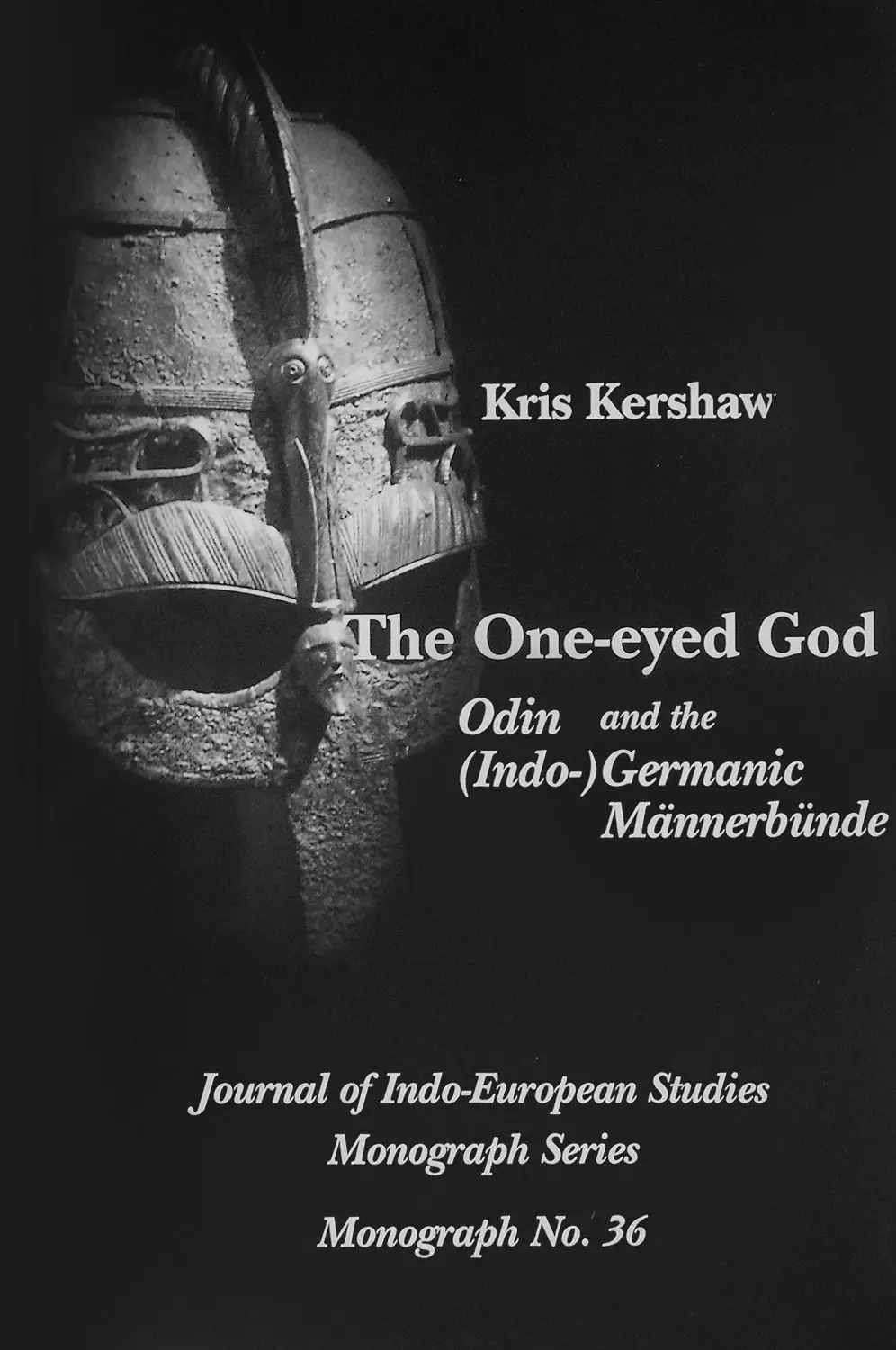
THE ONE-EYED GOD: ODIN AND fliE (INDO-)GERMANIC MANNERB1)NDE A Dissertation Presented to the Faculty of the Graduate School of Cornell University in Partial Fulfillment of the Requirements for the Degree of Doctor of Philosophy by Priscilla K. Kershaw May 1997
© 1997 Priscilla K. Kershaw
BIOGRAPHICAL SKETCH Priscilla (aka Kris) Kershaw, née Kasden, was born 14 June, 1940, in New York City. She graduated from Hunter College High School in 1958 and from Goucher College, with a major in Classics, in 1963. In August 1986, with both her sons in college, she began graduate work in Germanic Studies at Cornell. 111
ACKNOWLEDGEMENTS This study could never have been brought to completion without a great deal of help from members of the fculty and staff at Cornell. Professor Jay Jasanoff (Linguistics) chaired my special committee from the beginning. Although my dissertation topic is outside his area of interest he was always tremendously helpful, always generous with his time when I needed help with linguistic matters, and when it eventually came to pass that there was something for him to read, he could always tell me whether an argument was well made or not. The fact that his quite amazing analytical powers were applied to my opus gives me confidence in what I have done; for all his help over the years I am profoundly thankful. Prof. Alan Nussbaum (Classics and Linguistics) has also been on my committee from the beginning; he, too, has always been munificent with his time. Prof. Tom Hill (English and Medieval Studies) joined my committee at the dissertation stage. I had participated in several of his wonderful seminars; he has always been helpful and encouraging. I must emphasize that my topic is outside the immediate area of expertise of all these people. I am grateful to them for ploughing through it; if there is anything here which is incorrect or silly, it is my responsibility alone. Prof. Chris Minkowski of Asian Studies was able to point me to recent writings about the vratyas: indeed he personally located articles for me. How dependent the final product is on his assistance the reader will immediately realize. I must thank the Department of German Studies for bearing with iv
me all these years and for making sure that I had funding, even when I certainly no longer deserved it. To two members I owe special thanks, Prof.Inte Ezergailis, who has become a dear friend, and Marguerite Mizelle, the Field Secretary, who has on numerous occasions kept me from coming to grief over administrative details. Prof. Emeritus Franz van Coetsam (Germanic linguistics) retired after my first year, but just as he inspired me in the classroom he has encouraged me ever since. I want to use this occasion to express my gratitude to this wonderful scholar. v
TABLE OF CONTENTS Introduction. 1. grandaevus altero orbus ocido. 1 1. The eye in the well. 2 2. Heiti relating to Odin’s eyesight. 3 2.1. “Blind”or “weak-sighted.”3 2.2. Other possible heiti. 5 2.3. uBIind,u not ttthe blinder.” 6 3. Other depictions of Odin/Wodan. 8 3.1. Snorri and Saxo. 8 3.2. Wodan, Woden, et. al. 9 3.3. Iconography. 10 Part I. Herjann. 15 2. The Einheriar. 17 1. Snorri’s description of the Einheriar. 17 2. The word einheriar. 20 3. Herr and Herjann. 22 4. PIE *koryonos 25 5. Thor Einheri and the Einhe rEar. 26 3. Der Schiinmelreiter. 29 1. The Host and the Hunt. 30 2. Legend, myth, and cult. 31 2.1. Review of the scholarship. 31 2.2. The Dead and the living. 35 3. Age sets and ancestor cult. 37 4. Masks. 40 4.1. Masks and ancestor cult. 40 4.2. Demon horses 48 4.3. The Rider-god. 51 vi
(Chapter 3) 4.4. The Ancestors bring blessings. 54 5. Feasts of the Changing Year. 55 6. Harlequin. 61 Chapter 4. Feralis exercitus. 66 l.Harii. 66 2. Chain. 68 2.1. Weihekrieger. 69 2.1.1. Civilis. 74 2.1.2. Haraldr Hárfagr. 76 3. The hairstyles of the Suevi. 77 4. Procopius and Ammianus on youthful warriors. 80 4.1. An analog from Doric Greece. 85 5. The liminal state. 88 5.1. Exiting marge. 91 6. Demon warriors. 95 6.1. An initiation scenario in Volsurzgosaga. 95 6.2. Dzmon warriors among the Chatti. 101 6.3. Two armies of the dead. 103 7. Mercurius. 106 7.1. Hermes at the boundaries of space and time. 109 Chapter 5. Furor Teutonicus. 113 1. ‘VVOb113 2. Oôr. 119 3. Oôinn. 121 3.1. The suffix -no-. 123 3.1.1. Examples. 123 3.1.2. A ‘Führersuffix’?124 3.1.3. The suffix -no- in divine names. 125 4. Poets’ god and Rune-master. 126 5. Ecstasy, Possession, Inspiration, Madness. 130 5.1. Ecstasy. 132 vi’
(Chapter 5) 5.2. Furor heroicus. 135 5.3. War dances. 138 5.4. Dancing gods. 143 5.4.1. Mysrerium and Mimus in the Anabosis. 143 5.4.2. The sword-dance in Germania. 146 5.4.3. Mars and the Salii. 152 5.4.4. Kotpir€c, Kovpifr€c, Kopiavr€c. 158 5.4.5. The Maruts. 164 5.4.6. Some conclusions. 169 6. Veratfr. 170 Part II. The Indo-European Männerbund. 176 Chapter 6. *teutã and *kosyos. 176 1.1. Equites and pedires. 176 1.2. Village and Forest. 180 Chapter 7. The *kosyos. 188 1. Raubrecht. 188 2. The Manes. 194 3. Animal transformations. 195 4. EKJTaGrLç. 199 5. Times and seasons. 202 5.1. Festivals. 202 5.2. Seasonal activities. 206 6. Sub-groups. 209 6.1. Small bands. 209 6.2. Groups of 50. 211 7. Older *ko,yos..b(p4ler 215 7.1. Weihekrieger. 215 7.2. Men without property. 216 7.3. Robbers and riff-raff. 217 7.4. Mannerbund and Gefolgschaft. 218 viii
Chapter 8. Cams and the *koryos. 222 1. Wolf and Dog. 222 2. Ethnonynins and Männerbünde. 223 2.1. “WoIr-menas founders of city-states. 224 2.1.1. An historical example. 224 2.1.2. Mythical foundation stories. 225 a) The founding of Rome. 226 b) Caeculus and the founding of Praeneste. 227 2.1.3. The versacrwn. 228 2.2. Cyrus, the founder of the Persian Empire. 231 2.3. Wolf-folk and Dog-folk. 233 2.3.1. Ethnic names. 233 a) Wolf-folk of Anatolia. 234 b) An Ossetian wolf-clan. 236 c) Other wolf-folk. 237 d) Dog-folk. 238 e) Hundingos and Ylfingar. 244 2.3.2. Wolf-priests. 246 a) Hirpi Sorani. 246 b) Some Hittite cult functionaries. 249 2.3.3. Mythical ancestors. 252 a) Miletos. 253 b) Lamissio, king of the Langabards. 254 c) The Welfs of Swabia. 259 3. Wolf-men and Dog-men. 260 3.1. The Lombards. 260 3.2. Germanic wolf-names. 263 3.3. Irish dog and wolf names. 266 3.4. Greek heroes with wolf-names. 272 3.5. Wolf- and dog-men of the Scythians. 277 3.6. Serbian wolf-men. 277 4. KuvoiccXo. 278 a) ‘tZuden litauischen Werwölfen.” 279 b) Slavic dog-heads. 280 c) Survivals of the ,wv/ Xwcô7. 283 5. ‘AX,cc,5raroictvEc. 284 ix
(Chapter 8) 6. Ver sacrum bei den (Indo-)Germanen? 290 7. Canine! lupine qualities. 294 Chapter 9. The god of the *ko,yos. 303 1. India. 306 2. Iran. 308 2.1. Ossetes. 313 3. Celts. 314 4. BaIts and Slays. 314 5. Greece. 316 6. Italy. 321 6.1. Mars. 321 6.2. Faunus. 325 6.3. Veiovis. 327 7. *jgd and *ko,yos..god. 329 8. Un rite d’agrégation. 332 Part III. The Vratyas. 338 Chapter 10. Warrior-brahmins. 338 1. An oath-brotherhood. 338 2. VrAtya clothing and weapons. 340 3. Seasonal activities. 342 4. The brahmacãrin. 342 4.1. The education of a brahmin. 342 5. The vrdtyosroma. 344 5.1. Vraryasroma and satrra. 344 5.2. Sattra. 345 5.3. Doksinã. 347 5.4. Vratyas and sattrins. 350 x
Chapter 11. Rudra. 351 1. Rudra’s armies. 353 1.1. Gwupati. 355 1.1.1. The rudras. 356 1.1.2. The Maruts. 357 1.1.2.1. A troop. 359 1.1.2.2. The Maruts are both like and unlike Rudra. 360 1.1.2.3. The Maruts as *ko,yos 363 1.1.2.4. I-fr. *,,.ja.. 364 1.1.2.5. Marut epithets. 365 1.1.2.6. Priestly activities. 366 1.2. War-god. 367 2. The Wild Hunter. 369 3. Canis. 371 3.1. Dogs and the Lord of Dogs. 373 3.2. Dasara. 376 3.3. Lejeu du Cheval. 380 3.4. Têres coupées. 382 3.5. The hunter with the spear. 384 3.6. Some conclusions. 385 4. Death. 387 5. Fertility. 388 6. Ekstasis. 390 7. The Feast of the Changing Year. 390 7.1. The Dragon-Slayer. 393 7.2. Initiation. 395 8. Nataraja. 397 9. The Ekavratya. 398 Chapter 12. Choosing a Leader. 402 1. The Salagava sacrifice. 402 1.1. Two stories. 403 1.2. The vratyas as rudras. 408 2. The dice game in early India. 408 2.1. The “dice.”409 xi
(Chapter 12) 2.2. How it was played. 410 2.3. An army of dice. 411 2.4. The dog and the dog-killer. 411 2.4.1. Kali, the dog. 413 2.4.2. Kali eko’ksah and ekJksa. 414 2.4.3. The One and the Dog. 415 3. The ritual thee game. 417 4. senan(r mahatO ganásya. 420 4.1. Sabha and irma. 420 42. Sabha and solstice. 421 4.3. Herjann. 423 Chapter 13. Darkness, Dogs, and Death. 428 Conclusion Chapter 14. The Wolf-god and the Eye in the Well. 448 Bibliography 458 xii
PREFACE A few words are in order concerning translations and abbreviations. Translations are mine unless a translator is indicated. If, for example, I have translated a passage from Heimskringia, I will simply give the saga and chapter; if I am using Monsen’s translation, this information will be followed by “Monsen”and the page number. The abbreviations used throughout, e.g. for titles of journals or Old Icelandic poems or sagas, are the conventional ones; thus I have not listed them. xlii
Chapter 1. grandaevus altero orbus oculo. Odin has one eye. He normally wears a broad-brimmed hat (his Schtapphut) pulled down over his face, and a great travelling-cloak. When he is here in Miôgarôr, interacting with the children of men, he often appears as an old man with a long grey beard; usually he is a strange old wanderer. The grey-beard, the wanderer, is only his favorite among his many disguises. He is a master of disguises, as his frequent by-name Gr(mr suggests. Certainly he delights in deception. But the missing eye is the constant feature, and it often happens that a person finally gets a glimpse of the face under the hat and knows at once with whom he has been speaking. When not in disguise he rides an eight-legged grey stallion named Sleipnir. Two ravens fly over the world every day, then perch on his shoulders and tell him all that they have seen. Two wolves feed at his table. Although he never actually engages in battle he carries a spear. Among his own he is not the disheveled old wanderer; he is the king. But he is still one-eyed. The missing eye is not part of a disguise. In Hara1dskwãi, one of the earliest extant Old Norse poems1, Oôinn is called hinum eineygja / Friggjar faômbyggvi “theone-eyed dweller in Frigg’s embrace,” i.e. her husband. 1. The earliest stanzas, to which this belongs (Jan de Vries Alinordische Literarurgeschichte, [Berlin: de Gruyter, 1964) II, 1360, were written shortly after the battle of Hafrs1ord, which is dated “earlierthan 900, but not before 885.’ Gwyn Jones, A History of the Vikings (London: Oxford UP, 1968) 89.
2 1.1. The eye in the well. The völva says to Oôinn, alt veit ec, Oôinn, hvar ü auga falt: I mom mra MImis brunni. (Vsp.28. 7-10) I know everything, Odin—where you hid your eye: in that famous well of Mimir. His eye is in Mimir’s well. Snorri tells the myth: But under the root that reaches towards the frost-giants, there is where Mimir’s well is, which has wisdom and intelligence contained in it, and the master of the well is called Mimir. He is full of learning because he drinks of the well from the horn Giallarhorn. All-father went there and asked for a single drink from the well, but he did not get one until he placed his eye as a pledge. (Faulkes Edda 17). This is succinct. It is also a little strange. Elsewhere (Vsp.46; Gylf.26, 51) Giallarhorn is Heimdall’s horn which he will blow to rally the gods at the last battle.2 Moreover our Völuspa passage continues, Dreccr miöô Mfmir morgin hverian af veOi ValföOrs— (Vsp.28. 11-13) Mimir drinks mead every morning from Slaughter-father’s (Odin’s) pledge. His eye? Baffling. We will return to Mimir and his well. 2. From its name it would appear to be better suited to this purpose than for drinking: gialla “lauttönen (Neckel, Glossar).
3 1.2. Heiti relating to Odin’s eyesight. 1.2.1. Blindr. Many of Odin’s by-names designate him as blind or weak-sighted. Blindr (11)? Sometimes he is simply “derBlinde,” “BlindMan,” as in Blindr inn bOlvisi. This Odin-surrogate is Helgi’s betrayer in H112. The heiti means something like “Blindithe malicious,” or “themalicious blind man.” FaLk points to Saxo’s Bolvisus luminibus captus, King Sigar’s wicked adviser.4 Bllndr enn liii. King Hadding’s counselor in Hrómundar saga, another betrayer. Gestumblindi (43). Since Wessn’s 1924 article,5 the interpretation Gestr inn blindi, “theblind guest,” has been universally accepted. Odin is the guests of King Heiôrik, whom he defeats in a Riddle- 3. Numbers in parentheses refer to Hjalmar Falk, Odensheite (Kristiania: Jacob Dybwad, 1924). 4. The king also had a good adviser, Bilvisus. “Thetwo counsellors, one good and one evil, have been interpreted as two different representations of Odin, who in Ynglinga Saga 7 is said to have been helpful to his friends but terrifying to his enemies.’ H.R.Ellis Davidson, ed., Saxo Grammaticus, The History of the Danes. Trans. by Peter Fisher. (Cambridge [Eng.] & Totowa: D.S.Brewer, Rowman & Littlefield, 1979)11, 113. 5. Elias Wessn, ‘Gestumblinde,”in Festskrzft tillagnad Hugo Pipping (Helsingfors: Mercators Tryckeri, 1924). But Detter had said it already in 1893 (‘Zur Ynglingasaga,” P88 18) 86. 6. As a traveler, Odin frequently turns up as a guest; he gives Gestr (42)
4 contest by an improper riddle. Tv(blindi (141). “Thedoubly-blind.” This heiti appears often in the thulur. According to Falk, it designates Odin either as one who is himself blind (but not really: one-eyed, weak-sighted) or who strikes others with blindness, and he refers to Herblindi. This interpretation is accepted by Simek (419). Gunnblindi (49). In the thulur. Falk says “actually:he who blinds in battle, see HerbllndL” Herblindi (65). Thulur. According to Falk, ‘Herblindeshould be ‘hewho strikes armies with blindness’, like Gunnblindi....” Simek accepts this.7 I am less happy with it and the above, as I will explain. Bileygr (7). Grm 47.4, and elsewhere: “theweak-eyed.’t FaLk points to Fms 2, 138, where Odin appears to king Olaf as an old man, “verywise of speech, one-eyed and weak-sighted (i.e. svak.synty but compares this to Bdleygr (6), the next name with which Odin identifies himself to Grinmir, and a frequent by-name referring to his flaming eye. “So,as a man, Odin was weak- sighted, as a god, flaming-eyed.” as his name when he visits St. Olaf in Nornagests Pártr (Olafs saga Tyggvasonar). 7. der das feindliche Heer Blendende,” 171.
5 1.2.2. Other possible heiti. To the above list we can add Hdrr, which FaLk takes as “thehoary one” (“with grey hair and beard’), certainly appropriate, but which both de Vries and Turville-Petre, following Sijmons, relate to Go. haihs, one- eyed.8 Fal.k 138 is Svipdagr blindi, in Yng.s. the foster-father of Ingjald son of Anund, King of Sweden. When the boy shows himself a weakling, Svipdagr gives him a wolf’s heart to eat; “afterthat Ingjald became the grimmest and most hasty-tempered of all men.’ (Hkr.25) As king, Ingjald doubled the size of his kingdom by a treacherous act. Simek accepts Svipdagr blmdi as ein Deckname Odins” (378), as does de Vries and others, and certainly the adjective “blind”applied to someone who obviously is not, as well as the role of foster-father-cumwicked counselor, suggests Odin9 furthermore Snorri names a Svipdagr 8. Sijmons: ‘Hdrr,em Opensname, der...wahrscheinlich aufein urnord. kompos. ‘dereinäugige held’ zurückzufUhren ist; das erste glied ist got. haihs, lat. caecus....” Kornmentar 1, 27. Sijmons refers to Detter, who wrote: “Dieregelrechte nord. entsprechung von got. haihs ovó,bOcXoç Marc. 9,47 müsste hdrr lauten, so wie dem got.faihs an. fdrr entspricht. Der beiname Oôins könnte also ursprunglich ‘dereinäugige’ bedeutet haben, so wie bei Saxo Othinus als der altero oculo orbus erscheint....” Detter is followed by Noreen (54.1); cf. Jan de Vries, Altgermanische Religionsgeschichte (Berlin: de Gruyter, 1935) 193, N3; E.O.G.Turville-Petre, Myth and Religion of the North (London: Weidenfeld & Nicolson, 1964) 62. 9. As well as counselor, 0dm appears as foster-father or protector of heroes; his proteges are not famous for loftiness of character.
6 as a descendant of Odin in the Prologue to his Edda10, and nothing is more natural than for a son or grandson of a god to appear as a hypostasis of his Aim. But Yng.s. goes on to relate that Svipdagr blindi and his two sons are killed in a later battle. Now it is not Odin’s wont to be killed in battle. He never engages in the fray; and he never, in an incontestable appearance, has human children who grow up and get killed. He never hangs around for years: he is the wanderer, the guest, and always mysterious. I think what we have here is a case of confusion. Heiblindi (variant of 65) appears in Grm. in most manuscripts of the elder Edda, but, although an appropriate name for Odin, is generally considered a mis-writing of Herblmdi. Helblindi (“der Blinde des Totenreiches”) is one of Loki’s two brothers according to GyIf 32 and Skaldsk. 16g. 1.2.3. “Blind,”not “theBlinder.” As noted above, Falk wants to make Gunnblindi, Herblindi, and possibly also Tviblindi ‘densom blinder,” he who blinds, and explains, 10. His great-great grandson, to be exact; “Svebdegg,whom we call Svipdag.” (Faulkes Edda 4) This is no invention of Snorri’s: there is a corresponding Swfdg, descendant of Woden, in the mythical genealogies of the kings of England. Otto Höfler has shown that he is also a mythical ancestor of the Swabians (“Das Opfer im Semnonenhain und die Edda,” in Edda, Skalden, Saga, hsg.v. Hermann Schneider (Heidelberg: Winter, 1952) 1-67. 11. Simek 168.
7 “EfterYngl.s. k.6 kunde Oden gjøre sine fiender blinde og døve og rdselss1agne i kampen; i Flat. II, 72 slâr han fienden med blindhet” (p 16). This is certainly true, but we are nevertheless faced with the fact that Odin is in other heiti unquestionably called blind. Since his blindness seems unavoidable, I do not see what is gamed by interpreting one xblindi as “blind”and another as “blinder.”Germanic names of the Gunnblindi type have their own mysterious logic;’2 it is a mistake to try to turn them somehow into grammatical phrases. Odin is associated with war, is a war-god, if you will, and he is “blind.”It is sufficient to set the two elements side by side. These names will not translate. So we are presented with a god who is called “blind”but who is never portrayed as blind. With reference to Nr.11, Blindr, Fallc writes, “NârOden her (og som Gestumblinde) betegnes som ‘blind’,er dette uttrykk a forstä relativt (jfr. steinblindr ‘heftblind’), altsâ som ‘svaksynt’(se Bileygr). Begrepene blind, svaksynt og enøiet glir oftere over i hverandre, f.e. engl. purblind ‘svaksynt’,tidligere ‘enøiet’og ‘blind’(isl. 12. “Dermerkwürdig straffen Bindung, die sich die germanischen Namenbildner auferlegten, steht nun eine uralte Freiheit gegenuber: die Freiheit, auch solche Namenglieder aneinanderfugen zu dürfen, zwischen denen sich nur eine lockere Bedeutungsbindung herstellen lieB, ja, die uberhaupt keinen zusammenhangenden Sinn ergaben. Es ist immer wieder versucht worden, solche ‘sinniosen’Bildungen als junges Gut abzutun. Dagegen spricht aber, daB sie bei einer ganzen Reihe von indogermanischen Völkern nachweisbar sind. . . man [mug] hier auf eine beide Glieder zusammenfassende Deutung .“ Gottfried Schramm, Nainenscharz und Dichrersprache (Gottingen: Vandenhoek & Ruprecht, 1957) 14Sf.
8 porn ‘enøietperson’); got. haiks ‘enøiet’= lat. caecus ‘blind”(5). But Odin is not weak-sighted. On the contrary, he is remarkably sharp-sighted; this feature shows up time and again. From Hliôskiälf he can see all the worlds. He can see, for example, in the introduction to Grfmnismäl, how Frigg’s fosterlmg is living in a cave, fathering brats on a giantess, while his own is a great king. He can see where Loki has hidden after causing Balder’s death. As well as Bileygr he is Báleygr, flaming-eyed. But he is always one-eyed, and the pair haihs--caecus shows that the two concepts can indeed slide into one another. That there is much more than this involved is the point of this study, but first we must look at some other descriptions of Odin. 1.3. Other depictions of OdinfWodan. 1.3.1. Snorri and Saxo. When we turn to those parts of Ynglingasaga (2-9) and Gesta Danorwn in which Odin is euhemerized—portrayed as a powerful chief or magician who lets himself be worshiped as a god--we find nothing of the missing eye. Snorri says of Odin the king, ‘whenhe sat with his friends he was so fair and noble in looks that all were joyful; but when he was with his army then he was terrifying to his foes. (Monsen, Yng.s.6, p4) Even when Snorri describes his magic powers and his shape-changing, so that he begins to look very like the god, there is no mention of the lost eye.’3 Nor does Snorri mention this feature in the Prologue to his Edda, 13. For that matter, Mimir’s head is not in the well: Odin has it with him in his travels (Yngs 7).
9 in which Odin is again a human king. Saxo does not describe either his euhemerized Odin or the gold statue that his admirers made in his likeness (I, 25), but there is nothing in his account to suggest that Odin was possessed of any physical abnormality. This is striking because the feature invariably shows up when 0dm appears as someone supernatural. The story of 0dm the man interrupts the story of Haddingus; it comes directly after the episode in which Haddingus has been rescued by an aged man who is lacking one eye (23-24). 1.3.2. Wodan, Woden, et.aI. There are no native pagan writings from southern Germania concerning the pagan religion. No Greek or Latin writer mentions a one- eyed god, nor does any Christian writer on the continent or in England. Adam of Bremen (c. 1070) does not say whether or not the statue of Wodan in Uppsala was missing an eye.’4 The early Germani seem not to have had temples or idols--not, to be sure, because they were ideologically aniconic, but because such things are luxuries of a settled life. They may well have had small xoana, but these do not stand the test of time. In England, because Woden stood at the head of the Anglo- Saxon royal genealogies, there are a few pictures of him in manuscripts, 14. Gesra Hammaburgensis Ecclesiae Ponnficwn, BkJV. Craigie notes that “inno other writing of historical value is there any mention of an image of Odin. (The Religion of Ancient Scandinavia [London: Archibald Constable, 1906] 48). Adam’s Wodan is Mars: ‘Wodanemvero sculpunt armatum sicut nostri Martem solent.”
10 and in these pictures he has two eyes’5. Now I know that an argument ex silentio is not worth much, but in this particular case I believe it is worth something. Odin’s missing eye is his outstanding physical feature. It is securely fixed in myth and in poetic language. If this were true also of his Continental and Anglo- Saxon counterparts, one could hardly expect it to have disappeared without a trace. Certainly a god so maimed is enough of an oddity that one of the classical writers would have heard of it from his informants and remarked upon it. It is more surprising that there is no word of this feature in Adam, since he gives a brief description of the statue which is, after all, in Sweden. 1.3.3. Iconography. There remain three possible sources for graphic evidence: the Scandinavian rock-carvings, which date from perhaps 1500 BC to the beginning of our era’6 small metal objects such as bracteates, clasps, and buckles dating from the migration period; and reliefs and engravings of mythological themes on gravestones, boxes, and even crosses of the post15. See, f.ex., S.R.T.O. d’Ardenne, “ANeglected MS of British History. English and Medieval Studies presented to J. R. R. Toilden. Norman Davis & C.L.Wrenn, eds. London: Allen & Unwin, 1962; Joan Turville-Petre, “Illustrationsof Woden and his Sons in English Genealogical Manuscripts.’ Notes and Queries (Oxford) 233 /2 (1988) 158-159. 16. Oscar A lmgren, Nordische Felszeichnungen als religiose Urkunden. Ubertr.v. Sigrid Vranken (Frankfort a.M.: Diesterweg, 1934) xi.
11 conversion period. The first group probably could not be expected to show the kind of detail we would want. There are figures we can be confident are gods because they are several times larger, as well as more vitally depicted’7, than the figures around them; these in turn have attributes which are out of proportion to the gods themselves. There is a Spear-god, who may be a forerunner of Odin. But the carvings do not show individual facial features. “Beidieser Vorstellungsart werden dem als lebendiges Wesen gedachten [Gott] ganz offenbar nur diejenigen Körperteile und Werkzeuge zugeschrieben, die dazu erforderlich sind, die beobachteten Wirkungen hervorzubringen; wie dieses Wesen im übrigen aussieht, ist nicht von Belang.”8 As for the the bracteates and the like, Karl Hauck’9 has spent years examining these objects and makes a good case for seeing Wodan in whole series. In these, the god is shown in profile, facing both ways. In most of them there is a big, clear eye, but in some there is not, and Hauck points to these as showing Odin as ‘dereines Auges Ermangeinde. In 1K LII he reproduces two of these, as well as several 17. Almgren 137ff. 18. ‘Inähnlicher Weise stattet das Alte Testament semen Jahve mit Augen, Ohren, Mund, Armen, Händen, Füi3en und Herz aus, geht aber nicht so weit, anzunehmen, daL3 er noch weitere Körperteile besitzt.” Almgren 292. 19. In the series “Zurilconologie der Goldbrakteaten’ (1K) and other articles.
12 showing an oversized eye which Hauck connects with Odin as Bdleygr; they are from Sweden, from around 500 AD20. In the late mythological scenes, too, where Odin is clearly identifiable, riding Sleipnir or fighting the Wolf, he is in profile. But in a stave church at Hegge, Norway, there is a carved wooden head which is unmistakeably one-eyed. The mouth is askew with the tongue sticking out. H.R.Ellis Davidson says cautiously it “couldbe a representation of the one-eyed god Odin. The outstretched tongue would be in keeping with Odin as the god of hanged men.”2’ Finally, on a bronze plate from Torsiunda, dating to the sixth or seventh century AD, there is figure who we can be confident is Odin. He is wearing a horned helmet, has a sword in a scabbard and a spear in each hand, and he is dancing. In all this he is no different from many another weapons-dancer found on similar plaques in Scandinavia and Sutton-Hoo. The plate, which is a die for stamping a pattern, for example on a helmet, is approximately 2’,8 by 2I8 inches; on this scale the dancer could pass for any of his brethren. But when the picture is enlarged several times it is obvious that the right eye socket is empty! To the left of this dancer is another; he, too, wears a sword and carries a spear. But his head is that of a wolf, and he has a tail hanging down 20. “Diebremische CJberlieferung zur Götter-Dreiheit Altuppsalas und die bornholnaischen Goldfolien aus Sorte Muld,’ FMS 27 (1993) 441-460. For what it is worth, Odin is facing left in one, right in the other. 21. Ms. Davidson provides a full-page photograph. H.R.Ellis Davidson, Scandinavian Mythology (London: Paul Hamlyn, 1969) 29.
13 from his three-quarter length garment which is cross-hatched in the engraving to indicate hair; human hands, lower legs and feet show that this is one of Odin’s Wolf-Krieger, an ulfheôinn.’2 It is the presence of this figure, along with the missing eye, which allows us to make a positive identification of Odin. The movement in the scene is from left to right, Odin going before the Wolfman. Possibly the single wolfman is a pars pro toto, and this is a representation of the god leading his warriors in ecstatic dance. It is in Odin as leader of warriors—in Odin as leader of an army of ecstatic wolf-warriors—that we will find the answer to the puzzle of Odin the one-eyed god. It seems extremely odd that a feature so important in Scandinavia at the turn of the millennium shows up nowhere else. Since the pagan religion continued to thrive in northern Germania very much longer than anywhere else, there is always the possibility that Odin’s one eye is simply late and northern. The myth of the eye in the well is too 22. Hauck had earlier identified the wolf as Fenris and saw in this scene the representation of a cult-drama; “Herrschaftszeicheneines Wodanistischen Konigstums,” Jahrbuch flirfrankische Landesforschung 14 (1954) 47. Cult drama it may well be, but I must agree with Heinrich Beck (“Die Stanzen von Torlunda und die literarische Uberlieferung,” FMS 2 [1968] 239, 247-249) that no hostility is suggested by the posture of the dancers: “DerSpeer des Wolfshäuters setzt vorsichtig hinter dem gestreckten FuB des Tänzers auf: nicht em Gegeneinander der zwei Bewaffneten ist also beabsichtigt’ 239 (and Plate XIV). 23. Below, 5.5.3 & 4.
14 sophisticated, although it is certainly old and belonged to the oral tradition. But the myth is an aition for something that is older still. From earliest Indo-European antiquity this god has been the one-eyed god24. And we will be journeying back and forth over all Indo-Europa, gathering together the pieces of the puzzle: the mythic and cultic complex of which this god is the center. 24. I certainly do not mean to imply that Odin! Wodan goes back to PIE times. Living paganism is extremely fluid. Gods are constantly evolving and devolving. Hypostases of a god break off and take on lives of their own; one god will encroach upon the religious territory of another god and perhaps absorb that god in the process, or perhaps the pillaged god will keep his independence but see his sphere of influence restricted-- unless he can move into some other god’s territory. The ancestry of some gods is untraceable; some gods seem totally foreign. But for some it is clear that there is a core that goes back to the very earliest history of their people. This is the case with Odin. Wodan is certainly a Germanic god, but that which is basic to him goes back to PIE times, and as we are going to see, his analogs can be found among all the daughter peoples of whose religion we know anything at all.
Part I. Heijann. Herjaiz(n) is an Odin by-name which appears frequently in poetry. To Gylfi’s question, “Whois the highest or the oldest of all the gods?” Här answers that this god has twelve names, the second of which is Herran or Herjan. This is commonly translated “Herrscher,”i.e. ruler, but such a translation fails to give the force of the word. Herjan goes back to a germ. *Jrjapjj and ultimately to JB *ko,yo.. no-s, that is, it is one of a class of nouns in -no-, in which X-nos can usually be satisfactorily translated “chiefof the X.” Thus the Gothic word for ‘king’iudans goes back to a *tewo.nos, chief of the *te iitã, the tribe or the people as community.2 But sometimes ‘chiefis not a suitable translation. While “Lat.Portunus is effectively the master of the ports, and Gothic iudans that of the people[, ut is difficult to interpret the name of Neprunus in the same way. The connexion between Neptwius and the element of water cannot be transposed as such into the social domain. In fact here we have an incarnation, not the exercise of 1. ‘Hverrer ceztr eôa elztr allra goôa?” GyIf. 3.27. (Faulkes p8.) 2. Likewise Go. kindins ‘ruler,governor’ (Wright) from *gepjj..flos, chief of the gens, the clan. OIc drOttinn ‘lord,master,’ (providing the word for the Lord’), ‘chief(Zoega), corresponding to OE dryhten with the same meanings, goes back to Gmc. thus ‘chiefof the drOtt (OIc) or dryht (OE), the people or household’, thus answering to dominus, which it translates, with the same formation; (then the household of a king, i.e. his retainers, thus ‘troop.’)Emil Benveniste, Indo-European Language and Society. Trans. by Elizabeth Palmer. (Coral Gables: U.of Miami Press, 1973) 246f, cf 92. 15
16 authority: Neptunus personifies the watery element, he represents it. We can therefore say that jiiudans personifies his people.”3 This is an important concept to keep in mind when considering Odin’s relationship to the herr of which he is chief.4 Now if Odin is Heerfuhrer, what we must first say concerning his herr is that NHD Heer ‘army’gives the wrong sense: it makes one think of a highly organized and disciplined exercitus or Wehrmacht, and that is something very different. In this chapter we will be looking at Odin as leader of several different “armies”or “troops,’1starting with the herr for which he is most famous. 3. Benveniste, Ltmguage 247. 4. Here we find ourselves “auftypisch indogermanischetn Boden, am deutlichsten im Germanisehen erkennbar. Die Vorsteherbezeichnung ist hier nur elne Ableitung der entsprechenden Gemeinschaftsbezeichnung: germ. got. kind-ins, frank. zwzg-inus, an. drott-in, ahd. kun-ing, an. fylk-ir.” Kurt Stegmann von Pritzwald, t’Zu umbr. fratreks.” Glotta 21(1933)135, author’s emphasis. “DieseBildungen sind sehr alt, begegnen sie doch nicht selten auch im Lateinischen (z.B. dominus, tribwuis usw.) und in Spuren im Griechischen (KoCpavoç) und im lllyrischen (teutana ‘Konigin’).Sie haben individualisierende und zugleich repräsentierende Bedeutung. Der auf diese Weise aus einem Personenkreise herausgehobenen Person kommt wohi in jedem Falle em Fuhrungsanspruch zu, der sich zur Herrschaft steigern kann, doch ist nicht erkennbar, dal3 em Herrschaftsverhältnis von Anfang an ausgedruckt werden soIl.t’ Walter Schlesinger, “Ubergermanisches Heerkönigtum.” Dos Konigtwn. Seine geistigen und rechdichen Grundlagen. Vortrage und Vorschungen, hsg. vom Institut fur geschichtliche Landesforschung des Bodenseegebietes in Konstanz, Band ifi. (Lindau & Konstanz: Jan Thorbecke, 1954) 107.
Chapter 2. The Einheriar. 2.1 Snorri’s description of the Einheriar. Gangleri asks: “‘Yousay that all those men that have fallen in battle since the beginning of the world have now come to Odin in ValhaiL. What has he got to offer them for food? I should have thought that there must be a pretty large number there?’1 “ThenHigh replied: ‘Itis true what you say, there is a pretty large number there, and many more have yet to arrive, and yet there will seem too few when the wolf comes.’” High then tells about the boar Shrimnir, which “iscooked each day and whole again by evening,” and names the cook and even the kettle. As for drink, “Thereis a goat called Heiôrun standing on top of Val-hall feeding on the foliage of that tree whose name is well known, it is called Lerad, and from the goat’s udder flows mead with which it fills a vat each day. This is so big that all the Einheriar can drink their fill from it.’ There follows a description of the stag which also stands on the roof and a list of the many rivers that flow from water dripping from its antlers. Gangleri fmds all this quite amazing and inquires as to the size of Vaihall. High quotes Grfmnismál 23: Fimm hundraô dura ok of ljOrum tøgum, svá hygg ek a Valhöllu vera. 1. Gylfaginning 39. The following is from Gyif 39-41, Faulkes 33-34. Eddic poetry is cited according to Neckel, 4. Auflage; poetry translations are mine. 17
18 Atta hundruô einherja ganga senn Or einurn duruni er heir fara rneô vitni at vega.2 Thus Vaihall can accornodate at least 432,000 warriors, and Gangleri is curious as to how they pass their time when they are not drinking. This time High quotes Vaf?nIônismál 41: Allir einherjar Oôins timnum I hogvask hverjan dag. Val heir kjOsa ok rfa vIgi frá, sitja rneir urn sáttir sarnan.3 All the information which High has passed on to Gangleri comes from Grm. except for this one stanza frorn Vfm. Snorri, who often knows more than the poetic sources he quotes, this time has no rnore than what is available to us. Oddly, Völuspá has nothing to say about the einheriar coming out of their many doors for the last battle. The cock wakes thern: GOl um ásom Gullinkarnbi, sá veer hölôa at Heriaföôrs4 2. Five hundred doors and forty more I reckon there are at Vaihall. Eight hundred einheriar at a tirne will go through each door when they go to fight the Wolf. 3. All the einheriar in Odins fortress fight each other every day. They kill (each other) and ride from the battle, then sit together reconciled. 4. Gullinkambi crows among the iEsir, to wake the heroes at War- Father’s.
19 At least it seems safe to assume that the heroes chez War-Father are his einheriar; but there is not a word of their marching out and engaging in the fight. There is no reason to doubt that they are there, however; it is the nature of heroic poetry to describe the fights of individual heroes as if war were a series of single-combats and the army as a whole did not exist. Here the gods are the combatants. The material from Grm. has the look of having been worked over. Some of it is certainly very old, but in many places the rhythm of the been broken into and long lists of names added, as if some redactor had decided that this was a good place to store stray bits of lore.5 What is certainly old is the idea of the einheriar as the protectors of Men against the Wolf. The Männerbund, of which the einheriar is a mythical paradigm, was always seen as a guardian against the forces of disintegration, as will be discussed further on. What is uniquely Germanic, or perhaps Nordic, is that this role has been moved into the future and made eschatological. Actually, the battle to maintain the cosmos is ongoing, and paralleling Thor as the individual monster-fighter there are the 5. “Twocenturies had passed since the introduction of Christianity in A.D. 1000, and we get the impression that at the time of their collection the older poems about the ancient gods were valued chiefly as a storehouse of the mythological lore indispensable to makers of skaldic verse. Where such poems omit, for instance, some of the names of Odin or other material valuable to skalds, the omission is often made good in a different metre, as if the collector, or some predecessor of his, were indifferent to the artistic merits of the poems, and were merely putting together all the relevant material he could find.” Bertha Phillpotts, Edda and Saga (London: Folcroft, 1973) 24.
20 Einheriar, ready to fight the forces of the Wolf.6 As we will see as this study progresses, the einheriar which Snorri described is a learned and literary development of something whose roots go very deep into the past, both in myth and on the ground. For now it is enough to say that in the tenth century, at least, it was not just literary myth but living belief that a dead warrior could expect to go to Vathall. We know this from the praise-poems to the dead heroes Eirik Blood-Axe and his nemesis Hakon the Good. This belief framed the myth which would then explain why Odin always betrayed his favorites. 2.2 The word einheriar. The einheriar are, of course, “thedead heroes in Vathalla; the word is generally interpreted as “the‘only’or great champions” (C-V 121). The singular einheri is attested once only, in Lokasenna 60,4, where Loki uses it derisively of Thor: sfzt I hansca pumlungi hnücpir il, einheri, oc pOttisca i 6rr vera. When you were crouching, cowering in the thumb of the glove, 0 mighty Champion, you sure didn’t come across as Thor!7 6. There is an excellent discussion of this world-view in Vilhelm Grønbech, The Culture of the Teurons (Oxford: Oxford U.P., 1932) I, 239ff. 7. The story is told in GyIf. 44-47, esp.45 (Faulkes 37-46, esp.40f).
21 We will deal with the second element first. -hen is a -jan-stem noun indicating a person who belongs to the herr. These nouns, which had become rare by the time of our written sources, are generally (rather loosely) called agent nouns.8 The simplex hen exists in the singular neither in Ok nor in any other Gmc. language, but the plural is probably behind the name of Tacitus’ Hanii9, of whom we will have more to say later. Einheri, einheriar is thus a fossil; the common OIc man’s name Einarr goes back to it, as well as einarôr “bold”and einOn3 “valora’(C-V 121). A MPN Einheri is attested in OHG (DeVries ‘4).I will return to the Einheriar shortly, but it is now time to look at the herr itself. 8. Perhaps because they were largely replaced by the familiar -er type (with ending borrowed from Lat. -anus.) Some nouns of this type still exist in German, barely any in Eng.: der Hirt, des Hirten, cf. shep next to Dutch herder; Schütze (cf. “He’sa good shot,” not *shooter, *shootist); Schenke; Graf, etc. They are actually substantivized adjectives: to a noun X is formed an adjective showing “belongingto” by means of a -ja ‘suffixfür zugehörigkeit” (Kluge 5); this X-ja adjective is then capped with -n to form a noun. Since herr army is itself a masc. - ja noun, the plural forms as well as the gen. sing. would have been identical (originally: the nouns in OIc made a new -s genitive). 9. “undname einer gottin Hariasa..., sowie Hari-gasti auf Neugau-helm.” deVries WB 224. “Dannbedeutete Plural got. harfos ursprünglich ‘Krieger,Heerleute’, ebenso das latinisierte Hanii; vgl. gall. Völkernamen wie Tn-, Petru-corli, deren 1. Element ‘drei’,‘vier’bedeutet. Hermann M. Flasdieck, “Harlekin.’Anglia 41(1937) 298.
22 2.3 Herr and Herjann. The related verb, ON herfa; OE hergian, herian; OHG herron, herion, means “makea predatory raid, destroy, lay waste, plunder, despoil, commit ravages.” Modem English harry and harrow go back to this word. So if herfa, etc., is what a herr does, we have a good clue as to what sort of army we are talking about. And in fact, in OE, the noun here “isthe word which in the Chronicles is always used of the Danish force in England, while the English troops are always the fyrd; hence the word is always used for devastation and robbery” (BosworthToIler). The noun, then, which dropped out of English and became in German the word for army (Heer, n), meant “Menge,Schar, “troop,raiding-party.” This, in turn, reminds us of what “war”was in PIE times and in the early history of all the daughter peoples. War was razzia: theft of livestock and abduction of women. Even the Trojan war was a large- scale razzia far afield.1° What really happened we will never know, but among the most realistic passages of the Iliad are those in which Achilles boasts of his raids by land and sea on Troy’s neighbors during the monotonous years of the siege and Nestor reminiscences about his cattle- rustling youth, while in the Odyssey we have the hero’s tale of the Cretan 10. Geoffrey S. Kirk, War and the Warrior in the Homeric Poems,” in Jean-Pierre Vernant, ed., Problèmes de la guerre en Grèce ancienne. (Paris: Mouton, 1968) 93-117; and Peter Walcot, “CattleRaiding, Heroic Tradition, and Ritual: the Greek Evidence.” HR 18 (1979) 326- 351.
23 viking, a fictional character whose behavior was much like that of Odysseus himself upon his departure from Troy. “Thucydideswas not wrong,” writes Walcot, “todescribe early Greece as an age of pirates, adding, furthermore, that such violence at that time did not confer disgrace on the perpetrators but was, rather, a source of reputation. “‘Odysseus certainly neither expects nor receives condemnation for his piratical activities, and Achilles’ razzias were a matter for boasting, for they brought him both women and booty. In ancient India, “theimportance of winning cattle is reflected in the frequently used term for “battle,’tSkt. gdvisti-, which literally means “desirefor cattle,’t and the term for a successful prince or war leader, gopá-, “lordof cattle.”’5 And, despite the attempts of many interpreters to spiritualize cattle, cows, Lincoln says, are cows. The Iranian evidence backs this up. “Whenthe god Vèr4Ora’yna grants booty, he grants cattle. • . (T]his is in keeping with the reality of the Indo-Iranian warrior’s situation, as cattle-raiding was his main pursuit. As Kirk and Walcott both point Out regarding the Trojan War, the material ypcc was quite as important to the warrior as r4: indeed it was inseparable from it. 11. Walcot 330. Walcot suggests that the ship fresco from Thera may illustrate this aspect of Minoan-Mycenaean warfare. ‘Certainlyit appears to begin with raiders landing from the sea after a battle, and the opening scene appears to include a sheepfold and oxent’ (3290. 12. Bruce Lincoln, Priests, Warriors, and Ca.trle. (Los Angeles: U. of California Press, 1981) 101. 13. Ib.102.
24 Lincoln quotes an “unsympathetic”Keith: “Thestress laid by the [Vedic] poets on the possession of cows is almost pathetic. n14 When we return to our northern vikings we find the same kind of raiding and the same mentality; all we have to do is substitute “gold”for “cattle.”Whereas the Germans of Tacitus’ day still measured wealth in terms of cattle (Ger,nwzia 5), the successful viking or Anglo-Saxon prince or war leader is now goidgiefa, beag-gjfa (OE), hringdrifl (OIc): ring- giver, or goidwine (OE lit, gold-friend); his hall is hringsele, bëag-sele, goidsele (OE lit, ring- or gold-hall), hail where gold rings are distributed. The Norse or Anglo-Saxon warrior rallies his mates around their lord by reminding them of all the gold he has given them. We have progressed from pecu.s to pecunia as wealth and therefore as a sign of honor and the appropriate geras, but otherwise warfare in the heroic age of Germania is much as it was in the heroic age in Greece and India. These herfar were bound to their lords or chiefs by strong ties of personal loyalty, so much so that it was a disgrace for a man to outlive his leader, an honor to fall with him, and all the more, at least in poetry, when the battle was doomed from the start: one has only to think of the OE Maiden; or the end of Hrólfs saga Kraka, when Hjalti, with a rousing speech, which goes back to an old Bjarkanä1, urges HrOlfs men to fight and fall as a living shield around this most generous of kings. Their devotion to their lord is easier to understand if we view him, with Benveniste, as more than leader of the band, but really its embodiment: the kiudans as not 14. Keith, “TheAge of the Rigveda,’ in The History of India, 1:88, in ib., 101.
25 just king but personification of his people, the kindins the personification of the clan, the drOttinn of the drOrt. And so, when the question arises as to whether or not 0dm was “originally”a war-god, the answer is that 0dm was originally the mythical leader and personification of the herr; that is the kind of war-god he was. 2.4 PIE *ko,yoflos PIE *ko,yo..flo..s is attested in Homeric Greek as Kotpcrpoç; thi5 word is also a PN in the Iliad and later) The existence of a *ko,yonos presupposes a *koos, the troop which the *ko,yoflos leads, represents, and embodies. This is precisely what we have in Go. harf is, AHD, AS hen, OE here, and OIc herr. Gothic harf is was the tribal army. “Whenthe tribal armies of the Goths. . .are mentioned without exaggeration, the number three thousand appears almost as a rule.”16 These numbers come up when the Goths are fighting an all-out war, i.e. with the Romans. Usually, though, the *kot.yos is a much smaller unit. In Germania, for example, under 15. And PNN of both Greeks and Macedonians are formed from it or from related words. Alfred Heubeck, “Ko(pcrvoç,Kóppciyoç und Verwantes.’ Wurzburger Jahrbücher 4 (1978) 91-98. For the a of the second syllable see Martin Peters, Untersuchungen zur Verrretung der indogermo.nischen Lwyn gale im Griechischen (= Osterreichiche Akademie der Wissenschaften, philosophisch-historische Klasse, Sitzungsberichte, 337. Band, Heft 8. Wien, 1980) 170-183. For Celtic cognates, de Vries WB gives gall. corio- ‘krieger,heer’, VN. Tricorii, Petrucorii. 16. Herwig Wolfram, Histoiy of the Goths. Trans. by Thomas 3. Dunlap. (Berkeley & L.A.: U of California Press, 1987) 97.
26 Bavarian law forty-two men constituted a hen, under Anglo-Saxon thirty- five, under Danish five, and under Langobardic law four.17 Obviously these are not tribal armies but raiding-parties. Razzias were the business of the adolescent boys, who functioned as highly mobile guerilla bands and at the same time learned hardiness, self-control, stealth and strategy, and other warrior qualities. This will be the subject of Part U. The *ko,yos was the band of these warrior- novices.18 It was a cultic warrior brotherhood, that is, the youths’ formation was as much religious as it was martial, and the ties that bound them were as strong as blood. The commonly used term for this cultic band is Männerbund, and this is the term we will use in this study.19 This is the herr of which Oôinn Herfann is the projection or personification, and of which his Einheriar are the mythical paradigm. 2.5. Thor Einheri and the Einherjar. De Vries, followed by Simek, calls Thor “derAllein-Kampfende;t 17. Schlesinger 109. 18. Kim R. McCone, ‘Hund,Wolf und Krieger bei den Indogermanen.’ Studien zwn indogermanischen Worrscharz, hsg. von Wolfgang Meid. (Innsbruck: Innsbrucker Beitrage zur Sprachwissenschaft, 1987) 101-154 passim. The *ko,yoS will be the subject of Part II. 19. It is not an ideal term. The youths are not men yet, and that is important, as we are going to see. But the term has been used by anthropologists since at least the turn of the century, and so it is established jargon, and the terms which are sometimes used to replace it are not, in my opinion, improvements.
27 and this he certainly is, but the Einheriar are not: they will fight as a herr. C-V has for Thor “thougreat champion,” and for the einheriar ‘the‘only’or great champions.” For those who favor this translation, “only”is used in the sense of “select;”these are Odin’s chosen. They point to the Valkyries, who “choosethe slain” and bring them to Valhall. But val kjosa does not mean to choose which of the slain get to go to Vaihall; it means something far more sinister. And I have a suggestion for Einheri. In Skt. there are certain words compounded with the element eka‘one,” where the eka-X is the X scair-’ ox4v. Of the class of the rajanya, the actual king is the ekarãj. From among the Vrãtyas, an Indian Männerbund which will occupy us in Chapter IV, the ekavrc2tya rises as the paragon of the vrãtyas: he becomes a god, he becomes mahãdeva (“great god,” = Rudra, the vratya-god). Likewise Rudra himself is ekadeva.° The first syllable of e-ka is the *ai_ of Gmc *jpj.. “one”(cf Go. ains, OE an, Eng one, cf only; NH]) em) and thus OIc em of einheriar.2’ I would like to suggest that this is an old (PIE) conception which 20. Rudra is not the “only”god, even to his followers: to them he is god KaT’ oX4v. Another mythical being from the circle of the vrãtyas is the ekarsi (eka-rsi), paradigm and paragon of the -is (mythical seers). We will meet these figures in Part ifi, esp. 10.9. 21. As well as the oi of L. u-nus <oi-nos and of Gk oE-v,, “theace on the dice” L&S; cf. oç, oâr (-ii), o’ov Cyp. ot?’oc. Sens: ‘seul,isolé’ (DELG).
28 has been carried over into at least the poetic language of Germania. Then Thor is the warrior scar’ ox,jv, der Inbegriff des Kriegers, the paragon of the warrior. Which of course he is! And that is precisely what the einheriar are as well. The einheriar are the paragon of the herr, of the *ko,yos 22. Thus it might well go back to that illusive Indogermanische Dichtersprache which is the subject of a collection of essays by that name, ed. by Rudiger Schmitt (Darmstadt: Wissenschaftliche Buchgesellschaft, 1968).
Chapter 3. Der Schimmeireiter. Wodan’s name has been associated with a spectral host which has been seen at least into the beginning of this century throughout Germania, galloping madly through the night sky over field and forest and through village streets. The host is known, in any given area, under one of two primary forms: Wütendes Heer and Wilde Jagd. The Hunt is more common in north and middle Germany, the Host in the south, but there is no clear dividing line; parts of southern Germany know the Hunt, parts of the north know the Host. In Scandinavia it appears under names such as Oskarei, a corruption of dsgard-reiO’ or dsguãsreiã2, and Oensjaegeren (Odin’s Hunters). It was known in France as the maisnie Hellequin. England knew the Hunt3. The entire complex is extremely complicated and need not concern us. It is evident that Wodan attracted a mass of foildore elements which originally had nothing to do with him, but there are also elements which properly belong to his cult, as well as many which at first glance would seem to have no religious value at all, until we find them again in some other part of the IE world where contact 1. TM 946. 2. AGRG II, 196. 3. Riders ‘quivulgari gallicano hellequin, et vulgari hispanico e.xercitus cmüquus [‘span. ejercito antiquo’J vocantur,” Tractatus de universo, William of Auvergne, c. 1230, in Flasdieck 248. “I.e.the vast throng of the dead,’ TM 941. The full gamut of manifestations of the Hunt/Host is given in TM 918-950. Harlequin, of course, had a great career on the English stage; Flasdieck’s article traces his development. 29
30 is out of the question; then we suspect that there is something old and of cultic significance here, even if the significance escapes us. I am going to describe Hunt and Host briefly, picking Out of the general confusion those elements which originally belonged to Wodan or which have interesting echoes elsewhere. 3.1. The Host and the Hunt. Seen in the Host variant were armed men, who might do battle with one another. In both there were dogs and wolves; in some areas werewolves went into houses and stole beer and sometimes also food. There were two, three, six and eight-legged horses; often there were figures with fiery eyes. The Host frequently had a man who went out in front, warning people to get out of the streets. There were men dressed all in black, with black faces. Frequently there was a wagon, a sledge, even a plough. Handworkers of every sort displayed their tools, and there might be acrobats and jugglers in the throng. A feature peculiar to the Hunt variant was the pursuit and capture of one or more female demons, although the prey might be a hart, or there might be no prey at all. Complicating the picture are variants of the Hunt. In one there is a lone Hunter--der Wilde Jager himself--with his hounds, but no hunting party; he is after one of these ghastly witches, which, when he catches her, he flings over his horse. But there are also several Hunts which are led by a Huntress named Fru Gode, Fru Waur, Frau Holda, Berchta and her alpine sister Perchta with her Perchten. The Leader of the Host might be identified as one of the heroes of old, often Dietrich of Bern.
31 Different localities have their own stories connected with these appearances, and many a village has its “ToilerJägergraben” or “Muotesheergasse,’indicating the company’s habitual route. Sometimes children who had died unbaptised, and recently departed public sinners, were seen in the retinue. And despite the horrif’ing nature of this procession of ghosts and demons, the people awaited it with eager anticipation, because its coming brought fertility to field and flock. The troop typically appeared during the holy twelve nights between Christmas and Epiphany, and in Germany also at Carneval and sometimes on the eve of other important feasts4. 3.2. Legend, Myth, and Cult. 3.2.1. Review of the scholarship. Otto Höfler showed, in Kultische Geheimbunde der Germanen, 1934, that Host and Hunt can be explained by actual cult practices of the Wodan religion6, but more: that the spectral troops which Wodan leads— 4. Otto Höfler, Verwandlungskulte, Volkssagen wid Mythen. (Ost. Akad. Sb. 279.Band, 2. Abhandlung. Wien, 1973; henceforth VK) 86-91; Jan de Vries, “Contributionsto the Study of Othin” FFC 94 (1931) 24-30; Flasdieck 283-330; TM. 5. Frankfort a.M.: Diesterweg. Henceforth KGG. 6. And by other cultic practices, proper to the same times of the year, which understandably got conflated with the Wodan cult once the significance of these pagan rites had been forgotten; and a few late accretions which are also easily explained.
32 the Host, the Hunt, and his Einheriar—had as counterpart living bands of ecstatic warriors, young men of flesh and blood in cultic union with the dead warriors of their nation’s past. Höfler’s embrace of National Socialism severely damaged his credibility with the learned community; it is also true that KGG is a youthful, exhuberant, sprawling, and often frustrating work. Flasdieck’s criticism of KGG (in his “Harlekin”)is never unfair, including the parenthesis “beideren Lekture man immer wieder an die unmittelbare Gegenwart denken mufl;’t but in fact folklorists, notably Karl Meuli in Switzerland, were already coming to the same conclusions concerning “Sage”and “Brauchtwn”,and connecting the pagan cult of the dead (Toteniwit, Ahnenkult) with the masked processions of Christmastide and the masks and orgies of Carneval7. This is not to imply that no one had made these connections before Höfler, or rather before Höfler’s forerunner Lily Weiser8. To single out only the most brilliant, Ludwig von Schroeder had linked the Seelenheer of German lands with the horde of spooks and goblins in the thiasos of the Indian god Rudra in Bemerkungen zu Oldenbergs Religion des Veda” 7. “Bettelumzugeim Totenkultus, Opferritual und Volksbrauch,’ 1927. Meuli continued to develop this topic over the course of many years; apart from his article on masks for Bächtold-Stãubli NB, the articles are collected under the heading ‘ZumMaskenwesen” in volume 1 of Gesainmelte Schrzften, hrsg v. Thomas Geizer (Basel/Stuttgart: Schwabe, 1975). 8. Altgermanische Junglingsweihen und Mannerbünde (Bühl/Baden: Konkordia, 1927).
33 in 1895, and in Mysteriwn und Mimus im Rigveda, 19O8, he connected the flesh and blood sword dancers of German lands and the Salii of the Mars cult with the mythical Maruts of India and suggested that at a very early period the Maruts, too, had been represented by young men who danced and sang. Earlier yet, K.Dilthey had seen the same features mirrored in the Wild Hunts of Artemis and Dionysos’°. Jarl Charpentier, and following him J.Hauer, understood that, far from being a foreign and marginal group, the Vratyas were at the center of Indian religion and religious history.” What was lacking was a picture of the Männerbund in its rightful place at the center of the Indo-European warrior society. It was so fundamental that every daughter nation retained fragments of the picture, like pieces of a puzzle; but, as with a jigsaw puzzle, if the picture of the completed puzzle and the frame are missing, it is nearly impossible to make sense of the individual pieces, or even to know which pieces belong to it. The turn of the century saw the publication of several important ethnological studies of Männerbünde, masks, and rites of passage in 9. tBemerkungen...’: WZKM 9 (1895) 109-132 and 225-253. My steri urn...: Leipzig: H. Haessel Verlag, 1908. 10.”Die Artemis des Apelles und die wilde Jagd.” RM 25 (1870) 321- 336; ‘Toddes Pentheus, calenische Trinkschale.” Archaologische Zeitung 31(1874) 87-94. 11. Jarl Charpentier, ‘UberRudra-iva.’ I4ZKM 23 (1909) 151-179; “Bemerkungenüber die vrãtya’s.” WZKM 25 (1911) 355-388. J.W.Hauer, Die Vrarya. (Stuttgart: Kohlhammer, 1927).
34 living African warrior and cattle-herding societies’2, which provided the frame and at least a similar picture, and moreover provided a social- scientific basis for studying phenomena that before had been handled only descriptively. Henri Jeanniaire applied these findings to ancient Greece in Couroi er Courères, 1939’s. As Jeanmaire devoted some sixty pages in the middle of his book to a summary of his African sources, so Geo Widengren, in Sweden, spent the first seventy pages of Hochgottglaube im alien Iran’4 on the African findings. Stig Wikander was inspired by KGG to write Der arische Männerbund, also 1938’s, which was itself an impetus to further study. Widengren returned to the Männerbund in 1969 with Der Feudalisinus im alten Iran’6. Andreas Alfldi took it up in Die Struktur des voretruskischen Römerstaates, 1974’. Finally, in 1987, two very important works appeared on the subject, a book, Bruderschaft und 12. The locus classicus is Heinrich Schurtz, Altersklassen und Mannerbünde (Berlin: Reimer, 1902). The scope of this book is world-wide; the cattle-herding societies of Africa serve as our model for IE society. 13. Lille: Bibliothèque Universitaire. 14. Uppsala Universitets Arsskrift 1938: 6. 15. Lund: Häkan Ohissons Buchdruckerei. 16. Köln & Opladen: Westdeutscher Verlag. 17. Heidelberg: Winter.
35 Warfeispiel by Harry Falk’8, which we will be citing extensively in Part III, and the long article by Kim McCone, “Hund,Wolf und Krieger bei den Indogermanen,”9 which gives the complete picture for the LE world. Meanwhile, folkiorists and historians of religion were investigating ancestor cults, the ecstatic experience, rites of passage and other elements of the complex, and the New Comparative Mythology of Dumézil and his followers had led to a whole new way of looking at the pagan gods. The result is that it is no longer possible to dismiss Höfler’s findings in KGG. All the research has not only reinforced them but found the same things all over Indogermania, wherever there is any information at all concerning cult or myth. Höfler himself continued to write on the subject of the Wodan religion to the end of his life. 3.2.2. The Dead and the Living. These stories (Sagen) of a wild host or hunt go back, not to the howling of the winter wind or the barking cries of migrating birds, nor to personal difficulties such as epilepsy, hallucinations, or drunkenness, but to actual cult processions of maskers, the direct descendants of which are the Carneval and Mardi Gras processions of our own time. In preChristian times these had a deep religious significance; behind the cult acts (Bräuche) were what Höfler called “coremyths” (Kern-Mythen)20. First there is the universal belief that there is something in man which is 18. Freiburg: Hedwig Falk. 19. As Chapt.2, N21. 20. Höfler VK 12f.
36 of a higher, even a divine, origin. Then there is the wide-spread belief that a divine or holy force is at work in the miracle of growth. Just as general, it would seem, is the belief that there is something in man which is not destroyed by physical death. And that which lives on is not the conventional modern idea of a soul as some bodiless puff (Hauchseele): what lives on is the life force (Lebenskraft) itself’. And despite all evidence to the contrary, this force is believed to live on in its own body. It is the person himself who lives. And he is now immortal, for he cannot die again. Three features, writes Meuli, govern the primitive’s conception of the dead person: He continues to live. He is powerful. He is at once well disposed and malicious. The third indicates an emotional ambivalence on the part of the living members of society toward the dead member, which is only enhanced by the second which indicates that the dead man can be very dangerous, although he can also be a valued helper and defender. This ambivalence is universal, but in some societies it is fear of the dead which predominates, while in others it is the desire to remain in communion with the dead, who are felt to have an interest in the well-being of their family and tribe. Among the Indo-Europeans it is the second attitude which prevailed, as also among the African tribes in the studies mentioned 21. Kurt Ranke, Indogennanische Totenverehrung, FFC 140 (1951) 204. Ranke discusses concepts of life after death as revealed in the customs of the JE peoples; his work, where it touches on Höfler’s, reinforces it. For attitudes towards death and the dead cross-culturally see Meuli, GS I, 303-332. . lb. 3Q3.
37 above. Their Dead are the honored ancestors, but they are more: they are the linmortals, in whom the life-force, that divine spark, is far more potent and efficacious now that they are no longer mortal. In fact it is the dead warriors with whom we are concerned. Whether the man has died in battle or of old age, he lives on as the warrior in the prime of his youth; naturally: it is in the young warrior that the life-force manifests itself most abundantly. Such immortal warriors are the Einheriar of the preceding chapter. 3.3. Age Sets and Ancestor Cult. In the African warrior and cattle-herding societies studied, males were divided into three or four age classes. There might be a class of 23. While they lived on as warriors, it was by no means necessary for them to have died in battle. Their original character, that of powerful and helpful Ancestors, lives on in the notion of their fighting alongside the gods against the forces of chaos. As the motif developed in the North, their help will be of no use to us, for this earth and everything on it, as well as Odin’s generation of gods, will be destroyed; but it is this which is late, not the Einheriar; see KGG 282. Wikander sees the same conception in early Iran in the fravasis: ‘dieTotenseelen als das Totenheer, das in den Kämpfen der Lebenden sich beteiligt’ AM 63. Karl Hauck remarks concerning the Sutton Hoo site, “Wenndem toten Herrscher in sein Grab auch seine Standarte mitgegeben wurde, so darf man jedenfalls im Bereich wodanistischer Religion erwägen, ob seine Zeit sich den Herrscher nicht als Führer einer Toten-Gefolgschaft gedacht hat.” His time was early Christian, but the idea of the dead ruler as °Totenführerim Totenheer’ would not die out so quickly. “Herrschaftszeicheneines Wodanistischen Konigtums,” Jahrbuch fl4r frankische L.andesforschung 14 (1954) 24.
38 elders, men who were past their fighting years, whose wisdom and experience were still of great value to the tribe24. There was the class of mature married men. These had wives and children and herds of cattle; they carried on the business of the tribe and, in the event of war, were the organized, disciplined fighting force of their people. At the very bottom were the little boys, who really still belonged with the women and were not part of the system. At some point before puberty, these little boys were taken from the world of women to be trained in the fighting skills and the lore of their people and initiated into the world of men. They would be the scouts, the guerilla fighters: highly mobile bands of ecstatic warriors who would fling themselves first into the fray. Jn our study of Germania and the IE world, this is the group that will concern us, the group which we have called, with McCone, the *ko,yo.c25. The age at which the boys underwent this first rite of passage differs from group to group. We know that at Sparta they were seven; there is good evidence that they were very young in ancient India (s.ffl). The severity of the hardships to which the boys were subjected varied as 24. In point of fact, the existence of a class of elders meant that the society had reached a stage of relative oppulence and stability. If victuals were scarce and competition for Lebensraum was intense, Nestor’s wisdom would be an unaffordable luxury. 25. For age-group systems generally, Schurtz 83-201; Frank Henderson Stewart, Fundamentals of Age-Group Systems (New York: Academic Press, 1977). For Indogermania, Widengren, Feudalismus 92-95; and our 6 and 7.
39 well, but in a highly structured and successful warrior society like that of the Masai of even fifty years ago, the training was long and rigorous, and there is no reason to think it was any different for the Indo-Europeans. Typically, for a good part of the period the boy lived in the forest like the beasts of the forest; he became a hardy and krafty hunter and fighter. But that was only part of becoming a man of his people. As a family man and citizen he would have to know the correct prayers and cultic practices, as well as the history of his tribe. This was knowledge, veda, long before there were written Vedas. It is not possible here to go into every permutation of this system. Important for us is that the passage was from the limbo world of women and other non-initiates into the set of the men of the tribe, all the men who had ever lived. Initiation involved a real death; the child died, and a man of the tribe was born. “Ifinitiation is described as a process of death and rebirth, then this death is, of course, a ritual death. But that is the only real death, since only the sacred reality is really real and meaningful26.” Höfler summarizes what has happened to the boy: Once initiated, he belongs to the dead ancestors, who are the immortals. The initiate is ‘morereal” than the uninitiated. His physical death is meaningless.27 26. Johannes Snoek, Initiations. A Methodological Approach to the Application of C1assfi cation & Definition Theory in the Study of Rituals. (Pijnacker: Dutch Efficiency Bureau, 1987) 104. 27. KGG 252. If initiation is a “real”death, then real death is also an initiation into “anew mode of being.” Mircea Eliade, “Mythologiesof Death: An Introduction.’ Religious Encounters with Death. Frank
44) We will have a lot more to say on this subject in the next chapter. It is time to return to the Furious Host and the cult practices behind the legend. 3.4. Masks. It is of the nature of the dead that they are not seen. One very important function of the young initiates, the *ko,yos, was to make the dead seen at those times of the year when they are most active. It is too little to say that they represent the dead (darstellen). They actually make them present (vergegenwartigen). They are the dead29. 3.4.1. Masks and ancestor cult. The means by which they become the dead are Masks. By mask we do not necessarily mean something which covers the face. The most primitive form of masking is simply painting the face (and body)30. And E.Reynolds & Earle E. Waugh, Eds. (University Park: The Pennsylvania U.P., 1977) 16. 28. The dead who are seen in the sagas are draugar, an unnatural and unhealthy condition, and no one wants them around; they are spooks. This is something completely different. On the subject of the unseen dead, and the unseen god of the dead: Hermann Güntert, Kalypso. (Halle a.S.: Niemeyer, 1919). The dead and their god have much in common. 29. “...dieverwandlungslcultische Selbstidentification mit verehrtenToten, also eine Icultische Gemeinschaftsstiftung mit unsterblich gedachten Toten. Höfler, VK 13. 30. Tacitus’ blackened Harii are masked in this wise; ashes and water are readily available to this purpose. The naked men of Harlech in their
41 while we have, from Scandinavia, representations of cultic dancers wearing very realistic wolfs’ heads and fur garments reaching to the knees, as in the helmet plate from Torslunda described in 1.3.2 above, other masks consist of (or are made to look like?) parts of an animal’s head, or the whole head with the jaws agape and the masker’s face showing, as in pictures of Herakies in his lion skin or Hades in his icvi’. Still others might be just a cap of animal skin or of the actual top of the animal’s head. Meuli argues convincingly that the pilleus, the felt cap which was the symbol of freedom at the Saturnalia, was originally such a “mask.”3t.Other masks might simply be grotesque. The animals which, in addition to the horse, are found in the Furious Host are the dog and wolf and often the bear. These are, of woad are another example. Meuli tells of Australian tribes which have fully developed ancestor cults such as we will be describing without progressing beyond the stage of face and body painting. (GS I 72 n2) 31. GS I 269. One of the three forms of the pilleus, according to Suetonius, is the galerus. “galerus,galear, zu galea = -yaX€, 1st ursprtinglich die Tierkopthaube aus Wieselfell wie ,cnôó, XuKé, ,cui’?7, aty€, Xoi’rif diejenige aus Wiesel-, Wolfs-, Hunds-, Ziegen-, Löwenfell...” (GS 269). These are all warrior animals; let us not forget Juno as a goatskin-clad warrior goddess; for weasel-(more likely wolverine-) warriors see AlfOldi, Struktur 37ff. Pre-Augustinian bronze statuettes show the lar wearing a cap like the pilleus, though it was probably of dog-skin. “DieLares praestites, sagt Plutarch, hatten einen Hund neben sich und waren selbst mit Hundefellen bekleidet.” (GS I 271 & Plate 25, p.281.) “Jedenfallsgewahrte der Pilleus der Saturnalien Maskerirecht; schon darum mufl er weit mehr gewesen sein als irgend em Hut.” (270)
42 course, precisely the animals that a Germanic warrior “became”when the Kampf-Wut came over him. The dog, the wolf, and the horse are also Totentiere, animals which are intimately associated with death in IE myth and iconography. This overlap is no coincidence, as we shall see. What must be stressed now is that the purpose of the masks is neither to make the masker look like an animal—even our filly masked wolf-dancer is clearly human, and everyone knows it, since his legs and hands are uncovered—nor is it to disguise the masker. The mask shows that the wearer is a dmomc, or more-than-natural, being. He is no longer himself: he is an Ancestor32. 32. “Maskenbrauchwurzelt nun einmal, wo immer er erscheint, im Totenglaube und im Totenkult.” Meuli GS I 275. This is one of those fascinating phenomena which can be demonstrated world-wide among peoples who cannot have been in contact for tens of thousands of years. Wherever there are mask cults, these are ancestor cults; the masks transform the wearer into an Ancestor. Meuli gives abundant examples of these cults in the Americas, in Africa, in Australia and in the Pacific islands. Evidently the practice answers a pressing universal human need. For the classical world, esp. Italy, see Franz Aitheim, Terra Mater (Giessen: Topelmann, 1931): ‘Maskeund Totenkult” 48-65; “Oscilla”65-9 1. Among the early Germans, the names of the masks reveal what they were felt to be. The following is from Meuli GS I, 8 1-93. Walapauz. (Lang.) “WeicherArt dieser Schreckgeist ist, ergibt sich aus waits (wala-, walo-): es weist bestimmt auf ahd. waits- ‘dieErschlagenen auf dem Schlachtfelde’.” The second part may be related to NHD Butz, ‘Kobold,”(AHD pôzan, klopfen). Masca. (Lang.) In the Edictum Rothari 197, it is forbidden to kill a woman quasi strigam quam dicunt mascam. “ImLangobardischen
43 So, whether the youth is wearing a full or partial animal skin or has blackened his own skin with ashes, or whitened it with gypsum, it is no bezeichnet masca zunächst einen unholden Geist, der ähnlich wie die römischen Strigen lebende Menschen innerlich auffriEt. . Zugleich muB aber das Wort auch ‘Gesichtsverhüllung’,‘Vermummter’bedeutet haben, wie aus dem späteren Sprachgebrauch, aber auch aus frühangelsachsischen Glossen (7Jh.?), die ,nascus, masca gleich gr(ma, egesgr(ma... setzen, unwiderleglich hervorgeht.” Talamasca. (Lang.) dojamasca, thalamoscha. “Ailgemeinsieht man darin das Verbum dalen, dc,llen, tabnen ‘kindische,läppische Dinge reden. . .,“ the way spirits talk, or the possessed [or youths who have just been reborn through initiation]. For mosca and tatanwsca see also Güntert, Kalypso 114f.; in the AHD glosses, Ranke 213f. AHD hagazussa, whence NHD Hexe. Like masca=striga, she recalls the female demon which is often the quarry of the Hunt. AND hagu-, haga-bart, MHD hagebart. Used as synonym of schembart and larva. The meaning is disputed. AHD scema, Schembart. ‘Zuahd. sc(nan ‘scheinen’,weiterhin zu griechisch uictá gehörig, heiBt es ‘Schein,Erscheinung, Schattenbild’, nhd. Schemen, und bezeichnet als solches gewiB em Seelenwesen, wie latein. umbra, griech. uictc...; eine ‘Schattenseele’,wenn man will. In early glosses it meant “Gesperkst,Dämon;’ later it was glossed “Gesichtsmaske”:das Seelenwesen wird auch hier durch Maskierte dargestellt. Die Maske heffit dann mhd. schemehoubet, bayr. schemhawpt, schiemhaupt oder schembart.. .Für die Zeit des Schembart-Laufens ist das eben angefiihrte schweizerische Zeugnis fir das Ende des Hirtenjahres (Alpentladung) als offenbar hochaltertümlich sehr wichtig.” AHD grfma. “Wieahd. scfmo zu scfnan, so steht grima zu grfnan ‘dasGesicht verzehren’. .Die Glosse scenici. grflnun bezeugt em crfnw in der uns gelaufigen Bedeutungsentwicklung ‘Vermummter,Possenreisser’; die Bedeutung ‘Maske’(auch ‘Helmmit Maske’) hat es im Altnordischen bewahrt. “Schweiz.(sengrind, aus fsengrim, mit leicht verständlicher Umdeutung
44 longer he who is present, who is acting33. “DieGeister nun äuBern sich vielfach so, daB sie von Lebenden Besitz ergreifen, urn durch sie zu sprechen und zu handeLn: sie machen besessen. larvatus ist em ausgezeichnetes Beispiel für diese Vorstellung; larvarus heffit der von den larvae Besessene, em Wahnsinninger, Behexter. Besessene, freilich im religiösen, nicht im medizinischen Sinn, sind die bei soichen Festen häufigen Maskenträger.”’ ‘Suchfeasts” are Yule and Carneval, Saturnalia and Compitalia, Anthesteria and Dionysia, each a form of the Visitation of the Ancestors35. Why do they visit? Certainly not out of nostalgia for the world they left. No, but because they care about their descendants. For it is they, the ancestors, who gave us not only our lives but our way of life, our customs and ordinances. So they return, at certain times of the year, to guard the order which they themselves established in illo tempore. This is why, in every land where they auf grind ‘Kopf’,da die Maske offenbar helmähnlich den ganzen Kopf bedeckte, also ‘Eisengespenst,Eisenmaske’... Lastly the Perchten, whose name derives from the time of year, AHD zu dero perahtun naht, that is, Christmas or Twelfth-Night, Meuli 286. 33. Black, like “Dasschwarze Heer der Harier,” or white, like “Dasweffle Heer der Phoker,’ Ludwig Weniger, “Feralisexercitus,” ARW 9 (1906) 201-247 and 10 (1907) 229-256, since white is, as much as black, a color of death; Weniger’s famous study has it only half right. 34. Meuli, GS I 268. 35 der toten Ahnen, ‘MeuH GS I 296, cf Eliade Mythologies 17; Schurtz 356f.
45 appear, the young men’s bands are responsible for social and civic order36. The Ancestors require a religious devotion. Not everyone is able to participate in the Sacred; therefore a Warner goes before them, telling people to clear the streets, or they wear bells or sound noise-making instruments. This devotion will take a material form: they expect to be wined and dined; in Germanic lands they display a great thirst for beer. It is their right to break into a house or inn, indeed to ride their horses right through the door, and take whatever they want. If they receive the required devotion and find everything in order, they will shower the village or farm with blessings for the coming year. If they do not, their punishment is swift and brutal: they will pull the roof and doors off the house; in extreme cases they will reduce the house to rubble and put salt in the well37. 36. And why, where they evolve from pure age-group systems to closed societies or Geheimbünde, they frequently evolve into secret police; examples in Schurtz 362-367. 37. [D]as Zerstören oder Abdecken des Daches, das Zerstören oder Aushangen der Tür im mittelalterlichen Europa und daruber hinaus [sind] weit verbreitete ernsthafte Rechtsstrafen gewesen; der Volksjustiz sind sie bis ins 20. Jahrhundert geläufig gewesen. Nun sind Dachabdecken, Turaushängen und Brunnenwüsten oft verbunden mit dem löschen des Herdfeuers..., resp. dem Einschlagen des Bachofens...; da hätten wir also nichts anderes als die tecti et aquae et ignis inrerdictio, wie die alten Römer sagten, die Achtung; so erhält die beruhinte Formel einen neuen, ganz konkreten Sinn. In der Tat lä& sich auch sonst zeigen, daB die angefiihiten Strafen wirklich Achterstrafen, resp. aus Achterstrafen hervorgegangen sind. (Meuli GS I 294; cf.247ff) Meuli gives examples of this practice, or resonances thereof, throughout
46 The youths are possessed; they believe they are the Dead. What about everyone else? Don’t they know that these are their own sons and brothers? This is the part that is hardest for us to comprehend. Writes Meuli, “dieVersuche des Menschen, seinem Erlebnis des mysterium tremendwn fascinosum Gestalt zu geben, haben immer wieder zu seltsamen, uns grotesk anmutenden Formen geführt, und doch bringen sie für ihre Verehrer das Numinose zu uberzeugendem Ausdruck.’38 The forms these experiences take are as foreign to Judaism and (biblical) Christianity, to both of which the experience of the mysterium tremendum is central, as to the a-religious modern who denies its existence. We simply have to take the word of ethnologists who have studied this phenomenon as living belief that indeed all the members of the community were cult-participants; there simply were no “spectators”who could say, Heck, that’s only the kid from next-door39. Where our comprehension is if anything even more strained is when Indogermania and concludes, “Nachallem müssen also diese Achterstrafen wohi indogermanisches Erbe sein; ihr Erscheinen im Maskenrecht verschiedener indogermanischer Völlcer stützt die Annahrne, auch das Maskenwesen selbst reiche in so hohes Altertum zurück. ‘(295)38. Meuli, GS I 297. 39. What is involved is a fester Glaube an eine wirkliche Verwandlung, an em Eingehen in den Totenzustand. Dafür spricht das Erlebnisgefühl sowohl der Brauchtumstrager wie der mehr oder minder beteiligten Zuschauer. Gerade die Berichte der Letzteren betonenja immer wieder, dafl es Tote sind, die in diesen Kulten agieren und keine menschlichen Darsteller oder Maskenträger. Ranke 205.
47 we see these customs persisting long after the original religious content is lost. The Host, the Hunt, the Perchten, the Oskarei and the rest persisted in many places at least into the beginning of this century, and people really believed the rides brought blessings, even though they also knew that village youths were behind the masks40. Now I want to return to the stories of the Host and Hunt, because by now we have seen where many of the elements come from. The armed men are the most obvious component of the Host; armed men who fight one another recall the Einheriar. Oddly, this is an element which dropped out. The blackened men are the feralis exercitu., Wodan’s dmonic warriors, who are the Dead. We have briefly explained the dogs and wolves; the CaLlidae are so important symbolically to that aspect of Germanic and JE culture on which this study is focused that they require a chapter to themselves. As to the werewolves who stole beer and food, they were exercising their sakraler Stehlrecht. The Warner, we have seen, went before to protect people from contact with the sacred. 40. As opposed to Mardi Gras and other celebrations which continue only because they are fun. Höfler explains this at length in Verwandlungs/culte 45-49. Dum&iI’s handling of the whole matter of belief, on the part of maskers and onlookers alike, Les Problèmes de Centaures (Paris: Geuthner, 1929) 48f, comes very close to Huizinga’s understanding of “play”as set forth in the first chapter of Homo Ludens (Boston: Beacon, 1955). “Wesentlicherals die Frage, was da im einzelnen ‘wirklich’geschieht, ist die Wirkung auf em aufnahniewilliges Publikum.” Walter Burkert, ‘TOHE.Zum griechischen ‘Schamanismus’’(RM NS 105 [1962]) 42.
48 3.4.2. Demon horses. Then there were the demon-horses. These were of course masks, and could be: (two legs) a man wearing a horse mask and a white cloth, or one man riding a stick horse, with a white cloth representing the horse’s body and only the man’s two legs representing the horse’s legs; (three legs) a horse’s head, wooden or otherwise, on a stick held by a man, again covered in white, leaning on the stick, his upper body horizontal to represent the horse’s body; six or eight legged horses were made up of three or four men covered in white, the first one holding or wearing a horse’s head; there are also headless horses (and headless horsemen!)41 Obviously realism is not the point; there were plenty of real horses42, although these too, if not white (Weiflschiminel), might be covered with a white sheet. The “wrong’number of legs indicates that this is a demonic being. The Leader is often called der Schimnzelreiter, and Odin, on his eight-legged grey stallion Sleipnir, is the Schimmelreiter KCXT’ Eoy?fV43. 41. Richard Wolfram, “RobinHood und Hobby Horse.” WPZ 19 (1932) 357-374. 42. These could take on a great importance. See Richard Wolfram, “DieJulumritte im germanischen Süden unci Norden. ‘Oberdezusche Zeitschrzft für Volkskwi4e 2 (1937) 6-28. 43. Taking together the Centaurs with their human upper bodies and horses’ bodies and the Gandharvas with their human bodies and horses’ heads, Dum&il concluded that there had been an IE cultic brotherhood of horse-maskers. The myths surrounding these beings make this appear likely, and folklore survivals would place the rites at the winter solstice; see Centaures passim, esp. Chapt. 1, and Jeanmaire, Couroi 247ff. Our
49 MaLten’s 1914 articLe ‘DasPferd im Totenglauben” is still the most northern horse masks would be part of the same picture (see esp. Wolfram, Robin Hood). As we have seen, the masks are not attempting to be realistic. The principle can be thought of as pars pro toto, perhaps, as long as we keep in mind that the whole which is here represented is no ordinary wolf or horse but a supernatural—demonic—being. Now horse-masks, in the Germanic world at least, are often found in the same cultic milieu as sword-dances; the hobby-horse, sword-dance and cultic brotherhoods were studied exhaustively by Richard Wolfram. But in Romania, at least until the thirties of this century, a similar dance was performed by an initiated brotherhood called the c7ilu.yari: cJu, a little horse, and the suffix ar = “thelittle horse-dancers.” (R. Vuia, ‘TheRoumanian Hobby-Horse, the Cäluari,” JEFDSS 2 [1935] 97. On the same group: Mircea Eliade, “SomeEuropean Secret Cults,” Festgabeft4r Otto HOfler, Helmut Birkhan, ed. [WienlStuttgart: BraumüLler, 1976] 196-200.) At the time the dance was performed for the English Fo1k Dance Society, the men were wearing predominantly white Sunday clothes, but in the past they used to wear women’s clothes. The dance was performed around Whitsuntide, “whenthe fairies are most dangerous to people;” the dancers personified the fairies and also propitiated them (lOOf). A nineteenth century description indicates that the first dancer carried in his hands a carved horse-head (98). The writer calls attention to a similar dance performed in Central Prussia on the third day of Whitsuntide by a group of male and female dancers who go in procession from house to house, receiving gifts; with them is ‘aperson like an artificial horse” called Schimmelritter (104). I am not about to suggest I know what all this might mean. The “fairies”could well be the spirits of the dead (or these plus assorted autochthonous spirits left over from pagan times, which, as we know, tend to remain in place long after the old gods have all departed.) The time of year is wrong for an ancestor cult, the mixed men and women even worse; ritual transvestism is common cultic practice; it looks as if pieces of one cult got broken off and recombined with pieces of other, properly summer or first-fruits, cults. This is not at all uncommon, once the original religious content of the practices has been forgotten. Putting all this together with the kallikanizari, the folkloric descendents
50 complete study of the subject”. Centered on Greece, and amply illustrated with photographs of pottery and steles, it also brings in comparative material. The horse is one of the favorite forms under which “chthonicpowers’t manifest themselves. Horses are connected with both Hades and the “chthonic”Poseidon, that is Poseidon the Earthshaker, before he moved into the ocean45. Death-demons are pictured riding or driving; they can snatch people and carry them off to their realm. (Odin/Wodan snatches people. One of these was Dietrich of Bern, which is why he sometimes leads the Host as an Odin surrogate.) There are also demonic horses which deliver their masters to the powers of death, as Pegasos did Bellerophontes46. The divinity can ride the horse or be the horse, but ‘tdasTotenrofl ist ursprUnglicher als die Gottheit.”47 The horse can be psychopomp; steles often show the dead man on horseback, and some of these at least must be, like the Scandinavian carvings showing the mounted hero being welcomed to Valhalla, showing the dead man riding of the Centaurs discussed by Dum&il and Jeanmaire, and our Germanic horse-masks, we conclude, whatever it all means, that the demon horse has IE roots which are wide-spread and deep. 44. Jahrbuch des archaologischen Instituts XIX, 179-256. Of course Malten acknowledges that this is only one side of the horse. The other side is the divine horse, das SonnenroB, the Dioskuroi: the white horse as radiant rather than spectral. For the Gmc. side, Walther Steller, “Pholende Wodan,” Zeitschriftflir Volkskunde NF 2 (1930) 61-71. 45. Malten 196. 46. Tb. 197. 47. lb. 208f.
51 into the au-del48. People sometimes appear after their deaths as ghost- horses; like the death-god, the dead can either ride or be the horse. “DerToter wie der Tote erscheinen nach altester Anschauung in der Gestalt des gespenstigen Pferdes;”49 in this the horse is like canis. 3.4.3. The Rider-god. Thus we see the horse as Totentier, the white or grey horse as the ghost horse, the horse-mask with two few or two many legs representing the demonhorse, and we see Odin as the rider of the demon-horse. Odin is indeed the Rider-God. His names are AtriOr (4), he who rides out to battle, ‘densom ncr frem til kamp (jfr. arreiô ‘angreptil hest’)” and FráriOr (31), “derFortreitende” (Simek), or Swift-rider (“adj.frdr ‘rask,hurtig’...men da dette ord ikke finnes bruk om rift’)50. But he is also Reiartr, Chariot-god (111), reminding us that IE warriors and their gods were chariot drivers long before they became riders51. 48. lb. 234f. 49. lb. 235; cf. Höfler, KGG 37ff. 50. Let us recall what was said above (1.2.1) about names. Whether or not frdr is normally used of riding is immaterial. 51. cf. Dutch Woens wag/zen = Ursa major (Hj. Falk, 24). Cf. also Gerd Wolfgang Weber, “OdinsWagen. Reflexe altnordischen Totenglaubens in literarischen und bildlichen Zeugnissen der Wikingerzeit, FMS 7 (1973) 88-99. Weber corrects rungnis to rognis = Odin’s in SigrdrIfumal 15,6: [runes are carved] a j,v( hvéli, er snjz u.ndir reiô Rungnis (Rognis), on that wheel which turns under Odin’s chariot, and reproduces a carving from Levide K showing a typical welcoming-toVathall scene: the Vailcyrie, the drinking horn, the dog (Totenhund), the
52 Considering what was said above, we will not be surprised to find heiti which are horse names. Jaikr (92) appears fairly frequently in both prose and poetry, and indeed Odin calls himself twice by this name in GrImnismál: 49,3 Odin says he called himself 1ák92 at Osmundar, i.e. this is the name he gave out while staying with Asmund, but then, in the climactic final stanza, he says he is called Gautr oc ldlcr met) goôom (54,6), and if this is a name that he uses among the gods, it must mean that it is an actual cult-name53. Now Jalkr means gelding and has therefore aroused a certain amount of comment. Falk, remarking that stallions at the height of their procreative powers were sacrificed to Freyr for increase of flock and field, suggests that Jalkr as an Odin-name probably means ‘somethingelse.”54 My own suggestion is that, at the time in the preliterary past when Odin acquired the name, it did not mean gelding. Terms for barnyard animals seem to be particularly fluid. NHD Hengst, for example, means “stallion,”its Scandinavian cognates, Dan. hest, Sw. häst, Mc. hestur simply “horse.”Dc Vries (WB) gives nSw. horse, and the warrior, but the warrior is not riding the horse: he is seated in a small cart. Cf. Steller, Phol 66. Odin appears once as driver: for Harald Wartooth, who is too old to ride into battle. Odin has already betrayed the king by revealing the wedge formation, his gift to Harald, to the enemy; then he tosses his old protege out of the cart and clubs him to death with his own weapon. Saxo Bk VIII (Fisher 243). 52. Neckel has a; Falk, de Vries WB, and Sijmons-Gering all have a. 53. Hj.FaLk 20; cf Steller 62. 54. Odensheite 40.
53 dial jdJk, stallion and Ork. yaager horse55. Other horse-heiti are Hrosshársgrani (83)56, and probably Brun (14) and Vakr (152). Two more Odinsheiti need to be mentioned here. GrImr, Grimnir (47-48), from grima, mask, in Grm. and thulur, would seem to refer to Odin’s love of disguises, but, given the connection of the ecstatic brotherhoods to masks, probably has a deeper underlying meaning; in fct, I think it likely that the stories of 0dm incognito were inspired by the name, rather than vice versa58. JoInir (94), in Pórsdr., thulur and 55. German Stute is mare; Eng. stud is Ger. Gestut, a breeding farm, but a “studhorse” is always a breeding stallion, not a mare. Stier in Ger. is bull, the Eng. steer has been castrated; Ger. Widder is ram, the Eng cognate wether is a castrated goat or sheep. These examples, along with a little reflection on the number of horse terms which have slipped in and out of the language over the years, should show that not much can be made of Jalkr = gelding. If Jalkr meant ‘horse,”it was as good a name as Ulf or Hunding, or for that matter Hengist and Horsa. It was in any event an established divine name. 56. In the thulur and in Gautreks saga, where Odin as Starkad’s foster- father calls himself Grani and Hrossharsgrani. Gram, according to de Vries (WB), means “‘pferd’,eig. pferd mit eigentümlich behaarter oberlippe;’ grön, f. is “barthaar,schnurrbart; lippe.” Grani was the name of the horse of the hero Sigurd; he was a son of Sleipnir. (This is presumably where de Vries gets his horse, which is otherwise unknown.) Gráni would be “thegrey,” that is, the Schimmel itself. Falk thinks Gram Sleipnisson is the basis of RauOgrani (109), too (“egentl. med rødt munnskjegg’), and that this is a horse-name. 57. Vakr is attested as a horse’s name according to Sijmons-Gering. Arvakr is one of the two horses which draw the sun-chariot. 58. And à-propos our mask-names, let us recall the Odinsheite Harbaror
54 prose, connects the god to the great solstice feast of Yule, the main feast for maskers. 3.4.4. The Ancestors bring blessings. We have now discussed all the elements of the stories of the Wild Hunt which properly belong to the cult of Odin. Before moving on to those elements which have gotten mixed in from somewhere else, it should be noted that the Ancestors, as a part of their ongoing concern for their descendents, are thought to bring blessings to family, flock and field. This is why the Hunt was believed propitious, and why people welcomed it despite the chaos and even danger that came with it, an attitude which persisted long after religious practice had become mere folk custom, as Höfler, Meuli, Wolfram and others have amply attested. The *koryos brings increase for the same reason it brings order: because it makes the Ancestors present among their people. And so, while the fertility aspects of the cult became all-important, after the conversion, among the country people who kept up these practices, they were always present. When Turville-Petre writes that the existence of place-names in akr and yin compounded with Odin’s name ‘suggestthat for some people, at one time, OOinn was god of fertility, rather than the ruthless god of kings, champions, perjurers and poets, which he appears to be (63) and LangbarOr (101). Odin’s hoary beard was part of his favorite disguise, while LangbarOr identifies him with the Langobards. But -bart in Schembart, Isenbart = mask, not beard, cf Isengrim, Grfmr. Was Odin “derMaskengott”? I believe so.
55 in the literary sources”59 he is missing this point°. 3.5. Feasts of the Changing Year. We know that cult processions formed an important part of the great feasts in the IE world; descriptions of these processions, especially those connected with the feasts of Dionysos, have come down to us from Greece, and in Mahã.bharata VII, 2026ff there is a particularly vivid description of a feast preceded by such a procession, which, led by bands of ecstatics, goes about in the land spreading blessings and increase. We know, too, that these great feasts encompassed every aspect of community life, and every group, or representatives of every group, participated, each group having its own important role to play. Likewise there are fertility rites in every great feast, even in societies which are not primarily agricultural. If the women do not bear and the cows do not calve, the folk will not thrive even if the men are successful in battle. Thus it is not surprising to find weapon-dances and rain-dances as part of 59. Gabriel Turville-Petre, “TheCult of OOuin in Iceland” in Nine Norse Studies (London: Viking Society, 1972) 18. 60. Interesting that von Schroeder, who was the first to assert that the Maruts in the air corresponded to something on the ground, also had to separate out the fertility features. ‘UnserSchimmelreiter ist keine heruntergekommene Form jenes groBen Gottes [Odins], sondern eine weit primitivere Vorstellung. Hier haben wir den alten Seelen- und Fruchtbarkeitsgott Wodan, aus welchem sich der nordische Odin erst verhältnismaflig spat so hoch hinauf entwickelt hat, noch als volkstünilichen Fruchtbarkeitsdämon vor uns, noch haib oder auch ganz theriomorphisch gedacht....” M&M 433.
56 the same celebration, or to find armed men in wolf-masks and a wagon bearing a sun-wheel in the same procession towards the cult site. It is necessary only to read Hauer’s reconstuction of the Indian Mahavrata to get a picture of the many levels of cultic activity of a solstice feast61. There were athletic contests, as in ancient Greece; here, at least, a chariot race and an archery contest. An Arya and a Sudra battled for a white hide representing the sun, just as in jib tempore the gods and demons fought over the sun. The gods won, and the Aryan wins, assuring that the gods’ victory is ongoing. There were ritual dialogues, crude varieties of the Verbal Contest. In one, two men alternately praised and reviled the sacrificers. The other was a phallic dialog between a whore (cult prostitute?) and a veda student. There was ritual copulation, originally, apparently, a free-for-all on the sacrificial grounds, later performed by a representative couple. Marriageable girls performed a rain-dance. And there were ‘shamanistic”elements involving the hotar priest’s ecstatic experiences on a swing. And much more besides. This is all worth noting because, although the feast described has already evolved from the original model62, it is the earliest evidence we have of a very primitive IE festival—primitive, and yet extremely complex, with highly developed symbolism, obviously requiring the 61. Hauer 246-296. 62. The agones, so important in Greece, were suppressed in India, and by the time of Hauer’s sources the chariot race was a procession, and the archery had been reinterpreted as a form of rain-magic.
57 orgarnsation of each group and then the choreographing of the feast as a whole. T.M.Br.XXIV says that the do,ivã vr&yah were the original holders of these rites, that is, the divinized ancestors of the vratyas, the Indian Mannerbund which will engage us in Part UI, founded them63. Hauer quotes the Commentator to Katy.Sr.S. XXU,4,3: “Beidiesen Festen waren geübte Sanger, Tänzer und (Zauber-) Waffenträger vonnöten, die in der Vratya Genossenschaft von besonderen Lehrmeistern ausgebildet wurden.’ Some of the features reported in the Hunt were undoubtedly part of the same feasts as the maskers, though belonging to a different cult. Among the Scandinavian rock-carvings are depictions of cult processions with wagons, ships drawn on sledges, and ploughs. We know of a procession with a ship as part of the fertility cult of Nerthus on the Continent (Germania 40). Wheels representing the sun are transported on wagons; later these wheels seem to have been reinterpreted as Wheels of Fortune. 63. Hauer 246. 64. Hauer 237. 65. All this is described minutely, and with illustrations, in Almgren and in Peter Gelling and H.R.E.Davidson, The Chariot of the Sun (New York: Praeger, 1969). 66. Sometimes the wheel has a man attached to it. It is not clear whether this is supposed to be the little fellow often seen on the Wheel of Fortune or someone undergoing some medieval torture, a soul-mate to the hanged men who appear and who really do have a connection to Odin, although what this was had surely been forgotten on the Continent in the Middle Ages. A middlegerman nighttime blessing warding off the Wild
58 Other elements must have come in later. While the Männerbünde disappeared with, if not before, the eradication of pagan worship, exclusive men’s societies of other sorts, most notably the guilds, sprang up to fill the void. Thus we find handworkers carrying their tools or symbols of their trade. The acrobats and jugglers might seem a later addition, too, except for the fact that we find them in India in the thiasos of Rudra-iva. The sightings of men who had died a violent death, of public sinners and unbaptised children, can be dismissed as Christian folklore or part of the clerics’ attempt to make an object lesson out of an old pagan practice they could not eliminate. In the same wise the Schiminelreiter became the Devil, the maskers demons, and stories were told of the Hunter as a fervent huntsman who used to skip Sunday mass to indulge his passion for the chase and was now condemned to ride through the skies for all eternity as recompense. But hanged men may well go back to the original cult; Odin was Hangaguô (59), Hangarjr (60), and Hangi (61), and it is not unlikely that Wodan was as well, since offerings were hung up for the god in sacred groves on the Continent. In addition, Odin was reputed to be the patron of all kinds of criminals and footpads, which could be dismissed as part of his later demonisation were not Rudra and Hermes also patrons of such rabble. It is obvious Hunt and other ghosts reads: Wutanes her und alle sine man, di di reder und di wit tragen geradebreht und erhangen ihr suIt von hinnen gangen. Höfler KGG 117
59 that the mix of characters represented has very complex origins. When we come to elements specific to the Hunt variant the situation becomes even more complicated. Höfler and others assume that the Host is the original, since Odin was a war-god but never a hunter-god. This is true, of course. The link could bejagen used intransitively (= rennen) to describe the Host’s mad gallop67, especially because the Hunt often has no prey. Once the talk was of “hunting,”prey could be provided easily enough out of available folk-lore. The Hart is the quintessential object of the fairy-tale hunt in both German and Celtic tales, while the demon might have belonged to an old fertility cult, or at least to ancient harvest folk-lore. On the other hand, hunting is an important aspect of the lives of the adolescents; some related gods, notably Rudra again, are Wild Hunters; and one has only to look to Ireland to see how important hunting can be in the mythology of the bands68. Then there is the question of the Wild Huntresses. These again could be dismissed as assorted demons who got attracted to the Host after 67. The mad gallop, still a Yule custom in Scandinavia in the 1930’s (Wolfram Julumritte), is itself magical, a kind of Bewegungsritus. (“Leben weckt Leben, Kraft weckt Kraft.” Höfler KGG 289.) 68. When Beck refers to hunting as a “Sinnbilddes Kampfes” (Stanzen 242) the statement is true for life as well as literature. Through hunting, along with raiding, the group of youths becomes a “Verbandstets kampfbereiter Krieger” Schurtz 321. See chapt.7. Cf. OCS zeno “chase,hunt, = hdrzri, etc. (Thanks to Prof. Jasanoff.)
60 it had become a Hunt and replaced the original Hunter, who no longer had any special significance. But Bede calls the Twelve nights modra nect!69 And there are Wild Huntresses in Greece: Artemis-Hekate leading a mad dash of spirits.70 The lone Hunter with his hounds looks a lot like Arawn, Lord of Annwen, who has credentials with the dead but not the Männerbund. Finally it is necessary to add that the Huntresses, one or several, were portrayed by masked men or boys71. The processions, like processions to cult sites elsewhere, certainly had set routes which they traveled. As to the fiery-eyed demons, we know that large sugar beets were hollowed out, carved like jack-o-lanterns and fitted with little candles, and carried on poles in these processions72. 69. Ernst Alfred Philippson, Germwzisches Heidentwn bei den Angelsachsen (Leipzig: Tauchnitz, 1929) 66. 70. A propos of the etymology of N47, Artemis the Archeress was killer of women ere ever she became Ir6TPLCX 0ipc3v and a Huntress in the conventional sense; see Dilthey, Artemis passim; Martin Persson Nilsson, Griechische Feste (Leipzig: Teubner, 1906) 226f., 394-397; Erwin Rohde, Psyche (Tübingen: Mohr, 1903) II, 82-87. 71. ‘Wiebei den Primitiven ist das Maskenwesen Sache der Manner,beziehungsweise der Männerbünde. (Meuli GS 162; Schurtz 357) Weiser points out close parallels between Perchta and the Perchten and Artemis and her following, 55 n48. 72. The reader may have recognised the origins of our Halloween customs: the feast of the Dead, the jack-o’-lantern, the maskers representing spirits of the dead and later also representatives of trades (cowboy, astronaut); the repulsive custom of Trick-or-Treat is of course the direct descendent of the Heischerecht. Even the age of the maskers has its parallel. Meuli cites a song of Rhodian boys, in which they
61 Obviously a lot of different meats and spices have gone into the soup. The base, though, is a set of elements belonging to Wodan and the cultic brotherhoods that followed him. 3.6. Harlequin. In France the Host was called, in Latin sources,fanzilia Hellequini and in OF (a maisnie He((equin, that is, the household or retinue of Harlequin. But who is this Harlequin? Certainly not the clown. In his 1937 Anglia article, “Harlekin.Germanischer Mythos in romanischer Wandlung,H Flasdieck traces the history of the name and character, then gives all hitherto suggested etymologies and explanations of the name. Then he gives his own etymology, which has been accepted ever since. His premiss is that the Germanic invaders of Britain brought the Host! Hunt with them; their name for its Leader was taken over into Norman French and thence into Middle French. C. 1181/2 there appeared thefabula of Herla rex antiquissimorwn demand treats or they will pull the roof and doors off the house. The fact that they are citing a real practice of the brotherhoods (s.n.27) shows that what was now child’s play had its origin in cult. (GS 40; s.a.295) These little jacks are also “masks;”cf. the Roman oscilla, Meuli 251ff. Masks do not have to be worn; in addition to these little heads, which were carried on sticks and hung up as votive offerings, there are the large marble masks of the Dionysos cult, s. Walther Wrede, Der Maskengott,” Att.Mitt. 1928. 73. ‘Diemaisnie Hellequin begegnet zuerst bei Ordericus [Vitalis 1075- 1143?] und bezeichnet das Wilde Heer,” Flasdieck 253. (Every conceivable spelling of the name will be found in 7M 941f.)
62 Britonum by Walter Map74. King Herla spent three days visiting a dwarf king in his mountain palace and discovered that two hundred years had passed up above. His host had given him a hound with the warning that no one must dismount before this hound had jumped down from the horse. Someone did and immediately turned to dust. Herla and his men are ever on the move; many claim to have seen them frequently. (251) Herla cannot be Celtic. No corresponding OE PN is known but is perhaps found in the early ME family name here!. An OHG MPN Herilo is attested in several locations in the 9th century75. Herla occurs principally as the first element of English names. There is a Bishop Herlewald attested 744 in Glastonbury, a monk Harlewine at Bath in 1077, and more; also in OHG, such as Herlefrid, Herlolf; even FPN Herladrud, Harilpurc. There are numerous English place-names formed from this element. Personal names beginning with erla- also appear in England (312-315). Flasdieck takes these names back to a *Hah((x), which he connects to the OHG PN Harelunc and corresponding English place-names formed from *Her(e)(jn, to the Harlungen-Saga, and to the Herelinjas (“Herel(a)’s people) of Widsith 112. (317) tWohl aber ist am ehesten in dem Namen Herelinjas, wohl zuerst in Deutschland belegt als 74. c.114O-c. 1210, ‘thefirst English essayist, a friend of Henry II and Giraldus Cambrensis. Flasdieck 250f. 75. For St.Gallen, Chiemsee, Fulda, “vielleichtauch Herb St.Gallen 771,” and some other possibilities; “vgl.Ubrigens Hereca im 8. Jahrhundert, gebildet zu ae. here mit Denunutivsuffix ..‘ 312.
63 Harelungi in der Ekkehard von Aura (an der frank. Saale) zugeschriebenen Weltchronik kurz nach 1100, em Hinweis zu finden. Dieser steilt sich zunãchst dar als patronomische Bildung zu *fJarjl(x), kann also sowohi bedeuten ‘Söhnedes H.’ wie auch ‘Leutedes H., Stamrn der H.’, gewahrt aber auf jeden Fall den Ausgangspunkt des Personennamens *Harjl(x)” (321) This name could be either an a- or an an-stem. OHG Herilo and Map’s Herla suggest the latter; further “wegenafrz. Herleldn wird vornehnilich mit an-Stamm zu rechnen sein, *Xarilan. Der Name gehört zweifellos zu germ. 5aria- ‘Heer’.’(321) The 1-suffix would suggest a hypocoristic like Wulfila. But Flasdieck gives abundant examples from OE which would be hard to explain as diminutives (e.g. “man-for-&edla‘Frevler’Beow. 563 zu dted ‘Tat’und poet. LeniLbia ‘Feind’zu nQ, ‘Streit’...).Many of these, like bytla °Baumeister’to boll, house, ‘stellensich. . .neben die wohl älteren denominativen Nomina agentis auf -eno-, -ono, - no-, die von den Bereich der Amtstatigkeit bezeichnenden Nomina aus gebildet sind.” He gives a list of OE names with this suffix and concludes, “Bemerkenswertist, daB unter den Appellativen fast sämtliche personenbezeichnenden Nomina agentis zu einer engen Bedeutungsgruppe gehören; one might feel inclined.., to style this word-formative element the suffix of wandering professions76. *.Xarilan. bedeutet also wohl ‘Heerfuhrer’.”(3220 *rjk,J. is thus a synonym of Herjann, discussed above, and fits 76. Citing Karl Kärre, Nomina agenris in Old English, Uppsala 1915, 74f.
64 with the other Odinsheiti compounded with Her-: Herfoôr, HerjafOôr, Herljr, Herteitr (67-70). Flasdieck suggests that the name *Xarilan, which is not attested, suffered a semantic narrowing. “Inmythologischer Sphäre wurde es zum HeertIihrer scar’ oxif p. zum ‘Führerdes Totenheeres’ mid damit in gewissem Sinne em Beiname Wodans77.” (325) PGmc. *xari! became OE here!-, which then underwent syncope in the tenth century78, giving Map’s Herla (325). But Map also has a Herlethingus, which is “certainlya proper name.” The Bodleian MS comes from the third quarter of the fourteenth century, and it is likely that an original ch was changed to th somewhere in the course of MS transmission. This had already been suggested by Malone and others (327). Then the second part of the name Harlekin would be OE cyn, cynin, king79, taking us back to Map’s Herla rex. Woden is Herla cyng 77. Flasdieck suggests the possibility that the young men ‘became”Harlungen/ Herelingas after, and because, they were hanged—’dafi sie diesen Namen ‘Wodans-leute’erst sekundär erhielten, weil nach dem Glauben des Volkes eben Gehangte vornehmlich zum Wilderi Heer gehören [so auch Malone, Widsith [165].” (3240 Or because Wodan/Woden, like Odin, was god of the hanged? The appearance of hanged men in the Host must itself be secondary to the conception of the god as patron of the hanged, since they have no part in the original army. 78. Earlier in names, Campbell 145 #348. 79. ‘SchonG. Phillips (1853)... meinte ‘sehrwahrscheinlich steckt in kin: König’. Die hier vorgetragenen Etymologie könnte man also als eine philologisch begrundete Wiederholung der Theorie von Phillips bezeichnen.” 326
65 (cfôe1ba1d cyng). “Un-roundingof OE y [y] was already taking place in widespread areas during the tenth and eleventh centuries.” By ME final -ng had become q in some areas, but not in the West; thus “geradeder im Westen beheimatete” Map writes *.Jjjng1j.8O1 (327). French did not possess a consonant corresponding to either ig or 1). In the adoption of ME *Her king, therefore, a sound change had to occur, “wiesie durch die bekannte anglofranz. Schreibung -n fir engl. -ng in fine. Hss. veranschaulicht wird; so hat die ältere Lagamonhs. nicht selten gerade kin für king.” (328) To sum up: “DieBasis des afrz. Herlekin ist also em ae. *Her(e)la cyn ‘KonigHarilo’, me. *Herla king. Das Wort entstammt der anglofranz. Kultursphäre; Harlekin ist em Beitrag des germanischen Spätaltengland zum west-europäischen Sprachschatz.” (329) By now we have seen a feature common to the troops Wodan/Odin leads: they are dead. 80. “Occasionaluse of ch seems to be without phonetic significance, as it is found for both c and ç.” Campbell 173 #427 n.1.
Chapter 4. Feralis exercitus. 4.1. Harii. Tacitus writes concerning the Harii (Germania 43): Ceterum Harii super vires, quibus enumeratos paulo ante populos antecedunt, truces insiEae feriEati arte ac tempore lenocinantur: nigra scuta, tincEa corpora; atras ad proelia noctes legunt ipsaque formidine atque umbra feralis exercitus terrorem inferunt, nullo hostium sustinente novum ac velut infernum aspectum; nam primi in omnibus proeliis oculi vincuntur) Tacitus’ informants evidently took the Harli to be a tribe. It is far more likely, however, that they were the shock troops, the her icar’ oxifr, of the Lugii2. Their name certainly suggests this: they are the men of the her (chap. 2). The last line implies that Tacitus, or his source, believed the blackness of their bodies, their weaponry, and the nights they chose to attack, was a trick, a form of psychological warfare. In fact, from what we have discussed in the preceeding section, we can conclude that these warriors are the dead3. To a Roman they would have appeared 1. “Butthe Harii, savage as they are, enhance their inborn wildness, over and above the strength in which they surpass the peoples just enumerated, by device and moment: black are their shields, their bodies painted; they pick the blackest nights for battles and by their very dreadfulness—and more: the semblance of an army of the dead—they produce terror. No foe can bear their strange and as it were hellish aspect; for in every battle the eyes are defeated first.” 2. This continues to be communis opinio despite Gutenbrunner, “DieHarier im Markomannenkrieg,” 7/dA 77 (1940) 27f. 3. ‘DasHeer schlechtweg ist aber das Geisterheer, die Schar der 66
67 frightening, and it would have been logical to assume that the purpose of the masquerade was to inspire terror; but the practice is presented not as a some-time ruse, but as custom, yet one could hardly hope to scare an enemy more than once or twice by such a trick. No, like our Yule maskers, they believed that they were the Ancestors: an army of immortals, the dead heroes of the tribe. The effect, then, was not principally on the enemy, who, if he were German or Celt4, surely had the same sort of warriors in his own tribe, but rather on the fighting men themselves. The dead cannot be killed; neither fire nor sword can harm them, as Snorri was to say about Odin’s berserks. Tacitus has given us a valuable early description of ecstatic cultic warriors. Most scholars seem to assume that the Harii were mature consecraeinherjar, als deren Führer Odin, Herjann, He,fa3ir, Herjafoôr hei1t” Much, Germania 485. ‘Dasbisher als verderbt betrachtete Wort herfor, das in der Guörunarkviôa 1,8 vorkommt, scheint einen Beleg für aisl. herr in der Bedeutung ‘Totenheer’zu bieten.’ Herborg tells Gudrun how, when all her relatives were killed, she had to attend to their burials herself and with her own hands get them ready for their he,for, their journey to the ‘Totenheer.’Siegfried Gutenbrunner, ‘Eddica.ZfdA 77 (1940) 20. 4. According to Caesar (B.G. 5, 14) it was the custom of the Britanni to fight naked, their bodies painted blue-black with woad. To the Roman general, who was unaware of this sort of thing in his own nation’s past, the practice simply made the Britanni horridiores. We know enough about the Männerbünde among the Celts to feel safe in saying that the use of woad was a sign that these Britanni were the manes, that what Caesar was facing was indeed a feralis exercitus.
68 ted warriors, like those of the Chatti described in Germania 3i. I think it at least as likely that they were the koryos of the Lugii. These adolescent warriors were normally the guerrilla fighters. But one short passage does not give enough information for arguing one side or the other6. About the Chatti we are better informed. 4.2. Chaui. This tribe elicits from Tacitus a fair degree of admiration. They are rather bright for Germans, and militarily better organized and disciplined than most. They rely on their infantry and carry on real 5. Another assumption is that Tacitus’ Harii are the same as Pliny’s Charini, listed as a tribe of the Vandals (NH IV.xiv.98), RE III, 2143, and Much, Germania 485; the Lugii are the Vandals (Much 479). But the other tribal names do not match up, and Pliny’s inclusion of the Goths (Gutones) as another tribe of the Vandals shows that he was not fully informed. I would be quite happy to say that the Charini were probably the same thing as the Harii, but not the same people. The name comes again from *Iwdi and is, as Much says, “mitlit. karinis ‘zumKriege gehorig’ zusammenzuhalten.” (485) But there is no reason to assume that there was only one of these bands in a large gens which was comprised of several tribes. It is more likely that every tribe had one, and that, since they were in concept the same thing, they had the same or similar names. In India there were oath brotherhoods of cultic warriors called Vrätyas, and there were others called VrätTnas. From the information we have, they seem to be exactly the same sort of thing, but they were not the same group (s. Part III). 6. And neither does the name, if we recall that her, etc, means ‘raidingparty,’ not army as we usually mean it; thus we can conclude nothing about ‘professionalsoldiers.
69 campaigns, not just the quick raids of the other tribes (Germania 30). It is the custom among them for a youth who has just reached manhood to let his beard and hair grow until he has killed an enemy —super sanguinem et spolia revelant fronrem, over blood and booty they bare the face. The craven and unwarlike remain unkempt. The bravest among them also wear an iron ring until they have killed their man. This fashion appeals to very many of the Chatti, so that it is sported even by grey-beards. These are the men who are in the front line in every battle: Omnium penes hos initia pugnarum, haec prima semper acies, visu nova; nam ne in pace quidem vultu mitiore mansuescunt. Nulli domus aut ager aut aliqua cura: prout ad quemque venere, aluntur-prodigi aliem, contemptores sui—, donec exsanguis senectus tam durae virtuti impares fciat.(31)7 These warriors, who live off the populus, never affect a less ferocious appearance, and die in harness, are life-long consecrated warriors. They remain in that devoted state which for most males is a part of the adolescent rite of passage. 4.2.1 Weihekrieger Anyone familiar with Viking literature will be struck by the aptness of Tacitus’ description to the berserks and, even more, to Starkaôr8. 7. “Theirsis the first thrust of every fight, always theirs the first line of battle, a strange thing to see: for not even in peace do they grow gentle with a softer appearance. None has house or field or anything to care for: by whomever they visit they are fed--profligate of others’ goods, contemptuous of their own—till pale old age renders them unequal to such harsh heroics.’ 8. Höfler compares Starkaôr point for point with the Weihekrieger of the Chatti, Germanisches SakralkOnigtwn (Tubingen: Niemeyer, 1952) 190ff.
70 Although neither the one nor the others have long, unruly hair and beards, they are ferocious and unsavory in appearance. Berserks in the sagas are bullies, often with prodigious strength, boasters rather than heroes; socially they are depicted as scum and parasites9. But there are 9. For example: In Hro Ifs saga kraka, both King Athils of Sweden and Hrolf of Denmark have in their retinues bands of twelve berserks who throw their weight around and demand slavish flattery from everyone, including the king, but are no match for a real hero like Svipdag or Böôvar Bjarki. In Eyrbyggia saga a pair of berserk brothers are virtually sold as slaves; they are good for no kind of work, despite their strength, but they do inspire fear, so that when one of them demands a proper maiden as wife, they must be killed by treachery. The berserksgangr often appears as an uncontrolable and unwelcome form of possession, so that a berserk seems much like the folk-lore and Hollywood conception of the werewolf (a being with which, religio-historically, he is in fact closely related, as we shall see). The twelve sons of Arngrim in Hervarar saga must get out of their ships and away from their followers when they feel the berserksgangr corning over them; they fight with trees and rocks until the fit is past and in this way avoid killing their men or each other. This is not much different from Kveldiiifr, Egil Skallagrimson’s grandfather; he was quite a normal sort during the day, but towards evening a wolfish temper came over him, so that rumors went round of his being a shape-changer. His own son Grim, Egil’s father, was given to fits of wolfish rage, in one of which he killed a friend of Egil’s and was about to kill his own son as well, had a serving- woman not interceded to save the boy, thereby losing her own life. Saxots berserks are much the same, both loutish and demonic. Like Arngrim’s sons and the berserks at the courts of Athils and Hrolf, they favor groups of twelve, for example the twelve sons of Vestmar in Book V and Harthben’s champions in VII. Harthben himself would make Goliath look like one of the seven dwarfs; like Snorri’s berserks he bites chunks out of his shield and gulps hot coals; like Arngrim’s sons he is so out of control that he eviscerates six of his champions. There are also the twelve brothers from Norway in VI, the name of one of whom is Bjorn and the names of six others X-bjorn (about the rest history is silent,
71 also traces of a different view. Haraldr Lüfa’s contingent of berserks played an important role in the battle of Hafursord, according to the poem by Torbjörn Hornklofi, and when a character in this saga is identified as “agreat berserk,” it is said with admiration: he is useful to the king, and hard to kill. Here we have berserks appearing in what must have been their actual role as the king’s elite troops. Torbjörn’s words (18), grenjuôu berserkir guôr vas a sinnum, emjuôu Ulfheônar ok Isörn düôu. Berserks bellowed —this was their battle; Wolfskins shrieked and shook their weapons, show us the ecstatic warriors howling like bears and wolves and recall Snorri’s famous description in Ynglingasaga 6: “[Odin’s]own men went about without armour and were mad like hounds or wolves, and bit their shields and were strong as bears and bulls; they slew men, but neither fire nor steel could deal with them. This was called a berserk’s-gang.” (Monsen 5) When we turn to Starkaôr we see two conceptions as it were at war. There is the warrior-poet, champion of kings, and there is the eater but we can guess); they harry, pillage, cut down, haul off, sack, burn, and butcher (does this make them a her’?) Harthben and company act more like the ogres of fairy-tales: they like to “kidnapand ravish princesses” (206). Vestmar’s sons howl like wolves and are a thoroughly destructive presence at the court of good King Frothi. In all this there are traces of an older conception. Egil’s family is socially prominent despite its peculiarities, and Kveldulf’s comrade and father-in-law, a berserk, is called ‘aman of good family” (21).
72 of raw meat’° and basest regicide. The story in Gautrek’s Saga of the judgment of the gods upon his fate reflects both the Odinic hero and how this hero must have appeared to the farmers who had to feed him. Nothing is said of his hair or beard, but he is battle-scarred and horrendously ugly, so much so, he complains in one of the poems attributed to him, that men accuse him of being a giant. The judgment scene is worth a look. Thor ordains that Starkad “shallhave neither a son nor a daughter, and his family end with him.” (155) This is indeed the fate of the lifelong consecrated warrior. Odin then gives him three life-spans, and Thor decrees: “Heshall commit a most foul deed in each one of them.” This was true of Starkad, of course, but the doing of foul deeds came to be what berserks and their like were known for. Next Odin ordains “thathe shall have the best of weapons and clothing. Thor: ‘1ordain that he shall have neither land nor estates.’ Odin: ‘Igive him this, that he shall have great riches.’ Thor: ‘Ilay this curse on him, that he shall never be satisfied with what he has.’ Odin: ‘Igive him victory and fame in every battle.’ Thor: ‘1lay this curse on him, that in every battle he shall be sorely wounded.’ Odin: ‘1give him the art of poetry, so that he shall compose verses as fast as he can speak.’ Thor: ‘Heshall never remember afterwards what he composes.’ Odin: ‘Iordain that he shall be most highly thought of by all the noblest and the best.’ Thor: ‘Thecommon people shall hate him every one.’’ (156) 10. Saxo 11, 106: n84 on I, Bk 6, #167, p185.
73 Long before anything which is now extant was written about Starkad, he would already have been an anomalous figure. Some facts about these consecrated warriors had been passed down, but without the religious context they were incomprehensible. As elite fighters and valued champions of their leader, they would certainly have the finest weapons and apparel, since, as Tacitus testifies, the fighting men were paid in booty (Ger. 14) which, at that time, would have consisted of the weapons, clothing, and war-horse of the dead foe. Tacitus writes (Germania 5) that the Germans have no idea of the value of gold or silver; among them wealth is still measured in cattle”. This had changed by the time of our first OE poems. To us, the Viking and Anglo-Saxon heroes seem greedy, but it must be remembered that ‘rings”were more than golden objects: they were the warrior’s -y€pac, they were rLvf. They were greedy for honor; as great herds of cattle had brought honor to their forebears’2, gold arm-rings brought honor and respect to them, and of honor and respect one can never have too much. Thus we have our warrior with his great riches but no sons to inherit them, nor even a farmstead of his own to retire to, yet ever grasping for more, never satisfied. That these men would often have sustained terrible wounds one can well imagine, since they were at the front of every charge and believed themselves invulnerable to mere steel. Of course the leaders and the 11. This they still have in common with our Vedic warriors of Part Ill. 12. Cf Zarathustra’s sad plea to Ahura Masda, that he is powerless to spread the gospel because he has so few cattle, Yasna 46.
74 “best”men would have treasured them, but to the common folk they must have been a real plague. Weiser pointed out that only on religious grounds would the ordinary folk of the Chatti, or any other tribe, have supported them. Neither the Ixendr of the north nor the ordinary married men of the Chatti were weaklings. Fighters they all were, and well able to defend their homes and goods. That they feted these men as profligately as they demanded meant that they perceived them as belonging to the god’3. And everything Tacitus describes points to this. They bear to the end of their days what would ordinarily be symbols of degradation: the iron ring, normally a sign of slavery, and the shaggy, unkempt hair and beard which in a mature man are otherwise the sign of one who is cowardly and unfit for battle, that is, unfit to be a man of the tribe. We will return to this subject, but first I want to mention two historical figures who consecrated themselves in this same fashion”. 4.2.1.1 Civilis. In his Histories Books IV and V, Tacitus tells of the revolt by the Batavians under Civilis. On the day he took up arms against Rome, 13. 38. And let us recall the Heischereclu of the previous chapter. 14. This leaves a few blessings and curses over. The gift of poetry was certainly Odin’s to give, and the court poets were all warriors, but this curse of Thor’s cannot be easily explained like the rest. Perhaps it is an aition for the fact that so few poems of (the historical or legendary) Starkad have been preserved. As to the three life-spans, Starkad seems always to have been pictured as a battle-scarred old warrior; in Hkr. he appears as Starkac3r inn gamli.
75 Civilis had vowed not to cut his hair until he had destroyed the Roman legions; when he slaughtered the Fifth and Fifteenth he cut it off. Tacitus says this was a vow often taken by barbarians, and that Civilis also dyed his hair red (JV 61)’. (Amniianus tells of this practice among the Alamaimi [27.2.2]: A Roman cavalry leader had the good fortune to come across a gang of these robbers, resting from the exertion of having routed a troop of Romans and killed the commanders, on a riverbank where some were dying their hair red as was their custom —quosdam comas ruiilantes ex more’6.) Here we have the connection of a solemn vow and the devotion of the hair, not for a lifetime, in this case, 15. Civilis was of the srirps regia of the Batavi, the kingly branch, i.e. not merely of the nobles. For Civilis, the Wodan cult, and the Heerkonigtwn: Schlesinger, Heerkönigtum 139. 16. The dye Civilis used was almost certainly minnium, red lead, which gives a red-gold; Martial mentions its popularity among Roman matrons in two poems, in one of which he calls the color spuma Batava,’ in the other “Chatticaspwna” (Höfler, Sakralkonigtwn 204). (The Batavi were originally a tribe of the Chatti, Germania 29). The Alamannen king Cnodomarius wore a flaming red hair-knot (Ammianus Marcellinus, RG XVI.12.24). Sucellus, the Gaulish “Hammergott”,is surrounded by “Feuerzeichen’and has an alter-ego Rudiobus; red is a symbol of strength, because ‘redis the color of vigorous youth.” Die rote Farbe Jupiters und seines Abbildes, des Triumphators, war als Zeichen blühender Lebenskraft gemeint. Thomas Köves-Zulauf, ‘Helico,Führer der gallischen Wanderung. L.oiomus 36(1977) 71f and 74 N 179. Thor and Indra, Hammer-gods of Germania and India, have flaming red hair. The Slavic god Svantovit, a Männerbund-god, “issurrounded by red.. .Red is the color of war among the Indo-Europeans. Bernard Sergent, “Svantovitet l’Apollon d’Amyklai.’ RHR 211 (1994) 34. Red ‘kommt• . .gerade im Totenkult sehr haufig vor... ‘Aitheim, Terra Mater 81.
76 but until a goal is achieved: the man is “devoted”(sacer) to the god for this time. Groups could also take this vow: six thousand Saxons vowed not to cut their hair or beards until they had avenged themselves on the Suebians. (Gregory of Tours, History of the Franks V, 15)) 4.2.1.2 Haraldr hárfagr. Snorri tells the following about the first king of all Norway (Hkr III, 3,4): Harald, king of a piece of Norway, sent men to sue for the hand of a certain Gyda, daughter of the king of Hordaland (another piece). The maiden answered that Harald was too small a king for her; she would marry him only after he had conquered all Norway for her sake. Her words stirred Harald to kingly action and he made the following vow: ‘Pessstrengi ek heit, ok vI sk9t til guôs, hess er mik skóp ok öllu rOr, at aldri skal skera hár mitt né kemba, fyrr en ek hefi eignazk allan Nóreg meô sköttum ok skyldum ok forráôi, en deyja at öôrum kosti.’ “ThisI solemnly swear, and I call to witness the god who made me and rules all things, that never shall my hair be cut or combed till I have made all Norway my own, with tribute and tax and rule, or else die!” Ten years later all Norway was under Harald; then he took a bath, and Jarl Ragnvald, who cut his hair, gave him a new by-name: ‘Iákölluôu heir hann Harald lüfu, en sian gaf Rögnvaldr honum kennengarnafn ok kallaôi hann Harald inn hárfagra. ...“ (23) “Theyused 17. Gregoiy of Tours. Histoiy of the Franks, trans. by O.M.Dalton. Vol.11 (Oxford: Clarendon Press, 1927) 184.
77 to call him Harald the Shaggy, but afterwards Rognvald gave him a by- name and called him Harald of the beautiful hair.” One hopes this passage does not mean that Harald did not bathe for ten years’s; a bath, though, is a normal part of the process of return from the devoted to the secular state, of de-sacralisation. 4.3. The hairstyles of the Suevi. (Germania 38). Tacitus reports that it is a national custom of the Suevi to comb the hair to the side and bind it in a knot. The rest of the report seems a little confused)9. On the one hand this style distinguishes freeborn Swabians from other Germans and from their own slaves20, while on the other hand the style is copied by other Germans—but only by the youth. Much refers to monuments showing this hairstyle: the hair is normally pulled to the 18. Rather a long time, but, as we shall see, not bathing or attending to any sort of bodily hygiene whatsoever is a common feature of this sort of consecration and signifies belonging to the dead. The story, as it stands, seems to be apocryphal, though the “HaarKriegertum’was real. A later age required an aition for the nick-name Lufä, see Aage Kabell, “Harja”ZfdA 102 (1973) 10ff. (Kabell shows how Gmc and then Norse phonology rules caused the virtual homophony of words for Heer, hoch, Haar, hehr [=hoary], and haihs [1-eyed], [and perhaps also hross]—hár(r)—giving the skalds boundless opportunity for word-play; these are all Odin-words.) 19. As is the very matter of who is, and is not, Swabian. The tribal listing conforms neither to Pliny, NH IV, nor to Tacitus’ own division of the Germans into three branches. (Much, Ger,nania 425f.) 20. These were close-shorn. (428)
78 right side of the front of the head and knotted close to the ear; two figurines show the hair rolled so as to stick out like a horn (427). The third edition can point to heads found in bogs in Denmark, northern Germany, and the Netherlands with the hair and knot preserved2t. These finds, of which the Netherlands is outside the area attributed to the Swabians and the others are not certainly Swabian, give confirmation to both written and graphic evidence that the custom was in fact common over a large area and not restricted to a particular people. This style, according to Tacitus, is affected occasionally by the youth of other tribes, whereas the Swabians maintain it even when they are hoary. Often they pile the hair on the very top of their heads. The chiefs wear even more elaborate knots. All this is done not for the sake of fashion, but to make them look taller and more terrifying when they go into battle. Much’s conclusion, “Umem Stammeszeichen handelt es sich also dabei nicht, vielleicht aber urn einen früher weiter verbreiteten Brauch, der sich bei abgelegeneren Völkerschaften langer hielt’ (429), is certainly correct. It would be useful to know if the grey-haired men referred to truly comprised all the older warriors of any tribe or if, as with the 21. One such head, discovered in 1965, has been pollen-dated to the beginning of our era, thus roughly the time of Tacitus’ information. The 1967 edition has a marvelous photo of a head with a hair-knot. (428) 22. Much cites for example two passages from Seneca referring to these knots among the Germans and one from Martial describing the knot of the Sugambri, not a Swabian tribe, while the representatives of Swabian tribes on the Marcus pillar are not wearing knots. (4280
79 plurimis of the Chatti, what his sources were really seeing was a special group of consecrated warriors, and it was the youthful warriors of a large area, perhaps the whole western part of Germania, who wore their hair knotted, in contrast to the easterners who wore it long and dishevelled. My guess is that something like the latter picture is the true one. Jeanmaire points to the close relationship which the Greeks felt to exist between Koupoc and KapØ, causing them to derive the former from the latter. Whether the etymology is correct or not, it witnesses to a connection between a certain age group and cutting the hair. L’habitude d’un sacrifice analogue au moment du passage de l’enfance a l’adolescence est un ancien usage hellenique attesté par d’assez nombreuses survivances que nous aurons encore occasion de rencontrer. 11 serait donc possible que Ia designation de couros se soit, en effet, attachée primitivement aux jeunes guerriers qui, après avoir reçu l’éducation militaire, consonlmaient ce sacrifice de Ia chevelure destine a les initier a une vie nouvelle et consequemment se distinguaient par un arrangement special de Ia coiffure de la masse des guerriers aux longues tresses. Ce qui donnerait un reel intérêt a cette hypothèse, qui ne va pas au delà d’une certaine vraisemblance, c’est que ces questions d’arrangement et de coupe de Ia chevelure ont eu une importance assez gnerale chez les anciens peuples militaires de l’Europe et qu’elles étaient liées aux rites qui consacraient l’initiation du jeune guerrier a Ia vie militaire. Des érudits ont attire l’attention sur ce point que la tonte de Ia chevelure (ou de Ia barbe) avait les mêznes effets, chez les anciens Germains, que Ia prise des armes.... (37f) 23. For the connection of hairstyle and Männerbund (and kouros-type gods and heroes--did Krsaspa and Kra wear pigtails?) in Iran and India, see Widengren, Feudalismus 19, 34ff.
80 He then goes on to quote at length from Origines de Ia Noblesse by M. Guilhiernioz concerning the “continuitéininterrompue” between the investing with arms of a young man among the ancient Germans and the same custom in the Middle Ages. The passage ends with the conclusion “thatcutting the hair and beard on the one hand, and arming on the other, were two different actions of one and the same ceremony, or that the one could perhaps take the place of the other.” (39) Now this is interesting and useful to our study because, taking all our ancient sources together, our information about the early Germans is very spotty and not necessarily reliable. Information about other IE peoples at a primitive level helps us sort out the pieces and put them together in a way that makes sense; and of course it works the other way as well, as we have just seen. Back to our sources. 4.4. Procopius and Ammianus on youthful warriors. This is all Tacitus has to tell about hair styles. In 13 he tells of investing with arms among the Germans generally. A youth may bear arms only after the community has judged him fit to use them. Then he is invested in a formal rite which Tacitus correctly equates with the Roman coming-of-age ceremony in which a youth receives the toga virilis: ‘antehoc domus pars videntur, mox rei publicae.” (13.5) He receives his arms, a shield and speer, from one of the most eminent men, or from his father or a kinsman. A youth would normally be invested by his father or closest male relative; if he receives his arms from a leader, then presumably he is entering this man’s comitatus, an institution which
81 is then described. It would be useful to know at what age this took place, if there was a ceremony involving the hair, what sort of training in arms the boy had received and what sort of test he had passed to convince the tribe that he was indeed ready to bear arms. Lacking this, we can at least look at some of the scant information we have from other sources. Procopius tells us concerning the Heruli who fought with Narses against the Persians, that the “slaves’(r5oI)Xot) go into battle without even a shield; only after they have proven themselves brave in war do their masters (&urorat) alJow them to bear shields. (PW 11.25.28) It is generally accepted that what Procopius took to be a servile relationship was rather that between a mature warrior and one or more youths. Tacitus, we may note, was careful to explain that there was no disgrace - - nec rubor —in being seen among a chief’s comites. Quite the contrary, it was an honor to fight for his glory, to stand shoulder to shoulder with him or fall with him24. But the comita,rus, too, could easily be misinterpreted by someone who did not understand the bond of personal loyalty and the mutual opportunities for gain and glory underlying the institution. 24. Again, it would be useful to know the relative ages of the boys involved. I am assuming that the oI)Xot of the Heruli were quite young, like the boys of many primitive peoples who were sent either into battle or into the woods nearly naked and armed only with a knife, to be fully armed only after proving themselves both killers and survivors. 25. “Comes...übersetzt ganz buchstablich das verbreitetste germanische Wort für den Gefolgsmann *ga..sinj,a(n)., *ga..sinj,iwz.. (ahd. gisint, as. gisfd, ags. ges4, und ahd. gisindo, got. gasinjija, gasinjia, anord. sinni) ‘Gefährte,Weggenosse’ zu *sjnJ,. ‘Weg,Gang’. Dazu gehort auch eine
82 One last bit of information concerning young warriors, or warriors- to-be, and the older warriors, before we try to fit the pieces together. Ammianus writes, “HancTaifalorum gentem. .ac turpem obscenae vitae flagitiis ita accepimus mersam, ut apud eos nefandi concubitus foedere copulentur maribus puberes aetatis uiriditatem in eorum pollutis usibus consumptun.” (31.9.5) “Ihave learned that this repulsive tribe of the Taifali is so sunken in the shameful acts of its filthy lifestyle that among them growing boys couple with men in an abominable bond of intercoUrse, wasting life’s verdure on their filthy practices.” Strong words, and certainly a misinterpretation. Ammianus goes on to add that if someone, on reaching adulthood, singlehandedly captures a boar or kills a huge bear, he is thereby delivered from the stain of unchastity. It is safe to say that no warrior society ever tolerated the practice Am.rnianus describes, nor has homoerotic sex ever been so general or wide-spread in a society as he suggests for the Taifali.26 What Ammianus Kollektivbildung. . fortlebend in unserem Gesinde, aber ebenfalls mit der Grundbedeutung ‘Weg-,Reisegenossenschaft’. Wenn das Gefolge des Fürsten so heifit, ist auszugehen davon, daB es semen Beruf besonders auf dem Kriegspfad erfiullte; vgl. ahd. sind ‘Reise,Heereszug’ und mhd. reise, das insbesondere ‘Kriegszug,Heerfahrt’ bedeutet.... Zugleich handelt es sich aber urn seine Hausgenossen irn Frieden, die fir ihn tatsächiich auch mit die Stelle vertraten, was für uns das Hausgesinde ist.’ Much, Gerrnania 225. Thus OF mesnie, Lfamilia. We rnight also recall the little pages at medieval courts, who essentially waited table, and the squires, who were “go-fers;”these could easily look like slaves to the uninformed. 26. Harald Patzer, Die griechische Knabenliebe (Wiesbaden: Franz Steiner, 1982) esp. Kap. 1.
83 has heard of suggests the Doric type of Knabenliebe—what HaraJd Patzer calJs “dieäJtere” or “diesogenannte dorische Knabenliebe.27” The relationship between the mature warrior and the growing boy is one of nurturing and sponsorship; it has nothing to do with sex. It is, in fact, part of a rite of passage28. 27. “Sogenannt”because it is not actuaJJy limited to the Dorians. We will have to use the term Knabenliebe, as there is no equivalent English term, nor is there any way to manufacture one. The practice has nothing to do with homosexuaJity, and the terms pedophilia and pederasty, taken directly from the Greek, mean very nasty things which are at odds in every way with Greek Knabenliebe. 28. The “newer”or “classical”form developed out of the warrior initiation. What is unique to Greece, I believe, is, first, that the institution grew, in Attica and elsewhere, into a preparation for life as a citizen of a polis, when citizenship rather than war became the focus of life. Beauty—To KcrXóv, of which physical beauty was the visible manifestation--was cultivated in the youth rather than the warrior virtues. Sappho’s poetry indicates that there was a parallel track for young girls. See Patzer 90-125. Second, we have in Greece a people at a really primitive stage coming on to the scene and not giving up their way of life in the face of one which was more advanced; so that we have contemporary written accounts of the institution, not by the principals, to be sure, and not necessarily fully comprehending, but a big improvement over Ammianus. It is easy to understand why, of all institutions, this one would be subject to the most distortion when described by someone who did not understand it. Many writers like to link Procopius’ remarks about the repugnant habits of the Heruli in GW 11.14.36 with this passage of Ammianus. But Procopius did not say that men mated with boys; be said they mated with donkeys. This they certainly did not do, but whether this was Procopius’, or his source’s, hyperbolic reaction to a Herulian Knabenliebe we will never know; as written it is no testimony to anything but Procopius’ general disgust at the Heruli. These do seem, however, from other things
84 Recall what Tacitus said about the youths who had just received their weapons: ante hoc domus pars videntur, mox rei publicae. Before (investiture) they are regarded as part of the home; then (i.e. immediately upon investiture) they are regarded as part of the state. Before the ceremony they were one kind of being; at the moment of receiving arms they become a completely different kind of being. This change is always seen by primitive societies as a rebirth: the child dies, the man is born.29 Before the change can occur, the boy must be trained for his new role as adult male30. Because we think of a child as beginning to grow to adulthood virtually from the moment of birth, with many small steps along the way and personal, public, and sacred steps unrelated to one another, it can be difficult to understand how seriously primitive peoples take this matter of the “newman” (or woman). The man has first of all to be skilled in the use of weapons and in all bodily arts and exercises needed for battle and for the hunt. He must know the rules governing relationships within the tribe and between he writes, to have been a conservative lot: they practiced suttee (a living institution elsewhere into historical times), and his description of their disposal of their gerontes (OW 11.14.1-4) is, in all its detail, entirely credible. Was the uróric actually the LXTøP of the “slaves?”Procopius is, alas, no help—but I rather suspect that it is true. (Patzer, who only mentions Ammianus in passing, has the sense not to refer to Procopius at all.) 29. Recall the reality of ritual death and birth, 3.3. 30. Just as there was a preparation period (gestation) before his natural birth.
85 tribes, as well as those governing relationships with the realms of the ancestors, the gods, the demons, the land-spirits, and whatever else is felt to exist. Further he must know the sacred history of the cosmos and of his own people and the rites which celebrate these histories, with whatever songs and dances are involved. And of course he must learn all the mysteries of his sex. The woman must be trained in her role also. This is all part of what are usually called puberty rites, which term will do if we keep in mind, as van Gennep stresses, that we are talking about social puberty. It is important to remember that what we call the secular is totally bound up in the sacred, and the process of initiation always involves both instruction and consecration. The young people are taken from their families and spend a certain period totally apart from the profane world and especially from the opposite sex. In some societies, part of the training is one on one, a man passing on his own skills and wisdom to the man-to-be. 4.4.1 An analog from Doric Greece. For Doric Greece we are relatively well informed concerning practices at Sparta and among the Doric population of Crete. For the latter we have the report of Ephoros from the fourth century32. The process starts with the ritual kidnapping of a little boy. The boy’s family 31. Because for the male, physical puberty, the actual occasion for all this, is hard to pin down. 32. Patzer 72-90; Jeanmaire 421-460.
86 goes in hot pursuit. When they reach the kidnapper’s Men’s House there is a reconciliation; the kidnapper gives them gifts, and they accompany the man and boy to a place in the forest where they will spend two months hunting. In fact, this was all set up in advance: the man had chosen his boy for the warrior virtues of courage and self-control33, and the boy’s family had approved the man as one who would develop these virtues in their son. At the end of the two-month period, the family escorts the pair back to the community. The older partner now bestows abundant gifts on the younger, among which, obligatorily, are a set of weapons, a bull, and a drinking-cup. The boy sacrifices the bull to Zeus, they celebrate a great feast, and afterwards the boy becomes a member of his partner’s syssitia. We see how the three gifts named encompass the entirety of the boy’s new life. The gift of weapons declares him a warrior, although his training in their use will have to continue. The sacrifice of the bull to Zeus effects the hallowing of his manhood (or his becoming-a-man); and the cup is a token of his membership in society, in the politeia. The boy is now his partner’s pcurthl7c. He, and whatever other boys his partner has sponsered who have not yet grown a beard, are this man’s ircrpcrur&rcrL; they stand right by him in the line of battle, they fight shoulder to shoulder with him; they share his honor and bear the name of KXeLvoL. Now they sound a lot like Tacitus’ comites!34 The 33. Think of the tests the little boys are subjected to in Völsungasaga before they even begin their training with Sigmund! 34. And also remind us of OE eaxigestealla (Beow.1326, 1714).
87 older partner is referred to as the Xfrwp35. With the exception of the “kidnapping,”which seems to be unique to Crete36, what has been sketched here is the model for those Done cities which had not evolved to the classical form and some other primitive areas. Sparta refined the Doric model in the course of her own unique development; details can be found in Couroi et Courètes, 463-591. It must be stressed that the relationship was between a man and a beardless boy and ended when the boy became an adult physically; that the man was the affectionate sponsor of the boy, concerned for his development and well-being; that sponsorship was a societal responsibilty; and that intercourse, far from being the purpose of the relationship, was rare and governed by ritual form: the nurturing love of the philetor must not devolve into lust, the boy must not be exploited or womanized37. If it Jeanmaire remarks that the bond between the boy and his kidnapper is “analogousto that which, in our own chivalry, bound the squire to his master.” (452) 35. “Dazuist beachtenswert, daB uns der griechische Gewahrsmann ausdrucklich mitteilt, der ältere Partner habe der philetor des Knaben geheifien, also nicht der erostes in der klassischen Form der Knabenliebe. Das Wortphilein. . .meint eine Art der Zuneigung, die nicht eigentumlich sexuell bestinunt ist, jedoch immer em tätiges ‘Wohitun’einschlie8t. Die Endung -etor bedeutet haufig eine Art Amt [n.38. Beispiele: ‘/1TQJP,KOUL1TQJp, jrciip, KX71TCIJp.], so daB wir auf die genaue Ubersetzung: ‘(liebevoller)Betreuer’ geffihrt werden. Patzer 79. 36. But cf. the story of Zeus and Ganymede, Patzer 81. 37. The discussion of dikaios vs. adikos eros of the classical form, pp46—
88 was truly a man-boy relationship that Ammianus had heard of, this is the form it must have had. To the boar and bear we will return. 4.5. The liminal state. It is obvious that, whatever form the rite of passage may take and however long it may last, there is a period during which the youth is neither a part of the home —because he has been removed from it —nor 62, will give a good idea of the rules of the Doric form also. intercourse was between the thighs, never anal; it was done standing; the boy never “playedthe woman.” The Thera inscriptions, Patzer claims, have been misinterpreted. ‘Siegehören zu einem von der ubrigen Stadt getrennten Bezirk, der dem Götterkult und der gymnastischen Jugenderziehung vorbehalten ist. Doch dommiert offenkundig der sakrale Zweck • . .Mit all diesem zeigt sich em völlig anderes Milieu als das der pompejanischen ‘Graffiti’...Auf Thera befinden wir uns in einem Bereich, der dicht besät ist mit Spuren fleifliger Gotterverehrung. Unter den zahireichen hocharchaischen Göttern, die hier im Umkreis unserer Knabeninschriften mit Namen genannt (wohl: angerufen) werden, wobei oft die Verehrenden dazu genannt sind, haben den Vorrang solche, die wie schon der Hauptgott Apollon Karneios. .die die dorische Mannestüchtigkeit, vor allem die in den Junglingen erhoffte und zu entwickelnde, in ihrer Obhut haben, vor allem Zeus mit einer sonst unbekannten Gottheit Kares (von kuros ‘Jungling’),was schon Hiller. . .mit dem kretischen Zeusopfer der Knaben im Bericht des Ephoros und mit dem junglingshaften kretischen Zeus, der im Hymnus von Palaekastro angerufen wird..., überzeugend in Beziehung setzte. ‘(85). Patzer is not saying that the sex act was rare here--it obviously was not--but that it was cultic. It is “kaumden.kbar, daB hiermit etwas anderes gemeint ist als eine sakrale Annaherung, wenn nicht Identifizierung, an den jugendlichen Gott, der den Jünglingen Manneskraft spendet, also geradezu den Gott der Junglingsinitiation.” (86) For Thera see also Jeanmaire, 456-8, with some examples; Jeanmaire points out that the gods of the inscriptions are all courotrophic divinities.
89 a part of the adult male community, because he has not yet been initiated into it. He is in the state which van Gennep calls marge. There are Rites de Passage which can be analysed into Rites de separation, Rites de marge and Rites d’agregarion, or rites préliminaires, liminaires, and postliminaires38. Puberty rites, which are always more or less complex, have these three elements. In our case, the boy is separated from the non-warriors (domus; non-adult-males) and will be integrated into the class of warriors. The rite of separation can be quite dramatic, none perhaps more than our Cretan kidnapping, where the boy is “forceably’removed from his home. The rite of aggregation will be his acceptance into adult male society. But in cultures in which the process of becoming a full-fledged adult is a prolonged one, as in all the contemporary African warrior-cattleherding societies studied, puberty rites will contain several layers of aggregation. In Sparta the boy leaves the world of home and women at age seven and enters the world of males, but he may not be rXELoc--an homme fait—until he is thirty39. During this time he will pass through many stages, each with its own rigors and its own duties. In a sense, this entire period of twenty-three years is a time of marge; actually there are many separations and aggregations, with more or less pronounced periods of marge--which I will call “liminal”periods—inbetween. At around age fifteen or sixteen there was 38. Arnold van Gennep, Les Rites de Passage (Paris: Nourry, 1909) 14. 39. For the following, Jeanmaire, 499-569.
90 an actual puberty rite40. The lads (called mellerines or sideunai) lived for a year outside the city limits in the open air41. There was more involved, of course, than camping, but this is a good example of a liminal existence. Our little Cretan boy’s two month forest retreat is another, and the Spartan cryptie is yet another. The Cretan boy gets his weapons after the retreat and enters his sponsor’s syssitie, but he does not thereby become either a man or a warrior. There will be further rites de passage. To return to the Chath: When they reach manhood they let their hair and beard grow and do not cut them until they have killed an enemy. But at some point before the beard began to grow, the boy was invested with weapons. Once the first growth of beard indicates that he is, in physical terms, a man, it is incumbent upon him to pass the test of manhood. He is definitely in a liminal state (marge): he is a man, and yet he is not a man, because he has still to do a manly deed. Such a test is a part of all puberty rites of warrior societies. We know that in Sparta there were truly terrible tests at various stages. As for this particular proof, however, the logistics are problematic. Much (390f) points out that the Chatti’s neighbors were themselves fierce warriors. The tribe 40. ro’uc ô 4nj.ouç... ,aXo3utv EIrapTLTca uL&vaç. &Kptpop ô aiiroic &pa rIj TOUT&TTLP irp’t lrEvmKca&Ka KrIL KKa(&Ka ri y-yovórac TGJP vfciJTpciJP ira(&iv ca KaO’Ecwrouc fUKOUP ?xvôpoIoOat. “TheSpartans call their ephebes sideunai. At puberty, that is, when they are around fifteen or sixteen years old, they separate them from the younger children and train them off by themselves to become men.” Photius, in Jeanmaire 505 Nl. 41. In Plato’s Laws 666 E the Athenian remarks that at Crete ‘Youput your youth out at grass like a herd of colts! Jeanmaire 427.
91 would have lost half its manhood in the prime of life if this had really been the test. Even these people, as feisty as they were, were not permanently at war, and what is more, for a test like this to work as a proof of manhood, the young man would have to be able to provide evidence of his deed, such as a head. But it is not possible, in the heat of battle, to decapitate the man you have just killed. After the battle heads can be collected, but not as proof that this particular youth has killed his man42. 4.5.1 Exiting marge. When we recall the Taifali, we find a possible way out of the problem. Some other great deed can substitute for killing a man. For the Taifali youth it was to capture a boar or kill a huge bear single-handed. These are no mean feats. The youth of the Heruli could earn their arms by showing bravery in battle; presumably if they fought in real wars and acquitted themselves well, that was their proof. Another possibility is a “monster”-killing.In Hrólfs saga Kraka, BöOvar Bjarki kills a great flying troll which has been invading Hrolf’s garth once a year and eating all the livestock. Now Bjarki has become the protector of a cowardly kid named Hott. After forcing Hott to drink of the monster’s blood, which effects an immediate change in his personality, Bjarki sets the monster back on its feet so that it looks all too alive. When King and court come 42. The Celtic head-fetish is well known. Adolphe Reinach takes up the matter of collecting the right head in ‘Letêtes coupées et les trophées en Gaule,” RC 34 (1913) 270f.
92 out the next morning to assess the damage, they see the monster, and they are one and all, heroes though they are, terrified. Someone has to kill it. Bjarki recommends Hott. Hott is willing, but he has no sword; he will do the deed if the king will give him his own sword. Hrolf agrees, and Hott “slays”the beast. Hrolf gives him the sword for keeps and also a new name; henceforward he is Hjalti, named for the sword Gullinhjalti, and he becomes the king’s man43. Here we have all the elements of a warrior initiation. Bjarki, in the role of sponsor, prepares and presents Hott for his trial. Hott passes the test, is invested by the king, and receives a new name (a common occurrence after a rebirth.) And the time of year? Yule, a prime time for monsters, but also for initiations, as we shall see. In his study of the berserk, Benjamin Blaney” has given numerous examples from the sagas of what look like confused recollections of initiation rites, all of them involving berserks in some way. After killing the monster, for example, Bjarki and Hott confront Hrolf’s twelve berserks. Hrolf breaks up the fight before anyone is hurt, but the berserks have plainly been humbled. The pattern which Blaney has identified is this: 43. Snorri has a tale about Thor and Thjalti. Thor has an appointment for single-combat with the giant Hrungnir. To confuse things, Hrungnir’s cronies make another giant out of clay and animate it with a calf’s heart. Thor kills the real giant, and his young sidekick kills the phony one. (Gylf.17) 44. Benjamin Blaney, The Berserkr: His Origin and Development in Old Norse Literature. U of Colorado, PhD., 1972.
93 1. A youth leaves home. (Hott was actually kidnapped.) 2. At his new residence he is considered worthless and is abused, verbally or even physically. (Hrolf’s men use Hott as a target at which to throw their bones.) His outward appearance is squalid. (Typically he is wearing a ragged pelt; Hott is simply filthy, so that the first thing Bjarki does is wash him.) 3. He kills a monster or bear 4. Whereupon he is given respect (and sometimes a new name) and is accepted by his abusers as one of them. 5. Immediately thereafter he defeats (but does not necessarily kill) a berserk’5. Sometimes 4 and 5 are conflated, and the great deed becomes the victory over a berserk. 6. There are never any women present. (Blaney 93-129) 45. Bjarki’s participation in the humbling of the berserks could have been added only after the initiation was no longer recognised as such. To the saga writer, the hero of the piece is Böôvar Bjarki. 46. Cf. the Nart hero Soslan’s fight with Totras, which he can win only after donning a wolf’s skin. “Theduel of an adult leader with a young warrior described in this legend was one of the rites of aggregation of adolescents preserved in the customs of the Ossetes,” who are the descendants of the Scythians. Askold Ivanik, “Lesguerriers-chiens. l RJIR 210/3 (1993) 319. Was a “greatdeed’ behind the wolfskin-clad Dolon’s headhunting expedition in Euripides’ Rhesos? Lucien Gernet, ‘Dolonle loup,” Mélanges Franz Cwnonr, Annuaire de I ‘institurde philologie et d ‘histoireorienrales et slays IV (1936) connects the incident with head- hunting and initiations elsewhere in Indogermania, 196f. A male of the Ossetes reached full maturity only after three balc—”raid militaire, expedition” i.e. razzias--of one, three, and seven years. The one-year razzia was a precondition for marriage (Ivanik 319). A Macedonian was not a man “untilhe had killed a boar without the aid of net or snare (Athenaeus in Vidal-Naquet, The Black Hw#er, trans. by Andrew Szegedy-Maszak [Baltimore: Johns Hopkins, 1986] 118). When Setantae
94 As usual, the berserks in these stories are louts. But they turn up so regularly in initiation scenes that one is tempted to think part of their role as elite warriors was to help form the next generation. Whatever their role may have been in the youths’ education, it appears that at the conclusion of the initiation ceremony itself they would challenge the new warrior47. The initiate would just as boastfully accept the challenge, and they would engage in some sort of single combat, in which the youth would thoroughly trounce the berserk—ritually, of course--thereby proving that he was indeed as much a man, or even more. kills an enormous “Otherworldhound, a “greatdog that embodies the martial virtues[,] and is thus able to incorporate those same virtues,” he receives “hisadult name and identity” and assumes the watchdog’s function as Cu Chulainn, a function which grows with him until he is defender of all Ulster (Kim McCone, “Hounds,Heroes and Hosptallers in Early Irish Myth.” Eriu 35 [1984] 11). A ritual dragon-killing was involved in initiation in ancient Iran (Widengren, Feudalismus 18); it persisted in the Mithra Mysteries, which represent ‘einenNachhall der kultischen Mannerbünde’ 33f & N100. 47. This would help explain a behaviour typical of berserks. It was the custom of Hrolf’s berserks, for example, ‘whenthey returned to court to go up to every man present.. .and ask whether he reckoned himself as brave as they.” (285) Svipdag had had the same experience when he entered Aôils court: the twelve berserks came up to him, “askingwhether he was some kind of hero maybe, the big way he was acting. As much a hero as any of them, he replied.. .The berserks were scowling and bawling aloud and challenging Svipdag: ‘doyou dare fight with us?.. .We want to try just how mighty you really are.” (253) Hrolfs Saga is young (fifteenth century) but preserves a lot of very old material in a less mutilated form than is common. In V(ga-Gláms saga (13C), Glum is taunted in this way by a berserk named Björn until he leaps up, grabs a piece of firewood, and clubs Bjorn mercilessly until he runs away.
95 4.6. Demon Warriors. When telling Bjarki about Hrolf’s berserks, Hjalti says the king “knowstheir quality, and they win him great victories and much wealth.” This statement, in the middle of a description which makes the berserks seem like nothing but a bunch of bullies, is what is left of a memory of berserks as elite fighters. It will be worthwhile to look at the wording in Snorri’s description. The beserks váru gatnir sem hundar eôa vargar. The word translated “mad”above is galinn, past participle of gala, “tochant or sing (a spell),” thus “enchanted,”but as an adjective translated “mad,frantic,’ etc., and therefore must have meant something like “mademad/raving by magic.” The word translated “wolves”is not the generic word for wolf, ülfr, but vargr, a word which designates the wolf in the wild, the fearsome beast of prey. Ulfr, alone and in compounds, is frequently used as a man’s name; vargr never. This strong wording enhances the depiction of the berserk as a demon-warrior48. 4.6.1 An initiation scenario in Vo!sungasaga. It has long been recognised that the eighth chapter of Volsungasaga contains a garbled recollection of an initiation. Sigmund’s sister-son Glum’s tale is one of two initiation stories in the saga; see Blaney 96- 100; for Glum and his family as Odin worshipers, s. Höfler, SK 224-238. 48. “Thelanguage had need of two words, vargr (Anglo-Saxon vearg) and álfr (Anglo-Saxon vuif); vargr is the demon beast...” Grønbech 232.
96 Sinfjotli49 has passed tests of bravery and self-discipline and proven himself to be the right partner for Sigmund. But Sigmund thinks the boy is still too young and wants to accustom him to hardship, so during the summers they range the forests, killing men50. One time they come to a house in which two men are sleeping; hanging over them are wolfskins. Sigmund and Sinfjotli put the skins on and cannot get them of1’. Now they live like wolves. They agree that each will fight with up to seven men alone, but if one of them is attacked by more he will howl for help. Then they go their separate ways. Later Sinötli is attacked by eleven men and kills them all, but he is badly wounded. When Sigmund finds him he boasts about his deed. In a wolfish rage, Sigmund leaps upon him and tears out his throat. He carries the dead youth to the hut. Some time later he sees a weasel bite out another weasel’s throat, then run off and return with a leaf which he places on the wound, whereupon the second weasel springs up as good as new. A raven brings Sigmund such a leaf; he places it on Sinfjotli’s throat, and the boy springs up completely healed. Later they are able to take the skins off and they burn them. Sigmund then judges Sinfjötli ready to be his partner in his great 49. The boy is his son, too, but he doesn’t know that yet. 50. They raided farmsteads to get whatever they needed that they couldn’t get by hunting. This is a common phase in the training of young men in primitive warrior societies. For seasonal activities see 6.5.1. 51. The two princes from whom they took the skins were under a spell; they could remove the skins only every tenth day. The same seems to apply to Sigmund and Sinfjötli.
97 undertaking. Here we have, among other things, a ritual death and resurrection. The leaf is usually explained as a motif carried over from folk-tale, the redactor’s attempt to explain Sinfjötli’s return from the dead, and indeed, anyone familiar with Grimm’s Kinder- und Hausmärchen will recognise the Lebenskraut from several stories52. But in AV 11,9, which, because of its similarities to RV X,57 and KAth.IX,6, Hauer classifies as an Erweckungslied53, after verse 1 “aLebenskraut is applied, and then verse 2 is murmered: ‘Hehas come round, he has come up (from the underworld); he has attained to the Host of the Living (jivanãm vrata); he has become the father of sons, the most exalted of men.’ This last line is... meaningful in a waking-song for a consecrated youth who is now entering the set of marriageable men.”54 So it is at least as likely that the 52. Especially 16, ‘Diedrei Schlangenblätter,” in which a snake revives its mate with leaves with which the hero then revives his own mate; and 60, “Diezwei BrUder,” in which an angry young man cuts off his brother’s head, then repents and sends a rabbit to get a leaf which restores him to life. 53. . ..eines der zerimoniellen Erweckungslieder, die gebraucht wurden um einen Ohnmachtigen oder scheintot Daliegenden, der in die jenseitigen Welt der Väter gegangen war, wieder in die Welt der Lebendigen zuruckzurufen.” 185. According to Kau. 27, 5.6, this hymn was used “zurBefreiung aus dämonischen Gewalten.” But the last line quoted is ‘natUrlichsinnlos in einer Beschworung gegen Dämonen, aber durchaus sin.nvoll in einem Erweckungslied für einen geweihten Jungling, der nun eintritt in die Schar der Zeugungsfähigen Manner.” 54. Hauer 186.
98 Lebenskraut found its way into the fairy-tale from an actual cult practice; for the thirteenth century redactor of Vo!sungaaga the leaf was as much a folk-tale element as the weasels. The author was equally at a loss regarding Sigmund and SinötIi’s lives as ülJheônar. The werewolf life is part of the training of the young warrior throughout the IE world. This is a subject we will be taking up in detail later on. In the lines from POrbjörn hornklofi quoted above, alJheônar are mentioned alongside berserkir. In the sagas the two terms are used virtually interchangeably, although the berserk is named far more often. Both bear-like creatures and warriors dressed as wolves appear on the helmet-plates. UlJheôinn appears as a man’s name in OIc, and its exact equivalent, Wolfizetan, in 0HG55, whereas, although there are myriad names compounded with “bear’in the Germanic languages, “berserk”is not attested as a personal name56. Furthermore there are numerous tribal names which refer to the wolf, either by name or under a Deckname, but none referring to the bear, while Odin, who is intimately associated with wolves, has several bear-names but no wolf- 55. Blaney points out that there are no men dressed in partial bear costumes to correspond to the wolf-warriors on the helmet plates, and no wolves to correspond to the bears (69), and suggests that the latter may be showing the total therio-morphic transformation of the cultic warrior. Like BöOvar Bjarki, who fights in the form of a great bear in the final battle, he is a “Bearof Battle’ (71). 56. There are two Icelanders named Biarnheôinn in the twelfth century; Jakob Grimm mentions an OHG Pernhetan (Zf’dA 2, 1842) ‘dochohne Belegnachweis,” Gunter Muller, “ZumNamen WolJheta.n und semen Verwandten,” FMS 1 (1961) 202; s.a. Schramm 77; Blaney 24.
99 names. The significance of all this is hopelessly lost in the time gap. From the literary and iconographic evidence it would seem that the berserkr and iiltheôinn are the same type of cultic warrior. I would like to venture a guess that every initiate was an álJheôinn for a certain period, whereas the berserkr was a member of a warrior elite, but this is a guess and no more. The warrior as wolf is Indo-European; the warrior as bear seems to be Germanic. When we read on in Volsungaaga, we have to wonder why such a long and arduous training period was required for a deed which is neither difficult nor heroic. Höfler (KGG 188-2 18) shows that the revenge motif originally had nothing to do with Sigmund and Sinfjotli; they were plugged into someone else’s story. The Beowuif poet knew concerning the pair that “theyhad slain with their swords very many of the race of giants.” (vv883-4) Fitela (Sinrar-fizzilo) was Sigemund’s nephew, to whom he had told of his far wanderings and valiant deeds, things unknown to the sons of men. Once, when Fitela was not with him, he had killed a dragon and gotten a great treasure; it was for this that he was most famous. (874-84). Vs.898-900 tell of his widespread fame. Of Fitela the poet knows only that he was Sigemund’s friend in need and fellow monster-killer. In other words, not much is known of the deeds of these two, but two points can be made from what we have said so far. The most 57. VOls. and the MHD Niebelungenlied know Sigmund’s son Sigurô/ Sigfrid as the dragon-slayer. Given the age of the Beowuif, Hoops thinks Sigmund was the original dragon-killer (Konvnentar 111).
100 important function of the consecrated warriors, of the Männerbünde, is to be a bastion against hostile powers58. From the mythic perspective this is part of the battle of the gods against the demons, which on one level was won in jib tempore, but on another is ongoing; from the eschatological perspective it is the Einheriar as a bastion against the army of the Wolf; from the perspective of daily existence it is the Ancestors, and the warriors who are in cultic union with them, as the constant defenders against the forces of destruction, whether these are unseen, dmomc forces, or the tribe across the river59. Paradigm and paragon of all demon-defense is the Dragon-Killing myth. The dragon- slayer, although he does his great deed alone, is always part of the context of the Männerbund60. 58. Höfler KGG 202. 59. ‘Thecrushing of the political enemy was another instance of creating and wresting the known order from the destructive and hostile forces around it.. .Thus, warding off the tribal enemy was seen as a reenactment of the mythical struggle against the chthonic monster in jib tempore. The fact that historical events were experienced as a series of acts that followed mythical precedents made the shift from the mythical-religious realm to the political-historical scene a natural one, and vice versa.” A.Margaret Arent, The Heroic Pattern: Old Germanic Helmets, Beowuif, and Grettis saga.” Old Norse Literature and Mythology: a Symposium. Ed.by Edgar C.Polomé. (Austin: U.of Texas, 1969) 141. 60. For example: “Diemilitärische Organisation, wie wir sie im ältesten Iran finden, ist somit em kriegerischer Männerbund, verbunden mit dem Kultus eines heroischen Drachentöters, mit Mythen und Riten, in denen der Drache die zentrale Position einnimmt. Die Fahne tragt die Gestalt eines Drachens. Der von diesen Bundesmitgliedern verehrte Hochgott ist
101 The second is that, according to Höfler, the high point of the life and story of one of these consecrated warriors is to be found, not in any of the events of his life, but in his death, when his lord claims him61. This is why we have so many stories of Odin’s favorites killed either by him or through his agency. A treacherous god, who betrays his faithful? —more accurately: a wild god, no more to be controlled than Dionysos; like the latter he can fill his faithful with the god-power and raise them to superhuman heights. But they belong to him, and to claim them is his right. 4.6.2 Damon-warriors among the Chatti. We have seen that there is a period in the formation of the young warrior when he in a liminal state, in marge; he is dead as regards his former self as a child, but he has not yet been reborn into the age-set of marriageable men. A frequent outward sign of this state is the total neglect of any form of bodily hygiene. The wild hair and beard of the young Chatti and of Haraldr Lüfa might be a mitigated form of this sign; from there it should not be difficult to evolve to a ‘specialway of wearing the hair to distinguish age-sets within a tribe or even tribe from tribe, as Tacitus seems to be suggesting in Germania 38. There is no reason to think that the long-haired Achaeans, for example, were unkempt; the earliest kouros statues have long hair combed away from selber em Drachentöter, das vollkommene Vorbild der Mitglieder. Widengren, Feudalismus 21. 61. “.. .der dämonische Tod des Gottgeweihten, die Heimholung durch semen Herrn.’ Höfler KGG 202.
102 the face and hanging down in neat ringlets, as does Apollo; they are beardless. But an earlier state of things is recorded in India where, according to the second Upanayana of the Sämavedins, the rule for the Brahmacãrin reads (in addition to letting the hair grow), “Youmust forgo: sexual intercourse, sleeping in a bed, bathing, combing, brushing your teeth, washing your feet, shaving, eating honey or meat.” He also wears an animal-skin. It is understood that this young student is dead. When, “afterone or several (i!] years in filth,” he is washed and shaved, he is reborn —and ‘notjust outwardly.’62 In other words, this youth, like Sinfjötli, was “really°dead; when he is brought back to life he will be born into the next life-stage like Sinfjötli, who was ready to be full partner in an adult undertaking. We will be devoting the fourth chapter to the Indian material, so I will leave it now without further explanation. But if a more vivid description of this filthy, hairy, ritually dead person in his ratty skin garment, and the prohibitions imposed upon him, is desired, it can be found, again, in Kinder- und Hausmarchen63. And so we see our adolescent as it were between two worlds (marge), marked off by his hair-style and clothing, and dead because he has not yet been reborn into the next stage. That is why it is this group 62. Harry Fallc, Bruderschaft 70. 63. 100 “DesTeufels ruBiger Bruder,” 101 “DerBärenhäuter.” Similar follctales are found among the Slays; Falk (72) cites Lutz Rörich, Märchen und Wirklichkeit, 1974; see also Kretzenbacher, Kynokephale Dämonen.
103 which is uniquely suited to make the Dead present at those times of the year when they are active among the living, as we saw in the previous section. But there are among the Chatti, according to Tacitus, men who choose never to give up the wild appearance of the youth. These men remain permanently in marge. They are never aggregated into the age-set of mature warriors. They are never reborn. They stand outside the society of the tribe, beyond its amenities, but also beyond its rules. First to rush into battle, they fight in the wild, ecstatic manner of the youth. They are dmon warriors. 4.6.3 Two armies of the dead. In other words, there were among the Chatti two groups of dmon warriors: all the adolescent boys, and the elite troops. There is every reason to believe that this pattern could be found in every tribe, although it is nowhere set out as plainly as for the Chatti. In addition to such literary evidence as we have of youth initiations, which, I will grant, requires some reading between the lines, there is ample iconographic 64. The matter of the cowardly and unwarlike, who also continue in marge because they never earn their way out, is something else again. In some African tribes there are warriors who cannot be initiated into the set of adults because they do not have a kraal or a large enough herd to support a wife. Such a man will remain in marge until he has captured enough cattle and land to have a household. In the next section we will see the same thing among the Irish. I suspect that among the Germans, too, something like this, rather than cowardice, was involved. My hunch is that had they been truly unfit for war, their existence would not have been tolerated and they would have been disposed of; Weiser thinks “itis not improbable that they were sacrificed” 38.
104 evidence of the kind of weapons-dances Tacitus describes in Germania 24. These dances would, of course, be stylized military maneuvers; learning the movements was part of the training of the young men. That this training took place in an age-based group, separated and consecrated, can be assumed from the myriad parallels found world-wide and especially within the IE world. To this we will be returning. The evidence within Germania itself is better for the consecrated adult warrior. Here, in addition to the shock troops of the Chath, we have the berserks. The latter seem also to have formed groups. In the sagas we normally meet them in groups of twelve, and there are too many groups of twelve berserk brothers65 for these to be anything but oathbrotherhoods. In the case of the berserks we know that they are Odin’s men. But all these warriors, the youths as well as the adults, were separated and consecrated unto a god. And that god was Wodan. Since no one has ever contested this fact, no proof is needed, and I will simply give a few examples. Sigmund and Sinfjötli are sent as honor-guard to welcome Eirik Blood-axe into VaIhall. Odin had caused Sigmund’s death; he did not cause Sinöt1i’s, but he personally came and took him after his death. 65. If their names alliterate, or they all have “Bear’-names,they have taken new names upon forming their new relationship. 66. At least everyone seems to agree that the feriakarlinn is Odin, come to take the hero to Vaihall (‘Fra dauOa Sin1otla’); he looks so like the karl in the boat in “HárbarOslioO.
105 Dedication of hair is connected with Odin. Höfler, following Detter, derives the name of the Odin-protege Hadding, Saxo’s Hadingus, from ON “haddr,‘langesHaar’”67 and explains the Danish name Odinkar, attested in the tenth century in the royal lineage, and in four runic inscriptions (OAbinkar, Oinko,ur), as the god’s name plus kdrr, ‘krauseLocken”68. This is especially interesting as it is one of very few PNN with the name of Odin. As Snorri phrased Harald’s vow69, he could have been thinking only of Odin. And then of course there is Helgi, whose name means “theconsecrated,” who is Odin’s. Thus we find Wodan connected with another her: the ecstatic cultic-warrior band. But these cultic warriors, whether the youthftil *ko,yos or the adult Weihekrieger, are ritually, sacrally dead. And so we confirm what we observed above regarding Wodan’s her: they are dead. 67. Höfler, Sakralkonigtwn 106. 68. lb. 129. 69. The editor of IF says that here Christian words have been put into Harald’s mouth; in Harald’s attr it says: ‘Oká strengOi Haraldr konungr pess heit at lata hvárki kemba hár sitt né skera, fyrr en hann yrOi einvaldskonungr yfir NOregi. Pvf var hann pa kallar Haraldr lilfa.” (97 n2) ‘Andthen King Harald made this solemn vow, to have his hair neither combed nor cut, until he had become the sole ruling king over Norway. Therefore he was called Harald the Shaggy.’ It is true that Snorri’s version sounds Christian, but Snorri was well aware that Harald was a good pagan, and so, given his portrayal of Odin in Gylfaginning, “thegod who made me etc’ can only be Odin.
106 4.7. Mercurius. Deorum mo.xime Mercurium colunt, begins the ninth chapter of Gennania. This god was, of course, Wodan; and the fact that this statement and that which directly follows—cui certis diebus hwnanis quoque hostiis litare fas habent70—must have seemed very strange to Tacitus and his informants speaks for its verisimilitude. Caesar began Bellum Gallicum VI, 17 with the same words, but then gives some attributes of this god which do suggest Mercury according to the interpretatio Graeca71--nothing here about human sacrifices to this god72. Certainly Tacitus knew the words of the divine Julius, whether he was echoing them or not. What is more to the point, however, is that Herodotos had said the same thing about the Thracian kings: in contrast to the general population, who worship only Ares, Dionysos, and Arteniis, the kings73 chiefly worship Hermes, from whom they claim 70. “Theyworship Mercury most of all the gods; they hold it is divine law to sacrifice to him on certain days with even human victims.” 71. They regard him as the inventor of all arts and think of him as leader on marches and journeys, and as the most efficacious when it comes to trading or acquiring wealth. 72. Or does the fact that this opening line of 17 follows directly upon the discussion of human sacrifices in 16 imply a connection? According to Reinach, ‘InGaul, the name of Mercury having certainly sometimes been given to a god with a purse or pouch who was in reality a god of war, one might wonder if this pouch was not intended, in these cases, in the eyes of the Gauls, to receive not grain, but têtes coupëes.” 276 Ni. 73. ‘Theword ‘kings’($autXc) here must be understood to mean not only reigning monarchs in the proper sense, those who really exercised
107 descent and by whom they swear all their oaths (V, 7). Herodotos’ notice, brief as it is, is truly revealing, because the god he calls Hermes is going to show up later as the famous “ThracianRider74.” In Denkm€iJer des thrakischen Reitergoues in Bulgarien, 1938, Kazarow75 described 1128 reliefs and statuettes; by his 1953 article the number of objects catalogued had increased considerably. These objects, nearly all of which date from the Roman period (2-4C A.D.) show the Rider as “Jagdgottund Seelenranger, der die Seelen der Verstorbenen in die Unterwelt abffihrt, wo sie als Reiter ein gluckliches und unsterbliches Leben mit ihrem Gott fuhren; darum wird der Verstorbene in der Grabinschrift manchmal als Hpøç oder voç Hpøç, Koupoç Hpøç bezeichnet.” The god himself is called Hpcsc, and by this time he has kingly power, but also more generally, all who belonged to the royal stock or the dominant families, all who were united to each other by the ties of blood and faith in their common descent from a divine ancestor whose cult was their monopoly, and who therefore, although they took part in the national worship, felt themselves to some extent separated from and elevated above the rest of the people.” The “royalScythians” also had their own god. Raffaele Pettazzoni, Essays on the History of Religions. Trans.by H.J.Rose. (Leiden: E.J. Brill, 1954; 83. 74. This is at least comnuinis opinio: Gawril Kazarow, ‘ZumKult des thrakischen Reiters in Bulgarien.’ Wissensclzafthiche Zeirschrzft der Karl Marx Universirär Leipzig 3 (1953/54) 135. The situation is complicated by the fact that other gods (Dionysos, Apollo, Askiepius, Silvanus) are portrayed as riders. The pantheon would seem to have grown since Herodotos’ visit. 75. Dissertationes Pannonicae, Ser.fl, Fasc.14.
108 become the most popular national god76. Some of the carvings show him carrying the human pç to his eternal reward; some show the dead man riding unescorted. These remind us of the Scandinavian carvings (s. above); the latter are more artful, but the religious concept is the same. In several of the reliefs, the Rider has three heads77. Now we see what the connection was. MercuryfHermes is a strange god to appear as the most worshiped, a strange god to be the special god of the ruling class, a strange god, despite his connections with 76. ‘[D]ieTatsache, daB Hermes nur von einer beschrankten Oberschicht verehrt worden ist, der Kult des thrakischen Reiters in römischer Zeit in allen Schichten der Bevölkerung groie Bedeutung besaB, erkläre sich durch die geschichtlichen Ereignisse: wahrend der makedonischen und spater der römischen Herrschaft wurden die sozialen Unterschiede im Volke ausgeglichen. Die fremde Herrschaft hatte auch in Thrakien ein Erstarken der nationalen Besinnung bewirkt, die—well ibre Betatigung auf politischem Gebiete unmöglich war--einen Ausdruck in religiöser Wiedergeburt gefunden habe; so wird verständlich, daB auch der alte Hermeskult der Konige jetzt allgemeine Geltung erlangte und zwar unter dem ebenfalls fremden Namen Fleros. Kazarow, Kult 135. Kazarow goes on to discuss the complex relationship between “Hermesand the Thracian “Apollo,”‘Dionysos,”‘Ares,’and “Asklepios.(The problem is, of course, made more complex by the assignment of Greek names.) “Sosind einzelne griechische Götternamen bei den Thrakern zu Epitheta des thrakischen Heros degradiert worden... - Was die äuBere Gestalt des thrakischen Heros anbelangt, lassen sich drei Stadien unterscheiden. In dem ersten Stadium wurde er wahrscheinlich als Zagreus, das heiJ3t als em zu FuB jagender Gott aufgefaBt. In dem zweiten 77. Kazarow Denkmaler passim.; Willibald Kirfel, Die dreikopfige Gottheit (Bonn: Dümmler, 1948) 95-98. An obviously archaic feature, shared by many TE divinities; can it be behind the Odensheite Priöi and Priggi (144 & 145)?
109 death, to be the principal recipient of human sacrifices78. The aspect of the Thracian and German gods which triggered their identification with Hermes/Mercury would have been their association with death, and especially their role as psychopompoi. Stadium bekam er unter dem Einflu3 des Nordens die Gestalt des Rhesos, das heiBt eines auf Pferdewagenjagenden Gottes. In dem dritten Stadium erscheint er unter dem Einflusse des Ostens als reitender Jagdgott.” 136. 4.7.1 Hermes at the boundaries of space and time. Hermes’ connection with death is a very old one. We find him involved with the worship of the dead in several city-states. Like the dead, he receives offerings at the new moon. At Athens, Hermes and the dead receive equal portions on the feast of the Chytroi, the third day of the Anthesteria. In Argos the thirty days of mourning ended with an offering to Hermes. His character as death-god predominates in Thessaly; Thessaly, Aetolia and the Argive have months named Hermaios, which, coming somewhat before or after the Attic Anthesterion, seem likewise to be Soul-months. He has a taste for the kinds of food and drink offerings which the dead, as well as the demons 77. Tacitus says sole recipient in Germania 9, but in Annales 13,57, he writes of war captives devoted to both Mars and Mercury. ‘Mercurius,”apparently, receives human sacrifices as a regularly recurring aspect of his cult (cerris diebus), whereas some or all of whatever was taken in battle—weapons, horses, men--was sacrificed to the appropriate tribal god after a victory.
110 associated with them, such as Hekate, enjoy79. But Hermes had another feature, older yet, to which his name bears witness. Herma is a pile of stones which marks a boundary line--and also guards it: the phallic herm is aggressive, apotropaic. Thus we find Hermes guarding the doors of private homes80 we find him also at crossroads. But the new moon is also a boundary: a boundary between this month and the next; and the Soul-months of Anthesterion and Hermaios come at the boundary between winter and spring in the Mediterranean. So there is an inherent logic to Hermes as death-god and Hermes as border-guard. “Ebenam Scheidepunkte der vergehenden alten 79. S.Eitrem, Hermes und die Toten (Christiania: Dybwad, 1909) 41ff. 80. “herniaheiBt em Steinhaufen, als kunstlich angelegtes Mal, als elementare Form der Markierung. .Eine andere, schon vormenschlich angelegte Form der Revierabgrenzung ist das phallische Imponieren, das dann symbolisierend ersetzt wird durch aufgerichtete Steine oder Pfähle. Insofern gehören Steinhaufen und ‘apotropaischer’Phallos seit je zusammen. . . Man hat phallische Holzfigürchen geschnitzt und auf die Steinhaufen gesteckt. Um 520 hat der Peisitratos-Sohn Hipparchos in Athen für solche Male, die die Mitte zwischen den einzelnen attischen Dörfern und der Agora von Athen markierten, die Steinhaufen eingefuhrt, die dann sich allgemein durchsetzte: em vierkantiger Pfeiler mit mannlichem—zunächst regelmäfiig erigiertem--Glied und einem bartigen Männerkopf. Die Obszönität ist durch die geometrische Form aufgefangen und gleichsam neutralisiert. Em solches Monument hiefi schlechtweg ‘Hermes’--erstdurch lateinische Tradition wurde die feminine Form ‘dieHerme’ eingeburgert. Bald stand fast vor jedem Haus in Athen em zugehöriger ‘Hermes’.Wie Vasenbilder zeigen, fanden oft private Opferfeste an Hermen statt.” Walter Burkert, Griechische Religion der archaischen und Klassischen Epoche (Stuttgart: Kohlhammer, 1977) 243f.
111 und der herannahenden neuen Zeit, des Monats wie des Jahres, wie an der scheidelinien der menschlichen Besitzungen sind die Totenseelen und ihr Gott Hermes (vgl. Hekate und Janus) besonders wjrksam.. Let us recall that Odin as Schirnmelreiter is also especially active at those liminal times of the year: Yule, the great feast of the changing year; Carneval, when the pagan masked processions were absorbed into the Christian calendar, but surely originally at either the Spring equinox or the actual beginning of spring; and at the last harvest, that is the boundary between autumn and winter. These times of transition are strange times, whether the transition is from month to month, or season to season, or year to year; they are times which are not quite one thing or the other. They are like boundary lines, which are not quite my property or yours, or doorways, which are not quite inside or outside. As Eitrem said, it is at these dividing lines of time and space that the dead and Hermes are particularly active. Why? Perhaps because at times and places of such uncertainty other boundaries might break down: like the one between Here and There. This is precisely what we see with Odin: at certain boundaries of time, this wild god and his furious host break through. This is folklore, to be sure; but like much of folklore it preserves genuine elements of old religion. But Odin’s consecrated warriors, whether adolescents or elite fighters, are in a liminal state, as we saw, either a prolonged temporary, or a permanent, liminality. So Wodan is also connected with boundaries. Wodan is not Mercury/Hermes. The connection with death and 81. Eitrem 41f.
112 with leading the dead must have been the most pronounced feature of this god for the identification, in so many other respects counterintuitive, to have been made. But there is a big difference between Odin as Totenfuhrer and Hermes. Hermes leads the dead from Here to Odin, it is true, may personally take his hero to Vaihall, but this is chiefly the job of the vailcyries. Odin 1’vxoiroirdc, Odin Totenflihrer, is Oôinn Flerjann; he leads the dead as members of his various armies: the Einheriar at the end of the age; the Furious Host of the Manes at liminal times, to bless and chastise the living; his consecrated warriors into battle. 82. And then, with his power to bind, makes sure they stay there; Norman Brown, Hermes the Thief(Madison: U. of Wisconsin P.,1947) 13. Odin, too, is a “BinderGod. They have other features in common, which Tacitus could scarcely have known about, as a reading of the Hymn to Hermes will reveal. This is a case of convergent evolution rather than genetic relationship.
Chapter 5. Furor Teutonicus. Wodan Id est furor, writes Adam of Bremen1, “Wodan,that is, madness,TM and he describes the statue of the god, outfitted as Mars. Höfler explained the many facets of this “mostmultiform” of gods by deriving them all from his role as god of the ecstatic warrior brotherhoods2. Adam’s words give us precisely this in capsule form: Here is the god as Flerfwm; his very name contains the concept of ekstasis. In this study we will be focusing on a very limited set of Odin’s many qualities, those which relate directly to him as Flerf aim, psychopomp, and Bundesgott. But when we examine the root upon which his name is formed it will be useful to look briefly at the others. 5.1. *wö. The root *w5p.. is the Germanic outcome of IE *uat *uãt, which is attested in Italic in L. vales and in Celtic in Gaulish oiraç (nom. p1.) and OIr. faith3. Like its Celtic cognates, voles is part of a sacred and 1. Gesta Flammaburgensis ecclesiae ponilficum IV, 26. (QB 104) 2. “Ichglaube, daB sein vielumstrittenes Wesen erst faBbar wird, wenn wir ihn als Gott der eksta,tischen Mannerbande sehen. Da erst, so scheint es mir, treten die vielfachen und scheinbar so widerspruchsvollen Seiten im Bilde dieses berühmtesten Gottes der Germanen zur Einheit zusammen, erst da wird er zur Gestalt.’ KGG 324. 3. “got.wod.s ‘besesse&,aisl. bôr, ags. wöd ds. (*wöda) ahd. wuot ‘insanitus’;aisl. øsa ‘rasend,verrückt machen’, ags. wëdan, ahd. wuoten, alts. wodian ‘wuten,rasend, verruckt sein’; ahd. *lot (Gen. 113
114 magic vocabulary. Yates was the inspired, the ecstatic, soothsayer4. He was also a poet, inasmuch as he delivered his oracles in verse5. That Vergil could adopt yates as a synonym for the Greek loan-word poeta meant that he was both harking back to a presumed golden age of Latin poetry and raising what we might call the “secularpoet” to the heights of the god-inspired bard6. But the secular use of the word was possible only because the sacred yates himself, and religious ecstasy7, had fallen out of wuori), mhd. wuot ‘heftigeGem(itsstimmung....” Pokorny 1113. —Latin vã.tes points to a real TE a. There is no reason to suspect yates of being a Celtic loan-word. Both its declension and the way it is rooted in the oldest stratum of the religious vocabulary speak for its antiquity, while the argument advanced against it, that it has no cognates in Latin, is not compelling, given the specialized character of this word. For arguments for and against see Wolfgang Meld, Aspekie der germanischen undkelzischen Religion im Zeugnis der Sprache. EBS 52 (1991) 26, n.24. 4. Das begeisterte, aufgeregte Wahrsagen war gewi1 dem alten Latium nicht ganz fremd, wie schon das Wort yates lehren kann, das ursprUnglich den Rasenden bezeichnete, wie Sein göttlicher Repräsentant ist Faunus, oder die Mehrheit der Fauni, die deswegen auch ‘fatui’‘dieSchwatzenden’ heifien.” Walter Otto, “Religiound Superstitio,” ARW 12 (1909) 553f. 5. Hellfried Dahlmann, “Vates,”Philology 97 (1947) 346. 6. M. Runes, “Geschichtedes Wortes yates.” Festschr(ft für Universit&sProfessor Flofrar Dr. Paul Kretschmer (Wien: Deutscher Verlag für Jugend und Volk, 1926) passim. and, often contra, Dahlmann passim. 7. Better: superstiiio. ‘Derdeutliche Wortsinn von superstitio ist ‘DarUberstehen’oder ‘Hinauftreten’.Wissen wir nun einmal, dais es in ältester Zeit im Sinne der prophetischen Aufregung, der Wahrsagerei überhaupt verwendet worden ist, so kann es nicht mehr schwer fallen, die
115 use and favor; as W. Otto put it, “derernste Römer” encountered enthusiasmos with distrust and aversion8. OJ.r.fairh9 is also “seerprophet.’ The correspondence vates.faith goes deeper. “Theclose connection between the two terms will be sufficiently apparent from the fact that in both families of languages *kan. [L. canere, OIr. canidj is the standing term for the activity of the yates or the fdirh. Cicero writes quae nwzc usu veniunt cecinir Ut yates ... in perfect accordance with the usual Irish formula amail cechain in fdith. “10Marstrander concludes, “Thecorrespondences cazzir:cazzid, vares.fdirh Verbindung zwischen dem Begriff des Hinauftretens, Hinaufsteigens und dem der Aufregung bzw. Prophetie zu finden. Em bekanntes Wort führt auf den rechten Weg. Dem Griechen ist IKUTaULç der Zustand des begeistert Erregten. KuTautç ist uTautç vxc, Heraustreten der Seele. So ist denn wohi auch superstitio zu verstehen als superstitio animae. Der Unterschied aber besteht darin, daB superstitio nicht, wie KcYTcuLc, das Heraustreten der Seele bezeichnet, sondern ihr Hinaufsteigen.’ W.Otto, Religio 552. 8. ‘Mansah in der superstitio nur die abalienatio mentis.. . ‘Otto quotes Bouché-Leclerc, Flistoire de Ia divination, “Ensomme, la tradition italique, quand elle suit son genie propre, repousse la divination enthousiastique.” 554. 9. fdth (*uãtu) ‘Prophezeihung,Ursache’ =cymr. gwawd, ‘Gedicht’.Pokorny 1113. 10. Carl Marstrander, A West-Indoeuropean Correspondence of Vocabulary,” NTSV 7 (1934) 337. “Asa whole canere, from a semasiological point of view, agrees well with Germanic *gaiyj (with the verbal noun *gai.3ra.., cf. with the parallel suffix -rio- Celt. *kanrlo.. from canid).” 336.
116 point back to a common basis of civilisation. These words are in fact terms for magic conceptions, once held in common by Italic and Celtic peoples.. .What originated in a prehistoric period common to the ancestors of the peoples who in historic times are termed Celts and Italians, was the sacred, magic use of the word. But this period was also shared by the Teutonic peoples...”. The Gmc. root *wj was very productive. Its semantic field ranges from insanity to poetry. At base is “madness,”and if we did not have the Celtic and Latin cognates it would not be clear what kind of madness this originally was. We have already seen the madness of the warrior in the famous berserksgangr; from a late, negative viewpoint this madness was seen as uncontrollable fits of brute aggressiveness’2, as in the sons of Arngrim or the skald Egil’s father, but from the original, positive viewpoint it was the transformation of the warrior not only into a ferocious animal, but, even more, into an Ancestor, one of the heroes of the tribe, and, as such, immortal and indestructible. The berserkr and the ulfheôinn were, as we have seen, consecrated warriors, and so their madness, too, is religious ecstasy. In fact “madness,”to earlier peoples, did not mean loss of control; it meant control by Someone Else: inspiration or possession. I suppose 11. 338. Marstrander makes a convincing case for the existence of a (now defunct) Gmc. verb formed on the root *k., 339ff. 12. Nora Chadwick points to the berserk as an example of heroic ecstasy developed along “pathological”lines. Poetry and Prophecy (Cambridge: University Press, 1952) 65.
117 that at the stage at which power is all-important, the question of Who is inspiring or possessing does not come up; at a later, more reflective, stage, this question is very important, and possession is seen as potentially either positive or negativ&3. 13. The reflective stage, as regards the warrior, is seen in the iliad, where the formulaic language attempts to come to terms with the two sides of the Heldenfuror. This language is studied by Maria Daraki in “LeHros a menos et le h&os daimoni isos: une polarit homérique.’ (Annali delki Scuola Norinale Superiore di Pisa, Classe di Letteri e Filosofia, Serie ifi, Vol X,1, 1980) The hero filled with menos acts as part of his community; he is ‘tunhros défenseur.” He whets the menos of his troops. Menos comes from an Olympian and is granted in answer to prayer. The hero’s very weapons are filled with menos, and often the god is guiding his lance or arrow; the hero is, in fact, an instrument of the god, and the emphasis is not on his strength but on his pliability: Hector, filled with menos by Apollo, is compared to a well-broken horse. The hero who is like a demon is attacker; he is the lone warrior, bent on individual deeds of glory. He will fight like a beast or a primitive, bare-handed or with a knife, or he will throw stones. He never prays at any point; the power that wells up in him is that of the natural man (as opposed to the civilized, socialized, man, in whom menos is god- given virtue). The hero daimoni isos is very like Ares, that most hateful of gods. Ares never gives menos; he never gives force; rather he incarnates force in the warrior who is his servant. This hero is possessed by Ares and cut off from the other Olympians. He is afflicted by &rij. A sign of this contrast is the description of the warriors’ deeds: The deeds of the hero filled with menos are effective but not gory, while the deeds of the hero daimoni isos are described in all their gore, and the hero himself gloats and jeers. A case in point is Patrokios’ killing of Hektor’s driver (XVI, 737ff). ‘L’armeutilisée [a rock], les images horribles qui accompagnent Ia mort de Cébrion et les railleries excessives de Patrocle, font partie de Ia même hubris.’t The same warrior can be filled with menos in one scene, like a demon in the next. It is thus not a question of good vs. evil men, but rather an acknowledgement of the danger inherent in that fighting machine which is the warrior. Cf.
118 Gothic woks (wads), “mad,possessed” (Wright 357) must already have developed the pejorative sense of possession, because it translates aovi.ó€voç, 5aLLovwO€(ç, ‘demon-possessed,”as in Mark 5:15: jak gas ath and ana wodan, they see the [man who had been] possessed, and 5:18 saei was wads, he who had been possessed’4. Also ‘tpossessed”are ‘aisl.Oôr, ags. wöd... (*wöda) ahd. wuot ‘insanitus’;aisl. ësa ‘rasend,verrückt machen’, ags. wëdan, ahd. wuoten, alts. w5dian ‘wUten,rasend, verruckt sein’; ahd. *wuot (Gen. wuoti), mhd. wuot ‘heftigeGemütsstimmung, Wut’; ...auf germ. *wö/,a weist aisl. ?ôr m. ‘Poesie’,ags. wö/, ‘Gesang,Laut, Stimme, Dichtung” (Pokorny 1113). These are just a few examples. OIc and OE in particular each have an abundant vocabulary formed on this root, covering the entire range from madman to poet. Apparently, at a time prior to the departure of these tribes to the south, the ancestors of the Gmc., Celtic, Osco-Umbrian, and LatinFaliscan peoples constituted a very important cultural subdivision of the North-West-IE linguistic community, sharing important features in their social, economic, religious, and political organization, as reflected by the relevant vocabulary, e.g., Lat. yates ‘soothsayer,seer’: Gaul. (p1.) otkTEtç ‘seer’,Ir.fdith ‘poet’,OE wö/,bora ‘poet,orator, prophet’, from a root *wã1 expressing ‘divineinspiration’, a meaning still preserved by ON óôr which designates ‘inspiredmental activity’--hence the name of the Dumézil’s “sinsof the warrior.” 14. Kc’L OEcJpouLv Toy tovtóEvov; b &ftwvtUO€’tç.
119 god (iôinn (OHG Woran), who presides over such activities as the inspired god, the prince of poets, the master of divinatory runes.”5 5.2. Ol)r. This word Odr, “inspiredmental activity,” is also the name of a god. Unfortunately, Snorri knows (or assumes?) oily enough about him to explain why “Freyja’stears’ is a kenning for gold: Oôr is Freyja’s husband’6, who is often away on extended journeys, causing her to weep tears of pure gold (GyIf. 34). We learn nothing about why this god should be named “inspiredmental activity,” but our curiosity is whetted because Snorri’s and Saxo’s euhemerized Odin also goes off on long trips. And that is all there is to tell about this god, except to add that a Wade is sometime leader of the Furious Host in southern Germania’7. 15. Edgar C. Polomé, ‘Germanicand the other Indo-European Languages.” Toward a Grammar of Proto-Germanic, Franz van Coetsam & Herbert Kufner, eds. (Tubingen: Niemeyer, 1972) 59. See also Marstrander, Correspondence, esp. 337f. 16. Vsp. 25,8 calls her Oôs mcer, Oô’s girl,’ which all take to be his wife, although the possibilities are legion and Freyja’s reputation is not the best. Hdl. 47,1 says of her Ranm at Ei/ ey /,reyiandi, you always run longingly after Oôr (but then adds that he is not the only one and goes on to compare her to a goat.) tAuch die Skalden kennen ihn als Gatten der Freyja; Einarr Ski,ulason umschreibt das Wort “Gold’als Oôs beôvinu auga regn [rain of the eyes of Gd’s bed-friend]; em Jalirhundert fruher hatte Skiili lórsteinsson daflir die einfachere Kenning Freyju fOr [F’s tears] geprägt. Jan de Vries, ‘tUberdas Verhältnis von Oôr und Oôinn,’ ZfdP 73 (1954) 338. 17. Flasdieck 308.
120 When the gods brought Ask and Embla to life in Vsp. 18, önd gaf Oôinn, óô gaf Hcenir, Ia gaf L6?urr oc lito góôa.’8 This is in many respects a puzzling passage. One would like to know why two virtual unknowns are partners with Odin in such an important undertaking, and why it should be Hcnir who gives Oôr, when he himself is deficient precisely in the area of ‘inspiredmental activity.’ ‘These questions must remain unanswered, but Snorri can help with the meaning of Oôr. When he retells the story in GyIf. 9, he paraphrases Oôr with vii ok hrcering.2° Man fühlt, wie er um die Bedeutung dieser Wörter gerungen hat, die ihin offenbar uberhaupt nicht gelaufig waren; ein Beweis, wie alt diese Strophe, oderjedenfalls der ihr zugrunde liegende Mythos gewesen sein muB. Snorri hat also bemerkt, das Oôr nicht genau dasselbe wie vii bedeutet; eine Umschreibung ‘Verstand,Vernunft’ kann also nicht die 18. ‘Odinugave the breath of life, Hnir gave ‘inspiredmental activity’, Lóôurr gave hair and a good complexion,t perhaps. This passage is replete with unknowns, but this is at least a reasonable attempt at translation, dependent on Polomé, 11Some Comnients on VoluspO, Stanzas 17-18, in Old Norse Literature and Mythology: a Symposium, ed. by Edgar C. Polomé (Austin: U of Texas, 1969) 265-290. De Vries, Verhältnis, is also helpful. 19. This deficiency being the proximate cause of the severing of Mimir’s head; the story is told in Yng.s.4. 20. Faulkes: “vit,n., intelligence, consciousness; hrring,f., motion, ability to move (or emotion?).
121 richtige sein. Er fügt deshalb zur nälieren Bestimmung hrcering hinzu; das bedeutet aber ‘Bewegung’,auch ‘Antrieb,Lust’ (vgl. hugarhrcering ‘Erregtmg’).Oôr ist also offenbar nicht einfach ‘Geist’,sondern ‘dererregte Geist’. Palmer hat deshalb die Bedeutung richtiger als ‘geistigeAktivitãt’ zu bestimmen versucht. Welcher Art diese Aktivitãt war, beweist eben das von Snorri danebengestellte hrcering, denn jeder muB dabei doch wohi an (5ô1z)rcerir” [den DichtermetJ denken. Das Substantivum Oôr bedeutet also genau dasselbe wie das Adjektivum, gleichgultig ob man es als ‘Besessenheit,(göttlicher) Rausch, Exstase oder Inspiration’ umschreiben will... 5.3. Oöinn. Flasdieck wrote, *uOôanaz “bedeutet.. .‘Herr der Dämonen’...; Odr aber 1st noch der alte Damon sch1echthin.” In other words, Odinn: Or :: Herjann: Herr. This will not quite work. Herjann, as we saw above, goes back to a Gmc. *harjanaz, that is, it is formed to the word *ha,.ja., ItarmytI24 by means of the suffix -na- (IE -no-); in view of Gk. KoLpc)Poç, C. VN Coriono-totae, this would seem to have occurred at the west-IE level. *15.jj is indeed the same kind of formation, but to a PGmc. *wOôa, not to the PGmc. antecedent of ôôr, which would be a u-stem 21. der den Geist zur Extase erregt,” de Vries WB 416. 22. De Vries, Verhältnis 345. 23. Harlekin 310f. 24. =band of men, raiding party.
122 But Gmc. *wãôa.. would be “inspiredmental activity, ekstasis, Wut.” How can there be a “leader”of *wöôa? There are actually two possibilities. The first is that *wDôa.. is indeed an abstract noun, meaning something like ek.stasis. In our discussion of Herjann we quoted Benveniste to the effect that the leader expressed by this -no- formation is the incarnation or personification of his people, just as a divinity whose name is formed this way may incarnate or personiI’ the domain over which he or she presides; thus Neptunus both personifies and presides over the watery domain26. Under this analysis *I4Wiji would be the personification of *wOôa, ekstasis; and the ecstatic—to include the mantic, the berserk-fury, the inspiration of the bard—would also be his domain. The second possibility is to take the *wOôa. upon which Odin’s name is formed not as an abstract, that is, not as the PGmc. urforni of Wit, etc., but as a collective noun, “thepeople possessed by fury’27. As a parallel, Meid suggests holda “daemonumturba” (in Burchard von 25. wôu-z. woôuriôe (urn.) in the 5th century runic inscription from Tune, Norway. G.s.oôar; D.s.ôi. wöôa: OE wöô, D.s. wOdhae (Cp) Campbell 235. 26. Benveniste Language 247; cf. Wolfgang Meid, ‘DasSuffix -no- in Götternamen, Beitrage zur Namenforschung 8 (1951) 73. An exact parallel would be Xi,’ (<*uEXcupc, from uOcç, “brightness”)the moon and the goddess of the moon, who is the personification of radiance (Benveniste Language 248). 27.Benveniste Language 247.
123 Worms)28. Then would be the Leader of the Furious Host! —and still, in a sense, its incarnation. Either gives a perfectly acceptable outcome, but the second is likelier29 in terms of our analysis of Odin it is preferable. And now, because of the importance of this name, I think it will be worthwhile to include at this point a synopsis of Meid’s 1957 article, “DasSuffix -no- in Götternamen.” 5.3.1. The suffix -no-. In the West-Indo-European languages there is rather a large number of names of gods and goddesses formed by derivation by means of this suffix. 5.3.1.1. Examples. Latin SilvJ-nus, forest and field-god (silva, forest, woods). Volcã-nus, god of fire, ‘zueinem verlorenen *volcã = ai. ulka ‘Feuerbrand,Flamme, feurige Erscheinung am Himmel.’ PopulJ-na (alt. -Onia) by-name of Juno (populus, a people, political community). Quirf-nus, ‘Gottder Burgergemeinschaft, wahrscheinlich als *Co.. vir(-nos zu lat. curia <*coviriJ oder voisk. AbI. Sg. covehriu (St. *co..vfrj..) ‘Mannerschaft,Burgerschaft’ Umbr. Voflo-ne (dat.sg.) em dem lateinischen Quirmnus entsprechender Gott, wahrscheinlich als *Ldhjonos zu ahd. liu.ti, abg. Ijudije ‘Leute,Volk’.’ Umbr., Voisk., Mars. Vesa-na, ancient Italian goddess, ‘zual. vOsu-, ‘gut;Gut, Besitz’. 28.Aspekre 27. 29. Tip from Prof. Jasanoff.
124 Gall. Epa-na, horse-goddess (Gall. *epos = Lat. equus, horse). Buxe-nus, by-name of Mars ‘1zugall. *bocso.., *bosco.. ‘Wald’(vgl. frz. bois, italien. bosco, gall. ON Buxea silva etc.).” illyr. Menza-nas, “Beinamedes Juppiter bei den Sallentinern in Unteritalien: zu einem *mep4j’Qejj1es) Pferd’...Dem Gott wurden nach Festus. . .Pferdeopfer dargebracht.’ Lith. Perka-nas, thunder-god of the ancient Lithuanians, worshiped in the oak tree, cf. Lat. quercus <*perq’us. “Urverwandtist das germanische Paar an. FjOrgynn—FjOrgyn.” There are several Gmc. divinity-names in addition to Wodan, Oinn, among them: OIc. Ulli-nn <*Wulôinaz, cf. Go. wul/,us glory; wul/,ags glorious, vôooç. Filli-nn, attested oily in ON, <*Felôinaz, cf. AHD feld, field. WGmc. Verca-na, AHD werk, cf. Ok Ep’ycvq, by-name of Athena, to pyov, p’yc€aOcft. Hiuda-na, wohl zu ahd. holda ‘daimonumturba’ “(72-74). 5.3.1.2. A “Fuhrersuffix”?As we saw above, this same formant is used of mortals to indicate the leader of the group to whose name it is suffixed; the suffix -no- has thus been called the Führersuffix.” Leader or ruler titles formed in this way are, however, by no means frequent in Germanic3° and are even rarer in the other languages3’ (75-76). 30. Got. /,iudans, kindins; OE dryhten; OIc Herfann; AFrk thunginus. ‘Hierzukommt ahd. as. hwuzo, das in Ortsnamen noch in einer älteren Form nachzuweisen ist. 76 31. Latin dominus, tribunus; Illyr. Teurana, name of a queen. Das
125 In fact this suffix is also used to indicate a member of a group, e.g. Romd-nus, vicf-nus. “Wasaber besonders gegen die Annahme einer ‘Fuhrer’-Bedeutungdes -no-Suffixes iris Gewicht fállt, ist die Tatsache, daB sogar die Führer- und Herrscherbezeichnungen selbst mitunter Entsprechungen mit beiordnender Bedeutung aufzuweisen hab en.t’ Thus we have, next to Go. /,iudans, PNN which designate their bearers as members of the *fejUa: Gall. Toutonos, fem.-a; Lang. Teudinus, Theodinus, Todinus, etc.; as well as the tribal name Teuzoni32 (76-78). Thus the meaning truler’ or “leader”cannot reside in the suffix. The suffix itself can designate only general relationship. The ‘leader”terms we looked at above were each formed on the base of a collective noun: people, tribe, army, and so on, but it is not the formation of the word that gives the meaning “leader”(78-79). 5.3.1.3. The suffix -no- in divine names. When it has to do with the name of a god, of course, there will be Keltische bietet nur das dem lateinischen dominus semasiologisch entsprechende tegernos, das auch hinsichtlich seiner Bildung singular ist, da es kein reines -no-Suffix, sondern das Konglutinat -mo- aufweist.” 77 32. Or TeuzOnes, “dieals ‘Angehörigeder *tejUa’ bzw. ‘Bewohnerdes *Teuta (an. .bióô) genannten Landstrichs’ aufzufassen sind wie die von Plinius und Servius für das voretruskische Pisa bezeugten Teutani bzw. Teuzanes als ‘Bewohnerund Angehörige des Stadtstaates Teuta’.” As another example Meid gives the OBrit. tribe of the Coriono-totae; the first part corresponds exactly to Herjann and Ko(pcPoç, yet the tribe can scarcely be the Volk des Heerfuhrers,’ but only ‘Volkder Heerleute, Volk, das aus Kriegern besteht’ 78. But in Aspekte, p27 n26, he suggests that Coriono-totae means ‘dieLeute des Heerführers (eines Gottes?), which I prefer: they would be, in Gmc. terms, the people of Herfann.
126 no question of mere membership. Where the god’s name is formed on the base of a grouping of people, the god will be the leader and patron of the group: thus Quirrnus, god of the coviriom, Populonia, goddess of the populus; and, in Germania, WGmc. Hludwza, Leader of the holda, the throng of demons, and Wodan, (5Oinn, Leader of the Furious Host. In a grammatical sense, then, if this analysis is correct, we find the god as it were risen from the ranks of the ecstatics, the *wOOa_, to the position of leader and patron: Wodan, der Erzwatige; just as Wodan as Herjann was leader of the *Jw,/a..33 5.4. Poets’ god and Rune-master. In a passage quoted above, Edward Polomé called Odin ‘theprince of poets, the master of divinatory runes.’ Odin was the poet’s god. Two of his most famous heroes, the legendary(?) Starkaôr and the historical Egill Skallagrimsson, were gifted poets. We have seen that the Latin word yates, seer, lived on in the language as poet’; in Celtic, OIr. foih, Cymric gwawd is poem; and the connection is certainly the verse form in which the seer delivered his oracles. One of the most pronounced features of Odin’s personality is his obsession with 33. See N3 to Chapter 2. Meid’s article goes on to treat the other possibility, i.e. Wodan as a -no- derivative from a -tu- Abstractum. Under this analysis, OOr (<*W(buz), whose name is identical with the noun óôr, “is’Ekstasis; öôinn-Wodo.n is the god who possesses this force, has it at his disposal, and confers it: he is not the force itself, as is öOr (86-89). But we have already said we find the derivation from *wôôa.. probable and moreover appealing for reasons which will soon be evident.
127 knowledge, especially knowledge of the future; thus the myth that he gave one of his eyes in exchange for a draught from Mimir’s well of wisdom’. But oracles were not the only kind of knowledge to be conveyed in verse. Among pre-literate peoples, all important information, and especially anything that must be learnt by heart, is in verse; the verse form acts as a mnemonic device, and at the same time, the subject matter is lifted Out of the domain of the everyday. All the lore that the young IE warrior had to absorb during the period of training in the Jungmannschaft was in verse; this would include the history of his people, hymns to the gods and stories about them, as well as general information on how to get along in life in a dangerous and often puzzling world—the sort of gnomic verse represented in the collection known as Hãvamdl35. So Odin would have been associated with poetry from the very beginning —thushis role in the myth of the theft of the poets’ mead. He is also, in Polomé’s words, “masterof divinatory runes.” Odin did not invent the runes; he won them by self-torture (Hdvamdl 138- 141). In Ger,nania 10, Tacitus reports that the Germans had a simple form of oracle, employed on behalf of both state and household, to ascertain the will of the gods about virtually everything. A branch was cut from a fruit-bearing tree and then further cut up into small pieces 34. Plainly an aetiological myth to explain why Odin was called “oneeyed’and “blind”after the real reason had been forgotten and the terms had become puzzling. But the sacrifice for the sake of knowledge is in itself telling. 35. In fact several of the Eddic poems are, or contain, collections of this sort of verse.
128 which were marked with certain signs and strewn at random over a white cloth. The officiant—priest or pater faniilias—raises his eyes to the gods and to heaven and picks up three of the lots36, which will give a yes or no answer. Concerning notis quibusdam discretos’7 Much writes, “Onewill not go wrong in assuming that these norae were called Runes, literally ‘Geheimzeichen,’secret signs.” (Ger,nania 191) Whether these were letters or not cannot be discerned from the passage. Even if the Germans already had runic writin&8, it is likely that these signs were very simple 36. According to Much, Germania 192, reT singulos should be read “dreimalje einen’, nicht, was der Wortlaut auch zuliei3e, ‘dreimalalle einzeln’. Die Dreizahi stammt aus Fallen, wo der Bescheidja oder nein lautete und sicherte in ihnen ein Ergebnis.” 37.[The bits of wood] marked with certain signs. “Manwird nicht fehi gehen,” writes Much, ‘wennman annimmt, daB diese norae Runen, *.ijnos, buchstäblich ‘Geheimzeichen’genannt wurden.” 38. Arntz has a lengthy discussion on the subject in which he summarizes learned opinion up to his own time. He points out that in northgermanic sources the word rune is always connected with magic but is connected only indirectly with prophecy. Runes are not used to tell the future; they are used to wake a dead person so that he will tell the future, as in Häv.157 and Saxo’s story (I, 38) about Harthgrepa. Whether or not Tacitus’ norae were runic letters, “[s]icher1st denkbar, daB man schon vor der Erfindung der eigentlichen ‘Runen’irgendwelche magische Zeichen verwandte, die spater durch diese abgelost wurden.’ (247) Arntz, however, believes in an early date for the first runic writing. He contrasts Caesar’s two brief mentions of lots among the Germans (BG I, 50 and 53) with what Tacitus has to say. In I, 50, the matresfa,niliae have, by lots and prophecies, sortibus er vaticinationibus, determined that it was not the divine will that Ariovistus should fight on that day; in I,
129 marks cut into the bark39. When we consider the word-field of “runes,”we will see that there were runes before there was runic writing, and that the letters must have been called runes because they were felt to be secret and magical40. 53, Procillus reported that lots were thrown three times to see if he should be killed then and there by fire or reserved for later. “Hierhaben wir also em blol3es Uberwiegen der Ja- oder Neinstimmen, mchts von Zeichen.” Furthermore, Caesar wrote that there was no priesthood among the Germans (BG VI 21). A century and a half later Tacitus tells of a sacerdos civiratis distinct from the rex vel princeps civiratis. “Indiese anderthalb Jahrhunderte fällt die Aufnahme des Runenalphabets bei den germanischen Staminen. Ich glaube also fest, daB es sich bei Tacitus um Runen handelt. . . .Bei Tacitus unterscheidet. . .nicht die Mehrzahl der Stäbe, sondern der Sinn, der den einzelnen Zeichen unterlegt werden konnte.” Helmut Arntz, Handbuch der Runenkunde (Halle a.S.: Niemeyer, 1935) 249. 39. “vielleichtmit eingeriebener Farbe” (191). I am inclined to agree with Much. Tacitus’ words suggest a straight yes or no: either the lots forbid X, or they give the go-ahead, in which case further confirmation by augury is required. It is loading inrerprerarur overmuch to see in it some sort of reading of letters; the mere fact that the head of the family could read the norae would suggest that these were simple, long- established signs. I can well believe there was runic writing at this time, but not universal literacy. Another example of the public use of lots is in Bede, who wrote “daBbei den festländischen Sachsen im Kriegsfall einer von den gleichberechtigten Gauflirsten durch das Los zum Herzog bestimmt worden sei.” Hans ZeiB, tHerzogsname und Herzogsamt, WPZ 19 (1932) 147. 40. Gothic rütia is secret, mystery” (izwis atgiban ist kunnan rüna J,iudangardjos guj,is, Mk.4: 11) (tCp &8oTcL yPLOPcL TO LVU’nfp LOP rifc cuLX€L’cç roil O€oi...); AHD, giruni ‘Geheimnis,’rünen “heimlichflüstern, etc.; AHD, AS rüna vertraute oder geheime Besprechung;
130 Thus we see connected with Odin the activities of the v&es and faith, those persons among the Romans and fish whose titles are related to his name. But they are men, and he is a god. And the root ‘v&-that they share has a broader field in Germanic. 5.5. Ecstasy, Possession, Inspiration, Madness. “Wiesein Name zum Wortstamm ‘Wut’gehört, bleibt er vor allem ein wilder Gott der Besessenheit.’4’ We have seen the practitioner of the mantic art giving his prophecies in verse under divine inspiration in a state of ecstasy. Lest we romanticize ecstasy or sanitize this inspiration, let us recall that the Greeks themselves connected p4PrLc with poa42. Cpoa is ‘rave,rage, be furious”: this is starting to sound like Odin and his warriors. In “Areset Dionysos,’ M-G Lonnoy points out that in Greek tragedy, the same terms for possession, inspiration, and madness are used about both gods. ‘Plusgnéralement, tout le vocabulaire de Ia possession religieuse est utilisé aussi bien pour le délire bachique que pour AS girani “Geheimnis,Mysterium; OE run “mystery,secrecy, secret,’ rünian ‘whisper,talk secrets, conspire, rünlic ‘mystical,”ryn(e)lic ‘secret,mystical: figurative, sacramental, etc.; cf. NHD razsnen “whisper,”and Alrazsn rnandralce,’ the mysterious, magical plant. 41. Höfler, KGG 340. 42. ‘Ifthe Greeks were right in connecting !L&pnc with a(Po!aL--and most philologists think they were--the association of prophecy and madness belongs to the Indo-European stock of ideas. E.R. Dodds, The Greeks and the Irrational (Berkeley & LA: U of California, 1963) 70.
131 l’exaltation guerrière: le combattant est possedé par Ares comme Ia Ménade l’est par Dionysos.”43 The vocabuiary of Dionysian possession is used of the warrior (€pOoc, OVLac, LtYLPOLCft, ,CCrTXO0tyL, and derivations of irvet7a and oarpoç)”, while Dionysos can threaten to march against Thebes with an army of Mnads, whose weapon is the Ozpaoc45. The very words which are used of Agave possessed by Dionysos in The Bacchae are used of the Thracian soldiers in Hekuba, but also of Ares himself, who is possessed (ccrTX) by the desire for blood and death46. The two gods themselves are mad; Euripides calls Dionysos Ovpaocrc, the mad god of the thyrsos (Phoen. 791); Aeschylos calls Ares “raving,”crLPóePoc (Seven 343) and Sophocles calls him oLaTp?7O(ç47 (Track 653). Warriors inspired by Ares are possessed by a furious madness expressed by a(P&iOaL. But Dionysos can also possess an army. Thus, at times, you see an army mustered under arms stricken with panic before it lifts a spear. This panic comes from Dionysos.’ (Bacch. 3O2448) “Le43. Marie-George Lonnoy, “Areset Dionysos dans Ia tragédie grecque: le rapprochement des contraires. ‘REG 98 (1985) 67. 44Jb.68f. 45Jb.69. 46Jb.68 47. 68f. “Lamétaphore exprimée par ce dernier participe, qui désigne Ia folie provoquée par Ia piqüre d’un aiguillon (oaroç), a pour point de depart le mythe d’Iô, harceléejusqu’au dëlire par un taon, et est reprise a propos des Bacchantes aiguillonnées par Dionysos.” (Bacch. 32, 117- 119, 795) (69) 48. The Bacchae, trans. William Arrowsmith. The Greek Tragedies, Richmond Lattirnore & David Grene, eds (New York: Modern Library,
132 délire qui s’empare des guerriers est done a double sens, puisqui’il peut mener aussi bien a l’heroisme, s’il vient d’Arès, qu’à Ia fuite, s’il vient de Dionysos.”49 Yet Dionysos can give amazing power to his own army of bacchantes, as the Theban messengers can attest who have seen these women tear living animals apart and rip out trees by the roots with their bare hands, while they themselves were impervious to weapons: “themens’ spears were pointed and sharp, and yet drew no blood, whereas the wands the women threw inflicted wounds. And then the men ran, routed by women!” (Bacch. 761-4) Their strength, like their invulnerability, came from Dionysos. Let us recall what Snorri said of Odin: “Inbattle Odin could make his foes blind or deaf or terrified and their weapons were as nothing more than sticks; . [as to his own men] they slew men, but neither fire nor steel would deal with them.” (Monsen 5) 5.5.1. Ecstasy. Odin’s men are invulnerable because they fight in an ecstatic state. Since the word “ecstasy’is bandied about rather loosely now-a-days, whereas for the purposes of this study it is a religious term, it will be worthwhile to define ecstasy as it was manifested in ancient religions. I will be following Maass, ‘Zurpsychologischen Sonderung der Ekstase,”5° 1942-1959) Vol.7. 49. Lonnoy 70. 50. Wissenschafthiche Zeirschrift der Karl-Marx-Universirdt Leipzig 3 (1954) 297-301. Maass was with the Institut für Alttestamentliche Wissenschaft der Humboldt-Universität in East Berlin. His own interest
133 greatly truncated and not necessarily in order. Though it is common to use the word ecstasy or ecstatic to describe the heightening of an individual emotion, it seems clear that it meant nothing less than the shaking up of the person’s entire nervous system. It is experienced as an intoxication; it is the source of powers far beyond the ordinary; as with any intoxication, it is followed by sobriety. The mind, or consciousness, is raised to the point where it is cut off from the sensations of the body, and the real world, with its limitations, has been left behind. It is distinguished from mental illness in that it will be clearly recognized by outsiders who know the ecstatic as completely anomalous; furthermore it is a temporary condition, though it may last a rather long time. Lastly, in all ancient accounts ecstasy is bound to cult; in all cases, the ecstatic’s condition is brought about by the cult or serves the cult; it is always in some sense religious51. The attainment of the ecstatic state is sometimes the result of was in the Nebiim. His article is useful because he approached the subject as a serious student of religion. There are, needless to say, more recent works on this topic. The two most often referred to, W. La Barre, The Ghost Dance, and I.M. Lewis, Ecstatic Religion, are anthropological studies and, in my opinion, flawed as studies of religion; if nothing else, they overgeneralize. 51. Höfler stressed the nature of the cultic ecstasy which we will be seeing: “dieseArt der kultischen Daseinssteigerung bedeutet nicht schweifenden Genufi, sondern. . .eine verpflichtung an die Toten.” It allows the individual entry into the supra-individual community of union with the Dead—with his own Dead. ‘Diesekultische Daseinsteigerung bedeutet also.. .Verpflichtung, nicht Hinsinken, sondern Aufbau bindender Gemeinschaft mit den Vorfahren KGG ix, emph. Höfler’s.
134 ingenious techniques of preparation and even violent exertion, whereas it can also come over a person suddenly and against his will. Maas does not deal specifically with “substances,”but, while not all intoxication is ecstasy, halucinogemc and other substances have an honorable history in many cults as a means of acchieving this state. Indra grows into what in Thor would be his As-megin by drinking Soma: after three draughts of Soma he is ready to kill Vtra. In ancient Iran haoma (=soma) turned men into wolves. Herodotos tells how the Scythian men got high by burning hemp seeds and inhaling the smoke. Wine is of course sacred to Dionysos, and it is not surprising that Odin is the god who stole the poets’ mead from the giants. One has only to leaf through the “Somasection of Wendy O’Flaherty’s selection of Rig Vedic hymns to get a good sense of the kind of rapture the ecstatic experienced, in this case as the result of a drug. We have drunk the Soma; we have become immortal; we have gone to the light; we have found the gods. (Vffl.48,3) Weaknesses and diseases have gone; the forces of darkness have fled in terror. Soma has climbed up in us, expanding. We have come to the place where they stretch out life-spans. The drop we have drunk has entered our hearts, an immortal inside mortals. (lb. 11, 12) In my vastness, I surpassed the sky and this vast earth. Have I not drunk Soma? Yes! I will place the earth here, or perhaps there. Have I not drunk Soma? I will thrash the earth soundly, here, or perhaps there. Have I not drunk So ma? One of my wings is in the sky; I have trailed the other
135 below. Have I not drunk Soma? I am huge, huge! flying to the cloud. Rave I not drunk Soma? (X.119, 8-12) And then there is the famous hymn of the long-haired ecstatic, who drinks a drug (“probably some hallucinogen other than Soma”) from Rudra’s cup: Long-hair holds fire, holds the drug, holds sky and earth. Long-hair reveals everything, so that everyone can see the sun. Long-hair declares the light. These ascetics, swathed in wind, put dirty rags on. When gods enter them, they ride with the rush of the wind. ‘Crazywith asceticism, we have mounted the wind. Our bodies are all you mere mortals can see.’ (X.136, 1-3) Long-hair drinks from the cup, sharing the drug with Rudra. (7) Note that this Kein—’Long-hair”--identifies himself and his companions as ascetics; from verse 3 it would seem that their rapture is at least in part the result of asceticism. There is no contradiction in this. 5.5.2. Furor Heroicus. P.L.Henry, in the article whose title I have borrowed for this section heading, remarks, ‘Itis an extremely interesting fact that in Old Indic the term tdpas- ‘heat’,cognate with Irish ten ‘fire’and é ‘hot’should apply not to the ardour of the warrior but to that of the brahman in the sense of ‘religiousmortification’.”52 Very interesting indeed, though it will seem natural enough when we have met the vralyas, “warriorbrahmins,” in the fourth chapter. Commenting on RV X.136, 52. ZCP 39 (1982) 236.
136 from which we have just quoted, Oldenberg writes, “DiesLied schildert lebendig das orgiastische Treiben der alten vedischen Welt, noch unveredelt von dem Erlosungsdurst, der die Asketen buddhistischer Zeiten im Innersten bewegte, noch ganz in die rohen Formen des wilden Medicimnannerthums gebannt. ‘On the whole, he continues, the Vedic world preferred to keep this sort of wild ecstasy at a distance. Yet Oldenberg recognized in the rite of the Diksã54 the attempt to reach this state by asceticism; we will not go wrong, he writes, °wennwir den VolLzieher dieser Weihe, der hungernd und wachend, stammelnde Sprache redend, in das Antilopenfell gehüllt neben dem dàmonenverscheuchenden Zauberfeuer sitzt, den der Ethnologie so wohlbekannten Typen der wilden Zauberpriester, welche durch Kasteiungen Besessenheit zu erreichen suchen, vergleichen.55 Heesterman has gone farther, recognizing in the Dikã one aspect of the vrãtya, and Falk saw yet another aspect of the warrior brahmin in the brahmacdrin, the tapas-filled Brahman-pupil whose experience, ‘Ergeht in einem Augenblick vom östlichen zum nördlichen (?) Meer’ (AV XL5, 6), Oldenberg compared with that of the kein of RV X.136, “theascetic lives in the two seas, on the east and on 53. Hermann Oldenberg, Die Religion des Veda (Berlin: Hertz, 1894) 406. 54. The thksä is a rite of consecration twhich has as its goal ‘thenew birth,’ i.e. initiation into a higher stage of life.” Jan Gonda, Die Religionen Indiens I (Stuttgart: Kohlhammer, 1960) 151. The man who consecrates himself in this way is a dtksira. 55. Oldenberg 407.
137 the west.”56 Interesting, too, is the experience of vastness of the soma-drinicing ecstatic of RV X.119 (“I am huge, huge,” etc.), since this is one way the Irish warrior experienced the furor heroicus. Of Cu Chulainn it is written that he “swelledand grew big as a bladder does when inflated . . .and the valiant hero towered high above Per Diad...”57 Beowulf’s strength of thirty men is part of the same syndrome, though the Christian poet ascribes it to a gift of God; of Beowulf, too, are terms of ‘enlargement”used: “eacen(198), p.pL: Gothic aukan ‘increase’.in 709.. .he is said to be distended in spirit (bolgemnod). Cu Chulainn is not only enlarged, he is transformed: “heis said to become horrible, many-shaped and unrecognisable.”59 A more common transformation of the ecstatic warrior is into a beast of prey, usually a wolf or bear°. And this takes us back to our berserkir and i.IJheônar, demonic cultic warriors. 56. Verse 6 in Griffith’s translation reads, “Lightedby fuel goes the Brahniacäri, clad in black-buck skin, consecrate, long bearded. Swiftly he goes from east to northern ocean, grasping the worlds, oft bringing them anear him.” 57. Thin Bó Cüalnge, ed. C.O’Rahilly, Dublin 1967, p.228, quoted in Henry, p.235. 58. Henry 237. 59. lb. 235. 60. Also the boar; Henry reminds us that OIc. iOfurr is a poetic term for prince, cf. OE eofor ‘boar’,just as ‘OldEnglish poetry has generalized beam (=O.Icel. biOrn ‘bear’)in the sense of warrior (as sometimes in O.Icel. poetry) and later weakened it to ‘man’’(240).
138 5.5.3. War-Dances. Ecstasy, let us not forget, was part of cult; it was brought about by established cult practices—partaking of Soma was a cult practice—and was never a goal in itself, but rather a means to a (cultic) goal6t. After drinking Soma, Indra killed Vrtra and freed the waters. Mortals strove for contact or union with the immortals, for revelations of secret wisdom, for enhanced creative or other powers. The means used were many; in India they included contemplation in a lonely spot; breathing exercises, to include prolonged holding of the breath; various sorts of self-torture; and above all, fasting.62 When the dlksita is emaciated, it is written, then he will be pure enough for the sacrifice; but Oldenberg adds that self- torture through heat seems to have been part of the rite, since the diksita sits by his fire, blanketed in an antilope skin, his head wrapped in a 61. We must also keep in mind that ecstasy does not mean loss of control. As Nora Chadwick writes in her study of shamans, “itis important to emphasise the seer’s perfect mastery and control, not only of his artistic material, but also of his own movements... .He knows exactly how far to go in his spiritual journey, when to stop, and how to prepare himself and his audiences for a return to the material world.” 60f. The divorce from reality is from the limitations of reality, allowing a total focus on the one skill or power, whether this is composing verses (“We have seen that in the best recorded displays of even the most backward peoples the seer during ecstasy is able to compose extempore and recite an elaborate poetical composition” ibid.61) or using weapons in a dance or a battle (oiôa b’ vl urab&j bIQ XIIEAIOaL Ap’qL, Hektor to T. Ajax, Iliad VII, 241.) 62. Gonda, Religion 183ff; Oldenberg 401f.
139 turban. Van Hamel writes of both fasting and exposure to the elements, separately or together, as means men used in pagan Ireland and Scandinavia to increase their powers. Of all the Rigvedic gods, Indra is the dancer par preference, and his frequent companions, the Maruts, are also dancers. It is very likely that ecstatic dance was a common cultic means of enhancing powers65. In Saxo we read of a weapons-dance as part of a victory celebration after a duel, but also in anticipation of one. Tacitus described a spear-dance in Germania 24; this is in the profane setting of a dinner and is done for the amusement of the guests. Xenophon describes, in more detail, a similar dinner entertainment; the Thracian sword-dance has the form 63. Oldenberg 402. 64. A.G.van Hamel, Hanging on the Tree,” APS 7 (1932) (still the most rational article I have read on the subject) explains Odin’s nine days and nights of exposure to wind and weather without food or drink ‘asa primitive magical practice, intended to actualize the God’s Osmegin and to enforce the submission of the runes.’ 288 65. ‘DaBIndra einige Male em Tänzer genannt wird.. .und die mayabesitzenden Mvin tanzende Helden..., dürfte auf das Bekanntsein mit kraftschaffenden ekstatischen Tänzen hindeuten.’ Gonda, Religion 184. Indra and Maruts as dancers, v.Schroeder, Mysreriwn 47ff, 106ff. 66. In celebration of the Danish prince Uffo’s double victory over two Saxons in Book 4, and before Starkad’s duel with the Saxon champion Hama in 6. In Fisher’s translation, both instances are made to sound like mere processions, but fripudiwn is the three-step dance of the Salii; I doubt Saxo used the term randomly. See Hauck, Herrschaftszeichen 43. Tacitus reports that Civilis’ troops danced the tripudium “aswas their custom” before a battle (Histories V.17).
140 almost of a little drama (Mab.6,1,5)67. “Auchdie lrvpp(Xfl der Spartaner gehört hierher,” adds Much (321). But the Pyrrhic was no profane dinner distraction: it was god-given. The Doric Cretans credited its invention to the Kuretes, the Spartans to the Dioskouroi; at the Panathenaia it celebrated Athena’s victory over the Giants. It was a “mimicwardance.. .representing attack and defence in battle” (DCA 530); thus a mini-drama like the Thracian sword-dance described by Xenophon. Now it is interesting that on very many of the helmet plates and bracteates we have mentioned, the principles are shown in positions which can only be described as dancing, that is, the legs are in unnatural positions, or the limbs of two (or more) of the characters are crossed or entwined in some odd way. In many others they might well be dancing, and in still others, if Beck is right, we may be looking at a dramatic scene68. If we take, for example, the Torslunda die-plates of Beck’s article, we see in (1) that the position of the feet and legs of the man between the two (somewhat stylized) bears, and the resulting 90° turn of his body, are in that leaping-and-dancing mode which has been identified on so many similar objects69. One hindfoot of the bear on the left is upon 67. S.a. Gawril Kazarow, Beitrage zur Kulturgeschichze der Thraker (Sarajevo: J.Studrucka, 1916) 56f. 68. Stanzen passim. 69. ‘tTheseboldly leaping tumblers, the pathetic Chaplainesque figures and the horn-helmeted sword dancers, however, are all captured in the same kind of action, the dance, and this is what characterizes their appearance. Further there is no doubt that they were very special dances
141 the sole of the man’s foot70. In (III) we have two (intentionally not quite identical) warriors holding upright massive spears, swords in their right hands, with huge boars on their helmet crests. They are in profile and there is nothing in their position to suggest a dance-step, but the spears and boars are so large that the men’s attire must be ceremonial. The same must be true of the famous horned helmets of the Finglesham man, the pair of dancers on the Sutton Hoo helmet, and the dancer in Beck’s plate IV, among many others. Such ornamentation is top-heavy and would have a warrior off balance; the helmets of the Cornuti, a ‘horned’German contingent in Constantine’s army, had small goats’ horns.7’ Thus I think it likely that these figures, too, are dancers72. —dances with their own particular evolutions and attitudes which were familiar to everybody at that time. The similarity of the presentation of the scheme of movement in different materials and in different, widely separated, places clearly shows that they were well-known phenomena, which must have belonged to the realm of cult and ritual dances... Withelm Holmqvist, ‘TheDancing Gods,” AA 31 (1960) 103f. 70. Beck, Stanzen 238f. 71. Andreas Alfldi, “Cornuti:A Teutonic Contingent in the Service of Constantine the Great and its Decisive Role in the Battle at the Milvian Bridge,’ Dwnbarton Oaks Papers 13 (1959), esp. fig.4. 74. Holmqvist had the same thought concerning figures on a small gold plaque from Helgo, Sweden (fig. 11 in his article). “Othermale figures are spear-bearers, and so become associated with the figures on the Torslunda plates and on the helmets. Such being the case it is not, naturally, impossible that they are dancers, perhaps marching up to a dance of the kind depicted for instance on the helmet from Sutton Hoo. 109
142 In (IV) we find the scene described in 1.3.3: a warrior in a wolf- mask, following a one-eyed spear-dancer in a horned helmet. As Beck says, “Daslenkt bereits—in Verbindung mit dem Wolfskrieger—die Aufmerksamkeit auf den einäugigen Odin”73. Hauck had phrased it more forcefully: “DerBefund weist uns also mit Sicherheit auf Odin-Woden im Waffentanz”74. 73. 239. “GewiBist ferner, wenn auch erst jüngst entdecked, daB der Schwerttänzer von Torslunda als einaugig bezeichnet werden mu& Im Gegensatz zu dem kiar markierten linken Auge ist die ‘rechteAugenhöble leer... Eine genaue Betrachtung des Originals bestätigt ebenso wie eine Detailphotographie, daB wir es hier nicht mit einer Beschädigung (der Platte) oder einer Undeutlichkeit in der Schnitzung zu tun haben’. Hauck, Herrschaftszeichen 46f, quoting Graf Oxenstierna, Die GoidhOrner von Gallehus. 74. Herrschaftszeichen 47. But Alföldi claims that on the Sutton Hoo helmet (fig.7 in ‘Cornuti’)there are two one-eyed, horned dancers; they cannot both be Woden, and this, then, casts doubt on the Torslunda figure (176). If this were true, of course, it would be a great loss because, as was stated in the first chapter, we have otherwise no absolute iconographic evidence for a one-eyed Wodan. Hauck insists that there is no one-eyed dancer on the Sutton Hoo helmet, though he writes this with reservation, since the head of only one dancer is preserved, the other being reconstructed as a mirror image of the first (48), and Alföldi himself noted that the two dancers are almost, but not quite, mirror-image twins. I have not yet seen a photograph from which I would dare to draw any conclusions; the one accompanying Alföldi’s article shows, above all, the poor condition of the plate. The condition of a similar plate from Valsgarde VII makes it all but impossible to see such detail; nevertheless, Hauck thinks ein-augigkeit improbable, 48 n209. The remaining Torslunda plate, Beck’s (II), shows a man, naked from the waist up, holding a monster on a massive chain or rope. The beast is a “Tiersui generis’ (239). The scene suggests to Beck the many stories of the Germanic hero overcoming Untiere bzw. Unholde” [the kind of
143 5.5.4. Dancing Gods. Hauck makes bold to say: “Odin-Wodenselbst ist in der Vorstellung des germanischen Heidentums als Waffentänzer lebendig. Waffentanz und Woden-Religion gehoren älmlich eng zusammen wie der Waffentanz der römischen Salier mit der Marsverehrung.”75 The very same view was expressed in 1908 by Leopold von Schroeder in Mysterium und Mimus im Rigvedti. The Mysteriwn of the title is the cult drama; Minuis is the mimetic dance. That the latter is well-attested in the Indo-European world we have already seen in part; that the former, the cult drama, can develop from the mimetic dance will seem clear from the above. As it happens, Germania has preserved numerous examples of both, and von Schroeder describes several of them. 5.5.4.1 Mysterium and Mimus in the Anabasis. Before we turn to Germania, however, I would like to look at Xenophon’s description of the dances by which he was entertained in creature that in the north goes under the catch-all designation of trolir]. Since these monsters are often impervious to ordinary weapons, the hero must frequently resort to wrestling or strangling, and this, Beck suggests, may be the reason for the chain (242ff). “DieDrosselung 1st so kunstvoll ausgefuhrt, daB das Untier mit jeder Bewegung seiner Pranke den würgenden Zug verstärken muB” (239). When we recall that “monsterkilling” is a common feature of initiation tales (3.5.1), it seems possible that we have in this tiny plate a scene from a cult drama. And since, as we have just seen and are about to see in more detail, little dramas often formed a part of weapons-dances, it may be that the dance is reflected in all four of the Torslunda plates. 75. Herrschaftszeichen 48.
144 Papblagonia, because in these primitive entertainments, described by a first-hand witness who is also a skilled journalist, we will see features which will Wrn up again and again76. When libation had been made, and they had chanted the hymn, first Thracians got up and danced to the pipes fully armed, leaping high and lightly and using their swords; at last one struck another, and all thought he really wounded him, but the man only fell in a clever way on purpose; and the Papblagonians shrieked aloud. The other stripped off his arms, and went out singing the Sitalcas77 others of the Thracians carried him out like a corpse, but he had no harm. After this, the Ainianians and Magnesians rose, and danced in full armour what they called the Harvest Song. The method of dancing is, that one lays down his arms, and sows, and drives the plow, turning again and again as in fear. A raider approaches; the other looks out, and picks up his arms, and goes to meet him, and fights in front of the yoke. These also did their play in time with the pipes. At last the raider ties up his man and drives the oxen away; or sometimes the plowman ties up the raider, and then fastens him beside the oxen, and drives him with hands fastened behind his back. After this a Mysian came in with a light shield in each hand. Sometimes he danced in mimicry of two men fighting; sometimes he used the shields as if against one, and then he twirled about and threw somersaults out of the door holding the shields, and a rare good show it was. At last he danced the Persian, clashing the shields together, crouching and jumping up; and all this he did in time with the pipes. Next Mantineans and other Arcadians rose, arrayed in their finest accoutrements, and keeping time with the pipes, 76. The passage is from Book VI, chap. I; Rouse 138-9. 77. “thenational hymn, named after the national hero,’ Rouse 138.
145 did the march-at-arms, and chanted their hymn, and danced as they do in processionals before the gods. When the Paphiagonians saw these, they said how strange it was that all the dances were done under arms.78 In the last group, the Arcadians, we have an armed dance which is evidently connected with religious festivals. The Mysian performs several mimetic dances. The “HarvestSong” of the Ainianians and Magnesians is a little drama. The title is interesting because the play is actually about the spring planting; presumably it is a bit of “kultischeAbwehr” which will guarantee a harvest. The dance of the Thracians is on the borderline between mimetic dance and drama. Thus we have, in the course of a single evening, the whole range, from dance, through mimus, to mysterium. The “HarvestSong” should warn us to be cautious about 78. The text continues: The Mysian saw their astonishment, and persuaded an Arcadian, who owned a dancing girl, to dress her in her finery, and let him bring her in with a light shield in her hand. She danced the Pyrrhic daintily. Then there was loud applause, and the Paphiagonians asked if these women fought by their side. They said yes, it was the women who drove the Great King out of camp. This was the end of that night. This is something we will not see again, but I have included it in the interest of political correctness. Only among the Greeks do we see the young girls receiving athletic training alongside their brothers; this is well attested for Sparta, but Arcadia was also a conservative area. Likewise it is only in Greece that we find, corresponding to the host of female dmonic beings common to all IE peoples, flesh and blood Maenads. In Germania, as we have seen, these beings, for instance the Perchten, are played by men.
146 separating “military”functions from “fertility,”either in cult itself or in the nature of the divinities to whom the cult is directed. Life is rarely that simple, and the best sort of god is one who will advance the interests of his or her people in many different life situations. We ought to note, too, before moving on, that the dinner at which the dances were performed was scarcely a profane matter. The Hellenes had been supplementing their purchases at the market with raids on the Papblagonians. The latter responded by waylaying Greeks whenever the opportunity presented itself. Finally the Paphiagonian king sent an embassy to the Greeks, with appropriate gifts, for the purpose of making an agreement to “liveand let live.’ This was actually accomplished the next day, following a vote by the Greek soldiers, but the night they arrived the ambassadors were offered hospitality, and the banquet was preceded by a sacrifice; thus, even though no treaty was signed, the Paphlagonians and Hellenes were in the sacred relationship of guest- friendship for that evening. The entertainment itself was preceded by a libation and a hymn. Again, we must use caution in assigning categories. 5.5.4.2 The Sword-Dance in Germania. The sword dance persisted in Germania79 into the early part of this century with the same tenacity as the Wild Hunt. 79. To include former German/Germanic speaking areas which are now French or Slavic-speaking, and even Spain, a legacy of the Goths. See Richard Wolfram, ‘SwordDances and Secret Societies,” JEFDSS 1 (1932) 34-41. The kind of sword-dance which has persisted, however,
147 The dance is often mixed with a kind of folk drama. Sometimes there is only the play, the name alone revealing the origin; more often there is only the dance, not uncommonly preceded by a prologue in verse giving the dramatic situation. These dances are serious but are often spiced with slapstick. The principal times of the year for performances are around Christmas and Holy Week, the same times as the Wild Hunt; May Day and weddings are also popular occasions. The dancers typically wear white shirts; often they wear bells around their legs; usually only the leader or lead dancer wears a hat80. The sword dance is the privilege of certain guilds or closed societies, generally of young, unmarried men. “Thefact that all these dances are danced by men only is certain proof of their ritualistic is not the kind described by Tacitus, in which the sword is plainly a weapon, the Pyrrhic type, but rather the link-and-point variety, in which the sword is a prop in a line-dance, linking the dancers in a garland which makes sinuous movements; “itspleasure is in the play of the moving line. (Wolfram, Sword-Dances 34-38.) Both types are of a high antiquity. The link-and-point type, also called the Labyrinth-dance, is the type of the dance which celebrated the safe return of Theseus and the Athenian youths and maidens. (See J.Moreau “Apropos de la danse des Saliens,” Loiomus 6 (1947) 85-89. Davidson, however, writes, ‘itseems firmly established that, contrary to popular 19th-century theories, the chain sword-dances which still continue in many parts of England could have had no direct connexion with Viking war-dances. (Sonia Chadwick Hawkes, et.al., “TheFinglesham Man’ Antiquity 39 [19651 27) 80. Von Schroeder, Mysterium 107f.
148 character.”8’ Again we have a parallel to the Wild Hunt, which was originally the province of the elite Männerbünde, but when these no longer functioned, rather than being open to all and sundry, became the privilege of other closed groups of men: miners, artisan guilds, even chimney-sweeps. “[T]hesemen’s societies have warlike as well as ritualistic functions. The latter consists chiefly in the representation of the spirits of their ancestors, the army of the dead.”82 Not surprisingly, we often find some of the features of the Hunt, such as the Heischereclu, associated with the societies of dancers83. Regarding the secret societies of the early thirties, Wolfram wrote, “Theylive like the other people in the village, but they disappear at certain ritualistic times and perform their rites and dances, although for the most part they no longer know what they mean”. The number of dancers varies. Seven is a popular figure, but the dancers of Breslau of von Schroeder’s time numbered thirty-six, and there were groups of all sizes inbetween. An interesting group of seven on Papa Stour in the Shetland Islands was described in the nineteenth 81. R.Wolfram, Sword Dances 38. 82. tb.39. 83. “Soschildert uns Wallis in seiner history of Northumberland (1769) den dort üblichen Schwerttanz, der zu Weihnachten, ‘theyule tide of the druids’, aufgefiihrt wird. Da ziehen junge Leute in seltsamer Kleidung mit Musik von Haus zu Haus, fuhren den Schwerttanz (sworddance) auf und erhalten daflir kleine Spenden. v.Schroeder, Mysteriwn 115. On the guilds and the Hansa derived from the Männerbünde, s. Benveniste, Language 63-65. 84. R.Wolfram, Sword Dances 40.
149 century. The Master introduced himself as Saint George and his six companions as champions from all over Europe. He alternately danced and praised his great deeds, introduced each of his champions in turn with similar praise and called upon them to perform solo dances as he had done. Saint George is frequently the leader in the English dances, though the dance itself appears in many forms. Washington Irving described a “dance,”performed at Christmas-time, in which a Leader recited an old ballad about Saint George and the dragon while a Fool downed. A “Schwertfechterspiel”in Claustal im Harz was a drama with seven characters, one of whom, Snortison, was slain, only to come to life and dance again85. Morris Dancers—sometimes with blackened faces86—may be connected with Saint George and the Dragon. Robin Hood is often the leader of the Morris Dancers87. Another common variant includes the killing and resurrection of the Fool, who is the leader of the sword- dancers88. But one which is of especial interest to us is the so-called Giant- Dance in Yorkshire: Vermummte Landleute führen ihn im Herbste auf. Es scheint eine Art Schwerttanz gewesen zu sein, da die 85. Von Schroeder, Mysterium 109-1 12. 86. Wolfram, Sword Dances 41. 87. Robin Hood is Odin! see Wolfram, “RobinHood und Hobby Horse.’ 88. V.Schroeder, Mysterium 113-117.
150 Haupthandlung darin bestand, daB zwei Schwerter urn den Hals eines Knaben geschwungen und geschlagen wurden, ohne ihn zu verletzen. Besonders wichtig aber ist der Umstand, daB der vornehmste Riese bier Woden genannt wird89, seine Frau Frigg. Das zeigt uns die mythologische Bedeutung des Tanzes unzweife[haft deutlich. Und wenn wir bier Woden selbst als riesischen Tänzer auftreten sehen, als den Obersten einer riesischen Tänzerschar, so gewinnen wir einen neuen und wichtigen Zug im Bilde des Gottes, der ihn dem wilden Tänzer Rudra-Civa noch ähnlicher macht, -- einen Zug, von welchem wir sonst bei Woden-Odin nichts hören und der unzweifelhaft alt und echt sein wird90. 89. Cf. “Mercuriusthe Giant” of the OE rune poem. 90. Mysteriwn 118. It may be that there is additional iconographic evidence for a dancing Woden in the Wilmington Giant or Long Man of Wilmington. (This is a real giant, 226ft. from head to toe, on a chalk- hill in Sussex.) Christopher Hawkes sees in the Long Maiz a strong resemblance to the little Finglesham Man. He thinks the giant was originally wearing a horned helmet, and the ‘staves”in either hand are the typical spears, and suspects “adeliberate suppression .. .of everything martial and barbaric there may have been about him.” (S. Hawkes, et.al., 29) If, like the F.M., he dates from the 7th century, then he belongs to pagan Sussex, though his style is Swedish. Christians later deprived him of his horned helm, his spear-heads, and some other features. “Tosum up: behind the fancies are three facts—this figure’s likeness to a Finglesham buckle-man disarmed, his more general Swedishness in style (not forgetting the feet), and his measured proportions and relation to topography. I think one now may claim them, together, as a clue to the Long Man’s mystery.’ (27-30.) Much, after his sum. of the literature on the sword-dance in Germany and England, concludes, Die Berichte über die deutschen Schwerttärize sprechen sehr fir die Annahme, da3 der von Tacitus geschilderte mimischen Charakter gehabt habe, also wirklich em Spiel gewesen ist.” 321
151 Von Schroeder’s instincts were excellent, as I think we will go on to see. Until the ‘NewComparative Mythology” of Dumëzil, no one made the bold connections between the gods of the various IE peoples that von Schroeder made. But the prevailing wisdom of the students of religion of his day was all about fertility cults and JahresgOtrer and vegetation- demons, and von Schroeder not surprisingly errs in this way in reducing Wodan and Rudra-iva and Dionysos and Mars to the same type of fertility-demon. It is all the less surprising with regard to the sort of thing we have just been looking at, because the actors themselves had no idea what sort of cultic actions they were carrying out. As was the case with the Perchtenlauf and other manifestations of the Wild Hunt, with which the sword-dance has obvious affinities, this was felt to be powerful magic which it would be foolish to give up. What it “meantwas, it makes the crops grow. One doesn’t give up what works just because of a change in creed. It would be the next generation of folkiorists and comparative religionists who would see that there are two kinds of fertility magic involved in these rites. There is, indeed, the dying and reviving god or dmon. But there is also Bewegungszauber, the life-awakening power of energetic or even violent manifestations of life, exemplified by the youthful warrior at the height of his powers, and even more by the ancestors who are now immortal young warriors. It was plain in these brief descriptions of just a few sword-dances that we were back in the milieu of the cultic brotherhoods. The killing and return to life of the young Fool is the death and resurrection of the initiate. The killing and
152 return to life of Snortison is the death and rebirth of the vegetation- spirit91. The “killingand reviving of the Spirit of Fertility was confused with the killing in the rites of initiation; that is why the Fool scenes in the Sword-dances might easily be assumed to be a Spring custom”. Complicating matters further is the confusion of Snortison and Snapdragon with the real Dragon--V -tra, Azi Dahaka, Fafnir—of the great Dragon-Slayer myth, leading von Schroeder to overemphasize the purely fertility aspects of Indra. But his observations were brilliant and his basic instincts sound. 5.5.4.3 Mars and the Saul. Despite the legend of the shield from heaven and the founding of the Salii by Numa, there were colleges of war-dancers with ancilia all over Italy from earliest times, associated with gods other than Mars. Inscriptional evidence indicates that admission to the college was at an early age, very likely at the time of assuming the toga virilis. Wissowa states that they were attired in the Ausrüstung des römischen Hopliten 91. Whereas in the Thracian dance of the Anabasis the “dead”dancer is carried off-stage ‘dead;”resurrection is not a part of this play; it has nothing to do with either initiation or fertility. 92. Wolfram, Sword Dances 41. 93. Though doubtless the same kind of god, and very likely absorbed into Mars at a later date. ‘Theexistence of the salii on the Palatine and on the Quirinal as well indicates a parallel development of this body of twelve priests in two communities which worshipped two gods akin in nature.’ Elizabeth Evans, The Cults of the Sabine Territory (New York: The American Academy in Rome, 1939) 50. 94.tb. 50, N4.
153 ältester Zeit,” plus the lance and shield of Mars95, but in fact they show up in pictures wearing very different modes of attire, from the distinctly priestly to the trabea, a light riding outfit, and the shields themselves vary; in at least one relief, at Apagni, they are the ancient sort: a skin stretched over an oval frame, and the tiances look like drumsticks. Jane Harrison thinks this is what Dionysius of Halicarnassos referred to as “aspear or a staff or something of that sort,” and a Thracian shield “Inmy opinion,’ he says, ‘theSalii are what in the Greek language are called Kouretes. We (i.e. the Greeks) give them their name from their age, from the word Koi)po, the Romans from their strenuous movements, for jumping and leaping is called by the Romans salire.’ Denys exactly hits the mark: the term Kouretes expresses the essential fact common to Salii, Korybantes, etc., that all are youths; the various special names, the meanings of some of which are lost, emphasize particular fiinctions.’ An earlier version is described by Raymond Bloch in his Origins of Rome. [B]y chance an exceptional piece of archaeological evidence has survived which represents a scene from the armed dance as it was performed at the beginning of the eighth century, on the border between Latium and Etruria. This is a bronze biconical urn.... On its shoulders and lid there is depicted a 95. Georg Wissowa, Religion und Kultus der Romer (München: Beck, 1912) 556. 96. Andreas Alfóldi, Der fruhromische Reiteradel und seine Ehrenabzeichen (Baden: Verlag fir Kunst und Wissenschaft, 1952) 39. 97. Jane Harrison, Themis (Cleveland: Meridian, 1962) 194f, & fig.49.
154 curious scene comprising a group of several figurines executed in a primitive and awkward style. On two concentric circles are naked warriors wearing only a flat headdress and performing a sort of dance in which they gesticulate and flourish lances and small round shields. Some of them carry shields in both hands. They are grouped round a four-footed animal, possibly a bear, which is attached to the centre of the lid. Among the armed dancers is a character who is pushing forward a cow which another character appears to be about to sacrifice. The minute size of the figurines and the awkwardness of the still undeveloped technique prevent a detailed analysis of the complex scene shown. It is clear, however, that it is meant to depict a magical dance. Judging from the circles of dancers, the dance and the noisy clashing of weapons round the chained animal, this performance was probably meant to ensure luck in the chase and also to protect men and flocks against wild beasts98. The Roman Salii opened the war season on the first of March, when the ancilia were taken out (anciia movere), and were active until the rites of October which closed the season, at which time the ancilia were returned to the sacrarntm (ancilia condere). They followed a set route through the city, stopping at certain places to perform their dance. This had three elements: the steps, the song, and the clash of lance on shield. The steps—tripudium and saltatio—were a three-step and a leap. They had a Master--magisrer,--a lead dancer--praesu1,--and a singer-- 98. New York: Praeger, 1960. (No translater named) 138 & P1.58. 99. Can further evidence for a dancing Wodan be drawn from the fact that Jordanes calls the Gothic ‘Mars’(=Wodan) praesul? (bellorwn praesulem) Gerica V,40.41, QB 90.
155 vales. They chose these leaders from their midst at need; they were not permanent offices’°°. The song was so ancient that they themselves were no longer sure what the words meant’°. According to descriptions of the dance, it was not the mock battle type of the Gerinania, but rather a line-dance (or labyrinth-dance.) Yet it was unquestionably connected with war, and Bloch concludes that it was “asort of mime of war, intended by means of imitative magic to ensure the success of Rome and the downfall of her enemies...” But under the influence of Frazer et. al. he suggests that these are not human enemies, “butthe beings most feared by primitive men—the evil spirits who were always on the watch, a constant danger menacing the tribe. The armed dance was to protect the tribe, its prosperity, the fertility of its flocks and crops.” He ultimately leaves it open as to whether the dance is a war-rite or an agrarian rite’02. We have seen enough by now to know that it is not a matter of either/or, but of both/and. Enemies are enemies, whether seen or unseen. But the sodalities we have met so far which guard against enemies seen and unseen and further the prosperity of the tribe are cultic brotherhoods which are in union with, and represent, the immortal ancestors; it is because—ritually, sacrally--they are the Ancestors, that they are able to protect the tribe from all enemies and bring great blessings to home and flock and field. Can this be true of the Salii? We will need to take a 100. Wissowa 495. 101. Bloch, Origins 118. 102. tb.139f.
156 closer look at the god to whom they are consecrated. Mars is known as the Roman war god. But the bean is sacred to Mars, and the bean belongs to the death-cult’°3. Even more telling is Mars’ connection with the Lares in the cult of the Fratres Arvales. The ancients themselves identified the Lares with the manes, the ancestors’°4. The Lar (as Larfwniliaris) is honored at the family hearth along with Vesta and the Penates, but his principle place of worship is at boundaries and cross-roads (Lar compiralis and L. vialis). We saw something of the Compitalia, the feast of Lar Compitalis, above, in the section on masks; the Compitalia is a feast for familia, the household slaves, who have the same privileges at this feast as at the Saturnalia. The masks of the Compitalia are the oscilla, the little dolls made of wool which are hung up at the cross-roads. The Lar himself is portrayed as a dancing youth with curly hair, drinking-horn in hand. “Dieseeinem griechischen bakchischen Typus entlehnte Darstellung der Compitallaren war schon zu des Naevius Zeiten üblich gewesen und sollte die Laren offenbar als die Vortaazer bei der ausgelassenen Fröhlichkeit der Compitalienfeier 103. Ja, die Bohne hat diese Bedeutung schon in der arischen Urzeit gehabt.” v.Schroeder, Mysreriwn 146. 104. “undzwar Seelen guter Menschen, zum Unterschiede von den Larven und Lemuren, den unruhigen, spukhaften Geistern und Gespenstern der Bösen, Unseligen. ibid. Wissowa considers this equation, Lares-Manes, made by Varro, among others, “wertlos”174. Yet this distinction is made elsewhere: the Maruts, for example, are clearly distinguished from the other rudras, the spooks and goblins; the fravais too, in Iran, are envisioned as a Männerbund of helpful ancestors.
157 wiedergeben.”°5 At other times the Lar compitalis guards the fields; every field has its Lar. The Lar militaris, the protecting spirit of the battle-field, is portrayed as a spear-carrying youth in the manner of the Dioskouroi, but clad in a dog-skin and accompanied by a dog°6. In short, the Lares were pictured in all the ways that men pictured the hosts of the friendly dead, the protecting spirits of the ancestors. An earlier Lar militaris might have looked much like the early Salii on Bloch’s urn. I think we can follow von Schroeder when he states, “dieSalier sind im Grunde-so dürfen wir glauben—das irdische, von Priestern dargestellte Abbild einer Schar von kriegerisch gerüsteten Laren. . . .Und wenn man mit Recht Mars selbst einen Salier genannt hat, so darf man ihn wohi mit noch groBerem Rechte einen zum groflen Gott emporgewachsenen Lar mititaris nennen, den einstigen alten Führer der kriegerisch gerüsteten Seelen, wie Odin Führer der Einheriar iSt.”°7 Of course the Salii are not the only closed group of young men associated with Mars, and we will have occasion for a further look at this god in another context, for he has other affinities with Odin, most importantly the wolf. Certain it is that he was more than a war-god, and much more than a Jahresgotr, as Harrison would have him. ‘Marswas the ‘highgod’ of Italic peoples and his functions covered the whole range of their Life that needed protection.”°8 105. Wissowa 172. 106. fb.171. 107. Mysreriwn 147f., emphasis mine. 108. Evans 50.
158 5.5.4.4. Koópir€ç, Kovpfjreç, and Kopóavi-eç. We saw that Dionysius of Halicarnassos equated the Saul with the Kouretes, the connection being that both were groups of youthful, vigorously leaping weapons-dancers. P. Nigidius Figulus identified them with the Lares, as did Hesychios: “A&pELç.Xpaç. rovc Kvpii-aç (=Curetas) ‘PcaIoLofrcc.”°9 We know the Kouretes as the youthful spirits who leapt and danced around the new-born Zeus, beating their swords on their bronze shields, making a holy racket to drown his infant cries. Strabo (Geog.X,3) gives numerous possibilities for the origin of their name and suggests that there may have been more than one set, for there are Kouretes who were autochthons of Aetolia (X,3,1) and others who are armed dancers, among whom are the Cretan defenders and by some accounts rearers of the little Zeus. (X,3,11). This latter sort is by some equated, or is it confused?, with Satyrs, Telchines, Idaean Dactyls, and other ecstatic, mountain-roaming types, but especially with the Korybantes who performed the same service for the baby Dionysos. But, It is reasonable to suppose, also, that the war-dance was first introduced by persons who were trained in this particular way in the matter of hair and dress, these being called Curetes, and that this dance afforded a pretext to those who were more warlike than the rest and spent their life under arms, so that they too came to be called by the same name, ‘Curetes’[Kovpfraç] —I mean the Curetes in Euboea, Aetolia, and Acharnania. And indeed Homer applied this name to young soldiers... ‘theyoung men of the Achaians brought the gifts [ôpa qpo Koupirec ‘Axato(J.. . .The 109. Von Schroeder, Mysteriuin 129 N3.
159 war-dance was a soldiers’ dance; and this is plainly indicated both by the ‘Pyrrhicdance,’ and by ‘Pyrrhicus,’who is said to be the founder of this kind of training for young men, as also by the treatises on military affairs. (X,3,8) There is much that is informative in this chapter. One is the persistent strand of the ecstatic, which causes the Kouretes to be confused or identified with various types of ecstatic demonic beings. Another is the obvious confusion as to whether we are in fact dealing with human or semi-divine beings. Then there is the very sober supposition that there were men who so enjoyed the military life that they “spenttheir life under arms,” by implication became instructors in the war-dance and military training in general, and thus kept the appellation of “youngsoldier.’ We have seen these old warriors in Germania, keeping the hairstyle and other signs of adolescence; we believed we saw in the berserks, and can assume for others, that they had a large role in the military training of the next generation. Last, we find Kouretes turning up as autochthons in several places. Here they seem to be a tribe or nation. Moreover, some poets have called them ‘earth-born,’‘y,’y’eiç(X,3,19). But keeping in mind that both Nigidius Figulus and Hesychius equated Kouretes with Lares, it is legitimate, I think, to see in these autochthons ancestors. Thus we have in Greece the by now familiar pattern of an ecstatic cultic brotherhood of youthful warriors (and life-long consecrated warriors), to which corresponds a host of the departed, who are now protective spirits and are pictured as both eternally in their youthful prime
160 and eternally in ecstasy. We are dealing, in fact, with both human and semi-divine beings; and since it is an important task of the humans to represent, make present, the semi-divine beings, Strabo’s confusion is perfectly understandable. The mountain-wandering is also a component, as we shall see. Is there a god to lead these ecstatic spirits, a god who is, to borrow from von Schroeder, em zum groBen Gott emporgewachsener—acoi)poç-der einstige alte Führer der kriegerisch gerusteten Seelen, wie Odin Führer der Einherier ist? Not on Olympos. But on Crete there was once a Zeus very different from the Cloudgatherer. • Ith M&yLare Koipe, xciIpé LOL, KpOPLE, 1rctyKpcT€ç ‘ywouc,BaK€c ôató’wp à’yth€oc. lo, Greatest Kouros, I hail you, Son of Kronos, ruler of all brightness, you are come, leading [your] Daimones! ‘A[pLPOóp€, Kç ar]wic, KG’L Oop’ €1rOK’ è[ç iro(u’Lc, Kç X,]a Kapirw Oop, K€c rXea[4ópouc a(Xouc.] Ith, KTX. eop€ Kèç] iróX,ç à&w, ithç 1roproópo(u)c Oópe ic€ç [v€oôc iroX]€(rxc, Oóp icç 8€LLLP K[LX&P]. Leap for us, aiid for [full] jars! and leap for abundance of wool on the flocks,! and for harvests of grain, leap,! too, for
161 brimming hives! lo, etc.! Leap, too, for our cities,! and for sea-tossed ships,! leap, too, for new citizens,! leap, too, for noble Themis! This is the refrain and the final stanzas of the Hymn to Zeus of Palaikastro, as restored by Gilbert Murray’°. It is exactly what we were looking for! The Kouros god who is the greatest kouros—der zwn grofien Gott emporgewachsene kouros!—who arrives at the head of a host of daimones—dare we say kriegerisch geraseen Seelen?—I think it is a safe assumption, even though, as Jeaiimaire points out, there are no images of battle, nothing to suggest armed demons”. But this is that Bewegwigszauber that we have seen; the energetic leaping, the “strenuous110. Text from Jane Harrison, Themis, p.7-8 (with one correction of a breathing, an obvious misprint); Jeaninaire has some words a little different (433f). Trans. mine. Harrison dates the poem to around 300 BC (4). We do not know for what occasion it was written, “butthe fact that it was found near a temple of Diktean Zeus in a place remote from Dikte, the significant fact too of the double copy, show clearly that the Hymn is essentially a revival, and that we may expect to find in it fossilised ways of thinking. (6) 111. 435. Neither does it commemorate the birth of Zeus (434). ‘...ily a grande apparence que les officiants, ou une partie d’entre eux, s’associaient par la danse méme aux movements et aux attitudes prétés a Ia divinité qui doit se manifester dans le cercle mystique. C’est a tort certainement qu’on a prétendu tirer argument du vers 10: arth’r€ç &iôop pour nier qu’iI s’agisse véritablement d’une danse. Les diverses strophes correspondent ëvidemment a diverses evolutions du chceur; au debut de l’invocation, les chanteurs, et probablement les danseurs, se forment circulairement autour de l’autel; a ce moment 11 n’est encore question que d’ëvoquer la presence du dieu au milieu de ses
162 movements” which wake and fructify all things, fill jars and hives, bring fine wool to the flock and new life to the politeia. The Korybantes are also, according to von Schroeder, “firstmen,” who, according to an old poem, grew out of the earth like treesH2. They are weapons-dancers like the Kouretes, and I think it is safe to assume that they are in every way the same kind of being. Their god still leads a Furious Host, but he has emphasized the fertility aspect of the magic, and his following is female. Yet we know that Dionysos went through many changes over the centuries; there may well have been a time when he, too, was the “greatestKouros.” We know, in the case of the Korybantes, that in their mysteries and processions, their dances were performed by priests. Von Schroeder says we do not have direct evidence of the same thing for the Kouretes, but it propoloi; plus loin cette presence divine s’est manifestee; le rythme s’aairnait; le dieu est censé bondir et chacun de ces bonds assure une bénédiction. II serait inconcevable que sous l’influence démoniaque que dégagent et le chant et Ia danse, les participants n’aient pas également exécuté des bonds dont l’ardeur rëpondait a l’intensité de l’influence magique qu’on pensait mettre en ceuvre. C’est une loi bien connue de ces complexes magico-orchestriques ou des complexes rituels analogues (celui du ‘balancement’par exemple) que l’efficace en soil en proportion de l’energie physique dépensée et qui, sous l’action des éléments psychologiques ou extatiques, s’exalte au paroxysme. Plus haut sautaient les jeunes hommes, plus hautes étaient les moissons, plus ardentes les bêtes a Ia reproduction, plus flères les villes et les nefs, plus musclées les générations nouvelles. These dances were as much trials of endurance as artistic exibitions! 432f. 112. Mysreriwn 129f. He does not identify the poem.
163 is probable”3. I think we have reasonably good evidence in a passage from Strabo (X,3,11): In Crete, not only these rites, but in particular those sacred to Zeus, were performed along with orgiastic worship and with the kind of ministers who were in the service of Dionysus, I mean the Satyri. These ministers they called ‘Curetes,”young men who executed movements in armour, accompanied by dancing, as they set forth the mythical story of the birth of Zeus. As we said above, there is some confusion in Strabo’s report between human and daemonic beingsH4, but what he is describing here suggests to me a human priesthood. 113. tb.131. Prof. Kevin Clinton very kindly let me see a forthcoming HOROS article, ‘Corybantism:the Nature, Role and Origins of an Ecstatic Cult in the Greek Polls,’ by Yulia Ustinova of Ben-Gurion University, which concludes with the connection, etymological and probably also ritual, between Kopac, -cwroç, and the karapan priests of the Avesta. Though the exact functions of this priesthood are not known, S.P.Tolstov connected them with the cultic warrior brotherhoods, the Männerbünde, of ancient Iran, and it can be surmised from Zoroaster’s hostility towards them, that they were “vehementlyopposed to the teaching of Zoroaster and dedicated to maintaining the ancient traditions. ‘(23)Central to the rites of these brotherhoods, which we will be looking at closely in the next section, were cattle sacrifice and the use of haoma (=soma), to both of which Zoroaster was bitterly opposed, s. Rudolph 293-295; Widengren Religionen 66f. 1 14. This confusion is all the more forgivable if what Ms Ustinova said of the Korybantes is true also of the Kouretes: ‘thetitle could be applied to mortal devotees of the cult alongside the demons themselves.’ (6)
164 5.5.4.5. The Maruts. The Maruts of the Rigveda are familiar as a fresh and feisty troop of armed youths, singers, dancers, and pipers, companions of Indra. But Rudra is their father, and they are “nichtsanderes als die in Wind und Sturin dahinjagende Seelenschaar gewesen, die wilde Jagd oder das wthende Heer in indischer Prägung. . . .In ihrem spezifisch kriegerischen Charakter, als kampfgerüstete und auch wirklich kämpfende Manner, entsprachen sie den in Wodan-Odins Geleit ziehenden altnordischen Einheriern...HS. The poets of the Rigveda, who disliked the ghostly dark side of their gods, emphasized the Indra side of the Maruts, turning them into sparkling weather-spirits, just as these poets pushed the Maruts’ natural father, Rudra, as much as possible into the background. Yet Hillebrandt pointed out that the Maruts behave like other “halbgöttlichgesteigerten Manen” such as the Angirases, and the ritualbooks show plainly that the worship they receive in cult is like that of the manes, or Rudra, or the demons, so that, for example, one brings their offerings outside, with averted face, and they receive special honor at the Caturmäsya, the four-month-festivals which mark the division of the Indian year; of special note is the autumn Cäturmasya, a great feast of the dead, ‘asort of A1l-Souls’-Feast,’ when Rudra Tryambaka receives a sacrifice at the crossroads, “thefavorite place of ghosts and departed souls. 6 Rudra is Wodan’s closest analog. But Rudra is a very 115. Myseriwn 121f. 116. Mysteriwn l23f. Think of the lar compitalis, and Hermes at the boundaries of space and time, 3.7.1 above.
165 ancient conception, whereas Odin, who is the only form under which we really know Wodan, is the product of what was already a quite sophisticated society, and furthermore we know him from poetry and have only hints of cult. But when we see the dangerous side of Odin, the treacherous or the capricious side, or when we see Odin/Wodan leading his Furious Host through the sky at mid-winter, then, I submit, we are seeing something very close to Rudra. Rudra, of course, evolves into iva, the Auspicious One, the Destroyer, but Rudra at base is the leader of the Spirit-host. He is ganapati, Lord of Troops, bhutapati Lord of Beings, or even Lord of Goblins7. Rudra is the Howler; his spirit- troops rush howling and shrieking through the night. Of all the gods we have been looking at, he is the one who most clearly appears as the leader of a host who has become a great god. He is a rudra writ large. “Dierudra’s als Gruppe bilden eine wilde zornwUtige ‘Schar’,unheimlich umziehend und brUllend zu unheimlich dunklen Zeiten, wie bei dunider Nacht, zur Zeit der Wintersonnenwende, in nächtlichem Sturm. Sie werden so em ‘wildesHeer’, das umgeht und umzieht und einherfährt... Im Westen sind sie die Schar der wod, der ‘Wutigen’,mit ihrem Haupte, dem Wodan. 118 Scholars differ as to whether the Maruts are the rudras. 117. Ernst Arbman, Rudra (Uppsala: A-B Akademiska Bokhandeln, 1922) 215 N2, quoting Weber; the point is that the beings” which Rudra rules and leads are spooky beings. 118. Rudolf Otto, Gottheit und Gottheiten der Arier. (GieBen: Töpelmann, 1932) 39.
166 Heesterman, for one, says they are riot identical and gives good reasons”9. Rudolf Otto insists they are. It is true that as Rudra’s sons they are called rudras. But Rudra has several different troops in his train, representing every conception of the Spirit-host, including a legion of female demons like those with Hekate. The Maruts seem to be one sort of rudra. All of these hosts, here and wherever we find them, are conceived as in a state of wod. The martial sort are certainly extremely old’20. Of all the Vedic gods, those best attested as dancers are Indra and the Maruts. The Maruts’ dance must have been a weapons-dance, since they always appear as an armed troop. Von Schroeder does not mention a priesthood which represented the Maruts at feasts and processions, making their dances visible to the people, a priesthood, in other words, to correspond to the Salii and the (human) Korybantes, but I should like to put forth a candidate: those warrior-brahmins we mentioned above, the Vratyas. 119. J.C.Heesterman, The Inner Conflict of Tradition (Chicago: U of Chicago Press, 1985) 34. 120. Rudra himself can have a military look. “Hecarries various weapons...: the thunderbolt, a club, bow and arrows, and an unspecified ‘sharpweapon’ (Vll.29.5; X. 125.6). He possesses all the martial virtues that one normally associates with military deities. He is said to be vigorous (1.33.4,8), fierce (11.33.9), youthful (11.33.11), impetuous (11.33.14), swift (V.52.16) and a mighty bull (11.33.6). In numerous hymns he appears as the awesome (ugra) form of Agni, blazing in the sky like a thousand suns.” J.Bruce Long, ‘Sivaand Dionysos--Visions of Terror and Bliss,t Numen 18(1971) 192.
167 The vratyas are an oath brotherhood; their name is derived from vram, troop, brotherhood, which is itself from vrata, oath. Vrãta is not used of just any troop; it is always used in a cultic or religious context, for example of T.ndra’s following, or the oath-brothers of Varun&21 it is used in RV VI,75,9, a hymn about war and weaponry, of the fathers”: ‘Siesind also (wohi nach threm einstigen Erdenleben [wie die Krieger in Waihall]) gedacht als eine fröhliche Tafelrunde bildend, voll tiefer Weisheit, kraftbegabt und in Genossenschaft kämpfend. 122 Rudra is the Vrãtyas’ god and leader. We will be going into Rudra and the Vrãtyas in depth in a later chapter, so I will be as succint as possible here. In the account of Megasthenes, who was ambassador to an Indian court at the turn of the 2nd-3rd centuries BC, there is a description of ivaite “Bacchantes,”who carry a spear in their processions and dances. Hauer identifies these with the Vratyas. A 121. Hauer 179-186. 122. Hauer 183; RV VI,75. This is a benediction that the royal chaplain would recite over the arms of the king before a military expedition or to bless the warriors protecting the consecrated stallion in the horse sacrifice.” O’Flaherty RV 236. Vs.9 reads The fathers [Angirases] have assembled around the sweet one, giving power, a refuge in time of need, powerful and deep. With wondrous armies and strength of arrows, unfading and with equal manly powers, they loom immense as they storm the massed armies.’ 237. “Thefathers are both prototypes of warriors (especially in their role in assisting Indra to set the cows free from the cave) and sources of power for their warrior the sweet one’ is Soma. 239. 123. Hauer 131; 240.
168 commentator’24 states concerning feasts like the Mahãvrata (above 2.5) that at such festivities the presence of experienced singers, dancers, and weapons-bearers, who had received their training in the Vrãtyabrotherhood from special masters, was essentia1. T.M.Br.XXIV says that the daivã vratyJ were the original proprietors of these rites, that is, the divinized ancestors of the vratyas had founded them’26. The vrityas are associated with the Maruts in traditions concerning these daivã vrãtyas. When the gods went up to heaven and the daivã vrãtyas were left behind, it was the Maruts who brought them the stomas (hymns) and the secret verses which were the path to the heavens’27. One divinized vrãtya leader was DyutAna Mãruta. According to T.M.Br. XVII, 1,7, he was a Grhapari (leader) of the daiva vrãtyas and seer of a sãnan (song) (dyautãna). His name indicates that he was a relation or descendent of the Maruts. Tradition says he is the Rsi (seer) of RV VllI.96, a hymn in praise of Indra as highest god L28• None of this can be presented as proof that the (earthly) vrãtyas were priestly portrayers of the Maruts, but I find it at least suggestive in light of the other human and divine weapons-dancers we have been looking at. It seems that there was the same sort of confusion between human and divine being that we saw with the Kouretes’29. 124. Comm. to Katy.Sr.S. XXII, 4,3. 125. Hauer 240. 126. Hauer 246. 127. Hauer 298. 128. The vrãtyas possess secret wisdom concerning Indra, who in the passages quoted in Hauer 293-295 is a greater and more all-encompassing god than he is even in the Rg Veda.
169 5.5.4.6. Some conclusions. For several of the LB daughter peoples we have evidence of ecstatic armed dancers. The origin of these weapons-dances was certainly the training-in-arms of the youthful warrior-band. Since these were cultic warriors, everything they did was religious. Therefore it is not surprising to find mythical beings who are youthful sword-dancers KcT’ oyv. For several of the peoples we have evidence both of mythical sword- dancers and the human dancers who represented them in cultic festivities. Here is what we have seen, in schematic form. Those analogs which are surmised but not actually attested as such are in square brackets. Dancing gods are in parentheses. Mythical beings Greece Kouretes (Diktaean Zeus) [Kouretes] Phrygia Korybantes (Dionysos L30) Korybantes Italy Lares (MarsL3L) Salii India Maruts (Rudra-Siva; T.ndra) [Vratyas] Germania (Odin) sword-dancers 129. We know that the grhapati (leader) of the vratyas “wasRudra during razzias and sacrifices; how he became Rudra is the subject of Chapt. 12. Likewise the &uvwiric of the singing society described by S.Luria (‘tEin milesischer Männerbund im Lichte ethnologischer Parallelen,” Philologus 83 [19271 113-136) ‘was’Apollo (126); Luria rightly compared his o2vwaL to the Salii (130). Apollo, too, was a MB god and associated with armed kouretes who danced at his birth in Ortygia as at Zeus’ birth on Crete. The Salii danced (yearly) at Mars’ birth, s. H.S.Versnel, Apollo & Mars One Hundred Years after Roscher, Visible Religion 4 (1986) 138, 153 N27, 28.
170 In some cases, it looks as if the god who leads the mythical troop has risen from its midst as leader, waxed, and, as the paragon of this sort of being, become a great god)32 5.6. Veratfr. We have mentioned that there was a host of female demons, a female spirit-army, in the following of Rudra. In Greece Hekate-Artemis led a wild hunt of female spirits, and we have evidence of the same thing in Germania in Perchta and her Perchten and Holda and her throng. I think it is safe to assume that one of the several types of “Seelenheer”imagined by the Indo-Europeans was a troop of female spirits. In Sparta the girls received a rigorous athletic training; at Brauron and other shrines to Artemis, young girls served the goddess in preparation for marriage’33 the girls of Lesbos had their own period of 130. Not attested as a weapons-dancer. (But the thyrsos is his weapon!) 131. In the carmen Arvale Mars is asked to leap upon the threshold, i.e. the boundary of the ager Romanus: saturfu, ftre Mars, limen sali, sta berber; ‘Bethou sated, wild Mars, leap upon the boundary mark and stand there.” Norden’s translation in L.R.Palmer, The Latin Language (Norman: U of Oklahoma Press, 1989) 63; text p.346. This is the same magical leaping that was demanded of the Greatest Kouros; I think we can envision this leap in the context of a dance as well. 132. This is actually most clear iconographically in the case of Dionysos, who in the earliest depictions looks like one of his Silenes. His evolution is traced in Wrede 77-80. 133. Michael Walbank, Artemis Bear-Leader, Classical Quarterly 31
171 formation in groups134 and in other Greek cities we know from the often very complex roles girls had to perform on certain feast-days that they must have undergone training paralleling that of the boys to some extent; furthermore it is usual in primitive societies which have extensive training in closed groups for the boys in preparation for puberty rites to have a similar training for the girls, usually much shorter. But we have no evidence anywhere that “Sisterhoods”represented the female spirits in anything equivalent to the Furious Host or Wild Hunt, or in ecstatic dances. When the Perchten and similar demons are brought to earth, they are always portrayed by young mens’ societies. The Maenads of Dionysos were certainly the earthly representatives of this sort of demon, but they were not members of Sodalities. It is difficult to know what to make of the Pairakas who are mentioned in several Yasts in the company of the two-footed Mairyas and four-footed Varkas as well as other unsavory characters of the Iranian MännerbUnde. Pairaka is witch. In other Yasts there is mention of someone whom Widengren and Wikander call “diemairische Frau.”’35 Przyluski took these to be proof of the existence of societies of female werewolves. “Nousavons donc affaire a une organisation qui ne comprend pas seulement des hommes mais des loups-garous des deux (1981) 276-281; for Bears at Brauron and other examples of puberty rites for Greek girls, Pierre Vidal-Naquet, The Black Hunter. Trans. by Andrew Szegedy-Maszak (Baltimore: Johns Hopkins, 1986) 145-148. 134. Patzer 102. 135. Widengren HGG 315, 324, 337.
172 sexes.”136 Wikander thought rather that “diemairische Frau,” at least, was a woman living in a free-love relationship with the Männerbündler, an explanation accepted by Widengren)37 Now that we know more about the vrãtyas this seems indeed the likely explanation, for the vrãtyas had in their midst, at least at times, female camp-followers. Cross-culturally we find that while a period of strict separation from women is a part of the training of every Jwigmannschaft, there are also periods of extreme sexual license. It seems clear that the sodalities which will occupy us in this study were closed male societies—they are military cultic brotherhoods. If there was any sort of equivalent institution for young women it has disappeared without a trace. This fits in very well with what we know generally of cults of the dead. Nearly always it is the male ancestors alone who are recipients of the cult’3. 136. Jean Przyluski, ‘Lesconfr&ies de loups-garous dans les sociétés indo-européennes,t RFIR 121 (1940) 141. Daniel Gershenson still believes in female werewolves; s. Apollo the Wolf-god (JIES Monograph #8, 1991) 121. 137. Hochgottglaube 337. 138. There are many female protective spirits in the sagas. They appear authentic, and some, at least, were ancestresses of the men they guarded. A strong (living) woman seems to have been considered an asset in early Scandinavia; there is no reason to think such a woman would not continue to be helpful after her death. But there is no evidence of an equivalent cult, or of women’s sodalities, and so this topic is outside the scope of our study. On the other hand, there is ample evidence of goddesses leading Männerbünde. Diana and Juno, before they became the special
173 When Przyluski wrote his 1940 RUR article Les Confréries de loups-garous,” research into the Männerbünde was still young. Przyluski was familiar with all of it except Couroi et Courètes, which had been published the previous year. Had he known this work, he would in all likelihood have realised that the cannibalistic werewolf societies were Indo-European. Apart from his female werewolves and his pre-IE substrate, his article is still useful as a survey of these bands and the practices connected with them. Invariably he found the connection werewolf society—intoxicating drink—ecstatic rites. They were religious societies whose rites always involved sacrifice, and the evidence is clear that at an early stage human sacrifice was involved and that becoming a werewolf involved the eating of human flesh. Przyluski posited that in the beginning, the drink was an essential part of the communion feast but was simply the beverage. Ecstasy was reached through the emotional frenzy generated by the terrible rites themselves. Later animal victims patronesses of women, were Anfiihrerinnen der Jungmannschaften; sicher war dies der Fall bei der [Juno] Caprorina. In Rom hat man die.. .Terrakotta-Antefixe gefunden, die den Kopf der Juno mit Ziegenrachen darstellen, was ursprunglich die Tracht von Bockskriegern war.’ Juno was associated with the two teams of Luperci. Artemis Orthia was likewise connected to two teams. Hera must have been a similar figure. Alföldi, Stru.krur 93-97. An ancient figure is the Mistress of Animals (71-óTvLa thpô.,v). “Jedeist die ‘grofieGöttin’, die einer Mannergesellschaft vorsteht.. .sie ist die Herrin des Opfers, auch Hera, auch Demeter. Am engsten ist Artemis mit dem alten Jagerwesen verbunden...’ Burkert, 1-Jomo Necans (Berlin: de Gruyter, 1972) 93f. Burkert warns against conjuring visions of matriarchy; furthermore, these goddesses always have the character of the wild, the dangerous; “siesind es, die töten, sie verlangen und rechtfertigen das Opfer.”
174 were substituted for human, and the inebriating drink gained in importance. Finally the drink itself became the divine ambrosia which allowed men to escape death and become as gods. As a part of this process “thewolf-god and his faithful lost their animal nature and kept only the human form.’ If this last statement is amended to read, tthe wolf-god and his faithful lost their animal form,’ and we keep in mind that the evolution began at different times and proceeded at very different rates among the various peoples, Przyluski’s analysis seems accurate. He saw the cannibalistic werewolf rites absorbed into the IE Mannerbünde and transformed and finally replaced within that context; later research has made it clear that those rites were part of the context from the beginning. We have said little about the wolf so far, but he, and his brother the dog, will loom large in the rest of this study. He is inseparable from Odin; Odin is the god who ‘glutshis wolves at his table,” his table being the battlefield, the field of slaughter. And the wolf-warriors are Odin’s her, part of the Mannerbund since its horrenda primordia. Odin is Veratfr (Falk 161), god of ment39: the men, living and 139. Not “menneskenesgud,” (Hj. Falk), “Trder Menschen,” Simek! Odin is not concerned with humankind, and ver is nowhere “humanbeing.” De Vries, correctly, Gott der Manner,’ WB 654, pointing to verr (<urn. *wiraR), NisI. ver (man, husband), Got. wair, Lat. vir. Ivan’ik writes that among the Ossetes, St. George the Dragon-killer, “whoseconnections with wolves are well-known,...quite plainly kept the appearance of the patron of men’s societies and warriors. Thus it is most significant that his very name was tabu for Ossete women, who called him liegry dzwar--’the god (saint) of the men.”t (318)
175 dead, of the confréries de loups-garous. He is god of the Mannerbund, the feralis exercilus, the standard features of which are the cult of the dead, animal transformations, and orgiastic rites.
Part II. The Indo-European Männerbund. Chapter 6. *geugj and *koryog. 6.1. Equites and pedites. In Germwzia 6 Tacitus contrasts mounted warriors with foot soldiers, equites with pedites. He is unimpressed with the horses and horsemanship of the Germans and says their advantage lies with the swift youths who fight afoot in the front lines. His blanket criticism of German cavalry is probably undeserved’; for our purposes, what is interesting is the contrast. The pedites are the young bachelor-bands we have been discussing, which we have called the *ko,yos, following Kim McCone; in OHG terms they are the hen of our chapter 2. In opposition to the *ko,yoS is the *tei2, “Stamm,”the tribe, the totality of the people. And who are “allthe people?” Why, the adult males, of course! In other words, the *tejjtã are also warriors, adult warriors (to include the retirees.) Over the *tewa was the *reg_ (<*h3reg_) its ruler(”Lenker”)3. *Regs, the I.E “king”word, is attested only in Lat. (rex), Indic (raf(an)-), and Celtic (OIr. rung-])4 in PGmc., 1. Much 146. 2. Really *..eh2, but I am not going to deal with laryngeals unless I have to. 3. McCone, Hund 116. 4. And Iranian, Khotanese Saka rraysan. For *reg., its cognates and some of its replacements, see Werner Winter, ‘SomeWidespread IndoEuropean Titles. George Cardona, et.al., eds., Indo-European and Indo-Europeans (Philadelphia: U of Pa., 1970), 49-54. 176
177 where the IE king word was lost, the title of the leader of the j,eudo was derived by means of the -no- suffix, giving beudanaz5. Thus we have the eudO under its beudanaz exactly paralleling the *haryaz under its *Jja,yanaz About the *teutã we can say further that it was made up of men who possessed a certain amount of property and were married. Taking the Irish táath as a model, we find that a man could not marry before age twenty even if he had already come into an inheritance, but that if, at twenty, he was still without property, he could not marry and he could not make the rite of passage into the ráath6 he remained a “youth.There must have been a time when property was held in common and a pure age-group system prevailed, that is, age alone—or rather coming of age and having successfully completed the training period, including such tests as might be required—determined when a boy became a man. We 5. Etym., McCone, Hund 116, vs V.V.Ivanov, ‘L’organisationsociale des tribus Indo-européennes d’après les données linguistiques, CHM 5 (1960) 796. For “people”cf Xadç, the ‘peopleunder arms,’ Richard Sharpe, “Hiberno-LatinLaicus, Irish L4ech and the Devil’s Men,’ Eriu 30 (1979) 88; “Iacollectivité des guerriers rëunis en assemblëe,’ ‘l’ensembledes combattants,” etc., Jeanmaire, Couroi 54, with its XaFcryércç, Myc., see Ivanov 796; Versnel 151 (populus). Later *jejt(jp was replaced by *kuling, the leader of the clan, *kunja s. Jan de Vries, ‘DasKönigtum bei den Germanen,” Saeculwn 7 (1956) 291ff. 6. McCone, “Werewolves,Cyclopes, DIberga, and FIanna: Juvenile Delinquency in Early Ireland, Cambridge Medieval Celtic Studies 12 (1986) lOf; Hund 107.
178 never see this among the Indo-Europeans. At an early stage, a second son could hope to win land and herds by raiding and eventually move up into the set of adult males, but the more settled and organized these societies became, the more difficult it was for the too-late-born to improve their lot. These poor souls will occupy us further on in this chapter. The youth of the *koryos, distinguished by his hair-style, is in every way the opposite of the men of the *teutã. They are adult; he is pre-adult. They are married; he is not. They have property; he has none (in OIr. terms they are bue, having cattle; he is ambue, not having cattle, and dfth(r, landless). They have families; he has none (he is écland, clanless)7. They are equites; he is pedes. They are armed; he is “naked.”(Recall the Heruli: none wears any sort of armor, but the boys [5otIXot] do not even have shields. Polybius described the naked rLucrL of the Gauls8 and there are our Germanic weapons dancers of 7. Marie-Louise Sjoestedt, Gods and Heroes of the Celts. Trans. by Miles Dillon (London: Methuen, 1949) 83f.; McCone, Werewolves 11. 8. After telling how disconcerting the noise of horns and trumpets was to the Roman army, he writes, ‘Notless terrifying was the appearance and rapid movement of the naked warriors in the van, which indicated men in the prime of their strength and beauty: while all the warriors in the front ranks were richly adorned with gold necklaces and bracelets.’ (II, 29) Polybius identified the Gaesatae as an Alpine tribe; & rv ca r th1puoç, out of love of glory and daring they had thrown off their clothes “andfell in front of the army naked, with nothing but their arms,’ which consisted of a spear and a small shield (II, 28; Shuckburgh 125f.). Like the Harii, the Gaesatae are surely not a tribe; “esbesteht kein Zweifel, daB wir es hier mit einem des Krieges wegen
179 the previous chapter, most of them, like the Finglesham Man, naked except for a belt9 and the horned helmet.) Finally, they are of the village; he is of the “forest”°.When we recall that ritual reality is the true reality (3.3), we will realize that these youths are in a truly odd position. The married, propertied men have a place in the social order. The women have a place, because they are part of someone’s household, as daughter, wife, or widowed mother. Likewise the little children have a place; they, too, are part of a household. But the youth of the *koryos is no longer part importierten alpinischen gallischen Männerbund zu tun haben.” McCone, Hund 106. They were naked or nearly so—lightly clad and armed—for the sake of that swiftness and mobility for which they were famous. Greek and Roman writers always mention this quality. In this connection it is worth mentioning that the youthful band surrounding Romulus was called Celeres. Likewise Finn, the Irish paragon of the koryos-bundler, was renowned for his speed, Joseph Nagy, The Wisdom of the Outlaw (Berkeley & L.A.: U of Cal., 1985) 104f, 175f, etc. 9. For the symbolism of the belt see Geo Widengren, “Lesymbolisme de Ia ceinture,” Iranica Antiqua 8 (1968) esp.140-150, and the first chapter of his Feudalismus; also Rudolf W. Fischer, “Vinculoligatus: Zur Akzessvorschrift des Kultes im Semnonenhain,” Anraios 5 (1963) 285-301. 10. We could go on and on for the individual peoples. In Crete, for example, we find herds of adolescents (11.3.5, n.38!) versus brotherhoods (raLp€CaL) of adults. See Vidal-Naquet 142ff. for contrast between fledgling” and adult warriors in Greece generally, and 113 for a chart of the oppositions between kryptos and hoplite in Sparta. The kryptos is not merely a pre-hoplite; he is in every way an anti-hoplite (147).
180 of anyone’s household, and he does not yet have a household of his own. Again taking Ireland as a model, “hebreaks all connection with his own clan. The members of his clan must pledge themselves not to claim compensation for his death or for any injury he may suffer, and he is not bound to avenge wrongs done to the clan. He is outside the system of collective responsibility which is the juridical expression of the unity of the clan.... No longer protected by his people, nor by their law, he at once acquires the right to secure justice for himself. ‘Reprisals’are an appanage of the féinid just as hostages are an appanage of the king, says one of the texts.11” He is, in short, in marge. 6.2. Village and Forest. McCone quotes the conclusion of an Irish charm preserved in a ninth-century MS.: ‘ifthis be destined for me, may it be grain and milk yield that I see. If it be not destined for me let it be wolves (coin altaf) and deer and traversing of mountains and young men of aflan-band (oaic fene) that I see,” and calls it “aclear contrast between agricultural prosperity within society and life in the world beyond...”2 This contrast can be code-worded village! forest.’ In Vedic and Brahmanic India, village and forest “divideup the totality of the habitable world. “This 11. Sjoestedt 83f. 12. McCone, “OIr.Olc,Lich- and IE *W&WOS, *1jJ”os ‘wolf”,Eriu 36 (1985) 173. 13. Charles Malamoud, ‘Villageet forêt dans l’ideologie de l’Inde
181 opposition is Indo-European. The village is the domain of the *tewa; the forest is “theworld beyond” of the *koryos. To PGmc. *ha,jaz < *ko,yos (chapter 2) corresponds OIr. cuire “Schar,”found almost exclusively in early sources. It was replaced by flwz, p1. flana, flanna, flannas; the early attested forms with -nn- point to h’*widna oder desgleichen. . .Eine solche Form lieBe sich mit air. flad, cymr. gwydd ‘wild,Wild’ (<*wedus), air. fladach ‘Jagd,Wild’, an. veiór, ae. wãó ‘Jagd’(<*waidaz) vergleichen und von einem ursprünglichen *weydh.. bzw. (im Falle der germanischen Formen) *woy(ih. herleiten. Semantisch ware dies eine vollig befriedigende Losung, da dieflawza sich sehr mit der Jagd befaBten, und die Ableitung *wëd.p scheint erst auf irischem Boden entstanden zu sein.”4 The koryos-bands live in the forest and, like Sigmund and Sinfjotli, sustain themselves by hunting. The forest is “theworld beyond” the village. How are we justified in using the term village for the ‘agriculturalprosperity within society?” Let us return to early India. “The[Skt] word grama-, ordinarily translated by ‘village,’designates an aggregate of people, a system of institutions, rather than a fixed area: in contrast to Latin pagus, which evokes rootedness in a locality, vedic grama is especially...’5 a troop, originally, perhaps, a mobile troop, brahmanique,’ in Malamoud, Cuire le monde: rite etpensée dons l’lnde ancienne. (Paris: Editions Ia Découverte, 1989) 94. 14. McCone, Hund Ill. 15. Here Malamoud has if we trust its etymology;’ he does not furnish an etymology of grama, which, so far as I can tell, is unknown.
182 which explains why samgräma, literally ‘gatheringof the grama,’ indicated first of all ‘armyin combat,’ then ‘battle’“16Rau defines grama as “eineSchar wandernder Viehzüchter” (51)’. “Village”in this sense is almost synonymous with *teutã. Malanioud continues, “thenotion of boundary is closely associated with that of village; but it is not the boundary which defines the village, it is the village which gives rise to the notion of boundary.’ Vidal-Naquet points to the frequency with which boundaries turn up in the lives of, or the stories about, Greek adolescents. The ephebes swore in their oath to “theboundary stones of the fatherland.”8 The myth which provides the airion for the Athenian Apaturia, the festival at which the new ephebes were enrolled, takes place on the boundary between Athens and Boeotia: ‘aneschatia, a mountainous area that is the ‘end’of a city’s territory, and whose inhabitants are always at loggerheads with their neighbors over the border. Such places existed on 16. Malamoud 95. “Sucha grama took all its possessions with it in wagons. When it moved on, ‘oneyoked up.” Wilhelm Rau, Staat und Gesellschaft im alten Indien (Wiesbaden: Harrassowitz, 1957) 51. The first part of Rau’s succinct little book is concerned with the Aryan settlement of India. It strikes me as an apt paradigm for the IndoEuropean migration generally. 17. IE *weyk’ clan may originally have meant “agroup on the move” Angela Della Volpe, “Onevidence of ranked status in Indo-European: PIE *wiI?poti,” Word 44’ (1993) 268 n14. At any rate, Lat. vrcus, village, etc., originally designated “anaggregate of people’ in contrast to pagus. 18. Vidal-Naquet 99.
183 the borders of all Greek states. They were the terrain of hunters and shepherds, frontier zones constantly in dispute. And they were necessary to Greek cities if only for training the young soldiers for war.”’9 Moreover, in the Classical era [the ephebes’] ‘militaryservice’ was spent primarily in the frontier outposts”20. So, village “givesrise to the notion of boundary.” What is on the other side of the boundary is the forest. “Enface du village, l’arwzya. This word, which we have gotten into the habit of translating by ‘forest,’actually designates the other than the village. Here again the etymology throws an authentic light on the meaning which the living usage of the language allots to a word: ãranya, ‘forest,’is derived from arana, ‘strange’...The village is here, the forest there.”2’ Woods are only one particular case of “forest.”Desert, irma, is another. “Thesetwo zones, that of the forest and that of the village, are distinguished less by physical features than by the religious and social significance which is attributed to each of them.’ This religious and social significance, I am convinced, goes back all the way to the 3(oç Vo41Lc&Kóc of the early Indo-Europeans24. 19. lb. 109. Napoli recounts Brelich’s hypothesis that neighboring Greek cities which were on friendly terms held battles between their youth at set times and places. The winner took the uninhabited land, and the loser went home to prepare for next time. Antonio Napoli, “Irapporti tra Bruzi e Lucani,’ Studi e Materiali di Storia delle Religioni 37 (1966) 82. 20. Vidal-Naquet 99. 21. Malamoud 95. 22. Ib.96. 23. Ib.95; and see Part UI. 23. In Swat und Gesellschaft we see the grama on the move with its
184 The significance of the “forest”is that it is the TMécole de Ia brousse” (Jeanmaire) where boys learn to be warriors, i.e. men, precisely because the forest is totally other than the village. The Lucani sent their sons, at herds of cattle and sheep (51) and its ox-carts. Periods of wandering alternate with sessile periods. The rhythm is set both by the expansion of the population of the grama and by the press of related tribes pouring into the subcontinent behind it (13f). There are constant battles with the indigenous peoples, whose crops are important to the economy of the intruders (15) because pastoral nomads are dependent on agriculture. “Eitherthey must do some planting themselves or they must trade with farming communities.’ (Ward H. Goodenough, “TheEvolution of Pastoralism & Indo-European Origins,” in Cardona 1970, 258.) Or they can simply take what they need. The highest political unit is the tribe; the tribes fight with the indigenes and with each other; war is the normal condition of life. “Esscheint em fortgesetzter, erbarmungsloser Kleinkrieg aller gegen alle geherrscht zu ‘(Rau 18f) “Zwischenden einzelnen ‘Trecks’herrschte dauernder Kriegszustand: wo zwei grãma zusammentrafen, lieferten sie sich em sangräma d.h. Gefecht oder Scharmützel um Vieh und Weideplatze. grama erscheint dann haufig in der engeren Bedeutung Kriegerschar, Heerhaufen.’ (52) When the grãma stopped to rest, the wagons formed a circle for defense, just like the pioneer wagons heading out to the American West. The wagon-train became a wagon-fort. Later the grama came off its wheels; huts replaced the wagons but retained the circle formation (54). It was only quite late, however, that the tribes became bound to particular pieces of territory. Rau compares the early settlers to the Celtic and Germanic tribes described by Caesar (Helvetii: BG 1,5,2-3; Suebi: BG IV, 1,3-8); obwohl sie alle den Ackerbau kannten, waren einige ihrer Stämme recht wanderlustig und maBen weder der Feldbestellung noch ihren Siedlungen groBen Wert bei.’ (20) They despised agricultural labor (26), as Tacitus said of the Germans. In fact, they seem to have despised everything peaceful and permanent and to have glorified yoking-up and going off on raiding expeditions. Paradigmatic for this life are the regular summer raids into the east of the Kuru-Paflcãlas (TB 1,8,4,1; SB 5,5,2,3-5). Such raids, Rau
185 the beginning of puberty, to live in the forest (in silvis), scantily clad, among herdsmen, to get used to hardship and scarcity without any of the amenities of the city. Their food was the game they hunted; their drink was milk26 or spring water. They were thus hardened for the works of war27. Napoli emphasises that the boys are snatched away into an other “world”(quotes are N’s), where they will be transformed into warriors: “thelittle Lucani boys, in contact with the forest, with the savage nature of the ‘silvae,’with that part of the ‘world’which is, par excellence, the ‘uninhabited,’in opposition to the ‘inhabited’maternal world, no longer thinks, initiated the process which culminated in the conquest of that part of the land (15). Elsewhere the raids of the Kuru-Pacälas are referred to as vratya-raids. And that takes us back to our bachelor-bands. In attacking the hapless farmers, in the skirmishes with other gräma (samgrama), they would be the first line of battle. When the grama was on the move, they would be on the outskirts with the herds, just as they had been back in the old homeland, just as they were now when the grama paused to rest. Their place is the ‘otherthan the village. 25. Obviously, herdsmen do not live in the forest. We see here how silvae is used as the opposite of urbs; silvae are the “otherthan the village,’ the outlying regions, both pasture-land and woods. AlfOldi points out that the herdsman of the Romulus myth and its many analogs (part 3 of this chapter) “weidenihr Vieh nicht auf Wiesen, sondern in der Wildnis;u one of them, the founder of Alba Longa, was named A7pLoc (Hesiod, Theog. 101 lff)--Silvius. ‘Nichtdas Weiden, sondern der Rinderraub’ is the focus of these stories (Struktur 115). 26. A sure sign of the ioç po1a&Kóç! see Brent D. Shaw, ‘Eatersof Flesh, Drinkers of Milk, Ancient Society 13/14 (1982-3) 5-31. 27. Paraphrased from Justinus, Trogi Pompei Historiarwn Philippicarum Epitoma, as quoted in Napoli 61.
186 depended on the mother, but on other beings, hitherto unknown to them, beings as savage as the nature which houses them: the herdsmen.”28 Forest, hunting, cattle-herding (and rustling) and young men go together all over Indo-germania29. To return to the flana: Sjoestedt describes them as “companiesof hunting warriors, living as semi-nomads under the authority of their own leaders. They are represented as spending the season of hunting and warfare (from Beltine to Samain) roaming the forests of Ireland in pursuit of game, or as guerillas30.” Adult men also hunted, of course. But Vidal-Naquet points to the contrast between the hunting habits of the adults and the juveniles. The prototype of the adult hunt is the hunt of the Calydonian boar, by daylight, with the spear, and often, as in this case, in a group. The youth hunts at night, alone or in small groups, using nets and snares, stealth and deception; like an animal, he sneaks up on his prey. “Itis in such terms, perhaps, that one might explain why on the Chigi vase in the Villa Giulia in Rome there is a line of men creeping through the undergrowth, over against the line of horsemen and the line of hoplites.”3’ 28. Napoli 77. 29. Napoli recalls all the cattle-herding heroes of classical myth and legend: Cyrus, Romulus and Remus, Caeculus, Paris, and more; and let us not forget the initiator-god Apollo, see chapter 9. 30. Sjoestedt 82. 31. Vidal-Naquet 118f, picture on 121. Cf. Rau: Die Methode des Einzeljägers war wenig waidgerecht: er fing die Tiere entweder in
187 Their manner of warfare, except in the relatively rare instances when they fought as part of a larger arm?2, like Polybius’ Gaesatae, was likewise characterized by stealth and guile; they were anti-hoplites, guerillas, and they lived and hunted like wolves in the forest. Fallgruben. . .oder lockte sie mit Kodern. .an, urn sie dann aus einem gedeckten Versteck. . . mit oft vergifteten Pfeilen. . .zu erlegen. Die Jagd durch Anschleichen erwähnt JB 2, 158:...Wer em Stuck Wild (bloI) hinwärts beschleicht, der bekotnmt es nicht in seine Gewalt; wer es aber beschleicht, stetig darauf zu and zurückschreitend, der bekomint es in seine Gewalt” 23. It is thus that Goosens wants to explain Apollo’s by- name XoCaç. “AoCaçcomes from Xoóç which Hesychius glosses with irXá-oç, a,riç. Thus: sideways or winding... .the crab (Fcaps’c(voç) is called Xoo(3&r,ç. Rather than the god of convoluted oracles, Loxias seems to me to be simply ‘theone who does not walk straight.’’ Referring to a study by H. Gregoire in the same work he concludes that probably “thesurname Loxias should be explained by the primitive identification of Apollo with an animal with a crooked, or hesito.n, or winding gait.” (Henri Gregoire, R.Goosens & M.Mathieu, Asklèpios, Apollon Smintheus et Rudra [Bruxelles: Acadëmie Royale de Belgique, 19491 138f., G’s emphasis.) This would be an animal stalking its prey. Rudra, in RV 1,114, is called van/cu (139); Xocç = vanku (141). And cf. the Sattrins creeping and sneaking (Hinzukriechen, schleichen) to the place of sacrifice, which is in an area ‘richin game’ (Falk, Bruderschaft 34). Apollo, Rudra, and Sattra-sacrificers will occupy us further on; they are all connected with our koryos-bündler who hunts like an animal. 32. ‘Youngmen were used to fight only under exceptional circumstances,” Vidal-Naquet 123 n7.
Chapter 7. The sko,yos. 7.1. Raubrecht. Sjoestedt’s description of the feinid continues: “Thedepredations that he does, which are in fact necessary to his subsistence, for as an éckind (‘clanless’) he is also dfth(r (‘landless’), are legal and he is never represented as a brigand.” This last statement is questionable. Another word which is sometimes interchanged with flana is dfberga(ig), sing. dfberg(ach), and this word means precisely “brigand”2When Conaire became king of Tara he established peace throughout the land. His foster brothers were put out about this, because they were not allowed to follow “thethieving and murderous vocation of their fathers and grandfathers.” In fact they did devote themselves to dfberg: rallying round them the sons of the nobles of Ireland, they lived like wolves in Connacht. They are called d(berga(ig) “andnow and then alsoftanna.” “Eshandelt sich also urn einen in erste Liniejugendlichen und aristokratischen. . .Verband, eineftan, deren Mitglieder d(berg ausüben und d(berga(ig) bzw. féindidi heiBen. Ihr kriegerisches und wölfisches Wesen tritt deutlich hervor, indem sie Diebstahl, Raub und Mord. . treiben, Angriffe machen.. .und oc fdelad [‘bei wölfischer Tatigkeit’l sind. McCone cautions us to keep in mind that, since the early MSS come from the monasteries, the picture we get of d(berg from the preNorman texts is colored by clerical hostility towards anything seen as 1. Sjoestedt 84. 2. Freibeuter,” McCone, Hund 105. 3. Ib.105. 188
189 irredeemably pagan4. D(bergaig and flanna seem synonymous, and both are lumped with the “sonsof death and perdition’ as opposed to the “sonsof life and salvation’5. The monks were right that the institution was rooted in paganism, and Sjoestedt was right that the raids carried out by the féinid were necessary to his subsistence and were legal6. Napoli remarks on the ‘singularright of theft and rapine” granted to the Spartan youth and uses it, appropriately, as the explanation of the “banditry”of the Lucani boys under their Brettian tutors. This, under the form of ambushes and surprise attacks,. ..had as its principal purpose the preparation of the youths for the normal activities of adults (warriors).”7 Caesar wrote of the Germans, “Robberieswhich are committed outside the boundaries of each state they consider no disgrace; moreover they assert that these are done to train the youth and reduce (BG VJ,23)8 And Dottin, after lamenting that most of the Irish 4. McCone, Werewolves 3. This is why diberg does not appear as an activity of Finn, that paragon of the finid; why most traces of the ffanlife of Cu Chulainn (“the hero within the tribe, Sjoestedt) have been erased; and why there is, in fact, very little literature about the ffana before the twelfth century. 5. Ib.5. 6. Although the story of Conaire and his foster-brothers cited above may be a sign that, even in the pagan period, these bands were already becoming a plague. 7. Napoli 81f. 8. In VI, 3Sf. he tells how readily the surrounding German tribes answered his invitation to a free-for-all with the property of the Celtic Eburones. It is easy to see why these tribes liked to keep wide uninhabited spaces between them (VI, 23). (Again I am reminded of
190 “Talus”are known by name only, the very word having gone out of fashion, writes, “Therewas nevertheless in Ireland a time when a good razzia, with its various vicissitudes, would bring as much glory to a hero as killing a man or sacking a castle. Of that stage of civilisation, when the thief who succeeded was more admired than censured, Irish epic offers at least a memory.’9 Romulus and Remus were cattle-rustlers and bandits during their pastoral years; like the Lucani/ Bretti, the ffana, and similar groups, they lived by plunder’°. Similar stories are told of Caeculus, founder of Rau’s little book on early India; from the SB 6,7,3,5: “Werfürwahr nur nach der Gegenseite hin siegreich ist, dessen ersiegtes [Land] besiedein wahrlich andere. Wer aber nach beiden Seiten siegreich ist, der hat dort [wo er sich befindet] Freiztigigkeit.” And see Chapt.6, N23 about the constant little wars.) 9. G. Dottin, “LesRazzias epiques,” RC 40 (1923) 130. Beyond the scope of this study, but tantalizing in terms of those East-West IE connections which make one think one has found something truly PIE, is the “CrechRig’ or ‘RegalPrey” (see the article of that name by Pádraig O’Riain, Eigse 15 (1973) 24-40), the obligatory cattle raid immediately upon accession which was part of the inauguration ritual of Irish kings. Heesterman sees the same thing preserved in the ritual chariot-drive of the RAjasuya (Conflict 119). The motivation would have been the same: the king must prove himself the heroic leader and also acquire the wealth-- herds—needed to be the ‘gift-giver.’10. As Servius wrote of the Hirpi Sorani, see part 3 of this chapter, “theyimitate wolves, that is, they live by plunder.’ See Dominique Briquel, “Troisetudes sur Romulus,’ Hautes etudes du monde GrécoRonwin 10 (1980) 277, 280; and Jan Bremmer, “Romulus,’Bremmer & Horsfall, Roman Myth & Mythography, Bulletin of the U of London Inst. of Classical Studies, Supplement 52 (1987) 32f. Romulus the king also
191 Praeneste, and his robber band’ ‘Concerning the young Kyros and his companions Strabo wrote, “Theseare called KCPÔaK€ç because they live by theft, for iccp&x means bravery and heroic spirit.” (XV, 3,18) “Dasist also em echter Männerbund mit seinem Leben in der Wildnis und mit seiner besonderen Disziplin, und jene Jugendgeschichte des Kyros ist nichts anderes als die Mythisierung dieses Lebensideals...”2 The three hundred select riders who formed the retinue of the Slavic god Svantovit on Rugen Island rode out, the god at their head, to pillage the neighborhood; the loot was handed over to the priests’3. carried out larrocinia, Briquel 329, but then, as we know, the line between latrocinium and bellum was not a very clear one in the early days of any of these people, see II, 1, above. Latro originally meant ‘Kriegerim Dienste eines Herrn,” Alfdldi Struk,tur 110, at a time when a warrior’s pay consisted in a share of the loot. ‘Inder Gesellschaft der latrones der Frühzeit war der Raub weltanschaulich verankert” (121). Even in the late fourth century, Rome and the neighboring cities, whose economies were still “basedon continued looting of neighbors rather than a peaceful exchange of goods with them,’ were persistently engaged in these little wars; Alfoldi, Early Rome and the Latins (Ann Arbor: U of Michigan, 1963) 377f (cf. Rau again!). 11. Bremmer, “Caeculus,’in Bremmer & Horsfall, 49, 56. 12. AlfOldi, ‘Königsweiheund Männerbund bei den Achämeniden,’ SAYk 47 (1951) 15; cf. Widengren, Feudalismus 83f. 13. Sergent 38f., cf. Leopold Kretzenbacher, Kynokephale Ddmonen südosteuropäischer Volksdichtung (München: Trofenik, 1933) 104. Svantovit’s horse returns sweaty and dirty from these rides! Sergent 18. The information is from Saxo, who does not state the age of the three hundred knights, but Sergent, noting the many parallels between the cult of Svantovit and that of Apollo at Amyklai, and observing that several
192 Hauer took issue with earlier scholars who had called the vrãtya thieves. This could not be possible, he argued, because there were divinized vrãtyas who went to live among the gods, and a wandering vrãtya becomes mahadeva in AV XV. Hauer was correct in his religious valuation of the vratyas: they were not merely gypsies, rowdies, and thieves. He was wrong, however, in his approach to what he called “dieunvereinbaren Gegensätze” in other scholars’ writings. Since there were as yet no studies of the Männerbund, it is not surprising that Hauer failed to recognize the “sakralerStehlrecht’4” of the cultic warrior-bands. From this cult practice Höfler explained the frequent OIc men’s names compounded with -kjofr, thief, such as Va1jofr, Eyjjofr, Geirj,fofr, Gunnj,fofr. They were popular warrior names and could not have anything to do with ordinary thieves, nor had any attempts to explain them away been successful. Of all these names, Va1jOfr is by far the most frequent. The first part is AN vair; when we recognize this we see that Valjofr is very close to the Langobardic mask name Walapautz (3.4, N32), meaning “dämonengestaltigerRAuber.” Thus it is part of the old Gmc. stock. It must have had a nice ring to it, because only if it were a common and honorable name could it have avoided the shameful features which on Rügen pertain to the god are associated with the kings at Sparta, equates them with the three hundred hippeis who were the elite of the ephebes (but, despite their name, were horseless in the historical period). 14. Höfler’s term, Eliade’s ‘rightof rapine,’ which doesn’t sound nearly sinister enough; also Raubrecht (Meuli). Its direct linear descendent is the Heischerecht of the maskers of Chapter 3.
193 overtones which the word ‘thief’had in everyday speech. Only if it were free of taint could it have opened the way for new formations like Geirj,jofr, Eggjofr, etc. Vat- is itself extremely rare in PNs, so that it has to be handled together with the equally unusual -jofr. Old Norse Valjofr, like Lang. Walapautz, indicates a function of the dmonic cult of the dead. This explains, too, why these names are always those of free warriors, never slaves’5. Our young warrior, then, lives by theft because he has no property; by these “depredations,’and by the harsh conditions under which he lives, he is hardened for the works of war.” His activities are legal in that they are sanctioned by cult. They are preparing him for his eventual initiation into the teulã and return to the village. “Raptovivere,” writes Briquel, “tolive in the manner of wolves, is the beginning of this initiation. The bond with the savage world is indicated not only on the geographic plane--life beyond the limits of the civilized life of the towns— • but also on what we would consider a moral plane: their existence is assured by the law of the jungle.”6 15. KGG 264-266. Höfler’s note: “Ichmöchte betonen, daB val- bier nicht gerade Kampf-Tote zu bezeichnen braucht. Letztere Bedeutung ist erst spezialisiert (wenu auch wohi schon in früher Zeit) aus allgemeineren: vgl. die ablautenden Wörter ags. wOl ‘Pest’,bewéled ‘vergiftet’,as. wol ‘Verderben’,ahd. wuol ‘Verderben,Niederlage’; ferner lit. vetys ‘tot’,veles’die Geister der Verstorbenen’, velukas ‘Gespenst’.. Es scheint sich also in walapautz wie in Va1jOfr eine sehr alte Bedeutung gehalten zu haben, was natürlich ihre hohe Altertumlichkeit bezeugte. 266, n354. 16. Briquel 280.
194 7.2. The Manes. Concerning the bond between the consecrated youth and their dead ancestors Weiser wrote, “Mitder Jünglingsweihe, das sei nochmals betont, ist häufig der Ahnen- und Totenkult eng verbunden und damit auch alle die Zauberhandlungen, die Regen, Sonnenschein und Wachstum fórdern sollen. Der nahe Zusammenhang zwischen Totenverehrung und Vegetationsriten ist ja allgemein bekannt.”’7 Replace “häufig”with immer’ and we have a statement we can work with; but Weiser’s book was the first. A little later, Wikander could put it more forcefully: “dieEingeweihten des Bundes sind unsterblich und ems mit den Geistern der Verstorbenen.’ Meuli stated emphatically that masks, wherever in the world they are found, are associated with cults of the dead, and also that masks are always the province of some sort of men’s group: religious brotherhoods originally, and later either specially formed societies, which may be new Geheimbande with their own mumbo-jumbo, or existing guilds (see 3.4). By this time, of course, the link with the dead has been broken and it is the fertility-magic which has become all-important; and this is amazingly persistent, as we have seen. We also have to specify, I believe, that we are dealing with an Ahnenkult rather than a general Totenkult. If the koryos-bündler is “leguerrier noble, ‘thenthe dead are the noble dead. But if these men were the best,’ or the most powerful, in life, then they will be, when once 17. Weiser 24. 18. Wikander, AM 76.
195 immortal, the most efficacious in every way’9. Of course the mature men (the teutA) are also part of the community of males which includes the noble dead of the tribe, since they, in their turn, had been initiated into that community, but the novices stand in a special relation to their ancestors because they are themselves ritually, or as Turner puts it, “structurally”dead20. These two points—the youths’ identification with their dead ancestors (for whom I will use the term manes) and their own structurally dead state—cannot be stressed too vigorously; they will occupy us continually as we proceed. 7.3. Animal transformations. Eliade wrote that ‘theessential part of the military initiation consisted in ritually transforming the young warrior into some species of predatory wild animal.’21 This is not only a question of assimilating the animal’s fearsomeness and fearlessness, its strength and endurance; it is 19. Tn other words, while the common man certainly revered his own ancestors at his own hearth, it was to everyone’s benefit that the dead who warded off unseen spirits of destruction, and periodically stormed through the community waking fields and wombs to life, were the very ones who in their first life had proven themselves the most potent in every sense. 20. ‘Betwixtand Between: The Liminal Period in Rites de Passage,” Chapter IV of The Forest of Symbols (Ithaca 1967) is a great help in understanding the ‘complexand bizarre” symbolism attached to and surrounding the liminal persona’ (96) and of liminality generally. 21. Mircea Eliade, Zalmoxis. The Vanishing God. Trans. by Willard Trask (Chicago: U of Chicago Press, 1972) 6.
196 ‘amagico-religious experience that radically changed the young warrior’s mode of being. He had to transmute his humanity by an access of aggressive and terrifying fury that made him like a raging carnivore.’ (Quoting his own Birth and Rebirth 84) The warrior-as-carnivore is not, of course, a uniquely EE phenomenon. The most famous of all are probably the notorious leopard- men of African. But it is EE, and we have at least indirect evidence of it for most of the daughter peoples; where we do not it is because we have virtually no evidence of the pagan period for that group. The wolf/dog is the animal of choice in Indogermania, and we have evidence of this in Germania, where we also have bear-warriors. The “vehicleTfor the change is the animal skin; as we have seen this is rarely a total costume —in battle it almost certainly never was. In Iliad X, 334f, Dolon dons a wolf’s pelt and a cap of marten-skin before he sets out to sneak about the swift-running ships of the Achaeans. Euripides has him dressed in a wolf’s costume, evidently misinterpreting the wolf-skin as a disguise; yet he also has head-hunting as part of his purpose. There is an old story here of a young warrior transformed into a wolf and out to win the proof of his manhood. There is werewolfery galore in Greece, as we have seen, though no direct evidence of wolf warriors as in 22. Eliade 15f.; Widengren, Hochgottglaube 366. 23. This is a icuv, which reveals what it was supposed to be. But the marten itself is not without precedent: see 3.4, n21, above on the galerus of weasel-skin at the Saturnalia), and also Alföldi Struktur 37ff (“Das Wieselvolk’).
197 Germania. Yet the indirect evidence leaves no doubt24. We have horse-masks, i.e. transformations, from Germanic and Slavic lands (see chapt.3), and mythical half-horse beings from Greece and India, and there are centaur-like beings on the horns from Gallehus. These certainly have to do with the same cultic brotherhoods’—the vrãtya 24. Couroi et Courètes deals with this matter in depth and breadth; but “Dolonle loup,” by Louis Gernet, gives much of the same information in a capsule. It is a “goodread,” and all the more remarkable in that, in 1936, it presaged much of what was to come after it. Gernet knew Weiser’s book, Dumézil’s Cenraures, and Jeanmaire’s article on the krypteia. He did not know the recently published KGG, nor did he refer to the ethnological studies of non-rn tribes. On p.199 (Tafel ifi, 1) of Alföldi 1951 there is a picture of Dolon from a silver vase. He looks for all the world like Romulus in his Wolfsrachen. 25. Dumézil, Centaures passim. The horse certainly had tremendous importance in JE cult, since there are reflexes of these man-horse sodalities all over, but whereas the layers of meaning of the canidae are fairly evident (chapters 8 and 13), the significance of the ‘hors&’is elusive. There is no question about the importance of the actual animal: it was the secret of the lEs’ success; taming of the horse for light harness and riding was the technological advance that allowed the Indo-Europeans to colonize huge swathes of Eurasia. The wolf-warriors, we know from comparative ethnological studies, must be much older. The horse, unlike the canidae, had great value as a sacrificial animal; it seems to have been inserted into the sacrificial schema above and apart from the normal animals, cattle, ovicaprids, and swine, and just below man. See Polomé, Language, Society, and Paleocuirure 300f. for the significance of the (real) horse to the Indo-Europeans; there were also hippornorphic divinities, often twins, e.g. the Dioskouroi (301). This still does not explain the horse-men. One senses that the explanation is to be sought in the Centaur Chiron as educator of heroes vis-a-vis the bestiality of the race as a whole. Mares, the Stammvater of the Ausonians was half horse,
198 are associated with the Gandharva, who are masters of the veda and were the preceptors of the hero Arjuna27 the Centaurs are the educators, in the “forest,”of kouroi; and the Germanic horse-masks are part of the complex of the folk-lore Wodan—but they are evidently something different from the wolf and bear transformations. There were buck-goat warriors; the buck is associated with Romulus and the wolf-cult, as well as the warrior-goddess Juno, and from Germany we have the Cornuti, a contingent of elite warriors in the army of Constantine29. But it is only half human; he died and was reborn three times (Radke 199; Versnel 148). There_ were Aryan tribes bearing horse names: Assakenoi, Mvakayana, Mvayana. “TheAssakenoi are in fact the peoples which Alexander found after crossing the Panjkora and with whom he was compelled to fight hard.’ (Giuseppe Tucci, “TheTombs of the Asvakayana-Assakenoi,” East & West NS 14 [1963] 27). Karl Jettmar found evidence of Männerbund organization in the burial customs of these people; he also reports that the horse is still important in the cult practices of the living descendants of these tribes, although the horse as animal is of no use to them in their mountainous homeland in the Karakoram and Hindu Kush. (‘Traditionen der Steppenkulturen bei indoiranischen Bergvo[kern, Jahrbuch des Sudosien-Instituts der Universitär Heidelberg 1966) We saw the cáluari, the “littlehorse dancers” of Rumania; we will meet horse dancers in India as well. An inscription refers to cult-servants of Dionysos called iiriroL (Sam Wide, ‘Inschriftder Iobakchen,’ Att.Mitt. 19 (1894) 281f). There is certainly something here which is eluding me. 26. Hauer 54. 27. Dumézil, Centaures 137. 28. Chapter 5 above; Alföldi, Strukiur 125. 29. Alfoldi, Cornuti, passim, with illustrations. See Jeanmaire 574f. for “thegame of wolf and goat.’ The wolf-goat connection may be present in the name UlJheOinn; s. Martha Paul, Wolf, Fuchs und Hund bei den
199 about the canidae that we have abundant testimony. The Cimmerians were routed by the “valiantdogs” of the Scythians. “Theword bleid ‘wolfrepeatedly signifies simply ‘warrior’in Welsh poetry.”3° Romulus is typically pictured in a wolf-skin, his face peering out from between its jaws. Conaire’s foster-brothers and their flan go T1wolfingT’ in Connacht, and Finn changes into a dog when he pulls his hood up over his head31. In Iran there are two-footed wolves which are worse than the four-footed kind32. The Dacians, a “martialbrotherhood,” bore the name of wolv&3. “Aslong as [the young warrior] was wrapped in the animal’s skin, he ceased to be a man, he was the carnivore itself. tT34 7.4.. - Ecorao’ç. The young warrior in his wolf-skin was not only the carnivore itself, he was a raving animal, fearless and immune to pain. He fought in an ecstatic state. That intoxicants were sometimes used as an aid to Gerinanen (Wien: Halosar, 1981) 299 n211 to 90 #97. 30. John Carey, ‘Nodonsin Britain and Ireland,” ZCP 40 (1984) 14 n 103. 31. Blaney 88; Sjoestedt 64, 85. 32. Widengren, Hochgotrglaithe 328ff, 344. 33. Eliade, Zalmoxis 12. As several Germanic clan names are formed on the base of ‘wolf’or “dog,’see chapter 8. 34. Zalmoxis 7.
200 attaining this state is assured by the name saka haomavarka35. “[TJhisname has to mean ‘thepeople who turn themselves into wolves through haoma-intoxication”36 Haoma is Soma, and we saw Indra preparing for battle by drinking soma (chapt.5). But the ecstatic state can be reached in other ways; we know of war dances and battle songs which could whip the young warriors into a battle-frenzy. Most of the time, the donning of the skin in the belief that he was about to turn into a beast, or the very act of rushing into battle, was probably enough to put the youth into that state which the Greeks called Xtuua, “wolfishrage”37. The 35. The Sakas were a Scythian tribe subject to the first Persian kings; varka is ‘wolf.36. Wikander AM 64. 37. Lincoln’s translation, and a good one. TWas die Griechen Xtuua nannten, hiefi bei den Angelsachsen wOdfreca, ‘wutendgierig”Alfoldi, Struktur 35; (in the OE word we have Odin [wad] and one of his wolves, Freki!) With Frisk (11,147) and Chantraine (ffl,651), Lincoln favors the ‘wolf’derivation of lyssa. “(Attic:lytra), a term meaning ‘1.martial fury’ and ‘2.rabies’...tyssa represents an underlying pre-Greek *yk.. ia. . [and is] formed from Gk. lykos, ‘wolf’<I-E *WlI(o.. .The term is a derivative in *..ya, a suffix which forms feminines and abstracts... One... can merely take them as terms that express an abstract entity such as an emotion or a general state of being. Lincoln takes the sensible approach of looking at how lyssa is used in the Iliad. He gives three examples: 9, 239 (237-239) and 305 (304-306) concerning Hektor, and 21, 542 (537-43) about Achilles. “Twofeatures are particularly vivid in these passages. First, the hero characterized by lyssa is viewed as absolutely irresistible... In their fury, both heroes are out of control.. .there is no assurance that [Achilles] would indeed be able to stop Hektor when the latter is possessed of lyssa. It is worth noting that only the two greatest heroes of the epic take on this state, and it
201 Celts must have been proverbial for this quality, because when Aristotle wants to give an example of an excess of courage he writes, ‘Someonewould have to be raving or immune to pain (JLau’diei’oç i &i’cX-yoc) if he feared nothing, neither earth-quake nor the swollen sea, as they say of the Celts” (Ethics 3,7). This raving battle-madness struck classical authors as a signal property of Germanic warriors, as we have seen. Ekstasis figured in the cult at times other than battle. There were the great festivals at which the brotherhoods played a leading role (3.5), as well as their private and secret orgies, at which an alcoholic brew— mead originally38, later beer or wine— and sometimes other substances39 were used for consciousness-raising. Then, as we saw, prophecy and poetry, both requiring an inspired or ecstatic state, were associated with these warrior brotherhoods. Sjoestedt lists the “rigorousincreases even their great powers immensely... It is by no means clear that the hero possesses the lyssa or whether the lyssa possesses him. Death, War, and Sacrzfice (Chicago: U of Chicago Press, 1991) 131f. 38. Lüders, Varuna (Gottingen: Vandenhoeck & Ruprecht, 1951) 344f. A god connected to the Männerbund is involved in the invention and the securing of the mead and/or whatever consciousness-raising substance supplanted it. In Scandinavia, at least, it is ‘thepoet’s mead,” but this is likely something old, since beer had replaced mead as the drink of choice, even in Va[hall. 39. See the suggestions in Hanscarl Leuner, ‘Diehistorische Rolle magischer Planzen und ihrer Wirkstoffe,” in Herbert Jankuhn, Hrsg., Vorgeschichtliche Heiligtumer und Opferplatze in Mitrel- und Nordeuropa (Abh. der Akademie der Wissenschaften in Göttingen, phil.-hist. Klasse, 3 #74 [19701) 279-296. For the Männerbund and Haorna-cult in Iran see Widengren, Hochgotrglaube 340.
202 requirements” for entry into the flan. “Thecandidate must have an advanced liberal education, being versed in the twelve traditional forms of poetry; and the heroes of the fiana are poets as well as warriors. A great number of poems are attributed to Finn, the r(g-flzéinid (‘kingféinid’), to his son Ois(n and his adopted son Caflte°.” The kourotrophic Centaurs are themselves known for their orgiastic behavior, while the Gandharva are associated with soma and ecstasy and are heavenly musicians; Centaurs are connected in myth, Gandharva in rites and feasts, with ambrosia41, the drink of immortality, paragon of all intoxicating brews. 7.5. Times and Seasons. 7.5.1. Festivals. Great feasts took place at the natural great moments of the year: the solstices and equinoxes. The greatest feast of all, the Feast of the Changing Year, was associated with the winter solstice. These were later altered to fit the actual rhythms of life in the daughter peoples’ new lands; solstices and equinoxes were still marked, but other times and other feasts became more important. In India life revolves around the monsoon rains. At Rome, the new year began March 1, the real beginning of spring in Italy. Then, as we saw (5.5.5.3), the ancilia were taken out of the sacrariwn and paraded through the city by the dancing Salii. It was 40. 83. There were impressive physical requirements as well, of course. 41. Dumézil, Centaures 190.
203 Mars’ birthday, the beginning of the season of war.42 Among the insular Celts the winter season and the New Year began November 1, the summer season on the first of May. On Winter’s Eve the dead returned, represented by young men wearing masks or with blackened faces, dressed in white, and carrying on the way we have seen maskers behave during the Twelve Days and Carnival.43 But most European feasts of masks occur between Christmas and Easter. As we have seen, Woclan’s time began with the last harvest, the real beginning of winter, which would vary from north to south, to around the spring equinox, but the masks were most active during the twelve holy days at the winter solstice. Yule, the midwinter feast, was still the feast of the changing year in Germania, and at such a boundary- time, we know, the boundaries between Jenseits and Diesseits also dissolve, and thus the dead are seen among the living. The twelve days were intercalary days, necessary to make lunar months conform to a 42. The switch to 1 Jan. in 153 BC was for political reasons and had nothing to do with the 12 days (Dumëzil, Centaures 8). 43. Alwyn and Brinley Rees, Celtic Heritage (London: Thames & Hudson, 1975) 89ff. The Irish seem not to have marked solstices and equinoxes, but only Quarter Days. Not only the eve, but the day of 1 Nov. was spooky in Ireland. For Wales we know only the celebration of 1 May; for Scotland and Gaul we know virtually nothing. Ronald Hutton, The Pagan Religions ,f the Ancient British isles: their Nature & Legacy (Oxford: Blackwell, 1991) 176f. 44. Dumëzil, Centaures 58. The present writer cannot make this work out arithmetically, but is willing to believe it nonetheless.
204 solar year. The Mazdean New Year, at the spring equinox, was a day of pleasure following a ten day feast of souls, that is, a visit of the dead, closing the old year.43 Intercalary days are particularly worrisome and dangerous, particularly liminal, because they do not belong to any month: they are ‘betwixtand between46.” In Germania the masked processions we have discussed above may take place at any time between Christmas and Easter--indeed the times vary from town to town47—whereas in Greece the Kallikanzari (see chapt.3) appear only during the Twelve.48. The Dead are always associated with the changing year. Thus at Rome, February, the last month, was the holiest month of the year and its rites the most venerable49. Since the Ancestors check on the behavior 45. Cenraures 57. 46. Cenraures 39. See Turner, Betwixt, esp. the summary of Mary Douglas’ theory of pollution, 97f. 47. Centaures 1Sf. 48. Centaures 38. In the mountains of Euboea, according to Modern Greek Folklore and Ancient Greek Religion by J.C. Lawson (cited extensively by Dumézil), boys born between Christmas and Epiphany are in danger of turning into XXv’cpoL; to prevent this, their mothers singe the new-born babies’ feet. The tale of Pururavas suggests that certain men could become Gandharva at the New Year (140ff). For this reason Dumézil posits a special Männerbund of boys born during the Twelve, preserved as the Centaurs and Gandharva. Heroclotos IV, 109 seems to suggest that the Neuri men turn into wolves at a certain time every year (150), which Dumézil compares with the transformations of certain men of the Ossetes during the Twelve (92f). 49. So much so that when the calendar changed, February remained the
205 of their descendants during their visit, it is not surprising that the end of the year involves rites of purification. This is clearly the case with February50. The luperci seem to be two guilds5’ in charge of purification52. The etymology of lupercus has been much discussed; the first part clearly goes back to lupus, wolf3. They do not wear the wolf- same; neither could any days be added to it. February’s sacredness, enshrined in its name, was now detached from its position in the year and had come to be associated with the month itself. 50. Ovid, Fasti 1L19-36. 51. Dumézil would like the Luperci to have been horse-masks (Centaures 207f). 52. There was, in the reformed rite, at least, public confession/denunciation, see A.W.J. Hollernan, Pope Gelasius 1 and the Lupercalia (Amsterdam: Hakkert, 1974). The fertility connection is understandable: one way the powers-that-be punish mortals is to make them infertile. There are many layers here. The lashing will bring fertility in that it is a recompense for sins committed--a purifier--or it can be an example of that Bewegungsmagie we have seen before; most likely it was both and more. 53. Dumézil suggests lupercus may be an ancient dvandva, no longer understood (207 nS). Gr’uber suggests ‘*luposequos,d.h. qui lupwn sequilur. Das Wort bezeichnet also den Gefolgsmann eines lupus. (“Zur Etymologie von lat. lupercus,” Glotta 39 [1961] 274.) Aside from its wondrous complexity, this etymology’s different treatments of the (original) two labiovelars has implications which I cannot go into here. Servius suggested lupus + arcere, which is the same wolf-aversion that was suggested for AuKcxoç and AUKfLOc when Zeus and Apollo could no longer be wolf-gods. Lastly there is ‘theview [of H.Jordan] that lupercus was merely a development by suffix from lupus’ (cf. nova— noverca). Simple is often best. Faunus is Lupercus, and Faunus is the Wolf (see below 9.6.2); ‘hispriests, the luperci,...were themselves
206 skin, or partial wolf costume, we have seen elsewhere; rather they are clad in goatskins and carry goatskin lashes. This does not necessarily support the lupus-hircus school, since a Hittite document dealing with certain theriomorphic cult functionaries describes a boy dressed in a goat- skin “whowas supposed to howl constantly like a wolf54.” Lastly Dumézil points to the many feasts connected with kingship which are also connected to the New Year and concludes that the IndoEuropeans must have had leaders who rose from the ranks of the secret societies and wonders if this stage was already past at the time of the break-up55. 7.5.2. Seasonal activities. As we saw, the Jiana “arerepresented as spending the season of hunting and warfare (from Beltine to Samain) roaming the forests of wolves and copies of their god” (Franz Aitheim, A Histoty of Roman Religion. Trans. by Harold Mattingly [New York: Dutton, 1938] 207). 54. Liane Jakob-Rost, “Zueinigen hetitischen Kultfunktionären,” Orientalia 35 (1966) 420. A specific goat-wolf connection would be welcome, but the most likely explanation is the comparative ease of acquiring goat-skins. Wolf-masks in modern processions were frequently clad in sheepskins. This is, after all, ritual reality; if we can have, as we have often seen, pars pro toto, why not hircus pro lupo? We will have more to say about the Luperci in chapter 8 and Faunus in chapter 9. 55. Centaures 141ff. The Lupercalia was originally “dasalte Königsfest des Jahresanfangs,’ Alföldi Reiteradel 91; Alfoldi elaborates on this statement in the chapter on the Lupercalia in Strukiur (Chapt.IV, 86-106). On a leader rising from the ranks of a Männerbund see Luria, “Binmilesicher Männerbund. . ,‘ esp. 122-end. The stage was not past; in fact, nothing could have been more natural.
207 Ireland in pursuit of game, or as guerillas.. .During the winter season, from Samoin to Beltine, they live mainly off the country like billeted troops56.” It is interesting to note that aspiring fihid (successors to the druids, sing.fihi) received their twelve years of schooling during precisely the half of the year that the Jiana were inactive. “Dieser‘Unterricht’dauerte vom Herbst bis zum FrUhjahr, fand also nur während der kalten Jahreszeit statt. Im Fruhjahr begab sich der Schüler, mit einem Zeugnis über Können und Betragen versehen, zu semen Leuten zuruck, urn im Herbst möglicherweise dann eine andere Schule zu besuchen.”57 When we recall that the féinid had to be skilled in both reciting and composing poetry (7.4 above), we might be tempted to conclude that this seasonal complementarity is not coincidental. Discussing the ‘wars,”actually razzias, of the early Indians, Rau writes, ‘Wahrscheinlichkehrten solche Beutezüge mit regelmäBigkeit im Somrner (grLtnw) jeden Jahres wieder; es war dies die Jahreszeit des 56. Sjoestedt 82. hi the gap I left is the statement, ‘Thelater tales present them as the appointed defenders of their country against foreign invaders, but this is clearly a secondary development.’ It is actually an archaic feature which surfaces in the later tales. 57. Wolfgang Meid, “Dichtkunst,Rechtspflege und Medizin im alten Irland.” Manfred Mayrhofer, et.al., Hrsg. Antiquirares Indogermoizicae (Innsbruck: IBS, 1974) 30; s.a. Meid, Dichier und Dichdcunst im alten Irland (Innsbruck: IBS, 1971). The fihid were originally also the handers-down of both history (including genealogies) and law; the Irish book of laws was almost entirely in verse. The judges (brehon) were a subset of thefihid. They learned the old Irish laws by heart and transmitted them, even when they had become incomprehensible. Paul Gaechter, Die Gedãchtniskultur in Irland (=JBS 2, 1970) 14-16.
208 Kriegers. [B 13,4,1,2 u.ö.] Von den Kuru-Pañcãla berichtet TB 1,8,4,1-2 ausdrücklich, sie zögen jeweils im .fiira nach Osten auf Raub aus und kebrten im Spatsommer (jaghaizye naid4ghe) zurück.hSS It is only from these two areas that such seasonal rhythms are reported; yet I believe we can assume that such was the case everywhere, indeed that this was the primitive situation. Climate would have required it, as in India, where the Kuru-Pañcãlas returned from their razzias before the onset of the rainy season. Whatever the climatic pattern was, for any group practicing mixed herding and agriculture— which would be most, if not all, of our Indo-Europeans, even if the agricultural labor was performed by subject peoples—the cattle would be brought in close to the village after the final harvest to graze the stubble, manuring the ground and breaking it up for the next planting59. The razzias took place during those times when the herds were out away from the village; at these times the youth would both guard the perimeters and make forays into neighboring territories60. These rhythms would thus 58. Rau 102. 59. See Goodenough 258f on the interdependence of herding and agriculture. The pattern would hold, of course, even if true pastoral nomads were preying on peoples practicing mixed farming and herding. 60. Jettmar found this lifestyle among living Indo-Iranian tribes of the mountainous region north of India. “Viehzuchtist bei Kafiren und Darden—im Gegensatz zu den Bergtadschiken--Männersache. Die Unverheirateten entfernen sich dabei mit den Herden weit und auf lange Zeit vom Dorf. Anderseits bilden sie die stets mobile Streitkraft... Vergleichen wir damit das Fundbild der Andronovo-Kultur. . .so finden wir auch hier eine Kombination von festen Dörfern und intensiver Viehzucht,
209 have varied from group to group according to the climate in the new homeland, just as the times of the great feasts varied. This rhythmic complementarity of war and agriculture explains why properly warrior and properly agricultural celebrations so often coincide. The yearly cadence we have seen at Rome, with Mars’ part of the year from March through October, when the ancilia are out, and then November through February when they are tucked away in the sacrarium, is a ritual remnant of this cycle. 7.6 Sub-groups. 7.6.1. Small bands. The youth comprising the *ko,yos of a large tribe could be quite numerous, but we never see the whole group in action. Usually they appear in small bands. For Ireland Sharpe notes ‘thefrequent mention of men in multiples of three, most commonly nine, and finds this ‘suggestiveof a ritual background.’6’ Nine is a “couretique”number, die eine weite Bewegung der Herden notwendig machte. Grja.znov glaubt, daB hier der Ansatzpunkt zur Entwicklung des Hirtennomadentums liegt. Vielleicht erklärt sich die Beobachtung, da1 in vielen AndronovoFriedhöfen. . . wesentlich rnehr Frauen- als Männergräber gefunden wurden, durch eine dauernde Abwesenheit eines groen Teiles der männlichen Bevölkerung infolge ihres Hirtenamts. Als wichtiges Argument mag hier weiters dienen, dafl bei vielen historisch greifbaren iranischen Völkern Altersklassen berichtet werden. .. . Zuletzt hat Snesarev das Fortleben dieser Tradition in bUndischen Organisationen untersucht: es reicht bis in die Gegenwart. Urn so eher können wir auch mit einer langen Vorgeschichte rechnen.’ (20) 61. Sharpe 84, cf.86; McCone, Hund 109.
210 according to Jeanxnaire62. Elsewhere the number which most often comes up is twelve. We have already seen how frequently berserks appear in groups of twelve, often called twelve brothers, certainly oath-brotherhoods (4). Dog and wolf warriors also appear in groups of twelve. I’orir Hund and eleven others, clad in reindeer skins, formed the core of the group which defeated King Olaf the Saint at the Battle of Stiklastaôir in 103063. Groups of twelve are not only GermanicM. Dolon of Euripides’ Rhesos 62. “D’aprèsOrphée et Pythagore, au dire de l’auteur des Theol. Arithm., le nombre 9 s’appelait courEtis (Kern Orph. Fr. 314),” 570, ni. Nine is a frequent number in the Totenkult as well (Aitheim, 7M 76). For groups of sixteen see Kurt Abels, Germanische Uberlieferung und Zetrgeschiclue im Ambraser Wolf Dietrich (Phil. Diss., Albert-LudwigsUniversitãt, Freiburg i. Br., 1965); for groups of seven s. Widengren, Feudalismus 28. But multiples of three are most common. 63. See Paul 89. lorir, who trafficked with Finns, had twelve reindeer cloaks made ‘1withsuch wizardry that no weapon could pierce them; they were stronger than a ring-byrnie.” Hid., St.Olav 193 (Monsen 432). This is Snorri’s rationalisation of the Unverwun4barkeit of the Dog-warrior, no different from that of the berserks he described in Ing.s. 6. (There is a play on names further on in the saga. 1orir and the King exchanged blows, but the king’s sword would not bite when it struck the reindeer skin coat.. .The king said to Björn the Marshall: ‘Slaythou the Hound, as this iron bites not’.” Björn struck 1:orir with the hammer end of his axe; 1:)orir staggered under the blow but recovered and stuck Björn through the middle with his spear, saying, ‘Thuswe stick bears.’ St.Olav 228 (Monsen 45Sf.) Paul notes that the surname Hund was also borne by 1orir’s son Sigurdr. 64. But in Germania they are so common, it seems they came to be expected. When King Hrolf, for example, sets out with an army to visit
211 had twelve companions, all killed by Diomedes. The Roman Salii, Luperci and fratres Arvali were all formed of phratries of twelve men; the last named were supposed to have been the twelve sons of Romulus’ foster-mother, thus showing the sort of fictitious (or sacrally true) relationship we have seen among the berserks. 7.6.2. Groups of 50. “TheLucani youth,” writes Napoli, “bynow partially transformed, in union with their Bretti initiators, at first, as Justinus says, organize into groups of fifty (‘ex nwnero quinquaginta’) and make raids on their neighbors’ fields (‘ex agris finitimorwn praedae solid’); then, having increased in number (‘confluenre deinde multirudine, quwn plures facti essent... D and encouraged by the thought of loot (‘sollicitad praeda D attack villages and city (‘infestas regiones reddebant’).”67 This is something which is widely attested: groups of fifty kotyos-bandler, which unite, usually into bands of one hundred fifty, so that “armies”of this size appear repeatedly. We have already met the hundred-fifty Athils, the strange old farmer with whom they over-night (Odin, unbeknownst to them) whittles away at the force until Hrolf is left with a few good men, twelve in all. (The way Odin eliminates the rest suggests the proofs before an initiation, but that’s another story.) 65. Gernet 200. 66. For further oath-brotherhoods and sodalities in Italy see Alföldi, Struktur 117-124. 67. Napoli 79.
212 youths who went wolfing in Connaught with Conaire’s foster-brothers. “[Tihearchaic poem [sic] Tam Bo Froich tells how Froech lived with a following of fifty boys (a recurruig number among Indo-European iiitiatory bands) in the wild for eight years...’ Strabo (15,3,18) tells how the tough Persian youth (Kcip&rKfc, seC above 7.1), were organized in groups of fifty, each led by an outstanding member of their age-set70. Widengren adds examples: ‘“undhervor laufen Pisotan, der Glänzende, zusammen mit 150 gerechten Männern, die die ‘Lehrlinge’Pisotans sind und die einen Anzug aus schwarzem Zobelpelz. ..haben.’ Die schwarze Farbe des Pelzanzuges deutet auf den bündlerischen Charakter dieser Schar hin. . . .Die übrigen Stellen in Bahman Yast UI 29, wo die 150 nur ‘Manner’(mart) genannt werden, und UI 42, wo sie ‘150Schüler’ (150 mart i havist) heiBen, bringen nichts Neues. Etwas mehr ergibt eine Parallelstelle in Denkart VII 46, inder es heiBt: läuft hervor zusammen mit 150 Männern, die starke und hochgewachsene ‘Lehrlinge’sind... “Wirglauben also deutlich geniacht zu haben [Widengren continues], daB diese jungen Manner als ‘Lehrlinge’oder ‘Schüler’bezeichnet wurden. Em wichtiges Detail rnuB unterstrichen werden. Wir haben schon gesehen, daB nach Strabo die Junglinge in Abteilungen zu 50 eingeteilt waren. Wenn hier Pisotan als Anflibrer von 150 ‘Lehrlingen’68. McCone, Werewolves 4; cf. Wolf 173. 69. Jan Brernrner, ‘Caeculus,”in Bremmer & Horsfall, 56. 70. Alföldi, Konigsweihe 14.
213 auftritt, so sind ibm also 3 X 50 Junglinge unterstellt, d.h. drei solcher Funfzigmannschaften. . - ‘.71Widengren notes the curious fact that in the Slavic translation of Josephus’ History of the Jewish War, but not in the original, Jesus has a band of 150 disciples about him72. Widengren posits Iranian influence, which Bremmer thinks unlikely, “sincethe translation originated in Kiev, a city where Iranian influence is hardly probable;” Bremmer attributes the figure to the commonness of groups of fifty and thrice fifty in the Indo-European world73. If Jesus’ 150-group can be taken as evidence of these groups among the Slays, then I would like to suggest that the three hundred “knights”of Svantovit were two groups of 150 -. which would mean that the Spartan LriftLc were the same, at least originally.74 71. Feudalismus 88f. 72. 89. Widengren translates the word “Knechte,”in quotes. “Undwie ist der Terminus ‘Knechte’bier zu verstehen? Das altslavische Wort sluga, das in diesem Zusammenhang erscheint, bedeutet zwar ôoI)Xoç oder ÔL0!Kovoç, wird aber als ‘Household’(kollektiv) oder ‘Retainers’charakterisiert; die verwandten Worte im Irischen und Walisischen haben die Bedeutung von ‘Heeresmenge’und ‘Krieger’.Die Etymologie und die aktuelle Bedeutung zeigen, da1 6o1)Xoç hier als bandak im Sum von kriegerischem Mämierbündler zu verstehen ist. (89) 73. Jan Bremmer, “TheSuodales of Poplios Valesios, ZPE 47 (1982) 138. 74. “Ausihrern religiös verklärten Prestige ist es erklärbar, da1 der geschlossene Ring der 300 Reiter des Adels erst so spat durch den Andrang aufstrebender Elemente durchbrochen werden konnte. (AlfOldi, Reiteradel 91)
214 Widengren also points to the 150 “Jungen”who follow CuChulainn, which are to be understood as “3X 50-Mannschaften von Junglingen,” and to the druid Cathbad’s “‘Kiasse’von 100, also 2 X 50, Schülern.”75 To these Bremmer adds the groups of 50 youths ‘inthe very ancient tradition of Tydeus’ expedition against Thebes, and in the story about the destruction of Sir, an event that has to be dated about 530 B.C.”76 I have purposefully omitted evidence from India because it is at the center of the argument of Part UI. We will close this section with the most spectacular fifty-group of all, from Herodotos IV 73. A year after the funeral of a Scythian king, “anotherceremony takes place: they take fifty of the best of the king’s remaining servants [i.e. the ones who had not had the honor of being killed and buried with him], strangle and gut them, stuff the bodies with chaff, and sew them up again... .Fifty of the finest horses are then subjected to the same treatment. The next step is to cut a number of wheels in half and to fix them in pairs, rim- downwards, to stakes driven into the ground, two stakes to each half- wheel; then stout poles are driven lengthwise through the horses from tail to neck, and by means of these the horses are mounted on the wheels, in such a way that the front pairs support the shoulders and the rear pairs the belly between the thighs. All four legs are left dangling clear of the ground. Each horse is bitted and bridled, the bridle being led forward and pegged down. The bodies of the men are dealt with in a similar way: 75. Widengren, Feudalismus 99. 76. Brernrner, Suodales 138.
215 straight poles are driven up through the neck, parallel with the spine, and the lower protruding ends fitted into the sockets in the stakes which run through the horses; thus each horse is provided with one of the young servants to ride him. When horses and riders are all in place around the tomb, they are left there, and the mourners go away.’77 So the king has an honor-guard of fifty of the best young Scythians on the finest horses; this is the Totenheer, the feralis exercirus K(xT’ oxifv! 7.7. Older *koryosbünd1er. 7.7.1. Weihekrieger. Strabo, it will be recalled, hypothesized that there were some men 11who were more warlike than the rest and spent their life under arms,” so that they were called Koupirç, even though Homer plainly used Koópmç to mean young warriors (5.5.5.4). Whether or not he is right, there were among the Chatti, according to Tacitus, men who kept the hair-style, dress, and mode of fighting of the young warriors all their lives. The paragon of this kind of warrior is StarkaOr (4.2.1); but Starkar is a lone operator. Unlike the Chatti, and unlike the berserks, some of whom, at least, seem to have been older warriors, Starkaôr belongs neither to a tribe nor to an elite group. There were also individuals, such as Harald Fair-Hair and Civilis, who consecrated themselves for a time, until a certain goal had been won, affecting the uncut hair and beard of the adolescent who had not yet passed the test for initiation into the age-set of married men. These were war-leaders, but 77. De Selincourt 265.
216 they were not members of a band. 7.7.2. Men without property. Tacitus wrote of another kind of adult warrior who wore the dress and hair-style of the adolescents, the wiwarlike who had never killed a man and so could not be initiated into the *fejd. In the beginning of this chapter we learned that there were men in Ireland who could not move up to the *fejd because they lacked sufficient property. I suggested when we were discussing the Chatti that I thought this was the real explanation for these warriors’ remaining in marge, since a warlike people is unlikely to tolerate in its midst men who are cowardly and unfit for battle. Indian texts refer to four kinds of Vratya78. The first is the “normal”Vrãtya who will be the subject of Part ifi. Of the other three, one is younger sons, and the two remaining are first sons who for different reasons have been disinherited. I think it is safe to see this pattern replicated all over Indo-Germania. None of these societies is classless at the time they enter history. India, even at the earliest period described by Rau, already had social classes (though, he stresses, nothing remotely like the later caste system), roughly the rulers and the ruled79. The vratyas, like the MännerbUnde everywhere, were of the 78.H.Falk 51ff. The texts are PB 17.1-4, LS 8.6, and KS 22.4. 79. Rau 65. “Dievier Stãnde.. .der Brahmana-Periode glichen den spateren Kasten in keinem Punkte. . Die Stellen beweisen..., daB zur Zeit, als unsere Quellen entstanden, der Ubertritt von einem Stand in jeden
217 ruling classes. Thus what we seem to have in the three “abnormal”types of vrãtya are young nobles who are unable to take up their rightful place in society because they cannot meet the property qualification. As was suggested above, so long as every inch of the new homeland had not been subjected, these men could conquer property for themselves. The more established the nation was, the less opportunity would there be for younger sons to acquire property and take up an adult life-style. 7.7.3. Robbers and riff-raff. About the vrãtyas as about the Iranian mairya (Mannerbündler, cf. Maria) it is said that they had robbers and all sorts of low types in their midst. This could easily look like the “rightof rapine” misinterpreted by hostile commentators, if we did not hear concerning Romulus’ band that it was joined by runaway slaves as well as murderers and other criminals, and indeed from a sympathetic source, Livy, who found the information embarrassing80. Servius (com. to Aenead 7, 678-8 1) tells of Praeneste’s founding by Caeculus and his band of robbers81. The Bretti (2.1) are rebels according to Strabo, while Diodorus says that in the language of the Lucani, Bretti means “fugitiveslave’82. Among the hetairoi (‘inner anderen noch durchaus moglich erschien.” 62f. See also Polomé, Language, Society... 304. 80. Bremmer, Romulus 38. 81. Bremmer, Caeculus 49. 82. Napoli 70f.
218 circle”) of the Greek leaders at Troy were men who were fugitives from their own people because they had committed murder; “theword hetairos often means ‘memberof an age-set.’”83 Wenskus gives examples from German lands of bands of “Verbannteund Geächtete,” although these do not seem to be based around cultic initiatory brotherhoods; often the leader himself is a man who has been banned by his own peoples. Rau notes “Rãuberbanden”in the service of nobles85. 7.7.4. Mönnerbund and Gefolgschafl. Our information comes from myth, history, ritual texts, and literature, and it is more than a little tricky to piece it all together and get a picture of an institution which, at the time it was flourishing, was both sacral and secret. It seems clear, though, that when the system was operating as intended, youths were initiated as full-fledged members of the *tejta when they reached a certain age86. The entry of a new 83. Breramer, Romulus 39. ‘Themore general meaning ‘friend,companion’ seems to be a later development, since this meaning does not tally so well with the typical element swe which indicates, as Benveniste expressed it, the membership of a group of siens propres.” 84. Reinhard Wenskus, Stammesbildung und Vefassung (Köln/ Graz: Böhlau, 1961) 369. 85. Rau 13. 86. I think we might even interpret the mock monster-killing (4.5.1) as a way of assuring that every young man who had made it through the long and harsh novitiate would become a full adult.
219 qualification, from the domain of the secular, signals a breaking-down of the system. Now that the groups are no longer strict age-sets, but include older males for whom there is no place in society, they are joined by other men who, for various reasons, are outside society, such as fugitive slaves and men who have been outlawed by their own tribe87. The cultic Mannerbund is in process of evolving into the (secular) retinue or Gefolgschaft. It is often difficult to tell where we are in this process. The problem is complicated by the fact that Story, whether in the form of myth, or epic, or legendary history, or folk-tale, has to do with individual heroes. Thus in Justinus’ report we learn of groups of boys who are sent to live in the forest with herdsmen and, in groups, commit acts of robbery and mayhem, attracting all the baser members of society and finally founding their own city and becoming a permanent nuisance (Napoli passim.). The myth of the founding of Rome centers on the divine twins; 87. Bremmer concludes that the marginal position of the adolescents attracted other marginals such as run-away slaves, outlaws and exiles” (Romulus 41). My own instinct is that this would not have happened so long as bands were made up solely of pre-adults, who were initiated into adult society when they came of age, for although the boys themselves were in marge, this part of their training was very much embedded in the social structure; far from simply running amok, they are following a traditional pattern. The youth “actsabnormally because he is obedient to tribal tradition” (Turner 100). The male who reaches a man’s age but cannot enter into man’s estate has no place whatever in the structure. These poor souls are truly marginal. And I should think that at the time when this sort of koryos-bündler began to proliferate was the point at which other marginal types could find a place in the bands.
220 each is the leader of a group which is of interest only because of its leader; and when Romulus founds his city, he invites robbers and runaway slaves to join him. The same goes for the hero-tale of Cyrus. The reason so many heroes’ biographies follow the same pattern is that all youths of the ruling class went through the initiation process we have been discussing. In jib tempdre a baby boy was abandoned in the forest, where he was found and raised by a herdsman, and so on. This hero’s experience is the paradigm of the process88. When the process has gone out of use, we are left with the myth or the hero-tale, the more confusing and embarrassing elements of which will be altered over time. I have indulged in this digression because some have looked at the comitarus (4.4) and the retinues, identified them with the Männerbund, and then doubted that the Männerbund had anything to do with cult. By now there have been too many excellent books and articles written on this subject for such doubts to remain89. 88. There were age-sets and rites of passage before Cyrus, of course. Cyrus probably replaced some other paradigmatic hero in the story. “Kyros,der durch seine Taten den Persern die Vorherrschaft im alten Orient gewonnen hatte, hat nach seinem Tode die Stellung des mythischen Urkönigs—des Helden eines sehr verbreiteten Königsmythos—erhalten...” (Alföldi, Konigsweihe 11). This fascinating subject has been handled by Alföldi in the above and in his Struktur; by Bremmer in the articles on Romulus and Caeculus in Roman Myth and Mythography; and especially by Gerhard Binder, Die Aussetzwzg des KOnigskindes (Meisenheim am Glan: Anton Ham, 1964). 89. As to Tacitus’ comitatus: The Germans of his time were at different stages in the evolutionary process sketched above. Tacitus does not give enough information for me to want to guess whether the chief around
221 whom the comites gathered was in the position of the irapacirdr’qç of the Spartan boys, i.e. his band was a stage in the initiatory process and therefore cultic, or whether he was a war-leader with a loyal retinue. They would invoke the gods in any event. Haraldr and Civilis consecrated themselves to the war-god, but the armies they led were not cultic brotherhoods--whereas the berserks in Harald’s army were.
Chapter 8. Canis and the sko,yos. 8.1. Wolf and Dog. In the ideology of the Mãnnerbwid, Wolf and Dog “mean”the same1. Where we have such a neat opposition: Village - Forest, we might expect the dog to belong to the former, the wolf to the latter with its connotations of ‘outside,”thievery, especially of livestock, and danger. What we find instead is that the two have the same value as 1. “Wahrendauf materieller Ebene eine verschiedene emorionelle Bewertung von Hund und Wolf erfolgte, nahern sich die beiden Tiere auf kultisch-mythischer Ebene einander an, sodai3 man letzlich von einer Identifikation sprechen kann.” Paul 281. This identification is far from self-explanatory. It certainly does not arise from a confusion of the two animals. The dog, as Paul points out, is the first domesticated house-pet, the first helper of men; and by the time of the earliest strata of the cultic complex we are examining, it had already been bred selectively to yield several different breeds. The dog that accompanies the Lar praestes, for example, is plainly a dog and not a wolf. Furthermore, even ideologically there are distinctions, though these are outside the cultic sphere of the Männerbund. Lyssa, when it means rabies (Toliwut), applies only to dogs, never wolves; wolfish behavior in real dogs (as opposed to real warriors) is pathological, but obviously quite normal in wolves (Lincoln, Death 134f.). The wolf as outlaw, for which Gmc. has reserved the word warg: OE wearg, ON vargr (mlat. wargus), cannot be an outgrowth of the dibergach of the Mãnnerbund, for this is cultically sanctioned and, as Sjoestedt rightly stated, legal (chapt.7) whereas the crime that causes a man to be declared a wolf is something so heinous as to render him forever unfit to live among humankind. This subject is handled masterfully by Mary Gerstein in “GermanicWarg: the Outlaw as Werwolf’ in Gerald James Larsen, ed., Myth in Indo-European Antiquity (Berkeley: U of Cal.P, 1974) 13 1-156. 222
223 ferocious fighters—Odin’s warriors are “madas dogs or wolves”—, stand in the same relationship to Death, and are associated with the same gods. This last we will discuss in chapter 9; Canis and Death is a subject which goes far beyond the parameters of the Minnerbund and will receive a chapter of its own (13). 8.2. Ethnonymns and Männerbünde. The name of the Dacians, a Thracian people ancestral to the present-day Romanians, was, according to Strabo, originally &OL, which comes from the root *dhau, ‘tostrangle,’ as in Phrygian dawos ‘wolf’(Hesych. &oç... tiirô ‘I’pu-ythv).tKoc) and illyrian Daunos, first king of the Daunii; the Latin wolf-god Faunus; and the Thracian war-god Kav8thv2. The Dacians were thus ‘Wolves.’“Thefact that a people 2. Pokorny 235; Diakonov 101; Paul 156f.; Felix Solmsen, ‘ZeusThaulios,” Hermes 46 (1911) 286-291; Leopold Kretzenbacher, Kynokephale Dämonen sudosreuropaischer Volksdichrung (München: Rudolf Trofenik, 1968) 105ff.; Siegfied Gutenbrunner, “DieDeanas im Widsith, 7/ciA 77/i (1940) 29; Hans Krahe, “SprachlicheAufgliederung und Sprachbewegungen in Alteuropa” (Abh. der geistes- und sozialwiss. KI. der Akad. der Wissenschaften und der Literatur in Mainz, 1959 NF 1) 6. The concept of wolf as Wurger ‘strangler’(cf. on warg, above) yields many of the wolf-names which do not come from IE • Wilhelm Havers, Neuere Literatur zum Sprachtabu (SB/OAW 223 [1944- 46] 5.Abh.) 37-43. Further names on the *dhnu root are the Zeus by- name OC&XLOc ‘derWürger’ and the Deanas of the OE Widsith. “Sonannten sich die Bewohner der apul. Landschaft Daun, für die damit vie lleicht auch em Wolfsmythos erschlossen werden kann.” Paul 157. The second element of the Lydian name Kavôcrtkiic is also formed on this root, but the first element is dog’: Kcrv&n5X’qç is not the “wolf’but the “dog-strangler”!(cf. Kcrvôc&w) According to Hesychius, Kandaules
224 takes its ethnic name from the name of an animal,” writes Eliade, “...cannotbe understood except as the expression of an archaic religious concept.”3 Eliade considers it “probable”that the ethnic name of the Dacians “derives...fromthe ritual epithet of a martial brotherhood” which lived like wolves and was under the protection and leadership of a wolf- god4. A Mãnnerbund conquers some territory and establishes itself as rulers over the indigenous peoples. The resulting “state”is called by the name of the conquerors, the Wolves. This is a likely scenario because we have both historical evidence and the testimony of myths of descent telling that very story. 8.2.1. “WoW’men as founders of city-states. 8.2.1.1. A historical example. The first instance which comes to mind is that of the Lucani-Bretti whom we met above. Here, in the full light of history, without the romantic embellishment of myth, we have a Männerbund, formed around is an epithet of both Hermes and Herakies; in a fragment of Hipponax, Hermes is invoked as “Kvvâ-yxqç,who is called Kv8thX,7ç in Maeonian’ (Ernst Sittig, ‘Zweietymologische Vermutungen,’ KZ 52 [19231 204). Herodotos tells us that the Greeks called Kandaules Myrsilos; he was the last of the Heraclids to rule at Sardis. Nicolus of Damascus has a Sadyattes as the last Heraclid (Sittig 205). “[Sbergiebt sich, daJ3 Kandaules der sacrale Name des sonst Sadyattes genannten Königs ist. Als Kandaules ist er das irdische Abbild seines Vaters HerakIes... (H.Gelzer, “DasZeitalter des Gyges,” II, RM 35 [1880] 517, n2). 3. Zalmoxis 3. 4. lb. 12.
225 the adolescent sons of the Lucani but joined by fugitive slaves and other social outcasts, which was so successful militarily that it was able to grab the territory of several Greek settlements and found its own city in 356. The savage life suited the Bretti so well that they continued waging war, i.e. razzias, against their neighbors; they routed the troops sent by Dionysius, the tyrant of Sicily, and then those of Alexander, king of Epirus; only in 293 were they finally brought to heel by an expedition from Sicily led by Agathocles5. They were evidently content to go by the name “Rebels”or ‘Runaways.6”8.2.1.2. Mythical foundation stories. On the mythic level there are numerous tales of a Minnerbund with lupine connections founding a city7. The classic case is, of course, the 5. Justinus, in Napoli 61f; Alfoldi, Struktur 129f. Alfoldi writes, “Die‘Lucaner’sind ‘Wolfsminner”129; and “Bei...denBrettiern finden wir weitere Spuren unseres Wolfsmythos” 130. They certainly behave as such; but Strabo and Diodoros spell the name AEVKáP0L; a coin from the area has Aoviccrvo (= Lucanorum, Vetter 138); Lewis & Short show ii. 6. Strabo: Bperriovç .yp iccrXotu ro’vç &irour&rcrç (Napoli 63); Diodoros: iccxrà -yap rv rv &yxc,p(c,v &X€icrov ol 8pcrir&cx Bp&TLOL irporqyop€5ovro (71). 7. Recent years have seen the appearance of several excellent studies of this mythical complex. The sine qua non from now on for anyone researching foundation myths or warrior brotherhoods is Gerhard Binder, Die Aussetzung des KOnigskindes: Kyros und Romulus. Also recommended are: Alfldi, Die Strukrur des vorerruskischen ROmerstaates; Dominique Briquel, ‘TroisEtudes sur Romulus,’ in Bloch, Hautes Etudes dii Monde Gréco-Romain 10 (Paris 1980); and Jan Bremmer, ‘Romulus,Remus and the Founding of Rome.” Bremmer’s article on Caeculus, in the same book, also applies; s.a. “Suodales.”
226 founding of Rome. The story is too well-known to warrant repeating, and yet it is so loaded with tantalizing tidbits of the sorts of things we are looking at that I cannot resist giving it in outline. a) The founding of Rome. After Amulius usurped the kingship of Alba from his older brother Numitor, he made Numitor’s daughter a Vestal virgin to preclude her bearing a son. She, however, was made pregnant by Mars. The twins she bore were exposed, and she was killed. Mars, the wolf-god, sent a she-wolf who nursed the twins in the wolf’s cave on the Palatine, the Lupercal. When they were of age to be weaned they were found by a herdsman named Faustulus or Faustus, whose name is connected to another wolf-god, Faunus (from the same *dhau root as the Dacians)8. He took them home to his wife, Acca Larentia, mother to the fratres Arvales9. The twins were thus raised in the “forest.”Each was leader of a band of youths and spent his days rustling cattle. One day the herdsmen of Numitor and Amulius got into a fight; Remus got involved, was captured and delivered to Numitor, who recognized him. Meanwhile 8. Radke, GOtter 120 u.a. The Lupercalia is Faunus’ feast and the preparation for the new year beginning on Mars’ birthday. Faunus is Mars’ son according to Appianus and Dionysius of Halicarnassus, 121. ‘Als‘Wolf’kann Faunus nicht vom lupus Martius.. .getrennt werden,’ Franz Aitheim, Geschichte der lojeinischen Sprache (Frankfort a.M.: Klostermann, 1951) 28. 9. Acca Larentia = Larenti(n)a = Larum mater? (Binder 84-88) No: Radke, GOtter 55, 164-172; “AccaLarentia und die fratres Arvales,” ANRWI.2 (1972) 421-441.
227 Romulus went to his aid, with troops consisting of every kind of outcast, from fugitive slaves to fugitive criminals, whom he had organized into centuries, each with its leader. Romulus and his men, and Remus with an army of citizens whom he had incited to rebel, defeated Amulius and killed him. Their grandfather gave them permission to found their own city. Remus’ scornful leap over Romulus’ wall and his consequent death are well known. Romulus was now sole ruler over a civitas of males: thus the rape of the Sabine women. They would not, at this time, have been Sabine, but abduction of women was the other goal of warfare in those simpler times, and we can be sure that local women were taken, along with the livestock to feed all those rowdies10. The Bretti must have done the same; likewise the Dacians, if our scenario is correct. b) Caeculus and the founding of Praeneste. Caeculus’ contingent in Turnus’ host is strangely clad and armed, showing that these warriors represent a koryos-Mannerbund: without chariot or shield, most of them throw lead balls, the rest have two spears each. They wear a head-covering of wolf-skin (fulvosque lupi de pelle galerosl tegmen habeiu capiti), a crude boot on the right foot, nothing on the left (Aeneid VII, 67890)•H Of Caeculus himself it is told that he was conceived upon a virgin 10. Ruth Katz Arabagian, ‘CattleRaiding and Bride Stealing.” Religion 14 (1984) 107-142. 11. No one, to my knowledge, has come up with an explanation for the peculiar footwear.
228 by a spark from a hearth, thus by Vulcan, and abandoned by her at birth near a temple of Jupiter. He was found by some maidens, and then “latercollected a band around him, lived as a robber for a long time, and finally founded the city of Praeneste in the mountains.’tI2 8.2.1.3. The ver sacrum. In the two mythical foundation stories above, and in the historical case of the Bretti, new cities were founded by mixed groups of youths and adult fugitives. The rite of the ver sacrum was the impulse behind the foundation of cities by a very narrow age-set: all the boys born during one sacred spring. The rite was familiar to nearly all the Italic tribes but the best-known instances are among the Sabini. Most of the Italic peoples and many of the cities begin their history with a ver sacrum legend which tells of their land-grab at the expense of the sedentary indigenes. Both Dionysius and Strabo refer to it as a custom also among the Greeks and some barbarians13 stories of Apollo as leader of colonizing groups resemble the Italic ver sacrui&4. 12. Servius, in Bremmer and Horsfall 49. 13. Evans 31. 14. “Groupsof colonizers frequently called themselves Apolloniatai and many colonies bore the name Apollonia. Recently various authors have tried to interpret the founding of Naxos, Cyrene and Tarente in this perspective.” The stories associated with Apollo tell of sending forth a tenth of the population. Versnel 140.
229 Under certain circumstances’5 the people vowed to sacrifice to the gods whatever would be born in the coming spring. The young animals were sacrificed when they reached maturity; when the young men reached maturity they were sent out, under the leadership of Mars in the form of one of his sacred animals. The Hirpini are so called from the name of the wolf, which was the name that the Samnites, we are told, gave to the animal which guided them in seeking new homes. But since hirpus is, however, the regular word for wolf in the Sabine dialect.. .this may really be another instance of legendary colonization of a small section of Italy from the Sabine territory as a result of a vow to Mars.”’6 The Picentini take their name from Mars’ sacred bird, the woodpecker, picus, which guided their founders; the inhabitants of Bovianum named their city after the bull he sent to guide them’7. The Marsi and Marrucini are thought to be named for the god himself. The Mamertini, though clearly sacred to Mars’8, nevertheless maintained that they were under the 15. The wrath of the gods is the usual reason given for the Italic tribes. DH 1,16 mentions over-population or shortage of food for some other reason; or thanksgiving for victory in war. ‘Themain object was to prevent overpopulation by a procedure which was known both in Greece and Italy and which may be seen as a relic of an Indo-European tradition.” Versnel 141. We will see evidence of the practice among the Germans. 16. Evans 32. 17. For Mars’ bull see Altheim, Sprache 25-28. The ‘ITcrXo(,Itali are young bulls; just as the Picentes are young woodpeckers (28). 18. Paulus/Festus: “Mamers...quilingua Oscorum Mars significatur.’ Vetter 369.
230 guardianship of Apollo during their migration”19. It should be noted that the young men went out as an all-male group. The age seems to have been twenty or twenty-one, the age at which, as we saw in Ireland, the youth ideally became a member of the *teja, i.e. a mature warrior and citizen. Their land-grab had to entail the usual theft of cattle and abduction of women: else no colony. There were also vera sacra which involved only the first-fruits of fields and beasts, just as there were tithes to Apollo of everything except human beings. On the other hand, “evenRome is supposed to have been a versacrum-founding, as Verrius says, and to which individual features of the Romulus-legend point.’2° It is easy to imagine that dissatisfied elements 19. Versnel 140. On the ver sacrum, in addition to Versnel see Udo Scholtz, Studien zum altitalischen und altrOmischen Mars/cult und Marsmythos (Heidelberg: Winter, 1970) 49-52; Evans 31-33; Wissowa Kultus 145f; Reinhold Merkelbach, Spechtfahne und Stammessage der Picentes, ‘Studi in onore di Ugo Enrico Paoli (Firenze: Felice le Monnier, 1955) 513-19. 20. Scholtz 50; cf. Ajidreas Alföldi, Die trojanischen Urahnen der Romer (Basel: Reinhardt, 1957) 24f. “Esist eine Grundvorstellung der römischen Sage, da1 die ursprungliche Bewohnerschaft des Palatin Hirtenvolk war, nicht troischer Adel, nicht ausgewandertes albanisches Patriziat.” A.Schwegler, RG 1, in AlfOldi, Strukiur 109. In fact the Latins did enter Italy as cattle-herders (115); but cattle-herders were cattle-rustlers, as we have seen. The Greeks could find it all shocking; Cicero and Livy could find it embarassing; “wasaber dem Kulturmenschen als Schande erscheint, gehörte in der Frühzeit tatsächlich zum Ideal der Männertugend... Nicht nur bei den Germanen war der kultische Geheimbund der Jünglinge von der normalen Gesellschaft ausgesto1en und vogelfrei; das ver sacruin der Italiker machte ganze Jahrgänge eigenen Blutes heimatsios, lie1 sie auf Raub und Mord
231 of the native population, such as fugitive slaves or criminals, joined up with these youth-bands; their aid would have been welcome21. I think it more than likely that these ver sacrum legends were sanctified versions of what was in reality a Bretti-type land-grab. The later Romans themselves tried to explain away the low-life in Romulus’ retinue. However that may be, it is plain that there are ample precedents for Eliade’s scenario of the way his Dacians came to be called wolves. 8.2.2. Cyrus, the founder of the Persian Empire. Cyrus the Great was, of course, an historical ruler; he did not found Persia, but in transforming it into a superpower and extending its dominion, he counts as an UrkOnig and takes on the properties of a mythical king. Like Romulus, Cyrus was exposed as a new-born. In the original angewiesen sein und umgab diesen AderlaB mit religioser Weihe. Die Zwillingsgrunder von Sparta, die allerlei Fremdlinge aufnehnien, vertreten denselben mythischen Typus, und die Wolfsbruder am Lykaonberg Arkadiens gehören gleichfalls hierhin.’ (120, emph. mine.) Chapter 5 (“Hirtenkriegertum und Männerbund”) of Strukiur deals with this topic chiefly from the Italic side, with apt comparisons with other JE peoples. 21. My objection to these loose elements joining an age-set (2.7.4) does not apply here: this age-set, having been expelled, is no longer a part of the social structure of the old tribe. Versnel has compared the youth of the ver sacrum topharmakoi (141), which makes them very like ‘wolves”in the vargus sense (Ni). 22. For the Cyrus story, Binder’s book, of course; also Alföldi, “Konigsweiheund Männerbund bei den Achämeniden,” SAVk 47 (1951).
232 version of the myth he must have been nurtured by a god-sent female dog, or even born of kynomorphic gods; in the versions of Herodotos and Pompeius Trogus, he was rescued by a herdsman whose wife was named Spako, in Greek Kyno, bitch, just as Acca Larentia had to be a former prostitute, lupa, to explain away the Mars-sent lupa which nursed the twins. And just as Faustulus’ name is derived from that of the wolf- god Faunus, Spako’s husband Mithradates is named after the Iranian Mä.nnerbund-god Mithra (4.2). There follow the t1forest” life, the leadership of a band of boys, the successful fight for the throne. 23. One notices after a while that founder-hero tales tend to look alike (see Breminer, Romulus 26f., for outline). Aside from obvious calques— the Caeculus story, for example, is plainly modeled in part after the founding of Rome—there are good reasons for this. The tales have two parts: 1) the hero’s birth, exposure, and nurturing by the divine surrogates, first animal, then human; 2) growing up in the “forest,”and leading a Mä.nnerbund, eventually all the way to the throne. The first part is the sign of divine selection. Whether the boy’s real parentage is known, as in the cases of Cyrus and Romulus and Remus, or unknown, as in the case of Caeculus, the important thing is that the god has chosen these boys, whether he actually begot them (Romulus and Remus, Caeculus) or not (Cyrus). hi other words, Cyrus did not become king of the Medes and Persians because he was the son of the daughter of Astyages, king of the Medes, and his vassal Cambyses, king of the Persians, but because he was divinely ordained for this role, as indeed Astyages had been warned in a dream before the boy was even conceived (another familiar trope!) As to the second part, this is the way boys of the ruling class were raised among the Indo-Europeans. Tn (1), then, a mythical trope replaces reality, whereas in (2), reality is raised to the level of myth. Discussing the various Origines of the German tribes Karl Hauck writes, “daBgermanische und mittelalterliche Stammbäume neu beginnen können mit Männern, deren Leistung als so aul3erordentlich angesehen wurde,
233 The system of separating boys according to age-sets and sending the youths out into the wilds to learn survival skills and become hardened for the works of war continued well into the historical period in Persia24. Not only did the historical Cyrus become the mythical paradigm of the Persian king, his life became the mythical paradigm for the way noble Persian youth were raised and educate&. 8.2.3. Wolf-folk and Dog-folk. 8.2.3.1. Ethnic names. Ethnic names from twolf’ or ‘dog,”more commonly the former, are attested widely in Indo-germania. daB sich von ihr das ganze Geschlecht herleitet... [Further,] daB solche auBerordentliche Leistungen gefeiert werden als das Wirksamwerden der Götterkräfte in soichen Helden, indem auf sie die primordialen Mythen übertragen werden und die Kultnormen an ihre Leistung anknupfen.” ‘Lebensnormenund Kultmythen in germanischen Stammes- und Herrschergenealogien, Saeculum 6 (1955) 202. This is what we have in the Kyros myth. 24. Binder 29ff.; AlfOldi, Konigsweihe passim. 25. This subject has been studied fully by Geo Widengren in Der Feudalismus im allen Iran. The chapter “DerHochgott und der Mannerbund’ of his earlier work, Hochgottglaube, is one of the first studies of the religious aspects of the Männerbünde and still valid on every point. Because the system continued in Persia long enough to be observed and described as a living institution, these works, especially Feudalismus, are indispensible to anyone interested in the Männerbünde anywhere in Indogermania.
234 a) Wolf-folk of Anatolia. Among the Anatolians we find Luvians, Lycians, and Lycaones, as well as areas which are called “Lugga-Lands.”Paul Kretschnier brings the lands together with the latter two peoples, who are worshippers of the wolf-god. Kretschmer demonstrates by comparison with other ethicnymns that the Ethnica in -áovc express a religious relationship, and the Lykaones are a further proof of this, for the name of their mythical founder, according to Stephen of Byzantium, is Lycaon. But there is a Lycaon associated with Arcadia, the first priest of Zeus Lycaios and founder of his cult on Mount Lycaion and of the Lycaia; “hisname can thus be interpreted as ‘Worshiperof Lycaios.’’27 And Lycaios is the Wolf-god. 26. ‘DerName der Lykier und andere kleinasiatische Vö1kernamen,’ Kleinasiatische Forschungen 1 (1930) 1-17. Ru-Ku was a collective designation for all of southwest Asia Minor in an Egyptian text; in Hittite inscriptions the Lugga-lands comprise southwest Lycaonia, Pisidia, Pamphylia, and Lycia. These lands are mentioned in several Hittite and Egyptian texts. Bedarf auch die geographische Frage noch weiterer Untersuchung, so scheint es doch jedenfalls schon im 14. Jahrhundert v. Ch. mehrere Lander gegeben zu haben, an denen der lykische Name (1-2) 27. Ib.14f. 28. Xôiccrtoç. “Dienormalen Adjektivformen zu X,coç sind Xôictoç und X,cetoç.. ..“ “Zwarscheint die Endung -crtoc zunächst auf den a-Stamm - X,ci7 zu weisen; aber wir wissen, daB diese Endung in au1erattischen Dialekten auch auf o-Stämme übertragen worden ist: ion. iiXurioç, bôcrioc, viuatoç, xfpuaZoc, vóatoç, Iiriratoç, flToXeLatoç, lak. ouppa(a von crupóç, korinth. Hpcr Bovpcr(cr, ther. ZeIç Th-oc.xcoc, epirot. KoXircrZot von KóXlroç usw...” (ib. 15).
235 “Verwandtist der Zeus Phyxios in Lukoreia am ParnaW9. Aber auch der an so vielen Orten verehrte Apollon AÔKfLOç oder AKtoc-3° ist derselbe Wolfsgott, und schon aus diesern Nebeneinander von Zeus und Apollo geht hervor, dais der Wolfsgott ursprunglich em selbstständiger Gott war, der erst nachträglich mit Zeus oder Apollo (auch Pan Lykaios auf dern Lykaion) gleichgesetzt wurde. Auf der theriornorphen Stufe war offenbar der Gott selbst als Wolf gedacht...”3’ Arcadian Lycaon is the son of Pelasgos32. In other words, the Greeks felt the cult of the Wolf-god to be “Pelasgian,”pre-Greek. Chronologically, then, the Lycaones and Lycians can be connected with the same Wolf-god worshiped in Greece. ‘Denndiese Ethnika werden durch die Erwähnung der Lugga in den hethitischen Izischriften schon so früh bezeugt, dais sie nicht von den griechischen Kolonisten Kleinasiens herstarnmen können. Wir werden also die AVKOOJJEç als die Verehrer des Wolfsgottes, die AJKLOL als die zum Wolf Gehorigen, die Wölfischen deuten33, was natürlich im wesentlichen dasselbe sagE, und annehmen, dais 29. Cf. the city of the Wolf-god’s son Romulus as “asylum,”and the Brettii as “fugitives.’30. “DieEpiklese heiBt fast immer AL5Koç, MKC.oç epigraphisch sicher nur kaiserzeitlich,” Fritz Graf, Nordionische Kulte (Rome: Schweizerisches Izistitut, 1985) 221 N30. 31. Kretschmer 15. 32. Kretschmer cites “HesiodFr.44 bei Strabo V 221” (16). 33. Cf. Eliade’s Dacians.
236 der Dienst dieses Gottes dem südlichen Kleinasien mit dem vorgriechischen Hellas gemein war.”34 Arthur Ungnad concluded from the fact that in the Hithte inscription VAT 13061, UR-BAR-RA-i-li, written ideographically, often replaces the usual lu-a-i-li, that the Luvians are the “Wölfische.”He translates UR-BAR-RA “wolf,’rather than the customary leopard, jackal, or tiger because in Sumerian ur-bara means literally “derHund der AuBenseite’, d.h. ‘dernicht im Hause lebende Hund’’35. b) An Ossetian wolf-clan. “TheOssetian epic of the Narts has.. .conserved some survivals of notions, going back to the Scythian epoch, of warriors as dogs or wolves. The ancestor of one family of the Narts, ()xstertteggaue (< Ir. xsaOraka-) incarnating the warrior function of the tri-partite schema of Dumézil and corresponding to the Indian Katriya bears the name Wer,xerg which is derived from the ancient Ossete word *€i (< Ir. *vrka.). One of the greatest Nart heroes, Soslan, became invulnerable after being immersed in wolf’s milk. The wolves were assembled for this purpose and milked by the grandmother of all dogs, Silam, whose name 34. Kretschmer 16. 35. ‘Luwisch= Lykisch.’ Zeitschrzft flAr Assyriologie 35 (1924) 3. “DaBur-bara bzw. barbaru im Gegensatz zu einem ‘heimischen’Tier stehen, zeigt die Verwendung des Wortes für ‘fremd’(also ganz wie griech. &pcxpoç, das em Lehnwort aus dem Akkadischen ist).” (2) Cf. Ernst Weidner, “B&papoç,’Glotra 4 (1912/13) 303f. cf. also James Mellaart, “Anatoliaand the Indo-Europeans” JIES 9 (1981), esp.142-45; and see Kretschmer’s comments on Ungnad, Lykier 16.
237 is obviously to be compared with SarámJ of the Rgveda, who is closely connected to the warrior god, Indra.36 c) Other wolf-folk. Hyrkania is the Greek approximation of the east- or northeast Iranian Vhrkana (west Iranian Varkana), a satrapie at the south-east corner of the Caspian (Hyrkanien) Sea in Alexander’s time but a much larger, and very important area, at an earlier period (RE IX, 454ff.). V hrka is wolf, and so this was an area the early Persians called “Wolfiand;”its people were the YpiccivoC Hyrcani to Greek and Latin writers. In Phrygia we find the tribe of the Orkoi37. We have already met the Hirpini in Italy and the Thracian Daoi or Dad. According to Strabo there were nomadic Scythians called Daoi east of the Caspian Sea (RE IV, 194Sf.)38. On the same root Ihau- (wolf as “Würger”)may be formed the name of the illyrian Daunli, and also of the Deanos of the OE poem ‘Widsith,”(63), whom Gutenbrunner (“Die Deanas im Widsith”) places in Raumariki (south-east Norway), making them neighbors of the Wulfingas (29) and Glommwz4° (21, 69). 36. Ivanik 317. 37. Kretzenbacher 106; Eliade Zalmoxis 2. 38. Pokorny 235; cf. Diakonov 101. 39. This, and the other names, are in the dative plur. in “Widsith’—Deanum, Wulfingum, Glommum. ‘LeiderlaBt der Dativ Deanwn die Wortbildung nicht genau erkennen. Am wahrscheinlichsten sind die Ansätze Deanas, germ. *D,oz, und Deano,n, germ. *j4pjjjj Der erste Ansatz würde auf den Sinn ‘Wolfe’filhren, der zweite auf ‘Wolfleute,Genossen des Wolfes’ o.a.” 29
238 d) Dog-folk. The great tribe of the Langobards was once a small tribe called the Winnili, a name connected etymologically with German winnig, ‘heulend vor Wut’4’— “wiees sich im bayerisch-österreichischen Mundbereich bis zur Gegenwart im Sprachgebrauch für ‘rasendvor Wut’ erhalten hat42’ - - and meaning “dogs.’The story of how they got their new name, the Long-beards, from Wodan himself is told by Paul the Deacon in his Historia Langobardorum (end of the 8th C), Book I, Chapter 8: [The Wandals tell their neighbors the Winnili to pay tribute or fight (Chapt 7)] At this point, the men of old tell a silly story that the Wandals coming to Godan (Wotan) besought him for victory over the Winnili and that he answered that he would give the victory to those whom he saw first at sunrise; that then Gambara [mother of the Winnili leaders Thor and Aio] went to Frea [FriggJ wife of Godan and asked for victory for the Winnili, and that Frea gave her counsel that 40. Glomman, from glammi, m. ‘wolf’(ANEW 172), a poetic word, related to glam, glamm n. ‘noise’--probablyfrom the wolf’s howling, like ‘barker’for ‘dog,’‘forest-barker’for ‘wolf.’41. “winnec,winnic windic adj wütend, rasend, toll...” “winnensty ffl,1 wüten, toben, heulen...” Lexer 323. 42. “Vgl.A.Schmeller [et.al.], Bayerisches Wörterbuch II..., ‘winnet,winnig’ = ‘nutder Hundswut behaftet, toll’. Kretzenbacher 83 & n4; cf. Gunter MUller, Studien zu den theriomorphen Personnennamen der Germanen (KölnfWien: Böhlau, 1970) 229. Cf. the noise, especially the barking and baying of dogs, in the Wild Hunt. 43. Paul the Deacon, History of the Lombards. Trans. by William Dudley Foulke. Ed., with introd. by Edward Peters (Philadelphia: U of Pa., 1974).
239 the women of the Winnili should take down their hair and arrange it upon the face like a beard, and that in the early morning they should be present with their husbands and in like manner station themselves to be seen by Godan from the quarter in which he had been wont to look through his window toward the east. And so it was done. And when Godan saw them at sunrise he said: ‘Whoare these long- beards?’ And then Frea induced him to give the victory to those to whom he had given the name. And thus Godan gave the victory to the Winnili. The tale is told more circumstantially in the Origo Gentis L.angobardorwn” (c.670), while the earliest source, Fredegar (early 7C), tells only that the new name was supposedly (ferrur) given by Wodan, the occasion being a battle with the Huns (Chuni). The Winnili were probably not the whole tribe of the Langobards but rather the elite young Männerbündler in their dog- or wolf-head helmets, who turn up a little later as the cynocephali (PD I, 11), in a 44. This version is given in the Appendix (315ff) to Peters’ edition of PD. It contains the entertaining detail that Frea turned Godan’s bed around and then awakened him, so that he would look out of the east window at where the Winnili were standing when he rolled out of bed. Paul, finding the tale silly, made short shrift of it. It is just silly enough to suggest that there is a real cult legend behind it. The tradition that Wodan gave the tribe its name is evidently a firm one. There may be some truth behind their refusal to pay tribute as well. Tacitus (Ger.40) contrasts the small tribe of the Langobards with the immense tribe of the Semnones of 39; the Langobards are secure against their strong and populous neighbors not through submissiveness but by risking all in battle. In 5 AD Velleius Paterculus, who had accompanied Tiberius in his successful thrust against the Germans, described them as a tribe which surpassed even German savageness; it is, in fact, with this notice that they enter history. Walther Schultz, “DieLangobarden als Wodanverehrer,’ Mannus 24 (1932) 220.
240 scory which Paulus takes to be only a desperate trick. The Langobards are still a small tribe; they want to pass through the territory of the Assipiti45, but these folk are not obliging, and the Langobards “didnot dare engage them on account of the smallness of their army.” So they think of a ruse. “Theypretend that they have in their camps Cynocephali, that is, men with dogs’ heads. They spread the rumor among the enemy that these men wage war obstinately, drink human blood and quaff their own gore if they cannot reach the foe.” They also make their camp look as big and populous as possible. The Assipiti are duly duped. Silly as Paulus found the idea, we know that there were dog and wolf-headed warriors. Blood-drinking occurred in at least two kinds of circumstances: In the rite of Bhusbraderschaft the “brothers”drink a small amount of each other’s blood to form the new blood relationship; this rite is well-attested between two men and can probably be assumed as the basis of the groups of twelve berserk “brothers”of 4.2.1,n7.46 Drinking blood and eating raw meat were reputed to make warriors fierce and formed a standard part of the education of the adolescent Mannerbündler; drinking the blood of a particular animal, such as a wolf, and eating its heart and perhaps some other organ gave the warrior 45. Possibly the Usipetes mentioned in Tacitus’ Annals (I, 51), Peters 19, n2. 46. On this subject see Leopold Helmuth, Die germanische Blutsbruderschaft (Wien: Halosar, 1975).
241 the specific qualities of that animal47. And there are other aspects of the story which suggest that the Winnili may well have been a Mannerbund of a larger tribe who went off like the youths of the ver sacrwn and became a tribe in their own right. Chapter XIII tells how the Langobards, “inorder that they might increase the number of their warriors, confer liberty upon many whom they deliver from the yoke of bondage...” (PD 21). In other words, the Langobards incorporated fugitive slaves into their warrior-band, just like Romulus and the Bretti. If this is so, then we have in them an example of how successful a little band could ultimately be48. Two more things which suggest a Männerbund are Paulus’ remark in 7 that the “Winniliwere then all in the flower of their youth, and his notice in 9 that, however ‘worthyof laughter” a story of a tribe’s being 47. Recall Hott’s transformation after imbibing the blood of the beast. Bjarki himself gained strength by drinking his brother Elgfrothi’s blood. We prefer not to recall the repulsive scene towards the end of the Niebelungenhied. 48. “Thissystem of incorporating into the body of their warriors and freemen, the peoples whom they subjugated in their wanderings, made of the Langobards a composite race, and it may well be that their language as well as their institutions were greatly affected by this admixture of foreign stock (Hartmann, II, pp.8,9), and that their High-German characteristics are due to this fact.” Peters, PD 21 nl. (The work he is citing is vol. II of Ludo M. Hartmann, Geschichte Itahiens im Mitrelairer [Gotha, 1903].) Peters (following Hartmann) is thinking of a whole tribe absorbing foreign elements, but what he has said about their institutions and language would be true in either case. It is easier to imagine a Männerbund doing this than a tribe.
242 given a name and a victory by a “god”may be, “[iJtis certain.. .that the Langobards were afterwards so called on account of the length of their beards untouched by the knife, whereas at first they had been called Winnili; for according to their language ‘lang’means ‘long’and ‘bart’‘beard.”Peters notes, “Thisderivation comes from Isidore of Seville. He says, ‘TheLangobards were commonly so-called from their flowing and never shaven beards’ (Etym., IX, 2, 94...)” (PD 18, nl). Uncut beards, we have seen (4.2.1), are a sign of consecrated warriors. If indeed all the men of the Langobards continued this custom, even after they had become a great tribe, it would be an indication of a special relationship between this tribe and Wodan, that is, all the men felt themselves to be consecrated to the god who gave them both their name and their first victory at the beginning of their existence as a Vo1k49. The most compelling argument, however, is in Chapter 2, where 49. After listing several commentators’ suggestions as to the real meaning of Langobard, Peters cites two who like “long-beards’and adds, “Bruckner[Die Sprache der Lazzgobarden, Strasburg 1895] remarks that the name of the people stands in close relation to the worship of Wotan who bore the name of the ‘long-bearded’or ‘grey-bearded,’and that the Langobard name Ansegranus, ‘Hewith the Beard of the Gods,’ showed that the Langobards had this idea of their chief deity.” 18, nl. Since Wotan is ii Ass scar’ €‘oxifv (see Polomé, ‘L’Etymologiedu terme germanique *pj ‘dieusouverain, EG 8 [19531 esp.44), ‘...Beardof the God,’ i.e. Wotan, is even better. Hauck points out that the tribal name is the plural of the god’s by-name, not a derivation (Lebensnormen 210). The fact that Odin is beardless on the Torslunda plate (1.3.3) and some of the other artifacts where Hauck has identified Odin is due to “stammesgebundenenSonderformen gemeingermanischer Kulte” (212).
243 we learn that the Winnili who set out on the great niigration which Paulus is chronicling were a third of the population of their original island home50, selected by lot to seek their fortunes elsewhere when the island could no longer support them. This looks very much like the kind of situation which gave rise to a ver sacrum in Italy and to many of the Greek colonial expeditions (8.2.3). But if it was a Mannerbund which set out, what was Gambara doing along? She seems to be a fixture—whereas I do not think we need concern ourselves with the wives of the naming tale; that has too much the look of the folktale about it, and the wives are absent from Fredegar’s version. Gambara appears in the Chronicon Gothanum as a “prophetessor sibyl” (PD p3, n4), such as other German tribes had with them even in war: cf. Veleda, the seeress of the Bructeri, who was very nearly worshipped and who played an important role in the Batavian uprising led by Civilis (Tacitus, Histories IV, 61ff)5t. 50. Paulus was probably referring to the Scandinavian peninsula, which the ancients thought to be an island. There is good reason to believe the Langobards did originally come from Scandinavia. 51. [Veleda was] a maiden of the tribe of the Bructeri, who possessed extensive dominion; for by ancient usage the Germans attributed to many of their women prophetic powers and, as the superstition grew in strength, even actual divinity. The authority of Veleda was then at its height, because she had foretold the success of the Germans.. .(IV.61). Ambassadors from the Romans were not allowed in her presence; eShe dwelt in a lofty tower, and one of her relatives.. .conveyed, like the messenger of a divinity, the questions and answers’ (65). (Church & Brodribb 636, 639.) Hauck alludes to Gambara’s “priestlyfunction;” he stresses the fact that this is sacred history (Lebensnormen 209 & N135a).
244 d) Hundingas and Ylfingar. Much52 identified the Langobardsf Winnili with the Hundingas53, the people of King Hunding who was killed by Helgi Hundingsbana of the Ylfingar. Much regarded the battle between the Hundings and Ylfings as an historical tribal war between the LangobardsfWinnili and the GlommanfLemovii, which he identified with the Ylfingar. In his doctoral dissertation, Helgisage und Helgikulr54, Alfred Ebenbauer, building on Höfler’s theory expounded in ‘DasOpfer im Semnonenhain und die Edda’ of the connection of the Hundings and Ylfings with the cult described by Tacitus in Germania 39, shows that rather than tribes, “[duebeiden Gruppen entsprächen vielmehr den Gegnern innerhalb eines Kultgefliges, d.h. eines Kultkampfes, wie dies.. .zum Szenarium eines Kukfestes gehoren kann. Die beide Parteien entsprechen aber auch deswegen keinem Stamm, wie man sich dies trotz dieser kultischen Theorie vorstellen könnte, da viele Stamme am Fest der Semnonen teilgenommen haben und eine Beschränkung des Kultkampfes auf zwei Stämme schwer denkbar ware.’ Paul adds, eSonIit ist Ebenbauer m.E. beizustimmen, wenn er den Hundingen und Ylfingen eine Struktur der 52. Paul cites Much’s articles on Balder (109ft), germ. Osten (145ff), Wiôsith (120ff). 53. ‘DieseIdentitat wurde weitgehend unbestritten angenommen, vgl. Wenskus, Stammesbildung 490 A 399; Malone, Widsith 176f.; Ebenbauer, Helgisage 5ff.’ Paul 133. 54. Phil.Diss. Wien 1970.
245 Altersklassen und Männerbünde zugrunde Iegt..., wie dies Wagner [“Dioskuren, Jungmannschaft und Doppelkonigtum”] bereits für die ausziehenden Winniler annimmt.”55 Regarding the compulsion to identify one tribal name with another of the same or similar meaning, e.g. the Lemovii ç the Glomnian, Paul is certainly correct when she asks, “Mufiman uberhaupt zuordnen? Es ist tatsächlich so, daB der Hinweis auf mehrere Gruppen, die in jenem Zeitraum in jenem Gebiet Tiersymbolik--und zwar auch die gleiche— aufweisen, nicht unbedingt bedeuten muB, daB diese nicht auch unabhängig voneinander existiert haben können. Als sicherste Verbindung von der FrUh- zur Spätzeit kann man HeZinn [of the Hildesage] und seine Zugehorigkeit zu den Glomnian nennen. Alle anderen Zuordnungen sind spaeere Kombinationen. Man darfnicht vergessen, dal5 die Berichte doch erst ab der Völkerwanderungszeit belegt sind, was die Wuffingas, Ylfingar, WuLfinge, Hundingas und WinniLer betrifft. Em Vergleich--falls em solcher gestattet ist--mit der römischen Früh.zeit zeigt auch dort mehrere Wolfsgeschlechter bzw. Stämme, die unter dem erobernden Zeichen des Wolfes, ihres mythischen Stammvaters, Land besetzen, bzw. dann um ihn in ihren neuen Wohnsitzen einen Kult entwickelten...”56 55. Paul 134. 56. Paul 136. For more wolf and dog ethnonymns see Kretzenbacher 82ff.
r I I I I I I I _______ _______ _______ _______ _______ 1 I I I I I I _______ _______ _______ _______ _______ I PLACEHOLDER PAGE This page is a placeholder, inserted to ensure proofread pages will be aligned even if this page is replaced. Replace with the original page if available.
247 Arruns addressed his prayer to Apollo as “guardianof holy Soracte;”58 Servius identifies Soranus as Dis Pater. An Apollo-Dis Pater would be very close to Vediovis, a sort of death-dealing Apollo59. Some authorities call the Hirpi Sorani a tribe; Pliny calls them a few families (familiae .cuntpaucae quae vocarnur Hirpi, NH VII, 2, 20); most, however, agree that they were a priesthood, a Kultverband like the Luperci. Binder points out that everything we know about the Hirpi Sorarn is also found in the myth of Romulus or the rite of the Lupercalia. The Hirpi are priests of the wolf-god Apollo, the Luperci belong to the wolf- god Faunus. Like the cave in Soracte from which the noxious vapors come, the cave of the Lupercal, near which the wolf nursed the twins, 58. “Summedeum, sancti custos Soractis Apollo...,” “highestof gods, Apollo, guardian of holy Soracte...” 59. VeiovisfVediovis was both Jupiter and Apollo, but also a terrible ruler of the Underworld. (Alfoldi, ‘RedeuntSaturnia regna 111: JuppiterApollo und Veiovis,’ Chiron 2 (1972) 219). Soranus was very likely the local god of Soracte, who later came to be identified with Apollo at a time when people came to the realisation that local gods were really manifestations of great gods. Apollo came into Italic religion late enough that he was never given a native name. Vediovis seems indeed to be a primitive Apollo: Apollo before he was stripped of his terrible side, i.e., before the wolf-god became the light- god. “Thename Soranus is of uncertain derivation, though it is connected by Otto [RE] with a gens name. It may be associated with the priestly title .sorex known from two inscriptions in Falerii. There is no evidence, however, that the god ever left Soracte, and his name could be connected with that of the mountain where he had his sanctuary.’ Evans 149. According to S.P.Cortsen, Soracte is an Etruscan name connected with the death-god Sun (“Etruskisches,’ Gloria 18 [1930] 1830.
248 and where the Lupercalia begin, is an entrance to the underworld. The explanation of the rites as the means of avoiding death from the vapors shows that the rites of the Hirpi, like those of the Luperci, were rites of purification. Then there is the story of how the herdsmen of Soracte, engaged in sacrifice, were surprised by wolves who made off with the exta, the parts belonging to the gods. And Ovid tells how cattle thieves stole the herds of Romulus and Remus while the twins were sacrificing. The twins and their bands left the sacrifice and gave chase. Remus, having recovered his part of the loot, and returning first with his men to the place of sacrifice, ate the exra; here Remus and his men are being like wolves, grabbing the partly cooked exta from the fire and devouring them. As Binder says, surely we have here an ancient feature of the myth60. 60. Binder 92-3. For all that it has a surreal quality, jumbled as it is; I suspect it is something very old indeed. “Durchden Akt des exra de igni rapere sind die aufgefiihrten Stellen mit der Werwolf-Gesellschaft der Hirpi Sorani verknüpft. Die uralten theriomorphen Züge dieser Gemeinschaft, die mit den Luperkern verwandt ist, verdienen besondere Beachtung. Die .cpelunca, wo die Werwölfe ih.ren Räubersitz habe, wurde durch eine abschreckende Erzahlung geschützt; die Devise rapro vivere ist uns bei der spartanischen Krypteia, bei den Kardakes der Achaemeniden und den latrones Romuli begegnet; wichtig ist auch die Verbindung der Wolthöhle mit der Unterwelt. Den arkadischen Werwölfen hat man auch das Essen von Menschenfleisch als Mittel zur Wolfsverwandlung zugeschrieben.” (Alföldi, Struktur 148.) For the Luperci as well “unsacrifice humain originel n’est pas exclu,’ Jean Bayet, Histoire polirique er pychologique de Ia religion Romaine (Paris: Payot, 1957) 80; it is probably a safe assumption for all of these werewolf bands (11.4.6) and see Burkert, Homo necans 105. The theft of the exta recalls as well a strange rite at Delphi: ‘agroup of
249 b) Some Ilittite Cult Functionaries.6’ In ritual texts of the Hithte empire, cult-functionaries are often mentioned who are called Lu.MESuRGE, LU.MESuR.Bs%J.RJ, and LU.MESuR.MM{, the ‘dog,wolf-, and lion-men.’ The dog was held in high esteem among the Hittites, so much so that there was a hefty fine for killing one, and fines for blinding or breaking the leg of a dog were similar to those for an unfree man. The dog was used both for hunting and guarding; apotropaic dog-statues guarded the entrances of buildings; living dogs were used in rituals and conjurings for the removal of evil powers and impurities, even standing in for the affected person62. The other two animals, wolf and lion, are defined in relation to the dog. The wolf, UR.BAR.RA, is called by some ‘brotherof the dog,” by others ‘strangedog,” or, as we saw above, by Ungnad, the ‘outsidedog’ (“der nicht im Hause lebende Hund”). The lion, UR.MAH, is the Deiphians encircles the sacrificer, carrying hidden knives of a singular form; immediately after the holiest part of the sacrifice they hurl themselves. ..at the victim, hack it to pieces, and run off with their ‘loot.’So theft at the altar and u7rapa-yóç at once in a Männerbund rite.’ Walter Burkert, review, ‘MarieDelcourt: Pyrrhos er Pyrrha,” Gnomon 38 (1966) 440. Burkert notes in comparison the Hirpi Sorani, the sacrificial rite in Lykosura [wolf’s tail], and the cult myth of Kynosarges (440 Ni). But in the topic at hand, Pyrrhos, who is sacrificing, is killed; and this reminds me of Indian cases, mentioned by Rau and Heesterman, of a sacrificer killed in the act of sacrificing and the sacrifice stolen. 61. The following comes from Liane Jakob-Rost, “Zueinigen hethitischen Kultfunktionären,” Orienralia 35/4 (1966) pp417-422. 62. Jakob-Rost 417f.
250 “mighty,(exalted, noble) dog.’ “Die‘Hundemenschen’sind, wie aus fast alien hier gesanimelten Belegen hervorgeht, im Kult, speziell im Ritual beschaftigte Personen. . . Aus den ubrigen Belegen laBt sich feststellen, daft die Hundemenschen einen Obersten und einen Vorsteher haben. Sie stehen in Verbindung mit protohattischen Gottheiten und Schutzgottern und haben während des Rituals zu ‘bellen’und zu singen. Sie sind mit anderen Funktionären zusammen genannt, darunter auch mit den Pfortnern, halten auch Fackein und Lanzen (als Wächter?). Ferner treiben sie Vieh herbei, bringen dem Konig Geschenke und Tribut und bekommen Brot, Wein und Kleidungsstücke. “‘Diezweite Gruppe der Kultfunktionäre, die ‘Wolfsmenschen’,haben z.T. ganz ähnliche Merkmale. Sie stehen in Verbindung mit protohattischen Gottheiten, z.B. Titiutti, sie tanzen und spielen das GISDINANNA.GAL (?). Auch die Wolfsmenschen sind mit anderen Personen zusammen genannt, vor allem mit den ‘Dirnen’.Sie stammen aus verschiedenen Ortschaften und werden in Spenden- und Opferlisten erwähnt, bekommen u.a. Schafe und Brot. In Prozesseionen (?) laufen sie voraus, töten, schlachten und zerlegen C?) etwas. “6“Die‘Löwenmenschen’sind nur vereinzek belegt. Sie gehen in einer (Ernte-)Prozession neben den hazgara-Mädchen und stazninen 63. 418 & Ns 5 & 6. It’s interesting that the lion is defined as an exalted g. It seems that dog is the unmarked category. 64. Jakob-Rost 419. 65Jb. 419f.
251 ebenfalls aus verschiedenen Orten. Die übrigen Stellen sind unergiebig. Wichtig erscheint aber em Hinweis auf emen ‘Löwentanz’.”“Nachdiesen Belegen scheint es, als ob die Hundemenschen in erster Linie statische Funktionen hatten, während die Wolfsmenschen eher kinetische Handlungen zu vemchten hatten, etwa Tanzen oder Umherlaufen. Von den Löwennienschen ist wegen der werugen Belege kaum eme ahnliche Feststellung zu machen.. .Es handelt sich rn.E. urn Maskentrager bzw. Maskentänzer, die sich durch Zuhilfennahme von äu8eren Mittein wie Masken oder Tierfellen den Anschein des betreffenden Tieres zu geben suchten. Em deutlicher Hmweis auf eme soiche magische Verkleidung ist z.B. KUB IX 311111, wo man emen Knaben in eme Ziegenhaut gesteckt hatte. Dazu hatte dieser ständig wie em Wolf zu heulen. Zur äuBeren Aufmachung z.B. der Hundernenschen gehörte gleichfalls das oftrnals belegte ‘Bellen’.. .Die Maske erstreckte sich hauptsächlich auf den Kopf, jedoch konnten auch andere Körperteile maskiert werden (vgl. KUB IX 31 TIll). Eine Bestätigung könnte in den Texten Bo 5840 Vs. 3 und 319/p Rs. Iv 9 liegen, in denen es hei&, daB die Hundemenschen Kleidungsstücke erhalten, also wohl bis auf die Gesichtsmasken normal angezogen waren.”67 Jakob-Rost next considers what the original significance of the masks might have been, noting that they are connected with pre-Hittite divinities and look like earlier cult-forms which the Hittites took over. The mandatory suggestion of totemism follows. Whatever it may originally have meant, “istes - wahrscheinlich nicht mehr verstanden - zu 66. Jakob-Rost 420. 67. Jakob-Rost 420f.
r I I I I I I I _______ _______ _______ _______ _______ 1 I I I I I I _______ _______ _______ _______ _______ I PLACEHOLDER PAGE This page is a placeholder, inserted to ensure proofread pages will be aligned even if this page is replaced. Replace with the original page if available.
253 appearance, if we may use the word, is strictly verbal, as in the story of Cyrus, whose foster-mother, according to Herodotos, was named Spako, Bitch (I, 110). The transition is evident in the Romulus myth, where Faustulus’ wife, Acca Larentia, is called a lupa, she-wolf = prostitute70. But scholars agree that these stories are rationalizations of original myths in which the god himself in canine or lupine form sired the child, or both god and mother were in animal form, and the ancestor himself was pictured theriomorphically. Here is a small sampling of these tales. a) Miletos. Apollo secretly sired numerous children7! on virgins of good family. Askiepios is the most famous; he was nursed by both a goat and a dog, and retained his links with the latter after his apotheosis. Among Apollo’s many human children the best known is Miletos. He was exposed, but Apollo sent wolves to protect him and she-wolves to nurse him. He was found by herdsmen and raised by them; later he fled to Asia Minor where he founded Miletos72. 70. Kvyth, .spaka “(dog-)bitch’also mean shameless woman or prostitute, as words for female dog and wolf do in many languages. Recall Faustulus’ relationship to Faunus, the wolf-god and sometime Mars’son, and Acca Larentia as mother of the fratres Arvales. 71. All of whom seem to have been exposed, owing to the difficulty in such situations of explaining to one’s father that one’s pregnancy was the result of divine favor rather than loose morals. The exposure motif then sets the stage for the heaven-sent wet-nurse. 72. Recall Apollo’s role as god of the dekateusis, the Greek equivalent of the ver sacrwn. See also Przyluski 132.
254 b) Lamissio, king of the Langobards. Paul the Deacon tells this tale about the second king of the Langobards: ‘Atthis time a certain prostitute had brought forth seven little boys at a birth, and the mother, more cruel than all wild beasts, threw them into a fish-pond to be drowned.. .It happened therefore that when King Agelmund had stopped his horse and looked at the wretched infants, and had turned them hither and thither with the spear he carried in his hand, one of them put his hand on the royal spear and clutched it. The king moved by pity and marveling greatly at the act, pronounced that he would be a great man. And straightway he ordered him to be lifted from the fish-pond and commanded him to be brought to a nurse to be nourished with every care, and because he took him from a fish-pond which in their language is called ‘lama’73he gave him the name Lamissio. When he had grown up he became such a vigorous youth that he was also very fond of fighting, and after the death of Agelmund he directed the government of the kingdom’14 (PD XV). 73. “Lamais not a German but a Latin word, found in Festus [L&S “slough,bog, fen’]. ..It lived on in the romance languages. ..If Paul or his earlier authorities took it for Langobard this was because it was unknown to the Latin learning of that time, though it was a current peasant word in Northern Italy with which a discoverer of ancient Langobard tales could appropriately connect the indigenous king’s name...’ Peters 27, ni. This was a convenient folk etymology, however, originating in the Lombard part of Italy; see n75. 74. 26f. “Thisstory of the origin of Lamissio is inconsistent with the statement in the Prologue of the Edict of Rothari and with the Madrid and La Cava manuscripts of the ‘OrigoGentis Langobardorum’ which say that he was ‘ofthe race of Gugingus’. . . “N3.
255 The Origo genus Langobardorum gives the child’s name as Laianiicho, which is considered the original form. Both Kemp Malone and Hans Friedrich Rosenfeld interpreted this name as “(kleiner)BelIer,” a diminutive formed to the Nomen agentis of 1gb. *laf cm “tobark,” and this interpretation has been generally accepted15. Rudolf Much saw that the depiction of Laiamicho’s mother as meretrix, “whore,”must rest on the same sort of double entente as lupa, she-wolf and whore, in the Romulus story, and that in Langobardish, as in German, “Zohe,”(bitch) can be synonymous with “Dime”(whore). The birth of seven little boys at once suggests a litter of puppies. The Winniler, let us recall, were worshipers of “Frea’;they became Wodan’s after he named them. Many scholars, the present writer among them, believe that the two goddesses who, in Old Norse terms are 75. Malone: ‘L4jamichoseems to be a diminutive of *J4aJfl/J, formed by the addition of a familiar suffix, the Langobardish equivalent of English -Ca, Icelandic -Ici. The name *J4amo in turn, is obviously compound.. .The first element of *L41a,,w seems to be an extended base *la.ja... . .The simple base *la.. probably occurred in West Germanic, in a verb *14/an ‘bark,revile’ = Gothic laian ‘revile.’Cf. Icelandic là ‘scold.’[Cf. Lat. la-rro ‘bark,’‘barkat, rage, etc;’ ta-trans ‘abarker, i.e. a dog (poet.)’ (L&S)] The same base with suffixal -m appears in Old Icelandic kemingr ‘lemming,’which according to Torp originally meant ‘barker.’The extended base, compounded with -m, presumably meant the same thing. The name *Jjj)fl then, probably means ‘barker,’that is, ‘dog,’fordogs are the barkers par excellence. And the extant diminutive form Lãjo.micho means ‘littledog.’ We thus have to do here with a nickname; the true name of the hero has not survived to us.” ‘Agelmundand Lamicho,” AJP 47 (1926) 326; for Lamissio/Laiamicho/ Lamicho see 325. Cf. Hauck, Lebensnormen 208; Binder 54; Paul 118.
256 Frigg, wife of Odin, and Freyja of the Vanir, beautiful, but of dubious morals, were originally one and the same goddess (see de Vries AGRG II 326). This is something we cannot go into here, but typologically there is no reason why a goddess should not be at once The Lady and The Beloved, or why the same goddess might not be called Lady by one group and Beloved by another76. Now many scholars, starting with Genzmer77, claim that Freyja has canine affinities, based on Genzmer’s interpretation of the famous line of Hjalti Skeggjason: Vilk eigi goô geyja, grey pykki mér Freyja. 1 don’t like barking gods; Freyja looks like a bitch to me.78 To this bit of evidence F.R.Schroder adds the first stanza of Hdl., in which Freyja addresses the giantess Hyndla (little dog) as “sister,”Hyndla .systir79. This is certainly less evidence than one would like; the 76. Frigg is married to Oôinn, Freyja to Oor; both husbands tend to go off on extended journeys (5.2). The Frija of Friday, dies Veneris, should be the young love-goddess Freyja, not the matronly Frigg, to whom her name corresponds. Frigg’s morals are also questionable: cf. Yng.s.3, Lokaserina 26 and Saxo 1.25. They could have split apart in Scandinavia, or they could have started out as that sort of goddess who can be manifest as both matron and unmarried girl-i5rip as well as ,c6p, these had a tendency to come apart, see Jane Harrison, Prolegomena to the Study of Greek Religion (Princeton: Princeton U.P., 1991) 272. 77. And including Höfler, Hauck, Beck and F.R.Schröder. 78. Genzmer: ‘Ichwill nicht, daB Götter bellen (=ich mag keine Götter, die bellen); eine Hündin dünkt mich Freyja,’ (quoted from Klaus von See, ‘DerSpottvers des Hjalti Skeggjason, ZfdA 97 1968/9] 156.) 79. Cited from von See 156.
257 second example is particularly weak, since Freyja wants something from Hyndla and is plainly flattering her. Hjalti’s verse is not weighty evidence, to be sure, but we must constantly remind ourselves how very little evidence we have of anything,8° and the canine connection is a natural one, because Freyja is also involved with Death, according to the strange statement in Grin 14.4 that Freyja chooses half the val. hälfan val hon kiss hverian dag enn hälfan Oôinn a. Every day she chooses half the slain! and Odin the other half.81 80. Still, I find Genzmer’s interpretation more convincing than von See’s argument against it. Von See is relying on the derived meanings of geyja ‘bark(at)’ —>‘slander’and grey ‘bitch’(i.e. female dog) —>‘Dime’.But no dictionary available to me has “whore’as a possible meaning of grey; rather, Cleasby-Vigfusson, Zoega, de Vries, and Gering (in the lexicon which accompanies his edition of the Edda) all have “paltryfellow” or the like as the figurative meaning of grey. Von See says grey is literally “abitch in heat,’ “(laufige)Hündin,” but again, I haven’t found this anywhere. On the other hand, it can scarcely have been a compliment, or Hjalti would not have been outlawed for three years for go3gd, slandering the gods (with the figurative meaning of geyja!) Von See asks why the verse would be considered slanderous if Freyja were known to appear as a dog. By 999 when the verse was spoken, gods no longer appeared theriomorphically. To a pagan, the implication that ‘yoursometime kynomorphic goddess looks to me like nothin’ but a houn’ dog’ would be insult enough. 81. KjOsa val is a delicate way of saying ‘kill,”Vm.41,4: val heir kjOsa, of the Einheriar (2.1 & n4). Freyja looks rather like a valkyrie; she is Schenke for the gods as the valkyries are for the heroes in VaIhall. But the valkyries must originally have looked like the various death-demonesses of Irish lore; and Freyja, I am convinced, is soul-sister to Hekate.
258 Again, this is all we have, but Freyja is certainly a fertility goddess, and death and fertility typically go together. That Death and the Dog is the most obvious of connections, I hope to make clear; and if “femaledog” carries connotations of lasciviousness, all the better in a fertility goddess. But, as Hauck pointed out82, if we have in the mother of Laiamicho a fertility-cum-death goddess in canine form, we are very close to Acca Larentia in wolf form of the Romulus myth. If this is so, then the father must have been a martial god in canine form83. We are seeing, perhaps, what is left of an old pattern of a myth of ancestry. This story of an early king’s descent from a dog, together with the original dog-name, Winnili, of the tribe, and the dog-head helmets of the Langobard warriors, are the counterpart of the wolf-warrior! tribe! ancestor complex. Far from being the silly stories Paul takes them for, they go back to ancient cultic and genealogic traditions. The dog continued to be an important symbol among leading families of the Langobards, as we shall see in the next section. 82. Lebensnormen 207. 83. *WOôan, or the same sort of god under a different name. In the Langobard history, Odin and Frigg are already married. It would be interesting to know when that happened. The older kind of divine spouse was the “Mrs.Wodan type, cf. Indra-Indrani, Zeus-Dione. One suspects the pairing Wodan-Frea was a marriage of convenience like that of Zeus and Hera; there are hints here and there of the same sort of adversarial relationship. 84. Höfler makes a good case for a dog or wolf connection in the names of Agio and Agilmund as well, “Cangrandevon Verona und das Hundsymbol der Langobarden,’ Brauch und Sinnbild. Eugen Fehrle zum
259 C) The Welfs of Swabia.85 Warm, the count of Akdorf and Ravensburg in Swabia, had a son, Isenbart, whose wife once gave birth to twelve children at one time. At her command, a maid was supposed to take eleven of them away in a basket and drown them. Count Isenbart came upon the servant as she was carrying out her assignment. He asked her what she was carrying in the basket, and she answered, “Youngwhelps.” The count ordered her to open the basket. He saw the boys and learned from the servant, who no longer resisted, the countess’ gruesome plan. Since then the counts of Altdorf have been called the Welfs. As in many German stories, the intended exposure of the children did not come to pass. Behind this story is presumably an older one, in which the counts of Altdorf were truly descended from dogs. The dog on the Hessian coat-of-arms is one thing which leads to this conclusion. The expression “blindSwabians’ or ‘blindHessians” could be a residue of this conception, as well as the name “Hundshessen,”attested for the Hessian Welfs as late as the sixteenth century87. The story of the young 69. Geburtstag. Ferdinand Herrmann & Wolfgang Treutlein, Hrsg. (Karlsruhe: Südwestdeutsche Druck- und Verlagsgesellschaft, 1940) 121, n86. 85. The following is translated directly from Binder, Die Aussetzung des KOnigskirzdes, p54f. 86. A wolf-mask name, cf.Isengrind; Muller, Wolthetan 206, cf Blaney 24, and above 11.2.4, n23. 87. According to J.Grimm, the expression was still current in the
260 whelps and dogs was widely disseminated throughout Hessian territory. 8.3. Wolf-men and Dog-men. PNs meaning “wolf’or “dog,”or formed upon elements with such a meaning, were common throughout Indogermania88. 8.3.1. The Lombards. When Vergil tells the frightened Dante of the Greyhound who will kill the she-wolf he is fleeing and become the savior of Italy, he is playing on the name of Dante’s great patron, Cangrande I, of the noble della Scala family of Verona89. In the Latin sources, official documents nineteenth century: “nochheute nennt man in ganz Deutschland, ohnezu wissen warum, beide die Hessen und Schwaben ‘blinde’,und wer etwas nicht gesehen hat, das anderen in die Augen fiel, wird auf der Stelle ‘emblinder Hesse’ gescholten.... Süddeutschen und Schweizern müssen die Schwaben herhalten: ‘blinderSchwaW ist schweizerisches Sprichtwort.” (Geschichte der deuischen Sprache 566, quoted in Binder 55, n23.) Binder continues, Den Namen ‘Hundehessen’bezog man sekundär auf den hundahnlichen Löwen der hessichen Fahne, von den Schwaben erzählte man sich, ihre Kinder lägen nach der Geburt neun Tage lang wie die Hunde blind. Neben diesen volkstümlichen Deutungen der genannten Redensarten finden wir andere: die Hessen brachte man über die Chatten mit lat. ‘catus,catulus, catellus, catta’[young of an animal, esp. puppy], mit den Hunden in Verbindung. Diese Deutung halt schon J.Grimm a.a.O. 567 für unrichtig und schreibt: “SicherstenAufschluB gewährt uns... der Mythos von den Welfen, der sich unter Baiern, Schwaben und Hessen, wahrscheinlich auch bei Skiren und Rugiern, in wechselnder Uberlieferung seit uralte Zeit entfaltet hat.” 88. And still are in Germany, at least: Wolfgang (cf. berserks-gangr); disguised in Adolf, Rudolf; even the simplex Wolf is not uncommon. 89. ‘CanGrande is believed by many scholars to be ‘thehound’ of the
261 as well as poetry, he was called “Canismagnus,” the Big Dog. “Thesymbol of the dog must have been precious to the Scaligeri. It has left its mark not only on their coat of arms, but even on their names: no less than five of the first nine Scaligeri lords bear names or by-names of this kind.”9’ Mastino I (died 1277), the paternal uncle of Cangrande 1(1291- 1329), and Cangrande’s nephew Mastino II bear the name of a large and fierce breed of dog: di cane che tengono i pecorai a guardia di br bestiame.” Cangrande II (d. 1351) was a grand-nephew of Dante’s patron; his brother and successor, Cansignorio, was the ninth lord. He first canto of the Inferno, who ‘shallnot feed on land or pelf, but on wisdom and love and valour’, and who is to hunt down the wolf of covetousness; and the description agrees well with that here,” i.e. canto xvii of the Paradiso, where the other heraldic symbol of the Scaligeri, the ladder of the family name della Scala “surmountedby the imperial eagle,” leaves no doubt that Bartolommeo della Scala is meant; the nine-year-old boy is Bartolommeo’s younger brother Cangrande I, who would have been nine at the time of Dante’s vision. John D. Sinclair, text, translation and comments on The Divine Comedy (NY: Oxford, 1981): Paradiso, notes and commentary to xvii, pp.250-253. 90. Höfler, Cangrande 101. Höfler gives as his sources books on heraldry. 91. Ibid. 102. The Guelphs themselves, Dante’s sometime party, are, of course, welfs, i.e. whelps! 92. ‘Abreed of dog which herdsmen keep as guardians for their cattle.’ Tomaseo-Bellini, Dizion. della lingua ital. III, 140f., quoted in Cangrande 102, “withcitations from Dante and Boccaccio,” of which Höfler cites “duegrandissimi e fieri mastini,” ‘twoenormous and savage mastiffs.
262 and his grandson Canfrancesco “carrythe dog symbol on in their names to the end of Scaligeri rule.” The famous Scaligeri tombs are replete with dog symbols. While the monument of Mastino I shows only the ladder (Scala), that of Cangrande I shows crowned dogs holding up the coat-of-arms and the great man himself wearing a helmet topped by a dog’s heads. Mastmo II wears the same kind of helmet, which also decorates the gable-ends of his monument and the four entrances of Cansignorio’s tomb, as well as Scaligeri coins95. Plainly, to this family, the dog was a revered symbol. The explanation for both the symbol and the names, which some might find risible, is to be found in the Langobard ancestry of the Scaligeri. 93. Höfler, Cangrande 103. 94. Cf. Paulus’ cynocephali, and also the boar-helmets of the Beowutf. The photographs of the monuments of Cangrande I and Mastino II which accompany Höfler’s article are too blurred, but a picture of a 16th century bear-head helmet (Tafel 14) suggests what the dog-head might have looked like. 95. Höfler, Cangrande 104. 96. “Itmust be kept in mind that in the 13th and 14th centuries, certain names, admittedly uncouth, which, when they are heard nowadays evoke laughter or wonder but back then were heard quietly enough, were prevalent even among the very princes of Italy. Of this sort were the ‘Dogs’and ‘Mastiffs’among the ruling Scaligeri family of Verona.” Muratori, Antiquitates ltaliae medii aevi (1740), quoted in Cangrande p.102, n6, trans. mine. Cane as a name or name-element was by no means as rare as this passage would suggest. Höfler gives a long list (n.31, pIO7f) of names and by-names from the 12th to the 14th century of men outside the family della Scala; these names are attested
263 The dog’s-head helmet is the metallic descendant of the actual dogs’ heads the early Langobard cynocephali must have worn, a kin to the original KVY?J and to Romulus’ wolf-head helmet, while the dog itself of course goes back to the tribe’s perception of its very origin. The dog’s head atop the helmet, then, far from being mere decoration, must be understood as “Wesensteil,Wesenszeichen, das will sagen—als echtes Symbol.” 8.3.2. Germanic wolf-names. In his 1965 dissertation on Wolf Dieterich A, Kurt Abels makes a convincing case for a Wolfskriegerzwn among the Langobards, alongside the dog-warriors. There is no question that wolf names predominate overwhelmingly in north Italy, i.e. Lombardy itself or where Langobard influence was strongest. 97. And Herakies’ lion-skin, which he wears with his face peering through the open jaws, just as Romulus is shown in his wolf-skin. 98. Cangrande 124. 99. Germanische Uberlieferung and Zeitgeschichte im Ambraser Wolf Dietrich, Freiburg i. Br. Quite serendipetously I came across a 1972 dissertation from Bonn on the subject of names of important people in the Langobard kingdom, 568-774. I confess I was not tempted to study the thing closely, but a swift perusal was enough to show that there were a goodly number of the typical X-wolf names, most in a state of at least partial latinization, such as two abbots from the 7th century named Bertulfus and someone named Guerulfus! There are many bear-names: many men named Ursus and not a few women named Ursa, which suggest that they are translations of inherited Langobard names. To return to wolves: there are several men named Gisulf or Gisulfus, the name of the first duke of Friuli, a nephew of Alboin, and in fact it is
264 over dog names in Germania and indeed in Indo-Germania. There are two basic types, which Schramni categorizes as “DerMaskenträger” and “DerMann als Tier.’t The first is the Woiflietan type, in which the first element is the animal name, the second indicating the Verinwnmung. The OIc form is (Jjflze)irm; obviously this was an appellative, the designation of a cultic warrior, which became a proper name; as a name it is attested in Iceland since the tenth century, in Norway since the thirteenth. Corresponding West Germanic forms (fränkisch-oberdeutsch), WolJhetan, WolJhetin, Wolfetin, are attested from the eighth century’°°. He&nn indicated a short, hooded cloak of fur—”keine Fellbekleidung im gewöhnlichen Shine, sondern Kopf und Rumpf verhüllende Masken. “‘°‘He)inn is “oneof the few Gmc. PNs which originated in bynames,”° 2 according to Helmut Rosenfeld, who takes it as primary; precisely in Friuli that wolf-names abound. Gisulf, Abels explains, must be a cultic name: des Wolfes Geisel. I cannot go into Abels thesis here, but to spare undue suspense: the Uberlieferung is Langobardic. 100. See Muller, Wolfhetan 201. “Derhiervon kaum zu trennende Name Ulphetan aus dem liber confraternitatum des Kiosters Reichenau dürfte langobardischer Herkunft sein.’ 101. Muller, Wolfhetan 200. See J.de Vries, WB 215. “Fa[ksErklärung (NVS 1919, 190) aus haôna ist sehr einleuchtend, würde aber voraussetzen, daB dieses Wort auch den Westgermanen bekannt war, obgleich wir dorther nur Formen mit einem i-Suffix kennen.” Derivation from ha)na, goat, would be exciting indeed: our wolf-goat connection once again! And, as we have seen, “wolves’very often wore goat-skins. 102. ‘...wieKarl ‘Mann’und Ernust ‘Kampf.”‘DieNamen der Heldendichtung,’ BNF NF 1 (1966) 254-257.
265 others take UlJheôinn as primary, Heôinn as a short form. On the pattern of Ulfheôinn are formed Biarnheôinn, Skarpheôinn, cf. Franc. (Jundhetan, Bay. Mardhenn; in the High German area the synonymous WolJhroc, WolJhroch, and the like are attested also from the eighth century, and then Hrocholf, corresponding to Hedenulf°3. The second type, with the animal name in second position, is more common among the Indo-Europeans, and among the animals. Schramm cites as examples Gk. ALiT6bwKoc, ‘ErrCAvKoc,EpwvKoç, Serb. Milovuk, Dobrovuk, WGot. AthaUtiLc, RNor. Ha1buwol°JR. Animal names became heiri: thusjOfi4rr, boar, = prince, álfr = warrior. It was “livingpoetic usage to equate man and wolf, as the warrior-kennings show which have -wolf as the second element, gz2-, hilde-, wig-, heoru-, wael-, etc. as the first.” Thus the Istaby Stone (7th C.; =Krause 41) was erected for Hariwul’1fa by Hauwu1’1JR HaeruwurfiR (= H’s son). These are literally “Her-wolf,”“Battle-wolf,“Sword-wolf,’“sincethese compounds correspond completely with OE hildewuif and heoruwuif. Finally Procopius reports of an Ostrogoth FovvôouiXc, &xir€p. . i-tv€ç & (XLJTÔV ‘JXôot)XEKaXOVv.”° 103. hrôc = “emaus Tierfell gefertigtes Kleidungsstuck, ‘“kurzerRock.” Muller, Wolfhetan 201ff, where myriad examples of these names can be found. See also Schramm 74-77. 104. Schramm 77f. “Emsolcher Zweitname, der nicht als Kosename oder als charakterisierender Beiname zu deuten ist, dürfte für einen Germanen ganz ungewöhnlich sein. Offenbar liegt bier em Spiel zwischen zwei gleichbedeutenden Mannkenningar--ae. gt2ôwulf und hildewulf--vor. ‘79
266 On the other hand, ‘dog”as the base-word of a man’s name was not common among the Germans, as it was among the Celts, and Schramxn thinks that when it occurred it was a Tabubezeichnung for wolf. Schramxn cites the name WIduhud.aR on the Fibel from Himlingaje, c.200 (= Krause 37), in OIc. terms *jJnjp4, “forestdog.” Jordanes’ legendary Gothic hero Vidigoia, and the same name attested for a fourth century Alemannic king in Ammianus as Vidigabius, is the “forestbarker (*gazja, *.gajjjjs, = OIc. geyja, “bark,”used principally of the wolf), certainly a kenning for wolf’°5. 8.3.3. Irish dog and wolf names. Anne Ross notes the frequency of the ‘dog”element in names of early insular Celts. In British tradition, for example, we find Cunobelinus, “Dog-Belinus”;“inearly Welsh, Cynhaval, ‘Likea Hound’, or Cynon, ‘Greator Divine Hound”°6. In early Ireland “thehound was the symbol of warrior values par excellence “107This fact explains “thepopularity of the element Cu in the names of king-heroes and of historical kings expected to manifest prowess in war as one of the basic qualifications of kingship. ‘The great hero Cu Chulainn is the most 105. Schranim 83. Cf. ‘outsidedog,” ‘dernicht im Hause lebende Hund,” 3.2.3 above. Since the early Germans do not seem to have been the least bit hesitant to name the wolf, might not all these “dog’circumlocutions be kennings? 106. Anne Ross, Pagan Celtic Britain (London: Routledge & Kegan Paul, 1967) 340. 107. McCone, Hounds 13.
267 famous example, but the genealogies are full of these names. For instance, the index of the Corpus Genealogiarwn Hiberniae lists about eighty names of this formation, some like Cii-allaid, Cii cen Máthair, Cu Ulad etc. being attested with several different figures and a few, such as the almost incredible Cü-chon mac Cind-fäelad ‘Hound’shound son of Wolf’s head’, laying on the canine (or lupine) associations with a veritable trowel.’°8 As one would expect, the Fenian tradition abounds in dog-names. Cumall (Finn’s father) is one. Another is Conchenn, the name of the father of Finn’s fosterer, Ffacail mac Conchinn, which means DogHea&° 9. A famous Fenian hero “whoin some ways is a multiform of the figure of Finn himself’ is Conan (Little Dog) mac Morna. With the same diminutive formant on one of the words for wolf, fael, is the name Fäelán, Little Wolf, of one of Finn’s sons and of a son of Finn’s companion Cailte; there is a fénnid by this name in the Tripartite Life of 108. Ib.12. ‘Thedynastic Nuadu has a son Ci Oiss (‘Stag-hound’) ...“ Carey, Nodons 21. 109. ‘Inan Old Irish poem the Ulster hero Cu Chulainn. . .is described as a cwnall, a word which is glossed cá by the scribe... Conaire’s dog in the Destruction of Da Derga ‘5Hostel is called Os(s)ar cwnall. . . Even if we assume that the name of Finn’s father was originally Umall. . .it is significant that the name becomes what may have been an archaic or poetic word for dog. It is perhaps not inappropriate to mention in this context that the rare Baiscenn/ Baiscne, which occurs as the name of Finn’s grandfather! ancestor (as in Finn tia Baiscne), also occurs as the name of Medb’s whelp, which figures briefly in the Cattle Raid...” Nagy 243f., n19.
268 Saint Patrick ‘°.Fael probably meant “howler”originally (cf. “forestbarker”). The other expressions for wolf were cü allaid (“wild dog,” cf. “dernicht im Hause lebende Hund,” above) and mac tfre (“son of the land”). The IE word for wolf, *W&”OS, has no “secureattestations” in Celtic; yet it seems to have survived into Old Irish in some PNN as olc. Olc is not what one would expect as the trish outcome of *w1k’os/*lák’os and becomes possible only “ifthis can be plausibly transformed into *ulros at some intermediate stage in the prehistory of Irish... O Cathasaigh has submitted the whole Olc question to the most thorough scrutiny to date.. .and tentatively upholds the ‘wolf’connection by suggesting a remodelling dictated by taboo. O Cathasaigh has greatly advanced the semantic case by stressing the canine or lupine associations of two mythical bearers of the name in early Irish literature, namely Olc Aiche and Olc Al, whom he ascribes to ‘awidespread class of canine guardians of the Otherworld.m The semantic argument is bolstered by the story of the birth of Saint Olcán in the Tripartite Life of St. Patrick. Olcän was born in a cairn after his mother had died and been interred. The king and Patrick 110. ‘Theseemingly canine nature of fénnidi, especially Fenian ones, is an expression of their martial identity. Nagy 44. Examples of Welsh PNN from blaidd, ‘wolf’are Bleidic, Bleddyn, Bleddri, Bleiddudd (Ross, Britain 342). 111. McCone, Olc 171f.
269 heard his screams and dug him out. “‘Thatis bad (olc sin)!’ said the king. ‘Thatshall be his name’, said the druid, ‘Olcän’,and Patrick baptized him.. .Olcán is, of course, a diminutive of Olc, attested in an earlier form as the genitive Ulccagni on an ogam inscription and so on, and we might suppose that the labio-velar often still distinguished as q(q) in ogam had been precociously dissimilated to a plain velar in the vicinity of u rather as happened in Greek independently. Since this story of a posthumous birth in a cam finds a striking parallel in the account given by the saga Aided Cheitchair maic Uthechair of the birth of the three great mythical hound guardians of Otherworld hospitallers in Irish tradition, namely Mac Da Thó’s Ailbe, Culann’s Hound and Celtchar’s Daél-chti, it seems distinctly probable that Saint Olcán is a Christianized version of such a hound guardian like Saint Ailbe of Emly. . . [who bears the same name as Mac Da Thó’s hound and has a father named Ol-chti ‘greatdog2J...[LJarge savage hounds of this type.. .were the archetypal embodiments of the martial ethos, and served as mascot to... [the] warriors known as diberga orfeindidi. . .Not surprisingly, hound and wolf were closely associated in this symbolism...” McCone suggests that the wolf-term mac tfre may originally have referred to the féindidi warriors, “wholived off the land during the summer season at least, as it clearly does in the case of the seven meic 112. McCone, Hounds 14 n42. St. Ailbe was suckled by a she-wolf (a ‘juxtapositionof canine and lupine associations”). 113. McCone, Olc.172f.
270 thin serving as hostages for the preservation of the king’s peace at BDD2 11 603-5, and then have been transferred to the wolf mascot associated with them.” Then, “ifmac ifre could refer to both wolf and vagabond warrior, olc could perfectly well have developed a similar range...”4 The semantics are tempting, and McCone turns next to the phonetic side of the problem, in the hopes of finding a better solution than earlier suggestions of taboo-deformation or borrowing from Illyrian. He posits “anearly metathesis, prior to or in association with the vocalization of syllabic liquids to ii, ri or at, ar in Celtic, of syllabicity in groups of wplus syllabic liquid to give u- plus consonantal liquid. As a result *W&WQ.c would become *UjkS (later dissimulated to *u&os), whence olc, gen. uilc without the slightest ty”5 The *lLjJoS variant seems to have left traces as well. Saint Mochtae of Louth found a young boy alone, named him “Luchar,”and educated him until he was made a bishop and sent out to establish a church: “builda church for yourself in that place between mountain and sea where a wolf (lupus), laying aside its ferocity, shall approach you gently”—concerning which McCone remarks, ‘Althoughthe calming of wolves was a hagiographical commonplace in the Irish Lives, the same cannot be said of the involvement of a wolf in the founding of a church. 114. McCone, Olc 172f. 115. McCone gives further examples to show that his hypothesis is “tobe considered more than ad hoc.” The best is OIr. olann, wool, from IE *wlHneH2, which ‘offersserious support for a derivation of OIr olc < *Wlkl’oS, however obscure the precise details may be.” 175
271 Accordingly Luchar’s connection with the wolf in this abbreviated narrative is almost certainly significant and may well be a pagan mythological survival. Perhaps Luchar, like Saint Ailbe of Enily. . .was supposed to have been brought up by wolves.. .it can hardly be a coincidence that Luchar’s name and lupine association in the story converge... Likewise the man responsible for taking Ailbe from the wolf.. .and then giving him to a British family to be brought up is called Lochán, which seems likely to be <*Lukagnos just like Olcán <*U&agnos.. .through precocious dissimilation of kW to k in the vicinity of •“ 16 116. 175. The reader will be reminded, in the case of Luchar, of the Sabine colony-founding legends, in which the wolf, or another of Mars’ animals, shows the wanderers the place ordained for them; and in the case of Ailbe, of the wolf/dog nurturers and the foster-fathers of Romulus and Remus and of Cyrus, married to the wolf or dog, and taking their names from the wolf-god (Faustulus—Faunus, son of Mars) or the Männerbund god (Mithradates--Mithra). Another candidate is the Luch-donn, “ahuge and savage hound found in the wild and nurtured by a widow, whom it subsequently killed along with her stock before running wild and wreaking havoc in Ulster from a remote lair. Meyer’s translation ‘DunMouse’ is hardly the most apposite imaginable, and a stereotype meaning (at least originally) something like ‘wolf-brown’(-donn) or rather ‘wolf-skin’(t(h)onn), precisely analogous to Old Norse ulf-heãinn . would seem far more appropriate. Moreover, DIL points to further instances, some with minor spelling variations and most with martial connotations eminently compatible with lupine or canine symbolism... 175. tIt is true that Loch-an, Luch- poses tricky problems (unless, perhaps, it had become a u-stem) regarding the precise circumstances in which u was liable to lowering over ch < *kW, but then so does luch, gen. lochad ‘mouse’from an undoubted *lukot.. stem as GO! 206 points out. Certainly there is no alternative to original u vocalism that would not make the phonetic problem far worse. 176
272 8.3.4. Greek heroes with wolf-names.7 Lykos. i. Son of Pandion, founder of the cult of Apollo Lykeios at Athens. ‘TheLykeion. . .is near the sanctuary of Herakies at Kynosarges (‘White Dog’ or ‘SwiftDog’) and not far from Alopekai (‘Vixens’). ...this Lykos, and the other twenty odd heros of the same name, are reflexes of the wider context of Apollo’s divine nature expressed in the wolf-epithet.” He is “knownin the sources as the ancestor of the family of the Lykomidai, a race of priests and prophets, as the founder of Lykia in Asia Minor when he was exiled from Athens, and as the restorer of the mysteries of Andania, in Messenia.” (69) ii. A Lykos (LykOros) was “anattacker of the temple site [at Delphij, who tried, during the First Sacred War in the early sixth century, to steal the uipod of Apollo ... but was stoned to death during the attempt.” (69) ill. A third Lykos is the king of Thebes, father or uncle of Megara, the wife of Herakies, whom Herakles killed upon his return from Hades... He is to be viewed in the context of Herakies’ slaying of another wolfhero, Lykaon. (70). iv. “Thereis another Lykos, king of Thebes, the husband of Dirke, who so sorely persecuted Antiopê, the mother of the famous twins Amphion and Zethos. .a pair that since antiquity has been considered a double of the Dioskoroi, and also the daughter-in-Jaw of one of twins, and is somehow related to a figure that bears the wolf-name. (Daughter of a Lykurgos, wife of a Lykos or a Lykurgos.) (700 Twins are frequently 117. This list, and the comments, follows Gershenson, Apollo 67-77.
273 associated with the wolf or the wolf-name (72) and also with the Männerbünd& . v. Lykos son of Daskylos, son of Tantalos, and maternal grandson of the river Lykos, is the king of the Mariandynoi who received the Argonauts and joined in their mourning for the seer Idmon. The land of Lykos and the Mariandynoi had myriad connections with death (72). vi. Lykos king of Libya, who sacrificed strangers to his father Ares. “mhetheme of human sacrifice. ..[isJ part of the wider context of the wolf-name.” (73) Autolykos. Son of Hermes and maternal grandfather of Odysseus and wrestling-teacher of Herakies. He lived on Parnassos, Apollo’s holy mountain. Harpalykos. i. An “avatarof Autolykos,’ he was also a son of Hermes and martial- arts teacher of Herakies and at home in the vicinity of Parnassos. “Herewe see ‘thevery wolf’ alternating with the ‘ravenouswolf’....’ He had a daughter, Harpalyke. The various versions of the story of Harpalyke are noteworthy for manifesting the connection between the wolf-name and death, . . .as well as the connection between the wolf-name and swiftness...” (730. ii. King of a Thracian tribe and father of an ‘armored... maiden Harpalyce who could outrun steeds,t according to Vergil, Aen. I, 316ff. (74). Lykaon. i. Son of Pelasgos and founder of the town of Lykosura (Wolf’s tail) on 118. Wagner, Dioskoroi po.ssim.
274 Mt. Lykaion and of the sanctuary and games of Zeus Lykalos. He sacrificed a human baby to Zeus (Pausanias) or served one of his children for dinner at a surprise visit by the gods (Pliny), and was punished by being turned into a wolf. Ever since, at the festival of Zeus Lykaios, one of Lykaon’s descendants becomes a wolf: he hangs his clothes upon a tree and swims across a lake, emerging as a wolf. A wolf he remains for nine years; then, if he has refrained from eating human flesh, he can swim back across the lake, don his clothes, and be a man in’9 (75) ii. Another heroic figure named Lykaon is the son of Priam killed by Achilles after having been sold by him once into slavery across the sea. [I1.XXI, 34ff.] He evinces traits.. .associated with the wolf-name, having been shipped over the sea and returning quite beyond expectation, traits that recall the connection of the wolf with shifting frontiers, visiting from one world to another, and reappearing or remanifestation after an absence or 20 (75). Lykomedes. i. Athenian, ancestor of the Lykomidai. ii. King of Skyros in the Theseus story’21. iii. “AnotherLykomedes, this one from the island of Samos, appears in the genealogy of the island deriving from the ancient epic poet Asios of 119. For all the particulars and implications of this most famous of werewolf stories see Jeanmaire, Couroi et Courètes, 562. 120. See below, 9.5, n34. This feature, I am convinced, is what is behind the comings and goings of the wolf-god Odin. 121. Jeanmaire 328.
275 Samos. ‘Lykomedesis perhaps the mythical progenitor of a Samian family,’ writes G.L.Huxley... ‘(76).Lykoreus. ‘Lykoreusor Lykoros was the son of Apollo and the nymph Korykia.. .The town on the Korykian heights of Parnassos above Delphi was named Lykoreia after him.” (76) Lykurgos. i. Thracian king, son of Dryas, persecutor of the child Dionysos, for which he was punished by blindness. “Ifhis name brings us into the sphere of Apollo, his deeds and his father’s name [8pc, ‘tree’Jconnect him with Dionysos, who under the epithet Dendrites was the god of trees. “(76) ii. “[T]heson of Boreas, the North Wind, and step-brother of Butés, who was the ancestor of the ancient Athenian noble clan of the Eteobutadai, in an ancient Athenian version of the story of Butes. In another version of the story he is the son of Poseidon.’ In the Athenian version we have a story of piracy, colonisation, and bride-stealing. Lykurgos and Butes come to grief when they attack a party of maenads. A similar story seems to lie at the root of the version where Butés the son of Lykurgos avenges himself on the maenads for his father’s death. In this version we find another Lykurgos who is the enemy of Dionysos and the maenads, and is in a Poseidonian context; for the Eteobutadai, among whom Lykurgos was a common name, held the ancient priesthood of Poseidon in the Erechtheion, while their wives were the priestesses of Athena Polias.t (77) 122. Jeanmaire 576.
276 ill. The legendary one-eyed law-giver of Sparta, whose connections with age-sets and initiations need hardly be stressed. iv. Myrioi, both mythical and flesh and blood. The name AvKoup’fdc is Xti,coç “wolf’and 4,’,ov ‘twork”n. or (pyø “work”vb. The name is so pervasive that it must have had cultic significance. It is hard not to think of McCone’s translation of OIr ocfaelad as “beiwôlfischer Tätigkeit”24. Dare one say of the name Lykourgos “daBsein Trager gewohnt war, sich der Wolfsucht (fri faelad) zuzuwenden”? Oioh’kos. The name Oiolykos means ‘lonewolf.” As Herodotos tells it, 0’s father Theras led a party which sailed out from Lacedaemon to form a colony on Calliste, thereafter Thera. “Butas Theras’ son would not sail with him, his father therefore said that he would leave him behind as a sheep among wolves; after which saying the stripling got the nickname of Oeolykos, and it so fell out that this became his customary name.” (IV, 149; Loeb 351) An anti-colonizer? There is something a bit odd here: “lonesheept’ would be more apposite-’. 123. See Jeanmaire 582, 587. 124. McCone, Hund 105. 125. A.D.Godley, the Loeb translator, glosses “Literally‘sheep-wolf’”;appropriate enough, but no one seems to have taken him up on it. Gershenson: ‘Amongthe Dorian colonists of the island of Thera. . .there appears a certain Oiolykos, son of Theras (‘the beast’) and father of Aigeus [Hdt.4, 149]. This story shows the wolf-figure as the head of a band of settlers who must have formed a warrior-confraternity of the well-known sort. (77) I am as eager to find wolf-colonizers as anyone, but unfortunately the point of the anecdote is that Oiolykos did rt go off with the colonizing party.
277 8.3.5. Wolf- and dog-men of the Scythians. In the Scytho-Sakian languages are found the PNs OtJp’,’wc, O1Jp’fc.aKoç, which go back to the Avestan wolf-word vhrka-’26. The ‘annals’of Esarhaddon tell of the defeat of the army of the Scythian king Ispakaja, c.680/679 - 677/676 BC. “Thisname Isp aka (/a) has a very clear etymology and must have as its actual form *Spa,j or *Spak4ya (Iranian ‘dog,canine’); the initial ‘i’isa prothetic sound added to avoid beginning a word with a double consonant, which the Akkadian language cannot do.” An analogous name ir&Koç is found in an inscription of Olbia (IOSPE, I, no.133); cf Cyrus’ nurse iráKw (above 8.2.2)117 8.3.6. Serbian wolf-men. Vuk “wolf”“hasbeen a current Serbian personal name since the early Middle Ages”8, and X-vuk compounds are also common. Schramm listed Milovuk and Dobrovuk, corresponding to the type of AJr6Xwcoc, WGot. Athaulfus, and the like (8.3.2&3). The hero Vuk Grgurovic has been called Ognjen Vuk, ‘fierywolf,” Zinaj despote Vuce (voc?) “Dragondespot Wolf,’ Inaf I Vuk Ognjeni “Dragonand Fiery Wolf;” ‘inthe songs recorded during the last century, the hero’s current name has been Lnaj Ognjeni (or Ognjen) Vuk (or Vuce) ‘FieryDragon Wolf. “129The 126. Ivanik 316. 127. Ib.326f. 128. Roman Jacobson & Gojko Ruzicic, The Serbian Zmaj Ognjeni Vuk and the Russian Vseslav Epos.” Annuaire de I’Instuut de Philologie et d ‘HistoiresOrientales et Slays X (1950) 344. 129. Ib.344.
278 signs present at his birth “areconsidered omens of a werewolf and also of a miraculous and lucky warrior.” The songs all show him as both: “thewerewolf and the prodigious warrior.”’30 Related are “threeRussian narratives—the folk bylina about VoIx (i.e. ‘magician’)Vseslav’evic, the fascinating Vseslav digression in the Igor ‘STale, and the epically colored report of the Primary Chronicle about the life of Prince Vseslav of Polock. The sources of all these go back to an oral epos glorifying the famous ruler who fired the imagination of his Russian contemporaries by his valiant and dramatic adventures. ‘Thisepos, in turn, proved to be an application and adaption of an ancient Slavic werewolf myth to an actual personage.”’3’ ‘Somemotifs of the saga of the prince-werewolf as it can be reconstructed on the basis of the Vseslav epos are purposely omitted or reshaped in the Vuk cycle, but on the other hand, certain motifs are actually better preserved by the Serbian tradition. And a surmise suggests itself: perhaps even in the common Slavic prototype of the epic story, Vuk (*Vilku) already belonged to the name of the hero. In this case Voix (‘magician’) of the Russian bylina would be a substitute for Volk (‘wolf’) due to a semantic reinterpretation.”32 8.4. KvvoKqaAoL. We have seen the Langobard cynocephali, as well as the dog-head helmets on the statues of the Scaligeri lords, and have remarked that these surely go back to a time before protective armor, when the warrior, or at 30. Jacobson 345. 31. lb. 343. 132. lb. 355.
279 least the koryos-warrior, wore a real animal-skin, the head over his own head, his face peering through the open jaws; we have ample illustrations of how it was worn in Hades in his KUV, Romulus in his wolf-skin, and Heracles in his lion-skin. European folk-lore is replete with dog-headed men, and although the connection with the cultic warrior tradition has often been lost, there should be no doubt that all these reports go back to cultic warriors like those of the Langobards. a) “Zuden Iitauischen Werwölfen.” The antecedents of the sixteenth and seventeenth century Lithuanian werewolves with whom Höfler closes KGG can be found in the early fourteenth century verse-romance Wilhelm von Osterreich” by Johann von Wurzburg: Wilhelm, a.k.a. Ryal, and the Sulton of Maroch were laying siege to the citadel of Smyrna. The enemy king sent his marshall out into the whole wide world to advertise for auxiliaries: 7670: von allen richen mit dir rum allez daz du maht erwegen! Auxiliaries come from all over, including King Senebor of Cappadocia, who rust da mit wilder diet 7770 mit den er do von lande schiet: rysen, luet an zungen, manigem Litschen jungen die hundes haupt do truogen, die stachen noch ensluogen, 7775 ir wer was mit geschuetz: an strite was so nuetz nieman in den richen da. Helmut Birkhan suggests altering rysen ‘giants,here and elsewhere in
280 the text, to ruzen, who “livebetween Bulgaria and Nifland, which borders on the Eastmark with its capitol, Vienna.. .So Senebor draws his auxiliaries from the north (the Ruzen are Ruthenians or Russians)” and the dog-headed Litschen jungen will be a Lithuanian Jungmannschaft’33. b) Slavic dog-heads. No Slavic tribe or group called itself “Wolves”or anything similar. There were indeed reports of KuvoKéaXoL - pesoglavci - pasoglavi, predominantly among the south Slays, but this is not what they called 133. Roughly: Bring with you from every kingdom everyone you can rouse up!... [Senebor] stops there with a wild bunch with whom he left his land: giants/Russians, of little speech [i.e. mute], many Lithuanian youths who wore the dog’s head, who stabbed and at the same time struck. They were really something with weapons! No one in the kingdoms thereabout was so handy in a fight. ‘Inden rysen möchte ich die auch anderwärts. . . in dem Roman als Hilfsvölker bald der einen bald der anderen Seite erwähnten Ruzen sehen. Sie werden ungehuer genannt (498) und wohnen zwischen Bulgarien und Nifland, das an die Ostermark mit der Hauptstadt Wien greuzt. Wenn ich die rysen der Hss. in Ruzen andere, so vor allem auch deshalb, well deren Stummheit (luet an zungen) zu der Vorstellung von Riesen nicht paBt, hingegen eine miJverstehende Uminterpretation der gemeinslav. Bezeichnung für die Deutschen urslaw. *nembcb, aruss. nembcb, mgriech. NL1TOL, eigentlich ‘dieStummen; die nicht reden können’ sein wird. Senebor bezieht also seine Hilfstruppen aus dem Norden (die Ruzen sind Ruthenen oder Russen), die Vermutung E. Regels, daB die hundskopfigen Litschen jungen (eine Jungmannschaft der) Litauer seien, scheint daher auch im Hinblick auf die rysen (die er offenbar für ‘Riesen’hielt) gerechtfertigt. ‘AltgermanischeMiszellen ‘ausfünfzehn Zettelkästen gezogen’ in Festgabeflr Otto Hofler zum 75. Geburtstag, H.B. Hrsg. (Wien/Stuttgart: Braumüller, 1976) 36f. The passage is quoted from this article. (I am not thrilled with luet for lutze, lüz “little,”but the vowel is wrong for lii#, liiae, tat loud,’ and Birkhan’s explanation makes sense.)
281 themselves; these were Schreckensnamen” applied by those whom they threatened or terrorized’34. In Slovenia there was a dog-headed, man- eating Pesjoglavec. “Hewas one-eyed, from the chest up totally covered with hair, and lived in a cave in the woods. Seven brothers force their way into his cave; they see a trough with a butcherknife, point upwards, stuck fast in it. The Pesjoglavec appears, grabs three of the brothers, and lets their blood run into the trough, whereupon he slurps it up. The others shove him from behind onto the upright knife, so that he pokes out his eye.” This story owes something to the Polyphemos tal&35. Adam of Bremen mentions cinocephali, among other strange beings, in his Descriptio insutarum Aquilonis. He thinks they are the male offspring of the Amazons of the Baltic Sea. They can often be seen as captives in Russia. “Theywear their head on their chest and are not able to speak, but only to bark. 136 Kretzenbacher thinks these beings must ultimately go back to the same violent bands of masked youths we have seen elsewhere, which have become the spooks and monsters of follctales. There are no early sources on Slavic paganism, he laments. The earliest are from the high middle ages; these are sparse and are the reports of foreigners. Saxo’s invaluable first-hand account of the three hundred knights at the shrine of Svantevit at Arkona shows that there were 134. Kretzenbacher 109. 135. Anton von Avanzin, ‘Hundemenschenund Hundekönig, Osterreichische Zeitschrift fUr Volkskunde 59 (1956) 143. 136. Kretzenbacher 110.
282 ecstatic warrior brotherhoods also among the Slays’37. In regard to the Pesoglavci’s inability to speak, Steindorff’s observations concerning “WölfischesHeulen” are suggestive. The ‘wolfs howl’ was both war-cry and victory-shout of certain Slavic warriors. From a negative perspective—and in all Christian sources the wolf is viewed negatively and the use of the wolf s howl is seen as heathen barbarism—’”howling like a wolf means as much as ‘notto speak like a human being, not to be a part of the speaking community’”38. A sixth century A.D. Greek source, the anonymous Erotapokriseis, one of the earliest texts to mention “Slays,”says of them, “Likewolves howling they call back and forth to each other.” This could be a Greek-speaker’s impression of Slavic speech, but if we recall Sigmund and Sinötli howling back and forth in their werewolf days we might be inclined to think these were the cultic cries of a warrior brotherhood’39. Since we believe that the original KuvoK’4.aXoL were youths wearing actual dog- or wolf-heads as a head-covering—a belief which finds confirmation not only in the dog-head helmets of the Scaligeri but also in the use of the word KuY77 for helmet, even when it was made of bronze— the vucetina or wolf-skin cap of the Serbs suggests that the Slays also had 137. Kretzenbacher 1 lOf. 138. Ludwig Steindorif, “WölfischesHeulen. Ein Motiv in inittelalterlichen slavischen Quellen.’ Byzantinoslavica 46 (1985) 48. 139. Does the talainaske fit in here? Hochdeutsch, <dahien, “dummesZeug reden’ (3.4 n32). The wolf/dog-hooded youth who doesn’t speak, but only howls or barks?
283 their werewolf bands. “Inmany Serbian heroic songs it is mentioned that the hero, before he goes into battle, puts on a wolfskin cap made from two or three ‘°A hat would hardly require the skins of two or three wolves; one is inclined to think of a wolf-skin mantle (Ulf-heäinn). c) Survivals of the icvpôl AvKg,,. Polybius (VI, 22) reports that in the Roman army in the second century BC the youngest soldiers, the lightly armed Velites, wear a helmet without a crest (galea) “whichhe sometimes covers with a piece of wolf’s skin or something of that kind, for the sake both of protection and identification”41 while the standard-bearers, buglers, and trumpeters, whose headdress, because their military function was psychological, kept something of its old religious value, continued to wear the beast-head into imperial times. In the first century BC, Faustus Sulla had his image imprinted on his denarii wearing the Romulan wolf-jaw&42. 140. Gabriella Schubert, Kopfbedeckung als Statussymbole,” Central Asiatic Journal 30 (1986) 97. ‘Thecap.. .is the hero’s personal protector in view of this magic-apotropaic, protective function of the head- covering it is easy to understand that it can also represent and stand in for the whole person.” 141. Shuckburgh 477. 142. Alfoldi, Struktur 81. “Vegetius(2,16) spricht vom Bärenfell der signferi, und auf einem traianischen Relief am Konstantinsbogen sieht man einen tubicen im Bärenfell, während der cornicen die Wolfskappe tragt. Leider ist es für uns unmoglich, die nationale Identität der Truppe des römischen Heeres zu ermitteln, die auf der Trajanssäule Wolfsrachen trägt. . .Jedenfalls wufiten noch die augusteischen Dichter sehr gut, daB in alter Zeit die Krieger mit solchen ausgerustet waren. ‘(81f)
284 8.5. AAicquraro xiç. Polyaenus attributed the victory of the Lydian king Alyaltes over the Cimmerians in part to the ‘veryvaliant dogs,” dXxtp.rcrouç ,avaç, which formed a part of the Lydian forces: they killed many of the horrid beastly Cimmerians and put the rest to shameful flight’43. Ivancik traces Polyaenus’ sources and ties his account to others concerning invasions and expulsions during that busy period in the seventh century BC. An amphoric seal from Sinope shows a man repulsing a pair of attacking dogs; the founding of Sinope in 631 is directly connected with the expulsion of the Cimmerians’”. Claudius Aelianus tells of how the Magnesians vanquished the Ephesians by using hunting dogs’45, but Strabo and his sources have the Cimnierians in the place of Aelian’s Ephesians. The hellenistic writers had no certain traditions concerning Magnesia, just folkioric tales in which the names of the parties could easily be exchanged. It is therefore possible that the Cimmerians were the original villains’46 and that this is an independent witness to the defeat of the Cinimerians by warrior-dogs. Now there is no contemporary evidence of the actual use of dogs 143. (VII, 2,1) Polyaenus wrote in the second half of the second century AD. Herodotos (1,16) tells that Alyattes “expelledthe Cimmerians from Asia” (de Slincourt), without the detail about the dogs. 144. Ivanik 308. 145. (VH XIV, 46). Aelian is also second century AD. 146. Ivanik 309.
285 in war; the accounts are all late. Pollux writes that the Magnesians “traineddogs which served as auxiliaries in war; hunting dogs performed the same service for the Paeonian&”47. Pliny praises the “cohortsof dogs,’ cohortes canum, of the Colophonians and Castabalenses, which “foughtin the first ranks, never shirking; they were the most loyal auxiliaries” and didn’t need to be paid’48. Since all these peoples are in the general area of the conflict with the Cimnierians, these accounts could all go back to the same foildore of the expulsion of the Cimmerians by dogs. But modern historians credit the Scythians with driving the Cimmerians out of Asia Minor. ‘Thefoilcioric accounts of the expulsion of the Cimmerians from Asia could only be reflecting that event. In that case, ‘leschiens audacieux’ are substituted for the Scythians in these accounts. This hypothesis, which seems paradoxical at first sight, becomes a near certitude if one takes into account the rites of passage and men’s societies (Mannerbande) among the Indo-Europeans. “149tvanik then goes on to summarize exactly what we have just been looking at. Scythian grave monuments often portray the hunting and killing of a hare, which symbolizes military success; in these scenes, the warrior striking the hare is often replaced by a dog’50. Further, on a mid-sixth 147. Onomasticon V, 47, second century AD; Ivanik 310. 148. NH vm, 61, 143, first century AD; tvanik 311. 149. tvanik 311-312. 150. ‘Anexcellent analogy to this substitution is found in the depiction
286 century vase showing one of the earliest depictions of Scythian bowmen’5’ there are, again, dogs hunting hares. The vase is actually showing a battle between two mounted armies, Scythian archers and Greeks armed with javelins; the dogs are under the horses’ feet. Now as common as scenes with hunting dogs may be, they are rarely found as part of a battle scene. The combination places this vase in a restricted group of monuments from the sixth to the early fifth century. Pictures of dogs chasing hares are found only in scenes involving obviously non-Greek cavalry. One might explain these scenes as the influence of Scythian ideas. The Greeks who fought the Scythians and Cimmerians must have been struck by their enemies’ practices, especially where the image of Scythian warriors was concerned. ‘Itis not by chance that the rare scenes which bring together men fighting and dogs hunting are showing barbarian riders, often conspicuously Scytho-Cimmerian. That theme was diffused in precisely that part of the Greek world which had had direct contact with the Scythians and Cimmerians. It was nearly unknown in of a dog chasing a hare on the wall of the synagogue of DouraEuropos (a Sassanid drawing). It symbolizes the victory of the Sassasnid armies over the Romans and the dog is put at the same rank as the greatest Sassanid generals” (314). Cf. Hunting as a ‘symbolfor battle: ‘sosind auch die aus Vendel- und Wikingerzeit stammenden Totenmonumente mit Jagddarstellungen zu begreifen.. Beck, Stauzen 242. 151. amphore etrusque n° 231 du Musée du Vatican. ..Ce vase a certainement ete peint par un migr ionien en Etrurie, qui a copié des modèles purement grecs ou, en tout cas, s’en est inspire. Ivanik 314.
287 other parts of the Greek world.”52 We have already seen the importance of the dog and wolf in the legends of the Ossetes, who are the direct descendants of the Scythians (8.3. 1.b), and we know that the young men of the *ko,yos “became”dogs or wolves when they went into battle. It was the Scythian *ko,yos which the Greeks and others met, in other words, the valiant dogs! Ancient tradition is consistent on the point that it was the men alone, and not all the people of the Scythians, who invaded Asia Minor. This tradition, which was already known from Herodotos (IV, 1), reflects the Scythians own traditions and bears witness that the military raids into Asia Minor were held to be the activity of warriors separated from their people and analogous to the Spartan cryptoi, the Celtic flan or the mairyO of the Avesta. “153Customs of the Ossetes will provide a paradigm for those of their ancestors. Among them a man became an adult only after he had performed three balc--’raid militaire, expédition”--which lasted respectively one, three, and seven years. “Thefirst expedition of one year (aflezbalc) was at the same time a necessary condition for the passage from adolescence to adulthood, and every young man had to leave his wife on the third day after their marriage to participate in the expedition. At a more ancient epoch this expedition must have been a necessary condition for marriage. The troops for these expeditions (bat) 152. tvanik 315-16. 153. Eb. 318f; for the last, see below 11.2.1.1.2.4.
288 were formed during the springtime festival Styr Tatyr [St. Theodore of Tyre], devoted to the master of wolves and warriors; the fetes coincided with the beginning of the baic, but the principal rites of initiation took place during the feast of Wastyrgi (8.3.1.b) in November. Moreover the month corresponding to October-November in the Old Persian calendar is called Varkazana, that is, ‘themonth of the wolf-men’ [or simply ‘wolves’J,which once again proves the deep connections between Iranian rites of passage and wolves. This connection is clear again in a Nail legend according to which Soslan, during the military games, was able to defeat the young Totras (whose name is connected to that of the master of wolves) only after having donned a wolf-skin... “Thelinguistic data also confirm the identification of the participants in the baic with wolves. They are often called k ‘war,k ‘ord:‘pack’,but it is even more significant that, of all the animals, the word bat can be associated only with wolves (bircegry bal, ballon bIrceg).”54 The Byzantine lexicographer Photius recorded that the Elaeans called their ephebes “Scythians”(“Lex., s.v. oupé1n$oc: roiç ôê ‘HXCoLt€’p Eia5&ç IccxXoLIJLv, cf. Hesych., EKvOpcx: eCpcx, 154. 319-320. Pompeius Trogus (Justinus U, 5) wrote of an eight-year Scythian expedition into Asia Minor; Herodotos (IV, 1) reported twenty- eight years. The Scythians who plundered Asia Minor were thus an early version of the Ossete bat: youthful warrriors who thought of themselves as dogs or wolves (322). Their protracted absence was the occasion of another of Herodotos’ Scythian stories, ultimately a dog-story, which will occupy us in chapter 13.
289 $oç.)’55 Hesychios’ Lexicon has the gloss irc&rKç: Kói’ç. “Thisword, which is known from Olbia in a form Eir&&xicoç as a personal name (cf. E &yrc—Arrien, PeripI., 15), is derived from the Iranian word spada, ‘army’,well known in the Scythian tongue, and means ‘warrior’.This gloss is comprehensible only if one relates it to the ideas of warrior-dogs and must refer, as is the usual case with Hesychius, to a precise literary text, which would also explain the form of the word (the plural). This gloss shows us exactly the moment when the primitive sense of the text became incomprehensible, and the Iranian (Scythian) designation of warriors is explained there, perhaps influenced by the context, by the word ‘dogs’.”The same thing must have happened in Polyaenus’ source6. An Aickadian text asks, “Arethey placing the valiant dog of evil in their midst (the Scythians)?t’ The interesting thing here is that the word zibu designating canis, whether familiaris, lupus or aureus, always carries the pejorative sense which dog” has among the Semites, but it is linked in this text with the adjective qardu, ‘valiant,”which has a strongly 155. Patriarch of Constantinople 857-867 and 871-886 AD. He was well- read in the classics. His Lexicon is “ofspecial value in connexion with the Greek orators and historians DCA 486. The Elaeans were not the only ones to see a connection between Scythians and ephebes; “FrancoisLissarrague has shown convincingly that in several instances of Attic vase iconography, pictures of the Scythian and the ephebe are the same and interchangeable” (321). The Scythian bands which the Greeks first met up with were those corresponding in age to the ephebes, and their tactics would only have reinforced the equation (322). 156. Ivanik 323.
290 positive sense and is used of gods and kings, often of warriors, rarely of an enemy. ZJbu qardu should be an oxymoron, and it is interesting that it corresponds exactly to Polyaenus’ &Xxttth’rcxrot ctlj’eç; “bothexpress the valor and might of the warrior.”7 Plainly those who came into contact with the Scythian *korfos respected them as fighters and, comprehending or not, took up their image and their designation of themselves as dogs. Ivanik thinks it likely that Greek tradition, and in particular Polyaenus’ account, went back to epic or heroic poetry of the Scythians, whence it had passed into Greco-Lydian folklore. “Onecan assume, too, that the bands of Scythian archers devastating Asia were only associations analogous to the Ossete bal and that they represented a survival of the Indo-European men’s societies with their very own mythologies and ideologies’ . 8.6. Ver sacrum bel den (Indo-)Germanen? Karl Helm entitled a 1947 PBB article ‘Versacrum bei den Germanen?” as a question, and concluded, “einedirekte Parallele zum italischen Ver sacrum liegt nirgends “Even the Greek dekateusis, we have seen, was not quite the same. Among the Germanic peoples there are several examples of a part of a tribe going off and eventually becoming a tribe in its own right. We looked at the origo myth of the Langobards and remarked that it looked something like a ver sacrum. In 157. Ivanik 324. 158. Ivanik 329. 159. P88 69, 300.
291 this case we are told that a third of the tribe was chosen by lot. Concerning other tribes—Helm mentions the Goths, the Heruler, the Haruden, and the Warnen—we do not know whether the group which emigrated was the larger or smaller part°. In Italy itself a ver sacrwn is really only surmised for the Hirpini, Picenti, and some others because of their namesL6L; and it is even possible that the Sabines learned the custom from the pre-IE inhabitants of ItalyL62. If, however, with Wenskus, we look upon the Sabine ver sacrwn as a “räumlichbegrenzte Sonderform der NeustamnibildungtL63 I think we will find evidence that *ko,yos bands often went forth permanently from the *teWã to form new tribes. This is what Festus must have meant when he attributed the founding of Rome to a ver sacrwn expeditionL. It is what Jan de Vries had in mind when he described the Germanic Volkenvanderung as “akind of ver sacrwn° under duces and Odi&65. The mention of Odin is significant here, because, as Altheim and Versnel, among others, have pointed out, the Italic and Greek emigrations took place under the leadership of the Wolf-god. Recalling the “mostvaliant dogs” of the previous section, we have a clear example of invasions which were actually prolonged razzias by 160. Helm 294. 161. lb. 285 & N3. 162. lb. 289. 163. Wenskus 573. 164. See Versnel 156 n63 for quote. 165. Das Konigtum bei den Germanen,” Saeculum 7 (1956) 297.
292 youthful dog-warriors. In this case we know that these Scythian ‘dogs”drove the Cimmerians out of Asia Minor; it was the “dog-pack’of the Scythians that the Greeks first met. When the Byzantine Greeks in the 6th century A.D. described the Slays in terms of wolves, and certain sounds that they made, probably their battle-cry, as the howling of wolves, it is probably because the first Slays they encountered were the *ko,yos warriors. When we meet whole nations whose names are a form of “wolf’or are derived from “wolf,”or from another of the wolf-god’s animals’67, or from one of his cult names, this could very well be a sign that, as Eliade suggested in the case of the Dacians, the nation grew out of a wolf-warrior band which had successfully established itself as an independent unit. The Langobards are an example of this. Tribal names meaning ‘sons,“offspring,’“descendants,”probably indicate an offshoot of a larger tribe, the result of a ver sacrum’68. The ‘YcXVTEç,a people in Boeotia whom the Greeks characterized as ‘barbaric,’is a likely example. “Ycxvreç entspricht genau idg. *iu1,zt ‘jung’(Pokorny, JEW 511), ist also die Bezeichnung der Jungmannschaft eines Stammes, 166. Steindorif 45. 167. The Indo-Iranian horse” tribes of Tucci’s article might well be an example, alongside, e.g., the Picentes. 168. For Gmc. examples of such names see Wenskus 295; see also 349, 433, 467, 509 N533.
293 die etwa auf Landnahine auszog. 169 A “splendidexample of a group of youths who have established themselves abroad after one of their raids” is the Maiyaizni, who became the warrior aristocracy of the Mitanni’70. hid. maiya-, Iran. mairya-, was a young Maimerbündler: the Maruts of the Rgveda, the “two-footedwolves” of the Iranians (11.1.1.2.4). Although no one will disagree with Helm’s conclusion that the Sabine version was unique, scholarship since his time has tended to look upon the process by which new Celtic and Germanic tribes were founded by the breaking off and sending forth of a part of the *ko,yos as a kind of ver sacrwn. Helm stressed Weihung and Austreibung as essential elements--elements which the Sabine ver sacrwn and the dekateusis had in common. The story of the young Winnilers’ adoption of an Odin cult- name probably reflects a special consecration. The youths were in any event a consecrated group; but since they would never undergo the rite d’agrégation into the *teIUã, it is reasonable to assume that they were rendered sacer in a special way, which would then preclude their ever 169. A.Heubeck & G.Neumann, ‘Zweiweitere griechische Belege für idg. *jejsdh9” Glotta 63 (1985) 6. 170. Breinmer, Suodales 144, cf 145. They were nobles who were real chariot-warriors.” This was based not only on the literary antecedents of the term, for in the Veda the Maruts, who are mounted on chariots, drawn by brilliant horses, are called rüdra.sya mdryas, the martial attendants of Rudra, and of Indra, gods of war, but it was based also on the historical occurrences of the name moiyannu, where, without chariotry, the various contexts were scarcely intelligible.’ Roger T. O’Callaghan, New Light on the Maiyannu as ‘Chariot-Warrior,”Jahrbuch fl2r kleinosiarische Forschung 1 (1950/51) 309.
294 returning to the main group: in this they were, as Versnel noted, like the pharmakoi (see n21). So I think Helm’s essentials apply to the ver sacrum in the broader sense, and that in this sense the ver sacrum was a significant factor in the Indo-European expansio&7L. 8.7. Canine/lupine qualities. Clearly there is a strong connection between canis, both familiaris and lupus, and the Indo-European warrior. It seems as if some groups favored one of the canidae over the other; although the wolf was prevalent in Germania, the dog was favored among the LangobardsL72. 171. “Thispractice of gradual occupation of the soil must have been inherited from IE, and may be the motivation of their migrations, far away, presumably in small groups of young warriors with a chieftain, submitting or expelling the former occupant of the area they conquered. Edgar C. Polomé, ‘AFew Thoughts About Reconstructing Indo-European Culture and Religion, in Language, Society and Paleocuirure. Essays by ECP, sel. & ed. by Anwar S. Dil (Stanford: Stanford U.P., 1982) 303, emph. mine. Polomé cites the Hittite invasion of Anatolia as an example; cf. Mellaart, passim. Pompeius Trogus used the expression veluti ver sacrwn of the Gauls, whose migration into Italy was connected by Livy with “restlessyouths, 5, 34, Versnel 155 n61. For the Wolf- god (with other animals) as leader of the wandering Gauls see KövesZulauf, esp. 68f. For twin leaders--divine or human, with indisputable horse connections--of migrating Männerbünde, especially abundant among the Greeks and Germans, see Norbert Wagner, “Dioskuren,Jungmannschaften und Doppelkönigtum,’ ZfdP 79 (1960) 1-17; 225-247. Were Dioskuroi-led vera sacra behind Tucci’s horse tribes? But the Wolf-god Odin had thorse” by-names; one, at least, Jdlkr, was a cult name (3.4.3). 172. The wolf-names begin appearing in the sixth century, at which time it is hard to rule out foreign influence (Paul 123).
295 Again it must be stressed that dog and wolf are cultically the same. Apart from cult, however, there were flesh-and-blood wolves and dogs, whose meaning, if we may express it that way, was very different. It was inevitable that some features of the real canidae would intrude on the symbolism of the sacrally real canidae. Thus, in Ireland, dogs are the guardians of the Other-world hospitallers, while the féindidi go “wolfing.”In ttaly rapto vivere is to live like wolves. “Tothe Romans, the wolf was typical for the non-civilised world, a symbol of the ‘Sphäredes unheimiichen Draussen. “It was a bad omen if wolves entered the city’73. In the wolf’s character is something “whichis expressed in the name heath-walker, heath-treader. The wilderness is part of its soul. Or the additional words ‘inthe forest’ follow of themselves as soon as the creature is named; the wolf rejoiced in the forest, the wolf howled in the forest, nay, the grey wolf in the forest ran over the heath among the fallen.’’74 In this respect the young warrior can only go “wolfing,”because the flesh-and-blood dog belongs to the village. Concerning the great hounds, the symbol of warrior values par excellence in early Ireland,’ McCone writes that tthe two facets of the dog’s behaviour reflect different aspects of warriors and warfare.”’75 Ideally, both dog and warrior show a benign face towards their own people as their staunch defenders, while meeting their people’s enemies 173. Bremmer, Romulus 30. 174. Grønbech 1, 210. 175. McCone, Hounds 13.
296 with hostility and aggression. In fact, warriors are dangerous, whether singly or in groups. We see this in the young Cu Chulainn on the day in which he takes up the arms of manhood: he has done brave deeds and has rid Ulster of its greatest enemies; now he comes barreling back to Emain, still in a battle-frenzy, driving like a fiend, a threat to his own people. Only after he has been dunked in three vats of water is he sufficiently cooled-off to safely enter the city. We have already seen berserks who turn on each other, or who have to fight with trees and rocks so that they do not kill each other (4.2.1 & n7). This is an occupational hazard, inevitable in a person whose business it is to kill in an ecstatic state. Similarly, the hospitaller’s dog which attacked Setantae was only doing its job, although the boy was a visitor and no enemy: “Despiteits hostility to Cu Chulainn, the hound’s behaviour is obviously conceived here as being perfectly proper in terms of its duty towards its owner and his possessions ... “Objectivelyspeaking,...one simply has two martial figures in conflict...,” whereas ‘Truemalignity in martial figures of this type, whether hounds or human warriors, consists in their breaking faith without good reason and turning upon their own people or ‘bitingthe hand that feeds them’, to use a modern canine metaphor.L?6 This is what two of the dogs in McCone’s article do, and as a human analog we have StarkaOr, killer of three kings whose defender he was supposed to be. The point is that dog and warrior are ambiguous in exactly the same way. Turning now to the flesh-and-blood wolf, we see that the ancients, 176. McCone, Hounds 14f.
297 no less than his modern fans, admired the wolf as a social being who fought as a member of a community; herdsmen certainly had ample opportunity to witness wolf-packs at work. Thus Hattusilis could express to the assembly the wish, “Mayyour clan be one like that of the L77 Among the Greeks, too, “wolveswere perceived as acting co-operatively.” In Homer, “theetnphasis...is on wolves as a collectivity, fierce in the fight and so suitable for comparison to warriors. “L78Buxton argues against Mainoldi’s view that Greek perception of the wolf 177. HAB U, 46-47, in Ivanov 794. Assembly = panku, clan = pankur —asin Homer, where the ‘people”(Xróç) is the people under arms, the assembly a gathering of warriors, cf. Jeanmaire 54ff. H’s Testament continues with the statement that Mursilis’ subjects are born of a single mother (cf. biwyXwcmc). 46. [su-.me-en-za-na] á-e-it-na-as nw-a-an pa-an-Icu-ur-se-me-i[t P1 e-es-du 47. [ku-u-ru-ur(?) n]u-ua-an e-es-du si-i -e-el IR .S(J[I.NA IAM]A ha-as-sa-a,z-te-es Und eure Sippe sei [Ems] wie die des Wolfes, [Zwist(?)] darf es nicht mehr (?) geben! Seine Diener sind [einer Mutiter Kinder! (Sommer & Falkenstein) 178. Buxton 62. ‘Mordlust,Hinterhaltigkeit and Wildheit sind alles Eigenschaften, die dem Wolf zugeschrieben werden und als ‘barbarischgelten.’ That these same qualities, along with wolfish howling, were attributed to the Slays in the early Christian sources (Steindorif 440, probably indicates that, here as elsewhere, the first representatives of this race that the chroniclers met were the koryos-warriors. The warriors themselves would no doubt have agreed with the attribution of bloodthirstiness, sneakiness, and savagery; they would simply have put a different value on these traits.
298 changed with time, so that, from being ‘lemodle de l’animal fort’ in the Homeric poems, the wolf became marginalised as an emblem of savagery and, above all, of do/os, trickery.”179 I agree with Buxton, but I think something did change, in Greece and elsewhere, and that was the perception of the cultic warrior. When we recall what was said above about the young warrior’s mode of hunting, and of his training in the kryprie in Sparta and certainly in some similar institution everywhere else, we will see that the wolf which sneaks up on its prey, the silent killer, is as much a model for the koryos-warrior as the wolf which fights bravely in a pack in cooperation with its brothers. But there is yet another side to the wolf, and it is purely negative. This is the wolf as outsider, the lone wolf, the wolf as vargr. The wolf belongs outside in terms of the village, and so does the novice warrior, but both are part of a pack°. The lone wolf is the ultimate outsider, the pack animal outside the pack, and he becomes the metaphor for the man who has been cast out of human society. hi Ireland the cg glas is “thestranger from beyond the sea,” as opposed to the stranger from another Irish tribe, from whom he is always clearly distinguished. This “greydog”—an Irish circumlocution for ‘wolf’‘81—wasthe man banished from 179. Buxton 62. 180. This is why I indicated above that I think the idea of marginality can be carried too far. The novice is in one sense marginal, and that is why he is outside, but in another sense he, and the age-set of which he is a member, is part of the established social structure. 181. Campanile 240. Campanile has an interesting slant on the color
299 his own people. The outcast-wolf formed part of the Greek perception of the wolf as well182, hi Hithte, the expression TMto become a wolf’ (UR.BAR.RA-) meant ‘“toforfeit one’s rights’ in a given situation.’183 The reason that rights were forfeit could vary. In one case, a bride- stealing has gotten out of hand and people have been killed; “itis judged by the parties involved, that the abductor has forfeited his rights. They formulate this decision in the sentence ‘youhave become a wolf.’’ In another, Hattusilis has disinherited his own son and appointed Mursilis as his successor; ‘myson is a non-son, but let him be one of you my servants like the kin of the wolf. “Neither is a case of outlawry, but when a person is deprived of his rights and loses his place in a structured society, surely this is a step in that direction. The Hittite word which has been said to be related etymologically to OIc. vargr is hurkel, which denotes a capital offence, punishable by represented by glas. The blueblack (caeruleuin) woad with which British warriors painted their naked bodies (see 4.1) was called glastwn in Gaul, according to Pliny, “andin the Celtic dialects its name is either a substantivation or a derivate of the adjective *g1ro.... (241). The Britons were famous as the blue tribe; ‘Welshglasvleid. . . is a rather traditionalistic epithet for a British warrior.” (Tb.) 182. Buxton 63; cf. William Edward Higgins, “Wolf-godApollo in the Oresteia,” La Parola del Passaw 31(1976) 202f. 183. Jos Weitenberg, “TheMeaning of the Expression ‘tobecome a wolf in Hittite,” in Perspectives on Indo-European Language, Culture and Religion. Studies in Honor of Edgar C. Polomé, I (JIES Monograph #7, 1991) 189. 184. Weitenberg 192.
300 death or banishment185. The “manof hurkel” is not a “wolf,”but the Germanic word, from *wargaz, attested in all the branches, did not mean wolf originally either; it meant the “manbanished from his people,’ the outlaw, who, if he did not go into exile, could be killed without penalty, and since such men of necessity supported tkmselves by brigandage, the word effectively meant “criminal.”186The connection criminal-wolf appears in German law only in the eleventh century, in England the same, in Scandinavian law not until the thirteenth century187, though it must have been well-established then, since, as we saw, Snorri used vargar for wolves in his description of Odin’s berserks (Yng.s.6, c.1230). So, despite wargus sit of the Lex Salica, Weitenberg may be correct in concluding that there is no “unequivocalindication that the expression ‘tobecome a wolf’ as it is used in the Hittite Laws, is of Proto-Indol 85. Jaan Puhvel, ‘Hittitehurkis and hurkel,” Die Sprache 17 (1971) 42ff. 186. Campanile 243. For the evolution of this term see Michael Jacoby, wargus, vargr ‘Verbrecher’‘Wolf’(Uppsala:Almqvist & Wiksell, 1974) passim. The wolf-outlaw is something quite apart from the Männerbund, of course. And yet the situation becomes confused, because a man exiled from one tribe could join a Männerbund or retinue in the land to which he had fled as an exile. That in fact he often did we have already seen in the stories of Romulus and Caeculus, as well as in the historical case of the Bretti. Much later, when the retinue had supplanted the cultic Männerbund, such men were valued fighters because, having lost land and kindred they had little more to lose, and their undivided loyalty was to the lord who kept them armed and fed. But that is beyond the scope of this study. 187. Jacoby 122f.
301 European ancestry.”’88 Yet there must have been something inherent in the concept of wolf which could make a wolf a right-less man, and a right-less man a wolf, over such a divide of time and space. But what is there inherent in the wolf which could make hint the Wurger, the strangler? To return to the beginning of this section, we saw there the many wolf words and names formed on the root *dfr, alongside, or replacing, the IE wolf word *U&WOS. And now again, in Germania, we have the throttler or strangler, on a different root, *Hwer..gh..’89, becoming the wolf, granted in a purely negative sense. A wolf does not strangle its prey! Might it be that the strangler is the quintessential killer? hi several German and English law codes of the sixth to twelfth centuries, a person becomes a wargus if he digs up a corpse’°. This may have no particular significance, since grave robbery has always and everywhere been considered a particularly heinous act, but it is an act which was attributed, not without reason, as we shall see, to the MännerbUndler in India and Iran; indeed they were accused not only of 188. Weitenberg 189. 189. Puhvel, hurkel 44. 190. Pactus Legis Salicae, Merovingian, c.507-511; Lex Salica (c.714- 718), Lex Ribuaria (c.745), Carolingian; in England, Leges Henrici (1100-1135). Jacoby, wargus 22-27 (Kap.1, I “‘warg’und Leichenraub” passim.).
302 digging up corpses, but of feasting upon them191. As we will see in Part III, the koryos-warrior’s connection with Death was not limited to representing the Dead at feasts and processions. But when we come to burial-grounds and carrion-eating, we are in the other realm of canis symbolism, the realm of Death; and here lupits and familiaris have once again the same meaning. 191. Adherents of some cults ofiva, heir of the Wolf- and Mannerbundgod Rudra, were accused of this in post-Vedic times, again not without evidence.
Chapter 9. The god of the *ko,yos. Let me emphasize that nowhere do we find the Männerbund in its “pure”form. The reason is simple enough: the Männerbund belonged to the nomo,dikos bios, whereas our information comes from people who have built cities1. But an institution which is as central to the social life of a nation as this one was will not disappear without a trace. In Iran it developed into a feudal system2, and in Sparta it evolved into an even more complicated structure of age-sets and rites of passage, and a ruling elite of lifelong kotyos warriors3. In India it was suppressed, but, as Heesterman has shown, all sorts of anomalies in Indian ritual can be explained if they are traced back to their roots in the vratya-brotherhoods. We have seen wolf-men bands in Greece and Italy, and in Italy, too, we find cultic brotherhoods which look as if they go back to military-cultic 1. As we have seen, it is likely that Greek and Latin authors saw and described genuine koryos-bünde among the Germans and Scythians, but they did not understand what they were witnessing, and so we get such garbled stories as that of Ammianus about the “disgusting”Taifali, or the tales of dogs in battle. 2. See Widengren, Feudalismus passim., esp. Kap.I, Die Wurzeln des altiranischen Feudalismus. 3. When did the Spartan youth finally become an adult? He continued to live in the barracks after marriage and to wear his hair long. There was nothing like the ceremony and oath at Athens by which the ephebe became a hoplite; we know of no consecration of either the youth or the man, s. Martin P. Nilsson, ‘tDieGrundlagen des spartanischen Lebens,” KIlo 12 (1912) 324. Even his favorite gods—Apollo, Herakles, and the Dioskuroi--were all kouroi (Vidal-Naquet 148ff.). 303
304 brotherhoods. In Ireland the bands live on in theflwza, but in the stories of Finn and his men there is no trace of religion or cult4. In Germania it looks as if the *k,yos was evolving into the Gefolgshaft or comitatus at the very moment that the Germans were entering history; in other words, a religious Bund became a secular band. In the early prose writings in Scandinavia, memories are fresh of berserkir and ulfheônar, but these are no longer understood. According to McCone’s schema, the koryos-bündler had their god, who was their leader, and the teutJ had a god who led the adult warriors in battle and who was also, because the men-at-arms and the “people”were one and the same5, the defender of the tribe and responsible for its total well-being. McCone notes an inherent tension between teutJ and king on the one hand, and the koryos with its leader on the other. There is certainly, as we have seen, a marked opposition between juvenile and adult warriors; the tension, I think, is rather between those who have become sedentary and those who are on the move, or, as Moody phrases it, the “home-bodies”and the “go-getters6.”The tension is thus between those who have begun to build cities and to live under a new ideology, and those who still live according to the ideology of the nomo.dikos bios. Among the Indo-Iranians, where the tension on the cosmic level is 4. Or the traces that remain are attributed to the Devil: “auotum mali and the wearing of the signa diabolica. ‘Sharpe 83. 5. Ivanov 796; Jean.maire 54ff. 6. Translating .SJlfna or k.yemya vs. yayãvara, Moody 69.
305 palpable, we find that in Iran it is the home-bodies among the gods, the ahuras, who are the clear winners, although the structure and ideology of the Männerbund are taken over into the feudal system7 whereas in India the go-getters, the devas, prevail in the heavens, while on the ground every effort is made to wipe out all traces of the old ideology of motion and conquest8. When we look for the god of the *ko,yos we will do well to keep in mind these words of Gernet: “engénéral, dans les cultes anciens, ce n’est pas la personalité du dieu qui est au point de depart, c’est du culte lui-même que le dieu tient son être.”9 In our case, we will be looking for associations with war, death, the wolf and dog, with ecstatic states, with initiations, and with the winter solstice, and, where these do not coincide, with the changing year. We will expect him to share the ambiguity of the *ko,yos itself and to appear sometimes good, sometimes evil, and always at least potentially dangerous. Like the *ko,yos, he will have fructifying powers. As good and fructifying and life-giving, he is the Dragon-Killer, or at least closely associated with the DragonKiller. And since it is 7. Forms and symbols survive in the Mithras mystery cult which infested the Roman Empire. 8. Not very successfully: the ritual language is ‘fullof conflict and bloodlethng,” Heesterman, Fire 84, as is clear from Moody’s study of the Agnyadheya as well as from Heesterman’s sizable opus. Indra is forever killing Vrtra; the devas are constantly yoking-up (yoga!) their war- chariots and going off to battle the asuras; and the brahmin is a chariot warrior. S. f.ex. Conflict 99, 105; Opferwildnis 14f. 9. Gernet, Dolon 192.
306 during their years in the *ko,yos that the youths are educated in all the lore of the tribe, we can expect their god to be associated with knowledge, including occult knowledge, and with all facets of what we may call the intellectual life. If the cult from which this god took his being no longer existed in its original form in the historical period; if it had evolved into a more elaborate structure; if it had been suppressed, or if it had simply itsdevolved and disappeared, leaving only traces in ritual and myth, as an advancing civilisation developed new methods of warfare and education, then we can expect that its god underwent similar changes. Where we can identify this god we find that he is changed indeed, but not always in sync with the cultic brotherhood that gave him his being. 9.1. India. The Maruts, the mythical representatives of the Mannerbund, are associated principally with two gods, Rudra, their father, and Indra, the dragon-killer’°. What is more natural than that the war-god should be followed by a troop of young warriors?U Rudra is the god of the Vrãtya brotherhoods. He is the archer god who shoots the plague arrows, sending disease and death. Since he is in control of disease and death he can also remove or avert them; thus prayers to Rudra are appeals to stay away, to shoot elsewhere (chapt 11). 10. By virtue of his most frequent epithet, Vrtrahan, killer of Vrtra, which had become the Dragon, s. E.Benveniste & L.Renou, Vrtra et VrOragna (Paris: Imprimerie Nationale, 1934). 11. On Indra and the Maruts see esp. Wikander, Mdnnerbund 79-81.
307 His home is in the forest, not with the other gods; his sons! Doppelg&zger are ravening wolves. He is experienced as evil, malicious, underhanded: thus he comes to be known as iva, the Benevolent One. We will have a great deal more to say about Rudra in Part Ill. The situation with Indra and the Vrätyas is more complex. Rudra is their leader12, but Indra the Dragon-Slayer dominates the Feast of the Changing Year, the Mahãvrata13. Yet the Dragon-Slayer is only the public Indra; associated with this feast are occult revelations of Indra as High God14, encompassing all antitheses of divine being. It appears that 12. Rudra is vratapati ‘Lordof Hosts’ (Hauer 189); Indra is ,nahavrdta, ‘Havinga great host’ (183). 13. On the Mahãvrata, see above 3.5, below 11.7, and Hauer 246-296. It formed a part of the festivities of the New Year; according to Hauer it was the cardinal feast of the pre-brahmanic period (280). Vrata is oath; Vrãta is group bound by an oath; Vrãtya is a member of a vrãta (179- 193; 217). Mahãvrata is great oath. “DiesesVrata war die grofie Feier der Vratya, zu der sich die Geweihten in einem Vrãta zusammentaten.’ (246) Since the new year is both renewal and beginning it is a fitting time for the rebirth of initiation. But the slaying of the dragon and the releasing of the waters (and the cows) also counts as both renewal and beginning, and the new year feast is very much the feast of the DragonSlayer, Indra, who is honored with song and sacrifice. 14. To borrow Widengren’s term Hochgott (see below), which translates better than Hauer’s Allgott. This is how Indra revealed himself to Vivãmitra once at the Mahãvrata: “Ichbin der Grosse und die Grosse; ich bin der Gott und die Gottin; ich bin Brahman und BrãhmanL’ (295; on the mystical interchange btw. hidra and Vivamitra and sources see 293-295.)
308 Indra had an importance to the Männerbund beyond even his importance in the Rgved&5. 9.2. Iran. Mithra, “thesupreme god of the brotherhoods,”’6 is himself the dragon-kiLler. Indra, with the other daëvas, became a demon in Iran, while Vtragan, as the god VaaOra’yna, appears in close association with Mithra; he evolves from companion to satellite, and finally becomes an attribute of Mithra; and Mithra becomes vaiOragan’7. But Mithra is no Indra. He is mysterious, secretive, uncanny, sinister. Inevitably the word crops up in describing Mithra which is consistently used of Rudra and Odin: heimiuckish, malicious. Yet he is no Rudra or Odin, either; he is a High God, having in his own being all opposites, all of good and evil, and perhaps he only appears malicious to 15. There are far more hymns to Indra in the RV than to any other god, and they are hymns full of love and adoration; surely no god could be more unlike Rudra. 16. Widengren, Ceinture 140. 17. Widengren, Hochgottglaube 124f. ‘Mankann verstehen, daB dem Mithra der Beiname varOragan angeheftet wird, denn VraOrayna tritt ja im Gefolge Mithras auf. Wir glauben hier jenen bekannten religionsgeschichtlichen Prozess konstatieren zu können, daB eine ehemals selbstständige Gottheit zuerst mit elner anderen sie uberragenden immer mehr in enge Verbindung gebracht und schlieBlich ganz in sie hineinprojiziert und nur noch als eine ihrer Eigenschaften aufgefaBt wird. So kann auch Mithra, weil die Gottheit VarOrayna im Gefolge Mithras auftrat, das Epitheton vrOragan erhalten’ (125). Awest. Mithra and vedic Indra compared in Stig Wikander, Vayu (Leipzig: Harrassowitz: 1941) 33f.
309 men because men cannot control him or gain insight into his intentions’s. Mithra is both the ancestor and the god of the ruling class; he himself is the actual sovereign lord, and he leads the warriors’9. He is the Rider-god20, and his is the New Year’s feast, Mithragän, when the king performs a ritual dance and becomes (ritually) intoxicated on the “goldenwater” of which only the king and his eldest son may drink; thus Mithra-worship and the king are connected with the haoma-cult21, which belongs to the bloody sacrificial feasts of the Männerbünde. Also associated with the Mannerbünde are the two wind-gods, Vayu and Vãta, both gods of warriors. Vayu, like Mithra, is “diehöchste Schicksalsgottheit,” and, as such, is both good and evil. Vayu is split in two, as the good Vayu and the bad Vayu the bad Vayu then plays the role of death-god24. Yet there was also a tradition which knew Vayu as 18. Widengren Hochgottglaube 123. 19. lb. 146. 20. lb. 151. 21. lb. 157-161. 22. lb. 340. 23. Ib.194. In his own circles Vayu is the warriors’ god as well as ruler of heaven and hell, s. Wikander, Vayu 49; “Königsgott’81; associated with ecstatic visions 77f. 24. Vayu is depicted as a death demon who binds people and hauls them away, tb.76. Sometimes identified with the bad Vayu as death-god, sometimes appearing as his servant, is AstovihAt. As Vayu’s servant he is “thevalet who binds himself to the one who is fated to die.° (Nyberg, quoted in Hochgottglaube 198, trans mine.) As death-god, Astovihãt is ‘theInsatiable;’ his name means “hewho brings about the disintegration of the body (199), which goes back to the most primitive concept of Death as the eater of the corpse (see chapter 13).
310 one being of double aspect. VAta appears as Mithra’s companion and assistant and is another typical Schicksalsmacht”26. In battle Vãta comes to the aid of the Fravais, or he takes part with Mithra on the side favored by these tutelary spirits27. Vãta is both 1w?Orayan- and Vr - Orayna; he is victory-god and 1uck-god. But Väta, too, has a bad side, as is seen in an old story in which he tries not only to dominate but even to damage creationZ9. Vayu and Vãta are identical in character30. The simplest explanation, says Widengren, is that they were originally two distinct gods who were worshipped by two different tribes as Highest Being. Most interesting of all, however, is AXma who, at least to the Zoroastrian community from which all our information comes, has no good side. He is always accompanied by his troops, “thetroops with the bloody banner3L, by Daëvas and whores, by two-footed Mairyas and 25. Widengren, Hochgortglaube 195. 26. tb.216. 27. tb.218. “[S]iesind Schutzgeister oder Schutzengel. Zugleich sind sie jedoch auch die Seelen der Froinmen oder richtiger: ihr höheres, geistiges Selbst, daneben dann ‘geistigeUrwesen’ dieser frommen Menschen.t Geo Widengren, Die Religionen Irans (Stuttgart: Kohlhammer, 1965) 21. Die Totenseelen als Totenheer, das in den Kampfen der Lebenden sich beteiligt,” Wikander, Männerbund 63; “dieSeelen der Krieger, schön ausgerustet, Vayu 45. Need we draw attention to their affinities with the Maruts, the Lares, and the Einheriar? Vayu, too, is associated with the Fravais, Vayu 81, 93. 28. Widengren, Hochgortglaube 219. 29. Ib.222. 30. tb.223. 31. tb.313.
311 four-footed wolves32. Aesma is “thestrong-armed”--but so is Mithra, who is sometimes his opponent, but sometimes the patron of the strong- armed and himself leader of the terrifying hosts with their bloody banner33. Widengren concludes that Ama is “anaspect of Mithra’s being.H “Wirerblicken dann nur wieder die uns bekannte Tendenz, die schicksaishafte, als grausam empfundene Seite des höchsten Gottes aus seinem Wesen herauszusondern und als selbstãndige ihm feindlich entgegentretende Macht zu behandein. . The word Ama means “Zorn,Wut, Raserei.” “Itcomes from the verb aë’-/aiI- ‘sichin eilige Bewegung setzen’”35. In Germanic terms, Aesma is Wed! ‘Tatsächlichist ja Mithra im hohen Grade em Gott der iranischen Krieger gewesen und darum kann Aema—die wutende Raserei-als eine Seite seines Wesens gedacht werden.”36 32. tb.315. And by Kavis and Karapans, two non-Zoroastrian priesthoods; for the latter see above 5.5.4.4. 33. lb. 316f. 34. tb.318. 35. tb.318f. We have only to imagine Wôd as an aspect of a sovereign god’s being, then a by-name, lastly the name by which the god came to be called, to see how Wôdan could become at once the insidious Rudragod of the wolf-warriors and god of kings and king of gods. 36. Ib.319. The other side of Mithra, Aëma’s opposite, is Srao’a, “obedience,”or “obedientfollowing;” thus the god “ofthe obedient following (318). “Esist die Gottheit, die von denjenigen Leuten angerufen wird, die Friedensvertrag und Aussöhnung verehren (Yast 11,15). Er hat also seine Gemeinde unter den allem Streit und Raub abholden Schichten der Gesellschaft. ‘(320)
312 “Aëma..sanimelt urn sich em Gesmdel allerschlimmster Art. Es sind ‘drugrnassigeScharen’, die er heranstürmen läBt. Das Feldzeichen, das diese wutenden Horden führen, xrura drafs’a, laBt Schlüsse zu, die auf eine bestimmte Organisation hindeuten.. .Wir haben es hier mit den verschiedenen iranischen Mannerbund-Organisationen zu tun. Diese aufierhaib der geordneten, asamässigen Gesellschaft stehenden, von Raublust und Kriegswut erfiillten Mãnnerbünde sind die natiirlichen Verehrer des Aëma. .Aber nicht nur Arna, die bose Seite irn Wesensbud Mithras, sondern auch Mithra selbst, ‘derStarkarmige’ konnte von diesen unheimlichen Bünden als ihr eigenster Gott in Anspruch genommen werden.’37 To the Zoroastrian community, the Männerbünde were outsiders and enemies of the Aryans. As we find everywhere, to that segrnent of the nation which first forms perrnanent settlements, tilling the earth to grow feed grains for its cattle-herds, the adolescent bands of its still- mobile kinsmen are a veritable plague and are experienced as a hostile and foreign force38. The Dëvs (daëvas) give their worshipers cattle, stolen, of course, from the honest homebodies. The Dvs, of the race of Hm (Ama), attack the Iranians, burning and plundering; they wear their hair long and loose, their clothes and weapons are black and they 37. Widengren Hochgortglaube 320. 38. Which goes a long way toward explaining the confusion that reigned until relatively recently concerning the vrãtyas, who most scholars assumed were non-Aryans.
313 wear a leather belt39. These enemies of the lands Ahura Mazda made are thus also his enemies and can be called worshipers of Ahriman40. Lastly, in the non-Zoroastrian community in which Zervan was High God, there seem to have been certain “asocialcategories,” “dregsof society,” whose ash-colored clothing identifies them with Ahrirnan, the evil god; they, too, celebrate orgiastic rites to dark powers4 9.2.1. Ossetes. St. George—i.e. Wostyrgi/Wosgergi—is, of course, the Dragon-killer; as we have seen, he is occasionally lycomorphic (8.3.1 .b), and the principal rites of initiation take place at his feast (8.6). “Wosiyrgi-SaintGeorge, who has received in the beliefs of the Ossetes many of the features of the pagan god and dragon-killer, has very clearly kept the appearance of patron of men’s societies and of warriors (5.6). “Theother Ossete god closely connected to the men’s societies and military cults is the master of wolves, T(2tyr... ‘(8.6).At his feast Styr Türyr there were military contests and meetings and festivities of the men, 39. The Dëvs thus look like their worshipers—or vice versa. As we shall see, they also look exactly like the Indian vrãtyas. 40. Widengren Hochgottglaube 340-346. 41. lb. 346f.; on Zervan, HGG 266-287: he was the old Sky-god, father of Ahura Mazda and Ahriman. The former is by his commission creator of the world, while the latter is by his permission ruler of the present world; Zervan himself retired, to become deus otiosus. Zervanism seems to have been an absolute dualism (of the sort Zarathustra was obviously trying to rule out by elevating the good power to the highest position). Benveniste sees Manicheanism as carrying over both belief and rituals of Zervanism; for an ecstatic rite to dark powers see ‘UnRite zervanite chez Plutarch,” JA 215 (1929) 287-296.
314 “whilethe boys and adolescents underwent initiation to several grades. Among them, ritual death followed by rebirth played an important role. In this rite, the soul of the boy was carried off by the demon Udxtssg, who had the form of a wolf. The other connections of lfltyr, as of Wastyrgi, with the military function are very numerous in the epic of the Nails and in Ossete customs.”42 9.3. The god or gods of the Celtic Mannerbünde are unknown43, though Stuart Piggott remarked, back in 1949, on the resemblance between Rudra leading the Maruts and Finn and the fIana”. 9.4. BaIts and Slays. For the Slays we have Saxo’s priceless description of the god Svantovit as leader of an elite band; unfortunately this is all we know about either bands or god (7.6.2). The Lithuanian god Velinas45, ‘godof the dead and of cattle (wealth and fertility), led his troop of veles, “ghostsof heroes’46 like a Wild Hunt. Wolf and dog are only two of his many animal forms47. His “namecould not be used for taboo reasons, and instead many other names were used” one of the most common of which is Pikulas, Pikis, Piktis, 42. Ivanik 318. 43. But see Köves-Zulauf, “Helico,’for a candidate. 44. Prehistoric India to ftXY) B.C. (Harmondsworth: Penguin, 1950) 260. 45. The oldest form, alt. Vélenas, more commonly Vélnias. 46. Marija Gimbutas, The Lithuanian God Velnias,” in Myth in IndoEuropean Antiquity, Gerald James Larsen, ed. (Berkeley: U of California Press, 1974) 87. 47. tb.91.
315 Zorngott48.” Another is Ragius “seer.”Velinas is one-eyed! “Velinas’sone eye is magic, like the Germanic Odin’s... “48. “Pickollosseems to be derived from the same root as Lithuanian pykstu, ‘beangry,’ a sense that resembles that of Odin (*Wôanaz).” He was the most important Prussian deity; he was ‘thegod of death” who had “thepower to kill.” “Pocullusdeus spirituum volantium sive cacodaemonarum,” P is the god of flying spirits or evil demons. Robert L. Fisher, jr., “Indo-EuropeanElements in Baltic and Slavic Chronicles,” in Myth and Law among the Indo-Europeans, Jaan Puhvel, ed. (Berkeley: Uof Cal., 1970) 149. 49. “Froma description of Lithuanian paganism in 1595 by Henneberger we learn that there was a holy spring Golbe near Isrutis. . . to which men came ‘tobecome one-eyed,’ that is, to sacrifice one eye. It was a great honor to be one-eyed, and some one-eyed old men were still living in Henneberger’s time” (Gimbutas, Velnias 89). Velinas has obvious affinities with Odin, apart from the eye, which I have not seen mentioned elsewhere. For Velinas-Odin-Varuna, Philippe Jouet, Religion et mythologie des Bakes (Milan/Paris: Arch, 1989) 73. For PickollosOdin-Varuna, Fisher. “Sovijis a warrior-hunter of the Odin type, who undertakes a ‘crossingof the darkness.’ One recognizes the dealing-out of a ritual, perhaps initiation, feast.. .at the conclusion of which the hero undertakes his expedition, guided by his “sons.’After this he performs the office of psychopomp.. .A cult legend, therefore, probably born of a ritual of a confrérie” (Jouet 163f). “TheOld Russian Veles may be a deity cognate in name and kind with Velinas’ (Gimbutas, Velnias 89). Veles appears to be a kind of Apollo, a poet’s god. He has connections with death, cattle, seers, et.al. He “isdepicted as a wolf standing upright, clothed like a man and carrying a staff;” he is, like Velinas, protector of livestock (Richard A.Ridley, ‘Wolfand Werewolf in Baltic and Slavic Tradition,” JIES 4 [1976] 327). Ridley’s article brings together numerous instances of a wolf-god who is patron of flocks and herds--or, as we will say in the next chapter, pa.upari--and concluding with the Kurland Werewolves of the early seventeenth (!) century, obviously devolved from a Männerbund, barely
316 9.5. Greece. Here it will be good to recall Kretschmer’s words5° concerning Greek gods—Zeus, Pan, Apollo—bearing wolf by-names: there was once a god who was the Wolf, in both name and form, and only later became identified with Zeus or Apollo or Pan. In Arcadia we find Zeus the Wolf-god )wKaCoç (8.2.3.a) and on Crete we find Zeus the Greatest Kouros and the child-Zeus protected by the dancing, weapons- clashing kouretes (5.5.4.4). But these are at the fringes51. In Apollo the dragon-killer we find the surest traces of the Mannerbund god of the Greeks. His name AiróXXw—NWGk/Doric AirOX,v—was originally a by-name: he was the god of the Apellal, the great yearly tribal or communal assemblies at which boys became ephebes52. The Labyadae-inscription from Delphi (Buck 52) informs about the feast there, which took place in the first month, Apellaios53. understanding what they are doing, but believing—and I mean believing in a religious sense--that their activities are necessary to the well-being of the livestock and thus of the human community as well. The text can be found in the original German at the end of Höfler’s KGG and in English translation as Appendix B of Gershenson’s Apollo the Wolf-god. 50. “DerName der Lykier” 15. Si. Is his absence in the Iliad, when he is visiting the blameless Ethiopians, a relic of the tendency of these gods to come and go? (See below.) Attested is also Thessalian Z€5ç UcrXtoç, the strangler or the killer KaT’ oxifv. 11th’ XuKcaoc unites again wolf and goat. 52. Burkert, “Apellaiund Apollon,” RM 118 (1974). For the name and variants, 5-7. 53. “Apollowas patron of the first month at Delphi, Elis, Tenos, Priene,
317 Now if the god who is also Lykeios, Karneios, Pythios, et.al., took his principal name from the initiatory feast over which he presided, it is safe to consider him principally a god of initiations, and indeed of that time in a boy’s life when he becomes a part of the state—the defining moment of the boy’s life, but also of the state’s, for with this new crop of young men the state is given, as it were, a new lease on life; and thus we have in the Apellai the rebirth of the year, the community, and the youths54. And if Apollo was avon Haus aus em Gott der Dorier,”55 this means that the Wolf- and initiation-gods of the other Greeks were subsumed under this name. The iconography makes this quite plain: Apollo is the eternal kouros, the arch-ephebe; and so he appears in Lampsakos, Cyzicus, where the monthnames are Apellaios, Apellonios, Apellaion, Boedromios. The Athenian first month Hekatombaion was also dedicated to Apollon’ Versnel 153n24. 54. There were, of course, other assemblies for other purposes, but because the aggregation of the new group of ephebes is so central to the community’s life, so crucial to its very existence, this feast is the apellai, the assembly par excellence. The feast is attested for Sparta and Delphi. At Delphi, at least, there were two other rites de passage, of the newly born and the newly married, at this feast, but that the initiation of new warriors was the heart of the feast is indicated by, among other things, the fact that cakes were offered for the married and the infants, whereas victims were sacrificed on behalf of the initiands. The gods invoked are Apollo, Poseidon phratrios, and Zeus patroios. “Itis worth noting.. .that Apollo is named before his father Zeus and that no epithet is given him: he is very simply the god of Delphi, and Apollo Apellaios would be atautologie.” Burkert, Apellai 16. 55. lb. 8.
318 Homer, à-K€p(Yf-Kóv1c, with unshorn hair. It is surprising, then, that at Athens, Apollo is not concerned with the ephebes nor they with him. He is not invoked in the Ephebic Oath, nor has he any part in the Apatouria, the Athenian festival of the phratries, analogous to the Apellai. Apollo Lykeios at Athens is god of the adult males, the hoplites, not the adolescent ephebes. “AtAthens he was the god of the initiated, not the in.itiants. 56” What has happened to Apollo is explained by Versnel in his brilliant comparative study of Apollo and Mars. With Burkert, Versnel regards “theoriginal Apellon/Apollon as the reflection of the ephebos in the transitional period from the status of boy to the integration in the community of men. The Apellaia were the ritual expression of this”57 He was with “theyoungsters who, during their initiation, retired into the outer world, fell back into a state of natural life, roaming the wilds like 56. Michael Jameson, “ApolloLukeios in Athens, Archaiognosia 1-2 (1980/81) 232. “Weare left to speculate on whether the wolf of Lykeios in Attike never carried the connotations of the wild adolescent before he became a man, or whether, in the many ethnic and cultic strains that went into the making of the historical Athenian state, the figure of Apollo Lykeios came to be fixed on the moment of passing out of the transition into full manhood, the end rather than the beginning of the ephebeia, and thus attached to the assembled adult males. Other traditions, by this view, came to dominate the transitional period itself.” 232f. Jameson notes that even among West Greek speakers “therelationship of Lykeios to other, initiatory aspects of Apollo is far from clear,’ adding that it is not evident that Apollo Lykeios was involved with initiations even in Sparta (233 & nl). 57. Versnel 146.
319 wolves...,” armed with bow and arrow58, and now he brings them to the point of their re-integration into society, at the Apellaia or an analogous festival. Now Versnel compares Apollo and Mars iconography with “snapshots”taken at this feast of aggregation. Apollo’s picture is snapped before the initiation, before the kouros’ hair is cut, still looking more like a hunter than a military man with his bow and arrows. Mars’ picture is taken after the initiation: he is now the fully armed warrior59. This is why Apollo can continue to look the part of the youthful hunter even after he has, in one city after another, moved into the center, as at Athens where, in Jameson’s words, Apollo Lykeios “conspicuouslyrepresents the culmination of the initiatory, integrating process. “60Even where Apollo tdominated the political centre,’ he was not ever-present; he spent the winter months at the back of the north wind, and so his return in the spring was the occasion of great rejoicing. Versnel relates this ‘particularand very fundamental trait of the ephebosgod... to the very concrete social situation of the youngsters who, during their initiation, retired into the outer world... t6l Not only this but, as we saw above, in the original situation, the forest-life of raiding and living off the land alternated seasonally with a period of life in the village, and 58. Versnel 144. “Moreover,if Apollo is the image or projection of the epheboi during their wanderings outside civilization, it is at once clear why he became the guide and leader of groups of young male oikistai’ especially of the dekaleusis (or ver sacrwn) type (3.2.1.3). 59. lb. 149. 60. Jameson 231. 61. Versnel 144.
320 so the rhythms of the god’s presence and absence were those of his charges, but remained a part of his nature long after the forms of education had changed62. That a god of the outside should be able to capture the center will not seem surprising in light of the career of Rudra-iva. Unlike iva, however, Apollo divesLed himself of his wild and terrifying aspects, so that the ancients were at pains to explain away his wolf epithet, and even Versnel attributes the ‘aspectsof plaguegod, the pestiferous arrows, purification, healing, possibly also the oracular powers” to foreign influences. Yet as early as 1949 Gregoire and Goosens had noticed the striking resemblance between Apollo Smintheus and RudraTM, and now that there are so many studies of the Männerbund and its god, it is evident that the most frightening and repulsive features are inherent in both65. 62. Thus an aetion arises to explain whither he goes and why, and thus is avoided the sort of aporia we find surrounding Odin’s (and Oar’s) prolonged absences. 63. Versnel 145. 64. Grégoire, Henri, et.al., Asklèpios, Apollon smintheus et Rudra. Etudes sur le dieu a Ia taupe et le dieu au ral dans Ia Grèce et dans I’Inde. (Brussels, 1949). 65. One more note, before we leave Apollo. No less than Apollo himself, Achilleus is the paragon of the ephebe, ‘theinitiandus par excellence” (Versnel 143); his story has all the elements of a rite of passage: the tempering with fire, education in the forest with Chiron the centaur, cross-dressing. He is the “mirror-imageof the god;” therefore he must be killed by Apollo, not, Burkert reminds us, because Apollo was
321 9.6. Italy. In Italy we have several candidates—not because our knowledge of Italic/Roman religion is unusually rich, but rather because it is, sadly, fragmentary. Candidates for the role of koryos-god are Faunus, Vediovis/Veiovis, that god of Soracte who was Apollo soranus! dis pater of the Hirpi Sorani, Mars, and perhaps Quirinus. 4.6.1. Let us begin with Mars, for it is Mars who is the wolf-god, whose sacred animals lead the youths of the ver sacrum (8.1. 3), a god of the outside, and the dancing god (5.5.4.3) whose priests are a dancing cultic brotherhood in tnilitary dress67. Mars’ presence, like Apollo’s, is not self-evident; Mars, too, arrives every year: he is bom, and his birth is celebrated by the weapons-dance of the Salii69. Here again the arrival of the god opens the year70 in Rome the new year began, not at the defending Troy--when Troy was being destroyed Apollo did not lift a finger (19). This is what Höfler called the high-point in the life of the (Odinic) hero: die Heimholung durch semen Herrn! 66. His main sanctuary is outside the pomeriwn, but his spear and vexilla are kept in a sanctuary in the Regia, inside the city. 67. Alföldi, Reireradel 38ff. 68. “InRome...the birth (or arrival) of Mars is unique.” Versnel 138. 69. “Thereis a remarkable parallelism between the Salii and their weapon-dance for the ‘new’Mars on his birthday, the first of March, and a similar weapon-dance by armed Kouretes at a place called Ortygia, near Ephesus, which accompanied the birth of Apollo.” Versnel 138. 70. According to the old calendar. The new year was changed to January 1 in 45 BC, stranding the month of atonement which was to prepare for it in second place.
322 winter solstice, but at the real beginning of the Mediterranean Spring, “thetime when kings go out to war,” as the Bible says. Mars is the only Italic god who has a month named after him among both Latin and Sabellic tribes71. Despite his hoplite attire, Mars’ basic occupation—war or agriculture—was long a matter of dispute72. Dumézil established him firmly in the Second Function and placed his look-alike, Quirinus, in the Third. Rosivach then asks what sort of war-god he is, and concludes that “asa war god, Mars’ primary function was purificatory/ protectiv&’73 “asopposed to.. .Ieading in war or giving victory”74. But when we look at the agricultural side of this god we find that in Cato’s prayer, “Marsis.. .called upon to provide protection” to the fields75, and in the carmen Arvale he is invoked, ‘atleast in part, as an averter of evil, a protector,’ not only of the seed but of the people as well, against “diseasesseen and unseen, as Cato puts it. Thus his role appears to be that of “protector71. For these communities see Wissowa R&K 141. 72. Scholtz, MarskuU 9-17 provides an overview of the conflicting views of Mars. 73. Vincent I. Rosivach, Mars, the Lustral God,” Latomus 42 (1983) 515. 74. lb. 516. Although he could do that as well: ‘DieLegende weiB davon zu erzählen, da1 der Gott selber römische Heere zum Siege geführt babe, z.B. beim Kampfe des C.Fabricius Luscinus gegen die Lucaner und Bruttier, Val.Max. 1 8,6...,” Wissowa, R&K 146. 75. Rosivach 517.
323 of his people against evils in general.”76 Evans recognizes Mars as a “highgod” of the Italic peoples77. Originally he had a local function: each Italic community had its Mars78 this is reflected in the various foundation myths79. The foundation myths remind us of Mars’ sacred animals—woodpecker, bull, and wolf—which led the youths; but it was actually Mars himself, as woodpecker, bull, or wolf, who was leading them. He also had a special relationship with the horse: two of his feasts, the Equirria of March 14 and the October equus of October 15, involve chariot races, the latter also a horse-sacrifice, and he is connected with the Lusus Troiae, a labyrinth-play performed by adolescent boys on horseback80. 76. Rosivach 518. 77. Evans 48-51. 78. This is reflected in the differing forms of his name, as well (see Radke 199-202); and perhaps it is appropriate to recall here that there were Salier brotherhoods at Alba, Lavinium, Tusculum, Tibur, and Agnani “froma very early period.’ Bloch, Origins 136. 79. Rosivach 520. 80. For the citations from Virgil and Seneca, and the evidence, written and iconographic, connecting the Lusus Troiae with Mars, see Versnel 148. ‘Thelabyrinth is one of the common symbols of initiation or more generally of birth and rebirth. ‘Recall what was said of labyrinth dances above in the section on Dancing Gods.’ Versnel describes, and provides a drawing of, a scene on a late 4th century B.C. cista from Praeneste showing a child, labeled Mars,” “beinglifted from or immersed in the boiling or burning contents of a vase.” He also gives two similar scenes from Etruscan mirrors of c. 300 B.C.. (Figs. 4-6) But the cista Praenestina is especially interesting in
324 The early Mars must have had a close relationship with the dead which, apart from the wolf, had disappeared by Republican times, though light of a story from Praeneste: There was an Ausonian named Mares “whodied three times and was reborn thrice, an unmistakable clue to the meaning of the immersion-scene on the cista Praenestina. This Mares, so the story continues, was half-human and half-horse. Here again a clear connection with the god Mars emerges.” (147f.) In addition to offering further confirmation of Mars’ role in intiations, the Mares story would connect him with Centaurs and Gandharvas, and thus with the ubiquitous but elusive horse-masks we have seen and with the “jeudu Cheval” of Dumézil’s Centaures. (The labyrinth-dance performed on flesh-and-blood horses, rather than the hobby-horses of chapt.3, I take to be a Roman development, though such patterned rides logically form a part of the training of young equestrians, as they do in riding-schools even now.) Versnel shows a Caeretane vase (fig.7) “whereis portrayed a labyrinth with the word TRUIA, two horsemen leaving the labyrinth’ and other figures “indance formation,” and adds ‘ithas been suggested that both the lusus Troiae and the picture must be interpreted as ceremonial relics of a primitive ritual of initiation.” I wonder if it would be reasonable to connect this initiation with the Transvectio Equitwn of July 15, the rite d’agrEgation into the Equestrian Order. This rite of passage is the high point in the life of equites who die young, before they have held office or done great deeds, as shown by grave-monuments depicting a boy, mounted, passing in revue at the moment of his acceptance into the Order. Lower scenes on these monuments show aspects of “forest”life: hunting and exercizes in a rural setting, presumably the pre-initiate stage the youth has just left. Paul Veyne wonders about the connections between the ephebia and Roman education. What special formation did the young knights receive before their probatio? We know from Tacitus that they took part in the Trojan game; but what were the connections between these exercizes and those of the juventus? Not to mention the connections between the juventus and the neoi. .‘ “Iconographiede Ia ‘TransvectioEquitum’ etdes Lupercales,” REA 62 (1960) 110-1 12, trans. mine.
325 not without a trace. The bean, always an offering to the dead and so closely connected with them that the flamen dialis may not even utter the word, is sacred to Mars. Mars is invoked along with the Lares by the fratres arvale, and indeed the Lares rnilitares, as they appear on coins, look like the Salii, suggesting that the latter may originally have been earthly representations of the former. 4.6.2. Not to be separated from the lupus Martius is Faunus, the wolf as “choker.”82In his train are the Fauni83. Faunus is the divine representation of ecstatic prophecy’. He is also deusfebruarius, the god of the Lupercalia, the festival of purification in preparation for the new year beginning in March. Ovid (Fast. 2. 268) calls the Lupercalia ‘Faunisacra;” others call the feast sacred to Pan Lykaios or to Lupercus. But 81. Von Schroeder, Mysteriwn 147. A spoiler might counter that, when portrait time came around, the Salier priest served as model for the Lar, whom no one had ever seen, attired or otherwise. 82. Fawuis < *dI,mo.. a -no- formation from a root *dJ,.. Altheim, Religion 208ff; see 8.2 above. 83. Which the elder Pliny knew as demons of nightmare (NH 25,29) and Jerome knew as hairy demons; to which Holleman (following E.C.H. Smits, Fawuis) adds that “theword ‘pilosi’meaning ‘hairy’or ‘shaggy’belongs to the sphere of nightmare, since in popular belief in antiquity.. .nightmare is always associated with feelings of being strangled, mostly by some shaggy animal like the wolf.” A.W.J.Holleman, Pope Gelasius 1 and the Lupercalia (Amsterdam: Hakkert, 1974) 9Sf. 84. W.Otto, Religio 554, “oderdie Mehrheit der Fauni, die deswegen auch ‘fatui’‘dieSchwatzenden’ heiBen.
326 Faunus is Lupercus, and according to the interpretatio graeca he is identified with Pan Lykaios; this identification brings in the goat-wolf connection so prominent with the Luperci: whether or not they are “wolf-bucks,”they are certainly wolves girded with goat-skin who perform their purificatory and fructifying ritual with whips cut from the skin of a buck which has been sacrificed at their feast. The Lupercalia are centered around the Palatine, more specifically around the Lupercal, the cave of the lupa who nurtured Romulus and Remus; it was thought to be an entrance to the netherworld. The Luperci, who came from the cave and returned to it, are the by now familiar wolf-masks who represent the dead85. Faunus is a mysterious god. According to interpretations which made of him an UrkOnig, he was the son of Picus or even of Mars86, thus 85. Holleman, Chapt.4 pa.ssim., esp.98f. 86. Radke GOtter 121; later he was totally “degraded”to demi-god, his Fauni classed with Satyrs, according to Wissowa 212. This is, of course, what had happened to Pan; but Arcadian Pan, if he was the same Wolf- god who became Zeus Lykaios and Apollo Lykeios, must also originally have been a more serious—a more powerful and more mysterious—god. Wissowa thought the by-name Silvanus had replaced Faunus. Holleman sees Faunus supplanted by a different name. As far as we know there is only one inscription from [imperial] times calling Faunus by name: Fauno Aug(usto) sacr. (ILS 3580), which confirms that Faunus was incorporated into the imperial cult. But since more and more the emperors appeared to be inclined to assume the several aspects of the tutelary deity of Rome and its people.. .the name of Faunus must have become somewhat superfluous. It would seem that the name of Augustus tended to supplant it...’ (167). Silvanus had taken on a life of his own, as by-names often do; it was he who was “degradiert.”
327 a semi-divine ancestor-hero. Brelich identifies him as “Heilbringer’or heros civilisateur or semi-divine and semi-human initiator; theriomorphic and skilled at shape-changing; forest-dweller; giver of halucinations and incubi; obscene seducer of women; bound by a singular relationship to the world of the dead, but founder of many important and vital hunan institutions, both technological, social, and religious...”87 “So,”concludes Holleman, ‘Faunusreally is the mythical founder and anceswr of Rome itself, who may be called its ‘Heilbringer’,and about whom a great number of, often remarkably and surprisingly contradictory, traditions was in circulation.’88 I find Holleman’s suggestion that Faunus might have been “asecret, or even the secret, protecting deity of Rome”89 intriguing. 4.6.3. Veiovis (Vediovis, Vedius) had a temple on the Capitolme inter duos lucos which was a place of asylum, but both asylum and cult-place were much older than the second century temple, for Veiovis belonged to the oldest cult. His statue, of cypress, showed him as a youth with 87. He “isa figure whose precise interpretation is still a task to be accomplished, but one whose characteristics are.. .familiar to ethnologists.’ A.Brelich, Tre vario.zioni romani, 74, quoted in Holleman 165f., trans. mine. Note that this could easily have been a description of 0dm (or of Odin + Loki). 88. Holleman 166. 89. lb. 170, referring to Brelich’s later book, Die geheime Schutzgorrheir von Rom. 90. Wissowa 236.
328 arrows in his hand, a goat at his side91. Ovid identified him as the youthful Jupiter (Fastes ifi, 445ff), but he was more commonly equated with Apollo’. He was, in fact, like the god of Soracte, identified both with Apollo and with dis parer, who displaced and finally replaced him. A female goat was offered to him riru hwnano; both the goat and the sacrifice on the ground belong to the cult of the dead. Whatever the force of the first element of his name, ye-, the three forms attested “markhim clearly as the counterpart of Diovis, Dius, Iovis;”95 in a formula preserved in Macrobius he is invoked together with 91. “thusattaching itself to a well-known type of the Greek Apollo (cp. Gellius 5, 12, 12). This is the more important, because the cypress was not only the tree of death, but also stood in connexion with the god.” Altheim continues, “IfVeiovis...was assimilated to [Apollo], it reminds us of the fact that the god, who had Feronia as his consort on Soracte and to whom in conjunction with her the hirpi Sorani vowed their service, was later equated with Apollo.” HRR 262f. 92. “Diekomplexe Natur dieser Gottheit offenbart sich am deutlichsten auf den Denaren des Mauius Fonteius: das Gesicht zeigt den Typus des Apollo entsprechend der Gleichsetzung des Vediovis mit diesem Gott; unter dem Kopf befindet sich der Blitz des Jupiter; auf der Rückseite reitet Amor auf einer Ziege--deren Verbindung mit Vediovis gut bezeugt 1st--, über welche die Mützen und Sterne der Dioskuren zu sehen sind; im Abschnitt schlieBlich liegt em Thyrsos.’ A. AlfOldi, “DieGeburt der kaiserlichen Bildsymbolik.” Museum Helveticum 8 (1951) 200f. 93. Wissowa 237. 94. Radke, GOtter 310. 95. Altheim, HRR 263.
329 the di manes; Dionysius of Halicarnassus interprets him as Z49)ç KcrraX0dvLoC. He is thus a god with both “olympic”and chthonic features, the child Jupiter, but also “afearsome ruler of the Underworld,” ‘anoxious underworld demon.” “DieVerbindung von Juppiter und Apollo bei Veiovis kann durch die Koplexität archaischer Götterbegriffe erkiärt werden, die zu einer Zeit geschaffen wurden, als heiterhimmlische und düster-jenseitige Aspekte der himmlischen Mächte noch nicht kiar getrennt waren”98. The asylum of Romulus at the site of the later Capitoline temple must date at the latest to Apollo’s acceptance at Rome, thus the turn of the sixth and fifth centuries, but it is probably much older: it may very well have been the original cult-place of the “Romulus”and “Remus”bands. “Onceagain,” says Aitheim, “wemeet that same power..., the wolf—god and the lord of the banished.”’°° 97 *tUt..gd and *koryos_god. In the article Hund, Wolf und Krieger,” McCone argues that Mars 96. Wissowa 237; Radke 310. 97. Andreas AlfOldi, ‘RedeuntSaturna regna Ill: Juppiter-Apollo und Veiovis.” Chiron 2 (1972) 218. 98. Th.219. 99. “Denndie Misch-Volk-Romantik der Jünglingsbünde, wie wir sie aus Sparta und sonstwo kennen, war bei den Italikern der historischen Zeit durchaus noch lebendig.” Ib.219. 100. Altheim, HRR 263.
330 was the teuJ-god of Rome, and Quirinus was the koyos-god. Certainly Quirinus was no “thirdfunction” god. Mars himself had “agricultural”features, and, as we have seen, fructifying powers were attributed to the youthful bands and in many places continued to be attributed to them centuries after they had lost all military and religious significance. As proof that Quirinus was also a war-god McCone cites Dionysius and Polybius, who call him Enyalios; the fact that he, too, had Salii and ancilia; and that he was identified as the divinized Romulus by Cicero and others, thus with the feroces iuvenes’°’. Quirinus embodies “diekriegerische Tatigkeit des Junggesellenverbandes’t and was therefore linked with Romulus, while Mars was above all the war-god of the state and its adult men, and patron of the young warriors whom the state sent out in the ver sac rum. The pair Quirinus/Mars would thus correspond to O3innI7r, Rudra/Indra, probably also OIr. Lug/Náadu, and Enyatios/ Ares’°2. “[D]ieschon bei Homer ( Ap,ç &Lvâç ‘EvucXioç,Il. 17,210-1) auftauchende Assimilation [Enyalios] an Ares ware kein Wunder 101. ‘z.B.wird er von Dionys (2,48,2) dem griechischen Enyalios gleichgestellt, taucht in Polybius’ (3,29,6) Ubersetzung eines Kriegsvertrages aus dem dritten Jahrhundert v.Chr. neben Juppiter (Zeç) und Mars ( Apl7ç) als EvucXioc auf, ist Herr der heiligen Schilde oder ancilia neben Mars Gradivus (Livius 5,52,7: vgl. weiter die arma Qujrini in Festus, S.238...) und wird von Cicero (de Officlis 3,41; de Natura Deorum 2,62) und anderen dem vergöttlichten Romulus gleichgestellt...’ Hund 132. 102. ‘dennEnyalios’ ursprungliche Beziehung zu Jungmannschaften ist zum Beispiel immer noch im. .spartanischen Rims von Platanistas deutlich erkennbar...” Hund 133.
331 angesichts der frühen Beseitigung von wilden Junggesellenverbänden in vielen Teilen Griechenlands. Auch in Rom wurden derartige Vereine nach der frühen Periode auf Religion und Legende beschränkt und Quirinus’ Rolle demensprechend beeinträchtigt.M “[Der]auf Quirinus und Mars verteilte Sa[ierdienst erinnert an die schon erörterte Schwankung der Maruts zwischen Rudra und Indra und die unbeständige Haltung der Junggesellenverbände uberhaupt.”°3 I agree completely with McCone concerning Quirinus. About Mars I have reservations, and although I believe he is right about Enyalios, we really know very little about this god: the god that we see in Greece in the role of wolf-god and leader of the youth bands is Apollo. And Versnel has shown how much Mars, underneath the beard and uniform, looks like Apollo: ‘thecomplexes of their characteristics and functions display such a close structural similarity. “°Most compelling is the fact that the young warrior is the wolf, and the wolf-god is the god of the young-warrior bands. Mars is a wolf-god. Moreover he is more than patron of the ver sacrwn: he leads the youths himself in animal form. Regarding Mars’ association with the various foundation myths, Rosivach suggests that “eachcommunity would have had its own tutelary deity who watched out for and protected his own people. Usually this deity would be called simply Mars (Or some variant thereof) by his own people, while someone else’s Mars would be specified by a local adjective (e.g. Quirinus). Eventually Rome’s expansion in Italy led to the syncretic 103. McCone, Hund 133. 104. Versnel 145.
332 identification of the other local Marses with, and then absorption by, the Roman Mars...”°5 And in fact we are confronted with the beard and hoplite uniform. Mars is no kouros. Neither is Odin. In both cases one can posit that the youthful wolf-god has merged with the god of the teutã. In Odin’s case it is clear that he has absorbed Tyr. In Mars’ case, perhaps we can conclude from the fact that Faunus, in some interpretations, is his son, that the mature god absorbed the wolf-god—or, more likely, many local wolf-gods. Would we be justified in seeing in Veiovis/Jupiter another of these pairs? 106 9.8. Un rite d’agrégaon. The connection between these gods and initiations is clearest with Apollo and Mars. Where we actually see them in their capacity as initiator-gods is at the point at which the youths are going to be integrated into adult society and enrolled as citizens. The Apellaia and the Roman lustrum are such rites d’agregation107. 105. Rosivach 520. 106. Jupiter is the classical protector and evil-averter, and Mars became a war-god like Ares; I believe this is where the beard and hoplite uniform came from. Might Jupiter have been an/the original teuta-god? 107. This does not give cause for concluding that these gods were not equally active at the beginning of the boys’ time in the koryos-bund; rites d ‘separationtend to be highly secretive affairs, conducted in out-of-the- way spots, usually in the forest, whereas rites d’agregation are public matters.
333 A scene on the Gundestrup Cauldron shows a Celtic warrior initiation, as Jan de Vries was, I believe, the first to realize’08. The picture shows a row of men on foot, bearing shield and spear and wearing some sort of cap, moving towards a large vat. An oversized figure has one such man in his hands and is in the process of putting him headfirst into the vat. Above the line of marchers, and separated from them by a horizontal plant, a row of four mounted warriors rides away from the vat, each wearing a helmet with a unique crest ornament; their clothing is also different from that of the marchers; going before them, at head level, is a serpent. Between the initiator and the row of marchers is a wolf. The marchers are followed by a man in a boar-crested helmet, carrying a staff-like object over his shoulder; behind him are three musicians blowing long, dragon-headed trumpets. Here is what de Vries says: “DerKessel bildet also gewissermaflen den Mittelpunkt eines geschlossenen Handlungsablaufs: Manner marchieren zum Gefafi, sie werden darn untergetaucht—der eine abgebildete Mann steht wohi abkürzend für jeden Krieger der Reihe—und als berittene Krieger ziehen sie wieder von dannen. Es ist viel an dieser Szene herumgedeutet worden, und alles bleibt rätselhaft, solange wir den Rims 108. The scene had been interpreted as a human sacrifice to Teutates, but such an interpretation is possible, as de Vries pointed out, only if one fails to take the entire picture into consideration. The cauldron was found in Denmark but is obviously Celtic workmanship and dates from the second or first century BC, or perhaps even earlier, de Vries, Keltische Religion (Stuttgart: Kohlhammer, 1961) 47f. See also McCone, Hund 112.
334 und den Mythus nicht kennen, auf die das Bud sich bezieht. Es scheint mir wirkiich verwegen, darin elne Wiederaufstehung aus dem Tode zu sehen. Zwar gehört das Pferd manchinal zum Totenreich und werden heroisierte Tote beritten dargestelit, aber nichtjeder Reiter braucht Abbild elnes Toten zu sein. Man könnte vielmehr an elne Intitiation denken und dabei berücksichtigen, dal3 diese vielerorts als em symbolischer Tod vorgestelit wird, der als Durchgangspunkt zwei Lebensphasen voneinander trennt. Dann könnten die Manner zu Pferde die neuen, als junge berittene Krieger auftretenden Mitglieder des Stammes bezeicimen. Die Figur, die sie nacheinander in das Gefáfi hineintaucht, ware dann der dabei amtierende Priester.”°9 Earlier de Vries had queried regarding the initiator “emGott oder em Priester?” In view of the enormous size of this figure—over twice the size of the warriors--I believe he represents the god. McCone adds to this: “DerStand der vor dem FaB stehenden Fufisoldaten, die mit Speer und Schild bewaffnet sind, wird von de Vries nicht besprochen. Da em unverkennbarer Wolf als bezeicimendes Merkmal ihrer Reihe voransteht, liegt es angesichts der vorhergehenden Untersuchung nahe, daB sie als wölfischer Junggesellenverband oder *ko,yos aufzufassen sind und daB die Gesamthandlung den rituellen Ubergang vom *ko,yos zur *tewa schildert. “I0Often we find in the life-story of a god or hero an episode which looks as if it were meant to give a paradigm of an actual ritual. We have no stories of the child Mars, but we do have three pictures of the little 109. De Vries, KR 47f. 110. McCone, Hund 113.
335 god undergoing what can only be a youth initiation. All three show him being immersed in, or withdrawn from, a large pot. In a cista from Praeneste a man-child, labeled “Mars,”clad only in a helmet and bearing a lance and shield, is being lowered into, or lifted out of, a pot either of flames or boiling water by “Menerva;’the cista is dated late 4th century BC”. Two Etruscan mirrors, dated c.300 BC, show an infant “Mans,”wearing only a necklace, being put into or raised from an amphora; the kourotrophic divinity is again Minerv&’2. My own guess is that the boy is being immersed, since one would not expect him to emerge from the process as an infant, but as de Vries said concerning the scene on the Gundestrup pot, it will all remain a mystery so long as we are ignorant of the rite or myth to which the pictures refer. The scene from Gundestrup reminds McCone of the episode in the life of CuChulainn in which the returning hero is dunked in three successive vats of cold water to cool his warrior ardour, which is now a threat to his own people, ‘andto prepare the way for his acceptance back into the life of the tribe. “The CuChulainn story illustrates how greatly 111. Versnel 147 (text), 170 (drawing). 112. Ib.147 & 171. The mirror from Chiusi has two Mars-infants, the one from Bolsena, three; they are unarmed and naked except for a necklace. 113. Hund 113; cf. Dumézil, Horace et les Curiaces 37f.; 44. The three pots in the CuChulainn tale may be more of the exaggeration of everything in the life of this hero. Or is there some significance to the three Mars-babies on the mirror from Bolsena?
336 337 the description of a ritual can be distorted; most notably, all reference to theflan-life, which would make this rite of passage meaningful, has been obliterated. “Trotzeines erheblichen Zeitabstandes sind die Szene auf dem Kessel und diese frühirische Erzähiung wahrscheinlich auf denselben gemeinkeltischen rituellen und sozialen Gebrauch bezogen. Dabei diente die Tauchzeremonie wohi als Symbol nicht nur des Todes und der Wiedergeburt, sondern auch der Auslöschung von übermäBiger Hitze, um die Eingeweihten den neuen gesellschaftlichen Verhältnissen der *(j anzupassen. Certainly the symbolism of this pagan baptism works on many levels. Death of the boy, birth of the man, is one; the cooling off of the warrior’s tapas is another. A third must be lustration, since the boy has done things in marge which men who live in society may not do. Then again, the youth of the *ko,yos is a danger to the village quite apart from the warrior-fire within him, for he is sacred; he will have to be desacralized before he can again become a part of the ordinary world. At the end of the process, the young man will leave the *ko,yos, ending his allegiance to his *ko,yonos, to serve his regs as a member of the *tewa. At the same time, he ends his special relationship with the *ko,yonos.god and makes the protector-god of the *tewã his own. I believe we do have a written record of this rite; we will see it in chapter 12. 114. McCone, Hund 114.
r I I I I I I I _______ _______ _______ _______ _______ 1 I I I I I I _______ _______ _______ _______ _______ I PLACEHOLDER PAGE This page is a placeholder, inserted to ensure proofread pages will be aligned even if this page is replaced. Replace with the original page if available.
Part ifi. The Vrãtyas. Chapter 10. Warrior-brahmins. Heesterman calls them warrior-brahniins; Hauer called them Krieger-Ekstatiker’. Both terms are appropriate. We have had occasion to refer to the vrãtyas in several different contexts, always promising that they would have a chapter of their own. This is their chapter. But let us begin by reviewing what we have already seen. The vratyas were an oath brotherhood. In the summer, “theseason of warriors,” they went off on razzias, returning to their villages before the rains (7.5.2). They are often condemned as a lunatic, unsavory rabble, or as a pack of thieves; but their thievery, like their madness, was cultic, and their god, Rudra, was god of thieves (7.1). In great feasts such as the Mahavrara, the participation of “trainedsingers, dancers, and weapons-bearers, who had been trained by special masters in the vrãtya brotherhood,’ was deemed essential; indeed the divinized ancestors of the vrãtyas had founded these rites (3.5). In both cult and myth they are closely associated with the Maruts (5.5.5.5). Often mentioned with them are women who may have been camp-followers, although some, at least, seem to have been cult prostitutes (8.2.3.2). 10.1. An oath-brotherhood. Vrata is “oath.Vrdta is ‘troop,’“band”--butnot any troop or band. The word is always used in a cultic context; ancient writers 1. Heesterman, Conflict 126 (and Chap.8 passim); Hauer 2. 338
339 by an oath to a god.”2 Vrãta is used in the RV of the Maruts3 and of the thiasos following the procession of sacrificial horses in RV 1.163 (182). derived it from vrara, oath: vrãra indicates companions who are bound Vr&ya is a member of a vrdfa. A group of priests says (TS 1.8.10.2) “wehave become the vr&ya of Mitra, these have become all the vrãrãh of Varuna”5. 2. Hauer 180. 3. “TheMaruts seem to be the mythical prototypes of the vràtyas,” Heesterman, “Vratyaand Sacrifice,” IIJ 6 (1962) 17; 32. They “areconsidered by Baudh[ayana] as vrãtyas,” ib.7, n21. 4. All, man and beast, will be intimately involved with the ceremony. At the end of the troop are the priests, whose gilds are called vrãta in RV 9.14.2 (182). When Indra goes off to conquer he is accompanied by a great vrata; he is exhorted as bhadravrOia, “vonGlücksharen Begleiteter,” and mohOvrata, “voneiner groBen Schar begleitet.’t (183) Vrãta is used in RV 6.75.9 of the piraras (die Väter): ‘Siesind also (wohi nach ihrem einstigen Erdenieben [wie die Krieger in WaIhall]) gedacht als eine fröhliche Tafelrunde bildend, voll tiefer Weisheit, kraftbegabt und in Genossenschaften kämpfend. Man hat dabei ohne Zweifel an die durch Eid- und Blutsbruderschaft verbundenen Kampfgenossenschaften zu denken, wie sie in den fruhesten Epochen der Geschichte überall auftreten, bei den Primitiven zu Kriegergenossenschaften, im christlichen Bereich zu den Ritterorden sich entwickelnd und verfestigend. Eng verwandt mit diesen Scharen, die immer einen rituellen, ‘heiligen’Charakter tragen und bei den religiosen Festen auftreten, sind die ‘Scharen’,die der rnythologischen Gestaltung der Marut zum AnstoB und zum Vorbild gedient haben.” (1830 5. Heesterman, Vratya 36 n102. Hauer quotes a certain Haradatta: “emim Gelübde, d.h. im heiligen Werke Tuchtiger ist em Vratya; derselbe wird auch Vratya genannt. Dies 1st em Ehrenname.” Further, ‘vratyain der Bedeutung ‘durchem Gelübde gebunden, jemandem (einem Gotte)
340 10.2. Vrãtya clothing and weapons. Vratya clothing was black, the color of Männerbund apparel in Germania and Iran6. The vratya wears, in addition, a sort of cape made of two animal skins sewn together; one source mentions sheepskins, but Falk thinks they must originally have been wolf skins, since they must be, here as elsewhere, the sign of transformation (3.3). We have seen the wolf-maskers of Yule and Carnival in sheep skins and the Luperci in their goatskins7. A third item is a cord which Faik believes is an ornamental belt and interprets as a symbolic bond8. The belt is another standard feature of verbunden, mit einem heiligen Werke verknüpft’, findet sich schon in der ältesten vedischen Literatur” (179). We see the connection between vrata, vratya and vrãta, “dennvratya und vrãta sind in diesem Abschnitt doch im Grunde aLs Synonyme aufzufassen: vrãta bezeichnet die Genossen, die durch em Gelübde an einen Gott gebunden sind” (180). Vratya/ vrätya can with equal ease be derived from either vrata or vrãta. (The a can apparently be either long or short, but it is in fact nearly always long.) 6. Germania: 4.1; Höfler KGG 36,43 ,45ff; Widengren, Feudalismus 51 & Iran ib 35. The Maruts are also pictured wearing black, as is Indra in Mbh.1.3.152, and with a black banier, like Ama (9.2), in 3.43.8, Willem B. Bollée, The Indo-European Sodalities in Ancient India,” ZDMG 131 (1981) 174 n13; Widengren, !-lochgottglaube 343. 7. As well as the goatskin-clad Hittite boy whose assignment was to howl incessantly like a wolf (8.2.3.2); and let us not forget the (magic) reindeer-skin clad vikings, Thorir the Dog and his band (7.6.1 & n.59). Sheepskins in the Hunt, Luperci, 7.5.1 & n.54. 8.FaIk 22. “Laceinture de servage,” Widengren, Ceinture 141 &passim.
341 Männerbund attire; let us call to mind the Finglesham man in his horned helmet and belt—and nothing else (5.5.3). The vrãtyas wear two of these belts, their leader one: he is bound to his god, Rudra; they are twice- bound: to the god and to him9. The vrãtya leader, the grhapati, wears a black turban’° and carries an unstrung bow and a quiver with three arrows”. 9. Fa1k23. 10. 19. FaIk calls attention to the Wild Hunt, where only the leader wears a hat. The leader is, of course, Odin, whose hat, pulled down over his face so that it hides the missing eye, is such a requisite part of his dress that one of his by-names is HOur (Hj. Falk 89). The leader of Hunt or Host in southern Germania is also known for his broad-brimmed hat (“Schlapphut”) (KGG 77-79). 11. 24. tisrdhanva, “Dreibogen.”The related vrãtfnas are all equipped with bows and arrows at their Syena sacrifice; their leader’s bow, too, is unstrung, but theirs are strung. The unstrung bows and the three arrows recall the atarudriya, in which Rudra is entreated to unstring his bow and throw his arrows away. The next half-verse indicates that the god has complied, displaying a non-menacing mien toward his worshipper (26). At the end of the litany the Rudras are worshipped whose arrows are food, wind, and rain; the bow with three arrows thus symbolizes peaceableness and plenty to eat (27), benefits which the brotherhoods, often aggressive and terrifying, can bring to the populus, as we have already seen. The ghapati travels in a wagon, evidently not a war- chariot but rather a kind of hearse (23), pulled by two draft animals; he carries a goad, which Hauer sees as the ancestor of Siva’s tri.s’ula (131). The wagon, and everything else, is loaded with symbolism which we cannot go into here. One often gets the feeling that the further the original significance of an item had slipped into oblivion, the more the symbolism was piled on. A wagon formed part of the accoutrements of the Furious Host: recall Woen’s Wain and reiô rOgrzis above 3.4,n35; also KGG 84-97.
342 10.3. Seasonal activities. The paradigm of the vrãtya razzia is the raiding expeditions of the Kuru-Pañcälas, of whom TB 1.8.4.1-2 reports that they took off in iira (Jan.-Feb.), raiding towards the east, and returned in late summer’2. We saw (7.2) the same seasonal rhythm in Ireland, where the ffana spent the season from Beltine to Samain hunting and raiding. In Ireland we also saw that during precisely the other half of the year the student-poets were with their teachers. Knowing that skill in composing and reciting poetry was a prerequisite to joining the ffana, we suspected a connection. 10.4. The brahmacãrin. In India we fmd that the studies of the Veda-students follow a rhythm which is exactly complementary to that of the Kuru-vratyas: Between the summer and winter solstices the pupils study with their teacher; then there is a pause in their studies until the summer solstic&3. We have seen the brahmacarin, or brahman-pupil, tapas-filled, in the ecstatic experience of flight (“He goes in an instant from the eastern to the northern sea”) (5.5.1); we had seen him once before (4.6.2), ritually dead, in the filthy condition of the “Bearskin”character of the Grimm tales. Now it is time to look at him more closely. 10.4.1. The education of a brahman. It began at the age of eight when the boy, newly bathed and with his head shaved, was brought to a teacher where, with a group of boys 12. Rau 102. 13. FaIk 68.
343 his age, he began a twelve-year period as a consecrated Veda-student or brahmacdrin. He was given new clothes, a belt, and an animal skin for his upper body. A year’s probation was followed by seven years of study; then at sixteen he underwent an intermediate consecration, followed by four years in the wilderness (arazya). Now he was given black clothing and a turban. It was said: With the [initial] consecration, he saves himself. With the intermediate consecration, he saves the prajd, the creature&4. It seems there is nothing in the texts about warriors or military training or cattle raids. But with his black clothing, his turban, his skin cloak, and his life in the forest, this vratacãrin looks like a vrãty&5. Skins of any kind were not normal attire in India; they were worn only by the brahmacarin, the diksita, and the vrãty&6. 14. 66-68. FaIk “Lebewesen;’traditionally translated “Nachkonimenschaft,”his descendants. 15. lb. 68. 16. FaIk 20f. We saw the dtksira, the consecrated soma-sacrificer, wrapped in an antilope skin, his head in a turban, sweating and fasting by his fire, attempting, by asceticism and self-torture, to be filled by rapas-, i.e. to achieve an ecstatic state (5.5.3). Heesterman has shown that the diksita is the direct descendant of the vrãtya; see Vratya passim but esp. 11-15, 29; The Broken World of Sacrifice (Chicago: U of Chicago, 1993) 178f; both diksita and sattrin evolved from vratya, ib.182f; brahmacärin, diksita, vrãtya, Conflict 40f; dikita and yayavara (“wanderer,” [Moody’s “go-gettert’69]) “Householderand Wanderer,’ Way of Lfe. King, Householder, Renouncer, T.N.Madan, ed. (New Delhi: Vikas, 1982) 256, 266; the conquering expedition of the dfiksita/ yayavara lb. 257.
344 10.5. The vrãtyastoma. It is told of the mythical vratyas, the daivã vr&yaz, that when the gods went up to heaven, they were left behind. They “wanderabout not knowing the stoma [hymn, praise] and metre by which to reach heaven. Eventually the gods charge the Maruts with delivering the stoma and metre to the doivã vr&yãh, who thereupon reach the gods. n17 Apart from reaching heaven there are four occasions for performing the vrätyastoma sacrifice: at the beginning and end of the vrãtya life, and at the beginning and end of a raiding expedition. 10.5.1. Vrãtyastoma and sattra. In many particulars, the Vrãtyastoma resembles another kind of sacrifice, the sattrat8, although in classical times the vrãtyastoma was a one-day rite, while the sattra is a rite of two or more days. Probing into all the literature in which the sattra is mentioned, Falk discovered that in its original form it was very different from its later form and from the way it is described in the ritual texts. The connection with the vratyastoma then becomes clear. “BeideOpfer haben ihre Ursprunge im Ritual der Männerbünde. In der ältesten uns faBbaren Zeit gab es kein Sattra ohne nachfolgenden Auszug (vrätyä) und keme Vratyas, die nicht als Sattrins begonnen hätte. 19 In both cases a group of men sacrifices 17. Heesterman, Vratya 4. 18. The vratyastoma compared to other sacrifices, Heesterman, Vrãtya 3, texts 4f. Rudra, too, was left behind when the other gods went to heaven. 19. Falk 30. ‘Sattra-Opferund Vrãtya-Wesen trennten sich zur Brahmana-Zeit und durchliefen eigene Entwicklungen.” 31
345 whose most important member is called ghapati. Just as the vratyas are active in the cold season, so also the consecration (dflcsa) for the sattra should take place in igira (January and February)20. The ancient sattra was performed in the aranya, in a secret and inaccessible place21. 10.5.2. Sattra. In the mythical paradigm of the sattra, the seven is (seers) appear frequently as celebrants; sometimes they are replaced by the Devas (gods). There was no guarantee that the sattra would be carried through to completion. Falk gives numerous examples of mythical sattras which threatened to miscarry. In some, the participants are assaulted by 20. FaIk 31. 21. Classical Soma-sacrifices normally take place on riverbanks, in public. One “walks”to them. One “creeps”to a sattra. “Creepingto the Sattra is necessary... because the sacrificers have settled down in an inaccessible, forested region—in the ãrazya. A sattra was thus performed in secret; indeed some texts use the term in expressions meaning “tohide,” and in one place as a synonym for “forest”(330. [It actually comes from the “sit”root: sattra-, n. <*sadtra (Schierath, Vocab. 196). One sits a sattra.] ‘Auchaus dem .s’raura-Opfer ist ein praswpaza [a creeping towards] bekannt, wobei die Priester im Gänsemarsch in gebuckter Haftung über den Opferplatz schleichen und jeder sich an der Kleidung des Vordermanns festhält. . . Der prasarpazaRitus im .frauta-Ritus ist nichts als pantomimischer Nachvollzug eines einstmals unbequemen Ganges durch Unterholz. (34) Goosens remarks on the uneven, creeping movement of ‘Rudrale Variku,” suggesting the stalking movements of a beast of prey, which he wants to connect with the Apollo epithet X6tac, Gregoire, et. al. 138ff; recall also the KOUPOL creeping on the Chiggi vase, Vidal-Naquet 119 and fig 1, p121. 22. The Rsis are sages, seers, and poets. They are manes, Vater--human men who lived at the very beginning of creation.
346 questions (riddles?) from outsiders: if they cannot answer, the sacrifice cannot go forward. The Devas were about to fail for this reason, when the answer was brought to them by a serpent-Rsi. Sometimes the sacrifice was halted, not because of harassment from outside but because the celebrants themselves lacked a verse; this happened to the Añgirases twice during one sattra. “Inall these cases the Sattrins lack the right words for a time. Had they been able to see24 them themselves the sacrifice would have gone to completion without a hitch.... [un the AV the is are always connected with the notion of sattrd, and ?sis are precisely those beings who are able to formulate the Rcas, the verses of the Rgveda. “23. “DieAhgiras sind die halb-göttlichen Vorfahren der späteren Priestergeschlechter: ‘unsereVäter die Añgiras’, ‘unsrealten Väter die Afigiras’, ‘dieBrahmanpriester die Ahgiras’; sie haben ‘dieerste Satzung des Opfers ersonnen’; sie haben als Begleiter des Indra durch ihre priesterlichen Gesange den Felsen, welcher die Kühe umschloB, zerbrochen” Oldenberg 127. 24. Cf. the is as and poets (n23), and note the wilderness, the ‘tforest”(araiya) as the place of revelation. 25. FaIk 35. The goal of a sattra was the winning of cows and horses. According to the AV even the 1is acquired cows by means of a sattra. The sattra is undertaken in Siira when the cattle are thin and scruffy— also “thetypical appearance of the Dilcsita” (36). In other words, in ancient times the d1kita did not become thin through purposeful fasting, but because he, like the cattle, went hungry in the cold season. Here the sattra and the vrãtya razzia come together: the vrãtyas consecrate themselves as a group and go off to get food. This preoccupation with cattle is reflected in the hymns of the gveda, where the poet’s pursuit of new verses and the warrior’s pursuit of cattle
347 10.5.3. Daksinã. Normally a priest sacrifices on behalf of one or more patrons; they profit from his brahman-, which can gain them divine favors, and for this they give him a daksina, usually in the form of cows. But the sattrins are like two sides of the same coin. At this stage the warrior goes off on a razzia to win cattle which he will give as dakinã—a gift/payment—to the poet-officiant who sacrifices on his behalf and by the power of his brdh,nan—his sacred speech, i.e. by his ability to compose hymns—will gain favors from the gods for his patron and himself. The hymns set up a symbolic equivalence between the word of the poet-officiant and the cow; the poet’s word is assimilated to the cow which he wins by snatching it from his rival thanks to his brdh,nan. “Itis thus as a consequence of a rationalization, in putting on the same plane the means (word) and the stake which that means allows [the poet-officiant] to get (cow), that the hymns create the metaphor which has often perplexed readers.’ Boris Oguibenine, “LeSymbolisme de Ia razzia d’après les hymnes vediques.” Etudes lndo-européens 5 (1983) 7. The mythic paradigm is the relationship of Indra and the Ahgirases (n24): the Añgirases are poets and work with chants, while Indra, warrior and patron, pays them as dalçcina the cows which he frees (Oguibenine 8). The hymns, and the later ritual texts, are rationalizations of a by-gone age. The hymns reflect, and the texts refer back to, the heroic past. This explains the poets’ and ritualists’ fascination with the chariot. Falk’s description of mythical sattras could leave the impression that riddles from hecklers was about as bad as it got. In fact the rival mentioned above was real. His reflex is the ritual reviler (Heesterman, Conflict 75- 79, 148-153). But the attacks were not merely verbal. Gangs raided the sacrifices of their rivals, making off with the offering, sometimes killing the grhapati (Rau 19; Heesterman Conflict 84-87, esp. 85; the diksita’s ‘begging-tourpushes the boundary between begging and taking, ib. 92f, ‘Opferwildnisund Ritual-Ordnung,’ Epiphanie des Hells, Gerhard Oberhammer, Hrsg. [Wien: Sammiung de Napoli, 1982] 20-22). This state of things, which is documented for early India (see esp. Rau, Stadt und Geseltschafl) recalls the raid on Romulus and Remus’ sacrifice and Remus’ subsequent stealing of the exta, see 8.2.3.2a, n68.
348 performed their own sacrifice, and so there was no need for a daksina. Nevertheless, Falk writes, there was indeed a daksin: the grhapat offered himself. Falk reads in the ritual language that at one time this offering entailed a genuine self-sacrifice and that the man was eaten by his comrades26. It must be stated that Heesterman reads the same passages and takes them as metaphorical27. But from what we know of cannibalism in the rites of the Männerbünde, and of human sacrifice in 26. FaIk 36ff. 27. Heesterman, Vratya 25 & n70. Falk adds, “Selbstverbrennungwar als Teil der Sattras bekannt, wurde aber soweit es ging von der s’rautaOrthodoxie durch allerhand Substitute unterlaufen.” And then in a note, “Darunter[i.e. s’rauta.orthodoxy] verstehe ich die Gruppen von Brahmanen, die es fertigbrachten, die einzelnen Opfer in einer Hierarchie zu ordnen, im Agnistoma zu formalisieren und alles Anrüchige, Wilde, den Bruderschaften Zugehôrige zu eliminieren oder durch Ersatzhandlungen zu zivilisieren.” 28. Przyluski was certainly correct in seeing this ritual cannibalism as the means of attaining the ecstatic state, Confréries passim, esp. p 145; see above 5.6. At this stage, the ecstasy of the warrior cannot be separated from the ecstasy of the poet. ‘DasSattra verfolgte einst als Ziel die Schôpfung von Dichtung und entstammt damit derselben Tradition, weicher die Süktas [stanzas] des RV ihre Entstehung verdanken.” (Falk 36) But whereas ritual cannibalism persisted into the historical period in Iran and in some iva sects until the British put an end to it, the ritual texts which point to the eating of a man are all about substitutes for human flesh. As one text (KS 34.11) puts it, “Thosewho perform the 12-Day- Sacrifice eat a human being, as is well-known’ (38). (The 12-day sattra is the basic form, 32). In Hochgottglaube (33 1-5) Widengren cites passages from Vendidad
349 India up to the time of British rule, Falk’s theory does not seem farfetched. describing the cannibalistic habits of the Daëvas and their worshippers. “Dava-worshippers”is the terminus technicus for Mannerbündler. They come together at gravesites in the night and feast on corpses, according to the thoroughly hostile Zoroastrian source. As certain as we are that these rites took place, we can be equally certain that they were rites and no ordinary eating. Ritual cannibalism, and ritual murder, continued in certain Siva-sects well into the historical period. Widengren refers to “well-known”sect of the Aghori or Aghorapantht, iva-ascetics, possibly still existing in 1938. They meet at gravesites and eat corpses, and in this custom are following the example of their god. This strikes me as something different from the Männerbund ritual. More interesting is the custom reported by Severme Silva in “Tracesof Human Sacrifice in Kanara,” Anthropos 50 (1955) connected with the Dusserali (Dasarã, s. 11.3.2 below) festival at the close of the monsoon season, around September. This was the most solemn festival of these people. Its chief feature was a human sacrifice. “Thesacrifice took place outside the temple. There, on a stone located at a prominent place, the victim’s neck was cut with a sword and the blood gushed forth. All the warriors stood around watching the ceremony, and when the blood poured out each took a drop of it and applied it to his forehead. ‘On the following day the warriors started out from home “forthe military camps. They were away from home for the whole of the fair season.” “Withblood spattered round about him the warrior marched out of his house to slaughter the enemies of his people.’ The British put an end to these sacrifices in 1799, “buttheir memory has not yet faded away” (579). This was a public ritual, not the secret rite of a Männerbund, and there was no cannibalism, yet one feels that it preserved the memory of the need for human sacrifice when warriors came together as a group at the beginning of the war season. Other customs connected with this feast in this region plainly go back to rites of the Männerbünde and their god Rudra (s. below). The fact that the sacrificial victim was “generallysome poor, uncared-for man” who may have been kidnapped or cajoled into coming and then seized’ shows that the rite had already lost most of its force, as does the
350 10.5.4. Vratyas and sattrins. What we have seen so far is this: At about the time of the winter solstice a group of veda-students sacrifices together as sattrins and goes forth as vrãtyas to gather the fruits of their sattra. Their leader has offered himself; he is not killed, but from the moment of his self-offering he counts as having died. “MsGrhapati der Vratyas zieht er, rituell tot, mit seiner Schar durch das Land.”29 The brahmacãrins who spent the half-year from the winter to the summer solstice on vrãtya expeditions were those of the older group, that is, the sixteen to twenty-year-olds. Did every sixteen-year-old undergo the intermediate consecration? Or were there some who, because they showed no talent for composing verses, ended their training early? And what is meant by the saying that with the intermediate consecration the youth saves the creatures, the prajah? We do not know how many youths went through the intermediate consecration and beyond, or what became of them if they did not. The answer to the last question will have to wait until we have had a look at the vrAtya god. sacrifice of an infant to Zeus Lykaios in historical times in Arcadia (Jeammaire 559f), since newborn infants of slave women were regularly exposed. Even though the child was eaten, this is a tr cry from the sacrifice of a warrior in his prime—and it was mixed in a pot with other meat, a further attenuation of the rite. S. also Burkert, I-IN 105. 29. FaIk 40. The yena sacrifice of the related Vratinas, described in detail in Hauer 195-198, also takes place out in the forest and is replete with the imagery of death; in the yena rite is something not mentioned for the vrãtyastoma or sattra: the wild, ecstatic frenzy under the influence of maiyu, rage (cf. ivoc, ca’voca).
Chapter 11. Rudra. Rudra is an extremely complex character who has elicited a great deal of learned scrutiny. In the gveda, only three hymns, and part of a fourth, are to him (1.114, 2.33, 7.46; 1.43.1-6), and he is mentioned not more than seventy-five times. Nevertheless he is the most strongly characterized of the Vedic gods’. In the RV he is youthful (2.33.11), with beautiful lips (5) and braided hair (1.114.1,5); he shines like the sun, or like gold (1.43.5), and is adorned with shimmering gold (2.33.9); he sits on a chariot-seat (2.33.4) “andseems to be intended when Indra is compared with the archer on the car-seat (6.20.9)” (I’M 74). He is the Archer-god and like Apollo Smintheus can shoot plague-arrows, but, again like Apollo, he is the best of healers2 and so Rudra is begged not 1. R.N.Dandekar, ‘Rudrain the Veda.’ Journal of the Universtity of Poona 1 (1953). ‘Weakcharacterisation of gods is generally mentioned as a peculiar feature of Vedic mythology.... Rudra possesses a distinct individuality of his own, which clearly bears the stamp of concreteness about it. Indeed for a god who cannot be said to have played any significant role in the hierarchical Vedic mythology and ritual there are given in the Veda perhaps more particulars about Rudra’s personality and character than would normally be expected.t’ 95 2. ‘...undieu tour a tour meurtrier et médicin, un dieu dont l’arc est I ‘annepreferee, dont les fleches procurent les morts subites, les épidémies, les épizooties. p.132, Henri Gregoire, Asklèpios, Apollon Smintheus et Rudra, 1949; esp. part II, by R.Goossens, on Apollo and Rudra. This is an amazingly insightful study, especially considering how young as a field of study this whole complex of the Mannerbund and the initiator-god was at that time. Even Versnel, whose comparison of Apollo and Mars is so brilliant, had to attribute some aspects of Apollo, notably the plague-sender and healer, to ‘orientalinfluences.” Goossens’ 351
352 to kill his worshippers, not to slaughter them or their children or their cattle, but rather to come, “holdingin his hand the healing medicines” (1.114.5) and to grant protection, shelter, and food. Above all, the singer begs him not to become angry, as might happen if someone were to invoke him insincerely (2.33.5) or together with another god (2.33.4), but when he has been well-praised, no Rudra, have mercy on the singer now that you have been praised. Let your armies strike down someone other than us” (2.33.11). In later writings he is even more frightful: his study shows that this was an ancient IE feature. I agree with Goossens’ suggestion that Askiepios was a hypostasis of Apollo, or perhaps even an epithet. It seems to me, since it is clear that Apollo was a koryos-god, that when he moved “inside”he shed his daemonic aspect, bequeathing to his “son”the healing, but also the killing (Goosens 130), features; to Dionysos the ecstatic and unpredictable; and to his little brother Hermes the link with death and a miscellany of others, to include a low form of mantic art (which he had gotten from some witches, as opposed to the high art of prophec3ç which was a gift from father Zeus), and the feature of pa.supati, which the youngster certainly deserved since he was cattle rustler icr’ ox,fr! This is all spelled out in the Hymn. What is left is the squeaky clean Apollo we all know, with even the wolf turned to light: a less spooky god, to be sure, than Rudra or Odin, but also (despite the light) duller. We never see Odin as plague-sender--for one thing, he is no archer—but we do meet him as healer in the 2. Merseburger Spruch. This is not much, but we do not have in Germania the reams of written matter available to indologists and classicists. Karl Hauck has reasonably explained some of the highly stylized decorations on the coins and other small artifacts he has been studying for some forty years as Odin in the magic act of healing. Goossens was sure Odin was at base a god like Apollo and Rudra.
353 belly is black and his back red3 (AV 15.1.7-8); he has a thousand eyes (AV 11.2.2,7) (VM 74). “Accordingto the Aitareya Brahmana... Rudra is the compound of all terrible substances, while the atapatha Brahmana tells us.. .that even gods are afraid of him.”4 11.1. Rudra’s armies. Rudra has been called storm-god, mountain-god, death—demon, someone/thing that “sitsand spooks’5. Von Schroeder came closest to the truth in seeing in Rudra “einenhervorragend wichtigen Typus von Göttern, welche als Oberste und Führer der Schaar abgeschiedener Seelen.. .zu gewissen Zeiten des Jahres. .an der Spitze jener Schaar in 3. The colors of death. 4. Dandekar 95. ‘Rudra’sname is never directly mentioned. According to the Alt. Br. ifi 34.7, a particular gvedic mantra must be recited to avoid the evil consequences of such a mention” (ni). He is referred to as “thatgod” (ayam devah). “Ichkann hier die Vermutung nicht unterdrilcken, daB Rudra doch vielleicht hie und da im RV vorkommt, obwohl man ihn aus mehreren Grunden nicht erkannt hat. Sein schrecklicher Name war vielleicht etwas, das man überhaupt nicht gem aussprach. .Kann vielleicht der beruhmte Hymnus an Ka, RV 1O.121...unter diesem Gesichtspunkt beurteilt werden? (Charpentier, Rudra-Siva 152f,nl). I believe this was once true of Odin as well and is the reason that we find so few names--place names or personal names— formed with his name, and is also why ‘Theoath which had to be taken before entering a law-suit at the Icelandic allthing was pronounced in the name of Freyr, Njord and ‘hinnalmátki Ass’ (Jan de Vries, “Contributionsto the Study of Othin, Especially in his Relation to Agricultural Practices in Modern Popular Lore. FFC #94, Vol.33 [1931] 46). 5. Respectively: the old communis opinio; Oldenberg; Arbtnan; R. Otto.
354 wildem Zug durch die Luft über das Land hinjagen. Ihre Gestalt ist von allen wilden Schrecken des Todtenreiches umgeben, gleichzeitig aber waltet die Vorstellung, daB der Zug des Seelenheeres. . .Gedeihen und Fruchtbarkeit schafft in der Vegetation, wie auch im Viehstand und unter den Menschen.”6 By the time he wrote Mysterium und Mimus im Rigveda (1908), von Schroeder had reached the conclusion that these tSchaaren” also stormed across the laud on the ground at certain times of the year, made present by mortal men, in ancient times, just as they still did in his own time in German lands. He was absolutely right, of course, and Höfler only took him one step further in connecting this Mimus with the niilitary-cultic brotherhoods of Africa and elsewhere. I can do no better, in introducing a sketch of Rudra, than to quote what Höfler wrote about Odin: “Ichglaube, daB uns sein vielumstrittenes Wesen erst faBbar wird, wenn wir thu als Gott der ekstatischen Männerbünde sehen. . .erst da wird er zur Gestalt.”7 6. Bemerkungen 238. 7. KGG 324. If the “traditional’derivation of Rudra’s name from the root rud-, “cry,”‘howl”(ER 8) is correct, this could be a canis-name (“the Howler’) like some of the others we have seen (8.3), or, like Odin-names such as Omi or Vingnir, it could refer to the cries of an ecstatic--not, in any event, the howling of the stormy wind. But if the name Rudra is related etymologically to rOdas-, rOdasf, “dessenSingularbedeutung ‘Erde’gewesen sein mag,” and to Latin rudis ‘wild,uncultivated,’ and “rullus‘bäurisch’,das, wenn aus *rudlo_ stammend, mit Rudrd- (‘der Wilde, Rohe’) identisch ware” (KEWA III 66), this would place him squarely in the aranya-, the uncultivated wilderness
355 If we are right, we should be able to find associated with Rudra most, if not all, of the traits we identified in the last chapter as belonging to this kind of god. Some, if we do not find them in Rudra, we will find in iva, and if not in the iva of the epics and early Hinduism, then in the iva of folk religion. We know that very archaic traits can turn up in later writings and rituals, so we are entirely justified in going outside the Vedas to complete our picture of this god. Any traits we do not find in the god himself we will find associated with his “Schaaren.°11.1.1. Ganapati. Several of Rudra’s many epithets characterize him as leader of troops. He is ganapati, lord, or master, of troops; vratapati, master of a cult-band (10.1); bhutapati, master of beings (or tlord of ghosts,’8 cf. 0dm as draugadrOttinn). He is leader of the daemonic host, and ‘masterof the entire demon-world.”9 Inherently associated with the demon-world, he ‘isthereby clearly isolated from other major Vedic gods. 10 beyond the habitations of men, where the so.trra is performed and the brahmacarin, ritually dead, lives in filth—and that, as we shall see, is equally appropriate. 8. Wendy Doniger O’Flaherty, Hindu Myths (London: Penguin, 1975) 27. 9. Arbman 117. 10. Dandekar 102.
356 11.1.1.1. The rudras. There are “countlessthousands” of rudras (&#arudriya 10); like their leader they have bows and arrows and “attackman and beast with disease and death” (YM 76). They are found on earth and in the air, sitting at crossroads and on dung-heaps, but also in trees and in drinking- cups: they are everywhere. Since Rudra himself is ubiquitous it is not always clear whether one has to do with a rudra or with the god himself”. They seem to be pictured thus, spooking singly, but also as a troop, gana, ardha. Bhata means simply “being,creature;” the term is used in a double sense: demons generally, that is “divinebeings of a lower order,” and “evilbeings.”’2 In the epics they are “creepy,cannibalistic, and bloodthirsty beings. They follow the army, greedy for blood.”3 There are female spirits in Rudra’s following as well, “Lärmerinnen,Fortschafferinnen, Zischerinnen, Fleischfresserinnen “bringers of death 11. The atarudriya enumerates several classes of rudra, e.g. bhava-, ‘arva-,which bear by-names of the god. They represent “dieunbestimmte Menge der Teilerscheinungen von Rudras elgenem Wesen” (Gonda, RI 88). At the end (64-66) the R actually accounts for 150 rudras in three divisions of 5x10. “DasTA (5.8.4) unterscheidet neben Göttern, Verstorbenen und Menschen als vierte Wesensklasse die Rudras” (Gonda, RI 87). Elsewhere there are purported to be eight or (later) eleven rudras, each having a name (O’Flaherty, Myths 351). Eleven is an important number in the iva cults of the Deccan; see the articles by Sontheimer. 12. Arbman 179. 13. lb. 171. 14. RV 4.19,4 in Gonda, RI 86.
357 and sickness to man and beast. iva makes his sometime son Skanda commander (sendpatt) over the army of the gods (Mbh.9.46 .46), which is in large part a collection of demons of all sorts, including female demons’5. The tenth stanza of the &#arudriya is a litany for warding off every conceivable sort of rudra. Where all these beings come from is anyone’s guess. A god with a demonic following—taking demon in the sense given above, the manes, i.e., the good dead, are demons—will attract more of the same, just as Wodan as Wild Hunter inevitably collected the souls of unbaptized babies and other unfortunates of Christendom. The most important rudras are the Maruts. 11.1.1.2. The Maruts. The Maruts are a subset of the rudras; they are always together as gana, mahagramá, vrdta or thrd ha’6. ‘DieMarut. . .haben durchaus den Charakter einer reisigen Schar. grama und gramanf erscheinen neben senã und senänf in militarischer Funktion.”’7 They are often called rudras 15. EM227; Arbman2l5ff. 16. ‘termesmal détermmables, mais qui concourent a souligner l’aspect gregaire des M[aruts]” Louis Renou, Etudes védiques er pâ.ninéennes X (Paris: Boccard, 1962) 2. “Ganais used in the I?gveda mainly for the host of the Maruts, in Katyayana of the Vratyas. In the Pali Vinaya it is the technical term for a body or chapter of monks and with the Jams for a single group of monks.’ Bollée 184. 17. Rau 100.
358 in the RV and sometimes Rudriyas. They are Rudra’s sons’8 Rudra is invoked as “Fatherof the Maruts” at the opening of RV 2.33 and 1.114.6&9, and they are invoked with him in 1.114.11 and alone in 2.33.13. The RV has thirty-three hymns to them alone, seven with Indra, one each with Agni and Pusan. They are shining, brilliant, golden; they are fires, or they are bright like Agni. They wear golden mantles and ornaments of gold, and they travel in war-chariots. In all this they resemble their father in his brighter moments. Sometimes they are armed with bow and arrows and are called archers, but the lance is their usual weapon, and they are especially associated with lightning19 they have “leslances pour éclairs.”° In this they resemble Indra, with whom they are principally a55ociated2’ 18. Their mother was a cow. There are other suggestions as to their parentage, but Rudra and Prsni the cow are cited most often by far. 19. “Lightningis so characteristic of them that all the five compounds of vidyu in the RV are connected with the Maruts and, excepting a single instance, with them alone” (11M 78f). 20. RV 1.168.5, Renou. 21. Indranwrura is the only dvandva with the name of the Maruts (Renou 2). Wikander wondered why Indra led the Maruts: “Esist ganz naturlich, Rudra mit den Marut’s als den Bundesgott mit dem coelesten Mannerbund zu fassen: warum aber Indra den Rudra eben als Führer des Männerbundes zurückgedrängt und im RV fast ganz ersetzt hat, diese Frage dürfte weitausholende Untersuchungen über die Indra-Mythen nötig machen. Wenn nämlich die Beziehung zwischen diesem gröBten Gott des vedischen Pantheons und den Marut’s so intirn sind, so rnüssen sie rn.E. auf sehr wichtige rituelle Beziehungen zuruckgehent’ (AM 79). Somewhat later he writes, “Indraist ja der Gotterkonig, urn ihn scharen sich die
359 11.1.1.2.1. A troop. As troop they are also send, an army; they are “Iapointe des armées divines’, devasendndm dgram 1O.1O3.8.” They are pictured as Indra’s companions and helpers; they bestow upon him strength and joy, and they are invited to drink soma in company with him. But, Renou points out, “theMaruts hardly ever participate in Indra’s exploits; they are mentioned only in a conventional manner in the Indra cycle, just as in the Marut cycle Indra scarcely holds a privileged place’. It is important to note this fact, for scholars often want to separate them from their father, Rudra24. It is true that we do not see him going about with Maruts als seine Untertanen oder auch nächste Gefolgschaft. Man könnte sich denken, daB in diesem Verhältnis sich die politischen Aspekte der Mannerbünde reflektieren, wie in dem Verhälnis zu Rudra ihre religiös-extatischen” (80). 22. Renou 2n. 23. lb. 2. Indra is the marutvan: par excellence, and there are triads, presumably indicating a ritual provenance, dedicated to the pair Indra-Maruts, but there is no allusion to Vtra in the hymns to the Maruts (or ‘onlyonce or twice in dubious conditions, in Pan.. .and Vala. . . ) Renou 2, n2. It seems, in fact, “thatthe Maruts avoid participating personally in the struggle against the demons or the rebels.” 10 24. E.g. Dandekar: ‘Acritical study of the character of the Maruts and their association with the other Vedic gods would... clearly produce the impression that their association with Rudra must have been but short- lived” (98). Dandekar goes on to conclude that “TheRudras and the Maruts were originally distinct classes of beings (103). Like Arbman, whom he does not cite, he divides the hosts of Rudra into three classes and, again like Arbman, presents a complicated schema of shifting associations, but, again like Arbman, he is not consistent throughout.
360 them, but there is no question that they were thought to be present with him in the two Rudra-hymns mentioned above. And far from being sparkling little weather-spirits, they have their dark side, too. In fact, they display exactly the polarity we have come to expect of the Männerbund. 11.1.1.2.2. The Maruts are both like and unlike Rudra. In the hymns of the seventh mandala of the RV, Wikander points out, the Maruts are portrayed “ganzwie Rudra als rächende, züniende, in ihrem Charakter unberechenbare Götter. “Compare, he says, 7.56.l7cd May that bolt of yours which kills cattle and men, be far from us! Incline to us, 0 Vasus, with your favours. or 7.57.4 May your shining thunderbolt be far from us, 0 Maruts, whatever sin we may commit against you, men as we are: 0 worshipful, let us not fall under its power, let your best favour rest on us. (Muller) with the words from the Rudra-hymns quoted in section 11.0 above. A striking difference between the Maruts and their father is that they partake of the Soma-sacrifice, together with Indra or Agni, an honor from which Rudra is excluded. They also, however, receive sacrifices which are appropriate only for demons: when the cow for the MitraVaruna sacrifice is pregnant, for example, the raw foetus is offered to the 25. AMB 70.
361 Maruts. Arbman notes, too, that the Maruts are often pictured as birds, and that otherwise only the Pitaras (manes) or demons are pictured in this for&7. Dandekar, noting this as well as ways in which sacrifices to the Maruts resemble sacrifices to the pitars, and the reference in RV 7.58.1 “tothe effect that the Maruts were originally associated with nirrti and were only later raised to heaven from the region of death,” rightly concludes that the Maruts “originallyrepresented the spirits of the dead.” But since he insists on regarding Rudra as a ‘popularpre-Aryan god” who was principally “thegod of death, he has to deny the inherent, 26. Arbman 309; Dandekar points out ‘thatgarbha is always regarded as dangerous and is, therefore, not normally offered in sacrifice” 120 N4. “[T]heMaruts, among the gods, are the eaters of non-sacrificial offerings.” Regarding the foetus “theKãriva recension of the [S] Brãhmana says: ‘Commonpeople are eaters of raw flesh and the Maruts are common people.” (120) The Maruts are Indra’s ViS’ (Renou 1). But we are harking back to a time before the vai.s’ya were common people in the belittling sense in which the commentator used the term (e.g. B 111.3.2.8 “thecommon people being the nobleman’s food,” i.e. they exist for the purpose of being exploited). According to Staal (Agni 123) and Rau (600, the term referred to free farmers, quite capable of taking up arms in defense of their herds (or their heads! Heesterman, Conflict 56), at a time before the caste system, when the social structure was roughly ruling-class! others, ‘thenobility ruled by no means absolutely over the third estate’ (Rau 60) and still fluid. Rau calls the Maruts the “göttlicheWiderbilder der vaiya” (100). I expect it began to seem that way after the memory of the Männerbünde had faded. (*Koryosbündler ate raw flesh; though I daresay only demons ate foetuses.) 27. 309. Back when the grhapati of the vrãtya!sattrins was sacrificed and consumed (10.5.3), he became a bird (Fallc 38).
362 organic relationship. Rudolf Otto phrased it this way: Aus der nirriti sind sie aufgestiegen. Die ilirriti ist aber der Inbegriff alles numinosen Grauens. Nicht Söhne des Himmels sind sie, sondern Söhne des Grauens. Sie sind und heifien ihrem eigentlichen Wesen nach immer und immer wieder rudra’s. Und als sich über der wilden Schar der rudra’s durch numinose Affinitat der eine Rudra erhoben hatte, da sind sie die Söhne und die Mannen des Rudra. Mit ihm fahren sie. Sein Heer bilden sie. Durch tveshya, d.h. durch Grausen geschah ihre Bildung. Und ihr Wesen wird bezeichnet durch tuvimanyavas, “Erzwutige’,was genau dem Namen der westlichen Schar der wod entspricht. Oder sie heifien. . .die [sazptãpanas}, die Söhne der Glut. Durch die Colisierungstendenz des Rig Veda ist ihr ursprüngliches Wesen verdunkelt worden. In den gana’s, die Rudra, der gana-ivara, als unheiinliche Schar immerfort urn sich hat, und denen sie deutlich entsprechen, bricht ihr urspüngliches rudra-Wesen wieder durch29. Wikander then takes it further: “derganze Mythenkomplex Rudra— Rudra’s—Marut’s [lässt] sich ungesucht als em organisch zusamnienhangendes Ganzes erklären..., wenn man ihn als den mythologischen Niederschlag des Kultus des arischen Männerbundes fasst.’3° Further: 28. 120f. Dandekar devotes two sentences to Wikander, one each to AMB and Vayu. He seems to regard everyone writing in German as a curiosity (even Arbman, whom he often tracks). D’s article ‘Rudrain the Veda” is full of good information, but because he is determined to end where he starts, with the premise that Rudra is un-Aryan, he refuses to consider the compelling analogies with other I.E gods, especially Wodan and the Furious Host, presented by European scholars. 29. Gottheit 40f. 30. AMB 71.
363 “MsRudra’s Gefolge tretea [im R] die verschiedensten Gestalten auf, die nur das gemeinsam haben können, daB sie verschiedene Aspekte der primitiven religiosen Genossenschaften vertreten: die Ahnlichkeiten mit den Schilderungen der wilden Jagd und des wilden Heeres im europäischen Volksglauben sind auffallend.” And yet further: “DieMarut’s reflektieren eben den kriegerischen Aspekt, den die Männerbünde bei den arischen Stammen der Wanderungs- und Eroberungszeit vorzugsweise entwickelt hatten.”3’ 11.1.1.2.3. The Maruts as *ko,yos. The Maruts’ best-attested function is that of Rain-bringer. We have seen that the fructifying aspect of the Furious Host is so prominent that it survives long after the military-religious aspects of the brotherhoods have been long forgotten, and that the weapons-dances belong to these fertility rites; we have seen the Maruts as weapons-dancers (5.5.4.5). It is repeatedly stressed that the Maruts were born at the same time; they are exactly the same age: among them is none elder or younger. This clearly stamps them as an age-set. They are all from the same womb and are as alike as the spokes of a wheel. This recalls the many berserk ‘brotherswe have met (especially the twelve named x-Björn, 4.2.1 n7) and the Greek youths as d4uo-ycXa,reç32. 31. AMB74f. 32. Jeanmaire 140. Gom&arah puts a new spin on d4uo-ycXaKTeç!
364 2.1.1.2.4. I-Jr. maria-. Wikander takes I-Jr. to be the “Terminustechnicus für die Mitglieder eines Mannerbundes...,” and indeed “dasMitglied der Jungmannschaft [i.e.*korf Os] in Gegensatz zu den älteren und verheirateten Männern [i.e.*teutd]. .“‘‘ Ved. marya is used in its original sense only where it appears as an epithet of the Maruts34. On pages 27 and 28 he gives examples in which the plural seems to be used as an indigitation formula, directed in one case at Indra and the Ahgirases, for example; in another example a seeker addresses a group of brahmacarins as marydiz, evidently as a mark of respect. In these cases, where marydh is used as a solemn, archaic way of addressing a group, the sacral meaning takes precedence over the implication of youthfulness, so that it is actually a term for the members of a religious community. Both marya and its Mir. cognate merak can have a strongly erotic coloring35, and this too has the same cultic origin; youth initiation entailed, among other things, initiation into sexuality, and we know that periods of extreme sexual licence formed a part of the youths’ education36. 33. AMB 82. 34. lb. 83. 35. “Máryaest bien le ‘garcon’,mais moins en tant qu’individu apte a Ia guerre qu’en ses implications d’être social, volontiers dans un contexte rotisant.” Renou 10 Ni. 36. 84. This is where “die,nairische Frau’ (Janyöis mairiiaiid) comes in (see above 5.6). Wikander gives further examples from Iran, 85ff. Maiiyo in Avestan is “meistensaufdem Weg, zu einem rein ‘daëvischen’Worte zu werden’ (32). Mairyo is the enemy par excellence of the Mithra community (33). Mairyo is a ‘dangerous,hostile being’ who robs
365 Wikander explains Ved. marya as “derjunge mas.” Of gods it is used only of the Maruts (often), Indra (twice), and Agni (once). “DieMarut’s, und sie allein von alien Gottergruppen, werden aber und aber marjdh genannt, man hat den Eindruck, daB es sich in Bezug auf sie gerade urn eine technische Bedeutung handelt: sie sind divó mdrydh,...rudrdsya mdrydh,’ etc.38 11.1.1.2.5. Marut epithets. Other Marut epithets belong to the world of the Männerbund as well. rf is a “priniitiverMacht- und Kraftbegriff, besonders in demselben Kreise von Gottheiten zu Hause. .wie máiya.” In addition to the Maruts, it is used of Rudra, Indra, and Agni39. Ayas is t’unbandig, wild.”4° The group, adj. &lrdha, noun &lrdha(s) and verb s’ardhati is, with one or two exceptions, found only in the RV and there rarely outside the Indra and Marut hymns. The noun is used most and can generally be translated “Schar,’but when it is used thus as a collective it is used exclusively of the Maruts. In many cases this is not the meaning, and Wikander suggests a basic meaning of “Kraft,Ungestüm”41. This word the followers of Mithra (34f). 37. AMB 22. 38. lb. 23. 39. lb. 26f. 40. lb. 42. 41. ‘Es1st von ‘Stärke,Macht’ (und ihrer Manifestation) auszugehen; ‘Schar,Truppe’ ist demgegenuber sekundär (-force, [Streit]-Macht,...).” KEWA ifi, 309.
366 again is virtually limited to the circle Maruts-Indra-Agni42. The adjective i.smin- appears four times in the RV, three times of the Maruts, characterizing their wild, impetuous entry, and once of Rudra as their father. These words, and a few others, which are virtually limited to the Maruts and their circle, have been suppressed in Avestin, with the exception of the last mentioned, whose cognate Aës’ma is the unambiguously wicked god of the Männerbund with the bloody banner, which we saw in chapter 943 These words were evidently too charged with Männerbund associations to be used in the Zoroastrian community. 11.1.1.2.6. Priestly activities. The Maruts are also singers, whose songs possess great power: “Whilesinging they made the sun to shine (8.29.10) and while blowing their pipe they cleft the mountain (1.85.10)... In singing a song they created Indra-might (1.85.2).” Their song is ‘conceivedas a hymn of praise... Thus they come to be addressed as priests when in the company of Indra...and are compared with priests’ (VM 80). Macdonell associates their singing with the wind, but the writing and singing of hymns, as 42. 45-50. The verb is found almost exclusively in Indra hymns, ‘woes in schlimmem Sinn ias Verhalten seiner Gegner bezeichnet’ 48. We will deal with Agni’s association with the Maruts and the Männerbund further on. 43. Verbal forms appear frequently in both Indic and Iranian; the Old Persianfrai.aya- is the terminus technicus for “tosend out an army 59f. 44. ‘Doubtlessin allusion to the sound of the wind...,” ‘Thoughtheir song must primarily have represented the sound of the winds ...,“ etc.
367 well as priestly duties, were also Mãnnerbund activities: this is what the youths were learning during the half-year they spent with their teacher. The two-footed wolves in Iran were ‘bothwolf and helper’. In India the two aspects, the rapacious and the beneficial, seem to have been distributed between two groups: the first to Rudra and his forces, the second to the Maruts, who, though Rudra’s sons, act without him45. 11.1.2. War-god. The sixth stanza of the oiarudriya concerns Rudra as battle-god. Otto comments on the passage, “WieWuotan ist der Rudra hier ganz zum Kriegs- und Ritterherrn geworden.”46. The passage shows, as Wikander says, that Rudra did indeed have a lot to do with warrior bands, with armies and with chariot-warriors47. To be sure, Vedic Rudra does not battle demons—that is Indra’s job, as it is Thor’s, not Odin’s, in the north. iva has killed demons; but iva has grown larger than Rudra. In the Mhb. it is Siva who commissions Skanda as commander-in-chief of the 45. Fallc 64. 46. Gott he it 144. “Verneigungdem mit schneller Heerschaar und schnellem (Kriegs-) Wagen. Dem Helm- und Panzer-Trager. Dem mit der Brünne Gewappneten, dem Schützer. Dem Schlachthelden, dem Zerschmetterer. Dem Hochberühmten und berühmtes Heer Besitzenden. Dem in den Kriegspauken und in den Paukenschlägeln Lärmenden. Dem Tapfern und Anpackenden. Dem Schwert- und Kochertragenden. Dem mit dem scharfen Pfeil und Gewaffen. Dem mit gutem Gewaffen und gutem Bogen.” 47. Wikander, AMB 74.
368 gods; as to iva himself, “thebattleground of death is his playground” (EM 221). This coincides well with Odin as war-god: he elevates a hero, gives him a weapon or a secret tactic; sometimes he blinds, deafens, or paralyses the enemy troops, while his own favored troops feel his power in them making them invulnerable; they feel his presence; but he never enters into the fray, and if ever he uses a weapon against a man it is against his own hero, his protege. For Odin, too, “thebattleground of death is his playground.’ Then what kind of war-god is this? He is not the “national”war- god; he is the god of the *ko,yos So he is the leader of demonic warriors. One thing he must do is, at certain times of the year, form his demons into warrior bands. Then, when we remember the vrãtyastomas which were performed when a band came together and again when it broke up, and remember what we said about “Marsthe lustral god,” I think we can get a sense of what Rudra does. I believe these vrãtyastomas were lustral rites, a more primitive form of the lustrations which the Roman army used to undergo at the beginning and end of the war season48, and often before and after a battle49. Then I think we can picture Rudra presiding over the lustration and the forming of the vrãtyaband; going out with the band and protecting it, but never himself doing 48. I can picture the Maruts, in the days before they acquired their golden armaments, looking much like the scantily-clad ‘Salii”of the Bisenzio urn which Bloch describes in The Origins of Rome, p.139 (and plate 58). 49. Rosivachpassim. and above 9.6.1.
369 any fighting; and then lustrating them again and presiding over their disbanding. 11.2. The Wild Hunter. Rudra, storming across the skies at the van of a host of countless demons, is the Wild Hunter with his Hunt. Oldenberg called him “wilderJager,” though in relation to the wild places, the woods and mountains, where “derI3ogenbewehrte’ lives, not to Wodan; he did, however, connect him with the Fauni and Silvani, the Waldmänner and other demons of the woods and mountains of Europe50. In Rudra we see the Wild Hunter as hunter (mrgavyadha); it is one of the forms under which he can appear, both to men and to gods51. The eastern people call him arva, the Bãhilcas call him Bhava, according to B I.7.3,8;52 elsewhere Bhava and arva are his sons, who “gohunting 50. Oldenberg 223. 51. Stella Kramrisch, The Presence ofiva (Princeton: Princeton U.P., 1981) 61ff. 52. This is an extremely interesting passage, because in fact it is Agni who is “thatgod’ and who is then named as Sarva, Bhava, Paunam pati (Paupati) and Rudra. How can Agni be Rudra? Agni is the sine qua non of the sacrifice from which Rudra is excluded. “Theconnection of Rudra and Agni circles a point of identity... This homology, stated again and again in sacred scripture.., is one of nature, not of person. Inasmuch as his nature is that of fire, Rudra is Agni” (Kramrisch 7). The atarudriya (YV 16) follows directly upon the completion of the fire-altar in 15--the altar is built, and homage is paid to Rudra’s wrath. If Rudra has a firey side to him, Agni has a dangerous side--one might almost say a tückisch side (see Heesterman, “OtherFolk’s Fire,” in Staal, Agni II,
370 through the forest like rapacious wolves.”53 Bhava and arva are not mere epithets; AV 11.2 makes this very clear54. They were the same sort of god, worshiped by outlying peoples; later it was “realized”that they were, in fact, the same being who was invoked as Rudra by the dominant group—just as we saw Lykeios and, no doubt, several other local koryos-gods subsumed under the title of the “godof the Apellai” (9.5). 77; Householder, 262f.) “Weiterverbirgt sich Rudra wohi öfters unter dem Namen des Agni; besonders der ‘fleischfressende’Agni, den man beim Leichenverbrennen fortbeschwört, ist wohi eine Gestalt des Rudra.” (Charpentier, Rudra-Siva 152f, nl) The homology Rudra-Sarva-BhavaPaupati, in any event, is one of person. 53. 4.20.1, in Gonda, RI 85. 54. Griffith calls AV 11.2 ‘Ahymn of praise and prayer to Bhava, Sarva, and Rudra” (vol.2, p57). It begins “Bhavaand Sarva, spare us, be not hostile. Homage to you, twin Lords of beasts and spirits!” Bhava and Sarva are once more given homage (16); Bhava (3a, 8, 25, 27) and Rudra (3b, 7, 12, 13, 15, 17, 26, 29) are invoked singly; Bhava is called by the Rudra epithet Paupati (5, 9, 28) and Paupati is addressed without any other name (2, 11, 19, 24); Bhava and Rudra are invoked together (14); and other descriptive epithets of Rudra are used with or without another name. In AV 6.93.1 Sarva is described as nFtaWkazda (blackcrested) and babhru (brown), both Rudra-adjectives. (S. also Arbman 29f,N2.) Wikander’s term ‘Doppelganger”is probably the best one for Bhava and arva vis-a-vis Rudra. 55. Cf. also Rosivach’s suggestion concerning many local Mars. ER interprets AV 15.5.1-7 to mean that Bhava, arva, Paupati, Ugra, Rudra, Mahädeva, and Iãna were all independent, regional vrãtya gods (Vol. 13, p.8), which is certainly a distinct possibility.
371 The name arva is of particular interest because it appears in Avestan, along with Indra and other demons, as Saurva6. 1-Ir. is usually derived from garu- [“missile, dart, spear, arrow.. .Nicht von ardh ‘Rohr’(und ‘drya-‘Pfeil’,a1yá-’Pfeilspitze’ etc.) zu trennen’9 (KEWA III, 307). So arva goes back to an Aryan archer-god57. 11.3. Canis. Bhava and arva, Rudra’s “sons”or Doppelganger, prowl through the forest in the form of wolves. In the atarudriya homage is paid to all rudras and associates of Rudra, among them “dog-leaders”(‘vapati), “dogs,and masters of dogs (27, 28),” and towards the end the poet asks of the rudras: “Maythey spare us and guard us. Within their jaws we lay the man who hates us and whom we abhor” (64), making the rudras with gaping jaws sound like “Rudra’sdogs with mighty mouths, Hounds terrible with bark and howl, who gorge unmasticated food” of 56. Wikander AMB 73. 57. “WennRudra als gefahrbringende und gefürchtete Waffe den Bogen tragt, Odin dagegen den Speer oder den Rohrstab (reyrsproti), welche dem Thyrsos und OupaóXo’yxoç des Dionysos entsprechen, so ist dazu zu bemerken, dafi doch auch Odin mit Bogen und Pfeil bewaffnet erscheint. Nicht nur tragt der aus Woden entstellte engl. Hooden, spater Robin Hood, Pfeil und Bogen, sondern man kennt und fürchtet auch in Schweden Odens pilar, die sich ganz den gefürchteten Pfeilen des Rudra vergleichen, und es 1st gerade auf diese Vorstellung em Gewicht zu legen, weil sie emne volksmassige, aller Wahrscheinlichkeit nach uralte ist.” L.von Schroeder, Bemerkungen 250. For Robin Hood as a late hypostasis of Woden see R.Wolfram, “RobinHood und Hobby Horse.’
372 AV 11.2.30. Rudra the hunter naturally has dogs about him, but the dog and his near kin, the wolf and jackal, share features of the god: they drink blood and eat carrion, haunt graveyards to feast on human corpses, and howl in the night38. As far as I know there is nothing in all the literature of India concerning warrior dogs, and Falk writes that there is less about the vrãtyas as dogs than among other TB groups, but ‘wefind groups of dogs as sattrins in the Chag[aleya] U[panisad] (.s’wiaka) and Ch[andogyopanisat]...(Evan).”59 That the dog (and the dog-killer) has in fact a very large role to play among the vrAtyas Falk will show us. But now I want to turn to two remarkable articles by GUnther Sontheimer on modern day practices in a iva cult in the Deccan60. Sontheimer himself witnessed these rituals. This is living folk religion; because it is living we can be sure that there have been developments and accretions over time, but there are also elements which must be extremely archaic, because, while we do not find them in the Vedas or the ritual books, we have seen them elsewhere in Indo-Germania. 58. “Itis suggested that a jackal is called .s’iva, perhaps because it is the beast of iva who is also connected with death.’ “InAV 15.2.31, Rudra’s armies are referred to as saizbhuzjann, perhaps implying that they together consumed the dead bodies, etc.” Dandekar 119, Ns 7&8. 59. Falk 40. 60. “Dasarãat Devaragudda—Ritual and Play in the Cult of Mailãr/ KhaiçIoba, The South Asian Digest of Regional Writing 10 (1981) 1-28, and The Malläri/Khandobä Myth as Reflected in Folk Art and Ritual,’ Anthropos 79 (1984) 155-170. They will be cited as Dasarã’ and Myth,” respectively.
373 11.3.1. Dogs and the Lord of Dogs. In this cult iva goes by the name Mallãn, which he acquired when, as Mãrtanda Bhairava6t, he defeated the demon Ma11a62, or Khandoba, a name which Sontheimer does not explain. At his temple in Devaragud4a and other cult places the god has consecrated devotees who serve him by behaving like dogs. ‘TheseVaggayyas act and bark like dogs when pilgrims arrive at the grove. They have placed their wooden or brass begging bowls on the floor before the temple within the grove and the pilgrims fill them with bananas, milk, curds, ghee, sugar, millet61. Bhairava, “Siva’sform of terror and transcendancy’1 Kramrisch 471. 62. The myth is recounted in “Myth”15Sf. ivafMallãri is ?popularly called KhaçIobã in Maharashtra, mainly Mailar (Mairãl) in Karnataka, and Mallanna in Andhra.’ 155. There is some confusion as to whether there was one demon, Malla, or a pair of demon brothers, Maui and Malla. A distinct possibilty is that the ‘demon”was Mani the Malla (159). “Malla”means “wrestler;”in the Harivam.s’a the story is told of how Kra took the name Mallãri after he and his brother Baladeva killed a couple of troublesome wrestlers. But the Mallas were a people of north India, and before that they were a military cultic brotherhood like the Vrãtyas (Bollée 178). Bollée derives their name from marya (1800. A brotherhood sets up a state, whose members become famous as wrestlers. The first part we have seen before (8.2.1); the second has its parallel in the term magadha meaning “bard:Magadha is a northern state; magadhas turn up as companions of vratya bands. Mani and Malla are supposed to have been demon kings, but perhaps historically a Mani was leader of a band of Mallas who made razzias into this area. The demon Malla, who, after death had set him free, became a Siva-worshiper, looks like one of the marauding hill-kings who became famous devotees of iva, Myth 158 and see note 85 below.
374 bread and rice. Formerly the Vaggayyas would act it out much more. Even brahmins may take temporary Vaggayya vows: “theydress like Vaggayyas, but do not bark in public.” “Thefollowers of Mallari at Ujjain based their faith on the authority of the warudriya reference to the ‘dogsand the Lord of the dogs.M Life-long Vaggayyas come mainly from the Kurubas, communities of shepherds and pastoralists. ‘InDevaragudda there are 60 families.. .who traditionally dedicate one or more children in each family as Vaggayyas. . .They have a special right to serve the god of Devaragu da as ‘dogs’,which means begging in his name and praising him. Through the Kuruba-Vaggayyas in Devaragud4a as well as in other places, ivafMailar maintains his traditional link with tribals or outlandish people, a link which is mentioned as early as in the warudriya... ivafMailãr thus combines all: from the Brahrnan to the lowest. “All Vaggayyas dress in black, with turban and accoutrements reminiscent of those of Rudra and the vrãtyas65. They make long begging expeditions during which they “visit,e.g. Karvar on the west coast, where they are 63. ‘Theywould run to their bowls, would howl, bark and quarrel amongst each other, and lie flat on the floor to eat like dogs... At other jatras [festivals] of Mailãr and on special request of devotees, the Vaggayyas perform a round-dance accompanied by drums and chants. In the middle of the circle devotees throw coins on a black woollen blanket and the Vaggayyas pick up the coins with their mouths.. .If food is offered into the bowls, they will fight like dogs trying to tear away food from each other’s mouth” (6). 64. lb. 7. 65. Tb. 8.
375 known as ‘Mailãr’sdogs’ (Mailãra kunni).” Some groups disavow the use of black magic, but others pare known to practice black magic, with which they try to intimidate people and extract money.” This H somewhat predatory” behaviour again recalls the vrãtyas with “theirwandering and aggressive habits.hIM The origin of the Vaggayyas, according to Sontheimer, is this: “Mallãriused to go hunting with a pack of hounds. When he was enshrined on the hill the dogs became men and served as his followers under the [Kannada] name of Vaggayyas.’67 They “arecalled vaghyas in Marãthi. . . Vaghyã is invariably derived from Sanskrit vyaghra [tiger]. It is said that the vaghyas were tigers formerly, but having the dar’an of MartaçIa their body became human. They were told by Martanda/ Bhairava to bark like dogs.’68 Rudra/iva has connections with the tiger 66. 9. Sontheimer quotes Heesterman (“Vratya and Sacrific&’ 6: “Itmay be that they claimed presents and hospitable accomodation under the threat of violence, either real or magical.” The vrãtinas were specialists in black magic, according to Hauer (199). These were warrior-priests like the vrãtyas; the difference may be only in the name. 67. Dasarã 5. 68. Myth 166. “TheMarathi equivalent of the term is vaghya, popularly derived from vagh = ‘tiger’,or vaghf =‘a bag made of tiger’s skin’ (Molesw.) which the Vãghyas. .use. vaghyä (‘dog’) may also be derived from Ka. uggu = ‘toutter repeatedly unmeaning sounds’ [cf Talamasca, 3.3, n32.], Ka. ogga is a follower of the god Mailar. One may also plausibly derive ‘Vaggayya’from Ka. baggu ‘tiger’.Whatever the correct derivation may be, two aspects of the ancient Rudra/iva as pa.s’upati (‘the Lord of animals or souls’) blend: the dog is the vahana [vehicle] of Bhairava, and we have noted Rudra’s association with the dog
376 as well as the dog: iva wears a tiger-skin, and “Rudrais like the tiger the lord of the forest (aranyãnam pati). . mhe performance of the Vaggayyas may be an imitation of dogs or tigers.” They carry a bag made of tiger skin in which they keep turmeric powder (associated with the god as healer and very prominent in his cult70.) “Themixing of ‘tiger’and ‘dog’is chronic in myth, ritual, and in art.”7’ This parallels what we have seen of the infiltration of the lion (“noble dog’) alongside the wolf and dog among the Hittites (8.2b) and the bear among the Germans (4.2.1, 4.6, 4.6.1). If canis is the warrior/hunter animal par préférence of the Indo-Europeans, it is nevertheless not surprising that the local King of Beasts would find a place in the cult, nor that they would be chronically mixed-up—e.g. bersericir ‘arealso called álJheãnar.” 11.3.2. Dasarä. DasarA is a ten-day festival which opens the season of war. On the ninth day ‘thegod goes for a hunting expedition to the grove. Or is it the preparation of a war expedition to kill enemies or rather the demon...?” Some traditions maintain that the demons were killed on this day. The god’s bow, fifteen feet high, with which he killed the demon, is also carried to the grove, where ‘thereis another huge, unstrung bow’ which the leader of the Vaggayyas climbs until he comes in contact with in the ararudriya. Moreover the Atharvaveda associates dogs not only with Yama, but with Rudra. .On the other hand we have the relationship of Rudra/iva with the tiger. Dasara 6. 69. Dasara 6. 70. Myth 165. 71. Myth 166.
377 the god, from whom he receives a prophecy72. It is tempting to compare . . .the leader of the Vaggayyas with his great, ancient predecessor, the Ekavrãtya. . . [The leader,] having fasted for eleven.. .days, becomes a seer. When he climbs the bow he is in communion with the cosmic powers. He becomes, at least for some moments, Mailar/Rudra as the Vrãtya becomes Ekavrãtya and is one with mahadeva and fs’ãna (i.e. Rudra) according to the famous Atharva-Veda chapter (15.1). In this text even the bow is mentioned as a seemingly indispensable implement (15.1.6): ‘Hebecame the Ekavratya; he took to himself a bow; that was Indra’s bow. ‘(12)War expeditions began on the tenth day73. ‘Onthis sacred day the god assumes the role of a king and hunter and his devotees can participate actively in his lila74.” The god has returned to the hill; he sits in his palanquin overlooking the square and smokes gafZjf [cannabis]75. In the afternoon devotees known as Kañcaviras perform rites of self-torture. 72. Dasara lOf. 73. Cf. Silva 579 on Dusserah (=Dassarã) in Kanara (10.5.3 n29): ‘Thechief feature of this great festival was the offering of nara bali (human sacrifice). One human being was always sacrificed on this day. With blood spattered round about him the warrior marched Out of his house to slaughter the enemies of his people. 74. 3. “Everythingthe god does is, in fact, his lila.. .For the sake of the world, for the sake of his obstinate bhaktas [devotees] he re-enacts his primordial deeds, e.g. the killing of the demon. This happens on a special, auspicious day, out of ordinary time. It is an attempt to re-enact the mythical age of the saryayuga [age of truth] (20. 75. Dasara 12.
378 Self torture, and even ritual suicide, has a very old tradition in the cult76. The finale of the festival is the breaking of chains. The god is returned to his temple77. “Bhairava,Mãrtanda BhairavalKhandobã is accompanied by dogs or a pack of dogs whether he is on a hunt or defeating rãksasas [demons, daityas, e.g. Malla]. The dog or pack of dogs is associated in the art, ritual and mythology of the Mal1ãrifKhadobã cult from the earliest times.’78 Referring to warudriya 27-28, Sontheimer writes that there is ‘anoral legend in Karnataka telling us that in a previous yuga a group of special devotees went as a pack of hounds for a hunt with iva or to help him fighting the demon...The M.M..79 coincides with this: King Mãrtanda is accompanied by 700 dogs... ‘°I wonder if these were not, in fact, our “warriordogs. 76. The vrãtinas were as famous for self-torture as for black magic (Hauer 194-211). Hauer saw in the vrãtyas/ vrãtinas forerunners of the Yogins. Thus it is interesting to note that the hirpi sorani used to walk on hot coals, an activity for which yogins are famous. Was this once a common practice of all these groups? Perhaps or perhaps not, but there is evidence that extreme bodily discipline—read self-torture—may have been, and that it was a means of achieving ecstasy and/or knowledge, cf. Odin on the Tree, and the practice among both Celts and Germans of exposing their bodies to the harshest of the elements as a means of acquiring knowledge or inspiration. 77. Dasarã 13f. 78. Myth 163. 79. ri Malhãri Mahatmya by ridharasvamT Nãjharekar (1580-1651). 80. Myth 165.
379 Sontheimer repeatedly alludes to the similarity in dress and behaviour to the Vrtyas and Mallas on one hand and the Paupatas— worshippers of ivaIPaupati who dressed and behaved like dogs--on the other. He also points to similarities between the DasarA festival and the Mahvrata (6.1 above and 11.7 below). All this shows that, however the cult has developed in the intervening centuries81, the most important aspects of it are extremely old. ivafMalläri/ Khandob has become King and High God while keeping his character as hunter, warrior82, and Lord of Dogs. But there is more. 81. All traces of the Männerbund structure have disappeared, and, unlike Europe where, as we saw, men’s societies sprang up in their place to preserve the secrecy of the rites, it appears that in this part of India any man can take a vow to become a Vaggayya or Kaficavira—any man of any caste--and there are female Vaggayyas as well to wait upon the god (Dasar 14), who may be related to the pwnscalf (whore) of the Vratyas (lb. 28 n72). The cult operates completely outside of the structures of the caste system or the classical rauta ritual. “TheKaficaviras still resemble the Vrtyas and the odd assemblage of people beyond ordered society (mentioned in the atarudriya) who have special relations with Rudra” (16). 82. And demon-killer. I am not much troubled by this. Malla does not seem to have been an Ur-Demon like Vçtra. He was a demon king and looks much like one of the historical ‘hill-chiefs”of the medieval Deccan and South India; after he was conquered he became a devotee of Mallri. ‘[T]he‘hill-chiefs,’variously called in Kannada malapar. malavar, or malepar, were notorious raiders and robbers, but occasionally rose to high positions and even established kingdoms.. .The Hoysalas, for example, called themselves maleparol gandar = ‘championsamong the hill-kings,’ and are said to have started as successful brigand chiefs .They emerged from the predatory communities of the Bedars. . . [et.al.J
380 11.3.3. Lejeu du Cheval. ivaJKhandobA is the rider-god. Although as king he “ridesin state on an elephant, similar to Indra, ‘he fights the demon on horseback, and the instructions for making martis—small devotional statues—specify that he is to be depicted either as the hero on horseback or four-armed, standing, with the horse nearby8’. The horse is “omnipresent...in the folk cults and rituals of the Deccan and Western India... “Here is a scene who are famous devotees of Khandobã.. .The attack on settlements of the Brahmans. . .cattle-lifting, and capturing women was not only their pursuit, but also at times that of officers of kings.. .Bravery and prowess like that of Malla were the prerequisites for fortune and rise to power” (Myth 158). Sontheimer goes on to give an example of such a king, who bears an uncanny likeness to Malla. We know that tribal enemies are always demons (whereas we are the Human Beings). The myth, culminating in Malla’s conversion, looks like a mythicized version of the defeat and subjection of a human king who becomes subject also to the winners’ god. It could easily be a paradigm of those incessant ‘Kleinkriege”which Rau describes as the norm for early India. Indeed the historical background looks exactly like the backdrop against which we picture the vrãtya bands coming and going on their ‘aggressiveand predatory expeditions. 83. Myth 161. 84. 167. Usually one or both of his wives is shown with him, Pãrvati (under this name or another) and the wife he took from among the local women. 85. “Itis found as early as in the megalithic burials of the 7th century B.C. in the Deccan and is part of an ancient complex which is essentially outside the brahmamcal ritual and culture. Asko Parpola [Arguments for an Aryan Origin of the South Indian Megaliths, Madras 1973] has
381 from Dasarã at Devaragudda: A vow.. .which can be taken by members of all communities consists of acting as a horse of the god during the festival. In fact, the distinction between horse and rider is vague. Like horses, the devotees gallop forward and backward beating themselves mercilessly with whips. They shout loudly the name of Mallri. Devotees feed them bananas etc. straight into their mouth, keeping the eatables on the open hand as one would feed horses. These devotees are called Kudurappas (‘who serve a horse’ or ‘whocontrol a horse’) and the jdtra is thus also called ‘thefestival of the horse’ . .To act as the horse of the god is a very wide-spread vow in the MailarfKhandobã cult. The god enters the person suggested that Rudra, the Vñtyas, and Aiyanr are related to the megalithic burials?? (Myth 162). [Parpola argues for an earlier wave of Aryans into India who were well established by the time the second wave, who gave us the Vedas, arrived. I have read Parpola’s article in Staal’s Agni, not the book which Sontheimer cites. I gather that P’s theory has not received universal approbation; it is too far removed from anything in which I can claim expertise for me to evaluate it.] Author’s note 18: “Excavationsof megalithic burials conducted by S.B.Deo at Mahurjhari and Naikunth in the Vidarbha region of Maharashtra have yielded horse skeletons with horsebits in situ as well as skeletons of dogs.. .Lances of the length of 2m and arrow tips in the bodies of enemies point to a nomadic, warring community dominating over agriculturists. The site excavated is near a present-day Gorid village. The Go4s may sacrifice and eat any animal except the horse (and presumably the dog).. .This explains the continued importance of the horse and the dogs in cults, especially like that of KhandobL Lance and bow are still extant in representations of Khandoba. . .The persistent estimation of the horse is also reflected in its worship amongst tribes like the Gon4s and the Bhils and others. They may not own horses themselves, but at least their gods are made to ride horses.” This looks like what Jettmar found in his excavations in the mountain ranges and what he observed of the rituals of the local tribes (Traditionen [1966]).
382 in the shape of wind; it is called ‘playingwind’ in Marathi.. .But ‘wind’is also popularly associated with, or contaminated by, vans, which means a ‘war-horse,a steed, a charger’. Skt. vOyu means ‘wind’as well as ‘horse’.It will come no longer as a surprise that Vyu is, along with Rudra, mentioned as the god par excellence of the Vratyas. Nothing is said of masks or costumes, but no matter: this is le jeu du cheval, these are horse-masks, cousins-german of the demon horses of the Mesnie Hellequin and the Wild Hunt! 11.3.4. Têtes coupées. It is one of iva’s more attractive features that he wears a wreath of human skulls and has a skull as a drinking cup. Heads, not skulls, are found in all representations of Malläri, usually under his feet. They are the heads of the demons he has killed, and they resemble the tétes coupes of the Celts more than the skulls of iva8. Fig.6 on page 167 86. 9. Author’s note 34: “Accordingto the Jo.imini’ya-UpanisadBrãhmana the ekavrarya is Vãyu. JUB 3.4.5.2.1-4...’ (25). See also Flauer 306f and below 2.2. ‘Itis the god who possesses the person and uses the whip.” In note 35 the author compares this experience to that of the long-haired ascetic of RV 10.136: ‘Crazywith asceticism, we have mounted the wind.” (3a) The stallion of the wind, friend of gales, lashed on by the gods...’ (5a, O’Flaherty; cf 11.4.5.1). 87. The Celts were known to make drinking cups of the skulls of noble enemies (Adolphe Remach, “LesTêtes coupées et les trophées en Gaule,” 43 nl.), but they were not the only ones. Lombard drinking cups from crania 44 n3; Scythian 46. For head-collecting among other IE peoples, 43-49. A skull which had been made into a drinking cup was found in a sixth-century BC Hallstatt wagon burial in Moravia (Herbert Schutz,
383 of “Myth,”for example, shows the god on horseback. In his left hand he holds the head of one demon; another head is on the ground. In his right hand is a long lance and behind him the inevitable dog. Fig.3, p.161, shows him on horseback with his first wife; the horse’s front hooves “reston the heads of the demons Mani-Malla. Even a pleasant domestic scene of the god with his two wives, on a mold for preparing household gods, shows him standing on the heads of the demons (Fig. 1, p1 60). On the side of the stairs leading to the temple of Khandob at Jejuri, his most famous cult center, are stone sculptures showing the heads of heroes who died in battle. The stones are derived from the older innumerable herostones. .of the Deccan and Western India. On these older widely varying stones the hero is often shown to have died in a raid defending his cattle and women.. .On the vfragalas [Kannada ‘herostones’]the apsaras are shown to carry the hero towards heaven. There he dwells in the company of iva88 Devotion (bhakti) to iva was sometimes so intense as to lead to suicide in order to achieve nearness or union with The Prehistoiy of Germanic Europe [New Haven: Yale U.P., 1983] 216). Mallri’s heads look like Celtic stone heads, pictures in Schutz and Ross, Pagan Celtic Britain. 88. Myth 163. ‘Itis noteworthy that the yogi with his tapas and the warrior in his fury who dies on the battle-field are often equated with each other...[cf. 5.5.2!J Thus we find a wealth of traditions which show warriors and even dynasties... emerging from a tribal or pastoral-nomadic or even predatory past and merging into a religious context in which Saivite gods and cults dominated.
384 him. The self-torture of the Kañcaviras not infrequently led to suicide. Sometimes heroes vowed to commit suicide if they won in battle, or they would kill themselves if their general were killed. A number of monuments of Khadoba are surrounded by the heads of rams and by human heads. “FromKannada inscriptions we know that such memorial monuments indicate ritual suicide.”89 “Deathwould grant the hero salokya [closenessJ with Siva, if not sdyufyo.ra [unionJ.’9° 11.3.5. The hunter with the spear. A thirteenth century text “saysthat Mailr is the god of those ‘whoare fond of hunting with spears.” The spear is “anotherembodiment of the god.” To this day shepherds “bringtheir ceremonial “to a festival at Jejuri where they take part in “theceremonial hunt of the god.” The spear, more than the bow, which is certainly important (s. above), seems to be the hallmark of the god91 it is “shownin old illustrations as Khandob’s weapon.” Many of the Vghys and Vaggayyas carry spears. 89. Myth 159. 90. Dasar 14. 91. Myth 168. Is this because the warrior/hunter aspect of the god predominates over the plague-sending (about which Sontheimer says nothing)? Yet he killed the demon(s) with his bow. Sontheimer writes, “SinceVedic times if not earlier, Rudra/iva is the great hunter armed with a spear or bow and arrows.’ I have not found any references to a spear. I have no trouble believing, however, that the spear is as old as the bow. The bow seems connected with plague-sending: thus Rudra, Apollo Smintheus/ Loimios, and Veiovis carry bows, whereas the gods about whom this aspect is totally forgotten--Mars, Wodan--do not. Certainly the spear was an “embodiment’of Mars.
385 11.3.6. Some conclusions. In the folk religion of the Deccan we have seen RudraJiva as god of young warriors and hunters: as himself, indeed, a young warrior and hunter. In his mesnie we have seen dogs who became men and men who become dogs, as well as demon horses which are ridden and whipped into a frenzy by the god. The festival itself has much in common with the ancient Mahvrata; true, it does not take place at the winter solstice, but this is to be expected: the solstices are not in India the dramatic events that they are in northern lands. The rhythms of expectation and dread are connected, not with the waxing and waning of the light, but with the coming and going of the monsoon rains, and this is what Dasara marks: the end of the rains, when the youthful warriors ride out to fight the demons. This is why we find at Dasarä the dog and horse maskers which in Europe are active at midwinter—but also at carnival, the end of winter and beginning of the season of war. In Mallãri’s dogs we are certainly seeing the warrior dogs we saw among the Scythians and the Irish, brothers of the wolf-men of Germany and Greece (8.3.3). And while the Mnnerbund structure is completely missing, there are many traces of Vrätya costume and custom. What we have found is a iva who is the complement of the Rudra/iva of the early writings, and a iva worship uncomplicated by learned speculation, the devotion of people who kept to the old tribal lifestyle of herding and hunting and razzias longer than elsewhere. This is not the pure, primitive Rudra worship either; there has been input from non-Aryans as well as the natural evolution that every living religion experiences. The Vedas
386 and the epics have preserved aspects of Rudra, and these people have preserved other aspects. What seems to be missing here is the scary side of the god, the side that is dangerous to his own worshipers. It may be that this was simply not the focal point of Sontheimer’s articles. But a “safe”god he is not. A god who is glorified by self-torture and who welcomes suicides is close to the demonic. There is good evidence in these articles that Mallri/ Khandob or iva by any other name, like Wodan and others of this type, has more use for his devotees after they are dead. It is almost frightening to connect the fallen Deccanese heroes, carried off by apsarases to live with iva, with the fallen Norse heroes, carried off by vaLkyries to live with Odin, but when we consider what kind of god this is we will perhaps dare to make the connection. Waihall with its many doors, the goat on the roof, and the like is a learned construct; no one ever believed in that. If Waihall is, as I think, the Mdnnerhaus, the syssitia, the sabha in the sky, then I think we will not find it too daring to imagine the pitara, the manes, eternally in the prime of life, living with their god and leader, Veratfr, in a warrior’s paradise, forever. And while this is certainly the sort of conception which could have arisen independently in two, or many, populations—it is so very natural—there are so many other common features which cannot be explained away that we may perhaps be pardoned for believing that this one, too, could possibly go back to IE antiquity.
387 11.4. Death. One thing which need not be argued is Rudra’s connection with death. As Dandekar says, “inthe Vedic literature, particularly in the RV, greater emphasis is put on Rudra’s association with death and its horror than on any other aspect of his complex personality and character.” The only question is, what, exactly, is Rudra’s connection with death? Dandekar says that “acasual study of [the Rg] Veda would make one feel inclined to regard Rudra as the Vedic death-god. ‘It is true that Rudra is both cow-killer and man-killer. Does this make him a “death-god11?Rudra is evidently not responsible for the deaths of all creatures. He kills whom and when he will, and his arrows can be turned away, turned at someone else. A story is told in the Mhb. of how, when Earth had become overpopulated, Brahmã created Death (Mriyu, a most pious and unwilling demoness) specifically for the purpose of seeing to it that all creatures would die, soon or Iate. Rudra is selective. We will grasp Rudra’s connection with death when we see him as ‘Gottder ekstatischen Männerbünde. Rudra is leader of the Dead--the ritually dead and the actually dead, the warriors who have died and those who are in sacral union with them. When we recall that these Dead were responsible for protecting the tribe not only from external danger but also from internal rot—for assuring that the tribe maintained the order which 92. Dandekar 118. 93. The story is retold in O’Flaherty, Hindu Myths 37-43; the Mhb. references, and analogs, are found on p.315.
388 these Ancestors had established in the beginning—and that they were swift and merciless in meting out punishment (3.4), we will have no trouble deducing how their arrows, and those of their Leader, could become man- and cow-killing. We will see this in operation in the next section. Nor will we have a problem imagining how, when the brotherhoods were no more, this host of manes, of good, protective (if strict) warrior ancestors came to be joined by every conceivable ghost, spook, and demon, including those which properly belong in the train of a demoness like Hekate—nor, for that matter, how just such demonesses might end up in the household of iva as his wives. 11.5. Fertility. The other side of these armies of the Dead, as we have seen (3.1; 9.5.4.2), is life. They are fructifiers--in two senses. If their descendants have been living rightly they will bless them with increase of flock and herd and household. The other sense is the pure magical value of movement, life begetting life: this is why the Greatest Kouros is asked to leap for full jars and abundant wool, for rich harvests and hives full of honey, and for new births among the people also (5.5.5.4); and why farmers have always welcomed the furious ride of the Wild Hunt, despite the danger, in German lands. The agricultural aspects of this fructifying power would gain in importance as the tribes settled in their lands and began to live off the bounty of their own fields instead of those of the hapless farmers they overran. In India it is not Rudra with his host of goblins who brings increase
389 to farm and home but his sons, the Maruts who, although they are still described with martial epithets, as we saw above, and although they are still “terribleand powerful,” bring the rains that mean life. Truly they are terrible and powerful; even to the desert the Rudriyas bring rain that is never dried up (RV 1.38.7). They who confer power, the roarers, the devourers of foes, they made the winds and lightnings by their powers. The shakers milk the heavenly udders (clouds), they sprinkle the earth all round with milk (rain). The bounteous Maruts pour forth water, mighty at sacrifices, the fat milk (of the clouds). They seem to lead about the powerful horse, the cloud, to make it rain; they milk the thundering, unceasing spring (1.64.5,). Give us, ye heroes, wealth with valiant offspring! (1.85.12d, Muller). It is not difficult to imagine how the idea “fructifyingpower could come to be focused into rain-bringing power,” the coming of the rains after the dry season being the most spectacular sign of this power. And while, in this regard, the Maruts have become separated from their father, the memory is still very strong that they are in fact Rudriyas. Rudra’s host has been split. The Rudras must originally have been both wild and dangerous and benevolent and bountiful, just like their human counterparts, but when these disappeared from the religious and social structure, the Furious Host became goblins, while the kindly weather-spirits were worshiped with affection--despite the traces of their dangerous ancestry.
390 11.6. Ekstasis. Rudra is “Gottder ekstatischen Mãnnerbünde.” Rudra is the god from whose cup the ke’in, the long-haired ecstatic of RV 10. 136, drinks the drug. iva/Mallãri smokes gafif F at his great feast. Siva is the dancing god; the Maruts dance (5.5.4.5), and it is hard to believe that their father was not also a dancer. The Dead, of whom he was Leader, were conceived as being in a state of ecstasy: it is in this state that men come into their greatest powers, that they approach the gods, and the Dead were powerful. Asceticism is a way of achieving ecstasy, and iva is the great ascetic. His modern devotees in the Deccan, we have seen, become horses of the wind, ridden by the god and whipped into a frenzy by him; other worshipers serve him with rites of self-torture; neither they nor the horses feel pain because the god is in them. 11.7. The Feast of the Changing Year. We have said that we have good reason to believe that the great IE feast of the New Year took place at the winter solstice but that the daughter peoples sometimes started the year at some other time which was more compelling in the climatic conditions of their new home. When we find in India certain rites and activities still keyed to the winter solstice, we know we are looking at something ancient and hallowed. The Mahãvrata festival at the winter solstice was the great New Year’s Feast. It is a feast which engages the entire population, as we have seen: there are ‘folk”rites and occult rites, all sorts of magic, ritual
391 copulation, verbal contests, and more, all of it established long ago by the daivã vrätyas and choreographed ever since by their earthly counterparts. Close in time are two more rites of winter. On the afternoon of the seasonal feast (C&urmdrya) of winter, is the great sacrifice to the Dead (Pit!yajfl,a, “Väterverehrung”),which Oldenberg calls “asort of Allsouls”95 and suggests that this is the old lB feast of the Dead. The offering takes place south of the main fire, the south being the region of the Pitaras. North of the site, in Rudra’s territory, and at a cross-roads, one of his favorite haunts, the strange Traiyambakahoma offering is made to Rudra Tryambaka. The third rite is that of the EkIstakã. The astakã is the eighth night of one half of a lunar month, but it is actually only the eighth night of the dark half which was celebrated, and only during the winter. The O.stakahomas are sacrifices to the Pitaras. They are three-day rites; the second day is the actual aakã, on which a cow is sacrificed. The ekãsrakã is the asrakã closest to the winter solstice—i.e. it is the asrakã, the (presumptive) darkest night of the year. The ekt2stakã “equals’the 94. Described briefly in Oldenberg 444f. and Gonda, RI 161f, and in great detail in Hauer 246-296; s.a.3.5 above. 95. But as Gonda correctly said, it was not a ‘soul’that people offered to and asked for help, especially for children, but the whole person, who was now living ‘onthe other side’: jenseits (RI 138); as we have stressed repeatedly. 96. Described in Gonda, RI 146f; Oldenberg 442; Arbman 56ff.
392 winter solstice98. On this night Indra is born and the gods come to power: Ekãstakã, burning with zealous fervour, brought forth her babe the great and glorious Indra. With him the gods subdued their adversaries. AV 3.1O.12a-c (Griffith). This can be verified from the fact that the days start to become longer. This half of the year is the devayana, the course of the gods. At the summer solstice the sun begins to go south, into the land of the Manes. This is the piriyana, the way of the Pitaras; the Dead are in power, as can be seen in the ever shortening days. On the ekasraka-night the frightening Rudras are transformed into the Maruts, whose father is Rudra, but whose mother is a cow, symbol of all that is good. “Indieser Nacht wird Indra ‘geboren’,jener Gott, der zusammen mit den Maruts das folgende Halbjahr bestimmen wird.°° In other words, the Rudras went about with Rudra from the summer to the winter solstice; at the winter solstice Indra was “born,’and they followed him during the half-year belonging to the gods; they were dressed like him and were called Maruts. At the time of the earliest texts 97. Three or four are celebrated; the texts differ, see Falk, Bruderschafl 140. 98. Even if it doesn’t, as is most often the case. Ekãstakã: Gonda, RI 137; Oldenberg 446, esp.n4. 99. Falk, Bruderschaft 97, 135, 140ff, 144ff, 152f, 189. 100. lb. 153.
393 we have they are still “rudras,”but they are not identical to “therudras,” and it is clear that the original connection has been forgotten. To return now to the calendar—not only does the half-year from the summer to the winter solstice belong to the manes: the last part of the pitryaza is a time of preoccupation with the Dead. Similarly, this part of the year is Rudra’s, the god who lives apart from the other gods and who receives different sacrifices, but the period right around the winter solstice itself is, with increased intensity, Rudra’s time. 11.7.1. The Dragon-Slayer. According to all the material which Hauer assembled, the Mahãvrata was par excellence Indra’s celebration, appropriately enough: a new year is a new beginning, and in India the Dragon-Slaying myth is still where it belongs, at the beginning of history. Widengren established that the Dragon-Slayer comes from the milieu of the Mãnnerbund’°’. In 101. Feudalismus 16; cf. Binder 58-62. Sigfried: The Nibelungs as a Mannerbund, s. Francis P.Magoun, “Geographicaland Ethnic Names in the Nibelungenlied,” Mediaeval Studies 7 (1945) 107f; Price, Nibelungen possim; Role 561. Recall, too, the connection of the Dragon-Slayer with the weapons-dances (5.5.3). What was the significance of the lone Dragon-Killing to the Männerbund? Perhaps it was the paradigmatic Great Deed which showed that the novice was ready for initiation into the teu.tã (4.5.1). I should refrain from speculating about anything in this area, but I can’t help myself. Viiu is not without vrãtya connections. Once when the Kuru vrätyas were sacrificing, someone asked who they were. They replied, “TheMaruts.” Who was their stapati (=ghapati)? They answered ‘Visnu.”The Maruts are with Visnu in RV 2.34.11 and
394 lian, Mithra, in some circles the Mannerbund-god, became himself the Dragon-Slayer by gradually absorbing the hero Vai6ra-yna’°2. Assuming that the Greek reflex of the Dragon is Pytho, then the *ko,yos..g4 himself, Apollo, is Dragon-Slayer. Sigmund or Sigfried, descendant and protégé of Wodan, is Fafnisbani; the story is sufficiently shrouded in mystery to suggest that it goes back to an old myth no longer understood. Although he comes from the Mãnnerbund, when he kills the Dragon the Dragon-Slayer is alone; this is his deed. The Beowulf poet 5.87.1,4,(5),8; the refrain “Evayãmarut,the quick Marut, might be a name of Visnu,” Muller, Vedic Hymns 365. According to a rather late source (Bhattikavya 1V, 12), when Visnu-avatar RAma was in exile he wandered about in the forest as a vrãtina; he became a protector of the hermits in the region as part of a company of “Grol3brahrnanen.”‘Dasbesondere Charakteristikum, das ihn auszeichnet, ist die Bewaffnung eines ‘reiBendenTieres’ mit brennendem Geschofl. Diesen Ausdruck erläutert der Komm. dahin, daB es unter den Vrãtina ‘reiBendeTiere’ gebe, die brennende Geschofie hätten und unheimlich gefährlich. . .seien. Damit 1st, wenn der Komm. mit seiner Erklarung im Rechte ist, em interessanter Zug der späten VratinaGenofienschaften gegeben: Besonders wilde und zauberniãchtige Gesellen unter ihnen wurden vyala ‘reiBendeTiere’ genannt; ihre Bewaffnung bestand in (von Gift oder Zauberhitze) gluhenden Geschofien. Sie dürfen wohi mit den nordischen Berserkern gleichgesetzt werden...” (Hauer 210- 211). Although the source is late, this lifestyle forms part of the biography of so many kings, as we have seen (e.g. Romulus and Kyros), that it may well be a very old story. Further, Visnu-avatar Krsna (‘Black,” the vrãtya color) comes from the same sort of dysfunctional family as Romulus and Remus and Kyros: the uncle who tried to kill him, his upbringing among country-folk and ignorance of his real parentage, his life as a cow-herd. 102. Widengren, Hochgottglaube 124f. and above, 8.2.
395 is very emphatic about this when he tells of Sigmund: Sinfjotli, Sigmund’s son-cum-sister’s son and faithful sidekick, was always at his side except when he killed the dragon. And while later on it looked to the faithful as if the Maruts must have left Indra in the lurch when he went to fight Vrtra, the fact is that he was supposed to be alone. We do not have a link between India and the Vratyas or Indra and Rudra. But Hauer quotes extensively from material which he believes is very old which shows Indra as All-God or High God in what he calls “vrãtyamysticism. 103 Since the vrãtyas were Veda-students for half of the year it is not unlikely that they possessed a great body of lore, which became obsolete or perhaps subversive under the new system. I would like to refer back to an earlier section (1.1.2.5) in which we looked at a vocabulary which was limited to a small circle around the Maruts, i.e. Indra, Rudra, and Agni. Much ancient wisdom concerning both Indra and Rudra must be forever lost to us. 11.7.2. Initiation. The MahAvrata was a festival for all the people (3.5; 11.2.7). At the same time, instructions concerning this feast, found in various ritual books, are full of prescriptions and tabus regarding the transmission, or even the mentioning, of this lore. Hauer compares these directives to the secret teachings of a mystery religion; here the adepts are the vrAtyas. If both of these observations are correct--the Mahävrata was a great public festival; the Mahävrata was a sacred mystery-rite of the 103. Hauer 294f.
396 consecrated brothethoods—then surely we are looking at the chief feast of the year, when the eldest age set of the *koryos was initiated into the *teWJ. Unfortunately there seems to be no information on the subject. According to J. G. Held, in his book The Mahabharata: An Ethnological Study,’°4 Rudra is the “initiation-demon”--heis more than that, but he is that. He is sthanu, the central post of the initiation hut, which is the cosmic hous&°5. This post represents, or ‘is,”the central pillar of the universe’06. The hole for it is dug prayerfully: “Bethe worlds pure wherein the Fathers reside!” (B 3.6.1.13), because it reaches down into the abode of the manes; its top is in the heavens: “Propthou the sky!” (SB llI.6.1.15)’°. Rudra is the initiation demon who devours the initiat&°8 the door of the hut is his mouth’°9. 104. Amsterdam: Uitgeversmaatschappij Holland, 1935. 1(. 1, 212. 106. Mircea Eliade, Patterns in Comparative Religion, trans. by Rosemary Sheed (Cleveland: Meridian, 1963) 299f, 380. 107. It reaches from the abode of the manes to that of the gods, very appropriate for a feast which comes between the course of the manes and the course of the gods. 108. Held 231. 109. lb. 212. Held also places initiation in the rainy period; this is because he sees that rainy season as Rudra’s time.” It is, in as much as the rainy season falls within Rudra’s half of the year, the half he shares with the manes. The Hauer passage is interesting in that the original designer of the initiation hut was a grhapat of the daivã vrãtyãh, Dyutana Mãruta, who tradition says is the Ii of RV 7.96; by the time of the Brãhmanas he had become a son of the Maruts and a god: “Dyutänathe
397 11.1.9. Natarãja. If the knowledge the bramacãrins were acquiring in the forest was secret knowledge it is not surprising that much of it is lost, or that what is known about their god is precisely what was not secret: his public self, the cowkiller and mankiller, the enforcer. But neither is it surprising that this god later became the god of knowledge and all the arts. Although “ivaappears as patron of arts and literature only in the later epic” (EM 224), this is the development of an ancient feature and has analogs in Apollo and Odin. Nor is it surprising that iva should be the dancing god IcaT’ oifv, nc#araja, even though we never see Rudra dancing. As we saw in the section on dancing gods, the dances were often little dramas and could develop into real “plays.”This process is reflected in Skt. nata- actor, nataka- play, from nn-, nrryati to dance. “Heis often pictured as holding a dindima (a small drum) and tambura, the instrument the drone of which is iden-tified with the mystical syllable Om; ““°Om son of the Maruts, doubtless, is he that blows yonder, (Vayu) (B 3.6.1.16). Unfortunately, B 3.6.1, 1 calls the hut Vis u’s belly. But all is not lost, because Held is showing that the Mhb. is reflecting phratry relationships: Kauravas-Pãndavas, KrsafViiu-Rudra/iva. When the system works, there is an ongoing ritual rivalry between groups which are complementary and which cooperate in the necessaries of life, ritual and otherwise, of the larger group. Thus K!a is the divine initiate, Rudra the divine initiator; but this could just as well be turned around, and would be if, say, a Kaurava were being initiated. Held reminds us that Rudra is the patron of various guilds which require initiation. 110. Mahadev Chakravarti, The Concept of Rudra-iva through the Ages (Delhi: Motilal Banarsidass, 1986) 62.
398 itself goes back to vratya-mysticis&”. “Ofthe six rc7gas [melodies of Indian music] five are said to come from iva’s mouth, and one from his spouse Pãrvati.” iva is “agreat teacher of yoga, vfnã (music) and jflana [knowledge] and an exponent of ‘ãsfras[scienceJ.12 He is the author of all literature (EM 224) and the inspirer of artists (EM 223). His son Ganea keeps the martial name, Lord of Hosts (gana-, Ifa-, once an epithet of iva), but is god of wisdom. 11.9. The Ekavrãtya. The remark in the at.Br. that the vrãtya-leader Dyutäna Mãruta is the wind, “hewho blows there,’ shows, says Hauer, how far the process of mythologizing and divinizing the vrãtya-leader could go. This apotheosis is complete in the figure of the Ekavrãtya, who must go back at least to earliest Vedic times, for in the AV ‘erist schon eine anerkannte kosmogonische Urmacht.” In Jaim.Br. he is the original god of the vrãtyas, from whom they turned when they ‘converted”to Prajãpati. He is the foremost of the daivã vrãtyah, but he is more: he is god3. In Griffith’s translation of AV 15.1: 4. He [the wandering vrãtya of 1] grew, he became great; he became Mahãdeva [‘great god’, epithet of Rudra]. 5. He gained the lordship of the Gods. He became Lord, [i’ana, epithet of Rudra]. 6. He became Chief Vrãtya [Ekavr&ya]; He held a bow, even that Bow of Indra. 7. His belly is dark blue, his back is red [describes Rudra]. 111. Hauer 285. 112. Chakravarti 62. 113. Hauer 306.
399 So the Ekavrãtya is not simply the apotheosis of a vratya leader, but rather the identification of this figure “miteiner auf anderen Intuitionen beruhenden uralten Gottheit. Diese ist aber in dem Bereich der VratyaMythoLogie höchste Gottheit.”4 This becomes very clear from Jaim. Up.Br. III, 21, a rare fragment, says Hauer, from the religious world of the vrãtyas which, embedded as it is in the middle of brahminical speculations, stands in contrast to the surrounding material and must therefore be a piece of a very old document, since it would never have found its way into an orthodox writing “wennes nicht als alte Tradition sein Daseinsrecht zäh geltend gemacht hätte. “uAn adept is holding a mystical dialogue with various gods; he is carried through all realms as they hand him from one to another. An example: “Agnispricht: ‘Wohin(soIl ich dich tragen)’? (Der Gläubige spricht:) ‘ZumWinde’ (vãyu). Er (der Gläubige) redet Vãyu so an: ‘Wenndu von Osten her wehst, wehst du als König Indra. Wenn du von Süden her wehst, wehst du als Iãna. Wenn du von Westen her wehst, wehst du als Konig Varuna. Wenn du von Norden her wehst, wehst du als Konig Soma. Wenn du von oben herab wehst, wehst du als Prajapati. Du bist der Vrãtya, der Eine Vratya (ekavrátya), unerschaffen, der Höhle der Götter, der Grenzpunkt.’ [emphasis mine] “DerSlim des Satzes wird sofort kiar, 114. Hauer 306. 115. I wouid remind my reader of some of the peculiar passages in the oldest parts of the Bible, which the compilers obviously did not understand but included because their hoary age had canonized them.
400 wenn man ihu mit Av 15.1 vergleicht, wo der Vratya der Urgott ist, aus deni (wie aus einem Abgrund, bila) die Götter emanieren. avadih 1st Grenze, Grenzpunkt, das non plus ultra ...; flber ihn hinaus gibt es keine Gottheit.””6 So the Ekavrãtya is Allgott, Hochgott, “Urprinzipaller gottlichen Mächte,” “heis Jana and Vãyu, he is Rudra-Mahãdeva...”7 But he is also a sage, the One Sage, the Ekari (Eka-rsi). ‘Youare Vrãtya, o Prana [breath]”8, the One Rsi (eka rsi), Eater of the Universe”9, true Lord.’2° Just what we saw before: “Thehighest god is the Vrãtya, intimately united with his Faithful, manifesting himself as Wind’21, at the same time a Sage, the One Rsi.” 116. Hauer 306f. 117. lb. 308f. 118. “derAtem’, sowohi das belebende Prinzip in der Natur als auch das beseelende Element im Menschen,” Gonda RI 52. 119. tThe stronger stands in relation to the weaker as the eater to food,” Rau 34. The Ekavratya is thus the most powerful Being. 120. Prasnopanisad II, 11. Concerning “Esserdes Alls” see Hauer 286f re “Speisemystik,”289ff re Prana, all connected with vrãtya-mysticism, in Chapt. II, 4, “DasMahãvrata als Mysterium.” 121. For the wind (vayu) as prana see Gonda, RI 51f. 122. Hauer 310. The grammatical formation ekavratya, eka-rsi, is the same as that of ekasraka. The Ekarsi is The Seer, the See-er ar’ ox?fr. The Ekavrãtya is in essence identical with him. In AV 10.7.14
401 the Ekarsi, too, has become god (311), and “imZusamnienhang mit der Meditation der Silbe Om wird der Eine Seher zur höchsten Macht, wird mit dem Purusa [dem Menschen] und dem Läna in ems gesetzt.” (313) “Inihm [Om] meditiert man schliefihich den höchsten Herrn, Iana, dessen Gottherrlichkeit zur ersten Ursache, zum Weltall geworden ist, er ist iva, ekaiva. ‘This shows the circle in which the Ekarsi was worshipped; it is that of Rudra-Siva, the very circle in which the Ekavrãtya was the highest god. The rsis were priestly singers and sages; ‘alsomüssen auch die Vrãtya in ihrem Bereich diesen Typ dargestelit haben, auch sie sind Priesterseher gewesen, deren Vergottlichung in dem Ekavrãtya zur Vollendung kam.’ ...Der Ekavratya ist nach den uns vorliegenden Texten eine viel schärfer umrissene Gestalt als der Ekarsi und ist viel früher zu fassen. . .Es scheint, daB in der Religion der Vrãtya der Kult des Ekavrãtya eine ganz zentrale Stelle einnahm und daB hier vor allem die Ineinssetzung von göttlicher Urmacht mit dem Urseher vorgenommen worden war.” (314)
Chapter 12. Choosing a Lcader. We have now seen in Rudra, or Rudra/iva, every feature we would expect to find in the *korJos..gI. But what stands Out in the conception of this many-sided personality is the polarity cow-/man-killer— frucnfier. 12.1. The Sulagava sacrifice. One night a year, after midnight, a householder would bring the best bull from his herd to a place north of and outside the village, devote it to Rudra, and slaughter it. By this act he purchased health for the rest of his herd and for his family’. Texts indicate that Rudra’s senãs were invoked, who were “noisy,”“equiptwith quivers,” “approachingin single file,” “comingtogether,” “sharing,”‘eatingtogether.t’ Rudra was invoked as “Lordof thieves.H Clearly the villagers visualized a troop with its leader enjoying a feast at the place of sacrifice. Behind this rite, in which the cattleman himself led his own beast to sacrifice, lay an older practice in which vrätya bands came storming into the farmsteads in the night, stole cattle, drove them out of the village, slaughtered an animal, and feasted together. When the vrãtyas disappeared, the householders carried on the ritual to buy Rudra’s good will, and thus health and prosperity, for that year2. 1. No part of the beast might be brought back into the village; to do so would be to bring death into the village. For the Sülagava see Gonda, RI 86, 128; FaLk, Bruderschaft 60f. 2. The rite was later mitigated to the point where no slaughter was involved (Fallc 60-61). 402
403 12.1.1. Two stories.3 a) The daivã vrãtyas once sat the 61-day sattra with Budha as their sthapati4. At the time there was no sap in the plants, fat in the milk, substance in meat, hair on the hide, or green in the trees. But since the time that the daivã vratyas performed this sattra, “eversince, the creatures were filled with these forces and had strength and sap.” “Forthis reason the following 1oka is taught: 5. Sons! When you repeatedly asked concerning the Daivas, ‘Whathave you done?’: The Earth was Budha’s diksd. He has put fat into the milk.. .7. The beasts were in poor flesh, thin, with their bones sticking out. With [Budha] Saumãyana’s Dilcsã they were provided with fat. 9. They achieved complete success. Those who perform this (Sattra) will attain complete success. “The precarious situation of man and beast is stressed: both lack fat. Men are plagued by hunger; the cattle are on the point of perishing. Then Budha undertakes the Diksã and everything gets better. Verses 5 to 7 are older than the surrounding prose, which interprets Budha’s success somewhat differently’5. “Allthe same, the wellbeing of Flora and 3. These tales are translated/paraphrased/summarized from Falk, Bruderschaft 57-60. 4. Leader (=ghapati). In the process they offended Varuna, who cursed them so that they would not be able to find the paths to the gods. But that’s another story. 5. ‘NachSUtra 3 hätte Budha nicht aus einer momentanen Notlage geholfen, sondern zum allerersten Male Saft und Kraft in die Lebensmittel und Wesen gebracht. Diese Interpretation der alten Slokas ist geprägt
404 Fauna is traced back to the workings of vratyas.”6 b) Once the Naimiyas7 were holding a sattra. When they were finished, they demanded (and got) from the Kurupaficalas 27 young bulls. Vaka Dãlbhi [their sthapati] said to them: ‘Youshare these, but I’ll go to Dhrtarãstra Vaicitravirya8...’ [DV. would do right by him.] He went to him. He [D.V.] wasn’t afraid of him (but) drove him away: ‘Thesecows here, you Brahmabandhu’, he said, ‘Paupatiis killing these cows. Go far away and cook them for yourself.’ ‘Their(the cows’) Devasü9 has permitted me to accept the food of kings’, (thought Vaka), cut himself off the haunches (of the dead animals) and cooked them. As he was cooking, (the dying of the animals) stopped [literally: (Rudra) vanished]. He vom Verlangen, den legendaren Erfolg Budhas zu erklären, ohne sein Handein als vorbildliaft darzustellen. Nach der behaupteten erstmaligen, aber endgultigen Schaffung von Saft und Kraft ist elne Wiederholung unnotig. Von Budhas Tat bleibt nur das einleitende Sattra ubrig, der folgende Vrãtya-Auszug kann entfaHen. Die Vrãtyas mit ihrem Vorgehen werden in Sütra 2 den Brahmanen gegenübergestellt, die ihren Erfoig aus den Opfer (yafria) beziehen und Varuna ehren. Immerhin wird das Wohiergehen von Flora und Fauna auf das Wirken von Vratyas zuruckgefiihrt” 58. 6. Falk 57f. 7. Author’s N159: Eine Gruppe von Waldbewohnern, die zumeist als Sattrins Erwahnung finden.. .Vgl. auch das Sattra der unakas [dog-?] im Naimisa-Wald... 8. This is Dhrtarãs!ra of the Mhb. 9. The god to whom they are sacrificed.
405 made a special offering to Agni Rudravat. Everything that belonged to Dhtarãtra disappeared by sunrise. “Theprophetess found out: ‘ThisBrhmin worked magic against you. Put yourself under his protection!’ He called him to him and gave him many gifts.t’ Whereupon Vaka made an offering to Agrn Surabhimat. hThen this (spook) disappeared.” TMAuch wenn hier das Wort vr&ya nicht fallt, so dürfen wir doch den Grhapati Vaka Dãlbhi aus dem Naimisa-Wald, der mit seiner Schar nach einem Sattra Kühe ernzieht und Rudra verehrt, bedenkenlos den Vrãtyas zuordnen.” But what is going on between the king and the sthapati? “Theking is livid because his cattle are dying, because Rudra in the form of Paupati is killing them. Vaka can put an end to the death of the cattle by an offering to the god. This means that the Rudra-worshipers can determine the weal and woe of other people’s cattle herds! This explains Dhrtarãstra’s wrath: the pestilence shows him that the god has not been placated, and for this he makes Vaka responsible.’ Now when we look again at the Sattra of the daivã vrãtyah under Budha we see what his sacrifice had to do with the boney cattle: “Budhaundertook the Diksã, the Sattra and the Vrãtya-expedition to conciliate Rudra.’’° This, then, is how the brahmacãrins save the creatures--both two- legged and four-legged—by their intermediate consecration. They go forth as vrãtya-bands to acquire from the householder the cow which will be given to Rudra, so that he will spare the rest of the farmer’s livestock and 10. Falk 60.
406 family. The same thing is found in Iran. Zarathustra has asked Ahura Mazda why the priests (the Karapan and Usig) abandon the cow to Aëma. The answer is: “Thebull must be slaughtered which will arouse the Death-Averter to helpfulness.” Ama receives the bull and thereupon turns death away from the remaining livestock. Referring to the passage in Denkart where the Mannerbündler says, “Iam both wolf and helper,” Falk comments, “Thetroop of two-footed ‘Wolves’serves Aëma, but, inasmuch as it placates him, also the cattlebreeder.” The taking of these cows, Falk stresses, is done without violence. Only if the householder refuses to give a cow will the vrãtyas become aggressive’2. Again we recall the stories of the Wild Hunt: the Hunt 11. lb. 62. 12. Or if the vratyas ask him questions he cannot answer. This recalls the questions posed to brahmins by the hundred kingly youths who accompany the Mvamedha horse during its year of freedom. If a brahrnin fails to answer the questions, which can be veritable riddles, he may be plundered. These youths, by the way, are clothed and outfitted like vrãtyas! Falk apparently thinks that the violence for which the vrãtyas were infamous was wholly on the part of the older vrätyas, the men without cattle, who could not make the rite of passage to the set of householders and were therefore desperate to gain land and cattle by any means (51- 54), cf 7.7.2. But the youth-bands were violent everywhere, and our earliest picture of them is from India, where life as a whole was extremely violent according to the texts Rau has brought together. One can’t help suspecting that the questions” might be so rigged as to give an excuse for plundering. Heesterman has described this life of raiding and warfare in numerous articles, especially, f.ex. Conflict 50-57 (or Chapt.3, ‘TheCase of the
407 comes storming through the village and into the individual farmsteads with great commotion, but a prudent farmer will have left his best animaL tied up outside, so that the Hunt wilL take it and not pull the barn doors down or otherwise cause destruction to property and livestock. What actualLy happens is that the Hunt will slaughter and roast the cow, feast upon it, then sew the bones up in the hide. In the morning the cow is standing by the barn, good as new, with perhaps a small piece missing from its tail’3. Severed Head,” passim) and Opferwildnis 19f. The paradigm is the endless warfare of the devas and asuras; the devas are feistier and more mobile, and they win. He shows how ritual developed out of this life in an often poignant attempt to retain tradition while eliminating and even denying violence. This might be a good spot to bring up Agni’s connection with the Maruts and thus with the vrãtyas. Agni went along on the trekking and raiding expeditions, either (live) in the fire-pot or (potentially) in the fire-sticks. When the warriors were on the move, Agni did not get fed, and he got angry; and he would take out his anger on the warriors’ cattle and persons. Heesterman deals with the rapport between Agrn and the warriors in ‘Fire”passim and ‘Householder”263 and how it explains certain anomalous sacrifices. The point is that the relationship was intense and intimate, and therefore fraught with danger (let us not forget the Rudra side of Agni). Wikander, commenting on the shared MarutAgrn vocabulary in the Vedas and its absence in Avestan, suggested the existence of an Indo-Iranian fire cult (AMB 78). Precisely because this cult was bound up with the Männerbund, the *egnj. fire word vanished from Iranian, as important as fire itself continued to be, and still is, among Zoroastrians. 13. Falk 65. The prudent farmer is of course inside his house with the shutters closed when all this transpires. Thor could get the same kind of mileage out of his goats: at the end of a day’s drive he would slaughter and eat them, being careful to keep all the bones together in the hides.
408 12.1.2. The vrãtyas as rudras. The important point here is that the youths of the vratya-band “are”Rudra’s troops, and their sthapati (ghapati) “is”Rudra: they believe this, and so do the cattle-owners who give them cattle in exchange for health and prosperity. Sthapari is a Rudra by-name in atarudriya 19. “Rudrawirkte durch seine Heerscharen (send), so wie der Ghapati— selbst untatig--seine Scharen (gana, grama, ardha) gewahren liefi. Da die menschlichen Vrãtyas in all ihren Erscheinungs- und Wirkungsformen nicht von Rudra und dessen Heer zu trennen sind, andererseits auch die Vrãtyas wie die Rudras mit ihren Opfern eine gewisse Verantwortung fir das Wohiergehen der Rinder ti-ugen, möchte ich schliefien, da1 in älterer Zeit die Rudras in Form von menschlichen Bünden bei den Niederlassungen der Viehzüchter erschienen.4 12.2. The dice game in early India. The “dicegame” we are about to describe was not played with dice, nor was it a game in our sense of the word. It seems to have been a part of every rite involving animal sacrifice and had an essential role in the Rajasuya, the royal rite of consecration. In the morning he would hallow the bundle with his hammer. The goats would spring up as good as new; he would harness them and be on his way (Gylfaginnung 44). Falk cites KGG 121-126 for Germanic examples of cattle sacrificed to the Wild Hunter, with and without subsequent resurrection. 14. Falk 61f.
409 12.2.1. The “dice.”The game was played, if we must use this word, with the nuts of the Vibhidaka tree (Terminalia belerica), which is found everywhere in India except the desert regions. Inside the hard outer shell is a nut 10-13 mm long, 8-10 mm thick, and shaped very much like an ey&5. These nuts are the “game-pieces.”AV 4.19 is addressed to this tree’6. Its father’s name is “Cleaver”(vibhirzd4n nima te pitd5. Another passage speaks of the intoxicating fruit of the Vaibhitaka tree; this is the patronymic: the tree’s father is Vibhitaka. Falk gives ample evidence that Rudra is the father, Vibhitaka himself’7. Rudra is the cleaver among the gods; above all, though, he is the Ke.in, the hairy one, among the gods, as the Vibhitaka is the hairy one among the trees’8. Normally it is a product of the tree—the wood or nuts—which is vaibhfdaka. 15. Roughly tear-drop shaped. Harry Falk, “DerGott des Chaos. Wurfelspiele in Indien,” Journaiffir Geschichte 6 (1984) has a picture of the nuts on p.17. 16. Griffith says the Apamarga plant, but the word-play suggests Falk is right. 17. Falk, Bruderschaft 102. The nut-meat is reputed to be intoxicating, but isn’t. Perhaps the idea was suggested by the intoxicating nature of the game. The risk involved did intoxicate some people, so that a profane dice game sprang up which had its compulsive gamblers, as RV 10.34 and AV 7.109 bear witness along with Mhb. But the idea rrught have come from Rudra’s well-known connection with intoxicating substances. (The t for d is in analogy to other tree names.) 18. Not only is the tree itself hairy, its fruit is reputed to make hair grow.
410 12.2.2. How it was played.’9 Two players sat facing one another around a shallow pit, about 50cm in diameter, in which was a heap of 150 nuts. One player reached into the pile and took out a fairly large quantity of nuts with both hands. This was his glaha (“Griff’). He then began taking nuts away by fours. At the end there could be four, three, two, or one nut left, that is, the result could be krra, treta, dvapara, or kali20. If it was krta, these four could then be moved aside and there would be no nuts remaining; this result, krram vicinoti ‘hecollects krra,’ was the best: he had won, and if this were a profane game he would have won the stake of his opponent. If there was one nut left he had lost, and as we know both from RV 10.34 and the Mhb, in a profane game he could well lose everything, all his property down to the very clothes he had on, and even, if he kept on playing, his wife; he could lose himself and end up a bondservant21. This sole remaining nut was KaIF. We do not know what happened if there were two or three nuts left over, except that the player had not “lost.’19. The following section is paraphrased directly from Falk, “Chaos”14. 20. An indication of how seriously this “game”was rooted in the religion is that these results, or ayas, have the names of the four ages (ayas) through which our world eternally cycles. 21. Cf. Tacitus, Gerinania 24, on the Germans’ passion for dicing, to the point of enslaving themselves; see n37. 22. In Mhb. Kali is a demon who gets into Nala, causing him to keep on playing and keep on losing.
411 12.2.3. An army of dice. RV 10.34.8 speaks of “Their(the dice’s) army, three bands of fifty...’ Here, “band’is vrOta. BS 12.15 speaks of the “Threetimes fifty golden dice” prescribed for the Rajasüya. Lüders saw as parallels a “Schar”(.drdha) of three times fifty witches (RV 1. 133.3,4) and AV 19.34.2 concerning an herb that can bring to naught the “powersof three times fifty greedy females and one hundred magicians,” but took the figure as “Ausdruckeiner unbestimmten Menge.” He did not notice that in every single case the three times fifty was used of troops (gazd, drdha). FaIk sees in the number fifty ‘abasic unit. Renou saw that the term gazd, used of the dice, is “obviouslya military expression.” “Gaijdis in fact used for military units, even though the individual texts define it differently.” Common to the contradictory passages is the building block: 3 patti form a senamukha; these are further multiplied by threes to eventually equal a gaza. ‘Inder sicherlich äkeren Stelle Mbh. 5.152,24 bilden 5 mal 50 (paflcapaflcãat) Mann die patti, auffälligerweise wieder eine mehrzahl von 50. Rudra is addressed: partind’in p&aye ndmah Hail to the lord of the Pattis,” in SR 19. We have seen ample evidence of units of fifty, and especially three times fifty, in the organization of the *ko,yos and in IE military organization, real and mythical (7.6.2). 12.1.4. The dog and the dog-killer. The winner at dice--he who ended up with krra--was called vaghn(n, “hewho has the dog-killer (on his side).” Not the “dog-killer,23. Bruderschaft 104-5.
412 as it has frequently been translated: this would be *agIa4, from which vaghn(n is derived. “The“dog-killer”*3Cvag1ij4 must be that divinity who is responsible for the winning outcome krrd and who kills the “dog”kdli. .A vaghn(n is consequently a man who (at a particular game) has the dog-killer (on his side) and therefore wins. “‘i’Which divinity was originally meant by the designation “dog-killerwe do not know. 24. Etymology and previous explanations, Bruderschaft 101. 25. We have already expressed aporia over this character (8.2, ns.2 & 112). Schlerath (Hund), Sittig, and Haas all connect “derHundswurger” Kandaules with “derHundetöter” of the dice game. Haas quotes a certain Russu to the effect that the ancients explained Kav&nXç by Kvv&yyç, cYKuXXo1rvKr7Jc. Hermes and Herakies are both called Kuv&yx,lc; KavôaaX,c was a Heraclid. Hermes was, among other things, god of luck, and thus associated with dice. ‘ImHermeshytnnus 129 und bei Aristophanes im Frieden 365 wirft Hermes das Los und erlangt den EppoaI KX?poç. Em Hymnus 550ff. schenkt Zeus dem Hermes die drei epUYL Es sind das die Erfinderinnen der Weissagung aus Steinchen, OpLaL...(Sittig 205). Hermes also, der Gott mit der Fãliigkeit den Hundswurf zu töten, soll weissagen im WUrfelorakel. . .(208). Ich kann die Vermutung nicht unterdrücken, daf die im Hermeshymnus 550ff. erwahnten drei Schwestern, die Optcr(, nichts weiter als drei Steinwürfel sind, und daf da am Parnai3 nahe Delphi in ältester Zeit em WUrfelorakel bestanden hat” (209). The vibhidaka nuts could also be used as an oracle, as Mhb.5. 140,7ff shows; Krsna consults the dice for Karna and cries out that there is not three, four, not even two: for Karna there is only Kali, Death (Falk 132). But what does it all mean? The vagnin is he who has the dog-killer on his side, and the dog-killer is he who can overcome (‘kill”) Death. Herakles overcame Death when he brought Kerberos up out of Hades; he did not kill the dog. I can’t help feeling there is more than dice at the bottom of this: recall the Odin protege Helgi Hundingsbani.
413 12.2.4.1. Kali, the dog. The dog is Kali, the loser-nut, which the winner’s krtd overcomes. And Kali is not merely the loser-nut, he is also a power, “likethe ‘Father’Vibhidaka. This is evident from the Nala story in the Mhb. And just as the Vibhidaka tree is identified with Rudra, so also is Kali, as is suggested by AV 7. 109.1: iddm ugraya babhrdve ndmo yó aksesu tanava.si ghrréna kdJiin iksãmi sd no mrdãffdré My homage to the terrible [ugrd], the brown [babhri], the sovran lord among the dice! Butter on Kali I bestow: may he be kind to one like me.26 Ugrd and babhri are Rudra epithets, while “bekind,” or “merciful,”(“Gnadigsein” [Wz mrd]) recalls the atarudriya, in which the worshipper repeatedly begs Rudra to be merciful (7, 8, 29, 49, 50, 51)27. 26. Griffith’s translation; I altered ugrá from Griffith’s “strong”to ‘terrible,’more in line with FaIk and the way this word is usually translated. Falk has “Diese(Opferspende) dem Schrecklichen (ugra), dem Braunen (babhrü), der den Leib (des Spielers) in seiner Gewalt hat. Mit Butterschnialz sind wir dem Kali fOrderlich. Er möge uns in gleicher Weise gnadig sein. 27. FaIk adds, in accordance with his translation, “DaBRudra mit semen Waffen über den Körper gebietet, versteht sich von selbst.” “Rudratötet, wenn er sich nicht gnadig stimmen laBt. Auch als Kali gibt er sich aggressiv (AVPO 1.49,3): ubhau hastau pratidfvne brahnuqzapombhamasi kalir enwiz yarha hanad asya vedo bhardmahai
414 Rudra in seiner Form als Kali wird nur in einem Fall indirekt als Hund bezeichnet: Aus der Tatsaclie, da8 er sich als Hund unter den Würfeln verbirgt, erklärt sich die Wirkungsweise des sogenannten ‘vagrahaprayacitta in vier Ghyasutras28: Em Kind, das in den ersten Tagen nach der Geburt zu sterben droht, wird als .s’vagrahagh(ta (ApGS) betrachtet, “vomHundegriff ergriffen”, also sinngemäfi “inden Fängen des Todes ‘.Der Vater bringt das Kind in eine Sabhä29 und Iegt es dort mit dem Rücken auf die in der Spielgrube ausgebreiteten Würfel, redet den Krankheitsverursacher mit iariara, .funaka und sarameya an und bittet ihn, sich em anderes Opfer zu suchen. Apte. . .bat aus diesem Rims den Begriff .s’vaghn(n erklären wollen als den “dog-killer”,der den KrankheitsDamon tötet. Doch wird der als Hund verstandene Verursacher der Krankheit gar nicht getotet, sondern wir dUrfen schlieBen, daB er durch die Nennung seiner Namen und Abstammung gezwungen wird, wieder dahin zu gehen, wo er herkam: in den Hunde-WUrfel, auf den das kranke Kind in der Sabha gelegt wird. “Soit is Rudra whom the s’vaghn(n with his winning krra wards offl”3° 12.2.4.2. Kali eko’ksah and ekJksa. As the outcome of a round of dice, Kali is one nut, eko ‘ksah.Personified, he is one-eyed, ekaksa. In his article on the dog as Totentier ‘Wirfesseln die beiden Hande des Gegenspielers mit der Dichtung, damit Kali ihn tote und wir semen Besitz an uns nehmen” (109). 28. Instructions for the household worship. 29. The place where the dicing is held, see below 12.4.1. 30. Falk, Bruderschaft 109-110.
415 among the Indo-European peoples Schierath notes a certain fixation with the dogs’ eyes31. In the next chapter we will be looking at Canis’ connection with Death, quite apart from his connection with the Männerbund; for the moment I will say only that the conception of Kali as one-eyed is something more than the Indians’ well-known love of word-play, or even of the coincidence of an eye-shaped nut. There is a vast well of symbolism involving dogs, blindness, one-eyedness, darkness, blackness, and death, which I have had to leave for a separate chapter because there is so much of it. But Falk is right when he says “Esist nun nicht mehr überraschend, daB das Abzeichen des Todesboten Hund, sein einziges Auge, auch zur Bezeichnung Rudras im Mhb. (13.146.2 ekãksa) dient, wo die grausamen Formen ivas genannt “3212.2.4.3. The One and the Dog. Among the Greeks KJV was the worst throw, whether the play was with astragaloi, psêphoi, or kuboi33. There was some confusion, 31. Bernfried Schierath, “DerHund bei den Indogermanen.” Paideuma 6 (1954) 36. 32. FaIk, Bruderschaft 109. 33. Astragalol (d carp&ycXoç) were ankle bones of sheep used as dice; they had four flat sides. Psêphoi (4 ifoç) were small, rounded stones or pebbles. Kuboi (d K8oç) are of course the familiar six-sided dice. “Dieeinfachste und ursprunglichste Form des Spieles war wohl die, welche die Griechen àpitáetv nannten: sie wurde mit verschiedenen kleinen runden Naturobjekten, Nüssen, Bohnen, Mandein, Knöcheln (Poll. IX 101) gespielt, von denen man eine groBere Anzahl mit der Hand
416 according to RE (XIII, 1958-60), as to whether the worst throw was always the “one,”or if, in a game in which two or more marked counters were used, all had to show the one34. A large clay die from Tarentum35 has the values written out on the six sides, thus FEE, 1IENr€, rETOpa, TPIA, DUC, and, in place of “one,”KVøv. This proves “thaticøv does not mean (only) the result of a fall of four dice.. .but (also; or only?) the value of one side.’36 In Latin the worst throw was canis or canicula. Latin will not do much for us, since the Romans could all too easily have gotten the idea from the Greeks; and yet I do not think Schierath is being overly bold in stating, ‘Beiden Indogermanen hieB der schlechteste Wurf beim (ursprünglich kultischen) Würfelspiel ‘Hund’...”37packte, worauf man den andern raten lieB, ob es eine gerade oder ungerade Zahi sei.t’ Paul Kretschmer, “Weitereszur Urgeschichte der Inder,” KZ 55 (1927) 88. This is the game Lysis and his friends were playing (Plato Lysis 206E); for ritual use it would have been suitable for a yes/no oracle. Kretschmer saw the Indian game as a version of ‘oddsand evens” with division by four (89). 34. In part because it is not always clear which form of dice an ancient writer was describing. 35. In the Museo Civico di Storia ed Arte in Triest. It measures 5.5 cm3. 36. RE XIII, 2022. Is it pertinent to our claim that the ‘one’is the decisive throw that Greek had a special word &v’q (cf L. anus <0mb-; Go. ains) for the one of dice? (Chantraine III, 784). 37. Schlerath, Hund 36. Wilhelm Schulze, picking up a suggestion by Grimm in DW, wonders if there might not indeed be a reflex of this in German: “Mitweicher Ieidenschaft unsere vorfahren dem wurfelspiel oblagen, ist bekannt. Extremo ac novissimo iactu de libertate ac de
417 What did “dog”mean in this context? ft could not have been a simple pejorative, i.e. no good, of no value. We have seen too much of the dog as warrior, as ancestor of heroes, as mythical founder of proud city-states38 to permit such an explanation. Schierath went on to give the answer: “Beiden Indogermanen hieB der schlechteste Wurf. ‘Hund’,das heifit doch wohi ‘Tod’.”As we proceed with this study I hope it will become ever clearer that the concepts behind the worst throw, the dog, and death are so interconnected that we can safely assert, with Schierath, despite the paucity of direct evidence, that the designation of the worst throw as the dog is indeed Proto-Indo-European. 12.3. The ritual dice game39. The old game with nuts lives on in India in a ritualized form in the Agnyadheya4° and Rajasüya rites. Originally it preceded the sacrifice of corpore contendunt, victus voluntariarn servitutern adit; alligari se ac venire patitur. [(When they have lost every-thing else,) on the last and final throw they wager their freedom and their person. The loser enters voluntary slavery.. .he allows himself to be bound and sold.] Tacitus Germ. c.24. SolIte von einem solchen Germanen, den die würfel urn alles gebracht zuerst mit pragnanter beziehung die redensart gebraucht worden sein: Er ist auf den hund gekommen?” “Etymologisches,’KZ 27 (1885) 604f. (RE declines.) 38. See all of chapter 8, especially sections 2 & 3. 39. The following is taken from Falk, Chaos 15, and Bruderschaft 135-6, as indicated. I have tried to stick to those parts which impact directly on my study and can only hope that I have not cooked the material down to a sludge. It is not easy to glean from Falk: he is succinct. But he documents abundantly. I hope that in sorting through his examples, and
418 a cow; now it precedes the dividing up of the rice-mash which replaced the bloody sacrifice. It was thought that the play had to do with giving out portions of the meat, but the texts say nothing of this. “Inritual, which often blindily hands down what once was living practice,”4’ there are two “games.”In the first, the house-holder (in the Agynadheya) or the king (in the Rajasuya) wins, but, as winner, instead of receiving a prize, gives one of his cows to a group of usually four subordinates. These play for the cow, but they are not trying to find a winner; they are looking for a loser. The loser is the one with Kali. This is the person who, in the old days, would have slaughtered the cow. The connection between the “gam&’and the sacrifice can be seen in the rubrics concerning the horse-sacrifice (Avamedha) in an eighth century BC ritual book: the man who kills the sacrificial horse is decapitated. “Thekilling of an animal is certainly indispensable to sacrifice as such, but it involves the loss of ritual or social purity, and this loss affects both the slaughterer and the community to which he belongs. In India, therefore, the polluted animal-killer at the horse sacrifice is put to death.’42 to some extent changing the order, I have not sacrificed meaning. If there is confusion here, it is my contribution. 40. The establishment of the sacred fires, that is, the rite by which a man who has become head of a household sets up his own house-fires. 41. Staal, Agni 102. 42. Chaos 15.
419 Now we can return to our sattrins/vrãtyas. To their meeting-place, the sabhã (see below), a householder brings a cow, which they slaughter. MS 4.2.3 says of this cow: TMShe is Hunger. Thus they kill Hunger. When they therefore, so knowing, kill the cow on EkAstaka-Day, they kill the hunger of the (coming) year.” Another text43 explains, “Therebyhe (Rudra) becomes well-disposed towards him (the .“ “Thesacrifice brings about a year without hunger or death among the livestock: ‘Hewill be without hunger (...) So Rudra will not kill his livestock in the year to come.’” “Thusthe cow dies vicariously for others, and the householder is thereby guaranteed a year free of hunger.” Here, too, there are two dice-games. The householder plays and wins with Içrta45. “Kalimeans death, the opposite, Krta, therefore life. With the krta-outcome. . . it is shown that the householder had nothing to do with the killing.’ He gives the cow to the youths; they play, and the loser slaughters the cow. “Nehmenwir alle Momente zusammen, so erhalten wir hier schon bei emem ersten Blick in die Materie em Bild, das uns von den Jugendbunden her geläufig ist: Em Hausherr, der auf der Seite des Lebens steht, gibt anderen in der Sabhã eine Kuh. Diese wird dort nach einem Wurfelspiel getötet. Damit ist Rudra fir em Jahr beruhigt...” Younger writings know nothing about Rudra in connection with the 43. KS 8.7. 44. MS 1.6.10. 45. Falk does not say how the krta result is guaranteed. Does the householder simply keep taking glahas until one is “restloszerlegt,” or is it somehow rigged?
420 ritual dice-game. The cattle-sacrifice was replaced by a rice-porridge, and there is nothing left to indicate that its precursor had had anything to do with “thisthreatening diviniLy.” 12.4. senJn(r mahatt$ ganósya.47 The army of dice, the TMthree bands of fifty” (RV 10.34.8), has a leader (v12). The band of youths also makes one of its members its leader. He is chosen by means of the dice. 12.4.1. Sabhã and Irma. The place where the young men meet and the game is held is the sabha (v6). In Mhb. “thesabha is a festive building equipped with every pomp and splendour.”48 The early sabha was in the open, to the south of the village (direction of the manes), in the forest. It should be located on a maana, a place where corpses are burnt or buried; this is one of Rudra’s favorite places49. The manes had their dwelling in the sabhã, and the youths who met there were in union with them50. These youths were 46. Bruderschaft 135f. 47. Everything is from Bruderschaft 75-136 unless otherwise indicated. 48. Held 233. Held has good material on the epic sabha and the connection of the sabhA with the manes in Chapt.IV. 49. Falk 88. 50. “Heis maãnavãsin, maãnagrihasevaka, maanabhaj, and likes to dwell on the maãnas” Held 224; cf. Arbman 267 nS.
421 between 16 and 20 years of age, called yüvan, vratacãr(n, or mdiya. The pit for the dice-game (Spielgrube) was called irma52. Sabha and irma are the same place, irma under the aspect of location, sabhã under that of meeting-place. The consumption of surã (a kind of beer) was characteristic of the sabha, as was sexual license; a woman in the sabha could be regarded as a whore53. The sabha was also a place of sacrifice, as we have seen. It is not surprising that Rudra is sabhdpati, Lord of the Sabha (R 24) and irinyá, belonging to the irma (R 43)54• 12.4.2. Sabhã and solstice. Sabha is named as daughter of Prajapati (Lord of Creatures: the Creator) in AV 7.13, as is Samiti (meeting). Usas (Dawn) is frequently called Prajapati’s daughter, and in AV 3.10.13 the Ekastakã is so named. 51. The boy is brahmacarin from 8 to 16 (see above 10.4 & 10.4.1). These groupings parallel those of ancient Iran: the pupil of 7 to 15 years (kotak, retok), then the youth of 15 to 20 (yuvan mart) (94), and see Widengren, Feudalismus 84-95. 52. It was a depression in the earth which filled with water during the rainy season and was naturally salty ground (Saizerde). Fallc explains the significance of all this, 75-84. 53. Thus Draupadi’s outrage at being dragged into the sabha, Mhb 2.62.9. Sabha, samiti (meeting), senã (army), and surã follow the Vratya in AV 15.9. “Inthe Taittiriya-Brahmana. . .Soma is said to be the best nourishment of the Gods, and Surã of men. They are a pair, husband and wife Griffith, AV 192. 54. Falk 75-92.
422 Usas is connected to the New Year, and the Ekãstaka, we have seen, “is”the New Year. The gathering in the sabha took place in the period around the winter solstice. “Ifone assumes that the festivities of the EkAstakã are a variant or further development of those of the Sabha, then this explains why both are counted as ‘Prajapati’sdaughters,’ why cows are slaughtered in the sabha as at the Ekãstakã, and why [the celebrants] in the sabha as at the EkãstakA were mindful of the manes. Cattle sacrifices were seasonally bound according to RV 10.85.13: aghcisu hanyante gcvafr—’Under the constellation aghd cows are slaughtered.’ Corresponding at a later time to this constellation aghd is the month Magha, in which the Ekãstakã falls. But since the RV does not know the expression ekastakä, [havingi in its place... the related Sabha, it makes sense to look for the sabha at which cows were slaughtered likewise under the sign aghä, in the month of Magha, in the cold season, iira, just as the Lupercalia took place at year’s end, in the month of the Dead.”55 Rudra and cattle sacrifice belonged to the sabha, “andalso sexual debauchery, alcohol, and the connections of the place, as well as the gathering, to the dead. The sabha once was situated in the wilderness and was in a certain manner unclean. Comrades came together there, probably at the time of iira. There in the wilderness the leader of the group was determined or established.56 55. Falk, Bruderschaft 97. 56. lb. 99.
423 12.4.3. Herjann. The three groups of fifty nuts correspond to the three groups of fifty mwyah as vrãtyas or sattrins. The three times fifty nuts determine who will be the leader of the vrãtya troop. Kali is the dog, Kali is one-eyed, Kali is Rudra. Kali is the deciding moment of the play. Kali is also the leader of the army of nuts. This suggests that the original purpose of the game was to select a leader. Rudra, in the form of Kali, can enter into a person; we know this from the Nala story. “Weralso das Hunde-Ergebnis hatte, in den fuhr Rudra, der wurde zu Rudra, zum Hund, zum Führer der wilden Schar.tt In the original game there was no winner: the search was solely for a loser. The players took their turns at the heap of nuts, and each withdrew as he got four, three, or two. The game ended when Kali appeared. t’Bei wem sich der ‘Eine’im gidha zeigte, wer die Nüsse nicht mehr vollständig zusammensetzen konnte, in den fuhr Kali, wie er in Nala fuhr: Er wird zu Kali, zum Hund in der Wildnis. ‘Fromthe Vratyas we know of the one leader who as non-living held sway over the life and death of those he visited with his troop. If we carry these conditions back into the pre- and early-vedic period, then it becomes comprehensible why Kali simultaneously created the Leader and withdrew the Leader as ‘Dog’from the land of the living.”58 But we can take this back to before the pre-vedic period. Three groups of fifty are Indo-European. The Mãnnerbund with its wild, kynomorphic, necromancer god is Indo-European. I am sure that the 57. FaIk, Bruderschaft 111. 58. lb. 133.
424 ritual dice game to choose a leader, who is not the winner but the loser— who becomes the dog, who becomes the mad god, who becomes Death—is Indo-European. It was inherited by the other daughter peoples as it was by the Aryans, and everywhere it evolved and changed, as in India, and when it no longer had a role to play it disappeared, but, as in India, not always without a trace. Kali is one-eyed, because the Kali outcome is one eye/nut. The vibhidaka nuts are eye-shaped, but any small, dark object which is round or ovoid will suggest an eye, as will dots on an astragalos or cube: in German the pips on the dice are “Augen.”And this, I believe, is why Odin, the wild necromancer god of the North, is one-eyed. The leader is chosen by the one-eye result, and the one-eyed god enters into him: he becomes the one-eyed god. Rudra is not “really”one-eyed, though he is called one-eyed in a particularly charged passage of the Mhb. Wodan was not really one-eyed either59, but one-eyed’ was a conventional epithet, which lived on in poetry after the ancient way of choosing a leader was no longer in use. But then the only explanation for the epithet must be that the god is missing an eye; and since it is strange for a god to be maimed like that, the story came to be told of how he had traded the eye for a draught from Mimir’s well--a story which is quite believable because of Odin’s well-known obsession with knowledge, itself a feature of the god that presides over the boys while they are acquiring the knowledge they will need as mature adults and the bearers of their people’s traditions60. 59. See chapter 1.
425 I hope I have brought together enough evidence concerning the Mãnnerbund and its god to produce a detailed picture of the entire complex, a picture into which the dice game with its army of nuts and its Kali-outcome will be seen to belong. But there is more! 60. Charpentier saw in the vrãtyas the prototype of the aivite ascetic, Hauer that of the yogin. Both saw them as Aryans who were outside the brahniinical system. What Heesterman was the first to show is that they were not outside the system, they were before it. They were “thegenuine predecessors of the rauta sacrificer and d1kita” (Vrãtya 34). They appear indeed to be the center from which every rite and tradition radiates. And that, if our evaluation of the lB Mannerbund is correct, is exactly what we would expect. A last word now on the vrãtyastomas. Those who believed the vrãtyas were non-Aryan thought the vratyastomas were rites to integrate them into the Aryan community, while those, like Hauer and Charpentier, who took the vrãtyas to be “heretics,”saw the vrãtyastomas as rites whereby they became part of orthodox society. One senses a sadness in Hauer when he writes of this conversion; he feels the loss of the great richness of vratya lore, about which he writes that it is “gesättigtmit einer Gottinnigkeit, wie wir sie in dieser Kraft in der vedischen Literatur nicht haufig entdecken (3 lOt). Now we know that conversion was never in question. But if the purpose of the vrãtyastomas was not to bring heretics into the orthodox fold, what was it? Let us review what the sources say. 1) Reaching heaven. As we saw above, the mythical (himmlische) vrãtyas were enabled to reach heaven by means of the vratyastoma. This involved as well a change of allegiance from Rudra or Vãyu to Prajapati or Varuna.
426 2) Becoming fit to live in society. Lãt. VIII, 6, 19: “Nachdemsie mit dern vrdlyastoma geopfert haben, sollen sie von dem vr&ya-Leben ablassen. Dann werden sie zum menschlichen Zusammenleben befahigt.” (Charpentier, Vratyas 369) BaudhSS. says that “thevratya is cut off from social and ritual intercourse...unless he performs the vrãtyastoma.’ (Heesterman, Vratya 5) 3) Uniting of a vrãtya group at the beginning and end of a raiding expedition. LãtyS. 8.6.2. “‘Anyvrãtyas who want to join in a group, should perform the first vrãtyastoma....’ This sütra should be read together with...KatySS. 22.4.3...which virtually means the same.’ (Heesterman, Vratya 5) ApS. 22.5.4, where Heesterman quotes Caland’s translation: “Whenthe vratyas set out (to lead a vratya life) the vratyastomas are to be performed.” (5f) KAthS: “Whenpeople have led a vratya life or are about to enter upon it, they should, after having brought together their (sacrificial) fires, perform together the vrãtyastomas for the sake of purification.” (6) Heesterman amends MãnS.9.3.3.2 to read, “learned(vratyas?) should at the end of their vrãtya life perform (the vrätyastomas) for the sake of purification.’ And Baudh. relates that the sons of the Kurubrahmins, after performing the vratyastomas, set out as vratyas against the Pañcalas.” (6) From this, Heesterman concludes that “thevrãtyastoma primarily celebrates the covenani between the vrãtyas when setting out on a vratya expedition, while on return a similar celebration takes place.” (7) That much seems clear enough, but it ignores the three stories of the daiva vratyas, nor does it explain the vratyastoma as a means to enable the vrãtyas to live in society. Let me venture a guess here. According to KSS 22,4,1-28, there are four vrãtyastomas. The commentary attempts to explain them; with the third and fourth the youngest and eldest, respectively, sacrifice (Charpentier, Vratyas 363f). Conditions for the first and second are a bit vague. If, as I believe, the vrãtyas were the Indian version of the koryosMännerbund, then (at least) four different ceremonies would have been required, all of which could have come under the heading of vrãtyastoma, two of which would have been major rites de passage.
427 1. The intermediate consecration (see 10.4.1 and 12.1.lb). 2. Each year, before setting out on their raiding expeditions, the youths would undergo a special lustral rite. Their age-set, which was consecrated as a group in the first ceremony, would surely now be distributed amongst several small bands; this ceremony, then, would celebrate their covenant, forming them into a group before they set out (s. 10.5.1 and 4). 3. At the end of the raiding period they would again be lustrated and, I presume, de-sacralized in order for the group to disband and the youths to go about the business of the rest of the year. 4. When the youths attain the age of manhood there will be the greatest ceremony of all, for now they are becoming members of the teutã, they will become householders and fathers. They will leave the service of the koryos-god, Rudra or Vãyu, to give their allegiance to the teuta-god, Prajãpati or Varuna. In other words, the famous vrãtya leaders were not turn-coats and the vrãtyastoma was not a selling-out. Every year, at the Mahavrata festival, the eldest set of the *ko,yos was initiated into a new cult; they left the koryos-god, not because they rejected him, but because they had outgrown him. The stories of the daivã vrãtyas are the mythical paradigms for this rite of passage. (Since we are speaking of a time when society was organized on a tribal level, we can scarcely be concerned about variations in the myth.) It’s a suggestion, that’s all. If it is correct, then 4 is the rite which we believe we see depicted on the Gundestrup Cauldron (9.7), Aryan style.
Chapter 13. Darkness, dogs, and death. “Vonjeher gilt der Blut leckende, Leichen fressende und deshalb Leichenstätte mit Vorliebe aufsuchende, bei Nacht besonders lebhafte und in Schrecken erregender Weise heulende Hund für em höchst widerwärtiges, unheimliches und mit den furchtbaren Mächten des Todes, der Nacht und der Unterwelt in geheinmissvoller Verbindung stehendes Tliier.” So begins the second section of Roscher’s famous ‘Kynanthropie”article1, “DieBeziehungen des Hundes zu den Damonen des Totenreiches;” in the third section “Hundes”is replaced by “Wolfes,”and it turns out that the connections are the same. The examination of these connections was motivated by the question Roscher asks in the first section2: what kind of sickness is this, which can be called interchangeably KuvavOpOlrLa--XUKavOpOlrLa; KuvcvOpc.’1roç-- XuKcvOpcnrOç K v—XuKacw?3 It is, he concludes, “eineEntrUckung in das Reich der Totendämonen”4 because “Wolfu.nd Hund eben nur im Kult und Mythus der unterweltlichen Damonen gleich bedeutend sind, sonst aber. . .immer streng von emander geschieden werden.. . If we qualify 1. “Dasvon der ‘Kynanthropie’handelnde Fragment des Marcellus von Side.” Abhandlungen derphilologisch- historischen Kiasse der kOniglich sächsischen Gesellschaft der Wissenshaften 17 (1897) 1-92. 2. Das Märchen von den Töchtern des Pandareos und deren ‘Hundekrankheitt(KtCi.,p). 3. Roscher 1-25. 4. Roscher 65. 5. lb. 63. For example, the wolf of Apollo, the dog of Askiepius. In view of our next sentence it may be a trifle troublesome that, for example, it was strictly forbidden to keep dogs on Delos (63 n176), so 428
429 this last sentence ever so slightly—Totendamonen instead of unerweltlichen—our warriors are included: dog and wolf mean the same in the warrior cult, as we have repeatedly stressed, and the warrior cult is part of the cult of the Dead: the warriors themselves are Totendämonen. The connections of Canis with Death are manifold6. Dogs, or certain behaviors of dogs, presage death. Dogs, especially large black dogs, are incarnations of death-spirits,7 or death-demons appear as dogs or are dog-headed;8 the same demons, e.g. Hekate, can appear as wolves.9 Dogs are psychopompoi)° Fearsome dogs, such as Garmr and Kerberos, guard the realms of death)’ All this is true of Indo-Europa, but identical conceptions are found world-wide 12 When we look at the sentence from Roscher quoted above, we find enumerated those characteristics of canis which connect with death itself separate is the wolf from the dog in Apollo’s cult. In fact, these gods are all wolf-gods; true, Mars receives dog sacrifices, but then one could hardly “sacrifice’a wolf, which one does not own. And the Lar, who is so closely connected to Mars (5.5.4.3), wears a dog-skin and is often depicted with a dog companion. 6. See esp. Bernfried Schlerath, ‘DerHund bei den Indogermanen.” Roscher is still indispensible. 7. Roscher 26ff. 8. Roscher 31ff. 9. lb. 61. 10. Schlerath 27ff. 11. lb. 3ff. 12. Manfred Lurker, “Hundund Wolf in ihrer Beziehung zum Tode. Antaios 10/2 (Juli 1968) 199-216.
430 and thereby make of him a natural Totentier. First there is his appetite: he is a glutton, and while c.familiaris and c.lupus are hunters by preference, they will eat carrion, and c.aureus, the jackal, who belongs in this discussion, is of course a scavenger. Cams the greedy devourer is, I believe, the point of departure for canis as Totentier: because Death itself is the great Devourer, the eicipKocyoc, consuming the flesh and leaving the mouldering bones. And then canis is particularly active, and particularly spooky— unheimlich—at night. Canis is, in fact, at the center of a complex of conceptions involving death, darkness, and blindness which, although outside the parameters of the warrior cult, intersect them at several points, which I hope will show why Schierath could confidently state that the Dog in dice meant Death, and why I can be so dead sure that the ritual dice-game of ancient India explains the myth of Odin’s eye. Let us begin with Herodotos’ statement that “theScythians blind all their slaves, because of the milk... This is why the Scythians blind all [prisoners] that they take; for they are not ploughmen, but roving herdsmen” (IV.2). This information is far from self-explanatory and has long been thought the result of a misunderstanding. Heinz Kothe has suggested some possible explanations for this misunderstanding’3. The predecessors of the Scythians in south Russia were the 13. “Dieköniglichen Skythen und ihre blinden Knechte.” Das Verhaltnis von Bodenbauern und Viehzuchrern in historischer Sic/zr. (= Deutsche Akademie der Wissenschaften zu Berlin, Institut für Orientforschung, Veroffentlichung Nr.69, 1968) 97-110.
431 Cimmerians, and Kothe recalls in the Odyssey the eternal darkness in which the Cimmerians dwell at the entrance to the underworld. This Cimnierian darkness could explain the presumed blindness of the Scythian slaves, for ‘dark”and “blind”are often synonymous. In Bulgaria the south wind is ‘notjust dark, but also.. .blind or one-eyed.” The Greeks call the north-east wind KcXLK(cxc, cognate with Latin caecus meaning both dark and blind, from PIE *jjjJjj.., one-eyed. The south wind, Typhon, is both dark and blind. The Pontos-Greeks may have translated with rvXóç ‘dark,blind’ a corresponding Scythian word’4. The Cimmerians are the Cerberians in Sophocles and Aristophanes, and Pliny informs us that the city called Cimmerium was formerly Cerberium (NH VL6)’5. The name of the EK0X6I-oL, whom the Greeks named “Scythians’(Herod.VI.6), is related to uctX4’6, a young dog. Kothe evokes numerous dog-men, some of whom we have met, as well as blind and one-eyed heroes and giants. ?It is especially interesting that [m.Pers.] kör [blind] was connected with these dog-words.. .Kurkura- was a demon in dog-form among the ancient Indians; Kaurava- the blind son of Küruh, the heroic ancestor of the Indian national epic; and concerning the identically named Persian king Kurus [Kyros] the tradition bears 14. Kothe 103f. 15. lb. 104; 110 n73. 16. lb. 104. ‘Kola-oder Skoloten, em Wortpaar, das man mit recht zu der Hesychglosse ,ct5XXcr: UKóXc gesteilt...’ “Zugehörigsind sicherlich auch die litauischen Hundewörter kaldicika.s and ska1ikas (n74). The dog-strangler Ka&xóXic is called uKvXo1ri’tIcn7c (Sittig 204).
432 express witness that his foster-mother was a ‘bitch.”7Why, Kothe asks, were all these heroic or divine dog-men thought to be one-eyed or blind and to live in eternal darkness? The answer is suggested by those “blindeHundehessen” and blind Swabians we met in 8.2.3.3c, about whom it was said that their children were blind like puppies for nine days after their birth. Add to this the fact that young warriors often called themselves “youngwolves or dogs,” and the connectionlconfusion of words meaning “dog,blind, black” does not seem so implausibl&8. “Dark”can equal “blind”because, in Germanic, Latin, Greek, and Indo-Iranian, at least, ‘blind”is used of things which ought to shine but do not, which have become dark or dull. Thus, in modern German, a 17. Spako/Kyno, s.8.2.2. “MehrBerechtigung hätte die etymologische Verbindung mit dem altindischen Heldengeschlechte Kuru..., wenn Sicherheit über die Quantitat des ersten Vokales in altpers. Kurus bestunde.” Weissbach in RE, quoted in Wilhelm Eilers, “Kyros,”BNF 15 (1964) 232, who has proven a short u for the OPers. Kuru- (192ff), and adds Iranian and Indian place-names as evidence of common origin. “Hinzutritt eine weitere Besonderheit: einer der Haupthelden der indischen Nationalsage Dhrtarãstra, ist der Kaurava (‘Kuru-Sohn’) schlechthin; er ist blind, und ‘blind’heiBt bei den Persern seit mitteliranischer Zeit kôr, em Wort ohne sonstige Etyma, wohl aber die natürlich entwickelte Weiterbildung etwa eines Kaurava-. Die hider kennen nach dem Stande unseres Wissens nur das alte arische Wort andhd- für ‘blind’,welches auch altiranisch belegt ist (Awesta), aber später fast überall--sieht man vom Osten ab—durch das rtseIhafte Wort k3r verdrangt wtirde, welches seinerseits wieder sogar die angestammten Wörter fir ‘blind’bei Armeniern und Türken verdrängt hat” (233). 18. Kothe 105.
433 mirror which does not reflect, glass which is not transparent, or silver which has become tarnished can all be called “blind.”But darkness, especially blackness, the darkness of night, is also the ultimate concealer— cf. the expression “undercover of darkness”—and “blind”is used in these languages to mean not just unseeing, but unseen; not only “cannotsee,” but “cannotbe seen;” this is true of middle Persian kör as well’9. Now it is precisely Totendämonen who are both the concealers and the concealed. Güntert’s Kalypso is the ‘tVerhüllerin,”“Verbergerin”:she who covers over or conceals. KcXXLJIrTW is “cover,conceal,” but also ‘tinter.”KaXUI’rrpcx is a veil; Güntert gives the Ionic form as a FPN KaXtirp,, “dieVerschleierte.”2° The PIE root is *J?el.., cover, conceal: NHD hehien; OIc Hel, OE, NE hell, etc.2’ These last go back to PGmc. 19. “DaBauch das Unsichtbare als’blind’ gilt, hängt mit der uralten Vorstellung zusammen, wonach das Licht, welches von einem Gegendstande ausgeht, eine selbststandige Kraft sei und nicht nur der Reflex des Sonnenscheines oder eines anderen Lichtes...” Eilers 223. Kür, kör is used, in Persian and other Near Eastern languages, of rivers whose waters are dark and muddy, such as the Kura of Armenia, formerly the Kyros, but also of rivers which fail to reach the sea (something like our “blindalley’t); Skt. andhd- is used in the same way, 214-231. The bulk of Eilers’ article is about Thlind” in the names of bodies of water, especially in river names. Similar usages were once common in English but have largely gone out of use, are marked as archaic, or remain as specialized relics, e.g. a blind seam, a blind intersection, duck blinds and Venetian blinds. 20. Güntert 30. 21. lb. 34f.
434 *Inja ( j)J *k’1.jo.. (36), a PIE Death-Demoness. Just as Ole hel takes its name from its proprietress Hel, Greek çiôiç takes its name from A&7ç, its ruler. He is the Unseen” (a-privative, C’) because he is under the earth, where the Dead are; moreover his KuP77 is a Tarnkappe, a cap or cape of invisibility. Among the Tarnkappeträger named by GUntert, 66ff, is the Devil himself, the present proprietor of hades/ hell. But Odin’s broad-brimmed hat is also a Tarnkappe: thus the recurring motif of his going unrecognized until, when it is too late, whoever he has been dealing with gets a glimpse of the empty socket. Originally the hat and his blue cloak must have been of one piece, a hooded cape24. Hat and cloak are a means of disguise. To Jan de Vries, Odin’s hat is reminiscent of “theTarnkappe of the dwarfs [themselves chthonic beingsj, the huidrehat of the Norwegian earth-spirits, but also of the cap of Hades, or Hermes’ petasos.” He considers it highly improbable that Odin first acquired this feature through 22. lb. 36. A demoness because the word is grammatically a feminine. OIc he!, the place, is named for its proprietress. 23. Which adds to the symbolism of the garb of our demonic warriors, cfesp. 8.5.3. 24. Thus Hooden for Woden, and eventually Robin Hood. Blue and black are not clearly distinguished in the sagas, and we must think of a very dark (cerulean) blue, like the woad of the Britons (4). Albrecht Dieterich describes ‘emHadesdämon Eurynomos (em alter Name des Unterweltsgottes).. . von einer Farbe zwischen dunkelblau und schwarz, wie die Fliegen aussehen, die sich ans Fleisch setzent’ (Nekyia [Leipzig: Teubner, 18931 47). This is the color we want, I think.
435 the influence of classical conceptions: it is far more likely that classical and Germanic conceptions go back to a common perception of death- demons as hidden or disguised. “Wemay therefore expect that in a Totenkult a representative of the god, disguised in this way, played a role.” The Schlapphut is pulled down, concealing the empty eye-socket, diguising the one-eyed god. “One-eyed”is PIE *kajko., Go. haihs, OIr caech, but also Latin caecus, “blind”26and caecus is also ‘dark,obscure, invisible.” How easily the terms “one-eyed”and “blind,”and “blind”and ‘dark,”“unseen,’tflow into one another is amply presented in Eilers’ article. ‘WennOdin mit seinem ‘Zauberhut’als chthomsche Gottheit blindr, Heiblinde geschildert wird..., so ist dies nur ein andrer Ausdruck fir die ‘verhüllte’Gottheit.”27 25. AGRG TI, 191f. Let us recall here that the leader, and only the leader, of the vratya band wore a turban. 26. And Skr. keka-ra-, Mir lerh-chaech, ‘squinting”,OCorn cuic, “squintingin order to aim”, ‘one-eyed”,and much more; see WaldeHofmann, “caecus.’27. GUntert 67 n6. ‘DieAnalogie mit anderen Vorstellungen von einäugigen Wesen wie den Kyklopen des griechischen Altertums oder der tomre der skand. Neuzeit ftihrt. . .dazu, an einen Totendämon zu denken” (de Vries, AGRG 193). The Cyclops is JLovd4OcrXJLoc; Cyclopes are by nature one-eyed, whereas a being like Odin, who is altero orbus oculo, is €r€pd4OcrXJLoc. I have no idea what, if any, significance this has. There surely must be some significance to the statement by Gutorm Gjessing that “One-eyedmythical beings, usually connected with the realm of the dead, occur, in fact, rather commonly in East-Asiatic and
436 Eitrem deals at some length with the eyes of the dead28, and Schierath remarks on the frequent emphasis on dogs’ eyes29. Demon dogs and wolves have fiery eyes. Odin is Báleygr, “withflaming eye(s).° Charon’s name comes from his fiery eyes, which are characteristic of the malicious demons of death, such as the Erinyes, demons originally in dog form32. The Keres were pictured as “blackdogs with fiery eyes” Northwest-American foildore; and undoubtedly related to these myths, one-eyed masks very frequently appear on North-west Coast petroglyphs and pictographs” (emphasis mine). “TheOne-eyed God—a Study in Diffusion,” in Congres International des Sciences Anthropologiques et Ethnologiques, Comie-rendu de la Troisième Session (Brussels 1948, Tervuren 1960) 95; unfortunately all that is printed of Gjessing’s talk is a half-page summary. 28. 48f. One closes the eyes of a dead man; “thusa Roman death-god can be named Caeculus, quÉ oculos sensu exa.’zimet (Tertull. ad. nat. TI 15).’ He is wrong, of course; Tertullian was drawing on Varro, who derived Caeculus from caecus because his eyes were small and squinty from the smoke, a consequence of his having been sired by Vulcan. Caeculus is an Etruscan name, unrelated to caecus, according to WaldeHofmann. What is interesting is that Tertullian made the connection between blindness, or some peculiarity about the eyes, and death. For the real story see 8.2.1 .2b above, Radke 76f, and Evans 202f. 29. Schierath 36. 30. Hj. Falk, Odensheite #6. 31. Roscher 31 n77, 34 n88. 32. Roscher cites as further examples Aeschylos (Cho.924f and 1054) ,L,7rpdç ?yKdTovç Kupcxç; Sophocles (Elect.1387) jLfTcôpojLoL IWIKthP iraPovp’y77LciTc3P VKTOL Ktipç; Aristophanes (Frogs 472) Kcicvrot irE pLpoLoL uu€ç (48).
437 which gnash their teeth like ravenous hounds33. Hekate is shown dog. headed, Mohne Zweifel nach ältester Vorstellung.”34 “Dainonenwie Hekate, die Erinyen und Keren [stimmen] msofern [überem], als ihnen allen genau dieselben Beziehungen zum Hunde eigen smd... Dieterich writes of blood-slurping Erinyes and heart-gnawing Keres,36 while Lincoln draws attention to the appetite of the hel-hound Garmr, “impliedby his blood-stained chest, befouled in the course of his grisly feasting”37: Sd var blOOugr urn briostfrwnan (BD 3,1-2). Geri 33. Roscher 46f. 34. Rohde, Psyche II 83 n3. 35. Roscher 42. Far from being metaphor, this conception is a “Nachklangaus uralter Zeit..., welche sich die furchtbaren Rachegöttinnen noch in der Gestalt wüthender blutgieriger Hunde dachte. Eine schiagende Bestätigung dieser Annahnie gewehren uns nicht bloB die bisher angefiihrten Analogien sondern namentlich auch jene grausigen Schilderungen des gröBten und ältesten Tragikers von dem völlig hündischen Treiben der alten ‘Todtengeister’,die z.B. Menschenblut trinken und von dessen Geruch angelockt werden. Roscher cites here Aesch. Ewnen. 246 and 254. “WieHekate und die Keren heissen demnach auch die Erinyen IcuPc51ru5Eç...; bisweilen wird ihr Gebell, ihre schwarze Farbe und ihr furchtbarer (feuriger) Blick hervorgehoben’ (49). Let us recall that the Erinys and Ker, like the members of Hekate’s troop, are first of all the dead and only then death-demons. 36. Dieterich, Nekyia 54f. 37. Death, War, and Sacrifice 97. ‘OldNorse garmr simply means ‘dog’(compare Faroese garmur dog’), applied to the hellhound as a proper name.”
438 and Freki—both names mean greedy— are Odin’s wolves38 which, according to Snorri, he feeds from his table (GyIf 38), but they are valgiorn according to HHu I, 13,8, craving corpses, and it is with val, corpses, that he sates them. The notion of Death itself as devourer arises naturally from the observation of the flesh being consumed and is cross-cultural39. “DerKerberos ist von Haus aus nichts anderes als em fressendes Ungeheuer der Tiefe, die fressende Erdtiefe selbst in Gestalt eines furchtbaren Hundes.° Hekate is ucxpKdqcx-yoc; Hades is irar6qa-yoç. Hades 38. Snorri calls them wolves; his source, Grm.19, which he quotes, just gives their names, while HHu I speaks of ViOris grey, Odin’s dogs; but Odin’s dogs may be wolves. The late Fjölvinnsmál has two dogs (garmar), G(fr (“greedy” again) and Geri (20, 1-2). See Lincoln, Death 97-99 and 104 n35. The other feature of the helihound to which Lincoln draws attention is his bark: oc galdrsfOOur/ gO urn lengi, and long he barked at the father of spells (BDr 3,3-4). The bark, as well as the appetite, has an analog in Kerberos the raw-flesh eater, the brazen-voiced dog of Hades (Hesiod, Theog. 311): Kép3fpoP vurifr, ‘A&wia’a xaXlcE&iwPoP. Schramm, discussing names of the Waldhwzd forest-dog, and Witugauuo forest- barker, type as wolf-kennings, cites these lines from the 1 1C Annolied, Str.XL, 17ff: Daz di gidouftmn lichamin / Umbigravin ciworfin lagin, / Ci ase den bellindin, / Den grawin walthwzdin, “thatthe baptized corpses! lay strewn about unburied! a meal for the Barkers,! the grey Forest—dogs (83 ni). Cf above 8.4.2. 39. ‘DerTod als ffirchterlicher Fresser ist eine primitive Vorstellung, die von den Loangonegern his hinauf zu Schiller reicht: ‘Tischtauch den dem grossen Wurger auf’ (Elegie auf Weckherlin).” Naumann, Jahrb. f. histor. Volkskde. I, quoted in Ranke, 338 ni. 40. Dieterich 49.
439 sometimes gets a craving to feast upon human flesh41 as wearer of the iwv he must also have been imagined as a dog. The “Tarasque”of Noves is “asinister wolf-like monster, with a scaly back like a dragon; it may be a symbol of devouring death, since it is crunching a human arm in its mouth and holding a human head under each of its front paws.”42 The huge sculpture is dated La-Thne W. This must have been an enduring conception among the Celts, because the early part of our era gave rise to a series of reliefs and sculptures on the theme of the fauve androphage. Many are definitely wolves, some distinctly female, Celtic sisters to Hekate and the Keres, who are also wolves. “Lalouve androphage d’Arlon,” for example, is a relief of a wolf with enlarged nipples in the process of devouring a man; the head, arms, and shoulders have already disappeared into the beast’s maw”. The wolf is disproportionately large in these sculptures, indicating that she is a supernatural being45. As repulsive as these beings seem to us, and as frightening as they evidently were to the people who imagined them, they were actually performing a service, for it was a wide-spread belief that the soul was 41. Güntert 41. 42. H.R.E. Davidson, Myths and Symbols in Pagan Europe (Syracuse: Syracuse U.P., 1988) 95. 43. De Vries, KR 252, who sees here a monster sui generis. 44. Marcel Renard, La louve androphage d’Arlon,” Lo.tomus 8 (1949) 256 & fig.1. 45. Renard 260.
440 free to do whatever it was thought to do next only after the flesh in which it was incorporated was gone: thus the Totenfresser sets the person free. It is not hard to understand, therefore, how the Totenfresser could become the Totenfiihrer’. Echoes of both conceptions are seen in the attitudes of the mourners to the two dogs of Yama in RV 10.14: “thesedogs are regarded (like many Vedic gods) as dangerous because they kill you (verses 10 and 12) but also as potentially benevolent, because they lead you to heaven (verse 11).” Even the terrifying louve androphage seems to have played such a role; “theCeltic noun [Welsh] gweil-gi, the 46. Ranke 341, though I believe he has mixed in some notions which do not properly belong here. 47. O’Flaherty, RV43. 10.[To the dead man:] Run on the right path, past the two brindled, four-eyed dogs, the sons of Saramã, and then approach the fathers, who are easy to reach and who rejoice at the same feast as Yama. 11 .Yama, give him over to your two guardian dogs, the four-eyed keepers of the path, who watch over men. 0 king, grant him happiness and health. 12.The two dark messengers of Yama with flaring nostriis wander among men, thirsting for the breath of life. Let them give back to us a life of happiness here and today, so that we may see the sun. Where cremation was practiced, fire assumed the roles both of devourer and psychopomp. Thus the mourners’ attitude toward Agni shows the same ambivalence, as we see in RV 10.16, 9; “Isend the flesh- eating fire far away. Let him go to those whose king is Yama, carrying away all impurities. But let that other, the knower of creatures {Jatavedas], come here and carry the oblation to the gods, since he knows the way in advance.’ (50)
441 mythic ‘wolf-bitch,’is at the same time the name which was given to the Ocean which the deceased had to cross to reach the au-delà.”48 Kerberos is c,3urfç (n22); so is Dionysos, the Wild Hunter, and the tearing apart of living creatures in the manner of hunting dogs and feasting on raw flesh were practiced by his followers. In articles which Jeaninaire called “epoch-making,”Karl Dilthey established the affinities between the Bacchae or Maenads and the Erinyes, who were thought of not only as dogs, as we have seen, but as huntresses. Es zeigen sich zwei scheinbar verschiedene MythenbiLder, Bakche und Erinys, in ihren Wurzeln tief und unzertrennlich ineinander verschlungen, und diese Wurzeln gehen in die Unterwelt. .es ist das Bild der wilden Jagd, das hier überaLl zu Grunde Liegt, und diese uraLte Vorstellung hat Lange Erinys und Bakchantin nicht geschieden: sie wusste nur vom tobenden Schwarm der Nymphen der Artemis49. The verb par preference to characterize the action of the Wild Hunt is 0tw /Ovi.’c,i, a word used by Homer and Hesiod “vomeinherbrausenden Wind und Gewässer, vom schäumenden BLut, vom Wüten in der Schlacht. .Mit Vorliebe wird das Wort von der leidenschaftlichen Bewegung gebraucht, welche die Folge göttLicher Begeisterung ist.”5° Hunting is not Artemis’ original vocation. She is indeed the archeress, but her arrows strike women5t from the Huntress Death she became the 48. Renard 261. 49. DiLthey, Pentheus 90f. 50. Dilthey, Artemis 327. 51. Only once, in anger, a man: Orion.
442 Huntress52. Rauschend stürmt Artemis daher mit dem goldenen Bogen und den todtlichen Pfeilen, in leuchtendem Glanz. Die Haupter der Berge erzittern, der Wald heult auf, es schauert die Erde und das Meer; der Schwarm hurtiger Nyphen umgibt sie und gellender Jagdruf und Hundegebell53. Folk religion had a darker, more anxious picture. The “orphic’hymns preserved many kernels of old folk belief, among which Dilthey reckoned the conception of Artemis-Hekate blustering through forest and over field with a swarm of departed souls. EKcT77ç K(oç is the Wild Hunt, the Furious Host54. This is why Diana could blend with Holda, Perchta, and related huntresses of Germanic and Celtic lore55. “Death,the Hunter” is a figure found world-wide, certainly as natural and spontaneous a notion as the association of the dog with Death. That the god who led the demonic host should also be the Hunter is not surprising when we recall the importance of hunting in the lives of young warriors. In Wales the hunt of souls, Cwn Annwn, also called the hounds of the clouds,” Cwn y i5br, is led by Gwyn fab Nudd, 52. Dilthey, Artemis 329. 53. lb. 331f. 54. lb. 332. 55. And how “Diana’could become the leader of the “fairies,”who are certainly the departed souls, in Rumania (3.4). This is perhaps a good time to recall that when these demonesses, such as the Perchten, are manifested in flesh and blood, it is always by men’s societies (3.4). Only in the following of Dionysos do we find women in the role of mythical female spirits; but the Maenad had by then evolved along a different track from that of the Erinys and her other sisters in Greece and elsewhere.
443 etymologically the Welsh version of Irish Finn (6&7). In later tradition Gwyn was “asinister lord of the Otherworid. .connected with the ellyllon (‘bogeys, sprites, elves, phantoms’) and their kindred. “56Dogs are not associated with Dionysos; his hunting-hounds are panthers. Panthers are exotic, and there may be a hint of something older in the fact that the jackal is sometimes confused with the panther, the similarity hinging on the speckled or mottled coloring57. But he sets his Maenads upon the prey the way a hunter casts his hounds—d Bthctoç 56. John Carey, “Nodonsin Britain and Ireland. Z/CP 40 (1984) 122; these citations are from 14-15. Finn, Gwyn, and their father Nodons are all very much involved with dogs (200. Carey does not put great faith in recent follctales, though he admits “thepossibility that a genuine tradition underlies these claims is not to be rejected out of hand.. .But late literary references to Gwyn may be merely a romanticization of the folk- belief, widespread in northern Europe, in a spectral hunt led by the devil” (15). In fact the devil has replaced many an early Hunter, or the pagan hunter has been identified as the devil. 57. I wonder if there is not some connection here with Yama’s “spotted,varicolored” (Lincoln, Death 96)--fabála- —or, in O’Flaherty’s translation, brindled dogs. Schierath believes the adjective is a dvandva: one dog is black, the other white; this ties in nicely with the two dogs at the Cinvat Bridge in Zoroastrian death-lore, the white dog which aids the good in reaching their eternal reward, the black dog which presides over the evil-doers’ plunge into the chasm. This seems to me too modern conceptually to be even Indo-Iranian; furthermore Yama’s dogs act as a pair and as a pair evoke the ambivalent feelings indicated above. Lincoln seconds Schierath and brings in Old Norse evidence for two heihounds, the ‘greedy”dogs! wolves of n38 above; but since nothing is said of their color, we should probably color them grey, along with everything else connected with hel.
444 KvvfErcç / uo4ôç uock3ç cvir,Xv iri Oijpç / ro& Mctvc&ç (Bacchae 1189ff.)—and this, I think, is why the dog is not in evidence: the I&VC have become KVVCr-yTL&C Mctv&ç. Nilsson thought Dionysos first acquired the Lordship of souls as a result of his connection with the Anthesteria,58 but Jeanmaire is certainly correct that Dionysos was from the start, and above all else, le Grand Chasseur59. The conception of the Grand Chasseur and of his equipage of howling spectres enlarges and projects upon the mystical plain the spectacle which the thiasos of Dionysos (or that of Artemis) presents, just as the Mesnie furl euse is the imaginary projection of the charivari which the participants in the mascarades of winter carry on. When the ancient authors wanted to depict the Chasse sauvage, it was the expressions borrowed from the cult of Dionysos which naturally came to mind60. Masks, we have said, are invariably connected with the cult of the dead, and Mask-gods are always thiasos-gods and comos-gods (3.4)61. Indo-European masks belong to winter, especially the Twelve Days around the winter solstice; the darkest time of the year is the time of masks and werewolves (3.5). And darkness is a natural metaphor for death; “dieSonne sehen,’t as Schlerath says, “heiItsoviel wie leben;”62 58. Nilsson, Feste 273. 59. Jeanrnaire 246-257. 60. rb. 250. 61. ‘“Veniren masque’ est Ia seule facon de rendre exactement l’expression ‘fairecômos’, Jeanmaire 561. 62. Schlerath, Hund 28.
445 thus the Irish ruler of the land of the dead can be “thedark one,” Donn. But darkness also disguises and conceals. Odin is GrImr and GrImnir (47-48), the masked one, from gr(ma, “acovering for the face or head, a mask or cowl;” and in poetry gr(ma is also “thenight” (Zoega). Night is a natural metaphor for death and can mean death in German, Greek, and Latin. And Latin nox can also be “blindness.”Which brings us back to where we started. All of this feeds into the conception of Odin as the one-eyed god. The designation comes, I believe, from the ritual dice game. But to have hung on so stubbornly for so many centuries after becoming incomprehensible it must have rested on more than a coincidence of homophony. 63. De Vries, KR 82; Davidson, Myths and Symbols 176. 64. The other Totentiere are the carrion-eating birds and the horse. The first are as natural as the dog and serve the same purpose of freeing the spirit by ridding it of the flesh. It was, in fact, a not uncommon practice among primitive peoples to expose the corpse on a platform and leave it to the ministrations of carrion birds. In Indo-Europa the carrion-bird is acknowledged as fact and immortalized in the Harpy; and it is no coincidence that Irish battle goddesses appear as crows or that Odin has ravens as informants, but the bird does not have a place in cult beside the canidae and the horse.
446 Excursus. One-eyed I blind gods and men. There is a crowd of Indo-European gods and heroes who are one- eyed or blind. I list some of them here, without going into particulars; one cannot help wondering how many of these result from a misunderstanding of the “blindslaves” type, or even from something more mundane, such as Varro’s faulty derivation of Caeculus from Caecus. Among divinities there is the blind god Höôr, son of Odin and killer of his brother Baldr’. The Lithuanian god Velinas, in many respects an analog of Odin, is one-eyed (9.4 and n26). The Iranian god who leads the troops with the bloody banner is “derschlechtäugige __v Aesma. (9.2). The Spartan Lycourgos—”der Wolftatige’2—was one-eyed;3 and there was Lycourgos the Edonien, persecutor of Dionysos, blinded by the gods4. The Roman hero Horatius Codes was one-eyed5. NThe leader of the British diberga in the Irish saga Togail Bruidne Da Derga #44 is called Ingcél Cáech ‘I.the One-eyed’, the diberg. .Macuil moccu Greccae 1. One wonders why a god should be blind at all, and this god seems to have no function other than to be blind and to be tricked into committing fratricide. Some believe that he is a hypostasis of the “blind”Odin and that the story has gotten hopelessly confused. 2. McCone, Hund 148. 3. Jeaninaire 584. 4. lb. 575f. 5. The story is in Livy 2.10; Livy never says Horatius is one-eyed, but that is what Codes means.
447 in Muir-chü ‘sVita Patricii I 23.. .was cyclops. The Kyros who turned Persia into a great empire was the third of that name (see above). In Germania, the smith Wieland and Hagen of the Sigfried saga were one- eyed;7 the rebel leader Civilis was one-eyed (4.2.1.1). Svipdagr, one of HrolfKraki’s heroes, lost an eye in a fight, and there is a Svipdagr blindi in Ynglinga saga8. This is only a sampling and does not include the monsters on the fringes such as the Cyclops or the one-eyed, dog-headed Pescoglavci (8.5.2). 6. McCone, Hund 147. 7. Kothe, Knechte 104. 8. Whom many want to take as Odin, the present writer excluded (1.3.2).
Chapter 14. The Wolf-god and the Eye in the Well. I have attempted to show that the explanation for the Norse god Odin’s missing eye can be found in a ritual of the Vrãtya brotherhoods of early India. Since the distances in both time and space are enormous, I have tried to show that this proposition is actually quite reasonable by demonstrating that the institution of cukic warrior brotherhood, represented in India by the Vratyas, goes back to Common IndoEuropean, if not Proto-Indo-European, antiquity; that this warrior cult was a part of the Ancestor cult; that it played an essential role in the formation of those males who were going to be the bearers of culture and tradition; that, because of this, the institution was at the center of national life and was by its very nature conservative, so that not only did the daughter peoples continue the cult long after going their separate ways, but cult forms and symbols persisted among them long after they had replaced the cult itself with other forms of education and warfare; lastly, that the adolescent warriors were in cultic union with a god of their own, who was at once their patron and their actual leader. None of these statements, nor the sum of them, is in any way astounding. No element is uniquely Indo-European; neither, perhaps, is the pattern in its entirety. More important than whether the pattern is unique is that it is Indo-European and that we believe that it could, and did, endure over some millennia, for as long as a daughter tribe maintained a lifestyle like that which had given rise to the institution. This should not be hard to believe when we consider that there are living societies, for example in remote parts of the Indonesian archipelago or the 448
449 Amazon basin, which are far more archaic than our model of Common Indo-European society; and that changes in European pre-history are measured in millennia. So: it is not unbelievable; but is it true? Here we must consider the forms and symbols. The most important symbol is Canis, the wolf and the dog. Not only is canis the martial animal par préférence, but we frequently find a courotrophic female mythical being either in the form of a wolf or dog, or bearing a name which indicates that she must have had that form until such a thing became unbelievable. Wolf and dog, we have insisted, have the same cultic meaning, and yet a mysterious character keeps cropping up, the Dog-killer or Dog-strangler; to add to the mystery, strangler” is the most common substitute word for “wolf”—andthere is no “Wolf-killer.”In those aspects of Death which are outside the parameters of the warrior cult Canis is again the chief symbol; as necropomp and necrophage, he often appears as a symbol of Death itself. The Horse, too, is associated with Death: he can carry the dead warrior in triumph to the other side, or snatch the living away to the realm of the Dead. We do not find horse-warriors, but we do find the horse in connection with cultic warriors. There are pairs of male hippomorphic mythical beings among the Greeks, the Indians, and the German&. The centaur Chiron is preceptor of Greek heroes, while in the 1. The Dioskuroi introduced the Pyrriche to the youth of Sparta; Hengest and Horsa led the Anglo-Saxon migration to England. With Jan de Vries I believe that the many legendary pairs of brothers who led tribal migrations, as well as the Alcis, the twin gods of the Naharnavali
450 Purusamedha the vratya is devoted (and presumably sacrificed) to the Gandharvas2. The Horse, no less than Canis, is prominent among the masks of the Wild Hunt (3.4.2); in Romania a men’s secret society of “littlehorse-dancers” persisted into the thirties of this century (3.4.2, n43); and we have seen “theplay of Horse” in a present—day iva cult (11.3.3) in which young men are consecrated to serve the god as dogs (11.3. 1&2). Thus we see these symbols spanning Indogermania spatially, so that even the vexing puzzles, such as the Dog-killer, are evenly distributed; and also temporally, so that we find dogs and horses serving a much altered iva cult, as well as Scandinavian Yule-rides and Masks of Halloween and Carnival, totally divorced from cult, persisting into the present. When we turn to the men of the herr we again find similarities which cannot be coincidental. To Odin’s Einheriar correspond the frava%is of Iran, “Seelender Krieger, schön ausgerustet,”3 and we find the same phenomenon: The Einheriar, like the fravais, are unambiguously helpful, therefore good, “souls,’at the same time as their living (Germania 43), witness to a Dioskuroi-cult in Germania. The Indian Mvins have the horse name. Unlike either the Wolf-god or the Totenro1, these twins seem to be unambiguously helpful beings; s. AGRG 1,187. 2. And their consorts, the Apsarases (}Tauer 54). The long-haired ecstatic (kein) of RV 10.136, who shares the cup with Rudra, wanders the Gandharva-paths (5.5.1). 3. Wikander, Vayu 45.
451 counterparts are (almost) as unambiguously destructive and evil. The fravais fight on the side of Mithra and Vãta (in their positive aspect of vai6ra-yan-), while the Iranian Männerbündler are daëva-worshippers and are themselves demons (9.2). Similarly, the Einheriar will be the bulwark against the Wolf at the Last Battle; they are captivating the poetic imagination at the same time as their earthly counterparts, the berserks4, are increasingly being portrayed as loutish and ogre-like, more like giants than heroes. Then there is the dice-game. In itself there is nothing special about choosing a leader by lot, though one would hardly expect the losing throw to determine the leader. For this aspect we have nothing comparable attested outside of India, but in Greece and Rome, as in India, this losing throw, the one, is the “dog,’and the dog can only mean Death. Leaving Rome aside, since we cannot rule out borrowing, the Greek evidence is interesting because we find in Greece the Dog-strangler--not, to be sure, in connection with the Männerbund, but with the lower kinds of oracle, with luck, and with dice: with Hermes. So we have the Dog and the Dog-killer connected with dice in Greece and India, which means it is possible that the connection is Indo-European. 4. The ülfheônar are certainly included under this name. The Maruts have lost the aspect of feralis exercitus, but we have seen evidence that they, too, were the warrior dead. The vrãtyas meanwhile have become thieves and murderers; they are thought to be “un-Aryan,”just as their Iranian counterparts are “Turanisch,”or at least outside brahminic worship, just as the Iranian Männerbündler are demon-worshipers. Yet the memory remains of daivã vrãtyãh who went to live among the gods.
452 The koryos-god himself, instead of disappearing along with the institution of which he is patron, often becomes a ‘godof the center” or even a High God. Thus the wolf-gods Apollo and Mars become gods of the center, while Rudra becomes the High God iva and *Won becomes the “mostworshipped” of the Germanic gods, the father and king of gods in the North. It seems clear to me that the Männerbund, as it has been described by Höfler, Jeanmaire, Alfóldi, Wikander, Widengren, Falk, McCone, and others, was one institution; the complex of rites and symbols of which it was made up was one phenomenon—so much so that even its ultimate devolution, at widely different times, tends to follow a certain pattern. And the koryos-god, leader of Souls in battle-dress—this Ekavrdzya, this megistos kouros, this zwn grofien Gotr emporgewachsener Lar militaris--was one god, the Wolf-god, whatever his many names may have been. This is why I believe it is not in the least preposterous to suggest that a dice game which is attested only for India, as a ritual of an institution which had ceased to exist by the time the earliest commentators began trying to explicate the few texts that reflect it, can offer an explanation for the disfigurement of a god of the north of Europe which is first attested in writing at the end of the 9th century Al) and (probably) pictorially only two or three centuries earlier. But let us entertain the possibility that Odin’s one eye is a strictly Germanic feature. In the words of Professor Polomé, “TheGmc. gods have to give a pledge to obtain special power (cf. Tyr’s hand; perhaps also the hearing abilities of Heimdall...) and in the case of Odin, the
453 pledge of the eye gives him visionary and fascinating power, ability to probe the future, etc.”5 This is certainly true, on the Germanic level—or rather the Scandinavian: Because, while we know little about Tr, and nothing of his hand, outside Scandinavia, and nothing whatever of Heimdall, we are a trifle better off in the case of Odin; and, as stated in the first chapter, there is no hint that Wodan or Wuotan or Woden—or Gaut--was one-eyed. The few pictures we have of Woden show him with two eyes6. The story of Odin’s sacrifice of his eye in exchange for a draught of wisdom strikes me, as I have said, as too sophisticated to be really old, and yet we do not want either the loss of the eye or the eye in the well to be recent: both are firmly established in the poetic language. On the other hand, there are problems with the myth as it has come down to us. Snorri’s account takes care of Vsp. 28. 7-10, which says that Odin’s eye is in Mimir’s well; he tells us that Odin “askedfor a single drink from the well, but he did not get one until he placed his eye as a pledge. “But Vsp. 28. 11-13 is Mimir drinks mead every morning from Odin’s pledge.” If the eye is the pledge, this is passing strange. Snorri says Mfmir “isfull of wisdom because he drinks of the well from the horn 5. In a personal correspondence of 24 June, 1996. 6. 1 do not believe an argument can made from his Schlapphut, a staple of the Wild Hunter on the continent; indeed it shades his face and hides the empty socket, but I think it is simply an updated version of an original Tarnkappe. 7. Faulkes, Edda 17; cf.1.1.
454 Giallarhorn;” but Vsp.46, as well as Snorri himself further on, identifies Giallarhorn as the horn which Heimdall will blow to summon the gods to battle, a purpose more in keeping with its name, as I have indicated8. And then there is the matter of the mummified head which Odin carries around with him and consults in Ynglingasaga. Snorri, as usual, was doing his best with a myth of a religion in which he did not believe. I think we can accept the witness of Vsp. that MImir was the proprietor of the spring and that Odin’s eye and the Giallarhorn were in it. By this time, though, the story had already gone through several stages. I am not so bold as to try to reconstruct the various stages, but let me toss out a few ideas. The image in Vsp. 27, 5-7, of a torrent streaming from the “pledg&’leads me to think that there was an old story of the eye itself as a spring. This image finds reinforcement in the many examples which Eilers gives of a spring or well as an “eye.”9John Carey has found several stories in Irish literature which suggest that there was an eye-and- well motif’°. It is, of course, mead and not water which Mfmir drinks 8. 1.1, n2. On the subject of the horn, the river Gjöll, and MImir’s spring, Bruce Lincoln has, as usual, interesting thoughts; s. Death 54ff. 9. “Kyros”224-226. 10. John Carey, “IrishParallels to the Myth of Odin’s Eye,” Folklore 94 (1983) 214-218. Referring to a story about St. Brigit, Carey writes, ‘Itis at least possible... that what we may for convenience call an ‘eye-andwell’motif has here been grafted onto a story of voluntary mutilation of a more widespread type” (214). These “parallels,”which are in themselves not impressive, witness to “asingle complex of ideas,” 217.
455 from Odin’s pledge, but there is no problem with mead flowing from a mythical spring, and Odin is the god who won the poets’ mead for gods and men and dispenses ito. Recall all that the IE poet stood for: the drink confers, not a talent for versifying, but inspired wisdom, divine truth. The winning of the drink of inspiration is IE heritage, but inspiration was Odin’s bailiwick, mead or no: here we come back to his name (5.1). 1[TJhe conception that the poet’s powers of mind, or even his thoughts, and especially the truth which he proclaims (rtOm: RV 10,13,5; Yasna 44,18), his ‘rightlyspoken words’ (Y.9,25), are ‘blownon [to him], stirred up [in him]’ or ‘blownin, inspired’ is Indo-European.”’2 The IE concept of the cosmic well may also come into play here: ‘thewell-spring is the place where Man comes into contact with the nether world, and, since Rta [truth] resided in these waters (RS. V.62,1), also with TUa itself.”3 My point is that new aitia are not ‘madeup;” when an item, such as an important epithet or complex of epithets, gets detached from its original context, it will re-attach to another context which is meaningful. As for MIinir, there are numerous examples from Celtic territory 11. Skäldsk. 1; Hay. 104-110; de Vries, AGRG 2, 180-185; Simek 355-358. 12. Paul Thieme, ‘DieWurzel vat,’ Schmitt 1968, 202. 13. Kuiper, Verbal Contest 249. “...The occurrence of similar ideas in Delphi and Rome may be noted in passing.’
456 of heads in wells’4, but the motif need not be a Celtic borrowing: Germania had its own têtes coupées, some of which spoke’5. Heads in wells and springs occur in European folk-tales and may be an IE motif’6, while mantic heads are far from rare’7. So: Odin’s continental and English counterparts never appear one- eyed because the god was “one-eyed”only in certain circumstances, and we have too little witness of him outside Scandinavia to expect to capture him at just the right moment. When the circumstance changed—which was probably when a new means of choosing a leader was introduced—the attributes “one-eyed”and “blind”were taken to be descriptive; but if they were descriptive, then the god must be one-eyed; and this requires an explanation. Ready to hand was the equivalence “spring/well = eye.” At some point this became a particular spring connected with the world- 14. Ross, Pagan Celtic Britain 105-107; Mfmir analogs 109f. Talking! prophetic heads, Ross ‘TheHuman Head in Insular Pagan Celtic Religion,” Proceedings of the Society of Antiquaries of Scotland 91(1957- 8) 39f. 15. Davidson, Myths & Symbols 76 (talking 77). 16. Jacqueline Simpson, MImir: Two Myths or One’?” Saga Book XVI (1962-65). Heads in wells! springs, 41-50; heads and waters an IE motif, 46; variants of MImir’s name 41-44; holy wells & sacred trees, 50; sacrifices to sacred wells, 51; concl.: one myth, 50-53, esp. 50, par.1. This article cannot be recommended too highly. I commend also Paul C. Bauschatz, “Urth’sWell,” JIES 3 (1975) 53-86 passim., but esp., for MImir’s well & Odin, 77ff. 17. Dodds, The Greeks & the Irrational, 147 & 168 n78.
457 tree’8. A living religion will keep on explaining, and Germanic paganism was living religion for several centuries longer in Scandinavia than elsewhere. At the same time a highly sophisticated poetic tradition was developing. This would be an appropriate moment, I should think, for a new pattern to emerge of a god’s sacrifice of something which is really indispensible to him to gain a higher power or a higher good: thus Tft, the sword- (and oath-?) god sacrifices his hand to chain the Wolf and thereby gain some time for gods and men before all Chaos breaks loose. Odin’s sacrifice is appropriate to his roles as god of Wod who has become High God: he bestows poetic vision, he transfixes the enemy army; but he also sees all worlds from his high seat. It is also fully in character for this Scandinavian god who underwent self-torture in order to compel the runes to his service: he is emerging as a god who is obsessed with acquiring the powers of knowledge. But knowledge, let us not forget, was of great concern to this god from the very beginning. The youths he led on their razzias during half of the year spent the other half learning all the lore of their tribe (7.5.2). This is why the Wolf-god frequently becomes the patron of knowledge and the arts. I am sure there are other aspects of Wodan’s much-contested nature” which are similar reinterpretations of archaic features; I hope to deal with them some day. All, I am convinced, go back to * WO jjaz as Herjann, god and leader of the ecstatic Männerbünde. 18. For MImir’s part in all this see Simpson 50f.
BIBLIOGRAPHY Primary Ammianus Marcellinus, Rerum Gestarum. Hrsg. W.Seyfarth. Berlin: Akadenile-Verlag, 1971. Finnur Jónsson, ed. Carmina Scaldica. Købeohavn: Gads, 1929. Grene, David & Richmond Lattimore, eds. The Complete Greek Tragedies, 7 vols. New York: Modern Library, 1942-1959. Herodotus. Herodotus. With an Eng. trans. by A.D.Godley. Loeb Classical Library, 1920. The Histories. Trans. Aubrey de S1icourt. Harmondsworth: Penguin, 1954. Hymns of the Arharvaveda. Trans. Ralph T.H. Griffith. Varanasi: Chowkhamba, 1968. Kiaeber, Fr. Beowuif and the Fight at Finnsburg’. Lexington, Mass.: Heath, 1950. Konräd GIslason, ed. Udvalg af oldnordiske Skfaldekvad. Købeohavn: Gyldendalske, 1892. Müllerus, Carolus. Fragmenta Historicorum Graecorum. Paris: Didot, 1848. Neckel, Gustav, Hrsg. Edda. Die Lieder des Codex Regius nebst verwandien Denkmätern. Heidelberg: Winter. I. Text. 4. Auflage, 1962. IL Kommentierendes Glossar. 2. Auflage, 1936. 458
459 Pá.lsson, Hermann, & Paul Edwards, Trans. Egil’s Saga. London: Penguin, 1976. —.Seven Viking Romances. London: Penguin, 1985. Peters, Edward, ed. Paul the Deacon. History of the Lombards. Trans. by William Dudley Foulke. Philadelphia: U. of Pa., 1974. Pliny. Natural History. With trans. by H. Rackham. Loeb Classical Library, 1969. Polybius. The Histories of Polybius. Trans. Evelyn Shuckburgh. London: Macmillan, 1889. Procopius. History of the Wars. With trans. by H.B.Dewing. Loeb Classical Library, 1932. Rg Veda. Der Rig Veda. Trans. K.F.Geldner. Cambridge: Harvard U.P., 1951. Vedic Hymns. Trans. Max Muller (Eng.). Oxford: Clarendon, 1891. The Rig Veda, an Anthology. Trans. Wendy Doniger O’Flaherty. London: Penguin, 1981. Rouse, W.H.D., Trans. Xenophon ‘5Anabasis. The March Up Countiy. New York: Mentor, 1959. Sarapatha-Brahmana. Accg. to the text of the Madhyandina School. Trans. Julius Eggeling. Oxford: Clarendon, 1882. Saxo Grammaticus. The History of the Danes. Trans. Peter Fisher; ed. H.R.Ellis Davidson. Cambridge (Eng.) & Totowa, NJ: Brewer, Rowman & Littlefield, 1979.
460 Schröder, Franz Roif. Quellenbuch zzsr germanischen Religionsgeschichte. Berlin & Leipzig: de Gruyter, 1933 (QB). Snorri Sturluson. Edda. Ed. Porleifr Jónsson. Kaupniannahofn: Gyldendals, 1875. Edda. Trans. & Introd. by Anthony Faulkes. London: Everyman, 1987. Heimskringla. ReykjavIk: fslenzk Fornrit, 1929. Heimskringla or The Lives of the Norse Kings. Ed. & trans. by Erling Monsen. New York: Dover, 1990. Sommer, Ferdinand, & Adam Falkenstein. Die hethitisch-akkadische Bilingue des Hatrusili I (Labarna II). München: Bayerische Akad. der Wissenschaften, 1938 (NAB). Strabo. The Geography of Strabo. With an Eng. trans. by Horace Leonard Jones. Loeb Classical Library, 1944. Tacitus. Die Germania des Tacitus, erläutert von Rudolf Much. 3. Auflage. Heidelberg: Winter, 1967. Hfstoriae. Hrsg. Joseph Borst. München: Artemis, 1984. The Complete Works of Tacitus. Trans. Alfred John Church & William Jackson Brodribb. New York: Modern Library, 1942. The Texts of the 13ite Yajurveda. Trans. T.H.Griffith. (Rev. ed.) New Delhi; Munshiram Manoharlal, 1987.
461 Dictionaries, Grammars, and “Handbooks”Arntz, Helmut. Hwzdbuch der Runenkunde. Hafle: Niemeyer, 1935. Bosworth, Joseph. An Anglo-Saxon Dictionary, ed. & enlarged by T. Northcote Toiler. Oxford: Clarendon, 1882. Buck, Carl Darling. The Greek Dialects. Chicago: U. of Chicago P., 1955. Campbell, A. Old English Grammar. Oxford: University P., 1977. Chantraine, Pierre. Dictionnaire Eymologique de Ia Langue Grecque. Paris: Klincksieck, 1970. (DELG) Cleasby, Richard & Gudbrand Vigfussn. An Icelandic-English Dictionary. Oxford: Clarendon, 1884. The Encyclopedia of Religion. Ed. Mircea Eliade. New York: Macmillan, 1986. (ER) Feist, Sigmund. Eiymologisches WOrterbuch der gorischen Sprache. Halle: Niemeyer, 1909. Frisk, Hjalmar. Griechiches eiymologisches WOrterbuch. Heidelberg: Winter, 1960. Gering, Hugo. Volistandiges WOrterbuch zu den Liedern der Edda. Halle: Verlag der Buchhandlung des Waisenhauses, 1903. Hall, J.R.Clark. A Concise Anglo-Saxon Dicilonay. Toronto: U. of Toronto P., 1988. Heyne, Moritz. Glossar zu Hêlian4. Paderborn: Schöningh, 1866. Hopkins, E.Washburn. Epic Mythology. Strassburg: Trübner, 1915 (EM).
462 Kiuge, Friedrich. Etymologisches WOrterbuch der deuzschen Sprache’. Berlin: de Gruyter, 1989. Krause, Wolfgang. Die Sprache der urnordischen Runeninschrzften. Heidelberg: Winter, 1971. Lewis, Chariton T. & Charles Short. A Latin Dictionary. Oxford: Clarendon, 1958. Lexer, Matthias. Mitrelhochdeuzsches TaschenwOrterbuch’7. Stuttgart: Hirzel, 1986. Liddell, Henry George, & Robert Scott. Greek-English Lexicon. Oxford: Clarendon, 1925. Mayrhofer, Manfred. Etymologisches WOrterbuch des Altindischen. Heidelberg: Winter, 1956-1980 (KEWA). Macdonell, A.A. The Vedic Mythology. Varanasi: Indological Book House, 1963 (VM). Noreen, Adolf. Altnordische Gramma.tik I. Halle: Niemeyer, 1903. Oxford English Dictionary. Oxford: Clarendon, 1933. Pauly, August Friedrich von. Real-Encyclopadie der classischen Alterrwnswissenschaft. Hg. Georg Wissowa. Stuttgart: Metzlerscher Verlag, 1894. (RE) Pokorny, Julius. Indogermanisches eiymologisches Worterbuch. Bern: Francke, 1959. Radke, Gerhard. Die GOtter Altitaliens. Münster: Aschendorff, 1965. Schierath, Bernfried. Sanskrit Vocabulary. Leiden: Brill, 1980.
463 Schützeichel, Rudolf. Aithochdezusches WOrterbuch. Tubingen: Niemeyer, 1981. Seyffert, Oskar. Dictionary of Classical Antiquities. Rev. & ed. by Henry Nettleship & J.E.Sandys. New York: Meridian, 1967 (DCA). Simek, Rudolf. Lexikon der germ anischen Mythologie. Stuttgart: Kröner, 1984. Simek, Rudolf, & Hermaim Pálsson. Lexikon der altnordischen Litera.rur. Stuttgart: Kröner, 1987. Vetter, Emil. Handbuch der italischen Dialekte, I. Band. Heidelberg: Winter, 1953. de Vries, Jan. Altnordisches eiymologisches WOrterbuch. Leiden: Brill, 1961 (ANEW). Walde, A. & J.B .Hofmann. Lazeinisches eiymologisches WOrterbucW. Heidelberg: Winter, 1982. Wright, Joseph. Grammar of the Gothic Language. Oxford: Clarendon, 1924. Zoëga, Geir T. A Concise Dictionary of Old Icelandic. Oxford: Clarendon, 1926.
464 Secondary Works Cited Abels, Kurt. Germanische Uberlieferung and Zeitgeschichse im Ainbraser Wolf Dietrich. Phil. Diss.: Albert-LudwigsUniversität zu Freiburg-im-Breisgau, 1965. Alföldi, Andreas. “Konigsweiheund Mannerbund bei den Achämeniden.” SAW 47 (1951) 11-16. “DieGeburt der kaiserlichen Bildsymbolik.” Museum Helveticum 8 (1951) 190-215. Der FrührOmische Reiteradel und seine Ehrenabzeichen. BadenBaden: Verlag für Kunst und Wissenschaft, 1952. Die rrojanischen Urahnen der ROmer. Basel: Reinhardt, 1957. ‘Cornuti:A Teutonic Contingent in the Service of Constantine the Great and its Decisive Role in the Battle at the Milvian Bridge.” Dumbarton Oaks Papers 13 (1959) 169-188. Early Rome and the Latins. Ann Arbor: U. of Michigan P., 1963. ‘RedeuntSaturnia regna. ifi. Juppiter-Apollo und Veiovis.’ Chiron 2 (1972) 215-230. Die Struktur des voretruskischen ROmerstaares. Heidelberg: Winter, 1974. Almgren, Oscar. Nordische Felszeichnungen aL religiose Urkunden. tJbertr. v. Sigrid Vrancken. Frankfurt a M.: Diesterweg, 1934. Aitheim, Franz. Terra Mater. Religionsgeschichtliche Versuche und Vorarbeiten, XXII. Band, 2.Heft. Giessen: Töpelmann, 1931.
465 —.A History of Roman Religion. Trans. Harold Mattingly. New York: Dutton, 1938. Geschichre der lateinischen Sprache. Frankfort a M.: Klostermann, 1951. Arabagian, Ruth Katz. “CattleRaiding and Bride Stealing.” Religion 14 (1984) 107-142. Arb man, Ernst. Rudra. Unrersuchungen zum altindischen Glauben und Kuttus. Uppsala Universitets Arsskrift 1922. d’Ardenne, S.R.T.O. ‘ANeglected Manuscript of British History.” English and Medieval Studies presented to J.R.R. Tolkien, ed. Norman Davis & C.L.Wrenn. London: Allen & Unwin, 1962. 84-93. Arent, A. Margaret. “TheHeroic Pattern: Old Germanic Helmets, Beowulf, and Grettis saga,” in Polomë 1969, 130-199. von Avanzin, Anton. ‘Hundemenschenund Hundekönig.’ Osterreichische Zeitschrzft für Volkskunde 59 (1956) 140-144. Bauschatz, Paul C. “Urth’sWell.” JIES 3, 1 (1975) 53-86. Bayet, Jean. Histoire politique et psychologique de Ia religion Romaine. Paris: Payot, 1957. Beck, Heinrich. ‘DieStanzen von Torslunda und die literarische Uberlieferung. FMS 2 (1968) 237-250. Benveniste, Emil. “Unrite zervanite chez Plutarch. Journal Asiatique 215 no2 (1929) 287-296. Indo-European Language and Society. Trans. Elizabeth Palmer. Coral Gables: University of Miami Press, 1973.
466 Benveniste, Emil, and Louis Renou. krtra et VrOragna. Paris: Imprimerie Nationale, 1934. Binder, Gerhard. Die Ausseizung des KOnigskindes. Kyros wid Romulus. Meisenheim am Glan: Verlag Anton Ham, 1964. Birkhan, Helmut. “Gaptund Gaut.” 7/dA 94 (1965) 1-17. —,Hrsg. Festgabeftir Otto Hofler zwn 75. Geburtstag. WienlStuttgart: Wilhelm Brauniüller, 1976. “AltgermanischeMiszellen ‘ausfünfzehn Zettelkästen gezogen’.” Festgabe HOfler, 15-82. Blaney, Benjamin. The Berserkr: His Origin and Development in Old Norse Literature. Ph.D. Dissertation, U. of Colorado, 1972. Bloch, Raymond. ‘Surles danses armëes des Saliens.” Amiales: Economies, Sociétés, Civilisations, 1 3 Anne, N° 4 (OctobreDëcembre 1958) 706-715. The Origins of Rome. New York: Praeger, 1960. Bollëe, Willem B. The Indo-European Sodalities in Ancient India.’ ZDMG 131 (1981) 172-191. Bremmer, Jan. “Heroes,Rituals and the Trojan War.” Studio Storico Religiosi 2 (1978) 5-38. “TheSuodales of Poplios Valesios.” ZPE 47 (1982) 133-147. Bremmer, Jan, and N.M.Horsfall. Roman Myth and Mythography. Bulletin of the University of London Institute of Classical Studies, Supplement 52 (1987). Briquel, Dominique. Trois etudes sur Romulus.’ Haures etudes du monde Gréco-Romain 10 (1980) 267-346.
467 Brown, Norman 0. Hermes the Thief The Evolution of a Myth. Madison: U of Wisconsin Press, 1947. Bruckner, A. Die Slaven. (—Religionsgeschichrliches Lesebuch, Heft 3. Hsg. v. Alfred Bertholet) Tubingen: Siebeck, 1926. Burkert, Walter. ‘TOHE.Zum griechischen ‘Schamanismus’.”RM NF 105 (1962) 36-55. Review, “MarieDelcourt: Pyrrhos et Pyrrha.” Gnomon 38 (1966) 436-440. —.Homo Necans. Berlin: Walter de Gruyter, 1972. —.‘Apellaiund Apollon. RhM 118/1-2 (1974) 1-21. —.Griechische Religion der archaischen and klassischen Epoche. Stuttgart: Kohthammer, 1977. Buxton, Richard. ‘Wolvesand Werewolves in Greek Thought. In Interpretations of Greek Mythology, ed. by Jan Bremmer. Totowa, N.J.: Barnes & Noble, 1986. Campanile, Enrico. ‘Meaningand Prehistory of Old Irish Ca Glas.” JIES 7 (1979) 237-247. Cardona, George, Henry M. Hoenigswald & Alfred Semi, eds. IndoEuropean and Indo-Europeans. Philadelphia: U of Pennsylvania Press, 1970. Carey, John. “IrishParallels to the Myth of Odin’s Eye.” Folklore, vol.94:ii (1983) 214-218. Nodons in Britain and Ireland. ZCP 40 (1984) 1-22. Chadwick, Nora Kershaw. Poetry and Prophecy. Cambridge: Cambridge U Press, 1952.
468 Chakravarti, Mahadev. The Concept of Rudra-giva through the Ages. Delhi: Motilal Banarsidass, 1986. Charpentier, Jan. “UberRudra-iva.” WZKM XXffl (1909) 15 1-179 “Bemerkungenüber die vrãtyas.” I4ZKM XXV (1911) 355-388 Cortsen, S.P. “Etruskisches.1. Zur Nanienforschung. Glotta 18 (1930) 183-5. Craigie, W.A. The Religion of Ancie,u Scandinavia. London: Archibald Constable, 1906. Dahlmann, Helifried. “Vates.”Philology 97 (1947) 337-353. Dandekar, R.N. Rudra in the Veda. Journal of the University of Poona 1 (1953) 94-148. Daraki, Mania. ‘Lehëros a menos et le hëros dtiimoni isos: une polaritë homërique. Aimali della Scuola Norinale Superiore di Pisa. Classe di Letteri e Filosofia, ffl,X,1 (1980) 1-24. Davidson, H.R.Ellis. Gods and Myths of Northern Europe. London: Penguin, 1964. Scandinavian Mythology. London: Paul Hamlyn, 1969. —,ed., Saxo Grammaticus, The History of the Danes. Trans. Peter Fisher. Vol.1 Text; Vol.2 Commentary. Cambridge (England) & Totowa (NJ): DS Brewer & Rowman & Littlefield, 1979. Myths and Symbols in Pagan Europe. Syracuse: Syracuse UP, 1988. Della Volpe, Angela. ‘Onevidence of ranked status in IndoEuropean: PIE *wik..pot..1.. Word 44/2 (1993) 255-271.
469 Detter, Ferdinand. “Hárr.”P88 18 (1893/4) 202-203. Dieterich, Albrecht. Nekyfa. Leipsig: B .G.Teubner, 1893. Dilthey, K. “DieArtemis des Apelles und die wilde Jagd.” RM 25 (1870) 321-336. “Toddes Pentheus, caleinsche Trinkschale.” Archaologische Zeftung 31(1874) 78-94. Dodds, E.R. The Greeks and the Irrational. Berkeley: U of California Press, 1963. Dottin, G. ‘lesRazzias épiques.” RC 40 (1923) 127-134. Dumézil, Georges. Le Problème des Centaures. Paris: Librairie Orientaliste Paul Geutimer, 1929. Horace et les Curiaces. Paris: Librairie Gallimard, 1942. (Arnot Press reprint of 1978). Ebenbauer, Alfred. Helgisage wid Helgikuft. Phil.Diss. Wien 1970. Eilers, Wilhelm. ‘Kyros.Eine namen.kundliche Studie.” BNF 15 (1964) 180-236. Eitrem, Sam. Hermes wzd die Toren. (=Christiania VidenskabsSelskabs Forhandlinger for 1909, No.5.) Christiania: Jacob Dybwad, 1909. Eliade, Mircea. “Le‘dieulieur’ et le symbolisme des uceuds.” RRR 134 (1948) 5-36. Patterns in Comparative Religion. Trans. Rosemary Sheed. Cleveland: Meridian Books, 1963.
470 Zalmoxis. The Vanishing God. Trans. Willard Trask. Chicago: U of Chicago Press, 1972. “SomeEuropean Secret Cults.” Birkhan 1976, 190-204. “Mythologiesof Death: An Introduction.” Religious Encounters with Death. Ed. Frank E. Reynolds & Earle H. Waugh. University Park: Pennsylvania U P, 1977. 13-23. Rites and Symbols of Initiation. Trans. Willard Trask. Dallas: Spring Publications, 1994. Evans, Elizabeth C. The Cults of the Sabine Territory. New York: The American Academy in Rome, 1939. Falk, Harry. “DerGott des Chaos. Würfelspiele in Indien.” Journal fUr Geschichte 6 (1984) 12-17. Bruderschaft wid Wa,felspiel. Freiburg: Hedwig Fallc, 1986. Fallc, Hjalmar. Odensheite. Kristiania: Jacob Dybwad, 1924. Faullces, Anthony. Ed. Snorri Sturluson, Edda: Prologue and Gylfaginning. Oxford: Clarendon Press, 1982. ---, Trans. Snorri Sturluson, Edda. London: Everyman, 1987. ---, Ed., Snorri Sturluson, Edda: Hdttatal. Oxford: Clarendon, 1991. Fischer, Rudolf W. “VinculoLigatus: zur Akzessvorschrift des Kultes im Semnonenhain.’ Antaios 5/3 (1963) 285-301. Fisher, Robert L.jr. “Indo-EuropeanElements in Baltic and Slavic Chronicles.t Puhvel 1970, 145-157.
471 Flasdieck, Herrnann M. “Harlekin.Germanischer Mythos in rornanischer Wandlung.” Anglia 61, 3/4 (1937) 225-341. Fleck, Jere. “Konr—Ottarr —Geirror: A Knowledge Criterion for Succession to the Germanic Sacred Kingship.” Scand. St. 42 (1970) 39-49. “The‘Knowledge-Criterion’in the Gr(mnismdl: the Case against ‘Shamanism’.”AJVF 86 (1971) 49-65. Gaechter, Paul. Die GedIchtnisku1zur in Irkmd. Innsbruck: IBS, 1970. Gelling, Peter, and Hilda Ellis Davidson. The Chariot of the Sun. New York: Praeger, 1969. Geizer, H. Das Zeitalter des Gyges,” II. RM 35 (1880) 514-528. van Gennep, Arnold. Les Rites de passage. Paris: Librairie Critique Emile Nourry, 1909. Gernet, Louis. “Dolonle loup.” Mélanges Franz Cwnont, Annuaire de I ‘insnrwde philologie er d ‘histoireorientales er slaves, IV. Bruxelles: Secretariat de l’Institut, 1936, 189-298. Gershenson, Daniel E. Apollo the Wolf-god. JIES Monograph No.8, 1991. Gerstein, Mary R. “GermanicWarg: the Outlaw as Werwolf.’ Larsen, 131-156. Gimbutas, Marija. “TheLithuanian God Velnias.’ Larsen, 87-92. Gjessing, Gutorm. The One-eyed God--a Study in Diffusion.’ Congres International des Sciences Anthopologiques et Ethnologiques, Comte-Rendu de Ia Troisième Session, Bruxelles 1q48, Tervuren 1960. 95
472 Gonda, Jan. Die Religionen Indiens, I. Veda und litterer Hinduismus. Stuttgart: Kohlhammer, 1960. “Theatarudriya.” Sanskrit and Indian Studies. Essays in Honour of Daniel H.H.Ingalls. Ed. M. Nagatoni, B.K. Matilal, J.M.Masson & E.C.Dimock, Jr. Dordrecht (Holland): D. Reidel, 1980. 75-90. Goodenough, Ward H. “TheEvolution of Pastoralism & IndoEuropean Origins.” Cardona, et. al. 1970, 253-265. Graf, Fritz. Nordionische Kulte. (=Bibliotheka Helvetica Romana 21) Rome: Schweizerisches Institut in Rom, 1985. Grégoire, Henri, R.Goosens et M.Mathieu. Asklèpios, Apollon Smintheus er Rudra. Bruxelles: Acadéniie Royale de Belgique, 1949. Grimm, Jakob. Teutonic Mythology. Trans. James Stallybrass. New York: Dover, 1966. Grønbech, Vilhelm. The Culture of the Teutons. Oxford: Oxford Up, 1932. Gruber, Joachim. tZur Etymologie von lat. lupercus.” Glotta 39 (1961) 273-6. Guntert, Hermann. Kalypso. Halle a.S.: Niemeyer, 1919. Gutenbrunner, Siegfried. ‘DieDeanas im Widsith. 7/dA 77 (1940) 28-30. “Eddica.tt7fdA 77/1 (1940) 18-25. “DieHarier im Markomannenkrieg.” 7/cIA 77 (1940) 27-28.
473 Haas, Otto. “Zuden gallischen Sprachresten.” Zeitschrzftfl1r keltische Philologie und Vollcsforschung 23 (1943) 285-301. van Hamel, AG. ‘OãinnHanging on the Tree.u APS 7 (1932-1933) 260-288. Harrison, Jane Ellen. Themis. Cleveland: Meridian Books, 1962. Prolegomena to the Study of Greek Religion. Princeton: Princeton U P, 1991. Hauck, Karl. °Herrschaftszeicheneines Wodanistischen Kömgtums. Jahrbuch fi4rfränki.cche Landesforschung, 1954. 9-66. “Lebensnormenund Kuitmythen in germanischen Stammes- und Herrschergenealogien.” Soeculwn 6 (1955) 186-223. “Diebremische Uberlieferung zur Götter-Dreiheit Altuppsalas und die bornholmischen Goldfolien aus Sorte Muld.’t (=Ikonologie der Goldbrakteaten Lii) FMS 27 (1993) 409-479. Hauer, J.W. Der Vrãtya. Stuttgart: Kohlhammer, 1927. Havers, Withelm. “NeuereLiteratur zum Sprachtabu.” SB/OAW 223 (1944-46). Hawkes, Soma Chadwick, H.R.EIIis Davidson & Christopher Hawkes. “TheFingeisham Man. Antiquity 39 (1965) 17-32. Heesterman, Jan C. ‘Vrãtyaand Sacrifice.’ IIJ 6 (1962) 1-37. ttOther Folk’s Fire.” Staal, 76-94. “Opferwildnisund Ritual-Ordnung.” Epiphanie des Heils. Gerhard Oberhammer, Hsg. Wien: De Nobili, 1982. 13-25.
474 —.‘and Wanderer. Way of Life. King, Householder, Renouncer. Essays in Honour of Louis Dumont. Ed. T.N. Madan. New Delhi: Vikas, 1982. 251-271. The Inner Conftict of Tradition. Chicago: U of Chicago P, 1985. The Broken World of Sacrifice. Chicago: U of Chicago P, 1993. Held, G[errit] J[an]. The Mahabharata. An Ethnological Study. Amsterdam: Uitgeversmaatschappij Holland, 1935. Heilmuth, Leopold. Die germanische Blusbraderschaft. Wien: Halosar, 1975. Helm, Karl. “Versacrum bei den Germanen?” PBB 69 (1947) 285- 300. Henry, P.L. “FurorHeroicus.’t ZP 39 (1982) 235-242. Hertz, Wilhelm. Der Werwoif Stuttgart: Kröner, 1862. Heubeck, Alfred. “Ko(pcwoc,Kóppcryoc und Verwandtes.” Warzburger JahrbQcher 4 (1978) 9 1-98. Heubeck, Alfred, und Günter Neumann. “Zweiweitere griechische Belege für idg. *ieudh4h’ Gloua 63 (1985) 2-7. Higgins, William Edward. “Wolf-godApollo in the Oresteia.” La Parola del Passato 31 (1976) 201-205. Höfler, Otto. Kulrische GeheimbUnde der Germanen. Frankfurt a M: Diesterweg, 1934. “Cangrandevon Verona und das Hundsymbol der Langobarden. Brauch wzd Sinnbild. Eugen Fehrle zwn ). Geburtstag. Ferdinand Herrmann und Wolfgang Treutlein, Hsg. Karlsruhe:
475 Südwestdeutsche Druck- und Verlagsgesellschaft, 1940. 101-137. Germanisches SakralkOnigtwn. Tubingen: Niemeyer, 1952. —.“DasOpfer im Semnonenhain und die Edda,” Hermann Schneider, Hsg. Edda, Skalden, Saga. Fesschrzft zwn 70. Geburtsag v. Felix Genzmer. Heidelberg: Winter, 1952. 1-67. —.Verwandtungskzdte, Volkssagen wzd Mythen. SB/OAW 1973. Holleman, A.W.J. Pope Gelasius I and the Lupercalia. Amsterdam: Adolf M. Hakkert, 1974. Holmqvist, Withelm. “TheDancing Gods.” Aca Archaeologica 31 (1960) 101-127. Hoops, Johannes. Kommentar zwn Beowulf Heidelberg: Winter, 1932. Hopkins, E. Washburn. Epic Mythology. Strassburg: Trübner, 1915. Huizinga, Johan. Homo ludens. Boston: Beacon, 1955. Hutton, Ronald. The Pagan Religions of the Ancient British Isles: their Nature and Legacy. Oxford: Blackwell, 1991. Ivanchik, Askold. “Lesguerriers-chiens: loups-garous et invasions scythes en Asie Mineure. RHR 210/3 (1993) 305-329. Ivanov, V.V. “L’Organisationsociale des tribus indo-européenes d’après les données linguistiques.” Cahiers d’histoire mondiale 5,4 (1960) 789-800. Jacob-Rost, Liane. ‘Zueinigen hetitischen Kultfunktionären.t’ Orientalia 35, Fasc.4 (1966) 417-422.
476 Jacoby, Michael. waigus. varr ‘Verbrecher’‘Wolf’eine sprach- und rechtsgeschichtliche Untersuchung. (= Studia Germanistica Upsaliensia 12) Uppsala: Alinqvist & Wiksell, 1974. Jakobson, Roman & Gojko Ruzicic. “TheSerbian Zmaj Ognjeni Vuk and the Russian Vseslav Epos.” Annuatre de l7nstiru.i de Philologie et d ‘HistoiresOrientales et slays, X (1950) (Mélanges Henri Grégoire) 323-355. Jameson, Michael. “ApolloLykeios in Athens.” Archaiognosia 1-2 (1980/81) 213-235. Jankuhn, Herbert, Hrg. Vorgeschichiliche Heiligumer und Opferpl&ze in Miuel- und Nordeuropa. Abbandlungen der Akademie der Wissenschaften in Gottingen, philologisch-historische Kiasse, 3. Folge, Nr.74. Göttingen: Vandenhoeck & Ruprecht, 1970. Jarnut, Jörg. Prosopographische und sozialgeschichrliche Studien zwn Langobardenreich in Iralien (568-774). (Bonner historische Forschungen, Bd.38) Bonn: Röhrscheid, 1972. Jeanmaire, Henri. Couroi et Courètes. Lille: Bibliotheque Universitaire, 1939. Jettmar, Karl. “Traditionender Steppen.kulturen bei indo-iranischen Bergvöllcern.” Jahrbuch des Sudasien-Instituis der Universirär Heidelberg 1966, 18-23. Jones, Gwyn. A Hisroiy of the Vikings. London: Oxford UP, 1968. Jouet, Philippe. Religion er myrhologie des Bakes. Milan/Paris: Archè, 1989. Kabell, Aage. ‘Harja.”ZfdA 102 (1973) 1-15. Kazarow, Gawril. Beirrage zur Kulturgeschichre der Thraker. Sarajevo: J. Studruchka, 1916.
477 Die Denkinãler des thrakischen Reitergottes in Bulgarien. Dissertationes Pannonicae, Ser.IJ, Fasc. 14, 1938. “ZumKult des thrakischen Reiters in Bulgarien.” Wissenschofthiche Zeitschrzft der Karl-Marx Universirät Leipsig, 3. Jahrgang, 1953/54, 35-39. Kirfel, Wilhibald. Die dreikOpfige Gnrrheir. Bonn: Dümmler, 1948. Kirk, Geoffrey S. “Warand the Warrior in the Homeric Poems.t’ Problèmes de Ia guerre en Grèce ancienne. Ed. by Jean- Pierre Vernant. Paris: Mouton, 1968. 93-117. Kothe, Heinz. “Diekönighichen Skythen und ihre bhinden Knechte.” Das Verhalmis von Bodenbauern wid Viehzüchtern in hisrorischer Sicht. (=Deutsche Akademie der Wissenschaften zu Berlin, Institut fi.ir Orientforschung, Veröffenthichung Nr.69.) Berlin: Akademie-Verlag, 1968. 97-110. Köves-Zulauf, Thomas. “Helico,Führer der galhischen Wanderung. Latomus 36 (1977) 40-92. Kraemer, Ross S. “Ecstasyand Possession: the Attraction of Women to the Cult of Dionysos. Harvard Theological Review 72 (1979) 55-80. Krahe, Hans. tSprachliche Aufgliederung und Sprachbewegungen in Alteuropa.t Abhandlu.ngen der Geisres- und Sozialwissenschafihichen Kiasse, Akad. der Wissenschaften und der Literatur in Mainz, 1959 N 1. Kramrisch, Stella. The Presence of iva. Princeton: Princeton UP, 1981. Kretschmer, Paul. Der Name der Lykier und andere kleinasiatische Völkernamen.’ Kleinasiarische Forschungen 1 (1930) 1-17.
478 “Weitereszur Urgeschichte der Inder.’T KZ55 (1927) 75-103. Kretzenbacher, Leopold. Kynokephale D&nonen slidosteuropäischer Volksdicluung. Milnchen: Trofenik, 1968. Kuiper, F.B.J. “TheAncient Aryan Verbal Contest.” Iii 4 (1960) 217-281. Larsen, Gerald James, ed. Myth in Indo-European Antiquity. Berkeley: U of California Press, 1974. Leuner, Hanscarl. ‘tDiehistorische Rolle magischer Pflanzen und ihrer Wirkstoffe,” in Jankulm, 279-296. Lincoln, Bruce. Priests, Warriors, and Cattle. Los Angeles: U of California P, 1981. Death, War, and Sacrifice. Chicago: U of Chicago P, 1991. Long, J. Bruce. “ivaand Dionysos--Visions of Terror and Bliss.” Nwnen 18 (1971) 180-209. Lonnoy, Marie-George. “Areset Dionysos dans Ia tragédie grecque: le rapprochement des contraires.” REG 98 (1985) 65-71. Lüders, Heinrich. Varwza. Aus dem Nachiafi hrg. v. Ludwig Alsdorf. Göttingen: Vandenhoeck & Ruprecht, 1951. Luria, S. ‘REinmilesischer Männerbund im Lichte ethnologischer Parallelen.” Philologus 83 (NF 37) (1927) 113-136. “Kureten,Molpen, Aisymneten.” AAH 11(1963) 31-36. Lurker, Manfred. ‘Hundund Wolf in ihrer Beziehung zum Tode.’ Antaios 10/2 (Juli 1968) 199-216.
479 Maass, Fritz. “Zurpsychologischen Sonderung der Ekstase.” Wissenschafliche Zeitschrzft der Karl-Marx-Universität Leipzig 3 (1954), Gesellschafts- und Sprachwissenschaftliche Reihe, Heft 2/3. 297-301. Macdone!!, A.A. Vedic Mythology. Strassburg: Trübner, 1897. Magoun, Francis P., jr. “Geographicaland Ethnic Names in the Nibelungenlied.” Mediaeval Studies (Toronto) 7 (1945) 85-138. Malamoud, Charles. “Villageet forêt dans l’ideologie de l’Inde brahmanique,” in Malamoud, Cuire le monde: rite et pensée dans I’Inde ancienne. Paris: Découverte, 1989. 93-114. Malone, Kemp. “Agelmundand Lamicho.” AJP 47 (1926) 319-346. —,ed. Widsith2. Copenhagen: Rosenkilde & Bagger, 1962. Malten, Ludolf. “DasPferd im Totenglauben.” Jahrbuch des archaologischen Instituts 29 (1914) 179-256. Marstrander, Carl. “AWest-Indoeuropean Correspondence of Vocabulary.” Norsk Tidsskrift for Sprogvidenskap 7 (1934) 335-343. McCone, Kim R. ‘AidedCheltchair Maic Uthechair: Hounds, Heroes and Hospitallers in Early Irish Myth and Story.” Eriu 35 (1984) 1-30. “OftOIc, Lwh- and IE *W1JOS, *IáfCos ‘wolf’.Eriu 36 (1985) 171-176. “Werewolves,Cyclopes, Diberga, and Ffanna: Juvenile Delmquency in Early Ireland.’ Cambridge Medieval Celtic Studies 12 (1986) 1-22. “Hund,Wolf und Krieger bei den Indogermanen,” Meid 1987, 10 1-154.
480 Meld, Wolfgang. “DasSuffix -no- in Götternamen.” BNF 8 (1957) 72-108; 113-126. Dichter und Dichtkunst im alien Irtand. lBS 1971. —.“Dichtkunst,Rechtspflege und Medizin im alten Irland. Zur Struktur der altirischen Geseflschaft.” Mayrhofer, Mannfred, et.al., Hrsg. Mtiquitates Indogermanicue. Gedankschrift fur Hermann GUntert. lBS 1974. 21-34. Dicluer und Dichtkunst in indogermanischer Zeit. lBS 1978. Aspekte der germanischen wzd keltischen Religion im Zeugnis der Sprache. lBs, Vortrãge und kielnere Schriften 52 (1991). Meld, Wolfgang, Hrsg. Studien um indogermanischen Wortschatz. lBS 1987. Merkelbach, Reinhold. “Spechtfahneund Stammessage der Picentes.” Studi in onore di Ugo Enrico Paoli. Luisa Banti, et.al., ed. Firenze: Felice le Monnier, 1955. Meuli, Karl. “Scythica.”Hermes 70 (1935) Heft 2, 121-176. Gesammelte Schriften. 2 Bãnde, hrsg. v. Thomas Geltzer. Basel: Schwabe 1975. Moody, Timothy Floyd. The Agnyadheya: Establishment of the Sacred Fires. Diss., McMaster University 1980. Moreau, 3. “Apropos de Ia danse des Saliens.” Lozomus 6, Fasc.1 (Jan-Mar 1947) 85-89. Much, Rudolf. Die Germania des Tacitus. Erläutert von Rudolf Much. 3. Auflage, erweitert von Herbert Jahnkuhn, hsg. von Wolfgang Lange. Heidelberg: Winter, 1967.
481 Muller, Gunter. “ZumNamen Wolf hetan und semen Verwandten.” FMST 1 (1967) 200-212. Studien zu den theriophoren Personennamen der Germanen. KölnlWien: Böhlau, 1970. Nagy, Joseph F. The Wisdom of the Outlaw. Berkeley & L.A.: U of California Press, 1985. Napoli, Antonio. “Irapporti tra Bruzi e Lucani.” Studi e Materiali di Storia delle Religioni 37 (1966) 61-83. Nilsson, Martin P. Griechische Feste von religioser Bedeurung, mit Ausschlu,fl der Attischen. Leipzig: Teubner, 1906. “DieGrundlagen des spartanischen Lebens.” Klio 12 (1912) 308-340. O’Callaghan, Roger T., S.J. ‘tNewLight on the Maiyannu as ‘Chariot-Warrior’.”Jahrbuch für kleinasiatische Forschung 1 (1950/1951) 309-324. O’Flaherty, Wendy Doniger. Hindu Myths. London: Penguin, 1975. O’Flaherty, Wendy Doniger, trans. The Rig Veda. London: Penguin, 1981. Oguibenine, Boris. “LeSymbolisme de la razzia d’apres les hymnes vediques.” Etudes Indo-européenes 5 (1983) 1-17. Oldenberg, Hermann. Die Religion des Veda. Berlin: Hertz, 1894. O’Riain, Pádraig. ‘The‘CrechRig’ or ‘RegalPrey.’” Eigse 15 (1973) 24-4.0. Otto, Rudolf. Gottheit und Gortheiten der Arier. Gieflen: Töpelmann, 1932.
482 Otto, Waiter. “Religiound Superstitio.” ARW 12 (1909) 533-554. Palmer, Leonard R. The Latin Language. Norman & London: U of Oklahoma Press, 1989. Parpola, Asco. “ThePre-Vedic Background of the Srauta Ritual.’ Staal, Agni 41-75. Pat.zer, Harald. Die griechische Knabenliebe. (=Sitzungsberichte der Wissenschaftlichen Gesellschaft an der Johann Wolfgang Goethe Universität, Frankfurt a.M., Band 19/1) Wiesbaden: Steiner, 1982. Paul, Martha. Wolf, Fuchs und Flund bei den Germanen. Wien: Halosar, 1981. Peters, Martin. U,uersuchungen zur Vertrerung der indogermanischen Lwyngale im Griechischen. SB/OAW 377, Heft 8 (1980). Pettazzoni, Raffaele. Essays on the Flisto,y of Religions. Trans. H.J.Rose. (=Supplement 1 to Nwnen) Leiden: Brill, 1954. Philippson, Ernst Alfred. Germanisches Fleidenrwn bei den Angelsachsen. Kölner Anglistische Arbeiten, 4. Leipsig: Tauchnitz, 1929. Phillpotts, Bertha Surtees. Edthi and Saga. London: Folcroft Library Editions, 1973. Piggott, Stuart. Prehistoric India to 1(KX) B. C. Harmondsworth: Penguin, 1950. Polomé, Edgar C. “L’Etymologiedu terme germanique ansuz ‘dieusouverain.’ Etudes Germaniques 8 (1953) 36-44. —.ed., Old Norse Literature and Mythology: a Symposium. Austin: U of Texas Press, 1969
483 “SomeComments on VOluspá, Stanzas 17-18,’ in Polomé 1969 265-290. “Germanicand the other Indo-European Languages.” Toward a Grammar of Proto-Ger,nanic. Franz van Coetsam & Herbert Kufner, eds. Tübingen: Niemeyer, 1972. 44-69. Price, Arnold H. “DieNibelungen als kriegersicher Weihebund.” VSWG61 (1974) 199-211. “EarlyPlaces Ending in -helm as Warrior Club Settlements and the Role of Society in the Germanic Administration of Justice.” Central European History 14 (1981) 187-199. The Germanic Warrior Clubs. An Inquiry into the Lynamics of the Era of Migrations & into the Antecedents of Medieval Society. Tübingen: Universitas, 1994. Przyluski, Jean. “Lesconfréries de loups-garous dans les sociétés indo-européenes.’ RI-fR 121 (1940) 128-145. Pu.hvel, Jaan. “Hittitehurkis und hurke1.’ Die Sprache 17 (1971) 42- 45. ---, ed. Myth and Law among the Indo-Europeans. Berkeley: U of California Press, 1970. Ranke, Kurt. Indogermanische Totenverehrung. —FFC140 (1951). Rau, Wilhelm. Staar und Gesellschaft im alien Indien. Wiesbaden: Harrassowitz, 1957. Rees, Alwyn and Brinley. Celtic Heritage. London: Thames & Hudson, 1975. Reinach, Adolphe. ‘LesTêtes coupées et les trophées en Gaule.” RC 34 (1913) 38-60, 253-286.
484 Renard, Marcel. “Lalouvre androphage d’Arlon.” Lozomus 8/3-4 (Jul-Dec 1949) 255-262. Renou, Louis. Etudes védiques et pâizinéennes X. Paris: Editions E.de Boccard, 1962. Ridley, Richard A. “Wolfand Werewolf in Baltic and Slavic Tradition.” lIES 4,4 (1976) 321-331. Rohde, Erwin. Psyche. Seelencult und Unsterblichkeitsglaube der Griechen. Tubingen: Mohr, 1903. Roscher, W.H. “Dasvon der ‘Kynanthropie’handeinde Fragment des Marcellus von Side. Abhandlungen der philologischhistorischen Klasse der koniglich sächsischen Gesellschaft der Wissenschaften, 17. Leipsig: S.Hirzel, 1897. Rosenfeld, Hellmut. “DieNamen der Heldendichtung, insbesondere Nibelung, Hagen, Wate, Hetel, Horand, Gudrun.’ BNF NF 1 (1966) 231-265. Rosivach, Vincent 3. “Mars,the Lustral God.’ Lazomus 42 (1983) 509-521. Ross, Anne. “TheHuman Head in Insular Pagan Celtic Religion.” Proceedings of the Society of Antiquaries of Scotland 91 (1957/58) 10-43. Pagan Celtic Britain. London: Routledge & Kegan Paul, 1967. Rudolph, Kurt. “Zarathustra--Priesterund Prophet.” Zaro.thustra. Bernfried Schierath, Hrsg. Darmstadt: Wissenschaftliche Buchgesellschaft, 1970. 270-313. Runes, M. tGeschichte des Wortes yates,’ in Festschriftfiir Universita.rs-Professor Hofrat Dr. Paul Kretschmer. Wien: Deutscher Verlag für Jugend und Volk, GmbH, 1926. 202-216.
485 Saxo Grammaticus. The Histoiy of the Danes. Trans. Peter Fisher, ed. H.R.Ellis Davidson. Vol.1 Text, Vol.2 Commentary. Cambridge (Eng.) & Totowa, N.J.: D.S.Brewer & Rowman & Littlefield, 1979. Schlerath, Bernfried. “DerHund bei den Indogermanen.” Paideuma 6 (1954/58) Heft 1, Nov.1954. 25-40. Schlesinger, Walter. “Ubergermanisches Heerkonigtum.” Dos Konigrwn. Seine geistigen und rechtlichen Grundlagen. (= Vortrage und Forschungen, hrsg. vom Institut fur geschichtliche Landesforschung des Bodenseegebietes in Konstanz ifi) Th. Mayer, Hrsg. Lindau & Konstanz: Thorbecke, 1959. 105-141. Schmitt, Rudiger, Hsg. Indogermanische Dichsersprache. Darmstadt: Wissenschaftliche Buchgesellschaft, 1968. Scholtz, Udo W. Studien zum altiroiischen und altrOmischen Marskulr und Marsmythos. Heidelberg: Winter, 1970. Schramm, Gottfried. Namenschatz und Dichsersprache. Studien vs den zweigliedrigen Personennamen der Germanen. Gottingen: Vandenhoek & Ruprecht, 1957. von Schroeder, Leopold. “Bemerkungenzu Oldenbergs Religion des Veda. WIener Zeitschrift ft4r die Kunde des Morgenlandes 9 (1895) 109-132; 225-253. Mysteriwn und Mimus im Rigveda. Leipsig: Haessel 1908. Schubert, Gabriella. “Kopfbedeckungals Statussymbole. Cemral Asiatic Journal 30 (1986) Schultz, Walther. ‘DieLangobarden als Wodanverehrer. Mannus 24, Heft 1-3 (1932) 215-231.
486 Schurtz, Heinrich. Altersklassen und M&znerbünde. Berlin: Georg Reimer, 1902. Schutz, Herbert. The Prehistoiy of Germanic Europe. New Haven: Yale u. p., 1983. Sergent, Bernard. “Svantovitet I’Apollon d’Amyklai.” REIR 211/1 (19)4) 15-58. Sharpe, Richard. “Hiberno-I_atinLaicus, Irish L4ech and the Devil’s Men.” Eriu 30 (1979) 75-92. Shaw, Brent D. “Eatersof Flesh, Drinkers of Milk’: The Ancient Mediterranean Ideology of the Pastoral Nomad.” Artcieiu Society 13/14 (1982-3) 5-31. Silva, Severine. “Tracesof Human Sacrifice in Kanara.” Anthropos 50 (1955) 577-592. Simpson, Jacqueline. “Mimir:Two Myths or One?’ Saga Book of the Viking Society, 16 (1962-1965) 22-40. Sittig, Ernst. “Zweietymologische Vermutungen.” KZ 52 (1923) 204-211. Sjoestedt, Marie-Louise. Gods and Heroes of the Cells. Trans. Miles Dillon. London: Methuen & Co. Ltd., 1949. Snoek, Johannes AM. Initiations. Pijnacker: Dutch Efficiency Bureau, 1987. Sontheimer, Günther-Dietz. “Dasarãat Devaragudda: Ritual & Play in the Cult of MailãrfKhandobã.” The South Asian Digest of Regional Writing 10 (1981) 1-28. ‘TheMallãri-Kha4obã Myth as Reflected in Folk Art & Ritual.” Anthropos 79 (1984) 155-170.
487 Staal, Frits. Agni: The Vedic Ritual of the Fire Altar. Berkeley: Asia Humanities Press, 1981. Stegmann von Pritzwald, Kurt. “Zuumbr. frarreks.” Glotra 21 (1933) 134-136. Steindorif, Ludwig. “WölfischesHeulen. Em Motiv in mittelalterlichen slavischen Quellen.” Byzantinoslavica 46 (1985) 40-48. Steller, Walther. “Pholende Wodan.” NP 2 (1930) 61-71. Stewart, Frank Henderson. Fundamentals of Age-Group Systems. New York: Academic Press, 1977. Thieme, Paul. “DieWurzel vat.” Schmitt, 187-203. Tucci, Giuseppe. “TheTombs of the Asvakayana-Assakenoi.” East and West (Rome) NS 14/1-2 (1963) 27-28. Turner, Victor. The Forest of Synthols. Ithaca: Cornell U. P., 1967. ‘Commentsand Conclusions.” The Reversible World. Ed. Barbara A. Babcock. Ithaca: Cornell U. Press, 1978. 276-295. Turville-Petre, Gabriel. Myth and Religion of the North. London: Weidenfeld & Nicolson, 1964. “TheCult of Oinn in Iceland.” in Turville-Petre, Nine Norse Studies. London: Viking Society, 1972. Turville-Petre, Joan. “Illustrationsof Woden and his Sons in English Genealogical Manuscripts.’ Notes & Queries (Oxford) 233/2 (N.S.35) (1988) 158-159. Ungnad, Arthur. “Luwisch= Lykisch.° Zeitschriftftir Assyriologie 35, NF 1 (1924) 1-8.
488 Ustinova, Yulia. “Corybantism:the Nature, Role and Origins of an Ecstatic Cult in the Greek Polls.” HOROS, forthcoming. Versnel, H.S. “Apolloand Mars One Hundred Years after Roscher.” Visible Religion 4 (1986) 134-172. Veyne, Paul. Iconographie de Ia ‘transvectioequitum’ et des lupercales.’ Revue des etudes anciennes 62 (1960) 100-112. Vidal-Naquet, Pierre. The Black Hunter. Trans. Andrew SzegedyMaszak. Baltimore: The Johns Hopkins U. P., 1986. de Vries, Jan. Contributions to the Study of Othin, Especially in his Relation to Agricultural Practices in Modern Popular Lore. FFC #94, Vol.33 (1931). —-.Altgermanische Religionsgeschichte. Berlin: de Gruyter, 1937. “Uberdas Verhältnis von O’ir und OiInn.” 7DP 73/4 (1954) 337-352. “DasKonigtum bei den Germanen.” Saeculum 7 (1956) 289-309. “Surcertains glissements fonctionnels de divinités dans Ia religion germanique.” Hommages a Georges Dwnézil, Collection Latomus XLV (1960) 83-95. Keltische Religion. Stuttgart: Kohlhammer 1961. Altnordische Literaturgeschichte. Berlin: de Gruyter, 1964. Vuia, R. “TheRoumanian Hobby-horse, the CäIuari. JEFDSS 2 (1935) 97-107. Wagner, Norbert. “Diosicuren,Jungmannschaften und Doppelkönigtum.” 7DP 79 (1960) 1-17; 225-247.
489 Walbank, Michael. “ArtemisBear-Leader.” Classical Quarterly 31/2 (1981) 276-281. Walcot, Peter. “CaffleRaiding, Heroic Tradition, & Ritual: the Greek Evidence.” Histoiy of Religions 18 (1979) 326-351. Weber, Gerd Wolfgang. “OdinsWagen. Reflexe altnordischen Totenglaubens in literarischen und bildlichen Zeugnissen der Wikingerzeit.” FMST 7 (1973) 88-99. Weid.ner, Ernst. “$ap$rpoq.”Glotta 4 (1912/13) 303-304. Weiser, Lily. Altgermanische Junglingsweihen und Männerbunde. Bausteine zur Volkskunde und Religionswissenschaft 1, hsg. v. Eugen Fehrle. Bühl(Baden): Konkordia, 1927. Weitenberg, Jos. “TheMeaning of the Expression ‘tobecome a wolf in Hittite.” Perspectives on Indo-European Language, Culture and Religion. Studies in honor of Edgar C. Polomé. Vol.1. JIES Monograph #7, 1991. 189-198. Weniger, Ludwig. “Feralisexercitus,” Mdl in ARW 9 (1906) 201- 247; III in ARW 10 (1907) 61-81; W ibid., 229-256. Wenskus, Reinhard. Stamniesbildung und Veifassung. Köln/Graz: Böhlau, 1961. Wessén, Elias. ‘Gestumblinde.Fesrskrzft rillagnad Hugo Pipping. Helsingfors: Mercators Tryckeri, 1934. 537-548. Wide, Sam. “Inschriftder Iobakchen.” At.Mitt. 19 (1894) 248-282. Widengren, Geo. F-Iochgotrglaube im alten Iran. Uppsala: Uppsala Universitets Arsskrift 1938: 6. —.Die Religionen Irans. Stuttgart: Kohthammer, 1965.
490 TtJ Symbolisme de la ceinture.” lrazzica Anriqua 8 (1968) 133- 155. Der Feudalismus im alien Iran. Köln und Opladen: Westdeutscher Verlag, 1969. Wikander, Stig. Der arische Männerbund. Lund: Häkan Ohissons Buchdruckeri, 1938. —.Vayu. Texte und Untersuchungen zur indo-iranischen Religionsgeschichte, I. Leipzig: Harrassowitz, 1941. Winter, Werner. “SomeWidespread Indo-European Titles.” in Cardona et. al., 49-54. Wissowa, Georg. Religion und Kuttus der ROmer. München: C.H. Beck’sche Verlagsbuchhandlung, 1912. Wolfram, Herwig. History of the Goths. Trans. Thomas J. Dunlap. Berkeley & L.A.: U of California P., 1987. Wolfram, Richard. “RobinHood und Hobby Horse.” WPZ 19 (1932) (= Festschrift Much) 357-374. “SwordDances and Secret Societies.” JEFDSS 1(1932) 34-41. “DieJulumritte im germanischen Süden und Norden.” Oberdeutsche Zeitschriftft4r Vollcskunde II (1937) 6-28. Wrede, Walther. “DerMaskengott. Athenische Mitteilwzgen 53 (1928) 66-95. ZeiB, Hans. “Herzogsnameund Herzogsamt.’ WPZ 19 (1932) 145- 160.