/
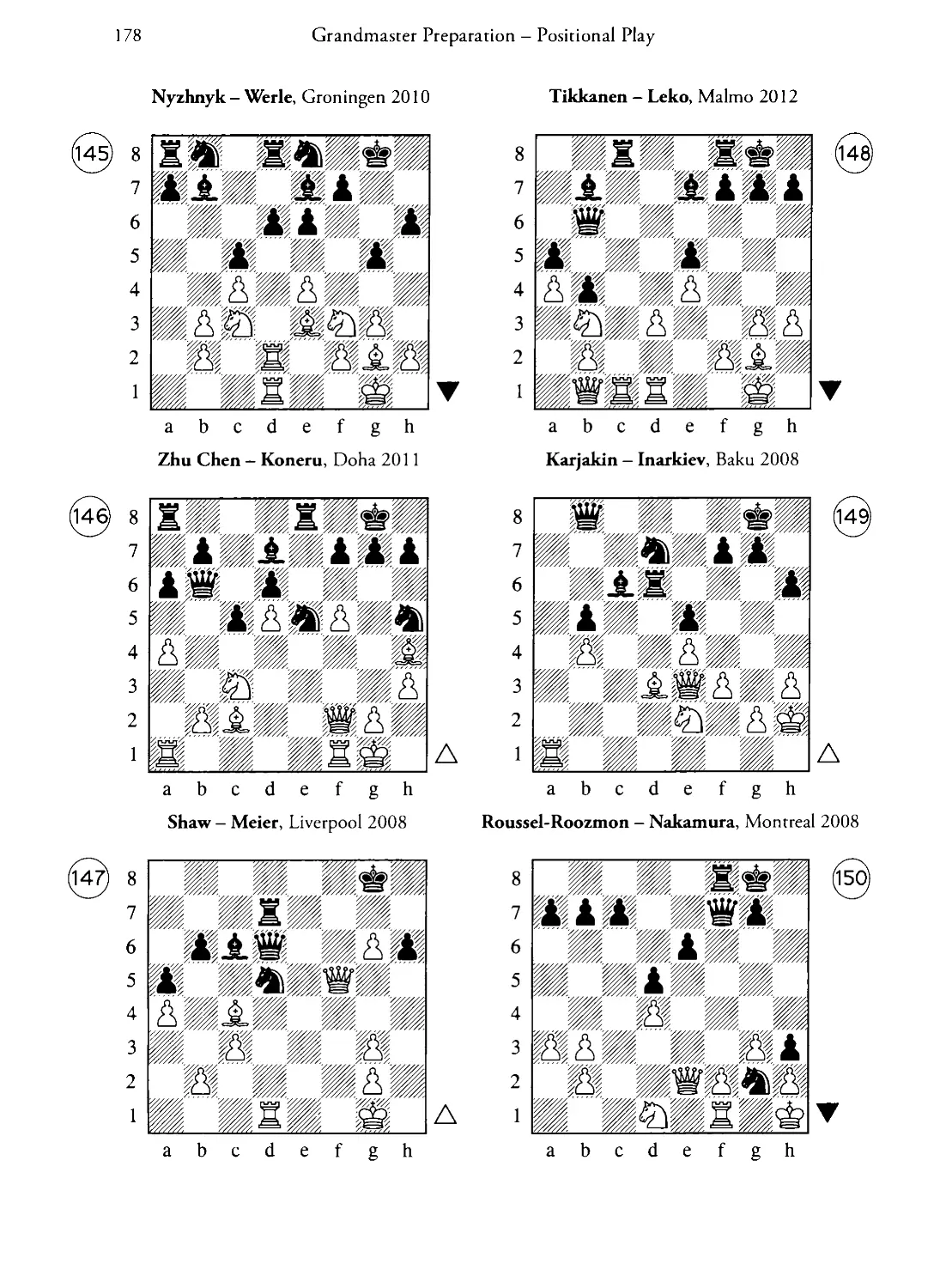
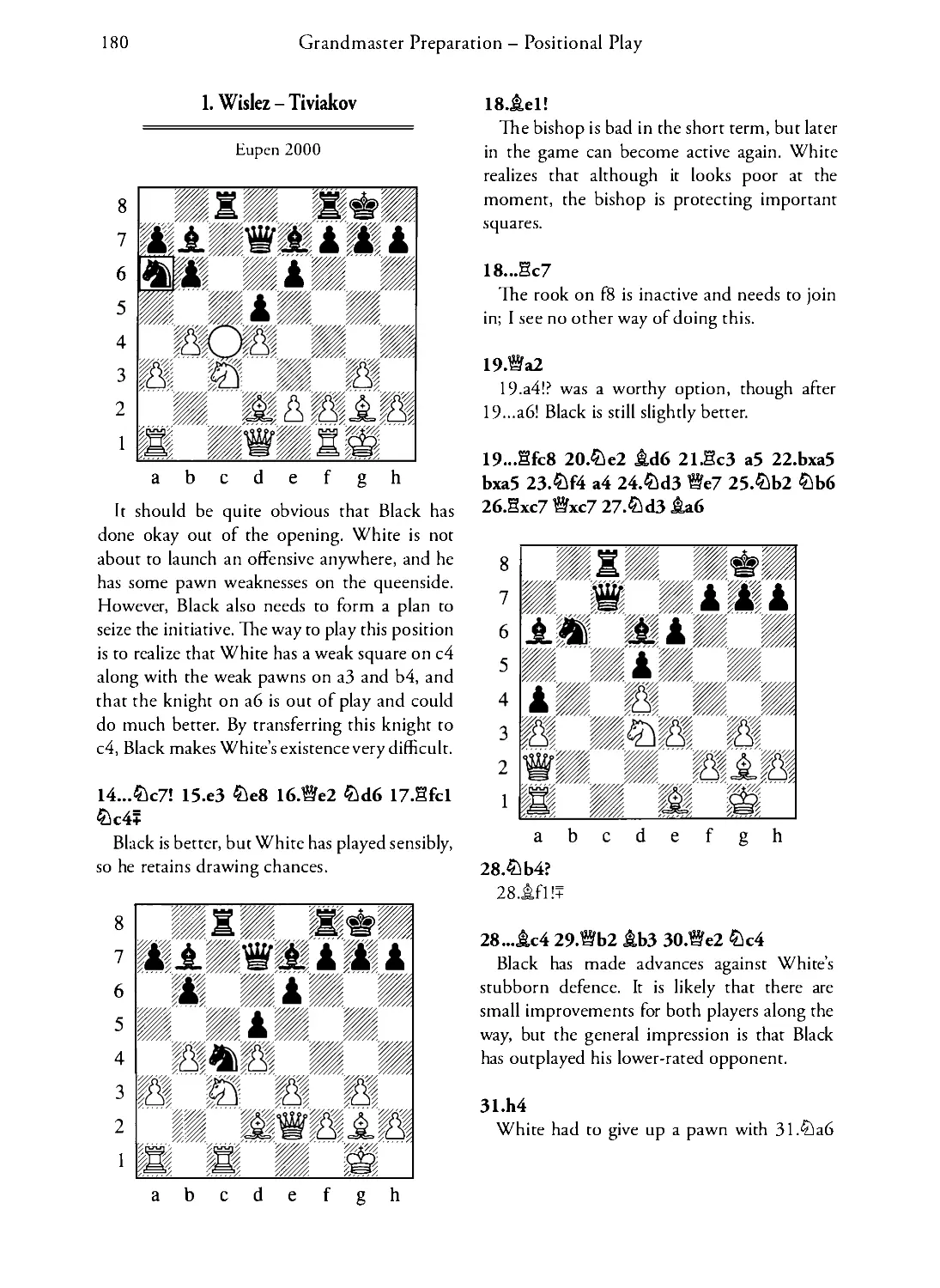
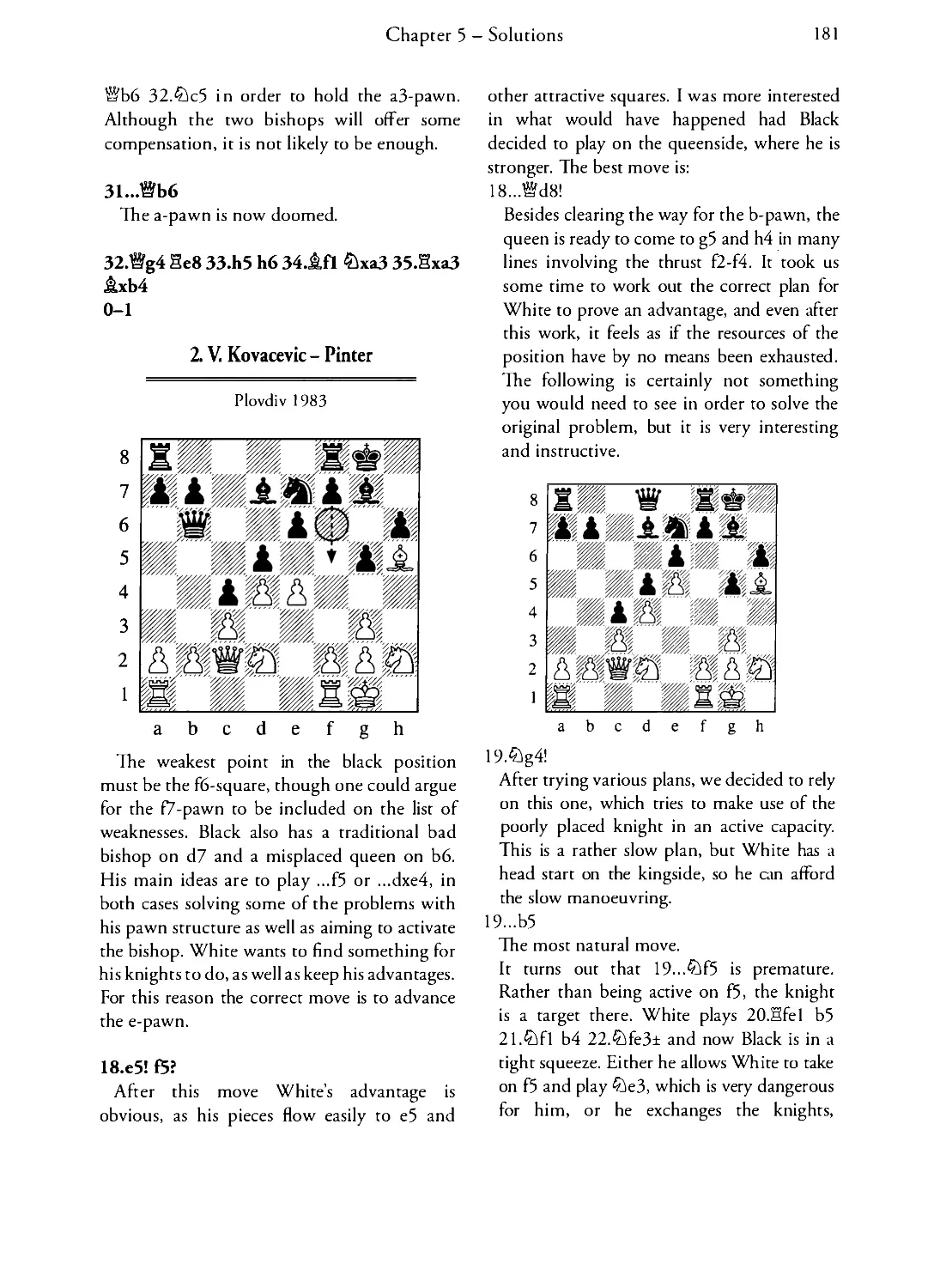

Текст
GRANDMASTER PREPARATION
POSITIONAL
PLAY
Jacob Aagaard
Grandmaster Preparation
POSITIONAL PLAY
By
Jacob Aagaard
IIQuality Chess
ww
w
. qualitychess.co . uk
First edition 20 12 by Quality Chess UK Ltd
Copyright © 20 12 Jacob Aagaard
Grandmaster Preparation- POSITIONAL PLAY
All rights reserved. No part of this publication may be reproduced, stored
in a re trieval system or transmitted in any form or by any means, electronic,
electrostatic, magnetic tape, photocopying, reco rding or otherwise, without prior
permission of the publisher.
Paperback ISBN 978- 1 -907982-26-2
Hardcover ISBN 978- 1 -907982-27-9
All sales or enquiries should be directed to Qu ality Chess UK Ltd,
20 Balvie Road, Milngavie, Glasgow G62 ?TA, United Kingdom
Phone +44 141 333 9588
e-mail: info@qualitychess.co. uk
website: ww
w
.qualitychess.co .uk
Distributed in North America by Globe Peq uot Press,
P.O. Box 480, 246 Goose Lane, Guilford, CT 06437-0480, US
ww
w
.globepequot.com
Distributed in Rest of the Wo rld by Qu ality Chess UK Ltd through
Sunrise Handicrafts, ul. Skromna 3, 20-704 Lublin, Poland
ww
w
.crafrs.pl
Ty peset by Jacob Aagaard
Proofreading by Andrew Greet & John Shaw
Ed ited by Colin McNab
Cover design by Jason Mathis
Back cover photo by John Saunders
Pri med in Estonia by Tal linna Raamatutri.ikikoja LLC
Contents
Key to Symbols used
4
Foreword by Artur Yusupov
5
Series Introduction
6
My Intentions with this Book
7
Visualizing the Three Questions
11
The Three Questions in Practice
15
1 Weaknesses
23
2 Pieces
71
3 Prophylaxis
119
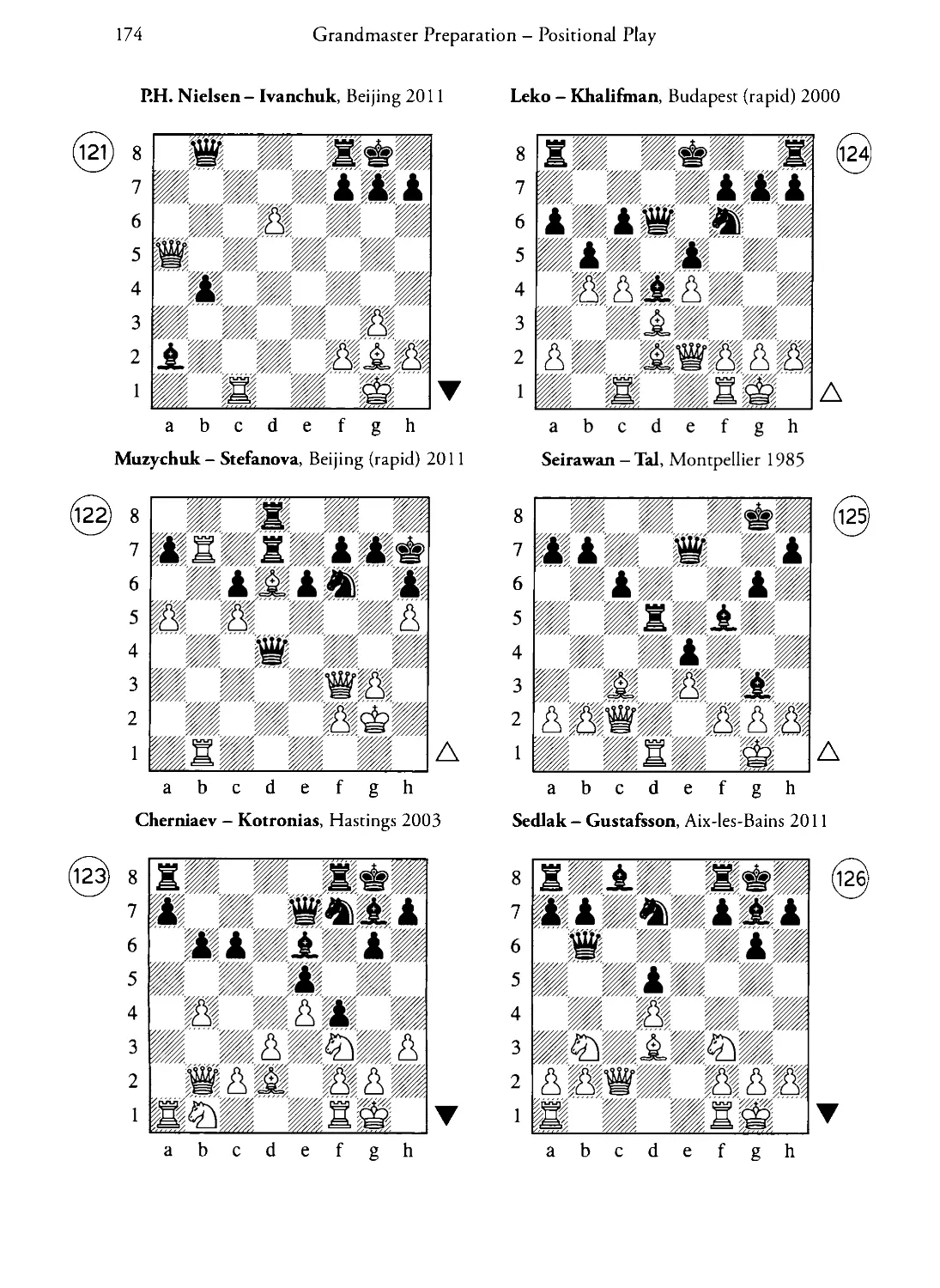
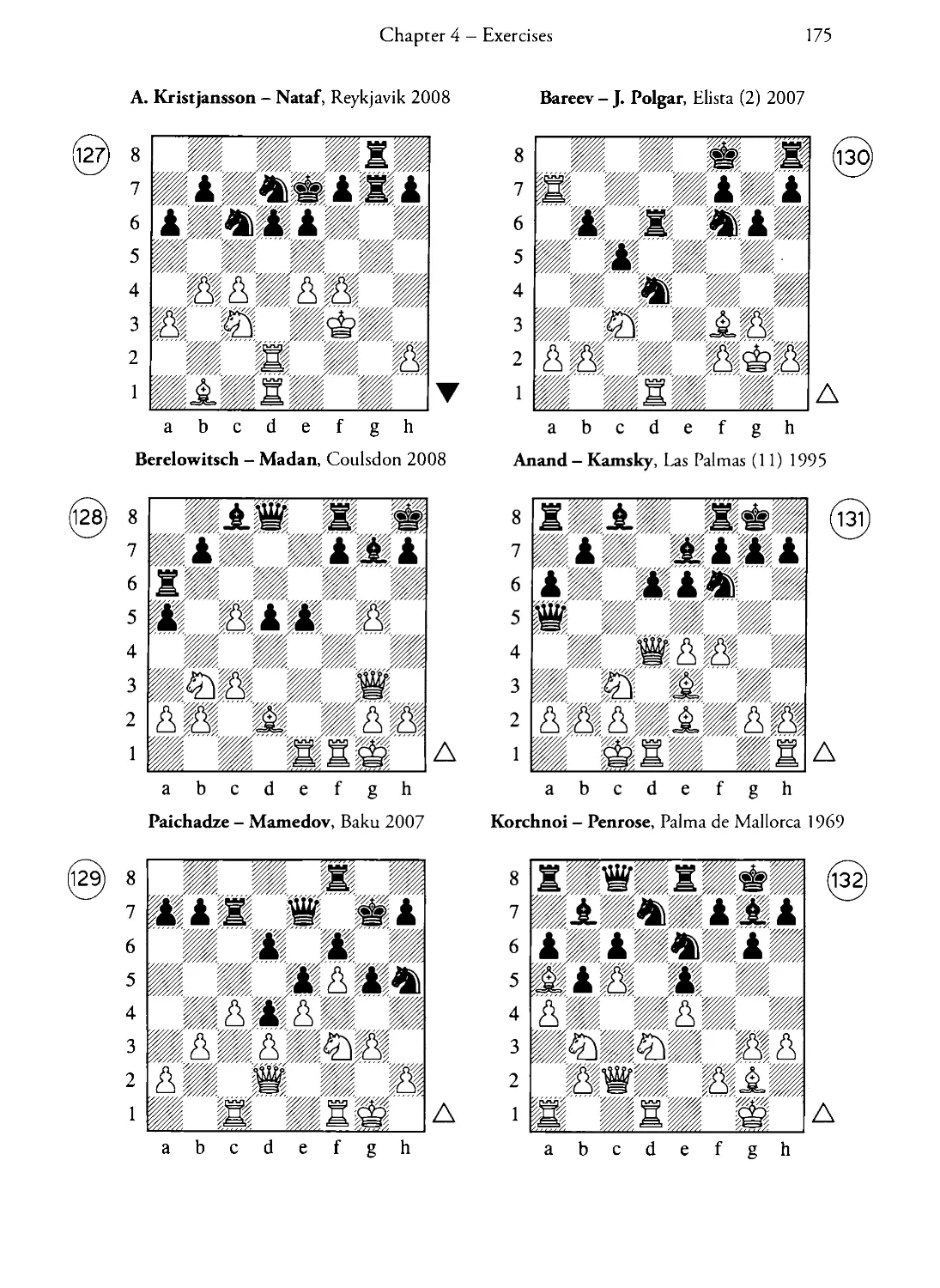
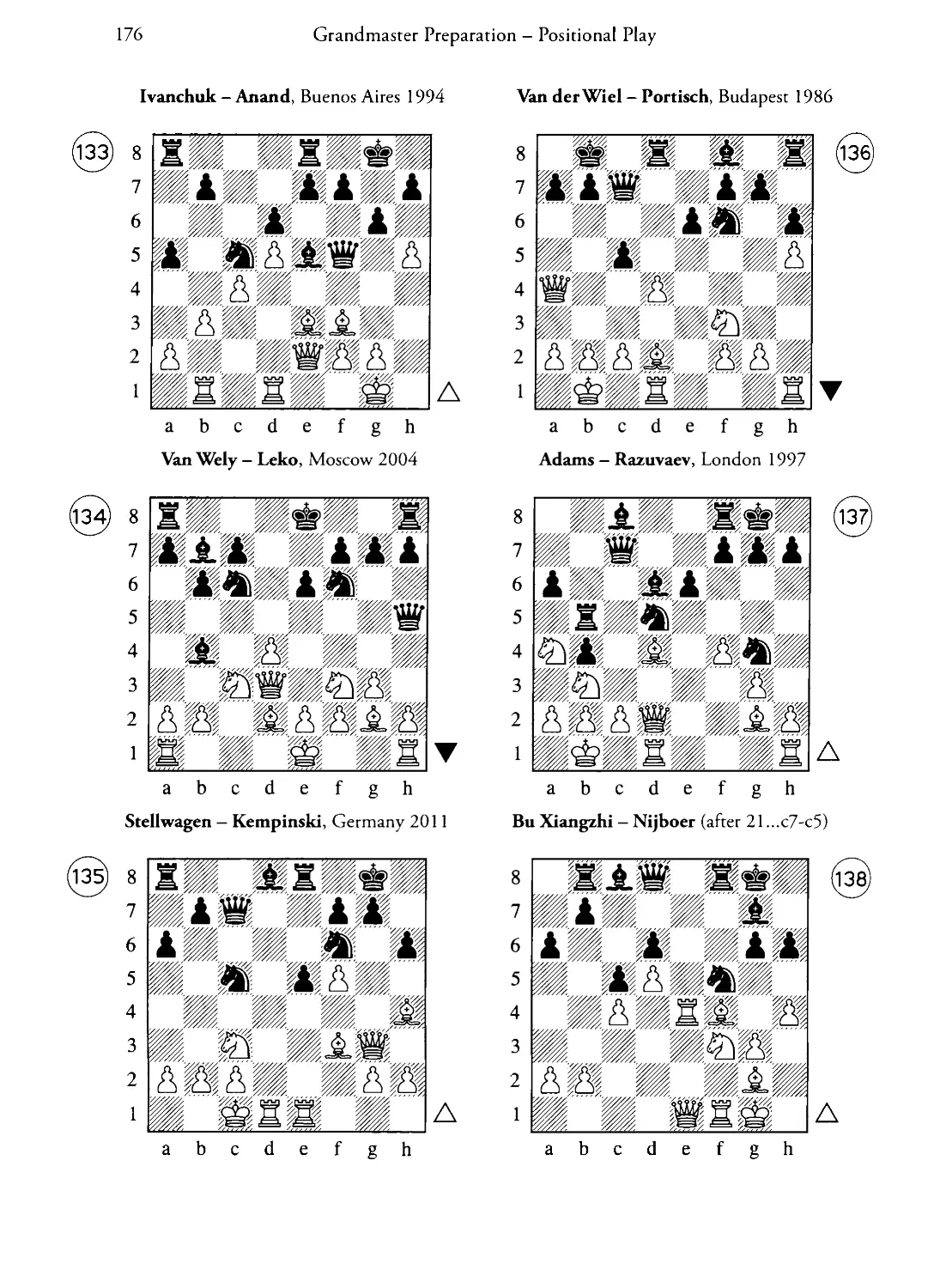
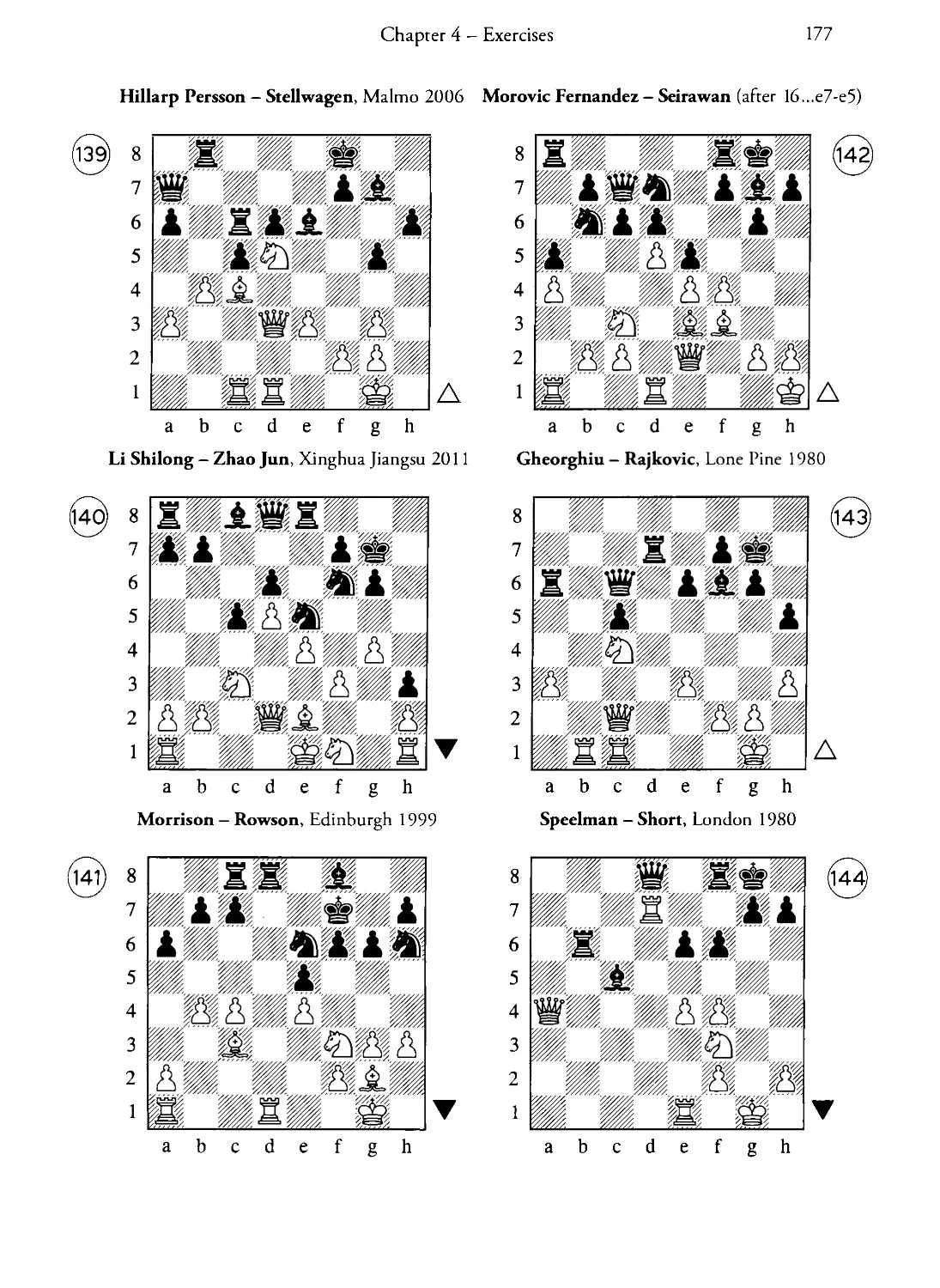
4 Exercises
153
5 Solutions
179
Name Index
308
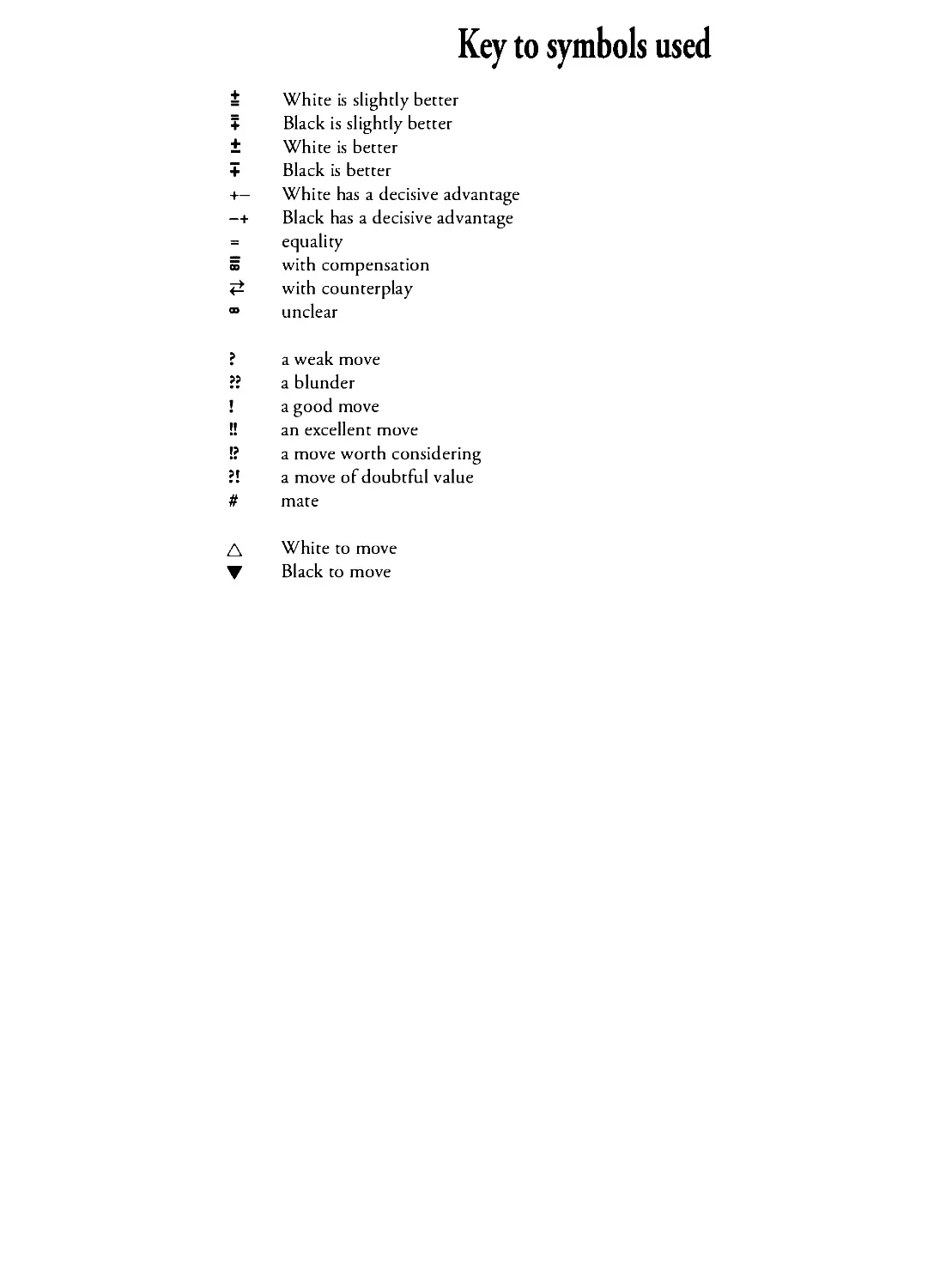
Key to symbols used
White is slightly better
Black is slightly better
± White is better
+ Black is better
+-
White has a decisive advan tage
-+
Black has a decisive advan tage
equality
a;
with compensation
+! with counterplay
11
1
unclear
a weak move
?? a blunder
a good move
!!
an excellent move
!?
a move worth considering
?!
a move of doubtful valu e
#
mate
D,. White to move
'Y Black to move
Foreword
First of all I would like to congratulate the readers of this book on making a very good choice!
As with all books by Jacob Aagaard, this is a quality work! It combines clear explanations and
carefully selected material, mainly fro m very recent games, which you won't find in other books .
As a chess trainer, I know how difficult it is to find good positional exercises . (On the contrary it
seems a relatively easy task to look for tactical positions - computers are a big help in showing us
how poorly we can play chess!) The examples fro m this book will make the life of chess trainers a
little bit easier and the life of their students and readers much more interesting!
Because yo u are holding this book, it means that you want to improve your positional skills and
perhaps to make an important step towards grandmaster level (or to brush up yo ur positional
play if you are a grandmaster already) . Then yo u may be interested to learn the answer to the
popular question: "What is the difference between an amateur player and a grandmaster?"
Many might think that it's mainly the ability to calculate that helps grandmasters fathom the
depths of the position. In some cases chis is true, but it also true chat grandmasters have generally
better opening knowledge; they know more typical plans and pawn structures as wel l. Perhaps
they are better (at leas e some of chem} in endgames coo. Still, I would put certain ocher qualities
in first place. By working with amateur playe rs, I have noticed chat very often, even if they have
the necessary knowledge about the position, they can't use it properly. Grandmasters are trained
to make decisions and have much more practical skills.
The second factor chat struck me was seeing how much energy amateur players waste analysing
or calculating moves chat a stronger player would simply ignore.
This hints of a huge difference in the levels of positional understanding. As a result, an amateur
player may spend coo much time on weak moves and ideas ; meanwhile a grandmaster concentrates
on the heart of the position and looks for much better solutions.
It is not easy to improve positional understanding. One way is co work on good books with the
games of strong players , and co pay special attention to their explanations. Also the careful analysis
of yo ur own games may help you to improve your eval uations and co correct some mistakes.
Al though Aagaard's "approach with this book is not to teach positional understanding, bur to
teach positional judgement and decision-making" , I am sure chat solving the many positional
exercises fro m chis book will help readers co raise their positional level coo.
The tools that Aagaard uses in chis book look simple. But his method of three questions and his
rather modest approach shouldn't deceive readers - if you follow the instructions carefully and
co ncentrate on these important questions, you will most likely focus on the cen tral elements of
the po sition, which will help you to find the solutions of the exercises. Wo rking with chis book
will train yo ur positional judgement and develop your chess intuition. Yo u will improve yo ur
decision-making process and learn some new practical skills. And maybe you will be able to make
another step forwards ...
Artur Yu supov
Twice Candidates Finalist
Series Introduction
Ever since I was a junior I have been a chess train er. At times my dissatisfaction with the conditions for
trainers has caused me to be a player as wel l; and not without some success. But at the end of the day I
have had to accept that my destiny is not to fe el comfortable on the stage, but rather in the anonymity
of the locker room. I have always cared more for the results of my students than my own, just as I have
always had lots of passion for trai ning others, bur none for training mysel (
Over the years I have developed some of the skills necessary to become a decent trainer, not least of
all the ability to earn a living by other means! Among other things this means I have become a chess
writer. From the moment I started taking pride in my work, I have developed into a not entirely bad
one, to the degree where I am finally comfortable enough to publish this series of books, wh ich I have
been dream ing about for years.
The series title Gran dmaster Preparation is of course a little joke, as the five books originally planned do
not include any coverage of the opening. Bur it is also a serious point at the same time. Grandmaster
play does not occur in a vacuum, and it consists of much more than opening preparation, random
intuition and even more random calculation. There are rules and methods that have been successful
for many decades and will continue to be so in the future. One of my main objectives with this project
has been to merge this classic understanding of chess with my own ideas and create a serious training
plan for ambitious players.
This is the most ambitious project I have underta ken in my professional life, and there is no escaping
the unavoidable imperfection of the execution. I hope the reader will forgive me in advance for any
mistakes, but at the same time offer me the confidence to believe in most of what I claim throughout
these books. They are heavily researched and based on my experience of working with close to a
thousand individuals over the years: from my own daughters, who recently discovered the joy of
capturing a piece, to friends who have been involved in Wo rld Cha mpionship matches. So, please
develop yo ur own understanding of chess by questioning everything I say, but at the same time, please
never disregard anything I say as unfounded.
When I was a yo ung man I had no access to a classical chess education, and many other grandmasters
have had the same experience. Ir is my hope that this series will help to change this picture in the
same way that Mark Dvoretsky's books have, and the way that Artur Yu supov's series of nine books
(Fundamentals, Beyond the Basics and Mastery) have given juniors and amateurs a clearly-structured
method of improvemen t.
The ulti mate goal for this series is to show a path towards playing chess at grandmaster level for those
who do not have access to a good trainer. I have worked with some grandmasters who had the kinds
of holes in their chess understanding that wo uld ba ffle the average man on the street. Obviously they
excelled in other aspects of the game simultaneously, bur over time their wea knesses became obvious
to their opponents and their results duly suffered. This series is meant to help those players as we ll.
Jacob Aagaa rd , Glasgow 20 12
My Intentions with this Book
There are a lot of good books on the market that will help you to improve yo ur understanding
of positional and technical chess. Mainly I would recommend games collections for the person
with all the time in the wo rld, but there are also other books that cut positional play into small
pieces and explain them well. Sure, this has been done in different ways , but all of them in ways
chat makes sense and stick in the mind. I absolutely believe that this is a never- ending process and
chat more books with better explanations are always needed and will therefore always be written .
But this book is not one of them .
My approach with this book is not to teach positional understanding, but to teach positional
judgement and decision-making. My goal is not to make yo u understand chess better - although
I adm it that might come as a side-effect none the less - but to use the extensive knowledge yo u
will no doubt already have of chess if you are reading a book in the Grandm aster Preparatio.n
series .
So rather than providing you with answers, this book presumes that you have already been
supplied with plenty of those and that what you need are the right questions. Actually, I wo uld
go so far as to say that in order to train your positional judgement:
All you need are three questions!
It is probably a decade ago that I sat down and tried to make a list of all the relevant questions I
co uld ask my students to make them pay attention to nuances in the trai ning positions I provided
them with. I think I had about nine. But some of them I fe lt were not real ly relevant to a lot of
the positions I looked at; so I ditched them. Others tended to have very similar answers to each
other in otherwise quite different positions; merging them seemed reasonable. And barn! All I was
left with were three questions.
1. Wh ere are the weakn esses?
2. Wh ich is the worst-placed piece?
3. Wh at is your opponent's idea?
I have since used these questions in training with dub players of average level (and below) and
strong grandmasters. They are equally useful for all levels for a simple reason:
The purpose ofthe three questions is to direct your focus
Whether we are talking about a strong grandmaster with a great international rep utation as a
dangerous attacker or a junior with no rep utation at all, both need to focus on the same things
in order to make better decisions on the board. After all, the pieces move in the same way for
everybody, even Kasparov (despite Bareev's claim to the contrary) .
8
Grandmaster Preparation - Positional Play
We will look at the three questions one by one and look at positions in each section. But as always
in my books , what I am looking for is not that yo u understand the theory, but that yo u can drive
the vehicle. Theoretical comprehension is not enough; yo u need to be able to do it, before yo u
can fully understand it.
The difference between theory and practice is that
in theory there is no difference, but in practice there inevitably is
Tr ue knowledge is skill - all other types of knowledge are fakes . As an example, I am quite we ll
read in nutrition, but my severe addiction to chocolate meant that no one would ever have paid
any attention to what I said, had I decided to lecture about it. (Now that I have rid myself of this
addiction and look more like a man than a balloon again, I no longer fe el any pressure to lecture.
Funny that, but that is another story, of course.)
So what I wish for yo u to get from this book is the practical ability to make better decisions at the
board, so that yo u can play better moves . This on its own does not separate my approach from
many others.
What makes this book a bit different from most of the other
books on the market is that the emphasis is on the decision,
more than on the understanding behind it
The prevailing view in Anglo-Saxon chess literature is that good chess comes from calculation,
opening preparation and good intuition; the latter clearly being the factor dealing with positional
judgement. This is a model that sums up the practice of already strong players in action.
Those of us who focus more on general principles as a model for explaining chess and what is
going on, are searching for a model that can replicate good play consistently. By breaking wins at
the board down into a high number of small skills or principles, we fe el that we can co mmunicate
and replicate the process that leads to strong moves at the board with a higher frequency.
While the first model has a We stern bias, the second used to have an East European bias. I would
claim that the Soviet domination of chess in the 20th century wo uld be a strong endorsement for
the idea of a "classical chess education" with lots of general principles and division of chess skill
into small chunks that can easily be explained. Modern examples of this are the books by Mark
Dvoretsky and Artur Yu supov.
But yo u do not have to agree with this stance in order to get the full benefit from this book.
This book is not seeking to theorize chess, but to make it practical. And for those interested in
the argu ment for general principles, I recommend reading lhinking Inside the Box, which is the
theoretical arm of this proj ect.
My Intentions with this Book
9
To make chess practical we need to make it simple
This is my number one teaching principle. This does not mean chat the exercises cannot be
pai nstakingly difficult for some people. Chess is like chat - it is difficult to f
i
nd the va rious
co nnections in a position when we look at it, tactical , positional and otherwise. Bue once we
know what the best move is, we cannot turn it off and somehow it is easy to understand. Th is is
certainly one of my goals with the solutions written in this book: to give you exaccly what yo u
need to know to understand the position after yo u have struggled to solve it.
.
Another goal is to make the process as simple as possible. Yo u would think chat it wo uld be easy
to re member three small questions, but experience tells me otherwise. And even if a pupil is able
to remember the three questions, he is often unable to remember the bigger question, which
should spark these three questions in his mind: Wh at am I lo okingfor in this position? Instead,
most players and students will just start calculating.
Calculation is a very important skill, but still,
it's only one of the analysis tools available
The purpose with the three questions is for you to look at the positions in front ofyo u differencly:
I wa nt you to start looking at the pawn and pieces differen cly. It is a process and there are a few
things I want to state about this that might be obvious, but none the less are good to keep in mind
(because have yo u noticed how often we do not pay attention to obvious things, despite being
highly intelligent creatures ?) .
In order to get the most out of this book I would like yo u to focus on style over speed. Please
take the time to ask yourself the three questions, answer them out loud (or maybe even better, on
paper) before you start applying the knowledge by looking for the best move. If you do this, yo u
will soon see how focusing yo ur mind on the three important pares of chess chat these questions
relate to, makes a big differe nce.
Doing it right is more important than getting it right
Please remember that although we want to solve the positions, what we are doing here is building
yo ur intuition, by repeating these questions to yo ur subconscious so freq uently that it will pay
attention to these three aspects of chess and their nuances.
What level is this book supposed to be aiming at?
This book is a part of the Grandmaster Preparation series and therefore aims at developing the skills
needed for grandmaster performance. However, the level of the chess is not extensively difficult in
this book. The positions in Strategic Play are more elaborate and will probably be more suited for
players over 2300. Having said this, some of the positions in this book do offer grandmasters a
bit of res istance. One interesting experiment I did with a GM who at the time was rated 2625 or
thereabouts, was to give him 12 of these positions and use half an hour on them. He scored 9112.
IO
Grandmaster Preparation - Positional Play
He did not wa nt any fe edback or help with his own play, so the knowledge that the three exercises
he had failed at were quite similar from where I was standing did not impress him.
However it does underline an important benefit you can get from this book, even if you have
reached a high level of positional play already.
Pay attention to the exercises you fail to solve
As the exe rc ises in this book to a great extent are constructed with the idea of there being a simple
solution, failure to solve an exercise will gi ve yo u important fe edback about yo ur own positional
judgement. I wo uld encourage yo u to write down the mistakes you make and when yo u repeat
them (as we all do} , note it down as well. In general I do not believe we pay enough attention to
our mistakes ifwe keep the realization of chem purely in our heads.
Visualizing the Three Questions
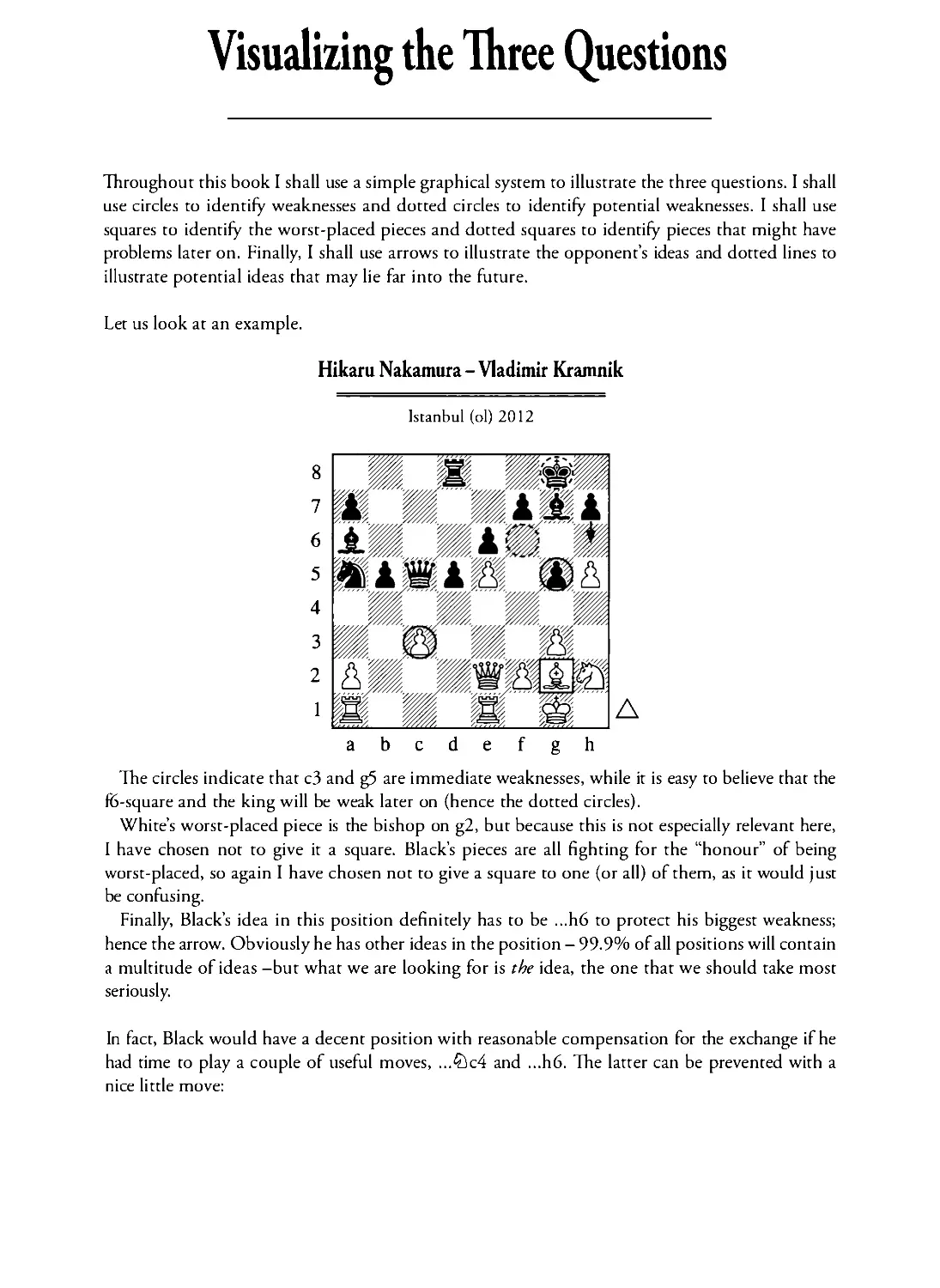
Throughout this book I shall use a simple graphical system to illustrate the three questions. I shall
use circles to identify weaknesses and dotted circles to identify potential we aknesses . I shall use
squares to identify the wo rst-placed pieces and dotted squares to identify pieces that might have
problems later on. Finally, I shall use arrows to illustrate the opponent's ideas and dotted lines to
illustrate potential ideas that may lie far into the future.
Let us look at an example.
Hikaru Nakamura - Vladimir Kramnik
8
7
6
5
4
3
2
1
Istanbul (ol) 2012
abcdefgh
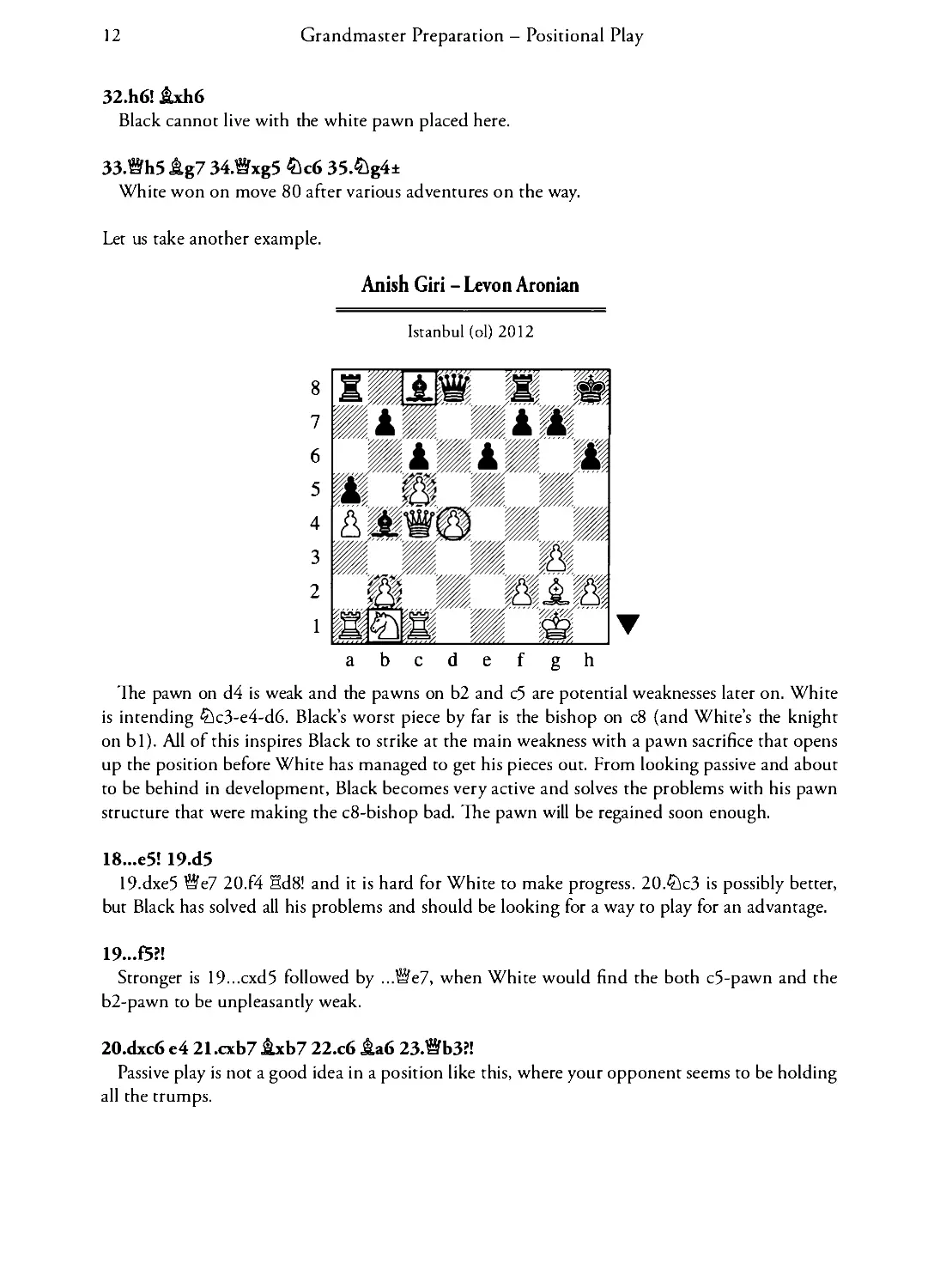
The circles indicate that c3 and g5 are immediate weaknesses, while it is easy to believe that the
f6 -square and the king will be weak later on (hence the dotted circles) .
White's worst-placed piece is the bishop on g2 , but because this is not especially re levant here,
I have chosen not to give it a square. Black's pieces are all fighting for the "honour" of being
worst-placed, so again I have chosen not to give a square to one (or all) of them, as it wo uld just
be confusing.
Finally, Black's idea in this position definitely has to be ...h6 to protect his biggest weakness;
hence the arrow. Obviously he has other ideas in the position - 99.9% of all positions will co ntain
a multitude of ideas -but what we are looking for is the idea, the one that we should take most
seriously.
In fact, Black wo uld have a decent position with reasonable compensation for the exchange if he
had time to play a couple of useful moves , ...l2Jc4 and ...h6. The latter can be preve nted with a
nice little move:
12
Grandmaster Preparation - Positional Play
32.h6! hh6
Black cannot live with the white pawn placed here.
33.Yfh5 .ig7 34.Yfxg5 �c6 35.�g4±
Wh ite won on move 80 after various adventures on the way.
Let us take another example.
Anish Giri - Levon Aronian
Istanbul (ol) 2012
8
7
6
5
4
3
2
�
abcdefgh
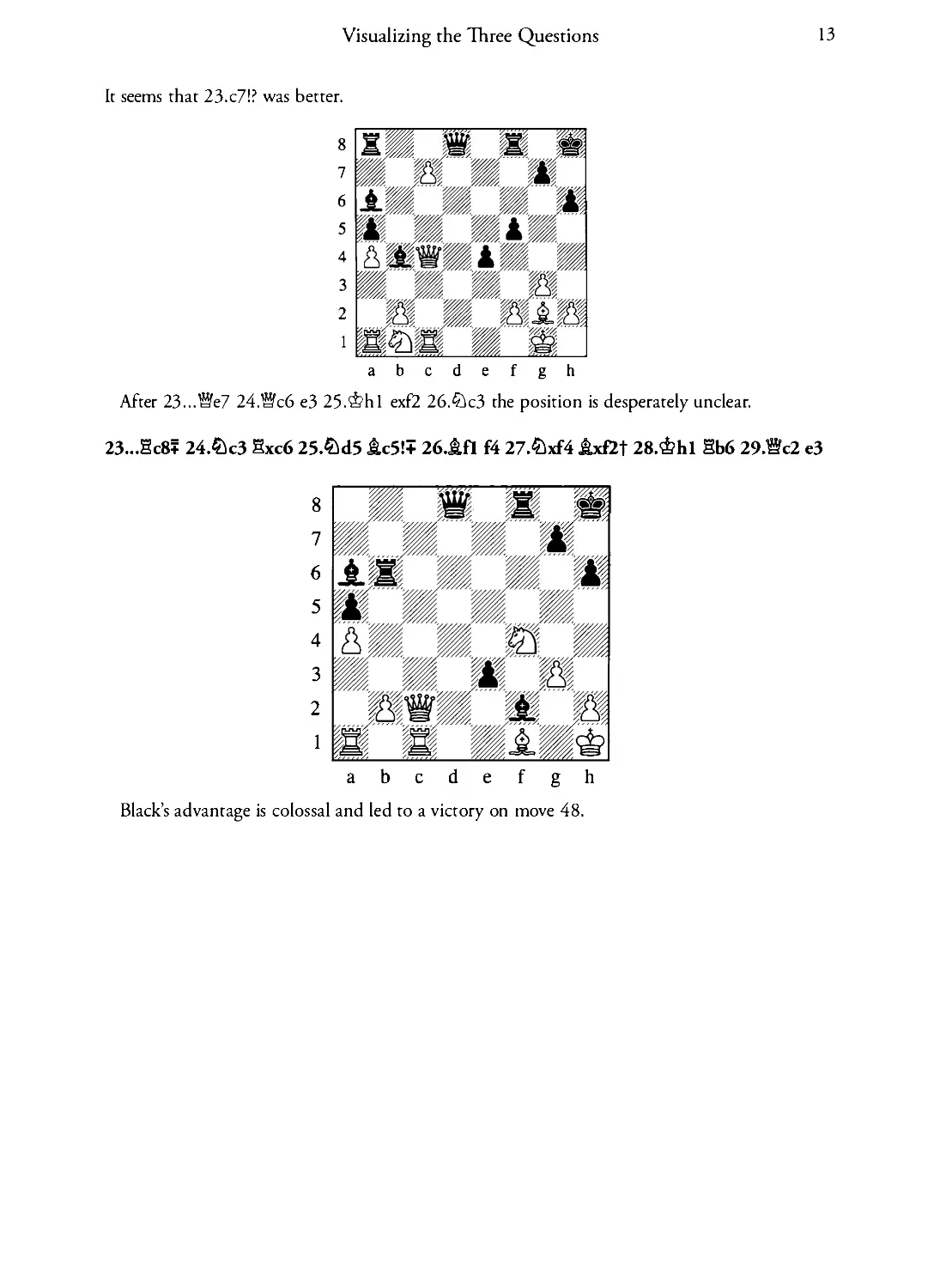
The pawn on d4 is weak and the pawns on b2 and c5 are potential weaknesses later on. White
is intending lli c3-e4-d6. Black's worst piece by far is the bishop on c8 (and White's the knight
on b I). All of this inspires Black to strike at the main weakness with a pawn sacrifice that opens
up the position before White has managed to get his pieces out. From looking passive and about
to be behind in development, Black becomes very active and solves the problems with his pawn
structure that were making the c8-bishop bad. The pawn will be regained soon enough.
18...e5! 19.d5
l 9.dxe5 Wle7 20.f4 �d8! and it is hard for White to make progress. 20 .llic3 is possibly better,
but Black has solved all his problems and should be looking for a way to play for an advan tage.
19...f5?!
Stronger is 19...cxd 5 followed by ...W/e7, when White would find the both c5-pawn and the
b2-pawn to be unpleasantly weak.
20.dxc6 e4 21.cxb7 hb7 22.c6 .ia6 23.Yfb3?!
Pa ssive play is not a good idea in a position like this, where your opponent seems to be holding
all the trumps.
Visualizing the Three Questions
13
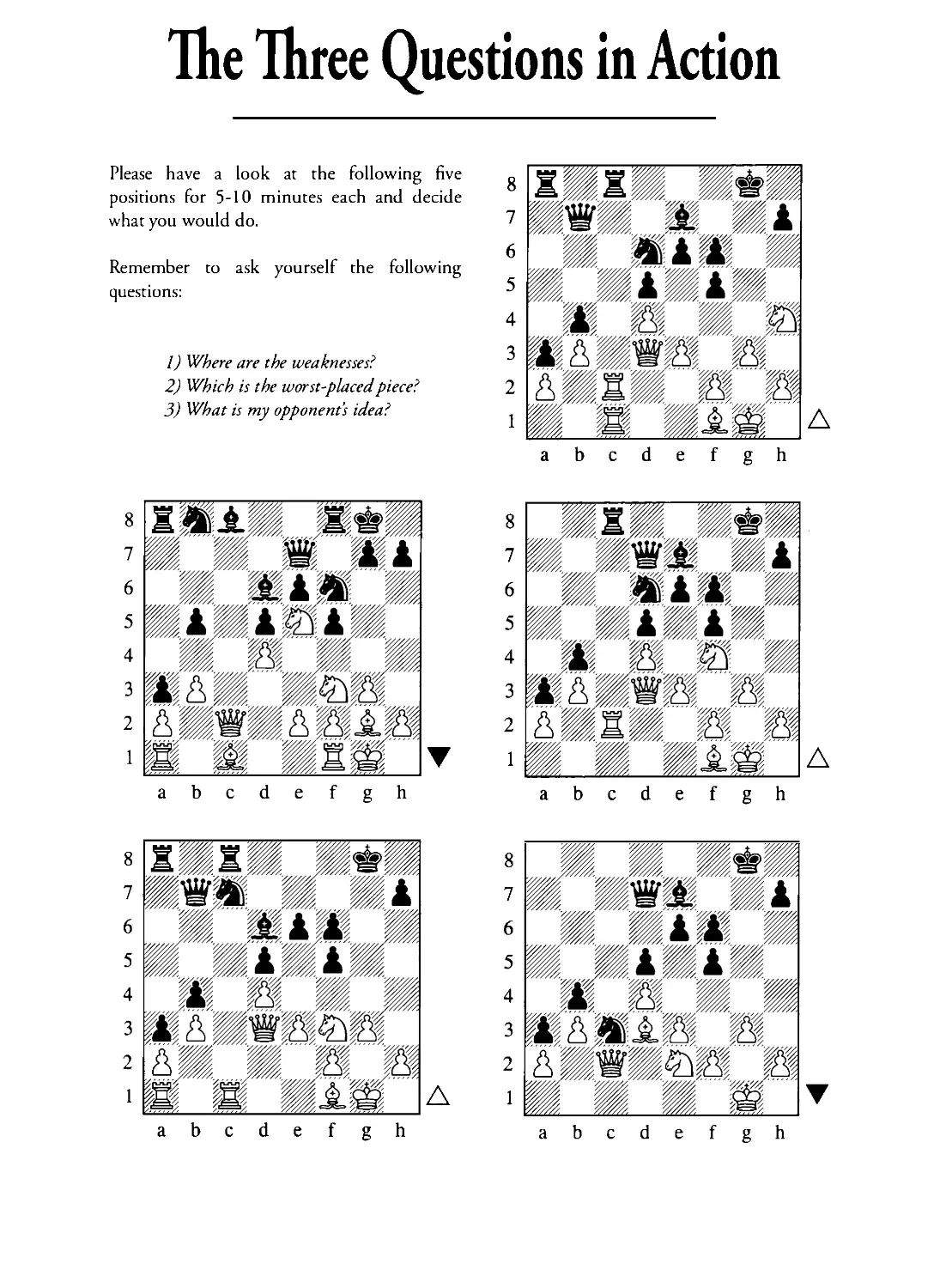
It seems that 23.c7!? was better.
abcdefgh
After 23 ...Wfe? 24.Wfc6 e3 25.iih l exf2 26.ll
l
c3 the position is desperately unclear.
23•.Jksi 24.c!l:ic3 ihc6 25.c!l:id5 .ic5!+ 26•.ifl f4 27.tl
l
xf4 .bflt 28.iihl gb6 29.1Mfc2 e3
8
7
6
5
4
3
2
1
abcdefgh
Black's advantage is colossal and led to a victory on move 48.
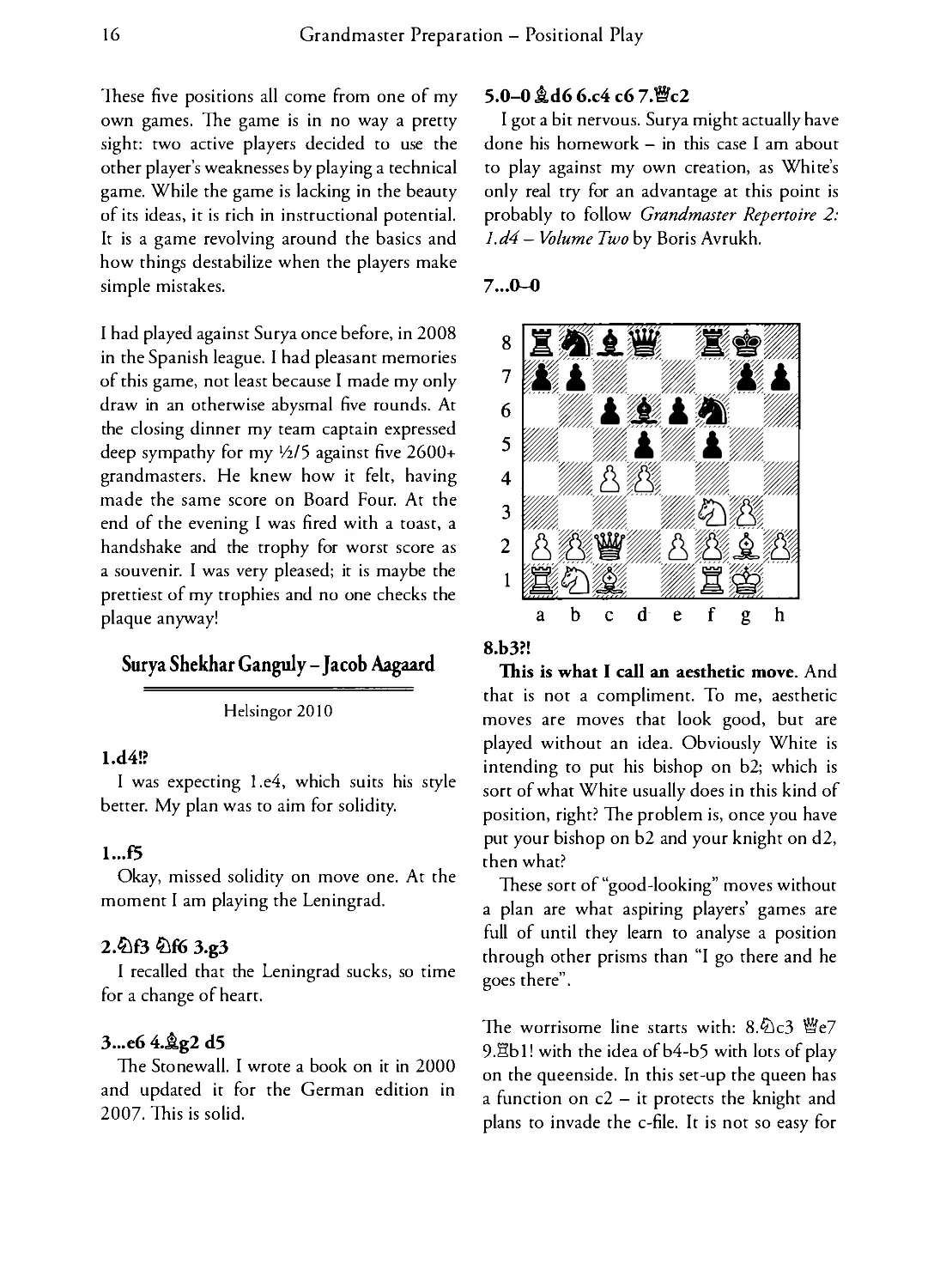
The Three Questions in Action
Please have a look at the following five
positions for 5- 10 minutes each and decide
what you would do.
Re member to ask yourself the following
questions:
I) Wh ere are the weakn esses?
2) Wh ich is the worst-placed piece?
3) Wh at is my opponent's idea?
abcdefgh
7
6
5
abcdefgh
abcdefgh
16
Grandmaster Preparation - Positional Play
These five positions all come from one of my
own games . The game is in no way a pretty
sight: two active players decided to use the
other player's weaknesses by playing a technical
game. While the game is lacking in the beauty
of its ideas , it is rich in instructional potential.
It is a game revo lving around the basics and
how things destabilize when the players make
simple mistakes.
I had played against Surya once before, in 2008
in the Spanish league. I had pleasant memories
of chis game, not least because I made my only
draw in an otherwise abysmal five ro unds. At
the closing dinner my team captain expressed
deep sympathy for my Y2!5 against five 2600+
grandmasters. He knew how it fe lt, having
made the same score on Board Four. At the
end of the even ing I was fired with a toast, a
handshake and the trophy for worst score as
a souven ir. I was very pleased; it is maybe the
prettiest of my trophies and no one checks the
plaque anyway!
Surya Shekhar Ganguly - Jacob Aaga
ard
Helsingor 2010
l.d4!?
I was expecting 1.e4 , which suits his style
better. My plan was to aim for solidity.
1...5
Okay, missed solidity on move one. At the
moment I am playi ng the Leningrad.
2.�f3 �f6 3.g3
I recalled chat the Le ningrad sucks, so time
for a change of heart.
3 ...e6 4.i.g2 d5
The Sto newall. I wrote a book on it in 2000
and updated it for the Ge rman edition in
2007. This is solid.
5.0-0 i.d6 6.c4 c6 7.Y!fc2
I got a bit nervous. Surya might actually have
done his homework - in chis case I am about
to play against my own creation, as Wh ite's
only real try for an advan tage at this point is
probably to follow Grandmaster Repertoire 2:
1.d4 - Volume Two by Boris Av rukh.
7•••0-0
8
7
6
5
4
3
2
1
8.b3?!
abcd-efgh
This is what I call an aesthetic move. And
chat is not a compliment. To me, aesthetic
moves are moves chat look good, but are
played without an idea. Obviously White is
intending to put his bishop on b2; which is
sort of what White usually does in chis kind of
position, right? The problem is, once you have
put your bishop on b2 and your knight on d2,
then what?
These sort of "good-looking" moves without
a plan are what aspiring players' games are
full of until they learn to analyse a position
through other prisms than "I go there and he
goes there" .
The worrisome line starts with: 8.tl
l
c3Wf
f
e7
9.;gb l! with the idea of b4-b5 with lots of play
on the queenside. In chis set-up the queen has
a function on c2 - it protects the knight and
plans to invade the c-file. It is not so easy for
The Three Questions in Action
17
Black to continue with a sensible move and
White is happy to follow up with .if4 at an
opportune moment.
s...We7 9.Ab2
I took some time to look at the position
and my opponent's body language. He did
not look at home in the position (nor did
he look nervous) and his set-up did not look
threatening.
Standard play wo uld be 9 ...ll
l
e4 followed by
10...b6 or ...i.d7-e8-h5. Bue his fe eble set-up
inspired me co try a more ambitious plan I had
seen in some ofArtur Yusupov's games .
9•..b5!? IO.lilbd2 a5
Black is seeking to dominate the queenside
and get the bishop active on a6.
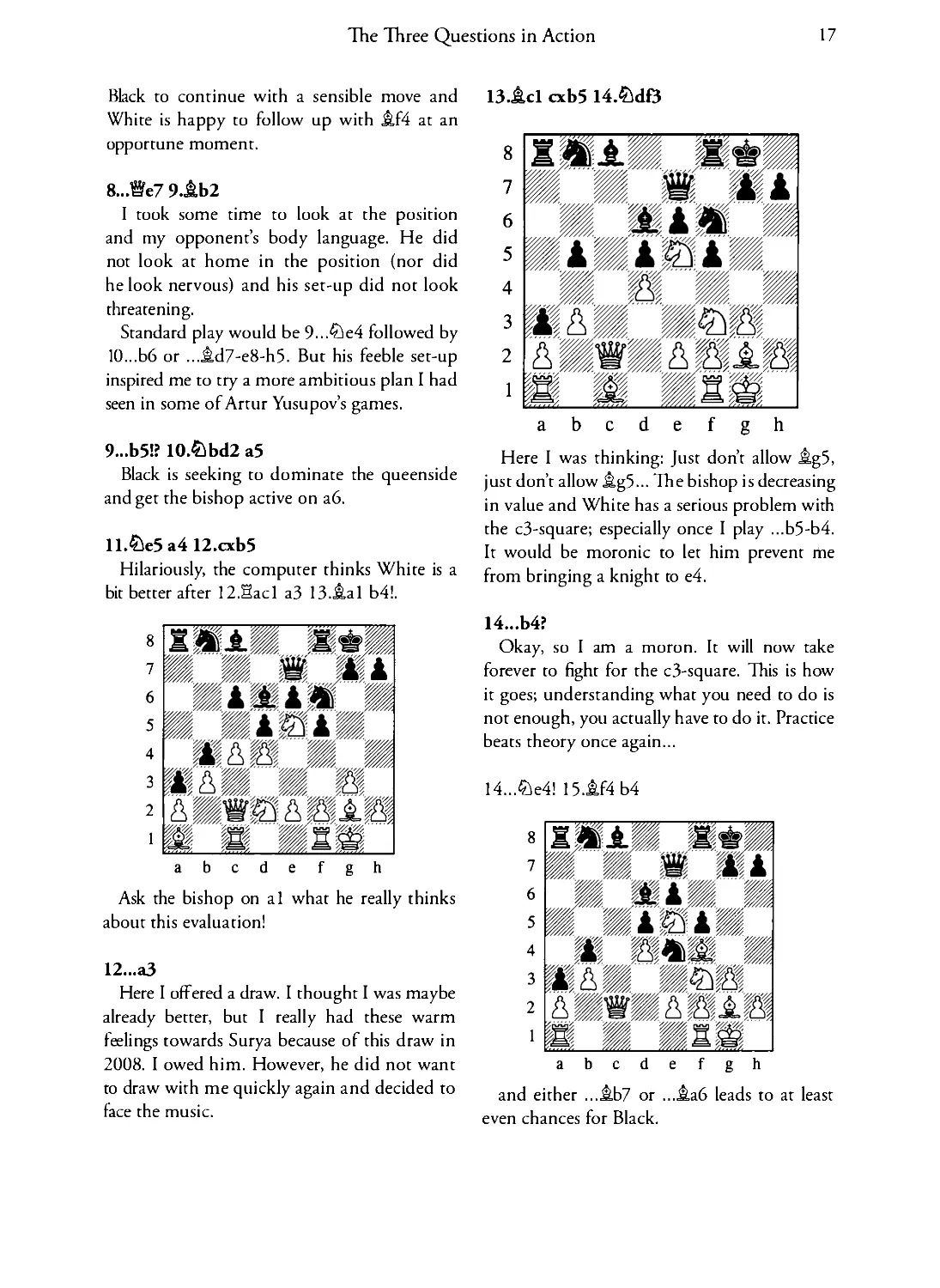
I I.c!lie5 a4 12.cxb5
Hilariously, the computer thinks White is a
bit better after 12.:!:!ac l a3 13..ia l b4!.
abcdefgh
Ask the bishop on a 1 what he really chinks
about chis eval uation!
12..•a3
Here I offered a draw. I thought I was maybe
already better, but I real ly had these warm
fee lings cowards Surya because of this draw in
2008. I owed him. However, he did not want
co draw with me quickly again and decided co
face the music.
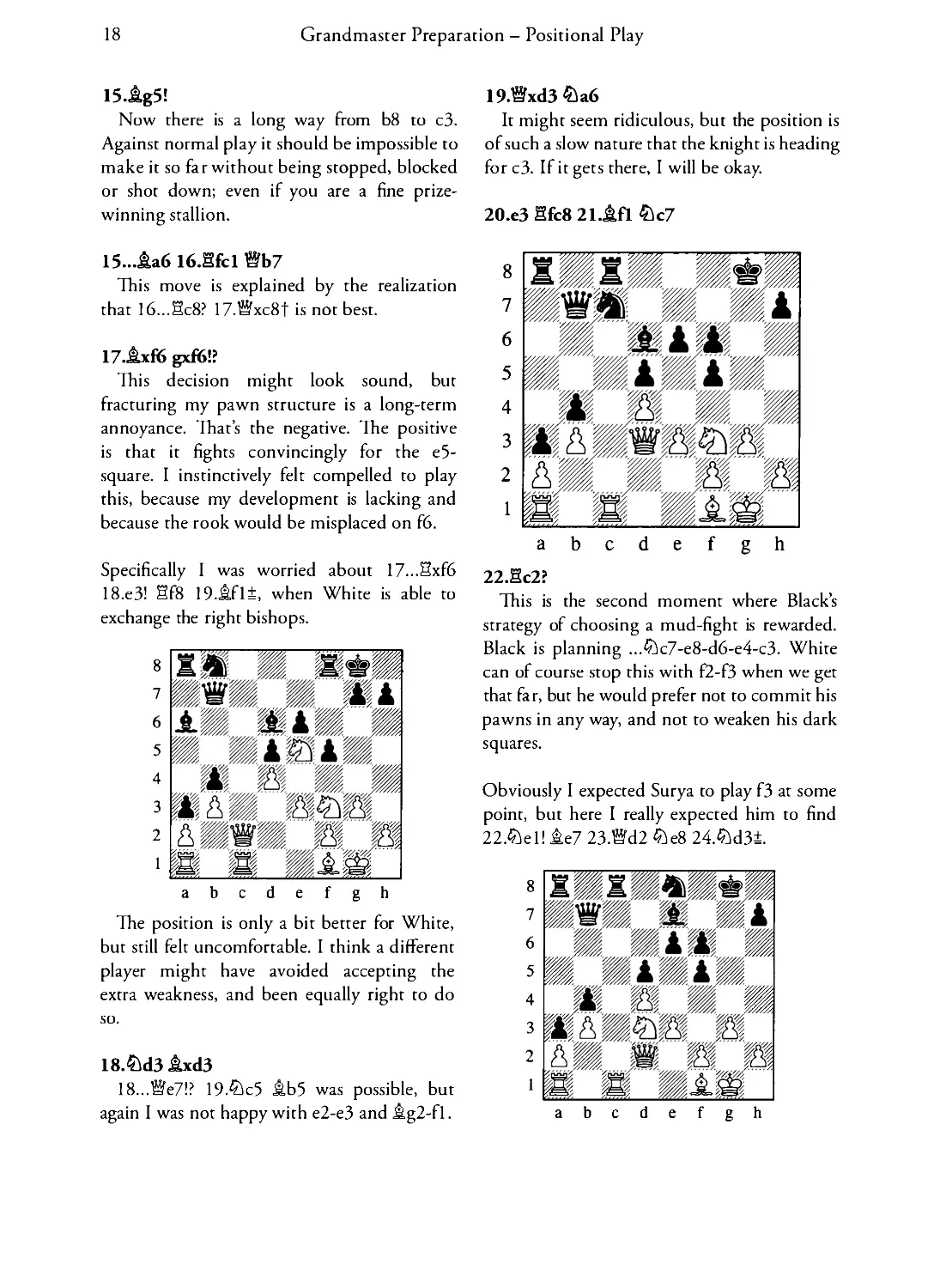
13•.icl cxb5 14.c!lidf3
8 .i•..i.
.
� ��·
,,,,,,,,;� ��if"'"�-�
: �.��,,
r
�
5
:� .•���•.:�
4 �.�n.
�.
3 � :m----·%m��
2 t.1.:nt�
- -- -� ��}{�� ,,, ,, %� ·;,{""
1�m�.:m
abcdefgh
Here I was thinking: Just do n't allow ig5,
just don't allow i.g5 ... The bishop is decreas ing
in value and Wh ite has a serious problem with
the c3-square; especially once I play ...b5 -b4.
It wo uld be moronic co let him prevent rhe
from bringing a knight to e4 .
14•••b4?
Okay, so I am a moron. It will now take
forever to fight for the c3-square. This is how
it goes; understanding what you need co do is
not enough, you actually have co do it. Pr actice
beats theory once again...
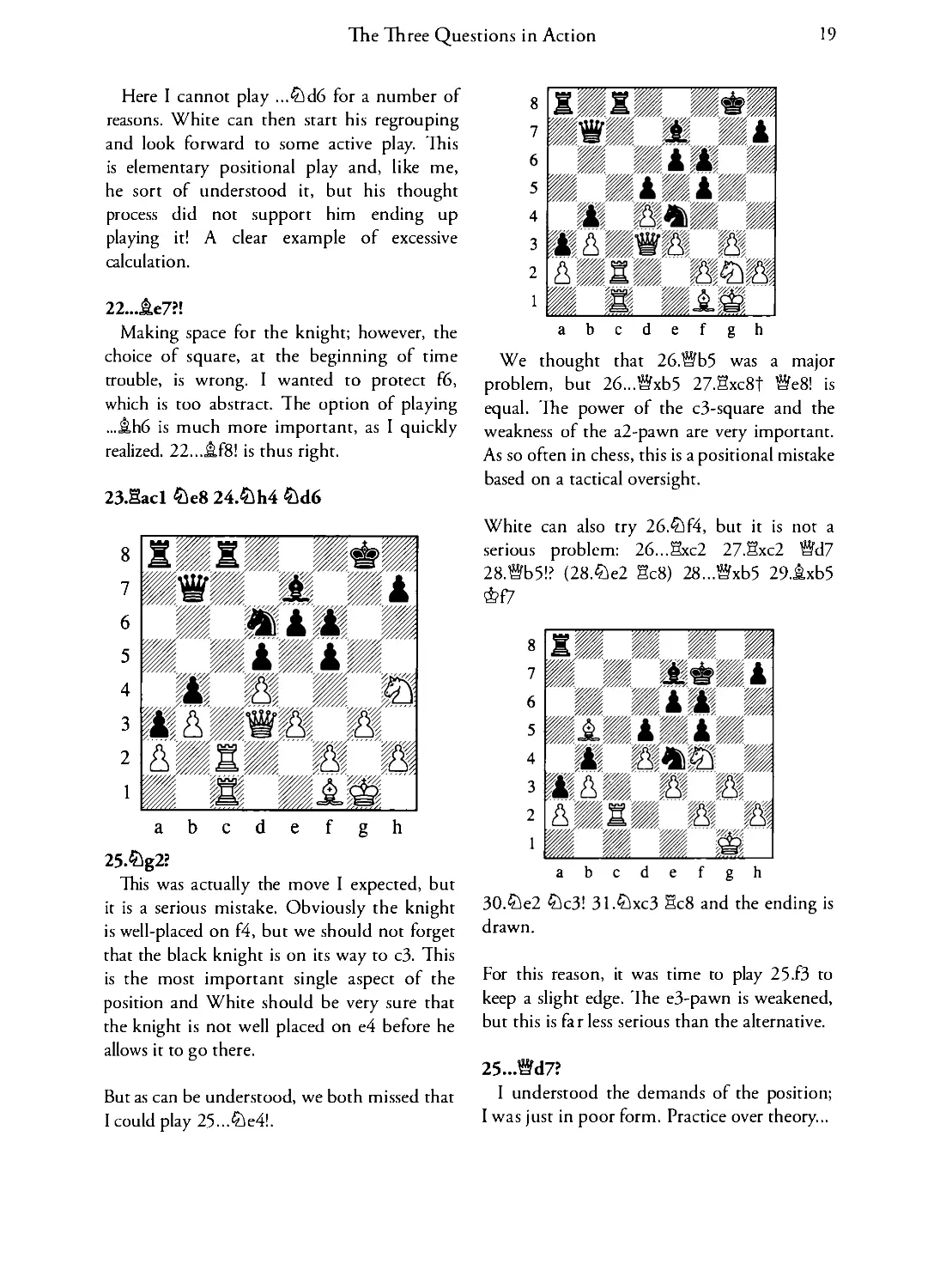
14...ll
l
e4! 15..if4 b4
abcdefgh
and either ....ib7 or ....ia6 leads co at least
even chances for Black.
18
Grandmaster Preparation - Positional Play
15.i.g5!
Now there is a long way from b8 to c3.
Against normal play it should be impossible to
make it so far without being stopped, blocked
or shot down; even if you are a fine prize
winning stallion.
15....ia6 1 6.gfcl �b7
This move is explained by the realization
that 16...E:c8? l 7.Wfxc8t is not best.
17.hf6 gxf6!?
This decision might look sound, but
fracturing my pawn structure is a long-term
an noyance. That's the negative. The positive
is chat it fights convincingly for the e5-
square. I instinctively fe lt compelled to play
chis, because my development is lacking and
because the rook would be misplaced on f6 .
Specifically I was worried about 17...E:xf6
18.e3! E:f8 19..ifU, when White is able to
exchange the right bishops.
abcdefgh
The position is only a bit better for White,
but still fe lt uncomfortable. I chink a different
player might have avoided accepting the
extra we akness, and been equally right to do
so.
18.�d3 hd3
18...'We?!? l 9.lLlc5 .ib5 was possible, but
again I was not happy with e2-e3 and .ig2-fl .
19.�xd3 �a6
le might seem ridiculous, but the position is
of such a slow nature that the knight is heading
for c3. If it gets there, I will be okay.
20.e3 gfc8 21..ifl �c7
8
7
6
5
4
3
2
1
a
22.gc2?
efgh
This is the second moment where Black's
strategy of choosing a mud-fight is rewarded.
Black is planning ...lLlc7-e8-d6-e4-c3 . White
can of course stop this with f2-f3 when we get
that far, but he wo uld prefer not to co mmit his
pawns in any way, and not to weaken his dark
squares.
Obviously I expected Surya to play f3 at some
point, but here I really expected him to find
22.lLlel! .ie7 23.Wfd2 lLle8 24. lLld3;!;.
abcdefgh
The Three Questions in Ac tion
19
Here I cannot play ...llJd6 for a number of
reasons. White can then start his regrouping
and look forward to some active play. This
is elementary positional play and, like me,
he sort of understood it, but his thought
process did not support him ending up
playing it! A clear example of excessive
calculation.
22...ie7?!
Making space for the knight; however, the
choice of square, at the beginning of time
trouble, is wrong. I wanted to protect f6,
which is too abstract. The option of playing
. . . i.h6 is much more important, as I qu ickly
realized. 22 ...i.f8! is thus right.
23Jlac l �e8 24.�h4 �d6
8
7
6
5
4
3
2
abcdefgh
25.ll
l
g2?
This was actually the move I expected, but
it is a serious mistake. Obviously the knight
is wel l-placed on f4 , but we should not forget
that the black knight is on its way to c3. Th is
is the most important single aspect of the
position and White should be very sure that
the knight is not well placed on e4 before he
allows it to go there.
But as can be understood, we both missed that
I could play 25 ...ll
l
e4!.
abcdefgh
We thought that 26.Wi'b5 was a major
problem, but 26...Wi'xb5 27.gxc8t Wi'e8! is
equal . The power of the c3-square and the
weakness of the a2-pawn are very important.
As so often in chess, this is a positional mistake
based on a tactical oversight.
White can also try 26.llJf4 , but it is not a
serious problem: 26...gxc2 27.gxc2 Wi'd7
28.Wi'b5!? (28.ll
l
e2 gc8) 28 ...Wi'xb5 29.i.xb5
@f7
For this reason, it was time to play 25.(3 to
keep a slight edge. The e3-pawn is weakened,
but this is far less serious than the alternative.
25...Wi'd7?
I understood the demands of the position;
I was just in poor form . Practice over theory...
20
Grandmaster Preparation - Po sitional Play
26.�f4 gxc2 27.gxc2 gc8
Ye s! I made it. I sort of relaxed here, with
I would of course like to play 27...llie 4, but
very little time on the clock.
after 28.%Vb5 %Vx b5 29.i.xb5 'it>f7 30.i.d? E:a6
I would not have time to play 31...llic3. After 31.�e2
3 l .llie2 E:a7 32.i.c6! i.d6 33.f3
White does not have any tactical options
8
7
6
5
4
3
abcdefgh
White is a bit better. Thus I preferred to keep
the queens on the board for the moment.
abcdefgh
28.%Vdl?
This is absolutely incredible. Who would
have thought that a playe r of this level , who
works for the world champion, wo uld allow
aknighttocomefromb8toc3insucha
position?
28.f3;!; was perpetually better for White,
although it would of course not be so easy to
actually win it.
28...gxc2 29.%Vxc2 �e4 30.Ad3 �c3
here.
After 31.g4? Black will reply 3 l.. ..id6! with
the following lines:
32.gxf5 i.xf4 33.exf4 %Vg 7t 34. 'it>hl exf5
35.i.xf5 %Vh6+ and White will not benefit a
lot from winning the h7-pawn ; the queen and
bishop are the wro ng way around. However,
the exchange of queens (h6-f4-f3-d 1) would
mean the immediate end of the game, as the
a2-pawn falls.
8
7
6
5
4
3
2
1
abcdefgh
31.•• tlxe2t?
This does not make a lot of sense. I did
not play ...llJb 8-a6-c7-e8-d6-e4-c3 simply to
ex change the knight and give away all of my
co unterplay.
31 ...'@c6 was a good deal better. I am not
aiming to do anything at all, except take back
on c3 with the pawn. He of course will put the
bishop on c2, but it will be sort of occupied,
and the position is a dead draw.
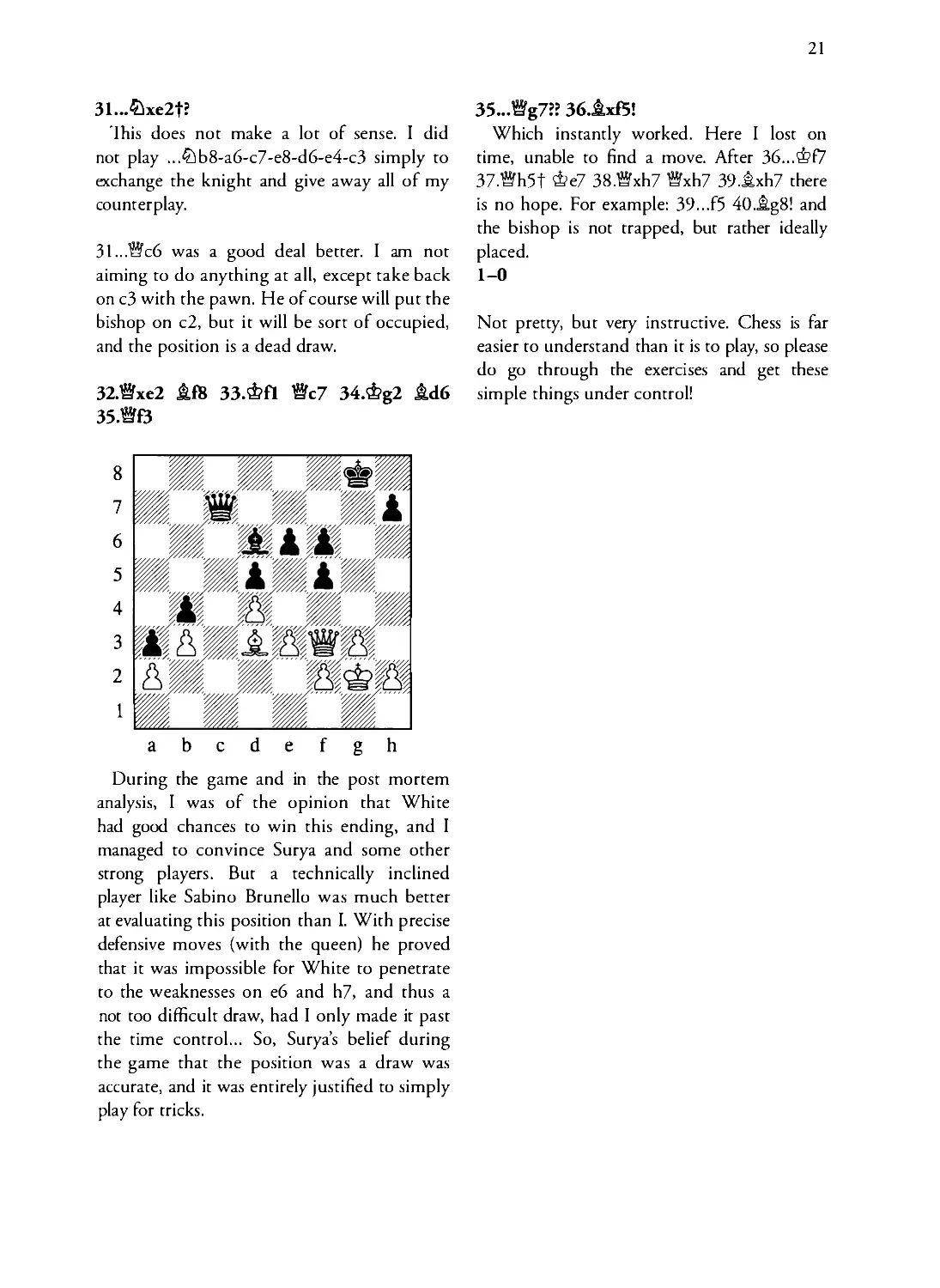
32.%Yxe2 .if'8 33.©fl %Yc7 34.©g2 .id6
35.%Yf3
8
7
6
5
4
3
2
abcdefgh
During the game and in the post mortem
analysis, I was of the opinion that White
had good chances to win this ending, and I
managed to convince Surya and some other
strong players . But a technically inclined
player like Sabino Brunello was much better
at eval uating this position than I. With precise
defensive moves (with the queen) he proved
that it was impossible for White to penetrate
co the weaknesses on e6 and h7, and thus a
not too difficult draw, had I only made it past
the time control... So, Surya's belief during
the game that the position was a draw was
accurate, and it was entirely justified to simply
play for tricks.
21
35•. • %Yg7?? 36..txB!
Which instantly worked . Here I lost on
time, unable to find a move. After 36...<i
i
f7
37.Wfh5t <tle7 38.Wfxh7 Wfxh7 39 ..ixh7 there
is no hope. For example: 39...f5 40.i.g8! and
the bishop is not trapped, but rather ideally
placed.
1-0
Not pretty, but very instructive. Chess is far
easier to understand than it is to play, so please
do go through the exercises and get these
simple things under control!
Chapter 1
Weaknesses
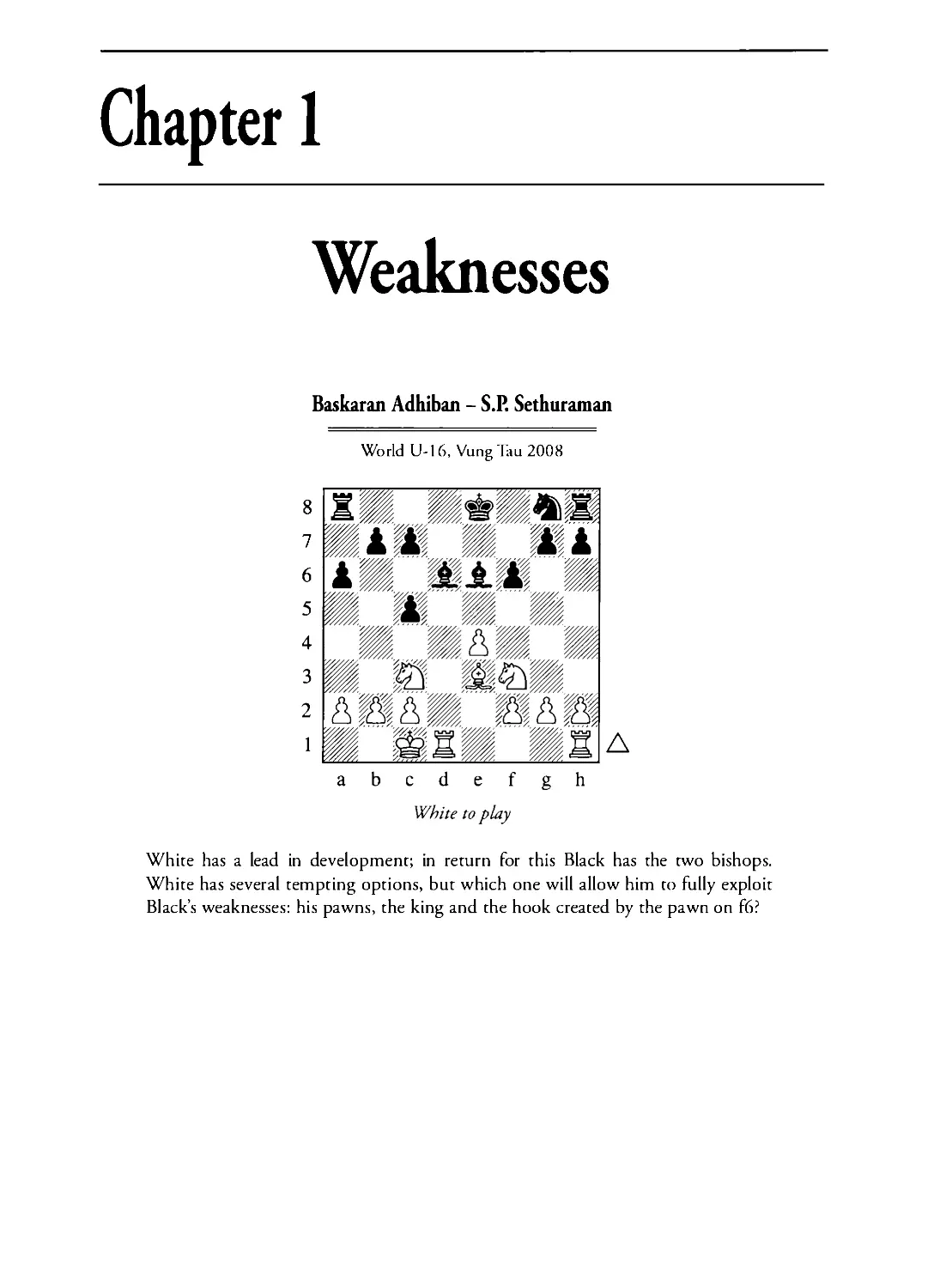
Baskaran Adhiban - S .P. Sethuraman
Wo rld U- 16, Yung Tau 2008
Wh ite has a lead in devel opment; in re turn for this Black has the two bishops.
Wh ite has several tempting options, but which one will allow him to fully exploit
Black's weaknesses: his pawns, the king and the hook created by the pawn on f6 ?
24
Grandmaster Preparation - Po sitional Play
If I had to point to one part of positional
chess that is essential, it would be having a
reasonable understanding of weaknesses.
When I wen t to a lecture by Mark Dvoretsky
in 2000 I was already a reasonable player. My
highest ra ting had been 2445 and I had been
one game away from a grandmaster norm.
Still, looking back to so me discussions he
had there, it was clear that I had the energy
of a yo ung man and decent tactical skills,
but no understanding of weaknesses and the
consequences of them .
If yo u fe ar this might be yo u, then hopefully
this book will be fantastic for yo u. Obviously
we are not starting from scratch, but if you
have reached a level where yo u think a book
called "Grandmaster Preparation" might
work for you, maybe what you need is to
get some practical dimensions added to yo ur
understanding of weaknesses.
Before we go through the basic forms of
weaknesses like a firestorm, I would like to
share a simple game where the res ult is decided
by small weaknesses escalating over time.
What I intend to show with this game is how
simple the positional aspects really are - and
how difficult they are to handle. Aronian does
not make any obvious positional mistakes .
What happens is that he takes a few liberties
to make the game a bit more lively (7 ...g6) ,
then he finds himself in a slightly unpleasant
position and needs to find a way to solve his
problems. This is not so easy and in the end
it all falls down because of a tactical oversight.
But the beginning of all the problems came
from the weakening of the queenside (6...a6) ,
which was ful ly justified, but came with some
obligations. These increased until eventually
Black had more problems than he could
handle.
Vladimir Kramnik - Levon Aronian
Istanbul (ol) 20 12
1.d4 d5 2.c4 c6 3.lti c3 �f64.cxd5
This game was played on Board One in the
Olympiad between the two favo urites and later
joint winners (with Armenia taking gold on
tie-break) . Kram nik seems to think that a 2-2
res ult wo uld not be a disaster and that Russia
are favouri tes on the last three boards. In
real ity the 2-2 was only achieved by Kram nik's
win in this game, but the players had no way
of knowing this at this point.
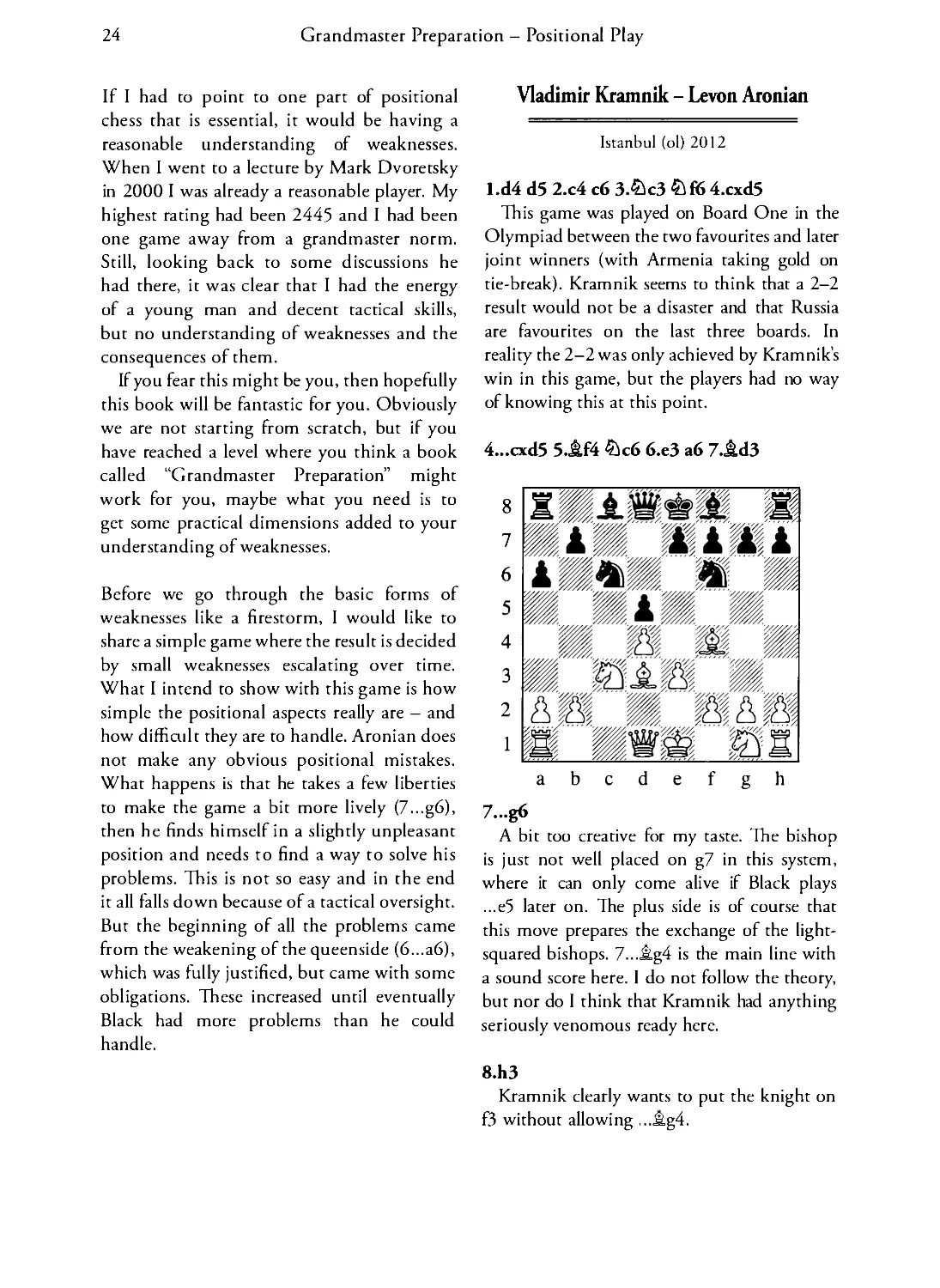
4...cxd5 5 ..if4 ltic6 6.e3 a6 7..id3
7...g6
A bit too creative for my taste. The bishop
is just not we ll placed on g7 in this system ,
where it can only come alive if Black plays
. .. e5 later on. The plus side is of course that
this move prepares the exchange of the light
squared bishops. 7 . . .ig4 is the main line with
a sound score here. I do not follow the theory,
but nor do I think that Kram nik had anything
seriously ve nomous ready here.
8.h3
Kramnik clearly wants to put the knight on
f3 without allowi ng ...ig4 .
Chapter 1 - We aknesses
25
8•.•if5 9.c!lif'3
I wo nder if Aronian was intending to play
9.ixf5 gxf5 10.tt:lf3 1:%g8 !? and leave the king
in the centre? This is the only reason I can find
for taking on d3 on the next move - barring
indecision. I am not sure chis would be fully
sound , but in any case I already prefer White
ever so slighcly.
9...ixd3
9...ig7 10.ixf5 gxf5 wo uld not give Black
co ntrol of the g-file immediately, but ...0 -0 ,
. . .©h8 and ...1:%g8 could be considered .
However, I am not sure Kram nik wo uld have
taken on f5 .
10.Wxd3 ig7 11.0 -0 0 -0 12J:Ucl e6
le is fair to say chat the opening is over. The
minor pieces are out and the ki ngs are safe. A
long-term strategy for the middlegame should
be devised .
To be able to do so successfully, we need to
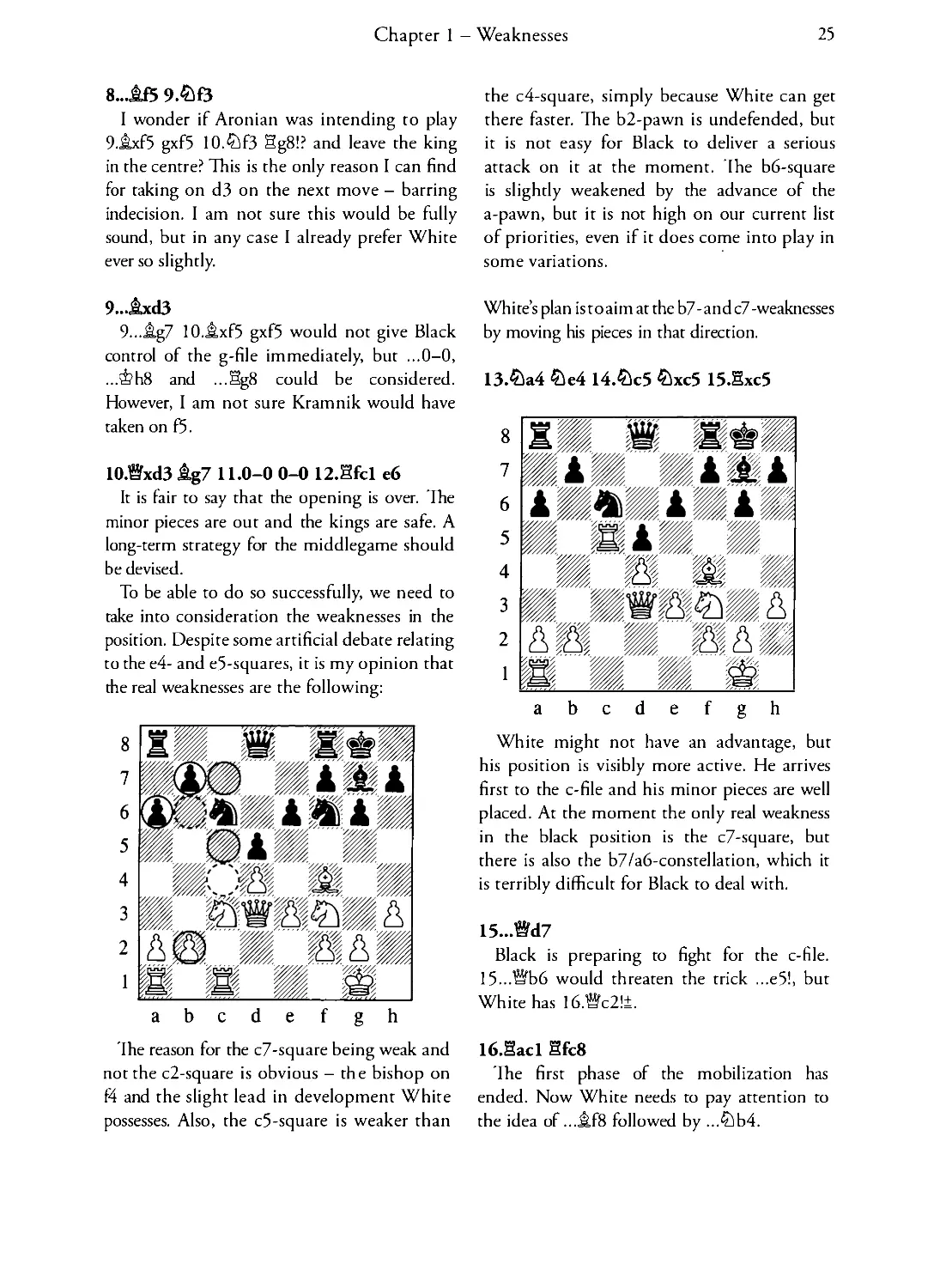
take into consideration the weakn esses in the
position. Despite some artificial debate rel ating
to the e4- and e5-squares, it is my opinion chat
the real wea knesses are the following:
abcdefgh
The reason for the c7-square being weak and
not the c2-square is obvious - the bishop on
f4 and the slight lead in development White
possesses. Also , the c5-square is weaker than
the c4-square, simply because Wh ite can gee
there faster. The b2-pawn is undefended , but
it is not easy for Black to deliver a serious
attack on it at the moment. The b6-square
is slighcly weakened by the advance of the
a-pawn, but it is not high on our current list
of priori ties, even if it does come into play in
some variations.
Wh i te's plan is toaim at the b7-and cl-weaknesses
by moving his pieces in chat direc tion.
13.c!lia4 c!lie4 14.c!lic5 c!lixc5 15Jhc5
.1m���-�
8
�i
,.
..
.
,,.,,/,
7 m1.m m•�•
���fL-1
6 1.m'A)m1.m1.�
5���·-
/,,,,.Y,
�m�
4m�I]�
3 m mif�ttJ��
2:8
�mL!�:�
�mm �
abcdefgh
Wh ite might not have an advan tage , but
his position is visibly more active. He arrives
first to the c-file and his minor pieces are we ll
placed . Ac the moment the only real we akness
in the black position is the c7-square, but
there is also the b7/a6-constel lation, which it
is terribly difficult for Black to deal with.
15...Yfd7
Black is preparing to fight for the c- file.
15...Wb6 would th reaten the crick ...e5!, but
Wh ite has 16.Wc2!::t.
l 6J�acl �Uc8
The first phase of the mobilization has
ended . Now Wh ite needs to pay attention to
the idea of ....if8 followed by ...tt:lb4.
26
Grandmaster Preparation - Positional Play
17.a3! .tf8 18.�5c2
18...f6
In the press conference right after the game,
Kram nik said that maybe this move was partly
to blame for Black's downfall. I think this is
too harsh. Certainly this move (intended to
rei nforce th e e5-square) weakens the pawn
on e6, adding some responsibilities for Black.
However, the benefits are worth it. These extra
respo nsibilities needed to be dealt with rapidly
and with accuracy; and it seems that Black did
not find the right way to do so in the game.
This is always the case with positions that
are under a bit of press ure. Yo u need to play
accurately at some moments, and if you don't,
yo ur position can rapidly become worse and
worse.
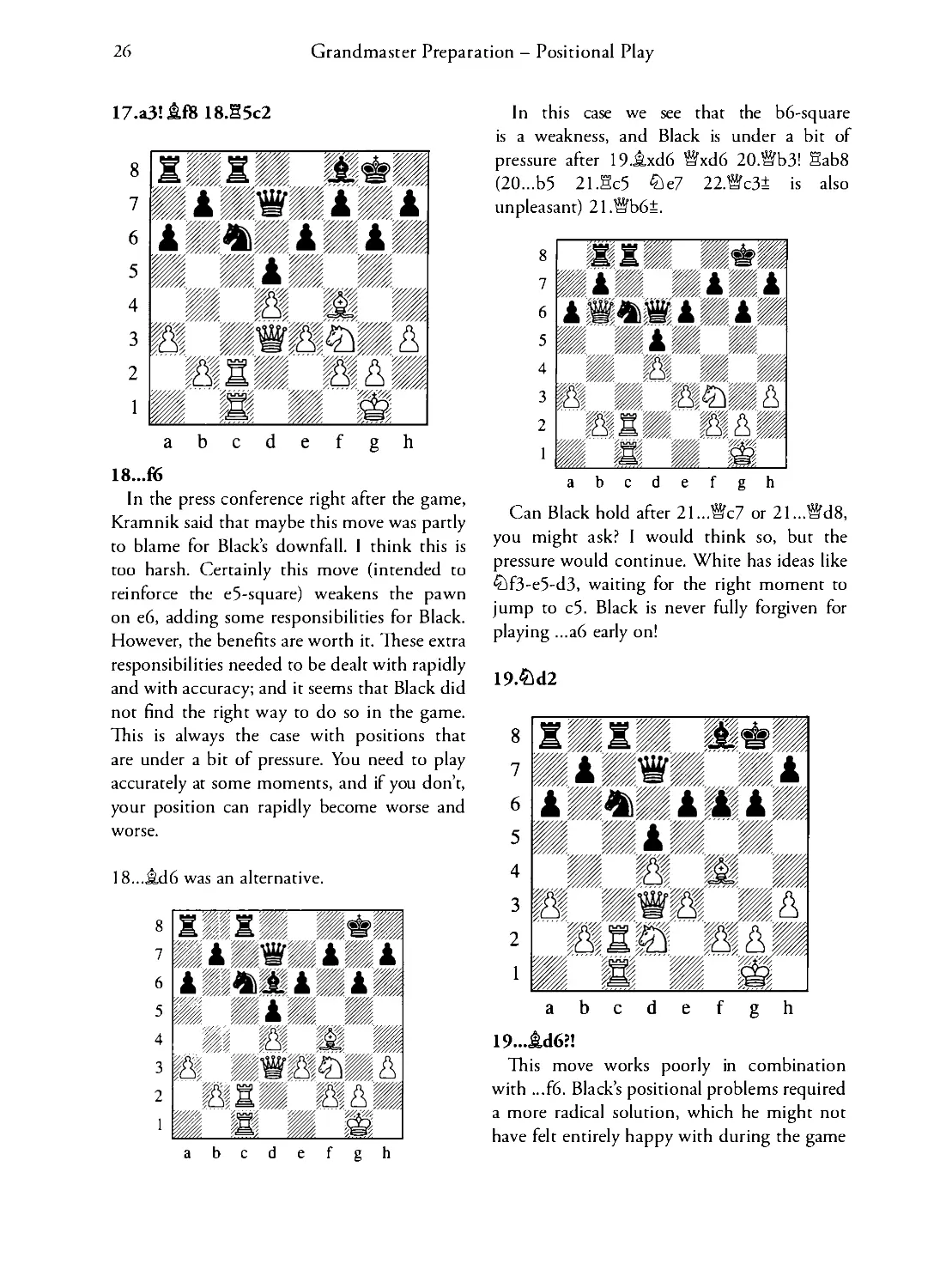
18...ii.d 6 was an alternative.
abcdefgh
In this case we see that the b6-square
is a weakness, and Black is under a bit of
pressure after l 9.ii.xd6 Wfxd6 20.Wfb3! l'i:a b8
(20...b5 2 l.l'i:c5 Ci:Je7 22.Wfc3;!; is also
unpleasant) 2 I.Wfb6;!;.
abcdefgh
Can Black hold after 21...Wfc7 or 21...Wfd8,
you might ask? I would think so, but the
pressure wo uld continue. White has ideas like
Ci:Jf3-e5-d3, waiting for the right moment to
jump to c5. Black is never fully forgiven for
playing ...a6 early on!
19.tl
l
d2
8 .1m0.1m0 -·
:'""-'�
� · �-----%�
: �� �����lJ!j
3"'�
�n'VD '� 8
,,, ,. % �n � ��:·//.f----%�/%�-
%
�
2
r�l�LID r� ti�
1 �%,,,,%��--- - --
-%,,,,%=
abcdefgh
19...i.d6?!
This move works poorly in combination
with .. .f6. Black's positional problems required
a more radical solution, which he might not
have fe lt entirely happy with during the game
Chapter 1 - We aknesses
27
-
or dare I suggest - he may not even have
seen.
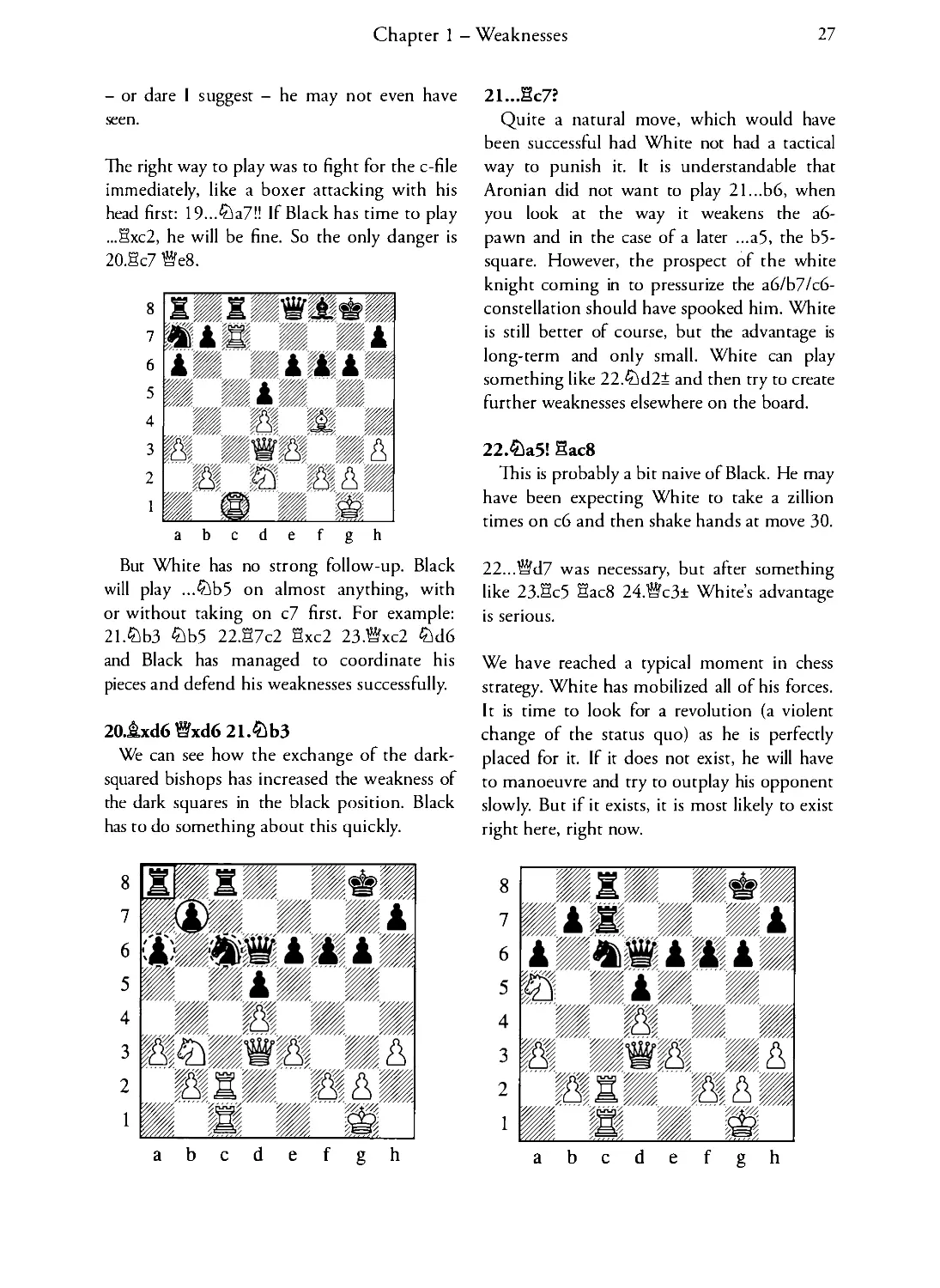
The right way to play was to fight for the c-file
immediately, like a boxer attacking with his
head first: l 9 ...lLia7!! If Black has time to play
... E:xc 2, he will be fine. So the only danger is
20. E:c7 We8 .
g �-ziz•!�-
7 ··�� ••,
6,,
,
,.;
,
Y.-·�••
:�.-�·-··
3� •v� •�
· ···-�wfi%.��m
.
r JWfi%.��
2
ro% /�_J ro%o�
z.. zh
. »....z...z�
abcdefgh
But Wh ite has no strong follow-up. Black
will play ...lLib5 on almost anything, with
or without taking on c7 first. For example:
21.ll
l
b3ll
l
b5 22.:B:7c2 :B:xc2 23.Wxc2 lLid6
and Black has managed to coordinate his
pieces and defend his weaknesses success fully.
20.ixd6 Wfxd6 21.tl
l
b3
We can see how the exchange of the dark
squared bishops has increased the weakness of
the dark squares in the black position. Black
has to do something about this quickly.
abcdefgh
21..Jk??
Qu ite a natural move , which would have
been successful had Wh ite not had a tactical
way to punish it. It is understandable that
Aronian did not want to play 21...b6, when
you look at the way it weakens the a6-
pawn and in the case of a later ...a5, the b5-
square. However, the prospect of the wh ite
knight co ming in to press urize the a6/b7/c6-
constellation should have spooked him. Wh ite
is still better of course, but the advan tage is
long-term and only small. Wh ite can play
something like 22.lLid2;!; and then try to create
further weaknesses elsewhere on the board.
22.lliaS! �fac8
This is probably a bit naive of Black. He may
have been expecting Wh ite to take a zillion
times on c6 and then shake hands at move 30.
22...Wd7 was necessary, but after something
like 23.:B:c5 :B:ac8 24.Wc3± Wh i te's advan tage
is serious.
We have reached a typical moment in chess
strategy. Wh ite has mobilized all of his forces .
It is time to look for a revolution (a violent
change of the status quo) as he is perfectly
placed for it. If it does not ex ist, he will have
to manoeuvre and try to outplay his opponent
slowly. But if it exists, it is most likely to exist
right here, right now.
abcdefgh
28
Grandmaster Preparation - Po sitional Play
23.�xb7!! gxb7 24.Y!
!l'
xa6 gbc7 25.b4
Black is tied up completely.
25•••Y!
!i
d? 26.Y!
!l'
b6!
Accurate, although White should also win
after 26.b5 Ci:Je7 27.'f1xc7 'f1xc7 28.'f1xc7 Wxc7
29.WxeGt 'i!?g7 30.a4 with best play. This line
indicates that Aronian failed to see the knight
sacrifice completely (and thus was expecting
the game to just end in a draw) , as he would
never have allowed this either, had he seen it.
And there is no subtlety to miss in this line at
all.
26•••Y!
!l'
es
Black is just lost.
26...Wd6 is best met with 27.'f1c3! followed by
b4-b5.
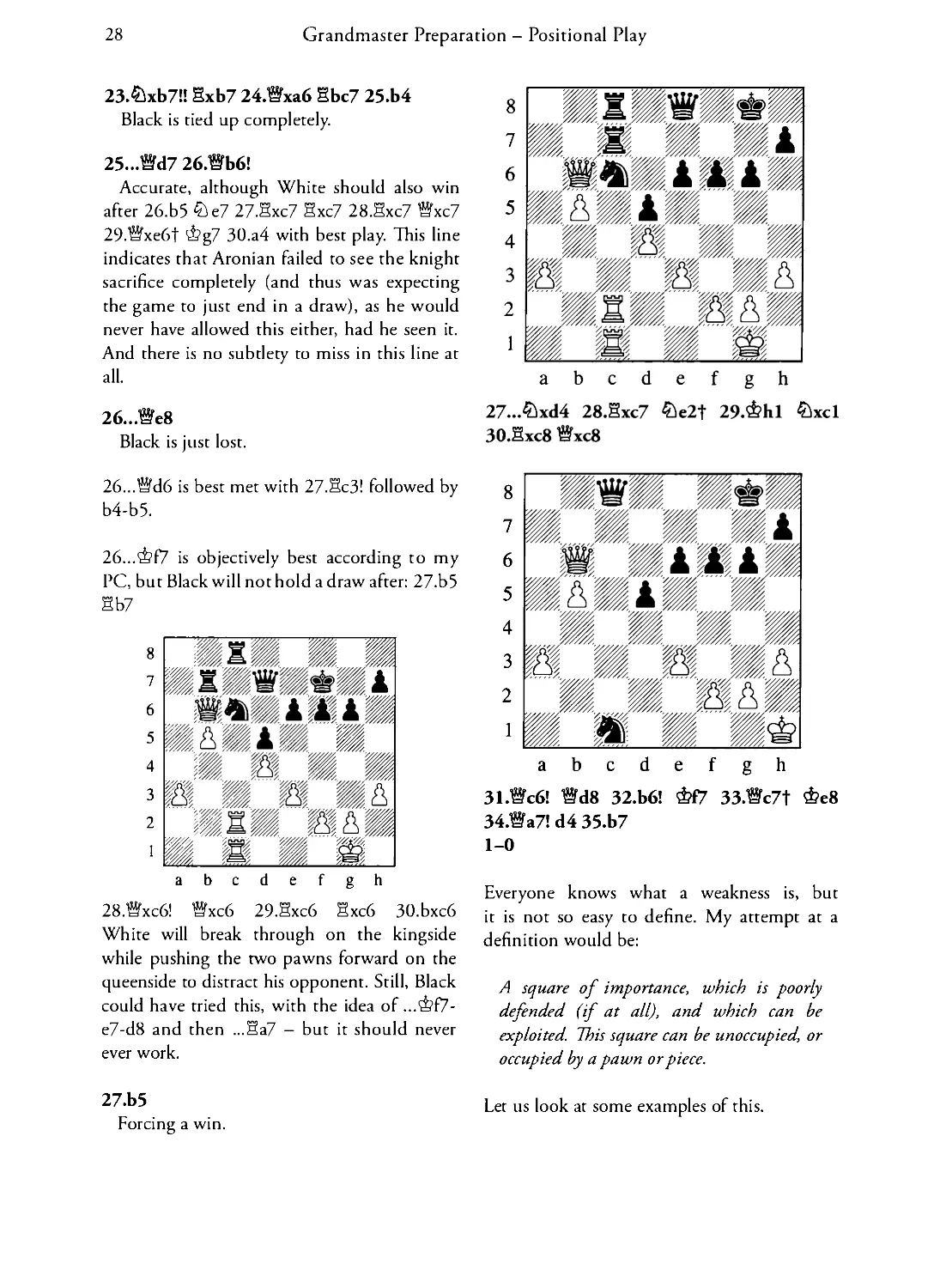
26...'i!?f7 is objectively best according to my
PC, but Black will not hold a draw after: 27.b5
'f1b7
8
:�.i-�.
:�111!1!�
5�8··· ..
4���·-
3
·:;J' �
�zz
� �.8
2 z ,�,.� .%�r�
1'
�.'
abcdefgh
28.Wxc6! Wxc6 29.'f1xc6 'f1xc6 30.bxc6
Wh ite will break through on the kingside
while pushing the two pawns forward on the
queenside to distract his opponent. Still, Black
could have tried this, with the idea of ...'i!?f7-
e7-d8 and then ... 'f1a7 - but it should never
ever work.
27.b5
Forcing a wi n.
8
7
6
5
4
3
2
abcdefgh
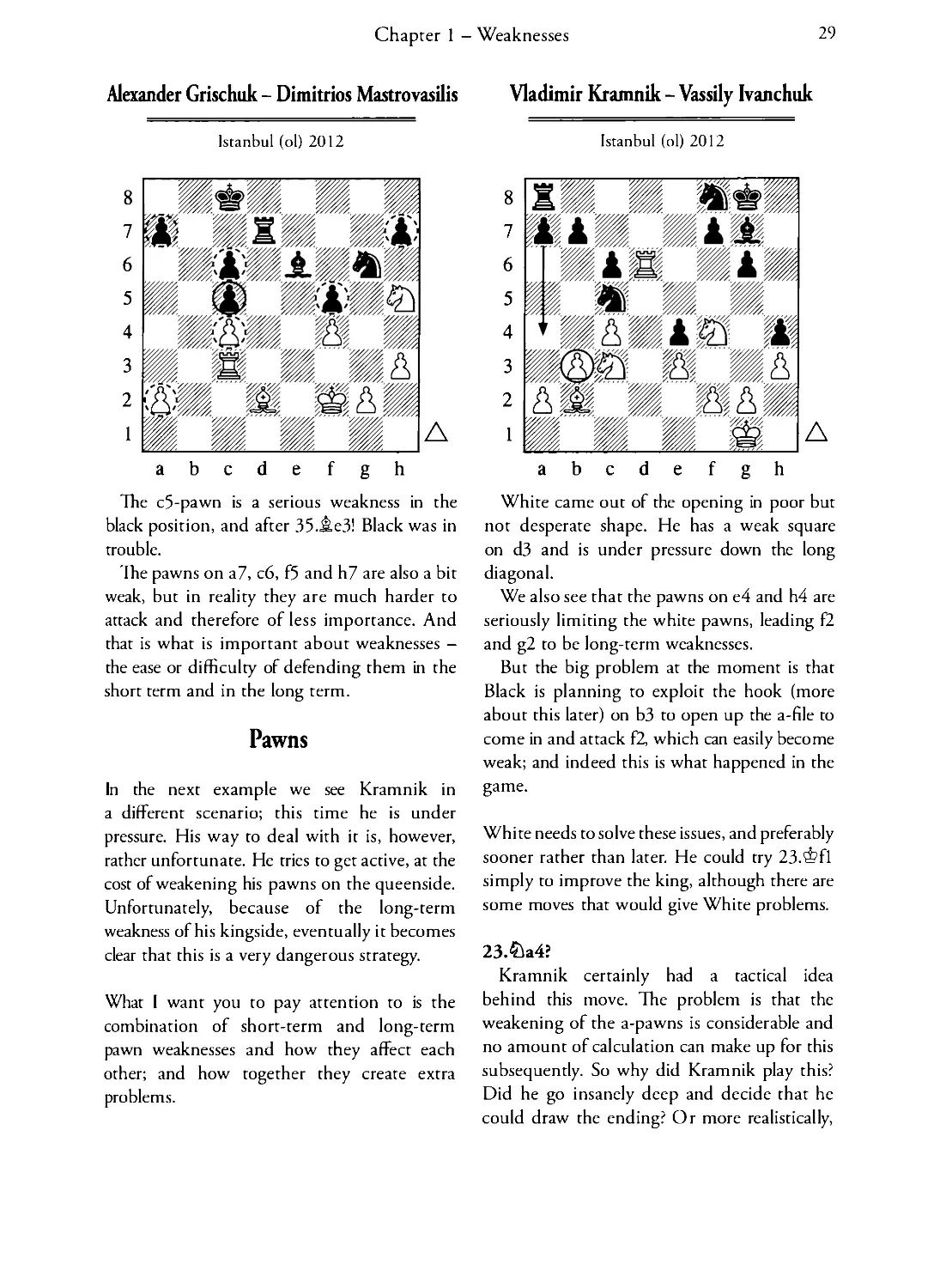
31.Y!
!l'
c6! Y!
!l'
ds 32.b6! ©f7 33.Y!
!l'
c?t ©es
34.Y!
!l'
a7! d4 35.b?
1-0
Everyone knows what a weakness is, but
it is not so easy to define. My attempt at a
definition wo uld be:
A square of importance, which is poorly
defended (if at all), and which can be
exploited. 7his square can be unoccupied, or
occupied by a pawn or piece.
Let us look at some examples of this.
Chapter 1 - We aknesses
29
Alexander Grischuk - Dimitrios Mastrovasilis
8
7
6
5
4
3
2
Istanbul (ol) 20 12
abcdefgh
The c5-pawn is a serious weakness in the
black position, and after 35.�e3! Black was in
trouble.
Thepawnsona7,c6,f5 andh7arealsoabit
weak, but in reality they are much harder to
attack and therefore of less importance. And
that is what is important about weaknesses -
the ease or difficulty of defending them in the
short term and in the long term .
Pawns
In the next example we see Kram nik in
a different scenario; this time he is under
pressure. His way to deal with it is, however,
rather unfortunate. He tries to get active, at the
cost of weakening his pawns on the queenside.
Un fortunately, because of the long-term
weakness of his kingside, eventually it becomes
clear that this is a very dangerous strategy.
What I want you to pay attention to is the
co mbination of short-term and long-term
pawn weaknesses and how they affect each
other; and how together they create extra
problems.
Vladimir Kramnik - Vas sily lv anchuk
8
7
6
5
4
3
2
Istanbul (ol) 20 12
abcdefgh
White came out of the opening in poor but
not desperate shape. He has a weak square
on d3 and is under pressure down the long
diagonal.
We also see that the pawns on e4 and h4 are
seriously limiting the white pawns, leading f2
and g2 to be long-term wea knesses .
But the big problem at the moment is that
Black is planning to exploit the hook (more
about this later) on b3 ro open up the a-file ro
come in and attack f2, which can easily beco me
weak; and indeed this is what happened in the
game.
White needs to solve these issues , and preferably
sooner rather than later. He could try 23. <j;ifl
simply to improve the king, although there are
some moves that would give Wh ite problems.
23.�a4?
Kramnik certainly had a tac tical idea
behind this move. The problem is that the
weakening of the a-pawns is considerable and
no amount of cal culation can make up for this
subsequently. So why did Kram nik play this?
Did he go insanely deep and decide that he
could draw the ending? Or more re alistically,
30
Grandmaster Preparation - Po sitional Play
did he have a bad day and overlook something?
I believe the latter.
23.ia3 wo uld not fully work: 23 ...tt:\xb3
24. tt:\xe4 tt:\a5 25.c5 tt:\c4 26.i:'!d3 ie5+
So for this reason 23.i:'!d I!? is a decent move.
The main point behind this move is that
the rook is no longer in the way of ia3xf8.
The idea is that after 23...a5 White can play
24.ia3! ixc3 25.ixc5 with full equality.
Thus 23 ...tt:\fe 6 seems to be the stro ngest
option. Black is certainly a little more
comfortable after 24. tt:\xe6 tt:\xe6 25.tt:\a4
ixb2 26. tt:\xb2 iif8+. Black has more space
and White will have to use a few moves to
bring the knight back into the game.
23.tt:\dl is better than the game, if nothing
else. After 23...ixb2 24. tt:\xb2 a5+ we have a
position that lvanchuk could have chosen in
the game (after 23.tt:\a4 ixb2 White could not
play 24. tt:\xc5? ia3!). I guess that Kramnik
wan ted his knight to be on a4 in other lines,
but the val ue of this is seriously in doubt.
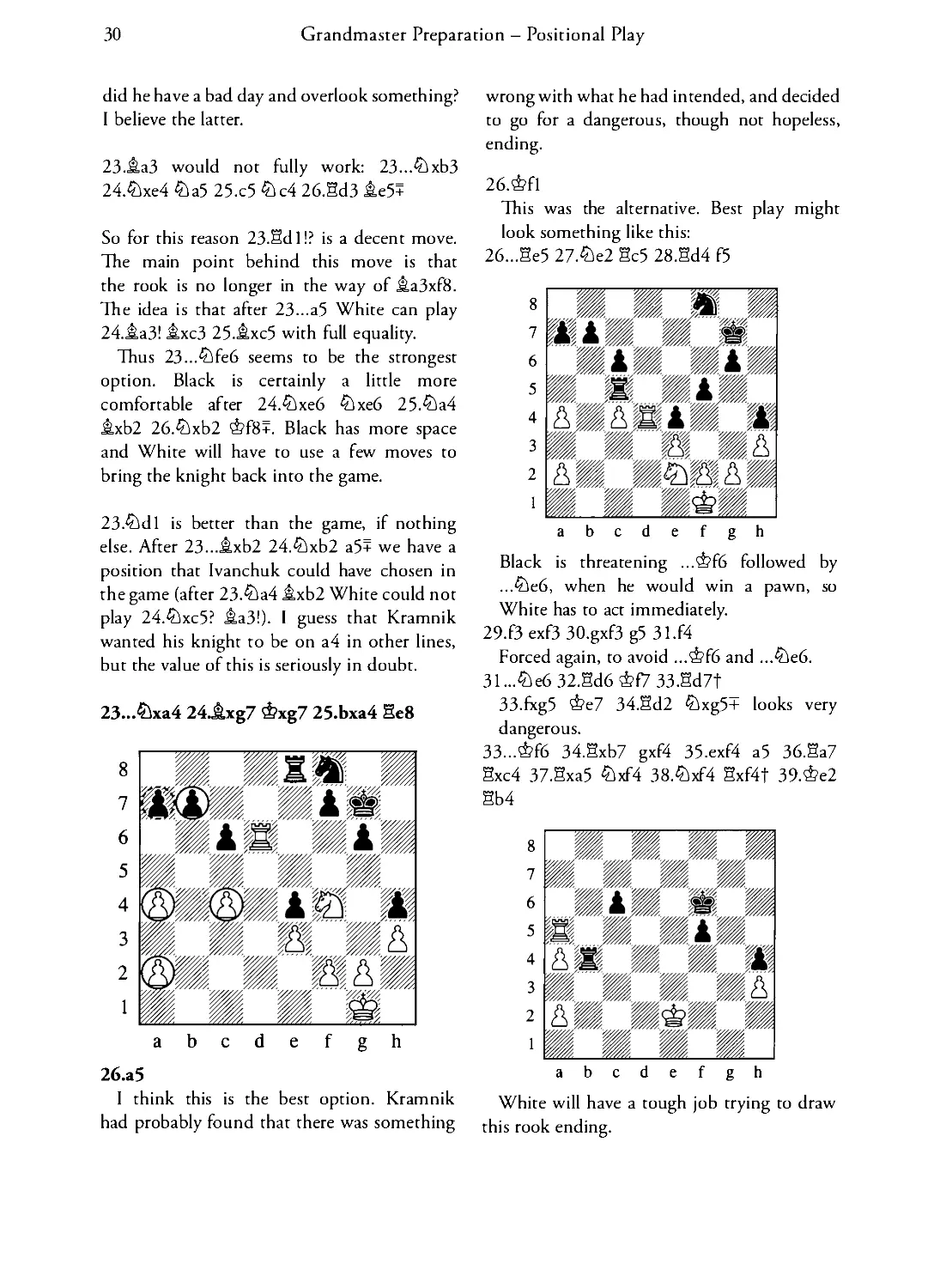
23...�xa4 24.bg? ©xg7 25.bxa4 ge8
abcdefgh
26.aS
I think this is the best option. Kram nik
had probably found that there was something
wrong with what he had intended, and decided
to go for a dangerous, though not hopeless,
ending.
26.iifl
This was the alternative. Best play might
look something like this:
26...i:'!e5 27.tt:\e2 i:'!c5 28.i:'!d4 f5
abcdefgh
Black is threatening ...iif6 followed by
...tt:\e6, when he would win a pawn, so
White has to act immediately.
29.f3 exf3 30.gxf3 g5 31.f4
Forced agai n, to avo id ...iif6 and ...tt:\e 6.
3 l ... tt:\e6 32.i:'!d6 ©f7 33.i:'!d?t
33.fxg5 iie7 34.i:'!d2 tl
l
xg5+ looks very
dangerous.
33...iif6 34.i:'!xb7 gxf4 35.exf4 a5 36.i:'!a7
i:'!xc4 37.i:'!xa5 tt:\xf4 38.tt:\xf4 i:'!xf4t 39.iie2
i:'!b4
abcdefgh
White will have a tough job trying to draw
this rook ending.
Chapter 1 - Weaknesses
31
26 ...a6 27,gd2 l3e5 28,gb2 l3xa5 29Jhb7
gxa2 30Jk7 galt 3l.@h2 go 32.gxc6
gxf2 33J�xa6 gc2
34...l3xc4 35.@gl
In Chess Today, Alexander Baburin called
this a "wi nnable ending" . I am not entirely
certain about chis, but it is clear that Black is
very close to the full point with his extra pawn .
In the end lvanchuk could not find a plan co
create the greates t difficulcies for his opponent,
and the game was drawn on move 77.
The next example is also somewhat dynamic,
but then most high-level chess is. le illustrates
the weakness of the c5-pawn in combination
with the weakening of the b6- and e6-squares,
created by the advance of the pawns (once
again chose moves had good functions; all
moves will weaken the control over at lease one
square) .
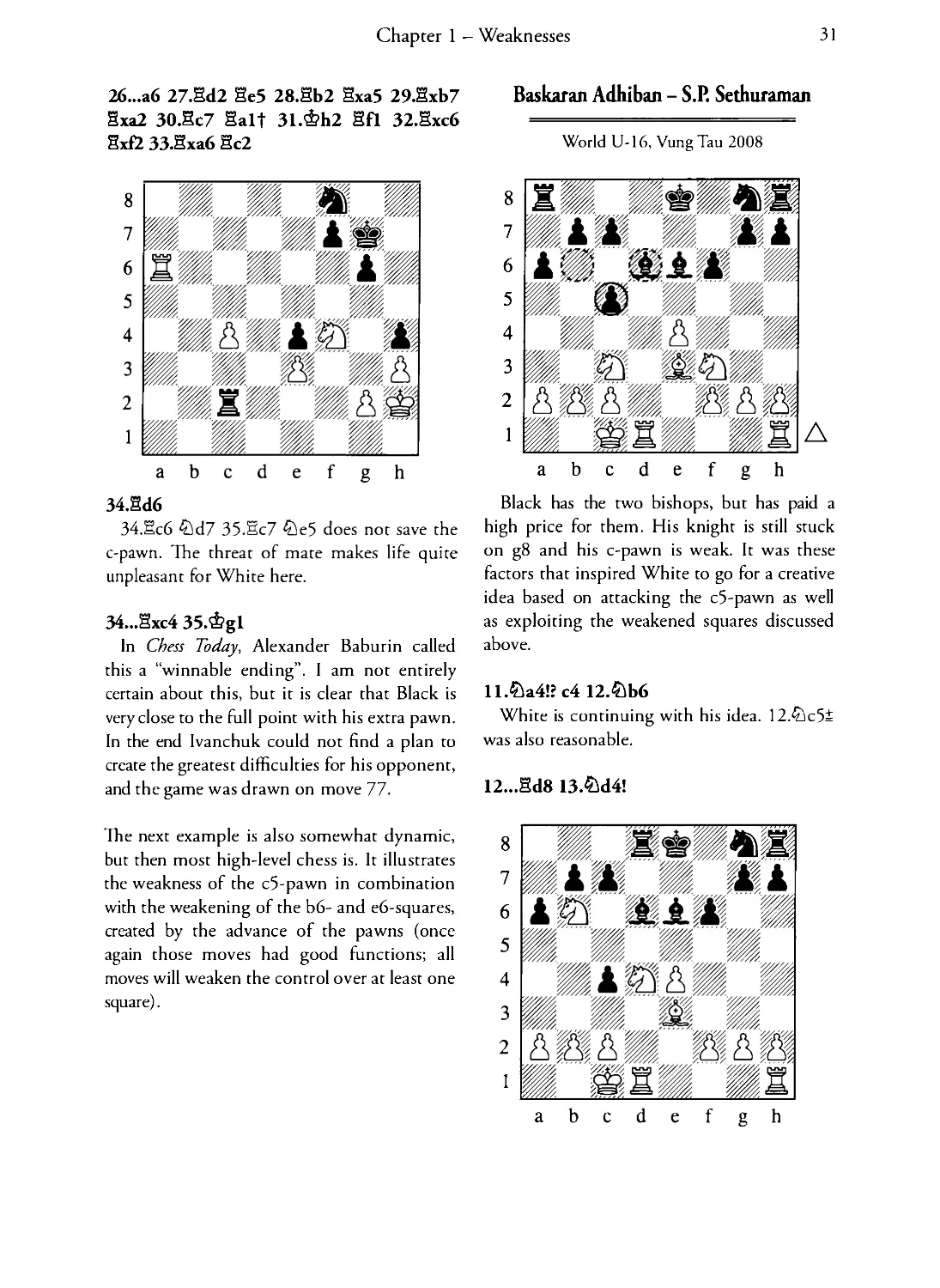
Baskaran Adhiban - S .P. Sethuraman
World U-16, Yung Ta u 2008
8
7
6
5
4
3
2
abc
e
Black has the two bishops, but has paid a
high price for them . His knight is still stuck
on g8 and his c-pawn is weak. le was these
factors chat inspired Wh ite co go for a creative
idea based on attacking the c5-pawn as well
as exploiting the weakened squares discussed
above.
I l.c!lia4!? c4 12.�b6
White is continuing with his idea. l 2.tt'lc5;1;
was also reasonable.
12..,gd8 13.�d4!
32
Grandmaster Preparation - Positional Play
Th is was the point. Eve rything is hanging
and Black has problems defending the c4-
pawn.
13....if7?
This loses a pawn without a fight; there was
only one way to battle on.
13...ig4!
Black wins an important tempo, making it
possible to take the knight on b6 and save
the pawn on c4.
14.f3 cxb6 15.fxg4 ic5!
This pin is essen tial to slow White down.
16.lLif5
This is the only co nsistent move, although
Black is also fighting for equality after l 6.c3
b5 17.'t
t>
c2 lLie7 18.g5t.
16...ixe3t 17.lLixe3 b5 18.lLif5
8
��·41
0 % 0.,, ,,Y,�
,,,,,
:,,�.�-��
:�"-'ft�
�!�d���!�
I
r ,rkrir. �-�
abcdefgh
White's position is apparently overwhelming,
but if yo u look at the basic elements (the
worst-placed piece is the g8-knight, the g4-
pawn is weak and White is planning to win
a pawn) we can see that Black can fight back
with an active move :
18...lLihG! l 9.i:l:xd8t
Wh ite goes for a better rook ending.
Black wo uld also have reasonable drawing
chances after 19.lLixg?t 't
t>
f7 20.lLih5 lLixg4
21.i:
:i:
dfl i:
:i:
d6t.
19...li
i
xd8 20. i:
:i:
d1t 't
t>
c7 21.lLixhG gxh6 22.h3
i:
:i:
g8 23.i:
:i:
d2!t
8
�,,� �,,�� ��
7�·- ��·
���-% �-�
6 ·���� �·
: �,,�!�!�
���
� :r-�:r-���� :r-8
,,,%=
,
,
,,
v.� �.
abcdefgh
White is planning i:
:i:
f2-f5 with enduring
pressure. Black would have to play really well
to hold this ending. Still, this is much better
than the game.
8
7
6
5
4
3
2
1
abcdefgh
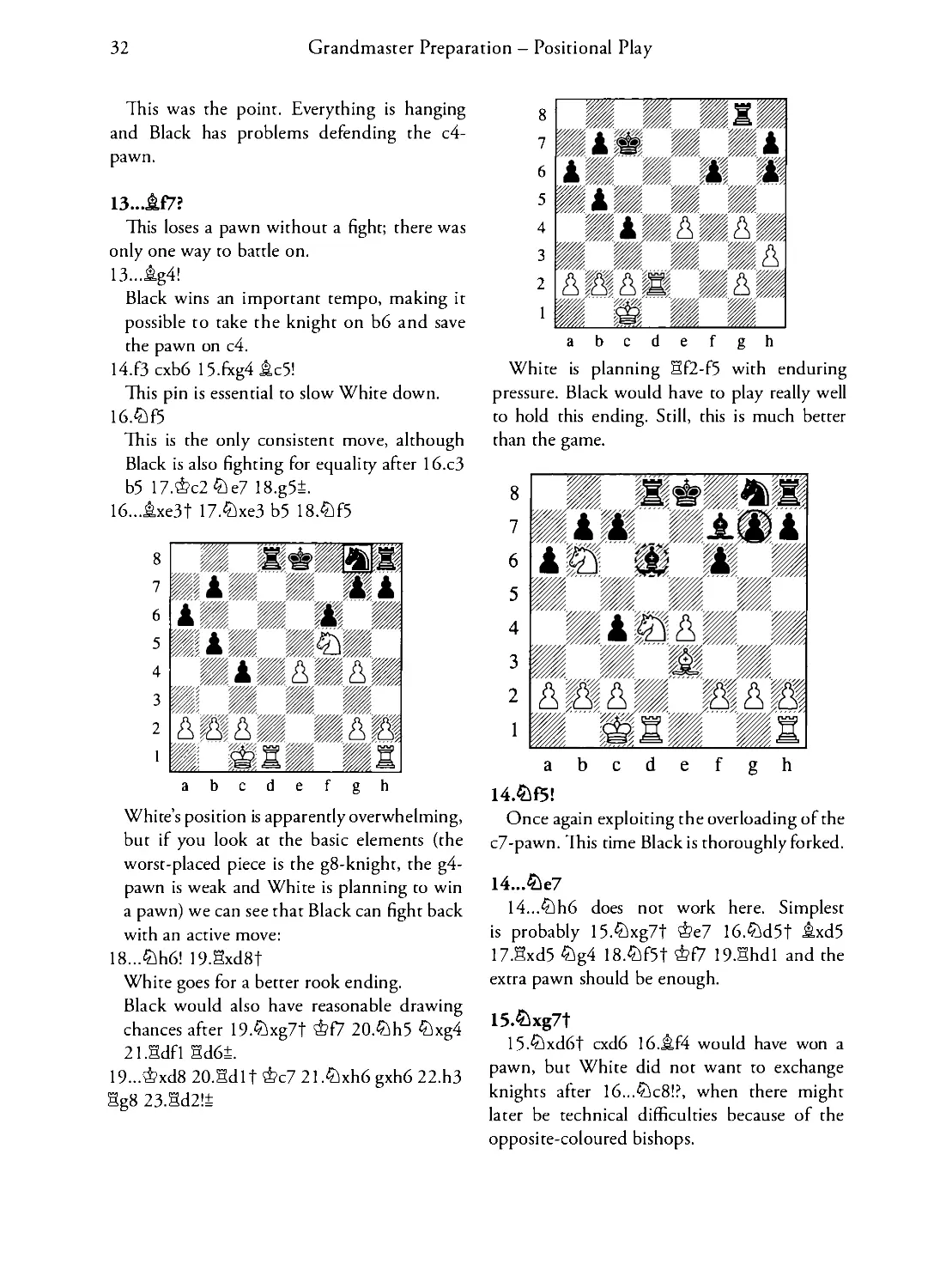
14.�f5!
Once agai n exploiting the overloading of the
c7-pawn . This time Black is thoroughly forked .
14...c!Lie?
14...lLih G does not work here. Simplest
is probably 15.lLixg?t ltie7 16.lLid5t ixd5
17.i:l:xd5 lLig4 18.lLif5t 't
t>
f7 19.i:
:i:
hdl and the
extra pawn should be enough.
15.c!Lixg?t
15.lLixdGt cxd6 16.if4 would have won a
pawn, but White did not want to exchange
knights after 16...lLic8!?, when there might
later be technical difficulties because of the
opposite-coloured bishops.
Chapter 1 - We aknesses
33
15 ...<i>f'S 16.i.h6 ©gs 17.�a4±
8
7
6
5
4
3
2
abcdefgh
Wh ite won on move 38.
Squares
We have already touched a little on weakened
squares with the above example. The main
difference between weak pawns and weak
squares (looking beyond the price tag here) is
probably that weakened pawns are generally
static in nature, while weakened squares
usually create dynamic possibilities. This is
well illustrated in the following example:
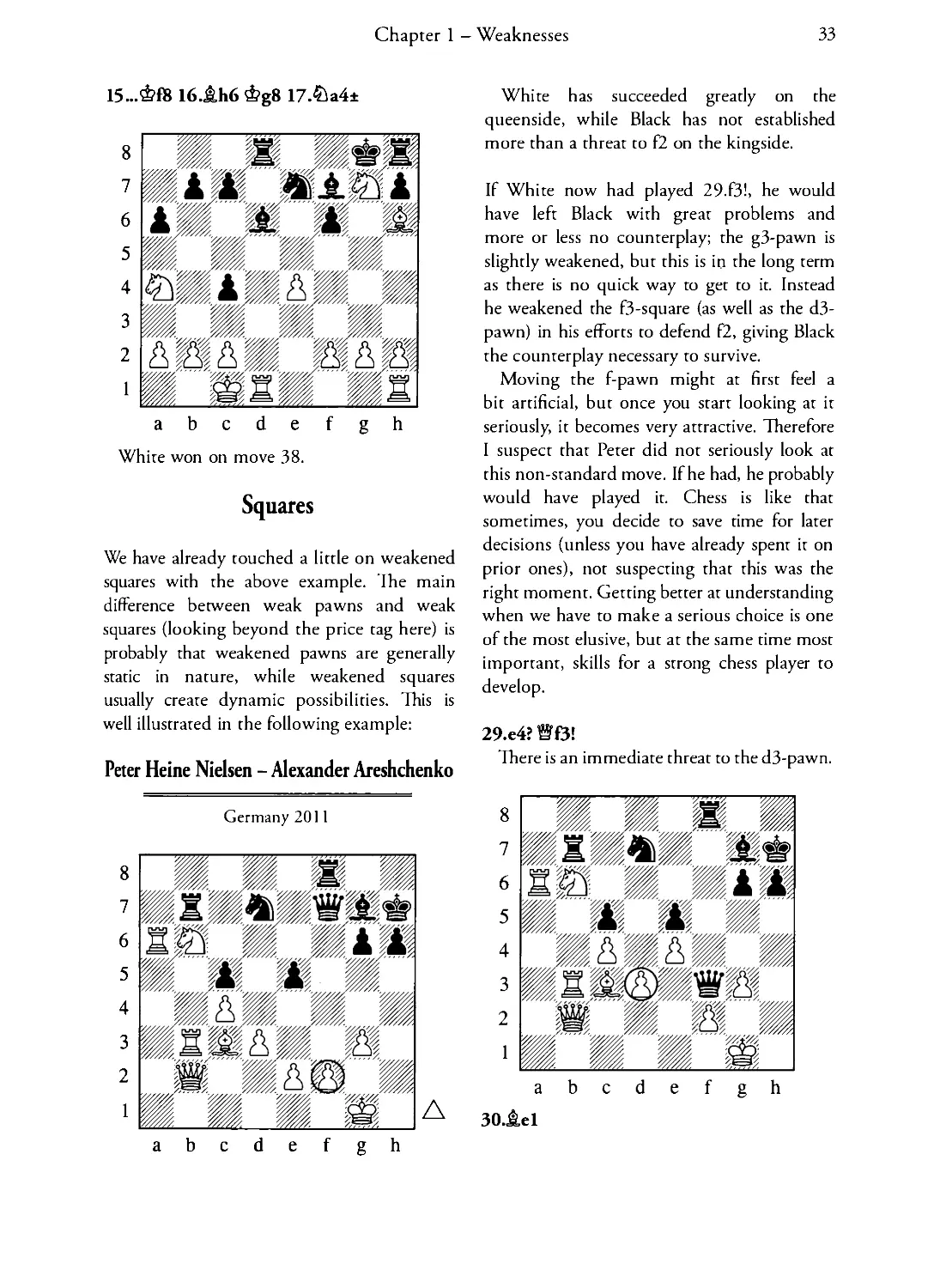
Peter Heine Nielsen -Alexander Areshchenko
8
7
6
5
4
3
2
Germany 20 1 1
abcdefgh
White has succeeded greatly on the
queenside, while Black has not established
more than a threat to f2 on the kingside.
If White now had played 29.f3!, he wo uld
have left Black with great problems and
more or less no counterplay; the g3-pawn is
slightly weakened, but this is in the long term
as there is no quick way to get to it. Instead
he weakened the f3 -square (as well as the d3-
pawn) in his efforts to defend f2, giving Black
the counterplay necessary to survive.
Movi ng the f- pawn might at first fe el a
bit artificial, but once you start looking at it
seriously, it becomes very attractive. Therefore
I suspect that Pe ter did not seriously look at
this non-standard move . If he had, he probably
wo uld have played it. Chess is like that
sometimes, you decide to save time for later
decisions (unless you have already spent it on
prior ones) , not suspecting that this was the
right moment. Getting better at understanding
when we have to make a serious choice is one
of the most elusive, but at the same time most
important, skills for a strong chess player to
develop.
29.e4? V;Yf3!
There is an immediate threat to the d3-pawn.
30.i.e l
34
Grandmaster Preparation - Positional Play
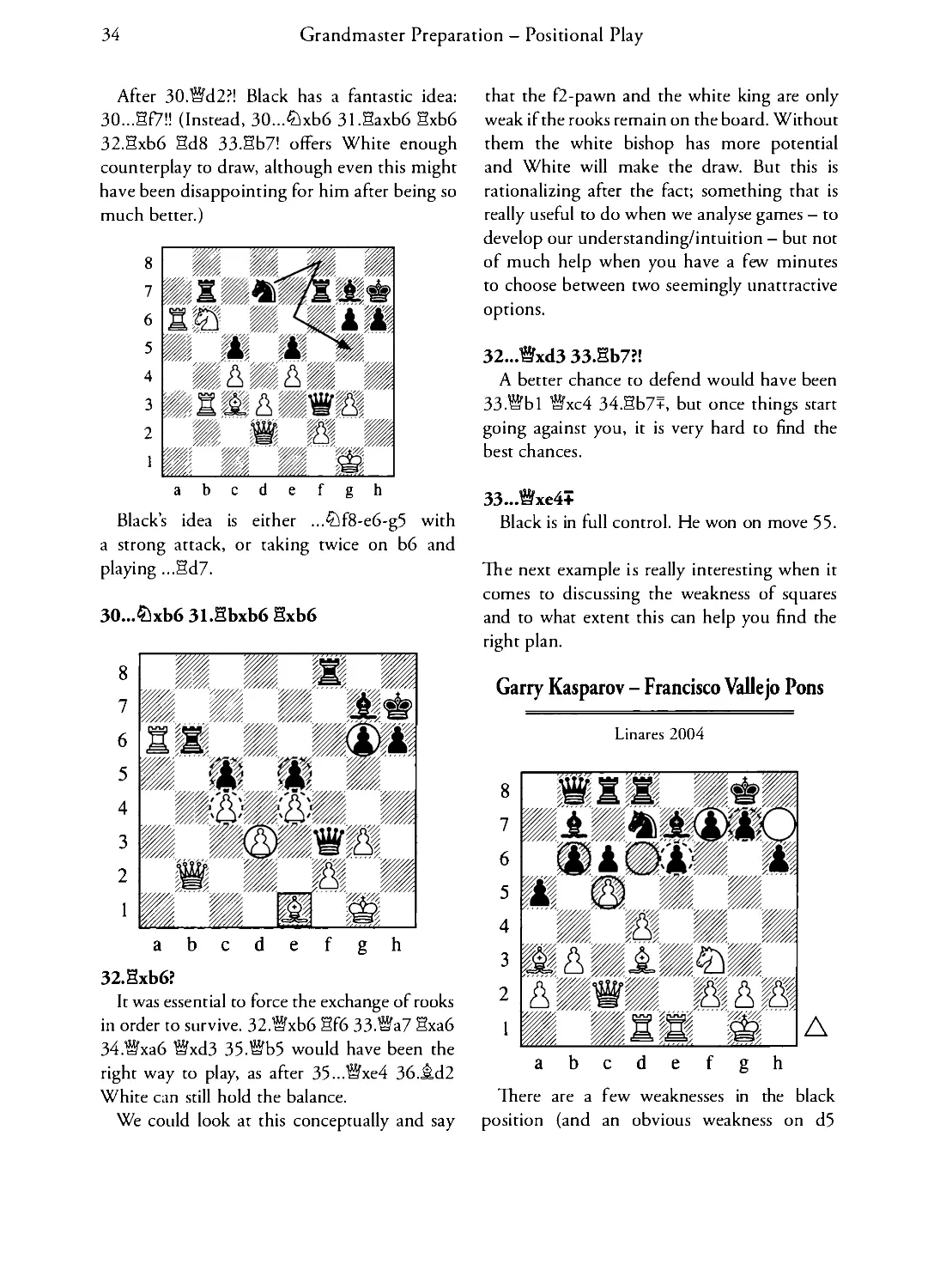
After 30.'Wd2?! Black has a fantastic idea:
30...!!f7!! (Instead , 30...ll
l
xb6 3 l .!!axb6 !!xb6
32.!!xb6 !!d8 33.:i:!b7! offers White enough
coun terplay co draw, although even chis might
have been disappointing for him after being so
much better. )
abcdefgh
Black's idea is either ...lt:\f8-e6-g5 with
a strong attack, or caking twice on b6 and
playi ng ...!!d7.
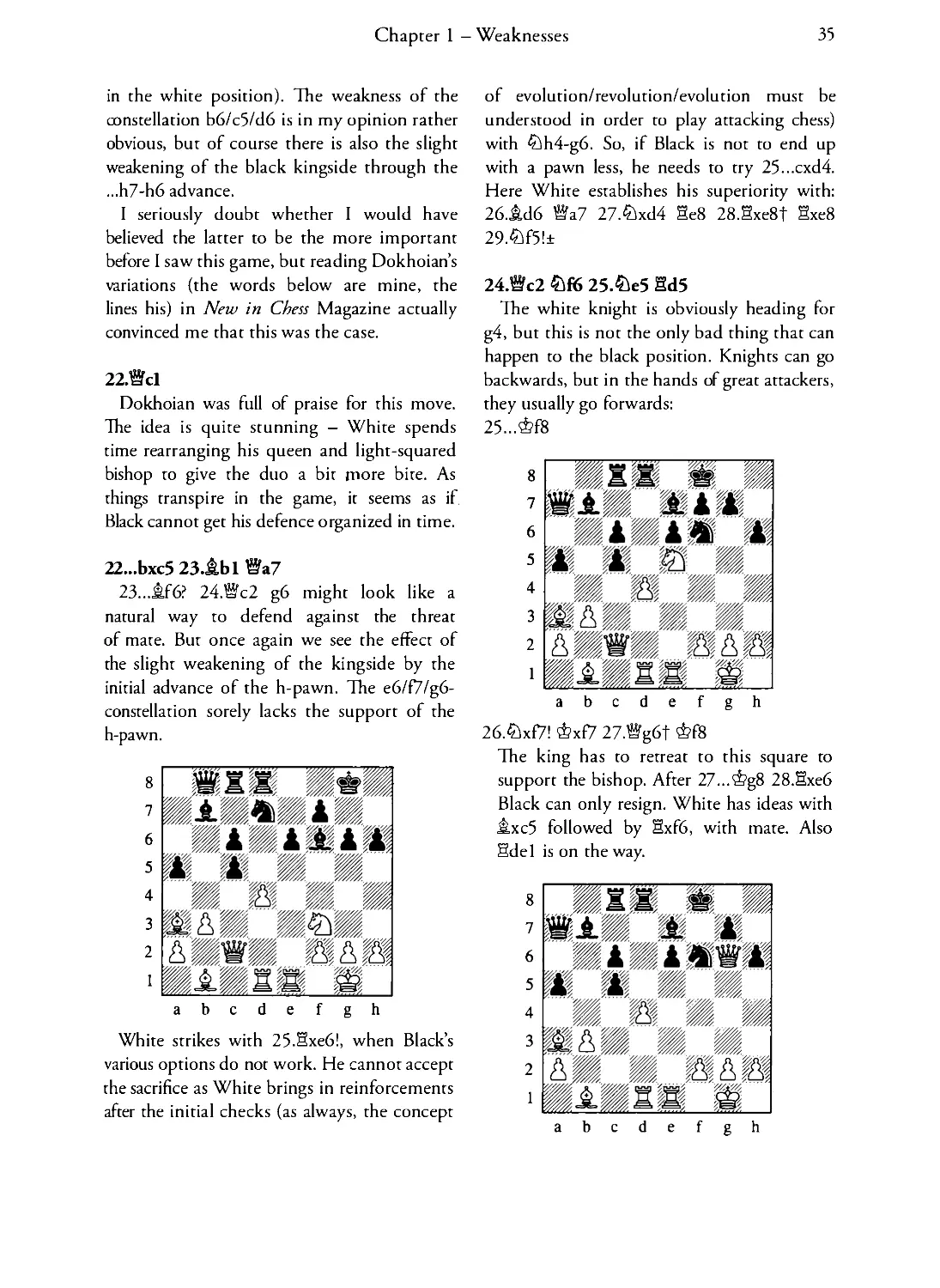
30•••ll
l
xb6 3l.gbxb6 gxb6
8
����
& � ?:!..,,�
1mmmW•
6:�� m91f.r
B 'mrl1m!l1•.
:·d�f--.
-�- �.:�
� rl119l!1
1
•rl1g 'n
W,i',·!1
1
�'=
abcdefgh
32.!!xb6?
It was esse ntial co force the exchange of rooks
in order co survive. 32.'Wxb6 !!f6 33.°Wa7 !!xa6
34 .'Wxa6 'Wxd3 35.°Wb5 would have been the
right way to play, as after 35 ...'Wxe4 36..id2
White can still hold the balance.
We could look at chis conceptually and say
chat the f2 -pawn and the white king are only
weak ifthe rooks re main on the board. Without
chem the white bishop has more potential
and White will make the draw. Bue chis is
rationalizing after the face; something chat is
really useful to do when we analyse games - to
develop our understanding/intuition - but not
of much help when yo u have a few minutes
to choose between two seemingly unattractive
options.
32•. • ti°xd3 33.gb7?!
A better chance co defend would have been
33.°W'b l 'Wxc4 34.!!b?+, but once things scare
going against you, it is very hard co find the
best chances .
33 •••Yfxe4+
Black is in full control. He won on move 55.
The next example is really interesting when it
comes to discussing the weakness of squares
and to what extent chis can help yo u find the
right plan.
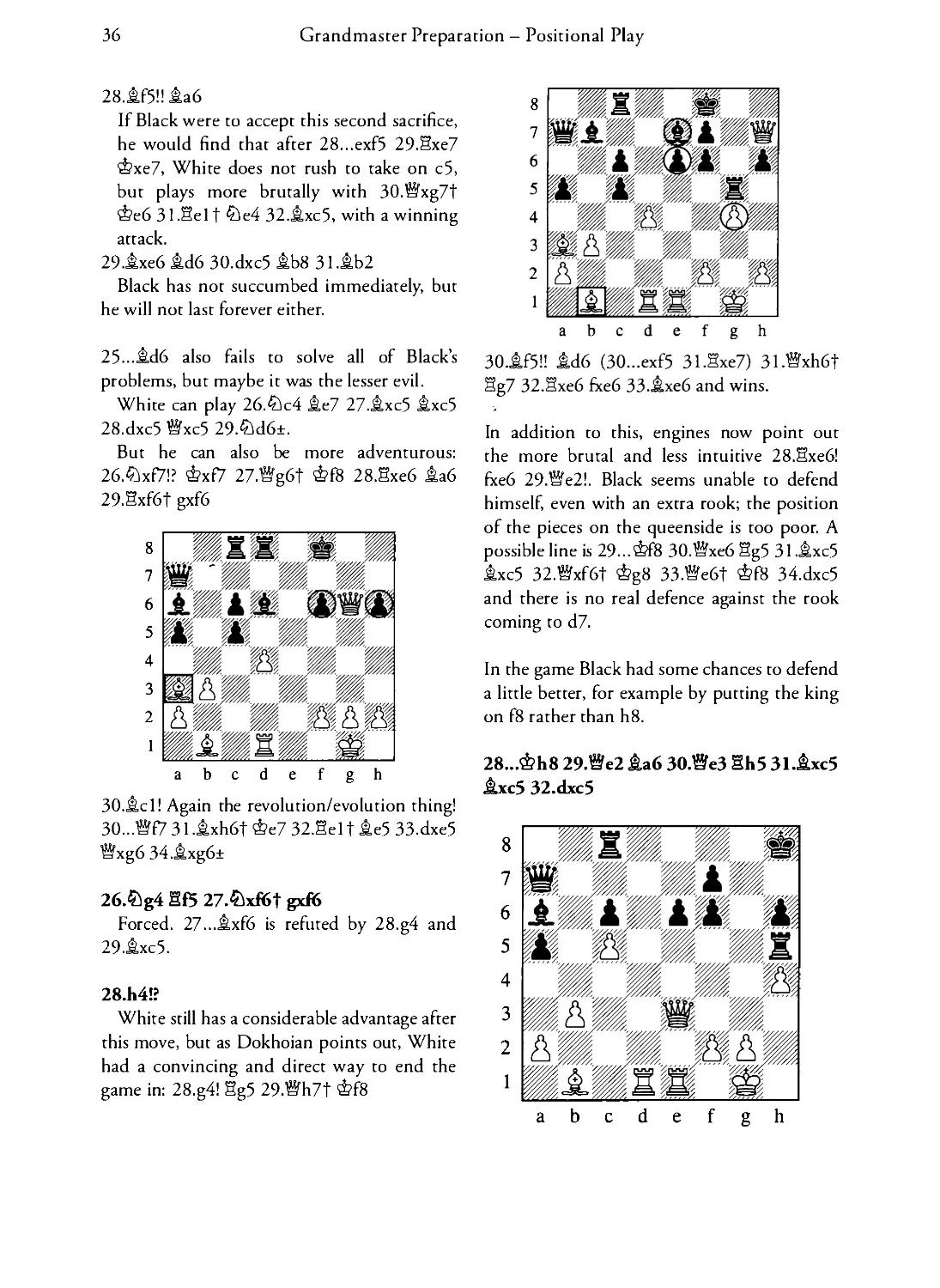
Garry Kasparov - Francisco Val
l
ejo Pons
8
7
6
5
4
3
2
Linares 2004
abcdefgh
There are a few weaknesses in the black
position (and an obvious weakness on d5
Chapter 1 - We aknesses
35
in the white position). The weakness of the
co nstellation b6/c5/d6 is in my opinion rather
obvious, but of course there is also the slight
weakening of the black kingside through the
.. .h7-h6 advance.
I seriously doubt whether I wo uld have
bel ieved the latter to be the more important
before I saw this game, but reading Ookhoian's
va riations (the words below are mine, the
lines his) in Ne w in Ch ess Magazine actually
convinced me that this was the case.
22.Wc1
Dokhoian was full of praise for this move.
The idea is quite stunning - White spends
time rea rranging his queen and light-squared
bishop to give the duo a bit more bite. As
things transpire in the game, it seems as if
Black cannot get his defence organized in time.
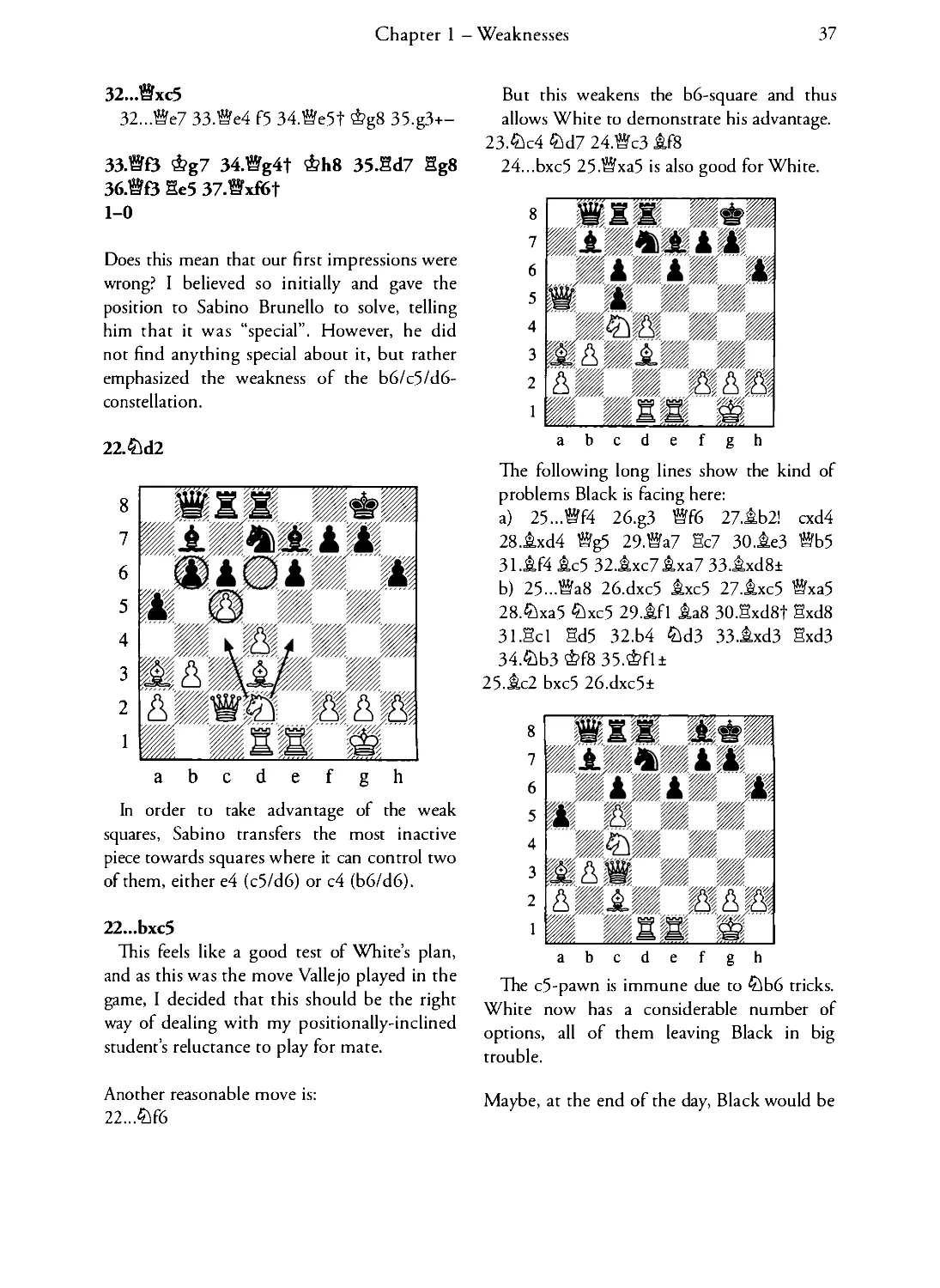
22 ...bxc5 23.i.b l Wa7
23...if6? 24.°Wc2 g6 might look like a
natural way to defend against the threat
of mate. But once again we see the effect of
the slight weakening of the ki ngside by the
initial advance of the h-pawn . The e6/f7/g6-
constellation sorely lacks the support of the
h-pawn .
8
%. Ji.� �·
: �,,a,mlJ
-�.-.
: .J.
�jw;J�-��
3 ;� :.L.�-�-
2 'lS�.1. �� :�
.t•.:� rijr�
abcdefgh
Wh ite strikes with 25.Ei:xe6!, when Black's
various options do not work. He cannot accept
the sacrifice as White brings in re inforcements
after the initial checks (as always, the concept
of evolution/revolution/evolution must be
understood in order to play attacking chess)
with ll
l
h4-g6. So, if Black is not to end up
with a pawn less, he needs to try 25 ...cxd4.
Here White establishes his superiority wi th:
26..id6 °Wa7 27.ll
l
xd4 Ei:e8 28.Ei:xeSt Ei:xe8
29.ll
l
f5!±
24.Wc2 �f6 25.�e5 gd5
The white knight is obviously heading for
g4 , but this is not the only bad thing that can
happen to the black position . Knights can go
backwards, but in the hands of great attackers ,
they usually go forwards:
25...iifS
8
�.i- •
.,
·; �-�
-
-���lj�/�
:.. ..�, fmT,r
•�.
- ��f�f"'� � ---- � z ....
: ..J.�&��- ��
3
;���% .%. �.
2 'lS�.1. �� ,�
.t•.:� �
abcdefgh
26.ll
l
xf7! lifxf7 27.°Wg6t iif8
The king has to retreat to this square to
support the bishop. After 27 ...®gS 28.Ei:xe6
Black can only resign. White has ideas with
ixc5 followed by Ei:xf6, with mate. Also
!!deI is on the way.
36
Grandmaster Preparation - Positional Play
28.if5!! ia6
If Black were to accept this second sacrifice,
he would find chat after 28...exf5 29.l:!xe7
r:Jlxe7, White does not rush to cake on c5,
but plays more brutally with 30.1l;Vxg7t
r:Jle6 31.l:!eIt ll
l
e4 32.ixc5, with a winning
attack.
29.ixe6 id6 30.dxc5 ib8 31.ib2
Black has not succumbed immediately, but
he will not last forever either.
25...id6 also fails co solve all of Black's
problems, but maybe it was the lesser evil.
White can play 26.ll
l
c4 ie7 27.ixc5 ixc5
28.dxc5 1l;Vxc5 29.ll
l
d6± .
Bue he can also be more adventurous:
26.ll
l
xf7!? r:Jlxf7 27.Wg6t r:Jlf8 28.l:!xe6 ia6
29.l:!xf6t gxf6
8
7
6
5
4
3
2
abcdefgh
30.ic l! Again the revolution/evolution thing!
30...Wf7 3 I.ixh6t r:Jle7 32.l:!el t ie5 33.dxe5
Wxg6 34.ixg6±
26.ll
l
g4 g5 27.�xf6t gxf6
Forced . 27 ...ixf6 is refuted by 28.g4 and
29.ixc5.
28.h4!?
White still has a considerable advantage after
chis move, but as Dokhoian points out, White
had a convincing and direct way to end the
game in: 28.g4! l:!g5 29.1l;Vh7t r:Jlf8
In addition co this, engines now point out
the more brutal and less intuitive 28.l:!xe6!
fXe6 29.We2!. Black seems unable to defend
himself, even with an extra ro ok; the position
of the pieces on the queenside is too poor. A
possible line is 29 ...r:Jlf8 30.Wxe6 l:!g5 31.ixc5
ixc5 32.1l;Vxf6t r:Jlg8 33.We6t r:Jlf8 34.dxc5
and there is no real defence against the rook
coming to d7.
In the game Black had some chances to defend
a little better, for example by putting the king
on f8 rather than h8.
28...i>hs 29.We2 i.a6 30.°1We3 gh5 31.hcS
hc5 32.dxc5
8
7
6
5
4
3
2
1
abcdefgh
Chapter 1 - We aknesses
37
32...flYxcS
32...Wfe7 33.Wfe4 f5 34.Wfe5t 'if?g8 35.g3+-
33.Ylff'3 @g7 34.Ylfg4t @hs 35J:�d7 ggs
36.YlYf'3 ge5 37.flYxf6t
1-0
Does this mean that our first impressions were
wrong? I believed so initially and gave the
position to Sabino Brunello to solve, telling
him that it was "special ". However, he did
not find anything special about it, but rather
emphasized the weakness of the b6/c5/d6-
co nstellation.
22. �d2
8
7
6
5
4
3
2
1
abcdefgh
In order to take advan tage of the weak
squares , Sabino transfers the most inactive
piece towards squares where it can control two
of them , either e4 (c5/d6) or c4 (b6/d6) .
22 ...bxc5
This fe els like a good test of White's plan,
and as this was the move Va llejo played in the
ga me, I decided that this should be the right
way of dealing with my positionally-inclined
student's rel uctance to play for mate.
Another reasonable move is:
22...ll.Jf6
But this weakens the b6-square and thus
allows White to demonstrate his advantage.
23.ll.Jc4 ll.Jd7 24.Wfc3 .if8
24...bxc5 25.Wfxa5 is also good for White.
abcdefgh
The following long lines show the kind of
problems Black is facing here:
a} 25 ...Wff4 26.g3 Wff6 27.ib2! cxd4
28 ..ixd4 Wg5 29.Wfa7 l'!c7 30..ie3 Wb5
3 1 ..if4 .ic5 32..ixc7 .ixa7 33.ixd8±
b) 25...Wfa8 26.dxc5 .ixc5 27..ixc5 Wxa5
28.ll.Jxa5 ll.Jxc5 29..ifl .ia8 30.l'!xd8t l'!xd8
31.l'!cl l'!d5 32.b4 ll.Jd3 33 ..ixd3 l'!xd3
34.ll.Jb3 'if?f8 35.'if?fl ±
25. .ic2 bxc5 26.dxc5±
abcdefgh
The c5-pawn is immune due to ll.Jb6 tricks.
White now has a considerable number of
options, all of them leaving Black in big
trouble.
Maybe, at the end of the day, Black wo uld be
38
Grandmaster Preparation - Positional Play
relatively better off after 22 ...b5;!;, although
this would leave him with various positional
defects. A logical way of continuing is: 23.i.c l
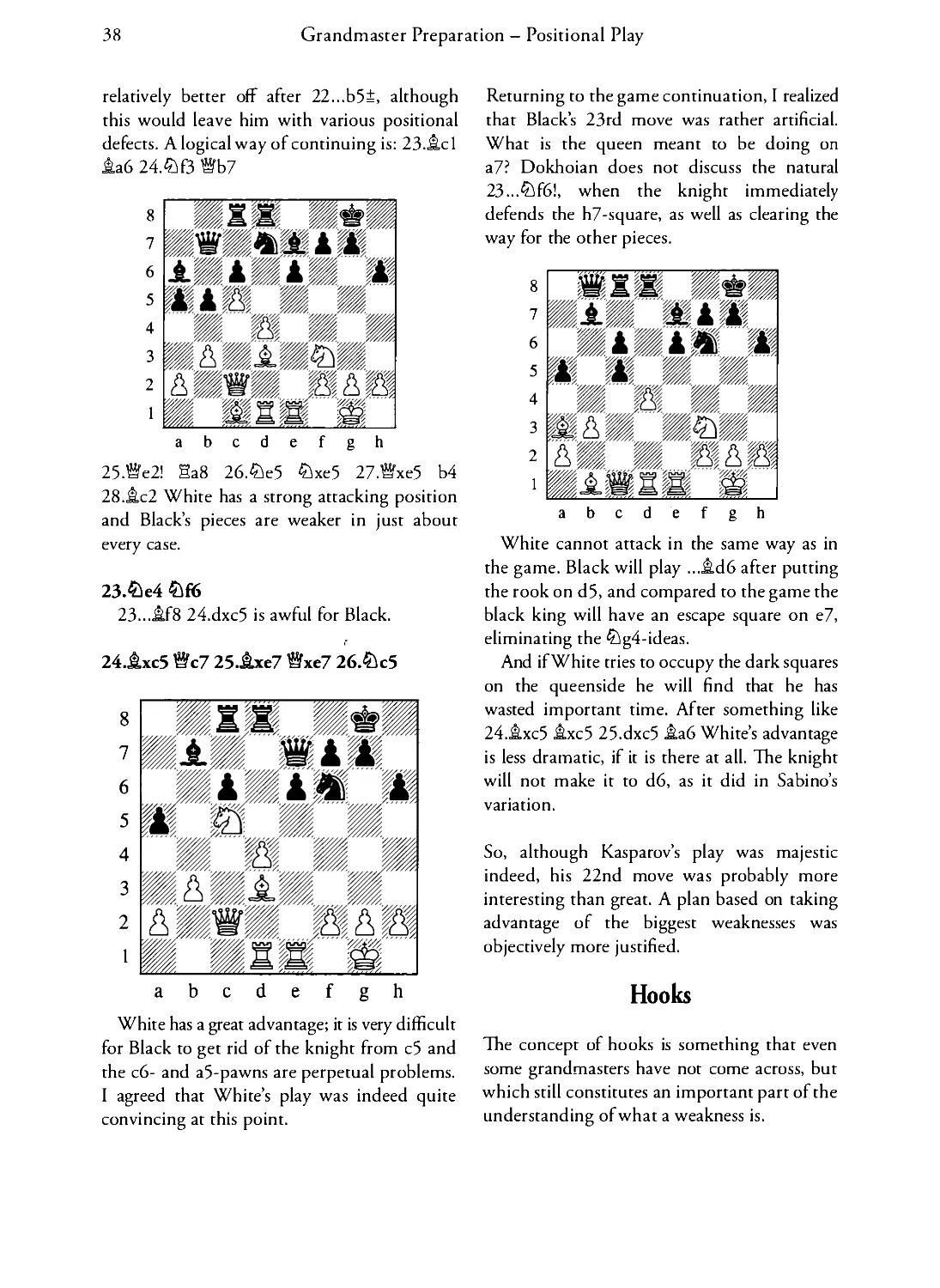
i.a6 24.lLif3 Wi'b7
abcdefgh
25.Wi'e2! l'!a8 26.lLie5 lLixe5 27.Wi'xe5 b4
28.i.c2 White has a strong attacking position
and Black's pieces are weaker in just about
every case.
23.ttle4 �f6
23...i.f8 24.dxc5 is awful for Black.
24•.txc5 Wi'c7 25.L:
:
e7 V!lxe7 26.�c5
abcdefgh
White has a great advan tage; it is very difficult
for Black to get rid of the knight from c5 and
the c6- and a5-pawns are perpetual problems.
I agreed that Whi te's play was indeed quite
convi ncing at this point.
Re turning to the game continuation, I realized
that Black's 23rd move was rather artificial.
What is the queen meant to be doing on
a7? Dokhoian does not discuss the natural
23 ...lLif6!, when the knight immediately
defends the h7-square, as well as clearing the
way for the other pieces .
abcd�fgh
White cannot attack in the same way as in
the game. Black will play ...i.d6 after putting
the rook on d5, and compared to the game the
black king will have an escape square on e7,
eliminating the lLig4-ideas .
And ifWhite tries to occupy the dark squares
on the queenside he will find that he has
wasted important time. After something like
24.i.xc5 i.xc5 25.dxc5 i.a6 Whi te's advan tage
is less dramatic, if it is there at all. The knight
will not make it to d6, as it did in Sabino's
variation.
So, although Kasparov's play was majestic
indeed, his 22nd move was probably more
interesting than great. A plan based on taking
advan tage of the biggest weaknesses was
objectively more justified.
Hooks
The concept of hooks is something that even
some grandmasters have not come across, but
which still constitutes an important part of the
understanding ofwhat a weakness is.
Chapter 1 - We aknesses
39
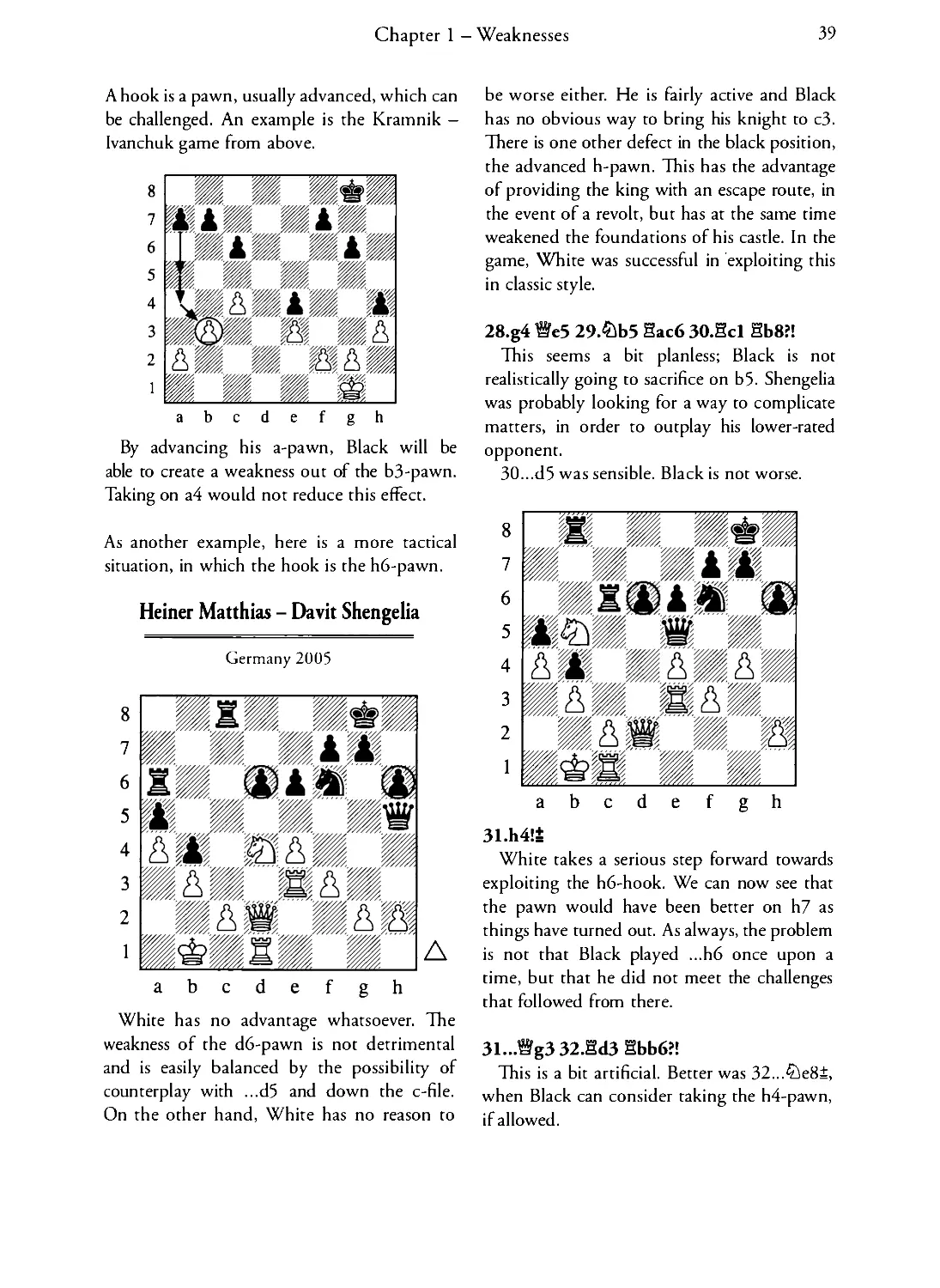
A hook is a pawn , usually advan ced, which can
be challenged. An example is the Kramnik -
lvan chuk game from above.
abcdefgh
By advancing his a-pawn , Black will be
able to create a weakness out of the b3-pawn .
Ta king on a4 would not reduce this effect.
As another example, here is a more tactical
situation, in which the hook is the h6-pawn .
Heiner Matthias - Davit Shengelia
Germany 2005
White has no advantage whatsoever. The
weakness of the d6-pawn is not detrimental
and is easily balanced by the possibility of
coun terplay with ...d5 and down the c-file.
On the other hand, White has no reason to
be worse either. He is fairly active and Black
has no obvious way to bring his knight to c3 .
There is one other defect in the black position,
the advanced h-pawn . This has the advantage
of providing the king with an escape ro ute, in
the event of a revo lt, but has at the same time
weakened the foundations of his castle. In the
game, White was successful in ·exploiting this
in classic style.
28.g4 �eS 29.�bS �fac6 30J;c1 gb8?!
This seems a bit planless; Black is not
realistically going to sacrifice on b5. Shengelia
was probably looking for a way to complicate
matters, in order to outplay his lower-rated
opponent.
30...d5 was sensible. Black is not worse.
8
7
6
5
4
3
2
1
abcdefgh
31.h4!;t
White takes a serious step forward towards
exploiting the h6-hook. We can now see that
the pawn would have been better on h7 as
things have turned out. As always, the problem
is not that Black played ...h6 once upon a
time, but that he did not meet the challenges
that followed from there.
31...�g3 32J�d3 gbb6?!
This is a bit artificial. Better was 32...ll
l
e8;!;,
when Black can consider taking the h4-paw n,
ifallowed .
40
Grandmaster Preparation - Positional Play
33.g5± �d7
Relying on ...�e5 to come and save the day,
but White avo ids this easily.
33 ...hxgS 34.hxgS �h5 35.l:!h l g6 wo uld have
been a better chance to resist.
34.£4! Yfxh4 35.gxh6 �c5
35...'1Wxh6 36.�xd6± was the lesser evil.
36.Yfg2 Yfxh6?!
This loses quickly, but 36 ...g6 37.l:!h3 Vfle7
38.fS! would also have left Black under a
strong attack.
37.gh3 Yff6
Aft er 37...Vflxf4 38.l:!ch l g6 39.l:!h8t 'it>g7
40.l:! I h4! Wh ite will soon give a winning
check on the f- file: 40...Vfle3 4I.l:!4h7t 'it>f6
42.l:!xf7t! with mate to follow.
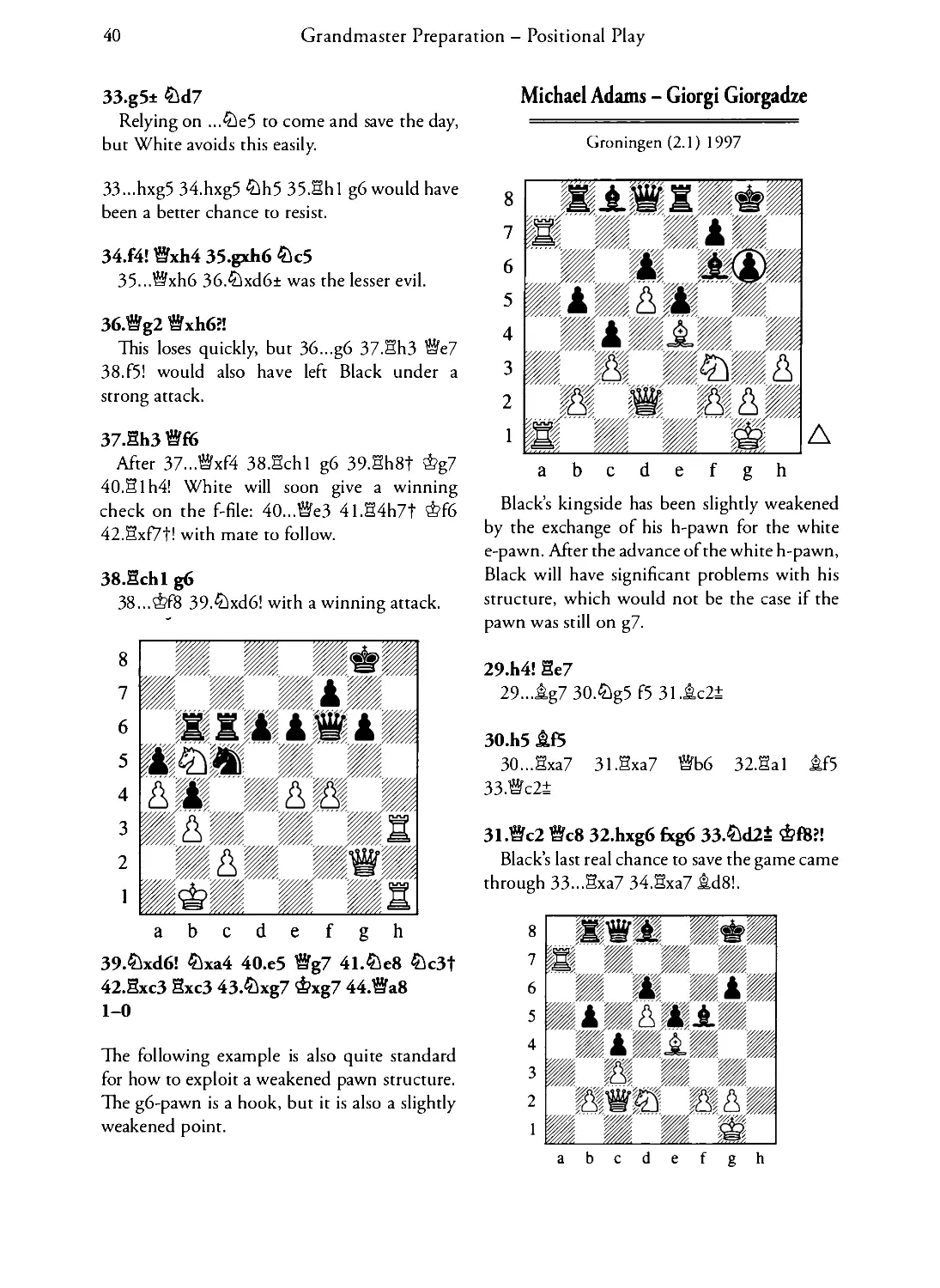
38.gch l g6
38 ...'it>f8 39.�xd6! with a winning attack.
8
7
6
5
4
3
2
1
abcdefgh
39.�xd6! �xa4 40.e5 Yfg7 41.�e8 �c3t
42.gxc3 gxc3 43.�xg7 <it>xg7 44.YfaS
1-0
The following example is also quite standard
for how to exploit a weakened pawn structure.
The g6-pawn is a hook, but it is also a slightly
weakened point.
Michael Adams - Giorgi Giorgadze
Groning en (2.1) 1997
s
��J.
.
�K�e
7
�----- Y-
�,. ,.,%
�·�
. ....Y,
� ��-���-�0��
6
-ef� -�
·�r,8�--;..,Y,_
5
���� ;"� �
4
�A�, ��
3 ��-J� '-N;"'';�����8
2
effl'� � Y- effl'�A�
ic.
..:l
z
z
z
il.
.:
:i
zL.J
1�
----%
�,.,.,%� .....%�·0-<
6.
abcdefgh
Black's ki ngside has been slightly weakened
by the exchange of his h-pawn for the white
e-pawn . Aft er the advance ofthe white h-pawn ,
Black will have significant problems with his
structure, which wo uld not be the case if the
pawn was still on g7.
29.h4! ge7
29...ig? 30.�gS f5 3 I .ic2;l;
30.h5 J.f5
30 ...l:!xa7 3 I.l:!xa7 Vflb6 32.l:!a I J.f5
33.Vflc2;l;
31.Yfc2 Yfc8 32.hxg6 fxg6 33.�d2� <it>t"B?!
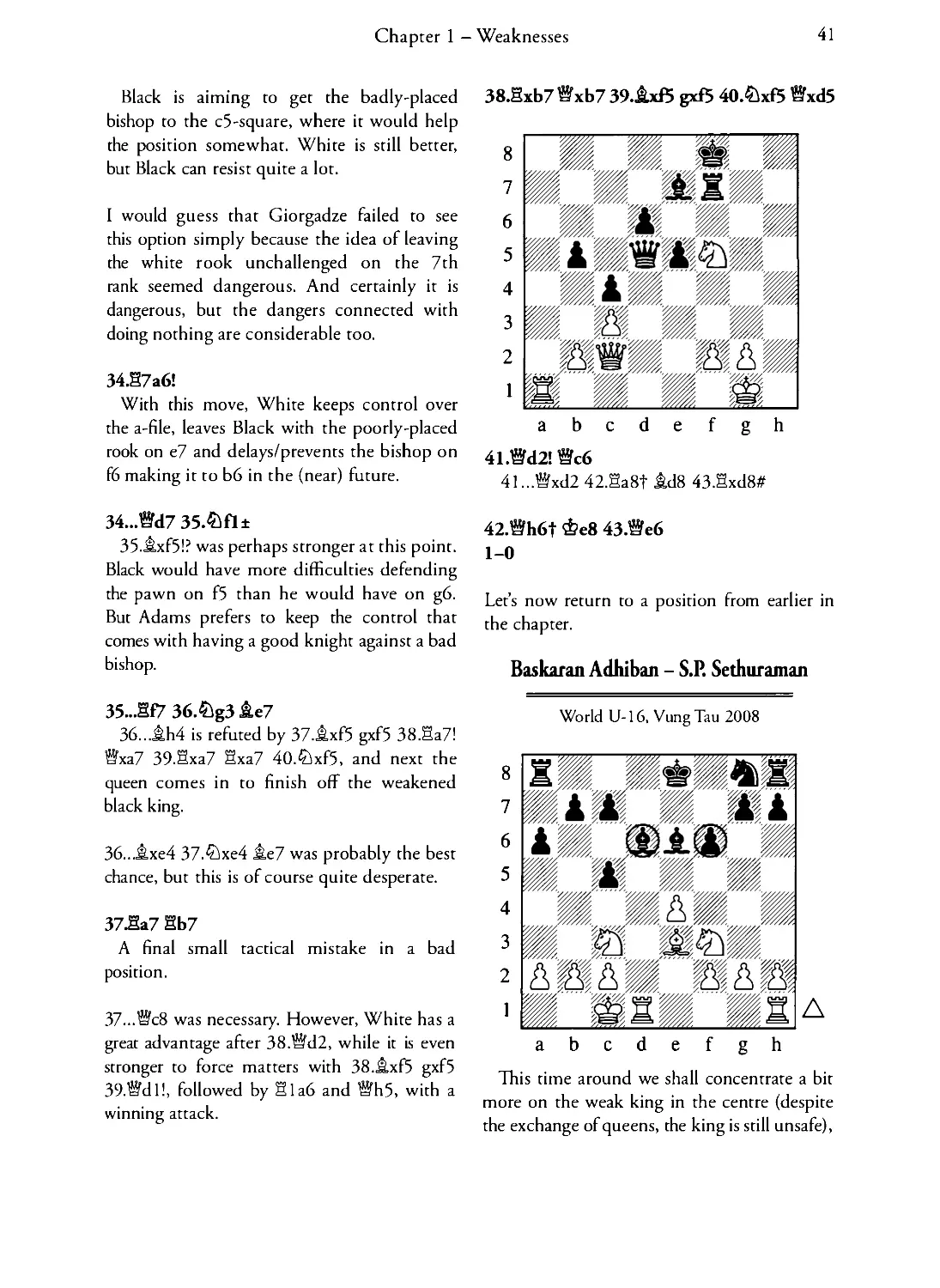
Black's last real chance to save the game came
through 33...l:!xa7 34.l:!xa7 J.d8!.
Chapter 1 - We aknesses
41
Black is a1mmg to get the badly-placed
bishop to the c5-square, where it wo uld help
the position somewhat. White is still better,
but Black can resist quite a lot.
I would guess that Giorgadze failed to see
this option simply because the idea of leaving
the white rook unchallenged on the 7th
ra nk seemed dangerous. And certainly it is
dangerous, but the dangers connected with
doing nothing are considerable too.
34J�7a6!
With this move, Wh ite keeps control over
the a-file, leaves Black with the poorly-placed
rook on e7 and delays/prevents the bishop on
f6 making it to b6 in the (near) future.
34...'!Wd7 35.�fl±
35.ixfS!? was perhaps stronger at this point.
Black wo uld have more difficulties defending
the pawn on f5 than he would have on g6.
But Adams prefers to keep the control that
comes with having a good knight against a bad
bishop.
35.,,gf7 36.�g3 fi.e7
36...ih4 is refuted by 37.ixf5 gxf5 38.:B:a?!
'Wxa7 39.:B:xa? :B:xa7 40.ll
l
xf5, and next the
queen comes in to finish off the weakened
black king.
36...ixe4 37.ll
l
xe4 ie7 was probably the best
cha nce, but this is of course quite desperate.
37.ga7 gb7
A final small tactical mistake in a bad
position .
37 ...'l!;Yc8 was necessary. However, White has a
great adva ntage after 38.'1Wd2, while it is even
stronger to force matters with 38.i.xf5 gxf5
39.'l!;Ydl!, followed by :B:la6 and \Wh5, with a
winning attack.
38.gxb7 '!Wxb7 39.Lf5 gx5 40.�xf5 '!Wxd5
8
7
6
5
4
3
2
1
abcdefgh
41.°1Wd2! '!Wc6
41...'1Wxd2 42.:B:a8t .id8 43.:B:xd8#
42.°1Wh6t <it>es 43.°1We6
1-0
Let's now return to a position from earlier in
the chapter.
Baskaran Adhiban - S.P. Sethuraman
8
7
6
5
4
3
2
1
World U-16, Vung Ta u 2008
abcdefgh
This time around we shall concentrate a bit
more on the weak king in the centre (despite
the exchange of queens, the king is still unsafe) ,
42
Grandmaster Preparation - Positional Play
and the hook chat the pawn on f6 represents.
Looking at these we can see that there is a
much more aggressive continuation:
11. eS!! fxeS
The computer reco mmends that Black
should play 11....ixeS 12.lDxeS fxeS, when
after 13..ixcS it has no real defence against
E:hel xeS (or f2-f4xe5). Maybe this is Black's
best option, but in that case White's strategy
is definitely right!
12.lDe4
With the idea of .ixcS should Black defend
the bishop, which would lead to a quick
deterioration of the black position.
12....ie? 13.lDxeS
abcdefgh
Black is still struggling desperately with his
development. The next moves are likely to
be:!
!
he 1 and .if4, after which it will be very
difficult for Black to avo id losing something.
King's position
we allplayfor mate; somejust do it in a more
indirect way than others - Pe ter Heine Nielsen
We have a tendency to focus on static factors
when we talk about positional play, but we
muse not neglect dynamic factors . The safety
of the king is always a factor, and when we talk
about weaknesses it wo uld make no sense not
to include weaknesses around the king.
Ta ke the following example:
N.N. - Finn Nohr
Aarhus 1992
abcdefgh
White is of course unpleasantly pinned on
f2, which makes the defence of the g2-square
more difficult. In a chaotic position like chis,
with pins from d4 to gl and e2 to a2, an X-ray
from c8 co g4 , and where Black has sacrificed
material, it is hard to chink about positional
factors; but they are still there.
In chis case the weakest square in the vicinity
of the white king is not h2, although chat is
the least defended square, because we also
need to cake into account the potential of the
attacking pieces . Here only the black queen
can reasonably reach h2. On the other hand,
all of the black pieces can attack the g2-square,
and on top of chis the bishop on d4 is tying
White down and eliminating the planned
defence along the second rank.
Black managed co exploit chis quite beautifully
in the game.
l...�c6!!
Chapter 1 - We aknesses
43
8
7
6
5
4
3
2
abcdefgh
The weakness of the g2-square suddenly
becomes very pressing. Black is threatening
.. .ll
l
e3.
2.Wgs
2.Wxe2 ll
l
h4! with mace on the way, is the
nice point co Black's combination.
2...©g7
0-1
There was actually a less natural but equally
good way of winning the game. l...°Wb7!!
would have the same main point and threats ,
but after 2.°Wg5 an additional way co win the
game ex ists:
8
7
6
5
4
3
abcdefgh
2....ix fL.t 3.gxf2 °Wb l t Black exploits chat the
rook on a2 is unprotected.
Although spectacular, chis example was not
conceptually challenging in any way. The next
one is a bit more complex.
Ivan Cheparinov - Stelios Halkias
8
7
6
5
4
3
2
1
Helsingor 20 12
abcdefgh
While it may not be realistic co expect
Whi te's attack co be successful against the
best defence, it is possible co use the weakness
of the h7-pawn (only defended by che king,
who does not really count) and the long-term
weakness of the a7-pawn co create serious
threats .
In the game White focused exclusively on the
queenside and had only a modest advantage:
32.J.c6?!� ©hs 33.Y!Yh5 Y!Yb4 34.Y!Y5 �d7
35.Y!Ye6 �f6 36.r:ldS h6 37.r:lxfBt Y!YxfB
38.Y!Yd6 Y!Yf7 39.r:ld2 r:le7 40.Y!Ydst ©h7
4l.Y!Yd3t
lf2 -lf2
The correct continuation, on the basis of che
weaknesses mentioned, wo uld have been:
32.i.c2!
This would have created the strong threat of
33.°Wc4t i>g8 34.'Wh4 h6 35.gds.
44
Grandmaster Preparation - Positional Play
8
�, ��
���
%'l.
���
7-
,, ,,,%
-,_. , ,V,�
.....v.••,
6
..... %......v.�
���....%% �
·��.,� � ·
-
5� •••
4
·--- � {""
3
� �� ��L,
2
,� ,� ��%....%�
�� r� �m-- --
abcdefgh
White is winning on account of 35...l'!c8
36.!!xf8 l'!xf8 37.Wfe7! Wfc8 38.l'!d6! and
there is no defence against l'!xh6.
32..ibI?! is a weaker version of this idea, as
there will be checks on e 1 to look out for, as
well as the knight coming to c3. The bishop
is simply not well placed here.
32...WfeB
An undesirable move, but unfortunately also
the only move.
32...tl
l
b7 33.l'!d7 l'!xd7 34.!!xd7 tl
l
d8
35.Wfe4 Wfb6t 36.c;
;ti
hI Wfc6 37.Wfxc6 tl
l
xc6
38 ..ie4 l'!f6 39.l'!c7 and White should win
chis endgame.
33.Wfxe8 l'!xe8 34.l'!d8
Wh ite has a clear advantage, for example:
34...!!ce7 35.l'!xe8t l'!xe8 36.!!d5 tl
l
e4
36...l'!c8 37..if5! l'!c7 38.l'!c8t and Wh ite
wins a pawn.
37.l'!d7±
So remember to take notice of the weakness of
your own and the opponent's king's position.
Creating weaknesses
Accountancy - this is what a friend of mine
calls a certain style of chess, one to which he
subscribes personally. What he specifically
likes to do is to create and fix weaknesses in his
opponents' positions, manoeuvre around a bit,
and eventually win something.
We do not have to play like this of course,
but it makes lots of sense to create a weakness
and then exploit it later on. Here are two
examples of the creation of weaknesses.
Magnus Carlsen - Boris Gelfand
Moscow 2006
abcdefgh
12...�d5!
This creates a weakness on the dark squares
in the constellation f2/e3/d4. While chis is by
no means decisive, it still causes problems that
White must pay attention to for a long time.
13.f3 �a5 14.i.g2 c5!
Black puts extra press ure on the weakened
dark squares .
15.dxc5 �c6 16.0-0 0 -0
Chapter 1 - We aknesses
45
Black was slightly better and won the game
on move 38.
In the next example it is clear that White
is better, but he can improve his position
considerably by weakening the opponent's
structure.
Rosian Ponomariov - Vik.tor Korchnoi
8
7
6
5
4
3
2
Donetsk (3) 200 1
abcdefgh
White has a fine position with a good knight
agai nst a very bad bishop, though it is not
obvious that this is enough to win. With his
next move he provokes a weakening in the
black king's position that soon leads to further
problems for Black. Although the attack may
not be decisive, it will demand much of Black's
attention, meaning that he will find it difficult
to defend other aspects of his position, such as
the queenside.
27.Yfd4!
27.ll
l
d4 E:f6 28.'Wd2;:!; is less clear.
27...g6
A painful move to play, but what else should
Black do?
After 27...ig6? 28.ll
l
h4 it is already time to
consider resignation.
And after 27...ie6 28.E:e l E:e8 29.a3± Black
isinabadway.
28.°tfd2 ges 29.�d4 gfe5
The most active move. After both 29...E:h5
30.E:cl ± and 29...E:f6 30.E:cl ±, White would
be able to put pressure on the queenside more
or less undisturbed.
8
7
6
5
4
3
2
1
30.f4!
abcdefgh
White is able to exploit the weakening of the
black kingside with this pawn advan ce.
30..J�e4 31.5 ©hs
31...'Wa7 32.'Wh6 E:xd4 33.fxg6 hxg6
34.E:xg6t and White wi ns.
32.°tfh6 Yfe7
The only move ; 32 ...E:g8 33.liJf3! and White
wins.
33.�f.3 °tffB 34.°tfgS Yfg7 35.f6?!
This succeeds in the long term , bur in the
shorter term it blocks the open files that White
is attacking along. 35.fxg6 ixg6 (35 ...�xg6
36.'Wcl! and White wins material) 36.'Wxd5
'Wxb2 37.'Wxd6± with an extra pawn was stronger.
35 ...°tffB 36Jkl h6 37.Yfd2 g5?
A decent idea, wan ting to prepare ...ih5,
but played at the wrong time.
46
Grandmaster Preparation - Positional Play
Black should prefer 37...E:e2 38.Wd3 E:2e3
39.Wa6 g5;l:
:
, with ideas such as 40.Wxa5 i.h5.
38J'k7 gez 39.Wfcl gze6 40.h4!
40...gxf6 41.hxg5 gg6
4 l ...l'!fe6 42.tl
l
d4 l'!g6 43.tl
l
f5 also gives
White a winning attack. Here is a possible
line: 43 ...i.e6 44.tl
l
h4 l'!g7 45.l'!f3 Wg8 46.g6!
l'!xc7 47.Wxh6t l'!h7 48.gxh7 Wxh7 49.tl
l
g6t
Wg8 50.l'!f8t l'!xf8 5 l .Wxh7t and White wins.
42.Wff4 i.e6 43.tl
l
h4 gg7 44.Wfd4 'it>h7
45.Wfd3t
1-0
Fixing weaknesses
Usually when we talk about fixing weaknesses,
it refers to a situation like this:
White moves the a-pawn to a5, in order to
fix the weakness on b7 and create a long-term
issue with the a6-pawn as well.
In the following example, the weakness is fixed
through constant pressure on it, and then
devoured!
Boris Spassky - Jan Hein Donner
8
7
6
5
4
3
2
Leiden 1970
abcdefgh
Black has a weak pawn on e6, but at the
moment it seems that it can be protected
without any significant concessions. However,
the weakness is all the way down the a2-
g8 diagonal and White can make use of this
by transferring his bishop. As a result, Black
will find it very difficulc to ever get rid of the
weakness.
21.i.fl !±
The bishop is strong at h3, but on c4 it has
the potential to be deadly.
21...gd6
Black could have tried 21...�h8 22.i.c4
Wd7 23.We3 l'!e8, which would have solved
one big problem. But White would get free
re in to advance his pawns on the kingside and
probably win the game in a brutal attack.
Chapter 1 - We aknesses
47
2 l...a5!? would make some sense, planning to
advance his pawns and at the same time kick
the white bishop. However, after 22..ic4 b5
23..id3 E:ac8 24.'ltib l±, Black's position has
not really been improved by the advance of the
pawns on the queenside.
22..ic4 gad8?!
22...f5 was better, but White has a serious
advantage anyway.
23.f5 gxd4
This loses by force, but by this stage probably
everything does.
23 ...b5 would be an attempt to avoid 'Wa3
tricks : 24..ib3 E:e8 (24...E:xd4 25.E: xd4
l!xd4 26.E:xe6! '4.ih8 27.E:d6 and White wins
material) 25.fxe6 lDxe6 26.d5 This break
in the centre wins. 26...cxd5 27.E:xd5 E:b6
28.E:d2 There is no defence against E:de2 and
�d5, winning the knight.
23...E:eS 24.'Wa3! and White wins.
24.fxe6 gxdlt
The "only" move was 24 ...\We7, but here
Wh ite can win the game with a simple double
threat:
abcdefgh
After 25.'Wa3! Black loses something.
25.gxd l gxd l t 26.'l'xd l
Donner resigned, real izing that 26...'We7 is
met conclusively with:
8
7
6
5
4
3
2
27.'WdS!!
1-0
abcdefgh
Having a keen sense of weaknesses is important
for yo ur development as a player, both before
and after yo u become a grandmaster.
48
Grandmaster Preparation - Positional Play
Salov - Karpov, Al m a-Ara blitz ( 1) 1995
abcdefgh
Klinova - Ferguson, Isle of Man 2007
7
6
4
3
2
Leko - Khalifman, Budapest 2000
abcdefgh
0
0s
6
4
2
Chapter I - We aknesses
49
Kramnik - Carlsen, Dortmund 2007
abcdefgh
Adams - Cheparinov, Baku 2008
abcdefgh
Adams - Koneru, Merida 2008
abcdefgh
4
3
2
Kamsky -Al Modiahki, Sochi 2008
abcdefgh
Grebionkin - Kirusha, St Pe tersburg 200 I
abcdefgh
50
®
Grandmaster Preparation - Positional Play
Hess - Postny, Ningbo 20 11
abcdefgh
To mashevsky - Svidler, Moscow 2007
Lysyj - We lls, Plovdiv 2008
abcdefgh
Edouard -Le Roux, Caen 201 1
®
Chapter 1 - We aknesses
51
Leko - Ki. Georgiev, Dubai 2002
abcdefgh
Leko - Bormida, e-mail 1997
Anand - lvanchuk, Bilbao 2008
abcdefgh
Spraggett - Ubilava, Ampuriabrava 1997
abcdefgh
52
Grandmaster Preparation - Positional Play
1. Salov - Karpov
Alma-Ara blitz (I) 1 995
abcdefgh
This position is of course essentially equal,
but quite often equal positions are won with
good moves , so it is important to play the
best moves for Black. Here the only reason
why White should have any problems is that
the b2-pawn is a bit weak, and that he has
advanced the a-pawn . We re the a-pawn on a2,
Black wo uld not have the chance to make the
advances he did in the game.
16...:EUbS!
The correct rook, as the other rook needs to
keep an eye on the a-pawn .
17.�ael
17.c4 will lead to a knight being established
on d5 once Black deflects the c4-pawn. White
might have a temporary initiative, but long
term the d5-square will mean that the position
is a bit more pleasan t for Black.
17...a6! On the next move comes 18...b5!,
and although the position is not terribly
frightening for Wh ite, it is certainly not
entirely equal.
17...d5?! would be risky. White suddenly
has th ree pieces attacking on the kingside.
After 18. li:
:l
e5 '1We8 l 9.�g4! Black has to play
non-script moves such as 19...f6!?, when the
position is simply unclear.
17. li:
:l
el! as suggested by Andrew Greet was
probably the most prudent move. Wh ite
manoeuvres the knight to d3 in order to
keep all his pieces covered. In this case White
probably holds equality without too much
trouble.
17...bS 18.axbS �xb5 19.'?Na2 as; 20.�4e2
'?Nc6 21.'?Na4 '?Nb7 22.'?Nc4 tlid5 23.'?Na2 tlif4
24.�d2
Black eventually wo n this blitz-game on
move 40, but at this point he overlooked the
chance to win the game instantly with either
24...�g5 or 24...li:
:l
xg2!.
...0-1
2. Pogonina -E. Paehtz
Krasnoturinsk 2007
8.i'�m��•
�%1'% �m/,,,,,V,�f%
:=��.,Wi
5 if..�LlrA•
4''•'·�-�.
�� �� �����
� ""� �w4.
0, /,im,, , ,,/,m/,i�
abcdefgh
White has a pleasant position after various
decent moves , but the clearest plan by far is to
transfer a knight to the weak e6-square . This is
what White did in the gam e.
21.tlibS! g5
2 l.. .�fe8 22.li:
:l
bd4 '1Wf7 has the idea of
replying to 23.li:
:l
e6 with 23...li:
:l
c5!, when Black
would be okay, but it can be met with either
Chap ter 1 - We aknesses
53
the greedy 23.'1Wxa5!? or the more restrained
23.b4, in each case with a great advantage.
22.�bd4 �g6 23.�e6
We could actually stop here. When yo u
play positional chess, you do not have to be
able to see anything beyond transferring the
ineffective knight from c3 to e6. White has
many ways to follow up, with some probably
better than others, but it is not something we
gain a practical advantage out of determining
in advance.
23 ..J;f7 24.�xa5?
This move looks very tempting, but it
allows Black to come back into the game
with co unterplay on the kingside. The correct
way to play was to make the most out of the
re maining inactive pieces.
After 24.E:be l! White's advantage is very clear.
8 .i ��-�·�•t
7
� it.E •.1�
6
'�r- -Z
•�Rif•
5r.8.Wit
4 ,,,,,%
·'·�--- --
%
�
3 ti�.
�-ttS•8
,,
,
,,
%!i3f% �\\U.I( ��-% �-"�
2
t� �\§� 1�8�
%,,,%-,,,,, /,gt�
abcdefgh
It has to be the b I-rook, as it was under threat
from the queen, and so moving the other rook
wo uld deny White the option of doubling on
the e- file. If Black plays 24...ll
l
c5, the knight
can be exchanged and then the rook enters the
position on e6 with a clear superiority. And if
Black plays 24...g4 White can play 25.hxg4
Wxg4 26.E:e4! with E:fe I on the way. The black
position is full of weaknesses and Whi te's
do minating pieces will secure her a clear
edge in all lines. In the ga me, matters were
less clear.
24...g4 25.hxg4 �xg4
The g-file is opened and the position is not
as clear as it once was .
26.�el!
The queen is urgen tly needed on the
kingside.
The computer thinks White also can win with
26.b4?!, with the idea that 26...<i!?h8 27.b5
E:g8 28.bxa6 id4 29.ll
l
el f3 allows White to
play 30.'1Wd2!. This is a very complicated line,
and an example of a machine not being able
to do a human's job. After 30...ie5! Black has
enough counterplay and it is Wh ite who has
to look for a draw: 3 l.g3 bxa6 32.ll
l
xf3 '\Wxf3
33.ll
l
d4 E:xg3t 34.fxg3 Wxg3 t 35.'1Wg2 ixd4t
36.<i!?hI '\Wh4t 37.Wh2 We4t=
26.Wb5?! is another computer favo urite.
le takes a human to discover the co rrect
riposte: 26...<i!?h8! 27.'1Wxb7 E:g8 Black has
some counterplay here. The critical line starts
28.ll
l
h2! (28.'1Wxa6? id4! and Wh ite is mated)
28 ...Wg6 29.'1Wb3 f3 ! 30.g3 ll
l
c5 31.ll
l
xc5
id4! 32.<i!?hl ixf2! 33.g4 ixc5 34 .'\Wc3t iih7
35.E:be l f2 with chances for both sides.
26...@hs?
Black misses her opponent's defensive
resource. 26 ...ll
l
c5! was much better, and
after 27.ll
l
xc5 dxc5 28.b4! cxb4 29.axb4 :B:f6
30.'\We4 E:g6 Black has a lot of counterplay.
I would guess that White is still minimally
better with correct play, but it is definitely
easier to play the black position, making the
result rather unpredictable.
27.�dl! ggs 2s.�fg5! �5 29.�xf7t �xf7
30.�6
And White won.
54
Grandmaster Preparation - Positional Play
8
7
6
5
4
3
2
1
3. Klinova - Ferguson
Isle of Man 2007
abcdefgh
White's we aknesses are h3 and e4. Black can
organ ize an attack on both of these quite easily.
The thing to look out for is how to increase the
pressure on the white position without giving
Wh ite any councerplay.
28...Wd7!
The obvious first move. Wh ite only has one
re ply.
29.g4 h5!
This is the key move. The white pawns are
put under increased pressure as the pawn joins
in the attack.
The common mistake here is to chink
chat Black has a decisive double attack with
29 ...°Wd3?!, but actually, because ofthe slighdy
exposed nature of the rook on d8, White can
re pulse the attack with 30.i:'!e3!.
It should be said that 29...lLie6!?+ would also
give Black a great game.
30.tlie3
Wh ite can also call in reinforcements from
his own pawn base, but it wo uld weaken the
king's position on the second rank, which
can be seen fro m the line: 30.f3 °Wd3! 31.i:'!e3
Wc2t with a winning attack.
30.®g3 would lose to 30...Wd3t 31.i:'!e3 Wd l!
with a decisive attack.
31.h4 Wxe4t 32.@fl Wh it 33.@e2 Wf'3t
34.@fl
0-1
8
7
6
5
4
3
2
1
4. Leko - Khalifman
Budapesr rapid (4) 2000
abcdefgh
Chapter 1 - We aknesses
55
18.�e4!
This move is the best for two reaso ns, and
should thus be relatively easy to find. First of
all it prevents Black from playi ng l 8 ...e4 and
activating the black bishop on f6. Secondly, it
exchanges the knight on c5, givi ng White the
advantage of good knight against somewhat
inactive bishop. There is of course a lot of play
in the posi tion, but this still secures a slight
plus.
18...� xe4
After this normal-looking move Black is
entirely without counterplay. However, it is
not easy to cook up something better.
Maybe it was necessary to play 18....ie7,
when White is still happy after 19.g4;!;, but his
queen is not nearly as dominant as in the game.
19.Wxe4
White is ready for g2-g4-g5; Black has no
counterplay.
19...g6
19...h5 20.:ghg l ! would give White a strong
initiative on the kingside.
20.g4
This move does not make a lot of sense to
me. It seems more natural to play 20.h5± and
keep the future of the g-pawn open.
20...i.g7 21.hs Wf6 22.hxg6 hxg6 23.�d2�
White could have tried a lot of other moves
here, but nothing was real ly dear-cut.
8
7
6
5
4
3
2
1
a
c
ef
23 ...c6?
White's only problem is the d-pawn .
Exchanging it does not open a file for attack
agai nst the white king, it merely exchanges this
weakness.
23...Wfxf2? would allow Wh ite to start a
wi nning attack with 24.:gdfl , and then :
a) 24...Wfg3 is somewhat complicated , but
clear enough once yo u see the idea: 25.lLic4!!
;gad8 26.lLie3 and the threat of ;gf3 is
devastating. Black can try 26...;gd6 27 _;gf3 f5!?,
but it is not enough. 28.lLixf5! gxf5 (28...'Wg2
29.lLig3! with ;gf8t coming.) 29.'Wxf5 and the
queen is lost.
b) 24...'Wc5 25.'Wf3! Wle7 26.lLie4 ;ged8
(26 ...'kt>f8 27.;gh7! followed by 'Wh3 is equally
decisive) 27.Wfh3 and Black can not survive.
For example: 27...;gxd5 28.'Wh7t 'kt>f8 29.g5
;gd6 30.tlJf6 ;gxf6 3 l .gxf6 .ixf6 32.;gxf6! 'Wxf6
33.Wih8t Wfxh8 34.;gxh8t ©e7 35.;gxa8 and
the ending is wo n.
23...;gad8!;!; was natural and sensible. Wh ite
plays something like 24.f3 and prepares to put
the knight on e4 with a slight but enduring
edge.
56
Grandmaster Preparation - Po sitional Play
24.dxc6 gac8 25.f3 gxc6 26.�e2 �e6
27.©bl± e4?!
Black tries something desperate; his position
is very unpleasant.
28.�xe4 �c8 29.�d3 gd8 30.�e2 ge6
31.�e4 gxdlt 32.�xd l �c6 33.�d3 a5
34.gdl .ie5 35.�e3 �c7 36.gd5 .ig7
37.�d3 ge8 38.gd7 �e5 39.a4 gf8 40.�d5
�f4 41.�d6 i.e5 42.�c4 .ic7 43.�c6 .ids
44.gb7 ©g7 45.�xb6 i.xb6 46.gxb6 gd8
47.ga6 �d2 48.�e4 gd5 49.ga7 g5 50.©a2
gc5 51.�d4t �xd4 52.cxd4 gd5 53.©b3
1-0
8
7
6
5
4
3
2
5. Leko - Morozevich
Wijk aan Zee 2001
abcdefgh
White's pieces are basically placed as he
wo uld like chem to be. Boch players have
unsafe kings, but that cannot be exploited
immediately.
29.h4!;t
Whi te's only asset is his potential passed
pawn . In order for it to have any value, it must
be pushed immediately.
The alternatives do not offer White any
advan tage. 29.Wd6 :B:d8 30.We5 0-0 gives
White little. Black is ready to play ...Wf2 or
...:B:fe8 . White can of course force a draw, but
nothing more is available.
29.We5 can again be answered with castling,
bur it is also possible to play 29 ...'ifld7!?, when
the black king looks safe as houses in the
middle.
29.:B:e l can also be answered with a king
move, or 29...0-0!?, as White has no particular
compensation after 30.:B:xe6 fxe6 31.:B:xg6t
'iflf7.
29...gas
29 ...'iftd7!? 30.h5 :B:bg8;!:; looks a more natural
defence, but Black is still on the defensive.
30.h5 �a7 3 I.a4
3 l .:B:d2!?;!:; was also possible.
31...gxh5
This looks like a concession. The g-file is
a great asset for White. On the other hand,
Black wins a tempo.
32.gxh5 �b8 33.�c3
33.:B:e5! appears stronger.
33...©e7 34.gel?!m
34.:B:fl !;!:; was perhaps the right move. White
is a little better, as can be shown by this line:
34...i'l:xa4? 35.Wc5t 'kt>d8
abcdefgh
Chapter 1 - We aknesses
57
36.�xd5!! cxd 5 37.E:xd5t @e8 38.°!Wc6t @f8
39.E:b5!± and White finishes an exchange up
in the ending.
34...f;Vf4
34...E:xa4! would leave White with only a
draw.
35J;ge5 ©d6 36•.ih3 .ixh3 37.f;Vxh3 gabs
38.ge7 ghd8?
38...E:xh5! 39.E:d7t @c5 40.°1Wc3t @b6
4 I.a5t @b5 42.f;Vd3t @b4 43.a6±
39.f;Vc3?
39.h6!+-
39 •••d4?
39...E:h8±
40.f;Vc4 Y;Vf5t 4I.©a2 f;Vds 42.f;Vc2!
1-0
6. Horn - Howell
Stockholm 2006
White's centre looks great, but it is not stable.
Black can with a few good moves create some
attractive squares for his pieces . One of the
surprises to some is chat Black does not have
to worry too much about the safety of his king
in this position. The way the white bishops are
pointing, they are a danger to no one.
The essence of the position is the way
White is clinging on to the light squares,
only supporting those in the centre with the
knight on c3 . It is for this reason chat Black
can undermine the centre.
11. •• fS! 12.eS?
This is very compliant. Black now has three
pieces that are thriving, wh ile the bishop on
g7 is not significantly worse than the bishop
on e3, and despite everything has a long-term
future.
l 2.d5! was a natural move. White is fighting
for the light squares as well.
abcdefgh
After 12...fxe4 White can ei ther choose
the calm line with 13.dxe6 exf3 14.exd7t
f;Vxd7 15.�xf3 �xf3 16. E:xf3 0-0 with more
or less even chances , or he can try the more
aggressive 13.lL\d4!? lDxd5 14.lL\xd5 �xd 5
I 5.f5!?. However, I think Black is not worse
after 15...0-0 , although nothing is certai n, of
course.
12•.• ll:
:i
b6 13.b3
I find it difficult to sugges t a plan for White
here. Black is very solid and the white pieces
are poor, yet not easy to improve.
l3 •••f;Vd7 14.a4 b4 15.�a2 a5 16.c3 bxc3
17.ll:
:i
xc3 ©f7 18.ll:
:i
bs �eds;
Black is better and won on move 54.
58
Grandmaster Preparation - Po sitional Play
7. Kramnik - Carlsen
Dortmund 2007
This is an example of opening preparation
gone completely wrong. Carlsen must have
thought that he was in time to challenge the
bind on the black position created by the
pawn on d4, before the weakness of the c6-
square and the problems with the backward
pawn started to emerge. Kramnik must have
wan ted his knight on d2 to do something.
Both his rooks are inactive, but they cannot
ass ist in the fight for c6 easily. So, once agai n,
the solution is to play the piece which is prime
for improvement towards the weakness.
17.�b3!
The computer points out that there is a
more tactical solution to the position. White
is also much better after 17.e4!? ll
l
b6 18.ll
l
b3!
axb4 l 9.axb4±, based on the following tactical
point: l 9 ...�xb4 20.l"i:a7 �a8 21.l"i:xa8! l"i:xa8
22.ll
l
c6 and the bishop is lost as well. This
is objectively neither better nor worse than
Kram nik's solution, but I have to say that I like
the clarity of Kramnik's play more.
17...axb4 18.�a5 J.a8 19.�ac6 .ixc6
After this move, all hope is gone. Black
should not exchange this bishop, after which
he is forced to accept a bad bishop vers us good
knight position. Instead he should have hoped
that the bishop on a8, however ineffectual it is
at the moment, could one day make something
of itself.
20.�xc6 '9d7
abcdefgh
21.obd5!
Seals the deal . Black is paralysed.
21... exd5 22.axb4
White is essentially winning already. Black's
pawns are too weak and the knight is too
strong.
22...:afeS 23.:aa5 J.f'8 24.�e5 YNe6 25.:axb5
:abs 26.:axbS :axb8 27.'9xc7 J.d6 28.YNa5
J.xb4
Just a way to end it all, I guess.
29.:abi YNd6 30.YNa4
1-0
Chap ter 1 - We aknesses
59
8
7
6
5
4
3
2
8. Adams - Cheparinov
Baku 2008
abcdefgh
Black's weaknesses are all on the kingside. As
the ce ntre is very stable there is plenty of time
for White to start a kingside attack.
32.h4! d5
This loses by force, but the position is not
tenable.
32...h5
This weakens the kingside. Among other
possibilities, White might consider the
following direct approach :
33.g4! hxg4 34.h5! gxh5 35.Wg5t �f8
36.�h6t!
An important check. If the king goes to g8,
White takes time to take on h5, planning
further attacks on the black king. The critical
line is thus:
36...\tie7 37.Wf6t �d7
37 ...�fg 38.:B:d5! is a neat finish. After
38...Wxe3 39.fxe3 exd 5 40.exd6 �g8 4 l.d7
White wins.
38.Wxf7t :B:e7 39.Wxh5
White should win this position, where he
will soon be a pawn up with a great attack.
32...°?Nc? 33.h5 °?Nd8 looks like it should be the
best defence.
abcdefgh
But after 34.Wf3!, preventing ...d5 and
co ntinuing to set up an attacking position,
Black is not going to survive anyway.
32 ...dxe5 33.:B:d7 Wf8 34.:B:f3 and White wins.
33.gf3 Y!le7 34.Y!lxe7 gxe7 35.cxd5 exd5
36J�xd5 gbe6 37.gxa5 gxe5 38.gxe5 �he5
39.ge3! gd5 40.gest @g7 41.gbs gd7
42.@g2 h5 43.b4 @£6 44.a5 @e6 45.b5
@d6 46.gcs ge7 47.b6 ge5
A small mistake in a lost position.
48.a6!
1-0
8
7
6
5
4
3
2
1
ab
9. Adams - Koneru
Merida 2008
cdefgh
60
Grandmaster Preparation - Positional Play
The great weakness in the black posmon
is the c6-square, which White would love to
dominate. For this reason the knight belongs
on a5. It is actually no more difficult than that
in this case.
20.c!£ib3! cl£id7 21.cl£ia5 cl£ib6 22•.tb3 h6
23.YlYd3±
White has a huge advantage and won safely
on move 44.
10. Kamsky -AlModiahki
Sochi 2008
abcdefgh
Destruction of the opponent's pawn
structure.
19.a5! gxa5 20.gxa5 bxa5 21.hc5 ±
Black has th ree weak pawns, on a5, c6 and
e5. Wh ite is simply better, especially as he
controls the important c4- and c5-squares .
21.•• c!£ic8 22.h4?!�
22.�a l 0ia7 23.ti:Jel! would have won the
a-pawn, though Wh ite managed to squeeze
out a win on move 52 anyway.
11. Grebionkin - Kirusha
Sr Petersburg 200 1
abcdefgh
White has achieved quite a prom1S1ng
position from the opening and co uld even
consider sacrificing the exchange with l 6.ixd5
ih3 17.0ixc6 bxc6 18.�xc6 ixfl 19.cj;>xfl .
However, I do not think Black wo uld be too
unhappy about this turn of events, as he has
rid himself of his weaknesses, and has some
chances of provi ng that the exchange is more
important than the two pawns.
Another interesting move is 16.�e1, simply
defending the e2-pawn and stepping out of
the ...ih3 shot. But here I am not so sure
about the consequences of dynamic play with
16...We7!?, intending to meet 17.ixd5 with
17...�ad8, when the position has become a
bit more complicated than I would like. It
is possible that this is objectively as strong as
the game continuation (although I doubt it) ,
but from a practical point of view, it definitely
makes less sense. The correct move was played
by Grebionkin.
16.gc5!
The attack on d5 with the rook forces Black
to clarify his position in the centre.
Chapter I - We aknesses
61
I6...We7!?
Black gives up a pawn in the hope chat he
will get some activity.
If Black plays simple chess, such as 16....ixd4
17.ixd4 .ie6 18.e3 or 16...ll
l
xd4 17..ixd4
ic6 18.e3, then White has a clear edge, with a
pe rmanent target on d5. With the exchange of
a pair of minor pieces , the activity of the black
po sition has disappeared .
Black could try the sneaky 16....ie6!?. White
does not have any clear way to put Black away,
but the position after l 7.ll
l
xc6 bxc6 l 8.l"1xc6
ixb2 19.�d3, with ideas such as l'!a6, l'!d l or
l'!c5, is still very uncomfortable for Black.
17J�xd5 ixd4
17...l"1ad8 18.ll
l
xc6 .ixc6 19.l"1xd8 l'!xd8
20.Wfc2 appears to be a pawn up for nothing.
18.hd4 ie6 19.icS! Y!fc7 20J�d2 Y!fa5
abcdefgh
21.hc6! bxc6 22.b4
Wh ite should be winning here. The extra
pawn and the brilliant position of the bishop
on c5 are enough to wi n. It is true that
opposite-coloured bishops can be a strong
drawing factor, but in certain positions, such
as this one, they can actually make matters
worse. The face chat Wh ite did not win the
game is down to poor technique, or perhaps
simply a bad day.
22...Y!fa6 23.Y!fc2 �fads 24J:Udl gxd2
25.gxd2 Y!fb7 26.f.3 a6 27.Y!fc3 Wb5 28.©fl
f6 29.a3 Y!fb7
30.Y!fd3
30.l'!d6 is much more natural ; White is just
wi nning.
30...h6 31.Y!fd6 ids 32.e4 ie6 33.g4 Y!fcs
34.Y!ff4 gds 35 ..id4 Y!fd7 36.h4 Wf7 37.ic3
gxd2t 38.Y!fxd2 Y!fc7 39.©g2 c5
Black should never have been allowed to
play this.
40.Y!fe3 cxb4 41.axb4 Y!fc6 42.©g3 Wc7t
43.©g2 Y!fc6 44..id2 Wb5 45.ie l Y!fc6
46.g5 hxg5 47.hxg5 f'5 48..id2 fxe4 49.fxe4
.if'5 50.©a ig6 5I.Y!fd4 Y!fcs 52 ..ic3 Y!fh3t
53.<i>fl Y!fh2t 54.<i>eI Y!fg3t 55.<i>dI Wg4t
56.©cl Y!fxg5t 57..id2 Y!fe7
1/2-1/2
62
Grandmaster Preparation - Positional Play
12. Razuvaev - Klinger
Pal ma de Mallorca 1989
� �f�·�-.
·····\�fta:'iml '�
6
�� �. �---· �
5
......Y._.,Y.�0•.;�
4 �BK&' B�B
3��-%.�%.'
Y. ••••%��./£���--..%?Jtflt2'M
2
OOl§'R �d� �o
%
;, ,,,,Y,�� W.
�%i�""
abcdefgh
White has a weakness on b3 and Black has
weaknesses in the centre. Black is able to take
advan tage of the white weakness, rid himselfof
his own weaknesses and exchange the bishop
on g2 - crea ting new weaknesses on the light
squares around the white king - all with a
simple move.
19...d4! 20.exd4
White has no choice.
20....ixg2 21.©xg2 �b?t 22.©gl gxb3
23..ial
Forced . White does not have serious
chances of saving the ending after 23.tl
l
d3
E:xd3 24 .'Wxd3 'Wxb2 25.d5 exd 5 26.'Wxf5
'We5 27.'Wxe5 .ixe5 28.cxd5 .id4. On top of
this, 23...tt:le4 with the idea of ...tl
l
g5 is also
dangerous for Wh ite.
23....ixeS!
A great positional decision . The bishop on al
is stone-cold dead, and Black is just winning.
24.dxeS tlie4 25.h4
25.E:b l tl
l
g5 and Black wins.
2s...gds
25...f4 ! would have been immediately
destructive.
26,gcd l
Klinger thought chat 26.E:b l E:xb l 27.E:xb l
was a better defence, but missed that 27 ...E:d2!
is decisive.
26...gxd l 27.gxdl tl
l
xg3!
A nice finish.
28.©h2
28.fXg3 E:xg3t 29.ci
i
h2 'Wf3 leads to mate.
28...�8 29.�d2 llifl t
0-1
13. Hess - Postny
Ningbo 20 1 I
abcdefgh
Black has cwo secs of weaknesses: the f7/e6
pawn constellation and his king, which is being
threatened by the advancing white pawns.
The weakness in the white camp is obviously
the d-pawn, which wo uld be apparent after
27.bxc6?! E:xd4! with an unclear position.
Putting these facts together, it is not difficult
to come up with the strong move Hess played
in the game.
Chapter 1 - We aknesses
63
27.d5! @bS?!
This just loses, but Black's position is poor
in any case.
27...cxdS?! 28.cxdS @b8 is not really different.
(28...l'!xdS 29.l'!ac l l'!xd3 is obviously good for
Wh ite if he takes the queen, but even stronger
is 30.l'!xe6! with a direct win.) 29.l'!ac l Ta king
the pawn on e6 next will lead to a winning
endgame.
27 ...g4 ? 28.\Wh4 and White wins.
27...ll
l
g6! was the only move. Black is still
under great pressure, but at least he does not
lose directly. Probably White is best offplayi ng
28.bxc6 g4 29.\Wh2 bxc6 and now either
30 .ltJb4 or 30.l'!ab l with great pressure on the
black position.
28.dxe6! gxd.3 29.exf7 ggd8 30.�e6
White wins back the piece and is easily
winning.
abcdefgh
30...�egS 31.fxg8=� �xg8 32.�e4 g4
33.bxc6 g3 34,gab l b6 35.fxg3 @as 36.a5
1-0
14. To mashevsky - Svidler
Moscow 2007
abcdefgh
Black has a weakness on d5 and is under
pressure on f7. At the same time Black is nor
really able to put pressure on e3, where the
bad bishop is defending a good pawn, as Suba
would say. The main reason for this is ofcourse
that Black's minor pieces are rather out of play.
Wh ite is able to increase his advantage by
putting further pressure on the black position
and creating an additional weakn ess.
26.a4!
After both 26.'1Wa3 l'!e6!;!; and 26.l'!c l l'!e6
27.a4 l'!b7;!; Black is of course worse, but his
position can still be defended .
26...bxa4
A sad decision, but it was very difficult to
find the only chance available to Black:
26...\Wb8 27.axbS ax b5 28.l'!cl Wb7!
28...l'!e6 is met with 29.ll
l
cS ixc 5 30.l'!xc5
and White wins a pawn.
29.l'!cS! \Wc8 !
29 ...b4 30.\Wa4 and Black will soon lose the
b4-pawn .
Against this tactically-based defence, White
can play 30.l'!c3 with a solid advan tage, or
enter the tactics with:
64
Grandmaster Preparation - Positional Play
30.l'!xbS!? l'!xd4! 3 I.tl
l
b4! l'!c4 32.l'!xdS l'!c5
33.l'!xd7 Wxd7 34.Wd3
Where White has an extra pawn , but the
technical job is quite complicated.
After 26...tl
l
aS? White has a simple but
attractive combination:
27..ixaS Wxa5
28.l'!xf7! (28.tl
l
eS! is more human, and also
wins.) 28...l'!xf7 29.l'!xf7 ii
i
xf7 30.WxdSt
l'!e6 31.tl
l
eSt! and White wins on account of
31...ii
i
f6 32.Wf3t with mate to follow.
27.Yfxa4±
8
7
6
5
4
3
2
abcdefgh
27..Jfo6 28.gcl
Black cannot avoid losing material, the a6-
pawn being most likely to fall.
28..J':k??
29.�f4! gd6 30..ia5!
White wins the exchange and duly won the
game on move 45.
15. Nakamura - Sasikiran
Malmo/Copenhagen 2005
8
• ����
7
,,z_.... .v.� ·-
& �� .....z��fr *•f ....�wp-
6 A� iAz..JL.,., �-
5
�� .....Z� /.
.
.........
�� �w:+�� ,,�
: ,�,,�
��-�
...
.
.
;� �)l\tl.f; ��-�
2
if�8•tt:J%1§�8if�
�� ,��.
. .,?......
abcdefgh
Nakamura missed his chance when he
played 23.g4?!;!; and later on lost in 87 moves .
Instead White had the chance to exploit the
X- ray from d4-g7 and the pressure down the
d- and e-files with:
23.e5! dxe5
23 ...tl
l
hS 24.g4 and White wins material.
24..la?t!
It is quite often good to either push the king
into the corner or create an entry point on a7
for the queen
24...©as 25..ic5
White wins the exchange and would
probably have won the game as well.
Chapter 1 - We aknesses
65
16.Lysyj-Wells
Plovdiv 2008
abcdefgh
The weakness of the c6-square is the
dominant fe ature of this position. If Black had
time to play ...c7-c5 he would be absolutely
okay, but by reacting quickly White can
condemn him to passivity.
18.ibS!
This is the best way to exploit the weakness.
The queen is a poorer blockader and after
18.'1Wc6 a6! it is not so easy forWhite co improve
his position. Black will continue with ...'t
ti
h8
and ...Eig8 in order co gee White to declare his
inten tions. White still has compensation for
the pawn, but Black is starting to free himself
and should not be significantly worse, if at all.
A point wo rth noticing is 19.'1Wg2 g6 20.e4 c5!,
when the white centre is being undermined.
This is what can happen if Black is given the
space he would like. Here White has to enter
terr ible complications with 2 l .ixe6! fXe6
22.Eixg6t, which should end in a draw with
best play.
18...ig6
It is difficult for Black to find a move.
A tactical point is chat 18...c5? loses instantly
to 19.ixd? '1Wxd7 20.ixf6.
18...'1Wc8 19.ic6 a6 is met with 20.e4! and
Wh ite dominates. Obviously winning the
exchange is less attractive than keeping control.
19.ic6 a6 20.e4
This is an even worse version for Black than
after 18...'1Wc8 . White is just wi nning.
20...bs
8.i�
�-j��·
7
�-i)� ··Y,-
6 T•�·T•t•
����/.
.
....�
.....
:1j ��,� ��
·0 �,., .,,,_}'
..
..
%��,.,....
/.
.
;...
3� �m��
2
...
.
. %wti.
.
. .. ;m ��-----Y-�
1 �L ..%��m--..%�%····
abcdefgh
21.WfdH
This natural move throws away a lot of
the advantage . After 21.'1Wb3! Black does not
have any defence agai nst e4-e5. For example
2 l...'1Wc8 22.e5 ll
l
h5 23.Eixg6! and after
23...fXg6 24.'1Wxe6t Eif7 25.ll
l
d5 Wh ite
even tually wins material.
21...WfcS! 22.Wff3?!
It was time for White to cash in his advantage
and cake the exchange. Now Black develops
councerplay; but probably Pete was already in
serious time trouble.
22..J:!:bs 23.eS tLJhs 24J:!:g4 b4?
24...'1We8! is a very difficult move to find.
Black wanes to play ...b5-b4, but has to
prevent the h4-bishop from joining che game
via e7. Had Black played chis, he would have
been more or less okay.
66
Grandmaster Preparation - Positional Play
25.axb4 gb6
25...Ei:xb4 26.�e7 is hopeless. Probably
Black only now realized that after 26...Ei:xb2
White wins with 27.�xd7 '1Wxd7 28.�xf8
lt>xf8 29.Ei:xg6.
26.0 -0 -0?
26.�e7 Ei:e8 27.�c5 and White wins.
26...llib8?
26...'\We8! would have equalized here too.
27.i.e4! gxb4
27...'\We8 comes too late now. White wins
after 28.Ei:dg l ll
l
c6 29.'1Wh3! with serious
threats to the black king.
28.i.e7
1-0
17. Kramnik - Leko
Brissago (14) 2004
abcdefgh
In the long term Wh ite will have no
advan tage on the kingside. Black will play
. . . g6, after which his structure cannot be
penetrated easily - the fl-pawn is too easy to
defend. All of White's advantage is therefore
on the queenside.
21.b4!
The weakness is the cl-square, and White
needs to get his rook in there in order to attack
all the other weaknesses on the 7th rank.
21...a6 22.a4 ©d8?
22...�xa4 23.Ei:c7 favours White. He will
win back the pawn immediately. For exam ple:
23...�c6?! 24.tl
l
g5 Ei:f8? 25.ll
l
xfl! and White
wins.
Kramnik gave a way for Black to handle the
pressure: 22 ...lt>e7!
8
7
6
5
4
3
2
abcdefgh
23.b5 axb5 24.axb5 �d7 25.Ei:c7 b6 White of
course has some advantage here, for example
26.Ei:b7 Ei:hb8 27.Ei:xb8 Ei:xb8 28.Ei:al, but it is
not a great deal. Black should be able to defend
this and take the crown; but alas, it was not to
be ...
23.llig5 i.e8 24.b5± llif4
Kramnik's point is that after 24...axb5
White will play 25.�xb5!± and Black cannot
defend the fl-square in any suitable way. An
illustration of this is 25 ...Ei:f8? 26.�xe8 \tixe8
27.Ei:c7 Ei:xa4 28.Ei:b l! and White has a wi nning
attack. Therefore 25 ...b6 26.�xe8 Ei:xe8 would
be the best defence, when Black can still fight.
25.b6!+-
White clamps down on the black position.
Space is about to become an issue.
Chapter I - We aknesses
67
8
7
6
5
4
3
2
abcde
25 ...�xd.3 26.@xd3 �k8 27J:�xc8t @xc8
28Jkl t .ic6 29.�xf7 gxh4 30.�d6t @ds
31.ggl !
Wh ite changes his point of entry with great
force.
3l..J�h3t
Passive defence with 3 l ...:gh7 would just
mean more suffering. Wh ite plays 32.a5 and
then improves his position gradually, before
striking hard.
32.©e2 ga3 33.gxg7 gxa4 34.f4 ga2t 35.@f.3
l'la3t 36.@g4 gd3 37.f'5 gxd4t 38.@g5 exf5
39.©f6 gg4 40.gc7 gh4 4l.�f7t
1-0
8
7
6
5
4
3
2
18. Edouard - Le Roux
Caen 201 1
abcdefgh
Wh i te's knight on h4 is poorly placed and
this in turn means that White's queen on c4 is
a bit exposed. The image of ...:ge4 must have
been beautiful in Black's mind.
14...b5! 1 5 .'!Wf4
I 5.tl
l
xb5 :ge4-+ needs no further calculation.
I 5.'!Wb3 c4 I 6.'!Wa3 is also hopeless. Black has
various good ways to play, most convinci ngly
the sweeping tactical stroke 16...:gxe3!
I 7.'!Wxa6 (I7.fxe3 '!Wb6-+) :ge8 and White
has no decent defence against both ...b4 and
...tl
l
e4. For example: l8..if3 '!Wb6 l9.'!Wxb6
axb6 20.g3 g5 2I.tl
l
g2 g4 22..ie2 b4 and
Black wins a piece.
15...b4 16.�b5
I 6 ..ixa6 bxc3 I 7.bxc3 :ge4 l 8.'!Wg3 tl
l
h5
costs White a piece.
16..Jte4 1 7.'!Wg3
18.�f.3
Objectively best was 18. tl
l
d6, but Black is
winning with either l 8 ....ie5 or I 8 ...:gxe3 !
l 9.tl
l
xf7 c;t>xf7 20.fxe3 .ie5 with a devastati ng
attack, e.g. 2 I .'1Wf3t �g7 22.g3 tl
l
xh2!.
68
Grandmaster Preparation - Positional Play
18...�xe3 19.fxe3 gxe3
16...c5
Black dominates the dark squares . White
could have saved himself a bit of agony and
res igned here. Instead he fought on till move
47 without ever getting back in the game.
8
7
6
5
4
3
2
19. Leko - Ki. Georgiev
Dubai 2002
abcdefgh
White has a very decent move in 14..ig5 ,
seeking to exchange the strong bishop on e7.
However, Leko found a stronger and even
more natural move.
14.e6! '!Wxe6
l 4...fxe6 allows l 5.lDe5 followed by Wh5t
and Wh ite wins.
8
7
6
5
4
3
2
abcdefgh
l 6 ...a5 does not ultimately save the knight.
Whi te's simplest approach is probably to bring
his knight to the b5-square: l 7.bxc6 0-0
18.ltJb5 Wf6 19.:B:xe7 Wxe7 20.c3 and White
wins material.
17.dxc5 bxc5 18..ixb4 cxb4 19.'!Wxd5!
The simplest solution; White will win the
exchange.
19 ...'!Wxd5 20.�xd5 .ie6 21.�c7t @d7
22.lDxaS gxa8 23.�e5t @es 24.� c6
Leko converted the advantage to a full point
on move 54.
20. Leko - Bormida
e-mail 1997
s .i� S.i�*
7 �·�-----%� ·-
-·
6 f� r�I•----%
�
5
"�f�-, �
��-ef---- % �r�
�%-%��
4
w� w���
3 .----
%
m�� -----Y-�
2 !nit•��!�
1 � jW� jWw.:=----
___
_
%,�'/,,,,
abcdefgh
Black has a weakness on the b6-square,
which allows White to force the rook on a8
to a poor square before then taking action on
the kingside.
14.�a4!
14.:B:fe l would be imprecise. After 14...g6
l 5.ltJa4 ltJd7t Black is only a little worse.
14..ie5 h6t 15.f4 lDg4!?
Chapter 1 - We aknesses
69
14...g6 15.�b6 ga7 16J'Ue1?!
I believe it was stronger to bring the other
rook to the kingside. White has a serious
advantage after 16.:B:ae l! with ideas such as :
16...if8 17.ig5 ig7 18.f4!±
16...�.f'8
16...�d?? does not work at this point:
17.13xe6! fxe6 18.i.xg6 :B:f8 19.ixh?t �h8
20.� xd? Wfxd7 21.ih6 :B:f6 22.ig6 and
White has a strategically winning position,
although a bit of fight remains.
17.Yfd2
l 7.ig5!? ig7 18.:B:e2;!; was also interesting.
17...tl
l
d7 18..ig5 .ie7 19..ixe7 !!xe7
20.tl
l
xd7 gxd7?!
A very odd move. After 20 ...ixd? 21.:B:xe?
'f
ff
xe7 22.:B:el Yff6 23.:B:e5 :B:a8 24.°Wel;!;
White is also better, but Black would have
better chances of conducting a successful
defence.
21 .ges b5 22.f4±
White won the game on move 44.
8
7
6
5
4
3
2
21. Hawkins - Knott
Liverpool 2008
abcdefgh
White obviously has a great attack with
17.h5, but he can do even better by rerouting
his bishop to the a3-f8 diagonal.
11..ic11 gds
Black tries to hold on to his material , but it
cannot be.
17...Wff6 18.ia3 is hardly an- improvement
for Black, giving him the miserable choice
between transposing to the game with l 8 ...13d8
or giving up the exchange for no compensation.
18..ia3 Wff6
18...Wfb8 19.i.e? and Wh ite wins.
19.gf3!
The queen is embarrassingly out of squares.
19...J.5
19...'We6!? was another attempt, but Wh ite
wins all the same. For example, 20.°Wc2 'Wg4
21.:B:xf7! and White has a winning attack:
21...�xf7 22.f3 Wfh5 23.Wfc?t id? 24.ixd?
�g8 25.ie6t �h8 26.g4 'Wh6 27.g5 °Wh5
28.ig4 White wins the queen.
20.ex5
White won on move 30.
8
7
6
5
4
3
2
1
22. Anand - Ivanchuk
Bilbao 2008
abcdefgh
70
Grandmaster Preparation - Positional Play
White's weakness is the g3-pawn and the
king it protects. lvanchuk rightly decided to
soften up this defence.
25...h5! 26.gd3
26.h4 g5!+ would only create extra problems
for Wh ite.
26...h4i
Black later won a pawn, although he
even tually agreed a draw in time trouble on
move 58.
23. Art . Minasian - Malakhov
Feugen 2006
abcdefgh
21...g5!
This strong move exploits the weakness ofthe
f4 -square to take control of the dark squares .
White will forever struggle against the power
of the black pieces as they transfer through the
e5-square. The g4-pawn will always be weak.
22.fxg5 hxg5 23.tl
l
c2?!
Wh ite tries to solve his problems with
tactics, but fails. 23.Wi'e2 was better, but after
23 ...tLle5+ White's life would be anything but
easy.
23...�xg4 24.e5 he5!
White has no compensation. The rest is a
humiliation.
25.gh5 .ixh2t 26.gxh2 tl
l
xh2 27.©xh2
�e5 28.i.e2 gxc4 29.©g3 �f6 30.�gl
gxc3t
0-1
8
7
6
5
4
3
2
1
24. Sprag
g
ett - Ubilava
Ampuriabrava 1997
abcdefgh
Wh ite has three problems. His pawn on c3 is
weak, and his bishop on b3 and rook on d3 are
both inconveniently placed . Black managed to
ex ploit this with a logical pawn thrust.
17...a5!+ 18.a4
l 8.ltJd4 .ia6 and Black wins the c-pawn .
18...i.a6
A bit more accurate was 18...bxa4! 19..ixa4
.ia6 20.l'!d2 tLlb6!-+ and everything goes with
tempo.
19.axb5 hb5 20.c4 .bc4 21.Lc4 gxc4+
Black won the ending.
Chapter 2
Pieces
One poorly-placed piece makes your whole position bad - Dr Siegbert l�masch
Jakob Aabling-Thomsen - Jacob Aagaard
Helsi ngor 20 12
Black can probably equalize by exchanging weaknesses, bur he seeks a long ga me,
where the d4-pawn might be a bit more exposed than the pawn on c6 . How should
he play in order to get the most our of his pieces?
72
Grandmaster Preparation - Positional Play
If pawns are the skeleton of a position, or "the
soul of the game" , then the pieces must be the
flesh and blood, with the king being the heart
and brains of the operation. Ye t how well do
most chess players really know their pieces?
And how well do they treat them?
Pieces certainly work like bees for the sake
of the hive, but they are not workers like the
pawns; stayi ng with the terminology of the
beehive , they are the drones.
I perso nally like to think of the dynamics in
a position as being a measurable quantity,
where a piece can have a rather low value if
it is poorly placed, while it can have quite a
high value if it is excellently placed. Likewise,
a piece can have low or high potential, based
on the pawn structure and other factors. No
doubt computer programmers work hard at
refi ning these evaluations, though my limited
knowledge suggests that they are at least
equally interested in making the most out of
the extra cores our computers are starting to
have.
The worst-placed piece
Wh ile a programmer has to work out a
quantifiable value to attribute to the pieces ,
in order to communicate with the machine,
the human brai n wo rks in a more intuitive
way. Looking at our pieces , it should not be
too difficult to work out which of our pieces
is worst placed.
Ideal squares
In Excelling at Ch ess, I introduced the idea of
Lookingfor ideal squares for our pieces. Here we
are not talking about their current dynamic
val ue, but about their potential value. At
times a poorly-placed piece will not have an
obvious ideal square. The piece can be said to
have low potential, at least for the time being.
But at other times the ideal square can be quite
attractive, although quite far away.
As one of my three questions is "Which is the
worst-placed piece?", the concept of ideal
squares is certainly an important one to
assimilate (and the way we do this is by paying
attention to it again and again in trai ning, or
when we fe el lost during a game) .
Here is a simple example of looking for the
worst-placed piece and manoeuvring it to a
decent square.
Alexander Va ulin - Eduard Prandstetter
Pardubice 1996
abcdefgh
It is quite obvious to me that the bishop
on c8 is the worst-placed piece; it is not only
devoid of any positive function, it is also in the
way of the rook on a8! The ideal square for the
bishop is in my opinion e4. Pra ndstetter clearly
agreed with me, as he decided to manoeuvre it
there.
17...i.d7
White is in a similar situation, looking at
his pieces and tryi ng to find out which ones
should be performing much better. At the
moment the knight on c2 looks more active
Chapter 2 - Pieces
73
than the rook on a I, but it is an illusion. The
rookonaI is onlyonemoveawayfrom agood
square (fl), while the knight is painfully far
from a good square. As nothing concrete is
happening at the moment, Va ulin decided to
put his knight on its ideal square.
18.� el i.e8 19.�d3 i.g6 20.�e5 i.e4
2Uff4 i.xg2 22.@xg2 �d7
Black decides to neutralize the strong wh ite
knight instead of having a strong knight of
his own . Maybe this is slightly inaccurate, but
in prac tice it does not make a great deal of
difference.
Most natural to me wo uld have been 22...g5!?
23.1'%f3 ll
l
e4 24.1'%afl 1'%xf3 25.1'%xf3 1'%f8 and the
position is completely level.
23.�xd7 Y;Yxd7 24J�afl :!:hf4 25..!hf4
� ,,�,� �1"j
6
!·'·'• !·
: �jf;��-
��" \w« '#! �
� !P.8J£f!
., ,.�.�.
abcdefgh
The only consequence of having played
22...ll
l
d? is that Black has to find the correct
plan here. If Wh ite were given the chance
to play e3-e4 he would have a slight edge .
However, Black is focused and creates a good
square for his queen on d5:
25•••dxc4! 26.bxc4 b5! 27.Y;Yb3
27.'W'c3!? has the idea of continuing
27...bxc4 28.e4!. It should instead be met with
27...1'%c8!=, preparing ...c5 and making use of
the rook.
27...bxc4 28.Y;Yxc4 Y;YdSt 29.Y;Yxd5 cxd5
abcdefgh
74
Grandmaster Preparation - Positional Play
Black's rook will come to c3 like a rocket, so
he has no reasons to worry.
1/2-1/z
This example of a bad bishop becoming good
is of course very simple. Most people would
have played this manoeuvre without thinking;
if nothing else then because that is what yo u
are supposed to do in the Stonewall. But the
bishop manoeuvre makes sense also in more
complicated scenarios, still based on the
principle of putting the worst-placed piece
on the ideal square. The following game is far
from flawless, which just shows how difficult
chess is, but Black's positional ideas are quite
clear and powerful, when faced with an
inconsequen t opponent.
Mikhail Kozakov - Zlatko To palovic
Va razdin 2003
In this position it looks natural to put
a rook on c8, and maybe to repel the white
knight from its advanced position on b5 with
...(j
j
a7 at some point - White then replies
(j
j
c3 and Black probably returns his knight to
c6, inviting a draw. But the question is what
this actually does to help Black with his real
problem , which is what to do with his bishops
and rooks .
In the game To palovic decided on a more
active plan, which proved successful in
practice. Whether it is stronger is hard to say,
but it certainly makes a lot of sense.
17...f6!?
This move has two purposes. First of all
it aims to open the f- file (or at least to have
this possibility available) . But it is the second
option which is really attractive: the inactive
bishop on d7, which has little prospect of
coming alive by being the key player behind a
...b5-break, is offered a route to freedom.
The downside to playing ...f6 is the weakening
of the e6-square. White should definitely have
tried to use this more forcefully than he did in
the game. The outcome would then have been
significantly in doubt.
18.Wfd2
It is always worth considering whether White
should take on f6 . Black can consider taking
back with the rook (most natural) or with the
g-pawn (somewhat risky in my opinion). In
general , White plays this phase of the game
as if he has no idea what the function of his
pieces should be.
18...i.eS 19.gacl
Chapter 2 - Pieces
75
19...J.g6?!
Black gives the impression of thinking chat
Wh ite will not do anything active - and he
is right. I have the fee ling that sometimes
there are signs in our body language that are
picked up subconsciously by our opponents
and wh ich help determine the direction of the
ga me. Ifa playe r fe els indecisive and uncertain,
he will pass this impression on to his opponent,
who will then naturally be more confident.
This can in turn lead to increased uncertainty
for the first player. (If you want to turn this
into something more than pop psychology, the
advice would be to be confident at the board
and hope that this gives yo u a small extra edge.
Obviously, ifyour moves are bad, chis may not
do you much good!)
19 ... fXeS! seems more accurate. Aft er 20.fXe5
�g6 Black has fully equalized.
20.tl
l
el?!
This passive move is hopefully better
explained by my dodgy psychology than
by Kozakov's understanding of chess. The
intention is to attack the e6-pawn, but very
little is achieved by this; and in turn the knight
is poorly placed on e 1.
20.exf6!
This was the correct move.
followed by .. .f5, with perhaps a slightly
inferior position.
Otherwise he could quickly find himself in a
worse situation:
20...�xf6? 21.tl
l
e5!
Black has to defend agai nst tl
l
d7, either with
the passive ...i.e8 or with :
21...tl
l
xe5 22.dxe5!
Freeing the d4-square for the knight and
queen.
22 ...�ffB 23.i.g4 �ae8 24.�d4 �xd4 25.tl
l
xd4
tl
l
d3 26.i.xe7 �xe7
abcdefgh
27.tl
l
xe6!
White is close to winning in these
complications.
20...J.e4?!
20...fXe5! was stronger. It will be a very long
time before White can compete for the f- file,
so opening it is in Black's interest. 21.fXe5
�xfl t 22.i.xfl i.e4
76
Grandmaster Preparation - Positional Play
White is rather passive. After 23 . .ie2 !'!f8 it
is very hard to arrange to play .ig4 while the
knight is poorly placed on el, weakening the
first rank (allowi ng mate, for example) .
21..ig4?
It was che last chance for 2 l .exf6!, when
White would still not be worse.
21...5
Having established the bishop on e4 , 1t 1s
quite natural to fix the pawns on light squares
behind it. The only possible objection is chat
there was another interesting possibility here,
which may be even stronger.
21.. .fxe5! was attractive; after all, the pin down
the f- file means chat the pawn is hanging.
White wo uld probably have co play something
along the lines of 22..ixe6t ®h8 23.dxe5
lLixe5+.
22..ie2
8
.i ���%l.J-*
7
�·- � f�i
6 �Re� .,Y,�
.
.
..
.
%
�
ef; ·"� �0%��
5 -�� �A��A ��
4 8�•t f�.i.f� �
3
:�-------
-
--
-
%
� ...
.
.
%
�
2 ]i���� �WI"
�%....j, . . .J%!�tJj!j
1
�� ����
abcdefgh
Ac chis point Black clearly looked for a
way co bring the rooks into the game. The
most natural way is co play on the side of
the board where he is stronger, which is the
kingside. However, this entails weakening the
king and should not really work against the
best defence. Bue with an opponent who is
simply waiting for you co advance, we often
see chat the strongest continuation is co play as
aggressively as possible.
22..JH'7!?
22...ll:Ja7 23.lLic3 !'!ac8+ was more standard,
and wo uld not have involved the risks Black
cook in the game.
23Jk3!
The rook is well placed here, looking cowards
both sides of the board.
23...iihs
24.h3?
This is a horrible move in many ways . First
of all it does very little for the white position;
yo u can only surmise that White may have
thought he would have to play iih l-h2
soon.
One better option was to carry out a little
prophylaxis against Black's plan with 24.lLif3
h6 25.!'!fcl, when Black is prevented from
playing ...g5 and the white pieces are back
in the game. The tactical point behind these
moves is chat 25 ...!'!g8?? is punished with
26.lLig5!, when Black is in deep trouble. But
if Black does not co mmit suicide then the
position is j�st equal .
Chapter 2 - Pieces
77
24.ll'ld3! was possibly even stronger. The
knight is going to c5, exploiting that the d4-
pawn is immune because of Wfe3 tricks. The
board catches fire after: 24...g5 25.ll'lc5 gxf4
26.tl
l
xe6 ll
l
xe 5, when I assess the complications
as leading to a strange form of balance.
24..J�g8
Wh ite is no longer able to stop ...g5 and
his position must be worse. But this does
not justify his reaction, where he eliminates
the e4-bishop with devastating structural
consequences. "Lost for moves" are the words
chat spring to mind.
25.�f3 g5 +
8
7
6
5
4
3
2
abcdefgh
Black won the game without much
difficulty. White could maybe have offered
more res istance, but his position is quite bad
al ready.
26.ixe4 dxe4 27.tl
l
c2 gxf4 28..ixb4 tC!xb4
29J:k4 tC!d5 30.'ith2 �Ug7 3U:!:gl f3 32.g3
f4 33.g4 h5
0-1
The various strategic aspects of the ...f6- move
plan and the best moves , not by the analyst.
By first putting his bishop on the best possible
square and then launching an attack, Black
won the game. White had the chance to
fight against these ideas all the way, but failed
co do so. We refer him co the chapter on
prophylaxis.
Lee us have a look at a different manoeuvre,
chis time with the author on the recei ving end.
Daniel V. Pedersen - Jacob Aaga
ar
d
Denmark 20 12
8 XUZ -����z .,JI
1
�..t-•r�,_
6
...
.
..
z
-.... z•.,��
,,.,.,,; ��- �
5 � ,,. i#�'l)Ui
4
%. "�L
.
. ��%.
3
��)'1.f•ll:l�
28�8-i¥�8�
.....
z
�r------�� -: �
abcdefgh
Somehow I had messed up the opening
horribly. Basically I had been daydreaming
rather than chinking.
The big weakness in the black position is the
c5-square, prompting my opponent to play a
logical move.
14.ttlbl!
Not the only good move in the position, but
its simplicity only increases my admi ration for
it.
were no doubt co nfusing for the players, just 14...e6
as they are for the writer and his engine. Bue
Eventually I fe lt I had to play chis unpleasant
games are won by che player with the best
move.
78
Grandmaster Preparation - Positional Play
l 4 ...ih6 l 5.g3 llJg7 was the other way of
playi ng I considered, but 16.liJbd2 llJe6
17.@bl would have been very unpleasant for
Black. The ideas f4 -f5 and liJd2-b3-a5/c5 are
debilitating.
15.�bd2 .ih6 16.g3 c5?
Desperation. 16...0-0-0 17.liJb3 llJa4 was
better...
17.dxc5 �a4 18.�b3 .if'8
I offered a draw, which to my surprise was
accepted . I was hoping to generate co unterplay,
but do not believe I would have succeeded,
had the game co ntinued. A short and relatively
painless off-day.
1/2-1/2
The final example in this section could have
been solved if I had only paid attention to my
worst-placed piece. However, I did not think
along those lines at all.
Jacob Aaga
ard
- David Isonzo
Arco 2005
� ��''"
: •u�.fat�
5R�•-B
4 �8 ��'8'B�S
3
"'� �,.�"
2 �.�."t8!�
�;-: --·-- �� w;_,/----
�if�J;.� �
abcdefgh
Black is threatening the e4-pawn, but Wh ite
should protect it in a way that makes sense.
As Black's active options are ...d5 and .. .f5, the
white bishop is ideally placed on the passive
looking f3-square. Another classic case of a
bad bishop defending good pawns {Suba) . The
difference from a truly bad bishop is that this
one has prospects, while a real ly bad bishop
wo uld have none.
20..if3!
20.f3? would allow Black to play 20...ih6!
with almost immediate equality.
20.l.Wd3?! would allow Black to play 20 ...1'%fd8.
A key idea is 2I.if3 d5 22.exd5 Wfxb4,
when Black is in the game.
And after 21.1'%c7 d5 22.1'%xb7 d4 23.id2
1'%ab8 Black has some counter-chances, though
White is still better because of his passed pawn
on the queenside.
Chapter 2 - Pieces
79
20 ..JUdS
20....ih6? would now drop a piece to 2 l .g3!.
2Uk7 gab8
8
7
6
5
4
3
2
abcdefgh
This is the critical posmon (in the sense
that I got it wrong!). Basically White's poorly
placed piece is the ro ok on fl . My main cop
out is that I was a considerably weaker player
back then and did not pay as much attention
to my poorly-placed pieces as I should have.
Even in my notes to the game in my private
files, I do not pay any special attention to the
inactive rook.
The correct continuation was therefore:
22.Wd2!
The immediate threat of winning the queen
wins valuable time.
In the game I played weakly with:
22.g3?! 'Wf6 23.h4 h6;!;
This was what I was hoping for, and I assumed
chat my next move would be really stro ng.
However, it does nothing about bringing my
worst-placed piece into the game.
24.h5?
Iamnotsure ifIamgoingtoofarwhen I
say chat chis is a positional blunder. But it is
certainly not a good move.
24.'it?g2 would still have kept a real
advantage.
24...gxh5!
Somehow I had not considered chis natural
move. I have to recap ture or Black will play
...h4 .
25..ixh5 d5
Black has counterplay. White is maybe a bit
better, but there is a lot of work needed to win
this game, and it took until move 64 to do
so.
22...h6 23.g3!
Prophylaxis against the ...d5-break.
23.:gal?
abcdefgh
23 ...d5! would give Black a lot of unnecessary
counterplay, based on the point chat 24.exd5?
e4 not only wins back the d-pawn, but also
creates a double threat to al and f3 . Wh ite
could struggle on with 25.'Wc l +, but it wo uld
hardly be fun.
23...YNf6 24.�g2
80
Grandmaster Preparation - Positional Play
abcdefgh
The bishop re turns to safety, allowing White
to follow up with :B:a l -a7 with a close to
decisive advantage. Black will not be able to
play ...d5 in a meaningful way, as the ...e5-e4
tricks are go ne.
Creating squares for the pieces
The purpose of pawn play is to a great degree
to create good squares and possibilities for
our pieces . This is a huge part of chess and
something we think about all the time. Chess
strategy is very preoccupied with pawn play.
Here I just want to give a simple example
of how pawn play can benefit the pieces -
nothing too fancy. The first example includes
a pawn sacrifice, but if we disregard this, we
can see that it is really all about finding good
squares for the pieces , or in making the most
of them in other ways .
Boris Gelfand - To masz Markowski
Po lanica Zdroj 1998
l.d4 d6 2.ll
l
f3 �f6 3.c4 g6 4.�c3 Ag7 5.e4
0-0 6.i.e2 ll
l
a6 7.0-0 e5 SJ:
:l
el c6 9..ifl
exd4 10.ll
l
xd4 �g4 ll.h3 Vfb6 12.hxg4
Yfxd4 13.Yfa Yfe5 14.gS Yfe7 15.Yfg3
�c5 16..if4 .ie5 17J'fad l f6 18.gxf6 l:
:l
xf6
19..ixeS Yfxe5 20.b4
8
7
6
5
4
3
2
abcdefgh
Black's weakest square is certai nly the d6-
square, at the moment occupied by a pawn ,
which in turn is a bit weak. Whi te's worst
placed piece is the knight on c3, which
obviously would like to be on e4 . On top of
this, White is leading in development and
wo uld like to use this actively.
20...Yfxg3 ?!
Markowski is doubling Whi te's pawns and
preparing to put his knight on e5. When you
look at how the game we nt, this might seem
foolhardy, but it was not at this point that
the big mistake occurred. Still, I find it a bit
risky.
It was quite natural to play 20 ...llid7, but
Wh ite wo uld then have a chance to play
2 l.Wi'e3 , when after 2 l...a5 22.b5 llic5, the
position would be unclear.
2l.fxg3 �d7
Naturally, if Black were given an extra move
to play 22 ...llie5, he wo uld be on top of the
wo rld. With the queens gone, it would be
no problem moving the king to e7 to defend
the d6-pawn and White would have to spend
half the game bringing his knight to a decent
square.
Chapter 2 - Pieces
81
8
7
6
5
4
3
2
abcdefgh
An example of this can be found should
Wh ite play 22.c5, when Black manages to
get all his pieces out with 22...llie5! 23.cxd6
ig4 and then the rook to d8. White is
clearly fighting for equality in that case,
not having solved his problem with the
c3-knight.
Faced with this prospect, White has no choice
but to sacrifice a pawn :
22.e5!
The pawn is let go so that the knight will
have a future.
22...dxe5
22...llixe5? 23.llie4 would allow White to
win the pawn back without giving up any of
his advantages.
23.�e4 gf7
Black has to play passively. If he tries to get
his pieces out with something like 23...:!:!fS
24 .llid6 lli f6 , then after 25.l:!xe5 he has no real
way to deal with the invasion on e7.
The game is not lost, but it is certainly
unpleasant.
24.c5
Another benefit of the pawn sacrifice is that
White has time to activate the bishop. Whi te's
advantage would be decisive if he could
either win his pawn back or bring the queens
back onto the board. But in this slightly
simplified position he lacks targets to some
degree.
24...©g7 25•.ic4 ge7 26.a4
8
7
6
5
4
3
2
1
abcdefgh
The crucial moment of the game and closely
related to our topic. What should Black focus
on? Making something of his bishop and rook
certainly.
In his book Gelfand proposed that Black should
play 26...b6, when after 27.l:!d6 bxc5 28.bxc 5
llif8 29.l:!xc6 ib7 30.l:!d6 l:!c8 3 I .id5 ixd5
32.l:!xd5± he quite clearly favours Wh ite in the
endgame. This is undeniably better than what
was played in the game:
26.. ,geS??
I am not quite sure what the idea is behind
this move, but I am sure that Markowski had
one. Unfortunately there is a big downside to
this move; Wh ite now finds a target to aim for
with his active pieces.
The correct move is 26...a5!, which challenges
the white pawns and makes something out of
the rook on a8. The critical line goes like this:
27.b5 cxb5 28.axb5 a4 29.:!:!fl a3
82
Grandmaster Preparation - Positional Play
abcdefgh
How should this position be evaluated? I am
honestly not certain. White has a strong knight
on e4 and bishop on c4, but as said before,
he lacks targets. Black on the other hand has
managed to get a passed pawn and activate the
rook on a8.
I have analysed the active 30.�d5, where Black
ends up fine in the following complicated line:
30...llJIB! 3 I .llJd6 llJe6 32.c6 llJd4!?
8 X�,�c·�@-�
: ��!m•�T�
s � !a'I'•
�
B
4%
. %..
...
%
.%�
3 � �----
--
-��
2 ...%��.�.ii%�
%
�:� .:m
abcdefgh
33.cxb7 �xb7 34.llJxb7 llJe2t 35.'it>h2 tDc3
36.llJc5 gdg 37.gd3 llJxd5 38.gxa3 e4 A draw
is the most likely outcome.
So I think Wh ite should follow my more
human thinking and play 30.�a2 . I find
Wh i te's position more attractive, but that said,
I am not real ly sure what I am intending to do
with it. In a practical game this wo uld no doubt
be fe lt as pressure by the black player, but I am
not sure it is anything significant objectively.
No matter what, it is clear that this is the way
Black should have played.
8 .i.�.!."� �
l
,
���'�!aci�m &
7 �•••ts, �= •
, ....%
� ��..
,,,Y,� ,,,,,%
�
6
�A��,��£
s� r�r� -
48n�� �- ·m
3
x��� '
�� �%""' �� ,,,,, %�
2
-��-8�
�.. ...,Y,
� ,�,0�
1
� ���
abcdefgh
Sealing the deal; White will invade on f7. It
amusingly takes the computer quite a while to
understand that it is all over.
28...b5 29.axb5 cxb5 30.i.d5
abcdefgh
1-0
In the following game we shall see that creating
a square for a piece does not necessarily mean
that you have to occupy it. At times the
threat of using the square is enough to secure
certain advantages, in this case tying down
Chapter 2 - Pieces
83
the opponent's pieces to the defence of the
c4 -square.
Laj os Portisch - Jens Kristiansen
Skopje (ol) 1 972
16.a4!
This strong move fixes the pawn structure on
the queenside to Whi te's advantage.
16...b4 17.�bl a5
In ge neral Black would love to play 17...c4,
but Wh ite has 18.a5! in reply, giving Black no
compensation for the pawn whatsoever.
18.tilbd2
White has control over the c4-square, but he
will not rush to play his knight there and allow
ex changes.
In the game Black neglects his kingside
and Wh ite launches an attack there, mean ing
that he never gets ro und to occupying the
c4-square. Still the usefulness of the square is
dominant in many lines, as Black has to defend
it vigorously.
is...Ab7
Pe rhaps Black considered ...f5 , but this
would only leave his position with multiple
weaknesses .
19J�c1 �ks 20.tilh4 f6 21.i.e3 g6 22.i.h6
�g7 23.i.d3
abcdefgh
As long as the black knight is on b6, the d2-
knight will wait and might consider go ing to
the kingside as well.
23...'i!Ve7 24.'i!Vg4 gf7 25.gc2 gc7 26.g3!
Acs 27.'i!Ve2
At this point Black should probably stay
passive, but psychologically this is hard.
27...f5 28.f4!
White is th reatening llihf3, wh ich would
win the battle for the e5-square.
28...fxe4 29.tilxe4
abcdefgh
84
Grandmaster Preparation - Positional Play
29•••exf4
29...ib7
This looks natural , but White has a brilliant
continuation that brings the knight on h4
back into the game.
30.ixg7! �xg7
30...�xg7 31.f5 gxf5 32.ll
l
xf5t is even
worse.
abcdefgh
31.f5! '1Wd8 32.fxg6 hxg6 33.�fl
The threat of ll
l
f6 t is devastating.
33...ll
l
xd5 34.ic4!
Finally, after 18 moves, the control over the
c4-square comes in handy, albeit only in a
sideline!
34...�h8 35.�d2 ll
l
c3 36.1Mfe3 ixe4
39 ...1Mfc6 40.'\Wh6t �g8 41.ic4t
With a mating attack.
30.ti)xd6 Wfxd6 31.hf4 gxf4
After 3 l ...1Mfxd 5 32.ixc7 ib7 33.ie4 '1Wxe4
34.Wxe4 ixe4 we can improve on Po rtisch's
original annotations with 35.�xc5!, winning
immediately.
32.gxf4 Wlxf4
32...1Mfxd5 33.We5 and White wins the
ending.
33.W/e4
White is winning in the long run, but Black
accelerated the process with his next move.
33•••Wlg5t?! 34J�g2 Wlds
35.ti)xg6!
1-0
Exchanges
Hopefully all readers of this book will know
that yo u should exchange your bad bishop
for the opponent's good bishop and that
you should focus on which pieces remain
after exchanges more than on the ones you
exchange. But beyond these basic ideas,
exchanges in chess is a theme that deserves
Chapter 2 - Pieces
85
a longer investigation than I am able to give
it right here. My only angle on this occasion
will be related to the worst-placed piece,
as I think this is a good way of looking at
th ings .
The following game illustrates this nicely.
Jacob Aaga
ar
d - Enamul Hossain
Dresden (ol) 2008
1.e4 c5 2.t0f3 t0c6 3.d4 cxd4 4.t0xd4 lDf6
5.�c3 e5 6.lDdb5 d6
8 .i�-*-�·� �.i
7
�·� ,,. , , /.� ,·Y.-.•
6 'nl.�&'m
5
��
·· ···/.···· ·· ·�
4 �.�.8
'
•�-
3
�m�-
2!
O
'E B�tt!�
.....z .
.
../.
�f �:r-..,
,:
·�/····/.·····
� �"if�J.
.
-:
abcdefgh
Preparing for this game I saw that my
oppo nent had played a number of games
in long theoretical lines and done well out
of them . The prospect of having to find a
novelty on move 32 of the Sveshnikov was
not appealing to me, so I decided to play a less
critical move , which would quickly lead to an
independent game.
7.�d5 lDxd5 8.exd5 t0b8 9.a4
This line is not especially dangerous for
Black. The idea is lDb5-a3-c4-b6, but this
rarely happens in practice; and if it does, then
only after Black has made great gains on the
kingside. On the other hand the move is not
bad and White is not worse.
9 ....ie7 l0..ie2 0-0 11.0-0 lDd7 12..ie3 a6
13.t0a3
This is the critical posmon of the ga me.
Black needs to find his path forward. Most of
his pieces are not well placed and need to find
a function (note that finding a function/future
is not necessarily the same as moving!). A
good strategy for this position wo uld include
a vision for all of the black pieces . This is
what yo u would usually expect fro m a strong
grandmaster.
13....ig5?
If you think too superficially, this is a great
looking move. Black seeks to exchange his bad
bishop before developing his queenside. But
as you have probably gathered , the problem is
not in the first part of this sentence, but in the
second part. Beyond the exchange of bishops,
Black has no plan for the rest of his pieces ,
nor any idea of what will happen after the
exchange. I was quite pleasantly surprised by
this move, as it gives me extra time to expand
on the queenside.
l3...f5 has been played in a number ofgames,
with Black starting action on the ki ngside. This
is certainly the right way to play. The bishop is
likely to stay on c8 for a very long time, until a
good square is available for it. However, it wo uld
86
Grandmaster Preparation - Positional Play
have a future. As the game goes, there is no
function available for the bishop until even tually
it is exchanged for White's bad bishop.
14..L:gS !
Apparently this was a novel ty, but it is the
only move that makes sense.
I 4.f4? exf4 l 5.ixf4 E1e8 16.tt:lc4 ixf4 I 7.l:!xf4
tt:le5= was played in Muhren - Kalinitschew,
Dieren 2004.
14...�xgS 15.tL\c4
8
7
6
5
4
3
2
abcdefgh
Black has not managed to do anything to get
the c8-bishop into play and is now faced with
an attack on the d6-pawn . Already things are
getting more difficult for Black and the right
move is no longer easy to find.
15...�e7?!
Black is playing as if he has achieved
something and has all the time in the wo rld,
but the contrary is the case. He has no active
counterplay and White is progressing rapidly
on the queenside. The white knight will land
on b6 and the pawns will come ro lling forward
to support it.
The more active I 5 ...tt:lf6! was the right way to
play, whether or not it is entirely correct. The
point is 16.tt:lxd6 E1d8 I 7.tt:lxc8 tt:lxd5!, when
in order to keep the advantage, White has to
play:
16.aS gbs 17.b4�
18.c!Lib6 tL\d7?
l 8 ...if5 was necessary, even though White
is better after 19.c4;!;.
19.c4 tL\xb6 20.axb6 .id7 21.�d2 f5
22.gacl
Chapter 2 - Pieces
87
abcdefgh
Wh ite has a clear advantage. There is no way
he is going to be mated on the kingside. The
re mainder of the game was quite easy; I think
my opponent was dispirited by this point.
22...'3fc8 23.c5 @hs 24.'3fdl .ia4 25.'3el
Y;'/f'8 26.�a2!
8
7
6
5
4
3
2
26...i.b5
26...i.e8 27.c6 and White wins.
27.hb5 axb5 28.�a7 '3e8 29.c6 '3a8
30.�xb7 '3eb8 31.�c7
Black resigned without giving me the chance
to play 31...:!:!c8 32.Wxc8!?, when the pawns
will win.
1-0
The following game illus trates how we can
improve our position by exchanging our most
weakly-placed piece, thus staying within the
theme of this chapter.
Alexander Khalifman - Judit Polgar
8
7
6
5
4
3
2
1
Las Ve gas (5. 1) 1999
abcdefgh
Black's king is unsafe, no matter where
she decides to put it. This factor causes the
computer to wildly overestimate White's
advantage, even if he does nothing.
22.h3!;!;
This excellent move prepares to exchange the
strong defender on e6 for the inactive bishop
on e2. Black will either have to weaken her
kingside further ( ...fxe6) or the d5-sq uare.
22...0 -0
22 ...�e7 was suggested by Ribli. This
changes things greatly and should encourage
White to open the queenside immediately
to take advan tage of the exposed position
of the king in the centre: 23.b4! axb4
24.:!:!xb4 b5 (24 ...:!:!c7 25.:!:!db I and the
b7-pawn seems to be impossible to defend.)
25.:!:!dbl i.d7 26.Wf3 bxc4 27.ixc4 Black is
struggling to defend her two weaknesses on f7
and h7.
88
Grandmaster Preparation - Positional Play
23.Wg3t
I am not really sure that transferring the
queen to h4 improves Whi te's position.
I rather like 23..ig4 E!:fd8 24.Yff3 'it>g7
25 ..ixe6 fxe6 26.E!:bcl We7 27.E!:c3;!;, though
in other lines Black is under pressure as wel l.
23.•.©hs 24.Wh4 We7 25.J.g4 ggs
abcdefgh
26J�d3!?
28.gbdl± �kg8 ?
Black continues her "attack" on the kingside.
Better was 28 ...Wb6! although Black's position
is still extremely shaky.
29.gd6 Wcs
Black does not have time to take on g2,
which exposes the flaws with her strategy:
29 ...E!:xg2t 30.'it>fl We7 31.Ei:d7 Wf8 32.E!:d8
Yfe7 33.Ei: ld7 We6 34.E!:d6 Yfe7 35.Ei:8d7 Wf8
36.WxfGt and White will wi n the subsequent
ending.
30.g3 ©g7 31.g 1 d5
White is winning no matter what. His
domination is total and Black's position
is riddled with weaknesses. If Po lgar now
intended to let the pawn go, I do not know,
but it does not increase her chances .
31...h6?
8
Khalifman is deliberately waiting before
7
taking on e6; maybe he can avo id ...fxe6.
6
26..ixe6 fxe6 27.:9:d3 E!:cd8;!; does not seem
5
too dangerous for Black.
4
26...gg5?!
Po lgar is dreaming of action on the g-file,
when neutralizing the pressure down the d-file
should have been her priori ty. From here on
things go downhill.
26...E!:cd8;!; was necessary, with the point
27.E!:bd l E!:xd3 28.E!:xd3 ixg4 (But not
28...E!:dS? 29.E!:d5!!±, based on 29...ixd5?
30.if5 +- .) 29.hxg4 E!:g6 and Black seems to
be okay.
27..ixe6 Yfxe6
27...fxe6 28.E!:bd l±, with the threat of E!:d7,
is highly unpleasa nt for Black.
3
2
abcdefgh
32.gxe5! gds 33J�ed5 gxd6 34.gxd6
gg6 35.Wf4 a4 36.bxa4 Yfxc4 37.gds Yfc3
38.©g2 Wb4 39.gas h5 40.Wbs Wxe4t
41.©h2 gg5 42.Whst ©g6 43.ggst ©5
44.Wh?t
1-0
Chapter 2 - Pieces
89
Sacrifices to improve certain pieces
(positional sacrifices)
The positional sacrifice is a big theme and
req uires more than one book to cover it fully. I
have already given one example above (Gelfand
-
Markowski), bur I would like to give a few
more. If this does not satisfy your hunger, I
wo uld refer you to Mihai Suba's book on this
theme, Po sitional Ch ess Sacrifices.
Va dim Milov - Alexander Ye rmolinsky
Las Ve gas 2006
abcdefgh
11.e5!
A typical pawn sacrifice. White loses a pawn ,
but the control over the e4-square and the
death of the dynamics of the black position are
more than wo rth it.
l 1....!Llxe5?!
Black has to accept the sacrifice, as l 1...tl
l
g4
12.ig5! followed by tl
l
b5 would be a disaster.
But maybe Black should have aimed for
more murky waters with l l.. .dxe5!?, when
the knight on d7 could become active. For
exam ple: 12.Jic2 e4 13.tl
l
g5tl
l
e5 14.We2
tlic6! l 5.iie3 e5
s .i�.i.ii§ ��'t!I'
7�·��l]i
6.
..%�')
)
� -·�
5
':W%; �ir�fl�t �
� R �J �.....
4
����·� .�
3·�
.
m��
2
�i.�'if� �w�
� %�d� ,t�{ ·
abcdefgh
Black is planning to occupy the d4-square
and is not significantly worse.
12.ltixe5 dxe5 13.'?;Ye2 id? 14.ig5!
Wh ite is ensuring that he keeps control of
the e4-square.
14...Y;Yes 15.gadl ic6 16.b4 a6 17.ixf6
gxf6
8
7
6
5
4
3
2
abcdefgh
18.ie4!1;
Another useful exchange, securing the
e4-square for the knight. Black's position is
somewhat worse objectively, and incred ibly
hard to defend in practice.
18 ... gffi 19.gd2 ixe4 20..!Llxe4 '?;Ya4 21.'?;Yd3
'?;Yc6 22.gfdl ih6 23.ge2 ig7 24.h4 gf4
2s.g3 grs 26.bs1
90
Grandmaster Preparation - Positional Play
White is trying to create additional
weaknesses in order to gain targets.
26...axb5 27.cxb5 �b6?!
After this passive move Black is pushed over
the edge.
27...Wi'd5 was better, although White keeps
an edge after 28.Wi'b l Wi'c4 29.:B:e3±. But the
fact that he has not managed to stabilize his
queenside makes the outcome uncertain.
28.�b3 g17 29.a4 h6 30.�c4
abcdefgh
White is more or less wi nning. There is no
defence agai nst :B:ed2-d7.
30...©h7 31.gd3 ge7 32.ged2 c6 33.�b4
g17 34,gd7 gaf"8 35.�d6 gxd7 36.�xd7
cxb5 37.axb5 ©h8 38.gdl �a7 39.�e7
1-0
The following example touches on this issue
from a different angle.
Te imour Radj abov - Vladimir Kramnik
Isranbul (ol) 20 I 2
abcdefgh
One matter I will not delve too far into in
this book is the dynamic exchange of val ues
that takes place when we sacrifice a piece
or the exchange. What usually happens is
that a structural improvement is exchanged
for material investment, as in the following
example. Here Kramnik gives up the exchange
in order to take control of the c6-square. Th is
time around the sacrifice does not come with
any active possibilities, but as the position is
fairly closed, it is hard for White to do anything
with his rooks and for this reason the game was
agreed drawn almost immediately.
26.. ,gec5 27.tl:!c6 gsxc6 28.bxc6 �xc6
29.�b4 h5
8
7
6
5
4
3
2
1
abcdefgh
Chapter 2 - Pieces
91
30.°Wb3 @g7 31.@fl f6 32.@g2 tl
l
e5
33.gbcl @h7 34J:k3 @hs 35Jl3c2 @g7
36.gc3 ga5 37.gal gc5
lfi -1/2
Loose pieces drop off
I am not going to go deeply into this concept,
but just mention it briefly. The phrase was first
used in print by John Nunn. The idea is pretty
simple - undefended pieces are weaknesses, just
as undefended pawns are. Usually we would
put this theme under tactics, but we should
also re member that basically all positions have
some tactical element.
So ra ther than go into a long speech about
this, I will show a simple example and ask you
to get used to being aware of which pieces are
undefended from time to time. Who knows ,
maybe you will get a chance like the following
and not let it pass?
Mortal Kazhgaleyev - Ya roslav Zherebukh
8
7
6
5
4
3
2
Cappelle la Grande 20 10
abcdefgh
In this complicated middlegame posmon,
Wh ite played 22.:gd3?, after which the position
was unclear and the game was won on move
39 by Black. Usually we would put a position
like this in a book on tactics or calculation
(candidate moves) , but it illustrates our
example quite well. Because of the undefended
nature of the bishop on b7 and the pawn on
h7, White could have taken a big step towards
winning the game with a nice little tactic:
22.°We4!
As the queen is immune, Black has to defend
the bishop on b7, allowing White to take on
h7 with a decisive advan tage.
Final note - a practical example
The key thing I want you to take away from this
chapter is the power of the question: "Which
is the worst-placed piece?" Even with such a
simplistic tool you can play quite reasonable
chess. Here is a recent example from one of my
own games . My opponent will no doubt be an
IM within a few years and has al ready beaten
several strong gran dmas ters with his aggressive
style.
Jakob Aabling-Thomsen - Jacob Aaga
ar
d
Helsingor 20 12
1.e4 c5 2.d4 cxd4 3.c3 tl
l
f6!
With a dangerous book just out, there was
no way I was going to take the risk of accep ting
the Morra!
4.e5 tlid5 5.tliO d6 6.i.c4 tlib6 7.i.b3 dxe5
8.tl
l
xe5 e6 9.0-0 tl
l
c6
Black gets an isolated pawn as well as Wh ite,
but rids himself of the only attacking asset
that White has. The future is quite safe now!
Besides , Black's isolated pawn is not as weak
as Whi te's at the moment, as Black can force
an exchange of them with ...c5, a possibility
White does not have.
10.tl
l
xc6 bxc6 11.cxd4 fa.e7
92
Grandmaster Preparation - Positional Play
The opening is over and it is time to lay
out a plan for the middlegamc. From Black's
perspective, it is all about solving problems
one by one. Putting it simply, he wants to
obtain good squares for the bishop on c8 and
the knight on b6, and to put pressure on the
d4-pawn.
I decided to put the bishop on d5 and the
kn igh t on f5 (I was al ready anticipating that I
would have to play ...g6 to defend my ki ng) .
I quickly rej ected all ideas of an early ...c5.
The main downside I could find to this plan
was that the bishop on d5 could be slightly in
the way; but then I was not tryi ng to prove
anything, just to put my pieces on decent
squares and see how my opponent decided to
react.
I am happy if this sounds like very simplistic
thinking, because then it can be replicated . Good
positions are ge nerally built on a foundation of
stayi ng friends with all of yo ur pieces, as well as
keeping an eye on what is important and what
the opponent might be up to.
12.tl
l
c3
White had the chance to play 12.Wf3,
leading to an exchange of the isolated pawns
after 12...0-0 . The position is equal, and
Wh ite would have to give up all ambition
to play like this. Maybe it was something he
should have considered!?
12...0 -0 13.Wf£3
8 �� -*-��;:1;�
:��. T,•t
/,,,,.�� ��
5 il!il!ii!" il!il!il!il!
: �•. "·-··
'wtfd'" ,,:� �WM 'W�
2 oY:@ - �ao�b
_d_ ,,%a 0Rirrti
abcdefgh
White is heading for h3 with the queen,
wanting to checkmate me. Unfortunately he
has lost his strategic argument for this plan -
the knight on e5. Against best play the attack
should not be dangerous for Black.
So instead of worrying about ge tting mated,
I wondered about how to put my inactive
pieces on the right squares . I saw no re ason
not to progress with the plan I had laid down
a few moves previously and went for the first
obvious step.
13....ia6
Having castled, Black has this extra option.
The regrouping starts.
14.gdl
14.l"i:e1 was more logical in some ways,
aiming to place the other rook on d 1, but the
computer points out that l 4 ...Wxd4 l 5.Wxc6
l"i:ac8 16.Wf3 l:
:lf
d8 is pleasant for Black.
14...gcs 15..ic2 .ic4
Strategically this was the only move; the
bishop transfers to d5 before White has time
to play b2-b3, preventing it.
16.b3
Chapter 2 - Pieces
93
Played to dominate the b6-knight, but it
also weakens some squares . All moves are a bit
like that.
16...idS
8
7
6
5
4
3
2
abcdefgh
The first step of the plan has been
accomplished. I could nor really work out how
stro ng the bishop was on d5. As mentioned,
itdoesfeellikeitisabitinthewayandnot
so easy to move. But at the same time it does
control a lot of the board, and even though
there are no serious weaknesses there now,
there is no guarantee for White chat these will
not appear in the future.
White co ntinued with his plan, nor yet
do ubting its validity.
17.Yfh3 g6 18.ih6 ges 19.gd3
After a few forced moves it was f
i
nally time
for me to return to my own plan. I wanted
to put pressure on the d4-pawn and bring the
knight in from the cold on b6 and put it on
the highest towe r (f5) like a beaco n, visible at
the edge of the board (h6, for example) and in
con trol of the cen tre (d4, for sure!).
In order to do so I had to reorganize my
pieces in a sensible way.
19...gc7
The rook is going to d7 to put pressure on
the d4-pawn , as well as freei ng the c8-square
for the knight.
20.gadl
Jakob is starting to lose his way. It was time
to play 20.�f4 �d6 21 .�e5! forcing some kind
of concession. In chis way the struggle wo uld
have re mai ned tense, though Black's chances
should not be worse.
20...gd7 21.Yfg4
To deliver mate yo u usually need something
extra - a very solid centre, a good knight or
pawn on e5, or maybe a serious weakness on the
kingside. Here there are none of those things,
so Wh i te's attacking pose is ove r-optimistic.
21...tl
l
cs
The knight is co ming to f5 .
22J�g3
abcdefgh
94
Grandmaster Preparation - Positional Play
22...i.f6!
It is good to have a simple plan, but you
should implement it with a certain level of
intelligence and attention to the opponent's
options. Here I wan ted to put the knight on
f5 , without having to think about the pawn
structure which would arise after 22...tt:ld6
23.tl
l
xd 5 cxd5. This is probably good for
Black, but I wan ted to keep the advantages I
had , ra ther than exchange them for different
ones - especially since my opponent was d o ing
so poorly in dealing with the problems he had.
23.�e2?!
Clearly White is losing his grip. After 23.if4
tl
l
e7 24.ie5 tt:\f5 25.l'.!h3 ig7 I like my
position, but I am not sure if I am objectively
better. But now White's position disintegrates .
23 ...lli d6i 24.llif4?
24.ig5 was the last chance.
24...tt:lfS!
abcdefgh
25.gh3
After 25.ixf5 exf5 26.�xf5 I was planning
the simple 26 ...ie4 , followed by taking on d4.
But even more accurate is 26...ixd4! with a
winning position. The obvious threat is ...ie4
followed by ...ixf2 t, but we should also notice
what the idea is agai nst 27.:gfl :
Now we had a moment where it clea rl y makes
sense to calculate. Black can take on h6 and
have a nice and safe advantage - but there is
also the pawn on d4. From a far I was sure that
I could cake i t , yet I still checked everything
carefully, looking for plausible faults, buc
found none.
8
� �.i�-�
7
?Ji-� %
�,,,,,;<-
-
-
%1�� �! �A��
6
�·�·�·�
'
�� i�t'i)�,,,,,,
5
�� ��ml�
4
��"�"�
�!if.�.!i
� %�1m----�m----
abcdefgh
25...lli xd4! 26.J.xg6
White has to do something. Looking
for possible ideas, I also saw 26.tl
l
xg6 fxg6
27.:gxd4 ixd4 28.�xd4 , which initially looks
plausible, but where Black can wi n either by
taking on g2 or with the move I had planned:
28...ie4!
26...fxg6 27.llixg6 hxg6
Simplest, eliminating the attacker.
Chapter 2 - Pieces
95
27 ...if3 28.gxf3 tl
l
e2t 29.<j;>g2 Ei:xd l also
looked promising, but unlike computers, I
find the position to be quite unclear!
28.�xg6t i.g7
8
7
6
5
4
3
2
abcdefgh
29.ig5
Jakob was running out of time and could
find nothing.
This was actually a good day for me, and
right back at move 23 I had seen how to deal
with :
29.Ei:xd4
Indeed, the only winning move is:
29...ie4!
29...e5 30.Ei:xd5 cxd5 3 I .ig5 and White has
a real attack going. Black will have to defend
ac curately to survive.
30.�g3
I found this to be the most challenging and it
took me some time to find the right answer.
30.Ei:xd7 is objectively better, but it leads by
force to an endgame where Black has a great
bishop against two weak pawns.
30...�f6!!
abcdefgh
Black wins.
29...ie4!
Easiest against everything. White has a last
spite check before the game can conclude.
30.Ei:hst ©xhs 31.�h5t ©gs 32.ixdS
Ei:exd8
With four pieces for the queen, victory will
be easy.
0-1
Conclusion
There are obviously many factors re lating to
piece play, but if I were to give yo u one thing
to focus on (and this is the whole point of this
book) , then it wo uld be to look at the worst
placed pieces and see where they belong. It wi ll
always be important information, although
it will not always be something you can use
actively on the next move.
96
Grandmaster Preparation - Positional Play
M. Rasmussen - Ziska, Helsi ngor 2007
Val lejo Pons - Leko, Monce Carlo 2004
Chapter 2 - Pieces
')I
Roiz - Bobras, Germany 20 10
abcdefgh
lvanchuk - Miton, Sochi 2007
Gashimov - Mamedyarov, Elista 2008
abcdefgh
Adams - We rle, London 2007
abcdefgh
Razuvaev - Stohl , Germany 1992
abcdefgh
®
98
Grandmaster Preparation - Positional Play
Zvj aginsev - Wa ng Hao, Ta iyuan 2007
abcdefgh
Anand-WangHao,Wijkaan Zee20II
Carlsen -Anand, Monaco (blindfold) 20 I I
abcdefgh
Nepomniachtchi - Mamedyarov, Dortmund 2008
abcdefgh
Aaga
ar
d- I. Almasi, Budapest I 996
abcdefgh
Chapter 2 - Pieces
99
Leko - Vo lkov, New Delhi/Teh eran 2000
WeJJs -Van WeJy, Wa rsaw 2005
abcdefgh
Leviczki - Porat, Budapest 2008
100
Grandmaster Preparation - Positional Play
8
7
6
5
4
3
2
l. M. Rasmussen - Ziska
Helsingor 2007
abcdefgh
Black's worst-placed piece is the knight on
a6. He is able to bring it into play by a simple
tactic.
20...� b4!
20. ...id4t was also possible, bur is more
double-edged . After 2 I .lDxd4 cxd4 22.ttJ d 1
lDc5 23.b4 lDe4 24.J.eI both players
can find good things to say about their
position, and it is not obvious which side to
support.
21.�d l?
White had to play 21.axb4 cxb4t 22.iih l
bxc3 , when because of the th reat of ...tDf2t,
White has to accept a worse position after
23.bxc3 We?+.
In the long term the a-pawn and the c5-
square are great assets for Black.
21.Vfib3? is bad for two reasons. The tactical
21...lDxd5! immediately nets a pawn, or Black
may prefer the more positional 2 I.. .lDxd3!?
22.Wxb6 axb6 23.E!:xd3 b5! and the white
position is collapsing because of 24.cxb5 E!:xe2
25.lDxe2 .ixb5 26.lDcI E!:e8! with a strong
attack. The latter line is the one I came up
with in order to answer a pupil who asked why
the queen move was no good. However, had I
spotted the hanging cl-pawn, I wo uld not have
go ne into such elaborate measures . That said, I
still like the positional line because it shows the
potential in the black pieces, and objectively
it is at least as strong as simply grabbing the
pawn.
2l... c!Lixd3 22.gxd3 �a6! 23.b3 b5+
Black has a fantastic attack on the light
sq uares and won in 51 moves .
8
7
6
5
4
3
2
2. Shaw - Hebden
Liverpool 2006
abcdefgh
White wants to play E!:gl and g4-g5, in
the long term, to cramp the black pieces . He
might also want to exchange the light-squared
bishops at some point with J.g4. Black's worst
Chapter 2 - Pieces
101
pieces are the h7-knight and g7-bishop. Both
have been moved, but are unhappy where they
are. The weakness in the white position is the
dark squares, especially f4 , so it is natural to
seek an influence there, which is exactly what
Black did.
12.... if6! 13.cl
ll
fl
l 3.ih6 does not achieve anything. Black is
just as happy with the rook on e8 as f8, as he
intends to play ...:B:h8 eventually anyway.
13 ...1g5 14.'?Nd2 VNf6 15.0-0 -0 1£4!
Making room for the knight on h7 to enter
the game. Black is already a little better, I
think. White's disadvantages are long term, so
it will not become absolutely apparent
immediately.
abcdefgh
16.ixf4 '?Nxf4 17.cl
ll
e3cl
ll
g5 18.cl
ll
g2 '?Nxd2t
19.<bxd2 <bg7 20.<be3 1d7 2U'�h2 tl
l
b4
22.@d2 ghs 23.gdhl gxhz 24.gxhz c6!
25.tl
l
el cxd5 26.cxd5 tl
l
a6 27.1xa6 gxa6
28.f3 b5 29.<be3 gas 30.tl
l
bl b4 31.gc2
ghs 32.c!l
l
d2 gh1 33.cl
ll
g2 1b5 34.b3
ggl 35.tl
l
c4 hc4 36.bxc4 a4 37.£4 exf4t
38.<bxf4 f6 39.cl
ll
e3 ghl 40.gbz gh3 41.gfl
b3 42.axb3 axb3 43.cl
ll
dl gd3
0-1
3. Kramnik - Shirov
Wij k aan Zee 2007
8AB� �m�t
:�.���'
srJi'� '�'
4" n�n���.
3
��,,, ,
.%�ttJ .
2 �.�. :ii@!�
1 � %� ,·�=----
abcdefgh
Whi te's knight on f3 is inactive and the c5-
sq uare is very attractive. As there are no real
targets in the position, go ing there is a great
first step.
18.tl
l
el! b4
l 8...lt:Jc6 l9.ll
l
d3!;l:
:
still favours Wh ite, on
account of l 9 ...lt:Jxd4? 20.:B:xa8 :B:xa8 21.Wh 1 !
and the pin will eventually cost Black a piece
for insufficient compensation.
19.tl
l
d3 .ib5 20.tl
l
c5;t
102
Grandmaster Preparation - Positional Play
20...�b7
The knight 1s immediately challenged .
However, the black knight is not pretty on b7
and White is able to achieve a series of small
positional gai ns because of the strong knight
on cS.
21.gxa8 gxa8 22.hb5 Wfxb5 23.Wfd3! Wfc6
24.�a4!
The knight is not allowed to stay on cS, but
it re mains a powerful force, even from chis
sl ightly decen tralized square.
24... �d8 25.gcl Wfb7 26.Wfc2
Ta king con trol over the c-file. Black's defence
is very difficult.
26...f6 27.f4 i.h6 28.g3 fxe5 29.dxe5 �e6
30.Wfc6± Wfxc6 31.gxc6 @f7 32.@fl gb8
33.<t!ie2 i.fB 34.<t!id3 gb7?
Black resigned before White was able to play
35.�xeG!.
1-0
4. Val lejo Pons - Leko
Monte Carlo (rapid) 2004
This position is of course not greatly
co mplicated, and the solution is simple. There
are no wea knesses and nothing in particular is
going on at the moment, but Black does have
the chance to acquire the two bishops. All
things being equal, it is better to have them
than not, so chis is what he should do.
8 ... �h5!= 9.�e5 �xf4 10. exf4 d6 l I..if3
c6 12.�g4 �d7 13.gcl d5 14.cxd5 cxd5
15.i.e2 f'5 16.�e5 �xe5 17.dxe5 Wfd7i
abcdefgh
Black enjoys lo ng-term prospects on the
dark squares . He eventually won, although this
is of course not inevitable from chis position.
5. Va n de Griendt - Va n der Heijden
Netherlands 2009
Chapter 2 - Pieces
103
White is able to use all his advan tages to
bring his currently restri cted pieces on d3 and
c3 to life. Black has three obvious weaknesses,
d6, g5 and h5, and a less obvious weakness on
h7. Ifhe had the time to play ...ll
l
f4 , he would
be laughing, but it is White to go.
14.eS!
A typical move for the Modern Benoni,
forci ng Black to put a pawn on his beloved
e5-square, opening up lines for the white
pieces and clearing the way for the cl-pawn's
advancement.
14.Wd2 looks tempting, but Black can gain
some counterplay and practical chances
with : 14...ll
l
f4 !? 15.ixf4 gxf4 16.Wxf4 ll
l
e5
17.l2Jxe5 (I7.ie2 f5+±) l 7 ...ixe5 l 8.Wh6 f5;!;
Wh ite is of course better, but the e5-bishop is
strong, so proving this advantage will not be
altogether easy.
14.l2Jh4 is a funny move, but it does not really
solve the issue with the dark squares. Black has
several tempting replies, for example: 14...ll
l
e5
15.ixe 5 Wxe5 16.Wxh5 gxh4 17.Wxh4 id?
with the idea of ...b5 with co unterplay. Again
the extra pawn counts for something, but how
much is hard to tell.
14...dxeS
Fo rced. 14...ll
l
f4 does not work. White
plays 15.exd6, when Black can not recapture.
And after 15...Wf6 16. ll
l
e4 Wxb2 17.l'!b l
'!Na3 White can choose between 18.ic4 and
18..ixf4 gxf4 l9.ll
l
eg5 h6 20.l2Je6!, in both
cases with a winning position.
14...h6 15. e6!+- res ults in the total
disintegration of the black position.
15.d6!
16.c!lidS @hs 17.c!lie7 c!lif4
Black could defend a bit better, but he is still
lost.
18.c!lixg5 h6 19..lc4! hxg5 20.ixf4
1-0
6. Roiz - Piscopo
Trieste 20I0
8 .im �·-')
)
�-
: ,��rA!A
sm mmu
4
M8� �..t.�
3�mUCZJ
• »... ,,
•�
28� �8�8�
.....z . ...
"'m ·�'@i%.w,. //
/,
"'
...."'�"' . ...
�� mV�J,
,
�.:
abcdefgh
Black's last move, 4 ...ll
l
d7, has left the bishop
a bit exposed on g4 . It seems in nocuous, as an
escape square can be arranged rather quickly.
104
Grandmaster Preparation - Po sitional Play
But the problem is that White will enjoy
having his knight on g5 just fine, while Black
has to place his pieces awkwardly.
5.�g5! �df6
Not the ideal square for the knight, but the
alrernatives 5 ...tl
l
b6 6.h3 i.c8 7.e4 and 5 ...h6
6.tl
l
xf7! lflxf7 7.h3 are even more awkward.
6.h3 .td7 7.Y;Yb3±
White wo n on move 29.
8
7
6
5
4
3
2
l
7. Roiz - Bobras
Germany 20I 0
abcdefgh
12.e5!
With this simple move White dominates all
of the black minor pieces . The remainder of
the game should have been Black suffocating
slowly (or quickly) , but instead he got off
the hook when White misplayed a pawn-up
endgame in very uncharacteristic fashion.
12..J�b8
12... b6 is the only move requiring a bit
of calculation. Even after exchanging on
b6 or playing l 3.a6 Wh ite is better, but the
refu tation is quite something: 13.Wa4! tl
l
xa5
14.b4 tl
l
b7 15.i.a6 �b8 16.Wc6 and White
wins material . The pawns take care of the
dark squares and the queen and bishop wins
material on the light ones.
13.f4 e6 14.d5?!
14.i.g2! made more sense; there is no
great need for White to hurry. The proof of
the pudding comes after eating the a7-pawn :
14...tl
l
e7 15.d5 exd 5 16.i.xa7±
14...exd5 15.�xd5 b6 16.axb6
16.�dl!? is Roiz's suggestion, but I am
not wholly convinced by his variations and
eval uations. I think White is better, but it is
not entirely clear.
16...axb6
16...tl
l
xb6!:t
17J�dl Y;Yh4
But here Ro iz missed a nice tactic in 18.Wc4!
winning the c7-pawn, with the point 18...tl
l
e7?
19.f5!! tl
l
xf5 20.Wxh4 tl
l
xh4 21.tl
l
e7t and
White wins a piece.
Chapter 2 - Pieces
105
8. Jakovenko - Eljanov
Wijk aan Zee 2007
abcdefgh
Wh i te's position looks visually better. He has
two bishops and his pieces are active. On top
of this his king is safer - slightly passive, but
safer. Of course, if the queens were exchanged,
Black's king position wo uld change from
exposed to active. And the three slightly
exposed pawns on a3, d4 and h4 wo uld
become more important. This is the reason for
Eljanov's next move.
27•••Wfe7!
Preparing ...ll
l
f5 and the exchange of queens.
This will not solve all of Black's problems at
once, but it goes a long way towards making
Black's position playable.
28.g3
Not the most dangerous; White can retain
a slight edge , though it is not easy to see how.
28.i.d3 ll
l
f5 29.Wfa4! produces some problems
for Black, but they can all be solved.
abcdefgh
First he neutralizes the pressure down
the c-file with 29 ...l'!cS! and after the only
dangerous idea 30.l'!e 1 he then plays :
30 ...ll
l
xh4 31.i.g3 l'!c3! (An important move.
After 31...ll
l
g6? White gains an advan tage
with 32.f4!± with a strong attack. The main
tactical point is 32...Wfd7 33.f5!! i.xf5 34.i.b5
and White wins the exchange after 34 ...Wb7
35.i.a6 with serious wi nning chances in the
resulting endgame. The weakness of the a7-
pawn is a crucial factor.) 32.Wb5 (White has
nothing after 32.i.e2 ll
l
f5 33.i.xh5t g6=)
32...Wxa3 33.i.xh4 Wxb3 34.Wxb3 l'!xb3
White has a tiny edge in this ending, but with
decent play Black should hold comfortably.
A very natural idea is 28.i.e2 g6 29.Wa4 to
get the queen to an active square with tempo.
But there are downsides too - it does not solve
the problem with the pawns, and the bishop
is a bit exposed on e2. 29...ll
l
f5 looks almost
equalizing to me. 30.l'!c7 and now:
abcdefgh
106
Grandmaster Preparation - Po sitional Play
a) 30 ...:B:d7?! is punished by 31.W'xa7! and
theghost ofthe passed a-pawn will haunt Black
for a long time. A possible line is: 31.. .tt:lxd4
32.ifl :B:xc7 33.ixc7 tt:lxb3 34.W'xb6 W'c5
(34...tt:ld2? 35.idB!± and the f6 -square/pawn
is a target.) 35.a4;!; Maybe Black can draw chis,
but it is certainly uncomfortable, and White
has other options on the way.
b) 30 ...id7! A nice tactic based on the
...tt:lxd4-e6 threat. White has only one
reasonable way to react: 3 I .ib5! (3 I .W'xa7?
tt:lxd4+) 31...W°e l t 32.ifl 'i!fe8 33.W'a6
(33.W'xa7 tt:lxd4 34.W'a6! ib5 35.W'xb6
W'xfl t 36.'if<h2 Wxf2 37.W'xf6 tt:lf3t 38.'if<h3
miraculously offers Wh ite a draw!) 33 ...tt:lxd4
34.:B:cl W'e4 35.ie3 tt:lc600
28.ixd6! is a very clever idea.
abcdefgh
The main point is chat the exchange of
queens would be followed by ib5! and the
rook entering the game on c7, when Black
would be under some technical pressure.
28...:B:xd6 29.W°d2;!; White manages to hold
on to some of his advantages, mainly the more
active rook and better king position. Black
should be able to defend successfully, but had
chis happened, there would definitely have
been scope for another exercise!
28...ltJf"5 29.gc7
29.W'xe7t 'if<xe7 30.:B:d l @f7 and ...:B:e8
offers Black okay chances.
29...gd7 30.gxd7 J.xd7 31.Wxe?t ©xe7
Black has solved his problems and he made
his draw on move 41.
8
7
6
5
4
3
2
1
9. lvanchuk - Miton
Sochi 2007
abcdefgh
If nothing happens immediately, the centre
will disappear in a cascade of exchanges, for
example after 2 I .ib2. The way to success lies
in exploiting the lack of stability of the knight
on a5 and the bishop on b7.
21.ll
l
b3!
21.ib2 cxd5 22.ixd4 dxc4 23.ll
l
xc4 tt:lxc4
24.ixc4 id5 and Black holds.
21...Wds
2 l ...tt:lxb3 22.W'xb3 is not much better.
Black will lose a pawn after 22 ...ic8 23.dxc6
and 24.tt:lxd4. There is no way to avoid this,
as something silly like 22...:B:a7 23.W'b6
W'a8 24.Wxd4 cxd5 allows White to wi n the
exchange with 25.ie3! +- .
22.gbl!
Putting further pressure on the bishop.
Black collapses.
22...Acs 23.ltJxaS Wxa5 24.dxc6+- Ac5
Chapter 2 - Pieces
107
25.if4 ie6 26.�g5 ges 27.�xe6 fxe6
28.ie5 ib6 29.ixf6 gxf6 30..ixh7t @xh7
31Jhb6 �xb6 32.�h5t @g7 33.�xeS �b l t
34.@h2 �e4 35.g3 d3 36.�d?t @g6 37.c7
1-0
8
7
6
5
4
3
2
10. Gashimov - Mamedyarov
Elista 2008
abcdefgh
Wh ite has an inactive bishop on d3. The
great weakness in the black position is the
pawn on e6 (and the light squares in general
as a consequence of the earlier exchange
of White's dark-squared bishop for the f6 -
kn ight) . So the solution is to bring the bishop
to b3, from where it can put pressure on e6.
Simple chess, but very effective.
2l.c3!� ic7 22.ic2 �e5 23.g3
A bit slow. 23.ge2!? was perhaps even
stronger. Black wo uld be lost after 23...d5?!
24 .llid3! Wxh2?! 25.exd5 gg3 26.\Wf2 because
of 26...exd5 27.llib4+-, so he wo uld need
to play 23...ic6 24.ib3!? exf5 25.id5 id?
26.h3�, when Wh ite dominates the light
squares and his bishop is fantastic. Who cares
about a pawn?
23 ...�c5?
23 ...ic6!:t was better.
24.g4! ic8
abcdefgh
25.h3
25.ib3! was strongest and wo uld have
completed the manoeuvre with strong pressure
on e6.
25...�e5 26.�h5 ib6 27.�fl !? ges 28.�f4
ghg8 29.ge2 ic7?!
Wh ite was winning anyway, but now it
finishes abruptly.
30.� d3! �g3 3l.�f4 .ib6 32.gdel
The queen is trapped.
1-0
11. Adams - We rle
Lo ndon 2007
abcdefgh
108
Grandmaster Preparation - Pos itional Play
Wh ite needs to sort out the problem with
the knight on a4 . This piece wo uld be well
placed on d3, which explains Adams' play.
19..ie4!;!; gbs
Black is freeing the queen by protecting the
bishop once more.
20.tLlb2?!
This is maybe a bit too rushed, as Black has
a reasonable counter available.
20.l"i:ad I!;!; is more flexible. Wh ite retains the
option of ll
l
b2-d3, but prefers to wait for
Black to play ...ll
l
b6 first. And in the case of
20...Wa5 Wh ite can switch his play to the
other side of the board with 2 I.h4!--+.
20...WfdS?!
20...�xe4 2 I .l"i:xe4 Wa5! looks like a better
defensive try. After 22.Wc l Wa3! Black would
be ready for ...a6-a5-a4 with counterplay, so
White should instead re turn to a4 with the
knigh t, hut clearly time has been lost.
21.ll
l
d3 Wff'8 22.Wfd2 i.xe4 23.gxe4 <it>g7
24.h4
Creating an air-hole and at the same time
threatening h4-h5 - a nice little tempo gai n.
24• ..h 5
25.b4!
Wh ite is active, which means that his c-pawn
will be stronger than Black's poten tial passed
b-pawn .
25 .• .cxb4 26.gxd4 Wfe7 27.gd6± ghc8
28.Wfe3 gb7
28...l"i:xc4 29.Wa7 l'!d8 30.l'!d l and Wh ite
wins a piece.
29.Wfd4 ll
l
b8 30.c5 a5 31.gdl ll
l
c6 32.Wfe4?!
The beginning of a tactical operation, but
unfortunately there is a minor flaw. 32.Wf4!±
was better.
32...tLla7?
32...l'!bc7! 33.Wf4 ll
l
a7!;!; with the idea
of ...ll
l
b5-c3 with counterplay was a better
defence.
33.ll
l
f4 ! 1'hc5 34.gxe6 fxe6 35.Wl'xg6t <it>h8
36.Wfh6t <it>gs 37.�g6
1-0
12. Razuvaev - Stohl
Germany I 992
abcdefgh
This position is relatively easy to understand.
Black has a bad bishop on d6. Wh ite secures
an advantage by taking co ntrol of the light
Chapter 2 - Pieces
109
squares around it, and condemns the black
pieces to passivity.
23 .bS!;t
Had it been Black to play, maybe ...b5 wo uld
have been his move.
23...axbS 24.ti'xb5 b6
Other moves are possible, but it is clear that
White's little operation has been a success.
25.tl
l
d2
Bringing the knight to the lovely c4-square,
wh ich Black finds hard to contest.
25...J.c7 26.tl
l
c4 ti'e6 27.@g2 h5 28.h4 tl
l
f6
29.a4
Wh ite's advantage is by no means over
whelming, but his position is pleasant and the
pressure long-lasting. Wh ite won on move 69.
13. Zvj aginsev - Wan g Hao
Ta iyuan 2007
abcdefgh
Wh ite has achieved quite a comfortable
position out of the opening, bur needs to
breathe more life into his pieces in order
to make something of it. To do so he will
have to advance his pawns on the queenside
ev entually, while also putting some pressure on
Black in the centre and making it hard for him
to mobilize his forces . Looking at the black
position, we can see chat the bishops are a bit
exposed. Combine these factors and we have
an obvious candidate.
15.tl
l
e2!±
A nice multipurpose move i:hat aims to
harass the black bishops, at the same time
clearing the way to re inforce the d4-pawn with
J.d2-c3 and prepari ng to advance with b2-b4.
15...tl
l
bd7
In a bad position there are no good moves .
Black decides to give up his bishop in order to
get his pieces out. Had he chosen otherwise,
he might have been cri ticised for neglecting his
devel opment. The fact of the matter is chat he
was faci ng an unpleasant choice.
l 5 ...i.f8 is probably best answered by the
simple 16.h3 followed by ll'lf4 with a serious
advantage .
16. tl
l
f4tl
l
f'8 l7.J.c3 .id6 18.tl
l
xe6 tl
l
xe6
19.i.fS
White is dominating and won on move 36.
14. Shomoev - Sebag
Mos cow 20 10
abcdefgh
II0
Grandmaster Preparation - Positional Play
This position could be a little controversial.
The computers I have asked do not fully agree
about the power ofShomoev's move. Hopefully
I will be able to explain it convincingly.
14..ib4!
Th e point of this move is two-fold. First
of all Wh ite is ridding himself of his bad
bishop, a general positional idea. Secondly, by
exchanging it for the knight, he is creating a
position where the bishop on c8 will always be
bad . Th is is a simple case of good pieces and
bad pieces. I do not want to make it any more
complicated than this, though of course it is
more complicated than this in practice.
14...E:e8 15..ixe7 �xe7 16.tl
l
c5 '3d8 17.'3cl
'3b8 18.b3 .ib7 19.'3c4±
Wh ite won on move 45. My evaluation
here is "close to wi nning" , albeit with a lot of
practical problems to overco me.
15.Anand-WangHao
Wijk aan Zee 201 1
Th is theoretical position was considered
decent for Black until this game. But actually
Anand's novelty is not so difficult to work out.
Black has sacrificed a pawn in order to split
Wh i te's pawns and get active play against them .
The hint as to the solution to this position is the
lame goat on e2. It is almost impossible to find
a good square for this knight, no matter how
far yo u manoeuvre it around, so the idea of just
giving it up should pop into yo ur mind sooner
or later - it just takes a little imagination.
16.tl
l
d4! exd4 17.cxd4 tl
l
bc6
This leaves the knight on a5 out on a limb
to some extent, bur there is not really any
alternative - Black needs to get into the game
quickly and must be prepared to give back the
piece.
18.�c3 tl
l
e7
A necessi ty. I 8 ...Elad8 I 9.d5 �xd 5 20.exd S
Elxd5 21.Elad 1 is poor for Black. The two
bishops are simply too much for Black to deal
with over time.
19.E:fdl E:ad8
abcdefgh
20 ..if2!
The bishop is heading for greener pastures.
The lack of his dark-squared bishop is deeply
damaging for Black.
20...a6
20 ...fS was a better defence, bur Black
has problems no matter what. 21.dS lli xd5
(2 1...�xd S 22.exdS ctJxdS 23.'1Wc2 ±) 22.exdS
Chapter 2 - Pieces
111
!'1xd5 23.l:!xd5 .ixd5 24.l:!d1 .ic6 25..id3±
puts Black under serious pressure. The knight
is in trouble on a5 and the black position
generally feels a bit open and fragile.
2I.i.g3 '!Wes 22.i.fl
The knight on a5 is out of its depth. White
wins.
22•••b6 23J3ab l �b3
23 ...bxc5 24.d5 is winning for White.
24.l:!xb3 .ixb3 25.'!Wxb3 bxc5 26.d5 tlig6
27.'!Wb6 f5 28 ..ixa6 '!Wd7 29 •.tb5 '!Wf7
30.exf5 '!Wxf5 31.'!Wxc5 gc8 32.'!Wd4 l:!fd8
33.a4
1-0
16. Carlsen -Anand
Monaco (blindfold) 20 1 1
abcdefgh
Black is offered the chance to give White
tripled pawns. The question is whether this is
a good thing or not - and the answer is yes ,
although it is quite double-edged . The main
swaying factors are that the bishop on d7/c6
will find little resistance on the light squares
and that the white bishop will find it difficult
to live up to its full potential, as the pawns on
c3 and c5 prevent it using the long diagonal .
8 •. • tlixc4 9.dxc4 i.xc3! 10.bxc3 .ic6i
The reasons for Black's advan tage are given
above. The Wo rld Champion wo n a nice game
in 45 moves .
8
7
6
5
4
3
2
17. Nepomniachtchi - Mamedyarov
Dortm und 2008
abcdefgh
It is apparent that White will have to exchange
his bishop in a moment. The question is of
course for which minor piece. The eas ies t way
for us to determine this is to investigate the
positions arising from the various optio ns and
look at their positional fe atures one by one.
This can be time-consuming and grandmasters
will not do this consciously, but they will do it
subconsciously.
19.hc5!
l 9 ..ixg5? Wxg5 gives Wh ite nothing. Fo r
example, 20 .Wi'g3 Wxg3 21.tli xg3 f4 22.llifl
a5 and Black is by no means wo rse.
l 9.exf5? is the wrong move order. After
l 9 ...l:!xf5 20.Wg3 Wf6 Black wi ll ei ther
exchange the bishops or gai n strong
counterplay against f2 after 2 l ..ixc5 (2 I .d4?
.ih4! 22.Wh2 exd4 23.cxd4 l:!xf2 24.dxc5 l:!e8
25..ixf2 .ixf2t 26.@h l .ixe l 27.l:!xe l !'1xe2-+)
21...dxc5.
112
Grandmaster Preparation - Positional Play
19.•.dxc5 20.exf5
abcdefgh
20 ..,gxf'5
This looks anti-positional, but Black is
absolutely in need of the counterplay on the
f-f
i
le in order to stay in the game.
After 20...gxf5 2 l.tt'lg3 'Wd7 22.ib3± Black's
position is in tensely unpleasant. His <lark
square control by no means matches his
opponen t's lockdown on the light squares. All
the black pawns are targe ts, while the white
pawn on c3 easily domina tes the black pieces .
2I.%Yg4 i.h4
Aimed partly at the f2 -pawn and partly at
the g3-square, to prevent the white knight
transferring to the e4-square.
21...e4 ?!
abedefgh
22.tt'lg3!! exd3 23 .ixd3 Wxd3 24.�ad 1 Wc2
(After 24...h5 Wh ite can claim a slight structural
edge with 25.'Wxg5 if he wa nts a safe option,
or he can go for the more aggressive 25.Wa4!,
when Black is forced into the following
sequence: 25...b5 26.�xd3 bxa4 27.tt'l xf5t gxf5
28.�d?t ©f6 29.�xc? and the endgame is very
close to wi nning for Wh ite.) 25.tt'lxf5 t Wxf5
26.�d?t ©g8 Wh ite can now choose between
a good ending or the highly attractive option
of pushing Black backwards . 27.Wc4t ©h8
28.�f7! 'Wc8 (28...if6 29.g4 Wg5 30.We6!
and Wh ite wins because of the double th reat
of taking the bishop and We8t. For exa mple:
30...ie? 31.°Wd? �d8 32.�exe?!+-) 29.h4 ih6
30.h5 and Black is faci ng a serious attack.
22,gfl
The position is quite desperate for Black; I
have no good advice to offer.
22...©hS 23 ..ia4 b5 24 •.ib3 tLla5 25..ie6?!;f;
Instead of push ing the clumsily placed rook
back fro m f5 with this move, Wh ite should
have played 25.We4!± with lovely co ntrol
over the position. Following the move played ,
the ga me was drawn on move 40 after good
defence from Mamedyarov.
18. Aaga
ar
d-I. Almasi
Budapest 1996
abcdefgh
Chapter 2 - Pieces
I13
The worst-placed piece is the rook on al, so
we need to find a square for it. I instinctively
disliked placing it on the d-file, where I could
see nothing other than exchanges . Actually
there is also a cold shower in 17...e5! followed
by ...ig4! White's main superiority as far as
I could see was on the kingside and for this
re aso n I decided to double on the e-file.
17Jle2!
17.ie5 a5!?
17...a6
A rather passive move with no plan at all.
Istvan had seen a game where Black played very
similarly to our game, but this is not enough.
Yo u have to react to your opponent's moves
and intentions; playi ng according to general
ideas without understanding the undercurrent
ofpositional considerations and ideas is a poor
strategy.
17...ic6t was probably the best move. White
will take the bishop (to prevent it from coming
to d5 and offering Black enough defensive
re sources} and have a slight edge in a rather
tech nical position. Now he has time enough to
ge nerate an attack.
18J�ael ©h8?
Black fe lt forced to play this because of the
threat of ll
l
xe6. But it is really an ugly move
and he should not have allowed himself to play
it.
I 8 ...ic6 was worse than on the previous move,
of course, as the a-pawn might have preferred
to be on a7 in many lines, but nevertheless this
was necessary.
19.i.e5 gf'8
19...ic6 20.°Wg3 now gives White serious
attacking chances. It is too late for 20...id5
on acco unt of 21.ic?, so Black needs to try
20...'.8.d?, when 21.f4!?± looks attractive.
20.i.c2
abcdefgh
20...©gs
I do not believe the black position can be
saved . 20 ...ic6 can be refuted by 2 l .�h3 g6
22.tl
l
xe6! and the attack cuts straigh t th rough.
Also after 20 ...'.8.c8 Wh ite will win. This
time with 21.�h3 h6 22.g4! and there is coo
much pressure on the kingside. Fo r example:
22...tl
l
g8 23.°Wd3 f5 24.tl
l
xf5 exf5 25.ixg?t
and the black king has entered the hunting
season as the rear end of a don key.
21.'!Wh3 g6
2 I ...h6 is also met by 22.'.8.e3! with a
winning attack: 22 ...me s (22...�xb2 23.'.8.g3
iih8 24.'.8.xg7 ! and White wins. Black cannot
defend h7 after Wg4t and We4.) 23.'.8.g3 \tif8
24. '.8.xg7! iixg7 25.°Wg3t \tif8 (25...\tih8
26.°We3! iig7 27.tl
l
f5 t and wins) 26.ih7 and
White's attack is irresistible. The black pieces
are packed too tightly in the ce ntre to do
anything against 27.tl
l
f5! and 28.ixf6, with
mate to come.
22.ge3
Black cannot preve nt mate. First the knight
will be pushed away, then comes �xh7t.
22...h5 23.'!Wh4!
114
Grandmaster Preparation - Positional Play
abcdefgh
Black res igned . 23 ...lt:ld5 24.�xh5 is mate.
1-0
19. Leko -Volkov
New Delhi/Te heran (2.2) 2000
abcdefgh
Th is is a relatively easy position for Wh ite
to play. Should Black be allowed to take on f3
and d3 he would have equalized . Th e e6-pawn
might be wea k in White's dreams, but it will
only be a rea lity if he has the right pieces left
-
ideally knight against bishop. Fo r this reason
his first move is easy:
17.llieS!
Avoiding the exchange ...ixf3. Black is very
welcome to rake on d3, bringing White closer
to knight vs. bishop.
17...llixeS 18J�xe51; .ig4
8
�����·
1 �•m- -·--Y-m .....Y,-•
6%.
..
J� �� �Sr;,,..��
�",,,/,
�"A}----��
5�
-·�� -
4 �m',, , ...;m,..
...
Y.�.i�
3�����
2 "¥Ii ;',
�. "¥!"'
8r.rrl3
abcdefgh
19.�g2?!
But this is an inaccuracy. Wh ite could have
retained an advan tage with 19.ltlb5!?, heading
for d4. The following line is double-edged, bur
seems to favour Wh ite: 19...lt:ld? 20.1'%g5 ih3
21.1'%el h6 22.1'%h5 ig4 23.1'%h4 if5 24.b4;!;
Also strong is the simple: l 9.b4! lt:lxd3 20.cxd3;!;
Wh ite now intends lt:lb5-d4, and after 20...a6
21.ltla4! he has a pleasant position.
19..Jks 20.h3 llixd3 21.cxd3 J.fS 22JH'3
d4 23.llibs �kl t 24.©h2 gds 2s.�d2 gal
26.g4 .ixg4!
26...ig6 27.�f2±
27.hxg4 �h4t 28,gh3
8
7
6
5
4
3
2
abcdefgh
Chapter 2 - Pieces
28...ghlt?
After having successfully complicated
matters, Vo lkov makes a tactical mistake.
Correct was 28...Wxg4!, when Black has enough
com pensation for a draw. For example: 29.l.'!g5
l"ih lt 30.@xh l Wxh3t 31.@gl a6 32.ll
l
c7 l.'!c8
33.l:%c5 Wg3t with perpetual check.
29.@xh l �xh3t 30.©gl �xg4t 31.�g2
§'xf4
31...Wd it 32.c;f;ih2 Wxd3 33.Wg4 !±
32.Wi'gS !±
The ending is bad news for Black, who
resigned on move 39.
20. Leviczki - Porat
Budap est 2008
81.m���-�
1 .�.�••,.,,
6
%.,
, .%-
r� ��� ,%�
w-/'- ···
··
� �\<';��
5������ ��
4l2Jm8� �8�
B8� �8U
�,J�����
Ifil
l
�
8���%,
,,
,
� mMuj,
,
mM
abcdefgh
White is not happy in the middlegame
where his exposed king is a problem. Bue in
an ending he is simply better because of his
superior pawn structure and the way his pawns
limit the scope of the opposing pieces - it is
easier to do this when sacrificing a piece is no
longer an option for the opponent.
20.WcS! �xc5 21.� xc S±
Wh ite converted this superior ending on
move 76.
21. Ibragimov - Kazhgaleyev
Sochi 2007
19.tLldbS!
This just wins.
19...axbS 20.tLlxbS i.xb4 21.axb4
II5
116
Grandmaster Preparation - Po sitional Play
25 ...b6 26..ic4! E!:a8 27.ixf7t E!:xf7 28.Wc4 18...c!Lid6 1'.0-0 �MS 20.t£ie5
'Wf8 29.tt:lxf7 'Wxf7 30.E!:xc8t and so on.
20.Wa4!?±
22.c!Lid6 i.f5
'*'d\Il
l
4
20...a. 7 21.sa ±
22...E!:d8 does not work out either. Wh ite
has several good moves, for example 23.'WcS!
attacking the e5-pawn. 23...tt:l8d7 24.'Wc7
Black is tied down , making it only a matter of
time before he loses material .
23.t£ixf5 gxf5 24.�xfS t£ig6 25J�adl ©hs
26J'!d6 ©g7 27.f4 h6 28.i.bS t£ih4 29.�xeS
�xe5 30.fxeS
1-0
22. Wells - Van Wely
Wa rsaw 2005
8
�.i.� �- -�
7m . W�&�I,�"
�
WA��-
6
·%- • .,,,Y,•.,. ,%-
�J �� :-:�0.....:w0J �
5����
4 0..%� �w� %---�- -,Y,m
30/ff,g�,.Ta,
2 !a"'•
�- �.
��--=-:
abcdefgh
17.i.h4!
Th is strong move exploits the lack of good
squares for the black queen as well as the main
problem behind Black's last move (16...E!:b8?).
Maybe the best re ply would be to return with
l 7 ...E!:a8, but this is hardly inspiring, of course.
17...t£ie8
17...tt:ldS 18. .ig3 tt:lf4 19.tt:leS± is bad.
18.i.g3
l 8 . .ixe7 'Wxe7 19.tt:leS would also give
White strong pressure on the black position.
z
z
��
8
�J��,w� 'FI;, "
7 � �E:a�.JLWA� ?,A
6 •%-,'%*,•Y,B....
%
m
5��-���
4 1. �n.�.
3
��% --
.
.%
�:,
2 !w '.�dia
�----�����L
..
?.?'&:''l',/ . .
.
1,Q � �:�
abcdefgh
Usually in this va riation Black equalizes
quite easily by exchanging his c-pawn , but
here, because of Black's unfortunate 16th
move, Wh ite has gained enough time to put
strong pressure on the pawns. Here 21 ...cS?
is met with 22.tt:lxd7 and dxcS, wi nning a
decisive amount of material .
21..J'!bS 22.c4!?
It is understandable that We lls co uld not
res ist forcing the black rook to a5, but the
simple 22.tt:lxd7 E!:xd7 23.'Wxa6 E!:aS 24.We2
with an extra pawn and the two bishops
should also give White fantastic wi nning
chances.
22..J'!aS 23.�c2 c5 24.dS i.a4?!
It is as ifWhite is moving the pieces for both
players here. With this move Black is trapping
his own rook, a factor that decides the game in
just a few moves time.
The best move was 24...E!:a3, even though
White wo uld still have a clear advan tage after
25.E!:ael . It is because of this variation that I
believe 22.tt:lxd7 was more co nvincing.
Chapter 2 - Pieces
117
23. Danstrup -Aabling-Thomsen
Denmark 2008
8
a �-.1m•m
7
·� �·-·
6 T•IS '•l'�
5
���
4
�Rzr· .!.�.
3m-�8m
%1'00. ,,,,
.
,. %1'00.
2 8 �� %....Jit��,£}���
1���.:�m
abcdefgh
20...tlJxd4 21.hd4 hd4t
A typ ical idea. Besides getting rid of White's
good bishop and his bishop pair at the same
rime, his only knight is also exchanged,
which allows Black to co mmit what might
superficially appear to be a strategic "blunder" .
22.'1Wxd4 e5!
The dS-square is not weak, because it ca nnot
be occupied. However, the d4-square really
is weak, because it can be occupied! Black's
play is easier because his knight is superior to
the bishop, but the advan tage is slight at this
point, of course.
·\mi %.!i!i'� 'SI
�
m�·�m
s
%5r� �s.a.�B�
'>....%
/, ,,..�
�
: ,,..."'
5
.
��m
�-'fjfj.�.
4
�8L.J8m �
�'-
--'"·
I%
r;, ��Mm�
abcdefgh
23.'1We3 t£ie6i 24.b4 '1Wc7 25.a3 '1We7
The game wo uld be hard for Black to win
against good defence, but now Wh ite blunders.
26.�dS? tlJf4
8
m ��.1m•m
1 RiR �iRi
6•m-m•m
5mm.:�m
4 �.!•t��-
�·�%.... %
�
�iYf "'�ff,§
3f�
� m L..�8�
2
m RllR8�
� �---� �
%'[:;
;,
1�r� �l�
abcdefgh
27.�fl
27.l:!dd 1 loses to 27. ..'WgS, when to avoid
dropping his queen , Wh ite would have to
re sort to the rather ridiculous 28.�f2.
27...tlJxdS
0-1
118
Grandmaster Preparation - Positional Play
24. Ciuksyte - Safarli
Internet 2008
For some reason White refrai ned from
playing:
26..ie?!
This wo uld exchange the f8 -bishop, thereby
relieving Black of his bishop pair and all
chances of defending the dark squares (and in
particu lar the c 5-p awn ). I guess that she simply
missed the idea completely. White's adva ntage
wo uld be considerable. Instead she went on to
lose in 58 moves .
•
Chapter 3
"
Prophylaxis
Nadezhda Kosintseva - Lilit Mkrtchian
Jcrmuk 20 12
In a game between two of the top women playe rs in the world, Wh ite is looking
for an attack on the kingside as well as a small positional trick. How should Black
address this?
I20
Grandmaster Preparation - Positional Play
Chess is played with pieces , and games are won
by attacking the opponent's weaknesses . But it
is not enough to focus on our own ambitions;
we have to re member that our opponent has
every seco nd move. This is why it is important
for us to include prophylactic thinking in our
arsenal of th inking tools.
In this chapter we will look at some of
the most common aspects of prophylactic
th inki ng.
The idea behind the last move
Prophylactic thinking is best described as
attention to the opponent's ideas. Ir is nor the
reac tion to them or the prevention of them; it
is simply taking them into account. One of the
ways to do this is to think about the point of
yo ur opponent's last move.
Jacob Aaga
ar
d - Davit Shengelia
Porro Carras 20I I
8
1�.1� �-•m
7 �� ·�'i) �·-·
;-:,,,,/.
,'./� ,, ,, ,,,,,
/.,,,,%
6
m* •�•-.t.�
5 w� �,0�r�1m�
4, '•!ft '•··
iW% "----
"
�m
3 m�m� �m�m�-�
2
r� ��r�8rf!J
�:f "miim".im"-
-
T
abcdefgh
With my last move, I 2.�c l-d2?!, I had
anticipated my opponent's obvious break, but
had not seen far enough . Ir transpires that the
bishop needed to be on f4 , when White was
probably a bit better.
12...dxc4! 13.hc4 c5!
After he played this, I sank into deep,
desperate thought. My opponent had
anticipated my planned reply to this break,
14.d5 exd 5 15.�xd5, which gave him the
chance to look deeper and see that 15...tt'l xe5!
would give him"a significant adva ntage .
So instead I decided to complete my
development with the aid of a tactical idea.
14J:kl?
In retrospect, it would have been better to
fight for equality with 14.dxc5 ll
l
xc5 15. ll
l
xc5
�xc5 16.a6 b6 17.�cl , when White is probably
still sort of okay.
Again it makes sense for Black to ask himself
what White intended with his last move. It
appears that taking twice on d4 and then e5 is
not possible, as White can then play 17. tt'l xe6!
with an advantage .
Armed with this knowledge, my opponent
looked for a flaw in my thinking - and found it.
14.•.c!LJ xd4!
I now played 15.�c3 and managed to create
some res istance before I blundered agai n at
move 40.
The main point of my opponent's play becomes
visible only after:
Chapter 3 - Prophylaxis
121
15.�bxd4 cxd4 16.c!bxd4
As said, Black will not fall for 16...tt:lxe5?
17.tt:lxe6! when White has the advantage. He
no doubt intended to play:
16..Jhc4! 17J:�xc4 i.d3
And the e5-pawn will be lost.
Bue of course prophylaxis can at times be far
more basic. In the following exam ple Black
failed to look for his opponent's idea carefully
enough, and went down in a very painful way.
Karen Grigoryan - Ya roslav Zherebukh
Athens 20 12
Prophylaxis exists in tactics as wel l, of co urse.
The following is a good example of how we
need to look a bit deeper into our opponent's
thoughts and ideas .
29...'it:?flm
Seemingly a wi nning attem pt, but actually it
loses direc tly.
After 29 ...ixe6 30.'Wxe6t cj;ih7 3 l .'Wh3 'Wc8!+
White wo uld struggle to prove compensation
for his sacrificed piece.
30.5 he6
30 ...g5 was not the intention, of course.
White wins after 3 l .ixg5 ixe6 32.fxe6t cj;lg8
33.e7 'Wc8 34.'Wg3 'We6 35.if6 'Wf7 36.'Wxd6
with total domination.
31.fxg6t!
This must have come as a complete shock
to poor Zherebukh. Wh ite would much rather
have a pawn on g6 than on e6. But in reality it
was not so difficult to predict this move if you
took the time to look carefully for it.
31...'it:?gS 32.'!Wxe6t 'it:?h8 33.°1Wf'5
White does not close the deal in the most
effective way, but wins anyway.
33.l'!f5! was immediately decisive.
122
Grandmaster Preparation - Positional Play
33...gbs 34.�h3 ghs 35.�g4 gh6 36.�e6
�b8 37.i.gS! �d4
37 ...Wg8 38.Wxd6 E!:hS 39.�f6 gives White
a winning attack, bur it takes a bit of effort.
Fo r example: 39 ...ll
l
eS 40.g4! ll
l
xg4 41 .�xg7t
@xg7 42.E!:f7t and White wins.
38.�fi gh5 39.i.f6
1-0
What would your opponent do
now if he was to move?
{What are his short-term goals?)
One of the questions you might find useful is:
Wh at wo uld my opponent do ifhe was to move?
Looking at the position from the other side of
the board (though not physically - that would
be weird!) can help you to understand the
position better; or at least to avoid accidents
like the following...
Nasir Ahmed - John Shaw
Ed inburgh 2003
abcdefgh
Had John looked for his opponent's threat,
he would have seen it quite quickly and played
29...E!:be8!, when he probably would have won
the ga me. However, John focused only on his
own th reats and ideas and tried to provoke
White into advanci ng his g-pawn, so that
he could put a knight on fS with complete
domination.
The punishment was swift and brutal .
29...i.d7? 30.�e3!±
We now see that White wants to play f4 -f5 to
activate his bishop and maybe improve things
with f5-f6t n; xt. This is possible because of
the threat down the e-file. Had Black placed
his rook on e8, ideas like chis would not have
wo rked .
30...i.xg4?
This is rubbish, but John 1s in trouble
anyway.
Necessary was 30 ...tl
l
dfS 31.gxfS ll
l
xfS 32.Wf3
�c6, when Black has some compensation for
the piece and practical chances (to swi ndle) .
31.fS �exf5 32.i.eSt
This is good enough , but even stronger was
32.�xd6 tl
l
xe3 33.�eSt Wf8 34.:8'.xe3 and
Black is losing everything.
32...f6 33.hd6 �xe3 34.gxe3 �f5 35.gxf5
Lf5 36.i.xbS d4 37.ge7t c.t.ih6 38.i.f4t g5
39.i.d2 dxc3 40.i.xc3
1-0
Yo ur opponent's long-term goals
Prophylaxis can be quite deep, of course, but
it is always a question of style. For example,
Pe trosian was famous for preventing his
opponents' ideas long before they ever got the
chance to have chem. And Karpov probably
spent more of his time looking for ways to
eliminate his opponent's possible desires than
any other Wo rld Champion, which explains
why he drew so often with Black. With
White, he would prevent his opponent from
equalizing and keep the press ure on, until a
Chapter 3 - Prophylaxis
123
pleasan t ending would arise. With Black, he
would prevent the opponent from gaining an
advantage , rather than looking for ways to gain
one himself.
Is chis yo u? If you are an attacking player,
then probably not. On the other hand, if
you are more like an accountant than an axe
wielding madman, maybe this is yo u.
In general, prophylaxis becomes more
important when yo u have a static advantage.
In endgames, following the advice, "Do not
hurry!" and preventing counterplay are the
key technical tools. But the principle seems
sound in all phases of the game. Here is a good
ex ample straight out of the opening.
Pavel Eljanov - Gata Kamsky
Kal lithea 2008
abcdefgh
Black is under slight press ure down the
long diagonal and will have to free himself
with ...!i:c8 and ...d6, as after 14...d5? 15.cxd5
cxd 5 16.tt:lxd5! White wins material . Black's
weakness is the h5-pawn, so Eljanov decided
to prepare the tt:le5-d3-f4 manoeuvre to put
pressure on it.
14.e3!
Defending the d4-pawn in advance. White
could have reversed his 14th and 15th moves ,
but chis is more human and maybe a bit more
flexible.
14..J:k8 15.gacl!
Eljanov again prevents his opponent's idea.
It is slightly less important that Wh ite also
wo uld be much better after 15. tt:ld3 d5,
because of 16.cxd5 .ixd3 17.!i:xd3 (Eljanov
onl)' considers 17.d6, which also gives Wh ite
some advan tage.) 17...cxd 5
8 .i•.i� �·�
I
-
�----���il
ll
l
�Wlf1;�
7���m�aw
6
, ,, %. 7;�/-,/..,,,,,%�
z,,,z �
���
� ��-6-.!�
3
1��,���L
2 'w«( - ----w "Wff{ �"�1'1
Q�-;,q,,�M�"q,,��
����
abcdefgh
18. tt:lxd5! exd 5 l 9.Wxd5 tt:ld7 20.Wxh5±
White will also grab the g4-pawn with a huge
advantage, as Black wo uld shed more material
after 20...lt:Jf6 21.We5!. The game is of course
not decided yet, but Black is goi ng to struggle
to prove his compensation.
Still Eljanov's solution is simply better; it
involves no risk and leaves Black with no easy
choices.
15 ...d6 16.tt'ld3 i.h6
I do not particularly like chis move; it re lies
too much on White putting his knight on f4 ,
as the bishop will otherwise be entirely out of
play.
After 16...tt:ld7 17.lt:\f4 tt:lf6 l 8.tt:le4± Black
wo uld find defending the h5-pawn very
difficult.
124
Grand master Preparation - Positional Play
abcdefgh
17.�a4!?
Again a beautiful practical decision by
Eljanov. Wh ite is preparing d4-d5 and an
assault on the light squares, now that the dark
squared bishop is out of play on h6.
Having said chat, we should note that 17. ll
l
f4
was perfectly f
i
ne as well: l 7 ...�xf4 18.exf4
ll
l
d7 19.Ei:el !
abcdefgh
There is no way for Black to defend against
the th reats of f4 -f5 and d4-d5, as White
is planning to play �a3 or �a4, forking
important squares. I chink White is more or
less winning al ready.
17....ib? 18.d5
White continues with his plan. Putting the
knight on f4 was still a serious option.
18...b5
Despera tion. l 8 ...cxd 5 l 9.cxd 5 e5 also does
not work. White would play 20.ll
l
b4!± and
�e4-f5 with close co complete domination.
8
7
6
5
4
3
2
abc
19.dxc6!
efgh
A nice little tactic chat effectively wins the
game.
Again there was a plausible alternative:
19.cxb5 cxd5 20.�xd5! l'!xc3 2l.�xb7 Ei:xc l
22.�xa8 �xdlt 2 3.�xd l and White has an
extra paw n. On the ocher hand, Black has
managed to solve some of his problems and he
mighc have a chance of saving the ending.
19....ixc6 20.ll
l
xb5 a6 21.hc6 �xc6
22.ltic3
White has won a pawn and won the game
on move 53.
Good prophylactic play by Eljanov in a position
where many would have looked too soon for a
dynamic way co exploit the adva ntage .
The next example shows how we should be
careful not co allow our opponents even small
improvements; something we can only do if
we pay sufficient attention co their intentions.
In chis example we shall discuss various aspects
of prophylactic chinking - armed with the
power of hindsight.
Chapter 3 - Prophylaxis
125
Svetozar Gligoric - Wo lfgang Unzicker
Bach 1973
.
/.'/. �/
8 � -�� -� �;<"'L,J��rJ-
7��.!�r�i
6 /. .... /.m - ---·�.,.,,,�fr�
""mwBm'�
5�����
4 8m'ZJ�8m -
3
�j,
,
�8'
2 B�1-ilB" '• ��
·�'-'=' 8.
abcdefgh
We join the game in the middle of the
middlegame, in a position where White
is evidently better. His pawn structure is
preferable and his pieces are better placed .
Still, it is no catastrophe, and Black should be
able to save the game with good play.
27.b3
Played for several reasons, but primarily in
order to regroup the bishop from e3 to b2, to
take control of the e5-square, wh ich wi ll enable
White to gain the two bishops, and put pressure
on the black ki ngside down the long diagonal.
27..JUds 28.i.cI
This is the cri tical moment where Black does
not have an easy move, but has to chink hard
about how to counter his opponent's idea.
28 •••�fB?
At first I was not entirely sure what the idea
was behind this move. Usually grandmas ters
have an idea behind their moves (always,
according to Mark Ovoretsky) , but here it
took me a long time to see it. It seems that
Black is clearing the e7-square to create a ro ute
for his knight to get to c6/d4 to fight for the
dark squares . This manoeuvre takes a lot of
time and not surprisingly fails by a tempo.
29..ib2 h6
abcdefgh
30.i>g2!
Fabulous technique by Gligoric. He saw
the possibility of 30.lLie5 being met with
30....ixe5 3 I..ixe5 c4 !?, and decided not to
allow unnecessary counterplay.
abcdefgh
Whether or not this actually works is beside
the point. Calculating long li nes here would
not be practical, while the move in the game
can be played without calculation. An yway,
the consequences of the sacrifice are: 32.Wi'xc4
Eic8 33.Wi'a6 Wi'c5t 34.©g2 Eicd8 35 . .ixf6
gxf6 36 ..ie2 Eid2 37.Eixd2 Eixd2 38.Eid I Eib2
39.\t>fl !± Wh ite has won a pawn and the black
king is somewhat exposed. But the position
126
Grandmaster Preparation - Po sitional Play
still has some random character, and it was
entirely unnecessary to allow that.
30...ltlg8 3I.ltle5!
Relying on the coming tactics. 31.i.e5!?
was also possible, but Gligoric certainly had
everyth ing mapped out at this point.
3I....ixe5 32..ixe5 ltle7 33..ib5!
abcdefgh
Otherwise Black wo uld come to c6 and
d4 with the knight and have a res pectable
posi tion. But Unzicker had planned a tactic.
33...ltld5!� 34.Wc t ll
l
e3t 35.'\Wxe3 Eixd 1
36.Eixdl Eixdl 37.Wxh6t i.h7 38.i.c4
Cligoric had correctly assessed this position.
Black has won an exchange but is entirely lost.
40.g5 Wif7 4I.i.xe6 Wg6 42.i.c4 White keeps
the press ure on and will win the game. Black
has no reasonable defence against the advance
of the h-pawn.
39..ixe6 Wg6 4o.Wf4 Eids 4I.i.f7!
41...Wc6 42.Wig5 wins the house.
1-0
So, with the benefit of hindsight, we can see
that Black should have fought agai nst the
occupation of the e5-square with all his might.
This would have been a difficult task, but I
think it was possible with 28 ...ll
l
h5!?;!;.
•
8
� ��:lj
-� �� J----�\\l
l
r �33Fj-
-
-
7 � ��.!�� ef�i
6
,,
.z.�--,z-z.f•
Sz
z,,,,z. �� .'iJ
4 !•�-'-�
� �,,,.,ftj�
?i% W/�� Fr�Fr�
I
�����
abcdefgh
White p lays 29.�g2 with some advantage,
and eventual ly Black will feel that the knight
is poorly placed on h5. But in the meantime
White finds it difficult to occupy the e5-
square, and his king is a bit iffy.
The key point is the line:
29.i.b2?! Wg5!
Black suddenly has threats against the white
king.
Now 30.ic l if4! secures Black even
chances, And otherwise Black may be able
to sacrifice:
30.:B:f2 ll
l
xg3!? 3 l .hxg3 Wxg3t 32.'itifl ih5
32...:B:f8 33.ie2 :B:df7� is risky, but may be
playable.
33.ie2 Wih3t 34.'itigl Wg3t 35.�fl
With perpetual check.
Chapter 3 - Prophylaxis
127
The next example could just as well have been
placed in the weaknesses chapter; but then
almost every interesting position could be
explained in terms of that paradigm!
Nadezhda Kosintseva - Lilit Mkrtchian
Jermuk 20 12
abcdefgh
If this posmon had been in Chapter 1,
it wo uld have been under the headline of
Eliminating yo ur own weaknesses. At the
moment White has no problems with the
c2-pawn, but Black is planning ...lLic8 to
el iminate the disturbing knight and bring
the f8 -rook into play. For this reason the best
move here is 2 l .c4!, after which Black keeps
even chances with accurate play.
Instead she played :
2U�f.3? �c6!
The ideas above are pretty simple and
Kos intseva of co urse understood them perfectly.
She was no doubt planning to meet 2 l ...lLic8 with
22.c4, taking advan tage of the misplacement of
the black knight. By f
i
rst attacking the c-pawn,
all ideas with c2-c4 die, and Wh ite has to do
more to get rid of her we akness.
22.c3 tl:ic8 23J3.h3?!
This is a shot in the dark. Black easily
defends her kingside.
It was necessary to change the course of the
game, and this could have been done with
23.f5!? lLixd6 24.exd6 'Wxd6 25.c4!�, when I
think White would still have man aged to keep
the balance more or less; even if it is less fun to
have compensation for the pawn here, than it
is to have the extra pawn .
23...h6;
Black has a better structure and won the
game on move 44.
Prophylactic thinking in action -
combine it with your own ideas
Up to this poi nt we have repeated ly seen how
sound prophylactic thinking can be combined
with achieving our own go als.
In the following position Black is looking for
ways to complete his development and get rid
of his potentially weak pawn on d7 (as well as
cake co ntrol over the d-file) . At the same time
he managed to look out for his opponen t's
ideas.
Ed Ferry - Jacob Aagaard
Bearsdcn 2007
abcdefgh
128
Grandmaster Preparation - Positional Play
Wh ite is struggling a bit. His pieces are not
well placed and Black has managed to obtain
the two bishops. However, if he can play tlid3
and either tlif4 or i.b4, things would change
quite quickly and the advantage Black has
at the moment could quickly disappear. To
counter this plan is Black's main objective in
this position. I managed to do so by assaulting
the centre at the same time.
16...d6!+
Lines I looked at during the game were
16...Wlb6 17.tlid3 l3c2 18.l3fc1 l3fc8 19.i.b4!=
and I 6...f6 I 7.tlid3 fxe5 l 8.dxe5 l3c4 l 9.f300,
although not with the detail, accuracy and
co nfidence I can attach now after looking at
the game with computer assistance.
My main idea with the game move is that
17.tlid3 dxe5 would force White to play
l 8.tlixe5, because of l 8.dxe5? i.c4 .
17.J.b4
This is of course the apparent p roblem with
my move. But I had something special planned
here.
17...dxe 5
17...a5+ was also very strong, but I like my
move best.
18.he7 V!fxe7 19.dxe5 i.c4 20.�d3
8
7
6
5
4
3
2
abcdefgh
This is the second moment of prophylaxis
in the game. I correctly evaluated the "main"
defensive option, the one he went for in the
game. But we both missed that he had another
option that would have held his position
together.
20..JUdS?
The game was played with only one hour for
the first thirty moves , which is the excuse for
this inaccuracy.
20 ...Wfd?! 21.l3fdl l3fd8 would transpose to
the game.
21.gfdH
White misses a great tactical defence. He
should have played 21.l3fc1 !, when Black
only has traces of an advantage due to the
exploitation of the back ra nk.
•
abedefgh
The best try is probably 2 I...i.xd3 22.l3xc8
l3xc8 23.Wfxd3 Wg5 24.l3el l3d8 25.Wc3 Wd2
26.Wc l+, but it is not much.
21...V!fd7 22.gd2
This looks like the best chance, but I was
ready for it.
Chapter 3 - Prophylaxis
129
23.l:fad l 'i'xe3 24.fxe3 i.xd3?
This is entirely unnecessary. The bishop
outshines the knight in each and every way.
Somehow I had the idea that the rook ending
was just winning, which is more than a bit
optimistic.
25J!xd3 l:hd3 26.gxd3 g5:j:/::j:
abcdefgh
White might still have some fighting chances
in the endgame, especially if he manages to
keep out the black king on the kingside by
putting a pawn on g4. However, this is not the
only problem in the position. If Black manages
to play ...a5 and ...:B:c5 , it seems very unlikely
that White will be able to hold. For this re ason
the only move was 27.:B:a3!?.
27.gd6?
Aft er this the ending is lost.
27...a5 28.ga6 a4 29.b3 axb3 30.axb3 gc3
31.©fl h5 32.©a gxb3 33.h3 gc3 34.gb6
gc5 35.©e4 h4 36.©d4 gc2 37.gxb5 gxg2
38.gbl gg3 39.ghl ©g7 40.©e4 ©g6
41.gh2 ©h5 42.gfl gxh3 43.gxf'7 gg3
44_gf6 h3 45_gf8 ©g4
0-1
Prophylactic thinking is essential for playi ng at
grandmaster level and is at the same time very
difficult. I hope the exercises in this book will
help you to hone this skill.
130
Grandmaster Preparation - Positional Play
Short - Pogorelov, Gibraltar 2004
abcdefgh
Schwing - Becking, Merzig 1996
Skripchenko - Benmesbah , Pa u 2008
Chapter 3 - Prophylaxis
131
Gelfand - Van We ly, Plovdiv 2003
Razuvaev - Sveshnikov, Moscow 1995
132
Grandmaster Preparation - Positional Play
Gasanov - Lastin, Dagomys 2009
Van Wely-Wade, London 2008
Chapter 3 - Prophylaxis
133
De Groote - Ondersteijn, Netherlands 2008
abcdefgh
Kramnik - lvanchuk, Nice (blindfold) 2009
@s
7
6
5
abcdefgh
We lls - P. Littlewood, Canterbury 20 I 0
To palov - Kamsky, Kazan ( 1.4) 20 11
134
Grandmaster Preparation - Positional Play
1. Short - Pogorelov
Gibraltar 2004
The most important fe ature of this position
is that Black has not yet managed to develop
his pieces and bring his king to safety. With a
simple move Wh ite makes this very difficult to
accomplish, and he has already half won the
ga me.
14.i.d4!;t
Simple, but deeply annoying. l 4.f5 ie7
gives Black decent counterplay. The two
bishops will have an effect in the long run.
14...f6
What else should Black play? l 4 ...d6 leaves
White with many tempting moves - such as
l 5.ie5!? - but probably it is best to play l 5.f5!
with va rious th reats to the black kingside.
15.g4!
Apparently this logical thrust was a new
move.
ts...Ae7 t6.g5 0-0?
This is suicidal . l 6 ...fxg5 17.ixg7 1'%g8
l 8.ie5 is uncomfortable for Black, but it
seems to be his only chance.
17.b3 Wfc6 18.gxf6 .ixf6 19J�hgl b4
a) 22...g6 23.f5! 1'%xf5 24.Wh6 1'%f6 25.l'%gfl
Wxe6 26.1'%de l Wf7 27.ixf6 ixf6 28.1'%xf6!+-
b) 22 ...1'%f6 23.f5 h6 24.e7!! ixe7 25.1'%de l and
now 25 ...@f8 26.Wg2! wins for White, the
same being the case with 25 ...Wd6 26.1'%xe7
Wxe7 27.ixf6 Wxf6 28.Wxd5t and the rook
falls .'"
22.e6 gf6
22...if6 loses to both the prosa ic 23.e7 and
the poetic 23.1'%xg7t.
22 ...g6! was the best defence. 23.f5! 1'%xf5
24.Wh6 1'%f6! 25.l'%gfl ! looks very like the lines
from the previous note, but this time Black
can play 25 ...dxe6!? 26.ixf6 if8 and lose in
the long run, rather than immediately.
23.f5 dxe6
23 ...h6 is a clever try, with the idea of
playing ...g5 agai nst just about anything.
Unfortunately White can play 24.h4! followed
by 25.Wg2 , winning.
Chapter 3 - Prophylaxis
135
8 II: •:1 •�.--%0
: '·'·'��
� �.. ....v.
5
.¥/Tu•�\ ·�·�
4
.!% �--fij
3
-�-��·MYM
2 8:-iliu
��
abcdefgh
24Jhg7t! ©xg7 25.ti'g5t @f7 26J:!:gl JJ8
26 ...©e8 27.i.xfG i.xf6 28.'Wxf6 '>t>d7 sees
the king trying to flee, but White wins with
29.�g7t '>t>d6 30.'We7t '>t>e5 3 l.f6!, when
there are several lines, all leading to the same
re sult. One of these is 31...'Wc3 32.�g5t '>t>d4
33.�g l and everything is as Wh ite wo uld like
it to be.
27.ti'xf6t ©es 28J�g8 ti'd6 29.fxe6 Yfe7
29...i.xe6 30.�xf8t! and White wins. .,
30.Yfh6 gbs 3I.i.f6 Yfxe6 32.gxf8t ©d7
33.Yfg7t ©c6 34.J.e5 gb7 35.YfhS!
1-0
2. Ivanchuk - L.B. Hansen
Skanderborg 2005
White needs to make the most out of the pin
and to rid himselfof his worthless pawn on c2.
This can be done with simple moves:
16.©hl! �7c6
16...f6 17.c4;!; does not look much of an
improvement to me.
17.c4! dxc4?!
This is a bit compliant, although it is fair to
say that Black had no easy sol utions available
to him. After 17...�fd8 18.�e I f6 19.cxd5
�xd5 20.'Wb3 he finds himself pinned in three
directions.
The best option should be to ru n from the pin ,
but after l 7 ...Wd8! 18.i.xcG ll
l
xc6 19.b5
8 W�,,J;
;
� �w�•�
A � �IS� �1!.l'X"'$',,
7 ��·�/., . , ,/i�
{l •"--i
�. �. '� ....."
6
�'i)�•o•�
5�
.
A��
.
�&·� ��f'
�O�Q% A·� ?,'.�
4
�8���;
d�
.
'.IY"·
�� � 'f//h/.";'\o/%Y"•, A
3���"LJY�o
;fi?,'" !fr,
·
�A:A"!?'/:".
2
�. � ro:-oY:f;;
l��l'if����
abcdefgh
Wh ite keeps the initiative, havi ng taken the
chance to adva nce on the queenside. Best play
seems to be: 19...ll
l
a5 20.cxd5 'Wxd5 2I .'Wxd5
exd5 22.�fd I �fd8 23.i.dG;!; I am not sure
how difficult it will be for Wh ite to untangle
his pieces after he wins the d5-pawn , so I do n't
wa nt to call it a clear advantage just yet, bur it
is fair to say that we are closer to that than to
equality.
18.Vfe2 f6 19.J.xc4±
Wh ite has a very big advan tage; there is not
much positive to say about the black position.
19...Yff7 20.b5 ltlxc4 21.bxc6 ltla5 22.cxb7
ltlxb7 23.c6 ltla5 24J:Ucl
136
Grandmaster Preparation - Positional Play
s.iBB��·�
m �m �mii-•
: �.!af1lla
5·-mmm
4
" •�-���-
� � ,,,,,," -
�"�.-di!i
���m�<it>
abcdefgh
24...e5 25.i.e3 �b3 26Jk3 �d4 27.�xd4
exd4 28.hd4 l:Ue8 29.Wff3 l:
:fa
c8 30J�bcl
f5 3l..ixg7 ©xg7 32.c7 ge4 33.Wfd3 Wfe7
34.Wf dl ge6 35.W/d4t ©f7 36.gc6 ge4
37.Wfd2 ©g7 38.gd6 ge2 39.Wfd4t ©h6
40.gd7 gelt 41.©h2 Wfe5t 42.Wfxe5 gxe5
43.gds
1-0
3. Schwing - Becking
Merzig 1996
In his book Grandmaster Repertoire I - J .d4
Volume One, Israeli Grandmaster Boris Av rukh
points out that Wh ite could have prevented his
opponent's rather obvious idea with 14.b5!,
when it is much harder for Black to complete
his development. It seems that the only move
with a fighting chance is 14...a6 , when Wh ite
can play 15.0-0 with a slight edge, or be more
optimistic and play 15.b6! Wfc8 I6.�a5 �c6
17.�3c4± .
s .iU"ifU ��·
1 U.lU.i.-.l�.l
6 :. :.�,. !.
5�"���"
.
4 , .�.�.�.
3�vm��
2 lm ��L..%�
i�
l r��--"="•:
abcdefgh
It is clear that Black will have problems with
the b7-pawn for a very long time; his position
is truly unf'leasant.
4. Skripchenko - Benmesbah
Pau 2008
Chapter 3 - Prophylaxis
137
Black wishes to finish her development with
. .. b6, when the disadvan tage of having played
.. .f6 is more or less cancelled out by the two
bishops. The other manoeuvre to be considered
is ...ll
l
e5-c6 , with a tenable position.
In the game White prevented this by simple
means.
13.�a7!
The most precise move. White is not only
preventing Black's two main ideas , but may
also carry out plans involving ib6.
15.i.b6 �c6 16.i.xd8 gxd8
13.a5;!; would not real ly prevent Black from
abCdefgh
adva ncing the b-pawn, although that wo uld 17.tlid4 �c4 18.tl
l
a4
make a weakness out of the a6-pawn .
Wh ite won the game convinci ngly.
And 13. ll
l
d2ll
l
e5 14.f4 ll
l
c6 15.1.Wb6 id8
16.%Vxc7 ixc7 17. ll
l
c4rJ
J
e7 18.a5;!; is of
course unpleasant for Black, however it is by
no means term inal.
13...0-0
13...b6 is prevented, and 13...ll
l
eS?? would
simply lose a rook.
•
I 3 ...id8! was the best defensive try. White is
better, but there is no overwhelming advan tage
after 14.a5 b6 15.axb6 ll
l
xb6 16.%Vxc7 ixc7
17.b3;!;, although the position is definitely
unpleasant for Black.
14.a5±
I 4.l'!d2± followed by :!
!
ad 1 was also very
strong.
14...i.ds
This move arrives too late and offers fe wer
chances than on the previous move.
14...ll
l
cS!? may be Black's best try, though
l 5.l'!a3± preparing 16.b4 is promising for
White.
5. P. Carlsson - A.Smith
Stockholm 2007
8
7
6
5
4
3
2
1
abcde
g
The black king is obviously weak in the
centre, but it will take some time for Wh ite
to get through to it. In the meantime Black is
threaten ing to break through on the kingside,
specifically on g4 and g2 . White found a simple
and elegant way to keep the g-file closed,
turning the immediate mess into a long-term
initiative without significant counterplay.
138
Grandmaster Preparation - Positional Play
29.h3! fxg4 30.h4!
Wh ite has successfully closed the g-file and
is simply winning.
30.• .°1Wd5 31.axb6?!
Probably 3 I .e6! was even stronger, as it
wo uld be hard for Black to become active.
31 .. •axb6 32Jhb6 ga2?!
I ch ink that 32.. Jh3 33.l'!b3 :E:xb3 3 4.cxb3
:E:g7 was the correct way to play. White is
probably winning, but the threat to g2 makes
the conversion a bit less smooch than White
might have hoped a fe w moves back.
33Jieb l gg7
33...i.cB 34.e6! would lead to similar
devas tation.
34.e6!
Closing in on the king and threatening
things such as :E:fl .
34...gxc2 35.gxb7!
The final co mbination.
35..J'hb7 36J�xb7 '!Wxb7 37.°1Wxg4
1-0
8
7
6
5
4
3
2
6. Anand - Morozevich
Wo rld Championship, Mexico City 2007
abcdefgh
Wh ite has a very pleasant position from a
static poi nt of view. His knight will make it
to d5 and co ntrol the position, while he will
be able to put press ure on the black queenside
once he is fully organized. The only thing
to watch out for is that Black should not be
allowed to create counte rplay.
27.°1Wg2!
After 27.ll:ic3?! Black would be able to push
White backwards with 27...:E:h4 28.:E:g2 :E:h3.
White still has the better chances after 29.ll:id5
i.h4 30.:E:b3t, but the game has entered a more
random phase that might very well include a
pawn race towards the end.
27.h3?! also allows Black to solve one of
his problems, the backward pawn on d6.
27...dS! This pawn is immune because of
28.:E:xd5 i.h4 or 28.exd5? e4. So White has
to play 28.ll:ic3 d4 29.ll:id5 :E:4f7 30.'!Wg2t.
Obviously it is still a bit more pleasant to be
White, but the change in the pawn structure is
a definite improvement for Black.
27.ll:ib4 :E:h4 28.:E:g2 h6t
27•. . gh4
Chapter 3 - Prophylaxis
139
Black no longer has any great breaks .
28.h3 Wfh6 29.gb3! b5 30.l£ib4±
White is in complete co ntrol and won the
game on move 56.
7.Gelfand -Van Wely
Plovd iv 2003
abcdefgh
Black is about to exchange his weak bishop
on f8 for White's bishop on d2 in order to gain
co ntrol of the f4 -square. If Black is successful
in this, he will be okay and not suffer too badly
from the pressure he is fe eling down the half
open files. White therefore has to take control
of the f4 -square urgently.
38.liJgl! .th6 39..txh6 <i>xh6 40.l£i h3
40.tl
l
e2 !? is also a reasonable move, but the
knight is very well placed on h3. To decide
between them is quite hard.
40...<i>h7 41.<i>hl
4 I.f4!?
8
mmm ,
1�RRif��-
6 .i�iR �iR
5;;:��-.'Ji)
4 7J, '•�,-�,D �D
�·.!a•.ti
,,
gmmm@
abcdefgh
White is in full control.
42•. •exf4
Black is in deep trouble. For example:
42...We8 43.E!gl E!aa7 44.fxe5 fxe5 45.E!b l
E!ab7 46.tl
l
g5t '\t>g8 47.tl
l
f.3 E!bf7 48.E!g5 tl
l
f4
49.Wg4 and White wins a pawn.
43.l£ixf4 l£ixf4 44.gxf4 gas 45 .Wff2 grs
46.gxb6 Wfc7 47.gbl Wfe5 48.hS
140
Grandmaster Preparation - Positional Play
4s...gxh5
48...«tig8 49.h6 :B:gf7 50.:B:fl and White
still has a technical job ahead of him, but the
advan tage is close to decisive.
49J�f5 �e8 50.�xc5 ©h6 51..!3bfl �g6
52.�e3t ©h7 53.�h3 ©h6 54.e5 .!3gf7
55.�e3t
55.:B:gl!
55...©h7 56.�f3
1-0
8
7
6
5
4
3
2
8. Gelfand - Leko
Miskole (rapid) 20 I 0
abcdefgh
If Wh ite is given time to play i.f4-e3 and
maybe b2-b3, breaking up the strong black
pawn chai n, he will be clearly better. Black
must therefore find an immediate way to make
the threat to the bishop on f4 real.
20...G!
The only move - the other options are worse:
20...:B:xc5? is quite optimistic, but after
2l.ll
l
xc5 ll
l
xf4 22.ll
l
xa6± Black does not have
enough targets and activity to compensate for
the exchange.
20...f6 ?! 21.i.e3 fxe5 22.b3 cxb3 23.axb3 i.e7
24.ll
l
d6t i.xd6 25.:B:xd6±
Slow play also fails to solve Black's problems.
The moment Wh ite is organ ized, Black's
position becomes too fragile: 20...We7?
2 I .i.e3 i.g7 22.f4 f6 23.ll
l
d6 :B:c6 24.:B:gl :B:f8
abcdefgh
25.:B:g6 fxe5 26.fxe5 i.xe5 27.:B:xh6 ll
l
f4
28.«tifl and White is in control.
20...:B:c6? 21.i.e3 +-
21.ti:)d6t
21.exf6? does not work. After 21 ...ll
l
xf4
22.f7t «tixf7 23.:B:d7t ie7 24.ll
l
d6t Wf6
25.lLie4t
s
m.1.m �1.%,/
��,� ��r .
: f.�.�t.�.
S �:��.z.,..,z.z ,
4 �.,%.���
�!rl�--�-
z,%
� ��--%� g
abcdefgh
White does not have a perpetual check. Black
steps away from it with 25 ...We5! 26.:B:xe7
ll
l
d3t, when the ending is very dangerous for
White.
Chapter 3 - Prophylaxis
141
21...hd6 22.cxd6 �k5 23.hh6 gxe5t
24.@d2 @d7=
Black has equalized, although he later lost
the game in 86 moves .
8
7
6
5
4
3
2
9. Karjakin - Kramnik
Dortm und 2004
abcdefgh
Black looks a little worse, mainly because he
is not able to make anything out of his dark
squared bishop. Yo u could eas ily imagine that
the evaluation would be entirely different if
the bishop was on e5! If we look carefully we
will see that Black's only route for the bishop is
from e7 to g7 via f8. By energetic play White
was able to prevent this.
20.h4!!
A great move for a 14-year-old to play.
Maybe he was lucky and just found move 22
when he got there? Probably not; players this
great do not rely on luck and neither should
yo u.
20....tfS 21.h5 g6 22.h6±
Black is left in a very passive situation.
Kramnik survived onlybya miracle and because
of his opponent's yo uth and inexperience.
10. Razuvaev - Sveshnikov
Moscow 1995
8
7
6
5
4
3
2
abcdefgh
If Wh ite were able to complete his
development he would be strategically wi nning.
The b6-pawn is fantastic and the c6-pawn is
likely to come under a devastating attack.
17.h4!
This prepares the development of the bishop
to the obvious square d3 after wh ich White is
just much better.
17.id3 ?! ih3! wo uld be irritating, and reduce
White's advantage to not very much.
There was a serious alternative for Wh ite in
17.id4!? l:!e8 18.'it>dl, which looks decidedly
odtl., but the white king is not especially
exposed. Yo u can believe that 18...ll
l
d? 19.ie2
if6 20.Wd2 ib7 21.l:!el
142
Grandmaster Preparation - Positional Play
would give White great winning chances.
But why have the king on dl, when yo u can
hide it in safety on gl?
l 7.4Jd4 We8 l 8.ie2 ih3!+±
17...d4?!
Now the bishop can come to c4 instead of d3 .
17...l:!e8 l 8.ie2 lLid7 was more normal, but
Wh ite has a great advantage. For example:
l 9.id4 if6 20.0-0± Wle7 2 l.ixf6 Wxe2
22.Wxe2 l:!xe2 23.id4 l:!a2 24.l:!e 1 ©f8 25.ie3!
lLie5 26.©g2 f6 27.lLid4 and it fe els as if the
black position is on the verge of a collapse.
18.i.c4
Probably Wh ite is al ready wi nning here.
18 ...c!Lid5 19.i.xd4 ges
abcdefgh
20.©fl!
20.0-0 ixh4 should be avoided, but luckily
that is not hard.
20...i.f6 21.J.xf6 �xf6 22.hdS cxd5
23.©g2 d4
Desperation, but it makes no difference.
24.gdl i.f5 25.�b2 i.h3t 26.<i>xh3 �xf3
27.�c2 d3 28.�xd3 �xfl
1-0
11. Gulko - Pogonina
Prague 201 I
abcdefgh
White can immediately pin down the weak
pawn on a6 and at the same time take away the
control of the c5-square from Black.
27.b4!+-
27.l:!a3?! is of course very tempting, but here
we see Black's intention. After 27...Wc5!± her
position is only bad, it is not yet lost!
Chapter 3 - Prophylaxis
143
34 J�ecl �xc6 35.bxc6 gb4 36.�dl �xd l t
37.gxd l gb5 38.ga7 gds 39.gd7
1-0
12. A . Matthiesen - Schandorf
f
5
4
3
2
Denmark 20 1 O
abcdefgh
The biggest weakness in the black camp is
the f7-pawn, which of course can be defended
by ...l:'!:f8. But White prevents this defence and
wins the game.
23..le7!
Fro m this point Black can try a lot of things,
but essentially he is outplayed .
23 ...�a4
23...l:'!:xdlt 24.l:'!:xd l l:'!:e8 25.i.d6 is a typical
horror scenario.
After 25 ...Wxa2 26.h6 i.hB 27.l:'!:cl White
dominates completely.
And after 25...gxh5 26.l:'!:cl l:'!:c8 27.l:'!:xc8t
'l!Nxc8 28.lDg5 We8 the weakness of the h7-
square is used to penetrate Black's position.
29 .We4 f5 30.Wb? i.h6 3 I .lDf3 Black is
paralysed and will not survive for long. White
is planning d4-d5 and later llJf3-d4 -e6/f5.
24.gxc l gxclt 25.©h2
8 ,,�-��·
1 .&l .,m'i)m•·m•
6
-- ••m·1·�
s�mD·mA
\WJ� "�rd "
....%.,,, ,,, �"'0
4'5����z�-
3�
8�
�
�� mZ""Z·�-
2
• �� wtfr��
%% � :?do'�
1
9"'""� ,,,,,%� ';, , , ,
abcdefgh
2s•••gxhs
25...h6 weakens the light squares and is no
better: 26.hxg6 fxg6 27.Wg4 @f7 28.i.gS!
The threat of Wf4t forces Black to make a
concession. 28 ...hxg5 (28...h5 29.Wf4t ©gB
30.i.f6 and the weaknesses are too many)
29.lDxg5t ©e7 30.Wxe6t ©d8 3 l .Wg8t i.f8
32.lDe6t ©e8 33.l:'!:d3 White wins.
26..tf61
Now Black is murdered on the dark sq uares .
26...�f'S 27.Lg7 ©xg7 2s.�f6t ©gs
8
4
3
2
abc
29.dS!
defgh
The final nail in the coffin. White will play
lDf3-d4-f5 and l:'!:d3-g3 with a deadly attack.
144
Grandmaster Preparation - Positional Play
29...exdS 30.�d4 h4 31.gd3 �g6 32.Wfdst
tl
l
ffi 33.WfgSt �g6 34.Wfxc l
1-0
13. Gasanov - Lastin
Dagomys 2009
� �:-1m1
6
r�•�•�
5
., .,, %�
'"""� �--- -- -�
4
�. ���-, .
3
�
�%.,.,%
���
2 •w�\ili
i
���w1'- ---�wM
oooi§� �u� �u
''"""� �/,-�� ----
abcdefgh
The weakness in the black position is the
pawn on f7, White's worst-placed piece
is probably the bishop on fl and Black's
idea is to play ...c5. All this spells only one
solution:
20.cS!
20.lLice4 .�.f8 21.c5 is too slow. Black has
time to play 21...lLixe4 22.lLixe4 h6, when
White has only a slight advantage.
•
Black is completely fine after 20 . .id3 h6!
21.lLice4 .ic7 22.lLixf6t lLixf6 23.lLie4 lLixe4
24..ixe4 .ic8 with more or less even chances.
20...bxcS
This is basically forced, otherwise White
plays .ic4 .
21.�ce4!
2 I ..ic4? does not work here because of
tactics: 21...Welt 22.�g2 cxd4 23.lLixf7 c5t
24.f3 lLib6!
abcdefgh
25.lLixd6t lLixc4 26.lLixc4 .ixf3t! 27.�xf3
Wfl t 28.Wf2 Wxc4 29.We2 Wf7! Black either
wins back the piece with an extra pawn, or has
a strong attack after 30.lLia4 Wd5t 3 I .�f2 h5,
when the black pawns are very impressive.
21...c!l
l
xe4
2 I.. ..ie7? is even worse; after 22.lLixf6t
lLixf6 23..ic4 White just wins.
22.�xe4 .tra 23.dxcS±
White won a good game on move 37.
8
7
6
5
4
3
2
1
14. Leko - Korchnoi
Wijk aan Zee 2000
abcdefgh
Black's idea is to play ...We4! to simplify the
position and immediately solve the problems
of his exposed queen. I do not think White
Chapter 3 - Prophylaxis
145
can count on any real pressure in the endgame
re sulting from this.
14JUel!
Combining development and prophylaxis.
14...tt.)d7
The only move .
15.tt.)f3 f6?
A tactical error that comes close to losing the
game all on its own.
l5...ll
l
b6!? was best, though White can claim a
slight edge with I 6.b3, when the knight on b6
is out of play. This is not a great problem for
Black ofcourse, bur at times all we can hope for
is to cause the opponent minor inconvenience.
16J�adl �c6
abcdefgh
17.�xe6t!
An attractive combination.
17...�xe6 18.l3xe6 fxg5 19.l3xd7 g4
20 J�e5!±
The point of the combination - if Black
moves or defends the bishop, White will
co ntinue with 2 I .:B:g5!.
20...l3ad8 21.l3xd8 l3xd8 22.tt.) el i.d4
The engines suggest 22 ...:B:d l 23.�fl ib4
24.c3 id6 as an improvement. After 25.:B:e4
:B:b l 26.:B:e2± White has good winning
chances , though Black can fight with 26...b5!?.
23.l3b5 i.b6 24.c4 a:d1 25.©fl l3cl 26.b3±
White is in control and won t_he game on
move 43.
15. Vo lokitin - Eljanov
Foros 2008
abcdefgh
In this typical Berlin-structure White usually
achieves his aims by playi ng g3-g4 , but this
time around that is not go ing to wo rk out.
Instead it is Black that is planning to advance
on the kingside with ...g5.
29.ll
l
b5?!
White could kill all Black's play on the
kingside with 29.h4!. A possible continuation
could be 29...b6 30.ll
l
b5 :B:e8, when I do not
see any easy way for White to make progress,
but in this rather stale position at least he
can manoeuvre with more ease than Black.
Although a draw is likely, that is certainly a
great improvement on the game. Sometimes
we need to avo id losing first of all!
29...g5i 30.g4?!
146
Grandmaster Preparation - Positional Play
Clearly Vo lokitin was relying on this idea -
unfortunately it leads nowhere. 30.gd8 gxd8
3l.gxd8 gxf4 32.gxf4 ll
l
h4t and ...ll
l
g6 also
leads to an advan tage for Black.
30...gxf4 3l.©f3 ll
l
h4t
It was even more decisive to flick in ...hxg4t
first, but Black is on his way to winning the
game anyway.
32.©e4 b6
Black won on move 48.
16.Van Wely-Wade
Lo ndon 2008
abcdefgh
Wh ite has a typical good kn ight against bad
bishop, but he is lacki ng in targets and Black has
decent pressure down the e-file, which occupies
one of the wh ite rooks. The only real weakness
in the black camp is the g6-pawn, but rather
than attacki ng this immediately, White should
use the fact that Black is not planning anything
active to improve his position f
i
rst of all.
25.ll
l
d3!
T h e knight goes to e5 where it is more active
and blocks Black's co unterplay on the e-file.
Only after this should White consider active
options.
25...©g7
25 ...b6 26.gg2 'i
ii
g7 27.ll
l
e5 c5 28.bxc5
bxc5 29.ll
l
xf7'i
ii
xf7 30.dxc5 favours Wh ite.
26.ll
l
e5 ©f6 27.e4!?
It is not necessary to make this active
decision ye t, but it is not a poor choice either.
27...h6?!
This weakens the black pawn structure
unnecessarily.
Better was 27...gd8 28.gd l ib3 29.gd3 ie6
when Black is just wa iting. White has a sl ight
edge, but will it be enough to win the game?
28J�g2 ggs 29.©e3 .ie6 30.gh2
Preventing ...g5.
30...geg7 31.gcl gas 32.gc5 a6 33.ll
l
d3
Havi ng fulfilled its function on e5, the
knight re turns to f4 .
33...©e7 34.ll
l
f4 .if7
abcdefgh
35.e5!?
To me this is a stra nge decision. Black can be
happy that the press ure on his pawn structure
is red uced .
35.exf5 gxf5 36.gxf5 was tempting, although
opening the position up does give Black some
activi ty as well.
Chapter 3 - Prophylaxis
147
35 ...i.e6?
This allows a nice sequence.
The more natural 35 ...gS! was the right
move: 36.hxg5 hxg5 37.lli e2 f4 t 38.'t
t>
f2 E:d8
and Black looks fully okay.
36.d5! .ixd5 37.�xd5t cxd5 38Jk7t!
Wh ite values activity over material.
38...©f'B 39J�hc2 l:
:i
xc7 40.l:
:i
xc7 ge8
4I.©d4 ge7 42,gcst ©f7
42...E:e8 43.E:xe8t 't
t>
xe8 44.f4! and the
pawn ending is winning for White.
43.f4 gd7 44.b3
Wh ite has serious pressure. Black's best
chance is probably 44...hS followed by passive
defence.
44...g5 ?! 45.hxg5 hxg5 46.fxg5 f4
47.g6t?
Missing a direct win by 47.E:h8 't
t>
g7 48.e6!,
based on 48...E:e7 49.E:h6! and 48...E:c7
49.E:h4 't
ti
g6 50.E:xf4 't
t>
xg5 5 l .E:f8, when the
black king is cut off.
47...©xg6?
Th is loses by force. The last chance was
47 ...'t
t>
e6 48.E:ffi E:g7 49.E:f6t 't
t>
e7 50.E:b6
ltie8. This looks bad for Black, but only
extensive analysis can determine whether it is
already too late for him to save the game.
48.e6 gh7 49.l:
:i
f'B ©g5 50.©xd5 ©g4
51.©d6
1-0
17. Milliet - Collas
Pau 2008
Black would solve a lot of her problems if
she were allowed to play .. .f5 .
22.f5!
Keeping the knight on the great e4-square.
22...e5
Pure resignation, but Black can not save her
position anyway:
22...exfS 23.WfxfS lli e3
148
Grandmaster Preparation - Positional Play
This was the obvious tactical reaction. Here
the consequences of 24.tl
l
xf6t Wxf6! are not
as clear as White wo uld like, but she has a
more complicated forced win at her disposal:
24.Wh7! gg4
24...gxg2 loses to 25 ..ixf6 .ixf6 26.gxf6!
gxh2t 27.Wxh2 tl
l
g4t 28.Wh3 tl
l
xf6
29.Wg6t We7 30.Wg7t and White ends up
with an extra piece.
25.Whst Wf7 26.Wxh5t We6
26...WfB 27..ixf6 and White wins.
27,gf3 gxe4
27...Wxe4 28.gxe3! Wxe3 29.Wd5#
28.gel
With threats such as Wh3t and gfxe3 , White
is winning.
22...d5 was maybe the best chance, but after
23.cxd 5 exd 5 24.gac l White has a winning
attack all the same.
23J�adl
White is strategically winning and went on
to win the game in 36 moves .
18. Cossin - Collas
Pau 2008
1 1.0 -0-0 , but the idea ofh4-h5 does not work
so well when time has been invested in placing
the pawn on h3 in the first place. The way for
White to secure a small plus is by playing:
ll. e5!
Preventing Black's standard plan of playing
. . .e5 followed by bringing his knight to d4.
l l ...�c7 12.0-0 -0 .ie6 13..bg7 ©xg7
14.h4 h5 15.©bU
Wh ite is simply a bit better, although the
advantage is nothing spectacular. Still, better
is better.
19. De Groote - Ondersteijn
Netherlands 2008
abcdefgh
We should never miss ideas as simple as this
one. Black has the chance to trap the white
k.ing in the corner for a long time.
29...h3! 30J:k2 ©f6 31.gc4 b5 32.gcl ©e5
33.gc2
At this point it is hard to understand why
Black refrained from 33...Wd4, which would
quickly win - perhaps he ove rlooked that
34.Wgl ltie3 is immediately decisive. Instead
he made it all complicated and delayed the
victory until move 102.
Chapter 3 - Prophylaxis
149
20. Kramnik - Ivanchuk
Nice (blindfold) 2009
30...gS!
30...c;!;>g7 31.f4 g5 would be wo rse. After
32.fxgS :!'%e8!? 33.gxf6t c;!;>xf6 34.:!'%fl t c;!;>eS
35.:!'%h3!± Black is under great pressure.
31.eS?!
This move th rows away all chances of an
advantage.
3 I .ic4! c;!;>e7 32.ii.bS;!; is a safo way to retain a
small plus.
3 I .g3!? is ofcourse possible, but reveals another
point to Black's last move - the opentng of
the g-file will lee Black show his position's
potential: 31...c;!;>e8 32.f4?! White should go
back to i.c4-b5 and fight for an edge. 32 ...gxf4
33.gxf4 :!'%g8t 34.c;!;>f2
8
7
6
5
4
3
2
abcdefgh
34 ...fS! 35.eS :!'%h6! 36.h3 :!'%hg6 The ending is
very sharp, with chances for both sides.
31...fxeS 32,gxeS h6 33,gbe l @g7 34J:�e7t
@f6 35.gc7 a4
Al though the position is about equal here,
Black's task is easier in the endgame, and he
eventually won on move 73.
8
7
6
5
4
3
2
1
21. We lls - P. Littlewood
Canterbury 20 I 0
abcdefgh
We join chis game in what I assume is a
standard Pete We lls time scramble. White is
awfully close to delivering mate, but he fails to
cake into account Black's defence.
The solution is 37.Ji.fS!!, when there is no
good defence against Wfe7 . The closest Black
150
Grandmaster Preparation - Positional Play
has to a defence is 37•••@f7 (37...�e8 38.Wi'f6
and Wh ite wins) , but White is winning after
38•.ie6t <it>e8 39.Yfg4!, with the threat of
mate in four starting with 40.i.f7t.
The game we nt less successfully for White:
37.Yfe7??
37.<Jih2? is also a worse version. After
37...Wi'f2 38 ..if5 Black can play 38 ...�e8!= on
account of: 39.Wi'f6
lhe following long and complicated line is
truly breathtaking: 37.ie6t? ll
l
xe6 38.dxe6
Wi'f2t 39.<Jih2 �e8 40.h5 <Jih8! 41.hxg6 hxg6
42.e7 b4 43..if8 Wi'f7
abcdefgh
44.ll
l
e3 Wi'f4t 45.Wi'xf4 exf4 46.ll
l
d5 b3
47.ll
l
xc7 b2 48.ll
l
xe8 bl=Wi' 49..ig7t <Jig8
50.ll
l
fG t <Jixg7 5 l.e8=Wi' and it ends in
perpetual check.
37•.•Yfflt 38.<it>h2
Here Black gave White extra chances with
38 ...Wi'f6?! and the game was eventually drawn
on move 59 after fu rther mistakes from both
players. "!he co rrect move would have been
38 ...Wi'f7!+, defusing all th reats to the king.
8
7
6
5
4
3
2
22. To palov - Kamsky
Kazan (1.4) 20 11
abcdefgh
Black's weakness is obviously his king
and the main threat agai nst it is seemi ngly
Wi'd8-f8#. Black has to defend against this,
but must do so intelligently. However, we
should check whether the main threat is
Chapter 3 - Prophylaxis
151
gen uinely threatening! Here Wd8 can be met
with ...Wc8 and Black is fine. Rather White is
really threatening Wd l or .id4, both leading
to desperate problems for Black. Kamsky
defended against both of these, but opened up
another avenue of attack for White.
3S ...� 7c6?
The solution is: 38 ....ib3!!
abcdefgh
The main point of this move is simple.
Black wan ts to be able to meet 39..id4 with
39 ...Wd3!= without the bishop hanging on a2.
Note that as mentioned above, 39.Wd8 is not
a problem; Black has 39 ...Wc8+ forcing the
ex change of queens.
38....ib l? is refuted by 39.Wdl!.
39.Wd6! ©es 40.� c7t?!
40..id4! was stronger. After 40...Wd3
4I.Wf8t 'i!id7 42.Wxf6
abcdefgh
Black is totally lost. For example: 42...tt:lf3t
43 ..ixf3 Wxf3 44.Wf7t tl
l
e7 45.tt:\f8t ©d8
46.Wxa2! and Wh ite wins.
40...©f7 41.�d5
Repeating the position with 4 L tl
l
e6! was
best, but To palov is looking elsewhere for the
win.
4I...Yfe2 42.Yfxf6t ©es 43.Yfe6t ©f'B
44.©gl Yfdlt 45.i.fl ?
White was still winning: 45.®h2 We2
46.Wf6t ®e8 47.Wh8t ©f7 48..ig l tl
l
f3t
49.®h l .ixd5 50.exd 5 tt:lcd4 51.Wxh5t ©e7
52.f6t 'i!id6 53.f7 ®e7 54.d6t ©f8 55.Wg6
and mate is imminent.
45....ixd5 46.exd5
46.Wxd5 Wxd5 47.exd5 tl
l
e7:t
46... �d4 47.Yff6t ©gs 4S.Yfxg5t
48 ..ixd4 Wxd4t 49.®h l Wd l! 50.Wxg5t
®f7 5I.Wf4 Wxd5t 52.©ga
4S.•.©f7 49.Yfds Yfc2!!=
8
7
6
5
4
3
2
1
abcdefgh
50.J.g2 Yfc it 51.©h2 Yfc2 52..igl lLJdf3t
53.©hl �el 54.J.fl Yfxfl 55.Yfc7t ©f6
56.Yfd6t ©f7 57.Yfc7t ©f6 5S.Yfd6t ©f7
1/2-1/i
152
Grandmaster Preparation - Positional Play
23. Sargissian - E. Berg
Rijeka 20 10
8
����-
7 ,�����
,,, ,, Y,�
,l��ref, ,, ,�
� ��/%��
6
�����"i
i°
�
W'£ ,,,,�-1��,,,,�� i
5
·�� 'ti%���i{}'-"
4
8��� ��·�� ��
�������!�
l�L'� �� �--
abcdefgh
White has been playi ng with his back against
the wall for a while and has now decided to
put all his hope in the E!:a3-g3 manoeuvre.
Unfortunately there is a move he did not
anticipate:
38...e3!!
A nice pawn sacrifice chat improves Black's
coordination.
39.he3
The main point is of course chat after
39.E!:xe3 E!:xd4 40.E!:g3 E!:g4 Black is able to
block the pin and win the game.
39 . .ic3 e2 is equally hopeless, even though the
game would co ntinue for a bit longer.
39...YlYxf6 40,j.f4 g17
White res igned. I am sure that there are
chose chat would have put chis position
in the Ca lculation book in the section on
Intermediate Moves, but chis only underlines
the fact chat often there are many ways to
solve a chess problem and chat the definitions
are only useful to us as ways to organize our
thinking.
0-1
8
7
6
5
4
3
2
1
24. Roiz - Rodshtein
Beersheba (ra p id) 2007
abcdefgh
White is on top. He has a fantastic knight
on d6 and the black pieces are almost as
poorly placed as they could be. However, even
winning positions need to be wo n. In this case
there are two easy ways arrive at the solution.
The first is to aim to restrict Black's play. Black
wo uld like to get his knight into play - he
wants to play ...a5, ...Wfc7 and ...ll
l
a6, when
he would be fine, the knight soon making it
to d5. White can of course prevent chis plan.
The other way to find the right move is
to focus on penetrating along the b-file.
In the game White did not find the right
way to do chis, playing 24.gdb l?, and after
24... a5!± Black was suddenly in with a shout. It
should be mentioned chat Black actually made
a strong comeback and even wo n the game
some 60 moves later. IfWhite had looked for a
way to cake this resource away from Black, he
wo uld have found the right move as well.
..
The correct move is of course 24.a5!, when
Black is completely paralysed and will lose
material quite soon.
Chapter 4
Exercises
In this chapter yo u will find 150 exe rcises with a positional slant. In all of them it will make sense
to ask the three questions to direct yo ur focus and to make sure yo u do not rush into assumptions.
Yo u will find all sorts of positions here, but all of them are to some extent si mple, even though
in some cases strong grandmasters got them wrong, either over the board or when tryi ng to solve
them in training sessions that I have organized. But as always, chess is simple to understand, just
as music is. But that does not mean that you can listen to a tune, hum it and then just sit down
and play it on the piano.
Chess is about skill; it is about practice more than it is about understanding, although of course
understanding is needed as well. How often have we heard our friends complaining about losing
to someone who "understood nothing"? I am as guilty of uttering those words as anyone else. But
in the end it is the strength of the moves we play that matters .
It is for this reason I hope that you will go through these 150 exercises seriously. Aim to solve
them all, of course, but also train yo urself in making decisions. If your rating is above 2200, do
not invest more than 10 minutes in a position; if your rating is below 2200, make it 15 minutes .
If you like to challenge yo urself, take 35 minutes to solve 6 exercises. (First look quickly at them ,
to see if you can pin one or two of them down quickly.) If yo ur rating is below 2200, make it 45
minutes .
If you want a suggested training plan, I wo uld propose that you do six pages of exercises a we ek,
allowing yourself one day of rest. This means it will take yo u a month to go through this section.
If you follow the training program and ask the three questions religiously, you will arrive at the
other end with a transformed intuition and fe eling for positional play.
..
154
Grandmaster Preparation - Positional Play
Wislez - Tiviakov, Eupen 2000
abcdefgh
Leko - Mamedyarov, Wijk aan Zee 2006
abcdefgh
Leko - Shirov, Linares 2004
Chapter 4 - Exercises
155
Karavade - Castaneda, Philadelphia 2008
abcdefgh
Gelfand - Morozevich, Moscow 2008
Adly - Sebag, Hoogeveen 2008
abcdefgh
Galkin - Khalifman, Moscow 2005
156
Grandmaster Preparation - Positional Play
Pruijssers - S . Zhigalko, Enschede 2009 Kostromin - Areshchenko, Rogaska Slatina 20 1 1
7
6
4
3
2
abcdefgh
G. Jones - Howell, Sheffield 20 I I
abcdefgh
abcdefgh
Chapter 4 - Exercises
157
Aronian - Gelfand, Dresden (ol) 2008
Drasko - Tro is, Arco 20 10
abcdefgh
Carlsen - To palov, Morelia/Linares 2007
Bosboom - Timmerman, Netherlands 1992
158
Grandmaster Preparation - Positional Play
Firat - Yalim, Kerner 201 1
Zhu Chen - Korchnoi, Marbella 1999
Chapter 4 - Exercises
159
Gagunashvili - Monroy, Sautron 2008
abcdefgh
Benkovic - Salami, Martigny 2008
abcdefgh
Motylev -S. Ernst, Wij k aan Zee 20 12
abcdefgh
Tiviakov - S . Ernst, Wij k aan Zee 20 12
abcdefgh
Karjakin - Gelfand, Wijk aan Zee 2012
160
Grandmaster Preparation - Pos itional Play
Chibukhchian - Gvetadze, Jermuk 20 11
@s
7
6
5
4
2
1
abcdefgh
Goganov - Khismatullin, Moscow 20 12
abcdefgh
E. Atalik - Krasenkova, Moscow 20 12
Aaga
ar
d - A. Rasmussen, Odense 201 1
4
2
1
abcde·fgh
@
4
3
2
7
6
4
3
2
1
Chapter 4 - Exercises
161
Ding Liren - Ezat, Ningbo 20 1 1
abcdefgh
Pavasovic - S. Atalik, Va ljevo 2007
abcdefgh
Erdos - Oparin, Tr ieste 20 1 1
abcdefgh
Mecking -Vescovi, Campinas 20 11
abc.defgh
162
Grandmaster Preparation - Po sitional Play
C. Pedersen - Aaga
ard
, Helsingor 20 12
lvanchuk - Eljanov, Foros 2008
abcdefgh
McShane - Radj abov, Moscow 20 12
Reinderman -Vallejo Pons, Wij k aan Zee 2009
Chapter 4 - Exercises
163
Van Delft - Polaczek, Netherlands 2008
Shirov - Salov, Buenos Aires 1994
@
164
Grandmaster Preparation - Positional Play
I. Sokolov - Glud, Helsingor 20 12
Bronstein - G . Kuzm in, USSR (ch) 1972
abcdefgh
W. Schmidt - Portisch, Skopje (ol) 1972
Chapter 4 - Exercises
165
E. Berg -Almeida Quintana, Montcada 2009
Svidler - Karj akin, Wij k aan Zee 2007
abcdefgh
Dubov - Potkin, Ty umen 20 12
abcdefgh
abcdefgh
Karjakin - Van We ly, Fo ros 2007
166
Grandmaster Preparation - Positional Play
Karjakin - Navara, Khanty-Mansiysk 2009
abcdefgh
Gelfand - Karj akin, Nice (blindfold) 2008
Pelletier - Sasikiran, Khanry-Mansiysk 20 I 0
abcdefgh
Mamedyarov - Short, Dresden {ol) 2008
Chapter 4 - Exercises
167
Wa ng Yu e - Eljanov, Astrakhan 20 I 0
Erdos - lstratescu, Patras 20 12
abcdefgh
E. Berg - Almeida Qu intana, Montcada 2009
7
6
4
3
2
abcdefgh
Koukoufikis - Berelowitsch, Patras 20 12
abcdefgh
168
Grandmaster Preparation - Positional Play
Zawadzka - Papadopoulou, Pa tras 20 12
abcdefgh
Robertson - Aaga
ar
d, Grangemouth 2005
Sjugirov - Sakaev, Novokuznetsk 2008
abcdefgh
Swinkels - Rag
g
er, Germany 2008
Chapter 4 - Exercises
169
Huzman - Aronian, Plovdiv 20 10
abcdefgh
lvanchuk - Nogueiras, Yu catan 2004
abcdefgh
Jobava - lvanchuk, Havana 2005
Nyback - I . Schneider, Germany 20 10
abcdefgh
Shirov - Kramnik, Monaco (rapid) 200 1
170
Grandmaster Preparation - Positional Play
E. Paehtz - Zawadzka, Antakya (1.3) 20 10
abcdefgh
Karjakin - Nepomniachtchi, Moscow 20 10
P.H. Nielsen - Miezis, Copenhagen 2004
abcdefgh
Shyam - Edouard, Hastings 20 12
Chapter 4 - Exercises
171
Lautier - M . Gurevich, Clichy 200 1
Carosso - Porter, Dublin 2008
abcdefgh
Anand - Gelfand, Monte Carlo (rapid) 1999
abcdefgh
172
Grandmaster Preparation - Positional Play
Karjakin - Beliavsky, Amsterdam 2007
Wa ng Hao - Shengelia, Rogaska Slatina 20 1 1
abcdefgh
Savon - Razuvaev, Pal ma de Mallorca 1989
abcdefgh
abcdefgh
Aaga
ard
- Bjerring, Denmark 2004
abcdefgh
Chapter 4 - Exercises
173
Leko - Grischuk, Mexico City 2007
abcdefgh
Blomqvist - Howell, Stockholm 2006
I. Sokolov - Mamedyarov, Villarrobledo 2008
abcdefgh
Aronian - Anand, Moscow 20 11
174
Grandmaster Preparation - Po sitional Play
P.H. Nielsen - lvanchuk, Beijing 20 1 1
abcdefgh
Muzychuk - Stefanova, Beijing (rapid) 20 11
4
3
2
abcdefgh
Cherniaev - Kotronias, Hastings 2003
Leko - Khalifman, Budapest (rapid) 2000
8 ·'���-..
.
@
: '•'•')•'�
: •-='!'=•
3��r��
2 tt�1f/i ____
,
,
%
ftliv,f!
1
. ....%
� ,•... .%=% . ...
�
abcdefgh
Sedlak - Gustafsson, Aix-les-Bains 20 1 1
Chapter 4 - Exercises
A. Kristjansson - Nataf, Reykj av ik 2008
§s
2
1
abcdefgh
Berelowitsch - Madan, Coulsdon 2008
abcdefgh
Bareev - J. Polgar, Elista (2) 2007
175
176
Grandmaster Preparation - Positional Play
lvanchuk - Anand, Buenos Aires 1994
Van derWiel - Portisch, Budapest 1986
abcdefgh
Chapter 4 - Exercises
177
Hillarp Persson - Stellwagen, Malmo 2006 Morovic Fernandez - Seirawan ( after 16 ...e7-e 5)
abcdefgh
Li Shilong - Zhao Jun , Xinghua Jiangsu 20 1 1
abcdefgh
Speelman - Short, Lo ndon 1980
abcdefgh
178
Grandmaster Preparation - Positional Play
Nyzhnyk-We rle, Groningen 2010
Tikkanen - Leko, Malmo 20 12
Chapter 5
Solutions
When John Shaw and I were putting together the Quality Chess Puzzle Book (available on our
we bsite !), we looked through the fifty or so books on tactics that we have in the company library.
In the end we decided that the best way to present the solutions to the puzzles was to have them
ov erleaf. We used this system again in Chess Tactics from Scratch and Grandmaster Preparation -
Calculatio n. It is by far my favourite way of presenting the solutions, but it requires that they
are relatively short; or that you have fewer than six puzzles on each page. Ifyou have very long
so lutions, which tends to happen when things are co mplicated, then you may be able to fit six
sol utions over two to three pages, as I did in the last of the works mentioned above . But once you
have solutions that are more than a full page long, this system more or less co llapses .
So in this book we have re tu rned to a less ideal system, which is howeve r practicable. In the
previous chapter you had the exercises; in this one you have the solutions. I sugges t that yo u find
an additional bookmark!
In some of the diagrams in this chapter I have added a fe w graphics to show my approach to the
positions. They illustrate what I think is important. They should not be seen as the final say, only
as gentle guidance.
The same is the case with the solutions. In the process of selecting the 222 exercises for this book,
I have been through far more than a thousand potential pos itions, which I initially believed
wo uld make good exercises; but many turned out to be unconvi ncing and simply unsuitable as
exerc ises. This does not mean that I am necessarily right in all cases. There wi ll be positions where
there is more than one way to play. I have indicated what I think is the best way to play and put
in a lot ofwork to make sure that I am right. But some people might disagree with me. That is no
problem ; I wo uld just advise you to consider the arguments for my solution. Yo u may eve n find
that you disagree with me quite often , but again this is not a problem, as long as you object ively
analyse the position.
I hope yo u have enj oyed the exercises and solved more than yo u believed possible!
180
Grandmaster Preparation - Po sitional Play
1. Wislez - Tiviakov
Eupen 2000
8
m.1u ��·m
1�.i. Uif�i�i
6't),Im•U�
m��
: -��Il
l
-Il
l
.
3n\fnn
2"'H �!Htn
,.fililliji "•····"μ;,(····
�� �v� �m
abcdefgh
Ir should be quite obvious that Black has
done okay our of the opening. White is not
about to launch an offensive anywhere, and he
has some pawn weaknesses on the queenside.
However, Black also needs to form a plan to
seize the initiative. The way to play this position
is to rea lize chat White has a weak square on c4
along with the weak pawns on a3 and b4, and
chat the knight on a6 is our of play and could
do much better. By transferring this knight to
c4, Black makes White's existence very difficult.
14...�c7! 15.e3 �e8 16.Y;Vez c!Cld6 17JUc1
c!Clc4;
Black is better, bur White has played sensibly,
so he retains drawi ng chances .
abcdefgh
18.i.el!
The bishop is bad in the short term , but later
in the game can become active again. White
realizes chat although it looks poor at the
moment, the bishop is protecting important
squares.
18. •J k7
The rook on f8 is inactive and needs to join
in; I see no other way of doing this.
19.Y;Va2
19. a4!? was a worthy option, though after
l 9 ...a6! Black is still slightly better.
19•.JUcS 20.c!Cl e2 i.d6 21Jk3 a5 22.bxa5
bxa5 23.�f4 a4 24.�d3 Y;Ve7 25.c!Clb2 c!Clb6
26J�xc7 Y;Vxc7 27.c!Cld3 i.a6
28 .• . i.c4 29.Y;Vbz i.b3 30.Y;Vez c!Clc4
Black has made advances against White's
stubborn defence. It is likely that there are
small improvements for both players along the
way, but the general impress ion is chat Black
has outplayed his lowe r-rated opponent.
31.h4
White had to give up a pawn with 3 l .lt'ia6
Chapter 5 - Solutions
181
'1Wb6 32.ll
l
c5 in order to hold the a3-pawn.
Although the two bishops will offer some
compensation, it is not likely to be enough.
3l...�b6
The a-pawn is now doomed.
32.�g4 Ele8 33.h5 h6 34..ifl tl
l
xa3 35.l3xa3
hb4
0-1
2. V. Kovacevic - Pinter
Plovdiv 1983
8
����%'"/)--�
7 �i�.i.•i•
6
.....%& ��.....;%
----·"?Jr�
5
�' ja!'1 ·"�
4
�.:.�•'•
��rit��-�
3 ��-!£:%'"//, ��-J�%'"/�
2 8���� �� 8�
%�....%......;•:=· -- --
abcdefgh
The weakest point in the black posmon
must be the f6 -square, though one could argue
for the f7-pawn to be included on the list of
weaknesses. Black also has a traditional bad
bishop on d7 and a misplaced queen on b6.
His main ideas are to play ...f5 or ...dxe4 , in
both cases solving some of the problems with
his pawn structure as wel l as aiming to activate
the bishop. White wants to find something for
his knights to do, as we ll as keep his advan tages .
For this reason the correct move is to advance
the e-pawn.
18.e5! f5?
After this move White's advan tage is
obvious, as his pieces flow easily to e5 and
other attractive squares. I was more interested
in what wo uld have happened had Black
decided to play on the queenside, where he is
stronger. The best move is:
l 8 ...'\Wd8!
Besides cleari ng the way for the b-pawn , the
queen is ready to come to g5 and h4 in many
lines involving the thrust f2 -f4. It
.
took us
some time to work out the correct plan for
White to prove an advan tage, and even after
this work, it fe els as if the resources of the
position have by no means been exhaus ted .
The following is certainly not something
yo u would need to see in order to solve the
original problem, but it is very interes ting
and instructive.
l 9.ll
l
g4!
After tryi ng various plans, we decided to rely
on this one, which tries to make use of the
poorly placed knight in an active capacity.
Th is is a rather slow plan, but Wh ite has a
head start on the kingside, so he can afford
the slow manoeuvring.
19...b5
The most natural move.
It turns out that 19...ll
l
f5 is premature.
Ra ther than being active on f5 , the knight
is a target there. White plays 20.�fe I b5
21.ll
l
fl b4 22.ll
l
fe3± and now Blackisin a
tight squeeze. Either he allows Wh ite to take
on f5 andplayll
l
e3, which is very dangerous
for him, or he exchanges the knights,
182
Grandmaster Preparation - Po sitional Play
allowi ng White to start an attack on the
kingside: 22 ...ll'ixe3 23.Ei:xe3 Ei:b8 24.Ei:f3!
bxc3 25.bxc3 'Wb6 It might look as if Black
will be just in time with ...'Wb2, but the
counterplay fails to a nice tactic: 26..ixf7t!!
El:xf7 27.'Wg6 El:xf3 28.ll'if6t+-
8i.��z�
�·/,
%%/,,/,
/, ,,,,V,
:���,,,.._
5 �·��·�
%
�� (_i
4 ��f� � j��-
3
��%�% ,z� %�
� /.,%
�,,,%
A;r!fi\lU.r;,� ;rN; A-
2o�CYI§'k.J'.�CYo�
�'L ��� rf
f'%
�o/i
i
/�
�
� ���
abcdefgh
20.a3!!
Th is deep move was found by John Shaw.
The idea was at first to make Black play
.. . a5 to support the advance of the b-pawn,
because ...'Wa5 had been irritati ng us in
several lines. Analysis then suggested other,
unforeseen advantages of this move.
20.Ei:fe I b4! turns out to give Black enough
counterplay. After 21.ll'ifl Ei:b8 22.ll'ife3 ll'ic6
23.Ei:fl 'it>h8! it is not easy to make progress
with White. The last move is important
because of these .ixf7t combinations which
keep popping up all over the place.
20...a5 21 .me I 'it>h8
The immediate push on the queenside falls
prey to another ta ctic. After 2 l...b4 22.axb4
axb4 23.ll'ifGt .ixf6 24.Ei:xa8 'Wxa8 25.exf6
White's advan tage is obvious. Black has several
ways to play, but none of them satisfactory.
The key po int is that he cannot play 25...ll'ic6
26.ll'if3 \1t/d8, which wo uld otherwise be
the logical thing to do, as White once again
wins with: 27..ixf7t!! El:xf7 28.\1t/g6t ©f8
29.\1t/xh6t © e8 30.Wh8t l:'!:f8 31.Wh5t Ei:f7
32.ll'ixg5 \1t/xf6 33.ll'ixf7 Wxf7 34.\1t/xd5! and
the black position is not go ing to last.
22.ll'ifl b4 23.ll'ife3;!;
abcdefgh
White has an edge. He is intending to play
Ei:fl and f2 -f4 with action on the kingside.
There is still a lot to play for, but the general
outlook for Black is not great. Here is one
possible line:
23...Ei:b8
23 ...bxc3 24.bxc3 Ei:b8 would allow White
to play 25.Ei:abl!±. White can success fully
challenge Black for the b-file, because the
possibility ofjumping in with ll'if6 keeps the
black queen occupied on the kingside.
24.axb4 axb4 25.f4 gxf4 26.gxf4 ll'ic6 27.f5±
White's idea is that Black cannot play:
27...'Wg5? 28.f6 'Wxh5 29.fxg?t 'it>xg7 30.ll'if6
And the bishop on d7 hangs.
19.exf6 gxf6 20.c!l)g4±
8
7
6
5
4
3
2
abcdefgh
Chapter 5 - Solutions
183
20....!3f5 21.�f3 Y*/d6 22..!3fel .ie8 23 ..ixeS
�he8 24J:le2 �c6 25 ..!3ael .!3e7 26,gxe6
gxe6 27.f*fxfS gxelt 28.�xel �e7 29.f*ff3
f*fg6 30.©fl bS 31.�e3 f*fe6 32.a3 aS
33.g4 b4 34.axb4 axb4 35.� lc2 b3 36.�b4
.ixd4 37.cxd4 c3 38.bxc3 b2 39.f*fdl f*fe4
40.�d3
1-0
8
7
6
5
4
3
2
3. Leko - lvanchuk
Morelia/Linares 2006
abcdefgh
By employing a short-term tactical threat,
Wh ite manages to create a great square for his
knight on c4 .
21.c4!±
Black does not have time to play 2 l.. .b4, as
the e-pawn is hanging.
2I ....id6 22..iaS!?
I like chis move a lot. White is intending
to exchange his so-called good bishop for the
apparently very poor knight on d8. However,
in only two moves the knight can be on d4,
whereas the bishop has no real targets in the
long term .
It was of course also possible to play 22.cxbS.
After 22....ixbS I rather like the idea 23.tt:lfS!?±,
although it is by no means the only good move
in the position.
I especially like the tactical justification for
chis move, which is chat 23....ixd3? loses to a
line involvi ng a beautiful desperado: 24..iaS
Wb8 25.Wd l c4 26..ixc4 .ixc4 27.tt:lxd6
.ib3!
abcdefgh
22 ...f*fbS?
22...Wa? 23.cxbS .ixb 5 24..ic4 .id?!
25 ..ixd8 Wxa l 26.�xa l �xd8 27.�a6 puts
Black in a very awkward position, bur there is
no reason to lose material im mediately.
23.cxbS .ixb5
After 23...WxbS 24.�b l Wa6 25.tt:lc4 Black
is not able to defend the e-pawn .
184
Grandmaster Preparation - Positional Play
24J�bl!
Black is losing a pawn and his pawn structure
is in ruins, so lvanchuk decided it was not even
worth trying to defend his position for another
moment.
1-0
4. Leko - Mamedyarov
Wij k aan Zee 2006
abcdefgh
The weaknesses in the black position are all
on the queenside, and the advantage of the
white position naturally has to do with the two
bishops, especially the one on b3. However, at
the moment this piece is a bit passive.
15.a5!;!;
This move fulfils two objectives. It brings the
bishop to c6, from where it will disrupt Black's
coordination, and it splits the black pawns
on the queenside into effec tively three pawn
islands, all of them vulnerable.
15 ...tl:
:i
c5 16.ia4 gbs
Black cannot take the bishop. After
16...li:
:i
xa4 17.Ei:xa4 Ei:b8 18.'1Wd3 Ei:b5 19.i.d2
it is not easy for him to hold on to his pawns.
17.ic6 if6
I 7 . ..i.g5!?± was another plan.
1S.Y;Ye2 id4 19J�bl Y;Yf6 20.gdl h6 21.Y;Yd2
White could consider 2 l .g3!?± or 2 l .h3!?±.
21...gfes?
This exchange sacrifice does not make a lot
of sense. 21...i.c3 22.'1We2 i.d4 was necessa ry,
when White wo uld have to come up with an
active plan to make progress.
22•.ixeS gxe8 23.Y;Yf4 b3 24.c3 Y;Ye7 25.id2
ie5 26.Y;Yg4 tl:
:i
e4 27.ie3 g6 28.g3 ig7
29.gel h5 30.Y;Ye2 h4 31.Y;Yxa6 f5 32.Y;Ybs
ie5 33.a6 hxg3 34.fxg3 @f7 35.a7 ghs
36.Y;Ybs gxh2 37.aS=Y;Y
1-0
5. Leko - Shirov
Linares 2004
White is of course better. He has won a
pawn and has no great problems beyo nd the
doubled pawns on the g-file, which can hardly
be called weak. However, his position is not
entirely stable. Black is about to play ...Ei:c2
and ...Ei:ac8, creating coun terplay against the
b2-pawn and on the second rank in gene ral . It
is important for Wh ite to first minimize this
counterplay, before he thinks about how to
convert his advan tage.
25.id2!
Chapter 5 - Solutions
185
And chis is the way to do it. Once the bishop
is on c3 , it will achieve the double whammy
of blocking the c-file and stabilizing the
position.
25..Jk2
Black has to get the rook into the white
position before it is too lace.
26..ic3 @m 27.gd2 gcs 28J�adl c.be7
29.c.bfl 1:
:k
4 30.c.be3
White has made it through the first stage;
the position is completely stabilized. He can
now look for ways to convert his adva ntage.
abcdefgh
30....if5 31.ghl g6
In opposite-coloured bishop endings 1t 1s
co mmon for the playe r without ambitions to
put his pawns on the same-coloured squares as
his bishop, as chis makes chem easy to defend,
though impossible to advance. For the playe r
wan ting to wi n, the opposite is usually the
case. He will try to challenge the opponent's
bishop and seek to advance his pawns, so he
has to fight for the squares that his own bishop
does not control.
32.gh4
White offers an exchange of rooks , which is
attractive to Black, but also unravels White's
doubled pawns.
32..Jlxh4 33.gxh4 a6 34.c.bd4 ©d7 35.©cs
©c7 36.a4
Black is almost in zugzwang. He could
exchange rooks on d2, but probably fe lt that
his chances to draw this ending wo uld be
slim. White can aim to obtain a passed pawn
onb6.Thenhewillputhiskingong5or
f6 and play g2-g4 . This will either create a
weakness on h5, or it will force Black to play
...hxg4 , when after fxg4, Whi te is ready to
advance the h-pawn to create a second passed
pawn and claim the bishop for it. From a
practical point of view, this ending did not
attract Shirov, but maybe it was the best
chance.
abcdefgh
36...gcl?
Black should have played 36...l'!xd2
37.�xd2 �d7!, making it very difficult for
White to advance his b-pawn . Re member, if
White plays 38.a5? Black can always defend
his queenside with the bishop on the b5-
fl diagonal, and the king can rush to the
kingside and prevent any concessions there.
White can try 38.Wb4!?, but after 38...Wb6
39.�e3t Wc6 40.Wa5 Wd5 41 .b3 �c8 the
game is sharper than Wh ite wo uld want it to
be. Although it is obvious that it is White who
is trying to win here, I think Black should
draw. This does not necessarily mean that
White has done anything wrong up to this
186
Grandmaster Preparation - Po sitional Play
point, or that the initial eval uation needs to
be revised . To be better simply means that if
you make a small mistake, or if the opponent
defends perfectly, the game is likely to revert
to eq uilibrium. And to be worse simply means
that you have to defend well nor to lose, that
the margin for error is limited . In this game
Shirov did not defend perfectly. I believe that
this move was the critical mistake, but these
endings are very difficult to understand, so I
shall not fe ign certai nty.
37.g4!
Wh ite is now able to free himself of all the
issues haunting him, as they all involved the
d-pawn .
37...hxg4 38.fxg4 .ixg4
38 ....ie4 ? 39.l:l:f2 wo uld not work out for
Black.
39Jhd3±
abcdefgh
39..J':lhl
39 ....id7!? might have been a better defence.
40..ia5t! ©b7
After 40...c;t>c8 41.l:l:d4! l:l:xh4, White can
transpose to the game with 42..ic3 g5 43..ie 1 ,
but maybe he could find something even more
convincing?
4U:lb3t ©cs 42J':lb4 gxh4
42....ie6 ± was better. The game would still
be difficult for Black, but maybe not yet lost.
43J':ld4 g5 44..iel ghl 45.gxg4 gxe l
46.gxg5 ©d7 47.gf5 ©e7
47...c;t>e6 48.l:l:f6t c;t>xe5 49.l:l:xf7! l:l:b l
50.l:l:e7t c;t>f6 5 I .l:l:b7 and Wh ite wins.
48.b4 l:ial 49.a5 gelt 50.©b6 gc4 51.b5
axb5 52.a6 ©e6 53.gf6t ©xe5 54.gxf7
1-0
8
7
6
5
4
3
2
6. Onischuk - Jakovenko
Foros 2008
Wh ite wan ts to play b2-b4, clamping down
on the c6-pawn and leaving the bishop on
b7 stuck. Black therefore has to calculate the
freeing move, and look for a way to make it
work.
16...c5! 17.�xf6t
The only move . The great trick is that
17.lt'lxc5?? is answered not with 17....ixc5
18.dxc5 �d5 l 9.e4!, leading to a better
position for White, but with l 7 ...�d5!.
Chapter 5 - Solutions
187
Black wins after both 18. e4 '1Wxd4 19.ie3
'1We5 followed by 20...tt:lg4, and 18.f3 i.xc5
19.dxc5 l"i:fd8.
17...i.xf6 18.dxcS i.xb2
l 8 ...'\Wd5 l 9.e4 '1Wxc5= was another option.
19.i.h7t ©hs 20.�xb2 ©xh7= 2U�acl
ic6 22.a �c7 23..ic3 f6 24JUdl �Uds
25.gd6 gxd6 26.cxd6 �xd6 27..L:aS ©gs
28..ib4 �d3 29.�d2 �xd2 30.hd2 i.d7
31.gxcSt
l/z-1/z
7. Karavade - Castaneda
Philadelphia 2008
s
�� H ��--
1 S ,•ln'i•t
6 ':i n r% W@�,,,��
%��.'iJj.! '• !'Ji
:�n!dn�n
3
n%... .
%
nebm %
2 !•l•fnt•
�
�-:��----%
�%,,,,%
abcdefgh
White is in general a little better, but here he
is able to create a lot of weaknesses in the black
pos ition with a nice pawn sacrifice.
19.cS!
The point of this move is that White is active
in the cen tre. He wo uld of course like to open
it without shedding material, but this is not an
option. Instead he offers this pawn in order to
destroy the opponent's pawn structure.
19....ixe2
19...dxc5? 20.i.xa6 W'xa6 2 l.dxe5 would be
a disaster for Black. After the exchanges on e5
White wo uld play tt:la4xc5-d7, winning the
exchange.
20.gxe2 dxc5 21.dxeS fxe5 22.ged2 gb7
s
H m ��-w�
1 Bln••i)ml
6,. ,.r.
�
•••
%'%�r%�'%
H
:�JI.!.�.
3HHHCZJ�
2 !al� �n·t .
�"··.i
i
•"•
abcdefgh
Up to this point White has managed to
change the position through his aggressive
positional operation and now he had to f
i
nd
a way to exploit the weaknesses created in the
black position. He did not do a great job of this
in the game; after 23.'1Wc4?! tt:lb6 his advan tage
was minimal .
A better option would have been 23.h4!
(or 23.l"i:d3 first, as the mysterious co mputer
sugges ts) . The big positional th reat is tt:lg5,
which wo uld underm ine the defence of the
d6-square. This encourages Black to play
23...i.h6, but after 24.l"i:d3± he is badly
coordinated . White will play ttJ f.3-d2-c4, or
h4-h5 and after ...gxh5 then tt:lf3-h4 -f5, in
both cases with a big advan tage.
188
Grandmaster Preparation - Positional Play
8. Gelfand - Morozevich
Moscow 2008
abcdefgh
White decided to re peat the position with
I 3..ic1? \/2 -\/2, being unable to find any
reasonable way to continue the game. Had he
spent time thinking about activating his worst
piece, the rook an h I, he might have come
upon the solution:
13.h4!!
This move, originally suggested by Sergey
Shipov, seems to be more or less winning by
force.
13...d5
13....ixd4 14.�h3 Wxa4 15.Wxa4 .ixa l
I 6.�b3 and Black cannot defend the queenside.
14.e5 e6 15.gbl V!fe7 16.cxd5 exd5 17..id3
White's initiative should be decisive. Black
cannot eas ily get his bits out, and White is
attacki ng on both flanks with a fully mobilized
army. Obviously the game has a long way to
go, and Black does have an extra pawn, but
the chances are still entirely with White at this
stage.
9. Hammes -Akopian
Kallithea 2008
The position seems relatively quiet and
Black's next move might seem obvious to
most, as I am sure it was to Akopian. However,
we might not necessarily be talking about the
same move. The solution to this position is the
move that combines the necessary defensive
obligations (avoiding mate in one) and active
possibilities.
15...fS!
The reason some might hold back
from this move is that it weakens the e6-
pawn. However, that is not relevant in this
position. After the advance of the f- pawn ,
the black king is absolutely safe and White
is likely to have to play a more defensive role
than he would wish, due to the weakness of
the d4-pawn.
The other automatic move was I 5 ...h6?!. After
16.0-0 the position is roughly balanced, but
it would be Black who had to play accurately
over the next ten moves.
16.0-0 gf6!?
This aggress ion on the kingside is of course
very attractive, but it was not the only way
Chapter 5 - Solutions
189
to play the posmon. Black could also have
improved his standing in the centre first, by
.. .gc8 or by re routing the d7-knight.
abcdefgh
17.i.d2
White is struggl ing for a plan and thus falls
down quickly. The idea of this move is to
prevent ...gh6, but in itself that might not be
devas tati ng.
He should of course avo id automatic moves
such as 17.gad 1 ? , because after 17.. _gh6
18.We3 Wh4 19.Wg3 gg6! Black is already
winning.
17.gfe I also looks a bit susp1c1ous. Black
plays 17...gg6 18.i.fl WgS followed by ...gfg,
.. .ll
l
f6 or ...f4, with a terrible attack.
The best option might be to play l 7.We3!? to
bring the queen into the game. Black wo uld of
co urse have options such as the most flexible
17...gh6, and 17...f4 !? 18.Wd2 f3 , in both
cases with an initiative for Black. However, I
do not see why White should not be able to
hold his position together.
17 .. J:�g6 ls.a tDhs
A very natural regrouping of the knight.
However, the more creative 18...i.b7!? was
wo rth considering. The main ideas are ...ll
l
cS!
or ...ll
l
eS!?, though playi ng ...ll
l
f6 -d5 also
becomes an option. The thinking behind
the retreat is chat the bishop is less useful on
d5 once Wh ite has closed the long diagonal,
whereas a knight on that square may
demonstrate that f2-f3 has comprom ised the
white position.
19.�facl?
This simply blunders a pawn. After the
correct 19.i.e3 ll
l
c6 20.gad I the position
remains complex. I wo uld consider Black's
chances to be slightly better and his position
eas ier to play, with ideas such as ...Wf6, ...gc8
and ...ll
l
a5. But with accurate play, there is no
doubt that Wh ite will be able to neutralize this
slight pull.
19...ti)c6
White can not eas ily defend the d-pawn.
abcdefgh
20.Ae3 Wi'f6 21.i.c4?
White is in the midst of a complete collapse.
Better was 21 .gfdl ll
l
xd4 22.�h l, playing
with a pawn less, but having activated all his
pieces - with the exception of the queen, of
course.
21...tDxd4 22..ixd5 exd5 23J�cdl ti)e2t
24.@hl ges 25.f4 tDg3t! 26.hxg3 �he3
0-1
190
Grandmaster Preparation - Po sitional Play
I0.Adly-Sebag
Hoogeveen 2008
abcdefgh
The bishop on b7 looks good, as bishops on
long diagonals usually do. However, because of
the way the game has evolved, there is nothing
of great importance on chat diagonal; it is all
on the other long diagonal. Black realized
chis and exchanged the "good" light-squared
bishop for the great dark-squared diagonal.
17...i.xf.3! 18..ixf3 .ie5!
The bishop is obviously immune, and now
combines defending the black kingside with
attacki ng the white queenside. The position is
essentially wi nning.
abcdefgh
19.�c4 hxg5 20.hxgS
After 20.:B:xg5 Black can cake it easy with
20...i.f6! 2 l.:B:g4 a5 with a distinct positional
advantage . This might very well be the best
option.
However, she can also go for concrete action
with: 20...i.xb2!? 21.:B:b l i.f6 22.:B:xb4 :B:xh4!
(22...Wd6 23.Wb5t �e7 24.:B:gg4 :B:hds
25.:B:bd4!? is better for Black, but seems
unnecessarily complicated.) 23.:B:g4 :B:xg4
24.i.xg4 Wd6 and Black is a pawn up with a
safer king. Although the position may not be
completely wi nning, it can be said to be close.
20...aS 21.g6
The best way to fightback was: 2l.a3!i.xb2
(2 l.. .b3 22.i.c3 wo uld do a lot to relieve the
pressure on Wh i te's position, although there
would still be some problems to solve along the
way. ) 22.axb4! i.xa l 23.bxc5 '®b l t 24.i.d l
i.e5 Black is decidedly better, but White has
serious prospects for counterplay, both th rough
the passed pawn and against the open black
king. We can see the reason for the exchange
sacrifice - the knight was inval uable in defence.
abcdefgh
21...£6?!
After chis Black keeps a good position, but
White still has some coun terplay. Instead she
should have played fe arlessly with 2 I ...0 -0!,
Chapter 5 - Solutions
191
when Black's lead in development is very
importan t, and the risk of getting mated on
the kingside is minor. 22 ..ie2 (22 ..ihS f5
23 ..ie2 l'!fd8 24.'1
1*'
h4 might have been what
Black fe ared, but the bishop on e5 is so strong
that the king will be absolutely safe.) 22...fXgG
23.l'!xg6 'Wb7 Black has a strong attack. For
exam ple: 24.f3?! l'!xf3!-+
22,ghl gxhlt 23.hb l ©e7 24.f4 hb2
25.gbl �d6 26.©e2 gh8 27.©f.3 f5 28.i.g2
i.f6 29.gcl tlie4 30.i.el .ic3 31.�bS �d5
32.�xdS exd5 33.©e2 he l 34.©xe l tLlc3
35.gc2 gh6 36. ©d2 ©d6 37. ©d3 ©c5 38.a3
gxg6 39.axb4t axb4 40.i.h3 gg3 41.i.xf'S
d4 42.gh2 dxe3 43.ghl e2t 44.©d2 ©d4
45 .i.c2 ga 46.©el gxr4 47..ib3 g5 48.ggl
g4 49.©d2 gfl so.gxg4t ©e5
0-1
11. Galkin - Khalifman
Moscow 2005
Wh ite has not achieved an attacki ng
stance on the kingside and has no press ure
in the centre. It is quite clear that Black has
no problems, bur he too has no direct way
to launch an attack. However, he can ensure
hi mself the long-term advan tage of the two
bishops by simple means.
20•.•tlicS! 21.hS
21..ie4 was also poss ible, but after 21...ll
l
xe4
22.fXe4 .ixe4 23.°We3 .ig6 Wh ite does not
have sufficient compensation for the pawn.
21...c!Lixd3 22.�xd3 0-0;
Black's advan tage is not in doubt; the bishop
on d5 is better than the knight.
.
�.ti•dP
6 !..�.•,. ,_
:•'·"�'
3 ·� �vm8m
2 [j�8m:a:m8m
-@m:a:m m
abcdefgh
23.�e3 i.c5 24.�c l
White is playing without a plan. It is not our
task to find one here, bur this is certainly not it.
24. .ixh6 gxh6 25.'Wxh6 l'!fd8 does not offer
White anything.
24...l'!fd8+ 25.i.e3 a5 26,gee l a4 27.tLle2
i.b4
Black does not wa nt to part with the two
bishops.
28,ghl e5 29.tLlg3 �c6 30.l'!h4
White has made no improvements in his
position and is now finally lost.
30...i.e7 31.l'!hhl �e6! 32.b3?
This loses immediately, but 32. a3 b4 would
have co ntinued the attack re mo rselessly.
32...axb3 33.axb3 i.xb3!
0-1
192
Grandmaster Preparation - Positional Play
12. Solovchuk - Neverov
Poltava 2008
Wh ite has clearly ove rextended himself by
putting the knight on a5 too early. His lack
of coordination and development can be
exploited by a strong push in che centre.
10...d5!!
Playing into a long forced line does not
work: 10...ll
l
a4? I 1.ll
l
xb7 ll
l
xc3 12. ll
l
xd8
ll
l
xd1 l3.ll
l
xe6 ll
l
xe3 I 4.ll
l
c7t 'kt>d7 I 5.ll
l
xa8
ll
l
xc2t 16.'kt>d2 ll
l
xa l 17.i.xaG:t
ll.g5
What else should White play? After l I . ll
l
xb7
Wc7 Wh ite will end up losing a piece, and
ll.exd5ll
l
bxd5 suffers a similar disaster.
ll...d4 1 2.gxf6 gxf6
l 2 ...Wxf6 looks simpler, when Black should
just be winning.
13./t)bS?
This loses immediately. White had the option
of making the position somewhat murky with
l 3.ll
l
xb7!? Wc7 14.i.xd4 exd4 l 5.Wxd4 Wxb7
16.0-0-0 .
13...axb5 14.i.xb5t i.d7 15.i.xd7t /t)xd7
16.i.d2 �ha5 17.ha5 �xa5t 18.©fl i.h6
19.a3 i.e3t 20.©g2 ggst
0-1
13. Pruijssers - S. Zhigalko
Enschede 2009
abcdefgh
This is about domination. Black wins with a
simple series of moves :
28...hb6t
A natural exchange; there is no reason to
look for anything too inventive.
29.tl
l
xb6 �f6
The ideal square for the queen , with th reats
to fl,f2, b2 and d4.
30.�e2
The only square chat keeps everything under
control. White is covering exactly the four
threats mentioned, but he will not able to
wi thstand an additional one!
White has no alternatives . After 30.©h I Wf2
31.:B:gI :B:e8 he is quickly mated .
30...h5!
The threat of ...i.g4 is decisive.
0-1
Chapter 5 - Solutions
193
8
7
6
5
4
3
2
14. Norwood - Collins
England 2002
abcdefgh
The weaknesses in White's camp are on f4
and c3, Black's knight is not doing much on f6
and there is an X- ray towards the queen on e2.
To ge ther these factors stack up to:
17...t£ld5!-+ 18.t£lc4!?
White tries a creative sacrifice. 18.�c4 tt:\f4
l 9.ig2 �h4 would lose the kingside, and
probably all hope. (19...�f6 also wins .)
l 8.exd 5 exd5 is devas tating, of co urse.
18...�xc3 19.�e3 t£lxdl 20.:axdl �h4
21.©g2 :aed8
Black is in complete control and should have
wo n. However, after 63 moves he allowed his
grandmaster opponent to get off the hook and
escape with a draw.
15. G. Jones - Howell
Sheffield 20 1 1
20.c4!
White should not miss the chance to take
con trol of the d5-square.
20...g6
The critical move . 20 ...cxd4 21 .cxd 5 �xe 5
22.E!:ae l and White wins - a simple but
essen tial variation.
21.t£lh6t ©g7 22.cxd5 �d7 23.�g4±
White is threatening mate in two , and
Black is forced to allow further damage to his
position.
23...�50 24.�x5 gx5 25.�e3 ©g6
26.t£lc4 cxd4 27.�xb6 axb6 28JUdl f4
29.:axd4 @5 30.:aeI :afes 31.g3 fxg3
32.hxg3 :acs 33.g4t ©g5 34.d6 h5 35.e6
fxe6 36.:axe6 gds 37.d7 :ac7 38.:aest ©g6
39.:ad6t ©87 4o.:a8st
1-0
194
Grandmaster Preparation - Positional Play
16. Kostromin - Areshchenko
Rogaska Slatina 20 1 1
17...eS! 18.�fl
J 8.�e3 may also be met by the exchange
sacri fice, although it gives Black the extra
option of 18...h6, followed soon by ...�c6 and
... b 5, which also looks promising.
18..Jhc3 !
Because the bishop went to f2 (wanting to
co me to h4 no doubt) , chis makes perfect sense.
The knight arrives on e4 with gain of tempo.
19.bxc3 tlixe4 20.i.el �c8
21.i.dS!?
2 l .c4 wo uld leave the bishop on b3 entirely
out of play. After 21...b6+ with the idea of
...a5, Black has sensational compensation
for the exchange and is dominating the light
squares.
21...tlixc3 22.hb7?!
22.�xc3 gxc3 was also in Black's favo ur, bur
after 23.a5+ White can fight.
22...�xdl 23.�xcS J.xcs 24..id2 f6
25Jhdl .ixf5
Black has a dear edge in this ending, and
won the game on move 44.
17. McNab -A. Ta te
Ed inburgh 2009
15...tli xd4?!
l 5 .. .f4! was the co rrect move.
If Wh ite plays l 6.f3, Black can take on d4 or
put his bishop on h3.
It is more likely chat Wh ite would play l 6.d5
f3 l 7.dxe6 Wi'xe6 l 8.�xf3 gxf3+.
Chapter 5 - Solutions
195
abcdefgh
Black's counterplay down
the f- file
guaran tees him a good game. It is not a lot,
but it is certainly far better than the game.
16.ll
l
xd4 exd4 17.exf5!
A good move to throw in. Now the pawn
structure favours White slightly.
17•. •hfs
l 7 ...:gxf5 l 8.Wxd4 b6;t seemed safer. Black
does not allow Wh ite to threaten his king as
eas ily. Still, his position is unpleasant.
18.fYxd4 b6 19.�f
fe
l h6 20J:fe3!
White initiates a final assault.
abcdefgh
20...c6 21Jkel g6f7 22.fYh4!
This double threat decides the ga me.
22...�g7
22 ...h5 23.:ge7 Wc8 24.Wd4 would also
leave Black unable to defend his pawn s.
23.ge7 fYcS 24.fYd4t
1-0
18. Adams - Bareev
Saraj evo I 999
abcdefgh
It looks as if White is playing on the
queenside with his doubled rooks, bur the
only real weakness in the black position is the
hook created by the h6-pawn . White should
therefore play on the kingside and only use
his threats on the queenside to sidetrack his
opponent.
25.g4! ll
l
e7
25...lLia5 26.g5 is very dangerous for Black.
25 ...i.e? 26.g5 hxg5 27.hxgS Wa6 28.Wg2
with th reats of migrating to the h-file is also
very unpleasant for Black.
26J3xc8 �3xc8 27.gxcS lLixc8 28.g5
Black is in big trouble.
28•.•ll
l
e7
28 ...g6 29.gxh6! gx h5 is most easily refuted
by 30.h?t! 'it>xh7 31.lLigSt Wg6 32.Wf3, when
196
Grandmaster Preparation - Positional Play
it is impossible for Black to defend f6 and f7 at
the same time; White just wins.
28...'l&a6 29.ll
l
xg7! would also give White a
devastating attack.
abcdefgh
29.gxh6?
Adams misses a great chance to decide the
game in his favour. After 29.ll
l
xg7! White gets
two pawns for a piece and a winning attack.
29...i.xg7 (29 ...\t>xg7 30.gxh6t \t>h8 31.ll
l
g5
also gives a winning attack) 30.gxh6 i.h8
(30...i.f8 3 l .h7t! \t>h8 32.ll
l
g5 is devastating
for Black. The threat is 'l&h5 as well as the
direct ll
l
xf7t. The only attempt at a defence is
32...ll
l
xe5 33.dxe5 ll
l
f5 , when Black can play
on, but it looks objectively lost.) 31.ll
l
g5 Black
has no defence against 'l&g4 followed by ll
l
xe6 .
31...ll
l
f5 (3 1 ...\t>f8 32.'l&h5! ll
l
g6 33.ll
l
xe6t
with a wi nning attack) 32.h7t mf8 33.'l&g4
ll
l
g7 34.h5 and White wins.
29...gxh6 30.Y!YcI;!; Y!Yc6!?
This concrete solution had been accurately
calculated by Bareev.
Other possibilities were 30 ...lt:\f5?! 31.ll
l
g3 !±
or 30...mhn.
3l.i.xh6
31.'l&b 1 !?;!;
31...Y!Yxc l t 32 ..ixc l c!lic6 33.i.g5
33.i.e3 also leads to a draw: 33 ...ll
l
a5
34.ll
l
d2 i.e7 35.i.g5 i.xg5 36.hxg5 ll
l
b8!
37.ll
l
g3ll
l
bc6 38.ll
l
e2 \t>g7 and Whi te's extra
pawn has no practical use at all.
33.Wg2 with the idea of 33...ll
l
a5 34.ll
l
d2
i.e7 35.\t>h3;!; was the last chance to fight for
an advantage.
33 .•. tlia5 34.tlid2 tlic6 35.c!lif3 tlia5
1/2 -l/z
19. Aronian - Gelfand
Dresden (ol) 2008
abcdefgh
Black correctly decided to fight for the d5-
square with:
17•••dxc4! 18.dxc4 b5 19.d5!?
This is
the
standard positional
decision. Ra ther than having his bishop
floating in the air on e5, exposed to all
kinds of tricks, and giving Black the control
over c4 and d5, Aronian decides to give up a
pawn .
l 9.cxb5 cxb5 20.'l&d2 (20.�xc8 'l&xc8 2 l.i.xf6
gxf6 leaves White with hanging pawns on both
flanks.) 20...i.c4 2 l .i.b7 ll
l
d5!? 22.�fe 1 'l&d7
Chapter 5 - Solutions
197
abcdefgh
Black will have fantastic compensation for
the exchange, with White's bishop entirely
impotent. I personally would not like to enter
such madness with White either.
19 ...cxd5 20.cxb5 gxc l 21.Wfxc l Wfb6t
Gelfand has a tendency to prefer birds in the
hand rather than in the bush. 21...l2Je4 was
a bit more complicated, but White holds the
balance through counterplay against the a7-
pawn .
22.@h2 Wfxb5
23..ixf6
23.Wa l also leads straight to a draw. For
example 23...i.fS 24.i.xf6 gxf6 25.Wxf6 i.e4
26.Wxh6 We2 27.l:'l.gl �c8 and White should
give a perpetual check soon.
23...gxf6 24.£5 .td7 2s.Wfxh6 Wfb2 26.@h 1
ge2 27.hd5?
The decisive mistake. I do not think the
endgame can be salvaged after this, even
though that is a very tough judgement to
make.
27.�f4 was the best move. The main . point is
that after 27...i.xf5 28.�xf5 �xg2 29.�g5t!
White escapes with a perpetual check.
abcdefgh
198
Grandmaster Preparation - Positional Play
Gelfand plays chis ending absolutely
fabulously.
34.:af4 :axa2 35.:ad4 a5 36..id5 :aalt
37.©fl a4 38.:ad2 a3 39.he6 fxe6 40.©e3
©fl 41.g4 :abl 42.:aflt ©e7 43.:aa2 :ab3t
44.©f4 :ab4t 45.©g5 :aa4 46.©h6 e5 47.g5
©fl 4S.g6t ©gs 49.©g5 e4
0-1
20. Carlsen - To palov
Morelia/Linares 2007
8,m �m�
1m u m•-v
6
ul�lwn�/- - - - �
5 /,�··� ..,
,
... ., �.
//,',
4"'rl'•
�� ��
��
3 ,,�8- �ttJ�
2
uur�wm
1 m ·m�mz....zmi
abcdefgh
The three weaknesses in the black position
are d6, f6 and g6. White's worse-placed piece
is the knight on f3 , even though it is of course
possible to improve the rook's placement as
wel l.
55.:ah6?
55.tt'ld2! would have won the game quickly.
The knigh t will arrive at d6 with check almost
immediately. A possible line is 55 ...e5 56.tt'le4
©e6 57.tt'ld6 Wie7 58.Wig6 . White threa tens
:B:h7 followed by either tt'lf5 or Wig4t. For
example: 58 ...:B:g8 59.Wig4t f5 60.tt'lxf5! and
White wins.
55.:B:h3!? B:g8 56.tt'lh4!± was also quite strong,
but there is something artificial about it, so it
should not be a surprise chat it was suggested
by a computer program.
55...ti'ds 56.ti'g6t ©gs 57.ti'h?t ©t7
5S.ti'g6t ©gs 59.:ah7 ti'd7 60.tLJd2 f5
61.�f3 gf6 62.ti'xf6 ©xh7 63 .tLJg5t ©gs
64.ti'g6
abcdefgh
Here To palov res igned, overlooking chat he
can defend with 64...Wid5t 65.©h2 e5!, when
the possibility of ...Wig8 will be an important
resource. White can force a perpetual check,
but nothing move.
1-0
21. Timman - S. Williams
London 2009
abcdefgh
Chapter 5 - Solutions
199
20.i.xc5!
After 20..ixg7 c;tixg7 21.1'%b l Whi te's
advantage wo uld have been minimal. The d6-
pawn is a bit weak, but Black's knight on c5 is
strong, so he would not fe ar chis development
grea tly.
20 •.•dxc5 2U�bI;!;
White's advan tage is maybe not earch
shattering, but ifwe look at all of the elements
individually, we can see chat the black position
is quite unpleasan t. First of all, he has th ree
weak pawns on the queenside, which are all
unable to improve themselves greatly. White
may consider tl
l
b3 with an attack on the c5-
pawn and there will be no convenient way co
defend it. Then there is the bishop currently on
b7. Although it can be activated, this will take
time and simultaneously leave the c6-pawn
more exposed. Finally, what should have been
an asset for Black, the g7-bishop, is shooting
into a complete void. There is nothing of
interes t to anyone on the al-h8 diagonal. The
ga me is simply decided elsewhere.
21..J�bd8 22.i.h3!?
Anticipating ....ic8 and hoping to exchange
another pair of min.o r pieces , with the
intention of having a strong knight against a
useless bishop.
22.•.i.a6 23.gedl YlYe5?!
This gives up material without getting
real compensation, but Black was clearly
desperate and thinking that he would
eventually lose a pawn or two on the queenside
anyway.
24.VlYa4
24..ig2!± was the most accurate move,
though Wh ite had many tempting options.
24...YlYh5
Black had a last chance to resist a little with
24 ....ih6! 25.tl
l
fl Wfc7± and White is not
winning anything immediately. But Simon
Wi lliams had clearly al ready given up on any
passive ideas .
25.i.g2
Wh ite wins.
25•.•i.cS 26.i.xc6 gf8 27.i.f3 YlYe5 28.YlYxa5
.tf5 29.gb5 .tc2 30.gcl VlYf5 31.e4 YlYf6
32.gxc2 gxd2 33.VlYxd2 VlYxf3 34.gxc5
1-0
22. Drasko - Tr ois
Arco 20 10
200
Grandmaster Preparation - Positional Play
Black was no doubt planning to follow up
with ...tl
l
c5, when he would have a decent
position, but White can attack the weaknesses
on c7 and d6 immediately.
l3...tl
l
c5! is the move Black wants to play for
positional reaso ns. Here White may be able
to put Black under a small degree of press ure
with 14.dxc6 bxc6 15. ll
l
el, when Black has
to organ ize the defence of the d6-pawn.This
wo uld be acceptable to Black, as long as White
ca nnot just take on d6.
Indeed , this would be ill-advised, as after
l 5.l'!xd6?! ll
l
cxe4 I 6.ll
l
xe4 ll
l
xe4 l 7.l'!xc6
Black has the nice blow l 7 ...ll
l
xf2!, when the
position becomes very sharp and complicated
-
and probably also slightly favourable for
Black. The e-pawn looks very strong and
all the black pieces are coming to life quite
effortlessly.
14.tl
l
b5! dxe4?!
Black's best chance was probably l 4 ...d4
l 5.tl
l
c7 l'!b8 16.ll
l
xe8 ll
l
xe8 , when he does not
have enough compensation for the exchange,
but the closed nature of the position would
make it tough for White to convert his plus
in practice.
15.tl
l
g5!
Black can still avo id losing the exchange
here, but White will be only too happy to take
on d6 and e4 and play �cl -a3 with all kinds
of threats.
15...h6 16.tlic7
White wins.
16...hxg5 17.tlixa8 tlic5 18.tlic7 ge7 19. tl
l
b5
a6 20.tl
l
c3 tlie6 21.gxd6 tl
l
e8 22.tl
l
d5
1-0
23. Bosboom - Timmerman
Netherlands 1992
s.i�.i.
.
R.i�9�
1
iB�-·
6 1�'i, �'11li�
5 ·11��· �-. �
4 'a!rl8•
�•
"� ���n�
3 ,,,,�� �%"//,/. ���� �-�
2
�ii� r�ilrl5
1 -�""'�." ""•:=
,,, ,
abcdefgh
Coming from a Leningrad Dutch, we have a
very fluid pawn structure in the cen tre, which
can be transformed at any moment. Black's
structure is slightly weakened on the dark
squares , and it is underpinned mainly by the
queen and is under some pressure from the white
pieces . White managed to secure himselfan edge
by undermining the defence of the e5-pawn.
13.c5!;!;
White needed to take some action in order to
claim anything significant. After 13.l'!fe 1 Black
wo uld play 13...exd4 14.ll
l
xd4 fxe4 15. ll
l
xe4
ll
l
xe4 16.l'!xe4 l'!xe4 l 7.'Wxe4 'Wf7 followed by
...ll
l
c5, when he would have nothing to fe ar.
Chapter 5 - Solutions
201
s .iU..t•.1�;�
1�iBU �i
6
��"•%� 0,--·"�
-� �% 'ef '" '"�,ref"'";�
5��ef�·�
4 ....,
%� '"""Wt!/8 -�
--
� �----�. ��w�
3 ��8• UttJ��-_
....,
%
. -/ �"'"//, �-ef w�
2
�°i
i
� ef�.,t�b
Js ----"g---- -;·i=· -·-
abcdefgh
13...tl:lxe4?
Not the most successful decision, but Black's
position was under a lot of press ure, The
necessary evil was 13...dxcS, when 14.dxcS
We7 might not be too bad for Black.
White would instead opt for 14.dxeS
tl
l
xe4 (14...tl
l
g4 15.tl
l
c4 is good for White
too) 15. tl
l
xe4 fxe4 16.Wxe4 i.e6 17.We3;!;
with a firm grip on the centre. The position
is still quite dynamic, but White's structural
advan tage cannot be denied.
14.tl:lxe4 fxe4 15.cxd6 �xd6 16. tl
l
xe5
Wh ite wins a pawn and on move 41 he also
won the game.
24. Ponomariov - Kramnik
Wijk aan Zee 2003
This is a simple question of good pieces and
bad pieces . The bishop on d2 is not very useful
and the bishop on d6 is rather decent. An
exchange of the two is in White's favo ur.
16.i.b4!;!; �f6
It is of course important to work out that
16...cS? 17.dxcS bxc5 18.i.el± is undesirable
for Black. White will play tl
l
c3 and Wb3, when
the press ure against the black centre will be
very unpleasant.
16...i.xb4 17.axb4 wo uld benefit White. The
doubling of the pawns is not a great problem,
but the press ure down the a- and c-files wo uld
be a permanent nuisance for Black.
17. tl
l
c3
Another interes ting approach wo uld be
17.tl
l
f4 !?, when Black might consider I 7 ... c5
18.dxc5 i.xc5, although Wh ite is obviously to be
preferred after a simple move such as I 9.1&b3;!;.
17...tl
l
xc3 1 8.�xc3
Po nomariov is quite happy to head for a
rather stale technical position. Ta king with
the pawn in order to play c3-c4 was a serious
alternative.
18 ...c6 19.hd6 �xd6 20.b4 �k7 21.a4
�fc8 22.a5!
Creating further weaknesses in the black
camp by opening the a-file.
abcdefgh
202
Grandmaster Preparation - Positional Play
22...i.a6
22 ...c5? is simply not possible. White would
win by force with 23.bxc5 bxc5 24.'1
1*'
a3!,
when ideas such as e3-e4 will come in many
variations. Po nomariov gave 24...WfB as a
Black try, as well as the refutation: 25.dxc5
l:'!xc5 26.l:!xc5 l:'!xc5 (26...Wxc5 27.Wb3! and
Wh ite wins a pawn) 27.Wb3 Wa8 28.e4!
Exploiting potential back-rank problems.
Now after 28...l:!xa5 he only considered
taki ng the pawn on d5, which is very strong,
but simpler is 29.l:'!b I! and White just wins a
piece.
23J�al Ab5 24J:ldcl ge8 25.axb6 axb6
26.i.fl .ixfl 27.©xfU
White is slightly more active and has
some pressure on the black pawns. It is not
devas tating for Black, but it is inconvenient
and in the game Kram nik did not manage to
hold the position.
27...gbs 28.ga6 '!Wd7 29.©gl h6 30.'!Wa3
gcc8 3l.h4 'IW5 32.ga7 g5 33.h5 '!WO
34.'!Wd3 ©hs 35.'!Wa6 ©g7 36.b5 c5 37.dxc5
bxc5 38.'!Wg6t
1-0
8
7
6
5
4
3
2
1
25. Firat - Ya lim
Kerner 2011
abcdefgh
In positions with compensation for a
material deficit, it is often a great advan tage
for the playe r who has given up material to
have opposite-coloured bishops. This position
is no exception. Black is doing well on the dark
sq uares, but still needs to find a way to activate
his bishop. This is achieved with a standard
pawn sacrifice.
37...e4!
Black's position is generally excellent and
so other moves , such as 37...l:!a2 or 37...c;!,ig7,
wo uld win as we ll. But these moves are
really just delaying the main idea of ...e4 ,
which should defi nitely be played at some
point.
38.fxe4
Wh ite has to take the pawn to prevent it
becoming a decisive factor: 38.Wd2 e3 39.We2
i.d4 and it is time to res ign.
38....ie5
Black is completely winning. Wh ite played a
few more moves , but he was probably playi ng
on due to inertia.
Chapter 5 - Solutions
203
8
7
6
5
4
3
2
abcdefgh
39.©gl �fa2 40.�cl ©g7
Black is in no hurry. The difference between
the two bishops is obvious.
41 .�dl gal 42.©fl g7a2t 43.©f3 ga3t
44.©e2 g3a2t 45.©f3 ga3t 46.©e2 gla2t
White could not face the prospect of the
knight joining the hunt as well.
0-1
26. Gashimov - Giri
Monaco (blindfold) 20 11
abcdefgh
Black is under pressure and needs co find a
way co deal with it. If he does so successfully,
then White will have co force a draw quickly
before his initiative evapo rates and he finds
himself in an ending a pawn down .
20...f6?
This passive move immediately runs into
great difficulcies.
After 20...aS?! 21.fS �a6 22.�c3t r;tibs 23.ifl
�b6 24.�cS± Black should probably be able to
hold the position with decent play, but it is
inconvenient and holds certai n risks. Certainly
chis should be avoided.
20 .. .fS! was the correct move.
abcdefgh
The difference to the game is chat White does
not gee full con trol ove r the d5-sq uare and the
freedom co swing the bishop around. Another
structural point is chat the f4 -pawn is fixed as
a weakness . This might sound irrelevant when
we are in a defensive position, but it is not so.
We should always aim to create weaknesses in
our opponent's position; even for defensive
purposes. After 21.gxf5 exf5 Wh ite should
al ready chink about repeating the position
with 22.�c3t r;tibs 23.�cd3 . Notice that
22.ie I does not wo rk chis time around, as the
bishop needs to hold on to the f- pawn.
21.5 e5 22.i.el!
The bishop pops up on another diagonal,
creating great problems for Black.
22...a5 23.gd5±
204
Grandmaster Preparation - Po sitional Play
8
7
6
5
4
3
2
abcdefgh
Black is al ready in big trouble. White will
take on a5, and all the black pieces are poorly
placed , running and diving to avo id capture.
23...e4 24.©bl e3 25.i.fl �fo8 26.gxd6 e2
27..ixe2 gxe2 28..ig3 gg2 29..if4 gxg4
30.gd?t ©c6 31.gld6t ©b5 32.a4t ©xa4
33.gb6 gxf4 34. ©a2
1-0
27. Karpov - Anand
Le on Man+Computer (5) 1999
8 . -�-��!u;;�
7���·�
.... .%� ��
�
-
�
,,, ,,��
6.!�,,��%·�
5 mAm%4•� m,,•
4
r�.i.
.
m�
3
�Z.
.
. . %-0. ....;�
�
�-
2'a
�lf 'D�•
1 � %·�· ----%��
abcdefgh
The centre is stable and White has no active
plans on the queenside. It is therefore logical
that Black should start an offensive on the
kingside, where he has more influence and a
chance to include more pieces in the attack.
35...g5 !
This weakens both players' king positions,
but only Black can bring pieces quickly to
the kingside. When this match was played,
the computers did not appreciate this move -
today they do.
36.hxg5 VNxg5 37.�f3 VNg4 38.YNc I
Wh ite is not seriously bothered about the
prospect of losing the exchange. Why should
he be? Anything to support the dark squares
wo uld offer him some chances to res ist.
38...i.f6
Black prepares ...h5-h4, further opening the
kingside.
39,gbl h4
39...l'l:c8 was also very stro ng, but I expect
that at this point Anand was simply checking
that there was nothing wro ng with his moves
and following his intuition.
s
� ,� xm•m
7'�
�
�l�%
6 ,.�.���-
: �A!j•�1�
,,J....
%
�-�,�-�,i'�L,
3��t[!jtfjt[!j
..... %� ��.,.,%��%;;, %-
2
%fB!m'{q�=•
abcdefgh
40.�h2
Black crashes through on the g-file after both
40.tt:\xh4 .ixh4 4 I .l'l:d4 :B:e4! and 40.gxh4 .ig7 .
It is not necessary for us to concern ourselves
with all the details, but let us just take a quick
look, extending the latter line with 41.©h l
l'l:g6 42.l'l:gl :B:h6! and we can see that Wh ite
is done for.
Chapter 5 - Solutions
205
40 ...�g7
Again Black has other moves, but Anand is
preparing to break through in the centre.
41 .g4 d4 42.exd4 hd4 43.i.fl
Wh ite is dead lost. For example 43.ttJ f3
ixf2t! 44.<J;ixf2 E!:e2t 45.<J;igI E!:xg2t 46.'t
t>
xg2
1Wxg4 t and Wh ite is maced after a lot ofchecks.
43...�e5 44.hc4 .ixt'lt!
The final touch.
45. <t
t>
g2 h3t 46.<t
t>
fl
0-1
28. Zhu Chen - Korchnoi
Marbella 1999
� "··--�
6 "�l&IW "B
sW"B�• "a
4,.�.t. �.
3���'
2 �'•
"m•01.W1J
�- -'i
i
=
abcdefgh
White has a number of things going for her.
She has the two bishops, press ure against the
black king and open files for her ro oks. Black
has to deal with all of these as well as finding
an orderly way to complete his development.
It transpires that all he has to do is to exchange
queens, after which White will have no targets
(as the black king is then fully safe) and is left
with a poor structure with weak pawns and an
inactive bishop on g2.
15 ...�a5!i 16.�xa5 tl
l
xa5 17.f4
In my understanding chis only makes things
worse. Ra ther than creating active options, it
leads to pawn weaknesses .
17...tl
l
ec6
abcdefgh
18.fxe5
After l 8.f5?! .if7 Wh ite has nothing to
do with all of her activity. Black will play
...0-0-0,
. . .E!:d7 and ...E!:hd8 with a nice
advantage because of his superior structure.
18...�xe5 19. tl
l
O �ac4
Black is in full control and won the game on
move 59.
29. To palov - Kramnik
Elista Wo rld Championship (6) 2006
206
Grandmaster Preparation - Positional Play
Black is close to equaliry. But if he played the
natural 21....te8 22.E:ad 1 .tc6, he wo uld have
to sit quietly and wa it for White to advance
his pawns in an attempt to sq ueeze Black off
the board.
21...gc6!
A fine defensive move that equalizes
immediately. Not only does it prepare to bring
the rook to the cl-file to neutralize the pressure,
it also frees a meaningful square for the g8-
rook to go to.
22.h4
22.E:ad 1 E:d6 with equaliry.
22 ...ggcS 23.g4 .ic5 24.gadl .ixb6 25.gd7t
©f'8 26.axb6 gxb6 27.g ld6 gxd6 28.gxd6
gc6 29.gxc6 bxc6 30.b4 e5 3I..ixa6
l/i-1/i
30. Morozevich - Jenni
Dresden (ol) 2008
abcdefgh
White practically never takes the knight on
cS in the King's Indian, even though it doubles
Black's pawns. Basically the control over the
dark squares is more important and Black's
dark-sq uared bishop is liable to become good
in the long run. However, this position is an
exception because White is able to push his
pawn to d6 and obtain a fantastic square on dS
for his knight. Even if it is taken, a lot of light
squares will remain weak in the black position.
l3..ixc5! dxc5 l 4.d6
abcdefgh
14...cxd6
14...c6 15. ll
l
a4 is just useless.
15.'i;Vxd6 'i;Ve6 16.gadl 'i;Vxd6 17.gxd6 J.e6
18. c!l
l
d5
White has the advan tage, though it is open
for debate how big it is.
31. Gagunashvili - Monroy
Saurron 2008
Chapter 5 - Solutions
207
A classic example of what I call the absent
bishop. A bishop can be absen t either by
having gone to another diagonal or, as in this
case, by being exchanged. Wh ite is able to
benefit from the lack of a dark-squared bishop
by undermining the dark squares with a typical
push.
16.c5!
Black has excellent control over the light
squares in his position; it is on the dark squares
he is suffering.
16...bxc5
Black has no alternatives.
17..ixe5 dxe5 18.dxe6
White wins back the pawn while Black's
position is left in ruins.
18•••Yfxe6 1 9.Yfxc5
8
7
6
5
4
3
2
abcdefgh
l 9•• .tl:id7?!
19...0-0-0 wo uld be an energetic try, but
Wh ite can keep his advan tage as we ll as full
control with 20..ic4 +- .
20.VfaS
Black is running out of moves .
20•••tl:ib6 21.tl:ib3 Yfe7 22.0-0 -0
Wh ite is in complete control and won the
game on move 41.
32. Benkovic - Salami
Martigny 2008
8 .i�·&�'i)fl
:•'"�'
5
��Ii-
4 �.,.t.�.
�� ��r.:.
..
.
��
3�-��t.z..
.
hO�
w.�-�.....:�
.. ...!<�r�°" · ...%�r�
2 �o=r����
abcdefgh
White has a lead in development, but
in principle Black has a better structure.
Should Black get all his pieces into play
there is a good chance that he would
equalize without too much trouble. For
this reason the best exploitation of the
lead in development is to give up the
exchange and bring in the re mai ning pieces
rapidly.
llJ�xd7! ©xd7 12..ih3t ©e7
l 2 ...f5 l 3.exf5 only makes things worse.
12...'itie8 13.ll
l
d5 simply transposes to the
game.
13.tl:idSt @f7 14.tl:ixc7 gb8
14...gdg is best met with : 15..ie6t Wf8
l 6.'itic2!± This is prophylaxis against 16....ih6,
when White can play l 7 ..ixg8 .ixe3 18. ll
l
e6t
c;f;>xg8 l 9.ll
l
xd8 ll
l
xd8 20.fxe3 and enjoy an
extra pawn in the ending.
15•.ie6t 'itif'8 16..icSt tl:ige7
208
Grandmaster Preparation - Po sitional Play
%,�Ji � ��,;
8,,���.�.i
7-·�.•,_,.,%
_,,
6
,
-� ��---,��
s��w�wit�
���-% �
4 · -�'zru zru ��
3� U·ultJ-�
28�
� %��%,,.,%W,�
% ..,.%
�W'Lo% �o
1 -� = ·m"""�:
abcdefgh
Wh ite has a clear advantage and won on
move 30, even if he did not find the strongest
continuation at this juncture. White should
play something simple, such as 17.E:d 1 or
17.'1t>c2 b6 18.�a3 E:b7 19.tl'ib5 tl'id8 20.�c8
E:b8 2 l .�h3, when Black should not be able to
get organized before White has a rook on the
7th doing dentistry with a wrecking ball.
33. Nohr - P. Andersen
Denmark 20 12
abcdefgh
This position is entirely about prophylaxis.
Wh ite has a strong positional th reat chat he
was able to execute in the game. Black simply
must not allow this idea. He should have
played l 3 ...tl'ia4, when it is not obvious chat
he is seriously worse. But he did not see it and
was quickly run over.
13.•.Y;Ve7?
Besides not paying attention to White's idea,
this even encourages it.
14.a4!
White will play �e3-c l -a3 with a great attack.
Black decided he needed to get something in
return for this, which was probably too risky
an approach .
14...tl'ia5?!
It was necessary to play 14...0 -0 15.°!Wg3
'it>h8, when Wh ite might have played 16.tl'ih4
with serious attacking chances .
15.�cl! f;Vd7 16.�a3
abcdefgh
16...l£ixa4?
16...0 -0 -0 ± was the last chance, but I doubt
whether the position can be held.
17.�b4! b6 18.f;Vh4
Black's position has collapsed.
18 ...g5 19.tl'ixg5 0-0-0 20 .tl'ixe6 fxe6
21.�h5 tl'ib7 22.�e7 gdg8 23.�f7 gg7
24.f;Vf6
1-0
Chapter 5 - Solutions
209
34. Motylev - S. Ernst
Wijk aan Zee 20 12
abcdefgh
White has an extra pawn, but Black has some
co unterplay on the kingside, soon to be made
a little more serious with ...J.d5. Motylev for
this reason correctly decided that he should
exchange a pair of rooks immediately.
27J::la8! l:ixa8 28.�xf4 J.d5 29.tlig5 l:if'8
30.�e5±
White is in full control of the position, and
the danger of being mated has evaporated.
abcdefgh
30...�c6 31.h3! �c4
3 l ...J.xg2 32.�e6t loses the exchange on
account of32...�h8? 33.�e?! �g8 34.tt:le6+- .
32.@h2 c6 33J::le3 �fl 34.�g3 �b l 35J�e7
�g6 36.tl
l
e6 �xg3t 37.@xg3 l:ifl
It is difficult to play something like
37 ...J.xe6 38.l':!:xe6 l':!:d8 in time trouble, even
though this was definitely the last chance
to stay in the game. White would continue
39.l':!:e4 and most likely the extra pawn wo uld
be enough to win, but there is still some
uncertai nty.
38.l:ixg?t @hs 39.l:ie7 l:ibl
39...l':!:e l? 40.l':!:e8t and Wh ite will pick up
the rook.
40.tlif4 J.b3
40...l':!:xb2 41.ll
l
xd5 cxd5 42.l':!:d? and White
wins.
41.h4 l:ixb2 42.h5
8
�� �%'"" ��)-
7
�-��m
6
%_ ,____ ,,Y,_ %.
���-
: ��•fl
l
•m•j
3-.!-�'�"=
2�11\f
�� ��'8j•
I � '•���-
abcdefgh
42 ...@gs
42...J.c2 was the only move, bur White wins
anyway by paralysing Black with 43.h6 and
tt:l f4-e6-g5 .
43.h6 J.c2
White was threatening 44.h6t and 45.ll
l
g6# .
44.tl
l
h5 l:ibl 45J::lg7t @f'8 46.h? J.xh7
47.l:ixh? l:ihl 48.@g4
1-0
210
Grandmaster Preparation - Po sitional Play
8
7
6
5
4
3
2
35. Tiviakov - S . Ernst
Wijk aan Zee 20 12
abcdefgh
Wh ite's idea is to take on h7 with check. It is not
an effective offensive idea, as he can do nothing
to make it happen ; but as a defensive idea it is
val id. For this reason, Black's wo rs t-placed piece
is his king. Ernst solved this elegantly.
33 ...<l
l
ffi!!
Besides red ucing the impact of Wxh7 (no
longer check) this also defends against the back
ra nk mate. White now has a serious problem
with his weakness on c4.
34•.ta2 ll
l
e5
Black could also take the activity out of
the wh ite position with 34...:B:e8!?, when the
ensuing endgame is very advan tageo us.
35.We4?
This loses material by force. Necessary
was 35.ll
l
xe 5 �xe5 36.g3 Wf2 37.We2 Wxe2
38.:B:xe2 �c3 39.b5 �xa5+, when Wh ite can
fight in this horrible ending where he is a pawn
down and everything is misplaced .
35 ...Wxe4 36J:he4 ll
l
d3
Threatening the b4-pawn .
37.b5 ftlflt
Oh yes, and a fork.
0-1
36. Karj akin - Gelfand
Wijk aan Zee 2012
abcdefg
20...i.xd5
h
The knight on d5 has to be eliminated
immediately.
21.exd5 �k5!
The rook is much more comfortable on this
active square than on c7. White now has to
take into acco unt that his d-pawn is in trouble.
22.hg7
Really the only move in the position.
22.�xc5?? ll
l
xc5 is a disaster for Wh ite; Black
has threats of ...ll
l
a4, ...Wxa2 and ...Wb4.
Chapter 5 - Solutions
211
22 .•.©xg7 23.©bl?!
23 .Wd4t ll
l
f6 24..ic4 Wb4 25..ib3 Wxd4
26.1'hd4 !'!:fc8 27.!'!:e l !'1:8c7 White is not really
worse in this ending, but his bishop is slightly
inferior to the knight, so he wo uld have to be
careful.
23•.J�xd5 24J'hd5 ti'xd5 25•.ig2 ti'c5
26.ti°e2 ll
l
f6+ 27.ti'xe7?!
After this White has no counterplay. The
material equality is not as important as the
we aknesses in White's position, especially g3.
27..ixb7 was the correct move. Karjakin
probably greatly disliked the following
variation: 27...!'!:b8 28 ..ixa6 Wd4! (28...Wa3
29..ib5 Wxg3 30.a4 leads to the kind of
ra ndomness char White should wel come at
the momen t.) 29.b3 ll
l
e4+ with a very serious
attack on the white king. I believe that Black
should win here, but even the engines do
not give a direct win. Some uncertainty and
com plications persist, and this is all char Wh ite
co uld hope for at this point.
27.•.b5 2S.ti°b7 ges 29JkI ti'f2 30.J.d5
ll
l
xd5 31.ti°xd5
abcdefgh
31..J�el!
El iminating all counterplay. There will be no
perpetual .
32.ti°xd6 ti'xg3 33.ti°d4t ©gs 34.b3 gxc l t
35.©xcl ti°xh4 36.©d2 g3 37.©e3 ti'g4
3S.ti°dst ©g7 39.ti°d4t ©gs 4o.ti'dst ©h7
4I.ti°d3t ti'g6 42.©f3 g2 43.ti°xg6t ©xg6
44.©xg2 b4
0-1
8
7
6
5
4
3
2
37. Chibukhchian - Gvetadze
Jermuk 20 1 1
abcdefgh
Wh ite is about to play e4 -e5, c2-c4 and ll
l
e4
with a nice advantage. Black needs to get a
square of her ow n. She ensured chis with an
excel lent move in the ga me:
14...c4!
A standard move like 14...Wc7 would land
Black in a worse situation after: 15.e5 ll
l
d5
I6.c4 ll
l
5b6 17.We2;!; The e4-square is a
pleasant possession for Wh ite.
15.e5?
Wh ite is ove rstretching and the weakness of
the c2-pawn becomes a real problem .
Better was something like I 5.We2 �c8
I 6.ll
l
xc4 ixe4 17.�fd I Wc7 l 8.ll
l
e3 with
fairly even chances. Here Black has the c5-
square, whereas White does not have the e4-
square. Still, White is not suffering from any
great problems.
212
Grandmaster Preparation - Po sitional Play
15...c!l
l
dS 16.tl
l
xc4
Black won the game in 74 moves after lots of
twist and turns. At this point her best option
was to bring in the rook with :
abcdefgh
16.. JkS! 17.\We2 tl
l
7b6 18.c!l
l
fd2
18.tt:Jxb6? !'!xc2
18...tl
l
xc4 19. c!l
l
xc4 Wfd7+
White's position is close to a complete
collapse.
38. Kulon - Kazimova
Chennai 20 I I
abcdefgh
A fairly standard-looking Sicilian position
where the engines probably overes timate
White's chances on principle because the b5-
pawn would be better placed on b7. This is
indeed the main problem in the black position
and White should target this immediately:
23.a4!± b4?!
This allows Wh ite to execute her idea and is
therefore a bit co mpliant.
23...bxa4 24.tt:Jxa4 Wb4 is not something
anyone wo uld want to play, but here it was
necessary. White can now play 25.tLlc3
and keep the press ure on, or she can win a
pawn with 25.tt:Jbc5!? Wxe l 26.tt:Jxd7t 'i!lc7
27.!'!xe l \tixd7 28.!'!c3 and Black cannot save
her a-pawn. White should win, but some
complications re main.
24.a5!
A typical idea. White uses the extra tempo to
open lines to the black king (or to gain access
to the a4-square) .
24...tl
l
xa5
24...Wb7 25.tt:Ja4 is also devas tating. White
will most likely just play tLlb6, tt:Jd4 and !'!b3.
But she has all kinds of ideas , for example:
25 ...i.e8 26.e5!? fxe5 27.fxe5 lLixe5 28.tt:Jac5!
dxc5 29.tt:Jxc5! Wc8 30.Wxe5t 'i!la8 3 I .tt:Jxa6
and Whi te's position looks winning.
25.tl
l
xa5 \Wxa5 26.c!l
l
a2 d5
Chapter 5 - Solutions
213
27J!fa3!
A nice move. 27.exd5 was also conclusive.
Wh ite will play d5-d6 and wi n. For example:
27...Wb6 28.d6! i.xd6 29.E!:hd3 and so on.
27 ...Wb6 28.gxa6 Wc5
28...Wi'b7 is a bit more resistant, but after
29 .We3 White is still wi nning.
29.exd5 exd5 30.gxd5! Wfxd5 31.Wfxe7
The threats are many, for example E!:d6.
31.••Wlb7 32.Wfd6t i>c8 33.gb6
1-0
39. Goganov - Khismatul
l
in
Moscow 20 12
abcdefgh
26•..ttlb6??
A horrible move by an otherwise very strong
grandmaster. This knight is Black's best piece
and he should never allow White to get rid
of it. The weakness in the white position was
de finitely the light squares and the removal of
the knight makes protecting them quite a bit
easier.
Of the light squares, it is the d3-square
that is weakest of them all. For this reason,
Black should have taken the chance to play
26...ttlb2!+.
abcdefgh
The threats of ...l2Jd3 and ...i.d3 are very re al.
If Black wins back the exchange then material
will be equal , but Black will then enjoy his
better pawn structure and the chances he
has on the kingside by advancing the pawns
there.
Should White try to save the exchange, he
can land in big problems: 27.a4 (27.E!:a l l2Jd3
28.E!:ed l does not save anything. Black wins
with 28 .. .f5, trapping the queen .) 27...id3!
Here White should give up the knight on e5
with a bit of counterplay. If he moves out of
the way, he will soon be overrun. 28.Wg4 f5
29.Wih5 f4 30.i.d2 i.h7!
abcdefgh
Black has a winning attack. The combination
of ...l2Jd3, ...i.b6 and ...e5-e4 is too much to
handle.
27.i.xb6!
I am sure Goganov did not take too long
to make this exchange. Sure, it is a bishop for
214
Grandmaster Preparation - Positional Play
a kn igh t, but it is a dubious bishop against a
Derby-wi nning stallion!
27...�xb6 28.�d2±
White could have decided the game in his
favour on move 39, but tripped and had to
concede a draw on move 44.
40. E . Atalik - Krasenkova
Moscow 20 12
abcdefgh
34.dxc5?!
Missing the two biggest weaknesses in the
black position - the f7-square and the knights'
rel iance on each other. White could have won
immediately with 34.g4!, when there is no
way for Black to deal with the further advance
of the g-pawn. For example: 34...h6 35.h4
g5 36.hxg5 hxg5 37.Wf5 and Black loses
something big.
34...Wxc5 35.�d3
White has an extra pawn and should still
win with optimal play. But this is hardly
ever what happens and in this game White
made additional mistakes and had to
console herself with a half point after 140
moves .
41. Ziaziulkina - Severina
Moscow 20 12
abcdefgh
White is obviously threatening tt:'if6t. Black
needs to decide how to deal with this. As it
forks the whole family there are real ly only
two possible moves . If this was a book on
calculation I would put this exercise under
Elimination, which is another way of saying
"Pay attention to yo ur opponent's ideas ." Black
apparently did not do so in this game and was
quickly taken down.
26...�g??
26 ...ie7! was the right move. The position
would be quite unclear, with both players
needing to be careful. This is illustrated by the
following "natural" moves by White, which
lead straight to a 0- 1 res ult: 27.tt:'if6t?! ixf6
28.Wxf6? �e6 and the e-pawn is lost.
27.�h6!
White wins material as Black has to contend
with both tt:'if6t and tt:'id6, and she cannot
defend against both.
27...£5
Not the best move, but Black should lose no
matter what.
Chapter 5 - Solutions
215
28.lLJxc5
White won on move 45.
42. Aaga
ar
d -A.Rasmussen
8
7
6
5
4
3
2
1
Odense 20 1 1
abcdefgh
Here White incorrectly assumed chat Black
did not have any good positional ideas and
that for this reason there was time to improve
the position of the king.
17.<it>bl?!
Act ually this was the first independent move
out of preparation.
During the game I considered what wo uld
happen after the fairly natural 17.ll'lxc6!
ixc6 l 8 ..id4 . I believed that Black should
play something like l 8 .. .f6, but in fact it
is stronger to play l 8 . ...if3!? with a sharp
position with even chances. The main
point is l 9..ie2 .id6 20..ie3 .idS and
Black is certai nly not worse - but neither is
White.
17...tl
l
b4!;
Suddenly it is obvious that Black did have
a plan and that after ...ll'ld5 he will have the
adva ntage.
abcdefgh
18.tl
l
b3?
The second move out of preparation is also a
mistake. I believe chat I did play a lot of good
moves in the remainder of this even t, but this
was horrible.
ls...i.a
Another deeply unpleasant move to face, and
from here on it just got worse until I managed
to set a great trap for my opponent and steal
half a point from him on move 49.
43. Ding Liren - Ezat
Ningbo 20 1 1
With a simple exchange sacrifice White is
able to take full control over the dark squares .
216
Grandmaster Preparation - Po sitional Play
As Black al ready has a wide-open king position,
he will not manage to survive this.
25.fxe5 i.xe5 26Jhe5!
Simply el iminating the defence of the dark
squares .
26...Wfxe5 27.Wi'g5t ©h8 28.Wfh4!
8
�� Ui.�m --
: ·.-�--�
5 .:�tti 'ijr.-
/,�,,,�� ,
,,,
,
/,� /,�
:a 'm•• •Bti
2••1 ··
·'·
nm�:'
abcdefgh
28...Wfg?
The only defensive try. 28 ...l!?g8 29.i.d4
and White wins.
29..id4
White also wins after 29.�f3 �g8 30.i.d4
�e5 3 l .�g3!, when the e5-rook cannot be
defended.
29..J�e5
abcdefgh
30J�f3! �Ue8 31.�g3 Wfe7 32.Wfh6 i.c8
33.�g6!
A nice conclusion to the game; Black's
position is collapsing.
1-0
44. Pavasovic - S. Atalik
Va ljevo 2007
8 ��j,;�- -� �-
7&% if�RI.RI.
6 ,,,,.
%
B•%uiu im
5� ��m
��-���£,,,,
%��-
4
m-��
3
•,,,,,��� �� - /,m
2!u1 . •.!�
1 �:,,,� � =�•:
abcdefgh
Unless something happens, Wh ite will
have quite a clear advan tage due to his better
structure. Black's c-pawns are permanently
weak and Whi te's presence in the centre is
powerful. But this is all static thinking. If we
look at the dyn amics, we can see White is
struggling a bit with his development. Usually
this wo uld encourage Black to attack, but it
is quite limited what he can do - he lacks
targets and active pieces. Surprisingly, matters
look better for Black the moment he forces the
exchange of queens.
15...Wi'f5! 1 6.Wfxf5
16.'Wd2? would be a desirable move, were
it not for the re ply I6...'We4t, winning
something.
16...hc3t 17.bxc3 i.xf5
The dust has cleared and we can see clear
improvements for Black. The c-pawns are still
weak, but it is now very difficult to attack
Chapter 5 - Solutions
217
them. Black can instead get some benefits
fro m the open files, especially the b-file, where
Black is controlling Whi te's entry square.
abcdefgh
18..ic4
18.0-0 -0 l:!b8 l 9 ..id3 was another logical
way to play. Black should not exchange
bishops, bur rather keep even chances with
19....ie6.
18...i>e7 19.0-0 ghd8
Black has clearly equalized.
20.gadl i.c2 21.gxd8 gxd8 22.gfl id3
23•.ib3 c5 24J�d2 c4 25•.idl g5 !?
a draw on move 59. He could also have played
25...l:!b8 26.�f2 l:!b l 27.'ktie3 c5 when it is
clear that Black has no problems.
45. Erdos - Oparin
Trieste 20I I
abcdefgh
Whi te's correct plan is to exchange the
bishop on g7 and adva nce his pawns quickly
before Black manages to blockade them .
20.dS!± ixc3 21.Wxc3 Wc5
2 l.. .e5 would be ideal for Black positionally
-
but White would have 22.d6, wi nning the
e-pawn .
22.gd4 ib5 23.eS gfd8
23 ...f6 24.l:!el!± and Wh ite keeps a strong
position.
24.h4 h5 25.l:'kdl a5 26.g4 hxg4
26 ...Wb4 27.'1We3 does not improve Black's
situation.
27.hS gxh5 28.We3!
White has a winning attack.
28••. £6 29.'1Wh6 fxe5 30.i.e4 gd6 31.ih?t
@f7 32.Wxhst i>f8 33.gxg4
1-0
218
Grandmaster Preparation - Positional Play
46. Mecking - Ve scovi
Campinas 20 1 1
s .iU.t� �--�
7�·- ••••
6
�·�•�
��.-
:·d�.·B
3�UU8�
�w��.il
ll
l
.��,,_ ___ _;w.-�
2
8ef� '�'§'{ �8ef[f
�r----
�n---J� lm�
abcdefgh
Black has an excellent chance to take
con trol of the dark squares in the white
position by exchanging the dark-squared
bishops. Of co urse the c8-bishop is not a
strong piece, but the fl -bishop is even worse.
This combined with the weakening of the e3-
sq uare makes this operation highly desirable
for Black.
13...i.b4! 1 4.%Vxb4
This loses a lot of control over the dark
squares. But modest play has its problems
too: 14.�c3 �xc3 15.Wxc3 l:!e8t 16.�e2
If White we re given a couple of moves to
co mplete his development he wo uld be happy,
but he is suffering after both 16...Wd6!? and
16...h5! 17.l:!d l We?, where White lacks
a good way to defend against ...h4 . For
example, I 8.l:!d4 h4! l 9.l:!xh4 tt:ld5 and Black
is almost wi nning.
14...%Vxd4 15.l�dl %Ve5t?!
I 5 ...We3t I 6.�e2 l:!e8+ was even stronger.
Wh ite has no easy way of finishing his
devel opment, and ...h5 may come next.
I6.'itid2 gdst I7.i.d3 %Vf4t 18.'itic2
19.%Vd2 tt:le3t 20.'itibl i.e6 21.ghel gxd3
22.%Vxd3 �xdl 23,gxdl
The position is more or less eq ual , though
Black managed to win on move 67.
47. Tiviakov - Lenderman
Hoog eveen 20 I I
s.iUU��·�
1�i� U iW
6 " "R lt�llm.1."a
5.�•.••
4 �-�,.�.�.
���uvm
� !Jjalld8'f
f[ft
•"•ll•l
i
=
abcdefgh
Black's primary weakness is f7, so he would
love to shut out the white bishop with ...c5-c4.
For chis reason Tiviakov played :
17.i.c4!;!;
White keeps some faint press ure, and
managed to win on move 67.
Chapter 5 - Solutions
219
48. McShane - Bologan
49. C. Pedersen - Aaga
ar
d
Pamplona 2003
Helsingor 20 12
8
7
6
5
4
3
2
abcdefgh
If it were White's move, he wo uld play Wd2,
followed by c3-c4 and ll
l
c3 with a slight edge.
Instead Black is able to undermine the white
ce ntre with a powerful punch.
12...f5!
A sharp move that undermines the dS-pawn .
Wh ite is suffering somewhat from the missing
bishop syndrome. The fact that he has not yet
fully developed the queenside exacerbates his
problems.
13.exf5
White has a difficult choice here. In the game
he hoped to get some counterplay on the light
squares , but with the knight on c7 so strongly
in charge of them, this proved difficult.
13..ic l fXe4 14.l'!xe4 also runs into trouble
after 14...g5!. Black's idea is ...ll
l
f6, and his
intention is to meet 15.c4 with 15...b5!
16.cxb5 ll
l
f6 , when White is probably a little
bit wo rse.
13..J�xf5 14.t£ih4 gxd5 15.�c2 g5 16.t£if5
Wf'8 I7.li
i
g3 �f7+
White does not have enough compensation
for the pawn and lost on move 60.
abcdefgh
There are many factors that can cloud our
minds when we sit at the board. I fe lt that I
had done okay out of the open ing and I re ally
wa nted to win the game, but these are just
emotions. In real ity the position is just edging
on being worse for Black after something like
21...'�a8 . But I completely blew it in the game:
21...e5??
A grave mistake, from which Black will
not recover. I was vaguely aware of this, but
being in poor shape and wishing that I could
somehow get some activity was stronger than
rational thinking when it came to making a
decision. Not unfairly, I was crushed.
21...d5! was the correct move: 22.exd 5 ll
l
xd5
23..ixd5 exd5
abcdefgh
220
Grandmaster Preparation - Positional Play
Even though Black is left with a bad bishop,
he is not worse. For example, 24.tl
l
e2 .tb5 and
White does not get a good knight versus bad
bishop scenario.
22.lLJc2± .ib5 23.J.xb5 ti'xb5 24.lLJa3!
A strong regrouping.
24...ti'b? 25Jhc8 ti'xc8 26.lLJc4
White just wins.
26...ti'b? 27.ti'a5
1-0
50. McShane - Radjabov
Moscow 20 12
s
m�u:.:
'�/����'�,,i;9
71%n�,�,
6 z,,Ju
lmI•, ,J�
�
• ��'% ��'%" """
� ""'
:!�J!i.•.
/� � z,,,,%
�
3 R8R8RiV9fj:
2
{f� A � Wfft'��
ooon ro��;?g
� , , ,,,,�R "."""�.slf""'
abcdefgh
White's great weakness is the h3/g4
co nstellation, and more generally everything
about the light squares . If he had the time, he
would play ©h1! in order to be able to defend
himself with B:h2. But it is Black to move and
he can put extra pressure on the light squares
with an accurate move:
40.. J'�h4!
Prepari ng ...h5 and ...Wfh6 and at the same
time putting direct pressure on the g4-pawn .
41.©hl
White has nothing better.
41...h5
abcdefgh
42.gh2
42.g5! wo uld have been the best chance.
Black wins the queen with 42...B:xh3t 43.\1;!fxh3
.txh3, but after 44.B:h2 fxg5 45.B:xh3 \1;!ff7
46..txe5t ©h7 47.f3 Black's advantage does
not translate to an automatic victory; a bit of
work will be needed.
42...hxg4 43 .ti'd l
43.hxg4 \1;!fh7! 44.B:gg2 .txg4 and Wh ite
must resign.
43...ti'h? 44.ggg2 gg6 45.ti'gl ggh6
46.hxg4 J.xg4 47.tl
l
d2 f3 48.gxh4 fxg2t
0-1
8
7
6
5
4
3
2
51. Karpov - Kharitonov
Moscow 1988
abcdefgh
Chapter 5 - Solutions
221
Black is about to improve his position
slightly by getting rid of his bad bishop on c8.
Karpov decides not to allow this.
28.�g3!;!;
White's advan tage might not seem like a lot,
but Black is always going to find life difficult
with a bad bishop against a decent knight. He
decides to push the white knight away, but this
only helps it regroup - and White has enough
time to rearrange his pieces so that he does not
have to allow the exchange of the bishop.
28...g6
28 ...tt:lef5 29.ixf5!;!; would leave White
with knight against bad bishop. Again it is not
a lot - and certainly not something you can
explain to a computer, but in reality it would
be a little uncomfortable for Black.
28 ...if5 on the other hand wo uld leave Black
with the: equally undesi rable knight against
good bishop after 29.tt:lxf5 tt:lexf5 30.tt:lc5;!;.
29Jkc l h5 30.gal h4 31.�fl i.f5 32..te2
�e4 33.c!l
l
cSc!l
l
xc5
33...:B:a7 was maybe a bit better, but White
keeps an edge with accurate play: 34.tt:lxe4
ixe4 35.tl
l
d2 :B:ea8 36.tt:lb3;!;
34.�xc5 i.e6 35.c!l
l
d.2c!l
l
f5 36.�f3
abcdefgh
36...�dS?
This loses a pawn and seals Black's fate.
Life was still uncomfortable after 36...'W'el;!; ,
when Wh ite keeps an edge with almost any
move, but at least he cannot win ·anyth ing
directly.
37.a6 bxa6 38.gxa6 gxa6 39.i.xa6 �a8
40.�xc6 �xc6 4l.gxc6 gas 42.i.d3
Black still has some drawi ng chances ,
but faced by the prospect of endless torture
by perhaps the greatest technical playe r in
history, Khari tonov decided to head for the
bar.
1-0
8
7
6
5
4
3
2
1
52. lvanchuk - Eljanov
Foros 2008
abcdefgh
IfBlack had all the time in the world, he
wo uld play ...ic8-d7-c6 and enjoy the lovely
d5-square. From White's point of view, he
has some satisfaction fro m the way the d4/e5
pawns restrict Black's freedom.
10.i.gS!
This leads to the exchange of Black's good
bishop.
IO.id3 tt:ld5 I l.'W'b3 id7! is just eq ual .
222
Grandmaster Preparation - Po sitional Play
I O.ib3 lli d5 11.ixd5 �xd5! is pleasan t for
Black. He has great compensation after 12.0-0
id7 13.�xc7 ib4 14.ie3 0-0 , when his
"bad" bishop will be fan tas tic in times co come.
1 O...i.e7 1 1 .i.xe? fixe7 l 2.i.b3
12...ll
l
d5?!
This leads directly to a bad structure, but
also after 12...0-0 13.0-0 followed by E:ac l
Black finds himself in a position with a bishop
inferior co Wh ite's knight.
13.bd5 exd5 14.0--0 0 --0 15.b4;!;
53. Reinderman - Va llejo Pons
Wijk aan Zee 2009
'!
!I'
�z
�-� %" ,,
8�
�.�""J��
: '·'··-�,
� ·.·�d.
3
z,
,,,
z�'�z,,,, z�
2 �.J,�.�].
I
�• •1�·····
abcdefgh
Black clai med a great advantage by pushing
the h-pawn co h3 co strangle the white position.
22...h5! 23.©hl
23.�f3 i:l:g8 does not improve things for
White.
23...h4 24.i.fl
24.ie 1 may be slightly better, but Black has
a fine position all the same.
24...i:l:gS 25.fif3
25.E:gl �xf4 does not ge nerate any
compensation for White.
25...h3
Chapter 5 - Solutions
223
26.�xg4 �hg4 27..ic5 i.h6 28J�el ll
l
f5
29J�xc6 i.xf4 30.ltif'3
Here Black could have underlined his
adva ntage with 30...a5! 3 I .b5 a4 32..ia3 l"l:ag8,
when he is close to winning. Instead he played
less incisively, but still won on move 59.
54. Balogh - Azmaiparashvili
Beij ing (rapid) 2008
Yo u should never miss the chance to create
we aknesses in the opponent's position and win
an important cen tre pawn - at the cost ofonly
an exchange.
l3..J�xc3! 14.J.xf<> �xf6 15.bxc3 ll
l
xe4
16J�e3 �a8i
Black has eas ier play; his pieces are simply
better and there are no open f
i
les for the rooks .
He won on move 30.
55. Van Delft - Polaczek
Netherlands 2008
abcdefgh
White's wea kness is the c2-pawn and Black's
weaknesses are the g6- and h7-pawns, eve n
more than the g7-square. Tra nsferring the
poor bishop from fl to e4 naturally decides
the game.
3 I.i.g2 �£2 32.i.e4!
32.Wi'h6?? l"l:xc2-+
32...e2
Black can not challenge the bishop as after
32....ic6 White wins with 33.hxg6 fxg6
34..ixc6 l"l:xc6 35.l"l:gfl and 36.f7.
33.hxg6?!
This makes White's task a bit more difficu lt,
although he still wo n on move 60. Instead
White could have won immediately with
33.W'h6!, when Black has no defence agai nst
hxg6 followed by W'xh7t! and mate on the
h-file.
224
Grandmaster Preparation - Positional Play
56. Boey - Jansa
Arvier 2006
In a seemingly harmless position, Black
cracked a hole in the white position by
punching straight at the "hook" on b3.
22...c4! 23.bxc4
23.gb I does not work out well either. After
23...cxb3 24.cxb3 tt:la5 Wh ite cannot hold on
to the b3-paw n. For example: 25.gc2 gxb3
26.�b6 gxb l t 27.tt:lxb l Wbs+
23...tl:)as+
abcdefgh
Black wo n on move 45.
8
7
6
5
4
3
2
57. Santiago - Diamant
Rio de Janeiro 2007
abcdefgh
This position is all about good pieces and
bad pieces . White wo uld love to play g4-g5 to
activate his bishop. He is not allowed to do so.
26...g5!
Fixing the white g-pawn as a target as well as
res tricting the bishop.
27.hxg5 hxg5 28,gh2 gdc8 29,gh6!
This is a better defensive try than 29.gd3,
when Black can put further pressure on White:
29 ...�c6 30.ghd2 b4 31.axb4 gxb4 32.b3
�xe4 33.tt:lxe4 gxe4! 34.gxd6 ge3 35.'i
ii
g2
gxc2 36.gxc2 lt>xd6 37.gcGt 'itie7+ Black has
real winning chances.
8
7
6
5
4
3
2
1
abcdefgh
Chapter 5 - Solutions
225
29...©f7
Black could have played more accurately
with 29...b4! 30.axb4 !!xb4 3 l .b3 ©f7+, when
the lack of stability for the c3-knight is likely
to pay off later on.
30J;d3 ©g7?!
Black decides to allow White's defensive try
of sacrificing the exchange. He could instead
play 30...!!d8+ with some advantage.
3U;xd6! ©xh6 32.gxf6t ©g7
Here Wh ite could have played 33.!!f5!
with sufficient counterplay to make a draw.
Instead he misplayed his position and lose on
move 44.
8
7
6
5
4
3
2
58. Shirov - Salov
Buenos Ai res 1994
abcdefgh
Black solved all his problems with a cute
tactic. Just because we are looking at positional
aspects of the situation, that does not mean we
are absolved from looking for tactics.
13 ...�xd4! 14.gxd4 tl
l
g3 ! 15.fxg3 .ixg5t
16.©bl i.f6
Black has a strong dark-squared bishop and
certainly no long-term problems.
8
7
6
5
4
3
2
abcdefgh
17J:k4 .ixb5 18Jhc7
l 8.ll
l
xb5 Wi'b6 19.c3 0-0 would make life
slightly easier for Wh ite, but Black is still in a
pleasant situation.
18....ixe2 19.�xe2 gb8
The endgame is in Black's favo ur, though it
ended in a draw on move 47.
8
7
6
5
4
3
2
59. Svidler - Karj akin
Baku 2008
�/"7);
;.="
""'7.;
;;
;;J;>"
""'"=�
�
abcdefgh
le is easy co scare yo urself blind down the
f- file in chis position, but if you ask the th ree
questions, you will inevitably ask yourself how
co make more use of yo ur rook on b 1. Having
226
Grandmaster Preparation - Positional Play
al ready moved four steps closer, the idea of
swi nging your rook to the a-file is now much
eas ier.
30.gal ! gxal
30...:gb8? wo uld lose immediately to 3 l .fxg6
hxg6 32..ixf7t and 33 ..ie5t.
31.gxal
� .,•.•a
6 •.•.•a·�
��·� �·
: ·�.tr.
3,�m�%wr
2 ·.···•t•
,,�m�/,�,
abcdefgh
31...©£8?
Black's only chance was to see if he could
ge nerate enough counterplay with his
queenside pawns in the ending arising after
31...gx 5 32.:ga7 .ie6 33.:gast ll
l
d8 34..ixe6t
:gxe6 35.:gxd8t cj;>f7, although I am doubtful
whether he can . Still, chess is not decided by
evaluations, bur by the best moves . And here
Wh ite will still have co make a number of
chose before he can win the game.
32.ga7! �eS 33.gxh7!
Wh ite wins.
33...�c4 34.fxg6 i.e6 35.i.c2 ge2 36..id3
ge3 37.i.5 i.dS 38.©fl ges 39..id7 �d6
40..ig?t
1-0
60. Spitz - Chambers
e-mail 2002
abcdefgh
Black is relying on tactics. If the knight
retreats he will play ...f6 and then cake on e4.
White's position wo uld be in rui ns. Bue Wh ite
can win time in order to gee the knight to a
decent square.
22..ixe7 V!lxe7
22 ...exd4 23.f6! is an important move. Black
is in terrible trouble on the dark squares and
should not be able to hold the game.
23.£6!
The point. The knight will now appear on f5
and go from being downtrodden and banished
to jumping over fe nces and walls in search of
plunder.
23.ll
l
b3 :gxh4 wo uld see White fighting for
equality.
23 ...V!lxf6 24.gfl VHds
Black's situation is very serious, which can
best be illustrated by the face chat his only
chance was 24...'\Wh6 25.'\Wf2 0-0 , alchough
he loses material after 26.tt:\5 '1We6 27.:gxd6
'1Wc4 (27 ...'\We8 28.ll
l
xg7! and wins) 28.ll
l
e7t
(28.ll
l
xg7? does not work here on account
Chapter 5 - Solutions
227
of 28....ixe4!+) 28...®h8 29.tt:lxc8 E!:xc8±,
though he can continue to fight.
s
�.i�wU �I
��,,_ ___ %� %�Jr%.....
:,,�.�,-�
5
·�-�
�� �"'"//].... %�
��rn
4
- ml-•w�
%
�......:� �� - .
...
� ,�,JI�.,�
l· <oti•i�r.
abcdefgh
25.lt:\£5 0-0 26.'!We2! '!Wc7 27.h5 gfd8
27...E!:cd8 relieves the press ure against
the c2-pawn , and allows 28.tt:lxg7 ®xg7
29.Wxg4t ®h7 30.E!:f6 with a winning attack.
For example: 30...E!:g8 31.Wf5t ®g7 32.h6t
Wf8 33.E!:fl E!:d7 34.h7 E!:h8 35.Wg6 and so
on.
28.'!Wxg4 f6 29.gfl ©hs 30.gfd2 gd7
3l.�h4 g17 32.ghl '!Wd7 33.'!Wg6
1-0
8
7
6
4
61. I . Sokolov - Glud
Helsingor 20 12
abcdefgh
White has the opportunity to weaken Black's
pawn structure and should certainly take it!
19.gxc6!;t bxc6 20.�e7t ©h8 21.�xc8
gxc8 22.J.xc7 '!Wxc7
� ��,�.,�
6 lU 'i%U.l.Paf
...
%�
�� ��,, .
: �.�.,.�.
3��..t-�
2 Lr��-�8'8 �
.
'�Birff
abcdefgh
23.'!Wc5!
A typically impressive move from a strong
technical player. I do not see any great
argument for 23.Wxa6 being considered
objectively weaker. After 23...cS 24.b3 tt:lg4
25..ic4 .ixc4 26.Wxc4 tt:le5 27.Wi'a6;!;
8
�1��1r.!
: 1.� ..:.•.
r
_J_
5
,••
4 �-r
---�
�0�-�-
3
�••m
2 !� �-�f!l ���
�-��,,�%
abcdefgh
I do not think Black has enough councerplay.
But from a human perspective it is much nicer
to keep control than to wi n a pawn.
23...gds
Black absolutely had to play: 23 ...ixa2
24.E!:al ie6 25.E!:xa6;!;
228
Grandmaster Preparation - Positional Play
Although White won the game on move 41,
at this point he missed the best continuation.
He should either keep the pressure with
24.:gd 1 !? or be adventurous with: 24.i.xa6!,
when play may continue: 24...i.xa2 25.:gd l
:gbs 26.Wi'xd4 ±
62. Rowson - Motwani
Edinburgh 1999
abcdefgh
Black's idea is ...i.xd4 . Besides that he wants
to develop the knight from b8 and play either
...c5 or ...e5.
12.e5!
Black is missing his light-squared bishop,
so Wh ite is happy enough to make this
concession. His next target is an attack on the
light squares .
I 2.i.e3 ll
l
c4 l 3.e5 wo uld simply be a worse
version of the game.
12...�8d7
After l 2 ...f6!? White can take the pawn
with an edge, al though he has the additional
option: I 3.ll
l
e4! fxe5 l4.ll
l
g5 Wi'e7 l 5.i.g4
exd4 I 6.ll
l
xe6 ll
l
8d7 l 7.ll
l
xf8 :gxf8 and Black's
compensation for the exchange does not look
sufficient.
I think 12...f5 is more accurate. White should
probably exchange pawns: 13.exf6 Wi'xf6
Black has solved some of his problems, but
White looks better all the same. For example:
l 4.i.e3;!; with the intention of ll
l
e4 and Wi'b3.
13.tl:ie4 V!fc7
l3...ll
l
d5;!; was a better defence.
14..igS!
Threatening to go to e7.
14...£5�!
14...ll
l
d5 looked better agai n.
15.exf6 �xf6 16.tLlcS±
White won the game on move 41.
63. W. Schmidt - Portisch
Skopje (ol) 1972
abcdefgh
There is not anything structurally wrong
with the white position, so as long as nothing
happens over the next few moves , he should
be absolutely okay. However, Black can react
immediately and secure a preferable structure.
13 ...e4! 14.tl:ixe4 tl:ixe4 15.dxe4 i.xe4
Black's structure is now slightly favourable;
White is the one with problems to solve.
Chapter 5 - Solutions
229
8.i�s��-�
7�·-,_
.
,,/,_ ,,%�i
.,,,,/,.... , %�
%
� ,,Y,�
6
�....,;� �
���
:�
••.,...
'
%
�����,�
3 �%%�� ��p0"'
2 ��� �!lW(/?; ��rll !JfJ
� �ifm.:�
abcdefgh
I6.VNb3
The extent of White's problems can be seen
by lines such as: 16.tt'lg5 ixg2 I 7.�xg2 E!:e8
l 8.Wc2 Wd5t l 9.tt'lf3 Wc4! 20.Wxc4 tt'lxc4
2l.e3 tt'la3+ and it is by no means easy for
Wh ite to bring his pieces into the game.
16...VNf6 17.a4 a5i
Black has some pressure, though White
managed to untangle himself eventually,
drawing the game on move 41.
64. Bronstein - G . Kuzmin
USSR (ch) 1972
biggest weakness in this book. Why a stro ng
tactician like Bronstein did not use this to his
advantage immediately is hard to understand:
22Jfafl?!
Instead Wh ite could quickly win with si mple
play, eliminating the defenders: 22:tt'l xf6t
ixf6 23.tt'ld5
� T� LJifl�
6 r.1� ��r ?�,
5 � •ttJa..ta
4 �-���. ��� ��
3 �8·8�.i.· 8
8�;����
2..
·��--J.Lj.�����
-
abcdefgh
23 ...ixb2 (There is nothing else. Moves like
23 ...�h8 are refuted in any number of ways ,
but most brutally with 24.tt'lxf6 gxf6 25.ixc6
bxc6 26.e4 id7 27.Wg2 E!:g8 28.Wxg8t and
mate is near. ) 24.Wxb2 With the exchanges
of all of Black's defensive pieces, Wh ite is just
winning. The only way to defend the g7-pawn
is 24 ...ig6,
� !�tji!I,
6 !al•
�aI�
5
� �-ltS- ���
4
�-"lz���/��,
� d ,,,,,Z
�
3 �8·8�.i.· 8
8�a�-�
� d,,;.� ������, ,
abcdefgh
when White can play many things , among
them the human 25.f5, wi nning a piece, and
the computer move 25.ie4!, which avoids
givi ng Black any counterplay.
230
Grandmaster Preparation - Positional Play
22.••tl
l
e7±
White no longer has a direct win, although
he won on move 36 anyway.
8
7
6
5
4
3
2
65. Gheorghiu - Joita
Ro mania 1972
abcdefgh
Black's idea is evidently ...d6 to let the bishop
into the game.
18.d6!
18. ll
l
g4 ? is very tempting, as Black has only
one move to survive. For example, 18...d6?
l 9.ll
l
f6 t c;t>ds 20.Wh6! or l 8 ...Wf3 l 9.Wxg5,
in both cases with a ravenous attack.
Bue Black can defend with 18...b6!!.
The main point is of course chat White does
not win quickly with l 9.ll
l
f6 t c;t>ds 20.Wh6
(20.Wxg5? would be wi nning if Black did not
have 20....ia6+ creating space for the king)
20...E:e8 21.ll
l
xe8 on acco unt of 21.. ..ia6,
when it would be sensible for Wh ite to force
a draw with 22.Wxg5t c;t>xe8 23.Wg8t c;t>e?
24.Wg5t.
18.••cxd6
18...We4 was perhaps the best try. Still,
Whi te's attack is enduring. I 9.Wxg5 leaves
Black with no ideas ocher than 19...Wb lt
20.c;t>e2 f6 . Here White forces an advan tage
with 21.Wh5t c;t>ds 22.ll
l
d3 Wb6 (22...cxd6
23.E:b2 Wa l 24.Wh6 c;t>e? 25..ig2 with the
idea of .id5 leaves Black defenceless .) 23.lt:\f4
cxd6 24.Wxh?, when White should win
the game. Black is nowhere near to getting
his pieces into the game; White will have
plenty of time to generate th reats before chis
happens.
19.tl
l
c4
Obviously it is the knight which heads to d6.
l 9.E:xd6? We4! would generate counterplay for
Black. Checks on b I and b4 should secure a
draw.
The position is just wildly unclear after
abCdefgh
something like l 9.Wh6!?.
I9...d5
Chapter 5 - Solutions
231
19...Wc6 20.tLJxd6t @d8 21.Wxg5t @c7
22.ll
l
b5t and White wins.
20.�d6t @e7 21.�f5t @f6 22.g4 ggs
23.'1Mlxh7 b6 24.�h6t! gg6 25.�hSt @e6
26.�eSt @f6 27.�e7#
66.E.Berg-Hil
l
arp Persson
Lund 20 10
abcdefgh
If Black were given all the time in the
wo rld he wo uld play ...Wc5 and ...tLJd7-b6-c4
(maybe with ...b7-b5 incl uded) with a great
game. The problem is that White can fight this
set-up of the black knights by taking control of
their two ideal squares, c4 and d5, with some
simple moves .
20.c4!
The apparent weakening of the king's
posi tion is an illusion. Black is not able to use
it in any way. Even if he were given time to
play ...a6 and ...b5, the white ki ng would not
face serious threats for many moves to come.
Meanwhile White would have time for g2-
g4 -g5 and so on.
20.g4 would allow Black to fight for the
important squares with 20...Wc5! 2 l.c3
f6.
� �!i11�1
6 ,,,,,�. �.f�l"��
s
�-Efif ,,,,?,·%�
4 �-L-�� �� r.
�w.�" ���
3 'w�%q?.w��w�•�
2 0�0% 001§�0% �
�� -i��f ��
abcdefgh
White may have the easier play, but he has
no clear way to co ntinue his attack quickly,
on account of 22.f4?! e5! 23.ll
l
b3 Wc6+,
energizing the black pieces .
20...�5b6?!
20...tLJ5f6t was probably more prudent.
Here White can choose to consolidate his
position first with 21.ic I! or go on the
immediate attack with: 2 I .g4!? Wc5 22.g5
Wxd4 (22...hxg5?! is weaker because of
23.ixg5 Wxc4 24.Wf3 with threats of h5-h6
and ih6, as well as simply taking twice on
f6 . The only attempt at a defence is 24...Wd5,
but White has 25.ixf6 Wxf3 26.E:xg?t \tif8
27.ll
l
xf3 ll
l
xf6 28.h6! with a wi nning position.
The combination of E:dg l and tLJg5 is too
strong to face.) 23.gxf6 Wxf6 24.ixh6 Wxh6
25.E:xd?t Black is in some trouble here, but
the game is not yet decided .
21.b3± �c5 22.g4 f6
232
Grandmaster Preparation - Positional Play
23.i.b4!
Adding further pressure to the black
posi tion. The pin is rather unpleasant and
Wh ite is th reatening tt:lb5 as well.
23.•.a6 24J�gel
Berg switches his attention to the weak pawn
on e6. Black is essentially lost here.
24•.•Vf
f
fl
24 ...Wc7 25.f4! wo uld increase the pressure
as wel l. White is preparing g4-g5 and after
25...Wxf4?! 26.ixc5 !!xc5 27.tt:lxe6 Wb8
28.ll
l
xc5 !!xe2 29.!!xe2 Black will not be able
to defend easily against the invasion of his
position. Th e knight on b6 is crucially still
completely out of play.
25.i.xc5 gxc5 26.f4
Threatening to take on e6.
abcdefgh
26..•e5 27.c!Lif'5 c!Lic8 28.gd2 V!ff8
28 ...b5 offered slightly more resistance, but
after Berg's planned 29.Wd l! White would still
have won the game.
29.gd7 �e7 30.c!Lid6 gbs 31.b4 gc6 32.fxe5
�c8 33.c5 c!Lixd6 34.exd6 b6 35.V!fe4
1-0
67. Berg - Almeida Quintana
8
7
6
5
4
3
2
Montcada 2009
abcdefgh
All of Whi te's dreams of counterplay are
associated with a break on the light squares on
the kingside.
This means that Black should fight for the
control of e6/f5/g4 immediately.
16...i.cS!
The position has changed since the bishop
was developed on b7 - it no longer has a
function there and so returns to c8. Other
options are weaker:
16 ...0-0 ?! l 7.id2 prepares an opening of the
kingside with ie2 and g2-g4. I prefer White
here.
16...a5 17.exd6 exd6 18.f5!;!; also looks great
for White.
17.g3 .tf'5
l 7 ...a5! seems to be more accurate,
anticipating that White might want to play
ih3. It is harder for him to find a good
wai ting move than it is for Black, so the stand
offis likely to end with White playing ig2 and
Black replying ...if5.
Chapter 5 - Solutions
233
8
7
6
5
4
3
2
abcdefgh
18..ig2
l 8.ih3! would have saved some time over
the game. Black might play l 8 ...a5 with a
similar structure to the game.
18...a5 19.V;Ve2 b4 20.i.d2
Threatening exd6.
For the co ntinuation, see Exercise 83 on
page 167.
68. Dubov - Potkin
Ty umen 20 12
abcdefgh
White's two inactive pieces are the rook
on e 1 and especially the bishop on d2. He
therefore improves them both quickly:
18J�e2! tlig5
The former European Champion was clearly
struggling for a plan here. So is the annotator!
18...id6 19.ie l ib8 20.ih4 'Wd6 looks like
an obvious way for Black to activate his bishop
and invite White to exchange it with ig3 . Bue
White can act with great vigour here and claim
a great advan tage after 2 l .g4!!±, when the
pressure against d5 pays off in full.
19.i.e l c!£ie6?!
l 9 ...'Wd7 has the intention of meeti ng
20.ih4 wi th 20...'Wg4 , and would probably
limit White's advan tage. However, Black
wo uld still have to face enduring pressure
after a co ntinuation such as : 20.'Wb5 'Wxb5
21.ll
l
xb5 E:c6 22.ll
l
c3 E:d8 23 .ih4± The two
bishops and the weaknesses in the black camp
ensures White's advantage .
20.J.h4±
21.ig3 g6 22J�ef2 c!£ig7 23.h3
White prepares his next move by preventing
...ll
l
g4 , although there was actually no need for
this; 23.ie5 ll
l
g4 l 9.ixd 5 would be crushing.
Still, White's approach is very practical .
234
Grandmaster Preparation - Positional Play
23•••c!lighS
23...lt:\f5 24.gxf5 +-
24.i.eS g4 25.c!lixdS! c!lixd5 26Jhf7
Po tkin resigned, facing 26...gxf7 27.Wi'xg6t
gg7 28.Wi'xh5 followed by 29..ixg7.
1-0
69. Carlsen -Adams
Baku 2008
abcdefgh
White has sacrificed an exchange to enjoy
better piece placement. To be able to justify
this he needs to continuously put his opponent
under pressure with aggressive, accurate moves .
27.c!lie2!
Going to the f4 -square to attack the d5-
pawn. If Black had time for ...gah8 and ...gh 1
he would have a significant advantage.
27.•.i.c6
Now White gets the initiative. 27...gdg
28.lt:\f4 gh6 29.lt:\xd5t \tif8 30.lt:\c7� would
have given an unbalanced game.
28.c!lif4 gg5
28 ...gh7 was also possible, though White
has the more pleasant position after 29.lt:\xd5t
followed by lt:\c7-e6 or 29....ixd5 30..ixd5
gbg 31.b5! gh5 32.e4 axb5 33.c6 lt:\d6
34.ga7. White has co nsiderable pressure, but
Black should be able to hold.
g � �� �W-·%n<i
7
�i - :.'i)f�
6 lmlm�__,,%_____%�
5
�·� �rr
4•n''n•m'n
3 n:rn
•W'8 a
2
%%�%%.'=�-
1�mmm
abcdefgh
29.b5! hb5 30.c!lixdSt ©f'8 31.tlic7 gds
32.tlie6t;t
Whi te's pressure grew and grew until he won
on move 56.
70. Svidler - Karj akin
Wijk aan Zee 2007
Obviously White is threatening to take on
f6 , and he also wants to play h2-h4 and .ih3.
Us ually Black wo uld decide between ...lt:\h5
and ...lt:\d7 in such a position, but we should
also ask if our opponent's threats can be met
Chapter 5 - Solutions
235
with a more serious counter-th reat. That is the
case here:
19...gabS!!
19...tl
l
d7 would give White time to organize
himself. Both 20.J.h3!? and 20.h4 E!:ab8
21.We400 do not look bad for White.
20.J.d3?!
The bishop is acting solely as an aggressive
unit fro m this square, which suggests that
Sv idler was too optimistic. Acco rding to
Karjakin, 20.J.c4 was the best chance. Black
can of course take on c4 and claim a slight
edge. But I think Black can even play for
more with 20...a5!? 21.J.b3 E!:b4 22.Wa3
tl
l
d7+ and Black has a nice attacking position,
even if there is no immediate breakthrough
avai lable.
20.gxf6? E!:b4! is elementary.
20...�d7 21.'9e4 g6+
White's pieces are not well placed to fight
on the dark squares, or on the queenside in
ge neral .
s
��,/I ��-0 �-
7�e')
)
�•�•
6 i� ,, ,,,/,-, ,,,,Y,�·�
��
�
- %i,,
,
, %�p �%i'0
5� �if�if[j
4%
����- ---
�%� %,.,,%�
� �if�
3 m -��[ju
2 l�:-,,,,,Y,- ��
L.
.
%
�
,� �-�
abcdefgh
22.ha6?!
This loses by force; Black does not have to
waste time reorganizing his forces as most of
his moves are made with gain of tempo.
Anticipating the black attack with 22.b3 was
possibly the last chance.
22...gb4! 23.'9d3 gcb8 24.b3
24.Wc3 tl
l
c5 only makes th ings worse.
24... �c5 25.J.xc5 '9xc5 26.'9d5
After 26.ltib l E!:a4!-+
26...'9a7 27.J.c4 hg5t 28.Wb2 ga4 29.a3
8
��mm•�
1 Sf--.
.
v.�%m%�
6'
•�.�,T,
5
�
�--- ��
4 iuiu
7:....%.,; ..,�m
3 �[j� �8m
2 '='· �-��
,
,
,
,
, ,,m lm�m%�
abcdefgh
29 ...ga5!
The final finesse. Obviously not 29...E!:xa3??
30.Wxf7t!
30.'9e4
White is also losing after 30.Wxd6 J.e7
31.Wd7 J.xa3t 32.iib l E!:b7! 33.We8t <;
;t>
g7,
when Black's attack is irres istible.
236
Grandmaster Preparation - Po sitional Play
30...i.e3!
The bishop joins the attack with decisive
effect.
31.c3 �ha3 32.:aaI :aas
33.Wi'b l loses to the brilliant: 33...:B:xa l
34.Wi'xa l
8
7
6
5
4
3
2
71.Karjakin -Van Wely
Foros 2007
abcdefgh
Black is on his way with ...f5, which will
pose some inconvenient questions to the white
pieces. Obviously a fu rther ...f4 would leave
the f- pawn hanging, but after ixf4 Black
wo uld have ...if5 with an attack on c2 (and
b3), setting the board alight. Wh ite had better
prepare himself rapidly to deal with such
challenges .
22.tl
l
d2 f5 23.tl
l
c4
This has the disadvantage of exchanging
Black's stupid knight on a5, but at the same
time it gets rid of White's lame horse and
secures the bishop a great square on c4, where
it blocks counterplay down the c-file.
23.Wi'hS W/f7 looks about even to me.
s
��.t.U.i �eR
7
___ __y,s �
� -----�
�-� �
6 fa '. �n'l•
5 - ��%lrmlm%----
4
-�-�- ,.��
3
��-�-�
2 �. �.*3• �-
1 � Rif���=
abcdefgh
23...J.e7?
A bad blunder, allowing White to carry out
a decisive attack.
23...tt:'lxc4 24.ixc4 W/f7 with chances for
both sides, was suggested by Maxim Norkin.
Karjakin thought that Wh ite was perhaps
a little better, but in reality the position is
probably just balanced.
24.�h5 :af"8 25.i!LJxa5 �xa5 26.hl6! gxh6?!
26...id7± was a better fighting chance of
course, but Va n We ly wanted to see the proof
rather than suffer in a position with a pawn
less. Maybe this is one of the reasons why he
never reached the absolute top - not res istant
enough?
27.�g6t <i>hs 2s.�xh6t ©gs 29.�g6t <i>hs
Chapter 5 - Solutions
237
abcdefgh
30.ge3
This idea must be what Van We ly overlooked.
I wo nder why; it does not look that difficult to
me.
30...f4 31.gxe5! dxe5 32.'9h6t @gs 33.d6
gf7 34..ic4 �.f5 35.dxe7
1-0
72. Karjakin - Shirov
Heraklio 2007
The position looks more or less harmless,
but there is a slight weak ness in the black
position that Wh ite can take advantage of -
the weakened light squares on the queenside.
17.a4!
17.�h3 is one of those moves that look
right, but isn't. Black need not be afraid of
�xe6 and after l 7 ...°1Wd7 18.�fS �d8 19. °1Wg4
'it?h8 20.hS h6, Black is ready to play ...�b6
with reaso nable chances .
17...b4
Black has no pleasa nt options here. Wh ite
also has a great advantage after 17...bxa4
18.Wxa4 �d7 19.�bS±.
18..ibS±
Black's position is desperately unpleasant.
Shirov never got back in the game.
18 ....id7 19.0-0 bxc3 20.bxc3 .if'S 21.'9d3
llJa7 22..ixd7 '9xd7 23.'9a6 c!l
l
c6 24,gab l
ged8 25.gb6 gxb6 26.c!l
l
xb6 '9a7 27.'9xa7
llJxa7 28.c!l
l
bc4 gcs 29.gbl gc5 30.gbs
g6 31.gas c!l
l
c6 32.c!l
l
b6c!l
l
e7 33.c!l
l
d7 gcs
34.gxcS c!l
l
xc8 35.c!l
l
c4
1-0
73. Karjakin - Navara
Khanry-Mansiysk (3.2) 2009
8
���--
7�?,
,,
,,��
-� 'g'j'� �
m��L..�
6 ·�•m•m m
• -Ii)�'" ��
: !-���• '•
���/,,,,,/,
�·Pi,�rdi
m��m:=
abcdefgh
Black has not one, but two ideas . Th e first is
obvious - he wants to capture Wh i te's glorious
passed pawn on b6. But the other is more
devious.
238
Grandmaster Preparation - Positional Play
27J:k5!!
27.a5?
abcdefgh
27...tt:le3!! 28.fXe3 :B:xg2t! was Black's second
idea, escaping with a perpetual check.
27...e5 28.a5
White has a wi nning advan tage with his
great pawn . Black did not manage to create
counterplay.
28...Wfd6
28...e4 is the sharpest line, bur this does not
work for Black either: 29.tt:lb4 Wd6 30.tt:lxc6
:B:e8 3 I .:B:c4 lt:Jf4 32.Wb4! Wxb4 33.:B:xb4
:B:xg2t (33...tt:ld3 34.:B:bb I :B:c5 35.b7 and
Wh ite wins) 34.\t>h I :B:g6 35.:B:c4 and the
b-pawn decides the ga me.
29.gfcl
Wh ite is wi nning.
29...tlie7
29 ...We6 30.tt:lel does not allow Black any
counterplay.
30.tliel g5 31.Wfc4 gf4 32.Wfxa6 gxn
33.Wfd3!
The final touch .
33...Wfxd3 34.tlixd3 gal 35.tlixe5
35.:B:b l was also clear enough.
35 ...gdd2 36.g5c2 gdxc2 37.gxc2 gxc2
38.b7 gb2 39.tlid?t ©es 40.tlib6
1-0
74. Gelfand - Karjakin
Nice (blindfold) 2008
si.Ui.U m•�
1� B')
)
� i�i
� � �L1 �---J
6"i
i'
BiBilili.m
� � ,______
m
5 %-•n•um
4
mUU8m
3�--�-8
2 '�f�o fo
1�m mn=
,,Y, �
�/,,,,,,
abcdefgh
Black is ready for action on the queenside
and can open the position to his advan tage by
undermining the white pawn structure.
16...a4! 17.tlixg6
l 7.b4 c5+ is not too dissimilar from the
game.
17.cxb5 cxb5 18.Wd l axb3 19.Wxb3 tt:lc5
20.Wd l tt:lfd7+ also favours Black.
17...hxg6 18.b4
5 Solutions
Chapter -
239
��� B•�
8 !:�1��·�,.,
1B �-.
'JI)
�•.t. �
uie•.t.8,.t." ti
6'Elfi
n.t.8 •�
5 8.t.�" :@!.!":,�
4 i�l�l8 8w �-
!":,
�/If{ �8���m
3 °'�:@1
11
A ��D
--- --
"�
ii�"O f,,J�
2
!f"� 8�D
1
�
fgh
,
de
abc
i!i:
:l
5 20.cxb5
-
18...c5! 19.bxc5 x
�xa l 22.E:xal tt:le4+
20.d4 tt:lb3 21.c5
.u. b5 21J�abl c!Lib3i
He won the
20...sx
is apparent.
Black's advantage
game on move 46.
S 'dler
?5. Carlsen - VI
Kallithea 2008
d5' 20.exd5
19...ex .
0 �c21
·
Ito2...£
..
20.f4 loses matena
22.f4
leads to the oss o
I fapawn,
Th is eventually
-chances.
.
h best counter
but g.ven e
�d7+ Black h»
4 ixh5 23.gxh5
res wh ile
Ahe< 22.g
on the da<k
"I"' h
'
Hght
a great advant
�ge
fordearlifeonte
White is fighnng
squares.
fx5i!i:
:l
d7 24.d6t
22...i.xh5 23.
2
e
5 0-0 tt:lxe5+
24.ig2 E:ae8
.
-
i.2�fads+
5i.h3tg426. g
24...<i>eG 2 0
Z""Z
"
��B��
8
'IJ 1L10•�•.
�� "m'Jl)m1.��.
-
�
1 • m,,-�,.� ��
"----"
�� �mm,, %,
,,
_�
6
.�'.'"
D8.i.
DwQRD
s
fi• 'a 8A�
4
• �%%' �A"�
m z� � r.q��-�
3�- L--���z��r�
m � ��""--
2!":,D,J'mD�
�,RJ� ,� m
1
���,,,,/,
h
%,defg
abc
240
Grandmaster Preparation - Positional Play
Black has a clear advantage and had an
opportunity to win the game later on, but he
blew it and conceded a draw on move 55.
76. Pelletier - Sasikiran
Khanty-Mansiysk (ol) 20 10
8
�.1.� ��-
7 ur•- -, ,�--.Y.� {
6 ,,_,,Y,. ,, , ,%.
Zf:
:i
%
� ;y, ,,,,,
-
:!.-IJ,•.•.
.
�/,,
,
,,,
,,
,
�;i''.0. %'''.0.
: •1tzl"Jl
l_
�
� ; ��- --�;y,
--- -��
�(" " "�-�{" "
1
1�.Mn �
abcdefgh
18...a5!
A logical decision. Black rakes control of
the b4-square, at the same time preventing
the white knights getting into action via the
b5-square. In the long term the a4-pawn is in
more danger than the b6-pawn. The b7-bishop
might look poor now, but it is not really worse
than the bishop on g2. It will eventually come
into the game on the c8-h3 diagonal.
19.!k2 ib4 20.gdc l %Ye7 21.tDf.3 ia3 22.gal
id6 23.gacl ia3 24. gal id6 25.gacl
abcdefgh
25...gc?!?
Sasikiran declines the draw as he can play for
a win without any risk.
26.tDe2 gfcs 27.tDf4 tDe4 28.tDd3 gxc2
29.gxc2 gxc2 30.%Yxc2
s� U�B�j�
1�..i.
.
- �51�iIi%i
6
/,- %.,,,,.,, ,%
-
5•8HiB u
48B�'ilBU
3
� Utt:J�tt:J�
2 �--g�- ---%���
1
�
� �-----%
=%,.,,
abcdefgh
30...%Yc7!
The ending gives Black freedom to build up
his position slowly; White has no active ideas .
31.%Yxc7 hc7i
Black wo n on move 84 in an eventful game.
77. Mamedyarov - Short
Dresden (ol) 2008
Chapter 5 - Solutions
241
20...�c7!
Black declines the exchange ofqueens, as the
wh ite king is weake r than the black king. The
game was decided rather quickly.
21.lL!d4 a4 22.a3
A disagreeable move to have to make, but
it was not pleasant co allow che black pawn co
reach a3 either.
22.•.bS 23.f4
23.l'!hd l '1Wb6 has the idea of ...b4 with a
growi ng attack.
24.axb4 �k4 25.bS a3!
With his king about to be stripped bare,
White resigned. A possible finish could be:
26.bxa3 ixd4 27.exd4 \Wa5 28.l'!hd l '1Wxa3
followed by ...l'!b4t.
0-1
78. Va chier-Lagrave - Harikrishna
Dresden (ol) 2008
s
U.i� ��--
1 U 86)Ui�i
6 lu ��� �-,,,
�u
s�-8WU
4 '·� ·,61
,� ��
���t2J�8
3� ��,,..�..,,.:
288���8-
1 •.:•.:��=
�mm,_,
,,,
abcdefgh
Black is planning to play ...f5 in the long
term. White will have to meet chis with f2 -f3
(as it wo uld be a bit naive to expect Black to
allow tt:\f3-g5-e6.The c6-sq uare is the main
weakness in the black position. This inspired
White to perform an obvious manoeuvre:
27.lL!el!
The knight is heading for b4.
27...hS 28.f3 ge8
This passive idea is just never go ing to work.
Probably 28 ...h4 29.tt:\h 1 cxd 5 30.\Wxd 5:t
was a better chance, though it is still quite
uncomfortable for Black.
29.c!LJc2 i.f8
Black's lase chance to fight back was
29...cxd5 30.cxd5 ixfl 31.l'!xfl l'!b8 (3 1 ...h4
32.tt:\hl only seems to help White) , bur the
weakness on c6 is serious: 32.tt:\b4±
242
Grandmaster Preparation - Positional Play
30.tl
l
b4
79.WangYue - Eljanov
Ascrakhan 20 I 0
8
��---�
0, W, './/''"'· � %!'�
7 �� i �4i)�i��
6 AmAmA-Am
5.�.r••�
4tZJm�m8�.
3 ��"if-��8U
28��m�
, �' 'm:im�•:t
abcdefgh
Wh ire has an obvious idea with which he can
eliminate Black's best-placed piece, take over
rhe h-file and greacly limit Black's remaining
pieces .
16.g5! tl
l
h5 17.f4
For some mysterious reason, Eljanov had
missed rhis idea entirely.
17..Jlxh l lS,gxh l
If we look at the black position and want
to talk about the worst-placed piece, I cannor
really make a choice - they are all awful!
Elj anov co nsidered his position strategically
lost.
8
�� �•m
�
", , "O" "'"� .iff"-'
7
�i�4i)�i��
6 iUiUiUim
sU �iU �4')
4tLJU���
3
�w•��--3-
2 �� ��?:.
.
..
�- �-
1•�-•g
�,,_mm
abcdefgh
1S...l£if"8 19.ggl Wies 20.Wfc2 !i.c7 21.i>bl
i>e7 22.!i.c l Wies 23.b3 tl
l
d7 24.tl
l
c3 a5
25.!i.a3 gas 26.ll:ia4 i>f"8
My engine proposes 26...Wb8 27.!i.e2 Wa7!?
but I don't believe in it. Maybe the engine
could hold it, but for a human it's too much!
27.Wfh2 i>e7 2S.ll:ib6 ga7 29.!i.e2! i>ds
30.!i.xh5 gxh5 31.Wfxh5 g6 32.Wfh7 ll:ixb6
33.cxb6 fi.xb6 34.Wfg7 a4
Chapter 5 - Solutions
243
35.©b2?
Missing a great opportunity. Th is was the
start of a long series of blunders in which
Wh ite missed several immediate wins and
even tually even lost. White had a relatively
simple win by 35.l"i:h 1 axb3 and now the
simplest is 36.ic5!, when the black king and
queen are too exposed.
80. Eljanov - Smeets
Germany 20 1 1
8\�-���
: -�•
•
�
,.
J-"j
5 .¥,.rtt •
4,jnlJln•n
3 u��Z-
-
- -Z�lu 8
2 �r/ ·3�-
""/.
ff/ rf�. �"' -J-�
1%'� �:� �
abcdefgh
Black's weakness is the b7/c6 constel lation.
Wh ite is able to make use of his strong bishop
on f3 to put these pawns under press ure.
Obviously, the light squares are the weak ness
(and maybe to some extent the b7-pawn) , with
the c6-pawn being the hook.
13.b4!
Elj a nov suspected that his opponent had
missed this idea somehow. It is not completely
standard, but when yo u look for weaknesses
in the black position, it becomes very logical.
13...�c7 14.bS
Black is under definite pressure, even if it is a
good way from being decisive.
14...tl:
:i
b6 15.�b3 exd4 16.exd4
In theory this pawn is isolated; but to cal l it a
weakness is a stretch. It is easier to defend than
to attack and the real pressure is from f3 to b7.
16..J�ac8 17..igS ±
Black found it very difficult to deal with the
press ure he was under, and lost without ever
having a real chance.
17...�d6 18.i.h4 tt'lbdS 19..ig3 �d8
20.bxc6 bxc6 2Ufacl tt'lxc3 22Jhc3 tt'ld5
23Jk5 tt'le7
The sad 23 ...1.Wb6 was the last chance, but
after 24 .ixd5 White would of course have an
extra pawn and excellent winning chances.
24..ig4! gas 25.�b7 hS 26..ic?! �e8
27.i.f3
Black is completely dominated and lost
quickly.
27...tl:
:i
f5 28.hc6 �e2 29..if3!?
29.�b l l"i:ac8 30.ie5 was much simpler,
preventing all counterplay. Now Black gets a
few counter-chances .
29 ...�xa2
244
Grandmaster Preparation - Po sitional Play
i.f3-d5 ideas. White would win rather quickly,
I suspect.
3 l...a5 32.d6 i.e5?
This loses instantly. White would probably
also win after 32...a4 33.d7 a3 , but the way
there is tangled and murky: 34.Wc6 Wb2
35.Wd6 a2 36.i.xa8 l'!xa8 37.d8=2'!t l'!xd8
38.Wxd8t �h7 39.WgS al=W 40.WxfSt ltig8
41.l'!xa l Wxa l t 42.�h2 and the tech nical
process is far from easy.
33.'!Wb5!
Immediately decisive.
33...'!We6 34.i.xaS E!xa8 35.E!el
Black res igned. 35 ...i.h2t can be met with
either 36.ltifl or 36.�xh2 Wxe l 37.d7 We7
38.WdS l'!d8 39.i.xd8 Wxd8 40.Wc6 �f8
41 .WcSt followed by 42.Wc8, and White wins.
1-0
81. To palov -Aronian
Linares 20 10
abcdefgh
Wh ite has a slight edge because of his
superior pieces , but the game still has to be
won - and this can only be done by good
moves . In positions like this where there is a
small but clear structural advan tage (passed
pawn and better pieces) , it is usually important
to increase the number of advantages in order
to get anywhere. Here this happens by creating
additional weaknesses, as all of Whi te's pieces
are already placed on good active squares .
24.h4!
White threatens to play h4-h5, taki ng
advantage of the slight ways the black kingside
has been compromised. Black may now play
24...hS, when White replies 25.g3, and the
weakness of the g5-square co mbined with
the X-ray from b3 to f7 increases Black's
discomfort a little. Or he can allow White to
advance the pawn . Personally I would probably
have played 24...hS, but the fact that Aronian,
now the solid No. 2 in the wo rld, chose not
to, shows that the choice is by no means easy.
24...E!adS!?
As mentioned, I do not fully trust this move.
24 .. .fS?! wo uld on the other hand be the wrong
track entirely. Black is passive and worse and
will find that "active" lunges like this only create
weaknesses . After the natural moves 25.llixdG
Wxd6 26.hS g5 27.Wc2! White is threatening
tocheckonc7aswellastorakeonf5.And
after 27 ...Wf6 Wh ite can play either 28.Wd3!?
or 28.d6, in both cases with a clear edge .
25.h5
abcdefgh
Chapter 5 - Solutions
245
25.•.fS!
This is now forced. The main point is that
after 25...gS 26.Wg4 White will soon establish
aknightonf5.
26.tlixd6 gxd6
26 ...Wxd6 27.hxg6 gives a pleasant
adva ntage for White.
27.!kS±
Wh ite has the better chances and later could
have wo n, but he missed the moment and the
players drew the game on move 45.
82. Erdos - Istratescu
Pat ras 20 12
abcdefgh
26.eS!
This would have been incredibly strong.
The white king's position is quite open, but
there is no way for Black to get his bishop
to work together with the heavy artillery to
take advan tage of this. On the other hand it
is quite easy to see that the white bishop on
b2 will provide real support to the attack
ag ainst g7. On top of this the black queenside
will fracture, pawns will drop and weaknesses
persist. If Wh ite is not winning after this, he is
at least close.
The game ended in a draw after: 26.!'i:d5?!;!; if7
27.if3 ie6 28.!'i:xd7 !'i:xd7 29.!'i:d 1 (29.f5;!;)
29...!'i:xdlt 30.ixd l Wd7 3 I.'it;>f2 h6 32.ie2
ig4 Wh ite might have some reason to play on
here, but he probably fe lt that the trend was
moving against him.
26.if3!?± is also a decent move, but it only
postpones the decision time and gives Black a
chance to try and prepare a little for White's
imminent break.
26...fxeS 27.i.xc6!
This is the concept. Yo u can maybe delay
taking here, but there is no point in doing so.
27•••bxc6 28.!kxeS!
To me this is most natural, though 28 .ixe5
is also decent, intending to continue with
!'i:xc6. White has a significant advan tage, for
example: 28...ih5 29.Wc4t if7 30.Wxa6 !'i:d l
31.!'i:c 1 ± and the extra pawn means a lot.
abcdefgh
28...�d6
Black has no good moves . 28...WfS
29.Wxc6 id3 (Wh ite should be winning
after something like 29...Wd6 30.Wxd6 cxd6
3 l .!'i:e7 d5 32.id4, when he will get a strong
passed pawn and can dream about attacking
g7 later on.) 30.a4 h6 3 l .ic3 and Wh ite is
ready to play Wc5 then, if allowed , !'i:e7.
246
Grandmaster Preparation - Positional Play
28...Wf7 29.Wxc6 �d6 30.Wc5 lets White
stay in control as wel l. He is immediately
threatening an invas ion on e7.
29.f;Vc4t
29.Wc3!? is also very strong. White has f4 -
f5 ideas as well as posing the simple question :
what is Black going to play on the next move?
29...i>f8 30.f;Vxa6
Black has hardly any compensation for the
pawn. His only chance is to play 30...c5 and
try to draw the ending. White can choose
between several co ntinuations, all of them
fe a turing a passed pawn on the queenside and
strong pressure agai nst g7.
8
7
6
5
4
3
2
83. Berg - Almeida Quintana
Mo nrcada 2009
abcdefgh
20...i>f8!!
A strange-looking move, which I rec kon is
absolutely correct. Although his king is in need
of safety, Black does not want to give away the
control of the h-file too soo n.
Berg speculates that his opponent was
unhappy with 20...0 -0 on account of21..ie4!,
which seems reasonable. Berg gives the
following (computer-inspired) line: 2 l.. ..ig4
22..if3 .ixf3 23.Wxf3 Wa7 24.We4 b3!? with
interesting play. But spending time to defend
the d4-pawn makes little sense. White should
attack on the kingside immediately with
24.g4!.
s!.BB�.�
-�� ��� Y,�-��
: - jB,�¥.� ,,�
s1
·
� �·w� �a
----��-'/
/.
��}Q��'/
/.
��
4
¥.I ¥.� ¥.��[fj
�!�!iBIBB
�B-iB �B �
abcdefgh
Black needs to seek counterplay absolutely
immediately, but I fe ar chat it is already too
late: 24...b3!? (24 ...hxg4 25.Wxg4 Wxd4 26.h5
b3 27.Wh3! also gives White a strong attack.)
25.gxh5 bxc2t 26.ci
i
xc2 Wxd4 27.�hgl with
the idea 27 ...�ab8 28.�g4 !±.
Maybe Black can sidestep a lot of this with
2 l ....ie6!? and it will take Wh ite a bit more
time to break through on the light squares.
2 I..ie4 f;Vb6
One of the advantages of the previous move
-
the h5-pawn is not a target.
22..ixf5 gxf5
abcdefgh
Chapter 5 - Solutions
247
23.i.e3?
The bishop is not well placed here and does
nothing to slow down Black's advance on the
queenside.
23.ll
l
el! was suggested as better by Berg in
his an notations. But Black may play either
23...a4 !? or the more natural 23...'1Mfxd4
24.ll
l
f3 '1Mfb6 (24 ...We4?! 25.Wfl !�) 25.'1Mfd3,
when he can fight for the initiative with
25...a4 !+, because White cannot play:
26.'IMfxfS?! ll
l
c3t! 27.'t
t>
al e6-+
23...a4 24.<itial b3?
24...a3 was probably stronger, but Black
may not have been sure how to co ntinue after
25.b3!, when winning the exchange is not the
end of the sto ry.
For the continuation, see Exe rcise 99 on
page 170.
84. Koukoufikis - Berelowitsch
Patras 20 12
s
�..i.
.
S ��-�
7 �� ,,,,,/,
�-
�
,,,, ,
V,f§l �
'm"'JJ
J),l
l
-1JJ
J),l!
JJ
J),l
l
�m%
6
��w. � �'ilJ.I,
s �8r� -·-
4
%·�'r&f ,. "•
3 -�·�/,-% ��
2
m �8���
� �-�-----;rr
r
�n
abcdefgh
Black wants to take advan tage of the weak
dark squares on the kingside, but does not
want to give away the e4-square in the process.
He achieves this with a typical pawn sacrifice:
19...e4! 20.dxe4 f4
21.g4
2 l .e5 is the natural reply, but the weakness
of the dark squares is co nsiderable. Black plays
2 l ...fxg3 22.fxg3 ixe5 and his position is very
close to winning.
21...tLl de5+
Black is strategically wi nning, and duly wo n
the game on move 36.
85. Zawadzka - Papadopoulou
Pa tras 20 12
8 Km.,.. . ,,,mAm�
7�..i.
.
'�'il� �
6 rm?,
,,
ju*· ·"mr:__
.
%
m
m-·��m
: �-L. %-L,,%� �-
3 ��mlm --%m
��,Y,,,,,,; � •
2 8�8UVm8rtJ
�-,,,,�- ��� ,-�
abcdefgh
White's pieces are all we ll placed so she
should attack now, otherwise she may see
her slight dynamic advan tage on the kingside
evaporate quickly.
248
Grandmaster Preparation - Positional Play
16.f5! exf5 ?!
A very natural reply, but it should have lost
quickly. Black's only option was 16...g6, when
after 17.fxe6 fxe6 18.'Wg4 ll
l
f8 ± the position
is holding, but all her pieces are poorly placed .
White now has time to manoeuvre her bits
into th reatening positions, for example with
ll
l
c3-d l-e3-g4, with 'Wg4-h3 included at some
point.
l 7J�xf5??
A horrible move, allowing Black to come
close to equalizing. Instead Wh ite should have
exploited the weakness of the light squares
with 17.e6!.
8 �!'\IDl''��
1 �.JL��� ..
.
�ir�i
6 ••. -��-% ..%.
5� �···�
4 %�.'· .%�����
����
3���.i.- u
2�if� •'·!�
� •�i-�
abcdefgh
Afte r this Black will lose the d5-pawn and
the fl-pawn's disappearance will lead to great
problems on the light squares. 17...lt:\f6
(l7 ...if6 may be relatively the best option, but
after l 8.exf7t <J;>xf7 l 9.'Wh5t White will rake
on h7 and the black king will be unhealthily
exposed. If 17...fxe6 then 18.'Wxe6t <J;>h8
l 9.ll
l
xd5 is hopeless for Black. A plausible end
to the game wo uld be 19...ixd5 20.'Wxd5 ll
l
f6
2 l .ixf6 ixf6 22.'Wxf5 and it is time to resign.)
l 8.exf7t <J;>xf7 l 9.'We6t 'itif8 20.'Wxf5 White
is winning because of the double threat to d5
and h7, and because of the nice combination
20...'itig8 21.lt:lxd5! ixd5 22.ixf6 ixf6
23 .'Wxd5t i;t>h8 24.Wf5 and more damage is
imminent. For exam ple: 24...<J;>gs 25.Wxh7t
@f7 26.Ei:xf6t <J;>xf6 27.'Wg6#
l 7....if6 18.ltla4??
A second tragic blunder. White would have
retained some chances after: 18.ie4! dxe4
l 9.exf6 ll
l
xf6 20.lt:la4!±
18...d4
0-1
86. Robertson - Aaga
ar
d
Grangemourh 2005
l 9 ...Ei:ac8!? looks natural, but White is not
without his chances either: 20.ih5! �f5
21.ig4 Wf2t 22.<J;>h3 The white king is nor
that easy to get at, even though Black still
appears to be better.
l 9 ...lt:lxe5? would be too aggressive. After
20.dxe5 d4t 21.e4 Black's initiative proves
short-lived: 21...ixe4t 22.Ei:xe4 'Wxe4t 23.if3
'Wxe5 24.if4!±
20..id2?!
Whi te's defence is very difficult, as is
illustrated by the following lines :
20.b3 lt:lb4! The knight also needs an active
role. 2 l .ia3
Chapter 5 - Solutions
249
�'
il
l
il
l
il
l
il
l
.,'
6.t•
il
l
•!aifil
l
5;('il
l
'��il
l
4
il
l
•il
l
n..%il
l
!�
;ef'i·; - -�
.
.
%�AAil
l
��
3�o�i?'C§i?'C§
2 -�i- �.. . ..%.
�il
l
1�il
l
"if�� �il
l
abcdefgh
2 l ...id3!-+ And this role is to assist the bishop
in getting to its ideal square, from where it will
start a winning attack.
20.ihS 'WfS 21.ig4 'Wf2t 22.Wh3 :B:ae8
sets up the threat of ...ifl t. And if White
plays 23.id2 id3 24.ic3 Black can end the
game with 24...hS!, when White is beyond
salvation: 2S.'Wxd3 (25.ixe6t :B:xe6 26.'Wxd3
:B:f3 27.:B:gl h4! and Black wins) 25 ...hxg4t
26.Wh4 :B:f3 27.:B:g l ll
l
e7-+
20.a3 keeps the knight out ofb4, but Black has
many good moves here. For example, 20 ...ll
l
e7
should prove decisive.
20....id3
0-1
87. Arnaudov - S. Novikov
Plovdiv 2008
Black is doing well, but needs to bring his
pieces to life, especially the rook on a8, the
bishop on g7 and the knight on hS. Luckily he
can solve the issue for two of these pieces with
a simple tactical swi ng.
16•.•tl
l
f4 !+
Black manages to exchange his "dominated"
knight for Whi te's good bishop, leaving the
g7-bishop to rule the world, especially as it is
no longer blocked in by the e-pawn . An easy
choice, actually.
17.gxf4 exf4 18.0-0-0
l 8.ixf4 ixe4 is the main point. Black
regains his piece and has a healthier pawn
structure, safer king and better pieces .
18.•.fxe3 19.'Wxe3 gae8 20.f3 Le4 21.fxe4
%Yfl 22.%Yxfl
22.:B:heI was better, but after 22 ...id4
23.'Wxf2 :B:xf2+ Black is on top anyway.
22 •••tl
l
d3t 23.Wc2 tl
l
xfl 24.gh2
0-1
88. Sjugirov - Sakaev
Novokuznetsk 2008
abcdefgh
Wh ite has made the most out of the Berlin
endgame. At chis point he has the chance to get
250
Grandmaster Preparation - Positional Play
rid of his slightly limiting pawn on e5 (which
is usually blockaded and in the way of the
white pieces) and take on g7. Such an option
to use tactics for positional gains should not
be missed.
18.e6! c!Cixe6
Otherwise White simply takes on g7.
19.c!CJB i.fB
abcdefgh
20.c!Cixg7!
The brilliant point. Black will not be able to
defend the d7-bishop.
20•••c!l\xg7 21.c!l\e5 .id6
The best try. White cannot be allowed to
enter the position on the 7th rank.
22.c!Cixd7 c!l\e6
The ending after 22 ...®xd? 23.ixg? h5
24.l"i:d5 ®c6 25.®fl ! also looks very promising
for White. He has an active rook on the 5th
ra nk, a pawn majority that matters on the
ki ngside, and Black has two weak and split
pawns there.
23.c!Ci e5 i.xe5 24Jhd8t c!Cixd8 25.he5
The ending looks rather hopeless for Black,
and in the game it was only moments before
he lost a pawn.
25. •.a5 26•.if6 c!Cie6 27.f4 a4
27 ...l"i:a6 28.f5 tDd4 29.ixd4 l"i:d6 30.c3
is also winning for White. The extra pawn
counts.
28.6 c!l\d4 29•.ixd4 cxd4 30Jtxd4 axb3
31.axb3 �fa2 32Jtd2 ga5 33.g4 gc5 34.c4
b5 35.gd4 bxc4 36.bxc4 ga5 37.<i
i
g2
It is possible that White could have played
the ending more accurately, but I do not think
Black was close to making a draw at any point.
37•••ga3
37 ...l"i:a2t 38.®g3 l"i:a3t 39.®h4 l"i:c3 was
another defensive try, but White is winning
anyway: 40.c5! l"i:xc5 41.®h5 l"i:c6 42.i:'!f4!
l"i:f6 (Or 42...iid? 43.f6 i:'!c3 44.®xh6 i:!xh3t
45.®g? and White wins after 45...We6
46.l"i:e4t iid5 47.i:'!a4!.) 43.h4 ®d7 44.g5
hxg5 45.hxg5 i:!a6 46.g6 fxg6t 47.fxg6 The
pawn is on the way to the finishing line.
38.h4 ge3
8
7
6
5
4
3
2
1
abcdefgh
39.<i
i
fl
It is generally not a good idea to sacrifice
pawns in time trouble, but here it would be
quite effective: 39.g5! hxg5 40.hxg5 i:'!e5
4 l .i:'!d5 is absolutely decisive. The critical line
might be 41...l"i:e4 42.®f3 i:'!xc4 43.g6 fxg6
44.fxg6 i:'!cl 45.i:'!g5 i:!fl t 46.®e4 l"i:f8 47.g7
Chapter 5 - Sol utions
251
gg8 48.�eS �d7 49.�f6, which is an easy
way to win.
39..J�h3 40.g5 hxg5 41.hxg5 gh5 42.gg4
@d? 43.@e3 @es 44.@e4 ghl 45.g6 @f8
46.@e5 gelt 47.@f6 gdl 4S.g7t @gs
49.c5 gal 50.@e? gelt 51.@d? ge5 52.c6
gxf5 53.@xc? gfl 54.@d6
1-0
89. Swinkels - Rag
g
er
Germany 2008
abcdefgh
A simple principle concern ing a lead in
development is that if you do not increase
it or use it for immediate action, you are
desti ned to lose it. This is exactly what Steinitz
said back in the day. Only he used the word
'advantage' , which of course could only be an
attack back in the ro mantic days of the 19th
cen tury...
17.�e3?
A grave error that should have cost White all
of his advan tage . The correct plan was to open
the centre before Black had time to finish his
development. 17.eS! was therefore the correct
move . Lines are not necessary to understand
this logic, but they don't damage it, so here
they are:
8
�.i�-� �If·
'?{:.&;:?'&0\UIJ� �,;
;
.ar;:;
;
&
7 �-r�er� f� •
6
·�·.� .. �'i)�
5����
4
�QJ���
�!:fjf
f
. /\UX.r�A
3� � ��§i�Q
2 t!J�... .
.�.�t!J�
'?{:.
:.'R'�'R'�;; ·M"
.
1
��§�% �
abcdefgh
a) 17...li:Jxf4 18.'\Wxf4 �e7 19.exf6 0-0
20.f7t! �h8 2 J.gxd4 '1We6 22.ge4 '1Wxf7
23.'1Wxf7 gxf7 24.li:leS !%f6 25.li:lg6t hxg6
26.E!:xe7±
b) 17...�e7 18.exf6 �xf6 (18...gxf6
19.�e3 [19.�h6!?] 19...'\Wc6 20.'1Wxc6t bxc6
2J.gxd4 ±) 19.E!:el t li:le7 20.'1Wxb7±
c) 17...�cS 18.exf6 0-0 19.li:leS li:lxe5
20.�xeS �b6 2 l .'1Wxb7 gxf6 22 .�f4±
l 7...b5?!
The best defence invo lved focussing on
finishing development. After 17...�cS! 18.b4
(or 18.eS b5 19.exf6 0-0=) 18...�a7 19.eS
E!:b8 20.exf6 0-0 Black wo uld have solved
his opening problems and fu lly developed his
pieces.
1S.gxd4 '!We6 19.c!lia5!
The knight is on its way to some important
squares on the queenside.
abcdefgh
252
Grandmaster Preparation - Positional Play
19.•.cS
l9. . .fi:.e7 20.\Wf5! \Wxf5 2l.exf5 tl
l
e5
22.f4 tl
l
d7 23.tl
l
c6 would have left Black
in a sad and passive position. After the only
move, 23...fi:.d6, White has several good
replies, such as 24.a4!? and 24.tl
l
a7!? .!fa8
25.tl
l
c8!±.
20,gd5 c4 21.tl:!b?!
White is closing in on the vital dark squares .
21...i.e? 22.'1Wf'5
The exchange of queens relieves the pressure
a liccle. More natural was 22.tl
l
c5± or 22.fi:.c5±.
22...\Wxf5 23.exf5 tl:!e5 24.i.f4?!
24.a4! was the last chance co play for a win.
24...0 -0! 25•.ixeS fxe5 26,gxeS?
26.l"\d7 was necessary co keep the balance.
26..,gc?
Suddenly the knight is trapped.
27,gceH i.b4
0-1
90. Nyzhnyk -A. Vo vk
Kanya 201 1
abcdefgh
Black is struggling a little with the b4-pawn
and his poorly-placed knight on a5. Ac the
same rime his only asset is the pressure from
b7 cowards e4 , assisted by the knight on f6 .
There is only one way for him co exploit chis
- with tactics!
14...tl:! xe4! 15..L:e4 e6
Black will regain che piece after which Wh ite
has a weak pawn on d4 and Black has two
well-placed bishops. Nyzhnyk now chooses
co accept the real pawn sacrifice char Vo vk's
pseudo piece sacrifice involved . Although it
fe els very dangerous, it is understandable that
he chooses co do this rather than face the loss
of a pawn.
abcdefgh
16.i.xg6 hxg6 17.tl:!xb4 c5!
Black would have decent compensation even
without this move, but it is a nice option to
have.
18.tl:!bd3?!
18. tl
l
bc2+ was necessary, though obviously
Whi te's position is very unpleasant.
18...cxd4 19.f4 e5
Black is clearly winning and clinched the full
point on move 35.
Chapter 5 - Solutions
253
91. Huzman - Aronian
Plovdiv 20 10
abcdefgh
Wh ite has a solid position, wh ile Black is
very active. If White had time to consolidate his
position, he wo uld not have any problems. But
at the moment his hold on d4 is not so strong
because of the X-ray attacks down the c- and
e-files. This is the only real weakness in the white
position, and it can be exploited tactically.
1s...Ld4! I9.gxd4
After l 9.exd4? tt:Je6 the d4-pawn would
simply fall. The main tactical point is that
20.Wd3 does not protect the pawn on account
of 20...tt:Jxd4! 21.Wxd4 .B:xe l t!, when Black
just wins.
19...tt:Je6 20.gd2?
20. .B:dd I? would not leave the rook exposed
on d2 as in the game, but it would weaken
the defence of the seco nd rank. Black is
strategically wi nning after 20...d4 21.�xb7
\Wxb7 22.exd4 tt:Jf4 23.f3 tlJ6d5, when White
has been completely outplayed.
It was necessary to try 20.:B:h4+, although that
takes the rook to a silly square. But it wo uld
not be faced with an immediate refutation like
in the game.
abcdefgh
20...d4 21.hb7 Wxb7 22.exd4 tt:Je4
23.gddl ll:if4 24.d5 a5!
Whi te's position is crumbling. There is no
decent reply to the advance of the b-pawn . Of
course Black can also take on c3 and give a
check on e2, winning the exchange.
25.Wb3 b4 26.axb4 axb4 27.tlJa2 tlJe2t
28.©hl tlJxcl 29.tlJxcl tt:Jf6 30.d6 Wc6
31.tlJa2 �xd6 32.hb4 �b6 33.f3 �fl
0-1
92. lvanchuk - Nogueiras
Yu catan 2004
abcdefgh
Whi te's pawns on the queenside are quite
impressive and might in the long term give
254
Grandmaster Preparation - Positional Play
him the chance to create a passed pawn. But
more important is the weakness of the d6- and
b6-squares and the press ure the b7-pawn can
come under.
31.�5!
Less energetic play, such as 31.Wb3, wo uld
al low Black to liquidate the pressure with
3l...ll
l
xe3 32.Wxe3 e5 33.ll
l
e2 E:xd2 34.E:xd2
e4 35.ll
l
c3 i.xc3 36.Wxc3 e3 37.:!'!e2 exf2t
38.\tixf2 E:xe2t 39.\tixe2 i.d7 followed by
...i.c6, with an ending chat Black can hold
without any great problems.
31 ...tl
l
xe3?!
This is a very natural move to play, but not a
fortunate one.
31...exfS 32.:!'!xd5 :!'!xd5 33.:!'!xd5 leads to an
obvious advan tage for White.
abcdefgh
But Black can fight on with 33 ...:!'!xe3!
34.fxe3 Wxg3 35.Wf2 We?;!; and cry to hold
this position through dynamic defence. This
looks pretty desperate, but such is his position.
32.tl
l
xe3 �'hd2 33Jhd2 gds
33 ...b6 34.c6 also gives White a huge
advantage.
Maybe it was best to get rid of the c8-bishop
with 33 ...i.d? 34.ll
l
c4 i.c6, but White is still
close to winning after 35.i.xc6 Wxc6 36.Wd l,
when his control of the cl-file is excellent.
33...i.g5 34.f4 i.e7 does not really succeed
in creating a weakness in the white position.
White would play 35.ll
l
c4 ± with the th reat
of We4 followed by ll
l
b6xc8 and Wxb7.
Black is in considerable danger, for example:
35 ...:!'!d8 36.:!'!xd8t Wxd8 37.ll
l
b6 f5 38.Wc3
i.f6 39.Wf3 and Black's position is pretty
desperate.
34.�c4
8
7
6
5
4
3
2
abcdefgh
34...gd4
White also seems to be wi nning after
34 ...i.d? 35.Wdl! i.b5 36.:!'!xd8t Wxd8
37.Wxd8t i.xd8 38.ll
l
b6! (38.ll
l
d6 b6 might
actually give Black real drawing chances) ,
when White wins a pawn . The main point is
of course that 38 ...i.c6 39.i.xc6 bxc6 40.ll
l
c8!
would lead to the win of the c6-pawn.
34...i.d4 35.ll
l
d6 i.f6 was Black's best chance
to stay in the game, although he is sitting on a
knife's edge.
35.�b6 a5 36.gxd4 i.xd4 37.Y!rl'a4 Yfxg3?
37 ...g6 was the last practical chance: 38.WeSt
\tig7 39.\tifl ! (39.ll
l
xc8 ?? Wxg3 would of
course be a horrible turn of events) 39...axb4
40.axb4 '!We5 41.Wd8, based on: 4I...i.c3
42.Wd l i.xb4 43.ll
l
xc8 i.xc5 44.i.xb? 'l&f5
45.Wf3 Wxh3t 46.\tie2 I think Black may
Chapter 5 - Solutions
255
be able to draw the game with exceptional
defensive play.
38.lYest @h7 39.lYxf7
The f2-pawn is defended, the bishop on c8
trapped and the black king exposed.
1-0
93. Jobava - lvanchuk
Havana 2005
s.1����m
7
��-----�-r,
6 l�iu�--.%w- -- - %�
5 % ,,,,.%
� %� ,,,,,Y,�
.....
4
�-8 " '-��
3
��%���
; 30 ���00�0'-'
�,r;p.�;p�
abcdefgh
17...lYxc5!
17...bxc5 is weaker. White can casde and be
only a litde worse. But even better is 18.e5!,
leading to a drawn ending by force: 18 ...ixe5
19.if3 Wfb6 20.ixa8 ixb2 And now come
a few fl.ashy moves. 21.l!b1 ! l!d1 t! 22.�e2!
ixa3 23.l!xb6 l!xh l 24.l!xa6 ib2 25.l!a7t
�f6 26.a4 The a-pawn is strong and offers
White at least even chances.
18.b4?!
Not a pleasant move to play, but Jobava
clearly did not like the alternative. Necessary
was 18.Wfxc5t bxc5 19.l!d l to try to hold
the position through passive defence. This
is quite foreign to Jobava, but none the less
chis was what he had to cry. After l 9 ...ixb2
20.0-0 , White has big problems of course,
but he will find the opposite-coloured
bishops a drawing factor, rather than a
further pressure facto r. Still, I like Black after
20 ...l!db8!+.
18...lYg5! 19J�dl lYxg2 20.b5t @es
21.l:ixdSt l:ixd8 22.i.f'3 lYg5 23.bxa6 lYd2t
24.@fl
8
u��--�
7
� �·-
��-� �� ��·ef · ···%�-�
68W�m.t.�W.I
5
-----%
u
�.-----Y.•....
4
�nln8B n
3N!
� m.tm
'·-p;�� ��rt� �?ff\%
2o��m�?,L.J%?,L.J
1
. �.. ....%·�-%�
abcdefgh
24...i.d4
24...ie7! was even stronger. Once the
bishop arrives on c5, White is in trouble. The
following long variation illus trates the state
of play: 25.Wfa4t �f8 26.\f;ig2 ic5 27.l!fl
Wg5 t 28.�hl Wff4! 29.ig2 id6 30.e5! ixe5
3 I .Wfa3t id6 32.Wh3 (32.Wg3 Wfxc4 is worse)
32 ...Wxc4 33.a7 Wfxa2 34.a8=Wf :gxa8 35 .ixa8
Wxa8t White has some chances to defend this
position of course, but it will be quite hard
with Black's th ree pawns for the exch ange and
superior pawn structure.
25.i.e2 i.c5 26.lYg3 lYxa2 27.lYxg7?
White had no choice but to play 27.a7, with
some chances . After 27...Wfxa7 (27...b5!?+ is
also interes ti ng) 28.Wfxg7 Wa2 29.Wff6 l!d2+
Black is well ahead, but the game is still a bit
away from being decided.
21...l:idlt! 2s.@82 l:ixh1 29.lYhst @d7
30.a7 lYxe2
0-1
256
Grandmaster Preparation - Positional Play
94. Nyback - I. Schneider
Germany 20 I 0
8--�����
T .l - -� ��-�-----
1 /,,��}- -Jj
�.l¥.I
6
-�-,.:-" -�i-u
sU_BiUU
4VU�UU
3 U •1l�8�
2 8� -� -- -- -u-----"�
�u-:� �-�
abcdefgh
Coming from a modest variation of the Slav
where White is aiming for a slight technical
advan tage, it is not always easy to create big
problems for Black. Therefore it is necessary
to create small but lasting problems! At this
point White puts a bit of press ure on Black
by forcing him to weaken his pawn structure a
little, In the long term this is quite unpleasant,
especially as the weakening is of the light
sq uares , which Black must defend with a
knight versus the white bishop,
18.iaS! b6 19.id2t bS!?
This creates a further weakness in the black
position, I think l 9 .. ,Wi'd7 was slightly more
accurate, White is still better after 20,Wi'c2! Ei:c8
21.�c3t with a long-term advantage, which is
certainly ass isted by the slight weakening of
the black queenside.
20.Wfc2 E:h3?!
20, ..Wi'b6 21.Ei:cl Ei:c8 was the best defence.
Wh ite has various plans from this point and
would have to choose. One of these options
is Wi'c2-d l-e2 followed by e3-e4 or Wi'g2 and
playi ng on the kingside. White is still to be
preferred of course, but his advantage is not
too great ye t.
./,�
8
-J�·���--,,�---� �
7"� �Ui�
6
Ui� --i"�
s D .t".-,�-------u
4
U�UD
3 D Uil�8��
2 8�Vm" --"� ",-"�
I!i
iij
@•:t
t
� �-�
abcdefgh
21.e4! clxe4 22.fxe4 tDg4 23.icl E:dh8
24.eS ie7 25.ie4 fS?
This only loses time and creates weaknesses.
Better was 25 ...a6, although 26.Ei:d2 leaves
White on the verge of winning.
26.exf6 tl:)xf6
26 ...gxf6 is no better. Wh ite is winning
after 27.Wi'e2!, based on 27.. .f5 28.�g2 Ei:xh2
29.Ei:xh2 Ei:xh2 30.d5! with an overwhelming
attack.
27.ixc6 E:c8 28.Wfg2 Wfxc6 29.Wfxh3 llJdS
30.if4t tDxf4 31.gxf4 if6 32.Wfd3 Wfd5
33.E:hel
1-0
95. Dreev - Chirila
Richardson 20 I 0
abcdefgh
Chapter 5 - Solutions
257
15.tl
l
xd7!
96. Shirov - Kramnik
White has a very similar solution in l 5.dxc5
'!Wxc5 16. ll
l
xd7 lt:\xd7 17..ixe7 :gxe7 18..ib l,
though after 18...g6 19.We4 :gb8 Black's
plight is slightly less severe as the rook on e7
is defended and White does not win a pawn.
Nevertheless, after 20.Wf4± White has an
excel lent position and good winning chances.
15...tl
l
xd7
15....ixd? l 6.dxc5 wo uld leave the bishop
on d7 exposed .
16.J.xe7 �he7 17.J.b l g6
l 7 ...lt:\f6? l 8.dxc5! would win White a
pawn, as l 8 ...Wxc5 loses directly to 19. :gdst
:ge8 20.lt:\e4!.
l 7 ...f5 was the only sad alternative available
for Black, but after l 8.dxc5 Wxc5 l 9.e4!±
Wh ite has a great position.
21.dxc5 tl
l
xc5 22.b4
White is winning due to the ideas h2-h4-h5
and .ib l-a2.
22...tl
l
d7 23.h4 tl
l
f6 24.J.a2 tl
l
e4 25.h5
1-0
Monaco (rapid) 200 I
White has two serious weaknesses, on h3 and
cl. Black is able to exploit this immediately
by freeing the f5 -square for the bishop, at the
same time gaining a tempo by attacking the
h3-pawn .
17...tl
l
e7! 18.he7 J.xe7 19.@g2 J.f5
20.ge3
20.:gd2? wo uld lose immediately to
20....ib4.
20...J.xc2 21.tl
l
e4 a4
0-1
258
Grandmaster Preparation - Positional Play
Shirov threw in the towel a bit early. After
22.gc l ixe4 23.gxe4 axb3 24.axb3 ga3
25.gc3 Black certainly has great winning
chances with his extra pawn, but White has
some activity and for this reason some practical
chances for a draw.
8
7
6
5
4
3
2
97. E. Paehtz - Zawadzka
Antakya (1.3) 20 10
abcdefgh
The weaknesses in the black position - the
exposed nature of the e8-rook, the weakness of
the light squares, such as f7, around the king,
and the pressure on the c2-h7 diagonal - have
quite a temporary nature. White has to react
aggressively to ensure that these do not just
disappear, for example after ...g6.
22.i.xe5 �xe5 23J�fel?!
The seco nd-best option, giving Black the
chance to reach an endgame with a higher
chance of survival than she deserves.
23.gd7! immediately was the best move. Black
has vi rtually no choice, and after 23...ic6
24.'Wf7t Wh8 25.gxd8 gxd8 26.'Wxa7± she
wo uld be facing a horrible uphill struggle. I
guess that the reason Paehtz did not choose
this line is that she saw the double threat
26...'We2?! and simply stopped here.
8
���.
1ti
i
..
.
...Y.. m.i
---- -�.r�
r��----7.�
6
,
.
,
.,7,�����
: �.,.�,��
�m�mmm
� '''·'�j
�
�
���@
abcdefgh
A forgivable reaction, but actually Wh ite
is just winning on acco unt of 27.Wgl 'Wxc2
28.'Wc7 and the piece is regained and the black
pawns exposed.
23...�f4?
23 ...'Wc7? is easily refuted with 24.gxd8
followed by 25.ixf5!. The X- ray towards e8 is
decisive.
But Black had a serious chance to get in
23...g6!, when the situation is inconclusive.
White is better, but she will face serious
technical challenges : 24.'\Wxh7t Wxh7 25.gxe5
gxdlt 26.ixd l Wg7 27.ic2 Wf6 28.ge2
(28.ge l gd8 29.gdl looks attractive until you
see the speed of the black king: 29 ...gxd l t
30.ixd l We5 and Black's strongest piece is a
big force.) 28 ...gdg 29.Wgl e5;l;
abcdefgh
Chapter 5 - Solutions
259
24.gd7!
Now Wh ite wins.
24...ms 2s.gxb7 gd2 26.�dl gxri 27..tf3
gxa2 28.ge7 gc2 29.g lxe6 gclt 30.gel
©hs 31.'!Wes @gs 32.J.dst
1-0
98. Karjakin - Nepomniachtchi
Moscow 20 10
� .....,_,
6
.z.,,.,,z.. . ,,..-,,,,z�
�. ,m�c "m
: �J't.Hm
3 � �"if��m
2
�d '•'};, ]rtlf@
�% ....%�rm----%=% .. . .
abcdefgh
18...'!Wc6?
Karjakin called this pure carelessness on
the part of his opponent, ad mitting that he
had nothing prepared against: 18...bxa4 !
l 9.:gxa4 (l9.c4?! would be too optimistic.
After l 9 ...Wc6 20.Wc2 Black can still equalize
with 20...dS, but stronger is 20...:gab8 and
it is Wh ite who will have to look for ways to
eq ualize.) 19...dS
abcdefgh
Black has essen tially equalized . He is ridding
himself of the weak d-pawn and he will have
counterplay against b2, outweighing the
weakness of his a-pawn .
19.axbS axb5 20.gxa8 gxa8
At this point Karjakin foll in love with a little
tactical idea on the kingside.
2l.h4?!
Even after this inaccuracy Wh ite retains
a slight advan tage, and he still managed
to win the game on move 49. However,
his position wo uld have been considerably
more attractive had he played the simple
manoeuvre 21.tl
l
el! with the idea oftl
l
c2-
b4, with an obvious positional advantage.
Black wo uld suffer a lot with his two pawn
weaknesses.
99. Berg - Almeida Qu intana
Monrcada 2009
25.a3?
After 25.c4? a3! the wh ite king is in deep
trouble.
25.�f2!! was the right move. The idea is to meet
25 ...bxa2 with 26.c400, when White is fully
in the ga me. Other re plies, such as 25...:gh6
260
Grandmaster Preparation - Positional Play
26.a3 bxc2 27.Wfxc2:t would be acceptable for
Wh ite, of course.
25.cxb3 axb3 26.a3+ was possible as well,
though things are a bit unpleasant for the
white king. Black can try 26...\Wb5 with
va rious tactical ideas, for example 27.;ghe1?
ll
l
c3! 28.bxc3 ;gxa3t 29.@bl \Wa4 and Wh ite
loses something.
25...bxc2 26,gdel
Better was 26.;gcl, but Black has a clear
path to an advan tage in the ending: 26...dxe5
27.fxe5 ll
l
xe3 28.Wfxe3 ;gd8 29.;gxc2 Wfxd4
30.\Wxd4 ;gxd4 3 l .;gxc6 @g8+ White is rather
passive here and will only hold the game with
perfect play.
26...gbs?!
26...\Wb3! 27.tt:lcl Wfxe3 28.Wfxe3 ll
l
xe3
29.;gxe3 c5+ was more accurate.
27.Vfixc2 �xe3 28.gxe3 Vfixd4 29,ghel?!
29.;ge2! followed by 30.;gd l would have
given White decent counterplay.
8
�/�;?,;
�� �,!S;
�8�:Bi�s
7
.,,,,,Y,� �-.�---- --/
6 �•'•"• "�
5 - �-----%�:�j
4
�.�r,,f 'il
l
'&�*"
A��-�- - - -1
���-J�
3 t� �tt:w� ��
2 %,, ,, %�-------Y-�
- ----%�
�% ,,,%- �)�
�
-
abcdefgh
29 ...c5!?
29...;gb3! was very strong. Black has a clear
advan tage after 30.exd6 e6! , when his bishop
is very strong. White is even worse off after
30.Wfxc6?! �xe5! and Black wi ns.
30.�fl
30.;g3e2!?+
30...c4!+
30...dxe5? 3 l .;gd3! Wfxb2t!:t
31.�dl dxe5 32.fxeS e6 33.gc3 gcs 34.�e3
Vfixe5 35.ge2 Vfixg3 36.gxc4 gxc4 37.�xc4
37.Wfxc4 @g8 38.Wfxa4 @h7 would not
hold for White either.
37...©gs 38.V!ixa4 ©h7 39.V!ia??!
This cuts the pain short.
39...V!id3 40.gel V!ixc4 4I.V!ixf7 gas
42.VfixhSt ©gs 43.Vfif.3 J.xb2t! 44.©bl gcs
0-1
100. P.H. Nielsen - Miezis
Copenhagen 2004
abcdefgh
If Black had time to play ...c6 he wo uld
be a bit wo rse, but solid. White wo uld push
his pawns forward on the queenside and try
to create a weakness in typ ical style. Black
would try to create some counterplay on the
kingside, but his chances wo uld be worse, for
the obvious reason that he has not yet started
his counterplay there.
Chapter 5 - Solutions
261
17.°iNc5!
Ta king advantage of the fact that the a7- and
b7-pawns are undefended. White is forking
the black queen and the a7-pawn.
17...°iNd6
l 7 ...'Wxc5 l 8.ltlxc5 wo uld be devastating for
Black. For example, after l 8 ...ic6 White has
l 9.ih3! winning material.
And after l 8 ...b6 Black has not only
wea kened his pawn structure on the queenside,
he is also losing an exchange after 19. ttJ b7!
E!:d7 20.ih3.
8
aY.l�J.�·
7 %�tts•l�r.,
6
%. ..%
�z•••%
..�......z�
5
L.%
���
�
�
4 �-���-��
•�-�.. %�r':; ��rn
� !W!J�-¥.!l W!J¥1llt!
1
�L%���... %m�· -
abcdefgh
The knight is not trapped as White can
play 21.ltld6! agai nst most moves , saving the
knight without allowing Black to save the
exchange.
White decides that he prefers a superior
structure to anything else. He could also have
ensured his advan tage with 18.'Wxa?.
18 ....id7 19.°iNxd6 cxd6 20.i.g2±
White wo n on move 50.
IO1. Michalik - Zherebukh
8
7
6
5
4
3
2
1
Groni ngen 20 1 1
abcdefgh
The big weakness in the white position is of
course the f4 -square, bur it seems that White
has been able to push the knight backwards
and will retain full control ove r the dark
squares in his position (which are all weakened
by implication) . However, Black has a strong
idea, which can be executed in two different
ways , that takes advan tage of these we aknesses .
II...i.e5!!
l l ...'Wh4 followed by ...ie5 leads to a
transposition in all lines. But the text move is
more natural , threatening ...tt:lf4 immediately.
12.gxh5?!
This loses by force, bur then again, 12.E!:fl
tt:lf4+ is everything Black could ever hope for
in the King's Indian.
12...°iNh4
262
Grandmaster Preparation - Po sitional Play
8
7
6
5
4
3
2
13.f4
abcdefgh
The only move to avo id mate.
13...i.xd4t 1 4.�xd4
Wh ite tries an exchange sacrifice, realizing
that the position after 14.mh l ll'ia6 followed
by ...ll'ic5 is overwhelming for Black. For
example: 15.E!:fl ixc3 16.bxc3 ll'ic5 and
Wh ite is probably just lost.
14...�xe l t 15.mg2 �h4 16..ie3 .ig4 17.h6
f6
Black won on move 31.
I 02. Shyam - Edouard
Hastings 20 12
The obvious weakness in the black position
is the advanced b-pawn , which constitutes a
hook. If we were looking at it solely from this
point of view, we might be tempted to play
10.a4!?, which wo uld give some advan tage.
But we should not forget that Black has
neglected his devel opment and thus exposed
his king to a quick attack. Combining
these two fe atures gives White access to a
powerful idea. Obviously many GMs will
choose the right move quite quickly, simply
because this kind of thinking is automatic
in their heads , though it may not even be
conscious.
10.c4!
I believe that White is already wi nning.
l0...bxc4
The best chance. All the alternatives fail as
wel l.
10 ...e5 l l.dxe6 d5 is a strange idea. Black is
playing for rapid development. Unfortunately
White is just winning after 12.exf7t 'Wxf7
13.'We2!, preparing to escape to the queenside
with the king.
10...'Wa5t l I..id2 'Wb6 12.ll'ib3 bxc4 13..ixc4
is even wo rse. How is Black going to bring his
bishop out?
10...tt:'id7 l l.cxb5 'Wa5t 12..id2 '!Wb6 also does
not work. White wins quickly after 13.ll
l
c6
axb5 14.ie3 'Wa6 15. a4 ixc6 16.dxc6 'Wxc6
17.E!:cl ! '!Wb7 l 8 ..ixb5, and Black should
res ign before he is humiliated any further.
l l.�a4t �d7 12.�xc4
White's advantage is massive. Black cannot
develop his pieces in time.
12...g6 13..ie2 h5?!
l 3 . ..ig7 was better, but Wh ite still has
Chapter 5 - Solutions
263
a more or less winning advantage. A very
plausible line would be 14.ig4 Wfd8 15.:gc l
0-0 , when Black has very little chance of
survival . White has many options, for example:
I 6.liJc6 Wfe8 17.liJaS hS 18.id l ic8 I 9.b4
wi th an overwhelming advantage.
abcdefgh
14.i.dl!
Not the only stro ng move in the position,
but this decides the game at once. Black could
have resigned here, but struggled on to move
21.
103. Lautier - M . Gurevich
Clichy 200 1
The most important weakn ess in the black
position is the b7/c6 complex . For this reason
the passive knight on d2 is sent to the aS
square .
15.c!Lib3!
Aft er 15.:gaS!? if7 16.:gfa l :gxa5 17.:gxaS
:gas Whi te's advan tage is kept to a minimum.
15....E:xa l
I 5 ...�e4 with the idea of blocking the long
diagonal has its own problems: 16.{3 tl
l
{6
I 7.e4 with an edge for Wh ite.
16.gxal gas
16...bS is met stro ngly wi th 17.dS! (I7.cxb5
ixb3 18.Wfxb3 liJxb5 l 9.liJf4 d5±) 17 ... cxd S
18.cS±, when the use of the a-file and the d4-
square secures an edge.
17.�a5;!;
Wh ite won on move 42. The press ure on
b7 and c6 kept Black permanently on the
defensive.
l 04. Motylev - Shariyazdanov
To msk 2004
8
�-�•
7 .,, ,,,,Y,�
%
�fi"-
-
�---· '•
: Al"'•�-,..
4¥.L%.��
3
�.,��- ·
2!��•v�!•
I""'
•�ld�• %
abcdefgh
The b5-pawn is te rribly weak. Sometimes
we should realize that this means that we can
simply wi n it.
264
Grand master Preparation - Po sitional Play
25J�e4! g6
There is no time for 25...b4, when White
has 26.f4! pointing to che other weakness in
the black position, the e8-square: 26...E!:f6
(26...i.f6 27.i.b5!) 27.'Wxh5 E!:h6 (27...�g8
28.E!:xe5!) 28.'We2 E!:f6 29.g3 and White is
winning.
26J�b4±
White won a pawn and eventually the game
on move 64.
8
7
6
5
4
3
2
105. Short - Cvitan
Leon 2001
abcdefgh
Wh ite has a great chance to create a weak
pawn on a6, and at the same time cry to cake
control of the a5-square.
12.aS! bxa5
12...'Wc7 may be slighcly better. White has
a number of interesting options, from which
I instinctively prefer 13.lLib3 lLic5 14.E!:a3±,
with the idea 'Wc2/d2 followed by E!:fal.
13.�b3 gbs 14.lLJxaS i.aS 15.%Yd2±
White has an obvious advantage and wo n
the game on move 45.
8
7
6
5
4
3
2
1
I 06. Carosso - Porter
Dublin 2008
abcdefgh
White is crying to claim a slight edge by
having a good knight on e4 ; he may lacer
advance the h-pawn co create inconveniences
on the kingside. Black decided to rid himself
of his inferior bishop and open the inviting
f- file with a small combination.
12...�xe4 13.fxe4 %Yxg5! 14.%Yxg5 i.h6
8 .1m.t.
.
m �-·m
7�·-��·
6 '9 ,.�.�.:
.
�
5 m �m-�r•f�"""
4 �m 8m·lrm/,,, , ,,,m
���
�!��-�.!.
�----%�l� l.m�t.
abcdefgh
15.%Yxh6
Yo u might wonder whether l 5.'Wd2 would
be more precise, as the white king is probably
better placed on d2 than c 1. On the ocher
hand the black knight is not forced to retreat
toh6-it can alsogoco g7, whichmaylookan
Chapter 5 - Solutions
265
odd square, but once the knight arrives at h5,
all will be going according to plan.
15•••c!tixh6i 16.h3 .id? 17.c!tlgl
White won this game on move 60 after Black
spectacularly misplayed an equal ending. In
this position I find it attractive to tryto activate
the knight on h6, rather than advancing the
g-pawn as Black did in the game. The way I
envisage this happening is l 7 ...'tflg7!? followed
by ...ll
l
h6-g8-f6-h5 and Black's position is very
pleasant to play. A follow-up could be ...E!:f6
and ...c6!? to open a second front. Black is
simply a little better, nothing dramatic.
107. lvanchuk -Hiibner
Munich 1994
abcdefgh
Sometimes the opponent's idea can be
disregarded as unimportant. Paying attention
to the opponent's plans is not the same as
being subservient to chem . Here White takes
the offered pawn , confident that he will win
back the exchange later.
18 •.L:d5! i.c5 19.c7!
An important little tempo.
19...ga7
After l 9 ...E!:ac8 20.if4 Black will have to
give back the exchange sooner or later.
l 9 ...ixf2t 20.°1Wxf2 \Wxc7 2 l .ixa8 E!:xa8
22.ie3 also gives White a winning position.
The opposite-coloured bishops do not help
Black as much as he might hope, because his
bishop cannot find any real scope.
20.i.f4
abcdefgh
20...gcs 21.gcl gaxc7
Hi.ibner has no illusions.
22.i.xc? gxc7 23.gxc5 °1Wxc5 24.g3
Wh ite is virtually winning and took the full
point on move 89 after a long fight.
108. Anand - Gelfand
Monte Carlo (rapid) I 999
266
Grandmaster Preparation - Po sitional Play
Wh i te's wors t piece is the knight on a2; it
is indeed rather silly. The biggest weakness in
the position is, as so often in the Sicilian, the
d5-square. At least this is the one that all of
the play usually revolves around (there are also
weaknesses for Black on d6 and b5, and for
White on a3, c2 and c4 - and even f4 ifyou
insist!).
19...�f8?!
Allowing White the chance to carry out the
most obvious stra tegy, the transfer ofhis worst
placed piece in the direction of the greatest
weakness in the opponent's position.
I 9... a4! 20..ia7 �b7 2 I ..ie3 �c8!? 22.�fl
�b8 23.�ac l h6 prepares ....id8-b6, with an
interesting strategic fight ahead.
20.bxa5!
20.a4!?± was also interesting, but Anand's
strategy makes perfect sense.
20...�xa5 21.�b4;!;
White won a nice ga me on move 38.
8
7
6
5
4
3
2
109. Karjakin - Beliavsky
Amsterdam 2007
abcdefgh
Whi te's position is so fantastic that it might
seem impossible to misplay it. Nevertheless,
Karjakin's advan tage reduces considerably over
the next few moves.
24.�d5
24.�d5 �xa l 25.�xa l b4 also gives Black
decent fighting chances, though Wh ite
re mains better after 26.c4.
24.b4!± was in my opinion the best move.
8
���·
7 ·r--Y-�1� -•�•
6 . .Y..1��u.L
.?.�
5
:��- ..?.. �u.L.
4
���u.��,u. ��
3
�
..
.%
�,��� �
2
�--·zu.0.
..
..:�!u.
��u.ru.L..?.�
abcdefgh
The pawn is fixed on b5 as a target and
Black will have to re main passive in order to
defend it. White will put a knight on d5 and
manoeuvre the other knight around via e I-
Chapter 5 - Solutions
267
c2-e3 or similar, securing a close to decisive
advantage .
24...b4!
Black should always play this move if
possible.
25.tl
l
d2
This shows that Karjakin was unhappy with
his own play. If he had intended to allow ...b4,
then he wo uld surely have prepared to answer
it with 25.c4, which does seem better than
the move played . But it is clear that Black's
existence has been made just a little bit easier
by weakening of the d4-square, as well as the
fact that it is easier to defend the b-pawn . Black
could even consider playi ng 25 ...b3!?, making
the position a little more double-edged. White
is a good deal better, but he is not enj oying the
level of control that he should have been.
25...bxc3 26.bxc3 rhal 27J�xat;!;
Despite the reduction in his advantage,
White still managed to win the game on move
57.
8
7
6
5
4
3
2
110. Van Kampen -Andriasian
Groningen 20 I 0
abcdefgh
15...Wfxc5 ?
It is quite hard to explain how a strong
grandmaster like Andriasian can play a move
like this, but it is safe to say chat he did not
fully take his opponent's ideas into account.
After the forced l 5 ...dxc5, White may play
16.e5 fie7, but because there is no pawn
hanging on d6 and no tempo gained with
tl
l
c3-e4, it is by no means obvious chat Wh ite
has any advantage.
16.e5!
Ifa GM sees a move like this, he will defi nitely
decide not to allow it; the complications can
only favour White.
l 6...Wxc4 loses to l 7.exf6. There is no real way
to avoid the pain coming from tl
l
e4 and '!Wxd6.
l 6 ...fJ.h4 is refuted both by 17.g3, and
the more pleasingly direct l 7.tl
l
e4!? fixeI
18.'!Wxel '!Wc7 19.tl
l
xdGt 'i
ii
f8 20.fJ.b3, where
the exchange matters very little in comparison
with the ease with which White will be able
to generate threats agai nst the black king.
One line could be 20...g6 2 l.f5! gxf5 22.g4!
fxg4 23.'!Wb4 a5 24.'!Wxg4 and Black collapses
quickly on the dark squares.
268
Grandmaster Preparation - Po sitional Play
17. tl
l
e4 Wl'c7?
A further sign that Black was having an off
day. Wh ite now wins easily.
l 7...Wf
f
e7 was necessary in order to defend
the f6 -square so chat he can lacer play ...f7 -f5 .
Wh ite still has tempting options, but not a
directly decisive one. 18. tl
l
d6t (18..id5!? also
leads to a clear edge, but in a more technical
position where Black is under less practical
pressure.) 18...'it>f8 19.fxe5 .ig5 20.Wc3 bxc4
2 l .g3± Wh ite follows up with h2-h4 and
either wins the piece back or manages to break
through to f7.
1S.c!l)d6t ©f'8 19.fxeS .igS 20.Wl'fl
Wh ite can win in many ways , for example:
20.Wf
f
d4 bxc4 21.!'.i:fl f5 22.exf6 .ixf6 23.!'.i:xf6t
gxf6 24.Wf
f
xf6t 'it>g8 25.tl
l
f7! !'.i:h7 26.!'.i:d8t
Wxd8 27.tl
l
xd8 with a winning position.
20...bxc4 21.h4
8.i�j_-:if�.i
7 m �;--·v; �.,.
.
,,�
�-{. .
..
6 f�itl�f�-
5��
- ��-
4
�
�
- ...
...
%� .�...¥.�
�!�!�;:�
�@m��� m
abcdefgh
21...Lh4
A sad move to play, but everything else leaves
the black position in ruins.
2 l .. .f5 22.hxg5 hxg5 would only mean chat
the attack is redirected from the f- file to the
h-file: 23.!'.i:h 1 !=i:h6 24.Wif3 !'.i:b8 25.!'.i:xh6 gxh6
26.Wh5 and Black is dead lost.
21.. ..id8 loses immediately to 22.tl
l
xf7!.
22.Wl'xh4
White has won back the piece and cakes the
full point without great difficulty.
22 ....id? 23.gd4 c3 24.gc4 Wl'ds 25.Wl'fl f5
26.exf6 gxf6 27.gxc3 gbs 2S.gf3 f5 29.Wl'cS
©gs 30.tl
l
xf5 ©h7 31.gh3 gbs 32.gxh6t
©gs 33.gxhst ©xhs 34.Wl'c3t
1-0
111. Savon - Razuvaev
Palma de Mallorca 1989
abcdefgh
Black has a lead in development, but should
White manage to play .ie3 and 0-0 , he wo uld
not be worse. Black therefore has to prevent
chis in order co play for an advantage.
15...c!l) b4! 16.c!l)eS?!
16.a4?! .ic6 is also very pleasant for Black.
However, White should have tried 16.a3! in
order to gee some counterplay. Black should
of course play his trump card with l 6....ib5,
though White surprisingly has a temporary
pawn sacrifice: 1 7.Wf2 Wxf2t 18.'it>xf2 ttJxc2
19.!'.i:a2
Chapter 5 - Solutions
269
sK�
� �- ��-J--
: r.��r�l� �
..
.
.��
: �.�.��'
·
3 ��- -CZJ·�
2 ,•••
�=:�
�� ��z, , ,,z
�.:
abcdefgh
Now 19...ll'ld4?! would lose a lot of the
advantage , as the c-pawn cannot be held
after the dark-squared bishops are exchanged.
So Black should prefer 19...id3 20.l'!d 1
ie4 2l.l'!xd6 cj;
;
e7 with just a modest
advantage.
16...dxeS I 7.ha8 0-0
Ra ther than saying at every turn that
17...ibS!? would also be very strong, it makes
sense to choose just one point to investigate
the possible lines: 18.Wg2 (White loses after
18. We4 0-0 19. Wxb4 l'!xa8 20.a4 Wb7
2 l .l'!h2 Wf3 22.axbS l'!d8, when the attack
is absolutely devas tati ng. The pawn on c3 is
making a big contribution.) l 8 ...exf4 l 9.a4
abcdefgh
l 9 ...id3! 20.cxd3 c2 21.aS (2 l.l'!a3 is
convincingly met by 2 l ...ib2!! 22.ixb2 We3t
23.We2 cl=l'!t 24..ixc l Wxc l t 25.cj;
;
f2 Wxa3+,
when Black ends up with a clear positional
advantage) 21...Wb5 22.l'!a4 (22.d4 does not
work out well for Wh ite. 22 ...ixd4 23.l'!a4
ic3t 24.cj;
;
f2 id4t 25.cj;
;
el ie3 26 ..ic6t This
is forced . 26...ll
l
xc6 27.ixe3 fxe3 28.Wxc2
0-0 29.Wc4 Wb8! Black penetrates on g3 with
a deadly attack.) 22...lt'lxd3t 23.c;f;>d2 0-0+
24.Wb??! This allows Black a very nice win.
24...We5!! 25.cj;
;
xd3 l'!d8t 26.cj;
;
xc2 Wc3t
27.cj;
;
bl l'!d2! and the attack is conclusive.
18.�.f'3?
18.ie4! was a better defensive option. The
position is chaotic after 18.. .fS 19.gxfS exfS
20.ie3 We? 21.a3 ibS 22.Wh2 fxe4 23.axb4
exf4 24.0-0 -0 , but Black should have the
better chances after 24...l'!f7+.
18...exf4 19.a4
Finally White fe els compel led to prev ent
. . .ibS, which would now be deadly.
19...�c6 20.aS
abcdefgh
20...%Yd8?
Missing the chance to take the fu ll point
immediately. The accurate move was 20...Wc?!,
wh ich gives a decisive attack. The main point
of the move arises after 21.0-0 ll'ld4 22.Wf2
ll'lxf3t 23.Wxf3 .id4t 24.c;f;>h2 ic6 25.Wxf4
ieS , and Black wins.
2U�a4?
270
Grandmaster Preparation - Po sitional Play
This just loses. Also after 2 l.i xf4 ll
l
d4
22.°1Wf2 f5 !+, White would have been under
attack.
Probably his best chance was 21.0-0
ll
l
d4 22.Wf2 Wg5+, when his position is
uncomfortable, but everything is still up in the
air.
21... ttld4 22.gxd4 J.xd4 23.J.xf4 .tbs
Black is completely wi nning and took the
full point on move 45.
8
7
6
5
4
3
2
112. Wa ng Hao - Shengelia
Rogaska Slacina 20 I I
abcdefgh
Black has a poo rly-placed knight on h8 and
White is about to advance the g-pawn to put
pressure on the e6/f5 constellation. Black has
to be ready to defend against chis and it is
common sense chat if you can use yo ur worst
placed piece for this purpose, then char is
indeed a very attractive option.
21...i.e??
Th is has an automatic fe el to it - the bishop
was on its original square and is therefore
being included in the game. But the move
is not pertinent to the circumstances on the
board , and so constitutes poor positional play.
Instead the correct move was 21 ...ll
l
g6!, when
after 22.g4 ll
l
e7 the game is about eq ual.
22.g4±
White's attack is now quite serious, and it
turns out chat Shengelia had missed a simple
tactic.
22•.•fxg4?! 23.£5!
23..•c!Lif'S 24.fxe6t ©g8 25.%Vxg4 %Vc4
26.c!LibcS tl:lfg6 27.c3 .txcS 28.ttlxcS c!Lixe5
29.%Vh5 tl:leg6
8
7
6
5
4
3
2
1
abcdefgh
Chapter 5 S
30..id2' b
-
olucions
271
.
6 31b3 �f
33.bxc4 t£!e2t
.
4 32.'Wxhst ..&.
.
xh8
1-0
34.@f2 bxc5 35 ..
.&.
.
'el
. 'elxe2
113. Leko - Carnpora
Bueno A"
s ires 1994
8i.�A,,, U/
•,
7�1
'
%�!1-if/i �� -
-
�
�-
��')
)
/,/l]/.i�/, , ,,, Y,
-=-�
...
.%�
��&q�
6 •w�:w0,.,,
,,
�..-�
•r�..
.
�·��jjf[/..
..%A
5.%....%%1,��-..1��
•, •8•" �
4
8•..tW '0 •�
3.,�,8- •
e ,�_J -���
2 Y,w.��·p;·:��e.2.J-
1 �f#l�,,L? � �� AY,WM
J. ���v·c../q% o �o
,
,
..Y. �� �11910-��/•ef"'"
/,,
:{'gg,,
/
ab
/...
.
.v. L.
.�
cde
Black would I
fgh
followed by ttJ
ove to have time to I
toa
·
···
<8-<7 and �b
P ay ...a6
.
n mevicable bS b
···
8, building
wnh simple pl
...
-
reak. Leko pre
up
ay.
vents this
10.aS!
It is clear cha
.
can sim I
t without the
m
.
.
pyoccupyth<b
a-paw"' Whfr<
amideaisdeadandb _
S-square, so Black'
uned.
s
l0...bxa5
After 1 O ...a6 11
consider wh h
.axb6 4Jxb6 Wh"
eterh
.
b
tee need
or with 12r.-.d
eis etteroff .h
sto
I
.�2"bh
W>t 12.l!fl
P easant positio
..,
or ofwhichId
.
n.
ea toa
11.t£id2 t£ib6
.
12..ibS �
White is close t b
.
g4 13.h3 t£! h6
and
0 emgp ·.
can play th
.
osmonally w
·
.
waysIwId
e position in
mmng
·
ou
many d·rr
of 14ttJb
personally P fi
trrerent
.
3, bur Leko
re er the simplict"t
more c
I
wasm hb
y
lo
omp icated appr h
ue
etter after a
st control and
oac ,thouhh
befm< fin 11
.
had to work "
;' ' lat«
a y winning the
ntt move 73
ga me.
114' Aagaard - Bjerring
Denmark 2004
For th "ts reason ch
preventin
e correct mov
.
.
gBlack'sblk.
e was 22.a4'
mtendmg to I
ocadmg id.
.
,
"aim b
pay 23.b4 n� t 22
�"and
etter after 22
.
. .. "Lif6 (Wh"
23.b4± Whir .
. .. e5 23.b4 �e6
ne
und«
'"b<tt<tand .
24.a5 "1
q
�eal press ure with h .
will put Black
ueens1de and h"
ts extra paw
v.
tstwob"h
non the
anation sho h
ts ops.ThefiII .
24�
ws ow thin
o owmg
.
e3 e5 (24
r:-.
gs couldgo: 23 r:-.
do·
...�'5 25 (
·
. ..�d7
.
mmates the bla
.
.
3!± and Wh.
is probabl b
ck pieces) 2 5 b5
ire
bBl
y etter to ac
.
axb5?! It
uc ack.
cept·1w k
�
4
ts in trouble
•
ea ness on 16
£.e 27f3f.
none th I
.
,
wh·
.
.
428..l!fl.l!f5 ' '
'"·
26..,b5
ite should w1·
29.�a7 �b8 30
n.
.
.c5
22...t£!f6? 23 bS
I later won
.
th
axb5 24.cxbS .idS 25 4+
of
.
egameo
.
a-
tacncal conftt .·
nmove45aft .
-
I
s1on.
eraor
272
Grandmaster Preparation - Positional Play
115. Leko - Grischuk
Mexico Ciry 2007
abcdefgh
White should be a little better on account of
his freer play and the press ure down the d-file.
The safest way to secure this edge is by taking
into acco unt Black's intentions. At this point
his bishop on e7 is not very well placed and
the knight on f6 is also somewhat restricted.
Therefore his most natural plan is ...tl
l
g4,
...t.f6 and ...tt:lge5. Leko prevents chis with a
simple move .
19.h3!
"Now Black's situation will automatically
become very unpleasan t, not because the
position is so bad, but simply because White
has a much easier game and can slowly build
up the pressure." - Leko .
I 9.e5 does not look convincing. l 9 ...tt:\xe5
20.tt:lxe5 dxe5 21.Wie2 tt:\d5! gives Black
at least even chances . White of course has
compensation for his pawn, but Black has
an extra pawn and decent play on the dark
squares.
19.if4 tt:\g4 20.tt:\e2 tt:\xf2!? 21.'\ti xf2 g500
19...�c?
l 9 ...d5 20.ig5! puts Black under a lot
of press ure. Next comes 1:
:1
ad l and the black
cen tre will look rather fragi le. For example,
20...1:
:1
fd 8 21.exd5! exd 5 22.tt:\e5 tt:lxe5
23.1:
:1
xe 5± and it is obvious chat Black is in an
unpleasant situation.
20.tligS
I personally think that 20.igS!± looks
stronger.
20...lties
20 ...Wid7 looks a better defence. White can
try 21.f4!?, but his strongest option may well
be 21.tt:\f3, repeating the position before going
another way.
2l.�e2 �c8 22.f4 tlif7 23.ltif"3;t
White was better and won on move 60.
116. Muhic - Mlacnik
Bled 2008
Black has a good structure, but he is about to
be pushed backwards with tt:\e2 or h2-h4 -h5 .
The bishop on c8 is ineffective and the rook
on a6 is simply badly placed. However, by
obstructing Whi te's development, Black can
stay on top.
Chapter 5 - Solutions
273
l 9•••.ig4!
117. Blomqvist - Howell
This prevents White from bringing his pieces
out. In the game White decided to check the
Stockholm 2006
details, only to be disappointed.
20.fxg4?
After both 20.We2 ih5 21.�b3 �a7 22.!!c3
b6+ and 20.h4! ih5!+ Black keeps an edge,
but these were the sensible options.
20••J�flt 21J�dl YlYf4t 22.YlYd2 l3xdl t
23.©xd l
8
7
6
5
4
3
2
abcdefgh
23••.YlYxe4!
This move is easy to miss, as it is not a check
nor otherwise violent. However, it does win
the rook on h 1 and thus decides the game.
24.YlYg5 l3a8 25.c4 YlYxh l 26.YlYe3 l3f'8
27.©d2 YlYxh2t 28.tLJe2 l3f2 29.b3 l3xe2t
30.YlYxe2 YlYxe2t 31.©xe2 ©g7 32.©d3 ©f6
33.a3 h5 34.g5t ©f5 35.c5 h4 36.b4 axb4
37.a4 h3
0-1
sKJtr -�·61_I
:1_
,
,_.,,,
s,,,,�wmm
�mmm
4
U8�M.i.·
3-
� HllJ�
�m¥' �" "m11�0"'
�r.1�tl�:
abcdefgh
The most important thing for Black to do
in chis position is to get closer to completing
his developmen t. It is not always necessary
to finish it at top speed , other things are
important too , but you should at least leave
flexibility to do so. The wo rst-placed piece is
the knight on g8, as not only is it not caki ng
part in the game, but it also prev ents the
king from ge tting to safety. The best square
for this knight is f5 , from where it can both
attack the centre and irritate the misplaced
bishop on h4.
7•.•ll
l
h6!
Th is knight wo uld have no function on
the more "aesthetic" f6 -square, bur will be
excellencly placed on f5 . When I have given
this exercise to students they have far too often
(80%) chosen an active plan in the centre, for
which they were ill-prepared. The two standard
ones are pushing the c- and e- pawn s.
7 ... c5 is the lesser evil, as it does nor open the
position fully. However, Black's pieces are nor
playi ng, and followi ng 8.ie2 I think Wh ite
is in general better mobilized . After 8 ...ll
l
c6
9.0-0! White is happy to give up the d-pawn
274
Grandmaster Preparation - Po sitional Play
for the centre to be opened, and Black will not
escape easily.
Thus the best move is: 8 ...tt:
:l
h6 9.Wb3!
A strong exploitation of the bishop's early
deployment to g4 . 9 ...tlid7 10.Wb5!:t
7 ...e5? is even worse. White can ask Black what
he is up to: 8.h3! �xf3 9.Wxf3 exd4 10.exd4
�xd4 11.0-0 -0 �xc3 12.Wxc3! Wxc3t
13.bxc3 ± and the two bishops dominate.
8.i.e2?
To o passive. Better was 8.�d3 to give up the
bishop for the knight.
8.e4 �xf3 9.gxf3 Wb600 fe els uncomfortable
for White ... but maybe I just don't like to lose
pawns.
8...c!Lif5
White might appear to have an extra minor
piece in action, but they are not really "in
action" .
9..ig3 eS!? 10.0-0 0-0 11.dxeS dxeS 12.VNc2
8�-��.!¥-�
7 �#1 ·'u
%
••��•
6 %...
Ju :� �wt�
5
s%� %�"� �
4 '•'• '•f
·
u %'-'/ «:
�/Z'.' m.·,,
,,
2
3
•w��J��/� w�
o?.O%l§�di
ib
fO%oro
�� %....%_ %•:=""
abcdefgh
12...hS!
Around here thi ngs start to fall apart for
Wh ite. He could still survive with moves
like 13.tlih4!?, when he is only a little worse.
Instead he allows his structure to fall into
disrepair.
13.h3? c!Llxg3 14.fxg3 i.f5 15.e4
This adds to the injury.
15..•i.e6+
Black has a great position with a real fun ride
on the dark squares awaiting. He won on move
49.
8
7
6
5
4
3
2
1
118. I . Sokolov - Mamedyarov
Villarrobledo 2008
abcdefgh
White's set-up is a bit artificial ; the bishop
is not great on f3, and thebishop on b2 is
worse than the one on g7, simply because it
is unprotected and thus more likely to end
up in an unpleasant pin. However, rather
than just taking the bishop pair at once,
although that is quite an attractive idea, Black
decides to launch an attack in the centre,
forcing White to put his pieces on inferior
squares.
14...cS! 15.c!Lic2
15.tlidb5 is no better. Although not vital
for the eval uation of the position, it is wo rth
noticing that after 15...tt:
:l
xf3t 16.Wxf3 �c6
17.Wd l Black can play 17...a6!, as after
18.tt:
:l
xd6 1:%e6 the knight is trapped.
1s...c!Lixf3t 16.VNxf3 .ic6
Chap ter 5 - Solutions
275
This bishop did not want to be in front of
the c-pawn.
17.�e2
18.tlixd5 �xd5 19.hg7 �f4 20.�g4 �xg2
21.gfdl �e7 22.i.h6 �h4 23.�el �f5
24.i.g5 f6 25.i.h4
25.i.f4+ was better. Now it is all over.
8
7
6
5
4
3
2
abcdefgh
25 ...�g7
This is still good enough to win the game,
but 25 ...ll:\h6!, with the double threat of ...'We4
and ...g5, won a piece.
26..ig3 ge4 27..if4 h5 28.�e2 g5 29.i.d6
g4 30.©h2 gae8 31.hc5 g3t 32.©gl gxf'2t
33.@xfl �g3t 34.@fl gxe3
0-1
8
7
6
5
3
2
119. Aronian -Anand
Moscow 20 1 1
abcdefgh
White's pieces are not especially poorly
placed, but if we look at them carefully, we
can see that the queen is a bit uncomfortable
in view of the possibility of ...d4. Obviously
it has available squares and Aronian clearly
was not wo rried about this. But once Anand
made his move, the size of the problem became
apparent.
16...�bS!+
This move has multiple functions. Besides
protecting the bishop it reduces the val ue of
Wh i te's escape squares for the queen . The threat
of ...d4 is now very real . A standard developing
move like 16 ...:!:'&c8? wo uld have led to a more
or less equal game, but would not be reacting
to the positional factors of the pos ition.
17.�f4
17. ll
l
e2 d4 18.'Wf4 is no improvement.
Black rakes on e3 and has ideas such as ...ll:\d5
and ...i.h6 on the way.
276
Grand master Preparation - Positional Play
17•••Wlxf4 18.exf4
abcdefgh
18.•.� d7!
It was ofcourse tempting to play l 8 ...d4, but
then the white knight has the e2-square for the
retreat. Now the threat of ...tt'lc5 is very strong
and White's opportunities seriously limited.
19.a5
This does not really help White, but it
probably no worse than any other move.
Aronian is simply testing if Anand will be lazy
and allow l 9 ...b5? 20.tt'lxb5!, when White has
enough counterplay.
19...�c5 20.�fl
White is also in a bad way after 20.axb6
:B'.xe1 t 21.:gxe 1 tt'lxd3 22.:B'.e7 :B'.b8.
20.••b5 21.f3
2l .b4 would save the a-pawn, but it lets
go of many other pieces in the process. Black
can play 21 ...:B'.xe l or the simpler 21...tt'le6,
which has the ideas 22 .i.d2 tt'lxf4 and 22.:B'.a3
d4 23.tt'le2 :B:ac8 with complete domination.
Like most grandmasters, Aronian prefers to
have some activity and a pawn less, rather than
being wrapped into a ball of yarn.
21..•�b3 22Jfab l �xa5
Black won on move 48.
120. Vitiugov - Ganguly
Khanry-Mansiysk (ol) 20 I 0
8
i: ��-J� !�;�
1
r�'JI)• •••
6 .i.�-----
Z
uru-,y,�
5 � DiD'Jl)U
___ __z
w.�----
Z
W.ff{____z
W� %�%�
4
iAz iL:\z iL:\z �
,
,
,,
,
%� ,,,,,%�/ef ""\�:;- 0 '
3�u���
�-0
/.:,/' '",:
,,Y,% '"//,' ' �-�
2 8 r[j s�m�r�
,,
,
,,
%
��!·
,
,
,,,
;
-�
abcdefgh
In slow, closed positions like this, computers
are of little help. The point here is chat with the
cen tre almost hermetically sealed, all the play will
happen on the kingside. Black is go ing to find
himself in a minority there and should maybe
have considered givi ng up the strong-looking
but relatively ineffective bishop on a6 for the
white knight. Instead Wh ite regroups it before
go ing ahead with the planned kingside inva sion.
20.�gl! c!l
l
bs
Black plays like he has all the time in the
wo rld, but in reality he needed to cry to do
something quickly, before White is too well
organized . 20 ...i.c4 with the faint hope of
provoking b2-b3 could be cried, but it is not
apparent what he should do after 21.:B'.a 1 !,
delaying the decision for later.
21.g4 c!l
l
xe3 22.Wfxe3;!; f5?!
This attempt at closing the kingside ends
poorly. White is quite well sec up to invade
down the g- file. 22 . . .tt'lc6 23.tt'lf3 tt'le7 would
have been a better defence.
23.gxf5 gxf5 24.Wih3 c!l
l
c6 25.�f3±
Wh i te's play towards the end is very nice.
Chapter 5 - Solutions
277
121. P.H . Nielsen - Ivanchuk
Beij ing (rapid) 20 11
abcdefgh
28...b3?
This is a horrible move, and it is difficult to
understand how a player like lvanchuk can
make it - even in a rapid game. The bishop
is left entirely out of play with a naive dream
of assisting the promotion of the b-pawn .
As White is much more actively placed , this
is unreal istic. White is now able to push
his own pawn with the assistance of all
his pieces .
28 ...i.b3 is wholly unnatural and it is nor
surprising that White has a simple way to an
edge. Here both 29.l'!c6 and 29.i.dS! ixd 5
30.'!WxdS are go od, when Wh ite will win the
b-pawn and hold on to the d-pawn . Wi nning
will still not be trivial , but Black's defence will
be very difficult.
28...i.e6! was the correct move. The bishop
looks to support the b-pawn fro m a stable
square and keeps an eye on the d-pawn at
the same time. The threat to the d6-pawn is
now very real. To be ho nest, nothing more is
needed to make this decision, but it is nice
to check a few lines anyway. 29.l'!c6 (29.l'!c7
b3 30.i.b7 is not dangerous. The easiest way
to secure a draw is probably 30 ...b2 3 J .'\Wb6
!!d8 followed by ...!!xd6, although many other
ideas are good enough as well.) 29...b3 30.!!b6
'!Wd8 The queen wo uld also be decently placed
on c8, but pinning the rook makes a lot of
sense.
29.gdl! °1Wd8 30.'!Wa4!
A nice move. The pawn will be pushed to d7.
30...°1Wf6
278
Grandmaster Preparation - Positional Play
8
7
6
5
4
3
2
abcdefgh
3l..id5?!
31.d?! l'!d8 32.l'!e 1 would have won even
more quickly. There are various mating ideas
with l'!e8t combined with '1Wb4-f8 or .ie4 and
so on. Bue the move played in the game is clear
enough as wel l.
3l..•'i:Yc3?
31...h5 32.d? We? 33. .ixb3 .ixb3 34.'1Wxb3
h4 might have offered Black some chances of
a draw, even ifWh ite is very close to winning.
32.d7 gds 33.Y:Yf4! Y:Yf6 34_ge11
1-0
122. Muzychuk - Stefanova
Beij ing (rapid) 20 1 1
White has a nice-looking position.
4l.'i:Yxc6?
The way for White to secure an advan tage
was to cake control of the 7th rank. This could
be done with: 41..ie7! l'!xb7 (4 1...l'!c8 is
easily refuted by 42..ixf6 gxf6 43.l'!xd? '1Wxd7
44.'1Wxf6. This is convincing enough, though
White may have even better with 42.a6.)
42.l'!xb7
8
���
7 �1�---
..Y.� l··
6
, ,, , ,%� '� -.�.----%�
5�
���-',,,,,,;-8
4 ""'�----- �& �� �.
3
���-
---� � 1�
2 �-�-���-
�
.�.
%. ,,%
.
abcdefgh
42...!'l:d5 (42...l'!d7 43..ixf6 gxf6 44.a6! leaves
Black unable to defend c6 and with nothing
to do but resign.) 43..ixf6 '1Wxf6 44.'1Wxf6 gxf6
45.!l:xf?t lt>g8 46.!l:xf6 l'!xh5 47.l'!xe6 l'!xc5
48.a6 The double th reat of l'!xh6 and l'!e7
decides the game.
4l...gxb7
Not the best defence, but still good enough.
More accurate was 4 l ...ll
l
e4! 42.l'!xd? (42.l'!1 b2
l'!xb7 43.'!Wxb? f6 followed by ...ll
l
xd6 even
favours Black slightly.) 42 ...'1Wxf2t and as
43.lt>h3? ll
l
g5t leads straight to mace, White
has to agree to a draw with 43.lt>h l '1Wf3t
44.lt>gl.
42.'i:Yxb7
42.l'!xb?;!; was slightly more dangerous, bur
Black still holds after 42...ll
l
e4.
42•••c!l)e4 43.'i:Yxf7 c!l)xd6 44.Y:Yg6t \t>h8
45.cx:d6 Y:Yxd6 46.lt>gl
Chapter 5 - Sol utions
279
46.Wf7 Wd5t 47.ltih2 Wxa5 48.E!:b7 Wg5
49.E!:xa7 is the closest White can get to an
advan tage ...
46...ti°dS 47.a6 �ks 48.gel gc6 49.ti°eSt
ltih7 SO.ti'g6t ©hs 51.ti°est ©h7 52.ti'g6t
©hs
1/2-1/2
8
7
6
5
4
3
2
1
123. Chemiaev - Kotronias
Hastings 2003
abcdefgh
There are a few obvious fe atures of this
position - White is playing in the centre and
on the queenside, whereas Black is aiming for
a mating attack on the kingside, presumably
by rolling the pawns forward . Because we have
this contest between static play (slow pressure
on the queenside and the hope of eliminating
dynamics) and dynamic play (speed being of
the essence in the attack} , it is very important
to take into account all aspects of the position,
for example, the weak ness of the e5-pawn and
the need for White to re inforce his defence
of the kingside with lt:
:i
bd2. Combining all of
these factors , Ko tronias came up with a good
way to inject energy into the attack.
1?...ltigs1i
I 7 ...g5? looks natural , but does not take
into account the important fe atures of the
position. White plays 18.�c3!;!; with the idea
oflt:
:i
bd2-c4 (if allowed} , when he hopes to
tie White down before playing E!:a6 and E!:fa l.
If Black plays 18...g4 19.hxg4 �xg4 Wh ite
has time for 20.lt:
:i
bd2 with a very pleasant
position. It will take Black quite some time to
create a real attack.
18.tlixgS
Another advan tage of Black's last move is
that Wh ite has no choice but to exchange the
knights. Instead of being passive on f7, the
black knight has exchanged the only defender
White has on the kingside.
18...ti'xgS
The threat to the h3-pawn wins another
tempo.
19.©h2 gf6
Tr ue to his style, Ko tron ias plays very
aggressively. More moderate was 19...E!:f7 with
the idea of ...E!:af8, ...Wh5 and ...g5-g4 .
20.ghl
It is hard to say which is the best defensive
try, but easy to determine that Wh ite has to be
very careful. One lovely va riation goes : 20.b5?
8����·�
7����·
/
/
� � ,,,,,,�
6
.....
.
�·�·
�B�·'0a
: �,��f��LJ�
��//.�
3
��'�l�/�t'f�'�
2
�l§i1000 ?.'010�
�lt5�' · ··�1�/t1· / ..
abcdefgh
To o nonchalant; Wh ite deserves to get
punished for this. 20 ...\Wh4! 21 .Wxe5 The only
critical try. 2 l ...g5 Black is al ready th reatening
280
Grandmaster Preparation - Positional Play
...ixh3 followed by ...E!:h6. 22 .ic3 E!:g6
23.Wc? E!:c8 24.We? And now that the white
queen can no longer go to the g3-square,
24 .. .f3 just wins.
20...°%Vh5 21.8 g5 22.©gl
Black's attack is very dangerous. For example,
22.ic3?! g4 ! 23.ixe5 gxf3 24.ixf6 fXg2 and
mate is not far away: 25.rj;
;>
xg2 We2t 26.rj;
;>
gJ
f3
22..J�h6!
Black prepares to open the g-file without
allowing White to get the hl-rook into the
game.
� P����a.
ji!'l"�����';\, %
6
m�'--�£ �£�w�l!
5
�-f� f�51
4
%� %�"'ti%wl, ,,,%�
%,
,
,% � 7:,,,,%
�
3
�:-
--,-�;;�UjUj
2
/.""��-i����-
1�et:J���:
abcdefgh
23.i.e l g4 24.fxg4 hg4 25.�d.2 i.f6!
I like this multi-purpose move more than
the computer's preference, the committal
25...f3 , which leads to lots of complications
and lots of chances to make mistakes . From f6
the bishop is ready to go to h4 when needed
and Black is one step closer to putting the a8-
rook on g8.
26.ifl
Objectively a mistake, but Whi te's position
is miserable. Maybe a better chance was
26.E!:h2!? c;t>hs 27.tt:
:l
c4, though Black remains
much better after 27...ie6+.
26...©h8 27J�h2 gg8 28.©fl
� .-�·��iT
"
-
- ..��r� ��
��-��c- -/.
6
r.li.i� � �.i
5
,
,
,
,,
/.� �-,_, ,,Y,
�if
4�
���"8'sf�
WJ£ ,,,,%
� 7: ..,,%
�
3 R,,,, .,
,
;U��/,-�/�/)� '/.
2
�8�� � 8��
�, ,,,
,
x.,,,,,,� �-
----
-
abcdefgh
28...ie6?
A very understandable mistake to make.
Black was just winning after the slightly
unnatural 28 ...ie2t 29.rj;
;>
eJ E!:hg6, when the
g2-pawn falls. It looks as if it is falling anyway
because of ...E!:xg2 and ...ixh3, but the issue is
that White can create co unterplay against the
bishop on e6.
29.©el?
White misses his chance. After 29.Wc3! he
could fight on. The idea is to get the queen
to c6, where she will cause enough annoyance
to force a draw. So Black's best is perhaps
29...c5!?, but White can hang on with 30.bxc5
E!:hg6 31.cxb6 E!:xg2 32.E!:xg2 ixh3 33.c;t>eI
ixg2 , and White is more or less okay after
34.tt:
:l
c4 axb6 35.rj;
;>
d2.
29...g hg6 30.gxa7
30.Wc3 is too late: 30 ...c5 3 I .bxc5 E!:xg2 and
Black crashes through.
30...gxg2 31.gxg2 gxg2 32.ga8t ©g7
33.°%Val ih4 34.°%Va7t if7 35.°%Vb8 ixflt
36.©fl °%Vdl t 37.©xg2 °%Vgl t 38.©8 ihS#
Chapter 5 - Solutions
281
124. Leko - Khalifman
Budapest (rapid) 2000
The opening has been just a modest success
for White. He has gained the two bishops, but
Black has a very powerful bishop on d4 and a
solid pawn structure. Any advances have to be
incremental and based on accuracy. The first
thing to determine is that White should not go
for any immediate action on the queenside with
l 8.cxb5. The second thing is to understand
that exchanging the bishop on d4 too quickly
wo uld weaken the dark squares throughout
the white position, and even though we do
not anticipate the knight making it to d4, we
could imagine having to exchange our good
bishop for the knight, and maybe a black rook
reaching d4 even tually.
Black's only weakness is the b5-pawn (a
hook) and the complex of pawn it fro nts.
The push a2-a4 will be in the air. Therefore
the light-squared bishop belongs on b3, both
because it is rather restrained where it is, and
because we need this pawn push. But we also
need to determine where the rooks belong.
As the al-square is unavailable, the only open
line where we can imagine having any fun is
the c-file. The d-file is blocked and falls under
our opponent's influence. We have two rooks
and they should be doubled where they can
do some good. However, doubling the rooks
immediately wo uld block the transfer of the
bishop to b3, so the correct move order is to
improve the bishop first.
18.i.c2!
l 8.cxb5 cxb5 l 9.a4 bxa4 is too much too
early. White can have an interesting equal
position after 20.b5 or 20 .ic2, but he should
not be tempted by tactics. Black wo uld win
after 20.ixa6? Wxa6! 2 l .°1Wxa6 !!xa6 22.l'!c8t
�e7 23.l'!xh8 a3 24.ie3 a2 25.ixd4 exd4
26.!!al tt:lxe4 and the forced sequence has
been bad for White indeed. Yo u could imagine
the game ending with 27.l'!c8 tt:lc3 28.�fl
l'!a3 followed by the decisive 29 ...!!b3 .
1s...0 -o I9.i.h3 �Uds 20J:k21 gd7 2uuc1�
abcdefgh
White has managed to put a little pressure
on Black on the light squares . It is not a lot,
but we have to make the most out of the
positions we land in and then take it from
there. I am sure that it was only when he got
here that Leko spent any time thinking about
what to do next .
21... gc7 22.g3 h6 23.@g2 gac8 24.a4 f;Ye6
24...bxa4 does not wo rk. White has 25.cS!
°1Wd7 26.ixa4;!;.
282
Grandmaster Preparation - Positional Play
25.axb5
This releases the tension and gives Black
a chance to equalize. It was stronger to play
25.a5!;!;, when Black is still under a little bit
of pressure.
25...axb5 26.V!ld3 bxc4 27.l:hc4 V!ld7
28 ..ie3 .ixe3?
The pin down the c-file looks awful after
28...c5 29.bxc5 ixc5.
abcdefgh
But there is no way for White to exploit it.
Did Khalifman rej ect this on principle, or did
he just think there was no reason to allow such
an uncomfortable pin, even if the discomfort
is only optical?
29.Vflxe3 V!le7 30 ..ia4
It is hard to guess what Khalifman
overlooked. White wins a pawn and eventually
the ga me.
30...l:�b8 31.Vflc3 :acb7 32.:abI c5 33.:axcS
llixe4 34.:acst ©h7 35..ic2 f5 36.V!lf3 :axc8
This leads to a lost ending, but after
36...ll
l
d6 37.E:xb8 E:xb8 (37...e4 38.ixe4!
fxe4 39.'Wf8 and wins) 38.ixf5t g6 39.ie4
ll
l
xe4 40.'Wxe4 , Black should also be lost with
his various weaknesses. Still, a bit of accu racy
wo uld be required.
37.V!Jxf5 t g6 38.V!lxc8 c!lif6 39.Vflc3 :ab6
40.V!lc5 V!lxc5 41.bxc5 :axb l 42.i.xb l ©g7
43.@f3 @f7 44.c6 c!lie8 45.©e3 c!lif6 46..ie4
c!lie8 47.©d3 llic7 48.©c4 g5 49..if5 h5
50.©c5 ©e7 51.f3 h4 52..id7
1-0
125. Seirawan - Tai
Montpellier 1985
abcdefgh
It is rather obvious that the ro oks are going
to be exchanged in the very near future. After
this we will have a scenario where Wh ite
dominates the dark squares and Black the light
squares . It is also clear that Black's king is more
exposed and that a draw would be a satisfying
res ult for Black. For this reason, White needs
to think about his own king's protection, not
from mate, but from perpetual check. The
only place the king can hide is on h2, so this
determines the recap ture.
Chapter 5 - Solutions
283
25.fxg3!
This is the most dangerous approach. Black
should be able to hold the game without too
much trouble, but it requires some accuracy
and as we shall see, this is not something that
even such a great player as Mikhail Ta i could
manage over the board.
After thinking about the probability of a
perpetual check, it is useless to contemplate
taking with the h-pawn. But it is worth
having a quick look at the consequences of
25.l:'!xd5!? ixh2t 26.Wxh2 cxd5 27.'!Wa4 ,
when White will win the pawn back shortly.
But the problem is that after the exchange
of pawns, the draw is closer and the white
king is a bit less safe than in the game. I do
not believe that the draw is too far away.
27 ...b6 28.'!Wd4 h5 29.'!Wxd5t Wh7 I find
it difficult to imagine that White wo uld be
able to overcome a reasonably played black
defence.
25..J�xdlt 26.Wi'xd l Wi'd7 27.Wi'el �e6
The first inaccuracy I could detect. Tai is
crying co be active on the queenside where he
has a majority, but passive defence wo uld have
a far greater chance of success. The best move
was 27...'!Wd6!
abcdefgh
This anticipates White's plan of h3 and
Wh2, and also prevents the white bishop from
appearing on e5 too soo n. After 28.h3 h5 there
is no reason to believe chat Black wo uld not be
able to conduct a successful defence.
28.b3 cS
I also do not like chis move much. Black is
being too active, when passive defence wo uld
be more appropriate. The main problem with
chis move is chat it weakens the b5csquare,
which results in an entry point into the black
position.
28...'!Wd3 29.h3 wo uld also lead to an
advantage for White. Yo u could imagine a line
like 29...b6 30.ie5 h5 3 l.W'f2 i.f5 32.W'f4
with some advantage.
29.h3 bS?
This is too optimistic.
29...h5 also fails to work, for very similar
reasons to the game continuation: 30.W'fl ! W'f7
3 l.W'b5! and Black is under a lot of pressure.
There are too many weaknesses in the black
position for it to be anything bur seriously
unpleasant.
The best defence was probably 29 ...W'd3
30.ie5 h5, though White has a long-term
edge.
284
Grandmaster Preparation - Positional Play
White is probably winning now. The queen
will penetrate the position, and Black is
suffering from the weaknesses he has inflicted
on himself.
30...b4 31..ie5 �d8
3l..Yf
f
e7 32.\Wb5 )f;if7 would offer a bit
more resistance, but after 33.Wb8 Black is still
in serious trouble.
32.�b5! �c8 33.©h2 .id5
Black cannot defend this position in my
opinion. 33 ...if7 34.Wa5 a6 35.\Wb6 ie6
36.\Wa7 if7 (36...\Wf8 37.Wxa6 and the
black pawns are all going down) 37.\We7 \Wc6
38.id6 We8 39.\Wc7 and so on.
34.i.d6
Wh ite will win two pawns on the queenside
and then obtain a passed pawn to push at the
same time as he is creati ng threats to the black
king.
34...a6 35.�a5 ©f7 36..L:c5 �c6 37.�xb4
.ie6 38..id4 h5 39.�b8 ©e7 40.�e5 �d5
41.�f6t
1-0
8
7
6
5
4
3
2
1
126. Sedlak - Gustafsson
Aix-les-Bains 20 1
1
abcdefgh
This position is rather simple; Black needs
to get the bishop on c8 into the game quickly
so he can enjoy his bishop pair. In order to do
this he needs to get the knight out of the way.
But obviously he should not just mechanically
put it on f6, where it would be going
nowhere.
15...tl
l
bS!
The other option was l 5 ...:B:d8 to play ...ll'ld7-
f8-e6, but this has two minor downsides - it
is a bit slower and the knight could easily be
in the way of the c8-bishop again. Sure, you
can bring the bishop out first, but this wo uld
decrease Black's flexibility. From c6 the knight
will shoot instantly at d4, causing White to
have serious concerns straight away.
16.tlie5!?
A radical move, following which it will be
very difficult to hang on to the pawn, but what
else should White play? After something like
16.h3 ll'lc6 17.:B:ad l Black will come out of the
box in a very scary way: l 7 ...ie6 18.:B:fel a5+
and White's position is very difficult to keep
together.
Chapter 5 - Solutions
285
16...f6 would keep the tension and aim at a
long-term advantage, and was also good.
17.dxe5 c!Lic6 18.gael ge8 19.Y;!Fd.2
19.'1Wc3 i.d7 20.llic5 :B:ad8+ is also deeply
problematic for White; the e5-pawn is very
weak.
19 .•• gxe5 20.gxe5 tl
l
xe5+
Black is a pawn up and won on move 37.
8
7
6
5
4
3
2
1
127. A . Kristjansson -Nataf
Reykj avik 2008
abcdefgh
White has obvious pressure against d6 and
Black has some counterplay down the g-file.
However, Black can gain a winning advantage
through giving up his knights for a white rook.
We need to pay attention to this kind of tactic
as wel l.
32...tl
l
deSt! 33.fxe5 tl
l
xe 5t 34.@e3
34.'ktie2 :B:g2t is even worse.
34...c!Lixc4t 35.@f'3 tl
l
xd2t 36.gxd2
We can now see that Whi te's minor pieces
are rather poor with no scope, while the black
rooks will penetrate the white position quickly.
36...ggl +
This led to Black winning on move 49, but
36...:B:g4!? followed by ...:B:h4 is even stronger,
and is probably just wi nning for Black.
128. Berelowitsch - Madan
Coulsdon 2008
abcdefgh
This should be a reasonably easy decision for
most (I hope) .
18.gxe 5! he5 19.Y;!FxeSt @gs 20.c!Lid4
Whi te's advan tage is overwhelming. Black is
being slaughtered on the dark squares.
20..•gg6 21.h4 f6 22.gxf6 h6?
Tr ying to cove r the g5-square, but it is
actually just a blunder.
22 ...:B:gxf6 23.:B:f3 is close to winning for
White, but it may take a while to work out
the details.
23.i.xh6! gfxf6
23...:B:xh6 24.�g5t leads to mate.
24.gxf6 Y;!fxf6 25.Y;!Fest @h7 26.J.g5
White had a more accurate win with
26.�xc8 :B:xh6 27.�xb7t 'ktig6 28.�xd5. For
exam ple: 28...:B:xh4 29.�g8t 'ktih5 30.�h7t
'ktig4 3 l .�d7t 'ktih5 32.c6 and we are only a
few moves from the end.
286
Grandmaster Preparation - Po sitional Play
26...YNhs 27.'1Ne3
White is still winning and took the full point
on move 68.
129. Paichadze - Mamedov
Baku 2007
24.� eI! @gs
24...b6 25.tlic2 a5 was of course possible,
bur after 26.tlia3± and tlib5, White can play
a2-a3 and b3-b4 with a strong initiative on the
queenside.
25.tl
l
c2 !Uc8 26.tl
l
b4±
Ir is obvious chat White has a great advantage
here.
26...\!Nfl
26...'1Wg7!?
27.�dS gc6 28.b4 tl
l
g7
Wh ite has many good options here. The one
I emotionally wanted White to play is:
29.g4!
Preparing an attack on the kingside - why
limit yo urself to one side of the board ?
In the game, the less convincing 29.h4 g4 was
played . Although chis is still good for White,
he later blundered and lost on move 58.
abcdefgh
29...�eS
29 ...h5? is refuted by 30.h4!!, when the black
position collapses.
30.h4 h6 31.hxgS hxg5 32.gB! tl
l
c7
The only move. Black has to get rid of the
knight, but it is not enough .
33.gh3 �xd5 34.'1Nh2 '1Ng7 35.exdS g6c7
36.gh6
White wins.
130. Bareev - J. Polgar
Elista (2) 2007
Chapter 5 - Solutions
287
The weakness is the fl-pawn and the bishop
131. Anand - Kamsky
on f3 has no great function at the moment. For
this reason, Bareev decided to transfer it to c4.
Las Pal mas (1 1) 1995
25..ie2! iig7
25 ...l:'!:d7? 26.l:l:xd7 tl
l
xd7 27.tl
l
b5! would
lead to an invas ion on the 7th rank.
26..ic4 gd7
Forced . 26 ...l:l:f8 27.l:'!:b7!± would create
lasting pressure.
27,gxd7 t£ixd7 28,gel!;t
Black finds it impossible to get rid of the
pressure.
28...iif:"S
After 28...tl
l
f5 29.id3 tl
l
d6 30.tl
l
b5tl
l
xb5
3I.ixb5tl
l
f6 32.l:l:dI! the weakness of the b6-
pawn is going to be very unpleasant for Black.
29.a4;t
White won the game on move 64, but
could probably have made the journey shorter
with 29.tl
l
d5!, when the th reat of l:'!:e7 is
troublesome for Black. 29...b5 30.ifl Black's
position is ge tting looser. A possible line is
30 ...iig? 31.tl
l
c7l:'!:b8 32.l:'!:dl tl
l
e5 33.tl
l
a6±
and White wins a pawn .
12.�b6!±
A devastating move for Black. Once the
queens are exc hanged , Black is left with passive
pieces and problems defending the d6-pawn .
12.e5!? is also interes ting, but ultimately
leads to a defendable position for Black:
12...dxe5 13.Wxe5 ib4 1 4.Wxa5 ixa 5 1 5.id4
(l5.if3 ixc3 16.bxc3 tl
l
d5! is okay for Black.
He can hold the opposite-coloured bishop
ending.) 15...ixc3 16.ixc3 tl
l
d5 17.id2 b5:t
White is a bit better, but I would not fe el that
I was in desperate trouble if I was Black here.
12...�xb6 13..ixb6
White's advantage is considerable as Black
cannot become active. If he did not have a
weakness on d6, he would not be in such a bad
situation, but it is there.
13...tlJe8
It is hard to find a good move for Black.
Kamsky is one of the great defenders of our
time, but his position is horrible.
288
Grandmaster Preparation - Positional Play
13...i.d7 is answered strongly with: l 4.e5 dxe5
(l4 ...ll
l
e8 l 5.i.c5! and wins) l 5.fxe5 ll
l
d5
16. ll
l
xd5 exd5 l 7.i.f3!±
13...e5 can be met with 14.i.c7, looking for an
advantage by using the lead in development.
However, Anand was intending l 4.f5 with the
idea of l4...i.d7 15.g4h616 .i.f3 E:ac8 17.h4±
with a strong attack on the kingside.
14.e5!
16...i.b4 was recommended in some places,
but White wins after l 7.fxe6 i.xe6 l 8.ll
l
xd5!
i.xg4 l 9.E:d4, when the extra pawn will prove
handy.
16...E:c8? is refuted by 17.f6! gxf6 18. ll
l
xd 5,
winning for White.
16 ...i.g5 t 17.\t>b l E:c8 18.fxe6 i.xe6 19.i.f3±
and White wins a pawn .
Dominating the knight on e8.
17J�hfl! a5 18.c!Lia4! f6 19.fxe6 fxe5 20.c!Lic3
i.g5 t
14..•d5
20 ...E:xfl 21.E:xfl ll
l
f6 does not solve Black's
14...f6 15.exd6 ll
l
xd6 16.E:hel would not problems. White plays 22.E:xf6! followed by
solve any of Black's problems.
tt:lxd5, with a wi nning position.
14 ...dxe5 15.fXe5 f6 16. exf6 ll
l
xf6 17.i.f3 is 21.©bl ll
l
f6
also awful for Black.
21.. .E:xfl 22.E:xfl ll
l
f6 is refuted by 23.E:xf6!
i.xf6 24.tt:\xd5, and Black has no good way to
15.f5! i.d7
meet White's many threats .
15...exf5 ? 16.tt:\xd5 is just bad for Black.
15...i.g5t 16.\t>bl i.f4 17.i.d4±
16.i.g4!
23...©xfS 24.c!Lic7 E:a6
24 ...E:b8 25.i.a7+-
This just shows how desperate Black's
25.i.c5t!
position is.
Pushing the king back before giving up the
control of the e8-square.
Chapter 5 - Solutions
289
25...©gs 26.�xa6 he6
26 ...bxa6 27.e7 and wins.
27.�c7
White converted his material advantage on
move 50.
132. Korchnoi - Penrose
Palma de Mallorca 1969
abcdefgh
White has an excellent position with
complete control, but in order to improve it,
he needs to make the most of all of his pieces .
At this point, Whi te's least active piece is the
bishop on g2, which is staring straight at the
immobile pawn on e4. Ko rchnoi wanted more
fro m the bishop and created a new diagonal
for it.
23.h4!
The bishop prepares to come to h3 and put
the black cen tre under pressure.
23...i.f"8
It is quite possible that Black wo uld have
been better offtrying to change the symmetrical
structure in the centre with 23...lt:'id4 24.lt:'ixd4
exd4, although White wo uld have the option
of playi ng 25.f4! with control over all the
important squares . He wo uld probably follow
up with \tih2, Wf2, :B:d2 and similar moves
that simply improve the position without
co mmitting to a specific action.
24.i.h3 'i«b8 25.©h2 .ic8
It is clear that White has improved his
position, albeit only slightly. Now he
redirects his bishop to e3, overprotecting the
pawn on c5 and freeing the knight to go to
a5.
26.i.d2 i.b7 27..ie3 'l«c7
28.. J�adS 29.f3 E!a8
Black is playi ng without a plan. White
therefore decides to improve his position even
further.
30.E!d2 E!ad8 31.©g2 E!a8 32.E!ddl E!ad8
33.'l«a5 f«xa5
33 ...Wc8 34.axb5 axb5 35.Wa7 wo uld not
have led to a different res ult.
34.�xa5 i.a8 35.he6! E!xe6
35...fxe6 was necessary, but White wins
anyway, of course.
36.�b4 ©g7 37.�xa6
290
Grandmaster Preparation - Positional Play
37.!"!d2 would win a piece, but this forced
resignation, so it can hardly be considered
worse.
1--0
133. lvanchuk - Anand
Buenos Aires 1994
8
7
6
5
4
3
2
abcdefgh
White has no advantage co speak of on the
queenside; nor does he have any real chance to
develop one against decent play. However, it is
possible to develop an attack on the kingside
where both ofWhite's minor pieces can attack,
while the knight on c5 will find it difficult co
join the defence. At the same time it will be
eas ier for White to activate his rooks.
22.g4!
Banishing the queen from its active post.
22...°!Wc8
22...Wf6 23.g5! would force the black queen
back co g7 or h8, where it would be in the way
rather than helping with the defence, as after
23...Wf5? 24.ig4 We4 25.f3 it is trapped.
23.©g2 i.g7 24,ghl tlid7 25.hxg6 hxg6
26,gh4 a4
Black is arrivi ng way too late.
27,gbhl a:x:b3 28.a:x:b3 gal 29.g lh3 '!Wa8
30J�h7
White has prepared his attack as well as
could be expected.
30...°1Wa2
30 ...!"!a2 31.Wd l does not help greacly; Wh l
is threatened, and after 31...!"!a l 32.id4! Black
will be maced.
8
7
6
5
4
3
2
1
abcdefgh
3l.gxg7t!
A nice conclusion to the game.
31 ...©xg7 32..id4t f6 33.°1We3 tl
l
f'8 34.i.e4
©f7 35,ghs
White will play Wh6, !"!xf8t and ixg6t.
1--0
134.Van Wely-Leko
Moscow 2004
Chapter 5 - Solutions
291
There do not seem to be any real weaknesses
in either side's position, with the exception of
the d4-pawn, which is a target only because
White has fallen a little behind in development.
Black was able to exploit chis by energetic play:
11...0-0-0! 1 2 .0-0
12.tLlb5 is the only way to hang on co the
d4-pawn. But Black is nevertheless winning
after 12...a6! 13.tLla7t tLlxa7 14..ixb4 tl\c6
15..ic3 e5.
12...e5!+
The d4-pawn can not be sufficiently
defended.
13J�acl
13. e3 ic5!+
13...c!Lixd4 14.tLlb5?! c!Lixb5 15.�xb5 i.xd2
16.c!Lixd2 i.xg2 17.@xg2 gxd2 18.�a6t
@bs 19.gxc7 @xc7 20.�xa7t @d6
21.�xb6t @e7 22,gcl ghd8
0-1
8
7
6
5
4
3
2
1
135. Stellwagen - Kempinski
Germany 20 1 1
abcdefgh
The following sacrifice should be automatic
for everyone, as I am sure it was for Stellwagen.
Not because the bishop on d8 is a great piece,
but because ofthe resulting pin of the f6 -knight
and the way the knight on c3 and the rook on
el can put pressure on the black position.
18,gxdS! �xd8 19.tLld5± tLlcd7?
This loses by force, as does: l 9...\t>h8? 20.:!"!d l
tl\fe4 (20...tl\ce4 21.Wh3! also wins) 2 l..ixd8
tLlxg3 22..ib6 and Black loses material .
The only defence was l 9...\t>f8, when both
20.:!"!xe5 and 20.:!"!d l gives Wh ite an edge,
although it is not yet conclusive. The long
forced line after the second option goes :
20 ...tl\ce4 2 l..ixe4 tLlxe4 22.Wa3t Wd6
23.We3! tl\g5 (23...tl\c5? 24 .tl\f6 and wins)
24..ixg5! This is the accurate move, as will
be explained in a moment. 24...hxg5 25.tl\b6
We7 26.:!"!d7 Wf6 27.tLlxa8 :!"!xa8 28.Wc5t
\t>g8 29.g4 Had White not exchanged on g5
earlier, Black would gain some counterplay
with ...h5!, but as it is, chis is not an option.
20,gdl @h7 21.tLlxf6t gxf6
8
7
6
5
4
3
2
1
abcdefgh
22.J.h5?!
White misses a direct win with: 22..ixb7
:!"!a7 (22 ...:!"!b8 23..ic6 :!"!e7 is also awful. Wh ite
can of course cake on f6 , but even clearer is
the reintroduction of the queen into the
action - which has now moved to the centre
292
Grandmaster Preparation - Positional Play
and queenside - with 24.Wa3!, when the
black position simply collapses.) 23.Wb3 We7
24.i.f2 White regains the exchange and will
have a great positional advantage as well as an
extra pawn .
22...ggs 23.Wb3 We7?
23...1"lc8 was an improvement. White is
better after 24.c3, but not overwhelmingly so.
24.�xf7 ggd8?!
24...1"lg7 25.i.g6t 'i!?h8 26.Wxb7 also wins
for White, but it might take a while.
25.'!We6!
A nice final assault.
25...'!Wxe6 26.fxe6 Wg7 27.�hS
1-0
8
7
6
5
4
3
2
136. Van der Wiel - Portisch
Budapesc I 986
abcdefgh
Black has a potentially good square on d5,
but at the moment White would be able to
kick the knight away with c2-c4 . As there are
few things as wonderful as a stable knight in the
centre, Black's next move is almost automatic;
I seriously doubt that Po rtisch hesitated before
playing it.
l 7..•c4! 18.llJeS
It is not entirely without val ue to spend a
tempo provoking a weakness with 18.i.a5 ,
though unlike elsewhere in this book, the
weakening of the c6-square after 18...b6 is
not so critical here. White no longer has his
light-squared bishop and Black does not have
any problems protecting the light squares in
the short term. He might have some problems
securing his king in the long term, but at the
moment this wo uld not extend to much more
than a minor annoyance.
18...gc8!=
Black should ofcourse not fall for l 8 ...1"lxd4?
l 9.i.e3!, when White has a very strong attack
based on: 19...Elxdlt 20.Elxd l i.c5 21.tt'ld7t
tt'lxd7 22.:8xd7 Wh2 23.Wb5 i.b6 24.a4±
19.�f4 �d6
Va n der Wiel is not a great fan of technical
positions, so here he took the rather unfortunate
decision to unbalance the position.
� �Pd'
6 '• '�f•'•
5
���---�m--,,-m?,��
4 1.fn�··
�!J��-
1
@m:m m:
abcdefgh
20.tl
l
xf7?! �xf4 21.ll
l
xhB gxh8 22.gdel
\Wes+
Black won on move 41.
Chapter 5 - Solutions
293
137. Adams - Razuvaev
London 1997
White's worst-placed piece is beyond doubt
the knight on a4, while the black knight on
d5 is sensational . Exchanging the two makes
perfect sense.
18.c4! bxc3
18...'!Wxc4 ? 19.E:cl+-
19.lLJxc3 lLJxc3t 20.J.xc3
White's pieces gravi tate to great squares with
tempo.
20....ie7 2I.lLJd4?!
21.Wfe2!± wo uld have been absolutely
gruesome for Black. The point is tactical and
arises after 2 I...tt'lf6 22.tt'ld4, when Black
cannot continue as in the game with 22...E:c5?!
23.ib4! E:c4? 24.ixe?+-.
Black would
instead have to play something dubious like
22 ...E:b6 23.E:c1 id? 24.E:hd l, where White's
advantage is considerable,
21 ..J:k5 22..ib4 gc4 23.J.xe7 ffxe7 24.h3
24.We2 Wc5!= might be what Adams missed
when he made his 21st move?
24... lLJf6 25.lLJc6 f!c5 26.lLJe5!?
26.b3 wo uld ofcourse be riskier. I expect that
Adams was unsure about 26...E:c3 (26...ib?
27.bxc4 ixc6 28.ixc6 Wfxc6 29.Wfd4± on
the other hand probably did not worry him.)
27.E:c l E:xc l t 28.E:xcl Wfa3 , but after 29.Wfb4
this results in a favo urable endgame for Wh ite,
very much to his taste.
26..,ga4
abcdefgh
27.i.c6?!
This leads to a position which I fe el does not
favour White much.
27.E:hel!? would have tried to take advantage
of the passivity of the black position. But
there are still a lot of details to take care of.
27...Wfb6! (27...tl
l
d5 28.f5±) 28.Wfd6 E:b4
29.Wfxb6 E:xb6 30.tt'lc4 E:b4 3 l .tt'ld6t I should
think Adams would have been happy enough
with this endgame.
27.Wfd6! looks best though. After 27...Wfxd6
28.E:xd6 tt'le4 29.ixe4 E:xe4 30.E:c lt Wh ite
has a fine game. For example: 30...f6 3 I.tt'lc6
ib7 32.ll
l
e?t ltih8 33.E:b6 ia8 34.E:xa6 e5
35.fXe5 E:xe5 36.E:a?± and it is hard for Black
to justify his pawn "sacrifice" .
27...gb4 28.�d3 gxb2t! 29.f!xb2 ffxc6
30.lLJe5 f!aSi 31.i>al!
294
Grandmaster Preparation - Positional Play
White has a very slight advan tage on
objective merits, but in practice the position
is hard to play. Adams made some mistakes
approaching the move 40 show-down, before
securing a draw on move 44.
8
7
6
5
4
3
2
138. Bu Xiangzhi - Nijboer
Wijk aan Zee 2007
abcdefgh
The two most important aspects of this
position are the weakness of the d6-pawn and
the poorly-placed knight on f5. Bu tried to
trap the knight, but we nt completely astray,
only winning the game due to a blunder by
his opponent. I believe that he did not fully
appreciate how weak d6 really is.
22.dxc6?
Al though this does not lose all the advantage,
it is decidedly inferior to the direct win with
22.g4!.
abcdefgh
This has the simple idea 22 ...tl
l
d4 23.Wg3,
and it is time to res ign. Black can try
something desperate, of course, but after
22...b5! 23.gxf5 ixf5, White will play 24.ge6!
and Black is simply a piece down. There are
some complications, but the position is wo n
for White.
22...bxc6 23.g4!
Belated, but not too late to be effective. The
knight is after all trapped.
23..•d5
After 23...gxb2 24.gxf5 i.xf5 25.ge2±
White is a piece up, though there are still some
complications remaining.
8
7
6
5
4
3
2
abcdefgh
24.cxd5?
This is truly fe eble; Bu misses another great
option. Here White could have invaded his
opponent's position with 24.ge6!, leading
to all kinds of threats . The forced line goes :
24...tl
l
d4 25.gxg6 gxf4 26.tl
l
xd4! and Black
cannot recapture on d4 because of 27.We5!,
but has to play 26 ...gxfl t, when after 27.ixfl
the only move that keeps the game going is
27 ...WfB!. Here White has many tem pting
options, all leading to good winning chances.
But after 15 minutes ofprobing, I still have not
found a knock-out blow. Black seems to have
many defensive resources. I allowed Fritzl2 to
Chapter 5 - Solutions
295
speculate for a while; every minute it decided
on another favo urite, always claiming an
advantage, but not a win, for White.
24...cx:dS 25J�a4?!
White is drifting badly. It was better to
retreat with 25.i'!e2, when after 25 ...lLid4
26.lL!xd4 ixd4t 27.ie3 the position is quite
equal. A possible tactical end to the game
would be: 27...ixe3t 28.i'!xe3 i'!xfl t 29.Wfxfl
i'!xb2 30.ixdSt WfxdS 3 I .i'!e8t 'kt>h7 32.i'!e7t
'kt>g8 and so on.
25..Jle8 26.Wfcl
White is also a little worse after 26.Wfa5
Wfxa5 27.i'!xa5 i'!b4! 28.gxf5 i'!xf4 29.fxg6
ib7, when Black's bishops have come to life.
26...gxb2?
A completely needless sacrifice. After the
simple 26...Wfb6t 27.'kt>hl lLie3! Black was
simply a little better. I am not sure why Friso
refrained from this pleasant option. It could
be that he did not fully feel in control of
the position after 28.ixb8, but Black plays
28...lLixfl 29.ixfl Wfxb8 with an edge, and
ideas such as 30.Wf c6 ib7! 3 I.Wfxg6 d4, when
White would be subjected to a fierce attack.
27.gxfS .ixf5 28.�d4
White has many other options, but I am not
sure ifany are better.
abcdefgh
28...Bd7??
A horrible move that is hard to explain.
Black had several alternatives that wo uld have
kept him in the game.
28...Wfb6 is playable, though it does not solve
all Black's problems: 29.ixd5t (29.i.e3 i.d3!
equalizes) 29...'kt>h7 30.Wfc7 Wfxc7 3 I.ixc7
ie4! 32.i'!el! Black cannot fully equalize, but
after both 32...i'!g2t 33.'kt>fl i'!f8t 34.lLif3
ixd5 35.'kt>xg2 i'!xf3 36.'kt>gl and 32 ...ixd4t
33.i'!xd4 i'!g2t 34.'kt>hl i'!e2t 35.i'! xe4
i'!8xe4 36.i'!xe2 i'!xe2, Black has respectable
drawing chances. I wo uld personally hope
to draw these endings about 80% of the
time.
The best option is the speculative sacrifice
28 ...i'!xg2t! 29.'kt>xg2 ixd4 30.i'!xd4 Wfxh4,
giving Black a lot of threats. I do not think
White can gain a substantial advantage. For
example: 31.i'!f2 Wfg4t 32.'kt>fl g5! and a
drawable ending is in the cards. Or 3 I.Wfc3!
i.h3t!? (3 1 ...g5 32.ig3 ie4t 33.i'!xe4
Wfxe4t 34.'kt>h2 i'!f8 is another good drawi ng
chance. White should probably keep the
rooks on and try to deliver mate, but it
will not be so easy. ) 32.Wfxh3 i'!e2t 33.©f3
Wfxh3t 34.'kt>xe2 g5 and the pawns are
probably strong enough to generate sufficient
counterplay.
29.�xfS
White is winning.
29...Bxa4?!
29 ...i'!ee2 30.if3 Wfxa4 may have been
Black's intended idea, but White plays
3 I .lLixg7! and Black does not have an attack
without the all-important bishop.
30.�xg7 Bd4t 31.@hl gxg2 32.�xe8
ge2 33.Bbt
1-0
296
Grandmaster Preparation - Positional Play
139. Hil
l
arp Persson - Stellwagen
Malmo 2006
abcdefgh
Black has a lot of weaknesses on the light
squares, but there is no easyway to exploit this.
Tiger Hillarp found a fine tactical solution,
with purely positional aims.
3 1.a4 !!
White wo uld like to make this advance if at
all possible. Playing b4-b5 would give him a
huge positional advantage, so Black has to take
up the challenge.
3 l .Ei:c2t is a non-move.
3 l .b5 axb5 32.�xb5 Ei:cc8 33.a4t is natural
enough, and White is a bit better. But Black
still has the two bishops and a chance to fight
for the light squares.
opposite-coloured bishops. It is easy to imagine
that Black will struggle greatly with his weak a
and c-pawns, as well as the permanently soft
spot on f7.
32.ttlxb4 E:xb4 33.i.xe6 V;Vc7!
33 ...Ei:xc l ?! 34.Ei:xc l fXe6? reveals Tiger's
brilliant tactical idea:
abcdefgh
35.Wxd6t We7 36.Ei:c8t �f7 37.Ei:c7+-
34.E:xc6 V;Vxc6 35.WfS± E:b7 36.i.dS V;Vd7
8
7
6
5
4
3
2
3 l .'1Mfh7? cxb4 32.ll
l
f6 simply does not work:
32...Ei:xc4! 33.Wg8t �e7 34.Wxg7 Ei:xc l
abcdefgh
35.Ei:xc l b3!-+
37.V;Vf3?!
31...cxb4
3 l ...�xd5 32.�xd5 l"i:c7 33.bxc5 dxc5
34.�c4± gives White a more or less winning
positional advantage. Control of the light
squares is a far more important factor than the
White could have obtai ned a bigger
advantage with 37.Wd3! Ei:b4 38.a5 Ei:b5
39.Ei:b 1 !±, but in time trouble it is hard to play
absolutely accurately. What is important is
that the pressure never lifted, and it proved too
much for Black to deal with.
Chapter 5 - Solutions
297
37..Jk7 38J�bl '!Wes
38...i.e5!;!;
39.©h2 i.e5 40.i.b7
40.W/h5 �g7 41.f4 i.f6 42.1:%b6±
40...'!Wd7 41.a5 '!Wa4
41...1:%c5 42.i.d5 �g7 43.W/e4±
42.i.e4 'IWd7
42...d5!? 43.i.xd5 Wfxa5 44.e4±
43..id3 ©g7 44.'!We4 f5 45.'!Wa8 '!Wt7 46.'!Wf3
h5 47.©gl ©h6 48.ha6 f4 49.gxf4 gxf4
50.exf4 °1Wxf4 51.°1Wxf4t i.xf4 52.i.b7 !k5
53.a6 ga5 54.g3 J.e5 55.gdl ©g7 56.£4
J.f6 57.gxd6 J.e7 58J�d5 ga3 59.©h2
©g6 60.ge5 J.f6 61.J.e4t ©h6 62.ge6 ©g7
63.gd6
1-0
140. Li Shilong - Zhao Jun
Xinghua Jiangsu 20 1 1
17...b5!
Ta king advantage of the weakness of the e4-
f3 -g4 constellation.
18.tlig3
The only move, but hardly a refutation of
the black advance!
18. ll
l
xb 5? would be a disas ter. The knight
sacrifice on f3 looks stro ng, but even better is
making some use of the passive bishop with
l 8 ...i.xg4!, when Black wins. Fo r . exam ple:
19.fxg4 ll
l
xe4 20.W/f4 (20.W/c2 W/h4t 21.ll
l
g3
lt:\f3t 22.@fl ll
l
xh2t! and White will soon be
sent to Sardinia in small tins.) 20...ll
l
c3!! A
fantastic move. {20...W/a5t 21.�d l ll
l
xg4 ! also
wins, but in a more complicated way. ) 21.ll
l
e3
lt:\xb5 Black is just winning.
18...b4 19.tlidl
8 .1m.t.�.1�
,� %.,,,. .,%_ %�-�
: -��-�"�
��,ef,. .,%%""/,?······,-; -
: �,,md.
3
m m8�'
��r��Z",,·��•••••;�/�
2 8r� iitt-r�
1 �....
%
Btt5m �-,,�
abcdefgh
19...tl
l
exg4!?
This sacrifice borders on being too optimistic,
but it is also characteristic of Zhao Jun's love of
complicatio ns. l 9...i.a6! must be the correct
move ifyou ask me - which in a way you did by
buying chis book! After 20.lt:\e3 ixe2 21 .@xe2
W/b6, the only thing that stops Black being better
is that White can play 22.ll
l
ef5t! @g8 23.'!Wh6.
Then it is advisable for Black to immediately
secure the draw with 23...W/a6t 24.@d l 1Wd3t
25.@cl W/c4t with a perpetual check.
20.fxg4 tl
l
xe4 21.tlixe4 gxe4 22.tl
l
fl gd4
23.°1We3 gxd5 24.0-0 ge5 25.'!Wf3 '!We7!
298
Grandmaster Preparation - Pos itional Play
8
7
6
5
4
3
2
abcdefgh
26..ib5?
26.1.Wxa8 was the only move. After 26...i.b?
27.Vfixa? E:xe2 Black has enough compensation
for a draw. For example: 28.E:ad l E:xb2 29.E:d3
E:xf2! 30.@xf2 V!ih4t 31.E:g3 V!if6t and Black
has a perpetual check.
26..J�bs+ 27..ic6?! i.a6! 28J:Ucl B:e3
29.�d5 B:c8 30.B:dl B:e2
Black is just winning now.
31.B:fl B:e5 32.�f3 .ie2 33.�hl .ixf1
34. ©xfl B:e3 35.b3 �f6 36.B:dl B:c7
37.�d5 B:ce7 38 ..ib5 B:7e5 39.�c6 �e6
40.tl
l
d3 �xg4 41.tl
l
fl �f4 42.�hl B:f3
0-1
141. Morrison - Rowson
Edinburgh 1999
If Black does not do anything then
White will have quite a nice position with
his bishop pair. For this reason, Rowson
decided to fully establish control over the
d4-square.
19...c5! 20.b5
20.bxc5 may have been better, but
20...E:xdlt 21.E:xd l tL'ixc5= would give Black
other advantages (the split white pawns), as a
substitute for not getting the d4-square.
20...B:xdl t 21.B:xdl tl
l
d4
21...axb5!? 22.cxb5 @e7 23.a4 tL'if7 wo uld
be sharper. White obtains the c4-square, but
has no target on a6 to play against. My engine
prefers Black, but I really think the position is
satisfactory for White.
abcdefgh
22.i.xd4?
A horrible move. After this Wh ite has no
play and Black is well placed on the dark
squares.
Correct was 22.tL'ixd4!?, when the safest
reply is 22 ...exd4 =,
but where Rowson
undoubtedly would have go ne for 22...cxd4!?
23.i.d2 @e6 (23...E:xc4 24.i.fl gives White
excellent counterplay. The only winning
chance for Black is 24...axb5!? [24...E:a4?
25.E: cl±) 25.i.xc4t bxc4 , but if White
Chapter 5 - Solutions
299
reacts cautiously, he will be fine: 26.:gb 1 ! c3
27.;gxb7t @ e6 28 ..ixc3! dxc3 29.;gb3 and he
will never lose.) 24.bxa6 bxa6 25.:gbl ltJf7
26.;gb6t ltJd6 27.;gxa6 ;gxc4 Both players
have their advan tages here, but I would be
seriously surprised if White were to lose this
position.
22...cxd4i
Black now gove rns the dark squares.
23..ifl
23.bxa6 bxa6 24.:gb l looks more logical .
Black is better, but White should manage to
hold the position with active play.
23...axb5 24.cxb5 i.b4 25.�el i.xe l
Av oiding any opposite-coloured bishop
endings, just in case.
26J�xel ©e6i
Black has some advantage, but accurate play
might still have saved the day.
abcdefgh
27.a4 b6 28.a5 bxa5 29J�al ltJf7 30J�xa5
�d6 31.ga6 gc3 32.b6?
This pawn now becomes a liability rather
than an asset. I have a fe eling chat from chis
point the position can no longer be held with
best play.
32 ...gb3 33.©g2 gb2 34.i.d3 gb4 35.©fl
�b7 36.ga7 �c5 37.i.a6 gxb6 38.i.c4t
©d6 39.i.d5 gblt 40.©g2 f5 4U3 d3
42Jfa2 gel 43.©fl gc2t 44.©e3 f4 t
0-1
142. Morovic Fernandez - Seirawan
Novi Sad (ol) 1990
Black would love to bring his pieces into
play with ...exf4 and ...ltJe5. He would not
significantly mind if Wh ite played (the legal)
17.dxe6 fxe6, when ...d5 is in the air and the
e6-pawn is not really weak. And I 7.g3?! exf4
18.gxf4 ;gae8 would give Black a target for
counterplay.
17.f5! cxd5
I 7 ...;gad8 l 8.;gd2 does not diminish the
white advantage. Ev en tually he will threaten
dxc6 and Black will have to play ...cxd 5
anyway.
18..ixb6?
This leads to an attack chat is only good
enough for a draw.
Correct was l 8.ltJxd5! ltJxd5 l 9.;gxd5.
300
Grandmaster Preparation - Positional Play
8 � ��\mt ��-�
7
� ·��'I)····
6
%.,,. ..,z� %
.,, -�
5 -� �.,i. �.
4
-�%- �-%�%-
��
3�.��-
2 ��r.wi. r�
,,
,,,����@
abcdefgh
And now the best is probably l9,,,gxf5
20,exf5 l'!fe8t, as after the natural l 9,,,ll
l
f6
Wh ite has the powerful move 20,l'!b5!, where
the rook is looking at the important a5-, b7-,
d5- and e5-squares . In such a scenario, Whi te's
advan tage is probably quite close to being
decisive.
18 ...�xb6 19.�xd5 �xb2 20.fxg6 hxg6
21.l:fabl �a3 22..ig4 �f6 23J�b3 �xa4
24.ll
l
e7t ©h7 25J�h3t i.h6
At this point White no doubt started looking
for the exit. This could have happened with
26.�f3 c;tig7 27.l'!xh6 ll
l
xg4 28.�xg4 c;tixh6
29.ll
l
f5 t with a perpetual.
26.ll
l
f5!? gxf5 27.Lfst ©g7
abcdefgh
28.gxh6?!
And here, continuing with 28.l'!g3t 'it>h8
29.l:!h3 would have forced a repetition.
28...gh8!
Black now took over the initiative, though
White managed to draw the game on move 59.
8
7
6
5
4
3
2
1
27.a4!
143. Gheorghiu - Rajkovic
Lone Pine 1 980
abcdefgh
This is the correct move. White wants to put
his pawn on a5 and is aided by tactics .
In the game White played 27.l:!b8?!, which
threw his advantage away (although he won
on move 47 anyway) . After 27 ...l:!d8! 28.l:!xd8
t.xd8 White would not manage to advance his
a-pawn. For example: 29.l:!al �a4=
27..J�da7
Black has to go into defensive mode.
27...l:!xa4 ? 28.ll
l
b6 would give White a
technically winning endgame.
28.a5 .ids 29.gau
Whether White can win this ending is not
obvious, but he could certainly have a fair go.
Chapter 5 - Solutions
301
144. Speelman - Short
London 1980
abcdefgh
The weaknesses in the white camp are f4 and
n (and to some extent also g4) . In the black
camp the weakness is g7. White intends to
play Wia7 to generate counterplay, something
that worked very well for him in the game!
Black's worst piece is most certainly the queen!
31...'!WbS!!
In the game Short played less strongly:
3 I ...Wie8?!+ 32.Wia7 Wig6t 33.\tifl And here he
blundered, indicating time trouble. 33 ...Wig4??
(33...gfbs+)
abcdefgh
34.ll
l
g5! Black resigned. There was a spectacular
attempt at a defence in 34...\tih8!? 35.gxg7
Wie2t!, but after 36.gxe2 gb lt 37.gel gxelt
38.\tixel i.xa7 39.gxh7t \tig8 40.gxa7 fxg5
4 I .fxg5 White has too many pawns in the
endgame for it co make any difference.
32.e5
32.f5 gb2 33.gfl Wif4 and White is lost.
32.Wia7 Wf
f
xa7 33.gxa7 gb2 and Black wins
the exchange at lease.
32.Wic4 gc8 and White loses the f4 -pawn .
32..J�b2
32...gb4 followed by ...Wb6 would also give
Black an extra pawn .
White is now forced to play 33.i;t>hI with a
close to lost position. If he defends his f- pawn
things only gee worse:
33J�fl fxe5 34.tl
l
xe5?
35J:lxf2 gxn 36.©xfl '!Wxe5
Black wins.
302
Grandmaster Preparation - Pos itional Play
145. Nyzhnyk - We rle
Groningen 20 I 0
abcdefgh
Black is under some pressure down the d-file
and it wo uld be quite natural to look mainly
at defensive ideas . But if we do our three
point analysis we notice that there is indeed a
weakness of importance in the white position
and that our worst-placed piece can attack it in
only two moves . Had We rle thought in terms
of the three questions, he wo uld probably have
drawn this game quite easily. Instead he swam
like an axe, to use a Russian idiom.
17...� d7?
l 7 ...tt'lc6! was the correct response. The
main line goes l 8.e5 tt'la5! with co unterplay.
advantage here. He has a few options, but
really what we need to play like this with
Black is only to check the absolutely concrete
stuff: l 9.exd6 tt'lxd6 20.ixc5 tt'lxb3 2 I.ixd6
tt'lxd2 These kinds of desperado moves where
you have to make the right captures with the
right pieces can be a bit confusing, but here
it works out beautifully. 22 .ixe? (22.tt'lxd2?
l:'!:xd6 23.ixb? l:'!:ad8+ is all wrong) 22 ...ixf3
23.ixd8 l:'!:xd8 24.ixf3 tt'lxf3t 25.'kt>g2 l:'!:xd l
26.�xdl ll
l
e5 Black has no problems in this
ending.
White can also try l 8.h4, but it does not
make any difference, Black will respond with
the same idea of l 8 ...tt'la5! with sufficient
co unterplay.
18.e5!
The decisive break, taking advantage of the
lack of stability in the black pawn structure.
Black's response is forced.
18 ...�xe5 19.�xe5 i.xg2 20.<i!lxg2 dxe5
2Uhds gxd8
2 I.. .ixd8 might have given a few more
practical chances, but White's pawn majority
on the queenside would still give him a solid
edge.
22,gxd8 J.xds 23.Lc5
Chapter 5 - Solutions
303
23...a5
I wo uld probably have tried 23 ...a6, not
allowing White to undouble his pawns so
easily, but the position would still be very
difficult.
24.b4 axb4 25.hb4 f5 26.c5 @f7 27.c6 e4
28.tl
l
b5 J.b6?!
Black should have tried 28...J.e7 29.J.aS
J.f6 as a last practical chance. The ending
arising after 30.c7, where Black has two pawns
for the knight, is of course winning for White;
but he would have to prove this in practice.
29.i.d6
1-0
146. Zhu Chen - Koneru
Doha 201 1
The most important factor in the position is
the badly-placed knight on h5. White would
love to push it with g2-g4, but at the moment
Black can meet 24.g4? with 24...Wxb2!
25.ll
l
e4ll
l
f4 !, when she would have the
advantage. White's job is thus to prepare for
this tactic - this can be by preven ting it or
through having a way to deal with it when it
comes. An interesting move is 24.b3!?, simply
preventing ...Wxb2. White should certainly
have the advan tage after this. But there is
an even stronger way to deal with it, taking
advantage of the weakness of the d6-pawn as
well.
24J:'!a3?
This move makes little sense beyond trapping
the queen ifit takes on b2. Black novy has time
to activate her queen.
24.lt:le4! was the perfect way to take advantage
of Black's problems; g2-g4 is now a huge threat.
s,i� �
.i�*
?
�,...
.
. ,�,
6
,.�••
5
,. ., ,/,.Z� Z-'·�
4 f...
. ..z-� :-
�.
-��.
� ��-�� ��u� ��
···llJ �� ��������
���:�
abcdefgh
Black's only attempt to obtain play is to go
through with her plan with 24...Wxb2 , when
the simplest is 25.tt:lxd6. Black's pieces are
all hanging, and it is hard to come up with
a recommendation. The best try seems to be
25 ...lt:lf4, but White wins with accu rate play:
26.ll
l
xe8 l!xe8 27.l:'!fel ll
l
fd 3?! (27 .. .f6 may
be a more practical approach, but White has a
winning advan tage after 28.l:'!ad l c4 29.l:'!b l!,
when Black is missing her usual ...\Wd4
resource.) 28.J.xd3 Wxf2t 29.J.xf2 tt:lxd3
30.l:'!xe8t J.xe8 31.l:'!b I b5 32.axbS J.xb 5
(32...axbS 33.l:'!al! and Wh ite wins) 33.d6
c,i1f8 34.J.xcS! and White wins on acco unt of
34 ...tt:lxcS 35..!
!
cl and the endgame is trivially
won.
24...Y;Yb4! 25J:'!b3
25.g4 can be met with ei ther 25 ...\Wd4!,
where Black is probably a bit better, or with
304
Grandmaster Preparation - Positional Play
25 ...ll
l
f4 26.'\Wxf4 '\Wxb2 27.'\Wcl ll
l
f3t and
the position is wildly unclear, with about even
chances.
25...�d4
Black has overco me her immediate problems
with the knight and is now a little better. She
won the game on move 49.
8
7
6
5
4
3
2
1
147. Shaw - Meier
Liverpool 2008
abcdefgh
Black's weakness is the king. The weakes t
squares in his position are e6 and e8 . le is too
easy co get deluded into chinking chat the pin
is important, when in face Black is very well
placed to deal with it. For this reason, the
worst-placed white piece is ironically the rook,
which wo uld be much better checkmating the
black king, rather than hitting its head against
a brick wall.
35J:
:i
el!
Black is immediately done for. In the game
John blew his chance, playing 35.\t>h2?, when
Meier seized the advantage with 35 ...\t>g7+
and won on move 48.
35...©g7
35 ...ib7 36.:ge6 '\Wc5t 37.\t>h2 '\Wf8 and
White wins after both 38.:gf6 and 38.'\We5 :gdg
39.:ge7, with death and destruction.
Black would find no hope in 35 ... :ge7
36.ixd5t ixd5 37.:gxe7 '\Wxe7 38.'\Wxd5t,
when White wins quickly with '\Wf7 on the
next move.
35 ...'\Wc5t? 36.\t>h2 '\Wxc4 leads directly to
mace: 37.:gest \t>g7 38.'\Wf8t @xg6 39.:ge6t
and so on.
35...gc7 prepares a check on c5 for real, but
White can sidestep it in many ways, including
moving the b-pawn, the king or the bishop -
all of chem winning.
36J:
:i
e6 �f'8 37.�eSt
Exchanging the queens would also work.
37...ll\f6 38Jhc6
White wins.
148. Tik
kan
en-Leko
Malmo 20 12
abcdefgh
There are a few weaknesses in the white
position - the a4-pawn, the d4-square, the f2 -
pawn and maybe even the d3-pawn, though it
is hard to see how Black will be able to attack
Chapter 5 - Solutions
305
it at the moment. Black would like to get more
out of his bishops, without allowing too many
exchanges, and relieve himself of the pressure
against a5.
27....ic6!
Using the attack on the a-pawn as a way to
gain time.
28.'Wal?!
28.h4! would have been a very interesting
defensive attempt. The main point is that
White has some play on the light squares after
28 ...ixa4 29.°Wa2 ixb3 30.'Wxb3, though
Black remains better with 30...ic5 .
28...i.d7!
The bishop is on the way to e6, where it will
have a real target in the b3-knight.
abcdefgh
29.�d2 gxcl?
Leko misses the chance to win a pawn with
29....ic5 30.B:fl 'Wh6!+, which wo uld have
fully crowned his strategy. 3 I . tl
l
c4 ixh3
32.tl
l
xeS? is refuted by the immediate killer
32...ixf2t!!.
30.gxcl i.c5 31.gfl b3
3 I...'Wh6 32.tl
l
c4! is not the same anymore:
32...ixh3 33.'Wcl ! 'Wh5 34.tl
l
xa5 leaves White
no worse.
It was worth considering 3I.. ..ie6!?, with the
intention of 32.tl
l
c4 .ixc4 33.dxc4 B:d8+, but
White's position should be defensible.
32.�c4 'Wc7
8
����-�
1 � E.lm·iv,_ ,
6
%- ----- %- %_ ..... %
�
'% ��-� �%!'% ��
5� �f�-
4 ·lrmtEm ·lrm )
3 �·-8- �8
%
�)'%��/ef�
�
2
if8% • if8%��
1 �L ..%- �-,�
abcdefgh
33.'Wdl?!
At this point White had an almost
unbelievable resource in 33.'We I!! ib4 34.'Wd I
ixa4 35.c;t>h2, when the black bishops find
themselves tied down defending the queenside
pawns and the advantage is elusive.
33...gb8 34.'Wh5
34.'Wd2 B:b4+
34...i.d4 35.gal gb4 36.'Wdl 'Wc5 37.'Wd2
g6 38.gcl?
This loses the game. White should have
played 38.ifl !+ and simply wa ited . The
position looks very unpleasant, but there is no
direct way for Black to do anything. If he plays
...ixa4 , it is impossible for him to untangle his
pieces, and the same goes for 38...B:xa4 39.B:xa4
.ixa4 40.c;t>g2!, when Black's adva n tage is close
to gone. For example: 40...ib5 41.'Wxa5 i.xf2
42.'Wd8t c;t>g7 43.'Wd6 f6 44.'Wxc5 ixc5
45.ie2 .id4 46.id l and White can hold a
draw in this marginally unpleasant ending.
Instead of taking on a4 immediately, Black
would need to get things going on the kingside
306
Grandmaster Preparation - Positional Play
and attempt to create a second weakness. This
is not easy, but winning a game ofchess against
the best possible defence is quite difficult.
38••J�xa4 39.�e3 '1Wb4 40.'1We2
40.'1Wxb4 axb4 41.E:bl E:a2 42.lDdl would
not have held either, even though there is no
immediate knock-out punch.
40••J�a2
0-1
149. Karjakin - lnarkiev
Baku 2008
� Jl.,.Ti
6
�1��-"
�� ..,.,v,�.P��� '""
����-!.��
��·��
� �-�"tt:'!�
������---- --
abcdefgh
Wh ite should be better because of the
press ure against the b5-pawn, but he has to
decide how to deal with Black's two possible
plans for improving his position: ...ttJ b6 and
.. .tDf8-e6. The correct move is based principally
on meeting the second of these options.
37J�a5!
37.E:a6!?;!; is weaker. Black can fight for
counterplay with 37... lDf8! 38.'1Wc5 lDd7
with the idea of 39.'1Wc2 tDb6!?. White has
not managed to control the knight. The main
point comes in the following line: 40.lDc3 ltJc4
41.ixc4 bxc4 42.b5 ib7 43.E:a4 '1Wc7 44.ltJe2
'1Wb6 45.'1Wxc4 '1Wf2 46.E:al h5 47.'1Wc2 �h7�
White still has some challenges in proving his
advan tage at this point.
37..JM4
Black clearly found it hard to come up with a
sensible move. 3 7 ...ttJ b6 is obviously out of the
question, and Black is also in serious trouble
after 37...ttJ f8 38.ltJc3±, when White wins a
pawn. The following line shows a plausible way
for the game to continue: 38 ...E:d4 39.ixb5
ib7 40.lDe2 White keeps his extra pawn , as
Black cannot take the b4-pawn . 40...E:xb4?!
41.'1Wa3 E:b l 42.lDc3 E:e l 43.'1We7! The simple
ie8! is threatened. 43 ...ltJg6 44.'1Wd7! Now
'1Wd2! is the threat. 44 ...E:e3 45.ic4! Black
loses material and his structure fails. The key
tactical point is 45 ...E:xc3 46.ixf7t �h7
47.ixg6t �xg6 48.'1Wf5 #.
38.'1Wd2 f:'M6
8
7
6
5
4
3
2
1
abcdefgh
39.�g3! �f8
39...g6 was the most stubborn defence, but
White has a great advantage after he wins the
b5-pawn with 40.'1We2!±.
40.'1Wc3
40.ltJf5 may be a bit more accurate, but
White is winning all the same.
40••.'1Wb6 41.�£5 :Sd7
Chapter 5 - Solutions
307
4I...:B:e6 42.Wc5 also wins for White. The
main point is that Black's problems only
accelerate after 42...Wxc5 43.bxc5 b4 44.i.c4.
8
7
6
5
4
3
2
1
abcdefgh
42.hbS! gdl
42...i.xb5 43.Wxe5 and wins.
43.ttle3
1-0
150. Roussel-Roozmon - Nakamura
8
7
6
5
4
3
2
1
a
Montreal 2008
c
efgh
It is not clear at first glance how to judge
Black's unusual set-up with the pawn on h3
and knight on g2 - is it an effective invasion of
the white position, or is the knight misplaced?
This is a common phenomenon in modern
chess. Being able to eval uate which factor is
the most important is what many games are all
about. Having said this, usually it is possible
to cut complicated positional questions down
to some simple basics. The white knight on
di and the rook on fl are poor. The knight
on g2 may be good or bad, depending on
circumstances. The f3-square is weak. The
pawn on e6 is exposed. Black is able to solve
all of these issues with a simple stroke.
25...eS!! 26.dxe5
White has no real alternatives . 26.'!Wxe5 :B:e8
followed by 27...'\Wf3 wins quickly.
26.f3 exd4 is also hopeless.
26...'!Wf3
8
7
6
5
4
3
2
1
abcdefgh
27.ttl c3
One of the main points becomes apparent
after 27.Wxf3 :B:xf3 28.Wgl d4! , when the
white pieces are totally dominated.
27...ttle3t 2s.'!Wxf3 gxa 29J�el gxn
30.ttldl c!l
l
xd l 31.gxdl @f7
0-1
Name Index
A
Aabling-Thomsen
Aagaard
71, 91, 99, 117
6, 16, 71, 77, 78, 85, 91, 98,
112, 120, 127, 160, 162, 168,
172, 215, 219, 248, 271
40, 41, 49, 59, 97, 107, 156,
165, 176, 195, 196, 234, 293, 294
155, 190
122
155, 188
Adams
Adly
Ahmed
Akopian
Almasi
98, 112
Almeida Quintana
165, 167, 170,
232, 246, 259
49, 60
51, 69, 98, 110, 111, 130, 138,
158, 171, 173, 175, 176, 204, 205,
Al Modiahki
Anand
Andersen
Andriasian
Areshchenko
265, 266, 275, 276, 287, 288, 290
159, 208
172, 267
33, 156, 194
Arnaudov
Aronian
Atalik
Avrukh
168, 249
12, 24, 25, 27, 28, 157, 167, 169, 173,
196, 244, 253, 275, 276
160, 161, 214, 216, 217
Azmaiparashvili
B
16, 136
162, 223
Baburin
31
Balogh
162, 223
Bareev
7, 156, 175, 195, 196, 286, 287
Baskaran Adhiban
Becking
Beliavsky
Benkovic
Benmesbah
Berelowitsch
Berg
Bj erring
Blomqvist
Bobras
Boey
23, 31, 41
130, 136
172, 266
159, 207
130, 136
167, 175, 247, 285
133, 152, 164, 165, 167,
170, 23 1, 232, 246, 247, 259
172, 271
173, 273
97, 104
163, 224
Bologan
Bormida
Bosboom
Bronstein
Brunello
Bu Xiangzhi
c
Campora
Carlsen
Carlsson
Carosso
Castaneda
Chambers
Cheparinov
Cherniaev
Chibukhchian
Chirila
Ciuksyte
Collas
Collins
Cossin
D
Danstrup
De Groote
Diamant
Ding Liren
Dokhoian
Donner
Drasko
Dreev
Dubov
Dvoretsky
E
Edouard
Eljanov
Erdos
Ernst
Ezat
161, 219
51, 68
157, 200
164, 229
37
176, 294
172, 271
44, 49, 58,98, 111, 157,
165, 166, 198, 234, 239
130, 137
171, 264
155, 187
163, 226
43, 49, 59
174, 279
160, 211
169, 256
99, 118
132, 147, 148
156, 193
132, 148
99, 117
133, 148
163, 224
161, 215
35, 36, 38
46, 47
157, 199
169, 256
165, 233
6, 8, 24, 125
50, 67, 170, 262
97, 105, 123, 124, 132,
145, 162, 167, 22 1, 242, 243
161, 167, 217, 245
159, 209, 210
161, 215
Name Index
309
F
I
Ferguson
48, 54 Ibragimov
99, 115
Ferry
127 Inarkiev
178, 306
Firat
158, 202 Isonzo
78
Istratescu
167, 245
G
Ivanchuk
29, 30, 31, 39, 51, 69, 70, 97,
Gagunashvili
159, 206
106, 130, 133, 13� 149, 154,
Galkin
155, 191
162, 169, 171, 174, 176, 183, 184,
Ganguly
16, 173, 276
221, 222, 253, 255, 265, 277, 290
Gasanov
132, 144
J
Gashimov
97, 107, 158, 203
Gelfand
44, 80, 81, 89, 131, 139, 140, Jakovenko
97, 105, 154, 186
155, 157, 159, 166, 171, 188, Jansa
163, 224
196, 197, 198, 210, 238, 265 Jenni
158, 206
Georgiev
51, 68 Jobava
169, 255
Gheorghiu
164, 177, 230, 300 Joita
164, 230
Giorgadze
40, 41 Jones
156, 193
Giri
12, 158, 203
Gligoric
125, 126 K
Glud
164, 227 Kalinitschew
86
Goganov
160, 213 Kamsky 49, 60, 123, 133, 150, 151, 175, 287
Grebionkin
49, 60 Karavade
155, 187
Greet
52 Karjakin
131, 141, 159, 163, 165, 166,
Grigoryan
121
170, 172, 178, 210, 211, 225, 234,
Grischuk
29, 173, 272
235, 236, 237, 238, 259, 266, 267, 306
Gulko
131, 142 Karpov
48, 52, 122, 158, 162, 204, 220, 221
Gurevich
171, 263 Kasparov
7, 34, 38
Gustafsson
174, 284 Kazhgaleyev
91, 99, 115
Gvetadze
160, 21 1 Kazimova
160, 212
H
Kempinski
176, 29 1
Khalifman
48, 54, 87, 88, 155, 174, 191,
Halkias
43
28 1, 282
Hammes
155, 188 Kharitonov
162, 220, 221
Hansen
130, 135 Khismatullin
160, 213
Harikrishna
166, 24 1 Kirusha
49, 60
Hawkins
51, 69 Klinger
49, 62
Hebden
96, 100 Klinova
48, 54
Hess
50, 62 Knott
51, 69
Hillarp Persson
164, 177, 23 1, 296 Koneru
49, 59, 178, 303
Horn
48, 57 Korchnoi
45, 132, 144,
Hossain
85
158, 175, 205, 289
Howell
48, 57, 156, 173, 193, 273 Kosintseva
119, 127
Hubner
171, 265 Kostromin
156, 194
Huzman
169, 253 Kotronias
174, 279
Koukoufikis
167, 247
310
Grandmaster Preparation - Positional Play
Kovacevic
154, 181 Monroy
159, 206
Kozakov
74, 75 Marovic Fernandez
177, 299
Kramnik
11, 24, 25, 26, 29, 30, 39, 49, Morozevich
48, 56, 130, 138,
50, 58, 66, 90, 96, 101, 131, 133, 141,
155, 158, 188, 206
149, 157, 158, 169, 20 1, 202, 205, 257 Morrison
177, 298
Krasenkova
160, 214 Motwani
164, 228
Kristiansen
83 Motylev
159, 171, 209, 263
Kristjansson
175, 285 Muhic
173, 272
Kulon
160, 212 Muhren
86
Kuzmin
164, 229 Muzychuk
174, 278
L
N
Lastin
132, 144 Nakamura
11, 50, 64, 178, 307
Lautier
171, 263 Nataf
175, 285
Leko
48, 50, 51, 54, 56, 66, 68, 96, Navara
166, 237
99, 102, 114, 131, 132, 140, Nepomniachtchi
98, 111, 170, 259
144, 154, 172, 173, 174, 176, 178, Neverov
155, 192
183, 184, 27 1, 272, 28 1, 290, 304, 305 Nielsen
33, 42, 170, 174, 260, 277
Lenderman
161, 218 Nijboer
176, 294
Le Roux
50, 67 Nogueiras
169, 253
Leviczki
99, 115 Nohr
42, 159, 208
Li Shilong
177, 297 Norwood
156, 193
Littlewood
133, 149 Novikov
168, 249
Lysyj
50, 65 Nunn
91
Nyback
169, 256
M
Nyzhnyk
168, 178, 252, 302
Madan
175, 285 0
Malakhov
51, 70
Mamedov
175, 286 Ondersteijn
133, 148
Mamedyarov
97, 98, 107, 111, 112, Onischuk
154, 186
154, 166, 173, 184, 240, 274 Oparin
161, 217
Markowski
80, 81, 89
Mastrovasilis
29p
Matthias
39 Paehtz
48, 52, 170, 258
Matthiesen
131, 143 Paichadze
175, 286
McShane
161, 162, 219, 220 Papadopoulou
168, 247
Mecking
161, 218 Pavasovic
161, 216
Meier
178, 304 Pedersen
77, 162, 219
Michalik
170, 261 Pelletier
166, 240
Miezis
170, 260 Penrose
175, 289
Milliet
132, 147 Pinter
154, 181
Milov
89 Piscopo
96, 103
Minasian
51, 70 Pogonina
48, 52, 131, 142
Miton
97, 106 Pogorelov
130, 134
Mkrtchian
119, 127 Polaczek
163, 223
Mlacnik
173, 272 Polgar
87, 88, 175, 286
Name Index
311
Ponomariov
45, 157, 20 1, 202 Shirov
96, 101, 154, 163, 165, 169,
Porat
99, 115
184, 185, 186, 225, 237, 257, 258
Porter
171, 264 Shomoev
98, 109, 110
Portisch
83, 84, 164, 176, 228, 292 Short
130, 134, 166, 171,
Postny
50, 62
177, 240, 264, 301
Potkin
165, 233, 234 Shyam
170, 262
Prandstetter
72 Sj ugirov
168, 249
Pruijssers
156, 192 Skripchenko
130, 136
Smeets
167, 243
R
Smith
130, 137
Radjabov
90, 162, 220 Sokolov
164, 173, 227, 274
Ragger
168, 251 Solovchuk
155, 192
Rajkovic
177, 300 Spassky
46
Rasmussen
96, 100, 160, 215 Speelman
177, 301
Razuvaev
49, 62, 97, 108, 131, Spitz
163, 226
141, 172, 176, 268, 293 Spraggett
51, 70
Reinderman
162, 222 Stefanova
174, 278
RibIi
87 Stellwagen
176, 177, 29 1, 296
Robertson
168, 248 Stohl
97, 108
Rodshtein
133, 152 Suba
63, 78, 89
Roiz
96, 97, 103, 104, 133, 152 Sveshnikov
85, 131, 141
Roussel - Roozmon
178, 307 Svidler 50, 63, 163, 165, 166, 225, 234, 235, 239
Rowson
164, 177, 228, 298 Swinkels
168, 25 1
s
T
Safarli
99, 118 Tai
174, 282, 283
Sakaev
168, 249 Ta rrasch
71
Salami
159, 207 Tate
156, 194
Salov
48, 52, 163, 225 Tikkanen
178, 304
Santiago
163, 224 Timman
157, 198
Sargissian
133, 152 Timmerman
157, 200
Sasikiran
50, 64, 166, 240 Tiviakov
154, 159, 161, 180, 210, 218
Savon
172, 268 To mashevsky
50, 63
Schandorff
131, 143 To palov
133, 150, 151, 157,
Schmidt
164, 228
158, 167, 198, 205, 244
Schneider
169, 256 Topalovic
74
Schwing
130, 136 Trois
157, 199
Sebag
98, 109, 155, 190 u
Sedlak
174, 284
Seirawan
174, 177, 282, 299 Ubilava
51, 70
Sethuraman
23, 31, 41 Unzicker
125, 126
Severina
160, 214
Shariyazdanov
171, 263 v
Shaw
96, 100, 122, 178, Vach ier- L agrave
166, 24 1
179, 182, 304 Vallejo Pons
34, 96, 102, 162, 222
Shengelia
39, 120, 172, 270 Van Delft
163, 223
312
Grandmaster Preparation - Pos itional Play
Van der Heijden
96, 102 y
Van der Wiel
176, 292
Van Kampen
172, 267 Ya lim
158, 202
Van Wely
99, 116, 131, 132, 139, Ye rmolinsky
89
146, 165, 176, 236, 237, 290 Yusupov
3,5,6,8
Vaulin
72,73 z
Ve scovi
161, 218
Vitiugov
173, 276 Zawadzka
168, 170, 247, 258
Volkov
99, 114, 115 Zhao Jun
177, 297
Volokitin
132, 145, 146 Zherebukh
91, 121, 170, 261
Vovk
168, 252 Zhigalko
156, 192
Zhu Chen
158, 178, 205, 303
w
Ziaziulkina
160, 214
Wade
132, 146 Ziska
96, 100
Wang Hao
98, 109, 110, 172, 270 Zvjaginsev
98, 109
Wang Yue
167, 242
We lls
50, 65, 99, 116, 133, 149
We rle
97, 107, 178, 302
Williams
157, 198, 199
Wislez
154, 180
Grand master Jacob Aagaard won the British
Championship at his first and only attempt. He
is the only chess author to have received the
Boleslavsky Medal as well as the Guard ian,
ECF and ChessCafe Book of the Year awards. He
is a FI DE Senior Trainer, and on his retirement
from professional chess he has taken up the
post as trainer for the Danish elite. His training
material is used by amateu rs, grand masters
and World Champions alike..
In Po sitional Play Jacob Aagaard shares his simple three-step tool of positional analysis that
he has used with club players and famous grandmasters to improve their positional decis1on
making. Wo rking from the starting point that all players who aspire to play at international
level have a cert ain amount of positional understanding, Aagaard lays out an easy-to-follow
training plan that will improve everyone's intuition and positional decision-making.
"The tools that Aagaard uses in this book look simple. But his method of three questions and
his rather modest approach should n't deceive readers - if you follow the instructions carefu lly
and concentrate on these important questions, you will most likely focus on the central
elements of the position, which will help you to find the solutions of the exercises. Wo rking
with this book will train your positional judgement and develop your chess intuition.
Yo u will improve your decision-making process and learn some new practical skills.
And maybe you will be able to make another step forwards ... "
From the foreword by Artur Yu supov
The GRANDMA STER PREP RATION series 1s aimed at ambitious players.
&RA.HOMA.STER PREPARATION
STRATEGIC
PLAY
ALCULATIO
a QuALITY CHEss
�ww
w
.qu alitychess.co .uk
-.
..
..
.-
-.
..-
81
ENDGAME
PLAY
€29.99
ISBN 978- 1 -907982-27-9
111111111111 111111111111
9 78 1 907 982279