/




Текст
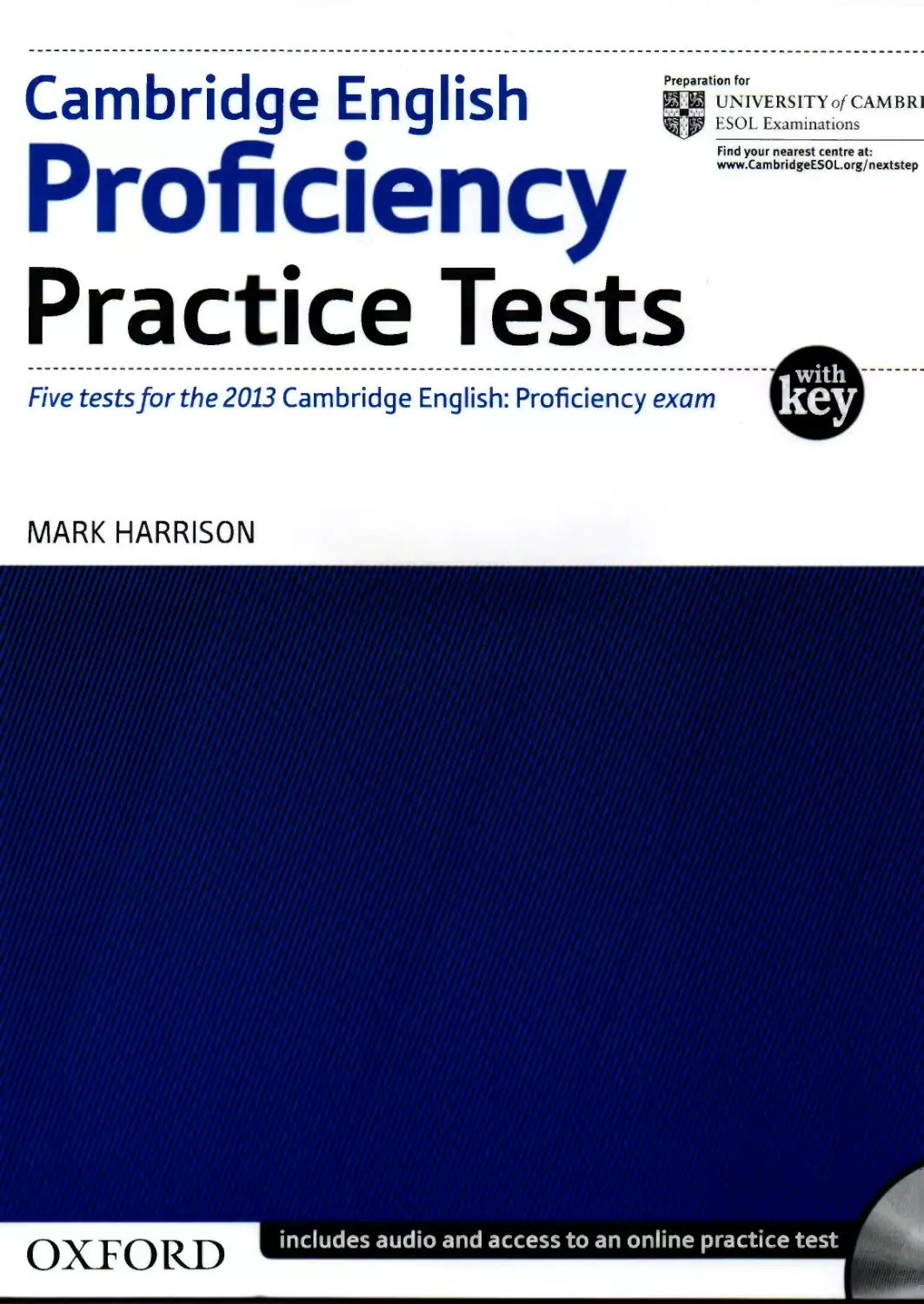
                    Cambridge English
Preparation for
UNIVERSITY of CAMBR]
ESOL Examinations
Find your nearest centre at:
www.CambridgeESOL.org/nextstep
Five tests for the 2013 Cambridge English: Proficiency exam
MARK HARRISON
OXFORD
includes audio and access to an online practice test

Cambridge English
Proficiency
Practice Tests
Five tests for Cambridge English: Proficiency
MARK HARRISON
OXPORD
UNIVERSITY PRESS

OXFORD
UNIVERSITY PRESS
Great Clarendon Street, Oxford, 0x2 6dp. United Kingdom
Oxford University Press is a department of the University of Oxford.
It furthers the University’s objective of excellence in research, scholarship,
and education by publishing worldwide. Oxford is a registered trade
mark of Oxford University Press in the UK and in certain other countries
© Oxford University Press 2012
The moral rights of the author have been asserted
First published in 2012
2016 2015 2014
10 9 8 7 6 5
All rights reserved. No part of this publication may be reproduced, stored
in a retrieval system, or transmitted, in any form or by any means, without
the prior permission in writing of Oxford University Press, or as expressly
permitted by law, by licence or under terms agreed with the appropriate
reprographics rights organization. Enquiries concerning reproduction outside
the scope of the above should be sent to the FIT Rights Department, Oxford
University Press, at the address above
You must not circulate this work in any other form and you must impose
this same condition on any acquirer
Links to third party- websites are provided by Oxford in good faith and for
information only. Oxford disclaims any responsibility for the materials
contained in any third party website referenced in this work
Photocopying
The Publisher grants permission for the photocopying of those pages marked
photocopiable’ according to the following conditions. Individual purchasers
may make copies for their own use or for use by classes that they teach.
School purchasers may make copies for use by staff and students, but this
permission does not extend to additional schools or branches
Under no circumstances may any part of this book be photocopied for resale
isbn: 9780 19 457735 9
Printed in China
This book is printed on paper from certified and well-managed sources
ACKNOWLEDGEMENTS
TIk' authors and publisher are grateful to those who have given permission to reproduce
the following extracts and adaptations of copyright material: p.8 Extract from ‘Charles
Schulz: Obituary’, The Daily Telegraph, 14 February- 2000. © Telegraph Media
Group Limited 2000: p.9 Extract from ‘Behind the scenes’ by Matthew Nixson.
The Times. 6 November 1997. Reproduced by permission of N1 Syndication;
p.12 Extract from Soft City by Jonathan Raban. Copyright ©Jonathan Raban.
1974. Reproduced by permission of Pan Macmillan. London and Aitken
Alexander Associates Limited; p.17 Extract from ‘Cooking with Chocolate: The
last word on chocolate’. The Telegraph, 21 October 2011.® Telegraph Media
Group Limited 2011: p. 14 Extract from Streets Ahead by Keith Waterhouse
published by Hodder & Stoughton. Reproduced by permission of David
Iligham Associates; p.18 Extract from Pgs xix and 27 of The Green Travel Guide
by Greg Neale. © 1998. Reproduced by permission of Taylor & Francis Books
(UK); p.20 Extract from ‘The clash of the two cultures’ by Graham Farmelo.
The Daily Telegraph. 10 March 1999. © Telegraph Media Group Limited 1999;
p.20 Extract from ‘As others see us: The flight booker’ bv Susan d’Arcy, The
Sunday Times. 6 April 1997. Reproduced by permission of NI Syndication;
p.22 Extract from In the Psychiatrist 's Chair by Anthony Clare. Reproduced by-
permission of The Random House Group Limited, and A P Watt Ltd on behalf
of Professor Anthony Clare; p.28 Extract from V\ curse on this cult of celebrity*
by Ray Connolly, The Daily Mail, 25 February' 2000. Reproduced by permission
of Solo Syndication; p.32 Extract from Solomon Grundy by Dan Gooch. Reproduced
with permission of Curtis Brown Group Lts, London on behalf of Dan Gooch.
© Dan Gooch. 1997; p.34 Extract from Staying Up by Rick Gekoski. Copyright
© Rick Gekoski 1998. Reproduced by permission of the author c/o Rogers,
Coleridge & White Ltd., 20 Powis Mews, London Wll 1JN, and Little Brown
Book Group; p.37 Extract from ‘Could a treadmill desk save your life?’ by John
Preston. The Telegraph. 4 December 2011. © Telegraph Media Group Limited 2011;
p.38 Extract from The Language ofCothes by Alison Lurie. Copyright © 1981. 2000
by Alison Lurie. Reprinted by permission of Melanie Jackson Agency, L.L.C,
and A P Watt Ltd Literary'Agents; p.41 Extract from ‘My sporting passion-
scuba diving’ by Emily Hohler. The Sunday Telegraph, 5 May 1996. © Telegraph
Media Group Limited 1996; p.42 Extract from Winning Ctmsumer Competitions by
Kathy Kantypowicz, published by How to Books Ltd. Reproduced by permission:
p.47 Extract from Birdsong by Sebastian baulks, copyright © 1993 by Sebastian
Faulks. Used by permission of Random House, Inc. and The Random House
Group Limited; p.48 Extract from ‘On the island where dreams came true’ by
Janet Daley. The Daily Telegraph, 27 December 1999. © Telegraph Media Group
Limited 1999; p.49 Extract from ‘You can’t judge an author by his cover’ by
Charles Lawrence, The Daily Telegraph, 5 December 1996. ©Telegraph Media
Group Limited 1996; p.52 Extract from Morccambe & Wise by Graham McCann.
© Graham McCann 1998. Reprinted by permission ofHarperCollins Publishers
Ltd and Mic Chcctham Literary Agency; p.54 Extract from Dead Souls by Ian
Rankin. ©John Rebus Ltd 1999, Orion, an imprint of The Orion Publishing
Group, London. Reproduced by permission; p.57 Extract from ‘Shining lights:
the new independent jewellery' designers’ by Sophie de Roscc. The Daily Telegraph,
17 December 2011. © Telegraph Media Group Limited 2011; p.58 Extract from
Children’s Games in Street and Playground by Iona and Peter Opie (1984). By
permission of Oxford University' Press; p.58 Extract from Children ’s Games with
Things by Iona and Peter Opie (1997). By permission of Oxford University Press;
p.60 Extra a from ‘Learning on a critical job’ by Laura Merrill, The Daily Telegraph,
29 May 1999. © Telegraph Media Group Limited 1999; p.60 Extract from Big
Mouth Strikes Again by Tony Parsons. Reproduced by permission of Tony Parsons;
p.61 Extract from ‘Home is where the art is’ by Oliver Bennett, The Times.
15 March 1997. Reproduced by permission of NI Syndication; p.62 Extract
from Football Man by Arthur Hopcraft. Reproduced by permission of Aurum
Press; p.67 Extract from The roar of the greenbacks’ by Nigel Cliff, Die Times,
2 July 1998. Reproduced by permission of NI Syndication: p.68 Extract from
‘Karaoke culture rules OK?’ by Rory Brcmner. The Daily Telegraph, 25 September
1998. © Telegraph Media Group Limited 1998; p.72 Extract from Lily White by
Susan Isaacs. Copyright (c) 1996 by Susan Isaacs. Reproduced by permission of
HarperCollins Publishers, and Susan Isaacs: p.74 Extract from ‘Help guide us
through the universe’ by Sir Martin Rees. The Daily Telegraph, 2 December 1998.
© Telegraph Media Group Limited 1998; p.77 Extract from ‘Desperately seeking
wise old Socrates’ by Bettany Hughes. The Telegraph, 12 October 2010. ©Telegraph
Media Group Limited 2010; p.78 Extract from The Introduction from Ideas of
Human Nature by Roger Trigg, John Wiley & Sons Ltd. Reproduced by permission;
p.80 Extract from ‘A place for damsels in distress’ by Bill Powell, Daily Telegraph,
21 August 1999. © Telegraph Media Group Limited 1999; p.80 Extract from
‘Meet the million-dollar toy boy’ by Charles Laurence, The Daily Telegraph,
29 April 1999. © Telegraph Media Group Limited 1999; p.80 Extract from
‘Cookbooks: love affairs with no calories’ by Nigella Lawson, The Daily Telegraph,
26 September 1998. © Telegraph Media Group Limited 1998; p.81 Extract from
‘Persuading us to Shop Till We Drop’ by Charles Clover. The Daily Telegraph,
2 January 1999. © Telegraph Media Group Limited 1999; p.82 Extract from
Hunting People by Hunter Davies, Mainstream Publishing Co. (Edinburgh) Ltd.
Reproduced by permission.
Although evert' effort has been made to trace and contact copyright holders before
publication, this has not been possible in some cases. We apologize for any apparent
infringement of copyright and if notified, the publisher will be pleased to rectify' any
errors or omissions at the earliest opportunity:
Source: p.38 Extract from Understanding Tashion by Elizabeth Rouse, John Wiley
& Sons Ltd.
The publisher woidd also like to thank the following for permission to reproduce photographs:
Alamy Images pp.44 (Young male using computer/abcrCPC). 64 (man sat on
sofa/Paul Ridsdale). 84 (1960’s Lancia/Goddard Automotive), 84 (P&O Oceana/
Greg Balfour Evans), 84 (Hitchhiking in Bosnia/Jason Langley), 84 (easy jet/Nick
Hanna); Corbis pp.24 (UK - Students March Against Tuition Fees/Mikc Kemp),
24 (Politician shaking hands with supporters/Hill Street Studios), 84 (Commuters
on Tokyo Subway Car/Paul Souders); Getty' Images pp.24 (Two students talking/
IMAGEMORE Co), 44 (watching television/Family in living room), 44 (Man with
burning money and cigar/Jupiterimages), 44 (Wimbledon,'Michael Regan);
Oxford University Press p.44 (Celebrity Couple/Moodboard RF); Rex Features
p.24 (American football/Eye Candy).
Pages 87-93 reproduced with permission of Cambridge ESOL.
Sample answer Test 1 Question 1 written by Dominika Gajek.

Contents
Introduction
5
TEST 1
Reading and Use of English
Writing
Listening
Speaking
TEST 2
Reading and Use of English
Writing
Listening
Speaking
TEST 3
Reading and Use of English
Writing
Listening
Speaking
TEST 4
Reading and Use of English
Writing
Listening
Speaking
67
67
78
80
84
Sample answer sheets	87
Assessing the Writing paper	92
Assessing the Speaking paper	93
Explanatory Key	94
Writing sample answers	126
Audio scripts	130
CAMBRIDGE ENGLISH: PROFICIENCY PRACTICE TESTS CONTENTS 3

Introduction
This book contains:
■	Four complete Practice Tests for Cambridge English: Proficiency (from March 2013)
■	Explanatory Key
This provides detailed explanations for correct answers, and also for incorrect answers in
Reading and Use of English Part 1. Relevant vocabulary and grammatical points are also fully
explained.
■	Sample answers for the Writing Paper
There is a sample student answer for each of the kinds of writing required (essay, article,
letter, etc.) and all the sample answers are assessed.
■	General assessment criteria for Writing and Speaking Papers
■	Sample answer sheets
■	Audio scripts
There are four Papers in the exam:
Reading and Use of English (1 hour 30 minutes)
Text	Question type	Focus
PARTI
1 short text with 8
gaps
Multiple-choice cloze
4-option multiple-choice; choose the
correct word(s) to fill each gap
vocabulary (meaning of single words,
completion of phrases, phrasal verbs,
etc.) !
8 questions; 8 marks
PART 2
1 short text with 8
gaps
Open cloze
fill each gap with one word
mostly grammar, some vocabulary
8 questions; 8 marks
PART 3
1 short text with 8
gaps
Word formation
use the words given to form the correct
word for each gap
vocabulary
8 questions; 8 marks
PART 4
6 unrelated sentences,
each followed by a
single word and a
gapped sentence
. .
Key word transformations
use the word given to complete the
gapped sentence so that it means the
same as the first sentence
grammar, vocabulary and collocation
6 questions; 12 marks
(1 mark for each part of the answer,
max. 2 marks per question)
PART 5
1 long text
Multiple choice
4-option multiple choice
comprehension of detail, opinion,
attitude, tone, purpose, main idea,
implication, exemplification, reference,
etc. f
6 questions; 12 marks
PART 6
1 text with 7
paragraphs missing
Gapped text
choice of 8 paragraphs to fill the gaps
understanding of text structure, links
between parts of text
7 questions; 14 marks
PART 7
1 text divided into
sections OR several
short texts
Multiple matching
matching statements / information to
section of text or short text they refer
to or appear in
detail, opinion, attitude, specific
information i
10 questions; 10 marks
CAMBRIDGE ENGLISH: PROFICIENCY PRACTICE TESTS INTRODUCTION 5

Writing (1 hour 30 minutes)
Each question carries equal marks.
Task
Word limit
PARTI
essay
summarizing the key points in two short texts
and giving opinions
Candidates must do this task.
240-280 words 1
PART 2
article, report, review, letter
Questions 2-4: candidates choose one task from three choices
280-320 words
OR
L
Questions 5a / 5b: candidates may choose one task about the
set books. (There are two set books which change periodically)
Listening (40 minutes)
Each question carries equal marks.
Task
Question type
Focus
PARTI
3 short unrelated
pieces
(monologue or
conversation)
Multiple choice
3-option multiple-choice (2 questions
per piece)
detail, gist, opinion, feeling, attitude,
purpose, agreement between speakers,
course of action
6 questions; 6 marks j
PART 2
1 monologue
Sentence completion
9 sentences to complete with a word or
short phrase
understanding of specific information
given in the piece
9 questions; 9 marks
PART 3
1 interview or
discussion (two or
more speakers)
Multiple choice
4-option multiple-choice
understanding of opinion, attitude,
detail, gist, inference
5 questions; 5 marks
PART 4
5 short themed
monologues
Multiple matching
2 tasks. For each task, match what each
speaker says to one of 8 options
same as Part 1
10 questions; 10 marks

Speaking (14 minutes)
Activity type (examiner + two candidates) Focus
PARTI
conversation between candidates and examiner
(2 mins)
general and personal topics relating to the
candidate \
PART 2
talking about pictures: candidates discuss together
one or more pictures and do a decision-making task
(4 minutes)
exchanging ideas, giving and justifying opinions,
making suggestions, agreeing/disagreeing, reaching
a decision through negotiation
PART 3
each candidate speaks alone for 2 minutes, based
on a prompt card; each candidate is also asked
a question about what the other candidate said
discussion between candidates and examiner on the
same topics
(10 minutes)
speaking continuously on a given topic, commenting
on what someone has said exchanging ideas, giving
and justifying opinions, agreeing/disagreeing
6 CAMBRIDGE ENGLISH: PROFICIENCY PRACTICE TESTS INTRODUCTION

READING & USE OF ENGLISH 1 hour 30 minutes
PARTI
For questions 1-8, read the text below and decide which answer (A, B, C or DJ best fits each
gap. Mark your answers on the separate answer sheet
There is an example at the beginning (0).
Example:
0 A acclaiming B plugging
C raving
D promoting
Reading People
Last month 1 was invited to lunch with my cousin
and his new wife. I hadn’t met her before, but my
cousin had been 0	Q	to everyone about
her wonderful, warm and caring personality. Clearly
she had completely 1	him off his feet. It
didn't take long for me to see through this veneer.
On arriving at lunch, she sat down at the table
without so 2	as an acknowledgment
of my presence. She 3	to continue her
conversation with her husband as if I didn’t exist,
and then 4	at the young waitress for
accidentally spilling some water on the table. I was
eventually 5	worthy of her attention
only when it came to paying the bill; I had offered
to treat them to lunch to celebrate their recent ‘good
news’. She was evidently someone who could turn
the charm on, but only when it 6	her
purpose. In my opinion, 7	wonderful,
warm and caring people do not blow hot and cold in
their behaviour to others 8	on what they
believe they can get out of them.of what someone
can do for them.
rrrr
■ —» "T
—
1
A plucked
B swept
C dragged
D hoisted
2
A much
B far
C great
D long
3
A proceeded
B followed
C progressed
D continued
4
A winked
B glared
C peeped
D eyed
5
A pondered
B discriminated
C weighed
D deemed
6
A met
B realized
C performed
D served
7
A fully
B purely
C literally
D truly
8
A varying
B revolving
C depending
D determined
CAMBRIDGE ENGLISH: PROFICIENCY PRACTICE TESTS READING & USE OF ENGLISH 7

TEST 1
PART 2
For questions 9-16, read the text below and think of the word which bestfits each gap. Use
only one word in each gap. There is an example at the beginning (0). Write your answers IN
CAPITAL LETTERS on the separate answer sheet.
Example:
0
T
H
E
R
Charles Schulz
The cartoonist Charles Schulz created the daily lives
of Charlie Brown, Snoopy, Lucy and the 0 other
inhabitants of the Peanuts strip. Schulz, 9
to his friends as ‘Sparky’, drew the daily strip for almost
50	years. Its distinctly American culture 10
nothing to hamper its universal success. It was said
to have 355 million readers in 75 countries, and it
11	Schulz very rich. Schulz displayed
unflaggingly sharp observation and a fairly gentle, if
sometimes downbeat, humour.
He was given 12	anxiety and low spirits,
and there was an underlying sadness in his stories,
a bitter-sweet quality that clearly fascinated many
of his fans. In the 1950s, the strip had a vogue
following 13	intellectuals, but Schulz
was happy to point 14	that he himself
had flunked algebra, Latin, English and physics
at school. When someone 15	him an
existentialist, he had to ask 16	the
word meant.
mirrMmtrmmFiTrmnmnrmwnW'^^

8 CAMBRIDGE ENGLISH: PROFICIENCY PRACTICE TESTS READING & USE OF ENGLISH

PART 3
For questions 17-24, read the text below. Use the word given in capitals at the end of some
of the lines to form a word that fits in the gap in the same line. There is an example at the
beginning (0). Write your answers IN CAPITAL LETTERS on the separate answer sheet
Example:
£
F
F
0
R
T
L
£
5
5
	1
1
BEHIND THE SCENES
Watching a successful theatre production is an amazing experience.
The performance looks 0 effortless, and everything goes smoothly	EFFORT
but this often 17	the amount of work that was actually involved.	LIE
At the Palace Theatre, the average time from the first 18	to	REHEARSE
opening night is just four weeks of intensive work. Everyone involved attends
the first read-through by the cast, so this is an ideal opportunity to get an
19	into how a production germinates.	SIGHT
I	took myself to the theatre on a 20	October morning to attend the	CHILL
read-through of the theatres new production - the British premiere of Sive, by
the acclaimed Irish playwright John B Keane. It is a poignant portrayal of rural
family life, rich in comedy and filled with 21	characters played	MEMORY
by an Irish cast for linguistic 22	 AUTHENTIC
‘Its important for people to have a sense of common purpose and
23		/ explains director Ben Barnes. The play has been in	TEAM
pre-production since June but this is the first reading and it will be
24		of how the actors work together. And its for the theatre	INDICATE
staff as much as the actors.’
CAMBRIDGE ENGLISH: PROFICIENCY PRACTICE TESTS READING & USE OF ENGLISH 9

TEST 1
PART 4
For questions 25-30, complete the second sentence so that it has a similar meaning to the
first sentence, using the word given. Do not change the word given. You must use between
three and eight words, including the word given. Here is an example (0):
Example:
0	Dan definitely won’t be able to afford a holiday this year,
possiblity
There	to afford a holiday this year.
Write only the missing words on the separate answer sheet
0
25	John has hinted that he doesn’t wish to remain in the group any longer,
hint
John has	wishes to remain in the group.
26	Five actors were competing for the leading role in the play,
contention
There	the leading role in the play.
10 CAMBRIDGE ENGLISH: PROFICIENCY PRACTICE TESTS READING & USE OF ENGLISH

27	She was concentrating so hard on her work that she didn’t notice when I came in.
wrapped
She was	that she didn’t notice when I came in.
28	They still haven’t found out what caused the accident,
cause
They have yet	the accident was.
29	I reluctantly signed the contract,
signature
It was with	on the contract.
30	Suzanne is far superior to me in terms of technical knowledge,
match
When it comes	for Suzanne.
CAMBRIDGE ENGLISH: PROFICIENCY PRACTICE TESTS READING h USE OF ENGLISH 11

PART 5
You are going to read an extract from a book about life in cities. For questions 31-36, choose
the answer (A, B, C or D) which you think fits best according to the text Mark your answers
on the separate answer sheet
Image and the eity
In the city, we are barraged with images of (he people
we might become. Identity is presented as plastic, a
matter of possessions and appearances; and a very
large proportion of the urban landscape is taken
up by slogans, advertisements, flatly photographed
images of folk heroes - the man who turned into a
sophisticated dandy overnight by drinking a particular
brand of drink, the girl who transformed herself into
a femme fatale with a squirt of cheap scent. The tone
of the wording of these advertisements is usually
pert and facetious, comically drowning in its own
hyperbole. But the pictures are brutally exact: they
reproduce every detail of a style of life, down to the
brand of cigarette-lighter, the stone in the ring, and
the economic row of books on the shelf.
Yet, if one studies a line of ads across from where
one is sitting on a tube train, these images radically
conflict with each other. Swap the details about
between the pictures, and they are instantly made
illegible. If the characters they represent really are
heroes, then they clearly have no individual claim
to speak for society as a whole. The clean-cut and
the shaggy, rakes, innocents, brutes, home-lovers,
adventurers, clowns all compete for our attention
and invite emulation. As a gallery, they do provide
a glossy mirror of the aspirations of a representative
city crowd; but it is exceedingly hard to discern a
single dominant style, an image of how most people
would like to see themselves.
Even in the business of the mass-production of images
of identity, this shift from the general to the diverse
and particular is quite recent. Consider another line of
stills: the back-lit, soft-focus portraits of the first and
second generations of great movie stars. There is a
degree of romantic unparticularity in the face of each
one, as if they were communal dream-projections
of society at large. Only in the specialised genres
of westerns, farces and gangster movies were stars
allowed to have odd, knobbly cadaverous faces. The
hero as loner belonged to history or the underworld:
he spoke from the perimeter of society, reminding us
of its dangerous edges.
The stars of the last decade have looked quite different.
Soft-focus photography has gone, to be replaced by a
style which searches out warts and bumps, emphasises
the uniqueness not the generality of the face. Voices,
too, are strenuously idiosyncratic; whines, stammers
and low rumbles are exploited as features of ‘star
quality’. Instead of romantic heroes and heroines, we
have a brutalist, hard-edged style in which isolation
and egotism are assumed as natural social conditions.
In the movies, as in the city, the sense of stable
hierarchy has become increasingly exhausted; we no
longer live in a world where we can all share the same
values, the same heroes, (it is doubtful whether this
world, so beloved of nostalgia moralists, ever existed;
but lip-service was paid to it, the pretence, at least, was
kept up.) The isolate and the eccentric push towards the
centre of the stage; their fashions and mannerisms are
presented as having as good a claim to the limelight
and the future as those of anyone else. In the crowd
on the underground platfonn, one may observe a
honeycomb of fully-worked-out worlds, each private,
exclusive, bearing little comparison with its nearest
neighbour. What is prized in one is despised in another.
There are no clear rules about how one is supposed to
manage one’s body, dress, talk, or think. Though there
are elaborate protocols and etiquettes among particular
cults and groups within the city, they subscribe to no
common standard.
For the new arrival, this disordered abundance is the
city’s most evident and alarming quality. He feels as
if he has parachuted into a funfair of contradictory
imperatives. There are so many people he might
become, and a suit of clothes, a make of car, a brand
of cigarettes, will go some way towards turning him
into a personage even before he has discovered who
that personage is. Personal identity has always been
deeply rooted in property, but hitherto the relationship
has been a simple one - a question of buying what you
could afford, and leaving your wealth to announce
your status. In the modern city, there are so many
things to buy, such a quantity of different kinds of
status, that the choice and its attendant anxieties have
created a new pornography of taste.
12 CAMBRIDGE ENGLISH: PROFICIENCY PRACTICE TESTS READING & USE OF ENGLISH

31	What does the writer say about advertisements in the first paragraph?
A Certain kinds are considered more effective in cities than others.
B	The way in which some of them are worded is cleverer than it might appear.
C	They often depict people that most other people would not care to be like.
D The pictures in them accurately reflect the way that some people really live.
32	The writer says that if you look at a line of advertisements on a tube train, it is clear that
A city dwellers have very diverse ideas about what image they would like to have.
B some images in advertisements have a general appeal that others lack.
C city dwellers are more influenced by images on advertisements than other people are.
D some images are intended to be representative of everyone's aspirations.
33	What does the writer imply about portraits of old movie stars?
A They tried to disguise the less attractive features of their subjects.
B Most people did not think they were accurate representations of the stars in them.
C They made people feel that their own faces were rather unattractive.
D They reflected an era in which people felt basically safe.
34	What does the writer suggest about the stars of the last decade?
A Some of them may be uncomfortable about the way they come across.
B They make an effort to speak in a way that may not be pleasant on the ear.
C They make people wonder whether they should become more selfish.
D Most people accept that they are not typical of society as a whole.
35	The writer uses the crowd on an underground platform to exemplify his belief that
A no single attitude to life is more common than another in a city.
B no one in a city has strict attitudes towards the behaviour of others.
C views of what society was like in the past are often inaccurate.
D people in cities would like to have more in common with each other.
36	The writer implies that new arrivals in a city may
A change the image they wish to have too frequently.
B underestimate the importance of wealth.
C acquire a certain image without understanding what that involves.
D decide that status is of little importance.
CAMBRIDGE ENGLISH: PROFICIENCY PRACTICE TESTS READING h USE OF ENGLISH 13

TEST 1
PART 6
You are going to read an extract from an autobiography. Seven paragraphs have been
removed from the extract. Choose from the paragraphs A-H the one which fits each gap
(37-43J. There is one extra paragraph which you do not need to use. Mark your answers on
the separate answer sheet
Eilbeck the features editor
I	quickly got the hang of working at the Mirror. Every
morning at eleven we would be expected to cram
into Eilbeck s little office for a features conference,
when we either had to come up with ideas of our
own or suffer ideas to be thrust upon us. Some of
Eilbeck’s own offerings were bizarre to say the least,
but he did get results. I had got an inkling of his
creative thinking during my initial interview when
he had invited me to match his scrawled impromptu
headline with a feature.
37
Some of these brainstorms came off the day’s
news, some off the wall. About half the ideas
worked, a few of them spectacularly. Following a
spate of shootings, Eilbeck scrawled THIS GUN FOR
SALE' on his pad, together with a rough sketch of
a revolver. Within hours a writer was back in the
office with a handgun and a dramatic piece on the
ease with which (he did not mention the little help
he had had from the crime staff) he had bought it
in Trafalgar Square.
38
Mercifully, none of Eilbeck’s extemporised headlines
winged their way to me - at least not yet. The
pitifully small paper was grossly overstaffed, with
half a dozen highly experienced feature writers
fighting to fill one page a day, and it was evident
that my role was as standby or first reserve. Hanging
around the office, where the time was passed
pleasantly in chit-chat, smoking and drinking coffee,
I was occasionally tossed some small task.
39
Another of my little chores was to compose ‘corne-
ons’ for the readers’ letters columns - invented,
controversial letters that, in a slow week for
correspondence, would draw a furious mailbag.
I	was also put to work rewriting agency and
syndication material that came into the office,
including, on occasion, the Sagittarius segment of
the astrology column.
40
Some years later, when he had directed his talents
to another paper, I confessed to him one day that I
had been guilty of tampering in this way. He was in
no way put out. It was serenely obvious to him that I
had been planted on the Mirror by destiny to adjust
the hitherto inaccurate information.
41
For example, one afternoon I was summoned to
Eilbeck’s office to find him in a state of manic
excitement, bent over a make-up pad on which
he had scrawled THE SPICE OF LIFE!’ surrounded
by a border of stars. This, I was told, was to be the
Mirror’s new three-times-a-week gossip column,
starting tomorrow - and I was to be in charge of it.
42
Happily the delightful Eve Chapman was deputed to
hold my hand in this insane exercise. The bad news
was that Eve, who went home nightly to her parents
in Croydon, had never set foot in such a place in her
life. We were reduced to raiding the society pages of
the glossy magazines and ploughing through Who’s
Who in hopes of finding some important personage
with an unusual hobby which could be fleshed out to
the maximum twenty-five words.
43
The Spice of Life column itself ground to a halt after
our supply of eminent people’s interesting pastimes
petered out.
14 CAMBRIDGE ENGLISH: PROFICIENCY PRACTICE TESTS READING h USE OF ENGLISH

A As a result, he wanted no item to be more
than twenty-five words long, followed by
three dots. He was, at the time, heavily
under the influence of Walter Winchell, Earl
Wilson and suchlike night-owl columnists
in the New York tabloids that were air¬
freighted to him weekly.
B Flattering though it was to be entrusted
with this commission, there was a snag. It
had to sizzle’ - a favourite Eilbeck word -
with exclusive snippets about ‘the people
who really mattered’ - to Eilbeck’s mind,
anyone with an aristocratic title, or money
to throw about in casinos and nightclubs.
Unfortunately, I did not have a single
suitable contact in the whole of London.
C This might be a review copy of some
ghosted showbiz memoirs that might be
good for a 150-word anecdotal filler. One
day Eilbeck dropped a re-issued volume
on my desk - To Beg I am Ashamed, the
supposed autobiography of a criminal. It
came complete with one of his headlines:
‘IT’S STILL A BAD, DANGEROUS BOOK’. I
asked him what was so bad and dangerous
about it. ‘I haven’t read it,’ the Features
Editor confessed cheerfully. ‘Two hundred
words by four o’clock’.
D On one desperate occasion, with the
deadline looming yet again, we fell to
working our way along Millionaires’ Row
in Kensington, questioning maids and
chauffeurs about the foibles of their rich
employers. This enterprise came to a stop
after someone called the police.
E This proved to be a foretaste of his
favourite method of floating an idea. While
the assembled feature writers clustered
around his desk skimming the newspapers
and intermittently quoting some story
that might with luck yield a feature angle,
Eilbeck would be scribbling away on his
pad. Cockily trumpeting his newly minted
headline - ‘WOULD YOU RISK A BLIND DATE
HOLIDAY?’ or ‘CAN WOMEN BE TRUSTED
WITH MONEY?’ - he would rip off the page
and thrust it into the arms of the nearest
writer - ‘Copy by four o’clock.’
F This was for the benefit of one of the
paper’s more irascible executives who was a
passionate believer in it. It had been noticed
that when he was told he would have a
bad day he would react accordingly and
his miserable colleagues would go through
the day quaking in their shoes. My job was
to doctor the entry to give his colleagues a
more peaceful ride.
G My month’s trial with the Mirror quickly
expired without my having done anything to
justify my existence on the paper, but since
Eilbeck didn’t mention that my time was up,
neither did 1.1 pottered on, still trying to find
my feet. Occasionally opportunity would
knock, but it was usually a false alarm. Not
always, though.
H But many of Eilbeck’s madder flights of
fancy had no chance of panning out so well
- even I could tell that. Seasoned writers
would accept the assignment without
demur, repair to a cafe for a couple of
hours, and then ring in to announce that
they couldn’t make the idea stand up.
CAMBRIDGE ENGLISH: PROFICIENCY PRACTICE TESTS READING & USE OF ENGLISH 15

PART 7
You ore going to read an article about a company that makes chocolate.
For questions 44-53, choose from the sections (A-D). The sections may be
chosen more than once. Mark your answers on the separate answer sheet
In which section are the following mentioned?
visible evidence of Valrhona’s popularity
assumptions that are not necessarily correct
the influence of Valrhona on cooking with chocolate
the difficulty of doing what Valrhona suggests
a contrast between ways of making chocolate
a change that Valrhona regretted making
an explanation of the term used for a stage in a process
a calculation connected with one of the senses
the possibility of overdoing something
an influence on the quality of an ingredient
44
I
45
I
46|
I
47
I
48
I
49
I
50
I
511
l
521
I
531
16 CAMBRIDGE ENGLISH: PROFICIENCY PRACTICE TESTS READING h USE OF ENGLISH

The Chocolate Factory
A The scent of chocolate hangs
over the small French town of
Tain-rHermitage. Wafting from
savoury to toasted, fruity to oily,
the aroma emanates from the
89-year-old factory of Valrhona,
one of the most respected
chocolate makers in the business.
I was inhaling this heady
perfume on a trip to find out
about Valrhona's first book, the
fabulous Cooking with Chocolate.
A vast tome, it's a chocophile's
dream, with pages of chocolate
information alongside recipes,
from the ultimate sachertorte
to 'Bittersweet Chocolate Bars,
Salted Butter Caramel and
Crystallised Almonds'. Most are
mesmerizingly complex creations
strictly for trained chefs or time-
rich amateurs; mouthwatering
for the rest of us. Best of all are
the pages on techniques such as
the all-important tempering (a
heating and cooling process that
keeps the shine and texture of
chocolate when it is remoulded),
all minutely described and
carefully illustrated.
B I'd expect nothing less from
Valrhona, which we have to
thank for the quiet revolution
in chocolate of the past 25
years. Back in the early 1980s,
plain chocolate meant a cocoa
solids content of barely 40
per cent. Then, in the early
1990s, cookery writers began
telling us to use chocolate with
'minimum 50 per cent cocoa
solids'. The supermarkets started
stocking real cooking chocolate
with escalating levels of cocoa
solids. It was Valrhona that
first introduced a 70 per cent
cocoa solids chocolate bar to the
market in 1986. It caused a flurry
among chefs, who found that it
gave a far more intense chocolate
flavour to their dishes, and it
was given star billing on menus.
Since then an army of boutique
chocolate makers has been
born. They all produce chocolate
in a 'bean-to-bar' process,
transforming raw, fermented
beans into chocolate themselves.
It's an important distinction,
as many other companies buy
ready-made chocolate in bulk
and re-melt it to form bars and
chocolate sweets.
C Inside Valrhona's newest factory
on the outskirts of town, Luce,
our elegantly grey-haired guide,
leads us past paintings of the
chefs who are fans of Valrhona.
The smell grows ever headier
and sweeter as we enter a
windowless, high-ceilinged
room with a cream-tiled floor,
on which neat rows of sacks are
waiting for processing. Inside
are fermented and dried beans,
but the dull brown seeds have a
long way to go before they can
live up to their botanical name,
Theobroma: 'food of the gods'.
In the next room that process
is beginning, as the beans are
roasted in huge rotating drums,
then cooled and crushed to
peppercorn-sized pieces. Just
across the room, a lone worker is
supervising the grinding of the
nibs through pairs of rollers. It's
this powder, he explains, which
constitutes the 'cocoa solids' in
the chocolate bar, and is mixed
with extra cocoa butter (the fatty
component of the cocoa bean),
sugar, vanilla and emulsifier,
usually soya lecithin, to make
plain chocolate. Milk chocolate
has milk powder added as well.
They are ground together to make
a paste refined to grains no bigger
than 17 microns - the tongue can
detect nothing below 20 microns.
All the machines are thickly
coated with cream-coloured paint
and have a vintage air, like a
ship's engine room. It turns out
they date from the 1960s. 'We
bought modem ones, which were
much more efficient, but they
just didn't produce such good
chocolate, so we went back to
these,' explains Luce, as we head
to the conching machines. These
huge mixers stir the chocolate
ingredients for up to three days,
combining them at 60-70C and
developing the flavours.
D But can a bar ever contain too
much cocoa solids? I ask Pierre
Costet, head taster for Valrhona,
over a table of chocolate samples.
'Yes'. The blend of beans
with cocoa butter and sugar
should vary according to the
subtleties of the flavour. Costet
also believes the merits of the
three varieties of cacao bean are
exaggerated. It is widely accepted
that Criollo (mostly from
Venezuela) is the connoisseur's
choice and Trinitario, grown in
South and Central America, is
the best mainstream variety.
Forestero, grown in Africa, is
considered coarse, mass-market
stuff. This, Costet tells me, is
too simplistic. First, because
cacao trees are grown from seed
by the farmers, they may have
been cross-pollinated with the
other varieties anyway. Second,
how the beans are grown
and fermented makes a huge
difference, so a well-looked-after
Forestero may well be better
than a poorly treated Criollo.
m
CAMBRIDGE ENGLISH: PROFICIENCY PRACTICE TESTS READING h USE OF ENGLISH 17
TEST 1

WRITING 1 hour 30 minutes
PARTI
Read the two texts below.
Write an essay summarising and evaluating the key points from both texts. Use your own
words throughout as far as possible, and include your own ideas in your answer.
Write your answer in 240-280 words.
1
Unsustainable tourism
We are increasingly familiar with some of the worst effects of unthinking, unmanaged,
unsustainable tourism: previously undeveloped coastal villages that have become sprawling,
charmless towns, their seas poisoned by sewage, denuded of wildlife, their beaches stained
with litter and tubes of suncream; and historic towns, their streets now choked with traffic,
their temples, churches and cathedrals seemingly reduced to a backdrop for holiday snaps
that proclaim, ‘Been there, Done that’. Less appreciated, perhaps, is the social dislocation
unsustainable tourism can cause: once-cohesive communities disrupted as the holiday
industry replaces old crafts, turning fishermen into tour boat operators and farmers into
fast-food store waiters or hotel cleaners.
Criticism of the tourism industry
Although its strongest critics view the tourism industry as a rapacious predator - moving on
to fresh conquests after one environment has been spoiled, and forever fuelling the desires
of holidaymakers with the prospect of a new paradise that must be enjoyed ‘before it's gone’
- there are many within the industry who reject the claim. They are at least partly right. There
are examples where the travel trade is doing better. Of course, reforming initiatives often come
after the damage has been done and in some cases for public relations purposes rather than
from a commitment to sustainability.
Write your essay.
NOTE: There is a sample answer to this question and assessment of it on page 126.
18 CAMBRIDGE ENGLISH: PROFICIENCY PRACTICE TESTS WRITING

PART 2
Write an answer to one of the questions 2-5 in this part Write your answer in 280-320
words in an appropriate style.
2	A magazine is running a competition for the best article entitled ‘I Was There’. Those
entering have to write an article describing an historical event as if they had been present
at it. Write an article for this competition, describing the event you have chosen and what
your impressions would have been if you had witnessed it.
Write your article.
3	You have been appointed as a student representative at your school or college. The
head has asked you to write a report on what facilities and forms of entertainment the
students would like to see introduced, based on a project you organize yourself to find
out the opinions of students. Within your report, you should explain how you gathered
the opinions and make recommendations as to what should be introduced and what
benefits would result.
Write your report
4	A TV listings magazine has invited readers to contribute a review of a television series that
is or was particularly popular. Write a review, explaining why this programme is/was so
popular in your opinion and commenting on whether you believe it deserves/deserved
such popularity.
Write your review.
5	Set book questions - a choice from three questions.
NOTE: There is a sample answer for Question 4 and an assessment of it on page 126.
CAMBRIDGE ENGLISH: PROFICIENCY PRACTICE TESTS WRITING 19

TEST 1
LISTENING approx. 40 minutes
PARTI
You will hear three different extracts.
For questions 1-6, choose the answer (A, B or C) which fits best according to what you hear.
There are two questions for each extract
Extract One
You hear the introduction to a radio programme about the arts and science in Britain.
1	What does the speaker say about the phrase The Two Cultures?
A Some people consider it no longer relevant.
B It describes an undesirable situation.
C It is used mostly by scientists.
2	The speaker regards C P Snow as someone who
A attracted a certain amount of unfair criticism.
B had ideas that were ahead of their time.
C failed in his chosen fields of work.
Extract Two
You hear a travel agent talking about problems with customers.
3	What does she say about lost tickets?
A There has been an increase in the number of them.
B People make up reasons why they have been lost.
C Some explanations given are easier to believe than others.
4	What does she suggest about the man travelling for heart surgery?
A He could have been extremely angry when he returned.
B He did well to sort out his own problem by himself.
C What happened to him is unlikely to happen to anyone else.
Extract Three
You hear part of a radio programme about a British couple, Victoria and Mark, who make wildlife
films in Africa.
5	Freddie got his nickname because
A he can distinguish between different kinds of snake.
B he appears to enjoy contact with snakes.
C he is always pointing out snakes to other people.
6	When describing their current location, Mark emphasizes
A how much it differs from his expectations of it.
B how hard it is to predict weather conditions there.
C how difficult their everyday life there is.
20 CAMBRIDGE ENGLISH: PROFICIENCY PRACTICE TESTS LISTENING

PART 2
You will hear someone called Kate Charters describing her career.
For questions 7-15, complete the sentences with a word or short phrase.
Kate’s first job involved selling
by phone.
Three years later, she started working for a company called
When she joined Visnews, she first worked in the company’s
The videos made by Visnews were
interest.
on topics of special
The videos made by Visnews were sold in shops and by
methods.
At Castle Communications, one side deal’ involved holding a
at a theme park.
She returned to Visnews and is currently in charge of its
Kate’s present job involves providing companies with the services of
as well as with certain facilities and technology.
Throughout her career, she has been given valuable assistance by someone who is employed by a
15
CAMBRIDGE ENGLISH: PROFICIENCY PRACTICE TESTS LISTENING 21
TEST 1

TEST 1
PART 3
You will hear an interview with a British politician.
For questions 16-20, choose the answer (A, B, C or DJ which fits best according to what you
hear;
16	Susan says that she particularly dislikes politicians who
A pretend to feel strongly about issues.
B	disguise their real beliefs.
C	are indecisive about issues.
D openly treat voters with contempt.
17	When she had her disagreement with Martin Jones, Susan
A decided that personal ambition was not her main motivation.
B began to feel that she had failed as a politician.
C felt that her point of view was not correctly understood.
D regretted the effect it would have on her future in politics.
18	What was Susan’s attitude to involving colleagues in the controversy?
A	She realized that they were unlikely to share her point of view.
B	She was reluctant to do so because she was not sure she was right.
C She thought that involving colleagues would make things worse.
D She felt they should decide for themselves whether she had a point.
19	When asked whether her opinion of her colleagues has changed, Susan says that
A their reaction has made her reluctant to get into the same position again.
B she prefers those who criticized her to those who kept their opinions private.
C there may come a time when she does not publicly support them on issues.
D politicians place too much emphasis on their personal opinions of each other.
20	Susan thinks she was considered mad by some other politicians because
A her behaviour was out of character.
B	they found her intimidating.
C	she did not conform.
D her unselfishness shamed them.
22 CAMBRIDGE ENGLISH: PROFICIENCY PRACTICE TESTS LISTENING

You will hear five short extracts in which people are talking about books they have read.
You will hear the recording twice.
O
CD
I
to
»
CD
T—1
CM
no
LT»
l_
s_
o_
v_
CD
CD
CD
CD
CD
JXL
03
03
03
03
03
CD
CD
CD
CD
CD
CL
CL
CL
CL
CL
LO
UO
un
UO
LO
s
£
CD
on
O
no
I
<D
CM
CO
C
o-2
S CO
p 3
^ Cr
UO v.
< .O
•
4-5
o
•
o
T3
-O
CD
ch
“D
03
CD
V—
ch
c
on
in
c
O
TD
CD
t?
c/i
•
c
rn
o
CD
•
4-*
3
O
O
>
o
U
U
3
JXL
4->
>N
k—
r
L.
in
c
o
• —
.s
CO
0J
-M
“d
CD
4-J
L.
<D
4-»
c
cn
c
‘on
tt
CD
m
_QJ
CL
cn
c
CL
i
4—*
^n
4-»
•
in
CL
O
■M
O
2
1—
CD
CD
>N
L_
• —
L-
CL
LO
a
• MM
o
CD
Cl
_o
o
CD
3
O
CD
>
i—
CD
on
CD
“O
.co
_D
>
CD
3
3
CD
o
r~
03
4-»
o
>
to
CT
4-*
4-*
CD
LO
on
on
CD
k-
u.
O
in
•
O
CD
■M
4->
4—*
4->
4-J
4—1
CD
Q_
8-
E
<
CD
u
Q
LU
Li-
O
O
u
o
o
CD
I
<
CO
3
e
3
O
>s
•k
c
CD
+■*
CO
■ Hi
3
O
>N
CD
T—1
CM
no
ID
l_
i—
i_
CD
CD
CD
CD
CD
03
03
03
03
03
CD
CD
CD
CD
CD
CL
CL
CL
CL
CL
on
LO
uo
LO
LO
co
CD
€
E
£
CD
CO
O
O
U
rf §
7 ■§
L CD
LLi
o
LO
<
CM
CO
C
O
^3
O
CD
CO v
Sj fc
2.
cr C3
CD
c
o
• '
4-J
ro
“O
c
CD
E
E
o
u
CD
L_
"E
c
o
io
i_
CD
Q_
CL
co
CD
4—<
3
CD
cn
c
03
$
03
CD
Id'
3
on
J=
>
4-»
CD
u
03
CD
_CD
cn
c
o
4->
i—
c
on
CD
c
£
CD
_o
03
s_
—1
‘on
4->
u.
on
CD
c
E
4-»
•
4-»
in
<D
o_
'on
CD
-J
o
>
£
CD
>
"O
£
• mmmm
c
CD
CD
£
o
L.
CD
4->
c
“O
03
on
4-1
•
CO
u
Q
LU
Li-
o
x
CAMBRIDGE ENGLISH: PROFICIENCY PRACTICE TESTS LISTENING 23
TlS3i

TEST 1
SPEAKING 16 minutes
Note: Assessment criteria are on page 93.
PART 2 (4 minutes)
Authority
24 CAMBRIDGE ENGLISH: PROFICIENCY PRACTICE TESTS SPEAKING

PART 1 (2 minutes)
Questions that may be addressed to either candidate.
■	Where are you from?
■	Are you working or studying at the moment?
■	What do you like most/least about your studies/job? (Why?)
■	Describe briefly a typical day at college/school/university/work.
■	Has your college/school/university/work changed since you started there?
■	Who are your best friends?
■	How did you meet your friends?
■	What do you particularly like about your friends?
■	What faults do any of your friends have?
PART 2 (4 minutes)
Authority
(Pictures are on page 24)
For both candidates
Here are some pictures of people doing various jobs. Look at pictures A and B and talk together
about the good and bad aspects of these jobs for the people who do them.
(Candidates A and B: 1 minute)
Now look at all the pictures.
Imagine that you are going to take part in a project about authority figures in your society and how
much respect people in general have for them. These pictures show some of the authority figures
that the project will focus on.
Talk together about attitudes that people have towards these authority figures. Then decide which
of the authority figures is most respected in your society.
(Candidates A and B: 3 minutes)
CAMBRIDGE ENGLISH: PROFICIENCY PRACTICE TESTS SPEAKING 25
TEST 1

TEST 1
PART 3 (10 minutes)
Effort and Reward
Task (a)
Candidate A
(2 minutes)
Do some people get paid a lot more/less than they deserve?
■	overpaid/underpaid jobs
■	reasons why overpaid/underpaid
■	what the jobs really involve
Candidate B
(1 minute)
What jobs are generally regarded as desirable in your society? (Why?)
■	Would you like to do any of these jobs? (Why?/Why not?)
■	What kind of jobs do people in your society not want to do? (Why?)
Candidate A: Do you agree?/What do you think?/How about you?
Task (b)
Candidate B
(2 minutes)
Which jobs are the most difficult?
■	most difficult aspects
■	how people doing them are generally regarded
■	importance of the jobs in society
Candidate A
(1 minute)
■	What makes people want to do the difficult jobs in society?
■	What kind of person do you have to be to do such jobs?
■	Do you think you would be capable of doing any of them? ... (Why?/
Why not?)
Candidate A: Do you agree?/What do you think?/How about you?
Discussion
■	Have you done something where the effort was not worth it for the reward?
■	What motivation do people in general have in their jobs?
■	What expectations do young people have regarding effort and reward? (Why?)
■	How are successful people regarded in your society?
■	Is there a particular job which you think deserves to be much more highly paid than
it is? (Why?)
■	Which jobs are the most highly respected in your society?
(Candidate A and B: 4 minutes)
26 CAMBRIDGE ENGLISH: PROFICIENCY PRACTICE TESTS SPEAKING

READING & USE OF ENGLISH 1 hour 30 minutes
PARTI
For questions 1-8, read the text below and decide which answer (A B, C or DJ best Jits each
gap. Mark your answers on the separate answer sheet
There is an example at the beginning (0).
Example:
0 A land	B line
C sort
D fall
Travel Books of the Year
The best travel books of this year 0 P
into three main categories; purely informational,
narrative, and what, for 1	of a better
term, I’ll call ‘anecdotal’. Between these broad
categories, however, the boundaries are
2	One problem with putting travel
writers into genres is that they are 3	to
be pigeon-holed. Many of them see their role as a
4	of the documentary and the creative.
1
A
want
B
absence
2
A
misted
B
blurred
3
A
wary
B
loath
4
A
merger
B
mixture
5
A
allege
B
hold
6
A
engaging
B
exerting
7
A
counts
B
reckons
8
A
given
B
cut
Some 5	to be more like novelists,
6	some of the elements of fiction
writing. Others regard themselves as sociologists,
exploring the customs and mores of other
societies. At the end of the day, what 7
is how readable or useful the book is, and in many
cases, how well it is presented. However, it is quite
clear that travel and books were 8	for
each other.
lUUMliriMlM
m
C shortage
C blended
C cautious
C cross
C claim
C employing
C bears
C lent
D need
D sketchy
D resistant
D compound
D contend
D exercising
D signifies
D made
CAMBRIDGE ENGLISH: PROFICIENCY PRACTICE TESTS READING h USE OF ENGLISH 27

TEST 2
PART 2
For questions 9-16, read the text below and think of the word which best fits each gap. Use
only one word in each gap. There is an example at the beginning (0). Write your answers IN
CAPITAL LETTERS on the separate answer sheet
Example:
r
H
R
THE CULT OF CELEBRITY
Once, children had ambitions to be doctors, explorers, sportsmen, artists or scientists. Now, taking
0	their	lead from TV, they just ‘want to be famous’. Fame is no longer a reward for gallant
service or great, perhaps even selfless endeavour. It is an end in 9	, and the sooner it can be
achieved, the sooner the lonely bedroom mirror can be replaced by the TV camera and flash gun, the
10
Celebrity is the profession of the moment, a vainglorious vocation which seems to exist largely
11	that the rest of us might watch and be amazed as its members live out their lives in public,
like self-regarding members of some glittering soap opera. Today, almost 12	can be famous.
Never has fame 13	more democratic, more ordinary, more achievable. 14	wonder
it’s a modern ambition. Modern celebrity, peopled by 15	largely vain and vacuous, fills a need
in our lives. It peoples talk shows, sells goods and newspapers and rewards the famous for - well,
16	famous.
.. ..—r—■—< rrm—  '">■ • •—■ ■■rrr',i • •.1 >: r ■' ‘ i -	—    —  r-.,   — r-r
28 CAMBRIDGE ENGLISH: PROFICIENCY PRACTICE TESTS READING h USE OF ENGLISH

PART 3
For questions 17-24, read the text below. Use the word given in capitals at the end of some
of the lines to form a word that fits in the gap in the same line. There is an example at the
beginning (0). Write your answers IN CAPITAL LETTERS on the separate answer sheet
Example:
5
P
E
C
T
A
C
U
L
A
P
SKIING HOLIDAYS IN COLORADO
To ski or snowboard in Colorado is to experience the pinnacle of winter
sports. The state of Colorado is known for its 0 spectacular scenery and	SPECTACLE
17	views, which inspire today's travellers as much as they	BREATH
spurred on the 18	who first arrived in this part of the US over	SETTLE
a century ago. And whether you’re seeking the outdoor adventure of a
19	, exciting nightlife or a great family getaway, Colorado has	LIFE
everything you need.
November through April, snow conditions are 20	and reliable,	CONSIST
featuring Colorado’s 21	‘champagne powder’ snow. Extensive	LEGEND
snowmaking and grooming operations always keep trails in top shape.
The mountain destinations in the Colorado Rockies can turn your wildest ski
dreams into thrilling 22	There, you’ll find the best skiing and	REAL
snowboarding on 23	slopes, as well as the finest ski schools in the	PICTURE
US. Together, they present an 24	winter paradise.	PARALLEL
CAMBRIDGE ENGLISH: PROFICIENCY PRACTICE TESTS READING h USE OF ENGLISH 29
TEST 2

TEST 2
PART 4
For questions 25-30, complete the second sentence so that it has a similar meaning to the
first sentence, using the word given. Do not change the word given. You must use between
three and eight words, including the word given. Here is an example (0):
Example:
0	Dan definitely won’t be able to afford a holiday this year,
possiblity
There	to afford a holiday this year.
Write only the missing words on the separate answer sheet.
0
25	I always enjoy this film, no matter how often I see it.
tire
However	this film.
26	I don’t know why Fred made such an extraordinary decision,
prompted
I	don’t know	a decision.
30 CAMBRIDGE ENGLISH: PROFICIENCY PRACTICE TESTS READING h USE OF ENGLISH

27	Inefficient treatment of customers creates a bad impression of the company,
reflects
Treating customers with a lack	the company.
28	The organizers planned everything as carefully as they could possibly have done,
utmost
Everything was planned	by the organizers.
29	I promised him that the situation would not be repeated in the future,
word
I	no repetition of the situation in the future.
30	Tim tried to be like one of his heroes when he was a young musician,
modelled
As	one of his heroes.
CAMBRIDGE ENGLISH: PROFICIENCY PRACTICE TESTS READING & USE OF ENGLISH 31
EST2

TEST 2
PART 5
You are going to read an extract from a novel. For questions 31-36, choose the answer
(A B, C or D) which you think fits best according to the text. Mark your answers on the
separate answer sheet
Parenthood
Paul watched the television above the bar. An army
of turtles waddled up a beach, cumbersome helmets
dragged through the fine sand to deposit a clutch of
smooth, white eggs in the dunes. He saw the wriggling
reptilian babies emerge sticky from the broken shells
and repeat the journey in reverse, thousands of tiny
helmets trundling inexorably over the moonlit dunes
towards the breakers. Those who escaped being flipped
over on their backs and pecked to death by wading
birds were finally swallowed up in the surf. There was
no pleasure involved in this reptilian cycle of birth
and death. The turtles survived purely because there
were so many of them, and the oceans were so vast,
that one or two were bound to slip through unnoticed.
He wondered why they bothered, and presumed it
could only be because they had no choice. Their genes
forced them ever onwards - life would not be denied.
Previous generations had imposed their will upon
their distant descendants, and the descendants wearily
obeyed. If, by chance, a turtle was born in whom
this instinct towards multiplication was misformed
or absent, a turtle whose instincts directed them not
towards reproduction but towards reflection on the
purpose of reproduction, say, or towards seeing how
long it could stay underwater on one breath, then this
instinct would die with the turtle. The turtles were
condemned to multiply purely by the breeding success
of their own ancestors. There was no escape for them.
Multiplication, once set in motion, was unstoppable.
At the present moment, the balance of his own
inclinations tilted more towards sleep, the cessation
of thought, hibernation, vegetation. Had he been
one of those tiny helmets, he would, at that moment,
have flipped over belly-up in the sand and simply
awaited the releasing beak. Parenthood had taken
him by surprise. The books, the articles, the classes,
had not prepared him for the intensity of it all. Snap
decisions to be made, everybody looking to him for
the answers, and no way of knowing if he had made
the correct guess, no way of finding his way back
to the main track if he took a wrong turning. Last
night he had been half a couple. He had lived with
others all his life. It was easy - you had rows, you had
resentments, but if they became too frequent or too
boring, or if the compensations ceased to be adequate,
you just left, and tried again with someone else until
you found someone you could put up with. He could
not remember how it had all changed. Perhaps it had
been the doors of youth and liberty creaking shut
behind him, or the demands that were suddenly being
made of him, the faces turning towards him when
a decision was required. Or perhaps it was just the
steaming concoction of his emotions, his hormones,
his thoughts slopping around his veins with the coffee
and nicotine. Whatever it was, something had obliged
him to seek out a tranquil place in order to restore
some order to his metabolism.
Then there was the feeling that he had been duped
- the one feeling that he hadn’t been warned of -
when he saw mother and baby together and realized
that the reason why everyone made such a big deal
of fatherhood these days was simply because it was
such an implausible state. Mothers and babies were
the world. Fathers were optional extras, accessories.
If some strange virus colonized the Y-ehromosome
and poisoned all the men, the world would carry
on. It would not be a very exciting world perhaps,
rather bland and predictable, but women would find
some way to reproduce, and within a generation or
two it would be difficult to believe that there had
ever been men at all. They would appear in the
encyclopaedias somewhere between dinosaurs and
Romans. Future generations of little girls would try,
in vain, to understand what it had been that men
had done, how they had contributed. What use had
they been? He had suddenly seen his role exposed as
that of a footnote. The books had warned him of this
feeling, of jealousy, of irrelevance and superfluity.
They had said it was natural, that he would get over
it. What they had not said was that it was natural
because it was so manifestly, poignantly true, or
that he would get over it only by stopping thinking
about it. Fathers deceived themselves. Mothers
and babies held it all together. The men came and
went, interchangeably, causing trouble and bringing
presents to make up for it.
32 CAMBRIDGE ENGLISH: PROFICIENCY PRACTICE TESTS READING h USE OF ENGLISH

31	What did Paul notice about the turtles in the first paragraph?
A their reluctance to return to the sea
B their behaviour with their young
C the effort they made to survive
D the tiny proportion of young who survived
32	Paul assumed that if a turtle did not wish to reproduce,
A it would be punished by other turtles.
B it would end up doing so anyway.
C this attitude would not spread to other turtles.
D this would not come as a surprise.
33	His thoughts turned towards going to sleep because
A he knew that he was unlikely to get much in the near future.
B he had been left mentally exhausted by becoming a parent.
C he had become weary of his actions being criticized.
D he felt that that was what many of the turtles probably wanted to do.
34	What did he feel he had been forced to do since last night?
A accept that he was not really cut out for living with other people
B find a way of making himself feel better physically
C identify precisely what had caused his life to change so radically
D remind himself of how he had felt prior to this
35	In what way did he feel that he had been duped?
A He had expected his role to be one that differed from that of most men.
B He had not been informed about how women changed when they became mothers.
C He had not been told the truth by women about how they really regarded men.
D He had thought fatherhood was treated as a major subject because fathers were important.
36	He felt that the books had failed to warn him that his feeling of irrelevance
A would not fade away naturally.
B would not be shared by others.
C would be replaced by worse feelings.
D would reduce him to inactivity.
CAMBRIDGE ENGLISH: PROFICIENCY PRACTICE TESTS READING h USE OF ENGLISH 33
TEST 2

TEST 2
PART 6
You are going to read an extract from a book. Seven paragraphs have been removed from the
extract. Choose from the paragraphs A-H the one which fits each gap (37-43). There is one
extra paragraph which you do not need to use. Mark your answers on the separate answer
sheet.
m
The football club Chairman
Bryan Richardson greeted me warmly, and ushered
me into his modest office, somewhat larger than the
others along the corridor, but without pretensions
of any kind. He returned to his desk, which had two
phones and a mobile on it, and a lot of apparently
unsorted papers, offered me a chair, and said it was
nice to see me again. I rather doubt he remembered
me at all, but it had the effect of making me feel a
little less anxious.
37
‘I want to talk to you about an idea I have,’ I said. ‘I
have supported this club since the 1970s, and I'm
starting to get frustrated by watching so much and
knowing so little.’ He gazed at me with a degree of
interest mixed with incomprehension. ‘What I mean,’
I	added, ‘is that every football fan is dying to know
what it is really like, what’s actually going on, yet all we
get to see is what happens on the field.'
38
And I didn’t wish to be fobbed off. They all make it
worse, not better. They all purvey gossip and rumours,
and most of what they say turns out to be either
uninteresting or incorrect. Your average supporter
ends up in the dark most of the time.’
39
‘Now that,’ I said, ‘is just the sort of thing I want to
know about. I’d like to write a book about the club
this coming season, to know about the deals, the
comings and goings, all the factors involved. To get
to know how a Premiership football club actually
works.’ As I said this, I feared that it was a futile
request, but I’d drawn a little hope from the fact
that he had just been so open, as if he had already
decided to consider the project. ‘I want to know
about buying and selling players, how the finances
work, to go down to the training ground, travel with
the team, talk to the players and the manager.’
40
So I continued with it. ‘Let me tell you a little about
myself.’ He leaned back to make himself comfortable,
sensing that this might take a while. ‘By training I’m
an academic. I came here from America in the 1960s,
got a doctorate in English at Oxford, then taught in
the English Department at Warwick University for
fifteen years. Now I run my own business, dealing in
rare books and manuscripts in London, and do some
freelance writing. But I’m not a journalist.’
41
I	was starting to babble now, and as I spoke I was
aware of how foolish all this must be sounding to
him. At one point he put his hands quietly on his lap,
under the desk, and I had the distinct, if paranoid,
impression that he was ringing some sort of hidden
alarm, and that three orange-shirted stewards would
shortly come in and escort me from the ground (By
Order of the Chairman).
42
‘But a book is certainly a good idea,’ he said. ‘Let me
think it over and I’ll get back to you.’ He stood up
and we shook hands. ‘I’ll be in touch,’ he said. And
a few weeks later, in mid-August, he was. ‘There’s a
great story here,’ he said. ‘Go ahead and do it next
season. I’ll introduce you to the people up here at the
club. Go everywhere, talk to everybody, you’ll find it
fascinating.’ I was surprised, and delighted, but tried
not to gush. ‘Thank you,’ I said. ‘It’s very open-minded
of you.’
43
‘Yes, sure,’ he said. ‘But I mean something more than
that, something more complicated.’ ‘What's that?’ I
asked. He smiled. ‘You’ll see.’
M«"#l	rrrtn^thhUi^^n M ft?0 RB r
34 CAMBRIDGE ENGLISH: PROFICIENCY PRACTICE TESTS READING h USE OF ENGLISH

A The disappointment must have registered
on my face, because he quickly added: ‘I
came to all this relatively late in my career,
and it’s a fascinating business. I find it more
so all the time, and I don’t have any doubt
that people would be interested to read an
account of it.’
B ‘We've got nothing to hide,’ he said, ‘but
you’ll be surprised by what you learn. It’s an
amazingly emotional business.’ ‘It must be,’ I
said, ‘the supporters can see that. So many of
the games are like an emotional rollercoaster.
Sometimes the whole season is/
C He nodded gently. ‘Good,’ he said firmly.
‘That's part of the point,’ I went on. ‘I want
to write about the club from the point
of view of the supporters, a sort of fan’s
eye view. Getting behind the scenes is
every fan’s dream - whether it’s here or
somewhere else. I’ve never written anything
like this, although I have written a couple of
books. And I am trained, as an academic, in
habits of analysis, in trying to figure out how
things work. And I’m a supporter of the club,
so I don’t think there is anything to fear.’
D As I was speaking, the mobile phone rang,
and he answered it with an apologetic
shrug. A brief and cryptic one-sided
conversation ensued, with obscure
references to hotels and phone numbers.
When he hung up, he explained: ‘We’re
trying to sign a full-back. Good player. But
there are three agents involved, and two
continental sides want to sign him, so we’ve
got him hidden in a hotel. If we can keep
them away from him for another couple of
days, he’ll sign.’
E He considered this for a moment. ‘Well/
he said, ‘there is the ClubCall line, the
match-day programmes, and the articles in
the local and national papers. There’s lots
of information about.’ He sounded like a
politician trying to claim for his party the
moral authority of open government, while
at the same time giving nothing away.
F Not at all. ‘It’s funny you should ask,’ he said,
‘because you're the second person this week
who has come in with a request to write
a book about the club. And I’ve just been
approached by the BBC with a proposal to do
a six-part documentary about the club. ‘Are
you going to let them do it?’ I asked. ‘I don’t
think,’ he said wryly, ‘that a six-part series on
what a nice club Coventry City is would make
good television/
G ‘So, what can I do for you?’ He made it
sound as if he were interested. Poised and
well dressed, though without foppishness,
he had that indefinable polish that one
often observes in people of wealth
or celebrity. By polish I do not mean
good manners, though that frequently
accompanies it, but something more
tangible: a kind of glow, as if the rich and
famous applied some mysterious ointment
(available only to themselves) every
morning, and then buffed their faces to a
healthy sheen.
H There, I’d done it. The worst that he could
do was to tell me to get lost. Part of me, to
tell the truth, would have been just a little
relieved. But he didn’t do anything. He sat
quite still, listening, letting me make my
pitch.
CAMBRIDGE ENGLISH: PROFICIENCY PRACTICE TESTS READING 8c USE OF ENGLISH 35

TEST 2
PART 7
You are going to read an extract from an article about the relationship between movement
and health. For questions 44-53, choose from the sections (A-D). The sections may be
chosen more than once. Mark your answers on the separate answer sheet
In which section are the following mentioned?
a cautious reaction to some information
the reason for the decrease in the amount of movement made by people
the solution to a problem in carrying out some research
information from which it was initially hard to draw a conclusion
a gradual acceptance of the connection between movement and health
something widely acknowledged but not acted upon
proof that not everyone regarded an idea as ridiculous
a finding that pleased the person who made it
a history of taking an unusual approach to research
a view that could be regarded as too extreme
36 CAMBRIDGE ENGLISH: PROFICIENCY PRACTICE TESTS READING h USE OF ENGLISH

Keep Moving
A In 2006, James Levine, a
scientist based at the Mayo
Clinic in Minnesota, conducted
a very strange experiment. He
wanted to measure something
which goes by the cumbersome
title of Non-Exercise Activity
Thermogenesis - or NEAT.
Essentially, this examines how
people move about during an
average day - not when they're
exercising, but when they're
making no special effort to
keep fit. The big question was
just how to do the measuring
- and here Levine hit upon a
radical plan. He decided to put
his volunteers into specially
sensored underwear. This would
measure their every waking
and sleeping moment. Levine,
incidentally, is no stranger to
weird experiments. Aged 10,
he'd placed 15 pond snails in
a glass tank and tracked their
movements every hour across
a piece of wax paper. Twelve
months and 200 wax paper
trials later, he came to the same
conclusion that he reached
23 years later in his sensored
undewear experiment. All
creatures have a biological
imperative to move - and
movement, perhaps more than
anything else, is good for us.
B By the same token, lack of
movement is very bad indeed.
The NEAT experiment revealed
that lean people burn around
350 more calories a day just
by fidgeting, pacing about, or
walking to the coffee machine.
As for the non-lean ones, they
just sat there, getting ever more
bloated and unfit. Sitting down,
Levine concluded, is not just bad
for people - it's a killer. This may
seem a bit drastic, but Levine
isn't the only scientist who
reckons that being sedentary
offers an accelerated route to an
early grave. However, the vast
majority of us move about less
and less. As labour-intensive
jobs disappear, we live in an
increasingly sedentary world,
spending our working lives
stuck in a chair and ever larger
amounts of our leisure time too.
We know that exercise is good for
us and that sitting down all day
isn't - we just choose to ignore it.
C Soon after the end of the Second
World War, a British health
researcher called Jerry Morris
set up a study to examine why
record numbers of people were
dying of heart attacks. The first
results Morris got in were from
London busmen. Immediately,
he saw that there was a striking
difference: drivers were twice
as likely to suffer a heart attack
as conductors. To begin with,
this didn't make sense. After all,
they were much the same age,
ate much the same food and
so on. There was only one key
difference. Whereas the drivers
spent their days behind the
wheel, conductors spent theirs
running up and down the stairs.
Morris thought he might be on
to something, but it was still too
early to say: he had to wait for
other data to arrive. Then came
the figures for postal workers.
These were strikingly similar to
the bus drivers: the postmen
who delivered the mail by bike
and on foot had markedly fewer
heart attacks than the ones who
served behind counters. His
paper, 'Coronary Heart-disease
and Physical Activity of Work',
was published in 1953 - and
greeted with hoots of derision by
his peers. But Morris, as people
slowly began to concede, was
onto something.
D Two hundred years ago, people
may have led much less
sedentary lives, but they still
had an inkling that sitting down
wasn't doing them any good.
No one seems to know exactly
when the standing desk was
invented, but by the mid 19th
century, they were a regular
fixture in the offices and homes
of the rich. But if people could
get used to working standing
up, could they go one step
further? One evening in 2007,
Levine was in his office thinking
about the relationship between
exercise and fitness when he
had an idea. Instead of people
nipping off to the gym and
then coming back to slump at
their desks, maybe they could
exercise at the same time as
working. Sliding a hospital tray
on top of a treadmill, Levine
set it to a modest 2mph. To his
surprise, he found he could work
perfectly easily while he was
walking along. He could type,
make phone calls and do almost
everything that he normally did
sitting down. Yet after an hour,
he'd burned off more than 100
calories. It was, as he admits,
an eccentric invention. There
was a notion floating about
that I had completely flipped.'
But television stations began
doing news reports, and all at
once people didn't think he
was so nutty after all. Soon, the
treadmill desk, or Walkstation
as it was called, had gone into
commercial production.
CAMBRIDGE ENGLISH: PROFICIENCY PRACTICE TESTS READING h USE OF ENGLISH 37
TEST 2

TEST 2
WRITING 1 hour 30 minutes
PARTI
Read the two texts below.
Write an essay summarising and evaluating the key points from both texts. Use your own
words throughout as far as possible, and include your own ideas in your answer.
Write your answer in 240-280 words.
1
The birth of ‘youth culture’
In the early 1960s, a new wave of romantic enthusiasm and innovation - political, spiritual and
cultural, or rather, countercultural - broke over the Western world. At first, only a few social
and aesthetic radicals were involved in what presently came to be called the Youth Culture. The
majority of right-thinking persons were offended or bored by the new music, the new art and
the new politics, but a shrewd student of fashion, observing what was being worn on the streets
of Europe and America, might have predicted that in a few years youth would be adored and
emulated everywhere; that, indeed, simply to be under 30 would be accounted a virtue.
What is ‘youth culture?
It has been argued that the ‘youth culture’ that began in the 1960s was the product of
manipulation of impressionable young people by commercial interests, that youth culture is really
no more than the range of products available specifically for the young. Others have tried to
explain youth subcultures, not in terms of mindless consumption but in terms of genuine style
innovation, and the generation of styles which ‘say’ something about the social and economic
conditions in which those young people live, their experiences and their aspirations.
Write your essay.
38 CAMBRIDGE ENGLISH: PROFICIENCY PRACTICE TESTS WRITING

PART 2
Write an answer to one of the questions 2-5 in this part Write your answer in 280-320
words in an appropriate style.
2	You are employed as a researcher by a television company that is preparing a documentary
about the social problems in your area or country. You have been told to write a report on the
problems that you think the programme should cover. Write your report, listing the problems	J
and describing the causes and consequences of them which you think the programme should
highlight.
Write your report
3	An arts magazine has invited readers to send in reviews of a concert, show or play which
pleasantly surprised, or disappointed them. Write a review, describing the concert, show or
play and saying how it differed from your expectations of it and what had caused you to have
those expectations.
Write your review.
4	You are staying in another country where you have read an article in a magazine about a
custom there that the writer considers strange. Write a letter to the magazine, describing
a custom or customs in your own country that may be considered strange by outsiders and
giving your own views and those of others in your country about it.
Write your letter.
5	Set book questions - a choice from three questions.
NOTE: There is a sample answer for Question 2 and an assessment of it on page 127.
CAMBRIDGE ENGLISH: PROFICIENCY PRACTICE TESTS WRITING 39
TEST 2

LISTENING approx. 40 minutes
PARTI
You will hear three different extracts.
For questions 1-6, choose the answer (A, B orC) which fits best according to what you hear.
There are two questions for each extract.
Extract One
You hear part of a radio programme about courses for women.
1	The presenter says that the car maintenance course
A is chiefly aimed at women with cars in bad condition.
B may not produce the same results for everyone who takes it.
C is essential for women who get upset if their cars do not work properly.
2	Helen says that one result of taking the course is that
A she can repair most faults with her car herself.
B she no longer runs the risk of being cheated by mechanics.
C she can prevent certain problems with her car from occurring.
Extract Two
You hear a receptionist talking about callers she has to deal with.
3	When people tell her that she is unlikely to be able to help them, she
A criticizes them for their attitude.
B tells them that they may well be right.
C promises to make a special effort on their behalf.
4	When callers continue a conversation with someone else, she
A is tempted to do something that might be considered rude.
B finds some of the things they say quite amusing.
C knows they are unlikely to have a sensible question for her.
Extract Three
You hear the introduction to a radio programme about food in Britain.
5	The speaker says that it is typical of English people to
A look for unusual places to have picnics.
B have picnics they do not appear to enjoy.
C take the wrong kind of food for picnics.
6	While describing the history of picnics, the speaker
A refers to the image that the sandwich has acquired.
B expresses surprise that they became traditional in Britain.
C points out that they have increased in popularity over the ages.
40 CAMBRIDGE ENGLISH: PROFICIENCY PRACTICE TESTS LISTENING

PART 2
You will hear part of a radio interview with a diver.
For questions7-15, complete the sentences with a word or short phrase.
John’s first experience of diving involved putting a
body.
round his
He says that years ago, diving could be compared with
The diving equipment he had in the Army had previously been used for
9
John is not comfortable when he is near to
John’s worst mistake happened when he was trying to recover a very old
When he got to the surface on that occasion, he had problems with his
1' -
and his
12
Another bad experience happened when he was trying to lift a
that was stuck in mud.
While testing a device in Florida, he crashed into the
These days, he is very keen on the
aspect of diving.
CAMBRIDGE ENGLISH: PROFICIENCY PRACTICE TESTS LISTENING 41
TEST 2

TEST 2
PART 3
You will hear part of a radio phone-in programme about consumer competitions that
appear in magazines or are run by shops, in which advice is given to people who regularly
enter them.
For questions 16-20, choose the answer (A, B, C orD) which fits best according to what you
hear.
16	Diana has phoned because she
A feels that she is the victim of an injustice.
B is reluctant to consult a lawyer yet.
C fears she misunderstood an agreement she made.
D wants to avoid falling out with her best friend.
17	Kathy tells Diana that
A her problem is a rather unusual one.
B she should have been more careful when dealing with her friend.
C it is unfortunate that her friend has the attitude that she has.
D she would regret taking legal action.
18	What does Kathy tell Ron about using different names when entering competitions?
A People who do so are regularly caught out.
B It may affect the quality of a competitor’s entries.
C There are rarely occasions when it might be justified.
D It is unusual for competitors to decide to do so.
19	What has led Stan to phone in?
A an inadequate response to a complaint he has made
B a feeling of confusion as to the rules of a competition
C a belief that he has been sent inaccurate information
D a desire for more openness about the results of competitions
20	What does Kathy tell Stan about the competition he entered?
A Some of the phrasing of the instructions is ambiguous.
B The rules allow for results that may appear unfair.
C A deliberate attempt has been made to mislead competitors.
D It is the sort of competition that it is best not to enter.
42 CAMBRIDGE ENGLISH: PROFICIENCY PRACTICE TESTS LISTENING

You will hear five short extracts in which people are talking about their day at work.
You will hear the recording twice.
u
o
qj
I
<
T	1
CNJ
rn
LT>
l—
L_
l_
i_
P
p
p
P
p
-X
_X
-X
-X
-X
03
03
03
03
03
P
P
P
P
P
CL
Q-
CL
CL
CL
m
LO
LO
on
on
O
§
f—
x:
to
<
* c
QJ
i ^
Qj ^
J ^
"5 ^
0	o
1	a
LO oo
™ .£
g "p
! ^
t! m
a; *
9.
cr o
v*. Qj
.O
h- Lu on
0
1
I
<
1/3
-X
\A
fD
QJ
4-»
QJ
Q.
E
o
u
+J
on
D
£
c
QJ
■M
1/3
o
>N
QJ
on
o
o
“O
QJ
“D
P
• ■
L-
in
in
<L
i—
p
00
D
<4—
S'
“D
P
X
L-
Q.
c
•
03
o
£
E
• OH*
o
u
o
cn
P
i_
CD
u
Q
LU
Ll_
r—1
CNJ
no
<3-
m
l_
L—
i—
o_
P
P
p
p
p
-X
-X
_x
_x
_x
03
03
03
03
03
p
P
p
p
P
CL
CL
CL
CL
CL
1/3
un
un
un
uo
in
D
O
• «■«
u
*
CL
00
00
U
4->
in
E
■ ■
4—*
CL
o
00
Qj
£
£
QJ
00
O
O
m
cnj
l
H
<NJ
o
£
C <-
O *
LU
43 ?
Z
oo P
o
P F
x
cr 9*
to
L. 9-
<
o <3
t-
u. -c
E
P
-O
O
TD
QJ
4—1
u
P
CL
X
QJ
C
Z3
C
(V
03
in
2
CL
Q.
03
C
03
p
o
cn
03
_P
S'
o
c
u
o
03
+-*
(—
o
03
4-J
CL
c
CL
o
4-»
P
4->
P
c
p
“O
p
4->
E
P
_x
4-J
l—
E
u
D
03
O
p
p
p
CL
•4-
00
cn
4-J
in
•
li¬
lt—
P
i—
CD
03
00
•
X
p
c
Z3
p
u
u
o
E
X3
03
*0
QJ
4-*
in
“O
c
00
-Q
03
03
03
03
03
£
u
Q
LU
Ll
O
QJ
cn
03
c
03
E
03
E
o
U-
^4-
E
in
•««
u
u
CAMBRIDGE ENGLISH: PROFICIENCY PRACTICE TESTS LISTENING 43

TEST 2
SPEAKING 16 minutes
Note: Assessment criteria are on page 93.
PART 2 (4 minutes)
Ambition
44 CAMBRIDGE ENGLISH: PROFICIENCY PRACTICE TESTS SPEAKING

PART 1 (2 minutes)
Questions that may be addressed to either candidate.
■	Where are you from?
■	Are you working or studying at the moment?
■	Why is English an important language to learn these days?
■	What is the attitude to learning foreign languages in general in your country?
■	What have you found most difficult about learning English?
■	What have you enjoyed most about learning English?
■	What forms of entertainment do you prefer (TV, cinema, music, reading, etc.)?
■	Describe briefly your favourite film.
■	What kind(s) of TV programme do you enjoy watching?
PART 2 (4 minutes)
(Pictures are on page 44)
For both candidates
Ambition
Here are some pictures of people who have achieved their ambitions. Look at pictures A and B and
talk together about the different ambitions that they illustrate.
(Candidates A and B: 1 minute)
Now look at all the pictures.
Imagine that you have been asked to write an article for a website about the kind of ambitions
that young people have today. These pictures are being considered as illustrations of your main
point in the article.
Talk together about how common the ambitions shown in the pictures are for young people
today. Then decide which picture illustrates the most common ambition of young people today.
(Candidates A and B: 3 minutes)
CAMBRIDGE ENGLISH: PROFICIENCY PRACTICE TESTS SPEAKING 45
TEST 2

TEST 2
PART 3 (10 minutes)
Truth and Dishonesty
Task(a)
Candidate A
(2 minutes)
Can it ever be justifiable to tell a lie to friends / family?
■	circumstances in which people most often lie
■	what kind of lies they tell
■	good / bad results of lying
Candidate B
(1 minute)
■	What were you told as a child about lying?
■	In what circumstances would you never lie?
■	What kind of lies do you think are not serious/bad ones?
Candidate A: Do you agree?/What do you think?/How about you?
Task (b)
Candidate B
(2 minutes)
What kinds of people are the most dishonest in society?
■	jobs that involve lying
■	the effects on society of this dishonesty
■	how much people believe these lies
Candidate A
(1 minute)
■	In what circumstances might you say something dishonest?
■	What kind of problems can honesty cause?
■	Do you think you are good at lying? (Why? / Why not?)
Candidate A: Do you agree?/What do you think?/How about you?
Discussion
■	What kinds of lies cause the most trouble for other people? (Why?)
■	Would you tell a lie in order to help someone else? (Why? / Why not?)
■	What indications do people give that they are lying?
■	What is your attitude towards people who cheat in games?
■	Why might someone want to believe something that is not true?
■	What can people gain from telling lies?
(Candidate A and B: 4 minutes)
46 CAMBRIDGE ENGLISH: PROFICIENCY PRACTICE TESTS SPEAKING

READING & USE OF ENGLISH 1 hour 30 minutes
PARTI
For questions 1-8, read the text below and decide which answer (A, B, C or D) best fits each
gap. Mark your answers on the separate answer sheet
There is an example at the beginning (0).
Example:
0	A compelled B enforced
C necessitated D restricted
The Journey
The car had again failed to start, and Elizabeth was
again 0	A	to take the train. She brought a
cup of coffee down the rocking carriage, 1
as the boiling fluid seeped out from under the lid and
on to her hand. The heating was turned up
2	and most of the people in the carriage
seemed on the 3	of unconsciousness as
they looked out of the window at the flatlands sliding
4	the window. Elizabeth had telephoned
the matron of the home, who told her that Brennan was
barely worth visiting, but that he would see her if she
came. She felt excited by the 5	of actually
meeting someone from that era. She would be like a
historian who, after working from other histories, finally
6	hands on original source material. She
had an unclear 7	of Brennan in her mind,
although she knew he would be old and, 8
from what the matron had said, decrepit.
1
A leering
B squinting
C wincing
D
smirking
2
A top
B full
C maximum
D
peak
3
A verge
B rim
C fringe
D
border
4
A beside
B along
C past
D
across
5
A prospect
B outlook
C foresight
D
viewpoint
6
A sets
B rests
C casts
D
lays
7
A sight
B picture
C vision
D
figure
8
A reflecting
B accounting
C judging
D
rating
CAMBRIDGE ENGLISH: PROFICIENCY PRACTICE TESTS READING h USE OF ENGLISH 47
TEST 3

TEST 3
PART 2
For questions 9-16, read the text below and think of the word which best fits each gap. Use
only one word in each gap. There is an example at the beginning (0).
Write your answers IN CAPITAL LETTERS on the separate answer sheet
Example:
A
N
D
THE ISLAND WHERE DREAMS
CAME TRUE
Ellis Island in New York - that extraordinary entrance to a new land Q and a new life which
received, processed and despatched millions of arriving immigrants 9	 1892 and 1924 - has
been turned into a museum. 10	lain derelict for years after its official closure, the island’s
huge purpose-built reception centre has been restored. It has become a place of pilgrimage for the
descendants of the desperate people who filed through its cavernous main hall to answer questions and
11	in the forms in whatever halting English 12	possessed.
To get to Ellis Island, you take a ferry from the southernmost tip of Manhattan. 13	you
sail past the Statue of Liberty and pull up to the dock outside the enormous entrance to that imposing
reception building, it is impossible 14	to reflect on 15	it must have looked to those
hordes of people who clambered off the boats with their children clinging 16	them and their
belongings packed into baskets and bags.
; - ' 1 - H , 1 • ■ . i[ru..H.J-.rn.A.,..)i7,yi..)!,,,,!..,M...,,rlJ/	n	'M- 'V , -1 Vt w r     * '      * m 77TM	—  P f n
48 CAMBRIDGE ENGLISH: PROFICIENCY PRACTICE TESTS READING & USE OF ENGLISH

PART 3
For questions 17-24, read the text below. Use the word given in capitals at the end of some
of the lines to form a word that fits in the gap in the same line. There is an example at the
beginning (0). Write your answers IN CAPITAL LETTERS on the separate answer sheet
Example:
c
0
U R.
T
E
0
U
5
BOOK PUBLICISTS
The 0 co\irteoue_ smile of an author selling books, signing copies or chatting
on television shows can be 17	Behind the scenes of the book tour
that has become as much a part of the modern bestseller as print and paper,
the writer may be a 18	for a Golden Dartboard Award. This is
the Oscar for authors 19	behaving badly, an informal award
nominated by the weary, sometimes 20	, publicists who travel
from city to city garnering publicity and sales. They call themselves ‘babysitters’
as they tend to the fragile egos and 21	demands of authors.
COURTESY
DECEIVE
CONTEND
ALLEGE
TRAUMA
CONVENTION
Among the most feared 22	for the publicists are the feminist writer	ASSIGN
who is remembered for yelling at her publicists in public and in 23	 COLOUR
language, and the thriller writer whose publicists report that they have
instructions from his publisher to speak only when spoken to. One 24	 SURVIVE
of a tour with him, who nominated him for a Golden Dartboard, says: ‘He treats
us all as his inferiors.’
CAMBRIDGE ENGLISH: PROFICIENCY PRACTICE TESTS READING h USE OF ENGLISH 49

TEST 3
PART 4
For questions 25-30, complete the second sentence so that it has a similar meaning to the
first sentence, using the word given. Do not change the word given. You must use between
three and eight words, including the word given. Here is an example (0):
Example:
0 Dan definitely won’t be able to afford a holiday this year,
possiblity
There	to afford a holiday this year.
Write only the missing words on the separate answer sheet
25	Diane finds that creating things stops her from thinking about her work,
mind
Diane finds that being	her work.
26	I tried not to get involved in that situation,
mixed
I	tried to avoid	that situation.
50 CAMBRIDGE ENGLISH: PROFICIENCY PRACTICE TESTS READING & USE OF ENGLISH

27	After announcing his resignation, he said that he had done nothing improper,
deny
After announcing his resignation, he went
improper.
28	I had to go to an expert and ask her to advise me.
seek
I was forced	expert.
29	I realized that I was in a terrible position and I wasn’t to blame for it.
fault
Through	myself in a terrible position.
30	Francis chose computing rather than marketing for his next course,
preference
Francis opted	marketing for his next course.
CAMBRIDGE ENGLISH: PROFICIENCY PRACTICE TESTS READING h USE OF ENGLISH 51

TEST 3
PARTS
You are going to read an extract from a biography of two British comedians. For questions
31-36, choose the answer (A B, C or DJ which you think fits best according to the text. Mark
your answers on the separate answer sheet
The Morecambe ft Wise Show
It happened one night. It happened, to be precise, at
8.55 p.m. on the night of 25 December 1977, when
an estimated 28,835,000 people - more than half of
the total population of the United Kingdom - tuned
their television sets to BBCl and spent the next hour
and ten minutes in the company of a rather tall man
called Eric and a rather short man called Ernie. It was
an extraordinary night for British television. It was -
at least as far as that catholic and capacious category
known as ‘light entertainment’ was concerned - as
close as British television had ever come, in some
forty-one years of trying, to being a genuine mass
medium. None of the usual rigid divisions and
omissions were apparent in the broad audience of that
remarkable night: no stark class bias, no pronounced
gender imbalance, no obvious age asymmetry, no
generalized demographic slant.
It was also, of course, an extraordinary night for the
two stars of the show: Eric Morecambe and Ernie
Wise - by far the most illustrious, and the best¬
loved, double-act that Britain has ever produced.
Exceptionally professional yet endearingly personable,
(hey were wonderful together as partners, as friends,
as almost a distinct entity: not ‘Morecambe and Wise’
but ‘Moreeambewise’. There was Eric and there was
Ernie: one of them an idiot, the other a bigger idiot,
each of them half a star, together a whole star, forever
hopeful of that ‘brand new, bright tomorrow’ that
they sang about at the end of each show. True, Eric
would often slap Ernie smartly on the cheeks, but they
clearly thought the world of each other, and the world
thought a great deal of them, too.
Their show succeeded in attracting such a massive
following on that memorable night because it
I had, over the course of the previous nine years or
so, established, and then enhanced, an enviable
reputation for consistency, inventiveness, unparalleled
professional polish and, last but by no means least,
a strong and sincere respect for its audience. The
Morecambe ft Wise Show stood for something
greater, something far more precious, than mere
first-rate but evanescent entertainment; it had come
to stand - just as persuasively and as proudly as
any earnest documentary or any epic drama - for
excellence in broadcasting, the result not just of
two gifted performers (great talent, alas, does not of
itself guarantee great television) but also of a richly
proficient and supremely committed production team.
The show, culminating in the record-breaking triumph
of that 1977 special, represented an achievement in
high-quality popular programme-making that is now
fast assuming the aura of a fairy tale - destined, one
fears, to be passed on with bemused fascination from
one doubtful generation to its even more disbelieving
successor as the seemingly endless proliferation of new
channels and novel forms of distraction continue to
divide and disperse the old mass audience in the name
of that remorseless quest for ‘quality demographics’
and ‘niche audiences’. The Morecambe ft Wise Show
appeared at a time before home video, before satellite
dishes and cable technology, before the dawning of the
digital revolution, a time when it was still considered
desirable to make a television programme that might -
just might - excite most of the people most of the time.
Neither Morecambe nor Wise ever looked down on,
or up at, anyone (except, of course, each other); both
of them looked straight back at their audience on
level terms. No celebrated guest was ever allowed to
challenge this comic democracy: within the confines
of the show, the rich and famous went unrecognised
and frequently unpaid (a running gag); venerable
actors with grand theatrical reputations were mocked
routinely by Eric’s sotto voce comments; and two
resolutely down-to-earth working-class comedians
gleefully reaffirmed the remarkably deep, warm and
sure relationship that existed between themselves and
the British public.
‘It was,' reminisced Ernie Wise, ‘a sort of great big office
party for the whole country, a bit of fun people could
understand.’ From the first few seconds of their opening
comic routine to the final few notes and motions of
their closing song and dance, Morecambe and Wise
did their very best to draw people together rather than
drive them apart. Instead of pandering submissively
to the smug exclusivity of the cognoscenti (they were
flattered when a well-regarded critic praised the sly
‘oeillade’ that accompanied Eric’s sarcastic asides, but
they still mocked him mercilessly for his use of the
word), and instead of settling - as so many of their
supposed successors would do with unseemly haste -
for the easy security of a ‘cult following’, Morecambe
and Wise always aimed to entertain the whole nation.
52 CAMBRIDGE ENGLISH: PROFICIENCY PRACTICE TESTS READING h USE OF ENGLISH

31	The writer implies in the first paragraph that one reason why the show on 25 December 1977
was extraordinary was that
A light entertainment programmes had been the targets of criticism before then.
B no one had thought that a British television programme could appeal to all classes.
C its audience included people who might not have been expected to watch it.
D people tuning into it knew that they were taking part in a phenomenal event.
32	In the second paragraph, the writer implies that Morecambe and Wise
A would probably not have been successful had they been solo performers.
B had a different relationship in real life from the one they had on television.
C were keen for audiences to realize how professional they were.
D probably did not know how popular they were.
33	The writer says in the third paragraph that one reason why The Morecambe b Wise Show
remained so popular was that
A it adapted to changes in audience attitudes to what constituted good entertainment.
B it appealed to people who normally preferred other kinds of programme.
C the people who made it knew that its popularity was guaranteed.
D the contribution of people other than its stars was a key element in it.
34	The writer suspects that The Morecambe b Wise Show will in the future be regarded as
A something which might only catch on with certain audiences.
B something which has acquired an exaggerated reputation.
C the kind of programme that programme-makers will aspire to.
D the kind of programme that illustrates the disadvantages of technological advances.
35	According to the writer, one feature of The Morecambe b Wise Show was
A the way in which it reflected developments in British society.
B its inclusion of jokes that only certain people would understand.
C the consistent way in which other stars were treated on it.
D its careful choice of other stars to appear on it.
36	In the last paragraph, the writer implies that
A other comedians have attempted to appeal to only a particular group of people.
B Morecambe and Wise usually disregarded what critics said about them.
C other comedians have not accorded Morecambe and Wise the respect they deserve.
D Morecambe and Wise realized that there were some people who would never like them.
CAMBRIDGE ENGLISH: PROFICIENCY PRACTICE TESTS READING & USE OF ENGLISH 53
TEST 3

TEST 3
PART 6
You are going to read an extract from a novel. Seven paragraphs have been removed from
the extract Choose from the paragraphs A-H the one which fits each gap (37-43). There
is one extra paragraph which you do not need to use. Mark your answers on the separate
answer sheet
LT THE ZOO
Inspector John Rebus was pretending to stare at the
meerkats when he saw the man. For the best part
of an hour, Rebus had been trying to blink away a
headache, which was about as much exercise as
he could sustain. He'd planted himself on benches
and against walls, wiping his brow even though
Edinburgh’s early spring was a blood relative of
midwinter. His shirt was damp against his back,
uncomfortably tight every time he rose to his feet.
37
He hadn’t been to the zoo in years; thought probably
the last time had been when he’d brought his
daughter to see Palango the gorilla. Sammy had been
so young, he’d carried her on his shoulders without
feeling the strain.
38
Not very, he hoped. The penguin parade had come and
gone while he was by the meerkats. Now, oddly, it was
when the visitors moved on, seeking excitement, that
the first of the meerkats appeared, rising on its hind
legs, body narrow and wavering, scouting the territory.
39
There were worse, he had reminded himself, applying
his thoughts to the day’s central question: who was
poisoning the zoo animals of Edinburgh? The fact
of the matter was, some individual was to blame.
Somebody cruel and calculating and so far missed by
surveillance cameras and keepers alike.
Meantime, as senior staff had indicated, the irony was
that the poisoner had actually been good for business.
There’d been no copycat offences yet, but Rebus
wondered how long that would last.
The next announcement concerned feeding the
sea lions. Rebus had sauntered past their pool earlier,
thinking it not overly large for a family of three. The
meerkat den was surrounded by children now, and the
meerkats themselves had disappeared, leaving Rebus
strangely pleased to have been accorded their company.
nramr 11.■» 11 • mppn, htptott j mm&am>i.• u.n■■ i.■ ■11. n»»111m nvjjffvvy ">t nvn— mqrififyvn
41
As a child, his roll-call of pets had seen more than its
fair share of those listed ‘Missing in Action’ or ‘Killed
in the Line of Duty’. His tortoise had absconded,
despite having its owner’s name painted on its shell;
several budgies had failed to reach maturity; and
ill-health had plagued his only goldfish. Living as he
did in a tenement flat, he’d never been tempted in
adulthood by the thought of a cat or dog. He’d tried
horse-riding once, rubbing his inside legs raw in the
process and vowing afterwards that the closest he’d
come in future to the noble beast would be on a
betting slip.
42
Except the animals wouldn’t share a human’s
curiosity. They would be unmoved by any display of
agility or tenderness, would fail to comprehend that
some game was being played. Animals would not
build zoos, would have no need of them. Rebus was
wondering why humans needed them. The place
suddenly became ridiculous to him, a chunk of prime
Edinburgh real estate given over to the unreal... And
then he saw the camera.
Saw it because it replaced the face that should have
been there. The man was standing on a grassy slope
sixty feet away, adjusting the focus on a telescopic
lens. His hair was thinning and brown, forehead
wrinkled. Recognition came as soon as he lowered
the camera.
43
Rebus knew the man. Hadn’t seen him in probably
four years but couldn’t forget eyes like that. Rebus
sought for a name, at the same time reaching into
his pocket for his radio. The photographer caught
the movement, eyes turning to match Rebus’s gaze.
Recognition worked both ways. And then the man
was off, walking briskly downhill. Rebus yanked out
his radio.
—
54 CAMBRIDGE ENGLISH: PROFICIENCY PRACTICE TESTS READING h USE OF ENGLISH

A He moved away from it, but not too far,
and proceeded to untie and tie a shoelace,
which was his way of marking the quarter-
hours. Zoos and the like had never held any
fascination for him.
B Rebus looked away, turning in the direction
of its subjects: children. Children leaning
into the meerkat enclosure. All you could
see were shoe-soles and legs, and the backs
of skirts and T-shirts and jerseys.
C Past a restaurant and cafeteria, past couples
holding hands and children attacking ice¬
creams. Peccaries, otters, pelicans. It was
all downhill, for which Rebus was thankful.
The walkway narrowed just at the point
where the crowd thickened. Rebus wasn’t
sure what was causing the bottleneck, then
heard cheers and applause.
D Two more then followed it, appearing
from their burrow, circling, noses to the
ground. They paid little attention to the
silent figure seated on the low wall of their
enclosure; passed him time and again as
they explored the same orbit of hard-
packed earth, jumping back only when he
lifted a handkerchief to his face. He was
feeling the effects of an early-morning
double espresso from one of the kiosks
near The Meadows. He’d been on his way
to work, on his way to learning that today’s
assignment was zoo patrol.
E The capybara had looked at him almost
with pity, and there had seemed a glint of
recognition and empathy behind the long-
lashed eye of the hunched white rhino,
standing so still it might have been a feature
in a shopping mall, yet somehow dignified
in its very isolation. Rebus felt isolated, and
about as dignified as a chimpanzee.
F Police had a vague description, and spot-
checks were being made of visitors’ bags
and coat pockets, but what everyone really
wanted - except perhaps the media - was
to have someone in custody, preferably with
the tainted tidbits locked away as evidence.
G On the other hand, he’d liked the meerkats,
for a mixture of reasons: the resonance
of their name; the low comedy of their
rituals; their instinct for self-preservation.
Kids were dangling over the wall now, legs
kicking in the air. Rebus imagined a role
reversal - cages filled with children, peered
at by passing animals as they capered and
squealed, loving the attention.
H Today, though, he had nothing with him but
a concealed radio and set of handcuffs.
He wondered how conspicuous he looked,
walking such a narrow ambit while shunning
the attractions further up and down the
slope, stopping now and then at the kiosk to
buy a can of Irn-Bru.
CAMBRIDGE ENGLISH: PROFICIENCY PRACTICE TESTS READING & USE OF ENGLISH 55
TEST

PART 7
You ore going to read an extract from an article about jewellery designers. For questions
44-53, choose from the sections (A-D). The sections may be chosen more than once. Mark
your answers on the separate answer sheet
In which section are the following mentioned?
found that she was launching her jewellery at exactly the tight time?
is keen for others to focus on what her jewellery represents?
mentions acting on comments made by others?
mentions being regarded as an important person?
does not profit from everything she makes?
regards her jewellery as having long-term appeal?
produces pieces that give information on the source of the material used?
suggests that her jewellery may be too unusual for some people?
sometimes varies from her usual theme in her jewellery?
has rejected a certain business method?
45
I
46
l
47
I
48
I
49
I
50
I
51
I
52
I
53
56 CAMBRIDGE ENGLISH: PROFICIENCY PRACTICE TESTS READING h USE OF ENGLISH

Shining lights: independent
jewellery designers
Highly individual jewellery pieces are in demand, and independent designers are putting
heart and soul into making them
A Emma Franklin
‘It has always been about animals/ Emma Franklin
says. 'My friend's grandmother had an amazing stag
brooch with huge antlers and that's where it started.
Everyone has a relationship with an animal in my
collection. When people ask me about an animal I
haven't done, I then introduce it to the collection.'
Her favourite? 'The ram. It's so strong.' Franklin
hand-makes each necklace, bangle, ring, cufflink
and pin, featuring any of 14 animal heads, from a
pig to a triceratops. All her pieces are made in solid
silver, plated in 22ct yellow gold or black rhodium,
with black diamonds and freshwater pearls. Bespoke
commissions, predominantly engagement rings, not
all animal-related, are becoming more frequent. Her
clients are all ages, women and men with a bold
sense of style. Franklin's robust designs are instantly
recognisable, as she has discovered. 'I see a surprising
number of people wearing my designs in the street,
mainly in east London,' she says. 'Recently in a pub
this girl was wearing one of my rings at the bar so I
introduced myself. She was completely star-struck and
fetched over her dad, who had bought it for her. I had
to explain that it was really me who was excited.'
B Alexandra Jefford
My design style constantly evolves,' Alexandra Jefford
says. 'It started out as a throwback to the 1940s,
but even though I try new things I can't kick my art
background. I'm really inspired by art, architecture,
design, furniture design.' Jefford graduated with a
degree in fine art, began designing jewellery and sold
her first piece, a gold ring, on its first outing, at dinner
with a friend. Her designs, produced on a project-by-
project basis rather than as collections, include her
signature Alphabet series for which she designed a
slim font. Her recent 0 project interprets that letter in
various typefaces. Jefford also makes one-off high-end
pieces that are more sculptural. Fans range from her
daughter's friends to her mother's friends, although
she doesn't always w^ant to sell. 'I become emotionally
involved with all my pieces so I find it really hard to let
go. There are some pieces that I hide "for the family
museum". My husband says that I work as a shopper
rather than a seller.'
C Hattie Rickards
Hattie Rickards' first collection of 12 rings, entitled
Revealed, was an instant success. Her second, Geo, a
collection of 15 tactile, geometric necklaces, bracelets,
rings, earrings and a brooch, came out to even greater
acclaim. 'The ethos behind Geo is connection and
relationships, bringing tessellating or geometrical shapes
together making one, for example the Kindred ring
where two puzzle pieces fit neatly together.' Rickards
graduated in jewellery design, then worked for Solange
Azagury-Partridge, helping to launch her Madison
Avenue store in New York, before setting up on her own.
'I wanted to create a high-end, luxury jewellery brand
with an ethical backbone, which coincided with a gap
in the market.' All Hattie Rickards Jewellery is made
using Fairtrade precious stones from Thailand and India
and 18ct Fairtrade, fair-mined gold from Colombia. HRJ
is one of the first 20 companies to become a certified
user of this type of gold, many of its pieces having the
premium 'ecological' label, which ensures no cyanide
is used during extraction, which is harmful to the
environment. There are no plans for e-commerce, as
Rickards believes this detracts from the meaning behind
the piece. 'I am passionate that people understand the
symbolism behind my work. I don't want it to just be a
ring on a website. The story is so important.'
D Mawi Keivom
Mawi Keivom is known for her architectural statement
jewellery: chunky box chains with coloured pearls,
spiked gold rings and brightly coloured gems. Born in
the north-east of India, 40 miles from the Burmese
border, into the Mahr tribe, Keivom draws her influences
from a peripatetic childhood with her diplomat parents
that took them to Africa, the Middle East, south-east
Asia and Europe. 'I come from a tribal background and
having that heritage has influenced me greatly; the
colours, the chunky jewels, the sparkle.' Keivom designs
two collections a year. 'My style of jewellery is very
individual and not for the faint-hearted. I have a very
strong vision that translates into an industrial, graphic
aesthetic offset with crystals and pearls that are a little
bit feminine. I don't try to do something that is for the
moment. My pieces are classics in their own right, not
trend-specific.'
CAMBRIDGE ENGLISH: PROFICIENCY PRACTICE TESTS READING h USE OF ENGLISH 57
TEST 3

TEST 3
WRITING 1 hour 30 minutes
PARTI
Read the two texts below.
Write an essay summarising and evaluating the key points from both texts. Use your own
words throughout as far as possible, and include your own ideas in your answer.
Write your answer in 240-280 words.
1
Children’s games: past v present
It is characteristic of the human race that change is constantly deplored, and that ‘the good old
days’ are believed to have been far better than the present day. In the realm of children’s games,
the fixed idea is that children ‘don’t play games any more’, or ‘don’t have the fun we used to
have’. Adults can be savagely critical of the supposed sophistication or inertia of contemporary
schoolchildren, and equally self-righteous about their own childhoods. The much re-iterated
phrase is, ‘We used to make our own amusements.’ At the same time, they all but prevent their
children from making their own amusements by supplying them with generous pocket-money and
giving them expensive toys.
Changes in children’s games
If children played their games invariably in the way the previous generation played them, the
study of youthful recreation could be a matter merely of antiquarian scholarship. But they do not.
Despite the motherly influence of tradition, children’s play is like every other social activity; it is
subject to continual change. The fact that games are played slightly differently in different places,
and may even vary in name, is itself evidence that mutation takes place. And for reasons that are
usually social or environmental, some games become impracticable, while others are overlaid or
replaced by new versions that are found to be more satisfactory.
Write your essay.
58 CAMBRIDGE ENGLISH: PROFICIENCY PRACTICE TESTS WRITING

PART 2
Write an answer to one of the questions 2-5 in this part Write your answer in 280-320
words in an appropriate style.
2	You have recently become aware of the existence of a situation which you believe to be wrong
or unjust and which you think should be dealt with by the authorities. Write a letter to a
newspaper clearly describing that situation, explaining the problems it causes and saying what
you believe should be done about it.
Write your letter.
3	Your manager has realized that the staff in your department are unhappy at work at the
moment and asked you to write a report on the matter. Write your report, listing the causes of
their dissatisfaction, providing examples to illustrate them and explaining what the staff would
like to be done to rectify them.
Write your report
4	A magazine has been running a series of articles under the title Pursuing a Dream in which
successful people describe how they achieved their ambitions and the risks they had to take
to do so. The magazine has now invited readers to contribute articles with the same title and
you decide to write one. Write your article, describing an ambition you have or had, the risks
that you had to take or would have to take in order to achieve it and your attitude to taking
risks in general.
Write your article.
5	Set book questions - a choice from three questions.
NOTE: There is a sample answer for Question 4 and an assessment of it on page 128.
CAMBRIDGE ENGLISH: PROFICIENCY PRACTICE TESTS WRITING 59
TEST 3

TEST 3
LISTENING approx. 40 minutes
PARTI
You will hear three different extracts.
For questions 1-6, choose the answer (A, B or C) which fits best according to what you hear,:
There are two questions for each extract.
Extract One
You hear a student talking about her experience of doing voluntary work in the Transkei region of
South Africa.
1	What does she say about living at ‘grass-root’ level?
A Some volunteers found it more difficult to do so than others.
B The terms of her employment meant that she had no option but to do so.
C She had not expected to have to do so for the entire year.
2	What does she imply about the culture of the Transkei?
A There were elements of it she would have preferred not to adopt.
B It has taught her more than any other experience in her life.
C There were aspects of it that she did not get fully involved with.
Extract Two
You hear an actor talking about his work as part of a theatre group for children.
3	What does he say about performing on adventure playgrounds?
A The actors have to keep moving to different parts of them while performing.
B Children respond more willingly there than in schools.
C Children keep leaving and coming back while the actors are performing there.
4	Why do the actors ‘unmask’ at the end of a performance?
A because the noisier children often demand that they do so
B in case some of the children have become frightened by them
C so that the children will start behaving in their usual way again
Extract Three
You hear a man talking about friendship.
5	What does he say about boyhood friendships?
A Men get a distorted view of what they were really like.
B There is nothing else to interfere with them.
C They are the most likely ones to endure for a long time.
6	What does he say about adult friendships?
A They change in nature according to your circumstances.
B They can sometimes cause inconvenience.
C They do not conform with his idea of what real friendship is.
60 CAMBRIDGE ENGLISH: PROFICIENCY PRACTICE TESTS LISTENING

PART 2
You will hear part of a radio programme about the arts.
For questions 7-15, complete the sentences with a word or short phrase.
Some people might describe the home as a
Visitors to the Gallery Ezra can buy
friends.
by Johnny Morris and
Johnny’s flatmate said that he should have a
Phoebe Tate and Gareth Harris have given their gallery the name
10
Phoebe was formerly an
Phoebe and Gareth have been forced to display notices with
on them.
Visitors to Norman and Valerie Illingworth’s cinema sit in seats that are covered in
13
Some of their cinema’s equipment is in what used to be the
The Illingworths have called their cinema
CAMBRIDGE ENGLISH: PROFICIENCY PRACTICE TESTS LISTENING 61
TEST 3

TEST 3
PART 3
You will hear an interview with a sports writer about football referees. For questions 16-20,
choose the answer (A, B, C or D) which fits best according to what you hear.
16	Martin says that referees become concerned if
A they are no longer chosen for important matches.
B they cease to cause strong reactions.
C they feel that other referees do not regard them highly.
D they attract a lot of attention from strangers.
17	Martin says that referees think they gain the respect of players by
A resorting to strict discipline when it is necessary.
B adopting different approaches with different players.
C showing that they do not care what players think of them.
D treating players with a certain amount of tolerance.
18	According to Martin, it would be wrong to believe that referees
A are not passionately interested in football.
B do not feel that they are performing a duty.
C are largely motivated by their own vanity.
D are poorly paid for their efforts.
19	What does Martin say about the system for assessing referees?
A It causes some referees to be indecisive.
B It requires referees not to be sensitive people.
C It enables poor referees to be identified quickly.
D It leads to inconsistencies in referees’ decisions.
20	Martin says that a referee should deal with the bad behaviour of players by
A informing them that they cannot influence his decisions.
B admitting to them when he has made a mistake under pressure.
C deciding rapidly what a player’s real intention was.
D treating the worst offences with the greatest severity.
62 CAMBRIDGE ENGLISH: PROFICIENCY PRACTICE TESTS LISTENING

You will hear five short extracts in which people are talking about something currently in the news.
to
O
O
-O
Cb
. Cb
U ^
> E
S o
CT) ^
C
• —
13
O
U
Cb
Cb
to
£
33
O
c
Cb
<3
Cb
to
3
o
Cb
3
5
U
C3
Cb
I
<
£ o
CXJ to
to
£ cb
2 c
Cb
<b "5
to
1^
1
O O
m 40
1 -ft
13
CNJ ^
o
5
LO
<
C -Ui
.2 C3
ti ^
V/) v
2. ^
cr o
l. cb
i? CL
U. vi
Cb
0
1
I
<
to
* —
Cb
£
£
Cb
to
O
O
LU
o
on
<
to
to
1TJ
O
-O
<u
aj
£
o
u
to
3
E
o
>N
c
0)
to
o
>N
aj
r—1
CNJ
ro
LD
i—
v_
i—
t_
ai
(b
(b
cb
cb
_v:
03
03
03
03
03
a»
cb
ai
cb
cb
CL
Q_
CL
CL
CL
uo
uo
UO
UO
uo
c
4->
c
E
iz
cb
to
to
tO
•
E
2
03
u
4-J
cb
to
cb
-M
t-
‘to
13
CL
13
c
cb
f~
CD
u
E
to
• ■
CD
c
4-1
c
to
03
TD
03
cb
<
CO
U
a
LU
uo
to
(b
c
E
03
U
r—1
CNJ
m
^3-
LD
1_
L_
t_
i—
L-
(b
cb
cb
cb
cb
Lx£
03
03
03
03
03
cb
<b
cb
<b
Cb
CL
CL
CL
CL
CL
UO
uo
uo
UO
uo
C
a>
E
a>
u
c
(b
E
tO
O
u
_03
03
Li- O
in
to
c
CL
t—
CNJ
1
£
cb
13
O
o
cb
CD
4->
4->
H
u
CD
o
to
c
>
ro
CD
CNJ
to
C
o
c
03
cb
TD
E
>s
13
to
c
o
• —
4-J
to
u
b
o
to
• ■ ■ ■
"65
• ■ -
o
03
TD
C
m
<b
E
16
•
u
tc
«4—
u
•
• MB
16
•
u
c
03
4-J
•
_Q
OJ
4-1
03
cb
4*J
ly\
o
u
•
t_
o
"5
c
cb
cb
3
Cr
L,
vl
£
to
03
to
rD
u
03
c
03
Q_
03
1C
CD
u
03
03
£
cb
C
<
CO
U
Q
LU
Li_
o
x
CAMBRIDGE ENGLISH: PROFICIENCY PRACTICE TESTS LISTENING 63
TEST 3

TEST 3
SPEAKING 16 minutes
Note: Assessment criteria are on page 93
PART 2 (4 minutes)
Relaxation
64 CAMBRIDGE ENGLISH: PROFICIENCY PRACTICE TESTS SPEAKING

PART 1 (2 minutes)
Questions that may be addressed to either candidate.
■	Where are you from?
■	Are you working or studying at the moment?
■	What hobbies and pastimes do you have?
■	How much time do you spend on your hobbies / pastimes?
■	Are there any hobbies / pastimes you would like to take up? (Why?)
■	What hobbies / pastimes do you find particularly unappealing? (Why?)
■	How interested are you in keeping up with news and current affairs?
■	Where do you get your information about news and current affairs from?
■	Describe something in the news recently which you think was very good.
PART 2 (4 minutes)
(Pictures are on page 64)
For both candidates
Relaxation
Here is a picture of someone relaxing.Talk together about how much opportunity different people
have to relax in this way.
(Candidates A and B: 1 minute)
Now look at all the pictures.
Imagine that you are involved in producing a leaflet about how to combat stress and the best way
of relaxing.
Talk together about different ways of relaxing. Then decide whether you would use this picture to
illustrate the best way of relaxing or whether you would recommend a different way of relaxing.
(Candidates A and B: 3 minutes)
CAMBRIDGE ENGLISH: PROFICIENCY PRACTICE TESTS SPEAKING 65

TEST 3
PART 3 (10 minutes)
Humour and Seriousness
Task(a)
Candidate A
(2 minutes)
Candidate B
(1 minute)
How can a sense of humour be useful to you in life?
■	dealing with difficult situations
■	in social / working relationships
■	reacting to failure / disappointment
■	Describe a time when your sense of humour has been particularly useful.
■	Describe a time when your sense of humour has got you into trouble.
■	What kind of sense of humour do you share with your friends and /
or family?
Candidate A: Do you agree?/What do you think?/Ho^ about you?
Task (b)
Candidate B
(2 minutes)
What aspects of life should always be taken seriously?
■	family and friends
■	work / education
■	health
Candidate A
(1 minute)
■	What do you regard as something that everyone should take seriously?
(Why?)
■	Is there something that you regret not having taken seriously? (Why?)
■	What steps do / should you take to look after your health?
Candidate A: Do you agree?/What do you think?/How about you?
Discussion
■	Describe in general terms the sense of humour in your country.
■	Are there stereotypes in jokes in your country?
■	Is it possible for different cultures to find each others humour funny? (Why? / Why not?)
■	What kind of humour do people disapprove of in your country? (Why?)
■	What kind of things make you laugh?
■	What subject(s) do you think should never be joked about? (Why?)
(Candidate A and B: 4 minutes)
66 CAMBRIDGE ENGLISH: PROFICIENCY PRACTICE TESTS SPEAKING

READING & USE OF ENGLISH 1 hour 30 minutes
PARTI
For questions 1-8, read the text below and decide which answer (A, B, C or DJ best fits each
gap. Mark your answers on the separate answer sheet
There is an example at the beginning (0).
Example:
0 A take	B put
C turn
D set
Marketing Movies
Hyping, or to 0	B	it more politely, marketing Although he is not 5
to the odd
movies can double their budget. And in the end, does
it really 1	the trick? Those without the
major studios' huge spending 2	are not
convinced. There will always be an audience that
follows the big campaigns,’ says Andrea Klein, of
the British Film Institute, ‘but there is another which
doesn’t 3	to four-page colour ads/ For
this audience, reviews are all-important. Publicist
Jonathan Rutter concurs: ‘Most of our films can be
killed 4	dead by bad reviews/ he says.
gimmick, he warns against too much hype: ‘I get put
off films which are over-marketed,’ he says. ‘People
don’t like to be spoon-fed, they prefer to make up
their own minds/ For Hollywood blockbusters,
6	people to make up their own minds
is not a viable marketing strategy. Films on this
scale are caught up in a 7	circle. To
8	inflated production costs a mass
audience must be found, and to find that audience
takes a giant publicity budget.
1
A
pull
B work
C play
D
do
2
A
force
B strength
C weight
D
power
3
A
rise
B trigger
C respond
D
stir
4
A
stone
B flat
C point
D
cold
5
A
reluctant
B counter
C averse
D
obstinate
6
A
leaving
B availing
C consenting
D
giving
7
A
relentless
B vicious
C brutal
D
merciless
8
A
restore
B refund
C recover
D
reimburse
CAMBRIDGE ENGLISH: PROFICIENCY PRACTICE TESTS READING & USE OF ENGLISH 67

PART 2
For questions 9-16, read the text below and think of the word which best fits each gap. Use
only one word in each gap. There is an example at the beginning (0). Write your answers IN
CAPITAL LETTERS on the separate answer sheet.
Example:
/
N
THE KARAOKE CULTURE
We live in a culture that values participation over ability: the karaoke culture. 0	1° broadcasting,
it seems we cannot escape the vogue for ‘access TV’, ‘people shows’ and ‘video diaries’. 9	is
our apparent obsession with documenting our own lives that, in future, programmes will be replaced by
cameras in every room, so that we can watch 10	endlessly on TV. In the countless shows that
fill our daytime schedules, 11	audience has become the star. The public make programmes,
the public participate in programmes, the public become performers. Anybody 12	do it!
But there is a world of difference between enjoying something and joining in. If we all join in,
13	is the point of artists or expens? If everything is accessible, 14	can be no
mystery, no mystique. I love listening to a genius and learning from (or even just appreciating) his or
her skill. 15	assume then that I can ‘have a go at’ their craft 16	be monstrous
impudence on my part.
68 CAMBRIDGE ENGLISH: PROFICIENCY PRACTICE TESTS READING h USE OF ENGLISH

PART 3
For questions 17-24, read the text below. Use the word given in capitals at the end of some
of the lines to form a word that fits in the gap in the same line. There is an example at the
beginning (0). Write your answers IN CAPITAL LETTERS on the separate answer sheet
Example:
0
T
K
A
1
N
E
E
BUSINESS PRESENTATIONS
Ancient man used sticks of charcoal to draw pictures on cave walls in order to
communicate (with, probably, their deities and 0 trainee huntsmen).
Today, their direct 17	are required to demonstrate that they can
use much more sophisticated tools with 18	in order to make
effective presentations to today’s business audiences. In a business environment
in which the presentation of clear, easily understandable information is a
19		and in which memorability is key, managers should be constantly
20		their equipment to keep pace with developments.
TRAIN
DESCEND
EASY
NECESSARY
GRADE
Audiences expect high-quality presentations that are 21	stimulating
and get the message across without wasting time. Professionally made
presentations clearly 22	that the person giving them has thought
through the issues and knows what they are talking about. They can put a
23	case that wins over an audience and they can put you, or your
your company, in the most 24	light possible.
VISION
SIGNIFICANT
PERSUADE
ADVANTAGE
CAMBRIDGE ENGLISH: PROFICIENCY PRACTICE TESTS READING h USE OF ENGLISH 69
TEST 4

TEST 4
PART 4
For questions 25-30, complete the second sentence so that it has a similar meaning to the
first sentence, using the word given. Do not change the word given. You must use between
three and eight words, including the word given. Here is an example (0):
Example:
0	Dan definitely won’t be able to afford a holiday this year,
possiblity
There	to afford a holiday this year.
Write only the missing words on the separate answer sheet
0
25	Once I made sure there was no reason to be afraid. I went ahead,
fear
Having satisfied	I went ahead.
26	The manager praised one particular player,
singled
One particular player	praise by the manager.
70 CAMBRIDGE ENGLISH: PROFICIENCY PRACTICE TESTS READING & USE OF ENGLISH

27	He denied the accusation unconvincingly, which made me think he was guilty,
led
His	believe that he was guilty.
28	There came a time when I completely ran out of patience,
stage
I	more patience left.
29	It is likely that she will get very angry when she finds out.
liable
She	fit when she finds out.
30	Being inexperienced was a disadvantage to her when she applied for promotion,
counted
Her	when she applied for promotion.
CAMBRIDGE ENGLISH: PROFICIENCY PRACTICE TESTS READING & USE OF ENGLISH 71
TEST 4

PART 5
You are going to read an extract from a novel. For questions 31-36, choose the answer
(A, B, C or DJ which you think fits best according to the text. Mark your answers on the
separate answer sheet.
Fat Mikey
Even in my dewy days, 1 never gazed at the world
wide-eyed with wonder. If I wasn’t born shrewd, at
least I grew up too smart to be naive. So how come
in the prime of my life, at the height of my powers, I
could not foresee what would happen in the Torkelson
case? Was 1 too street smart? Had I been around the
block so many times that I had finally lost my sense
of direction?
Ages ago, soon after I became a criminal defense
lawyer, Fat Mikey LoTriglio hailed me across the vast
concrete expanse of the courthouse steps. ‘Hey, girlie!’
His tomato of a face wore an expression that seemed (1
squinted) amiable, pretty surprising considering he’d
just been sprung from Elmira after doing two and a
half years on the three counts of aggravated assault
I’d prosecuted him for.
‘Come over here,’ he called out. ‘Hey, I’m not
going to kill you.’ In Fat Mikey’s world, that was not
hyperbole but a promise; he got busy straightening his
tie to demonstrate he was not concealing a Walther
PPK. ‘1 hear you’re not working for the D.A. any
more,’ he boomed. I strolled over, smiling to show I
didn’t hold any grudges either, and offered my hand,
which he shook in the overly vigorous manner of a
man trying to show a professional woman that he’s
comfortable with professional women. Then I handed
him my business card. I was not unaware that Fat
Mikey was one of three organized crime figures the
cops routinely picked up for questioning on matters
of Mob-related mayhem. To have Fat Mikey as a client
was to have an annuity.
He glanced down at my card to recall my name.
‘Lee?’
Naturally, I didn’t respond ‘Fat?’ And to call him
‘Mike’ after having called him ‘a vulture feasting
on society’s entrails’ in my summation might seem
presumptuous. So I murmured a polite ‘Mmm?’
‘A girl like you from a good family -’
‘Are you kidding?' I started to say, but he wouldn’t
let me.
T could tell you got class, watching you at the trial,'
he went on. ‘You know how? Good posture - and not
just in the morning. Plus you say ‘whom.’ Anyways,
you really think you can make a living defending guys
like me?* He didn’t seem so much sexist as sincerely
curious. ‘This is what you had in mind when you went
to law school?’ he inquired.
‘No. Back then I was leaning toward Eskimo fishing
rights. But this is what I’m good at.’
He shook his head at my folly. ‘When a guy’s ass
is in a sling, you think he’s gonna hire a girl who says
‘whom’?’
‘If he’s partial to his ass he will.’
Fat Mikey’s upper lip twitched. For him, that was a
smile. Then, almost paternally, he shook a beefy index
finger at me. ‘A girl like you should be more particular
about the company she keeps.’
Years later, 1 would learn how wise Fat Mikey was.
Nevertheless, from the beginning I knew there were
limits to keeping bad company. I could be sympathetic
to my clients without getting emotionally involved.
A lot of them had had sad childhoods. Many had
been victims of grievous social injustice, or of terrible
parents (who were themselves victims of terrible
parents). Still, I never forgot they were criminals.
And while I may have delighted in a bad guy’s black
humour, or a tough broad’s cynicism, 1 was never one
of those attorneys who got naughty thrills socializing
with hoods. You’d never catch me inviting a client -
let’s say Melody Ann Toth, for argument’s sake - to
go shopping and out for meals so we could chitchat
about old beaux ... or about what she might expect at
her upcoming trial for robbing three branches of the
Long Island Savings Bank on what might have been
an otherwise boring Thursday.
For their part, most of my clients (including
Fat Mikey, who retained me two years after that
conversation on the courthouse steps) wouldn’t think
1 was exactly a laugh a minute either. Whatever their
personal definition of a good time was, I wasn’t it.
Unlike me, Fat Mikey simply did not get a kick out
of crocheting afghans or listening to National Public
Radio. With fists the size of rump roasts, Mikey looked
like what he was: a man for whom aggravated assault
was not just a profession but a pleasure. As for Melody
Ann, with her pink-blonde hair that resembled attic
insulation, the only reason she’d go shopping at Saks
would be to knock off the Estee Lauder counter when
she ran out of lip liner. My clients had no reason or
desire to try to pass for upper middle class.
For that reason alone, Norman Torkelson was
different right from the beginning.
jnjnmn
" >"rr	-rn^T>rr<V'^rrr-rn^rr~.—n-».y>Tr;v!«»>n--T^TE)ynT>T:r>Tr; w>itv-/ifram.}Hi>7i:rTrr7»TfTrryp>-,;	n r.u:
72 CAMBRIDGE ENGLISH: PROFICIENCY PRACTICE TESTS READING & USE OF ENGLISH

31	When Fat Mikey shouted ‘Hey, girlie!’, the narrator
A had a brief feeling of guilt about what she had previously done to him.
B had difficulty in distinguishing what sort of mood he was in.
C thought that it was impossible for him to be out of prison already.
D remembered that he had been given a shorter prison sentence than expected.
32	The narrator gave Fat Mikey her business card because
A she felt that he could be of advantage to her in her present job.
B she felt that it would show that there was no bad feeling between them.
C she wanted to behave in a way she thought appropriate for professional women.
D she feared that there was a danger of him becoming aggressive.
33	What do we learn about Fat Mikey’s trial?
A The narrator’s use of ‘whom’ during it had struck Mikey as being inappropriate.
B Mikey felt that her contribution at it had been crucial to the outcome.
C The narrator’s description of him at it made it hard for her to treat him like a friend.
D Mikey felt that her behaviour at it had been inappropriate for a woman.
34	When they talked about her suitability as a defender,
A Mikey said that he did not think she would do well when defending certain people.
B the narrator was puzzled as to what he meant by the advice he gave her.
C Mikey felt that his comments on the subject might have offended her.
D the narrator said that people who wanted to get out of trouble would employ her.
35	What does the narrator imply about some other attorneys?
A They attracted criticism because of their relationships with some of their clients.
B They paid too much attention to the unfortunate backgrounds of some of their clients.
C They became friendly with some of their clients despite knowing that they shouldn’t.
D They weren’t as interested in some of their clients as they pretended to be.
36	What does the narrator say about the majority of her clients?
A Their personal appearance was important to them.
B They committed crimes they were not likely to get away with.
C They regarded her as something of a disappointment.
D It would not occur to them to socialize with her.
CAMBRIDGE ENGLISH: PROFICIENCY PRACTICE TESTS READING h USE OF ENGLISH 73
TEST 4

TEST 4
PART 6
You are going to read an article. Seven paragraphs have been removed from the article.
Choose from the paragraphs A-H the one which fits each gap (37-43J. There is one extra
paragraph which you do not need to use. Mark your answers on the separate answer
sheet
HELP GUIDE
US THROUGH
THE UNIVERSE
Sir Martin Rees, Astronomer Royal, launches
this year’s Young Science Writer competition
If you ask scientists what they’re doing, the answer
won’t be ‘Finding the origin of the universe’, ‘Seeking
the cure for cancer' or suchlike. It will involve
something very specialised, a small piece of the
jigsaw that builds up the big picture.
37
So, unless they are cranks or geniuses, scientists
don't shoot directly for a grand goal - they focus on
bite-sized problems that seem timely and tractable.
But this strategy (though prudent) carries an
occupational risk: they may forget they’re wearing
blinkers and fail to see their own work in its proper
perspective.
38
I	would personally derive far less satisfaction
from my research if it interested only a few other
academics. But presenting one’s work to non¬
specialists isn’t easy. We scientists often do it badly,
although the experience helps us to see our work in
a broader context. Journalists can do it better, and
their efforts can put a key discovery in perspective,
converting an arcane paper published in an obscure
journal into a tale that can inspire others.
39
On such occasions, people often raise general
concerns about the way science is going and the
impact it may have; they wonder whether taxpayers
get value for money from the research they support.
More intellectual audiences wonder about the basic
nature of science: how objective can we be? And
how creative? Is science genuinely a progressive
enterprise? What are its limits and are we anywhere
near them? It is hard to explain, in simple language,
even a scientific concept that you understand
well. My own (not always effective) attempts have
deepened my respect for science reporters, who
have to assimilate quickly, with a looming deadline, a
topic they may be quite unfamiliar with.
40
It’s unusual for science to earn newspaper
headlines. Coverage that has to be restricted to
crisp newsworthy breakthroughs in any case distorts
the way science develops. Scientific advances are
usually gradual and cumulative, and better suited to
feature articles, or documentaries - or even books,
for which the latent demand is surprisingly strong.
For example, millions bought A Brief History of Time,
which caught the public imagination.
41
Nevertheless, serious books do find a ready market.
That’s the good news for anyone who wants to
enter this competition. But books on pyramidology,
visitations by aliens, and suchlike do even better: a
symptom of a fascination with the paranormal and
‘New Age’ concepts. It is depressing that these are
often featured uncritically in the media, distracting
attention from more genuine advances.
42
Most scientists are quite ordinary, and their lives
unremarkable. But occasionally they exemplify the
link between genius and madness; these ‘eccentrics’
are more enticing biographees.
43
There seems, gratifyingly, to be no single ‘formula’
for science writing - many themes are still under¬
exploited. Turning out even 700 words seems a
daunting task if you’re faced with a clean sheet
of paper or a blank screen, but less so if you
have done enough reading and interviewing on a
subject to become inspired. For research students
who enter the competition, science (and how you
do it) is probably more interesting than personal
autobiography. But if, in later life, you become both
brilliant and crazy, you can hope that someone else
writes a best-seller about you.
74 CAMBRIDGE ENGLISH: PROFICIENCY PRACTICE TESTS READING h USE OF ENGLISH

A However, over-sensational claims are
a hazard for them. Some researchers
themselves ‘hype up’ new discoveries to
attract press interest. Maybe it matters
little what people believe about Darwinism
or cosmology. But we should be more
concerned that misleading or over¬
confident claims on any topic of practical
import don’t gain wide currency. Hopes of
miracle cures can be raised; risks can be
either exaggerated, or else glossed over for
commercial pressures. Science popularisers
- perhaps even those who enter this
competition - have to be as sceptical
of some scientific claims as journalists
routinely are of politicians.
B Despite this, there’s a tendency in recent
science writing to be chatty, laced with
gossip and biographical detail. But are
scientists as interesting as their science?
The lives of Albert Einstein and Richard
Feyman are of interest, but is that true of
the routine practitioner?
C Two mathematicians have been treated
as such in recent books: Paul Erdos, the
obsessive itinerant Hungarian (who
described himself as ‘a machine for turning
coffee into theorems’) and John Nash, a
pioneer of game theory, who resurfaced
in his sixties, after 30 years of insanity, to
receive a Nobel prize.
D For example, the American physicist Robert
Wilson spent months carrying out meticulous
measurements with a microwave antenna
which eventually revealed the ‘afterglow of
creation’ - the ‘echo’ of the Big Bang with
which our universe began. Wilson was one of
the rare scientists with the luck and talent to
make a really great discovery, but afterwards
he acknowledged that its importance didn’t
sink in until he read a ‘popular’ description of
it in the New York Times.
E More surprising was the commercial success
of Sir Roger Penrose’s The Emperors New
Mind. This is a fascinating romp through
Penrose’s eclectic enthusiasms - enjoyable
and enlightening. But it was a surprising
best seller, as much of it is heavy going. The
sales pitch ‘great scientist says mind is more
than a mere machine’ was plainly alluring.
Many who bought it must have got a nasty
surprise when they opened it.
F But if they have judged right, it won’t be
a trivial problem - indeed it will be the
most difficult that they are likely to make
progress on. The great zoologist Sir Peter
Medawar famously described scientific
work as 'the art of the soluble’. ‘Scientists,’
he wrote, ‘get no credit for failing to solve
a problem beyond their capacities. They
earn at best the kindly contempt reserved
for utopian politicians.’
G This may be because, for non-specialists,
it is tricky to demarcate well-based ideas
from flaky speculation. But it’s crucially
important not to blur this distinction when
writing articles for a general readership.
Otherwise credulous readers may take
too much on trust, whereas hard-nosed
sceptics may reject all scientific claims,
without appreciating that some have firm
empirical support.
H Such a possibility is one reason why this
competition to encourage young people to
take up science writing is so important and
why I am helping to launch it today. Another
is that popular science writing can address
wider issues. When I give talks about
astronomy and cosmology, the questions
that interest people most are the truly
‘fundamental’ ones that I can’t answer: ‘Is
there life in space?’, ‘Is the universe infinite?’
or ‘Why didn’t the Big Bang happen sooner?’
CAMBRIDGE ENGLISH: PROFICIENCY PRACTICE TESTS READING & USE OF ENGLISH 75

PART 7
You are going to read an extract from an article about the Greek philosopher Socrates.
For questions 44-53, choose from the sections (A-D). The sections may be chosen more
than once. Mark your answers on the separate answer sheet
In which section are the following mentioned?
relationships between people in Socrates’ time
the continuing importance of Socrates’ beliefs
the writers theory concerning what happened to Socrates
why little is known about Socrates as a man
how the writer set about getting information relevant to Socrates
the difference between common perceptions of Socrates and what he was really like
an aim that Socrates was critical of
the realization that finding out about Socrates was a difficult task
how well known Socrates was during his time
an issue that Socrates considered in great detail
44
I
45
I
46
I
47
I
48
I
49
I
50
I
51
I
52
I
53
76 CAMBRIDGE ENGLISH: PROFICIENCY PRACTICE TESTS READING & USE OF ENGLISH

Seeking Socrates
It may be more than 2,400 years since his death, but the Greek philosopher can still
teach us a thing or two about leading 'the good life'. Bettany Hughes digs deeper.
A Sharing breakfast with an award-winning author in an
Edinburgh hotel a few years back, the conversation
came round to what I was writing next ‘A book on
Socrates,’ I mumbled through my muesli. ‘Socrates!’
he exclaimed. ‘What a brilliant doughnut subject.
Really rich and succulent with a great hole in the
middle where the central character should be.’ I
felt my smile fade because, of course, he was right.
Socrates, the Greek philosopher, might be one of
the most famous thinkers of all time, but, as far
as we know, he wrote not a single word down.
Born in Athens in 469BC, condemned to death by
a democratic Athenian court in 399BC, Socrates
philosophized freely for close on half a century.
Then he was found guilty of corrupting the young
and of disrespecting the city’s traditional gods. His
punishment? Lethal hemlock poison in a small prison
cell. We don’t have Socrates’ personal archive; and
we don’t even know where he was buried. So, for
many, he has come to seem aloof and nebulous - a
daunting intellectual figure - always just out of reach.
B But that is a crying shame. Put simply, we think
the way we do because Socrates thought the way
he did. His famous aphorism, ‘the unexamined life
is not worth living’, is a central tenet for modern
times. His philosophies - 24 centuries old - are also
remarkably relevant today. Socrates was acutely
aware of the dangers of excess and overindulgence.
He berated his peers for a selfish pursuit of material
gain. He questioned the value of going to fight
under an ideological banner of ‘democracy’. What
is the point of city walls, warships and glittering
statues, he asked, if we are not happy? The pursuit
of happiness is one of the political pillars of the
West. We are entering what has been described as
‘an age of empathy’. So Socrates’ forensic, practical
investigation of how to lead ‘the good life’ is more
illuminating, more necessary than ever.
C Rather than being some kind of remote, tunic-clad
beardy who wandered around classical columns,
Socrates was a man of the streets. The philosopher
tore through Athens like a tornado, drinking,
partying, sweating in the gym as hard as, if not
harder than the next man. For him, philosophy was
essential to human life. His mission: to find the best
way to live on earth. As Cicero, the Roman author,
perceptively put it: ‘Socrates brought philosophy
down from the skies.’ And so to try to put him back
on to the streets he loved and where his philosophy
belonged, I have spent 10 years investigating the
eastern Mediterranean landscape to find clues of his
life and the ‘Golden Age of Athens’. Using the latest
archaeology, newly discovered historical sources,
and the accounts of his key followers, Plato and
Xenophon, I have endeavoured to create a Socrates¬
shaped space, in the glittering city of 500BC Athens
- ready for the philosopher to inhabit.
D The street jargon used to describe the Athens
of Socrates’ day gives us a sense of its character.
His hometown was known as ‘sleek’, ‘oily’, ‘violet-
crowned’, ‘busybody’ Athens. Lead curse tablets
left in drains, scribbled down by those in the
world’s first true democracy, show that however
progressive fifth-century Athenians were, their
radical political experiment - allowing the demos
(the people) to have kratos (power) - did not do
away with personal rivalries and grudges. Far from
it. In fact, in the city where every full citizen was a
potent politician, backbiting and cliquery came to
take on epic proportions. By the time of his death,
Socrates was caught up in this crossfire.
E His life story is a reminder that the word ‘democracy’
is not a magic wand. It does not automatically
vaporize all ills. This was Socrates’ beef, too - a society
can only be good not because of the powerful words
it bandies around, but thanks to the moral backbone
of each and every individual within it. But Athenians
became greedy, they overreached themselves,
and lived to see their city walls torn down by their
Spartan enemies, and their radical democracy
democratically voted out of existence. The city state
needed someone to blame. High-profile, maddening,
eccentric, freethinking, free-speaking Socrates was a
good target. Socrates seems to me to be democracy’s
scapegoat. He was condemned because, in fragile
times, anxious political masses want certainties - not
the eternal questions that Socrates asked of the
world around him.
CAMBRIDGE ENGLISH: PROFICIENCY PRACTICE TESTS READING & USE OF ENGLISH 77
TEST 4

TEST 4
WRITING 1 hour 30 minutes
PARTI
Read the two texts below.
Write an essay summarising and evaluating the key points from both texts. Use your own
words throughout as far as possible, and include your own ideas in your answer.
Write your answer in 240-280 words.
1
Fundamental questions about human nature
There can be no single, simple definition of human nature. Many inter-twining ideas in the history
of philosophy have helped us to form our understanding of ourselves. Ideas of human nature
radically affect the kind of society we live in and the kind we would like to live in. How far do we
need society? Is it feasible to imagine living in splendid isolation? Linked to this is the question as
to whether we are all naturally only concerned for ourselves, and only willing to cooperate with
others when it is in our interests to do so. Are we, on the other hand, social beings by nature,
eager to cooperate with others for the common good?
The study of human nature
Ideas about human nature are of their essence philosophical. They are not simply the result of
scientifically established facts, but are general conceptions arrived at through rational argument.
They are inevitably often controversial, but the theories produced determine our vision of
ourselves. Most writing on the subject is explicitly philosophical. Since, though, philosophical
assumptions about our nature lie at the root of any discipline concerned with the activities of men
and women, it is not surprising that some thinkers have written primarily from the standpoint of
another intellectual discipline. History, politics and social anthropology, to name only the most
obvious, all proceed with some view about human nature.
Write your essay.
78 CAMBRIDGE ENGLISH: PROFICIENCY PRACTICE TESTS WRITING

PART 2
Write an answer to one of the questions 2-5 in this part Write your answer in 280-320
words in an appropriate style.
2	A magazine is running a competition for the most interesting review of a tourist attraction.
Write a review, describing the attraction you have chosen and commenting on why it is worth
visiting or why you would not recommend it to other people.
Write your review.
3	You have read a newspaper article about young people today, in which the writer criticizes
todays youth for spending their time watching TV and playing computer games rather than
reading books or going out and doing sport. The newspapers editor has asked readers to
respond to the article. Write a letter to the newspaper addressing the points made in the
article and giving your own views.
Write your letter.
4	A local newspaper is planning to publish a series of articles by readers under the title Local
Hero and you decide to send in an article for the series. Write your article, describing the local
person you have chosen and explaining why you believe that person is worthy of recognition.
Write your article.
5	Set book questions - a choice from three questions.
NOTE: There is a sample answer for Question 3 and an assessment of it on page 129.
CAMBRIDGE ENGLISH: PROFICIENCY PRACTICE TESTS WRITING 79
TEST 4

TEST 4
LISTENING approx. 40 minutes
PARTI
You will hear three different extracts.
For questions 1-6, choose the answer (A, B orC) which fits best according to what you hear.
There are two questionsfor each extract.
Extract One
You hear the start of a radio programme about the National Dragonfly Museum in Britain.
1	We are told that one of the aims of the museum is to
A emphasize how attractive dragonflies are.
B take action to affect the fate of dragonflies.
C investigate the problems dragonflies face.
2	The speaker suggests that dragonflies
A have moods similar to those of human beings.
B are aware of the fact that people are watching them.
C are more aggressive than is generally known.
Extract Two
You hear part of a radio programme about an American boy who invented a popular toy.
3	What does the presenter imply about the Water Talkie?
A Some people may suspect that it was not really Richie’s idea.
B It is the sort of toy that an adult would never think of.
C It has made Richie more money than he should have at his age.
4	What do we learn about the development of the Water Talkie?
A Toy retailers were unhappy with its appearance at first.
B A fundamental problem with it took a long time to solve.
C It might not have been possible but for Richie’s grandfather.
Extract Three
You hear a writer talking about a cookbook she has written.
5	What does she say about her own book?
A It takes into account the way people really live their lives.
B It is written in a style usually associated with fiction.
C It has fewer illustrations than other cookbooks.
6	She says that so many cookbooks are published because people
A use them as a substitute for actually cooking.
B are starting to care more about their personal lives than their careers.
C are too lazy to come up with their own ideas for cooking.
80 CAMBRIDGE ENGLISH: PROFICIENCY PRACTICE TESTS LISTENING

PART 2
You will hear part of a talk about shopping centres.
For questions 7-15, complete the sentences with a word or short phrase.
David says that people building shopping centres need to concentrate on what he refers to as
He has discovered that women don't like it if there are a lot of
on their journey to a shopping centre.
For the floors of shopping centres,
are not acceptable.
People consider that shopping centres with a lot of
are better than others.
in them
David has come up with the term
have a lot in common with each other.
to describe shoppers who
In the shopping centre he has most recently been involved with, there are
malls.
and
David calls shoppers who are no longer ambitious in life
David calls shoppers who haven’t got much money and are looking for bargains
14
For David, newly married couples may come into the category of
CAMBRIDGE ENGLISH: PROFICIENCY PRACTICE TESTS LISTENING 81
TEST 4

PART 3
You will hear part of o radio phone-in programme aboutjournalists who interview famous
people. For questions 16-20, choose the answer (A B, C or D) which fits best according to
what you hear.
16	In his introduction, the presenter says that celebrity interviewers
A attract more attention than they probably wish to.
B are pleased to be regarded as possessing great expertise.
C are given considerable prominence in most British papers.
D require different skills from other types of journalist.
17	Lynn Barber says that her approach involves
A pointing out contradictions in what interviewees have said previously.
B asking only questions that interviewees will have difficulty answering.
C making it clear that she does not believe some of what interviewees tell her.
D making interviewees who she dislikes believe that she likes them.
18	What does Zoe Heller say about the people she interviews?
A She is glad that they do not have an opportunity to interview her.
B Few of them appreciate how much effort she puts into her interviews.
C She is less concerned about upsetting some of them than others.
D They should not be surprised by what happens when she interviews them.
19	Angela Lambert dislikes it when interviewees
A ask her to leave out minor matters.
B think that she genuinely likes them a lot.
C accuse her of insincerity.
D are too nervous to speak openly.
20	Ray Connolly implies that his approach may involve
A making sure that interviewees stick to the order he has decided on.
B trying to make interviewees sound more interesting than they really are.
C rephrasing things interviewees say if they don’t make sense.
D excluding comments that interviewees may come to regret.
82 CAMBRIDGE ENGLISH: PROFICIENCY PRACTICE TESTS LISTENING

ID
CNJ
00
CNJ
a>
cnj
O
m
£
a
c
•
.2
•
to
cd
u
*cL
42
u
2
•
-U»
<30
S
o
u
4o
><
oo
0;
4j
V-
O
•
'S
O
u
33
s
33
-C
CD
O
oo
cd
CD
•»
n:
c
+3
CD
-L.J
w
LA
C3
C3
CD
CD
*C
-C
rs
\—
i
£
-2
cc
2
33
£
§
c
o
2
cd
e a
2 o
m -C
0	'J
«C CD
o o
ro io
1	O
i/o
rvj “Q
c o
o ?
• i: cd
+j ^
oo v
S{ *3
2. -*
cr o
l. cd
.o a
U. oo
CD
5 *43
s •£
o cd
^ y
s s
o 2
■g^
u 13
O
ID
CNJ
I
o
Oo
<3
CNJ oo
r—1
C\J
on
in
l_
\—
i_
L_
L_
CD
(u
<D
<D
CD
_*:
03
03
03
03
03
CD
CD
CD
CD
CD
CL
CL
CL
CL
CL
on
on
on
on
on
"O
CD
u
• ■■«
“D
C
• mmam
4—»
CD
_C
TD
CD
E
-*-»
CD
_QJ
03
4->
>
• ——
4-J
2
00
O
£
r>
CL
E
l—
CD
>
un
• SHR
-O
03
• ——
_o
VJ
L_
X
(D
O
“oi
u
CD
OO
03
CD
•
L.
03
C
OO
c
13
“D
33
i_
i—
4-»
c
•
• —
U
L_
C
33
<
CO
U
O
LU
Li.
U
X
rH
CNJ
no
*3-
in
k.
i_
1—i
i_
L—
CD
a
CD
at
CD
-*£
03
03
03
03
03
CD
0J
CD
CD
CD
CL
CL
CL
CD-
CD-
on
on
on
on
on
33
O
< CO u o
•M
CD-
03
"O
TD
03
CD
O
4->
CD
U
l/)
at
U
I/O
u
—J
a
c
ln
c
i
CD
o
03
OO
T3
4—>
c
CD
CO
(D
• "■»
C
C
>
•
o
o
• — ■
L_
$
u
TD
LU
U-
O
X
CAMBRIDGE ENGLISH: PROFICIENCY PRACTICE TESTS LISTENING 83
TEST 4

TEST 4
SPEAKING 16 minutes
Note: Assessment criteria are on page 93.
PART 2 (4 minutes)
Travel
84 CAMBRIDGE ENGLISH: PROFICIENCY PRACTICE TESTS SPEAKING

PART 1 (2 minutes)
Questions that may be addressed to either candidate.
■	Where are you from?
■	Are you working or studying at the moment?
■	What career plans do you have?
■	When did / will you decide on the career you are going to have?
■	How ambitious are you?
■	What do you think is the best aspect of life in your country?
■	What do you think is the worst aspect of life in your country?
■	What place in your country would you most recommend to a visitor?
■	What are the main interests of people of your age in your country?
PART 2 (4 minutes)
(Pictures are on page 84)
For both candidates
Travel
Here are some pictures of people travelling. Look at pictures D and E and talk together about the
advantages and disadvantages of travelling in these ways.
(Candidates A and B: 1 minute)
Now look at all the pictures.
Imagine that you are involved in producing a short film about travel experiences that young people
today find appealing. These pictures show different travel experiences that the film might focus on.
Talk together about what is appealing about the different ways of travelling shown in the pictures.
Then decide which way of travelling the film should focus on as the most appealing to young
people today.
(Candidates A and B: 3 minutes)
CAMBRIDGE ENGLISH: PROFICIENCY PRACTICE TESTS SPEAKING 85
TEST 4

TEST 4
PART 3 (10 minutes)
Creative and Practical
Task(a)
Candidate A
How important is it for people to do creative things?
(2 minutes)
■	most common forms of creativity
■	what benefits people get from creative activities
■	fitting creative activities in with work / study
Candidate B
■ What creative thing that you have done has brought you the greatest
(1 minute)
satisfaction?
■	Is there something creative that you would like to be able to do but can’t?
■	Have you been encouraged to be creative?
Candidate A: Do you agree?/What do you think?/How about you?
Task (b)
Candidate B
(2 minutes)
In what ways is it important to be practical in life?
■	practical skills required in everyday life
■	society’s need for people in practical jobs
■	disadvantages of lacking practical skills
Candidate A
(1 minute)
■	Would you describe yourself as practical or creative or both?
■	How did you learn the practical skills that you have?
■	Is there something practical that you would like to be able to do but can’t?
Candidate A: Do you agree?/What do you think?/How about you?
Discussion
■	Can people learn to be creative or does it have to come naturally?
■	Is too much or too little importance given to creativity in the modern world?
■	How common is it for people to be able to make a living from creative activities?
■	What practical skills should everyone have?
■	Why do some people have more practical skills in everyday life than others?
■	What are the disadvantages of not having practical skills in everyday life?
(Candidate A and B: 4 minutes)
86 CAMBRIDGE ENGLISH: PROFICIENCY PRACTICE TESTS SPEAKING

READING AND USE OF ENGLISH
UNIVERSITY of CAMBRIDGE
ESOL Examinations
Do not write in this box
Candidate Name
1/ not already printed, write name
in CAPITALS and complete the
Candidate No. grid (in pencil).
Candidate Signature
Examination Title
Centre
Centre No.
Candidate No.
Examination
Details
Supervisor:
If the candidate is ABSENT or has WITHDRAWN shade here
Candidate Answer Sheet 1
0
0
0
0
rJi-T
da
1
r1n
1
1
Z—J
C_3
C_J
2
2
2
2
da
r.~
C	D
3
3
3
3
cTj
C—JJ
r.„.-
! 4
4
4
4
r i
c_a
r t
5
5
r5.
5
da
Fla
6
6
6
6
da
r._
da
: 7
7
7
7
i{—3
da
Eli
C-1.3
i 8
8
8
8
da
C-—.
9
9
r9_
9
da
C...J
I
=
=
Instructions
Use a PENCIL (b or hb). Rub out any answer you wish to change using an eraser.
A'A'SSg.
Part 1: Mark ONE letter for each question.
rM,
For example, if you think B is the right
answer to the question, mark your
answer sheet like this:
Parts 2, 3 and 4: Write your answer clearly
in CAPITAL LETTERS.
ir
B
For Parts 2 and 3 write one letter
in each box. For example:
£■
X
A
P
L
Part 1
Part 2
Do not write
below here
1
A B C D
2
£ £ £ D
3
A B C D
C— C=J a t=3
4
A B C D
i-.'w CZT3 »	I i j
5
A B C D
6
A B C D
C=3 C=D CT3 C=D
7
A B C D
C=D C3 :=□ c=
8
A £ £ D
10
11
12
13
14
15
16
1 |
9
1 0 u
c=a i	l cm
i
!
"
111 0 u
nn
LD
121 0 u
C=ZI
131 0 u
i
i
11
1
1
144 n
1 0 u
f"" *.‘i f, t,1 *,-‘i
15. n
1 0 u
C=3 C=3 C=3
LI
L
1
U
i61 0 u
Continues over
CPE R1
DP690/190
5
PHOTOCOPIABLE
CAMBRIDGE ENGLISH: PROFICIENCY PRACTICE TESTS SAMPLE ANSWER SHEETS 87

iHlfffffffniu
U/Ui
■/ ••••'ll)/1 **1•*'// '** * V‘r
—
READING AND USE OF ENGLISH
i
Part 3
Do not write
below here
17
□
I
—
f
	I
		|
17
r± 0 11
18
181 0 u
cm cm era
19

I
	I
19, n
1 0 u
20
20, n
1 0 u
era era era
21
21
1 0 u
a C=3 CZS3
22
22, o
1 0 U
23
23, n
1 0 u
tn era era
24
2i ^ ^
□
Part 4
Do not write
below here
25
25 2 1 0 u
□ □ o a
26
26 2 1 0 u
□ □ □ CD
27
27 2 1 0 u
a □ a a
28
28 2 1 0 u
tr n □ □
29
29 2 1 0 u
□ □ □ □
30
30 2 1 0 u
□ a a □
□
□
denote
“ ■ ' ■	0121 520 5100
88 CAMBRIDGE ENGLISH: PROFICIENCY PRACTICE TESTS SAMPLE ANSWER SHEETS
PHOTOCOPIABLE

READING AND USE OF ENGLISH
UNIVERSITY of CAMBRIDGE
KSOL Examinations
Do not write in this box
Candidate Name
ft not already printed, write name
in CAPITALS and complete the
Candidate No gridfin pencil).
Candidate Signature
Examination Title
Centre
Centre No.
Candidate No.
Examination
Details
1—r
3
L2,
id,
5.
Supervisor:
if the csndicfate is ABSENT Or has WITHDRAWN Shade here r'.vcj
id
,8
.9
d!
d
cd
,3,
d
d
d
d
d,
d
da
d
da
d
da
d
d:
,9.
0.
1
1H
Cmj
=ti
t:
9.
Candidate Answer Sheet 2
Instructions
Use a PENCIL (B or hb). Rub out any answer you wish to change using an
Parts 5, 6 and 7: Mark ONE letter for each question. For example, it you think e
1 tneicj jestion, rnark your ar
eraser.
iv t v. r-g^.i
swa^heet like this: 0 i A £ |
Part 5
31
A
B
c
D
8=3
r:rj
cm
32
A
B
c
D
C=1
cm
cm
33
A
B
C
D
CZZZD
C=3
1=3
34
A
B
c
D
cro
Cm
Cm
err:
35
A
B
c
D
C7ZZZ
err:
333
36
A
B
c
D
cm
Cm
erm
cm
Part 7
Part 6
37
A
B
C
D
E
F
G
H
Cm
cm
cm
cm
cm
cm
cm
cm
38
A
B
C
D
E
F
G
H
a
m
333
333
333
cm
C=J
cm
39
A
B
c
D
E
F
G
H
cm
cm
cm
rm
cm
40
A
B
c
D
E
F
G
H
333
errs
cm
cm
cm
cm
cm
O
41
A
B
C
D
E
F
G
H
(TTC?
cm
cm
cm
cm-
1331
42
A
B
C
D
E
F
G
H
cr
cm
cm
m
cm
cm
cm
cm
43
A
B
c
D
E
F
G
H
cm
D
cm
1=2
cm
cm
44
A
B
c
D
E
F
cm
cm
cm
cm
cm
45
A
B
C
D
E
F
333
333
1=3
1=3
cm
cm
46
A
B
c
D
E
F
erm
cm
cm
cm
47
A
B
C
D
E
F
8=3
cm
cm
cm
cm
cm
48
A
B
C
D
E
F
CCC
cm
cm
cm
cm
cm
49
A
B
C
D
E
F
cm
cm
cm
cm
cm
erm
50
A
B
C
D
E
F
C331
1=1
1=3
=
51
A
B
C
D
E
F
a
cm
cm
cm
cm
cm
52
A
B
c
D
E
F
c=
1331
t==>
1331
=
3=3
53
I
A
B
c
D
E
F
cm
cm
cm
cm
cm
cm
CPE R2
denote
“•••	0121 520 5100
DP691/191
PHOTOCOPIABLE
CAMBRIDGE ENGLISH: PROFICIENCY PRACTICE TESTS SAMPLE ANSWER SHEETS 89

LISTENING
UNIVERSITY of CAMBRIDGE
ESOL Examinations
Do not write in this box
Candidate Name
If not already printed, write name
in CAPITALS and complete the
Candidate No. grid (In pencil).
Candidate Signature
Examination Title
Centre
Supervisor:
If the candidate is ABSENT or has WITHDRAWN shade here
Centre No.
Candidate No.
Examination
Details
Test version: *
.ABCDEFJKLMN
£S3	O t=D CITJ CS3 GT3
C U
Special arrangements:	^
0.
.0.
: dj ic.l.'i
JU
A
.2,;. 2.
,2,
2
3
L ..
A
4 ! 4
;r»Z:si&Za
A
A
,5.1.5.,
c	J 	*
-5.
A
AA,
,6,
A
AA
J,
A
-ALL
A
A
9 i 9
.rjLnldz
.9-
r_9.
CPE L
DP692/192
90 CAMBRIDGE ENGLISH: PROFICIENCY PRACTICE TESTS SAMPLE ANSWER SHEETS
PHOTOCOPIABLE

LISTENING
Part 1
1
A
cm
B
o
A
B
C
cm
a
cm
A
B
c
o
era
cm
cm
A
A
B
c
cm
cm-
CTO
*
A
B
c
C=
cm
1=3
f
6
A
B
_c
Part 2 (Remember to write in CAPITAL LETTERS or numbers)
10
11
12
13
14
L
15
I
Do not write,
below here
1	0 u
Part 3 iImBhmllllm
16
A
B
c
cm
D
cm
17
A
B
c
D
cm
18
A
i
B
cm
c
0
19
A
rrrrci
B
cm
c
cm
D
20
A
cm
B
cm
c
ra
D
cm
1	0 u
cm csa
1	0 u
C3 Cd3 08?
1 0 u
1	0 u
cm m2 cm
1 o u
ctj era era
—-
|H5
1 0
u
jj cm cm
cm
Part 4
21
A
B
c
D
E
F
G
H
cm
cm
o
cm
cm
cm
22
A
B
c
D
E
F
G
H
cm
cm
cm
cm
cm
cm
cm
23
A
B
c
D
E
F
G
H
«=
cm
cm
cm
cm
cm
cm
24
A
B
c
D
E
F
G
H
cm
cm
cm
cm
cm
cm
cm
25
A
B
c
D
E
F
G
H
car*
rm
cm
1=3
cm
cm
cm
26
A
B
c
D
E
F
G
H
cm
cm
rm
cm
cm
cm
1=3
cm
27
A
B
c
D
E
F
G
H
cm
era
cm
cm
cm
1=3
1=3
11=3
00
CN
A
B
c
D
E
F
G
H
cm
era
cm
cm
c=3
29
A
B
c
D
E
F
' G
H
1=3
cm
cm
cm
cm
cm
cm
1=3
30
A
B
c
D
E
F
G
H
a
cm
era
cm
cm
CT
cm
(ISWrtS 0121 520 5100
PHOTOCOPIABLE
CAMBRIDGE ENGLISH: PROFICIENCY PRACTICE TESTS SAMPLE ANSWER SHEETS 91

Assessing the Writing Paper
The Writing Paper tasks are marked from 0 to 5 according to four subscales:
■	Content
■	Communicative Achievement
■	Organization
■	Language
Content is common to all levels, while separate descriptors are referred to for each level for
Communicative Achievement, Organization, and Language.
CONTENT
This focuses on how well the task has been
fulfilled, in other words if candidates have done
what the task asks them to do.
COMMUNICATIVE ACHIEVEMENT
This focuses on the appropriacy of writing for
the task, including the correct register.
ORGANIZATION
This focuses on how well the answer has
been constructed, and if it is logical and
well-structured.
LANGUAGE
This focuses on vocabulary and grammar,
including accuracy as well as range of language.
Answers which are longer than the guidelines given on length may include content irrelevant
to the task, and may have a negative effect on the reader; answers which are too short may not
include all the information required and may not display an adequate range of language. These
could affect the marks on the relevant subscales. Answers should use a consistent variety of
English in areas such as spelling and should not therefore switch between American and British
English words or spellings.
92 CAMBRIDGE ENGLISH PROFICIENCY PRACTICE TESTS ASSESSING THE WRITING PAPER

Assessing the Speaking Paper
Assessment is based on performance in the whole test, and is not related to performance in
particular parts of the test. Students are assessed on their own performance, and not in relation
to each other.
Marks are awarded by the assessor, who does not take part in the test, according to five
analytical criteria: Grammatical Resource, Lexical Resource, Discourse Management,
Pronunciation, and Interactive Communication. The interlocutor, who conducts the test,
gives a mark for Global Achievement.
GRAMMATICAL RESOURCE
This refers to a candidates ability to maintain
control fo a wide range of grammatical forms. At
Cambridge English: Proficiency level candidates
can also show a level of flexibility of use.
LEXICAL RESOURCE
This refers to a candidates ability to use a range
of appropriate vocabulary with flexibility in
order to give and exchange views on familiar,
unfamiliar and abstract topics.
DISCOURSE MANAGEMENT
This refers to the extent, relevance, coherence
and cohesion of a candidate's individual
contributions. At Cambridge English: Proficiency
level, candidates can produce extended and
shorter stretches of language, as required by
the task, with very little hesitation and using a
wide range of cohesive devices and discourse
markers. Contributions must be relevant,
coherent and varied.
PRONUNCIATION
This refers to the intelligibility of a candidates
speech. First language interference is expected
and not penalised if it does not have a negative
effect on the listener. At Cambridge English:
Proficiency level, candidates are expected
to have control of phonological features, i.e.
intonation, word and sentence stress, and the
articulation of individual sounds.
INTERACTIVE COMMUNICATION
This refers to a candidate’s ability to use
language to achieve meaningful communication
through initiating, responding, exchanging
information and developing the interaction. At
Cambridge English: Proficiency level, candidates
are expected to interact with ease, linking
contributions to those of other speakers, to
widen the scope of the interaction and to
negotiate towards an outcome.
CAMBRIDGE ENGLISH PROFICIENCY PRACTICE TESTS ASSESSING THE SPEAKING PAPER 93

TEST 1
Reading & Use of English
PARTI 1 MARK PER QUESTION (TOTAL 8)
1	(§) If someone sweeps someone off their feet, they
cause the other person to fall in love with them as
soon as they first meet them.
A If someone plucks someone from a place, they
rescue them when they are in a dangerous or
unpleasant situation.
C If someone drags their feet, they deliberately
respond slowly to something because they do not
want it to happen quickly, or at all.
D If you hoist someone or something, you physically
lift them to a higher position.
2	A Without so much as = without even. The writer
is saying that her cousin’s wife rudely ignored the
writer when she arrived, acting as if the writer
wasn’t there.
B As/So far as = to the extent that, e.g. in
expressions like *As/So far as I know’.
C The structure so + adjective/adverb + as to do
= to such an extent that something results (‘Don’t
work so hard as to make yourself ill').
D As/So long as = only if (‘I’ll lend it to you as long
as you promise to give it back later’).
3	A If someone proceeds to do something, they do it
after completing another action.
B If someone follows one action with another, or
by doing something, they complete one action
and then do another.
C If someone progresses to a certain level or
stage, they move to that level or stage after
completing a previous one.
D If someone continues to do/doing something,
they do the same action for a period of time, they
do not stop doing it.
4	B If you glare at someone, you look at them with an
angry expression on your face.
A If you wink at someone, you give a private and
friendly signal to someone by looking at them and
then closing and opening one eye very quickly.
C If you peep at something, you look at it quickly
and secretly, especially through a small opening.
D If you eye someone or something, you look at
them because you are interested in, attracted to,
or suspicious of them.
5	D If you deem someone/something (to be)
something, you consider them to be that thing or
your judgement is that they are that thing. The
writer is saying that her cousin’s wife only decided
to pay attention to the writer when the writer paid
the bill for the meal - she became pleasant at the
time when the writer was doing something for her.
A If you ponder (on) something, you think about it
carefully and for a long time in order to reach a
decision or form an opinion.
B If you discriminate between people or things,
you distinguish between them so that you regard
them differently from each other rather than
considering them to be all the same.
C If you weigh (up) something, you think about the
negative and positive aspects of it before reaching
a decision. If you weigh someone up, you watch
them and their behaviour carefully in order to
form an opinion of them.
6	(D) If something serves someone’s purpose, it enables
them to achieve an aim, or is suitable in terms
of their own wishes. The writer is saying that her
cousin’s wife was only nice to people when she felt
that this would benefit her in some way.
A If someone or something meets a requirement, a
need, a demand, etc., they satisfy or fulfil it.
B If you realize an ambition, you achieve it or make
it happen.
C If someone or something performs a task, they
carry it out or do it.
7	(D) Truly = really, genuinely, rather than only
appearing to be or pretending to be.
A Fully = completely, in every way.
B Purely = no more than, simply, only.
C Literally = really, factually, even though it may be
surprising.
8	© If something depends on something else, it is
completely affected or influenced by it or changes
because of it.
A If something varies according to something, it
changes because of the influence of something
B If something revolves around something, it has it
as its main or only influence or aspect.
D If something is determined by something, it
is completely affected by or influenced by it
(an attitude to life determined by childhood
experiences’).
PART 2 1 MARK PER QUESTION (TOTAL 8)
9	known
If someone is known to someone as something, they
are called that thing or given that name by that person.
10	did
The structure do nothing + infinitive is used for
emphasis with the meaning ‘certainly not do’.
11	made
The structure make + object + adjective = ‘cause +
object + to be + adjective’.
94 CAMBRIDGE ENGLISH: PROFICIENCY PRACTICE TESTS ANSWER KEY

12	to
If someone is given to something/doing something,
they tend to do or experience something considered
undesirable.
13	among
The phrase among + a group of people is used when
talking about something shared by or common to
people in that group.
14	out
If you point out that something is the case, you say
that it is the case because others may not have
noticed that it is, or you draw attention to the fact
that it is the case.
15	called
If someone calls someone something, they describe
them as being that thing or say that they belong to a
certain category.
16	what
The writer is saying that Schulz had to ask what the
meaning of the word ‘existentialist’ was, because
although someone said Schulz was an existentialist,
he wasn’t familiar with the word himself. This
follows from the point about him not being an
intellectual and therefore not knowing things such as
philosophical terms.
PART 3 1 MARK PER QUESTION (TOTAL 8)
17	belies
If something belies something, it creates a false
impression because it conceals something significant
that contrasts with how it appears.
18	rehearsal
A rehearsal is an occasion when people practise
performing something that they are going to perform
in public.
19	insight
If you get/gain an insight into something, you learn
something about the true nature of it.
20	chilly
This means ‘cold’ or ‘rather cold’.
21	memorable
If something is memorable, it creates a powerful
impression, with the result that it is remembered for a
long time afterwards.
22	authenticity
This means ‘the quality of being genuine rather than
specially created but intended to appear genuine'.
23	teamwork
This means ‘a group of people working in cooperation
with each other to achieve a common aim’.
24	indicative
If something is indicative of something, it shows,
suggests or gives an idea of it.
PART 4 2 MARKS PER QUESTION (TOTAL 12)
25	dropped/given a hint (1 mark)
that he no longer (1 mark)
If someone drops/gives a hint that something is the
case, they say something that suggests indirectly that
it is the case. In this phrase ‘hint’ is a noun; in the first
sentence it is a verb.
The structure subject + no longer + verb = subject +
negative verb + any longer.
26	were five actors (1 mark)
in contention for (1 mark)
In this sentence There acts as the subject instead of
‘Five actors’ in the first sentence and it is therefore
immediately followed by the verb ‘were’ and ‘five
actors’ to form the structure there + to be + noun.
If someone is in contention for something, they are
one of a group who are all competing for and trying
to get it and who all have at least some chance of
getting it.
27	so wrapped up (1 mark)
in her work (1 mark)
In this sentence, wrapped up acts as an adjective in
the structure so + adjective + that, which replaces the
structure so + adverb + that in the first sentence.
If you are wrapped up in something, you are
concentrating very hard on it or are completely
absorbed or involved in it, so that it has all your
attention and you do not notice other things.
28	to find out (1 mark)
what the cause of (1 mark)
The structure yet + infnitive means ‘not done yet/
still not done but perhaps will be done’. The structure
subject + still + negative auxiliary + past participle in
the first sentence has to be replaced by the structure
subject + positive auxiliary + yet + infinitive.
In the second part of the sentence, the verb ‘caused’
has to be changed to the noun cause, which is
followed by the preposition of.
29	(some) reluctance that (1 mark)
I	put/wrote my signature (1 mark)
In this sentence the adverb has to be changed to the
structure with + noun and the noun from ‘reluctantly’
is ‘reluctance’.
If you put your signature on/to something, you sign it
with your name.
30	to technical knowledge (1 mark)
I’m/I am no match (1 mark)
The phrase when it comes to something/doing
something means ‘when the situation is a matter of/
relates to’ or ‘when the subject is’.
If someone/something is no match for someone/
something, they are not at all equal to the other
thing/person because they are very inferior to them.
CAMBRIDGE ENGLISH: PROFICIENCY PRACTICE TESTS ANSWER KEY 95

PART 5 2 MARKS PER QUESTION (TOTAL 12)
31	D The writer says that the pictures are brutally exact
(accurate in a way that could be considered cruel)
in the sense that they reproduce every detail of a
style of life (the use of the indefinite article ‘a’ here
means that the writer is referring to one of many
different styles of life that exist). He is therefore
saying that they show accurately a particular
lifestyle, the lifestyle of some people who live
in cities. He then lists some of the features of
that lifestyle (the kind of cigarette-lighter such
people use, the kind of jewellery they wear and
what they have in their homes), his point being
that these things are shown in the pictures in
advertisements.
32	A The writer says that the images radically conflict
with each other and that if you swap (exchange)
the details about between the pictures, they are
instantly made illegible (impossible to read)
- an image in one advertisement would not
look appropriate in another. He then says that
the characters shown in advertisements are so
different from each other that none of them
has an individual claim to speak for society as a
whole, and lists the different kinds of character
shown in advertisements. He then says that
these characters provide a glossy mirror of the
aspirations (hopes, desires, ambitions) of a
representative city crowd. His point therefore is
that these images reflect what typical city dwellers
want to be like, but that city dwellers themselves
consist of different kinds of people with different
aspirations.
33	D The writer says that the portraits of previous
generations of movie stars had a degree of
romantic unparticularity (romantic images that
were all similar to each other), as if they were
communal dream projections of society at large
(representations of the fantasies of society in
general) and that the only exceptions to this were
the portraits of movie stars who were known
for their appearances in certain specific kinds of
film - westerns (films about cowboys in the Wild
West), farces (comedy films based on ridiculous
misunderstandings) and gangster movies (films
about criminal gangs). These stars, he says, had
odd (strange), knobbly (with bumps rather than
smooth) cadaverous (pale and thin) faces and they
played characters who fitted into the category of
the hero as loner (main characters who operated
alone rather than with others). Such characters
belonged to history or the underworld (the
criminal part of society), lived on the perimeter
(edge) of society and reminded people of society’s
dangerous edges. His point therefore is that
most portraits of movie stars showed romantic
figures and the exceptions were those who
reminded people that there were some dangerous
elements in society, although these were only
on the edge of society. He is therefore implying
that most people at that time thought that they
lived in a pleasant society in which they were safe
and in which people who were dangerous were
exceptions.
34	B The writer says that the voices of stars of the last
decade are strenuously (involving a lot of effort)
idiosyncratic (individual, different from others and
perhaps strange) and that whines (high-pitched
and unpleasant and annoying continuous sounds),
stammers (speech impediments involving long
pauses and frequently repeated beginnings of
words because the person cannot speak properly)
and low rumbles (deep, low, continuous sounds)
are exploited (used to the maximum advantage)
as features of‘star quality' (the qualities a person
has that are considered the reasons why they have
become or could become a star). He is therefore
saying that they consciously try to speak in these
ways, which are not pleasant to listen to or easy
to hear, in order to sound different from any other
actor, and that the fact that their voices have a
sound that is individual to them is part of what gives
them ‘star quality’.
35	A The writer says that it is possible to see when
looking at a crowd on an underground platform
a honey-comb (a complex thing full of small
compartments) fully-worked-out (formed in every
detail after careful thought) worlds, each private,
exclusive, bearing little comparison with its nearest
neighbour. The writer says that in a city the isolate
(individual who keeps apart from everyone else)
and the eccentric (strange but harmless) push
to the centre of the stage (put themselves into a
position in which others pay attention to them)
and that such people have as good a claim to the
limelight (the focus of attention) and the future
as anyone else. His point therefore is that you
can see on an underground platform all kinds
of different people, each of whom has different
characteristics and different attitudes to life and
that each of these sees themselves as having
as much importance or value as anyone else.
Everyone is an individual, he is saying, and no one
has much in common with anyone else.
36	C The writer says that a new arrival in a city realizes
that there are so many people he might become
and that if he buys certain things, this will go
96 CAMBRIDGE ENGLISH: PROFICIENCY PRACTICE TESTS ANSWER KEY

some way (make some progress) towards turning
him into a personage (a person with distinct
characteristics) even before he discovers who that
personage is. In other words, new arrivals can start
to get a certain image as a result of what they
buy, before they have been living in the city long
enough to know what the sort of people who have
that image are really like.
PART 6 2 MARKS PER QUESTION (TOTAL 12)
37	E
In E, the first word This refers to the experience the
writer had had during his initial interview, and he says
that this experience was a foretaste (an example in
advance) of Eilbeck’s favourite method of floating an
idea (suggesting an idea for consideration). In the
paragraph after the gap, these brainstorms refers
back to the discussions and the ideas exemplified in E.
38	H
In the first sentence of H, so well means ‘as well as
the idea described in the paragraph before the gap’.
In the paragraph after the gap, the writer says that,
fortunately for him, Eilbeck didn’t tell him to write any
of the stories that were based on his extemporized
(invented without previous thought) headlines.
39	C
At the beginning of C, This refers back to some
small task in the paragraph before the gap. The
writer gives an example of such a task - writing a
short article about some ghosted showbiz memoirs
(the autobiography of someone in the world of
entertainment that is in fact written by someone
else). He then describes an occasion when Eilbeck
told him to write such an article. After the gap, the
writer goes on to describe another of my little chores
(tasks) - another small task in addition to the one just
described in C.
40	F
At the beginning of F, This refers back to the writer’s
task of rewriting part of the astrology column,
mentioned in the paragraph before the gap. He
says that he was told to do this because one of the
paper’s executives was a passionate believer in it - it
here refers to astrology. In the first sentence of the
paragraph after the gap, he refers to the executive
mentioned in F.
41	G
In G, the writer moves on to introduce a new subject,
that of his month’s trial coming to an end. In the
paragraph after the gap, he gives an example of an
occasion when he really did have the chance to write
something. For example immediately after the gap,
refers back to what he says at the end of G about
some opportunities not being false alarms.
42	B
In the first sentence of B, this commission refers back
to the task of being in charge of a new gossip column
that is mentioned in the paragraph before the gap.
In the paragraph after the gap, the writer says that
he was lucky in that he was given someone to hold
my hand (help him) in this insane (crazy) exercise
(activity) - this phrase refers back to the task of
producing a gossip column according to Eilbeck’s
instructions, as mentioned in B.
43	D
In the first sentence of D, the deadline refers to the
time by which the gossip column had to be ready for
publication and the writer says that this was looming.
This follows from his description in the paragraph
before the gap of the way they produced the column
and the difficulty they had in producing it. In the final
paragraph, the writer says that the gossip column
itself ground to a halt - the use of itself here means
that not only did their enterprise (talking to servants)
end but so did the whole column. The phrases came
to a stop and ground to a halt have the same general
meaning and are used to say that both things came to
an end.
PART 7 1 MARK PER QUESTION (TOTAL 10)
44	C The writer says that in Valrhona’s newest factory,
there are paintings of the chefs who a re fans of
Valrhona.
45	D Pierre Costet believes that assumptions about the
three kinds of cacao bean are exaggerated. What
is widely accepted and considered is in fact too
simplistic, according to him.
46	B When Valrhona first introduced a 70 per cent
cocoa solids chocolate bar, it caused a flurry (a big
reaction) among chefs, who used it in their dishes
and gave it star billing on menus (named it as the
most important ingredient).
47	A The recipes in Valrhona’s book are mesmerizingly
complex creations strictly for trained chefs or
time-rich amateurs - they are too complicated
for people who are not trained chefs or ordinary
people with a lot of time to spend on them.
48	B The contrast is between boutique chocolate
makers, who carry out the whole process of
creating chocolate themselves, turning beans into
chocolate bars, and the many other companies
who buy ready-made chocolate and then form it
into bars and other products.
49	C They bought modern machines for their factory
and they were much more efficient. However, they
just didn’t produce such good chocolate, and so
the company decided to return to using the old
machines, from the 1960s.
CAMBRIDGE ENGLISH: PROFICIENCY PRACTICE TESTS ANSWER KEY 97
ANSWER KEY

50	A The writer explains the term ‘tempering’, which
is one stage in the preparation of chocolate. It is
one of the ‘techniques’ that is in the book and is
explained in the bracketed part of the sentence.
51	C The various ingredients are ground together to
make a paste and this paste has to contain grains
that are no bigger than 17 microns. This is because
the grains should not be felt by the tongue.
52	D The writer asks Pierre Costet whether it is possible
to use too much cocoa solids in a chocolate
bar and he says that it is. The flavour of some
chocolate might not be what is wanted if the
amount of cocoa solids is too great.
53	D Pierre Costet says that how the beans are grown
and fermented has a big influence on the quality.
If Forestero beans are well looked after, they can
be of a higher quality than Criollo beans that have
been poorly treated, even though Criollo beans
are generally considered to be of a much higher
quality than Forestero beans.
Writing
MARK SCHEMES
MARKS OUT OF 20 FOR EACH QUESTION
ASSESSMENT CRITERIA ARE ON PACE 92.
QUESTION 1
Content
The essay should include a summary of these four key
points:
Text 1 (a) damage done to places by tourism
(b) damage done to local people by tourism
Text 2 (a) tourism industry rejects criticism that it does
damage
(b) some changes in tourism industry too late or
for image only
Communicative Achievement
This is an essay and so the register should be neutral
or formal. The reader should be clear both as to what
the key points in each text are and the candidate’s own
opinions and responses to those points.
Organization
The essay should be coherently organized in paragraphs,
with clear linking between the summaries of the key
points and the candidate’s own views. An introduction
and conclusion are not essential.
Language
The essay should contain an appropriate level of accurate
grammar and vocabulary. Vocabulary connected with
the topics of tourism and the environment should be
correctly used, as should grammatical structures for
describing and comparing points of view/information,
presenting and supporting opinions, and linking points in
complex sentences.
FOR A SAMPLE ANSWER AND ASSESSMENT OF IT, SEE
PAGE 126.
QUESTION 2
Content
Article should describe an historical event from the point
of view of someone who was there, giving that person’s
impressions of what happened.
Communicative Achievement
Register appropriate for a magazine article - could be
formal, informal or neutral but should be consistent
throughout. Reader would be interested in following the
account and would have a clear idea of the impressions
events made on the writer.
Organization
Clear development of narration and description, with
clear chronology. Appropriate paragraphing and linking
between description of events and observations
on them. Article format - perhaps sub-headings for
paragraphs. Paragraphs may be short for impact.
Language
Language of narration and description.
QUESTION 3
Content
Report should include:
•	how research was carried out
•	recommendations concerning new facilities and
entertainment
•	analysis of the benefits that would result
Communicative Achievement
Register appropriate for student making
recommendations to someone in authority - formal or
neutral. Report should be in sections, with clear section
headings. Reader would understand precisely what the
writer is proposing, the evidence that has led to what is
proposed and the writer’s beliefs as to the benefits.
Organization
The report should be well-structured with clear sections,
each dealing with separate aspects. Ideas should be
presented in a clear, readable way, although note-form may
be used where appropriate. There should be appropriate
linking within, and perhaps between, sections.
Language
Language of analysis, description (of the facilities and
entertainment), narration (how the research was done),
hypothesizing and recommending.
QUESTION 4
Content
Review should inform the reader about the programme
and evaluate it in terms of whether it merits the
popularity it has.
98 CAMBRIDGE ENGLISH: PROFICIENCY PRACTICE TESTS ANSWER KEY

Communicative Achievement
Register should be appropriate for a review in a magazine
of this kind - it could be informal (or amusing), fairly
formal or neutral. Format should be appropriate for
a review, with clear paragraphing. Reader would be
informed about the series and why it is popular, and
would have a clear idea of the writer's views on it.
Organization
Clear development, combining description of various
aspects of the series with comments on those.
Appropriate linking between paragraphs and between
description and comment within paragraphs.
Language
Language of narration, description and evaluation,
including language for expressing and supporting views.
Candidates may praise or criticize the series throughout,
or combine praise with criticism.
FOR A SAMPLE ANSWER AND ASSESSMENT OF IT, SEE
PAGE 126.
Listening
PARTI 1 MARK PER QUESTION (TOTAL8)
1	B The speaker says that nobody knows what
the phrase means beyond the vague idea that
(although they do understand from it that it
means that) the arts and sciences are worryingly
separate and at loggerheads (in direct opposition
and total disagreement). The use of the word
worryingly is crucial here, because by using it the
speaker indicates that he regards the situation
described as something which does or should
cause people to worry.
2	C The speaker uses sarcasm (language intended to
have the opposite of its real meaning in order to
criticize) when talking about Snow. He says that he
distinguished himself (this normally means ‘made
himself noticed and admired’) not because he
worked in both the arts and science but because
he achieved nothing in either the field of the arts
or the field of science (in other words, he was
exceptional because he failed in both fields).
3	C The speaker says that all the reasons were
genuine, but then gives examples of two
categories of reason. She lists reasons such as
that the dog ate the tickets, and says that these
are quite apart from (totally different or separate
from) the ones (the reasons) you’d expect She
is therefore saying that some reasons for losing
tickets were predictable and normal but that
others were not the sort you’d expect, which
means that these others, though also genuine, are
harder to believe.
4	A In her story, there are two places called Rochester
in different parts of the US and someone at her
agency booked the man on a flight to the wrong
one. When he got back and went back to the
agency, he saw the funny side of it (understood
that there was an amusing aspect to what
happened, rather than thinking it was totally
bad, and therefore found it amusing to a certain
extent). Because of that he was not ranting and
raving (shouting angrily and complaining loudly).
By saying that he wasn’t ‘ranting and raving’, the
speaker is strongly implying that it could have
been expected that he would have done that
because of the mistake the agency had made, and
that it would have been understandable if he had
reacted in that way.
5	B Victoria says that Freddie is called ‘Snakeboy’
because he’s always picking them up, and walking
about with them round his neck - nobody would
do that unless they liked touching snakes.
6	C The reporter says that the place looks exotic
(extremely attractive and unusual) but that Mark is
quick to dispel any notions of tasting paradise (keen
to deny the idea that they are experiencing life in
an ideal place). Mark then lists several unpleasant
aspects of their lives there - damage caused by
rain, mudslides, lack of a proper water supply,
having to go on donkeys to collect water, primitive
sleeping accommodation and no privacy. He is
therefore making it clear that their lives are not like
living in paradise and emphasizing the problems
they face in their daily lives.
PART 2 1 MARK PER QUESTION (TOTAL 9)
7	classified advertising
She says that she first worked for Business Traveller
magazine and that her job there involved selling
classified advertising by phone (dealing with people
placing and paying for small advertisements in a
special section of the magazine).
8	Soundcraft Electronics
After three years of doing her first job, she got a job
at Soundcraft Electronics as a marketing co-ordinator
(person responsible for organising the various aspects
of some work so that they all function together well).
9	film library
She joined Visnews as a marketing executive in its
film library. In this context, a library is a place where
documents or old items no longer in use are stored as
a record which can be consulted.
10	documentaries
She started to work in a new department that made
and sold videos; these films were documentaries that
had to have a special-interest theme (be on a subject
of interest to particular people rather than people in
CAMBRIDGE ENGLISH: PROFICIENCY PRACTICE TESTS ANSWER KEY 99

general).
11	direct marketing
She says that the videos were sold at retail outlets
(in shops) and through direct marketing techniques
(methods involving selling directly to members of the
public rather than through shops, for example mail
order).
12	launch event
The deal involved her company using the theme park
for a launch event (an occasion when a company
first shows a new product to potential customers
and to people working in the same business) and, in
exchange for being allowed to use the theme park
for this event, her company put some publicity or an
advertisement for the theme park on the front of the
video itself.
13	Special Locations Department/operation
She rejoined Visnews and worked in this department
as a sales co-ordinator at first, but she says this is the
operation I now head (am now in charge of).
14	camera crews
She says that her department offers camera crews
(teams of people working together operating cameras
to make films and programmes) as well as editing
facilities.
15	PR/Public Relations agency
She says that she has a mentor (somebody who
has a lot of experience of a certain type of work
and gives advice to someone with less experience,
and is trusted by that person) who worked in a PR
agency she had contact with when she first worked at
Visnews.
PART 3 1 MARK PER QUESTION (TOTAL 5)
16	B Susan says that the one thing I do despise
(intensely dislike) is the politician who tries to have
things all ways (in this context, this means ‘hold
every opinion that everyone could want them to
have, rather than giving a single opinion’). Such a
politician, she says, isn’t someone who says they
haven’t made their mind up about something, it
is a politician whose attitude is actually, I think
this’ (this is my actual opinion), but this opinion
is unpopular with voters so I’m going to dress it
up (hide the real nature of it by making it appear
different from what it really is) and present it in
a different way to the electorate (voters). Her
point is that she intensely dislikes politicians who
make their opinions appear different from what
they really are when they are addressing voters,
because they know that their real opinions would
not be popular with voters.
17	A The interviewer says that the disagreement may
have resulted in her political future being closed off
(it may have meant the end of her political career).
She says that she felt this situation was the time of
trial for her (a situation in which her qualities as a
person and her beliefs were being tested). She says
that if she had allowed her own political future to
weigh with me (influence me, be a very important
factor in my decisions) with regard to an issue she
regarded as extremely important, it really wouldn’t
be worth having as a political future - she felt there
would be no point in her continuing as a politician if
her concern for her own career strongly influenced
her regarding a very important issue. She says that
to look at self-advancement (personal progress or
success in a career) in its own right (as a separate,
individual thing), it isn’t worth a damn (it is of no
value at all) - in other words, there is no value in
succeeding in your career simply in order to be
successful, you should care about other things too.
Her point therefore is that the disagreement led
her to conclude that she cared more about issues
she had strong beliefs about than about becoming
more successful as a politician.
18	D She says that, although she agrees with the
interviewer that colleagues supported her privately
but not publicly, one or two did support her publicly.
However, she told them not to because she wanted
to act alone in this situation without embroiling
(involving in a difficult situation) other people. She
says that politics doesn’t always involve getting
other people involved in such situations, and that
this was an occasion when it wasn’t necessary
or desirable. She says that, instead of involving
colleagues, she made my doubts and reservations
known and it was then up to my colleagues (it was
my colleagues’ decision, they could choose) whether
or not to take her views into consideration. She
therefore didn’t ask colleagues to support her, she
told them what she thought and let them make up
their own minds whether or not they agreed with
her.
19	C She says that when you take a stand on something
(express a strong view on something, resulting in
disagreement), your opinion of your colleagues
is bound to be coloured (influenced) by whether
they support you, oppose you or remain neutral.
However, she says that politics is a kaleidoscope
(a constant and quickly changing pattern) of
changing alliances (situations in which people
join together in agreement with each other), and
so people you are strongly opposed to on one
occasion can be people you are allied with (joined
with in agreement) on another occasion. She
is therefore sure that in the future there will be
situations when some of those colleagues and I will
100 CAMBRIDGE ENGLISH: PROFICIENCY PRACTICE TESTS ANSWER KEY

swap (exchange) positions - instead of them not
supporting her, she won’t support them. Her point
therefore is that because of the nature of politics,
in the future there will be times when she does
not support the same people who did not support
her at that time.
20	C She says that she is not at all surprised that some
colleagues thought she was bonkers (mad, crazy),
because there are some politicians who think
that you (by this she means politicians in general)
should never rock the boat (do something that
causes problems because it upsets the established
situation or way of doing things), and should
always put yourself first (consider your own
interests more important than anything else), and
she had done the opposite of both those things.
She is therefore saying that she was considered
mad because she had not conformed with
common notions of what politicians should do.
PART 4 1 MARK PER QUESTION (TOTAL 10)
21	H The speaker wanted to find out more about the
subject, which was the history of the period of
time when the speaker was very young. Adults in
his family had talked about various matters but he
was too young to engage with it all then. Now he
wants to find out more about what was going on
then.
22	G The speaker bought the book in an airport
because she thought it would pass the journey in
an easy enough way - give her something to do
during the flight.
23	B The speaker bought the book because he wanted
to break the habit of not reading ‘serious’ books.
24	E The speaker says that she got given the book - it
was a present. She only read it because the person
who had given it to her might ask her what she
thought of it.
25	C The speaker wanted to see what all the fuss was
about - why the book attracted so much praise.
He had read reviews which made big claims for it
as a major and important work and he wanted to
find out if the reviews were accurate.
26	B The speaker says that the book was lively and
not at all dry (it was entertaining rather than
too serious and factual). It made the events and
changes of that period come to life - it made them
seem real and was interesting and enjoyable to
read.
27	D The speaker says that the story is very complicated
and that the reader has to concentrate hard to
follow what’s going on. It wasn’t a light read -
something that can be read easily and without
much thought, and she had to keep going back
to check things - look at earlier parts of the book
in order to be clear about what she was reading
further on.
28	H The speaker says that the book has become
a surprise best-seller and has a cultfollowing
(it is loved by a large group of people who are
passionate about it).
29	A The speaker says that the book isn’t good and
her doubts about it were accurate. She thinks the
book and the writer are given too much praise
that they do not deserve and it is beyond me (she
cannot understand at all) how such a poor book
gets published or why it is critically acclaimed
(praised a lot by critics).
30	G The speaker says that the writer presents some
interesting points of view which make you
question your assumptions and look at the issues
from a very different angle.
TEST 2
Reading & Use of English
PARTI 1 MARK PER QUESTION (TOTAL 8)
1	A For want of = because there is a lack of, because
of the absence of. The writer is saying that he
cannot think of a better word to describe the
third category of books than ‘anecdotal’ (based on
amusing or interesting short accounts of things
that happen to people).
B In the absence of = because something does not
exist or is not present.
C If there is a shortage of something, there is not as
much of it as is required.
D If there is a need for something, it is lacking but
necessary.
2	B If the difference between things is blurred, it
is difficult to be certain what the difference is
because they seem similar in some ways. The
writer is saying that it is hard to separate travel
books into clearly different categories because
they often have the features of more than one
category.
A If a piece of glass, such as a window, someone’s
glasses or a car windscreen mists up/over, it
becomes covered in mist so that it is difficult or
impossible to see through it.
C If one thing blends with another, for example
ingredients in a dish, sounds, colours, etc, it goes
together with it to form an effective or attractive
mixture.
D If something, for example a description or some
information, is sketchy, it is not clear because it
CAMBRIDGE ENGLISH: PROFICIENCY PRACTICE TESTS ANSWER KEY 101

does not have enough detail.
3	B If you are loath to do something, you don’t want
to do it, you are reluctant to do it. The writer is
saying that travel writers do not want to be put
into rigid and narrow categories.
A If you are wary of something or someone, you are
suspicious of them, do not trust them and feel
that they may do you some harm if you are not
careful.
C If you are cautious about something, you are
careful with regard to it because you do not want
to make a mistake or allow it to result in bad
consequences.
D If you are resistant to something, you oppose it
and try or wish to prevent it from happening.
4	B A mixture of one thing and another is a
combination of the two things, something that is
formed by the different things.
A A merger is when two or more companies or
organizations join together to form one company
or organization.
C If something is a cross between two things,
it is a mixture of the two things. This would be
correct if the sentence said ‘a cross between the
documentary and the creative’.
D A compound is a substance or chemical that
is formed by mixing two or more substances or
chemicals together.
5	© If someone claims to be something or claims that
something is the case, they say that this is the
case but they are not necessarily telling the truth
and others may doubt what they say.
A If you allege that something is the case or if
something is alleged to be the case, you say that
something unpleasant or unacceptable about
someone else is the case but do not or cannot
prove this.
B If you hold a certain view, you have a certain
opinion or belief. If you hold that something is the
case, you believe or say that it is the case.
D If you contend that something is the case, you
say or argue that it is the case, particularly when
others have different views.
6	© If someone employs something in order to do
something, they use it for that purpose.
A If someone engages with something, they focus
on it and give their attention to it.
B If someone exerts influence on something, they
use their influence to affect something.
D If someone exercises influence/authority, they
use their influence or authority in order to do
something.
7	A If something counts, it matters or is important in
terms of a particular situation.
B If you reckon with something, you take it into
consideration.
C If something bears on something, it relates to or
affects it.
D If something signifies something, it is an
indication of it.
8	D) If two things or people are made for each other,
the two go together perfectly and are completely
suited to each other.
A If someone is given to something/doing
something, they do it habitually, particularly
when such a habit is considered strange or
unacceptable.
B If someone is cut out for/to do something, for
example a certain kind of work or a certain role
in something, they are well suited to it because of
the personality, skills, etc. that they have.
C If something lends itself to something, it is
suitable for a particular use or purpose, which may
not be its original or intended use or purpose.
PART 2 1 MARK PER QUESTION (TOTAL 8)
9	itself
If something is an end in itself, it is an aim on its own
and not because of its connection with anything else.
10	better
The structure the + comparative adjective... the +
comparative adjective... is used for talking about two
things that are related, with the second being the
result of the first.
11	so
The linking phrase so that links an action or situation
with its purpose or result.
12	anyone/anybody/everyone/everybody
The writer’s point in the next sentence is that it’s not
difficult to become famous, and here that point is
introduced.
13	been/seemed/appeared
The structure here, an inversion because the sentence
begins with ‘Never’, is Never + auxiliary + subject +
past participle. In a simpler way, it could be expressed
as Tame has never been/seemed/appeared more
democratic’ but the use of ‘Never’ at the beginning
makes the point more emphatic.
14	No/Small/Little
The phrase No/Small/Little wonder means ‘It is not
at all surprising that... ‘ The writer is saying that,
because of what is stated in the previous sentence,
it is not surprising that in the modern age, becoming
famous is a common ambition.
15	the
The structure the + adjective means ‘people who are +
adjective’.
102 CAMBRIDGE ENGLISH: PROFICIENCY PRACTICE TESTS ANSWER KEY

16	being
If something rewards someone for something,/doing
something, it gives them something good in return for
something they have done.
PART 3 1 MARK PER QUESTION (TOTAL 8)
17	breathtaking
If something is breathtaking, it is so extraordinary
that it surprises or excites someone seeing or
experiencing it enormously.
18	settlers
Settlers are the first people to go and live in a certain
place when it has been discovered.
19	lifetime
Someone’s lifetime is the whole of their life. The
phrase the + noun + ofa lifetime means ‘a unique
or exceptional thing’ or ‘something that will never
happen or be available again’.
20	consistent
In this context, this means ‘always there and always
the same’. The advert is saying that snow conditions
in Colorado never change.
21	legendary
In this context, this means ‘extremely well-known’ or
‘very strongly associated with a person or place’.
22	reality
If something turns into/becomes (a) reality, it actually
happens or is experienced, rather than remaining
something that is only wished for or that is only a
possibility.
23	picturesque
This means ‘very attractive to look at’. It is most
commonly used to describe scenery or buildings in
places that people might visit and that they may wish
to photograph.
24	unparalleled
If something is unparalleled, it has no equal because
it is better or worse than any other.
PART 4 2 MARKS PER QUESTION (TOTAL 12)
25	often I see it (1 mark)
I never tire of (1 mark)
The structure however + adjective/adverb means
‘no matter how/it doesn’t matter how/it makes no
difference how + adjective/adverb’.
If you tire ofsomething/doing something, you stop
being interested in or wanting to do it and you
begin to find it boring because you have done or
experienced it a great many times.
26	what prompted Fred to make (1 mark)
so extraordinary (1 mark)
If something prompts someone to do something, it
causes them to do it by giving them the idea that they
should do it. In this sentence, ‘why’ has to be changed
to the pronoun ‘what’ (meaning ‘the thing which’) to
provide a subject for the verb ‘prompted’.
The structure such + a/an + adjective + noun can also
be expressed, more emphatically, by the structure so +
adjective + a/an + noun.
27	of efficiency (1 mark)
reflects badly on (1 mark)
The phrase (a) lack o/+ uncountable noun = ‘not
enough of’or ‘complete absence of’ something. The
negative adjective ‘inefficient’ has to be changed into
the positive noun ‘efficiency’.
If something reflects well/badly on someone/
something, it gives a good/bad impression of them or
makes them appear good/bad.
28	with the utmost (1 mark)
care (1 mark)
The phrase the utmost + uncountable noun means
‘the greatest possible amount of something’.
If something is done carefully, it is done with care.
The structure with + noun is used to describe how
something is done.
29	gave him my word (1 mark)
(that) there would be (1 mark)
If you give someone your word that something will be
the case, you promise them that it will be the case.
In the second part of the sentence, there must be used
to provide a subject because the subject ‘the situation’
in the first sentence is not a subject in this sentence.
The negative ‘would not be’ has to be changed to
the positive ‘would be’ because the negative is now
supplied by the phrase ‘no repetition’.
30	a young musician (1 mark)
Tim modelled himself on (1 mark)
In this context, As means ‘when he was’ and simply
replaces that phrase.
If you model yourself on someone, you try to copy
them or be like them because you admire them
or consider that they are a very good example of
something you are trying to be.
PART 5 2 MARKS PER QUESTION (TOTAL 12)
31	D Paul saw the baby turtles going across the beach
and back into the sea, where the ones who
escaped being flipped over (turned over quickly)
on their backs and pecked to death (killed by being
bitten) by wading birds (birds with long legs that
feed in shallow water) were finally swallowed up
in the surf (waves). That the vast majority did not
manage to get into the sea and disappear but
were killed is made clear by the fact that we are
told that one or two were bound to slip through
unnoticed (it was inevitable that one or two
turtles would get through and disappear away
into the sea without the wading birds noticing
CAMBRIDGE ENGLISH: PROFICIENCY PRACTICE TESTS ANSWER KEY 103

ANSWEFeS^K
and killing them), because there were so many
baby turtles and the sea was so big that it was
inevitable that some would not be killed. We are
therefore told that a large number of baby turtles
were born but that only ‘one or two’ were not
killed.
32	C Paul felt that if there was a turtle whose
instinct (natural feeling) towards multiplication
(reproduced) was misformed (not formed in the
normal way) or absent, or whose instincts were
not to reproduce but to think about the purpose
of reproduction or to find out how long it could
stay underwater on one breath (without breathing
again), this instinct would die with the turtle.
Such a turtle, he therefore thought, would be an
exception and its instincts would cease to exist
when it died because it would be the only turtle to
have those instincts.
33	B We are told that parenthood had taken Paul by
surprise and that despite all the books and articles
he had read on the subject and the classes he had
attended to prepare people for it, he had not been
ready for theintensityofitall. Becoming a parent
had therefore been such an intense experience
that he just wanted to go to sleep so that he could
achieve the cessation (ending) of thought. If he
didn’t want to think any more, this must have been
because he was mentally exhausted as a result of
all the thoughts he had had on becoming a parent.
34	B He felt that something had obliged him to (made
him feel he must) seek out (find) a tranquil
(peaceful) place in order to restore some order to
his metabolism (the chemical processes of the
body). He wasn’t sure why he felt physically ill
and thought it may have been the result of the
steaming concoction (mixture of things that don’t
go well together) of his emotions, his hormones,
his thoughts and the coffee and cigarettes he had
had, but he felt that he was forced to find a quiet
place where he could start to feel better physically.
35	D He felt that he had been duped (tricked, deceived
and therefore made to appear foolish) when he
had seen mother and baby together because he
had realized then that people made such a big
deal of fatherhood (made it seem like something
really important) simply because it was such an
implausible (hard to believe) state, and he had
realized that fathers were in fact optional extras,
accessories (things which you can choose to have
to accompany something but which do not have
to be additions to them if you don’t want them).
In other words, he had previously thought that
people ‘made a big deal of fatherhood’ because
it was in fact important, but he now realized that
they made a big deal of it because it was totally
unimportant and so they wanted to make it seem
important.
36	A We are told that the books had warned him
that he would feel that his role as a father was
nothing more than a footnote (in this context,
an unimportant detail) and that he would have a
feeling of irrelevance (unimportance in relation
to the subject) and superfluity (being additional
and not required). The books had told him that
he would get over this feeling but he had realized
that this feeling was natural because it was indeed
manifestly (very clearly), poignantly (in a way
that causes a feeling of sadness) true that fathers
were irrelevant and that he would only get over it
if he stopped thinking about it. He therefore felt
that it was not something that he would come to
believe over a period of time was not true, it was
something that would always be true and that the
only way he could deal with it was by deliberately
not giving any thought to it.
PART 6 2 MARKS PER QUESTION (TOTAL 14)
37	G At the beginning of G, the conversation between
the two begins with the chairman asking the
writer what he can do for him, in other words
what the purpose of the writer’s visit is. The writer
then describes the chairman, saying that he had
an indefinable polish (sophistication that it is hard
to describe precisely) that only rich and famous
people have. The paragraph after the gap begins
with the writer’s reply to the question asked by the
chairman at the beginning of G.
38	E In the first sentence of E, this refers to what the
writer has said about wanting more information
about the club in the paragraph before the gap.
The chairman, having considered it, says that
there are several sources of information about
the club and lists some. The writer then says that
when he says this, the chairman sounds like a
politician saying he believes in open government
(a government that is honest with the people
and gives them information rather than
keeping it secret) but in fact giving nothing way
(revealing no secrets, not providing information).
In the first sentence after the gap, the writer
says that he didn’t want to be fobbed off (given
an answer that is not adequate in order to get
rid of him) and this links with his view at the end
of E that the chairman was giving nothing away.
In the paragraph after the gap, They, mentioned
twice, refers back to the sources of information
the chairman lists in E.
104 CAMBRIDGE ENGLISH: PROFICIENCY PRACTICE TESTS ANSWER KEY

39	D At the beginning of D, the writer is interrupted
by the chairman’s mobile phone ringing. The
beginning of the first sentence As I was speaking
refers to his speech about sources of information
about clubs in the paragraph before the gap.
Immediately after the gap, that refers to the
information about the clubs attempt to buy a
player that the chairman has revealed to the
writer in D. He says that he has a little hope that
the chairman will agree to this proposal because
he has just been so open - this refers back to him
giving what might have been considered private
information about the attempt to buy a player in
D.
40	H The writer clearly feels at this point that the
chairman might consider his idea unacceptable.
The first sentence of H means ‘I had said what
I came to say’ and refers back to what he says
he wants to be allowed to do for his book in the
paragraph before the gap. In the first sentence
after the gap it refers to the pitch mentioned at
the end of H.
41	C At the beginning of C, the chairman reacts to the
information given by the writer in the previous
paragraph. At the start of the paragraph after the
gap, the writer fears that he is starting to babble
(talk incoherently, talk quickly and in a way that it
hard to understand or follow) - this refers back to
the many things he tells the chairman, one after
the other without the chairman saying anything
himself, in C.
42	F At the beginning of F, Not at all refers back to
what he feared might happen in the paragraph
before the gap, and the writer is saying that he
certainly wasn’t thrown out by the chairman.
Immediately after the gap, the chairman says that
a book about the club is a good idea. This refers
back to and contrasts with what he says at the end
of F - he is saying that although a TV series is not
a good idea, a book is.
43	B In B, the chairman responds to what the writer
says at the end of the paragraph before the
gap - that he is being ‘open-minded’ - by saying
that he is taking this attitude because the club
has nothing to hide. In the final paragraph, the
chairman responds to the writer’s comment that
supporters know how emotional football is by
telling him that he means something more than
that. In this phrase, that refers to the emotions
that supporters have, as mentioned in B. The
chairman is saying that the writer will find out
that football is an amazingly emotional business
in a way that is more complicated than simply the
emotions of supporters.
PART 7 1 MARK PER QUESTION (TOTAL 10)
44	C When Morris got the information from his study
of people who worked on buses, he thought he
might be on to something (thought he might have
discovered something important) but it was still
too early to say: he had to wait for other data to
arrive. So he was cautious about what he could
conclude from the first set of information and
wanted to see if it matched the other data.
45	B People move less because labour-intensive jobs
have disappeared and they live in an increasingly
sedentary world (life involves more and more
sitting down). This is true both at work and in
leisure time.
46	A Levine was not sure how he could measure
people’s movements during an average day and
then he hit upon a radical plan (he suddenly
thought of an unconventional way of doing it)
- he gave specially sensored underwear to his
volunteers. This underwear had sensors in it that
measured all of their movements.
47	C When Morris got the information about bus
workers, To begin with, this didn't make sense. At
first, he could see no reason for the difference
between drivers and conductors because they
were the same age and ate the same food. Then
he realized that the conductors moved a lot more
than the drivers.
48	C People slowly began to concede that Morris
really was onto something - he really had made
an important discovery about the relationship
between exercise and health. At first his peers
responded to his paper with hoots of derision
(they laughed at it and thought his conclusions
were ridiculous) but gradually people began to
accept that his conclusions were correct.
49	B The writer says that people in general know that
exercise is good for us and that sitting down all day
isn't but they choose to ignore it - they know they
should do exercise but they don’t actually do it.
50	D When Levine invented his device that would
enable people to work and exercise at the same
time, some people thought he had completely
flipped (gone totally mad). But television stations
did reports on it, and this caused people to think
he was not nutty (mad). So the television stations
did not think the idea was mad, although some
other people did at first.
51	D When Levine put a tray on top of a treadmill, and
set the treadmill to move at a slow speed, he was
surprised to find that he could work perfectly
easily while he was walking along and that he
could do almost everything that he normally did
CAMBRIDGE ENGLISH: PROFICIENCY PRACTICE TESTS ANSWER KEY 105

sitting down. This meant that his idea of creating
a device that would allow people to work and
exercise at the same time was a practical and
reasonable one.
52	A The writer says that Levine is no stranger to weird
experiments - has previously carried out other
strange experiments. An example of his unusual
approach is the experiment involving snails that
he did when he was 10 years old.
53	B The writer says that the idea that sitting down
is not just bad for people - it’s a killer could
be regarded as a bit drastic (rather extreme).
However, the writer says that this isn’t the case, as
many scientists believe that this view is correct.
Writing
QUESTION 1
Content
The essay should include a summary of these four key
points:
Text 1 (a) at first, the majority of people were not part of
the youth culture
(b) later, youth culture and the cult of youth
became dominant
Text 2 (a) youth culture involves exploiting the young for
financial gain
(b) youth culture involves real innovation/is a real
expression of what it is to be young
Communicative Achievement
This is an essay and so the register should be neutral
or formal. The reader should be clear both as to what
the key points in each text are and the candidates own
opinions and responses to those points.
Organization
The essay should be coherently organized in paragraphs,
with clear linking between the summaries of the key
points and the candidates own views. An introduction
and conclusion are not essential.
Language
The essay should contain an appropriate level of accurate
grammar and vocabulary. Vocabulary connected with
the topics of youth and fashion should be correctly
used, as should grammatical structures for describing
and comparing points of view/information, presenting
and supporting opinions, and linking points in complex
sentences.
QUESTION 2
Content
Report should include:
•	list of social problems to be covered in the programme
•	causes of those problems
•	consequences of those problems
Communicative Achievement
Formal or neutral register, as appropriate for report
by employee for employer. Report format, with
clear sections and headings for them. Reader would
understand fully and clearly what the writer believes
should be included in the programme and how the items
on the list should be presented.
Organization
Report should be structured so that each item listed is
explained in terms of what the problem is, what causes
it and the repercussions of it, with appropriate linking
between these elements and perhaps between different
items on the list.
Language
Language of description, analysis and suggestion.
FOR A SAMPLE ANSWER AND ASSESSMENT OF IT, SEE
PAGE 127.
QUESTION 3
Content
Review should inform the reader about the event
chosen, together with how it differed from the writers
expectations and what led to those expectations.
Communicative Achievement
Register should be appropriate for a review of this kind,
and could be informal, formal or neutral but should be
consistent throughout. Review should be appropriately
paragraphed. Reader would have a clear picture of the
event, the writer’s expectations and views.
Organization
Clear development from description and narration of
the event to comment on it, with appropriate linking
between these elements.
Language
Language of narration, description and comparison,
together with language appropriate for expressing views
and feelings.
QUESTION 4
Content
Letter should describe one or more of the customs
common in the candidates country, together with why
outsiders may consider it/them strange and views on it/
them of others in the candidate’s country.
Communicative Achievement
Register can be informal, formal or neutral, depending on
the standpoint the candidate wishes to take to the topic.
Standard letter format, but no addresses required. Reader
MARK SCHEMES
MARKS OUT OF 20 FOR EACH QUESTION
ASSESSMENT CRITERIA ARE ON PAGE 92.
106 CAMBRIDGE ENGLISH: PROFICIENCY PRACTICE TESTS ANSWER KEY

would have a clear understanding of what the custom or
customs involve, and would be clear as to why it might be
considered strange and what people actually think of it.
Organization
Brief introduction, explaining reason for writing letter
and specifying custom or customs chosen. Brief
conclusion for impact. Appropriate paragraphing, with
clear linking between description of custom and both
possible and real attitudes to it.
Language
Language of description and narration, and possibly
comparison, together with language appropriate for
expressing and supporting views.
Listening
PARTI 1 MARK PER QUESTION (TOTAL 6)
1	C The presenter says that if you freak (react strongly,
in this case become very upset or angry) when
your car won’t start and if you are tired of having
to turn to your boyfriend (are frustrated and
annoyed by having to ask your boyfriend for
help) every time the engine splutters (makes a
noise suggesting it is not working properly), the
course mentioned is a must (something that has
to be done, something essential). She is clearly
addressing women.
2	B She says that the mechanic was impressed when
she told him about the course and that, as a result
of taking it, they (mechanics) can't rip me off now
(cheat her financially, deliberately overcharge her).
3	B The receptionist says that she replies with heavy
sarcasm (saying emphatically the opposite of
what she means in order to express annoyance or
criticism) that she and her colleagues are fairly
useless but you never know (you can’t be absolutely
sure), it’s a long shot (something unlikely to happen
but worth trying anyway), but give it a whirl (try it
as an experiment, because it might succeed). In
other words, she agrees with these people that she
probably can’t help them, but tells them that it’s
worth them asking if she can, although she is being
sarcastic when she says this.
4	A She gives the example of someone phoning her
and at the same time telling someone else a story,
with the result that they can't remember who it
is they have phoned. She says that in situations
like that, it is polite to wait until they’ve got a
grip (got the situation under control so that they
know what they are doing) before continuing the
conversation. However, she says that it is far more
satisfying to ring off (end the call by putting the
phone down) before that person has managed
to remember why they have phoned. She clearly
means that this is not polite but that it is what she
would like to do.
5	B The speaker says that it is particularly English
(especially true of English people) to eat outdoors
on high days and holidays (special occasions)
whatever the weather (even if the weather is
bad). Her question beginning Who has not seen
means ‘it is very common to see’ and she says
that it is typical to see English people in macs
(raincoats) sitting bizarrely (doing something
that is very strange and very hard to understand)
under dripping trees (with rain falling in drops
from them), glumly (with serious and unhappy
expressions on their faces) sharing tea and crisps.
She therefore says that English people looking
unhappy while having picnics is a common sight.
6	A The speaker says that the sandwich, which is the
essential basis of a picnic and was invented by and
named after a member of the aristocracy, is an
evocative (producing strong images, memories or
feelings) and much-maligned (frequently spoken
of with great dislike and disapproval) food icon
(symbol, thing considered of great significance by
many people). Her point therefore is that people
see the sandwich as an important kind of food,
and even though many people don't like it, it has
powerful associations for many people.
PART 2 1 MARK PER QUESTION (TOTAL 9)
7	sack of bricks
In his first experiment, he tied a sack of bricks round
his waist and he was also attached to a rope, but he
does not say that the rope was round his waist.
8	going to the moon
He says that when he started diving, it was not
common for people to go underwater and that going
into a different environment (under water) was a
challenge in the same way that going to the moon
was.
9	fire(-)fighting
In the Army, the equipment he used for diving was
modified (changed, adapted for a different purpose)
fire-fighting equipment.
10	sharks
He says that he has always felt uneasy (nervous,
anxious) around (when close to) sharks.
11	marble slab
He says that he made his worst mistake when he was
diving near Cyprus and saw an ancient marble (a kind
of hard stone used often for buildings and statues
and often considered impressive) slab (large, thick,
flat piece of stone), which he then tried to bring to
the surface.
CAMBRIDGE ENGLISH: PROFICIENCY PRACTICE TESTS ANSWER KEY 107

ANSWER KEY
12	lungs; limbs
He says that he came to the surface too fast and that
as a result he could hear rattling (short, sharp sounds,
as of something hitting against something else
repeatedly) in his lungs and his limbs stopped working.
13	crane
He says he had another bad moment while trying to
raise a crane (a machine with a long arm that is used
for lifting heavy objects, especially in construction
work) that was stuck in mud in a harbour.
14	roof of a cave
He says that while he was testing a certain device
in Florida, he touched the wrong controls and shot
(went very quickly) into the roof of a cave.
15	conservation
He says that he is particularly interested in the
conservation side (the aspects of diving that are
concerned with taking care of natural things and
creatures) and gives as an example of this his belief
that killing fish results in the numbers of fish being
depleted (reduced enormously so that there are not
many or not enough left).
PART 3 1 MARK PER QUESTION (TOTAL 5)
16	A Diana clearly feels that her friend should have
honoured the agreement that they made and that
her refusal to give Diana the washing machine
is not fair to Diana. Her friend has broken the
agreement, by which Diana used her name in
order to put two entries into the competition (one
with her name on it, the other with her friend’s
name on it) and her friend agreed to give Diana
the prize if the entry with her name on it won.
Diana feels that this is wrong and unfair to her.
She wonders too whether it may be legally wrong
and whether consulting a lawyer would result in
her getting what she regards as fair treatment.
17	D Kathy says that if she went to a lawyer, she
wouldn’t have even the faintest chance of forcing
her friend to give her the prize and that legally she
doesn’t have a leg to stand on (she is completely
in the wrong, there is nothing at all to support her
case). She says that the law would take a very dim
view (disapprove very strongly) of her situation
because she has tried to evade the rules (break
them by doing something that does not conform
with the official requirements) of the competition
and in doing so she has acted with premeditated
fraudulent intent (these are legal terms meaning
‘the crime of deliberate, planned in advance
intention to cheat for financial or material gain').
In other words, she could get into trouble if she
took legal action because she has herself done
something illegal.
18	C Ron asks whether people who run competitions
keep a blacklist (a list of people not allowed to
do something, that is kept by an organization)
containing the names of people who often win
competitions and who the organization will not
allow to win any more competitions. He wonders
whether, if they do keep such lists, people like him
should use aliases (false names) when entering
competitions. Kathy says that it is natural for
people who often win competitions but then
go through a period of not winning any to get
paranoid (wrongly believing that they are being
intentionally badly treated) and suspect that such
lists exist. However, she says that no reputable
(respected, considered honourable) firm would
even contemplate (consider) such a measure
(action). The only exception to this is competitions
run by shops, where there is a faint (very small)
risk of the manager of a particular shop deciding
to deliberately disregard (intentionally ignore) an
entry from someone who he knows often wins
competitions. But in mainstream (conventional,
available to people in general) competitions,
she says such worries (that blacklists are kept)
are groundless (without foundation, not based
on good reasons), and there is no reason for
someone to use false names when entering them.
In other words, she is saying that it is rare for the
organizers of a competition to have a blacklist and
therefore it is rare for the idea of using an alias to
be logical.
19	C Stan knows his answer was correct but the answer
sent to him by the organizers when he sent for it
(wrote to them and asked for it) was completely
different from his and therefore wrong. He has
phoned to ask whether he has grounds (good
reasons) to make a formal objection (complain
formally).
20	B Kathy says that in this competition, the key (most
important) word is ‘estimate’ because people have
been asked to give an approximate figure not an
accurate one. She says that it is therefore likely
that the answer given by the people running the
competition is also a guess, not an accurate figure.
Their answer is therefore factually incorrect but it
has to be accepted as the right answer because
the rules of the competition state that ‘the judges’
decision is final’ (it cannot be disputed). People
entering the competition have agree to abide by
(accept and obey) the rules and so they have to
accept the answer given, even if it is wrong, as it is
in this case. Her point therefore is that, although it
might seem unfair that a wrong answer has to be
accepted as right and therefore a correct answer
108 CAMBRIDGE ENGLISH: PROFICIENCY PRACTICE TESTS ANSWER KEY

does not win, this situation is covered by the rules
and so no rules have been broken.
PART 4 1 MARK PER QUESTION (TOTAL 10)
21	G The speaker says that he slogged away (worked
hard over a period of time) without much of a break
to get it all done (to complete some work) before a
meeting. He thought while he was doing this that
there wasn’t any point doing it (it was a waste of
time and effort), and this proved correct because
the matter was not discussed in the meeting.
22	H The speaker mentions someone who thinks he
can tell everyone else off {criticize them for doing
the wrong things) and says that she and her
colleagues have discovered to their cost (it has
caused them problems) that people get in even
more trouble if they argue with this person. So
the speaker is talking about a manager and this
manager made a big thing about how badly Id
done the work (criticized her very strongly for it).
23	D The speaker says that he has been singled out
(specially chosen) to represent the company at a
trade fair. He did not expect this to happen (/ never
thought theyd choose me) and had assumed there
were far better candidates. It is a good opportunity
for him - it will stand me in very good stead (be
very useful to me in the future) and might lead to
other things.
24	B The speaker describes a discussion in which the
other person gave her opinion on the speaker’s
performance in recent times. This discussion
begins with the other person asking the speaker
for her own opinion of how she had been doing
recently. The other person both praised her and
talked about ways in which she could improve.
25	E The speaker says that everything went through
smoothly (everything was agreed without a
problem) and the whole thing was over in next to
no time (it only lasted for a short time). So the
speaker is describing a meeting in which there was
no disagreement.
26	H The speaker feels that the work he did might very
well prove to have been worth it eventually - in
the future it will be valuable. He thinks that it
is likely that they will go ahead with the project
before too long - the project he did the work for
will happen. So he is hopeful that his work will be
used in the future.
27	F The speaker says that when the person criticizes
her, / never let it get to me (I do not allow the
criticism to affect or upset me). She says that it
doesn't bother her (it does not worry or upset
her). She knows what this person is like and reacts
to criticism from him in a relaxed way.
28	B The speaker says that the thought of going to
the trade fair to represent the company fils me
with a certain amount of dread (makes him rather
nervous, gives him a feeling of fear). He is worried
about it because he thinks he may not be ready for
it and he is anxious that he might mess it up (do it
very badly).
29	C The speaker says that she thought the discussion
was a very good piece of management a nd so
she was impressed by the way that person spoke,
balancing praise with reference to how the
speaker could improve.
30	D The speaker had expected that there would be
lots of arguments because the people involved
usually dislike each other and he can’t work out
(understand or explain) why the meeting went so
well (was so successful). This doesn’t make sense
and the speaker can’t see a logical reason for it.
TEST 3
Reading Ec Use of English
PARTI 1 MARK PER QUESTION (TOTAL 8)
1	C If someone winces, the muscles of their face twist
sharply and briefly because they are experiencing
pain, embarrassment or unhappiness.
A If someone leers at someone, they look at them
with an expression on the face that makes it clear
that they find them sexually attractive, and the
other person or someone watching finds this
unpleasant.
B If someone squints, they look at something with
great effort and with the eyes partly shut, because
the light in front of them is very bright or because
their eyesight is poor.
D If someone smirks, they smile in a way that is
considered unpleasant by someone who sees
them do it, because it indicates that the person
doing it finds something ridiculous or is in some
way pleased with themselves.
2	B If a machine or appliance is turned up full or on
full, its controls have been turned to the highest
setting (volume, speed, temperature, etc.) so that
it is operating at its greatest capacity.
A Up top is an informal expression meaning 'in the
head’ or ‘on the head’ and is used for talking about
whether someone is intelligent or not or whether
they have hair on their head or not.
C The maximum setting, speed, volume, temperature
etc. of a machine or appliance is the highest level
at which it can operate.
CAMBRIDGE ENGLISH: PROFICIENCY PRACTICE TESTS ANSWER KEY 109
ANSWEFSKEY

D A peak is the point or time at which something is
as high or intense as it can be or higher or more
intense than it has ever been.
3	® If someone or something is on the verge of
something/doing something, they are close to
doing it or about to do it.
B The rim of something is the edge or border of
something that is circular or round, such as a
wheel or cup.
C The fringe(s) of something is the outer edge of
an area, or a status close to inclusion in but not
included in a group of people or the activities of
a group of people (‘people on the fringe(s) of the
music business’).
D A border is a strip on the edge of or around a
photograph or piece of material that is intended
to make it look pleasantly arranged. If something
borders on something, it is close to being it ('a
suggestion that borders on the ridiculous’).
4	C If something moves past something, it moves
from one side of it to the other and is then not
next to or in front of it.
A If something is beside something, it is positioned
next to it and not moving.
B If something moves along something, it moves on
the surface of it and follows the shape of it.
D If something moves across something, it moves
on the surface of it from one side to the other.
5	® The prospect of something/doing something is
the idea of something that will or might happen
in the future or the chance that something will
happen.
B Someone’s outlook on life, etc., is their general
attitude towards it. The outlook for something is
its probable future, what is likely to happen with
regard to it.
C Foresight is the ability to predict what might happen
so that you are ready to deal with it if it happens, or
careful planning for the future based on considering
what the circumstances might be then.
D A viewpoint is an opinion or attitude, or a point of
view.
6	D) If you lay hands on something, you get or obtain
something that you have been looking for and
want to find. The writer is saying that if she met
Brennan, she would be like a historian who had
found a source of information that no other
historian had found.
A If you set foot in a place, you enter or arrive in the
place.
B If you rest part of the body on something, you
place it on that thing so that it is supported by it.
C If you cast an/your eye over something, you look
at, inspect or read it briefly.
7	B If you have a picture of someone/something in
your mind, you imagine what that person/thing
looks like, although this may not be the way they
really look. The writer is saying that Elizabeth did
not have a clear idea of what Brennan would look
like, although she had been given a general idea.
A The sight of something is the act or experience of
seeing it.
C If you have a vision/visions of something, you
imagine a situation, especially an unlikely or
dramatic situation.
D Someone’s figure is their physical shape or the
outline of their body.
8	’C) The phrase judging from is used to introduce the
reason or evidence on which a view or conclusion
has been based. The writer is saying that Elizabeth
thought that Brennan was going to be in a very
weak and bad condition because of old age,
because that was the impression the matron had
given her.
A If you reflect on something, you think deeply
about it for a period of time.
B If something accounts for something, it explains
it or provides the reason for it. If you take
something into account, you consider it before
making a decision.
D How you rate something is the way you think of it in
terms of the quality or value you think that it has.
PART 2 1 MARK PER QUESTION (TOTAL 8)
9	between
Between + a time + and + another time = during the
period beginning with the first time and ending with
the second time.
10	Having
The participle clause Having lain derelict is used here
to say that one thing happened before another. ‘Lain’
is the past participle of ‘lie’ and if a place ‘lies derelict’,
it remains unused and in a very poor state of disrepair
for some time.
11	fill
If you fill in a form, etc., you write the information
requested or required in the spaces provided on that
form, etc.
12	they
This refers back to the desperate people mentioned
earlier in the sentence. The writer is saying that the
immigrants were people whose circumstances were
terrible and that they had to fill in forms in English,
even though they were not confident when using
the language. In this context, ‘whatever’ means ‘the
unknown amount of’ and ‘halting’ means ‘hesitant,
lacking in confidence’.
110 CAMBRIDGE ENGLISH: PROFICIENCY PRACTICE TESTS ANSWER KEY

13	As/When/While/Whilst
The writer is talking about something that happens
during the journey by boat to Ellis Island and during
arrival there. The route described in this and the
previous sentence is clearly the one taken by everyone
going by ferry to Ellis Island and so ‘If' would not fit
here.
14	not
The writer is saying that when you approach and arrive
at Ellis Island, nobody can avoid thinking deeply about
the experience of the immigrants in the same place in
the past.
15	how
The phrase how it must have looked could also be
‘what it must have looked like’. The writer is talking
about the impression of the place that the immigrants
got from its appearance when they arrived there.
16	to
If someone clings to/onto someone/something, they
hold on tightly to it/them.
PART 3 1 MARK PER QUESTION (TOTAL 8)
17	deceptive
If something is deceptive, it is not what it appears to
be or it creates a false impression.
18	contender
If someone is a contender for something such as a
prize, an award or a title, they are in competition for it
with others but they might win it.
19	allegedly
This means ‘claimed by others to be the case but not
actually proved to be the case’. The adverb form is
required because the word qualifies the verb phrase
‘behaving badly’.
20	traumatized/traumatised
This is the past participle of the verb traumatize and is
in the passive form. It means ‘caused to be in a state of
enormous shock and unhappiness’.
21	unconventional
If something is unconventional, it is unusual and not
considered normal or typical by people in general.
22	assignments
An assignment is a task that someone has to carry
out as part of their job, when they have the sort of job
that involves completing a particular task and then
going on to another, separate task. In this context, the
‘assignments’ are particular authors that particular
publicists have to deal with.
23	colourful
If something is colourful, it is interesting and striking
rather than dull or predictable. In this context, we can
infer that the writer means that the feminist writer’s
language when shouting at her publicists includes
swear words and insults.
24	survivor
If someone is a survivor of something, they have had an
unpleasant experience, but they have continued to exist
as they did before that, rather than being destroyed by
the experience. The writer is talking about someone who
worked with the thriller writer on a tour together and
who, despite this terrible experience, is still a publicist.
PART 4 2 MARKS PER QUESTION (TOTAL 12)
25	creative (1 mark)
takes her mind off (1 mark)
To follow ‘being’, the verb ‘creating’ has to be changed
to the adjective ‘creative’.
If something takes your mind off something, it stops
you from thinking about something unpleasant
or worrying because it causes you to direct your
thoughts and attention to it instead.
26	getting/becoming (1 mark)
mixed up in (1 mark)
The verb ‘avoid’ is followed by the ‘-ing’ form of
another verb.
If you get/become mixed up in something, you become
involved in something that you don’t wish to get
involved in or that it is a bad idea to get involved in.
27	on to deny (1 mark)
(that) he had done/doing/having done anything (1
mark)
If someone goes on to do something, they do a second
thing after completing a first thing.
If you deny something, you say that it is not true or
not the case. The verb is used with the following
structures: deny + (that)...; deny + -ing; deny + having
+ past participle; deny + noun.
28	to seek advice OR to go and seek advice (1 mark)
from an (1 mark)
If you are forced to do something, you have to do
it, either because of circumstances or because
someone else has given you the obligation to do it.
The structure seek + uncountable noun means ‘ask for
something’ or ‘try to get something’. The verb advise
has to be changed to the noun advice.
If the person or place that might provide the thing
that someone seeks is mentioned, this is preceded by
the preposition from.
29	no fault of my own (1 mark)
I found (1 mark)
The phrase through nofault of someone’s own is used
for saying that something bad happened to someone
but that they were not responsible for the fact that it
happened.
If you find yourself in a particular situation, you
become aware of the fact that you are in that
situation, especially when you feel that it is a situation
that you did not create yourself.
CAMBRIDGE ENGLISH: PROFICIENCY PRACTICE TESTS ANSWER KEY 111

30	for computing (1 mark)
in preference to (1 mark)
If you opt for something, you choose it, especially as a
result of careful thought.
The linking phrase in preference to means ‘rather
than’ when saying that the subject prefers one thing
to another.
PART 5 2 MARKS PER QUESTION (TOTAL 12)
31	C The writer says that the audience for the
programme was a broad (containing a wide
range of people) one and that none of the
usual rigid divisions and omissions (the fact
that some kinds of people didn’t watch certain
programmes and were therefore ‘missing’ from
the audience) were apparent in it. He says
that audiences for programmes usually had
stark (very clear) class bias (the majority of an
audience belonged to a particuar social class),
gender imbalance (far more men than women
in the audience or far more women than men),
obvious age asymmetry (not an equal number
of people from all age groups but more people
belonging to one age group than another) or
generalized demographic slant (general tendency
for an audience to consist of more people fitting
into certain categories than people fitting into
other categories). This audience had none of
these factors. His point is that different types of
programme usually appealed to different types
of person but that this programme was watched
by all types. The implication is that some types of
people would not have been expected to watch
a programme of this kind but in fact they did,
because all types of person watched it.
32	A The writer says that they were a double-act (a
pair of entertainers who perform together), that
each of them was half a star and that as a couple
they were a whole star. He does not say that they
were both stars individually or that as a couple
they were two stars, and so the implication is that
they were highly successful as a couple but that
they would not have been stars if they had been
individual performers.
33	D The writer says that the programme came to
stand for (be a symbol of, represent) excellence
in broadcasting not only because of two gifted
performers but also because of a richly proficient
(highly skilled) and supremely committed
(caring enormously) production team (group of
people responsible for making a programme).
These people therefore made a very significant
contribution in his view to the programme
becoming one that stood for something greater,
something far more precious than mere (simply)
first-rate (excellent) but evanescent (soon
disappearing from the memory) entertainment
and they were an important factor in it having
been popular for the previous nine years or so.
34	B The writer says that he fears that the programme
is fast assuming the aura of a fairy tale (quickly
beginning to have the quality of a story told to
children about people and things that never
really existed) and that it is destined to be (it
cannot be prevented from being) passed on with
bemused (confused) fascination from one doubtful
generation to its even more disbelieving successor.
His point is that in future people (in this case, he
probably means programme-makers) will think
that it wasn’t really as popular or as good as they
are told it was.
35	C The writer says that no celebrated (famous and
respected) guest was ever allowed to challenge
this comic democracy (treatment of people as
equals), according to which Morecambe h Wise
never looked down on (considered themselves
superior to), or up at (considered themselves
inferior to), anyone. These guests were therefore
never treated with special respect and in the show,
they went unrecognized and frequently unpaid -
this was a running gag (a joke that continued and
was repeated throughout the show). Guests who
were venerable (old and highly respected) actors
were mocked (made fun of, made to look foolish)
routinely by Eric’s sotto voce (in a low voice, quiet
or whispered) comments. The writer is therefore
saying that all guests appearing on the show,
however famous they were, were made fun of on
the show.
36	A The writer says that instead of settling - as so
many of their supposed successors would do
with unseeemly haste - for the easy security
of a tcultfollowing, (instead of accepting that
the best they could hope for was to be popular
with a small group of enthusiasts, which is what
comedians who came after and were considered
to have filled the places of Morecambe and Wise
did, quickly and wrongly), Morecambe and Wise
always wanted to entertain the whole nation. He is
therefore saying that comedians who it has been
claimed have been their successors have preferred
to gain a cult following quickly, because that is
easier to do than to do what Morecambe and Wise
did and try to appeal to the whole country.
PART 6 2 MARK PER QUESTION (TOTAL 14)
37	E In E, the account of what Rebus had done at
the zoo before this point continues from the
112 CAMBRIDGE ENGLISH: PROFICIENCY PRACTICE TESTS ANSWER KEY

opening paragraph, and we learn about how he
had reacted to seeing various creatures and how
he was feeling. In the paragraph after the gap, we
learn that before this occasion he hadn’t been
to the zoo for a long time, since he had taken his
daughter there.
38	H In H, his visit with his daughter in the previous
paragraph is contrasted with this occasion and
though in the first sentence means ‘unlike on
that occasion’, referring back to the visit with
his daughter in the paragraph before the gap.
Immediately after the gap, Not very refers back to
the word conspicuous in H, and the first sentence
after the gap means that he hoped that he wasn’t
very conspicuous. 39 D At the
start of D Two more refers back to the meerkats
mentioned in the paragraph before the gap and
means 'two more meerkats’. In the sentence
immediately after the gap, There were worse
refers back to the assignment mentioned in D and
means that Rebus reminded himself that there
were worse assignments in his job than zoo patrol
(walking round the zoo looking out for someone
or something).
40	F In F, we learn more about the case he is working
on at the zoo, mentioned in the previous
paragraph, including efforts that were being made
to catch the person responsible and the fact
that people wanted that person to be caught. In
the paragraph after the gap, Meantime refers to
the period during which the crimes have been
going on and people have wanted the person
responsible to be caught, as described in F.
41	A In the first sentence of A, it refers back to the
meerkat den, mentioned in the last sentence of
the paragraph before the gap and we learn that
Rebus moves a short distance away from it. The
paragraph after the gap continues on the subject
of Rebus’ attitude towards animals, which is
mentioned at the end of A.
42	G In G, his attitude towards horses, cats and
dogs, mentioned in the previous paragraph,
is contrasted with his attitude towards the
meerkats in the zoo. On the other hand links the
two attitudes, and has the meaning ‘Although he
wasn’t interested in horses, cats or dogs ...’
In the sentence after the gap, we are told that
if the role reversal described in G happened, it
would not be an exact one. The word Except here
has the meaning 'But the difference would be
that...’ and we are told that the humans would
behave like animals in a zoo do but that the
animals wouldn’t behave like the humans at a
zoo do, because they wouldn’t share a humans
curiosity (interest in finding out about things).
43	B In the first sentence of B, its subjects refers back
to the camera mentioned in the paragraph before
the gap and means ‘the things the camera was
being pointed at, the things that the camera was
taking photos of. In the final paragraph, we learn
that Rebus knew who this man was but couldn’t
remember his name.
PART 7 1 MARK PER QUESTION (TOTAL 10)
44	C When she set up on her own, her idea of creating a
brand of luxury jewellery that had an ethical basis
coincided with a gap in the market - she did it at a
time when there was a demand for such jewellery
but nobody else was making and selling it.
45	C She says that she is passionate that people
understand the symbolism behind my work. She
doesn’t want people to see her jewellery simply as
objects, she wants them to know the story behind
each piece.
46	A She says that if someone asks her about an
animal I haven’t done, she will then introduce it
to the collection - she makes a piece of jewellery
featuring that animal.
47	A When she told the girl who was wearing one of
the rings she had made that she was the person
who had made the ring, the girl became star-
struck (strongly affected by meeting someone
famous). The girl reacted to her as if she was a
very important, famous person.
48	B She sometimes does not sell pieces that she
makes because she becomes emotionally involved
with them and so she wants to keep them and
can’t let go of them (part with them, let someone
else have them). She puts thse pieces in what she
calls ‘the family museum’.
49	D She says that she is not creating jewellery that is
for the moment (only of temporary interest, only
to please someone in the present moment). She
thinks that her pieces are classics in their own
right, not trend-specific - they can be regarded as
classic pieces because of their individual qualities,
not as pieces that are part of a general fashion
that will not last for a long time.
50	C Many of her pieces have a label on them that
describe them as ‘ecological’ because they are
made from gold that was extracted without the
use of cyanide, which is bad for the environment.
The label shows that her company is one of only a
few that are certified (officially recognized) users
of this kind of gold.
51	D She says that her style is very individual and not
for the faint-hearted - she has an unusual style
and some people may find it too extreme or
CAMBRIDGE ENGLISH: PROFICIENCY PRACTICE TESTS ANSWER KEY 113
ANSWER KEY

unconventional, so that it requires some courage
and confidence to wear it. She is suggesting that
some people may not like it because of this.
52	A She usually makes jewellery showing animals
but she also makes engagement rings, not all
animal-related. Bespoke commissions (making
individual things to meet a specific requirement)
are becoming more frequent for her and some of
these involve pieces that do not have animals and
are therefore not like what she usually makes.
53	C She has no plans for e-commerce, because she
believes this detracts from (reduces the value or
importance of) the meaning behind the piece.
She has decided that she will not start selling her
jewellery on the internet.
Writing
MARK SCHEMES
MARKS OUT OF 20 FOR EACH QUESTION
ASSESSMENT CRITERIA ARE ON PACE 92.
QUESTION 1
Content
The essay should include a summary of these four key
points:
Text 1 (a) adults compare children’s games today
unfavourably with the games they played
(b) adults prevent children from creating their
own games by giving them money
Text 2 (a) the way some children’s games are played
changes or varies
(b) some children’s games disappear and new ones
appear
Communicative Achievement
This is an essay and so the register should be neutral
or formal. The reader should be clear both as to what
the key points in each text are and the candidates own
opinions and responses to those points.
Organization
The essay should be coherently organized in paragraphs,
with clear linking between the summaries of the key
points and the candidate's own views. An introduction
and conclusion are not essential.
Language
The essay should contain an appropriate level of accurate
grammar and vocabulary. Vocabulary connected with
the topics of games and childhood should be correctly
used, as should grammatical structures for describing
and comparing points of view/information, presenting
and supporting opinions, and linking points in complex
sentences.
QUESTION 2
Content
Letter should describe the unfair situation and
how candidate became aware of it, explain the bad
consequences of it and recommend appropriate action
by the authorities.
Communicative Achievement
Register appropriate for a reader writing in to a
newspaper about a serious matter - fairly formal or
neutral. Standard letter format. Reader would understand
writer’s reasons for writing, views and recommendations
fully and clearly.
Organization
Clear introduction, explaining reason for writing
letter. Clear organization of points with appropriate
paragraphing and conclusion.
Language
Language of narration (to give the background) and
of description, analysis and recommendation (for
expressing and supporting opinions).
QUESTION 3
Content
Report should include:
•	causes of dissatisfaction in the department
•	examples of incidents causing dissatisfaction
•	recommendations for improving the situation that have
come from the staff
Communicative Achievement
Register appropriate for an employee writing a report
for someone in authority - formal or neutral. Report
format, with clearly divided sections under clear subject
headings. Reader would understand fully and clearly the
causes of the dissatisfaction and the actions that the
staff want to betaken.
Organization
The report should be well-structured with clear sections.
Ideas should be presented in readable prose, although
note-form may be appropriate in some parts. There
should be appropriate linking between main points and
exemplification of them and between main points and
recommendations concerning them.
Language
Language of describing (the causes), narration (the
incidents), analysing, recommending and hypothesizing.
QUESTION 4
Content
Article should describe the writers ambition, explain
what is/was involved in achieving it and describe the
writer’s attitude to risk.
Communicative Achievement
Candidate may opt for formal, informal or neutral
register, but register should be consistent throughout.
114 CAMBRIDGE ENGLISH: PROFICIENCY PRACTICE TESTS ANSWER KEY

Format suitable for an article - paragraphs may be brief
for impact and may have sub-headings. Reader would
understand precisely the nature of the ambition, what is
involved in it and the writer’s standpoint with regard to
taking risks in life.
Organization
Clear development from description of ambition to
narration of how to achieve it, to ‘philosophizing’ about
attitudes to life, with appropriate linking between these
elements and appropriate paragraphing.
Language
Language of description and narration, together with
language appropriate for describing feelings and
expressing opinions, as well as perhaps hypothesizing
and suggesting.
FOR A SAMPLE ANSWER AND ASSESSMENT OF IT, SEE
PAGE 128.
Listening
PARTI 1 MARK PER QUESTION (TOTAL 6)
1	B She says that they were encouraged to live at
grass-root’ level (have the same living conditions
as ordinary people in the place, rather than a
better standard because they were only there
temporarily), and that in fact it was impossible
not to (not to live this way) on the meagre (small
and inadequate) amount of pocket money (money
to spend for pleasure rather than on food,
accommodation, etc.) we were allotted (given
as a share of what is available). She is therefore
saying that they were given so little money by the
organization that had employed them that they
had to live like the local people.
2	A She says that living there meant embracing the
culture (accepting and living according to it) with
open arms (enthusiastically), and she then adds
whether you liked it or not, which implies that she
did not like having to embrace the culture. She
says that the meat, soup and home-made beer
was not to be sampled but lived off, which implies
that she would have preferred to be able to eat
and drink those things simply to find out what they
were like rather than having to eat and drink them
all the time. Furthermore, she says that she could
forget any vegetarian tendencies (her desires to
be vegetarian) because everyone there eats meat,
which implies that she would have preferred not
to have to eat meat but to have been vegetarian,
but that she had to eat meat.
3	B He says that in order to get an audience when
performing on adventure playgrounds, they
perform some distance away from the play
equipment (so that the children will watch the
performance rather than play on the equipment).
He then says that in schools they have to work
harder to get a response from the children. He is
therefore saying that it is easier to get a response
from children on adventure playgrounds than in
schools. Children in schools can be controlled,
unlike children on adventure playgrounds, who
can leave if they don’t like the performance, but
he says that children in schools are harder to
get a response from than children on adventure
playgrounds.
4	C He says that they unmask (reveal what they
really look like by taking off make-up, costumes,
etc.) as part of the process of bringing the kids
down (making them less excited). He says this is
very important because you should only involve
children in uninhibited (not restricted, natural)
action if you can bring about (cause to happen)
a return to ‘normality’ at the end. Therefore, they
appear as they normally do again so that children
can return to what is normal for them at the end
of the performance.
5	B The speaker says boys are unencumbered
(not burdened, free because of not carrying
responsibility) by all the baggage (things that
accompany and are difficult to deal with) of adult
lives and can therefore truly understand the
nature of friendship. His point is that boys can
have real friendships because they do not have
the kinds of things in their lives that prevent
adults from having them.
6	C He says that, although he can understand why
his friendships as an adult have to have a certain
amount of formality (follow certain procedures by
which he arranges in advance to meet friends), he
sometimes thinks that this is a negation of (the
opposite of) friendship. He is therefore saying
that the friendships he has now are not in his view
what he believes real friendships to be.
PART 2 1 MARK PER QUESTION (TOTAL 9)
7	multi(-)use environment
The presenter says that the home, rather than being
a place of privacy, escape and retreat (which all
mean 'a place where you can be away from others’),
is becoming a place that can have many uses or
functions. He says that people who come up with new
jargon (people who invent new technical or specialist
words used in particular professions) might use this
term to describe the home.
8	prints
In this context, prints are pictures or designs printed
on a surface.
CAMBRIDGE ENGLISH: PROFICIENCY PRACTICE TESTS ANSWER KEY 115

9	rent reduction
His flatmate was less keen than Johnny on members
of the public walking around the flat on Sunday
mornings and felt that, because this caused him
inconvenience, the amount of rent he paid should be
reduced.
10	Made to Measure
The name is a phrase used in the clothing industry
to describe clothes that are individually made for
someone after that person has been measured so
that the clothes are of the correct size.
11	art consultant
This job presumably involves advising wealthy people
and companies on what paintings, etc. to buy.
12	Private/private
Because visitors are fascinated by the house, they
have put up signs indicating that certain parts of it
cannot be visited - they want them to visit the gallery
but they want them to keep out of the parts of the
house where they live.
13	(genuine/real) velvet
Velvet is a fairly expensive fabric used for clothes
and furnishings, jasmine is emphasizing here that the
fabric used is not something artificial that is supposed
to look like velvet, it really is velvet.
14	coal cellar
A cellar is a room or area underground where certain
things are stored. In this case, coal used to be kept
there, in the days when coal was used for heating
houses. Now, the equipment for showing films on a
screen is kept there.
15	The Picturedome/The Picture Dome
A dome is a round roof with a circular base and in the
past many cinemas had these. In this context, picture
means ‘film’ or ‘movie.
PART 3 1 MARK PER QUESTION (TOTAL 5)
16	B Martin says that a referee worries most about
his future when he stops getting letters and is
no longer being booed outsidefootball grounds.
The letters are those he has previously referred
to, which contain praise and sour (hostile, angry)
abuse (insults, rude and nasty remarks). If a group
of people or a crowd ‘boos’, they show their
disapproval or dislike of someone by shouting ‘boo’
loudly and repeatedly. He is therefore saying that
referees worry if they stop getting these reactions.
17	D Martin says that referees like to think that players
respect them both for their astuteness (quality of
being clever and perceptive) and their fairness.
He says they are like schoolteachers who see
themselves as being close to the boys (friendly
with them rather than a distant, strict authority
figure) or police detectives who think that give-
and-take (willingness to make compromises by
which both sides tolerate each other) is the best
way to deal with criminals. What he is saying is
that they think that players respect them if they
are not too strict with them but allow them to do
some bad things without punishing them.
18	A Martin’s general point here is that it is wrong to
see referees as people who have unselfish motives,
because it is not public-spiritedness (the desire
to provide the public with a service) that makes
people want to be referees and there is much more
satisfying of ego than disinterest in the motive (a
major reason why people become referees is that
they want to feel important). However, he does
say that there is undoubtedly a deep absorption
in football here (referees are certainly extremely
enthusiastic about football). In other words, he
is saying that they do have selfish motives, but
that it would be wrong to think they aren’t really
extremely keen on football.
19	B Martin says that under these circumstances
(because of the system of assessment of
referees), it is not overstating (exaggerating)
the referees predicament (difficult situation)
to say that a referee has to have a skin like a
rhinoceros (a rhinoceros has a thick skin and ‘to
be thick-skinned’ means ‘not to be sensitive to
criticism’) and to be as deaf as a post (this is an
idiom meaning ‘completely deaf’ - in this context,
it means ‘to ignore criticism, not to listen to
criticism’). His point is that they have to be like this
because they are criticized by the crowd during
the game and then they are criticized by their
assessors after it.
20	C Martin says that a referee should be able to
differentiate (know the difference) quickly
between the spontaneous (said without
previous thought or planning) expletives (rude
words, swear words) of angered players and
the malevolent (said deliberately in order to
upset) abuse (nasty remarks) of those trying
to intimidate him (frighten him in order to
influence what he does). He also says that there
are times during games when gamesmanship
(trying to win games by upsetting the opponent
or by doing things which are not strictly
according to the rules but do not actually
break them) and outright (clear, open, without
doubt) villainy (wicked, very bad behaviour)
test a referee to his limit (put the maximum
amount of pressure on a referee), and that a
referee has to decide instantly which of the two
(gamesmanship or outright villainy) is present
in an incident (when something violent or
116 CAMBRIDGE ENGLISH: PROFICIENCY PRACTICE TESTS ANSWER KEY

controversial happens during a game that a
referee must make a decision about). His point
is that referees must decide quickly’ whether
players intend to intimidate them or are simply
reacting automatically when they say nasty
things to them, and they must decide ‘instantly’
whether players have truly bad intentions or are
simply using ‘gamesmanship’ when there is an
unpleasant incident during a game.
PART 4 1 MARK PER QUESTION (TOTAL 10)
21	H The speaker talks about a story that concerns
something that is potentially harmful for people.
This is an example of stories that tell people what
they should do and shouldn’t do. Some of these
stories concern bad consequences for people. The
speaker is clearly talking about stories concerning
what is good and bad for people’s health.
22	E The speaker talks about someone who appears to
have a good chance of taking over the leadership.
She is clearly talking about a politician becoming
the leader of a political party because she says
that this person wants to do good for the majority
and this is the sort of person who people want to
be in charge (in positions of power).
23	G The speaker talks about someone who is an
example of people who get all the wealth and all
the attention. This is a person who has managed
to rise to the top (become successful) with the
aid of publicists (people who are employed to put
stories about them in the media).
24	C The speaker talks about something horrible that
has happened and says that she feels sorry for the
victims. She is clearly talking about a bad crime
that has made people feel worked up (anxious,
nervous) because of their fear that such a thing
could happen to them.
25	A The speaker talks about a story that concerns
how people live these days. It is about something
that is happening among people in general, a new
trend (a change in behaviour, habits or attitudes).
It concerns a certain lifestyle and problems
associated with it.
26	A The speaker says that he finds it hard to take it
seriously (to accept and believe what is said in the
news story) and that he is inclined to doubt (reacts
by doubting) that the story is true. So the speaker
is doubtful about the story, and says that such
stories contradict each other, making them hard to
believe in his opinion.
27	E The speaker says that this story could represent
something very good for the future and says that
it concerns someone who is saying all the right
things in the speaker’s opinion. The speaker is very
glad about this and can see no downside (negative
aspect) to it.
28	D The speaker says that it irritates him (makes him
angry) when people like this give their opinions on
what's going on in the country and the world. He
says that this person talks adolescent rubbish and
it infuriates the speaker (makes him very angry)
that people treat this person as if his opinions on
such issues are important.
29	F The speaker says that she believes that such
incidents are very rare and so she doesn’t let
this kind of thing get to me (she doesn’t worry
or get upset about it). She says that when these
kinds of things happen, people just have to carry
on regardless (ignore what has happened and
continue with their lives in the normal way).
30	C The speaker says that he pays no attention to
this story because it is about a lifestyle that
most people don’t have, one that is limited to a
privileged minority that he doesn’t belong to.
TEST 4
Reading h Use of English
PARTI 1 MARK PER QUESTION (TOTAL 8)
1	D: If something does the trick, it succeeds in solving
the problem it is intended to solve or in achieving
the intended result.
A If someone pulls something off, they succeed
in doing something difficult when they were
considered unlikely to be able to do it.
B If someone or something works a miracle/
miracles, they succeed in making something
that did not appear likely to be successful into
something very good or very successful.
C If you play a trick on someone, you deceive them
in order to make them look foolish or so that they
will be laughed at.
2	© Spending power is the amount of money people
or organizations have which is available to them
to spend on things. The writer is saying that
the big film companies have a lot of money to
spend on publicising their films but that smaller
companies don’t.
A Market/economic forces are things which have
a big influence on a commercial market or on the
economy of a country.
B The strength of an economy or currency is how
well it is doing in comparison with its situation in
the past or the economies of other countries or
other currencies.
CAMBRIDGE ENGLISH: PROFICIENCY PRACTICE TESTS ANSWER KEY 117

C If someone or something has/carries weight, they
are powerful in a certain context and have a great
deal of influence.
3	© If someone responds to something, they react
to it by doing something or they react in the way
that they are intended to. Andrea Klein is talking
about people who do not react to big advertising
campaigns for films - they are not influenced
by these campaigns and do not go to see films
because of them.
A If someone rises to something, for example a
challenge, they react to a difficult or demanding
situation by doing what is required.
B If something triggers a reaction, it causes a
sudden or strong reaction to happen.
D If something stirs up a feeling, it causes someone
to have a strong feeling.
4	® If something is killed stone dead, it is completely
destroyed.
B If someone is flat broke, they have absolutely no
money at all.
C If you say something point blank, you say it
directly without any attempt to be diplomatic, in a
way that may be considered rude.
D If someone is out cold, they are unconscious,
often as a result of being hit. If something,
for example food or drink, is stone cold, it is
completely cold when it should be warm.
5	© If someone is not averse to something, they are
not opposed to it or they don’t dislike it.
A If someone is reluctant to do something, they
do not want to do it, although perhaps in the end
they have to do it.
B If something is counter to something, it is in
opposition to it.
D If someone is obstinate, they refuse to change
their mind about something, despite attempts to
persuade them to do so and despite the fact that
they are wrong.
6	A If you leave someone to do something, you allow
them to do it themselves, rather than doing it for
them.
B If you avail yourself of something, for example
an opportunity/offer, you take advantage of
something that is available to you.
C If you consent to something, you formally or
officially agree to it.
D If you give someone the chance/opportunity/
freedom, etc. to do something, you allow them
to have it.
7	(f) If someone is caught up in a vicious circle, they
are in a situation in which one problem results in
another which makes the original problem even
worse.
A If something is relentless, it is unpleasant and it
never stops, it is constant.
C If someone or something is brutal, they are very
cruel and show no pity.
D If someone or something is merciless, they cause
suffering and show no pity when doing so.
8® If someone recovers their costs, they get back the
money they have spent in order to do something,
although they may not actually make a profit.
A If someone restores something to someone,
they give it back to them after it has been lost or
taken from them.
B If someone refunds someone/ something,
they return to them money they have spent, for
example because they did not receive exactly what
they had paid for.
D If someone reimburses someone for something,
they give them back money they have spent.
PART 2 1 MARK PER QUESTION (TOTAL 8)
9	Such
In this context, Such means ‘So great’. It is used at the
beginning of the sentence with the verb and subject
inverted (the verb is before the subject) for emphasis.
10	ourselves
The reflexive is used here because the writer is
saying that people in the future will watch their own
lives on television all the time, rather than watching
other people.
11	the
The definite article is used here because the writer
is using singular nouns to represent all examples of
something. What is meant here is that ‘the audience
for each programme of the kind just described is
the star of each of those programmes’ - the people
watching such programmes are the same as the
people appearing in them.
12	can
The writer’s point here is that, in the ‘inclusive culture’
described, it is possible for any person to make, take
part in and perform in a TV programme.
13	what
The question What is the point of something/doing
something? means ‘What is the value or purpose of
it?’ In this case, the question is rhetorical, because
the writer is making a point rather than asking a
genuine question.
14	there
The writer’s point here is that if everyone can take
part in culture, that culture loses its quality of being
interesting and attractive. There has to be used as the
subject of the verb.
118 CAMBRIDGE ENGLISH: PROFICIENCY PRACTICE TESTS ANSWER KEY

15	To
The infinitive is used here as the subject of the first
clause of the sentence. The writer is saying that it
would be wrong for him to believe it was automatically
true that he could try to do what someone he regards
as a genius and loves listening to can do.
16	would
This part of the sentence is like the second part of
a conditional structure. The sentence could be ‘If I
assumed then that I could ‘have a go’ at their craft,
this/it would be monstrous impudence on my part’.
PART 3 1 MARK PER QUESTION (TOTAL 8)
17	descendants
Someone’s descendants are the generations of their
species or family that come after them.
18	ease
If you do something with ease, you do it easily,
without a lot of effort because you know how to do it
and you are good at doing it.
19	necessity
If something is a necessity, it is essential.
20	upgrading
If you upgrade equipment, you add something to it
or replace it, so that what you have is up to date with
regard to the latest developments in equipment of
that kind.
21	visually
This means ‘to look at’, ‘when looked at’ or ‘in
appearance’.
22	signify
In this context, this means ‘indicate’, ‘show’ or ‘mean’..
23	persuasive
If something that someone says is persuasive, it makes
people hearing it believe that it is or may be true.
24	advantageous
This means ‘favourable’ or ‘beneficial’. If something is
‘seen, put, etc. in a certain light’, it appears that way.
PART 4 2 MARK PER QUESTION (TOTAL 12)
25	myself (that) (1 mark)
there was nothing to fear/there wasn’t/was not
anything to fear/l had nothing to fear (1 mark)
If you satisfy yourself (that) something is the case, you
make sure or confirm that you are right to believe that
it is the case. In this sentence, fear has to be a verb
(rather than a noun), and the structure ‘there was no
reason to be + adjective’ has to be transformed into
the structure there was nothing/wasn't anything +
infinitive or I had nothing + infinitive.
26	was singled out (1 mark)
for (1 mark)
If someone singles someone/something out, they
mention or treat them as being different in some
way from all the others. The past simple active verb
has to be transformed into the past simple passive
here. The phrasal verb ‘single out’ is followed by for
+ noun to say in what way the person is spoken of
or treated differently from others. In this sentence
‘praise’ is a noun.
27	unconvincing denial (of the accusation) (1 mark)
led me to (1 mark)
The possessive His in this sentence must be followed
by an adjective and a noun, and so the adverb
‘unconvincingly’ must be changed to the adjective
‘unconvincing’ and the verb ‘denied’ must be changed
to the noun ‘denial’. If ‘denial’ is followed by a noun,
the preposition ‘of must come after ‘denial’ and
before the noun. If something makes you think that
something is true, it leads you to believe it. The
relative clause in the first sentence must be replaced
by a verb clause, since the first part of the sentence is
now a subject (‘His unconvincing denial’) rather than
a complete clause.
28	reached/gotto a/the stage when/where (1 mark)
I had no (1 mark)
The phrase subject + reach/get to + the/a + stage +
when/where means that, after a period of time when
something has continued, there is a point in time
when something happens that changes the situation.
The structure run out of+noun has to be transformed
into the structure have + no more + noun + left.
29	is liable to (1 mark)
have a (1 mark)
The structure subject + be liable + infinitive = ‘it + be
likely + that + subject + verb’ or ‘subject + be likely +
infinitive’. If someone has a fit, they become extremely
angry or shocked and show that they feel this way by
shouting, etc.
30	lack of experience/inexperience (1 mark)
counted against her (1 mark)
In this sentence, the possessive Her must be followed
by a noun, and so the adjective inexperienced must
be changed to the noun inexperience or to the
noun phrase lack of experience. If something counts
against someone, it is considered a negative aspect
concerning them when a decision or judgement is
being made about them.
PART 5 2 MARKS PER QUESTION (TOTAL 12)
31	B The narrator says that the expression on his face
seemed amiable (friendly) but she also says that
she squinted (looked with the eyes narrowed,
as if having difficulty seeing something) when
she looked at him, probably because he had
shouted to her from some distance away - he
hailed (called or shouted to in order to attract
her attention) her from across the vast concrete
CAMBRIDGE ENGLISH: PROFICIENCY PRACTICE TESTS ANSWER KEY 119

ANSWER K
expanse of the courthouse steps. She therefore
had some difficulty in seeing the expression on his
face and so wasn’t completely sure that he really
did look friendly.
32	A She says that to have Fat Mikey as a client was
to have an annuity (a regular annual income)
and she gave him her card so that she might be
able to have him as a client. The reason why any
criminal defence lawyer (we learn in the second
paragraph that she now was one, whereas before
she had been a prosecutor) would like to have
him as a client was that he was one of the three
people involved in organized crime who the police
routinely picked up (collected) for questioning
on matters of Mob-related mayhem (violent
behaviour connected with organized crime,
groups of criminals such as the Mafia). A defence
lawyer could therefore earn a lot of money from
defending him, since he was so regularly accused
of crimes, and she gave him her card because
she was not unaware of that fact. (Note that this
text comes from a US publication and so the US
spelling of ‘defense’ is used.)
33	C The narrator says that at the trial she described
Fat Mikey as 'a vulture (a bird that waits for
creatures to die and then eats them) feasting
(eating energetically and with great pleasure)
on society’s entrails (internal organs)' in her
summation (summary at the end of a court
case), and for that reason it might have seemed
presumptuous (too familiar, inappropriate because
suggesting a closer relationship than the one that
really existed) to call him ‘Mike’, as this might have
been something his friends called him. Since she
had described him in that way at the trial, she did
not feel that she could now call him a name that
suggested they were friends.
34	D Fat Mikey asked the narrator whether she thought
she really could earn a living from defending
people like him and asked her whether that kind
of legal work had been what she had had in mind
(been thinking of or intending) when she was
training to be a lawyer. She said that it hadn’t been
and that she had been leaning toward Eskimo
fishing rights (thinking that she would probably
get involved in the kind of law that dealt with the
legal rights of various groups of people) at that
time. However she said that defending people
like him was what she was good at. He showed
that he disagreed by shaking his head at her folly
(foolishness), and told her that when a guy’s ass
is in a sling (this is a slang term meaning ‘when
someone is in serious trouble’), he is unlikely to
hire (employ as his lawyer) a girl who says 'whom’
(presumably because this is so grammatically
correct that it would suggest to such a man that
this lawyer would not be suitable for a case such
as his, involving the sort of crimes not usually
committed by educated people). She replies
that if he’s partial to (if he likes) his ass he will,
meaning that if he wants to get out of trouble, he
will engage a lawyer who speaks like that - the
implication being that such people would employ
her, since we already know that she spoke like that
at Fat Mikey’s trial.
35	C The narrator says that she was not the kind of
attorney (lawyer in the US) who got naughty thrills
(excitement caused by doing things they shouldn’t
do, behaving badly) socializing with (spending
time outside work with) hoods (violent criminals),
although it was true that she delighted in (greatly
enjoyed) a bad guy’s black humour (making jokes
about sad or terrible things) and a tough (strong,
not emotional) broad’s (this is a slang word for
‘woman’ in the US) cynicism (negative attitude to
life). The implication is that there were attorneys
who got naughty thrills socializing with hoods but
that she was not one of them because she did not
go that far in her relationships with her clients.
36	D The narrator says that most of her clients wouldn’t
think she was exactly a laugh a minute (extremely
amusing to spend time with) and that she wasn’t
whatever their personal definition of a good time
was. Fat Mikey wouldn’t get a kick out of (get
pleasure or excitement from) the kind of things
she enjoyed doing, and Melody Ann would only
go shopping at Saks (presumably a store the
narrator liked shopping at) in order to knockoff
(steal) something from it. Her point is that she
had nothing in common with her clients and they
would not wish to spend any time with her apart
from the time when she was working with them on
their legal cases.
PART 6 2 MARKS PER QUESTION (TOTAL 14)
37	F In the first sentence of F, the first it refers back
to the phrase what they’re doing in the opening
paragraph, which It at the beginning of the
second sentence in the opening paragraph also
refers to. The writer continues with this point in
the first sentence of the paragraph after the gap.
So refers back to the quote in F and is followed
by what the writer believes to be the result of
what Sir Peter Medawar.
38	D In D For example links the paragraph before the
gap with the example of Robert Wilson, who the
writer believes was ‘wearing blinkers’ and not
seeing his work ‘in its proper perspective’. In the
120 CAMBRIDGE ENGLISH: PROFICIENCY PRACTICE TESTS ANSWER KEY

paragraph after the gap, having made the point
that scientists can become too absorbed in their
work and not relate it to other people, the writer
says that personally he wants his work to be of
interest to non-specialists rather than only a few
other academics.
39	H At the start of H, Such a possibility refers back to
the possibility of someone ‘converting an arcane
paper’ into something inspiring for other people,
mentioned at the end of the paragraph before the
gap. At the start of the paragraph after the gap,
On such occasions refers back to the writer’s talks
mentioned at the end of H and means ‘when I am
giving talks’.
40	A In the first sentence of A, them refers back to
the science reporters mentioned in the last
sentence of the paragraph before the gap. The
writer says that a problem they face is over-
sensational (exaggerated in order to surprise and
attract attention) claims on the part of scientific
researchers. In the paragraph after the gap, the
writer moves on to a new aspect of his subject
- the lack of coverage (the extent to which
something is present or discussed) that science
gets in newspapers.
41	E In the first sentence of E, More surprising refers
back to the success of the book mentioned at the
end of the paragraph before the gap. The writers
says that the success of the book he mentions in E
was more surprising than the success of the other
book, and he then describes the second book. In
the paragraph after the gap Nevertheless refers
back to what he says about the second book at
the end of E.
42	G At the beginning of G, This refers back to the
‘depressing’ fact he describes at the end of the
paragraph before the gap, of certain scientific
matters being given more publicity than others
he regards as ‘more genuine’. In the paragraph
after the gap, the writer moves on to another
aspect of the subject - the characteristics of most
scientists.
43	C In the first sentence of C, have been treated as
such refers back to what he says about certain
scientists in the paragraph before the gap, and
means 'have been treated as eccentrics’. He then
gives examples of two scientists who fit into
this category. In the final paragraph, the writer
moves on to another aspect of the subject and
talks about the topic of science writing from the
point of view of people who may be considering
entering the competition.
PART 7 1 MARK PER QUESTION (TOTAL 10)
44	D The writer says that in Socrates’ day, there were
personal rivalries and grudges (people remaining
angry with each other because of actions they
felt were intentionally unpleasant to them). There
was backbiting (people secretly saying unpleasant
things about others) and cliquery (people forming
small groups to protect their own interests to the
disadvantage of others).
45	B The writer says that Socrates’ statement ‘the
unexamined life is not worth living’ is a central
tenet for modern times (one of the main principles
of modern life) and that his philosophies are
remarkably relevant today, because they deal with
issues such as the pursuit of happiness, which the
writer says are major issues in the West today. His
ideas are more illuminating, more necessary than
ever.
46	E According to the writer, Socrates was a scapegoat
(a person blamed individually for something that
was not their personal responsibility). When
Athens was defeated and democracy was voted
out of existence, the people of Athens needed
someone to blame and they chose him - because
of his fame and reputation, he was a good target
for this blame.
47	A The writer says that Socrates wrote not a single
word down, did not leave a personal archive. There
is no evidence of what he was like that can be
studied and so he seems aloof (a distant figure)
and nebulous (unclear, mysterious).
48	C The writer says that she has spent 10 years
investigating the eastern Mediterranean
landscape to find clues of his life and the ‘Co I den
Age of Athens’. To find out about him and his
world, she has used the latest archaeology, newly
discovered historical sources, and the accounts of
his key followers.
49	C The writer says that Socrates is considered to
be a remote, tunic-clad beardy who wandered
around classical columns (a man who went around
classical Athens without talking to others and who
was not involved in normal life) but in fact he was
a man of the streets who lived a busy and active
life involving parties and physical training.
50	B Socrates berated his peers for a selfish pursuit
of material gain - very strongly criticized his
contemporaries for their desire to acquire material
things, such as money and goods.
51	A The writer felt her smile fade (she became
depressed) when she realized that the author she
spoke to was right when he described Socrates
as a doughnut subject - very interesting but
CAMBRIDGE ENGLISH: PROFICIENCY PRACTICE TESTS ANSWER KEY 121

with a great hole in the middle where the central
character should be. She realized how hard it
would be to find out about what Socrates was like
as a man.
52	E The writer says that Socrates was a High-profile
figure when he was alive - well-known and
receiving a lot of attention.
53	B The writer says that Socrates carried out a forensic
(looking extremely carefully at every small detail)
investigation of happiness and how to lead ‘the
good life
Writing
MARK SCHEMES
MARKS OUT OF 20 FOR EACH QUESTION
ASSESSMENT CRITERIA ARE ON PAGE 92.
QUESTION 1
Content
The essay should include a summary of these four key
points:
Text 1 (a) concept of human nature is a complex and
important issue
(b) major question is whether people are naturally
selfish or unselfish
Text 2 (a) human nature a philosophical rather than
scientific issue
(b) studies of human nature also involve other
subjects, not only philosophy
Communicative Achievement
This is an essay and so the register should be neutral
or formal. The reader should be clear both as to what
the key points in each text are and the candidates own
opinions and responses to those points.
Organization
The essay should be coherently organized in paragraphs,
with clear linking between the summaries of the key
points and the candidate’s own views. An introduction
and conclusion are not essential.
Language
The essay should contain an appropriate level of accurate
grammar and vocabulary. Vocabulary connected with
the topics of personal characteristics and society should
be correctly used, as should grammatical structures for
describing and comparing points of view/information,
presenting and supporting opinions, and linking points in
complex sentences.
QUESTION 2
Content
Review should inform the reader as to the exact nature
of the attraction, together with the writer’s opinion
of it.
Communicative Achievement
Register could be formal, informal or neutral but should
be consistent throughout. Review format - clear
paragraphing dealing with different aspects of the topic.
Reader would have a clear picture of what the attraction
is and has to offer, together with a clear understanding
of the writer’s opinions on it and whether the writer
considers it worth visiting or not.
Organization
Paragraphs should each describe aspects of the
attraction, in narrative form if a visit is being described,
with appropriately linked comments on these aspects.
Language
Language of description, narration and evaluation.
QUESTION 3
Content
Letter should cover the points raised in the newspaper
article - young people spending their time watching TV
and playing computer games rather than being active or
reading - and give views on this issue.
Communicative Achievement
Register appropriate for a reader writing to a newspaper
on a serious matter - fairly formal. Standard letter
format. Candidates can support the views expressed in
the article or oppose them, or they may support some
and oppose others. Reader would understand the writer's
views fully and clearly.
Organization
Brief introduction, stating why the person is writing
the letter. Clear organization of points with appropriate
paragraphing. Perhaps brief conclusion. Appropriate
linking both between and within paragraphs.
Language
Language for expressing and supporting opinions, and
perhaps for making suggestions.
FOR A SAMPLE ANSWER AND ASSESSMENT OF IT, SEE
PAGE 129.
QUESTION 4
Content
Article should describe the person chosen and explain
why they deserve to be regarded as a hero.
Communicative Achievement
Register could be informal, formal or neutral, depending
on seriousness of subject matter, but should be
consistent throughout. Article format - clearly divided
paragraphs, perhaps short ones for impact and perhaps
sub-headings. Reader would have a clear image of the
122 CAMBRIDGE ENGLISH: PROFICIENCY PRACTICE TESTS ANSWER KEY

person described and understand fully why that person is
considered worthy of recognition.
Organization
Paragraphs should effectively link clear explanation of
claims being made for the person and justification for
them.
Language
Language of description, narration (if a particular
incident is being described), together with language
appropriate for expressing and supporting views.
Listening
PARTI 1 MARK PER QUESTION (TOTAL 6)
1	B The speaker says that the museum is dedicated to
(its efforts have as their purpose) ensuring that
the dragonfly survives and thrives (exists in large
quantities and in good condition as a species).
In its brochure people are told they shouldn’t sit
back clutching oureco-guilt (take no action but
simply hold on to their feeling of guilt about what
is happening to the environment) because there
are things we can do. In other words, they are
encouraged to join together with the museum and
take action to protect dragonflies, which are in
danger of becoming extinct as a result of us and
our pollution.
2	A If a person ‘sulks’, they become silent because
they are angry or offended. The speaker says that
dragonflies sulk, for example when the weather is
overcast (cloudy), which they don’t like because
they refuse to fly then. Since humans sulk and the
speaker says that dragonflies do too, he is implying
that they have the same kind of moods that
people have.
3	A The presenter says that there is no doubt that
the Water Talkie was Richie’s idea and that adult
toy-makers testify (give evidence why something
should be believed) that he has a gift for (a talent
for producing) new ideas. She is implying here that
some people may doubt that it really was his idea
and not the idea of an adult, and saying that there
are toy-makers who can give good reasons why
such doubts are unjustified.
4	C The presenter says that Richie thought that
the snag (problem) with the toy was that the
wires and batteries would get wet. Richie
says that his grandfather was a big navy guy
(someone important in the navy and therefore
knowledgeable about such things), and so
he and his Dad asked the grandfather to help
them solve this problem. The grandfather put
us on to (informed us of the existence of) sonar
underwater acoustics (a technical term concerning
sound under water), and they discovered from
this that sound works better underwater. The
grandfather therefore played a key role in the
development of the toy, and if he hadn’t told them
about sonar underwater acoustics, they might not
have been able to develop the toy into something
that could be sold.
5	C The speaker says that her book tries to be a work
of evocation (communicating images and feelings
that create a strong impression for others),
and in this way is similar to a work of fiction,
since novels also try to portray a world, a series
of values, aspirations, emotions. She says that
cookbooks which are more picture-led (dominated
by illustrations) and less word-driven (do not have
words as their main feature) than hers also try to
do this. She is therefore saying that her book has
fewer pictures and more words in it than other
cookbooks.
6	A The speaker says that the cookbook obsession
(people’s strong desire to have cookbooks) is a
result of the disparity between real life and life
as shown in cookbooks. People don’t really lead
domestic lives (lives at home) any more, they live
their lives at work and this has made their desires
turn to the home (not having home lives has made
them want to have home lives). That is why there
is such a proliferation 0/(enormous increase in
the number of) cookbooks - words have to make
up for the shortfall in deeds (people need to read
about doing things at home to compensate for
the fact that they are not actually doing them).
She says that people shouldn’t befooled by (get
a false impression from) cookbook consumption
(the number of cookbooks that people buy) -
people read about cooking instead of doing it and
we are talking (the situation is one of) vicarious
gratification (getting pleasure from something
other people do, rather than from something you
do yourself) here. Her point is that there are so
many cookbooks because people buy them so
that they can read about cooking and therefore
compensate for the fact that they don’t actually
cook themselves.
PART 2 1 MARK PER QUESTION (TOTAL 9)
7	total sensory design
This term means ‘design that relates to all of the
physical senses’ and he is saying that designers
nowadays have to focus not only on things like value
and service, which are always important, but also on
other things that shoppers may be aware of, such as
the quality of the air, the amount and nature of the
light and the materials used in shopping centres.
CAMBRIDGE ENGLISH: PROFICIENCY PRACTICE TESTS ANSWER KEY 123

8	roundabouts
David has discovered that women find it stressful if
they have to drive round a lot of roundabouts.
9	shiny surfaces
David says that flooring materials are especially
important and that for them shiny surfaces are out (in
this context, this means ‘not acceptable’ or ‘not to be
considered’), because they can be slippery (difficult to
walk on without accidentally sliding) and make people
worried that they might fall on them.
10	stone; wood
David says that people admire plastic and steel but
that they develop relationships with stone and wood,
by which he means that the latter appeal to their
emotions, whereas the former do not.
11	People Like Us/PLUs
David thinks that people like to shop with like-minded
people (people with similar tastes, opinions and
attitudes). He has invented this term to describe
groups of shoppers who share similar tastes, opinions
and attitudes.
12	exclusive; discount
In this case, a mall is a section of a shopping centre
(often it refers to a whole shopping centre). We can
assume that the exclusive mall contains expensive
shops for people with a lot of money (‘exclusive’
can mean ‘limited to certain people only’ and ‘too
expensive for most people to afford’), and that the
discount mall contains shops selling cheaper goods.
13	Home Comfortables
This category is for pensioners (retired people) and
people who have stopped competing in their careers.
14	Budget Optimists
This category is for people who don’t have huge
spending power (can’t afford to spend much money)
but always think they’re going to find a bargain.
15	Young Survivors
This category is for couples who have just got
married, with one income (only one of them works)
and just about getting by (only just managing to
survive financially, having only just enough money to
live and no extra money).
PART 3 1 MARK PER QUESTION (TOTAL 5)
16	C The presenter says that almost every British
paper has its star interviewer (this probably
means both ‘person who interviews stars’
and ‘interviewer who is a star’), and that the
bylines (the line at the beginning or end of an
article saying who the writer is) are big and the
space (amount of space in the paper given to
interviews by such people) generous. In other
words, he is saying that the names of these
interviewers are clearly seen and emphasized in
papers and their articles are long ones treated as
important in papers.
17	A She says that she starts by comparing things that
interviewees have previously said, for example
by pointing out that they said one thing in an
interview in 1996 and something different in an
interview in 1998. The use of ‘whereas’ indicates
that the two things the interviewee said were
not consistent with each other. The informal
phrase blah, blah, blah is used instead of quoting
something considered uninteresting that someone
said and means ‘etc., etc., etc.’.
18	D She says that she sends them other interviews she
has written before she interviews them so that
they can see what they’re in for (the unpleasant
experience they are going to have), what they
can expect. She then expects them to play the
game (to do what is fair in terms of what all those
involved expect). Her point is that if they agree
to be interviewed by her after they have seen the
sort of things she writes, she thinks they should
know what to expect when she interviews them
and behave accordingly.
19	B She says that a great many interviewees mistake
intimacy (close personal contact) for real
friendship and that there is reciprocal (given and
received in return) warmth (friendliness), which
can be very embarrassing. She says that when
she is doing an ordinary human interest story
(one concerning something that has happened
to an ordinary person rather than a celebrity),
her sympathy will stop the moment the interview
is over, which makes her feel guilty because the
people she has interviewed don’t realize that. Her
point is that people she interviews think that she
really becomes a friend of theirs whereas in fact
she only likes them during the time when she is
interviewing them and forgets all about them
afterwards, and she feels embarrassed and guilty
about this.
20	D He says that he tends to protect people from
themselves (prevent them from doing harm
to themselves) because sometimes they don’t
realize what they say, how things might hurt
their children. He therefore implies that he might
change or leave out things people say because
they sometimes don’t know what they are saying
or the effect that what they are saying will have,
and don’t realize that things they say might upset
their children.
124 CAMBRIDGE ENGLISH: PROFICIENCY PRACTICE TESTS ANSWER KEY

PART 4 1 MARK PER QUESTION (TOTAL 10)	30 D The speaker says that this person never makes
21	B The speaker says that the person (James) stands
by his friends (supports them at all times) and that
if you are his friend, he will always remain a friend
of yours. He is a friend for life, regardless of what
people who are his friends do or what people say
about them.
22	E The speaker says that this person (Alex) takes it
in her stride (remains calm and adapts) whatever
happens. She doesn’t expect things to go her
way (be favourable to her) all the time and she
does whatever she has to do in the circumstances
whenever there are changes or problems.
23	D The speaker says that this person (Tammy) is sharp,
notices everything and can see right through people
-	understands instinctively what people are really
like. She gets straight to the heart of the matter -
finds the truth regarding a situation or issue.
24	G The speaker says that the person (Jessie) just
carries on believing in herself even though she
makes some very public mistakes. Although some
people laugh at her and think she is a bit of a fool,
she never doubts/or a minute that what she’s
doing is the right thing. The speaker says this is the
great thing about her - her best characteristic.
25	H The speaker says that this person (Chris) never
gives up and keeps trying to achieve what he
wants to achieve despite any lack of progress of
setbacks. He never knows when he’s beaten - he
keeps trying to succeed even when it seems
unlikely that he will be able to.
26	E The speaker says that the person often comes out
with (suddenly says) things that are offensive and
personally insulting. He is not tactful (careful to
avoid saying things that might upset people) and
he says what’s on his mind even if people might
think that this is rude.
27	C The speaker says that there are lots of issues that
she doesn't discuss with the person because she
has very fixed opinions and refuses to listen to any
alternative point of view - she is narrow-minded in
connection with these particular issues.
28	F The speaker says that this person doesn't talk
much and is not outgoing. She lets other people
lead the conversation rather than speaking herself.
She is a quiet person and holds back (doesn’t
speak or say what she thinks).
29	G The speaker says that this person tends to have
tantrums - get angry and shout like a small child
-	when things don’t happen in the way she wants
them to happen. She says this behaviour is just
plain embarrassing for someone of her age - for
someone who is not a small child.
allowances for other people’s weaknesses - does
not tolerate them - and he has no time for people
who complain about their problems - has no
sympathy with them.
CAMBRIDGE ENGLISH: PROFICIENCY PRACTICE TESTS ANSWER KEY 125

Writing sample answers
TEST 1 QUESTION 1 PART 1 ESSAY
Unsustainable and sustainable tourism
The author of the first text points out the damaging effects
of unsustainable tourism. The text states how undeveloped
villages have been forced to replace traditional crafts and
fishing for more appealing entertainment to the tourist
point of view. The statement ‘Been there, Done that’ results
in an arrogant approach to the so valued culture of people
living in the villages. Seas contaminated by sewage, vastly
reduced wildlife, constant litter and air polluted by traffic are
the main concerns when it comes to unsustainable tourism.
The author of the second text talks about holiday spots
where the damage hasn’t been visible or hasn’t occurred
at all, and those places have been reformed and better
equipped to welcome tourists. Unfortunately in most cases
reforming came after the damage has been done. Reforming
in holiday spots has happened mostly for public relations
purposes and not to commit to sustainable tourism.
With human curiosity and tourist hunger to discover
new holiday places, unsustainable tourism will always
cause problems for places newly open to tourism. The
general need for holidays is growing vastly, and the costs
of holidays abroad are sometimes cheaper than holidays
people can take in own countries. As most tourists are
involved in unsustainable tourism, the damage done to
places and local people will continue to happen and to
spread. However, a genuine commitment to sustainable
tourism would bring benefits to the freshly discovered
holiday spots in the long term.
Content
The two main points from the first text are included in the
first paragraph of this answer. The first key point of the
second text is not specifically mentioned but the second
one is present, although there is some copying of the
phrasing used in the text.
Communicative Achievement
The register is suitably neutral/formal. The answer fully
addresses the general issues raised in both texts in a
coherent way and the candidate’s own views are clearly
expressed in the last paragraph.
Organization
The essay is very well organised. It is divided into clear
paragraphs, each having a different focus - the first text,
the second text and the writer’s opinions on the issues
raised in the two texts. The essay flows well, with coherent
linking of points in the answer as a whole and within
paragraphs.
Language
The language used in the essay shows a good level of
fluency. Complex sentences are used throughout and
these are well constructed in terms of grammatical
accuracy. The variety of noun phrases listed in the last
sentence of the first paragraph is very effective, the
passive is appropriately used throughout, and there is
good use of the linking words With, As and However in
the last paragraph. A range of vocabulary connected
with tourism is used appropriately and the general level
of vocabulary, both individual words (e.g. arrogant,
visible, occurred, curiosity, hunger) and phrases (e.g.
vastly reduced, when it comes to, bring benefits to, in the
long term) is good. There are a couple of mistakes with
prepositions in the first paragraph: replace ...for should be
replace.... with and to the tourist point of view should be
from the tourist point of view. In the last paragraph, own
countries should be their own countries.
Mark
Despite some repetition of the second text, the essay
does what is required for the task with a good level of
English and few mistakes.
Band 4
TEST 1 QUESTION 4 PART 2 REVIEW
I bet that when they first made ‘Friends’, the producers
wouldn't have expected and dreamt that their new
‘attempt to amuse’ bored viewers - and with totally
unknown actors ‘from nowhere’ - would earn such a
great success. After many years of living a daily life with
characters from Dallas, Baywatch, Dynasty, a new wave of
funny, clever and witty entertainment struck people in.
And obviously, people welcomed the change very warmly.
‘Friends’ was full of diversity. Each of the main five
characters was completely different and brought to the
series something new. Despite their differences, they
created a perfect working jigsaw. They lived, laughed,
cried and shared their fate together. You could feel
some kind of oneness there; and that is a vital thing in
every friendship. Chandler - a sexist who couldn’t live
without women - with his ironic and sharp, witty humour,
contrasted with naive, a little bit dumb but cute Joey,
who had a vanity and irresistible smile in the role of an
unsuccessful actor. Monica was a nagging perfectionist
who often quarrelled with frivolous and untidy Rachel.
Ross was a worried paleontologist who tried to come to
terms that his wife left him. Poor guy! And at last weird
Pheobe, who refreshed almost every episode with her
‘fabulous’ music which nobody could get. Oh yeah, she’s
quite odd but everybody loves her.
‘Friends’ was a great refreshment after a long, exhausting
day at work. It is no wonder that it was so popular. People
just loved it - from children to adults and older people as
well. We need to laugh and relax. The actors, producers
and creators deserve appreciation and admiration for
making such a great show. People were waiting eagerly for
new episodes all the time. And that’s a sign of success. Not
to mention that ‘friends’ was popular in every continent of
the world. And that proves something.
126 CAMBRIDGE ENGLISH: PROFICIENCY PRACTICE TESTS SAMPLE ANSWERS

Content
The review fully covers the requirements of the
question, providing a detailed description of the chosen
programme and a clear explanation of its popularity.
Range
There is a great deal of excellent use of sophisticated
vocabulary and structure, for example, welcomed
warmly (first paragraph), diversity fate, oneness and the
enormous number of adjectives used to describe people
and personalities in the second paragraph, no wonder,
deserve appreciation and admiration, waiting eagerly,
and Not to mention (third paragraph). The second
paragraph is particularly effective.
Accuracy
There are a couple of minor errors. The phrase struck
people in (first paragraph) does not exist and something
like came to people’s attention would be appropriate. In
the second paragraph come to terms that should be come
to terms with the fact that because the phrase is ‘come to
terms with something’. In the second paragraph, at last
should be finally.
Appropriacy of Register and Format
The register is appropriately informal and the format,
with its clear paragraphing, appropriate for a review.
Organization and Cohesion
The review is very well-organized. It begins by talking
about the success of the programme chosen, the
second paragraph provides a detailed description of the
characters, and the last paragraph talks about how it
deserved its success. There is good linking throughout,
enabling the review as a whole to flow very well.
Target Reader
The reader would be absolutely clear as to what the
series was like, why it was popular and why the writer
liked it so much.
Mark
An excellent and virtually fluent review, with a lot of very
good and appropriate vocabulary.
Band 5
TEST 2 QUESTION 2 PART 2 REPORT
REPORT-SOCIAL PROBLEMS
I think that the programme should focus on these three
main areas:
CRIME
Crime is a big problem that has been rising in recent
times. There has been a big increase in the number of
burglaries and also in muggings on the street. Some
people seem to think that, if they haven’t got as much
in life as they want, they can just take it from somebody
else. As a result, a lot of ordinary people are fearful and a
lot of victims of these crimes are permanently affected.
YOUTH PROBLEMS
A lot of youngsters seem to feel bored, alienated from
society or cynical about life. This leads some of them to
turn to crime, for example in the form of hooliganism.
Vandalism is widespread and we can observe the results
of that in many places. Besides causing a lot of damage,
this makes a lot of people worried about the future of
society. The only way to turn this situation around is to try
to prevent these young people to continue to have such
negative attitudes by showing them how they can make a
positive contribution to society. They need to realise that
doing so will make them feel better about themselves.
UNEMPLOYMENT
Whether it’s because of inadequate education or just
unfortunate circumstances, unemployment leads to
several problems, such as debts, depression, crime,
etc. Unemployment creates a tense and agitated home
environment. This affects children in a most destructive
way. Children need to feel safe. Their schoolwork and
social development will suffer.
Content
The report fully covers the areas required in the question,
since it lists three social problems and discusses both the
causes and the consequences of them.
Range
There is some good use of vocabulary and structure, for
example rising steadily, burglaries, muggings and fearful
(first section), alienated from, cynical about, turn to, Besides
causing, turn this situation around, and make a positive
contribution to (second section) and the use of Whether
for linking, tense, agitated and destructive (third section).
Accuracy
There is only one error. In the second section prevent
these young people to continue should be prevent these
young people from continuing.
Appropriacy of Register and Format
The register is appropriately neutral and the format is
entirely appropriate, with a heading for the report and
three clear sections with clear headings.
Organization and Cohesion
The report is very well-organized, with each section
providing a clear description of each problem and a brief
analysis of its causes and consequences. The linking is
accurate and appropriate.
Target Reader
The reader would be completely clear as to the points
made by the writer.
Mark
A clear, accurate and competent report.
Band 4
CAMBRIDGE ENGLISH: PROFICIENCY PRACTICE TESTS SAMPLE ANSWERS 127

TEST 3 QUESTION 4 PART 2 ARTICLE
It is said that dreaming is a wonderful thing. But much
better - of course - when our dreams do not stay just
wishes, but when they come true. Well, some people,
realizing what it possibly could cost them, give up at
the very beginning and remain in that sweet state of
consciousness trying to escape from reality.
I suppose I’ve always been a tough cookie since my early
childhood. Poor Mum. She was really happy when I gave
up the idea of being an electrician and found my passion
for art but I found later that it wasn’t the thing I had been
looking for. Something was still missing. And suddenly, like a
spark of fire, I realized what it was - music. I fell in love with
my uncle’s piano. His job was to repair and tune the pianos.
My parents took no notice of my suggestion to buy one for
me. My mum icily said: ‘No way. I know you. It would be like
with your ‘famous’ painting. You’ll give up after a while. All
the stuff I bought for you is left in the corner in your room.
It cost me a fortune. And by the way, your fingers are too
short for playing. Did I make myself clear?’ I had a proper
look at my fingers. I wanted to cry. She was right.
I was really stubborn. I pretended that my interest in
possibly being a famous piano player had left me but.... I
took up lessons after my school finished in the afternoon;
passionately learnt the notes and slowly discovered the
secrets of keys, tones and chords. My passion grew more
day by day and kept me continuing. A friend of mine put
her piano at my disposal for I didn’t have any at home and
I could go to my uncle’s house just occasionally. We used
to play and learn together. Her parents were great. I used
to say at home that we had had some games like football
(trustworthy enough for Mum) and basketball after school
to keep us fit and have some kind of interests - not just TV.
My ‘little secret’ was revealed when my Mum discovered
my exercise book. She lost her tongue and couldn’t
believe her eyes. And later even her ears. I was rather
happy and immediately suggested: 'So now that YOU
KNOW (I emphasized) you can buy me a piano.’ But she
needed proof of my ability. I was forced to go to my
uncle’s house and play for her. She was amazed. This
happened two weeks before my birthday. I kept playing
behind her back almost for two years. Quite stubborn,
hm? On my birthday we had a performance in the local
theatre. I felt so happy. My parents sat among the other
parents waiting to see their beloved child performing on
the stage. The concert itself was a great success. I played
Beethoven’s Moonlight Sonata. My parents were so proud
of me and couldn’t stop clapping at the end. When we
returned home, a surprise waited for me in my room: a
brand-new polished piano. Tears appeared on my face. I
remember kissing and stroking it like a pet.
I persisted in spite of the stubborn attitude of my parents
and achieved what I had been dreaming of. And today,
I just smile at these memories while playing on my own
piano. A strong passion can make miracles.
Content
The article fully covers everything mentioned in the
question - it is entirely suited to the title, it describes the
writer’s aim, details what the writer did to achieve it and
includes the writer’s general view about taking risks in life.
Range
The language used is very sophisticated, with some
excellent use of vocabulary and structure, for example
come true, the participle clause beginning realizing
and remain in that sweet state of consciousness (first
paragraph), tough cookie, like a spark of fire, icily, cost
me a fortune and Did I make myself clear? (second
paragraph), stubborn, day by day and put her piano at my
disposal (third paragraph), behind her back, beloved and
stroking it like a pet (fourth paragraph) and persisted and
dreaming of (final paragraph).
Accuracy
There are one or two mistakes. In the last sentence of the
third paragraph, trustworthy should be something like
‘believable’, since ‘trustworthy’ usually decribes a person.
In the fourth paragraph, She lost her tongue should be
She was speechless and / kept playing should be / had kept
playing, since this refers to the period before the episode
at her uncle’s house, not something she did after that.
Appropriacy of Register and Format
The register here is fairly informal, and this is entirely
appropriate for an article that is about the writer’s
personal experience and contains anecdotes. The style
is lively and engaging, with some short sentences aimed
at having impact on the reader, some direct speech and
a rhetorical question aimed directly at the reader (Quite
stubborn, hm?) - these features are particularly suited to
the style and format of an article.
Organization and Cohesion
The article is extremely well-organized. The brief opening
paragraph presents a general statement that the rest
of the article is clearly going to illustrate. The second
paragraph begins the narration with the background,
the third paragraph describes a long period in which the
writer tried to achieve her aim and the fourth paragraph
moves on to the outcome of all this. In the last part of
the article, the writer looks back on the whole experience
and the final sentence links back to the attitude
expressed in the opening paragraph. Everything is linked
together well, so that the narration of events moves on
logically and at a good pace.
Target Reader
The reader would have no trouble at all in understanding
what the writer wanted to achieve, how she went about
achieving it, how she finally achieved it and how she
128 CAMBRIDGE ENGLISH: PROFICIENCY PRACTICE TESTS SAMPLE ANSWERS

~elt and feels about it all. The writers enthusiasm is
nearly conveyed in an article which fulfils entirely the
nstructions given in the question.
Mark
-n excellent, virtually fluent and highly effective article
th sophisticated language. The article is much longer
:nan the word limit specified for Part 2, but candidates
are not penalised for exceeding the word limit.
Band 5
TEST 4 QUESTION 3 PART 2 LETTER
Dear Editorial Staff,
I've read your article about young people very thoroughly
and can’t deny the truth of most facts you give, but what I
really dislike is how you blame our children for that.
It s true that children of today don’t play football in the
streets any more to get rid of all their energy or meet
outside to play with marbles, nowadays it is more likely to
~nd them sitting in front of the computer or the television.
But consider the circumstances: ‘It’s much too dangerous
to play outside,’ most of the parents sensibly decide.
However children need to play. Lucky the one’s that have
neighbour’s that can come over whenever they like. But
that case is very rare and mostly the parents haven’t got
time to play with the children. TV and the computer is
the best way to keep them occupied and quiet. And here
begins the vicious circle. The TV and computer games
present to children the heart of materialism and imaginary
worlds which are not only one child’s but they can discuss
them with their friends at school. The ones who read
books or have only their own imaginations are ‘out’, they
don’t belong to the multi-media children’s group. This
mechanism makes all children long for more and always
the latest games, videos, etc. And it spoils all efforts of the
few parents that try to bring up their children without TV
and computer games.
By the way many children read books as well, but that
is not what rules their lives, they don’t get attention for
that mostly. An exception is shown by J.K. Rowling and her
‘Harry Potter’ books. Maybe she found the key to even
the multi-media children’s mind through a book, at least
she made everyone read - until the Harry Potter books
were read on tape, and then made in to films. That shows
how our society forces everything to fit in the multi-
media complex and that everybody’s minds, especially
the children’s, are surrendered to it almost helplessly. The
frightening thing is that most people don’t realise what
generations of scientific and economic progress have
created and what that leads to.
Your article may have helped at least to show some
of that even though you blamed the wrong ones. It’s
everybody’s fault.
Yours faithfully,
Content
The letter covers all the issues raised in the article and is
directly relevant to them throughout. The writer has mainly
agreed with the main point of the article and given reasons
in support of it and explanations of causes for it. The writer
has also pointed out an exception to the main point.
Range
There is good use of vocabulary and structure, for
example can’t deny the truth of (first paragraph), get
rid of sensibly decide, vicious circle,'out’ long for and
the few parents (second paragraph), and found the key
to and are surrendered to it almost helplessly (third
paragraph). The sentences are not only short and simple
and much of the language used for presenting the
argument is quite sophisticated.
Accuracy
There are a couple of mistakes. In the first sentence of the
second paragraph it is more likely to find, should be you are
more likely to find or it is more likely that you will find, since
‘find’ needs a subject. In the fourth sentence of the second
paragraph, there should not be apostrophes in one’s and
neighbour’s, since these are not being used possessively.
These mistakes do not affect understanding.
Appropriacy of Register and Format
The register is entirely appropriate and a serious and
fairly complex set of points is expressed in a fairly formal
tone. The format is fine.
Organization and Cohesion
The letter is very well-organized. The brief introductory
paragraph sets out both the reason for writing and the
writer’s general point of view, the second paragraph both
supports the view and gives a number of reasons why the
situation described has come about, the third paragraph
begins with an exception to the general point but then
skilfully links it back to that general point, and the final
paragraph concisely and forcefully sums up the writer’s
view, linking it once again to the article being responded
to. There is some good linking, for example But consider
(second paragraph), at least (third and final paragraph)
and even though (final paragraph). Much of the linking is
relatively simple (‘And’ and ‘But’) but this does not spoil
the letter or badly affect the way it flows.
Target Reader
The reader would fully understand the writer’s views and
the general point - that what is said in the article is true
but that it is not the fault of young people themselves - is
forcefully made. The letter generally flows well and logically.
Mark
A very good letter that makes its points forcefully.
Band 4
CAMBRIDGE ENGLISH: PROFICIENCY PRACTICE TESTS SAMPLE ANSWERS 129

AUDIO SCRIPTS
TEST 1
Cambridge Certificate of Proficiency in English Listening
Test. Test 1. I’m going to give you the instructions for this
test. I’ll introduce each part of the test and give you time
to look at the questions. At the start of each piece you’ll
hear this sound:
TONE
You’ll hear each piece twice.
Remember, while you're listening, write your answers on
the question paper. You’ll have five minutes at the end of
the test to copy your answers onto the separate answer
sheet. There will now be a pause. Please ask any questions
now, because you must not speak during the test.
PAUSE 5 seconds
Now open your question paper and look at Part 1.
PAUSE 5 seconds
(PART ONE)
You will hear three different extracts. For questions 1-6,
choose the answer (A, B or C) which fits best according
to what you hear. There are two questions for each
extract.
Extract One
PAUSE 15 seconds
TONE
Man: The Two Cultures’; what an alluring little phrase that
is. Everyone has an opinion about it, but no one knows
what it means - beyond the vague idea that the arts and
science are worryingly separate and at loggerheads. When
National Science Week begins on Friday, scientists will be
trying to persuade us that science is just as important as
the arts in British national culture. Are they right - or is
science just a narrow specialism, increasingly in need of
self-promotion? The term The Two Cultures’ was coined
by the late C P Snow, who distinguished himself not so
much by attempting to work in both the arts and science,
as by achieving nothing in either of them. As well as
writing numerous unspeakable novels, he had a scientific
career whose highlight was a well-publicized claim to have
manufactured artificial vitamin A, a finding other scientists
swiftly discredited. Yet only a churl would deny that he
struck a chord with his 1959 lecture, when he claimed that
western intellectual life ‘is increasingly being split into two
polar groups’. At one pole were the literary intellectuals, at
the other the physical scientists.
PAUSE 5 seconds
TONE
REPEAT Extract One
PAUSE 2 seconds
Extract Two
PAUSE 15 seconds
TONE
Woman: We did an exercise on ticketing five years ago and
discovered that 400 tickets were lost by clients every year
before they’d even left the UK. But the amazing thing is the
reasons - all genuine. The dog ate them, the baby threw
them in the fire, the wife tore them up in a rage; that’s
quite apart from all the ones you’d expect, such as they
were in the car and the car got stolen. If losses were going
at the same ratio today, with the increase in our business,
that would mean three a day. One of my favourite stories
is about a chap we were taking to the US for very serious
heart surgery. The hospital was near Rochester, so they
booked him to Rochester, New York. When this chap got
out, picked his bag up and went to a taxi driver and asked,
‘How far to this hospital?’, the cabbie replied, ‘About 1,500
miles.’ He was meant to go to Rochester, Minnesota. The
nice part of the story is that United Airlines, who had flown
him transatlantic, understood his plight and got him on the
next flight to Rochester, Minnesota, no charge. The reason
we know the story is not because he came back to us
ranting and raving, but because he saw the funny side of it.
PAUSE 5 seconds
TONE
REPEAT Extract Two
PAUSE 2 seconds
Extract Three
PAUSE 15 seconds
TONE
Reporter: Victoria and Mark’s son Freddie is now nearly
five and being with his parents on location appears to
have done him no harm at all. Out in the bush, his creche
has included baby hippos and pythons. In fact, says
Victoria, Freddie’s known as ‘Snakeboy’.
Victoria: That's because he’s always picking them up, and
walking about with them round his neck. We moved to
a new location where some of the snakes were deadly,
so we told him that he must call somebody before he
touched a snake. So then he walked around shouting
‘Somebody! Somebody!’
Reporter: Their current location looks rather exotic on
film. Mark, however, is quick to dispel any notions of
tasting paradise.
Mark: We live in these coconut and mangrove huts. If
it’s really raining, we close all the coconut leaves and it
feels like you’re in a wicker basket. Just before we left
to come on this trip to England, it was raining so much
the verandah fell down. Apart from mudslides, we’ve no
running water. We have to go by donkey to collect water
from the well. And the sleeping arrangements are very
primitive. Three to a small hut. Privacy is very much a
luxury of the Western World.
PAUSE 5 seconds
TONE
REPEAT Extract Three
PAUSE 2 seconds
130 CAMBRIDGE ENGLISH: PROFICIENCY PRACTICE TESTS AUDIO SCRIPTS

s the end of Part 1. Now turn to Part 2.
SE 5 seconds
RT TWO)
will hear someone called Kate Charters describing
her career. For questions 7-15, complete the sentences
ATth a word or short phrase.
You now have forty-five seconds in which to look at Part 2.
[PAUSE THE RECORDINGS FOR 45 SECONDS]
TONE
Kate: Well, as you know, I’ve been invited to the college
today to give you some advice on careers in sales, as you
approach the end of your business courses. Most of what
ve done has involved sales of one sort or another, and I
nought I’d start by giving you a brief summary of my own
career. My first job was with Business Traveller magazine,
where I sold classified advertising over the phone. I did this
•or a year, coming to it from a business skills course I took,
had graduated with a degree in English, and I decided I’d
better have some basic skills before throwing myself on
the marketplace. So I did all the things I said I’d never do,
ike learning to type and do shorthand, and so on.
Three years after that, having done various other sales
obs, I became a marketing co-ordinator with Soundcraft
Electronics. We made sound-mixing equipment for
recording studios. This was a terrific job. I started as
assistant to the chairman, and I basically created my
own job, which involved dealing with the advertising
and promotional side, too. Then I joined the company
I now work for, Visnews. It is a major global television
newsgathering organization, based in London, with
branches all over the world. I joined as a marketing
executive in their film library. We have a huge archive
of videotape and newsreel films going back to the very
beginning of motion pictures. My job was to increase
revenues from the archive through usage fees. After a
short while I helped to start a new department which
was producing and selling videos for the retail market
- what we call ‘sell-through’ programming. These would
be documentaries that people would buy, so they would
usually have a special-interest theme ... and, of course,
they’d make extensive use of our archives. Visnews Video
eventually had 11 titles which we sold at retail outlets and
through direct marketing techniques. I was headhunted
away from this to join Castle Communications, where
my job was to sell feature films on video to the rental
and sell-through markets. My job was to come up with
ways to inspire our salesforce to move the merchandise.
I was also responsible for developing side deals. One
time we worked a deal with a major theme park, where
we used the venue for a launch event, and carried
a promotion for the park on the front of the video.
Meanwhile, the park cross-promoted the video on site.
I was with Castle for a year, then I rejoined Visnews as a
sales co-ordinator in the Special Locations Department,
which is the operation I now head. The job involves some
travel. Last week I was in Spain calling on several of our
clients and building our relationships. A few months
ago, I spent a week in Moscow. And what do I do? Well,
I run the department that offers camera crews, editing
facilities and satellite technology to broadcasters and
video production companies worldwide. I have six sales
co-ordinators working with me. I think as you go through
your career, it's very important to have a mentor. I’ve
been lucky to have the advice of a man who works in a PR
agency I dealt with when I was first at Visnews. Over the
years, just having someone to talk to as I contemplated
moves or wanted to discuss career activities, has been
tremendously helpful. He’s always been interested in what
I’ve been doing and very supportive. I’ve valued his advice
most highly. OK, before we move on to ...
PAUSE 10 seconds
Now you’ll hear Part 2 again.
TONE
REPEAT Part 2
PAUSE 5 seconds
That’s the end of Part 2. Now turn to Part 3.
PAUSE 5 seconds
(PART THREE)
You will hear an interview with a British politician. For
questions 16-20, choose the answer (A, B, C or D) which
fits best according to what you hear.
You now have one minute in which to look at Part 3.
[PAUSE THE RECORDING FOR 1 MINUTE]
TONE
Interviewer: My guest today is former government minister,
Susan Graham. While always regarded as somewhat
unusual, it was only after her attack on her colleague
Martin Jones for his policies as senior government
minister responsible for prisons, that she started to attract
considerable media attention, by no means all flattering, or,
indeed, relevant. Susan, as a politician, do you always act on
the things you believe are right?
Susan: I’ve always put my views on conscience issues,
always, even if I know some of them are unpopular. I put
them to the electorate so that people know exactly what
they’re getting. I think that is important. There is one thing
I do despise, actually, and I really do despise it, it’s the
politician who tries to have things all ways, not because
he says honestly, ‘Actually, I haven’t made my mind up,’
that’s different, occasionally we don’t make our minds up.
But the politician who says, ‘Well, actually, I think this but
it’s a bit unpopular so I’m going to try and dress it up and
I’m going to try and present it in a different way to the
electorate.’ That I actually think is wrong.
Interviewer: Is politics your whole life?
Susan; Certainly I do not wish to be engaged in any other
CAMBRIDGE ENGLISH: PROFICIENCY PRACTICE TESTS AUDIO SCRIPTS 131

profession other than politics.
Interviewer:
So what do you say to those people who feel that in the
tremendous battle with Martin Jones, your political future
could well have been closed off?
Susan: Oh, that was a price that I knew that I would have
to pay right from the start. I’m aware that this will be
open to misinterpretation, but I felt that in a way I was
being brought to the time of trial. That if I let that weigh
with me, that if I let my own political future weigh with
me over an issue which I did consider to be enormously
important in all sorts of different ways, then really it
wouldn’t be worth having as a political future. As I’ve said,
to look at self-advancement in its own right, it isn’t worth
a damn, it really isn’t.
Interviewer: You would have got support privately, I’m
sure, but in the end your colleagues didn’t support you
publicly, did they?
Susan: No, let me make it very clear. One or two
colleagues did very kindly come out in support. I actually
said to them, ‘No, you know, this is something I want to
do alone. It is something that it is much better that I do
alone without embroiling other people in it.'
Interviewer: But isn’t politics always about embroiling
other people?
Susan: No, it’s not always about embroiling other people.
Interviewer: Very often, then, very often.
Susan: It can often be about embroiling other people but
not always, not invariably. I think there are some things
about which you say, ‘I don’t actually want to get anybody
else caught up with this. This is something which I feel
I’ve got to do.’ What I said was very straightforward: I’m
going to make my doubts and my reservations known. It
is then entirely up to my colleagues whether they take
those into account or not, and if they want to say no,
they’re not going to take those into account, that’s up to
them. I did my duty at the point that I made my doubts
and reservations known. I didn’t have to go any further.
Interviewer: But doesn’t it affect your judgement of your
colleagues that they didn’t support you publicly? You
felt so strongly, this is something you said was massively
important.
Susan: I think every time you take a stand on something,
and I have taken a number of stands in my time, then
quite obviously the way that you look at your fellow MPs
is going to be somewhat coloured by whether they share
that stand, whether they actively oppose that stand,
whether they just shrug neutrally. It would be somewhat
coloured. But politics is a great kaleidoscope of changing
alliances and people that you can be bitterly opposed to
one day are people with whom you can be allied the next.
And therefore the fact that there were some colleagues
who thought I was quite mad and there were other
colleagues who gave me a lot of support but made sure
it was all extremely sotto voce, and behind closed doors,
that is something that I would expect and I have no
doubt that there will be other issues when some of those
colleagues and I will swap positions.
Interviewer: You would expect them to think you were
mad?
Susan: I would expect some of them to think I’m
bonkers because I’m afraid there are some politicians
who believe that you should never, ever, ever, under
any circumstances, do anything to rock the boat, and
you should always put yourself first and I actually went
against both those two great criteria.
Interviewer: Now, to change the subject, I’d like to ...
PAUSE 10 seconds
Now you’ll hear Part 3 aqain.
TONE
REPEAT Part 3
PAUSE 5 seconds
That’s the end of Part 3. Now turn to Part 4.
PAUSE 5 seconds
(PART FOUR)
Part 4 consists of two tasks. You will hear five short
extracts in which people are talking about books they
have read. Look at Task 1. For questions 21-25, choose
from the list (A-H) why each speaker read the book. Now
look at Task 2. For questions 26-30, choose from the
list (A-H) each speaker’s opinion of the book. While you
listen, you must complete both tasks. You now have forty-
five seconds in which to look at Part 4.
[PAUSE THE RECORDING FOR 45 SECONDS]
TONE
Speaker One
PAUSE 2 seconds
I decided it was something that I ought to know more
about. I had some recollections of that period but I was
very young then and I wanted to find out more about
what was going on then. My parents and relatives, that
generation, talked about a lot of things but I didn’t
really engage with it all then, I was too young. I picked
it from a list I found on a website because it looked as if
it wouldn’t be dull. And that was right, it was lively and
very accessible, and not at all dry. It made the events and
changes of that period come to life.
PAUSE 3 seconds
Speaker Two
PAUSE 2 seconds
There was an enormous amount of hype about this when
it came out, so I’d certainly heard all about it when I came
across it in the airport bookshop. It’s not the sort of thing
I normally like, but there wasn’t much else to choose
from and I thought it would pass the journey in an easy
enough way. But in fact, it wasn't the light read I was
expecting. The story is very complicated, with different
132 CAMBRIDGE ENGLISH: PROFICIENCY PRACTICE TESTS AUDIO SCRIPTS

narratives interwoven, and you really have to concentrate
~ard to follow whats going on. I had to keep going back
:o check things.
3AUSE 3 seconds
Speaker Three
^AUSE 2 seconds
I haven’t read anything you could describe as a ‘serious
book’ for a very long time, so I thought it was time to
break that habit. I picked it out in a bookshop, mostly
because of the cover, I must admit, which made it look
ntriguing, as did the blurb on the back. Now I’ve found
out it’s something of a surprise best-seller, acquiring a
cult following despite little or no publicity - it’s all been
word of mouth. And I can see why. It’s really quite odd
and the style is very individual. Not really my sort of thing,
actually, but I can see why it’s taken off.
PAUSE 3 seconds
Speaker Four
PAUSE 2 seconds
Other people kept telling me how good this author is,
but it never sounded like something I would enjoy. So I
wasn’t totally thrilled when I got given the book and put
off reading it for quite some time. In the end I only read
it in case she asked me what I thought of it! Well, my
reservations turned out to be pretty accurate and I gave
up pretty quickly. Why do people go on about how good
a writer he is? It’s the sort of adolescent writing anyone
could come up with. How on earth this sort of stuff gets
published, let alone critically acclaimed, is beyond me.
PAUSE 3 seconds
Speaker Five
PAUSE 2 seconds
I wanted to find out what all the fuss was about,
whether it lives up to all the high praise it’s been getting.
Everything I read about it made big claims for it as a
major and important work and I thought I’d better see if
deserved all that. Well, I’d say on balance that it was a bit
of a let-down in terms of style. However, he does have
some interesting points of view to put across and they
make you question your assumptions and look at the
issues from a very different angle.
PAUSE 10 seconds
Now you will hear Part 4 again.
TONE
REPEAT PART 4
PAUSE 5 seconds
That’s the end of Part 4.
There will now be a pause of five minutes for you to copy
your answers onto the separate answer sheet. Be sure
to follow the numbering of all the questions. Then your
supervisor will collect all the question papers and answer
sheets.
TEST 2
Cambridge Certificate of Proficiency in English Listening
Test. Test 2. I’m going to give you the instructions for this
test. I’ll introduce each part of the test and give you time
to look at the questions. At the start of each piece you’ll
hear this sound:
TONE
You’ll hear each piece twice. Remember, while you’re
listening, write your answers on the question paper. You’ll
have five minutes at the end of the test to copy your
answers onto the separate answer sheet.
There will now be a pause. Please ask any questions now,
because you must not speak during the test.
PAUSE 5 seconds
Now open your question paper and look at Part 1.
PAUSE 5 seconds
(PART ONE)
You will hear three different extracts. For questions 1-6,
choose the answer (A, B or C) which fits best according
to what you hear. There are two questions for each
extract.
Extract One
PAUSE 15 seconds
TONE
Presenter: Do you freak when the car won’t start? Are
you tired of having to turn to your boyfriend every time
the engine splutters? Then the car maintenance course
for women at Bromley Adult Education Centre is a must.
It promises to equip you - after one term - to carry
out basic car maintenance and give your car a regular
servicing. Not only will it give you independence, but it
could save you a few quid too. Eighteen-year-old Helen
Danks signed up after buying a cheap second-hand car.
Helen: I didn’t have a clue about cars and I thought it
might help if I ever broke down on the motorway. I found
out that my car was rattling at speed because the tyres
needed balancing. My car had always done that and I
thought it was because it was old. I took it straight down
the garage and told them what was wrong. The mechanic
looked at me as if to say ‘You don’t know what you’re
talking about’, but I explained to him about the course
and he admitted he was quite impressed. And they can’t
rip me off now, either.
PAUSE 5 seconds
TONE
REPEAT Extract One
PAUSE 2 seconds
Extract Two
PAUSE 15 seconds
TONE
Female receptionist: Well, there are people who say, 'Oh
hello, I don’t think you’ll be able to help me, but I suppose
it’s worth a try.’ To this, I reply with heavy sarcasm: ‘Yes,
CAMBRIDGE ENGLISH: PROFICIENCY PRACTICE TESTS AUDIO SCRIPTS 133

well, we are fairly useless, but you never know. It’s a long
shot, but give it a whirl, we might surprise you.’ Then
there are people who carry on a conversation after
you’ve answered. You start off: ‘Hello, Enquiries, can I
help you?’ A distant voice says something like: ‘And then
he just left me standing there, like an idiot, with just one
shoe on!’ You say: 'Hello, Enquiries, CAN I HELP YOU?’
They say something like: ‘Well, I couldn’t just leave ... oh,
hello, sorry, yes ... er... oh, I can’t remember who I called
now.’ The polite thing to do is wait until they've got a grip.
The far more satisfying thing to do is ring off just as they
remember what they wanted to ask.
PAUSE 5 seconds
TONE
REPEAT Extract Two
PAUSE 2 seconds
EXTRACT THREE
PAUSE 15 seconds
TONE
Woman: Apart from good food and drink, the main
requisite for a successful picnic is, of course, delightful
surroundings. Some people ignore this rule completely and
get out their folding tables and wrapped-up sandwiches
on grotty grass verges by the side of major roads and busy
car parks. It is a particularly English folly to want to eat
out of doors on high days and holidays - whatever the
weather. Who has not seen people in macs sitting bizarrely
under dripping trees in parks, glumly handing round the
flask of tea, and cheese and onion crisps? The obsessive
picnic tradition probably originated in mediaeval times with
pilgrims’ wayside meals, as well as the gargantuan outdoor
feasts held before hunting parties. By the 17th century, it
was common entertainment for the gentry to eat out of
doors ‘in the rustic manner’. However, so worried were they
that inclement weather might spoil their great hooped
dresses and satin breeches, that they dotted little Arcadian
pavilions around their grounds as a precautionary measure,
to dive into if it rained. It was not until the 18th century that
the essential picnic staple was invented by John Montagu,
the fourth Earl of Sandwich... that evocative and much-
maligned British food icon that took his name.
PAUSE 5 seconds
TONE
REPEAT Extract Three
PAUSE 2 seconds
That’s the end of Part 1. Now turn to Part 2.
PAUSE 5 seconds
(PART TWO)
You will hear part a radio interview with a diver. For
questions 7-15, complete the sentences with a word or
short phrase. You now have forty-five seconds in which to
look at Part 2.
[PAUSE THE RECORDING FOR 45 SECONDS]
TONE
Interviewer: John, how did you become interested in
diving?
John: I always had a great interest in underwater adventure.
When I was about 13,1 experimented with a friend by
converting some submarine escape apparatus we found. I
tied a sack of bricks around my waist and was lowered into
about 15 feet of water in the harbour. When I jerked the
rope to signal that I had had enough, I saw the rope snaking
down towards me. I had to haul myself up the harbour wall
with the bricks weighing me down and surfaced completely
blue in the face. I then joined the local sub-aqua club, the
first in the British Isles, but it wasn’t until I joined the Royal
Engineers that I was trained properly.
Interviewer: What was so appealing?
John: It was a new frontier. In those days, people didn’t
go under water. Going into a different environment was
a challenge - like going to the moon. Being able to move
with a mere flick of a hand or foot is like flying.
Interviewer: Has the equipment changed much since you
started?
John: In the Army we used modified fire-fighting apparatus.
We wore cumbersome rubber drysuits over a corduroy
undersuit and were completely encased. The mind boggles
when you look at the advances made since then!
Interviewer: Is there anything you don’t like under water?
John: I've always felt uneasy around sharks. You hear of
ploys to chase them off, but if a great white is heading
for you at 80 mph, you don’t stand a chance. Luckily I’ve
never been attacked by one, but some have come very
close and I saw one go for a cameraman once.
Interviewer: Have you ever made any serious mistakes?
John: The worst was when I got carried away during an
archaeological search off Paphos in Cyprus. I saw an
ancient marble slab and was determined to bring it to
the surface. As I was struggling to bring it up, I suddenly
realized I was running out of air. I had to drop the slab,
and surfaced too fast. I was swallowing water and I could
hear rattling in my lungs. My limbs stopped working and
I was being swept by a powerful current towards some
jagged rocks. It was terrifying because it happened so
slowly and I knew it was all my fault. Luckily a chap taking
photos drew alongside in a boat, said : ‘Everything all
right?’ and dragged me out.
Interviewer: Was that your most frightening experience?
John: I think so, although I had another bad moment
while trying to raise a crane that had sunk in the mud of
a harbour. Two of us were tunnelling through the mud
underneath it when I felt a pressure change in my ears
and realised it was sinking on top of us. We eased back
through the mud, unable to see a thing, and said a few
well-chosen words to each other!
Interviewer: What is the most beautiful place you have
dived?
134 CAMBRIDGE ENGLISH: PROFICIENCY PRACTICE TESTS AUDIO SCRIPTS

John: Roatan, which is part of Honduras. The bay is
secluded and full of wrecks from aircraft to boats dating
back almost to the times of Columbus. The layers of
marine life go on and on into the void and the colours are
more vivid than any I have seen.
Interviewer: Have you ever really hurt yourself?
John: I smashed three front teeth out while testing a
human torpedo device in Florida. I hit the wrong controls
by mistake and shot into the roof of a cave.
Interviewer: Have your attitudes or preferences
changed?
John: I enjoy watching fish more now I’ve had my share
of adventure. I’m also particularly interested in the
conservation side. It didn’t take long to realise that killing
fish was a bit pointless and that if everyone did it stocks
would be depleted.
Interviewer: What is the most important lesson that you
have learned?
John: You can never be too careful. Familiarity breeds
contempt and it’s easy to forget safety checks. If you’re
going to learn, join a good club and learn with trained
instructors. Buy the best equipment and don’t dive alone.
It could be your life.
Interviewer: John, thanks for talking to me today.
PAUSE 10 seconds
Now you’ll hear Part 2 again.
TONE
REPEAT Part 2
PAUSE 5 seconds
That’s the end of Part 2. Now turn to Part 3.
PAUSE 5 seconds
(PART THREE)
You will hear part of a radio phone-in programme about
consumer competitions that appear in magazines or
are run by shops, in which advice is given to people who
regularly enter them. For questions 16-20, choose the
answer (A, B, C or D) which fits best according to what you
hear. You now have one minute in which to look at Part 3.
[PAUSE THE RECORDING FOR 1 MINUTE]
TONE
Presenter: OK, today I have with me Kathy Ford, winner
of more than £500,000 worth of prizes in all sorts of
consumer competitions and dubbed The Queen of
Competitions’ by the British press. She’s now editor
of Competitors World magazine and as an expert on
competitions has appeared regularly on TV. Kathy, let’s go
straight to our first caller, and that’s Diana. Diana, what’s
your query?
Diana: Yes, hello Kathy. Well, in order to send in two
entries to a competition where only one entry per person
was allowed, I asked my best friend if I could submit an
entry in her name. She agreed, and the understanding
was that, if ‘her’ entry won, I would receive the prize, but
I would buy her a small gift for allowing me to use her
name. Well, the inevitable has happened - I’ve won a
much-needed new washing machine, but in my friend’s
name, and she has now refused point blank to hand the
machine over. If I went to a lawyer, would I have any hope
of getting my prize from her?
Kathy: Not even the faintest chance. I’m afraid that your
efforts to evade the rules have not only cost you the
prize, but also your best friend as well, and legally you
just don’t have a leg to stand on. Even if you’d drawn up
some sort of legal agreement with your erstwhile friend,
I think you’d find that the law would still take a very
dim view of your case, since it was obviously done with
premeditated fraudulent intent. It’s not worth trying to
evade the rules as you’ve just found out the hard way.
Presenter: Next, it’s Ron. Ron, go ahead, you’re through
to Kathy.
Ron: Someone told me that some firms that run
competitions keep a blacklist of frequent prizewinners,
and that I should use a lot of different aliases in order to
avoid being put on such a list. Is this true?
Kathy: No! Competitors can sometimes get a little
paranoid, and if they start going through a winless spell
(and we all get them, from time to time!) they start to
imagine that they’ve been blacklisted. No reputable
firm would even contemplate such a measure, and the
only time there’s even a faint risk of this sort of thing
happening is with ‘in store’ competitions, where an
individual store manager might just conceivably think ‘Oh
no, not him again’ and deliberately disregard your entry.
For mainstream competitions, however, such worries are
groundless, and the use of aliases is not only unnecessary
but can even prove to be pretty stupid. Think about it
for a moment - what would happen if you won a holiday
under a phoney name? Or were asked to prove your
identity to collect a prize at a presentation ceremony?
My advice is to stick with your own name and if prizes
stop arriving, take a long, close look at the quality of your
entries rather than trying to blame it on blacklists.
Presenter: OK, next it’s Stan. Stan, what can Kathy help
you with?
Stan: Well, Kathy, I recently entered a competition which
asked you to estimate the distance between a store in
Newcastle and its London head office, using the shortest
route. In order to make my entry as accurate as possible, I
used a Routemaster computer program to determine the
shortest possible way and calculate the distance, quite
literally, from door to door. Imagine my astonishment,
therefore, when I sent for the results and found that
the answer they had given as being ‘correct’ was fully 73
miles longer than mine. I know my answer was correct, so
do I have grounds to make a formal objection?
Kathy: I’m sorry, but no, you haven't. As far as the promoter
is concerned, the key word in the instructions, here, is
CAMBRIDGE ENGLISH: PROFICIENCY PRACTICE TESTS AUDIO SCRIPTS 135

‘estimate’ - they expect you to guess, not measure the
distance accurately, and its likely that their own answer
will also be based purely on an estimate. As a result, judges
will always be right, even when they are wrong as in a
case like this, and in entering the competition at all, you
have agreed to abide by the rule that states ‘the judges’
decision is final’. Distance estimation competitions have
always given rise to this sort of controversy, and although
court cases have been brought, the entrant very seldom
succeeds in having the decision changed. You have only to
check the distance charts in road atlases to see how this
type of problem occurs. No two ever agree, yet as far as I
know, towns simply don’t move around very much!
Presenter: OK, and now on to our next caller, who is ...
PAUSE 10 seconds
Now you’ll hear Part 3 again.
TONE
REPEAT Part 3
PAUSE 5 seconds
That’s the end of Part 3. Now turn to Part 4.
PAUSE 5 seconds
(PART 4)
Part 4 consists of two tasks. You will hear five short
extracts in which people are talking about their day at
work. Look at Task 1. For questions 21-25, choose from
the list (A-H) what happened at work. Now look at Task
2. For questions 26-30, choose from the list (A-H) each
speaker’s feeling about what happened. While you listen,
you must complete both tasks. You now have forty-five
seconds in which to look at Part 4.
[PAUSE THE RECORDING FOR 45 SECONDS]
TONE
Speaker One
PAUSE 2 seconds
I didn’t think there was any point doing it but I had to
just do as I was told and get on with it. It took me ages
because it all had to be ready ahead of the meeting at
the end of the day, and I slogged away without much of
a break to get it all done. And guess what? They didn’t
have time to discuss it in the meeting, which is what I’d
guessed anyway. It’s the sort of thing that happens quite
often but I’ve got used to it now. In this particular case, I
think that what I did might very well prove to have been
worth it eventually, because I think there’s a good chance
they’ll go ahead with the project before too long.
PAUSE 3 seconds
Speaker Two
PAUSE 2 seconds
Well, nobody’s perfect, and that includes him, so I don’t
know why he thinks he can tell everyone else off when
he’s always getting things wrong himself. There’s no
point arguing with him, though, you just get in even
more trouble, as some of my colleagues have found out
to their cost. So I just had to take it when he came and
made a big thing about how badly I’d done the work. In
actual fact, the problem was a trivial one that took about
10 seconds to fix. I never let it get to me, though, I know
what he’s like, and it doesn’t bother me.
PAUSE 3 seconds
Speaker Three
PAUSE 2 seconds
It’s strange to suddenly find myself singled out. I never
thought they’d choose me for the trade fair, I assumed
there were far better candidates. It’s the sort of thing
that will stand me in very good stead and might lead
to other things too. I never expected such a thing to
happen and if I’m honest I’m not sure I’m ready for it.
The prospect of going there and being responsible for
potential deals and new business fills me with a certain
amount of dread. I’d hate to mess it up.
PAUSE 3 seconds
Speaker Four
PAUSE 2 seconds
I wasn’t exactly looking forward to it, as I was expecting
her to be very negative about my performance in recent
times. I’d anticipated what she might have a go at me for,
and I’d prepared my defence. And indeed, she did start
off by asking me how I thought I’d been doing recently,
but I was surprised to see that she was very much on my
side. It was, I thought, a very good piece of management,
acknowledging that there was room for improvement but
balancing it with praise for the positives.
PAUSE 3 seconds
Speaker Five
PAUSE 2 seconds
I thought there would be lots of arguments and very
little would be agreed, if anything, because those people
simply do not get on well together and don’t have any
respect for each other normally. Well, that’s not what
happened, this time everything went through smoothly
and the whole thing was over in next to no time. Quite
why it all went so well is something I can’t work out. It
doesn’t make sense that they should suddenly all agree.
There must be some logical reason but I can’t see it.
PAUSE 10 seconds
Now you will hear Part 4 again.
TONE
REPEAT PART 4
PAUSE 5 seconds
That’s the end of Part 4. There will now be a pause of five
minutes for you to copy your answers onto the separate
answer sheet. Be sure to follow the numbering of all
the questions. Then your supervisor will collect all the
question papers and answer sheets.
136 CAMBRIDGE ENGLISH: PROFICIENCY PRACTICE TESTS AUDIO SCRIPTS

TEST 3
Cambridge Certificate of Proficiency in English Listening
Test Test 3. I’m going to give you the instructions for this
test. I'll introduce each part of the test and give you time
to look at the questions. At the start of each piece you’ll
-ear this sound:
TONE
You’ll hear each piece twice. Remember, while you’re
stening, write your answers on the question paper. You’ll
nave five minutes at the end of the test to copy your
answers onto the separate answer sheet. There will now
be a pause. Please ask any questions now, because you
must not speak during the test.
3AUSE 5 seconds
Now open your question paper and look at Part 1.
PAUSE 5 seconds
(PART ONE)
•du will hear three different extracts. For questions 1-6,
choose the answer (A, B or C) which fits best according
to what you hear. There are two questions for each
extract.
Extract One
PAUSE 15 seconds
TONE
Female student: The first few weeks were a whirl and ail
the volunteers felt like they were on ‘experience overload’.
It is hard to convey the massive mental and physical
adjustments you make when living in a developing country
if all you have known is wall-to-wall Western comforts. As
volunteers, we were encouraged to live at ‘grass-root’ level
throughout the year - indeed, it was impossible not to on
the meagre amount of pocket money we were allotted.
This meant embracing the culture of the Transkei with
open arms - whether you liked it or not. The traditional
diet of meal, soup and home-made beer was not to be
sampled but lived off, and I could forget any vegetarian
tendencies I had because nobody misses out on their
Inyama, meat. I have learned much from the Transkei,
not only about people’s attitudes and ways of life but
also about myself - by coping with difficult situations,
experiencing successes and failures in the project, and
doing it alone, miles away from my family.
PAUSE 5 seconds
TONE
REPEAT Extract One
PAUSE 2 seconds
Extract Two
PAUSE 15 seconds
TONE
Male actor: We specialize in participatory theatre. I’m
interacting with the kids. You get a lot of feedback from
them and they generate a lot of energy. Children are not
guarded or non-committal in their response. In parks and
on adventure playgrounds they will leave if they don’t like
what you are doing. We find that we need to use different
tactics for dealing with each situation. For instance, on
adventure playgrounds we perform on high ground away
from the play equipment to gain our audience. In schools,
where children can be controlled, we have to work harder to
get a response but we do get it. Response is essential to the
progression of the entertainment. We have to be in control
without resorting to repression. Disrupters usually have a
reason for making a noise, so we try to take notice of them
and act on their suggestions. We rarely say ‘no’. At the end
of the performance, we ‘unmask’. This is part of the process
of bringing the kids down again and it is very important. You
can only responsibly involve kids in uninhibited action if you
can bring about a return to ‘normality’ at the end.
PAUSE 5 seconds
TONE
REPEAT Extract Two
Pause 2 seconds
Extract Three
PAUSE 15 seconds
TONE
Man: Years ago, in a suburb far away, I could see my friend
John whenever I wanted to. If I wanted to see John - and I
always did, because we had such a laugh - I just knocked
on his door and his mum would let me in. But when boys
become men, the nature of friendship changes. When
you’re a boy, friends are a permanent presence in your life.
They are ally, companion and support network. Perhaps it is
only when we are boys, unencumbered by all the baggage
of adult lives - careers, family and exhaustion - that we
truly understand the nature of friendship. Now friends -
even friends I love like brothers - are more distant figures.
These friends - even the ones that will be there forever -
are on the margins of my life, just as I am on the margins of
their lives. Our meetings have to be meticulously scheduled
because time is so scarce. And while I do understand the
need for that formality, sometimes it seems like a negation
of friendship. And sometimes I miss the years when I
didn’t have to look into my diary to work out when I could
see my friends. Now and again I miss the intensity of the
friendships we had as boys. And I miss my mate John.
PAUSE 5 seconds
TONE
REPEAT Extract Three
PAUSE 2 seconds
That’s the end of Part 1. Now turn to Part 2.
PAUSE 5 seconds
(PART TWO)
You will hear part of a radio programme about the arts.
For questions 7-15, complete the sentences with a word
or short phrase. You now have forty-five seconds in which
to look at Part 2.
CAMBRIDGE ENGLISH: PROFICIENCY PRACTICE TESTS AUDIO SCRIPTS 137

[PAUSE THE RECORDING FOR 45 SECONDS]
TONE
Presenter: Home may be a place of privacy and escape,
but for some it is becoming less of a retreat and more of a
place which people who come up with new jargon might
term ‘a multi-use environment’. And now we have the
scenario of the home being thrown open to the public as
an art gallery or cinema or virtually anything one chooses
really, as long as it is fun or edifying. To tell me about some
examples of this, I’m joined by our arts correspondent,
Jasmine Wright. Jasmine, it all sounds a bit strange to me.
Jasmine: Well, it can be financially rewarding, though
letting strangers into your home does require nerve. For
example, there’s a guy called Johnny Morris, he’s an artist
and designer who lives in east London, and he’s decided to
open his home under the title ‘Gallery Ezra’ to sell his and
his friends’ prints. He put a sign outside, opened the door
and attracted some of the Sunday morning pedestrians
that seethe along the flower market on his doorstep.
Presenter: Sounds a bit risky.
Jasmine: Yes, he told me that allowing the public into his
home was not without its fraught aspects. He found it
exhausting getting up early on a Sunday and having people
walking around his flat with shopping bags. But he said
that people were very well behaved and incredibly polite.
His flatmate was less keen, apparently, and said he should
have a rent reduction. But Johnny says that the venture
was good for neighbourly relations and that it was such a
financial success that he’s going to open up again in spring.
Presenter: Well, good luck to him. Now, who else is doing it?
Jasmine: There’s a couple, also in east London, Phoebe
Tate and Gareth Harris, who’ve also opened a gallery in
their house. It’s called ‘Made to Measure’, named after
the previous tenants who were tailors, and it consists
of a small room at the front of the house which they’re
using as dedicated exhibition space. They say they don’t
want a gallery as such. According to Phoebe, who used
to be an art consultant, it’s important that it’s part of
the house, because their plan is, and I quote, ‘to make
art more domestic’. She says that nowadays a lot of art
is monumentally sized and made for museums, but that
throughout history it has been made for homes.
Presenter: Interesting idea. Do they get a lot of visitors?
Jasmine: Yes, the building itself is part of the attraction
and a lot of their visitors are fascinated by the house.
They’ve had to put up ‘private’ signs telling visitors where
they cannot go. And while they stress that entrance is by
appointment only, passers-by may come in if it’s convenient.
Presenter: Worth a visit, in your view?
Jasmine: Definitely. And they also use the exhibition room
for talks. Gareth, who’s a goldsmith and a guide at the
Victoria and Albert Museum, delivers historic accounts of
the area from time to time, which I understand are well
worth hearing.
Presenter: Now is this a 'London thing’ and is it always
about art?
Jasmine: No, and no. The sharing of a fantasy world may
also be part of the open-house tendency. For example,
well outside London, there’s a couple, Norman and Valerie
Illingworth, who’ve got a cinema in their garage, where
invited guests can sit in genuine velvet cinema seats and
watch a motorized curtain unfurl onto a programme of
archive film material that includes cartoons, newsreels
and adverts.
Presenter: What a terrific idea! Tell me more.
Jasmine: Well, Norman, who’s 74, wears evening dress
and Valerie, who’s 56, acts as usherette, serving popcorn
and ice-cream during the screenings. The creation of
the atmosphere is the main point for them, with many
authentic effects, including a 35mm projector housed in
the former coal cellar. The Illingworths, who both used to
work in the cinema and retained a permanent interest, are
simply pleased to be able to share their enthusiasm in the
comfort of their own garage. The garage is known as The
Picturedome’ and it’s acquired a certain amount of local
fame, despite the fact that screenings are not that frequent.
Presenter: Fascinating. Well, thanks Jasmine. So, if you’d
like to open your house up for...
PAUSE 10 seconds
Now you’ll hear Part 2 again.
TONE
REPEAT Part 2
PAUSE 5 seconds
That’s the end of Part 2. Now turn to Part 3.
PAUSE 5 seconds
(PART THREE)
You will hear an interview with a sports writer about
football referees. For questions 16-20, choose the
answer (A, B, C or D) which fits best according to what
you hear. You now have one minute in which to look at
Part 3.
[PAUSE THE RECORDING FOR 1 MINUTE]
TONE
Presenter: I’m talking to Martin Groves, who’s written a
series of articles about football referees. Martin, something
you discovered, didn’t you, that most people might not
realize, is how competitive the average referee is?
Martin: Yes, referees regard selection for the most
glamorous matches, such as cup finals and international
games, with every bit as much longing and pride as
players do. They suffer from tension before and during
matches. They admit to jealousy and vindictiveness
among their fraternity. They become minor celebrities.
They receive letters of praise and sour abuse from people
they have never met. They see themselves as part of the
action, closer to it than managers and coaches. Just as
with the players, it is when a referee stops getting letters
138 CAMBRIDGE ENGLISH: PROFICIENCY PRACTICE TESTS AUDIO SCRIPTS

and is no longer being booed outside football grounds
that he worries most about his future.
Presenter: What’s the relationship between players and
referees really like then, Martin?
Martin: Referees like to feel that they are respected by
□layers for their astuteness and their fairness. They are, in
this respect, like schoolteachers who regard themselves
as close to the boys, or police detectives who think that
give-and-take with criminals is the best way to deal with
them in the long run. For example, I spoke to one referee
who expressed this attitude explicitly when he said, with
evident pleasure and pride, that a certain international
player, known for his unpredictable temper, ‘responds to
the right treatment’. By and large, he found professional
footballers were ‘a great crowd’, which is generous of him,
considering the low opinion players are often prepared
to give of referees. It’s striking how closely referees like
to align themselves with the players, in contrast with the
scorn with which players will detach themselves from
connection with referees. There is no question about who
would like to change places with whom.
Presenter: Now what makes someone want to be a referee?
Martin: It is a romantic and, it seems to me, most
unrealistic view of refereeing to say, as one president
of the international football authority FIFA once did,
that ‘it is a job for volunteers, who are doing a service
to their country’. Plainly it is not public-spiritedness
that motivates men into the ambition of controlling
big football matches, even if the authorities insist on
treating them like servants of duty. As with managers
and directors, there is undoubtedly a deep absorption
in football here, and the material reward is insubstantial
to say the least. But there is much more satisfying of
ego than disinterest in the motive. The referee wants to
be recognized in the game, and he wants to feel he is
important to it. He even wants to be liked.
Presenter: Now referees get assessed, don’t they, they
get given marks for their performance in each game by
representatives of the clubs involved, don’t they?
Martin: Yes, and the reports on the referee are sent to
the football authorities, to whom the referees are directly
responsible. So the referee is in the unsatisfactory
position of a consultant brought in to adjudicate,
instructed to brook no interference and then made
subject to the criticism of his employers on the grounds
that he was not up to the job. Under these circumstances
one referee I spoke to could hardly be said to be
overstating the referee’s predicament when he said that
he needed, above all else, ‘a skin like a rhinoceros and
to be as deaf as a post’. Fire is breathed on him from
the crowd, obscenity may be muttered at him by the
players and afterwards he can be accused of both laxity
and over-zealousness by assessors. As that referee said:
The referee’s only got to make one bad mistake and
everything else he does in the game is forgotten.’
Presenter: So they’re under a lot of pressure. I mean,
referees get some awful stick from players, don’t they?
That must put them off quite a bit.
Martin: Yes, but a referee ought to be able to
differentiate quickly between the spontaneous expletives
of angered players and the malevolent abuse of those
trying to intimidate him. In a game which creates as
much passion and as much demand on a man’s resources
as does professional football, there are bound to be
moments when gamesmanship and outright villainy
test a referee to his limit. There are also times when he
has to decide instantly which of the two is present in
an incident. The good referee is not the man who plays
safe with either a blind eye or a public display of moral
outrage, but the one who can unobtrusively deal with the
offence and defuse the situation.
Presenter: Who’d be a referee? Thanks, Martin. And now,...
PAUSE 10 seconds
Now you’ll hear Part 3 again.
TONE
REPEAT Part 3
PAUSE 5 seconds
That’s the end of Part 3. Now turn to Part 4.
PAUSE 5 seconds
(PART FOUR)
Part 4 consists of two tasks. You will hear five short
extracts in which people are talking about something
currently in the news. Look at Task 1. For questions
21-25, choose from the list (A-H) what the news story
concerns. Now look at Task 2. For questions 26-30,
choose from the list (A-H) each speaker’s attitude
towards the news story. While you listen, you must
complete both tasks. You now have forty-five seconds in
which to look at Part 4.
[PAUSE THE RECORDING FOR 45 SECONDS]
TONE
Speaker One
PAUSE 2 seconds
I don’t know, you read these things all the time, and if
you took them all to heart you wouldn’t do anything!
And they seem to contradict each other all the time too.
One time you’re told that you should do this and that
and then you get told that it’s wrong to do it and it’ll
have bad consequences for you. This one is particularly
scary because it says that something most people do is
potentially harmful. Frankly, I find it hard to take it seriously,
and I’m inclined to doubt that it’s true, whatever they say.
PAUSE 3 seconds
Speaker Two
PAUSE 2 seconds
I know a lot of people have become cynical about all this,
and for good reason, but I genuinely feel that this could
CAMBRIDGE ENGLISH: PROFICIENCY PRACTICE TESTS AUDIO SCRIPTS 139

represent something very good for the future. Finally,
someone has come along who’s saying all the right things
as far as I’m concerned and I can’t see any downside
to that. We need people in charge who aren’t just out
for themselves, who genuinely want to do good for the
majority. And I think that’s exactly what she is so I'm glad
she looks like she’s having a good chance of taking over the
leadership.
PAUSE 3 seconds
Speaker Three
PAUSE 2 seconds
I don’t see way anyone takes this sort of thing seriously.
Here we have someone who’s somehow managed to rise
to the top, presumably with the aid of publicists and the
like, in something that’s really quite trivial. They get all the
wealth and all the attention and it goes to their heads, so
some of them start to think their opinions are incredibly
important. It really irritates me - why would I want to hear
what he thinks of what’s going on in the country and the
world? He talks adolescent rubbish and it infuriates me
that he gets indulged in this, as if he matters.
PAUSE 3 seconds
Speaker Four
PAUSE 2 seconds
When this kind of thing happens, and it's all over the media
for a while, it gets everyone worked up and they start to
think it could happen to them. But of course, such incidents
are very rare and that’s why they’re in the papers and on
TV. Horrible as it is, and I feel very sorry for the victims, it
doesn’t mean that we have to fear that this sort of thing is
likely to happen all the time. I don’t let this kind of thing get
to me, you just have to carry on regardless.
PAUSE 3 seconds
Speaker Five
PAUSE 2 seconds
You often read or see these things that claim to be
about how people live these days, about what’s going
on in general, some new trend, and they make all these
questionable assumptions. Usually, what they’re actually
doing is talking about how they live, what’s going on
around them, and they’re a privileged minority. The rest
of us couldn’t possibly afford to have that kind of lifestyle,
and therefore we don’t have the sort of problems they
talk about. So I just ignore what they’re saying because it
has no relevance at all to me or anyone I know.
PAUSE 10 seconds
Now you will hear Part 4 again.
TONE
REPEAT PART 4
PAUSE 5 seconds
That’s the end of Part 4. There will now be a pause of five
minutes for you to copy your answers onto the separate
answer sheet. Be sure to follow the numbering of all
the questions. Then your supervisor will collect all the
question papers and answer sheets.
TEST 4
Cambridge Certificate of Proficiency in English Listening
Test. Test 4.
I’m going to give you the instructions for this test. I’ll
introduce each part of the test and give you time to look
at the questions. At the start of each piece you’ll hear this
sound:
TONE
You’ll hear each piece twice.
Remember, while you’re listening, write your answers on
the question paper. You’ll have five minutes at the end of
the test to copy your answers onto the separate answer
sheet. There will now be a pause. Please ask any questions
now, because you must not speak during the test.
PAUSE 5 seconds
Now open your question paper and look at Part 1.
PAUSE 5 seconds
(PART ONE)
You will hear three different extracts. For questions 1-6,
choose the answer (A, B or C) which fits best according to
what you hear. There are two questions for each extract.
Extract One
PAUSE 15 seconds
TONE
l/l/omon;They have been around for about 350 million
years. They are very beautiful, even though they spend
years under water as space monster lookalikes. They can
fly across continents and oceans, yet they are in danger
of becoming extinct. The National Dragonfly Museum,
with its team of volunteer wildlife helpers, is dedicated
to ensuring that the dragonfly survives and thrives. As
the guiding spirit and chairman of the Museum puts it in
the brochure: They have been around 350 times longer
than we have and now, because of us and our pollution,
dragonflies are having a hard time. But let's not sit back
clutching our eco-guilt. There are things we can do.’
As many as 200 dragonfly-spotters turn up on any open
day during the summer. But there’s no telling which
species will show up from one day to the next, it all
depends on the weather. Dragonflies refuse to fly in
overcast conditions. They sulk. Nevertheless, dragonfly
action can go on with lectures, exhibitions and videos
throughout the day. Fans of the horror film Alien can treat
themselves to a frisson of recognition by watching a
wide-screen projection of dragonfly larvae snatching and
devouring prey. Not a spectacle for the squeamish.
PAUSE 5 seconds
TONE
REPEAT Extract One
PAUSE 2 seconds
Extract Two
140 CAMBRIDGE ENGLISH: PROFICIENCY PRACTICE TESTS AUDIO SCRIPTS

PAUSE 15 seconds
TONE
Presenter: Richie Stachowski is still in his teens but
already he has made his fortune - several million dollars,
earned with the sort of entrepreneurial brainwave that
commands respect, as well as envy. He had an idea for
a novel swimming-pool toy, a walkie-talkie he called the
‘Water Talkie’. It was an instant hit. There is no doubt
that the Water Talkie was Richie’s idea, and grown-up
toy makers testify that he has a gift for new ideas. The
concept just popped into his head, he says, while he was
snorkelling with his Dad in the sea off Hawaii.
Richie: I saw all this amazing stuff down there, and I
really wanted to talk about it with my Dad while we were
swimming along. And then I thought: ‘Hey! Why don’t we
invent something so that we can talk under water?’
Presenter: The snag, he thought, was that all the wires
and batteries of a walkie-talkie would get wet.
Richie: My granddad was a big navy guy and he was on
submarines or something, so my Dad said he might know
how to do it. He put us on to sonar underwater acoustics.
I was really surprised to learn that sound works better
under water.
Presenter: Richie went on to have a hand in making sure
the toy ‘looked nice’ and the Water Talkie was promptly
sold to some of the world’s biggest toy retailers.
PAUSE 5 seconds
TONE
REPEAT Extract Two
PAUSE 2 seconds
Extract Three
PAUSE 15 seconds
TONE
Female author: You could argue that there are
similarities between fiction and cookbook writing. My
own book certainly attempts to be a work of evocation.
But in a sense this is the case even with more picture-
led and less word-driven enterprises, too. Just as in
the novel, what is attempted is the portrayal of a life,
a world, a series of values, aspirations, emotions. You
might also say that this world that is evoked, this series
of values, is indeed, and most emphatically a fiction. For
it is hardly difficult to notice that there is something of a
disparity between cookbook culture - real food, lovingly
created, lingeringly appreciated - and real life. To be
frank, this disparity alone would be enough to explain the
cookbook obsession. We no longer, really, lead domestic
lives. We are work creatures, we live in offices. Naturally,
then, our desires turn to the home. That is why there is
such a proliferation of writing on cooking and interior
decoration. Words have to make up for the shortfall
in deeds. Don’t be fooled by cookbook consumption:
reading about food is what you do instead of cooking it.
We are talking vicarious gratification here.
PAUSE 5 seconds
TONE
REPEAT Extract Three
PAUSE 2 seconds
That's the end of Part 1. Now turn to Part 2.
PAUSE 5 seconds
(PART TWO)
You will hear part of a talk about shopping centres. For
questions 7-15, complete the sentences with a word or
short phrase. You now have forty-five seconds in which to
look at Part 2.
[PAUSE THE RECORDING FOR 45 SECONDS]
TONE
David Peek: My name, as you probably know, is David
Peek. I act as a consultant to the developers of shopping
centres, advising their architects pand designers on
what makes customers switch their loyalties from an
existing store and travel sometimes relatively long
distances to a new one. It’s rather a fancy term, but
I’m what is known as a ‘consumer behaviourist’. Now,
there are two fundamental questions when it comes
to building a shopping centre. First, is the money there,
and second, how do we get it, as opposed to somebody
else? The answer is to make people feel comfortable
and enthusiastic about the proposition. Increasingly,
as shoppers become more discerning and competition
increases, this means focusing on things such as safety,
air quality, light and choice of materials - what I call ‘total
sensory design’ - as well as perennially important things
such as value and service. I’ve identified 12 key stages the
shopper goes through from leaving the comfort of the
couch to returning home, which need to be ‘de-stressed’.
I begin my work miles away from the site, since research
indicates that problems getting to a shopping centre
make people regard the whole experience as negative.
Too many roundabouts on the drive there are, I’ve found,
stressful for women. They also don’t like litter in the
surrounding areas. Research has also indicated that
people want 25 per cent more space round their cars in
the car park to manoeuvre push-chairs and trolleys.
In terms of the materials used within a shopping centre,
the flooring materials are especially important. Shiny
surfaces are out, because they can be slippery and make
people afraid of falling. I’ve found that people inevitably
gravitate towards natural materials. They may admire
plastic and steel for their design qualities, but they
develop relationships with stone and wood. They’re much
more expensive, but I’m convinced that they make people
think of a location with them as superior. Now what if
people just feel that a place is not for them? What if the
pensioners hate the designer clothes and loud music
designed for people in their 20s? Well, I’ve thought of
this problem, of course. In my view, people like to shop
CAMBRIDGE ENGLISH: PROFICIENCY PRACTICE TESTS AUDIO SCRIPTS 141

with like-minded people, what I call ‘People Like Us’, or
PLUs for short. So in the latest shopping centre I’ve been
involved with, shops are grouped in what I refer to as
‘PLU clusters’, so that people likely to be drawn to one
sort of shop will not feel threatened by people drawn to
another. Thus, the centre has the exclusive mall and the
discount mall and shoppers visiting one of them need
never meet shoppers going to the other. My research has
identified six consumer ‘types’. For example, there are
those who respond to understated presentation which
enables them to pride themselves on their shrewdness;
these I call ‘County Classics’. Pensioners and people who
have stopped competing in their careers fall into another
category - ‘Home Comfortables’. Then there are people
who look out for some code which tells them a place is
for them and not for others; I call them 'Club Executives'.
They want comfort and value, not aesthetics. Another
category covers people who don't have huge spending
power but always think they’re going to find a bargain -
the ‘Budget Optimists’. Then there are what I call ‘Young
Fashionables’, who lack analytical skills but know what
they want when they see it and go for it voraciously. And
finally, there are couples, just married, with one income
and just about getting by, who I call ‘Young Survivors’.
People sometimes ask me if I ever feel guilty about
making people spend money they don’t want to spend.
What I say is that I have a strong aversion to conning
people. I believe that to earn money in the retail business,
you must give outstanding value. Now that brings me on
to my next point, which concerns ...
PAUSE 10 seconds
Now you’ll hear Part 2 aqain.
TONE
REPEAT Part 2
PAUSE 5 seconds
That’s the end of Part 2. Now turn to Part 3.
PAUSE 5 seconds
(PART THREE)
You will hear part of a radio programme about
journalists who interview famous people. For questions
16-20, choose the answer (A, B, C or D) which fits best
according to what you hear. You now have one minute in
which to look at Part 3.
[PAUSE THE RECORDING FOR 1 MINUTE]
TONE
Presenter: Journalism has become a subject for serious
study, judging by the number of schools and colleges
offering courses and degrees in media studies. Students
now write theses on the Art of Interviewing. We are
in something of a mini golden age for the Celebrity
Interview. Just open any British paper or magazine. In
Britain, almost every paper has its star interviewer. The
bylines are big, the space generous and the remuneration
handsome. Rival papers try to lure away star interviewers,
the way they once fought over the Big Columnist or the
Voice of Sport, knowing that a good interview, with a
good name, sells papers. But who are these interviewers
and how do they do it? I spoke first to Lynn Barber, who’s
been interviewing famous people, or FPs, for many years
for a variety of national newspapers.
Lynn Barber: Left to myself, I tend to choose interviewees
who are male, older than myself and difficult. I don’t mind
if they are vain, egotistical or badly behaved. I avoid nice,
sane, straightforward people. My best subjects are the
last people on earth you would want to meet at a dinner
party. I usually start with a clever, complicated question like
‘You said in one paper in 1996 blah blah blah, whereas you
told a magazine in 1998 blah blah blah.’ This is to let them
see that I’ve done my homework, that I’ve made an effort
and so should they, and that I won’t be fobbed off with
old answers. Then I might go on to some soft questions
about childhood, finishing with a few more provocative
observations, carefully worded, such as ‘It seems to me you
are very arrogant’, just to get them going.
Presenter: For Zoe Heller, each interview is a week's work.
Zoe Heller: It does look like a breeze, interviewing one
person and taking a week over it. I've got faster, but I still
write very slowly. I don’t know how people manage without
a tape recorder. I couldn’t do it. You couldn’t possibly get
their exact words. I often send them one of my previous
pieces in advance, showing them what they’re in for, what
they can expect. If they agree to see me, I expect them
to play the game. There always is a dilemma. I fret about
upsetting people but at the same time I want to describe
them honestly. Quite a few people have been upset. I
wouldn’t be interviewed by me. Or by anyone. God, no. I
spend a whole week persuading someone to do something
that I wouldn’t do myself in a month of Sundays.
Presenter: Angela Lambert, a very experienced
interviewer, doesn’t use a tape recorder, she makes notes
in longhand during the interview.
Angela Lambert: When I arrive, I usually explain that
everything that happens belongs to me, though if they say
something is off the record, I won’t write it down. If they are
nervous, I’ll say, ‘Look, trust me, otherwise you won’t enjoy it
and I won’t enjoy it. If you’re really nervous, I’ll abandon it.’ I
have no hidden agenda. If of course they behave badly, and
are beastly, I’ll write that down. At the end, I say if they have
any regrets, then say it now. They hardly ever take anything
back, except trivial things, such as perhaps ‘Don’t mention
my brother’. A great many interviewees mistake intimacy
for real friendship. There is reciprocal warmth, which can be
very embarrassing, as I’m highly unlikely to see them again.
If you are doing an ordinary human interest story, I know
that my sympathy will stop the moment the interview is
over. They don’t realize that, but I feel guilty. If it’s a so-called
celebrity interview, then that doesn’t matter. I don’t feel
142 CAMBRIDGE ENGLISH: PROFICIENCY PRACTICE TESTS AUDIO SCRIPTS

guilty. They know the ropes.
Presenter: Ray Connolly is one of the few male journalists
rated by the women in the field.
Ray Connolly: As for my approach, I try to tell a story,
with a beginning, a middle and an end, in order to make
it readable. That's why chat-show interviews are so poor.
The best bit might be in the first minute, or the last minute.
With a written interview, you can shape it to get the best
effect. If asked, I will let people see the interview, but I don’t
offer. In 30 years, I’ve had few complaints. I often protect
people from themselves. They don’t realize what they say,
how things might hurt their children. I like doing writers
best. I like actors least. They have nothing to say.
Presenter: Now, as an interviewer myself, this got me
thinking...
PAUSE 10 seconds
Now you’ll hear Part 3 again.
TONE
REPEAT Part Three
PAUSE 5 seconds
That’s the end of Part Three. Now turn to Part Four.
PAUSE 5 seconds
(PART FOUR)
Part 4 consists of two tasks. You will hear five short
extracts in which people are talking about people they
know. Look at Task 1. For questions 21-25, choose
from the list (A-H) what each speaker says is a good
characteristic of the person. Now look at Task 2. For
questions 26-30, choose from the list (A-H) what each
speaker regards as a bad characteristic of the person.
While you listen, you must complete both tasks. You now
have forty-five seconds in which to look at Part 4.
[PAUSE THE RECORDING FOR 45 SECONDS]
TONE
Speaker One
PAUSE 2 seconds
James is someone who stands by his friends - once you’re
a friend of his, you’re always a friend of his. It doesn’t
matter what you do, or what other people say about you,
he’s a friend for life. We’ve had our ups and downs over
the years, but that’s one of the things I really like about
him. Strangely enough, though, he has a completely
different side to him, and he often comes out with things
I would regard as offensive and personally insulting. He’s
not exactly what you’d call tactful - he just comes right
out and says what’s on his mind.
PAUSE 3 seconds
Speaker Two
PAUSE 2 seconds
Nothing fazes Alex, whatever happens she just takes it
in her stride and gets on with life, which is what I really
admire about her. She’s been through all sorts of changes
and problems, but she’s always managed to do whatever
she has to do in the circumstances. She doesn’t expect
things to go her way or stay the same all the time. There
are lots of issues I don’t discuss with her though. She’s got
her own very fixed opinions and she simply won’t listen to
any alternative point of view.
PAUSE 3 seconds
Speaker Three
PAUSE 2 seconds
What people don’t necessarily notice about Tammy is how
sharp she is. She doesn’t miss anything, and she can see
right through people. When everyone else is talking about
something that’s happened, she gets straight to the heart
of the matter. She’s hardly ever wrong, either. Of course,
most people she knows don’t realise this because she isn’t
very talkative and she generally lets other people lead the
conversation. If she was more outgoing, didn’t hold back
so much, people would have a much higher opinion of
her.
PAUSE 3 seconds
Speaker Four
PAUSE 2 seconds
I know that some people laugh at Jessie and think she’s
a bit of a fool and, well, she does come out with some
outrageous things and make some very public mistakes. But
the great thing about her is she never lets any of that get to
her, she just carries on believing in herself, never doubting
for a minute that what she’s doing is the right thing. What I
don’t like so much, though, is her tendency to have tantrums
when things don’t go her way - that kind of behaviour is just
plain embarrassing for someone of her age.
PAUSE 3 seconds
Speaker Five
PAUSE 2 seconds
Chris is one of those people who never gives up - if he
wants to do something, he carries on however badly
things are going or whatever setbacks he has. I think
that's a great strength of his, he never knows when he’s
beaten. One problem though is that he thinks everyone
else should do the same, and he never makes allowances
for other people’s weaknesses. Because he thinks life is
tough and you have to be hard, he has no time for people
who complain about their problems.
PAUSE 10 seconds
Now you will hear Part 4 again.
TONE
REPEAT PART 4
PAUSE 5 seconds
That’s the end of Part 4. There will now be a pause of five
minutes for you to copy your answers onto the separate
answer sheet. Be sure to follow the numbering of all
the questions. Then your supervisor will collect all the
question papers and answer sheets.
CAMBRIDGE ENGLISH: PROFICIENCY PRACTICE TESTS AUDIO SCRIPTS 143

Practice Tests
Five tests for the 2013 Cambridge English: Proficiency exam
This set of four print tests plus one online test is written by a highly experienced author, and
replicates the 2013 Cambridge English: Proficiency (CPE) exam in level, content and format.
The EXPLANATORY KEY makes it ideal for classroom and self-study use. It includes sample
answers with assessment for the Writing Paper tasks, plus audio scripts, colour photos for
the Speaking Paper, and photocopiable answer sheets.
Oxford) making
sense
Disci
■	Listening material for tests 1 and 2
■	Access to an interactive online practice test at www.oxfordenglishtesting.com
■	automatic marking for instant results
■	online dictionary look-up
Disc 2
■	Listening material for tests 3 and 4
OXFORD
UNIVERSITY PRESS
www.oup.com/elt
for all your
testing needs
\ online go to
oxfordenglishtesting.com