/




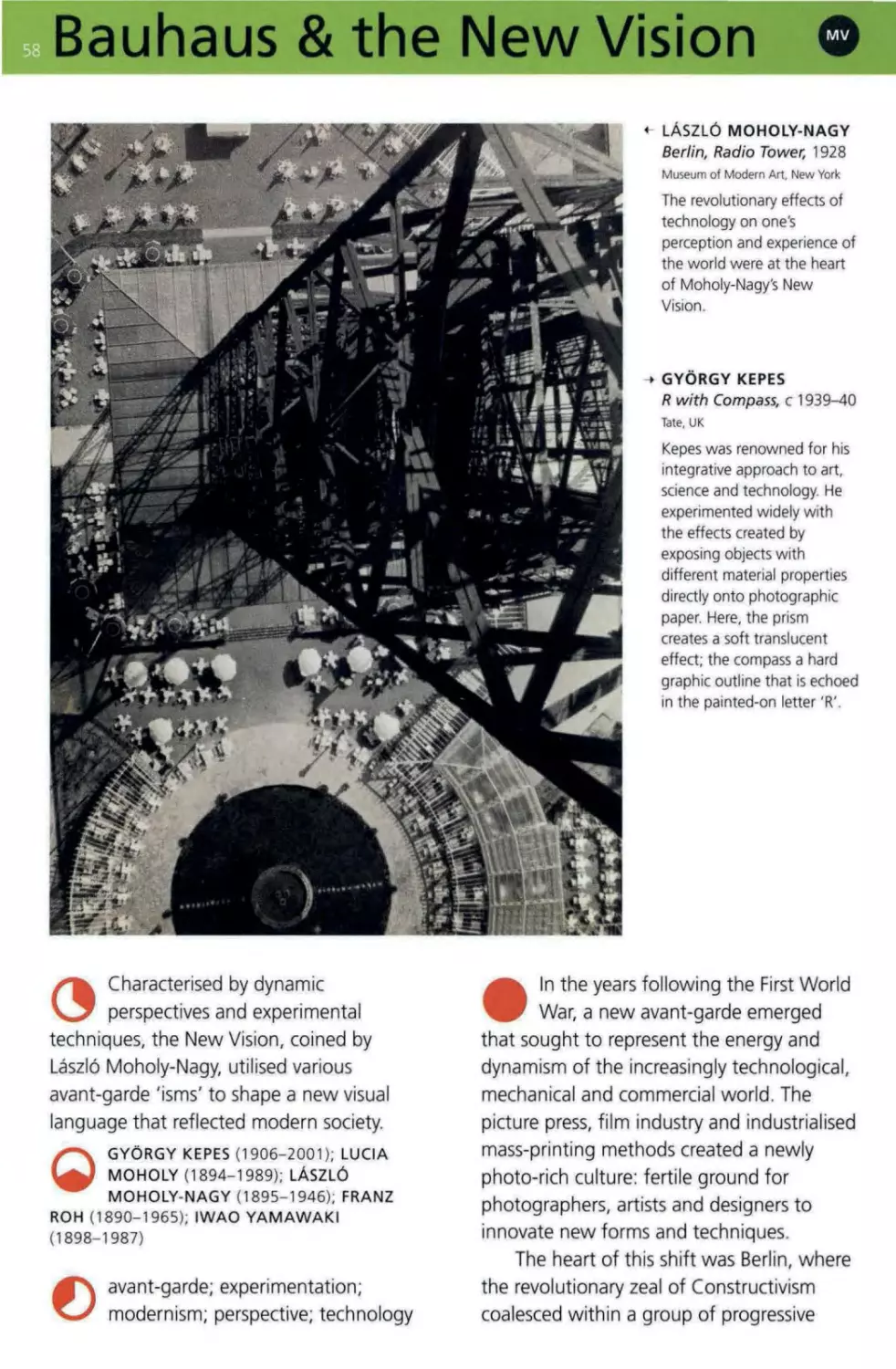
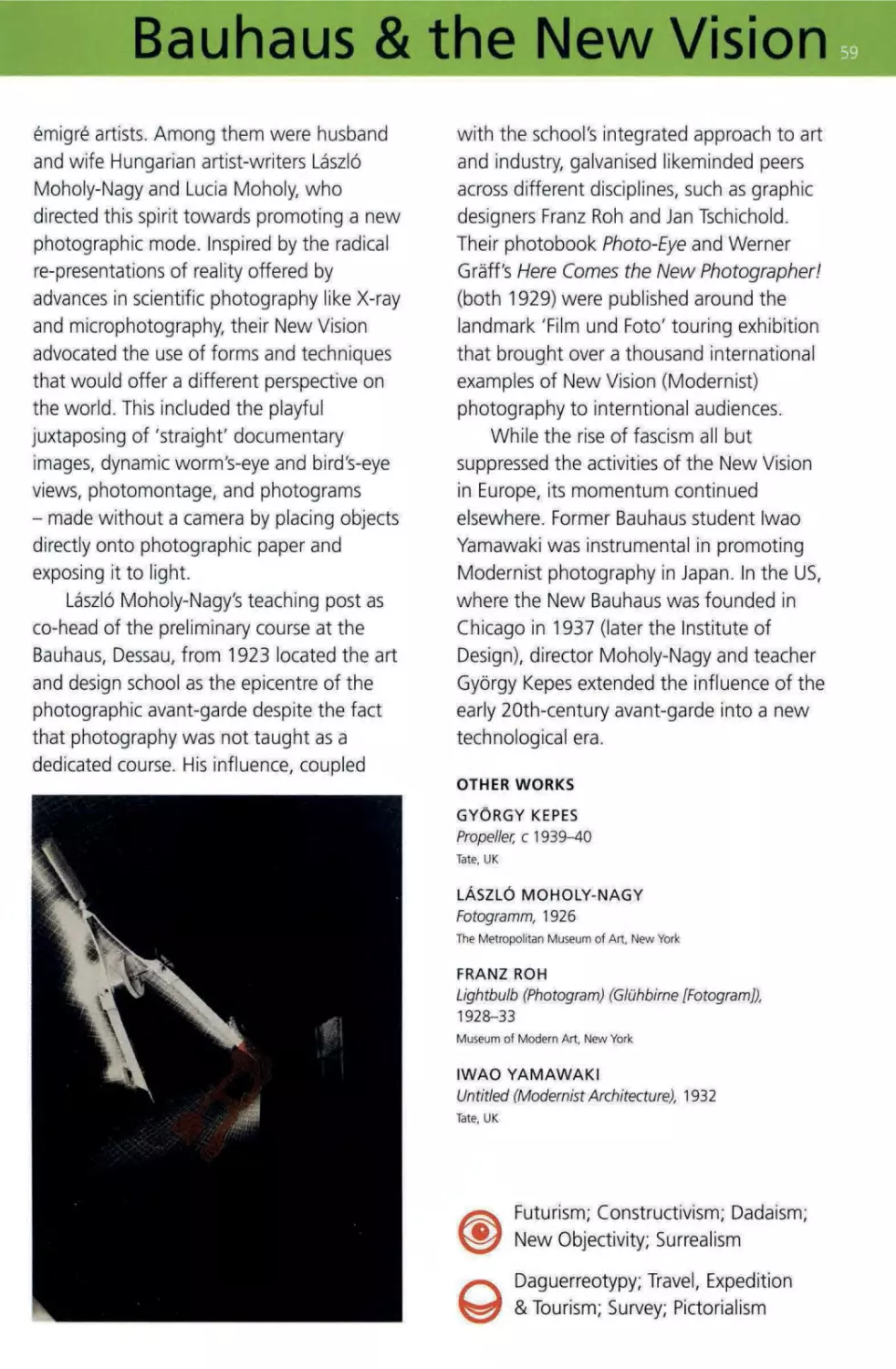
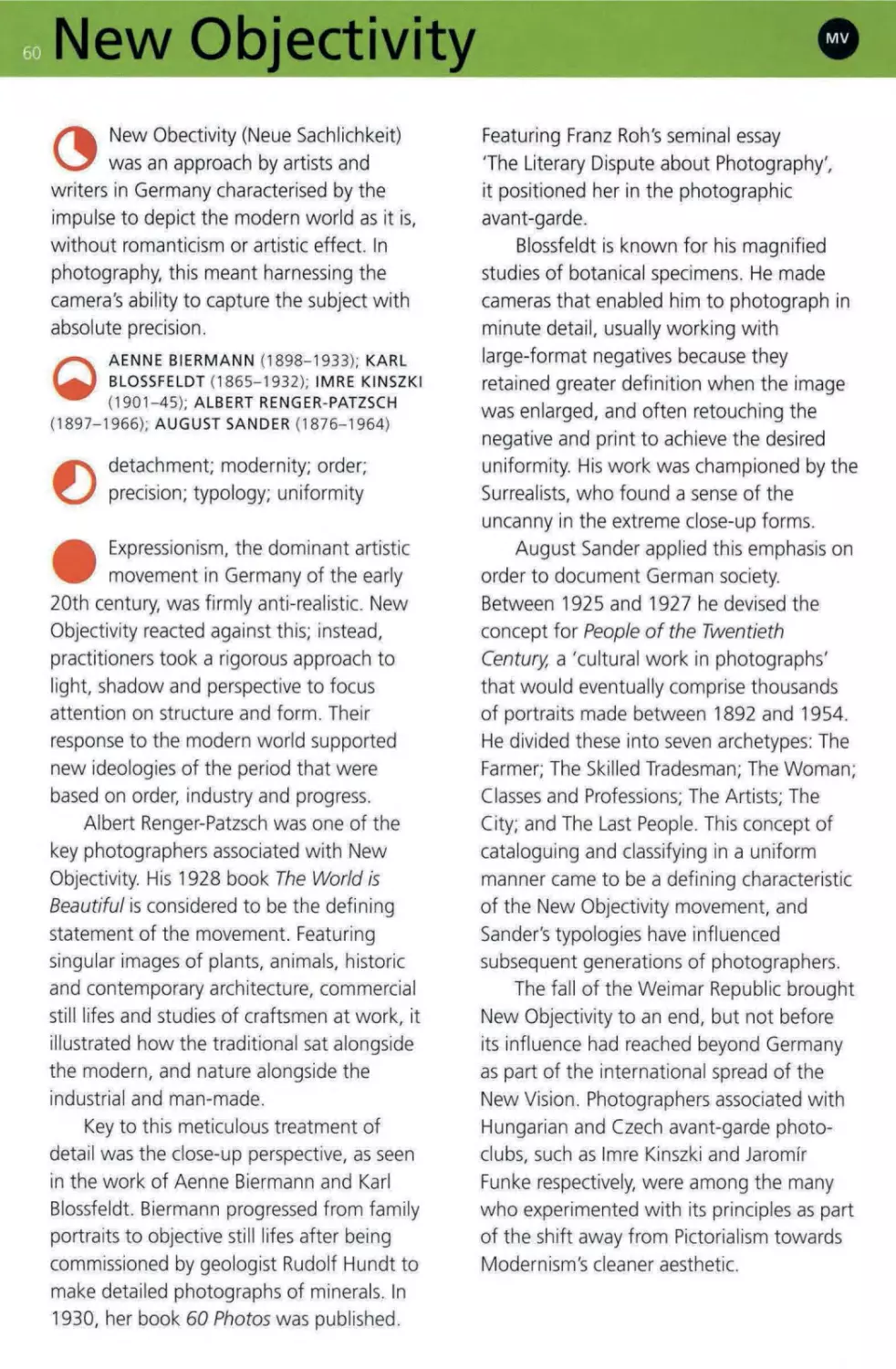
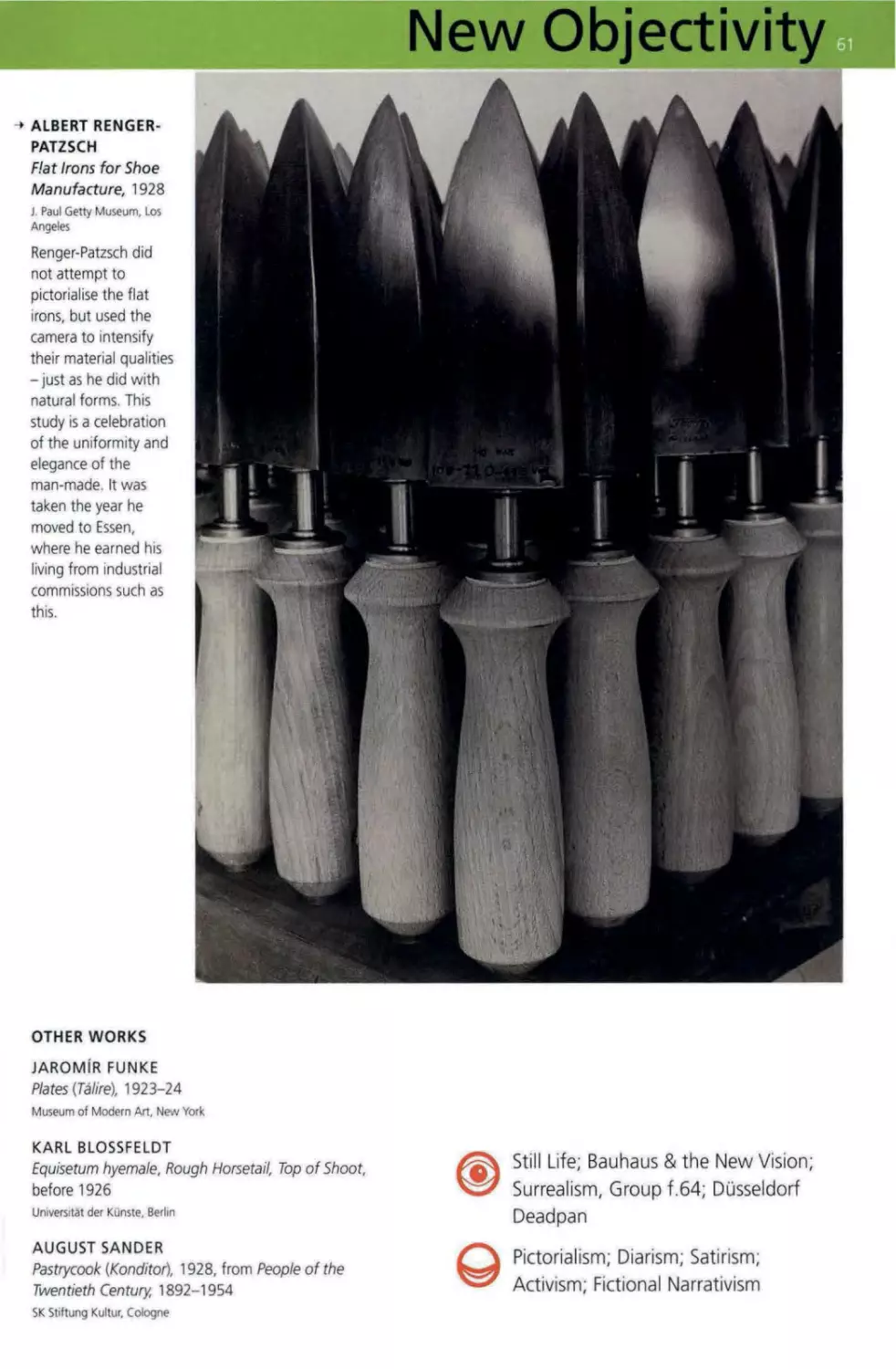
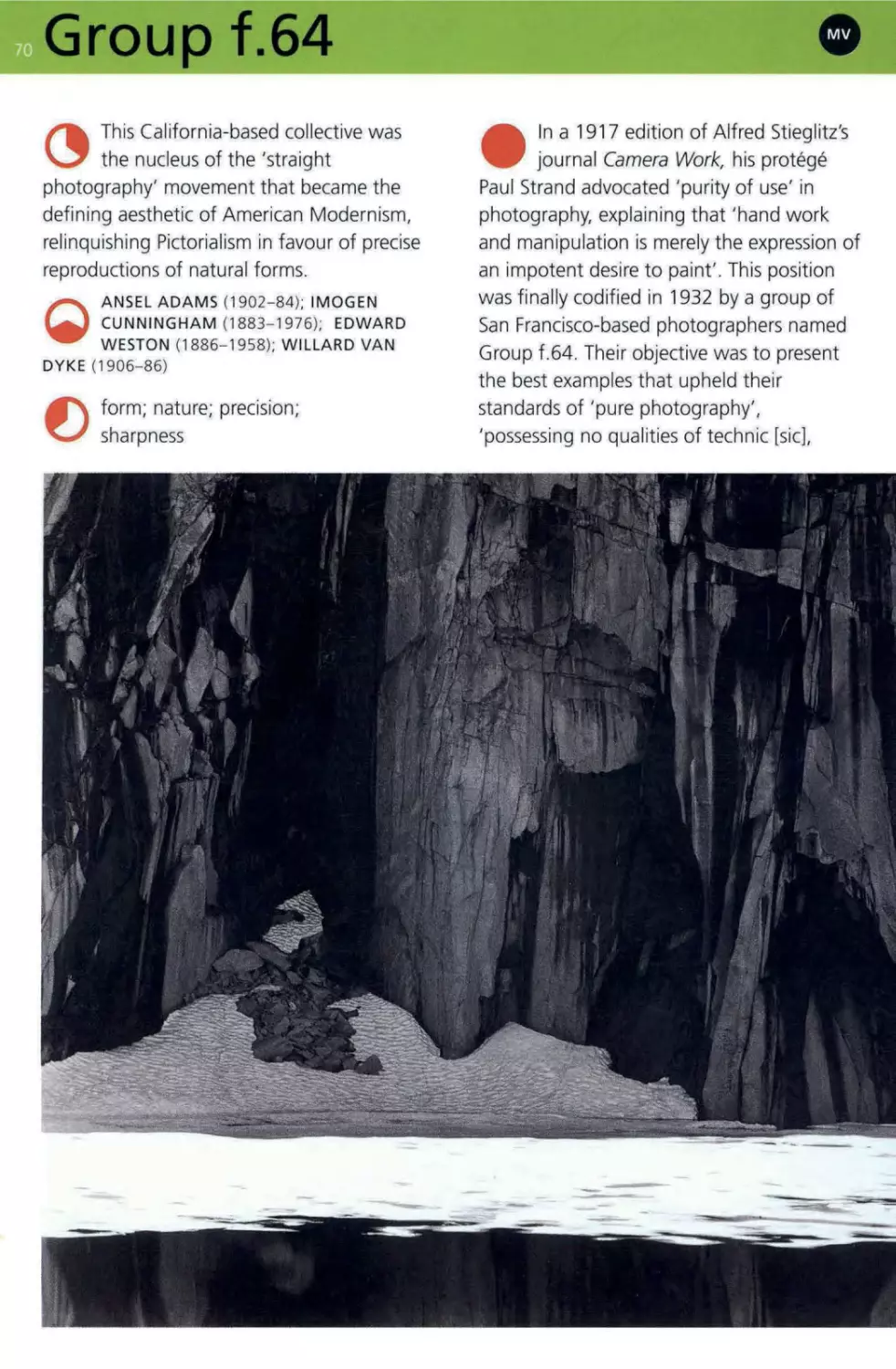
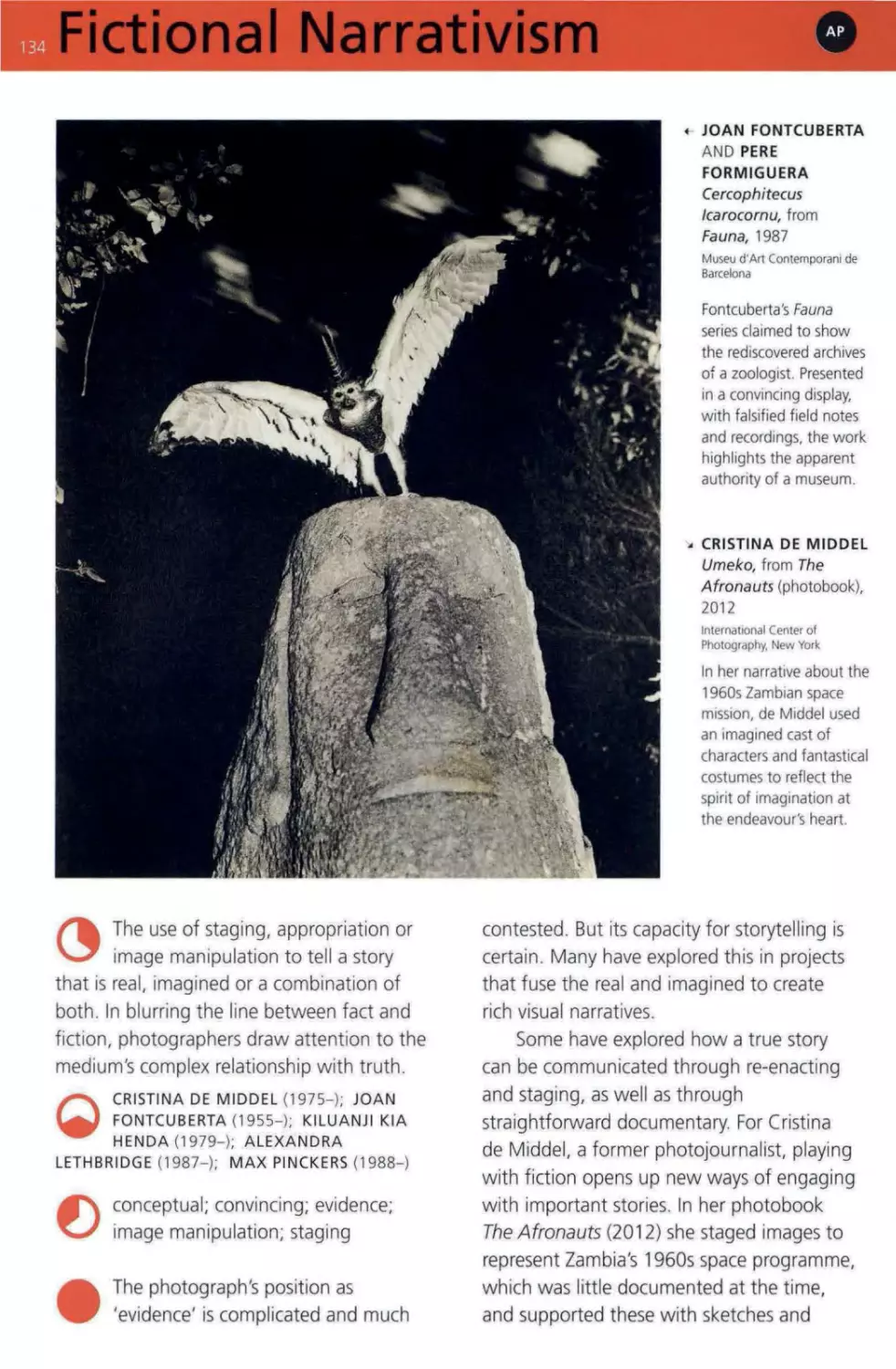
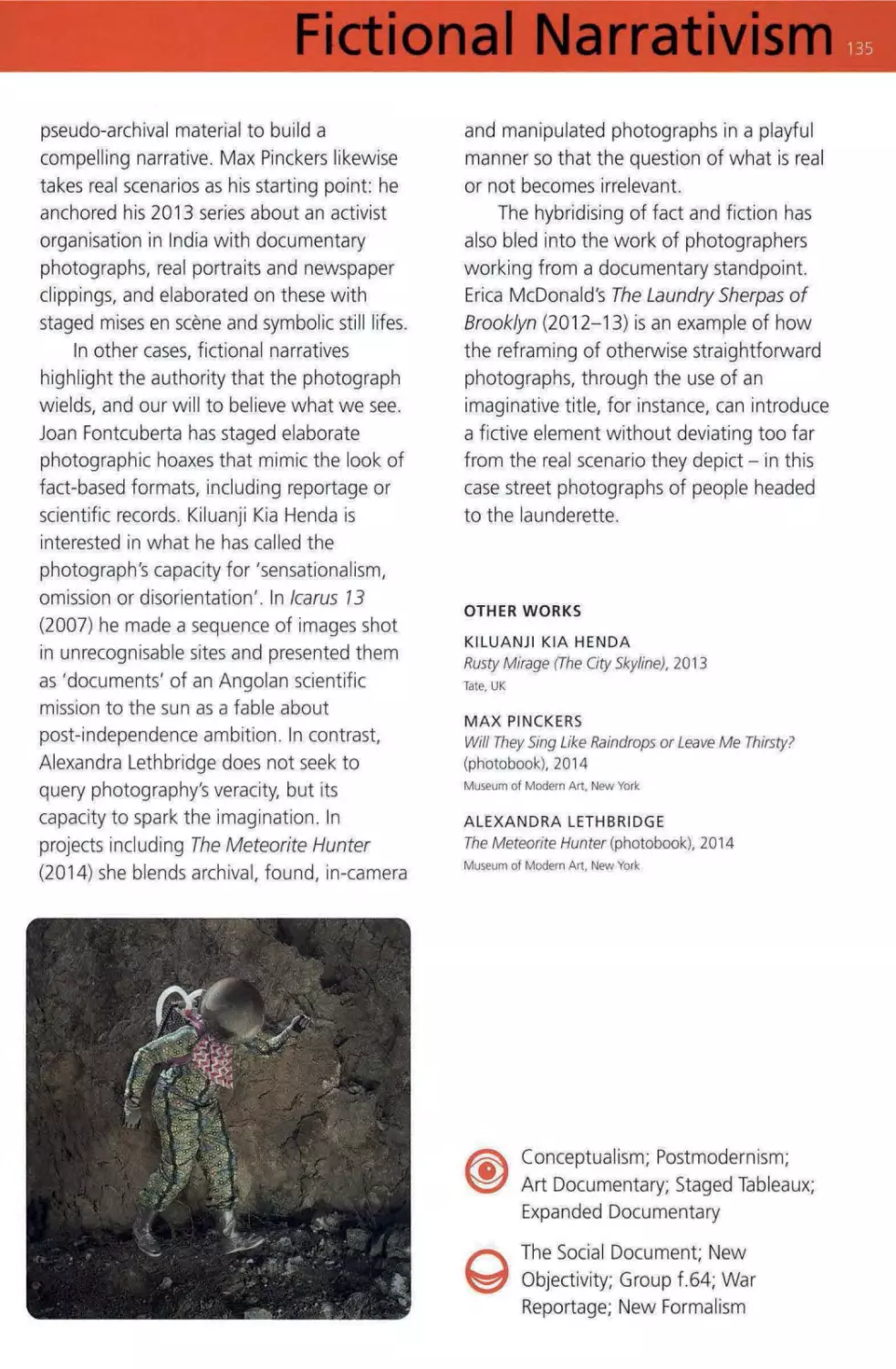
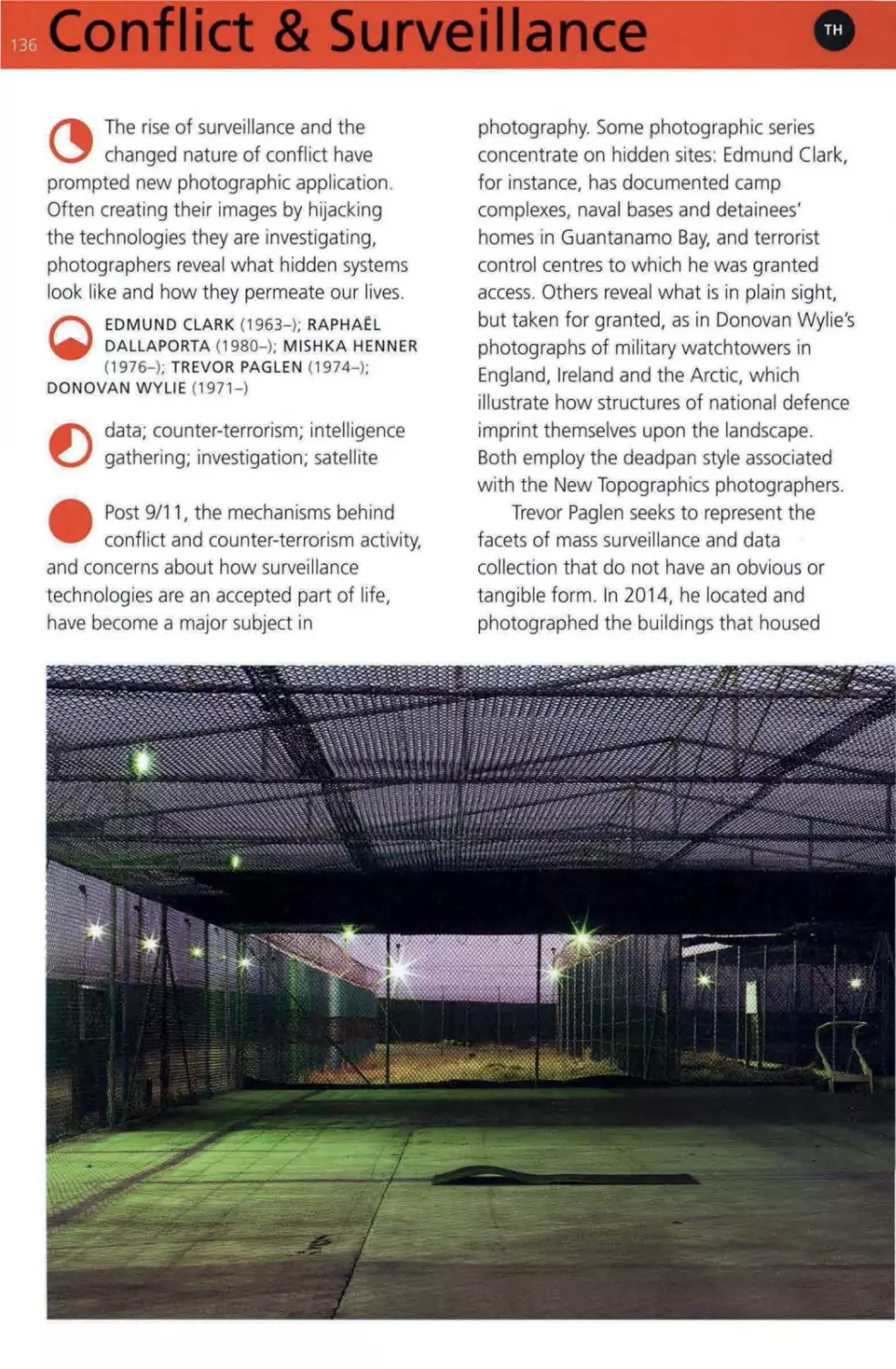
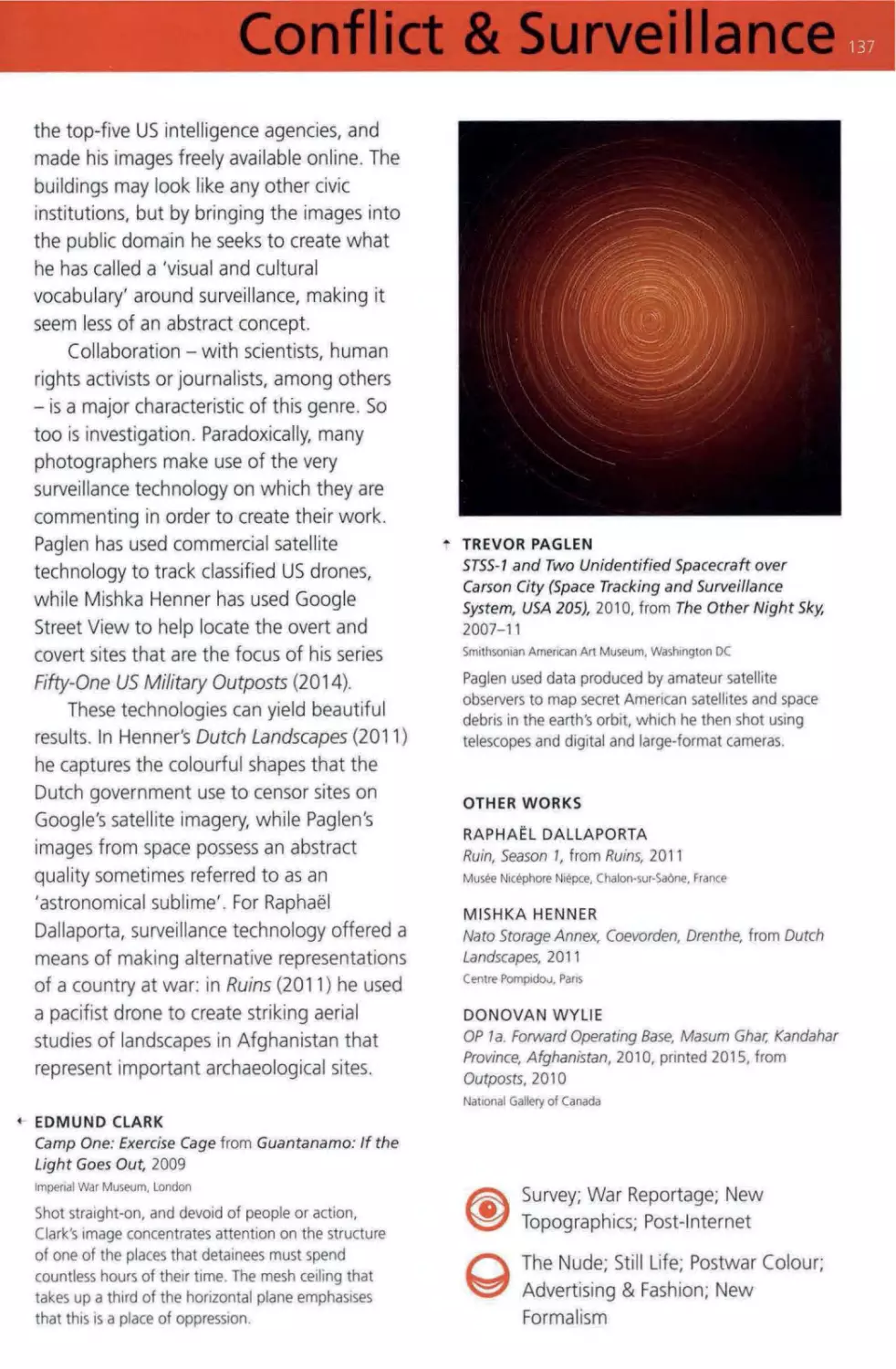





Текст
                    an informa business

ISBN13: 978-1-474-27759-4

Routledge

---

UNDERSTANDING PHOTOGRAPHY
EMMA LEWIS

I~ ~~~;~~n~~:up
LONDON AND NEW YORK

Contents
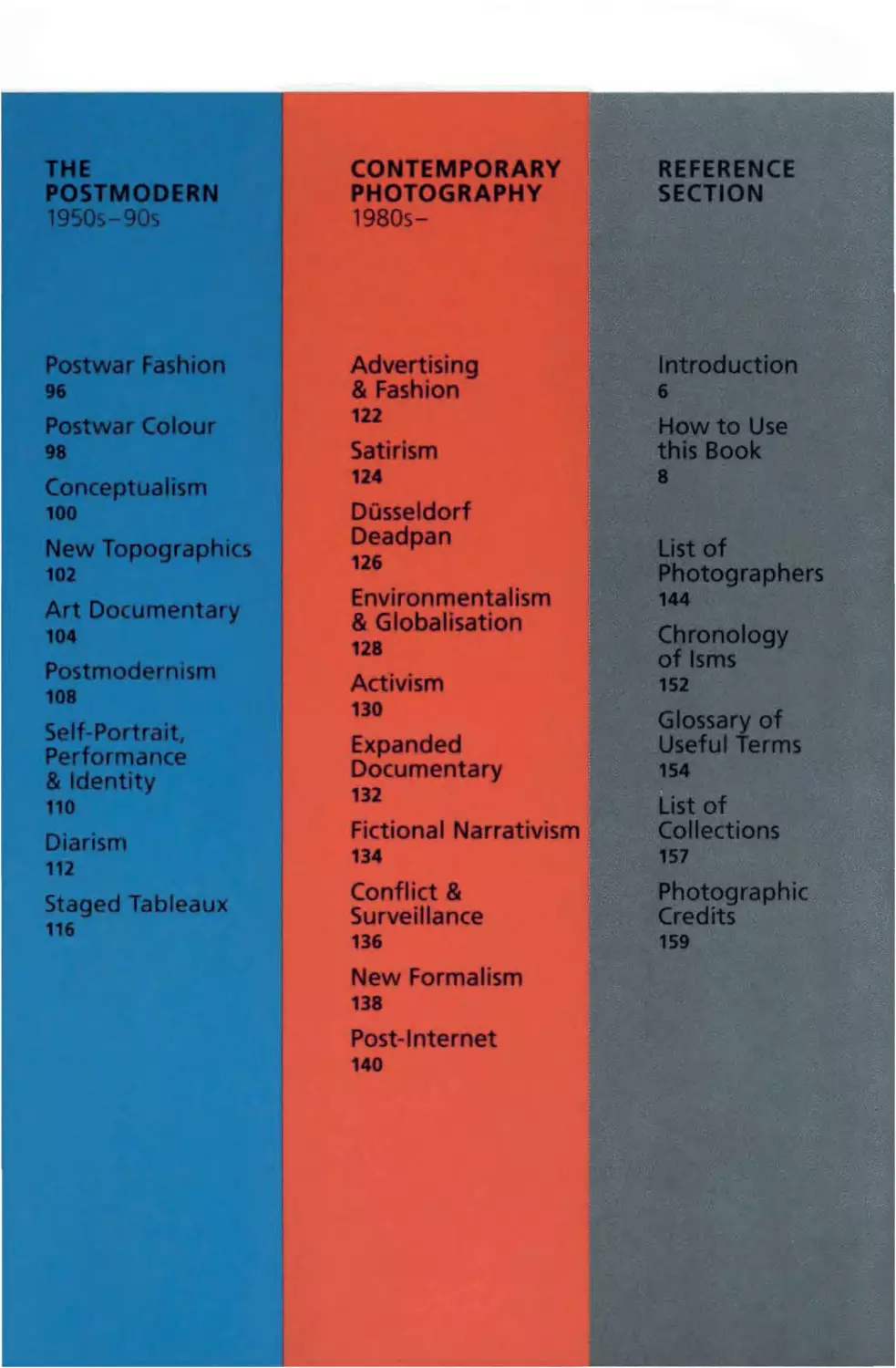
INTO THE
MODERN

SOCIETY &
HUMANITY

Early Street

74

1850s-1930s

36

Pictorial ism

38

1930s-70s

Social Realism

War Reportage
76

Photojournalism

The Nude

80

Fashion & Society

82

Still Life

84

42

46

48

Futurism

52

Subjectivism

The Family of Man

The Candid Portrait
86

Street & Society

Constructivism

88

Dadaism

Celebrity &
Paparazzism

54
56

Bauhaus
& the New Vision

58

New Objectivity

60

Surrealism

62

Mexican Modernism

66

Industrialism

68

Group f.64
70

92

6

Introduction
r.

Photography is structured by
technological innovation, artistic
movements, its cultural role as a
documentarian and storytel ler, and its
function in commercia l contexts, all of
which act as categories for the practice of
different photographers. This book is an

U

accessible guide to these classifications.
Since its invention in the early 19th
century, photography has proved itself to be
a restless medium - far more so than any
other. From the foundational inventions of
these early years (like William Henry Fox
Talbot's method for producing prints from
negatives, or Eadweard Muybridge's
technique for recording motion) to the
game-changing innovations of the 20th and
21st centuries (such as the launch of colour
film, and digital and front-facing came ra s),
chemistry and technology are constantly
transforming the very nature of
photography - and therefore our
relationship with it.
Throughout this evolution, photography
has been ascribed arguably its most
important, and certainly its most contested,
role - as a w itness to current events. It has
also been relied upon to communicate
political ideas, and shaped by groups of
photographers with firm ideas about what
their medium is or should be used for. And,
just like painting, drawing or sculpture, it
has been integral to some of the major
movements in modern art.
The structure of the book reflects how
all of these different facets have overlapped
or diverged over the course of time . While
there are movements, such as Surrealism,
which can be pinpointed to a specific place
or moment, there are also themes like Still
Life that span history and geographies.
These themes are explored here from the
key period w hen they were first introduced,
especially productive or influential. Other

approaches that have gone through very
different iterations, such as conflict
photography, appear in two or three
different places throughout the book to
illustrate the ways in which they have
shifted in accordance with culture, industry
and technology. Some chapter titles are
names coined by the photographers
involved, some simply describe the
approach, and others - Industrialism,
Subjectivism, Satirism, Dusseldorf Deadpan
and Fictional Narrativism - have been coined
for this book to pithily sum up a style or
approach.
It is important to point out that the
photographers included in each chapter
are necessarily representative but, like
photography itself, their practices are fluid
and not defined solely by the category in
which they appear here . This publication is,
therefore, not an exhaustive summary, but
an essential guide, offering the key
information necessary to understand and
enjoy the medium that permeates almost
every aspect of our lives.

Introduction
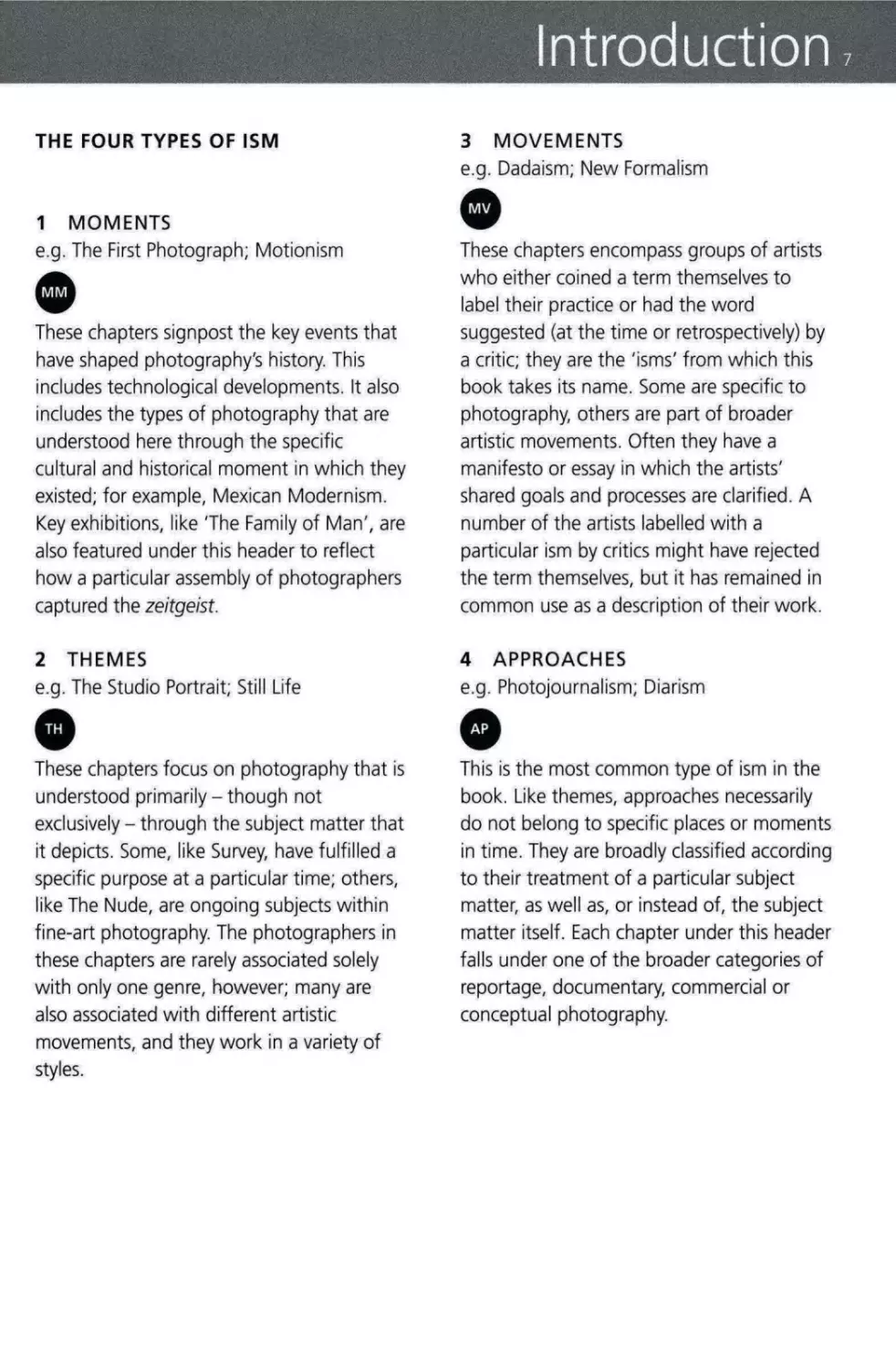
THE FOUR TYPES OF ISM

MOMENTS

e.g . The First Photograph; Motionism

3

MOVEMENTS

e

e.g . Dadaism; New Formalism

These chapters signpost the key events that
have shaped photography's history. This
includes technological developments. It also
includes the types of photography that are
understood here through the specific
cultural and historical moment in which they
existed; for example, Mexican Modernism.
Key exhibitions, like 'The Family of Man', are
also featured under this header to reflect
how a particular assembly of photographers
captured the zeitgeist.

These chapters encompass groups of artists
who either coined a term themselves to
label their practice or had the word
suggested (at the time or retrospectively) by
a critic; they are the 'isms' from which this
book takes its name. Some are specific to
photography, others are part of broader
artistic movements. Often they have a
manifesto or essay in which the artists'
shared goals and processes are clarified. A
number of the artists labelled with a
particular ism by critics might have rejected
the term themselves, but it has remained in
common use as a description of their work.

2

4

THEMES

APPROACHES

e.g. The Studio Portrait; Still Life

e.g . Photojournalism; Diarism

These chapters focus on photography that is
understood primarily - though not
exclusively - through the subject matter that
it depicts. Some, like Survey, have fulfilled a
specific purpose at a particular time; others,
like The Nude, are ongoing subjects within
fine-art photography. The photographers in
these chapters are rarely associated solely
with only one genre, however; many are
also associated with different artistic
movements, and they work in a variety of
styles.

This is the most common type of ism in the
book. Like themes, approaches necessarily
do not belong to specific places or moments
in time. They are broadly classified according
to their treatment of a particular subject
matter, as well as, or instead of, the subject
matter itself. Each chapter under this header
falls under one of the broader categories of
reportage, documentary, commercial or
conceptual photography.

7

8

How to use this Book
A

Symbols are used to distinguish
between the four different types
of 'ism' outl ined in this introduction: key
moments MM; themes TH ; movements
MV; and approaches AP. Some chapters,
or 'isms', could arguably be understood
by more than one of these, but this book
has used the most relevant header.

W

~ INTRODUCTION

\.;, Each chapter opens with a brief
summary to explain the key features of the
moment, theme, movement or approach.

r"\

KEY PHOTOGRAPHERS
. . , Up to five key photographers are
listed in each chapter. The list could often be
extended, but exploring the ir work would
give you a comprehensive understanding of
style, approach or moment in time discussed.

CJ ~~:~; ~a%7,Pll::~~l~1:~ ~::
0

promptednew-photographicapphcahon

Ohencreaton91he11>magesbyh1,ack1ng
thete<hnolog<e<.theyaremVEStigating,

photogiaphy 'iomephotographKWl<i"'i

coocenuateon hiddensi!es Ed1T111ndC~1~.
f0<1nstance.h,)l.documemedcamp
complexes,navalbasesanddl'ta1nees'

homesITTGuantanamoBay,andtl.'ffOl'ISt

l/f\
V

K EY WORDS
These are words taken from the main
definition text that relate closely to the 'ism'
and are often repeated ly used in
explanations of the affiliated photographers'
work.
MAIN DEFINITION
This describes the key ideas, methods
and photographers' practices in more depth .
It gives a brief overview of the historical,
cu ltural and technolog ica l context that
relates to the moment, theme, movement
or approach being explained, including key
exhibitions, publications, and innovations in
photographic products and processes.

the1op-f1veUS1me!hgenceagl'fl(ll"i, and
mildeh1slfllagesfreelyava11ableon11ne The
bu1ldmgsmaylooklll:eanyo1hercJ111C
1ns1'!utoo~. but by b1111grn91he1mageslfllO
the pubhc domam he wek.s to create what

phoiographei> revt>al what hidden s~ietM
lookhkeandhw.-Theyperml'aU.•oorbves

<;) ~~~l~~~;~:~1~9~~~.J~·,S:A:::~~N(R

coo11olcent1eo. 10Y1f'uchhew,)l.gfal'lled
.ll:Cess Others 1eve<1I wha1 rs 1n ~n ~ht.

(1976-).TAfVORPAGlfN(19N)
OONOVANWYllE(19)1-l

bul t.'l~l'n tor gianied. a!. 1n Donovan Wyl!l'\
photog1apti-;ofmd•ta<ywatchtowers1n
£ngland,lre!andarldtheArctK,wh1ch
illustr.i1ehowmuc1urt'l.ofnahoru1ldefeoce
1mp11nt t1*mwlves upoo the lands< ape

e =~l~t\~~~f;;;;e~~:~:=:~~ty,

Bo1hemp10yth<'dl'adpanstyle~1o0C.•a l l'd

photog•aoher~makeuwoftht>vl"ly

w11h 1he New TopographtCs photographer!>.
TrevorP,i.glenwehtor£>prl'SE'ntthP
1a<etsofmasssurve1Panceanddata
colle<ttOl'l!ha1clofl()thaveanobV1ousor
tangrbleform ln2014,heloca1edand
photographE'dthebudd1ngs1hathwsE'd

wrvetllancetechnologyoowhichtheyare
commenttng m Older ro uea1e then WOik
Paglenhasusedcommerc1alsa1eU11e
technology to uac.k <l.lss1f1td US drooes.
whole Mrshk.J Hennei h.H used Google
S11ee1View10 help locate the own .md
covertsitesth.Jta1e thefocusolhl!.ser1es
Frfty·One US M1Jor~ OulpolfS (20141
Thesete<hnolog!E'5canyieldbe.:iut1!ul
results. In Henne1·s Durch tand~<a!X'S (2011)
hecaptu•E'Sthecolourlulsha?E"S!ha11he
Dutch government use 10 cemor !>otes on
Google\ satelhte nn.'lgery. wh~e Paglen\
1magesfromi.pacepossei.sanabstrac1
quality somet1mE'S 1eferrE'd to a\ an
'<r.tronormcalwbhme' F01ltaphael
DallaPorta.wfVt'lltance 1echnoloqyolfe1eda
means ol mak.1n9 alternat"'e representatiom
olacountrya1war mRums(2011)heused

and<OflcemsabouthOWsufVf!1llance
1echnolog1esareanac.cep1edpartofhle.
ha~ebecomeama1orsub1ect1n

hehascaHeda·v~aJandcultural

vocabulary" a1oundsurveollance. mak1091t
seemle!>sotanabstractconcep1
C0Habora11on-w11hsciefll1sts.human
nqhts ac.timts Of 1oumal1J,tS. among olhefS
-rsamaJOfChar.KlensttCofthrSgeore So
too IS +rlW'i\IQiHIOfl PafadoXl(al!y, many

a~1f1~1drone1ocreatest11km9aerial

s1udJE'SOflantt,,c.ape51nAlghami.1anthat
reptesen! important archaeolO!)tC.tl ~1tes

CMnp

o,.,.. hH<M c.g~ komGu•nl•........,

l191>tGOfl0..t1009

STSS·l•..dT... orJri,,,.,,,,1..,;1~.,,.h<>...,

c.,,..,,,c,ry{Sp«tfr•t•1>9•ndS..r..iN•n<t

:;;:-:- VSAZOSJ.2010 l10tn rho:Ot~N19ti1Slt)',
1
P'"}ltn<Mddol!•P<<>d1><"11byo<Nt~Wl~f

ob\H""'!Cm,!p'><<tl-...<•lt. .! .. - ' l l « f

drb.. inth<••"''"'bt.wh-d'lho:! ..... >l'>ol"""!I
ltlf«~.indoi9•"1..nd""'~10tmi1ur ......

RAPHA£l0AlLAP0RTA

11u...,,SNIO'!l.
k.:n>°""""'X!11
_,..___
,,,_ .... -..h"""

MliHKAl-IENN(R
Na1t1Sftlf*9t~'-C~O,..,me,!10tn1Nir~

t.ond!C.IPH.1011

00NOVANWYll[
Ol'l•~"""'·'~

. . . . ~G/'lot~

"'°""'f.Jl~!.>fll010.PM1t'dl015.f<om
~ •.

1010

II !M

!.llol•lrll'jll.-O'l,or>d<lt.odol"'°""'Ot'"'ll<n,
{i..i;\onq<""'""'u~:n ..1""' ""'""\kt"•....OU•
o1 .... o11hoploc;n.....,dr1~"""'"4"">d
\OUtl<ltl>~ol•h«r ....... Tht,,..,,.<"""9""'1
1olnw~.,..,dotu..1>on,on1;i1p1.or>o"""""'""

1""1 ........ •plot•ol~ffioOll

•TREVOR PAGllN

@ =;a::~\~=::r~:

Q

:~:~~;gS~I~~~:.:~~:: Colour.
Formahsm

How to use this Book
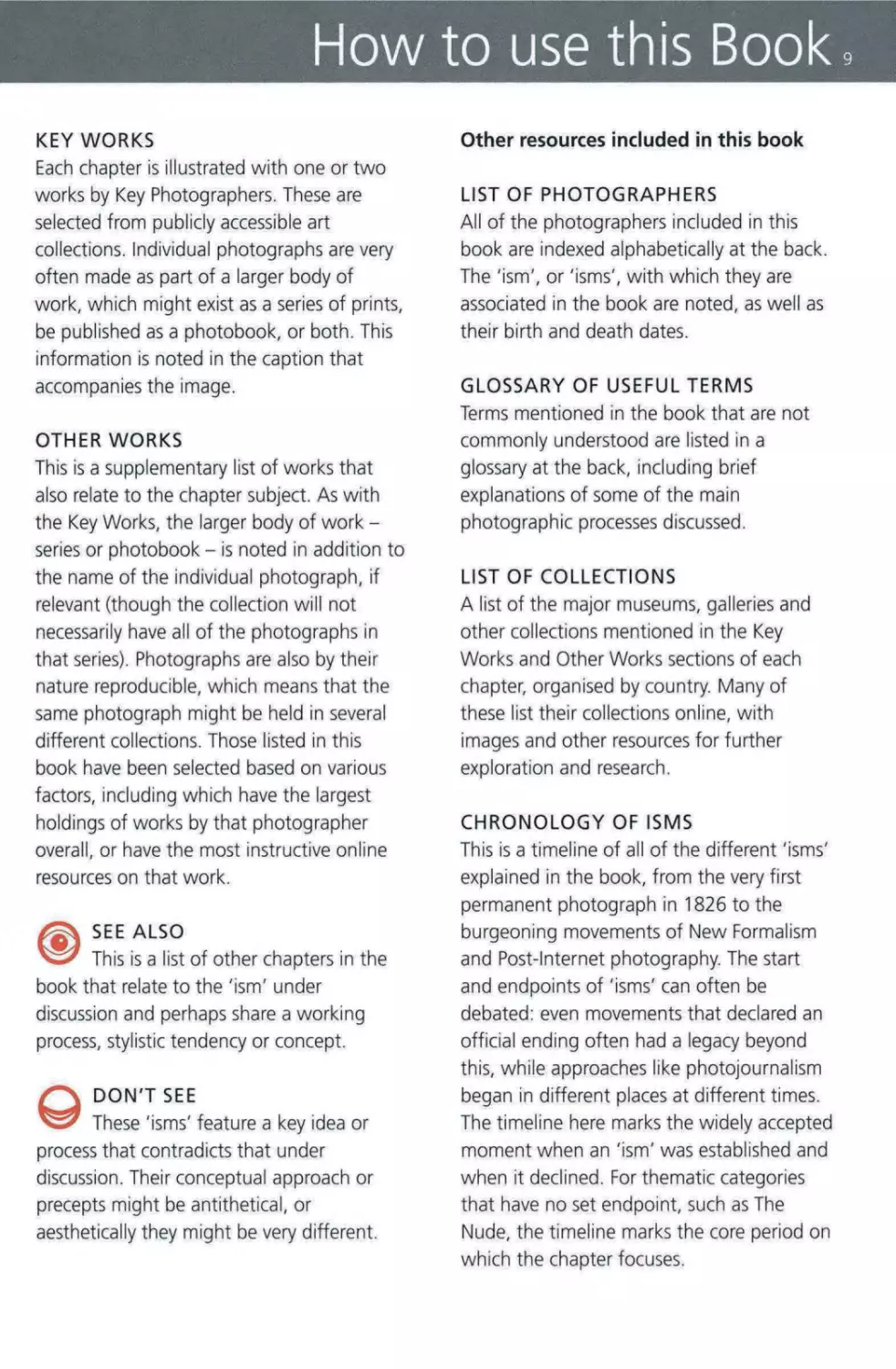
KEY WORKS
Each chapter is illustrated with one or two
works by Key Photographers. These are
selected from publicly accessible art
collections. Individual photographs are very
often made as part of a larger body of
work, which might exist as a series of prints,
be published as a photobook, or both. This
information is noted in the caption that
accompanies the image .
OTHER WORKS
This is a supplementary list of works that
also relate to the chapter subject. As with
the Key Works, the larger body of work series or photobook - is noted in addition to
the name of the individual photog raph, if
relevant (though the collection w ill not
necessarily have al l of the photographs in
that series) Photographs are also by their
nature reproducible, which means that the
same photograph might be held in several
different collections. Those listed in this
book have been selected based on various
factors, including which have the largest
holdings of works by that photographer
overall, or have the most instructive online
resources on that work.
~ SEE ALSO

V!!!:I

This is a list of other chapters in the
book that relate to the 'ism' under
discussion and perhaps share a working
process, stylistic tendency or concept.
[ " \ DON ' T SEE
~ These 'isms' feature a key idea or
process that contradicts that under
discussion. Their conceptual approach or
precepts might be antithetical, or
aesthetically they might be very different.

Other resources included in this book

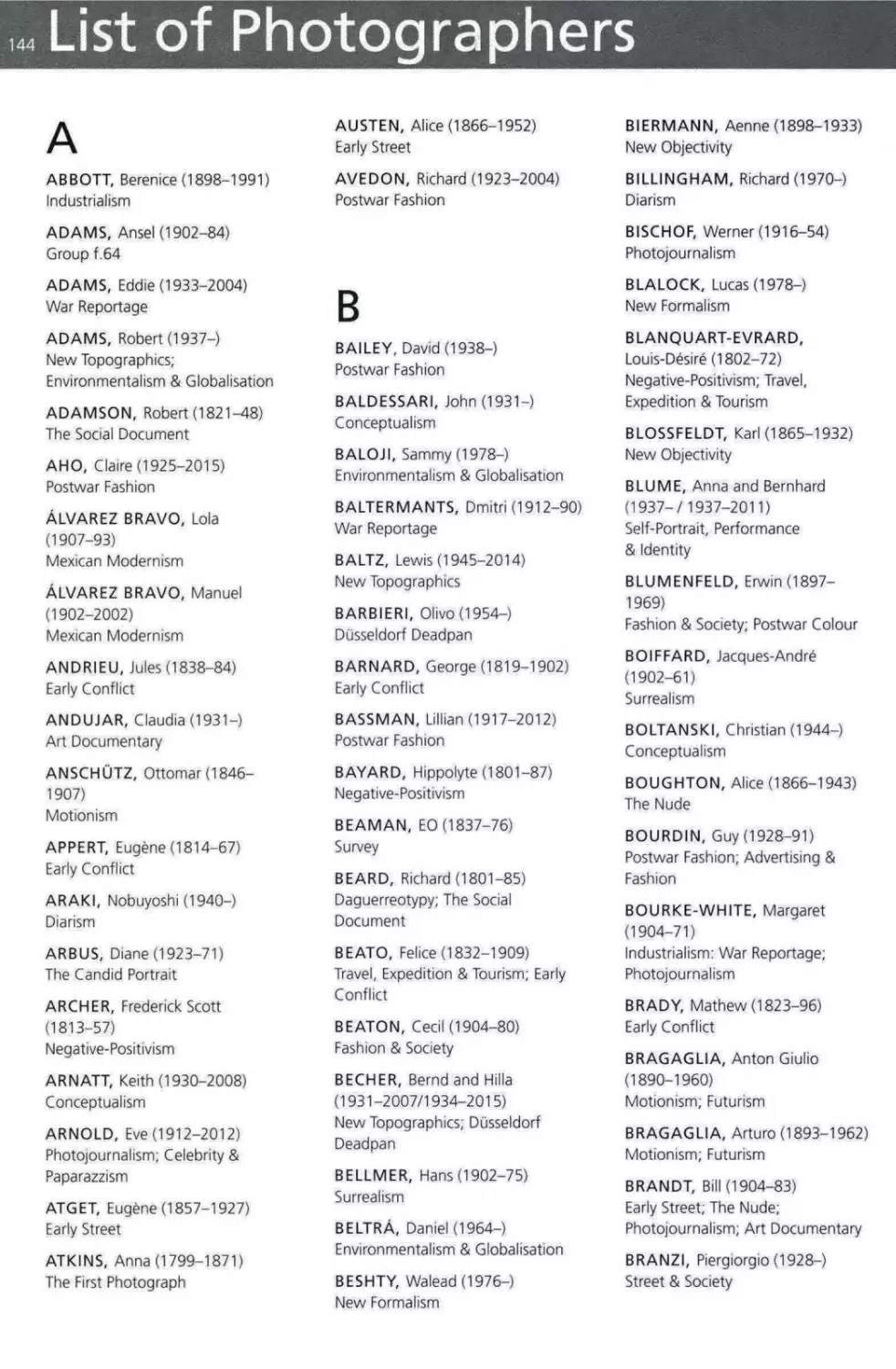
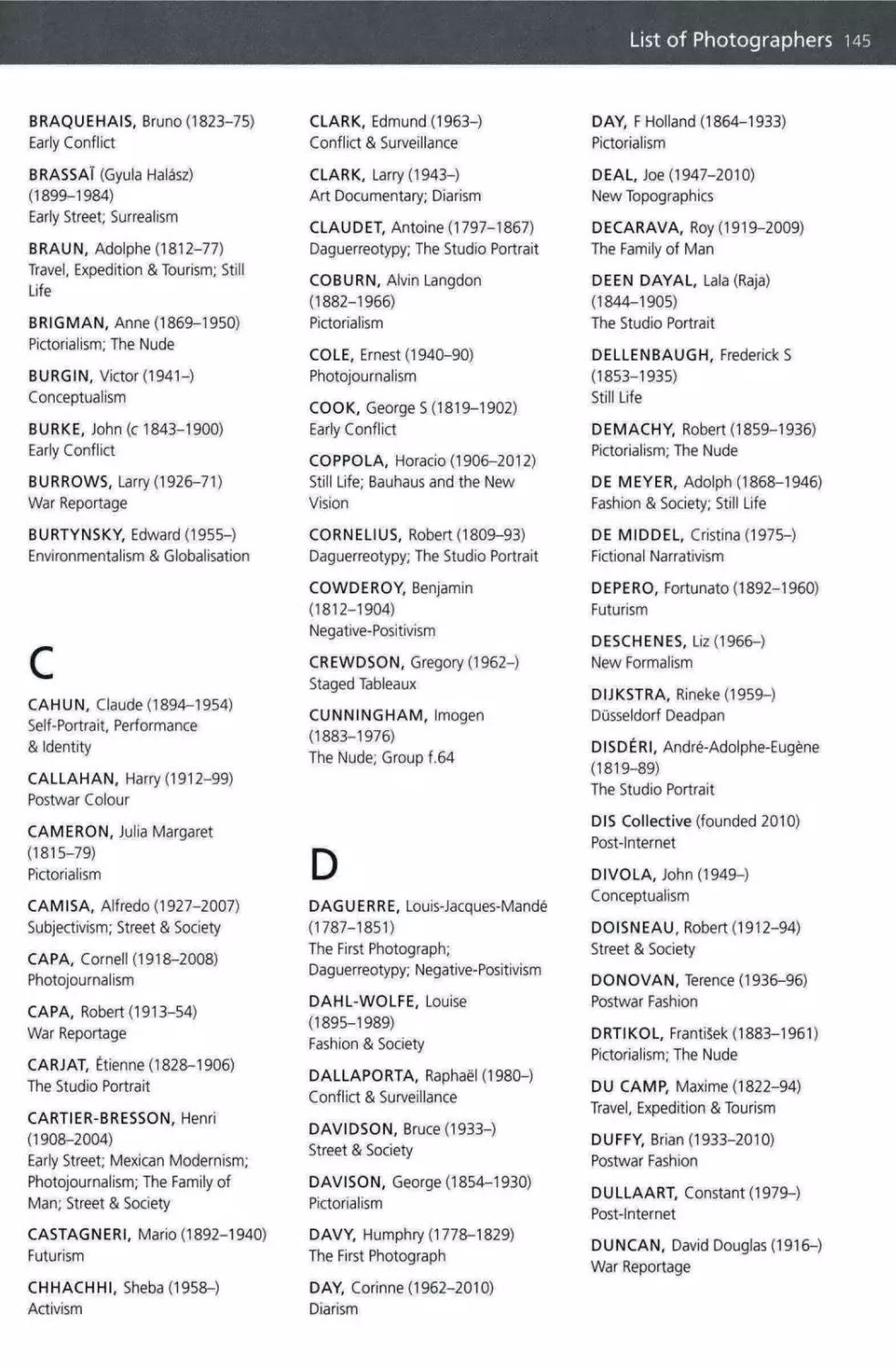
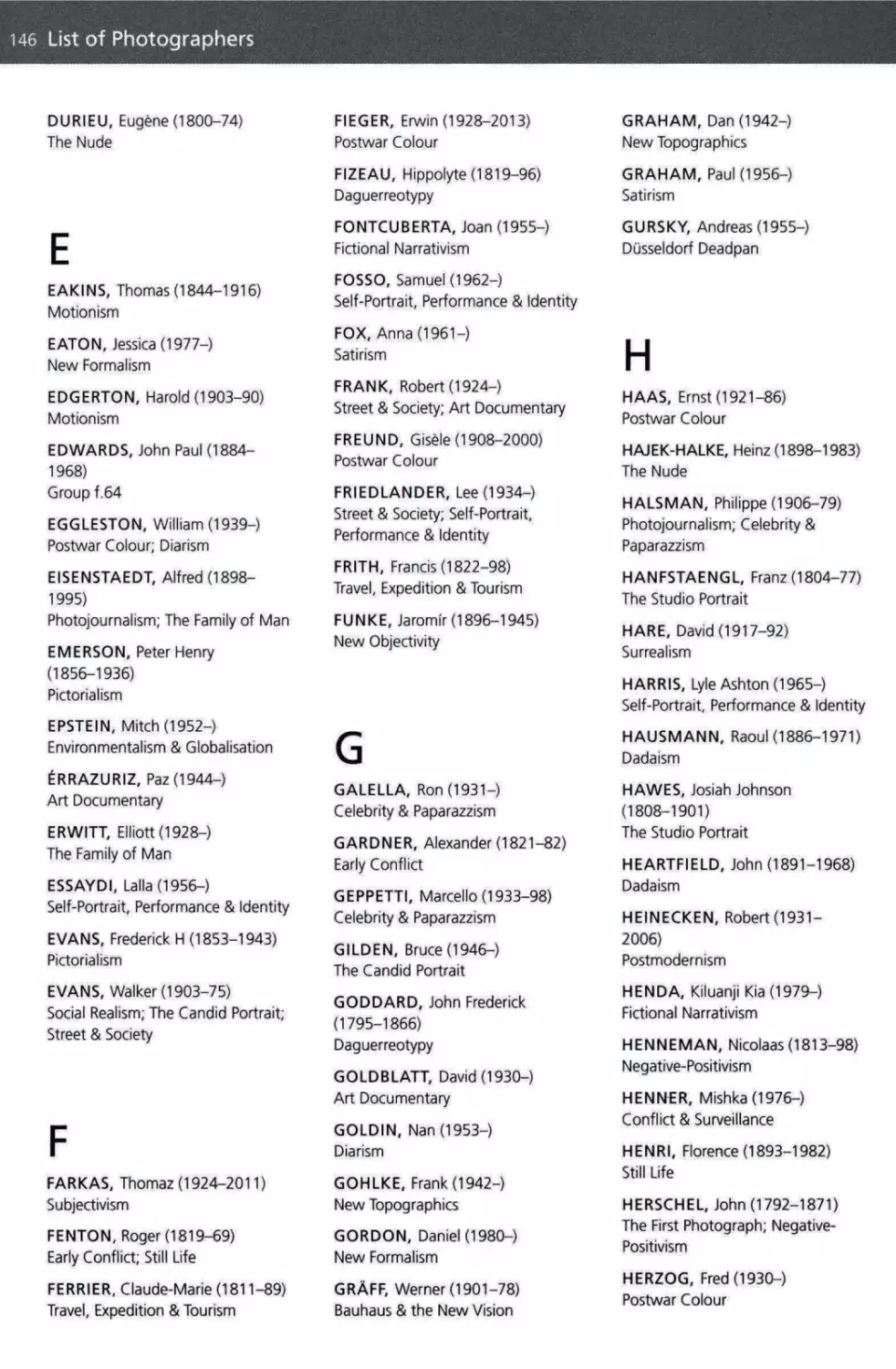
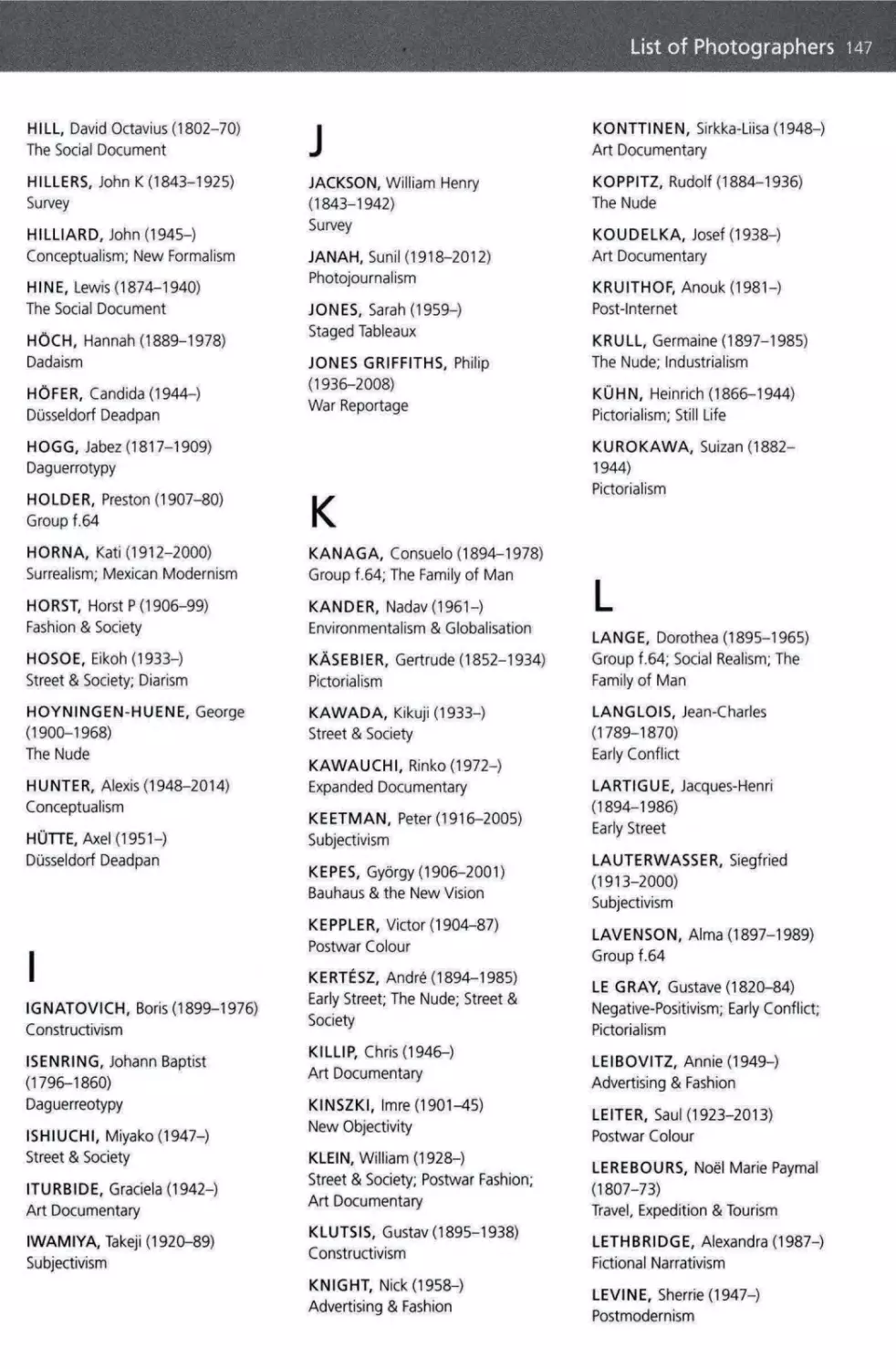
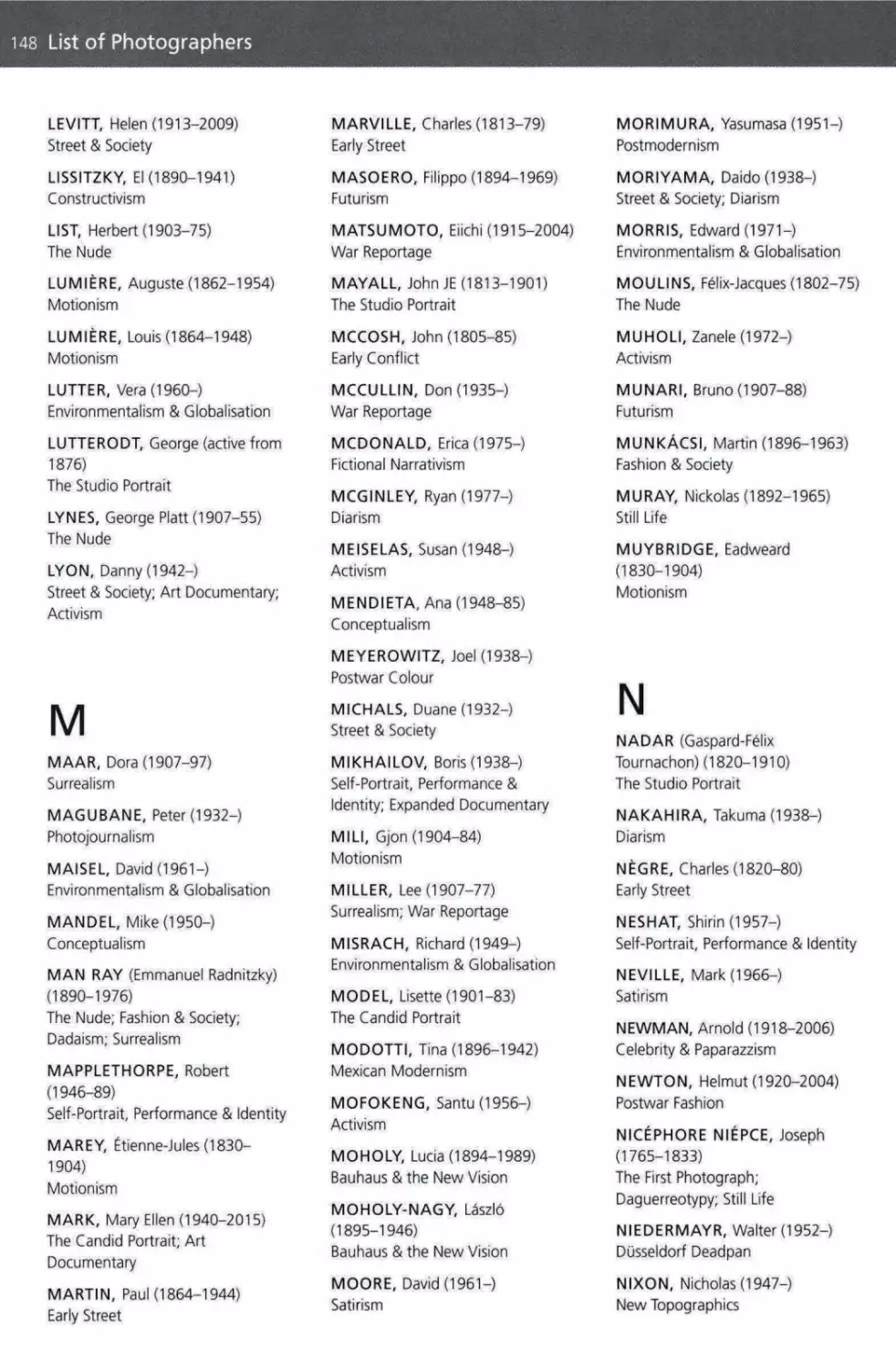
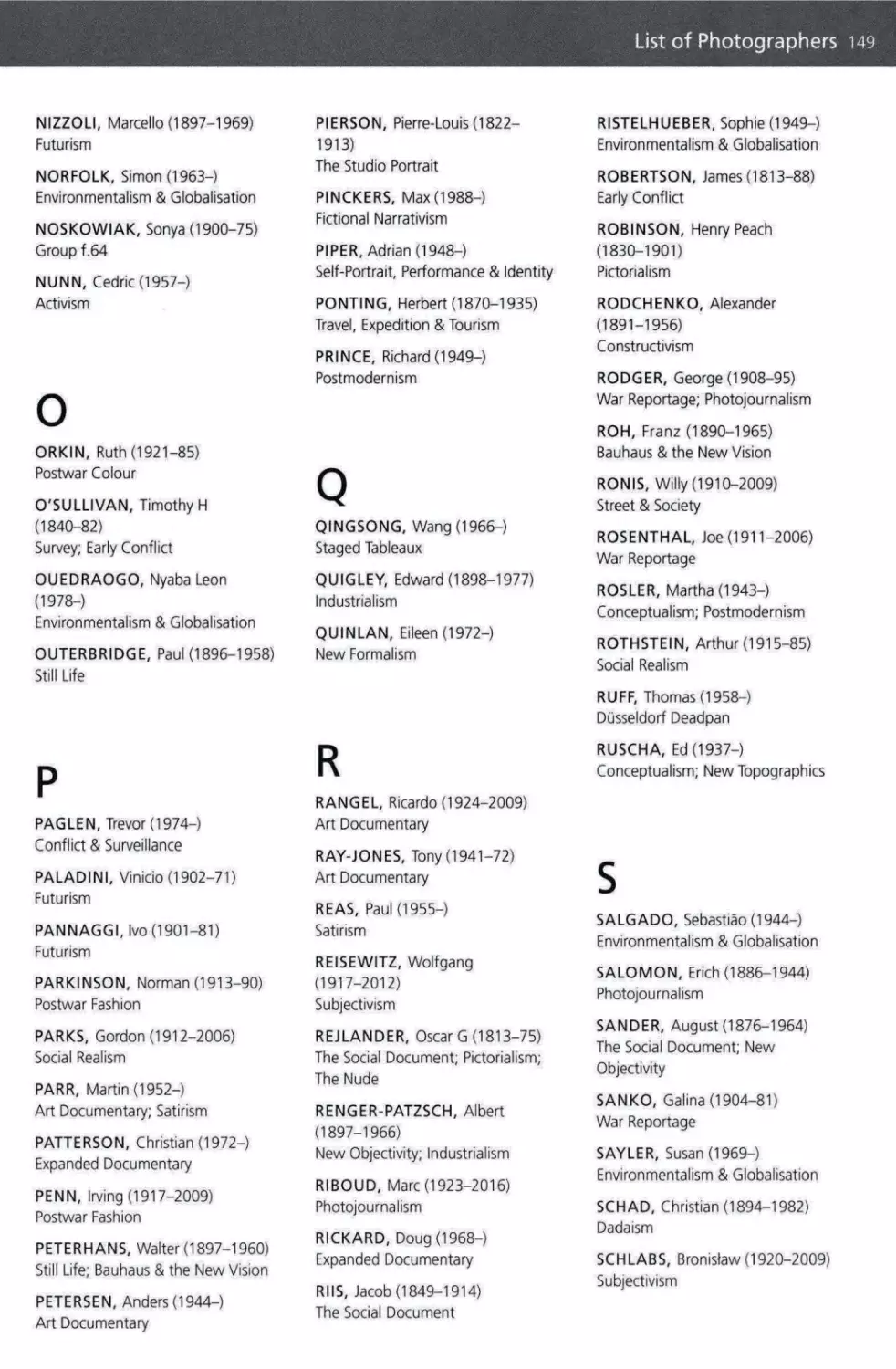
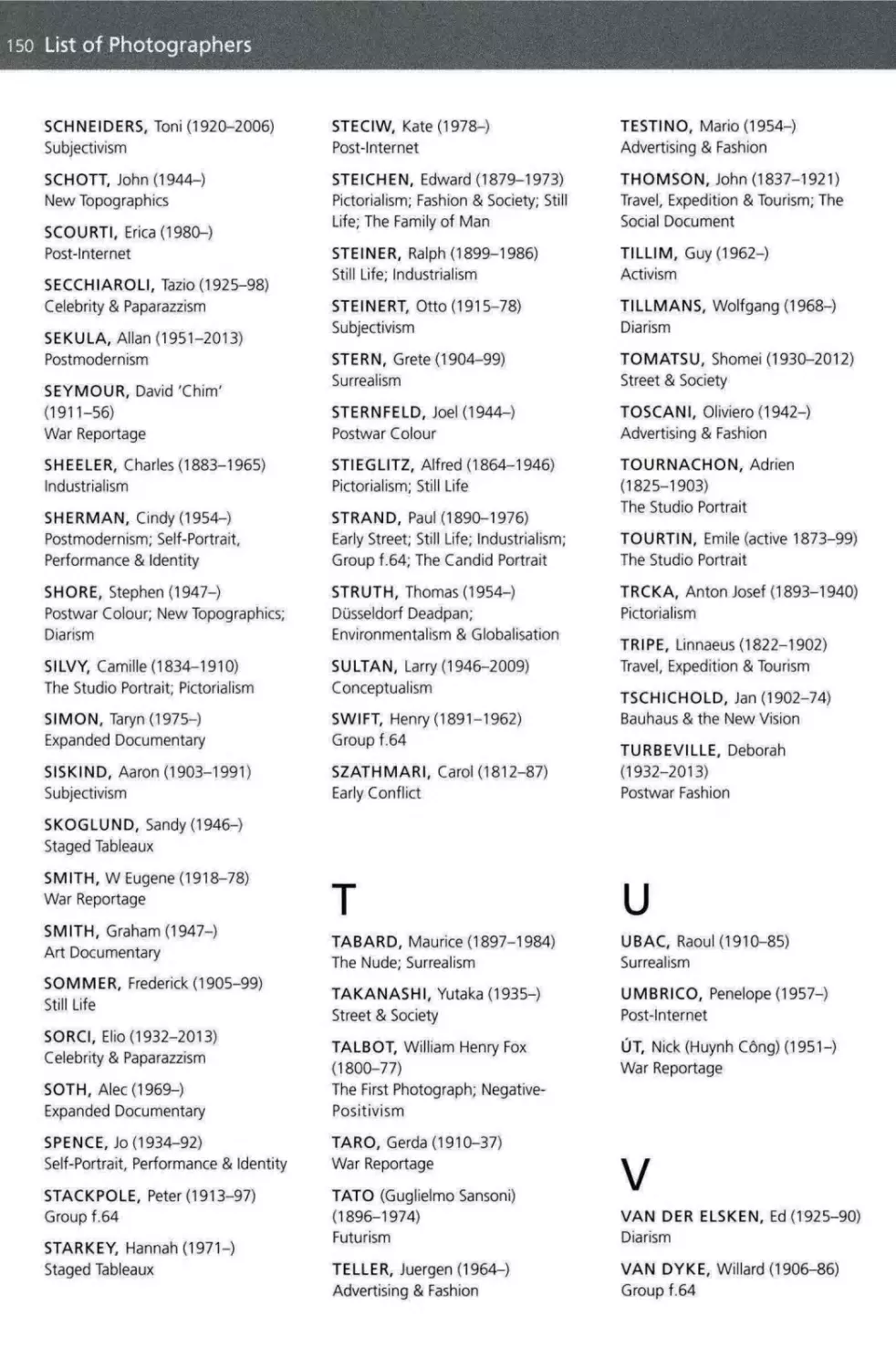
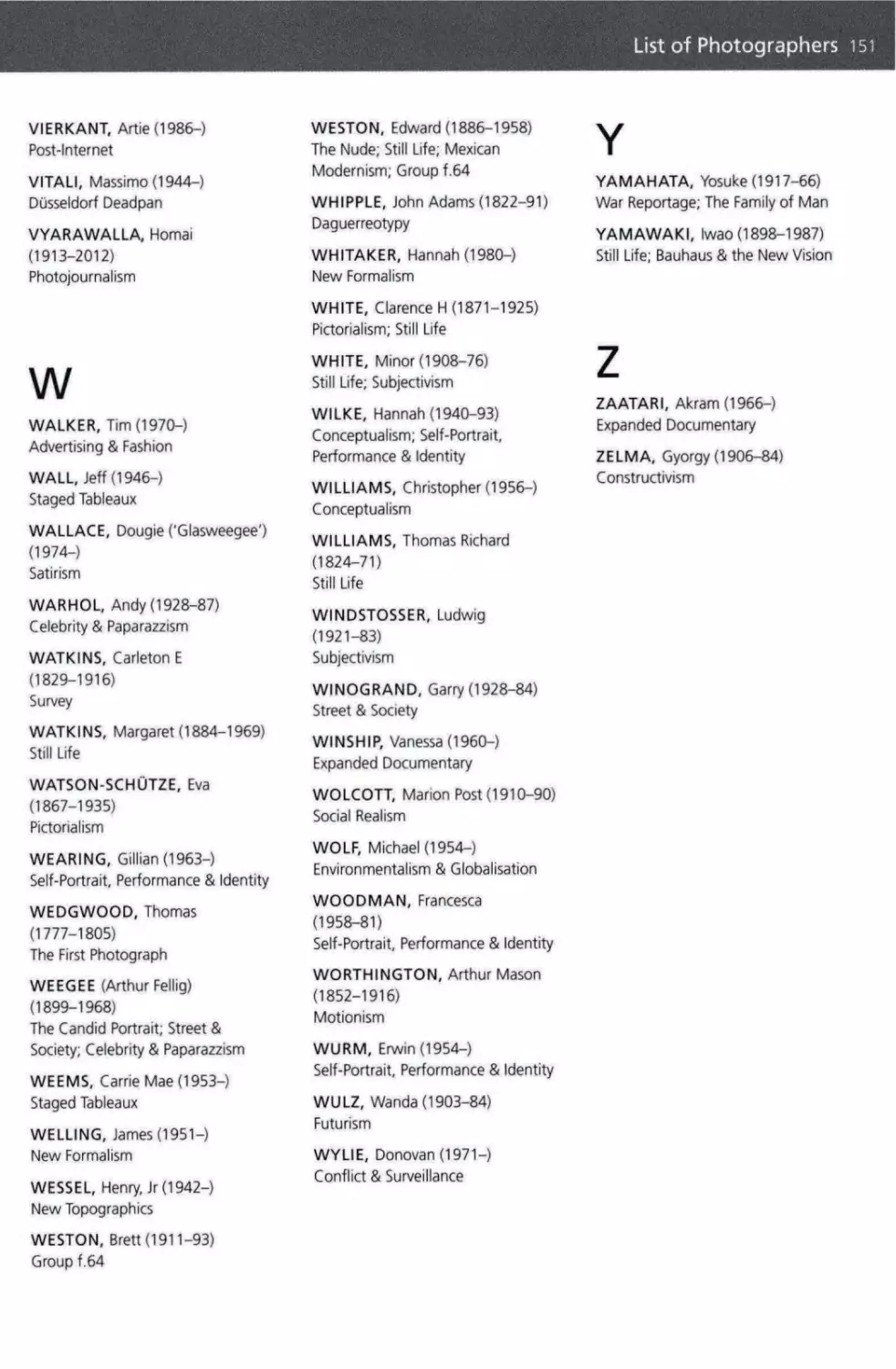
LIST OF PHOTOGRAPHERS
All of the photographers included in this
book are indexed alphabetically at the back.
The 'ism', or 'isms', wi th which they are
associated in the book are noted, as wel l as
their birth and death dates.
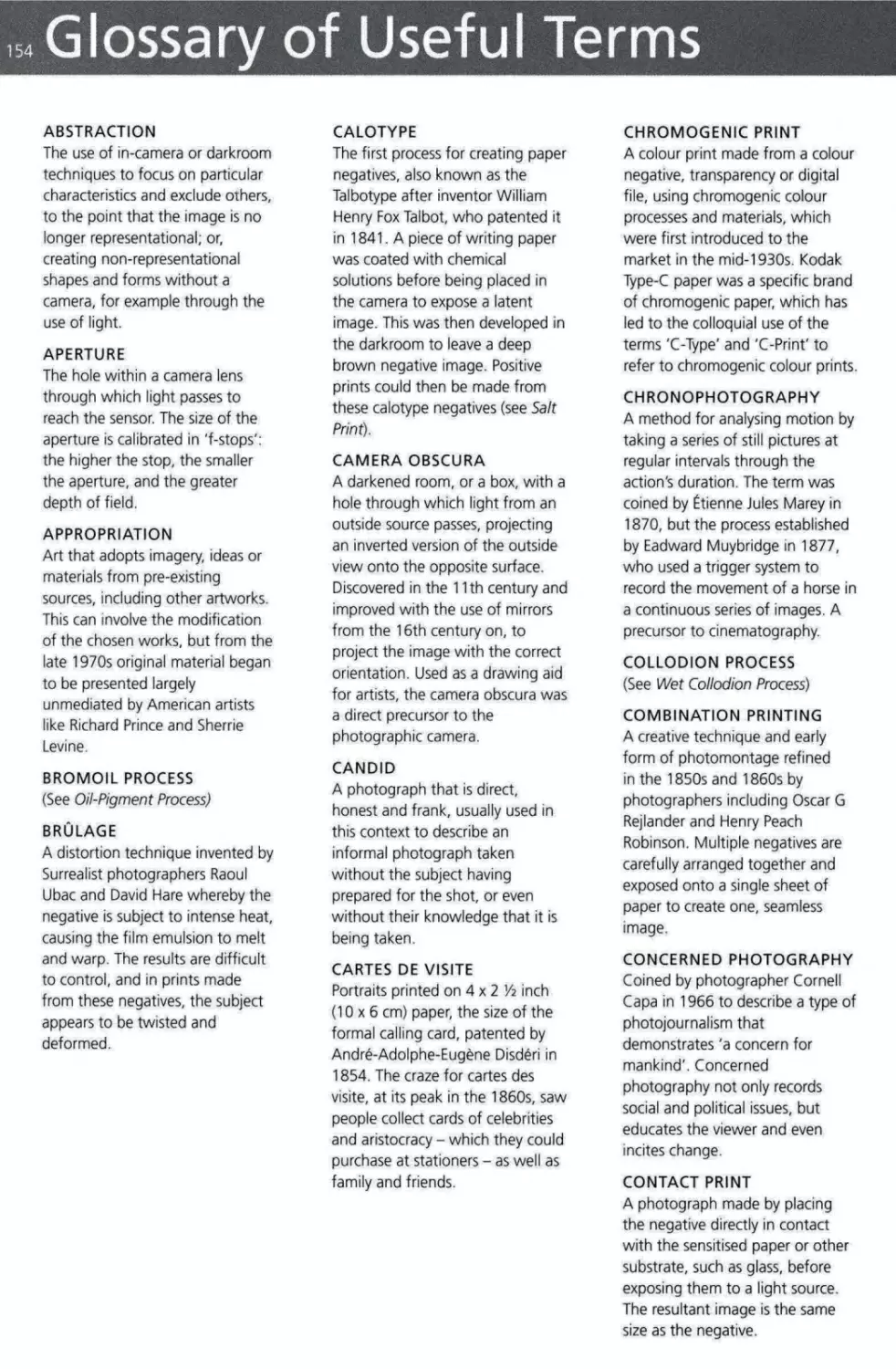
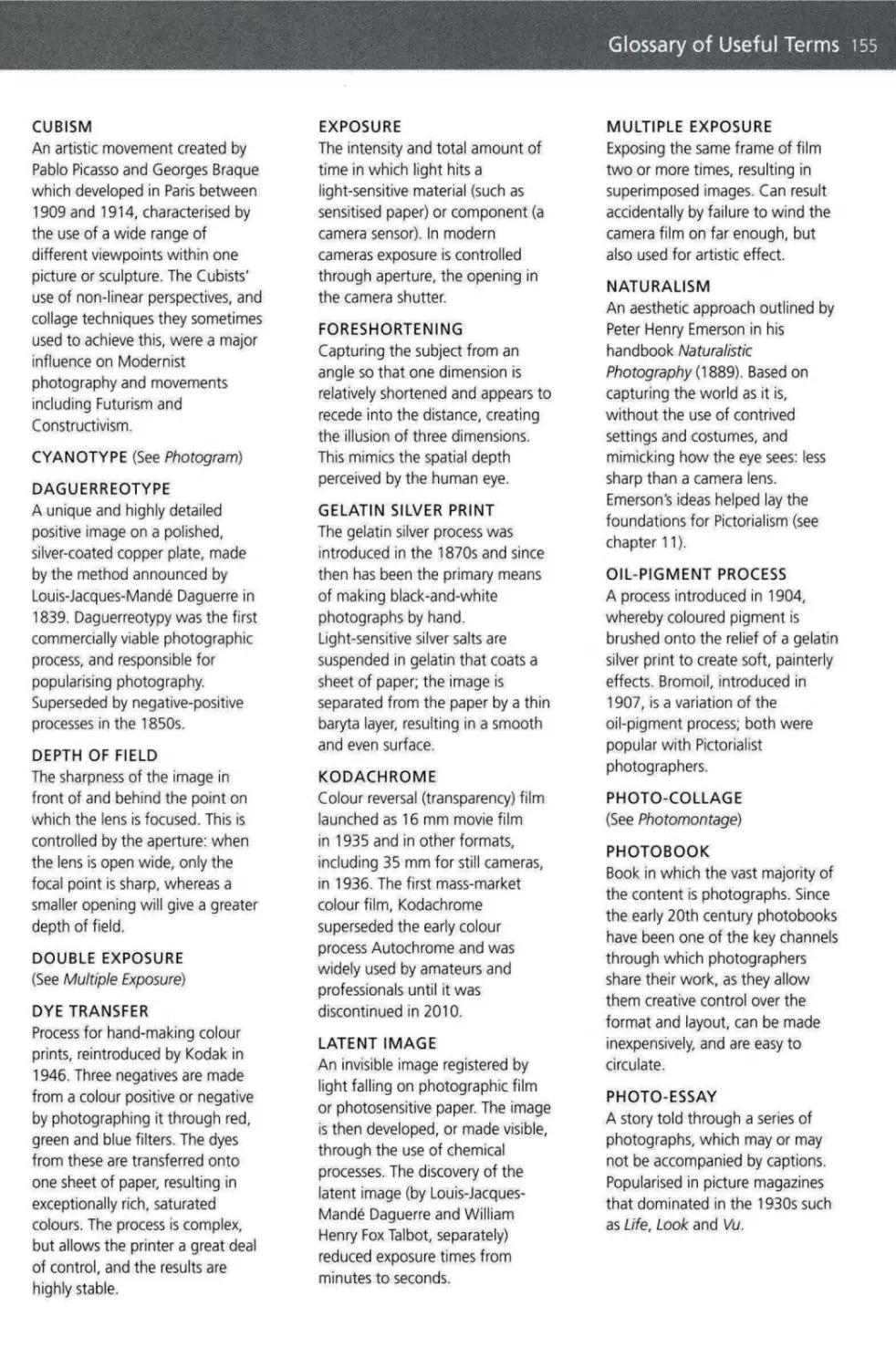
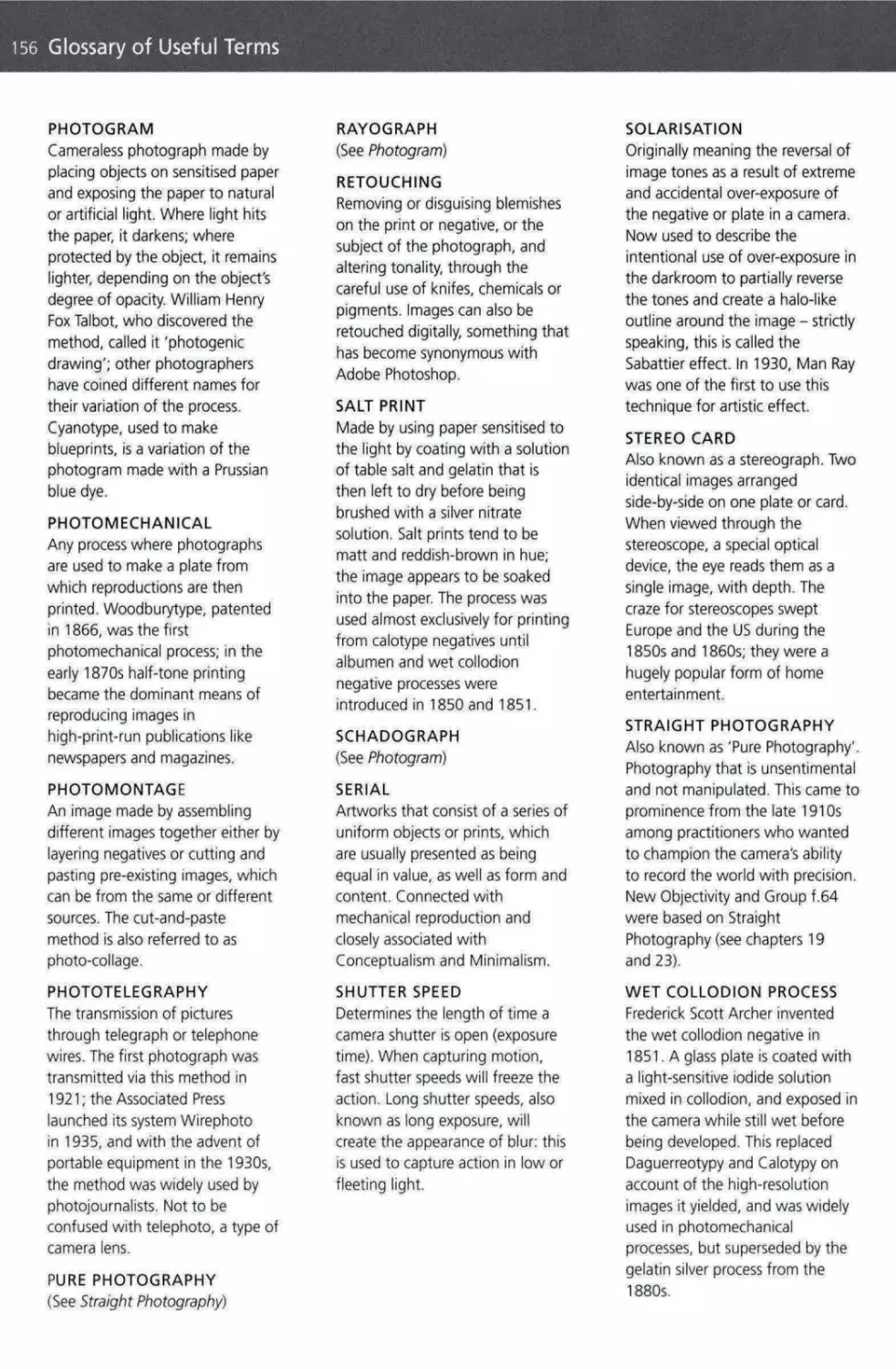
GLOSSARY OF USEFUL TERMS
Terms mentioned in the book that are not
commonly understood are listed in a
glossary at the back, including brief
explanations of some of the main
photographic processes discussed.
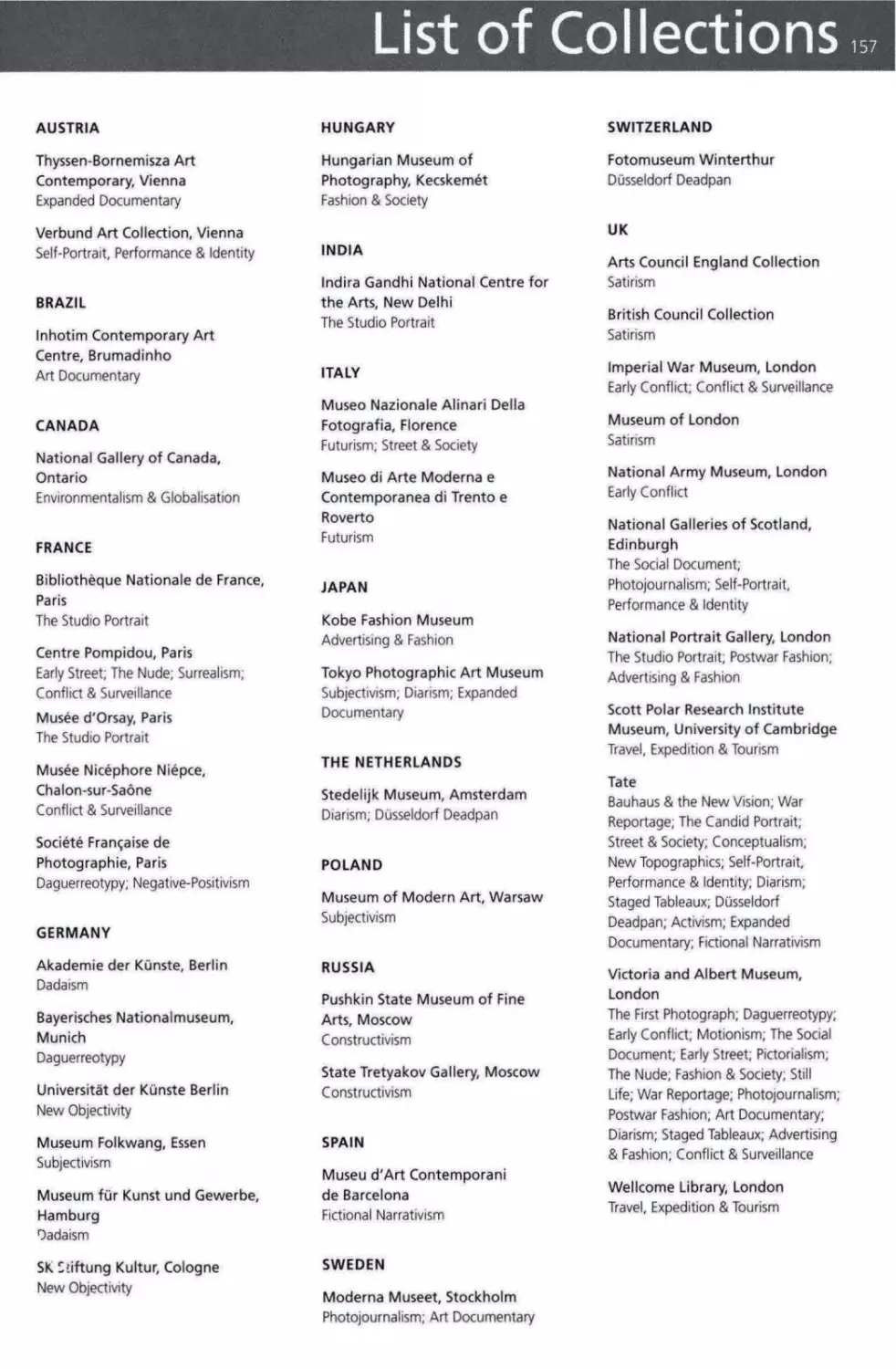
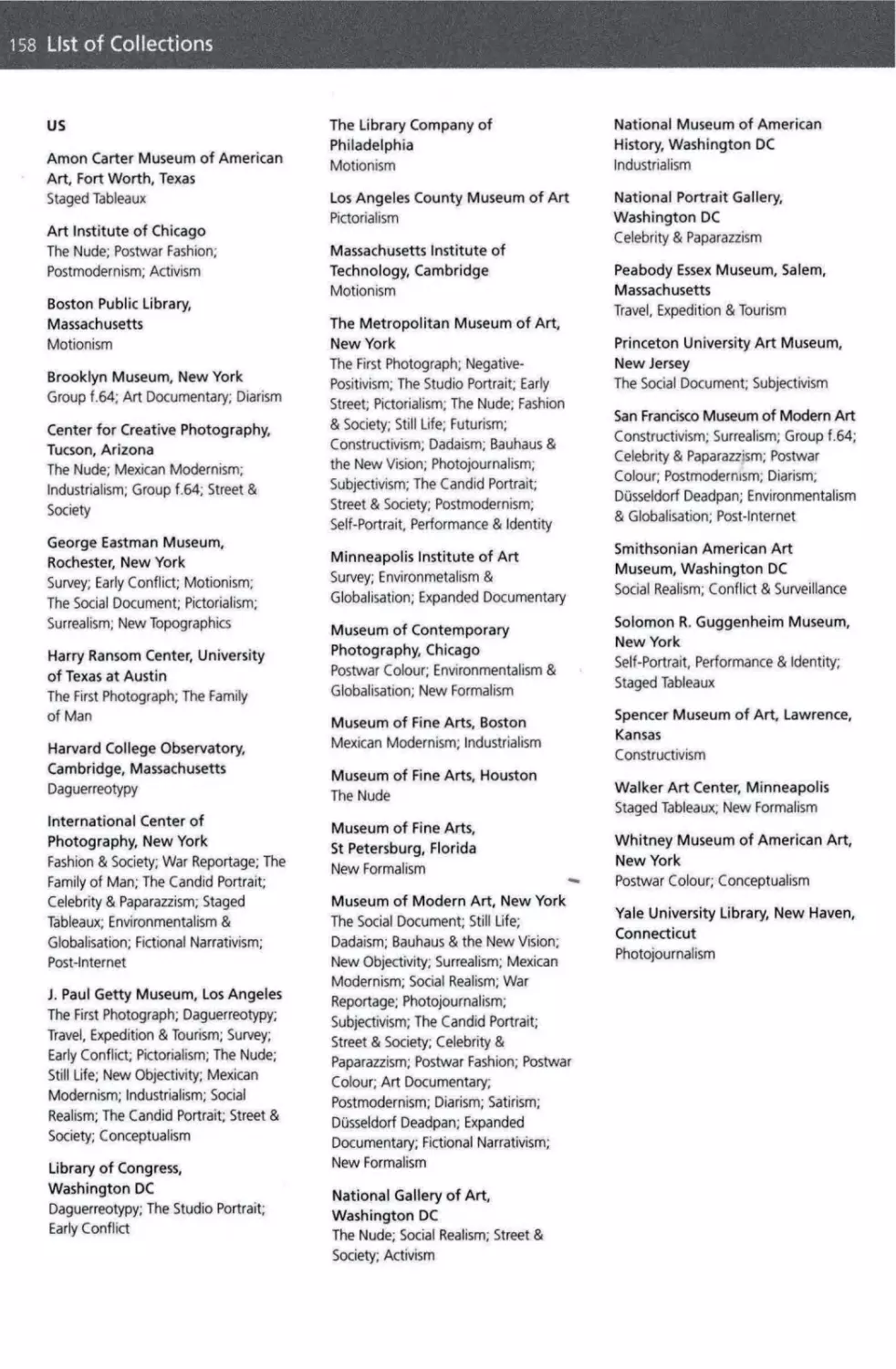
LIST OF COLLECTIONS
A list of the major museums, galleries and
other collections mentioned in the Key
Works and Other Works section s of each
chapter, organised by country. Many of
these list their collections on line, with
images and other resources for further
exploration and research .
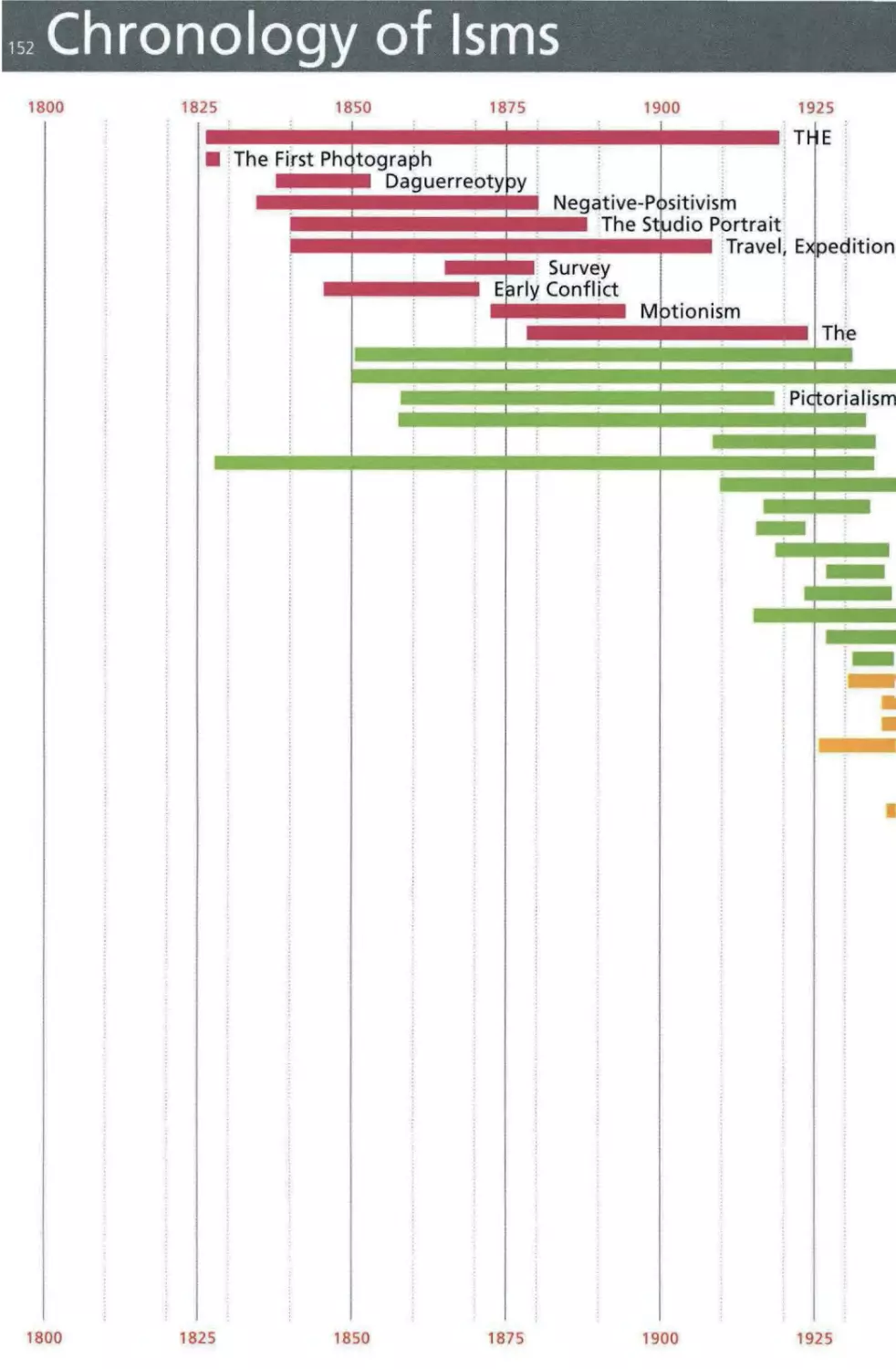
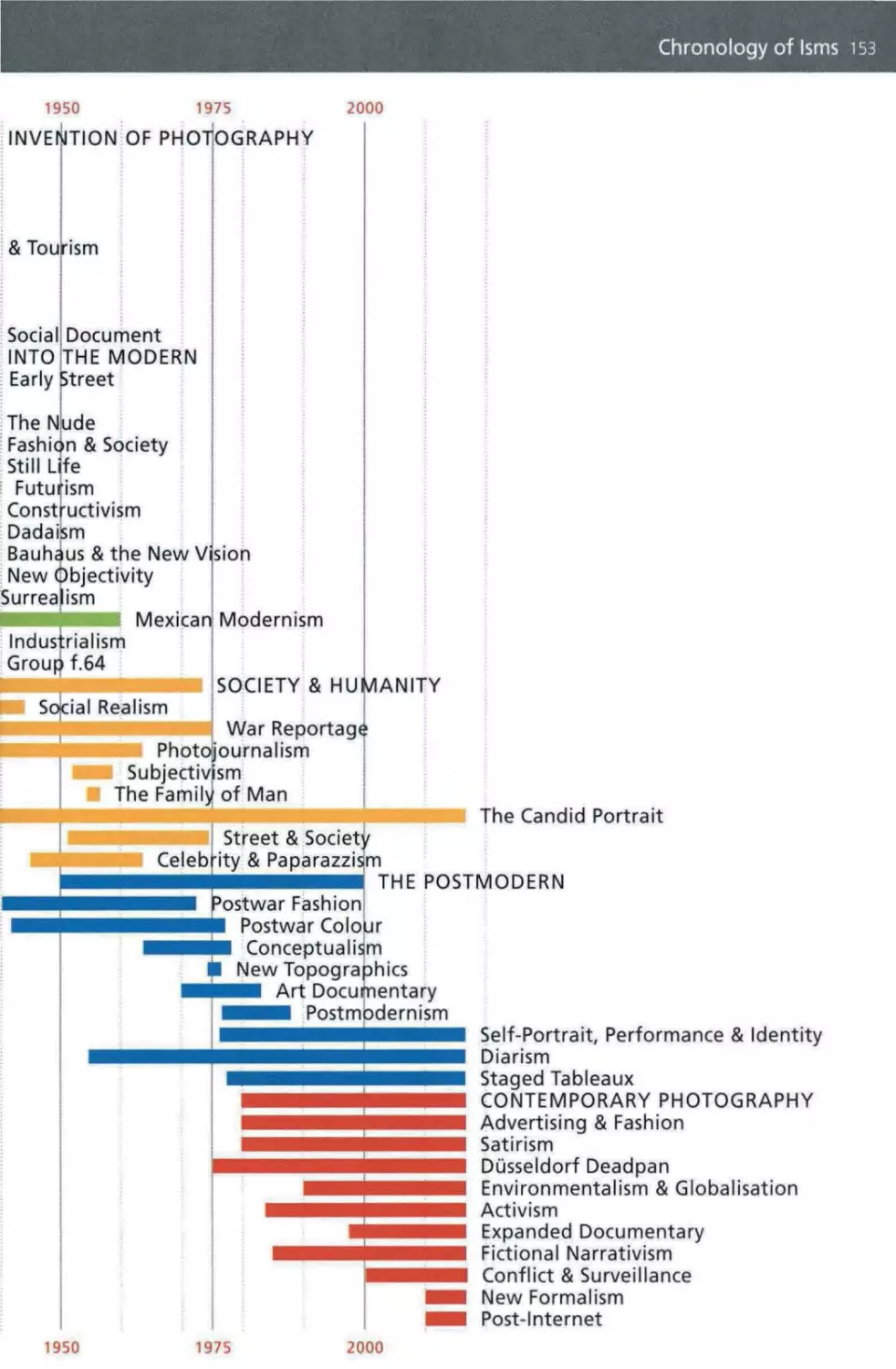
CHRONOLOGY OF ISMS
This is a timeline of all of the different 'isms'
explained in the book, from the very first
permanent photograph in 1826 to the
burgeoning movements of New Formalism
and Post-Internet photography. The start
and endpoints of 'isms' can often be
debated: even movements that declared an
official ending often had a legacy beyond
this, while approaches like photojournalism
began in different places at different times.
The timeli ne here marks the widely accepted
moment when an 'ism' was established and
when it declined. For thematic categories
that have no set endpoint, such as The
Nude, the timeline marks the core period on
which the chapter focuses.

9

THE
INVENTION OF
PHOTOGRAPHY
AND THE
RECORDING OF
THE WORLD

1826-19105

MM

12

r.

Photography is the result of three
processes announced in the 1820s
and 1830s that made it possible to record,
fix and reproduce an image. The first
in-camera photograph was a unique,
permanent image made with a camera
obscura.

\.:1

r"\

ANNA AT KINS (1799- 1871 ); LOUI S, . , JACQUES -MANDE DA GUERRE (1787
-1851); HU M PHRY DAVY (1778- 1829);
JOSEPH NICEPHORE NIEPCE (1765- 1833);
WILLIAM HENRY FO X TALBOT (1800- 77);
THOMAS WEDGWOOD (1777-1805)

camera obscura; heliography;
photogenic drawing; positive; unique

A

W'

First steps towards the photographic

image were made by Thoma s
Wedgwood and Humphry Davy, who in
1802 published accounts of their
experiments w ith recording light. The
findings that launched photography came
later, beginning w ith the work of inventor
Joseph Nicephore Niepce.
Interested in lithography, Niepce sought
a technique to supplement his professed
lack of skill as an engraver In 1816 he
experimented with placing sensitised paper
into the back of a camera obscura, an
optical device that projects images. He
found that where light hit the paper it
wou ld darken, creating a negative
impression . But the results we re only
temporary: the paper turned completely
black in daylight.
Six years later, Niepce discovered that
putting a solution of bitumen and Judea,
a mineral spirit, onto the paper would
permanently fix the image. The spirit
hardened on contact with the light, and was
commonly used in lithography. He called this
invention heliography, meaning 'light
drawing', after he/ios, the Greek word for
sun. His reproduction made by placing an

engraving of Pope Pius VII in direct contact
with sensitised paper is considered to be the
first made from a photographic process.
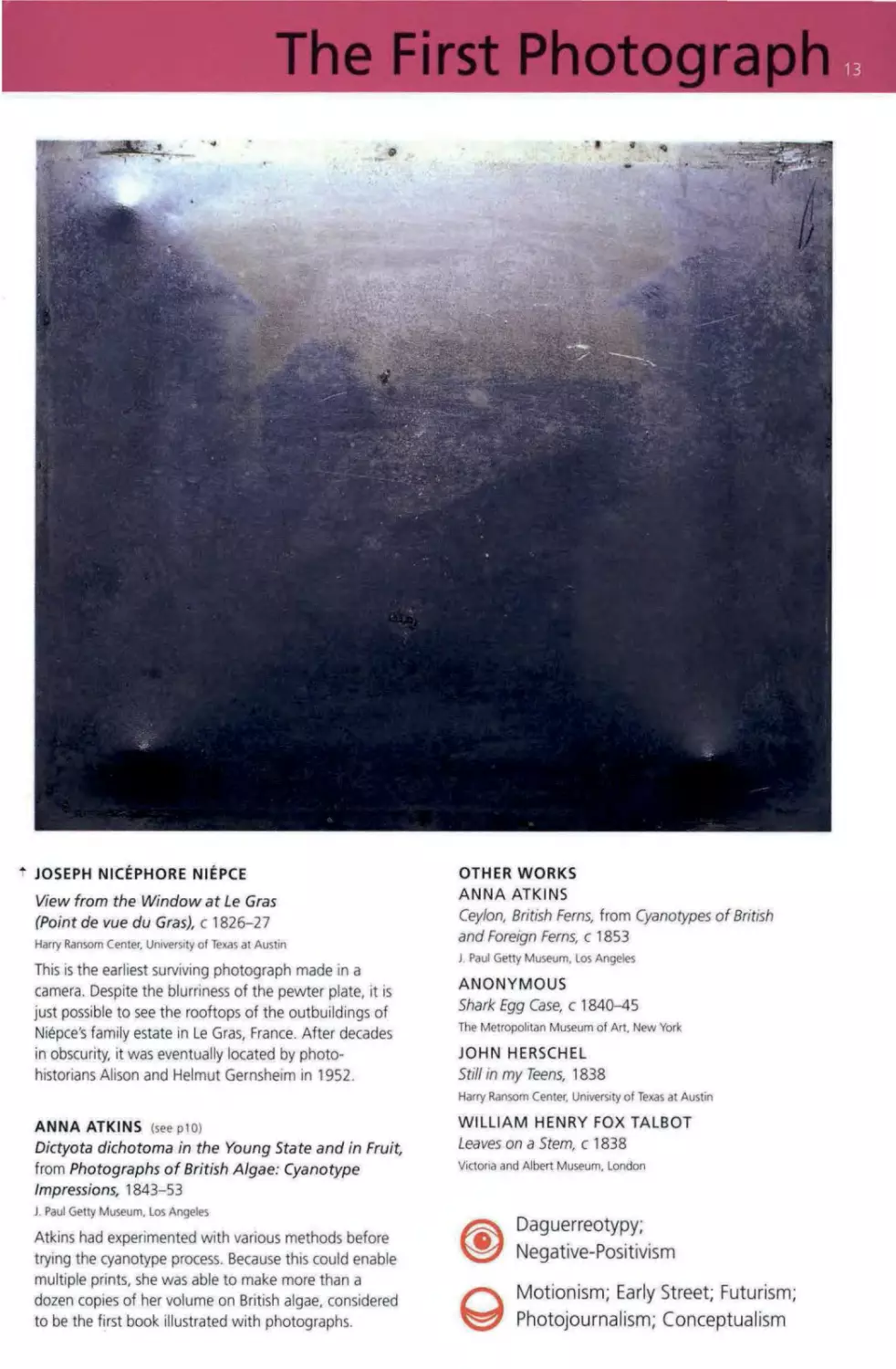
In 1826 or 1827, Niepce created the
world's first in-camera photograph by
placing a pewter plate coated with the
bitumen preparation inside a camera
obscura. After leaving the camera in a
window for at least eight hours, he rinsed
the plate w ith a lavender oil solution to
reveal a direct positive (and therefore
unique) permanent image of the outdoor
scene. Niepce's partnership with expert in
the camera obscura Louis-Jacques-Mande
Daguerre, from 1829, contributed to the
first commercially viable photographic
process. He died in 1833 before it was fu lly
refined , though, and it was announced to
the world in 1839 as the daguerreotype.
News of Daguerreotypy spurred Wil liam
Henry Fox Talbot to announce the findings
of his own experiments. His hopes to fix the
image projected by a camera obscura led to
the 1833 discovery of what he called the
'photogenic drawing' (a photogram): an
image made without a camera by placing
objects directly onto paper coated with a
light-sensitive silver chloride solution that
darkens on exposure to sunlight. John
Hershel's 1842 invention of the cyanotype
followed the same basic principle, but he
used a solution that turned bright Prussian
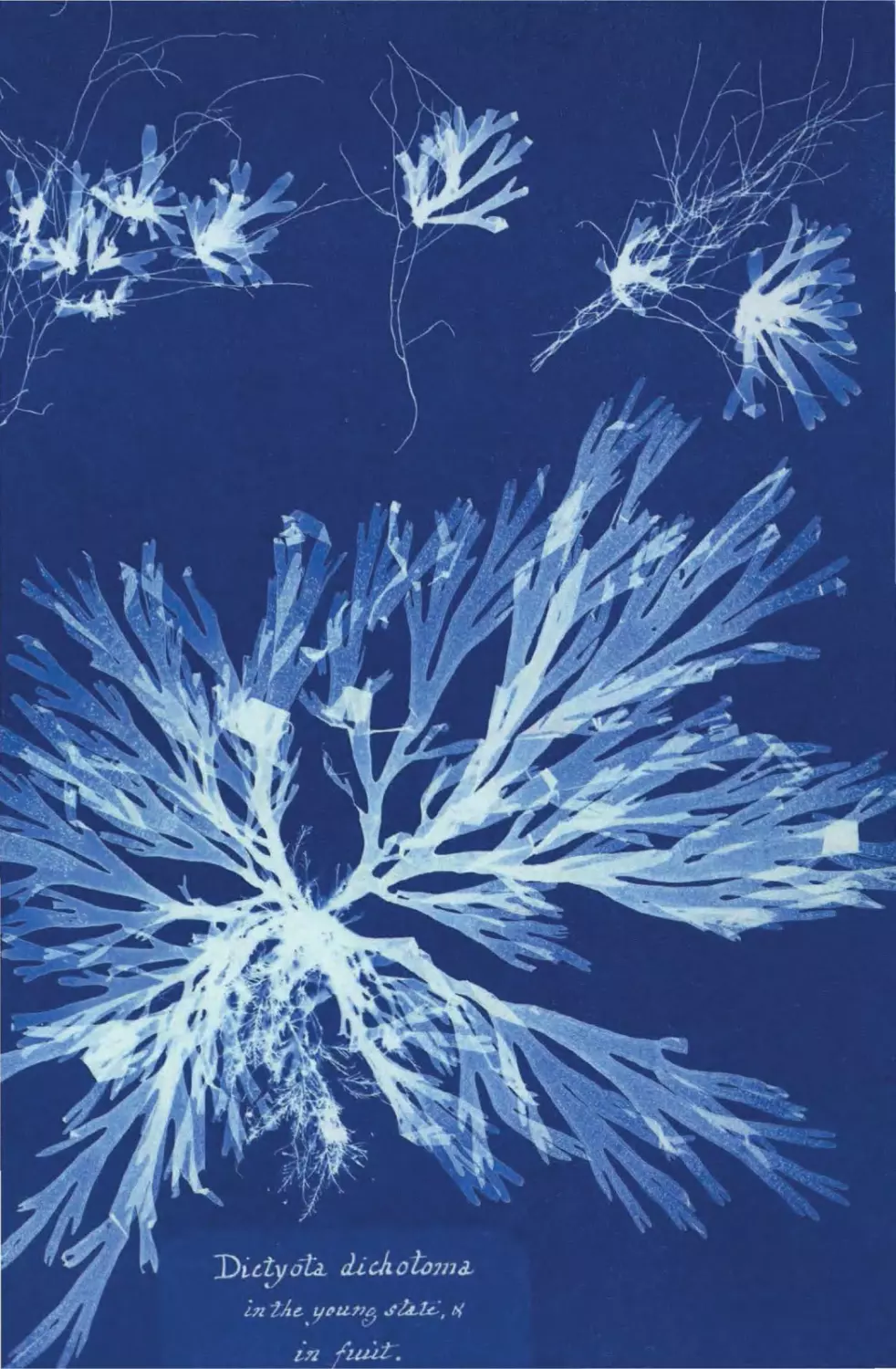
blue upon exposure. Botanist Anna Atkins
was the first to realise the potential of this
for recording plant specimens; her vo lume

Photographs of British Algae: Cyanotype
Impressions was published serially between
1843 and 1853. By that point, Talbot had
already announced his next discovery, the
calotype - the first negative-positive process.

t JO SE PH NICEPHORE NIEPCE

View from the Window at Le Gras
(Point de vue du Gras), c 1826-27
Harry Ransom Center. University of Texas at Austin

OT HE R WORKS

ANNA ATKINS
Ceylon, British Ferns, from Cyanotypes of British
and Foreign Ferns, c 1853
J Paul Getty Museum, Los Angeles

This is the earliest surviving photograph made in a
camera. Despite the blurriness of the pewter plate, it is
just possible to see the rooftops of the outbuildings of
Niepce's family estate in Le Gras, France. After decades
in obscurity, it was eventually located by photohistorians Alison and Helmut Gernsheim in 1952.

Still in my Teens, 1838

A NN A AT KINS (see plOI

WILLIAM HENRY FOX TALBOT

Dictyota dichotoma in the Young State and in Fruit,
from Photographs of British Algae: Cyanotype
Impressions, 1843-53

Victoria and Albert Museum, London

ANONYMOUS

Shark Egg Case, c 1840-45
The Metropolitan Museum of Arl, New York

JOHN HERSCHEL

Harry Ransom Center, Universny of Texas at Austin

J. Paul Getty Museum, Los Angeles

Atkins had experimented with various methods before
trying the cyanotype process. Because this could enable
multiple prints, she was able to make more than a
dozen copies of her volume on British algae, considered
to be the first book illustrated with photographs.

Leaves on a Stem, c 1838

Daguerreotypy;
Negative-Positivism
Motionism; Early Street; Futurism;
Photojournalism; Conceptualism

MM

14

A daguerreotype is a unique, highly
\,;, detailed, positive image on a silvered
copper plate, made by a chemical and
technical process perfected by LouisJacques-Mande Daguerre . It was the first
commercially successful means of producing
photographs and the main process in use
throughout the 1840s and early 1850s.
~

r'\

ANTOINE CLAUDET ( 1797- 1867);
ROBERT CORNELl_LIS ( 1809-93); LOUISJACQUES-MANDE DAGUERRE (17871851 ); JOSEPH NlcEPHORE NIEPCE ( 1765-1833);
JOHN ADAMS WHIPPLE ( 1822-9 1)

'9f

6"\.
U

commercial; detail; fragile; portrait;
unique

A
W

In 1829, artist and theatre set
designer Louis Daguerre and inventor
Joseph Nicephore Niepce formed a working
partnership to bring together Niepce's
pioneering methods of recording light and
fixing a permanent image, known as
'heliography', with Daguerre's expertise with
the camera obscura that he developed as
inventor of the diorama - an illusionary
three-dimensional stage device. Following
Niepce's death in 1833, Daguerre continued
alone, arriving four years later at a
successful method of making a permanent
recording. One of his most important
findings was the 'latent image': exposing

~-

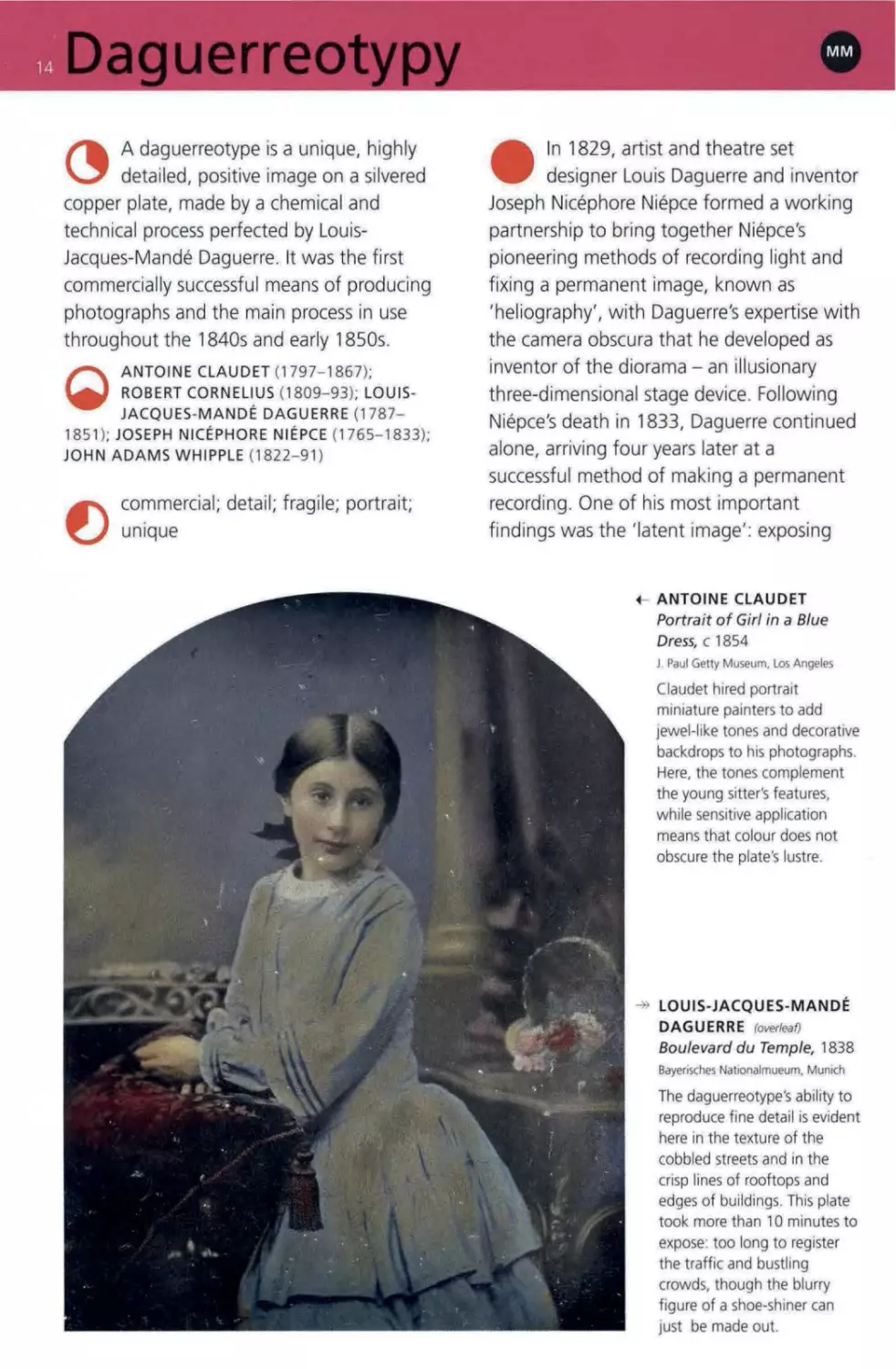
ANTOINE CLAUDET

Portrait of Girl in a Blue
Dress, c 1854
J Paul Getty Museum, Los Angeles

Claudet hired portrait
miniature painters to add
jewel-like tones and decorative
backdrops to his photographs.
Here, the tones complement
the young sitter's features,
while sensitive application
means that colour does not
obscure the plate's lustre.

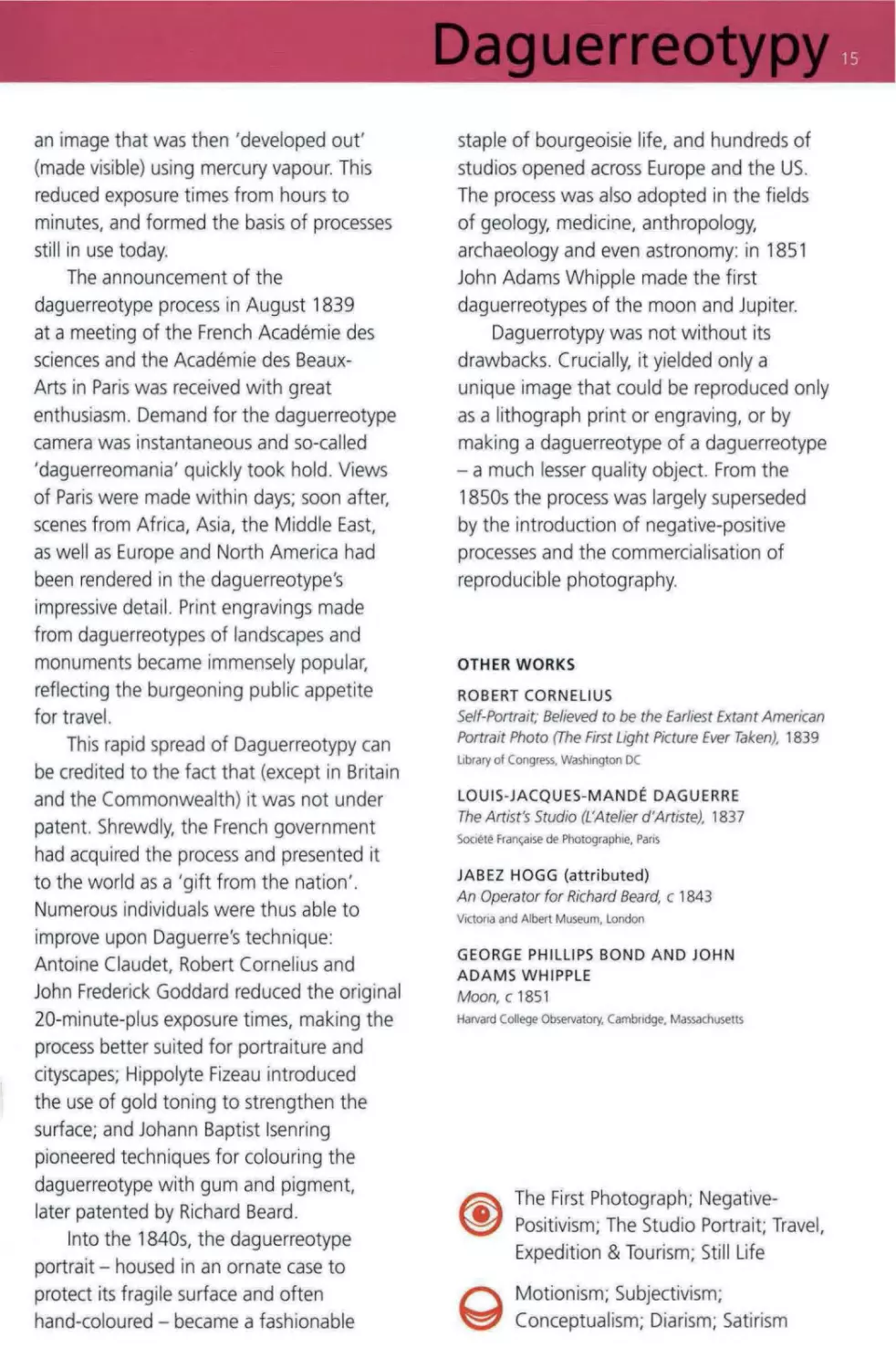
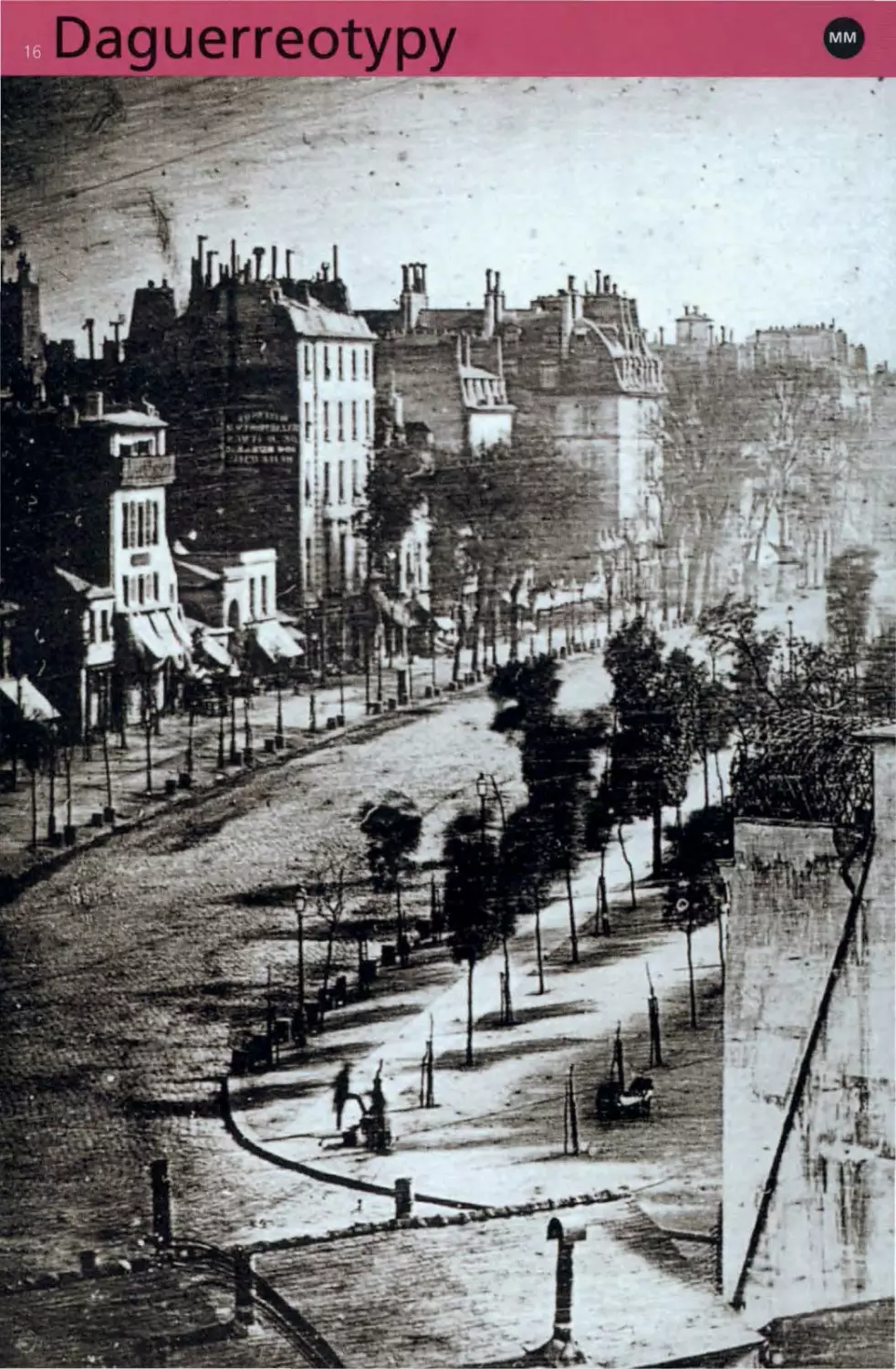
-» LOUIS-JACQUES-MAND[
DAGUERRE

!over/ea~

Boulevard du Temple, 1838
Bayerisches Nationalmueum, Munich

The daguerreotype's ability to
reproduce fine detail is evident
here in the texture of the
cobbled streets and in the
cri sp lines of rooftops and
edges of buildings. This plate
took more than 10 minutes to
expose: too long to register
the traffic and bustling
crowds, though the blurry
figure of a shoe-shiner can
just be made out.

an image that was then 'developed out'
(made visible) using mercury vapour. This
reduced exposure times from hours to
minutes, and formed the basis of processes
still in use today.
The announcement of the
daguerreotype process in August 1839
at a meeting of the French Academie des
sciences and the Academie des BeauxArts in Paris was received with great
enthusiasm . Demand for the daguerreotype
camera was instantaneous and so-called
'daguerreomania' quickly took hold . Views
of Paris were made within days; soon after,
scenes from Africa, Asia, the Middle East,
as well as Europe and North America had
been rendered in the daguerreotype's
impressive detail. Print engravings made
from daguerreotypes of landscapes and
monuments became immensely popular,
reflecting the burgeoning public appetite
for travel .
This rapid spread of Daguerreotypy can
be credited to the fact that (except in Britain
and the Commonwealth) it was not under
patent. Shrewdly, the French government
had acquired the process and presented it
to the world as a 'gift from the nation'.
Numerous individuals were thus able to
improve upon Daguerre's technique:
Antoine Claudet, Robert Cornelius and
John Frederick Goddard reduced the original
20-minute-plus exposure times, making the
process better suited for portraiture and
cityscapes; Hippolyte Fizeau introduced
the use of gold toning to strengthen the
surface; and Johann Baptist lsenring
pioneered techniques for colouring the
daguerreotype with gum and pigment,
later patented by Richard Beard.
Into the 1840s, the daguerreotype
portrait - housed in an ornate case to
protect its fragile surface and often
hand-coloured - became a fashionable

staple of bourgeoisie life, and hundreds of
studios opened across Europe and the US.
The process was also adopted in the fields
of geology, medicine, anthropology,
archaeology and even astronomy: in 1851
John Adams Whipple made the first
daguerreotypes of the moon and Jupiter.
Daguerrotypy was not without its
drawbacks. Crucially, it yielded only a
unique image that could be reproduced only
as a lithograph print or engraving, or by
making a daguerreotype of a daguerreotype
- a much lesser quality object. From the
1850s the process was largely superseded
by the introduction of negative-positive
processes and the commerciali sation of
reproducible photography.

OTHER WORKS
ROBERT CORNELIUS

Self-Portrait; Believed to be the Earliest Extant American
Portrait Photo (The First Light Picture Ever Taken), 1839
Library of Congress. Washington DC

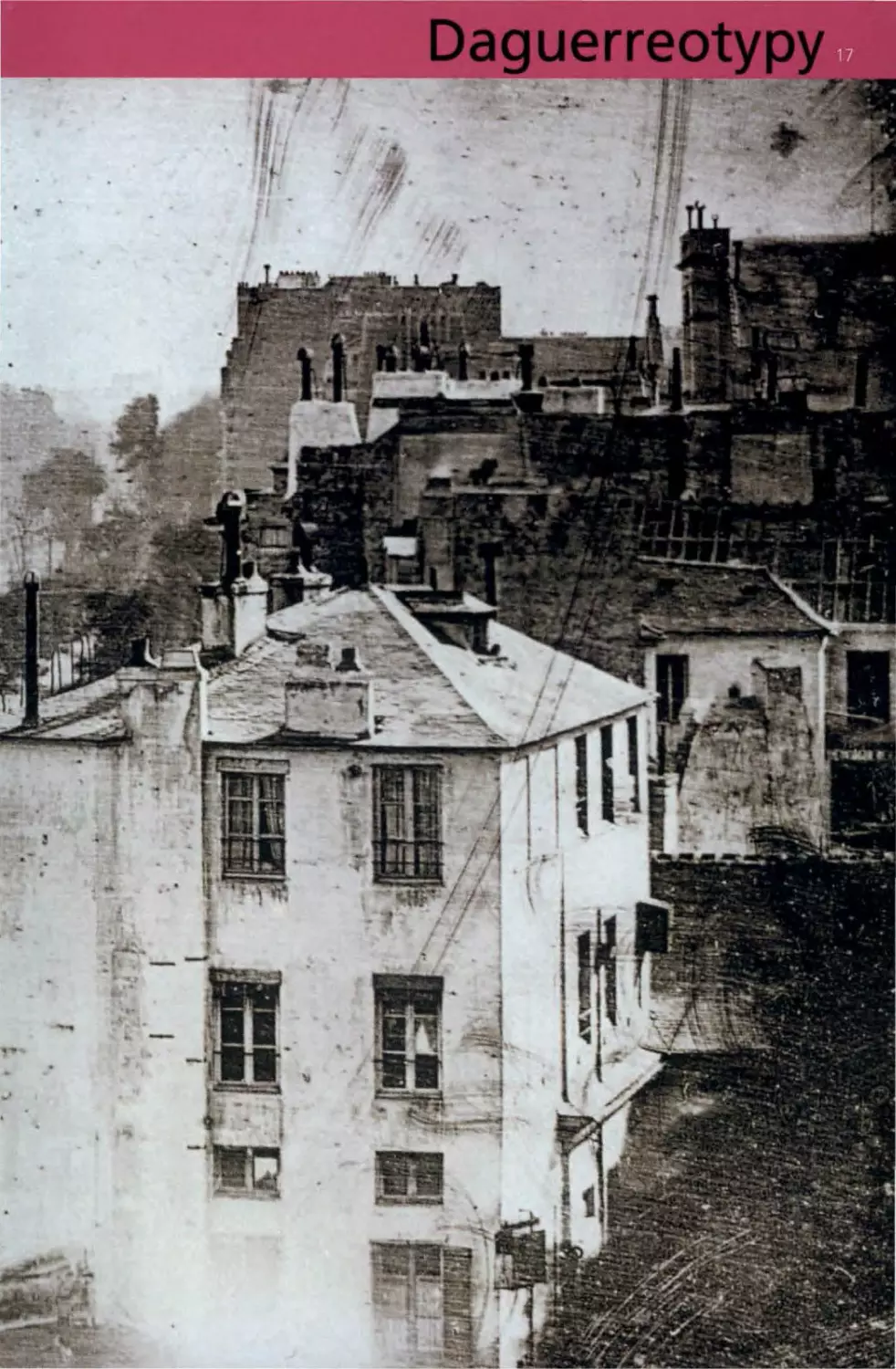
LOUIS -JACQUES-MANDE DAGUERRE

The Artist's Studio (L'Atelier d'Artis te), 1837
Sooete Franc;aise de Photograph1e, Paris

JABEZ HOGG (attributed)

An Operator fo r Richard Beard, c 1843
Victoria and Albert Museum, London

GEORGE PHILLIPS BOND AND JOHN
ADAMS WHIPPLE
Moon, c 1851
Harvard College Observatory, Cambridge, Massachusetts

The First Photograph; NegativePositivism; The Studio Portrait; Travel,
Expedition & Tourism; Still Life
Motionism; Subjectivism;
Conceptualism; Diarism; Satirism

MM

18

~ The invention of the calotype

~ negative in the 1840s introduced
a means of reproducing images multiple
times, which provided the basis for the
negative-to-positive processes still in use.

r"'\

FREDERICK SCOTT ARCHER ( 1813-57);
HIPPOLYTE BAYARD ( 1801-87);
LOUIS-DESIRE BLANQUART-EVRARD
(1802- 75 ); GUSTAVE LE GRAY (1820-84);
WILLIAM HENRY FOX TALBOT (1800-77)
•

calotype; glass plate; photogenic
drawing; waxed paper; wet co llodion

A

Photography resulted from an intense
period of experiment by numerous
scientists and inventors during the early
19th century. The cornerstones of this were
Joseph Nicephore Niepce's methods for
fixing a permanent image, discovered in
1826; Daguerreotypy, announced in 1839;
and William Henry Fox Talbot's pioneering
technique for creating multiple positive
images from a single negative, which he

W

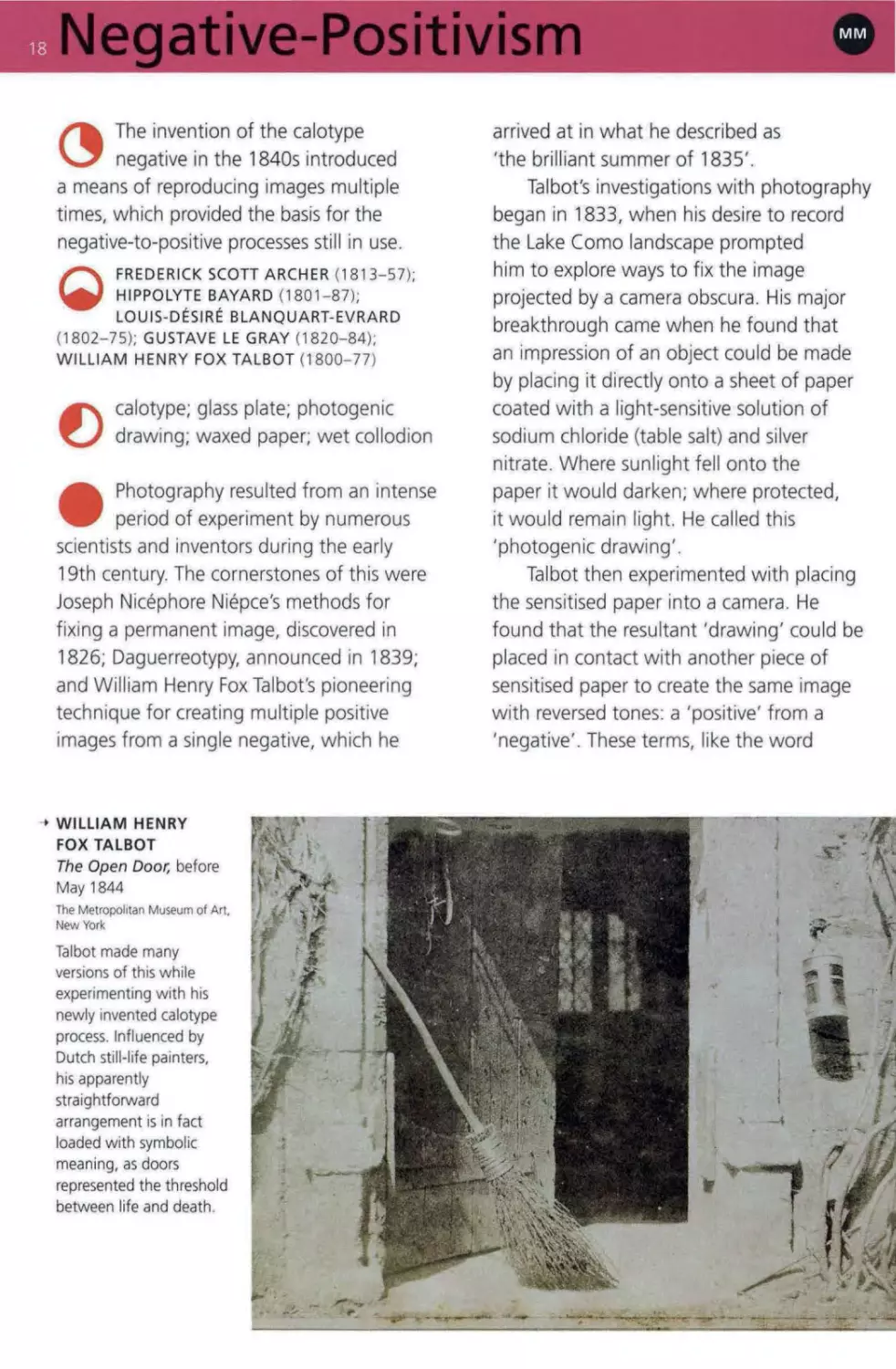
-+ WILLIAM HENRY

FOX TALBOT

The Open Door, before
May 1844
The Metropohtan Museum of Art,
New York

Talbot made many
versions of this while
experimenting with his
newly invented calotype
process. Influenced by
Dutch still-life painters,
his apparently
straightforward
arrangement is in fact
loaded with symbolic
meaning, as doors
represented the threshold
between life and death .

arrived at in what he described as
'the brilliant summer of 1835'.
Talbot's investigations with photography
began in 1833, when his desire to record
the Lake Como landscape prompted
him to explore ways to fix the image
projected by a camera obscura. His major
breakthrough came when he found that
an impression of an object could be made
by placing it directly onto a sheet of paper
coated with a light-sensitive solution of
sodium chloride (table salt) and silver
nitrate. Where sunlight fell onto the
paper it would darken; where protected,
it would remain light. He ca lled this
'photogenic drawing'.
Talbot then experimented with placing
the sensitised paper into a camera . He
found that the resultant 'drawing' could be
placed in contact with another piece of
sensitised paper to create the same image
with reversed tones: a 'positive' from a
'negative' . These terms, like the word

'photography' itself, were coined by his
friend John Herschel, who also introduced
the use of a photographic fixing agent that
is still in use today.
Talbot had done little work on his
method when Louis Daguerre announced
his own photographic process in Paris in
1839. The daguerreotype was an immediate
success. But the fact it was a unique object,
and on a metal plate, was a major practica l
hindrance. Talbot rightly bel ieved that
the future lay in the reproducible paper
image, and this led him to begin his
experiments again in earnest.
His discovery of the latent image in
1840 (somethi ng that Daguerre had also
arrived at independently) was pivotal. This
meant that the photographer did not have
to wait for long periods of time for an

r

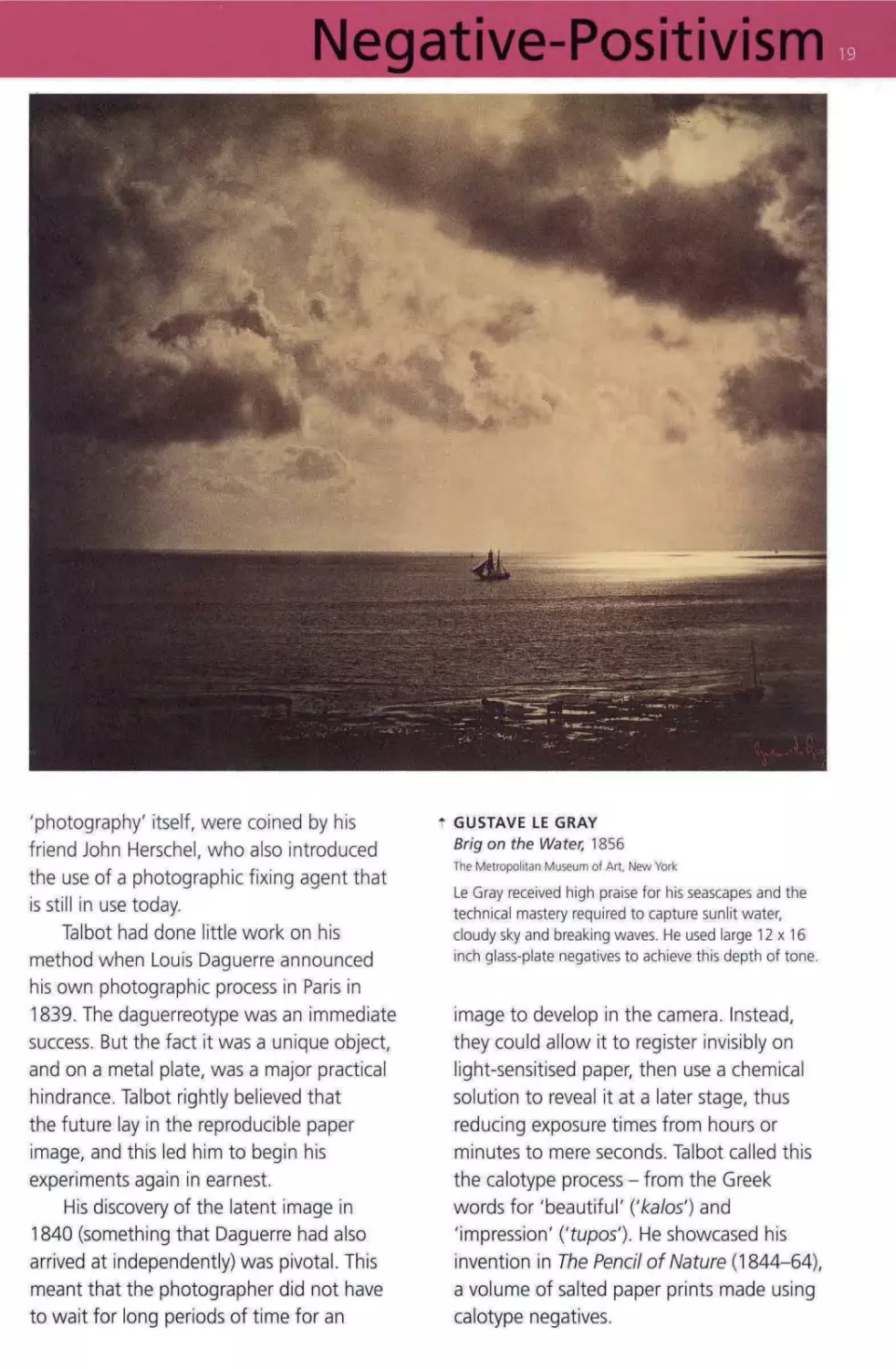
GUSTAVE LE GRAY

Brig on the Water, 1856

The Metropolitan Museum of Art, New York

Le Gray received high praise for his seascapes and the
technical mastery required to capture sunlit water,
cloudy sky and breaking waves. He used large 12 x 16
inch glass-plate negatives to achieve this depth of tone .

image to develop in the camera. Instead,
they could allow it to register invisibly on
light-sensitised paper, then use a chemical
solution to reveal it at a later stage, thus
reducing exposure times from hours or
minutes to mere seconds. Talbot called this
the calotype process - from the Greek
words for 'beautifu l' ('kalos' ) and
'impression' (' tupos' ). He showcased his
invention in The Pencil of Nature (1844-64),
a volu me of salted paper prints made using
calotype negatives.

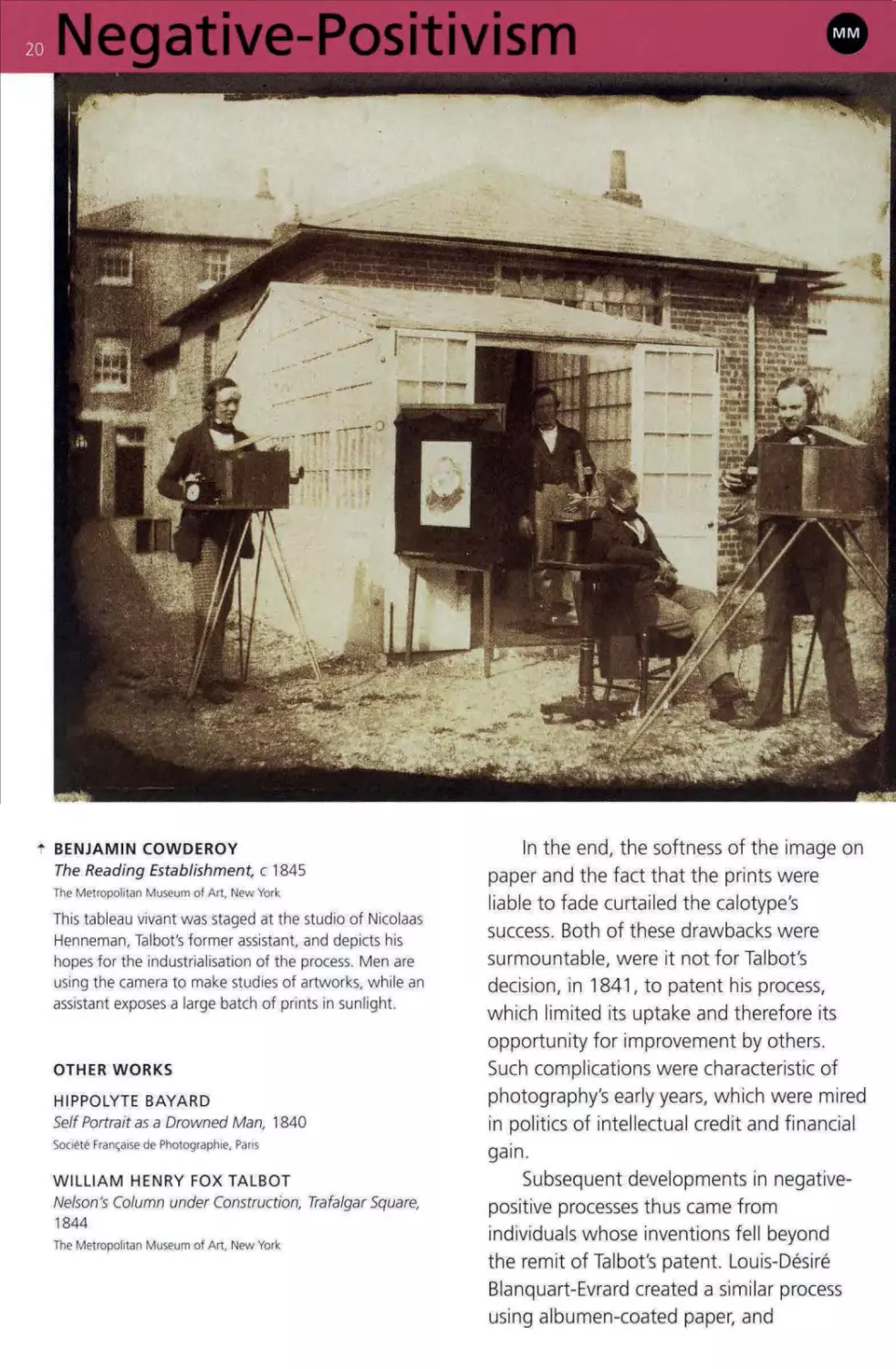
• BENJAMIN COWDEROY
The Reading Establishment,

c 1845

The Metropolitan Museum of Art, New York

This tableau vivant was staged at the studio of Nicolaas
Henneman, Talbot's forme r assistant, and depicts his
hopes for the industrialisation of t he process. M en are
using the camera to make studies of artworks, while an
assistant exposes a large batch of prints in sunlight.

OTHER WORKS

HIPPOLYTE BAYARD
Self Portrait as a Drowned Man, 1840
Societe

F ran~a1se

de Photog raph1e, Paris

W ILLI AM HENR Y FOX TALBOT
Nelson's Column under Construction, Trafalgar Square,
1844
The Metropolitan Museum of Art, New York

In the end, the softness of the image on
paper and the fa ct that the prints w ere
liable to fade curtailed the calotype's
success. Both of these drawbacks w ere
surmountable, w ere it not for Talbot's
decision, in 1841, to patent his process,
w hich limited its uptake and therefore its
opportunity for improvement by others.
Such comp lications w ere characteristic of
photography's early years, which were mired
in pol itics of intellectual cred it and financial
gain.
Subsequent developments in negativepositive processes thu s came from
individuals w hose inventions fell beyond
the remit of Talbot 's patent. Louis-Desire
Blanquart-Evrard created a similar process
using albumen-coated paper, and

exploited the negative-positive process
to print photographs on an industrial scale
for the first time. Gustave Le Gray found
that adding wax to the paper negative
created a sharper image with a far better
tonal range, which he demonstrated
in seascapes.
The next great achievement in NegativePositivism came in 1851 with Frederick Scott
Archer's publication of the wet collodion
process. He used a glass plate as a negative,
which yielded far greater detail than paper,
and the collodion greatly accelerated
exposure. This represented everything
photographers had been working towards:
an image on paper that showed great tonal
range and definition, did not fade and could
be reproduced.

Archer's method vastly expanded the
possibilities for photography's applications in
the sciences, in commercial endeavours particularly the portrait studio - and in early
reportage photography. It remained the
main photographic process in use until the
1880s, when it was gradually superseded by
the gelatin silver print and the introduction
of negative fi lm.

The First Photograph; Daguerreotypy;
Travel, Expedition & Tourism;
Early Conflict
Motionism; Futuri sm; Dadaism;
Su rrealism; Art Documentary

TH

22

Immediately upon the announcement
of the daguerreotype, photography
was commercialised in the form of portrait
studios that opened up across the globe.
Later, the reproducible nature of portraits on
paper, particularly in the form of cartes de
visite, cemented the use of the portra it to
denote social status.
~

\.:1

r°'\

ROBERT CORNELIUS ( 1809- 93 ); LA LA

~ (RAJA) DEEN DAYA L ( 1844-190 5);

GEORGE LUTTERODT (ACTI VEFROM
1876); NADAR (GAS PAR D- FELI X TOURN ACHON)
( 182 0- 1910)

ce lebrity; choreographed; collecting;
commercialism; mass distribution

A
W

With the spread of Daguerreotypy
during the 1840s came a demand

In the 1850s, paper prints made
through the col lodion process began to
supplant the daguerreotype, particularly in
the form of cartes de visite - the 'calling
card ' . In 1854 Andre-Adolphe-Eu gene
Disderi patented a four-lensed camera that
could register up to eight different images
on one plate. Photographers experimented
with presenting their sitters in different
poses and with various accoutrements, and
the small images - around 4 x 2.5 inches
(10 x 6 cm) - were pasted onto slightly
larger pieces of card. Ownersh ip of a carte
de visite and its bigger version, the cabinet
card, suggested a personal relationship with
the subject. Individual touches in posture
and dress were added to standard poses

for the creation of photographic 'likenesses'
from the middle and upper classes.

and backdrops, all the while conforming
to socia l, class and gender norms.
The craze for cartes de visite also

Commercial portrait studios opened
across Europe and the US, with successful
practitioners such as Antoine Claudet,

reflected a new appetite for images of
celebrities. Figures from politics, the arts,
entertainment and fashion had portraits

Robert Cornelius and Josiah Johnson
Hawes attracting well-to-do customers and

made and duplicated for mass distribution.
Studios grew in size and the sets and
props they provided became increasingly
elaborate. Disderi and Pi erre-Louis Pierson

cha rging high prices.

photographed French roya lty, while in
England Queen Victoria commissioned
cartes de vis ite of the roya l family from John
J E Mayall in 1860.
The desire to co llect portraits of
celebrities and aristocracy also gave rise to
albums of 'contemporary figures' produced
by successful st udio owners such as Etienne
Carjat, Fran z Hanfstaengl, Nadar, Camille
Silvy and Emi le Tourtin (active 1873-99).
Lala (Raja) Deen Dayal's stu dios across India
met demand for portraiture from the British
and Indian rul ing classes.
Th e introduction of Kodak's 'You Press
the Button, We Do the Rest' system in 1888
lessened the need for the general public to
have themselves photographed formally.

The desire for the portrait made in the
carefully choreographed studio environment
endured, however, transformed in
subsequent decades in the fields of fashion
and advertising, and with the advent of
artificial lighting.

OTHER WORKS

ANDRE -ADOLPHE -EUGENE DISDERI

Napoleon Ill, Emperor of France; Napoleon Eugene Louis
Jean Joseph Bonaparte, Prince Imperial; Eugenie,
Empress of France, c 1858
National Portrait Gallery. London

GEORGE LUTTERODT AND SON

Untitled (Five Men), c 1880-85
The Metropolitan Museum of Art. New York

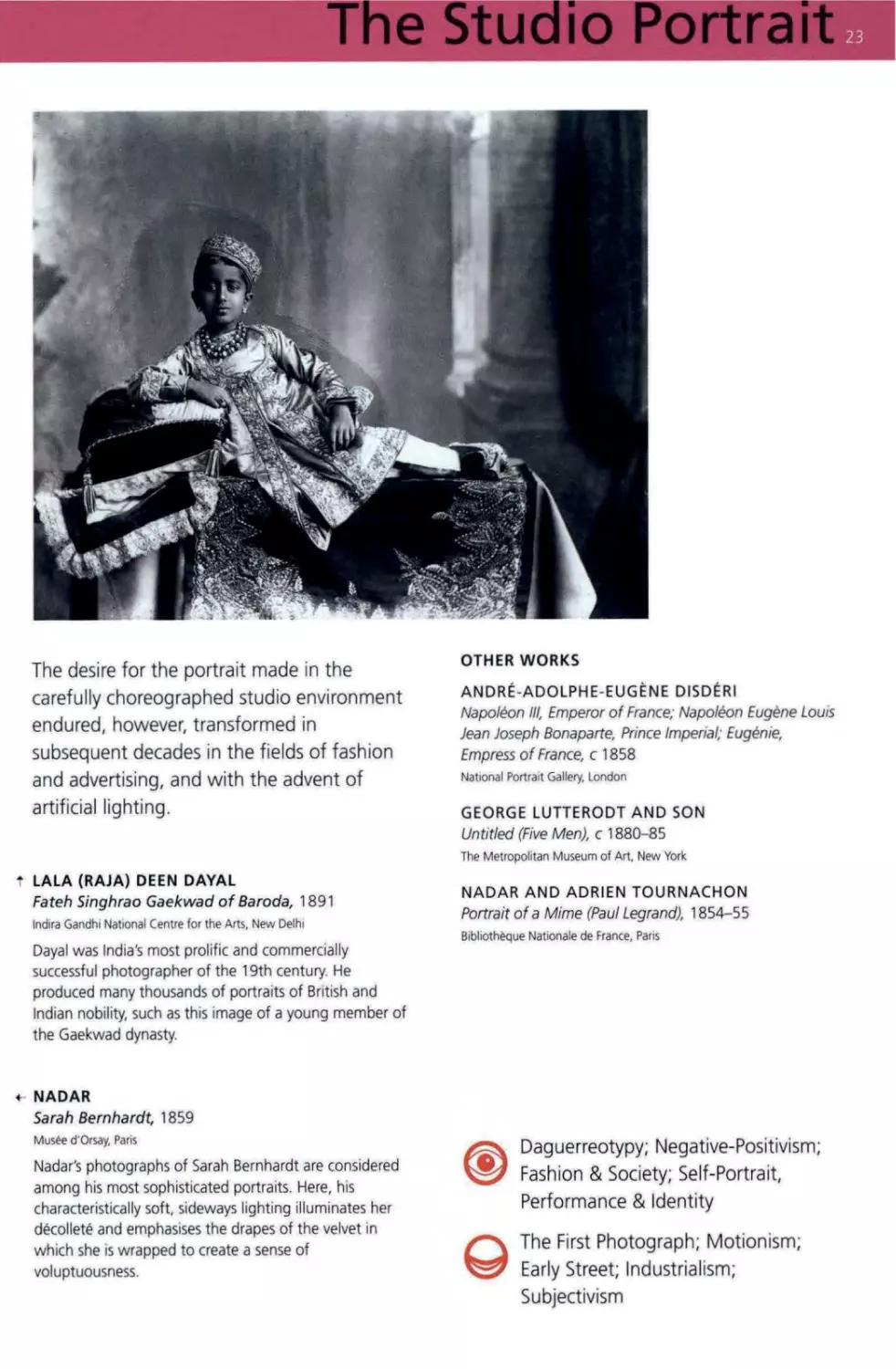
t LALA (RAJA) DEEN DAYAL

Fateh Singhrao Gaekwad of Baroda, 1891
Indira Gandhi National Centre for the Arts, New Delhi

Dayal was India's most prolific and commercially
successful photographer of the 19th century He
produced many thousands of portraits of British and
Indian nobility, such as this image of a young member of
the Gaekwad dynasty.

NADAR AND ADRIEN TOURNACHON

Portrait of a Mime (Paul Legrand), 1854-55
Bibliotheque Nationale de France, Paris

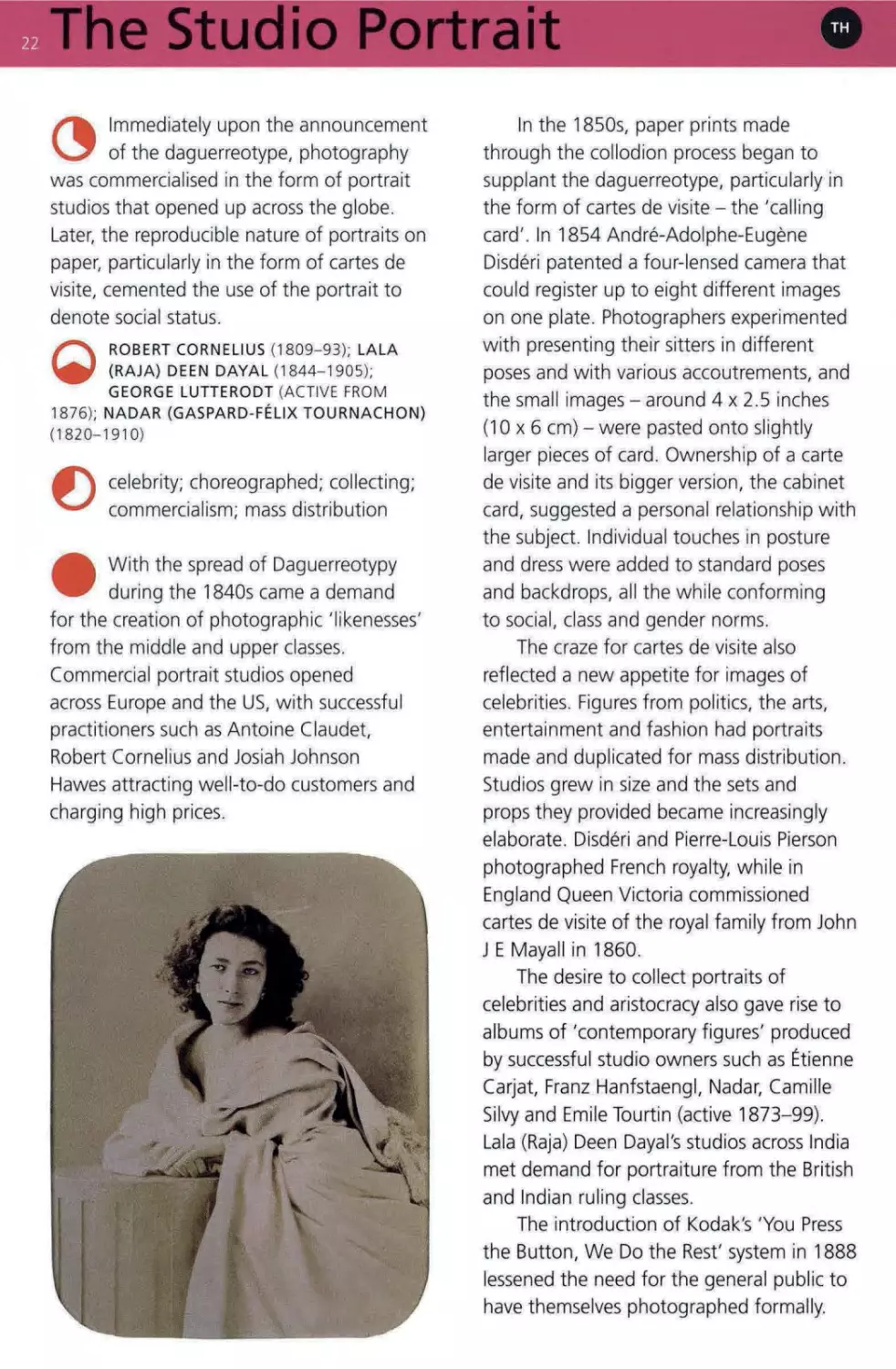
<- NADAR

Sarah Bernhardt, 1859
Musee d'Orsay, Paris

Nadar's photographs of Sarah Bernhardt are considered
among his most sophisticated portraits. Here, his
characteristically soft, sideways lighting illuminates her
decollete and emphasises the drapes of the velvet in
which she is wrapped to create a sense of
voluptuousness.

Daguerreotypy; Negative-Positivism;
Fashion & Society; Self- Portrait,
Performance & Identity
The First Photograph; Motionism;
Early Street; Industrialism;
Subjectivism

TH

24

~ Early photographic technology
\.,:, necessitated long exposure times,

making landscape an ideal subject.
A growing tourism industry created a
demand fo r photography that helped to
establish its place in 19th-century life .

r°\
'9f

MAXIM E DU CAMP (1822-94); FR A NCIS
FR ITH (1822- 98); HERBERT PONTI NG
(1870-1935); JOHN TH OM SON (1837- 1921 );
LIN NA EUS TRIPE (1822-1902 )

are an exem pl ar. In t he 1860s, John
Thomson's t ravels across Siam, Cambodia
and China produced one of the most
extensive accounts of any reg ion, an d serve
as prototypical ant hropological records.
Developments in photography also
co incided with the growth of the mass
tourism industry. New markets fo rmed
around souvenirs for tourists, and volumes

scientists and anthropologists for accurate
visual representations of the world. Linnaeus
Tripe's images of Ind ia and Burma made in

aimed at the 'armchair traveller'. In many
cases the aesthetic of these images was
tai lored to the 19th-cent ury affinity for the
Romantic, subli me and picturesque . In
Europe, the open ing up of the Alps as a
tourist destination saw numerous
photographers set up stud ios to cater to the
demand for views of the dramatic
landscapes. Stereo ca rds were an immensely

the 1850s for the British East India Company

popu lar memento: Adolphe Braun and

expedition; picturesque; plate
camera; stereo card; survey

A
W

From its inception, photography
fulfi lled the need of governments,

Claude-Marie Ferrier were among those
working in the region who made images in
this format.
The first travel albums were engravings
of daguerreotypes, to which appealing
scenic details were often added. Noel Marie
Paymal Lerebours' Daguerreotype Excursions
(1840-44) is the earl iest example. By 1850,
following the introduction of the calotype
and the subsequent refinement of negativepositive processes, Louis-Desire BlanquartEvrard created a revolutionary method of
producing albums in large editions by
printing on albumen paper. He published
the first volume of reproduced photographs,
Maxime Du Camp's Egypt, Nubia, Palestine
and Syria, in 1852 . Views of ancient sites
such as these were favoured subjects. Those
made by Francis Frith in his pioneering
journeys along the Nile, published in the
two-volume Egypt and Palestine
Photographed and Described (1858- 60), are
considered to be the most sophisticated .
With in just two decades of its inception,
and despite the challenges associated with
transporting huge amounts of kit and
producing photographs in extreme climates,
photography had been employed to capture
landscapes and cu ltures worldwide. 50 years
later, Herbert Ponting, official photographer
to Captain Scott's Terra Nova Expedition to
the Antarctic, would create some of the
most enduring images of the polar
land scape .

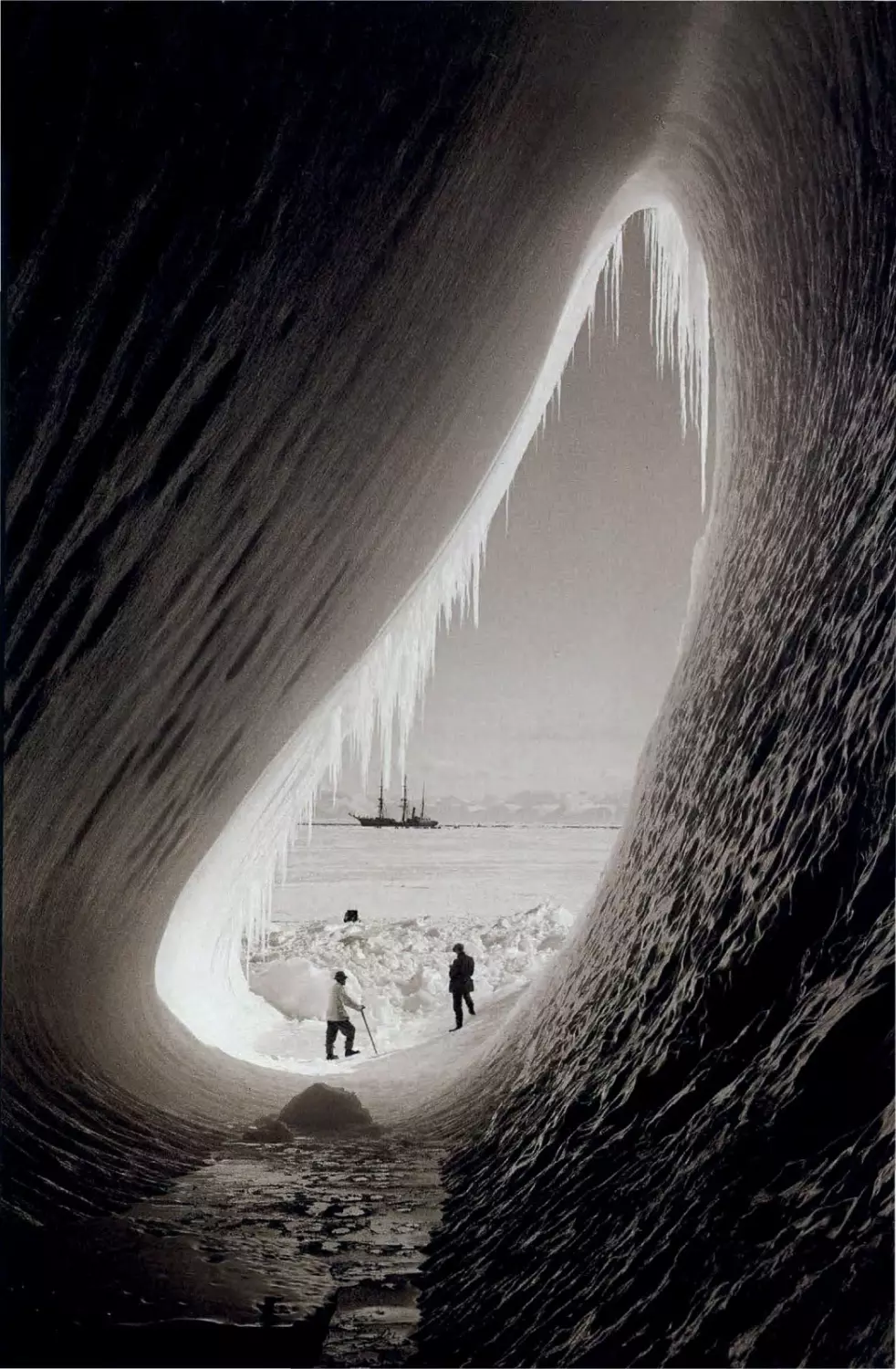
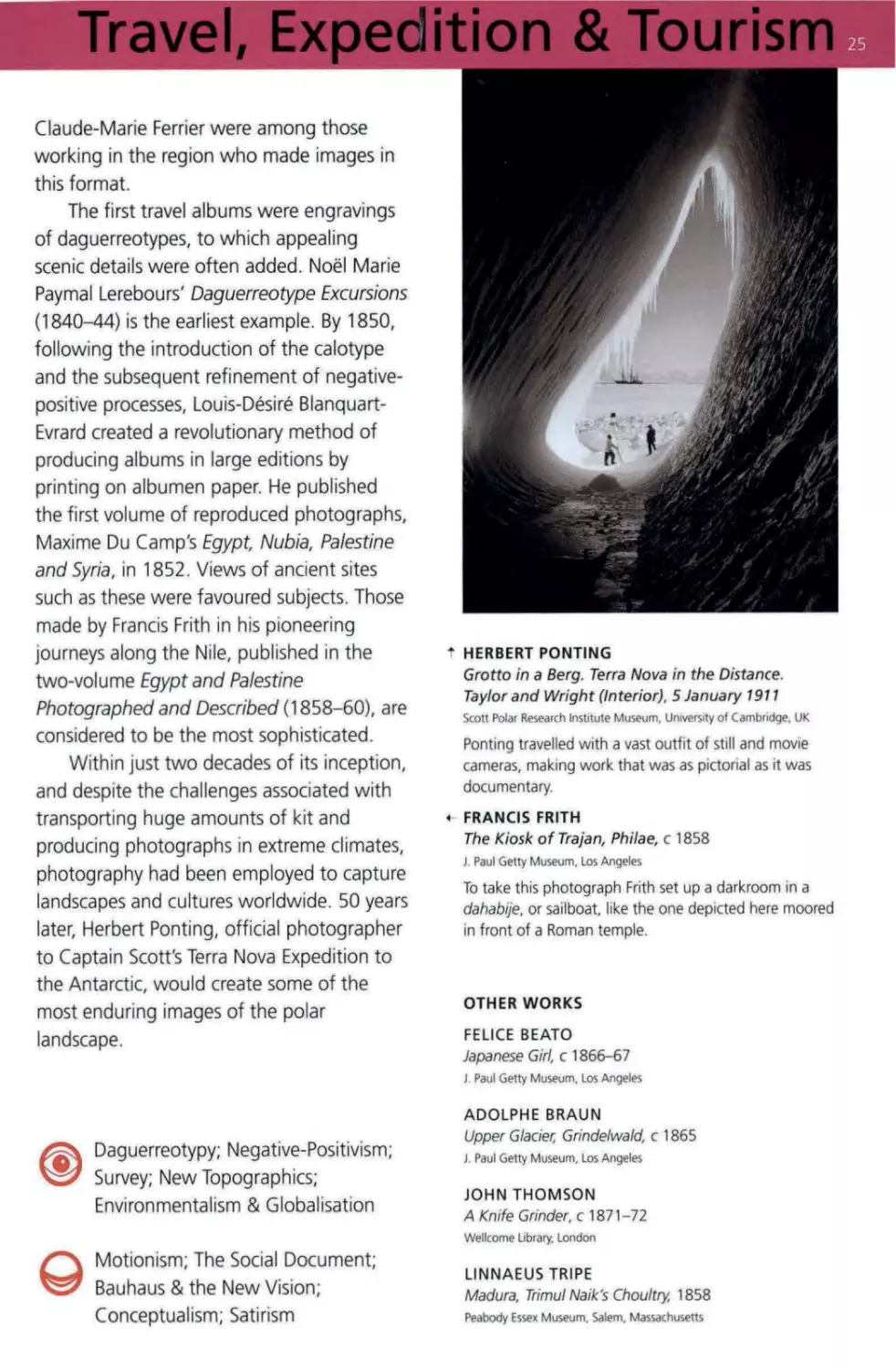
t HERBERT PONTING

Grotto in a Berg. Terra Nova in the Distance.
Taylor and Wright (Interior) , 5 January 19 11

Scott Polar Research Institute Museum, University of Cambridge. UK

Ponting travelled with a vast outfit of still and movie
ca meras, making work that was as pictorial as it was
documentary.
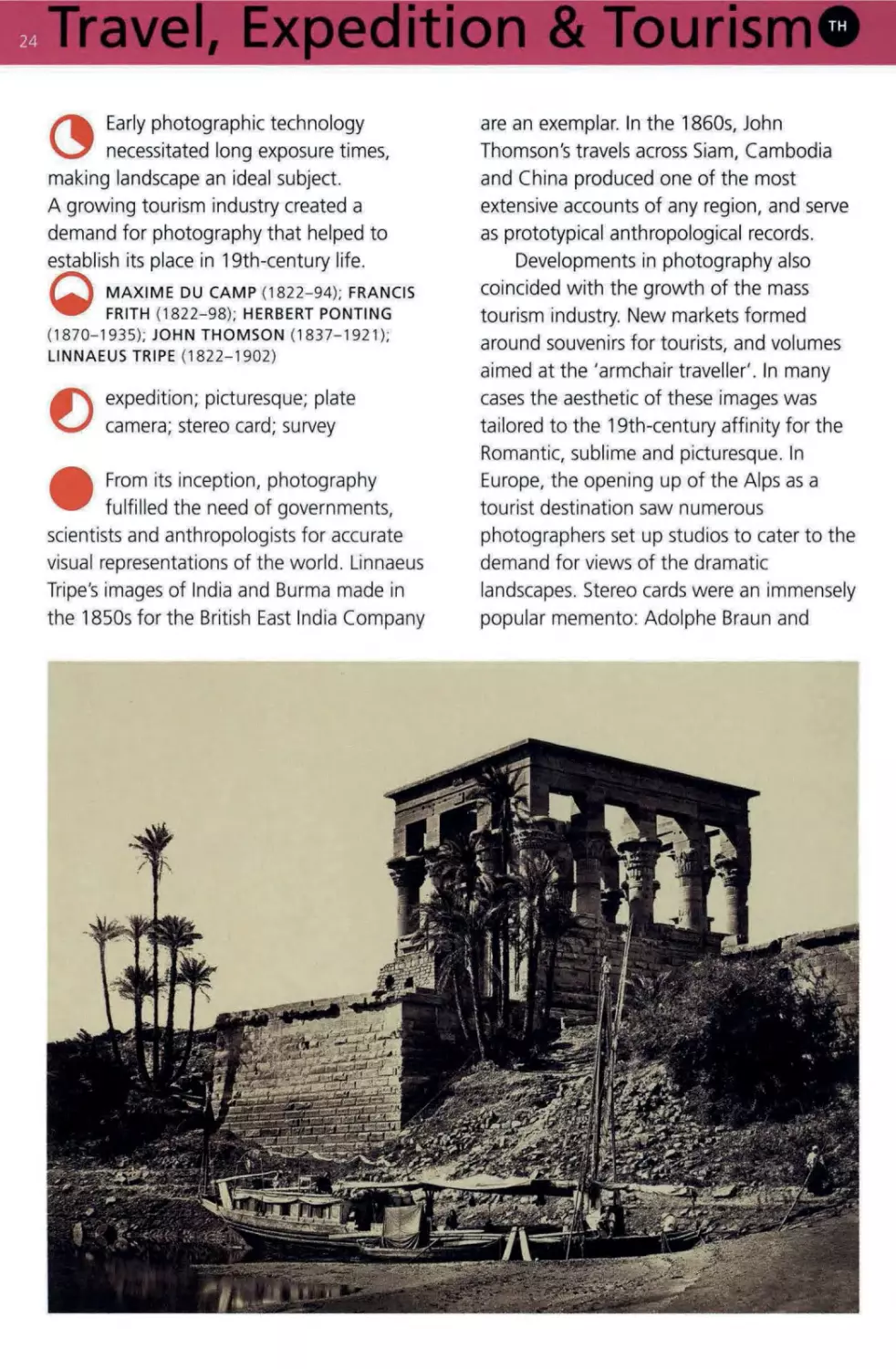
FRANCIS FRITH
The Kiosk of Traja n, Philae, c 1858
J. Paul Getty Museum, Los Angeles

To take this photograph Frith set up a darkroom in a
dahabije, or sailboat. like the one depicted here moored
in front of a Roman temple.

OTHER WORKS
FELICE BEATO
Japanese Girl, c 1866--{;7
J. Paul Getty Museum. Los Angeles

Daguerreotypy; Negative-Positivism;
Survey; New Topographies;
Environmentalism & Globalisation
Motionism; The Social Document;
Bauhaus & the New Vision ;
Conceptualism; Satirism

ADOLP HE BRAUN
Upper Glacier, Grindelwald, c 1865
J. Paul Getty Museum. Los Angeles

JOHN THOMSON
A Knife Grinder, c 187 1- 72
Wellcome Library, London

LINN A EUS TRIPE
Madura, Trimul Naik's Chou/try, 1858
Peabody Essex Museum. Salem, Massachusetts

MM

26

~ The landscape su rveys undertaken in

\.:1

the US from the 1860s had a cultural,

environmental and ideological impact that
far exceeded their intended documentary
purpose. They shaped the 'pioneer spirit'
and helped create the mythic and enduring
vision of the 'American West'.

r'\

EO BEAMAN (1837-76); JOHN K HILLERS
. , (1843-1925); WILLIAM HENRY JACKSON
(1843-1942); TIMOTHY H O'SULLIVAN
(1840-82); CARLETON E WATKINS (1829-1916)

expansion; frontier; mythic; sublime;
wi lderness

A
W

in 1867. EO Beaman and John K Hillers both
took part in John Wesley Powell's Survey of
the Rocky Mountain Region; and William
Henry Jackson was appointed as official
photographer of Ferdinand Hayden's US
Survey of the Territories.
The images produced by these
photographers, and the many others who
worked outside of the official survey
capacity, functioned as far more than visual
descriptions. By carefully selecting vantage
points, and often placing people within the
frame to provide a sense of scale, they
created scenes that were dramatic and awe

Exploration and photography had
gone hand in hand since the
medium's earliest days. The introduction of

inspiring; cha rming and picturesque. The
wider public who encountered these images
in the press or in guidebooks, or purchased

the plate camera in the 1850s, with

them as prints and stereo cards, were well

processing and developing methods more
practicable for fieldwork , and negatives that

versed in Romantic notions of the sublime,
which associated sites of natural grandeur

provided greater resolution and yielded
multiple prints, transformed the scale and
scope of these projects.

with the divine and spiritual. To them, these
magnificent and yet accessible landscapes
held great appeal. So too did the pioneer

One of the greatest examples of this
kind took place in the US in the surveys
undertaken as part of th e population's

spirit and the mythic American frontier that
these images helped to convey.
Most important of all was the role

westward expansion; in particular, the four

of the survey photographs in

'great surveys' of 1867-79 that followed
the American Civil War (1861-65). Under

environmentalism. President Lincoln's
1864 bill to protect the Yosemite Valley, the

the auspices of either the War Department
or the Department of the Interior, large
expedition groups were assembled to survey

first of its kind, was directly influenced by
Watkins's majestic 18 x 22 inch (46 x 56 cm)
studies of the region made three years

and map natural resources or assess

earlier. Jackson 's 1871 views of Yellowstone

development opportunities, mostly working
along the terrain newly opened up by the
transcontinental railroads, and they

saw the region established as the first US
National Park in 1872, paving the way for
the launch, in 1916, of the National Park

commissioned photographers to record
their activities.

System that would preserve the unspoiled
wilderness to which these surveys of the

Timothy H O'Sullivan, a leading
photographer during the Civi l War, took
part in two of the four major expeditions:
George Wheeler's 1OOth Meridian Survey,
and Clarence King's Fortieth Parallel Survey,
which Carleton E Watkins also accompanied

American West had attested.

OTHER WORKS
EO BEAMAN

Lodore Canyon, Colorado River/The Heart of Lodore,
1871
J. Paul Getty Museum, Los Angeles

JOHN K HILLERS
Cliff Dwellings, c 1875
George Eastman Museum. Rochester. New York.

WILLIAM HENRY JACKSON

CARLETON E WATKINS

Distant View of the Domes, Yosemite Valley,
California, c 1861-66, printed 1986
Minneapolis Institute of the Arts, Minnesota

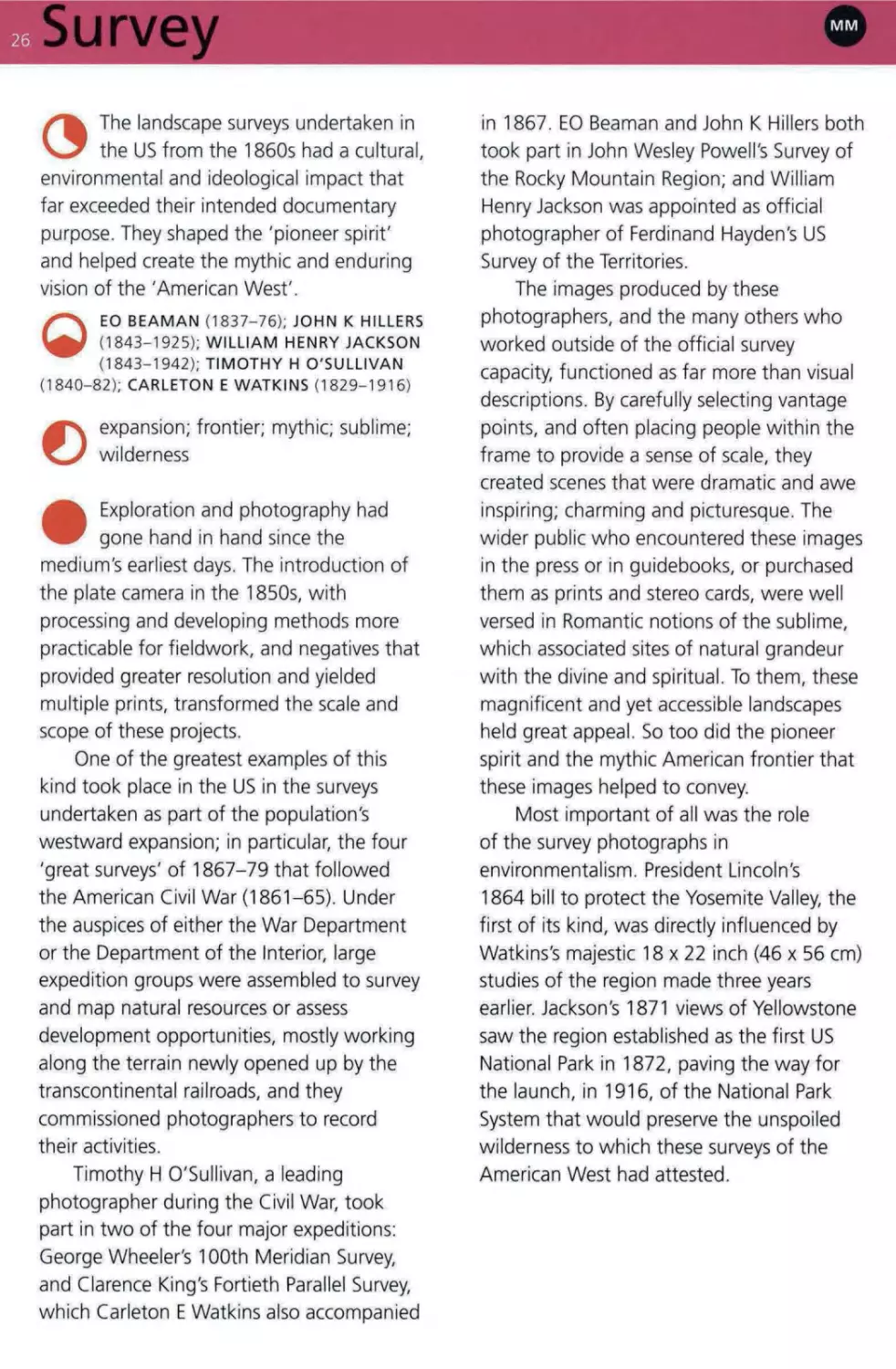
Watkins's oversized glass-plate negatives allowed him to
capture the grandeur of the Yosemite Valley at an
unprecedented scale. This view conjures what has
become known as a 'domesticated sublime': certainly
awe-inspiring, but also piduresque, unthreatening, and
so of great appeal to potential tourists.

Grand Canyon of the Colorado River, c 1883

J. Paul Getty Museum. Los Angeles

TIMOTHY H O'SULLIVAN

Ancient Ruins in the Canon de Che/le (sic}, N.M. In a
Niche 50 Feet Above Present Canon Bed, 1873

Negati ve-Positivism; Travel, Exped ition
& Tourism; Group f.64; New
Topograph ies

George Eastman Museum, Rochester, New York

Q

Bauhaus & the New Vision;
Industrialism; Social Realism;
Photojournalism; Satirism

AP

28

From t he 1850s, photographers were
regularly sent to cove r conflict. Their
role was aided by the introduction of faster
processes t hat cou ld yield multiple prints.
~

U

r\
'9'

FELICE BEATO ( 1832-1909); MATHEW
BRADY (1822-96); ROGER FENTON
(1819-69); TIMOTHY H O'SULLIVAN (1840- 82 );
JAMES ROBERTSON (1813-88)

aftermath; commercial; evidence;
propaganda; systematic

A
W

The invention of the wet-collodion
process enabled photographers to
document the many conflicts that took
place in the decades fo llowing European

Photography began to be employed for
propagandistic, commercial and military
purposes: governments com missioned
images that told specific stories about action
overseas, whi le engravings, photographs,
stereographs and cartes de visite we re made
to supply increasing demand .
Although daguerreotypes of the
Mexican-American Wa r (1846-48) are
regarded as the ea rli est conflict
photographs, the Crimean War (1853- 56)
saw the first major proliferation of such
imagery, including the work of Jean-Charles
Langlois, Roger Fenton , James Robertson

be tran sported by photographers in wagons

and Carol Szathmari. The technologica l
limitations on capturing action meant that
images ma inly documented preparat ions for
battle, its aftermath and army life rather

that also acted as portable darkrooms.

than the drama of confli ct.

colonial expansion. Though sti ll
cumbersome, the equ ipment required cou ld

<- TIMOTHY H O'SULLIVAN AND

ALEXANDER GARDNER
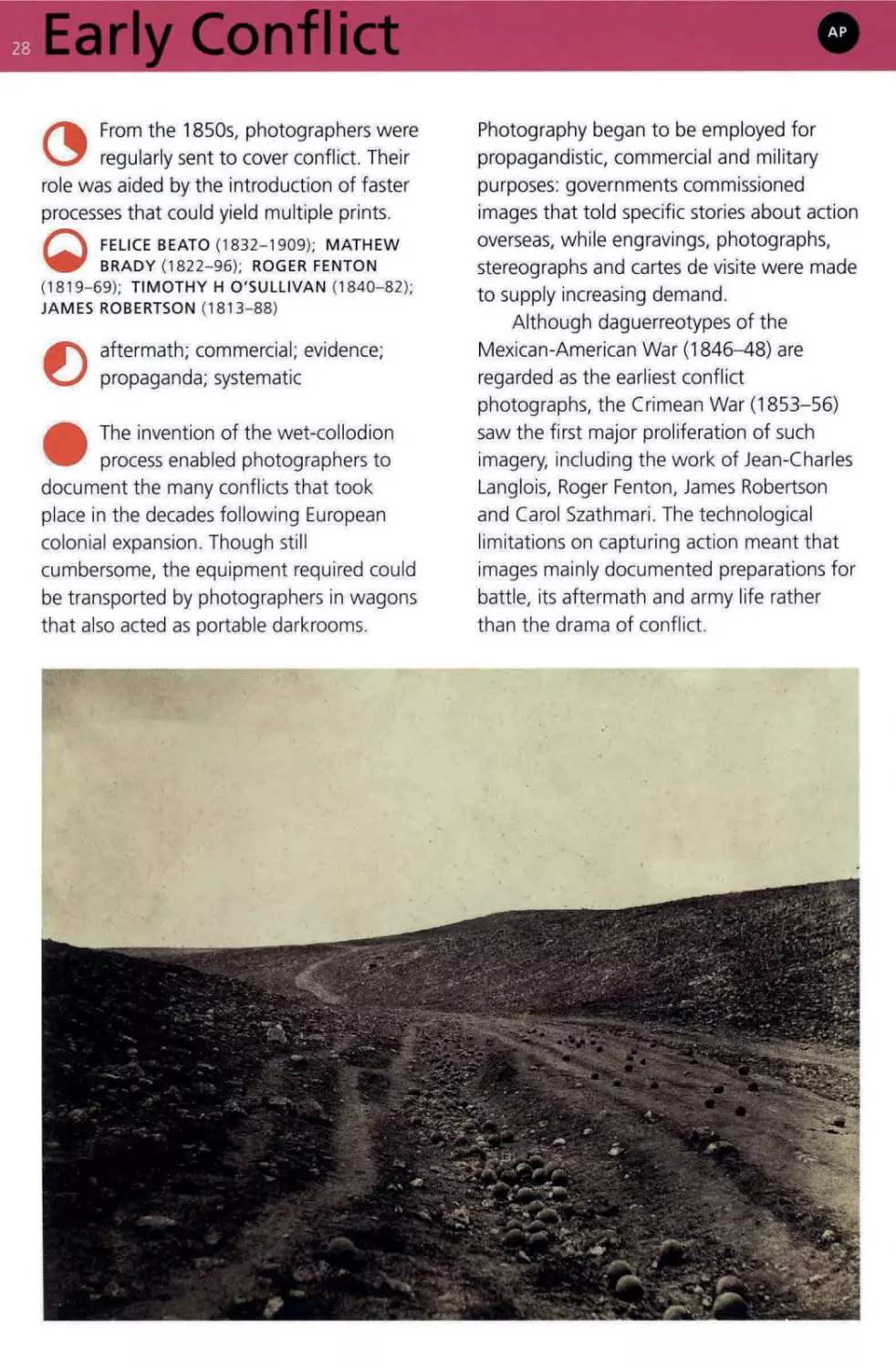
Gettysbur g 1st Day, 1863
Victoria and Albert Museum. London

O'Sullivan captured the aftermath of the American Civil
War's bloodiest battle in graphic detail while working for
Alexander Gardner, who published this in his
Photographic Sketchbook of the War (1865- 66).

~

ROGER FENTON
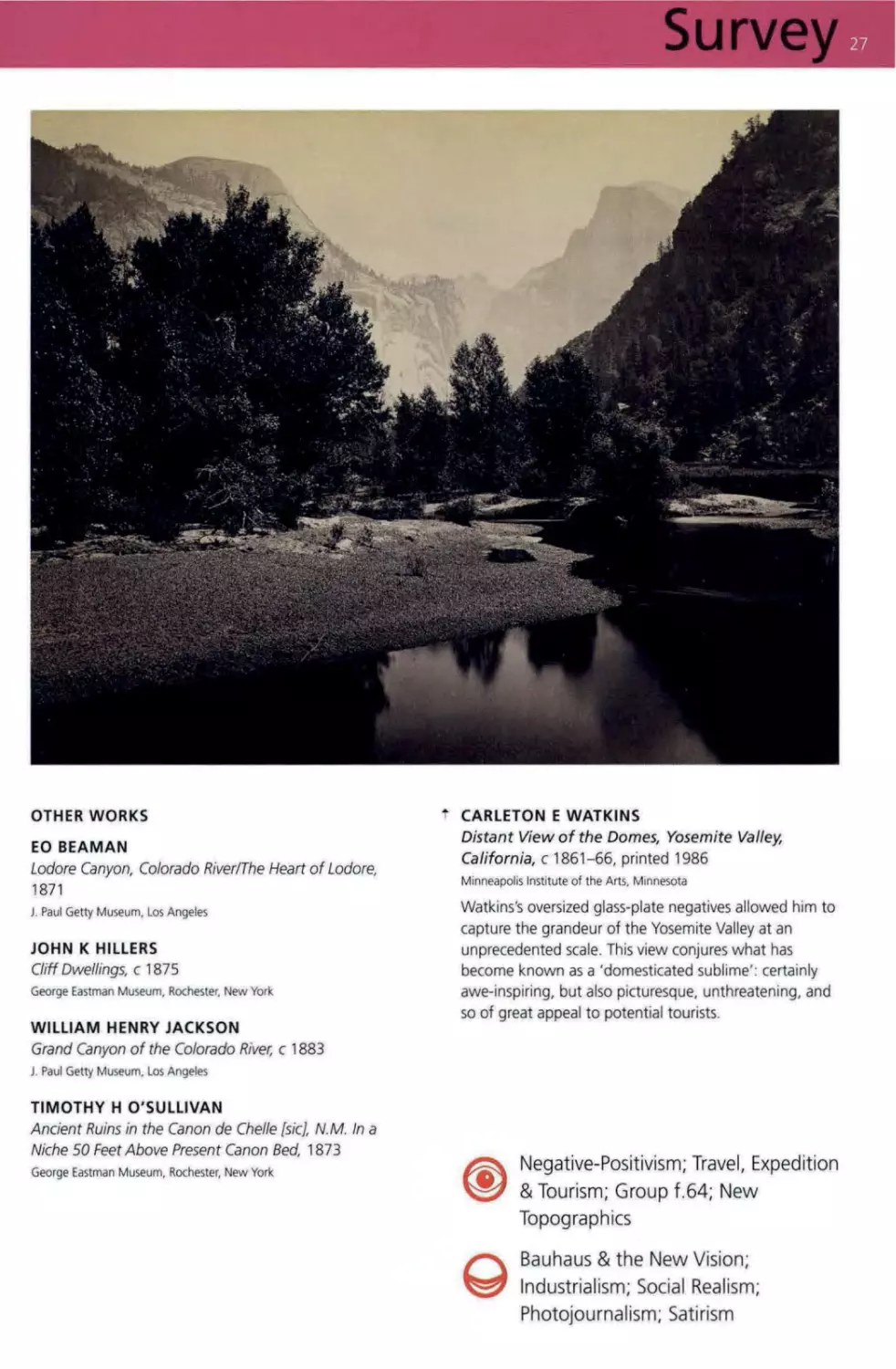
Valley of the Shadow of Death, 23 Apr il 1855
J. Paul Getty Museum, Los Angeles

There are two versions of this image; the other shows
the cannonballs cleared into the ravine. The question of
whether this might have been staged for dramatic effect
has remained the subjed of intense, and as yet
unresolved, debate.

A similarly formal style appeared in the
many photographs of the American Civil
War (1861-65) by George Barnard, Mathew
Brady, George SCook, Alexander Gardner
and Timothy H O'Sullivan . The conflict was
documented with the intention of both
recording a historica l event and of
commercialising the resulting images. Brady
trained photographers, assigned them army
units, and equipped them with darkrooms
in horse-drawn wagons . More than 7,000
photographs were produced showing
battlefields, army encampments and ruins.
The period from the late 1850s to the
1880s saw photographers including Felice
Beato, John Burke, Gustave Le Gray and
John Mccosh travelling to capture conflicts
in Asia, Africa and the Middle East Such
imagery came to be regarded as objective
documents. Yet photographers like Gardner
and Beato admitted to moving corpses and
providing props to enhance the drama of
their scenes. Images of the Paris Commune
of 1871 taken by Jules Andrieu, Eugene
Appert and Bruno Braquehais provided a
similar threat to photography's reliability:
Appert was commissioned by the French
government to falsify images that could act
as evidence for the Communards' crimes.

OTHER WORKS
FE LI CE BE ATO
In terior of the Angle North Fort Immediately after its
Cap ture, 1860
Victoria and Albert Museum. London

MATHEW BRADY
Scene Showing Deserted Camp and Wounded Soldier
(Zouave), c 1865
Library of Congress, Washington DC

ROGER FENTON
Roger Fenton's Photographic Van, 1855
National Army Museum. London

TIMOTHY H O'SUL LI VAN
A Harvest of Death, Gettysburg, Pennsylvania, 1863
George Eastman Museum, Rochester, New York

JAMES ROBERTSON
General View of Balaklava with the Huts of the Guards
in the Foreground and Shipping at Anchor, 1855
lmpenal War Museum, London

Daguerreotypy; The Studio Portrait;
War Reportage; Conflict &
Surveillance

Q

Motionism; Pictorialism; Futurism;
Bauhaus & the New Vision;
Subjectivism

MM

30

~ From the 1870s, innovations with

~ multiple cameras and improved
shutter speeds made it possible to create
accurate studies of movement. Th is was
revolutionary for the sciences, infl uenced
modern art, and the sequencing of stills
provided the basis for cinematography.

r°\

THOMAS EAKINS (1844- 1916); HAROLD
~ EDGERTON (1903-90); ETIENNE-JULES
MAREY (1830- 1904); EADWEARD
MUYBR ID GE (1830- 1904); ARTHUR MASON
WORTHINGTON (1852-1916)

cinematography; high-speed;
instantaneous; scientific; sequential

A

cycle. In his method, a row of 12 cameras
were triggered one by one by the
movement of the horse as it ran across a
sheet rigged with threads connected to the
cameras' shutters.
Following the success of his horse
photographs, Muybridge made a further
100,000 experimental images of human and
animal movement. He worked alongside the
realist pa inter Thomas Eakins, w ho also
produced his own chronophotographs with
a fusil photographique similar to that used
by Marey. Physicist Arthur Mason
Worth ington made use of high-speed
photography to study fluid mechanics, whi le

From photography's earliest days
attempts were made to produce
'instantaneous' images of moving entities to

Ottomar Anschutz photographed animals in
zoos and army manoeuvres for use in
military tra ining, both using a multiple-

make visible what was ordinarily
imperceptible to the human eye. By the
early 1870s, shutter speeds of onethousandth of a second had been
introduced, and gelatin dry-plate negatives,
with thei r increased light sensitivity, allowed
for faster exposures. As a consequence,

camera method.
Developments in motion photography
had a profound effect on the scientific and
artistic commun ities in the decades that
followed. Marey and Muybridge published
their images in academic journa ls and the

W

'chronophotography' - the capturing of
several images in quick succession that
could be layered in one frame or presented
sequenti ally - was developed and used to
explore the mechanics of motion.
Physiologist Etienne-Jules Marey
employed photography to exam ine
muscu lar and skeleta l movement. He
isolated his subjects against black
backgrounds and photographed them usi ng
a specially developed fusi/ photographique
(photograph ic gun), w hich contained a
swiftly rotating fi lm cassette that could
shoot 12 frames per second. At a similar
time, Eadweard Muybridge made the first
seq uential photographs of horses in motion
and discovered that contrary to popu lar
understanding, all four of a horse's hooves
left the ground at points during the running

popu lar press, and exhibited and lectu red on
their work. Both had invented machines for
reanimating and projecting sequential
images, leading to innovations in
cinematography in the 1890s by Thomas
Edison and Auguste and Louis Lumi ere. In
1911, brothers Anton Giulio and Artu ro
Bragagl ia developed photodynamism, which
proposed the creative use of photography to
represent the trajectory of an action, and
Marcel Duchamp's groundbreaking
Modernist painting Nude Descending a
Staircase (No2) (1912) was inspired by
stu dies of perpetu al motion. During the
1930s, Harold Edgerton and Gjon Mili
introduced the strobe light to photography
to record movement at speeds of onemillionth of a second, leading to pioneering
research into fluid dynamics, frequency and
human action.

•

OTHER WORKS

THOMAS EAKINS

History of a Jump, c 1884-85
The Library Company of Philadelphia

HAROLD EDGERTON

Milk Drop in Milk (Sequence), c 1935
Massachusetts Institute of Technology, Cambridge

ETIENNE -JULES MAREY
Chronophotographic Study of Man Pole Vaulting,

l

t EADWEARD MUYBRIDGE

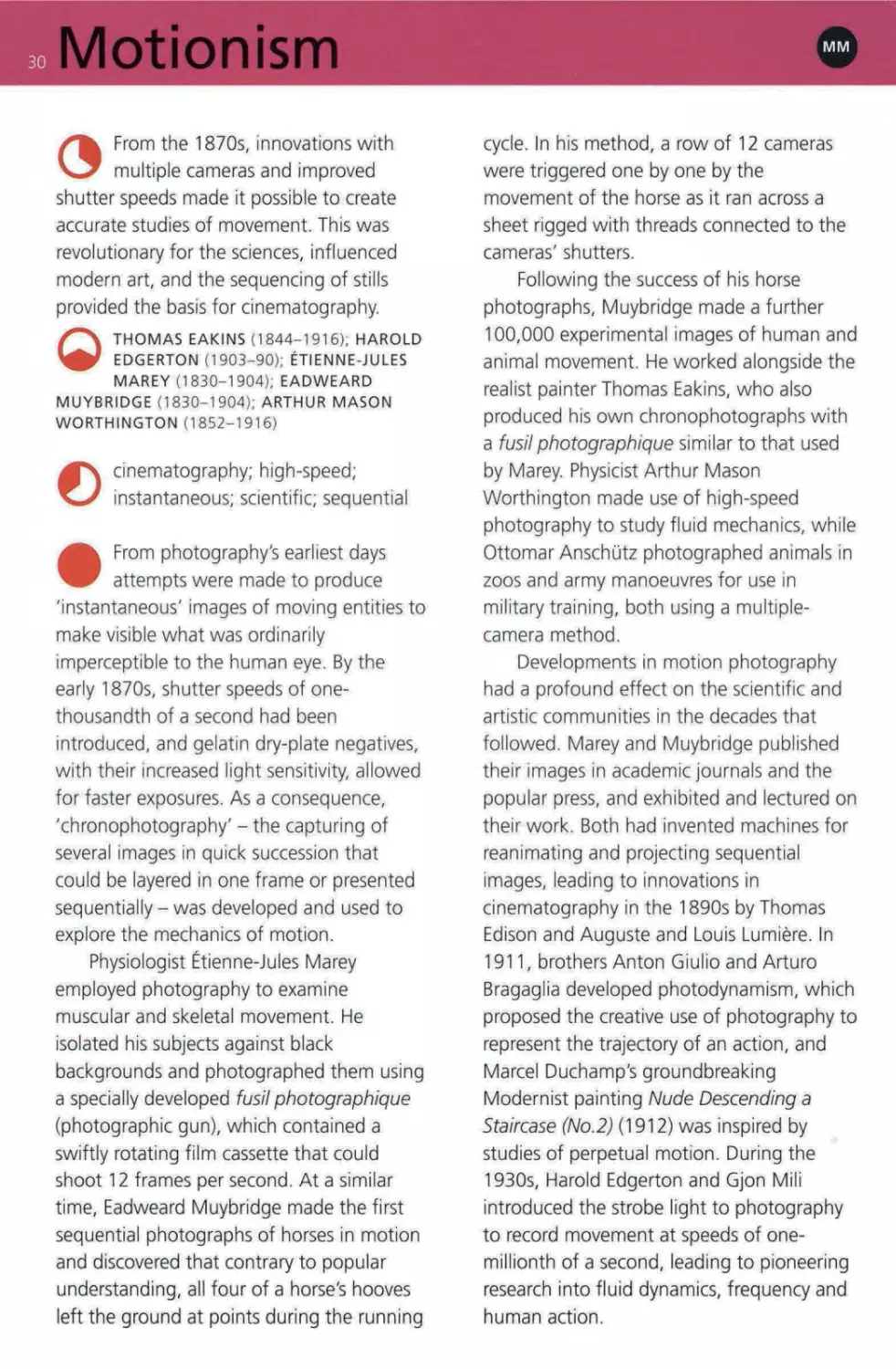
Plate 626 of volume 9 ('Annie G Galloping'), from
Animal Locomotion, 1887
Boston Public Library, Massachusetts

Muybridge 's trigger system for recording split-second
movement revealed, for the first time, that there is a
point when a galloping horse lifts all four hooves from
the ground. Animal Locomotion also included studies of
humans in action , which proved invaluable for the fields
of medicine, anthropology and physiology.

c 1890-91

George Eastman Museum, Rochester, New York

EADWEARD MUYBRIDGE

Plate 164 of volume 7 ('Pole Vaulting'), from Animal
Locomotion, 1887
Boston Public Library, Massachusetts

ARTHUR MASON WORTHINGTON
Instantaneous Photography of Splashes: Series C, D, E
and F, c 1900
Victoria and Albert Museum. London

Futurism; Bauhaus & the New Vision;
War Reportage; The Family of Man
Still Life; New Objectivity;
Industrial ism; Subjectivism;
Dusseldorf Deadpan

AP

32

r.

From the mid-1800s, photographers

~ began to record human experience,

anticipating what would in later decades
become known as 'social documentary'.
Then, as now, this type of photography
often focused on the disadvantaged.

r"\

ROBERT ADAMSON (1821 - 48) AND
DAVID OCTAVIUS HI LL (1802- 70); LEWI S
HINE (1874- 1940); OSCAR G REJLANDER
(1813- 75); JACOB RIIS ( 1849- 1914); JOHN
THOMSON (1837- 1921 )
•

archetypes; concerned; empathy;
injustice; reform
Photography's ability to quickly
produce a clear, accurate image

meant that it was embraced by the sciences,
including the socia l sciences. Among its
many applications was the recording of
human beings and foreign cultures for the
purpose of anthropological and
medical studies .
The 19th-century preoccupation
with classification extended to depictions
of a more sociological nature, too. In 1844,
portrait photographers Robert Adamson
and David Octavius Hill included societal
archetypes in The Fishermen and Women
of the Firth of Forth. Like August Sander's
typological survey People of the Twentieth
Century (1892- 1954) they function
as historical evidence while providing

insight into the social hierarchies of
the time.
By mid-century, portrayals of human
experience were popular. Street
photography of the urban working classes,
homeless and unemployed was a growing
trope. Oscar G Rejlander's Night in Town
(c 1860) has become emblematic of the
sentimentalised approach to this subject
In London Labour and the London Poor
(1851 ), social reformist Henry Mayhew
illustrated interviews with street traders with
engravings based on Richard Beard 's
daguerreotypes. The invention of the
photomechanical Woodburytype process in
1866, however, introduced a successful
<-

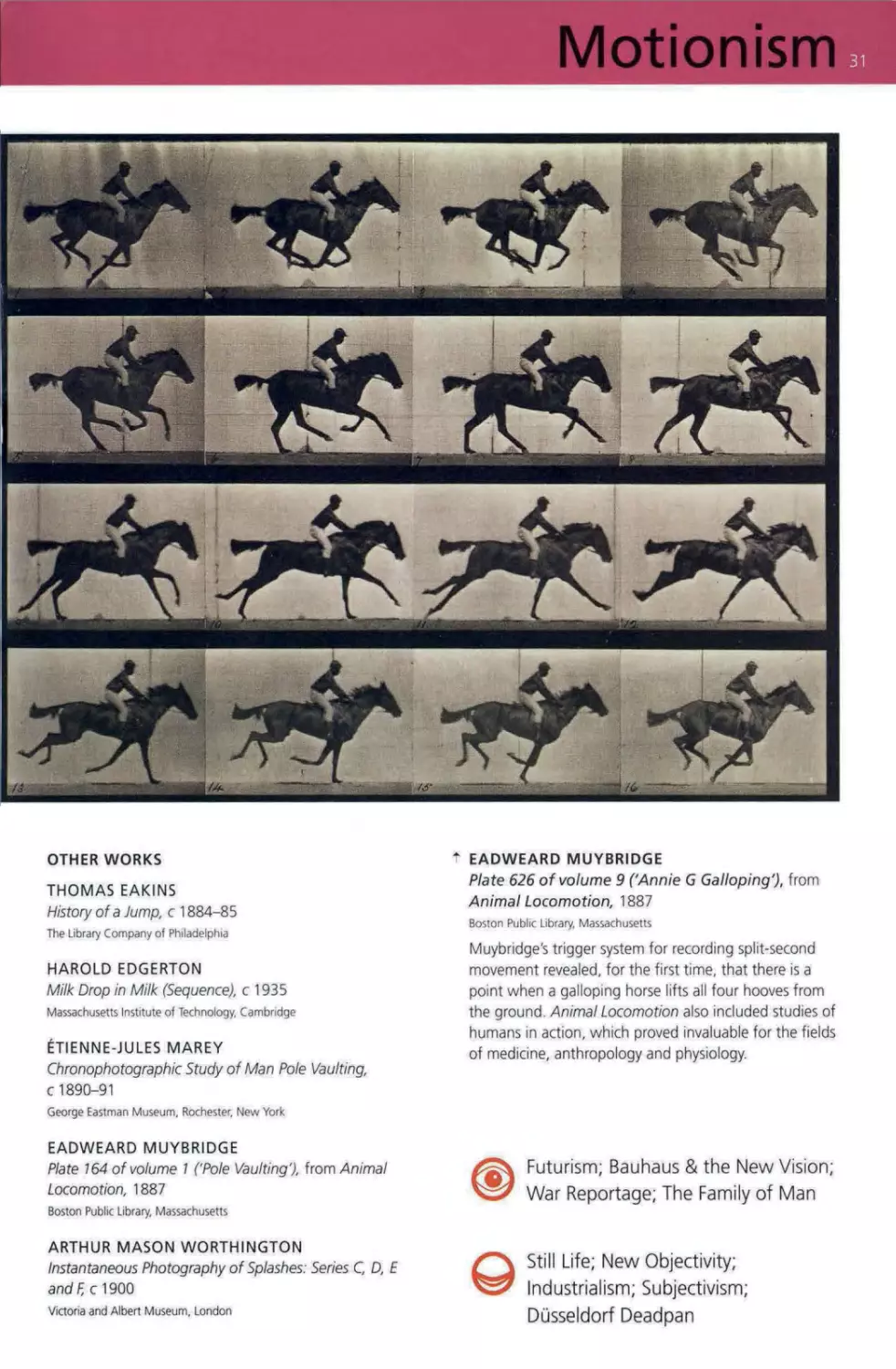
LEWIS HINE

Adolescent Girl, a Spinner, in a Carolina
Cotton Mill, 1908
Princeton University Art Museum, New Jersey

The industrial boom following the American Civil War
was accom panied by a surge in child labou r. Hine's
photogra phs, accompanied by detailed, fact ua l
descriptions, helped bring about reform . The girl's direct
gaze conveys a sense of agency cha racteristic of his
tendency to emphasise the individua l behind the story.
OTHER WORKS

ROB ERT ADAMSON AND DAVID OCTAV IUS HILL

Two Newhaven Fishwives, Perhaps Mrs Elizabeth
(Johnstone) Hall on the Right, from The Fishermen and
Women of the Firth of Forth, c 1843- 4 7
National Galleries of Scotland, Edinburgh

LE W IS HI NE

Steamfitter, 1920, from Men at Work, 1932
Museum of Modern Art, New York

OSCAR G REJ LANDER

Night in Town, c 1860

method of reproducing photographs for
publication at a quality and detail close to
the original. This fidelity benefited politically
motivated projects such as Street Life in
London (1877) by Adolphe Smith and
photographer John Thomson, where realism
and accuracy were vital in drawing attention
to the social injustices they described.
In the US, Jacob Riis and Lewis Hine
produced the most extensive bodies of
'concerned photography'. Riis, a social
reformer and police reporter for the New
York Tribune, made thousands of images of
the city's slums, eventually published
accompanied by descriptive text in How the
Other Half Lives (1890). He adopted a
no-holds-barred approach to elicit an
empathetic response from the middle and
upper classes, galvanising their charity and
support for his campaigns to improve
housing, parks and sanitation .
As a staff photographer for the National
Chi ld Labor Committee, Hine recorded
instances of children working in factories,
mil ls and mines. His captioned images
successfully supported campaigns to
eradicate child labour. In contrast, in his
'worker portraits' produced throughout the
1920s he presented the relationship
between man and machine in a positive
light, imbuing his subjects with dignity and
pride. This was a marked change from the
pitying tone that characterised earlier works
in this trope and a major influence for
subsequent generations who would fully
cohere the documentary style in the 1930s.

George Eastman Museum, Rochester, New York

JACOB RIIS

Lodgers in Bayard Street Tenement, Five Cents a Spot,
1889, from How the Other Half Lives, 1890
Museum of Modern Art, New York;

JOHN THOMSON
The Crawlers, from Street Life in London (photobook),
1877
Vidoria and Albert Museum, London

Travel, Exped ition & Tourism;
Early Street; Social Realism;
Street & Society
The Nude; Still Life ; Futurism;
Dada ism; Surrealism ; Subjectivism

INTO THE
MODERN

1850s-1930s

.Early Street
With the advent of photographic
processes that made it more feasible
for the photographer to work outside the
studio, the camera soon played a significant
role in documenting, and reflecting upon,
street life.
~

U

r°'\
'9f

EUGENE ATGET (1857- 1927); BILL
BRANDT (1904- 83 ); BRASSAi (GYULA
HALASZ) (1899- 1984); HENRI CARTIERBRESSON (1908-2 004 ); ANDRE KERTESZ
(1 894- 1985)

archetypes; ephemeral; formalism;
urban; voyeuristic

A
W

While photographers had made
cityscapes since the medium's very
earliest days, it was in the late-19th century

- with the introduction of smaller cameras,
lenses with shorter focal lengths, and fi lm
sensitive enough to record in low or fleeting
light - that they first began to capture the
activity that took place there. Scenes of
street life became a major subject
Some of the earliest street photography,
made in the 1850s by Charles Marville and
Charles Negre, featured scenes of Parisian
architecture and local characters. Later,
street archetypes such as beggars, organgrinders and shoeshiners also became key
subjects for photographers including Alice
Austen and Paul Strand in New York, Paul
Martin in London, and Eugene Atget in
Paris. Their images were often
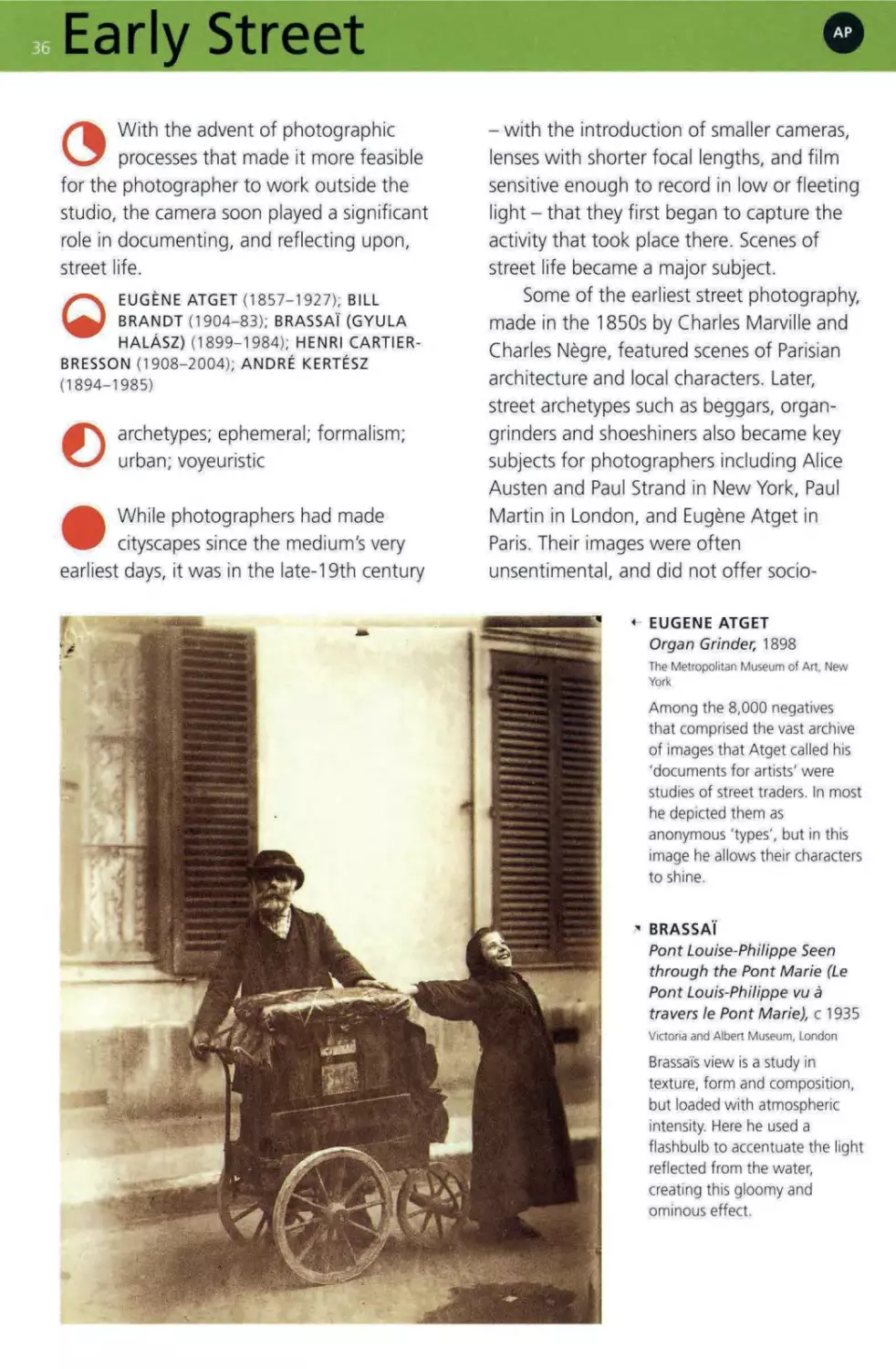
unsentimental, and did not offer socio•- EUGENE ATGET
Organ Grinder, 1898
The Metropolitan Museum of Art, New
York

Among the 8,000 negatives
that comprised the vast archive
of images that Atget calle d his
'documents for artists' were
studies of street traders. In most
he depicted them as
anonymous 'types', but in this
image he allows their characters
to shine.
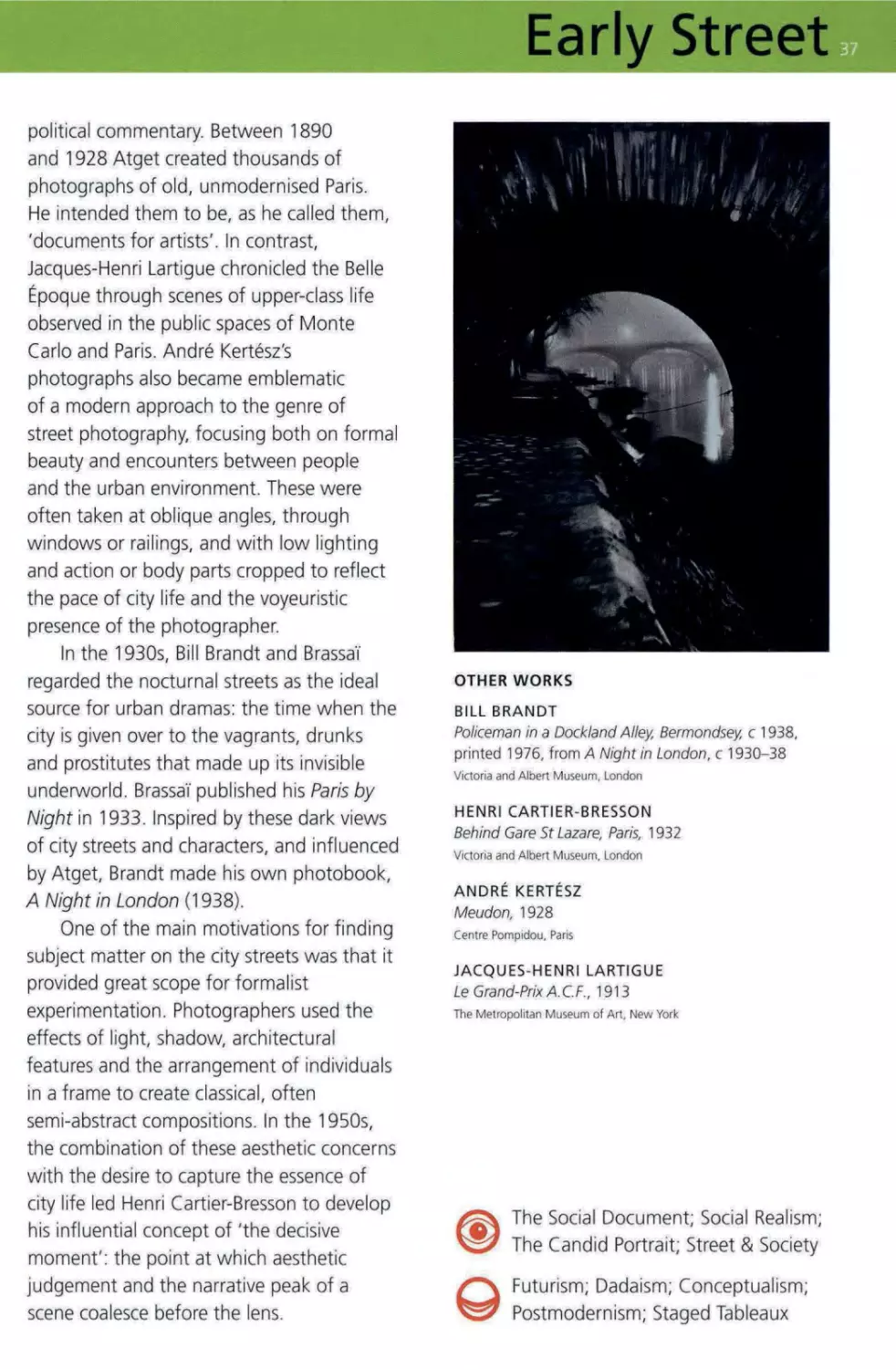
• BRASSA°i
Pont Louise-Philippe Seen
through the Pont Marie (Le
Pont Louis-Ph ilippe vu a
travers le Pont Marie), c 1935
Victoria and Albert Museum, London

BrassaYs view is a study in
texture, form and com position,
but loaded with atmospheric
intensity. Here he used a
flashbulb to accentuate the light
reflected from the water,
creating thi s gloomy and
ominous effect.

Earl Street
political commentary. Between 1890
and 1928 Atget created thousands of
photographs of old, unmodernised Paris.
He intended them to be, as he called them,
'documents for artists'. In contrast,
Jacques-Henri Lartigue chronicled the Belle
Epoque through scenes of upper-class life
observed in the public spaces of Monte
Carlo and Paris. Andre Kertesz's
photographs also became emblematic
of a modern approach to the genre of
street photography, focusing both on formal
beauty and encounters between people
and the urban environment. These were
often taken at oblique angles, through
windows or rai lings, and w ith low lighting
and action or body parts cropped to reflect
the pace of city life and the voyeuristic
presence of the photographer.
In the 1930s, Bill Brandt and Brassa·1
regarded the nocturnal streets as the ideal
source for urban dramas: the time when the
city is given over to the vagrants, drunks
and prostitutes that made up its invisible
underworld. Brassar published his Paris by
Night in 1933. Inspired by these dark views
of city streets and characters, and influenced
by Atget, Brandt made his own photobook,
A Night in London (1938)
One of the main motivations for finding
subject matter on the city streets was that it
provided great scope for formalist
experimentation. Photographers used the
effects of light, shadow, architectural
features and the arrangement of individuals
in a frame to create classical, often

OTH ER WO RKS
BIL L BRANDT

Policeman in a Dockland Alley, Bermondsey, c 1938,
printed 1976, from A Night in London, c 1930-38
Victoria and Albert Museum. London

HENRI CART IER-BRESSON

Behind Gare St Lazare, Pa ns, 1932
Victoria and Albert Museum, London

ANDRE KERTESZ

Meudon, 1928
Centre Pompidou, Paris

JACQUES- H ENRI LARTIGUE

Le Grand-Prix A C F , 191 3
The Metropolitan Museum of Art, New York

semi-abstract compositions . In the 1950s,
the combination of these aesthetic concerns
with the desire to capture the essence of
city life led Henri Cartier-Bresson to develop
his influential concept of 'the decisive
moment': the point at which aesthetic
judgement and the narrative peak of a
scene coalesce before the lens.

The Social Document; Social Realism;
The Candid Portrait; Street & Society
Futurism; Dada ism; Conceptualism;
Postmodernism; Staged Tableaux

Pictoria Iism

r.

The dominant photographic
\.,:, movement from the 1880s until the

from this time was Oscar G Rej lander's Two
Ways of Life ( 1857), a sophisticated tableau

191 Os. Its international practitioners used
soft focus and experimented with a broad
range of processes and techniques to show

vivant that he made w ith over 30 negatives.
Along with Henry Peach Robinson, Camille
Silvy and Gustave Le Gray, Rejlander was

that photography was not only a
documentary tool , but also a form of visua l

among those who used the combination
printing method, to varying degrees of
complexity, to produce images born entirely

expression equal to any other art form .

r'\

ALVIN LANGDON COBURN (1882- 1966);
FREDERICK H EVANS (1853-1943);
HENRY PE A CH ROBINSON (1830- 1901);
A LFRED STIEGLITZ (1864- 1946); EVA WATSONSCHUTZE (1867- 1935)
•

from the artist's imagination.
Like many of the leading artistic
photographers of his time, Robinson 's

Ill\

manipulation; painterly; picturesque;

approach to form, composition and style
derived from academic painting . He
explained his ideas in the influential Pictorial

Romantic; secessionist

Effects in Photography (1896), where

A
W'

Precedents for a 'pictorial ' - meaning
painterly, or picturesque - style of

V

photography were established as early as
the 1850s by photographic communities
who sought to assert the medium's status as
fine art. For them, the clearest way to
achieve this was by replicating style and
subject matter usually found in painting,
such as pastoral, allegorical and religious
scenes. One of the most ambitious examples

alongside practical advice he dealt with
Romantic concepts such as truth and
beauty. Peter Henry Emerson was a vocal
opponent of Robinson's approach. He
rejected imitation and manipulation in
favour of a naturalistic approach, and
captured views with one area of the image
in sharp focus and the rest softer, to mimic
how the eye really sees.
By the mid-1890s numerous secessionist
groups formed in Europe among those who

Pictorial ism
advocated artistic expression over
documentary photography and the amateur
snapshot; and craftsmanship over
photography's increasing industrialisation.
The most active were the Camera Club of
Vienna, the Photo-Club de Paris and the
UK's Brotherhood of the Linked Ring, which
admitted foreign members, including US
photographers Alfred Stieglitz, Clarence H
White and F Holland Day. With this level of
activity came the shift from 'pictorial
photography' (a style) to 'Pictorialism' (a
movement), which gathered momentum
internationally. In Japan and Australia, the
exhibition of works by British and Viennese
Pictorialists in the late 1890s helped cohere
the inclination towards artistic photography
there, and the movement flourished in these
countries, as elsewhere, through officia l
societies, amateur camera clubs, journals
and annual salons.
In the US, the movement was
spearheaded by Stieglitz and likeminded
peers including White, Gertrude Kasebier,
Edward Steichen and Alvin Langdon
Coburn, who broke away from the Camera
" HENRY PEACH ROBINSON
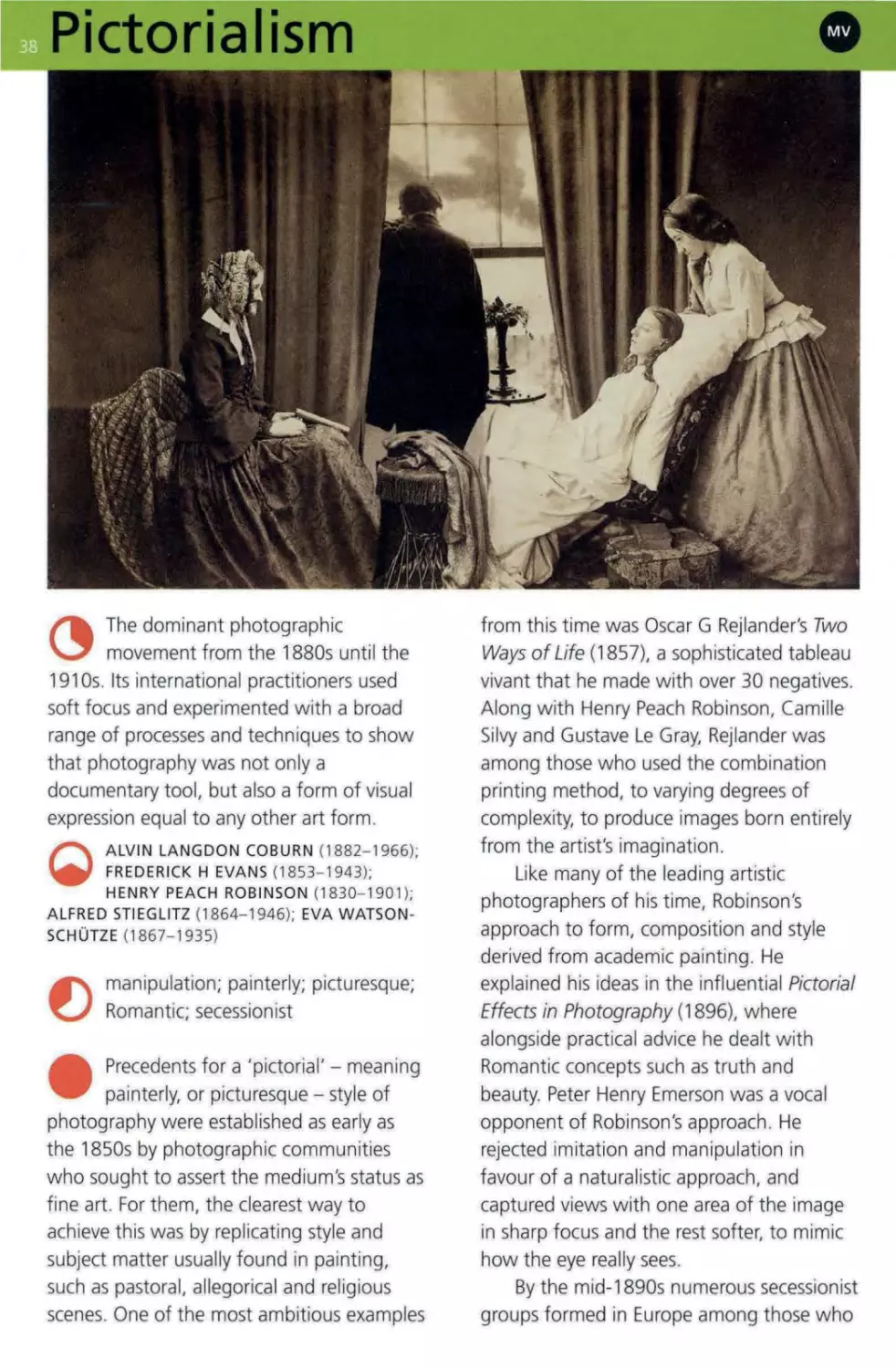
Fading Away, 1858
The Metropolitan Museum of Art, New York

Robinson made this tableau of a consumptive girl
from five separate negatives. The constructed
nature of the image and the evocative subject
matter - Victorians attached a great deal of
romanticism to tuberculosis, especially afflicted
women - helped introduce the idea of artistic
photography, paving the way for Pictorial ism.
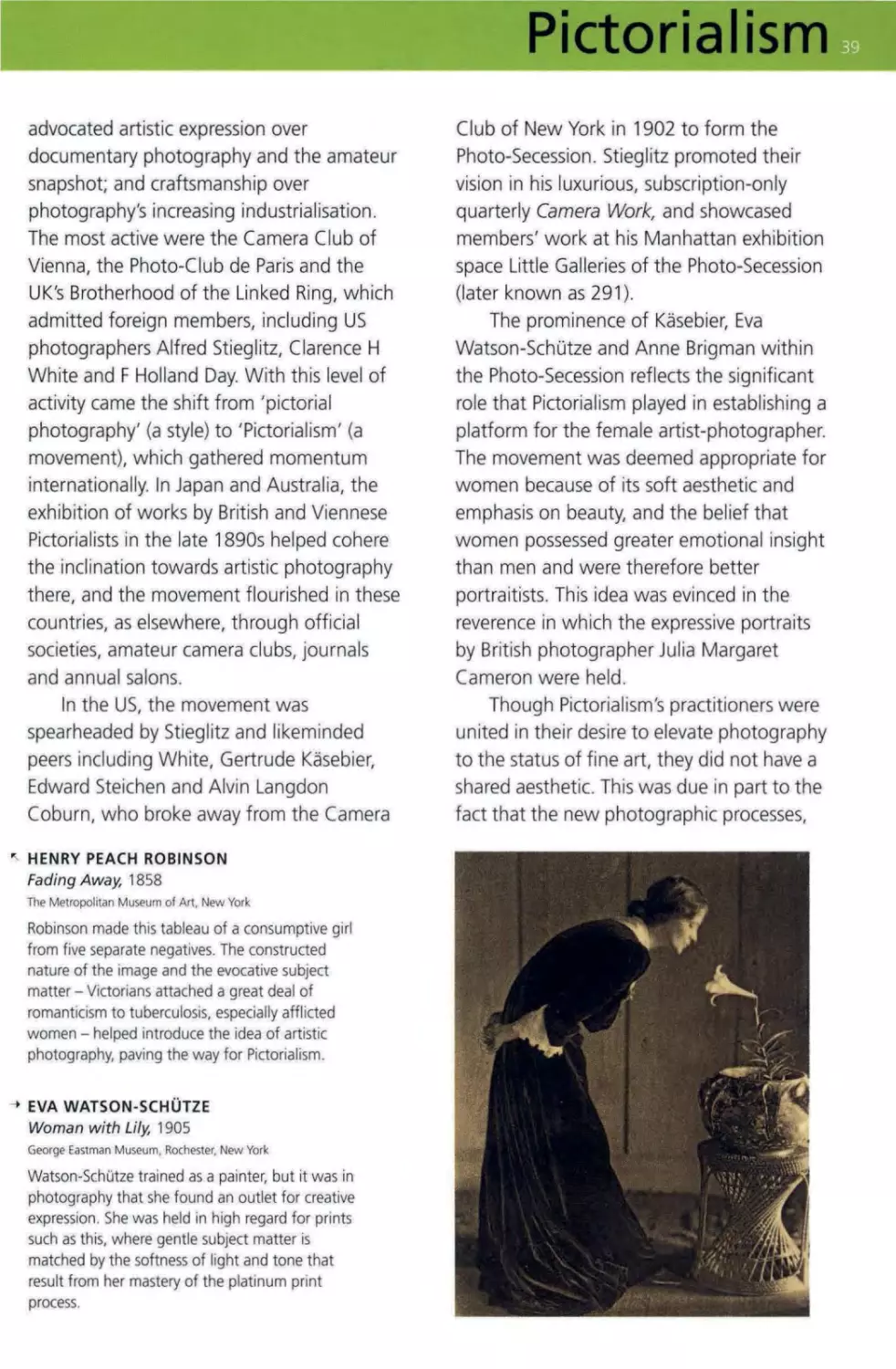
-> EVA WATSON-SCHUTZE

Woman with Lily, 1905
George Eastman Museum, Rochester, New York

Watson-Schutze trained as a painter, but it was in
photography that she found an outlet for creative
expression. She was held in high regard for prints
such as this, where gentle subject matter is
matched by the softness of light and tone that
result from her mastery of the platinum print
process.

Club of New York in 1902 to form the
Photo-Secession . Stieglitz promoted their
vision in his luxurious, subscription-only
quarterly Camera Work, and showcased
members' work at his Manhattan exhibition
space Little Galleries of the Photo-Secession
(later known as 29 1).
The prominence of Kasebier, Eva
Watson-Schutze and Anne Brigman within
the Photo-Secession reflects the significant
role that Pictorialism played in establishing a
platform for the female artist-photographer.
The movement was deemed appropriate for
women because of its soft aesthetic and
emphasis on beauty, and the belief that
women possessed greater emotional insight
than men and were therefore better
portraitists. Th is idea was evinced in the
reverence in which the expressive portraits
by British photographer Julia Margaret
Cameron were held.
Though Pictorialism's practitioners were
united in their desire to elevate photography
to the status of fine art, they did not have a
shared aesthetic. Th is was due in part to the
fact that the new photographic processes,

.. Pictorialism

Pictorialism ,
which its practitioners prided themselves in
refining, created very different effects. Many
embraced oil, bromoil and gum-bichromate
processes that allowed for manipulation on
the negative or print to create painterly
effects, with visible brushstrokes where
emulsions or inks had been applied. Robert
Demachy, for instance, mastered the soft,
pastel-like look of the gum-bichromate
process. Detractors called the images
'fuzzygraphs'. Heinrich Kuhn achieved
success with Autochrome, creating colour
images that bore the ebul lient look of
Impressionist paintings . While many
embraced processes that mimicked paintings
or drawings, however, others like Frederick
H Evans were against manipu lation. He
preferred to take advantage of the delicate
tones of the platinum process to emphasise
the aesthetic quality of light.
Subject matter also varied greatly.
Members of the Linked Ring like co-founder
George Davison tended to favour gentle
and often bucolic scenes; stylised nudes and
portraits by Anton Josef Trcka and Franti sek
Drtikol reflected the influences of Symbolism
and Art Nouveau on Czech Pictorialist
photographers; while the subject matter
that US Photo-Secessionists explored could
be as diverse as brooding nocturnal scenes
(by Steichen), experimental staged portraits
(by Holland Day), or painterly landscapes (by
Coburn, among others). In Japan, Suizan
Kurokawa sought to preserve the
compositional style of Japanese painting,
while some of his peers adopted Western
aesthetics.
By the end of the 191Os and into the
1920s this lack of consensus about style and
subject matter, together with the impact of
the First World War, saw the leading
Pictorialist groups disband, and many of the
existing practitioners in Europe and the US
gravitated towards the sharper aesthetic of

Modernist photography. This transition was
not clear-cut, however, and in many
countries including Czechoslovakia, Japan
and Australia the two approaches coexisted ,
or appeared in a hybrid form, as late as the
1940s.
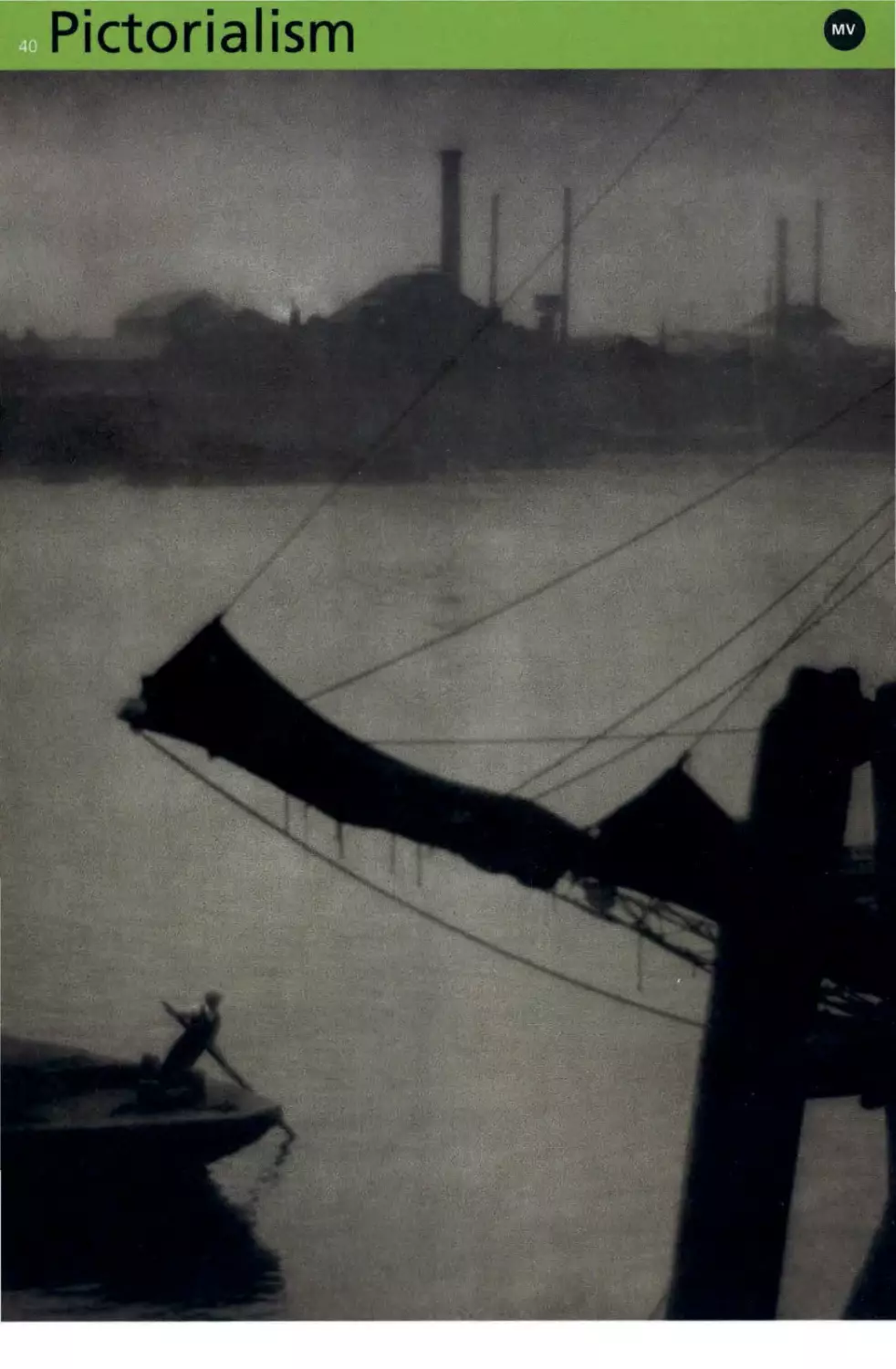
<- ALVIN LANGDON COBURN

Wapping, 1904
George Eastman Museum, Rochester, New York

The diverse influences of Japanese woodblock printing
and the painter James Abbott McNeill Whistler can both
be seen in this view of the Thames, an example of the
numerous dockland scenes Langdon Coburn made
while living in England.
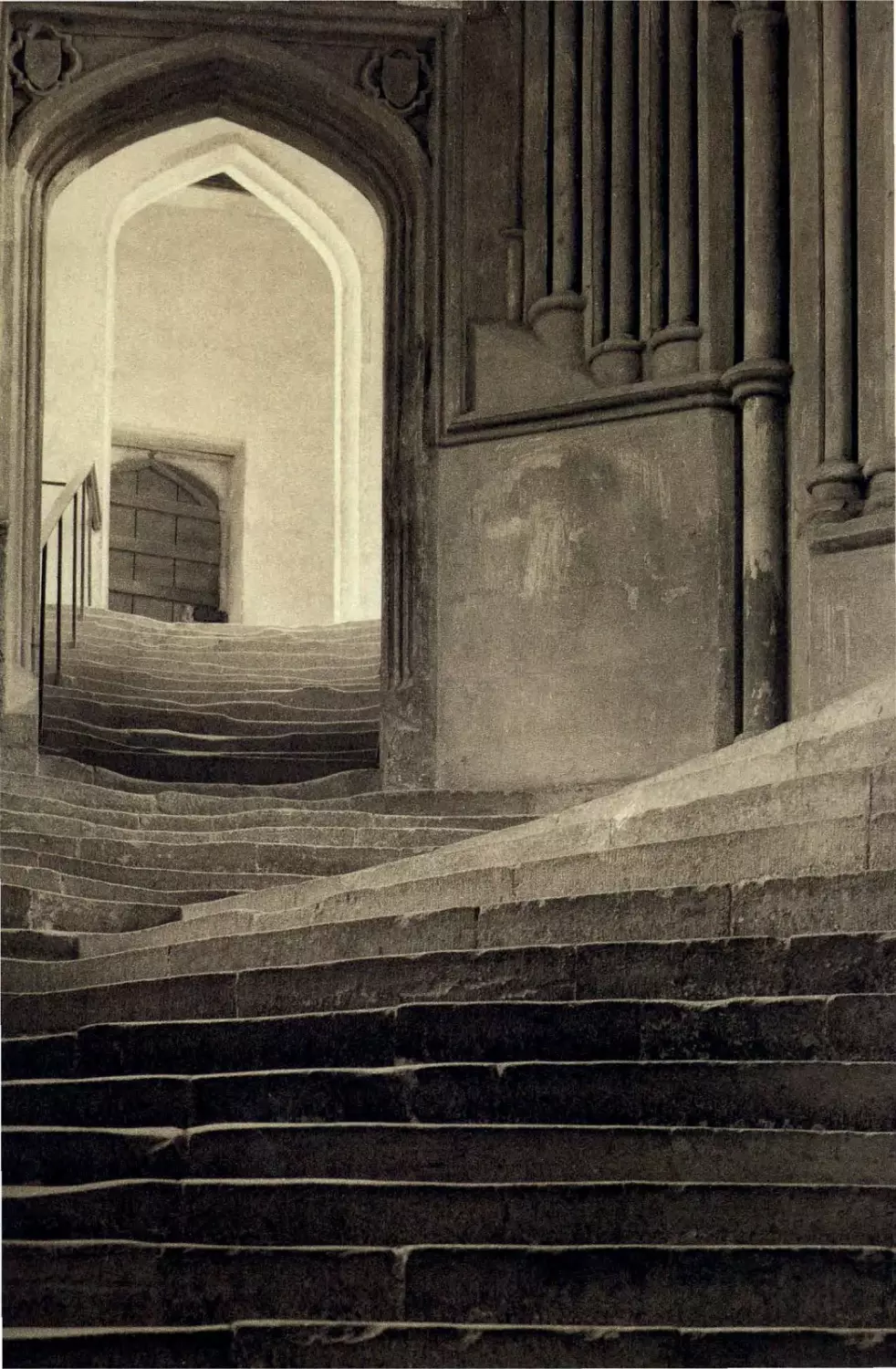
FREDERICK H EVANS (see p34 )
A Sea of Steps, Wells Cathedral, 1903
Los Angeles County Museum of Art

Evans made many studies of cathedrals, often spending
long periods of a time familiarising himself with the
buildings to understand how sunlight illuminated the
interiors at different hours. This was not intended as
straightforward architectural study, but a poetic
meditation on the beauty of the space .
OTHER WORKS

JULIA MARGARET CAMERON
Beatrice, 1866
V1doria and Albert Museum, London

HEINRICH KUHN
Mary Warner and Lotte in the Meadow, c 1908
The Metropolitan Museum of Art, New York

GERTRUDE KASEBIER
The Manger (Ideal Motherhood}, 1899
J. Paul Getty Museum, Los Angeles

EDWARD STEICHEN
The Pond - Moonrise, 1904
The Metropolitan Museum of Art. New York

CLAR ENCE H WHITE AND ALFRED ST IEGLITZ
Torso, 1907, printed 1907-9
The Metropolitan Museum of Art. New York

Negative-Positivism; The Studio
Portrait; The Nude; Still Life;
Subjectivism
Futuri sm; Constructivism; New
Objectivity; Industrial ism; Group f.64

The Nude
~

Betw een the 1880s and 1930s,
\.,;, photog raphic approaches to the

or 'study after nature'. Any other forms

nude shifted from stud ies that mimicked
painting, to explorations with uniquely

were deemed obscene. Ph otographers such
as Felix-Jacques Moulins and Eugene Durieu
posed their models in accordance with
classical style to create images fo r use by

photographic ways to represent the body.

r'\

ANNE BRIGM AN (1869- 1950); RUDOLF
, . . , KOPPITZ ( 1884-1936); GEORGE PLATT
LY NE S ( 1907-55 ); OSCAR G REJLANDER
( 18 13- 1875); EDWARD WESTON (1886- 1958)

academie; censorship; classicism;
distortion; figuration

A

In photography's earliest years, the

only form in which the nude was
permitted was the 'etudes d'apres nature',

academical ly trained artists. Often it w as
difficult for censors to distinguish between
these academies and pornographic imagery.
Those who first explored photography
as an art form, such as Oscar G Rejlander,
approached the nude by adhering to the
figurative tradition of Renaissance and
Baroque pa inting. But by the end of the
19th century, the Pictorialist movement had
opened up distinct new ways of picturing
+-

OSCAR REJLANDER
Ariadne, 185 7
National Gallery of Art, Washington DC

Rejlander crea ted a series of
nude studies based on
pa intings by Titia n, Rembrandt
and Rubens, among others,
here replicating Titian's study
of Venus in his Venus and
Adonis (c 1555-60)

,. ANDRE KERTESZ
Untitled (Distortion
#40), 1933
J. Paul Getty Museum

Kertesz used th ree parabolic
mirrors and fitted his camera
with an early zoom lens to
flatten, twist and stre tch t he
image of the female form.

The Nude .
the nude. Alice
Boughton, for
example, created
picturesque
compositions of
women and children
that appealed to the
Victorian affinity for
narrative. Anne
Brigman spent days
camping out in the
Sierra Nevada as
preparation for her
dramatic, paganinspired compositions
of women in nature.
Robert Demachy
isolated the body
from the composition
to focus solely on the figure, which he
aestheticised by using print processes that
created gestural brushstroke-like effects .
Into the 20th century, Western
photographic approaches to the nude
evolved against a backdrop of social and
cultural change that included women 's
emancipation and changes in censorship
laws. Isadora Duncan's pioneering modern
dance also stimulated new attitudes to the
body and comportment, embracing a more
instinctive mode of expression. Some of the
strongest articulations of the 'modern body'
were made by Frantisek Drtikol and Rudolf
Koppitz during the early 1920s. They
arranged their dancer-models into dynamic
poses that emphasised their muscular
definition and suggested strength and
energy; controversially, Drtikol did not
retouch his negatives to remove signs of
pubic hair. Around the same time, Germaine
Krull made female nudes and mises en
scene inspired by cabaret culture, which
suggested changing attitudes to notions of
women's sexuality.

A very different approach to picturing
the nude prevailed within so-ca lled 'straight
photography'. Photographers associated
with this style, like Edward Weston and
Imogen Cunningham, were interested in the
camera's ability to capture subjects with
graphic detail and precision . Approaching
the body as they did any other subject, they
celebrated the camera's abi lity to render the
flesh 'as hard as steel', as Weston described
it, and often used tight crops to concentrate
on particu lar curves and folds . That
Cunningham titled a close-up study of
breasts Triangles (1928), reflects how it was
shape and form that were of primary
interest.
One of the most significant moments in
the evolution of the photographic nude
during the 20th century was the Surrealists'
departure from realistic depictions of the
body. The group was stimulated by
psychological theories that proposed new
ways of thinking about the self and the
unconscious mind. They were also interested
in how African and Oceanic cultures

.The Nude
represented the body. Photographers
including Man Ray and Maurice Tabard
used darkroom techniques including
solarisation, bnJlage and double exposure
to manipulate physical form and sometimes
posed models so as to hide limbs,
suggesting dismemberment. In some
instances these distortions appeared
macabre, even sinister; in others, as in
Man Ray's famous Ingres's Violin (1924),
where he painted the shape of violin F-holes
onto his photograph of a woman's back,
they read as playful subversions of the
classical nude.
Surrealist approaches to the human
figure endured long after the movement
officially dissolved. Some of the most
significant photographic studies of the
male nude were the Surrealist-inflected
works made by Herbert List, George
Hoyningen-Huene and George Platt Lynes
during the 1930s. They staged otherworldly,
dreamlike scenes with men arranged in
classical poses or among Greco-Roman
style sculpture.
The legacy of the 'Surrealist body'
also continued in the work of those
who experimented with darkroom or
in-camera techniques to depict the body
in unconventional ways. Heinz Hajek-Halke,
a leading figure in Subjectivism, featured the
nude in highly stylised, enigmatic scenes
made using combination and negative
printing. Andre Kertesz and Bill Brandt,
a former assistant of Man Ray, both made
Surrealist-inspired distorted female nudes.
Kertesz first made his on commission for
satirical magazine Le Sourire ( 1899-1 940)
in 1933 using zoom lenses and mirrors to
twist, magnify and compress the image
of the female form. Brandt's, made between
1945 and 1978, were less uncanny and
more mysterious, created with an antique
camera that produced curious perspectives.

While the nude endured as one of the
most important subjects in photography, it
was the experiments with figuration and
abstraction that took place in the early and
modern period that established what it
meant to make a purely 'photographic
nude' and so laid the foundations upon
which subsequent generations would work.

-> RUDOLF KOPPITZ

Movement Study (Bewegungsstudie), 1925
Victoria and Albert Museum. London

Koppitz made several nude studies with dancers from
the Vienna State Opera . The fluid pose. enigmatic
cloaked figures and tight, decorative composition were
redolent of the decadence and drama of Art Nouveau
and Symbolism .

OTHER WORKS

BILL BRANDT
Nude; Campden Hill, London. 1956, printed 1976
Victoria and Albert Museum, London

A NNE BRIGMAN
The Storm Tree, 1911
Museum of Fine Arts, Houston

ANDRE KERTESZ
Untitled (Distortion #48), c 1932- 33
Art Institute of Chicago

GERMAINE KRULL
Standing Female Nude (Nu Feminin Debout). 1929
Centre Pompidou, Paris

GEO RG E PL ATT LYNES
The Sleepwalker. 1935
The Metropolitan Museum of Art, New York

EDWARD WESTON
Nude. 1936
Center for Creative Photography, Tucson, Arizona

Pictoria lism; Still Li fe; Surrealism;
Group f.64; Postwar Fashion
New Objectivity; Industrialism;
Satirism; New Formalism

The Nude .

.. Fashion & Societ
~ Fashion photography established

avant-garde. Some of t he most important

~ itself with the birth of high-end

images made by Surrea list photographer
Man Ray, like Black and White (1926), were

society magazines in the 19 1Os. By the
1930s, the genre was tra nsformed by colou r
photog raphy an d outdoors shoots.

r°'\

CECIL BE ATON (1904-80); LOUI SE
DA HL-WOLFE (1895- 1989); HORST P
HORST (1906- 99); ADOLPH DE ME Y ER
(1868- 194 6); EDWA RD STEICHEN (1879-1973)

'9f

6'\

aristocracy; artificial lighting;

~ outdoors; Surrea lism; theatrical

A
W

The introduction of ha lf-tone printing
processes in the early 1890s made it
possible to reproduce photographs in print.
The fash ion press flou rished in the 19 1Os as
Con de Nast relaunched Vogue (1892-) and
Vanity Fair (19 13-36; 1983-) as high-end
fashion monthlies, and Hearst did the same
w ith Harper's Bazaar (1867- ).

Vogue's first staff photographer was
Ado lph de Meyer. Appointed in 19 14, his
images of actresses, dancers and aristocrats
characterised 'a new social movement' : the
cosmopol itan coming-together of members
of fashionab le society with figures from
literature, theatre and the visual arts. His
wo rk influenced anot her photographer
celebrated for his portraits of society's elite,
Cecil Beaton, who became renowned for his
glittering portraits of debutantes and
Hollywood stars posed in fantastica l

made on assignment for French Vogue.
Erwi n Bl umen feld adapted his Dadainfl uenced use of distortion an d
man ipu lation to a commercia l context. Horst
P Horst made fetishistic portraits,
photographed stage cost umes by Salvador
Dalf and used studio sets an d model poses
t hat echoed the Surrea list affi nity for
classica l t hemes.
The creat ive reign these photographers
had was made possible only by t he editors
and art di rectors who employed them .
Alexey Brodovitch was one of the most
visionary art directors of his generation. He
used unconventiona l layout and crops, and
wo rked w ith the most innovative
photographers. These included Martin
Munkacsi, who took advantage of new
poin t-a nd-shoot technology to photograph
outdoors, and Louise Dahl -Wolfe, whose
embrace of Kodachrome film and location
shoots helped pioneer the use of colour
wh ile conveying the idea of the
independent, world ly woman .

OTHER WORKS
HORST P HOR ST

costumes and elaborate sets.
De Meyer's aesthetic was distinctly
Pictorialist, flattering his sitters in a romantic

Victoria and Albert Museum. London

haze created by his mastery of artificial

Dolores Modeling, 192 1

lighting. When Edward Steichen was made
Conde Nast's ch ief photographer in 1923 -

International Center of Photography, New York

a year after De Meyer decamped to Harper's
Bazaar - he introduced a bold new look that
reflected the glamou r of Art Deco style.

The First Fashion Photo for Harper's Bazaar (Lucile
Brokaw), 1933

One of the most exciting aspects of
fashion photog raphy in t he late 1920s and
1930s was its crossover with the artistic

Mainbocher Corset, 1939
A D O LPH DE ME Y ER

M A RTIN MUN KA CSI

Hungarian Museum of Photography, Kecskemet

EDW A RD STE IC HEN

Gloria Swanson, 1924

The Metropolitan Museum of Art, New York

Fashion & Society .

r CECIL BEATON

Miss Nancy Beaton as a Shooting Star, 1928

Victoria and Albert Museum, London

Early in his career, Beaton often used his sisters
Nancy and Baba in place of models and adresses.
Here, Nancy is wrapped in cel lophane and illuminated
by a 1,000-watt bulb behind her head, to dazzling and
theatrical effed.

The Studi o Portrait; Surrea lism;
Postwar Fashion; Adverti sing
& Fash ion
Daguerreotypy; Futurism;
Constructivism; The Social Document;
Industrialism

·:Sti II Life
~ The arrangement of inanimate

objects in the British Museum's collection,

~ objects enabled photographers to

which informed the highly popular
compositions of antiques and fruit that he
made in an independent capacity. The use
of the still life in this regard was also seen in
studies that were created for art and design,
like Adolphe Braun's Photograph of Flowers

experiment with composition, lighting, and
reproduction of texture and form . In the
modern period it was used to demonstrate
photography's inherent qualities and
transformed advertising.
(""'\ ROGER FENTON (1819-69); FLORENCE
, . , HENRI (1893-1982); PA UL OUTERBRIDGE
(1896-1958); PAUL STRAND (18901976); THOMAS RICHARD WILLIAMS (1824-71)

advertising; communication; object
study; spatial composition; vanitas

A

The long exposure times of 19thcentu ry camera technology made the
still life a practical choice for photographers

W

of the period. Among the earliest ever
made is Set Table (1827) by Joseph
Nicephore Niepce. When the daguerreotype
and calotype processes were introduced just
over a decade later, their respective
inventors used the still life to demonstrate
their efficacy.
During the 1850s the stil l life was used

(1855), a catalogue of 300 sti ll lifes made
for textile manufacturers.
Many early photographers who used
the still life as a means of artistic expression
did so by borrowing from the traditions of
painting. Flora, fauna, fruit, musical
instruments and objets d'art all featured in
compositions that recalled still-life paintings
made in Northern Europe between the 16th
and 18th centuries. Thomas Richard
Wi ll iams's daguerreotype The Sands of Time
(c 1850-55), which included an hourglass,
book, compass and skull, is an exemplar of
how photographers interpreted vanitas
paintings, where objects were arranged to
symbolise the futility of life's pleasures

primarily as a documentary resource. Roger

against the certainty of death.
From the 1880s photographers became
less inclined to replicate history painting.

Fenton spent around five years cataloguing

Instead they made scenes in a style akin to
<- HEINRICH KUHN

Flowers in a Bowl,

c 1908-10

The Metropolitan Museum of Art, New
York

The still life is well-suited to
experiment with new
processes and techniques.
The floral arrangement lent
itself to the saturated palette
and soft effect created by the
early colour process
Autochrome.

Still Life ..
-+ FLORENCE HENRI

Jeanne Lanvin, 1929
Victoria and Albert Museum. London

Henri placed the Lanvin perfume
bottle on its side between two
mirrors to create an intriguing,
but confusing, multiplied effect.
Henri was influenced by
movements such as Cubism and
Constructivism, and translated
their concern with perspective
into experimental still lifes.

the Impressionist movement of the time.
Edward Steichen and Adolph de Meyer
were among those who focused on subject
matter such as bowls of fruit or floral
arrangements. These subjects were also
seen in the first examples of colour still lifes:
vibrant Autochrome studies by Frederick
SDellenbaugh and Heinrich Kuhn.
Into the 20th century, some artists
associated with movements such as
Dada and Su rrealism uti lised the
photographic still life as a site for
communicating artistic agenda. But for
many others, like Paul Strand, the still life
was purely a means of exploring style,
process and technique. Alfred Stieglitz, who

was responsible for introducing European
avant-garde art stateside via his gallery, 291,
and journal, Camera Work, regarded
Strand's work as the epitome of modern
photography.
At the Bauhaus school of design in
Germany object studies were used as an
important exercise in understanding the
rudiments of spatial composition, lighting
and form. Photographs by Walter Peterhans
(a Bauhaus director), lwao Yamawaki and
Horacio Coppola, for example, reveal how
objects were selected simply for their shape
or texture. Florence Henri 's use of mirrors
and prisms represented how avant-garde
photographers interpreted the interest in

. Still Life

Still Life
perspective and perception that was being
explored elsewhere in modern art.
Also in Germany, manufacturers
embraced the precise aesthetic of the New
Objectivity movement. This emphasis on
clarity and precision was echoed in the US,
where industrial still lifes by practitioners
such as Ralph Steiner imbued metal, steel
and plastic with a hard-edged glamour
communicating the spirit of the Machine
Age. Like many of the photographers who
shot product advertisements at that time,
such as Paul Outerbridge and Margaret
Watkins, Steiner was an alumnus of the
Clarence H White School of Photography,
whose curriculum was transformative in
applying artistic principles to commercial
training.
Demand for advertising photography
was boom ing in the 1920s thanks to the
rise of the illustrated press and mail-order
catalogues, and White's school, like the
Bauhaus, fostered a generation of
photographers who worked in both artistic
and commercial capacities. Meanwhile,
organisations such as the New York-based
Art Directors Club promoted 'artistic
excellence' in advertising, helping to
establish photography as the first truly
modern art form. It was also through the
pages of magazines like House Beautiful
(1896-) and McCall's (1872-2002) that
colour photography first reached a wide
audience, in the synthetic palette of images
made by the few photographers, including
Outerbridge and Nickolas Muray, who had
mastered the complex and labour-intensive
tricolou r carbro process.
Outside of commerce, the still life
endured as a means of expressing artistic
conceits. In the 1930s, Edward Weston
made lumi nous studies of natural objects
that demonstrated his bel ief that al l forms
were equal. In th e 1940s and 1950s,

photographers associated with Subjectivism
in the US, like Frederick Sommer and Minor
White, used the still life to explore darker,
psychological subject matter White through
close-up and high contrast; Sommer
through graphic and visceral depictions of
animal and human artefacts that he referred
to as 'biological still lifes'.
•- PAUL STRAND

Abstraction, Porch Shadows, Connecticut, 1916
Museum of Modern Art, New York

Strand used a tight crop and oblique angle to transform
this image of a porch table into a study of light and
form. His peers regarded this as one of the first truly
modern photographs.

OTHER WOR KS

A D O LPHE BRAUN

Wreath: Apple Blossom, Rhododendron, Lilies of the
Valley, c 1855
Victoria and Albert Museum. London

H ORAC IO CO PPO LA

Still Life with Egg and Twine, 1932
Museum of Modern Art, New York

ROG ER FENTON

Still Life with Fruit and Decanter, 1860
J. Paul Getty Museum. Los Angeles

PA UL O UTE RBRID GE

Ide Collar, 1922
Museum of Modern Art , New York

TH O M AS RI CHA RD W ILLI A M S

The Sands of Time, c 1850-55

J. Paul Getty Museum, Los Angeles

Pictorialism; Bau haus & the New
Vision; New Objectivity; Industrialism;
New Forma lism
Survey; Motionism; Early Street;
Street & Society

Futurism
~ Futurism's early leaders were hostile

~ towards photography, which they
saw as a static medium. Despite th is, by the
1930s the movement's second generation
had heralded new waves of experimental
practices that connected Italy with an
international avant-ga rde.

r'\

AN TON GIULIO AND ARTURO
, . , BR AGAGLIA (1890-1960/1893- 1962 );
FORTUNATO DE PERO (1892-1960);
TATO (GUGLIELMO SANSON!) (1896-1974);
WANDA WULZ (1903-84)

motion; photodynam ism;
photomontage; speed

A

9

Futurism was launched in 1909 with
the publication of poet Filippo

Tomaso Marinetti's The Founding and
Manifesto of Futurism. In impassioned
rhetoric, he proposed a cultural revolution in
which he espoused the glory of war, beauty
of speed and love of danger. Futurism's
central tenet was 'universal dynamism': the
idea that the world is in constant motion.
Futurists expressed thei r ideas across art
and design, poetry and performance. But
for many, the idea of Futu rist photography
was anathema: how could a medium that
froze a moment in time be assim ilated into
a style based upon perpetual movement!
Th is challenge was taken up by brothers
Anton Giulio and Arturo Bragaglia, who
invented 'photodynamism': the use of a
flash gun and long exposure to trace an
object's movement th rough space. In three
treatises published between 191 1 and
19 13, they explained that photodynamism
set out to represent synthesis. Form was
dissolved into a blurred and voluminous
mass of motion that suggested the
psychological imperative behind the action.
Marinetti 's revival of Futurism after the
First World War saw the movement
affiliated w ith fascism. While photography

was not used as a revolutionary tool per se,
artists such as Mario Castagneri and
Marcello Nizzol i used montage, mu ltip le
exposure and graphics to depict the regime 's
ideals of speed, efficacy and strength.
Beyond col lusion w ith politica l parties, the
movement's 'second generation ' established
a viable place for photography, bolstered in
1930 by Marinetti and Tato's Manifesto of

Futurist Photography Tato, Vin icio Pa ladin i,
lvo Pannagg i, Bruno Munari and Wanda
Wulz created photo-col lages and
photomontages that variously foreground
machinery, technology, sport and the
expression of th e inner self. Fi lippo
Masoero's aerodinamisimo involved him
leaning out of a propellor plane to dynamise
city views.
-+ ANTON GIULIO BRAGAGLIA

Th e Bow, 1911
The Metropolita n Museum of Art, New York

This photodynamic study of a bow uses long exposure
with flash to trace the full trajectory of the gesture to
dematerialise the body. Revealing movement in
continuum, as opposed to a sequence of discrete
actions, expressed the Futurist interest in the world in
perpetual motion.
OTHER WORKS

FORTUNATO DEPERO
Self Portrait with Fist (Autoritratto con Pugno), 1915
Museo di Arte Moderna e Contemporanea di Trento e Roverto, Italy

TATO
Central Weights and Measures, 1932
Museo di Arte Moderna e Contemporanea di Trento e Roverto, Italy

WANDA WULZ
Cat + I (Lo + Gatto). 1932
Museo Nazionale Alinari Della Fotog rafia, Florence

Motionism; Constructivism; Dadaism;
Bauhaus & the New Vision;
Surrealism
Pictoria lism; Group f.64; Postwar
Fashion; Conceptua lism; New
Topographies

Futurism

Constructivism
r.

\::1

After the 1917 Russian Revolution,

a distinctive style of photography
emerged to use the medium to convey
socialist ideology. The avant-garde believed
that photography was better suited to
proletariat society than traditional art forms.

r'\

BORIS IGNATOVICH (1899-1976);
GUSTAV KLUTSIS (1895-1 938); EL
LISSITZKY (1890- 1941 ); AL EXAND ER
RODCHENKO (1891 - 195 6); GYORGY ZELMA
(1906- 84)
•

16"\

avant-garde; dynamic; ideology;

~ photomontage; revolutionary

socialist ideology. Gustav Klutsis, El Lissitzky
and Alexander Rodchenko were among the
key proponents.
Like the Dadaists, these artists embraced
photomontage to express political messages
to a wide audience. Klutsis made the first
Soviet montage in 1918 and collaborated
often with his wife, designer Valentina
Kulagina, to make propaganda posters
using this technique, such as Electrification
of the Entire Country (1920), made in
support of Lenin.
Lissitzky, too, was known fo r

A
W

Revolutionary photography in the
Soviet Union was propelled by
Constructivism. Guided by the idea of

photomontage, as well as photograms that
he made by layering negatives to
superimpose images. His technique was
informed by his time in Berlin as a cultural

faktura - looking to a material's inherent
properties to exploit its fullest potentia l -

attache. There, his association with the
circles around Laszlo Moholy-Nagy helped

artists and designers developed new

define the Modern ist New Vision. It also

approaches to photography to convey

propagated international Constructivism,
seen for instance in the work of the Polish
group Blok .
Kazimir Malevich's Suprematism had
been a formative influence on many
associated with Russian Constructivism,
though they later rejected its 'art's for art's
sake' et hos. It was on these grounds that
Rodchenko renounced painting for
photography in 1921. Those involved with
the Left Front of the Arts (Lef) magazine
(1923-25), whose covers Rodchenko
designed, an d the photographic section of
the October group that he founded with
Boris lgnatovich in 1930, represented the
vanguard of Soviet Art and Design.
Inspired by fi lm, typica l techniques were
the use of dynamic angles and
foreshortening to t ransform how viewers
'read' everyday scenes. These were adopted
to some extent by the other main
photography group at that time, the Russian
Association of Pro letarian Photographers
(ROPF)

Constructivism

EL LISSITZKY
Self-Portrait (The Constructor), 1924
State Tretyakov Gallery, Moscow

Lissitzky photographed himself and his hand,
layered the negatives, and exposed them at the
same time . He combined this with a photogram
reprodudion of his letterhead, and then glued
on redangular shapes.
+- ALEXANDER RODCHENKO

Fire Escape, from Building on Miasnitskaia Street,

1925

San Francisco Museum of Modern Art

Rodchenko advocated the use of dynamic
'worm's-eye' and 'bird's-eye' viewpoints to distort
scale and perspedive. Here, this transforms
a depiction of a fire escape into a graphic study
of line and form .

OTHER WORKS

BORIS IGNATOVICH
Dynamo, 1930
Spencer Museum of Art, Lawrence, Kansas

EL LISSITZKY
Runner in the City, c 1926
The Metropolitan Museum of Art, New York

ALEXANDER RODCHENKO
Osip Brik, 192,
Pushkin State Museum of Fine Arts, Moscow

GYORG Y ZELMA
Gorky Park, 193 1
Spencer Museum of Art , Lawrence. Kansas

Futurism; Dadaism; Bauhaus & the
New Vision; Social Realism
Pictorialism; Fash ion & Society;
Celebrity & Paparazzism; Diarism

.Dadaism
~ An art istic standpoint ad opted across

192 1. The 'schadog raphs' were rou gh-hew n

Europe and in New York during the
First Worl d Wa r as those who were
disillusioned by th e values of modern society

objects made by arranging scraps of found
materia ls on lig ht-sensitive paper left to
expose on a w indowsill. The 'rayographs'

sought to attack t hem through provocative
acts and cultural propaganda.

were more polished, made by ca refu lly
controlling exposure to light to achieve t he
desired level of abstraction.
As wi th all the art forms they used, the

\.:1

r'\

RA OUL HA USMANN (1886- 1971 ); JOHN
. , HEARTFIELD (1891 - 1968); HA NN A H
HbCH (1889- 1978); MAN RAY
(1890-1976); CHRI STIAN SCH A D (1894- 1982 )

anti-art ; disorder; photogram;
photomontage; polit ical

A
W

In 1916, writers Hugo Ball and Emmy
Hennings formed the Cabaret
Voltaire nightclub in Zurich . Away from the
activity of t he war, w riters and artists

Dadaists ' approach to photog raphy ranged
in tone from th e irreverent - as exemplified
in t he photog ram - to th e anarch ic. In
Berlin, the most pol itica l of the Dada groups
- John Heartfi eld, Hannah Hoch an d Raoul
Hausman n - extended t he Cubist col lage to
pi oneer photomontage. Th ey used it as a
dissident tool, splicing images from
newspapers and magazines to make satirical

including Tristan Tzara, Richard Hulsenbeck
and Sophie Taeuber (later Taeuber-Arp)
participated in exh ibit ions and experimenta l

statements about Weimar cu lture. Later,
Heartfi el d's rad ical ly anti-fascist works put
him on the Gestapo's 'most wanted' list.

performances. The raucous gatherings
embraced nonsense, noise and chance as a
form of attack aga inst modern society. At
the same time, the idea of what an artwork

The beginning of the 1920s marked the
decl ine of Dada as many members turned to
Andre Breton's Su rrealism . By 1924, the

was and could be were being overturned by
Dada's New York faction: Man Ray, Marcel

Dadaists had in effect w iped t he slate clean
for art, and lai d the foundations for cultu ral
provocat ion that would emerge again in

Duchamp and Francis Picabia. After the war,

earnest in the postmodern era.

Dada cohered in groups in Paris and across
Germany.
These groups reacted against 'accepted'
forms of art. 'The Dadaist considers it
necessary to fight against art, because
he has seen through its fraud as a moral
safety va lve,' wrote Hulsenbeck in 1920.
Photography, certainly not accepted as an
art fo rm by the bou rgeoisie, was thus an apt
media for the radica l avant-garde.
The photogram appealed because the
technique demanded that the artist
embrace the accidenta l, and created a
disordered, often dreamlike aesthetic. Key
proponents were Zu rich-based Christian
Schad; and Man Ray, who experimented
with this technique after moving to Paris in

OTHER W ORKS

JOHN HE A RTF IELD
Adolf, the Superman, Swallows Gold and Spouts Tin,
1932
The Metropolitan Museum of Art, New York

HA NN A H HbCH
Untitled, 1929, from An Ethnographic Museum,
192 5- 30,
Museum tor Kunst und Gewerbe, Hamburg

M A N RAY
Rayograph, 1922
Museum of Modern Art, New York

CHRI STI A N SC HA D
Schadograph, 1918
Museum of Modern Art, New York

Dadaism

t JOHN HEARTFIELD
On the Crisis Party Congress of the SPD, 1931
Akademie der KUnste, Berlin

Heartfield's collaging of a growling tiger's head with a
portrait of a man who represents a Social Democratic
Party politician was intended as an attack on the SPD's
capitalist allegiance.

Futurism; Constructivism; Bauhaus
& the New Vision; Surreal ism;
Postmodern ism
The Studio Portrait; Survey;
Pictorialism; Group f.64;
Social Realism

Bauhaus & the New Vision
•- LASZL6 M OHO LY-NAGY
Berlin, Radio Tower, 1928
Museum of Modern Art, New York

The revolutionary effects of
technology on one's
perception and experience of
the world were at the heart
of Moholy-Nagy's New
Vision.

-+ GYORGY KEP ES

R with Compass, c 1939-40

Tate, UK

Kepes was renowned for his
integrative approach to art,
science and technology. He
experimented widely with
the effects created by
exposing objects with
different material properties
directly onto photographic
paper. Here, the prism
creates a soft translucent
effect; the compass a hard
graphic outline that is echoed
in the painted-on letter 'R'.

r.

Characterised by dynamic
\.;, perspectives and experimenta l
techniques, the New Vision, coined by
Laszlo Moholy-Nagy, utilised various
avant-garde 'isms' to shape a new visual
language that reflected modern society.

r"'\

GYO RG Y KEPES (1906-2001 ); LUCIA
MOHOLY (1894-1989); LA SZL6
M OHOLY-NA GY (1895-1946); FR A NZ
RO H (1890-1965); IW AO YAM AWAK I
•

( 1898-1987)

~ avant-garde; experimentation;

V

modern ism; perspective; technology

A
W

In the years following the First World
War, a new avant-garde emerged
that sought to represent the energy and
dynamism of the increasingly technological,
mechanical and commercial world. The
picture press, film industry and industria lised
mass-printing methods created a newly
photo-rich cu lture : ferti le ground for
photographers, artists and designers to
innovate new forms and techniques.
The heart of th is shift was Berlin, where
the revolutionary zeal of Constructivism
coalesced within a group of prog ressive

Bauhaus & the New Vision
emigre artists. Among them were husband
and wife Hungarian artist-writers Laszlo
Moholy-Nagy and Lucia Moholy, who
directed this spirit towards promoting a new
photographic mode. Inspired by the radical
re-presentations of rea lity offered by
advances in scientific photography like X-ray
and microphotography, thei r New Vision
advocated the use of fo rms and techniques
that would offer a different perspective on
the world. This included the playfu l
juxtaposing of 'straight' documentary
images, dynamic worm's-eye and bird's-eye
views, photomontage, and photog rams
- made without a camera by placing objects
directly onto photographic paper and
exposing it to light.
Laszlo Moholy-N agy's teaching post as
co-head of the preliminary course at the
Bauhaus, Dessau, from 1923 located the art
and design school as the epicentre of the
photographic avant-garde despite the fact
that photography was not taught as a
dedicated course. His infl uence, coupled

with the school's integrated approach to art
and industry, ga lvan ised likeminded peers
across different disciplines, such as graphic
designers Franz Roh and Jan Tschichold.
Their photobook Photo-Eye and Werner
Graff 's Here Comes the New Photographer!
(both 1929) were pu blished around the
landmark 'Film und Foto' touring exhibition
that brought over a thousand international
examples of New Vision (Modernist)
photography to interntional audiences.
Whi le the rise of fascism all but
suppressed the activities of the New Vision
in Europe, its momentum continued
elsewhere. Former Bau haus student lwao
Yamawaki was instrumental in promoting
Modernist photography in Japan. In the US,
where the New Bauhaus was founded in
Ch icago in 1937 (later the Institute of
Design), director Moholy-Nagy and teacher
Gyorgy Kepes extended the influence of the
early 20th-century avant-garde into a new
technological era.
OTHER WORKS

GY ORG Y KEPE S

Propeller, c 1939-40
Tate. UK

LA SZLO MOHOLY-NAG Y

Fotogramm, 1926

The Metropolitan Museum of Art, New York

FRANZ ROH

Lightbulb (Photogram) (G!Ohbirne [Fotogramf),

1928-33

Museum of Modern Art, New York

IWAO YAMAWAKI

Untitled (Modernist Architecture), 1932
Tate, UK

Futu rism; Constructivism; Dadaism;
New Objectivity; Surrealism
Daguerreotypy; Travel, Expedition
& Tourism; Su rvey; Pictorialism

.. New Ob·ectivit
t"-.

New Obectivity (Neue Sachlichkeit)

~ was an approach by artists and

writers in Germany characterised by the
impulse to depict the modern world as it is,
without romanticism or artistic effect. In
photography, this meant harnessing the
camera's ability to capture the sub1ect with
absolute precision.

r°'\

AENNE BIERMANN (1898- 1933); KARL
, . , BLOSSFE LDT (1865- 1932); IMRE KINSZKI
(1901-45); ALBERT RENGER-PATZSCH
(1897- 1966); AUGUST SANDER (1876- 1964)

detachment; modernity; order;
precision; typology; uniformity

A

Expressionism, the dominant artistic
movement in Germany of the early
20th century, was firmly anti-realistic. New
Objectivity reacted aga inst this; instead,
practitioners took a rigorous approach to
light, shadow and perspective to focus
attention on structu re and form. Th ei r
response to the modern world supported
new ideologies of the period th at were
based on order, industry and progress.
Albert Renger-Patzsch was one of the
key photographers associated with New
Objectivity. His 1928 book The World is
Beautiful is considered to be the defining
statement of the movement. Featuring
singular images of plants, animals, historic
and contemporary architecture, commercial
sti ll lifes and stud ies of craftsmen at work, it
illustrated how the traditional sat alongside
the modern, and nature alongside the
industrial and man-made.
Key to this meticulous treatment of
detail was the close-up perspective, as seen
in the wo rk of Aenne Biermann and Karl
Blossfeldt. Biermann progressed from family
portraits to objective still lifes after being
commissioned by geologist Rudolf Hundt to
make detailed photographs of minerals. In
1930, her book 60 Photos was published .

W

Featuring Franz Roh's seminal essay
'The Literary Dispute about Photography',
it positioned her in the photographic
avant-garde.
Blossfeldt is known for his magnified
studies of botanica l specimens. He made
cameras that enabled him to photograph in
minute detail, usually working with
large-format negatives because they
retained greater definition when the image
was enlarged, and often retouching the
negative and print to achieve the desired
uniformity. His work was championed by the
Surrealists, who found a sense of the
uncanny in the extreme close-up forms.
August Sander applied this emphasis on
order to document German society.
Between 192 5 and 1927 he devised the
concept for People of the Twentieth
Century, a 'cultural work in photographs'
that would eventually comprise thousands
of portraits made between 1892 and 1954.
He divided these into seven archetypes: The
Farmer; The Skilled Tradesman; The Woman;
Classes and Professions; The Artists; The
City; and The Last People. This concept of
cataloguing and classifying in a uniform
manner came to be a defining characteristic
of the New Objectivity movement, and
Sander's typologies have influenced
subsequent generations of photographers.
The fall of the Weimar Republic brought
New Objectivity to an end, but not before
its influence had reached beyond Germany
as part of the international spread of the
New Vision. Photographers associated with
Hungarian and Czech avant-ga rde photoclubs, such as lm re Kinszki and Jaromfr
Funke respectively, were among the many
who experimented with its principles as part
of the shift away from Pictorialism towards
Modernism's cleaner aesthetic.

-+ ALBERT RENGER ·

PATZSCH
Flat Irons fo r Shoe
Manufacture, 1928

J. Paul Getty Museum, Los

Angeles

Renger-Patzsch did
not attempt to
pictorialise the flat
irons, but used the
camera to intensify
their material qualities
- just as he did with
natural forms. This
study is a celebration
of the uniformity and
elegance of the
man-made. It was
taken the year he
moved to Essen,
where he earned his
living from industrial
commissions such as
this.

OTHER WORKS
JAROMiR FUNK E
Plates (Ta/ire), 1923-24
Museum of Modern Art, New York

KA RL BLO SSFELDT
Equisetum hyemale, Rough Horsetail, Top of Shoot,
before 1926
Universitat der KUnste, Berlin

AU GUST SANDER
Pastrycook (Konditor), 1928, from People of the
Twentieth Century, 1892-1954
SK Stiftung Kultur, Cologne

Q

Still Life; Bauhaus & the New Vision ;
Su rreal ism, Group f.64; Dusseldorf
Deadpan
Pictorial ism; Diarism; Satirism;
Activism; Fictional Narrativism

. Surrealism
Launched in Paris in 1924, Surrealism
was influ enced by new Freud ian
theory and centred on the desi re to explore
the unconscious mind. Photography's
~

\:1

importance lay in its relationsh ip to reality
and ability to depict the dream like and
the uncanny.

r°\

JACQUES-ANDRE BOIFFARD (1902-61 );
, . , DOR A MAAR (1907-97); MAN RAY
(1890- 1976); MAUR ICE TABARD
( 1897-1984); RAOUL UBAC (1910-85)

16"\

anthropology; appropriation; chance;
darkroom experimentation;
subconscious

~

e

Unlike Dadaism, Su rrealism
represented an intel lectual rather

comb inat ion printing, photograms (which
he ca lled 'rayographs') an d solarisation - a
technique he perfected w ith his studio
assistant Lee M iller - all appea led to the
Surrea list desire to move beyond reality.
They were adopted by practitioners
including Maurice Tabard and Raoul Ubac,
the latter of whom is known for his use of

brulage (burning of the negative) to create
violent ly distorted figures.
Explorations of the psychological led
Surrealists to uneart h the monstrous side of
human existence. Dora Maar created
disturbing scenes through unexpected
combinations of everyday objects, oddly
positioned figures and strang e animals;
Hans Bellmer made and photographed dolls
twisted into nightmarish forms; while Grete

than a social revolution. Led by And re
Breton, who publ ished the First Manifesto
of Surrealism in 1924, and influenced by

Stern and Kati Horna's work included
absurdist photomontages.

Freud's theories of the unconscious, artists
and writers seized upon techniques of
automatism - the artistic equivalent of

The darker side of human existence was
also suggested t hrough techniques of
appropriation and defamiliarisation.

Freud 's free association - as part of a
liberation of the unconscious mind they

Surrealist interest in the anthropolog ica l and
scientific was evinced in vario us publ ications
that recontextualised police and medical

believed was necessary to help revi vify
society after the First Worl d War.

imagery, everyday snapshots, film sti lls and

The belief that photography was an
expression of the subconscious granted it an

close-ups of biological matter in an uncanny
and often uncomfortable light. For

important place with in the Su rrea list
movement. Much of the photography
Surreal ism claimed for itself incl uded

Hungarian photographer Brassa"f, the human

experimentation, the ce lebration of chance,
odd juxtapositions and the found object,
and the infusion of reality w ith the

in graffiti found around the city.
Th is new emphasis on the psycholog ica l,
the random, the spontaneous and the

psyche revea led itself in discarded scraps of
paper he ca lled 'involuntary scu lptures' and

dreamlike and the uncanny. Images and text

illogical had an immediate impact on

were disseminated in publications including
Breton's The Surrealist Revolution (192429), Minotaure (1933-39), and Georges
Bata ille's Documents (1929-30)
Man Ray was one of the most

approaches to the growi ng fie lds of
advertising, fashion and street photography
that endured long after the onset of the

prominent photographers associated wi th
the movement. His use of innovative
darkroom techniques, including

Second World War marked the official
dissolution of the movement.

Surrealism .
-+ DORA MAAR

The Simulator
(Le Simulateur), 1936

San Francisco Museum of Modern
Art

Maar collaged a
photograph of a boy onto
an upside-down image of
a corridor, then
photographed the result.
The confused orientation
and the boy's contortion
and scratched-out eyes
create a nightmarish effect
that is characteristic of her
use of experimental
techniques to provoke a
sense of mental unease.

OTHER WORKS

JACQUES-A NDRE BOIFFARD

Big Toe {Male Subject, 30 Years Old/
(Gros Orteil [Sujet Masculin, 30 Ans/), 1929
Centre Pompidou, Pans

MAN RAY

Ingres's Violin (Le Violon d'fngres), 1924
Centre Pompidou. Paris

MAURICE TABARD

Am I Beautiful?, 1929
Museum of Modem Art, New York

RAOUL UBAC

Le Conciliabule, 1938
Centre Pompidou, Paris

The Nude; Fashion & Society;
Dadaism; Bauhaus & the New Vision;
Mexican Modernism
New Objectivity; Social Realism;
Photojournalism; The Family of Man;
New Topographies

.. Surrealism
-> MAN RAY

Solarization, 1931

George Eastman Museum. Rochester,
New York

After accidentally discovering
solarisation with his assistant
Lee Miller, Man Ray pioneered
its artistic use by deliberately
overexposing fi lm in the
darkroom, giving silvery
reversed tones and a halo-like
outline around the subject.
Applying this technique to
nudes and portraits, he
invested otherwise
straightforward images with
psychological charge.

Surrealism .

.. Mexican Modernism
~

Followi ng the Mexican Revolution,

~ native and immigrant photographers
documented the socialist plight, visualised
a new Mexican identity, or conveyed their
persona l experiences, establish ing the
country as a key site for the progression of
Modernist photography.

r°\

LOLA ALVA REZ BRAVO (1907- 93) ;
MANUEL ALVAREZ BRAVO (1902-2002 );
HENRI CARTIER-BRESSON (1908- 2004);
KAT I HORN A (1912-2000); TIN A MODOTTI
•

(1896- 1942)

I'\

V

cu ltural renaissance; identity;
revolution; socialist; Surrealism

A
9

The years of social and political
upheaval fo llowing the Mexican

Revo lution (19 10- 17) ignited a cultural
renaissance. As the government
commissioned Diego Rivera, Jose Clemente
Orozco and David Alfaro Siqueiros, among
others, to paint political murals to educate
the masses, other artists and writers
harnessed their medium to support the
socialist cause and assert a new, uniquely
Mexican, identity.
The fervour of this moment attracted
many creatives and intellectuals from
abroad, among them photographers
Tina Modotti and Edward Weston ,
who settled there in 1923. Unlike her
partner, Modotti used her camera to
further the socialist cause, documenting
proletariat demonstrations and indigenous
communities and creating still lifes such
as Bandolier, Sickle, Corn (1927) that
symbolised the life of Mexican workers,
some of which were published in
communist journa ls including El Machete
(1924-38).
Modotti's less political images also
found an outlet in the cultural journal
Mexican Folkways (1924-29). When she
was deported in 1930, she handed over

her role the re to Manuel Alvarez Bravo,
whose work became instrumental in
visualising Mexican identity. While he
occasionally chronicled political action - as
in his famous Striking Worker Assassinated
(1934) - Alvarez Bravo concentrated on
everyday scenes; sometimes honing in on
forma l details, at other times foreground ing
traditiona l themes and motifs. Th e
Surrea lists lauded his eye for the uncanny,
but it was his skill as a documentarian
that brought his work to an international
audience. In 1934 and 1935 he showed
in Mexico and New York alongside Henri
Cartier-Bresson, who brought his own
understanding of light, shadow and
composition to st reet photographs of
Zapotec culture.
Experimentation also formed an
important strand of Mexican Modernism.
Lola Alvarez Bravo pioneered photomontage
in the country. Just as photographers had
done in post-revolutionary Russia, she
found that recombining images could
communicate new social idea ls. In dense
collages - an aesthetic that echoed the
style of Rivera et al's mura ls - she imagined
the bustling modern metropolis and the
future of the emancipated woman. Kati
Horna's approach was similarly subversive.
Hungarian-born, she moved in Surrealist
circles in Paris and was a reportage
photographer in the Span ish Civil War
before being exiled to Mexico in 1939. She
brought her experience of persecution and
conflict to bear in theatrica l staged portraits,
as we ll as symbolic images that involved
montage, negative reversal and combination
printing, to reflect on the experience
of political turmoil in a subjective, nonrepresentational manner. Published in the
Mexican press, they dissem inated avantgarde photography to a broad audience.

Mexican Modernism .
-> MANUEL ALVAREZ

BRAVO

Daughter of the Dancers I
Muchachita!, 1933
J. Paul Getty Museum, Los

Angeles

Bravo's composition leaves
us to guess whether the
muchachita, or young girl,
is simply peering in
through the wa ll of a
colonial mansion, or
engaged in conversation.
The graphic shapes of the
window, tiles and
sombrero contrast with
the drapery of her
clothing and lilting pose,
to poetic effect

OTHER WORKS

LOLA ALVAREZ
BRAVO
Architectural Anarchy in
Mexico City, c 1954
Center for Creative Photography, Tucson, Arizona

HENRI CARTIER-BRESSON
Santa Clara, Mexico, c 1934-35
Museum of Modern Art, New York

KATI HORNA
Remedios Vara in a Mask by Leonora Carrington, 195 7
Museum of Fine Arts, Boston

TINA MODOTTI
Woman with Flag, 1928
Museum of Modern Art, New York

Early Street; Constructivism;
Surrealism; Socia l Realism ;
Street & Society
Fashion & Society; Postmodernism;
Staged Tableaux; New Formalism;
Post-Internet

.. Industrialism
~ A dominant style of photographic

\.:1

Modernism in the 1920s and 1930s

in which photographers used dynamic
angles and close-ups to convey the
experience of the Machine Age.

r"'\
'9f

BEREN ICE ABBO TT (1898- 1991 );
GERMA INE KRU LL ( 1897- 1985);
EDWARD QUIG LE Y ( 1898- 1977);
CHARL ES SHEE LER ( 1883-1965); RALPH STEINER
( 1899- 1986)

advertising; geometric; landscape;
machine; precision
By the mid-1920s, advances in

the 'Machine-Age Exposition' at the
Brooklyn Museum, New York, which showed
photographic documentation of architecture
and engineering alongside modern art. That
year, Charles Lindbergh flew the Atlantic,
construction of the George Washington
Bridge began, and Ford launched its first car
designed for mass consumption, the Model

A. To promote it, Charles Sheeler was
commissioned to document the company's
landmark River Rouge plant. As well as a
commercial photographer, Sheeler was a key
proponent of Precisionism (C ubist Realism).
Influenced by the crisp, angular city views

technology had revolutionised
society; dams, skyscrapers and suspension

made by photographers such as Paul Strand,
Precisionist painters used clear outlines and

bridges were transforming the landscape;

simple geometric shapes to monumentalise

and aeroplanes, automobiles and new
streamlined trains forever changed how
people and products were transported. The

modern architecture. They, in turn, helped
coherf this particularly hard-edged branch

Machine Age, as it came to be known, was
in fu ll force, and it was the camera - faster,
sharper and more mobile than ever before
- that captured it.
In 1927, artists' preoccupation with
these new mechanical forms was revealed in

of photograph ic Modernism.
Margaret Bourke-White's statement
that 'any important art coming out of the
industrial age wil l draw inspiration from
industry, because industry is alive and vital'
typ if ied the new reverence for the manmade. As we ll as her architectural studies,
she captured the factory environment, w ith
smoke, steam and fire illum inated to take
on a near-divine quality. Her peer Berenice
Abbott completed a five-year Federal Art
Project, Changing New York (1939),
in wh ich she documented the urban
environment. Germaine Krull's Metal (1928)
paid homage to the geometric lines of
industria l structures in Paris, Marseille and
Amsterdam . The dynamic angles these
photog raphers used were integral to
Industrialism and connected them to the
New Vision in Europe, where Laszlo
Moholy-Nagy and Alexander Rodchenko
advocated use of the Constructivist
'worm's-eye' and 'bird's-eye' views to
convey the psychologica l experience of
being in the metropolis.

Industrialism ..
-+

GER M AI NE KRU LL
Eiffel Tower, 1927, from
Metal (photobook), 1928
J. Paul Getty Museum, Los Angeles

Krull saw the industrial view as
representing a modern kind of
romanticism. This study of
France's great symbol of
modern engineering, featured
in her celebrated photobook
Metal. secured her a steady
stream of commercial work .

CHAR LES SHEELER
Criss-Crossed Conveyors Ford Plant, 1927
Museum of Fine Arts. Boston

Sheeler employed a low
perspective to create a
dynamic effect that emphasises
the monumentality of the
structure, while his vantage
point accentuated the
geometric lines and forms
found wi thin the composition .

Much of Industrialism resulted from
commissions from publishers, but
advertising agencies also fuel led the
aesthetic. Close-up studies of machinery,
and product still lifes that glamorised
man-made materials - by photographers
such as Ralph Steiner, Edward Quigley and
Albert Renger-Patzsch - we re as vital to
picturing industry as those that registered its
colossal scale. By the end of the 1930s, loss
of confidence in the machine and cynicism
about the utopia it had promised brought
this style into rapid decline.

OTHER WORKS
BEREN ICE ABBOTT

Night Aerial View, Midtown Manhattan, 1933
National Museum of American History, Washington DC

RALP H STE INER

Electrical Switches, 1930

Center for Creative Photography, Tucson, Arizona

Still Life; Futurism; Constructivism;
Bauhaus & the New Vision
Pictoria lism; The Nude; Surrealism;
Subjectivism

.Group f.64
r.

\..:1

This California-based collective was

the nucleus of the 'straight
photography' movement that became the
defining aesthetic of American Modernism,
relinquishing Pictorialism in favour of precise
reproductions of natural forms.

r°'\

ANSEL ADAMS (1902-84); IMOGEN
CUNN ING HAM (1883- 197 6); EDWARD
WESTON (1886- 19 58); W ILLARD VAN
DYKE ( 190 6-86)
•

6'.
U

form; nature; precision;
sharpness

A
W

In a 1917 edition of Alfred Stieglitz's
journa l Camera Work, his protege

Paul Strand advocated 'purity of use' in
photography, explaining that 'hand work
and manipu lation is merely the expression of
an impotent desire to paint'. This position
was fina lly codified in 1932 by a group of
San Francisco-based photographers named
Group f.64. Their objective was to present
the best examples that upheld their
standards of 'pure photography',
'possessing no qualit ies of technic [sic],

Group f.64
composition or idea derivative of any other
art form'.
Group f.64 named themselves after
what was then the sma llest aperture of a
lens of a large-format camera that achieved
the greatest depth of field, meaning that
both nea r and far distance are rendered in
sharp focus. They favoured contact prints
made from 8 x 10 inch (20 x 25 cm)
negatives, which retained great detail, and
gradually replaced the softer effect of
processes such as bromoil with gelatin silver
+-

ANSEL ADAMS
Frozen Lake and Cliffs,
Sierra Nevada, Sequoia
National Park, Ca lifornia,
1932
Center for Creative Photography,
Tucson, Arizona

Adams shot this view with a
larg e 8 x 10 inch negative and
sharp lens to render the
landscape in high definition:
accentuating the contrast
between the craggy rock face,
the lines smoothed by snow,
and the glossy, reflective
surface of the frozen lake.

OTHER WORKS

IMOG EN CUNNIN GHAM
Magnolia Blossom, 1925
San Francisco Museum of Modern Art

CONSUELO KANAGA
Hands, 1930
Brooklyn Museum, New York

ALMA LAVENSON
Indian Ovens, Taos, 1941

prints that ach ieved a harder, highercontrast image with a glossier finish.
In addition to leader Edward Weston,
Group f.64's founder members were Ansel
Adams, Imogen Cunningham, John Paul
Edwa rds, Sonya Noskowiak, Henry Swift
and Willard Van Dyke. From their first
exhibition in November 1932, however, the
group evolved as they invited photographers
including Consuelo Kanaga, Preston Holder,
Dorothea Lange, Alma Lavenson, Peter
Stackpole and Weston's son Brett to exh ibit
alongside them as honorary members.
These photographers were aware of the
experimental Modernism taking place in
Europe, and their va lues were aligned to the
New Objectivity movement. Through organs
such as Camera Work and regular visits to
New York they we re also alert to the
activities of like-minded peers working
across the country such as Strand, Berenice
Abbott and Charles Sheeler.
The Group f.64 circle refined a
distinctive aesthetic based on their own
surroundings; subjects that projected beauty
and timelessness, such as the Sierra Nevada
reg ion, nude studies and natural still li fes, as
well as occasional industrial forms. Though
geographic dispersa l and a general
inclination towards documentary
photography all but ceased their activities as
a collective by the end of the 1930s, the
legacy of straight photography endured into
the 1950s as the predominant aesthetic of
Modernism in the US.

Center for Creative Photography,
Tucson, Arizona

WILL ARD VAN DYKE
Fence Post and Barbed Wire,
c 1930
San Francisco Museum of Modern Art

EDWARD WESTON
Pepper No. 30, 1930
Center for Creative Photography,
Tucson, Arizona

Survey; New Objectivity;
Industrialism; The Family of Man;
New Topographies
Daguerrotypy; Pictorialism; Futurism;
Constructivism; Dadaism

ARENES OE LUT£CE

~~!~~'

l'll.WllWANT

SOCIETY &
HUMANITY

1930s-70s

Social Realism
r.

\.:1

This movement across the arts aimed

to convey the conditions experienced
by the working classes and poor. Among its
most powerfu l iterations were the images
produced by US photographers employed to
document the Farm Secu rity Adm inistration
programme during the Great Depression of
the 1930s, which shaped the social
documentary genre.

r°'\

WALKER EVAN S ( 1903- 75 ); DOROTHEA
LA NGE ( 1895- 1965); GORDON PA RKS
(1912- 2006); ARTHUR ROTHSTEIN
( 1915- 85 ); MAR ION POST WOLCOTT ( 1910- 90 )

'9f

documentary; evidence; Great
Depression; persuasion; propaganda

A During the 1930s, the documentary
W - a record of people, places or events

photographers travel led through rural and
smal l-town comm unities reco rding migrant
life. Wh ile they followed their own eye, they
also wo rked to 'shooti ng scripts', lists of
suggested subject matter. These were
intended to shape an overarchi ng visual
narrative an d achieve the division's ultimate
goal of 'introducing America to Ame ricans'.
Stryker th en supplied these to th e press to
communicate the work of the FSA to the
general public.
Photo-essays produced by FSA
photographers outside of their official
capacity, including An American Exodus
(1939) by Dorothea Lange and her husband,
economist Paul Taylor; and Let Us Now
Praise Famous Men (194 1) by Wa lker Evans

for those who were not able to bear witness
- became a primary mode of

and writer James Agee, also proved
instrumental in codifying social documentary
during this period.

communication across literature and the
arts. In photography, this approach had its
roots in the work of individuals such as

Whi le the 175,000 negatives and 1,600
transparencies generated by the FSA
programme created an enduring image of

Jacob Riis and Lewis Hine, who used the
camera to drive social reform. It was in the
years of the US Great Depression (1929-39),

the Depression, it is the dialogue sparked by
the multiple and conflicting roles of the
photographs as propaganda (their intended

however, that photographers refined a

function ), historical evidence and works of

potent combination of real istic subject
matter and emotional persuasiveness. Their

art that has proved an equally significant
pa rt of the ir legacy. Detai ls of photographers

col lective efforts were part of the broader
imperative of artists to portray the living
conditions endured by the poorest segments

engineering shots to create the kind of
impactful image that would awaken
sympathy from the viewer elicited questions

of society in this period, a movement known
as Social Realism.

as to the veracity of photographs as
historical evidence, for example, and the

Active from 1935-43, the Farm Security
Administration (FSA), until 1937 named the

ethics of such images enterin g the art
market remains a contentious topic.

Resettlement Administration, was a relief
programme for farmers under US President
Roosevelt's New Deal initiat ive to combat
the Depression. Its Information Division essentially its public relations arm - included
a photography department that was headed
by photo editor Roy Stryker. Under his
charge, a core group of 10-20 itinerant

The Social Document;
Photojourna li sm; The Family of Man;
Art Documentary
Pictorialism; Futurism; Surrea lism;
New Topographies

Social Realism

DOROTHEA LANGE
Migrant Mother, Nipomo, California, 1936
Museum of Modern Art, New York

Publi shed in the San Francisco News in 1936, Lange's
ori gina l caption was 'Destitute peapickers in California;
a 32 year old mother of seven children'. She took many
photographs of the family's camp, but it is this version,
close up enough to create a Madonna-like composition
and reveal the mother's careworn expression, that
became the iconic image of the Great Depression.

OTHER WORKS
GORDON PARKS
American Gothic, Washington, 1942
National Gallery of Art, Washington DC

ARTHUR ROTHSTEIN
Landscape with House, 1936
J. Paul Getty Museum, Los Angeles

MARION POST WOLCOTT
Workers and Truck, c 1938, printed later
Smithsonian American Art Museum, Washington DC

War Reportage

--~-

~

U

By the 1930s, improved camera
technology enabled photographers

to capture motion and work faster and
closer to the action, transforming depictions
of armed conflict. Press circulation of these
images formed a new visual language for
the horror - and humanity - of war.

r°\

DMITR I BA LTERMANTS (1 912 -90);
ROBERT CAPA (19 13-54); DON
MCCUL LIN (1935-); LEE MILLER
(1907- 77 ); W EUGENE SMITH (1918-78)
~

profi led the many instances of conflict
across the wo rld, and subsequent demand
saw the founding of picture agencies, such
as Magnum Photos in 194 7.
Photographers including Robert Capa,
David 'Chim' Seymour and Gerda Taro were
now able to capture the motion and chaos
of events such as the Spanish Civi l War
(1936-39). Capa's images of the 1944
Normandy landings, published in Life,
showed blurred action that demonstrated

action; documentary; humanism;

how close photographers could now come

motion; press

to their subjects. They had greater access to
the horrors of war, as seen in Dmitri
Baltermants's and Gal ina Sanko's images of

A
W

The introduction of small, handheld
cameras from 1925 marked a new
era of photojournalism. From the late
1920s, the flourishing of reportage was
represented in the launch of illustrated
weeklies such as Life (1936-2000) and Look
(1937-7 1) in the US, and Vu (1928-40),

Picture Post (1938-57) and Paris Match
(1947-) in Europe. Their photo-essays

corpses and suffering civilians on the
Eastern Front during the Second World War.
W Eugene Smith's scenes of Japan during
the conflict were representative of the new,
humanist approach that reflected the
experiences of soldiers, local people and the
photographer himself. Such unflinching
rea lism was often mediated through

War Reporta e
censorship, and contrasted with statesanctioned views.
The dangerous and inaccessible nature
of some conflicts or military regimes meant
that only their aftermaths could be
photographed. The devastating atomic
bombs dropped on Hiroshima and Nagasaki
by the US were captured by Japanese
serviceman Yosuke Yamahata and press
photographer Eiichi Matsumoto. In the
same year, the liberation of Nazi
concentration camps in Germany and
Poland was swiftly followed by
photographic excursions there by George
Rodger, Margaret Bourke-White and Lee
Mi ller, whose work revea led the extent of
the camps' atrocities.
The rapid circulation of imagery was
such that many depiction s of war quickly
came to serve as iconic representations of
specific conflicts, such as Joe Rosenthal 's
1945 photograph of the victoriou s raising
of the American flag in Japan, as well as
scenes from the Vietnam War shot by Eddie
Adams, Huynh Cong (known as Nick) Ut
and Don Mccul lin . The chaos and futility of
the Vietnam confl ict and its coincidence
with Postmodernist thought on the
reliabi lity of documentary imagery also
resulted in new forms of reportage:
Mccullin, Larry Burrows, David Douglas
Duncan and Phi lip Jones Griffiths were
among those who demonstrated a new
awareness of the influence of composition ,
text and context on photographic
narratives.

• W EUGENE SMI TH
Ma r ine Demolition Team Blasting out a Cave on
Hill 832, lwo Jima, 1945
Interna tional Center of Photography, New York

Smith's image of US destruction of a block house in
which Japanese were hiding shows the grim devastation
wrought during the Pacific War with the grandeur of a
history painting. Life reproduced this as the cover of its
9 April 1945 issue without any written description.

__., ROBERT CAPA

(overlean

Death of a Loya list M ilitiaman, Cordoba Front,

early September 1936
International Centre of Photograph y, New York

First published in Vu in 1936, Capa's tragic depiction
of a loyalist soldier captioned as shot in the back of the
head became an icon of both personal and Republican
defeat. Since the 1970s, resea rch into the location
of the image and the subject's identity has fuelled
speculation that 'The Falling Soldier' was staged,
adding to its mythologica l status.

OTHER WORKS
EDDIE ADAMS
Moment of Execution, 1 February 1968
Museum of Modern Art, New York

DMITRI BA LTER MA NTS
Grief, 1942, printed c 1960s- 70s
Museum of Modern Art , New York

RO BERT CA PA
American Troops Landing on Omaha Beach, D-Day,
Normandy, France, 6 June 1944
International Center of Photography, New York

DON MCCULLIN
Shell-Shocked US Marine, the Battle of Hue, 1968,

prin ted 20 13

Tate, UK

LEE MILLER
The Burgermeis ter's Daughter, Town Hall, Leipzig,
Germany, 1945
Victoria and Albert Museum, London

Early Conflict; Photojournalism;
Conflict & Surveillance

Q

Sti ll Life; Celebrity & Paparazzism;
Staged Tableaux; Advertising &
Fashion

W EU GENE SM ITH
Wounded, Dying Infan t Found by American Soldier in
Saipan Mountains, June 1944
International Center of Photography, New York

War Reportage

......

--:-~~___,,,,_.,.,,__........,...........

War Reportage

Photojournalism

~ The combination of journalism and

lighter handheld cameras were marketed

\.,;, photography came into its own from
the late 1920s. With improved camera

that used the recently introduced 35 mm
film roll, and improved lenses and faster
shutter speeds allowed for closer, sharper

technologies came more dynamic images,
ushering in a 'golden age' of
photojournalism that endured we ll into
the 1960s.

r°\

EVE ARNOLD (1912- 2012 ); MARGARET
BOURKE-WHITE (1904- 7 1); ERNEST
COLE (1940- 90 ); SUNIL JANA H
(1918- 2012 ); GEORGE RODGER (1908- 95)
•

A
W

and more dynamic shots. The launch of
illustrated publications such as Vu (192840), Life (1936-2000) and Berliner 11/ustrirte

Zeitung (1892-1945) popularised the
image-led, captioned photo-essay. Newly
labelled 'photojournalists' were sent on
assignments across the globe. The

globa l crises; handheld; spontaneity;
photo-essay; Wirephoto

Associated Press's phototelegraphy network,
Wirephoto, meant that contact sheets could

Technological development of
cameras during the 1920s and 1930s

be transmitted to a picture editor thousands
of miles away.
Popular modern photojournalism

accelerated image making and
dissemination. Beginning with the Leica (in
1925) and the Contax (in 1932), smaller,

included portraiture of famous figures. Erich
Salomon's images of Berlin politicians and
socialites spurred a taste for 'candid'

Photojournalism
portraiture, while Eve Arno ld showed
celebrities such as Ma rilyn Monroe behind
the scenes. A more choreographed style was
represented in Alfred Eisenstaedt and
Philippe Halsman's portraits, many of which
appeared as Life covers.
Photojournalists often had to condense
a whole story into one representative frame.
Bill Brandt, George Rodger, Werner Bischof
and Marc Riboud's images of social and
political events involved a spontaneity
defined by Henri Cartier-Bresson as the
'decisive moment' - the coming together of
the situation and the photographic eye in a
way that registered significance.
'Concerned' photojourna lists often
devoted themselves to exposing ongoing
global crises. South African magazine Drum
(1951-) published work by Ernest Cole and
Peter Magubane that provided unflinch ing
accounts of apartheid oppression . Sunil
Janah and Homa i Vyarawalla recorded key
moments in the struggle for Indian
independence in the 1940s, including
Gandhi 's assassination in 1948. Margaret
Bourke-White's 1947 photo-essay on Indian
independence typified her coverage of
milestone events for Life magazine, which
also included features on industrial growth
in North America, life in the Soviet Union
and Korea, and harsh conditions endured by
black miners in South Africa.
The 'golden age' of print
Photojournalism began its decline in the
1960s: many photographers became
frustrated by editors' increasing control over
their work, choosing instead to exhibit their
images or publish them in books. The rise of
television news was another major factor, a
medium itself now under threat from the
rise of citizen journalism.

<- MARGARET BOURKE-WHITE

At the Time of the Louisville Flood, 1937
Museum of Modern Art, New York

An example of how effective photojournalistic imagery
conveys a whole story in one discrete shot, BourkeWhite captured the glaring disjuncture between the
ideology portrayed in the billboard advertisement, and
reality of life for the citizens queuing for provisions at
an Ohio relief station.
OTHER WORKS

EVE ARNO LD
Photograph of Marilyn Monroe and Arthur Miller
Dancing on Location for The Misfits, 1961
Yale University library, New Haven, Connecticut

MAR GARET BOURKE WHITE
Fort Peck Dam, Montana, 1936
The Metropolitan Museum of All, New York

ERNEST COL E
Police and Passes, from House of Bondage, c 1960-66
Moderna Museet. Stockholm

SUNIL JANAH
Demonstrators Burning their Relief Vehicles in a Street in
Calcutta, 1942
Victoria and Albert Museum, London

GEORGE RODGER
The Wrestlers, Kordofan, Sudan, 1949
National Galleries of Sco tl and, Edinburgh

Early Conflict; War Reportage;
The Family of Man; Celebrity &
Paparazzism
Futurism; Conceptualism;
Self Portrait, Performa nce & Identity;
Diarism; Fictional Narrativism

Subjectivism
r.
U

An internati ona l te ndency towards
individual expression that was

established the Fotoform group in 1949 to

promoted and organised by Otto Steinert in
the 1950s. He and fe llow members of the

advance artistic photography. They sought
to rehabilitate the experimentation of the
prewar period and invest it with a more

Fotoform group out lined the creative
decisions that set arti stic photographs apart
from those that were purely functional.

persona l expression, a tendency they cal led
'Subjective Photography'.
Led by Steinert, Fotoform promoted

PETER KEETMAN (1916- 2005); TAK EJI
. . , IWAMIYA (1920- 89 ); BRON IStAW
SCHLA BS (1920- 2009); OTTO STEINERT
(1915- 78); MINOR WHITE (1908- 76)

Subject ive Photography in three large
group exhibitions in 1951, 1954 and 1958,
shown variously in Central Europe, New

r°'\

abstraction; expression;
experimentation; individual; psyche

A

During the Second World War,

•
photography in Germany had largely
been deployed to help illustrate nationalist
ideology. Reacting against this, Otto
Steinert, Peter Keetman, Siegfried
Lauterwasser, Wolfgang Reisewitz, Toni
Schneiders and Ludwig Windstosser

York and Japan, and two accompanying
publications. Writing in Subjective
Photography 2 (1955), Steinert
differentiated between photography that
was 'mere reproduction' and that which
resulted from artistic or stylistic feeling . He
explained that 'creativeness in photography
is expressed by an act of choice. In some
cases that may be choice of subject matter,
in other cases it may be methods of
treatment, and in yet other cases it may be

Subjectivism
the isolation of a purely accidentally
produced picture'.
Fotoform 's thesis was not entirely new:
Pictorialism, the New Vision, and the
'straight' photography of the interwar
period had begun to establish the medium
as an autonomous art form. What was
different, however, was the desire to
synthesise and promote the global efforts of
photographers who were resuscitating
experimental and individualistic approaches.
In featuring photographers from around
the world, Subjective Photography created
connections between seemingly disparate
international groups. Alfredo Camisa,
Thomaz Farkas, TakeJi lwamiya and Aaron
Siskind alone, for example, represented the
activities, respectively, of Italy's Neorealism,
Brazil's Foto Cine Club Bardeirante, Japan 's
Graphics Group (Graphic Shudan), and New
Bauhaus in the US Steinert found
commonalities in the use of abstraction (the
isolation of particu lar forms, patterns or
textures), high tonal contrast, natura listic,
lyrical subject matter, and experimenta l
camera-less techniques.
Together, the exhibited photographs
conveyed a new way of experiencing the
world that connected with US photographer
and educator Minor White's influential
theories of mystical and spiritua l expression
in photography. Th is allusion to the psyche
is now often interpreted in relation to the
postwar context within which the
movement crystallised.

& the New Vision; New
@ Bauhaus
Objectivity; Surrealism; Group f.64

Q

Fashion & Society; Constructivism;
Social Rea lism; Staged Tabl eaux

" BRONISlAW SCHLABS

Fotogram ii/14, c 1960s

Museum of Modern Art, Warsaw

The way in which th e photogram technique can
emphasise texture and form to the point of abstraction
made it a popular technique for proponents of
Subjective Photography such as Schlabs. He
experimented with layering, cutting, heating and gluing
negatives before exposing them, to create visceral
images that have no obvious connection to reality.
OTTO STEINERT (see p72)

Call, 1950

The Metropolitan Museum of Art, New York

The metallic tones and skewed perspectives, combined
with the silhouette of a man who, disconcertingly,
appears to be turned directly towards the viewer,
renders the French street as a dreamlike landscape.
Steinert often experimented with contrast to transform
a landscape or object study into an evocation of
subjectivity and the subconscious mind.
OTHER WORKS
TAKE JI IWAMIYA

Sandhill, 1949

Tokyo Photographic Art Museum

PETER KEETMAN

Oil Drops, 1950

Museum Fo!kwang, Essen

BRONISlAW SCHLABS

Untitled, 1958

Museum of Modern Art, New York

OTTO STEINERT

A Dancer's Mask, 1952
Museum Folkwang, Essen

MINOR WHITE

The Sound of One Hand Clapping, Pultneyville, New
York, October 10, 1957
Princeton University Art Museum. New Jersey

The Family of Man

----~

The most visited photography

~ exhibition of all time brought

together photographs from around the
world that represented the universal ity of
life's experiences. First shown in 1955, in the
midst of the Cold War, it was intended as a
positive statement about humanity, but was
later heavily criticised.

r\

RO Y DE CA RAVA ( 1919- 2009 ); A LFRED

~ EI SENSTA DT (1898- 1995); ELLIOTT

ERWITT ( 1928-) ; DOROTHE A LA NGE
( 1895- 1965); YOS UKE YA M A HATA ( 1917- 66)

Cold War; criticism; curating;
humanist; universality
In organ ising 'The Family of Man',
curator Edward Steichen set out to
show the universality of human experience
and make a positive statement that wou ld
defy Cold War-era political tensions. First
shown in 1955 at the Museum of Modern
Art, New York, it then travelled to nearly
40 different countries, including Japan and
Russia, and reached over 9 mi llion viewers .
The accompanying book has never been
out of print.
In 503 photographs, by 273
photographers, from 68 different countries,
selected from 2 million entries, the
exhibition presented what Steichen called
'the gamut of life' pictures of birth and
death, work and celebration, laughter and
tears. Some of the exhibited photographers
like Dorothea Lange, Henri Cartier-Bresson,
Elliott Erwitt and Roy DeCarava were
familiar names, especially to US audiences;
others were more obscure.
Much of 'The Family of Man's' impact
was thanks to Steichen's curating. Rather
than hanging the photographs at eye level,
one after another, his exhibition took
influence from Bauhaus design. Unframed
photographs of many different sizes were
hung at various heights, some on the wal l,

others on the ceiling, on the floor, or
suspended from wire. The effect was
dynamic, integrating different subject
matter and inviting audiences to immerse
themselves in images of people who were
'just like them'.
Under the threat of atomic war,
this humanist statement was incredibly
powerful. But into the postmodern
period, from the late 1960s on , 'The Fami ly
of Man' came under fire from critics who
took issue with the idea of 'sameness' and
the perceived US-centric view: over half of
the exhibited photographs were by
Americans. Steichen was accused of racism,
imperialism and promoting a colonialist
perspective .

The Family of Man

Latterly, contemporary scholars have
offered a different interpretation, suggesting
that Steichen was not erasing difference,
but embracing similarities. They propose
that this was an antidote to fasc ist rhetori c,
which was based upon emphasising
difference between races. Today, the
exhibition remains an important case study
in how attitudes to imagery shift over time.

ELLIOTT ERWITT

USA, New York City, 1953
Harry Ransom Center, University of Texas at Austin

This image of a mother gazing in adoration at her
newborn baby transcended all cultures, ethnicities and
economic background s. It was shown in proximity to
studies of mother and child from across the globe.
OTHER WORKS

ALFR ED EI SENSTAD T

Drum Major of the University of Michigan Rehearsing,
Ann Arbor, Michigan, 1950
International Center of Photography, New York

Social Realism; Photojournalism;
Subjectivism; Street & Society; Art
Documentary;

She is a Tree of Life to Them, 1950

Constructivism; Dadaism; Postwar
Fashion; Postmodernism; Staged
Tableaux

A Boy with his Rice Ball, 1945, from Atomised Nagasaki
(photobook), 1952

CO NSUELO KA NAGA
lnternat1ona! Center of Photography, New York

YOSUK E YAMAHATA

International Center of Photography, New York

The Candid Portrait

r.

archetypes; close-up; forthrig ht;

A portrait ca n be candid in the sense

~ of being taken without the subject's

knowledge, or in the broader sense of being
extremely honest. Thi s approach emerged
w ith Early Street photography.

r"'\
'9f

DIANE ARBUS (192 3-7 1); BRUCE GILDEN
(1946-); MARY ELLEN MARK (194020 15); LISETTE MODEL (1901 -83);
WEEGEE (ARTHUR FELLIG) (1899- 1968)

strangers; voyeurism

A

In 1916, Paul Strand innovated a new
approach to street portraiture. By
attach ing a fake lens to the side of his

W

camera to detract from the real lens facing
in t he opposite direction, he was able to
photograph his oblivious subjects - a blind

The Candid Portrait
woman, beggar and street peddler among
them - extremely close-up. Walker Evans
later employed a similar strategy for
documenting a cross-section of society's
archetypes in his Subway Portraits (193841 ), which he made by hiding a small 35
mm camera inside his coat.
The unposed and unvarn ished nature of
the Candid Portrait means that it was often
- and continues to be - lauded for its
perceived 'authenticity'. Historically, its
creators have also been accused of being
voyeuristic or judgmental. Such charges
were frequently levelled against Lisette
Model, who began her acerbic photog raphic
social commentary in the 1930s with
portraits of strangers that revealed the
European bou rgeoisie at their most
unappealing . While she typically honed in
on individua ls, her contemporary 'Weegee'
tended to focu s on crowds; whether at
crime scenes in New York or movie theatres
in Los Angeles, one of his favourite
techniques was to point his camera in the
opposite direction to th e acti on, to reg ister
the on looker's expressions.
The Candid Portrait was at the heart of
the new documentary photography that
flourished from the 1950s, one of the key
proponents of which was Diane Arbus.
Inspired by Weegee and her tutor Model,
Arbus's candour lay in her exceptionally
forthright style, but unlike them she always
gained her subjects' permission. Intrigued by
people who possessed distinctive physical
characteristics, or whose lifestyles positioned
them outside the mainstream, twins,
transvestites, nudists, dwarfs and giants
were among those she photog raphed in her
characteristic style: square-format, straighton and close-up, thei r appea rance rendered
surreal by her use of strong flash . Mary El len
Mark likewise devoted her career to honest
portrayals of under-represented individuals

and commun ities, though hers was a less
sensationalist vi ew that often resulted from
long-term relationships with her subjects.
The Cand id Portrait remains one of the
most fertile categories of photography
today, an ever-evolving form of
anthropological study that reflects society's
changing attitudes towards documenting
itself. Bruce Gilden has been known since
the 1960s for his disarmingly close-up street
photography, and in 20 13 began making
unrelenting ly harsh colou r street portraits
whose grotesqueness is a response to social
media posturing .
+- LISETTE MODEL

Woma n with Veil, San Francisco, 1949, printed 1976

Tate, UK

Model's photograph invites us to scruti nise the way this
woman has chosen to present herself. To some it is an
attack on the glamou r and excess of upper-class life, to
others a reminder of how vulnerable we all are in front
of the camera.
OTHER WORKS

DIAN E A RBU S
Identical Twins, Roselle, NI, 1966
The Metropolitan Museum of Art, New York

BRU CE GILDEN
Haiti, Port-au-Prince, Cemetery, 1988, from Haiti, 1984Museum of Modern Art, New York

MARY ELLEN M A RK
Tiny in Halloween Costume Blowing Bubble, Seattle,
from Streetlife, 1983
J. Paul Getty Museum. Los Angeles

WEEGEE
The Critic, 1943
International Center of Photography, New York

Early Street; Social Real ism; Celebrity
& Paparazzism; Art Documentary
The Studio Portrait; Still Life;
Conceptualism; Staged Tableaux;
Fictional Narrativism

Street & Society
r.

Street photography became a fu lly
established category from the 1950s
on. While some found in public space the
subject matter for rigorous, class ica l
compositions, others embraced a more raw
and spontaneous approach that reflected

\:1

the energy of the city.

r\

PIERGIORGIO BRANZI (1928-);
•
ROBERT FRANK (192 4-); MIYAKO
ISHIUCHI (1947-); WILLIAM KLEIN
(1928-); GARRY WINOGRAND (1928-84)

116"\
V

city; encounter; social landscape;
spectacle; vernacular

A
W

During the 1930s, photographers
Andre Kertesz and Henri CartierBresson refined a modern approach to street
photography. Their images represented a
harmonious ba lance of geometry and form,
and the concept that w ou ld be precisely
articulated by the now -infamous title of
Bresson's 1952 book, The Decisive Moment.
This term, he explained, described the split
second in which all of the necessary
elements of the frame cohere to give the
event 'its proper expression '. It was not, as it
often came to be interpreted, a reference to
photographers being in the right place at
the right time, but to their judicious use of
angle, orientation and perspective in order
to achieve the perfectly balanced
composition.
Into the 1940s and 1950s, this approach
- deeply formal and often described in
terms of its 'time lessness' - was embraced
by European photographers who w anted to
immortalise a rapidly changing society.
Robert Doisneau and Willy Roni s were
among those to pay homage to Paris in this
way, while some of its most poetic iterations
came from photographers associated with
Italian Neorealism, like Piergiorgio Branzi
and Alfredo Camisa . They used strong tonal
contrast to draw attention to the texture,

line and detail found in crumb li ng but
picturesque city streets, and to bring
emotional poignancy to quiet, quotidian
scenes. Increasingly in t he postwar years,
this classical style was invested with a more
social and political thrust
At the same time, a very different
approach to picturing society emerged
among photographers who found their
subject matter in the public space. For them,
the city was a spectacle where life's humour
and tragedies were played out
-• PIERGIORGIO BRANZI

Burano, Piazza Grande,
1954
Museo Naz1ona!e Alinan Della
Fotografia, Florence

The ca rtwheel, a classic
motif of chi ldhood
free-spi ritedness, and the
peeling facades of the
buildings on th is Venetian
sq uare, are both reminders
of the brevity of life and
passing of time, imbuing
this image with a romantic
appeal.

Street & Societ
To photograph it was not about immaculate
composition, but about capturing the
perfect combination of action and
expression.
In the US, the foundations for this realist
approach had been laid by the new modes
of documentary and reportage photography
that had flourished in the 1930s and 1940s.
Walker Evans, an errant Farm Security
Administration photographer, and Helen
Levitt, who had been assigned to the Photo
League, had established how cleverly-

observed vernacu lar details such as shop
signage (in Evans's case) or children's
chalk-drawings (in Levitt's) cou ld tell a larger
story about a given community. Meanwhile,
photojournalist Weegee's flashbulb camera
had illuminated innumerable New York
tenements and crime scenes to reveal the
city at its most squalid and sordid.
Working in this legacy, Robert Frank's
photobook The Americans (1958) was
inspired by Evans's American Photographs
(1938). Depicting racia l divide, consumerism

Street & Societ
and civil disobedience, and shot variously

short-lived experimental magazine Pro voke

from the pavement or car w indow, Frank's
images provided a loaded critique of a
country now in the grip of Cold War.
Wi lliam Klein 's raw and grainy accounts of
New York likewise conjured a sense of

(1968-69) like Yutaka Takanashi and Daido
Moriyama, w hose self-described 'rough,
blurry, and out of focu s' aesthetic offered a
fragmented and heady interpretation of
surviving in the city.

confrontation, alienation and freneticism
that was a world away from the scenes
portrayed by Cartier-Bresson and his peers.
In the exhibition 'Towards a Social
Land sca pe' (1966) at the George Eastman
Museum in Rochester, New York, curator
Nathan Lyons proposed that the 'human
environment' - w hat people do and how
they spend their time - carried as much
aesthetic import as images of nature. Bruce
Davidson, Garry Winogrand, Lee Friedlander,
Duane M ichals and Danny Lyon represented
American society through snapshot-style
images of scenes on streets or in bars, at
parties and at funerals . Winogrand in
particular embodied the new idea of the
roving street photographer. Close-up,
off-kilter, and honed in on human
encounter, his shots conveyed the dynamism
of the city. A prolific photographer who shot
mill ions of frames in his lifetime, his wo rk
demonstrates how selecting the right image
from the contact sheet can be as vital to
representing that moment as the act of
clicking the shutter.
The grit and urgency that these

-• WILLI AM KLEI N
Gun 1, New York, 1954, printed 1986, from Life is
Good and Good for You in New York, 1954- 55
The Metropolitan Museum of Art, New York

Klein's gritty and confrontational style is epitomised in
this photograph that forces the viewer to stare down
the barrel of a gun - albeit a toy one .
OTHER WOR KS

ROB ERT FRANK
Parade - Hoboken, New Jersey, 1955, from The
Americans, 1955- 57
National Gallery of Art. Washington DC

M IYAKO ISHIU CHI
Yokosuka Story #73, from Yokosuka Story, 1977
J. Pau l Getty Museum, Los Angeles

HEL EN LEV ITT
New York, c 1940
Museum of Modern Art , New York

YU TAKA TAKANAS HI
Towards the City (Toshi-e), 1974, printed 20 12
Ta te, UK

GARY W INOGRAN D
Central Park Zoo, New York City (Couple with Chimps),
1967
Center for Creative Photography, Tucson. Arizona

photographers brought to depicting society
was paralleled by their contemporaries
across the globe. In Japan, for example, six
photographers - among them Eikoh Hosoe,
KikuJi Kawada and Shomei Tomatsu - had
formed the Vivo co llective (1959- 61 ) to
formu late a style that cou ld adequately
convey the turbulence of a country finding
an identity in the midst of economic boom.
Their enterprise was continued later in t he
1960s and 1970s by Miyako lshiuchi and
photographers associated with the

Early Street; Socia l Rea lism;
The Candid Portrait;
Art Documentary
Dadaism; New Objectivity; Postwar
Fashion; Post-Internet

Street & Society

Celebrity & Paparazzism

r.

Paparazzi photography emerged in

~ Rome during the 1950s, offering a

candid view of stars. This helped foster a
celebrity culture that would become the
subject of critique for artists in the
postmodern period .

r°\

RON GALELLA (193 1-); MARCELLO
GEPPETTI ( 1933-98); PHILIPPE HALSMAN
(1906-79); ARNOLD NEWMAN
(1918-2006); TAZ IO SECCHIAROLI (1925-98)
•

candid; Hollywood; intrusive;
persona; tabloid

A
W

In the 1940s and 1950s, when
photojournalism was at the peak of
what would later become known as its
'golden age', and Hollywood cinema was
likewise enjoying its heyday, magazines
such as Life (1936-2000), Look (1937- 71 )
and Harper's Bazaar (1867-) commissioned
leading photographers such as Arnold
Newman, Philippe Halsman and Eve Arnold
to photograph stars of the day. Likewise, the
studios commissioned carefully
choreographed photo-stories to craft their
talents' public persona.
From the 1950s a different form of
photojournalistic photography emerged in
the form of the paparazzo. The term was

taken from the name of the main character
in Federico Fellini's film La Dolce Vita (1960),
who was based on a number of
photographers in Rome at that time such
as Marcello Geppetti, Tazio Secchiaroli and
Elio Sorci . While Hollywood stars were in the
Italian capital making movies at studios such
as Cinecitta, these photographers made a
living taking candid shots of them on set,
going about their day-to-day business, or
caught in compromising situations.
Appetite for voyeuristic images of
known figures was not new. As early as the
191Os, Penny Pictorial (1899- 1922) ran
a regular feature ca lled 'Taken Unawares:
Snap Shots of Famous People' . More latterly,
Weegee published Naked Hollywood
(1953), a satire on the movie industry that
included one section introduced with the
statement 'A star's private life is a matter
of public concern'. But the paparazzo a name that Fellini said suggested a
'buzzing insect' - represented a different
style of photography altogether.
An intrusive and pervasive presence in
the lives of their famou s subjects, the
paparazzi used press cameras like Rolliflex to
enable them to take one frame after
another in quick succession, and flashbulbs

Celebrity & Paparazzism --....

to ensure that nothing was lost in the
shadows. They went to great lengths to get
the most lucrative shots to sell to the tabloid
press: pursuing their subjects on Vespas and
on foot, bribing service staff and lurking for
hours in improbable location s.
Throughout the 1960s fame and its
manufacture through 'low culture' was a
source of fascination for artists associated
with Pop Art Andy Warhol stated that 'a
great photograph shows the famous doing
something unfamous', and declared
notorious New York paparazzo Ron Galella
to be his favourite photographer. Warhol
used celebrity portraits taken from Polaroids
or magazines to create silkscreen prints that
repeated their image in a grid - a prescient
comment on the cult of celebrity that has
continued to swell in the years since, thanks
to the prevalence of paparazzi culture.

OTHER WORKS

RON GALELLA

Jackie Onassis Attempting to Distract Ron Galella from
Photographing Her Daughter Caroline, Central Park,
New York, 4 October 1971, printed 2007
Museum of Modern Art, New York

PHILIPPE HALSMAN

Audrey Hepburn, 1955
National Portrait Gallery, Washington DC

ARNOLD NEWMAN

Stravinsky, 1946

International Center of Photography, New York

ELIO SORCI

Walter Chiari and Tazio Secchiaroli in Via Veneta, 1958
Camera Press (online only)

t TAZIO SECCHIAROLI

Photojournalism; The Candid Portrait;
Postwar Fashion; Advertising &
Fashion

Anthony Steel and Anita Ekberg, Rome 1958.
Out of Vecch ia Roma Nightclub, the Actor Irritated
by Photographers, 1958
San Francisco Museum of Modern Art

In something of a role reversal, the fed-up actor goes
after the paparazzo. Thanks to Secchiaroli's shots this
scene became infamous and was referenced in the film
La Dolce Vita in which Ekberg starred.

Q

Bauhaus & the New Vision;
Industrialism; Conceptualism;
Diarism; Staged Tableaux

AP

96

r.

In the postwar period, fashion
photography became increasingly
freer and more democratic, and colour
and outdoor shoots a regular feature,
creating stories that placed fashion in
the 'real ' world.

\:1

r°'\

RICHARD AVEDON (1923-2004); DAVID
BA ILEY (1938- ); LILLIAN SASSMAN
(1917-2012); NORMAN PARKINSON
(1913-90); IRVING PENN (1917-2009)

~

~ colour; energetic; location ; New

~ Look; 'youthquake'

A

In the late 1940s, fashion and society
magazines promoted glamour as an
antidote to wartime austerity. Irving Penn
and Richard Avedon, both proteges of the
legendary art director Alexey Brodovitch,
we re the most prominent fashion
photographers in their field . A master of the
studio composition, Penn 's fashion features
we re characterised by graphic si lhouettes
and clean, monochromatic backgrounds.
Avedon shared Pen n's preference for visual
simpl icity, but also had a distinctively
energetic style.

W

+-

RICHARD AVEDON
Dovima with
Elephants, Evening
Dress by Dior,
Cirque d 'Hiver,
Paris, August 1955
Museum of Modern Art.
New York.

Avedon's composition
contrasts the
elephant's hulking
frame with Dovima's
grace and poise
as she stands
resplendent in a
Christian Dior gown.
The image was first
published in Harper's
Bazaar in August
1955.

,• RICHARD AVEDON
Veruschka, Dress by
Bill Blass, New Yo rk,
January 1967
Museum of Modern Art,
New York

Avedon was
renowned for
bringing movement
to the controlled
environment of the
studio setting, as in
this shot of model
Veruschka.

work of an ambitious new generation of
photographers led by David Bailey, Terence
Donovan and Brian Duffy, who brought
youth-oriented fashions to life. Gone were
poised debutantes and fussy studio sets: in
their place waifish ingenues, and fashion
stories for men and women shot in urban
and industrial settings, lending the images
a new grit and verve.
Into the 1970s, fashion rediscovered
its taste for high-octane glamour and
femininity, which was reflected in Guy
Bourdin's glossy, enigmatic colour
campaigns, and Helmut Newton's sexually
provocative black-and-white images shot for
French Vogue; and subverted in Deborah
Turbeville's solemn, ethereal compositions.

Alongside the increased use of colour,
location shots became one of the most
important new shifts in mid-century fashion
photography. Norman Parkinson was
renowned for his images of immaculate
women-about-town that helped readers to
imagine bold new styles, like Christian Dior's
eponymous 'New Look', in their own lives.
In the 1950s, William Klein used wide-angle
and telephoto lenses to make New York
as much of a feature as the clothing a precursor to 'street style' photography.
Klein's shots exemplified the continued
importance of fashion photography for
artistic expression and experimentation,
as also seen in Lillian Bassman's distinctive
use of very high contrast and bleaching
techn iques. The spirit and style conveyed
by the photographer could be as important
as capturing the garment's detail.
In the UK during the 1960s, the cultural
movement Vogue 's editor Diana Vreeland
dubbed 'youthquake' was propelled by the

OTHER WORKS

DAVID BAILEY

Jean Shrimpton, from David Bailey's Box of Pin-Ups,
1965
Victoria and Albert Museum, London

NORMAN PARKINSON

Wenda Parkinson (nee Rogerson), 1949
National Portrait Gallery, London

TERENCE DONOVAN

Thermodynamic, 1960, printed 20 11
Victoria and Albert Museum, London

IRVING PENN

Harlequin Dress (Lisa Fonssagrives-Penn), New York,
1950, printed 1979
Art Institute of Chicago

Fashion & Society; Celebrity &
Paparazzism; Postmodernism;
Advertising & Fashion
Industrialism; Social Realism;
The Family of Man; Conceptualism;
Art Documentary

MM

98

~ The films, transparencies and print

\:1

processes brought to the market

from the 1940s opened up colour
photography to creative experiment; it

began to gain acceptance as a form of
fine art from the mid- 1970s.

r°'\

WILLI A M EGGLESTO N (1939-); ERNST
. , HAAS (1921 -8 6); SAU L LEITER
(1923-2013); JO EL M EYEROW ITZ
(1938-); STEPHEN SHOR E (1947-)

commercial; complexity; street;
chromogenic; transparency

A

The embrace of colour by advertising

face of commercial photography. The main
process in use at the time was the carbro
print, where a colour image was made from
a black-and-white negative.
The introduction of the first colour
film, Kodachrome, in 1935, and other
chromogenic processes in the 1940s
made co lour a more practicable option .
In 1941, Kodak launched Kodacolor, the
first negative film that could be mailed
off for development. This was followed
by the Ektachrome transparency in 1942,
which photographers could process in

•
agencies and lifestyle magazines in the
1930s saw vibrant work by photographers
such as Gisele Freund, Claire Aho, Victor

their own darkrooms.
Throughout the 1950s and 1960s,
improvements to chromogenic and dye
transfer processes, and the introduction of

Keppler and Pau l Outerbridge transform the

products such as Cibachrome, Polaroid and

<-- WILLIAM EGGLESTON

Untitled, Memphis, 1970

San Francisco Museum of Modern Art

Eggleston's low vantage point transforms the everyday
into the epic. bestowing the toy tricycle with the
monumentality of a monster truck.
" STEPHEN SHORE
Beverly Boulevard and La Brea Avenue, Los
Angeles, California, 21June1975, from Uncommon
Places, 1973-79
San Francisco Museum of Modern Art

lnstamatic ca meras, opened up colour
photography for amateurs and special ists
alike. Continued experiment and refinement
by photographers such as Saul Leiter, Fred
Herzog, Erwin Fieger and Ernst Haas
awakened others to its artistic merits.
In the first in-depth survey of colour
photography, held at the Museum of
Modern Art, New York, in 1950, curator
Edward Steichen included new work by
established photographers such as Erwin
Blumenfeld, Harry Callahan and Ruth
Orkin. While he acknowledged the rich
possibilities that colour offered the fields
of documentary, science, fashion and
advertising, Steichen declared it still
'somethin g of a riddle' for the artist.
A major turning point was represented
in William Eggleston 's solo exhibition at the
Museum of Modern Art in 1976. His images
simply showed life as he encountered it in
his hometown of Memphis, Tennessee,
but the banality of the subject matter
highlighted bril liant and complex tones
of the dye tran sfer print. Together with
contemporaries including Stephen Shore,
Joel Meyerowitz, and Joel Sternfeld,
Eggleston introduced a new school of colour
photography that helped it gain acceptance
on a par with black and white.

Shore's use of colour made the ordinary, vernacular
scene compelling. The way in which his choice of
perspective here organises all of the signage and
architecture into a balanced composition is indicative
of the formalism of his approach.

OTHER WORKS
WILLIAM EGGLESTON
Greenwood, M ississippi, 1973
Museum of Modern Art. New York

ERNST HAAS
Comer of 3Bth Street, 1952
Museum of Modern Art, New York

JOEL MEYEROWITZ
Porch Lighting, Provincetown 1977, prin ted 1985 ,
from Cape Light, 1976-77
Museum of Contemporary Photography, Chicago

SAUL LEITER
Window, New York, 1957
Whitney Museum of American Art, New York

Fashion & Society; Street & Society;
New Topographies; Art Documentary;
Satirism

Q

Daguerreotypy; Pictorialism; Futurism;
Constructivism; The Family of Man

AP

100

~ Conceptualism's dematerialisation of
\.:;, the art object from the early 1960s

saw artists deploy fi lm and photography to
record ephemeral artworks and use text and
seriality to critique our understanding of
photography as a communicator of
information.

r°'\

VICTOR BURGIN (1941-); JOHN DIVOLA
(1949-); JOHN HILLIARD (1945-); MIKE
MANDEL AND LARRY SULTAN
(1950-/1 946-2 009); ED RUSCHA (1937- )
•

anti-aesthetic; playful; critique;
linguistics; serial ity

A
W

Conceptual Art was the first
postmodern movement in which the
came ra played a central role, as artists such
as Bruce Nauman, Vito Acconci and Carolee
Schneemann used it as part of their
investigations into the body as artwork, or
to record performance, while land artists
such as Robert Smithson and Rich ard Long

used it to document ephemeral sculptures.
Conceptual photography also emerged as
an important category in its own right, as
photographers began creating installations,
series and photobooks that abandoned the
Modernist championing of the art object
and instead made the camera and the
medium itself their subject.
A prom inent facet of Conceptualism lay
in the interrogation of the photograph as
document or evidence. Often this was
enacted in deadpan ways, as seen in the
wo rk of photographers such as John
Baldessa ri, John Divola, John Hilliard and Ed
Ru scha. Hill iard 's ongoing investigation into
the medium involves precise use of ca mera
settings, film stocks, insta llation, cro pp ing
and captioning to underscore how
photog ra phy and editing can misrepresent
rea lity. Through interventions in the scenes
th at he photographs - using pai nt,
scu lptu ral objects or his own body - Divola
investi gates how photog raphy collates,
layers and presents information.
Many Conceptua l photog rap hers
investi gated th e importance of serial ity
- sequencing of images from a series - to
how photographs divu lge fa cts. In Ruscha's
images of gas stations, parking lots and
swimming pools, he highl ights the cu ltural
codes that can be found in everyday
architecture and signage. This wry take on
the series as a catalog uer of information
was also seen in Keith Arnatt's many
identically posed photographs of social
groups such as dog owners and gardeners.
Social norms and institutional critique
were major subjects for the individuals who
codified Conceptual photography from the
mid-1960s to the mid- 1970s, among them
Christian Boltanski, Victor Burgin, Alexis
Hunter, Mike Mandel and Larry Su ltan,
Martha Rosier, Ana Mendieta, Hannah
Wilke and Christopher Williams. Boltanski's

large-scale installations brought into
question the photograph's capacity to
memorialise events and people . Hunter,
Mendieta, Rosier and Wilke were among
the women artists who highlighted the ways
in which sexual and racial identity are
constructed through the photographic lens;
and Mandel and Sultan used the deliberate
absence of captioning for their appropriated
images to interrogate the photograph 's
function in the age of information .
<- JOHN HILLIARD
Camera Recording its Own Condition
(7 Apertures, 10 Speeds, 2 Mirrors), 1971
Tate, UK

Hilliard's systematic documentation of the different
ways in which the camera can reproduce what is in
front of it is an example of Conceptualism's approach
to photography as both medium and subject The
inclusion of his fingers is a reminder that the
photograph is an object of an individual's creation,
not a facsimile of reality.
OTHER WORKS

VICTOR BURGIN ,
25 feet two hours, 1969
Tate, UK

JOHN DIVOLA
Untitled, from Zuma, 1977
J. Paul Getty Museum. Los Angeles

MIKE MANDEL AND LARRY SULTAN ,
Untitled, printed 2001, from Evidence, 1977
Tate, UK

ED RUSCHA
Standard Station, Amarillo, Texas, from Twentysix
Gasoline Stations, 1962
Whitney Museum of American Art, New York

New Topographies; Postmodernism;
Self-Portrait, Performance & Identity;
Diarism; Activism
Pictoria lism; Subjectivism; Street &
Society; Postwar Fashion

MV

102

The influential 'New Topographies'
exhibition of 1975 brought together
the work of 10 photographers who, though
not a self-identified group, shared a focus
on the man-made environment that
heralded a new direction in landscape
photography.
~

\:1

r"'°\

ROBERT ADAMS (1937 - ); LEWIS BALTZ
~ ( 1945- 2014 ); BERND AND HILLA BECHER
( 1931 - 200711934- 2015 ); STEPHEN
SHORE ( 1947-); HENRY WESSEL, JR ( 1942-)

deadpan; environmentalism;
man-made; neutral; systematic

A

Held at the International Museum
of Photography, George Eastman
House, in Rochester, New York, in 1975, the
'New Topographies: Photographs of a
Man-Altered Landscape' exhibition was
curated by William Jenkins with Joe Deal,
who was also an exhibiting photographer.
It featured 168 photographs by eight
Americans - Deal, Robert Adams, Lewis
Baltz, Frank Gohlke, Nicholas Nixon, John
Schott, Stephen Shore and Henry Wessel Jr
- plus Germans Bernd and Hilla Becher, that
each depicted aspects of America's
vernacular and industria l landscape.
Until 'New Topographies', the
landscape tradition in American
photography was largely characterised
by sublime views of the 'American West'
associated with 19th-century surveys,
and the transcendental scenes captured
by Modernist photographers such as
Ansel Adams, Edward Weston and Minor
White. The exhibition's impact lay in its
collective undoing of these mythic idylls.
In place of sweeping natural vistas
were images of freeways, factories,
warehouses, trailer parks and rows of
tract houses that characterised the
economic boom and suburban sprawl
of the postwar years.

W

The exhibited photographers did not
appear to lament the changing landscapes
their images described. Jenkins proposed
that their use of flat, even tones (all but
Shore shot in black and white), systematic
approach and 'matter of fact' stance al l
represented absence of judgement. This
style had historical precedent in Walker
Evans's straightforward documentary images
of rural and roadside architecture included
in his book American Photographs ( 1938)
The New Topographies photographers'
spare and dispassionate aesthetic, use of
seriality and embrace of the banal also
intersected with Conceptualist and
Minimalist movements. Ed Ruscha's
deadpan stud ies of the American vernacular
landscape in his influentia l artist's book
Twentysix Gasoline Stations (1963), and the
photographic project Homes for America
(1966- 67) by his fellow Conceptual artist
Dan Graham were important precursors.
The New Topographies photographers
were not a self-defined group; each had
differing concerns. Adams was interested
in the environmental implications of the
scenes his photographs described. Yet
the shared 'look' that Jenkins identified the impassive, systematic recording of
non-sentimental subject matter - has left
a significant legacy The deadpan style of
the Dusseldorf School, and the focus on
industrialisation and environmentalism that
has emerged as an important category in
contemporary landscape photography, are
just two examples.
Survey; Group f.64; Conceptualism;
Dusseldorf Deadpan;
Environmentalism & Globalisation

Q

Early Street; Bauhaus & the New
Vision; Social Realism; Subjectivism;
Diarism

OTHER WORKS

LEWIS BALTZ
South Corner, Riccar America Company, 3184 Pullman,
Costa Mesa, from New Industrial Parks, 1974
George Eastman Museum, Rochester, New York

BERND AND HILLA BECHER
Blast Furnaces, 1969-95
Tate, UK

JOHN SCHOTT
Untitled, from Route 66 Motels, 1973
George Eastman Museum. Rochester, New York

STEPHEN SHORE
Alley, Presidio, Texas, February 27, 7975,
from Uncommon Places, 1973-79
George Eastman Museum, Rochester, New York

HENRY WESSEL, JR
Tucson, Arizona, 1974, from California and the West,
c 1968-95
George Eastman Museum, Rochester, New York

• ROBERT ADAMS

Colorado, c 1973, from Th e New West, c 1967-73
George Eastman Museum, Rochester, New York

The ordinariness and uniformity of the sprawling tract
housing, a favourite subject for Adams and Lewis Baltz,
dulls any romantic notions of the American landscape .
Produced within the climate of the environmentalist
movement, to which he was aligned, Adams's image
reads as an overt criticism of urbanisation, albeit one
restrained by his characteristically cool grey tones .

AP

104

r.

A broad term describing

~ photographic series that chronicle

real situations while making the
photog rapher's subject ive, creative agenda
explicit. Art Documentary often focuses on
sociopolitical themes.

r'\
'9f

CLA UD IA AN DUJA R (1931-); GRAC IELA
!TURBIDE ( 1942-); CHR IS KILLIP ( 1946-);
JO SEF KOU DEL KA ( 1938-); TONY
RAY- JO NES ( 1941 -72)

anthropolog ica l; community;
marginalised; sociopolitical

A

W'

In the late- 1960s, the prominence

galleries and magazines ded icated to
creative photography supported a growing
audience for such projects.
In the US, t he controve rsia l views of
society publ ished in Robert Fran k's The
Americans and W illiam Klein's Life is Good
and Good for You in New York (both 1958)
were a major influence on new approaches
to documentary. Danny Lyon's The Bikeriders
(1967) offered intimate views of motorcycle
club culture, while in Tulsa (1971 ) Larry
Clark provided a brazen account of
substance abuse among his friends. His
gritty style and subject matter resonated

social documentary mode established in the

with new, subversive documentary modes
being explored elsewhere.
Bill Brandt's perceptive photograph ic
survey of socia l class, The English at Home

1930s and 1940s. Photographers began to
explore how their medium could provide a

(1936), set the tone for Art Documentary
in the UK. This was revived by later

faithful description of a place or community,
wh ile sti ll allowing space for creative
expression. The gradual introduction of

generations, beginning with Tony RayJones's wry depictions of English rituals and
customs shot during the 1960s. During the

of photojourna lism and increased
acceptance of photography as fine art
contributed to a renewed interest in the

<- CHR I S KI LLI P

Youth on Wall,
Jarrow, 1977, from In
Flagrante, 1973-78
Victoria and Albert Museum,
London

The boy's shaved
head, bower boots
and 'Birmingham
bags' trousers locate
this image in 1970s
working-class Britain.
His pose has been
interpreted as a
straightforward
expression of teenage
frustration, and a
metaphor for the
despair felt by
industrial communities
at the time.

1970s and 1980s, Creative Camera
magazine (1968-2001) and the Side Gallery
in Newcastle upon Tyne became the nexus
for a generati on of photographers includ ing
Chris Killip, Graham Smith, Martin Pa rr and
Si rkka-Liisa Konttinen, who made blackand-white photo-essays about urban and
rural working-class communities where they
lived or had immersed themselves.
Across the globe, many photographers
exploring new approaches to documentary
continued to focus on the human impact of
difficult political and economic situations.
For this generation working in Britai n in the
1970s and 1980s, it was deindustrialisation
- the closure of coal mines, steel plants and
shipyards - that formed the backdrop to,
and subtext of, many such images of people
going about their ordinary lives. In South
Africa, David Goldblatt epitom ised the
subjective approach by providing a visual
account of aparth eid through depictions of
people's everyday lives in his series The
Transported of KwaNdebele (1989).
For many, the documentary mode
offered a means of providing insight into
the lives of those who have historically been
regarded as 'outsiders' or who represent
a traditional way of life in decline. Josef
Koudelka's book Gypsies (1975) is a seminal
example. The result of a decade
photographing Roma communities across
eastern and central Europe, his images
captured al l aspects of his subjects' li ves;
while high tonal contrast and dynamic
angles created an intense energy and
impassioned tone.
Certain themes of marginalisation
transcend cu ltures and geographies, making
them a major focus of projects that fuse art
and documentary. Though different in style,
Paz Errazuriz's Adam's Apple (1983), an
intimate portrait of Santiago's transvestite
community, and Ricardo Rangel's Our Nightly

Bread, a document of Maputo's red-light
district made through the 1960s and 1970s,
both dealt with specific com munities, but
were far-reach ing in terms of the issues
they addressed and prejudices they sought
to counter. The same is true of Mary Ellen
Mark's Streetwise (1983) a photo-essay
on homeless children and underage
sex workers in Seattle that was first
commissioned by Life magazine (19362000), and became a cornerstone of the
new approaches to the documentary form .

-» JOSEF KOUDELKA (overleaf!
Untitled, c 1962-68, from Gypsies, 1962-71
Museum of Modern Art, New York

By placing the young boy at the centre of the frame,
Koudelka anchors the composition and provides a
striking balance to the action taking place in the
background. This makes the image visually engaging
while also providing descriptive details about the Roma
way of life.
OTHER WORKS
CLAUD IA ANDU JAR

Untitled, 1974, from Casa, 1972-76
lnhotim Con temporary Art Centre. Brumadinho, Brazil

GRAC IELA !TURBIDE

Our Lady of the Iguanas (Nuestra Senora de las Iguanas),
1979, from Juchitan of the Women, 1979-86
Brooklyn Museum. New York

ANDERS PETERSEN

Lily and the Rose-Cavalier, c 1967- 70, printed 1986,
from Cafe Lehmitz, 1967-70
Moderna Museet, Stockholm

TONY RAY-JONES

Glyndebourne, 1967
VKtoria

and

Albert Museum. London

The Social Document; Social Realism;
Street & Society; Satirism; Expanded
Documentary
Fashion & Society; Futurism;
Industrialism; Group f.64;
Staged Tableaux

AP

108

r.

'Postmodern' came into common use
~ in the 1970s to describe the attitude
that rejected the prevailing artistic ideology
of universal and objective truth . Artists
su bverted the photographic image and its
use in media culture.

r°\

ROBERT HEINEC KEN ( 1931 -2006);
~ SHERRIE LEVINE ( 1947-); RICHARD
PRINCE ( 1949-); MARTHA ROSLER
(1943-); CINDY SHERMAN (1954-)

Ill\
V

appropriation; critique;
deconstruction; mass media;
subversion

A
W

The recognition of a gradual
shift away from the attitu de that
characterised the Modernist period, and
specifica lly its belief in a fundamental
truth, saw the concept of the
postmodern enter wi despread use
from the early 1970s.
Artists began to throw out
conventions of style and form, and
collapse distinctions between high and
low culture. Cross-d isciplinary artists
also began to incorporate photography
into their practice, prompting its
gradual acceptance within the context
of contemporary art.
While artists described as
'postmodern' take multiple and divergent
approaches, they share scepticism towards
capitalist society, and self-awareness as to
how they operate within it. In the 1970s
and 1980s, philosophy was crucial in
establishing the 'culture of critique' that
informed this standpoint. Walter Benjamin's
essay 'The Work of Art in the Age of
Mechanical Reproduction' (1936) gained
new relevance in the context of mass
media; looking to him, Martha Rosier
and Allan Sekula scrutinised the role
and responsibilities of documentary
photography.

CINDY SHERMAN
(see p94)
Untitled Film Still #7,
1978, from Untitled Film
Stills, 1977-80
Museum of Modern Art,
New York

Sherman made 69
black-and-white images
for this series in which she
impersonated female
archetypes found in
different film tropes, from
B-movies to art-house
cinema, drawing attention
to the reductive ways that
'femininity' is portrayed
on screen.
-• RICHARD PRINCE

Untitled (Cowboy), 1989

The Metropolitan Museum of Art,

New York

As reproductions of
reproductions, Prince's
photographs of the
Marlboro campaign
were interpreted as
provocations about the
perception of authenticity
and authorship within
media culture, and a
debunking of the concept
of the American dream.

Poststructuralist theory informed the
new subversive tone, too, as art was used as
a tool of deconstruction. An important facet
was appropriation - where artists adopted
the form or style of their subject in order to
undermine its meaning. Synonymous with
this mode were 'Pictures Generation' artists
including Richard Prince, Cindy Sherman
and Sherrie Levine, who borrowed,
respectively, from advertising, film and social
documentary photography. Sherman's own
photographs were among the canonical
artworks that Yasumasa Morimura restaged
in the 1980s to challenge the narrative of
Western art history.

The deconstru ction of the ways in which
women were represented in the media was
one of the most important areas of
Postmodernism . Fem inist artists interrogated
the role of television and the illustrated
press in manufacturing beliefs about gender
and sexuality, and used photographs as
tools to enact cha nge.
Dadaism; Conceptualism; SelfPortrait, Performance & Identity;
Diarism; Staged Tableaux

Q

Daguerreotypy; Travel, Expedition &
Tourism; Pictorial ism; Group f .64

OTHER WORKS
ROBERT HE INECKEN
Untitled, from the portfolio Are You Rea, 1968
San Francisco Museum of Modern Art

SHERRIE LEVINE
After Walker Evans: 4, from After Walker Evans, 1981
The Metropolitan Museum of Art, New York

MARTHA ROS LER
Balloons, from Bringing the War Home: House Beautiful,
1967- 72
Art Institute of Chicago

TH

110

~ Photographers have always made

explore women's roles in restrictive religious

~ self-portraits in wh ich they perform

cultures. Samuel Fosso and Lyle Ashton
Harris use props and staged scenarios to
show how the studio portrait can both
reinforce and subvert cultu ral identity.

to the camera as an actor wou ld perform
on stage. This matured in the 1970s when
props, masquerade, and play were used to
react against prescribed ideas about identity.

r"\

SAMUEL FOSSO ( 1962-); ROBERT
. . , M AP PLETHORPE (1946- 89); SHIRIN
NESHAT (1957-); GILLIAN WEARING ( 1963- );
FRAN CESCA WOODMAN ( 1958- 81 )

gender; masquerade; postmodern;
race; sexuality

A
W'

Performative self-portraiture existed

from photography's earl iest days.
A more politically inflected approach to this
form began to take shape in the 1930s, for
example in Claude Cahun's and Marcel
Duchamp's radical use of make-up and
costume to chal lenge traditional concepts
of masculinity and fem ininity.
Since the 1970s, photographers have
used the self-portrait to explore postmodern

Many photographers have chosen to
examine the persona of the artist and the
self as 'other'. Gillian Wearing has created
large colour images of herself as models,
artists and members of her family, whi le Lee
Friedlander has made snapshots of himself
throughout his life, often as a shadow or
reflection. Others, including Boris Mikhailov,
Erwin Wurm, Francesca Woodman, and
Anna and Bernhard Blume have adopted
surreal or burlesque poses, or contorted the
body into unlikely spaces or positions.
The cu ltural, sociological and pol itical
role of the self-portrait continues to be
important. From the 201 Os, it has been
reimag ined by artists who explore the
presence of the 'selfie' and its rol e in
performing everyday life.

identity theories concerning gender,
sexuality and ra ce. As w ith much of the
Conceptualist performance and video art of
the period, they treated the face and body
as sites on which to challenge political,
social, cultura l and sexua l norms and ideas.
In connection with queer and feminist
theory, Cindy Sherman and Adrian Piper
used masquerade and staging to transgress
notions of gender; wh ile artists such as
Hannah Wi lke, Jo Spence and, in the 1980s,
Robert Mapplethorpe used their bodies to
explore physical health and politica l critique.
Mapplethorpe's vulnerable, explicit and
highly controversia l works helped move
gay culture into the mainstream.
From this foundation, photographers
have opened up their work to questions of
racial and spi ritual identity. Sh irin Neshat
and Lal la Essaydi create psychologically
charged portraits overlaid with text to

OTHER WORKS

SAMUEL FOSSO

Untitled (Nelson Mandela), 2008, printed 2009,
from African Spirits 2008
Tate, UK

SHIRIN NESHAT
Way in Way Out, 1994, from Women of Allah, 1993- 97
The Metropolitan Museum of Art, New York

ROBERT MAPPLETHORPE

Self Portrait, 1988
Solomon R. Guggenheim Museum. New York

BORIS MIKHAILOV

Crimean Snobbism, 1992
Tate. UK

FRANCESCA WOODM AN

Untitled, c 1975- 80
Tate. UK/National Ga lleries of Scotland

t GILLIAN WEARING

Me as Ca hun Holding a M ask of My Face, 2012

Verbund Art Collection, Vienna

Wearing references a 1927 work by Claude Cahun,
the lesbian photographer renowned for staging
self-portraits that subverted notions of gender and
sexuality. The mask traditionally signifies the juncture
between private and public-facing self.

The Studio Portrait; Dadaism;
Conceptualism; Postmodernism;
Diarism
New Objectivity; Industrialism; War
Reportage; New Topographies

AP

112

The use of the camera to record
\.;, life as one wou ld use a journal.
Subjective, often intimate and personal ly
revealing, Diarism can be spontaneous,
or methodical and choreographed.
~

r°'\

NOBUYO SHI ARAK I (1940-); RICHA RD
. , BI LLIN GH AM (1970-); LAR RY CLARK
(1943-); ED VAN DER ELSKEN (1925-90);
NAN GOLDIN (1953-)

autobiographical; intimate;
subjective; systematic

A

As part of the subjective turn in
documentary photography that
gathered momentum in the postwar
years, photographers increasingly made
their personal lives thei r subject. Ed van
der Elsken's photobook Love on the Left
Bank (1954) is a key early example. This
close-up, sexually charged photo-story,
which centred on a fictional narrative
enacted by his friends, offered a revealing
insight into beatnik youth culture.
Elsken 's gritty, black-and-white aesthetic
intersected with that of his contemporaries
in Japan. Eikoh Hosoe, with whom Elsken
was in dia logue throughout the 1960s,
foregrounded an individual and expressive
style also evinced in the more stream-ofconsciousness tendencies of Nobuyoshi
Araki, Daido Moriyama and Takuma
Nakahira, among others. Since the early
1960s, Araki has deployed the camera to
record his life in obsessive detail; from
chronicling the love and loss of his wife
in two series compiled in the photobook
Sentimental Journey/Winter Journey
(199 1) to Pseudo Diary (1980), where he
manipulated the camera's date function
to subvert the honesty often assumed of
diaristic photography.
In the US during the 1970s, a
postmodern inflection of the diaristic was
represented in the everyday subject matter

W

and use of colour by photographers William
Eggleston and Stephen Shore. Shore's
American Surfaces (1972) road-trip
photo-diary is an exemplar of a systematic
and dispassionate approach to Diarism.
During this period, a more raw and
autobiographical style emerged, too. Larry
Clark's two series published as Tulsa (1971)
and Teenage Lust (1983), confronting
portrayals of drug taking, sex and violence
among his Oklahoma friends, continue to

stir controversy today. Alongside Clark, Nan
Goldin is among the foremost proponents
of this approach. Her series The Ballad of
Sexual Dependency (1979-), a sequence of
snapshot-style images portraying the highs
and lows experienced in personal
relationships, established her reputation for
chronicling the intimate lives of her friends
and lovers.
Into the 1990s, Goldin proved extremely
influential to younger generations of

+

LARRY CLARK

Jack and Lynn Johnson, Oklahoma City, 1973
Brooklyn Museum, New York

Clark's images brought the viewer into extremely close
and uncomfortable proximity with his and his friends'
lives. Though widely rejected at the time of publication,
his convention-defying accounts of teenage life
influenced generations of photographers who likewise
tested how work in this trope is complicated by issues
of onlooker voyeurism and subject exploitation.

AP

114

photographers such as Richard Billingham,
whose series Ray's A Laugh (1990-96),
shot on the cheapest film he could find,
presented a rough-and-ready account of his
home life . Goldin's particular strain of
Diarism - intimacy coupled with apparent
indifference to the viewer's opinion - also

became a favoured mode of fashion
magazines during this period, led by i-0
and The Face in the UK and Index in the US .
It was also seen variously in the staged or
semi-staged work of Corinne Day, Wolfgang
Tillmans and, later, Ryan McGinley.

•- NAN GOLDIN

Nan and Brian in Bed, New
York City, 1983, from
The Ballad of Sexual
Dependency, 1979Museum of Modern Art, New York

Goldin captures herself and
those closest to her with
honesty and strength, but
without nostalgia, to prevent
others creating a revisionist
account of her life. The Ballad
of Sexual Dependency is a
seminal study of male-female
relationships.

OTHER WOR KS

NOB UYOSH I ARAK I

Sentimental Journey, from
Sentimenta/Joumey, 197 1
Tokyo Photographic Art Museum

RI CHARD BILLINGHAM

Untitled (Puzzle), 1995, from
Ray's A Laugh, 1990-96
San Franosco Museum of Modern Art

CO RI NNE DAY

Georgina, Brixton, 1995
Victoria & Albert Museum, London

ED VA N D ER EL SKE N

Paris, 195 1, from Love on the
Left Bank, c 1950-54
Stedehjk Museum. Amsterdam

W O LFGANG T ILL MANS

Lutz and Alex Sitting in the
Trees, 1992
Tate. UK

Street & Society;
@ Subjectivism;
Satirism; Expan ded Documentary

Q

New Objectivity; Industrialism,
Socia l Realism; Photojournalism;
New Formalism

AP

11 6

r.

Staged Tabl ea ux first emerged during

~ t he late-19th centu ry as a popu lar

fo rm for Pictori alist photog raphers to
produce images intended to be poetic and
subjective. The Postmodernist util isat ion of
t he med ium from the 1980s saw
photographers creating images th at
appeared sim ilarly theat rical.

r°'\

GREGOR Y CREWDSON (1962-) ; W A NG
. . . , QINGSONG (1966-) ; SA ND Y SKOGLUND
(1946-) ; HA NNAH STA RKE Y (1971-);
JEFF W A LL (1946-)

6\
U

ambiguity; art history; cinematic;
detachment; narrative

A
W

Renewed emphasis on constructed
tableaux that began in the 1980s

has been made possible by advances in
technology - in particular, the opportunity
to manipulate reality convincingly using
digital techniques, to present expansive
scenes in an impressive amount of detai l,
and to print these at a very large size for
display. This has allowed photographers to
present Staged Tableaux on t he scale of
19th-century history paintings.
While the tone of these Staged Tableaux
is often surreal, enigmatic and emotional ly
detached, the approach to storytel ling in
this form is divergent in both scale and in
the extent to which narrative elements are
assembled, created or directed.

resu lt of large-scale productions made on
locat ion or in the st udio involving him
direct ing a ful l cast and crew.

Since the late 1970s, Jeff Wal l, a trained
art historian, has been creating tableaux

The melod ramatic potentia l of the
domestic setting has ensured it has
remained a recurring motif across different
approaches to Staged Tableaux, creating

using styles and approaches that he has
broad ly classified into the 'cinematograph ic'
(constructed, filmic scenes), the
'documenta ry' ('straight photography',
often of unlikely subjects) and the 'near
documentary' (the restaging of rea l events
or scenes). Gregory Crewdson's sim ilarly
theatrical photographs resemble film stills in
their atmospheric lighting, staging and
psychological charge, all of which is the

images that position t he viewer as voyeur.
Photographers such as Hannah Starkey,
Sarah Jones or Carrie Mae Weems, for
example, use actors, real subjects and
self-portraiture respective ly to stage
everyday and naturalistic scenes within the
home or similarly famil iar environments.
Each incorporates props and gestures that

hint at a narrative but ensu re that it remains
oblique or ambiguous.
Many photographers embrace the
fictional in a more explicit manner, too.
Wang Qingsong constructs elaborate scen es
in the stud io that he then digitally combines
to create enormous panoramas in hyper-real
tones. Since the early 1980s, Sandy
Skoglund has con structed colou rfu l sets
populated with actors, props and anima ls to
create lurid, dreamlike images. Though they
are the result of physical labour, they bear
the look of computer-generated or altered
images that would become more
commonplace by the end of the decade .

• JEFF WALL

A Sudden Gust of Wind (After Hokusai), 1993
Tate, UK

Wall digitally combined several photographs to create
his desired composition, a homage to Katsushika
Hokusai's woodcut Travellers Caught in a Sudden
Breeze at Ejiri (c 1832). Displayed as a transparency on
a lightbox, and running to almost four metres in length,
it shares the scale of history painting, but the
spectacularised aesthetic of a cinema screen or
advertising bill board.

AP

118

-• SANDY SKOGLUND
Revenge of the Goldfish,

1981

Amon Carter Museum of American Art,
Fort Worth, Texas

This image predates Photoshop;
Skoglund hand-sculpted each
of the goldfish individually. Her
work shares the postmodern
fascination with artifice, but
she deliberately leaves possible
social or political meanings
open to interpretation.

OTHER WORKS
GREGORY CREWDSON
Untitled 1999, from Twilight,

1998-2002

Solomon R. Guggenheim Museum,

New York

HANNAH STARKEY
Untitled, May 1997 from
Untitled, 1997Victona and Albert Museum. London

WANG QINGSONG
Night Revels of Lao Li, 2000
International Center of Photography,
New York

JEFF WALL
Diagonal Composition, 1993
Tate, UK

CARRIE MAE WEEMS
Untitled, from Kitchen Table,

1990

Walker Art Center. Minneapolis

Pictorial ism;
Postmodern ism;
Advertising &
Fashion
The Social
Document;
New Objectivity;
Social Realism

I

CONTEMPORARY
PHOTOGRAPHY

1980s-

AP

122

r.

In fashion editorial shoots or
~ advertising campaigns, photographs
are essential to commun icating, promoting
and sell ing. Commercial shoots are a
collaborative process; they can also be
big-budget productions, allowing for
extravagant and theatrica l images.

r'\

NICK KNIGHT (1958-); ANNIE LEIBOVITZ

~ (1949-); MARIO TESTINO (1954-);

OLIVIERO TOSCANI ( 1942-); TIM
WALKER ( 1970-)

collaboration; commercial; ed itorial
post-production; lighting

A
W

Fashion photography is a major
industry, relied upon by designers
and luxury labels to showcase their creations
and communicate their brand . The images
might be commissioned by magazines for
features, or by fashion houses for
campaigns. They could be published in the
pages of dedicated magazines, where they
speak to a captive audience, or placed in the
public space, where they vie to capture the
attention - and imagination - of the casual
passer-by.
Guy Bourdin's campaign for Charles
Jourdan shoes (1967-8 1) revolutionised
fashion advertising with Surrealist images
that prioritised narrative and aesthetic
primacy over the 'product shot'. Oliviero
Toscani's collaboration with Benetton
(1982-2000), which focused on global
issues, took this to a new level, particularly
in the highly controversial 'consciousness
raising' 1992 campaign that featured
subjects including a dying AIDS victim and
inmates of death row.
These partnerships also reflected how a
photographer can become intrinsic to the
brand's signature aesthetic: as in Nick Knight
for Yohji Yamamoto, Juergen Teller for Marc
Jacobs, or Mario Testino for Burberry. The
campaigns themselves, though, are the

result of a collaborative process. Once the
advertising agency and client - the designer
or fashion house - agree the brief, their
vision is realised not only by the
photographer, but by a team of fashion
directors, stylists, hair and makeup artists,
retouchers and, of cou rse, the model.
The most high-production end of fashion
photography is represented in the work of
Annie Leibovitz, famous for her big-budget
Vanity Fair shoots, or the fantastical,
whimsica l sets that are t he hallmark of Tim
Walker's photography.
Digital cameras have revolutionised
image capture, while in the post-production
stage, Adobe Photoshop, launched in 1990,
is used to manipulate the photograph at
pixel-level, to shift light and shadow, refine
select areas, or even construct a whole
image from composite elements. The
Internet has also revolutionised how fashion
photography is dissem inated and the
audiences it ca n reach, as well as allowing
new insights into the creative process,
as in the case of Knight's pioneering
SHOWStudio, which broadcasts the shoot,
as well as other fashion media, live.
OTHER WORKS

MARIO TESTINO
British Models Dressed by British Designer;, 2001
National Portrait Gallery, London

OLVIERO TOSCANI (CO NCEPT) AND
THERESE FRARE (PHOTOGRAPHER)
Man Dying of AIDS, 1992 (poster)
Victoria and Albert Museum. London

TIM WALKER
Lily Cole & Giant Camera. Italian Vogue, 2005
Victoria and Albert Museum, London

t NICK KNIGHT

Susie Smoking, for Yohji Yamamoto Autumn/
Winter, 1988-89, 1988
Kobe Fashion Museum, Japan

Knight's shot of Susie Bick smoking became iconic.
Her pose is arranged into a loose triangular shape that
shows off the strudure of the Yamamoto designs; the
plumes of smoke evoke a sense of drama and mystery.

The Nude; Fashion & Society;
Still Life; Celebrity & Paparazzism;
Postwar Fashion
Social Realism; The Family of Man;
Conceptualism; New Topograph ies

AP

124

~ A type of documentary photography

new emphasis on socia l mobi lity, we re

~ that emerged in Britain from the

portrayed through images of job centre
queues or wh ite-collar workers at their
desks. The nuanced distinctions between
different social classes were signified
through images that showed how people

1980s, depicting everyday subject matter
and situations in a 'warts and all' style,
usua lly in colour, in order to comment wryly
on sociopolitical issues.

r"\

ANNA FO X (1961 -) ; PAUL GRAHAM
. . , (1956-) ; DAVID MOORE (1961 - );
MARTIN PA RR (1952 );
PAU L REAS (1955-)

anthropological; colour; social class;
humour; voyeuristic

decorate th ei r homes, eat or spend their
free time .
The distinctive aesthetic that is
synonymous with this style was achieved
through the use of highly saturated colou r,

A
W

Satirism emerged in the UK during
the 1980s among a group of
photographers who were influenced by two

off-ki lter angles and strong flash. But the
success of these images lay in the
composition: the astute eye for the deta ils
that would transform apparently benign
scenes into anthropological studies. Often

approaches to documentary that had

these were accompanied by iron ica lly

matured in the decades before: the British
documentary tradition, especially Tony
Ray-Jones's affectionate depictions of the

deadpan titles or captions.
The photographers' position as
outsiders to the scenarios they documented;

English; and the new colour images of
vernacular subject matter pioneered in the
US by William Eggleston, Stephen Shore and
their peers in the 1970s.
These photographers - Paul Graham,
Martin Parr and the generation whom some

the fact that the images were largely
intended not for those who they depicted,
but for the niche audience who bought
photobooks or visited galleries; and the
singularly unflattering aesthetic, meant that
accusations of snobbery, voyeurism and

of them taught, including Anna Fox, Paul

exploitation were part of the territory for

Reas and David Moore - initia lly focused on
the climate under Margaret Thatcher's

this kind of photography.
Despite these charges, Satirism's social

government. Pressing issues such as rising
unemployment, the welfare state, and the

relevance has ensured it has remained an
important category of documentary practice
into the 21st century. Mark Neville, for
instance, actively explores the hierarchy
between image and audience in this type of
photography in his studies of what he terms
post-industrial working-class communities.
Dougie Wallace makes lurid street
photographs that, like Parr, hone in on
examples of modern life at its most gauche:
consumerism, celebrity fandom and the
lifestyles of the new 'super-rich'.

• PAUL GRAHAM

DHSS Emergen cy Centre, Elephant and Castle,
South London, 1984, from Beyond Caring, 1984- 86
Arts Council England Col1ect1on, UK

Graham shot this scene of boredom and desolation,
in this drab, fluorescent-lit room, without his subjects'
knowledge - hence the bench that partially obscures
the view. The viewer becomes a voyeur, invited to
speculate on the mood and personal circumstance
of those depicted .
• MARTIN PARR

GB. England. New Brighton, from The Last Resort,

1983-85

(and p 142 derad)

OTHER WORKS
A NN A FOX

Project Architect in Insurance Company, High Ho/born,
1987, from Workstations, 1987-88
Museum of London

PAUL GRA H AM

London Executives. Bank of England, London, from A 1:
The Great North Road, 1981
Museum of Modern Art, New York.

PAUL REAS

Beamish Open Air Museum 'The Northern Experience',
1992, from Flogging a Dead Horse, 1985-1993
Bnt1sh Council Collection, UK

Bnt1sh Council Collec11on. UK

Lurid, claustrophobic and confrontational, this image
exemplifies all that is loved and loathed about Parr's
work. Some perceived his photo-essay on the New
Brighton seaside resort to be an unnecessarily
disparaging social commentary; others saw it as a
forthright view of people simply having a good time.

Social Realism; Street & Society;
Postwar Colour; Expanded
Documentary

Q

New Objectivity; Industrialism;
Staged Tableau x; Confl ict
& Surveillance

AP

126

r.

~

Characterised by an 'all-over' flatness

that does not emphasise any single
element of the composition, the DOsseldorf
Deadpan aesthetic can be traced back to
the New Objectivity movement of Weimar
Germany.
{"'\_ ANDREAS GURSKY (1955-); CANDIDA
HOFER (1944-) ; AXEL HOTTE (1951 -);
THOMAS RUFF (1958-); THOMAS
STRUTH (1954- )

'9f

abstraction; definition; large-format;
objectivity; sublime

their approaches differ, they each adopted
the Bechers' dispassionate aesthetic whi le
applying it to contemporary subject matter.
Thi s was the beginning of the Deadpan
style that dominated much of international
photography during the 1990s and
early 2000s.
Deadpan photographers show their
subjects starkly, in high definition, w ith
even lighting, from a substantial distance (if
exterior), and without obvious narrative or
personal cues. Individual experience and
interaction is absent, removing subjectivity

In his tutelage at the Kunstakademie
DOsseldorf in the 1970s and 1980s,
Bernd Becher emphasised the objective,

Technological advancement in the form
of digital manipulation and the ability to

systematic approach that he and his wife
Hilla adopted in their own practice. The
term 'DOsseldorf School' is commonly used

allowed Deadpan photographers to render
apparent objectivity on a monumental scale

to describe five of Becher's earliest students:
Andreas Gursky, Candida Hofer, Axel HOtte,
Thomas Ruff and Thomas Struth. Although

with the 'contemporary sublime'. Gursky's
scenes of huge crowds of people seen from

and sentimentality.

produce large-scale, highly detailed prints

in a way that has come to be associated

•- ANDREAS GURSKY
Chicago, Board of Trade If,

1999

Tate, UK

Dense masses of people feature
often in Gu rsky's work. Here, the
elevated vantage point and
distance from his subjed allows
him to register the vast scale and
intense activity of the trade fl oor.

OTHER WORKS
RINEKE DIJKSTRA

Montemor, Portugal, May 1, 7994, C 1994,
from Bullfighters, 1994, 2000
San Franosco Museum of Modern Art

AXEL HOTTE

Furka. Switzerland (Furka, Schweiz {If), 1995
Fotomuseum Winterthur

THOMAS RUFF

Portrait (Stoya), 1986, from Portraits, 1986- 91
Stedetijk Museum , Amsterdam

> CANDIDA HOFER

Kunsthalle Karlsruhe II, 1999

San Franosco Museum of Modern Art

A characteristic example of
Hofer's focus on public or
semi-public spaces and use of
only existing light, which here
becomes a subject in its own
right

high vantage points offer a dense, dizzying
experience in which the masses rather than
individuals are the central subject. Like Luigi
Ghirri before them, Olivo Barbieri, Walter
Niedermayr and Massimo Vitali focus on
man's interaction with the landscape, albeit
seen from a distance where people are
dwarfed by their surroundings.
Deadpan images often verge on the
abstract: Hofer's images of the interior of
cultural institutions emphasise structural
symmetry and linearity. Her work, like many
of Hutte's and Gursky's landscapes, recalls
the geometric abstraction of Minimalist
painting. It was this, as well as the large
scale and the Bechers' establishing of the
photograph as an art object, that helped
Deadpan propel the reputation of the
photographic medium to the level of
painting and installation in auction houses
and exhibition spaces during the 1990s.

THOMAS STRUTH

San Zaccaria. Venice, 1995, from Museum Photographs,

1989-2002

Museum of Modern Art, New York

New Objectivity; Conceptualism; New
Topographies; Postmodernism;
Environmentalism & Globalisation

Q

1 -

Pictorialism; Social Realism;
Subjectivism; Diarism; New Formalism

TH

128

r.

~

Since the 1990s, the rapid growth of

the global economy and heightened
awareness of man's impact on nature has
revitalised landscape photography, which
now addresses mass consumption, global
power and the delicate balance of social,
political and economic forces.
(""'\ EDWARD BURTYNSKY ( 1955-); MITCH
~ EPSTEIN ( 1952-); NADAV KANDER
(1961 -); SOPHIE RISTELHUEBER ( 1949-);
SEBASTIAO SALGADO ( 1944-)

II"\
V

consumption; nature; objectivity;
power; urbanisation

A
W

Earthrise, taken by Apollo 8 astronauts,
generated a new culture of global and
environmental awareness. Photographers
such as Robert Adams typified the new
wave of images that responded to this by
registering man's imprint on nature. Since
the 1990s, landscape photography has
again been reinvigorated by awareness of
climate change and diminishing natural
resources, as well as issues relating to
globalisation, economic growth and the
uneven distribution of labour and wealth.
Edward Burtynsky, Mitch Epstein and
Richard Misrach have examined political and

In 1968, the reproduction of the first
complete satellite image of the earth
on the cover of countercultural magazine

economic forces through the production
and consumption of energy via fossil fuels,
nuclear power and renewables. Working in

Whole Earth Catalog, and the release of

the detached style of New Topographies

photography, they create large-scale colour
landscapes that present energy production
as impositions on the natural la ndscape.
Explicit critique of the human impact
on nature is also seen in the work of Daniel
Beltra, David Maisel, and Susan Sayler and
Edward Morris. Beltra and Ma isel both use
aerial photography to create visual ly rich,
near-abstract colou r images of polluted seas
and landscapes. Sayler and Morris's images
of landscapes ravaged by drought, natural
fires and melting icecaps were produced
alongside resea rch teams and conservation
scientists, and are exhibited to promote
understanding of climate change .
The effects of urbanisation, war, and
economic and industrial growth on
inhabited landscapes are the subject of
work by Nadav Kander, Vera Lutter, Simon
Norfolk, Sophie Ristelhueber, Thomas Struth
and Michael Wolf. While Wolf and Lutter
have produced large cityscapes that
highlight the density of urban or industrial
infrastructure, Ristelhueber has traced the
destruction of nature and civilisations as a
result of political conflict in Beirut, Iraq and
Kuwait. In their respective series on China,
Kander and Struth have reflected on the
ways in which human life coexists amid the
physical developments that result from the
rapid growth of the country's economy.
Photographers such as Sammy Baloji,
Nyaba Leon Ouedraogo and Sebastiao
Salgado take a more humanist approach.
The subjects of Salgado's epic images, for
instance, range from sublime landscapes of
the last 'untouched' corners of the globe to
portrayals of the strength and resilience of
th e human population.

• NADAV KANDER
Fengjie Ill (Monument to Progress and Prosperity),
Chongqing Municipality, 2007,
from Yangtze - The long River, 2006- 7
Museum of Contemporary Photography, Chicago

Kander captures what appears to be a hastily erected
monument, the wide-angle shot allowing the viewer to
take in how incongruous it seems in its surroundings.
Like the Yangtze itself, in this series it symbolises the
accelerated expansion and rapid change of a country
experiencing massive economic growth.

OTHER WORKS
SAMM Y BALOJI
Raccord #1, Cite de Kawama. from Kolwezi. 2011
Minneapolis Institute of Art, Minnesota

EDWA RD BURTYNSKY
Nickel Tailings #34, Sudbury, Ontario, 1996, printed
1998, from Tailings, 1995- 96
National Gallery of Canada, Ontario

MITCH EPSTEIN
Amos Coal Power Plant, Raymond, West Virginia, 2004,
from American Power, 2003-8
San Francisco Museum of Modern Art

SOP HIE RISTE LHUEBER
Fait, 1992
National Gallery of Canada , Ontario

SEBASTIAO SALGADO
Serra Pelada, Brazil, 1986, from Workers: An
Archaeology of the Industrial Age, 1986-92
International Center of Photography, New York

Travel, Expedition & Tourism; New
Topographies; DUsseldorf Deadpan;
Activism
The Nude; Sti ll Life; Postwa r Fashion;
New Formalism

AP

130

Activist photography is used to foreground
human rights issues and support social

1930s, and invigorated by the strident
approach that characterised this genre in

movements. The Internet has transformed
the way photography is used to
communicate and mobilise civic action.

the postwar era, by photographers like
Danny Lyon, a campaigner for the US Civil

r'\

SHEBA CHHAACHI (1958-); DANNY
~ LYON (1942 -); SUSAN MEISELAS (1948-) ;
ZANELE MUHOLI (1972 -); GUY TILLIM
(1962-)

A

W

Rights movement.
Today, activist photography might be
made independently or on commission,

advocacy; call to action; socia l
injustice; social movement; uprising

circulated in marketing campaigns or by
protest movements, displayed in art galleries
or on the street. Although not all
photographs that communicate social

In the late 19th centu ry, John
Thom son, in London, and Jacob Riis,

injustice are made with activist intent, the
majority of images that act as a call to
action fa ll under the categories of

in New York, each made photographs of the
living and work ing conditions endured by
the urban poor that were successful ly used

documentary or photojournalism.
The politics of making images that
advocate for others is a major point of

to improve these situations. Photography

concern w ithin activist photography. Some

has been used as an agent for change ever
since: shaped by social documentary and

of the most important voices in this regard
were members of South Africa's Afrap ix

photojourna lism, which flourished from the

agency (1982-91), including Santu

Mofokeng, Cedric
Nunn and Guy Tillim .
Working in the
late-apartheid era,
they promoted
photography's abi lity
to bring about
change.
Sheba Chhachhi
has similarly
addressed what she
has called 'the
representation of
politics and the
politics of
representation'.
To portray the feminist movement in India,
she not only documented protests, but
invited the women involved to sit for
portraits over which they had full control.
Self-described 'visual activist' Zanele Muholi
also employs simliar strategies to grant
agency to the members of South Africa's
black LGBT communities.
Photography's ability to effect change
has been transformed by the Internet age.
At Magnum Photos, Susan Meiselas, herself
a renowned activist photographer, has
launched the 'Photography, Expanded'
initiative to encourage photographers to use
online platforms to disseminate images and
galvanise audiences. In terms of impact,
citizen journalism now plays a significant
role, too, as seen in the Arab Spring
uprisings in 2011, which represented a
watershed moment in the use of social
media to mobilise protest movements.

• SHEBA CHHACHHI
Sathyarani -Anti Dowry Demonstration, Delhi,
1980, printed 2014, from Seven Lives and a Dream,

1980-9 1

Tate, UK

Chhachhi was an active part of the feminist movement
in India. The portraits and shots of protests that form
this 11-year series not only bore witness to the action,
but we re used to support the cause.
ZANELE MUHOLI
ID Crisis, from Only Half the Picture, 2003-6
Tate, UK

Muholi's sensitive depiction of a woman in the ad of
binding her breasts represents more than an intimate
portrayal of one individual: it gives visibility to an
under-represented community.

OTHER WORKS

DANNY LYON
Demonstrators Try to Enter an 'All-White' Swimming
Pool, Cairo, IL, c 1962-64
Art Institute of Chicago

SUSAN MEIS EL AS
The Life of an Image: 'Molotov Man', 1979-2009,

2014
National Gallery of Art, Washington DC

Q

Social Realism; War Reportage,
Photojournalism; Art Documentary;
Post-Internet

Survey; Motionism; Still Life;
Surrealism; New Formalism

GUY T ILLI M
Protesters Calling for a Boycott of the Elections,
Central Kinshasa, July 2006, from Congo Democratic,

2006
Tate, UK

AP

132

~ Progressing from the notion of the
\.,:, photograph as an impartial witness,

photographers take a conceptual approach
to real scenarios, treating the relationship
between art and documentary as a sliding
scale, not a distinction .

r"\

RINKO KAWAUC HI (1972-); BOR IS
~ MIKHA ILOV (1938-); TARYN SIMON
(1975-); A LE C SOTH (1969-); AKRAM
ZAATARI (1966-)

conceptual; ephemera; installation;
narrative; subjectivity
In his 1967 exhibition 'New
Documents', curator John Szarkowsi
introduced a new generation of
photographers who, distinct from those
associated with Social Realism, 'redirected
the technique and aesthetic of documentary

photography to more personal ends' . Today,
the documentary mode has been
reimagined by photographers who play with
chronology, na rrative and forms of
presentation. Their approach suggests a
hesitancy to accept the photograph as
factual document, or evidence, and a tacit
agreement with the viewer that the subject
is presented from a conceptual standpoint.
Boris Mikhailov's Red (1968-75) is an
example of a work that conveys socia l or
political issues th rough a conceptual conceit.
The loose grid of 84 photographs depict
everyday life in the Ukraine; the subject
matter is disparate, but each features the
colour red, which unites the images whi le
alluding to the ideology of the time.
Disregard for linear narrative is also central
to Rinko Kawauchi's practice, though in a

completely different style. She documents
life in fragments; tender, ethereal images
that offer gl impses of seemingly unrelated
details, textures or fleeting gestures.
In the US, photographers including
Alec Soth, Vanessa Winship and Christian
Patterson are expanding upon the country's
documentary tradition in projects that offer
a deeply subjective view of people and
place. For his photobook Niagra (20 13),
Soth explored the idea that the Falls
attracts romance and heartbreak, and
interspersed shots of motel rooms and
portraits of honeymooning couples with
photographs of found love letters. The
inclusion of ephemera is characteristic of
this genre. In contrast, Doug Rickard
presents an alternative view of the US
by mining Google Street View to source
images of economically troubled, largely
abandoned places.
The photographic archive and the
installation each play an important role in
Expanded Documentary. Akram Zaatari
works with the archive of images in the
Arab Image Foundation to foreground work
that communicates untold stories about
Middle Eastern culture and history. His
installation Hashem El Madani. Studio
Practices (2006) offers a view of Lebanon in
the 1950s and 1960s through the collected
work of a portrait photographer. Taryn
Simon's practice is highly investigative,
involving the use of photography and text
to examine systems and structures that are
hidden from view, or have escaped public
consciousness. In A Living Man Declared
Dead and Other Chapters (2008- 11 ) she
traced bloodlines and their related stories,
displaying her findings as panels of portraits,
written narratives and 'footnotes' to
the project.

•- ALEC SOTH
Charles, Vasa, Minnesota, 2002 (see p.1201
Peter's Houseboat, Winona, Minnesota,
both from Sleeping by the M ississippi, 1999- 2004
Minneapolis Institute of Art, Minnesota

Soth's photobook Sleeping by the M ississippi (2004),
in which these images were sequenced, resists clear
narrative: it is a deliberately fragmented, dreamlike,
and personal insight into America's 'third coast'
as captured by the photographer over the course
of several road trips.

OTHER WORKS

RI NKO KAWAUCHI
Untitled, from I/luminance, 2007- 11
Tokyo Photographic Art Museum

BOR IS M IKHAI LOV
Red, 1968- 75, printed c 1999- 2000
Tate, UK

TARYN SIMON
Chapter I, from A Living Man Declared Dead and Other
Chapters, 2008-11
Museum of Modern Art, New York

AKRAM ZAATAR I
Hashem El Madani: Studio Practices, 2006
Thyssen·Bornemisza Art Contemporary, Vienna

Street & Society; Conceptua lism; Art
Documentary; Diarism; Fictional
Narrativi sm
Survey; Futurism; Dadaism; The
Family of Man; Advertising & Fashion;
New Formalism

AP

1~

~

• JOAN FONTCUBERTA
AND PERE
FORMIGUERA
Cercop hit ecus
lca rocornu, from
Fauna, 1987
Museu d'Art Contempcrani de
Barcelona

Fontcuberta's Fauna
series claimed to show
the rediscovered archives
of a zoologist. Presented
in a convincing display,
with falsified field notes
and recordings, the work
highlights the apparent
authority of a museum.

• CRISTINA DE MIDDEL
Umeko, from The
A fro nauts (photobook),
2012
lnternattonal Center of
Photography, New York:

In her narrative about the
1960s Zambian space
mission, de Middel used
an imagined cast of
characters and fantastical
costumes to relied the
spirit of imagination at
the endeavour's heart.

The use of staging, appropriation or
image manipulation to tell a story
that is real, imagined or a combination of
both. In blurring the line between fact and
fiction, photographers draw attention to the
medium's complex relationship with truth.

r'\

CRI STIN A DE MIDDEL (1975-); JOAN
FONTCUBERTA (1955-); KILU A NJI KIA
HEND A ( 1979-); A LE XA NDRA
LETHBRIDGE ( 1987-); M AX PINCKERS ( 1988-)
~

conceptual; convincing; evidence;
image manipulation; staging
The photograph's position as
'evidence' is complicated and much

contested. But its capacity for storytel ling is
certain. Many have explored this in projects
that fuse the real and imagined to create
rich visual narratives.
Some have explored how a true story
can be communicated through re-enacting
and staging, as well as through
straightforward documentary. For Cristina
de Middel, a former photojournalist, playing
with fiction opens up new ways of engaging
with important stories. In her photobook
The Afronauts (20 12) she staged images to
represent Zambia's 1960s space programme,
which was little documented at the time,
and supported these with sketches and

pseudo-archival material to build a
compelling narrative. Max Pinckers likewise
takes real scenarios as his starting point: he
anchored his 2013 series about an activist
organisation in India with documentary
photographs, real portraits and newspaper
clippings, and elaborated on these with
staged mises en scene and symbolic still lifes.
In other cases, fictional narratives
highlight the authority that the photograph
wields, and our will to bel ieve what we see.
Joan Fontcuberta has staged elaborate
photographic hoaxes that mimic the look of
fact-based formats, including reportage or
scientific records. Kiluanji Kia Henda is
interested in what he has called the
photograph's capacity for 'sensationalism,
omission or disorientation' . In Icarus 13
(2007) he made a sequence of images shot
in unrecognisable sites and presented them
as 'documents' of an Angolan scientific
mission to the sun as a fable about
post-independence ambition. In contrast,
Alexandra Lethbridge does not seek to
query photography's veracity, but its
capacity to spark the imag ination. In
projects including The Meteorite Hunter
(2014) she blends archival, found, in-camera

and manipulated photographs in a playfu l
manner so that the question of what is real
or not becomes irrelevant.
The hybridising of fact and fiction has
also bled into the work of photographers
working from a documentary standpoint.
Erica McDonald's The Laundry Sherpas of
Brooklyn (20 12- 13) is an example of how
the reframing of otherwise straightforward
photographs, through the use of an
imaginative title, for instance, can introduce
a fictive element with out deviating too far
from the real scenario they depict - in this
case street photographs of people headed
to the launderette.

OTHER WORKS
KIL UAN JI KIA HEND A

Rusty Mirage (The City Skyline), 201 3
Tate, UK

MAX PINCKERS

Will They Sing Like Raindrops or Leave Me Thirsty>
(photobook), 2014
Museum of Modern Art, New York

A LE XANDRA LETHBRID GE
The Meteorite Hun ter (photobook), 20 14
Museum of Modern Art, New York

Conceptualism; Postmodernism;
Art Documentary; Staged Tableaux;
Expanded Documentary

Q

The Social Document; New
Objectivity; Group f 64; War
Reportage; New Formal ism

TH

136

The rise of surveillance and the
changed nature of conflict have
prompted new photographic application .
Often creating their images by hijacking
the technolog ies they are investigating,
photographers reveal what hidden systems
look like and how they permeate our lives.
~

\.:1

r\

EDMUN D CLA RK (1963-); RA PH A EL
, . , DA LLA PORTA (1980-); M ISH KA HEN NER
(1976-); TRE VOR PA GLE N (1974-);
DONOVAN W YLI E (1971-)

16"\

V

A
W

data; counter-terrorism; intelligence
gathering; investigation; satellite

Post 9/11 , the mechanisms behind
conflict and counter-terrorism activity,
and concerns about how surveillance
technologies are an accepted part of life,
have become a major subject in

photography. Some photographic series
concentrate on hidden sites: Edmund Clark,
for instance, has documented camp
complexes, naval bases and detainees'
homes in Guantanamo Bay, and terrorist
control centres to which he was granted
access. Ot hers reveal what is in plain sight,
but taken for granted, as in Donovan Wyl ie's
photographs of mi litary watchtowers in
England, Ireland and the Arctic, which
illustrate how structures of national defence
imprint themselves upon the landscape.
Both employ the deadpan style associated
with the New Topographies photographers.
Trevor Pag len seeks to represent the
facets of mass surveillance and data
collection that do not have an obvious or
tangible form . In 20 14, he located and
photographed the bui ldings that housed

the top-five US intelligence agencies, and
made his images freely available online . The
build ings may look like any other civic
institutions, but by bringing the images into
the public domain he seeks to create what
he has called a 'visual and cu ltural
vocabu lary' around surveillance, making it
seem less of an abstract concept.
Collaboration - with scientists, human
rights activists or journalists, among others
- is a major characteristic of this genre. So
too is investigation . Paradoxically, many
photographers make use of the very
surveillance technology on which they are
commenting in order to create their work.
Paglen has used commercial satellite
technology to tra ck classified US drones,
while Mishka Henner has used Google
Street View to help locate the overt and
covert sites that are the focus of his series
Fifty-One US Military Outposts (2014).
These technologies can yield beautiful
results. In Henner's Dutch Landscapes (2011 )
he captures the colourful shapes that th e
Dutch government use to censor sites on
Google's satellite imagery, whi le Paglen 's
images from space possess an abstract
quality sometimes referred to as an
'astronomical sublime' . For Raphael
Dallaporta, surveillance technology offered a
means of ma king alternative representations
of a country at wa r: in Ruins (2011 ) he used
a pacifist drone to create striking aerial
studies of landscapes in Afghanista n that
represent important archaeological sites.

t

TREVOR PAGLEN
STSS- 1 and Two Unidentified Spacecraft over
Carson City (Space Tra cking and Surveillance
System, USA 205), 20 10, from The Other Night Sky,

2007- 11
Smithsonian American Art Museum. Washington DC

Paglen used data produced by amateur satellite
obseNers to map secret American satellites and space
debris in the earth's orbit, which he then shot using
telescopes and digital and large-format cameras.

OTHER WORKS
RAPHAEL DALLAPORTA
Ruin, Season 1, from Ruins, 201 1
Musee N1cephore N1epce, Chalon-sur-SaOne. France

MISHKA HENNER

Na to Storage Annex, Coevorden, Oren the, from Dutch
Landscapes, 20 11
Centre Pomp1dou, Pans

DONOVAN WYLIE
OP 1a. Forward Operating Base, Masum Ghar. Kandahar
Province, Afghanistan, 20 10, printed 20 15, from
Outposts, 201 O
National Gallery of Canada

• EDMUND CLARK

Camp One: Exercise Cage from Guantanamo: If the
Light Goes Out, 2009
Imperial War Museum, London

Shot straight-on, and devoid of people or action,
Clark's image concentrates attention on the structure
of one of the places that detainees must spend
countless hours of their time. The mesh ceiling that
takes up a third of the horizontal plane emphasises
that this is a place of oppression.

Survey; War Reportage; New
Topographies; Post-Internet
The Nude; Sti ll Life; Postwar Colour;
Advertising & Fashion; New
Formalism

MV

138

~ A term coined in the early 2010s to
\;:, describe a new generation making

the use of intentionally damaged film to

photography about photography. They use
constructed sculptures, digital manipulation,

cause colours to develop in unexpected
ways, creating bold kaleidoscopic effects.
Others associated with this movement

or in-camera techniques to draw attention
to the rudiments of the process, the physical
nature of the photograph, and the labour

are interested in drawing attention to the
constructed, physical nature of the
photograph. Lucas Blalock uses Photoshop

involved in its construction.

to wild ly manipulate and rearrange his

("'°'\

photographs of still lifes and tableaux
vivants; the results suggest a computer
glitch. In contrast, Hannah Whitaker's work

WALEAD BESHTY ( 1976-) ; LUCAS
~ BLALOCK ( 1978-) ; LIZ DESCHENES
( 1966-); JESSICA EATON ( 1977-) ; DANIEL
GORDON ( 1980-)

abstraction; colour; constructed;
process; still life

A

A wave of articles and exhibitions

features bold geometric patterns that
appear to be digitally generated, but result
from the artist piercing holes in her film, or
photographing through cut-out paper.
Daniel Gordon cu lls portraits from the

in the early 201 Os, including 'New
•
Photography' at the Museum of Modern
Art, New York (2013), 'Under Construction'
at Foam photography museum, Amsterdam

Internet, which he prints and reassembles

(2014), and artist Chris Wiley's essay 'Depth
of Focus' in Frieze (2011) acknowledged the
growing tendency for young photographers

While these works are gestural, bearing
the mark of the artist's hand, Jessica Eaton
uses sculpture to slightly different ends.
She photographs monochromatic 3D cubes
through colour filters, so that colour is
'added' in-camera. They look like digitally

to make work that takes photography itself
as its subject.
This approach has come to be known as

into painterly 3D col lages that, when
photographed, look as though they could
have been made entirely in-computer.

New Formalism, but has also been described
as 'constructed' and 'concrete'
photography; the latter a reference to

in essence object studies.
This use of the still life is a major

Concrete Art. New Formalism can also be
traced back to the early darkroom
techniques of Laszlo Moholy-Nagy and

characteristic of New Formalism. The return
to studio-based practice, after decades
when documentary-based practices

others associated with the New Vision, via
Conceptual artists like John Hilliard and

dominated, suggests a young generation's
confidence with the idea of photography as
fine art, and the concept that the

James Welling, whose work foregrounds
process, technique and perception.
Focus on the chemistry of traditional
darkroom processes is a major strand of
New Formalism. Walead Beshty and Liz
Deschenes make camera-less works by
exposing photographic paper or applying
photographic chemica ls to metal,
respectively, to create abstracted fields of
colour. Eileen Quinlan's process has involved

rendered optical il lusions, though they are

photograph does not have to represent, or
'be about', anything other than itself.

__, WALEAD BESHTY
Six Magnet, Three Color Curl
(CMY: Irvin e, California,
September 6th 2009, Fuji
Crystal Archive Type C), 2009
Museum of Contemporary Photography,

Chicago

This work is a type of photogram,
made without a camera, but by
rolling sheets of photographic
paper and exposing them to
different coloured light: cyan,
magenta and yellow

OTHER WORKS
LUCAS BLALOCK
Right Shoe. 2013
Museum of Modern Art. New York

LIZ DESCHENES
Tilt/Swing #48, from Tilt/Swing,
2009
Walker Art Center, Minneapolis

JESSICA EATON
cfaal 2 79, 20 12, from cfaal,
20 10- 15
Museum of Fine Arts, St Petersburg, Florida

DANIEL GORDON
Red Headed Woman, 2008. from
Portrait Studio, 2008- 9
Museum of Modern Art, New York

Still Life; Dadaism;
Conceptual ism;
Postmodern ism;
Post-Internet
Photojournalism;
The Family of Man;
Diarism; Dusseldorf
Deadpan

MM

140

~ Post-Internet refers to art concerned

can work, while the question of how

~ with the conditions of the digital age.

these technologies have impacted life,
online and off, is fertile subject matter
for exploration.
Given that more than one billion
images are uploaded to the net each day,
photography plays a major role in Post-

Major subjects with in this are the role the
photograph plays in 'networked ' culture,
and the w ays the Internet has affected ou r
understanding of what photography is.

r'"'\

DIS COLLECTIVE (FOUNDED 201 O);
, . , CONSTANT DULLAART ( 1979-); ANOUK
KRUITHOF ( 1981 -); KAT E STECIW
( 1978- ); PENELOPE UMBRICO (1 957-)

appropriation; communities; data;
networks; social media

Internet art Artists add ress the new 'life'
an image adopts when it is posted online:
How is it reproduced and re-contextua lised?
What are the implications of it, and the data

A
W

The digital age has transformed
how art is made and circulated.
The avalanche of new technologies has

it contains, becoming the property of social
media platforms? They look at the ways
in which the mass of images impacts on
us cultura lly and psychologically, and how
the Internet has altered ou r perception of

created a new toolkit with which artists

photography as an artistic medium .

Post-I nternet artists have, fo r example,
been prompted to assert the distinction
between the 'image' that exists online, as
something ephemeral, and the photograph,
as a physical object with a clea r relationship
to labour and craftsmanship. As a result, th is
has expanded the idea that photographic
works have to exist in flat, two-dimensional
forms and given rise to the prominence of
photography-based sculptural works, as
seen in the practices of artists such as Artie
Vierkant or Anouk Kruithof.
Many Post-Internet works reflect
an anxiety about the volume of images
freely available online. Penelope Umbrico's
photographic installations, made from
Internet-sourced images, highlight the
•- CONSTANT DULLAART
Jennifer in Paradise, from

Jennifer in Paradise,

2013-

This is the demonstration
image used in the first
edition of Photoshop, taken
by the programme's
co-creator John Knoll in
1988. Dullaart's series is
homage to the image and
its cultural significance.
He rebuilt a high-resolution
version of the file in
Photoshop, then used its
filter tools to distort it in
various different ways.

use of online photo communities and the
volume of image content they generate.
Erica Scourti has investigated how one
can maintain individual ity amid the glut of
persona l snapshots posted online, using
tools like Google's 'Search by Image'
function as part of her process.
Sometimes the use of this technology is
a mode of critique. Just as Postmodernism
saw the appropriation of mass-media
imagery as a means of questioning their
influence, Post-Internet artists adopt the
aesthetic of digital media to expose their
prevalence in contemporary visual culture.
Stock images, corporate branding, emojis,
GIFs and memes; impersonations of Tumblr,
lnstagram, and Facebook pages, can all
feature. Kate Steciw, Constant Dullaart
and the DIS Collective, for example, have
all appropriated - or in DIS's case, created
- stock imagery in their work. They draw
attention to its omnipresence in everyday
life and also explore how such imagery can
take on a new cultural and economic value
when it is re-presented as fine art.

OTHER WORKS
D IS CO LLE CT IV E
See http://disimages.com
ANOUK KRUI TH O F

Pixel Stress (photobook), 2013
International Center of Photography, New York

PE NELOPE UMB RI CO

5,377, 183 Suns from Flickr (Partial) 4128109, 2009
San Francisco Museum of Modern Art

Futurism; Self-Portrait, Performance
& Identity; Conflict & Surveillance;
New Formalism
Subjectivism; The Candid Portrait;
Postwar Fashion; Art Documentary;
Dusseldorf Deadpan

,

·~y~

'..,,·

'

'

'

'

fie

1

.

'

.

. ·~

'

·~~

i'-

.

-,

iI

'

' 'ffl ·'.: •

0

i . .

:

,

'

.

..,

"

\

rl'·.

-

'Jfi

·_ REFER·ENCE
. SE~TION ·

.

.
'

144

List of Photographers
A

AUSTEN , Alice (1866-1952)
Early Street

BIERMANN, Aenne (1898-1933)
New Objectivity

ABBOTT, Berenice(1898-1991)
Industrialism

AVEDON, Richard (1923-2004)
Postwar Fashion

BILLINGHAM, Richard (1970-)
Diarism
BISCHOF, Werner (19 16-54)
Photojournalism

ADAMS, Ansel (1902-84)
Group f.64
ADAMS, Eddie (1933-2004)
Wa r Reportage
ADAMS, Robert (1937-)
New Topographies;
Environmentalism & Globalisation
ADAMSON, Robert (1821 - 48)
The Social Document
AHO, Claire (1925-20 15)
Postwar Fashion
ALVAREZ BRAVO, Lola
(1907-93)
Mexican Modernism

B
BAILEY , David (1938-)
Postwar Fashion
BALDESSARI, John (193 1-)
Conceptualism
BALOJI, Sammy (1978-)
Environmentalism & Globalisation
BAL TERMANTS, Dmitri (19 12-90)
War Reportage
BALTZ, Lewis (1945-20 14)
New Topographies

ALVAREZ BRAVO, Manuel
(1902-2002)
Mexican Modernism

BARBIERI , Olivo (1954-)
DOsseldorf Deadpan

ANDRIEU, Jules (1838-84)
Early Conflict

BARNARD , George (1819-1902)
Early Conflict

ANDUJAR, Claudia (193 1-)
Art Documentary

SASSMAN , Lillian (19 17-2012)
Postwar Fashion

ANSCHUTZ, Ottomar (18461907)
Motionism

BAYARD, Hippolyte (1801-87)
Negative-Positivism

APPERT, Eugene (1814-67)
Early Conflid
ARAKI, Nobuyoshi (1940-)
Diarism
ARB US, Diane (1923-71 )
The Candid Portrait
ARCHER, Frederick Scott
(1813-57)
Negative-Positivism
AR NATT, Keith (1930-2008)
Conceptualism
ARNOLD, Eve (1912-2012)
Photojournalism; Celebrity &
Paparazzism
ATGET, Eugene (1857-1927)
Early Street
ATKINS, Anna (1799-187 1)
The First Photograph

BEAMAN, EO (1837-76)
Survey
BEARD, Richard (180 1-85)
Daguerreotypy; The Social
Document
BEATO , Felice (1832-1909)
Travel, Expedition & Tourism; Early
Conflict
BEATON, Cecil (1904-80)
Fashion & Society
BECHER, Bernd and Hilla
(193 1-200711934-2015)
New Topographies; Dusseldorf
Deadpan
BELLMER, Hans (1902-75)
Surrealism
BE LTRA , Daniel (1964-)
Environmentalism & Globalisation
BESHTY, Walead (1976-)
New Formalism

BLALOCK, Lucas (1978-)
New Formalism
BLANQUART-EVRARD,
Louis-Desi re (1802-72)
Negative-Positivism; Travel,
Expedition & Tourism
BLOSS FELDT, Karl (1865-1932)
New Objectivity
BLUME, Anna and Bernhard
(1937-/ 1937-2011 )
Self-Portrait, Performance
& Identity
BLUMENFELD , Erwin (18971969)
Fashion & Society; Postwar Colour
BO IFFARD, Jacques-Andre
(1902-61 )
Surrealism
BOLTANSKI, Christian (1944-)
Conceptual ism
BOUGHTON, Alice (1866- 1943)
The Nude
BOURDIN, Guy(1928-91)
Postwar Fashion; Advertising &
Fashion
BOURKE -WHITE, Margaret
(1904-71)
Industrialism: War Reportage;
Photojournalism
BRADY, Mathew (1823-96)
Early Conflict
BRAGAGLIA, An ton Giulio
(1890-1960)
Motionism; Futurism
BRAGAGLIA, Arturo( 1893- 1962)
Motionism; Futurism
BRANDT, Bill (1904-83)
Early Street; The Nude;
Photojournalism; Art Documentary
BRANZI, Piergiorgio (1928-)
Street & Society

List of Photographers

BRAQUEHAIS , Bruno (1823-75)
Early Conflict

CLARK, Edmund (1963-)
Conflict & Surveillance

DAY, F Holland (1864-1933)
Pictorial ism

BRASSAI (Gyula Halasz)
(1899-1984)
Early Street; Surrealism

CLARK, Larry (1943-)
Art Documentary; Diarism

DEAL, Joe (1947-2010)
New Topographies

CLAUD ET, Antoine (1797-1867)
Daguerreotypy; The Studio Portrait

DECARAVA, Roy(1919-2009)
The Family of Man

COBURN , Alvin Langdon
(1882-1966)
Pictorialism

DEEN DAYAL, Lala (Raja)
(1844-1905)
The Studio Portrait

COLE, Ernest (1940-90)
Photojournalism

DELLENBAUGH, Frederick S
(1853-1935)
Still Life

BRAUN, Adolphe (18 12-77)
Travel, Expedit ion & Tourism; Still
Life
BRIGMAN, Anne (1869-1950)
Pictorialism; The Nude
BURGIN, Victor (1941 -)
Conceptual ism
BURKE , John (c 1843-1900)
Early Conflict

COOK, George S (1819-1902)
Early Conflict

DEMACHY, Robert (1859-1936)
Pictorialism; The Nude

BURROWS, Larry (1926-71)
War Reportage

COPPOLA, Horacio (1906-2012)
Still Life; Bauhaus and the New
Vision

DE MEYER, Adolph (1868-1946)
Fashion & Society; Still Life

BURTYNSKY, Edward (1955-)
Environmentalism & Globalisation

CORNELIUS, Robert (1809-93)
Daguerreotypy; The Studio Portrait

DE MIDDEL, Cristina (1975-)
Fictional Narrativism

COWDEROY, Benjamin
(18 12-1904)
Negative-Positivism

DEPERO , Fortunato (1892-1960)
Futurism

c

CAHUN, Claude (1894- 1954)
Self-Portrait, Performance
& Identity

CREWDSON, Gregory (1962-)
Staged Tableaux
CUNNINGHAM, Imogen
(1883-1976)
The Nude; Group f.64

CALLAHAN , Harry (1912-99)
Postwar Colour
CAMERON, Julia Margaret
(18 15-79)
Pictorialism
CAMISA, Alfredo (1927-2007)
Subjectivism; Street & Society
CAPA, Cornell (191 8-2008)
Photojournalism
CAPA, Robert (1913-54)
War Reportage
CARJAT, ttienne (1828-1906)
The Studio Portrait
CARTIER-BRESSON, Henri
(1908-2004)
Early Street; Mexican Modernism;
Photojournalism; The Family of
Man; Street & Society

D
DAGUERRE, Loui s-Jacques-Mand€
(1787- 1851 )
The First Photograph;
Daguerreotypy; Negative-Positivism
DAHL-WOLFE, Louise
(1895-1989)
Fashion & Society
DALLAPORTA, Raphael (1980-)
Conflict & Surveillance
DAVIDSON, Bruce (1933-)
Street & Society
DAVISON , George(1854-1930)
Pictorial ism

CASTAGNERI, Mario(1892- 1940)
Futurism

DAVY, Humphry (1778- 1829)
The First Photograph

CH HACH HI , Sheba (1958-)
Activism

DAY, Corinne (1962-2010)
Diarism

DESCHENES, Liz (1966-)
New Formalism
DIJKSTRA, Rineke (1959-)
DOsseldorf Deadpan
DISDERI, Andre-Adolphe-Eugene
(18 19-89)
The Studio Portrait
DIS Collecti ve (founded 2010)
Post-Internet
DIVOLA, John (1949-)
Conceptualism
DOISNEAU , Robert( 1912-94)
Street & Society
DONOVAN, Terence (1936-96)
Postwar Fashion
DRTIKOL, Franti~ek (1883-1961)
Pictoriali sm; The Nude
DU CAMP, Maxime (1822-94)
Travel, Expedition & Tourism
DUFFY, Brian (1933-2010)
Postwar Fashion
DULLA ART, Constant (1979-)
Post-Internet
DUNCAN, David Douglas (1916-)
War Reportage

145

146

List of Photographers

DU RIEU, Eugene (1800-74)
The Nude

E
EAKINS, Thomas(1844-1916)
Motionism
EATON , Jessica (1977- )
New Formalism
EDGERTON , Harold (1903-90)
Motionism
EDWARDS, John Paul (18841968)
Group f .64
EGGLESTON, William (1939- )
Postwar Colour; Diarism
EISENSTAEDT, Alfred (18981995)
Photojournalism; The Family of Man
EMERSON, Peter Henry
(1856-1936)
Pictorial ism
EPSTEIN, Mitch (1952-)
Environmentalism & Globalisation
ERRAZURIZ, Paz (1944-)
Art Documentary
ERWITT, Elliott (1928-)
Th e Family of Man
ESSAYDI, Lalla (1956-)
Self-Portrait, Performance & Identity
EVANS, Frederick H (1853- 1943)
Pictorial ism
EVANS, Walker (1903-75)
Social Realism; The Candid Portrait;
Street & Society

FIEGER, Erwin (1928-2013)
Postwar Colour

GRAHAM, Dan (1942-)
New Topographi es

FIZEAU, Hippolyte (1819- 96)
Daguerreotypy

GRAHAM, Paul (1956-)
Satirism

FONTCUBERTA, Joan (1955-)
Fictional Narrati vism

GURSKY, Andreas (1955-)
DOsseldorf Deadpan

FOSSO, Samuel (1962- )
Self-Portrait, Performance & Identity
FO X, Anna (1961 - )
Satirism
FRANK, Robert (1924-)
Street & Society; Art Documentary
FREUND, Gisele (1908- 2000)
Postwar Colour
FRIEDLANDER, Lee (1934-)
Street & Society; Self-Portrait,
Performance & Identity
FRITH, Francis (1822-98)
Travel, Expedition & Tourism
FUNKE, Jaromir (1896-1945)
New Objectivity

H
HAAS, Ernst (1921-86)
Postwar Colour
HAJEK-HALKE, Heinz (1898- 1983)
The Nude
HALSMAN, Philippe (1906-79)
Photojournalism; Celebrity &
Paparazzism
HANFSTAENGL, Franz (1804- 77)
The Studio Portrait
HARE, David (19 17-92)
Surrealism
HARRIS, Lyle Ashton (1965- )
Self-Portrait, Performance & Identity

G

HAUSMANN , Raoul (1886-1971)
Dadaism

GALELLA, Ron (1931-)
Celebrity & Paparazzism

HAWES, Josiah Johnson
(1808- 1901)
The Studio Portrait

GARDNER, Alexander (1821-82)
Early Conflict
GEPPETTI, Marcello (1933-98)
Celebrity & Paparazzism
GILDEN, Bruce (1946-)
The Candid Portrait
GODDARD, John Frederick
(1795-1866)
Daguerreotypy
GOLDBLATT, David (1930-)
Art Documentary

F

GOLDIN, Nan (1953-)
Diarism

FARKAS, Thomaz (1924-20 11)
Subjectivism

GOHLKE, Frank (1942-)
New Topographies

FENTON , Roger (18 19-69)
Early Confl ict; Still Life

GORDON, Daniel (1980-)
New Formalism

FERRIER , Claude-Marie (1811-89)
Travel, Expedition & Tourism

GRAFF, Werner (1901-78)
Bauhaus & the New Vision

HEARTFIELD , John (1891-1968)
Dadaism
HEINECKEN, Robert (19312006)
Postmodern ism
HENDA, Kiluanji Kia (1979-)
Fictional Narrativism
HENNEMAN, Nicolaas (1813-98)
Negative-Positivism
HENN-ER, Mishka(1976-)
Conflict & Surveillance
HENRI , Florence (1893-1982)
Still Life
HERSCHEL, John (1792-1871)
The First Photograph; NegativePosit ivism
HERZOG , Fred (1930-)
Postwar Colour

List of Photographers

HILL, David Octavius (1802-70)
The Social Document
HILLERS, John K (1843- 1925)
Survey
HILLIARD, John (1945-)
Conceptualism; New Formalism
HINE , Lewis (1874-1940)
The Social Document
HOCH, Hannah (1889-1978)
Dadaism
HOFER, Candida (1944- )
Dusseldorf Deadpan

J
JACKSON, William Henry
(1843- 1942)
Survey
JANAH, Sunil (1918- 2012)
Photojournalism
JONES, Sarah (1959-)
Staged Tableaux
JONES GRIFFITHS, Philip
(1936- 2008)
War Reportage

HOGG, Jabez (1817- 1909)
Daguerrotypy
HOLDER, Preston (1907-80)
Group f .64

K

HORNA, Kati (1912- 2000)
Surrealism; Mexican Modernism

KANAGA, Consuelo (1894-1978)
Group f .64; The Family of Man

HORST, Horst P (1906-99)
Fashion & Society

KANDER, Nadav (1961 -)
Environmentalism & Globalisation

HOSOE, Eikoh (1933-)
Street & Society; Diarism

KASEBIER, Gertrude (1852- 1934)
Pictorialism

HOY NINGEN-HUENE , George
(1900- 1968)
The Nude

KAWADA, Kikuji (1933-)
Street & Society

HUNTER, Alexis (1948- 2014)
Conceptualism
HOTTE, Axel (195 1-)
Dusseldorf Deadpan

KAWAUCHI, Rinko (1972-)
Expanded Documentary
KEETMAN, Peter( 1916-2005)
Subjectivism
KEPES, Gyiirgy (1906-2001)
Bauhaus & the New Vision
KEPPLER, Victor (1904-87)
Postwar Colour

IGNATOVICH , Boris (1899-1976)
Constructivism
ISENRING, Johann Baptist
(1796-1860)
Daguerreotypy
ISHIUCHI, Miyako (1947-)
Street & Society
!TURBIDE, Graciela (1942-)
Art Documentary
IWAMIYA, Takeji (1920-89)
Subjectivism

KERTESZ, Andre (1894-1985)
Early Street; The Nude; Street &
Society
KILLIP, Chris (1946-)
Art Documentary
KINSZKI, lmre (1901-45)
New Objectivity
KLEIN, William (1928-)
Street & Society; Postwar Fashion;
Art Documentary
KLUTSIS, Gustav (1895-1938)
Constructivism
KNIGHT, Nick (1958-)
Advertising & Fashion

KONTTINEN, Sirkka-Liisa (1948- )
Art Documentary
KOPPITZ, Rudolf (1884-1936)
The Nude
KOUDELKA, Josef(1938- )
Art Documentary
KRUITHOF, Anouk (1981-)
Post-Internet
KRULL, Germaine (1897- 1985)
The Nude; Industrialism
KOHN, Heinrich (1866-1944)
Pictorialism; Still Life
KUROKAWA, Suizan (18821944)
Pictorial ism

L
LANGE, Dorothea (1895- 1965)
Group 164; Social Realism; The
Family of Man
LANGLOIS, Jean-Charles
( 1789- 1870)
Early Conflict
LARTIGUE, Jacques-Henri
( 1894- 1986)
Early Street
LAUTERWASSER, Siegfried
( 1913-2000)
Subjectivism
LAVENSON, Alma (1897-1989)
Group f.64
LE GRAY, Gustave (1820-84)
Negative-Positivism; Early Conflict;
Pictorialism
LEIBOVITZ, Annie (1949-)
Advertising & Fashion
LEITER, Saul (1923-2013)
Postwar Colour
LEREBOURS, Noel Marie Paymal
(1807-73)
Travel, Expedition & Tourism
LETHBRIDGE, Alexandra (1987-)
Fictional Narrativism
LEVINE, Sherri e (1947-)
Postmodern ism

147

148

List of Photographers

LEVITT, Helen (1913-2009)
Street & Society

MARVILLE, Charles (1813-79)
Early Street

MORI MURA, Yasumasa (195 1-)
Postmoderni sm

LISSITZKY, El (1890-1941)
Constructivism

MASOERO , Filippo (1894-1969)
Futurism

MORIYAMA, Daido (1938-)
Street & Society; Diarism

LIST, Herbert (1903- 75)
The Nude

MATSUMOTO, Eiichi (1915-2004)
War Reportage

MORRIS, Edward (1971 -)
Environmentalism & Globalisation

LUM IERE , Auguste (1862- 1954)
Motionism

MAYALL, John JE (1813- 190 1)
The Studio Portrait

MOU LINS, Felix-Jacques (1802- 75)
The Nude

LUM IERE , Louis (1864- 1948)
Motionism

MCCOSH, John (1805-85)
Early Conflict

MUHOLI, Zanele (1972-)
Activism

LUTTER, Vera (1960-)
Environmentalism & Globalisat ion

MCCULLIN, Don (1935-)
War Reportage

MUNARI, Bruno (1907-88)
Futurism

LUTTERODT, George (active from
1876)
The Studio Portrait

MCDONALD. Erica (1975-)
Fictional Narrativism

MUNKACSI, Martin (1896- 1963)
Fashion & Society

MCGINLEY, Ryan (1977-)
Diarism

MURAY, Nickolas (1892- 1965)
Still Li fe

MEISE LAS, Susan (1948-)
Activism

MUYBRIDGE , Eadw eard
(1830- 1904)

LYNES, George Platt (1907-55)
The Nude
LYON, Danny (1942-)
Street & Society; Art Documentary;
Activism

MENDIETA , Ana (1948- 85)
Conceptual ism
MEYEROWITZ, Joel (1938-)
Postwar Colour

M

MIC HALS, Duane (1932-)
Street & Society

MAAR, Dora (1907-97)
Surrealism

MIKHAILOV, Boris (1938-)
Self-Portrait, Performance &
Identity; Expanded Documentary

MAGUBANE , Peter (1932-)
Photojournalism
MAISEL. David (1961 - )
Environmentalism & Globalisation
MANDEL, Mike (1950-)
Conceptual ism
MAN RAY (Emmanuel Radnitzky)
(1890- 1976)
The Nude; Fashion & Society;
Dadaism; Surreal ism
MAPPLETHORPE, Robert
(1946-89)
Self-Portrait, Performance & Identity
MAREY, Etienne-Jules (18301904)
Motion ism
MARK, Mary Ellen (1940- 2015)
The Candid Portrait; Art
Documentary
MARTIN , Paul (1864- 1944)
Early Street

MI LI, Gjon (1904- 84)
Motionism
MILLER, Lee (1907- 77)
Surrealism; War Reportage
MISRACH , Richard (1949-)
Environmentalism & Globalisat ion
MODEL, Lisette (190 1- 83)
The Candid Port ra it
MODOTTI , Tina (1896- 1942)
Mexican Modernism
MOFOKENG, Santu (1956-)
Activism
MOHOLY, Lucia (1894- 1989)
Bauhaus & the New Vision
MOHOLY-NAGY, Laszl6
(1895-1946)
Bauhaus & the New Vision
MOORE, David (196 1-)
Sat irism

Motionism

N
NADAR (Gaspard-Felix
Tournachon) (1820- 1910)
The Studio Portrait
NAKAHIRA, Takuma (1938-)
Diarism
NEGRE, Charles (1820- 80)
Early Street
NESHAT, Shirin (1957-)
Self-Portrait, Performance & Identity
NEVILLE, Mark (1966-)
Satirism
NEWMAN, Arnold (1918-2006)
Celebri ty & Paparazzism
NEWTON , Helmut (1920-2004)
Postwar Fashion
NICEPHORE NIEPCE , Joseph
(1765-1833)
The First Photograph;
Daguerreotypy; Still Life
NIEDERMAYR, Walter (1952- )
DOsseldorf Deadpa n
NIXON, Nicholas (1947-)
New Topographies

List of Photographers

NIZZOLI , Marcello (1897- 1969)
Fut urism
NORFOL K, Simon (1963-)
Environmentalism & Globalisat ion
NOSKOWIAK, Sonya (1900-75)
Group f.64
NUNN , Cedric (1957-)
Activism

0
ORKIN , Ruth (1921-85)
Postwar Colour
O'SULLIVAN , Timothy H
(1840-82)
Survey; Early Conflict
OUEDRAOGO , Nyaba Leon
(1978-)
Environmentalism & Globalisation
OUTERBRIDGE, Paul (1896-1958)
Still Life

PIERSON , Pierre-Louis (182219 13)
The Studio Portrait
PINCKERS, Max (1988-)
Fict ional Narrativism
PIPER , Adrian (1948-)
Self-Portrait, Performance & Ident ity
PONTING , Herbert (1870-1935)
Travel, Expedition & Tourism
PRINCE, Richard (1949-)
Postmodernism

Q
QINGSONG , Wang (1966-)
Staged Tableaux
QUIGLEY, Edward (1898-1977)
Industrialism
QU INLA N, Eileen (1972-)
New Formalism

RISTELHUEBER , Sophie (1949-)
Environmentalism & Globalisation
ROBERTSON, James (1813-88)
Early Conflict
ROBINSON , Henry Peach
(1830-190 1)
Pidorialism
RODCHENKO, Alexander
(189 1-1956)
Constructivism
RODGER, George (1908-95)
War Reportage; Photojournalism
ROH , Franz ( 1890-1965)
Bauhaus & the New Vision
RONIS, W illy (19 10-2009)
Street & Society
ROSENTHAL, Joe (1911-2006)
War Reportage
ROSLER , Martha (1943-)
Conceptualism; Postmodernism
ROTHSTEIN, Arthur (1915-85)
Social Realism
RUFF, Thomas (1958-)
DOsseldorf Deadpan

p
PAGLEN , Trevor (1974-)
Conflict & Surveillance
PALADINI , Vinicio(1902-71)
Futurism
PA N NAGG I, lvo (1901-8 1)
Futurism
PA RKINSON , Norman (1913-90)
Postwar Fashion
PARKS , Gordon (19 12-2006)
Social Realism
PARR, Martin (1952-)
Art Documentary; Satirism
PATTERS O N, Christian (1972-)
Expanded Documentary
PE NN, Irving (1917-2009)
Postwar Fashion
PETER HANS, Walter (1897-1960)
Still Life; Bauhaus & the New Vision
PETERSEN , Anders (1944-)
Art Documentary

R
RANGEL, Ricardo (1924-2009)
Art Documentary
RAY- JONES , Tony (194 1-7 2)
Art Documentary
REAS, Paul (1955-)

RUSCHA, Ed (1937-)
Conceptualism; New Topographies

s

Satirism

SALGADO, Sebastiao (1944-)
Environmentalism & Globalisation

REISEWITZ, Wolfgang
(1917-20 12)
Subjectivism

SALOMON , Erich (1886-1944)
Photojournalism

REJLANDER, Oscar G (1813-75)
The Social Document; Pictorialism;
The Nude
RENGER - PATZSCH , Albert
(1897- 1966)
New Objectivity; Industrialism
RIBOUD , Marc (1923-2016)
Photojournalism
RI CKA RD, Doug (1968-)
Expanded Documentary
RIIS , Jacob (1849-19 14)
The Social Document

SA NDER, August (1876-1964)
The Social Document; New
Objectivity
SANKO , Galina (1904-81)
War Reportage
SAYLER, Susan (1969-)
Environmentalism & Globalisation
SCH A D, Christian (1894- 1982)
Dadaism
SC HLA BS, Bronislaw (1920-2009)
Subjectivism

149

1so List of Photographers

SCHNEIDERS , Toni (192G-2006)
Subjectivism

STECIW, Kate (1978-)
Post-Internet

TESTINO, Mario(1954-)
Advertising & Fashion

SCHOTT, John (1944-)
New Topographies

STEICHEN, Edward (1879-1973)
Pictorialism; Fashion & Society; Sti ll
Life; The Family of Man

THOMSON, John (1837-1921)
Travel, Expedition & Tourism; The
Social Document

STEINER, Ralph (1899-1986)
Still Life; Industrialism

TILLIM, Guy (1962-)
Activism

STEINERT, Otto (1915-78)
Subjectivism

TILLMANS, Wolf gang (1968- )
Diarism

STERN, Grete (1904-99)
Surrealism

TOMATSU, Shomei (193G-2012)
Street & Society

STERN FELD, Joel (1944-)
Postwar Colour

TOSCANI, Oliviero (1942-)
Advertising & Fashion

SHEELER, Charles (1883-1965)
Industrialism

STIEGLITZ, Alfred (1864-1946)
Pidorialism; Still Life

SHERMAN, Cindy (1954-)
Postmodernism; Self-Portrait,
Performance & Identity

STRAND, Paul (189G-1976)
Early Street; Sti ll Life; Industrialism;
Group f.64; The Candid Portrait

TOURNACHON, Adrien
(1825- 1903)
The Studio Portrait

SHORE , Stephen (1947-)
Postwar Colour; New Topographies;
Diarism

STRUTH, Thomas (1954-)
DOsseldorf Deadpan;
Environmentalism & Globalisation

SILVY, Camille (1834-1910)
The Studio Portrait; Pictorialism

SULTAN, Larry (1946-2009)
Conceptual ism

SIMON, Taryn (1975-)
Expanded Documentary

SWIFT, Henry (189 1- 1962)
Group f.64

SISKIND, Aaron (1903-1991)
Subjectivism

SZATHMARI, Carol (1812-87)
Early Conflict

SCOURTI, Erica (198G-)
Post-Internet
SECCHIAROLI, Tazio (1925-98)
Celebrity & Paparazzism
SEKULA, Allan (1951-2013)
Postmodernism
SEYMOUR, David 'Chim'
(1911-56)
War Reportage

TOU RTI N, Emile (active 1873-99)
The Studio Portrait
TRCKA, Anton Josef (1893- 1940)
Pictorial ism
TRIPE, Linnaeus (1822-1902)
Travel, Expedition & Tourism
TSCHICHOLD , Jan (1902-74)
Bauhaus & the New Vision
TURBEVILLE , Deborah
(1932-20 13)
Postwar Fashion

SKOGLUND, Sandy (1946-)
Staged Tableaux
SMITH, W Eugene (1918-78)
War Reportage
SMITH, Graham (1947-)
Art Documentary

T

u

TABARD, Maurice(1897-1984)
The Nude; Surrealism

UBAC, Raoul (19 10-85)
Surrealism

TAKANASHI, Yutaka (1935-)
Street & Society

UMBRICO, Penelope (1957-)
Post-Internet
UT, Nick (Huynh Cong) (1951-)
War Reportage

SOTH, Alec (1969-)
Expanded Documentary

TALBOT, Will iam Henry Fox
(180G-77)
The First Photograph; NegativePositivism

SPENCE , Jo (1934-92)
Self-Portrait, Performance & Identity

TARO, Gerda (1910-37)
War Reportage

STACKPOLE, Peter (1913-97)
Group f.64

TATO (Guglielmo Sansoni)
(1896-1974)
Futurism

SOMMER, Frederick (1905-99)
Still Life
SORCI, Elio (1932-2013)
Celebrity & Paparazzism

STARKEY, Hannah (1971-)
Staged Tableaux

TELLER, Juergen (1964-)
Advertising & Fashion

v

VAN DER ELSKEN , Ed (1925-90)
Diarism
VAN DYKE, Willard (1906-86)
Group f.64

List of Photographers

VIERKANT, Artie (1986-)
Post-Internet
VITALI, Massimo (1944-)
DOsseldorf Deadpan
VYARAWALLA, Hamai
(1913-2012)
Photojournalism

WESTON, Edward (1886-1958)
The Nude; Still Life; Mexican
Modernism; Group f .64
WHIPPLE, John Adams (1822-9 1)
Daguerreotypy
WHITAKER, Hannah (1980-)
New Formalism
WHITE, Clarence H (1871-1925)
Pictorialism; Still Life

w

WALKER, Tim (1970-)
Advertising & Fashion
WALL, Jeff (1946-)
Staged Tableaux
WALLACE, Dougie ('Glasweegee')
(1974-)
Satirism
WARHOL, Andy (1928-87)
Celebrity & Paparazzism
WATKINS , Carleton E
(1829-1916)
Survey
WATKINS, Margaret (1884-1969)
Still Life
WATSON-SCHUTZE , Eva
(1867-1935)
Pidorialism
WEARING, Gillian (1963-)
Self-Portrait, Performance & Identity
WEDGWOOD, Thomas
(1777-1805)
The First Photograph
WEEGEE (Arthur Fellig)
(1899-1968)
The Candid Portrait; Street &
Society; Celebrity & Paparazzism
WEEMS, Carrie Mae (1953-)
Staged Tableaux
WELLING, James (1951-)
New Formalism
WESSEL, Henry, Jr (1942-)
New Topographies
WESTON, Brett (1911-93)
Group f.64

WHITE, Minor (1908-76)
Still Life; Subjectivism
WILKE , Hannah (1940-93)
Conceptualism; Self-Portrait,
Performance & Identity
WILLIAMS, Christopher (1956-)
Conceptualism
WILLIAMS, Th omas Richard
(1824-71)
Still Life
WINDSTOSSER, Ludwig
(1921 -83)
Subjectivism
WINOGRAND , Garry (1928-84)
Street & Society
WINSHIP, Vanessa (1960-)
Expanded Documentary
WOLCOTT, Marion Post (1910-90)
Social Realism
WOLF, Michael (1954-)
Environmentalism & Globalisation
WOODMAN , Francesca
(1958-81)
Self-Portrait, Performance & Identity
WORTHINGTON, Arthur Mason
(1852-1916)
Motionism
WURM, Erwin (1954-)
Self-Portrait, Performance & Identity
WULZ, Wanda (1903-84)
Futurism
WYLIE, Donovan (1971 -)
Conflict & Surveillance

y
YAMAHATA, Yosuke(1917-66)
War Reportage; The Family of Man
YAMAWAKI, lwao(1898-1987)
Still Life; Bauhaus & the New Vision

z

ZAATARI , Akram (1966-)
Expanded Documentary
ZELMA, Gyorgy (1906-84)
Constru ctivism

1s1

152

Chronology of Isms

1800

1825

1850

1875

1900

1925

lllllillll. .111...111. .111. . . . . . . . . . . . . . . . . . . . . . . . T~E

• The First Phc tograph
•
Daguerreotyoy •

1-i:::=:=:::::~N
~e:igative -P isitivisfn

!
The St udio Portrait
• • • • • • • • • • • • • • • • • Travel, E~pedition
Surv~y

Early Conflict

M::itionism

The

••••ill•••••••••• .Pic ~ orialism

- --·-

••
I

1800

1825

1850

1875

1900

1925

Chronology of Isms 153
1950

1975

2000

. INVEI ~TION OF PHOl OGRAPHY

: & Tou ism

Social Document
INTO THE MODERN
j Early :>treet

'

.

'

The Nude
: Fashic n & Society
. Still L fe
: Futu ism
Const uctivism
: Dadaism
. Bauh, us & the New V sion
•New<)bjectivity
·surrea ism
Mexi~an Modernism
.
Indus rial ism
Grou1 f.64
SOCIETY & HU f..'IANITY
Sc ial Realism
War ReportagE
Phot Journalism
Subjectiv sm
• The Famil of Man

-

The Candid Portrait
Street & Societ /
Celeb ity & Paparazzism
THE POS TMODERN
Postwar Fashion
Postwar Colo ur
Conceptual ism
New Topogra :>hies
Art Docu 1nentary
Postm :>dernism
Self-Portrait, Performa nce & Id entity
Diarism
Staged Tableaux
CONTEMPORARY PHOTOGRAPHY
Advertising & Fashion
Satirism
Dusseldorf Deadpan
Environmentalism & Globalisation
Activism
Expanded Documentary
Fictional Narrativism
Conflict & Surveillance
New Formalism
Post-Internet

-

1•

1950

1975

2000

--

154

Glossary of Useful Terms
ABSTRACTION
The use of in-camera or darkroom
techniques to focus on particular
characteristics and exclude others,
to the point that the image is no
longer representational; or,
creating non-representational
shapes and forms without a
camera, for example through the
use of light.
APERTURE
The hole within a camera lens
through which light passes to
reach the sensor. The size of the
aperture is calibrated in 'f-stops'·
the higher the stop, the smaller
the aperture, and the greater
depth of field.
APPROPRIATION
Art that adopts imagery, ideas or
materials from pre-existing
sources, including other artworks.
This can involve the modification
of the chosen works, but from the
late 1970s original material began
to be presented largely
unmediated by American artists
like Richard Prince and Sherrie
Levine .
BROMOIL PROCESS
(See Oil-Pigment Process)
BRO LAGE
A distortion technique invented by
Surrealist photographers Raoul
Ubac and David Hare whereby the
negative is subjed to intense heat,
causing the film emulsion to melt
and warp. The results are difficult
to control, and in prints made
from these negatives, the subjed
appears to be twisted and
deformed.

CALOTYPE
The first process for creating paper
negatives, also known as the
Talbotype after inventor William
Henry Fox Talbot, who patented it
in 1841 . A piece of writing paper
was coated with chemical
solutions before being placed in
the camera to expose a latent
image. This was then developed in
the darkroom to leave a deep
brown negative image. Positive
prints could then be made from
these calotype negatives (see Salt
Print).
CAMERA OBSCURA
A darkened room, or a box, with a
hole through which light from an
outside source passes, projecting
an inverted version of the outside
view onto the opposite surface.
Discovered in the 11th century and
improved with the use of mirrors
from the 16th century on, to
project the image with the corred
orientation . Used as a drawing aid
for artists, the camera obscura was
a direct precursor to the
photographic camera.
CANDID
A photograph that is direct,
honest and frank, usually used in
this context to describe an
informal photograph taken
without the subjed having
prepared for the shot, or even
without their knowledge that it is
being taken .
CARTES DE VISITE
Portraits printed on 4 x 2 Y2 inch
( 10 x 6 cm) paper, the size of the
formal calling card, patented by
Andre-Adolphe-Eugene Disderi in
1854. The craze for cartes des
visite, at its peak in the 1860s, saw
people collect cards of celebrities
and aristocracy - which they could
purchase at stationers - as wel l as
family and friends.

CHROMOGENIC PRINT
A colour print made from a colour
negative, transparency or digital
file, using chromogenic colour
processes and materials, which
were first introduced to the
market in the mid-1930s. Kodak
Type-C paper was a specific brand
of chromogenic paper, which has
led to the colloquial use of the
terms 'C-Type' and 'C-Print' to
refer to chromogenic colour prints.
CHRONOPHOTOGRAPHY
A method for analysing motion by
taking a series of still pictures at
regular intervals through the
action's duration. The term was
coined by ttienne Jules Marey in
1870, but the process established
by Eadward Muybridge in 1877,
who used a trigger system to
record the movement of a horse in
a continuous series of images. A
precursor to cinematography.
COLLODION PROCESS
(See Wet Co/lodion Process)
COMBINATION PRINTING
A creative technique and early
form of photomontage refined
in the 1850s and 1860s by
photographers including Oscar G
Rejlander and Henry Peach
Robinson . Multiple negatives are
carefully arranged together and
exposed onto a single sheet of
paper to create one. seamless
image.
CONCERNED PHOTOGRAPHY
Coined by photographer Cornell
Capa in 1966 to describe a type of
photojournalism that
demonstrates 'a concern for
mankind'. Concerned
photography not only records
social and political issues, but
educates the viewer and even
incites change.
CONTACT PRINT
A photograph made by placing
the negative directly in contact
with the sensitised paper or other
substrate, such as glass, before
exposing them to a light source.
The resultant image is the same
size as the negative.

Glossary of Useful Terms 155

CUBISM
An artistic movement created by
Pablo Picasso and Georges Braque
which developed in Paris between
1909 and 1914, characterised by
the use of a wide range of
different viewpoints within one
picture or sculpture. The Cubists'
use of non-linear perspectives, and
collage techniques they sometimes
used to achieve this, were a major
influence on Modernist
photography and movements
including Futurism and
Constructivism.
CYANOTYPE (See Photogram)
DAGUERREOTYPE
A unique and highly detailed
positive image on a polished,
silver-coated copper plate, made
by the method announced by
Louis-Jacques-Mande Daguerre in
1839. Daguerreotypy was the first
commercially viable photographic
process, and responsible for
popularising photography.
Superseded by negative-positive
processes in the 1850s.
DEPTH OF FIELD
The sharpness of the image in
front of and behind the point on
which the lens is focused. This is
controlled by the aperture: when
the lens is open wide, only the
focal point is sharp, whereas a
smaller opening will give a greater
depth of field.
DOUBLE EXPOSURE
(See Multiple Exposure)
DYE TRANSFER
Process for hand-making colour
prints, reintroduced by Kodak in
1946. Three negatives are made
from a colour positive or negative
by photographing it through red,
green and blue filters. The dyes
from these are transferred onto
one sheet of paper, resulting in
exceptionally rich, saturated
colours. The process is complex,
but allows the printer a great deal
of control, and the results are
highly stable.

EXPOSURE
The intensity and total amount of
time in which light hits a
light-sensitive material (such as
sensitised paper) or component (a
camera sensor). In modern
cameras exposure is controlled
through aperture, the opening in
the camera shutter.
FORESHORTENING
Capturing the subject from an
angle so that one dimension is
relatively shortened and appears to
recede into the distance, creating
the illusion of three dimensions.
This mimics the spatial depth
perceived by the human eye.
GELATIN SILVER PRINT
The gelatin silver process was
introduced in the 1870s and since
then has been the primary means
of making black-and-white
photographs by hand.
Light-sensitive silver salts are
suspended in gelatin that coats a
sheet of paper; the image is
separated from the paper by a thin
baryta layer, resulting in a smooth
and even surface.
KODACHROME
Colour reversal (transparency) film
launched as 16 mm movie film
in 1935 and in other formats,
including 35 mm for still cameras,
in 1936. The first mass-market
colour film, Kodachrome
superseded the early colour
process Autochrome and was
widely used by amateurs and
professionals until it was
discontinued in 2010.
LATENT IMAGE
An invisible image registered by
light falling on photographic film
or photosensitive paper. The image
is then developed, or made visible,
through the use of chemical
processes. The discovery of the
latent image (by Louis-JacquesMande Daguerre and William
Henry Fox Talbot. separately)
reduced exposure times from
minutes to seconds.

MULTIPLE EXPOSURE
Exposing the same frame of film
two or more times, resulting in
superimposed images. Can result
accidentally by failure to wind the
camera film on far enough, but
also used for artistic effect.
NATURALISM
An aesthetic approach outlined by
Peter Henry Emerson in his
handbook Naturalistic
Photography (1889). Based on
capturing the world as it is,
without the use of contrived
settings and costumes, and
mimicking how the eye sees: less
sharp than a came ra lens.
Emerson's ideas helped lay the
foundations for Pictorialism (see
chapter 11 ).
OIL-PIGMENT PROCESS
A process introduced in 1904,
whereby coloured pigment is
brushed onto the relief of a gelatin
si lver print to create soft, painterly
effects. Bromoil, introduced in
1907, is a variation of the
oil-pigment process; both were
popular with Pictorialist
photographers.
PHOTO-COLLAGE
(See Photomontage)
PHOTOBOOK
Book in which the vast majority of
the content is photographs. Since
the early 20th century photobooks
have been one of the key channels
through which photographers
share their work, as they allow
them creative control over the
format and layout can be made
inexpensively, and are easy to
circulate.
PHOTO-ESSAY
A story told through a series of
photographs, which may or may
not be accompanied by captions.
Popularised in picture magazines
that dominated in the 1930s such
as Life, Look and Vu.

156

Glossary of Useful Terms

PHOTOGRAM
Cameraless photograph made by
placing objects on sensitised paper
and exposing the paper to natural
or artificial light. Where light hits
the paper, it darkens; where
protected by the object, it remains
lighter, depending on the object's
degree of opacity. William Henry
Fox Talbot, who discovered the
method, called it 'photogenic
drawing'; other photographers
have coined different names for
their variation of the process .
Cyanotype, used to make
blueprints, is a variation of the
photogram made with a Prussian
blue dye.

RAYOGRAPH
(See Photogram)
RETOUCHING
Removing or disguising blemishes
on the print or negative, or the
subject of the photograph, and
altering tonality, through the
careful use of knifes, chemicals or
pigments. Images can also be
retouched digitally, something that
has become synonymous with
Adobe Photoshop.
SALT PRINT
Made by using paper sensitised to
the light by coating with a solution
of table salt and gelatin that is
then left to dry before being
brushed with a silver nitrate
solution. Salt prints tend to be
matt and reddish-brown in hue;
the image appears to be soaked
into the paper. The process was
used almost exclusively for printing
from calotype negatives until
albumen and wet collodion
negative processes were
introduced in 1850 and 185 1.

PHOTOMECHANICAL
Any process where photographs
are used to make a plate from
which reproductions are then
printed. Woodburytype, patented
in 1866, was the first
photomechanical process; in the
early 1870s half-tone printing
became the dominant means of
reproducing images in
high-print-run publications like
newspapers and magazines.

SCHADOGRAPH
(See Photogram )

PHOTOMONTAG E
An image made by assembling
different images together either by
layering negatives or cutting and
pasting pre-existing images, which
can be from the same or different
sources. The cut-and-paste
method is also referred to as
photo-collage.

SERIAL
Artworks that consist of a series of
uniform objects or prints, which
are usually presented as being
equal in value, as well as form and
content. Connected with
mechanical reproduction and
closely associated with
Conceptualism and Minimalism.

PHOTOTELEGR APH Y
The transmission of pictures
through telegraph or telephone
wires. The first photograph was
transmitted via this method in
1921, the Associated Press
launched its system Wirephoto
in 1935, and with the advent of
portable equipment in the 1930s,
the method was widely used by
photojournalists. Not to be
confused with telephoto, a type of
camera lens.

SHUTTER SPEED
Determines the length of time a
camera shutter is open (exposure
time). When capturing motion,
fast shutter speeds will freeze the
action. Long shutter speeds, also
known as long exposure, will
create the appearance of blur: this
is used to capture action in low or
fleeting light.

PURE PHOTO GRA PH Y
(See Straight Photography)

SOLARISATION
Originally meaning the reversal of
image tones as a result of extreme
and accidental over-exposure of
the negative or plate in a camera.
Now used to describe the
intentional use of over-exposure in
the darkroom to partially reverse
the tones and create a halo-like
outline around the image - strictly
speaking, this is called the
Sabattier effect. In 1930, Man Ray
was one of the first to use this
technique for artistic effect.
STEREO CARD
Also known as a stereograph. Two
identical images arranged
side-by-side on one plate or card.
When viewed through the
stereoscope, a special optical
device, the eye reads them as a
single image, with depth . The
craze for stereoscopes swept
Europe and the US during the
1850s and 1860s; they were a
hugely popular form of home
entertainment.
STRAIGHT PHOTOGRAPH Y
Also known as 'Pure Photography'.
Photography that is unsentimental
and not manipulated . This came to
prominence from the late 1910s
among practitioners who wanted
to champion the camera's ability
to record the world with precision.
New Objectivity and Group f.64
were based on Straight
Photography (see chapters 19
and 23).
WET COLLODIO N PRO CESS
Frederick Scott Archer invented
the wet collodion negative in
1851. A glass plate is coated with
a light-sensitive iodide solution
mixed in collodion, and exposed in
the camera while still wet before
being developed. This replaced
Daguerreotypy and Calotypy on
account of the high-resolution
images it yielded, and was widely
used in photomechanical
processes, but superseded by the
gelatin si lver process from the
1880s.

List of Collections
AUSTRIA

HUNGARY

SWITZERLAND

Thyssen -Bornemisza Art
Contemporary, Vienna
Expanded Documentary

Hungarian Museum of
Photography, Kecskemet
Fashion & Society

Fotomuseum Winterth ur
Dusseldorf Deadpan

Verbund Art Collection, Vienna
Self-Portrait, Performance & Identity

IND IA

BRAZIL

Ind ira Gandh i National Centre fo r
t he Arts, New Delhi

lnhotim Contemporary Art
Centre, Brumadinho

UK

The Studio Portrait

Arts Counci l Eng land Coll ection
Satirism
British Council Collection
Satirism
Imperial War Museum, London
Early Conflict; Conflict & Surveillance

Art Documentary

ITALY

CANADA

Fotografia, Florence
Futurism; Street & Society

Museum of London
Satirism

Museo di Arte Moderna e
Contemporanea di Trento e

Nationa l Army Museum, London

Museo Nazionale Alinari Della

National Gallery of Canada,
Ontario
Environmentalism & Globalisation
FRANCE
Bibliotheque Nationale de France,
Paris
The Studio Portrait
Centre Pompidou, Paris
Early Street; The Nude; Surrealism;
Conflict & Surveillance
Musee d'Orsay, Paris
The Studio Portrait
Musee Nicephore Niepce,
Chalon-sur-Sa6ne
Conflict & Surveillance
Societe F r an~aise de
Photog raphie, Paris
Daguerreotypy; Negative-Positivism
GERMA NY

Roverto
futurism
JAPAN
Kobe fashion Museum
Advertising & fashion
Tokyo Photographic Art Museu m
Subjectivism; Diarism; Expanded
Documentary
THE NETHER LANDS
Stedelijk Museum, Amste rdam
Diarism; Dusseldorf Deadpan
POLAND
Museum of Modern Art, Warsaw
Subjectivism

Akademie der Kunste, Berlin
Dadaism

RUSSIA

Bayerisches Nationalmuseum,
Munich
Daguerreotypy

Arts, Moscow
Constructivism

Universitat der Kunste Berlin

Constructivism

Pushkin State Museum of Fine

State Tretyakov Gallery, Moscow

New Objectivity
Museum Folkwang, Essen
Subjectivism

SPAIN
Museu d' Art Cont emporan i

M useum fUr Kunst und Gewerbe,

de Barcelona

Hamburg
')adaism

Fictional Narrativism

SK ~ t iftung Kultur, Cologne
New Objectivity

SWEDEN
Moderna Museet, Stockholm
Photojournalism; Art Documentary

Early Conflict
Nationa l Galleries of Scotland,
Ed inburg h
The Social Document;
Photojournalism; Sel f-Portrait,
Performance & Identity
National Portrait Gallery, London
The Studio Portrait; Postwar fashion;
Advertising & Fashion
Scott Polar Research Institute
Museum, University of Cambridge
Travel, Expedition & Tourism
Tate
Bauhaus & the New Vision; War
Reportage; The Candid Portrait;
Street & Society; Conceptualism;
New Topographies; Self-Portrait,
Performance & Identity; Diarism;
Staged Tableaux; Dusseldorf
Deadpan; Activism; Expanded
Documentary; fictional Narrativism
Victoria and Albert Museum,
London
The first Photograph; Daguerreotypy;
Early Conflict; Motionism; The Social
Document; Early Street; Pictorialism;
The Nude; fashion & Society; Still
Life; War Reportage; Photojournalism;
Postwar Fashion; Art Documentary;
Diarism; Staged Tableaux; Advertising
& fashion; Conflict & Surveillance
W ellcome Li brary, Lon d on
Travel, Expedition & Tourism

157

158 List of Collections

us
Amon Carter Museum of American
Art, Fort Worth, Texas
Staged Tableaux
Art Institute of Chicago
The Nude; Postwar Fashion;
Postmodernism; Activism
Boston Public Library,
Massachusetts
Motionism
Brooklyn Museum, New York
Group f.64; Art Documentary; Diarism
Center for Creative Photography,
Tucson, Arizona

The Nude; Mexican Modernism;
Industrialism; Group f.64; Street &
Society
George Eastman Museum,
Rochester. New York
Survey; Early Conflict; Motionism;
The Social Document; Pictorialism;
Surrealism; New Topographies
Harry Ransom Center. University
of Texas at Austin
The First Photograph; The Family
of Man
Harvard College Observatory,
Cambridge, Massachusetts
Daguerreotypy
International Center of
Photography, New York
Fashion & Society; War Reportage; The
Family of Man; The Candid Portrait;
Celebrity & Paparazzism; Staged
Tableaux; Environmentalism &
Globalisation; Fictional Narrativism;
Post-Internet
J. Paul Getty Museum, Los Angeles
The First Photograph; Daguerreotypy;
Travel, Expedition & Tourism; Survey;
Early Conflict; Pictorialism; The Nude;
Still Life; New Objectivity; Mexican
Modern ism; Industrialism; Social
Realism; The Candid Portrait; Street &
Society; Conceptualism
Library of Congress,
Washington DC
Daguerreotypy; The Studio Portrait;
Early Conflict

The Library Company of
Philadelphia
Motionism

National Museum of American
History, Washington DC
Industrialism

Los Angeles County Museum of Art
Pictorialism

National Portrait Gallery,
Washington DC
Celebrity & Paparazzism

Massachusetts Institute of
Technology, Cambridge
Motionism
The Metropolitan Museum of Art,
New York
The First Photograph; NegativePositivism; The Studio Portrait; Early
Street; Pictorialism; The Nude; Fashion
& Society; Still Li fe; Futurism;
Constructivism; Dadaism; Bauhaus &
the New Vision; Photojournalism;
Subjectivism; The Candid Portrait;
Street & Society; Postmodernism;
Self-Portra it, Performance & Identity
Minneapolis Institute of Art
Survey; Environmetalism &
Globalisation; Expanded Documentary
Museum of Contemporary
Photography, Chicago
Postwar Colour; Environmentalism &
Globalisation; New Formalism
Museum of Fine Arts, Boston
Mexican Modernism; Industrialism
Museum of Fine Arts, Houston
The Nude
Museum of Fine Arts,
St Petersburg, Florida
New Formalism
Museum of Modern Art, New York
The Social Document; Still Life;
Dadaism; Bauhaus & the New Vision;
New Objectivity; Surrealism; Mexican
Modernism; Social Realism; War
Reportage; Photojournalism;
Subjectivism; The Candid Portrait·
Street & Society; Celebrity &
'
Paparazzism; Postwar Fashion; Postwar
Colour; Art Documentary;
Postmodern ism; Diarism; Satirism;
Dusseldorf Deadpan; Expanded
Documentary; Fictional Narrativism;
New Formalism
National Gallery of Art,
Washington DC
The Nude; Social Realism; Street &
Society; Activism

Peabody Essex Museum, Salem,
Massachusetts
Travel, Expedition & Tourism
Princeton University Art Museum,
New Jersey
The Social Document; Subjectivism
San Francisco Museum of Modern Art
Constructivism; Surrealism; Group f.64;
Celebrity & Paparauism; Postwar
Colour; Postmodern1sm; Diarism;
Dusseldorf Deadpan; Environmentalism
& Globalisation; Post-Internet
Smithsonian American Art
Museum, Washington DC
Social Realism; Conflict & Surveillance
Solomon R. Guggenheim Museum,
New York
Self-Portrait, Performance & Identity;
Staged Tableaux
Spencer Museum of Art, Lawrence,
Kansas
Constructivism
Walker Art Center. Minneapolis
Staged Tableaux; New Formalism
Whitney Museum of American Art
New York
'
Postwar Colour; Conceptualism
Yale University Library, New Haven,
Connecticut
Photojournalism

Photographic Credits
Images
pp2, 25 ©Scott Polar Research
Institute, University of Cambridge;
p 10 © Mary Evans I Natural History
Museum; p 13 © Gernsheim
Collection. Harry Ransom Center,
University of Texas at Austin; pp 14,
24. 28 Digital images courtesy of the
Getty's Open Content Program;
pp 16--17 Photo © GraphicaArtis/
Bridgeman Images; pp 18, 19, 20-2 1,
36, 48 Images © The Metropolitan
Museum of Art/Art Resource/Scala,
Florence; p 22 © RMN-Grand Pala is
(musee d'Orsay) I all rights reserved;
p23 Courtesy Indira Gandhi National
Centre for the Arts (IGNCA). New
Delhi; p 27 Image © Minneapolis
Institute of Art, MN, USA/Bridgeman
Images; p 29 © National Media
Museum I Science & Society Picture
Library; p 31 Image courtesy of
Muybridge.org; p32 Image©
Princeton Universi ty Art Museum I Art
Resource NY I Scala. Florence; p 34
Image courtesy of the Los Angeles
County Museum of Art (LAC MA);
p37 Photo RMN-Grand Palais I Gerard
Blot. © Estate Brassai - RMN-Grand
Palais; pp 38, 45 © Royal
Photographic Society I Science &
Society Picture Library; pp 39, 40
Courtesy of the George Eastman
Museum; p42 Courtesy of the
National Gallery of Art, Washington
DC; p43 ©Estate of Andre Kertesz I
Higher Pictures; p47 ©The Cecil
Beaton Studio Archive at Sotheby's;
p49 Florence Henri© Martini &
Ronchetti, Genoa; p 50 © Aperture
Founda tion Inc., Paul Strand Archive;
p 53 Image The Metropolitan Museum
of Art I Art Resource I Scala, Florence.
© DACS 2017; p 54 Image courtesy
San Francisco Museum of Modern Art,
Accessions Committee Fund: gift of
Frances and John Bowes, Evelyn Haas,
Mimi and Peter Haas, Pam and Dick
Kramlich, and Judy and John Webb.
© Rodchenko & Stepanova Archive.
DACS, RAO 2017; p 55 Image© The
State Tretyakov Ga llery, Moscow; p 57
Image Akademie der KOnste, Berlin,
Kunstsammlung, lnv.-Nr.: JH 1873;
photo Roman Marz. © The Heartfield
Community of Heirs I VG Bild-Kunst.
Bonn and DACS, London 2017; p58
Digital image, The Museum of Modern
Art, New York I Scala, Florence.©
Hattula Moholy-Nagy I DACS 20 17;
p59 Image Tate, London, 2017 . ©
Juliet K Stone; p 61 Image The J. Paul
Getty Museum, Los Angeles. © Albert
Renger-Patzsch Archiv I Ann und

JOrgen Wilde I DACS, London 2017;
p 63 Image courtesy San Francisco
Museum of Modern Art. Collection of
the Sack Photographic Trust. ©
ADAGP, Paris and DACS. London
2017; pp64--65 Image courtesy of
the George Eastman Museum. © Man
Ray Trust I ADAGP, Paris and DACS,
London 2017; p67 Image The J. Paul
Getty Museum, Los Angeles. ©Colette
Urbajtel I Archive Manuel Alvarez
Bravo, SC I ADAGP, Paris and DACS,
London2017; p68©TheLane
Collection. Photograph Museum of
Fine Arts, Boston; p 69 © Estate of
Germaine Krull. Museum Folkwang,
Essen; pp70-71 Collection Center for
Creative Photography, The University
of Arizona.© 2017 The Ansel Adams
Publishing Rights Trust; p 72 © Estate
of Otto Steinert, Museum Folkwang,
Essen; p 75 public domain; p 76 ©
W Eugene Smith I Magnum Photos;
pp 78-79 ©Robert Capa I Magnum
Photos; p80 Digital image. The
Museum of Modern Art, New York/
Scala. Florence. © Estate of Margaret
Bourke-White I Licensed by VAGA,
New York, NY; p82 Image courtesy of
the Museum of Modern Art. Warsaw.
© Piekary Gallery, Poznan; pp84--85
© Elliott Ervvitt I Magnum Photos;
p86 Image Tate. London. 2017. ©The
Lisette Model Foundation. Inc. (1983).
Used by permission; pp 88-89 ©
Piergiorgio Branzi; p91 ©William
Klein; pp 92- 93 Photo by Tazio
Secchiaroli © Tazio Secchiaroli I David
Secchiaroli; p 94 Courtesy of the artist
and Metro Pictures, New York.;
pp 96--97 Photographs by Richard
Avedon ©The Richard Avedon
Foundation; p98 Courtesy of the
artist and 303 Gallery, New York; p 99
Image courtesy San Francisco Museum
of Modern Art, gift of Laurence A.
Short. © Eggleston Artist Trust. All
rights reserved; p 100 © John Hilliard;
p 103 © Robert Adams, courtesy
Fraenkel Gallery, San Francisco; p 104
©Chris Killip; p 106--7 ©Josef
Koudelka I Magnum Photos;
pp 108-9 © Richard Prince.
Photography by Rob McKeever.
Courtesy Gagosian Gallery; p 11 1
©Gi llian Wearing, courtesy Maureen
Paley, London; pp 11 2-13 © Larry
Clark; Courtesy of the artist and
Luhring Augustine, New York;
ppl 14--15 ©Nan Goldin; pp l 16--17
© Jeff Wall. Courtesy the artist and
White Cube; pp 118-19 Revenge of
the Goldfish © 1981 Sandy Skoglund;
pp 120, 132 © Alec Soth/Magnum

Photos; p 123 ©Nick Knight;
pp 124, 142 © Martin Parr/Magnum
Photos; p 125 ©Pau l Graham;
courtesy Pace/MacGill Gallery, New
York and Anthony Reynolds Gallery,
London; pp 126--27 Image Tate,
London, 20 17. ©Andreas Gursky.
Courtesy: Spruth Magers Berlin London
I DACS 2017; p 127 Image courtesy
San Francisco Museum of Modern Art.
Gift of Rena Bransten in honor of Gary
Garrels, Elise S. Haas, Chief Curator
and Curator of Painting and Sculpture,
1993-2000 ©Candida HoferNG
Bild-Kunst, Bonn and DACS, London
2017; p 128 © Nadav Kander; p 130
Courtesy Zanele Muholi and
Stevenson. Cape Town and
Johannesburg; p 131 © Sheba
Chhachhi; p 134 Image Joan
Fontcuberta and Pere Formiguera .
©DACS2017; p135©Cristinade
Middel; p 136 ©Edmund Clark;
p 137 Courtesy of the artist; Metro
Pictures. New York; Altman Siegel. San
Francisco; p 139 Courtesy: the artist
and Thomas Dane Gallery, London.
photo Fredrick Nilsen; pp 140-41
© Constant Dullaart

Cover det ai ls

(left to ri ght, from top)
©The Lane Collection. Photograph
Museum of Fine Arts, Boston;
Revenge of the Goldfish © 1981
Sandy Skoglund; ©Cristina de
Middel; © Martin Parr I Magnum
Photos; © William Klein; Courtesy:
the artist and Thomas Dane Gallery,
London, photo Fredrick Nilsen; Public
domain; Courtesy of the artist; Metro
Pictures, New York; Altman Siegel, San
Francisco; Courtesy of the National
Gallery of Art, Washington DC; Image
courtesy of Muybridge.org; ©Robert
Capa I Magnum Photos; © Scott
Polar Research Institute, University of
Cambridge; ©The Cecil Beaton
Studio Archive at Sotheby's; Image
courtesy San Francisco Museum of
Modern Art, gift of Laurence A. Short.
© Eggleston Artist Trust. All rights
reserved; © Nick Knight

Endpapers
© Image Tate. London, 2017.
© Andreas Gursky. Courtesy: Spruth
Magers Berlin London/DACS 20 17

159

First published 2017 by Bloomsbury Visual Arts
Republished 2017 by Iqon Editions Limited
Published 2020 by Routledge
2 Park Square, Milton Park, Abingdon, Oxon OXl 4 4RN
605 Third Avenue, New York, NY 10017
Routledge is an imprint ofthe Taylor & Francis Group, an informa business

Copyright© 2017,Iqon Editions Limited
All rights reserved. No part of this book may be reprinted or reproduced or utilised in any
form or by any electronic, mechanical, or other means, now known or hereafter invented,
including photocopying and recording, or in any information storage or retrieval system,
without permission in writing from the publishers.
Notice:
Product or corporate names may be trademarks or registered trademarks, and are used only
for identification and explanation without intent to infringe.
ISBN13 978-1-4742-7759-4 (pbk)