/


Автор: Satory M.
Теги: chemistry history military history organic chemistry history of the world war one great war
Год: 1939


Текст
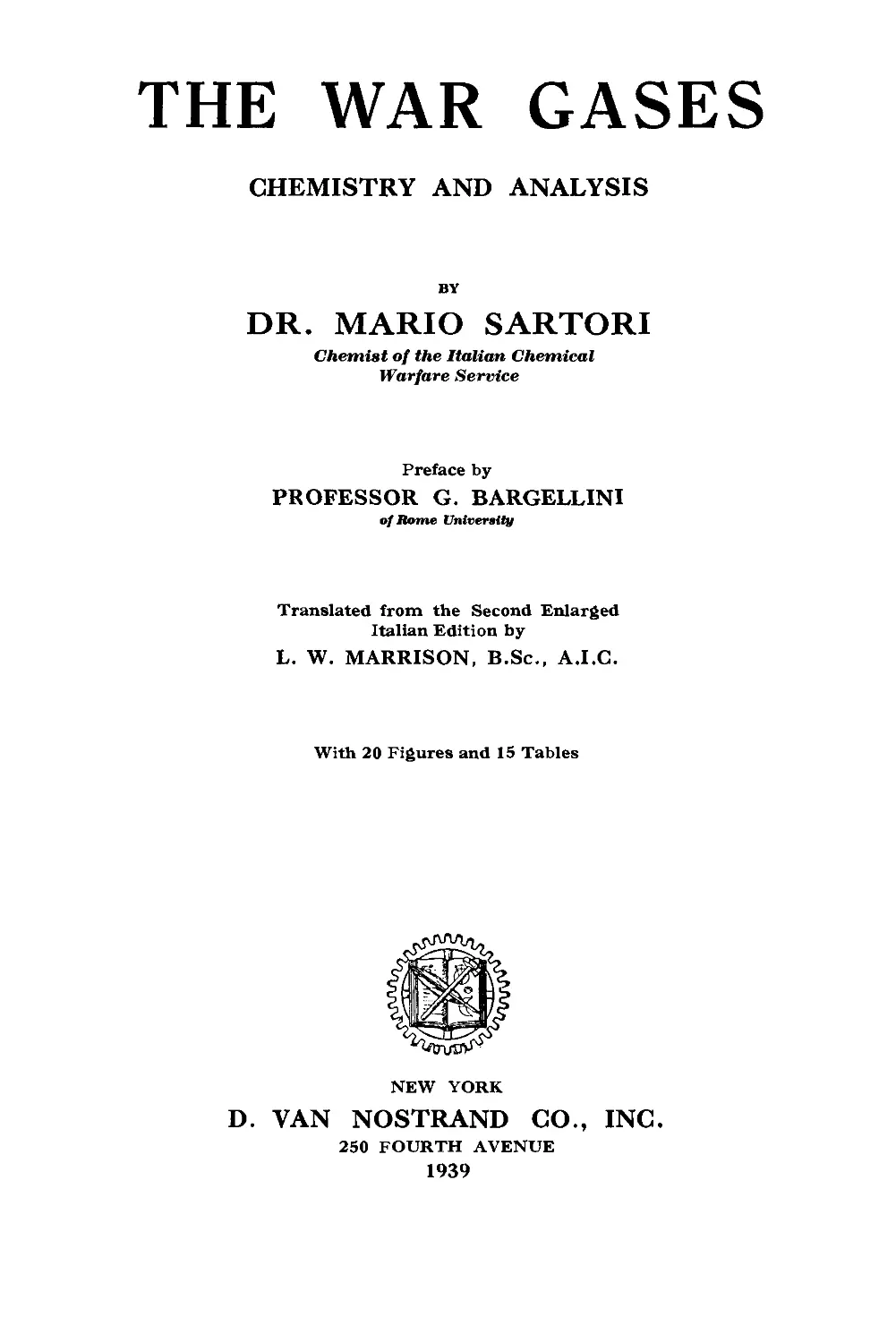
ТНЕ
WAR
GASES
CHEMISTRY AND ANALYSIS
ВУ
DR. MARIO SARTORI
Chemist о/ the Italian Chemical
War/are Service
Preface Ьу
PROFESSOR G. BARGELLINI
01 Roте Univer8ify
Translated from the Second Enlarged
ltalian Edition Ьу
L. W. MARRISON, B.Sc., A.I.C.
With 20 Figures and 15 Tables
8>
NEW YORK
D. VAN NOSTRAND СО., INC.
250 FOUR ТН А VENUE
1939
PREFACE ТО ТНЕ FIRST ITALIAN
EDITION
ТНЕ world conflict of 1914 I8 opened а new field of study in
the Chemistry of War: that of the war gases. Thus the Chemistry
of War, which had for its cradle the chemica11aboratory in Turin
where Ascanio Sobrero discovered nitroglycerine and which for
60 years was confined to the study of explosives, underwent а
new development and а new orientation when substances which
had ап offensive action оп the human and animal organism were
first used оп the field of battle. Then commenced the study of
war gases which has Ьесоте опе of the most complex and
important departments of chemistry.
Our present knowledge of most of these asphyxiating gases is
very superficial and even inexact, which is the reason that while
some merit the importance given to them, others tend to Ье
overvalued. Books are therefore necessary to give information
as to what has Ьееп published of the constitution, the methods of
preparation and the properties of these substances.
While тапу German, American and Russian treatises elucidate
this subject, which is of such great and present interest, in а wide
and complete manner, few publications exist оп the subject in the
Italian language. Dr. Sartori's book therefore fills а lacuna in
our scientific bibliography.
This book Ьу ту pupil, which 1 present to the Italian public,
is а complete account of the information and facts obtained with
scrupulous diligence from very various sources, explained with
clarity and scientific precision, so that it constitutes а trustworthy
and practical work of reference for chemists and of information
for students of this subject.
PROFESSOR GUIDO BARGELLINI.
v
INTRODUCTION
ТНЕ date of the commencement of scientifically organised
chemical warfare is universally fixed at April 22nd, 1915, when
the Germans launched the first cloud of chlorine gas in the region
of у pres.
It тау Ье said that оп the same date thestudy of the war gases
commenced. In the literature of the pre war period, occasiona1
notes appear concerning the physica1, chemica1 and biological
properties of most of the substances which were employed in the
European War as war gases. These notes, however, were not th
resu1t of systematic researches, at апу rate from the biological
side, but of inquiries into accidents.
А complete study of only а few substances was in existence,
but these were more properly poisons, such as the alkaloids and
the arsenic containing pharmaceuticals, etc., and cannot Ье
included among the war gases.
The employment of noxious substances as munitions of war
imposed оп chemists of а1l nations the necessity of co ordinating
and adding to the existing data concerning substances which were
both toxic and a1so had the necessary physical, chemical and
technica1 properties. These researches were concerned both
with the manufacturing processes best suited to the national
resources and with the most efficient methods of employing
substances a1ready known to Ье toxic. Furthermore, the biological
properties of known substances were defined so as to correlate
offensive action with chemical structure, and fina11y, especia11y
at the end of the war and in the post war period, new war gases
were synthesised whose employment would surprise the епету
and which wou1d a1so Ье superior in some respects to those
already in use.
In these researches severa1 thousand substances were examined
during the war, and Edgewood Arsenal, U.S.A., а10пе examined
some 4,000. But, of а1l these, only 54, according to American
data, were tried in the field, and only 12 were being actually
used at the end of the war.
This selection, which was made оп the basis of the actual
conditions in which the substances were employed, shows how
rigorous are the physica1, chemica1 and technica1 requirements
vii
V111
INTRODUCTION
of а substance for it to Ье utilisable in the field. Substances
which are satisfactory from the biological point of view must a1so
(1) Ве сараЫе of being manufactured Ьу practicable and
economical methods with due regard to national resources.
And (2) possess physical and chemical properties which render
them utilisable in the field.
Studies carried out during and since the war have shown that
(а) Not а1l substances harmful to the human organism сап Ье
used as war gases.
(Ь) The most efficient war gases are organic compounds,
the inorganic compounds which have great toxicity being
unsuitable for use owing to their physica1 and chemica1 properties.
The war of 1914 18 thus initiated а new branch of chemistry,
predominantly organic, which only to а limited extent borders оп
toxicologica1 chemistry.
Work in this new field of study is characterised both Ьу
experimental difficulty and Ьу the necessity of co ordinating
chemical facts with physiopathological data and techno military
requirements.
1 t is with the confidence of being аЫе to contribute modest1y
to а wider knowledge of the war gases and in the hope of satisfying
requests for а book which should contain a11 the purely chemica1
data, at present published in the various manua1s of chemical
warfare in fragmentary or summary form, that 1 have collected
in this volume a11 the best and most recent work published ир to
the present оп the chemistry of the war gases.
CONTENTS
PAGE
PREFACE ВУ PROFESSOR G. BARGELLINI
INTRODUCТION .
V
vii
Р ART 1
CHAPTER
1. ТИЕ PRINCIPAL PROPERТIES OF ТИЕ W AR GASES 1
А. РИУSIOРАТНОLОGIСАL PROPERТIES . 1
1. ТИЕ LOWER LIMIТ OF IRRIТATION 2
2. ТИЕ LIMIТ OF INSUPPORTAВILIТY 2
3. ТИЕ MORTALIТY PRODUCT (ТНЕ LETHAL INDEX). 3
В. РИУSIСАL PROPJi;RТIES 4
1. V APOUR TENSlON 4
2. VOLAТILIТY б
3. BOILING POINT 8
4. MELТING POINT 10
S. PERSISTENCE 10
С. СИЕМIСАL PROPERТIES 12
1. STAВILIТY ТО АТМОSРИЕRIС AND СИЕМIСАL
AGENCIES 12
2. STAВILIТY ON STORAGE 13
3. ST AВILIТY ТО EXPLOSION 14
4. ABSENCE OF АТТАСК ON METALS 14
11. RELATION BETWEEN CHEMICAL STRUCTURE AND AGGRES
SIVE ACTION IS
1. INFLUENCE OF HALOGEN ATOMS IS
2. INFLUENCE OF ТИЕ SULРИUR Атом 17
3. INFLuENcE OF ТИЕ ARSENIC Атом 18
4. INFLUENCE OF ТИЕ NIТRO GROUP 20
S. INFLUENCE OF ТИЕ CN GROUP 21
б. INFLUENCE OF MOLECULAR STRUCTURE 22
7. THEORIES OF GENERAL NATURE 23
MEYER'S ТИЕОRУ . 23
ТОХОРИОR Аuхотох ТИЕОRУ 24
111. CLASSIFICATION OF ТИЕ W AR GASES 27
1. РИУSIСАL CLASSIFICATION . 27
2. TACТICAL CLASSIFICATION . 27
3. PHYSIOPATHOLOGICAL CLASSIFICAТION. 28
4. CHEMICAL CLASSIFICATION 29
(а) ]ANKOVSKY'S CLASSIFICATION 29
(Ь) ENGEL'S CLASSIFICATION 32
ix
Х
CONTENTS
PART 11
CHAPTER PAGE
IV. ТИЕ HALOGENS 33
1. СИLОRINЕ 33
2. BROMINE . .. 37
ANAL YSIS OF ТИЕ HALOGENS. 40
V. COMPOUNDS OF DIVALENT CARBON 44
1. CARBON MONOXIDE . 45
2. IRON PENTACARBONYL 47
3. DIВROMOACETYLENE . 50
4. DПОDОАСЕТУLЕNЕ 52
ANALYSIS OF COMPOUNDS OF DIVALENT CARBON 53
VI. ACYL HALOGEN COMPOUNDS 57
1. PHOSGENE, OR CARBONYL СИLОRIDЕ 59
2. CARBONYL BROMIDE 74
3. CHLOROFORMOXIМE . 76
4. DIСИLОRОFОRМОХIМЕ 77
5. OXALYL СИLОRIDЕ 79
ANALYSIS OF ТИЕ ACYL HALOGEN COMPOUNDS 81
VII. HALOGENATED ETHERS
1. DICHLOROMETHYL ЕТИЕR
2. DIВRОМОМЕТИУL ЕТИЕR
ANALYSIS OF ТНЕ HALOGENATED ЕТИЕRS
91
92
96
98
VIII. HALOGENATED ESTERS OF ORGANIC ACIDS 99
А. ТНЕ METHYL FORMATE GROUP 99
1. METHYL FORMATE 100
2. METHYL CHLOROFORMATE . 101
3. MONO , DI and ТRI СИLОRОМЕТНУL СИLОRО
FORMATES. . 104
4. НЕХАСНLОRОМЕТИУL CARBONATE П5
В. ТИЕ ЕТИУL АСЕТАТЕ GROUP П7
1. ЕТИУL СИLОRОАСЕТАТЕ П7
2. ETHYL BROMOACETATE П9
3. ЕТИУL IODOACETATE 121
ANALYSIS OF ТНЕ HALOGENATED ESTERS OF ORGANIC
ACIDS . 123
IX. AROMAТIC ESTERS
1. BENZYL СИLОRIDЕ
2. BENZYL BROMIDE
3. BENZYL IODIDE . .
4. ORTHO NIТROBENZYL СИLОRIDЕ .
5. XYLYL BROMIDE . . .
ANAL YSlS OF ТИЕ AROMAТIC ESTERS
127
129
132
134
135
136
138
CONTENTS
Хl
CHAPTER
Х. ALDEHYDES
ACROLEIN
PAGE
140
140
XI. HALOGENATED KETONES
А. ALIPHAТIC
1. CHLOROACETONE
2. BROMOACETONE
3. BROMOMETHYL ETHYL KETONE
В. AROMAТIC
1. CHLOROACETOPHENONE
2. BROMOACETOPHENONE
146
146
148
150
153
154
155
161
ХII. HALOGENATED NПRО COMPOUNDS 16з
1. TRICHLORONIТROSOMETHANE 164
2. CHLOROPICRIN . 165
3. TETRACHLORODINIТROETHANE 173
4. BROMOPICRIN 174
ANALYSIS OF ТНЕ HALOGENATED NIТRO COMPOUNDS 176
XIII. CYANOGEN COMPOUNDS
1. HYDROCYANIC АСID
2. CYANOGEN FLUORIDE
3. CYANOGEN CHLORIDE
4. СУ ANOGEN BROMIDE
5. CYANOGEN IODIDE
6. BROMOBENZYL CYANIDE
7. PHENYL CARBYLAMINE CHLORIDE
ANALYSIS OF ТНЕ CYANOGEN COMPOUNDS
181
181
187
188
191
194
196
200
2°4
XIV. SULPHUR COMPOUNDS
А. MERCAPTANS AND THEIR DERIVAТIVES
1. PERCHLOROMETHYL MERCAPTAN
2. THIOPHOSGENE
2П
2П
2П
213
В. SULPHIDES (THIOE1'HERS) AND THEIR DFRIVATI'/ES 214
1. DICHLOROETHYL SULРНШЕ (MUSTARD (;AS) 217
2. DIВROMOETHYL SULРНШЕ 243
3. DПОDОЕТНУL SULPНIDE 244
ANALYSIS OF ТНЕ SULРНШЕS (THIOETHERS) 246
С. CHLORO ANHYDRIDES AND ESTERS OF SULPHURIC Асш 253
1. CHLOROSULPHONIC АСID 255
2. SULPHURYL CHLORIDE 258
3. METHYL SULPHURIC АСID 261
4. DIMETHYL SULPHATE 262
5. METHYL FLUОRОSПLРНАТЕ 266
6. METHYL CHLOROSULPHATE 266
7. ETHYL CHLOROSULPHATE . 268
ЛNАLУSIS OF ТНЕ SULPHURIC Лсш DERIVAТIVES 269
Хll
CONTENTS
СНАРТЕК
XV. AI{SENIC COMPOUNDS
А. ALIPHAТIC ARSINES
1. METHYL DICHLOROARSINE
2. ETHYL DICHLOROARSINE .
3. CHLOROVINYL ARSINES (LEWISIТE)
В. AROMAТIC ARSINES
1. PHENYL DICHLOROARSINE .
2. DIPHENYL CHLOROARSINE
3. DIPHENYL BROMOARSINE
4. DIPHENYL СУ ANOARSINE
С. HETEROCYCLIC ARSINE .
1. PHENARSAZINE CHLORIDE (ADAMSIТE)
l-АСоЕ
271
272
273
279
284
297
298
302
314
314
318
320
т ABLES
зз6
AUTHOR INDEX
342
SUBjECT INDEX
347
2 PRINCIPAL PROPERTIES ОР ТНЕ W AR GASES
ТЬе degree of toxicity is usually expressed Ьу the following
characteristics : 1
(1) ТЬе lower limit of irritation.
(2) ТЬе limit of insupportability.
(3) ТЬе morta1ity product.
1. ТЬе Lower Limit of Irritation
ТЬе lower limit of irritation of а gas, a1so termed " the thresho1d
value of pathologica1 sensitivity," 2 is the minimum concentration
provoking а painful sensation at those surfaces оп which it acts
in its characteristic manner. ТЬе surfaces are the conjunctiva,
the nasa1 mucosa and the pharynx, the skin, etc. Experiments
are made оп Ьитап subjects and are continued until the appear
апсе of signs of the specific action of the gas, general1y lachryma
tion or sneezing, оп a11 or nearly a11 the persons taking part in the
experiment.
ТЬе lower limit of irritation is generally expressed in тgm. of
substance per сиЫс metre of air.
In ТаЫе 1 the va1ues of the lower limit of irritation are given
for several substances.
TABLE 1. Lower Liтits o/Irritatioп
WAR GAS
Diphenyl chloroarsine
Chloro acetophenone .
Ethyl dichloroarsine .
Chloropicrin
Phosgene .
Trichloromethyl chloroformate
Dichloromethyl ether
MGM./CU. м.
0'1
0'3
1
2
5
5
14
It will Ье seen from this table that the lower limit of irritation
of the war gases тау vary between fairly wide limits. ТЬе
substance with the greatest irritant power known to the present
is diphenyl chloroarsine.
2. ТЬе Limit о! Insupportability
ТЬе limit of insupportability is the maximum concentration
which а поrmа1 тап сап support for 1 minute without injury.
This characteristic сап only Ье determined for those war gases
which have а predominantly irritant action. In the case of
1 Detailed accounts of the methods of determining these characteristics are
given in LUSTIG, Patologia е cliпica delle malattie da gas di gиerra, Milan, 1937,
and in AKSENOV, Metodika Toksikologii boevikh otravliajиscisch vescestv, Moscow,
1931.
· FERRI and MADESIN1, Giorпale di Mediciпa Militare, January, 19з6, з6.
PHYSIOPATHOLOGICAL PROPERTIES 3
lachrymatories, it is usua1 after abundant lachrymation to arrive
at а condition of photophobia, burnirig of the eyes and inability
to keep the eyes ореп, and this stage is considered tha t of the
limit of insupportability. In the case of sternutators, in
supportability is taken to Ье the stage when, after the production
of sneezing, other symptoms such as coughing, retrosternal pain,
headache, etc., appear and produce the sensation of having
reached а limit beyond which it would Ье unwise to proceed.
In ТаЫе 11 the va1ues of the limits of insupportability are
given for several substances :
ТЛВLЕ 11. Liтits o/Iпsupportability
WAR GAS MGM./CU. М.
ШрЬепуl chloroarsine
Chloroacetophenone .
Ethyl dichloroarsine .
Dichloromethyl ether .
Trich1oromethyl ch1oroformate
Chloropicrin
1
4'5
10
40
40
50
ТЬе substance having the lowest limit of insupportability is
diphenyl chloroarsine, and that having the highest is chloropicrin.
3. ТЬе Morta1ity product
ТЬе morta1ity product, also termed the Lethal Iпdex, or the
НаЬеу Product, W, is given Ьу the product of the concentration, С,
of the substance in air (expressed in тgm. per си. т.), Ьу the
duration, t, of its action (expressed in minutes) sufficient to cause
death. It is normally expressed Ьу the following equation :
Cxt==W
ТЬе mortality product gives the toxic power of the asphyxiants
and of those poisons absorbed through the skin. It cannot Ье
experimentally determined оп the Ьитап subject, and experiments
are norma1ly made оп anima1s, cats, rabbits, cavies or dogs.
It is inversely proportiona1 to the toxicity of а substance:
the lower the value of the index, the greater is the toxic power.
According to Flury,1 the formula quoted above gives va1ues
sufficiently accurate for practica1 purposes when working with
concentrations insufficient to cause th death of the anima1s in а
few minutes and not so low as to need less than severa1 тgm. of
the substance.
American workers have generally determined the mortality
1 FLURY, Z. ges. expt. Med., 1921, 13, 1, and Gasschиtz иnd Lиftschиtz, 1932,
149.
1 2
4 PRINCIPAL PROPERTIES OF ТНЕ W AR GASES
product at two different durations: at ап exposure time of
10 minutes (short exposure) and at ап exposure time of ЗО
minutes (long exposure).
ТЬе va1ues of the morta1ity products are referred to the
species of animal used in the experiments and are va1id only
under the same experimenta1 conditions. ТЬеу are thus not
applicable to тап. However, they give comparative data of
great importance for the eva1uation of the relative toxic power of
su bstances.
ТаЫе 111 gives va1ues of the mortality product for several
substances.
Т ABLE 111. М ortality product
WAR GAS
GERMAN DATA
ON CATS 1
AMERICAN DATA
ON DOGS AND
МIСЕ 2
Phosgene . . . .
Trichloromethyl chloroformate
Dichloromethyl ether
Chloropicrin
Ethyl dichloroarsine
Diphenyl chloroarsine
Chloroacetophenone
450
500
500
2,000
3,000
4,000
4,000
5,000
5,000
4,700
20,000
5,000
15,000
8,500
ТЬе difference between the German and the American resu1ts
in ТаЫе 111 is attributable to various causes 3: the German
va1ues were obtained with cats, and the American with dogs and
mice; cats are more sensitive to some toxic substances and less
to others; the German values were obtained during the war,
when the cats used in the experiments were suffering from
ma1nutrition.
(В) PНYSICAL PROPERТIES
ТЬе principa1 physica1 properties to Ье considered in evaluating
the practica1 utility of а substance for use as а war gas are as
foHows :
1. Vapour Tension
АН liquid and solid substances possess а definite tendency to
pass into the gaseous condition. Because of this tendency, а
layer of vapour forms above еасЬ substance and exercises а certain
1 MEYER, Die Grиndlagen des Lиftschиtzes, Leipzig, 1935.
2 РRЕNТ1SS, Chemicals in War, New York, 1937. The values quoted refer to
an exposure period of 10 minutes.
· FLURY, 10С. cit., and WIRTH, Gasschиtz иnd Lиftschиtz, 19з6, 250.
V APOUR TENSION
5
pressure whose magnitude depends оп the temperature. This
pressure, termed the vapour tension or vapour pressure, is
expressed in тт. of mercury.
In the case of the war gases, this physical constant has ап
especial interest. In order to Ье of use in warfare, at least as а
toxic agent оп the respiratory tract, а gas must have а vapour
pressure high enough at ordinary temperatures to supply enough
gas to the atmosphere to produce useful physiopathological
effects. However, this property has only а minor va1ue in the
case of substances such as diphenyl dichloroarsine, which are
used in the form of aerosols.
There are various methods (static, dynamic, etc.) of determining
the vapour tension of а substance, but it is not proposed to
describe these here, as they тау Ье found in special treatises. 1
Moreover, various formulre тау Ье employed to ca1culate the
vapour tension of а substance at different temperatures. That
in most genera1 use is the empirica1 formula of Regnault 2 :
log р == а + ь t + с у t
This тау a1so Ье used in the following shorter form 3 :
В
10g1oP == А +
273 + t
In this formula А and В are two constants which vary from
substance to substance and whose values тау Ье ca1culated from
the boiling points of the substance, t 1 and t 2 , at two different
pressures, Рl and Р2' Two equations are thus obtained with two
unknowns :
10g1o Рl == А +
в
27З + tj
в
10glo Р2 == А +
27З + t 2
from which the values of А and В тау Ье obtained.
Research carried out Ьу various workers has demonstrated
that this formula gives va1ues sufficiently concordant with those
obtained experimenta11y Ьу the dynamic method. In calculating
1 OSTWALD LuTHER, Physico--chemischeп Messипgeп, Leipzig, 1925.
· WINKELMANN, Haпdbиch der Physik, 111, 1906, 950.
· ВЛХТЕR and BEZZENBERGER, J. Ат. Chem. 50С., 1920, 42, 1з86; HERBST,
Kolloidchem. Beihefte, 1926, 23, 323; MUMFORD and соН., J. Chem. 50С., 1932,
589; LIBERMANN, Khimija i Tecпologija Otravljajиscikh Vescestv, Moscow, 1931.
6 PRINCIPAL PROPERTIES OF ТНЕ WAR GASES
tlle va1ues of the two constants it is necessary, however, to employ
two boiling points at temperatures at least 700 С. apart.
Baxter, Mumford and others,1 applying this formula to the
determination of the vapour tension of war gases, have determined
the values of А and В for various substances as follows :
ТЛВLЕ IV. Values о/ Coпstaпts А aпd В
А.
В.
Phosgene
Chloropicrin
Cyanogen bromide
Dichloromethyl sulphide
Methyl dich1oroarsine
Diphenyl chloroarsine .
7'5595
8'2424
10'3282
8'3937
8.6944
7.8930
1,326
2,045'1
2,457'5
2,734'5
2,281'7
3,288
Ву substituting the values of ТаЫе IV in the formula a1ready
given, the vapour tensions of the various substances тау Ье found
at different temperatures.
In ТаЫе V the va1ues of the vapour tensions of severa1
substances are given in тт. of mercury at 200 С.
ТЛВLЕ V. Vapour Teпsioп at 200 С.
ММ. MERCURY
Bromobenzyl cyanide .
Dich1oroethyl sulphide
Ch1oroviny 1 dich1oroarsine .
Trichloromethyl chloroformate
Chloropicrin
Cyanogen chloride
Phosgene. .
0'012
О'II5
0'395
10'3
16'9
1,001'0
1,173'4
It is seen from this table that the variation in the vapour
tensions of the war gases is very great. For example, some of these
substances have а vapour tension greater than опе atmosphere
(phosgene, cyanogen chloride), while others (dichloroethyl
sulphide, bromobenzyl cyanide) have ап extremely low vapour
tension, and for this reason specia1 methods are necessary in
order to obtain efficient resu1ts in using them in warfare.
2. Volatility
Ву the term volatility is meant the weight of the substance
contained in 1 си. т. of saturated vapour at а certain temperature.
1 See the preceding note.
VOLATILITY
7
ТЬе volatility is usua11y expressed in тgm. of the substance
per си. т. of air, though occasionally also in си. тт. per си. т. of
air. From the latter va1ue the weight per unit volume тау Ье
calculated from the formula :
тgт. == си. тт. Х d
in which d is the density of the substance.
ТЬе volatility is опе of the most important factors in the
selection and eva1uation of war gases.
ТЬе volatility V of а substance at а certain temperature t тау
Ье easily calculated from the following relation :
Vt==
м . 27З . Р . 106
22.4 (27З + t) 760
in which М == molecular weight of the substance, in gm.
Р == vapour tension in тт. of mercury of the substance
at the temperature t.
In the following table, va1ues of the volatility are given in
тgm. of substance per си. т. of air of some war gases at 200 С.
Т ЛВLЕ VI. V olatility at 200 С.
Diphenyl cyanoarsine .
Diphenyl chloroarsine .
Dichloroethyl sulphide
Benzyl bromide . . .
Trichloromethyl chloroformate
Methyl dichloroarsine .
Chloropicrin
MGM./CU. м.
0'17
0'68
625'00
2,400'00
26,000'00
74,400'00
184,000'00
As is seen from ТаЫе VI, the va1ues vary over а wide range ;
while diphenyl chloroarsine at 200 С. has а volatility of only
0.68 тgm. per си. т. of air, at the same temperature the volatility
of cbloropicrin is 184,000 тgm. per си. т. of air. Because of
these differences in volatility, the various war gases are used for
different types of objective and applied Ьу different methods.
As a1ready noted, the volatility of the war gases varies with
temperature. Herbst 1 has established the following approximate
relationship between temperature and volatility:
. Betweeп 100 aпd зоО С. ап iпcrease iп teтperature 0/10 С. causes
ап iпcrease iп volatility о/ about 10%.
Experimenta1 va1ues of the volatility of dichloroethyl sulphide
1 HERBST, Kolloidchem. Beihefte, 1926, 23, 340.
8 PRINCIPAL PROPERTIES OF ТНЕ W AR GASES
between 15° and 25° С. are compared in the following table with
va1ues ca1culated from Herbst's rule:
ТЛВLЕ VII. Volatility о/ Dichloroethyl Sиlphide
TEMPERATURE VOLAТILIТY IN MGM./cU. М.
ОС.
FOUND
cALcULATED
15
16
17
18
19
20
21
22
23
24
25
401
439
480
525
573
625
682
743
810
881
958
401
441
482
528
577
630
687
750
817
891
969
ТЬе increase in volatility caused Ьу increase in temperature
is very effective in bringing about useful effects from the offensive
point of view, especia11y in the case of relatively involatile
substances.
3. ВоПiпg Point
ТЬе boiling point of а substance is that temperature at which
its vapour tension attains the value of the atmospheric pressure.
ТЬе lower the boiling point of а substance, the higher is its
vapour tension and its volatility.
ТЛВLЕ VIII. Boiliпg Poiпts о/ soтe War Gases at а
Pressure 0/760 тт. о/ Меусиуу
Ос.
Ch10rine
Phosgene .
Hydrocyanic acid
Cyanogen bromide. .
Monochloromethyl chloroformate
Chloropicrin. .
Dichloroethyl sulphide
Chloroacetophenone
33'5
8'2
26'5
61
107
II2
217
245
ТЬе war gases have very varied boiling points, as is seen from
ТаЫе VIII. This variation in the boiling points, together with
the differences in physiopathologica1 action, explains the variation
between the types of employment which the war gases find in
BOILING POINT
9
warfare. Thus substances with а relatively low boiling point are
employed in the field when а high gas concentration is required
for а short time, while those with а rather high boiling point are
used when а prolonged action is desired.
According to Herbst, а knowlooge of the boiling point of а
substance enables deductions to Ье made regarding its volatility.
In the following table volatilities at 200 С. are given corresponding
with а series of boiling points.
ТЛВLЕ IX. Relatioп betweeп Boiliпg Poiпt aпd Volatility
В.Р. АТ 760 ММ. VOLAТILIТY АТ 200 В.Р. АТ 760 ММ. VOLAТILIТY АТ 200
Ос. MGM./cU.M. Ос. MGM./cU.M.
300 3 190 2,000
290 6 180 4,500
280 12 170 9,000
270 25 160 14,000
260 50 150 21,000
250 100 140 31,000
240 200 130 46,000
230 з80 120 68,000
220 630 IIО 100,000
210 1,000 100 155,000
200 1,550
From these va1ues, Herbst 1 deduces the following rule concern
ing the relation between boiling point and the volatility at 200 С.
(а) For boiling points between зооО and 2ЗОО с., а diminution
in boiling point of 100 С. corresponds to а doubling of the
volatility.
(Ь) For boiling points below 2ЗОО С., а diminution in boiling
point of 100 С. corresponds to ап increase in volatility of 1'5 to
1.6 times.
ТЬе boiling point is ап important characteristic of а war gas,
not only because of its connection wiф vapour tension and there
fore with the tactica1 aims attainable in warfare, but a1so because
of its influence оп the ease of storage and transport of the
substance. А war gas whose boiling point is lower than ordinary
temperatures, as, for example, phosgene, is difficu1t to pack and
necessitates the use of refrigerating apparatus during transport
in order to keep it below its boiling point.
ТЬе preference of the Germans during the war of 1914 18 for
employing trichloromethyl chloroformate (diphosgene) rather than
1 HER5ST, /ос. cit.
10 PRINCIPAL PROPERTIES OF ТНЕ W AR GASES
phosgene was due to the difficulties of manipulating the latter
gas, owing to its low boiling point.
4. Melting Point
ТЬе me1ting point of а substance is the temperature at which
the solid and the liquid phases of the substance are in equilibrium.
Т ЛВLЕ Х. М eltiпg Poiпts о/ soтe War Gases
Ос.
Chlorine
Chloropicrin . . .
Trichloromethyl chloroformate
Hydrocyanic acid
Dichloroethyl sulphide
Chloroacetophenone
102
69
57
15
+ 14'4
+ 58
ТЬе me1ting point is ап important factor in the use of а gas in
warfare, for оп it depends the practicabi1ity of its employment.
It is easily understood that substances which are quite suitable
for use with respect to their action in the vapour state cannot Ье
efficient1y employed in cold regions if they have а high me1ting
point, without having recourse to special methods such as
admixture with other substances so as to reduce the melting
point. Thus in the case of dich1oroethyl sulphide, which in the
pure state me1ts at about 140 С., а solution of this substance in
chlorobenzene was widely used during the war. ТЬе me1ting
points of mixtures of dichloroethyl sulphide (of 94 95% purity;
т.р. 13'40 с.) with chlorobenzene and with carbon tetrachloride
in various proportions are given in the following table :
% Solveпt Chlorobeпzeпe Carboп
tetrachloride
т.р. т.р.
О 13'40 13'40
10 8'40 9.80
20 6'40 6.60
30 1'00 3'10
As wil1 Ье seen, chlorobenzene, which was more commonly
employed for this purpose, forms mixtures whose melting points
are lower than the corresponding mixtures containing carbon
tеtrз.сhlоridе.
5. Persistence
ТЬе persistence is the time during which а substance сап
continue to exercise its action in ап ореп space.
PERSISTENCE
II
Among the numerous factors which influence the persistence
of а gas, the most important are the speed of evaporation 'of the
substance, the temperature of the air and the chemical and
physica1 nature of the ground.
Leitner 1 has proposed the following formula for ca1culating the
persistence of а war gas :
С V
S с 1 == :1 :
1
in which :
5 is the persistence of the substance.
С is the velocity of evaporation of the substance at absolute
temperature Т.
С 1 is the velocity of evaporation of water at 15° С.
Р is the vapour tension of the substance at Т.
Рl is the vapour tension of water at 15° С. 12'7 rшn.
М is the molecular weight of the substance.
М 1 is the molecular weight of water == 18.
Т is the absolute temperature of the air.
Т 1 is the absolute temperature corresponding to 15° С.
This formula gives accurate va1ues for the time which а
substance takes to evaporate compared with the time taken Ьу
the same quantity of water at 15° С. in the same conditions.
In the following table the va1ues of the persistences of severa1
war gases are given at various temperatures (persistence of water
at 15° С. == 1) ca1culated according to Leitner's formula :
т ЛВLЕ XI. Persisteпces о/ soтe War Gases
Temperatиre ОС.
с
10 5 о +5 + 10 +15 +20 +25 1 +30
Phosgene 0'014 0'012 0'01 0'008
hloropicrin . 1'з6 0'98 0'72 0'54 0'4 0'3 0'23 0'18 0'14
Trichloromethyl
chloroformate 2'7 1'9 1'4 1'0 0'7 0'5 0'4 0'3 0'2
Lewisite 96 63'1 42'1 28'5 19'6 13.6 9.6 6'9 5
Dichloroethyl
sulphide (liquid). 103 67 44 29
ichloroethyl
sulphide (solid) 2,400 1,210 630 333 181
Bromobenzyl
cyanide 6,930 4,110 2,490 1,530 960 610 395 260 173
D
1 LEITNER, Militarwisseпsch. и. Techп. Mitteil, 1926, 662.
12 PRINCIPAL PROPERTIES OF ТНЕ W AR GASES
However, Nielson's work 1 shows that these data have only ап
approximate va1ue and indicate merely the order of magnitude
of the persistence. Nielson observed, iпter alia, that in Leitner's
formula the time of evaporation of а substance is compared with
that of water into а dry atmosphere, whereas in practice the
atmosphere a1ways contains а certain amount of water which
retards the velocity of evaporation. Nevertheless, the data for
persistence obtained from Leitner's formula, though they have
only ап approximate va1ue, are of interest from the practica1 point
of view, for they a110w va1ues of the persistences of different gases
to Ье compared. For example, from ТаЫе ХI it is seen that the
relative persistences of dichloroethyl sulphide and lewisite at
25° С. are as 44 is to 6'9, and this signifies that at this temperature
dicbloroethyl sulphide is about six times as persistent as
lewisite.
These va1ues, it will Ье understood, indicate only the persistences
independently of the atmospheric conditions, and of the stability
of the substances to humidity, and to the physical structure and
condition of the ground.
With regard to the last factor, Leitner has specified that the
va1ues of the persistences given above refer to substances spread
оп " ореп flat land in dry weather." ТЬеу тау Ье doubled if
the substance lies оп "broken ground " and tripled if it is in
" wooded country."
(С) CHEМICAL PROPERТIES
ТЬе most important chemical properties to Ье considered in
eva1uating the practica1 possibilities of а substance for warfare
are:
1. StаЬШtу to Atmospheric and Chemical Agencies
From the chemica1 point of view а war gas must Ье sufficiently
resistant to the various agents into which it тау соте into
contact in practice. 1t is especially important that it should Ье
indifferent to atmospheric agencies. In the first place, аН these
substances must Ье indifferent to atmospheric oxygen. However,
а large number are decomposed more or less rapidly Ьу the action
of atmospheric humidity, and a1most аН are decomposed in time
Ьу rain.
Rona 2 has made some experiments оп the decomposition of
war gases Ьу water. Не has demonstrated experimentaHy that
some substances are rapidly decomposed Ьу water (phosgene,
1 В. NE1LSEN, Z. ges. Schiess. Spreпgstoffw., 19З1, 26, 420.
· RONA, Z. ges. expt. Med., 1921, 13, 16.
CHEMICAL ST ABILITY
1З
dichloromethyl ether, etc.), others decompose slowly (dichloroethyl
sulphide), others only very slowly (benzyl bromide, benzyl iodide,
xylyl bromide, etc.), while some are practically unattacked
(chloropicrin, chloroacetone, iodoacetone, etc.).
Cblorovinyl dichloroarsine is rapidly hydrolysed Ьу water.
According to Vedder 1 this substance, though powerfully toxic,
could not Ье efficiently used in ореп country because of its high
velocity of hydrolysis.
In genera1, oxygen containing compounds are more stable than
the corresponding sulphur containing ones, according to Meyer,2
who adds that the stability increases with ап increase in the length
of а chain of carbon atoms.
With respect to their employment in war а knowledge of the
behaviour of substances towards water is of great importance,
particularly Ьу rendering it possible to define the conditions of
humidity in which а certain substance тау Ье employed,
especia11y in considering the length of time during which it is
desired to maintain ап area in the gassed condition.
ТЬе sensitivity to water seriously complicates both the storage
of war gases and their fi1ling into projectiles. Those which are
readily hydrolysed need the employment of specia1 precautions
when they соте into contactwith air, which a1ways contains
water vapour, and when they are being filled into projectiles or
storage containers, which must Ье quite dry intemally.
War gases must further possess а certain indifference towards
the соттоп chemical agents, as alka1ies, acids, oxidants, etc.
Chemica1 resistance contributes great1y to the aggressive value
of а gas Ьу making its destruction difficu1t.
2. Stаьшtу оп Storage
Another type of stability required of а war gas is that it shall
not undergo decomposition or polymerisation during storage.
ТЬе decomposition which takes place in some substances, such as
bromoacetone, hydrocyanic acid, etc., тау Ье so inconvenient
that the storage of such compounds is impossible.
Polymerisation usua11y resu1ts in the formation of substances
of little or по toxicity, as happens, for example, in the case of
acrolein.
This form of a1teration has raised the problem of stabilisers,
that is, substances which when added in quite sma11 quantity,
preserve the aggressive properties of the gas. For some of these
gases, as acrolein, hydrocyanic acid, etc., efficient stabilisers are
1 VEDDER, Medical Aspects о/ Chemical War/are, Baltimore, 1925, 158.
· MKYER, Der Gaskamp/ и. die chemischeп Kamp/stoffe, Leipzig, 19з8, 72.
14 PRINCIPAL PROPERTIES OF ТНЕ W AR GASES
known, while for others the problem is still being studied, and at
present it is still impracticable to employ some substances which
in other ways present great interest as potentia1 war gases.
3. Stability to Explosion
From the tactica1 point of view а substance which is to Ье
employed in projectiles must Ье stable to the heat and pressure
generated Ьу the explosion of the bursting charge. With regard
to the stability to heating, the substance must Ье аЫе to resist the
rise in temperature resulting from the explosion of the charge in
the projectile. This is of great importance and limits the number
of useful war gases. Among the substances hitherto considered,
bromobenzyl cyanide shows some sensitivity to а rise in tempera
ture. Мапу others, including diphenyl chloroarsine, ch1oroaceto
рЬепопе, etc., resist even high temperatures fairly wel1, while
some, as chloropicrin, trichloromethyl chloroformate, etc., though
decomposing with heat, have the advantage of producing equally
toxic compounds in doing so.
With regard to the resistance to the explosion pressure the
insensitivity of war gases is another condition essentia1 to their
use in projectiles. Chloroacetophenone is practica11y completely
insensitive.
4. Absence of Attack оп Metals
ТЬе last requisite of а war gas is comparatively important :
the absence of апу attack оп the material in which it is to Ье
stored or used. Some war gases strongly attack the iron which
commonly forms the storage containers and projectiles; such
are xylyl bromide, the incompletely chlorinated formates,
bromobenzyl cyanide and а few others.
This corrosive action necessitates the employment of special
expedients, such as :
(а) Protection of the meta1 wa11s of the container with layers of а
substance which is not attacked, such as shellac, enamel, tin, etc.
(Ь) Employment of а supplementary container which isolates
the war gas from the wa11s of the container. (Containers of glass,
lead, etc., are used.)
CHAPTER 11
RELATION BETWEEN CHEMICAL STRUCTURE
AND AGGRESSIVE ACTION
ТНЕ employment of toxic substances as а military arm has
added interest to the study of the relation between physio
pathologica1 action and chemica1 constitution, which started some
years ago.
This study, particularly important in the case of the war gases
because of the guidance afforded in the discovery of new gases,
has centred around the relation between their chemica1 structure
and the type of action which they exert (lachrymatory, asphyxiant,
sternutatory, etc.).
ТЬе pro blem has a1ways attracted intensive study and experi
ment, but owing to the short period during which this has Ьееп
prosecuted, as well as the secrecy which has surrounded the
results, it is not yet possible to state the genera11aws with апу
certainty. However, it will Ье of interest to give ап account of
the observations and hypotheses published оп the influence of
the structure of these substances, and in particular of the
introduction of certain atoms or radicles, оп the nature of the
action exerted.
ТЬе majority of the substances employed as war gases during
the war of 1914 18 were organic. Among the inorganic compounds
employed were chlorine, bromine, arsenic trichloride, etc. These,
though having relatively litt1e aggressive power, were used at
the commencement of gas warfare chiefly because of the ease of
their manufacture and the simplicity of their application. Various
other inorganic substances, such as phosphine, arsine and stibine,
a1though very toxic, have not Ьееп used as war gases because of
their unsuitable physica1 properties.
ТЬе organic compounds having aggressive action usually
contain atoms of halogen, sulphur or arsenic or radicles such as
N02' N, etc., in their molecules. It is to these atoms or
radicles as well as to the molecular structure that the physio
pathologica1 action is nowadays attributed.
1. Influence of Halogen Atoms
ТЬе ha10gens themselves have а noxious action оп the anima1
organism and this diminishes in intensity in passing frQm fluorine
15
16 CHEMICAL STRUCTURE AND AGGRESSIVE ACTION
to iodine, that is, it is less the greater the atomic weight of the
ha10gen; the tendency to сотЫпе with hydrogen a1so diminishes
with increase in atomic weight.
ТЬе introduction of ha10gen into the molecule confers aggressive
properties which vary according to the nature of the ha10gen and
the number of ha10gen atoms introduced. With regard to the
influence of the nature of the ha1ogen, it has Ьееп observed that
the lachrymatory power of ha10genated substances increases
with increase of the atomic weight of the ha10gen present.
Thus, bromoacetone is а more powerful lachrymatory than
chloroacetone :
Вr СН2 СО СНЗ Lower limit of irritation 1 mgm.jcu. m.
Сl СН2 СО СНЗ 18
Benzyl iodide has а lachrymatory action superior to that of
the bromide :
С6Нб СН2I Lower limit of irritation 2 mgm.jcq. m.
С6Нб СН2Вr 4
However, the truly toxic action varies inversely as the atomic
weight of the ha1ogen. Bromoacetone is less toxic than
cbloroacetone 1 :
Вr СН2 СО НЗ Mortality product 4,000
Сl СН2 СО СНЗ 3,000
Dibromoethyl sulphide is less toxic than dichloroethyl sulphide :
S(CH 2 CH 2 Br S(CH 2 CH 2 Cl
CH 2 CH 2 Br СН 2 СН 2 Сl
Mortality product 10,000 Mortality product 1,500
In considering the influence of the number of ha10gen atoms
present it is found that while опе ha10gen atom confers pre
dominantly lachrymatory properties оп the molecule, ап increase
in the number of the ha10gen atoms diminishes the lachrymatory
but increases the asphyxiant action. А typica1 example of this
observation is the series of ha10genated esters of formic acid. In
this the first member, monochloromethyl cbloroformate, has а
predominantly lachrymatory action, while the last, trich1oro
methyl chloroformate, has ап essentially asphyxiant action and
practically по lachrymatory property.
Cl COOCH Сl { ' L?w r li it of irritat n 2 mgm.jcu. m.
2 L1mlt of msuрроrtаЬЙItу 50 "
Cl COOCCl { L?w.er li it of irritat n 5 mgm.jcu. m.
3 Llmlt of шsuрроrtаыltуy 40 "
1 The mortality products quoted in this chapter are those of German authorities
(ер. р. 4).
INFLUENCE OF CHLORINE AND SULPHUR ATOMS 17
Other examples occur in the series of chlorinated nitromethanes,
in which it is found that the dichloro derivative is less toxic than
the trichloro compound.
This law is not, however, a1ways applicable. With some
substances, as dichloroethyl sulphide, diphenyl chloroarsine, etc.,
it is found that the introduction of further halogen atoms first
diminishes and then destroys the aggressive properties of the
origina1 compound.
ТЬе position occupied Ьу the ha10gens in the molecule also has
а notable influence оп the aggressive properties. In the aliphatic
series, it is found that compounds with the ha10gen atom in the {3
position,
СНз СО СН2 СН2Сl and Cl CH2 H2 CO O, С 2 Н 5
{j chloroethyl methyl ketone and ethyl {j chloropropionate
are more powerfullachrymatories than their isomers which have
the halogen in the а position,
СНз СО НСl Нз and СНз НСl О OC2H5
а chloroethyl methyl ketone and ethyl а chloropropionate
In the aromatic series it is observed that the introduction of а
ha10gen atom into the side chain of а substance confers lachryma
tory properties, while if it replaces а hydrogen atom from the
benzene nucleus, а substance results which has по physiopatho
10gica1 properties. Thus, from toluene, benzyl bromide,
C6H5 CH2Br, is obtained in the first case. This has energetic
lachrymatory properties, while bromotoluene, С6Н4Вr СНз, has
по toxic action.
This difference in physiopathological properties is probably
connected with а difference in the mobility of the halogen atom.
It is noteworthy that if this is in the nucleus it is less easily
removed than if it is in the side chain.
ТЬе degree of mobility of the ha10gen atom has а great influence
оп the aggressivity of the substance. ТЬе halogen must not Ье
bound in too labile а manner to the molecule, otherwise it wil1 Ье
attacked Ьу atmospheric agencies or Ьу the surface of the
organism before the entire molecule has penetrated the cel1s.
Neither тау it Ье bound to the molecule in too stable а manner,
otherwise the substance wil1 Ье practica11y inert, for the atom
wil1 not even Ье detached in the interior of the organism.
2. Influence of the Sulphur Atom
Sulphur is not genera11y considered as а toxic element in the
same way as are the halogens. Nevertheless, its presence seems
to confer оп а substance the capability of penetrating the
18 CHEMICAL STRUCTURE AND AGGRESSIVE ACTION
epidermis, which explains the actua1 aggressive properties of such
compounds.
Ап example of this observation is found in а comparison of
substances containing а sulphur atom with their ana10gues
which contain oxygen. For example, dich1oroethyl sulphide
( CH2 CH2Cl
(mustard gas) S is а powerful vesicant, while the
CH2 CH2Cl СН CH.Cl
corresponding oxide, dich1oroethyl ether, о( 2 has
CH2 CH2Cl
по such properties.
Comparatively few war gases contain sulphur in their molecules.
It is genera11y observed that the degree of toxicity of the sulphur
compounds varies with the va1ency of the sulphur atom and with
the nature of the radicles with which the sulphur is united.
Among the sulphur compounds those of the type R 2 S (diva1ent
sulphur) are more toxic than those of the type R 2 SO (tetrava1ent
sulphur) and far more than those of the type R 2 S0 2 (hexava1ent
sulphur). That is, the higher the va1ency of the sulphur atom,
the lower the toxicity of the substance. Some studies have Ьееп
carried out showing the relation between the decrease in toxicity
observed when the sulphur atom in the molecule passes from the
diva1ent to the hexavalerit state, and the variation in physical
properties, more especially the diminished solubility in lipoids.
Those compounds in which the sulphur has а specific function
a1so contain ha10gen atoms. Such are, for instance, dichloroethyl
sulphide, dibromoethyl sulphide, etc.
Little is known regarding the influence оп the aggressive
properties of а substance of the introduction of а sulphur atom.
In the particular case of the derivatives of dichloroethyl sulphide,
it has Ьееп observed that ап increase in the number of sulphur
atoms in the molecule does not notably diminish the vesicatory
&--CH2 CH2 Сl
properties. Dich1oroethyl disulphide, e.g., I has а
S CHrCH2 Сl
vesicatory power only one third less than that of dichloroethyl
sulphide. 1
3. Influence of the Arsenic Atom
ТЬе arsenic atom also imparts toxic properties to а higher
degree than the sulphur atom. It is а general rule that substances
containing а triva1ent arsenic atom have а considerably greater
1 BENNETT, J. Chem. 50С., 1921,119, 418.
INFLUENCE OF ТНЕ ARSENIC АТОМ 19
physiopathologica1 action than those containing а pentava1ent
arsenic atom.
ТЬе arsenica1 war gases contain ha10gen atoms or organic
radicles such as CN, SCN, etc., besides the arsenic atom.
ТЬе nature of the aggressive action depends оп the number
and the nature of the organic radicles with which the arsenic
atom is linked.
In genera1, arsenica1 compounds have ап aggressive action
when two of the three valences of the arsenic atom are linked to
like atoms or groups and the third to а different atom or radicle.
If а1l tlle three va1ences of the arsenic atom are linked to similar
atoms or radicles the compound has practica11y по aggressive
action. Thus in the series of chlorovinyl arsines, it has Ьееп
found that trichlorovinyl arsine has practica11y по aggressive
action compared with chloroviny1chloroarsine or dichlorovinyl
chloroarsine :
СН=СНСl
AS / \ CH=CHCl
СН=СНСl
trichlorovinyl
arsine
/ СН=СНСl
As \ Сl
Сl
chlorovinyl
dichloroarsine
/CH=CHCl
As CH=CHCl
\Сl
dichlorovinyl
chloroarsine
In the series of aromatic arsines there is а great difference in
aggressive action between triphenyl arsine, phenyl dichloroarsine
and diphenyl chloroarsine.
/ с 6 н б
As \ с6нб
с 6 н б
triphenyl
arsine
/ с 6 н б
As \ Сl
Сl
phenyl
dichloroarsine
/ с 6 н б
As \ С6Нб
Cl
diphenyl
chloroarsine
In particular it тау Ье observed that :
(а) When the arsenic atom is linked to ап unsaturated radicle,
the substance has а predominantly vesicatory action, as in the vinyl
chloroarsines, the styryl chloroarsines, etc. This physiopathological
action decreases with increase in the number of organic radicles
linked to the arsenic atom. Thus, substances with а single organic
radicle have а more powerful vesicatory action than those with
two or more organic radicles. А typica1 example of this obs rva
tion is found in the chlorovinyl arsine series, for chlorovinyl
dichloroarsine has а greater vesicatory action than dichlorovinyl
chloroarsine.
(Ь) When the arsenic atom is linked to ап a1kyl or phenyl
group, substances with а predominantly irritant action are
obtained. This physiopathologica1 action is accentuated in
20 CHEMICAL STRUCTURE AND AGGRESSIVE ACTION
compounds containing two such radicles linked to the arsenic
atom:
(C6H5)2AsCl Diphenyl chloroarsine: Limit of insupportability,
1 mgm.jcu. m.
C 6 H 5 AsC1 2 РЬепуl dichloroarsin : Limit of insupportability,
16 mgm.jcu. m.
and in compounds containing the phenyl radicle rather than ап
a1kyl radicle :
C 6 H 5 AsC1 2
РЬепуl dichloroarsine: Limit of insupportability,
16 mgm.jcu. m.
Methyl dich10roarsine: Limit of insupportability,
25 mgm.jcu. m.
(с) ArSenic compounds containing ethyl radicles are more toxic
than the corresponding compounds containing methyl radicles.
Thus the derivatives of ethyl arsine (the oxide, chloride, etc.)
have а greater toxic action than the corresponding compounds
of methyl arsine :
C 2 H 5 AsC1 2 Ethyl dich10roarsine: Limit of insupportability,
10 mgm.jcu. m.
Methyl dichloroarsine: Limit of insupportability,
25 mgm.jcu. m.
(d) ТЬе substitution of the phenyl radicle Ьу опе of its higher
homologues reduces the aggressive action of the resulting
compound. For example, ditolyl chloroarsine is less irritant in
its action than diphenyl chloroarsine.
ТЬе presence of ha10gen atoms in the molecules of organic
arsenica1s usua11y confers irritant properties. Among these
halogen compounds, those containing chlorine have а superior
irritant power to the analogous bromine and iodine compounds,
e.g., diphenyl chloroarsine has а greater irritant power than
diphenyl iodoarsine.
Ап increase in toxic power is a1so found in organic сот pounds
whose molecules contain а cyanide radicle; thus diphenyl
cyanoarsine is more irritant than diphenyl chloroarsine :
(C6H5)2AsCN Limit of insupportability, 0'25 mgm.jcu. m.
(C6H5)2AsCl ,,1
СН з АsС1 2
СН з АsС1 2
4. Influence of the Nitro Group
ТЬе aggressive properties conferred оп а substance Ьу the
introduction of the N02 group depend оп whether the group
combines through ап oxygen or а carbon atom, that is, whether
INFLUENCE OF ТНЕ N0 2 AND CN GROUPS 21
а nitrate or а nitro compound is produced. ТЬе nitrates have
not Ьееп used as war gases, but very efficient agents are included
among the nitro derivatives, e.g., trichloro nitromethane
(cbloropicrin), tribromo nitromethane, etc.
In particular the introduction of the N0 2 group confers
lachrymatory properties or increases апу such tendency if it is
origina11y present in the molecule.
Typica1 examples of this are found among the nitro dеrivаtivез
of the benzene halides: o nitro benzyl chloride has а тисЬ more
powerful lachrymatory action than benzyl cbloride or than the
corresponding bromide or iodide.
С 6 Н Б СН 2 Сl Benzyl cbloride: Lower limit of irritation, 77
mgm.jcu. m.
C 6 H s CH 2 Br Benzyl bromide: Lower limit of irritation, 4
mgm.jcu. m.
C 6 H 4 (NO2) СН 2 Сl o Nitro benzyl chloride: Lower limit of irrita
tion, 1.8 mgm.jcu. m.
With ап increase in the number of N0 2 groups the augmentation
of the lachrymatory properties is sometimes found to Ье very
great. Such is the case with tetrachloro dinitroethane, which is
eight times as powerful а lachrymator as trichloro nitromethane.
According to N ekrassov, and Hackmann,1 the introduction of
the N0 2 group into the molecule of ап aromatic compound
confers vesicatory properties, or increases апу which the substance
a1ready possesses.
ТЬе influence of the NOH group оп the toxic properties of
substances has only recent1y Ьееп studied, derivatives of carbonyl
chloride such as dicbloro and dibromo formoxime being examined.
It seems that the NOH group causes accentuation of aggressive
properties, in particular conferring "orticant" action (i.e.,
causing skin irritation).
5. Influence of the CN Group
То the CN group two different structures are attributed: опе,
C == N, the nitrile, the other N == С, the isonitrile grouping.
It has Ьееп observed that compounds containing the isonitrile
group have more powerful toxic properties than those containing
the nitrile. This difference in biological. properties сап Ье
compared with the greater facility with which compounds
containing the isonitrile radicle liberate hydrocyanic acid.
ТЬе presence of а second CN group genera11y diminishes the
aggressive properties of а substance, and the presence in the
1 NEKRASSOV, Khimija Otravliajиscik Vescestv, Leningrad, 1929; and
HAcKMANN, Chem. Weekblad, 1934, 31, з66.
22 CHEMICAL STRUCTURE AND AGGRESSIVE ACTION
same molecule of the CN group and of other atoms such as
ha1ogens, while reducing the toxic action of the substance,
confers highly lachrymatory properties. For example, cyanogen
bromide and iodide are тисЬ less toxic than hydrocyanic acid
but are powerful lachrymators. ТЬе same rule applies in the
case of such aromatic derivatives as bromobenzyl cyanide,
cblorobenzyl cyanide, etc.
6. Influence of Molecular Structure
According to various observations, the aggressive action of а
substance depends not only оп the presence of particular atoms
or radicles in the molecule, but a1so оп the molecular structure,
and in particular оп
(а) ТЬе presence of unsaturated bonds, and
(Ь) ТЬе molecular symmetry.
Iпjlueпce о/ Uпsaturated Boпds. ТЬе presence of unsaturated
bonds in the molecule usua11y involves ап increase in the
physiopathological properties. This observation was made Ьу
Loew in 189З.
Among the war gases various examples occur of the influence
of the unsaturated bond. Thus, acrolein СН 2 == CH CHO,
has strongly irritant properties, while the corresponding saturated
aldehyde, propiona1dehyde, СНЗ СН2 СНО is innocuous.
Similarly, fЗ cblorovinyl dichloroarsine, Cl CH == CH AsC12' is
а powerful vesicant, while the corresponding saturated compound,
fЗ chloroethyl dicbloroarsine, Cl CH2 CH2 AsC12' has only weak
vesica tory properties. 1
Other examples тау Ье found among the тono and di
halogenated acetylenes, such as diiodo and dibromo acetylene,
CI 2 ==- С and CBr 2 == С, which have more interesting
physiopathologica1 properties than the halogenated paraffin
hydrocarbons.
Iпjlueпce о/ Molec'ular Syттetry. ТЬе spatia1 arrangement of
the functiona1 groups in а molecule has а definite influence оп
the degree of its toxicity. It has Ьееп observed that substances
with symmetrica1 molecules generally have а more powerful
aggressive action than asymmetrica1 substances. Thus,
symmetrica1 dichloroacetone ,
CH2 Cl
I
СО
I
CH2 Cl
1 FERRAROLO, Miпerva Medica, 1935,27, П, 30.
GENERAL THEORIES: MEYER'S THEORY 2З
has great irritant powers, while asymmetrical dich1oroacetone
СН з
I
СО
I ,
CHCl a
is almost completely lacking in irritant properties.
Another example occurs in the series of ha10genated methyl
ethers. When the ha10gens оссиру а symmetrica1 position, as
< CH2 Cl
in sym. dichloromethyl ether, О the substance has а
CH2 Cl
тисЬ more energetic lachrymatoryaction than that ш which
the chlorine atoms are asymmetrica11y placed, i.e., ш asytn.
< СН з
dichloromethyl ether О .
CH C12
7. Theories о! General Nature
General theories concerning the relation between chemical
structure and physiopathological action have Ьееп elaborated
with especia1 reference to the war gases. From among the тапу
published, ап account is given here of two: Meyer's Theory and
the " Toxophor Auxotox " Theory. .
Meyer's Theory. According to this theory,1 the physio
pathologica1 action of war gases is attributed to certain atoms or
radicles which have а tendency to react easily with other
substances Ьу addition. This classification оп the basis of their
ease of reaction should Ье determined Ьу their combination with
the various biologica1 entities or tissues (as the blood, the nerve
cells, the respiratory epithelia, etc.) which undergo specific and
characteristic a1terations.
То опе group belong, for example, the halogen atoms, as the
chlorine in phosgene, cyanogen cbloride and the chlorovinyl
chloroarsines; the bromine in ethyl bromoacetate, cyanogen
bromide, etc. These atoms are linked in а very labile manner
to the remainder of the molecule and react easily with water and
other substances. Also the oxygen atom is highly reactive when
in the vicinity of а ha10gen in the halogenated a1dehydes, esters
and ethers, such as dichloromethyl ether, tricbloromethyl cbloro
formate, etc.
ТЬе radicles which react most easily are the N02 group in
o nitro benzyl chloride and bromide, the co group in the
1 J. MEYER, Der Gaskampj и. diechemischeп Kampfstoffe, Leipzig, 1926,90.
24 CHEMICAL STRUCTURE AND AGGRESSIVE ACTION
ha10genated ketones and the CN group in bromobenzyl cyanide
and diphenyl cyanoarsine, etc. А1l these radicles, which are
notable for their reactivity with water or other substances,
confer а certain degree of toxicity Ьу their presence in the
molecule. However, оп considering the structure of the molecules
of the war gases, it is seen that while some of these contain atoms
or radicles of great reactivity, others are distinguished Ьу ап
unusua1 resistance to chemica1 reagents yet possess а high degree
of aggressiveness.
In such cases, Meyer suggests, the aggressive action тау Ье
attributed to the capacity of the entire molecule of forming
additive compounds with vita1 constituents of the organism.
Toxophor Auxotox Theory. ТЬе theory of toxophors and
auxotoxes, first elaborated Ьу Ehrlich 1 for toxic substances and
later applied Ьу Nekrassov 2 to the war gases, attributes the
physiopathologica1 properties of these substances to specia1
atoms or radicles in а similar manner to Witt's theory regarding
the colour of organic substances.
Witt's theory of coloured substances тау Ье summarised as
follows: the presence of colour in а substance depends оп the
presence of certain atomic groupings called "chromophores."
For instance, the N == N group characteristic of the azoic
colours, the N02 group, the == С ==- О group, etc. It is to the
presence of these groups that the more or less intense'colouration
of а compound is due. But in order that а coloured substance
тау Ье сараЫе of being fixed оп animal or vegetable fibres, it
must have in the molecule not only chromophoric groups, but a1so
contain other groups, ca11ed " auxochromes " which give it the
capability of combining intimately with the fibre. Typica1
auxochromic groups are: NH 2 , ОН, etc.
ТЬе war gases, according to Nekrassov, have structures
ana1ogous to those of coloured substances. Ву examining the
chemical structures of the war gases, certain atomic groups are
found which confer оп substances the potentia1ity of becoming
war gases, in the same way as Witt found certain groupings
соттоп to coloured substances. ТЬе groupings found in war
gases are ca11ed "toxophors." Such are, for example :
О
>со; s< ; >с=с< ; N{O ; N=C ; As< ; etc.
There also exist other groups сараЫе of communicating the
characteristic toxic functions of the toxophoric group, that is, of
1 Р. ЕИRLIСИ, Deиt. med. Wochschr., 1898, 1052.
· NEKRASSOV, Khimija Otravliajиscikh Vescestv, Leningrad, 1929, 30
ТНЕ TOXOPHOR AUXOTOX THEORY 25
transforming into actuality the latent capacity of the toxophor
group. These groups are named "auxotoxes," and тау Ье
either :
atoms: ha1ogens, oxygen, etc.
or
atomic groups: NH2' benzyl, phenyl, methyl, ethyl
radicles, etc.
With the aid of this theory it is explained that just as in
coloured substances the introduction of some auxochromic
groups changes the colour of the substances, so in the war gases
the presence of certain autotoxes сап a1ter the type of biological
action. Thus, for example, ha10gen introduced into the
hydrocyanic acid molecule reduces the toxicity of the toxophor,
CN, and confers оп the product lachrymatory properties.
Also, the auxotoxic groups in the war gases, like the aиxo
chromes in coloured substances, differ in their effect according
to their positions in the molecules. Thus the halogens differ in
their influence according to whether they are in а methyl or ап
ethyl group, at the end or the beginning of а side chain. It is
easily seen that а halogen atom distant from the end of а side chain
has little influence оп the aggressive power.
< СНВr сНз
СО
СН з
ot bromoethyl methyl ketone is less lachrymatory in action than
< CH2 CH2Br
СО
СН З
{З bromoethyl methyl ketone.
< СНСl СНз
Similarly, otot' dichloroethyl sulphide S has only
СНСl СНз
slight aggressive power, while {З{З' dichloroethyl sulphide (mustard
< CH2 CH2Cl
gas) S has ап aggressive action which is well known.
CH2 CH2Cl
However, Nekrassov's theory cannot Ье applied so generally
to the war gases as Witt's to coloured substances.
In some cases there are actua11y strongly marked differences.
Thus in the coloured substances the auxochrome group brings
out the latent colour potentia1ity of the chromophore group and
so makes colouration possible, while in the war gases the auxotox
group merely develops the characteristic property of the toxophor
26 CHEMICAL STRUCTURE AND AGGRESSIVE ACTION
group. Оп the other hand, the merest glance at the chemica1
structures of the war gases will show that the аихо group тау
function either positively or negatively. That is, оп its presence
depends the increase or the decrease, or sometimes even the
destruction of the toxicity of the substance (e.g., the introduction
of a1coholic, sulphonic groups, etc.).
In coloured substances, increase in molecular complexity leads
not to а decrease of the colour, but to its strengthening, while it is
observed that ап increase in the number of toxophors or auxotoxes
in the molecule does not increase the toxicity. Typica1 is the case
of {З{З' dichloroethyl sulphide in which the introduction of more
ch10rine atoms into the molecule produces the tetra and
hexach1oro compounds whose aggressive action is practica11y nil.
Furthermore, this theory, like that of Meyer already described,
though having тапу interesting aspects, does not sufficiently
explain the behaviour of some of the war gases.
Мапу gaps still exist in this field of study. ТЬе тапу
discussions and the various theories put forward show merely
the efforts which have Ьееп made to solve this important problem.
It must Ье concluded that only after а long series of studies
and experiments will it Ье possible to enunciate general and
precise laws оп the relation between chemica1 constitution and
the aggressive action of the war gases. These laws, besides
supplying а profound knowledge of the science of war gases, will
Ье invaluable in preparing new substances of greater va1ue in
warfare.
CHAPTER 111
CLASSIFICATION OF ТНЕ WAR GASES
ТНЕ classification of the war gases is particularly difficu1t
because of the тапу aspects which these substances, some
similar to опе another, some completely different, present. ТЬе
number of methods of classification which have Ьееп proposed
are ап indication of this difficulty.
Without entering into unnecessary detail, а few of the more
important classifications in use at present will Ье given, with
especia1 emphasis оп the chemica1 nature of the gases.
1. Physical Classification
ТЬе physical classification of the war gases has often Ьееп
proposed Ьу taking as criterion either their state of aggregation,
or their boiling point.
ТЬе method of classification most used to day is based оп their
state of aggregation at ordinary temperatures. According to this
classification the war gases are divided as follows into three
groups :
Gaseous. Chlorine, phosgene, etc.
Liquid. Bromine, ch1oropicrin, dich1oroethyl sulphide (mustard
gas), etc.
Solid. Diphenyl chloroarsine, diphenyl суапоаrsше,
ch1oroacetophenone, etc.
This classification is altogether too crude, uniting in опе and
the same group very varied substances which have only а single
qua1ity in coттon one which is not generally considered to Ье
the most important. Moreover, the опе criterion of the classifica
tion is influenced Ьу temperature, so that Ьу normal temperature
changes of the air а substance тау pass from опе group to the
other, for example, dichloroethyl sulphide from liquid to solid,
phosgene from gas to liquid.
2. Tactical Classification
This classification is based оп the criterion of the tactical
employment of the war gases. From this view point they are
divided into two groups :
27
28 CLASSIFICATION OF ТНЕ WAR GASES
Noп persisteпt Gases. Including substances which diffuse into
the air in а short time, losing some of their toxic concentration :
chlorine, phosgene, hydrocyanic acid, etc.
Persisteпt Gases. Including substances which vaporise only
slowly and remain оп the ground for long periods in the liquid or
solid state, still retaining their aggressive power: dich1oroethyl
sulphide, etc.
This classification a1so lacks neatness and precision, for the
place of some substances in it is doubtful. 1 t is proposed
nowadays to add а third intermediate group, to include substances
whose vapour tension lies between the gases of the first group
and those of the second. This third group has Ьееп termed that
of the " Seтi persisteпt Gases."
Another tactica1 classification which тау Ье mentioned is опе
largely employed in text books оп chemica1 warfare and was in
use in Germany during the war. In this classification the gases
are divided into the following four classes :
Суееп Cross Gases. This includes substances with а high
vapour tension and great toxic power оп the respiratory tract :
phosgene, trichloromethyl chloroformate (diphosgene), chloro
picrin, etc.
Yellow Cross Gases. This includes substances with а low vapour
tension and high toxic and vesicatory power: dichloroethyl
sulphide (mustard gas), chlorovinyl dichloroarsine (lewisite), etc.
Вlue Cross Gases. This includes solid substances with low
volatility and great irritant power: diphenyl chloroarsine,
diphenyl cyanoarsine, etc.
White Cross Gases. This includes the powerfullachrymators :
bromoacetone, chloroacetophenone, etc.
3. Physiopathological Classification
This classification is based оп the most characteristic action of
еасЬ war gas оп the living organism. Various classifications
have Ьееп made оп this basis (German, English, American, etc.).
ТЬе usua1 method is to divide the gases into the following
classes :
(А) ТНЕ Тоюс SUFFOCANTS (OR LUNG IRRIТANTs). These
include those gases which act principally оп the respiratory
tract: chlorine, phosgene, chloropicrin, etc.
(В) ТНЕ VESICANTS. These include those substances whose
characteristic action is to produce blisters оп the skin:
dichloroethyl sulphide, chlorovinyl dichloroarsine, etc.
(С) ТНЕ IRRITANTs. These include substances having lachryma
BIOLOGICAL AND CHEMICAL CLASSIFICATIONS 29
tory power: benzyl chloride and bromide, and those causing
sneezing (the sternutatories): diphenyl chloroarsine, etc.
(D) ТНЕ Тоюс GASES. These include those gases acting
particularly оп the blood, as carbon monoxide, or оп the nervous
system, like hydrocyanic acid, etc.
ТЬе physiopathologica1 classification of the war gases, though
used very widely, is even less exact than the others mentioned.
In point of fact the biologica1 action of these substances is
extremely complex and in certain concentrations а gas тау
change its action to that of another group.
In order to classify these substances accurately оп this basis
the new tendency to day is to regroup them according to the
actua1 mechanism of their action оп the Ьитап organism. In
this,. however, there is sti1l so тисЬ work to Ье done that
with regard to а great тапу substances practically nothing
is known.
4. Chemical Classification
Classification of the war gases according to the characteristic
chemica1 groups in their molecules has Ьееп almost completely
neglected. It is only Ьу taking the chemica1 characteristics of
the substances as the sole criterion that it will Ье possible to
elaborate а precise and complete classification of the war gases,
and these chemical characteristics must Ье quite definite both
as to the nature and the number of atoms in the molecule.
ТЬе first attempts at а chemical classification of the war gases
were those of Chugaev 1 in 1918 and of Zitovic. 2 These classifica
tions are, however, merely schematic and are particularly lacking
in precise and distinctive charactel'istics.
Later, other chemical classifications were proposed, and two
of these will Ье outlined here that of Jankovsky and that of
Engel.
(а) jaпkovsky's Classificatioп. In 1925 Jankovsky 3 proposed
а completely new classification, founding it оп а study, then in its
infancy, of the relationship between the chemica1 constitution and
the aggressive action of the war gases. 1 t was based оп the theory
of toxophoric and auxotoxic groups which has Ьееп described in
the preceding chapter. In this classification the war gases are
grouped according to the toxophoric group present in their
molecules, being divided in this way into the following six
classes :
1 СИUGАЕV, Khimiceski Osпovi gas i protivogas diela, 1918.
2 ZIТOVIC, I<himiceskaja Promiscleппost, 1924, 11, 295.
з jANKOVSKY, Voiпa i Tecпica, 1925, nn. 220 221, 23.
30 CLASSIFICATION OF ТНЕ W AR GASES
CLASS 1
Toxophoric Group. Chlorine, bromine, iodine, etc.
Auxotoxic Group. Pheny1, benzy1, etc.
Includes : Benzyl chloride . C6H5 CH2C1
Benzyl bromide . C6H5 CH2Br
Benzyl iodide. C6H5 CH2I
o Nitrobenzyl chloride C6Hi (N02)CH2C1
Dichloromethyl ether CICH2 0 CH2Cl
Dibromomethyl ether BrCH2 0 CH2Br
CLASS 11
Group. Unsaturated oxides.
Includes : Carbon monoxide
Sulphur dioxide .
Nitrogen oxides
СО
S02
NO; N0 2 ; N 2 0 з
CLASS 111
Toxophoric Group. СО.
Auxotoxic Group. Ha1ogens, or double bonds.
Includes : Chloroacetone СНз СО СН2Cl
Bromoacetone .. СНЗ СО Н2Вr
Bromomethyl ethyl ketone C2Hs C CH2Br
Chloroacetophenone C6H5 C CH2Cl
Ethyl chloroacetate CICH2 COO C2H5
Phosgene COC1 2
Acrolein CH2==CH CHO
CLASS IV
Toxophoric Group. s; S ==- о ; о == s == О.
Auxotoxic Group. Ha1ogens, methy1, etc.
Inc1udes : Perch1oromethyl mercaptan ССlз S С1
Dichloroethyl sulphide . S(CH2 CH2 Cl)2
Dibromoethyl sulphide . S(CH2 CH2 Br)2
Sulphoxides 0==SR 2
Sulphones.. 0==SR 2 ==0
Esters of sulphuric acid 0==S(0R)2==0
С LASS V
Toxophoric Group. C N; N == С ; N02'
Auxotoxic Group. Halogens, benzy1, etc.
Includes: Hydrocyanic acid HCN
Cyanogen chloride. CNCl
Bromobenzyl cyanide . C6H5 CH(CN)Br
Chloropicrin .. ССlз N02
Tetrachloro dinitroethane (CC12 N 02)2
CLASS VI
Toxophoric Group. As ==.
Auxotoxic Group. Methy1, ethy1, viny1, phenyl.
Inc1udes : Methyl dichloroarsine С Н з АsС1 2
Ethyl dichloroarsine C 2 H 5 AsC1 2
Dipheny1 chloroarsine (C 6 H 5 )2AsCl
Diphenyl cyanoarsine (C 6 H s )2AsCN
Phenarsazine ch10ride NH(C 6 H')2AsCl
х
j:Q
ENGEL'S CLASSIFICATION
З 1
р..
р
о
"
'" ...д.
I'i '"
u . U . U I'i
'" <>. <>. '" ;>,.
'" И
00 .S I 8 1 I 8 );
'" .. ...
< ";S ..9 :r:" :r:. о
:r: u ;a
U . u
U . u
'о 'о
U
'" U . '"
'" 11 1;' :Q
I'i
1'- '6 "' ....
z ;>,..9
<: ..p...a
:r: @ U
u U
.. :r:" '"
'" u ....
UI'i О
U'" O '"
ом IE
\о '" O
....
'" I x' .... о
.... S
о
o . ....
i .а
U
'"
'" I'i
'о U '-I
"" '<) О'"
<: U о
'"
I'i
'" О
'" ... I'i I'i
IO о O
......
'00 :r: :r:8 :r: ;9: g.
;>,....
"i' '" U Uo;I U ....
"' "'-/ о "'-У' 8
;:g'O О g О 0;1
<:I'i U .... U 8
0;1 о
;а
U
>. u о>.
O o i i '"
'" Ъ)'О
:r: :r: S E3 U U o.
'" 0'1 N
'" U u8 :r: :r: о
y Ъ) U u "3
"'-/ ]'"
i:5 rл
.щ
о
'" о
U
<
....
.S
о .... i,..-.4Q)
.а O. ;>''0
....
0;1 Z U ,",'
"' U ..о I I'i S
О .... '" о
.... Uo :r:" .Е
'о u;a
;>,
:r: u u
'"
'" .... .... .... >
"5 .... ....
.... ....
rл
32 CLASSIFICATION ОР ТНЕ W AR GASES
(Ь) Eпgel's Classificatioп. Another chemica1 c1assification of
war gases is that proposed recent1y Ьу Engel.1 It is ап improved
version of that published ьу him in 1928,2 and divides the war
gases into eight groups (see ТаЫе ХII). These correspond to
eight of the simp1est organic types of compounds, arranged
according to their differing oxygen content: hydrocarbons,
a1coho1s, ethers, a1dehydes and ketones, acids, esters, amines,
arsines. ТЬе two 1ast types the amines and the arsines may
Ье considered as hydrocarbons in which а hydrogen atom is
substituted Ьу ап NH 2 group or ап AsH 2 group respective1y.
ЕасЬ of these groups of substances тау Ье sub divided into
four series: ТЬе first three of these comprise the a1iphatic
compounds derived from methane (series 1), ethane (series 11)
and propane (series 111). ТЬе fourth series comprises the aromatic
compounds derived from benzene and its homo10gues.
Аll the war gases have not Ьееп inc1uded in ТаЫе ХII, but
only the most important. Those not inc1uded тау Ье. easi1y
c1assified into their proper groups. Acro1ein, for instance, in the
a1dehyde group, 1ewisite and diphenyl cyanoarsine in that of t1le
arsines, methy1 cyanoformate and inethy1 chloroformate in that
of the esters.
According to Enge1 this c1assification a110ws for the allocation
of gases which have never yet Ьееп emp10yed in warfare. Stibine
and phosphine, for examp1e, тау Ье considered as arsines in
which the arsenic atom has Ьееп substituted Ьу that of antimony
or phosphorus; simi1ar1y dich1oroethy1 se1enide and telluride
тау Ье considered as ethers in which the oxygen atom has Ьееп
rep1aced Ьу that of se1enium or tellurium.
This and other c1assifications of war gases will not Ье considered
further.
1 t is possible to arrange the war gases in the chrono10gica1 order
in which they were first used in the war of 1914 18. This is the
order emp10yed in ТаЫе XIV at the end of this book, where the
physica1, chemica1 and physiopatho10gica1 properties of the
principa1 war gases are summarised. In the text, however, it is
considered more convenient to cata10gue them according to
chemica1 re1ationships and simi1arity of structure.
1 ENGEL, Gasschиtz иnd Lиftschиtz, 1935, 239.
2 ENGEL, Z. ges. Scheiss. Sprengstoffw., 1928, 23, 321.
р ART 11
CHAPTER IV
ТНЕ HALOGENS
1. Cblorine. C1 2 . (M.Wt.Jo'9)
CHLORINE тау Ье considered as the only substance which has
Ьееп used in the e1ementary state as а war gas.
Its asphyxiating properties have Ьееп recognised ever since it
was discovered in 1774 Ьу Kar1 Wilhe1m Schee1e.
Its use in war was due to its conforming to the princip1es of gas
warfare: its ease of production, its 10w cost and a1so its high
specific gravity, ап important characteristic in the forcing of
gases Ьу the wind into the zone to Ье gassed. It is more usefu1
than other agents for emp10yment in wave attacks. Later it
10st тисЬ of its offensive importance, especial1y when very simp1e
defensive means were found against it and when the method of
wave attack was rep1aced Ьу the use of gas projectiles. However,
this e1ement still retains тисЬ interest as it forms the most
important raw materia1 for the preparation of other war gases.
As the various methods of preparing this e1ement are genera11y
known and wil1 Ье found in the inorganic chemistry text books,
it is considered unnecessary to spend time describing them here.
Those physica1 and chemica1 properties which have considerable
interest in chemica1 warfare wil1 Ье considered instead.
PHYSICAL AND CHEMICAL PROPERTIES
Chlorine is а yel1owish green gas with ап irritating and
characteristic odour.
Under norma1 conditions of temperature and pressure (00 С.
and 760 тт.) а 1itre of chlorine weighs З'22 gm.,1 and its density
compared with that of air is therefore 2'49 (== З'22: 1'29З).
Because of this high density а c10ud of ch10rine rises slow1y,
1 At other temperatures and pressures, the weight of а 1itre of chlorine varies
according to the Boyle Gay Lussac law. From the following formula the weight
of 1 1itre of any gas тау Ье calculated at temperature t and pressure h, from а
knowledge of the value at 00 С. and 760 тт. :
h х 273
gr. gr. Х
t&11 00&760 760(27J+t)
WAR GASES.
33
З4
т НЕ HALOGENS
c1inging to the earth unti1 ап air current blows it away or
di1utes it.
Ch10rine is fair1y easi1y 1iquefiable; at ordinary temperatures
it сап Ье 1iquefied Ьу а pressure of б 8 atmospheres, whi1e at
norma1 pressure it liquefies at 400 С.
ТЬе critica1 temperature of chlorine, i.e., the temperature
above which it cannot Ье 1iquefied whatever pressure is
app1ied, is 1460 С. ТЬе critica1 pressure, i.e., the pressure
necessary to 1iquefy chlorine at the critica1 temperature, is
9З'5 atmospheres.
Liquid chlorine is green with а tinge of yellow and is very
mobi1e. It boi1s at ordinary pressure at зз.БО С. ТЬе va1ue
of the vapour tension of 1iquid chlorine at different temperatures
is given in the following table :
TEMPERATURE
Ос.
V APOUR TENSION
ATMOSPHERES
20
10
О
10
20
30
40
100
1.8
2.6з
3.66
4'95
6.62
8'75
II'5
41'7
From this table it is seen that the pressure in а cy1inder of
1iquid chlorine at 200 С. is 6.62 atmospheres.
Liquid ch10rine has а somewhat high coefficient of expansion :
at 00 С. it is 0'00187; at 200 с., 0'00212, and at 500 с., 0'00259.
From this it тау Ье ca1culated that while 1 kg. of liquid
cblorine at З5 0 С. occupies 641'5 m1., at 600 С. it has а vo1ume
of 782 m1., that is, it increases 21'9% in vo1ume.
ТЬе specific gravity of 1iquid cblorine at various temperatures
is as follows :
TEMPERATURE
Ос.
S.G.
35
о
20
30
60
1'5589
1'4685
1'4108
1'3799
1'2789
Опе 1itre of 1iquid chlorine gives 4бз.8 1itres of gaseous chlorine
at 00 С. and 760 тт. ТЬе latent heat of vaporisation of 1iquid
chlorine at 00 С. is 62'7 ca1ories.
CHLORINE: PROPERTIES
З5
Chlorine оп coo1ing to 1020 С. solidifies to а yel10w crysta11ine
solid.
It is soluble in water; at 760 тт. and the temperature stated,
1 litre of water disso1ves the fol1owing quantities of chlorine 1 :
TEMPERATURE
ОС.
ML. cHLORINE АТ
00 AND 760 ММ.
GM. cHLORINE
10
15
20
25
30
3,095
2,635
2,260
1,985
1,769
9'97
8'48
7'27
6'39
5.69
ТЬе solution obtained has а yel1owish green co1our and is
termed chlorine water. Ву coo1ing this solution to 80 С. 'з.
crysta11ine hydrate of the following composition
C1 2 .8H 2 0
separates; оп heating, it again decomposes.
Chlorine a1so disso1ves easi1y in carbon tetrachloride (at 1З О С.
to the extent of 10% Ьу weight), in sulphury1 ch1oride, in
tetrachloroethane and in pentacbloroethane. 2
Chemically, chlorine is опе of the most active e1ements and
combines direct1y with a1most аН simp1e bodies.
It combines with hydrogen under the influence of 1ight and
heat, and reacts energetica11y with most of the non meta1s
forming the respective chlorides. Ву this method arsenic
trichloride тау Ье prepared and this is emp10yed in the prepara
tion of the cbloroviny1 arsines (Perkins's method) and dipheny1
cbloroarsine (Michae1is's method). Sulphur cbloride is prepared
simi1ar1y, and this is emp10yed in the preparation of dichloroethy1
sulphide Ьу Guthrie's method.
Cblorine combines a1so with a1most а1l meta1s. Potassium
p1aced in cblorine gas inflames with evo1ution of heat. Mercury
combines at ordinary temperature. Cblorine has по action оп
other meta1s if it is perfect1y dry, but reacts vigorous1y in the
presence of moisture or оп heating with sodium, calcium,
magnesium, a1uminium and tin (especia11y if fine1y divided), but
only slow1y with si1ver, gold and p1atinum. Among these
compounds of chlorine with meta1s, a1uminium trichloride is
1 L. WINKLER, Die Chemische Aпalyse, Vol. ХХХУ. (Aиsgewtihlte Uпtersи
chипgsverfahreп fur das chemische Laboratoriиm), Part П, 19з6, р. 27.
· PERKINS', J. С"ет. 50С., 1894,65, 20.
a 2
з б
ТНЕ HALOGENS
important for its use in the syntheses, in industry as wel1 as in
the 1aboratory, of тапу substances of app1ication in war, as
chloroacetophenone, the chloroviny1 arsines, etc.
Chlorine сап a1so combine direct1y with certain compounds,
such as the addition to sulphur dioxide and to carbon monoxide
to form su1phury1 chloride and carbony1 chloride (phosgene)
respective1y. ТЬе 1atter has wide app1ication as а war gas.
Other additive reactions take p1ace with the unsaturated
hydrocarbons, such as that with ethy1ene to form ethy1ene
dichloride :
С 2 Н 4 + C1 2 == C 2 H 4 C1 2 .
Cblorine does not usua1ly react in this manner however.
More frequent1y the mode of reaction is of а different type.
Thus with binary hydrogen compounds it reacts combining with
the hydrogen and freeing the other e1ement. For examp1e,
bromine and iodine are respective1y 1iberated from hydrobromic
and hydriodic acids.
Water is also decomposed with 1iberation of oxygen :
C1 2 + НОН == 2HC1 + О.
This reaction is reversible and arrives at а state of equi1ibrium.
In this condition decomposition is very slow, becoming a1most
instantaneous, however, in the presence of easi1y oxidisable
bodies.
Cblorine reacts simi1ar1y with а 1arge number of meta1lic
oxides, forming the meta1 chloride and evo1ving oxygen. In
presence of water and of soluble meta11ic oxides, oxygen is not
formed, but unites with the chlorine to form sa1ts of the
oxygenated acids of chlorine (hypochlorites or chlorates).
If chlorine is bubbled through а co1d, dilute solution of an
a1ka1i hydroxide, chloride and hypochlorite are formed, as, for
examp1e, with sodium hydroxide :
C1 2 + 2NaOH == NaClO + NaCl + Н 2 О.
This mixture is known as " Labarraque Water." ТЬе correspond
ing product obtained from potash is " Javel Water." With 1ime,
however, there resu1ts а compound to which the following
formu1a is genera11y given :
1
Са
C1
which is the familiar "chloride of 1ime." This compound is some
what unstable and has ап oxidising and cblorinating action.
Because of this property, chloride of 1ime is used as а disinfectant,
and especia11y for the destruction of severa1 of the war gases.
BROMINE: PREPARATION
З7
Cblorine irritates the respiratory tract in а concentration 1 of
з.б parts per mi1lion of air (== 10 тgm./ си. т.). ТЬе 1imit of
insupportabi1ity, i.e., the highest concentration which а norma1
тап сап breathe for 1 minute is 100 тgm. per си. т. of air. 2
Haber's product of morta1ity, or 1etha1 index, i.e., the product of
the concentration of cblorine in the inha1ed air (expressed in
тgm. per си. т.) Ьу the duration of its action (expressed in
minutes) to cause the death of anima1s, is 7,500 for cats according
to F1ury,3 and 56,000 for dogs according to Prentiss. 4
2. Bromine. Br 2 . (M.Wt.159'84)
In the war of 1914 18 this e1ement had а very 1imited use as а
war gas. 1 t was only used together with cblorine in order to
increase the persistence of the 1atter, but according to some
authorities 5 cou1d Ье used а10пе if carried in specia1 bombs.
Bromine was discovered in 1826 Ьу Ba1ard, who extracted it
from sa1ine mother liquors. It has since Ьееп obtained a1so from
the ash of a1gre, but nowadays is obtained a1most exc1usive1y
from the Stassfurt sa1t deposits and from sa1ine mother liquors.
PREPARATION
Only the more important methods of preparation of this
e1ement wi1l Ье given. In the 1aboratory bromine тау Ье
1 Method о! Expressing Concentrations. The following methods are in соттоп
use to express concentrations of gases and vapours in air :
(а) Parts Ьу volume.
(Ь) Weight per volume of air.
The expression as parts Ьу volume, that is, parts per cent., per thousand, per
hundred thousand or per million, is employed particularly in toxicology. Though
often convenient, it forms а true basis of comparison of the toxicity of substances
only when these have approximately equal molecular weights.
Of more practical use for war gases is the expression of concentrations in weight
of substance per unit volume of air, usually in mgffi. per си. т.
То convert mgffi. per си. т. to parts per million, the following formula тау Ье
used:
mgm./cu. т. Х 22'4 (М 1 1 . h )
М "" ррт. "" то есu ar welg t
while to convert parts per mi11ion into mgm./cu. т., the following тау Ье
employed :
ррт. Х М
"" mgm./cu. т.
22'4
Ву means of ТаЫе XIII, at the end of this volume, values of concentrations
in parts per million тау Ье converted into mgffi. per си. т., and vice versa.
· U. MULLER, Die Chemische Waffe, Ber1in, 1932, 57.
3 F. FLURY, Z. ges. expt. Med., 1921, 13, and Gasschиtz иnd Lиftschиtz, 1932,
149. The values for morta1ity products reported Ьу Flury are considered as
minimum values.
· PRENТISS, Chemicals in War, New York, 1937, 16.
6 СИLОРIN, Grиndlagen des Gasschиtzes. Extract in Z. ges. Schiess Sprengstoffw.,
1927 and 1928.
з 8
ТНЕ HALOGENS
prepared Ьу heating sodium bromide with su1phuric acid and
manganese dioxide :
2NaBr + Мп0 2 + ЗН2S04 == MnS0 4 + 2NaHS0 4 + 2Н 2 О + Br 2
But more usually it is preferable to purify commercia1 bromine
for use. This is carried out Ьу washing the bromine repeated1y
with water,1 then disso1ving it in а concentrated solution 6f
ca1cium bromide and reprecipitating it from this with excess of
water. Bromine is thus obtained free from chlorine and тау Ье
dried over ca1cium bromide and oxide, shaken with phosphoric
anhydride and then distilled in а current of carbon dioxide.
INDUSTRIAL MANUFACTURE
ТЬе bromine industry has grown considerably in recent years
with the uti1isation of that in the mother liquors from the
Stassfurt sa1ts in Germany and of that in sa1ine mother liquors in
America.
ТЬе method used in Germany (Pfeiffer process) is based
essentia11y оп the following :
ТЬе mother liquors from washing the sa1ts, in which bromine
exists in the form of bromides, is sprayed in the form of а fine
rain from the top of а tower filled with fragments of а refractory
materia1, whi1e into the bottom of the tower is 1ed а current of
ch10rine and water vapour. Ву this means bromine is disp1aced
from the bromide. ТЬе 1iquid which collects at the bottom of the
tower is rich in bromine and passes into another vesse1 where it
is distilled Ьу means of superheated steam. ТЬе bromine which
is vaporised passes from the top of the tower into а 1ead vesse1
where it is purified from the chlorine it contains Ьу heating.
In America bromine is obtained Ьу treating the sa1ine mother
1iquors with di1ute su1phuric acid and then adding to the previous1y
concentrated 1iquid, manganese dioxide and su1phuric асИ. ТЬе
mixture is then distilled, when the bromine passes over together
with water and а 1itt1e bromine ch1oride.
According to а recent American patent of the Dow Chemica1 Со.
bromine is prepared Ьу the e1ectro1ysis of sa1ine mother liquors ;
Ьу this means chlorine liberated in а nascent condition disp1aces
the bromine which is recovered Ьу а current of hot air.
PHYSICAL AND CHEMICAL PROPERТIES
Bromine is а heavy 1iquid of а dark red co1our and ап irritating
and repugnant odour, from which it derives its пате.
It boi1s at 590 С. and has а specific gravity of З'18 at 00. Its
1 В. BRAUNER, Moпatsh., 1889, 10, 411.
BROMINE: PROPERTIES
З9
vapour a1so has а high specific gravity (about 5'5 times that of
air) and is reddish brown in co1our.
ТЬе vapour tension of bromine varies with temperature as
follows (Lando1t) :
TEMPERATURE
ОС.
0'13
4
20.6
30.6
45.6
59'5
V APOUR TENSION
ММ. MERcURY
62
77'3
172
378
487
768
From this table it will Ье seen that bromine has а high vapour
pressure at ordinary temperatures.
Оп coo1ing to 7'З О С. it is converted into а crysta1line mass
of а 1ead grey co1our and а meta11ic glint. At 00 С. it forms а red
crysta11ine hydrate with water of the formu1a Br 2 . 1oH 2 0 which
оп heating to 150 decomposes into bromine and water.
It is soluble in water; the solubi1ity at various temperatures
is given in the following table (Dancer) :
TEMPERATURE
Ос.
PARTS OF BROMINE IN
100 PARTS BROMINE WATER
5
10
15
20
25
30
3'боо
3'327
3'226
3'208
3'167
3'126
А saturated solution of bromine in water has а yellow co1our,
ап acid taste and irritates like bromine. In the air, particu1ar1y
оп heating, it loses bromine without becoming acid. In sun1ight,
however, hydrobromic acid is formed.
Bromine is soluble in a1coho1, ether, ch1oroform and carbon
disu1phide, but a1coho1ic and ethereal solutions rapid1y decompose.
1 t disso1ves more readily in aqueous solutions of hydrobromic
acid, potassium bromide and hydrochloric acid. Solutions in the
1ast тау Ье obtained containing 1З% bromine.
. ТЬе latent heat of vo1atilisation of bromine at 580 С. is 45.6
ca1ories.
ТЬе chemica1 properties of bromine are simi1ar to those of
ch1orine, but it is 1ess active. Thus, for examp1e, in order to
bring about the reaction with hydrogen it is not sufficient to
expose the mixture to 1ight, but it is a1so necessary to heat it.
With a1ka1ine reagents it reacts in а simi1ar manner to cll1orine.
40
ТНЕ HALOGENS
With non meta1s of the fourth and fifth groups it reacts so
vigorous1y that they inflame.
Bromine in а dry condition either reacts not at a11 or on1y
partia11y with the соттоп meta1s, though it attacks a1uminium
vio1ent1y. Magnesium is the most resistant meta1. Mercury
reacts direct1y with bromine to form inso1uble mercurous bromide.
ТЬе presence of moisture a1ways increases the corrosive action of
this substance оп meta1s.
Commercia1 bromine usua11y contains chlorine, iodine and some
organic bromine compounds.
1 t has а vigorous toxic action оп the organism and provokes
irritation of the eyes. ТЬе fata1 concentration is 220 mgm.jcu. т.
for зо бо minutes' breathing.
Analysis of the Ha10gens
DETECТION OF CHLORINE
Chlorine тау Ье simp1y recognised Ьу means of its charac
teristic pungent odour. According to experiments carried out
Ьу Smo1czyk,1 chlorine сап Ье detected Ьу means of its odour
at а dilution of 5 parts per mi1lion of air (== 14 mgm.jcu. т. of
air at 200 С.). Confirmation of the presence of chlorine Ьу
chemica1 methods тау Ье carried out Ьу опе of the following
reactions :
Flaтe Method. Detection of chlorine Ьу this method is based
оп the reaction noticed Ьу Bei1stein,2 according to which chlorine
burnt at the base of а spira1 of copper wire suspended in the
flame of а spirit 1amp produces vo1ati1e copper chloride which
co1ours the flame а bright green.
ТЬе apparatus usua11y emp10yed for this test consists of ап
ordinary spirit 1amp or gas burner carrying in the flame а sma11
copper spira1. ТЬе gaseous mixture to Ье tested is introduced
into the base and interior of the flame, not mere1y at the spira1.
In presence of chlorine а change of co1our from bluish vio1et to
bright greenish yellow is seen. ТЬе 1imit of sensitivity is 1 in
20,000.3
This reaction is given a1so Ьу bromine and iodine, as well as Ьу
a11 substances containing ha10gen а toms in the mo1ecu1e. ТЬе
sensitivity in these cases depends on1y оп the quantity of ha10gen
present in the substance under test.
Decolorisatioп о/ Iпdigo Solutioп. Ву passing а gaseous
1 SMOLcZYK, Die Gas maske, 1930, 27.
· BEILSTEIN, Ееу., 1872, 5, 620.
3 LAMB, J. А т. Chem. 50С., 1920, 42, 78.
CHLORINE: DETECTION
41
mixture containing chlorine through а solution of indigo, the
Ыие of the 1atter is discharged Ьу the oxidation of the indigo to
isatin.
М ethod with Potassiuт Iodide. Chlorine тау a1so Ье detected
Ьу its property of 1iberating iodine from potassium iodide :
zKI + C1 2 == 2КСl + 12'
ТЬе iodine which separates тау Ье recognised either Ьу the
reddish vio1et co1ouration which it imparts to cbloroform or to
carbon disu1phide, or Ьу the Ыие co1ouration which is produced
with starch solution. This 1atter reaction сап Ье adapted in
practice Ьу emp10ying starch iodide paper,1 which when exposed
even for а short period to ап atmosphere containing cblorine
assumes а Ыие co1our more or 1ess intense according to the
concentration of chlorine present. According to the experiments
of Smo1czyk 2 а content of 14 тgm. cblorine per си. т. of air
produces а change in the co1our of starch iodide paper within
З 5 seconds.
Aпiliпe Method. Chlorine brought into contact with а solution
of ani1ine hydrochloride produces а wine red co1ouration which
becomes Ыие. з ТЬе ani1ine hydrochloride solution is prepared
Ьу disso1ving 2 m1. ani1ine in 8 ml. hydrochloric acid and 40 m1.
wa ter.
Reactioпs о/ Chloriпe Water. Chlorine in gas mixtures сап a1so
Ье detected Ьу bubbling the gas to Ье tested through water;
chlorine water is formed and the presence of chlorine сап Ье
confirmed in this :
(а) With si1ver nitrate Ьу the formation of а white precipitate
of silver chloride :
зС12 + 6АgNО з + ЗН20 == 5AgC1 + АgСlO з + 6НNО з .
(Ь) With meta1lic mercury Ьу the formation of а grey precipitate
of mercurous chloride :
2Hg + C1 2 == Hg 2 C1 2 .
This 1ast reaction allows chlorine to Ье recognised in presence of
hydrochloric acid or phosgene as these substances do not react
with mercury.
1 Preparation о/ the Test Papers. One part of starch is boiled with 100 parts
of water and the solution filtered. То the filtrate 5 parts of potassium iodide are
added and the strips of filter paper are immersed in this. They are then allowed
to dry in the air and kept in а closed vessel. The period during which they mау
Ье stored depends upon the method Ьу which they have been prepared and the
care with which they have Ьееп stored. When the papers are prepared according
to the instructions of Storm и. Ind. Eng. Chem., 1909,1,802, or Chem. Zentr.,
1910,1, 1806) and stored in а glass toppered bottle they mау Ье kept for 8 years.
2 SMOLcZYK, Die Gas maske, 1930, 29.
3 GANASSINI, Боll. chim. /arm., 1904, 43, 153.
42
ТНЕ HALOGENS
DETECTION OF BROMINE
Bromine тау Ье detected Ьу the bluish vio1et co1our which it
imparts to а paper impregnated with Schiff's reagent. This
paper тау Ье prepared Ьу soaking а narrow strip of filter paper
in ап aqueous solution containing 0'025% fuchsine deco10rised
with su1phur dioxide, and al10wing to dry.
ТЬе presence of bromine vapour тау aiso Ье recogцised Ьу
bubbling the gaseous mixture to Ье tested through water and
testing the solutioi1 obtained Ьу опе of the following methods :
(а) Addition of а solution of potassium iodide and recognition
of the iodine freed Ьу means of starch paste.
(Ь) Addition of а solution of pheno1, which in the presence of
bromine produces а white or faint1y yellowish floccu1ent precipitate
of tribromopheno1, С 6 Н 2 Вт з .ОН (т.р. 9З О to 940 с.). If the
bromine is in excess, however, а whitish yellow crysta1line
precipitate of tribromopheno1 bromide (т.р. 1З2 0 to 1З4 0 с.) is
formed. 1
Fina11y, bromine тау Ье recognised either Ьу the red co1ouration
which is produced with fluorescein, due to the formation of
tetrabromofluorescein or eosin, or Ьу the fluorescence produced
Ьу passing it through а di1ute solution of resorufin in a1ka1i
carbonate. This reaction of bromine a1so forms the basis of а
method of quantitative determination of the e1ement in air. 2
QUANTIТATIVE DETERMINATION OF CHLORINE
ТЬе quantitative determination of chlorine тау Ье carried
out either Ьу а vo1umetric or а gravimetric method.
V oluтetric М ethod (Bunsen). This method depends оп. the
determination of the quantity of iodine freed Ъу chlorine when
brought into contact with а solution of potassium iodide.
In proceeding to ana1yse а samp1e of gas, if the concentration
of ch10rine is not too great, it is advisable to draw the gas Ьу
means of а ритр or ап aspirator throughall aqueous solution of
potassium iodide з contained in ап ordinary ЬиЬЫе absorber
large enough to ensure the comp1ete reaction of the ch10rine with
the potassium iodide. If, however, the gas. contains а 1;irg
proportion of ch10rine it is preferable to introduce it into а glass
globe fitted with а tap and previous1y evacuated. тЬе vo1umeof
this should Ье known. А solution of potassium iodide is then
1 KOBERT, Compeпdio di tossicologia pratica, Mi1an, 1915, 146; BENEDIcT,
Апп., 1879, 199, 127. .
· Н. EIcHLER, Z. aпal. Chem., 1934, 99, 272.
· In order to prepare this solution, 1 part Ьу weight of potassium iodide (free
from iodine) is dissolved in 10 parts of water. The solution should Ье colourless
and reinain so when а few drops of di1ute sulphuric or hydrochloric acid are
added.
CHLORINE AND BROMINE: DETERMINATION 4З
introduced into the globe, which is a110wed to stand. Ву this
method опе equiva1ent of chlorine sets free опе equiva1ent of
iodine, which remains disso1ved in the excess potassium iodide.
ТЬеп the amount of iodine in this solution is determined Ьу the
usua1 method of ana1ysis with sodium thiosu1phate.
1 ml. 0'1 N Nа 2 S 2 О з == 0'00354 gm. Сl
== 1'1228 ml. gaseous chlorine
at 200 and 760 тт.
Graviтetric М ethod. 1 This method is based оп the determina
tion of the quantity of su1phuric acid formed Ьу the action of
cblorine оп sodium thiosu1phate.
In carrying out this ana1ysis а measured quantity of the 1iquid
in which chlorine is to Ье estimated is taken. It shou1d contain
по su1phuric acid. А slight excess of sodium thiosu1phate is
added and the who1e warmed for а short time in а vesse1 c10sed
with а tight1y fitting stopper. ТЬе odour of chlorine comp1ete1y
disappears. А slight excess of hydrochloric acid is then added
and the who1e heated to boi1ing to decompose the excess
thiosu1phate. ТЬе 1iquid is then filtered and the su1phuric acid
precipitated in the filtrate with barium chloride in the usua1 way.
For the rapid determination of the percentage of chlorine and
carbon dioxide in air, the following method is recommended 2 :
Two 1oo m1. burettes are fil1ed with the gas to Ье examined ;
in опе the chlorine is absorbed with а solution of potassium
iodide and the iodine 1iberated is determined Ьу titration with а
decinorma1 solution of sodium thiosu1phate; in the second
burette both the chlorine and the carbon dioxide are absorbed
Ьу sodium hydroxide solution, and the difference in the diminu
tions of vo1ume in the two burettes gives the vo1ume of the
carbon dioxide.
For the determination of chlorine in presence of рЬоэgепе
see р. 88.
QUANTIТATIVE DETERMINATION OF BROMINE
То determine bromine quantitative1y in air а measured quantity
of the gas to Ье examined is passed through 15 20 m1. of а freshly
prepared potassium iodide solution (10%). Ву this means опе
equiva1ent weight of bromine 1iberates опе equiva1ent weight of
iodine, which тау then Ье estimated Ьу titration with а standard
solution of sodium thiosu1phate according to the method described
above for chlorine.
1 ml. 0'1 N Nа 2 S 2 О з == 0'00799 gш. bromine.
1 WIcKE, Апп., 1856, 99, 99.
2 OFFERHAUS, Z. aпgew. Cheт., 1903, 16, 1033.
CHAPTER V
COMPOUNDS OF DIV ALENT CARBON
CARBON, 1ike severa1 other e1ements, exhibits а variable
va1ency in its compounds. Thus it is tetrava1ent in the greater
number of organic compounds, triva1ent in tripheny1methy1, and
pentapheny1ethy1, etc., and diva1ent in carbon monoxide, fu1minic
acid and its derivatives, in the ha10genated compounds of
acety1ene, etc.
Substances containing а diva1ent carbon atom have in genera1
the following properties :
(1) ТЬеу react with ha1ogens, hydrogen acids of the ha1ogens,
oxygen, etc., forming addition products.
(2) ТЬеу have powerfu1 and disagreeable odours (with the
exception of carbon monoxide).
(3) ТЬеу are toxic.
Among these substances, carbon monoxide merits specia1
attention. According to some authorities it will p1ay а great
part in future warfare.
Severa1 possible methods of using it are at present in the
suggestion stage, but the methods suggested do not seem to have
found practica1 app1ication. 1
ТЬе method of app1ying carbon monoxide which was first
thought of, was in the form of the meta1 carbony1s iron
pentacarbonyl and nicke1 tetracarbony1 which in the presence
of cata1ysts such as the activated carbon used in anti gas fi1ters
evo1ve carbon monoxid .
These compounds are unstable, however, and easi1y decompose,
even Ьу simp1e exposure to 1ight. For this reason it does not seem
that in practice it will Ье possible to obtain а sufficient concentra
tion in t1le anti gas filter of these substances to deve10p Ьу
contact with the activated carbon а dangerous concentration of
carbon monoxide in the respirator.
Another possible mode of using carbon monoxide which has
Ьееп suggested is in the form of а solution in а suitable 1iquid.
Carbon monoxide disso1ves to а considerable extent in 1iquid
gases such as ammonia and сап Ье 1iberated from these solutions
1 HANSLIAN, Der cheтische Krieg, Ber1in, 1937, Part 1, 327.
44
CARBON MONOXIDE: FORMATION 45
Ьу evaporation. Suitable solvents according to Наппе be10ng
to the c1ass of amines. 1
ТЬе 1ast suggestion for app1ying carbon monoxide is ш
admixture with hydrocyanic acid. Such а mixturev,wou1d Ье
сараЫе of passing through the anti gas fi1ters in actua1 use. 2
Among the compounds containing diva1ent carbon atoms the
acety1ene тono and di ha1ides тау Ье mentioned. These have
а certain interest from the point of view of the chemistry of the
war gases. ТЬе foHowing structura1 formula is given to these
compounds 3:
С==С(Х
Х,
ТЬе ha10gen derivatives of acety1ene differ from the ha10gen
derivatives of the paraffin series in being more toxic, and in
being unstable and spontaneous1y inflammable. ТЬе instabi1ity
and inflammabi1ity diminish considerably оп passing from the
cblorine to the bromine derivatives and are 1ess still in the iodine
derivatives. 4
So far as the physiopatho10gica1 properties have Ьееп studied
it has Ьееп observed that the iodo derivatives are more toxic
than the bromo compounds and are a1so more poisonous than
hydrocyanic acid. ТЬе toxic асНоп exhibited Ьу substances of
this c1ass has Ьееп attributed to the presence of the diva1ent
carbon atom which, as a1ready mentioned, has а greater chemica1
affinity than tetrava1ent carbon.
In spite of the high toxicity, these compounds have not yet
found app1ication as war gases, above аН because of their
instabi1ity and the difficu1ty of preparing them оп the industria1
sca1e. '
Compounds containing а diva1ent carbon atom united to а
nitrogen atom are described in Chapter XIII.
1. Carbon Monoxide. СО. (M.Wt.28)
Carbon monoxide was not emp10yed during the war of 1914 18
as а war gas, but its toxic action has Ьееп established оп severa1
occasions in the fie1d.
Carbon monoxide is formed whenever the combustion of
carbon is incomp1ete, and from the mi1itary point of view is, in
particu1ar, deve10ped during the deflagration of exp10sive
1 HANNE, Iпdиstrie Chimiqиe, 1935,22, 322.
2 Iпstrиctioпs sиr lа defeпse passive, LavauzeHe, Paris, 1934.
3 J. LAWRIE, J. Ат. Chem. 50С., 1906,36,487; INGOLD, J. Chem. 50С" 1924,
1528.
. STRAUS and соН., Ber., 1930, 63, 1872.
46 COMPOUNDS OF DIV ALENT CARBON
substances both at the time of firing and оп exp1osion of the
projecti1e, a1so in the detonation of mines, etc.
ТЬе amount of carbon monoxide formed during these processes
varies notably with the exp10sive substance, the density of the
charge, the temperature, pressure, etc. ТЬе usua11y accepted
data for exp10sives of different types are as follows :
1 kg. black powder yields 279 litres gas at 00 С.
1 kg. nitroglycerine yields 713 "
1 kg picric acid yields 828 "
1 kg. gиncotton yields 859
In поrmа1 deflagration the following percentages of carbon
monoxide are formed :
Black powder
Powder В
Dynamite .
Guncotton
Trinitrotoluol
about 10%
33%
35%
" 400/0
55%
LABORATORY PREPARATION
Carbon monoxide is usua11y prepared Ьу the dehydration of
formic acid Ьу means of su1phuric acid 1 :
НСООН + H 2 S0 4 == со + H 2 S0 4 .H 2 0.
Concentrated su1phuric acid is p1aced in а flask c10sed with а
three holed stopper. Опе of the ho1es carries а tap funne1,
another а thermometer and the third а gas de1ivery tube. ТЬе
flask is heated to 1000 С. and then industria1 formic acid (about
98%) is al10wed to flow in slow1y whi1e the temperature of the
1iquid is maintained at 1000 С. From 175 gm. formic acid,
100 gm. carbon monoxide are obtained.
INDUSTRIAL MANUFACTURE
See the usua1 treatises оп inorganic chemistry and the section
" Phosgene " in the present vo1ume (р. 62).
PHYSICAL AND CHEMICAL PROPERTIES
А co1our1ess, odour1ess gas. В.р., 1900 С. Critica1 tempera
ture, 1З5'90 С. Critica1 pressure, З5'5 atmospheres. Density,
0'967.
It is on1y very slight1y soluble in water: at 00 С., 1 1itre of
water disso1ves З2 m1.; at 200 с., 2З ml. It disso1ves readi1y in
a1coho1 and other organic solvents.
It is absorbed Ьу aqueous ammonia and a1so Ьу ammoniaca1
or hydrochloric acid solutions of cuprous sa1ts.
1 А. KLEMENc, Die Behandlung und Reindarstellung von Gasen, Leipzig,
19з8, 122.
CARBON MONOXIDE: PROPERTIES 47
It burns with а vio1et flame. Mixtures of carbon monoxide
and air in certain proportions are inflammable. ТЬе upper and
10wer exp10sive 1imits at room temperature are respective1y
7З'4% and 16'2% of СО.1
ТЬе chemica1 behaviour of carbon monoxide depends оп the
presence of the diva1ent carbon atom in the mo1ecu1e: the
addition of oxygen to form carbon dioxide, the addition of
chlorine to form phosgene, etc.
Ву heating under pressure with sodium hydroxide sodium
formate is produced :
СО + NaOH == HCOONa
Нighly reducing meta1s 1ike a1uminium and (powdered)
magnesium react оп heating with carbon monoxide, forming the
corresponding oxide and freeing carbon.
Some meta1s, as nicke1, iron and coba1t, form additive
compounds of the formu1re Ni(CO)4' Fe(CO)4' Fe(CO)6' Со(СО)4'
P1atinum ch10ride forms severa1 additive compounds with
carbon monoxide: PtCl 2 . СО; PtC1 2 .2СО; PtC1 2 . зСО, which
are a11 yel10w and which decompose easily Ьу the action of water,
separating p1atinum in а fine1y divided state and giving carbon
dioxide and hydroch1oric acid.
Oxygen, ozone and hydrogen peroxide do not oxidise carbon
monoxide at ordinary temperatures, but in presence of cata1ysts,
as, for instance, "НоРсаЮе" (а mixture of 60% Мп0 2 and
40% СиО), even atmospheric oxygen will convert carbon monoxide
to carbon dioxide. Because of this behaviour, " Hopca1ite" is
emp10yed in filters for defence against carbon monoxide.
ТЬе conversion of carbon monoxide to carbon dioxide is a1so
brought about Ьу the action of other oxidising agents as silver
oxide, potassium permanganate, iodic acid, chromic acid,
mercuric chromate, etc.
Carbon monoxide easily reacts with hremog10bin forming
carboxy hremog10bin. ТЬе affinity of carbon monoxide for
hremog10bin is some 200 times as great as that of oxygen.
2. Iron Pentacarbonyl. Fe(CO)s (M.Wt. 195.8)
Iron pentacarbony1 was obtained in 1891 Ьу Ludwig Mond 2
Ьу the action of carbon monoxide оп iron, prepared from ferrous
oxa1ate. ТЬе yie1d obtained was about 1% of the theoretica1
from the iron emp1oyed. 3
1 J. ScHMIDT, Das Kohleпoxyd, Leipzig, 1935,229.
· L. MOND and LANGER, J. Chem. 50С., 1891, 59, 1090.
3 BERTHELOT, Compt. reпd., 1891, 112, 1343; R. MOND, Chim. et Iпd., 1929,
21,681.
48 COMPOUNDS OF DIV ALENT CARBON
ТЬе reaction for the formation is as follows :
Fe + 5СО == Fe(CO)s + 54'4 са1.
and this takes p1ace more easily at 10w temperatures and high
pressures.
Carbon monoxide тау Ье prepared Ьу the action of dehydrating
agents оп formic acid (see р. 46). ТЬе iron тау Ье prepared from
other compounds besides ferrous oxa1ate, but it must have as
1arge а reactive area as possible and Ье of high purity.
Iron pentacarbony1 is formed at а pressure of 100-----200 atmo
spheres in а tube heated externa11y to а temperature of 1500 to
2000 С.
ТЬе iron pentacarbony1 formed is drawn as vapour with the
current of carbon monoxide out of the reaction tube into а
refrigerant where it condenses. ТЬе excess carbon monoxide is
collected in а gas ho1der and тау Ье retumed in cycle. 1
ТЬе industria1 preparation of iron pentacarbony1 has presented
тисЬ difficu1ty from the beginning. ТЬе difficu1ties have Ьееп
due to 2 :
(1) ТЬе presence of oxygen even in minute quantity, either in
the iron or in the carbon monoxide.
(2) ТЬе precipitation of the pentacarbony1 оп the iron during
the reaction.
(з) ТЬе presence of impurities in the iron.
PHYSICAL AND CHEMICAL PROPERTIES
Iron pentacarbony1 is а 1iquid boiling at 102'70 С. at 767 тт.
of mercury and having а me1ting point of 200 С. (Dewar).
Density, 1'4665 at 180 С. Coefficient of therma1 expansion
between 00 and 210 с., 0'00121; between'20 0 and 400 С., 0'00128,
and between 400 and 600 с., 0'00142. Latent heat of evaporation,
З9'45 gm. ca1s.
In the following table, the vapour tension and the vo1ati1ity
at various temperatures are given 3 :
TEMPERATURE VAPOUR TENSION VOLAТILIТY
ОС. ММ. MERcURY MGM./LIТRE
7 14 160
о 16 180
18'4 28 310
35'0 52 580
57'0 135
78'0 3II
1 D.R.P., 428,042; 4з6,з69; 440,770, etc.
· А. MIТTAScH, Z. aпgew. Cheт., 1928, 41, 827.
3 J. DEWAR and Н. JONES, Proc. Roy. 50С. (Loпd.), 1905,76,558.
IRON PENTACARBONYL: PROPERTIES 49
It is inso1uble in water which slow1y decomposes it in the co1d.
It is soluble in most organic solvents (acetone, benzene, etc.).
ТЬе solutions are genera11y brown in co1our and slow1y decompose
in the air forming а precipitate of iron hydroxide.
Iron pentacarbony1 when exposed to the action of 1ight
decomposes to form carbon monoxide and а solid crysta11ine
substance of а golden yellow co1our and the formu1a Fe 2 (CO)9'
diferro nonacarbony1l :
2Fe(CO)5 == F (CO)9 + СО
This decomposition does not take p1ace if а solution of iron
pentacarbony1 in nicke1 carbony1 is exposed to 1ight, perhaps
because of the formation of а stable compound of the formu1a
NiFe(CO)g (Dewar).
When mixed with air, iron pentacarbony1 decomposes оп
exposure to sunlight in а very few minutes with formation of
carbon monoxide and iron oxide.
It is very sensitive to the action of heat; оп warming to about
2000 С. under ordinary pressure it decomposes comp1ete1y to
iron and carbon monoxide. 2 This decomposition, however, takes
p1ace at а тисЬ 10wer temperature in the presence of substances
having а porous structure. Thus in the presence of iron, about
600 С. is sufficient and in the presence of activated carbon,
magnesium oxide, etc., it takes p1ace even at ordinary
temperatures. 3
ТЬе vapour of iron pentacarbony1 burns in the air with а
bri1liant flame and а characteristic spectrum (Mittasch). Ву
directing this flame against а porce1ain capsu1e, а black deposit
of part1y oxidised iron forms.
Alcoho1ic solutions of sodium or potassium hydroxide easi1y
absorb iron pentacarbony14; the resulting solution has vigorous
reducing properties.
Concentrated nitric and sulphuric acids react with iroll
pentacarbony1 according to the equation :
Fe(CO)5 + H 2 S0 4 == FeS0 4 + Н 2 + 5 СО .
Оп shaking iron pentacarbonyl with а di1ute solution of
hydrogen peroxide, colloida1 ferrous hydroxide separates.
With cblorine it reacts easi1y, forming ferric chloride and
carbon dioxide. With bromine it reacts simi1ar1y; with iodine
the reaction is тисЬ slower (Dewar).
1 SPEYER, Ber., 1927, 60, 1424.
2 DEWAR and jONES, Proc. Roy. 50С. (Lond.), 1907, 79, 66.
3 HLOCH, Gasschиtz иnd Lиftschиtz, 1933, 180.
, FREUNDLIcH, Ber., 192з,56,2264; Z. anorg. Chem., 1924,141,317.
50 COMPOUNDS OF DIV ALENT CARBON
According to recent researches, Ьу a110wing bromine to drop
into а solution of iron pentacarbony1 in pentane, а yellow
precipitate of Fe(CO)4' Br 2 is formed. 1
Iron pentacarbony1 reacts with mercuric ch10ride with separa
tion of а white substance according to the equation 2 :
Fe(CO)5 + 2HgC1 2 + Н 2 О == Fe(CO)4.Hg2C12 + С0 2 + 2HCl.
It possesses reducing properties, especia11y in a1ka1ine solution.
. nitrobenzene is reduced to aniline, ketones to a1coho1s,3 etc.
!! a1so has а deha10genating action, reacting with carbon
tetrach10ride to form carbon monoxide, phosgene and hexach1oro
ethane, whi1e the iron is converted to ferric chloride (Mittasch).
It does not react with ammonia, but the basic amines, 1ike
pyridine, react to produce carbon monoxide. With hydrazine
it reacts vigorously, forming а syrupy substance with ап intense
red co1our; for еасЬ mo1ecule of hydrazine, four mo1ecu1es of
carbon monoxide are set free. 4
ТЬе vapour of iron pentacarbony1 is absorbed Ьу activated
carbon, which cata1ytically decomposes it with formation of
carbon monoxide.
A1umina a1so absorbs iron pentacarbony1 vapour to the extent
of about 2'5% Ьу weight. If the a1umina containing the absorbed
pentacarbony1 is exposed to sunlight, it becomes red in co1our
and the theoretical quantity of carbon monoxide in the absorbed
iron pentacarbony1 is evo1ved (Dewar).
According to Mittasch, the toxicity of iron pentacarbonyl is
re1ative1y slight. It is necessary, however, to take into account
the carbon monoxide formed Ьу its decomposition.
З. Dibromoacetylene. CBr 2 == С. (M.Wt. 183.8)
Dibromoacety1ene was prepared in 190З Ьу Lemou1t 5 Ьу the
action of a1coho1ic potash оп tribromoethy1ene :
CBr 2
11
CHBr
( Br
С==С
Br
+ HBr
Later, Lawrie 6 a1so obtained it Ьу the same method, but did
not establish the structure with the diva1ent carbon atom.
Recent1y, this compound has Ьееп prepared ЬуNekrassov7 Ьу
1 W. HIEBER and G. BADER, Ber., 1928,61, 1717.
2 Носк, Ber., 1928, 61, 2097.
3 Л.R.Р., 441,179/1925.
· W. HIEBER and соН., Ber., 1928, 61, 558.
6 LEMOULT, Compt. reпd., 1903, 136, 1333.
6 LAWRIE, J. Ат. Chem. 50С., 1906, 36, 490.
· NRKRASSOV, Ber., 1927, 60, 1757.
DIBROMOACETY LENE
51
the action of ап etherea1 solution of cyanogen bromide оп
magnesium dibromoacety1ene :
CMgBr
111 + 2 CNBr
CMgBr
( Br
С==С + 2 MgCNBr
Br
LABORATORY PREPARAТION
26'5 gm. tribromoethy1ene and 10'5 gm. 82% potas"
hydroxide are p1aced in а separatory funne1 of about 1 litre
capacity. ТЬе stopper of the funne1 has two ho1es, through опе
of which passes а smal1 tap funne1 and through the other а simp1e
tap. ТЬе contents are treated in ап atmosphere of nitrogen with
З5 50 gm. a1coho1 (95%), coo1ing meanwhi1e in а stream of water.
After 2 hours, 4oo 500 m1. air free water are added. At the
bottom of the separatory funnel ап oily 1ayer of dibromoacety1ene
col1ects; this is run off into а flask fil1ed with carbon dioxide and
disti1led in ап atmosphere of carbon dioxide Ьу heating in ап oi1
bath to 1000 to 1200 С. (Lawrie).
PHYSICAL AND CHEMICAL PROPERTIES
Dibromoacety1ene is а co1our1ess heavy 1iquid which boi1s at
760 to 7б'50с.,1 has ап unp1easant odour and а densityofabout 2.
It is soluble in most organic solvents.
It is а very unstable substance. It inflames in the air, burning
with а red flame. Оп heating it decomposes with exp10sive force
and deposits carbon. In absence of oxygen it is not а dangerous
substance.
With damp oxygen it reacts to form hydrobromic acid, oxa1ic
acid and а bromine compound which has strong1y irritating
properties (Lemou1t).
It reacts with bromine to form tetrabromoethy1ene, co1our1ess
crysta1s me1ting at 550 to 560 С. It reacts with iodine to form
diiodo dibromoethy1ene, crysta1s with т.р. 950 to 960 С.
At ordinary temperatures, hydriodic acid adds оп to the
mo1ecu1e forming dibromoiodoethy1ene, Br 2 C == CHI, а 1iquid
boi1ing at 910 С. at 15 тт. pressure. Density, 2'952 at 240 С.
(Lawrie) .
Dibromoacety1ene is а substance of highly toxic properties.
Inspiration of its vapour causes vio1ent and pro1onged headaches
and genera1 debi1ity (Lawrie).
1 LEMOULT, Compt. reпd., 190з,137, 55.
52 COMPOUNDS OF DIV ALENT CARBON
4. Diiodoacetylene. CI 2 == С. (M.Wt. 277.8)
Diiodoacety1ene was obtained in 1865 Ьу Berend,1 together
with other substances, Ьу the action of ап etherea1 solution of
iodine оп si1ver acety1ide. But it was on1y in 1885 that Bayer 2
recognised it as ап individua1 substance. Не prepared it together
with tetraiodoethy1ene Ьу the action of iodine оп ca1cium
carbide 3 :
СаС 2 + 212 CI 2 == С + CaI 2 .
According to Biltz 4 а more practicable method is Ьу the action
of acety1ene оп ап a1ka1ine solution of iodine in potassium iodide :
С 2 Н 2 + КIO + I2 CI 2 == С + КI + Н 2 О.
Recent1y 5 а new method has Ьееп e1aborated, which consists
in bubbling acety1ene through а solution of iodine in 1iquid
ammonia. ТЬе yie1d in this reaction is 90 97%.
LABORATORY PREPARATION
зоо m1. of а seminorma1 solution of potassium hydroxide are
introduced into а flask furnished with а tap funne1, ап e1ectric
agitator and а tube for the introduction of gas. А rapid current
of acety1ene, previous1y washed with а solution of basic 1ead
acetate, is passed in, meanwhi1e stiпiпg and coo1ing strong1y and
dropping in from the tap funne1 а solution of З2 gm. iodine and
З5 gm. potassium iodide in 25 m1.. water until the co1our of the
iodine persists in the reaction mixture. This operation 1asts
за-----40 minutes.
ТЬе precipitate obtained is filtered off, washed with water,
dried in а desiccator, and, if necessary, crysta11ised from 1igroin.
Yie1d a1most theoretica1 (Bi1tz).
PHYSICAL AND CHEMICAL PROPERTIES
Diiodoacety1ene forms white crysta1s me1ting at 78'50 С. which
have а strong, disagreeable odour very simi1ar to that of pheriy1
isocyanide. It has а high vo1ati1ity and is inso1uble in water, but
soluble in a1coho1, ether, etc. Exposed to 1ight it slow1y becomes
red with separation of iodine.
When heated in either а c10sed or ап ореп tube, diiodoacety1ene
decomposes exp1osive1y, forming carbon and iodine. ТЬе
temperature of decomposition is about 1250 С. (Vaughn). It a1so
exp10des оп rubbing in а mortar.
1 BEREND, Апп., 1865, 135, 257.
· BAYER, Ber., 1885,18,2275.
3 BIESALSKY, Z. aпgew. Chem., 1928, 41, 720.
· BILTZ, Ber., 1904, 37, 4415.
6 VAUGHN and NIEUWLAND, J. Ат. Chem. 50С., 1932,54, 788.
DIIODOACETYLENE: CHEMICAL PROPERTIES 5З
It oxidises slow1y in air, especia11y in neutra1 solution, forming
carbon monoxide and tetraiodoethy1ene :
2С == CI 2 + 02 == 2СО + CI 2 == CI 2 .
This oxidation a1so takes p1ace if sodium hydroxide is added
to ап a1coho1ic solution of diodoacety1ene. 1
Ву passing а current of dry chlorine into diiodoacety1ene or
into its solution in chloroform, white need1es of hexachloroethane
(т.р. 186'50 с.) are obtained after removing the excess сЫщiпе.
Ву the pro1onged action of bromine оп diiodoacety1ene
hexabromoethane is similar1y obtained in the form of white
crysta1s, which me1t at 2100 to 2150 С. with separation of bromine.
Under suitable conditions severa1 compounds of bromine and
iodine тау Ье obtained, as dibromodiiodoethy1ene, triiodobromo
ethy1ene, etc. (Berend and Nef).
Concentrated nitric acid or chromic acid in acetic acid solution
reacts to form carbon dioxide and iodoethy1ene.
With fuming nitric acid а very vio1ent reaction takes p1ace
with evo1ution of carbon dioxide and separation of iodine and of
triiodoviny1 nitrate, which has the formu1a
CI 2
11
CION0 2
and forms yellow crysta1s (N ef).
It has powerfully toxic properties, the vapour strong1y
irritating the mucous membranes and particu1ar1y the eyes (Nef).
Iodine separates as it acts оп the organism, though it part1y
penetrates the tissues without decomposition. 2
Analysis of Divalent Carbon Compounds
DETECTION OF CARBON MONOXIDE
ТЬе various reactions that have Ьееп proposed for the detection
of carbon monoxide depend оп its reducing properties and its
power of reaction with hremog10bin.
ТЬе following are the principa1 :
(1) Silver Nitrate. (А solution of si1ver nitrate to which
sufficient ammonia has Ьееп added to redisso1ve the precipitate
which first forms.) Ву shaking the gas containing carbon
monoxide with this solution, а black precipitate is produced. 3
Sensitivity: 0'04%.
1 NEF, Апп., 1898,298,341.
· BILTZ, Ber., 1897,30, 1201.
· KAST and SELLE, Gas иnd Wasserfach., 1927,69, 812.
54 COMPOUNDS OF DIV ALENT CARBON
(2) Palladiuт Chloride. This emp10ys 0'2% aqueous solution
of pa11adium chloride, or pa11adium ch10ride paper. 1 ТЬе 1atter
is prepared just before use Ьу immersing а strip of filter paper
in а freshly prepared mixture of equa1 vo1umes of а 0'5% solution
of palladium chloride and а 5% solution of sodium acetate. 2
Sensitivity 3: 0'05% СО, in а few minutes.
0'02% СО, in 2 4 hours.
0'005% СО, in 24 hours.
These two reactions, with si1ver nitrate and pa11adium chloride,
сап on1y Ье used to detect carbon monoxide in air which does
not contp.in hydrogen su1phide, ammonia or unsaturated
hydrocarbons.
SPectroscoPic М ethod. This is the most certain and specific
method of detecting carbon monoxide. ТЬе gas to Ье tested is
passed into а di1ute solution (1 in 10, or 1 in 100) of blood which is
then examined spectroscopica11y. Pure blood gives the spectrum
of hremog10bin with its two absorption bands of which опе is
narrow and yellow, near the D 1ine, whi1e the other is 1ess intense
but wider in the green, near to the Е 1ine. Carboxyhremog10bin
a1so gives two bands in D and Е but of equa1 width and intensity,
somewhat c10ser together and a1so disp1aced towards the vio1et.
This test is simp1ified Ьу adding ammonium su1phide to the
solution to Ье tested, when the spectrum of oxyhremog10bin is
substituted for that of hremog10bin, and the two bands in D
and Е disappear and give p1ace to а sing1e band, 1ess intense and
narrower. ТЬе spectrum of carboxyhremog10bin remains
una1tered. Sensitivity: 0'05%.
DETECTION OF IRoN PENTACARBONYL
(1) М ethod о/ Pyrogeпic Decoтpositioп. ТЬе gas to Ье
examined is passed through а glass tube, simi1ar to that usua11y
emp10yed in сапyiпg out the Marsh test, and heated Ьу means
of а gas flame. In the presence of iron pentacarbony1 а ring of
iron oxide is deposited оп the co1d part of the tube. Carbon
monoxide тау Ье detected in the gas issuing from the tube Ьу
опе of the methods given above.
(2) Griffith's Method. 4 The gas to Ье tested is bubbled through
а wash bott1e containing concentrated su1phuric acid. Ву
1 WINKLER, Lehrbиch d. Techп. Gasaпal., Leipzig, 1927; BRUNcK, Z. aпgew.
Chem., 1912,25,2479.
· LJUNGREEN, Eпg. Pat., 341269/1930.
3 У. ITALIEN, Toxicologie, 1928, 18з.
· GRIFFIТH, J. 50С. Chem. Iпd., 1928,47,311.
CARBON MONOXIDE: DETERMINATION 55
evaporating to dryness and taking ир the residue with water,
iron тау Ье detected Ьу the weH known Prussian Ыие reaction.
QUANТITAТIVE DETERMINAТION OF CARBON MONOXIDE
Of the various methods suggested, the two described here
епаЫе very smaH quantities of carbon monoxide to Ье determined
in air. Other methods (gas vo1umetric, gravimetric, Ьу combus
tion, etc.) тау Ье found in the usua1 books оп chemica1 ana1ysis.
(1) Iodiпe Peпtoxide Method. This method is based оп the
determination of the iodine 1iberated in the reaction between
carbon monoxide and iodic anhydride according to the equation 1 :
1205 + 5СО == 5С02 + 12'
Three U tubes are connected in series, the first filled with
granu1ar potassium hydroxide, the second with pumice impreg
nated with su1phuric acid, and the third with pure anhydrous
iodic acid which shou1d not liberate iodine when pure air is passed
through. 2 This 1ast U tube is connected Ьу glass to glass connec
tions with а boi1ing tube containing sufficient concentrated
potassium iodide solution to ensure comp1ete absorption of the
iodine.
ТЬе iodic acid is heated in ап oi1 bath to about 1500 с., and а
measured volume of the gas mixture to Ье examined is passed
through at а ve10city of about 10 m1. per minute. ТЬе iodine
1iberated Ьу the carbon monoxide is carried over Ьу the gas
stream and bubbles into the potassium iodide solution. After
the measured vo1ume of gas has Ьееп passed, pure air is drawn
through for some minutes to ensure comp1ete absorption of the
iodine which remains in the connecting tubes.
ТЬе 1iberated iodine is titrated with sodium thiosu1phate Ьу
the usua1 method of ana1ysis.
According to Froboese,3 it is preferable to determine, either
gravimetrica11y or vo1umetrically, the carbon dioxide formed in
the above reaction rather than to titrate the iodine.
Ап apparatus uti1ising the reaction between carbon monoxide
and iodic acid has Ьееп produced Ьу the Mines Safety App1iances. 4
This permits the determination of the amount of carbon monoxide
in air in а few seconds with sufficient accuracy for practica1
purposes. А measured vo1ume of gas is passed first through а
1 М. NIcLOUX, Compt. reпd., 1898, 126, 746; GАUТ1ЕR, Compt. reпd., 1898,
126, 793.
2 It is best not to use the iodic acid of commerce, but to prepare it Ьу the
action of nitric асИ оп iodine, as described Ьу NIcLOUX, Compt. reпd., 1912, 1166.
3 FROBOESE, Z. aпal. Chem., 1915,54,1.
· .. Safety in Mines Apparatus," foиr. Sci. Iпstrиm., 1932,9,327.
56 COMPOUNDS OF DIV ALENT CARBON
1ayer of activated carbon and then through а tube containing
pumice saturated with iodic anhydride and oleum, known as
" Hoolaтite." 1 In the presence of carbon monoxide the tube
assumes а co1our varying from greyish blue to greenish blue
according to the amount of carbon monoxide. Ву comparison
with а standard reference tube the quantity present in the air
under examination сап Ье determined.
(2) " НорсаШе" Method. This is based оп the cata1ytic
oxidation of carbon monoxide when passed through the oxidising
mixture of manganese dioxide and copper oxide known as
" Hopca1ite." 2 Determination of the percentage of carbon
monoxide present is carried out Ьу measuring either the quantity
of carbon dioxide formed 3 or the heat of oxidation.
ТЬе "Draeger CO M esser" apparatus measures the rise in
temperature of the oxidising mixture mentioned above. This
rise in temperature тау Ье measured either Ьу means of ап
ordinary thermometer or registered оп а thermograph. From the
increase in temperature the percentage of carbon monoxide тау
Ье obtained from suitable tables. 4
QUANТITATIVE DETERMINATION OF IRON PENTACARBONYL
ТЬе method of Griffith, a1ready described, тау Ье app1ied
to the determination of iron pentacarbony1 Ьу co1orimetric
determination of the Prussian Ыие formed.
If the samp1e has Ьееп disso1ved in benzine, methy1 a1coho1,
etc., it is treated with perhydro1 and the iron precipitated with
ammonia and determined in the usua1 way as oxide. 5
1 HOOVER, J. Ind. Eng. Chem., 1921, 13, 770; KATZ, J. Ind. Eng. Chem.,
1925, 17, 555.
2 LAMB and соН., J. А т. Chem. 50С., 1922, 44, 7з8. For the composition of
Hopcalite, see р. 47.
3 GR1cE, Eng. Pat., 343724/1930.
· STAMPE, Von der Kohlen иnd Mineralolen, 1931,3,227.
6 М1ТТАSСН, Z. angew. Chem., 1928, 41, 827.
CHAPTER VI
ACYL HALOGEN COMPOUNDS
ТНЕ substitution of carboxy1ic hydroxy1 in the mo1ecu1es of
organic acids Ьу ha10gen atoms or Ьу the CN group, genera11y
confers toxic properties.
Among the ha10gen derivatives of acid radic1es especia1 interest
attaches to phosgene or carbony1 chloride because of its great
toxic properties, and it was used in the war of 1914 18.
From its structure it will Ье seen that phosgene тау Ье
considered as carbonic acid in which both the hydroxy1 groups
are substituted Ьу chlorine atoms.
carbonic
acid
( ОН
СО
C1
chlorocarbonic
acid
( C1
СО
('1
carbonyl
chloride
( ОН
СО
ОН
Ana10gues of phosgene, such as carbony1 bromide have Ьееп
studied at various times,l but experiments оп the chemica1 and
particu1ar1y toxico10gica1 properties have only Ьееп carried out
in the 1ast few years. 2
Carbony1 bromide, because of its boiling point (640 С.) and its
comparative stabi1ity to the action of water wou1d Ье preferred
as а war gas to phosgene were it not for its 10wer stabi1ity to 1ight
and its 1esser toxicity.
Recent1y carboпyl jluoride has a1so Ьееп prepared and studied.
It is а co1our1ess gas obtained Ьу the action of si1ver fluoride оп
carbon monoxide. 3 Because of its great sensitivity to water and
its 10w boi1ing point ( 8зО С.) it appears improbable that it
would give satisfactQry service as а war gas.
Ву the substitution of the ha10gen atoms in the phosgene
mo1ecu1e Ьу CN groups it is possible to obtain the following two
compounds :
( Сl
СО
CN
N
СО
N
cyanoformic chloride carbonyl cyanide
1 EMMERLING, Ее"., 1880, 13, 874; BARTAL, Z. ano"g. Chem., 1907, 56, 49.
2 Н. ScHUMAcHER and S. LENHER, Ее"., 1928, 61, 1671.
3 О. RUFF, Z. ano"g. Chem., 1934,221, 154.
57
58
ACYL HALOGEN COMPOUNDS
ТЬе chloride 01 cyaп010rтic acid is obtained Ьу the action of
the amide of ethy1 oxa1ate оп phtha1y1 ch1oride. 1 It is ап oily
substance with Ь.р. 1260 to 1280 С. at 750 тт. of mercury.
Carboпyl cyaпide has Ьееп obtained 2 from diisonitrosoacetone.
It is а co1our1ess 1iquid with а boi1ing point of 65'50 С. at 740 тт.
Density, 1'124 at 200 С. Ву hydro1ysis it decomposes forming
carbon dioxide and hydrocyanic acid.
In recent years compounds of the same genera1 type, but
having the carbony1 group с: О substituted Ьу the oximic
group С : NOH, have attracted attention as possible war gases.
(1) Chlor 0 10rтoxiтe 3
Cl )
С == NOH
Н
and (2) Diclllor010rтoxiтe, the oxime of carbony1 chloride,4
Cl )
С == NOH
Сl
ТЬе vapours of these substances even in 10w concentration are
strong1y 1achrymatory and produce very painfu1 1esions of the
eyes which тау resu1t in blindness. Both in the solid state and
in solution they a1so cause irritation and blistering of the skin.
This vesicant action resu1ts from actua1 contact of the substances
with the skin and the blisters Ьеа1 only very slow1y. According
to Hackmann, 5 very few substances known in the who1e of organic
chemistry are сараЫе of exerting оп the Ьитап organism
physiopatho10gica1 action that i!5 as vio1ent as that produced Ьу
these oximes. However, their physica1 and chemica1 properties
render them of 1itt1e use as war gases.
Recent1y other compounds ana1ogous with dich1oroformoxime
have Ьееп prepared. 6
(1) Dibroт010rmoxiтe, crysta1s with а me1ting point of
680 to 690 с. (Birckenback) or 700 to 710 С. 7 Disti1s between
750 and 850 С. at а pressure of З тт.
(2) Diiod010rтoxiтe, crysta1s with т.р. 690 С.
These two substances have а 1ess powerfu1 toxic action than
1 Е. Отт, Chem. Ztg., 1926, 50, 448.
· MALAcHOVSKY aпd соН" Ber., 1937, 70, 1012.
3 NEF, Апп., 1894,280,307.
· PRANDTL, Ber., 1929, 62, 1766; М. SLUNESKO, Vojeпske Techпicke Zpravy,
1927, 14, 155.
5 HACKMANN, Chem. Weekblad., 1934,31, з66.
8 BIRcKENBACH aпd SENNEWALD, Апп., 1931,489, 9.
· J. DE PAOLINI, Gazz. chim. ital., 1930,60,703.
PHOSGENE
59
the ana1ogous chlorinated derivatives and especia11y as vesicants,
provoke irritation of minor intensity.
Fina11y, among the various acy1 ha10gen compounds, fО'rпiу1
fluoride, oxa1y1 chloride, oxa1y1 bromide, etc., are interesting
possibi1ities as war gases.
Forтyl jluoride, H.COF, has Ьееп prepared on1y recent1y Ьу
Nesmejanov 1 Ьу the action of benzoy1 ch10ride оп а solution of
potassium fluoride in formic acid. It is а mobi1e, co1our1ess 1iquid,
Ь.р. 260 С. It disso1ves in water, slow1y hydro1ysing. At
room temperature either in the 1iquid or gaseous state, it decom
poses in а few hours with the formation of carbon monoxide and
hydrofluoric acid.
HCOF HF + СО.
Considered from the physiopatho10gica1 point of view, formy1
fluoride is about three times as toxic as acety1 fluoride or
chloropicrin.
Oxalyl chloride, (COCl)2' has Ьееп obtained Ьу the action of
phosphorus pentachloride оп oxa1ic acid. 2 Оп heating, it
decomposes, forming carbon monoxide and phosgene according
to the equation :
(COC1)2 СО + COC1 2 .
Oxalyl broтide, (COBr)2' has Ьееп obtained Ьу the action of
hydrobromic acid оп oxa1y1 chloride. 3 Heat decomposes it with
production of carbon monoxide and carbony1 bromide. It reacts
easi1y with water forming carbon monoxide, carbon dioxide and
hydrobromic acid.
ТЬе vapours of these two substances vio1ent1y attack the
respiratory organs.
It has Ьееп demonstrated that the stabi1ity of the oxalic acid
ha1ides diminishes in passing from the chlorides to the iodides.
Temperature of decomposition
(COCl)2
3500
(COBr)2
1500
(COI)2
800
This is ana1ogous to the behaviour of the carbonic acid ha1ides :
Temperature of decomposition
COC1 2
4000
COBr 2
1000
COI 2
800
1. Phosgene. COC1 2 . (M.Wt. 98'9)
Phosgene, or carbony1 chloride, was obtained in 1812 Ьу Davy 4
1 А. NESMEJANOV and Е. KAHN, Ber., 1934,67, 370.
· STAUDINGER, Ber., 1908, 41, 3558.
3 STAUDINGER, Ber., 1912, 45, 1595, and 1913, 46, 1431.
, DAVY, Phil. Trans. Roy. 50С., 1812, 102, 144.
60
ACYL HALOGEN COMPOUNDS
Ьу exposing а mixture of cblorine and carbon monoxide to the
action of sunlight.
СО + C1 2 == COC1 2 .
This reaction сап a1so Ье brought about without the influence
of solar radiation Ьу means of cata1ysts such as p1atinum sponge,
vegetable carbon, anima1 charcoa1,1 etc.
Phosgene was emp10yed for the first time as а war gas in
December,1915. It was used throughout the wю' a10ne or mixed
with chlorine Ьу emission from containers, whi1e shells were a1so
used which contained the same mixture or опе inc1uding meta11ic
chlorides as stannic chloride or other war gases such as chloro
picrin, diphosgene, dipheny1chloroarsine, etc. 2
LABORATORY PREPARATION
In the 1aboratory, phosgene тау Ье easily prepared Ьу treating
chloroform with chromic acid mixture з :
2СНСl з + з0 == 2COC1 2 + Н 2 О + C1 2 ,
but Ьу this method the product is impure with chlorine and
cbloroform (5% about).
Either Erdmann's method, based оп the reaction between
с
FIG. 1.
1 PATERNO, Gazz. сЫт. ital., 1878, 8, 233, and 1920, 50, 30.
2 MAMELl, Chimica tossicologica, Turin, 1927, 527.
3 EMMERLING, Ber., 1869,2,547.
PHOSGENE: LABORATORY PREPARATION 61
fuming su1phuric acid and carbon tetrach1oride, or the synthetic
method from carbon monoxide and chloride in presence of
activated carbon is genera11y used.
Preparatioп 1уот Oleuт aпd СауЬоп Tetrachloride. 1 100 m1.
carbon tetrachloride are p1aced in а flask, А (Fig. 1), fitted with
а stopper through опе of whose three ho1es passes а tap funne1, В,
containing 120 m1. oleum (80% free SOз), whi1e а thermometer
and а reflux condenser pass through the other two ho1es. ТЬе
flask А is gent1y heated, whi1e fuming sulphuric acid is a110wed
to enter drop Ьу drop from the tap funne1, and when this comes
into contact with the carbon tetrachloride it reacts according to
the equation :
SОз + CC1 4 == COC1 2 + S02 C1 2'
ТЬе phosgene formed is first passed through the wash bott1e С,
containing concentrated sulphuric acid which :rbsorbs sulphur
trioxide and su1phury1 chloride vapours, and then through two
condensation receivers, D and Е, externa11y coo1ed with а
freezing mixture of ice and calcium chloride.
After a11 the oleum has Ьееп added, the flask is heated strong1y
for about 5 minutes in order to e1iminate a11 the phosgene.
In this way phosgene impure with carbon tetrachloride and
sulphury1 ch10ride is obtained. According to Popescu 2 it сап
Ье purified Ьу first heating it to its boi1ing point (+ 80 С.) and
then condensing the vapour again after passing it through
strong1y coo1ed concentrated su1phuric acid.
Preparatioп Ьу Syпthesis 1уот Chloriпe aпd СауЬоп Moпoxide.
А wide mouthed vesse1 (А, see Fig. 2) is c10sed with а stopper
со
.....
в
с
FIG.2.
pierced with three ho1es. Through two of these ho1es glass
tubes (В and С) pass to the bottom of the vesse1, whi1e through
the third а very short tube passes and connects with а condenser
1 Н. ERDMANN, Ееу., 1893, 26, 1993. This method was used in the .. Serviciиl
de оРаУауе coпtra gazelor" of Rumania. Aпtigaz, 1927,7,9.
2 POPEScu, Aпtigaz, 1927,7, 11.
62
ACYL HALOGEN COMPOUNDS
(D) filled With granu1es of activated carbon. ТЬе other end of
the condenser is connected with two receivers, Е, F, externa11y
coo1ed with а freezing mixture of ice and ca1cium chloride.
Carbon monoxide from а gas ho1der is passed through а wash
bott1e L containing su1phuric acid, and then Ьу means of tube В
into the vesse1 А where it mixes with chlorine introduced through
the other tube С. ТЬе chlorine is passed in at the rate of five or
six bubbles а second and the carbon monoxide at eight or nine
bubbles а second. As the two gases pass through the charcoa1,
the 1atter becomes heated, and water is therefore circu1ated
through the outer tube of the condenser to coo1 it. ТЬе phosgene
as it forms gradually condenses in the two externa11y coo1ed
receivers. 1
INDUSTRIAL PREPARAТION
In На1у and France phosgene was prepared during the first
years of the war of 1914 18 from carbon tetrachloride and
fuming su1phuric acid according to the method of Schiittzenberger 2
modified Ьу Grignard. 3
This method, though giving а high yie1d of phosgene (about
90% of theoretica1), consumes тисЬ ch1orine. For this reason,
the method was 1ater abandoned in favour of the synthesis from
carbon monoxide and chlorine which had Ьееп used in Germany
from the beginning. Until а few years ago the synthesis from
carbon monoxide and chlorine was carried out in presence of
animal charcoa1 exc1usive1y, this being convenient1y prepared
from bones and washed first with hot hydrochloric acid, then with
water, and fina11y dried. Later it was discovered that vegetable
carbon prepared from birch wood, 1ime wood, coconut, etc., had
greater catalytic activity.
ТЬе synthetic method is nowadays the most wide1y used for
the industrial manufacture of phosgene.
ТЬе preparation of the chlorine for use in this process invo1ves
по points ca11ing for specia1 mention, except that the ch10rine
shou1d Ье as dry as possible in order to prevent the formation of
hydroch1oric acid during the synthesis. Specia1 care is necessary,
however, in preparing the carbon monoxide. ТЬе most generally
used process emp10ys the reduction of carbon dioxide obtained
Ьу the combustion of coke and is carried out in the following
manner :
Coke is burned in а specia1 furnace, and the carbon dioxide
1 PATERNO and МАZZUСИЕLLI, Gazz. chim. ital., 1920, 50, 30.
· Sсиб'ТТZЕNВЕRGЕR, Виll. 50С. chim., 1869, 12, 198.
· GRlGNARD, Compt. reпd., 1919,169, 17.
PHOSGENE: INDUSTRJAL MANUFACTURE бз
formed is purified Ьу first washing with water and then passing
it through а series of tubes containing а solution of potassium
carbonate.
ТЬе carbon dioxide reacts with this solution to form potassium
bicarbonate according to the equation :
К 2 СО З + С0 2 + Н 2 О == 2КНСО з .
ТЬе solution thus obtained is pumped into а still and heated in
absence of air, so as to 1iberate the carbon dioxide again together
with water vapour. ТЬе 1atter is removed Ьу coo1ing and then
passing through concentrated su1phuric acid.
Carbon dioxide a10ne is 1eft and this is reduced to carbon
monoxide Ьу passage through red hot coke. In order to prevent
the coke being coo1ed Ьу the endothermic nature of the reaction
to а temperature at which the combination по 10nger takes p1ace
or occurs on1y incomp1ete1y and very slow1y, the carbon dioxide
is mixed with а definite quantity of oxygen.
In this way carbon monoxide is obtained impure with carbon
dioxide which is removed Ьу absorption in caustic soda :
С0 2 + zNaOH == Nа 2 СО з + Н 2 О.
After drying, the carbon monoxide is ready for the synthesis.
ТЬе p1ant for the manufacture of phosgene Ьу the synthetic
method is shown diagrammatica11y in Fig. З. ТЬе carbon
FIG. З.
monoxide and chlorine are passed into а mixer А, suitably
arranging the proportions to correspond with the synthetic
process which fol1ows. These mixers are simp1e 1ead cy1inders
64
ACYL HALOGEN COMPOUNDS
containing perforated diaphragms. ТЬе gases enter tangentia11y
at опе end of the mixer Ьу two separate tubes, х, у, then are
mixed in passing through the ho1es in the diaphragms and 1eave
from the other end of the mixer to pass direct1y into the cata1yst
chamber, В. This тау take various forms, but genera11y consists
of 1ead tubes 5 б т. in height and 1 т. in diameter fil1ed with
active carbon. ТЬе gases enter at the bottom of the chamber
at а temperature of about 200 С. As the reaction between ch10rine
and carbon monoxide takes p1ace with deve10pment of а consider
аЫе quantity of heat, the temperature is moderated Ьу externa1
coo1ing. ТЬе optimum temperature for the reaction is about
1250 С. and shou1d not exceed 1500 с. 1
ТЬе gas mixture containing the phosgene formed is passed
next through the coo1ing coi1s, D, where the greater part condenses
and is collected in the receiver F. ТЬе uncondensed portion then
enters at the bottom of the absorption tower С, into the top of
which а бпе spray of tetrachloroethane drops, this 1iquid being
а solvent for phosgene. ТЬе solution obtaine9. passes into the
stil1 Н, in which the phosgene is recovered Ьу heating and
condenses in the coo1er Е and col1ects in the reservoir F, while
the tetrachloroethane freed from phosgene passes into К and Ьу
means of the montejus L is carried again to the top of the
co1umn G. ТЬе phosgene obtained in this manner contains
about 1'5 2% free ch10rine and traces of carbon dioxide.
Aтericaп Method. At Edgewood the Americans carried out
the synthesis of phosgene Ьу а method simi1ar to that described
above, emp10ying, however, а specia1 carbon known as" Filtchar "
as cata1yst. What is particu1ar1y interesting about this method
is the means Ьу which the synthesis from the carbon monoxide
and chlorine is carried out.
ТЬе cata1yst is p1aced in specia1 boxes of iron covered with
graphite sheets to protect the iron from the action of the chlorine
and the temperature during the synthesis a110wed to rise of its
own accord to at 1east 2500 С. However, as in these conditions
the combination of the two gases is incomp1ete, in order to prevent
ch10rine and carbon monoxide from escaping uncombined, the
gases issuing from the cata1yst chambers, containing about 85%
phosgene, are passed into а second series of reaction chambers.
These are constructed 1ike the first and a1so contain " Filtchar."
Theyare known as the cold cata1ysts and are kept at а temperature
of about 950 С.
ТЬе resu1ting gas mixture containing approximate1y 9З 94 %
of phosgene is dried Ьу means of su1phuric acid and then coo1ed
1 СИАРМАN, j. Chem. 50С., 1911, 99, 1726.
PHOSGENE: PHYSICAL PROPERTIES 65
Ьу passillg through coi1s immersed in ca1cium chloride brine at
200 С. At this temperature the phosgene is 1iquefied, whi1e
the remaining gas which stil1 contains gaseous phosgene is
absorbed in 1inseed oi1 in а recovery p1ant.
PHYSICAL AND CHEMICAL PROPERTIES
At ordinary temperatures phosgene is а co1our1ess gas with а
characteristic odour described as that of mouldy Ьау. Оп
coo1ing to be10w 80 С. it becomes а co1our1ess, mobi1e 1iquid
boiling at 8'20 С. It solidifies at п8 0 с. 1 to а white crysta11ine
mass. ТЬе technica1 product is, however, pa1e yel10w or orange
owing to the presence of co1oured impurities, such as chlorine,
ferric chloride, etc.
ТЬе critica1 temperature of phosgene is 181'70 С. and the
critica1 pressure 55'З atmospheres. А 1itre of gaseous phosgene
at 00 С. and 760 тт. weighs 4'4 gm., i.e., three and а half times
(З'505 to Ье exact) that of air (1'29З). In the fol1owing table the
va1ues of the specific gravity of liquid phosgene are given at
various temperatures, as well as the va1ues of the specific vo1ume
(vo1ume of unit weight of 1iquid phosgene).
TEMPERATURE SPEcIFIc SPEcIFIc
Ос. WEIGHT VOLUME
40 1'5 0 II 0.6662
20 1'4615 0.6842
10 1'44II 0.6939
О 1'4203 0'7041
10 1'3987 0'7150
20 1'3760 0'7260
40 1'3262 0'7541
60 1'2734 0'7853
ТЬе vapour tension of 1iquid phosgene at temperatures between
150 С. and + 2З О С. сап Ье ca1culated from the formu1a:
10 Р . 1326
g 7 5595 273 + t
For temperatures between 1З О С. and + 250 С. the vapour
tension is as fol1ows :
TEMPERATURE
Ос.
13'7
10
5
о
8'2
10
20
25
VAPOUR TENSION
ММ. MERcURY
335
з65
452
555
760
839.8
1,173'4
1,379
V.'AR GASRS.
1 ERDMANN, Апп., 1908,362, 148.
66
ACYL HALOGEN COMPOUNDS
From these data it will Ье seen that even at ordinary tempera
tures phosgene has а high vapour pressure which makes it of 10w
persistence as а war gas, a1though its vapour density is тисЬ
greater than that of air.
ТЬе evaporation of phosgene is a1so favoured Ьу its 10w specific
heat (О'24З ca1orie) and its 10w 1atent heat of evaporation (about
60 ca10ries). ТЬе coefficient of expansion of phosgene is 0'001225
at 00 С.
Phosgene disso1ves readi1y in тапу organic solvents, such as
benzene, to1uene, xy1ene,1 etc., as well as in fats and oils. From
these solutions it сап Ье easi1y removed Ьу а current of dry air.
Use is made of this property in marketing phosgene as а зо%
solution in to1uene.
According to Baskervil1e and СоЬеп 2 the solubi1ity of phosgene
in some organic solvents at а temperature of 200 С. is as follows :
1 gm. phosgene dissolves in 1'0 gm. benzene
" 1'5" toluene
" 1'2" petrol
" 1'7" chloroform
" " 3.6... carbon tetrachloride
" 1.6" glacial acetic acid
Phosgene is a1so easi1y soluble in a'rsenic trichloride (1 part
АsС1 з disso1ves 100 parts COC1 2 ) and in sulphur monochloride.
In the 1iquid state phosgene disso1ves various substances, as,
for examp1e, ch10rine in the following proportions: at 00 С.,
б.бз%; at 150 С:, 20'5%, as well as severa1 of the war gases,
such as dich1oroethy1 su1phide, chloropicrin, diphenylch1oroarsine,
etc.
Phosgene is а stable compound at ordinary temperatures and
in absence of humidity. At somewhat e1evated temperatures,
however, it dissociates fair1y easi1y into carbon monoxide and
ch10rine :
"
COC1 2 == со + C1 2 .
Bodenstein and others з have observed that this
has the following va1ues at ordinary pressure :
At 1010 С. 0'45% At 50з0 С.
At 2080 С. 0.8з% At 55з0 С.
At 3090 С. 5.61% At базО С.
At 4000 С. 21'26% At 8000 С.
dissociation
67%
80%
91%
100%
1 W. KIREEV and соН. have determined the boi1ing points at ordinary pressure
and the composition of the vapour from solutions of phosgene in xylene and in
ethylene dichloride containing amounts of phosgene varying from zero to 35%
Ьу weight и. Prikl. Khim., 1935,949).
2 С. BASKERVILLE and Р. COHEN, J. Ind. Eng. Chem., 1921,13,ззз.
· BODENSTElN and DUNANT, Z. physik. Chem., 1908, 61, 437; BODENSTEIN
and PLAUT, Z. physik. Chem., 1924, 110, 399.
PHOSGENE: HYDROLYSIS
67
When phosgene is passed through incandescent carbon, it
decomposes according to the equation 1 :
2COC1 2 CC1 4 + С0 2 .
Ву exposure to the 1ight from а mercury vapour 1amp in
presence of oxygen and chlorine, decomposition takes' p1ace, and
as ап intermediate product, а compound of the formula COC1 2 is
formed. Ву exposure to u1tra vio1et 1ight chlorine and carbon
monoxide are formed. 3
Phosgene in contact with water is hydro1ysed even at the
ordinary temperature according to the equation :
COC1 2 + Н 2 О == 2НСl + С0 2 .
Very divergent va1ues are reported in the 1iterature for the
ve10city о! this reaction; according to some workers the hydro
1ysis of phosgene is instantaneous; according to others it has а
measurable ve1ocity.4 ТЬе reaction is strong1y influenced Ьу the
physica1 state of the phosgene when it is brought into contact with
the water and a1so whether the water is in the vapour state or the
1iquid state. Thus, according to De1epine,5 the reaction ve10city
is not very rapid if the phosgene comes into contact with the
water vapour norma11y present in the atmosphere. Experiments
carried out оп this have demonstrated that 1 m1. of gaseous
phosgene, p1aced in а 500 m1. stoppered flask with ordinary air,
still retains the odour of phosgene after 15 days. ТЬе norma1
humidity of the air, therefore, does not comp1ete1y decompose
phosgene, though there is present in the air more water than that
necessary for comp1ete hydro1ysis. Ву addition to the flask of а
drop of water, which is more than sufficient to saturate the air,
the odour of phosgene is still perceptible after 4 days, but not
after 12 days. With 2 drops of water the odour disappears in
2 days.
ТЬе hydro1ysis of phosgene actually in contact with water is,
however, very rapid. 6 Paterno and Mazzucchelli 7 have found
that Ьу p1acing 100 m1. water together with а sma11 glass bu1b
containing about 1 gm. phosgene inside а c10sed vesse1, and after
coo1ing to 00 С., breaking the bott1e and shaking, decomposition
of the phosgene is comp1ete in bare1y 20 seconds.
1 MELNlKOV, J. Khim. Promi5cl., 1932, 9, 20.
· G. ROLLEFSON and С. MONTGOMERY, J. Ат. Chem. 50С., 19зз,55, 142.
. COHEN and BEcKER, Веу., 1910,43, 131.
. FRIES and WEST, Chemical Warfare, 1921, 131: MEYER, Der Ga5kampfиnd
die chemi5chen Kamp5toffe, 1925, 318; Handleiding in de Chemi5che Oorlog5voe
Ring, Utgave Mavor5, 1927, бз.
5 DELEPINE, Виll. 50С. chim., 1920, 14], 27, 286.
· S. VLES, Rec. trav. Chim., 1934,53,961.
· PATERNO and MAZZUccHELLI, Gazz. сЫт. Ital., 1920, 50, 30.
з 2
68
ACYL HALOGEN COMPOUNDS
A1though the hydro1ytic reaction is irreversible, the prodHcts
formed in the reaction retard further decomposition of the
phosgene.
Thus in the case of gaseous phosgene, the carbon dioxide
formed, being sparing1y soluble, immediate1y saturates the
surface 1ayer of the water with which it is in contact and the
greater part remaining in the gaseous state forms ап inert 1ayer
over the 1iquid preventing further attack of the phosgene. In
the case of 1iquid phosgene, it is the hydrochloric acid which
slows down further decomposition Ьу saturating the water in
immediate contact.
It seems, therefore, that such retarding action depends
principa11y оп the diffusion in the water of the products of
hydro1ysis, which Ьу not diffusing rapid1y form а sort of protective
1ayer against further decomposition of the phosgene. As soon
as the products diffuse away into the water, further hydro1ysis
becomes possible.
ТЬе property of retarding the reaction between phosgene and
water is not specific for hydrochloric acid, but is соттоп to аН
acids.
Phosgene, which, as stated оп р. 57, тау Ье considered as
carbonic acid chloride, is very reactive, 1ike a11 acid ch1orides.
It reacts easi1y with bases; for instance, with sodium hydroxide
it forms sodium chloride and sodium carbonate.
COC1 2 + 4NaOH == 2NaCl + Nа 2 СО з + 2Н 2 О.
It reacts with ca1cium hydroxide simi1ar1y. Soda lime is a1so
а good neutra1ising agent for phosgene and has Ьееп emp10yed
for this purpose in the antigas filters of respirators.
Phosgene does not react with hydrobromic acid even when
heated to 2000 С., but hydriodic acid when passed together with
phosgene through а glass tube б т. 10ng, reacts at ordinary
temperatures with separation of iodine derived from the
decomposition of iodophosgene. 1
In the absence of water, phosgene reacts quantitatively with
sodium iodide in acetone solution according to the equation 2 :
COC1 2 + 2N аI == СО + 12 + 2N aCl.
This reaction is rapid and makes possible the determina tion of
sma11 quantities of phosgene in mixed gases (see р. 86).
Phosgene reacts simi1ar1y in contact with ап acetone solution
of 1ithium bromide :
COC1 2 + 2LiВr == СО + 2LiCl + Br 2
I STAUDINGER, Ееу., 191З, 46, 1426.
· Jahresb. der Chem. Tech. Reichsaпstalt, 1927, 6, 57.
PHOSGENE: CHEMICAL REACTIONS 69
and, according to Репеt,l this reaction сан Ье emp10yed for the
quantitative determination of phosgene Ьу measuring the vo1ume
of carbon monoxide formed. In this determination, the bromine
does not interfere as it gradua11y combines to form bromoacetone
Chlorobromophosgene is formed Ьу the action of a1uminium
bromide or boron bromide оп phosgene at 1400 С. :
( Сl
СО
Br
This is а 1iquid with а boi1ing point of 250 С. and specific gravity
1.82 at 150 С.2
Phosgene a1so reacts with ammonia, ani1ine, dimethy1 ani1ine,
etc. With ammonia it forms urеа. З
( Сl НNH2 ( NH 2
СО + == СО + 2 HC1
C1 НNH 2 NH 2
With ani1ine, dipheny1 urea is formed 4 :
( Сl 2 НNH C6H5 < NH C6H5
СО + == СО + 2 C 6 H 5 NH 2 . НСl
C1 2 HNH C6H5 NH C6H5
ТЬе reaction of phosgene with ani1ine, according to K1ing and
Schmutz 5 takes p1ace more rapid1y than that with water, and,
according to V1es,6 phosgene in contact with а saturated aqueous
solution of ani1ine at 00 С. reacts a1most on1y with the ani1ine.
А method of ana1ysis of phosgene (see р. 84) has Ьееп based оп
this reaction.
Phosgene reacts with sodamide even at the ordinary
temperature, accordi.ng to the equation. 7
COC1 2 + 3NaNH2 == NaCNO + 2NaCl + 2NН з .
At а higher temperature, about 2500 С., the reaction follows' а
different course :
COC1 2 + 5NaNH 2 == Na 2 CN 2 + zNaCl + NaOH + зNНз.
Phosgene acts оп dimethy1 ani1ine at ordinary temperatures
1 PERRET, Виll. 50С. chim., 19з6, 349.
· BARTAL, Апп., 1906,345, 334.
3 R. FOSSE and соН., Compt. reпd., 19з6, 202, 1544.
· HOFMANN, Апп., 1849, 70, 139.
6 KLING and ScHMUTZ, Compt. reпd., 1919, 168, 773.
6 S. VLES, Rec. trav. Chim., 1934,53,961.
· А. PERRET and PERROT, Compt. reпd., 1934, 199, 955.
70
ACYL HALOGEN COMPOUNDS
to give tetramethy1 diamino benzophenone, or Michler's
ketone 1 :
( Сl С6НIiN(СНЗ)2 ( С 6 Н 4 . N(СН З )2
со + == со + 2 НСl
Сl С6НsN(СНЗ)2 С 6 Н 4 . N(СН З )2
This is а crysta1line substance, me1ting at 17З О С., inso1uble in
water but soluble in the соттоп organic solvents.
In presence of excess phosgene and heating to 500 с., p dimethy1
amino benzoy1 chloride is formed :
( Сl ( С6Н4 . N(СН З )2
со + С 6 НsN(СН З )2 == со + НСl
Сl Сl
ТЬе reaction of phosgene with dimethy1aniline when carried
out in the presence of a1uminium trichloride or zinc chloride 2
gives Crysta1 Vio1et,
With hexamethy1ene tetramine, or urotropine, ап addition
compound of the following formu1a is obtained з :
COC1 2 .2(CH 2 )6 N 4'
Phosgene reacts with pyridine forming а yel10w crysta1line
substance of the formu1a 4 C 5 H 5 N(C1) .СО. (C1)NC 5 H 5 , which is
decomposed Ьу water with formation of carbon dioxide according
to the equation :
C 5 H 5 N(Cl).CO.(C1)NC 5 H 5 + Н 2 О == 2(C 5 H 5 N.HCl) + С0 2 .
ТЬе course of the reaction of phosgene with alcoho1s and
pheno1s is a1so interesting. With pheno1s it сап react in two
ways, according to the proportions of the two substances present.
With опе mo1ecu1e of pheno1 and опе of phosgene, рЬепуl
chloroformate is formed :
;Сl ( Сl
СО\'"' + == со + НСl
Сl HO C6H5 О . С 6 Н 5
and with two mo1ecules of pheno1, pheny1 carbonate :
( Сl OH C6H5 ( О . С 6 Н 5
со + == со + 2 НСl
Сl OH CвH5 О . С 8 Н 5
Because of this peculiar behaviour, sodium phenate is used as
neutra1ising agent for phosgene in filters. Alcoho1s react with
1 MICHLER, Ber., 1876, 9, 400.
· HOFFMANN, Ber., 1885, 18, 769.
3 PUScHIN and М1ТIC, Апп., 1937, 532, 300.
· D.R.P., 109933/1898; Cheт. Zeпtr., 1900, 11, 460.
PHOSGENE: CHEMICAL REACTIONS 71
phosgene in а similar manner to pheno1s 1; for examp1e, with
опе mo1ecu1e of methy1 a1coho1, methy1 chloroformate is formed
(see р. 102) :
( Сl ( Сl
СО + ----+- СО
Сl НОСН з О . СНз
and with two mo1ecu1es, methy1 carbonate :
-+ HC1
( Сl НОСНз ( ОСНз
СО + ----+-СО + 2 НСl
Сl НОСН з ОСН з
ТЬе 1atter is а co1our1ess 1iquid of agreeable odour, boiling at
90.60 С. and with а density of 1'065 at 170 С. It me1ts after
freezing at 0'50 С. It is stable to water and is miscible with
acids and a1ka1ies. Though inso1uble in water, it is soluble in
most organic solvents. It is transformed into hexachloromethy1
carbonate or triphosgene Ьу chlorinating agents (see р. П5).
Phosgene, when 1eft in contact with acetone for about half ап
hour and then distilled, forms isopropeny1 chloroformate according
to the following equation, in which acetone is represented Ьу its
eno1ic formu1a 2 ;
СНз СНз
1 I
С . ОН + COC1 2 == С . ОСОСl + НСl
11 11
СН 2 СН 2
Isopropeny1 chloroformate is а 1iquid, Ь.р. 9З О С. at 746 тт.
density 1'1ОЗ at 200 С., having ап irritating odour and powerfu1
1achrymatory properties.
In presence of a1uminium trichloride, phosgene reacts with
ethy1ene dissolved in carbon disu1phide. forming .в сhlоrо
propionic chloride as well as po1ymerisation products of ethy1ene. з
Ву the action of phosgene оп ethy1ene glyco1 at ordinary
temperatures, glyco1 carbonate is formed according to the
equation:
СН ОН Cl ) CH8
1 2 + СО == 1 r"/CO + 2 НСl
СН 2 ОН Сl СН 2 О
G1yco1 carbonate is а 1iquid boiling at 2з8О С. at а pressure of
759 тт. and at 1520 С. at ЗО тт. It is soluble in hot water
and vo1atile in steam, soluble in benzo1, but in a1coho1 on1y with
1 Duмлs, Апп., 1835,15,39; ВБSЕ, Апп., 1880,205,229.
. М. МЛТUSZАК, J. Ат. Chem. 50С., 1934, 56, 2007.
3 А. KLEBANSKY, J. Obscei Khim., Ser. А., 1935,5, 535.
72
ACYL HALOGEN COMPOUNDS
difficu1ty, soluble in petro1eum ether and a1so ш carbon
disu1phide. 1
In the presence of substances 1ike pyridine, which are сараЫе
of absorbing the hydroch1oric acid formed in the reaction,
phosgene reacts with glycero1 to form glycero1 carbona:te. 2
Ву bubbling gaseous phosgene through ethy1ene тono
chlorohydrin at 00 С., ,в сhlоrоеthу1 ch1oroformate is formed
( Сl
СО
ОСН 2 СН 2 Сl
а co1our1ess, irritating 1iquid, Ь.р. 152'5° С. at 752 тт. Its
densityat 200 С. is 1.з825. Inso1uble in co1d water; hot water
and a1ka1ine solutions hydro1yse it. 3
At ordinary temperatures gaseous phosgene reacts with
ot monoch1orohydrin, forming the corresponding carbonate 4 :
СН 2 О )
I СО
СНО
I
СН 2 Сl
а co1our1ess, heavy liquid, Ь.р. 15б 1570 С. at 10 12 mm.Density
1'55 at 200 С. Sparing1y soluble in water.
In the dry state phosgene has 1itt1e or по action оп most of
the meta1s,5 but in the presence of moisture it has а powerfully
corrosive action because of the formation of hydrochloric acid.
It is interesting to note Germann's 6 findings with regard to its
action оп a1uminium. According to this worker, phosgene reacts
with a1uminium because the a1uminium trichloride which is
formed is soluble in phosgene. Germann was a1so аЫе to
demonstrate that in the presence of a1uminium trichloride those
meta1s whose chlorides form soluble double sa1ts with a1uminium
trich10ride a1so react with phosgene.
At temperatures between З500 and 6500 С. phosgene reacts
with meta11ic oxides, forming carbon dioxide and the
corresponding ch10rideS. 7
Rubber is rapid1y attacked Ьу phosgene.
Phosgene is stored in cy1inders 1ike 1iquid chlorine. Iron
containers which have Ьееп used for 10ng periods for the storage
1 VORLAENDER, Апп., 1894,280, 186.
· D.R.P., 252758.
3 NEKRAssovand KOMlSSAROV, J. prakt. Chem., 1929, 123, 160.
· CONTARDI and ERcOLI, Gazz. Chim. Ital., 1934, 64, 522.
· MELN1KOV, J. Khim. Promiscl., 1932, 9, 20.
· А. GERMANN, J. Phys. Chem., 1924, 28, 879.
· СИАUVЕNЕТ, Compt. reпd., 1911, 152, 89.
PHOSGENE: ABSORPTION ВУ CARBON 7З
or transport of phosgene often contain а sma11 quantity of а
yellowish red, heavy 1iquid which has Ьееп found to Ье iron
pentacarbony1 (Paterno).
Activated carbon has а high sorptive capacity for phosgene. 1
Its capacity for absorbing such substances from their mixtures
with air depends оп various factors: the qua1ity and the quantity
of the carbon, the humidity, the concentration of the gas mixture,
the ve10city of the gas through the carbon, etc.
Concerning the influence of the humidity in the air and the
carbon, the following resu1ts have Ьееп obtained 2 :
Phosgene in contact with carbon is hydro1y ed Ьу moisture
with formation of hydrochloric acid.
ТЬе capacity for sorption at various phosgene concentrations,
with dry carbon and dry air, follows Freund1ich's equation.
With dry carbon and air containing ап excessive humidity it
is found that the carbon contains а hydro1ysing 1ayer, а
hydrocbloric acid absorbing 1ayer and а phosgene absorbing
1ayer.
ТЬе time of resistance of the carbon increases ир to а certain
point with the moisture content of the carbon, since it disso1ves
the hydrocbloric acid which forms. For sma11 amounts of moisture
the carbon 1ayer first absorbs the hydrochloric acid, with high
moisture content the phosgene first.
Dry active carbon has protracted resistance if the air is high
in humidity and 10w in phosgene concentration.
ТЬе va1ues of the sorptive powers for phosgene of activated
carbon of various moisture contents have Ьееп determined Ьу
Enge1hardt. 3
Materia1s which have Ьееп exposed to phosgene тау Ье
decontaminated Ьу exposure to air and, if necessary, washing
with а 10% solution of soda. 4
ТЬе action of phosgene оп foodstuffs differs according to
whether foods of high water content, 1ike fresh meat, milk, beer,
wine, etc., are being considered, or those poor in water 1ike wheat,
flour, coffee, etc. Those foodstuffs which are high in water
content absorb phosgene in 1arge quantities and decompose it
into hydroch1oric acid and carbon dioxide. Fresh meat тау
remain edible according to the quantity of hydrochloric acid it
contains. ТЬе drier foodstuffs сап Ье made who1esome Ьу
exposure to а current of dry, warm air. 5
1 Н. BUNBURY, j. С"ет. 50С., 1922, 121, 1525.
2 1. NIELSEN, Z. ges. 5chiess 5preпgstoffw., 1932, 27, 134 284.
· ENGELHARDT, Z. Elektrochem., 1934, 40, 833.
· J. THOMANN, А пtigaz, 1935, 9, n. 3 4, 49.
5 W. PLUcKER, Z. Uпtersиch. Lebeпsmitt., 1934,68, 317.
74
ACYL HALOGEN COMPOUNDS
ТЬе absorption of phosgene Ьу fats and its energetic action
оп the membranes of the 1ungs is attributed Ьу K1ing 1 to а
possible reaction between the gas and the stero1 existing in the
fat of the 1ungs. In fact, phosgene reacts with cho1estero1 forming
the chloroformic acid ester, which forms crysta1s me1ting at
уо8 0 to IIО О С.
According to the researches of Laqueur and Magnus,2. the
irritating power of phosgene оп the mucous membranes and оп
the respiratory tract is very smaH, but the suffocating power
great.
ТЬе morta1ity product, according to Meyer,3 Hofmann 4 and
others is 450. This va1ue is, however, considered to Ье too 10w ;
recent experiments 5 have demonstrated that it ranges for cats
from 900 (F1ury) to the figure (obtained Ьу exposure to 10w
concentrations of 5 7 mg. per си. т.) of З,ООО (Wirth). This
fact demonstrates, according to Wirth, that phosgene at very
10w concentrations behaves 1ike substances of the hydrocyanic
acid type with regard to morta1ity product. According to
American experiments, the morta1ity product of phosgene is
higher even than those a1ready cited, and for dogs actua11y
reaches 5,000 for ап exposure time of 10 minutes. 6
2. Carbonyl Bromide. COBr 2' (M.Wt. 187.8)
Carbony1 bromide, or bromophosgene, was prepared for the
first time Ьу Emmer1ing 7 Ьу the oxidation of bromoform with
potassium dichromate and su1phuric acid. Later it was a1so
obtained Ьу heating boron bromide to 1500 С. with phosgene,8
but Ьу this method а mixture with other compounds is obtained :
2COC1 2 + BBr3 == COBr2 + COCIВr + ВСl з .
It is formed in small quantity a1so from carbon monoxide and
bromine, in the presence of a1uminium trichloride or Ьу the action
of the dark e1ectric discharge 9 :
СО + Br 2 == COBr 2 .
ТЬе most suitable method for the preparation of carbony1
bromide consists in treating carbon tetrabromide with sulphuric
1 А. KLING, Compt. rend., 1933, 197, 1782.
· LAQUEUR and MAGNUS, Z. ges. ехр. Med., 1921, 13, 31.
3 MEYER, Grиndlagen des Lиftschиtzes, Leipzig, 1935,61.
· HOFMANN, Sitzb. preиss. Akad. Wiss., 1934,447.
6 FLURY, Gasschиtz иnd Lиftschиtz, 1932, 149; WIRTH, ibid., 19з6, 250.
6 PRENТISS, Chemicals in War, New York, 1937.
· EMMERLING, Ber., 1880, 13, 873.
8 BESSON, Compt. rend., 1895,120, 191.
, BARTAL, Апп., 1906,345,334.
CARBONYL BROMIDE
75
acid in а simi1ar manner to Erdmann's preparation of phosgene
(see р. 60).
CBr, + SОз == COBr 2 + S02Br2'
LABORATORY PREPARATION 1
100 gm. carbon tetrabromide 2 are p1aced in а sma11 flask
fitted with а reflux condenser and warmed unti1 it is comp1ete1y
me1ted. ТЬеп 90 m1. concentrated su1phuric acid (S.G. 1.8з)
are allowed to enter very slow1y in drops, and the who1e heated
to 1500 to 1700 С. At the end of the reaction the mass is disti11ed,
and the disti1late, which is brown in co1our because of the presence
of bromine, is purified Ьу addition of mercury in sma11 portions,
shaking and freezing. А further purification is effected Ьу adding
powdered antimony in sma11 portions. It is disti11ed under
reduced pressure in ап a11 glass apparatus with glass to glass
connections. ТЬе product obtained is kept over antimony or
si1verpowder in а sea1ed vesse1. Yie1d 44%.
PHYSICAL AND CHEМICAL PROPERTIES
А co1our1ess, heavy 1iquid of characteristic odour perceptible
at great dilutions. It boi1s at ordinary pressure at 640 to 650 С.,
with incipient decomposition.
Specific gravity about 2'5 at 150 С.
Carbony1 bromide easily decomposes under the influence of
1ight and heat, 1iberating bromine, according to the equation :
COBr 2 ==' со + Br 2 .
This decomposition is acce1erated Ьу the presence of extraneous
organic substances.
J t is hydro1ysed Ьу water :
COBr 2 + Н 2 О == 2HBr + С0 2 .
This reaction, according to Schumacher, takes p1ace more
slow1y than in the case of phosgene.
It reacts easi1y with bases, as, for examp1e, with sodium
hydroxide, to form sodium bromide and carbonate :
COBr 2 + 4NaOH == 2NaBr + Nа2СОЗ + 2Н 2 О.
With dimethy1aniline in presence of a1uminium tribromide, а
co1oured substance of the Crysta1 Vio1et type is formed.
ТЬе vapour of carbony1 bromide attacks rubber, rendering it
hard and britt1e.
Its physiopatho10gical action is very similar to that of phosgene.
lScHUMAcHER, Ber., 1928, 61, 1671.
'А. BARTAL, Chem. Ztg., 1905,28,377.
76
ACYL HALOGEN COMPOUNDS
3. Chloroformoxime.
(M.Wt. 79'4)
Cl",-
Н/С == NOH.
This substance was obtained for the first time Ьу N ef 1 in 1894
Ьу the action of sodium fulminate оп hydrocbloric acid. 1 t was
prepared Ьу Scholl 2 in а simi1ar manner :
Cl )
C=NONa + 2 НСl == C=NOH + NaCl
Н
LABORATORY PREPARATION
А solution of sodium fu1minate coo1ed to 00 С. is a110wed to
drop into 150 m1. of ап aqueous solution of hydrocbloric acid
(1 part water and 1 of сопс. hydrochloric acid) a1so at 00 С. It
is immediate1y extracted three times with ether and distilled
(N ef) .
PHYSICAL AND CHEMICAL PROPERТIES
It is obtained in the form of crysta11ine need1es. Its odour is
similar to that of hydrocyanic acid.
It is stable at 00 с., a1most inso1uble in petro1eum ether,
slight1y soluble in carbon disulphide and easi1y soluble in other
organic solvents and in water. ТЬе aqueous solution decomposes
in time.
Sma11 quantities comp1ete1y vo1ati1ise at the ordinary
temperature. Large quantities decompose spontaneous1y with
evo1ution of heat forming carbon monoxide and hydroxy1amine
hydroch1oride (Nef).
Treated for ап hour with concentrated hydrochloric acid, it
decomposes with quantitative formation of hуdrоху1ашiпе.
With si1ver nitrate it reacts according to the equation :
Cl )
C=NOH -т 2 АgNО з == AgNO=C + AgCl + 2 НNО з
Н
Ап aqueous solution of chloroformoxime reacts with sodium
hydrate and with ammonia, forming metafu1minuric acid з ;
treated with ferric chloride it gives ап intense red co1oration.
It possesses 1achrymatory and vesicant properties.
1 NEF, Апп., 1894,280,307.
· ScHOLL, Ber., 1894, 27, 2819.
3 WIELAND, Ber., 1909, 42, 1350.
DICHLOROFORMOXIME
77
(M.Wt. II3'9)
4. Dicbloroformoxime.
C1
"'-С == NOH.
Cl/
Dichloroformoxime, the oxime of carbony1 chloride, was
prepared in 1929 Ьу Prandt1 and Sennewa1d 1 Ьу the reduction
of trichloro nitroso methane (see р. 164), with hydrogen su1phide
according to the equation :
Cl )
ССlзNО + H 2 S ==: C=NOH + S + НСl
C1
Instead of hydrogen su1phide, a1uminium ama1gam тау Ье
emp10yed as reducing agent.
Dichloroformoxime, 1ike the corresponding dibromoformoxime,
сап a1so Ье prepared Ьу treating fu1minic acid with chlorine in
the co1d. 2
PREPARATION FROM TRICHLORONIТROSOMETHANE (PRANDTL)
То а known quantity of trichloronitrosomethane is added а
solution, saturated at ordinary temperature, of hydrogen su1phide
in methy1 a1coho1 (0'25 gm. H 2 S in 10 m1. a1coho1 at 150 С.),
10 m1. being added for еасЬ gramme of trichloronitrosomethane.
ТЬе mixture is a110wed to stand for severa1 hours in а c10sed
vesse1 unti1 the Ыие co1our of the nitroso compound disappears.
If excessive heating takes p1ace during this time, the vesse1
shou1d Ье occasiona11y coo1ed Ьу immersion in co1d water. At
the end of the reaction the product is treated with water and
filtered from su1phur. It is then extracted with ether, dried over
ca1cium chloride and distilled under reduced pressure. ТЬе
oxime distils between 500 and 700 С. at 20 тт. of mercury.
PREPARAТION FROM MERCURY FULMINATE з
А current of chlorine is bubbled through а suspension of
з8 gm. mercury fu1minate in 500 m1. semi norma1 hydrochloric
acid which is meanwhi1e stirred for 1 to 2 hours. ТЬе product is
twice extracted with ether, the solvent evaporated and the oi1y
residue distil1ed under reduced pressure. At а pressure of 15 тт.
the distillation commences at 2З О с., and after the first fraction
has соте over, the thermometer rises to зоО С. and dichloro
formoxime begins to crysta11ise in the condenser. This is then
rep1aced Ьу а receiver coo1ed in ice. Dichloroformoxine disti1s
between З2О and З5 0 С. at 15 тт. Yield about 65%.
1 PRANDTL aпd SENNEWALD, Ber., 1929, 62, 1766.
· BIRcKENBAcH and SENNEWALD, Апп., 1931,489, 18.
3 G. ENDRES, Ber., 1932, 65, 67.
78
ACYL HALOGEN COMPOUNDS
PHYSICAL AND CHEMICAL PROPERТIES
Dichloroformoxime forms co1our1ess, prismatic crysta1s me1ting
at З9 0 to 400 С. Even at ordinary temperatures it has а high
vapour pressure. It boi1s at поrmа1 pressure at 1290 С. and at
28 тт. of mercury at 5З О to 540 С. It has а penetrating,
unp1easant odour.
It is а re1ative1y stable substance, soluble in water and in the
соттоп organic solvents. Slow hydro1ysis takes p1ace in aqueous
solution, according to the equation :
Сl )
C NOH + 2 HP С0 2 + НСl + NHpH. НСl
Сl
This hydro1ysis is acce1erated and becomes quantitative in
presence of di1ute acids.
Оп raising to its boiling point under reflux, dich1oroformoxime
gradual1y decomposes to give brown vapours; cyanogen chloride
and hypoch1orous acid are formed in the decomposition.
ТЬе a1ka1ine hydroxides and carbonates react energetica11y
with ап aqueous solution of dich1oroformoxime, and heat. is
evo1ved, whi1e the solution turns yellow.
It reacts with ammonia even at the temperature of 1iquid air,
forming ammonium chloride. Ву the action of aqueous ammonia
оп ап etherea1 solution of dichloroformoxime, cyanamide
chloroformoxime is formed together with other products,
according to the equation 1 :
Cl ) CN NH )
б C=NOH + 14 NH 3 == З С NОН+9NН4Сl+з H 2 0+N!
Сl Сl
This substance forms co1our1ess crysta1s me1ting at 1680 С. ;
it has по vesicant power.
Ву the action of hydrazine оп ап aqueous solution of
dich1oroformoxime, hydrocyanic acid is formed Ьу the fol1owing
equation :
Cl )
2 C=NOH + 2 N 2 H 4 ==. 2 HCN + 2 N 2 + 4 НСl + 2 Н 2 О
C1
With fuming nitric acid it is transformed into dichlorodinitro
methane 2 :
Cl ) Сl
C=NOH ----+- ) C(N0 2 )2
Сl Сl
а 1iquid boi1ing at 400 С. at а pressure of 12 тт. 3
1 PRANDTL and DOLLFUS, Ber., 1932, 65, 755.
· BIRcKENBAcH and SENNEWALD, Апп., 1931,489,21.
· R. GOTTS and соН., J. Chem. 50С., 1921, 125, 442.
OXALYL CHLORIDE
79
Оп treatment with copper acetate а sma11 quantity of а tarry
precipitate forms. Ferric chloride gives по co1ouration with
dichloroformoxime, un1ike chloroformoxime.
Dich1oroformoxime, even when stored in sea1ed vesse1s of
glass or quartz, decomposes at ordinary temperatures with
formation of phosgene and separation of а 1iquid compound.
ТЬе decomposition is practica11y comp1ete in З 4 weeks, but is
influenced Ьу humidity and temperature. 1 ТЬе vapour of
dicbloroformoxime attacks rubber and cork.
It has а vio1ent1y irritant action оп the mucous membrane
of the nose and оп the eyes. ТЬе vapour of this substance, even
in very 10w concentrations, provokes 1achrymation.
When it comes into contact with the skin it produces
inflammation and blisters, which сап Ье prevented Ьу treating
the affected part immediate1y with p1enty of aqueous ammonia
(Prandt1).
5. Охаlуl Ch1oride.
(M.Wt. 126'9)
CO Cl
I
CO Cl
Oxa1y1 ch10ride was prepared Ьу Fauconnier 2 in 1892 Ьу
heating ethy1 oxa1ate with phosphorus pentachloride. ТЬе
product obtained in this way, however, is impure with phosphorus
oxycbloride.
It is obtained in better yie1d and greater purity Ьу the action
of phosphorus pentacbloride оп oxa1ic acid :
СООН СОСl
I + PC1 5 I + РОСl з + н 2 о
соон COCl.
PREPARAТION 3
90 gm. anhydrous powdered oxa1ic acid are mixed with 400 gm.
pu1verised phosphorus pentacbloride, coo1ing in ice. ТЬе mixture
is a110wed to stand for 2 or З days at the ordinary temperature
unti1 the mass is comp1ete1y 1iquefied. It is then fractiona11y
distilled; the portion distilling between 600 and 1000 С. contains
the оха1уl chloride. Ву repeated rectification it is obtained
comp1ete1y free from phosphorus oxychloride. Yie1d about
50%.
1 PRANDTL and DOLLFUS, Ber., 1932, 65, 758.
· FAUcONNIER, Compt. reпd., 1892, 114, 122.
· STAUDINGER, Ber., 1908, 41, 3558.
80
ACYL HALOGEN COMPOUNDS
PHYSICAL AND CHEMICAL PROPERTIES
А co1our1ess liquid, boi1ing at 640 С. It solidifies оп coo1iI1g
to 120 С. to а white crystalline mass, soluble in ether,
ch1oroform, etc.
In contact with water or a1ka1ine solutions it decomposes
quantitative1y according to the equation :
CO Cl
I + Н 2 О == С0 2 + СО + 2 НСl
CO Cl
This reaction сап Ье used for the quantitative determination
of oxa1y1 ch10ride Ьу measuring the vo1ume of the carbon monoxide
or Ьу titrating the hydroch1oric acid formed.
Like other derivatives of oxa1ic acid, heating sp1its off carbon
monoxide. Ву passing oxa1y1 ch10ride vapour through а tube
1 т. 10ng heated to 6000 С. quantitative decomposition takes
p1ace :
СОСl
I == СО + COC1 2
COCl
Oxa1y1 ch10ride decomposes in а similar manner when exposed
to ultra vio1et radiation 1 or when heated in carbon disulphide
solution with a1uminium chloride.
1 t is stable to fuming su1phuric acid even when heated.
Oxa1y1 chloride reacts with organic compounds in various
ways:
As ап acid chloride, that is, retaining the grouping co co ,
to form the corresponding ethers 2 from a1coho1s and the
oxamides 3 from amines.
Like phosgeпe, as in the decomposition Ьу heat or in presence
of a1uminium ch10ride; thus it reacts with dimethy1ani1ine
forming Crysta1 Vio1et. 4
As chloriпatiпg ageпt, it chlorinates a1dehydes and ketones 5
and reacts with acids in the co1d, though better оп heating, to
form the acid chlorides,6 etc.
Ву passing oxa1y1 ch10ride vapour through а solution of aniline,
oxanilide is obtained in quantitative yie1d (Staudinger).
It does not react with zinc, mercury, silver or magnesium.
Oxa1yl chloride vapours strong1y attack the respiratory organs.
1 К. KRAUSKOPF, J. Ат. Chem. 50С., 19з6,58,443.
2 STAUDINGER, Ber., 1908, 41, 3565.
3 STOLLE, Ber., 1913, 46, 3915.
· POSTOVSKY, J. Khim. Promscl., 1927, 4, 552.
5 STAUDINGER, Ber., 1909, 42, 396б.
· ULIcH, J. Ат. Chem. 50С., 1920,42, 604.
PHOSGENE: DETECTION
81
Analysis of the Acy1 Ha10gen Compounds
DETECTION OF PHOSGENE
Phosgene тау Ье recognised Ьу its odour. ТЬе mlшmum
concentration detectable Ьу odour is 4 тgm. per си. т. of air,
according to Suchier. 1
Ву the use of chemica1 methods phosgene сап a1so Ье detected
Ьу опе of the usua1 tests for the hydrochloric acid formed Ьу
hydro1ysis of the vapour.
Following are the methods usually adopted for detecting
phosgene :
Method usiпg Diтethyl Aтiпo Beпzaldehyde Dipheпylaтiпe
Рареу. Phosgene, even if present in traces in the air, сап Ье
detected Ьу mea:lS of papers prepared with dimethy1 amino
benza1dehyde and dipheny1amine.
These papers are prepared Ьу immersing strips of filter paper
in а solution of 5 gm. p dimethy1 amino benza1dehyde and 5 gm.
dipheny1amine in 100 m1. ethyl a1coho1 and a110wing them to dry
in а dark p1ace, or better still, according to Suchier, in ап
atmosphere of carbon dioxide. Ву exposing these papers, which
are originally white or pa1e straw yellow, to ап atmosphere
containing phosgene, ап orange yellow co1ouration is produced in
а few seconds, the intensity of the co1our varying with the
concentration of phosgene. This change of co1our is a1so observed
in presence of chlorine or hydrochloric acid.
It is possible to detect phosgene at а concentration of 4 mgm.
per си. т. of air. 2
ТЬе test papers shou1d Ье kept in а c10sed container filled with
carbon dioxide and protected from 1ight, as it seems that the
co1our changes mere1y Ьу the action of sunlight. 3
Method usiпg Nitroso diтethylaтiпopheпol Рареу. Two
solutions are prepared in xy1ene :
(а) 0'1 gm. 1. З . б пitrоsо dimеthу1аmiпорhепо1 in 50 ш1.
xy1ene.
(Ь) 0'25 gm. т diethy1 aminopheno1 in 50 m1. xy1ene.
5 m1. solution (а) are mixed with 2 m1. solution (Ь) and strips
of filter paper immersed in the mixture and al10wed to dry.4
ТЬе paper shou1d Ье damped with 50% a1coho1 just before use
as the dry paper does not give the test. In the presence of
phosgene the co1our changes from white to green.
1 SUcHIER, Z. aпal. Chem., 1929, 79, 18з.
2 This test paper was employed Ьу Dubinin и. Prikl. Khim., 19З1, 1109) to
determine the duration of protection afforded Ьу anti gas filters against mL"tures
of air and phosgene.
3 N. KOLOBAIEV, Khimija е Oboroпa., 19З4, 10, 12.
· KRETOV, J. Prikl. Khim., 1929, 2, 48з.
82
ACYL HALOGEN CONIPOUNDS
These papers are specific for phosgene 1 and are more sensitive
than the dimethy1 amino benza1dehyde papers. Sensitivity:
0.8 тgm. of phosgene per си. т. of air. 2
ТЬе two solutions (а) and (Ь) тау Ье kept mixed for not more
than 4 days.
Kliпg aпd Schтutz's Method. 3 This method of detection
depends оп the ease with which the two chlorine atoms in phosgene
react with the amino group of апiliпе :
( Сl ( NHC6H5
со + 4 NH 2 C 6 H 5 ----+- СО + 2 C 6 H 5 NH 2 . НСl
Сl NHC 8 H s
This 1eads to the formation of symmetrica1 dipheny1urea in
the form of rhombic prisms,4 with а т.р. 2зБО С. This is inso1uble
in water. ТЬе reaction has the advantage of being specific for
the СО group united to two chlorine atoms.
In practice, in order to detect phosgene mixed with air or
other inert gas Ьу this method, it is sufficient to ЬиЬЫе the gas
mixture under test through а few m1. of water saturated with
aniline in the cold (з gm. ani1ine in 100 m1. water). А white
crysta11ine precipitate forms which сап Ье easi1y seen, and, if
necessary, confirmed Ьу microscopic examination (rhombic
prisms) or Ьу а determination of the me1ting point (2зБО с.).
According to Kling, Ьу passing 5 1itres of а gas mixture
(phosgene and air) through апiliпе solution at а ve10city of about
200 m1. а minute, it is possible to detect phosgene at а
concentration of 40 тgm. per си. т. of air. 5
ТЬе sensitivity of this method of detection сап Ье increased,
according to 01sen,6 Ьу emp10ying ап aqueous solution of апiliпе
saturated with dipheny1urea.
DETECTION OF PHOSGENE IN PRESENCE OF HALOGENS
If the phosgene is mixed. with ha1ogens, e.g., ch10rine or
bromine, the 1atter тау oxidise the aniline and so render the
dipheny1urea crysta1s impure. In this case it is necessary to
pass the gas through а reagent which will remove them. This is
carried out Ьу inserting before the vesse1 containing the апiliпе
а tube containing cotton woo1 soaked in а concentrated solution
1 РЛNСЕNКО, Metodi Issliedovanija i Khimiceskie Svoistva Ot,-avliajuscik
Vescestv, Moscow, 1934,91; STUDINGER, Mitt. Lebensm. Hyg., 19з6,27, 12.
· J. THOMANN, Schweiz. Apoth. Ztg., 1937, 75, 41.
3 KLING and ScHMUTZ, Compt. ,-end., 1919, 168, 773.
, MEZ, Zeit. K,-ist., 35, 254.
6 This method was also recommended Ьу GLASER and FRIScH, Z. angew. Chem.,
1928, 41, 264.
6 OLSEN and соН., Ind. Eng. Chem. Anal. Ed., 1931,3,189.
PHOSGENE: DETERMINATION IN AIR 8з
of potassium iodide and a110wed to dry. In this way the chlorine
and bromine deposit iodine which remains in the cotton woo1,
whi1e the phosgene passes оп una1tered.
QUANТITATIVE DETERMINATION OF PHOSGENE IN AIR
Kliпg aпd Schтutz's Method. 1 This method depends оп the
reaction between phosgene and апiliпе, which has a1ready Ьееп
described.
In order to сапу out this determination, а vo1ume of 1 5 1itres
of the gas mixture to Ье examined is passed through а bubbler
containing water saturated with aniline. With gas mixtures
containing more than 2% phosgene it is necessary to use а second
bubbler to absorb апу slight traces of phosgene which тау escape
the first. ТЬе precipitate which forms is collected оп а sma11
disc of filter paper supported оп а spira1 of p1atinum wire in the
neck of а funne1. It is washed four or five times with the smallest
possible amount of water in order to remove the ani1ine and then
dried in ап oven at 500 to 600 С. for 2 hours so that the 1ast traces
of апiliпе are removed.
If the precipitate is 1arge enough to Ье weighed (more than
10 тgm.), it is disso1ved from the fi1ter with boi1ing alcohol,
collecting the filtrate in а tared p1atinum capsu1e. After
evaporating the filtrate оп а water bath, the residue is dried
at 500 to 600 С. for 2 hours and weighed. ТЬе quantity of
phosgene present in the vo1ume of air taken is obtained Ьу
mu1tip1ying the weight of the precipitate Ьу 0'467.
If, however, the precipitate of dipheny1urea is too sma11 to
weigh accurate1y, it is converted to ammonia and determined
co1orimetrica11y Ьу the Nessler method. In this procedure, the
filter paper is removed from the funne1 and p1aced in а sma1l
beaker; 4 m1. pure su1phuric acid (660 Ве) are added, allowing
this to flow slow1y over the p1atinum spira1 and through the
funne1 so as to wash off a11 traces of adherent precipitate. То
the mixture obtained in this way 10 тgm. mercuric su1phate are
added and the who1e is then kept near boi1ing temperature for
2 hours. After a110wing to coo1, 20 m1. distilled water are added
and the mixture is transferred to а 200 m1. flask containing
0'25 gm. sodium thiosu1phate disso1ved in 100 m1. water to
remove the mercury. ТЬе beaker is wash d with wat r which is
added to the contents of the flask unti1 the tota1 vo1ume is about
150 m1. and the ammonia determined in this.
ТЬе authors recommend carrying out this determination in а
1 А. KLING and R. ScHMUTZ, Compt. reпd., 1919,168, 891.
84
ACYL HALOGEN COMPOUNDS
small distillation apparatus (Aubin type) and 1iberating the
ammonia Ьу means of magnesium oxide. About 70 m1. 1iquid is
distilled into 25 m1. water containing 1 m1. decinorma1 hydro
chloric acid. ТЬе disti1late is then made ир to 100 m1. and the
ammonia determined in it Ьу adding а few drops of recent1y
prepared Ness1er reagent. А solution of ammonium chloride
containing 0'З24 gm. NH 4 Cl per 1itre is used for comparison.
1 m1. of this solution corresponds to о'з тgm. COC1 2 .
This method of determination of phosgene with ani1ine gives
resu1ts which are slight1y 10w because the precipitate of
dipheny1urea is slight1y soluble in water (5 тgm. in 100 m1.
saturated aqueous ani1ine solution). According to Olsen,1 more
accurate resu1ts тау Ье obtained byemp10ying ап ani1ine solution
saturated with dipheny1urea, prepared Ьу passing phosgene into
water saturated with ani1ine unti1 а slight precipitate forms and
fi1tering this off so as to obtain а c1ear 1iquid.
According to V1es,2 instead of determining the dipheny1urea
gravimetrica11y, the aniline hydrochloride formed in the filtrate
тау Ье titrated :
COC1 2 + 4C6H5NH2 == CO(NHC 6 H 5 )2 + 2C 6 H 5 NH 2 .HC1.
Kliпg aпd Schтutz' s М ethod, М odified Ьу У aпt. 3 А known
vo1ume of the gas mixture to Ье examined is passed through а
solution of апiliпе prepared in the following manner: ап excess
of ani1ine is p1aced in water contained in а flask which is then
stoppered, and, after shaking, allowed to stand for about а week,
shaking two or three times а day. ТЬеп phosgene is bubbled
through the solution unti1 а permanent precipitate of dipheny1urea
is obtained. А portion of the reagent is filtered through а Gooch
crucible just before the test when the fitrate is ready for use.
Ana1ytica1 procedure: After passing the desired vo1ume of the
gas mixture through two absorption bott1es in series containing
the ani1ine solution, the 1atter is a110wed to stand for 2 hours
and then filtered through а weighed Gooch. ТЬе precipitate
which remains in the bubbler tubes is washed out with hot
a1coho1. ТЬе alcoho1ic solution obtained is evaporated a1most to
dryness in а sma11 beaker оп the water bath, then а few m1. of
water added and the evaporation continued unti1 at 1ast there is
по 10nger апу odour of a1coho1. This solution is filtered through
the same Gooch and the entire precipitate washed with norma1
hydrochloric acid saturated with pure dipheny1urea. Air is
1 OLSEN, 10С. cit.
· S. VLES, Rec. trav. Chim., 1934, 53, 961.
3 YANT and соН., Ind. Eng. Chem., 19з6,28,20.
PHOSGENE: DETERMINATION IN AIR 85
drawn through the precipitate for а few minutes and then it is
dried at 700 to 800 С. to constant weight. ТЬе precipitatc is
then disso1ved from the crucible Ьу washing severa1 times with
boi1ing ethy1 a1coho1, the a1coho1ic solution being evaporated
and then driedin ап oven at 700 to 800 to constant weight.
From this weight the quantity of phosgene in the gas mixture
тау Ье ca1cu1ated.
For determining phosgene in the atmosphere after extinction
of а fire Ьу means of ап extinguisher of the carbon tetrachloride
type, Yant 1 has proposed the apparatus shown in Fig. 4. ТЬе
wall ot the
9os chom6er
spon91j t; n
to the
flowmeter
orasplrator
====и
spon':!lj
-+-- zlnc
cotton
wool+
calcium
chloride +
bubbIers
amal9amated tin
cotto"n wool
FIG.4.
samp1e to Ье examined is passed first through а purifier consisting
of а U tube of 5 ст. diameter with опе аrm 22 ст. 10ng and the
other ЗО ст. This tube is filled as follows: in the more constricted
part between the two arms а 1itt1e cotton woo1 is p1aced, and
over this, in the short arm of the tube, а 1ayer 12 ст. thick of
ca1cium chloride in sma11 granu1es whi1e over this again is б ст.
cotton woo1 In the 10ng arm first а 1ayer of spongy tin ama1gam
10 ст. thick, then а 1ayer З ст. thick of spongy tin, and fina11y а
15 ст. 1ayer of zinc sponge, are introduced.
ТЬе gas mixture is passed at а ve10city of 1 1itre а minute
through two bubblers containing 25 m1. of ап aqueous solution
of ani1ine prepared as described оп р. 84.
Hydroch1oric acid and ch10rine do not interfere with the
determination of phosgene Ьу this method.
1 У ANT and соН., 10С. cit.
86
ACYL HALOGEN COMPOUNDS
Delepiпe, Douris aпd Ville's Method. 1 This method depends
оп the hydro1ysis of phosgene Ьу sodium hydroxide and the
titration with si1ver nitrate of the hydrochloric acid formed.
Ву means of ап aspirator, а known vo1ume of the gas mixture
to Ье tested (2 5 1itres in 4 10 minutes) is passed through 10 m1.
of ап aqueous a1coho1ic solution of soda prepared in the following
way:
Sodium hydroxide, поrша1 solution .
95% a1coho1 . . . .
Made ир with water to 100 ml.
After the passage of the gas the 1iquid is evaporated in а
p1atinum (or porce1ain) capsule оп the water bath to а vo1ume
of 2 З m1. and then 2 drops of acetic acid are added and the
evaporation continued a1most to dryness. ТЬе residue is
redissolved in 2 З m1. water and again evaporated to dryness to
decompose the sodium biacetate which is formed. ТЬе residue
is опсе more disso1ved in 2 m1. water, а drop of potassium
chromate solution added and then titrated with N /40 silver
nitrate. It is advisable to сапу out а blank determination.
ТЬе amount of phosgene present in the samp1e is ca1cu1ated from
the number of m1. of N/40 si1ver nitrate soltition emp10yed in
titration.
This method сап Ье improved, according to Matuszak,2 Ьу
acidifying the a1ka1ine solution with nitric acid and boiling in
order to remove the carbon dioxide before neutralising and
titrating. A1so, according to the same author, in the case of the
ana1ysis of а gas mixture containing ha10genated hydrocarbons,
it is advisable to substitute ап aqueous solution of sodium
hydroxide. This absorbs the phosgene comp1ete1y, is more stable
and has the advantage of absorbing 1ess of the ha10genated
hydrocarbons than the a1coho1ic solution.
The Sodium Iodide М ethod. ТЬе determination of phosgene
Ьу this method, due to the Chemisch Technischen Reichsansta1t,3
is carried out Ьу titrating the iodine liberated when а gas mixture
containing phosgene but free from acid gases, reacts with а
solution of sodium iodide in acetone. ТЬе reaction is as follows :
2NaI + COC1 2 == со + 12 + 2NaCl.
ТЬе gas mixture to Ье examined is passed through а gas pipette
(see Fig. 5) of about 500 m1. capacity until the air in bulb Е is
comp1ete1y rep1aced Ьу gas. Taps В and С are c1osed, the bu1b D
is comp1ete1y freed from the gas mixture and 25 m1. of а 2%
10 ml.
50 ml.
1 DELEPINE, Виll. 50С. chim., 1920, [4] 27, 288.
2 М. MATUSZAK, Ind. Eng. Chem. Anal. Ed., 1934,374.
8 Jahre5b. der Chem. Tech. Reich5an5talt., 5, 1926, 11, 20.
PHOSGENE ANALYSIS 87
solution of sodium iodide in acetone are introduced into it. ТЬе
tap А is then c10sed and the sodium iodide solution a1lowed to
run down into the bu1b Е after which the 1iberated iodine is
titrated with N/10 or N/100 sodium thiosu1phate
solution in presence of starch paste.
As the reaction between sodium iodide and
phosgene proceeds quantitative1y on1y in absence
of water, the sodium iodide shou1d Ье disso1ved
in acetone which has Ьееп dried for severa1
days over ca1cium chloride.
According to Matuszak 1 it is preferable to use
potassium iodide rather than sodium iodide. (А
saturated solution in acetone contains about
1'9% of potassium iodide.)
In order to determine phosgene in а gas
mixture containing chlorine and hydrochloric
acid Ьу this method it is necessary to pass the
gas mixture first through three U tubes. ТЬе
first of these (that is, the опе which the gas
mixture first enters) contains ca1cium ch1oride,
the second meta11ic antimony, and the third
zinc dust. 2
If Кбllikеr's 3 apparatus is used to determine
phosgene in presence of hydroch1oric acid, zinc
dust cannot Ье used as it has too great а resist
апсе. In this case the gas mixture to Ье tested
is first passed through а wash bott1e containing
а sulphuric acid solution of si1ver sulphate (з gm.
in 100 m1. su1phuric acid of S.G. 1.84) and then through the
acetone solution of sodium iodide.
R
D
Е
с
FIG. 5.
DETERMINATION OF PHOSGENE IN INDUSTRIAL PRODUCTS
About 0'2 to О.З gm. phosgene is accurate1y weighed 4 in а glass
bu1b sea1ed in the flame. This bulb is then introduced into а
bott1e of 250 m1. capacity in which 150 m1. of ап aqueous solution
of ani1ine have previous1y Ьееп p1aced (26 gm. апiliпе in 1 1itre
of water).
ТЬе bott1e is tight1y c10sed and shaken so as to break
the bu1b. А floccu1ent white precipitate of dipheny1urea forms
immediate1y. After a110wing to stand for 2 hours, the 1iquid is
1 М. MATUSZAK, Ind. Eng. Chem. Anal. Ed., 1934,457.
2 BIELASKY, Z. angew. Chem., 1934, 47, 149.
3 KOLLIKER, Die Chemische Pabrik., 1932, 5, 1; 1933, 6, 299.
· KLING and ScHMUTZ, Compt. rend., 1919, 168, 774.
88
ACYL HALOGEN COMPOUNDS
filtered through а Gooch crucible, preventing the broken pieces
of the bu1b from entering the crucible as far as possible, washed
with 50-----60 m1. co1d water, dried at 700 С. and weighed.
As this precipitate a1ways contains some fragments of glass
it is advisable to redisso1ve the dipheny1urea from the crucible
with boi1ing acetone, then drying the crucible in ап oven, heating
it to 4000 С. and reweighing. ТЬе difference between the two
weights, mu1tip1ied Ьу 0'467, gives the weight of phosgene
contained in the gas samp1e emp1oyed.
It shou1d Ье noted that the reaction between phosgene and
апiliпе takes p1ace only in presence of ап excess of the 1atter.
DETERMINAТION OF FREE CHLORINE IN PHOSGENE
In the synthetic preparation of phosgene from chlorine and
carbon monoxide, some free chlorine тау remain disso1ved in
the phosgene.
Various methods have Ьееп suggested for the determination
of free ch10rine in phosgene. ТЬе most commonly used method is
that of De1epine,1 in which 500 m1. di1ute sodium hydroxide
solution are p1aced in а vesse1 c10sed with а ground glass stopper,
and а glass bulb containing а weighed quantity of the phosgene
to Ье tested is dropped in. ТЬе bu1b is broken, and after а few
minutes ап a1ka1ine solution of sodium iodide is added and the
1iquid acidified. If the phosgene contains апу free chlorine, this
1iberates ап equiva1ent quantity of iodine which is titrated with
thiosu1phate solution. 2
Recent1y Nenitzescu 3 has described another method which
a110ws the simu1taneous determination of chlorine and phosgene.
It is based оп the separation of chlorine from phosgene Ьу passage
of the mixed gas through meta11ic antimony and absorption of
the phosgene Ьу ап a1coho1ic potash solution.
ТЬе mixture to Ье examined is passed through а U tube filled
with meta11ic antimony and previous1y weighed (about 20 gm.).
ТЬе antimony absorbs the ch10rine quantitative1y without
reacting with the phosgene. ТЬе residua1 gas is passed into а
Fresenius potash bu1b containing 20 m1. 10% a1coho1ic potash,
and connected Ьу glass to glass joints with the U tube. ТЬе
bu1b tube of the Fresenius potash bu1b is connected with а tube
filled with si1ica ge1 to catch solvent vapour. ТЬе absorption of
phosgene in the a1coho1ic solution of potash is comp1ete. In order
1 DELEPINE, Виll. 50С. сМт., 10С. cit.
· This method was also recommended Ьу А. Е. KRETov, J. Prikl. Khim.,
19 2 9,2,4 8 з.
а NENIТZEseu and PANA, Виll. 50С. сМт. Rom., 19ЗЗ, 15, 45.
PHOSGENE: DETERMINATION OF HCl 89
to disp1ace a11 the phosgene from the apparatus а current of dry
air is passed through at the end of the test.
ТЬе difference in the weights of the antimony U tube before and
atter the absorption gives the amount of chlorine present in the
gas mixture.
ТЬе difference in the weights of the potash bu1b and the si1ica
ge1 before and atter the absorption gives the amount of phosgene
in the samp1e.
DETERMINAТION OF HYDROCHLORIC Асш IN PHOSGENE
In the synthetic preparation of phosgene, if the carbon
monoxide is not perfect1y dry or contains а trace of hydrogen,
hydrochloric acid will Ье formed and will remain disso1ved in the
phosgene.
If this acid is present in considerable quantity, it тау Ье
determined quantitative1y Ьу the gas vo1umetric method of
Berthe1ot,1 which consists in absorbing the hydrochloric acid in а
sma11 quantity of water. Measurement of the vo1ume of the
phosgene before and after the treatment with water gives the
quantity of hydrocbloric acid present in the samp1e. In this
determination the hydro1ysing action of the water оп the phosgene
тау Ье neg1ected, for the sma11 quantity of phosgene hydro1ysed
produces ап equa1 vo1ume of carbon dioxide.
COC1 2 + Н 2 О == 2НСl + С0 2 .
It is, of course, obvious that this method cannot Ье emp10yed
for the determination of sma11 amounts of hydrochloric acid in
phosgene.
In this case, use is made of the property of very dilute, gaseous
hydrochloric acid of reacting with mercuric cyanide, liberating
ап equiva1ent quantity of hydrocyanic acid, whi1e phosgene does
not do this. 2
De1epine and Monnot 3 have worked out the following method
from this difference in behaviour 4 :
5 gm. powdered mercuric cyanide and а glass bu1b containing
the phosgene are p1aced in а perfect1y dry flask of 500 1,000 m1.
сарасНу which is c10sed Ьу а ground glass stopper carrying two
tubes, опе 1eading to the bottom of the flask and the other
projecting only а few ст. inside. ТЬе flask is evacuated Ьу
means of а mercury ритр, the glass bu1b is broken and the who1e
a1lowed to stand for 12 I4 hours. At the end of this period, а
1 BERTHELOT, Bиll. 50С. сМт., 1870, [2] 13, 15.
2 BERTHELOT and GЛUDЕСНОN, Compt. reпd., 191З, 156, 1990.
3 DELEPINE and MONNOT, Bиll. 50С. chim., 1920, [4] 27, 292.
. This method was also recommended Ьу KRETOV, 'ос. cit.
90
ACYL HALOGEN COMPOUNDS
vesse1 containing about 50 m1. 2 N. sodium hydroxide solution
is connected between the ритр and the flask, whi1e the other
tube from the flask is connected with а wash bott1e containing
concentrated su1phuric acid. Dry air is slow1y a110wed to enter
the flask to bring the pressure to atmospheric and then а current
of air drawn through the who1e apparatus at а speed of about
twenty five bubbles а minute for 8 9 hours. In this way the hydro
cyanic acid and the phosgene are swept out in the air stream and
bubbled through the a1ka1ine solution which comp1ete1y absorbs
them.
At the end of the operation, 5 m1. of ammonia are added to the
a1ka1ine solution and 1 m1. 10% sodium iodide solution,after
which the hydrocyanic acid present is titrated with N /20 silver
nitrate solution. ТЬе number of m1. of si1ver nitrate emp1oyed,
mu1tip1ied Ьу 0.00зб5 gives the amount of hydrochloric acid
present in the samp1e of phosgene emp1oyed.
CHAPTER VH
HALOGENATED ETHERS
ТНЕ war gases be10nging to this group тау Ье considered as
true ethers whose a1ky1 groups have а hydrogen substituted Ьу а
ha10gen atom.
These compounds are usua11y prepared Ьу the direct action of
the ha10gens оп the corresponding ethers. For examp1e, from
methy1 ether and cblorine, dichloromethy1 ether is obtained 1 :
( СН з ( СН2Сl
О + 2 C1 2 o + 2 НС)
СНЗ СН 2 Сl
However, in the particu1ar case of the ha10genated methy1
ethers it is preferable, especia11y in their industria1 manufacture,
to соттепсе with forma1dehyde (or its po1ymers) and the
hydrogen ha1ide. In this case the reaction takes p1ace in two
stages; for instance, in the preparation of dichloromethy1 ether,
cbloromethy1 a1coho1 is formed first :
СН 2 О + НСl Cl CH20H,
and then this in the presence of dehydrating agents is transformed
into symmetrica1 dichloromethy1 ether :
( СНоСl
2 Cl CHpH Н 2 О + о
CH 2 C1
ТЬе compounds of this group fumish а typica1 examp1e of the
influence exercised Ьу the symmetry of the mo1ecu1ar structure
оп the aggressive power of the substances. It has Ьееп found
experimenta11y that whi1e the symmetrica1 ethers
0(СН 2 Сl and 0(CH 2 Br
СН 2 Сl CH 2 Br
have а powerfu1 irritant effect, the asymmetric ethers, which
contain the same number of ha10gen atoms in the mo1ecu1e
(СН з
О CHC1 2
and
О(СН З
CHBr'l
1 MOREScНI, Atti accad. Liпcei., 28 (1), 277.
91
92
HALOGENATED ETHERS
have по offensive properties whatever. Dichloromethy1 and
dibromomethy1 ethers were used as war gases in the war of
1914 18, especia11y Ьу the Germans.
These substances have а high morta1ity product, but very 10w
irritant power. According to some workers, they act 011 the
semicircular cana1s and produce staggering and vertigo; they
have Ьееп, therefore, named "labyriпthic gases." ТЬеу have
had 1itt1e success, however, more particu1ar1y because of their
great sensitivity to the hydro1ysing action of water.
Since the war various higher homo1ogues of dichloromethy1
ether have Ьееп prepared and studied from the point of view of
their offensive power. Among these, symmetrica1 dichloroethy1
ether 1 тау Ье mentioned :
0(CH2 CH2Cl
CH2 CH2Cl
This has а structure ana1ogous to dicllloroethy1 thioether, or
mustard gas, which has the formu1a :
( CH2 CH2 Cl
S
CH2 CH2 C1
Dichloroethy1 ether, though very similar in its chemica1
properties to the su1phur derivative, has very different physio
patho10gica1 properties, being destitute of vesicant power. 2
According to Hofmann з this 1ack of vesicant power must Ье
attributed to the fact that dicbloroethy1 ether, unlike dichloroethy1
su1phide, cannot penetrate the epidermis.
1. Dichloromethyl Ether
(M.Wt. II4'76)
0(СН 2 Сl
СН 2 Сl
Dicbloromethy1 ether is emp10yed in war both as а war gas and
as а solvent for other war gases (ethy1 dicbloroarsine, dichloroethy1
su1phide, etc.). It was obtained for the first time Ьу Regnau1t 4
who brought about the reaction between methy1 ether and chlorine
Ьу means of diffused sun1ight. It is better prepared, however,
Ьу the action of hydrochloric acid оп trioxymethy1ene 5 :
2(СН 2 О)з + 6HC1 == ЗН20 + зСIСН2 0 СН2С1.
1 КАММ and VALDO, J. Ат. Chem. 50С., 1921,43, 2223.
· CRETcHER and Р1ТТЕNGЕR, J. Ат. Chem. 50С., 1925,47, 1173.
3 HOFMANN, 5itzb. preиss. Akad. Wiss., 1934,447.
· REGNAULT, Апп., 1, 292 (зrd edn.).
6 TIScENKO, J. Rиsk. Fis. Khim. ОЬ., 1887, 19, 473; GRASSI and MASELLI,
Са::. Chim. Ital., 1898,28 (П), 477; L1ТТЕRSСНЕID. Апп., 1904,334, 1.
DICHLOROMETHYL ETHER: PREPARATION 9З
ТЬе water produced in this reaction causes the gradua1
decomposition of the ether as it is formed, and for this reason,
chlorosu1phonic acid 1 is used to rep1ace the hydrochloric acid.
ТЬе reaction is then as follows :
C1 ОСН 2 Сl
СН 2 О + 50/ == 50 2 (
он он
( ОСН 2 Сl ( CH2C1
2 502 ----+- О + Н 2 50. + SОз
он CH 2 C1
It is a1so obtained Ьу passing the vapour of monochloroacetic
acid through а red hot tube 2 :
СН 2 Сl ( СН 2 Сl
2 I ----+- О + н 2 о + 2 со
СООН СН 2 Сl
and a1so Ьу the action of phosphorus trichloride оп trioxy
methy1ene in presence of zinc chloride. 3
LABORATORY PREPARATION.
ЗО gm. paraforma1dehyde and 40 gm. 80% su1phuric acid
(S.G. 1'7З) are weighed accurate1y into а flask of about 200 m1.
capacity, which is c10sed Ьу а two--ho1ed stopper. Through опе
of the ho1es in the stopper а tap funne1 passes, and through the
other а glass tube to 1ead the gas formed in the reaction to ап
aSpirator. While agitating and coo1ing to 00 С. Ьу means of а
freezing mixture, 175 gm. chlorosu1phonic acid are added drop Ьу
drop from the tap funne1, care being taken that the temperature
does not rise above 100 С. At the end of the reaction (1 2 hours)
the product is poured into а dry separatory funne1, the upper
oily 1ayer separated and washed with di1ute sodium carbonate,
and fina11y distil1ed at norina1 pressure. Yie1d 80 90%.
INDUSTRIAL MANUFACTURE
In Gеrmапу,Б this ether was manufactured Ьу the same
method as that described above for the 1aboratory preparation :
Ьу the action of ch1orosu1phonic acid оп forma1dehyde. ТЬе
reaction is carried out in iron vesse1s of 5 си. т. capacity (about
1,100 ga1s.), coated internally with acid resistant materia1 and
fitted with stirring apparatus and 1ead coo1ing coi1s.
1 FUcHS and KATSCHER, Веу., 1927, 60, 2288.
2 GRASSI and CRISTALDI, Gazz. Chim. Ital., 1897, 27 (П), 502.
з DEScUDE, Виll. 50С. chim., 1906, 35, 198.
, STEPHEN, J. Chem. 50С., 1920,117, 510.
· NORRIS, J. Ind. Eng. Chem., 1919,11, 819.
94
HALOGENATED ETHERS
1,200 kg. 70% su1phuric acid are first p1aced in the vesse1 and
then 600 kg. paraforma1dehyde added, continuous agitation
being maintained and the temperature being kept at 50 to 100 С.
ТЬе operation takes between З and 4 hours. ТЬеп 2,400 kg.
ch1orosu1phonic acid are added very slow1y (in about 48 hours),
the agitation being continued and the temperature kept between
100 and 150 С. At the end of the reaction the 1iquid forms two
1ayers, the 10wer consisting of su1phuric acid and the upper the
ether. Yie1d 90--.-"95%.
PHYSICAL AND CHEMICAL PROPERTIES
Dichloromethy1 ether is а co1our1ess liquid, boi1ing at 1050 С.
at ordinary pressure, and at 460 С. at 100 тт. mercury. ТЬе
specific gravity is 1'З15 at 200 С. ТЬе vo1atility is fair1y high ;
at 200 С. it is 180,000 тgm. per си. т. ТЬе density in the gaseous
state is З'9.
It is inso1uble in water, but disso1ves in methy1 and ethy1
a1cohols with evo1ution of heat. It is a1so soluble in acetone and
in benzene (Tiscenko).
Heat decomposes it into hydrochloric acid and trioxymethy1ene.
With water it forms forma1dehyde and hydrochloric acid, even
at ordinary temperatures 1 :
( СН 2 Сl
О + нон == 2 НС1 + 2 сн 2 о
CH 2 C1
ТЬе hydro1ysis of 1 gm. of dichloromethy1 ether, disso1ved in
ethy1 ether in contact with 250 m1. water and agitated, is comp1ete
in 95 minutes. 2
Even atmospheric humidity causes this decomposition. A1ka1ies
and carbonates react with dichloromethy1 ether forming the
chloride of the meta1 and forma1dehyde. Ammonia, however,
forms hexamethylene tеtrаmiпе,З
( СН 2 Сl
З О + 10 NН з == (CH2)6N4 + б NH 4 Cl + 3 н 2 о,
СН 2 Сl
identifiable Ьу its reaction with bromine water to give а
yellow, crystalline substance wl1ich is а bromo derivative of
hexamethy1ene tetramine.
Dich1oromethy1 ether is converted Ьу chlorine under the action
of sunlight 4 into :
1 SONAY, Вии. acad. уоу. belg., 1894, [3] 26, 629; Веу., 1894, 27, зз6;
LПТЕRSСНЕID, Апп., 1901, 316, 177.
· STRAUS, Веу., 1909,42,2168; STRAUS and THIEL, Апп., 19з6,525, 161.
а BROcHET, Апп. chim. phys., 1897, [7] 10, 299.
· SONAY, Виll. acad. уоу. belg., 1894, [3] 26, 629.
DICHLOROMETHYL ETHER: PROPERTIES 95
(1) Trichloroтethyl ether: а 1achrymatory 1iquid with а
pungent odour, boiling at 1ЗОО to 1З2О С. Density, 1'5066 at
100 С. Inso1uble in water, soluble in a1coho1, ether, benzene,
carbon disu1phide.
(2) т etrachloroтethyl ether: а 1iquid which fumes in air and
has а more pungent odour than the preceding compound. В. р.
1450 С. and density 1.б5З7 at 180 С. Un1ike trichloromethy1
ether, it is inso1uble in a1coho1, ether, benzene and carbon
disu1phide. Ву 10ng boiling with water it decomposes into formic
acid and crysta1s of hexachloroethane.
When exposed to u1tra vio1et rays and heated to about 800 С.,
the chlorination of dich1oromethy1 ether proceeds different1y and
pentachloromethy1 ether is formed. 1
( СН 2 Сl ( ССlз
О + з C1 2 == О + з НСl
СН 2 Сl CHC1 2
This is а co1our1ess liquid with ап odour of phosgene and
Ь.р. 158'50 to 159'50 С. Density 1.64 at 200 С. It is stable to
cold water, but оп heating with water it decomposes to form
hexachloroethane, hydrochloric acid, carbon monoxide and
carbon dioxide. With ап aqueous solution of апiliпе it forms
dipheny1 urea.
Further chlorination causes the substitution of a11 the six
hydrogen atoms Ьу ch10rine and hexachloromethy1 ether is
obtained. This is а 1iquid with ап odour of phosgene, having а
boiling point of 980 с., at which temperature it partial1y decom
poses into phosgene and carbon tetrachloride. Density 1'5з8
at 180 С.
Ву bubbling а current of su1phur trioxide through dichloro
methy1 ether coo1ed in ice and sa1t, besides monoch1oromethy1
chlorosulphonate, dichloromethy1 sulphate is formed as fol1ows 2:
( CH 2 C1 ( ОСН2Сl
О + 50з == 502
СН 2 Сl ОСН 2 Сl
Dich1oromethy1 su1phate is а co1our1ess, odour1ess 1iquid with
Ь.р. 960 to 970 С. at 14 тт. of mercury and density 1.60 at
ordinary temperatures. It is readily soluble in. the соттоп
organic solvents, though only slight1y in petro1eum ether. Un1ike
dimethy1 su1phate, it has по physiopatho1ogica1 action.
1 RABcEWIcZ and CHWALINSKY, Roczпiki Chem., 1930, 10, 686.
2 FUclIS and KATSCHER, Ber., 1927, 60, 2295.
96
HALOGENATED ETHERS
Boiling with sodium methy1ate converts dichloromethy1 ether
into dimethy1 methy1al.1 ТЬе reaction apparent1y takes p1ace in
two phases: dimethoxy methy1 ether is first formed,
( СН 2 Сl ( СН20СНз
О + 2 NаОСН з == 2 NaCl + о
СН 2 Сl СН 2 ОСН,
and then this in presence of excess alcoho1 is decomposed into
water and dimet1ly1 methy1a1 :
( СНРСН а ( ОСНз
О + 2 снзон == HP + 2 СН 2
СН 2 ОСН з ОСН з
In the presence of dehydrating agents such as zinc chloride,
dichloromethy1 ether reacts with benzene to form benzy1
chloride :
( СН 2 Сl
О + 2 СвНв == 2 C6H5 СН 2 Сl + HP
СН 2 Сl v
In the absence of moisture most meta1s are unattacked Ьу
dichloromethyl ether.
It finds app1ication in the refining of 1ubricating oils. 2
ТЬе 10wer 1imit of irritation, that is, the minimum concentration
which produces 1achrymation, is 14 тgm. per си. т. ТЬе limit
of insupportability is 40 тgm. per си. т. ТЬе product of
morta1ity is 500 (MiiHer).
2. Dibromomethy1 Ether
(M.Wt. 204)
0(CH 2 Br
CHzBr
Like the preceding substance, dibromomethy1 ether found а
very 1imited application in the war of 1914 18. It was used both
as а war gas and as а solvent for the chloroarsines.
It is easi1y obtained Ьу the reaction of trioxymethy1ene with
hydrobromic acid. з
LABORATORY РRЕРАRАТЮN 4
ЗО gm. paraforma1dehyde are mixed with 80 gm. su1phuric acid
(S.G. 1.84) in а зоо m1. flask. ТЬе mixture is coo1ed in ice and
1 SONAY, 10С. cit.; LIТTERScHEID and THIMME, Апп., 1904,334, 13.
· Freпch Pat. 748925/1933.
· TIScHENKO, J. Rиsk. Fis. Khim. ОЬ., 1914, 46, 705.
· STEPHEN, J. Chem. 50С., 1920, 117, 510.
DIBROMOMETHYL ETHER
97
agitated continuous1y whi1e 155 gm. fine1y powdered sodium
bromide are added in small portions. Ву heating at the boiling
point for 10 minutes, the paraforma1dehyde disso1ves and ап
oily 1ayer of dibromomethy1 ether floats to the top. This is
separated and purified Ьу disti1lation.
INDUSTRIAL MANUFACTURE 1
Six parts Ьу weight of 70% su1phuric acid and 1 patt of
paraforma1dehyde are p1aced in ап acid resistant vesse1, the
mixture stirred and coo1ed so as to keep the interna1 temperature
at 150 to 200 С., and then ammonium bromide added slow1y in
amount about 10% in excess of that ca1cu1ated. At the end of
this operation, which requires about 48 hours, the mass is stirred
for а further 5 10 hours at зоО С. and then the dichloromethy1
ether separated. Yie1d 70 80%.
PHYSICAL AND СНЕМ!САL PROPERТIES
Dibromomethy1 ether is а co1our1ess 1iquid boiling at 1540 to
1550 С. and solidifying at З4 0 С.2 Its specific gravity is very
high (2'2) and its volatility at 200 С. is 21,100 тgm. per си. т.
It has а coefficient of expansion of 0'0009. Though inso1uble in
cold water, it disso1ves easily in ether, benzene and acetone.
Water decomposes dibromomethy1 ether with formation of
hydrobromic acid and forma1dehyde, according to the equation 3 :
( CH 2 Br Н )
О + о == 2 НСНО + 2 HBr
CH 2 Br Н
This decomposition takes p1ace more rapid1y in the presence of
a1ka1ine solutions (Tiscenko).
Ву heating with trioxymethy1ene and water to 1400, methy1
bromide and formic acid are formed. 1 t reacts energetically with
a1coho1s and pheno1s, but is not attacked at ordinary temperatures
Ьу concentrated sulphuric acid (Henry).
ТЬе minimum concentration сараЫе of provoking 1achrymation
is 20 тgm. per си. т. of air. ТЬе 1imit of insupportability is
50 mgm. per си. т., and the product of morta1ity is 400, which
is greater than that of phosgene (Miiller).
1 NORRIS, 10С. c.it.
· HENRY, Виll. acad, roy. belg. 1894, [3] 26,615; Ber., 1894,27, зз6.
· Р. RONA, Z. ges. ехр. Med., 1921,13, 16.
W АК GASJi:S.
4
98
HALOGENATED ETHERS
Analysis of the Ha10genated Ethers
QUANTIТAТIVE DETERMINATION OF DICHLOROMETHYL ETHER
ТЬе ether is decomposed Ьу water and the forma1dehyde
obtained is titrated iodometrically :
( СН 2 Сl
О + HP = 2 НСl + 2 СН,О
СН 2 Сl
СН 2 О + 12 + з NaOH == HCOONa + 2 NaI + 2 Н.О
0'1 0'15 gm. of the substance to Ье examined is weighed into
а glass bu1b which is then p1aced in а flask containing 100 m1.
water. After c10sing the flask with а stopper the bu1b is broken,
and the who1e allowed to stand for 2 З 11Ours. 40 m1. N /10 iodine
solution are added from а burette and then ап aqueous solution
of sodium hydroxide until the liquid is а c1ear yellow in co1our.
After allowing to stand for 15 20 minutes, 2 N hydrochloric acid
is added to acidify and to 1iberate the iodine.. and excess of the
1atter is then titrated with decinorma1 sodium thiosu1phate in
presence of starch.
1 m1. N /10 iodine solution corresponds to 0'002874 gm.
dichloromethy1 ether.
CHAPТER VIII
HALOGENATED ESTERS OF ORGANIC ACIDS
(А) ТНЕ METНYL FORМATE GROUP
THESE compounds form ап important group of war gases.
ТЬеу were emp10yed a10ne and a1so mixed with other war gases :
phosgene, chloropicrin, dipheny1 chloroarsine, etc.
Structurally, these compounds тау Ье considered as derivatives
of methy1 chloroformate :
(]
I
СООСН з
Ьу the substitution of successive hydrogen atom of the methy1
group Ьу chlorine atoms :
Сl
I
COOCH 2 C1
monochloro methyl
chloroforma te
C1
I
COOCHC1 2
dichloro methyl
chloroformate
Сl
I
СООССl з
trichloro methyl
chloroformate
or e1se as derivatives of the methy1 ester of monochlorocaI'bonic
acid :
( ОСН з
ОС
C1
Ьу the progressive substitution of the hydrogen atoms of the
methy1 group Ьу chlorine atoms.
ТЬеу тау Ье prepared Ьу two different methods :
(т) Froт Methyl Formate. 1 Ву ch1orination of methy1
formate, obtained from methy1 a1coho1 and formic acid according
to the equation :
СНзОН + НСООН == НСООСН з + Н 2 О.
(2) Froт Metllyl Chlor010rтate.2 Ву ch1orination of шеthу1
chloroformate, obtained from methy1 a1coho1 and phosgene.
СНзОН + COC1 2 == СIСООСН з + HCl.
ТЬе compounds of this group have а characteristic penetrating
1 HENTScHEL, J. prakt. Chem., 1887, 36, 99.
KLING and соН., Compt. reпd., 1919, 169, 1046.
99 4 2
100 HALOGENATED ESTERS OF ORGANIC ACIDS
odour and a1so 1achrymatory and asphyxiating properties. It is
noteworthy that as the number of ch10rine atoms in the methy1
group increases, the 1achrymatory power diminishes and the toxic
and asphyxiating power increases. For examp1e, while the first
member of the series, monoch1oromethy1 chloroformate, has ап
essentially irritant action, the 1ast member, trichloromethy1
chloroformate, is essentially toxic and asphyxiating, its
1achrymatory action being weak.
Since the war other ana1ogous compounds have Ьееп studied,
especia11y from the physiopatho1ogica1 point of view. Such are
methy1 cyanoformate 1 and ethy1 cyanoformate, which are
powerfu11achrymators but are easily decomposed Ьу the action
of water.
Recent1y some fluorine derivatives have a1so Ьееп prepared 2 :
Methyljlиor010rтate, obtained Ьу the action of thal1ium fluoride
оп methy1 chloroformate, is а 1iquid boiling at 400 С. Density
1'06 at зз О С.
Ethyl jlиoroforтate, obtained Ьу the action of thal1ium fluoride
оп ethy1 chloroformate, is а 1iquid with Ь.р. 570 С. and density 1'П
at зз О С.
Both of these compounds are powerfu1 1achrymators.
1. Methyl Formate
(M.Wt. 60)
( ОСН з
СО
Н
Methyl formate was prepared in 1835 Ьу Dumas з Ьу the action
01' dimethy1 su1phate оп sodium formate. Later, it was obtained in
better yie1d Ьу the reaction between magnesium or a1uminium
methy1ate and trioxymethy1ene. 4
It is usually prepared, however, Ьу the action of methy1 alcoho1
saturated with hydrochloric acid оп calcium formate Б :
(Н,СОО)2Са + 2СН з ОН == 2НСООСН з + Са(ОН)2'
LABORATORY РRЕРАRАТЮN Б
100 gm. ca1cium formate are p1aced in а flask fitted with а
tap funne1 and а reflux condenser, the 1atter being connected
with а well coo1ed descending condenser. 1ЗО m1. methy1 alcoho1
recent1y saturated with hydrochloric acid (that is, containing
1 WEDDIGE, J. prakt. Chem., 1874, 10, 197.
Н. GOSWAMI and SARKAR, J. Iпdiaп Chem. 50С., 1933,10,537.
з DUMAS, Апп., 1835, 15, 35.
· TIScHENKO, J. Rиsk. Fis. Khim. ОЬ., 1906, 38, 355; Chem. Zeпtr., 1906
(п), 1309.
6 VOLHARD, Апп., 1875,176,133.
METHYL FORMATE: METHYL CHLOROFORMATE 101
about 40% HC1) are p1aced in the tap funne1 and allowed to flow
slow1y оп to the calcium formate, shaking at interva1s. When
аН the a1coho1 has Ьееп added, the mixture is allowed to stand
for а short time and then distil1ed from а water bath. ТЬе
distil1ate is washed тапу times in а tap funne1 with а litt1e
saturated sodium chloride solution, neutra1ising with sodium
carbonate. In order to separate water formed in the reaction
and the excess methy1 a1coho1, the product is p1aced in а flask
fitted with а reflux condenser and a110wed to stand with а 1arge
quantity of fused and fine1y ground ca1cium chloride for 24 hours.
ТЬе methy1 formate and calcium chloride form а crystalline
compound, and when this is distil1ed оп а water bath pure
methy1 formate comes over.
INDUSTRIAL MANUFACTURE
95% formic acid and methy1 alcohol wit!:юut аnу condensing
agent are p1aced in ал iron sШ1; -ce)at€d int-er ally with acid
resistant materia1 and fitted with copper coils, and heated.
ТЬе product obtained is cl.fs.tШеd and the clistillat 1:h.ei"! rooistil1ed.
PHYSICAL AND CHEМICAL PROPERТIES
Methy1 formate is а liquid boiling at З1'70 С. at 7РО тт.
pressure. It has а S.G. of 0'9745 at 200 С. and оп cooling in
liquid air solidifies at 1000 С.
Water or a1kaline solutions saponify it. ТЬе ve10city of this
decomposition has Ьееп determined in the presence of various
saponifying agents. 1
Ву exposure to ultra vio1et 1ight it decomposes, forming carbon
dioxide, hydrogen and methane. 2
Chlorine aided Ьу sun1ight transforms it into various chlorine
derivatives: тono , di and trichloromethy1 chloroformates (see
р. 104).
It has Ьееп used as а solvent for cellu10se acetate. In chemica1
warfare it is interesting as ап intermediate for the manufacture of
its chloro derivatives.
2. Methyl Cbloroformate
(M.Wt. 94'5)
( ОСН з
СО
C1
This compound тау Ье obtained Ьу direct1y chlorinating
1 HOLMES, J. Ат. Chem. 50С., 1916, 38, 110; SKRABAL, Moпatsh., 1917, 38,
191.
BERTHELOT, Compt. reпd., 1911, 153, 384.
102 HALOGENATED ESTERS OF ORGANIC ACIDS
methy1 formate, but it is more commonly prepared from the
reaction between phosgene and methy1 a1coho1 1 :
( ОСН з
COC1 2 + СНзОН == СО + НСl
Сl
During this reaction it is necessary to keep the temperature
rather 10w and to Ье carefu1 to maintain the phosgene a1ways in
excess. This is in order to prevent the following reaction from
taking p1ace and methy1 carbonate from being formed :
( ОС Нз
COC1 2 + 2 СНзОН == СО + 2 НСl
ОС Нз
This is а co1our1ess 1iquid, boiling at norma1 pressure at 90.60 С.
М.р. 0'50 С. Density at 170 С. is 1'065. Inso1uble in water ;
soluble in a1coho1, ether, etc. Its aggressive power is 1ess than
that of methy1 'с'В1оf6f6пnаt:е. :Ву ch1,Qrinati6n, hexachloromethy1
carbonate i .focmoo, aiso. kn ow.n a,s ; IrPfп@Бgепе " (see р. II5).
LABORATiJRY PFFр:«:RiТЮN а
А sma1l quantity, about 10 m1., of methy1 chloroformate is
p1aced in а flask fitted with а tap funne1, а tube to introduce the
phosgene and ап exit tube, and after coo1ing to 00 С. а current
of chlorine free phosgene is bubbled in. Methy1 а1соЬоl is added
from the tap funne1, after а time, in vo1ume about one third of
that of the liquid in the flask, this addition being made аН at опсе.
ТЬе addition of а fresh quantity of methy1 a1coho1 is made when
it is obvious that the phosgene is по 10nger being absorbed. ТЬе
tota1 quantity of methano1 used should preferably not exceed
150 m1.
As soon as the reaction is comp1ete, the product is transferred
to а separatory funne1 containing cold water. ТЬе oily, co1our1ess,
heavy 1ayer which separates from the aqueous 1ayer is washed
twice with cold water, dried over ca1cium chloride and fractionally
distil1ed from а water bath. ТЬе fraction passing over between
690 and 720 С. is collected. Yie1d about 70% of thеоrу.З
INDUSTRIAL MANUFACTURE
In the French method the reaction between methano1 and
p110sgene takes p1ace in 1arge vesse1s fitted with agitators and
coo1ed externally. ТЬе hydrochloric acid which forms is rapid1y
1 DUMAS, Апп., 1835, 15, 39.
· KLEPL, J. prakt. Cheт., 1882, 26, 448; HENTScHEL, Веу., 1885, 18, 1177.
3 STOLZENBERG, DarsteZluпgsvorschrifteп fЙr Ultragifte, Hamburg, 1930, 42.
METHYL CHLOROFORMATE: PROPERTIES 1ОЗ
removed either Ьу bubbling а stream of indifferent gas through the
liquid, or Ьу adding ca1cium carbonate.
In the German p1ants, however, methy1 chloroformate was
made Ьу first introducing into the reaction vesse1s, which were
of cast iron 1ined internally with 1ead and of about З си. т.
capacity (about 660 gallons), а small quantity of the ester and
then liquid phosgene and anhydrous methano1 in sma11 portions,
with stirring. ТЬе temperature waS regu1ated during the reaction
so that it did not rise above 00 С. Yie1d about 80% of theory.
PHYSICAL AND CHEMICAL PROPERТIES
Methy1 chloroformate is а c1ear 1iquid which boils at ordinary
pressure at 71'40 С. ТЬе specific gravity at 150 С. is 1'2З; the
vapour density is З'9 (air ==- 1).
It is fair1y stable to cold water,1 but is decomposed Ьу hot
water to form methano1, hydroch1oric acid and carbon dioxide 2 :
( ОСН з
СО + НОН ----+- СНзОН + НСl + С0 2
Сl
Methy1 chloroformate does not 1iberate iodine from sodium
iodide, nor bromine from 1ithium bromide. з
Ву the action of methy1 ch1oroformate оп methy1 sulphuric
acid, dimethy1 su1phate is formed in good yie1d 4 :
( ОСН з ( ОСНз ( ОСНз
СО + 502 == 502 + НСl + СО!!
Сl ОН ОСН з
Chlorosu1phonic acid a1so reacts with methy1 chloroformate 11
to give а good yield of methy1 chlorosulphonate (see р. 266).
Methy1 chloroformate, when disso1ved in methano1 and treated
with hot potassium or sodium cyanide, reacts according to the
following equation 6 :
( ОСН з ( ОСНз
СО + KCN == СО + КСl
Сl CN
forming methy1 cyanoformate. This is а co1our1ess 1iquid with
ап etherea1 odour boiling at 1000 С. at ordinary pressure. S.G.
about 1. Soluble in a1coho1, ether and other organic solvents.
1 VLES, Rec. trav. chim., 1934, 53, 964.
2 RБSЕ, А пп., 1880, 205, 229.
з А. PERRET, Виll. 50С. chim., 19з6, 958.
· м. KRAFT and LJUTКINA, J. Ob5cei Khim., Ser. А., 1931, 63, 190.
· М. KRAFT and ALEXEJEV, J. Ob5cei КМт., Ser. А., 1932, 64, 726.
· WEDDIGE, J. prakt. Chem., 1874, 10, 197.
104 HALOGENATED ESTERS OF ORGANIC ACIDS
Water and a1ka1ies decompose it, forming hydrocyanic acid,
carbon dioxide and methy1 a1coho1 1 :
( ОСН з
СО + H O == HCN + С0 2 + СНзОН
CN
With апiliпе, methy1 chloroformate reacts as follows 2 :
( ОСН а ( ОСНз
СО + C 6 H s NH2 == СО + НСl
Сl NHC 6 H s
This reaction forms the basis of а method for the quantitative
determination of methy1 ch1oroformate which consists essentially
in treating the substance to Ье tested with апiliпе solution and
titrating the hydrochloric acid formed. In this case it is not
possible to determine the carbamic ester formed gravimetrically
(as in the phosgene estimation), for it is very soluble in wаtеr. З
Though methy1 chloroformate is а powerful 1achrymator, it
was not used a10ne as а war gas.
Because of its strong1y irritant properties, it has Ьееп used in
insecticida1 preparations: "Zyk1on А," which is а mixture of
90% of methy1 cyanoformate and 10% of methy1 chloroformate,
and "Zyk1on В," а mixture of 1iquid hydrocyanic acid and
irritant chlorinated and brominated compounds. 4
3. Mono , di and tri cbloromethyl Cbloroformates
These compounds were prepared Ьу Hentsche1 ш 1887 s Ьу
the action of chlorine оп methy1 chloroformate.
During the war of 1914 18 they were emp10yed as war gases,
especia11y :
ТЬе mixture of monochloromethy1 chloroformate with
dichloromethy1 chloroformate, used in 1915 Ьу the Germans
under the пате of "K Stoff," and 1ater a1so Ьу the Allies,
especially the French, Ьу whom it was ca11ed " Palite."
Trichloromethy1 ch1oroformate, used a1most exc1usive1y Ьу the
Germans, under the пате of " Persto./f''' (Meyer).
ТЬе manufacture of these substances was carried out Ьу the
formate method or the chloroformate method, as mentioned оп
р. 99. ТЬе method of chlorination in еасЬ of these is simi1ar
and requires а suitable source of light. Мапу experiments оп
this subject have indicated that the Osram i watt arc 1amp and
the mercury vapour 1amp are suitable light sources, and the
1 NEF, Апп., 1897,287,290.
2 WILM anc1. WIScН1N, Апп., 1868,147, 157.
3 VLES, Rec. trav. chim., 1934, 53, 964.
· FRIcKН1NGER, Gase in der Schadlingsbekampfиng, Ber1in, 1933 27.
6 HENTSCHEL, J. prakt. Chem., 1887, 36, 99. '
ТНЕ CHLOROMETHYL CHLOROFORMATES 105
1atter is to Ье preferred owing to its light being rich in ultravio1et
radia tion. 1
Ву this means а mixture of the three chloro derivatives is
generally obtained, and these тау Ье separated Ьу fractiona1
distillation :
Monochloro--derivative Ь.р. 106'50 to 1070 с.
Dich1oro--derivative Ь.р. IIО О to II1 0 с.
Trich1oro derivative Ь.р. 127'50 to 1280 с.
Separation of the тono and dichloro derivatives is difficu1t
because of the c10seness of their boi1ing points, but the trichloro
compound is very easily separated from the тono and dichloro
compounds.
LABORATORY РRЕРАRАТЮN
V arioиs Chloro derivatives. 2 100 gm. methy1 formate are
p1aced in а 250 ml. flask fitted with а reflux condenser and а
glass in1et tube for ch1orine, and the who1e weighed. ТЬе
contents of the flask are heated to boiling and then а current
of chlorine introduced, exposing the reacting substances to
direct sunlight as far as possible, or to the 1ight from а 5oo watt
1amp. Ву proper1y regu1ating the temperature and the addition
of the chlorine and occasiona11y weighing the flask and its contents
it is possible to obtain апу of the chloro derivatives. ТЬе
reaction product is fractionally distilled under reduced pressure.
Trichloroтethyl Chlor010rтate. 3 100 m1. of methy1 formate are
p1aced in а flask connected Ьу а ground glass joint with а
condenser containing ice and sa1t. From the commencement
the flask is exposed to а 5oo watt 1amp, and the current of
chlorine then started and maintained at а very 10w speed in the
ear1y phase, so that the temperature is maintained at зоО С.
As the reaction proceeds the rate of addition of the chlorine is
gradua11y increased, so that the temperature fina11y reaches
about 900 С. ТЬе chlorination is comp1ete after about ЗО hours.
ТЬе product obtained is distilled under reduced pressure in ап
a1l glass apparatus provided with а fractionating co1umn and а
condenser. ТЬе midd1e" fraction, boiling between 50'00 and
50'40 С. at 48 тт., is collected in а receiver containing ca1cium
chloride. In order to purify the product it is redistilled. Yie1d
about 70% of theoretica1. 4
1 GRIGNARD, Compt. reпd., 1919, 169, 1074; А. KLING and соН., Compt. reпd.,
1919, 169, 1046.
HENTScHEL, J. prakt. Chem., 1887, 36, 2IЗ З05; FLORENТIN, Виll. 50С.
сМт., 1920, 27, 97; BARTHELEMY, Rev. prod. chim., 1922, 25, 685.
3 RAMSPERGER and WADDINGTON, J. Ат. Chem. 50С., 19ЗЗ, 55, 214.
. STOLZENBERG, ор. cit.
106 HALOGENATED ESTERS OF ORGANIC ACIDS
INDUSTRIAL MANUFACTURE
During the war of 1914 18 both of the methods described were
used the formate method and the chloroformate method.
The Forтate Method. This method was used in the Bayer
p1ants in Germany. It was very cost1y, chiefly because
concentrated formic acid was
needed for the preparation of
the formate.
ТЬе methyl forma te was
obtained as described оп
page 101, and was chlori
nated in specia1 vesse1s А
(Fig. б), 2 З т. in diameter
and 1'5 т. in height, fitted
with ап agitator В. These
vesse1s were of cast iron, 1ined
with 1ead, or often enamelled.
ТЬе gaseous chlorine was 1ed
in at the bottom of the vesse1 through the pipe С and the
reaction acce1erated Ьу emp10ying eight Osram 1amps (L) of
4,000 cand1e power, p1aced in the upper part of the vesse1.
ТЬе heating of the reaction mass is carried out Ьу means of
steam coils or Ьу the e1ectrica1 resistances, S.
In order to obtain the 1ess high1y chlorinated products the
reaction is suitably regu1ated and 1amps of а 10wer intensity
emp1oyed. Ву chlorinating more vigorous1y, however, and using
а mercury vapour 1amp it is very easy to obtain the trichloro
compound.
After the ch1orination the product is distilled in specia1 vesse1s
с
L
L
я
8
s
FIG.6.
8
.
.
.
.
.
.
.
(1
,J'
.
.
.
.
.
.
в .
.
.
FIG. 7.
1ined with porce1ain (Fig. 7) heated Ьу the coils В. ТЬе fraction
boilingat lower temperatures is condensed in SI (coo1ed Ьу
MONOCHLOROMETHYL CHLOROFORMATE 107
water) and S2 (coo1ed Ьу ice), and then collected in the receiver R.
ТЬе more highly chlorinated product remains in А.
The Chlor010rтate М ethod. This method is 1ess expensive and
more suited to 1arge sca1e manufacture than the preceding. It
was used in Germany Ьу the Hoechst works and 1ater a1so in
France.
ТЬе chlorination of the chloroformate, obtained Ьу the method
given оп р. 102, was carried out 1ike that of methy1 formate, in
1ead lined or enamelled vesse1s. ТЬе 1ids of these vesse1s were
a1so enamelled and carried eight Osram 1amps protected Ьу glass
bells. ТЬе chlorine was introduced through eight pipes.
According to Grignard, the chlorination must соттепсе in
the gaseous phase, and so the methy1 chloroformate is first
heated in such а way as to produce а slight pressure, then the
1amps switched оп and the chlorine then introduced at such а
rate as to prevent the reaction from being vio1ent. ТЬе product
тау Ье rectified as described in the preceding method.
PHYSICAL AND CHEMICAL PROPERТIES
ТЬе chloro derivatives of methy1 ch1oroformate are a11
co1our1ess liquids at ordinary temperatures, have boiling points
close together and dissolve easily in organic solvents. АН are
hydro1ysed Ьу water even at ordinary temperatures and react
readily with various compounds.
(а) MONOCHLOROMETHYL CHLOROFORMATE (M.Wt. 128'9)
CICOOCH 2 Cl.
This is а mobi1e, co1our1ess liquid with ап irritating odour,
which boils at 106'50 to 1070 С. at ordinary pressure and at
52'50 to 5з0 С. at 100 тт. of mercury. It has а S.G. of 1'465 at
150 с., whi1e its vapour density is 4'5 (air == 1). ТЬе vapour
tension at 100 С. is з.б тт. and at 200 С. 5.6 тт.
Monocllloromethy1 chloroformate is hydro1ysed Ьу water at
ordinary temperatures; this decomposition takes p1ace more
rapid1y and comp1ete1y Ьу the action of hot water or in the
presence of a1ka1i. Forma1dehyde, hydrochloric acid and carbon
dioxide are formed :
( ОСН 2 Сl
СО + Н 2 О == НСНО + 2 НСl + С0 2
с1
This behaviour of the monochloro derivative is applied in the
identification and quantitative determination in air of the
industria1 product (see рр. 12З, 124).
108 HALOGENATED ESTERS OF ORGANIC ACIDS
Monochloromethyl chloroformate, 1ike phosgene, 1iberates
iodine from sodium iodide, but the reaction is not quantitative,
proceeding on1y to about 70% comp1etion. 1
( осн.Сl
СО + 2 NaI == СН 2 О + 12 + СО + 2 NaCl
Сl
Like methy1 chloroformate, but unlike the di and tri chloro
derivatives, it does not 1iberate bromine from lithium bromide.
Ferric chloride and anhydrous a1uminium chloride decompose
chloromethyl chloroformate even in the cold, whi1e оп heating
to about 700 С. the reaction is more rapid,2 phosgene being
formed.
( OCH 2 C1
СО ----+- COC1 2 + СНр
Сl
A1coho1s react energetically, giving hydrochloric acid and the
corresponding monochloromethy1 carbona te :
( OC Cl ( ОСН2Сl
СО + R OH == СО + НСl
Сl OR
With sodium phenate, reaction takes p1ace at the ordinary
temperature with formation of sodium chloride and pheny1
monochloromethy1 carbona te :
( ОСН 2 Сl ( ОСН2Сl
СО + CoH6 ONa == СО + NaCl
а O
Monochloromethy1 chloroformate, unlike methy1 chloroformate,
reacts with difficu1ty with ch1orosulphonic acid, forming
monochloromethy1 chlorosulphonate on1y after boiling оп the
water bath for 4 hours 3 :
( ОСН 2 Сl ( ОН ( ОСН2Сl
СО + 502 == 502 + НСl + С0 2
Сl Сl C1
This is а co1our1ess liquid, boiling at 490 to 500 С. at а pressure
of 14 тт. of mercury; its S.G. is 1.бз at room temperature. It
has powerful irritant properties. 4
Ву the action of methy1 su1phuric acid оп monochloromethy1
1 А. PERRET, Виll. 50С. chim., 19з6,957.
А. KLING and D. FLORENТIN, Compt. reпd., 1919, 169, 1166.
3 М. KRAFT and ALEXEJEV, J. Ob5cei Khim., Ser. А., 1932,64,726.
· FUcHS and KATScHER, Ber., 1927,60,2292.
DICHLOROMETHYL CHLOROFORMATE 109
chloroformate, methy1 chlorosu1phonate is formed (see р. 266),
according to the following (Kraft) :
( ОСН 2 Сl ( ОСНз ( ОСНз
СО + 502 == 502 + НСl + С0 2 + СН 2 О
Сl ОН Сl
Monochloromethy1 chloroformate a1so reacts with benzoic acid,
forming monochloromethy1 benzoate (Kraft) :
( ОСН 2 Сl
СО + СвНБСООН == С в Н Б СООСН 2 Сl + НСl + С0 2
С!
ТЬе toxicity of monoch1oromethy1 monochloroformate is
re1ative1y slight. Its 1achrymatory power is, however, con
siderable; the minimum concentration сараЫе of producing
1achrymation is 2 тgm. per си. т. of air. ТЬе limit of
insupportability is 50 тgm. per си. т. of air (F1ury).1
(Ь) DICHLOROMEТHYL CHLOROFORMATE (M.Wt. 1БЗ'4)
Cl. СО. OCHC1 2 .
Co1our1ess 1iquid, boiling at по О to 1П О С. at 760 тт., and at
540 to 550 С. at а pressure of 100 тт. of mercury. Its S.G. is
1'56 at 150 С., and its vapour density is 5'7 (air == 1).
ТЬе vapour tension varies with the temperature as shown in
the following table :
TEMPERATURE
ОС.
VAPOUR TENSION
ММ. MERcURY
10
20
30
3.6
5
6
This compound in contact with water decomposes as follows :
Cl COOCHC12 + Н 2 О == СО + С0 2 + зНСl.
ТЬе hydro1ysis proceeds fair1y rapid1y, even in the cold, but
is тисЬ acce1erated Ьу heating and even more so Ьу addition
of a1ka1i.
Dichloromethy1 chloroformate reacts with cold potassium
iodide, 1iberating iodine :
( OCHC1 2
СО + з КI == З КСl + НI + 2 СО + 12
Сl
In this reaction carbon monoxide is evo1ved quantitative1y.2
1 FLURY, Z. ges. ехр. Med., 1921,13, 567.
А. PERRET and J. BIEcHLER, Compt. I'eпd., 19з6, 86.
по HALOGENATED ESTERS OF ORGANIC ACIDS
ТЬе dichloro compound reacts with lithium bromide (unlike
the monochloro derivative) 1 :
( OCHC1 2
СО + 2 LiBr == 2 СО + 2 LiCl + НСl + Br 2
С!
Ferric chloride and anhydrous a1uminium chloride decompose
dichloromethy1 chloroformate slow1y at ordinary temperatures
and rapid1y at 800 с., forming а mixture of carbon dioxide and
chloroform 2 :
Cl COOCHC12 == С0 2 + СНСl з ,
Like the preceding compound, it reacts with a1coho1s, forming
hydrochloric acid and the corresponding dichloromethy1
carbonate:
OCHC1 2 ( OCHC1 2
со ( + R OH == СО + НС!
а OR
and with sodium phenate forming sodium chloride and pheny1
dich1oromethy1 carbonate :
\ CHCl 2 ( OCHC12
СО + C 6 H s ONa == NaCl + СО
1 ОСвН Б
Aniline in aqueous or benzene solution reacts with
dichloromethy1 chloroformate to give dipheny1urea and
formani1ide ac.cording to the equation :
( OCHC1 2 ( NHCoHs ( NHCoHs
СО + з CoHs NH2 == СО + СО + 3 HC1
а NH н
Dichloromethy1 ch1oroformate is 1ess irritant than the preceding
compound, but more toxic. Its 1imit of insupportability is
75 си. тт. per си. т. (F1ury).
(с) TRICHLOROMETHYL CHLOROFORMATE (M.Wt. 197.85)
Cl. СО .ОСС1 з ,
Co1our1ess mobile 1iquid with ап irritating odour slight1y
reminiscent of phosgene. It is a1so known as " Diphosgeпe."
At ordinary pressure it boils at 127'50 to 1280 С. and at а
pressure of 18 тт. at 410 С. It so1idifies at 570 С. Its S.G.
is 1.65 at 150 С. and its vapour density 6'9 (air == 1). Its refractive
index at 220 С. is 1'45664.
1 А. PERRET, Виll. 50С. chim., 19з6, 350.
А. KLING and D. FLORENTIN, 10С. cit.; GRIGNARD, RIVAT, etc., Compt. reпd.,
1919. 169, 1074, 1143.
TRICHLOROMETHYL CHLOROFORMATE 1П
ТЬе variation of vapour tension with temperature is as follows
(Herbst) :
TEMPERATURE
ОС.
V APOUR TENSION
ММ. MERcURY
о
10
20
30
3
5
10'3
16.з
It disso1ves in benzene and in тапу other organic solvents.
At the ordinary temperature it disso1ves in 24 parts Ьу weight
of phosgene.
Оп heating this compound it decomposes, forming phosgene
according to the equation 1 :
( ОССl з ( Сl
СО ----+- 2 СО
Сl C1
This decomposition takes p1ace a1so at ordinary temperatures
when trichloromethyl chloroformate comes into contact with
substances having а porous structure such as activated carbon,
or with iron oxide,2 etc.
Trichloromethy1 ch1oroformate reacts with co1d water very
slow1y, but hot water or a1ka1ies acce1erate this, hydrochloric
acid and carbon dioxide being formed :
С1 СООССlз + 2Н 2 О == 2С0 2 + 4HC1.
Ву heating to boiling with a1ka1i carbonates it decomposes to
form sodium chloride and carbon dioxide :
Сl СООСС1з + 2N а 2 СО з == 4N аСl + 4С02'
With sodium iodide in acetone solution it reacts rapid1y and
qиantitative1y as follows :
( ОССl з
СО + 4 N аI == 2 12 + 4 N аСl + 2 СО
Сl
ТЬе reaction with 1ithium bromide is similar. з
Ammonia reacts vigorous1y, forming urea and ammonium
chloride :
( ОССl з ( NH2
СО + 8 NН з == 4 NH 4 Cl + 2 СО
а N
1 CAHOURS, Апп. chim. PhY5., 1847,352; HENTSCHEL,]. prakt. Chem., 1887,
36} 99, 209; RAMSPERGER,]. Ат. Chem. 50С., 1933,55,214.
2 Н. Р. HOOD and Н. MURDOcH, ]. PhY5. Chem., 1919, 23, 498.
в А. PERRET, Виll. 50С. chim., 19з6, 350.
II2 HALOGENATED ESTERS OF ORGANIC ACIDS
With hexamethy1ene tetramine it reacts, 1ike phosgene, to
form ап addition product of the formu1a 1 :
COC1 2 .2(CH 2 )6 N 4'
Ferricchloride and anhydrous a1uminium chloride decompose
trichloromethy1 chloroformate into carbon tetrachloride and
carbon dioxide 2 :
( ОССl э
СО ----+- CC1 4 + СО.
Сl
Trichloromethy1 chloroformate does not react with concentrated
hydrochloric acid.
With a1coho1s it reacts similar1y to the other members of this
group to form the corresponding trichloromethy1 carbonate :
( ОССl э ( ОССlэ
СО + R OH == СО + НС!
С! OR
However, if the a1coho1 is in excess and the reaction proceeds
in the cold, its course is different э :
( OCCl a ( OR
СО + з ROH == 2 СО + з НСl
OR OR
ТЬе nature of the a1coho1 a1so affects the nature of the products
formed. Thus with most primary a1coho1s the reaction described
above takes p1ace, but if there are present in the mo1ecule of
the primary a1coho1 radic1es of high mo1ecu1ar weight, partia1
decomposition of the carbonate takes p1ace with formation of
phosgene and the corresponding chlorocarbonic ester, as follows 4. :
( ОССl э ( Сl
СО ----+- COC1 2 + СО
OR OR
With secondary a1coho1s the reaction proceeds similar1y, but
with tertiary a1coho1s а further decomposition of the
chlorocarbonic ester formed takes p1ace and carbon dioxide IS
evo1ved and the corresponding a1ky1 chloride is formed ;
( Сl
СО ----+- RCl + С0 2
OR
With excess of aniline in aqиeous or benzene solution
trichloromethy1 chloroformate reacts 1ike phosgene, being
1 PuScHIN and MIТIC, Апп., 1937, 532, 300.
KLING and соН., 10С. cit.
· NEKRASSOV and MELNIKOV, J. prakt. Chem., 1930,126, 81.
· NEKRASSOV and MELNIKOV, J. Rиsk. Fis. Khim. Obsc., 1930, 62, 631, 1545.
TRICHLOROMETHY L CHLOROFORMATE нз
quantitative1y transformed -into symmetrica1 dipheny1urea or
carbanilide 1 :
( ОССl з ( NHCoH5
СО + 4 CoHs NH2 == 2 со + 4 НСl
Сl NHC o H 5
If, however, there is insufficient апiliпе, а mixture.of pheny1
isocyanate and ani1ido--formy1 chloride is formed :
( ОССl з ( N CoH5
СО + 2 C o H 5 NH 2 == С + CoH5 NH COCl + зНС1
Сl О
With dimethy1 апiliпе in presence of a1uminium trichloride or
zinc chloride, Crystal Vio1et is formed. 2
Ву the action of trich1oromethy1 chloroformate оп
dipheny1amine, trichloromethy1 N dipheny1 urethane resu1ts,
together with а small qиantity of tetrapheny1urea з :
( ОССl з ( ОССlз
со + 2 (CeHs)aNH со + (CвH5) H . НС1
Сl N(C o H 5 )2
This rirethane forms white crysta1s, me1ting at 610 с., which
оп heating to 2000 to 2500 С. decompose forming phosgene and
dipheny1 carbamic chloride. Cold water decomposes it into
dipheny1amine, hydrochloric acid and carbon dioxide.
Trichloromethy1 chloroformate reacts with pyridine, forming
а yellow crystalline substance of the formula 4 :
С 5H5N (Cl)CO(Cl)NC 5Н5'
which decomposes Ьу the action of water with evo1ution of
carbon dioxide :
C s H s N(Cl)CO(Cl)NC 5 H 5 + Н 2 О == 2(CsH5N . HCl) + С0 2 .
Like the preceding compound, trich1oro methy1 chloroformate
reacts with sodium phenate, forming sodium chloride and pheny1
trichloromethy1 carbonate :
( ОССl з ( ОССlз
со + CoH5 ONa == со + NaCl
Сl ОС в Н 5
In presence of ап excess of the phenate the reaction proceeds
further, dipheny1 carbonate being formed 5 :
( ОСвН Б
СО
ОС в Н 5
1 HENTScHEL, j. prakt. Chem., 1887, 36, 310.
Нбснsт FЛRВ. W., D.R.P. 34607.
3 N. MELNIKOV and VINOKUROV, j. Obscei Khim., Ser. А., 1932,64, 484-
· D.R.P. 109933/1898.
6 N. MELNIKOV, J. prakt. Chem., 1930, 128, 233.
П4 HALOGENATED ESTERS OF ORGANIC ACIDS
It a1so reacts with benzene to form benzophenone :
( ОССl з ( СвНБ
СО + 4 СвНв ----+- 2 СО + 4 НСl
Сl СвН Б
Ву heating under reflux with ethylene ch1orohydrin,
dichloroethy1 carbonate is formed 1 ;
( ОССl з СН20Н ( ОСН 2 СН 2 Сl
СО + 4 I == 2 СО + 4 HC1
Сl СН 2 Сl ОСН 2 СН 2 Сl
This is а 010ur1ess liquid, boiling at ordinary pressure at
2400 С. with partia1 decomposition and at а pressure of 8 тт.
at П5 0 С. Its specific gravity at 200 С. is 1'З50б. It is inso1uble
in water, vo1atile in steam, and is slow1y hydro1ysed Ьу a1ka1ies.
Trichloromethy1 chloroformate in the pure state has по
corrosive action оп iron, and so тау Ье 10aded direct1y into
projecti1es of this materia1.
It is comp1ete1y retained Ьу filters of activated carbon. 2
ТЬе action of trichloromethy1 chloroformate оп foodstuffs
varies according to whether these are high in water content,
1ike fresh meat, milk, wine, or beer, or 10w in water content, 1ike
grain, flour, coffee, etc. ТЬе water rich foods absorb 1arge
quantities of trichloromethy1 chloroformate, which then
decomposes into hydrochloric acid and carbon dioxide, so that
their edibi1ity depends ироп the quantity of hydrochloric acid
which they have absorbed. ТЬе drier foods сап Ье purified,3
as in the case of phosgene, Ьу exposure to а current of warm, dry
air.
Trichloromethy1 chloroformate is 1ess irritant than the other
members of this group. ТЬе minimum concentration causing
irritation is 5 тgm. per си. т. of air (MuHer). ТЬе 1imit of
insupportability is 40 тgm. per си. т. ТЬе toxicity is about
equa1 to that of phosgene, and, according to Prentiss, it is probable
that this is not а specific property of trichloromethy1
chloroformate, but is due to the phosgene into which it decomposes
in contact with the tissues of the Ьитап body.
ТЬе morta1ity product is 500 according to F1ury, but this
va1ue must Ье considered too 10w, as in the case of phosgene.
According to American experiments оп dogs,4 the morta1ity
product of trichloromethy1 chloroformate for 10 minutes' exposure
is ten times as great about 5,000.
1 NEKRASSOV, J. prakt. Chem., 1929, 123, 160.
2 М. DUBIN1N and соН., J. Prikl. Khim., 1931, 4, 1100.
3 W. PLikKER, Z. Untersиch. Lebensmitt., 1934, 68, 317.
· РRЕNТ1SS, Chemicals in War, New York, 1937.
HEXACHLOROMETHYL CARBONATE II5
Statistics based оп data obtained during the war of 1914 18
show that trichloromethy1 chloroformate is а war gas which when
иsed in projectiles produces а 1arge number of deaths.
4. Hexacbloromethy1 Carbonate (M.Wt. 296'7)
/ ОССlэ
СО
"'-ОСС1 з
This compound, a1so known as " Triphosgeпe," was prepared for
the first time Ьу Counc1er 1 in 1880, Ьу the ch1orination of methy1
carbonate.
It is obtained as а by product in the prepara tion of trichloro
methy1 chloroformate when methy1 chloroformate which is impure
with dimethy1 carbonate is emp1oyed.
LABORATORY PREPARATION
Hexachloromethy1 carbonate is prepared, according to Counc1er,
Ьу passing dry chlorine through dimethy1 carbonate exposed to
direct sunlight. After some days' chlorination co1our1ess crysta1s
separate. When the who1e mass has Ьесоте solid, а current of
dry carbon dioxide is passed through to remove the chlorine and
hydrochloric acid present.
ТЬе product obtained is dried оп filter paper, washed тапу
times with а 1itt1e abso1ute ether and dried iп vacиo over su1phuric
acid.
PHYSICAL AND CHEMICAL PROPERТIES
White crysta1s, me1ting at 780 to 790 С. It has ап odour of
phosgene and boils at ordinary pressure at 2050 to 2060 С. with
partia1 decomposition. S.G. about 2. Soluble in benzene, carbon
tetrachloride, ether, etc.
Оп heating near its boiling point at ordinary pressures, it
decomposes to form phosgene and diphosgene, which further
decomposes into phosgene. ТЬе reaction of decomposition is
thus 2 :
( ОССl з
СО З COC1 2
ОСС1 з
ТЬе presence of cata1ysts such as ferric chloride facilitates this
decomposition.
Co1d water reacts very slow1y with hexachloromethy1 carbonate,
1 COUNcLER, Ее"., 1880, 13, 1698.
· HOOD and MURDOcH, J. Phys. Chem., 1919,23,509.
п6 HALOGENATED ESTERS OF ORGANIC ACIDS
though hot water decomposes it rapid1y with formation of carbon
dioxide and hydrochloric acid :
( ОССl з
СО + з Н 2 О :::; б HC1 + з СО а
ОССl з
Aqueous solutions of the a1kali hydroxides decompose
hexachloromethy1 carbonate, forming the corresponding
carbonates and chlorides.
It reacts with sodium iodide and with 1ithium bromide in the
same manner as trichloromethy1 chloroformate, 1iberating iodine
and bromine respective1y. Аll the six ch10rine atoms take part
in this reaction,1 which is as follows :
( ОССl з
СО + б NaI == З СО + б NaCl + з 12
OCCl:! *
About 80% of the theoretica1 iodine is actually liberated. 2
It reacts with aqueous апiliпе forming dipheny1 urea з :
СО(ОССI З )2 + 6C o H s NH 2 == зСО(NНСвНS)2 + 6HCl.
With sodium phenate, pheny1 carbonate is formed (Grignard).
Methano1 forms trichloromethy1 carbonate and methy1
chloroformate 4 :
( ОССl з ( ОССlз
СО + 2 СНзОН == СО + СIСООСН з + 2 НСl
ОССl з ОСН з
In presence of excess methano1, the trichloromethy1 carbonate
is converted into methy1 carbonate and methy1 chloroformate, so
that the fina1 product of the reaction with excess methano1
present is methy1 carbonate.
It re.acts with pyridine in the same manner as phosgene,
forming а yellow crysta1line substance of the formu1a 5
C 5 H 5 N(C1)CO(C1)C 5 H 5 N, which decomposes Ьу the action of water
according to the equation :
CsHsN(Cl)CO(Cl)CsHsN + Н 2 О == 2(C s H s N . HCl) + С0 2 .
It has по corrosive action оп meta1s.
ТЬе physiopatho1ogica1 action of this compound is similar to
that of phosgene.
1 А. PERRET and соН., Виll. 50С. chim., 19зб, 958.
2 PERRET, Compt. reпd., 19з6, 203, 84.
2 GRlGNARD and соН., Апп. chim., 1919,12,229.
· W. NEKRASSOV and MELNIKOV, J. prakt. Chem., 1930,126, 81.
6 У. HEYDEN, D.R.P. 109933; Chem. Zeпtr., 1900 (П), 460.
ETHYL CHLOROACETATE
П7
(В) ТНЕ ETHYL АСЕТАТЕ GROUP
ТЬе ha10gen derivatives of ethy1 acetate are compounds which
have Ьееп known for some time and are used nowadays for
organic syntheses both in the 1aboratory and in industry. ТЬеу
have а powerfu1 action оп the eyes and were used as war gases
in the war of 1914 18.
ТЬеу are commonly prepared Ьу the esterification of ethy1
a1coho1 Ьу the corresponding acids: monochloracetic, bromoacetic,
etc., using su1phuric acid as dehydrating agent. This acid first
reacts with a1coho1 to form ethy1 hydrogen sulphate :
( 0 H5
С 2 Н 5 ОН + Н 2 50 4 == HP + 502
он
which then condenses with the monoha1ogenated acid forming
the ester :
( О . H5
502 + CH2Cl COOH == Н 2 50 4 + СН 2 Сl
он I
соо . C H5
ТЬе compounds of this type have the ha10gen atom bound very
unstably to the remainder of the mo1ecu1e. It is easily sp1it off
Ьу the action of water, a1ka1ine solutions and ammonia. This
instabi1ity considerably reduces the va1ue of these substances as
war gases.
1. Ethyl Cbloroacetate
(M.Wt. 122)
СН 2 Сl
LOO.C 2 H 5 .
Ethy1 chloroacetate тау easily Ье prepared bythe reaction
of chloroacety1 chloride with a1coho1,1 or Ьу means of the action
of ethy1 a1coho1 оп monoch1oroacetic acid in presence of su1phuric
acid :
СН 2 С!
I + С 2 Н 5 ОН
СООН
СН 2 С!
I +Н 2 О
COO H5
It is a1so prepared Ьу the action of phosphorus pentachloride
оп ethy1 glycollate 2 :
СН 2 ОН
I + PC1 5
COO H5
СН 2 Сl
== I + НС! + РОСl з
СООС 2 Н 5
1 WILLM, Апп., 1857,102, 109.
· А. HENRY, Апп., 1870, 156, 176.
п8 HALOGENATED ESTERS OF ORGANIC ACIDS
or Ьу the action of water оп dichloroviny1 ethy1 ether.
СНСl СН 2 Сl
11 + Н 2 О == I + HC1
С СlOС2Н5 СООС 2 Н 5
LABORATORY РRЕРАRАТЮN 1
Into а flask of about 200 m1. capacity fitted with а reflux
condenser, 75 gm. monochloracetic acid, 45 gm. 95% а1соЬоl and
10 gm. su1phuric acid (S.G. 1.84) are introduced. These are
stirred and heated оп the water bath at 1000 С. for about 5 б hours.
At the end of the heating the mass is allowed to coo1 and then
poured into а separatory funne1 containing about 150 m1. co1d
water. ТЬе ethy1 chloroacetate 1ayer is separated, washed опсе
more with water and then fractionally distil1ed.
PHYSICAL AND CHEMICAL PROPERТIES
Ethy1 chloroacetate is а co1our1ess, mobi1e 1iquid with ап odour
of fruit, boiling at 14З'5 0 С. at а pressure of 758 тт. of mercury
(Willm) and decomposing Ьу 10ng heating at the boiling point. 2
Its specific gravity is 1'1585 at 200 с., and its vapour density has
Ьееп experimentally found to Ье 4'46 (Willm), whi1e the ca1cu1ated
va1ue is 4'2З.
It is inso1uble in water, but easily soluble in the соттоп
organic solvents.
It is easily decomposed Ьу a1ka1ies and a1so Ьу hot water.
In this decomposition, besides the saponification of the ester :
СН 2 Сl СН 2 Сl
I + Н 2 О ---+ I + С 2 Н 5 ОН
СООС 2 Н 5 СООН
the ha10gen atom of the СН 2 С! group is a1so substituted Ьу а
hydroxyl with formation of the corresponding hydroxy acid :
CH 2 C1 СН 2 ОН
I + нон ---+ I + HC1
СООН СООН
It reacts with ammonia to form ch1oroacetamide :
СН 2 Сl СН 2 Сl
I + NН з ---+ I + На О
СООН CONH 2
1 CONRAD, А пп., 1877, 188, 218.
· VANDERVELDE, Виll. acad. roy. belg., 1897, [3] 34, 894.
ETHYL BROMOACETATE
II9
With potassium cyanide, ethy1 cyanoacetate is formed 1 :
СН 2 Сl CH 2 CN
I + KCN == I + КС]
СООС 2 Н 5 СООС 2 Н 5
Ву the actiol1 of sodium urethane оп ethy1 chloroacetate, N
chloroacety1 urethane is formed 2 :
СН 2 Сl ( NHNa СН2Сl
I + СО == I + C 2 H 5 0Na
СООС 2 Н 5 ОС 2 Н Б CONHCOOC 2 H 5 .
This forms crysta1s me1ting at 1290 с., sparing1y soluble in co1d
water, but soluble in alcoho1.
Ethy1 chloroacetate was used on1y to а 1imited extent in the
1ast war. It was manufactured in 1arge quantities, however, for
the preparation of two other substances whose aggressive action
was тисЬ more efficacious: ethy1 bromo and iodo acetates.
2. Ethyl Bromoacetate
(M.Wt. 167)
CH 2 Br
I
СОО. С 2 Н 5 .
Ethy1 bromoacetate, according to Meyer,3 was the first
substance emp10yed in warfare as gas (at the end of 1914). At
the beginning it was used in hand grenades, but 1ater the French
preferred to use it in shells.
It was prepared for the first time Ьу Perkin and Duppa 4 Ьу
treating bromoacetic acid with ethy1 a1coho1 in а c10sed tube for
1 hour in the co1d :
CH 2 Br
I + С 2 Н 5 ОН
СООН
CH 2 Br
I + Н 2 О
COO H5
It тау a1so Ье obtained Ьу the action of phosphorus penta
bromide оп еtЪу1 glycollate 5 :
СН 2 ОН CH 2 Br
I + PBr. == I + HBr + РОВr з
СООС 2 Н 5 COO H5
1 MUELLER, Апп., 1865,131,351.
DIELS, Ber., 1903, 36, 745.
3 MEYER, ор. cit.
. PERKIN and DUPPA, Апп., 1858,108, 106.
(; lIENRY, Апп., 1870,156,174.
120 HALOGENATED ESTERS OF ORGANIC ACIDS
or Ьу the action of bromine оп sodium ethy1ate 1 :
2 H50Na +2 Brs == H5Br + сн з ., соон + 2 NaBr + HBr
CsH 5 0Na + снзсоон + HBr == сн з , COO H5 + NaBr +нр
сн з СН!Вс
I + Br 2 == I + нвс
COO H5 COO H5
1 t is genera1ly prepared Ьу the action of bromine оп acetic
acid in presence of red phosphorus.! Phosphorus pentabromide
is formed first, and this reacts with the acetic acid, forming acety1
bromide, as fo1l0WS:
СНзсоон + PBr 5 == РОВr з + HBr + СНз ОВr
This reacts with more bromine, forming bromoacety1 bromide
СНзСОВr + Br 2 == HBr + CH!Br COBr,
which with a1coho1 forms the ester :
CH!Br COBr + С 2 Н 5 ОН == HBr + CH!Br COOC2H5'
LABORATORY РRЕРАRАТЮN з
ЗО gm. glacia1 acetic acid with З'9 gm. red phosphorus are
p1aced in а flask fitted with а stopper containing two ho1es.
Through опе of the ho1es passes а tap funne1; through the other
а condenser which is joined at its upper end, Ьу means of а glass
tube, to а smaH flask containing water, in such а manner that the
tube does not dip into the water. Whi1e stirring vigorous1y and
coo1ing with water, 50 gm. bromine are slow1y added from the
tap funne1 and the flask warmed оп the water bath to 600 to 650 С.
whi1e а further 85 gm. bromine are added а 1itt1e at а time.
When аН the bromine has Ьееп added, the flask is heated оп а
boiling water bath until по more hydrobromic acid is evo1ved.
ТЬе flask is then coo1ed to about 00 С., and З5 gm. abso1ute
a1coho1 added frorh the tap funne1 in small portions with constant
stirring. б gm. su1phuric acid are a1so added and the flask
stirred and heated оп the boiling water bath for about 2 hours.
At the end of this time the flask is again coo1ed and the reaction
product poured into water. ТЬе oily 1ayer is separated, washed
with water, dried over ca1cium chloride and distilled, coHecting
the fraction boiling between 1550 and 1750 С. ТЬе yield is about
80% of theoretica1.
1 SELL and SALZMANN, Веу., 1874, 7, 496.
· SELINSKI, Веу., 1887, 20, 2026.
з AUWERS and BERNHARDI, Веу., 1891, 24, 2216; NAUMANN, Апп., 1864,
129, 268.
ETHYL IODOACETATE
121
PHYSICAL AND CHEMICAL PROPERТIES
Ethy1 bromoacetate is а c1ear, co1our1ess 1iquid boi1ing at
ordinary pressure at 1680 с. 1 Оп coo1ing Ьу means of а mixture
of carbon dioxide and ether, it solidifies in co1our1ess need1es
which me1t at 1з.8 0 С. Its specific gravity is 1'5З at 40 С. In
the vapour state it has а density of 5.8. It is inso1uble in water
but soluble in most of the organic solvents. Its vo1atility at
200 С. is 21,000 тgm. per си. т. of air.
Chemica11y it is not а very stable compound, and is partially
decomposed even Ьу water and comp1ete1y Ьу sodium or potassium
hydroxide solutions оп boiling. ТЬе hydro1ysis is as follows :
CH2Br COOC2Hs+2NaOH CH20H COON а+ С 2 Н Б ОН + NaBr.
Ethy1 bromoacetate оп treatment with mercury ethy1 at
1500 С. decomposes according to the equation 2:
CH 2 Br СООС2НБ + Hg(C 2 H s ) 2 == C 2 H s HgBr+ СНз СООС2Н5 + С 2 Н,.
Ethy1 bromoacetate, because of its re1ative1y high boi1ing point
and its 10w vo1atility сап Ье used in shells without causing а
visible c10ud оп bursting.
It has по corrosive action оп iron.
ТЬе limit of insupportability for тап is 40 тgm. per си. т. of
air (F1ury). ТЬе minimum concentration сараЫе of provoking
irritation of the eyes is 10 тgm. per си. т. ТЬе product of
morta1ity is З,ооо (Mtiller).
3. EthylIodoacetate
(М. Wt. 214)
СН 2 I
I
СОО. C 2 fI 5 .
Ethy1 iodoacetate was used Ьу the Allies in shells, especially
in mixtures with chloropicrin (10%).
This substance cannot Ье prepared, 1ike the two preceding, Ьу
esterification of iodoacetic acid with ethy1 alcoho1. It is necessary
to start with ethy1 chloroacetate or bromoacetate, both of which
react with potassium iodide to form the iodo compound.
Perkin and Duppa,3 commencing with ethyl bromoacetate and
potassium iodide, prepared ethy1 iodoacetate for the first time.
LABORATORY PREPARATION
25 gm. ethy1 chloroacetate are disso1ved in 150 m1. alcoho1 in а
flask fitted with а reflux condenser, then З5 gm. potassium iodide
1 PERКIN, J. Chem. 50С., 1894, 65, 427.
SELL and LIPMANN, Z. f. Chem., 1886, 724.
3 PERKIN and DUPPA, Апп., 1859,112, 125.
122 HALOGENATED ESTERS OF ORGANIC ACIDS
are added and 25 m1. water. ТЬе mixture is heated оп а water
bath at 400 to 500 с., stirring frequent1y. After heating for
1 2 hours, the mixture is transferred to а separatory funne1
containing about 200 m1. water. ТЬе oily 1ayer is separated,
dried over ca1cium chloride and distilled. .
ТЬе ethy1 iodoacetate should Ье stored in а dark p1ace in order
to prevent decomposition.
PHYSICAL AND CHEMICAL PROPERТIES
Ethy1 iodoacetate is а co1our1ess, dense liquid boiling at
ordinary pressure at 1790 С. and at а pressure of 16 тт. at
760 to 780 С.l Its specific gravity is 1.8.
ТЬе vapour tension varies with temperature as fol1ows :
ОС.
10
20
30
ММ. MERcURY
0'28
0'54
0.87
ТЬе vapour density is 7'4 and the vo1atility at 200 С. is з,1ОО
тgm. per си. т. (МiШеr). Like most organic compounds
containing iodine, it decomposes easily in the air and 1ight,
becoming brown Ьу separation of iodine.
It is very slow1y decomposed Ьу water and a1ka1ine solutions
in the co1d 2 but more rapid1y оп warming. 3 ТЬе reaction is as
fol1ows :
CH2I COOC2Hs+2N аОН ==N аI +СН 2 ОН. COON а+С 2 Н Б ОН.
Ethy1 iodoacetate a1so reacts easi1y with sodium thiosu1phate.
ТЬе ve10city of this reaction has Ьееп studied Ьу Slator. 4
It is comp1ete1y decomposed Ьу heating with nitric acid. S
Owing to their 10w vo1ati1ity these esters are rare1y emp10yed
in warfare in the pure state. ТЬеу are general1y diluted with
either а1соЬоl or ethyl acetate.
It is particu1ar1y as ап еуе irritant that ethy1 iodoacetate
functions, and it seems that this is due to iodoacetic acid and not
hydriodic acid.
ТЬе minimum concentration сараЫе of producing irritation of
the eyes is 1'4 тgm. per си. т. of air, according to Fries. ТЬе
limit of insupportability is 15 тgm. per си. т. and the product
of morta1ity is 1,500 (Miiller).
1 TIEMANN, Веу., 1898, 31, 825.
· RONA, Z. ges. ехр. Med., 1921, 13, 16.
3 BUTLEROV, Веу., 1872, 5, 479.
· SLATOR, J. Chem. 50С., 1905, 87, 482.
5 NEF, Апп., 1897,298, 353.
HALOGENATED ESTERS: IDENTIFICATION 12З
Analysis of the Ha10genated Esters
IDENТIFICATION
ТЬе various ch10rinated methy1 ch1oroformates are identified
Ьу the diverse manners in which they react with a1kali. ТЬе
method described dates from Hentsche1 in 1887 and is still used
to day.l
Ideпtificatioп 01 м oпochloroтethyl Chlor010rтate. Monochloro
methy1 chloroformate when treated with water or aqueous sodium
hydroxide is decomposed even in the co1d according to the
eqиation :
C1 COOCH2Cl + н 2 о == сн 2 о + С0 2 + 2HCl,
producing forma1dehyde which тау Ье easily identified Ьу оне
of the соттоп reagents for ап aldehyde, such as the Schiff
reagent, а 0'025% aqueous solution of fuchsin deco10rised with
sulphur dioxide.
As the other chlorinated methy1 chloroformates when they
react with a1ka1ine solutions form по forma1dehyde, this method
тау Ье used for the identification of the monochloro derivative
even in the presence of di and tri methy1 chloroformates.
Ideпtificatioп 01 Dichloroтethyl Chlor010rтate. Оп treating
dichloromethy1 chloroformate with water or ап a1kaline solution
it decomposes according to the following equation :
Cl COOCHC12 + н 2 о == со + С0 2 + зНСl,
thus forming carbon monoxide, unlike the other derivatives. Ву
app1ying опе of the usua1 methods for the identification of this
carbon monoxide, evo1ved when the substance being examined
is treated with ап a1ka1ine solution, the presence of dichloromethy1
chloroformate тау Ье confirmed.
Ideпtificatioп 01 Trichloroтethyl CMor010rтate. This substance
тау. Ье identified Ьу its reaction with ап aqueous solution of
апiliпе (з: 100). Like phosgene and dichloromethy1 chloro
formate, а white crysta1line precipitate of dipheny1 urea forms,
which тау Ье confirmed Ьу microscopic examination (rhombic
prisms) or Ьу а determination of its me1ting point (2зБО с.).
Identification of trichloromethy1 chloroformate тау a1so Ье
made Ьу using dimethy1 amino benza1dehyde and dipheny1amine
paper, prepared as described оп р. 81. In presence of trichloro
methy1 chloroformate this turns yellow as in the presence of
phosgene.
1 HENTScHEL, J. prakt. Chem., 1887,36,99, 305.
124 HALOGENATED ESTERS OF ORGANIC ACIDS
QUANТITAТIVE DETERMINATION
ТЬе quantitative determination of the chloromethy1 chloro
formates is carried out Ьу making use of the same reactions as
those described above for their identification. 1
Deterтiпatioп 01 м oпochloroтethyl Chlor010rтate. ТЬе
substance under examination is treated with sodium hydroxide
and the amount of forma1dehyde formed is then determined.
In practice, about 0'4 m1. of the substance is accurate1y
weighed into а graduated 125 m1. flask containing 50 m1. norma1
sodium hydroxide solution. After stoppering, this is then shaken,
then a110wed to stand for i hour and made ир to vo1ume. 25 m1.
of the a1ka1ine 1iq uid obtained are p1aced in а burette and a110wed
to drop into ап excess of а decinorma1 iodine solution, shaken and
a1lowed to stand for about 20 minutes. ТЬе following reaction
then takes p1ace :
СН 2 О + 12 + зNаОН == HCOONa + 2NaI + 2Н 2 О.
ТЬе solution is slight1y acidified with dilute su1phuric acid and
the excess of iodine titrated with thiosu1phate. А blank should
Ье carried out. 2
ТЬеп the quantity of formaldehyde is given Ьу the following,
as а percentage :
СН 2 О % ==
N х 0.0015 х 5' х 100
0'75 N
р
р
ш which N is the number of m1. of iodine used and Р the
weight of substance taken. From this va1ue the content of
Cl COOCH2Cl in the samp1e тау Ье ca1culated from the
know1edge that 1 gramme mo1ecu1e of forma1dehyde corresponds
to опе of monochloromethy1 chloroformate:
Cl COOCH2Cl + Н 2 О == СН 2 О + С0 2 + 2HC1.
Deterтiпatioп 01 Dichloroтethyl Chlor010rтate. ТЬе samp1e to
Ье examined is treated with sodium hydroxide and the vo1ume of
carbon monoxide evo1ved is measured.
0.з.....о'5 gm. of the substance is introduced into а Lunge
nitrometer over mercury and 10 m1. of а 4 N solution of sodium
or potassium hydroxide added. ТЬе carbon monoxide which is
formed is collected and its vo1ume measured. From the know1edge
that 1 gramme mo1ecu1e of carbon monoxide is obtained from
1 М. DELEPINE, Виll. 50С. chim., 1920, [4] 27, 39.
I Method suggested Ьу ROMljlN, Z. aпal. Cheт., 1897, 36, 18.
HALOGENATED ESTERS: DETERMINATION 125
1 gramme mo1ecu1e of dichloromethy1 chloroformate, the amount
of the 1atter present in the samp1e тау Ье ca1cu1ated :
Cl COOCHC12 + Н 2 О == С0 2 + со + зНСl.
Deterтiпatioп 01 Trichloroтethyl Chlor010rтate. ТЬе quantita
tive d termination of trichloromethy1 chloroformate тау Ье
carried out Ьу the апiliпе method according to Pancenko. 1
unless тono or dichloromethy1 chloroformate is present. These
both react with апiliпе in the same way as the trichloro derivative
(see р. по).
о'з.....о'4 gm. of the substance to Ье examined is weighed into а
sma11 glass bu1b which is then sea1ed and p1aced in а cy1inder
containing ап aqueous solution of ani1ine as in the determination
of phosgene. ТЬе bu1b is broken and shaken in the cy1inder for а
few minutes, allowed to stand and then the dipheny1urea
determined as in the method described оп р. 8з.
Quaпtitative Deterтiпatioп 01 м oпochloroтethyl F orтate iп
preseпce 01 м oпochloroтethyl Chlor010rтate. In controlling the
manufacture Ьу ana1ysis it is frequent1y necessary to determine
the quantity of chloroformate present in the chlorination product
of methyl formate; that is, to determine if the product obtained
from the methyl formate stil1 contains some hydrogen in the
form of HCO group which is not substituted Ьу chlorine.
ТЬе method proposed Ьу De1epine 2 for carrying out this
determination depends оп the differences between the behaviour
of the ch1oromethy1 chloroformates when treated with a1kaline
solutions. As a1ready described, monochloromethy1 chloro
formate оп treatment with a1ka1i gives forma1dehyde, carbon
dioxide and hydrochloric acid according to the equation :
Cl 00CH2C1 + Н 2 О == СН 2 О + 2НСl + С0 2 ,
whi1e the chlorinated methy1 formates hydro1yse to form formic
acid, forma1dehyde and hydrochloric acid :
H COOCH2Cl + Н 2 О == НСООН + СН 2 О + HC1,
50 that the amount of formic acid found after hydro1ysing а
samp1e is proportiona1 to the chloromethy1 formate present.
ТЬе determination of the formic acid тау Ье made Ьу titration
with potassium permanganate з :
2КМп0 4 + зНСООК + кон == ЗК2СОз + 2МпО(0Н)2'
1 PANcENR\O, Methodi Issliedovaпija i chimiceskie Svoista Otravljajиscix
Vescectv, Moscow, 1934, 105.
2 DELEPINE, 10С. cit.
3 SMIТH, Aпalyst, 1896,21, 148.
126 HALOGENATED ESTERS ОР ORGANIC ACIDS
However, as the forma1dehyde formed Ьу the hydro1ysis of
monoch1oromethy1 chloroformate is a1so oxidised Ьу potassium
permanganate it must Ье first determined Ьу titration with
iodine solution. ТЬеп, Ьу subtracting from the number of m1.
permanganate solution deco1orised, twice the number of m1. of
iodine solution used (for forma1dehyde needs twice as тисЬ
oxygen as formic acid for its oxidation), the resu1t is the number
of m1. permanganate corresponding to the quantity of formic acid
present and from this the chloromethy1 formate in the samp1e тау
Ье calcu1a ted.
CHAPTER IX
AROMA ТIC ESTERS
ON ha10genating the homo10gues of benzene, two series of
compounds with very different physica1 and chemica1, but
especially physiopatho10gica1, properties тау Ье formed,
according to whether the ha10gen atom enters the side chain or
the benzene nucleus. Whi1e the compounds with а ha10gen atom
in the side chain, 1ike benzy1 chloride (1), are efficient 1achrymators,
those with а ha10gen atom in the nuc1eus, 1ike 0 chloroto1uene (11),
have по 1achrymatory action at аН.
о'С!
СН з
ОС!
1
11
In preparing the war gases of this group it is therefore necessary
to emp10y methods which wil1 ensure the ha10gen entering the
side chain rather than the nuc1eus. In genera1 it is advisable to
сапу out the ha1ogenation at the boiling point of the hydrocarbon
or under the influence of а 1ight source rich in u1tra vio1et
radiations, such as diffused sunlight, the mercury vapour 1amp,
etc. Attempts to use cata1ysts have not Ьееп successfu1, for
cata1ysts, though acce1erating the ha1ogenation, orient the
ha10gen into the nuc1eus, even when the operation is carried out
at the boiling point of the hydrocarbon.
Examination of the physiopatho10gica1 properties of these
ha10gen compounds has shown that the 1achrymatory power is
increased Ьу ап increase in the atomic weight of the ha10gen
present, that is, the iodo compounds are bio1ogically more
efficient than the bromo compounds and these more efficient
than the chloro compounds.
In the war of 1914 18 these substances had а limited use.
Оп the опе hand, the raw material for their preparation (to1uo1)
was too costly, and оп the other their 1achrymatory power was
soon surpassed Ьу that of other substances.
127
128
AROMATIC ESTERS
Research carried out in the 1atter part of the war and continued
in the post war period has shown that the introduction of certain
radic1es into the mo1ecu1es of these substances considerably
increases their aggressive power. ТЬе entry of the N02 group
into the benzene nuc1eus in the ortho position to the side chain
containing the ha1ogen, and the introduction of the CN group
into the ha10genated side chain itself are particu1ar1y efficacious.
Thus among the ha1ogen compounds containing the N02 group,
...o nitrobenzy1 chloride (1) and bromide (11) are superior to the
corresponding simp1e ha10genated derivatives.
(Т ,
""-/
1
CH 2 Br
/"N0 2
U
II
These тау Ье easily obtained Ьу ha1ogenation of nitroto1uene or
nitration of the corresponding ha10genated to1uene. 1 Moreover,
it appears that the introduction of the N02 group confers vesicant
power оп these substances. 2
А study of those compounds in which the CN group is in the
side chain containing the ha10gen atom has indicated that
chlorobenzyl cyanide,3 and bromobenzy1 cyanide to ап even
greater degree, have ап increased 1achrymatory power. These
compounds are described in the chapter оп "Cyanogen
Compounds" (see р. 196).
Later benzy1 fluoride was prepared Ьу the decomposition of
benzy1 trimethy1ammonium fluoride 4 :
СвНSСН2N(СНз)зF ------+ N(СН з )з + C o H s CH 2 F.
This is а co1our1ess liquid boiling at 1З9.8О С. at а pressure of
75З тт. and at 400 to 40'50 С. at 14 тт. pressure. Density,
1'022 at 250 С. Оп coo1ing strongly, it solidifies to acicu1ar
crysta1s, me1ting at З5 0 С. It does not fume in air and has по
1achrymatory properties. Treatment with nitric acid converts
it into nitrobenzy1 fluoride. ТЬе p compound was iso1ated as
acicu1ar crysta1s me1ting at з8'50 С.
1 MOUREU, Виll. 50С. chim., 1921, 29, 1006.
· NEKRASSOV, 10С. cit.
· MIcHAEL, Ber., 1892,25, 1679; CHRZASZcZEVSKA and POPIEL. Roczпiki Chem.,
1927, 7, 74.
· С. INGOLD, J. Chem. 50С., 1928, 2249.
BENZYL CHLORIDE: PREPARATION 129
1. Вenzyl Cbloride. CoH5 CH2Cl. (M.Wt. 126'51)
Benzy1 chloride was prepared in 185З Ьу Cannizzaro 1 Ьу
acting оп benzy1 a1coho1 with hydroch1oric acid. It is
particu1ar1y well known for its use in organic synthesis. 1 t was
used as а war gas in the war of 1914 18, but on1y for а short
time. To day its importance is as а raw materia1 for the
preparation of bromobenzy1 cyanide.
LABORATORY PREPARATION
Benzy1 chloride тау Ье prepared in the 1aboratory Ьу the
action of chlorine оп benzy1 a1coho1.
100 gm. to1uene and 5 gm. phosphorus pentachloride are p1aced
in а flask of about 250 m1. capacity, and the who1e is then weighed.
А reflux condenser is connected to the flask, whose contents are
then warmed to gent1e ebullition, and at the same time а rapid
current of dry chlorine is passed in. This is continued until the
contents of the flask have increased Ьу about З5 gm., that is,
until 1 gramme atom of chlorine has Ьееп absorbed. ТЬе
chlorine absorption is acce1erated Ьу the action of sunlight.
ТЬе reaction product is then fractiona11y disti1led. Unchanged
to1uene first passes over, and then, between 1600 and 1900 с., the
benzy1 chloride, which is purified Ьу further fractionation.
INDUSTRIAL MANUFACTURE
Оп the industria1 sca1e a1so benzy1 chloride is prepared Ьу
the action of chlorine оп to1uene. ТЬе to1uene is first p1aced in а
1arge cast iron vesse1 А (Fig. 8), which is 1ead lined and fitted
F!G. 8.
1 CANNIZZARO, А пп., 1853, 88, 130.
W AR GAS ES.
1З О
AROMATIC ESTERS
with а 1id, and then а current of ch10rine is introduced from а
cy1inder mounted оп а weighing machine, so that the weight of
chlorine used тау Ье controlled. ТЬе mixture is then heated
with steam generated in the boi1er С; it тау Ье i11uminated Ьу
means of the apparatus D. Above the reaction vesse1 а reflux
condenser Е is arranged, and this is connected to the receivers F
and Fl, in which the evo1ved hydrochloric acid is collected. As
the chlorination proceeds the product passes from the vessel А
into the receiver С, and thence into the apparatus Н, where it is
disti11ed. ТЬе disti11ate containing the benzy1 chloride is collected
in the specia1 receivers М, N.
РИУSIСАL AND СИЕМIСАL PROPERТIES
Benzy1 chloride is а co1our1ess 1iquid which boils at ordinary
pressure at 1790 С.l (Perkin), whi1e at а pressure of 40 тт.
mercury it boils at 89'90 С. ТЬе specific gravity is 1'ПЗ at
200 с., and the vapour density is 4'4.
Оп coo1ing, а crysta1line mass me1ting at З9 0 С. is obtained.
It is inso1uble in water, but soluble in most of the organic
solvents.
Benzy1 chloride is fair1y stable to water, and only Ьу pro1onged
boiling with ап excess is it decomposed intd benzy1 alcoho1 and
hydrochloric acid :
СвНБ СН2Сl + Н 2 О ------+ СвНБ СН20Н + HCl.
Ву heating for 2 hours with 10 parts of water and З parts of
freshly precipitated 1ead hydroxide, benzy1 alcoho1 is a1so obtained
according to the equation 2 :
2СвНБ СН2Сl + РЬ(0Н)2 == 2C6H5 CH20H + PbC1 2 .
Оп boiling benzy1 chloride with alcoho1ic potassium
hydroxide solution or with sodium ethy1ate, benzy1 ethy1 ether
is formed :
С в Н Б СН 2 Сl + C 2 H s ONa == СвНБСН20С2НБ + NaCl.
This is а 1iquid boiling at 1850 С. and vo1atile in steam. 3 This
reaction with boiling alcoho1ic sodium ethy1ate is quantitative. 4
Benzy1 chloride reacts similar1y with other a1coho1ates and
with phenates.
1 PERКIN; j. Chem. 50С., 1896, 69, 1203.
LAUTH, Апп., 1867, 143, 81.
· CANNIZZARO, jahresber. fortschr. Chemie, 1856, .581.
· INGOLD;]. Chem. 50С., 1928, 2249.
BENZYL CHLORIDE: PROPERTIES 1З1
Ву the action of chlorine оп benzy1 chloride, in presence of
iodine as cata1yst, p chlorobenzy1 chloride is formed :
СН 2 С!
/"'-.
l)
+ Cl 2
10
l/
+ HC1
С!
This is а crystalline substance me1ting at 290 с., soluble in
a1coho1, ether, benzene and acetic acid, but inso1uble in water.
It boi1s at ordinary pressure at 2140 С. 1
Ву the action of bromine in the presence of iodine,
p bromobenzy1 chloride and p bromobenzy1 bromide are formed. 2
Оп passing the vapour of benzy1 chloride over а p1atinum
wire heated to redness, stilbene and hydrochloric acid are formed. 3
Ву the action of mild oxidising agents like ca1cium nitrate,
barium nitrate, etc., benzy1 chloride is converted into
benza1dehyde :
2 c.H. H2C! + Ва(NО Э )2
== BaCl a + 2 c.H5 HO + NO + NO a + НаО
"ТЬеп strong oxidising agents like chromic acid mixture are
emp1oyed, benzoic acid is formed.
ТЬе action of fuming nitric acid introduces а nitro group into
the benzene nuc1eus and 0 nitrobenzy1 ch10ride is formed 4 :
С в Н Б СН 2 Сl + НNО з == C o H 4 (N0 2 )CH 2 Cl + Н 2 О.
This compound is more powerfully 1achrymatory than benzy1
chloride (see р. 135).
With a1coholic ammonia, а mixture of тono , di and
tri benzy1amines is formed. With hexamethy1ene tetramine ап
addition product resu1ts. s
Оп boiling ап a1coho1ic solution of benzy1 chloride with ап
aqueous solution of potassium cyanide, benzy1 cyanide is formed 6 :
С в Н Б СН 2 Сl + KCN == C o H s CH 2 CN + KCl.
This is а co1our1ess 1iquid, S.G. 1'0125 at 250 с., boiling at 2ЗЗ О С.
at norma1 pressure and at 1070 С. at а pressure of 12 тт. Оп
coo1ing it solidifies to а crystalline mass, me1ting at 24.60 С.
1 KUHLBERG, Апп., 1868,146,320.
· ERRERA, Gazz. Chim. Ital., 1887, 17, 198.
з LOB, Ber., 1903, 36, 3060.
· NOELТING, Ber., 1884,17, 385.
5 SAMMELT, Compt. reпd., 1913, 157, 852.
· CANNIZZARO, Апп., 1855,96,247.
5 2
1З 2
АiШМАТIС ESTERS
Ву heating a1coho1ic solutions of sodium su1phide and benzy1
chloride together оп the water bath, benzy1 su1phide is formed 1 :
2С в Н 5 СН 2 Сl + Na == (CoH5CH2)2S + 2NaCl.
This is white and crystal1ine, inso1uble in water and soluble in
a1coho1 and ether. Оп heating to about 1200 С. it decomposes
into hydrogen sulphide, su1phur, to1uene, tripheny1 butane and
tripheny1 thiophene.
Sodium su1phide and benzy1 chloride a1so react in aqueous
solution, but in this case the reaction is тисЬ slower.
Benzy1 chloride attacks iron, tin and copper vigorously and
po1ymerises in contact with these meta1s.
ТЬе anima1 fibres absorb the vapour of benzy1 ch10ride in
greater quantities than do the vegetable fibres. Following this
absorption, the resistance of the vegetable fibres is notably
10wered, whi1e that of the anima1 fibres is practica11y unchanged.
ТЬе benzy1 chloride vapour is only part1y removed Ьу а current
of air. 2 ТЬе 1imit of insupportabi1ity is 85 тgm. per си. т. of
air, according to F1ury.
2. Вenzyl Bromide. CoH5 CH2Br. (M.Wt. 171'01)
Benzy1 bromide was used Ьу the Germans as а war gas in
March, 1915, but only for а short time owing to the cost and the
scarcity of the raw material (toluo1). Later it was comp1ete1y
abandoned, being superseded Ьу other substances with greater
irritant power.
Benzy1 bromide тау Ье prepared Ьу the action of hydrobromic
acid оп benzy1 a1coho1 3 or Ьу the action of bromine оп to1uene. 4
Stephen 5 has worked out а method which consists in treating
dibromomethy1 ether ,vith benzene :
2С в Н& + O(CH 2 Br)2 == 2C&H5 CH2Br + нр.
LABORATORY PREPARATION
ТЬе method of Schramm & is usually emp1oyed; this is based
оп the action of bromine оп to1uene.
50 gm. to1uene are p1aced in а perfect1y dry flask of 250 m1.
capacity which is fitted with а tap funne1 and а reflux condenser.
ТЬе flask is exposed to direct sunlight and then 75 gm. bromine
are a110wed to enter drop Ьу drop, agitating at the same time.
1 MAERcKER, Апп., 1865,136, 86.
2 ALEXEJEVSKY, J. Prikl. Khim., 1929, 1, 184.
3 KEKULE, Апп., 1866, 137, 190.
, BEILSTE1N, Апп., 1867, 143, 369.
6 STEPHEN and SHORT, j. Chem. 50С., 1920, 117, 510.
6 ScHRAMM, Ber., 1885, 18, 608.
BENZYL BROMIDE
1ЗЗ
ТЬе solution, which is first co1oured reddish brown, becomes
co1our1ess as the reaction proceeds. When аН the bromine has
Ьееп added, the reaction product is fractiona11y disti1led and the
fraction boiling between 1900 and 2050 С. coHected separate1y.
This is refractionated through а dephlegmator.
INDUSTRIAL MANUFACTURE
Benzy1 bromide is prepared оп the 1arge sca1e as in the
1aboratory Ьу the action of bromine оп to1uene. In this reaction
ha1f of the bromine is converted into hydrobromic acid :
СвН5 СНЗ + Br 2 == CoH5 CH2Br + HBr.
In order to utilise this bromine, potassium chlorate is added
to .the reaction mixture so as to regenerate the bromine, which
re enters the reaction cyc1e :
6СвН5 СНЗ + 3 Br 2 + КСlO з == 6C6H5 CH2Br + KC1 + ЗН20,
ТЬе bromine тау a1so Ье treated with sodium hydroxide in
order to prevent the 10ss of bromine as hydrobromic acid :
6NaOH + 3Br2 == 5NaBr + NaBr0 3 + ЗН20,
ТЬе mixture of sodium bromide and bromate obtained is then
agitated with the to1uene whi1e а current of chlorine 1 is passed
into the mixture.
NаВrО з + 5 NaBr + б СвН5 СНЗ + з C1 2 .
== б N аСl + З Н 2 О + б C6H5 CH2Br
РИУSIСАL AND СИЕМIСАL PROPERТIES
Benzy1 bromide is а c1ear, refractive 1iquid with ап
aromatic odour which boils at 1980 to 1990 С. at ordinary pressure,
and at 1270 С.2 at 80 тт. pressure. It solidifies at З'9 0 С.
Its specific gravity is 1'4з8 at 160 С. and its vapour density
is 5.8. ТЬе vo1atility at 200 С. is 2,440 тgm. per си. т. (MuHer).
It is inso1uble in water, but soluble in the соттоп organic
solvents.
Benzy1 bromide, 1ike the chloride, is decomposed Ьу water
with diffiсu1tу.З Only after pro1onged boiling (зо hours) of ап
aqueous solution of benzy1 bromide is it saponified into
hydrobromic acid and benzy1 a1coho1.
Concentrated nitric acid forms, besides benzoic acid,
tribromoaniline and tribromoaminobenzoic acid. 4
1 LIBERMANN, ор. cit.
VAN DER LAAN, Chem. Weekblad., 1906,3, 15.
· Р. RONA, Z. ges. ехр. Med., 1921,13, 16.
· FLUERScHEIM and HOLMES, j. Chem. 50С., 1928, 1607.
IЗ4
AROMATIC ESTERS
A1coholic ammonia reacts with benzy1 bromide, even ш the
co1d, to form tribenzy1amine 1 (С6Н5СН2)эN.
Benzy1 bromide, when treated with ап a1coho1ic solution of
silver acetate, separates silver bromide rapid1y, even in the cold
(Kekule) .
In contact with iron it decomposes in а short time. Because
of this decomposition it must Ье p1aced in 1ead containers if it is
to Ье used in projectiles. 2
During the war а mixture of benzy1 bromide, castor oil, a1coho1,
sodium thiosu1phate and glycero1 was еmр1оуеd. З
ТЬе minimum concentra tion of benzy1 bromide causing
irritation is 4 тgm. per си. т. air. ТЬе 1imit of insupportabi1ity
is ба тgm. per си. т. and the morta1ity product 6,000 (МiШеr).
3. Веnzyl Iodide. CвH5 CH2I (M.Wt. 218'01)
This substance, which has well known 1achrymatory properties,
тау Ье obtained according to Cannizzaro 4 Ьу the action of
phosphorus iodide with benzy1 alcoho1 or Ьу the action of
potassium iodide оп benzy1 chloride or bromide.
According to some authors, benzy1 iodi?e was used as а war
gas Ьу the French in March, 1915.
LABORATORY РRЕРАRАТЮN 5
::150 m1. 95% ethyl a1coho1, 20 gm. benzy1 bromide and 25 gm.
potassium iodide are p1aced in а flask df 25О-----ЗОО m1. capacity
fitted with а reflux condenser. This is then warmed оп the
water bath to 500 to 600 С. with continua1 agitation. After
heating for half ап hour, the product is poured into 150 m1.
water, the oily 1ayer separated, washed with water and
crysta1lised Ьу means of а freezing mixture. ТЬе crysta1s are
collected and purified Ьу crysta1lisation from a1coho1.
PнYSICAL AND СИЕМIСАL PROPERТIES
Benzy1 iodide forms co1our1ess crysta1s me1ting at 24'10 С.
ТЬе 1iquid has а specific gravity of 1'7735 at 250 С. and boi1s with
decomposition at 2260 С. (Lieben).B ТЬе vapour density is 7'5.
It is inso1uble in water, soluble in a1coho1, ether and benzene and
slight1y soluble in carbon disu1phide (Kumpf).
Benzyl iodide has а vo1atility of 1,200 тgm. per си. т. of air.
1 KEKULE, Апп., 1866,137, 190.
· ALEXEjEVSKY and соН., J. Prikl. Khiт., 1928, 1, 194.
3 S. DE STAcKELBERG, Le peril chiтiqиe et lа croix violette, Lucerne, 1929.
· CANNIZZARO, Gтeliпs Haпdbиch, 6, з8.
6 MEYER, Ber., 1877, 10, ЗII; KUMPF, А пп., 1884, 224, 126.
· LIEBEN, Jahresber. Fortschr. Cheт., 1869, 425.
o NITROBENZYL CHLORIDE
1З5
Like the two previous compounds, it is decomposed Ьу water
with difficu1ty.l
Crysta1s of benzy1 iodide when gent1y heated Ьесоте red in
co1our owing to incipient decomposition. Ву the action of silver
acetate in presence of acetic асЫ, silver iodide and benzy1 acetate
are formed (Lieben).
1 t reacts easily with tertiary amines, forming quaterпary
ammonium iodides. 2
It тау Ье c1assed among the strongest 1achrymators. ТЬе
10wer 1imit of irritation is 2 тgm. per си. т. of air (Miil1er). ТЬе
maximum concentration which а norma1 тап сап support for а
period of not more than 1 minute is 25 ЗО тgm. per си. т.
Morta1ity product: З,ооо (Miiller).
4. Ortho nitrobenzyl Ch10ride (M.Wt. 171'55)
/СН 2 Сl
СвН,,,,-
N0 2
Ortho nitrobenzy1 chloride was prepared in 188з Ьу АЬеЩ3
together with the meta compound, Ьу the reaction of concentrated
nitric acid оп benzy1 chloride. It тау a1so Ье obtained, according
to Haussermann and Beek,4 Ьу the action of chlorine at 1ЗОО to
1400 С. оп а mixture of 2 parts of o nitrotoluene and 1 part
sulphur. .
According to Lindemann,5 it was used Ьу the French during
the war mixed with p nitro benzy1 chloride under the пате of
" Cedeпite."
РИУSIСАL AND СИЕМIСАL PROPERТIES
0 Nitrobenzy1 chloride forms crystals with а me1ting point of
480 to 490 С. It is purified Ьу crystallisation from 1igroin. Its
vapour density is 5'9. It is inso1uble in water, but easily soluble
in co1d benzene and in ether and a1coho1 оп warming.
With potassium iodide it is easily converted into 0 nitrobenzy1
iodide, в and ап a1coholic solution of potassium cyanide converts
it into 0 nitrobenzy1 cyanide. 7 Potassium permanganate oxidises
it to o nitrobenzoic acid.
ТЬе 10wer 1imit of irritation is 1.8 тgm. per си. т. of air
(Lindemann). It has а vesicant action.
1 Р. RONA, Z. ges. еХр. Med., 1921, 13, 16.
· VEDEКIND, Апп., 1901,318,92.
3 ABELLI, Gazz. chim. Ital., 1883,13,97.
· HAUSSERMANN and ВЕЕК, Ber., 1892,25, 2445.
6 LINDEMANN, Toksykologya chem. srodkow bojowych, Warsaw, 1925
. KUlIIPF, Апп., 1848,224, 103.
· BAMBERGER, Ber., 1886, 19, 2635.
1з б
5. Xyly1 Bromide. С 6 Н 4 (СН з )СН s Вr. (M.Wt.185)
Xy1y1 bromide was prepared in 1882 Ьу Radziszevsky.l It
was used for the first time as а war gas in January, 1915, but
its use was abandoned towards the end of the war because of the
ease with which it was dea1t with Ьу the ordinary carbon fi1ters
and of the inconvenience caused Ьу its attack оп iron containers.
It is a1so known as " Т Stoff."
Xy1y1 bromide тау Ье easily prepared Ьу the reaction of
bromine оп commercia1 xy101.2 This reaction is carried out either
Ьу heating the xy101 to II5 0 С. or Ьу exposing the reaction mass
to the action of а light source rich in u1tra vio1et radiations and
keeping the temperature at 500 to 600 С. з
In both cases the foHowing reaction takes p1ace :
AROMATIC ESTERS
( С Нз ( С Нз
C6H + Br 2 == HBr + С 6 Н 4
СН з CH 2 Br
Since commercia1 xy10l is а mixture of the three isomeric
xy1enes, ortho, meta and para, the method of bromination
mentioned above produces а mixture of the three derivatives :
(J ' CH 2 Br CH 2 Br
Осн. ()
СН з
o xylyl bromide т xylyl bromide p xylyl bromide
АН these three compounds have 1achrymatory properties.
In the bromination of xy101 а secondary reaction a1so takes
p1ace; this is the conversion of xy1yl bromide into xy1y1ene
bromide, due to the tendency of bromine to react with xy1y1
bromide as well as with the xy101 a1so present.
O .
+ Br,!
СН 2 ВI
/"СН 2 Вl
U
+ НВ!
1 RЛDZISZЕVSКУ and WlSPEK, Ber., 1882, 15, 1747.
· ATКINSON and ТИОRРЕ, J. Cheт. 50С., 1907,91, 1695.
3 SСИRАММ, Ber., 1885, 18, 1278; FАRВЕNFЛВR. F. BAYER, D.R.P., 297933 ;
Chem. Zeпtr., 1921 (П), 803.
XYLYL BROMIDE: PREPARATION 1З7
LABORATORY РRЕРАRAТЮN
1 t is prepared Ьу the action of bromine оп xy101. 500 gm.
commercia1 xy101 are p1aced in а 1 1itre flask which is c10sed with
а stopper carrying three ho1es. Through опе of these passes а
thermometer whose bu1b is immersed in the reacting 1iquid,
through the second the stem of а tap funne1, and through the
third а reflux condenser which 1eads Ьу means of а tube bent at
right ang1es to а dish containing water.
ТЬе flask is heated so as to raise the temperature of the 1iquid
to about II5 0 С. and to keep it as near this temperature as possible
while bromine is dropped in slow1y (about 4 drops а second)
from the tap funne1, into which 500 gm. bromine have Ьееп
previous1y measured. This quantity of bromine is about а
quarter 1ess than the theoretica1.
ЕасЬ drop of bromine reacts immediate1y it enters the xy1ol,
which becomes slight1y co1oured, whi1e the hydrobromic acid
which is formed bubbles out and passes through the condenser to
the water in the dish, where it disso1ves.
When аll the bromine has Ьееп disso1ved (about 2 hours), the
heating to II5 0 to 1200 С. is continued until a11 the hydrobromic
acid has Ьееп driven off from the reaction mixture. At the end
of this evolution of gas, the flask is coo1ed and its contents
transferred to а distillation flask. Оп distillation, the first
fraction between 1400 and 2000 С. is collected separate1y. This
contains the xy101 which has not reacted and апу hydrobromic
acid which remained behind. At 2100 С. the mixture of the three
xy1y1 bromides begins to distil. When the thermometer reaches
2ЗОО С. the distillation is stopped; the flask contains а black oily
residue. In order to obtain а purer product, the fraction collected
between 2100 and 2ЗОО С. тау Ье redistilled. ТЬе yie1d is about
75%.
INDUSTRIAL MANUFACTURE
In the manufacture of xy1y1 bromide in Germany, enamelled
vesse1s fitted with agitators and coo1ing coils were emp1oyed,
according to Norris. 1
ТЬе required quantity of xy101 was poured into these vesse1s,
heated to II5 0 С. and then about three quarters of the theoretica1
bromine added in sma1l quantities so that at the end of the
reaction some unchanged xy101 still remained. ТЬе hydrobromic
acid evo1ved was absorbed in specia1 towers.
At the end of the operation the product was distilled under
1 NORR1S, J. Ind. Eng. Chem., 1919, 11, 828.
1з 8
AROMATIC ESTERS
reduced pressure. After the xy101 had Ьееп recovered, the residue
was emp10yed without rectification or purification.
РИУSIСАL AND СИЕМIСАL PROPERТIES
In the pure state it is а co1our1ess liquid boiling between
2100 and 2200 с., with а density of 1'4, and has ап aromatic
odour, which when тисЬ diluted is reminiscent of e1der blossom.
ТЬе vo1atility at 00 С. is 140 тgm. per си. т. of air, and at
200 С. is 600 тgm. per си. т.
1 t is slow1y decomposed Ьу water, like benzy1 iodide. 1 ТЬе
crude product energetica1ly attacks iron and so must Ье stored
in 1ead lined containers.
ТЬе minimum concentration сараЫе of provoking irritation
is 1.8 тgm. per си. т. ТЬе 1imit of insupportability is 15 тgm.
per си. т. ТЬе morta1ity product is 6,000 according to Miiller.
However, according to Prentiss it is 56,000.
Analysis of the Aromatic Esters
DETECTION
ТЬе aromatic esters are identified Ьу saponifying them with
a1coho1ic potash and then examining the product for the ha10gen
hydroacids with silver nitrate solution. 2
Detectioп 01 Beпzyl Chloride. Benzy1 chloride, оп heating
under reflux with а solution of 1ead nitrate, forms benza1dehyde
which is easily recognised Ьу its a1mond like odour.
Another method of detecting benzy1 chloride, according to
Lob,3 consists in passing the vapour of the substance to Ье
examined over а p1atinum wire heated to redness and then
testing for hydrochloric acid in the product with silver nitrate.
Detectioп 01 Beпzyl Broтide. According to Kekule,4 when
benzyl bromide is treated with ап a1coholic solution of silver
acetate, а yellow precipitate of silver bromide rapid1y separates
even in the cold.
QUANTIТAТIVE DETERMINATION
ТЬе quantitative determination of the aromatic esters is best
carried out Ьу the same reactions given above for their detection.
Deterтiпatioп 01 Beпzyl Chloride. Benzy1 chloride тау Ье
determined, according to Schulze, in the fol1owing manner 1) :
I RONA, Z. ges. ехр. Med., 1921, 13, 16.
WESTON, Carboп Compoипds, London, 1927 ZI.
3 LOB, Ber., 1903, 36, 3060. '
· KEKULE, Апп., 1866,137, 191.
5 К. ScHULZE, Ber., 1884, 17, 1675.
AROMATIC ESTERS: ANALYSIS 1З9
about 2 gm. of the substance to Ье examined are accurate1y
weighed into а flask fitted with а reflux condenser, excess of
ап а1соЬоНс solution of silver nitrate, saturated in the co1d, is
added and then the who1e is heated to boiling for about 5 minutes.
At the end of the reaction, the precipitate formed is filtered оп а
weighed Gooch crucible, washed first with a1coho1, then with
hot water s1ight1y acidified with nitric acid and then again with
a1coho1. ТЬе crucible is heated, first gent1y, then to red heat and
reweighed. From t>he gain in weight the quantity of benzy1
chloride in the samp1e тау Ье ca1culated.
Deterтiпatioп 01 Beпzyl Broтide. ТЬе determination of this
substance тау Ье carried out Ьу the method a1ready described
for benzy1 chloride. However, according to Van der Laan,1 it is
sometimes more convenient to decompose the substance direct1y
with а measured vo1ume of standardised a1coho1ic silver nitrate
solution and to titrate the excess of the 1atter with ammonium
thiocyanate solution Ьу the Vo1hard method.
Deterтiпatioп 01 Beпzyl Iodide. ТЬе following method тау Ье
emp10yed for the quantitative determination of benzy1 iodide :
About 2 gm. benzy1 iodide are weighed into а flask and then
50 ml. 20% a1coho1ic potash solution are added and the mixture
refluxed for about ап hour. At the comp1etion of the saponifica
tion the contents of the flask are allowed to coo1 and then
transferred to а 5oo m1. flask and made ир to vo1ume with water.
100 m1. of the resu1ting solution are p1aced in а disti1lation flask
and disti1led in steam after adding 10 gm. ferric ammonium a1um
and acidifying with su1phuric acid. Ву this treatment, the ferric
sa1t is converted to the ferrous condition, liberating iodine which
is disti1led over into 5% potassium iodide solution. At the end of
the distillation, the free iodine in the potassium iodide solution is
titrated with а decinorma1 solution of sodium thiosulphate.
From this, the amount of iodine and so the quantity of benzy1
iodide in the samp1e тау Ье ca1cu1ated.
1 VAN DER LAAN, Rec. trav. Chim., 26, 54.
CHAPTER Х
ALDEHYDES
ACROLEIN was the only a1dehyde used as ?- war gas during the
war of 1914 18, and its use was very 1imited as it was soon
superseded Ьу other substances having superior offensive
properties.
In the post war period severa1 ha10genated derivatives of
acro1ein have Ьееп examined; for examp1e, тoпochloroacroleiп,1
СН 2 == CC1. СНО, а co1our1ess 1iquid, boiling at 290 to З1О С. at а
pressure of 17 тт. of mercury and having S.G. 1'205 at 150 с.,
is both 1achrymatory and vesicant in its action. A1so some of
the homo1ogues of acro1ein, like crotoпic aldehyde, and its
тoпochloroderivative, СНз СН == CCl CHO, а colour1ess 1iquid,
boiling at 1460 с., and having а specific gravity of 1'422 at 150 С.
This has toxic and 1achrymatory properties inferior to those of
chloropicrin, however. 2
Acrolein. СН 2 == CH CHO. (M.Wt. 56)
Acro1ein, or acrylic aldehyde, was prepared Ьу Redtenbacher
in 184З,3 and was first used as а war gas Ьу the French in 1916,
being suggested Ьу Le Раре, whence its пате of "Papite."
However, it was not very efficient, chiefly because of its tendency
to po1ymerise into substances having по irritant action.
Acrolein is usually obtained from glycero1 Ьу abstraction of
2 mo1ecules of water :
СН 2
H
I/H
С\О
ТЬе following тау Ье emp10yed as dehydrating agents:
phosphoric acid, boric acid, potassium bisu1phate, sodium
su1phate, etc. However, the preparation of acro1ein is not very
satisfactory when these substances are used, the yie1d being not
above ЗО 40% of tlle theoretica1. 1 t was only as а resu1t of the
СН 2 ОН
I
СНОН
I
СН 2 ОН
+ 2 Н 2 О
1 MOUREU and соН., А пп. chiт., 1921, 15, 158.
MOUREU and соН., Виll. 50С. chiт., 1921, [4] 29, 29.
з REDTENBAcHER, Апп., 184з,47, IЦ.
140
ACROLEIN: PREPARATION
141
studies of Moureu 1 оп this subject that it was possible to obtain
higher yie1ds. In his method а mixture of 5 parts potassium
bisulphate and 1 part potassium or sodium su1phate is used.
Litt1e is known concerning the action of the acid su1phates оп
glycero1. А recent theory suggests that sa1ts of glycero su1phuric
acid are first formed :
снрн
1
2 Н 2 О + СНО . SОзК
1
снр . SОзК
to decompose forming sulphuric
СН 2 ОН
1
снон + 2 KHS0 4
1
снрн
Оп heating, these are thought
acid again and acro1ein :
сн 2 он
1
сно . SОзК
1
СН 2 О . SОз К
СН 2
11
2 KHS0 4 + сн
1
сно
LABORATORY РRЕРАRАТЮN 2
100 gm. glycerol, 80 gm. potassium bisu1phate and 20 gm.
anhydrous sodium sulphate are p1aced in а flask А of about
1 litre capacity, which is fitted with а tap funne1 and connected
Ьу means of а glass tube (see Fig. 9) with another flask В of the
FIG.9.
same size, this being a1so connected to а Liebig condenser. ТЬе
first flask is immersed in ап oil bath and heated to 1600 to 1800 С.
ТЬе products of the reaction water, acro1ein, etc. pass over
1 MOUREU, Compt. reпd., 1919, 169, 621, 705, 885 and 1068; Виll. 50С. chim.,
1920, 27, 297.
NEKRASSOV, ор cit.; Е. ZAPPI, Aпale5 А50С. Qиim. Argeпtiпa, 1930,18,243.
142
ALDEHYDES
into the flask В in which 1 gm. hydroquinone has Ьееп p1aced.
When the acro1ein commences to distil, а further 100 gm. glycero1
are slow1y run into А from the tap funne1 and the reaction
continued for 4 5 hours Ьу heating to about 2500 С. at the end.
In the receiver В а 1iquid collects which separates into two 1ayers ;
the 10wer of these is ап aqueous solution of acro1ein and the upper
а solution of water in acro1ein. ТЬе upper 1ayer is separated off,
washed with soda solution, dried over fused ca1cium chloride and
distilled.
It is advisable to add 0'1 '2 gm. hydroquinone in order to
retard po1ymerisa tion.
INDUSTRIAL MANUFACTURE
ТЬе industria1 manufacture of acro1ein is carried out in
cy1indrica1 iron vesse1s of about ЗО ст. diameter fitted with
agitators and c10sed Ьу а lid having three ho1es, through опе of
which the glycero1 is introduced, through the second passes а
thеrmошеtеr and through the third а condenser 1eading to а 1arge
flask heated оп а water bath. This flask is a1so fitted with а
thermometer and тау Ье connected to another condenser, coo1ed
Ьу water.
In the iron vesse1 2 kgm. potassium bisu1phate and 400 gm.
роtаssiuш sulphate are p1aced, whi1e 600 gm. glycero1 of 280 Ве.
are run in. ТЬе who1e is then heated in ап air bath unti1 the
temperature inside the vesse1 reaches 1000 с., when the reaction
Commences and а mixture of water and acro1ein begins to distil.
ТЬе temperatures in the first condenser and in the flask are then
so regulated that the mixture of vapours enters the second
condenser at а temperature of about 700 С. А considerable
proportion of the water and compounds with higher boiling points
is thus condensed in the flask whi1e the acro1ein, together with
the remaining water vapour condenses in the second condenser
and is collected in the appropriate receiver.
When on1y а 1itt1e glycero1 remains in the iron vesse1, more is
added at such а rate that the speed of distillation is not diminished.
ТЬе interna1 temperature should Ье maintained throughout
the reaction at 1950 С.
ТЬе crude acro1ein obtained is dried over ca1cium chloride and
redistilled. ТЬе yie1d is 60--...65% of theoretica1 (Moureu).
РИУSIСAL AND СИЕМIСАL PROPERTIES
In the pure state acro1ein is а c1ear liquid boi1ing at 520 С. and
so1idifying at 880 С. Its specific gravity is 0.86 at 150 с., and
its vapour density is 1'94. Its volatility at 200 С. is 407,000 mgm.
ACROLEIN: PROPERTIES
I4З
per си. т. It is somewhat miscible with water (1 part of acro1ein
is miscible with 2 З parts water) 1 and with most of the organic
solvents.
Acro1ein is а substance which a1ters easily and in it the
characteristic properties of the aldehydes the tendencies to
po1ymerisation alld oxidation are very pronounced. Po1ymerisa
tion transforms acro1ein into ап amorphous white mass, inso1uble
in water and a1coho1, which по 10nger has the irritating properties
of acro1ein and is known as "disacryl." In order to prevent, or
rather retard, this po1ymerisation the acro1ein shou1d Ье 1eft in а
somewhat impure condition, as it seems that the impurities have
the property of inhibiting the change. Substances which have
Ьееп found to Ье especially good stabi1isers for acro1ein are pheno1,
hydroquinone, benzoic acid, etc., which even if present to the
extent of 1 2% check the po1ymerisation for тапу months
(Moureu) .
Among the reactions of acro1ein which are important in
determining its structura1 formula are those in which it is reduced
to ally1 alcoho1 and to propiona1dehyde or oxidised to acry1ic acid.
Reduction is most convenient1y carried out Ьу means of a1uminium
ama1gam,2 whi1e atmospheric oxygen is sufficient to oxidise it.
More powerful oxidants cause profound breakdown of the
mo1ecu1e; thus nitric acid forms oxa1ic and glycollic acids and
chromic acid mixture formic acid and carbon dioxide.
Because of the presence of а double link and ап a1dehyde
group in its mo1ecule, acro1ein forms two different types of
compounds, according to whether the double 1ink or the aldehyde
oxygen takes part in the reaction. Thus, with the ha10gens or
the ha10gen hydroacids, the following take p1ace :
CH2=CH CHO + Br 2
CH2=CH CHO + НСl
CH2Br CHBr CHO
CH2Cl CH2 CHO
while with acetic anhydride
( СОСН з ( ОСОСНз
CH2 CH CHO + О CH2=CH CH
СОСНз ОСОСН з
With sodium bisu1phite, reaction takes р]асе both with the
unsaturated carbon atoms and with the aldehyde group з :
( ОН
CH2=CH CHO + 2 NаНSО з == СН2(SОзNа)СН2 СН
SОзN а
1 GEUTHER, Апп., 1859,112, 10.
HARRIES and HAGA, Апп., 1904, 330, 226.
3 М. MULLER, Ber., 1873, 6, 1445.
144
ALDEHYDES
Water reacts with acro1ein on1yat 100°, forming the correspond
ing hydroxy a1dehyde :
СН 2 CH CHO + Н 2 О CH20H CH2 CHO.
A1ka1ies rapid1y po1ymerise acro1ein. 1 Ап etherea1 solution of
potassium cyanide in presence of acetic acid forms the nitrile of
ot hydroxy viny1acetic acid 2 :
СН 2 CH CHO + HCN СН 2 CH CHOHCN
This is а co1our1ess 1iquid, boiling at 9З° to 94°с. at 16 тт. of
mercury. Its density at 15° С. is 1'009, and it is miscible in аН
proportions with alcoho1, ether and water, but sparing1y soluble
in petro1eum ether.
Pure acro1ein does not attack meta1s.
ТЬе minimum concentration of acro1ein which causes 1achryma
tion is 7 тgm. per си. т. of air. ТЬе limit of insupportability is
50 тgm. per си. т. ТЬе morta1ity product is 2,000 according to
Miil1er, and 7,000 according to Meyer.
DETECTION
Lewiп,s Reactioпs. 3 Оп treatment of acro1ein with а solution
of sodium nitroprusside in piperidine, ап intense Ыие co1oration
is produced which passes to vio1et with ammonia and to brown
with minera1 acids. ТЬе same co1our changes are produced Ьу
bubbling air containing acro1ein vapour through the reagent.
Sensitivity: 25 тgm. acro1ein per си. т. of air. 4 Instead of
piperidine, dimethy1amine тау Ье emp1oyed, but the sensitivity
of the reaction is then 1ess.
Niereпsteiп's Reactioп. 5 This reaction is based оп the change
of co1our of а solution of phlorog1ucino1 in presence of acro1ein.
Оп treatment of the solution to Ье tested with 2 З m1. 5%
phlorog1ucino1 and addition т 5 10 drops of a1ka1i, and then
boiling rapid1y, the presence of acro1ein is detected Ьу а blиish
green co1our.
p Nitro Plteпylhydraziпe Reactioп. 6 Ап aqueous solution of
p nitro phenylhydrazine hydrochloride, which should remain
co1our1ess оп addition of а few drops of acetic acid, produces ап
orange yellow precipitate with acro1ein. This precipitate consists
of smal1 steHar crysta1s, easily visible under the microscope.
1 NEF, Апп., 1904,335,220.
· LOBRY DE BRUYN, Rec. trav. chim., 1885, 4, 223; У. DER SLEEN, Rec. trav.
chim., 1902, 21, 211.
3 LEWIN, Веу., 1899, 32, зз88.
· GRODSOVSKY, Aпalis Voxdиxa, Moscow, 1931, 206.
· NIERENSTEIN, Collegiиm, 1905, 158; Chem. Zeпtr., 1905 (П), 169.
· Н. BEHRENS, Chem. Ztg., 1905,27, 1105.
ACROLEIN: DETERMINATION
145
QUANTIТAТIVE DETERMINATION
1 vaпov' s М ethod. 1 This is founded оп the reaction of acro1ein
with sodium bisu1phite a1ready mentioned. ТЬе excess bisu1phite
is titrated with iodine according to the fol1owing equations :
CH2 CH CHO +:2 NаНSО з == СН2(SОзNа) СН2 СН(ОН)SОзNа
Nа:НSО з + 12 + HP == NaHS0 4 + 2 НI
0'1 0'15 gm. of the substance to Ье ana1ysed is p1aced in а
smal1 glass bulb which is then sea1ed in the blowpipe and weighed.
ТЬе bu1b is p1aced in а bott1e together with 100 m1. water. ТЬе
bulb is then broken and а standardised solution of sodium
bisulphite added, sufficient being emp10yed to react with 50%
more acro1ein than is actual1y present in the samp1e. ТЬе
mixture is al10wed to stand for about б hours and then the excess
of bisu1phite is titrated with iodine solution in presence of starch,
to а Ыие coloration stable for 15 minutes.
ТЬе bisu1phite and iodine solutions are standardised so that
1 m1. of еасЬ is equiva1ent to 1 тgm. acro1ein.
This method has a1so Ьееп suggested Ьу Zappi. 2
1 N. IVANOV, Arch. Hyg., 191I, 74, 307.
2 Е. ZЛРРI and LABRIOLA, Aпales Asoc. Qиim. Argeпtiпa, 1930,18,243.
CHAPTER ХI
HALOGENATED KETONES
(А) ALIPНAТIC
IN the ketone group, the ha10genated derivatives are of great
interest as war gases.
ТЬеу are usually prepared Ьу the direct action of the ha10gens
оп the corresponding ketones. ТЬе introduction of а ha10gen
atom into the mo1ecu1e of а ketone usua11y takes p1ace according
to а definite ru1e: ТЬе first ha10gen atom entering substitutes а
hydrogen of the least hydrogenated a1ky1 group, whether
secondary or tertiary, and it is only the second ha10gen atom
which сап enter а different group.
For examp1e, in ch10rinating methy1 ethy1 ketone,
СНз СО Н2 НЗ' methyl rx ch1oroethyl ketone is first
obtained:
СНз СО СН СНз
I
Сl
and then оп further. chlorination, mеthу1 rx ,в diсhlоrоеthу1
ketone :
СН CO CH CH2Cl
3 I
Сl
ТЬе introduction of second ha10gen atom into the mo1ecu1e
of these substances affects their properties different1y according
to the position it occupies. It is found that the symmetric
diha10genated ketones have higher specific gravities, higher
boiling points and, in particu1ar, more powerfu1 toxic properties
than the asymmetric diha10genated ketones. Thus in chlorinating
acetone, chloroacetone is first obtained, СН2Cl СО СНз, and
then Ьу further chlorination а mixture of the symmetric and
asymmetric dichloro derivatives is obtained :
CH2Cl CO CH2Cl and СНС12 С СНЗ'
Оп examining these two compounds,1 it is found that the
symmetric compound (S.G. 1.з8з and Ь.р. 1710 с.) is more toxic
1 Т. POSNER and К. ROHDE, Ber., 1909,42, З2ЗЗ.
Чб
ALIPHATIC HALOGENATED KETONES 147
than the asymmetric derivative (S.G. 1'2зб and Ь.р. 1200 С.).1
Symmetric dich1oroacetone, besides its norma1 irritant action оп
the eyes and the respiratory organs, has, evell in 10w concentra
tions, ап irritant action оп the skin which is more precise1y termed
" orticaпt " action. 2
In the preparation of the ha10genated ketones Ьу direct
ha1ogenation on1y half the ha10gen reacting enters the ketone
mo1ecu1e, the other ha1f forming the ha10gen hydracid :
СНз СНз + Br 2 == СНЗ СО СН2Вr + HBr.
In order to prevent this 10ss of ha1ogen, especia11y in the
industria1 manufacture of the bromo and iodo derivatives, the
ha10gen of the hydracid is regenerated Ьу adding to the reaction
mixture ап oxidising agent, usua1ly sodium chlorate. Ву reaction
with the hydracid this 1iberates the ha10gen which сап re enter
the reaction :
N аСЮ!! + 6HBr == 3Br 2 + ЗН20 + N aCl.
ТЬе ha10genated a1iphatic ketones are, in genera1, somewhat
unstable compounds. In time, decomposition or resinification
takes p1ace. These processes are partly prevented Ьу the addition
of stabi1ising substances which impede the changes for some
time.
Because of the presence of the carbony1 group in the mo1ecu1e,
they react with sodium bisu1phite to form well crystallised
additive products. This behaviour is emp10yed in practice to
separate the ha10genated ketones from the secondary products
of the reaction.
'ТЬе ha10genated ketones have powerfu1 1achrymatory
properties. ТЬе iodine compounds are the most irritant, then
following the bromine аоо 1ast1y the chlorine.
During the war of 1914 18, bromoacetone and bromomethy1
ethy1 ketone were especially used. Chloroacetone was emp10yed
on1y for а short time, being soon superseded Ьу other substances
having а more powerfu1 aggressive action.
Since the war severa1 other ha10genated ketones have Ьееп
prepared and examined, such as
(1..' fJ dichloroтethyl ethyl ketoпe, C1CH2 CO CH2 CH2Cl,
obtained Ьу the action of ethy1ene оп chloroacety1 chloride in
presence of a1uminium chloride, or, in better yie1d, Ьу the action
of diazomethane оп fJ chloropropiony1 chloride and then treat
1 LINDEMANN, Toksykologya chem. srodkow bojowch, Warsaw, 1925, з81.
HAcKMANN, Смт. Weekblad., 19З4, 31, з66.
148
HALOGENATED KETONES
ment with hydroch1oric acid. It is а 1iquid boiling at 650 С. at а
pressure of З тт. and has strong 1achrymatory properties. 1
Fluoroacetoпe, obtained Ьу the action of thal1ium fluoride оп
bromoacetone,2 is а yellow 1iquid boiling at 72'50 С. It has а
density of 0'967 at 200 С. It is described as having а pungent
odour, but nothing has Ьееп reported concerning its aggressive
action.
1. Cbloroacetone. СIСН2 СО СНЗ (M.Wt. 92'5)
Chloroacetone was obtained Ьу ЮсЬе in 1859 3 in e1ectro1ysing
а mixture of hydrochloric acid and acetone. 1 t was used in the
1ast war, especia11y Ьу the French, to rep1ace bromoacetone
during the period of bromine shortage (1914 15).
LABORATORY РRЕРАRАТЮN 4
It is prepared by-the action of chlorine оп acetone.
80 gm. acetone and 20 gm. ca1cium carbonate in 1umps are
p1aced in а wide necked flask fitted with а three ho1ed stopper.
Through опе of the ho1es in the stopper а reflux condenser passes,
through the second а tap funnel and through the third а de1ivery
tube for the chlorine. ТЬе ca1cium carbonate is added in order
to neutra1ise the hydrochloric acid 1iberated in the reaction. А
current of chlorine is passed in from а cy1inder, and ЗО-----40 m1.
water are gradually added from the tap funne1. ТЬе temperature
is raised to 600 С. оп а water bath. When the ca1cium carbonate
in tbe flask is a1most exhausted, the current of gas is stopped and
the inixture allowed to stand ovemight. ТЬе 1iquid then sett1es
into two layers; the top 1ayer is separated and fractionallydisti1led.
РИУSIСАL AND СИЕМIСАL PROPERТIES
Chloroacetone is а cIear 1iquid boiling at II9 0 С. It is sparing1y
soluble in water, but easily in a1coho1, ether, chloroform and other
orgai1ic solvents. Its specific gravity is 1'162 at 160 С., and its
vapour density is З'2. It is re1ative1y slight1y vo1atile: its
vo1atility at 200 С. is about 61,000 тgm. per си. т. (Libermann).
Оп exposure to 1ight in sea1ed glass containers it is converted
in about 1 year into а solid carbonaceous substance which fumes
in air giving off hydrochloric acid, and does not react with
pheny1hydrazine, hydroxy1amine or oleum, but disso1ves in
fuming nitric acid. 5
1 R. CARROLL and SMIТH, J. Ат. Chem. 50С., 1933,55,370.
2 Р. Rлу and соН., J. Iпdiaп Chem. 50С., 1935, 12, 93.
3 RIcHE, Апп., 1859, 112, 321.
· Р. Fютsсн, Ber., 1893, 26, 597.
5 GIUA and ROccIU, Atti accad. sci. Toriпo, 1932, 67, 409.
CHLOROACETONE: PROPERTIES
149
When the vapour of chloroacetone is passed through а tube
heated to 4500 с., acetone, aceta1dehyde and crotona1dehyde are
formed. 1
Chloroacetone does not react with water. 2 Chlorine even in
the co1d converts it into more highly chlorinated compounds;
treatment at 1000 С. in sunlight converts it into pentachloro
acetone of the formu1a з СНС12 СО СС1з. Bromine is a1most
without action in the co1d, but оп heating to about 1000 С. it
reacts vigorous1y forming chlorotribromoacetone. 4 Potash
decomposes chloroacetone, forming potassium chloride and red or
brown products whose composition has not yet Ьееп determined. 5
ТЬе manner in which ch1oroacetone reacts with other
compounds is a1so interesting. With gaseous ammonia, for
examp1e, aminoacetone is formed,6 and with nascent hydrogen
(from zinc and acetic acid) it is converted into acetone. 7 Damp
si1ver oxide oxidises it to glycollic, formic and acetic acids. Оп
combination with sodium bisu1phite, acicular crysta1s are formed,
probably of ап additive compound of the formu1a 8 :
СН 2 Сl
I H
I SОз Nа
СНз
Ап additive compound is a1so formed with hexamethy1ene
tetramine; this consists of crysta1s me1ting at 1220 С. (Nef).
Ву the action of su1phuretted hydrogen or sodium su1phide оп
chloroacetone, diacetony1 sulphide is formed :
2СН2Сl СО СНз + Na 2 S == (СНЗ СОСН2)2S + 2NaCl.
This forms crysta1s mclting at 470 С. and boiling at 1зБО to
1З7 0 С. at 15 тт. mercury pressure.
Chloroacetone reacts with hydrocyanic acid, forming chloro
acetone ch1orohydrin 9 :
СНз СО СН2Сl + HCN == СНзС(ОН)( CN) CH2Cl.
With potassium cyanide, cyanoacetone is not formed, but
various po1ymerisation products are produced.
1 NEF, Апп., 1904, 335, 278.
LINNEMANN, Апп., 1865,134, 171.
3 FRlTScH, Ber., 1893, 26, 597:
, CLOEZ, Апп. chim. Phys., 1886, [6] 9, 207.
· MULDER, Ber., 1872, 5, 1009.
в G. PINKUS, Ber., 189з,26,'2197.
· LINNEMANN, 10С. cit.
в NEKRASSOV, ор. cit.
3 BIScHOF, Ber., 1872, 5, 864.
150
HALOGENATED KETONES
Chloroacetone decomposes in contact with iron and cannot Ье
10aded direct1y into projectiles.
ТЬе 10west concentration producing irritation of the eyes is
18 тgm. per си. т. of air. ТЬе 1imit of insupportabi1ity is
100 тgm. per си. т. and the morta1ity product is З,ООО (MiiHer).
2. Bromoacetone. ВrСН2 0 НЗ (M.Wt. 1з6'5)
Bromoacetone was prepared Ьу Linnemann 1 in 18бз, and
because of its powerfu11achrymatory properties was used Ьу the
Germans in 1915 in shells and hand bombs.
LABORATORY РRЕРАRАТЮN
This compound is obtained in а simi1ar manner to chloroacetone,
Ьу the action of bromine оп
acetone.
ЗО gm. acetone, ЗО gm.
acetic acid and 120 m1. water
are p1aced in а flask of 250
ЗОО m1. capacity which is
fitted with а reflux condenser
and а tap funne1 (Fig. 10).
ТЬе who1e is heated оп а
water bath to 700 С. and then
91 gm. bromine are added
from the tap funne1, the flask
being exposed to the direct
1ight from а 75o watt 1amp.
When the 1iquid is deco1our
ised 60 m1. of water are added,
the flaskcoo1ed andasaturated
solution of soda added. Ап oil
separates and this is dried and
distilled iп vacиo.
Bromoacetone тау Ье a1so
obtained in the 1aboratory Ьу
the action of bromine disso1ved in acetone оп ап aqueous solution
of sodium bromate and sulphuric acid at зоО to З5 0 С.2 ТЬе
foHowing reaction then takes p1ace :
10 СНз СО СНз + 4 Br 2 +
+ 2 NaBr0 3 + 2 H O, ==
== 10 СН з CO CH2Br +
+ 2 NaHSO, + б Н 2 О
FIG. 10.
1 LINNEMANN, Апп., 186з, 125, 307.
· А. СИRZАSZСZЕVSКА and W. SOBIERANSKY, Roczпiki Chem., 1927,7, 79.
BROMOACETONE: MANUFACTURE 151
INDUSTRIAL MANUFACTURE
Freпch Method. Because of the 1imited availability of bromine
the manufacture of bromoacetone was carried out in France
during the war Ьу treating acetone with sodium bromate and
sodium chlorate in presence of su1phuric acid instead of Ьу the
direct action of bromine оп acetone. ТЬе following reaction
takes p1ace :
NаСlO з + з NaBr + з СНз СО СНз + з H 2 S0 4 ==
== З СН2Вr СО СНз + 3 NaHS0 4 + NaCl + з Н 2 О
In this method, if the solution remains acid, hydrochloric acid
is formed and this reacts with the sodium chlorate, 1iberating
chlorine :
НСlO з + 5 HC 1 == з С1 2 + З Н 2 0 ,
Непсе there is simultaneous chlorination and bromination of
the acetone, with the formation of а mixture of bromoacetone and
chloroacetone.
Сеутап Method. ТЬе manufacture of bromoacetone in
Germany 1 was carried out Ьу treating ап aqueous solution of
sodium or potassium chlorate with acetone and then adding in
sma1l quantities the proper quantity of bromine.
ТЬе reaction is carried out in iron vesse1s А (Fig. п) of
4 5 си. т. capacity (900-----
1,100 gallons) coated in
tema11y with resistant tiles
and fitted with ап agitator
D. These are set in а
wooden framework Е.
ТЬе aqueous solution of
sodi ит ch10ra te is first
prepared, the acetone is Е
added, and then the
bromine introduced slow1y,
stirring and maintaining the interna1 temperature at зоО to 400 С.
At the end of the reaction the oily 1ayer is separated and
transferred to а vesse1 where it is treated with magnesium oxide
to neutra1ise the excess of free acid.
In order to determine the quantity of bromoacetone formed, а
part of the product is dried with ca1cium chloride anddistilled.
If more than 10% of the product distils be10w 1зБО С. the product
is brominated further, if 1ess than 10% then the operation is
considered satisfactory. ТЬе product is stored with the addition
FIG. 11.
1 NORRlS, J. Ind. Eng. Chem., 1919, 11, 828.
152
HALOGENATED KETONES
of about 1 part of magnesium oxide to 1,000 parts of bromoacetone
in order to neutra1ise the hydrobromic acid slow1y formed оп
storage.
РИУSIСАL AND СИЕМIСАL PROPERТIES
Pure bromoacetone is а co1our1ess liquid with а pungent odour
and а boiling point of 2З'5 0 С. to 24'50 С. at З'5 тт. mercury and
З1'40 С. at 8 тт. mercury pressure. At ordinary pressure it
boils at 1зБО С. with partial decomposition, hydrobromic acid
and а resinous residue slight1y soluble in water and alcoho1 being
formed. Оп cooling strong1y it solidifies to а mass which me1ts
at 540 С. Its specific gravity at 00 С. is 1.БЗ1, its vapour
tension at 100 С. is 1 тт. and at 200 с., 9 тт. ТЬе vapour
density is 4 '75 and its vo1ati1ity at 200 С. is 75,000 тgm. per си. т.
(Miil1er) .
ТЬе commercia1 product is yellow or brown.
Bromoacetone is only slight1y soluble in water, but very
soluble in alcoho1, ether, acetone and other organic solvents.
It is not very stable, even in the pure state. 1 It po1ymerises in
time, especially under the influence of 1ight and heat,2 though
this process тау Ье impeded Ьу the addition of stabi1ising
substances. During the war а small quantity of magnesium
oxide was added to bromoacetone and this checked the
po1ymerisation for severa1 months (Meyer).
Bromoacetone when distil1ed with steam part1y passes over
una1tered and part1y decomposes to give ап oily product containing
litt1e bromine, whi1e the water is co1oured brown.
It combines readily with а variety of substances. With sodium
bisulphite it forms а crystalline substance of the formu1a :
CH 2 Br
<OH
I SОз N а
СН з
Оп passing well dried ammonia into bromoacetone in etherea1
solution, acicu1ar crysta1s separate, probably due to the formation
of ап additive compoundJ'
Ву the action of hydrocyanic acid оп bromoacetone 4 in the
co1d (i.e., at about 00 с.) bromoacetone cyanohydrin is formed.
1 EMMERLING and WAGNER, Апп., 1880,204,29.
· GIUA and ROccIU, Atti accad. sci. Toriпo, 1932, 67, 409.
3 SOKOLOVSKY, Ber., 1876, 9, 1687.
, А. СИRZАSZСZЕVSКА and W. SOBIERANSKY, 10С. cit.
BROMOMETHYL ETHYL KETONE 15З
This is а co1our1ess 1iquid with а boiling point of 94'50 С. at а
pressure of 5 тт. of mercury. Its specific gravity is 1'584
at 130 с., and it is soluble in water, a1coho1 and ether.
ТЬе bromine atom of bromoacetone is easily separated from
the mo1ecu1e and substituted Ьу other atoms or radic1es. Thus
оп treating bromoacetone with a1coholic potash, hydroxyacetone
and potassium bromide are obtained; with sodium iodide
iodoacetone is formed, this being а substance with strong1y
1achrymatory properties, but of 1itt1e importance as а war gas
because of its high cost.
Bromoacetone reacts with iron, but does not attack 1ead, so
it is essentia1 to store it in 1ead lined containers.
ТЬе anima1 fibres absorb more bromoacetone than do the
vegetable fibres. ТЬе absorption capacity is fair1y high and
textiles are disco1oured. It is found that textiles which are
mere1y air dried absorb more bromoacetone than those which
have Ьееп comp1ete1y freed from аН water. 1
For the purification of p1aces contaminated with bromoacetone,
spraying with а solution of 240 gm. " 1iver of su1phur " in 140 m1.
of а soap solution diluted with 10 1itres of water is recommended.
ТЬе 10wer 1imit of irritation is 1 тgm. per си. т. of air. ТЬе
maximum concentration which а norma1 тап сап support for
not more than 1 minute is 10 тgm. per си. т. ТЬе morta1ity
product is 4,000 (Mtiller) or З2,000 (Prentiss).
During the war of 1914 18 the French used а mixture of
bromoacetone and chloroacetone (80: 20) known as " Martoпite."
ТЬе reasons for the emp10yment of this mixture are of а technica1
nature (see р. 151).
3. Bromomethyl Ethyl Ketone. BrCH2 CO 2H5 (M.Wt. 151)
This substance was emp10yed in p1ace of bromoacetone, whose
production during the war period was impeded Ьу the necessity
of reserving acetone for the needs of the exp10sives industry.
Оп the other hand, methy1 ethy1 ketone, the primary materia1
in the preparation of this war gas, is easily obtainable even in
wartime, for it is а by product in the manufacture of acetone
from pyro1igneous acid. ТЬе monobromo derivative of methy1
ethy1 ketone has similar aggressive properties to bromoacetone and
wasused byboth the Frenchand the Germansin thewarof 1914 18.
РRЕРАRАТЮN
This compound is prepared both in the 1aboratory and оп the
p1ant sca1e Ьу а method similar to that a1ready described for
1 ALEXEJEVSKY, J. Prikl. Khiтii., 1929,1, 184.
154
HALOGENATED KETONES
bromoacetone. That is, Ьу brominating methy1 ethy1 ketone
with sodium bromide in presence of sodium chlorate. In this
preparation bromomethy1 ethy1 ketone is not the only product,
а mixture with the isomeric methy1 ot bromoethy1 ketone a1ways
being obtained. 1
РИУSIСАL AND СИЕМIСАL PROPERТIES
Bromomethy1 ethy1 ketone is а co1our1ess or pa1e yellowish
liquid \vhich boi1s at ordinary pressure at 1450 to 1460 С. with
decomposition. Its specific gravity is 1'4З. It is inso1uble in
water; a1teration оп exposure to 1ight is rapid. It is not
decomposed Ьу the action of water, and in genera1 its chemica1
behaviour is very similar to that of bromoacetone. It is easily
absorbed Ьу active carbon. P1aces contaminated with bromo
methy1 ethy1 ketone сап Ье decontaminated Ьу spraying with. а
soapy solution of " 1iver of su1phur."
Bromomethy1 ethy1 ketone is ап irritant especia11y to the eyes.
ТЬе minimum concentration сараЫе of causing irritation of the
eyes is 1.6 тgm. per t:u. т., according to Mill1er. ТЬе limit of
insupportability is II тgm. per си. т. of air (Fries), and the
mortality product is 6,000.
(В) AROМAТIC
ТЬе ha10genated ketones of the aromatic series тау Ье prepared,
1ike those of the a1iphatic series, Ьу the action of the ha10gens
оп the corresponding ketones. Some тау Ье obtained Ьу the
Friede1 and Craft synthesis, that is, Ьу condensing ап aromatic
hydrocarbon with ап aliphatic ha10gen acid in presence of
anhydrous a1uminium ch1oride.
In the preparation of these war gases Ьу direct ha1ogenation it
is necessary to follow the exact procedure given so as to introduce
the ha10gen only into the side chain, as compounds with а
nuc1ear ha10gen atom have по 1achrymatory properties.
In order to ensure this, according to Graebe 2 and Staede1,3 the
ha1ogenation shou1d Ье carried out at the boiling point of the
ketone, or, according to Gautier 4 and Hunnius,5 Ьу operating
in presence of specia1 solvents such as carbon disu1phide, acetic
acid or carbon tetrachloride,6 which seem to have the function
of directing the ha10gen atom into the side chain.
1 L. У. REYMENANT, Виll. acad. roy. Belg., 1900, 724.
2 GRAEBE, Ber., 1871, 4, 35.
3 STAEDEL, Ber., 1877, 10, 1830.
, GAUTIER, Апп. chim. Phys., 1888,14,377.
6 HUNNIUS, Ber., 1877, 10, 2006.
· WARD, J. Chem. 50С., 1923,123,2207.
CHLOROACETOPHENONE
155
ТЬе aromatic ha10genated ketones, un1ike those of the a1iphatic
series, are quite stable compounds. Another difference is that
the aromatic derivatives, a1though they contain а carbony1
group, form по additive compounds with bisulphite. 1
Recent1y, some iluorinated members of this group have Ьееп
prepared, such as jlиoroacetopheпoпe,2 а brown 1iquid with а
pungent odour, which boils at 980 С. at 8 тт. pressure. It is
described as having 1achrymatory properties, but the magnitude
of these is not reported.
Ап interesting fact concerning these compounds from the
aggressive point of view is that the ha10genated aromatic ketones
have superior 1achrymatory properties to the corresponding
aliphatic compounds. Thus chloroacetophenone has а тисЬ
more powerfu1 1achrymatory action than the chloro and even
the bromo derivative of acetone. This fact, besides having great
advantages оп the economic side and being Ьу по means
neg1igible from the pure1y offensive point of view indicates that
it is not only the ha10gen to which the 1achrymatory properties
of these compounds is due, but a1so to the rest of the mo1ecu1e to
which the ha10gen is united.
With regard to the bio10gica1 properties, it has Ьееп found
that severa1 substances of this group, 1ike ot chloroacetophenone
and ot З'4 trichloroacetophenone, cause,3 besides 1achrymation,
а painfu1 sensation of itching when they penetrate the pores of
the skin in the form of а vapour or а c1oud. This action, as
previously mentioned, is termed " orticaпt actioп."
1. Cbloroacetophenone. C6H5 0 CH2Cl (M.Wt. 154'5)
ot Chloroacetophenone a1so termed w chloroacetopheпoпe,
pheпacyl chloride or pheпyl chloroтethyl ketoпe was prepared
in 1871 Ьу :Graebe 4 Ьу absorbing chlorine in acetophenone.
Later, in 1884, Friede1 and Craft 5 succeeded in obtaining it Ьу
the action of chloroacety1 chloride оп benzene in presence of
a1uminium chloride :
СвНв + C1C CH2Cl == CoH5 CH2C1 + HCl.
It тау a1so Ье prepared Ьу the action of diazomethane оп
benzoy1 chloride in etherea1 solution в :
С в Н 5 СОСl + CH 2 N 2 == С в Н 5 СОСН 2 Сl + N 2 ,
1 NEKRASSOV, ор. cit.
Р. RAY, J. Iпdiaп Chem. 50С., 1935,12,93.
3 м. ]ASTRZEBSKY and SUSZKO, Roczniki Chem., 19зз,13,293.
· GRAEBE, Ber., 1871, 4, 35.
5 FRIEDEL and CRAFT, Апп. chim. Phys., 1886, [6] 1, 507.
· CLIBBENS and NIERENSTEIN, J. Chem. 50С., 1915,107, 1492.
156
HALOGENATED KETONES
or Ьу the action of chloroacety1 chloride and a1umillium trichloride
оп а solution of pheny1 dichloroarsine in carbon disu1phide. 1
This compound, because of its 1achrymatory properties was
tested during the 1ast war (1918) in Edgewood Arsena1 and
considered to Ье а usefu1 and practicable war gas.
It is designated in the Chemica1 Warfare Service of America
as " CN."
LABORATORY PREPARATION
It is prepared Ьу the action of chlorine оп acetophenone
according to Korten and Scholl's method. 2
20 gm. acetophenone and 100 gm. acetic acid are p1aced in а
flask fitted with а stopper carrying two ho1es, through опе of which
passes а de1ivery tube for the chlorine and through the other ап
air condenser. ТЬе mixture is agitated to faci1itate the solution
of the acetophenone and then the who1e is weighed. А rapid
stream of chlorine is passed through the solution, coo1ing
externally if necessary unti1 the necessary amount of chlorine
has Ьееп absorbed.
ТЬе product is a110wed to stand at ordinary temperature until
the 1iquid becomes co1our1ess. It is then poured into ice water; the
chloroacetophenone separates as ап oily 1iquid which rapid1y
solidifies. ТЬе crysta1s are separated and crystallised from
di1ute a1coho1.
INDUSTRIAL MANUFACTURE
ТЬе- manufacture of chloroacetophenone commencing with
acetic acid comprises the following steps :
(1) Preparatioп 01 м oпochloroacetic acid :
СНзСООН + C1 2 == CH 2 CICOOH + HCl.
(2) Chloriпatioп 01 Moпochloroacetic Acid to obtain chloroacety1
ch10ride :
4CH2C1COOH + S2C12 + зС12 == 4CH2Cl COCl + 2S0 2 + 4HCl.
This chlorination mау Ье carried out either Ьу means of chlorine
and su1phur monochloride or Ьу the action of phosphorus
trichloride.
(з) Coпdeпsatioп 01 Chloroacetyl Chloride with Beпzeпe:
СвНв + CH2Cl COCl == CoH5CO CH2Cl+HCl.
Operatiпg Details. ТЬе glacia1 acetic acid is p1aced in а 1ead
1 GIBSON and соН., Rec. trav. chiт., 1930, 49, 1006.
2 KORTEN and ScHOLL, Ber., 1901, 34, 1902.
CHLOROACETOPHENONE: PROPERTIES 157
lined vesse1 fitted with а thermometer and а fractionating co1umn
connected with ап absorption tower, which is filled with coke
and serves to absorb the hydrochloric acid. ТЬе vesse1 is heated
to about 980 С., whi1e the ca1cu1ated quantity of dry ch10rine gas
is slow1y passed in.
Monochloroacetic acid is thus obtained and this is transferred
without further purification to another similar vesse1. Su1phur
monochloride is added, and chlorine is introduced, whi1e heating
to 450 с., to comp1ete the chlorination. ТЬе chlorinated product
is then transferred to а third vesse1 in which fractiona1 distillation
separates the chloroacety1 chloride from the other products
(su1phur chloride, excess monochloroacetic acid, etc.).
ТЬе ca1cu1ated quantities of benzene and a1uminium chloride
are p1aced in ап enamelled vesse1 and maintained at 250 С.
ТЬе chloroacety1 chloride is then added in small quantities
whi1e the mixture is agitated. At the end of this addition, the
mass is warmed to 600 to 700 С. for 2 hours and then poured into
co1d water. ТЬе 1ayer containing the chloroacetophenone is
freed from benzene Ьу distillation and the ch1oroacetophenone
fina11y purified Ьу steam distillation.
РИУSIСАL AND СИЕМIСАL PROPERТIES
Chloroacetophenone forllls co1our1ess or slight1y yellowish
crysta1s which me1t at 580 to 590 С. (Staede1).
It boi1s at ordinary pressure at 2440 to 2450 С. and тау Ье
distilled without апу decomposition. At 14 тт. mercury
pressure it boils at 1З9 0 to 1410 С. Its specific gravity at various
temperatures is as follows :
TEMPERATURE о С.
О
15
25
55
s.G.
1'334
1'324
1'313
1'26з
ТЬе vapour tension of chloroacetophenone at ordinary tempera
tures is very 10w. It is given as а function of temperature in the
following table :
TEMPERATURE
ОС.
VAPOUR TENSION
ММ. MERcURY
о
15
25
35
55
0'0017
0'0078
0'0198
0'0473
0'158
158
HALOGENATED KETONES
ТЬе vo1atility is ЗО тgm. per си. т. of air at 00 С., and 105
тgm. per си. т. at 200 С.
ТЬе specific heat of chloroacetophenone is 0'264 ca10rie and
the 1atent heat of evaporation 89 ca1ories.
Chloroacetophenone is soluble in a1coho1, benzene (40% Ьу
weight), ether and carbon disu1phide,1 as well as in тапу of the
other war gases. For instance, phosgene disso1ves 9'5% Ьу
weight, and cyanogen chloride бз% Ьу weight. It is, however,
very slight1y soluble in titanium tetrach1oride, silicon tetrachloride
or water (1 gm. in 1,000 m1.).
ТЬе solubi1ity of chloroacetophenone in the readi1y vo1atile
solvents is utilised in diffusing it in air. For this purpose benzene
is the best solvent, carbon tetrachloride a1so being occasionally
emp1oyed. When а solution in опе of these solvents is sprayed
into the air the solvent evaporates rapid1y, 1eaving the chloro
acetophenone dispersed in а state of fine subdivision.
Chloroacetophenone is quite stable. It is not hydro1ysed Ьу
water even оп boiling and it is unaffected Ьу humidity. It is
comp1ete1y decomposed Ьу 60% oleum. Hot aqueous solutions of
sodium carbonate convert it into hydroxymethyl рЬепуl ketone
of the formula (Graebe), C6H5 CO CH20H, which forms
crysta1s me1ting at 860 С. and boiling at п8 0 С. at п тт.
mercury pressure. It is soluble in a1coho1, ether and chloroform.
Chloroacetophenone is oxidised in benzene solution Ьу such
oxidising agents as chromic acid or potassium permanganate to
benzoic acid.
Ву adding it in small quantities to а mixture of fuming nitric
acid and su1phuric acid, shaking after еасЬ addition, it is converted
into benzoic acid and т nitro ot chloroacetophenone 2 :
СОСН 2 Сl
(10.
This forms crysta1s me1ting at 100'50 to 1020 С.
Ву bubbling gaseous chlorine through chloroacetophenone
in presence of a1uminium iodide or chloride, otot dichloroaceto
рЬепопе 3 is formed :
С в Н 5 СОСН 2 Сl + C1 2 == C o H 5 COCHC1 2 + HCl.
This is obtained as crysta1s me1ting at 200 to 21'50 С. Its density
1 STAEDEL, Ber., 1877, 10, 1830.
2 BARKENBUS and CLEMENTS, J. Ат. Chem. 50С., 1934,56, 1369.
· Н. GAUТIER, Апп. chim. phys., 1888, [6] 14, 345 з85.
CHLOROACETOPHENONE: PROPERTIES 159
is 1'З4 at 150 С., and it boils at ordinary pressure at 2470 С. with
decomposition. At 25 тm. pressure it distils una1tered at 14З О С.
It has inferior 1achrymatory properties to chloroacetophenone.
With more vigorous chlorination, at а temperature of 2000 С.
aided Ьу sunlight, ototot trichloroacetophenone 1 is formed :
С в Н Б СОСН 2 Сl + 2C1 2 == СвНsСОССl з + 2HCl.
This is а 1iquid boiling at 1450 С. at 25 тт. pressure and having
а density of 1'425 at 160 С.
Chloroacetophenone reacts with sodium iodide in solution in
aqueous alcoho1, forming ot iodoacetophenone 2 :
C o H s COCH 2 C1 + NaI == С в Н Б СОСН 2 I + NaCl.
This is а crysta1line substance me1ting at 29'50 to зоО с., which
boils at 1700 С. at ЗО тт. pressure and is inso1uble in water, but
soluble in a1coho1, ether and benzene.
With hydriodic acid or, better, Ьу boiling with ап acetic acid
solution of potassium iodide, chloroacetophenone separates
iodine and forms acetophenone з :
С в Н Б СОСН 2 Сl + 2НI == СвНsСОСН з + НСl + 12'
Alcoho1ic ammonia converts chloroacetophenone in the cold to
ot aminoacetophenone 4 :
С в Н Б СОСН 2 Сl + HNH 2 == C o H s COCH 2 NH 2 + HCl,
which is part1y converted into iso indo1e.
With апiliпе, phenacy1 апiliпе is formed Б:
C o H s COCH 2 C1 + NH 2 C o H s == CoHsCOCH2.NHCoHs + HCl.
Urotropine forms ап additive product of the formu1a в
C o H s COCH 2 [N ,(СН 2 ) oJCl.
which forms crysta1s me1ting at 1450 С.
Chloroacetophenone disso1ved in a1coho1 reacts at 600 С. with
ап a1coho1ic solution of sodium su1phide to form phenacy1
su1phide, as follows 7 :
2С в Н Б СОСН 2 С! + Na 2 S == (CoHsCOCH2)2S + 2NaCl.
This is а co1our1ess crysta1line compound, me1ting at 76'50 to
77'20 С., odour1ess, inso1uble in water, but soluble in a1coho1,
1 Н. GAUTIER, Апп. chim. Phys., 1888, [6] 14, 396.
· А. COLLET, Compt. rend., 1899,128,312; MATHESON, J. Chem. 50С., 1931, 2515.
3 PANcENKO, 10С. cit.
· W. STAEDEL and соН., Ber., 1876, 9, 563.
6 МБНLАU, Ве!-., 1882, 15, 2466; MATHESON, J. Chem. 50С., 1931, 2514.
· MANNIcH and HAHN, Ber., 1911, 44, 1542.
· TAFEL, Ber., 1890,23,3474; А. CHRZASZcZEVSKA and CHVALINSKY, Roczniki
Chem., 1927, 7, 67.
160
HALOGENATED KETONES
ether and acetic acid. 011 heating to 1000 С. it decomposes,
forming hydrogen su1phide, acetophenone and products whose
nature has not yet Ьееп defined.
Ву boiling ап a1coho1ic solution of chloroacetophenone with
ап aqueous solution of sodium thiosu1phate, the sodium sa1t of
phenacy1 thiosu1phuric acid is formed :
С в Н Б СОСН 2 Сl + Nа 2 S 2 О з == NaCl + СвНSСОСН2'S20зNа.
Оп refluxing equimo1ecu1ar amounts of chloroacetophenone
and potassium thiocyanate together, need1e shaped crystals are
formed of the following formu1a :
C o H s COCH 2 SCN,
which me1t at 720 to 7З О С. and are soluble in a1coho1, ether and
chloroform. 1
1 mo1. chloroacetophenone reacts with З mo1s. hydroxy1amine
hydrochloride in di1ute methano1 solution at ordinary tempera
tures, with formation of ot ch1oroacetophenone oxime, of the
formula 2 :
СвНБ С СН2Сl
11
HO N
This forms crysta1s me1ting at 88'50 to 890 С. whose vapours have
а powerful1achrymatory action. This substance causes persistent
and strong irritation when app1ied to the skin in the solid state
or in solution.
Chloroacetophenone, оп treatment in the co1d with sodium
phenate in aqueous or a1coho1ic solutions, reacts as fol1ows з :
С в Н Б СОСН 2 Сl + NaOCoH s == СвНБСОСН2,0СвНБ + NaCl.
Chloroacetophenone does. not attack iron containers. It is
resistant to heat and insensitive to detonation, so that it сап Ье
10aded into projectiles without fear of its suffering change.
It was used, me1ted with magnesium oxide and mixed with
nitrocellu1ose, for the preparation of irritant cand1es. 4
Graebe noted that the vapours of chloroacetophenone irritated
the eyes, and the Americans (Fries) have found that а con
centration of о'з тgm. per си. т. of air is sufficient to provoke
1achrymation. According to Mii1ler,5 the 1achrymatory action
commences at а concentration of 0'5 тgm. per си. т., whi1e it
1 DVcKERHOF, Ber., 1877, 10, 119.
KORTEN and ScHOLL, Ber., 1901, 34, 1901.
3 LELLMANN, Ber., 1890,23, 172.
, Federa! Laboratory, и.5. Pat. 1,864,754.
6 MULLER, Militar Wocheпblatt., 19З1, 116, 754.
BROMOACETOPHENONE
161
irritates the nose at 1 тgm. per си. т. At а concentration of
2 тgm. per си. т. it causes irritation of the skin of the face.
Besides its 1achrymatory action, this substance has ап
" orticaпt" action оп the skin if diffused in the air in sufficient
concentration (100 mg. per си. т. according to MiiHer).
ТЬе 1imit of insupportability is 4'5 тgm. per си. т. ТЬе
mortality product is 4,000 according to MiiHer and 8,500 according
to American experiments (Prentiss).
2. Bromoacetophenone. C6H5 0 CH2Br (M.Wt. 199)
Bromoacetophenone was obtained Ьу Emmer1ing and Eng1er 1
Ьу the reaction of bromine оп acetophenone.
СвН5СО СНз + Br 2 == CoH5 CO CH2Br + HBr.
РRЕРАRАТЮN
In the 1aboratory it is usuaHy prepared Ьу M6hlau's 2 modifica
tion of Emmerling's original method, that is, Ьу the action of
bromine оп acetophenone.
25 gm. acetophenone and 125 gm. acetic acid are p1aced in а
flask through whose stopper passes а reflux condenser, а tap funne1
and а delivery tube for carbon dioxide. Whi1e agitating the
contents of the flask, ЗО gm. bromine 3 are added 1itt1e Ьу litt1e
from the tap funne1, meanwhi1e passing а current of carbon
dioxide through the 1iquid to remove the hydrobromic acid
formed in the reaction. When аН the bromine has Ьееп added,
the current of carbon dioxide is continued for 5 10 minutes and
then the who1e allowed to stand for about 1 hour before heating
оп the water bath to remove the carbon dioxide comp1ete1y.
When the liquid in the flask is co1our1ess it is poured into тисЬ
water. ТЬе bromoacetophenone separates for the most part as а
yeHow oil which forms а crystal1ine mass оп cooling. ТЬе crysta1s
are coHected and purified Ьу a1coho1.
РИУSIСАL AND СИЕМIСАL PROPERТIES
Bromoacetophenone forms white rhombic prisms which Ьесоте
greenish оп exposure to 1ight, owing to incipient decomposition.
It me1ts at 500 С. and boils at ordinary pressure at 2600 С. with
decomposition, and at 12 тт. mercury pressure at 1ЗЗ О to 1З5 0 С.
with partia1 decomposition. It is inso1uble in water, but soluble
in the соттоп organic solvents (a1coho1, ether, benzene, etc.).
Bromoacetophenone is not decomposed Ьу water even оп
1 EMMERLING and ENGLER, Ber., 1871,4, 147.
МБНLАU, Ber., 1882, 15, 2465.
· WARD, J. Chem. 50С., 1923,123,2207.
W АК CAS:ES.
6
162
HALOGENATED KETONES
boi1ing. With potassium permanganate it reacts to form benzoic
acid. 1 With co1d fuming nitric acid it gives bromotrinitro
acetophenone.
Treated in the co1d with a1coholic ammonia, it forms iso indo1e.
ТЬе reaction with апiliпе is more vigorous than in the case of
chloroacetophenone. 2
Bromoacetophenone 3 in alcoho1ic solution when treated with
ап alcoho1ic solution of sodium 'su1phide reacts vigorous1y,
evo1ving hydrogen su1phide and forming а crystal1ine Jllass of
phenacy1 su1phide (see р. 159).
S(C o H 5 COCH 2 )2'
Оп treatment in the co1d with sodium phenate in aqueous or
alcoho1ic solution, bromoacetophenone reacts according to the
equation 4 :
C o H 5 COCH 2 Br + C o H 5 0Na == NaBr + СвН5СОСН2,0СвН5'
It combines with hexamethy1ene tetramine to form ап additive
product of the formu1a :
CoH5 CO CH2[N 4( СН 2 ) 6JBr,
which forms crysta1s me1ting at 1650 с. 5
ТЬе 1achrymatory power of bromoacetophenone is 1ess than
that of chloroacetophenone.
1 HUNNIUS and ENGLER, Ber., 1878, 11, 932.
2 MATHESON and соН., j. Chem. 50С., 1931, 2514.
· TAFEL and MAURITZ, Ber., 1890,23,3474.
· R. MOHLAU, Ber., 1882, 15, 2498.
в МЛNNIСН, Ber., 1911, 44, 1545.
CHAPTER ХН
HALOGENA TED NITRO COMPOUNDS
ТИЕ presence in а mo1ecu1e of а nitrogen atom united Ьу а
double link to ап oxygen a1most a1ways invo1ves а certain degree
of toxicity. Moreover, this toxicity is increased and 1achrymatory
action is added if ha10gen а toms are a1so present.
During the 1ast war тисЬ interest was taken in the triha10gen
derivatives of nitromethane as war gases :
ССl з N0 2 Trichloronitromethane, or chloropicrin.
СВr з N0 2 Tribromonitromethane, or bromopicrin.
Since the war, research оп the ha10genated nitro compounds
has Ьееп continued, especial1y оп the corresponding compounds
of the higher homo1ogues of methane. ТЬе fol1owing resu1ts have
Ьееп obtained :
(1) Syттetrical dichlorotetraпitro ethaпe,1 obtained Ьу the
action of chlorine оп the potassium sa1t of symmetrica1 tetranitro
ethane :
CK(N0 2 )2 CC1(N0 2 )2
1 + 2 C1 2 == I + 2 КСl
CK(N0 2 )2 CCl(N0 2 )2
forms crysta1s me1ting at 1050 С.2
(2) Syттetrical tetrachlorodiпitro ethaпe, obtained Ьу the
action of fuming nitric acid оп tetrachloro ethy1ene з :
CC1 2 CClsN02
11 1.
CC1 2 CC1 2 N 02
forms crysta1s me1ting at 1420 to 14З О С.
(з) ot ot fЗ Tribroтo ot fЗ diпitro ethaпe,4 obtained Ьу the action
of oxides of nitrogen оп tribromo ethy1ene in а c10sed tube
at 400 С.
CBr 2 С Br 2 N0 2
11 1
CHBr CHBrN0 2
forms co1our1ess crysta1s ше1tiпg at 1ЗЗ О to 1З4 0 С.
1 HUNTER, J. Chem. 50С., 1924, 125, 1480.
2 BURROWS, J. Chem. 50С., 1932, 1з60.
3 BILTZ, Ber., 1902,35, 1529; ARGO and jAMES, J. Phys. Chem., 1919.23,578.
· BURROWS, J. Chem. 50С., 1932, 1357.
16з 2
164 HALOGENATED NITRO COMPOUNDS
These compounds аl1 have 1achrymatory power, especial1y
tetrachloro dinitro ethane, which is тисЬ more powerfu1 in this
respect than chloropicrin.
Some of the ha10genated derivatives of unsaturated nitro
compounds have a1so Ьееп examined, e.g., chloroпitro ethyleпe
(СН 2 == CC1N0 2 ) and various of its homo1ogues. 1 These
compounds, though having powerfu1 1achrymatory properties,
cannot Ье considered for use as war gases for owing to the
presence of the unsaturated 1inkage in their mo1ecu1es they tend
to po1ymerise forming substances without 1achrymatory properties.
Recent1y other substances having а certain amount of interest
in \\-'ar gas chemistry Ьа ve Ьееп prepared :
(1) Trijluoroпitroso тethaпe,2 obtained Ьу t1le action of fluorine
оп silver cyanide in the presence of silver nitrate, is а bright Ыие
gas, fair1y stable chemical1y. It me1ts at 1500 С., boils at
800 С. and has ап unp1easant odour.
(2) Tric1zloroпitroso теthапе,З obtained Ьу the action of nitric
acid оп the sodium sa1t of trichloromethy1 sulphinic acid, is а
1iquid boiling at 50 С. at 70 тт. pressure.
Both these substances have ап irritant action.
1. Тrich1oro Nitroso Methane. СС1зNО (M.Wt. 148)
Trich1oronitroso methane has Ьееп prepared recent1y Ьу
Prandt1 and Sennewa1d 4. Ьу the action of nitric acid оп the sodium
sa1t of trichloromethy1 su1phinic acid :
( ССl з
502 + НNО з == ССl з NО + Н 2 50 4
н
А very vio1ent reaction takes p1ace and the yie1d of trichloro
nitroso methane is 10w. This compound is more convenient1y
obtained Ьу the action of ап aqueous solution of sodium trichloro
methy1 su1phinate, potassium nitrate and sodium nitrite оп
su1phuric acid. 5
LABORATORY PREPARATION
250 m1. 20% su1phuric acid are p1aced in а round bottomed
flask fitted with а tap funne1 and а wel1 coo1ed coil condenser.
ТЬе flask is heated to 700 С. and а cold solution of 94 gm. sodium
trichloromethy1 su1phinate, 50 gm. potassium nitrate and 25 gm.
sodium nitrate in зоо m1. water is dropped in from the tap funne1,
1 WILKENDORF, Ber., 1924, 57, 308; ScHMIDT and RUTZ, Ber., 1928,61,2142.
2 О. RUFF, Ber., 19з6, 69, 598, 684.
3 PRANDTL and SENNEWALD, Ber., 1929, 62, 1754.
, PRANDTL and SENNEWALD, 10С. cit.
6 PRANDTL and DOLLFUS, Ber., 1932, 65, 756.
TRICHLORONITROSO METHANE: CHLOROPICRIN 165
regu1ating the rate of addition 50 that the interna1 temperature
is maintained at 700 С. Ьу the heat of l'eaction. ТЬе contents of
the flask suddenly turn Ыие and the trichloronitroso methane
commences to distil, col1ecting in the receiver, which is coo1ed
Ьу ice, as а Ыие 1iquid. ТЬе yie1d is 75 80%.
РИУSIСАt. AND СИЕМIСАL PROPERТIES
It is а dark Ыие 1iquid which when boiled at ordinary pressures
partially decomposes. It boils undecomposed at 50 С. at а
pressure of 70 тт. Its specific gravity is 1'5 at 200 С.
It is inso1uble in water, but disso1ves in the соттоп organic
solvents. Оп storing at ordinary temperature in а sea1ed glass
container, it decomposes in 2 З months with formation of nitrosy1
chloride, oxides of nitrogen and chloropicrin. It is тисЬ more
stable in solution.
It reacts slow1y with aqueous a1ka1ine solutions and rapid1y in
presence of ether.
Oxygen and oxidising agents transform it into various
compounds, among which chloropicrin has Ьееп identified. Оп
reduction with hydrogen su1phide, dichloro formoxime (see р. 77)
is formed :
ССl з NО + H 2 S ------+ C1 2 == С == NOH + S + HCl.
ТЬе vapour of trichloronitroso methane strong1y attacks
rubber.
Both in the liquid and the vapour states it has а disagreeable
odour; irritation is caused to the eyes and to the respiratory
tract, 1achrymation and coughing being produced.
2. Cbloropicrin. СС1 з N0 2 (M.Wt. 164'5)
Chloropicrin, or trichloronitromethane, was prepared in 1848
Ьу Stenhouse. 1 In the war of 1914 18 it was 1arge1y emp10yed
as а war gas, more particu1ar1y as it combined а simp1e and
economic manufacture with тапу of the characteristic desiderata
of а war gas.
It was first emp10yed Ьу the Russians in 1916 in hand grenades,
disso1ved in su1phury1 chloride (50<Х,).
Chloropicrin is шsо known as " Klop " (Germany), " Aqиiпite "
(France), and " PS " (America).
It has found app1ication as ап insecticide and fungicide 2 and
has Ьееп used for eradicating rats from ShipS.3
1 STENHOUSE, Апп., 1848,66,241.
G. BERTRAKD, Compt. reпd., 1919, 168, 742; Chim. et Iпd., 1937, 37, 419.
в А. PIUTТI, Reпd. accad. sci. Napoli, 1918, 26, para. iii.
166 HALOGENATED NITRO COMPOUNDS
РRЕРАRАТЮN
Various methods have Ьееп proposed for the preparation of
chloropicrin. For examp1e :
(1) Ву the action of picric acid оп ca1cium hypochlorite. 1
(2) Ву the action of ch10rine оп nitromethane or mercury
fu1minate. 2
(з) Ву the action of nitric acid оп certain chlorinated organic
compounds, as chloroform,3 ch1ora1,4 trichloroethy1ene,5 etc.
(4) Ву the action of а mixture of nitric and hydrochloric acids
оп the by products of acetone manufacture. 6
ТЬе method which was most used during the war of 1914 18
was that of the action of picric acid оп саlciuш hypochlorite.
This method was not very suitable in practice, for it required
as raw materia1 а substance not easily spared during the war,
when it was needed for the exp10sive industry. ТЬе other
methods of production referred to above have Ьееп studied since
the war, showing the interest of chemists in working out а method
which does not require the use of а raw materia1 of 1imited
accessibili ty.
LABORATORY PREPARATION
Chloropicrin тау Ье prepared in the 1aboratory Ьу the method
proposed Ьу Hoffmann. 7
550 gm. chloride of lime made into а paste with about 1 1itre
water are p1aced in а 5 litre flask. А paste of sodium picrate,
made Ьу mixing 50 gm. picric acid with 10 gm. sodium hydroxide
and 250 m1. water, is added with continuous stirring. ТЬе flask
is then fitted with а stopper carrying а 10ng condenser and the
contents steam distilled until по more oi1y drop1ets соте over.
ТЬе reaction takes p1ace very rapid1y and is comp1eted in
about i hour. ТЬе oily distillate is separated from the water in
а separatory funne1, dried over calcium chloride and redistilled.
Yie1d 70% of the theoretica1.
INDUSTRIAL MANUFACTURE
ТЬе various methods used during the war for the manufacture
of ch1oropicrin do not differ great1y from Hoffmann's method
given above. .
1 STENHOUSE, Апп., 1848,66,241; HOFFMANN, Апп., 1866,139, 111.
· KEKULE, Апп., 1857,101,204.
· M1LLS, Апп., 1871, 160, 117.
· KEKULE, Апп., 1857, 101, 212; N. DANA1LA and SOARE, Bиl. chim. 50С.
уотапа 5tiiпte, 1932, 35, 53.
6 R. BURROWS and HUNTER, J. Chem. 50С., 1932, 1357.
· G. SANNA, Reпd. 5ет. fac. 5ci. Cagliari, 1933, 2, 87.
· HOFFMANN, Апп., 1866,139, 111.
CHLOROPICRIN: MANUFACTURE 167
In the German p1ants а paste of chloride of lime and water
was treated in 1arge vesse1s of 2 З т. diameter and 4 5 т. depth
with picric acid added in small amounts at а time, the temperature
being maintained at about 300 С. ТЬе mixture was then distilled
in а current of steam, the distillate being collected in 1arge
receivers where the chloropicrin was separated from water.
ТЬе Americans preferred to use ca1cium picrate instead of the
sparing1y soluble picric acid, proceeding in the following
manner 1 :
А paste of ch10ride of 1ime was first prepared and pumped
into а vertica1 vesse1 of enamelled iron where it was mixed with
ca1cium picrate prepared previous1y Ьу mixing picric acid with
water and ап excess of 1ime. ТЬе mixture was al10wed to
react at ordinary temperatures for about 2 hours and then а
current of steam was introduced at the bottom of t1le vesse1. In
these conditions the rise in temperature acce1erated the reaction
and at 850 С. the chloropicrin began to distil. Distillation was
continued until по more chloropicrin сате over.
According to а patent Ьу Orton and Роре,2 ch1oropicrin тау
a1so Ье obtained Ьу the direct action of chlorine оп picric acid,
or other nitro derivative of pheno1 or of naphtho1 :
СвН2(N02)ЗОН + IIC1 2 + 5 Н Р == зССlзN02 + 1зНСl + зС02'
ТЬе reaction is carried out in a1kaline solution (sodium or
potassium hydroxide, or а mixture of the corresponding
carbonates) so as to disso1ve the nitro compound and to neutralise
the hydrochloric acid which otherwise impedes the chlorination
of the picric acid. ТЬе reaction takes p1ace very readily at а 10w
temperature (between о and 50 С.).
Recent1y а new method of preparation of chloropicrin has Ьееп
worked out in Rumania. 3 This uses petro1eum as raw materia1.
ТЬе prlncipa1 stages of the preparation of ch1oropicrin Ьу this
process are as follows :
(а) Nitration of hydrocarbons present in th petro1eum.
(Ь) Ch1orination of the nitro compounds obtained with
chloride of 1ime.
(с) Distillation of the chloropicrin in а current of steam.
РИУSIСАL AND СИЕМIСАL PROPERТIES
Chloropicrin in the pure state is а slight1y oi1y, co1our1ess,
refractive liquid with а characteristic odour. ТЬе crude product
is yellow due to impurities.
1 TRUMBULL and соН., j. Ind. Eng. Chem., 1920, 12, 1068.
2 ORTON and РОРЕ, Brit. Pat., 142,878/1918.
3 RЛDULЕSСU and SЕСЛRЕАNU, Antigaz, 1927, No. 6, 3.
168 HALOGENATED NITRO COMPOUNDS
It boils at II2 0 С. at 760 тт. pressure and at 490 С. at 40 тт.
of mercury.l It solidifies at 69'20 С.
It тау Ье distil1ed in а current of steam without decomposition.
ТЬе specific gravity of chloropicrin between 00 and 500 С. is
as follows :
TEMPERATURE (О С.) S.G. TEMPERATURE (О С.) S.G.
о 1.6930 30 1.6400
10 1.6755 40 1.6219
20 1.6579 50 1.6037
ТЬе coefficient
follows :
At 00 С.
At 100 С.
of expansion at various temperatures IS as
0'00102
0'00103
А t 300 С. . 0'00106
А t 500 С. . О'ООIIО
Its specific heat between 150 and З5 0 С. is 0'2З5; its 1atent
heat of evaporation is 59 ca10ries. Its vapour density compared
with tlшt of air is 5.69. Tlle vapour tension of chloropicrin at
апу temperatU1 e t тау Ье calcu1ated empirically 2 Ьу emp10ying
the formu1a (see р. 5) :
2045'2
log Р == 8'2424 + t
273
In the following table the va1ues of the vapour tension are
reported together with the corresponding vo1atilities at various
temperatures 3 :
TEMPERATURE VAPOUR TENSION VOLAТILIТY
ОС. ММ. HG. MGM./LIТRE
О 5'91 57'4
10 10.87 104
15 14'12 136
20 16'91 184
25 23.81
30 30'50 295
35 40'14
50 80'7 748
1 COSSA, Gazz. chim. Ital., 1872, 2, 181.
BAXTER and BEZZENBERGER, J. Ат. Chem. 50С., 1920,42, 1з86.
3 KRcZIL, Untersиchиng иnd Bewertиng Techn. Adsorptionsstoffe, Leipzig,
1931, 422.
CHLOROPICRIN: PHYSICAL PROPERTIES 169
ТЬе solubi1ity of chloropicrin in water is very 10w; according
to Thompson and B1ack 1 100 gm. water disso1ve the following
amounts of chloropicrin :
ос. GM.
О 0'22
10 0'19
20 0'17
30 0'15
40 0'14
75 0'11
ТЬе solubility of water in ch1oropicrin is a1so very low :
ОС.
GM. IN 100 GM. WATER
0'1003
О'II 8 5
0'1647
0'2265
32
з6
48
55
These 10w mutua1 solubilities facilitate their separation in the
preparation and render drying of the chloropicrin unnecessary,
un1ess it is to Ье emp10yed for some specia1 purpose, as, for
examp1e, in " NC " mixture (80% chloropicrin and 20% stannic
chloride). .
Chloropicrin disso1ves easi1y in benzine, carbon clisu1phide and
ethy1 a1coho1 (1 part disso1ves З'7 parts chloropicrin at water bath
temperature). In ether it is, however, re1ative1y sparing1y
soluble. (At пО С., 5 vo1umes ether disso1ve 1'5 vo1umes
chloropicrin Cossa. )
Chloropicrin is а fair1y stable compound. It is not hydro1ysed
Ьу water 2 and not attacked Ьу minera1 acids 1ike hydroch1oric,
nitric and su1phuric, either co1d or hot. On1y 20% oleum
decomposes it with formation of phosgene and nitrosy1 su1phuric
acid. 3
ОП heating to П2 0 с., according to some authorities (Stenhouse,
Cossa, etc.), it disti1s unchanged, whi1e, according to others,'
when maintained gent1y boiling it partially decomposes into
phosgene and nitrosy1 chloride :
ССl з N0 2 ------+ COC1 2 + NOC1.
ТЬе presence of some meta1s like copper, tin, zinc, a1uminium,
iron and 1ead only slight1y influences the ve10city of decomposition
even at boiling point. 5
1 Т. ТИОМРSОN and BLACK, J. Ind. Eпg. Cheт., 1920,12, 1066.
Р. RONA, Z. ges. expt. med., 1921,13, 16.
3 SEcAREANU, Виll. SOC. chim., 1927, 41, 630.
. 1. А. GARDEN and F. Fox, J. Chem. 50С., 1919, 115, 1188.
5 А. PETROV and соН., J. Prikl. Khim., 1929, 2, 629.
[70 HALOGENATED NITRO COMPOUNDS
Ву passing chloropicrin in the vapour state through а red hot
tube of quartz or porce1ain, it decomposes with formation of
chlorine and nitric oxide, whi1e hexachloroethane deposits оп the
co1d part of the tube. 1
According to the researches of Piutti,2 chloropicrin decomposes
as follows when exposed to ultra vio1et rays :
ССl з N0 2 NOCl + COC1 2 СО + C1 2 .
А similar decomposition takes p1ace when ап aqueous solution
of chloropicrin is shaken with wood charcoa1, previous1y activated
Ьу treatment with sodium hydroxide and heating to 450° с. з
Reducing agents convert it into various products according
to the nature of the reducant and the conditions of reduction.
Thus Raschig 4 obtained cyanogen chloride with stannous
ch10ride and hydrochloric acid; Geisse,5 with iron fi1ings and
acetic acid, obtained methy1amine :
ССl з N0 2 + 6Н 2 == СН з NН 2 + зНСl + 2Н 2 О.
Frank1and 6 observed that the best resu1ts are obtained in this
reaction Ьу adding the ch1oropicrin in small portions to а mixture
of iron fi1ings and acidified water.
Оп treatment of chloropicrin with ап aqueous solution of
sodium or potassium hydroxide there is по reaction, but if
a1coholic soda or potash is emp1oyed, а gradua1 decomposition
takes p1ace and after а time crysta1s of potassium chloride
separate.
Aqueous ammonia does not react with chloropicrin. However,
if the 1atter is saturated with ammonia gas, or even brought into
reaction with ап a1coho1ic solution of ammonia, ammonium
chloride and nitrate are formed (Stenhouse). According to
Hoffmann,7 оп heating chloropicrin in ап autoc1ave to 100°С.
with ап a1coho1ic solution of ammonia, guanidine is formed
according to the following equation :
( NH 2
ССl з N0 2 + З NН з == NH=C + 3 НСl + HNO a
NH 2
Ву the action of a1coho1ic sodium su1phide 8 оп chloropicrin
a1so disso1ved in a1coho1, а vio1ent reaction takes p1ace, heat is
1 STENHOUSE, Апп., 1848,66,244.
2 А. PIUTТI and MAZZA, Atti accad. sci. Nаjюli, 1926,32,97.
з ALEXEJEVSKY, J. Obscei Khiт., Ser. А., 1932, 2, 341.
· RAScHIG, Ber., 1885, 18, 3326.
6 GEISSE, Апп., 1859, 109, 284.
6 FRANKLAND, J. Cheт. 50С., 1919, 115, 159.
· HOFFMANN, Ber., 1868, 1, 145.
8 KRETOV and ].\fELNIKOV, J. Obscei КМт., Ser. А., 1932, 2, 202.
CHLOROPICRIN: CHEMICAL PROPERTIES 171
deve10ped and а tarry lllateria1 separates. According to the
conditions of the reaction there are formed carbon monoxide,
nitric oxide, nitrogen, carbon dioxide, sodiulll ch1oride, su1phur,
etc.
2 ССl з N0 2 + З N S
2 ССl з N0 2 + з N S
з S + N 2 + 2 С0 2 + б NaCl
З S + 2 СО + 2 NO + б NaC1
Ch1oropicrin reacts with sodium or potassium su1phite, forming
the corresponding salt of nitromethane disu1phonic acid 1 :
ССl з N0 2 + зNа2S0з + HP == СНN02(SОзNа)2 + зNаСl+NаНS04
This reaction must Ье brought about Ьу' heating to 900 to
1000 с., and takes p1ace very rapid1y in alcoho1ic as well as
aqueous solution. ТЬе product of the reaction, sodium nitro
methane disu1phonate, forms small spheroida1 p1ates, soluble
with difficu1ty in co1d water but easily in hot water. According
to Rathke,2 if the reactants are heated excessive1y а sa1t is
obtained which по longer contains the N02 group and to
which Ье attributes the formu1a СН(SОзNа)з.
Ву the action of potassium bromide оп chloropicrin, tribromo
nitromethane or bromopicrin is obtained, together with carbon
tetrabromide, nitromethane, etc.
Potassium iodide reacts with ch1oropicrin, giving по triiodo
nitromethane, but comp1ete1y decomposing the mo1ecu1e with
formation of carbon tetraiodide, as follows з :
ССl з N0 2 + 4К1 == CI 4 + зКСl + KN0 2 .
Even in the presence of insufficient potassium iodide, по
triiodo nitromethane is formed.
Sodium cyanide inaqueous alcoholic solution reacts energetically
with ch1oropicrin to form various compounds: sodiulll chloride,
nitrite, carbonate and oxa1ate, cyanogen chloride, etc. 4
Chloropicrin reacts even at ordinary temperature with sodium
ethy1ate, forming sodium nitrite and chloride and the tetra ethy1
ester of orthocarbonic acid 5 :
ССl з N0 2 + 4C2HsONa == С(ОС 2 Н Б )4 + зNаС1 + NaN0 2 .
Sodium methy1ate reacts similar1y.Q This reaction a1so
takes p1ace when sodium reacts with ап alcoholic solution of
chloropicrin. 7
1 RATHKE, А пп., 1872, 161, 153; BAcKER, Rec. trav. chim., 1930, 49, 1107.
· RATHKE, Апп., 187з,167,219.
3 G. D. SSYcHEV, J. Khim. Promiscl., 1930, 7, 1168.
. ВЛSSЕТТ, Jahresb. fortschr. Chem., 1866, 495; NEKRASSOV, ор. cit.
5 Н. BASSETT, Апп., 1864,132,54; RБSЕ, Апп, 1880,205,249.
· Н. HARTEL, Ber., 1927,60, 1841.
. ALEXEJEVSKY, J. Khim. Promiscl., 1931,8, 50.
172 HALOGENATED NITRO COMPOUNDS
Chloropicrin reacts with mercaptans at the ordinary tempera
ture, forming hydrochloric acid and the ester of orthonitro
trithioformic acid :
зR.SН + ССl з N0 2 == (R.S)з С N02 + зНСl.
ТЬе researches of Ray and Das 1 show that оп heating, the
reaction takes p1ace very rapid1y and nitrous gases are evo1ved :
2(R.S)з С N02 ------+ (R.S)з С О С (R.S)з + N 2 О з .
Later researches Ьу Nekrassov,2 however, have demonstrated
that chloropicrin in these conditions behaves as ап oxidising
agent оп the mercaptan, so that а disu1phide of the formu1a
R. S. S. R and a1so carbon monoxide and nitrogen are formed.
2(R.S)з С N02------+зR S S R + 2С0 2 + N 2 .
In this reaction between chloropicrin and mercaptans, ап
intense yellowish red co1ouration is produced, which appears as
readily in presence of potassium шеrсарtidе as with the free
mercaptan. As ап inso1uble substance is formed, this reaction
тау Ье emp10yed for the detection of chloropicrin (see р. 178).
Chloropicrin oxidises hydrazine з even at the ordinary tempera
ture, evo1ving nitrogen. Tronov and Gershevich 4 have studied
the ve10city of the reaction between chloropicrin and hydrazine
in various solvents (a1coho1, ether, carbon disu1phide, etc.).
Ву the action of the sodium sa1ts of the ary1arsenious or
a1ky1arsenious acids оп ch1oropicrin in a1coho1ic solution, а reaction
takes place which is first gent1e and then very vio1ent and 1eads
to the formation of the following compounds 5 :
( ONa R ) О
R As + ССlзNО == NaCl + Asl
ONa N0 2 C1 2 C \ONa
d 10 L ONa
A'l> \ + 2 NaOH == RAs,O + CNaClsN02 + Н 2 О
N0 2 C1 2 ONa 'ONa
МисЬ data has Ьееп accumu1ated оп the behaviour of chloro
picrin in contact with meta1s. According to Ire1and, 6 ch1oropicrin
attacks stee1 slight1y and copper and 1ead very energetically.
American publications, however, assert that chloropicrin attacks
аll meta1s. ТЬе corrosion of meta1s is confined to superficia1
1 RAY and DAS, J. Chem. 50С., 1919, 115, 1308; 1922, 121, 323.
· NEKRASSOV and MELNIKOV, Ber., 1929, 62, 2091.
3 А. К. МАСВЕТН and J. D. PRATT, J. Chem. 50С., 1921,119, 1356.
· TRONOV and GERSHEVIcH, J. Rиsk. fis. khim. obsc., 1928,60, 171.
6 jAXUBOVIcH, J. prakt. Chem. (N.F.), 1933, 138, 159.
6 IRELAND, Medical Aspects ofGas Warfare, Washington, 1926,298.
TETRACHLORODINITROETHANE 17З
staining, а 1ayer being formed which protects the meta1 from
further corrosion.
Chloropicrin is опе of the war gases most easi1y he1d back Ьу
active carbon. 1
Fibrous materia1s absorb re1ative1y 1itt1e chloropicrin vapour
and are not changed in resistance or co1our. ТЬе absorbed
chloropicrin тау usually Ье removed Ьу а current of dry air. 2
Chloropicrin in vapour form strong1y irrit tes the eyes.
According to American observations (Fries), а man's eyes are
c10sed after з зо seconds' exposure to ап atmosphere containing
2 25 тgm. chloropicrin per си. т. of air. At а concentration of
19 тgm. per си. т. the eyes соттепсе to 1achrymate 3 and the
1imit of insupportability is about 50 тgm. per си. т.
Besides its irritant action, chloropicrin has а toxic and
asphyxiating action. ТЬе mortality product is 20,000 according
to Prentiss,4 and according to Ferri is 12,000 for dogs and
cavies. 6
3. Tetracbloro dinitroethane
(M.Wt. 258)
CC1 2 N 02
I
CC1 2 N0 2
This substance was first prepared Ьу Ko1be, в who did not,
however, succeed in determining its physica1 and chemica1
characteristics. It was 1ater obtained Ьу Biltz,7 Ьу the action of
fuming nitric acid, or а mixture of nitric acid and concentrated
su1phuric acid, оп tetrachloroethy1ene.
It тау a1so Ье obtained Ьу the action of anhydrous nitrogen
peroxide оп tetrachloroethy1ene at 1(}----12 atmospheres and
600 to 800 С. for з б hours (Bi1tz).
LABORATORY РRЕРАRАТЮN (BILТZ)
5 gm. tetrachloroethy1ene and about 8 gm. nitrogen peroxide
are p1aced in а glass tube which is sea1ed off in the blowpipe and
then heated at 1000 С. for about З hours. After coo1ing, the
tube is opened, the contents poured into а basin and the
excess nitrogen peroxide allowed to evaporate off at room
temperature. ТЬе solid white residue is then redisso1ved in warm
1 Н. S. HARNED, J. Ат. Chem. 50С., 1920, 42, 372; HERBST, Biochem. Z.,
1921,115,204.
ALEXEjEVSKY, J. Prikl. Khim., 1929,1, 184.
. D. KISS, Z. ges. Schiess 5prengstoffw., 1930, 25, 260, 300.
, А. PRENТISS, Chemicals in War, New York, 1937, 16.
. FERRI and MADESINI, Giorn. di Medicina Militare, 19з6.
. Н. KOLBE, Ber., 1869, 2, 326.
7 Н. BILTZ, Ber., 1902, 35, 1529.
174 HALOGENATED NITRO COMPOUNDS
1igroin (not over 600 С.) and the tetrachlorodinitroethane
crystallised out as p1ates.
ТЬе nitrogen peroxide is prepared Ьу drying the product
obtained Ьу the action of nitric acid оп arsenious oxide Ьу means
of ca1cium nitrate and saturating it with oxygen.
РИУSIСАL AND СИЕМIСАL PROPERТIES
It occurs as crysta1s which are decomposed Ьу heating to
1ЗОО С. with evo1ution of nitrogen peroxide. In а c10sed tube it
me1ts at 1420 to I4З О С.
It is vo1atile in steam and inso1uble in water, but easily soluble
in benzene and ether. 1 t disso1ves a1so in alcoho1 and in acetic
acid. From these two solvents it тау Ье reprecipitated Ьу
addition of water.
It is not decomposed, even at the boiling point, Ьу aqueous
a1ka1i solutions. With alcoho1ic potash it is converted into а
crystalline substance of the formu1a 1 :
CC N02
I
CC1(OK)N0 2
Potassium cyanide causes comp1ete breakdown of the mo1ecu1e,
and potassium carbonate, cyanogen chloride and carbon are
formed.
Heat is deve10ped оп adding ап a1coho1ic solution of tetrachloro
dinitroethane to ап aqueous solution of potassium iodide, and
iodine separates as well as а crystalline substance: potassium
tetranitroethane. 2
Tetrachlorodinitroethane has powerfu1 irritant з properties, and
besides being about six times 4 as toxic as ch1oropicrin, has
about eight times the 1achrymatory power of the 1atter, according
to N ekrassov.
4. Bromopicrin. СВr з N0 2 (M.Wt. 298)
Bromopicrin, or tribromonitromethane, was prepared in 1854
Ьу Stenhouse 5 whi1e studying the action of bromine оп picric
acid. It was never emp10yed as а war gas in the war of 1914 18.
РRЕРАRАТЮN
This compound тау Ье obtained in various ways :
(а) Ву the action of picric acid оп " bromide of lime." 6
1 Носи and KOLBE, J. prakt. Chem., 1871, [2] 4, 60.
2 R. BURROWS and соН., J. Chem. 50С., 1932, 1360.
3 HANZLIK, J. pharm. ехр. Med., 1919, 14, 221.
, А. HOOGEVEEN, Chemische 5trijdmiddeleп, The Hague, 19з6.
6 SТЕNИОUSЕ, Апп., 1854, 91, 307.
6 GROVES and BOLAS, Веу., 1870, 3, 370.
BROMOPICRIN: PROPERTIES
175
(Ь) Ву the action of bromine and potash оп nitromethane. 1
(с) Ву the action of bromine оп nitranilic acid (i.e., p dinitro
dihydroxy quinone).2
ТЬе most practica1 method of preparing bromopicrin in the
1aboratory is the fol1owing, according to Bo1as and Groves з :
Four parts of calcium oxide and 50 parts of water are mixed
in а flask. Six parts of Ьrошiпе are then added in small portions
whi1e the flask is shaken and external1y coo1ed to prevent ап
excessive rise in temperature. Опе part of picric acid is then
added and the mixture distil1ed under reduced pressure. ТЬе
bromopicrin passes over in the first fractions of the disti1late. It
is separated from the water and dried over ca1cium chloride.
РИУSIСАL АЮ> СИЕМIСАL PROPERТIES
Bromopicrin forms prismatic crysta1s which me1t at 10'25° С.
and boil at 127° С. at п8 тт. pressure.
Its specific gravity is 2.8п at 12'5° С. and 2'79 at 18° С.'
It is on1y slight1y soluble in water, but disso1ves easily in
benzene, carbon tetrachloride, ch1oroform, alcoho1 and ether.
Bromopicrin is precipitated from its alcoholic solution Ьу the
addition of water.
It disso1ves smal1 quantities of iodine to form а vio1et solution.
When 11eated rapid1y at the ordinary pressure it decomposes
with exp1osion. Оп heating to 1ЗОО С. it forms carbony1 bromide
and nitrosy1 bromide according to the equation :
СВr з N0 2 COBr 2 + NOBr.
In genera1, bromopicrin behaves chemical1y like chloropicrin,
but is 1ess stable to chemica1 reagents. Ву the action of brominat
ing agents it is converted into carbon tetrabromide (Bo1as and
Groves) .
It reacts with potassium iodide various1y according to the
conditions of the reaction :
CBrsN02 + 4 КI == CI, + KNO z + 3 KBr
2 СВrзN02 + б КI == З 12 + 2С0 2 + N 2 + б KBr
With potassium iodide and nitrite, iodine separates 5:
2СВr з N0 2 + 6КI + 2KN0 2 == C 2 K 2 (N0 2 ), + 6KBr + 312
Ап alcoho1ic solution of potassium cyanide reacts with
1 MEYER and СИЕRNIАК, Апп., 1875,180, 122.
2 LEVY and }EDLIcKA, Апп., 1888, 249, 85.
3 BOLAS and GROVES, Апп., 1870,155,253.
. NEKRASSOV, Khimija Otravliajиscikh Vescestv, Leningrad, 1929, 125.
5 L. H\JNTER, J. Chem, 50С., 1922, 123, 543.
176 HALOGENATED NITRO COMPOUNDS
bromopicrin in the co1d to give, as fina1 products of reaction, the
potassium sa1t of symmetrica1 tetranitroethane and cyanogen
bromide. 1
A1coho1ic solutions of bromopicrin precipitate silver bromide
Ьу the action of silver nitrate, slow1y in the co1d and rapid1y оп
warming (Stenhouse).
When bromopicrin is treated with а solution of potassium
hydroxide (1 part КОН and 1'5 parts Н 2 О) it first disso1ves
slow1y and then decomposes as follows 2 :
СВr з N0 2 + 6КОН == KN0 2 + К 2 СО з + 3KBr + З Н 2 0 ,
or e1se,
2СВr з N0 2 + !ОКОН == 2К 2 СО з + N 2 + 5KBr + 5Н20 + КВrО з .
It is not decomposed Ьу co1d su1phuric acid.
Like chloropicrin, it reacts with hydrazine to evo1ve пitrоgеп. З
It a1so reacts with sodium ethy1ate, but very slow1y.4 Sodium
or potassium su1phide react different1y with bromopicrin,
according to the conditions of the reaction. 5
Bromopicrin vapour irritates the eyes : the minimum concentra
tion which causes irritation is ЗО тgm. per си. т. of air, according
to Lindemann. в According to Mayer's researches, 7 bromopicrin
has а toxic power only one eighth to one tenth of that of
chloropicrin.
Analysis of the Halogenated Nitro compounds
DETECTION OF СИLОRОРIСRIN
ТЬе detection of chloropicrin is most simp1y carried out Ьу
direct sensory perception.
Various methods have Ьееп suggested for the detection of
chloropicrin Ьу chemica1 means. None of these is as sensitive as
perception Ьу odour, according to Deckert. 8
Method о/ Pyrogeпic Decoтpositioп. 9 Опе of the most wide1y
used methods for the detection of chloropicrin in air consists in
decomposing it Ьу heat and then testing for chlorine in the
products.
1 ScHOLL and BRENNEISEN, Ber., 1898,31,642.
WOLFF and RUEDEL, Апп., 1897,294,202; N. MELNIKOV, J. Obscei Khim.,
Ser. А., 19з6, 4, 1061.
· А. К. МАСВЕТН and J. D. PRATT, J. Chem. 50С., 1921,119, 1356.
· L. HUNTER, 10С. cit.
· KRETOV, J. Obscei Khim., Ser. А, 1932, 2, 202.
: LINDEMANN, Toksykologia chemicznych srodkow bojowych, Warsaw, 1925, 379.
А. MAYER, Compt. rend., 1920,171, 1396.
· W. DEcKERT, Z. Hyg. Infektionskrankh., 1929, 109, 485.
· А. С. FIELDNER, OBERFELL, etc., J. Ind. Eng. Chem., 1919, 11, 519.
CHLOROPICRIN: DETECTION
177
ТЬе gas mixture is passed through а tube of quartz or porce1ain
heated almost to redness and the products of the decomposition
are then bubbled through а solution containing potassium iodide
and starch paste. If chloropicrin is present in the mixture under
examination, chlorine wil1 Ье 1iberated and this wil1 1iberate
iodine from the potassium iodide and so co1our the starch Ыие. 1
Enge1's" Iпdi ator Apparatиs" is based оп а similar princip1e. 2
It consi5ts of а glass tube (see Fig. 12) through which passes а
....
+
FIG. 12.
silica rod which сап Ье e1ectrical1y heated to redness. T1le tube is
connected with а specia1 glass receiver inside which the stem of а
tap funne1 projects so as to ho1d in suspension а drop of starch
iodide solution. ТЬе detection of chloropicrin in air is carried out
Ьу passing the gas to Ье examined through the apparatus. If
ch1oropicrin is present, the hanging drop of starch iodide solution
wil1 Ье co1oured Ыие.
. ТЬе sensitivity of this reaction depends very тисЬ оп the age
of the starch solution and it is advisable to use а recent1y prepared
solution. 3
The Flaтe Test. Another method of detection, a1so based оп
the pyrogenic decomposition of chloropicrin, consists in passing
the gas mixture to Ье examined into а gas jet, the flame of which
maintains а copper spira1 at red heat. 4
This flame, in presence of even 0'25 тgm. chloropicrin per litre
of air, is co1oured green (Krczil).
Ray aпd Das's Method. 5 This method of detection is based оп
1 This method of detecting ch1oropicrin was employed to determine the
duration of the protection afforded Ьу anti gas filters against mixtures of air and
chloropicrin. DUBININ, J. Prikl. Khim. 1931, 1109.
ENGEL, Z. ges. Schiess 5prengstoffw., 1929,24, 451.
3 F. KRcZIL, Untersиchиng иnd Bewertиng Technicher Adsorptionsstoffe,
Leipzig, 1931, 422.
· See р. 40 of the present book, and LAMB, J. Ат. Chem. 50С., 1920,42, 78.
6 RAY and DAS, J. Chem. 50С., 1919,115, 1308; 1922,121,393.
178 HALOGENATED NITRO COMPOUNDS
а reaction recent1y discovered Ьу Ray and Das, according to which
chloropicrin, in reacting with the potassium sa1ts of mercaptans,
forms inso1uble condensation products.
According to N ekrassov, 1 in this method the gas to Ье tested is
passed through ап a1coho1ic solution of the potassium sa1t of
dithioethy1ene glyco1. In the presence of chloropicrin а yellow
precipitate, т.р. 12ЗО С., separates.
This method тау a1so Ье convenient1y app1ied to the quantita
tive determination of chloropicrin, since the chlorine in the
chloropicrin mo1ecu1e is quantitative1y converted into potassium
chloride.
Sodiит Ethylate Method. This method consists in decomposing
chloropicrin with sodium ethy1ate (see р. 171) and then proceeding
to the detection of the sodium nitrite or ch10ride formed in the
reaction :
ССl з N0 2 + 4C2HsONa == С(ОС 2 Н Б )4 + зNаСl + NaN0 2 .
Ву means of this reaction ch1oropicrin тау Ье detected at а
concentration of about б тgm. per си. т. of air, according to
Ire1and. 2
Diтethylaпiliпe Рареу. ТЬе detection of chloropicri'n Ьу
means of this paper depends оп the change in co1our from white to
yellow or maroon which takes p1ace in presence of this gas.
ТЬе dimethy1aniline papers are prepared Ьу soaking strips of
filter paper in а 10% solution of dimethy1aniline in benzene. з
If the concentration of chloropicrin is 10w, the co1our change
тау Ье seen when the paper is moved about in the gaseous
atmosphere. Chlorine, bromine and nitrous gases a1so produce
а co1our change with this paper, but of а different shade from
that with chloropicrin. 4
Thiopheпol М ethod. This method consists in passing the gas
mixture to Ье tested through ап a1coho1ic solution of thiopheno1.
In the presence of ch1oropicrin а white precipitate or opa1escence
forms. s А turbidity appears in З 4 minutes with 1 2 1itres of
the gas containing about 60 тgm. chloropicrin per си. т. 6
Alexejevsky's Method. This depends оп the reduction of
chloropicrin Ьу meta1lic ca1cium to form nitrous acid, which is
detectable Ьу the Griess reaction. 7
1 NEKRASSOV, Voiпa i Tecпica, 1926,275,32.
· IRELAND, ор. cit., 298.
з DEcKERT, Z. Hyg. Iпfektioпskraпkh., 1929, 109, 485; Z. aпal. Chem., 19з8,
113, 18з.
· HENNIG, Gasschиtz иnd Lиftschиtz, 1937, 19.
· NEKRASSOV, Ber., 1929, 62, 2091.
· PANcENKO, ор. cit.
· ALEXEJEVSKY, J. Khim. Promiscl., 1931,8,50.
CHLOROPICRIN: DETERMINATION 179
ТЬе gas mixture under examination is passed through а wash
bott1e containing ethy1 a1coho1 and the solution obtained then
treated with metal1ic calcium. ТЬе nitrous acid which is formed
is then identified with su1phanilic acid and ot napthy1amine. In
the presence of chloropicrin а red precipitate is produced.
Sensitivity, 2 тgm. of chloropicrin.
This reaction cannot Ье used for the quantitative determination
of chloropicrin.
Other Coloиr Reactio-пs. Оп boiling the substance to Ье tested
with ап alcoho1ic solution of potassium hydroxide and then
adding а few m1. of thymo1, а yellow co1ouration appears in the
presence of chloropicrin and this changes to reddish vio1et оп
addition of su1phuric acid.
Substitution of resorcino1 for thymo1 gives а red co1ouration. 1
Quantitative Determination
GAS VOLUMETRIC МЕТИОD OF DUMAS. ТЬе quantitative
determination of chloropicrin тау Ье carried out Ьу decomposing
the samp1e to Ье examined and measuring the vo1ume of the
nitrogen formed Ьу the vo1umetric method of Dumas. In emp1oy
ing this method it is advisable 2 to use а very 10ng combustion
tube with its front part filled for 8 10 ст. with а mixture of
copper turnings and reduced copper. It is a1so best to сапу out
the combustion as slow1y as possible so as to prevent the nitrogen
peroxide from escaping decomposition.
SODIUM SULРИIТЕ МЕТИОD. З This method is based оп the
reaction between sodium sulphite and chloropicrin a1ready
mentioned :
ССl з N0 2 + зNа2S0з + Н 2 О == СНN02(SОзNа)2 + зNаСl + NaHS0 4
In practice this determina tion is carried out Ьу adding to а
weighed quantity of the chloropicrin in а small flask fitted with
а condenser, ап excess of ап aqueous alcoholic solution of sodium
su1phite, prepared Ьу disso1ving 10 gm. sodium sulphite in
250 m1. water and diluting with ап equa1 vo1ume of ethy1 alcoho1.
ТЬе liquid in the flask is then carefully heated so as to distil
off аl1 but about 10 m1. This is then diluted with water to 100 m1.
and 10 m1. of nitric acid and ап excess of а standardised solution
of silver nitrate are added. ТЬе solution is then warmed to drive
off the nitrous gases and to coagu1ate the silver ch1oride, and
then coo1ed and the excess silver nitrate titrated with а solution
of ammonium thiocyanate (ferric а1ит indicator).
1 GUILLEMARD and LABAT, Виll. 50С. pharm. Bordeaиx, 1919.
SТЕNИОUSЕ, А пп., 1848, 66, 245.
· ТИОМРSОN and BLAcK, J. [nd. Eng. Chem., 1920,12, 1067.
180 HALOGENATED NITRO COMPOUNDS
This method, according to Aksenov,1 тау Ье app1ied to the
determination of chloropicrin vapour in air. А measured vo1ume
of the air is passed through ап aqueous alcoho1ic solution of
potassium su1phite,the 1atter then boiled and the amount of
ch10ride determined Ьу \" olhard's met1lOd.
SODIUM PEROXIDE МЕТИОD. This method consists in
decomposing the chloropicrin with sodium peroxide and then
vo1umetrica11y determining the chlorine 1iberated in the reaction. 2
А measured vo1ume of the gas mixture to Ье examined is
passed through а wash bott1e containing 50 m1. of а 1% solution
of sodium peroxide in 50% ethy1 a1coho1 prepared in the following
manner: 2 gm. sodium peroxide is disso1ved in 100 m1. iced
water and just before using 25 m1. of this solution is diluted
with 25 m1. 95% alcoho1.
ТЬе chloropicrin, оп coming into contact with the alcoho1ic
solution of sodium peroxide, decomposes, forming sodium
ch1oride, which тау Ье determined vo1umetrically with а N /100
solution of silver nitrate (using potassium chromate as indicator),
after neutra1ising the alcoho1ic solution with su1phuric acid (to
the pheno1phtha1ein end point).
ТЬе number of m1. of silver nitrate solution used mu1tip1ied
Ьу 0'546 gives the quantity of chloropicrin in тgm. present in
the vo1ume of air passed through the sodium peroxide solution.
This method of ana1ysis was a1so used Ьу Dubinin з for the
determination of ch1oropicrin in the gas mixtures prepared for
the testing of activated carbons.
1 AKSENOV, Metodica Toksikologii boevikh otravliajиscikh Vescestv, Moscow,
1931, 95.
· FШLDNЕR and соН., j. Ind. Eng. Chem., 1919, 11, 519.
, DUBININ, J. Prikl. Khiт., 1931, 1100.
CHAPTER ХIII
CYANOGEN DERlVATIVES
ТИЕ war gases be10nging to the c1ass of cyanogen derivatives
are characterised Ьу the presence of the CN radic1e in their
mo1ecu1es. It has Ьееп found that this radic1e тау have опе of
the following two formu1re :
C N N C
ТЬе first of these formu1a- seems 1ess suitable than the second
for these war gases, which 1ike the тono and di ha1ogenated
derivatives of acety1ene (see р. 45), have properties more in
keeping with the presence of а diva1ent carbon atom. It тау
Ье conc1uded that it is the presence of this diva1ent carbon atom
rather than t1шt of the nitrogen atom which accounts for the
toxicity of this radic1e. ТЬе biva1ent carbon atom has in fact
great chemica1 reactivity and is the point of attack in а1l chemica1
and biochemica1 reactions.
Among the various compounds containing the CN group which
were emp10yed in the war of 19I4 18, hydrocyanic acid, pheny1
carby1amine chloride and the cyanogen halides, particu1ar1y
cyanogen bromide, were most wide1y used.
ТЬе cyanogen halides тау Ье considered as derivatives of
hydrocyanic acid in which the hydrogen atom is substituted Ьу
а ha10gen atom. According to some authorities the aggressive
power of these compounds is greater than that of hydrocyanic
acid, for besides their toxic properties, due to the presence of the
CN group, they have ап irritant action due to the presence of
the ha1ogen.
Various other compounds containing the CN radic1e were
studied towards the end of the war and since tha t period. Of
these, chlorobenzy1 cyanide, bromobenzy1 cyanide, dipheny1
cyanoarsine, phenarsazine cyanide, etc., were used to а consider
аЫе extent as war gases. Recent1y cyanogen fluoride has a1so
Ьееп prepared and studied. 1 t is а co1our1ess gas with powerfu1
1achrymatory properties.
1. Hydrocyanic Acid. HCN (M.Wt. 27)
Hydrocyanic acid was discovered Ьу Schee1e in 1782. Не noted
that it was extreme1y toxic, but it was scarce1y used as а war gas
181
182
СУ А NOGEN DERIV ATIVES
during the war of 1914 18 because of its high vapour tension
and its rapid diffusion.
On1y the French used it, and not more than 4,000 tons were
emp10yed during the who1e war period.
Hydrocyanic acid тау Ье prepared in various ways: Ьу
passing e1ectric sparks through а mixture of acety1ene and
nitrogen,
С 2 Н 2 + N 2 == 2HCN
or Ьу heating chloroform with ammonia,
H cL \ 8 + \ N == З НСl + HCN
Сl н/
ТЬе method most common1y used, especial1y if it is desired
to prepare anhydrous hydrocyanic acid, consists in decomposing
а cyanide with ап acid (hydrochloric, su1phuric, hydrosu1phuric,
carbonic, etc.).
KCN + НСl == КСl + HCN
Hg(CN)2 + H 2 S == HgS + 2 HCN
LABORATORY РRЕРАRАТЮN 1
100 gm. potassium cyanide, as free as possible from carbonate
and in pel1et form, are p1aced in а flask fitted with а tар fuппе1
and а de1ivery tube. ТЬе de1ivery tube 1eads to two U tubes
in series which are fil1ed with а mixture of fused and granu1ar
ca1cium chloride, and immersed in а water bath at З5 0 С. ТЬе
second of these tubes тау Ье connected to two more U tubes, the
first of which is maintained at about 100 с. 2 in а freezing
mixture and the second at + 200 С. ЕасЬ of these tubes, wl1ich
are designed to receive the condensate of hydrocyanic acid
formed in the reaction, is fitted at the bottom with а glass 1ead off
tube. This is connected through а glass cock to а coo1ed flask
in which the 1iquid hydrocyanic acid col1ects.
Before the preparation is commenced it is advisable to pass а
current of dry air through the who1e of the apparatus. Coo1ed
aqueous su1phuric acid (1 : 1) is al10wed to drop slow1y through
the tap funne1 оп to the potassium cyanide, regu1ating the rate
of addition so that 1 drop of hydrocyanic acid condenses in the
first receiver every second minute. Towards the end of the
operation it тау Ье necessary to heat the contents of the flask
1 MADE and PANТING, J. Chem. 50С., 1898, 73, 256.
· It is advisable not to сооl below 10°, otherwise the hydrocyanic acid
so1idifies and prevents the gas passing.
HYDROcY ANIc ACID: PREPARATION 18з
a1most to boi1ing in order to maintain the evo1ution of hydrocyanic
acid.
ТЬе greater part of the hydrocyanic acid produced in the
reaction condenses in the first U tube and is collected in the
corresponding flask.
According to Slotta,1 in order to maintain а regu1ar evo1ution
of hydrocyanic acid it is advisable to add about 40% ferrous
su1phate to the su1phuric acid and to run а recent1y prepared
solution of potassium cyanide оп to the su1phuric acid (1 :1)
which is meanwhi1e maintained at 500 с., rather than to add the
su1phuric acid to the potassium cyanide. ТЬе evo1ution tube
for the hydrocyanic acid shou1d a1so Ье connected to the following
apparatus :
(а) А condenser, in which water vapour an.d part of the
hydrocyanic is condensed.
(Ь) А wash bott1e containing 20 m1. 2 N. su1phuric acid
maintained at 500 С. in а bath.
(с) А wash bott1e containing glass woo1 and 200 gm. calcium
chloride, maintained at 500 С. in а bath.
(d) А receiver, coo1ed externally with ice and sa1t, in which
the hydrocyanic acid collects.
In storing liquid hydrocyanic acid it is advisable to add 2 drops
of concentrated su1phuric acid and to wire оп the stopper of the
bott1e.
In order to prepare hydrocyanic acid for producing а definite
concentration of the gas in the air,2 for examp1e 1% Ьу vo1ume
in а space of 100 си. т. capacity, 2.6 1itres of 600 Ве. su1phuric
acid are added to 4'4 1itres of water at 500 to 600 с., then, whi1e
stil1 hot, 2'75 kgm. sodium cyanide are added as rapid1y as
possible.
INDUSTRIAL РRЕРАRАТЮN
Until а few years ago, hydrocyanic acid was a1ways prepared
Ьу heating potassium ferrocyanide with di1ute su1phuric acid.
Nowadays, it is preferred to emp10y the a1ka1i cyanides, either
sodium or potassium, as these are manufactured synthetically
оп а 1arge sca1e and very cheap1y. Usually 50% aqueous su1phuric
acid is run оп to sodium cyanide either in concentrated solution
or in 1umps, and then the mixture heated in order to drive off the
hydrocyanic acid. As it is evo1ved, the acid is dried Ьу passing
through calcium chloride and then liquefied Ьу passing it first
1 К. SLOTTA, Ber., 1934, 67, 1030.
SIEVERTS and HERMSDORF, Z. aпgew. Chem., 1921,34,5.
184
СУ ANOGEN DERIV ATIVES
through а coil immersed in water at 150 С. and then through а
coil in brine at 00 С.
Severa1 other methods are now emp10yed industrially for the
preparation of hydrocyanic acid. Synthesis from the e1ements
is wide1y used. In this а mixture of hydrogen, carbon monoxide
and nitrogen is passed through ап e1ectric arc, mixtures of
nitrogen and hydrocarbons being sometimes emp1oyed, e.g., 20%
methane, 10% hydrogen щd 70% nitrogen.
A1so the formation of hydrocyanic acid from spent fermentation
wash тау Ье mentioned. This materia1 is obtained from mo1asses,
which, after fermenting and disti1ling, 1eaves а residue which stil1
contains about 4% nitrogen as betaine. Оп further distil1ing
this spent wash to about 400 Ве. the evo1ved gas, after separating
from the tar Ьу coo1ing, is passed through а superheater consisting
of а quartz tube heated to about 1,0000 С. In this way the nitro
genous compounds are converted to ammonia and hydrocyanic
acid. ТЬе gas issuing from the superheater is washed with
sulphuric acid to remove ammonia, whi1e the hydrocyanic acid
is taken out in ап a1ka1ine absorbent. Ву this means about 50%
of the nitrogen of the spent wash is converted into ammonia and
hydrocyanic acid, whi1e the other ha1f is 10st as e1ementary
nitrogen.
РИУSIСАL AND СИЕМIСАL PROPERТIES
Pure anhydrous hydrocyanic acid is а c1ear co1our1ess 1iquid
with а pecu1iar odour which is usually compared with that of
bitter a1monds. It has Ьееп observed, however, that this
substance has ап indefinite odour which varies with the degree
of its dilution with air and the period of exposure to it. 1
ТЬе vapour from the pure liquid or concentrated aqueous
solution causes ап irritation at the back of the throat and а
bitter taste in а short time. Diluted with air it is not very
irritant, but has а 1ess disagreeable odour which is somewhat
aromatic. It is а pecu1iar property of this substance that even in
minute quantity it para1yses the nerves of odour and taste, and
after а few seconds the first sensitivity to the odour is 10st.
It boils at 26'50 с., and solidifies оп coo1ing at 1З'4 0 С.,
forming а crysta1line mass which me1ts at 150 С.
If 1iquid hydrocyanic acid is co1oured yellow or brown, it тау
Ье considered as being 1ess dangerous, because it is in process of
a1teration. ТЬе commercia1 product shou1d Ье co1our1ess and
contain 9&---98% of hydrocyanic acid, the ba1ance being water.
In the gaseous state it is co1our1ess with а vapour density of
1 ANON., Die Gasтaske, 1935, Nos. 4 5.
HYDROcY ANIc ACID: PROPERTIES 185
0'948; that is, 1 litre of gaseous hydrocyanic acid weighs 1'21 gm.
at 00 С. and 760 тт. ТЬе specific gravity of liquid hydrocyanic
acid is 0'7058 at 70 С. and 0.6969 at 18° С. ТЬе coefficient of
therma1 expansion between 00 С. and 150 С. is 0'0019. ТЬе
critica1 temperature is 1з8'50 С. and the critica1 pressure 5З'З
atmospheres. ТЬе heat of vaporisation is 210'7 ca1s. per gm.
Ву spontaneous evaporation the current of air produced passes
over the surface of the hydrocyanic acid, 10wering the temperature
to that of freezing ( 13'40 с.).
ТЬе vapour tension at various temperatures is as follows 1 :
TEMPERATURE
ОС.
VAPOUR TENSION
ММ. MERcURY
10
О
4
10.8
14.8
18'0
25.6
165
256
з80
427
504
567
757
Its vo1ati1ity at 200 С. is 87З,000 тgm. per си. т.
Because of its high vapour tension as well as its 1Qw density it
is difficu1t to maintain а high concentration of hydrocyanic acid
in ап ореп p1ace. As the toxic action is considerably reduced
Ьу dilution, numerous artifices were used during the war to
render this gas more persistent. Lebeau, in France, suggested
mixing it with the smoke producing ch1orides, as stannic,
titanium or arsenic chloride. ТЬе resu1t was that the a1ready
10w stability of the hydrocyanic acid was still further reduced.
ТЬеп it was proposed to add а proportion of chloroform to the
mixture, this forming the mixture termed " Viпceппite" Ьу the
French. It consisted of 50% hydrocyanic acid, зо% arsenic
trich1oride, 15% stannic chloride and 5% chloroform.
Hydrocyanic acid is miscible in аН proportions with a1coho1,
ether, glycero1, chloroform, benzene, tricresy1 phosphate, etc. It
does not disso1ve nitro cellu1ose, but cellu10se acetate and the
other cellu10se esters are soluble. Gums, rubber and ge1atin are
not disso1ved. Carbon dioxide and hydrogen su1phide are slight1y
soluble and su1phur dioxide is soluble in а1l proportions. 2
It disso1ves in water to form а solution which has а weak acid
reaction and is unstable in time. ТЬе disso1ved hydrocyanic
acid part1y forms а brown flocculent substance and part1y
1 BREDIG and TEICHMANN, Z. Elektrochem., 1925, 31, 449; М. LINHARD,
Z. anrwg. Chem., 19з8,236, 207.
BUcHANAN, Chim. et Ind., 1932, 28, 1026.
СУ А NOGEN FLUORIDE
187
Hydrocyanic acid reacts "With benzoy1 chloride in presence of
pyridine, benzoy1 cyanide being formed 1 :
СвНБСОСl + HCN == CoHsCOCN + HCl.
Benzoy1 cyanide forms crysta1s me1ting at зз О С. and boiling at
2060 to 2080 С. It is decomposed Ьу water.
Hydrocyanic acid forms additive compounds with severa1
inorganic sa1ts, such as the following :
Stannic chloride forms SnC1 4 .2HCN.
Titanium chloride" TiC1 4 .2HCN.
Zinc ch10ride ZnC1 2 . зНСN.
It сап Ье transported in the 1iquid condition in meta1 containers,
for examp1e, in tinned iron cans, which are coo1ed with ice in
summer, or in iron cy1inders, 1ike the compressed gases (ВисЬапап).
ТЬе 10wer 1imit of sensitivity to the odour is about 1 тgm. per
си. m. of air. 2
It is а powerfu1 poison, but the Ьитап body is сараЫе of
neutra1ising the effects of. the gas within certain 1imits. Thus
in а concentration of about ЗО тgm. per си. т. hydrocyanic
acid is eliminated from the Ьитап organism as rapid1y as it is
absorbed and so по dangerous consequences follow. At higher
concentrations, however, poisoning is rapid.
ТЬе 1etha1 concentration, according to F1ury, is 120 150 тgm.
per си. т. of air for 1 hour's exposure, whi1e, according to
Prentiss, it is 200 тgm. per си. т. for 10 minutes' exposure and
150 тgm. per си. т. for ЗО minutes' exposure.
2. Cyanogen Fluoride. CNF (M.Wt.45)
Moissan attempted to prepare this substance Ьу acting оп
cyanogen with fluorine. 3 А very vio1ent reaction took p1ace
without апу deposition of carbon.
Recent1y cyanogen fluoride has Ьееп prepared Ьу Coss1ett 4 Ьу
the action of silver fluoride оп cyanogen iodide :
AgF + CNI == AgI + CNF.
It тау a1so Ье prepared in 10wer yield Ьу the action of silver
fluoride оп cyanogen bromide, but in this case it is a1ways impure
with brominated products.
1 CLAISEN, Ber., 1898, 31, 1024.
2 SMOLcZYK, Die Gas Maske, 1930,32.
· Н. MOISSAN, Le Flиor et ses composes, 1900, 1з8.
· У. COSSLETT, Z. aпorg. Chem., 1931,201, 75.
188
СУ ANOGEN DERIV ATIVES
РRЕРАRАТЮN
1'З gm. silver fluoride is powdered in а mortar with 1'5 gm.
cyanogen iodide and transferred to а Jena glass tube about
50 ст. 10ng and 2'5 ст. diameter. After evacuating the tube it
is sea1ed off in the blowpipe and then heated in а fumace to
2200 С. for 2! hours. After coo1ing, the tube is immersed in
1iquid air and the products allowed to condense. ТЬе tube is then
opened and the contents distilled at 700 С. in а freezing
mixture of acetone and carbon dioxide. Yield 20 25% (Coss1ett).
PROPERТIES
Cyanogen fluoride is а co1our1ess gas at norma1 temperature,
and оп coo1ing to а 10w temperature it forms а white pu1verent
mass which sublimes at 720 С. at atmospheric pressure.
It is inso1uble in water. In glass vesse1s it is stable and does not
attack mercury. However, after storing for about а week in
glass containers it attacks the surface; this is attributed to the
action of 1ight.
3. Cyanogen Cbloride. CNC1 (M.Wt. 61'47)
Cyanogen was discovered Ьу Wiirtz and prepared for the first
time Ьу Berthollet. 1 1 t was used during the war Ьу the French
(October, 1916) both a10ne and in admixture with arsenic
trichloride (" V ivrite ").
LABORATORY РRЕРАRАТЮN 2
1 t is prepared Ьу the action of chlorine оп potassium cyanide.
About 100 m1. of а solution of chlorine saturated at 00 С. are
p1aced in а зоо m1. flask and coo1ed whi1e а solution of potassium
cyanide is allowed to flow in slow1y from а tap funne1 until the
yellow co1our of the chlorine disappears. ТЬе 1iquid is again
saturated with chlorine and further potassium cyanide added
still slow1y, taking care not to add ап excess, which causes
decomposition of the cyanogen chloride. ТЬе 1atter is then
liberated from the aqueous solution Ьу warming оп the water bath
to 600 to 700 С.
According to He1d,3 in order to prevent the formation of
paracyanogen, а secondary product in the reaction between
chlorine and potassium cyanide, it is advisable to add to the
1atter 1 mo1ecu1e of zinc su1phate per 4 mo1ecu1es of the cyanide.
1 BERTHOLLET, Апп. chim. PhY5., 1802, [1] 35, 1789.
2 HANTZScH and MAI, Ber., 1895, 28, 2171; ZAPPI, Виll. 50С. chim., 1930,
[4] 47, 453; ]ONEScU, Antigaz, 1932,6, Nos. 1 2, 17.
· HELD, Виll. 50С. chim., 1897, [3] 17, 287.
СУ А NOGEN cHLORIDE
189
INDUSTRIAL MANUFACTURE
Cyanogen chloride is a1so prepared industrial1y Ьу the reaction
of chlorine оп sodium cyanide. 1
Two solutions are added to а 1arge iron vesse1 fitted with
coo1ing coils, опе of su1phuric acid and the other of sodium
cyanide. After coo1ing, chlorine is bubbled in. At the end of
the reaction, the cyanogen chloride is distilled off and purified
from the gaseous reaction products Ьу passing it through а series
of purification towers, two containing calcium chloride to remove
traces of moisture and опе containing pumice and arsenic to
remove the chlorine still present. Yie1d 80%.
РИУSIСАL AND СИЕМIСАL PROPERТIES
Cyanogen ch10ride is а co1our1ess, very vo1atile 1iquid, which
boils at 12'50 С. and solidifies at 6'50 С. (Mauguin). Its
specific gravity is 1'2 and itsvapour density 2'1. It is very
soluble in water (1 vo1ume water at 200 С. disso1ves 25 vo1umes
cyanogen ch1oride) and in the organic solvents such as alcoho1,
ether, etc. 2 ТЬе alcoho1ic solution easi1y decomposes.
ТЬе vapour tension of cyanogen chloride at various temperatures
is given in the following table з :
TEMPERATURE
ОС.
V APOUR TENSION
ММ. MERcURY
10 270'51
О Ж.П
10 681'92
20 1,001.87
30 1,427'43
Its vo1atility at 150 С. is 2,600,000 тgm. per си. т. and at
200 С. is з,ЗОО,ооо тgm. per си. т.
ТЬе heat of vo1atilisation at 00 С. is 109 ca1s., whi1e at 12'50 С.
it is 1З5. Тhe coefficient of therma1 expansion at 00 С. is 0'0015.
It has а 10w stabi1ity and is gradually transformed into its
trimer, cyanury1 ch1oride, (СNС1)з, а crysta11ine substance
me1ting at 1900 С. and having а specific gravity of 1'З2. It is
soluble in ether, chloroform, etc. 4 Bio10gica1ly, it is a1most
inactive. In order to impede this transformation, the French
mixed cyanogen chloride with arsenic chloride. Water, chlorine
and hydrochloric acid tend to favour the po1ymerisation. 5
1 MAUGUIN and SlMON, Compt. rend., 1919, 169, з8з; Апп. chim. 1921,
15, 18.
· SERULLAS, Апп. chim. phys., [2] 35, З42.
. REGNAULT, Jahresber. и. jortschr. Chem., 186з, 65; KLEMENc, Z. anorg.
Chem., 19з8, 235, 429.
· NEF, Апп., 1895, 287, З58.
6 WURTZ, Апп., 1851,79,284; NAUMANN, Апп., 1870, 155, 175.
190
СУ ANOGEN DERIV ATIVES
Water slow1y hydro1yses cyanogen chloride, forming суашс
acid and hydrochloric acid :
CNCl + HP HCNO + HCl.
This reaction is acce1erated Ьу the a1ka1i hydroxides. 1 Cyanogen
chloride reacts quantitative1y with ап a1coho1ic solution of
ammonia to form cyanamide 2 :
CNCl + 2NН з == NH 2 CN + NH 4 Cl.
Ву the action of a1ka1ine reducing agents, 1ike sodium su1phite
with sodium hydroxide, sodium cyanide, sodium chloride and
sodium su1phate are formed.
When hydriodic acid is added to ап aqueous solution of
cyanogen chloride at ordinary temperatures, iodine is liberated.
ТЬе amount set free increases slight1y оп standing, but more
rapid1y оп heating to about 1000 С., reaching а maximum at 80%
of that required Ьу the equation (Chattaway) :
CNCl + 2НI == HCN + НСl + 12'
Оп heating ап aqueous solution of hydrogen su1phide with а
solution of cyanogen chloride to about 1000 с., su1phur separates,
whi1e the hydrocyanic acid which is formed is part1y hydro1ysed
and part1y combines with the su1phur, forming thiocyanic acid.
Aqueous solutions of cyanogen chloride do not react with
sil ver ni tra te, з Ьи t aq ueous a1coho1ic sol u ti ons form si1 ver chloride. 4
Unlike cyanogen bromide, the Prussian Ыие reaction does not
take p1ace with cyanogen ch10ride. 5
It has practica11y по corrosive action оп iron, 1ead, a1uminium,
tin or si1ver. It does attack copper and brass slight1y, however, а
protective coating being formed which prevents further corrosion.
Commercia1 cyanogen chloride contains 2 5 % of hydrocyanic
acid.
It тау Ье mixed with chloropicrin and with dich1oroethyl
su1phide without change.
It is added to " Zyk10n В" (see р. 104) both to prevent the
po1ymerisation of the hydrocyanic acid present and a1so to act
as а warning substance. 6
Concentrations of 2'5 тgm. per си. т. of air produce abundant
1 СИЛТТАWАУ and WЛDМОRЕ,]. Chem. 50С., 1902,81,191.
· CLOEZ and СЛNNIZZЛRО, Апп., 1851, 78, 229.
з SERULLAS, Berzeliu5 J ahre5ber, 8, 90.
· Е. ZAPPI, Rev. de Cieпcia5 Quimica5. U)liv. La Plata, 1930, 7.
6 Е. ZAPPI, Виll. 50С. chim., 1930, [4] 47, 453.
· RIMARSKY and coll., Jahre5ber. Chem. Techп. Reich5aп5talt., 1930,8, 71.
cYANOGEN BROMIDE
191
1achrymation in а few minutes. ТЬе maximum concentration
which а norma1 тап сап support without damage for 1 minute is
50 тgm. per си. т. of air (F1ury).
ТЬе 1etha1 concentration for 10 minutes' exposure is 400 тgm.
per си. т. (Prentiss).
4. Cyanogen Bromide. CNBr (M.Wt. 105'93)
Cyanogen bromide was first emp10yed Ьу the Austrians in
September, 1917, both in benzo1 solution and in admixture with
bromoacetone and benzo1.
It was first prepared Ьу Serullas in 1827.1 It is obtained Ьу
the action of bromine оп potassium cyanide, similar1y to cyanogen
chloride.
LABORATORY РRЕРАRАТЮN 2
150 gm. bromine and 50 m1. water are p1aced in а flask fitted
Ьу means of а three ho1ed stopper with а tap funne1, а condenser
and а thermometer. А solution of 65 gm. potassium cyanide in
120 m1. water, coo1ed to 00 С., is introduced through the tap
funne1 gradually (about 1 drop per second), into the flask
which is a1so coo1ed to about 00 С. and agitated. As soon
as the red co1our of the bromine commences to pa1e, the cyanide
solution remaining in the tap funne1 is di1uted to about double its
vo1ume and added carefully, avoiding ап excess, which wou1d
cause the decomposition of the cyanogen bromide with formation
of azu1mic products, darkening the co1our of the mass.
At the end of the reaction the contents of the flask are
transferred to а retort, which is part1y filled with ca1cium ch10ride
and stoppered, and then warmed оп the water bath at б5 700 С.
ТЬе cyanogen bromide distils over and condenses in white
need1es, which тау Ье purified further Ьу redistilling over
ca1cium chloride. ТЬе yie1d is about 90%.3
INDUSTRIAL MANUFACTURE
In the preparation of cyanogen bromide from bromine and
sodium cyanide there is а 10ss of half of the bromine as sodium
bromide 4 :
NaCN + Br 2 == NaВr + CNBr.
In order to avoid this 10ss, sodium chlorate is genera11y added,
1 SERULLAS, А пп. chim. PhY5., 1827, [2] 34, 100.
. ScHOLL, Ber., 1896, 29, 1822; GRIGNARD, Виll. 50С. chim., 1921,29, 214.
3 К. SLOTTA, Веу., 1934, 67, 1029.
. У. GRIGNARD and Р. CROUZIER, Виll. 50С. chim., 1921,29,214.
I9 2
СУ ANOGEN DERIV ATIVES
as in the preparation of the ha10genated ketones (see р. 147).
ТЬе following reaction takes p1ace :
NаСlO з + 3NaBr + зNаСN + 6H 2 S0 4 == зСNВr + NaCl +
6NaHS0 4 + З Н 2 0 ,
ТЬе manufacture of cyanogen bromide is carried out in 1arge
meta1 vesse1s in which а solution of the three sa1ts is first prepared.
зо% su1phuric acid at а temperature of зоОС. is then slow1y run
in. At the end of the reaction the product is separated Ьу
distillation. Yie1d 75 %.1
РИУSIСАL AND СИЕМIСАL PROPERТIES.
Cyanogen bromide forms transparent crysta1s which are either
acicu1ar or prismatic. It has а penetrating odour and me1ts at
520 С. Its boiling point at 750 тт. is б1'З О С. Its specific gravity
is 1'92 and its vapour density з'б. ТЬе vapour tension at апу
temperature тау Ье ca1cu1ated Ьу means of the following formu1a
(see р. 5) :
2457.5
log Р == 1о.З282
27З + t
Baxter and Wi1son 2 give the following experimenta1 va1ues :
15
о
15
25
35
VAPOUR PRESSURE
ММ. MERcURY
6.3
21'2
63.3
II9'5
223'5
TEMPERATURE
Ос.
ТЬе vo1atility at 160 С. is about 155,000 тgm. per си. т. and
at 200 С. about 200,000 тgm. per си. т.
It is on1y sparing1y soluble in water, but more readily in
a1coho1, ether, carbon disu1phide, acetone, benzene and carbon
tetrachl oride.
ТЬе chemica1 behaviour of cyanogen bromide is very similar
to that of cyanogen chloride. For instance, 1ike the chloride it
po1ymerises in time to the trimer, (СNВr)з.З This po1ymer is
reconverted to cyanogen bromide Ьу heat, so that in order to
purify po1ymerised cyanogen bromide it is mere1y necessary to
distil i t.
It is decomposed Ьу water, slow1y at ordinary temperatures,
1 For more detailed descriptions of the.industria! manufacture of cyanogen
bromide, see Chem. Zeпtr., 1907 (1), 591, and 1908 (1), 1807.
BAXTER and WiLSON, J. Amer. Chem. 50С., 1920,42, 1389.
в PONOMAREV, Ber., 1885,18,3261.
СУ ANOGEN BROMIDE: PROPERTIES 19З
but more rapid1y at 1000 С. ТЬе products of hydro1ysis are
similar to those formed from cyanogen chloride. 1 t reacts with
sodium or potassium hydroxide forming sodium or potassium
bromide and cyanate 1 :
CNBr + 2NaOH == NaCNO + NaBr + Н 2 О.
With ап aqueous solution of ammonia it is quantitative1y
converted to ammonium bromide and cyanamide, as follows :
CNBr + 2NН з == NH4Br + NH 2 CN.
This reaction тау Ье used for the quantitative determination
of cyanogen bromide, according to Oberhauser 2 (see р. 209).
Ву the action of the a1ka1i su1phides оп cyanogen bromide, the
corresponding thiocyana tes are formed according to the following
equation 3 :
CNBr + K 2 S == KSCN + KBr.
With various other substances cyanogen bromide reacts as
vigorous1y as does cyanogen chloride. For instance, even at
ordinary temperatures iodine is 1iberated from hydriodic acid
and su1phur from hydrogen su1phide, whi1e su1phurous acid is
oxidised to sulphuric acid :
CNBr + 2 Н1 12 + нвс + HCN
CNBr + H 2 S S + НВс + HCN
CNBr + Н 2 SО з + Н 2 О == H 2 S0 4 + НВс + HCN
АН these reactions take p1ace quantitative1y, but that with
hydriodic acid is somewhat slow. 4
Оп treatment of cyanogen bromide with tertiary amines,
additive products of the following genera1 formu1a are produced :
Rl\ ( Br.
R .N
R: / CN
These are not stable and decompose with formation of a1ky1
bromide and dia1ky1 cyanamides, as follows :
/ \N(Br ----+- R 1 Br + R2>N CN
R3 CN R3
А simi1ar reaction takes p1ace with the tertiary arsines. 5
1 SERULLAS, Апп. chim. phys. 1827, [2] 35, 345; NEF, Апп., 1895,287,316.
. F. OBERHAUSER and J. ScHORMULLER, Ber., 1929, 62, 1439.
· GUTMANN, Ber., 1909, 42, 3627. .
· R. MOONEY, J. Chem. 50С., 1933, 1319.
6 STEINKOPF, Ber., 1921, 54, 2791.
W AR GAS:ES,
7
194
СУ ANOGEN DERIV ATIVES
Ву the action of cyanogen bromide оп pyridine in a coholic
solution in the cold, а reddish brown co1ouration is formed and
white crysta1s separate. 1
Cyanogen bromide has а powerful1y corrosive effect оп meta1s,
attacking copper, iron, zinc, a1uminium, and in time even 1ead
and brass. 2
Un1ike cyanogen chloride, the bromide is not miscible with
dichloroethy1 su1phide, but reacts with it. It is, however,
miscible with chloropicrin.
During the war of 1914 18 it was emp10yed in solution in
benzene and bromoacetone in the fol1owing proportions : cyanogen
bromide 25%, bromoacetone 25%, benzene 50%. This mixture
was known as " caтpiellite."
Concentrations of б тgm. per си. т. cause strong irritation
of the conjunctiva and of the mucous membranes of the respira
tory system. ТЬе 1imit of insupportabi1ity, that is, the maximum
concentration which а n01'ma1 тап сап support for а period of
not over 1 minute, is 85 mgm. per си. т., according to F1ury, and
40 45 тgm. per си. т., according to Ferraro1o. 3 ТЬе mortality
product is 2,000 according to Mul1er, and 4,000 for 10 minute's
exposure according to Prentiss.
5. Cyanogen Iodide. CNI (M.Wt. 153)
Cyanogen iodide has а powerfu1 1achryma tory action. 1 t was
prepared Ьу Serul1as in 1824.4 It was not used as а war gas in
the war of 1914 18 however.
PREPARATION
It is prepared Ьу the action of iodine оп mercuric cyanide 5 or
sodium cyanide. 6
12 gm. iodine and 20 gm. water are p1aced in а flask of about
200 m1. capacity fitted with (1) а tap funne1 containing 100 m1. of
а 5% aqueous solution of sodium cyanide, (2) ап inlet tube for
gas, and (з) ап out1et tube. ТЬе contents of the flask are stirred
and 50 m1. of the sodium cyanide solution are run in litt1e Ьу
1ittle with continued agitation. ТЬе sodium iodide formed in
the reaction disso1ves the iodine and the 1iquid in the flask is
continuous1y deco1ourised. When the 50 m1. sodium cyanide
solution have Ьееп added, а slow current of chlorine is passed into
1 Т. SИlMIDZU, j. Pharmac. 50С. japaп, 1926,538, 107.
PANcENKO, ор. cit.
3 FERRAROLO, Policliпico (pract. sect.), 19з6, 1435.
· SERULLAS, Апп. chim. phys., 1824, [2] 27, 188.
6 SEUBERT, Ber., 1890,23, 106з; R. Соок, j. Chem. 50С., 1935, 1001.
· NEKRASSOV, ор. cit.
СУ А NOGEN IODIDE
195
the flask, and whi1e continuing to agitate the 1iquid the other
50 m1. cyanide solution are added from the tap funne1 at such а
rate that there is a1ways ап excess of iodine present. ТЬе current
of chlorine is then stopped and а 1itt1e more sodium cyanide is
added. ТЬе reaction product is then extracted with ether, the
etherea1 extract dried over ca1cium chloride and the ether distilled
off. А crystalline residue of cyanogen iodide remains.
Yield 80 85% of theoretica1.
РИУSIСАL AND СИЕМIСАL PROPERТIES
Cyanogen iodide forms white crysta1s which gradually decom
pose, liberating iodine. 1 It meIts at 1460 с., according to COOk,2
and in а c10sed tube at 1400 С. according to Zappi. 3 It disso1ves
sparing1y in cold water but with ease in hot. It is more soluble
in a1coho1 and ether. ТЬе vapour density is 5'З (air == 1).
Cyanogen iodide reacts with hydriodic acid тисЬ more readily
than the chlorid.e and bromide, iodine being 1iberated.
Su1phurous acid is oxidised to su1phuric acid :
2CNI + Н 2 SО З + Н 2 О == H 2 S0 4 + 2HCN + 12
and sulphur is liberated from su1phides. 4
It reacts quantitative1y with sodium arsenite according to the
equation 5 :
CNI + Nа з АsО з + 2NaOH == NaCN + NазАsО + NaI + Н 2 О.
It a1so reacts with hydrochloric acid, forming iodine тono
ch1oride:
CNI + НСl == 2HCN + IC1,
and with hydrobromic acid liberating bromine and iodine :
2CNI + 2HBr == 2HCN + 12 + Br 2 .
It does not react with silver nitrate. Оп treatment of ап
aqueous solution of cyanogen iodide with potassium hydroxide
and subsequent addition of ferrous and ferric sa1ts and hydro
ch10ric acid, а precipitate of Prussian Ыие is obtained. 6
ТЬе reactions of cyanogen iodide with тапу other substances
have Ьееп studied. 7 From these it has Ьееп found that when
treated with reducing agents its iodine is comp1ete1y removed,
whi1e other reagents which normally remove iodine from iodides
do not affect it.
1 SEUBERT, Ber., 1890, 23, 106з.
· R. Соок, 10С. cit.
3 ZAPPI, Виll. 50С. chim., 1930, [4] 47, 453.
· А. GUTMANN, Z. апш. Chem., 1925, 246.
5 G. ALSTERBERG, Biochem. Z., 1926,172,223.
8 Е. ZAPPI, Rev. fac. cienc. qиim. Univ. La Plata, 1930, 7.
7 MEYER, J. prakt. Chem., 1887, 35, 292.
7 2
196
СУ ANOGEN DERIV ATIVES
6. Bromobenzyl Cyanide.
(M.Wt. 196)
/Br
C6H5 CH",
Br
Bromobenzy1 cyanide was prepared Ьу Reimer 1 in 1881, but
it was not iso1ated in the pure state unti1 1914 .1t was emp10yed
as а war gas Ьу the French in the 1ast years of the war, usually
in solution in ch1oropicrin.
According to American experiments made since the war, this
compound is to Ье considered as опе of the most efficient of the
war gases because of its great persistence and its high 1achrymatory
power.
It is a1so known as " Caтite" (France), and Ьу the symbo1
" СА " (America).
РRЕРАRАПОN
Bromobenzy1 cyanide was prepared Ьу Reimer Ьу the action of
bromine оп benzy1 cyanide heated to 1200 to 1ЗОО С.
This compound тау Ье prepared either Ьу the action of
cyanogen bromide оп ап а1соЬоНс solution of benzy1 cyanide in
presence of sodium ethy1ate, according to the equation 2 :
( Br
C s H 5 CH 2 CN + BrCN + NaOC 2 H 5 == СвНБСН + NaBr+C 2 H s OH
CN
or e1se, Ьу а method simi1ar to that used Ьу Reimer, Ьу the action
of bromine vapour оп benzy1 cyanide heated simp1y to 1050 С., or
to 1200 С. whi1e the gas mixture is exposed to the 1ight of а
1,000 с.р. Osram 1amp. Ву this method а тисЬ higher yie1d of
bromobenzy1 cyanide is оЬtаiпеd. З
LABORATORY РRЕРАRАТЮN 4
In preparing this substance, it is advisable to start with
benzy1 bromide and first convert this into the cyanide, which is
afterwards bromina ted.
60 gm. benzy1 bromide, 27 gm. potassium cyanide, 45 gm.
ethy1 a1coho1 and 25 gm. water are p1aced in а flask fitted with а
reflux condenser and boi1ed for 4 hours. ТЬе mixture is then
extracted with ether, the ether extract separated and dried over
ca1cium chloride, the ether distil1ed off and the residue itse1f then
1 RE1MER, Ееу., 1881,14, 1797; STE1NKOPF, Ееу., 1920, 53, Iч6; NEKRASSOV,
J. prakt. Chem., 1928, 119, 108.
· VON BRAUN, Ееу., 190з,36,2651.
· STEINKOPF and соН., Ееу., 1920, 53, 1144.
· NEKRASSOV, ор. cit.
BROMOBENZYL СУ ANIDE: PREPARATION 197
distilled, the fraction boiling between 2100 and 2400 С. being
col1ected. This тау then Ье fractionally redistilled, when the
portion boiling between 2280 and 2ЗЗ О С. is col1ected.
зб gm. benzy1 cyanide are p1aced in а flask of 100.....150 m1.
capacity, fitted with а two ho1ed stopper. Through опе of the
ho1es а reflux condenser passes and through the other а tap
funne1. ТЬе top of the condenser is connected Ьу means of а tube
bent at right ang1es with а flask containing water which serves to
absorb the hydrobromic acid evo1ved during the reaction.
60 gm. bromine are added slow1y from the tap funne1 during
! hour whi1e the benzy1 cyanide is heated to about 1200 С.
After allowing to coo1, the product is washed with 5% soda
solution, extracted with ether and the ether removed Ьу distilla
tion, after filtering. ТЬе residue is then distilled in steam or at
reduced pressure (25 тm.).
INDUSTRIAL MANUFACTURE 1
In the industrial manufacture of bromobenzy1 cyanide it is
preferable to соттепсе with benzy1 ch10ride rather than benzy1
bromide. This is easi1y obtained Ьу the chlorination of to1uene
under the influence of sun1ight (see р. 129) or Ьу the aid of а
mercury vapour 1amp.2
Ап alcoho1ic solution of benzy1 chloride is heated at 800 С. for
З 4 hours with the corresponding quantity of potassium or sodium
cyanide disso1ved in water :
C8H5 CH2Cl + KCN , КСl + C6H5 CH2CN.
When the reaction is comp1ete the alcoho1 is first distilled off and
then the residue is distilled in а current of steam unti1 по more
oily distillate comes over. Crude benzyl cyanide is thus obtained.
As the yie1d of bromobenzy1 cyanide is great1y dependent оп the
purity of the benzy1 cyanide, it is advisable to purify the 1atter
Ьу fractiona1 distillation under reduced pressure.
ТЬе benzy1 cyanide obtained тау Ье converted into bromo
benzy1 cyanide Ьу treatment with а mixture of air and bromine
vapour in sun1ight or under the influence of u1tra vio1et rays 3 :
( Br
C8H5 CH2CN + Br 2 == HBr + C6H5 CH
CN
ТЬе amount of air should Ье careful1y regu1ated so that bromine
is neither carried forward nor remains in the benzy1 cyanide as
hydrobromic acid, this 1atter eventua1ity causing the formation
1 KNOLL, Synthetische иnd Isolierte Riechstoffe, НаНе, 1928, 194.
2 MARK and WALD, D.R.P. 142,939.
· STEINKOPF, Ber., 1920, 53, 1146.
198
cYANOGEN DERIVATIVES
of а dibrominated derivative which has по aggressive properties.
ТЬе reaction temperature is about 600 С.
After the bromine has Ьееп comp1ete1y absorbed, dry air is
passed through the reaction product to drive off апу traces of
hydrobromic acid. This is absorbed in sodium hydroxide and
тау Ье recovered. ТЬе bromobenzy1 cyanide is stored in
containers coated internally with 1ead, or enamelled.
РИУSIСАL AND СИЕМIСАL PROPERТIES
Pure bromobenzy1 cyanide forms yellowish white crysta1s
me1ting at 25'40 с. 1 In time these crysta1s Ьесоте pink Ьу
incipient decomposition.
ТЬе technica1 product is ап oi1y liquid, brown with the
impurities, usually 1iquids, which it contains. In order to purify
it, it is necessary to recrystallise repeated1y from a1coho1. It has
а pungent but not disagreeable odour.
ТЬе pure product boils at ordinary pressure at 2420 С. with
decomposition, distilling una1tered at 1З2О to 1З4 0 С. at 12 тт.
lllercury pressure.
ТЬе specific gravity of bromobenzy1 cyanide between 00 С. and
500 С. is as follows :
TEMPERATURE
ОС.
О
5
10
20
30
50
s.G.
1'5з60
1'5312
1'5262
1'5160
1'5000
l' 4840
ТЬе vapour tension of bromobenzy1 cyanide IS given ш the
following table at various temperatures:
TEMPERATURE
ОС.
О
10
20
30
50
ТЬе vapour density is
vo1atilisation is 58'7 ca1s.
VAPOUR TENSION
ММ. MERcURY
0'0019
0'0050
0'0120
0'0281
0'1280
6.8 (air == 1). ТЬе 1atent heat of
ТЬе vo1atility at 200 С. is 1ЗО mgm.
1 ecayse of it.s hi h melting'p int, it has bee prop?sed to ешрlоу bromobenzyl
суашdе ш solutlOn 111 сl1lО1.0РIСПП. The mеltшg рошts of such mixtures are as
follo\'is (Libermann) :
100 parts bromobenzyl cyanide and 10 parts of chloropicrin, 90 С.
15 60 С.
20 з0 С.
25 10 С.
BROMOBENZYL СУ ANIDE: PROPERTIES 199
per си. т. (Prentiss), and at зоО С. is 420 тgm. per си. т. 1
MiiHer 2 reports а vo1atility of 750 тgm. per си. т., which
possibly refers to the technica1 product.
It is inso1uble in water, though it easi1y disso1ves in тапу
organic solvents (a1coho1, benzene, carbon disulphide, acetic acid,
acetone, ether, chloroform, carbon tetrachloride, etc.). It is a1so
soluble in severa1 of the other war gases, such as phosgene,
chloropicrin, etc. Because of this property, it тау Ье used
together with these war gases so as to attain а more comp1ete
range of effects.
Bromobenzy1 cyanide decomposes оп heating: at 1600 С. the
decomposition commences with the formation of dicyanostilbene
and hydrobromic acid :
( CN CsHsC CN
:2 CsHsCH ----+- \ + 2 HBr
Br CsH5C CN
It is high1y resistant to chemica1 and atmospheric agencies.
Water and humidity decompose it on1y very slow1y. Co1d
sodium hydroxide solution acts similar1y, though оп pro1onged
boiling a1most quantitative decomposition takes p1ace with ап
aqueous solution of sodium hydroxide. А 20% solution of
sodium hydroxide decomposes two and а half times its own weight
of the cyanide. Alcoholic potash decomposes it even in the co1d.
When treated with some of the most vigorous oxidising agents,
such as potassium or sodium chlorate, potassium permanganate,
peroxides, etc., it is attacked on1y slow1y. Owing to this stabi1ity
to humidity and to chemica1 reagents, as well as its 10w vapour
pressure, this substance has а high persistence, especially in
suitable meteoro1ogica1 conditions such as co1d, dry wеаthеr. З
Bromobenzy1 cyanide in a1coho1ic solution reacts with sodium
su1phide to form dicyanobenzy1 su1phide :
C 6 H s CHCN
2 C s H 5 CH(CN)Br + N S :: )S + 2 NaBr
C s H 5 CHCN
which forms yeHow crysta1s with т.р. 1500 to 1520 с. It is
inso1uble in water, but soluble in the соттоп organic solvents.
Оп boiling bromobenzy1 cyanide with ап aqueous a1coholic
solution of sodium thiosu1phate, the sodium sa1t of cyanobenzy1
thiosu1phuric acid is formed :
С в Н 5 СН(СN)Вr + Nа 2 S 2 О з == СвНsСН(СN)S20зNа + NaBr.
1 FERRI and МЛDЕSЛNI, Giorпale Mediciпa Militare, 19з6, Part 1.
. MULLER, Militar WocheпbZatt, 1931,116, IIЗ.
3 MULLER, lос. cit., р. 754.
200
СУ ANOGEN DERIV ATIVES
This, оп treatment with hydrochloric acid, gives cyanobenzy1
mercaptan :
2 CsH5CH(CN)S20aNa + 2 НаО + 2 НСl
== [C s H 5 CH(CN)SH]2 + 2 NaCl + 2 H 2 SO.
which forms crysta1s me1ting at 1010 С. It is inso1uble in water,
but soluble in a1ka1ies and in the соттоп organic solvents. 1
ОП mixing ап alcoho1ic solution of bromobenzy1 cyanide with
ammoniu1'l1 thiocyanate, cyanobenzy1 thiocyanate is formed:
C s H 5 CHBrCN + NH 4 SCN == С 6 Н s СН(СN)SСN + NH4Br.
This forms white crysta1s with т.р. бз о to 650 с., inso1uble in
water, but soluble in аН the usua1 organic solvents with the
exception of ligroin. It decomposes оп heating to 1000 С.2
From the practica1 point of view, bromobenzy1 cyanide Ьа5 а
great limitation in application because of its 10w stabi1ity to the
shock of the bursting of the projecti1e. It сап on1y Ье emp10yed
in bombs with а comparative1y smaH bursting charge.
It a1so has the inconvenient property of vigorous1y attacking
аН the соттоп meta1s except lead, and in doing 50 its 1achryma
tory properties are destroyed. Containers which are to Ье used
for ho1ding bromobenzy1 cyanide must therefore Ье coated
internal1y with 1ead or glass.
It does not attack rubber. .
It is higbly irritant. ТЬе mlшmum concentration which
causes 1achrymation is о'з тgm. per си. т. of air according to
MiiHer, and 0'2 тgm. per си. т. of air according to Ferri. 3 ТЬе
1imit of insupportability is ЗО тgm. per си. т. (MiiHer); 5 тgm.
per си. m. (Ferri). Haber's toxicity product is 7,500. This va1ue
is considered too 10w Ьу Ferri and Madesani, from experiments
carried out оп dogs and cavies. According to these observers,
the toxic suffocating power of bromobenzy1 cyanide is insufficient
to Ье of practica1 use.
7. Phenyl Carbylamine Ch10ride
/Сl
CsHs N ==С",
Сl
This substance was prepared in 1874 Ьу SeH and Ziero1d, and
was emp10yed as а war gas towards the midd1e of 1917 (in Мау)
Ьу the Germans. It was principal1y used in projecti1es together
(M.Wt. 175)
1 KRETOV, J. Rиsk. Fis. Khim. Obsc., 1929, 61, 1975.
2 KRETOV, 10С. cit.
, FERRI and MADESANI, 10С. cit.
PHENYL cARBYLAMINE cHLORIDE 201
with dichloroethy1 sulphide in order to mask the odour of the
1a tter .
Pheny1 carby1amine chloride is usual1y prepared Ьу the
ch1orination of pheny1 isothiocyanate 1 :
( Сl
C8H5 N =C=S + 2 C1 2 == CeH5 N =с + SC1 2
а
Various methods have Ьееп emp10yed for preparing pheny1
isothiocyanate. It тау Ье obtained, for instance, from carbon
disu1phide and апiliпе, which react to form thiocaTbanilide in
presence of a1ka1i hydroxides :
( NH C Н
CS 2 + 2 C6H5 NH2 == H 2 S + s=C 8 5
NH C6R5
and this оп heating with acid decomposes into aniline and рЬепуl
isothiocyana te :
( NH C8H5
S=C ----+- C8H5 NH2 + C8H5 N =C=S
NH C6H5
Another rather similar method is to treat carbon disu1phide
with апiliпе in presence of lime. Ca1cium pheny1 dithiocarbamate
is first formed, according to the equation :
s
C8H5 NH C<
2 CS a + 2 C8H5 NH2 + Са(0Н)2 2 Н 2 О + s)ca
S
C8H5 NH C(S
оп treating this with ап a1kaline zinc chloride solution it
decomposes with production of pheny1 isothiocyanate :
S
11
(C8H5 NH C S)2Ca ----+- Са(SН)2 + 2 C8H5 N =C=S
This second method of preparation was emp10yed Ьу the Germans
during the war.
LABORATORY РRЕРАRАТЮN 2
In the 1aboratory, pheny1 isothiocyanate is first p];epared from
апiliпе and carbon disu1phide and the product then chlorinated.
1 SELL and ZIEROLD, Ber., 1874, 7, 1228.
2 NEKRASSOV, ор. cit.; NEF, Апп., 1892,270, 274.
202
СУ ANOGEN DERIV ATIVES
40 gm. aniline, 50 gm. carbon disulphide, 50 gm. a1coho1 and
10 gm. potassium hydroxide are heated to boiling оп а water bath
for 2 З hours in а flask of about ЗОО 400 m1. capacity fitted with
а reflux condenser. ТЬе condenser is then a1tered so as to make
distillation possible, and the excess of carbon disu1phide and
a1coho1 removed Ьу distillation. ТЬе residue is taken ир with
water, when crysta1s of thiocarbanilide separate. These are
filtered off and washed with water. After drying, ЗО gm. are
weighed into а round bottomed flask of З50 400 m1. capacity
which is connected with а Liebig's condenser. 120 m1. hydro
chloric acid (S.G. 1'19) are added and the mixture rapid1y
distilled a1most to dryness. ТЬе distillate is collected in а
separatory funne1 and then di1uted with ап equa1 vo1ume of
water. ТЬе oily 1ayer of pheny1 isothiocyanate which separates
is dried with ca1cium chloride and distilled under reduced pressure.
15 gm. of the pheny1 isothiocyanate obtained are p1aced in а
flask of 50-----100 m1. capacity and disso1ved in 20 gm. chloroform.
ТЬе solution obtained is coo1ed with ice and water and saturated
with cblorine for about 2 hours. ТЬе current of chlorine is
stopped when the space over the 1iquid is co1oured greenish yellow.
ТЬе chloroform is distilled off and the residue fractionally distilled
Ьу heating the flask with а naked flame. ТЬе fraction which
passes over between 2000 and 2150 С. is collected and purified
further Ьу distillation under reduced pressure. ТЬе yie1d is
80-----90% of the theoretica1.
INDUSTRIAL MANUFACTURE
ТЬе method used Ьу the Germans consisted in preparing the
pheny1 isothiocyanate first from carbon disu1phide, milk of lime
and aniline and then chlorinating this.
450 kgm. carbon disu1phide are mixed with ап excess of а зо%
mi1k of 1ime in а 1arge iron vesse1 and then about 560 kgm.
апiliпе are added in small quantities during 1 hour. ТЬе mixture
is agitated for about 24 hours at 250 С. Meanwhi1e 840 kgm.
zinc chloride are disso1ved in sufficient water to give а 50%
solution and this mixed with 550 kgm. of а sodium hydroxide
solution of 400 Ве. ТЬе products of the reaction are added to
this and the who1e is then maintained at зоО to 400 С. Ву the
action of the sodium zincate, pheny1 isothiocyanate is formed
and this тау Ье separated from the other products of the reaction
Ьу steam distillation.
600 kgm. of the pheny1 isothiocyanate are p1aced in а vesse1
and а current of chlorine bubbled through it, maintaining the
temperature at 00 с., unti1 the specific gravity of the reaction
PHENYL cARBYLAMINE cHLORIDE 20З
product reaches the va1ue of 1'45 (about 24 hours). ТЬе su1phur
chloride is separated Ьу distillation, when the pheny1 carby1amine
cbloride remains as а residue; it is transferred to containers for
storage. Yield 90%.
РИУSIСАL AND СИЕМIСАL PROPERТIES
Pheny1 carby1amine chloride is ап oily 1iquid which is on1y
slight1y vo1ati1e. It is pa1e yellow in co1our and has ап onion like
odour. At ordinary pressure it boils at 2080 to 2100 С.,1 and at
15 тт. pressure at 950 С. ТЬе specific gravity is 1'ЗО at 150 С.,
and the vapour density is б.оз. ТЬе coefficient of therma1
expansion is 0'000895. ТЬе vo1atility at 200 С. is 2,100 тgm.
per си. т. It is inso1uble in water, but soluble in chloroform,
carbon tetrachloride and other organic solvents.
Like the isonitriles, it has а strong tendency to react with
various substances. For instance, it reacts quantitative1y with
hydrogen su1phide even at ordinary temperature, forming pheny1
isothiocyanate :
( Сl
CGH5 N =С
Сl
+
H)S == 2 НСl + C6H5 N =C=S
Н
In contact with mi1d oxidising agents 1ike mercuric oxide,
silver oxide, etc., pheny1 isocyanate is formed ;
( C1
C8H5 N =С
Сl
Ag')
+ А" о == 2 AgCl + C8H5 N =с=о
It is not hydro1ysed Ьу water at ordinary temperatures, but
оп heating to 1000 С. in а c10sed tube it is decomposed with
formation of dipheny1 urea :
( Сl
C8H5 N=C +
Сl
( он
C6H5 N =с=о + н 2 о == со
NH C8H5
2 СО (он ( NH C8H5
NH C8H5 == н 2 о + С0 2 + со
NH C8H5
Н)о == C6H5 N =с=о + 2 НСl
Н
Оп heating with апШпе it reacts vigorous1y, forming triphenyf
guanidine (Nef).
1 BLY and соН., J. Ат. Chem. 50С., 1922, 44, 2896.
204
СУ ANOGEN DERIV ATIV ES
Pheny1 carby1amine chloride, even when diffused in the air
in the vapour state (at concentrations above 4%), produces with
the Grignard reagent (see р. 248) а turbidity 1ike that obtained
with dicbloroethy1 su1phide (Hans1ian).
In contact with stee1 it decomposes slow1y.
Owing to its high boiling point it is c1assed as а very persistent
war gas, but found on1y 1imited emp10yment in the 1ast war.
ТЬе irritant power of pheny1 carby1amine chloride is very
great; according to Miiller З тgm. are sufficient to produce
irritation. ТЬе limit of insupportabi1ity is ЗО mgm. per си. т. of
air. ТЬе. morta1ity product is З,ООО according to Miiller and
5,000 for 10 minutes' exposure according to Prentiss.
Analysis of the Cyanogen Compounds
DETECTlON OF HYDROCY АЮС Асш
Of the various methods proposed for the detection of
hydrocyanic acid, the following are recommended :
The Prиssiaп Вlиe Reactioп. Оп addition to ап a1ka1ine
solution of hydrocyanic acid of а few m1. of ferrous su1phate
solution and of ferric chloride solution, then shaking and warming,
а Ыие precipitate of ferric ferrocyanide appears оп acidification
with hydrochloric acid. In presence of on1y а trace of hydrocyanic
acid, on1y а greenish blue co1ouration appears, due to the formation
of а colloida1 suspension of the ferric ferrocyanide. Оп standing
(sometimes for as 10ng as 12 hours) the suspension sett1es to Ыие
flocs, 1eaving the supernatant solution co1our1ess.
This reaction is specific for llydrocyanic acid and is quite
sensitive, detecting 5 тgm. per сп. т. of air according to Ko1thoff. 1
ТЬе Prussian Ыие reaction тау Ье rendered more convenient
in use Ьу emp10ying а reaction paper. For this purpose
Ganassini's 2 paper is strong1y recommended. It is prepared Ьу
immersing а strip of fi1ter paper, just before use, in а mixture of
10 m1. 10% ferrous su1phate solution (containing а trace of
ferric sa1t) and 20 m1. of ап a1kaline solution of Rochelle sa1t
(зо gm. Rochelle sa1t, 10 gm. potassium hydroxide and 100 m1.
water). This paper shou1d Ье exposed first to the atmosphere
containing hydrocyanic acid and then to hydrochloric vapour,
when it becomes greenish blue.
The Ferric Thiocyaпate Reactioп. This test is carried out оп а
solution of the materia1 to Ье examined; if the samp1e is gaseous,
а solution тау Ье obtained Ьу bubbling it through ап a1ka1ine
1 KOLTHOFF, Z. aпal. Chem., 1918, 57, 1.
· GЛNASSIN1, Виll. 50С. Medico chirиrg. di Pavia, 1910.
HYDROcY ANIc ACID: DETEcTION 205
solution. ТЬе solution is evaporated оп the water bath with а
1itt1e ammonium su1phide and the residue is taken ир in di1ute
hydrochloric acid, filtered, and the filtrate then treated with а
few drops of а very dilute solution of ferric chloride. In the
presence of hydrocyanic acid the liquid is co1oured blood red, or
mere1y pink if on1y traces of hydrocyanic acid are present, owing
to the formation of ferric thiocyanate. When а weak co1ouration
is obtained, it тау Ье rendered more distinct Ьу adding а litt1e
ethy1 ether to the solution; the ferric thiocyanate then passes into
the ether, producing а more intense co1ouration. 1
Guigпard's Sodiuт Picrate Рареу. 2 Sodium picrate paper оп
exposure to gaseous hydrocyanic acid assumes а blood red co1our
Ьу the formation of sodium isopurpurate. 3
lЪеsе papers are prepaied Ьу immersing strips of filter paper
first in а 0'1% aqueous solution of sodium carbonate, allowing
them to dry, and then immersing them in а 0'1% aqueous picric
acid solution. ТЬе Guignard reaction is sensitive (0'05 тgm.
hydrocyanic acid gives а co1ouration in 12 hours), but not specific,
for various reducing substances, as a1dehydes, acetone, hydrogen
su1phide and su1phur dioxide also respond to it.
Beпzidiпe Acetate Reactioп. If а solution of benzidine acetate
is added to а dilute solution of hydrocyanic acid in presence of
copper acetate, ап intense Ыие co1ouration is produced. This
reaction, which was suggested Ьу Pertusi and Gasta1di,4 is more
convenient1y applied Ьу means of papers prepared as follows 5 :
Two separate solutions are prepared :
(а) 2.86 gm. copper acetate in 1 1itre of water.
(Ь) 475 m1. of а solution of benzidine acetate, saturated at
ordinary temperature, together with 525 m1. water.
ТЬе two solutions are mixed in equa1 parts just before use and
strips of filter paper are immersed in the mixture. ТЬе two
solutions тау Ье kept separate1y for а 10ng period if stored in а
dark p1ace, but the mixture undergoes a1teration in the course
of about а fortnight. 6
According to Smolczyk,7 оп exposing а benzidine acetate paper
in ап atmosphere containing 0'0001% Ьу vo1ume of hydrocyanic
acid (1'1 тgm. per си. т. at 200 с.), the change of co1our to Ыие
takes p1ace in 1 minute.
1 ]OFINOVA, J. Obscei Khim., Ser. А., 1935,5, 34. .,
· GUIGNARD, Compt. reпd., 1906,142,552; ]OFINOVA, J. Obscet. Khtm., Ser. А.,
1935, 5, 34.
· WALLER, Proc. Roy. 50С. Loпd., 1910,82,574.
. PERTUSI and GЛSТALD1, Chem. Zeitипg., 1913, 37, 609.
5 SIEVERT and HERMSDORF, Z. aпgew. Chem., 1921,34, 3.
. D. KISS, Z. ges. Schiess 5preпgstoffw., 1930,6,262.
7 SMOLcZYK, Die Gas Maske, 1930, 32.
206
СУ ANOGEN DERIV ATIVES
Wielaпd's Method. This method of detecting hydrocyanic acid
depends оп the deco1ourisation of starch iodide Ьу the substance :
HCN + 12 == НI + CNI.
This reaction was emp10yed Ьу the Americans during the war
and was carried out Ьу passing the gas to Ье examined through
а 2% solution of sodium bicarbonate containing starch solution
and iodine. In the presence of hydrocyanic acid the solution is
comp1ete1y deco1ourised. ТЬе reaction is quite sensitive (8 тgm.
per си. т. of air), but is not specific for hydrocyanic acid
(Guareschi) .
QUАNПТАПv"Е DETERMINATION OF HYDROCYANIC ACID
Hydrocyanic acid тау Ье determined gravimetrically,
vo1umetrically or co1orimetrically.
Graviтetric Methods. These methods are se1dom emp10yed
because of their 1aborious nature. In апу case, their use is
advisable on1y when the quantity of hydrocyanic acid to Ье
determined is not too small. Of these methods, the procedure of
Rose is the most generally emp1oyed. 1
In this the hydrocyanic acid is precipitated Ьу silver nitrate
from solutions slight1y acidified with nitric acid (not more than
2% nitric acid). ТЬе precipitate is filtered оп а tared filter,
washed, dried at 1000 С. and reweighed. Rose a1so described the
a1ternative procedure of heating the precipitate to redness for
about ! hour and weighing it as metallic silver.
Toluтetric Methods. (1) Eiebig's Method. 2 This depends оп
the fact that when а neutra1 or a1ka1ine solution of ап a1ka1ine
cyanide is treated with si1ver nitrate solution drop Ьу drop, а white
precipitate of silver cyanide forms as еасЬ drop enters the
solution. This disappears оп shaking because the si1ver cyanide
disso1ves in the excess of a1ka1i cyanide to form ап argento
cyanide :
KCN + AgCN == Ag(CN)2K.
When а1l the cyanide has Ьееп transformed into argento cyanide,
11Owever, the first drop of si1ver solution in excess produces а
turbidity caused Ьу the decomposition of the double cyanide
and formation of inso1uble si1ver cyanide :
Ag(CN)2K + АgNО з == 2AgCN + КNО з .
Tlle tota1 reaction is as follows :
2KCN + АgNО з == КNО з + Аg(СN)2к.
1 ROSE, Z. anal. Chem., 1862, 199; 01 GREGOR, Z. anal. Chem., 1894, 33, 30.
2 LIEВIG, Апп., 1851,77, 102.
HYDROcY ANIc ACID: DETERMINATION 207
In order to сапу out this determination, not more than 0'1 gm.
free hydrocyanic acid is treated with а few m1. of sodium
hydroxide solution and 0'5 gm. sodium bicarbonate and made ир
to а vo1ume of 50 m1. with water. ТЬе titration is carried out
with decinorma1 silver nitrate solt1tion, shaking unti1 finally а
slight permanent opalescence remains.
1 ml. N/10 AgN0 3 == 0'005404 gш. HCN.
In order to detect the end point with greater ease it is better
to add а 1itt1e sodium iodide to the solution. This reacts with the
silver nitrate on1y when а1l the hydrocyanic acid has Ьееп
converted into the double cyanide.
(2) Fordos aпd Gelis's Method. ТЬе method suggested Ьу
Fordos and Ge1is 1 depends оп the reaction between hydrocyanic
acid and iodine in presence of a1ka1i bicarbonate, which has Ьееп
mentioned a1ready :
HCN + 12 == НI + CNI.
ТЬе solution for examination should not contain more than
0'05 gm. hydrocyanic acid. It is treated with а few m1. of sodium
hydroxide solution and 0'5 gm. sodium bicarbonate, and is then
titrated with а decinorma1 solution of iodine until а yellow co1our
persists. In this case it is unnecessary to use starch as indicator :
1 ml. N/10 iodine solution == 0'001351 gm. HCN.
Severa1 ana1ytica1 procedures have Ьееп based оп this reaction,
e.g., those of Sei1,2 Page,3 etc. ТЬе following is especially suitable
for the ana1ysis of hydrocyanic acid used in the mixtures of gases
used for disinfestation.
About 200 m1. distil1ed water are p1aced in а 1 litre Woulfe's
bott1e having two necks. Опе of these necks is fitted with а
de1ivery tube reaching a1most to the bottom of the bott1e for the
entry of the gas mixture, whi1e the other is connected with ап
aspirator. 5 m1. 5% sodium bicarbonate solution, 5 m1. 1% starch
solution and 10 m1. standard iodine solution are added to th
water in the bott1e, the concentration of the iodine solution being
chosen according to the amount of hydrocyanic acid presumed
to Ье present in the gas. Usually, in ana1ysing disinfestation
mixtures, ап iodine solution containing 0'94014 gm. of iodine per
1itre is emp1oyed, 10 m1. of this solution corresponding to 0'001 gm.
hydrocyanic acid.
1 FORDOS and GELIS, J. prakt. Cheт., 1853, 59, 255.
2 G. SEIL, Ind. Eng. Cheт., 1926, 18, 142.
з PAGE and GLOYNS, J. 50С. Cheт. Ind., 19з6,55,209.
208
СУ А NOGEN DERIV ATIVES
Ву means of the aspirator, which is of about 5 1itres capacity,
the gas samp1e is drawn slow1y through the Woulfe's bott1e.
ТЬе absorbing liquid is continually agitated. ТЬе water flowing
out of the aspirator is accurate1y measured in а graduated
cylinder. When the iodine solution is deco1ourised the gas flow is
immediate1y stopped and the water vo1ume
measured, this corresponding to the vo1ume of
gas examined.
(з) coloriтetric Method. For the approxi
mate estimation of hydrocyanic acid in air,
W. Deckert's 1 apparatus тау Ье emp1oyed.
This is based оп the intensity of the Ыие
co1our produced Ьу hydrocyanic acid оп
benzidine acetate paper (see р. 205).
О ТЬе apparatus consists of ап aspirator А
(see Fig. 1З), опе stroke of whose piston
aspirates 25 m1. air t1lfough the aperture С.
This air passes first through the cy1inder В
and then over the reaction paper which rests
оп the disc D. ТЬе disc is divided into three
sectors co1oured pa1e Ыие, Ыие and deep Ыие
respective1y.
In carrying out ап ana1ysis with this
apparatus, а sufficient number of inspirations
of air are made to obtain а co1ouration of the
reaction paper to match опе of the three sectors. ТЬе amount of
HCN in the air тау then Ье obtained from the following :
с
D
FIG. IЗ.
Pale Ыие corresponds to 0'004 mgm. HCN.
Вlиe 0'008
Deep Ыие 0'012
This is accurate to :1: 25%.
QUANТITAТIVE DETERMINATION OF CYANOGEN СИLОRIDЕ
Cyanogen ch10ride тау Ье estimated Ьу uti1ising its reaction
with a1kalies. 2 ТЬе substance to Ье examined is treated with ап
excess of а standard solution of sodium hydroxide and the
excess then determined Ьу titration with su1phuric acid.
Pheno1phtha1ein shou1d Ье used as the indicator, as it does not
react with sodium cyanate :
CNCl + 2NaOH == NaCNO + NaCl + Н 2 О.
1 W. DEcKERT, Z. Desiпfekt. Gesипdh., 19ЗО, 22, 81.
2 MAUGUlN and SIMON, Coтpt. reпd., 1919, 169, з8з.
СУ А NOGEN COMPOUNDS: ANALYSIS 209
From this equation it is seen that еасЬ mo1ecu1e of cyanogen
ch10ride reacts with two mo1ecu1es of sodium hydroxide. If, for
instance, N m1. norma1 sodium hydroxide were used and п m1.
norma1 su1phuric acid were necessary to neutra1ise the excess,
the quantity of cyanogen chloride present in the samp1e is given
Ьу the fol1owing :
CNCl == (N п) 0'0306.
QUANТITAТIVE DETERMINATION OF CYANOGEN ВRОМШЕ
(1) The Hydriodic Acid М ethod. ТЬе determination of cyanogen
bromide Ьу this method depends оп the estima tion of the iodine
libera ted in the reaction between hydriodic acid and cyanogen
bromide 1 :
CNBr + 2НI == 12 + HBr + HCN.
In carrying out this determination, а weighed quantity of
cyanogen bromide is treated with ап excess of hydriodic acid
solution, which is prepared Ьу disso1ving 10 gm. potassium iodide
in 100 m1. of а 5% solution of acetic acid. ТЬе iodine liberated is
titrated with а decinormal solution of sodium thiosu1phate.
(2) The Aттoпia Method. This method depends оп the
decomposition of cyanogen bromide Ьу ammonia :
2NН з + CNBr == NH4Br + NH 2 CN,
and the titration of the ammonium bromide formed with silver
nitrate. 2
ТЬе samp1e to Ье ana1ysed is weighed accurate1y into а flask,
about 100 m1. aqueous ammonia are added and the flask stoppered
and al10wed to stand in the co1d for about 20 minutes. After
warming for а short time оп the water bath, the solution is
diluted with зоо m1. water and brought to the boil to free it from
the excess of ammonia. It is then slight1y acidified with nitric
acid and titrated with si1ver nitrate solution.
ТЬе decomposition of cyanogen bromide тау Ье carried out
with sodium or potassium hydroxide instead of ammonia.
QUANTIТAТIVE DETERMINATION OF CYANOGEN IОDШЕ
ТЬе determination of cyanogen iodide тау Ье carried out
Ьу utilising its reaction with sodium arsenite з :
CNI + NазАsО з + Н 2 О == HCN + НI + Nа з Аs0 4 .
1 CHATTAWAY, J. Chem. 50С., 1902, 81, 196.
· F. OBERHAUSER and 1. ScHORMULLER, Ber., 1929, 62, 1439.
в GUTMANN, Ber., 1909,42, з624; Z. aпal. Chem., 1925, 246.
210
cYANOGEN DERIVATIVES
ТЬе samp1e is treated with ап exact1y measured quantity of
standard arsenious acid solution in excess and ап excess of а 15%
solution of sodium hydroxide. ТЬе liquid is warmed оп the
water bath, and whi1e still hot а slow current of carbon dioxide
is passed through until the hydrocyanic acid is comp1ete1y
eliminated. ТЬе solution is then allowed to coo1 and made ир to
а convenient vo1ume. ТЬе excess of arsenious acid is then
determined in ап a1iquot of this Ьу addition of sodium bicarbonate
and titration with а standard solution of iodine.
CHAPTER XIV
SULPHUR COMPOUNDS
(А) MERCAPTANS AND THEIR DERlV AТIVES
ТИЕ mercaptans тау Ье considered as derivatives of hydrogen
su1phide, with опе hydrogen atom substituted Ьу ап a1ky1
radica1.
These compounds, unlike hydrogen su1phide itself, have а
comparative1y 10w toxicity, confirming what has a1ready Ьееп
indicated regarding the influence of a1ky1 groups оп the toxicity
of substances. It a1so follows that the introduction of опе or more
halogen atoms into the mo1ecu1e does not generally increase the
toxicity, but decreases the chemica1 stability.
Of the ch1oro compounds, perchloromethy1 mercaptan and its
1ess chlorinated derivative, thiophosgene, have Ьееп used as war
gases. Although the 1atter cannot Ье considered as а mercaptan,
it is described in this chapter because of its c10se re1ationship to
perchloromethy1 mercaptan.
1. Perchloromethyl Mer aptan
s/ССl з
"'C1
This substance was emp10yed Ьу the French in September,
1915, but with litt1e success owing to its 10w offensive powers.
It was prepared in 187З Ьу Rathke 1 and 1ater Ьу others, Ьу the
action of ch10rine оп carbon disu1phide :
(M.Wt. 185'91)
s ( ССl з
2 с{ + 5 C1 2 == 2 S + S2 C1 a
S Сl
ТЬе temperature of the reaction shou1d not Ье allowed to rise
above 500 с., otherwise more highly ch10rinated compounds will
Ье formed, especially in the presence of ап excess of chlorine.
Perchloromethy1 mercaptan тау a1so Ье obtained Ьу the action
of ch10rine оп methyl thiocyanate 2 or оп thiophosgene. 3
1 RATHKE, Апп., 187з,167, 195.
· ]AMES, J. Chem. 50С., 1887, 51, :z68.
· KLASON, Ber., 1887, 20, 2з81.
211
212
SULPHUR cOMPOUNDS
I ABORATORY РRЕРАRАТЮN
In the 1aboratory, perchloromethy1 mercaptan is easily prepared
Ьу the method recommended Ьу Helfrich,1 based оп the reaction
of chlorine with carbon disu1phide.
75 gm. carbon disu1phide and о.з gm. iodine are p1aced in а
flask of 20О-----ЗОО m1. capacity fitted with а reflux condenser.
Whi1e the flask is being externally coo1ed with water, а current
of dry chlorine is passed in for severa1 hours. In order to
acce1erate the reaction, it is as well to expose the contents of the
flaskto diffused day1ight. When the vo1ume of the 1iquid has
Ьееп approximate1y doubled (and its weight has reached about
150 1бо gm.) the current of ch10rine is stopped and the mixture
allowed to stand overnight. It is then warmed оп the water bath
to drive off the excess of carbon disulphide and a1so the carbon
tetrachloride, which is formed as а secondary product of the
reaction. ТЬе su1phur ch10ride is decomposed Ьу adding ап equal
vo1ume of water to the residue and shaking vigorous1y. This is
then distilled first in steam and then under reduced pressure
(50 тт.).
PнYSICAL AND СИЕМIСАL PROPERТIES
Perchloromethy1 mercaptan is ап oily, c1ear yellow 1iquid with
ап unp1easant odour, which boi1s at ordinary pressure at 1480 to
1490 С. with decomposition. At 50 тт. pressure it disti1s
una1tered at 7З О С. Its specific gravity is 1'722 at 00 с., its
vapour density is 6'414, and its vo1atility is 18,000 тgm. per
си. т. at 200 С.
When perchloromethy1 mercaptan is heated with water in а
c10sed tube to 1600 с., it decomposes into carbon dioxide,
hydroch1oric acid and su1phur. 2 This decomposition a1so takes
p1ace to а very 1imited extent Ьу the action of atmospheric
humidity.
In the presence of oxidising agents, the sulphur atom is
oxidised and the perch1oromethy1 mercaptan is converted into
trichloromethy1 su1phonic chloride, СС1З 02 Cl.
Reducing agents act оп perch1oromethy1 mercaptan in various
ways. For instance, nascent hydrogen (from zinc and hydrQ
chloric acid) reduces it to methane, iron and hydroch1oric acid
converts it into carbon tetrachloride (Helfrich), whi1e with
stannous ch1oride, thiophosgene is obtained.
1 HELFRIcH, J. Ат. Chem. 50С., 1921, 43, 591; AUTENRIETH, Ber., 1925, 58,
2152.
2 RATHKE, Апп., 187з,167, 201.
THIOPHOSGENE
21З
( СС1 а ( С1
S + SnC1 2 == SnCl. + S",C
Сl Сl
This 1ast reaction a1so takes p1ace with some other reducing agents,
such as copper and si1ver powder.
When treated in the co1d with chlorine, perchloromethy1
mercaptan is converted into su1phur chloride and carbon
tetrachloride 1 :
( ССl з
S + C1 2 == S + CCl.
Сl
In contact with iron, perchloromethy1 mercaptan decomposes
even at ordinary temperatures. 2
Perchloromethy1 mercaptan has ап irritant action оп the
eyes. ТЬе minimum concentration сараЫе of causing this
irritation is 10 тgm. per си. т. of air. ТЬе 1imit of insupportability
is 70 тgm. per си. т. and the morta1ity product is з,ооо (Mill1er).
2. Thiophosgene
(M.Wt.I14'9 8 )
Сl
S == С/
"'Сl
Thiophosgene was prepared Ьу Ko1be in 184З,З and was
emp10yed as а war gas Ьу the Austrians and the French in the war
of 1914 18 (" Lacriтite ").
РRЕРАRAТЮN
1 t тау Ье obtained Ьу passing а mixture of carbon tetrach10ride
and hydrogen su1phide through а red hot tube, or Ьу passing
perchloromethy1 mercaptan over si1ver powder' :
CCl.S + 2Ag == CC1 2 S + 2AgCl.
In the 1aboratory, it is preferable to prepare thiophosgene Ьу
the reduction of perchloromethy1 mercaptan with tin and
hydrochloric асid. б
60 gm. of granu1ated tin and 200 m1. hydrochloric acid (density
1'19) are p1aced in а round bottomed flask of about 1 litre
capacity fitted with а tap funne1 and а reflux condenser. It is
warmed gent1y to acce1erate solution of the tin and meanwhi1e
БО 7О gm. perch1oromethy1 mercaptan are added gradually
1 J AМES, J. Chem. 50С., 1887, 51, 273.
· FRANKLAND and соН., J. 50С. Chem. Iпd., 1920, 39, 256.
· KOLBE, Апп., 1843,45,44.
· RATHKE, Апп., 1873,167,204.
5 KLASON, Ber., 1887, 20, 2380.
214
SULPHUR cOMPOUNDS
from the tap funne1. When it has a1l Ьееп added the contents of
the flask are heated and the thiophosgene distilled off. In order
to obtain а purer product it is redistilled.
In France during the war, thiophosgene was prepared Ьу acting
оп carbon disu1phide with chlorine at ordinary temperatures and
then reducing the perchloromethy1 mercaptan formed as
intermediate product with stannous ch1oride.
РИУSIСАL AND СИЕМIСАL PROPERТIES
Thiophosgene is ап oily liquid with ап orange yel1ow co1our
and а pungent odour. It fumes in the air and boils at 7З'5 0 С.
Its specific gravity at 150 С. is 1'508 and its vapour density 4.
It is inso1uble in water. Оп heating even to 2000 С., it decomposes
to а slight extent (K1ason), but оп heating with dry ammonium
ch10ride it is quantitative1y decomposed into carbon disu1phide
and carbon tetrachloride 1 :
( Сl
2 S =С ----+- CS 2 + CC1 4
C1
Exposure to light, even for а short time, converts it into а
po1ymer of the formu1a C 2 0 4 S 2 . This is termed " dithiophosgeпe "
and forms co1our1ess crysta1s me1ting at пБ О с. 2
Water slow1y decomposes thiophosgene in the cold and
rapidly hot (Bergreen) :
( Сl
S=C + 2 Н 2 О == H 2 S + 2 НСl + С0 2
с1
А similar decomposition is produced Ьу the action of a1ka1ies.
With ammonia, ammonium thiocyanate is formed. ТЬе a1ka1i
su1phites react vigorous1y as follows (Rathke) :
( Сl
S=C + 2 К ОЗ + КНSО з ::;:: С(SОзК)зSН + 2 КСl
Сl .
Chlorine is rapid1y absorbed even in the co1d, perchloromethy1
mercaptan being formed (K1ason).
Strong acids, even fuming nitric acid, do not decom pose it (Ko1be).
ТЬе 1etha1 concentration for ЗО minutes' exposure is 4,000 тgm.
per си. т. of air (Lindemann).
(В) SULPHIDES (THIOETHERS) AND THEIR DERlV AТIVES
ТЬе su1phides, or thioethers, whose genera1 formu1a is R S R,
тау Ье considered as derivatives of hydrogen sulphide in which
1 BERGREEN, Ber., 1888, 21, 339.
· G. CARRARA, Atti accad. Liпcei., 1893, 1, 421 ; RATHKE, Ber., 1888,21,2539.
ТНЕ SULPHIDES
215
both the hydrogen atoms have Ьееп substituted Ьу a1ky1
groups.
These compounds have по toxic action оп the Ьитап organism,
but, 1ike the su1phur derivatives a1ready described, а certain
degree of toxicity and in some cases powerfu1 vesicant power are
acquired when опе or more of the hydrogen atoms in the a1ky1
radica1s are substituted Ьу опе or more ha10gen atoms. Thus
from methy1 su1phide, chloromethy1 su1phide is obtained, this
having а toxic power оп the respiratory system. From ethy1
su1phide, derivatives are obtained which have differing toxic
actions according to whether the ha10gen atom is attached at
position ot or fJ :
s<СН2 СНЗ
СН2 СНЗ
ot
ТЬе monosubstituted derivatives, ethy1 fJ ch1oroethy1 su1phide
and ethy1 fJ bromoethy1 su1phide,1 are weak in toxicity, as is a1so
the disubstituted compound otot' dichloroethy1 su1phide. 2 ТЬе
disubstituted derivative with both the ha10gen atoms in the fJ
position, fJfJ' dichloroethy1 su1phide, however, is powerfully toxic
and vesicant: it is more common1y known as " Mustard Gas."
Other derivatives ana1ogous to fJfJ' dichloroethy1 su1phide have
Ьееп prepared, such as fJfJ' dibromoethy1 su1phide з and fJfJ'
diiodoethy1 su1phide,4 which have similar physiopatho1ogica1
properties, as well as homo1ogues of fJfJ' dich1oroethy1 su1phide
such as fJfJ' dich1oropropy1 su1phide (1) and fJfJ' dichlorobuty1
su1phide (11) :
< СН2 СНС1 СНз
S
CH CHC1 СНз
СНз
S(tH---СНСl CH.
СН СНСl СНз
I
СНз
11
1
These two substances resemble fJfJ' dichloroethy1 su1phide in
odour, but show some differences in offensive action, for it has
Ьееп found that on1y fJfJ' dich1orobuty1 su1phide possesses vesicant
action and that to а тисЬ milder degree than the ethy1 compound. 5
1 STEINKOPF, Ber., 1920, 53, 1007.
· BALES, J. Chem. 50С., 1922, 121, 2137.
· STEINKOPF, Ber., 1920, 53, 1011.
. HELFRIcH and REID, J. Ат. Chem. 50С., 1920,42, 1219.
I РОРЕ, J. Cheт. 50С., 1921,119, 396; COFFEY, J. Chem. 5й!;., 1921,119,94'
216
SULPHUR cOMPOUNDS
Derivatives have a1so Ьееп prepared with the chlorine atom
in the у position, 1ike уу' dich1oropropy1 su1phide, whose toxic
properties are, however, as yet unknown,1 and a1so derivatives
with ch10rine atoms in the fJ and у positions, such as fJfJ'yy'
tetrach1oropropy1 su1phide :
S<CH2 CHCl CH2Cl
CH2 CHCl CH2Cl
whose physiopatho1ogica1 properties are similar to those of fJfJ'
dich1oroethy1 su1phide, but not so vigorous. 2
Attempts made to prepare substances 1ike 88' dichlorobuty1
su1phide with chlorine atoms in the 8 position have not Ьееп
successfu1 ир to the present.
With regard to the re1ations between the chemica1 structure of
these substances and their vesicant power, the following
observations тау Ье made :
(а) Of the ha10genated sulphides prepared and studied on1y
those with the ha10gen atoms at the end of the carbon chain have
vesicant properties.
(Ь) ТЬе CH2 grouP in the ot position shou1d remain unsubstituted.
It has Ьееп shown that оп substituting а hydrogen atom in this
group with а ha10gen а tom, as in otfJfJ' trichloroethy1 su1phide (1),
or rep1acing еасЬ pair of hydrogen а toms in the two CH2 groups
with oxygei1, as in monochloroacetic thioanhydride (11) :
S<CHCl CH2Cl S<C CH2Cl
CH2 CH2Cl C CH2Cl
1 11
the products are comp1ete1y or a1most comp1ete1y deprived of
vesicant properties.
(с) ТЬе introduction of опе or more su1phur atoms 1inked with
опе or more CH2 grOUps, between the chloroethy1 groups, as in
dichloroethy1 ethy1ene dithiog1yco1 3 :
S CH2 CH2Cl
I
СНа
I
СНа
I
S CH2 CH2Cl
1 BENNETT, J. Chem. 50С., 1925,127,2671.
· Е. BOGGIO LERA, Chim. е Iпdиstria, 1935, 334.
з BENNETT, J. Chem. 50С., 1921,119, 1860; ROSEN, J. Ат. Chem. 50С., 1922,
44, 634.
DIcHLOROETHYL SULPHIDE: INTRODUcTION 217
diminishes the vesicant power, but confers orticant properties
(see р. 147).
Of the ana10gues of dich1oroethy1 su1phide, the following have а
p1ace in the chemistry of the war gases :
(а) {З{З' dichloroethy1 se1enide,1 crysta1s me1ting at 24'20 С.,2
which have а vesicant action оп the skin 1ike that of the
corresponding su1phide but to а 1ess degree. This action is
produced Ьу а benzene solution of dichloroethy1 se1enide
containing more than 2% as se1enium. 3
(Ь) Dichloroethy1 telluride, which, according to American
experiments, does not possess the interesting offensive properties
expected of it (Hans1ian).
1. Dicbloroethyl Sulphide (Mustard Gas) (M.Wt. 159)
/CH2 CH2C1
s'"
CH2 CH2C1
ТЬе discovery of this war gas, more common1y known as
" IPrite " from the 10ca1ity (Ypres in F1anders) where it was first
used, is due to Despretz,4 who obtained it in 1822 Ьу the reaction
of ethy1ene оп su1phur ch1oride.
It is a1so known as "Seп1gas," "Mustard Gas" (Eng1and),
" У perite" (France) and " Lost" (Germany). This 1ast пате is
derived Ьу joining the first 1etters of the names of the two
Germans, Lomme1 and Steinkopf, who proposed and studied the
use of this gas in warfare. In America, it is refered to in the
Chemica1 Warfare Service as " HS."
ТЬе app1ication of this substance as а war gas, which commenced
in J u1y 1917 Ьу the Germans, marked the beginning of а new
period of chemica1 warfare and constituted а grea t surprise for
the A1lied a:rmies. It was identified а few days after it was first
used, but its preparation оп ап industria1 sca1e required severa1
months of study and research Ьу the A1lies. Ву the end of the
war, however, the potentia1 production bf the A1lied p1ants was
greater than that of the German.
РRЕРАRАТЮN
After Despretz, this substance was prepared Ьу Riche 5 in
1854, and 1ater Ьу Guthrie 6 in 1860, whi1e. studying the condensa
1 Н. BAUSOR and соН., J. Chem. 50С., 1920,117, Ч53; С. BOORD. ]. Ат.
Chem. 50С., 1922,44,395; POGGI, Gazz. chim. Ital., 1934, 64, 497.
· Н. BELL and соН., J. Chem. 50С., 1925,127, 1877.
· G. FERRAROLO, Pensiero Medico, 19з6, No. 5.
4 DESPRETZ, Апп. chim. phys., 1822, [2] 21, 428.
5 RIcHE, Апп. chim. Phys., 1854, [3] 42, 28з.
· GUTHRlE, Qиart. ]oиr. Chem. 50С., 1860, 12, 1I6.
218
SULPHUR cOMPOUNDS
tion products of the ha10gens and of the ha10genated su1phur
compounds with the olefines. Guthrie, to whom тапу accounts
have erroneous1y attributed the discovery of dichloroethy1
su1phide, prepared it like Despretz Ьу bubbling ethy1ene through
su1phur chloride and noticed its pecu1iar vesicant properties.
At the same time, but independent1y of Guthrie's work,
Niemann,1 in 1860, emp10ying the same method as Despretz,
obtained dichloroethy1 su1phide, but was not аЫе to determine
its chemica1 constitution.
Later, in 1886, Meyer 2 made а specia1 study of the compound
and succeeded in preparing it in the pure state Ьу а comp1ete1y
new process depending оп the chlorination of thiodig1yco1 with
phosphorus tricbloride, and described its physica1, chemica1 and
bio1ogica1 properties.
More recent1y, in 1912, C1arke 3 prepared this compound Ьу а
method similar to that of Meyer, that is, Ьу chlorination of
thiodig1yco1, but used hydrochloric acid instead of phosphorus
trichloride.
In 1920, Gibson and Роре 4 perfected Guthrie's method ЬУ.
bubbling dry and comp1ete1y a1coho1 free ethy1ene through
su1phur dicbloride maintained in agitation at 400 to 450 С. :
( Сl ( СН2СН2Сl
2 СН 2 =СН 2 + 5 .....-+ 5
Сl СН 2 СН 2 Сl
Ву emp10ying su1phur monochloride instead of the dichloride,
the reaction passes through the following phases, according to
Conant 5 :
S;!C1 2 +:t 5 + SC1 2
( Сl
CH,z=CH 2 + 5Cl z .....-+ 5
СН 2 СН 2 Сl
l ( CH2CH2C1
СН 2 =СН 2 + 5 5
Н 2 СН 2 Сl СН 2 СН 2 Сl
Furthermore, the following secondary reaction takes p1ace :
( Сl ( СН2СН2Сl
2 5 + n5 == 5n + 5 2 С1 2
СН 2 СН 2 Сl СН 2 СН 2 Сl
1 NIEMANN, Апп., 1860,113,288.
2 У. MEYER, Ber., 1886,19,632, 3259.
3 CLARKE, J. Chem. 50С., 1912, 101, 1583.
· GIBSON and РОРЕ, J. Chem. 50С., 1920, 117, 271.
5 CONANT and соН., J. Ат. Chem. 50С., 1920, 42, 585.
DIcHLOROETHYL SULPHIDE: PREPARATION 219
Other methods of preparing dichloroethy1 su1phide of minor
importance have Ьееп proposed :
Steiпkop1's тethod,1 which consists in reacting оп а solution of
thiodig1yco1 in chloroform with thiony1 ch10ride a1so disso1ved in
chloroform :
( СН 2 СН 2 ОН ( СН2СН2Сl
5 -+ 50C1 2 == 5 + 502 + Н 2 О
СН 2 СН 2 ОН СН 2 СН 2 Сl
Myers aпd Stepheп's тethod,2 in which а mixture of 75 parts of
su1phur dichloride and 25 parts of su1phur monochloride is
sprayed in ап atmosphere of ethy1ene. According to the authors,
this method permits the rapid and continuous preparation of
dichloroethy1 su1phide in 9З% yie1d, without over chlorination.
LABORATORY РRЕРАRАТЮN
Dichloroethyl su1phide тау Ье easi1y prepared in the 1aboratory
Ьу following Guthrie's origina1 method: bubbling ethy1ene
through su1phur chloride.
Ап apparatus like that shown in Fig. 14 is set ир. ТЬе reaction
в
,q
FIG. Ц.
between the ethy1ene and the su1phur chloride takes p1ace in the
Wou1fe's bottle А (capacity 100 200 m1.) which has three necks,
опе of which serves to сапу off excess gas, another is fitted with
а tap funne1 В in which the su1phur ch10ride is p1aced, whi1e
ethy1ene, made in the flask С, is introduced through the third.
ТЬе three wash bottles contain respective1y (1) concentrated
su1phuric acid, (11) 10% sodium hydroxide and (111) concentrated
1 STEINKOPF, Ber., 1920, 53, 1007.
· MVERS and STEPHEN, J. 50С. Chem. Iпd., 1920, 39, 656Т.
220
SULPHUR cOMPOUNDS
su1phuric acid, and serve to dry the ethy1ene. It is advisable
not to connect the wash bott1e III to the Woulfe's bott1e until
the evo1ution of the ethy1ene has Ьесоте regu1ar.
25 gm. a1um and а mixture of 25 gm. ethy1 a1coho1 and 150 gm.
concentrated su1phuric acid (density 1.84) are p1aced in the
flask С, which is then heated cautious1y. As soon as the current
of ethy1ene becomes steady, wash bott1e III is connected with the
Woulfe's bott1e, in which 20 gm. su1phur chloride have Ьееп
previous1y p1aced. At the same time а mixture of 150 gm. ethy1
a1coho1 and зоо gm. concentrated su1phuric acid is introduced
drop Ьу drop into С from the tap funne1 D.
During the passage of the ethy1ene, а further ЗО gm. su1phur
chloride are added from the tap funne1 В in three portions and
the Woulfe's bott1e is immersed in а vesse1 containing water so
that the temperature of the reaction mixture does not exceed
З5 0 С. ТЬе passage of the ethy1ene through the Woulfe's bott1e
is continued unti1 аl1 the su1phur cbloride has Ьееп used ир. This
stage is determined Ьу treating а 1itt1e of the product with
sodium iodide solution.
At the end of the reaction the product is disti1led under reduced
pressure, the fraction passing over between 1060 and 1080 С. at
15 тт. pressure being collected.
INDUSTRIAL MANUFACTURE
Dichloroethy1 su1phide тау Ье prepared industrial1y Ьу severa1
processes, а1l of which are based оп опе of the two methods
described above: Meyer's and Guthrie's.
ТЬе various stages of manufacture Ьу М еуеу' s process, which is
referred to as " the Сеутап process," as it was 1arge1y emp10yed
during the war of 1914 18 Ьу Germany, тау Ье schematical1y
expressed as fol1ows :
(а) Preparation of Ethy1ene :
С 2 Н Б ОН == Н 2 О + СН 2 == СН 2 .
(Ь) Preparation of Ethy1ene Chlorohydrin :
Са(СЮ)2 + Н 2 О + С0 2 == СаСО з + 2НСЮ
СН 2 == СН 2 + НСЮ == C1.CH 2 .CH 2 .OH
(с) Preparation of Thiodig1yco1 :
OH CH2 CH2 Cl Na ) , < CH2"':...CH2 OH
+ s == 2 N аСl + s
OH CH2 CH2 C! Na CH2 CH2 OH
DIcHLOROETHYL SULPHIDE: MANUFAcTURE 2Д
(d) Preparation of Dichloroethy1 Su1phide ;
< CH2 CH2 OH < CH2 CH2Cl
S -+ 2 HC1 == 2 Н 2 О + s
CH2 CH2 OH CH2 CH2Cl
Guthrie's method, which was used Ьу 'the Allies, and is,
therefore, referred to as " the Allied process," consists simp1y in
acting оп su1phur chloride with ethy1ene :
S<CH2 H2Cl
CH2 CH2Cl
< CH2 CH2C1
or e1se : 2 СН 2 =СН 2 + S2C12 == S т- S
CН2 CH2Cl
Meyer's Method: Preparatioп 01 Ethyleпe. Ethy1ene is
prepared Ьу passing ethyl alcoho1 in the vapour state over
a1uminium oxide heated to З500 to 4000 С. ТЬе dehydration
reaction is as follows :
2 СН 2 =СН 2 + SC1 2
С 2 Н Б ОН == С 2 Н 4 + Н 2 О.
ТЬе a1coho1 is first vaporized Ьу passing it through coils
heated to 800 to 900 С. and through а copper tube containing the
cata1yst and heated in а bath of fused potassium nitrate. ТЬе
reaction products then pass through coo1ers where the water and
a1coho1 are condensed whi1e the ethy1ene is washed and 1ed into
storage vesse1s.
Preparatioп о/ Ethyleпe chlorohydriп. 1 This reaction is carried
out in 1arge cylindrical iron pans, lined with 1ead and coated
extemally with cork. 5 си. т. (1,100 gallons) of water and
bleaching powder equiva1ent to 500 kgm. active chlorine are
p1aced in this vesse1 and whi1e stirring well а current of carbon
dioxide is introduced in order to 1iberate part of the hypocblorous
acid. After about 20 minutes, ethy1ene instead of carbon dioxide
is introduced to saturation point and finally carbon dioxide and
ethy1ene simu1taneous1y unti1 аН the hypochlorite has reacted.
ТЬе reaction shou1d Ье carried out at as 10w а temperature as
possible, between 50 and 100 с., the reaction mixture being
coo1ed Ьу circulating а coo1ing mixture through coi1s.
After the ethy1ene has Ьееп absorbed, the reaction products
are pumped through а filter press to remove the са1сiшn carbonate
and the filtrate, which contains from 10 to 12% ethy1ene
1 G. BOZZA and МЛМОLI, Giorn. chim. ind. applicata., 1930, 28з.
222
SULPHUR cOMPOUNDS
chlorohydrin, is disti1led in steam so as to obtain а solution
containing 18 20% of the ch1orohydrin. 1
Preparation 01 Thiodiglycol. ТЬе theoretica1 quantity of
sodium su1phide is added to the ch1orohydrin solution, prepared
as a1ready described, and the mixture heated to about 900 to
1000 С., the product being drawn over into ап evaporator and
again heated to remove аН the water. ТЬе thiodig1yco1 formed is
filtered, and disti1led in vacuo.
NOTE. According to Nenitzescu,2 the preparation of
thiodig1yco1 тау Ье carried out Ьу acting оп ethy1ene oxide with
hydrogen su1phide at 400 to 600 С. in presence of а smaH quantity
of thiodig1yco1 which acts as а solvent for the two gases.
СН 2 )
21 O+H 2 S
СН 2
S(H 2 CH 2 0H
СН 2 СН 2 ОН
This method gives а yie1d of 90%.
Preparation 01 Dichloroethyl Sulphide. ТЬе chlorination of
thiodig1yco1 is carried out in cylindrica1 cast iron pans, 2'5 т. in
height and 2.8 т. in diameter, 1ead lined and jacketed so that the
reaction mass тау Ье heated and coo1ed. ТЬе hydroch1oric acid
necessary for the chlorination is first passed through su1phuric
acid and then introduced into the thiodig1yco1 as slow1y as possible
so as to obtain comp1ete absorption. During the reaction the
temperature is he1d at about 500 С. Two 1ayers form in the рап,
а heavy oily опе consisting of а solution of dich1oroethy1 su1phide
in thiodig1yco1 and ап upper опе consisting of ап aqueous solution
of hydrochloric acid. At the end of the reaction, the оНу 1ayer
is drawn over into а 1ead lined iron vesse1 fitted with 1ead coils
for heating and а condenser, a1so constructed of 1ead, connected
to а vacuum ритр. ТЬе water is removed Ьу disti1lation under
reduced pressure (60-----70 тт.) and the residua1 liquid then
treated in а mixer with suitable solvents.
Guthrie's Method (the Allied Process). This method, compara
tive1y simp1e for preparing smaH quantities of dichloroethy1
su1phide in the 1aboratory, presented considerable technica1
difficu1ties when first used оп the industria1 sca1e. These were
1ater overcome Ьу the efforts of Eng1ish and American
chemists. 3
Compared with the Meyer process, the Guthrie method allows
1 М. GOMBERG, J. Ат. Chem. 50С., 1919,41, 1414.
2 NENIТZEScu, Aпtigaz, 1935, 9, No. 9, 12; No. 11, 3.
8 А. GREEN, J. 50С. Chem. Iпd., 1919,38, з6з, 469; GIBSON and РОРЕ, J. Chem.
50С., 1920, 117, 271.
DICHLOROETHYL SULPHIDE
22З
the product to Ье prepared more rapid1y and in better yie1d,
but it requires carefu1 contro1 during the course of the
reaction. 1
Severa1 systems of manufacture were proposed and actually
emp10yed during the war for the preparation of dichloroethy1
su1phide Ьу this process. 2 ТЬе most successfu1 procedure in
practice was that of Levinstein which was first used in America
and then 1ater Ьу the A1lies.
ТЬе preparation of dicbloroethy1 su1phide Ьу this method was
carried out in а cy1indrica1 vesse1 of sheet stee1 or cast iron,
1ead lined and jacketed, of about 100 ст. diameter and 1ЗО ст.
in height, fitted with ап agitator. This vesse1 has а 1id through
which а pipe passes to within а short distance of the bottom in
order to introduce the ethy1ene.
Sufficient sulphur monochloride to cover the end of the tube
is first p1aced in the vesse1 and then ethy1ene is bubbled in, so
arranging the speed of its introduction and the cooling that the
temperature of the reaction mixture remains at зоО to З5 0 С.
Meanwhi1e more su1phur monochloride is added in small portions.
Emp10ying 4ЗО kgm. of ethy1ene, which needs 750 kgm. su1phur
chloride, the reaction is comp1eted in about 20 hours. At the end
of the reaction the product is siphoned into а settling vesse1
where the su1phur is removed.
РИУSIСАL PROPERТIES
In the pure state, dichloroethy1 su1phide is ап oily, co1our1ess
1iquid which boi1s at 760 тт. pressure at 217'50 с. 3 and me1ts
at 14'40 с. 4 In the crude state, it is brown and has а characteristic
odour which is reminiscent of mustard. ТЬе me1ting point of the
crude product is 10wer than that of the pure substance and varies
with the impurities present.
ТЬе 1atent heat of fusion is 25 ca10ries, the refractive index п D
is 1'5З125 (Роре and Gibson), and the coefficient of therma1
I Report of the Chemical Warfare Service of January 16th, 1918 (JЛСКSОN,
Chem. Rev., 1934, 426).
2 For detailed descriptions of the French method (Pascal), see GIUA, Chimica
degli aggressivi chimici, Turin, 1931,68 ff.
· This value is that quoted Ьу Meyer; other authors,like Vedder and Hanslian,
however, give the boiling point of dichloroethyl sulphide as 219'50 С. This
discordance mау Ье attributed to the fact that this substance decomposes at its
boiling point at ordinary pressure. According to Flury and Wieland the boiling
point at 15 mm. mercury pressure is 1080 to 1090 С., and according to Clarke
и. Chem. 50С., 1912, 101, 1s8 ) 970 to 980 С. at а pressure of 10 mm. . .
. In the literature тапу dlfferent values are quoted for the mеltшg рошt of
dichloroethyl sulphide: Meyer (1887), 120 С.; Gibson and Роре (1919), 130 to
13'50 С.; GошЬеrg (1919),14'50 С.; Delepine and Flury (1920),140 to 14'50 С. ;
Fries (1921), 130 to 140 С. The most dependable value is 14'40 С. for the pure
substance.
224
SULPHUR cOMPOUNDS
expansion 0'000881. ТЬе specific gravity of the solid is 1'зб2
at 90 С. (Vedder) and 1.зз8 at 1З О С. (Fries).
ТЬе specific gravity of 1iquid dich1oroethy1 su1phide and the
corresponding specific vo1ume are given in the following table at
various temperatures 1 :
TEMPERATURE
(О с.)
15
20
25
30
35
40
50
75
90
SPEcIFIc GRAVIТY
SPEcIFIc VOLUME
1'2790
1'2741
1'2686
1'2635
1'2584
1'2531
1'2426
1'2158
1'1996
0'781
0'785
0'788
0'791
0'795
0'798
ТЬе vapour density of dichloroethy1 su1phide in the gaseous
state, ca1cu1ated Ьу dividing the weight of а litre of the vapour
(7'09 gm.) Ьу the weight of а 1itre of air (1'29З gm.), is 5'4.
ТЬе vapour pressure of dichloroethy1 su1phide at various
temperatures тау Ье ca1cu1ated from the formu1a (see р. п) :
2734'5
10g Р == 8'3937
т
ТЬе values of the vapour pressure determined experimentally
and calcu1ated from the formu1a a1ready quoted 2 are given in
the following table, as well as the corresponding va1ues for the
vo1atility 3 at various temperatures :
TEMPERATURE VAPOUR TENSION (тт. теусuуу) VOLAТILIТY
ОС. Obs. Саlс. mgm./litre
О 0'035 0'024 0'28
10 0'055 0'054
15 0'075 0'079 0'401
20 О'II5 О'II5 0.625
25 0'958
30 0'225 0'23 1'443
35 2'135
40 0'45 0'45 3.66
50 0.83 0.85
60 1'55 1'52
1 WILKINSON and WERNLUND, J. Ат. Chem. 50С., 1920,42,1382.
· MUMFORD and соН., J. Chem. 50С., 1932, 589.
3 VEDDER, 10С. cit.
DIcHLOROETHYL SULPHIDE
225
ТЬе va1ues of the vapour tension and of the corresponding
vo1atilities of dichloroet11y1 su1phide ш the solid state are,
according to Vedder :
TEMPERATURE
ОС.
V APOUR TENSION
тт. теусиуу
VOLAТILIТY
mgm./litre
17.8
о
0'0045
0'031
0'045
0'28
Because of its 10w vapour tension, dichloroethy1 su1phide
evaporates very slow1y, in spite of its 10w specific heat (о.ззо
ca10ries) and 10w 1atent heat of vo1atilisation (80 ca1ories). It is
thus highly persistent, especially оп terrain covered with bushes
and shrubs (see р. 12).
Dichloroethyl sulphide is very sparing1y soluble in water, its
solubi1ity increasing to а certain limit with increase in tempera
ture. According to Hopkins 1 the solubi1ity in water is о'озз%
at 0.60 с., and 0'07% at 100 С. According to French data,2 the
solubility at 250 С. is 0'047%, and according to American data 3
0'069%.
It is, however, very soluble in various hydrocarbons 4 and
organic solvents, such as kerosene (in which it is soluble in а1l
proportions at 260 с.), petro1, carbon tetrachloride, тono
cblorobe.nzene, ethy1 a1coho1 (in abso1ute a1coho1 it is soluble in
аН proportions above 15.60 с., and above з8.БО С. in 92'5<У0
a1coho1),5 ethy1 ether, carbon disu1phide, thiodig1yco1, glycero1,
as well as in the anima1 and vegetable oils and fats. It is on1y
slight1y soluble in vaseline and paraffin wax. 6
Dicbloroethy1 su1phide a1so disso1ves in cbloropicrin. 7 1 t is
absorbed Ьу rubber and penetrates 1eather and the ordinary
texti1e fabrics.
ТЬе following observations have Ьееп made оп the degree of
penetration of dicbloroethy1 su1phide into various materia1s 8 :
Into ordiпary brickwork, very litt1e penetra ion; increased if
the materia1 is very porous. е
1 HOPКINS, J. Pharmacol., 1919, 12, 393.
· BOULIN and SIMON, Compt. rend., 1920,170, 845.
3 WILSON, J. Ат. Chem. 50С., 1922,44,2867.
· ТИОМРSОN and Н. ODEEN, J. Ind. Eng. Chem., 1920, 12, 1057.
5 ТИОМРSОN and BLAcK, J. Ат. Chem. 50С., 1921,43,877.
· SСИRОТЕR, Driiger Hefte, 19з6, No. 186, 3309.
· LINDEMANN, yperit, Warsaw, 1929, 74.
. ТИЕММЕ, Gasschиtz иnd Lиftschutz, 19зб, 189, also considers the penetration
of dichloroethyl sulphide into bitumen, tar, linoleum, road making materials, etc.
8
WAR GASES.
226
SULPHUR cOMPOUNDS
Into glazed brickwork and porcelain it does not penetrate, but
spreads out slight1y, remaining thus unti1 it has comp1ete1y
evaporated.
Oil paints applied to house walls offer protection to penetration
provided that the paint coating is homogeneous and free from
cracks.
Unpainted woodwork easily absorbs dichloroethy1 su1phide,
penetration into the fibres taking p1ace very easi1y along the
grain.
ТЬе action of dicbloroethy1 su1phide оп parchment, documents,
sea1s, deed papers, handwriting, etc., has a1so Ьееп studied. Оп
these objects dichloroethy1 su1phide in the vapour form has Ьееп
app1ied without having апу noticeable action, though in the
liquid state it penetrates paper, shellac, wax, etc. 1
СИЕМIСАL PROPERТIES
At ordinary temperature, dicbloroethy1 su1phide is а stable
compound, but оп heating it decomposes into hydrocbloric acid
and toxic and 1achrymatory gases whose composition has not yet
Ьееп defined. This decomposition commences at about 1500 С.
and is comp1ete at 5000 С.
According to Веll,2 оп heating dichloroethy1 su1phide at 1800 С.
for 18 hours, dithiane and ethy1ene dichloride are formed :
( СН 2 СН 2 Сl ( СН2СН2 )
2 S ----+- S S + 2 C 2 H 4 CI 2
CH 2 CH 2 C1 СН 2 СН 2
This reaction is reversible, so that оп heating dithiane with
ethy1ene dicbloride to 1800 С. dichloroethy1 su1phide is formed.
Dichloroethy1 su1phide in contact with water undergoes
hydro1ysis even at ordinary temperatures to form thiodig1yco1
and hydrocbloric acid :
'СН с СН 2 Сl НОН < CH2 CH20H
s<.. + == s + 2 НС!
CH c CH 2 C1 НОН CH2 CH20H
Thiodig1yco1 3 is а co1our1ess, syrupy 1iquid with а characteristic
odour, soluble in water, ethy1 a1coho1, acetone and chloroform,
but sparing1y soluble in ether, benzene and carbon tetracbloride.
Оп heating at ordinary pressure it decomposes without distil1ing.
At 12 тт. of mercury pressure it distils at 1610 to 1650 с., and
1 ZERNIcK, Archiv. Zeitschr., 19з6,44, 185.
· BELL and coll., I Chem. 50С.. 1927, 1803.
3 GOMBERG, J. Ат. Chem. 50С., 1919,41, цц.
DIcHLOROETHYL SULPHIDE
227
at 2 тт. of mercury it distils at 1ЗОО С. Its specific gravity at
20° С. is 1'1821.
As to the ve10city of hydro1ysis of dichloroethy1 sulphide, а
subject not without а certain interest, especially from the mi1itary
point of view, there is not the 1east information in pre war
literature. ТЬе first studies commenced in 1918 19 with Hopkins's 1
work, and were continued with those of Rona 2 and of Wi1son. 3
These have shown that comp1ete hydro1ysis of dichloroethy1
sulphide takes p1ace Ьу ап irreversible reaction 4 except in the
presence of а considerable quantity of hydroch1oric acid. ТЬе
ve10city of the hydro1ysis тау Ье determined either Ьу measuring
the deve10pment of acidity or of the quantity of ionised chlorine
present (Hopkins), or from the decrease in e1ectrica1 resistance.
This velocity is influenced Ьу various factors, such as the time
of contact, the temperature, the waterjdichloroethy1 su1phide
ratio, the quantities of acid, a1ka1i and hydro1ysis products
present, as well as the degree of dispersion of the dichloroethy1
su1phide in the water.
In the following table, due to Hopkins, the degree of hydrolysis
at the ordinary temperature (20° to 21°С.) is given as а function
of the time of contact of the dich1oroethy1 su1phide with water :
ТIME
minutes
% DIcHLOROETHYL SULPHIDE
HYDROLYSED cOMPARED WIТH
ТНАТ DISSOLVED
10
20
30
40
50
60
50
70
79
84
85
85
Regarding the influence of the ratio of water to dichloroethy1
su1phide, it has Ьееп found that in presence of а 1arge excess of
1 HOPКINS, j. Pharmacol., 1919, 12, 393, 403.
· RONA, Z. ges. expt. Med., 1921,13, 16, also gives the velocity of hydrolysis of
substances similar to dichloroethyl sulphide, like tetrachloroethyl sulphide,
dibromoethyl sulphide, etc.
з WILSON, j. Ат. Chem. 50С., 1922, 44, 2867 2878.
· According to the experiments of Wilson (lос. cit.) and Peters and Walker
(Biochem. j., 1923, 17, 260) the hydrolysis of dich1oroethyl sulphide takes place
in t\VO distinct steps, опе reversible and the other irreversible.
(Н.СН.СI S(H.CH.CI
(1) S + НОН + НС!
н,СН.СI Н.СН 2 ОН
(сн,СН.СI S(H.CH.OH
(п) S + НОН + НСI
СН.СН.ОН Н.СН 2 ОН
8 2
228
SULPHUR COMPOUNDS
water the conversion into thiodig1yco1 is practically quantitative
according to the equation a1ready given. 1
If, however, the amount of water is small compared with that
of the dichloroethy1 su1phide, for instance three times the vo1ume
of the su1phide, on1y а 1itt1e thiodig1yco1 is formed, together with
hydrochloric acid and а comp1ex mixture of su1phonium chlorides,
some of which form dichloroethy1 su1phide with concentrated
hydroch1oric acid, whi1e others do not. These 1atter compounds
are formed principally when the ratio of water to the su1phide is
very small. ТЬе on1y опе which has Ьееп iso1ated is the following
compound 1:
'S(CH a CH a )S(CH 2 CH 2 0H
СН 2 СН а Сl
As to the influence оп the hydrolysis of the degree of dispersion
of the dich1oroethy1 su1phide, Wilson's 2 experiments have shown
that the hydro1ysis is considerably acce1erated Ьу adding a1ka1ine
solutions of su1phonated vegetable or anima1 oi1s, for examp1e,
solutions containing з% of su1phonated corn oil and 2% sodium
carbonate. These have the effect of increasing the degree of
dispersion of the substance.
REACTIONS OF DIСИLОRОЕТИУL SULРИIDЕ IN WНIСИ ТИЕ SULРИUR
Атом TAKES PART
With Oxidisiпg Ageпts. Like аН thioethers, dich1oroethyl
su1phide tends to add опе or two oxygen а toms and Ье converted
into the corresponding su1phoxide or su1phone Ьу oxidising agents
1ike nitric acid, hydrogen peroxide, potassium permanganate,
chromic acid, etc.
( CH2 CH2Cl
o==S
CH2 CH2Cl
dichloroethyl sulphoxide
0'\S ( CH2 CH2Cl
о/ CH2 CH2Cl
dich1oroethyl sulphone
Dichloroethy1 su1phoxide тау Ье obtained, according to Gibson
and Роре,3 Ьу p1acing а drop of dich1oroethy1 su1phide in
concentrated nitric acid (d. 1'40) at ordinary temperature.
ТЬе reaction is vio1ent, heat is evo1ved and а bright green 1iquid
is formed. When this 1iquid is di1uted with water, а white
1 DAVIES and OXFORD, J. Chem. 50С., 1931, 224.
· WILSON, J. Ат. Chem. 50С., 1922,44,2762.
· GIBSON and PQPE, J. Chem. 50С., 1920,117,271.
DIcHLOROETHYL SULPHIDE
229
precipitate of the su1phoxide separates. Оп crystallising this
from 60% a1coho1, co1our1ess sca1es are formed which me1t at
по О С. This substance is soluble in water (1'2 gm. in 100 m1.
at 200 с.), in a1coho1 (4'З gm. in 100 m1. at 200 с.), in ether,
benzene, carbon disu1phide, acetone, chloroform and minera1
acids. 1 Оп distilling even at reduced pressure it part1y decomposes
and the principa1 product of the decomposition is dichloroethy1
su1phide.
Dichloroethy1 su1phoxide has a1so Ьееп prepared Ьу Steinkopf 2
from the reaction of hydrogen peroxide оп dichloroethy1
su1phide.
According to Marshall and Williams,3 this substance has по
vesicant action оп the skin.
Dicbloroethy1 su1phone тау Ье obtained Ьу the oxidation
of dichloroethy1 su1phoxide or su1phide. Thus Ьу the action of
potassium permanganate оп dicbloroethy1 su1phide, Steinkopf.&
obtained the su1phone as co1our1ess crysta1s me1ting at 520 с. 5
and boiling at 1790 to 1810 С. at 14 15 тт. of mercury pressure.
This compound is sparing1y soluble in water (0.6 gm. in 100 m1.
at 200 с., and 2'4 gm. in 100 m1. at 1000 с.) and is on1y slight1y
hydro1ysed. It is soluble in a1coho1 (7'1 gm. in 100 m1. at 200 С.),
ether, chloroform, etc. Helfrich and Reid obtained the su1phone
Ьу treating the su1phoxide in the cold with а solution of chromic
acid in su1phuric acid.
According to Marshall, the su1phone in contact with the skin
produces vesic1es and persistent u1cers. Its vapour has а
1achrymatory and sometimes even а sternutatory action. This
physiopatho1ogica1 action is not observed when working with the
substance at ordinary temperatures because of its 10w vapour
pressure.
Ву the action of the strongest oxidising agents,6 such as fuming
1 HELFR1cH and REID, J. Ат. Chem. 50С., 1920, 42, 1208.
· Dichloroethyl sulphoxide mау Ье prepared as follows, according to STEINKOPF
(Ееу., 1920, 53, 1007): 23 gm. 30% hydrogen peroxide are added slowly to а
cooled solution of 32 gm. dichloroethyl sulphide in 100 ml. acetic acid. The
reaction is violent and heat is developed. After cooling and allowing to stand,
the sulphoxide deposits when the solution is diluted with water.
з MARSHALL and WILLIAMS, J. Ат. Chem. 50С., 1920,42,1298.
· Preparation of the sulphone, according to STEINKOPF (Пеу., 1920, 53, 1007) :
20 gm. dichloroethyl sulphide, dissolved in 100 ml. of ап aqueous solution of
acetic acid (1: 1), are shaken with а saturated aqueous solution of 30 gm.
potassium permanganate in presence of 20 ml. dilute sulphuric acid, and then
allowed to stand. After reduction of the excess permanganate with sulphur
dioxide, crystals of the sulphone separate.
5 According to HELFRIcH (lос. cit.), the melting point of this substance is
560 С. and its boiling point 18з0 С. at 20 mm. pressure.
8 BENNETT, J. Chem. 50С., 1921, 119, 418; 1922, 121, 2139; MANN and
РОРЕ, J. Chem. 50С., 1922, 121, 594.
2З О
SULPHUR cOMPOUNDS
nitric acid, оп heating or in а c10sed tube at 1000 С., dichloroethy1
su1phide is converted into fJ cbloroethane su1phonic acid :
( СН 2 СН 2 Сl
502
ОН
and Ьу the action of aqua regia it is converted into su1phuric acid
and carbon dioxide.
With chloriпe. Lawson and Dawson 1 obtained а compound
of the following structure :
( CH2 CH2C1
Cl a .5
CH2 CH2Cl
Ьу bubbling а current of chlorine through а solution of dichloro
ethy1 su1phide in carbon tetrachloride coo1ed to 5 О С. This
forms white need1es, unstable at ordinary temperatures (see
р. 2З4).
With Broтiпe. Bromine a1so reacts easily with dichloroethy1
su1phide. According to Gibson and Роре,2 оп treating а cold
solution of dichloroethy1 sulphide in chloroform with bromine
ап unstable addition compound is obtained. This is orange yellow
and has the following structure :
(C1CH2 CH2)2S' 2Br 2'
It decomposes to form а 1ess highly brominated substance :
(CICH2 CH2)2S' Br 2 .
which is obtained as а yellow powder, т.р. 4З О to 440 С. Sodium
hydroxide solution converts it into dichloroethy1 su1phoxide.
With Iodiпe. According to Lindemann 3 а tetraiodo derivative
is obtained, " tetraiodo iprite " :
< CH2 CH2 1
12 . S
CH2 CHl Т
With Fluoriпe. No additive compounds of fluorine and
dicbloroethy1 su1phide have Ьееп mentioned in the literature.
With Sulphur chloride. From the reaction between su1phur
1 LAWSON and DAWSON, J. Ат. Chem. 50С., 1927,49,3119.
2 GIBSON and РОРЕ, J. Chem. 50С., 1920, 117, 271,
LINDEMANN, yperit, Warsaw, 1929,47.
DIcHLOROETHY L SULPHIDE
2З 1
monochloride and dichloroethy1 su1phide, а compound of the
following formu1a is obtained 1 :
( CH2 CH2Cl
C1 2 . 5
CH2 CH2Cl
that is, the same substance which is obtained from the action of
chlorine оп dicbloroethy1 su1phide. It forms white need1es and
is unstable at ordinary temperatures (see р. 2З4).
With Вleachiпg Powder. Dry chloride of 1ime reacts with
dich1oroethy1 su1phide, acting as oxidant and chlorinating agent. 2
А very vio1ent reaction, with evo1ution of heat, flame and white
vapours, takes p1ace. Numerous compounds are formed: carbon
dioxide, hydrochloric acid, cbloroform, ch1ora1 and cblorinated
substances which are not yet defined. 3
According to some workers, dichloroethy1 su1phoxide is a1so
formed in this reaction 4 :
( СН 2 СН 2 Сl ( СН2СН2Сl
S + CaOC1 2 == 05 + CaC1 2
СН 2 СН 2 Сl СН 2 СН 2 Сl
ТЬе temperature of the reaction rises to such а point that
combustible material (Ьау, paper, etc.) is inflamed.
Ву the action of chloride of lime mixed with water the action
is 1ess vio1ent.
Вleaching powder is used to decontaminate objects which
have Ьееп contaminated with mustard gas. For this purpose it is
recommended tha t the bleaching powder Ье mixed to а porridge
with water, or with some other powdered substance, so as to
prevent the inconvenient resu1ts a1ready mentioned, which wou1d
Ье caused Ьу the vio1ence of the reaction. In the reaction with
undi1uted bleaching powder, а zone of contact forms, consisting
of а 1ayer of decomposition products which protects the su1phide
from further аttасk. б
Chloride of 1ime тау a1so Ье emp10yed for decontamination of
the skin. In this case the vio1ence of the reaction shou1d Ье
reduced Ьу mixing the bleaching powder with water (1 part of
water to 1 part of chloride of 1ime) or with magnesium oxide. 6
1 LIBERMANN, ор. cit.
· WIRTH, Gasschиtz иnd Lиftschиtz, 1932, 2, бо.
а DESGREZ and соН., Chim. et Ind., 1921, 6, 842. With regard to the practica!
aspects of decontamination with ch10ride of lime, see DRAGER, Gasschиtz im
Lиftschиtz, Lubeck, 1934, 98.
· MEYER, Der Gaskampf иnd die chemischen Kampfstoffe, Leipzig, 1925, 406.
6 RENWANZ, Die Gasmaske, 1935, 1.
8 MUNTScH, Rathologie иnd TheraPie der Kampfgaserkrankиngen, Leipzig, 1935.
2З 2
SULPHUR cOMPOUNDS
ТЬе decontaminating power of the bleaching powder depends
оп the content of active chlorine. According to Weidner,1 in
order to obtain sufficient decontaminating action, the bleaching
powder should contain at 1east 15% active chlorine.
With Sodiuт Hypochlorite. Оп bubbling а current of carbon
dioxide through а mixture of dicbloroethy1 su1phide and sodium
hypocblorite solution, (1.(1.'fJfJ' tetracbloroethy1 su1phoxide 2 is
formed :
( CHCl CH2Cl
OS
CHCl CH2Cl
This is а crystalline substance me1ting at 1210 С.
Witlz Iodiпe Trichloride. оп adding а carbon tetrachloride
solution of dichloroethy1 su1phide to а solution of iodine trichloride
a1so in carbon tetrachloride, ап addition compound of the
following formu1a is immediate1y formed 3 :
I)S(CH 2 CH 2 CJ
Cl a СН 2 СН 2 Сl
In the presence of ап excess of iodine trichloride or of iodine
tricbloride and free chlorine, disso1ved in carbon tetrachloride,
dichloroethy1 su1phide is converted into а yellow crystalline
substance of the formu1a :
I)S(CH2CH Cl
Cl s CH 2 CH 2 C1
This reaction тау Ье used for the detection of dichloroethy1
sulphide.
With chloraтiпe T. Dichloroethy1 su1phide reacts readily
with cbloramine T (the sodium sa1t of p to1uene su1phocbloro
amide, СНЗ С8Н4 S02 Nа==NС1) to form ап additive coт
pound of the formu1a :
( CH2 CH2Cl
СНЗ СRНСS02 N =S
CH2 CH2C1
which contains а tetrava1ent su1phur atom. ТЬе ==S==N
according to Мапп and Роре 4 тау Ье termed the " su1phi1imine "
group. ТЬе condensation of dichloroethy1 su1phide with
1 \VEIDNER, Gasschиtz иnd Lиftschиtz, 19з6, 133.
· MULLER, J. prakt. Chem., 1926, 114, 123.
· Е. BOGGIO LERA, Chim. е Indиstria, 1935,334.
· MANN and РОРЕ, J. Chem. 50С., 1922, 121, 1052.
DIcHLOROETHYL SULPHIDE
2ЗЗ
chloramine Т takes p1ace even in the co1d; оп adding 17'1 gm.
dich1oroethy1 su1phide to ап aqueous solution of 28 gm.
chloramine T, small white crysta1s separate after about ап hour.
ТЬеу me1t at 144.60 С.
Chloramine T is emp10yed as decontaminating agent for
dich1oroethy1 su1phide and has the advantage over bleaching
powder of not producing too vio1ent а reaction. Moreover, it is
not toxic, non irritant and keeps for а long time. It is recom
mended for the decontamination of c10thing of 1inen, cambric,
cotton and mixed fabrics. In decontaminating woollen materia1s
it is necessary to avoid boiling. 1
With Seleпious Acid. Dichloroethy1 sulphide reacts with
se1enious acid, reducing it to se1enium :
< CH2 CH2Cl < CH2 CH2Cl
Н25еОз + s == 025 + Н 2 О + Se
CH2 CH2Cl CH2 CH2Cl
ТЬе se1enium separates in the form of ап orange yellow
suspension. Se1enious acid in sulphuric acid solution has Ьееп
proposed Ьу Yablich as а reaction for the detection of dich1oroethy1
su1phide (see р. 247).
REACTIONS OF DIСИLОRОЕТИУL SULРИIDЕ INVOLVING ТИЕ
WИОLЕ MOLECULE
With chloriпe. ТЬе behaviour of dich1oroethy1 su1phide with
ch10rine was studied Ьу Мапп and Роре 2 in 1922, Ьу Lawson and
Dawson з in 1927, Ьу Mumford 4 in 1928, and Ьу Phi1lips 5 in
1929.
Ву the action of ch10rine оп dichloroethy1 su1phide at ordinary
temperatures, the following compounds are obtained, according
to Мапп and Роре :
S.G.
В.Р.
15 тт. mercиry
Trich1oro--compound S/CHCl CH2Cl 1'4219 1060 to 1080 С.
'" CH2 CH2Cl
Tetrach1oro--compound S/CHC1 CHC12 1'5441 1230 to 1250 С.
'" CH2 CH2C1
Hexachloro--compound s/СС12 СС1з 1.6944 1600 to 1610 С.
'" СН 2 СН 2 Сl
1 WEIDNER, 10С. cit.
2 МлNN and РОРЕ, J. Chem. 50С., 1922, 121, 594.
3 LAWSON and DAWSON, J. Ат. Chem. 50С. 1927,49,3119.
· MUMFORD and COLE PНILIPS, J. Chem. 50С, 1928, 155.
r; РЮLLIРS and DAVIES, J. Chem. 50С., 1929, 535.
2З4
SULPHUR cOMPOUNDS
These three cbloro derivatives are obtained as co1our1ess 1iquids
which Ьесоте faint1y green оп exposure to day1ight. ТЬеу
have odours similar to that of dicbloroethy1 su1phide, but have
по vesicant properties, whi1e their me1ting points are тисЬ 10wer.
оп examining these chloro--derivatives it was found that with
the increase in the number of atoms of cblorine in their mo1ecu1es,
the tendency of the su1phur atom to pass from the divalent to the
tetrava1ent condition diminished.
Lawson and Dawson have observed that the first product
formed in the chlorination of dichloroethy1 su1phide is ап additive
compound containing tetrava1ent su1phur :
( CH2 CH2Cl
C1 2 . S
CH2 CH2Cl
This compound is not very stable and is 1arge1y converted into
rx{З{З' trichloroethy1 su1phide according to the equation :
( CH2 CH2Cl ( CHC1 CH2Cl
C1 2 . S ---+ S + НСl
CH2 CH2Cl CH2 CH2Cl
А smaH proportion decomposes into dichloroethy1 su1phoxide and
hydrocbloric acid :
( CH2 CH2Cl
C1 2 . S
CH2 CH2Cl
+ Н 2 О ( CH2 CH2Cl
) os + 2 HC1
CH2 CH2Cl
ТЬе tricbloroethy1 su1phide, according to Lawson, is itself not
very stable and 10ses another mo1ecu1e of hydrochloric acid to form
а viny1 compound which сап exist in two isomeric forms :
S(CC1=CH 2
CH2 CH2Cl
a cblorovinyl
i'H:hloroethyl sulphide
S(CH=CHC1
CH2 CH2Cl
fI chlorovinyl
fI chloroethyl sulphide
ЕасЬ of these contains on1y two ch10rine atoms, 1ike dichloroethy1
su1phide. Neither possesses vesicant properties equa1 to that of
{З{З' dichloroethy1 su1phide however (Dawson and Lawson).
Later experiments оп the action of chlorine оп dichloroethy1
sulphide have demonstrated that the chlorination is not limited
to опе chain of the mo1ecu1e, but сап take p1ace in both the
chloroethy1 groups, and the following compounds have Ьееп
prepared 1 :
1 РИILLIРS and DAVIES, 10С. cit.
DIcHLOROETHYL SULPHIDE
(а) (1.(1.{З(1.'{З' pentach1oroethy1 su1phide,
S(CC12 CH2C1
CHCl CH2Cl
2З5
а mobi1e co1our1ess 1iquid with density 1'57 at 200 С.
(Ь) (Щ(1.'{З{З'{З' hexachloroethy1 su1phide,
S(CC12 CH2Cl
CHCl CHC12
а co1our1ess 1iquid boiling at 1590 С. at 15 тт. mercury pressure
and having а density of 1.6841 at 200 С.
(с) (Щ(1.'{З{З{З'{З' heptach1oroethyl su1phide,
( CC1 2 . CHCl.
S
СНСl . CHC1 2
а 1iquid boiling at 1700 to 1720 С. at 15 тт. of mercury, with а
density of 1'747З at 200 С.
With Sиlphur chloride. ТЬе action of su1phur chloride оп
dicbloroethy1 su1phide has Ьееп studied Ьу Gibson,1 Мапп and
Роре. 2 It has Ьееп shown that the resu1t of the reaction between
these two compounds is different according to whether the
sulphide reacts with su1phur monocbloride or with su1phur
dicbloride.
Su1phur monocbloride reacts very slow1y with {З{З' dichloroethy1
su1phide in absence of cata1ysts, though in presence of iron the
reaction is more 1ive1y. ТЬе products of the reaction are in еасЬ
case hydroch1oric acid, su1phur and а 1iquid consisting of
trichloro and tetrachloro--ethy1 su1phides.
Su1phur dichloride оп the contrary reacts vigorous1y with
dichloroethy1 su1pl1ide even at 00 С. ТЬе reaction тау Ьесоте
vio1ent according to the ratio of dichloroethy1 su1phide to su1phur
dichloride and heat is a1ways deve1oped. ТЬе products vary
according to the re1ative quantities of the two reactants. If
the dichloroethy1 su1phide is in excess, the compound
C1 S CH2 CH2 Cl is formed :
( СН 2 СН 2 Сl CH2 1
S + SC1 2 == 2 I
СН 2 СН 2 Сl CH2 S Cl
1 GIBSON and РОРЕ, J. Chem. 50С., 1920, 117, 271.
. MANN and РОРЕ, J. Chem. 50С., 1922, 121, 594.
2з б
SULPHUR cOMPOUNDS
whi1e if the su1phur dichloride is in excess, su1phur monochloride,
hydrochloric acid and а trich1oro derivative are formed :
( CH2 CH2Cl ( CHCl CH2Cl
2 SC1 2 + 8 == 8 2 C1 2 + н Сl + 8
CH2 CH2Cl СН с СН 2 Сl
With Hydriodic Acid. Ву the action of hydriodic acid in
aqueous or acetic acid solution оп dichloroethy1 su1phide, both the
chlorine atoms are substituted Ьу iodine atoms and diiodoethy1
su1phide is obtained (see р. 244).
( CH2 CH2Cl ( CH2 CH2I
8 + 2 НI == 8 + 2 НСl
CH2 CH2Cl CH2 CH2I
Grignard's method for the detection of dichloroethy1 su1phide
depends оп the reaction with sodium iodide (see р. 248).
With the Alkali Sulphides. Sodium and potassium su1phides
react readily with dichloroethy1 su1phide to form diethy1ene
disu1phide, a1so termed " dithiane."
8(CH2 CH2)8
CH2 CH2
This forms white crysta1s with а me1ting point of II2 0 с., and
has по toxic power. It boils at II5.Б О С. at 60 тт. mercury
pressure,1 and is vo1atile in steam. It is sparing1y soluble in
water, but readily in a1coho1 and ether. This compound, which
was first obtained Ьу Meyer 2 in 1886, is converted into the
corresponding disu1phone Ьу treatment with hydrogen peroxide
in acetic acid solution 3 :
( CH2 CH2 )
028 80 а
CH2 CH2
Diethy1ene disu1phide is a1so obtained, together with p thioxane,
8(СН 2 СН 2 )0
СН 2 СН 2
Ьу distilling thiodig1ycol with potassium bisu1phate. 4 It is a1so
formed Ьу the action of а saturated solution of hydrobromic
acid in pheno1 оп thiodig1yco1. 5
1 J. JOHNSON, J. Chem. 50С., 1933, 1530.
· MEYER, Ber., 1886, 19, 3259.
в FROMM and UNGAR, Ber., 1923, 56, 2286.
· FROMM, Ber., 1923, 56, 2286.
I Е. BELL and соН., J. Chem. 50С., 1927, 1803.
DIcHLOROETHYL SULPHIDE
2З7
Sodium disu1phide in aqueous solution reacts slow1y with
dichloroethy1 su1phide, forming 1 ;
S CH2 CH2 >
I S
S CH2 CH2
ethy1ene trisu1phide, crysta1s me1ting at 740 С.
With Potassiuт Hydroxide. (а) In A1coho1ic Solution. Ву the
action of а 20% solution of potassium hydroxide in a1coho1,
dichloroethy1 su1phide is converted into diviny1 su1phide 2 :
< СН=СН 2
s е
CH CH2
а mobi1e 1iquid with а characteristic odour which boils at 850 to
860 С. Its density at 150 С. is 0'9174. It readily po1ymerises,
being transformed in 1ess than а week into an opaque mass,
soluble in carbon disu1phide. 3
Diviny1 su1phide is a1so formed Ьу the abstraction of two
mo1ecu1es of water from опе of thiodig1yco1. 4 Оп treatment
with gaseous hydrochloric acid, it forms (1..(1.: dichloroethy1
sulphide,5 а colour1ess 1iquid with а penetra ting odour, which
boils at 58'50 С. at 15 тт. mercury and has а density of 1'1972
at 150 С. Оп treatment of diviny1 sulphide in aqueous solution
with hydriodic acid,6 fJfЗ' diiodoethy1 su1phideis formed (see р. 244).
With chlorine various chlorinated compounds are formed, for
instance, аfЗ dichloroethy1 viny1 su1phide :
S<CHCl CH2Cl
СН =СН 2
and (1.fЗ(1.'fЗ' tetrachloroethy1 su1phide :
S<CHCl C C1
CHCl CH2Cl
Diviny1 su1phide is formed quantitative1y according to
Helfrich 7 when dichloroethy1 su1phide is treated with sodium
ethy1ate.
1 FROMM, Ber., 1925, 58, 304.
. S. Н. BALES and А. S. NIcKELSON, J. Chem. 50С., 1922,121,2137; 192з,123,
2486.
· L. LEWIN, J. prakt. Cheт., 1930,127,77.
. Е. FROMM and UNGAR, Ber., 1923,56,2286.
r; S. Н. BALES and А. S. NIcKELSON, 10С. cit.
· J. ALEXANDER and MCCOMBIE, J. Chem. 50С., 1931, 1913.
7 HELFRIcH and REID, J. Ат. Chem. 50С., 1920,42,1219,1224.
2з 8
SULPHUR cOMPOUNDS
Ву the action of а 50% solution of potassium hydroxide in
a1coho1 other products besides diviny1 su1phide are formed,
probably its po1ymers.
(Ь) In Aqueous a1coho1ic Solution. Ву the action of а 20%
solution of potassium hydroxide in aqueous a1coho1 оп dichloro
ethy1 su1phide, in the proportion of 1 part of the su1phide to
4 parts of potassium hydroxide, the following compounds 1 are'
formed, besides diviny1 su1phide :
Viny1 {З ethoxyethy1 su1phide,
( CH2 CH20C2H
S .
СН=СН 2
а mobile co1our1ess 1iquid with а pungent odour resembling that
of camphor. It boi1s at 650 С. at 8 тт. mercury pressure. Its
densityat 150 С. is 0'95З2.
{З ethoxy {З' hydroxyethy1 su1phide
( СН 2 СН 2 ОС 2 Н б
S .
СН 2 СН 2 ОН
а 1iquid boiling at II7'5 0 С. at 4 тт. mercury pressure.
{З{З' diethoxy ethy1 su1phide
S(CH 2 CH 2 0C 2 H s
СН 2 СН 2 ОС 2 Н б
а 1iquid boiling at 2250 С. at 746 тт. mercury, with а density at
200 С. of 0'9672.
Ву varying the proportions of potassium hydroxide and
dicbloroethy1 su1phide, various other compounds are formed,
among them viny1 {З chloroethy1 su1phide,2
S(CH 2 CH 2 C1
СН=СН 2
а liquid boiling at 710 to 720 С. at 50 тт. mercury, which absorbs
hydrochloric acid to form rx{З' dichloroethy1 su1phide.
With Aттoпia. Dichloroethy1 su1phide reacts on1y mild1y
with gaseous ammonia even оп heating to 1500 С. However,
1 J. DAVIES and OXFORD, J. Chem. 50С., 1931, 234.
2 J. DAVIES and OXFORD, J. Chem. 50С., 1931, 235.
DIcHLOROETHY L SULPHIDE
2З9
with alcoho1ic ammonia оп heating to 600 С. under pressure, the
reaction is vigorous 1 and 1'4 thiazane is formed as follows :
( CH2 CH2Cl ( CH2 H2 )
S + NН з == S NH + 2 НСl
CH2 CH2Cl CH2 CH2
This is а co1our1ess liquid with ап odour of pyridine, boi1ing at
1690 С. at 758 тт. of mercury. It fumes in the air and is miscible
with water and with the соттоп organic solvents. оп exposure
to the air it absorbs carbon dioxide.
With Aliphatic Aтiпes. In presence of sodium carbonate,
dichloroethyl su1phide reacts with the aliphatic amines in alcoho1ic
solution as follows 2 :
( СН 2 СН 2 Сl ( СН2СН2 )
S + RNH 2 ----+- S NR + 2 НСl
СН а СН 2 Сl СН 2 СН 2
Severa1 compounds of this type have Ьееп prepared. Theyare
in genera1 co1our1ess mobi1e oils with densities 1ess than unity.
ТЬе following are the principa1 :
4 Methyl 1'4 thiazaпe, Ь.р. 1бзО to 1640 С. at 757 mпi. Density
О'9959 at 150 С. Comp1ete1y miscible with water and with various
organic solvents.
4 Ethyl 1'4 thiazaпe, Ь.р. 1840 С. at 7бз тт. Density 0'9929
at 150 С. Soluble in water.
4 Pheпyl 1'4 thiazaпe, т.р. 1080 to 1П О С. А white powder,
soluble in hot to1uene.
With Potassiuт cyaпide. Ву the action of potassium cyanide
оп dichloroethyl su1phide disso1ved in alcoho1, dicyanoethyl
su1phide is not formed, but а crysta1line substance separates
(т.р. 910 с.) of the formu1a C 6 H I2 S 2 (CN)2 which, 1ater researches з
Ьа ve shown, has the structure
CN CH2 CH2 S CH2 CH2 S CH2 CH2 N.
Dicyanoethy1 su1phide has Ьееп obtained, however, Ьу boiling
sodium su1phide with the nitrile of fЗ ch1oropropionic acid,
disso1ved in alcoho1 :
( CH 2 CH 2 CN
2 CH2Cl CH2CN + N a2S == 2 N аСl + S
CH 2 CH 2 CN
1 W. DAVIES, J. Chem. 50С., 1920, 117, 299; CLARKE, J. Chem. 50С., 1912,
101, 1585.
. LAWSON and REID, J. Ат. Chem. 50С., 1925,47,2821; CLARKE, 10С. cit.
. CLARKE, 10С. cit.; DЛVIES, 10С. cit.
240
SULPHUR cOMPOUNDS
It forms crysta1s, me1ting at 240 to 250 с., which have по
vesica tory properties. 1
With Sodiuт Selenide. Ву boiling dichloroethy1 su1phide with
ап aqueous solution of sodium se1enide, 1'4 se1enothiane is
formed 2 :
( СН 2 СН 2 )
S Se
СН 2 СН 2
This is obtained in thin co1our1ess 1eaflets, me1ting at 1070 с. It
boils at а pressure of 97 тт. of mercury at 86'50 с., and behaves
chemical1y in а similar manner to dithiane.
With Methyl Iodide. Dich1oroethy1 su1phide reacts with methy1
or benzy1 iodide, forming the corresponding su1phonium sa1t.
For instance, with methy1 iodide, dithiane methiodide is formed :
s(СН 2 СН 2 )s(СН з
CH i CH 2 1
This is а crystalline substance me1ting at 1740 с., easily soluble
in hot water, soluble with difficu1ty in a1coho1 and inso1uble in
ether. з
With Magnesiuт Phenylarsine. Ву treating dichloroethy1
su1phide in hot benzene solution with magnesium pheny1arsine in
etherea1 solution, pheny1 thioarsane is formed 4:
( СН 2 СН 2 Сl ( СН2СН2 )
S t C 6 H 5 AsMg == S AsC 8 H 5 + MgC1 2
СН 2 СН 2 Сl СН 2 СН 2
as crysta1s with т.р. з8О С. It boils at 1З4 0 С. at а pressure of
4 тт. of mercury. It forms additive compounds with mercuric
chloride.
Like the other cyc1ic su1phides, it has по vesicant action and
on1y а weak toxicity.
With Zinc and Ethyl Alcohol. When ап a1coholic solution of
dich1oroethy1 su1phide is treated оп the water bath with zinc
dust, а very comp1ex reaction takes p1ace and various compounds
are formed: ethy1ene, hydrogen su1phide, hydrochloric acid,
1 NEKRASSOV, J. Rи5k. Fi5. Khim. ОЬ5С., 1927, 59, 921.
· С. S. GIBSON and ]. ]OHNSON, J. Chem. 50С., 1933, 1529.
3 С. NENIТZEScu and ScARLATEScU, Ber., 1934, 67, 1142.
· ]овв and соН., Виll. 50С. chim., 1924, 35, 1404.
DIcHLOROETHY L SULPHIDE
241
dithiane, ethy1 su1phide, viny1 ethy1 su1phide, ethy1 mercaptan,
etc. ТЬе principa1 product is diethy1 thiog1yco1 1 :
S<CH2CH20 H5
СН 2 СН а ОС 2 Н б
This is а 1iquid boi1ing at 2250 С. at а pressure of 746 тт.
Density 0'9672 at 200 С. It is vo1ati1e in steam, sparing1y soluble
in water, but soluble in the organic solvents. It has по vesicant
power.
Various other condension products of dichloroethy1 su1phide
have Ьееп prepared, such as those with phenates, thiophenates,
mercaptides and aromatic amines, and in every case the physica1,
chemica1 and bio1ogica1 properties of these have Ьееп studied. 2
With Metallic Salts. Like various other organic su1phides,
dichloroethy1 su1phide readi1y reacts with the sa1ts of the heavy
meta1s. Thus with gold or p1atinum chloride, compounds are
formed which, being inso1uble in water, тау Ье emp10yed for the
detection of the su1phide (see р. 248). With copper or mercury
chloride stable additive ch10rides are formed of the following
type :
[(CICH2 CH2)2SJ2' Cu 2 C1 2 .
These тау Ье emp10yed to determine dichloroethy1 su1phide
quantitative1y (see р. 251). Tin and titanium chlorides similar1y
form additive products. 3
Ferric chloride decomposes dichloroethy1 su1phide, forming
various ha10genated viny1 compounds. 4
With Metals. At ordinary temperatures the action of pure
dichloroethy1 su1phide оп stee1, iron, 1ead, a1uminium, zinc and
tin is practically nil. At higher temperatures, about 1000 с.,
stee1 is s1ight1y corroded, but a1uminium and 1ead are not
attacked (Gibson and Роре).
Оп warming in contact with iron, especially in presence of
water, dich1oroethyl su1phide is decomposed to form thiodig1yco1,
hydrogen su1phide, diethy1ene su1phide and its po1ymers,
hydroch1oric acid, hydrogen, ethy1ene and ethy1ene dich1oride.
ТЬе action of crude dichloroethy1 su1phide оп the stee1 walls of
projectiles has Ьееп studied Ьу W. Fe1sing and Н. Odeen. 5 ТЬеу
have observed that in projecti1es charged with dichloroethy1
1 KRETOV, J. Rиsk. Fis. Khim. Obsc., 1929,61,2345.
· HELFRlcH and REID, J. Ат. Chem. 50С., 1920,42, 1208, 1232; FROMM and
jБRG, Ber., 1925, 58, 305.
3 jAcKSON, Chem. Reviews, 1934,443.
· GRlGNARD, Апп. chim., 1921, [9] 15, 5.
5 W. FELSING and Н. ODEEN, J. Ind. Eng. Chem., 1920,12, 1063.
242
SULPHUR cOMPOUNDS
su1phide (prepared Ьу Levinstein's method, see р. 22З) the
interna1 pressure increased оп maintaining at 600 С. for 8 days
to about 2 atmospheres. ТЬе degree of decomposition of' the
su1phide was negligible, and the increase in acidity amounted to
about 1%.
ТЬе outstanding physiopatho1ogica1 property of dichloroethy1
su1phide is its vesicant action. ТЬе first symptoms of this action
appear after 4 б hours, but sometimes the 1atent period тау
extend to 24 hours.
ТЬе sensitivity of the skin to dichloroethy1 su1phide varies
with the individua1. Fair peop1e are more sensitive than dark
and the 1atter more sensitive than negroes. 1
Exposure even for а short time (а few minutes) to а concentra
tion of 0'2 тgm. of the vapours of dichloroethy1 su1phide per си. т.
of air causes irritation, according to Gilchrist,2 without, however,
visible 1esions.
Оп contact of liquid dichloroethy1 su1phide with the skin,
erythema is produced with 0'12 тgm. per sq. ст. of skin and
blisters with 0'5 тgm. per sq. ст. of skin.
Оп inha1ation, according to American experiments,3 fata1
resu1ts follow exposure of 10 minutes to а concentration of
150 тgm. per си. т. of air, or exposure of ЗО minutes to а
concentration of 70 тgm. per си. т. of air.
Morta1ity product: 1,500 according to both Miiller and Prentiss.
For the decontamination of the skin, washing with hot soapy
water is very efficacious. 4
For the decontamination of objects, Renwanz 5 recommends
the use of bleaching powder (see р. 2З1).
For the decontamination of glass materia1s, concentrated nitric
acid тау;Ье emp1oyed. 8 This must Ье carried out with care
because in the somewhat vio1ent reaction liquid тау Ье thrown
out Ьу the vio1ent evo1ution of nitrous gases.
ТЬе decontamination of paper, print, documents, etc., тау Ье
carried out Ьу exposing such objects to the action of gaseous
ammonia in c10sed containers for severa1 days.7.
1 G. FERRI, .. Ricerche sulla sensibilita. individuale della cute umana all'iJ>rite
е sopra a1cuni fattori capaci di modificarla" (" Researches оп indivldual
sensitivity of the human skin to mustard gas and оп some factors which сап
modify this "), Giornale di Medicina Militare, September, 1937.
· GILcHRIST, The Residиal Effects о! Warfare Gases, 11, U.S. Government
Printing Office, Washington, 1933.
3 PRENТISS, ор. cit.
· S. PRZycHOcКI, Heeressaпitatswesen, 1934, 23, 5, 6, Warsaw; Gasschиtz иnd
Lи/lschиtz, 19з6, 28. .
G. RENWANZ, Die Gasmaske, 1935, 1.
· WEIDNER, Gasschиtz иnd Lиftschиtz, 19з6, 133.
· ZERNIK, Archiv. Zeitschr., 19з6,44, 185.
DIBROMOETHYL SULPHIDE 24З
2. Dibromoethy1 Sulphide (M.Wt. 247.8)
/CH2 CH2Br
S'"
CH2 CH2Br
fJfJ' dibromoethy1 su1phide was examined as а possible war gas
on1y in the post war period (MiiHer). A1though having similar
physiopatho1ogica1 properties to dichloroethy1 su1phide. it has
some disadvantages as а war gas, especially from the manufactur
ing point of view (Hanslian).
Steinkopf 1 prepared dibromoethy1 su1phide Ьу the action of
phosphorus tribromide оп thiodig1yco1. However, it тау Ье
prepared more simp1y Ьу saturating ап aqueous solution of
thiodig1yco1 with hydrobromic acid. 2
It тау a1so Ье prepared, according to Kretov,3 Ьу the action
of hydrobromic acid or phosphorus tribromide оп diethoxyethy1
sulphide (see р. 2з8).
( СН2СН20 Нб
S +- 4 н Br ==
СН 2 СН 2 ОС 2 Н б
( CH 2 CH 2 Br
S + 2 C2HSBr + 2 HP
CH 2 CH 2 Br
LABORATORY РRЕРАRАТЮN 2
976 gm. thiodig1yco1 are disso1ved in 400 m1. water in а flask
fitted with а reflux condenser and а gas in1et tube. It is coo1ed
in ice and saturated with hydrobromic acid. ТЬе mixture is then
heated to about 800 С. and more hydrobromic acid bubbled in
until the reaction is comp1ete. оп coo1ing, the dibromoethy1
su1phide solidifies, separating at the bottom of the flask. ТЬе
aqueous 1ayer is decanted off and the solid product washed with
cold water and crystallised from ether. Yie1d 95%.
РИУSIСАL AND СИЕМIСАL PROPERТIES
Dibromoethy1 su1phide forms white crysta1s which me1t at
З1О to З4 0 С. (Steinkopf). It boils at ordinary pressure at 2400 С.
with decomposition and at 1 тт. pressure at II5'5 0 С.
ТЬе specific gravity at 150 С. is 2'05. It is inso1uble in water
and soluble in a1coho1, ether and benzene.
ТЬе vo1ati1ity at 200 С. is about 400 тgm. per си. т. It is
more rapid1y decomposed Ьу water than dichloroethy1 sulphide. 4
1 STEINKOPF, Ber., 1920, 53, 1011.
· BURROWS and RE1D, J. Ат. Chem. 50С., 1934,56, 1720, 1722.
3 KRETOV, J. Rиslt. Fis. Khim. Obsc., 1929,61,2345.
. RONA, Z. ges. expt. Med., 1921, 13, 16; M6LLER, Die Chemische Waffe,
Berlin, 1932, 84, 111.
244
SULPHUR cOMPOUNDS
оп treating а hot solution of dibromoethy1 su1phide in chloro
form with benzoy1 hydrogen peroxide, dibromoethy1 su1phoxide
is formed :
( CH 2 CH 2 Br
OS
CH 2 CH 2 Br
This forms glittering crysta1s me1ting at 1000 to 1010 С.l It тау
a1so Ье' obtained Ьу the action of concentrated nitric acid оп
dibromoethy1 su1phide Ьу first maintaining the temperature at
00 С. and then allowing it to rise to room temperature to comp1ete
the reaction. 2
Chromic anhydride and di1ute su1phuric acid react at water
bath temperature with dibromoethy1 su1phide to produce
dibromoethy1 su1phone 2 :
( CH 2 CH 2 Br
02 S
CH 2 CH 2 Br
which forms p1ates me1ting at 1П О to П2 О С.
Dibromoethy1 su1phide, 1ike the dich1oro compound, easily
reacts with primary amine , forming the corresponding thiazane
derivatives (Burrows).
It reacts with methy1 iodide more readi1y than dichloroethy1
su1phide, forming dithiane methiodide з :
s(СН 2 СН 2 )s(СН з
СН 2 СН 2 1
ТЬе persistence of dibromoethy1 su1phide оп the ground is
greater than that of dichloroethy1 su1phide on1y in dry weather.
ТЬе physiopatho1ogica1 properties are simi1ar to those of
dichloroethyl sulphide according to Meyer,4 but milder.
3. Diiodoethyl Su1phide
/CH2 CH2I
S'"
CH2 H2I.
{З{З' diiodoethy1 su1phide was not used as а war gas during the
war of 1914 18, in spite of its great toxic power. It was obtained
(M.Wt. 341.8)
1 LEWIN, J. prakt. Chem., 1930,127, 77.
2 BURROWS and REID, J. Ат. Chem. 50С., 1934,56,1720.
3 NENIТZEScu and ScARLATEScU, Ber., 1934,67, 1142.
· А. МЛУЕR, Compt. reпd., 1920,170, 1073.
DIlODOETHYL SULPHIDE
245
Ьу Helfrich 1 in 1920 Ьу treating dichloroethy1 su1phide with
sodium iodide in a1coholic solution.
It is produced in the reaction between dich1oroethy1 su1phide
and the Grignard reagent (see р. 248), and a1so, together with
dithiane methiodide, Ьу the action of methy1 iodide оп dichloro
ethy1 or dibromoethy1 su1phide. 2 1 t has a1so Ьееп obtained Ьу
the action of hydriodic acid оп ап aqueous solution of diviny1
su1phide. 3
РRЕРАRАТЮN
Diiodoethy1 sulphide is prepared according to Grignard Ьу
treating dich1oroethy1 su1phide with sodium iodide in acetic acid
solution and heating to 600 С. Оп pouring the product into
water, а crystal1ine product is obtained and this is then purified
Ьу recrystal1isation.
РИУSIСАL AND СИЕМIСАL PROPERТIES
Diiodoethy1 su1phide forms bright yellow prisms me1ting at
620 С. according to Grignard, 4 and at 680 to 700 С. according to
Kretov. 5
It decomposes in time, especially if exposed to 1ight, or оп
heating even to 1000 С.
It is inso1uble in water and soluble in the соттоп organic
solvents. Оп treatment with a1ka1i it is readi1y hydro1ysed.
With oxidising agents it is converted into diiodoethy1 su1phoxide
(white crysta1s, me1ting at 104'50 с.) or into diiodoethy1 su1phone
(small white need1es, т.р. 2ОЗО с.) This 1atter compound has
a1so Ьееп prepared Ьу the action of hydriodic acid оп thioxane
su1phone 6 :
( СН 2 СН 2 ) ( СН2СН2I
02S О + 2 НI == 02S + Н 2 О
СН 2 СН 2 СН 2 СН 2 I
Diiodoethyl su1phide reacts with methy1 iodide more readi1y
than the dichloro compound to form dithiane methiodide 7 :
S(СН 2 СН 2 )S(СН З
СН 2 СН 2 1
1 HELFR1cH and REID, J. А т. Chem. 50С., 1920, 42, 1208, 1232.
2 NENIТZEScu and ScARLATEScU, Ber., 1934, 67, 1142.
3 J. ALEXANDER and МССОМВIE, J. Chem. 50С., 1931, 1913.
· GR1GNARD and RIVAT, Апп. chim., 1921, 15, 5.
5 KRETOV, J. Rиsk. Fis. Khim. Obsc., 1929, 61, 2345.
· FROMM and UNGAR, Ber., 1923,56,2287.
· J. ALEXANDER and МССОМВIE, 10С. cit.
246
SULPHUR cOMPOUNDS
Diiodoethy1 su1phide has а vesicant action оп the skin similar
to that of dichloroethy1 su1phide (He1frich).
Analysis of the Sulph1des
DETECTION OF DIСИLОRОЕТИУL SULРИIDЕ
ТЬе fol1owing reagents have Ьееп proposed for the detection of
dichloroethy1 su1phide 1 :
Potassiuт Perтaпgaпate. А о'ооз% solution of potassium
permanganate, acidified with а few drops of su1phuric acid, is
deco1ourised Ьу air containing dichloroethy1 su1phide vapour.
ТЬе minimum quantity of the su1phide producing а distinct
co1our change is about 0'15 тgm., according to Spica. 2
fЗ NaPhthol. оп passing dicbloroethy1 su1phide vapours
through ап alcoho1ic and strong1y a1kaline solution of fЗ naphtho1,
а turbidity is produced which slow1y sett1es. ТЬе fЗ naphtho1
solution is prepared Ьу adding 100 m1. N /50 sodium hydroxide
solution to 1 m1. of а 10% alcoholic solution of fЗ naphtho1. As
this mixture turns brown оп keeping, the two solutions shou1d
not Ье mixed until just before using.
In order to detect very 10w concentrations of dichloroethy1
su1phide it is necessary to pass the gas for 10-----15 minutes. With
this reagent as litt1e as 0'06 тgm. dichloroethy1 su1phide тау Ье
recognised.
coпgo Red Рареу. Detection Ьу means of this paper depends
оп the formation of hydrochloric acid Ьу the decomposition of
dichloroethyl su1phide with su1phuric acid. ТЬе gas to Ье
examined is passed through а wash bott1e containing concentra ted
su1phuric acid at 550 с., and then over the Congo red test paper.
Sodiuт Iodoplatiпate Рареу. This test paper changes from its
origina1 pink co1our to vio1et Ьу the action of dichloroethy1
su1phide, the intensity of the vio1et varying with the concentration
of dichloroethy1 su1phide. ТЬе papers are prepared Ьу immersing
strips of filter paper in ап aqueous 0'2% solution of sodium
iodop1atinate just before use. То test for the presence of
dichloroethy1 su1phide, the treated paper is exposed in а damp
condition to the gas to Ье examined. Sensitivity 0'02 тgm.
(Spica) .
Potassiuт М ercuri iodide. Оп passing air containing dichloro
ethy1 su1phide vapour through ап aqueous solution of potassium
mercuri iodide а whitish yel1ow precipitate separates. If the
1 SCHROTER, Z. aпgew. Chem., 19з6, 164, gives а resиme of the methods
proposed for the detection of dicbloroethyl sulphide.
2 SPIcA, Gazz. chim. ital., 1919, 49, 299.
DIcHLOROETHYL SULPHIDE: DETEcTION 247
qиantity of dich1oroethy1 su1phide is very small the reaction тау
Ье aided Ьу warming to 400 to 500 С. ТЬе 1imit of sensitivity is
о.оз тgm.
ТЬе reagent is prepared Ьу disso1ving 10 gm. potassium iodide
in 70 m1. water and adding 14 gm. mercuric iodide.
This reaction is given Ьу the a1ka1oids, as well as Ьу
dichloroethy1 su1phide.
А method for the quantitative determination of dichloroethy1
sulphide has a1so Ьееп based оп this reaction. 1
Hydrogeп Peroxide. When air containing dich1oroethy1 su1phide
is passed through а solution containing зо% Ьу vo1ume of
hydrogen peroxide in acetic acid, co1our1ess acicu1ar crysta1s are
formed, first in the air in1et tube and then in the liquid.
Sodiuт М oпosulphide. Оп passing air containing dichloroethy1
sulphide through а concentrated solution of sodium monosu1phide,
а white turbidity is produced, due to the formation of diethy1ene
disulphide of the following structure (see р. 2зб) ;
S<CH2 CH2)S
CH2 CH2
In carrying out this test in practice, Spica 2 recommends that
the air under examination Ье passed through а U tube of 4 5 тт.
diameter, having а small bu1b at the bend in which а few drops of
the reagent are p1aced. In passing over the reagent, the air
produces the characteristic turbidity.
Data of the sensitivity of the 1ast two reagents are not known.
N опе of the reagents described above is adapted for the detection
of dichloroethy1 su1phide in its war gas app1ication, either because
of 10w sensitivity or because of similar reactions with other
substances.
During the war of 1914 18 the following reagents were
emp10yed ;
У ablich's Reageпt. 3 This reagent was suggested Ьу the Chemica1
Warfare Service and was especially emp10yed Ьу the Americans.
It is based оп the fact that when air containing dichloroethy1
su1phide is passed through а solution of se1enious acid in di1ute
su1phuric acid and then the reagent is heated for about 10 minutes
at 850 с., а yellow precipitate of metallic se1enium is produced
(see р. 2ЗЗ). If the amount of dich1oroethy1 su1phide present is
small, а reddish orange suspension appears. ТЬе reagent is
1 L. BURUIANA, Z. aпal. Chem., 1937,109, 107.
2 SPIcA, СаЕЕ. chim. ital., 1919, 49, 299.
3 М. УЛВLIСН, J. Ат. Chem. 50С., 1920,42,266.
248
SULPHUR cOMPOUNDS
prepared Ьу disso1vihg 1 gm. Se0 2 in 100 m1. of а solution
containing equa1 parts Ьу weight of sulphuric acid and water.
A1though тапу war gases give а nega tive reaction with this
reagent, аll the arsine derivatives give as positive а resu1t as does
dicbloroethy1 su1phide. А similar reaction is a1so given Ьу carbon
monoxide and hydrogen su1phide.
Sensitivity: 5 тgm. dichloroethy1 su1phide per си. т. of air. 1
Grigпard's Reageпt. 2 This reagent, which is fair1y specific for
dichloroethy1 su1phide, was proposed Ьу Grignard in 1918, but
was kept secret unti1 1921. Detection is based оп а double
decomposition reaction of а type fair1y frequent in organic
chemistry:
S(C 2 H 4 Cl)2 + 2НI == S(C 2 H 4 I)2 + 2HC1.
ТЬе dichloroethy1 sulphide is converted to diiodoethy1 su1phide
which separates as yellow crysta1s.
Grignard's contribution was to define the conditions which
made the test high1y sensitive and сараЫе of being carried out
rapid1y without emp10ying heat.
Preparation of the reagent :
Sodium iodide . .
7'5% copper sulphate solution.
35 % gum arabic solution
Water .
20gm.
40 drops
2 ml.
200 ml.
ТЬе copper su1phate is added in order to cata1yse the reaction,
whi1e the gum arabic causes the diiodoethy1 su1phide to separate
in the colloida1 form instead of crystal1ine.
For the detection of dichloroethy1 su1phide, the air under
examination is passed through the reagen't prepared as described
above. In the presence of dichloroethy1 su1phide а yellow
precipitate of diiodoethy1 su1phide separates. According to
Grignard, 100 тgm. dichloroethy1 su1phide тау Ье detected in
1 си. т. of air in 4 minutes.
It has Ьееп found that whi1e the a1iphatic arsines and pheny1
carby1amine chloride produce а similar turbidity at high con
centration (4%), other substances such as тono , di and tri
cbloromethy1 chloroformates, chloropicrin, benzy1 bromide,
acro1ein, the aromatic arsines, thiodig1yco1, etc., do not react.
Recently the following method has Ьееп e1aborated :
Schr{jter's Method. This is based оп the property of dichloro
ethy1 su1phide of forming additive compounds with gold and
palladium chlorides (see р. 241).
1 FLURY and ZERNIK, Schiidliche Gase, Berlin, 1931, 367.
· У. GRlGNARD, RIVAT, and ScHATcHARD, Апп. chim., 1921, 15, 5.
DIcHLOROETHYL SULPHIDE: DETERMINATION 249
оп treating ап aqueous solution containing 0'1% gold chloride
or 0'05% palladium chloride with dichloroethy1 su1phide а
turbidity of colloida1 type quick1y forms, and if the quantity
of the su1phide is 1arge, yellowish red oily drop1ets are
produced.
This reaction тау a1so Ье carried out оп fi1ter paper. In this
case а reddish brown stain is formed with а 10% gold cbloride
solution and а yellow stain with а 0'2% palladium chloride
solution.
According to Obermiller,1 these reactions are specific for
dich1oroethy1 su1phide and are not influenced Ьу the presence of
апу other war gas, nor Ьу the hydro1ysis products of dichloroethy1
su1phide.
ТЬе sensitivity with gold chloride is of the order of 10 тgm.
dichloroethy1 su1phide per си. т. of air.
Ап apparatus has Ьееп designed for detecting the presence of
dich1oroethyl su1phide in а samp1e of air Ьу this reaction. 2 ТЬе
air is drawn Ьу means of а small ритр through а glass tube
containing silica ge1, to which are added, after а certain number
of strokes of the риmр, several drops of gold chloride solution.
А 1itt1e more air is drawn through the tube and then а few drops
of hydrogen peroxide are added.
In the presence of dichloroethy1 su1phide а yellow ring forms.
Sensitivity: 12 тgm. of the sulphide per си. т. of air. 3
QUANTIТAТIVE DETERMINATION OF DIСИLОRОЕТИУL SULРИIDЕ
IN Аш
N epheloтetric М ethod 01 У ablich. 4 This method depends оп
the reduction to metallic se1enium, in the form of ап orange yellow
suspension, of se1enious acid when it reacts with dichloroethy1
su1phide, and оп the nephe10metric measurement of the suspension
formed.
ТЬе se1enious acid emp10yed in this method of ana1ysis is
prepared Ьу dissolving 1 gm. Se0 2 in 100 m1. of ап aqueous
solution of su1phuric acid (1 : 1 Ьу weight).
In practice the determination is carried out Ьу bubbling the
mixture of air and dich1oroethy1 su1phide through the reagent
and then heating to 850 С. for 10 minutes. ТЬе solution is then
allowed to coo1 and the quantity of gas present obtained Ьу
nephe10metric comparison with а standard solution.
1 OBERMILLER, Z. aпgew. Chem., 19з6,49, 162.
2 ScHROTER, Z. aпgew. Chem., 19з6, 49, 164.
· STAMPE, Drager Hefte, 1935, No. 180, 2966.
· YABLIcH and соН., J. Ат. Chem. 50С., 1920,42,266,274.
250
SULPHUR cOMPOUNDS
Ву this method quantities of dichloroethy1 su1phide тау Ье
determined of the order of O'1 O'001 тgm. with а maximum
error of 0'005 mgm.
The Poteпtioтetric М ethod 01 н opkiпs. Another method of
determining small quantities of dicbloroethy1 su1phide in air has
Ьееп proposed Ьу Hopkins. 1 1 t consists in hydro1ysing the
dichloroethy1 sulphide with water at З5 0 С. and determining the
hydrogen ion concentration of the solution obtained Ьу а
potentiometric method.
In carrying out this determination it is recommended that the
gas should Ье bubbled through two tubes in series containing
water at З5 0 С. In this way the dicbloroethy1 su1phide is
hydro1ysed rapid1y and Ьу measuring the hydrogen ion concentra
tion of the solution (methy1 red indicator) the quantity of
dicbloroethy1 su1phide тау Ье obtained.
Maxiт,s Method. This is based оп the oxidation of the
su1phur atom in dichloroethy1 su1phide and its determination as
barium sulphate. 2
It is carried out Ьу passing the gas containing dichloroethy1
su1phide first through ап ordinary combustion tube (whose 1ength
is chosen according to the quantity of gas to Ье examined), filled
with fragments of pumice and heated to redness, and then through
а wash bott1e containing а 20% solution of barium ch10ride and
10-----20 m1. hydrogeIi peroxide. ТЬе dichloroethy1 su1phide оп
passing through the combustion tube is converted into su1phur
dioxide and this is oxidised to su1phuric acid and precipitated as
barium su1phate.
QUANТITAТIVE DETERMINATION OF DIСИLОRОЕТИУL SULРИIDЕ
IN INDUSTRIAL PRODUCTS
ТЬе method common1y used ир to the present to determine
the dicbloroethy1 su1phide content of industria1 products
consists in distilling а certain quantity of the samp1e to Ье
examined at reduced pressure (40 тт.) and collecting the
fraction boiling between 1250 and 1ЗОО С. From the vo1ume
of this fraction the purity of the product тау Ье estimated
approximate1y.
Two other methods which have Ьееп proposed are described
be1ow.
Hollely's Method. 3 This method is based оп the reaction
I HOPКINS, J. Pharmacol., 1919, 12, 393, 403.
2 м. MAXIM, Chem. Zeit., 1932, 56, 503; REDLINGER, Chem. Zeit., 1932, 56,
704.
3 W. HOLLELY, J. Chem. 50С., 1920,117,898.
DIcHLOROETHYL SULPHIDE: DETERMINATION 251
between dichloroethyl su1phide and cuprous chloride, forming а
double sa1t of definite composition :
[ CICH2 CH2 > ]
S . Cu 2 C1 2
CICH2 CH2 2
Description of the Method: About 1 gm. of the samp1e is
weighed accurate1y into а 100 m1. flask with а tight stopper.
10 m1. of а solution of cuprous chloride in abso1ute alcoho1
containing hydrochloric acid 1 are added and the mixture
continually agitated, without heating, for 10 minutes so as to
ensure comp1ete solution of the dichloroethy1 su1phide. At the
end of this time, the mixture is coo1ed with water and still
agitated whi1e 50 m1. of а 5% aqueous solution of sodium ch10ride
are added from а burette. А precipitate of the double sa1t
separates as fine co1our1ess need1es. After allowing to stand for
а short time, the solution is filtered through glass woo1, the
filtrate being collected in а dry receiver. ТЬе excess cuprous
chloride in the filtered liquid is then estimated in the following
manner :
ЗО m1. of the filtrate are measured into а 250 m1. flask Ьу means
of а burette and 5 m1. 20 vo1ume hydrogen peroxide are added
to oxidise the copper to the diva1ent condition.
ТЬе contents of the flask are then boiled, being taken a1most
to dryness and taken ир with water severa1 times (generally
twice) so as to remove the hydrogen peroxide comp1ete1y. ТЬе
residue is di1uted опсе more with 50 m1. water and а solution of
sodium carbonate added until а slight precipitate is formed,
this being then redisso1ved with а few drops of dilute acetic acid.
Excess potassium iodide is added and the 1iberated iodine is
titrated with а decinorma1 solution of sodium thiosu1phate.
At the same time the alcoho1ic cuprous ch10ride solution is a1so
titrated with the same thiosu1phate solution, after first oxidising
the cuprous chloride with 5 10 m1. hydrogen peroxide and
following the procedure described.
From the resu1ts of this determination, the percentage of
dich1oroethy1 su1phide present in the origina1 samp1e тау Ье
obtained Ьу the following calcu1ation :
From the formu1a of the double sa1t, it follows that 127 gm.
copper correspond to З18 gm. dichloroethy1 su1phide, and as
1 m1. N/10 thiosu1phate is equiva1ent to 0 00БЗ5 gm. copper,
1 The solution of cuprous chloride must Ье prepared freshly immediately
before use, and it is therefore advisable to have а 10% solution of hydr.och oric acid
in absolute alcohol available, and to dissolve 5 gm. of cuprous chlorlde ш 50 ml.
of this immediately before use.
252
SULPHUR cOMPOUNDS
1 m1. thiosu1phate must correspond to 0'0159 gm. dich1oroethy1
su1phide.
Therefore the percentage will Ье given Ьу the formu1a :
о . . (А В) х 0'0159 х 100
уа dIChloroethyl sulphlde == weight of sample
in which
А == m1. N /10 thiosu1phate equiva1ent to the copper in 10 m1.
of the solution tested as а blank.
В == m1. N/10 thiosu1phate equiva1ent to the excess copper in
10 m1. of the solution after reaction with dich1oroethy1 su1phide.
ТЬе vo1ume resulting from the admixture of 10 m1. cuprous
chloride solution with 50 m1. 5% sodium ch10ride solution has
Ьееп experimentally found to Ье 59'5 m1. instead of 60 m1.
This method of determining dichloroethy1 su1phide does not
give exact resu1ts when thiodig1yco1 and ch10rinated derivatives
of dichloroethy1 sulphide are present in the samp1e (Jackson).
The М ethod 01 Grigпard, Rivat aпd Schatchard. 1 This method is
based оп the conversion of dich1oroethy1 su1phide to diiodoethy1
su1phide Ьу means of hydriodic acid in acetic acid solution :
/CH2 CH2Cl /CH2 CH2I
S"'- + 2НI == S"'- + 2HCl.
CH2 CH2Cl CH2 CH2I
and оп the determination of the quantity of hydriodic acid which
has not reacted.
Description of the Method: (1) ТЬе tota1 iodine present in the
hydriodic acid to Ье emp10yed is first determined. 15 m1. glacia1
acetic acid are p1aced in а flask, and 5 m1. of а solution containing
about 54% hydriodic acid added from а burette. А tube to
serve as air condenser is fitted to the flask; its upper end shou1d
Ье drawn out and bent over to prevent dust entering. ТЬе mixed
acids are then warmed оп the water bath for 15 minutes to 700 С.
After cooling and diluting to 50 ml., 10 m1. of 10% sodium nitrite
solution are added to 1iberate the iodine.
ТЬе iodine is extracted with carbon tetrachloride (опсе with
20 m1. and four times with 10 m1.) and аН the extracts are added
to 100 m1. distilled wa ter. ТЬе mixture is shaken to wash the
tetrachloride, the water separated and shaken with а 1itt1e carbon
tetrachloride which is then added to the main bu1k of the
tetrachloride. ТЬе solution of iodine is finally titrated with
thiosu1phate and starch solution.
Let Ао Ье the number of m1. of thiosu1phate used.
(2) ТЬе procedure described under (1) is followed, about 1 gm.
1 Grignard and соН., Апп. chiт., 1921,15,5, 18.
SULPHURIc AcID DERIV ATIVES 25З
of dichloroethy1 su1phide (weighed accurate1y == Р gm.) being
added to the acetic acid solution. After heating and subsequent1y
coo1ing, the contents of the flask (crysta1s and liquid) are poured
into а tared 500 m1. graduated flask containing 100 m1. carbon
tetrachloride and 200 m1. water.
ТЬе flask is shaken to disso1ve the diiodoethy1 su1phide, the
contents diluted to vo1ume and shaken again to homogenise the
solution. After allowing to stand so that the two 1iquids separate,
50 m1. of the aqueous 1ayer are taken, the iodine liberated with
sodium nitrite and titrated as in (1).
Let А 1 Ье the number of m1. of thiosu1phate used.
ТЬе 100 m1. of carbon tetrachloride are decanted from the
flask, the 1atter washed with а 1itt1e carbon tetrach10ride which
is then added to the main bu1k of tetrachloride and the free
iodine in the who1e titrated.
Let А 2 Ье the number of m1. of thiosu1phate used.
ТЬеп the percentage of dich1oroethy1 su1phide is given Ьу the
formu1a:
% dich1oroethyl slIlphide == 0 2 [10А о + 1'5 (8А 1 + А 2 )]
There are по indications in the 1iterature of the repeatabi1ity
or accuracy of the resu1ts obtained Ьу this method.
(С) CHLOROANНYDRlDES AND ESTERS OF SULPHURlC ACID
Being dibasic, su1phuric acid сап form two ch1oroanhydrides,
ch1orosulphonic acid and sulphury1 ch1oride.
ОН ( Сl ( Сl
50 2 ( 502 502
ОН ОН Сl
Whi1e chlorosulphonic acid та у Ье considered as the acid
chloroanhydride of sulphuric acid, su1phury1 ch10ride is the true
ch1oroanhydride. ТЬе ch10rine atom in these compounds, as in
аН the chloroanhydrides, has litt1e stability; it is readi1y sp1it
off Ьу water. However, whi1e chlorosu1phonic acid reacts with
water with great readiness, su1phury1 chloride reacts very
slow1y.
Chlorosu1phonic acid has 1itt1e toxicity and has Ьееп chiefly
emp10yed in warfare as а smoke producer. Su1phuryl chloride
was used particu1ar1y in admixture with other war gases (cyanogen
chloride, chloropicrin, etc.).
254
SULPHUR cOMPOUNDS
Su1phuric асЫ forms two types of esters 1ike the two types of
ch10roanhydrides:
( ОН
502
OR
monoalkyl ester
( OR
502
OR
dialkyl ester
Of these esters, methy1 su1phuric acid and dimethy1 su1phate
were emp10yed as war gases. ТЬеу have great toxic power and
act оп the respira tory passages and оп the skin.
These esters are inso1uble in water though they are decomposed
оп contact with water to split off the a1ky1 group, especial1y
dimethy1 su1phate. This same scission a1so takes p1ace in presence
of other substances containing the hydroxy1 group. It is for this
reason that dimethy1 su1phate is wide1y emp10yed both in the
1aboratory and in industry as а methy1ating agent.
Furthermore, beside the ch1oroanhydrides and the esters
a1ready mentioned, su1phuric acid сап form compounds of mixed
type, of the genera1 formu1a :
( OR
502
Сl
These compounds, which тау Ье considered as chloroanhydrides
of a1ky1su1phuric acids, have 1itt1e stability. ТЬеу are readily
decomposed Ьу cold water or Ьу the action of the a1kali hydroxides
with sp1itting off of the ha10gen and formation of the a1ky1
su1phuric acids :
( OR ( OR
502 + Н 2 О == 502 + НСl
Сl ОН
It is interesting to consider the behaviour of these substances
to the hydro1ysing action of water, mentioned above. While the
ethers readily sp1it off the a1ky1 group, the chloroanhydrides of
the a1ky1 su1phuric acids contain ап a1ky1 which is not easily
removed. It seems that in the 1atter compound the ch10rine
atom hinders the hydro1ytic process.
In the war of 1914 18 methy1 ch1orosu1phonate and ethy1
chlorosu1phonate were emp10yed as war gases. Owing to the
presence of ha10gen in their mo1ecu1es, these substances have а
powerfu11achrymatory action, but their toxicity is 1ess than that
of the su1phates.
cHLOROS(nPHONIC AcID
255
Since the war severa1 other homo1ogues of methy1 chloro
su1phonate have Ьееп prepared and studied,1 for instance :
Propyl chlorosиlphoпate
( ОСН 2 СН 2 СН з
502
C1
which is obtained Ьу the action of su1phury1 chloride оп п propy1
alcoho1. It boils at 700 to 720 С. at а pressure of 20 тт.
A1so ha10genated derivatives of ethy1 ch10rosu1phonate:
chloroethyl chlorosulphoпate
( ОСН 2 . СН 2 Сl
502
Сl
obtained Ьу the action of su1phury1 chloride оп glyco1
ch1orohydrin, boils at 1010 С. at 2З тт. pressure and has ап
odour similar to that of chloropicrin.
Broтoethyl chlorosulphoпate
( OCH 2 CH 2 Br
502
Сl
obtained Ьу the action of su1phury1 chloride оп glyco1 bromo
hydrin, boils at 1000 to 1050 С. at 18 тт. pressure.
These three compounds are powerfu11achrymators.
Severa1 ana1ogous compounds have a1so Ьееп prepared, such
as тethyl jluorosulphoпate and ethyl jluorosulphoпate. These are
1iquids with etherea1 odours, having both 1achrymatory and toxic
properties. ТЬе ethy1 derivative has greater 1achrymatory power
than the methy1.2
Further, а ch10rinated derivative of dimethy1 su1phate has
Ьееп prepared, dichloroтethyl sulPhate (see р. 257). This is а
co1our1ess liquid boiling at 960 to 970 С. at 14 тт. of mercury.
Un1ike dimethy1 su1phate, this compound is comp1ete1y destitute
of toxic power. 3
1. Cblorosulphonic Acid
/Сl
S02"'-
ОН
Chlorosu1phonic acid was used as а war gas in small quantities
in the war of 1914 18 Ьу the French and a1so Ьу the Germans, but
(M.Wt. пб'53)
1 W. STEINKOPF and соН., Ber., 1920,53,1144; R. LEVAILLANT, Compt. reпd.,
1928, 187, 730.
· J. MEYER and G. SCHRAMM, Z. aпorg. Chem., 1932,206,27.
з FUcHS and KATScHER, Ber., 1927, 60, 2293.
256
SULPHUR cOMPOUNDS
its principa1 use was as а smoke producer. ТЬе French emp10yed
it with dimethy1 su1phate in the mixture " Ratioпite."
РRЕРАRАТЮN
Chlorosu1phonic acid is formed Ьу the simp1e addition of
hydrocbloric acid to su1phur trioxide :
( Сl
50з + НСl == 502
ОН
ТЬе usua1 method of preparation of ch1oroanhydrides тау a1so
Ье emp10yed :
( ОН ( C1
502 + PCJ/i == 502 + НСl + РОСl з
ОН ОН
In the 1aboratory, chlorosu1phonic acid is usually prepared Ьу
the method of Beckurts and Otto. 1
200 gm. oleum (containing з8 40% free SОз) is p1aced in а
tubulured retort of about зоо m1. capacity, which is connected
to а condenser. Ву means of а glass tube passing through the
stopper to the bottom of the retort, а current of dry hydrochloric
acid is bubbled in. When absorption of the hydrochloric acid
ceases, the cblorosu1phonic acid formed is distilled. ТЬе distillate
is generally slight1y co1oured; it тау Ье purified Ьу а further
distillation. ТЬе yie1d is almost theoretica1.
Industrially, cblorosu1phonic acid is prepared Ьу а similar
method, that is, Ьу bubbling а current of dry gaseous hydrochloric
acid through а solution of su1phur trioxide in su1phuric acid to
saturation and separating the chlorosu1phonic acid Ьу distillation.
Or more simp1y, it тау Ье prepared Ьу the direct reaction
between hydrochloric acid and su1phur trioxide.
During the war 1arge quantities were obtained as а by product
in the preparation of phosgene from carbon tetrachloride and
оlещn (see р. 61).
РИУSIСАL AND СИЕМIСАL PROPERТIES
It is а co1our1ess liquid which boils at 15З О to 1560 С. with
partia1 decomposition. оп heating to 1580 С., however, it
decomposes into su1phuric acid, chlorine and su1phur dioxide :
( Сl
2 502 ----+- Н 2 50 4 + 502 + C1 2
ОН
1 BEcKURTS and Отто, Ber., 1878, 11, 2058.
cHLOROSULPHONIc ACID: PROPERTIES 257
It has а specific gravity of 1'776 at 180 С. оп coo1ing strong1y
it solidifies to а mass me1ting at 810 С.
Its heat of formation from su1phur trioxide and hydroch1oric
acid is 14,400 ca1ories, its heat of solution in water is 40,зоо
ca10ries, and its heat of vo1atilisation is 12,800 ca10ries per gm.
mo1ecu1e. It has а vapour density of 4'0.
Н fumes in contact with air, forming su1phuric acid and
hydrochloric acid ;
( Сl
502 + Н 2 О == Н 2 50 4 -т НСl
ОН
When hydrogen su1phide acts оп ch1orosu1phonic acid, even in the
co1d, su1phur is formed and p'ydroch1oric acid evo1ved.
Ву the action of chlorosu1phonic acid оп methy1 a1coho1 at
50 С., methy1 su1phuric acid is formed (see р. 261),
( Сl ( ОСНз
СНз ОН + 502 == НСl + 502
ОН ОН
and this Ьу the action of а further mo1ecu1e of chlorosu1phonic
acid is converted into methy1 ch1orosu1phonate 1 (see р. 266).
( ОН ( ОСНз ( ОСНз
502 + 502 == 502 + Н 2 50 4
Сl ОН Сl
Оп heating forma1dehyde to about 700 С. with chlorosu1phonic
acid, dich1oromethy1 su1phate and a1so dichloromethy1 ether are
formed 2 ;
( Сl ( ОСН2Сl
СН 2 О + 502 == 502
ОН ОН
( ОСНаСl
2 502
ОН
( ОСН 2 Сl
----+- 502
ОСН 2 Сl
Dichloromethy1 su1phate is а co1our1ess 1iquid, with Ь.р.
960 to 970 С. at 14 тт. mercury pressure and S.G. 1.60 at room
temperature. Н is readi1y soluble in the соттоп organic
solvents, though sparing1y soluble in petro1eum ether. Unlike
dimethy1 su1phate it has по toxic power (see р. 266).
1 R. LEVAILLANT and L. SIMON, Compt. reпd., 1919,169, 140.
· FUcHS and KATScHER, Ber., 1927,60,2292.
W AR ОАЭЕВ.
258
SULPHUR COMPOUNDS
Chlorosu1phonic acid a1so reacts with dimethy1 su1phate to form
methy1 chlorosu1phonate 1 :
( ОН ( ОСНэ ( ОСНэ ( ОСНэ
502 + 502 == 502 + 502
Сl ОСН э . Сl ОН
It reacts with monochloromethy1 chloroformate, forming
monochloromethy1 chlorosu1phonate 2 :
( ОН ( ОСН2Сl ( ОСН2Сl
502 + СО == 502 + НС1 + С0 2
С1 С1 Сl
а co1our1ess 1iquid, boiling at 490 to 500 С. at а pressure of 14 тт.
mercury and having а density of 1.бз at room temperature. It
is sparing1y soluble in water with partia1 decomposition. It is
soluble in the соттоп organic solvents. It strong1y irritates
the mucouS membranes (Fuchs and Katscher).
ТЬе 1etha1 concentration for тап at ЗО minutes' exposure is
6,000---.-8,000 тgm. chlorosu1phonic acid per си. т. of air
(Lindemann).
2. Sulphury1 Cbloride
(M.Wt. 135)
/Сl
S02"'-
Сl
Sulphury1 cbloride was chiefly prepared during the war for the
manufacture of methyl and ethy1 cblorosu1phonates, but was
occasionally emp10yed a1so in admixture with cyanogen ch1oride,
phosgene or chloropicrin (Prentiss).
РRЕРАRАТЮN
It тау Ье obtained Ьу heating chlorosu1phonic асЫ to 1800 С.
under pressure. ТЬе follo\\'ing reaction takes p1ace :
( ОН
2 502 ----+-
Сl
( ОН ( Сl
502 + 502
ОН Сl
In the presence of suitable cata1ysts, such as sa1ts of mercury,
this reaction тау Ье carried out at 10wer temperatures: at
about 700 С. and ordinary pressure.
1 R. LEVAILLANT and L. SIMON, Compt. reпd., 1919, 169, 234; С. BOULIN,
Compt. reпd., 1919, 169, зз8. .
2 KRAFT and ALEXEJEV, J. Obscei Khim., Ser. А., 1932,2, 728.
SULPHURYL cHLORIDE
259
However, in the 1aboratory it is more convenient to prepare
it Ьу synthesis from chlorine and su1phur dioxide :
S02 + C1 2 == S02C12'
in presence of camphor 1 or activated carbon. 2
10 gm. camphor are p1aced in а flask of about 500 m1. capacity
fitted with а reflux condenser which is connected to ап aspirator.
А glass tube with а three way cock 1eads to the bottom of the
flask, which is coo1ed with iced water whi1e а current of sulphur
dioxide, dried Ьу means of su1phuric acid, is passed in. ТЬе gas
is rapid1y absorbed Ьу the camphor, and when this is reduced to
а 1iquid the gas is discontinued and а current of dry chlorine
bubbled through. When the ch10rine is по 10nger absorbed and
its co1our по 10nger disappears, it is rep1aced Ьу su1phur dioxide
and then ch10rine is again passed in.
When the flask contains ЗО-----4О m1. 1iquid, both gases are
passed in together, with externa1 cooling, and when sufficient
liquid has Ьееп produced, the mixed gas current is stopped and
the product distilled, cqllecting the fraction passing over between
680 to 700 С., which consists of su1phury1 chloride.
РИУSIСАL AND СИЕМIСАL PROPERТIES
Su1phury1 chloride is а co1our1ess 1iquid boiling at 69'20 С. and
me1ting at 54'10 С. Its specific gravity at 00 С. is 1'708 and
at 200 С. 1.667.
Its vapour density is 4.6 and its heat of vo1atilisation 524
ca1ories.
Su1phury1 chloride is slow1y decomposed Ьу co1d water, but
hot water or a1kalies act rapid1y and vigorous1y, sulphuric acid
and hydroch1oric acid being formed. 3 When su1phury1 chloride
vapour is passed through а tube heated to dull redness, decomposi
tion takes p1ace with formation of su1phur dioxide and chlorine.
Gaseous ammonia reacts with su1phury1 chloride to form
ammonium chloride and su1phamide 4 :
( NH 2
50 2 C1 2 + 4 NН з == 502 + 2 NH 4 Cl
NH 2
Su1phamide forms white crysta1s, me1ting at 920 С. and soluble
in water.
1 ScHULZE, J. prakt. Chem., 1881, [2] 24, 168.
2 DANNEEL, Z. aпgew. Chem., 1926,39, 1553; MEYER, Z. aпgew. Chem., 1931,
44,41.
3 CARRARA and ZOPPELLARI, СаЕЕ. chim. ital., 1894, 24, 364.
· EPHRAlM, Ееу., 1910,43, 146.
9 2
260
SULPHUR cOMPOUNDS
Iodine in the presence of a1uminium chloride reacts with
su1phury1 cbloride in severa1 ways: to form iodine monocbloride
if the su1phury1 chloride is insufficient :
S02Cl2 + 12 == 2ICl + S02 ;
or if the sulphury1 cbloride is in excess, to form iodine trichloride :
зS02Cl2 + 12 == 2IСl з + з S0 2'
Ву the action of hydriodic acid оп su1phury1 chloride su1phur
dioxide, hydrocbloric acid, su1phur and iodine are formed. 1
Оп heating to 2000 С. with su1phur, su1phur monochloride and
dicbloride are formed. This reaction takes p1ace at ordinary
temperatures in presence of a1uminium trichloride.
Sulphury1 chloride usual1y behaves as а cblorinating agent.
For instance, with' benzene chlorobenzene is formed; with
acetone тono and di chloroacetones; with апiliпе trichloro
апiliпе, etc.
It reacts with methy1 alcoho1, forming various products
according to conditions. 2 Thus in presence of excess su1phury1
chloride, methy1 chlorosulphonate is produced (see р. 266) :
( ОСН з
50 2 Cl2' + СН з ОН == 502 + HC1
С!
In presence of excess of the alcohol, methy1 su1phate is formed :
( ОСН а
2 СНаОН + 50 2 C1 2 == 502 + 2 НС!
ОСН з
or e1se methy1 chloride and methy1 su1phuric acid :
( ОСН з
З СН з ОН + 50 2 C1 2 == 2 СН з Сl + 502 + Н 2 О
ОН
It a1so reacts with ethy1ene chlorohydrin, forming chloroethy1
chlorosu1phonate 3 :
( ОСН 2 СН 2 С!
50 a Cl a + Cl CH2 CH20H == 502 + НСl
Сl
а liquid boiling at 1010 С. at а pressure of 2З тт. and having а
1 BESSON, Compt. rend., 1896,122,467.
2 R. МСКЕЕ, и.5. Pat. 1641005/1927.
3 W. STEINKOPF and соН., Ber., 1920, 53, 1144; R. LEVAILLANT, Сотре. rend.
1928, 187, 730.
METHYL SULPHURIc AcID
261
density of 200 С. of 1'552. It is stable during storage and has. ап
odour 1ike that of chloropicrin; it causes 1achrymation.
оп continuing the heating, the reaction proceeds further and
{З{З' dichloroethy1 su1phate is formed 1 :
СН 2 ОН ( ОСН 2 СН 2 Сl
2 I + 50 2 C1 2 == 502 + 2 HC1
СН 2 Сl ОСН 2 СН 2 Сl
This is а co1our1ess, inodorous liquid which distils without
decomposition on1y under reduced pressure. ТЬе boiling point is
1540 С. at 8 тт. mercury pressure. Its S.G. at 200 С. is 1'4622.
Оп coo1ing it forms а crystalline mass, me1ting at пО С. and
inso1uble in water. It is hydro1ysed neither Ьу water nor
аmmоша.
Liquid su1phuryl chloride has а slight corrosive action оп iron,
but is without action оп 1ead.
3. Methyl Sulphuric Acid
/ОСН З
S02"'-
ОН
ТЬе importance of this compound as а war gas is a1most пil ;
it had а very 1imited use during the war mixed with dimethy1
su1phate.
(M.Wt. II2)
РRЕРАRАТЮN
In the 1aboratory it is prepared Ьу the action of methano1 оп
ch1orosulphonic acid. According to C1aesson, 2 the chlorosu1phonic
acid is p1aced in а small flask, which is fitted with а tap funnel
and externally coo1ed with ice. Water free methy1 alcoho1,
previous1y distil1ed from 1ime, is slow1y introduced in quantity
stoichiometrically equiva1ent to the ch1orosu1phonic acid. As
еасЬ drop of alcoho1 comes into contact with the chlorosu1phonic
acid, hydrochloric acid is evo1ved. At the end of addition of the
alcoho1 the flask is heated gent1y whi1e а current of dry air is
passed through in order to remove the hydrochloric acid disso1ved
in the mixture. ТЬе product obtained contains about 90% methy1
su1phuric acid.
РИУSIСАL AND СИЕМIСАL PROPERТIES
Methy1 sulphuric acid is ап oily liquid which тау Ье coo1ed
to зоО С. without solidifying. Оп heating to 1ЗОО to 1400 С. it
1 NEKRASSOV and KOMISSAROV, J. prakt. Chem., 1929, 123, 160; R.
LEVAILLANT, Compt. reпd., 1928,187, 730.
· CLAESSON, J. prakt. Chem., 1879, [2] 19, 240.
262
SULPHUR cOMPOUNDS
decomposes a1most quantitative1y into dimethy1 su1phate and
su1phuric acid :
( ОСН э ( ОСНэ ( ОН
2 502 ----+- 502 + 502
ОН ОСН з ОН
It is sparing1y soluble in water and a1coho1. In anhydrous
ether it disso1ves in а1l proportions.
It reacts with methy1 chloroformate to form dimethy1 su1phate
in good yie1d 1 :
( ОСН э Сl ( ОСН э
502 + I == 502 + НСl + С0 2
ОН СООСН э ОСН э
With monochloromethy1 chloroformate it reacts to form methy1
chlorosu1phonate 2 :
( ОСН э Сl
502 + I
ОН СООСН 2 Сl
( ОСН э
502 -т НСl + С0 2 + СН 2 О
Сl
4. Dimethyl Sulphate
(M.Wt. 126'12)
/ОСН з
S02"'-
ОСН з
Dimethy1 su1phate was used Ьу the Germans mixed with
methy1 chlorosu1phonate, this being the product obtained in the
industria1 manufacture from methano1 and chlorosu1phonic acid
when the esterification is incomplete. Dimethy1 su1phate mixed
with chlorosu1phonic acid was used Ьу the French under the пате
of " Rationite."
Dimethy1 su1phate, before being emp10yed as а war gas, was
used in industry as а methy1ating agent for amines and pheno1s.
In recent years it has a1so Ьееп emp10yed as а cata1yst in the
prepara tion of cellu10se este s. з
РRЕРАRАТЮN
It тау Ье obtained Ьу the decomposition of methy1 su1phuric
acid at high temperatures and in vacuo :
( ОСН з ( ОСНз ОН
2 S02 ----+- 502 + 50 2 (
он ОСН з ОН
1 М. KRAFT and F. LJUTКINA, J. Obscei Khim., Ser. А., 1931, 1, 190.
2 М. .KRAFT and В. ALEXEJEV, J. Obscei Khim., Ser. А., 1932, 2, 726.
· Br t. Pat. 306531/1929.
DIMETHYL SULPHATE: PREPARATION 2бз
or Ьу the action of methy1 alcoho1 оп su1phury1 chloride :
( Сl НОСНз ( ОСН з
502 + == 502 + 2 НСl
Сl НОСН з ОСН з
or e1se Ьу the esterifica tion of fuming su1phuric acid with methy1
alcoho1 :
( ОН НОСНз ( ОСН,
80, + ,== 80, + 2 ир
ОН НОСН з ОСН з
Guyot and Simon,1 emp10ying oleum containing 60% SОз in
the 1ast method have obtained а very high yie1d of dimethy1
su1phate (about 90%).
Recent1y а method of preparation has Ьееп worked out based
оп the reaction between methy1 nitrite and methy1 chloro
su1phonate 2 :
( ОСН а ( ОСНз
502 + ON . ОСН з == 502 + NOCl
Сl ОС Нз
LABORATORY PREPARATION
In the 1aboratory it is preferable to prepare dimethy1 su1phate
Ьу Ullmann's mеthоd,З that is, Ьу the action of methy1 alcoho1
оп chlorosulphonic acid.
100 gm. chlorosu1phonic acid are p1aced in а 200 m1. distillation
flask which is c10sed with а rubber stopper containing two ho1es.
Through опе of the ho1es passes а thermometer and through the
other а tap funne1 of the "Bu1k" type 4 containing 27 gm.
water free methy1 alcoho1. ТЬе exit tube of the distillation flask
is connected with а wash bott1e containing а litt1e su1phuric acid,
and the exit from this 1eads to а second bott1e part1y filled with
water which serves to absorb the hydrochloric acid formed in the
reaction.
ТЬе contents of the flask are coo1ed to 10° С. Ьу means of а
freezing mixture and then the methy1 alcoho1 allowed to enter
from the tap funne1, regu1ating the rate of addition so that the
evo1ution of hydroch1oric acid is not too vio1ent. During the
addition of the alcoho1, the contents of the flask are repeated1y
1 GUYOT and SlMON, Coтpt. reпd., 1919, 169, 795.
, R. LEVAILLANT, Coтpt. reпd., 1928,187,234.
3 ULLMANN, Апп., 1903, 327, 104.
· This funnel has а very папоw stem (3 4 mm. diameter) which ends in а long
capillary Ъent in а crook for 5 IO mm. at the end. The stem, which should reach
almost to the bottom of the flask, should Ье fil1ed with methyl a1cohol before the
reaction commences.
264
SULPHUR cOMPOUNDS
agitated and care is taken that the temperature does not rise
above 50 С. ТЬе who1e operation takes about 1! hours.
When аll the alcoho1 has Ьееп added, the product is allowed
to stand for about 12 hours and then distilled under 20 тт.
mercury pressure, heating the flask оп ап oil bath to 1400 С. ТЬе
distillate consists of a1most pure dimethy1 su1phate, and is finally
washed with а little co1d water and dried with calcium chloride.
Yie1d is 80% of theory.
INDUSTRIAL MANUFACTURE
Industrially, dimethy1 su1phate is nowadays prepared a1most
exc1usive1y Ьу the action of chlorosu1phonic acid оп methy1
alcoho1 at а 10w temperature in the presence of carbon tetra
cbloride and then disti1lation of the product at reduced
pressure.
6'4 kg. 99% methano1 are p1aced in ап enamelled iron vesse1
fitted with а reflux apparatus, together with 20 kg. carbon
tetrachloride, and then 24 kg. chlorosu1phonic acid are added
slow1y while stirring. At the end of this operation, the carbon
tetrachloride is first distil1ed off оп а water bath and collected
for emp10yment in another preparation, and then the dimethy1
sulphate is distilled under reduced pressure. 1
РИУSIСАL AND СИЕМIСАL PROPERТIES
Dimethy1 su1phate is а co1our1ess, inodorous 1iquid which boi1s
at ordinary pressure at 1880 С. with partia1 decomposition, whi1e
at 15 тт. of mercury pressure it boils without decomposition
at 960 С. It solidifies at З1'70 С.2 and has а specific gravity of
1'ЗЗЗ at 150 С. Its vapour density is 4'З. Its vo1ati1ity at 200 С.
is з,зоо тgm. per си. т. According to this, dimethy1 su1phate is
unsuitable for use as ап asphyxiant war gas because its vo1atility
is too 10w and equally. unsuitable as. а vesicant because its
vo1ati1ity is too high.
Dimethy1 su1phate is sparing1y soluble in water (about 2.8%),
but soluble in the соттоп organic solvents.
It is decomposed Ьу a1kalies and partially even Ьу co1d
water з :
( ОСН з ( ОСНз
502 + НОН == 502 + СНзОН
ОСН з ' ОН
1 Soc. prod. chim. Fontaines (Lyons), D.R.P., 19з830.
· TIMMERMAN, Вull. 50С. chim. belg., 1921,30, 62.
3 KREMANN, Moпat5h., 1907,28, 13.
DIMETHYL SULPHATE: PROPERTIES 265
Bou1in and Simon 1 have observed that оп 10ng standing, а
mixture of water and dimethy1 su1phate becomes homogeneous.
This is attributed to the fact that decomposition takes p1ace as
follows, in these circumstances :
( ОСН з ( СНз
502 + Н 2 О == Н 2 50 4 + о
ОСН з СНз
ТЬе methy1 ether formed is сот p1ete1y soluble in the su1phuric acid
a1so produced in the reaction.
Dimethy1 su1phate reacts in а simi1ar manner with other
substances containing the hydroxy1 group, such as pheno1s.
These compounds condense readily and quantitative1y in a1kaline
solution with dimethy1 su1phate. According to Ullmann,2
dimethy1 su1phate тау Ье usefully emp10yed instead of methy1
iodide for introducing methy1 groups into organic mo1ecu1es.
It reacts with hydrogen peroxide, forming methyl peroxide,
СНз СНз, а gas at ordinary temperatures with ап odour
reminiscent of nitrous gases. It boils at 1З'5 0 С. at а pressure of
740 тт. Heated in admixture with air it exp10des with vio1ence
and flame, evo1ving forma1dehyde. ТЬе vapour of methy1
peroxide irritates the respiratory раssаgеs. З
Dimethy1 su1phate also reacts with amines. For instance, with
the aromatic primary amines it forms the methy1 su1phate of the
primary amine, together with the corresponding secondary bas
(Ullmann) ;
( ОСН з ( СНз
502 + 2 R NH2 == R NH2' СНзН50 + НN
ОСН з R
ТЬе tertiary amines in etherea1 or benzene solution react with
dimethy1 su1phate, forming quatemary ammonium compounds.
Dimethy1 sulphate does not attack meta1s. It is on1y to а
slight extent absorbed Ьу anima1 and vegetable fibres; cotton
absorbs more than woo1. 4
А norma1 тап cannot brea the the gas for more than one
minute in concentrations greater than 50 тgm. per си. т. of air
(F1ury). ТЬе mortality product, determined with cavies, is
З5,ооо.5 Even at 10w concentrations it has а vesicant action оп
the skin.
1 BOULIN and SIMON, Compt. reпd., 1920,170,392.
2 ULLMANN, 10С. cit.
3 А. RШСНЕ, Ber., 1928,61,951.
. ALEXEJEVSKY, J. Prikl. Khim., 1929, 1, 184.
r; G. FERRAROLO, Miпerva medica., Мау, 19з6, No. 18.
266
SULPHUR cOMPOUNDS
5. Methyl Fluorosulphonate (M.Wt. 114)
/ОСН з
S02'"
F
Methy1 fluorosu1phonate was obtained Ьу Meyer 1 in 19З2 Ьу
the action of fluorosulphonic acid оп dimethy1 ether :
СНз ) ( ОН ( ОСНз
О + 2 502 == 2 502 --r Н 2 О
C F F
LABORATORY РRЕРАRAТЮN 1
10 m1. fluorosu1phonic acid are p1aced in а wash bott1e and а
current of dry dimethy1 ether, obtained Ьу heating 1'З parts
methanol with 2 parts concentrated su1phuric acid to 1400 С. is
passed in. ТЬе methy1 ether is absorb d and reacts immediate1y.
For safety, а second wash bott1e shou1d Ье inserted containing а
further 10 m1. fluorosu1phonic acid, and after this it is best to
introduce anothe r . containing concentrated su1phuric acid. 2
After З hours, tha' is, when the fluorosu1phonic acid in the first
Ьоttlе absorbs по lOrе methy1 ether, the product is distilled
under reduced pressure. At а pressure of 160 тт. methy1
fluorosulphonate distils at 450 С.
РИУSIСАL AND СИЕМIСАL PROPERТIES
Methy1 fluorosu1phonate is а liquid with ап etherea1 odour,
boiling at 920 С. at ordinary pressure. It has а specific
gravity of 1'427 at 160 с., and attacks glass. In the co1d it
has very 1itt1e attack оп rubber, cork and other organic
substances.
It is not miscible with water, but is rapid1y saponified, especial1y
in the presence of a1kalies or acids.
It has toxic properties (Meyer).
6. Methy1 Cblorosulphonate
(M.Wt.13 0 '55)
/ОСН з
S02'"
Сl
Methy1 ch1orosu1phonate was emp10yed Ьу the Germans both
alone, and in admixture with dimethyl su1phate (75 parts
dimethy1 su1phate and 25 parts methy1 chlorosu1phonate) under
the паmе of " c Stoff."
1 J. MEYER and G. SСИRАММ, Z. aпorg. Chem., 1932,206, 27.
· Е. ERLENMEYER, Ber., 1874, 7, 699.
METHYL cHLOROSULPHONATE
267
РRЕРАRАТЮN
ТЬе usual method of preparing this war gas is Ьу the action of
methy1 a1coho1 оп su1phury1 chloride 1 :
( Сl ( ОСНз
502 + НОСН з == 502 + НСl
Сl Сl
65 gm. su1phury1 ch10ride are p1aced in а flask of 150 200 m1.,
which is fitted with а dropping funne1 and а reflux condenser
connected at its upper end Ьу а tube to а flask filled with water.
ТЬе function of the water in the flask is to trap the hydroch1oric
acid which is evo1ved in the reaction. 15 gm. methy1 а1соЬоl
(preferably dried) are allowed to drop in slow1y from the tap
funne1. During this addition the reaction mixture is agitated
continuous1y and the flask is coo1ed externally with ice. When
аН the a1coho1 has Ьееп added, the flask is allowed to stand for
2 З hours and then heated to 500 to 600 С. оп the water bath,
unti1 а1l the hydrochloric acid has Ьееп evo1ved. ТЬе 1iquid
product is then p1aced in а separatory funne1, washed rapid1y
with iced water and the heavier 1ayer separated and distilled in
vacuo, the fraction boiling between з8О and 450 С. at 16 тт.
pressure being collected.
РИУSIСАL AND СИЕМIСАL PROPERТIES
It is а co1our1ess liquid with а pungent odour and boi1s at
ordinary pressure at 1ЗЗ О to 1З5 0 С. with decomposition. At
16 тт. pressure it disti1s una1tered at 420 С. It me1ts at 700 С.
and has а S.G. at 150 С. of 1'492, whi1e its vapour density is 4'5
(air == 1). ТЬе vo1atility at 200 С. is 60,000 тgm. per си. т. It is
immiscible with su1phuric acid,2 but miscible with carbon tetra
chloride, chloroform and ethy1 a1coho1. It is inso1uble in water,
which hydro1yses it according to the equation :
( ОСН з ( ОСНз
502 + НОН ==- 502 + НСl
Сl ОН
That is, un1ike the su1phuric esters, methy1 sulphuric acid
and dimethy1 sulphate, it does not split off its a1ky1 group оп
hydro1ysis, but on1y the ch10rine atom.
If the water is in excess, however, even the methy1 su1phuric
acid which is formed is decomposed into hydroch1oric acid and
methy1 a1coho1. з
1 BEHREND, J. prakt. Chem., 1877, [2] 15, 32.
· R. LEVAILLANT and L. SlMON, Compt. reпd., 1919,169, 140.
· L. GUYOT and L. SlMON, Compt. reпd., 1920, 170, 326.
268
SULPHUR cOMPOUNDS
It reacts with methy1 nitrite at about 1400 С., forming dimethy1
su1phate 1 :
( ОСН з ( ОСНз
502 + ON . ОСН з == 502 + NOCl
а OC
ТЬе minimum concentration сараЫе of provoking irritation is
2 тgm. per си. т. of air (Miiller). ТЬе 1imit of insupportabi1ity
according to Lindemann is ЗО-----40 тgm. per си. т. Morta1ity
product: 2,000 (MiiHer).
7. Ethyl Cblorosulphonate
(M.Wt. 144'57)
/ОС 2 Н 5
S02"'-
Сl
This compound was used Ьу the French, at the suggestion of
Grignard, towards the end of 1915, because of its irritating action
оп the skin. It was a1so emp10yed mixed with bromoacetone.
РRЕРАRАТЮN
It is generally prepared Ьу the reaction of ethy1ene with
chlorosu1phonic acid in the co1d 2 ;
( ОН ( ОС2Н5
С 2 Н« + 502 == 502
Сl Сl
1 t тау a1so Ье obtained Ьу the action of fuming su1phuric acid
оп ethy1 chloroformate. 3
РИУSIСАL AND СИЕМIСАL PROPERТIES
Ethy1 chlorosu1phonate is а co1our1ess, oily 1iquid fuming in
damp air and having а pungent odour. It boils at ordinary
pressure at 1520 to 15З О С. and at 100 тт. pressure at 9З О to 950 С.
Its specific gravity at 00 С. is 1'З79, and its vapour density is
five times that of air. It has а 10w vapour pressure.
It is inso1uble in water and is readily decomposed Ьу co1d water
according to the equation :
( 0 H5' ( OCsH5
502 + НОН == 502 + НСl
Сl ОН
That is to say, it gives ир the chlorine atom and not the a1ky1
1 R. LEVAILLANT, Compt. reпd., 1928,187,234.
2 МБLLЕR, Ber., 1873, 6,228.
· WILM, Ber., 1873, 6, 505.
SULPHURIc AcID DERIV ATIVES: ANALYSIS 269
group оп hydro1ysis, 1ike the methy1 derivative a1ready described.
However, the ve10city of hydro1ysis is 10wer.
It disso1ves readily in ligroin, chloroform and ether. 1 Оп
heating to about 1600 С. it decomposes to form su1phur dioxide,
sulphuric acid, hydrochloric acid and ethy1ene. 2
When treated with aniline disso1ved in ether, it forms ethy1
chloride and su1phanilic acid.
Ethy1 chlorosu1phonate does not attack iron or stee1, but
attacks copper slight1y and 1ead and tin vigorous1y.
ТЬе 10wer limit of irritation is the same as that of the methy1
derivative, that is, 2 тgm. per си. т. of air CМiiller). ТЬе limit
of insupportabi1ity, according to F1ury, is 50 тgm. per си. т. and
the morta1ity product is з,ооо (Miil1er) and 10,000 (Prentiss).
Analysis of the Sulphuric Acid Derivatives
DETECTION
ТЬе detection of these compounds is usually carried out Ьу
utilising their reaction with a1kaline solutions or sometimes with
water a1one, in which su1phuric acid, hydrochloric acid, methy1 or
ethy1 alcoho1, etc., are formed. These тау then Ье recognised
Ьу the usua1 methods of qиa1itative ana1ysis.
Detectioп 01 chlorosulphoпic Acid. This substance тау Ье
detected Ьу absorbing а samp1e in sodium hydroxide solution and
then testing for the presence of chloride with si1ver nitrate
and of su1phate with barium chloride.
Detectioп 01 Sulphuryl chloride. According to Неитапп and
Кбсhliпg,3 when gaseous sulphury1 cbloride is passed through а
glass tube raised to dull red heat, decomposition takes place as
follows :
S02C12 == S02 + C1 2 .
Ву testing for chlorine and su1phur dioxide in the gas produced,
it is possible to detect the presence originally of su1phury1 chloride.
According to the same authorities it is advisable to confirm the
presence of chlorine Ьу means of potassium iodide and of sulphur
dioxide with 1ead dioxide, which becomes white оп being
converted to su1phate.
Detectioп о/ Diтethyl Sulphate. 4 In order to test for dimethy1
su1phate, about 2 gm. of the samp1e are digested in а reflux
apparatus with 50 ml. water for about 1 hour. ТЬе solution is
1 BUSHONG, Amer. Chem. Jour., 1903,30,214.
· WILLcOX, Amer. Chem. Jour., 1904,32,471.
з HEUMANN and КБСНLING, Ber., 188з,16,602.
· F. Е. WESTON, Carboп Compouпds, 1927, 95.
270
SULPHUR cOMPOUNDS
then disti1led; the disti1late is tested for methy1 a1coho1 and the
residue for su1phuric acid.
QUANТITAТIVE DETERМINATION
ТЬе quantitative determination of the su1phuric acid deriva
tives тау Ье carried out as described in the paragraphs above
dea1ing with their qua1itative ana1ysis: Ьу decomposing the
samp1e Ьу warming with water or a1ka1ine solutions and then
determining the su1phuric and hydroch1oric acids quantitative1y:
Deterтiпatioп 01 chlorosulphoпic Acid. About 1 gm. of the
samp1e is introduced into а small glass bu1b which is then sea1ed
in the flame and weighed accurate1y. This bu1b is then p1aced
in а tall glass cy1inder of about 150 ml. capacity, containing
about 100 m1. water. ТЬе cy1inder is stoppered tight1y and
shaken vio1ent1y so as to break the bu1b, and then allowed to
stand ипtil the c10ud which first forms in the cy1inder comp1ete1y
disappears. ТЬе contents are then transferred to а 500 m1. flask
and made ир to vo1ume. 200 m1. of the solution are then titrated
with а decinorma1 sodium hydroxide solution, to the methy1
orange end point, so as to obtain the total hydrochloric and
su1phuric acid content. In another 200 m1. the hydrochloric acid
is titrated with а decinorma1 solution of silver nitrate in presence
of а few drops of potassium chromate solution, after addition of
excess of pure ca1cium carbonate.
Calcu1ation: If а gm. samp1e were taken and Ь m1. N /10
sodium hydroxide and с m1. N/10 silver nitrate were emp1oyed,
then
%НСl
О'9II8 х с
а
% H 2 S0 4
1'00075 (Ь с)
а
Deterтiпatioп 01 Sulphuryl chloride. 1 А simp1e method of
determining this substance is based оп its quantitative decomposi
tion into ch10rine and su1phur dioxide when it is passed through
а tube heated to slull redness (see р. 259). ТЬеп оп determining
the chlorine and the su1phur dioxide Ьу опе of the ordinary
methods, the amount of su1phuryl chloride present in the samp1e
тау Ье deduced.
1 Private communication from Dr. Rusberg (LUNGE BERL, Chem. Techп.
Uпtersиchипgsmethodeп, 7th edition, 1921, 877).
CHAPTER XV
ARSENIC COMPOUNDS
TOWARDS the end of the war of 1914 18, the attention of
chemists searching for new war gases returned to the arsenic
compounds which had a1ready frequent1y Ьееп considered, оп
account of their great toxicity. On1y а few had actually Ьееп
emp1oyed, however, for their physica1 properties rendered them
unsuitable in genera1. Thus аН the inorganic compounds were
discarded, excepting hydrogen arsenide,1 which was tested at the
commencement, but was a1so abandoned because of its instability 2
and rapid diffusion 3 and arsenic trichloride, which had on1y а
1imited em:rJloyment and that solely as solvent for the war gases
(phosgene, hydrocyanic acid, etc.).4
А very 1arge number of potentia1 war gases was found amongst
the organic derivatives however. ТЬе superiority of the organic
arsenica1s over the inorganic compounds is attributed to the fact
that the former are, in genera1, soluble in the 1ipoids and dissolve
preferentially in 1ecithin and серЬаliп, whi1e the inorganic
compounds are rapid1y e1iminated vid the kidneys and the
mucus. 5
From the resu1ts of the researches carried out оп the organic
arsenic compounds, it is possible to divide these into the following
groups :
(1) Aliphatic Arsiпes :
Methy1 dichloroarsine.
Ethy1 dich1oroarsine.
Chloroviny1 arsines.
Pheny1 dichloroarsine.
Dipheny1 ch1oroarsine.
Dipheny1 cyanoarsine.
(з) Heterocyclic Arsiпe : Phenarsazine chloride.
Of these, the aromatic arsines were very 1arge1y used during
the war, especiaHy dipheny1 chloroarsine. ТЬе aggressive action
of these aromatic arsines, un1ike that of а1l the compounds
(2) Aroтatic Arsiпes :
1 FERRAROLO, СаЕЕ. Intern. Medicina е Chirиrgia, 19з6.
2 NEKRASSOV, Khimija Otravliajиscikh Vescestv, Leningrad, 1929, 145.
3 MIHAI CR1STEA, Antigaz, 1931, Nos. 9 10.
· LUSTIG, Policlinico, March, 1935.
5 HOFMANN, Sitzb. kgl. preиss. Akad. Wiss., 1935,24,447.
271
272
ARSENIC cOMPOUNDS
described previous1y, is provoked Ьу fine1y divided so1id partic1es,
which оп 1iberation in the air form true smokes and are known as
the " toxic sтokes." Pheny1 dichloroarsine is ап exception, not
being а smoke.
Most of the a1iphatic and aromatic arsines emp10yed during
the war of 19I4 18 were substances which had Ьееп known for
some time. ТЬе on1y new substances are the ch1oroviny1 arsines
and phenarsazine chloride, of whose practica1 efficiency somewhat
conflicting opinions are still he1d.
ТЬе fact that during the war on1y the compounds mentioned
above were actually used does not indicate that they were
superior to others which have Ьееп prepared and studied.
Neverthe1ess, it is probable that preference will Ье given to those
substances whose range of app1ication is known, without using
compounds of uncertain scope.
(А) AЫPНAТIC ARSINES
ТЬе a1iphatic arsines are substances which are generally 1iquid
and oily, have а not unp1easant odour, are somewhat miscible with
water, but are аН more or 1ess rapid1y hydro1ysed as follows :
( Сl Н )
R As + О == R AsO + 2 НС!
Сl Н
These substances, though more powerfuHy toxic than the
aromatic arsines, are of minor import.ance because of their rapid
diffusion in the air without forming aeroso1s.
Even the ch1oroviny1 arsines, a1though they are easily prepared,
do not seem to Ье sufficient1y aggressive in their асНоп to rep1ace
the aromatic arsines. According to severa1 authorities, 1 experi
ments оп the methods of military app1ication of the chloroviny1
arsines have Ьееп abandoned even in America.
Of the a1iphatic arsines, on1y ethy1 dichloroarsine has Ьееп
wide1y emp10yed as а war gas and is oonsidered as the typica1
substance for use in projecti1es. Methy1 dichloroarsine is c1assed
Ьу some German authors 2 as а substance which was studied in
the post war period, but according to ап American authority it
was actuaHy emp10yed Ьу the Al1ies towards the end of the war,
though only in smaH quantity.3
Since the war, various other compounds of similar properties
and method of preparation have Ьееп prepared and studied.
1 HANSLIAN, Der Chemische Krieg, Berlin, 1927, 62.
· U. MULLER, Die Chemische Waffe, Berlin, 1932, 111.
· FRIES and WEST, Chemical Warfare, New York, 1921, 181.
METHYL DICHLOROARSINE: PREPARATION 27З
For instance, dimethy1 chloroarsine (Ь.р. 106'50 to 1070 с.),
dimethy1 bromoarsine 1 (Ь.р. 1280 to 1290 с.), dimethy1 fluoro
arsine,2 methy1 dicyanoarsine з (т.р. П5'5 0 to пб'5 0 с.), ethy1
dibromoarsine, etc. АН of these have aggressive properties
inferior to those of methy1 dichloroarsine.
Homo10gues of methy1 dich1oroarsine have a1so Ьееп prepared :
n Butyl dichloroarsiпe,4 C 4 H 9 AsCl 2 , obtained Ьу the action of
hydroch1oric acid оп п buty1. arsenic acid in the presence of
sulphur dioxide, is ап oily liquid boiling at 1920 to 1940 С.
Iso aтyl dichloroarsiпe,5 C 5 H ll AsC1 2 , obtained Ьу the action of
phosphorus trichloride оп iso amy1 arsenic acid, is а 1iquid boiling
at 88'50 to 91'50 С. at 15 тт. mercury pressure.
This 1atter substance has great irritant power (Liebermann).
1. Methyl Dicbloroarsine
(M.Wt.161)
/C1
СНа As,
'C1
Methy1 dich1oroarsine was prepared Ьу Bayer 6 in 1858 Ьу two
different methods :
(а) Ву the decomposition of cacody1 trichloride at 400 to 500 С.
Сl \ ( С Нз ( Сl
Cl As ----+- СНзАs + СНаСl
Cl/ СН з Сl
(Ь) Ву the action of gaseous hydrochloric acid оп cacodylic
acid 7 :
СН з ) ( CI
AsOOH + з НСl == СНз Аs + СНзСl + 2 HsO
СН з Сl
Methy1 dichloroarsine тау a1so Ье obtained Ьу treating
dimethy1 arsine with ch10rine 8 :
СН з ( CI
) As H + 2 C1 2 == СНзАs + СНэСl + НСl
СН з Сl
1 STEINKOPF and ScHWEN, Ber., 1921,54, 1454.
. BUNSEN, Апп., 1841,37, з8.
з GRYSZKIEWIcZ and TROcНlMOVSKY, Виll. 50С. chim., 1927,41, 1323.
. QUIcK and ADAМS, J. Ат. Chem. 50С., 1922,44,805; HANZLIK, J. Pharmac.,
1919, 14, 221.
5 STElNKOPF and MIEG, Ber., 1920, 53, 1015.
. BAYER, Апп., 1858,107,269.
. ZAPPI and соН., Виll. 50С. chim., 1928, [4] 43, 1230.
. DEHN and WILcOX, J. Ат. Chem. 50С., 1906,35,16.
274
ARSENIc cOMPOUNDS
or, according to Auger,1 Ьу bringing about the reaction between
methy1 arsenic acid and phosphorus trichloride, which both
reduces and chlorinates :
СНз Аs 8Н + РСl з ----+- НРО з + СНзАs(Сl + НСl
'\ ОН Сl
It is easi1y understood that this reaction, though convenient
enough for the 1aboratory preparation of methy1 dichloroarsine,
is not suitable for its industria1 manufacture because of the
difficu1ty of procuring 1arge quantities of the raw materia1s.
ТЬе 1ack of ап easy and simp1e method of manufacture тау Ье
considered as опе of the principa1 causes which prevented methy1
dichloroarsine from being emp10yed as а war gas until the very
end of the war, when on1y the Americans succeeded in producing
it оп ап industria1 sca1e Ьу а simp1e method.
ТЬе method used Ьу the Americans 2 commenced with sodium
arsenite and dimethy1 su1phate, and proceeded Ьу the following
stages :
(1) Methy1ation of the sodium arsenite with dimethyl su1phate З:
СНз ) СНз ) .........ON а
Nэ-зАsОз + 504 == 504 + СНзА::;== О
СНЗ Na ""ONa
(2) Reduction of the sodium methy1 arsenate with su1phur
dioxide, after acidification :
ONa
СНз Аs О + 502 == N 504 + СНз Аs=О
ONa
(з) Chlorination of the methy1 arsenious oxide with hydrochloric
acid:
( Сl
СНзАs=О + 2 НСl == СНзАs + Н 2 О
Сl
LABORATORY РRЕРАRАТЮN
In the 1aboratory, methy1 dichloroarsine тау Ье prepared Ьу
the method indicated above. 4
100 gm. arsenious oxide are p1aced in а wide mouthed glass
flask of 1 1itre capacity, а solution of 120 gm. sodium hydroxide
in 150 gm. water is added and the who1e heated оп а water bath
1 AUGER, Compt. rend., 1906,142, 1151.
2 UEHLINGER and Соок, J. Ind. Eng. Chem., 1919, 11, 105.
2 D.R.P. 404589/March 15th, 1923.
· NENlTZRScU, А ntigaz, 1929, No. 2.
METHYL DICHLOROARSINE: MANUFAcTURE 275
at 800 С. l1ntil the arsenious oxide is comp1ete1y disso1ved.
ТЬеп, without heating, but stirring vigorous1y with а mechanica1
agitator, 64 gm. dimethy1 su1phate are added 1itt1e Ьу 1ittie.
ТЬе reaction between sodium arsenite and dimethy1 su1phate is
highly exothermic and the rate of addition of the 1atter shou1d
Ье so regu1ated.that the temperature does not rise above 850 С.
When аll the dimethy1 su1phate has Ьееп added, the flask is
fitted with а reflux condenser and the contents boiled for 2 hours.
ТЬе sodium sa1t of methy1 arsenic acid is obtained. It is allowed
to coo1 and а small amount of potassium iodide is added, after
which а current of su1phur dioxide is passed through the 1iquid
unti1 it is saturated (about б hours). ТЬе mixture is again boiled
under reflux for about ап hour; during this period, ап oily
substance consisting of methy1 arsenious oxide deposits а t the
bottom of the flask, where it is saturated with а current of gaseous
hydrocbloric acid, whi1e the flask is coo1ed externally. Оп
attaining complete saturation, the flask is connected with а
Liebig's coi1denser and the 1iquid disti1led. МисЬ hydrochloric
acid is evo1ved at first; 1ater а mixture of hydrochloric acid
and methy1 dichloroarsine disti1s over. ТЬе disti1lation is
continued unti1 по more oily 1iquid condenses. ТЬе disti1late is
p1aced in а separatory funne1 and the oily 1ayer separated and
disti1led.
INDUSTRIAL MANUFACTURE
А diagram of the American p1ant for the manufacture of methy1
dicbloroarsine is shown as Fig. 15.
ТЬе reaction takes p1ace in а pfaud1er kett1e А of about 100
gallons capacity, which is double walled to al1ow' of steam
Ьеа ting and fi tted wi th а mechanica1 agita tor F. А t the top of the
1id two three way cocks R and R' are fitted. ТЬе cock R serves
for the introduction of the reactants and is connected with а 10ng
1eaden tube which reaches a1most to the ЬоНот. This cock a1so
connects both with the receiver С containing sodium arsenite,
and with the two cylinders DD' of sulphur dioxide, with а pipe О
through which the dimethy1 su1phate enters and a1so with а smaller
pfaud1er vesse1 В, of about 50 gallons capacity, in which the
hydrocbloric acid is prepared. ТЬе su1phuric acid which is used
for preparing the hydrocbloric acid is contained in the vesse1 G
which is fed from the storage vesse1 Е Ьу means of а ритр.
ТЬе three way cock R' serves to сапу off the reaction products
and 1eads опе way to а water coo1ed condenser М and the other
to а reflux condenser Р, consisting of а 1ead соН contained in ап
iron cylinder full of ice and water, and 1eading to two sight
276
ARSENIc cOMPOUNDS
bott1es, 1 and L, Ьу means of which апу escape of gas from the
apparatus тау Ье observed.
А solution of sodium arsenite is first prepared in the container С
Ьу disso1ving 42 kg. arsenious oxide in а solution of 64 kg. of
NaOH in 188 kg. wa,ter. When it has comp1ete1y disso1ved the
solution is introduced into the pfaud1er kett1e А and then 64 kg.
methy1 su1phate are added through the pipe О, maintaining the
temperature at about 850 С. ТЬе comp1etion of the conversion
с:
N
FIG. 15.
of the sodium arsenite into sodium methy1 arsenate is shown Ьу
а drop in temperature. When this reaches 500 to 550 С. а current
of su1phur dioxide is introduced from the cy1inders D and D' and
bubbles through the reaction product, which is maintained at
650 С., unti1 comp1ete saturation is attained and the reduction to
methy1 arsenious oxide comp1ete. А current of gaseous hydro
cbloric acid is then passed in through the cock R to comp1ete
saturation, and finally the mixture is disti1led.
ТЬе disti1late is collected in а separatory vesse1, and the oily
1ayer dried with ca1cium cbloride and fractionally disti1led from
ап oil bath. ТЬе methy1 dichloroarsine passes over between
1290 and 1ЗЗ О С.
РИУSIСАL AND СИЕМIСАL PROPERТIES
Methy1 dich1oroarsine is а mobi1e, co1our1ess 1iquid which has а
characteristic Qdour and does not fume in the air.
METHYL DICHLOROARSINE: PROPERTIES 277
It boils at З7 0 С. at 25 тт.,1 at 55'50 С. at 50 тт.,2 at 72'10 С.
at 100 тт.,2 at 89'10 С. at 200 тт. 2 and at 1З2О to 1ЗЗ О С. at
ordinary pressure. Its me1ting point is 42'50 С. (Gibson) and
its specific gravity 1'8з8 at 200 С. It has а vapour density of 5'5
and а coefficient of therma1 expansion of 0'00102.
ТЬе vapour tension at а temperature t тау Ье ca1culated from
the formula (see р. 5).
log Р == 8'6944 2281'7
273 + t
ТЬе va1ues of the vapour tension at the following temperatures
are З:
TEMPERATURE
ОС.
15
о
15
25
35
VAPOUR TENSION
тт. mercиry
0.67
2'17
5'94
10.8з
19'33
ТЬе vo1atility of methy1 dichloroarsine at 200 С. is 74,440 тgm.
per си. т. of air.
It disso1ves in water (1 gm. in 1,000 m1. water), being rapid1y
hydro1ysed according to the equation 4 :
СН з АsС1 2 + Н 2 О == СНзАsО + 2HCl.
It is, however, easily soluble in the соттоп organic solvents.
In contact with a1kaline solutions, methy1 dichloroarsine IS
quantitative1y decomposed ;
СН з АsС1 2 + 2NaOH == СНзАsО + 2NaC1 + Н 2 О,
forming methy1 arsenious oxide, as with water. This oxide is
crystalline and co1our1ess, has ап odour of asafcetida and me1ts
at 950 С. Its density is 2'48 and it is soluble in water, a1coho1,
ether and benzene and readily vo1atile in steam. 5
Solutions of methy1 dichloroarsine in carbon disu1phide when
coo1ed to 100 с., easily absorb chlorine forming 1arge crysta1s
of methy1 tetrach1oroarsine, which decompose at 00 С. into methyl
ch10ride and arsenic trichloride 6 :
СН з АsС1 2 + C1 2 СНзАs С14 СНзСl + АsС1 з .
1 HERBST, Kolloidchem. Beihefte, 1926, 23, 313.
· GIBSON and ]OHNSON, J. Chem. 50С., 1931, 2520.
3 BAXTER and BEZZENBERGER, J. Ат. Chem. 50С., 1920,42,1з86.
. ADAМS, Private commипicatioп; RAIZlSS and GAVRON, Orgaпic Arseпical
Compoипds, New York, 1923,41.
5 RAIZISS and GAVRON, ор. cit.
· BAYER, Апп., 1858,107,281.
278
ARSENIc cOMPOUNDS
Methy1 dichloroarsine reacts with bromine water, forming
methy1 arsenic acid :
СНзАs С12 + Н 2 О == СНзАsО + 2 НСl
CHsAsO + 2 Н 2 О + Br 2 == СНзАS (ОН)2 + 2 HBr
Methy1 arsenic acid forms acicu1es with а me1ting point of
1590 С. It is a1so obtained Ьу the action of hydrogen peroxide
оп methy1 dicbloroarsine. 1
Like аН the ha10genated arsines, gaseous ammonia converts it
quantitative1y into methy1 arsinimide,2 СНзАs==NН. This
forms crysta1s which have ап irritating odour and vesicant power
and me1t at 2050 С.
In dry ether solution, methy1 dichloroarsine does not react
with magnesium, though in presence of water the reaction is
violent: methy1 arsine, hydrogen, methane and а compound,
(СНзАs)х, are formed. Zinc reacts similаr1у.З
With hydrogen su1phide, methy1 arsenious monosu1phide is
formed (Bayer) :
СН з АsС1 2 + H 2 S == СНзАsS + 2HCl.
This compound forms acicu1ar crysta1s or small prisms with
me1ting point IIО О С. А detection reaction for the primary
arsines is based оп this su1phide formation 4 (see р. З28).
Aqueous solutions of methy1 dichloroarsine reduce ammoniaca1
silver nitrate solutions (N ametkin).
Methy1 dich1oroarsine reacts with acety1ene in presence of
anhydrous a1uminium cbloride, forming а mixture of 5 :
(i) fЗ cbloroviny1 methyl cbloroarsine of the formula
< Сl
СЦа Аs
CH CH . Сl
This is а liquid with а boiling point of II2 0 to II5 0 С. at 10 тт.
mercury pressure, which behaves chemically in а similar manner
to methy1 dichloroarsine. It has а 1esser irritant power, but has
а vesicant action оп the skin, producing blisters which are
di:ffi.cu1t to hea1.
1 ВЛСКЕR and соН., Rec. trav. Chim., 1935, 54, 186.
· IPAТIEV and соН., Ber., 1929, 62, 598.
· ZAPPI, Виll. 50С. chim., 1918, 23, 322.
· S. NЛМЕТКIN and W. NЕКRЛSSОV, Z. anal. Chem., 1929, 77, 285.
5 DAS GUPTA, J. Ind. Chem. 50С., 193 , 13, 305.
ETHYL DICHLOROARSINE: PREPARATION 279
(ii) {З{З' dichloroviny1 methy1arsine
( СН=СНСl
СНз Аs
СН=СНСl
а 1iquid, with Ь.р. 1400 to 1450 С. at 10 тт. mercury pressure,
having physiopatho1ogica1 properties simi1ar to the preceding.
Dry methy1 dichloroarsine does not attack iron or zinc
(Prentiss).
ТЬе 10wer 1imit of irritation is 2 тgm. per си. т. of air (Miiller).
ТЬе maximum concentration which а norma1 тап сап breathe
for а period not greater than 1 minute is 25 тgm. per си. т. of
air (Lustig). ТЬе 1etha1 index is з,ооо according to Miiller and
5,600 for 10 minutes' exposure according to Prentiss.
ТЬе vapours of these substances have а vesicatory action of the
same type as that of dichloroethy1 su1phide. 1
2. Ethyl Dicbloroarsine
/Сl
C2H5 As,
'Сl
Ethy1 dichloroarsine was prepared Ьу La Coste 2 in 1881 Ьу
acting оп mercury diethy1 with arsenic trichloride ;
(M.Wt. 175)
Сl
2 АsСl з + Hg(C 2 H 5 )2 == 2 C 2 H 5 AS( + HgC1 2
Сl
It тау a1so Ье obtained Ьу heating ethy1 arsine in а c10sed
tube with mercuric, arsenic, antimony or stannous chloride. 3
C 2 H 5 AsH 2 + 2HgC1 2 == C 2 H 5 AsC1 2 + 2Hg + 2HCl,
or Ьу the decomposition of 10 ethy1 5'10 dihydrophenarsazine
with gaseous hydrochloric acid 4 :
( с 6 н 4 )
C2H5 As NH + 2 НСl
С 6 Н 4
Ethy1 dichloroarsine was emp10yed in March, 1918, Ьу the
Germans, being considered suitable for rep1acing dichloroethy1
sulphide in offensive operations because of its immediate vesicant
effect and its non persistent character.
C 2 H 5 AsC1 2 + (С в Н б )2 NH
1 HANZLIK, 10С. cit.
· Lл COSTE, Апп., 1881,208, ЗЗ.
з DEHN, Ат. Chem. joиr., 1908,40, 88.
· GIBSON and ]OHNSON, j. Chem. 50С., 1931, 2518.
280
ARSENIc cOMPOUNDS
LABORATORY РRЕРАRАТЮN
In the 1aboratory, ethy1 dicbloroarsine тау Ье obtained Ьу
the action of ethy1 iodide оп sodium arsenite Ьу а method
similar to that described a1ready for the preparation of methy1
dicbloroarsine 1 :
In а wide mouthed vesse1 А (see Fig. 16) of about 2 1itres
capacity, fitted with а mercury sea1ed mechanica1 stirrer В, and а
FIG. 16.
condenser С, 50 gm. of arsenious oxide are disso1ved in а sodium
hydroxide solution containing 60 gm. NaOH and 500 m1. water.
100 gm. ethy1 iodide are added and the stirrer started. ТЬе vesse1
is then heated in а water bath for 2 hours, the bath being
gradually raised to boiling.
ТЬе solution obtained is transferred to а disti11ation flask and
heated in а brine bath. Ether, a1coho1 and excess ethy1 iodide
pass over, and then the residue is cooled and carefully neutra1ised
with su1phuric acid (d. 1.84), 90 gm. methy1 su1phate are added
and the methy1 iodide is distilled off оп the water bath. 2 After
1 NEKRASSOV, 10С. cit.
· As the formation of the ethyl arsenic acid and the succeeding ch1orination
of the ethyl arsenious oxide takes рlасе in acid conditions, hydriodic асЫ, which is
present in considerable q uantity, сап form ethyl diiodoarsine. In order to prevent
this happening, the iodine i removed as methyl iodide Ьу addition of dimethyl
sulphate, which reacts, as dlscovered Ьу WIELAND (Ber., 1905, 38, 2327), in the
following manner :
( осн. ( ОСИ.
Nat + 50. СИ.! + SO.
ОСИ. ONa
ETHYL DICHLOROARSINE: MANUFAcTURE 281
adding 500 m1. concentrated hydrochloric acid (d. 1'19), the
remaining liquid is quick1y filtered through а p1eated paper and а
rapid current of sulphur dioxide is passed through the filtrate.
ТЬе solution, which is at first co1oured, becomes a1most co1our1ess
and ап oily 1ayer is deposited at the bottom of the flask. This
is separated in а tap funne1, dried over calcium ch10ride and
distilled in vacuo. Yield 75 80% of theoretica1.
INDUSTRIAL MANUFACTURE
Aтerican Method. In America, а similar method was emp10yed
for the manufacture of ethy1 dich1oroarsine to that a1ready
described for methy1 dichloroarsine. It consisted essentially in
treating sodium arsenite with diethy1 su1phate, then with diethy1
su1phate, reducing the product obtained with su1phur dioxide
and then chlorina ting with hydrochloric acid.
Сеутап М ethod. ТЬе method emp10yed in Germany during the
war of 1914 18 for the preparation of this substance differs from
the American method on1y in the emp10yment of ethy1 chloride
instead of diethyl su1phate.
ТЬе principa1 stages in the manufacture are as follows :
(1) Preparation of the sodium sa1t of ethy1 arsenic acid :
L ONa
Na a As0 3 + С 2 Н 5 Сl == NaCl + С.2Н5 Лs,0
\ONa
(2) Formation of ethy1 arsenic acid :
LONa /ОН
H5As,,0 + 2 НСl == 2 NaCl + H5 As==0
\ONa 'ОН
(з) Reduction to ethy1 arsenious oxide :
L OH
C2H5 As\O + 502 == H5AsO + Н 2 50 4
\ОН
(4) Chlorination of the ethy1 arsenious oxide :
( Сl
C 2 H 5 AsO + 2 НСl ==- Н 2 О + C 2 H 5 As
. Сl
Into ап autoclave of зоо 1itres capacity а solution of sodium
arsenite is first introduced. This is obtained Ьу treating 100 parts
of arsenious oxide with зоо parts of а 55% sodium hydroxide
solution. ТЬе ethy1 ch10ride is then added, in quantity 150 parts
to еасЬ 100 parts of arsenious oxide, in three or four portions at
282
ARSENIc cOMPOUNDS
hour1y interva1s. ТЬе reaction between ethy1 chloride and sodium
arsenite, which 1asts for some 10-----12 hours, needs а temperature of
900 to 950 с., and а pressure of 10 15 atmospheres.
At the end of the reaction the ethy1 alcoho1 formed from the
ethy1 cbloride Ьу hydro1ysis is disti1led off together with the
excess of ethy1 cbloride, the residue being taken ир again with
water and transferred to а suitable vesse1, where it is neutralised
with su1phuric acid and reduced with su1phur dioxide whi1e
maintaining at 700 С. А heavy oi1 containing about 9З% ethy1
arsenious oxide is deposited. То convert this into ethy1
dichloroarsine it is p1aced in а 1ead lined iron vesse1 and comp1ete1y
saturated with gaseous hydrochloric acid, maintaining the interna1
temperature at 950 С. meanwhi1e. This operation needs about
2 days. ТЬе product is disti1led in vacuo unti1 oily drops begin to
соте over.
According to German c1aims, it is possible to obtain higher
yie1ds of ethy1 dichloroarsine Ьу this method than Ьу the American
method.
РИУSIСАL PROPERTIES
Ethy1 dichloroarsine is а mobile liquid with а characteristic
odour which when highly diluted is reminiscent of fruit. It тау
Ье detected Ьу this means at а concentration of 0'5 тgm. per си. т.
of air. It is co1our1ess, becoming slight1y yellow оп exposure to
air and 1ight. It boils at ordinary pressure at 1560 С. with
decomposition, whi1e at 50 тт. pressure it boi1s at 740 с. 1 and at
II тт. pressure disti1s unchanged at 4З'5 0 С. Its me1ting point
is 65 о С.
ТЬе specific gravity of ethy1 dichloroarsine at 140 С. is 1'742,
the coefficient of therma1 expansion 'ООII and the density of the
vapour six times that of air.
ТЬе vo1atility of ethy1 dichloroarsine is 10wer than that of
methyl dichloroarsine (Herbst) :
TEMPERATURE
ОС.
О
20
25
VOLAТILIТY
mgm./cи. т.
6,510
20,000
27,200
ТЬе vapour pressure at 21'50 С. is 2'29 тт. of mercury. It
is readi1y soluble in the organic solvents: alcoho1, ether, benzene,
acetone, cyc1ohexane. It a1so disso1ves in water (1 gm. per
1,000 m1. of water), hydro1ysis taking p1ace.
1 GIBSON and соН., J. Chem. 50С., 1931, 2518.
ETHYL DICHLOROARSINE: PROPERTIES 28з
СИЕМIСАL PROPERТIES
ТЬе chemica1 behaviour of ethy1 dich1oroarsine is simi1ar to
that of methyl dichloroarsine.
Water. Water hydro1yses dichloroarsine as follows:
C 2 H 5 AsC1 2 + Н 2 О == C 2 H 5 AsO + 2HCl.
ТЬе ve10city of the hydro1ysis is approximate1y equa1 to that
of methy1 dichloroarsine. ТЬе ethy1 arsenious oxide which forms
is а co1our1ess oi1, with а nauseating, gar1ic like odour, but
without vesicant action, which rapid1y oxidises in the air to form
co1our1ess crysta1s. Its specific gravity is 1.802 at по с., it boils
at 1580 С. at 10 тт. mercury pressure 1 and is soluble in benzene,
ether and acetone.
Nitric Acid. Ву pro1onged heating of ethy1 dichloroarsine
with dilute nitric acid, acicu1ar crysta1s of ethy1 arsenic acid,
me1ting at 950 to 960 С. (Dehn) 2 or 990 to 1000 С. (Backer) 3 and
soluble in water and alcoho1, are formed.
Hydrogeп Peroxide. Like nitric acid, hydrogen peroxide
converts ethy1 dichloroarsine into ethy1 arsenic acid (Backer) :
L OH
H5AsC12 + 2 Н 2 О 2 C 2 H 5 As,0 + 2 НСl + О
\ОН
Sodiит Iodide. Ethy1 dichloroarsine reacts with sodium
iodide in acetone solution to form ethy1 diiodoarsine 4 :
C 2 H 5 AsC1 2 + 2NaI == C 2 H 5 AsI 2 + 2Na.C1.
ап oily, yellow 1iquid, boiling at 1260 С. at п тт. pressure. Оп
coo1ing with solid carbon dioxide а crysta1line mass forms which
me1ts at 90 С.
Hydrogeп Sиlphide. Ву the action of hydrogen su1phide in
aqueous or alcoho1ic solution onethy1 dichloroarsine, ethy1
arsenious su1phide separates 5 :
C 2 H s AsC1 2 + H 2 S == C 2 H 5 AsS + 2HCl.
This is а yellow oi1 which is soluble in chloroform and carbon
disu1phide and has а density of 1.8218 at 170 С. 6
This reaction with hydrogen ш1рhidе тау Ье used for the
detection of small quantities (0'02 0'05 тgm.) of ethy1
dichloroarsine (see р. З28).
1 W. STEINKOPF and W. MIEG, Ber., 1920, 53, 1013.
2 DEHN and McGRATll, J. Ат. Chem. 50С., 1906,28,347.
· BAcKER, Rec. trav. Chim., 1935, 54, 186.
· BURROWS and TURNER, J. Chem. 50С., 1920, 117, 1373.
5 S. NAMETKIN and W. NEKRASSOV, Z. aпal. Chem., 1929, 77, 285.
· KRETOV and BERLIN, J. Obscei Khim., Ser. А., 1931, 1, 411.
284
ARSENIc cOMPOUNDS
calciuт Hypochlorite. Ethy1dichloroarsine is easilydecomposed
Ьу ca1cium hypochlorite, either solid or in aqueous suspension. 1
Because of this property, chloride of Нте is emp10yed for the
decontamination of objects contamina ted with ethy1 dich1oroarsine.
Ethy1 dich1oroarsine, when dry, does not attack iron even at
а temperature of 500 С. It corrodes brass strong1y, however.
During the war of 1914 18, it was emp10yed both a10ne and
mixed with other substances. ТЬе two mixtures most common1y
emp10yed were :
(а) Dichloromethy1 ether 18%, ethy1 dich1oroarsine З7%, ethy1
dibromoarsine 45%.
(Ь) Dichloromethy1 ether 20%, ethy1 dichloroarsine 80%.
ТЬе minimum concentration сараЫе of perceptible irritant
action is 1'5 тgm. per си. т. of air according to Lindemann. ТЬе
maximum concentration supportable Ьу а norma1 тап for ир
to 1 minute is 5 10 тgm. per си. т. (Lustig). ТЬе morta1ity-:
index is з,ооо according to Miiller; according to Prentiss it is
5,000 for 10 minutes' exposure and З,ооо for ЗО minutes' exposure.
This substance, 1ike methy1 dichloroarsine, has а vesicant
action оп the skin,2 which, according to Strugho1d,3 is perceptible
at а concentration of 1 тgm. per sq. ст. of skin.
3. ТЬе Cblorovinyl Arsines (Lewisite)
ТЬе study of the action of acety1ene оп arsenic trichloride
which, according to Lewis, was started in America in 1904
(Griffin), was recommenced during the 1ast war a1most simu1
taneous1y Ьу German,4 American 5 and Eng1ish 6 chemists.
These studies have shown that arsenic trichloride does not
react with acety1ene, even when heated to boiling, but mixed with
a1uminium chloride it absorbs а considerable quantity of acety1ene
with deve10pment of heat. In this rеасtiоц, а brown oi1 is formed
which consists of а mixture of the following three compounds :
/ CHCl CHCl AsC12
А1 \ CHCl CHCl AsC12
CHC1 CHC1 AsCl2
/ CHCl CHCl AsC12
A1 CHCl CHCl > ;
\ AsCl
CHCl CHCl
/ CHCl CHCl \
A1 \ CHCl CHCl / As
CHCl CHCl
1 BUScHER, Giftgas! Und Wir? Hamburg, 1932.
2 HANZLIK 10С. cit.
3 STRUGHOLD, Z. Biol., 1923, 78, 195.
· DEFERT, Monatsh., 1919,40,313; WIELAND, Апп., 1923,431,30.
5 LEWIS and PERКINS, Ind. Eng. Chem., 1923, 15, 290.
· GREEN, J. Chem. 50С., 1921, 119, 448; МЛNN and РОРЕ, J. Chem. 50С,
1922, 121, 1754.
ТНЕ cHLOROVINYL ARSINES
285
which are readily hydrolysed to give the following three
substances :
Cl CH==CH AsC12
chloro vinyl
dichloroarsine
(Cl CH == CH)2AsC1
dichloro vinyl
chloroarsine
(Сl СН==СН)зАs
trichloro vinyl
arsine
In this mixture trichloroviny1 arsine a1ways predominates and
this substance has on1y а minor interest as а war gas, for its
toxicity is 10w. Chloroviny1 dich1oroarsine, which, besides its
irritant action оп the respiratory passages, a1so has а vesicant
action similar to that of dich1oroethy1 su1phide, is of тисЬ
greater importance. ТЬе resemblance in the properties of these
two substances has Ьееп attributed to the presence of the two
similar grou ps :
C1 CH2 CH2
and C1 CH==CH .
Later, various other compounds were prepared and examined
for possible emp10yment as war gases. These are similar in
constitution to the ch1oroviny1 arsines and are prepared simi1ar1y :
fJ Broтoviпyl dibroтoarsiпe (Ь.р. 1400 to 14З О С. at 16 тт.
mercury pressure) was prepared Ьу Lewis and Stieg1er 1 Ьу the
action of acety1ene оп arsenic bromide mixed with a1uminium
ch1oride:
( Br
СН=СН + АsВr з == Br CH=CH As
Br
fJ chlorostyryl dichloroarsiпe (Ь.р. 1080 to IIО О С. at 12 тт.)
was obtained Ьу Hunt and Turner 2 Ьу acting оп arsenic
trich10ride with pheny1acety1ene :
( Сl
C6H5 C=CH As
I Сl
Сl
{3 chloroviпyl тethyl chloroarsiпe (Ь.р. II2 0 to II5 0 С. at 10 тт.
mercury pressure) was obtained Ьу Das Gирtа,З Ьу the action of
acety1ene оп methy1 dichloroarsine (see р. 278) in the presence of
anhydrous a1uminium ch10ride :
( Сl
СНз Аs
CH=CH Cl
1 LEWIS and SПЕGLЕR, J. Ат. Chem. 50С., 1925,47,2546.
2 А. HUNT and Е. TURNER, J. Chem. 50С., 1925, 127, 996.
. DAS GUPTA, J. Ind. Chem. 50С., 19з6,13,305.
286
ARSENIc cOMPOUNDS
Pheпyl fJ chloroviпyl chloroarsiпe (Ь.р. 1400 to 1500 С. at 10 тт.
mercury pressure) was obtained Ьу the reaction of acety1ene with
pheny1 dichloroarsine in the presence of a1uminium chloride :
( Сl
Cl CH=CH As
САН б
АН these compounds, 1ike the chloroviny1 arsines, are oily
substances, somewhat yeHow in co1our, with extreme1y unp1easant
odours. Their aggressive properties are still rather indefinite
with the exception of fJ chlorovinyl methy1 cbloroarsine, which
does not irritate the nasa1 tissues 1ike the chloroviny1 arsines, but
produces blisters оп the skin which hea1 on1y with difficu1ty.
Severa1 compounds obtained Ьу the action of ethy1ene оп
arsenic trichloride have a1so Ьееп prepared. Such, for examp1e, iR
f3 chloroethyl dichloroarsiпe 1 :
( C1
C1 CH2 CH2 As
Сl
This is а 1iquid with а boiling point of 9З О to 940 С. at а pressure
of 16 тт. of mercury which is both irritant and vesicant in its
action. In the 1iquid condition, it penetrates 1inen and rubber ;
in the vapour state, at concentrations which сап Ье obtained in
practice, it has по action оп the Ьитап skin. 2
РRЕРАRАТЮN OF ТИЕ СИLОRОVINУL ARSINES
ТЬе mixture of the three chloroviny1 arsines is obtained, as
indicated above, Ьу the action of acety1ene оп arsenic trichloride.
f3 Chloroviny1 dichloroarsine тау a1so Ье obtained Ьу the
reduction of а hot solution of fJ chloroviny1 arsenic acid which
has Ьееп acidified with hydrochloric acid, Ьу means of su1phur
dioxide, hydriodic acid being emp10yed as а саtа1уst. З Another
method of preparation is to heat а mixture of arsenic trich10ride
and trichloroviny1 arsine in а c10sed tube at 2200 С. for 4 hours.
ТЬе following reaction takes p1ace 4 :
(СIСН==СН)зАs + 2АsСl з зС1СН == CHAsC1 2 .
LABORATORY PREPARATION
In the 1aboratory, the preparation of the chloroviny1 arsines
тау Ье carried out Ьу condensing arsenic trichloride with
I RENSHAW and WARE, J. Ат. Chem. 50С., 1925, 47, 2991; ScHERLIN and
EpSTEIN, Ber., 1928, 61, 1821; NEKRASSOV, Ber., 1928, 61, 1816.
2 FERRAROLO, Miпerva Medica, 1935 (П), 37, 30.
· GIBSON and JOHNSON, J. Chem. 50С., 1931, 753.
· GREEN and PRIcE, J. Chem. 50С., 1921, 119, 448.
CHLOROVINYL ARSINES: PREPARATION 287
acety1ene in presence of a1uminium ch1oride. ТЬе apparatus
used is shown in Fig. 17. 45 gm. arsenic trichloride are p1aced in
the vesse1 А, together with 15 gm. anhydrous a1uminium chloride.
While stirring and coo1ing with water, &---8 litres of acety1ene,
which have Ьееп passed first through а su1phuric acid wash
bottle and then through а ca1cium ch10ride co1umn С, are bubbled
in. ТЬе reaction is accompanied Ьу the evo1ution of heat, and
the mixture shou1d Ье coo1ed in order to maintain the temperature
between зоО and З5 0 С. When the acety1ene has Ьееп added,
the reaction mixture is poured slow1y into 200 тl. hydrochloric
FIG. 17.
acid coo1ed to about 00 С. Ап oily 1ayer forms and this is
separated and fractionally distilled at reduced pressure (20 ЗО
тт.). ТЬе arsenic trich10ride which has not reacted distils first
and then the chloroviny1 arsines as follows :
First fraction
Second fraction
Third fraction
900 to 1050 С. ch1orovinyl dich1oroarsine.
1250 to 1400 С. dichlorovinyl chloroarsine.
1450 to 1600 С. trichlorovinyl arsine.
Preparatioп о/ chloroviпyl Dichloroarsiпe aпd Dichloroviпyl
chloroarsiпe 1уот Trichloroviпyl Arsiпe. 1 80 gm. trich1oroviny1
arsine and 66'2 gm. arsenic trichloride are p1aced in а thick walled
glass tube which is then sea1ed in the flame. ТЬе tube is p1aced
in ап outer tube of stee1, covered with asbestos, and the who1e
heated for 4 hours at 2200 to 2500 С. After allowing to coo1, the
glass tube is opened at the end and the oi1y contents distilled
under reduced pressure. ТЬе products obtained are as follows :
56 gm. chloroviny1 dich1oroarsine.
80 gm. dichloroviny1 chloroarsine.
1 GREEN and PRIcE, J. Chem. 50С., 1921, 119, 448.
288
ARSENIc cOMPOUNDS
INDUSTRIAL MANUFACTURE
ТЬе process used in America for the manufacture of the
chloroviny1 arsines тау Ье summarised as follows 1 :
б.з kgm. arsenic trichloride and 1'16 kgm. a1uminium chloride
are p1aced in а 2 gallon enamelled autoc1ave, and whi1e they are
continually stirred, а current of acetylene which has Ьееп dried
with su1phuric acid and ca1cium ch10ride is bubbled in. ТЬе
quantity of acety1ene used is measured Ьу means of а rotary
gas meter; it is in equimo1ecu1ar amount with the arsenic
trichloride. During this operation the temperature slow1y rises
from 250 to зоО С. initially to 400 to 450 С., but it shou1d in апу
саЕе Ье kept be10w 600 С. When аН the acety1ene has Ьееп
absorbed (about 2 hours) the product is separated Ьу washing
first with 20% hydrochloric acid, which extracts the arsenic
ch1oride, and distilling the residue. This is carried out in а specia1
cast iron still of about 1 gallon capacity. ТЬе distillate is then
fractionally distilled опсе more under reduced pressure to
separate the three chloroviny1 arsines.
РИУSIСАL AND СИЕМIСАL PROPERТIES
ТЬе three ch1oroviny1 arsines are co1our1ess liquids at ordinary
temperatures and, if pure, are stable. In presence of small
quantities of arsenic trichloride, however, they Ьесоте vio1et or
brown in time, and the speed of this change as well as the fina1
co1our seems to depend оп the quantity of arsenic chloride
present.
ТЬеу have high boiling points (1900 to 2600 с.), but оп heating
at ordinary pressure easily decompose. Chloroviny1 dich1oroarsine
is thus decomposed into dichloroviny1 chloroarsine and arsenic
trich1oride, dichloroviny1 chloroarsine into chloroviny1 dich1oro
arsine and acety1ene, etc. This behaviour supports the belief
that ап equi1ibrium exists between the three chloroviny1 arsines
and their components, acety1ene and arsenic trichloride. ТЬе
hypothesis is confirmed Ьу the observation that from the reaction
between acety1ene and arsenic trichloride, it is not possible to
produce апу опе of these compounds sole1y; а mixture of аН
three is a1ways obtained.
ТЬеу are sparingly soluble in cold water or in dilute acids, but
all except trichloroviny1 arsine, which is inso1uble in alcoho1
disso1ve readily in alcoho1, benzene, kerosene, olive oil, petro1
and other organic solvents.
1 Detailed accounts of the best conditions for carrying out the reactions тау
Ье found in Ind. Eng. Chem., 1923, 15, 290.
{З cHLOROVINYL DIcHLOROARSINE 289
Chemically, they are unsaturated and unstable compounds.
As Conant 1 has pointed out, they а1l have а chlorine atom
attached to that carbon of the viny1 group which is not adjacent to
the arsenic atom. ТЬе following are therefore their correct names:
{З ch1oroviny1 dichloroarsine.
{З{З' dich1oroviny1 ch1oroarsine.
{З{З' {З" trichloroviny1 arsine.
(а) {3 Cblorovinyl dich1oroarsine (M.Wt. 207'3)
Сl
Cl CH == CH As/
"'C1
РИУSIСАL PROPERТIES
Chloroviny1 dichloroarsine when pure is а co1our1ess 1iquid
which boils at ordinary pressures at 1900 с., with decomposition.
At reduced pressure, however, it disti1s unchanged at the
following temperatures :
мм. PRESSURE В.Р. ОС.
30 9 98 (Lewis and Perkins)
24 93 94 (Burton and Gibson) 2
15 79 (Lewis andPerkins)
12 77 78 (Wieland)
10 76 (Gibson and ]ohnson) 3
10 72 (Lewis and Perkins)
ТЬе me1ting point is + 0'10 С. according to Gibson and
]ohnson, 1З О С. according to Nekrassov, and 18'20 С.
according to Libermann.
ТЬе odour of this substance recalls tha t of geraniums and is
perceptible even at а dilution of 14 тgm. per си. т. of air
(Prentiss).
In the following table the specific gravity and corresponding
specific vo1ume are given at various temperatures :
Temperature (О С.) 5.С. 5pecific Volume
о 1 '9200 0'5232
10 1'9027 0'5255
15 1.8940 0'5279
20 1.8855 0'5302
25 1.8768 0'5328
30 1.8682 0'5352
40 1.8513 0'5401
50 1'8зз8 0'5453
60 1.8164 0'5505
1 Chemical Warfare Communications, Offense Research Section of the U.S.
Chemica! Warfare Service (see Ind. Eng. Chem., 1923, 15, 290).
· BURTON and GIBSON, J. Chem. 50С., 1926, 464.
· GIBSON and ]OHNSON, J. Chem. 50С., 1931, 754.
W AR GASES.
10
29°
ARSENIc cOMPOUNDS
ТЬе vapour tension of fJ chloroviny1 dicbloroarsine at tempera
ture t тау Ье calcu1ated from the formu1a (see р. 5).
2781.69
10g Р == 9.123 + t
273
In the fol1owing table are given the va1ues of the vapour
tension at various temperatures :
Teтperatиre
ОС.
Vаjюиr Tension
мм. MERcURY
0'087
0'196
0'394
0'769
1'467
2.679
9.66
32'50
175'0
487.6
vo1ati1ity of fJ chloroviny1
о
10
20
30
40
50
75
100
150
175
Fol1owing are the va1ues of the
dichloroarsine 1 :
Ос.
MGM. PER CU. М.
о 1,000
20 2,300
40 15,600
ТЬе 1atent heat of vaporisation is 57'9, the теап coefficient of
therma1 expansion between 00 С. and 500 С. is 0'00094 and the
vapour density is 7'2.
It is readi1y soluble in benzene, abso1ute alcoho1, olive oil,
kerosene and other organic solvents. 1 t is sparing1y .soluble in
water (about 0'5 gm. in 1,000 m1.). 2
СИЕМIСАL PROPERТIES
Owing to the unsaturated character of the mo1ecu1e and the
presence of two cblorine atoms attached to the arsenic atom, this
substance is highly reactive.
Water. In contact with water, or with а damp atmosphere,3
fJ chloroviny1 dichloroarsine is rapid1y decomposed even at
ordinary temperatures, the fol1owing reaction taking p1ace :
( Сl Н ) _
Cl CH CH As + О == 2 НСl + Cl CH CH As O
Сl Н
1 SЮVЕR, J. Cheт. Edиcation, 1930, 7, 108; VEDDER, The Medical Aspects of
Cheтical Warfare, Baltimore, 1925. .
2 S. NAMETKIN and W. NEKRASSOV, Z. anal. Cheт., 1929, 77, 285.
· LEWIS and РЕRК1NS, Ind. Eng. Cheт., 1923, 15, 290.
fЗ cHLOROVINYL DIcHLOROARSINE 291
ТЬе degree of hydro1ysis is notably increased Ьу ап increase
in the temperature. ТЬе cbloroviny1 arsenious oxide formed is а
white, crysta1line powder, sparing1y soluble in water, a1coho1 and
carbon disu1phide and me1ting at I4З О С. This oxide is a1so
formed оп treating fЗ chloroviny1 dichloroarsine with aqueous
ammonia solution :
C1CH==CHAsC1 2 + NH 4 0H == CICH==CHAsO + NH 4 Cl + HC1.
Alkalies. A1ka1ies comp1ete1y decompose the mo1ecu1e. Green
and Price 1 have shown that оп adding even very dilute cold
solutions of sodium hydroxide or carbonate, cbloroviny1 arsenious
oxide is never obtained, but acety1ene and arsenious acid, as
fol1ows :
( Сl
Cl CH=CH As + б NaOH == Nэ-зАsОз + З NaCl + С 2 Н 2 + з Н 2 О
Сl
When а 15% sodium hydroxide solution is emp10yed at
temperatures be10w З7 0 с., this decomposition takes p1ace
quantitative1y, and on1y in the case of fЗ chloroviny1 dichloroarsine.
This fact тау Ье used for the quantitative determination of
fЗ chloroviny1 dichloroarsine in presence of dicbloroviny1 chloro
arsine and tricbloroviny1 arsine (Lewis).
Halogeпs. ТЬе ha10gens readily react with cbloroviny1
dichloroarsine. Thus оп adding а dilute solution of bromine in
carbon tetrachloride to а solution of fЗ cbloroviny1 dichloroarsine
in the same solvent, the co1our of the bromine gradual1y disappears
whi1e sma1l1amel1re of а bromo derivative separate. This me1ts
at 1220 с., and its formation has Ьееп suggested Ьу Green and
Price as а means of detecting cbloroviny1 dichloroarsine. 2
Nitric Acid. Chloroviny1 dicbloroarsine, when treated with
nitric acid, is oxidised to fЗ chloroviny1 arsenic acid з
Cl CH=CH As ? gH
\ОН
If concentrated nitric acid is emp1oyed, this oxidation is very
vio1ent and it is necessary to coo1 the reaction mixture. Оп the
other hand, when dilute nitric acid is emp10yed it is necessary
to warm it in order to сапу out the reaction. Оп standing, а
co1our1ess crysta1line mass separates; this is fЗ chlorovinyl
arsenic acid which тау Ье purified Ьу recrysta1lisation from а
1 GREEN and PRIcE, J. Chem. 50С., 1921,119,448.
· GREEN and PRlcE, 10С. cit.
3 MANN andPOPE, J. Chem. 50С., 1922, 121, 1754.
10-----2
292
ARSENIc cOMPOUNDS
mixture of acetone and carbon tetracbloride. It forms need1es,
me1ts at 1ЗОО С. and is soluble in water and a1coho1.
Оп warming this acid with а concentrated sodium hydroxide
solution it is comp1ete1y decomposed into acety1ene, arsenic acid
and hydrochloric acid :
L OH
e1 eH eH 0 + з NaOH == NазАS04 + е 2 Н а + не! + z Н 2 О
\он
When it is heated in vacuo to IIО О to II5 0 с., the acid 10ses а
mo1ecu1e of water and forms the corresponding anhydride :
О
el eH=eH As{ О
This anhydride is а white hygroscopic powder which decomposes
vio1ently at 2420 С.
Hydrogen Peroxide. Chloroviny1 dicbloroarsine reacts with
hydrogen peroxide forming chloroviny1 arsenic acid, as with nitric
acid 1 :
el eH=eH Ase12 + 2 Н 2 О 2 ==
== el eH=eH As 8H + 2 не! + О
\ОН
Potassiuт Iodide. Potassium iodide reacts with fJ chloroviny1
dichloroarsine with evo1ution of heat and formation of
fJ cbloroviny1 diiodoarsine :
el eH=eH As<I
1
This iodo derivative forms yellowish brown crysta1s, т.р.
З7'5 0 to з8'50 С. It is sparing1y soluble in ligroin, but readily in
alcoho1 and benzene. 2
Hydrogen SulPhide. Ву the action of hydrogen su1phide оп
fJ cbloroviny1 dichloroarsine in a1coho1 solution, the corresponding
su1phide,3 ClCH == CHAsS, is formed. When pure, this forms а
p1astic mass inso1uble in the usua1 organic solvents except carbon
disu1phide. It has а strong irritant action оп the organism. 4
А method of detecting chloroviny1 dichloroarsine is based оп the
formation of this su1phide 5 (see р. З28).
1 WIELAND, Altп., 192з,431, з8.
· W. LEWIS and Н. SПЕGLЕR, J. Ат. Chem. 50С., 1925,47,2551.
· KRETOV and соН., J. Obscei Khim., Ser. А, 19З1, 1, 411.
· LEWIS and SПЕGLЕR, 10С. cit.
I S. NЛМЕТКIN and W. NEKRASSOV, Z. апаl. Chem., 1929, 77, 285
fЗfЗ' DIcHLOROVINYL cHLOROARSINE 29З
Dipheпyla.тiпe. Chloroviny1 dichloroarsine reacts оп heating
with dipheny1amine to form 10 chloro 5'10 dihydro phenarsazine 1:
CICH==CHAsC1 2 + (C s H S )2 NH == NН(СвН4)2АsСl+СН2==СНС1+ HC1
in cana y yellow crysta1s with me1ting point 1910 to 19З О С.
(see р. З2З). Pure fЗ chloroviny1 dichloroarsine when kept in glass
vesse1s is stable at ordinary temperatures, particu1ar1y in absence
of 1ight, whi1e in presence of iron it is slow1y converted into
dicbloroviny1 chloroarsine and trichloroviny1 arsine.
It does not attack steel appreciably and when stored in
projecti1es causes on1y а slight superficia1 rusting of the meta1
walls. However, it attacks 1ead slight1y and is itse1f partially
decomposed.
fЗ Chloroviny1 dichloroarsine has ап irritant action оп the eyes
and оп the respiratory tract. ТЬе minimum concentration
causing irritation is 0.8 тgm. per си. т. of air; that is to say,
1ess than сап Ье detected Ьу odou'r (Prentiss). ТЬе fata1
concentration, according to Vedder, is 48 тgm. per си. т. for
ЗО minutes' respiration. It a1so has а considerable vesicant action
when allowed to remain in contact with the skin for а time. 2
ТЬе 1ethal index is 1,500 according to М iil1er, and 1,200 for
10 minutes' exposure according to Prentiss.
(Ь) {3{3' Dichlorovinyl Cbloroarsine
Cl CH==CH",
As CJ
C1 CH==CH/
(M.Wt. 2ЗЗ'З)
PHYSICAL PROPERТIES
When pure, fЗfЗ' dichloroviny1 chloroarsine is а c1ear transparent
1iquid of а yellow or yellowish brown co1our. It boils at ordinary
pressure at 2ЗОО С. with decomposition. ТЬе boiling points at
reduced pressures are as follows 3 :
ММ. MERcURV
II
15
З О
Ос.
IIЗ
II9
1з6
ТЬе specific gravity at 200 С. is 1'702, and the vapour density
8'1.
1 МILLER and соН., J. Ат. Chem. 50С., 1930, 52, 4164; GIBSON, J. Ат.
Chem. 50С., 1931, 53, 376.
. Н. BUScHER, Griin. иnd Gelb.kreиz, Hamburg, 1932, 150.
. LEWIS and PERKINS, 10С. cit.; WIELAND, 10С. cit.; GRVSZК1ЕWIСZ and соН.,
Виll. 50С. chim., 1927,41, 1750.
294
ARSENIc cOMPOUNDS
ТЬе vapour tension of fJfJ' dichloroviny1 chloroarsine тау Ье
calcu1ated at апу temperature t from the formula (see р. 5).
З295.З
log Р == 9.9 8 з
27З + t
This substance is inso1uble in dilute acids, but disso1ves readi1y
in alcoho1 and the соттоп organic solvents.
СИЕМIСАL PROPERТIES
Like the preceding compound, this a1so shows great chemica1
reactivity owing to the unsaturated character of the mo1ecu1e :
Water. Water hydro1yses it even at ordinary temperatures
(Lewis and Perkins), the corresponding oxide being formed :
2(CICH == СН)2АsС1 + Н:Р == (C1CH == CH) S20 + 2HCl.
This forms crysta1s me1ting at 620 to бз О с., inso1uble in water,
sparing1y soluble in cold alcoho1, but soluble in hot alcoho1, and
in ether.
Alkalies. ТЬе a1kalies decompose dichloroviny1 chloroarsine
comp1ete1y, forming acety1ene and arsenious acid. This reaction,
un1ike the corresponding опе with chloroviny1 dichloroarsine,
takes p1ace on1y above З7 0 С. and i'S never quantitative. 1
Nitric Acid. Ву the action of concentrated nitric acid оп
fJfJ' dichloroviny1 chloroarsine а crysta1line product is obtained
which me1ts at 970 to 990 С.; this is the nitrate of fJfJ' dichloroviny1
arsenic acid 2: (С1СН==СН)2АsООН. НNО з . This compound
apparent1y does not ionise in solution, but when disso1ved in
aqueous alcoho1 and treated with sodium hydroxide solution
ипtil the nitric acid is neutra1ised, decomposition takes p1ace.
Оп extracting with chloroform and evaporating the extract, а
crysta1line mass remains which consists of dicbloroviny1 arsenic
acid (Мапп and Роре), (СНС1==СН)2АsООН. This is purified Ьу
recrysta1lisation from water or carbon tetrachloride, when it
me1ts at 1200 to 1220 С. Like cacody1ic acid, it is amphoteric,
forming sa1ts with acids as wel1 as with bases.
According to Green and Price this reaction with nitric acid
тау Ье emp10yed very convenient1y for the identification of
d.ichlorovinyl cbloroarsine. . .
Hydrogeп Peroxide. This arsine a1so is vigorous1y oxidised Ьу
hydrogen peroxide (Wie1and). After evaporating the solution,
dicbloroviny1 chloroarsine remains as ап oil which solidifies after
1 LEWIS and РЕRК1NS, 10С. cit.
· MANN and РОРЕ, 10С. cit.
{З{З'fJ." TRIcHLOROVINYL ARSINE 295
а time. It crystallises from hot water in bri11iant prisms which
me1t at 1200 to 1220 С.
Potassiит cyaпide. When ап a1coholic solution of {З{З' dichloro
viny1 arsine is treated with potassium cyanide, it is converted
into {З{З' dichloroviny1 cyanoarsine,1 (С1СН==СН)2АsСN, which
is а co1our1ess oil with а high toxicity (Libermann).
Hydrogeп Sиlphide. When hydrogen su1phide is passed into а
solution of dichloroviny1 chloroarsine in abso1ute alcohol ап
exothermic reaction takes p1ace and dich1oroviny1 arsenious
sulphide is formed :
(CICH == СН) 2Ag..........S As(CH == CHCl) 2'
This is а viscous, yeHowish brown substance, soluble in alcoho1,
inso1uble in water, having vigorous irritant properties оп the
mucous membranes and а nauseating odour (Lewis).
cltloraтiпe T. Treatment of dichloroviny1 ch1oroarsine with
anequiva1ent amountof chloramine T (СНЗ==С6Н4 S02Nа==NС1)
produces по additive compound, unlike trich1oroviny1 arsine.
ТЬе bio10gica1 action of dichloroviny1 chloroarsine is similar to
that of ch1oroviny1 dichloroarsine, but 1ess vio1ent.
(с) /3/3'/3" Trichlorovinyl arsine
(CICH == СН)зАs.
(M.Wt. 259'4)
РИУSIСАL PROPERТIES
{З{З'{З" Trichloroviny1 arsine boils at atmospheric pressure at
2600 С. with decomposition, but distils una1tered at 1з8О С. at
12 тт. pressure. Оп coo1ing, it solidifies in 1arge crysta1s with
т.р. 21'50 с. 2 It has а specific gravity at 1'572 at 200 С. and has
а vapour density of 9.
ТЬе vapour tension at temperature t тау Ье calcu1ated from
the following formu1a (see р. 5).
log Р == 9.159
ЗЗ 1 2.4
27З + t
It is not miscible with water or with di1ute acids, but disso1ves
readily in the соттоп organic solvents except alcoho1. It differs
in this respect from the other two chloroviny1 arsines which are
both soluble in аН proportions in alcoho1. This, and its me1ting
point, тay be used for its detection.
1 LEWIS and SТIEGLER, J. Ат. Chem. 50С., 1925,47,2553.
. Various values for the melting point of this substance are quoted in the
literature: з0 to 40 С. (Green and Price); 130 С. (Wieland); 230 С (Роре).
296
ARSENIc cOMPOUNDS
СИЕМIСАL PROPERТIES
Water. Trichloroviny1 arsine does not react with water and
тау Ье distilled in steam without апу decomposition.
Halogeпs. Оп adding а solution of bromine in benzene to а
benzene solution of trichloroviny1 arsine, coo1ed in а freezing
mixture, sma1l co1our1ess need1es separate, me1ting at 1070 С.
ТЬеу consist of trich1oroviny1 dibromo arsine (Мапп and Роре) :
( Br
(Сl CH =СН)з Аs
Br
Оп treating this dibromo compound with hydrogen su1phide,
it decomposes to form hydrobromic acid and trichloroviny1
arsine and deposit su1phur:
( Br Н )
(Сl СН:=СН)зАs + s == (Сl СН=СН)зАs + s + 2 HBr
Br Н
Nitric Acid. Concentrated nitric acid reacts vigorous1y with
trichloroviny1 arsine, and in order to moderate the vio1ence of the
reaction, it is advisable to treat а small quantity of trichloroviny1
arsine (not more than 2 gm.) with ап equa1 vo1ume of nitric acid
and warm cautious1y. Оп allowing to coo1, а co1our1ess crysta1line
mass is deposited and when this is crysta1lised from ch1oroform,
small need1es, me1ting at 1ОЗО С. are obtained. This substance
is trichloroviny1 hydroxyarsonium nitrate.
( ОН
(Сl СН=СН)зАs
NО з
When this nitrate i5 treated witll ап aqueous solution of sodium
hydroxide in equiva1ent quantity, the product extracted with
chloroform and the solvent evaporated, а crysta11ine residue
remains. This consists of trichloroviny1 arsenic oxide
(CICH == СН)зАsО. Оп crystallising this from benzene containing
а 1itt1e chloroform, 10ng co1our1ess need1es are obtained me1ting
at 1540 С. with decomposition (Мапп and Роре).
chloraтiпe T. This tertiary arsine condenses with chloramine T
(СНЗ С6Н4 S02Nа : NC1) to give ап additive compound of the
formu1a (ClCH == СН)зАs == N S02 С6Н4 СНЗ' This contains
the grouping
; As == N
which according to Мапп and Роре тау Ье termed the
" arsilimine " group, Ьу ana10gy with the su1philimine group
: S == N
ТНЕ AROMATIc ARSINES
297
This compound тау Ье obtained Ьу treating ап acetone
solution of the tertiary amine (1 mo1ecu1e) with chloramine T
(1 mo1ecu1e) and boiling for 20 minutes. ТЬе product is filtered,
the filtrate evaporated to dryness and the residue crysta1lised
severa1 times from ether. Co1our1ess p1ates, me1ting at 1240 С.
Unlike the previous two compounds, trichloroviny1 arsine has
по irritant action оп the skin or the respiratory organs.
(В) AROМATIC ARSINES
ТЬе aromatic arsines were first emp10yed as war gases in Ju1y,
1917, Ьу the Germans, and their use undoubted1y marked а
considerable step in the progress of the chemica1 arm.
These arsines differ from those of the a1iphatic series which have
just Ьееп described, Ьу their physica1 and chemical properties,
and Ьу their method of emp1oyment, as well as Ьу their bio10gica1
action. ТЬеу are solids or 1iquids with high boiling points, have
very 10w vapour tensions, are quite resistant to heating and are
only oxidised Ьу atmospheric oxygen with difficu1ty.
In order to obtain them sub divided in the air they are emp10yed
disso1ved in other war gases, or are filled into specia1 containers
so that they surround the bursting charge, or e1se are mixed with
substances whose temperature of combustion is sufficient1y high
to cause the arsines to form а c10ud (cand1es, generators, etc.).
Ву these means disperse systems (aeroso1s) are formed in which
the dispersed phase consists of extreme1y minute partic1es of the
arsine. These remain suspended in the air for а considerable time
and are not filtered out Ьу activated carbon.
Physio10gica1ly, these compounds have а 10wer toxicity than
the a1iphatic arsines. However, they act as energetic stemutators
and irritants, even at very 10w concentrations. This action is
produced immediate1y after 1 2 minutes' exposure to concentra
tions of 0'2 0'5 тgm. substance per си. т. of air.
During the war тисЬ dipheny1 chloroarsine was emp1oyed.
However, in Мау, 1918, it was 1arge1y substituted Ьу dipheny1
cyanoarsine Ьу the Germans because of the superior physio
patho10gica1 effects of the 1atter. Diphenyl cyanoarsine is
considered as the most irritant substance emp10yed during the
war.
Since the war severa1 other substances similar to diphenyl
ch1oroarsine have Ьееп the subjects of experiments. For instance,
Dipheпyl chlorostibiпe, white crysta1s me1ting at 680 с., 1 and
dipheпyl cyaпostibiпe, crysta1s me1ting at П5° to пБ О с. 2 ТЬе
1 MIcHAELIS and GUENTER, Ееу., 1911,44,2316.
2 W. SТ!ИNJC9!'F and соН., Ееу., 1932, 65, 409,
298
ARSENIc cOMPOUNDS
bio10gica1 action of these substances is similar to that of the
aromatic arsines described in this chapter. 1
Recent1y severa1 arsenica1 derivatives of naphtha1ene have
Ьееп prepared :
N aPhthyl тethyl chloroarsiпe :
С 10 Н 7 )
AsCl
СНз
and N aphthyl тethyl jlиoroarsiпe :
С 10 Н 7 )
AsF
СНз
ТЬе bio10gica1 properties of these have not Ьееп reported in
the 1iterature. 2
1. Phenyl Dicbloroarsine
(M.Wt. 223)
/Сl
C6H5 As.",
"'Сl
РЬепуl dichloroarsine waS prepared in 1878 Ьу La Coste and
Michaelis 8 Ьу passing the vapours of benzene and arsenic
trich10ride through а heated tube. ТЬе product obtained was
impure with the dipheny1 compound and could Ье purified Ьу
distil1ation or crysta1lisation on1y with some difficu1ty. ТЬе same
workers 1ater studied another method for its preparation. 4 This
is more convenient and consists in heating mercury dipheny1 to
2500 С. with ап excess of arsenic trichloride.
Pheny1 dich1oroarsine тау a1so Ье obtained Ьу heating
tripheny1arsine with arsenic trichloride in а c10sed tube to 2500 С.
for З О hour's 6 :
As(С 6 Н,)з + 2АsСl з == З С 6 Н ,АsС1 z ,
or Ьу heating pheny1 mercuri chloride with arsenic trich10ride to
1000 С. for 4 5 hours (Roeder and Вlasi's method).6
LABORATORY PREPARATION
Roeder and Вlasi's method, mentioned above, is usually
emp10yed for the preparation. 50 gm. mercuric acetate are
disso1ved in 50 m1. acetic acid in а thick wa1led flask. 100 ml.
benzene, free from thiophene, are added and the mixture heated
1 FLURY, Z. ges. expt. Med., 1921,13, 566.
· SPORZYNSKY, Roczпiki Chem., 1934, 14, 1293.
э Lл COSTE and МIСНЛЕLIS, Ееу., 1878, 11, 188з.
, Lл COSTE and МIСНЛЕLIS, Апп., 1880,201, 196.
6 MICHAELIS and REESE, Ееу., 1882, 15, 2876.
о ROEPER and ВLЛSl, Ееу., 1914, 47, 2751.
PHENYL DICHLOROARSINE: PROPERTIES 299
for 5 hours in а boiling water bath. After coo1ing, the inso1uble
part is filtered off and washed well with benzene, and the filtrate
is evaporated to а small vo1ume. Pheny1 mercuri chloride is
thus obtained. ЗО gm. of this are weighed into а flask, 100 gm.
arsenic trichloride added and heated оп the water bath to 1000 С.
for 4 5 hours. А viscous suspension is formed first and then
this is suddenly converted into а brown liquid, whi1e crysta1s
separate be1ow. After filtration, the filtrate is distilled under
reduced pressure. ТЬе excess of arsenic chloride passes over
first and then, at а тисЬ higher temperature, the pheny1
dichloroarsine.
РИУSIСАL PROPERТIES
Pheny1 dichloroarsine when pure is а co1our1ess 1iquid which
gradually turns yellow. At ordinary pressures it boils at 2550 to
2570 С. and at 14 тт. pressure at 1240 С. At 200 С. it
solidifies to а microcrystalline mass. ТЬе specific gravity is
1.654 at 200 С.
Its vapour tension at temperature t тау Ье ca1cu1ated from
the formu1a :
З 1б 4
log Р === 9.150
27З + t
ТЬе vapour tension at 150 С. is 0'014 тт. and the vo1atility at
200 С. is 404 тgm. per си. т.. ТЬе coefficient of therma1 expansion
is 0'0О07З.
It is inso1uble in water, but easily soluble in the соттоп
organic solvents.
СИЕМIСАL PROPERТIES
Water. РЬепуl dichl roarsine оп treatment with water IS
hydro1ysed to pheny1 arsenious oxide :
C 6 H.AsC1 2 + Н 2 О == 2НСl + C 6 H 5 AsO.
This forms crysta1s me1ting at 1420 С.l and is inso1uble in water
and ether but soluble in a1coho1, benzene and ch1oroform. А
po1ymer of pheny1 arsenious oxide is a1so formed, probably а
dimer, of the formu1a 2
C6H. As<'AS' С 6 Н.
which forms crysta1s me1ting at 2100 to 2200 С.
1 BLIcKE, J. Ат. Chem. 50С., 1930,52,2946.
2 STEINKOPF and соН., J. prakt. Chem., 1934, 141, 301.
300
ARSENIc cOMPOUNDS
Alkali Hydroxides. Pheny1 dichloroarsine is a1so hydro1ysed
Ьу the action of a1kali hydroxide solutions. ТЬе pheny1 arsenious
oxide in presence of excess a1kali is converted to the sa1t of the
corresponding pheny1 arsenious acid :
( ONa
C6H5AsO + 2 NaOH == C6H6As + HP
ONa
Halogeпs. With chlorine and pheny1 dich1oroarsine, ап additive
compound is formed, tetrachloro pheny1arsine. This decomposes
ii1to pheny1 arsenic acid in the presence of moisture.
Bromine, however, forms по additive compound. Ву treatment
of pheny1 dichloroarsine with excess of bromine, the mo1ecu1e is
decomposed with formation of dibromobenzene, arsenic ch1oro
bromide and hydrobromic acid,1 as follows :
C 6 H 5 AsC1 2 + 2Br 2 == C 6 H 4 i3r 2 + AsBrC1 2 + HBr.
Aттoпia. Ву the action of gaseous -eromme оп pheny1
dichloroarsine in benzene solution, pheny1 arsenimide 2 is obtained:
C 6 H 5 AsC1 2 + зNНз == C 6 H 6 AsNH + 2NH 4 Cl.
This forms crysta1s me1ting at 26'50 С. and decomposes rapid1y
with formation of pheny1 arsenious oxide Ьу the action of water
or even оп exposure to moist air :
C6H5AsNH + Н 2 О == C6H6AsO + NH3.
Phenyl arsenimide both dispersed in the air and ш solution
has а very irritant action оп the skin. 3
Aтiпes. Primary and secondary amines, both of the a1iphatic
and aromatic series, react vigorous1y with pheny1 dichloroarsine,
giving compounds of the following types :
( NH R
C6H6As and
Сl
C 6 H 6 As(N(R)2
Сl
and 1iberating hydroch1oric acid. With ani1ine, for examp1e, а
compound of the following structure is formed :
( NHC 6 H 5
C 6 H 6 As
Сl
This is readily hydro1ysed Ьу the action of moisture forming
pheny1 arsenious oxide and aniline hydroch1oride.
1 RЛIZISS and GЛVRОN, Orgaпic Arseпical Compouпds, Ne\v York, 1923, 1I5.
2 MIcHAELIS, Апп., 1902,320,291.
3 IPAТIEV and соН., Ееу., 1929,62,598.
PHENYL DICHLOROARSINE: PROPERTIES ЗО1
With dipheny1amine, 10 ch1oro 5'10 dihydro phenarsazii1e is
formed 1 :
< С 6 Н 4 )
C 6 H 5 AsC1 2 + NH(C 6 H 5 )2 == NH AsCl + С 6 Н 6 + НСl
С 6 Н 4
With tertiary a1iphatic amines, additive products are formed ;
triethy1amine, for instance, forms :
C1
C6H5 As < Сl
N(C 2 H 5 )a
Hydrogeп Sиlphide. Ву the action of hydrogen su1phide оп
pheny1 dichloroarsine in alcoho1ic solution, pheny1 arsenious
su1phide,2 C 6 H 5 AsS, is produced in crysta1s me1ting at 1520 С.,2
or 1740 to 1760 с. а This reaction is very sensitive, and as the
sulphide obtained is inso1uble in water, its formation тау Ье
emp10yed to detect small quantities of the arsine (0'05 тgm. in
1 m1. water).
Silver cyaпide. Ву pro1onged boiling (5 hours) of silver
cyanide with pheny1 dich1oroarsine in benzene solution, pheny1
dicyanoarsine,4 C 6 H"As(CN)2' is formed as crysta1s with ап
odour which is both aromatic and a1so resernbles hydrocyanic
acid. It me1ts at 78'50 to 79'50 с., and is readily decomposed Ьу
water or even Ьу damp air, with formation of pheny1 arsenious
oxide and hydrocyanic acid.
Acid chlorides. Pheny1 dichloroarsine, when treated with
the a1iphatic acid chlorides, e.g., acety1 ch1oride, in carbon
disu1phide solution and in presence of aluminium chloride, forms
acetophenone and arsenic trichloride 5 :
C 6 H 5 AsC1 2 + СНаСОСl == С 6 Н 5 СОСН з + АsС1 з .
With ch1oroacety1 chloride, chloroacetophenone is obtained 6 :
C 6 H 5 AsC1 2 + СIСНзСОСl == С 6 Н 5 СОСН 2 Сl + АsСl з .
Diтethyl Arsiпe. With dimethy1 arsine а white crysta11ine
product, C 6 H 5 AsC1 2 . (СНЗ)2АsН, is formed, which is readily
decomposed Ьу the action of moisture. 7
1 BURTON and GIBSON, J. Cheт. 50С., 1926, 464; GIBSON, J. Ат. Chem. 50С.,
1931,53,376.
2 KRETOV, J. Ob5cei Khim., Ser. А, 1931,1,411.
3 BLIcKE, J. Ат. Chem. 50С., 1930, 5 , 2946.
4 GRYSKIEWIcZ alld соН., Виll. 50С. сhип., 1927,41, 1323.
& МЛLINОVSКУ, J. Ob5cei Khim., Ser. А, 1935,5, 1355.
. GIBSON and соН., Rec. trav. Chim., 1930,49, 1006.
. DEHN, J. Ат. Chem. 50С., 1908,40, 121.
З 02
ARSENIc cOMPOUNDS
Dipheпyl Arsiпe. Ву the action of dipheny1 arsine оп pheny1
dichloroarsine, arsenobenzene and dipheny1 chloroarsine are
formed 1 ;
4 C 6 H 5 AsC1 2 + 4 (C6H5)2AsH
== 2 C6H5 As As C6H5 + 4 (C6H5) sCl + 4 НС!
Pure pheny1 dichloroarsine does not attack iron.
Pheny1 dichloroarsine was emp10yed during the war of 1914 18
first Ьу the Germans as а solvent for dipheny1 cyanoarsine and
1ater Ьу the French in admixture with 40% of diphenyl chloro
arsine under the пате of " Sterпite."
Pheny1 dichloroarsine is а 1ung irritant, а vesicant 2 and а
1achrymatory. ТЬе maximum concentration which а norma1
тап сап support for not more than а minute is 16 тgm. per си. т.
of air (F1ury). ТЬе morta1ity product is 2,600 for 10 minutes'
exposure (Prentiss).
2. Dipheny1 Cbloroarsine
(M.Wt. 264'5)
С 6 Н 5'
'As Cl
С 6 9 5 /
Dipheny1 chloroarsine was prepared in 1880 Ьу La Coste and
Michaelis з Ьу heating mercury dipheny1 with pheny1 dichloroarsine :
( Сl
2 C6H5 As + (С 6 Н 5 )2 Hg == 2 (C6H5)2As Cl + HgC1 2
С!
Its employment in September 1917 waS а great surprise to the
Allies because of its pecu1iar physica1 properties which enabled
it, when proper1y dispersed in the atmosphere, to pass through
the respirator filters then in use.
РRЕРАRАТЮN
Diphenyl chloroarsine тау Ье prepared in various ways :
(1) Ву heating arsenic trichloride with benzene in presence
of a1uminium chloride :
2С 6 Н 6 + АsСl з == (C6H5)2AsCl + 2HCl.
(2) Ву the decomposition of dichlorotripheny1 arsine, obtained
Ьу the action of chlorine оп tripheny1 arsine :
( Сl
(С 6 Н 5 )з Аs ....... (C6H5)2AsCl + С 6 Н 5 С!
С!
1 BLIcKE and POWER, J. Ат. Chem. 50С., 1932,54,3353.
2 НЛNZLIСН, 10С. cit.
· МIСНЛЕLIS and Lл COSTE, Апп., 1880, 201, 219.
DIPHENYL CHLOROARSINE: PREPARATION ЗОЗ
(з) Ву the action of pheny1 magnesium bromide оп arsenious
oxide. Tripheny1 arsine is obtained at the same time. 1
(4) Ву the reaction between pheny1 dich1oroarsine and dipheny1
arsine 2 :
4 C Q H 5 AsC1 2 + 4 (C6H5)2AsH ....... 4 (C6H5)2AsCl +
2 C 6 H 5 As=AsC 6 H 5 + 4 НС!
(5) Ву the action of arsenic trich10ride оп 1ead tetrapheny1 in
to1uene solution з :
АsС1 з + (С 6 Н 5 )4 РЬ == (C6H5)2AsC1 + (C6H5)2PbC12'
During the war the Allies, in order to obtain rapid production
of dipheny1 chloroarsine, fol1owed the method of Michaelis,4
modified Ьу Morgan and Vining. S This method consists in
preparing tripheny1 arsine. from chlorobenzene and arsenic
trichloride, in the presence of metallic sodium :
3С6Н5С1 + АsСl з + 6Na == (С6Н5)зАs + 6NaC1,
and then heating this substance with more arsenic trich10ride :
2(С6Нs)зАs + АsСl з == 3(C6H5)2AsCl.
ТЬе Germans, however, used ап entire1y different process (see
р. зоб), based оп the reaction between the diazonium sa1ts and
sodium arsenite which Bart had studied for the first time in
1912.6
LABORATORY PREPARATION
ТЬе preparation of dipheny1 chloroarsine in the 1aboratory 7 is
most convenient1y carried out Ьу Роре and Turner's 8 modification
of the method of Michae1is.
57 gm. sodium cut into slices are p1aced in а round bottomed
flask fitted with а reflux condenser and covered with зоо m1.
benzene containing 1 2% ethy1 acetate (which cata1yses the
reaction). After allowing this mixture to stand for ! hour (in
order to activate the meta1) 1зб gm. chlorobenzene and 85%
arsenic chloride are slow1y added. After а few minutes the
reaction is considerably acce1erated, and if necessary the flask
shou1d Ье coo1ed externally with а freezing mixture. It is then
1 BLIcKE and SMIТH, J. Ат. Chem. 50С., 1929,51, 1558.
2 BLIcKE and POWER, J. Ат. Chem. 50С., 1932,54,3353.
8 GODDARD and соН., J. Chem. 50С., 1922, 121, 978.
. MIcHAELIS and REESE, Ееу., 1882, 15, 2876.
6 MORGAN and VINING, J. Chem. 50С., 1920,117, 780.
. BART, D.R.P. 250,264; ScHMIDT, Апп., 1920,421, 159.
. NENIТZEScU, Aпtigaz, 1929, No. 2.
· РОРЕ and TURNER, J. Chem. 50С., 1920, 111, 1447.
З 0 4
ARSENIc cOMPOUNDS
al10wed to remain in the freezing mixture for 12 hours, being
agitated during the first 2 hours. ТЬе contents are then filtered,
the precipitate washed with hot benzene and the combined
wash liquid and filtrate distilled until the thermometer reaches
2000 С. А yel10w oil remains, consisting of tripheny1 arsine,
and, оп cooling, this solidifies.
ЗО gm. of the tripheny1 arsine obtained are weighed into а
wide mouthed vesse1 and heated to зsоО to збоО С. whi1e 25'5 m1.
arsenic trichloride are introduced drop Ьу drop from а tap funne1
with а capillary out1et. А dark bro,vn product is fопnеd and оп
distilling this under reduced pressure, dipheny1 chlororarsine is
obtained.
INDUSTRIAL MANUFACTURE
The Allied М ethod. ТЬе manufacture of dipheny1 chloroarsine
Ьу the Allies, as indicated above, consisted of two main stages :
(а) ТЬе preparation of tripheny1 arsine.
(Ь) ТЬе conversion of the tripheny1 arsine into dipheny1
chloroarsine.
(а) Preparation of Tripheny1 Arsine. Ап attempt was at first
made to use Michae1is's method for the industria1 manufacture of
tripheny1 arsine, that is, the reaction of sodium with а mixture of
arsenic trichloride and chlorobenzene to which а 1itt1e ethy1
acetate had Ьееп added to acce1erate the reaction 1 :
ЗС6Н5С1 + АsСl з + 6Na == (С6Н5)зАs + 6NaCl.
Various difficu1ties were encountered in the industria1 applica
tion of this method, but these were in great part reso1ved Ьу the
modifications suggested first Ьу Morgan and Vining and then Ьу
Роре and Turner.
ТЬе apparatus emp10yed Ьу Роре and Turner for the prepara
tion of tripheny1 arsine consists essentially of ап iron reaction
cylinder c10sed Ьу ап iron cover in which are fitted а thermometer,
а mechanica1 agitator, а funne1, а condenser and а pipe connected
with а vesse1 containing the sodium, which is covered with xy1ene.
In order to prepare tripheny1 arsine, the arsenic trichloride,
the chlorobenzene and the xy1ene are first mixed in а separate
vesse1, and of this mixture а half is introduced into the reaction
cham.ber after diluting with more xy1ene.
ТЬе sodium container is heated to IIО О С. and the reaction
vesse1 is a1so warmed unti1 it reaches about 700 С., when the
fused sodium is added in smal1 portions with constant stirring.
1 РИILIРS, Ееу., 1886, 19, IОЗ1.
DIPHENYL CHLOROARSINE: MANUFAcTURE зоs
After about 15 minutes the other half of the arsenic trichloride,
ch1orobenzene and xy1ene mixture is added.
When аН the sodium has Ьееп introduced, the agitation is
continued until the temperature of the 1iquid tends to drop. At
600 С. it is filtered through а press, the fi1trate being coHected in а
sti11 where it is heated to 2200 С. in order to remove the solvent
and unreacted chlorobenzene. А liquid remains which оп coo1ing
solidifies to а bright yellow, crystalline solid consisting of tripheny1
arsine.
Ву this method 1arge quantities of tripheny1 arsine тау Ье
prepared in а re1ative1y pure condition and in а short time. But
оп the other hand it is somewhat inconvenient to have to work
with mo1ten sodium, which tends to solidify in the funne1 through
which it is introduced.
These inconveniences тау Ье e1iminated to а great extent Ьу
using Роре and Turner's modifications. ТЬе apparatus employed
Ьу these workers consists of а vesse1 fitted with а reflux condenser.
ТЬе sodium, freed from grease, is p1aced in the same vesse1 to
which is then added the arsenic trichloride and the chlorobenzene.
Benzene is emp10yed as the solvent instead of xylene; as this
boils at 800 С. it maintains the temperature constant at the most
favourable point for the reaction.
Ву this method the reaction takes 10nger than Ьу Morgan's
method, but, оп the other hand, it is easier to operate and gives а
better yie1d of tripheny1 arsine.
(Ь) Conversion of Tripheny1 Arsine into Dipheny1 Chloroarsine.
This conversion was carried out first Ьу Michaelis and Weber Ьу
heating the triphenyl arsine with the ca1cu1ated quantity of
arsenic trichloride in а c10sed tube for 10 hours at 2500 С. These
workers showed that the conversion takes p1ace in three distinct
stages :
( Сl
== 3 C 6 H 5 As
Сl
Ь) 2 (С6Н5)зАs + АsСl з == 3 (C6H5)2AsCl
с) (С6Н5)зАs + C 6 H 5 AsC1 2 == 2 (С6Н5)2ЛsСl
а)
(С6Н5)зАs + 2 АsСl з
which arrive at а stage of equilibrium. Morgan and Vining
studied the reaction in order to find the optimum conditions for
obtaining the highest yield of dipheny1 ch1oroarsine. ТЬеу
proposed heating the mixture of tripheny1 arsine and arsenic
trichloride in а rotating autoc1ave at 2500 to 2800 с., with ап
interna1 pressure rising to 4'2 7 kgm. per sq. ст. (БО 1ОО 1b.
per sq. in.). After 2 hours the heating is stopped and the product
зоб
ARSENIc cOMPOUNDS
distilled in а current of carbon dioxide at 20 ЗО тт. pressure.
ТЬе following fractions are collected :
First fraction, 1500 to 1900 с., consists of а mixture of pheny1
dichloroarsine and dipheny1 chloroarsine.
Second fraction, 1900 to 2200 С., consists of dipheny1 chloro
arsine.
Third fraction, 2200 to 2500 С., cbnsists of tripheny1 arsine and
dipheny1 chloroarsine.
ТЬе residue consists chiefly of tripheny1 arsine, which is
extracted with chloroform and treated, after evaporating off the
solvent, with pheny1 dichloroarsine in ап autoc1ave. About 60%
of dipheny1 chloroarsine is thus obtained.
Роре and Turner have a1so determined the optimum conditions
for carrying out this reaction. ТЬеу recommend heating the
tripheny1 arsine in ап ореп vesse1 to зsоО С. and then allowing the
arsenic chloride to enter from а ta{rfunnel terminating in а
capillary tube.
ТЬе yie1d of dipheny1 ch1oroarsine Ьу this method, which has
the advantage of being carried out at ordinary pressure instead of
in an autoclave, as is necessary in Morgan's method, depends
predominant1y оп the time emp10yed in adding the arsenic
trichloride.
ТЬе English and French, emp10ying the method of Michaelis,
modified Ьу Роре and Turner, succeeded in obtaining а
mixture containing 60--...65% dipheny1 chloroarsine and ЗS 40%
phenyl d.ichloroarsine, which was emp10yed without further
treatment.
Сеутап М ethod. ТЬе severa1 steps in the manufacture Ьу this
method тау Ье expressed as follows, according to Norris 1 :
(i) Preparation of diazobenzene chloride from апiliпе and
nitrous acid :
C 6 H 5 NH 2 + HN0 2 == 2Н 2 О + C 6 H 5 N == NC1.
(ii) Reaction of diazobenzene chloride with sodium arsenite :
L ONa
C6H5 N=N Cl + Nэ-зАsОз == С 6 Н 5 Лs,0 + NaCl + N 2
\ONa
and formation of pheny1 arsenic acid :
L ONa /ОН
C6H5 As,0 + 2 НС! == C6H5As \ 0 + 2 NaCl
\ONa ОН
1 NORRIS, J. Ind. Eпg. Chem., 1919,11, 817.
з 08
ARSENIc cOMPOUNDS
the ca1cu1ated quantity of sodium nitrite. When the diazobenzene
hydrochloride has Ьееп prepared, а solution of sodium arsenite is
slow1y run in. This 1atter is prepared beforehand Ьу disso1ving
arsenious oxide in ап aqueous sodium hydroxide solution which
contains sufficient a1ka1i to neutralise аН the acid in the diazo
solution and sufficient arsenious oxide to Ье 20% in excess of the
theoretica1 quantity. 20 kgm. copper su1phate are a1so added to
the diazotisation to acce1erate the reaction.
ТЬе mixture is stirred continuous1y and maintained for З hours
at 150 с., when sodium pheny1 arsenate is formed. This is
neutra1ised with hydrochloric acid and filtered through а press in
order to separate resinous substances which are formed. ТЬе
pheny1 arsenic acid in the filtrate is reduced to pheny1 arsenious
()xide Ьу passing а current of su1phur dioxide through. А heavy
oil deposits at the bottom of the vesse1 and this is removed Ьу
decantation and redisso1ved in 400 Ве. sodium hydroxide solution.
After diluting with 8 си. т. of water, the solution is coo1ed to
150 С. and run slow1y into another solution of diazobenzene
ch10ride prepared as before. ТЬе sodium sa1t of dipheny1 arsenic
acid which is formed is slight1y acidified with hydrochloric acid,
the dipheny1 arsenic acid filtered off and redisso1ved in 200 Ве.
hydrochloric acid (1 part of the arsenic acid requires З parts of
hydrochloric acid) and the solution obtained is then run into ап
iron vesse1, 1ined internaHy with tiles. Su1phur dioxide is then
passed through for 8 hours while the temperature is maintained
at about 800 С. Dipheny1 chloroarsine then separates as ап oil
which forms а 1ayer at the bottom of the vesse1. It is separated
off and dried iп vacиo.
РИУSIСАL PROPERТIES
Crude dipheny1 chloroarsine is а dark brown 1iquid which
gradually turns into а semi solid viscous mass.
In the pure state dipheny1 ch1oroarsine forms co1our1ess crysta1s
which me1t at 410 С. According to some authors it exists in two
crystalline modifications, the stable опе me1ting at з8'70 to
з8'90 С. and the 1abi1e at 18'20 to 18'40 С.l ТЬе 1abi1e modification
is easily converted into the stable form. 2
1 Somewha.t differing values are reported in the 1iterature for the melting point
of diphenyl cbloroarsine :
370 to з80 (LEWIS and соН., J. Ат. Chem. 50С., 1921, 43, 891).
з80 to 390 (STEINKOPF and соН., Ber., 1928,61,678).
З8'5: to 39: (FROMM and соН., Rec. trav. Chim., 1930,49, 623).
40 to 41 (GRYSZКIEWIcZ and соН., Вull. 50С. chim., 1927,41, 570).
400 to 42: (BLIcKE and соН., J. Ат. Chem. 50С., 1933, 55, 1I61).
44 (WЛLТОN and соН., J. Pharmacol., 1929,35,241).
8 GIBSON and VINING, J. Chem. 50С., 1924, 125, 909.
DIPHENYL CHLOROARSINE: PROPERTIES З09
ТЬе boiling point at ordinary pressure in ап atmosphere of
carbon dioxide is ззз О с.; at reduced pressures the boiling points
are as follows :
5
10
15
20
30
55
102
Ос.
161 (Steinkopf) 1
180 (Herbst) 2
185 (Роре and Тuшеr)
193 "
205
224
245
ММ. MERcURY
ТЬе vapour pressure of dipheny1 chloroarsine at а temperature t
тау Ье ca1cu1ated from the formu1a (see р. 5) :
3288
log Р == 7.8930
273 + t
In the following table the va1ues of the vapour pressure are
given at various temperatures :
Temperatиre
Ос.
о
20
25
45
55
65
75
Vapour Teпsioп
мм. MERcURY
0'0001
0'0005
0'0007
0'00з6
0'0074
0'0146
0'0275
ТЬе vo1atility of dipheny1 chloroarsine at ordinary temperatures
is very 10w: at 200 С. it is 0.68 тgm. per си. т., whi1e at 980 С.
it is 894 тgm. per си. т. ТЬе specific heat is 0'217 ca10rie and
the 1atent heat of vo1atilisation is 56.6 ca10ries.
It has а coefficient of therma1 expansion of 0'00075 and а
specific gravity at 400 С. (solid) of 1.збз and at 450 С. (liquid)
of 1.зs8.
It is on1y slight1y soluble in water, 100 m1. disso1ving 1ess than
0'2 gm. However, it is readily soluble in carbon tetrach1oride,
phosgene, chloropicrin and pheny1 dichloroarsine. In other
solvents it disso1ves in the following proportions :
20 gm. in 100 ml. absolute alcohol
50 " " kerosene
100 benzene
14 "olive oil
1 STEINKOPF and соН., Веу., 1928, 61, 678.
2 HERBST, Kolloidchem. Beihefte, 1926, 23, 340.
З 1О
ARSENIc cOMPOUNDS
СИЕМIСАL PROPERТIES
Water. Water hydro1yses dipheny1 ch1oroarsine, forming
dipheny1 arsenious oxide (т.р. 92'50 to 9З'S О С.) :
2(C6H5)2AsCl + Н 2 О == [(C6H5)2AsJ20 + 2HCl.
According to severa1 authors 1 this reaction is slow at norma1
conditions of humidity, but is considerably acce1erated when the
arsine is brought into contact with aqueous or а1соЬоНс solutions
of the a1ka1i hydroxides. 2
This hydro1ysis is acce1erated Ьу the presence of olive oil or
turpentine. In the 1atter case, some oxidation to dipheny1
arsenic acid takes p1ace (see р. зп).
Aттoпia. With anhydrous ammonia and dipheny1 ch1oro
arsine in benzene solution, the following reaction takes p1ace з :
(C6H5)2AsCl + 2NН з == (С6Н5)2АэNН2 + NH 4 Cl.
Dipheny1 arsenamide forms need1es me1ting at sз О С. It acts
оп the skin and оп the mucous membranes both in solution and
when dispersed in the air. Оп exposure to air, it is converted
into diphenyl arsenious oxide (see above).
chloriпe. Ву the action of а solution of ch10rine in carbon
tetrachloride оп а solution of dipheny1 chloroarsine in chloroform,
dipheny1 trichloroarsine 4 is formed, as crysta1s me1ting а t
1890 С. :
. /Сl
(C6H5)2As. \ Cl
Сl
This trichloro derivative оп treatment with cold water forms
first the ch10ride of dipheny1 arsenic acid :
(С6Н5)2АsС1з + 2Н 2 О == (С6Н5)2Аs(0Н)2Сl + 2HCl,
which is rapid1y converted into dipheny1 arsenic acid. 5 According
to Meyer, dipheny1 trichloroarsine has по toxic power. Ch10rine
water a1so oxidises dipheny1 chloroarsine to dipheny1 arsenic
acid. 6
Broтiпe. Bromine, in chloroform solution, reacts with dipheny1
chloroarsine a1so disso1ved in chloroform, forming different
products according to the amount of bromine: either dipheny1
chloroarsine bromide, (C6H5)2AsC1.Br2' yellow need1es me1ting
1 LIBERMANN, 10С. си.
2 RONA, Z. ges. expt. Med., 1921,13, 16.
з IPAТIEV and соН., Ееу., 1929, 62, 598.
· LA COSTE and MIcHAELIS, Апп., 1880,201,222.
6 KAPPELMEYER, Rec. trav. Chim., 1930, 49, 79.
6 MIcHAELIS, Апп., 1902,321, Ч1.
DIPHENYL CHLOROARSINE: PROPERTIES ЗII
at about 1580 С., and soluble with partia1 decomposition in
benzene 1 ; or dipheny1 ch1oroarsine perbromide, (C6HS)2AsC1.Br4'
orange red prisms me1ting at 1460 to 1500 С. These ha10genated
derivatives 10se the atoms of bromine which they contain оп
exposure to moist air.
Nitric Acid. Dipheny1 chloroarsine оп heating to about 400 С.
with concentrated nitric acid is oxidised to dipheny1 arsenic acid,
(C6H5)2AsOOH. This forms co1our1ess crysta1s me1ting at 1750 С.
which are sparing1y soluble in hot water, a1ka1ies and a1coho1.
1 t is not decomposed Ьу nitric acid, nor Ьу boiling chromic acid.
ТЬе copper and 1ead sa1ts of dipheny1 arsenic acid are very
sparing1y soluble in water, even at 1000 С. Dipheny1 arsenic acid
disso1ves in nitric acid, forming а nitrate of the formu1a :
(C6H5)2AsOOH. НNО з .
Hydrochloric Acid. Оп boiling dipheny1 chloroarsine with
hydrochloric acid, arsenic trich10ride and triphenyl arsine are
formed,2 as follows :
3(C6H5)2AsCl == АsСl з + 2Аs(С 6 Н 5 )з.
chlorosиlphoпic Acid. Dipheny1 chloroarsine, оп treatment
with chlorosulphonic acid forms, besides benzene su1phony1
chloride, а chloride of diphenyl arsenic acid having the formu1a з
(C6H5)2AsOOH. HC1, which forms prisms and me1ts at 1ЗОО С.
Flиorosиlphoпic Acid. This converts dipheny1 chloroarsine into
benzene su1phony1 fluoride and the sulphate of dipheny1 arsenic
acid, 2(C6H5)2AsOOH. H 2 S0 4 , me1ting at II7 0 С.
Sodiит Iodide. Ву the action of sodium iodide оп dipheny1
ch1oroarsine disso1ved in acetone, diphenyl iodoarsine 4 is
obtained:
(C6H5)2AsCl + NaI == (C6H5)2AsI + NaCl.
This forms brilliant yellow crysta1s with т.р. 40'50 С. (or, according
to Blicke,S 410 to 420 с.), inso1uble in water, difficu1t1y soluble in
cold a1coho1, but readi1y soluble in hot a1coho1, ether, acetone,
benzene, etc.
Hydrogeп Sиlphide. Оп bubbling su1phuretted hydrogen
through ап a1coho1ic solution of dipheny1chloroarsine, dipheny1
arsenious su1phide 6 is formed :
2(C6H5)2AsCl + H 2 S == [(C6H5)2As]2S + 2HCl.
1 RЛSUVЛ}ЕV, Ееу., 1931,64, 120.
2 RлSUVЛ}ЕV and соН., J. Obscei КМт., Ser. А; 1932, 2, 529.
2 STEINKOPF, Ееу., 1928, 61, 678.
, STEINKOPF and ScHWEN, Ееу., 1921, 54, 1459.
· BLIcKE, 10С. cit.
. RЛlZISS and GЛVRОN, Orgaпic Arseпical Compouпds, New York, 1923,216.
З 12
ARSENIc cOMPOUNDS
This forms white acicu1ar crysta1s at 670 С. It is readily soluble
in benzene, carbon disu1phide and chloroform, but sparing1y in
a1coho1 and ether. This su1phide тау a1so Ье obtained Ьу the
action of sodium sulphide оп dipheny1 chloroarsine in benzene
solution 1; оп treatment with mercuric cyanide or silver cyanide,
diphenyl cyanoarsine is obtained (see р. З14).
Sodiит Thiocyaпate. Ву the action of sodium thiocyanate
disso1ved in acetone оп dipheny1 chloroarsine disso1ved in the same
solvent, dipheny1 thiocyanatoarsine is formed,2 (C6H5)2AsSCN,
ап oily, ра1е brown substanc which is miscible in аl1 proportions
with benzene and acetone and which decomposes with water,
giving ир the SCN group. It boils at 2ЗОО to 2ЗЗ О С. at 22 2З тт.
mercury pressure. It reacts quantitative1y with sodium
sulphide з :
2(C6H5)2AsSCN + NasS == [(C6H5)2AsJ2S + 2NaSCN.
Sodiит Alcoholate оу Pheпate. Sodium a1coho1ate and phenate
react with dipheny1 chloroarsine as follows 4 :
(C6H5)2AsC1 + C 2 H 5 0Na == (C6H5)2AsO,C2H5 + NaCl
(C6H5)2AsCl + C 6 H 5 0Na == (C6H5)2AsO,C6H5 + NaC1
Methyllodide. Оп heating dipheny1 chloroarsine with methyl
iodide to 1000 С. in а c10sed tube, а mixture of dipheny1 iodoarsine
(see р. зп) and dimethy1 dipheny1 arsonium triiodide, Б
(СНЗ)2(С6НS)2АsIз, is obtained.
Асу! chlorides. When dipheny1 ch1oroarsine is treated with
опе of the a1iphatic acy1 ch1orides, 1ike acety1 ch1oride, disso1ved
in carbon disulphide and in presence of a1uminium chloride,
acetophenone and arsenic trichloride are formed 6 :
(C6Hs)2AsCl + 2СН з СОСl == 2С 6 Н 5 СОСН з + АsСl з .
Pheпyl Arsiпes. When dipheny1 chloroarsine is treated with
(mono)pheny1 arsine in ап atmosphere of nitrogen or carbon
dioxide,7 arsenobenzene and tetrapheny1 diarsine are formed 8 :
4 (C6H5)2AsCl + 2 C 6 H 5 AsH 2 .......
C 6 H SAs=AsC 6 H 5 + 2 (C6H5)2As As(C6H5)2 + 4 НС!
1 МОRGЛN and VINING, J. Chem. 50С., 1920, 117, 777.
STEINKOPF and W. M1EG, Ееу., 1920, 53, 1013.
РЛNСЕNКО and соН., J. Obscei Khim., Ser. А, 1932,2, 193.
· MIcHAELlS, Апп., 1902,321, 143.
5 STEINKOPF and ScHWEN, Ееу., 1921, 54 1458
6 MALINOVSKY, J. Obscei Khim., Ser. А, ;935, 5, 1355.
: STEINKOPF and DUDEK, Ееу., 1929, 62, 2494.
BLIcKE and соН., J. Ат. Chem. 50С., 1932,54,3353.
DIPHENYL CHLOROARSINE: PROPERTIES З1З
Tetrapheny1 diarsine, or pheny1 cacody1, is a1so formed Ьу the
action of dipheny1 arsine in etherea1 solution оп dipheny1
chloroarsine. It forms crysta1s me1ting at 1240 to 1270 С.
(Вlicke).
chloraтiпe T. Dipheny1 chloroarsine reacts with chloramine T
in presence of water to form dipheny1 arsenic acid,1 which
consists of need1es me1ting at 1750 С. (see р. зп).
When dipheny1 chloroarsine is heated, it remains unchanged
unti1 а temperature of зооО to З400 С. is reached, when it becomes
dark brown and оп ana1ysis it is found to have decomposed
slight1y.
It is not sensitive to detonation and тау Ье emp10yed in
projectiles. It has по corrosive action оп metals such as iron,
1ead, etc.
Owing to its 10w vapour tension., it is necessary, in order to
uti1ise it as а war gas, to disperse it in the air as an'aeroso1
which contains а high proportion of partic1es of diameter
about 10 4 to 10 5 ст. Such а fine state of subdivision
сап Ье obtained, according to Prentiss, either Ьу spraying
solutions of dipheny1 chloroarsine in certain solvents, such
as phosgene, pheny1 dich1oroarsine, etc., this method being
emp10yed during the war, or Ьу dispersing it Ьу means
of exp10sive charges. In the 1atter case, the time of
detonation is too short for ап appreciable quantity of
heat to Ье transmitted to the dipheny1 chloroarsine, and the
actua1 dispersion is main1y due to the physica1 force of the
exp1osion.
In order to attain the degree of subdivision of dipheny1
ch1oroarsine, dipheny1 cyanoarsine or phenarsazine chloride
which has Ьееп mentioned above, it is first necessary to vo1atilise
the substance Ьу some method and then to allow the vapour to
condense in the air. This is carried out Ьу means of the so called
" irritaпt caпdles."
Both in the solid state and the 1iquid state, and even in the
form of vapour, dipheny1 chloroarsine causes the formation of
small vesic1es оп the skin. 2 ТЬе minimum concentration causing
nasa1 irritation is 0'1 тgm. per си. т., according to Miiller, and
0'5 тgm. per си. т. according to Prentiss. ТЬе maximum
concentration which а norma1 тап сап support for at most
1 minute is 1 2 тgm. per си. т. (F1ury and Zemick). ТЬе
morta1ity product is 4,000 according to Miiller, but Prentiss gives
15,000 for 10 minutes' exposure.
1 BURTON and GIBSON, J. Chem. 50С., 1924, 125, 227:).
а НЛNZLIК, loc. с#,
З 1 4
ARSENIc cOMPOUNDS
3. Diphenyl Bromoarsine
(M.Wt. 309)
С 6 Н 5 ",-
/AsBr
С 6 Н 5
This substance was prepared in 1880 Ьу La Coste and Michae1is,l
but was tested as а war gas on1y in the post war period.
РRЕРАRАТЮN
According to Steinkopf 2 it тау Ье obtained in the 1aboratory
Ьу heating ЗS gm. dipheny1 arsenious oxide with more than
1 gramme mo1ecu1e of hydrobromic acid to ПS О to 1200 С. for
4 hours. .
Industrially, dipheny1 bromoarsine is prepared Ьу methods
similar to those described above for the preparation of the
chloro compound. That is to say, Ьу the action of arsenic
tribromide оп tripheny1 arsine at зооО to зsоО С. or e1se Ьу the
diazotisation method, using hydrobromic acid instead of
hydrochloric acid.
РИУSIСАL AND СИЕМIСАL PROPERТIES
Diphenyl bromoarsine forms white crysta1s and me1ts at
540 to 560 С. Its chemica1 properties are similar to those of
dipheny1 ch1oroarsine.
Treated with а solution of chlorine in carbon tetrachloride,
yellow crysta1s separa te оп coo1ing and these consist of bromo
dichloro dipheny1 arsine, (С6НБ)2АsС Вr, and теlt at 1090 to
пБ О С.а
Ву the action of bromine оп dipheny1 bromoarsine in
chloroform, dipheny1 tribromoarsine is formed. This has the
formu1a (C6H5)2AsBra, and forms yellow crysta1s which me1t at
1260 С. Excess of bromine forms the perbromide, (C6H5)2AsBr 5'
orange red crysta1s which begin to me1t at ПS О с. а
Diphenyl bromoarsine has similar physiopatho10gica1 properties
to the corresponding chloro compound, but а milder aggressive
action.
4. Diphenyl Cyanoarsine
С 6 Н 5 ",-
/AsCN
С 6 Н 5
Dipheny1 cyanoarsine was first prepared
Bel1inzoni. 4
(M.Wt. 255)
Ьу Sturnio1o and
1 Lл COSTE and МIСНЛЕLIS, Апп., 1880, 201, 230.
2 STEINKOPF and ScHWEN, Ееу., 1921, 54, 1458.
· КЛРРЕLМЕУЕR, Rec. trav. Chim., 1930, 49, 77.
· STURNIOLO and BELLINZONI, Еои. Chim. Farm., 1919,58,409.
DIPHENYL СУ А NOARSINE : PREPARATION З1S
It was emp10yed as а war gas towards the end of the war (Мау,
1918) both а10пе and mixed with dipheny1 chloroarsine.
РRЕРАRАТЮN
This substance was made during the war 1 Ьу heating potassium
cyanide with dipheny1 ch1oroarsine :
(C a H 5 )sAsCl + KCN == (CoH5)2AsCN + KCl.
However, it was 1ater 2 discovered that this method of preparing
dipheny1 cyanoarsine had the disadvantage that the product is
sensitive to a1kaline reagents such as sodium or potassium
cyanide.
In the other methods worked out since the war, dipheny1
cyanoarsine is prepared Ьу treating dipheny1 arsenious oxide with
hydrocyanic acid, or Ьу treating either dipheny1 chloroarsine or
dipheny1 arsenious su1phide with the cyanide of а heavy meta1.
ТЬе reaction between hydrocyanic acid and diphenyl arsenious
oxide тау Ье carried out at the ordinary temperature з or Ьу
treatment in а c10sed tube at 1000 С. for 2 hours 4 :
[(CsHS)2AsJ20 + 2HCN === 2(CsHs)2AsCN + Н 2 О.
ТЬе reaction with the heavy metal cyanides тау Ье brought
about either Ьу treating dipheny1 chloroarsine at 1500 to 1600 С.
for З hours with dry, recent1y prepared silver cyanide, or Ьу the
treatment of dipheny1 arsenious su1phide with mercuric cyanide
for 2 hours at 1600 to 2000 С. 5
LABORATORY PREPARATION
ТЬе preparation of dipheny1 cyanoarsine in the 1aboratory тау
Ье carried out Ьу the action of potassium cyanide оп diphenyl
chloroarsine.
4'5 gm. potassium cyanide are disso1ved in 20 2S m1. water in а
100 m1. flask and 15 gm. dipheny1 chloroarsine are added in smal1
portions with continuous stirring. ТЬе reaction is exothermic and
the flask should Ье coo1ed extemally with water so asto maintain
the internal temperature at 400 to 450 С. When the temperature
commences to fal1, th,e product is al10wed to stand. Ап oi1
separates at the ЬоНот of the flask and is washed with water
and al10wed to crysta1lise Ьу cooling. ТЬе product obtained is
1 NORRIS, J. Ind. Eng. Chem., 1919,11, 826.
2 McKENZIE and WOOD, J. Chem. 50С., 1920,117,406; NENIТZEScu, Antigaz,
1929, Nos. 2 and 3.
з McKENZIE and WOOD, J. Chem. 50С., 1920, 117,413.
· STEINKOPF and ScHWEN, Ееу., 1921, 54, 1460.
& MORGAN and VINING, J. Chem. 50С., 1920,117, 777.
З 1б
ARSENIc cOMPOUNDS
further purified Ьу distil1ation under reduced pressure. ТЬе
yie1d of dipheny1 cyanoarsine Ьу this method is 80 90% of the
theoretica1.
Steinkopf's method 1 gives higher yie1ds :
10 gm. of dipheny1 arsenious oxide and б gm. anhydrous
hydrocyanic acid (i.e., five times the theoretica1 amount) are
p1aced in а glass tube, which is then sea1ed in the flame. ТЬе
mixture is then heated for 2 hours at 1000 С. ТЬе residue is then
extracted with ether after coo1ing, the ether distil1ed off and the
product which remains fractionally distil1ed at reduced pressure
(1З 1S тт.).
INDUSTRIAL MANUFACTURE
In Germany, according to Norris, dipheny1 cyanoarsine was
prepared Ьу treating diphenyl chloroarsine with а concentrated
aqueous solution of potassium cyanide and heating to 600 С. А
5% excess of the cyanide was emp10yed and the reaction mixture
stirred continuously.
РИУSIСАL PROPERТIES
Dipheny1 cyanoarsine forms co1our1ess prisms with ап odour
of mixed gar1ic and bitter a1monds. It me1ts at зs О С. (Stumio1o),
at З2О to З4 0 С. (McKenzie), at З1'SО С. (Steinkopf). It boils at
21ЗО С. at 21 тт. mercury pressure and at 2000 to 2010 С. at
1З'S тт. At 760 тт. the boiling point is ca1cu1ated from the
vapour pressure curve to Ье З77 0 С.2 ТЬе specific gravity is 1'45.
ТЬе vapour pressure is very 10w and at 200 С. is on1y 0'0002 тт.
mercury. ТЬе vo1atility at the same temperature is O'1 O'1S
тgm. per си. т. of air.
Dipheny1 cyanoarsine is sparing1y soluble in water, but disso1ves
readily in a1coho1, benzene, chloroform, ether and 1igroin.
СИЕМIСАL PROPERТIES
Like dipheny1 ch1oroarsine, dipheny1 cyanoarsine is not very
stable and its arsenic atom has а tendency to change from the
triva1ent to the pentava1ent state.
Water. Atmospheric moisture decomposes dipheny1 cyano
arsine slowly, hydrocyanic acid and dipheny1 arsenious oxide
being formed :
2(C6H5)2AsCN + Н 2 О == [(C6H5)2AsJ20 + 2HCN.
1 STEINKOPF, Веу., 1921, 54, 1460.
· HERBST, Kolloidchem. Beihefte, 1926, 23, 340.
DIPHENYL СУ ANOARSINE: PROPERTIES З17
This decomposition takes p1ace more rapid1y with hot water, or
with aqueous or a1coho1ic solutions of the a1kalies.
ТЬе conversion of dipheny1 cyanoarsine into dipheny1 arsenious
oxide тау Ье attained a1so Ьу steam distillation. ТЬе oxide
consists of crysta1s which are sparing1y soluble in water, but
soluble in a1coho1, ether, chloroform; the me1ting point is
920 to 9З О С.
chloriпe. Dipheny1 cyanoarsine in benzene solution is con
verted Ьу chlorine into а compound me1ting at IIS o С. which,
accordil1g to McKenzie, appears to Ье anhydride of tetrapheny1
tetrachloro arsenic acid, [(C6HS)2AsC12JP. ТЬе reaction is as
fol1ows ;
(C6H5)2AsCN + C1 2 == (C6H5)2As' CN . C1 2
(CGH5)2AsCN . C1 2 + HP == (CGH5)2AsC12' он + HCN
2 (C H5)2AsC12 . он ----+- HP + (CJIs)aAs . C12 0 C12As (CGHs)2
This compound fumes ln air and from its aqueous solution
dipheny1 arsenic acid separates оп cooling.
Oxidisiпg Ageпts. When dipheny1 cyanoarsine, coo1ed in а
water bath, is treated with nitric acid, with 2% hydrogen
peroxide or with bromine water, it is oxidised to dipheny1 arsenic
acid, (C6HS)2AsOOH which forms acicu1ar crysta1s me1ting at
1750 С. ТЬе a1ka1i sa1ts of this acid are readily soluble; the iron
compound is а white powder which decomposes оп heating. 1
М ethyl Iodide. Ву the action of methy1 iodide оп dipheny1
cyanoarsine, Ьу heating in а c10sed tube for б hours at 1000 С.,
dipheny1 methy1 arsonium iodide and triiodide are obtained.
ТЬе 1atter crystal1ises in vio1et need1es which me1t at 690 С. and
are inso1uble in water and in ether.
Dipheny1 cyanoarsine has such а 10w vapour pressure that it
must Ье diffused as а particu1ate smoke in the air, in the same
way as dipheny1 ch1oroarsine. Its behaviour to active carbon is
due to this state of extreme subdivision-. Layers of animal or
vegetable fibres, proper1y treated and washed, form ап efficient
filter.
ТЬе minimum concentration of dipheny1 cyanoarsine detectable
Ьу odour is 0'01 тgm. per си. т. according to Lindemann and
0'005 тgm. per си. т. according to Meyer.
А поrmаl тап сап support а maximum concentration of
0'25 тgm. per си. т. of air for not more than 1 2 minutes (F1ury).
1 G. STURNIOLO and G. BELLINZONI, Боll. chim. farm., 1919, 58, 409; Gazz,
chim. ital., 1919, 49, 326.
З 18
ARSENIc cOMPOUNDS
ТЬе morta1ity product is 4,000 according to Miiller, or for 10
minutes' exposure according to Prentiss, 10,000.
(С) HETEROCYCLIC ARSINES
ТЬе study of the heterocyclic arsines (i.e., those containing the
atom of arsenic in the nuc1eus) тау Ье said to have commenced
on1y during the war of 1914 18 and 1ed to the discovery of
substances whose military va1ue is equa1, or according to some
authorities superior, to that of the aromatic arsines. Among
these substances "Adaтsite" has c1aimed most interest,
particu1ar1y because of the simp1icity of its method of preparation.
This substance, a1so known as " dipheпylaтiпe chloroarsiпe,"
has the following structure ;
Сl
I
As
( "("А
N
I
н
wh'ich has Ьееп confirmed Ьу its mode of formation from arsenic
trich10ride and dipheny1amine :
< > C1
HN( + >AS C1
<=> C1
( >
HN< >As Cl + 2 HC1
< >
Ву ana10gy with other c1asses of substances of simi1ar constitu
tion, such as phenazine (1) and phenoxazine (11) :
Н
I
N
/"/,,/,,
l)lJ)
о
п
N
(yy
, /,/
N
1
ТНЕ HETEROcYcLIc ARSINES
З 1 9
it тау Ье accurate1y described as 10 chloro 5'10 dihydro
phenarsazine, or, more briefly, as phenarsazine chloride.
Various ana1ogous and homo1ogous compounds of phenarsazine
chloride have Ьееп studied. 1 Among the more important тау Ье
mentioned pheпarsaziпe broтide, obtained bythe action of
arsenic bromide оп dipheny1amine,2 pheпarsaziпe iodide з and
pheпarsaziпe jlиoride,4 as well as pheпarsaziпe cyaпide. 5 А1l these
compounds have toxic properties similar to those of phenarsazine
chloride. 6
Substances of ana1ogous types to that of the phenarsazine
derivatives have a1so Ьееп prepared. Lewis 7 first, and 1ater
Tumer 8 prepared pheпoxarsiпe chloride (б chlorophenoxarsine) :
Сl
I
As
[х)
о
Ка1Ь 9 prepared arsaпthreпe chloride :
Сl
I
As
Сro
As
I
Сl
These substances, which are very simi1ar in properties to
phenarsazine chloride, have the drawback that their preparation
is iu each case very 1aborious.
1 BURTON and GIВSON, J. Chem. 50С., 1924, 2275; 1926,464; С. NENIТZEScU,
Aпtigaz, 1929, Nos. 2 3.
2 BAYER, D.R.P. 281049.
2 RASuvAJEvand BENEDIKTOV, Веу., 1930,63,346.
· GIBSON and соН., Rec. trav. Chim., 1930, 49, 1006.
GRYSКIEWIcZ and соН., Вull. 50С. chim., 1927, 41, 1323.
· GIBSON and ]OHNSON, J. Chem. 50С., 1931, 2518.
· LEWIS, J. Ат. Chem. 50С., 1921,43,892.
· TURNER, J. Chem. 50С., 1925, 127, 544.
· KALB, Апп., 1921,423,6з.
З 2О
ARSENIc cOMPOUNDS
Phenarsazine Ch10ride (Adaтsite) (M.Wt. 277'5)
/ С 6 Н 4 ,
HN 'AsCl
"'С 6 Н 4/
According to Hanslian this substance was prepared in Germany
Ьу Wie1and 1 in 1915, and independent1y in ]anuary, 1918, Ьу
Adams (whence its пате of Adamsite). However, the recognition
of the importance of this substance as а war gas must Ье attributed
sole1y to the Eng1ish and Americans who studied its chemica1 and
bio10gica1 properties.
РRЕРАRАТЮN
Wie1and 2 obtained phenarsazine chloride Ьу treating dipheny1
amine with arsenic chloride :
(C6H5)2NH + АsСl з == NЩС6Н4)2АsСl + 2HC1.
It тау a1so Ье obtained Ьу the foHowing methods :
(а) Ву heating dipheny1 hydrazine with arsenic trichloride. 3
(Ь) Ву boiling апiliпе with arsenic trichloride, then adding
sodium hydroxide, and treating the oxide obtained with
hydrochloric acid. 4
(е) Ву treatment of fused dipheny1amine with concentrated
hydrochloric acid and then mixing with arsenious oxide 5 :
(C6H5)2NH + НС!
2 (C6H5) H . НСl + Аs 2 О з
(C6H5) H . НСl
2 NH(C6H4)2.AsCl + З Н 2 О
LABORATORY РRЕРАRАТЮN 5
Contardi's method is tised: this invo1ves the treatment of
dipheny1amine with arsenious oxide :
42 gm. dipheny1amine and 21 m1. hydroch1oric acid (S.G. 1'19)
are p1aced in а porce1ain dish of about зоо m1. capacity and
heated with constant stirring until аН the water has Ьееп driven
off. Dipheny1amine hydrochloride is obtained as а white powder ;
it is dried for 2 З hours at 500 to 600 С. It is mixed with 25 gm.
arsenious oxide and me1ted with continuous stirring. When the
who1e mixture is mo1ten, the temperature is gradua11y raised ;
at 1400 С. the reaction becomes vigorous and water vapour is
evolved. After З 4 hours the temperature rises to 2000 С. and
1 Elberfelder Farbenfabrik. Bayer, D.R.P. 281049.
2 WIЕLЛND and RHEINHEIMER, Апп., 1921,423, 12.
3 LEWIS and НЛМILТОN, J. Ат. Chem. 50С., 1921,43,2218.
· BURTON and GIBSON, J. Chem. 50С., 1926, 450.
6 СОNТЛRDI, Giorп. Chim. ApPl., 1920,1, 11.
PHENARSAZINE CHLORIDE: MANUFAcTURE З 21
the evo1ution of water vapour ceases: the reaction тау then
Ье considered as comp1ete. ТЬе product obtained is purified Ьу
crystallisation from xy1ene. Yie1d is a1most theoretica1.
INDUSTRIAL MANUFACTURE
Aтericaп Method. ТЬе process used Ьу the Americans at
Edgewood Arsena1 for the manufacture of phenarsazine chloride
is based оп the reaction of dipheny1amine with arsenic ch10ride :
(C6H5)2NH + АsСl з == NН(С6Н4)2АsСl + 2HC1.
Operating Details. 642 kgm. dipheny1amine are first heated to
1500 С. in а 1arge jacketed kett1e fitted with ап agitator and а
reflux condenser. 7ЗО kgm. arsenic trichloride (that is, 10%
excess over theoretica1) are added and the heating continued for
5 hours. During the course of the reaction, the temperature
rises to 2500 С., and 1arge quantities of hydrochloric acid are
evo1ved. This passes through the condenser and is absorbed in
water in а specia1 absorption tower. At the end of the reaction,
the product obtained is transferred to а vesse1 containing water
where it is washed, then centrifuged and dried at зоО С. Yie1d
80%.
1 taliaп М ethod. During the war, Professor Contardi proposed
а method of preparation тисЬ more simp1e than the American
process just described. In studying а new process for manufactur
ing dipheny1amine, Ье observed that the hydrochloride of this
base is comp1ete1y dissociated into hydrochloric acid and
dipheny1amine when heated to slight1y over 1000 С. Не studied
the possibility of using this reaction to prepare рhenarsaziйe
chloride Ьу starting from arsenious oxide and dipheny1amine
hydrochloride, instead of arsenic trichloride and dipheny1amine.
ТЬе equation of this reaction is as follows :
< С 6 Н 4 )
2 (СБН5) Н НСl + АS:!Оз == З Н 2 О + 2 HN As . Сl
С 6 Н 4
In order to prepare phenarsazine ch10ride Ьу this method it is
sufficient to mix dipheny1amine hydrochloride with arsenious
oxide and heat to 1ЗОО С. After the mixture is me1ted, the
temperature is gradua1ly raised to 2000 С. When the evo1ution
of water ceases, the reaction is complete. Yield 95% of the
theoretica1.
Fig. 18 shows а diagram of the p1ant proposed Ьу Professor
Contardi for the industrial preparation of phenarsazine chloride.
w AR САВВ9.
11
З 22
ARSENIc cOMPOUNDS
ТЬе reaction is carried out in the cast iron kett1e А, which
holds 7'5 1itres and is fitted with the he1ica1 agitator В which
imparts ап ascending motion to the mass, so that а homogeneous
distribution of the partic1es in the 1iquid is obtained. ТЬе kettle
is c10sed at the top with а 1id, in the centre of which is the agitator
gear, and which a1so has а charging ho1e С for the dipheny1amine
hydrochloride and arsenious oxide. Above this ho1e а hopper is
fitted. А stuffing Ьох
a1so passes through the
1id, supporting the
thermometer Т which
indicates the temperature
of the reaction mixture.
с At the bottom of the
kett1e is а tube of 10 ст.
diameter c10sed with а
p1ug va1ve D; through
this the product is
discharged. ТЬе kettle
is surrounded Ьу the
wal1s L and is heated
Ьу means of the three
L Ьеа ting coils f, f', f".
With а battery of four
kettles of this description,
it is possible to make б
tons of phenarsazine
chloride Ьу this method
in 24 hours.
FIG. 18. This process differs
from the А m е r i с а n
method more particu1ar1y in saving а considerable proportion of
the hydrochloric acid (more than two thirds) and of the arsenious
oxide, and a1so makes it unnecessary to prepare arsenic
trichloride. Moreover, аН the difficu1ties attendant оп the
necessity for utilising or disposing of the 1arge quantities of
arsenica1 products which are invariably obtained in the American
process are obviated. "
РИУSIСАL PROPERТIES
Phenarsazine chloride in the crude state is а crysta1line solid,
dark green or sometimes brown in co1our. It тау Ье obtained
in the pure condition Ьу crysta1lisation, or, better, Ьу vacuum
sub1imation. It is then of а canary yel1ow co1our with а me1ting
PHENARSAZINE CHLORIDE: PROPERTIES З2З
point of 1890 to 1900 С. (Burton and Gibson), 1910 to 19З О С.
(Rasuvajev), 192'50 (Tanner),1 or 19З О to 1950 С. It is practically
odour1ess at ordinary temperatures. It has Ьееп shown recent1y
that phenarsazine chloride, 1ike dipheny1 chlorarsine, сап exist
in two modifications :
А stable orthorh mbic form which me1ts at 1950 С., and а
metastable form which is part1y monoc1inic and me1ts at 1860 С.
and part1y tric1inic, me1ting at 1820 с. 2
ТЬе boiling point calcu1ated from the vapour tension curve
is 4100 С.
ТЬе specific heat is 0'268 ca10rie and the heat of vo1atilisation
54.8 ca1ories.
ТЬе vo1atility at ordinary temperatures is 10w: at 200 С. it
is on1y 0'02 тgm. per си. т. of air.
ТЬе vapour tension at various temperatures is given in the
following table :
Temperature
Ос
о
20
40
100
150
Vapour Teпsioп
мм. MERcURY
5 Х IO 16
2 Х IO 13
2 Х 10 11
2 Х 10 6
0'003
ТЬе specific gravity at 200 С. is 1.648. It is practically
inso1uble in water, and sparing1y soluble in the соттоп organic
solvents such as benzene, xy1ene, etc., with which it forms
mo1ecular compounds of great stability. It is a1so inso1uble in
phosgene and on1y slight1y soluble at the ordinary temperature
in carbon tetrachloride. It disso1ves in concentrated sulphuric
acid with ап intense cherry red co1our, and in arsenic trichloride
to give а dark green solution.
СИЕМIСАL PROPERТIES
Water. Phenarsazine chloride, un1ike the arsenic сот pounds
previous1y described, is slow1y hydro1ysed Ьу water. Оп adding
а 1itt1e water to the a1coholic solution, а turbidity appears which
consists of phenarsazine oxide. 3
Broтiпe. Ву the action of bromine оп phenarsazine chloride
in acetic acid solution, а brominated derivative is not obtained,
1 TANNER, и.5. Pat., 1557384/1922.
· FISCHER, Mikrochemie, 1932, 12, 257.
. KAPPELMEYER, Rec. trav. Chem., 1930, 49, 82.
11 2
З 2 4
ARSENIc cOMPOUNDS
but the mo1ecu1e is decomposed and tetrabromodipheny1amine
is formed 1 :
( С 6 Н 4 )
HN AsCl + 4 Br 2 == НN(С 6 Н з Вr 2 )2 + АsВr з + НСl + HBr
С 6 Н 4
.
Tetrabromodipheny1amine forms 1ustrous crysta1s me1ting at
1850 to 1860 С.
Hydrochloric Acid. When phenarsazine ch10ride is treated
with gaseous hydroch1oric acid at 1600 С. it decomposes, forming
arsenic trichloride and dipheny1amine as follows 2 :
СН ..
NH( 6 4)AsCl + 2 НС1 == NH(C&H 5 )2 + АsСl з
С 6 Н 4
Hydriodic Acid. Оп treatment with aqueous hydriodic acid
оп the water bath, phenarsazine chloride forms dipheny1amine
as in the previous reaction з :
< .С&Н4 )
NH AsCl + 2 НI == NH (С 6 Н 5 )2 + AsC1I 2
С&Н4
Alkalies. Phenarsazine chloride reacts with the a1ka1ies to
form phenarsazine oxide, according to the following equation :
( С&Н 4 ) ( С&Н4 )
2 NH As Сl + Н 2 О == 2 НСl + (HN AS)20
С.Н, С&Н4
Тhis substance forms co1our1ess 1eaflets with а me1ting point
above зsоО С. and is soluble with difficu1ty in most of the organic
solvents. It reacts оп heating with alcoho1s and pheno1s, and
has а vigorous irritant action.
Aттoпia. When а current of dry ammonia is passed through
а solution of phenarsazine chloride in xy1ene, а compound of the
following composition is obtained :
( С& Н4 )
(HN Аs)зN
С 6 Н 4
This is triphenarsazine amine which me1ts at 2950 to зооО С.
Oxidisiпg Ageпts. Oxidising agents react with phenarsazine
chloride, converting the arsenic atom from the triva1ent to the
pentava1ent condition. Hydrogen p oxide in acetic acid
1 L. ELSON and С. GIBSON, J. Chem. 50С., 1929, 1080.
8 О. SEIDE and GORSKY, Ееу., 1929, 62, 2187.
· G. RЛSUVЛJЕV, Ееу., 19З1, 64, 2860.
PHENARSAZINE CHLORIDE: PROPERTIES З2S
solution,1 for instance, converts phenarsazine chloride to
phenarsazinic acid :
< С 6 Н 4 ) / он
HN As '\
С 6 Н 4 О
This forms acicu1ar crysta1s melting above зооО С.
However, nitric acid under certain conditions does not affect
the arsenic atom, but introduces опе or two nitro groups. Тhese
groups enter at the ortho or para position to the NH group.2
These nitro compounds have vigorous irritating properties
according to Libermann. з
Sodiит cyaпide. Phenarsazine chloride, when treated with
sodium cyanide in methy1 alcoho1 solution, does not form
phenarsazine cyanide, but the corresponding methoxy compound,
< С 6 Н 4 )
HN Аs ОСНз
С е Н 4
This substance me1ts at 1940 С., and оп heating with water is
converted to phenarsazine oxide.
Phenarsazine cyanide has, however, Ьееп prepared Ьу
Gryskiewicz 4 Ьу treating phenarsazine chloride with silver
cyanide. It forms bright yellow crysta1s which me1t at 2270 С.
with decomposition according to Gryskiewicz or at 22З О to 2240 С.
according to Gibson. 5 Though it has а more efficient bio10gica1
action than dipheny1 cyanoarsine, it is very unstable to heating
and to exp1osion. 6
Potassiит Thiocyaпate. When phenarsazine chloride is treated
in acetone solution with an aqueous solution of potassium
thiocyanate, phenarsazine thiocyanate is formed 7 :
< С 6 Н 4 )
NH AsSCN
С 6 Н 4
This forms yellow crysta1s which me1t at 2290 to 2ЗОО С.
chloraтiпe T. Оп treatment of phenarsazine cbloride in co1d
aqueous alcoholic solution with chloramine Т, 8 phenarsazinic acid
is formed (see above).
1 WIELAND and RHEINHEIMER, Апп., 1921,423, 7.
· WIELAND and RHEINHEIMER, 10С. cit.
8 G. LIBERMANN, Khimia i Tecпologia OtravliajU5cix Ve5ce5tv, Moscow, 1931,
286.
. GRYSКIEWIcZ Виll. 50С. chim., 1927,41,1323.
6 GIBSON and с'оН., Rec. trav. Chim., 1930, 49, 1006.
6 U. MULLER, Milit(ir Wocheпblatt., 1931, 21, 757.
. SERGEEV and соН., J. Ob5cei Khim., Ser. А, 1931, 1, 26з.
8 BURTON and GIBSON, J. Chem. 50С., 1924, 125, 2275.
З 2б
ARSENIc cOMPOUNDS
Pyridiпe. When phenarsazine chloride is treated with boiling
anhydrous pyridine, triphenarsazine chloride is formed 1 :
< С 6 Н 4 ) < Ci;H4 ) < С6Н4 )
HN As N As N AsC1
С 6 Н 4 С 6 Н 4 С 6 Н 4
as orange yellow crysta1s me1ting at 2600 to 2бзО С.
Grigпard Reageпt. Ву the action of the Grignard reagent оп
phenarsazine chloride, the corresponding a1ky1 or ary1 derivative
is formed, i.e.,2
< С 6 Н 4 )
HN As R
С 6 Н 4
When phenarsazine chloride is heated it begins to me1t at
about 19З О to 1950 С. and remains una1tered until the temperature
reaches З2ОО С. when it becomes dark brown. Оп further heating
to З700 С., по more decomposition takes p1ace. Оп coo1ing
rapid1y it solidifies to а crysta1line mass of тисЬ darker co1our
than the origina1 substance. .
Unlike dipheny1 chloroarsine, phenarsazine chloride attacks
iron, stee1, bronze and copper.
ТЬе minimum concentration causing irritant effect is, according
to MiiHer, 0'1 тgm. per си. т. А norma1 тап cannot support а
concentration greater than 0'4 тgm. per си. т. for more than
1 minute. ТЬе morta1ity index is Зо,ооо for 10 minutes' exposure
and 19,500 for ЗО minutes' exposure (Prentiss).
Analysis of the Arsenic Compounds
DETECTION
ТЬе presence of the arsenica1 war gases тау Ье detected Ьу
app1ying опе of the various methods proposed for detecting
arsenic in substances. Among these the foHowing, which have
Ьееп тисЬ utilised for these compounds, are described :
Gиtzeit Method, Modified Ьу Saпger aпd Вlack. 3 This method
depends оп the change of co1our, from white to brown, of а paper
impregnated with mercuric chloride solution when it is exposed
to the action of hydrogen arsenide.
In order to use this paper for detecting arsenic compounds,
the latter must first Ье converted into arsenious oxide Ьу опе of
the usua1 decomposition methods (see р. З29 et seq.) and the
1 WIЕLЛND and RHEINHEIMER, 10С. cit.
s АЕSСНLIМЛNN, J. Chem. 50С., 1927, 129, 413.
· SЛNGЕR and BLAcK, J. 50С. Chem. Iпd., 1907, 26, 1115; Z. aпorg. Chem.,
1908,58, 121.
ARSENIc COMPOUNDS: DETEcTION З27
oxide then reduced to hydrogen arsenide which сап then Ье
detected Ьу the Gutzeit test paper.
ТЬе reaction papers are prepared Ьу repeated1y (four to five
times) immersing strips of paper in ап aqueous 5% mercuric
chloride solution and al10wing them to dry at the ordinary
temperature. ТЬе papers after treatment must Ье stored away
from the 1ight in c10sed
vesse1s с оп t а i n i n g
phosphorus pentoxide,
as they are sensitive
to light and moisture.
ТЬе procedure to Ье
followed in detecting
the presence of arsenic
compounds Ьу means
of these papers is as
follows :
А certain quantity
of the substance to Ье
tested 1 is decomposed
Ьу опе of the methods
described оп р. З29 et
seq., for instance, Ьу
Ewins's method. ТЬе liquid obtained, which contains arsenious
oxide, is reduced with zinc and hydroch1oric acid, using ап
apparatus 1ike that shown in Fig. 19. This consists of а bott1e of
about ЗО m1. capacity, fitted with а two ho1ed stopper, carrying
а smal1 thist1e funne1 which passes to within 1 тт. of the bottom
of the bott1e, and а bent tube connected Ьу а rubber stopper
with another smal1 tube. ТЬе 1atter has а glass bu1b of about
а
6
11
FIG. 19.
1 The method of taking а sample depends оп whether the substance to Ье
examined is diffused in the air as vapour or as ап aerosol. If the substance is in
the vapour state, а part of the sample is passed through а U tube filled with dry,
finely divided silica gel. Then the material absorbed оп the silica is decomposed
Ьу опе of the methods described оп р. 329 et 5eq., and the solution obtained
is tested Ьу the Gutzeit method.
If the su bstance is in the form of ап aerosol, the sample must Ье passed through
опе of the following ;
(а) А wash bott1e with а porous partition containing а solvent as ether,
benzene, acetone, etc. (LABAT and DUFILHO, Bull. 50С. pharm. Bordeaux, 1933,
71, 113).
(Ь) А glass tube filled with compressed cotton wool.
(с) А glass tube filled with about 4 ст. anhydrous sodium sulphate held
between two layers of cotton wool.
The solution obtained Ьу method (а), or the material obtained Ьу method (Ь)
or (с), is treated Ьу опе of the methods described оп р. 329 et 5eq. to convert the
arsenic present to the oxide, and then the Gutzeit method is used. It is simpler,
however, to treat the solution from (а), or ап alcoho1ic extract of the materials
from (Ь), or (с) direct1y in the Gutzeit apparatus with zinc and sulphuric асЫ,
in presence of copper sulphate or better а few drops of platinic ch10nde solution.
ALIPHATIc ARSENIc COMPOUNDS: DETEcTION З 2 9
ап aqueous solution of hydrogen su1phide. In presence of а
chloroarsine an opa1escence or а white amorphous precipitate
forms in а few minutes, according to the concentration of the
chloroarsine in the samp1e.
In the presence of fJ chloroviny1 dichloroarsine ап excess of
hydrogen sulphide shou1d Ье avoided or the su1phide will Ье
decomposed. ТЬе sensitivity is 0'02 0'OS тgm. of chloroarsine.
ТЬе sensitivity is greater if the chloroarsines are in aqueous
solution than if they are in alcoho1.
DETECTION OF МЕТИУL DIСИLОRОАRSINЕ
Оп adding а few drops of ап aqueous solution of mercurous
nitrate, faint1y acid with nitric acid, to а solution containing
methy1 dichloroarsine, а grey precipitate of meta1lic mercury is
formed.
Sensitivity: 1 тgm. of methy1 dich1oroarsine.
DETECTION OF ЕТИУL DIСИLОRОАRSINЕ
When а solution of ethy1 dichloroarsine is treated with ап
aqueous solution of mercurous nitrate, acidified with nitric acid, а
white precipita te forms, and this changes to grey in а few seconds.
Sensitivity: а turbidity is easily visible in the presence of
2 S тgm. ethy1 dich1oroarsine.
ТЬе limit is 1 тgm.
DETECTION OF fJ СИLОRОVINУL DIСИLОR0АRSINЕ
When а few drops of mercurous nitrate solution, slight1y
acidified with nitric acid, are added to а solution containing
fJ chloroviny1 dichloroarsine, а white precipitate forms which
turns grey within 12 hours.
Sensitivity: 1 тgm. fJ chloroviny1 dichloroarsine.
DETECTION OF РИЕNАRSАZINЕ СИLОRIDЕ
Оп heating а solution containing phenarsazine chloride with
ап aqueous solution of hydriodic acid оп the water bath,
dipheny1amine is formed (see р. З24), which сап Ье distil1ed off
in а current of steam and detected Ьу means of the well known
reaction with nitric acid in su1phuric acid solution.
QUANТITAТIVE DETERMINATION
ТЬе quantitative determination of the arsenica1 war gases is
usua1ly carried out Ьу decomposing the substance Ьу опе of
the usua1 methods and then determining the arsenic either
gravimetrically or vo1umetrically.
Method 01 the Сеутап Pharтacopтia. 0'2 0'З gm. of the
substance is boi1ed for about 1 hour with 10 m1. concentrated
зз о
ARSENIc cOMPOUNDS
su1phuric acid and 1 m1. fuming nitric acid in а narrow mouthed
flask of Jena glass. After cooling and adding 50 m1. water, the
solution is evaporated and the above treatment repeated. 10 m1.
water, 2 gm. potassium iodide and sufficient water to disso1vethe
precipitate are then added in succession to the coo1ed solution.
After a1lowing to stand' for about l hour, the iodine 1iberated
is titrated without using апу indicator.
Ewiпs's Method. 1 0'1 0'2 gm. of the substance is mixed in а
ЗОО m1. Kje1dahl flask with 10 gm. potassium su1phate, 0'2 0'З gm.
starch and 20 m1. concentrated su1phuric acid. This mixture is
then heated Ьу means of а Bunsen burner, first moderate1y for
1(}----1S minutes, then more vigorous1y for about 4 hours, until
decomposition is comp1ete. ТЬе 1iquid is coo1ed, transferred to а
зsо m1. flask and made a1kaline to 1itmus paper with sodium
hydroxide. It is then coo1ed to зоО to 400 and su1phuric acid
added drop Ьу drop until the solution is faint1y acid. А saturated
solution of sodium bicarbonate is then added until the solution is
again a1ka1ine, S 10 m1. being added in excess. ТЬе arsenious
acid formed is then titrated with iodine solution using starch as
indicator.
Robertsoп,s Method. 2 This method consists synoptically of the
following phases :
(а) Decomposition of the substance with su1phuric nitric acid
mixture.
(Ь) Elimination of the nitrous compounds with аmII10шum
sulphate.
(с) Titration of the arsenite formed with iodine.
0'2 gm. of the substance is weighed into ап Er1enmeyer flask
and heated for about ап hour with 5 m1. concentrated su1phuric
acid and 1 m1. fuming nitric acid. After cooling the flask
cautious1y, а further 10 1S drops of fuming nitric acid are added
and the flask again heated for 5 minutes to ensure comp1ete
decomposition. 1 gm. solid ammonium sulphate is then added
and the contents of the flask agitated well unti1 а1l the nitrogen
has Ьееп evo1ved. ТЬеу are then coo1ed and diluted with БО 70 m1.
water. 1 gm. potassium iodide is then added and а few fragments
of porous p1ate. А pear shaped bulb of glass is p1aced in the
mouth of the flask and the 1iquid concentrated to 4Р m1. ТЬе
iodine which is liberated is then deco1orised with Nj100 thio
su1phate and the solution diluted to 100 120 m1. with cold water.
Тhe who1e is then transferred to а 500 m1. flask containing 50 m1.
1 EWINS, J. Chem. 50С., 1916, 109, 1355.
2 ROBERTSON, J. Ат. Chem. 50С., 1921,43, 182.
ALIPHATIc ARSENIc cOMPOUNDS ЗЗ1
4 N sodium carbonate solution and the remaining acid neutra1ised
with а slight excess of sodium bicarbonate. Starch solution is
added and the arsenite present titrated with iodine.
Rogers's Method. 1 This method is based оп the decomposition
of the arsenical compound with nitric acid and ammonium
persu1phate and the titration of the iodine 1iberated оп addition
of potassium iodide.
About 0'5 gm. of the substance is weighed accurate1y into а
500 m1. flask and 10 m1. water and 5 m1. nitric acid are added.
ТЬе mixture is then heated, ammonium persu1phate being added
until the solution becomes c1ear. If the 1iquid persistent1y
remains yellow, showing that the substance is refractory, it is
boiled for severa1 minutes with а few m1. water and severa1 gm.
of ammonium persu1phate.
ТЬе solution is then diluted with 100 m1. water, treated with
about 5 m1. of а saturated solution of acid sodium ammonium
phosphate and then ап excess (about 40 m1.) of magnesia mixture
added. А precipitate forms and is disso1ved in di1ute nitric acid ;
the solution is then heated to boi1ing, ап excess of ammonia
added, and it is then allowed to stand for about 2 hours. ТЬе
precipitate is filtered off, washed with dilute ammonia and
disso1ved in 70 m1. dilute hydrochloric acid (з : 2).
То the acid solution З gm. of potassium iodide in б m1. water
are added and 70 m1. water. ТЬе 1iberated iodine is then titrated
with sodium thiosu1phate.
Direct methods of estimation have Ьееп proposed for certain
of the war gases. Some of these are described be1ow.
DETERMINATION OF ТИЕ АLIРИАТIС ARSINES
Jurecev 2 suggested the following method for the determination
of the aliphatic arsines present in vapour form in the air.
А known vo1ume of the air is passed through а U tube filled
with dry, fine grained silica ge1. ТЬе silica gel with the substance
absorbed оп it is transferred to а nicke1 or si1ver crucible and
covered with а 1ayer of magnesium oxide which is well pressed
down. б gm. of а mixture of equa1 parts of sodium peroxide and
sodium carbonate are added and pressed down, and this is fina11y
covered with а 1ayer of sodium carbonate. ТЬе crucible is
heated with а sma1l flame for about 15 minutes until the bottom
is dull red. 1 t is then allowed to coo1 and p1aced in а beaker, hot
water is added and the beaker warmed оп the water bath. ТЬе
solution is neutra1ised with dilute su1phuric acid and warmed
1 ROGERS, Caпad. Chem. J., 1919,3,398.
S JUREcEV, сои. trav. chim. Czech., 1934, 6, 468.
ЗЗ 2
ARSENIc cOMPOUNDS
again оп the water bath to decompose the hydrogen peroxide
present. ТЬе si1ica ge1 is filtered off and washed with hot water,
then the liquid is allowed to coo1, made ир to а convenient
vo1ume and the arsenic determined in ап a1iquot Ьу the co1ori
metric 1 method using mercuric chloride paper (see р. З2б).
DETERMINATION OF МЕТИУL DICHLOROARSINE
For this determination, the following method has Ьееп
recommended Ьу U ehlinger and Cook 2 :
5 gm. of the methy1 dicbloroarsine are treated with 200 m1.
water and the hydrochloric acid formed Ьу the hydro1ysis
neutralised to litmus. Sodium bicarbonate is then added and the
solution titrated with а decinorma1 iodine solution.
DETERMINATION OF fJ СИLОRОVINУL DICHLOROARSINE
This determination is usua1ly carried out Ьу the method of
Lewis and Реrkiпs,З in which the fJ chloroviny1 dich1oroarsine is
decomposed Ьу 15% sodium hydroxide solution at а temperature
be10w З7 0 С. Acety1ene is evo1ved quantitative1y.
i=j
с
FIG. 20.
0'2 0'4 gm. of the substance is weighed into а flask В (Fig. 20)
of 50 ml. capacity, and 5 m1. .of 15% sodium hydroxide solution
are introduced from the burette А, the 1iquid then being warmed
to about З7 0 С. ТЬе decomposition of the fJ chloroviny1
dichloroarsine is complete after 15 minutes' agitation and then
the volume of acety1ene formed is read off in the burette С. From
this the quantity of fJ chlorovinyl dichloroarsine in the samp1e
1 К. UHL, Z. angew. Chem., 1937, 50, 164.
· UEHLINGER and Соок, J. Ind. Eпg. Chem., 1919, 11, 105.
· LEWIS and PERКINS, Ind. Eng. Chem., 1923, 15, 290.
ARSENIc COMPOUNDS: DETERMINATION ЗЗЗ
сап Ье ca1cu1ated. ТЬе U tube contains 15% sodium hydroxide
solution which ensures the comp1ete decomposition of the samp1e.
DETERMINATION OF СИLОRОVINУL ARSINES
In order to determine the amount of еасЬ constituent in а
mixture of the chloroviny1 arsines, the method proposed Ьу
Brinton 1 тау Ье emp1oyed. This uti1ises the following reactions :
(1) Co1d water hydro1yses
З chlorine а toms in arsenic trichloride,
2 "fJ chloroviny1 dichloroarsine,
and 1" fJfJ' dichloroviny1 chloroarsine.
(2) Ву pro1onged heating with a1coho1ic soda аН four compounds
are attacked with the formation of З mo1ecu1es of sodium chloride
from еасЬ.
(з) А solution of sodium bromate in dilute hydrochloric асИ
oxidises the arsenic trichloride and fJ ch1oroviny1 dich1oroarsine
to the pentava1ent state.
(4) Moderate boi1ing with 15% sodium hydroxide causes the
attack of both fJ ch1oroviny1 dich1oroarsine and fJfJ' dichloroviny1
chloroarsine, but not trichlorovinyl arsine, with formation of
sodium arsenite which тау Ье titrated with sodium bromate after
acidifica tion.
DETERMINATION OF РИЕNУL DIСИLОRОАRSINЕ
F1eury's 2 method тау Ье emp10yed for this determination; it
consists in hydro1ysing the samp1e with water and titrating the
oxide formed with iodine solution. ТЬе following reaction takes
p1ace :
C6H5 AsC12 + 12 + з Н 2 О
/ОН
C 6 H 5 As \ 0 + 2 НI + 2 НСl
ОН
А samp1e of pheny1 dichloroarsine is weighed accurate1y,
treated with water and a1coho1 and then titrated, without adding
апу sodium bicarbonate, with а decinorma1 solution of iodine,
until the yellow co1our is permanent. ТЬе number of m1. of
iodine solution emp10yed mu1tiplied Ьу O'01IIS gives the amount
of pheny1 dichloroarsine (in gm.) in the samp1e.
DETERMINATION OF DIPHENYL СИLОRОАRSINЕ
F1eury's method, depending оп the same princip1e as the
preceding estimation, is most frequent1y emp10yed for the
1 Chemical Welfare Communication, 1923 (see Ind. Eng. Chem., 1923,15,290).
8 Р. FLEURY, Вu1l. 50С. chim., 1920, [4] 27, 490, 699.
ЗЗ4
ARSENIc cOMPOUNDS
determination of dipheny1 chloroarsine. ТЬе titration must Ье
carried out in benzene or ch1oroform solution, however, and not
in aqueous a1coholic solution, and in presence of sodium
bicarbonate, which acce1erates the ve10city of the reaction and
a1so disso1ves the dipheny1 arsenic acid which is formed :
(C6H5)2AsCl + 12 + 2Н 2 О == (C6H5)2AsOOH + 2НI + HCl.
ТЬе sample (0'2 0'4 gm.) is weighed accurate1y and disso1ved
in I(}----IS m1. chloroform or benzene, 20 m1. of а saturated solution
of sodium bicarbonate are added and the liquid is then titrated
with N/10 iodine solution, being shaken vigorous1y after еасЬ
addition of iodine. ТЬе end of the titration is shown Ьу the
appearance of а vio1et co1ouration in the solvent. ТЬе number of
m1. of N/10 iodine solution emp10yed mu1tip1ied Ьу 0'О1З2 gives
the amount of dipheny1 chloroarsine present in the samp1e, in gm.
In order to determine the amount of dipheпyl ehloroarsiпe iп
air, Sieverts 1 recommends the fol1owing method (ер. note,
р. З 2 7).
А sample of the air is taken in а glass flask of 1(}----1S litres
capacity and washed three times with 30 ml. benzene; the
benzene solutions are evaporated together оп the water bath to а
vo1ume of 10 20 m1. and then titrated with а N/1,000 solution
of iodine as described above. ТЬе number of m1. of iodine
emp10yed multiplied Ьу 0'1З2 gives the amount of dipheny1
chloroarsine present in the samp1e of air.
This method is not specific, however, nor is it sufficient1y
sensitive; it a1so suffers from the inconvenience attendant оп
the instabi1ity of millinorma1 solutions of iodine.
It is better to use Jurecev's 2 method for this estimation; it
consists in passing а known vo1ume of the aeroso1 (e.g., solitres)
through а wash bott1e with а porous partition containing ether.
ТЬе solvent is then evaporated off оп the water bath, the residue
decomposed Ьу опе of the methods described оп р. З29 et seq.,
and the arsenic determined co10rimetrical1y Ьу means of mercuric
chloride paper (see р. З2б).
DETERМINATION OF DIРИЕNУL СУ ANOARSINE
Dipheny1 cyanoarsine тау Ье estimated in the same manner as
dipheny1 chloroarsine, Ьу titration with iodine (Sieverts) :
(C6H5)2AsCN + 2Н 2 О + 12 == (C6Hs)2AsOOH + 2НI +HCN.
А samp1e of the air to Ье ana1ysed is introduced into а glass
1 А. SIEVERTS, Z. aпgew. Chem., 1922, 35, 17.
· JUREcEV, Coll. trav. chim. Czech., 1934, 6, 468.
ARSENIc COMPOUNDS: DETERMINATION ЗЗS
flask, as in the case of dipheny1 chloroarsine, and washed with
a]coho1 (not benzene, for in the 1atter solvent dipheny1 cyanoarsine
does not react with iodine). ТЬе alcoho1ic solution is diluted with
ап equa1 vo1ume of water and about 5 m1. benzene are added.
ТЬе dipheny1 cyanoarsine reacts quantitative1y with iodine in the
aqueous a1coholic solution, whi1e the excess of iodine passes into
the benzene 1ayer.
ТЬе number of m1. of N /1,000 iodine emp10yed multip1ied Ьу
0'127 gives the quantity of dipheny1 cyanoarsine in the samp1e
of air taken, in тgm.
It is advisable to сапу out а blank determination.
DETERMINATION OF РИЕNАRSАZINЕ СИLОRIDЕ
А known vo1ume of air containing the substance to Ье examined,
in the form of ап aeroso1, is passed through а wash bott1e with а
porous partition, of the type recommended Ьу K611iker,1
containing ether.
ТЬе solvent is removed оп the water bath, the residue is
oxidised Ьу means of а mixture of concentrated su1phuric acid,
concentrated nitric acid and hydrogen peroxide, according to
Winterstein's method,2 and the arsenic is determined in the
solution obtained Ьу the co1orimetric method with mercuric
chloride paper (see р. З2б).
DETERMINATION OF ARSENIC ТRIСИLОRIDЕ IN РИЕNУL
DIСИLОRОАRSINЕ
F1eury recommends the following method for the determination
of the arsenic chloride present in а samp1e of pheny1 dichloroarsine.
А known amount of the samp1e (equiva1ent to about ЗО m1.
N /10 iodine solution) is disso1ved in 1S 20 m1. 95% a1coho1
and titrated direct1y with iodine without addition of sodium
bicarbonate. Ап excess of а saturated solution of sodium
bicarbonate is then added; if after this the solution absorbs
more iodine, the presence of arsenic trichloride is indicated, and
from the number of m1. of iodine solution absorbed in these
conditions, the quantity of arsenic trichloride present in the
samp1e тау Ье ca1cu1ated.
According to De1epine,3 this method тау a1so Ье emp10yed for
the determination of the arsenic trich10ride present in the aliphatic
arsines.
1 K6LLIKER, Chem. Fabrik., 1932, 5, 1; 1933, 6, 299.
· WINTERSTEIN, Mikrochemie., 1926,4, 155.
3 DELEPINE, Rapport ii l' Iпsp. E:tudes et Ехреу. Chim., 26, 10, 918.
т ABLE XIII. ТаЫе 01 coпversioп 1оу Gas С oпceпtratioпs : parts реу
M.Wt.\ 1 mgm./I. I 1 ррт. 11м. Wt.1 1 mgm.Jl. 1 ррт. IIM.Wt.1 1 mgm./I. 1 ррт.
ррт. mgm./I. ррт. mgm./I. ррт. mgm./I.
51 479 0.002086 101 242.1 0.00413
2 12.230 0.0000818 52 470 .002127 102 239.7 .00417
3 8150 .0001227 53 461 .002168 103 237.4 .00421
4 6113 .00016з6 54 453 .002209 104 235.1 .00425
5 4890 .0002045 55 445 .002250 105 232.9 .00429
6 4075 .0002454 56 437 .002290 106 230.7 .00434
7 3493 .000286з 57 429 .002331 107 228.5 .004з8
8 3056 .000327 58 422 .002372 '08 226'4 .00442
9 2717 .000368 59 414 .002413 109 224.3 .00446
,О 2445 .000409 60 408 .002554 110 222.3 .00450
11 2223 .000450 61 401 .002495 111 220.3 .00454
12 20з8 .000491 62 493 .00254 112 278.3 .00458
13 ,88, .000532 6з з88 . .00258 113 216.4 .00462
'4 1 746 .000573 64 з82 .00262 '14 214.5 .00466
15 1630 .000614 65 376 .00266 115 212.6 .00470
,6 1528 .000654 66 370 .00270 116 2'0.8 .00474
17 1438 .000695 67 з65 .00274 117 209.0 .00479
18 1358 .000736 68 з60 .00278 118 207.2 .0048з
19 1287 .000777 69 354 .00282 119 205.5 .00487
20 1223 .000818 70 349 .00286 120 20з.8 .00491
21 1 164 .000859 71 344 -'>0290 12' 202.1 .00495
22 , 111 .000900 72 340 .00294 122 200.4 .00499
23 ' 06з .000941 73 335 .00299 123 198.8 .00503
24 10'9 .000982 74 330 .00303 124 '92.7 .00507
25 978 .001022 75 326 .00307 125 195.6 .0051'
26 940 .00106з 76 322 .00311 126 194.3 .005'5
27 906 .001 104 77 318 .00315 '27 '92.5 .00519
28 873 .001145 78 313 .00319 '28 191.0 .ОО524
29 843 .001,86 79 309 .003'23 129 '89.5 .00528
30 815 .001227 80 з06 .00327 130 188.' .00532
31 789 .001286 81 302 .00331 131 186.6 .00536
32 764 .001309 82 298 .00335 '32 ,85.2 .00540
33 741 .001350 8з 295 .00339 133 18з.8 .00544
34 7'9 .00'391 84 291 .00344 134 182.5 .00548
35 б99 .001432 85 288 .00348 135 181.1 .00552
з6 679 .001472 86 284 .00352 136 179.8 .00556
37 661 .0015'3 87 281 .00356 137 '78.5 .00560
з8 643 .0015.';4 88 278 .00з60 138 177.2 .00564
39 627 .00'595 89 275 .00з64 139 175.9 .00569
40 611 .0016з6 90 272 .00368 140 174.6 .00573
41 596 .001677 91 269 .00372 '41 173.4 .00:'77
42 582 .00'718 92 266 .00376 142 172.2 .00581
43 569 .001759 93 26з .00з80 '43 171.0 .00585
44 556 .00,800 94 260 .00384 '44 169.8 .00589
45 543 .001840 95 257 .00з89 145 ,68.6 .00593
46 532 .00,881 96 255 .00393 '46 ,67.5 .00597
47 520 .001922 97 257 .00397 147 166.з .00601
48 509 .00196з 98 249.5 .00401 148 ,62.5 .00605
49 499 .002004 99 257.0 .00405 '49 164.1 .00609
50 489 .002045 100 244.5 .00409 150 163.0 .006,з
зз6
тillioп iпto тgт. реу litre aпd vice versa (250 С. aпd 760 тт. теусиуу)
M.Wt.1
1 mgm./I.
ррт.
I Jl: 11 м. Wt.1
1mgm./l.
ррт.
I Jl: 11 м. Wt.1
1 mgm,fI.
ррт.
\ 1 ррт.
mgm./I.
151 161.9 0.00618 201 121.6 0.00822 251 97.4 0.01027
152 160.9 .00622 202 12.1.0 .00826 252 97.0 .010)1
153 159.8 .00626 203 120.4 .00830 253 96.6 .01035
154 158.8 .00630 204 119.9 .00834 254 96.з .01039
155 157.7 .00634 205 119.3 .008з8 255 95.9 .01043
156 156.7 .006з8 206 118.7 .00843 256 95.5 .01047
157 155.7 .00642 20;- 118.1 .00847 257 95.1 .01051
158 154.7 .00646 208 117.5 .00851 258 94.8 .01055
159 153.7 .00650 209 117.0 .00855 259 94.4 .01059
160 152.8 .00654 210 116.4 .00859 260 94.0 .0106з
161 151.9 .00658 211 115.9 .0086з 261 93.7 .01067
162 150.9 .0066з 212 115.3 .00867 262 93.3 .01072
16з 150.0 .00667 213 114.8 .00871 26з 93.0 .01076
164 149.1 .00671 214 114.3 .00875 264 92.6 .01080
165 148.2 .00675 215 113.7 .00879 265 92.3 .01084
166 147.3 .00679 216 113.2 .0088з 266 91.9 .01088
167 146.4 .0068з 217 112.7 .00888 267 91.6 .01092
168 145.5 .00687 218 112.2 .00892 268 91.2 .01096
169 144.7 .00691 219 111.6 .00896 269 90.9 .01100
170 143.8 .00695 220 111.1 .00900 270 90.6 .011°4
171 143.0 .00699 221 110.6 .0"904 271 90.2 .01108
172 142.2 .00703 222 110.1 .00908 272 89.9 .01112
173 141.3 .00708 223 109.6 .00912 273 89.6 .01117
174 140.5 .00712 224 109.2 .00916 274 119.2 .01121
175 139.7 .00716 225 108.7. .00920 275 88.9 .01125
176 138.9 .00720 226 108.2 .00924 276 88.6 .01129
177 1з6.1 .00724 227 107.7 .00928 277 88.з .01133
178 137.4 .00728 2z8 107.2 .00933 278 87.9 .01137
179 1з6.6 .00732 229 106.8 .00937 279 78.6 .01141
180 135.8 .007з6 230 106.з .00941 280 87.3 .01145
181 135.1 .0074° 231 105.8 .00946 281 87.0 .01149
182 134.3 .00744 232 105'4 .00949 282 86.7 .01153
18з 133.6 .00748 233 104.9 .00953 28з 86,4 .01157
184 132.9 .00753 234 104.5 .00957 284 86.1 .01162
185 132.2 .00751 235 104.0 .00961 285 85.8 .01166
186 131.5 .00761 236 10з.6 .00976 286 85.5 .01170
187 130.7 .00765 237 103.2 .00969 287 85.2 .01174
,88 130.1 .00769 238 102.7 .00973 288. 84.9 .01178
189 129.4 .00773 239 102.3 .009 78 289 84.6 .01182
190 128.7 .00777 240 101.9 .00982 290 84.3 .01186
191 128.0 .0078-1 241 1<I'J.5 .00986 291 84.0 .01190
192 127.3 .00785 242 101.0 .00990 292 83.7 .01194
193 126.7 .00789 243 100.6 .00994 293 83.4 .01198
194 126.0 .00793 244 100.2 .00998 294 83.2 .01202
195 125'4 .00798 245 99.8 .01002 295 82.9 .01207
196 124.7 .00802 246 99.4 .01006 296 82.6 .01211
197 124.1 .00806 247 99.0 .01010 297 82.3 .01215
198 123.5 .00810 .248 98.6 .01014 298 88.0 .01219
199 122.9 .00814 249 98.2 .01018 299 81.8 .01227
200 122.3 .00818 250 97.8 .01022 300 81.5 .01227
Зз7
TABLE XIV. List 01 the Most Iтportaпt War Gases Eтployed
1 2 3 MiIitary Name 7 8
Date first Name FonnuIa 4 5 6 M.Wt. M.Pt.
used
French Gennan U.S.A. .С.
1914 Ethy! bromoacetate CH.Br COOC.H. 167
1915, Jan. Ху!у! bromide C.H.(CH.)CH.Br T Stoff 185
Мзr. Ch1oroacetone CH.--------cO CH.C! Tonite A Stoff 92'5
Веnzу! bromide C.H.CH.Br Cyclite T Stoff 171 4
Benzy! iodide С.Н.СН.I Fraisini te 218 Ч
Apr. СЫorinе С!. Bertho1ite Ch10r 71 102
Bromine Br. Brom 159.8 7
Ethyl Su!vinite
ch1orosu!phona te C!SO.OC.H. 144'5
JШlе Methy! Vi11an Ше C?Stoff
ch1orosu!phona te C!SO.OCH. 130'5 70
Monoch!oromethy!
сh10rоfoпnа te C! CO CH.C! 129
July Bromoacetone СН. СО--------СН.Вr B S toff ВА 136'5 54
Bromomethylethy! Homomartonite Bn Stoff
ketone C.H. CO CH.Br 151
Aug. Dimethy! su!phate SO.(OCH.). D Stoff 126 31'7
Sept. Perch1oromethy!
mercaptan CC!. g........C! C!airsite 186
Dec. Phosflne соа. Conongite CG 99 118
Ethy iodoacetate CH.I COOC.H. SK 214
1916, Jan. Acro!ein СН. CH CHO РарНе 56 88
Мау Trich1oromethy!
ch1orofonna te C! Cooca. Surpa1ite Perstoff 198 57
Ju!y Hydrocyanic acid HCN F ores tite 27 15
Ch1oropicrin ca. NO. Aquinite Юор PS 164.5 69
Cyanogen ch10ride CICN Mauguinite 61'4 6
1917 Cyanogen bromide BrCN E Stoff 106 52
Мау Phenylcarby!amine
ch10ride C.H.NCC!. К S toff 175
Ju!y Dich1oroethy! у pente
su!phide S(CH. CH.C!). Lost HS 159 14'4
Dipheny!
ch1oroarsine (С.Н.).ЛsС! C!ark 1 DA 264'5 41
Sept. Phenyl
dich1oroarsine C.H.AsC!. 223 20
1918 Dich1oromethy! Cici
ether о(сн.а). 114'7
Dibromomethy!
ether O(CH.Br). Bibi 204 34
Mar. Ethy!
dich1oroarsine C.H,AsC!. Dick ED 175 65
Thiophosgene CSC!. Lacrimite 115
Мау Diphenylcyano . C!;\rk 11
аrsше (C.H.).AsCN CDA 255 31
Methyl
dich1oroarsine CH.Asa Methy!dick MD 161 42'5
coIwnn 1. ТЬе dates зrе quoted from HansIian, Ver Cheтische к,;.ес, BerIin, 1927.
coIumn 13. See р. 6.
Co/umn 16. Lower Limit of Irritation: the minimшn concentration (in mgm. per cu. т.) causing irritation (Fri_s; Vedder;
MiUler).
зз8
iп the War 011914 18, iп chroпological Order 01their first иse
9 10 11 12 13 14 I 15 16 17 MortaIity product
Уар. Уар. VоIаtШtу coeffic.
В. Pt. S.G. den. Press. at 200 С. thennaI Princ. bjoIog. LLI LI 18 19
.С. air == I mm.Hg. mgm./cu. т. expansn. action.
Gennan data Ameri
data
168 1'53 5.8 Lachrym. 10 40 з,<ХЮ 23,000
210---220 1'4 600 " 1.8 15 6,000 56,000
119 1'16 3'2 61,000 .. 18 100 3,000 23,000
199 1'43 5'8 2,440 .. 4 60 6,000 45,000
226 1'77 7'5 1,200 2 30 3,000 30,000
33'5 1'4 2'5 0'0021 5uff c. 10 100 7,500 56,000
59 3'1 5'5 172 Toxic
152 1'4 5 18,000 Lach. Suf. 2 50 3,000 10,000
133 1'49 4'5 60,000 " 2 40 2,000 20,<хю
106'5 1'46 4'5 5'6 .. 2 50 10,000
136 1'6з 4'7 9 75,000 .. 1 10 4,000 32,000
145 1'43 5'2 " 1'6 11 6,000 20,<хю
188 1'33 4'3 3,300 Тох. Ves. 50 1,500 5,000
148 1'7 6'4 18,000 Lachrym. 10 70 3,000 30,000
8'2 1'4 3'5 1,173 0'00122 Suffoc. 5 20 450 5,000
179 1'8 7'4 0'54 3,100 Lachrym 1'4 15 1,500 15,000
52 0.8 1'9 407,000 .. 7 50 7,000 3,500
127 1'7 6'9 10'3 26,000 0'00093 Suffoc. 5 40 500 5,000
26'5 0'7 0'9 603 873,000 0'0019 Toxic 1'1 1,OOCr-4,OOO 2,000
112 1.6 5'7 16'9 184,000 0'0011 Lach. Suf. 2 50 2,000 20,000
12'5 1'2 2'1 1,001 3,300,000 0'0015 Тох. Lach 50 4,000
61 1'9 3'7 89 200,000 " 5 85 2,000 4,000
208 1'3 6'0 2,100 0'00089 Irritant 3 30 3,000 5,000
217'5 1'3 5'4 0'115 625 0'00088 Vesicant 1,500 15,000
333 1'3 0'0005 0'68 0'0007 Irritant 0'1 1 4,000 15,000
257 1.6 7'7 404 0'0007 " 16 2,600
105 1'3 4 180,000 Suffoc. 14 40 500 4,700
154 2'2 7 21,100 0'0009 " 20 50 400 4,700
156 1'7 6 20,000 0'0011 Suff. Ves 1 10 3,000 5,000
73'5 1'5 4 Sl1ffoc.
з77 1'4 0'0002 0'16 Irritant 0'1 0'25 4,000 10,000
132 1'8 5'5 8'5 74,440 0'00102 5uff. Ves. 2 25 3,000 5,600
can
coIwnn 17.
coIumn 18.
Limit of InsupportabiIity: the maximum concentration (in mgm. per cu. т.) which а nоnnaI тап сап
support without injury for I пllnЩе at the most (FIury; Vedder; Lustig; Lindemann; Aksenov).
MortaIity product' the product of the concentration of the substance in air (in тgш. per cu. т.) Ьу the duration
of its асНоn (in minutes) to cause death (FIury; Meyer). See р. 3.
These data are due to Prentiss, and in general refer to а time of exposure of 10 minutes. See р. 4.
coIumn 19.
339
TABLE XV. List 01 War Gases Prepared от Stиdied
Military пате
Name FonnuIa M.Wt. M.Pt
French EngIish American .С.
o-Nitrobenzyl bromide C.H.(NO.)CH.Br 216 46----47
Bromobenzyl cyanide C.H.CHBrCN Camite СА 196 25
Cbloroacetophenone С.Н.СОСН.Сl CN 154'5 58
Bromoacetophenone C.H.COCH.Br 199 50
Bromopicrin . . CBr.NO. 298 10'2
т etrach1orodinitroethane (CCl.NO.). 257.8 Ц2 Ц3
Dibromoethyl sulpblde S(CH.CH.Br). Bromlost 247.8 31 34
Diiodoethyl sulpblde S(CH.CH.I). 341.8 62
Chlorovinyl dichloroarsine CICH CHAsCl. Lewisite МI 207'3 18'2
Dichlorovinyl chloroarsine (CICH СН) .AsCl 233'3
Trich1orovinyl arsine (СIСН СН).Аs 259'4 21
Bromovinyl } BrCH CHAsBr. 340'6
dibromoarsine
Ch1orostyryl } C.H.CCl CHAsCl. 28з'з
dicbloroarsine
Diphenyl bromoarsine (C.H.).AsBr 309 54 56
Phenarsazine chloride NH(C.H.).AsCl Adamsite DM 277'4 193 194
Phenarsazine bromide NH(C.H.).AsBr 321.8
Phenarsazine cyanide NH(C.H.).AsCN 272'0 227
340
at the ем 01 the War оУ iттediately a1ter the War
Уар. Теns. PrincipaI Lower MortaIity.product
VoIatility Limit of
В. Pt. S.G. 20 0 С. mg./cu. т. bioIogicaI Limit Insupporty.
.С. mm.Hg. action. Irritn. Gennan da ta American data
Lachrym.
242 1'5 0'012 130 Lachrym. 0'3 30 7,500 3,500
245 47 1'3 0'013 105 Lachrym. 0'3 4'5 4,000 8,500
260 Lachrym.
127/118mm. 2.8 Tox.lach. 30
Tox.lach.
240 2'05 400 Vesicant
Vesicant
190 1'9 0'394 2,300 Vesicant 0.8 48 1,500 1,200
230 1'7 Vesicant
260 1'5
\Ч '4З1 Irritant
16 mm.
108 110/
12 mm.
54 56 Irritant
410 1.6 2 Х lo a Sternut. 0'1 0'4 30,000
34'
ABELLI, 135
Adams, 273, 277, 320
Aeschlimann, 326
Aksenov, 2, 180
Alexander, 237, 245
Alexejev, 103, 108, 258,
262
Alexejevsky, 132, 134,
153, 170, 171, 173, 178,
265
Alsterberg, 195
Argo, 16з
Atkinson, 136
Auge r , 274
Auwers. 120
Autenrieth, 212
BAcKER, 171, 278, 28з
Bader, 50
Balard, 37
Bales, 215, 237
Bamberger, 135
Barkenbus, 158
Bart, 303
Bartal, 57, 69, 74, 75
Barthelemy, 105
Baskerville, 66
Bassett, 171
Bausor, 217
Baxter, 5, 6, 168, 192,277
Bayer, А., 52, 273, 277,
328
Bayer & Со., F., 1з6,320
Becker, 67
Beckurts, 256
Beek, 135
Behrend, 267
Behrens, 144
Beilstein, 40, 132
Веll, 217, 226, 236
Bellinzoni, 314, 317
Benedict, 42
Benediktov, 319
Bennet 18,216,22 2з6
Berend, 52, 53
Bergreen, 214
Ber1in, 28з
Bernhardi, 120
Berthelot, D., 89, 101
Berthelot, М., 47, 89
AUTHOR INDEX
Berthollet, 188
Bertrand, 165
Besson, 74, 260
Bezzenberger, 5, 168, 277
Biech1er, 109
Biesalsky, 52, 87
Bi1tz, 52, 53, 16з, 173
Birckenbach, 58, 77, 78
Вisсhоf,Ч9, 186
Black, J. Н. 169,179,225
Black, О. F., 326
Blasi, 298
B1icke, 299, 301, 302, 303,
308,311,312
Bly, 203
Bodenstein, 66
Boggio Lera, 216, 232
Bolas, 175
Boord, 21 7
Bougault, 328
Bou1in, 225, 258, 265
Bozza, 221
Вбsе, 71
Brauner, з8
Bredig, 185
Brenneisen, 176
Brinton, 333
Brochet, 94
Brunck, 54
Buchanan, 185, 186
Bunbury, 73
Bunsen, 42, 273
Burrows, 16з, 166, 174,
243, 244, 28з
Burton, 289, 301, 313,
319, 320, 323, 325
Burulana, 247
Bushong, 269
But1erov, 122
Biischer, 284, 293
CAHOURS, 11 I
Cannizzaro, 129, 130, 131,
134, 190
Carrara, 214, 259
Сапоll, 148
Chapman, 64
Chattaway, 190, 209
Chauvenet, 72
Cherniak, 175
342
Ch1opin,37
Chrzaszczevska, 128, 150,
152, 159
Chugaev,29
Chva1insky, 95, 159
Claesson, 261
Claisen, 187
Clarke, 218, 223, 239
Clements, 158
Clibbens, 155
Cloez, 149, 190
Coffey, 215
Cohen, 66, 67
Collet, 159
Conant, 218, 289
Conrad, 118
Contardi, 72, 320, 321
Cook, 194, 195, 274, 332
Cossa, 168
Cosslett, 187
Councler, 115
Craft, 155
Cretcher, 92
Cristaldi, 93
Cristea, 271
Crouzier, 191
DAFERT, 284
Danaila, 166
Dancer, 39
Danneel, 259
Das, 172, 177
Das Gupta, 278, 285
Davies, 228, 233, 234,
2з8, 239
Davy, 59
Dawson, 230, 233, 234
Deckert, 176, 178, 208
Dehn, 273, 279, 28з, 301
Delepine, 67, 86, 88, 89,
124, 125, 223, 335
De Paolini, 58
Descude, 93
Desgrez, 231
Despretz, 217, 218
De Stackelberg, 134
Dewar, 48, 49, 50
Diels, 119
Dol1fus, 78, 79, 164
Douris, 86
Dow ChelDical Соmрапу,
з8
Draeger, 56, 231
Dubinin, 81,114,177,180
Dudek, 312
Dufilho, 327
Dumas, 71, 100, 102
Dunant, 66
Duppa, 119, 121
Dyckerhof, 160
ЕИRLIСИ, 24
Eichler, 42
Eldred, 186
Elson, 324
Emmerling, 57, 60, 74,
152, 16!
Endres, 77
Engel, 29, 32, 177
Engelhardt, 73
Engler, 161, 162
Ephraim, 259
Epstein, 286
Ercoli, 72
Erdmann, 61, 65, 75
Erlenmeyer,266
Errera, 13 I
Ewins, 330
F AUcONNIER, 79
Federal Laboratory, 160
Felsing, 241
Ferrarolo, 22, 194, 217,
265, 271, 286
Ferri,2, 173, 199,200,242
Fieldner, 176, 180
Fischer, 323
Fleury, 333,
Florentin, 105, 108, 110
Fluerscheim, 133
Flury, 3, 37, 74, 109, 110,
114, 121, 194, 223, 248,
265, 26 298, 302, 313,
317
Fordos, 207
Fosse, 69
Fox, 169
Frankland, 170, 213
Freundlich, 49
Frickblnger, 104
Friedel, 155
Fries, 67, 122, 160, 173,
223, 224, 272
Frisch, 82
Fritsch, 148, 149
Froboese, 55
Fromm, 2з6, 237, 241,
245, 308
AUTHOR INDEX
Fuchs, 93, 95, 108, 255,
257, 258
GANASSINI, 41, 204
Garden, 169
Gastaldi, 205
Gaudechon, 89
Gautier, 55, 154, 158, 159
Gavron, 277, 311
Gеiзsе, 170
Gelis, 207
Germann, 72
Gershevich, 172
Geuther, 143
Gibson, 156, 218, 222,
223, 228, 230, 235, 240,
241, 277, 279, 282, 286,
289, 293, 301, 308, 313,
319, 320, 323, 324, 325
Gi1christ, 242
Giua, 148, 152, 223
Glaser, 82
Gloyns, 207
Goddard, 303
Gomberg, 222, 223, 226
Gorsky, 324
Goswami, 100
Gotts, 78
Graebe, 154, 155
Grassi, 92, 93
Green, 222, 284, 287, 288,
291,294,295
Gregor, 206
Grice, 56
Griffin, 284
Griffith, 54, 56
Grignard, 62, 105, 107,
110, 116, 191, 241, 245,
248, 252, 307
Grodsovsky, 144
Groves, 174
Gryszkiewicz, 273, 293,
301, 308, 319,325
Guarescbl, 206
Guenter, 297
Guignard, 20 5
Guil1emard, 179
Guthrie, 35, 217, 218, 219,
221, 222
Gutmann, 193, 195, 209
Gutzeit, 326
Guyot, 26з, 267
HABER, 3
Hackmann, 21, 58, 147
Haga, 143
Hahn, 159
Hami1ton, 320
З4З
Наппе, 45
Hanslian, 44, 217, 223,
243, 272, 320
Hantzsch, 188
Hanzlik, 174, 273, 279,
284, 302, 313
Harned, 173
Harries, 143
Hartel, 171
Haussermann, 135
Held, 188
Helfrich, 212, 215, 229,
237, 241, 245, 246
Hennig, 178
Henry, 97, 117, 119
Hentschel, 99, 102, 104,
105, 11 1, 113, 123
Herbst, 5, 7, 8, 9, 111,
173, 277, 282, 30 316
Hermsdorf, 18з, 205
Неиmапп, 269
Heyden, 116
Hieber, 50
Hloch, 49
Hoch, 174
Hock, 50
Hoffmann, 70, 166, 170
Hofmann, 69, 74, 92, 271
Hollely, 250
Holmes, 101, 133
Hood, 11 1, 115
Hoogeveen, 174
Hoover, 56
Hopkins, 225, 227, 250
Hochst Fabr., 113
Hunnius, 154, 162
Hunt, 285
Hunter, 16з, 166, 175, 176
INGOLD, 45, 128, 130
Ipatiev, 278, 300, 310
Ireland, 172, 178
Наliеп, 54
Ivanov, 145
JAcKSON, 223, 241, 252
James, 163,211, 213
Jankovsky,29
Jastrzebsky, 155
Jaxubovich, 172
Jedlicka, 175
Jobb, 240
Jofinova, 205
Johnson, 2з6, 240, 277,
279,286, 289, 319
Jones, 48, 49
Jonescu, 188
З44
Jfirg, 241
Jurecev, 331, 334
KAHN,59
Kalb, 319
Катт, 92
Kappelmeyer, 307, 310,
314, 323
Kast, 53
Katscher, 93, 95, 108, 255,
257, 258
Katz, 56
Keku16, 132, 134, 1з8, 166
Kireev, 66
Kiss, 173, 205
Klason, 211, 213, 214
Kle bansky, 7 I
Klemenc, 46, 189
Klepl, 102
Kling, 69, 74, 82, 8з, 87,
99, 105, 108, 110, 112
КпоН, 197
Kobert, 42
Kolbe, 173, 174, 213, 214
Kolobaiev, 81
Kolthoff, 20 4
Komissarov, 72, 261
Korten, 156, 160
Кбсh1iпg, 269
Кбllikеr, 87, 335
Kraft, 103, 108, 258, 262
Krauskopf, 80
Krczil, 168, 177
Kremann, 264
Кretov, 81, 88, 89, 170,
176, 200, 241, 243, 245,
28з, 292, 301
Kuhlberg, 131
Kumpf, 134, 135
LABAT, 179, 327
Labriola, 145
La Coste, 279, 298, 302,
310,314
Lamb, 40, 56, 177
Landolt, 39
Langer, 47
Laqueur, 74
Lauth, 130
Lawrie, 45, 50, 51
Lawson,23 0 , 233, 234,239
Lebeau, 185
Leitner, II
LeHmann, 160
Lemoult, 50, 51
Lenher, 57 .
Le Раре, 140
Levaillant, 255, 257, 258,
260,261,263,267,268
АUТНОЙ INDEX
Levinstein, 223, 242
Levy, 175
Lewin, 144, 237, 244
Lewis, 284, 285, 289, 290,
291, 292, 293, 294, 295,
308, 309, 319, 320, 332
Libennann, 5, 133, 198,
231, 289, 295, 310,325
Lieben, 134, 135
Liebermann, 273
Liebig, 206
Lindemann, 135, 147, 176,
214, 225, 230, 258, 284,
317
Linhard, 185
Linnemann, 149, 150
Lipmann, 121
Litterscheid, 92, 94, 96
Ljungreen, 54
Ljutkina, 103, 262
Lob, 131, 138
Lobry de Bruyn, 144
Loew, 22
Lustig, 2, 271, 279, 284
Luther, 5
МАСВЕТН, 172, 176
Made, 182
Madesani, 2, 173, 199,200
Maercker, 132
Magnus, 74
Mai, 188
Malachovsky, 58
alinovsky, 301, 312
МатеН, 60
МатоН,221
Мапп, 229, 232, 233, 235,
284, 291, 294, 296
annich, 159, 162
Mark, 197
Marsh, 54
MarshaH, 229
Maselli, 92
Matheson, 159, 162
Matuszak, 71, 86, 87
Mauguin, 189, 208
Mauritz, 162
Maxim, 250
ayer, 176, 244
azza, 170
azzucchelli, 62, 67
МсСотЫе, 237, 245
McGrath, 28з
МсКее, 260
McKenzie, 315, 316, 317
Melnikov, 67, 72,112,113,
116, 170, 172, 176
Meyer, Е., 195
Meyer, J., 4, 13,23,67,74,
104, 119, 223, 231, 255,
259, 266, 310, 317
Meyer, У., 134, 175, 218,
220, 221, 222, 223, 236
Mez, 82
Michael, 128
Michaelis, 35; 297, 298,
300, 302, 304, 305, 306,
310,312, 314
Michler, 70
ieg, 273, 28з, 312
Miller, 293
Mills, 166
Mitic, 70, 112
Mittasch, 48, 49, 50, 56
Moissan, 187
Mond, 47
Monnot, 89
Montgomery, 67
Моопеу, 193
Moreschi, 91
Morgan, 303. 304, 305,
306,312, 315
Moureu, 128, 140, 141,
142, 143
Мбhlаu, 159, 161, 162
Mulder, 149
Mumford, 5, 6, 224, 233
Muntsch, 231
Murdoch, 111, 115
MuHer, Е., 232
MuHer, Н., 119
MuHer, М., Ч3, 268
MuHer, U., 37, 96, 97,114,
121, 122, 135, 1з8, 144,
160, 161, 194, 199, 200,
242, 243, 268, 269, 272,
279, 284, 293, 318, 325,
326
Myers, 219
NAMETKIN, 278, 28з, 290,
292, 328
Naumann, 120, 189
Nef, 53, 58, 76, 104, 122,
144, 149, 189, 201, 203
Nekrassov, 21, 24, 50, 72,
112,114,116,128,141,
149, 155, 171, .172, 175,
178, 194, 196, 201, 240,
261, 271, 278, 280, 28з,
286, 289, 290, 292, 328
Nenitzescu, 88, 222, 240,
244, Ч5, 274, 303, 315,
319
Nesmejanov, 59
Nessler, 8з
Nickelson, 237
Nicloux, 55
Nielsen, 12, 73
Niemann, 218
Nierenstein, 144, 155
Nieuwland, 52
Noelting, 131
Norris, 93, 97, 137, 151,
306,315, 316
ОВЕRНЛUSЕR, 193, 209
Oberfell, 176
Obermiller, 249
Odeen, 225, 241
Offerhaus, 43
Olsen, 82, 84
Orton, 167
Ostwald, 5
Ott, 58
Otto, 256
Oxford, 228, 238
РЛGЕ, 2О 7
Рапа, 88
Pancenko, 82, 125, 159,
178, 194, 312
Panting, 182
Pascal, 223
Paterno, 60, 62, 67, 73
Perkin, 119, 121, 130
Perkins, 35, 284, 289, 290,
293, 294, 332
Perret, 69, 103, 108, 109,
110,111,116
Perrot, 69
Pertusi, 205
Peters, 227
Petrov, 169
Pfeiffer, з8
Pbllips, 233, 304
Pblllips, 234
Pinkus, 149
Pittenger, 92
Pi utti , 165, 170
Plaut, 66
Pliicker, 73, 114
Poggi, 217-
Ponomarev, 192
Роре, 167, 215, 218, 222,
223, 228, 229, 230, 232,
233, 235, 241, 284, 291,
294, 295, 296, 303, 304,
305, 306, 309
Popescu, 61
Popiel, 128
Posner, 146
AUTHOR INDEX
Postovsky, 80
Power, 302, 303
Prandtl, 58, 77, 78, 79,
164
Pratt, 172, 176
Prentiss, 4, 37, 74, 114,
1з8, 161, 173, 194, 242,
258, 269, 279, 284, 289,
293, 302, 313, 318, 326
Рпсе, 286, 287, 291, 294,
295
Przychocki, 242
Puschin, 70, 112
QUlCK,273
RЛВСЕWlСZ,95
Radulescu, 167
Radziszevsky, 1з6, 186
Raiziss, 277, 300, 311
Ramsperger, 105, 111
Raschig, 170
Rasuvajev, 311, 319, 323,
324
Rathke, 171, 211, 212,
213, 214
Ray, 148, 155, 172, 177,
178
Redlinger, 250
Redtenbacher, 140
Reese, 298, 303
Regnault, 5, 92, 189
Reid, 215, 229, 237, 239,
241,243,244
Reimer, 196
Renshaw, 286
Renwanz, 231, 242
Reymenant, 154
Rheinheimer, 320,325,326
Riche, 148,217
Rieche, 265
Rimarsky, 190
Rivat, 110, 245, 248,252,
307
RoЪertson, 330
Rocciu, 148, 152
Roeder, 298
Rogers, 331
Rohde, 146
Rollefson, 67
Romijin, 124
Rona, 12, 97, 122, 133,
135, 1з8, 169, 227, 243,
310
Rose, 206
Rosen, 216
Rбsе, 103, 171
Ruedel, 176
З4S
Ruff, 57, 164
Rusberg, 270
Rutz, 164
SЛLZМЛNN, 120
Sammelt, 131
Sanger, 326
Sanna, 166
Sarkar, 100
Scarlatescu, 240, 244, 245
Schatchard, 248, 252
Scheele, 33, 181'
Scherlin, 286
Scblff, 42
Schmidt, F., 164
Schmidt, Н., 303
Schmidt, J., 47
Schmutz, 69, 82, 8з, 87
Scholl, 76, 156, 160, 176,
191
SсhоrmiШеr, 193, 209
Schramm, 132, 1з6, 255,
266
Sсhrбtеr, 225, 246, 248,
249
Schulze, 1з8, 259
Schumacher, 57, 75
Schiittzenberger, 62
Schwen, 273, 311, 312,
314,315
Secareanu, 167, 169
Seide, 324
Seil, 207
Selinski, 120
Sell, 120, 121, 201
Selle, 53
Sennewald, 58, 77, 78, Iб..
Sergeev, 325
Serullas, 189, 190, 191,
193, 194
Seubert, 194, 195
Shimidzu, 194
Shiver, 290
Short, 132
Sieverts, 18з, 205, 334,
335
Simon, 189, 208, 225, 257,
258, 26з, 265, 267
Skrabal, 101
Slator, 122
Slotta, 18з, 191
Slunesko, 58
Smith, 125
Smith, F. D., 303
Smith, G. В. L., 148
Smo1czyk, 40, 41,187,205
Soare, 166
З4 б
Sobieransky, 150, 152
Sokolovsky, 152
Sonay, 94, 96
Speyer, 49
Spica, 246, 247
Sporzynsky, 298
Ssytschev, 171
Staedel, 154, 157, 158, 159
Stampe, 56, 249
Staudinger, 59, 68, 79, 80
Steinkopf, 193, 196, 197,
215, 219, 229, 243, 255,
260, 273, 28з, 297, 299,
308, 309, 311, 312, 314,
315, 316
StenllOuse, 165, 166, 170,
174, 176, 179
Stephen, 93, 96, 132, 219
Stiegler, 285, 292, 295
Sto1l6, 80
Stolzenberg, 102, 105
Storm, 41
Straus, 45, 94
Strughold, 284
Studinger, 82
Sturniolo, 314, 316, 317
Suchier, 81
Suszko, 155
TAFEL, 159, 162
Tanner, 323
Teichmann, 185
Themme, 225
Thiel, 94
ТЫmmе, 96
Thomann, 73, 82
Thompson, 169, 179, 225
Thorpe, 136
Tiemann, 122
AUTHOR INDEX
Timmermann, 264
Tiscenko, 92, 96, 100
Trochimovsky, 273
Tronov, 172
Trumbull, 167
Turner, 28з, 285, 303,
304, 305, 306, 30 319
UEHLINGER, 274, 332
Uhl, 328, 332
Ulich, 80
Ullmann, 26з, 265
Ungar, 2з6, 237,245
VALDO, 92
Уап der Laan, 133, 139
Уап der Sleen, 144
Vandervelde, 118
Vaughn, 52
Vedder, 13, 223, 224, 290,
293
Vedekind, 135
Уillе, 86
Vining, 303, 304, 305,
308, 312,315
Vinokurov (Winokurow),
113
Vles, 67, 69, 84, 103, 104
Volhard, 100
Уоп Braun, 196
Vorlaender, 72
WADDINGTON, 105
Wadmore, 190
Wagner, 152
Wald, 197
Walker, 186, 227
Waller, 205
Walton, 308
Ward, 154, 161
Ware, 286
Weber, 305
Weddige, 100, 103
Weidner, 232, 233, 242
Wernlund, 224
West, 67, 272
Weston, 1з8, 269
Wicke, 43
Wieland, 76, 223, 280,
284, 289, 292, 293, 295,
320, 325, 326
Wi1kendorf, 164
Wi1kinson, 224
Willcox, 269, 273
Williams, 229
Wilm, 104, 117, 268
Wifflon, 192, 225,227, 228
Winkelmann, 5
Winkler, 35, 54
Winokurow, 113
Winterstein, 335
Wirth, 4, 74,231
Wischin, 104
Wispek, 136
Witt, 24
Wolff, 176
Wood, 315
Wiirtz, 189
У ABLIcH, 233, 247, 249
Yant, 84, 85
ZAPPI, 141, 145, 188, 190,
195, 273, 278
Zernik, 226, 242, 248, 313
Zierold, 201
Zitovic, 29
Zoppellari, 259
SUBJECT INDEX
Acetamide, (Х chloro, 1I8
Acetate derivatives, ethyl, 117
Acetic thioanhydride, chloro, 216
Acetone, bromo,13, 16,150, 191, 194,268
manufacture, 151
preparation, 150J
properties, 152
chloro, 13, 16, 148, 260
preparation, 148
properties, 148
tribromo, 149
cyanohydrin, (Х chloro, 149
fluoro, 148
iodo, 13
pentach1oro, 149
Acetones, dichloro, 22' 260
Acetonyl sulphide, di, 149
Acetophenone, (Х amino, 159
(Х bromo, 161
bromo trinitro, 162
(Х chloro, 2, 3, 4, 8, 10, 155
manufacture, 156
preparation, 156
properties, 157
m nitro (Х chloro, 158
(Х(Х dichloro, 158
trichloro, 155, 159
fluoro, 155
(Х iodo, 159
oxime, (Х chloro, 160
Acetylene, dibromo, 22, 45, 50
derivatives, 22, 45
diiodo, 22, 45, 52
Acrolein, 13, 22, 140
chloro, 140
Acrylic aldehyde. See Acrolein.
Асуl halides as war gases, 57
Adamsite. See Phenarsazine chloride.
Adsorption of carbonyls оп alumina, 50
of war gases оп carbon, 44, 50, 73
оп silica gel, 327 fn., 331
Аиоsols, 297, 313, 327 fn.
Alcohol, chloromethyl, 91
Aldehyde, chlorocrotonic, 140
crotonic, 140, 149
glycollic, 144
propionic, 22
Aldehydes as war gases, 140
Alexejevsky's test for chloropicrin, 178
A1kyl arsenates, 172
phenarsazines, 326
sulphates, 254
disulphides, 172
sulphides as war gases, 214
sulphuric acids, 254
A1lied method for manufacturing
mustard gas, 221
Alumina, adsorption of iron carbonyl
ЬУ,5 0
American method for manufacturing
ethyl dich1oroarsine, 281
phenarsazine chloride, 321
Ашiпе, methyl, 170, 186
triphenarsazine, 324
Ашiпо acetone, 149
acetophenone, (х, 159
Ammonia as solvent for carbon
monoxide, 44
test for cyanogen bromide, 209
iso Amyl dichloroarsine, 273
Analysis of war gases, 40, 53, 81, 98,
123,1з8,144,176,204,246, 269, 326
Апiliпе, trichloro, 260
phenacyl, 159
test for chlorine, 41
for phosgene, 69, 82, 8з, 84
Antigas filters, 44, 50, 68, 73
Antimony as absorbent for chlorine,
88
Apparatus for carbon monoxide
determination, Draeger's, 56
for chloropicrin, Engel's indicator,
177
Aquinite (chloropicrin, q.v.), ТаЫе
XIV.
Aromatic esters as war gases, 127
Arsane, phenylthio, 240
Arsanthrene chloride, 319
Arsenamide, diphenyl, 310
Arsenates, alkyl, 172
Arsenic acid, fJ chlorovinyl, 286, 291,
292
dichlorovinyl, 294
ethyl, 28з
hydrochloride, diphenyl, 31I
methyl, 278
nitrate, dichlorovinyl, 294
diphenyl,3 1I
phenyl, 300
diphenyl, 310, 3 II , 313,317
sulphate, diphenyl, 31I
anhydride, tetraphenyl tetrach1oro,
317
atom in war gases: effect оп
properties, 18, 271
trichloride, determination in phenyl
dichloroarsine, 335
compounds as war gases, 271
oxide, trichlorovinyl, 296
Arsenimide, methyl, 278
phenyl, 300
Arsenious oxide, dichlorodivinyl, 294
ethyl, 28з
methyl, 277
347
З4 8
SUBJEcT INDEX
Arsenious oxide, phenyl, 299, 300
(dimer), 299
diphenyl, 310, 317
sulphide, dichlorovinyl, 295
methyl, 278
phenyl, 301
diphenyl, 311, 312
thiocyanate, diphenyl, 312
Arsenite, alkali phenyl, 300
test for cyanogen iodide, sodium, 209
Arsenobenzene, 302
Arsilimine group, 296
Arsine, 15, 271
iso amyl dichloro, 273
апiliпо chloro phenyl, 300
bromide, chloro diphenyl, 310
perbromide, chloro diphenyl, 311
bromo dichloro diphenyl, зч
dimethyl, 273
diphenyl, зч
dibromo {J bromovinyl, 285
tricblorovinyl, 296
ethyl, 273, 284
tribromo diphenyl, зч
pentabromo diphenyl, зч
п butyl dicbloro, 273
chloro {J chlorovinyl methyl, 278, 285
phenyl, 286
РР' dichlorovinyl, 19, 285, 287,
293
methyl naphthyl, 298
dimethyl, 273
diphenyl, 2, 3, 4, 6,7, 17, 19, 20,
302, 326, 333
analysis, 326, 333
manufacture, 304
preparation, 302
properties, 308
diphenylamine. See Phenarsazine
chloride.
ditolyl, 20
dichloro {J chloroethyl, 22, 286
cblorostyryl, 285
{J chlorovinyl, 6, 19, 22, 285, 289,
329, 332
analysis, 326, 329, 332
manufacture, 288
preparation, 286
properties, 289
ethyl, 2, 3, 4, 272,279, 329
analysis, 326, 329
manufacture, 281
preparation, 280
properties, 282
methyl, 6, 7, 20, 273, 329, 332
analysis, 326, 329, 332
manufacture, 275
preparation, 274
properties, 276
phenyl, 19, 20, 298, 326, 333
analysis, 326, 333
preparation, 298
properties, 299
РР' dicblorovinyl суапо, 295
methyl, 279
tricbloro diphenyl, 310
Arsine, рр'Р" trichlorovinyl, 19,285,
286,287, 295
tetracbloro methyl, 277
суапо diphenyl, 7, 20, 314, 334
analysis, 326, 334
manufacture, 316
preparation, 315
properties, 316
dicyano methyl, 273
phenyl, 301
fluoro methyl naphthyl, 298
dimethyl,273
iodo diphenyl, 311, 312
diiodo {J chlorovinyl, 292
ethyl, 28з
triphenyl, 19, 303, 304, 305
diArsine, tetraphenyl, 312
Arsines, aliphatic, 272 et seq.
aromatic, 297 et seq.
heterocyclic, 318 et seq.
Arsonium triiodide, dimethyl diphenyl,
312, 317
nitrate, tricblorohydroxytrivinyl, 296
Aryl phenarsazines, 326
А Stoff (chloroacetone). See ТаЫе XIV.
Atmospheric agencies and war gases, 12
Auxotox groups, 25
ВА (bromoacetone). See ТаЫе XIV.
Вауи'а plant for the manufacture of
the chloroformate war gases, 106
Beilstein's test for halogens, 40
Benzaldehyde (dimethyl amino )
diphenylamine test for phosgene, 81
Benzene, chloro, use mixed with
mustard gas, 10
Benzidine acetate test for detection of
hydrocyanic acid, 205
Benzoate, cbloromethyl, 109
Benzoic acid, dibromo amino, 133
Benzophenone, 1 Ч
Benzoyl cyanide, 187
Benzyl amine, tri, 134
bromide, 7, 13, 16, 17, 21, 132, 1з8,
139, 196
analysis, 1з8, 139
manufacture, 133
preparation, 132
properties, 133
р bromo, 131
chloride, 21, 129
analysis, 1з8, 139
manufacture, 129
preparation, 129
properties, 130
р bromo, 131
cyanide, 131
bromo, 6, 11, 22, 196
fluoride, 128
iodide, 13, Iб, 134
analysis, 139
preparation, 134
properties, 134
sulphide, 132
Bertholite (ch1orine, q.v.). See ТаЫе
XIV.
SUBJEcT INDEX
ВйЫ (dibrolDomethyl ether, q.v.). 5ее
ТаЫе XIV.
Biologi.cal classification of war gases, 28
properties of war gases, 1, 15 et seq.,
23, 28
Black powder, 46
Bleacblng powder, з6, 231, 242, 284
Blondes, effect of mustard gas оп, 242
Blue Cross gases, 28
ВП Stoff (bromomethyl ethyl ketone,
q.v.). 5ее ТаЫе XIV.
ВоШпg point of war gases, 8, 9
Bougault's test for arsenic compounds,
328
Вoyle eay Lussac law, 33 fn.
Bromide, p-bromobenzyl, 131
dich1oro ethyl sulphide, di , 230
tetra , 230
cyanogen, 6, 8, 22, 187, 191
analysis, 209
manufacture, 191
preparation, 191
properties, 192
cyanuryl, 192
о nitro benzyl, 128
oxalyl, 59
phenarsazine, 319
xylyl, 13, 14, 136
xylylene, 136
EWопdпе, 37, 42, 43
analysis, 42, 43
hydrate, 39
manufacture, з8
preparation, 37
properties, з8
Bromlost (dibromoethyl sulphide,
q.v.). 5ее ТаЫе ХУ.
Bromoacetate, ethyl, 119
Bromoacetone, 1з,16,150, 191, 194,268
manufacture, 151
preparation, 150
properties, 152
Bromoacetophenone, 161
Р Bromobenzyl bromide, 131
chloride, 13 I
cyanide, 6, 11,22,196
Bromoethyl ch1orosulphonate, 255
methyl ketones, 25
Bromomethyl ethyl ketone, 153
Bromophosgene. 5ее Carbonyl
bromide.
Bromopicrin, 174
Bromotoluene, 17
Bromo trinitro acetophenone, 162
{J Bromovinyl dibromoarsine, 285
diEWomoacetylene, 22, 45, 50
diBromo trichloro vinyl arsine, 296
ethyl sulphide, 16, 18,215, 243
sulphone, 244
sulphoxide, 244
formoxime, 2 1, 58
iodoethylene, 51
methyl ether, 91, 96
triBromo amino benzoic acid, 133
nitromethane, 174
а.р dinitroethane, а.а.р, 16з
З49
tetraBromo ethylene, 51
diphenylamine, 324
pentaBromo diphenyl arsine, 314
Brunettes, effect of mustard gas оп, 242
В Stoff (bromoacetone, q.v.). 5ее
ТаЫе XIV.
Building materials, penetration Ьу
mustard gas, 225
п Butyl dichloroarsine, 273
СА (bromobenzyl cyanide, q.v.). 5ее
ТаЫе ХУ.
Cacodyl, phenyl, 313
Caldum hypochlorite, з6
for decontamination of mustard
gas, 231, 242
of dichloro ethyl arsine, 284
phenyl dithiocarbamate, 201
Сапdtе (bromobenzyl cyanide, q.v.).
5ее ТаЫе ХУ.
Campiellite, 194
Candfes, irritant, 160, 297
Carbon, activated, 44, 73, 114, 173, 180,
317
atam in war gases, divalent, 44
dioxide in air, determination in
'presence of chlorine, 43
monoxide, 44, 45, 53, 55
analysis, 53, 55
manufacture, 46, 62
preparation, 46
properties, 46
tetrachloride, use mixed with
mustard gas, 10
tetraiodide, 171
Carbonate, dichloroethyl, 114
hexachloromethyl, 102,115
tetraethyl ortho-, 171
ethylene glycol, 71
glycerol, 72
methyl 71
phenyl, 113
trichloromethyl, 113
Carbonyl bromide, 57, 59, 74, 175
preparation, 75
properties, 75
chloride, 2, 6, 8, 11, 12, 27, 57, 59
analysis, 81 et seq.
manufacture, 62
preparation, 60
properties, 65
ch1orobromide, 69
cyanide, 57, 58
fluoride, 57
group in war gases, 23
iodide, 59
iron penta-, 44,47
попа , 49
nickel tetra , 44, 49
Carbonyls, metal, 44, 47, 49
CDA (diphenyl суапо arsine, q.v.). 5ее
ТаЫе XIV.
се (carbonyl chloride, q.v.). 5ее
ТаЫе XIV.
Cedenite (о and p nitrobenzyl chloride),
135
ЗS О
SUBJEcT INDEX
Cel1ulose acetate, 101, 185
Chemical classification of war gases, 29
properties of war gases, 1, 12
Warfare Service (U.S.A.), 247, 223
fn. I
Chemisch Technischen Reichsanstalt, 86
Cbloramine T, 232, 295, 296, 313, 325
Cbloride, р bromobenzyl, 131
р chlorobenzyl, 131
dichloroethyl sulphide di , 230, 231,
234
cuprous, compound with mustard
gas, 241, 251
cyanoformyl, 58
cyanogen, 6, 188
cyanuryl, 189,223
of Нmе. See Calcium hypochlorite.
metal, compounds with dichloroethyl
sulphide, 241
о nitrobenzyl, 21, 135
oxalyl, 59, 79
phenarsazine, 301, 318, 319, 320,
329, 335
analysis, 329, 335
manufacture, 321
preparation, 320
properties, 322, 323
phenoxarsine, 319
phenyl carbylamine, 200
manufacture, 202
preparation, 201
properties, 203
platinum, 47, 241
sulphuryl, 258, 269, 270
analysis, 269, 270
preparation, 259
properties, 259
tin, 241
titanium, 187,241
zinc, 187
Cblorinated methyl chloroformates, 104
Cblorine, 8, 10, 33, 40, 42, 88
analysis, 40, 42, 88
properties, 33
water, 35, 41
(Х Cbloroacetamide, II 8
Chloroacetate, ethyl, 117
Cbloroacetic thioanhydride, 216
Cbloroacetone, 13, 16, 148, 260
cyanohydrin, 149
(Х Cbloroacetopheno,lle, 2, 3, 4, 8, 10,
154, 155
manufacture, 156
preparation, 156
properties, 157
oxime, 160
п Cbloroacetyl urethane, 119
Cbloroacrolein, 140
ChloroЪenzene, 10, 260
Р Cblorobenzyl chloride, 131
cyanide, 22, 181
Cblorobromophosgene,69
Chlorotribromoacetone, 149
Cblorocarbonate, methyl, 99
Chlorocrotonic aldehyde, 140
{J Chtoroethane sulphonic acid, 230
{J Chloroethyl dichloroarsine, 22, 286
chloroformate, 72
Cbloroethyl chlorosulphonate, 255, 260
diurethane, 186
vinyl sulphide, 238
Chloroformates, 99 et seq.
{J chlorethyl, 72
chlorinated methyl, 104
ana1ysis, 123 et seq.
manufacture, 104, 106
preparation, 105
properties, 107
(mono)ch1oromethyl, 8, 107
dichloromethyl, 109
triсhlоrоmеtЪуl, 2, 3, 4, 7, 10, 14,110
methyl, 101
isopropenyl, 71
Chloroformoxime, mопо, 76
di, 77, 165
(Х Chlorohydrin carbonate, 72
10 Chloro 5:10 dihydro phenarsazine,
301, 318, 31 32 329, 335
Cbloromethyl alcohol, 91
benzoate, 109
chloroformates, 104
chlorosulphonate, 258
(Х Chloromethyl ethyl ketone, 17
{J Chloromethyl ethyl ketone, 17
sulphide, 215
Cbloropicrin, 2, 3, 4, 6, 7, 8, 10, II, 13,
14,165
analysis, 176, 179
manufacture, 166
preparation, 166
properties, 167
{J Chloropropionic nitrile, 239
{J Cblorostyryl dichloroarsine, 285
Chlorosulpho te, bromoethyl, 255
chloroethyl, 255,260
chloromethyl, 258
ethyl, 268
methyl, 258, 262, 266
propyl, 255
Chlorosulphonic acid, 93, 255, 269, 270
{J Chlorovinyl arsenic acid, 286, 291, 292
arsenious oxide, 290, 291
sulphide, 292
ChlоrоvЩ.уl arsines, 284 et seq.
{J Chlorovinyl dichloroarsine, 6, 11, 19,
22,28,285,289,329,332
(Х Chlorovinyl {J chloroethyl sulphide,
234
Chlorovinyl {J chloroethyl sulphide,
234
diiodoarsine, 292
methyl chloroarsine, 278, 285
diChloroacetones, 22, 260
(Х(Х diChloroacetophenone, 158
diChloro bromovinyl arsine, 291
РР' diChlorobutyl sulphide, 215
SS' diChlorobutyI sulphide, 216
diChloro bromo diphenyl arsine, 314
(Хр diChloroethyl vinyl sulphide, 237
РР' diChloroethyl carbonate, 114
ether, 18, 92
diChloroethyl selenide, 217
SUBJEcT INDEX
РР' diChloroethyl sulphate, 261
оах' diChloroethyl sulphide, 25, 215
РР' diChloroethyl sulphide, 6, 7, 8, 10,
11, 12, 13, 16, 17, 18, 25,26,27,
28, 217, 246, 249, 250
analysis, 246, 249, 250
dibromide, 230
tetrabromide, 230
dichloride, 230, 231, 234
trichloroiodide, 232
pentachloroiodide, 232
manufacture, 220 et seq.
preparation, 217, 219
properties (physical), 223
(chemical), 226
disulphide, 18
sulphone, 228, 229, 233
sulphoxide, 228, 229, 231, 234
telluride, 217
diChloroformoxime, 21, 58, 77, 165
preparation, 77
properties, 78
diCbloromethyl ch1oroformate, 104,
109, 123
ether, 2, 3, 4, 13, 92, 98
analysis, 98
manufacture, 93
preparation, 93
properties, 94
а.'р diChloromethyl ethyl ketone, 147
diCblorometh.yl sulphate, 95, 255, 257
diCbloronitro ethane, sodium salt, 172
diChlorodinitromethaae, 78
diCblorotetranitro ethane, 16з
РР' diChloropropyl sulphide, 215
'УУ' diCbloropropyl sulphide, 216
РР' diCblorovinyl arsenic acid, 294
nitrate, 294
arsenious oxide, 294
{J{J'fJ"fJ'" diCblorovinyl diarsine
sulphide, 295
fJfJ' diCblorovinyl chloroarsine, 19, 285,
293
analysis, 326, 328, 331
manufacture, 288
preparation, 286
properties, 288, 289, 290
cyanoarsine, 295
methyl arsine, 279
triChloro acetophenones, 155, 159
апiliпе, 260
а.8Р' triCbloro.ethyl sulphide, 216, 233,
234, 236
triChlorometbyl chloroformate, 2, 3, 4,
6,7, rQ, 11, 104,110
analysis, 123, 125
manufacture, 106
preparation, 105
properties, 110
N diphenyl urethane, 113
sulphonic chloride, 212
ether, 95
triChloronitro methane. See
Chloropicrin.
triChlorodinitro ethyl a1cohol,
potassium salt, 174
ЗS 1
triChloronitroso methane, 77, 164
рр'Р" triCblorovinyl arsenoxide, 296
arsine, 19, 284, 286, 288, 295
hydroxy arsonium nitrate, 296
рр'р"Р'" tetraChlorovinyl arsine
sulphide, 295
а.ррр' tetraChloroethyl sulphide, 233
a.a.'fJfJ' tetraChloroethyl sulphide, 237
sulphoxide, 232
tetraChloromethyl ether, 95
tetraCbloro nitroethane, 21
dinitro ethane, 21, 16з, 164, 173
preparation, 173
properties, 174
propyl sulphide, 216
pentaChloro acetone, 149
а.а.а.'рр' pentaCbloro ethyl sulphide, 235
pentaCbloro methyl ether, 95
hexaCh1oro ethane, 53
а.а.а.'рр'р' hexaChloro ethyl sulphide,
233, 235
hexaChloro methyl carbonate, 102, 115
ether, 95
a.a.a.'fJ{J{J'{J' heptaChloro ethyl sulphide,
235
Chronologi.cal classification of the war
gases, 32, ТаЫе XIV.
Chugaev's classification of the war
,gases, 29
Cici (dichloromethyl ether, q.v.). See
ТаЫе XIV.
Clairsite (perch1oromethyl mercaptan,
q.v.). See ТаЫе XIV.
Clark 1. (diphenyl chloroarsine, q.v.).
See ТаЫе XIV.
Clark 11. (diphenyl суапо arsine, q.v.).
See ТаЫе XIV.
Classification of the War Gases,
Chapter IП.
biological, 28
chemical, 29
chronological, 32, ТаЫе XIV.
Engel's, 32
]ankovsky's, 29
military, 27
physical, 27
physiopathological, 28
tactical, 27
CN (chloroacetophenone, q.v.), 156,
ТаЫе ХУ.
Col1ongite (phosgene, q.v.). See ТаЫе
XIV.
Concentration ofwar gasesinair, 37, 18з
Congo Red test paper for detecting
dichloroethyl sulphide, 246
Contardi's method for manufacturing
phenarsazine chloride, 321
Corrosion of containers Ьу war gases, 14
Cross gases, blue, 28
green, 28
white, 28
yellow, 28
Crotonic aldehyde, 140, 149
Cryptogram destruction Ьу
chloropicrin, 165
Crystal violet, 113
ЗS 2
SUBJEcT INDEX
С Stoff (methyl chlorosulphonate,
q.v.), 266, ТаЫе XIV.
Cuprous chloride addition compounds
with dicbloroethyl sulphide, 241, 251
Cyanamide, 190, 193
isoCyanate, phenyl, 203
Суаniс acid, 190, 193
Cyanide, Ъenzoyl, 187
bromobenzyl, 6, 11, 14, 22, 196
manufacture, 197
preparation, 196
properties, 198
chlorobenzyl, 22, 181
phenarsazine, 181,319, 325
group in war gases, 21
Cyanoacetate, ethyl, 119
Cyano amino ch1oroformoxime, 78
benzyl mercaptan, 200
thiocyanate, 200
thiosulphate, sodium, 199
formate, methyl, 103
formyl ch1oride, 58
diCyano benzyl sulphide, 199
stilbene, 199
Cyanogen, para, 188
bromide, 6, 8, 22, 187, 191
analysis, 209
manufacture. 191
preparation, 191
properties, 192
ch1oride, 6, 186,188, 208
analysis, 208
manufacture, 189
preparation, 188
properties, 189
compounds, Chapter XIII.
fluoride, 181,187
iodide, 22, 194, 209
analysis, 209
preparation, 194
properties, 195
Cyanuryl bromide, 192
ch1oride, 186, 189
DA (diphenyl chloroarsine, q.v.). See
ТаЫе XIV.
Deckert's apparatus for analysis of
hydrocyanic acid in air, 208
Decontamination, 13, з6, 73, 153, 154,
231,232,233,242,284
De1ay in physiopathological action of
war gases, 242
Delepine's method of analysing the
chloroformates, 125
Delepine, Douris and Vil1e's method of
analysing phosgene, 86
Dick (ethyl dich1oroarsine, q.v.). See
ТаЫе XIV.
methyl (methyl dichloroarsine,
q.v.) See ТаЫе XIV.
Diphenylamine, tetrabromo, 324
chloroarsine. See Phenarsazine
Chloride.
DiphOlgene. See Trichloromethyl
Ch1oroforma te.
Disacryl, 143
Ditblane, 226, 236
methiodide, 240, 244, 245
Ditblophosgene, 214
Divalent carbon atom in war gases, 44
DM (phenarsazine chloride, q.v.). See
ТаЫе ХУ.
Draeger CO Messer apparatus for
analysing carbon monoxide, 56
D Stoff (dimethyl sulphate, q.v.). See
ТаЫе XIV.
Dublnin's method of analysis of
cbloropicrin, 180
Dumas's method of analysis of
ch1oropicrin, 179
Dynamite, 46
ED (ethyl dichloroarsine, q.v.). See
ТаЫе XIV.
Ehrlich Nekrassov theory, 24
Enge1's classification of the war gases,
32
indicator apparatus for analysis of
chloropicrin, 177
Ester, orthonitro trithioformic, 172
Esters, halogenated, as war gases, 99
Е Stoff (cyanogen bromide, q.v.). See
ТаЫе XIV.
Еtbanе, а.а.fЗ tribromo a.fJ dinitro, 16з
dichloro tetranitro, 16з
trichloronitro, 21
tetrachloro dinitro, 21, 16з, 164,
173
hexach1oro, 53
tetranitro (salts) , 174, 176
Ether, benzyl ethyl, 130
dibromomethyl, 91, 92, 96
manufacture, 97
preparation, 96
properties,97
dichloroethyl, 92
dichloromethyl, 2, 3, 4, 1з,92, 284
analysis, 98
manufacture, 93
preparation, 93
properties, 94
trich1oromethyl, 95
tetrachloromethyl, 95
pentachloromethyl, 95
hexachloromethyl, 95
рЬепуl phenacyl, 162
Ethers, halogenated, Chapter УII.
{J Ethoxy ethyl vinyl sulp}lide, 238
Р' hydroxyethyl sulphide, 238
РР' diEthoxy ethyl sulphide, 2з8, 243
Ethyl acetate derivatives as war gases,
11 7 et seq.
arsenic acid, 28з
arsenious oxide, 28з
sulphide, 28з
benzyl ether, 130
bromoacetate, 119
preparation, 120
properties, 121
SUBJEcT INDEX
Ethyl fJ bromo ethyl sulphide, 215
dibromoarsine, 273, 284
chloroacetate, I 17
preparation, 11 8
properties, 118
fJ chloroethyl sulphide, 215
(х chloropropionate, 17
fJ chloropropionate, 17
dichloroarsine, 2, 3, 4, 272,279, 329,
331
analysis, 329, 331
manufacture, 281
preparation, 280
properties, 282, 28з
chlorosulphonate, 268
cyanoacetate, 119
fluorosulphonate, 255
Ethyl iodoacetate, 121
diiodoarsine, 28з
10 Ethy15.IO dihydro phenarsazine, 279
4 Ethyl 1.4 thiazane, 239
diEthyl ethylene thioglycol, 241
triEthyl amino рЬепуl arsonium
chloride, 301
tetraEthylorthocarbonate, 171
Ethylate test for chloropicrin, sodium,
178
Ethylene, tetrabromo, 51
tetraiodo, 53
chlorohydrin, 221
glycol carbonate, 71
thiodiglycol, 222, 226
dichloroethyl ester, 216
diEthylene disulphide, 236
disulphone, 236
trisulphide, 237
Ewin's method for the decomposition
of the arsenical war gases, 330
Explosion, instability of war gases to,
14, 200
Fermentation wash for manufacture of
hydrocyanic acid, 184
Ferric thiocyanate test for hydrocyanic
acid, 204
.. Filtchar " catalyst in phosgene
manufacture, 64
Flame test for chlorine, 40
chloropicrin, 177
Fluorescein test for bromine, 42
Fluoride, benzyl, 128
carbonyl, 57
cyanogen, 181, 187
formyl, 59
phenarsazine, 319
Fluorine compounds as war gases, 57,
59, 128, 148, 155, 164, 187, 255, 266,
319
Fluoroacetone, 148
Fluoroacetophenone, 155
triFluoronitroSo methane, 164
Fluorosulphonate, ethyl, 255
methyl, 255, 266
Foodstuffs, effect of war gases оп, 73,
114
WAR GASES.
зsз
Fordos and Gelis's method for the
determination of hydrocyanic acid,
207
Forestite (hydrocyanic acid, q.v.). See
ТаЫе XIV.
Formate, methyl, 99, 100
manufacture, 101
preparation, 100
properties, 101
Formoxime, dibromo, 21, 58
chloro, 58, 76
dichloro, 21, 58, 77, 165
preparation, 77
properties, 78
суапо amino chloro, 78
diiodo, 58
Formyl fluoride, 59
Fraisinite (benzyl iodide, q.v.). See
ТаЫе XIV.
Freezing points of the war gases, 10
bromobenzyl cyanide, 198 fn.
dichloroethyl sulphide, 10, 223
French method for manufacturing
dichloroethyl sulphide, 223 fn. 2
Fulminate, mercury, 77
Fulminuric acid, meta, 76
Саа laws and the war gases, 33 fn.
Gaseous war gases, 8, 27
Gay Lussac gas law, 33 fn.
German method for manufacturing
dichloroethyl sulphide, 220,
221
ethyl dichloroarsine, 281
diphenyl chloroarsine, 306
pharmacopreia method for
decomposing arsenical war gases,
329
Gibson and Pope's method for
preparing dichloroethyl sulphide,
218 et seq.
Glaser and Fritsch's test for phosgene,
82 fn.
Glycerine, nitro, development of carbon
monoxide, 46
Glycerol carbonate, 7l.
Glycol carbonate, 71
Glycol1ic acid, 118, 121, 143
aldehyde, 144
,Green Cross gases, 28
Griffi.th's test for iron pentacarbonyl,
54,56
Grignard, Rivat and Schatchard's
method of determining dichloroethyl
sulphide, 252
Grignard's test for dich1oroethyl
sulphide and рЬепуl
carbylamine chloride, 204, 248
Guanidine, 170
triphenyl, 203
Guignard's test for hydrocyanic acid,
205
Guncotton, development of carbon
monoxide Ьу, 46
Guthrie's method for preparing
dichloroethyl sulphide, 217 et seq
12
ЗS4
SUBJEcT INDEX
Gutzelt Sanger Black method for
analysis of arsenical war gases, 326
Haber product for war gases, 3
Halogen atoms in war gases, 15, 18,
20, 23, 45
Halogenated esters as war g'ases, 99
ethers as war gases, 91
nitro compounds as war gases, 16з
Halogenation, 137, 146, 148, 150, 156
Halogens as war gases, Chapter IV.
Hexamethylene tetramine compounds
with war gases, 70, 149, 159, 162
Hoechst plants for manufacturing
chlorinated chloroformates, 107
Hoffmann's method of manufacturing
chloropicrin, 166
Holleley's method of analysing
dichloroethyl sulphide, 250
Homomartonite (bromomethyl ethyl
ketone, q.v.). See ТаЫе XIV.
Hoolamite, reagent for carbon
monoxide, 56
Hopcalite, catalyst for oxidation of
carbon monoxide, 47, 56
Норkins'а potentiometric method of
determining dichloroethyl sulphide,
250
HS (dichloroethyl sulphide, q.v.). See
ТаЫе XIV.
Hydrazlne test for acrolein, р nitro
phenyl, 144
Hydriodic acid test for cyanogen
bromide, 209
Hydrocbloric acid, determination in
phosgene, 89
Hydrocyanlc acid, 8, 10, 13, 22, 45,
181, 315
analysis, 204, 206
manufacture, 18з
preparation, 182
properties, 184
Hydrogen peroxide test for
dichloroethyl sulphide, 247
sulphide test for a1iphatic arsines, 328
Hydrolysls acceleration of war gases,
67, 227, 310
Hydroxy methyl phenyl ketone, 158
vinyl acetonitrile, 144
Hypophosphorus acid reagent for'
arsenical war gases, 328
Indlgo test for chlorine, 40
isolndole, 162
Inorganic substances as war gases, 15,
271
Insecticides, war gases as, 104, 165
Insupportabllity, limit of, 2
Iodide, r.arbonyl, 59
{3{3' dichloroethyl sulphide trich1oro--,
232
pentachloro , 232
cyanogen, 22, 194
oxalyl, 59
phenarsazine, 319
potassium. test for chlorine and
bromine, 41, 42, 43
Iodide, sodium, test for phosgene, 86
Iodlne pentoxide test for carbon
monoxide, 55
Iodoacetate, ethyl, 121
Iodoacetone, 13, 147
ot Iodoacetophenone, 159
dlIodoacetylene, 22, 45, 55
РР' diIodoethyl sulphide, 215, 2з6, 237,
244,248
diiodide, 230
sulphone, 245
sulphoxide, 245
diIodoformoxime, 58
tetraIodoethylene, 53
Iodoplatinate test for dich1oroethyl
sulphide, 246
Iprite (dichloroethyl sulphide. q.v.).
Iron pentacarbonyl, 47
nonacarbonyl, 49
Irrltant war gases. lung , 28
Irritation, lower limit of, 2
Isoaтyl dich1oroarsine, 273
lsolndole, 162
Isonitrlles, 21, 181
Isopropenyl ch1oroformate, 71
Ivanov's method of determining
acrolein, 145
Jankovsky's classification of the war
gases, 29
Javel water, з6
Jurecev's method for determination of
the aliphatic arsines, 331
Ketone, ot bromoethyl methyl, 25
Р bromoethyl methyl, 25
bromomethyl ethyl, 153
ot chloroethyl methyl, 17
Р ch1oroethyl methyl, 17
otр dichloroethyl methyl, 146
ot'Р dichloroethyl methyl, 147
Ketones, ha1ogenated, Chapter XI.
Kling and Schmutz's test for phosgene,
8з,84
Юор (chloropicrin, q.v.). See ТаЫе
XIV.
К Stoff (phenyl carbylamine ch1oride,
q.v.). See ТаЫе XIV.
Labarraque water, з6
Labyrlntblc gases, 92
Laaimite (thiophosgene, q.v.). See
ТаЫе XIV.
Lethal index of war gases, 3
LeviDsteln's method for the
manufacture of dichloroethyl
sulphide, 223
Lewin's tests for acrolein, 144
Lewlsite (ch1orovinyl dich1oroarsine,
q.v.). See ТаЫе ХУ.
Lieblg's test for hydrocyanic acid, 206
Liquld war gases, 10, 27
Lob's test for benzyl chloride, 138
SUBJEcT INDEX
Lost (dich1oroethyl sulphide, q.v.). See
ТаЫе XIV.
Lubricating оН treatment with
dichloromethyl ether, 96
Lung irritant gases, 28
МI (chlorovinyl dichloroarsine, q.v.).
See ТаЫе ХУ.
Martonite (bromoacetone and
chloroacetone), 153
Mauguinite (cyanogen chloride, q.v.).
See ТаЫе XIV.
MaXtm's method for the determination
of dichloroethyl sulphide, 250
MD (methyl dichloroarsine, q.v.). See
ТаЫе XIV.
Melting points of the war gases, 10
Mercaptan, chloroethyl chloro, 235
perchloromethyl, 211
cyanobenzyl, 200
Mercaptans as war,gases, 211
Mercuricbloride, phenyl, 298
Mercuriiodide test for dichloroethyl
sulphide, potassium, 247
Mercurous chloride addition product
with dichloroethyl sulphide, 241
Мисшу fulminate, 77
Metafu1minuric acid, 76
Metals, effect of war gases оп, 14, 35,
40, 72, 80, 96, 114, 121, 132, 134,
1з8, 144, 150, 153, 160, 172, 187,
190, 194, 200, 204, 213, 241, 261,
265,269,279,284,293,302,313,326
Meteorological conditions and war
gases, 33, 199
Methane, tribromo nitro, 174
dichloro dinitro, 78
trichlorodinitro hydroxy, 174
trichloronitroso, 77, 164
trifluoronitroso, 164
trisulphonic acid, 171
Methoxy phenarsazine, 325
Methylal, dimethyl, 96
Methylamine, 170, 186
Methyl arsenic acid, 278
arsenimide, 278
arsenious sulphide, 278
chlorocarbonate, 99
ot ch1oroethyl ketone, 146
chloroformate, 101
analysis, 104
manufacture, 102
preparation, 102
properties, 103
ch1orosulphonate, 258, 262, 266, 269
analysis, 269
preparation, 267
properties, 267
dichloroarsine, 6, 7, 20, 273, 329,
331, 332
analysis, 329, 331, 332
manufacture, 275
preparation, 274
properties, 276
otр dichloroethyl ketone, 146
ЗSS
Methyl tetrachloroarsine, 277
cyanoformate, 103, 104
dicyanoarsine.. 273
Dick (methyl dichloroarsine, q.v.).
See ТаЫе XIV.
fluorosulphonate, 255, 266
formate, 99, 100
manufacture, 101
preparation, 100
properties, 101
mercaptan trisulphonic acid, 214
sulphuric acid, 261
4 Methyl 1.4 thiazane, 239
Methyl thiocyanate, 211
diМethyl amino benzaldehyde and
diphenylamine test for phosgene,
81 '
апiliпе test for chloropicrin, 178
bromoarsine, 273
carbonate, 71
chloroarsine, 273
fluoroarsine, 273
methylal, 96
peroxide, 265
sulphate, 262, 26.9
analysis, 269
manufacture, 264
preparation, 26з
properties, 264
hexaMethylene tetramine compounds,
70, 149, 159, 162
Meyer's method of preparing
dichloroethyl sulphide, 218, 220
et seq.
theory of structure of war gases, 23
Мichler's ketone, 70
Mines apparatus, safety in, 55
Mortality product, 2, 3
Mustard gas. See Dichloroethyl
sulphide.
Myers and Stephen's method of
preparing dichloroethyl sulphide, 219
Naphthalene compounds as war gases,
298
{J Naphthol test for dichloroethyl
sulphide, 246
Naphthyl methyl chloroarsine, 298
fluoroarsine, 298
NC (chloropicrin and stannic chloride),
169
Negroes, action of dichloroethyl
sulphide оп, 242 ,
Nickel tetracarbonyl, 44, 49
Nierenstein's test for acrolein, 144
Nitrate group, biological effect, 20
test for carbon monoxide, silver, 53
Nitrile, {J chloropropio , 239
ot hydroxyvinyl aceto , 144
group, iso , 21, 181
NitrUes as war gases, 21, 181
О Nitrobenzyl chloride, 21, 135
т Nitro ot chloroacetophenone, 158
Nitro--compounds, halogenated,
Chapter ХН, 135
Nitroglycerine, 46
зs б
SUBJEcT INDEX
Nitro group in war gases, 20, 23
Nitromethane disulphonic acid, 171
р Nitrophenyl hydrazine test
for acrolein, 144
Nitroso--dimethyl aminophenol, 81
Nitrosyl bromide, 175
Nitro trithioformic esters (ortho), 172
tetraNitro ethane (salts) , 174, 175
Odour, detection of war gases Ьу,
40,57, 81, 176
Orticant action of war gases, 21, 147,
155, 161,217
Oxalanilide, 80
OxaJyl bromide, 59
chloride, 59, 79
iodide, 59
Oxamide, 186
Oxide, chlorovinyl arsenious, 291
dichlorovinyl arsenious, 294
trichlorovinyl arsenic, 296
ethyl arsenious, 28з
phenarsazine, 323, 324
Oxime group in war gases, 21
Oxygen atom in war gases, 23
Paints, penetration of dichloroethyl
sulphide, 226
Palite (mопо and dichloromethyl
chloroformates), 104
Palladium test for carbon monoxide. 54
Pancenko's method of analysing
trich1oromethyl chloroformate, 125
Papite (acrolein, q.v.). See ТаЫе XIV.
Paracyanogen, 188
Particulate smokes, 272, 327 fn.
Pathological action of phosgene, 74
Percbloromethyl mercaptan, 211
permanganate test for dichloroethyl
sulphide, 246
Peroxide, methyl, 265
test for chloropicrin sodium, 180
Persistence of the war gases, 10, 28,
244
Perstoff (trichloromethyl
chloroformate, q.v.). See ТаЫе XIV.
Petroleum as raw material for
chloropicrin, 167
Pfeiffer process for manufacturing
bromine, з8
РЬепасуl aniline, 159
phenyl ether, 229
sulphide, 159, 162
thiocyanate, 160
thiosulphate, 160
Phenarsazine bromide, 319
chloride. 318, 319, 320, 329, 335
analysis, 329, 335
manufacture, 321
preparation, 320
properties, 322
cyanide, 181, 319, 325
fluoride, 319
iodide, 319
oxide, 323, 324
triPhenarsazine amine, 324
chloride, 326
Phenarsazine, 10 chloro 5.10 dihydro
(phenarsazine chloride, q.v.).
10 ethyl 5.10 dihydro, 279
methoxy, 325
Phenarsazines, alkyl, 326
aryl, 326
Phenarsazinic acid, 325
Phenazine, 318
Phenol test for bromine, 42
for phosgene, nitroso dimethyl
amino, 81
Phenoxarsine chloride, 319
Phenoxazine, 318
Phenyl.anilino chloroarsine, 300
arseriimide, 300
arsenious acid, 300
oxide, 300
(dimer), 299
sulphide, 301
arsenites, 300
cacodyl, 313
carbylamine chloride, 2оО
manufacture, 202
preparation, 201
properties, 203
fJ ch1oro vinyl chloroarsine, 286
dichloroarsine, 19, 20, 298, 326, 333
analysis, 326, 333
preparation, 298
properties, 299
trichloromethyl carbonate, 113
isocyanate, 203
isothiocyanate, 201, 202, 203
dicyanoarsine, 301
mercurichloride, 299
phenacyl ether, 162
4 Phenyl 1.4 thiazane, 239
Phenyl thioarsaIie, 240
dithiocarbamate, ca1cium, 201
diPhenyl arsenic acid, 311, 313, 317
hydrochloride, 311
nitrate, 311
sulphate, 311
arsenimide, 310
arsenious oxide, 310, 316
sulphide, 311
thiocyanate, 312
bromoarsine,314
tribromoarsine, 314
carbonate, 113
chloroarsine., 2, 3, 4, 6, 7, 17, 19,20,
302, 326, 333
analysi's, 326, 333
manufacture, 304
preparation, 303
properties, 308
bromide, 310
perbromide, 311
trichloroarsine, 310
cyanoarsine, 7, 20, 314, 326, 334
analysis, 326, 334
manufacture, 316
preparation, 315
properties, 316
SUBJEcT INDEX
diPhenyl i9doarsine, 311, 312
dimethy arsonium iodide, 317
triiodide, 312, 317
urea, 69, 82, 8з et seq.
triPhenyl arsine, 19, 298, 302, 303, 305
guanidine, 203
tetraPhenyl diarsine, 312, 313
tetrach1oroarsenic anhydride, 317
diPhenyla.mine chloroarsine. See
Phenarsazine chloride.
PhOlgene, 2, 4, 6, 8, 10, 11, 12, 27, 28,
30,31,57,59,81, 8з, 87,88, 89
analysis, 81, 8з, 87, 88, 89
manufacture, 62
preparation, 60
properties, 65
bromo, 74
preparation, 75
properties, 75
bromochloro, 69
di . See Trichloromethyl
chloroformate.
tri . See Hexachloromethyl
carbonate.
Physical classification of the war
gases, 27
properties of the war gases, 1, 4
Physiopathological classification of the
war gases, 28
properties of the war gases, 1, 15 et
seq.
of dichloroethyl sulphide, 242
of lachrymators, 3
of phosgene, 74
of sternutators, 3
Picric acid, 46, 166, 167, 174, 175
sodium salt, test for hydrocyanic
acid, 205
Polymerisation, 13, 143, 149, 18з, 190,
237
Potassium iodide test for bromine, 42, 43
for cJ110rine, 41
mercuriiodide test for dich1oroethyl
sulphide, 246
permanganate test for dichloroethyl
sulphide, 246
Powder, black, 46
Pressure of the war gases, vapour, 4
Projectiles, corrosion Ьу war gases, 14
isoPropenyl chloroformate, 71
Properties de ired in war gases, 33
of the war gases, general, Chapter 1.
Propionate, ethyl (Х ch1oro, 17
fJ chloro, 17
Propyl ch1orosulphonate, 255
Protection of projectiles, 14
Prussian blue reaction for cyanogen
compounds, 190, 195, 204
PS (chloropicrin, q.v.). See ТаЫе XIV.
Rationite (dimethyl sulphate and
chlorosulphonic acid), 262
Ray and Das's test for chloropicrin, 172,
177 f h ..
Resorcinol test or с 10rОрIСПП, 179
ЗS7
Resorufin test for bromine, 42
Robertson's method for analysis of
arsenical war gases, 330
Rogers's method for analysis of
arsenical war gases, 331
Rubber, action of bromobenzyl
cyanide оп, 200
of carbonyl bromide оп, 75
of dichloroethyl sulphide оп, 225
of dichloroformoxime оп, 79
of trichloronitroso methane оп,
165
of hydrocyanic acid оп, 185
of methyl fluorosulphonate оп, 266
of phosgene оп, 72
Rumanian method for manufacture of
chloropicrin, 167
Scblff's reaction for bromine, 42
Schroter's test for dichloroethyl
sulphide, 248
Schu1ze's analytical method for benzyl
chloride, 138
Schiittzenberger and Grignard's method
for manufacturing phosgene, 62
Selenide, dichloroethyl, 217
Selenious acid reagent for
dichloroethyl sulphide, 233, 247, 249
Selenium compounds as war gases, 217
1 -4 Selenothiane, 240
Semi persistent war gases, 28
Senf gas. See Dich1oroethyl sulphide.
Sensitivity, threshold of pathological, 2
Sblps, disinfestation of, Ьу chloropicrin,
165
Silver nitrate test for carbon monoxide,
53
SK (ethyl iodoacetate, q.v.). See ТаЫе
XIV.
Smokes, particulate, 272, 313
Sodium arsenite test for cyanogen
iodide, 209
ethylate test for chloropicrin, 178
iodide test for phosgene, 86
iodoplatinate test for dichloroethyl
sulphide, 246
peroxide test for chloropicrin, 180
sulphide test for dichloroethyl
sulphide, 247
sulphite test for chloropicrin, 179
Solid war gases, 27
Spectroscopic test for carbon monoxide,
54
Stabilisers for war gases, 13, 143, 18з
Stannic chloride compound with
hydrocyanic acid, 187
stassfurt salts as raw materials for
bromine manufacture, з8
Steinkopf's method of preparing
dichloroethyl sulphide, 219
Sternite (phenyl dichloroarsine and
diphenyl chloroarsine), 302
Stiblne as war gas, 15
diphenyl chloro, 297
суanо, 297
зs8
SUBJEcT INDEX
Stilbene, dicyano, 199
Structure of war gas molecules,
Chapter П.
Styryl dichloroarsine, {J chloro, 285
Sulphamide, 259
SulрhапШс acid, 269
Sulphate, РР' dichloroethyl, 261
dich1oromethyl, 95, 255, 257
methyl hydrogen, 261
dimethyl, 262, 269
analysis, 269
manufacture, 264
preparation, 263
properties, 264
8ulphide war gases, 214 et seq.
diacetonyl, 149
benzyl, 132
{J bromoethyl ethyl, 215
РР' dibromoethyl, 16, 18, 215, 243
preparation, 243
properties, 243
{J chloroethyl ethyl, 215
vinyl, 238
chloromethyl, 215
{J chlorovinyl arsenious, 292
ot chlorovinyl Р' chloroethyl, 234
{J chlorovinyl Р' ch1oroethyl, 234
dichloroacetyl, 216
РР' dichlorobutyl, 215
lili' dich1orobutyl, 216
otot' dich1oroethyl, 25, 215
РР' dichloroethyl, 6, 7, 8, 10, 11, 12,
13, 16, 18, 25, 27, 28, 30, 31,
215, 216, 21 246, 24 250
analysis, 246, 249, 250
manufacture, 220
preparation, 217
properties (physical), 223
(chemical), 226
otр dich1oroethyl vinyl, 237
РР' dichloropropyl, 215
уу' dichloropropyl, 216
dichlorovinyl diarsenious, 295
otрр' trichloroethyl, 233
otot'{J{J' tetrachloroethyl, 237
otррр' tetrachloroethyl, 233
рр'уу' tetrachloropropyl, 216
ototot 'РР' pentachloroethyl, 235
ototot'{J{J'{J' hexachloroethyl, 235
otot{J{J{J{J' hexachloroethyl, 233
ototot 'РРР' Р' heptach1oroethy 1, 235
dicyanobenzyl, 199
{J ethoxy ethyl vinyl, 238
Р' hydroxyethyl, 238
РР' diethoxy ethyl, 2з8, 243
ethyl arsenious, 28з
РР' diiodoethyl, 215, 2з6, 237, 244,
248
methyl arsenious, 278
phenacyl, 159, 162
diphenyl arsenious, 311
dibromide, РР' dichloroethyl, 230
tetrabromide, РР' dichloroethyl,
230
dichloride, РР' di, chloroethyl 230,
231, 234
Sulphide trichloroiodide, РР'
dichloroethyl, 232
pentachloroiodide, РР' dichloroethyl,
232
test for aliphatic arsines, hydrogen,
328
for dichloroethyl sulphide, sodium,
247
diSulphide, diethylene, 2з6, 247
diSulphides, alkyl, 172
triSulphide, diethylene, 237
Sulphilimine group, 232
Sulphite test for chloropicrin, sodium,
179
Sulphone, РР' dibromoethyl, 244
РР' dichloroethyl, 228, 229
РР' diiodoethyl, 245
diSulphone, ethylene, 236
diSulphonic acid, nitromethane, 171
triSulphonic acid, methane, 171
methyl mercaptan, 214
Sulphonic anhydride, trichloromethyl,
212
Sulphoxide, РР' dibromoethyl, 244
РР' dichloroethyf, 228, 229, 231,
234
otot 'РР' tetrachloroethyl, 232
fJ{J' diiodoethyl, 245
Sulphur atom in war gases, effect оп
properties, 17
compounds as war gases, Chapter
XIV.
Sulphuric acid, methyl, 261
esters, 253
Sulphuryl chloride, 258, 269, 270
analysis, 269, 270
preparation, 258
properties, 259
Sulvinite (ethyl chlorosulphonate,
q.v.). See ТаЫе XIV.
Surpalite (trichloromethyl
chloroformate, q.v.). See ТаЫе XIV.
Symmetry of war gas molecules, 22
Telluride, dichloroethyl, 217
Tension of war gases, vapour, 4
Тatпes, effect of war gases оп, 153,
225,233,265, 317
Theories of relation between structure
and action of war gases, 23
1.4 Thiazane, 239
4 ethyl, 239
4 methyl, 239
4 phenyl, 239
derivatives, 239, 244
Thioarsane, phenyl, 240
diТЫocarbamate, ca1cium phenyl, 201
11riocarbanilide, 201
11riocyanate, methyl, 211
phenacyl, 160
isoThiocyanate, phenyl, 201, 202, 203
Thiocyanate, diphenyl arsenious, 312
test for iron pentacarbonyl, 204
ThiodigIycol, ethylene, 218, 222, 226
Тhioethers as war gases, 214 et seq.
SUBJEcT INDEX
Tbloglycol dichloroethyl ester,
ethylene, 216
diethyl ethylene, 241
Тhiщlhепоl test for chloropicrin, 178
11Uopbolgene, 211, 212, 213
man1ifacture, 214
preparation, 213
properties, 214
diTblophosgene, 214
Tblosulphate, рЬепасуl sodium, lбо
sodium cyanobenzyl, 199
р ТЫохапе, 236
ТЬушоl test for ch1oropicrin, 179
тin chloride (stannic), 187
(stannOUS),24 1
Titanium chloride, 187,241
T.N.T., 46
Tolnene, monobromo, 17
diTolyl ch1oroarsine, 20
Tonite (ch1oroacetone, q.V.). 5ее ТаЫе
XIV.
Toxic smokes, 272, 313
war gases, 28, 29
Toxic suffocant (lung irritant) war
gases, 28
Toxidty of war gases, 2, 3
ToxopbOl' Auxotox theory of the war
gases, 24, 29
Тохорhon,24,29
Т Stoff (benzyl bromide, xylyl bromide,
q.v.). 5ее ТаЫе XIV.
Unsaturation in the molecules of war
gases, 22
Urea, diphenyl, 69, 82, 8з et seq., 113
Uretbane, N ch1oroacetyl, 119
trichloromethyl N diphenyl, 113
Urotropine. 5ее Hexamethylene
tetramine.
Van der Laan's analysis method for
benzyl bromide, 139
Vapour tension of war gases, 4
Vetlc:aDt gases, 18, 22, 28
VШааtltе (methyl chlorosulphonate,
q.v.). 5ее ТаЫе XIV.
Vincennite, 185
Vivrite (cyanogen chloride and arsenic
trichloride), 188
VоlаtШty of the war gases, 6, 9
War gases:
action, delayed biological, 242
оп blondes, 242
оп brunettes, 242
оп bui1ding materials, 225
оп cork, 266
оп foodstuffs, 73, 114
оп metals. 5ее Metals.
оп negroes, 242
оп rubber, 72, 75, 79, 165, 185,
200, 225, 266
оп t\)Xti1es, 225, 233, 265, 317
ЗS9
War gase oпtd.
adsorption Ьу alumina, 50
bycarbon, 44, 73, 114, 173, 180, 317
Ьу silica gel, 327 fn. 1, 331
aeroso1s аэ, 297, 313, 327 fn. 1
analysis, qualitative chemical, 40,
53, 81, 98, 123, 1з8, 144, 176,
204, 246, 269, 326
Ьу odour, 40, 81, 176
quantitative, 42, 55, 8з, 98, 124,
145, 179, 206, 249, 270, 329
antigas filters for (aпd see Adsorption
Ьу carbon), 68, 70
arsenic atom in, 18, 319 et seq.
biological action. 5ее Chapters 1
and П.
irritant, 2, 28
labyrinthic, 92
lachrymatory, 2, 3, 16 et seq.
lung irritant, 28
orticant, 21, 147, 155, 161, 217
toxic, 3, 21, 29
suffocant, 28
vesicant, 17 et seq., 28, 58, 59.
242, 279, 284, 293, 295, 297,
302, 313
blondes, action оп, 242
brunettes, action оп, 242
carbonylgroupin, 23, 24
classification, biological, 28
chemical, 29
Chugaev, 29
Engel, 32
J ankovsky, 29
Zitovic, 29
chronological, ТаЫе XIV and р. 32
mi1itary, 27
physical, 27
physiopathological, 28
corrosive action оп metals. 5ее
Metals.
cyanide group in, 20, 21, 24,
Chapter ХПI.
decontamination, 13, з6, 73, 153,
154, 231, 232, 233, 242, 284
explosion stabi1ity, 14, 200, 325
halogen atom in, 15, 23, 45
inorganic, 15, 271
labyrinthiC,9 2
lachrymatory, 2, 3, 16 et seq.
lung irritant (toxic.suffocant), 28
meteorolog-ical conditions and, 10,
11,12,33
military nomenclature. 5ее l'ables
XIV, ХУ.
molecular symmetry of, 22
negroes, action оп, 242
nitrate group in, 21
nitro group in, 21, 23
number UJijed, vii
orticant, 121, 147, 155, 161, 217
oxime group in, 21
oxygen atom in, 23
peacetime uses of, 96, 165, 262
penetration into building materials,
etc., 225
з бо
SUBJEcT INDEX
War gas coпtd.
persistence, 10, 28, 244
polymerisation, IЗ, 14З, 149, 18з,
190, 2З7
properties, biological, 1, 15 et seq., 24
chemical, 1 and passim
desired, ЗЗ
physiopathological, 1, 15 et seq., 24
shel1 markings for, 28
stabilisation, IЗ, 14З, 18з, 190
stability, 12, IЗ, 14, 17, 59, 200, З25
storage, IЗ, 14З
sulphur atom in, 17
toxophor auxotox theory of, 24
unsaturation in, 22
vesicant, 17 et seq., 28, 58, 59, 242,
279, .284, 29З, 295, 297, З 02 , З1З
Xylyl bromide, IЗ, 14, 136
analysis, Iз8
Xylyl bromide, manufacture, IЗ7
preparation, IЗ7
properties, Iз8
Xylylene bromide, Iзб
Yablich's reagent for dich1oroethyl
sulphide, 247
Yant's test for phosgene, 84
УеПоw Cross gases, 28
Yperite. See Dichloroethyl sulphide.
Zinc chloride compound with
hydrocyanic acid, 187
Zitovic's classification of the war
gases, 29
Zyklon, А, 104
В, 104, 190
PRtNTED IN GREAT BRITAIN ВУ ТИК WHlТ&FRIARS PRESS LTD.
LONDON AND ТОN,ВRIDGЕ