/





































































































































































































































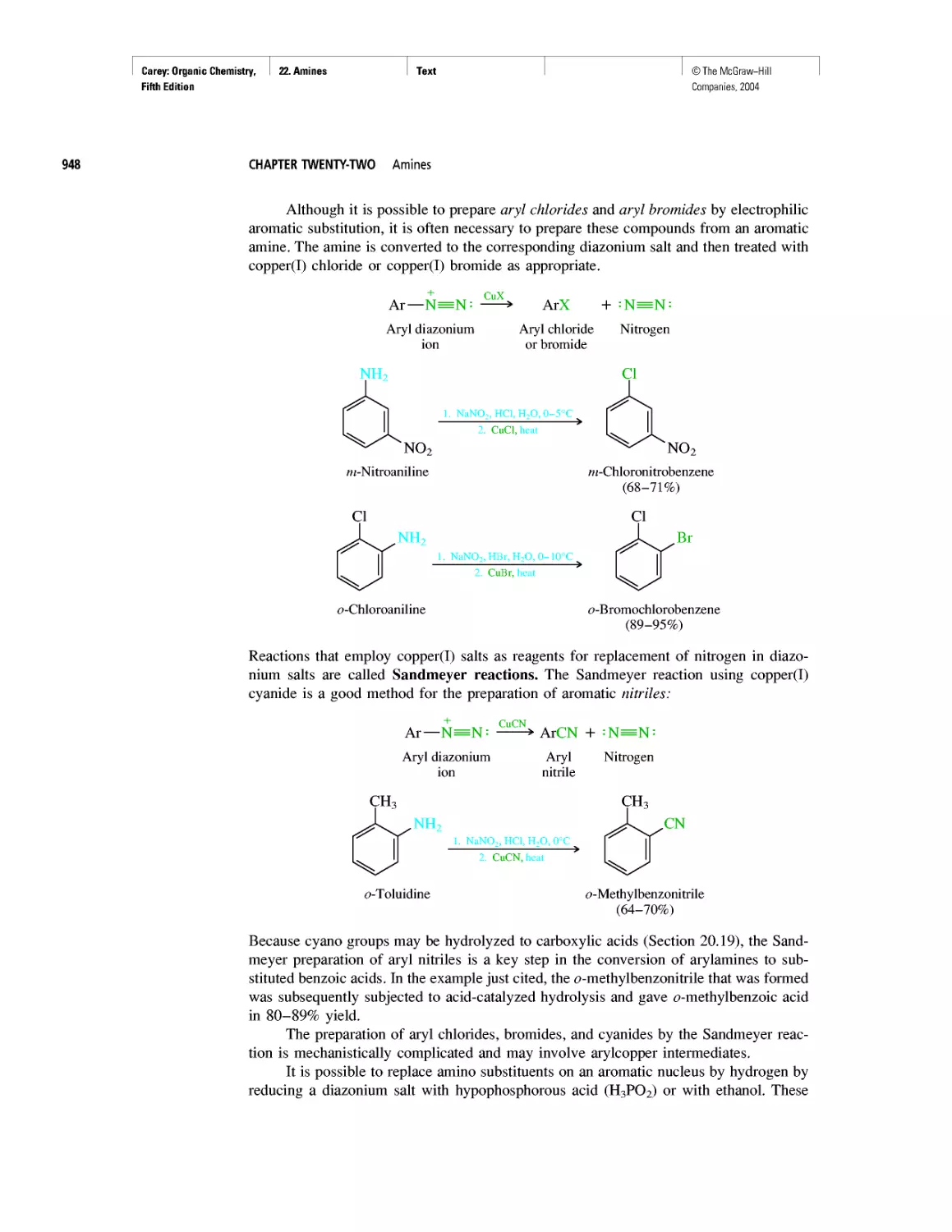
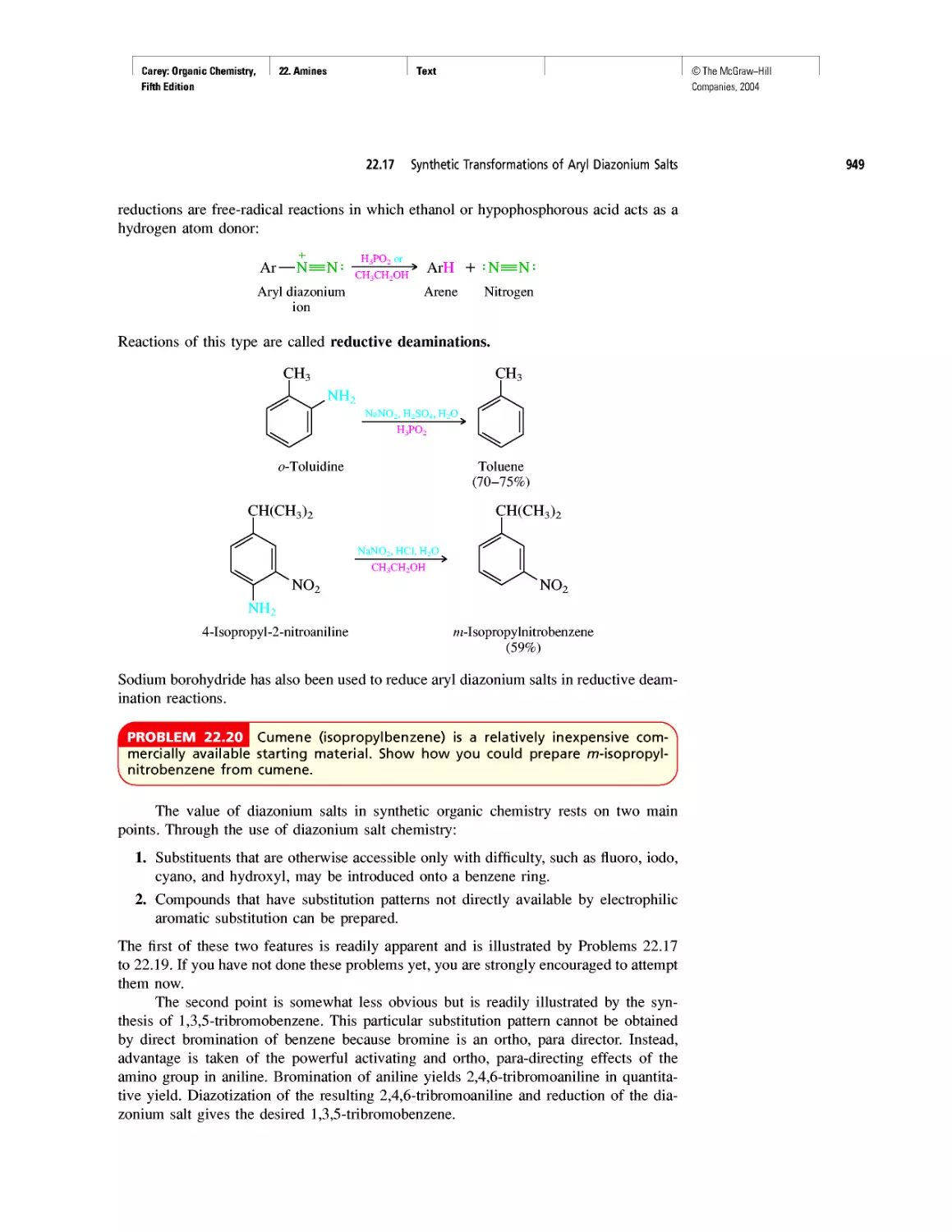
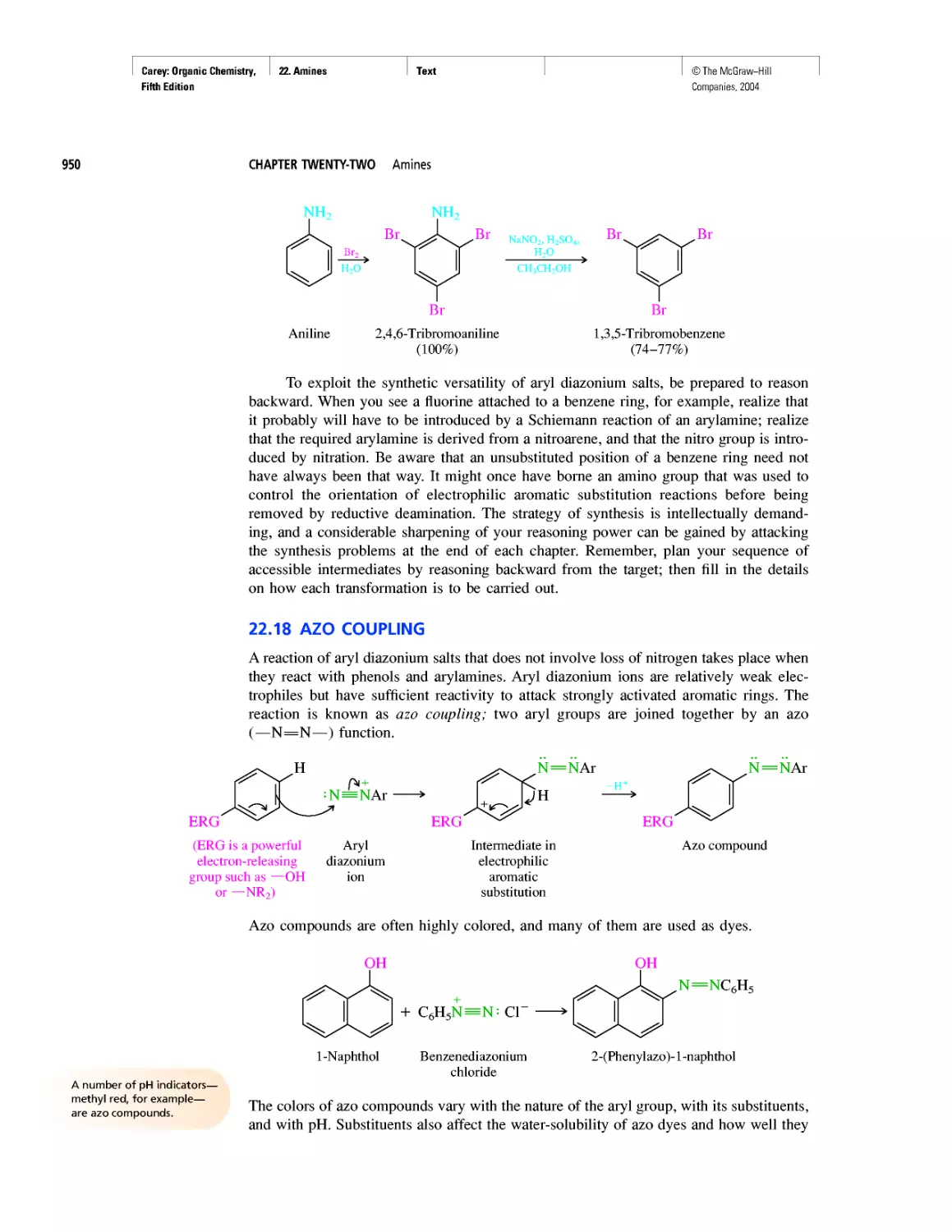

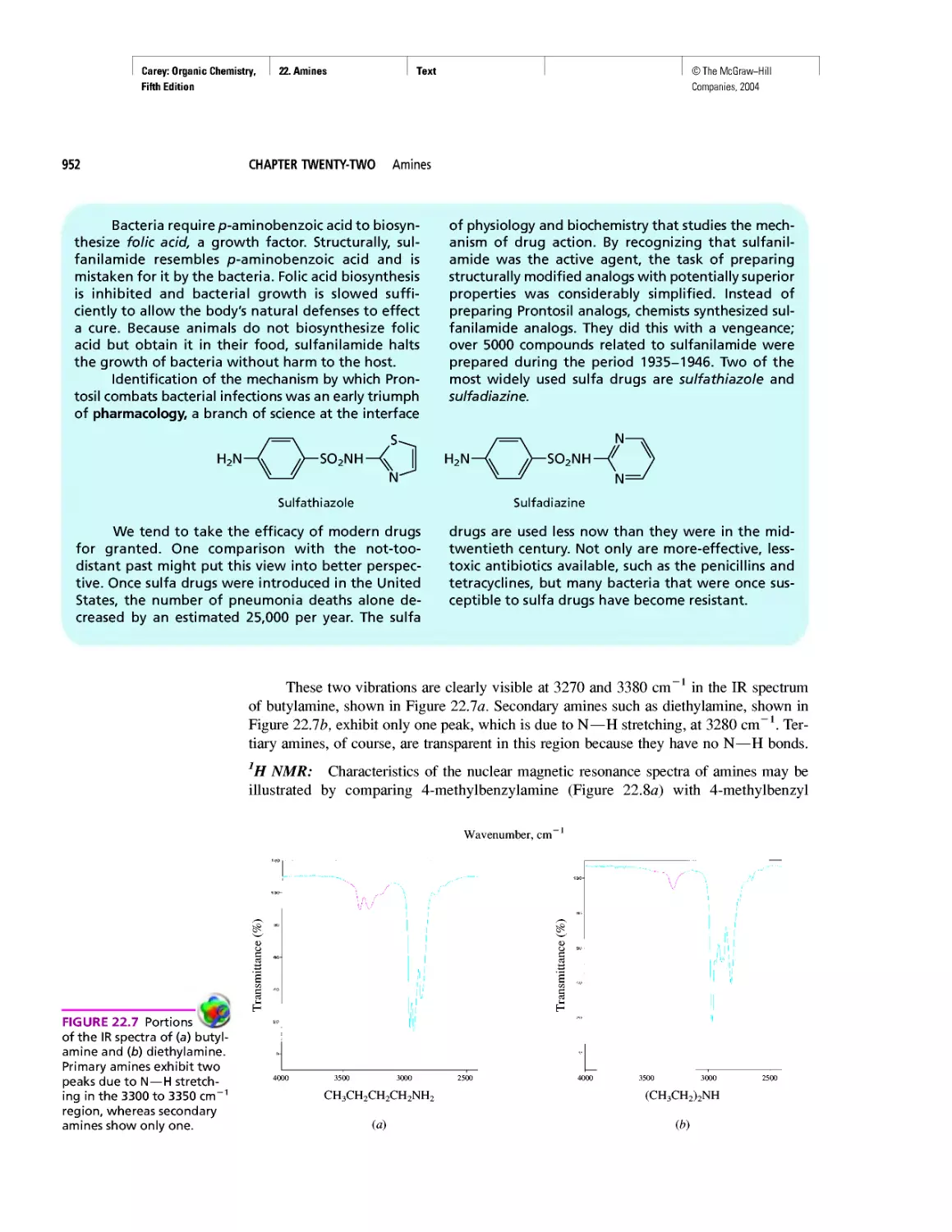












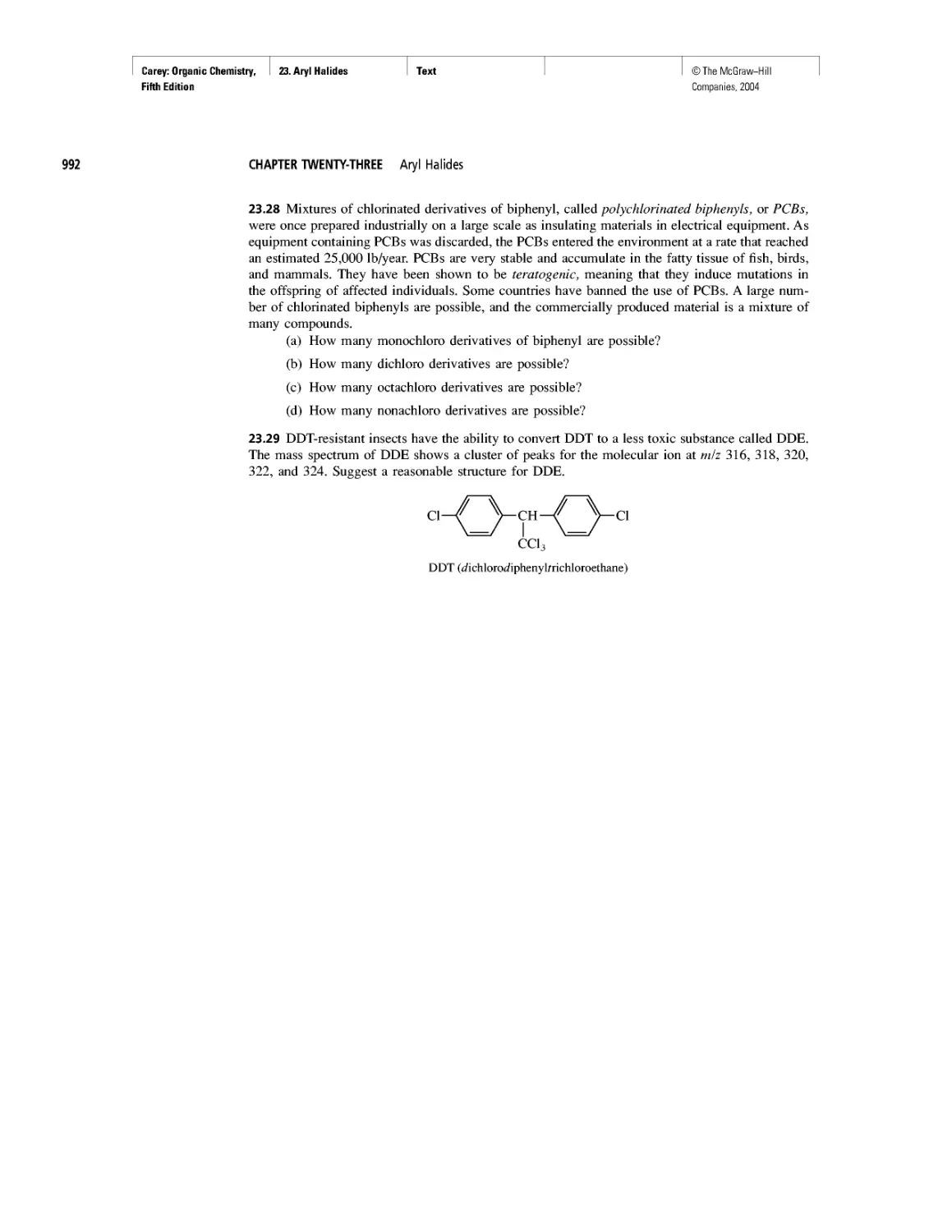
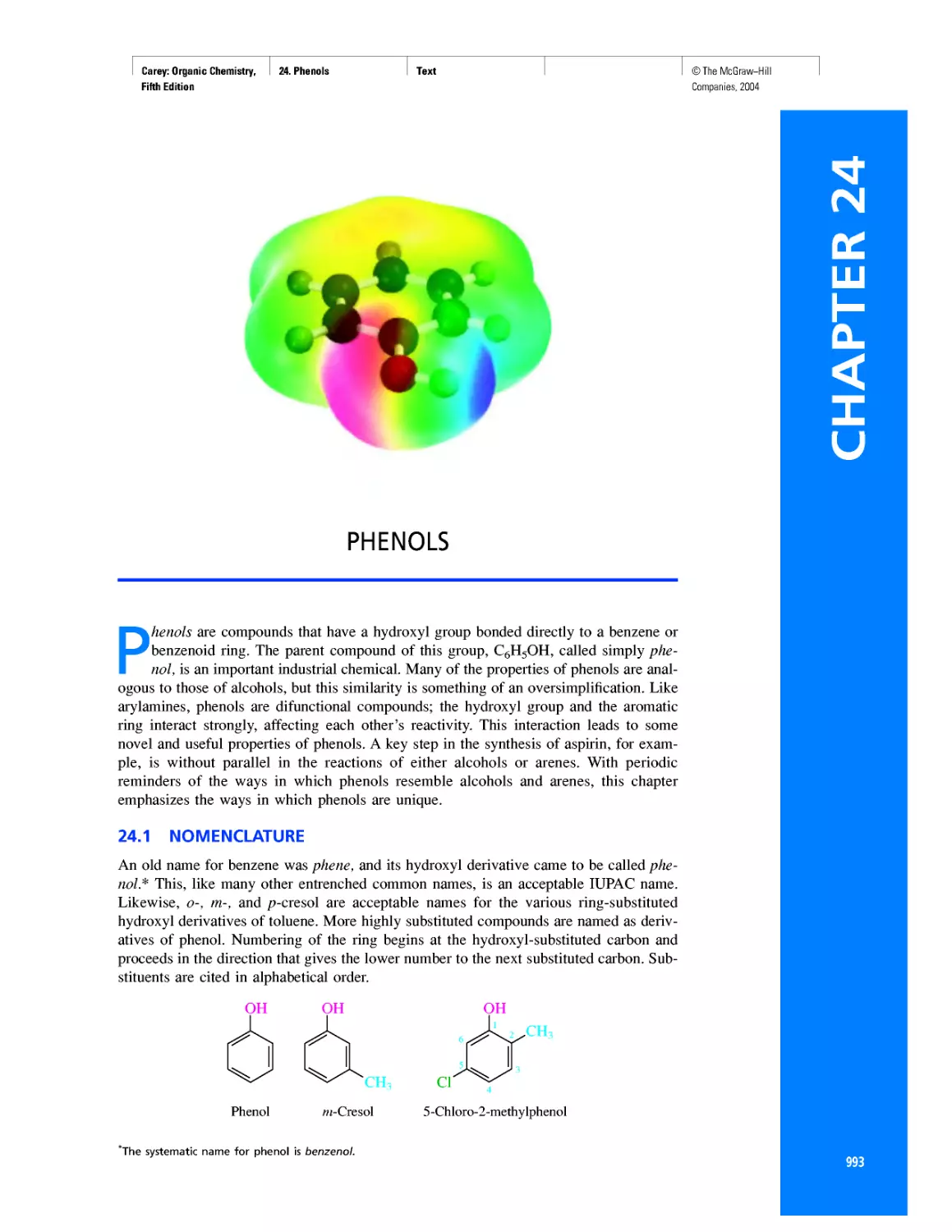
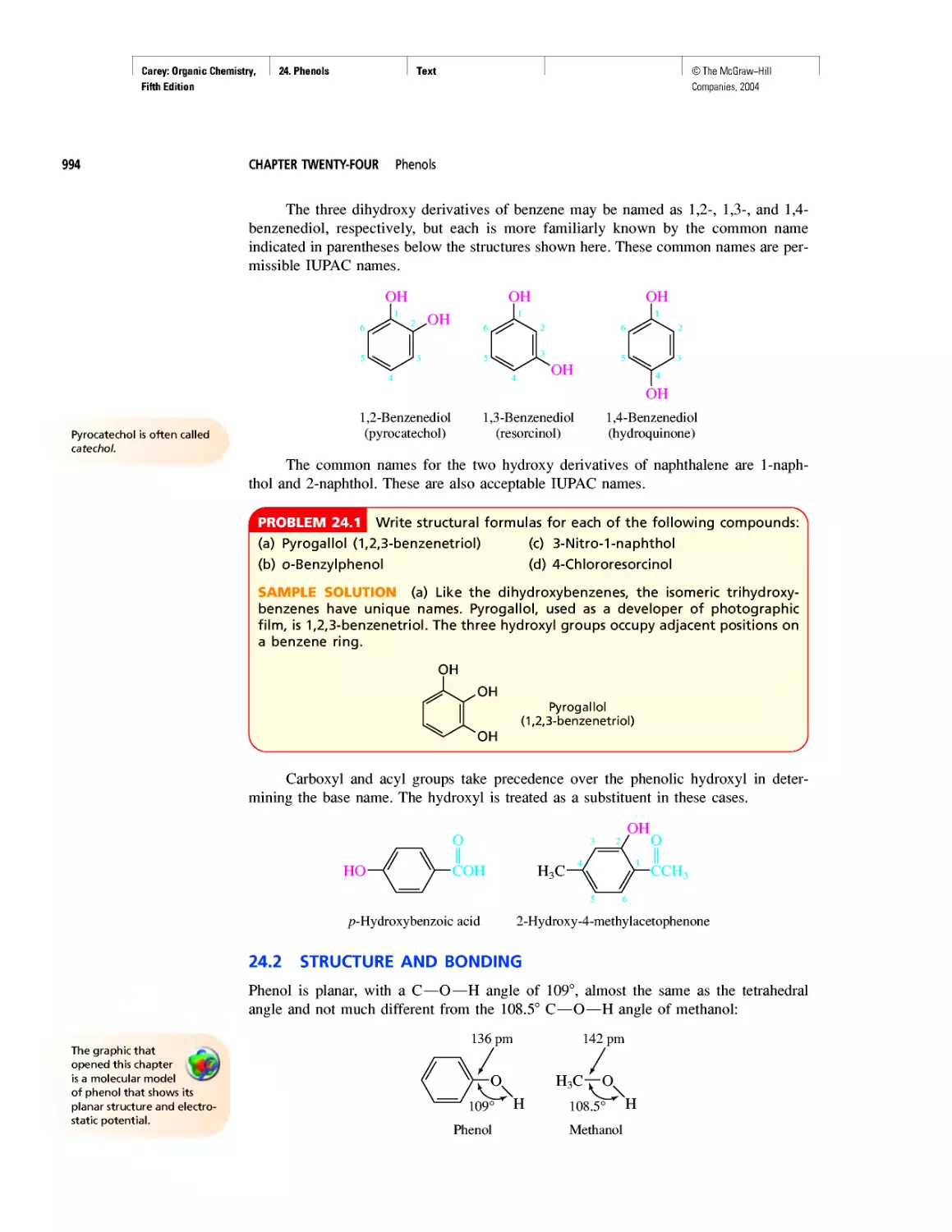


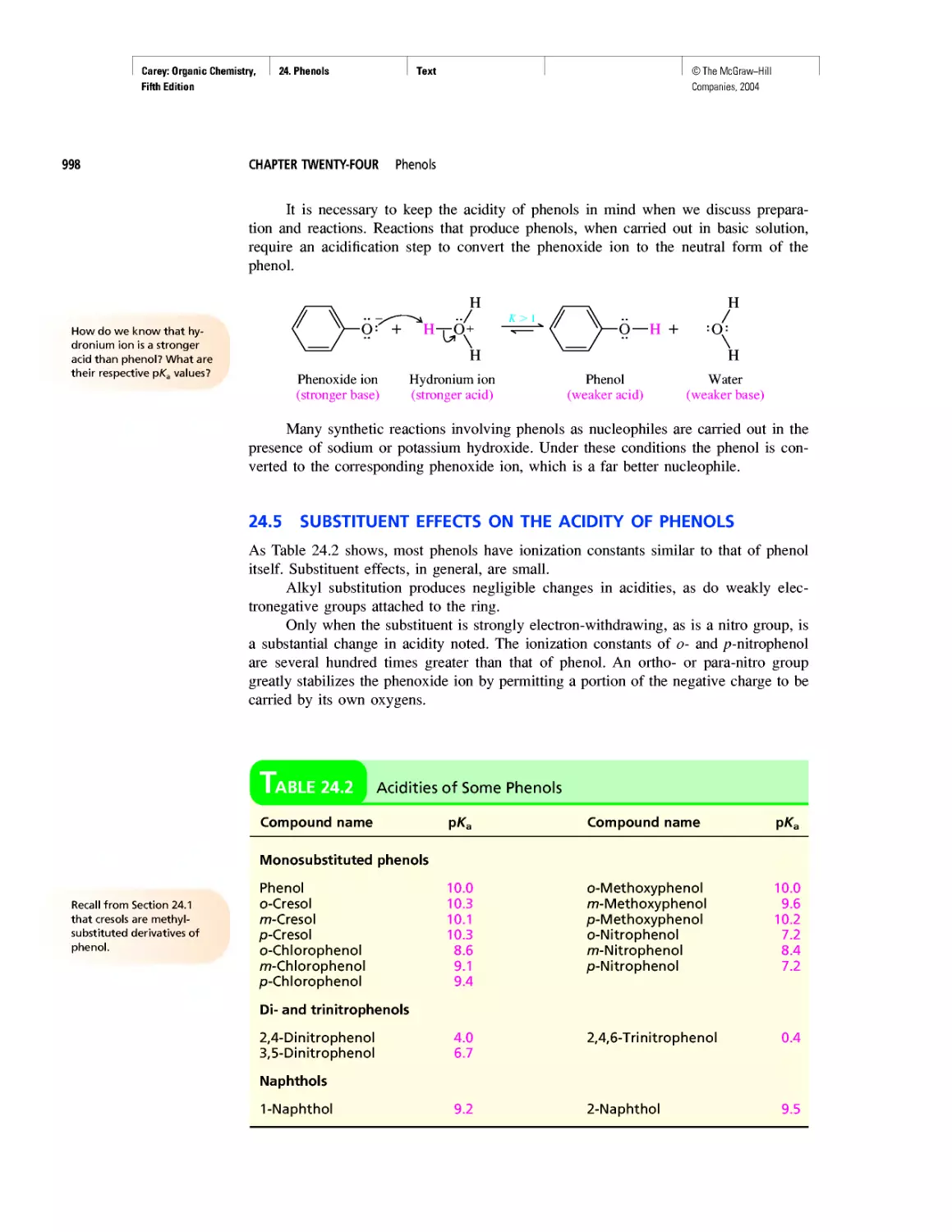

















































































Автор: Carey F.A.
Теги: chemistry modelling organic chemistry molecular chemistry monomers polymers dioxin
Год: 2004



Текст
                    ©The McGraw-Hill
Companies, 2004
Carey: Organic Chemistry, Front Matter
Fifth Edition
List of Boxed Essays
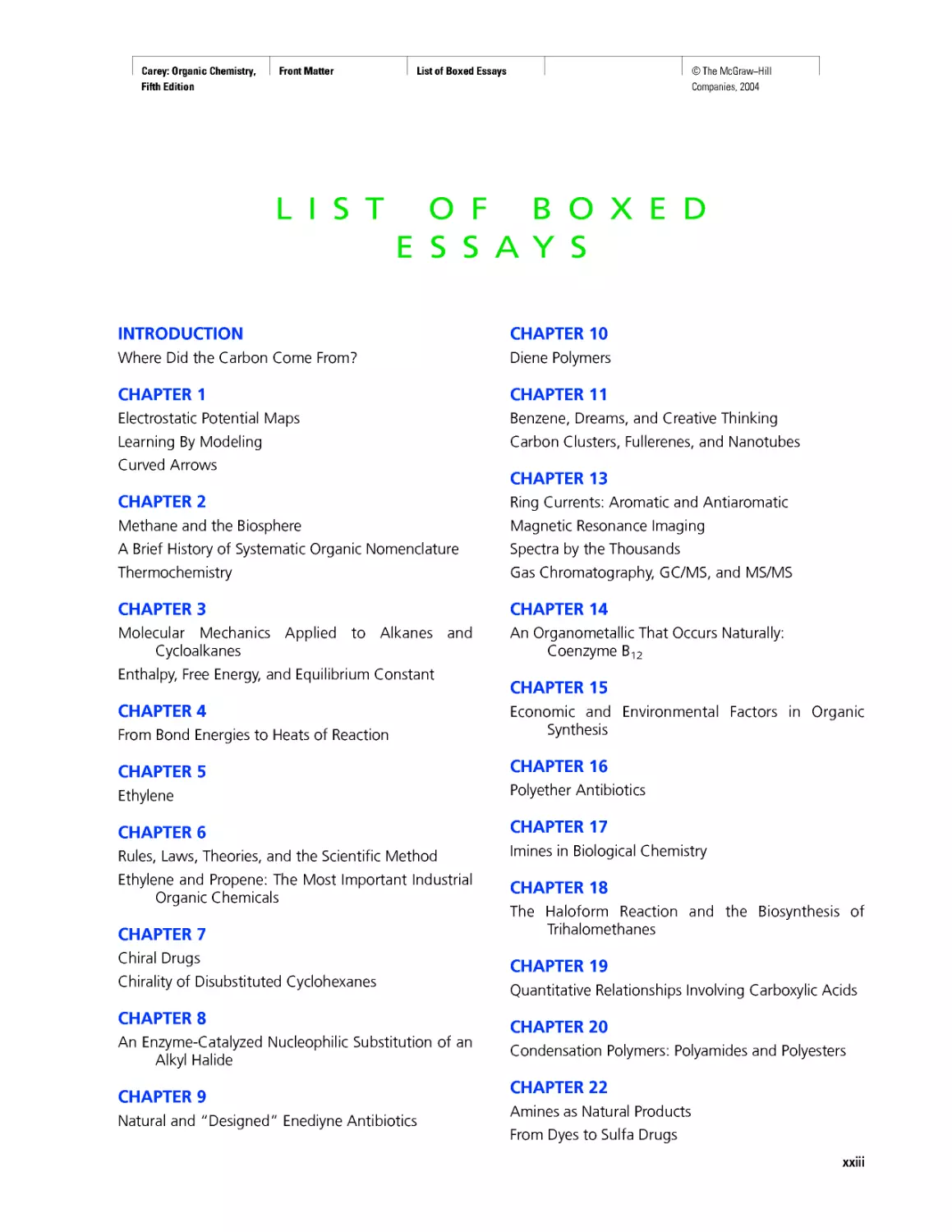
LIST OF
BOXED
ESSAYS
INTRODUCTION
Where Did the Carbon Come From?
CHAPTER 1
Electrostatic Potential Maps
Learning By Modeling
Curved Arrows
CHAPTER 2
Methane and the Biosphere
A Brief History of Systematic Organic Nomenclature
Thermochemistry
CHAPTER 3
Molecular Mechanics Applied to Alkanes and
Cycloalkanes
Enthalpy, Free Energy, and Equilibrium Constant
CHAPTER 4
From Bond Energies to Heats of Reaction
CHAPTER 5
Ethylene
CHAPTER 6
Rules, Laws, Theories, and the Scientific Method
Ethylene and Propene: The Most Important Industrial
Organic Chemicals
CHAPTER 7
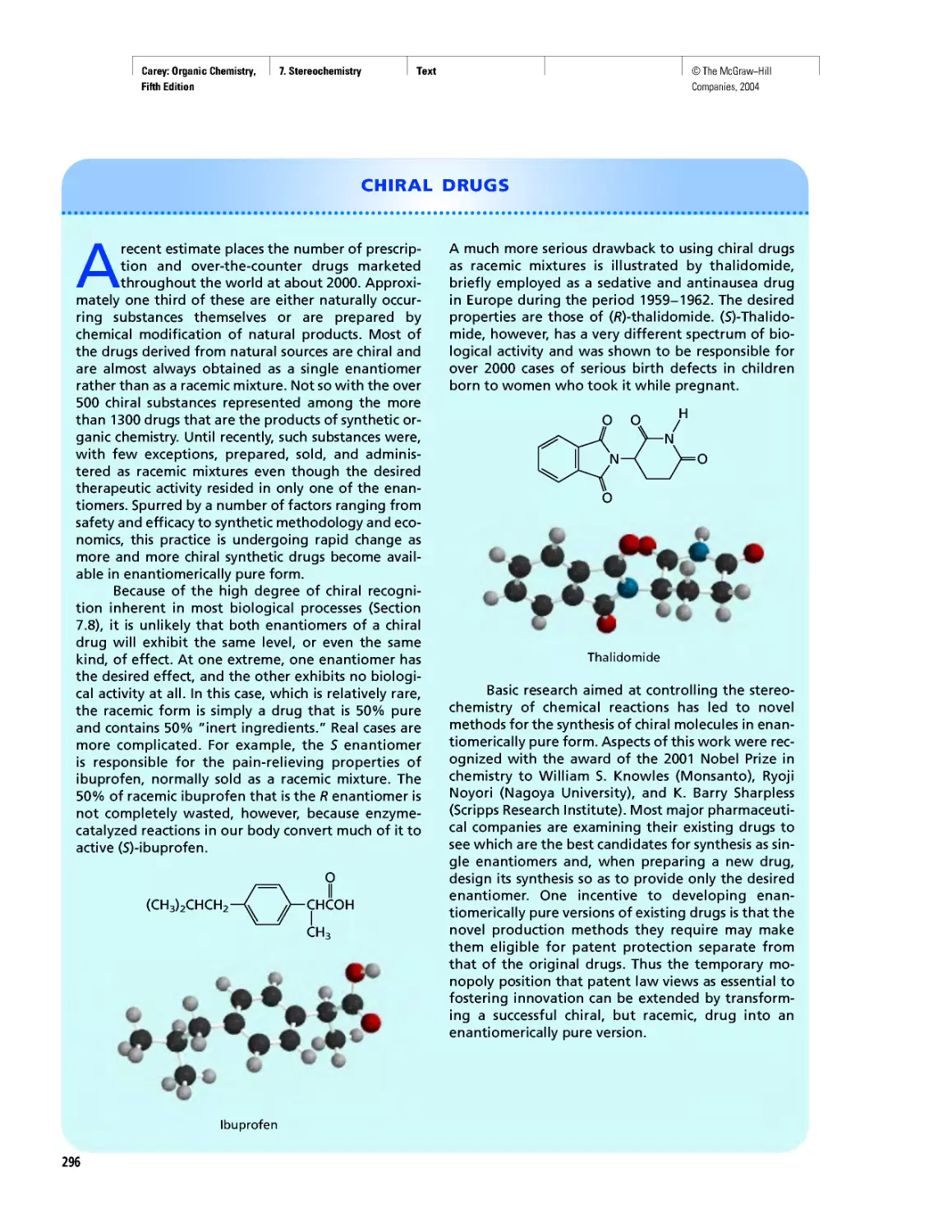
Chiral Drugs
Chirality of Disubstituted Cyclohexanes
CHAPTER 8
An Enzyme-Catalyzed Nucleophilic Substitution of an
Alkyl Halide
CHAPTER 9
Natural and "Designed" Enediyne Antibiotics
CHAPTER 10
Diene Polymers
CHAPTER 11
Benzene, Dreams, and Creative Thinking
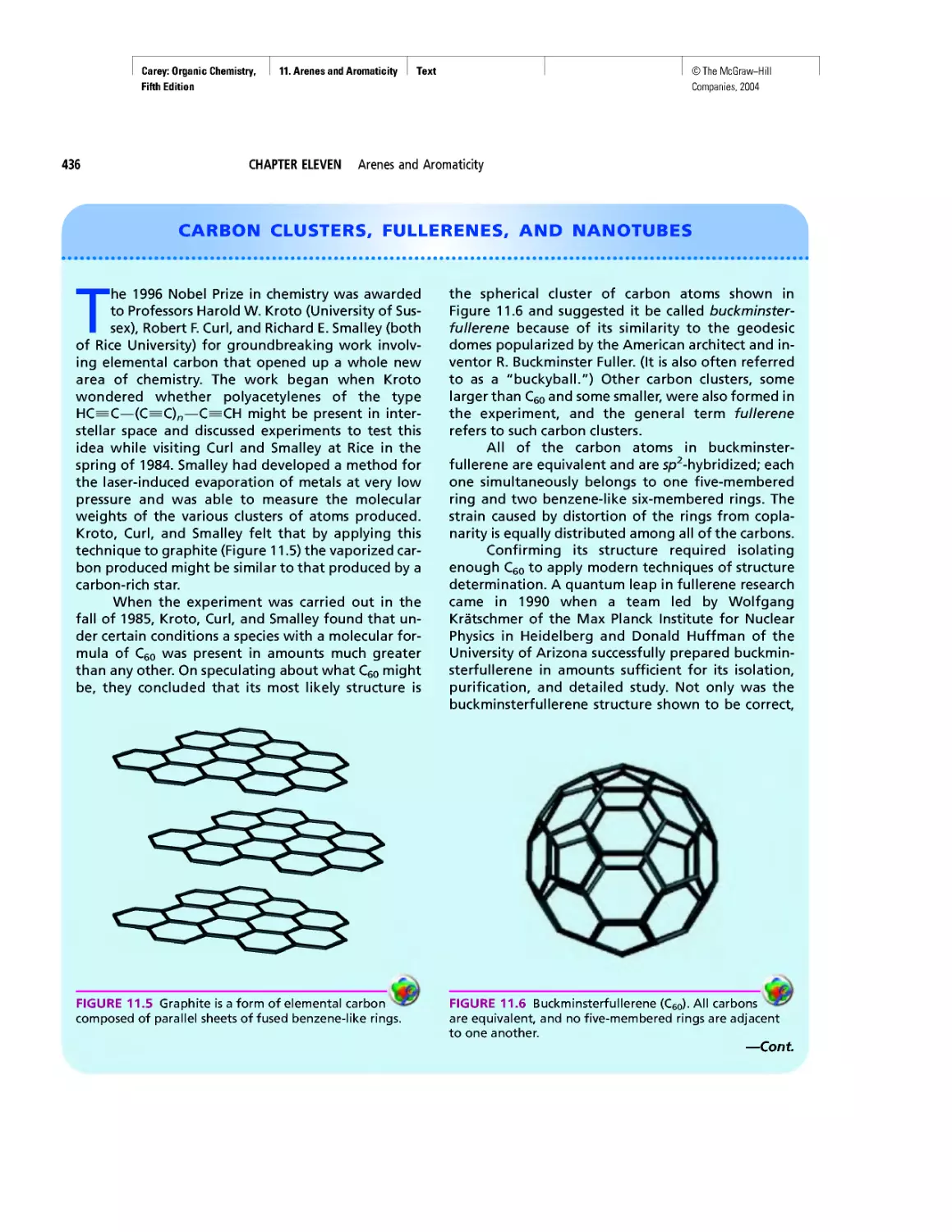
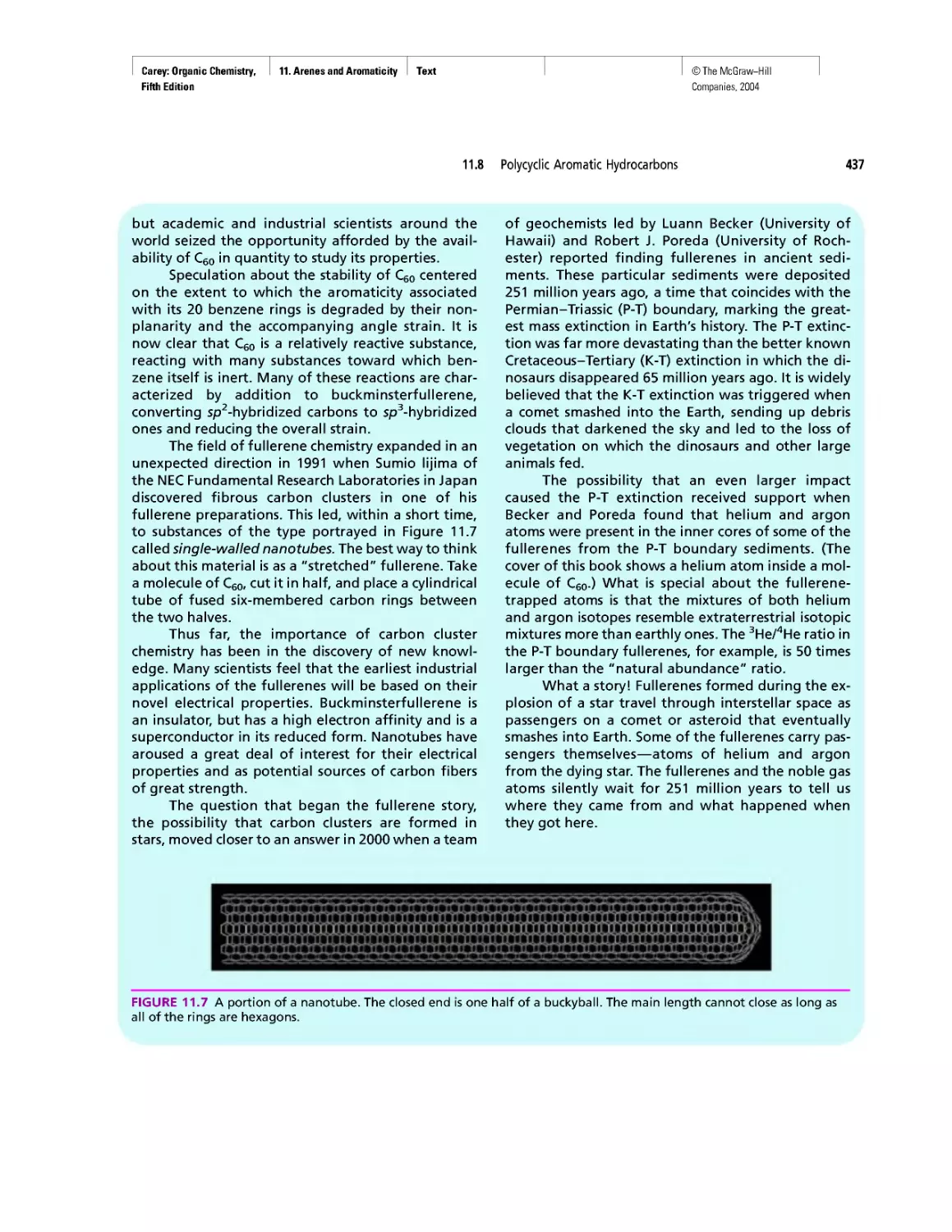
Carbon Clusters, Fullerenes, and Nanotubes
CHAPTER 13
Ring Currents: Aromatic and Antiaromatic
Magnetic Resonance Imaging
Spectra by the Thousands
Gas Chromatography, GC/MS, and MS/MS
CHAPTER 14
An Organometallic That Occurs Naturally:
Coenzyme B12
CHAPTER 15
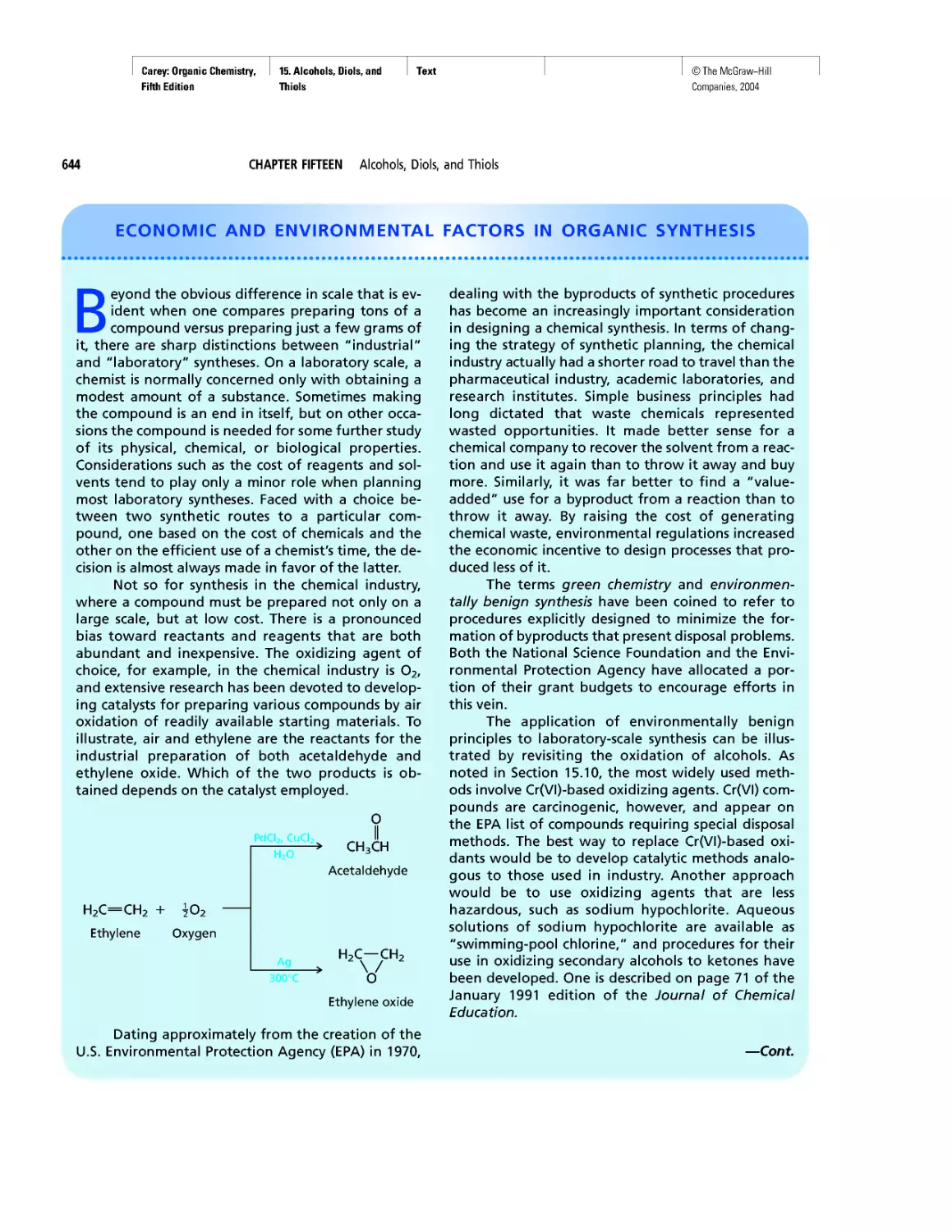
Economic and Environmental Factors in Organic
Synthesis
CHAPTER 16
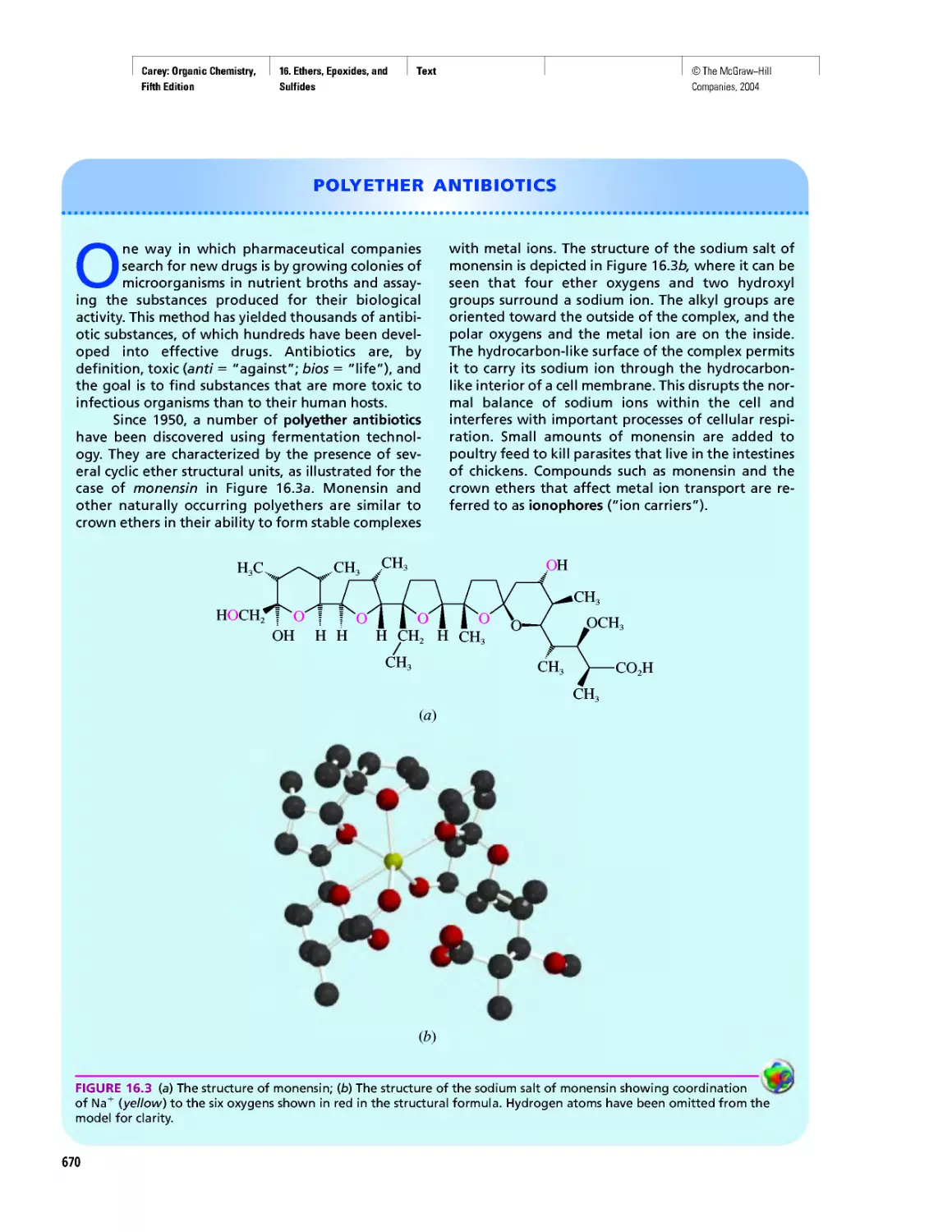
Polyether Antibiotics
CHAPTER 17
Imines in Biological Chemistry
CHAPTER 18
The Haloform Reaction and the Biosynthesis of
Trihalomethanes
CHAPTER 19
Quantitative Relationships Involving Carboxylic Acids
CHAPTER 20
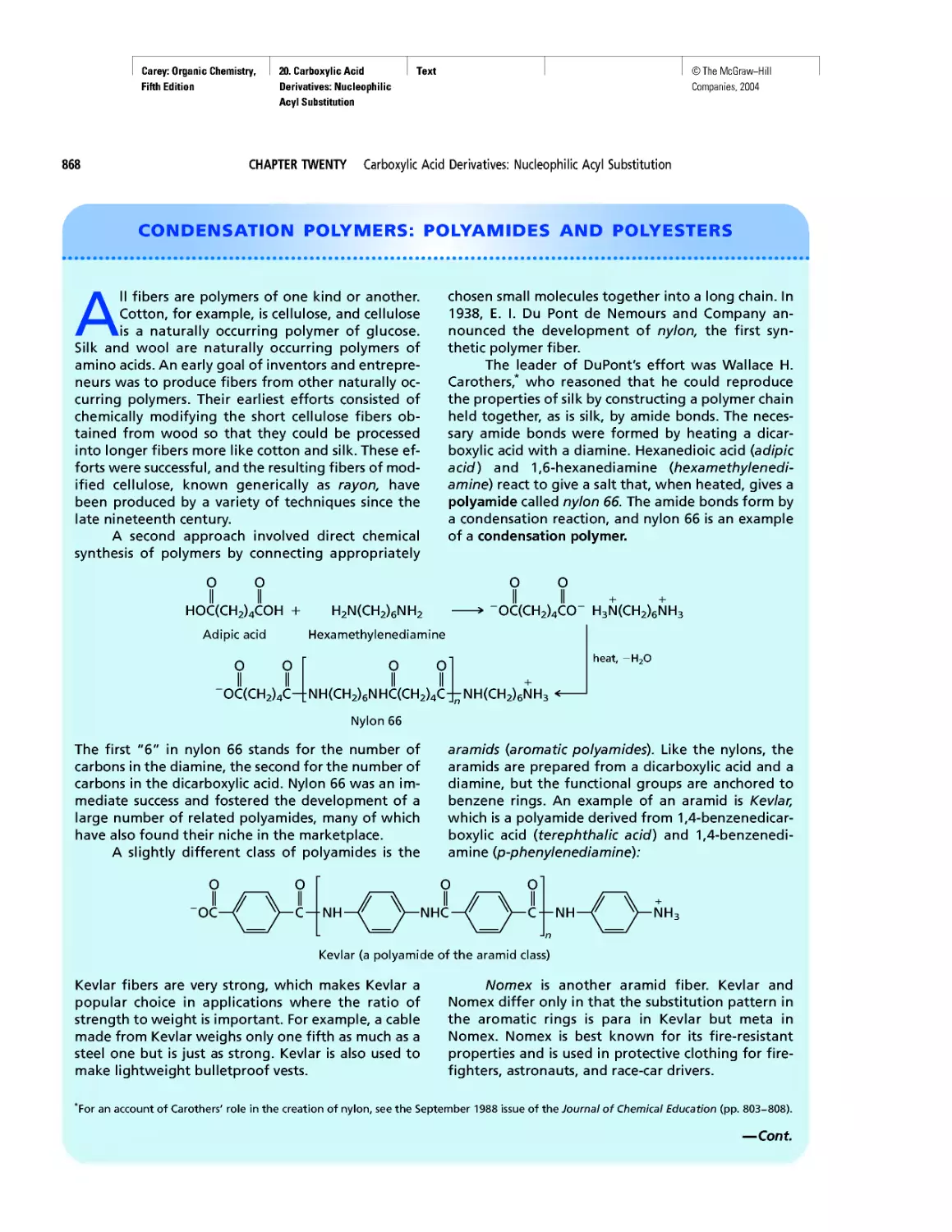
Condensation Polymers: Polyamides and Polyesters
CHAPTER 22
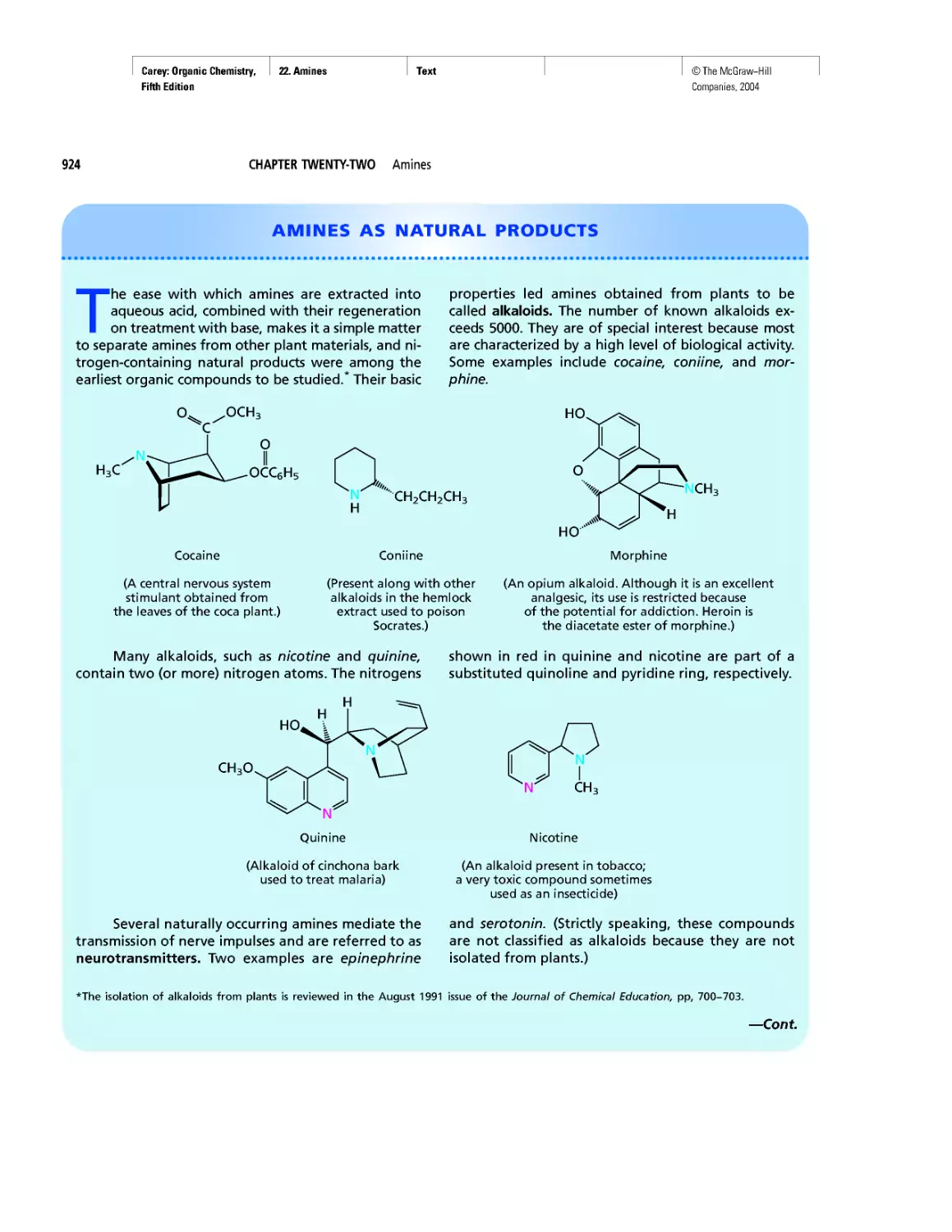
Amines as Natural Products
From Dyes to Sulfa Drugs
xxiii
©The McGraw-Hill
Companies, 2004
Carey: Organic Chemistry, Front Matter
Fifth Edition
List of Boxed Essays
xxiv
LIST OF BOXED ESSAYS
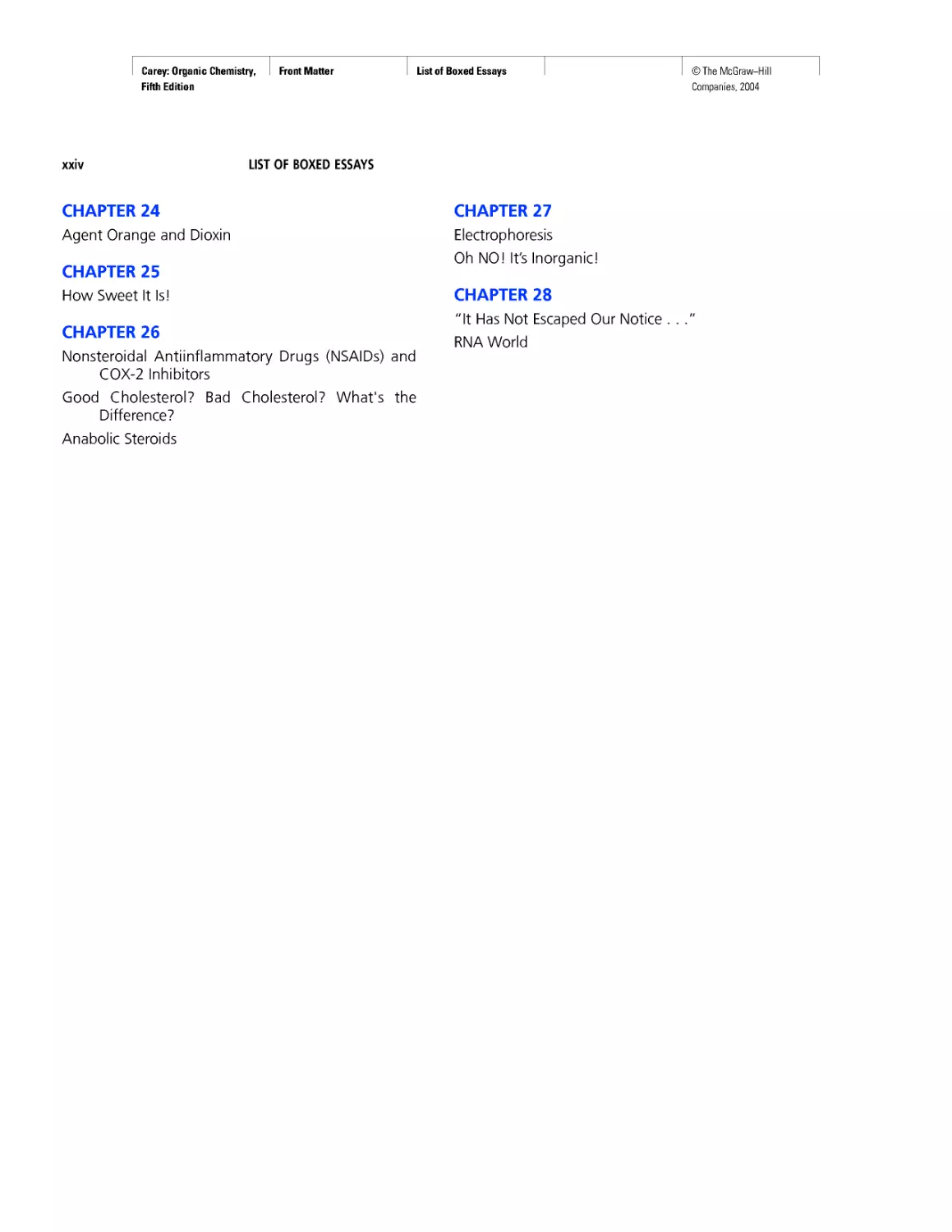
CHAPTER 24
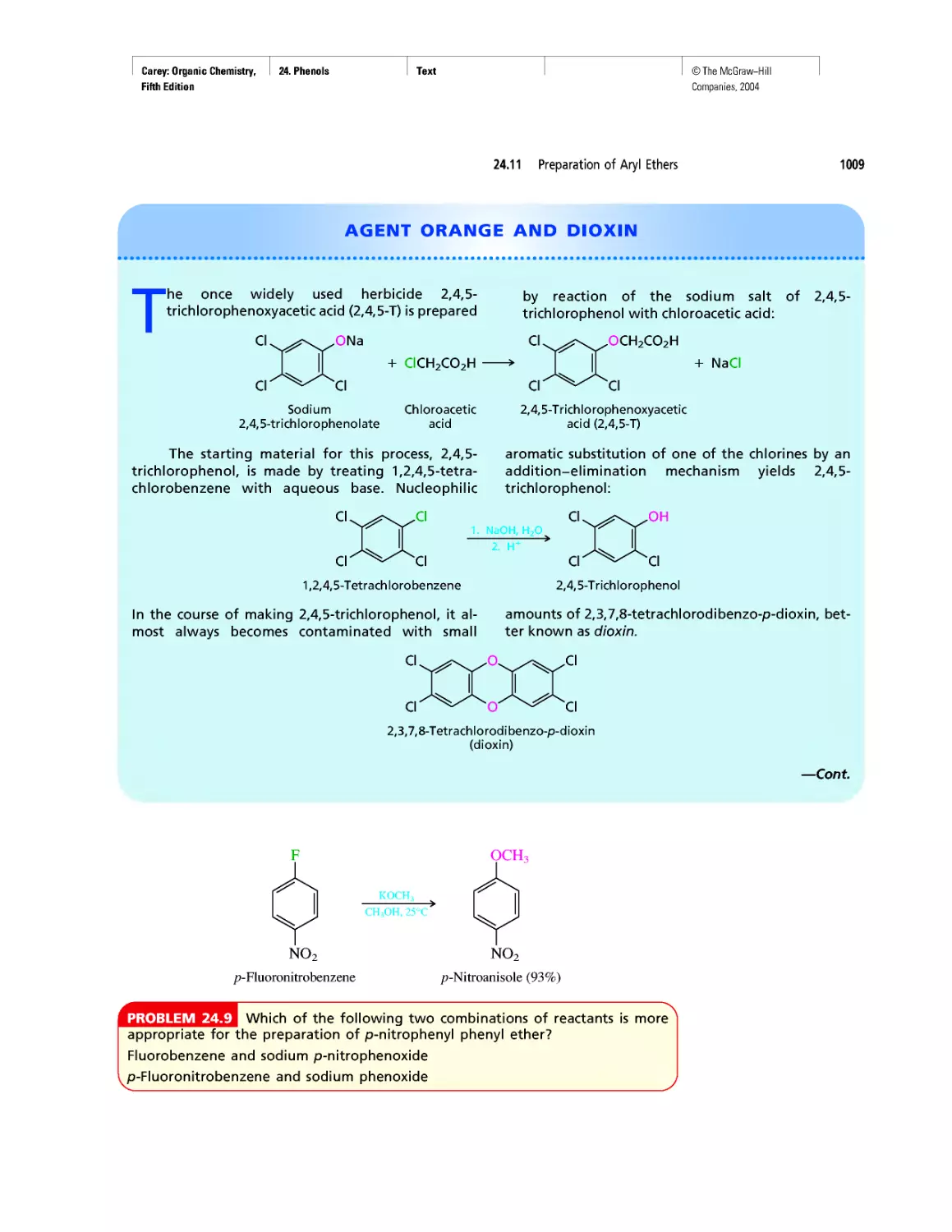
Agent Orange and Dioxin
CHAPTER 25
How Sweet It Is!
CHAPTER 26
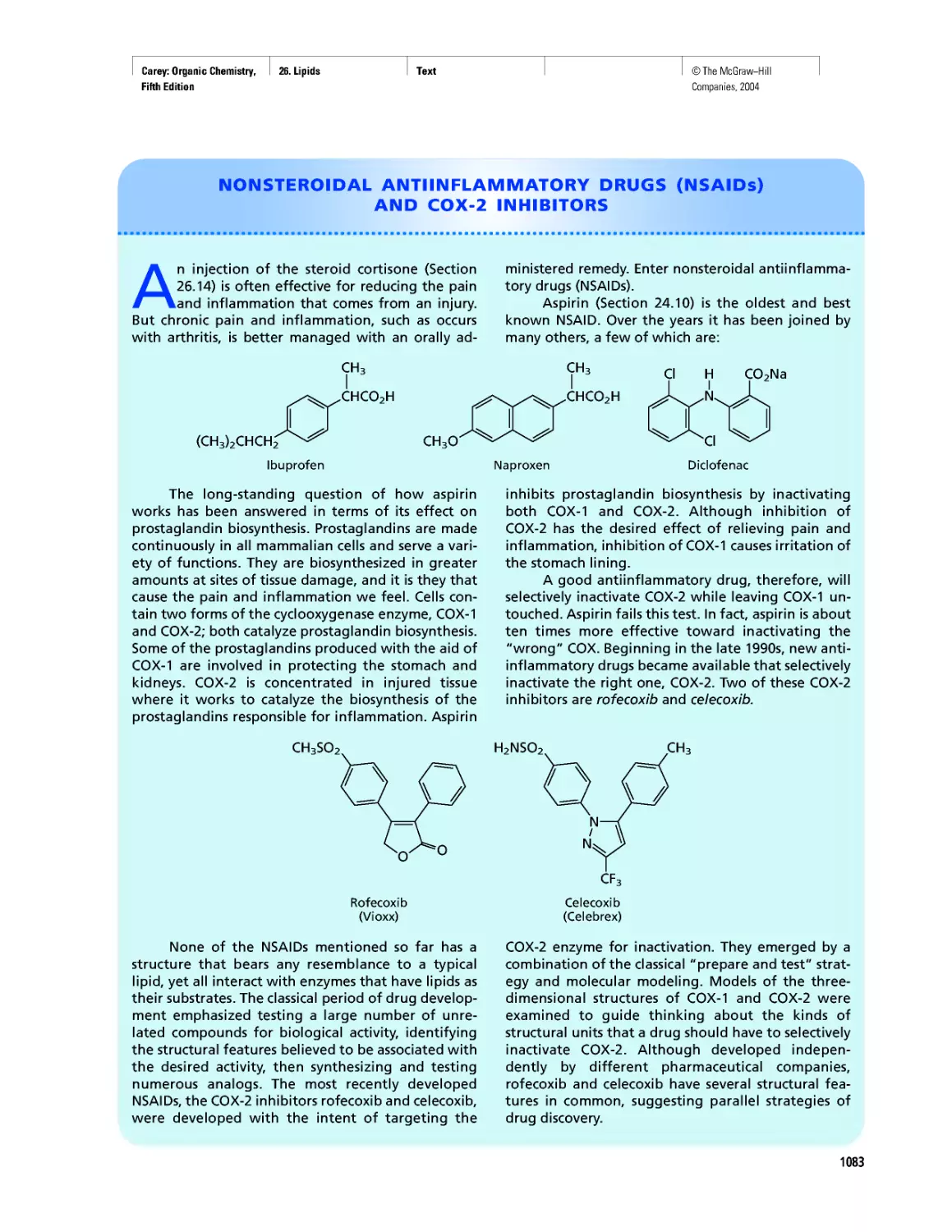
Nonsteroidal Antiinflammatory Drugs (NSAIDs) and
COX-2 Inhibitors
Good Cholesterol? Bad Cholesterol? What's the
Difference?
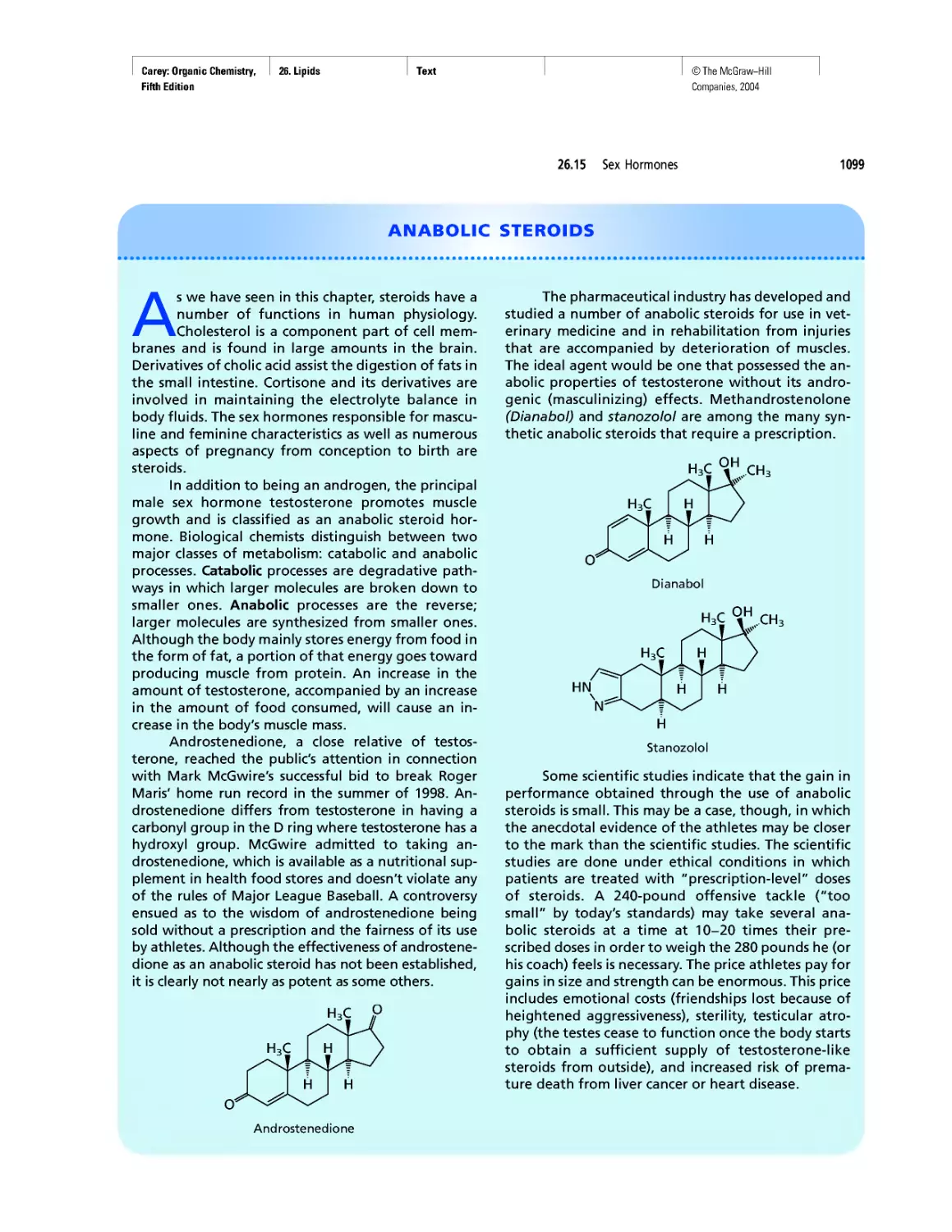
Anabolic Steroids
CHAPTER 27
Electrophoresis
Oh NO! It's Inorganic!
CHAPTER 28
"It Has Not Escaped Our Notice . .
RNA World
©The McGraw-Hill
Companies, 2004
Carey: Organic Chemistry, Front Matter
Preface
Fifth Edition
PREFACE
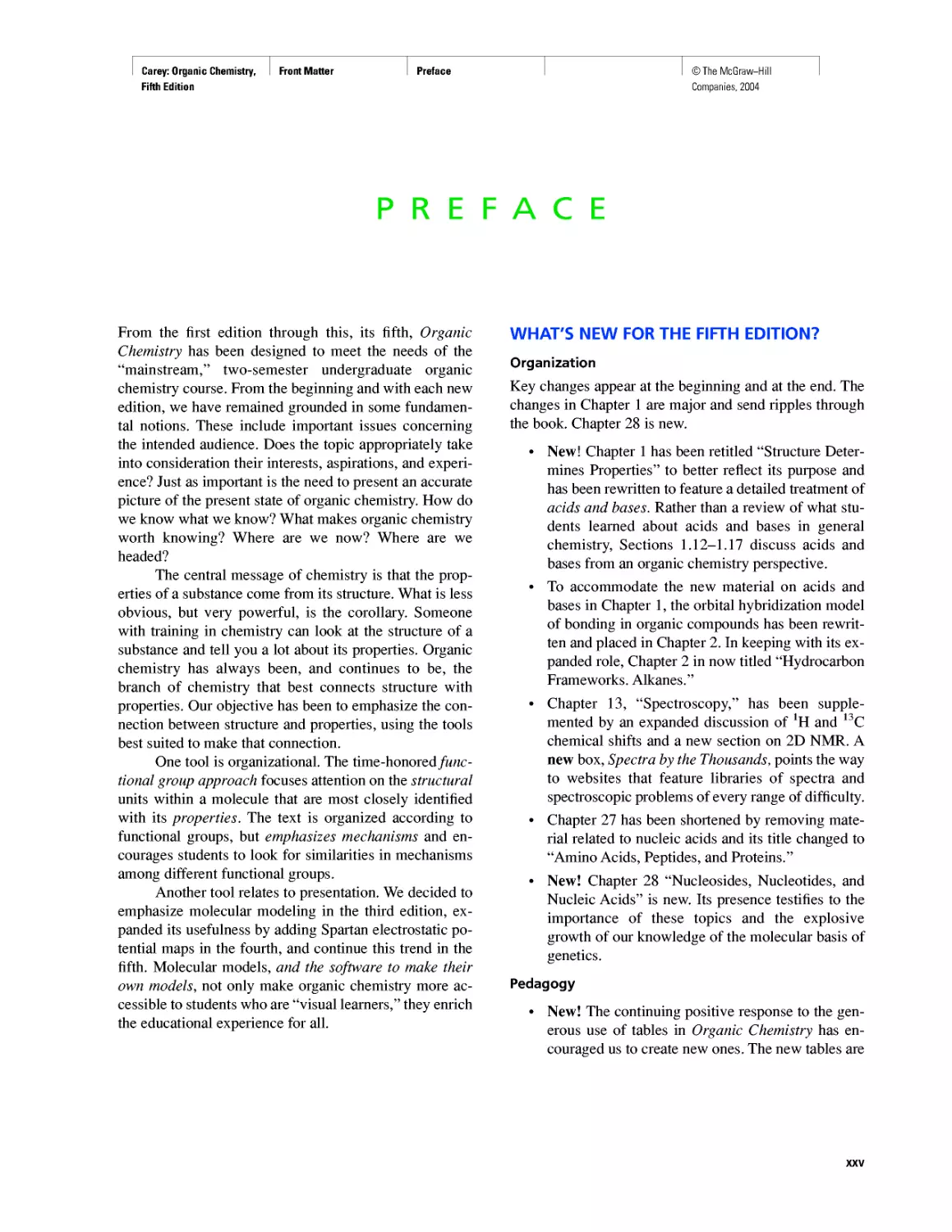
From the first edition through this, its fifth, Organic
Chemistry has been designed to meet the needs of the
“mainstream,” two-semester undergraduate organic
chemistry course. From the beginning and with each new
edition, we have remained grounded in some fundamen-
tal notions. These include important issues concerning
the intended audience. Does the topic appropriately take
into consideration their interests, aspirations, and experi-
ence? Just as important is the need to present an accurate
picture of the present state of organic chemistry. How do
we know what we know? What makes organic chemistry
worth knowing? Where are we now? Where are we
headed?
The central message of chemistry is that the prop-
erties of a substance come from its structure. What is less
obvious, but very powerful, is the corollary. Someone
with training in chemistry can look at the structure of a
substance and tell you a lot about its properties. Organic
chemistry has always been, and continues to be, the
branch of chemistry that best connects structure with
properties. Our objective has been to emphasize the con-
nection between structure and properties, using the tools
best suited to make that connection.
One tool is organizational. The time-honored/unc-
tional group approach focuses attention on the structural
units within a molecule that are most closely identified
with its properties. The text is organized according to
functional groups, but emphasizes mechanisms and en-
courages students to look for similarities in mechanisms
among different functional groups.
Another tool relates to presentation. We decided to
emphasize molecular modeling in the third edition, ex-
panded its usefulness by adding Spartan electrostatic po-
tential maps in the fourth, and continue this trend in the
fifth. Molecular models, and the software to make their
own models, not only make organic chemistry more ac-
cessible to students who are “visual learners,” they enrich
the educational experience for all.
WHAT'S NEW FOR THE FIFTH EDITION?
Organization
Key changes appear at the beginning and at the end. The
changes in Chapter 1 are major and send ripples through
the book. Chapter 28 is new.
•	New! Chapter 1 has been retitled “Structure Deter-
mines Properties” to better reflect its purpose and
has been rewritten to feature a detailed treatment of
acids and bases. Rather than a review of what stu-
dents learned about acids and bases in general
chemistry, Sections 1.12-1.17 discuss acids and
bases from an organic chemistry perspective.
•	To accommodate the new material on acids and
bases in Chapter 1, the orbital hybridization model
of bonding in organic compounds has been rewrit-
ten and placed in Chapter 2. In keeping with its ex-
panded role, Chapter 2 in now titled “Hydrocarbon
Frameworks. Alkanes.”
•	Chapter 13, “Spectroscopy,” has been supple-
mented by an expanded discussion of *H and 13C
chemical shifts and a new section on 2D NMR. A
new box, Spectra by the Thousands, points the way
to websites that feature libraries of spectra and
spectroscopic problems of every range of difficulty.
•	Chapter 27 has been shortened by removing mate-
rial related to nucleic acids and its title changed to
“Amino Acids, Peptides, and Proteins.”
•	New! Chapter 28 “Nucleosides, Nucleotides, and
Nucleic Acids” is new. Its presence testifies to the
importance of these topics and the explosive
growth of our knowledge of the molecular basis of
genetics.
Pedagogy
•	New! The continuing positive response to the gen-
erous use of tables in Organic Chemistry has en-
couraged us to create new ones. The new tables are
xxv
Carey: Organic Chemistry, Front Matter
Fifth Edition
©The McGraw-Hill
Companies, 2004
Preface
xxvi
PREFACE
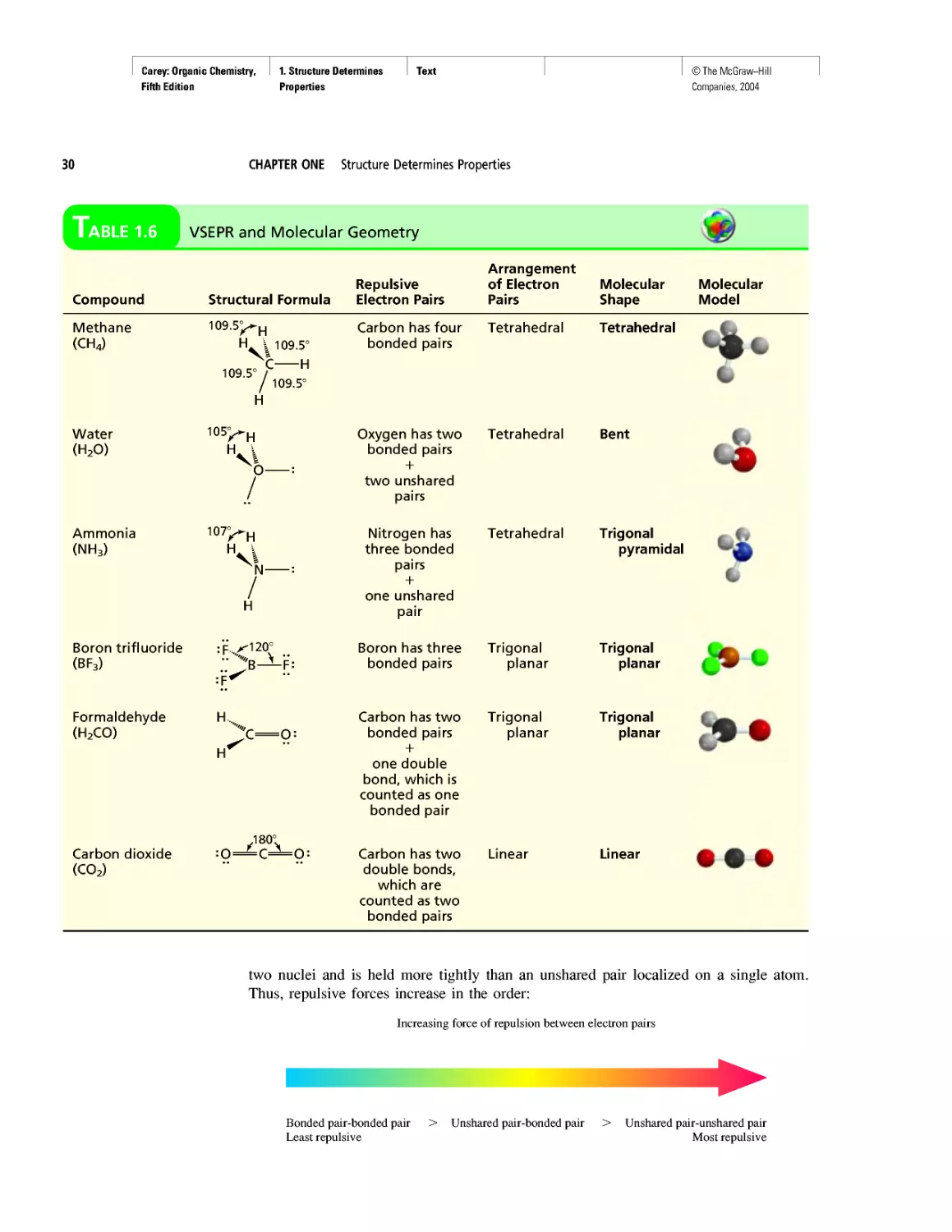
Table 1.6 VSEPR and Molecular Geometry
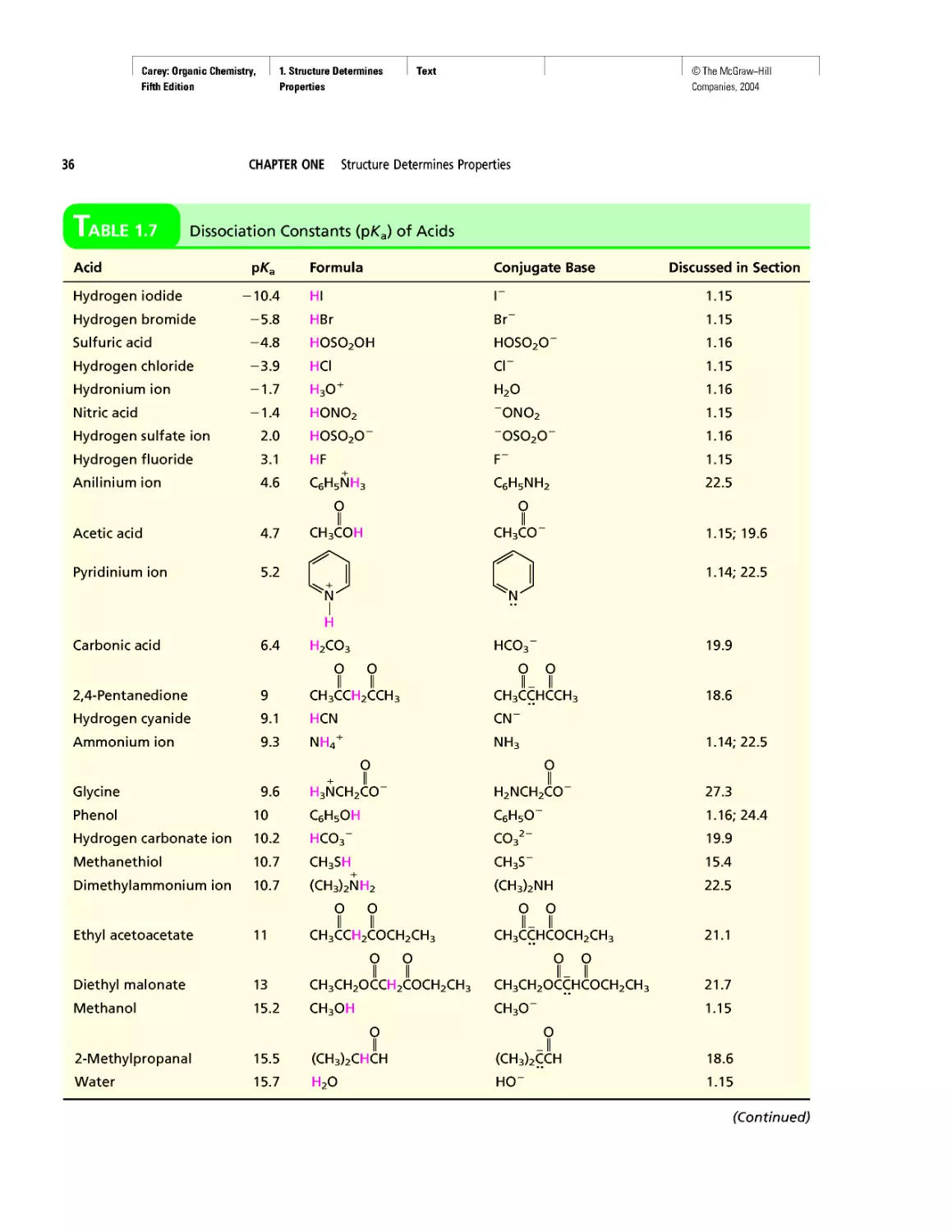
Table 1.7 Dissociation Constants (pka) of Acids
Table 2.5 Oxidation Numbers in Compounds with More
Than One Carbon
Table 28.2 The Major Nucleosides in DNA and/or RNA
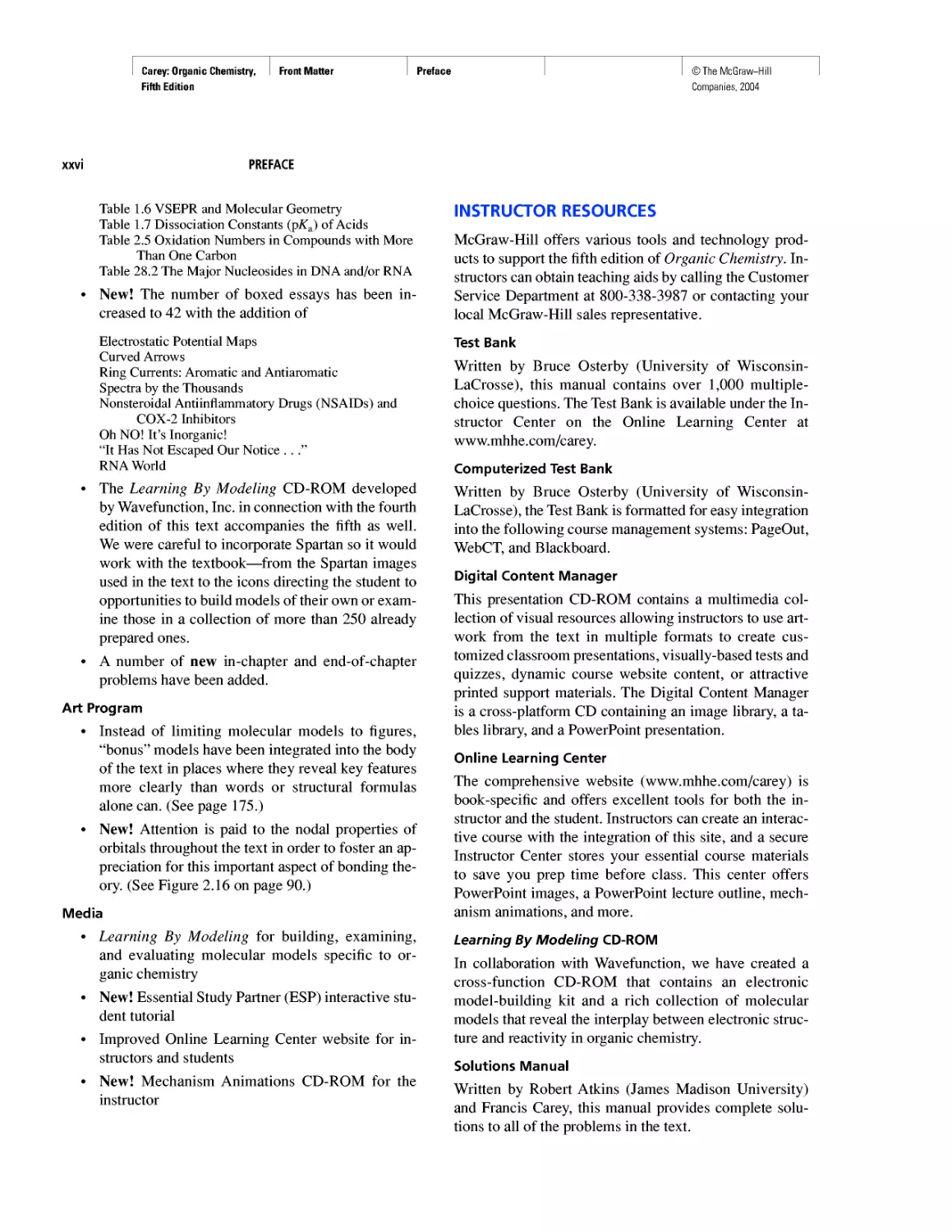
•	New! The number of boxed essays has been in-
creased to 42 with the addition of
Electrostatic Potential Maps
Curved Arrows
Ring Currents: Aromatic and Antiaromatic
Spectra by the Thousands
Nonsteroidal Antiinflammatory Drugs (NSAIDs) and
COX-2 Inhibitors
Oh NO! It’s Inorganic!
“It Has Not Escaped Our Notice ...”
RNA World
•	The Learning By Modeling CD-ROM developed
by Wavefunction, Inc. in connection with the fourth
edition of this text accompanies the fifth as well.
We were careful to incorporate Spartan so it would
work with the textbook—from the Spartan images
used in the text to the icons directing the student to
opportunities to build models of their own or exam-
ine those in a collection of more than 250 already
prepared ones.
•	A number of new in-chapter and end-of-chapter
problems have been added.
Art Program
•	Instead of limiting molecular models to figures,
“bonus” models have been integrated into the body
of the text in places where they reveal key features
more clearly than words or structural formulas
alone can. (See page 175.)
•	New! Attention is paid to the nodal properties of
orbitals throughout the text in order to foster an ap-
preciation for this important aspect of bonding the-
ory. (See Figure 2.16 on page 90.)
Media
•	Learning By Modeling for building, examining,
and evaluating molecular models specific to or-
ganic chemistry
•	New! Essential Study Partner (ESP) interactive stu-
dent tutorial
•	Improved Online Learning Center website for in-
structors and students
•	New! Mechanism Animations CD-ROM for the
instructor
INSTRUCTOR RESOURCES
McGraw-Hill offers various tools and technology prod-
ucts to support the fifth edition of Organic Chemistry. In-
structors can obtain teaching aids by calling the Customer
Service Department at 800-338-3987 or contacting your
local McGraw-Hill sales representative.
Test Bank
Written by Bruce Osterby (University of Wisconsin-
LaCrosse), this manual contains over 1,000 multiple-
choice questions. The Test Bank is available under the In-
structor Center on the Online Learning Center at
www.mhhe.com/carey.
Computerized Test Bank
Written by Bruce Osterby (University of Wisconsin-
LaCrosse), the Test Bank is formatted for easy integration
into the following course management systems: PageOut,
WebCT, and Blackboard.
Digital Content Manager
This presentation CD-ROM contains a multimedia col-
lection of visual resources allowing instructors to use art-
work from the text in multiple formats to create cus-
tomized classroom presentations, visually-based tests and
quizzes, dynamic course website content, or attractive
printed support materials. The Digital Content Manager
is a cross-platform CD containing an image library, a ta-
bles library, and a PowerPoint presentation.
Online Learning Center
The comprehensive website (www.mhhe.com/carey) is
book-specific and offers excellent tools for both the in-
structor and the student. Instructors can create an interac-
tive course with the integration of this site, and a secure
Instructor Center stores your essential course materials
to save you prep time before class. This center offers
PowerPoint images, a PowerPoint lecture outline, mech-
anism animations, and more.
Learning By Modeling CD-ROM
In collaboration with Wavefunction, we have created a
cross-function CD-ROM that contains an electronic
model-building kit and a rich collection of molecular
models that reveal the interplay between electronic struc-
ture and reactivity in organic chemistry.
Solutions Manual
Written by Robert Atkins (James Madison University)
and Francis Carey, this manual provides complete solu-
tions to all of the problems in the text.
Carey: Organic Chemistry, Front Matter	Preface
Fifth Edition
©The McGraw-Hill
Companies. 2004
Overhead Transparencies
These full-color transparencies of illustrations from the
text include reproductions of spectra, orbital diagrams,
key tables, computer-generated molecular models, and
step-by-step reaction mechanisms.
Organic Chemistry Animations Library
Created by Rainer Glaser (University of Missouri), the
animations are basic mechanisms that can be presented at
full-screen size in your classroom. The animations on the
CD can be played directly from the CD or can be im-
ported easily into your own lecture presentation.
Course-Specific PageOut
Designed specifically to help you with your individual
course needs, PageOut will assist you in integrating your
syllabus with Organic Chemistry and with state-of-the-
art new media tools. At the heart of PageOut you will find
integrated multimedia and a full-scale Online Learning
Center. You can upload your original test questions and
create your own custom designs. More than 60,000 pro-
fessors have chosen PageOut to create customized course
websites.
WebCT, Blackboard
The Test Bank and Online Learning Center with self-
assessments quizzes and review aids are available in the
various course management systems. Please ask your
sales representative for details if you are interested.
STUDENT RESOURCES
McGraw-Hill offers various tools and technology to sup-
port the fifth edition of Organic Chemistry. Students can
order supplemental study materials by contacting the
McGraw-Hill Customer Service Department at 800-338-
3987.
PREFACE	xxvii
Solutions Manual
Written by Robert C. Atkins and Francis A. Carey, the so-
lutions manual provides step-by-step solutions guiding
the student through the reasoning behind each problem in
the text. There is also a self-test at the end of each chap-
ter designed to assess the student’s mastery of the mate-
rial.
Learning By Modeling CD-ROM
In collaboration with Wavefunction, we have created a
cross-function CD-ROM that contains an electronic
model-building kit and a rich collection of molecular
models that reveal the interplay between electronic struc-
ture and reactivity in organic chemistry. Icons in the text
point the way to where you can use this state-of-art mo-
lecular modeling application to expand your understand-
ing and sharpen your conceptual skills.
OLC (Online Learning Center)
The Online Learning Center is a comprehensive, exclu-
sive website that provides a wealth of electronic re-
sources for instructors and students alike. For students,
the OLC features tutorial, problem-solving strategies and
assessment exercises for every chapter in the book that
were developed by Ian Hunt and Rick Spinney from
the University of Calgary. You can also access the
Essential Student Partner from the OLC. Log on at
www.mhhe.com/carey.
Schaum's Outline of Organic Chemistry
This helpful study aid provides students with hundreds of
solved and supplementary problems for the organic
chemistry course.
A Guide to Using this Text
©The McGraw-Hill
Carey: Organic Chemistry, Front Matter
Fifth Edition
Companies, 2004
A GUIDE TO USING
THIS TEXT
The following two pages walk you through some of the key features of this
text. This book was designed with you, the student in mind—to help
you succeed in organic chemistry. My main goal in writing this
text was to make the material you study as accessible and
appealing as possible. I hope you enjoy your study
of organic chemistry.
Francis A. Carey
TEXT
Art Program
•	Molecular models make organic chemistry more
accessible and enrich the education experience
for all.
•	Molecular models are integrated into the content
revealing key features more clearly than words
or structural formulas alone.
•	Nodal properties of orbitals are included to
show this important aspect of bonding theory.
Tables and Summaries
•	Summary tables allow the student easy access to
a wealth of information in an easy to use format
while reviewing information from previous
chapters.
•	End-of-Chapter Summaries highlight and con-
solidate all of the important concepts and reac-
tions within a chapter.
Biological Applications
•	New chapter on Nucleosides, Nucleotides, and
Nucleic Acids testifies to the explosive growth
of the molecular basis of genetics.
•	Numerous boxed essays throughout the text high-
light biological applications of organic chemistry.
xxxi
©The McGraw-Hill
Companies, 2004
Carey: Organic Chemistry, Front Matter
Fifth Edition
A Guide to Using this Text
xxxii
A GUIDE TO USING THIS TEXT
Problem-Solving
•	Problem-solving strategies and skills are em-
phasized throughout. Understanding is continu-
ally reinforced by problems that appear within
topic sections. For many problems, sample solu-
tions are given.
•	Every chapter ends with a comprehensive set of
problems that give students liberal opportunity
to master skills by working problems and inte-
grating the use of Spartan modeling.
•	Organic Chemistry Mecha-
nism Animation Library—
CD-ROM set includes
8 important and stan-
dard mechanisms that
can be used directly	Q
from the CD or im-	.	, .
ported into your own lec-
ture presentation.
•	Digital Content Manager—
CD-ROM set includes electronic files of all full-
color images in the text. Import the images into
your own presentation, or use the PowerPoint
presentation provided for each chapter.
MEDIA
Instructor Media
•	Online Learning Center (OLC) is a secure,
book-specific website. The OLC is the doorway
to a library of resources for instructors.
•	PowerPoint Presentation—is organized by chap-
ter and ready for the classroom, or the instructor
can customize the lecture to reflect their own
teaching style.
•	Computerized Test Bank—contains over 1,000
multiple-choice questions.
•	Course Management	Systems—PageOut,
WebCT, and Blackboard. All of the following
tools are available on the Online Learning Center
or in a cartridge for your course delivery system:
1. Computerized Test Bank
2.	Images from the text
3.	Tables from the text
4.	Essential Study Partner links to home page
Student Media
•	Online Learning Center—is the doorway to ac-
cess almost all of the media for Organic Chem-
istry Fifth Edition. The OLC includes self-
assessment quizzes, resources.
•	NetTutor—is a tool for the student when they
need extra help with an end-of-chapter problem.
Live sessions are scheduled or you can e-mail a
tutor at any time.
©The McGraw-Hill
Companies, 2004
Carey: Organic Chemistry, Front Matter
Introduction
Fifth Edition
INTRODUCTION
At the root of all science is our own unquenchable curiosity about ourselves and
our world. We marvel, as our ancestors did thousands of years ago, when fire-
flies light up a summer evening. The colors and smells of nature bring subtle
messages of infinite variety. Blindfolded, we know whether we are in a pine forest or
near the seashore. We marvel. And we wonder. How does the firefly produce light? What
are the substances that characterize the fragrance of the pine forest? What happens when
the green leaves of summer are replaced by the red, orange, and gold of fall?
THE ORIGINS OF ORGANIC CHEMISTRY
As one of the tools that fostered an increased understanding of our world, the science of
chemistry—the study of matter and the changes it undergoes—developed slowly until near
the end of the eighteenth century. About that time, in connection with his studies of com-
bustion, the French nobleman Antoine Laurent Lavoisier provided the clues that showed
how chemical compositions could be determined by identifying and measuring the
amounts of water, carbon dioxide, and other materials produced when various substances
were burned in air. By the time of Lavoisier’s studies, two branches of chemistry were
becoming recognized. One branch was concerned with matter obtained from natural or
living sources and was called organic chemistry. The other branch dealt with substances
derived from nonliving matter—minerals and the like. It was called inorganic chemistry.
Combustion analysis soon established that the compounds derived from natural sources
contained carbon, and eventually a new definition of organic chemistry emerged: organic
chemistry is the study of carbon compounds. This is the definition we still use today.
BERZELIUS, WOHLER, AND VITALISM
As the eighteenth century gave way to the nineteenth, Jons Jacob Berzelius emerged as
one of the leading scientists of his generation. Berzelius, whose training was in medi-
cine, had wide-ranging interests and made numerous contributions in diverse areas of
©The McGraw-Hill
Companies, 2004
Carey: Organic Chemistry, Front Matter
Introduction
2
Fifth Edition
Introduction
The article "Wohler and the
Vital Force" in the March
1957 issue of the Journal of
Chemical Education
(pp. 141-142) describes how
Wohler's experiment af-
fected the doctrine of vital-
ism. A more recent account
of the significance of Woh-
ler's work appears in the
September 1996 issue of the
same journal (pp. 883-886).
chemistry. It was he who in 1807 coined the term “organic chemistry” for the study of
compounds derived from natural sources. Berzelius, like almost everyone else at the time,
subscribed to the doctrine known as vitalism. Vitalism held that living systems possessed
a “vital force” that was absent in nonliving systems. Compounds derived from natural
sources (organic) were thought to be fundamentally different from inorganic compounds;
it was believed inorganic compounds could be synthesized in the laboratory, but organic
compounds could not—at least not from inorganic materials.
In 1823, Friedrich Wohler, fresh from completing his medical studies in Germany,
traveled to Stockholm to study under Berzelius. A year later Wohler accepted a position
teaching chemistry and conducting research in Berlin. He went on to have a distinguished
career, spending most of it at the University of Gottingen, but is best remembered for a
brief paper he published in 1828. Wohler noted that when he evaporated an aqueous
solution of ammonium cyanate, he obtained “colorless, clear crystals often more than an
inch long,” which were not ammonium cyanate but were instead urea.
NH4+“OCN ----------»	O=C(NH2)2
Ammonium cyanate	Urea
(an inorganic compound) (an organic compound)
The transformation observed by Wohler was one in which an inorganic salt, ammonium
cyanate, was converted to urea, a known organic substance earlier isolated from urine.
This experiment is now recognized as a scientific milestone, the first step toward over-
turning the philosophy of vitalism. Although Wohler’s synthesis of an organic compound
in the laboratory from inorganic starting materials struck at the foundation of vitalist
dogma, vitalism was not displaced overnight. Wohler made no extravagant claims con-
cerning the relationship of his discovery to vitalist theory, but the die was cast, and over
the next generation organic chemistry outgrew vitalism.
What particularly seemed to excite Wohler and his mentor Berzelius about this
experiment had very little to do with vitalism. Berzelius was interested in cases in which
two clearly different materials had the same elemental composition, and he invented the
term isomerism to define it. The fact that an inorganic compound (ammonium cyanate)
of molecular formula CH4N2O could be transformed into an organic compound (urea)
of the same molecular formula had an important bearing on the concept of isomerism.
Lavoisier as portrayed on a
1943 French postage stamp.
A 1979 Swedish stamp
honoring Berzelius.
This German stamp depicts a
molecular model of urea
and was issued in 1982 to
commemorate the hun-
dredth anniversary of Woh-
ler's death. The computer
graphic that opened this in-
troductory chapter is also a
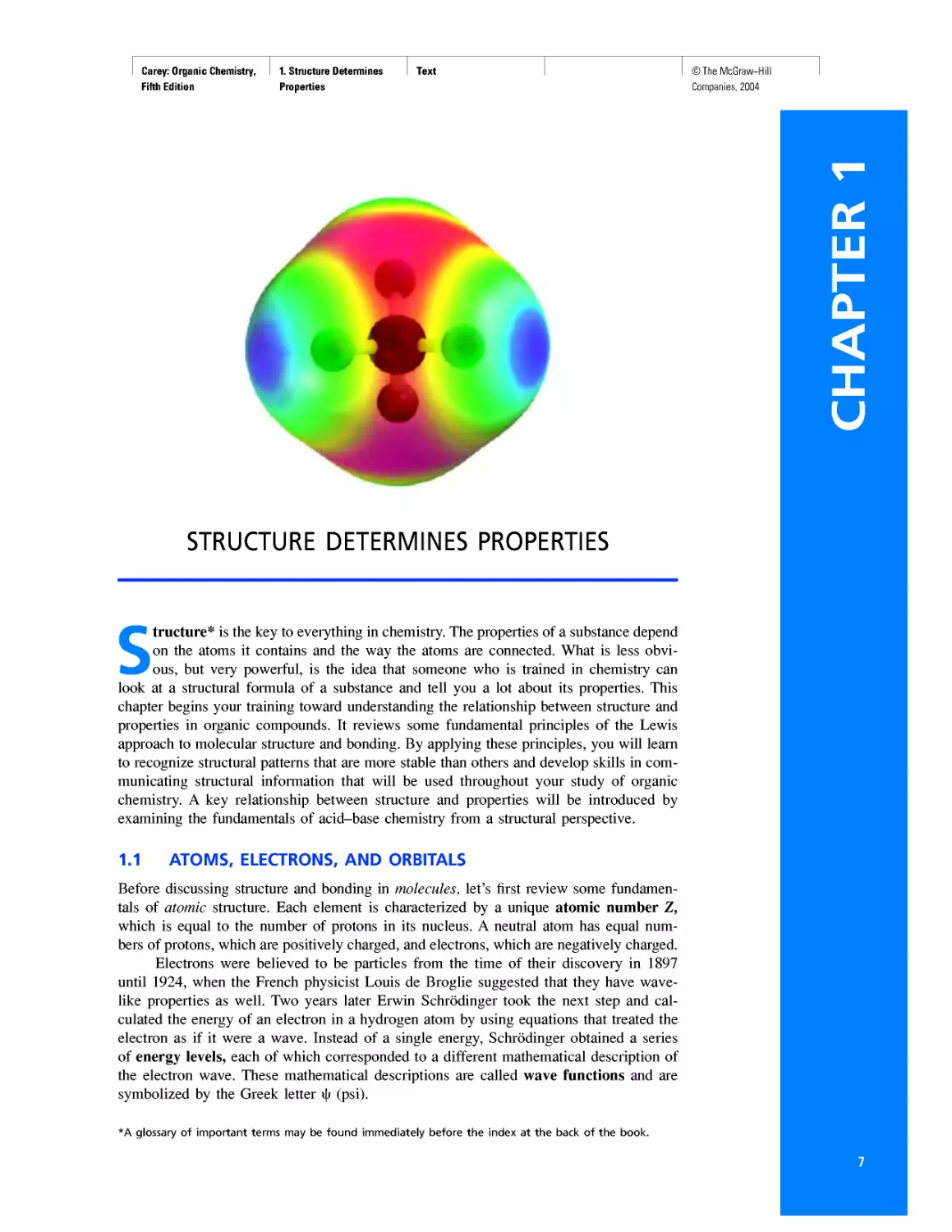
model of urea.
©The McGraw-Hill
Companies, 2004
Carey: Organic Chemistry, Front Matter
Introduction
Introduction
3
Fifth Edition
THE STRUCTURAL THEORY
From the concept of isomerism we can trace the origins of the structural theory—the
idea that a precise arrangement of atoms uniquely defines a substance. Ammonium
cyanate and urea are different compounds because they have different structures. To some
degree the structural theory was an idea whose time had come. Three scientists stand
out, however, for independently proposing the elements of the structural theory: August
Kekule, Archibald S. Couper, and Alexander M. Butlerov.
It is somehow fitting that August Kekule’s early training at the university in
Giessen was as a student of architecture. Kekule’s contribution to chemistry lies in his
description of the architecture of molecules. Two themes recur throughout Kekule’s
work: critical evaluation of experimental information and a gift for visualizing molecules
as particular assemblies of atoms. The essential features of Kekule’s theory, developed
and presented while he taught at Heidelberg in 1858, were that carbon normally formed
four bonds and had the capacity to bond to other carbons so as to form long chains. Iso-
mers were possible because the same elemental composition (say, the CH4N2O molecu-
lar formula common to both ammonium cyanate and urea) accommodates more than one
pattern of atoms and bonds.
Shortly thereafter, but independently of Kekule, Archibald S. Couper, a Scot working
in the laboratory of Charles-Adolphe Wurtz at the Ecole de Medicine in Paris, and Alexan-
der Butlerov, a Russian chemist at the University of Kazan, proposed similar theories.
ELECTRONIC THEORIES OF STRUCTURE AND REACTIVITY
In the late nineteenth and early twentieth centuries, major discoveries about the nature
of atoms placed theories of molecular structure and bonding on a more secure founda-
tion. Structural ideas progressed from simply identifying atomic connections to attempt-
ing to understand the bonding forces. In 1916, Gilbert N. Lewis of the University of Cal-
ifornia at Berkeley described covalent bonding in terms of shared electron pairs. Linus
Pauling at the California Institute of Technology subsequently elaborated a more sophis-
ticated bonding scheme based on Lewis’ ideas and a concept called resonance, which
he borrowed from the quantum mechanical treatments of theoretical physics.
Once chemists gained an appreciation of the fundamental principles of bonding,
the next logical step became understanding how chemical reactions occurred. Most
notable among the early workers in this area were two British organic chemists: Sir
Robert Robinson and Sir Christopher Ingold. Both held a number of teaching positions,
with Robinson spending most of his career at Oxford while Ingold was at University
College, London.
Robinson, who was primarily interested in the chemistry of natural products, had
a keen mind and a penetrating grasp of theory. He was able to take the basic elements
of Lewis’ structural theories and apply them to chemical transformations by suggesting
that chemical change can be understood by focusing on electrons. In effect, Robinson
analyzed organic reactions by looking at the electrons and understood that atoms moved
because they were carried along by the transfer of electrons. Ingold applied the quanti-
tative methods of physical chemistry to the study of organic reactions so as to better
understand the sequence of events, the mechanism, by which an organic substance is
converted to a product under a given set of conditions.
Our current understanding of elementary reaction mechanisms is quite good. Most
of the fundamental reactions of organic chemistry have been scrutinized to the degree
that we have a relatively clear picture of the intermediates that occur during the passage
A 1968 German stamp com-
bines a drawing of the struc-
ture of benzene with a
portrait of Kekule.
The University of Kazan was
home to a number of promi-
nent nineteenth-century or-
ganic chemists. Their
contributions are recognized
in two articles published in
the January and February
1994 issues of the Journal of
Chemical Education
(pp. 39-42 and 93-98).
Linus Pauling is portrayed on
this 1977 Volta stamp. The
chemical formulas depict the
two resonance forms of ben-
zene, and the explosion in
the background symbolizes
Pauling's efforts to limit the
testing of nuclear weapons.
©The McGraw-Hill
Companies, 2004
Carey: Organic Chemistry, Front Matter
Fifth Edition
Introduction
4
Introduction
The discoverer of penicillin,
Sir Alexander Fleming, has
appeared on two stamps.
This 1981 Hungarian issue
includes both a likeness of
Fleming and a structural for-
mula for penicillin.
For more on Tyrian purple,
see the article "Indigo and
Tyrian Purple—In Nature
and in the Lab" in the
November 2001 issue of the
Journal of Chemical Educa-
tion, pp. 1442-1443.
of starting materials to products. Extending of the principles of mechanism to reactions
that occur in living systems, on the other hand, is an area in which a large number of
important questions remain to be answered.
THE INFLUENCE OF ORGANIC CHEMISTRY
Many organic compounds were known to and used by ancient cultures. Almost every
known human society has manufactured and used beverages containing ethyl alcohol and
has observed the formation of acetic acid when wine was transformed into vinegar. Early
Chinese civilizations (2500-3000 все) extensively used natural materials for treating ill-
nesses and prepared a drug known as ma huang from herbal extracts. This drug was a
stimulant and elevated blood pressure. We now know that it contains ephedrine, an
organic compound similar in structure and physiological activity to adrenaline, a hor-
mone secreted by the adrenal gland. Almost all drugs prescribed today for the treatment
of disease are organic compounds—some are derived from natural sources; many others
are the products of synthetic organic chemistry.
As early as 2500 все in India, indigo was used to dye cloth a deep blue. The early
Phoenicians discovered that a purple dye of great value, Tyrian purple, could be extracted
from a Mediterranean sea snail. The beauty of the color and its scarcity made purple the
color of royalty. The availability of dyestuffs underwent an abrupt change in 1856 when
William Henry Perkin, an 18-year-old student, accidentally discovered a simple way to
prepare a deep-purple dye, which he called mauveine, from extracts of coal tar. This led
to a search for other synthetic dyes and forged a permanent link between industry and
chemical research.
The synthetic fiber industry as we know it began in 1928 when E. I. Du Pont de
Nemours & Company lured Professor Wallace H. Carothers from Harvard University to
direct their research department. In a few years Carothers and his associates had pro-
duced nylon, the first synthetic fiber, and neoprene, a rubber substitute. Synthetic fibers
and elastomers are both products of important contemporary industries, with an economic
influence far beyond anything imaginable in the middle 1920s.
COMPUTERS AND ORGANIC CHEMISTRY
Many countries have cele-
brated their chemical indus-
try on postage stamps. The
stamp shown was issued in
1971 by Argentina.
A familiar arrangement of the sciences places chemistry between physics, which is highly
mathematical, and biology, which is highly descriptive. Among chemistry’s subdisci-
plines, organic chemistry is less mathematical than descriptive in that it emphasizes the
qualitative aspects of molecular structure, reactions, and synthesis. The earliest applica-
tions of computers to chemistry took advantage of the “number crunching” power of
mainframes to analyze data and to perform calculations concerned with the more
quantitative aspects of bonding theory. More recently, organic chemists have found the
graphics capabilities of minicomputers, workstations, and personal computers to be well
suited to visualizing a molecule as a three-dimensional object and assessing its ability
to interact with another molecule. Given a biomolecule of known structure, a protein,
for example, and a drug that acts on it, molecular-modeling software can evaluate the
various ways in which the two may fit together. Such studies can provide information
on the mechanism of drug action and guide the development of new drugs of greater
efficacy.
The influence of computers on the practice of organic chemistry is a significant
recent development and will be revisited numerous times in the chapters that follow.
Carey: Organic Chemistry, Front Matter
Introduction
©The McGraw-Hill
Companies. 2004
5
Fifth Edition
Introduction
CHALLENGES AND OPPORTUNITIES
A major contributor to the growth of organic chemistry during this century has been the
accessibility of cheap starting materials. Petroleum and natural gas provide the building
blocks for the construction of larger molecules. From petrochemicals comes a dazzling
array of materials that enrich our lives: many drugs, plastics, synthetic fibers, films, and
elastomers are made from the organic chemicals obtained from petroleum. As we enter
an age of inadequate and shrinking supplies, the use to which we put petroleum looms
large in determining the kind of society we will have. Alternative sources of energy,
especially for transportation, will allow a greater fraction of the limited petroleum avail-
able to be converted to petrochemicals instead of being burned in automobile engines.
At a more fundamental level, scientists in the chemical industry are trying to devise ways
to use carbon dioxide as a carbon source in the production of building-block molecules.
Many of the most important processes in the chemical industry are carried out in
the presence of catalysts. Catalysts increase the rate of a particular chemical reaction
but are not consumed during it. In searching for new catalysts, we can learn a great deal
from biochemistry, the study of the chemical reactions that take place in living organ-
isms. All these fundamental reactions are catalyzed by enzymes. Rate enhancements of
several millionfold are common when one compares an enzyme-catalyzed reaction with
the same reaction performed in its absence. Many diseases are the result of specific
enzyme deficiencies that interfere with normal metabolism. In the final analysis, effec-
tive treatment of diseases requires an understanding of biological processes at the molec-
ular level—what the substrate is, what the product is, and the mechanism by which sub-
strate is transformed to product. Enormous advances have been made in understanding
biological processes. Because of the complexity of living systems, however, we have
only scratched the surface of this fascinating field of study.
Spectacular strides have been made in genetics during the past few years. Although
generally considered a branch of biology, genetics is increasingly being studied at the
molecular level by scientists trained as chemists. Gene-splicing techniques and methods
for determining the precise molecular structure of DNA are just two of the tools driving
the next scientific revolution.
You are studying organic chemistry at a time of its greatest influence on our daily
lives, at a time when it can be considered a mature science, when the challenging ques-
tions to which this knowledge can be applied have never been more important.
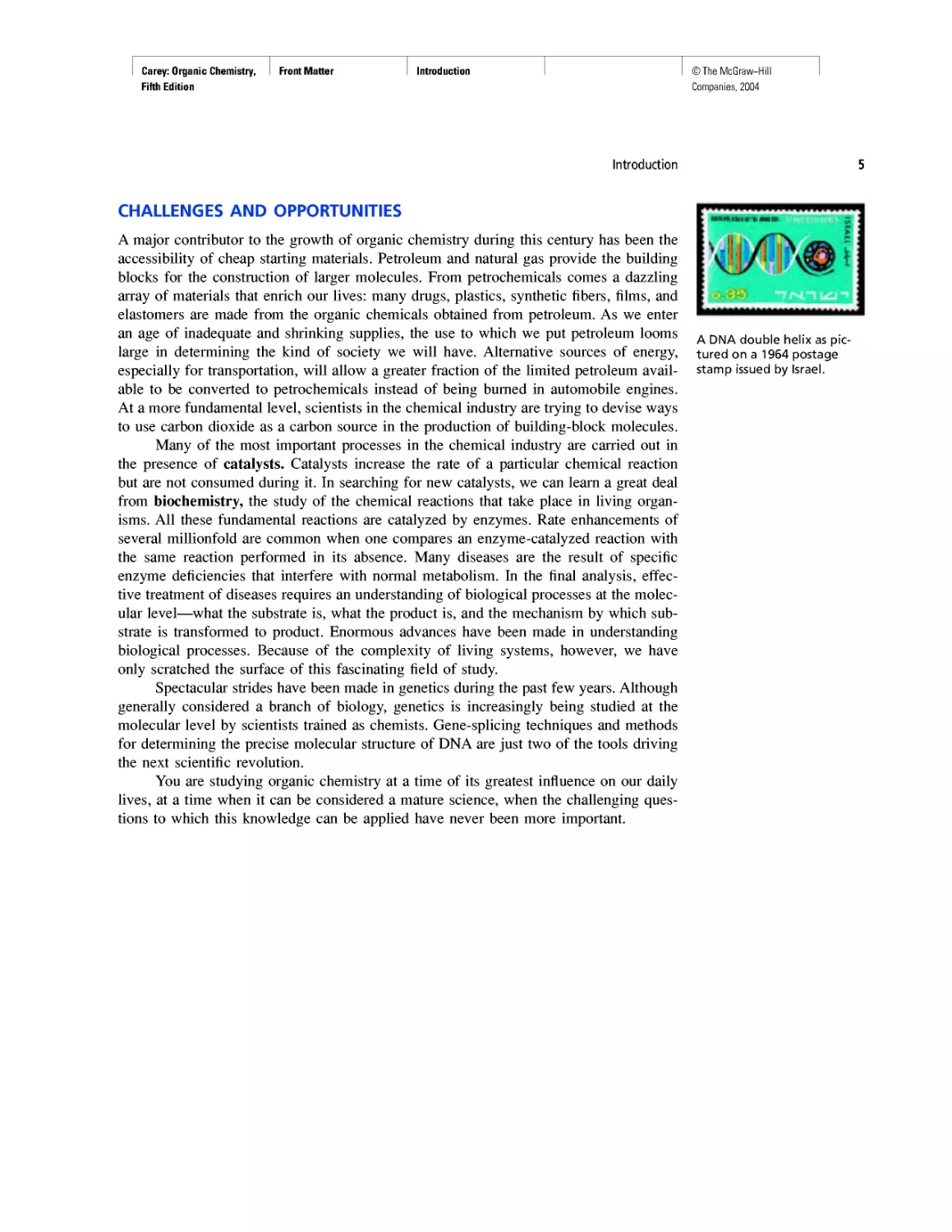
A DNA double helix as pic-
tured on a 1964 postage
stamp issued by Israel.
©The McGraw-Hill
Companies, 2004
Carey: Organic Chemistry, Front Matter
Introduction
Fifth Edition
Introduction
WHERE DID THE CARBON COME FROM?
According to the "big-bang" theory, the uni-
verse began expanding about 12 billion years
ago when an incredibly dense (1096 g-cm-3),
incredibly hot (1032 K) ball containing all the matter
in the universe exploded. No particles more massive
than protons or neutrons existed until about 100 s
after the big bang. By then, the temperature had
dropped to about 109 K, low enough to permit the
protons and neutrons to combine to form helium
nuclei.
Three helium nuclei
Nucleus of 12C
Two neutrons Two protons
Helium nucleus
2 n
Conditions favorable for the formation of he-
lium nuclei lasted for only a few hours, and the uni-
verse continued to expand without much "chemistry"
taking place for approximately a million years.
As the universe expanded, it cooled, and the
positively charged protons and helium nuclei com-
bined with electrons to give hydrogen and helium
atoms. Together, hydrogen and helium account for
99% of the mass of the universe and 99.9% of its
atoms. Hydrogen is the most abundant element;
88.6% of the atoms in the universe are hydrogen,
and 11.3% are helium.
Some regions of space have higher concentra-
tions of matter than others, high enough so that the
expansion and cooling that followed the big bang is
locally reversed. Gravitational attraction causes the
"matter clouds" to collapse and their temperature to
increase. After the big bang, the nuclear fusion of hy-
drogen to helium took place when the temperature
dropped to 109 K. The same nuclear fusion begins
when gravitational attraction heats matter clouds to
107 К and the ball of gas becomes a star. The star ex-
pands, reaching a more or less steady state at which
hydrogen is consumed and heat is evolved. The size
of the star remains relatively constant, but its core
becomes enriched in helium. After about 10% of the
hydrogen is consumed, the amount of heat produced
is insufficient to maintain the star's size, and it begins
to contract. As the star contracts the temperature of
the helium-rich core increases, and helium nuclei fuse
to form carbon.
Fusion of a nucleus of 12C with one of helium
gives 16O. Eventually the helium, too, becomes de-
pleted, and gravitational attraction causes the core
to contract and its temperature to increase to the
point at which various fusion reactions give yet heav-
ier nuclei.
Sometimes a star explodes in a supernova, cast-
ing debris into interstellar space. This debris includes
the elements formed during the life of the star, and
these elements find their way into new stars formed
when a cloud of matter collapses in on itself. Our
own sun is believed to be a "second generation" star,
one formed not only from hydrogen and helium,
but containing the elements formed in earlier stars
as well.
According to one theory, earth and the other
planets were formed almost 5 billion years ago from
the gas (the solar nebula) that trailed behind the sun
as it rotated. Being remote from the sun's core, the
matter in the nebula was cooler than that in the in-
terior and therefore it contracted, accumulating
heavier elements and becoming the series of planets
that now circle the sun.
Oxygen is the most abundant element on
earth. The earth's crust is rich in carbonate and sili-
cate rocks, the oceans are almost entirely water, and
oxygen constitutes almost one fifth of the air we
breathe. Carbon ranks only fourteenth among the
elements in natural abundance, but trails only hydro-
gen and oxygen in its abundance in the human body.
It is the chemical properties of carbon that make it
uniquely suitable as the raw material forthe building
blocks of life. Let's find out more about those chemi-
cal properties.
Carey: Organic Chemistry, I 1. Structure Determines Text
Fifth Edition	Properties
©The McGraw-Hill
Companies, 2004
CHAPTER
STRUCTURE DETERMINES PROPERTIES
Structure* is the key to everything in chemistry. The properties of a substance depend
on the atoms it contains and the way the atoms are connected. What is less obvi-
ous, but very powerful, is the idea that someone who is trained in chemistry can
look at a structural formula of a substance and tell you a lot about its properties. This
chapter begins your training toward understanding the relationship between structure and
properties in organic compounds. It reviews some fundamental principles of the Lewis
approach to molecular structure and bonding. By applying these principles, you will learn
to recognize structural patterns that are more stable than others and develop skills in com-
municating structural information that will be used throughout your study of organic
chemistry. A key relationship between structure and properties will be introduced by
examining the fundamentals of acid-base chemistry from a structural perspective.
1.1 ATOMS, ELECTRONS, AND ORBITALS
Before discussing structure and bonding in molecules, let’s first review some fundamen-
tals of atomic structure. Each element is characterized by a unique atomic number Z,
which is equal to the number of protons in its nucleus. A neutral atom has equal num-
bers of protons, which are positively charged, and electrons, which are negatively charged.
Electrons were believed to be particles from the time of their discovery in 1897
until 1924, when the French physicist Louis de Broglie suggested that they have wave-
like properties as well. Two years later Erwin Schrodinger took the next step and cal-
culated the energy of an electron in a hydrogen atom by using equations that treated the
electron as if it were a wave. Instead of a single energy, Schrodinger obtained a series
of energy levels, each of which corresponded to a different mathematical description of
the electron wave. These mathematical descriptions are called wave functions and are
symbolized by the Greek letter ф (psi).
*A glossary of important terms may be found immediately before the index at the back of the book.
7
Carey: Organic Chemistry, I 1. Structure Determines Text
Fifth Edition	Properties
©The McGraw-Hill
Companies, 2004
CHAPTER ONE Structure Determines Properties
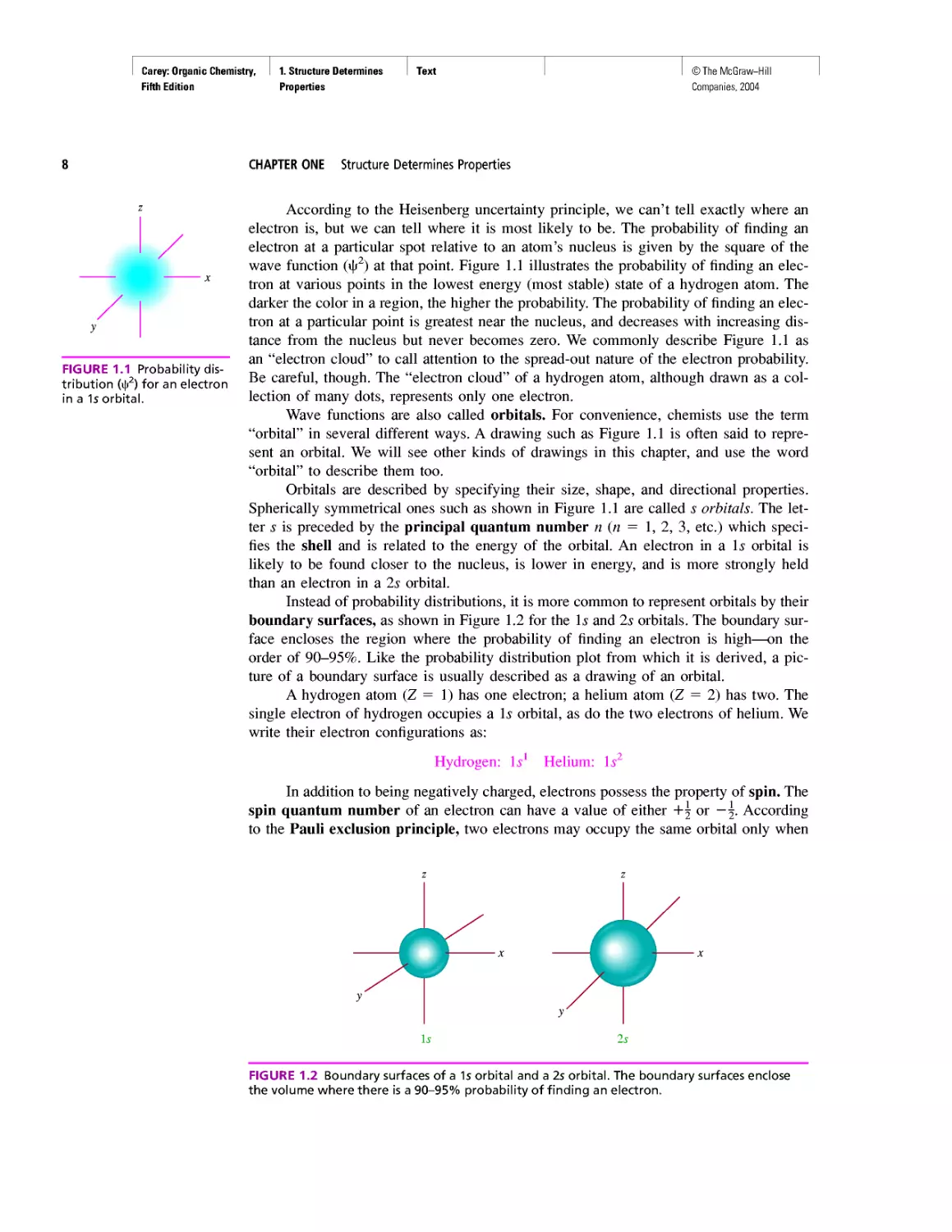
FIGURE 1.1 Probability dis-
tribution (ф2) for an electron
in a 1s orbital.
According to the Heisenberg uncertainty principle, we can’t tell exactly where an
electron is, but we can tell where it is most likely to be. The probability of finding an
electron at a particular spot relative to an atom’s nucleus is given by the square of the
wave function (ф2) at that point. Figure 1.1 illustrates the probability of finding an elec-
tron at various points in the lowest energy (most stable) state of a hydrogen atom. The
darker the color in a region, the higher the probability. The probability of finding an elec-
tron at a particular point is greatest near the nucleus, and decreases with increasing dis-
tance from the nucleus but never becomes zero. We commonly describe Figure 1.1 as
an “electron cloud” to call attention to the spread-out nature of the electron probability.
Be careful, though. The “electron cloud” of a hydrogen atom, although drawn as a col-
lection of many dots, represents only one electron.
Wave functions are also called orbitals. For convenience, chemists use the term
“orbital” in several different ways. A drawing such as Figure 1.1 is often said to repre-
sent an orbital. We will see other kinds of drawings in this chapter, and use the word
“orbital” to describe them too.
Orbitals are described by specifying their size, shape, and directional properties.
Spherically symmetrical ones such as shown in Figure 1.1 are called s orbitals. The let-
ter s is preceded by the principal quantum number n (n = 1, 2, 3, etc.) which speci-
fies the shell and is related to the energy of the orbital. An electron in a I s orbital is
likely to be found closer to the nucleus, is lower in energy, and is more strongly held
than an electron in a 2s orbital.
Instead of probability distributions, it is more common to represent orbitals by their
boundary surfaces, as shown in Figure 1.2 for the Is and 2s orbitals. The boundary sur-
face encloses the region where the probability of finding an electron is high—on the
order of 90-95%. Like the probability distribution plot from which it is derived, a pic-
ture of a boundary surface is usually described as a drawing of an orbital.
A hydrogen atom (Z = 1) has one electron; a helium atom (Z = 2) has two. The
single electron of hydrogen occupies a Is orbital, as do the two electrons of helium. We
write their electron configurations as:
Hydrogen: Is1 Helium: Is2
In addition to being negatively charged, electrons possess the property of spin. The
spin quantum number of an electron can have a value of either +5 or —5. According
to the Pauli exclusion principle, two electrons may occupy the same orbital only when
FIGURE 1.2 Boundary surfaces of a 1s orbital and a 2s orbital. The boundary surfaces enclose
the volume where there is a 90-95% probability of finding an electron.
©The McGraw-Hill
Companies, 2004
Carey: Organic Chemistry,
Fifth Edition
1. Structure Determines
Properties
Text
1.1 Atoms, Electrons, and Orbitals
9
they have opposite, or “paired,” spins. For this reason, no orbital can contain more than
two electrons. Because two electrons fill the Is orbital, the third electron in lithium
(Z = 3) must occupy an orbital of higher energy. After Is, the next higher energy orbital
is 2s. The third electron in lithium therefore occupies the 2s orbital, and the electron
configuration of lithium is
Lithium: ls22s'
The period (or row) of the periodic table in which an element appears corresponds to
the principal quantum number of the highest numbered occupied orbital (n = 1 in the
case of hydrogen and helium). Hydrogen and helium are first-row elements; lithium
(n = 2) is a second-row element.
With beryllium (Z = 4), the 2s level becomes filled, and the next orbitals to be
occupied in it and the remaining second-row elements are the 2p,, 2py, and 2p, orbitals.
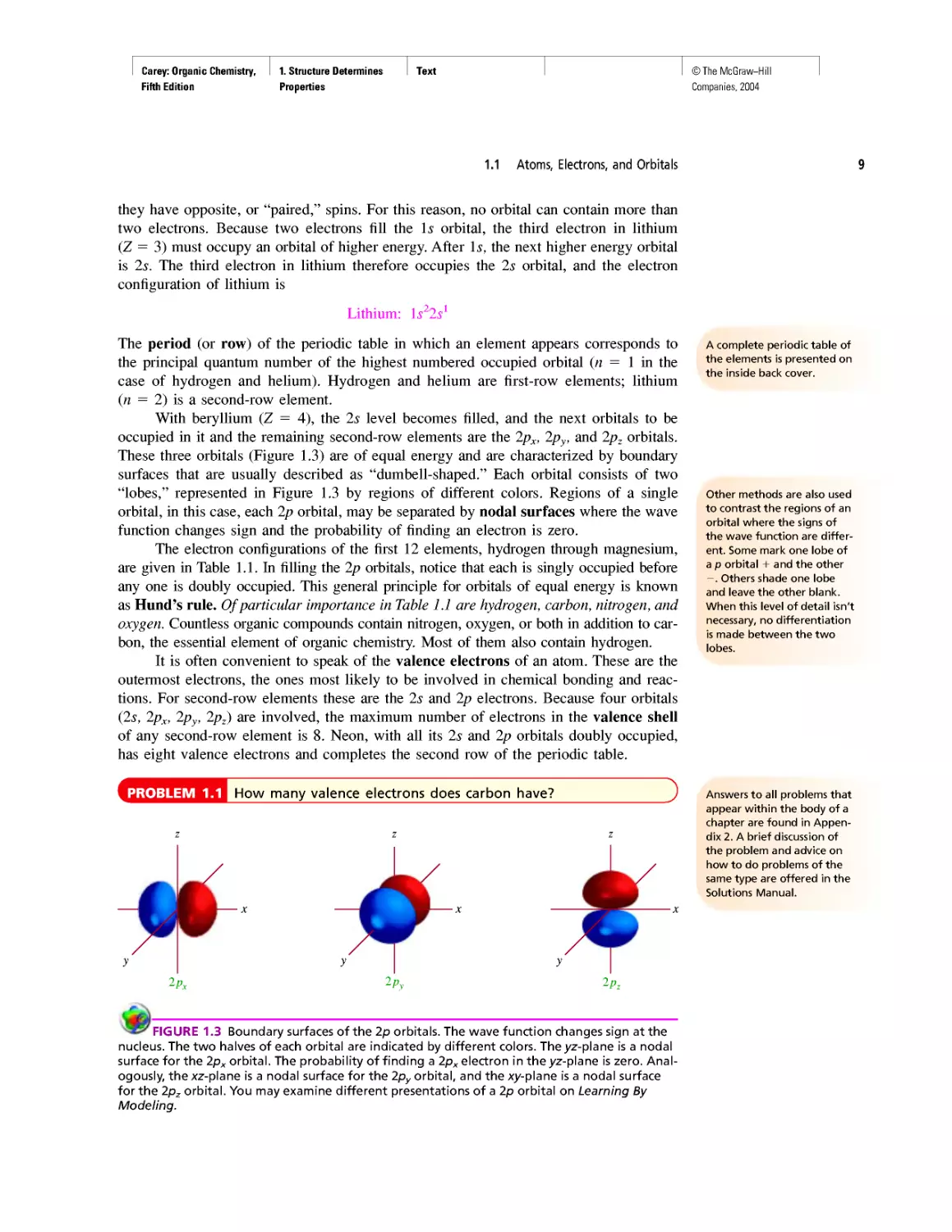
These three orbitals (Figure 1.3) are of equal energy and are characterized by boundary
surfaces that are usually described as “dumbell-shaped.” Each orbital consists of two
“lobes,” represented in Figure 1.3 by regions of different colors. Regions of a single
orbital, in this case, each 2p orbital, may be separated by nodal surfaces where the wave
function changes sign and the probability of finding an electron is zero.
The electron configurations of the first 12 elements, hydrogen through magnesium,
are given in Table 1.1. In filling the 2p orbitals, notice that each is singly occupied before
any one is doubly occupied. This general principle for orbitals of equal energy is known
as Hund’s rule. Of particular importance in Table 1.1 are hydrogen, carbon, nitrogen, and
oxygen. Countless organic compounds contain nitrogen, oxygen, or both in addition to car-
bon, the essential element of organic chemistry. Most of them also contain hydrogen.
It is often convenient to speak of the valence electrons of an atom. These are the
outermost electrons, the ones most likely to be involved in chemical bonding and reac-
tions. For second-row elements these are the 2s and 2p electrons. Because four orbitals
(2s, 2px, 2py, 2pz) are involved, the maximum number of electrons in the valence shell
of any second-row element is 8. Neon, with all its 2s and 2p orbitals doubly occupied,
has eight valence electrons and completes the second row of the periodic table.
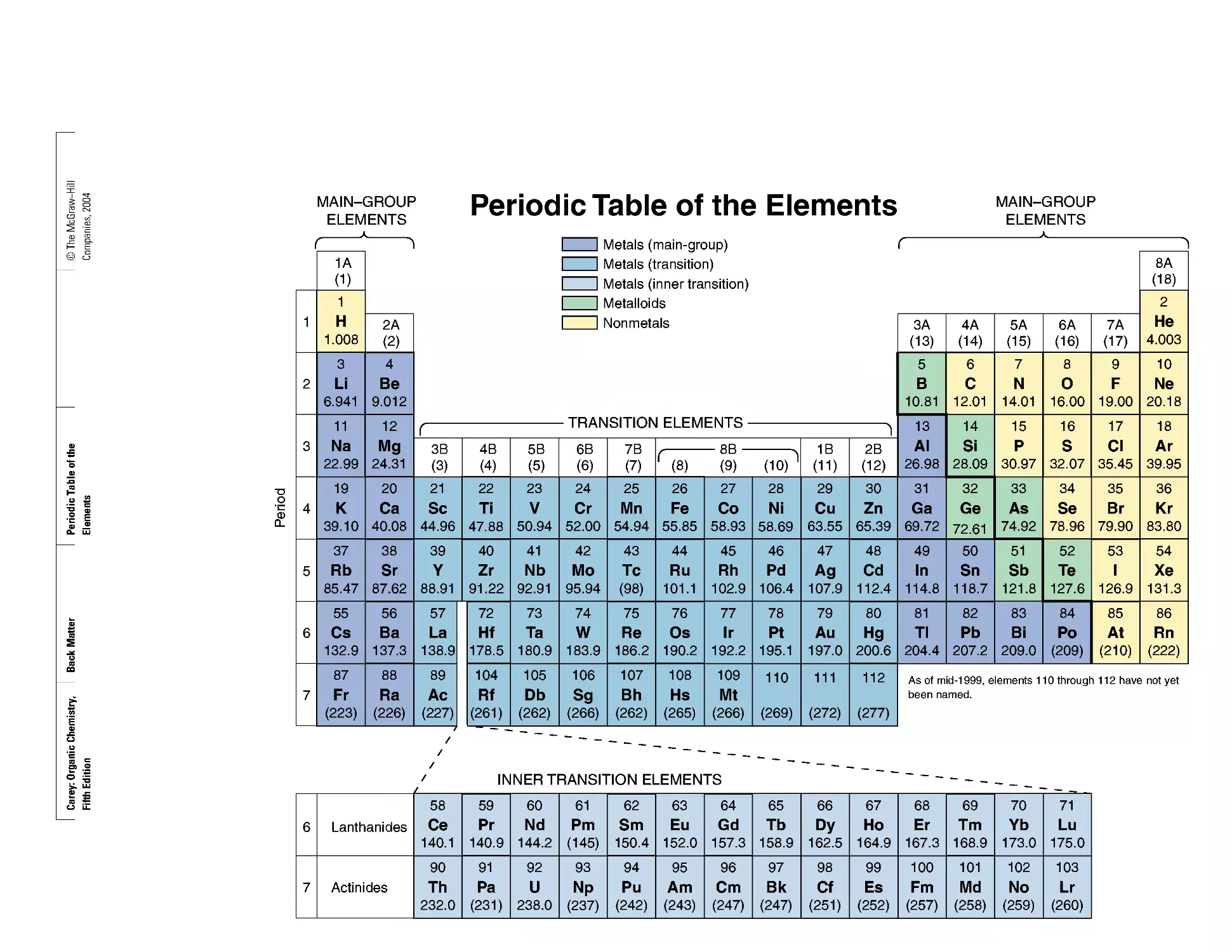
A complete periodic table of
the elements is presented on
the inside back cover.
Other methods are also used
to contrast the regions of an
orbital where the signs of
the wave function are differ-
ent. Some mark one lobe of
a p orbital + and the other
—. Others shade one lobe
and leave the other blank.
When this level of detail isn't
necessary, no differentiation
is made between the two
lobes.
How many valence electrons does carbon have?
PROBLEM 1.1
Answers to all problems that
appear within the body of a
chapter are found in Appen-
dix 2. A brief discussion of
the problem and advice on
how to do problems of the
same type are offered in the
Solutions Manual.
FIGURE 1.3 Boundary surfaces of the 2p orbitals. The wave function changes sign at the
nucleus. The two halves of each orbital are indicated by different colors. The yz-plane is a nodal
surface for the 2px orbital. The probability of finding a 2px electron in the yz-plane is zero. Anal-
ogously, the xz-plane is a nodal surface for the 2py orbital, and the xy-plane is a nodal surface
for the 2pz orbital. You may examine different presentations of a 2p orbital on Learning By
Modeling.
Carey: Organic Chemistry, I 1. Structure Determines Text
Fifth Edition	Properties
©The McGraw-Hill
Companies, 2004
10
CHAPTER ONE Structure Determines Properties
Electron Configurations of the First Twelve Elements of
the Periodic Table
Element	Atomic number Z	Number of electrons in indicated orbital
		1s	2s	2px	2py	2pz	3s
Hydrogen	1	1
Helium	2	2
Lithium	3	2	1
Beryllium	4	2	2
Boron	5	2	2	1
Carbon	6	2	2	1	1
Nitrogen	7	2	2	1	1	1
Oxygen	8	2	2	2	1	1
Fluorine	9	2	2	2	2	1
Neon	10	2	2	2	2	2
Sodium	11	2	2	2	2	2	1
Magnesium	12	2	2	2	2	2	2
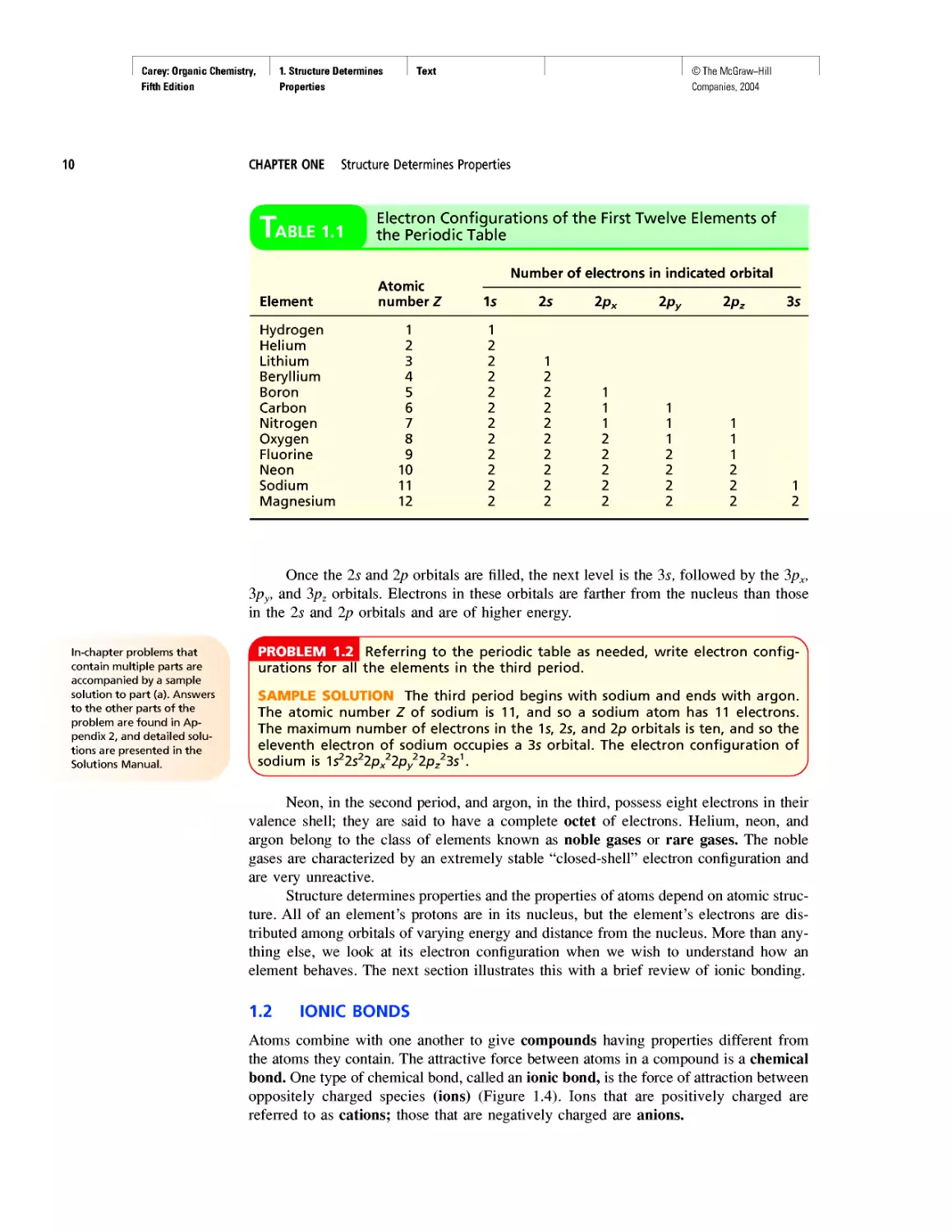
Once the 2s and 2p orbitals are filled, the next level is the 3s, followed by the 3px,
3py, and 3p„ orbitals. Electrons in these orbitals are farther from the nucleus than those
in the 2s and 2p orbitals and are of higher energy.
In-chapter problems that
contain multiple parts are
accompanied by a sample
solution to part (a). Answers
to the other parts of the
problem are found in Ap-
pendix 2, and detailed solu-
tions are presented in the
Solutions Manual.
PROBLEM 1.2
________________Referring to the periodic table as needed, write electron config-
urations for all the elements in the third period.
SAMPLE SOLUTION The third period begins with sodium and ends with argon.
The atomic number Z of sodium is 11, and so a sodium atom has 11 electrons.
The maximum number of electrons in the 1s, 2s, and 2p orbitals is ten, and so the
eleventh electron of sodium occupies a 3s orbital. The electron configuration of
sodium is -]s?2s22p22p22pz23s\
Neon, in the second period, and argon, in the third, possess eight electrons in their
valence shell; they are said to have a complete octet of electrons. Helium, neon, and
argon belong to the class of elements known as noble gases or rare gases. The noble
gases are characterized by an extremely stable “closed-shell” electron configuration and
are very unreactive.
Structure determines properties and the properties of atoms depend on atomic struc-
ture. All of an element’s protons are in its nucleus, but the element’s electrons are dis-
tributed among orbitals of varying energy and distance from the nucleus. More than any-
thing else, we look at its electron configuration when we wish to understand how an
element behaves. The next section illustrates this with a brief review of ionic bonding.
1.2 IONIC BONDS
Atoms combine with one another to give compounds having properties different from
the atoms they contain. The attractive force between atoms in a compound is a chemical
bond. One type of chemical bond, called an ionic bond, is the force of attraction between
oppositely charged species (ions) (Figure 1.4). Ions that are positively charged are
referred to as cations; those that are negatively charged are anions.
©The McGraw-Hill
Companies, 2004
Carey: Organic Chemistry,
Fifth Edition
1. Structure Determines
Properties
Text
1.2 Ionic Bonds
11
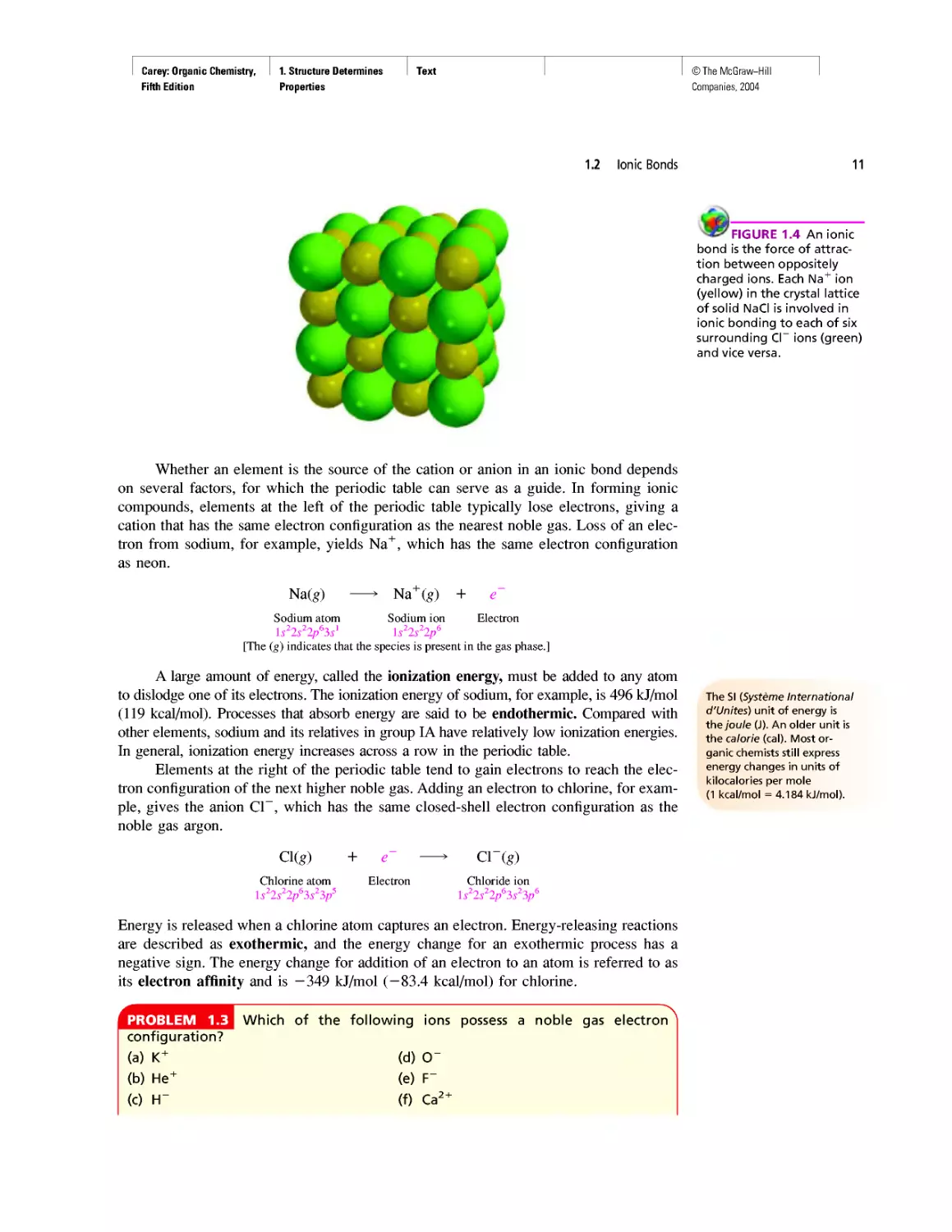
^'FIGURE 1.4 An ionic
bond is the force of attrac-
tion between oppositely
charged ions. Each Na+ ion
(yellow) in the crystal lattice
of solid NaCI is involved in
ionic bonding to each of six
surrounding СГ ions (green)
and vice versa.
Whether an element is the source of the cation or anion in an ionic bond depends
on several factors, for which the periodic table can serve as a guide. In forming ionic
compounds, elements at the left of the periodic table typically lose electrons, giving a
cation that has the same electron configuration as the nearest noble gas. Loss of an elec-
tron from sodium, for example, yields Na+, which has the same electron configuration
as neon.
Na(g) ---------» Na+(g) + e
Sodium atom Sodium ion Electron
ls22s22p63?	ls22s22p6
[The (g) indicates that the species is present in the gas phase.]
A large amount of energy, called the ionization energy, must be added to any atom
to dislodge one of its electrons. The ionization energy of sodium, for example, is 496 kJ/mol
(119 kcal/mol). Processes that absorb energy are said to be endothermic. Compared with
other elements, sodium and its relatives in group IA have relatively low ionization energies.
In general, ionization energy increases across a row in the periodic table.
Elements at the right of the periodic table tend to gain electrons to reach the elec-
tron configuration of the next higher noble gas. Adding an electron to chlorine, for exam-
ple, gives the anion Cl-, which has the same closed-shell electron configuration as the
noble gas argon.
The SI (Systeme International
d'Unites) unit of energy is
the joule (J). An older unit is
the calorie (cal). Most or-
ganic chemists still express
energy changes in units of
kilocalories per mole
(1 kcal/mol = 4.184 kJ/mol).
Cl(g) + e~ ------------------> Cl-(g)
Chlorine atom Electron	Chloride ion
ls22s22p63s23p5	l?2?2p63?3p6
Energy is released when a chlorine atom captures an electron. Energy-releasing reactions
are described as exothermic, and the energy change for an exothermic process has a
negative sign. The energy change for addition of an electron to an atom is referred to as
its electron affinity and is —349 kJ/mol (—83.4 kcal/mol) for chlorine.
PROBLEM 1.3
configuration?
(a)	K+
(b)	He+
(с) H-
Which of the following ions possess a noble gas electron
(d) O-
(e) F-
(f) Ca2+
Carey: Organic Chemistry, I 1. Structure Determines Text
Fifth Edition	Properties
©The McGraw-Hill
Companies, 2004
12
CHAPTER ONE Structure Determines Properties
SAMPLE SOLUTION (a) Potassium has atomic number 19, and so a potassium
atom has 19 electrons. The ion K+, therefore, has 18 electrons, the same as the
noble gas argon. The electron configurations of K+ and Ar are the same:
<1s22s22p63s23p6.__________________________________________________________________
Ionic bonding was proposed
by the German physicist
Walther Kossel in 1916, in or-
der to explain the ability of
substances such as molten
sodium chloride to conduct
an electric current. He was
the son of Albrecht Kossel,
winner of the 1910 Nobel
Prize in physiology or medi-
cine for early studies in nu-
cleic acids.
Transfer of an electron from a sodium atom to a chlorine atom yields a sodium
cation and a chloride anion, both of which have a noble gas electron configuration:
Nafg) + Cl(g) — Na+Cl-(g)
Sodium atom Chlorine atom	Sodium chloride
Were we to simply add the ionization energy of sodium (496 kJ/mol) and the electron affin-
ity of chlorine (—349 kJ/mol), we would conclude that the overall process is endothermic
with A//° = +147 kJ/mol. The energy liberated by adding an electron to chlorine is insuf-
ficient to override the energy required to remove an electron from sodium. This analysis,
however, fails to consider the force of attraction between the oppositely charged ions Na+
and Cl-, which exceeds 500 kJ/mol and is more than sufficient to make the overall process
exothermic. Attractive forces between oppositely charged particles are termed electrostatic,
or coulombic, attractions and are what we mean by an ionic bond between two atoms.
What is the electron configuration of C+? Of C-? Does either one ]
of these ions have a noble gas (closed-shell) electron configuration?	J
PROBLEM 1.4
Ionic bonds are very common in inorganic compounds, but rare in organic ones.
The ionization energy of carbon is too large and the electron affinity too small for car-
bon to realistically form a C4+ or C4- ion. What kinds of bonds, then, link carbon to
other elements in millions of organic compounds? Instead of losing or gaining electrons,
carbon shares electrons with other elements (including other carbon atoms) to give what
are called covalent bonds.
1.3 COVALENT BONDS AND THE OCTET RULE
Gilbert Newton Lewis (born
Weymouth, Massachusetts,
1875; died Berkeley, Califor-
nia, 1946) has been called
the greatest American
chemist. The January 1984
issue of the Journal of
Chemical Education contains
five articles describing
Lewis's life and contributions
to chemistry.
The covalent, or shared electron pair, model of chemical bonding was first suggested
by G. N. Lewis of the University of California in 1916. Lewis proposed that a sharing
of two electrons by two hydrogen atoms permits each one to have a stable closed-shell
electron configuration analogous to helium.
H=H
Two hydrogen atoms,
each with a single
electron
Hydrogen molecule:
covalent bonding by way of
a shared electron pair
Structural formulas of this type in which electrons are represented as dots are called
Lewis structures.
The amount of energy required to dissociate a hydrogen molecule H2 to two sep-
arate hydrogen atoms is called its bond dissociation energy (or bond energy). For H2
it is quite large, amounting to 435 kJ/mol (104 kcal/mol). The main contributor to the
strength of the covalent bond in H2 is the increased binding force exerted on its two
electrons. Each electron in H2 “feels” the attractive force of two nuclei, rather than one
as it would in an isolated hydrogen atom.
©The McGraw-Hill
Companies, 2004
Carey: Organic Chemistry,
Fifth Edition
1. Structure Determines
Properties
Text
1.3 Covalent Bonds and the Octet Rule
13
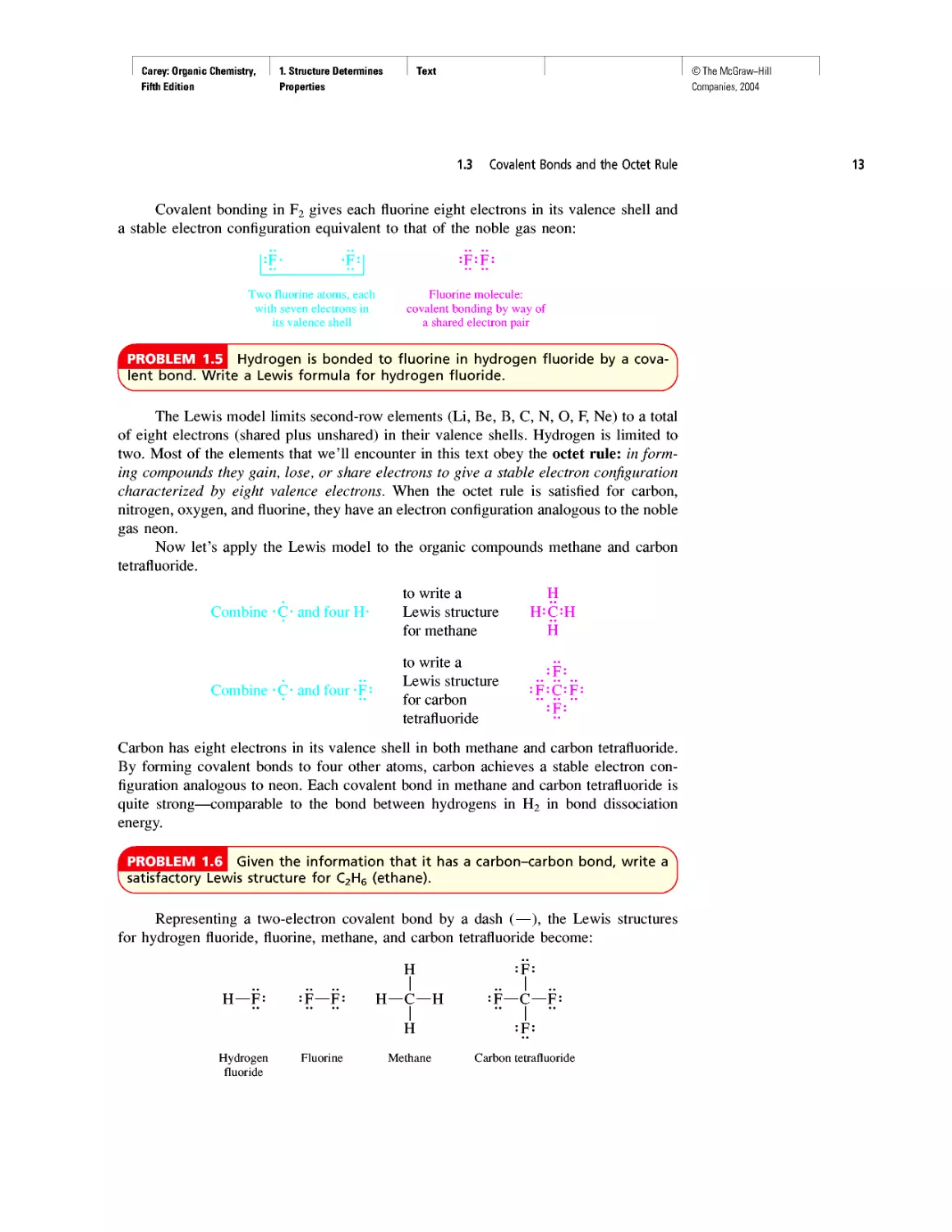
Covalent bonding in F2 gives each fluorine eight electrons in its valence shell and
a stable electron configuration equivalent to that of the noble gas neon:
if___________1
Two fluorine atoms, each
with seven electrons in
its valence shell
:F:F:
Fluorine molecule:
covalent bonding by way of
a shared electron pair
PROBLEM 1.5
__________________ Hydrogen is bonded to fluorine in hydrogen fluoride by a cova-
lent bond. Write a Lewis formula for hydrogen fluoride.
The Lewis model limits second-row elements (Li, Be, В, C, N, O, F, Ne) to a total
of eight electrons (shared plus unshared) in their valence shells. Hydrogen is limited to
two. Most of the elements that we’ll encounter in this text obey the octet rule: inform-
ing compounds they gain, lose, or share electrons to give a stable electron configuration
characterized by eight valence electrons. When the octet rule is satisfied for carbon,
nitrogen, oxygen, and fluorine, they have an electron configuration analogous to the noble
gas neon.
Now let’s apply the Lewis model to the organic compounds methane and carbon
tetrafluoride.
to write a	H
Lewis structure	H=C:H
for methane	H
to write a	-
T •	;F:
„ a . f Б. Lewis structure .а.а.б.
Combine-C-and four-F:	,	,	:F:C = F:
for carbon	 -
:F:
tetrafluoride
Carbon has eight electrons in its valence shell in both methane and carbon tetrafluoride.
By forming covalent bonds to four other atoms, carbon achieves a stable electron con-
figuration analogous to neon. Each covalent bond in methane and carbon tetrafluoride is
quite strong—comparable to the bond between hydrogens in H2 in bond dissociation
energy.
PROBLEM 1.6
_______________ Given the information that it has a carbon-carbon bond, write a )
^satisfactory Lewis structure for C2H6 (ethane).J
Representing a two-electron covalent bond by a dash (—), the Lewis structures
for hydrogen fluoride, fluorine, methane, and carbon tetrafluoride become:
H	:F:
........... I	..I	..
H—F:	:F—F:	H—С—H	:F—C— F =
........... I	"I	"
H	=F:
Hydrogen
fluoride
Fluorine
Methane
Carbon tetrafluoride
Carey: Organic Chemistry, I 1. Structure Determines Text
Fifth Edition	Properties
©The McGraw-Hill
Companies, 2004
14
CHAPTER ONE Structure Determines Properties
1.4	DOUBLE BONDS AND TRIPLE BONDS
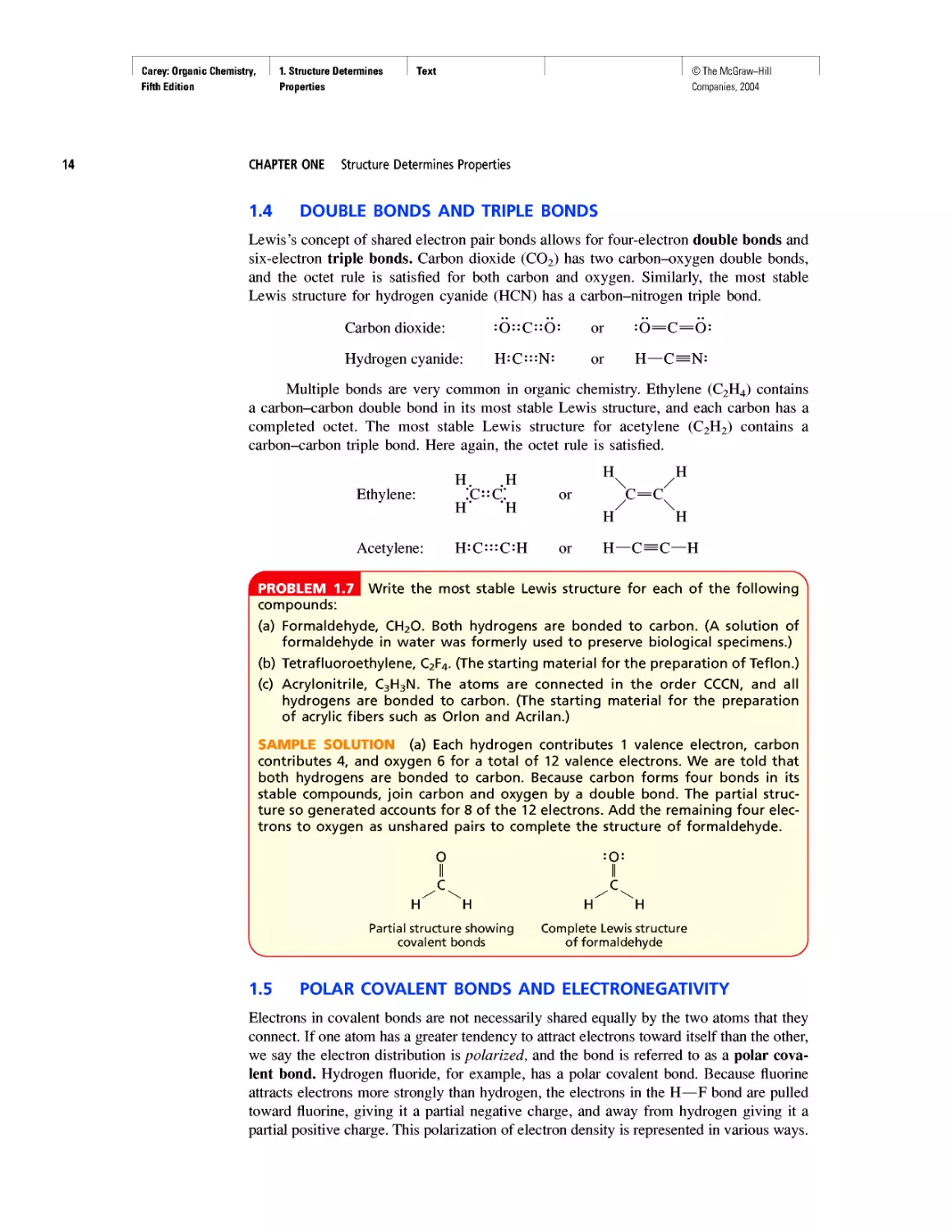
Lewis’s concept of shared electron pair bonds allows for four-electron double bonds and
six-electron triple bonds. Carbon dioxide (CO2) has two carbon-oxygen double bonds,
and the octet rule is satisfied for both carbon and oxygen. Similarly, the most stable
Lewis structure for hydrogen cyanide (HCN) has a carbon-nitrogen triple bond.
Carbon dioxide:	:d”C„d: or :d=C=O:
Hydrogen cyanide: HrC—N:	or	H—C=N=
Multiple bonds are very common in organic chemistry. Ethylene (C2H4) contains
a carbon-carbon double bond in its most stable Lewis structure, and each carbon has a
completed octet. The most stable Lewis structure for acetylene (C2H2) contains a
carbon-carbon triple bond. Here again, the octet rule is satisfied.
H	H
Ethylene:	fC-C
H’	H
or
H	H
zc=c\
H	H
Acetylene:	Н:С":С=Н or	H—C=C—H
Г
PROBLEM 1.7
Write the most stable Lewis structure for each of the following
compounds:
(a)	Formaldehyde, CH2O. Both hydrogens are bonded to carbon. (A solution of
formaldehyde in water was formerly used to preserve biological specimens.)
(b)	Tetrafluoroethylene, C2F4. (The starting material for the preparation of Teflon.)
(c) Acrylonitrile, C3H3N. The atoms are connected in the order CCCN, and all
hydrogens are bonded to carbon. (The starting material for the preparation
of acrylic fibers such as Orlon and Acrilan.)
SAMPLE SOLUTION (a) Each hydrogen contributes 1 valence electron, carbon
contributes 4, and oxygen 6 for a total of 12 valence electrons. We are told that
both hydrogens are bonded to carbon. Because carbon forms four bonds in its
stable compounds, join carbon and oxygen by a double bond. The partial struc-
ture so generated accounts for 8 of the 12 electrons. Add the remaining four elec-
trons to oxygen as unshared pairs to complete the structure of formaldehyde.
Partial structure showing	Complete Lewis structure
covalent bonds	of formaldehyde
1.5	POLAR COVALENT BONDS AND ELECTRONEGATIVITY
Electrons in covalent bonds are not necessarily shared equally by the two atoms that they
connect. If one atom has a greater tendency to attract electrons toward itself than the other,
we say the electron distribution is polarized, and the bond is referred to as a polar cova-
lent bond. Hydrogen fluoride, for example, has a polar covalent bond. Because fluorine
attracts electrons more strongly than hydrogen, the electrons in the H—F bond are pulled
toward fluorine, giving it a partial negative charge, and away from hydrogen giving it a
partial positive charge. This polarization of electron density is represented in various ways.
©The McGraw-Hill
Companies, 2004
Carey: Organic Chemistry,
Fifth Edition
1. Structure Determines
Properties
Text
1.5 Polar Covalent Bonds and Electronegativity
15
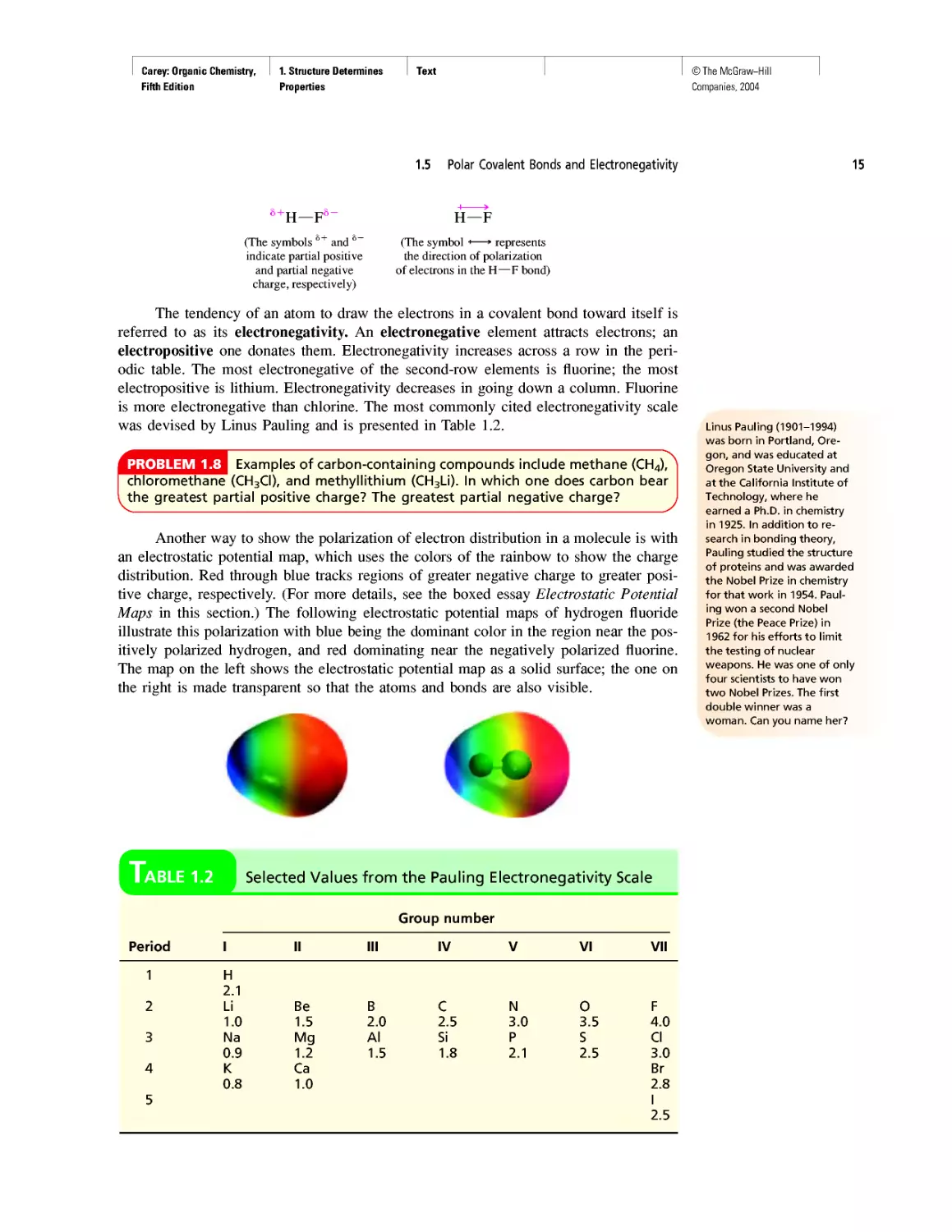
8+H—f8-
(The symbols o+ and °-
indicate partial positive
and partial negative
charge, respectively)
H—F
(The symbol <—► represents
the direction of polarization
of electrons in the H—F bond)
The tendency of an atom to draw the electrons in a covalent bond toward itself is
referred to as its electronegativity. An electronegative element attracts electrons; an
electropositive one donates them. Electronegativity increases across a row in the peri-
odic table. The most electronegative of the second-row elements is fluorine; the most
electropositive is lithium. Electronegativity decreases in going down a column. Fluorine
is more electronegative than chlorine. The most commonly cited electronegativity scale
was devised by Linus Pauling and is presented in Table 1.2.
________________ Examples of carbon-containing compounds include methane (CH4),
I chloromethane (CH3CI), and methyllithium (CH3Li). In which one does carbon bear
I the greatest partial positive charge? The greatest partial negative charge?
PROBLEM 1.8
Another way to show the polarization of electron distribution in a molecule is with
an electrostatic potential map, which uses the colors of the rainbow to show the charge
distribution. Red through blue tracks regions of greater negative charge to greater posi-
tive charge, respectively. (For more details, see the boxed essay Electrostatic Potential
Maps in this section.) The following electrostatic potential maps of hydrogen fluoride
illustrate this polarization with blue being the dominant color in the region near the pos-
itively polarized hydrogen, and red dominating near the negatively polarized fluorine.
The map on the left shows the electrostatic potential map as a solid surface; the one on
the right is made transparent so that the atoms and bonds are also visible.
Linus Pauling (1901-1994)
was bom in Portland, Ore-
gon, and was educated at
Oregon State University and
at the California Institute of
Technology, where he
earned a Ph.D. in chemistry
in 1925. In addition to re-
search in bonding theory,
Pauling studied the structure
of proteins and was awarded
the Nobel Prize in chemistry
forthat work in 1954. Paul-
ing won a second Nobel
Prize (the Peace Prize) in
1962 for his efforts to limit
the testing of nuclear
weapons. He was one of only
four scientists to have won
two Nobel Prizes. The first
double winner was a
woman. Can you name her?
Selected Values from the Pauling Electronegativity Scale
Period	Group number
	1	II		III	IV	V	VI	VII
1	H
	2.1
2	Li	Be	В	c	N	0	F
	1.0	1.5	2.0	2.5	3.0	3.5	4.0
3	Na	Mg	Al	Si	P	S	Cl
	0.9	1.2	1.5	1.8	2.1	2.5	3.0
4	К	Ca					Br
	0.8	1.0					2.8
5							I 2.5
16
Carey: Organic Chemistry, I 1. Structure Determines Text
Fifth Edition
Properties
©The McGraw-Hill
Companies, 2004
CHAPTER ONE Structure Determines Properties
ELECTROSTATIC POTENTIAL MAPS
All of the material in this text, and most of
chemistry generally, can be understood on the
basis of what physicists call the electro-
magnetic force. Its major principle is that opposite
charges attract and like charges repel. As you learn
organic chemistry, a good way to start to connect
structure to properties such as chemical reactivity is
to find the positive part of one molecule and the neg-
ative part of another. Most of the time, these will be
the reactive sites.
Imagine that you bring a positive charge to-
ward a molecule. The interaction between that posi-
tive charge and some point in the molecule will be
attractive if the point is negatively charged, repulsive
if it is positively charged, and the strength of the in-
teraction will depend on the magnitude of the
charge. Computational methods make it possible to
calculate and map these interactions. It is convenient
to display this map using the colors of the rainbow
from red to blue. Red is the negative (electron-rich)
end and blue is the positive (electron-poor) end.
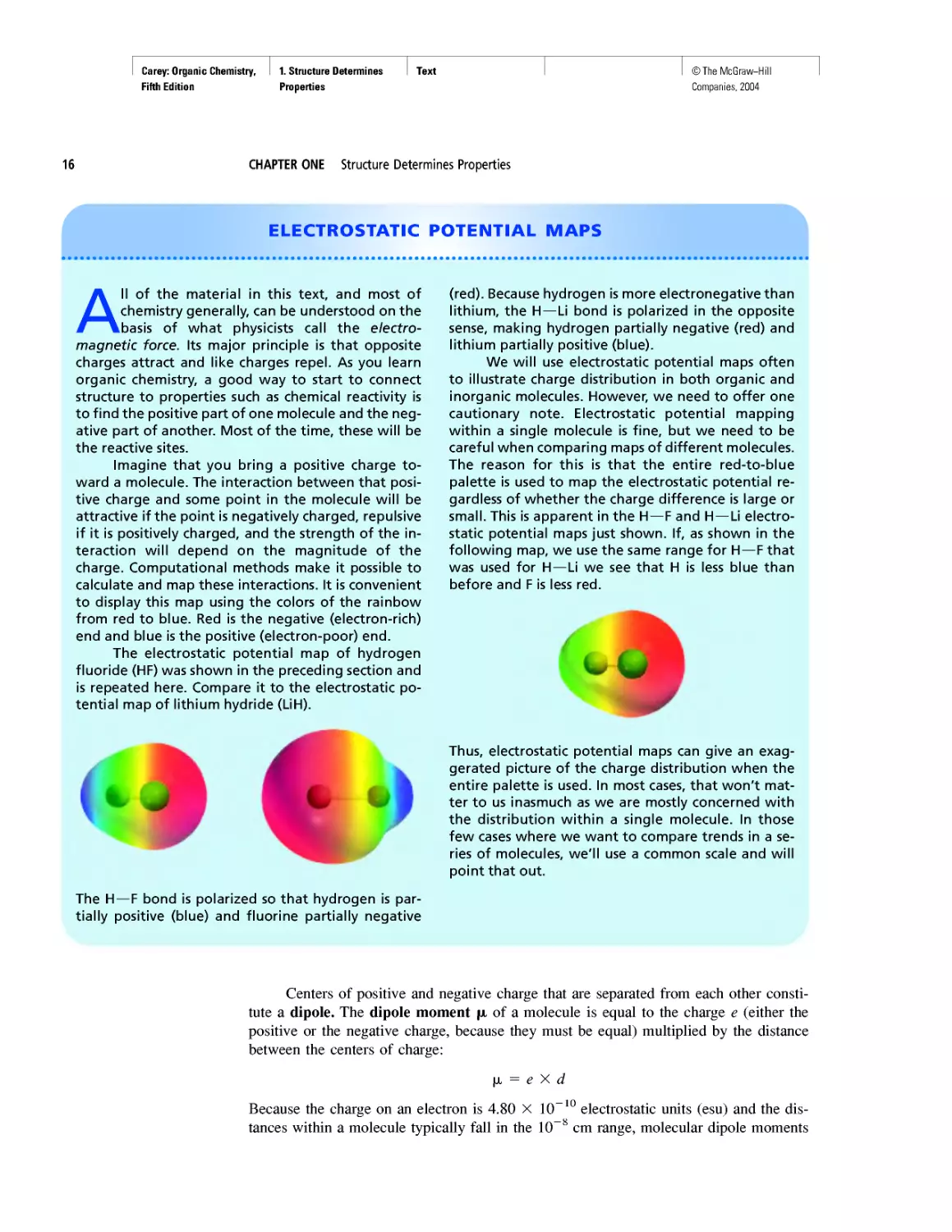
The electrostatic potential map of hydrogen
fluoride (HF) was shown in the preceding section and
is repeated here. Compare it to the electrostatic po-
tential map of lithium hydride (LiH).
(red). Because hydrogen is more electronegative than
lithium, the H—Li bond is polarized in the opposite
sense, making hydrogen partially negative (red) and
lithium partially positive (blue).
We will use electrostatic potential maps often
to illustrate charge distribution in both organic and
inorganic molecules. However, we need to offer one
cautionary note. Electrostatic potential mapping
within a single molecule is fine, but we need to be
careful when comparing maps of different molecules.
The reason for this is that the entire red-to-blue
palette is used to map the electrostatic potential re-
gardless of whether the charge difference is large or
small. This is apparent in the H—F and H — Li electro-
static potential maps just shown. If, as shown in the
following map, we use the same range for H—F that
was used for H—Li we see that H is less blue than
before and F is less red.

Thus, electrostatic potential maps can give an exag-
gerated picture of the charge distribution when the
entire palette is used. In most cases, that won't mat-
ter to us inasmuch as we are mostly concerned with
the distribution within a single molecule. In those
few cases where we want to compare trends in a se-
ries of molecules, we'll use a common scale and will
point that out.
The H—F bond is polarized so that hydrogen is par-
tially positive (blue) and fluorine partially negative
Centers of positive and negative charge that are separated from each other consti-
tute a dipole. The dipole moment p of a molecule is equal to the charge e (either the
positive or the negative charge, because they must be equal) multiplied by the distance
between the centers of charge:
p = e X d
Because the charge on an electron is 4.80 X IO-10 electrostatic units (esu) and the dis-
tances within a molecule typically fall in the IO-8 cm range, molecular dipole moments
©The McGraw-Hill
Companies, 2004
Carey: Organic Chemistry,
Fifth Edition
1. Structure Determines
Properties
Text
1.6 Formal Charge
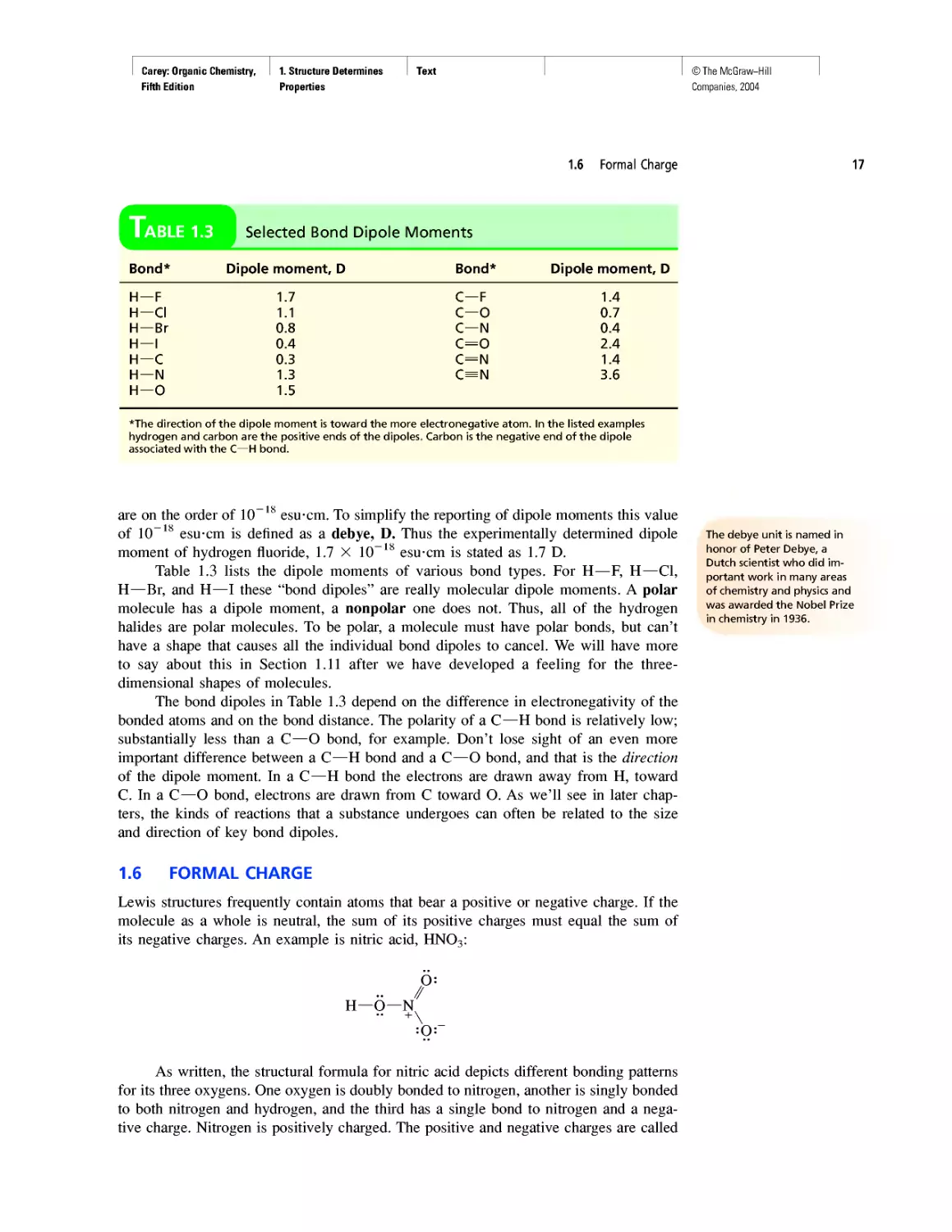
Selected Bond Dipole Moments
Bond*	Dipole moment, D	Bond*	Dipole moment, D
H—F	1.7	C—F	1.4
H—Cl	1.1	c—0	0.7
H—Br	0.8	C—N	0.4
H—I	0.4	C=O	2.4
H—C	0.3	C=N	1.4
H—N	1.3	C=N	3.6
H—0	1.5
*The direction of the dipole moment is toward the more electronegative atom. In the listed examples
hydrogen and carbon are the positive ends of the dipoles. Carbon is the negative end of the dipole
associated with the C—H bond.
are on the order of IO-18 esu-cm. To simplify the reporting of dipole moments this value
of 10-18 esu-cm is defined as a debye, D. Thus the experimentally determined dipole
moment of hydrogen fluoride, 1.7 X 10⁻¹⁸ esu-cm is stated as 1.7 D.
Table 1.3 lists the dipole moments of various bond types. For H—F, H—Cl,
H—Br, and H—I these “bond dipoles” are really molecular dipole moments. A polar
molecule has a dipole moment, a nonpolar one does not. Thus, all of the hydrogen
halides are polar molecules. To be polar, a molecule must have polar bonds, but can’t
have a shape that causes all the individual bond dipoles to cancel. We will have more
to say about this in Section 1.11 after we have developed a feeling for the three-
dimensional shapes of molecules.
The bond dipoles in Table 1.3 depend on the difference in electronegativity of the
bonded atoms and on the bond distance. The polarity of a C—H bond is relatively low;
substantially less than a C—О bond, for example. Don’t lose sight of an even more
important difference between a C—H bond and a C—О bond, and that is the direction
of the dipole moment. In a C—H bond the electrons are drawn away from H, toward
C. In a C—О bond, electrons are drawn from C toward O. As we’ll see in later chap-
ters, the kinds of reactions that a substance undergoes can often be related to the size
and direction of key bond dipoles.
1.6 FORMAL CHARGE
Lewis structures frequently contain atoms that bear a positive or negative charge. If the
molecule as a whole is neutral, the sum of its positive charges must equal the sum of
its negative charges. An example is nitric acid, HNO3:
•• /'
И—O—N
:Q:~
As written, the structural formula for nitric acid depicts different bonding patterns
for its three oxygens. One oxygen is doubly bonded to nitrogen, another is singly bonded
to both nitrogen and hydrogen, and the third has a single bond to nitrogen and a nega-
tive charge. Nitrogen is positively charged. The positive and negative charges are called
17
The debye unit is named in
honor of Peter Debye, a
Dutch scientist who did im-
portant work in many areas
of chemistry and physics and
was awarded the Nobel Prize
in chemistry in 1936.
Carey: Organic Chemistry, I 1. Structure Determines Text
Fifth Edition	Properties
©The McGraw-Hill
Companies, 2004
18
CHAPTER ONE Structure Determines Properties
The number of valence elec-
trons in an atom of a main-
group element such as
nitrogen is equal to its group
number. In the case of nitro-
gen this is five.
It will always be true that a
covalently bonded hydrogen
has no formal charge (formal
charge = 0).
It will always be true that a
nitrogen with four covalent
bonds has a formal charge of
+ 1. (A nitrogen with four co-
valent bonds cannot have
unshared pairs, because of
the octet rule.)
It will always be true that an
oxygen with two covalent
bonds and two unshared
pairs has no formal charge.
It will always be true that an
oxygen with one covalent
bond and three unshared
pairs has a formal charge of
-1.
formal charges, and the Lewis structure of nitric acid would be incomplete were they
to be omitted.
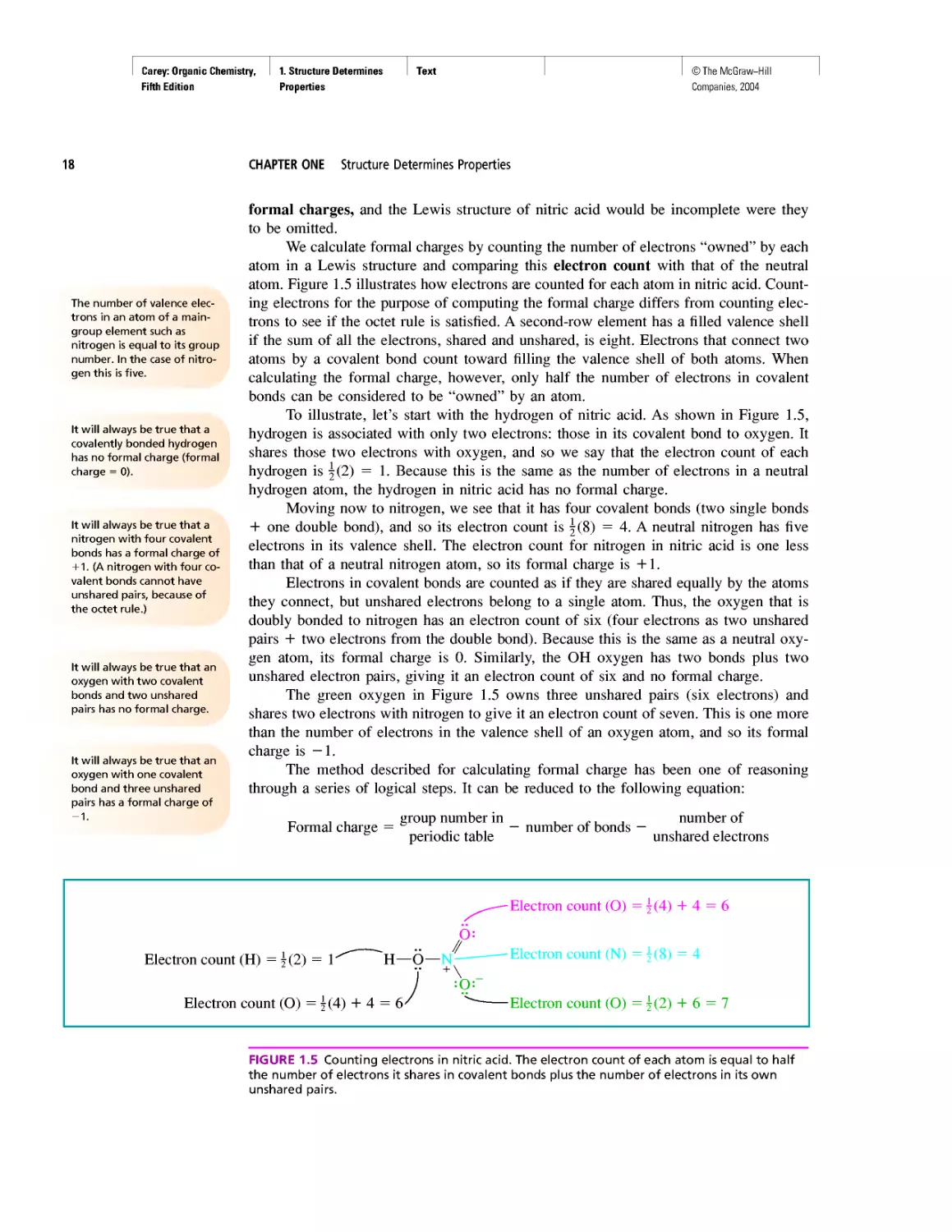
We calculate formal charges by counting the number of electrons “owned” by each
atom in a Lewis structure and comparing this electron count with that of the neutral
atom. Figure 1.5 illustrates how electrons are counted for each atom in nitric acid. Count-
ing electrons for the purpose of computing the formal charge differs from counting elec-
trons to see if the octet rule is satisfied. A second-row element has a filled valence shell
if the sum of all the electrons, shared and unshared, is eight. Electrons that connect two
atoms by a covalent bond count toward filling the valence shell of both atoms. When
calculating the formal charge, however, only half the number of electrons in covalent
bonds can be considered to be “owned” by an atom.
To illustrate, let’s start with the hydrogen of nitric acid. As shown in Figure 1.5,
hydrogen is associated with only two electrons: those in its covalent bond to oxygen. It
shares those two electrons with oxygen, and so we say that the electron count of each
hydrogen is |(2) = 1. Because this is the same as the number of electrons in a neutral
hydrogen atom, the hydrogen in nitric acid has no formal charge.
Moving now to nitrogen, we see that it has four covalent bonds (two single bonds
+ one double bond), and so its electron count is |(8) = 4. A neutral nitrogen has five
electrons in its valence shell. The electron count for nitrogen in nitric acid is one less
than that of a neutral nitrogen atom, so its formal charge is +1.
Electrons in covalent bonds are counted as if they are shared equally by the atoms
they connect, but unshared electrons belong to a single atom. Thus, the oxygen that is
doubly bonded to nitrogen has an electron count of six (four electrons as two unshared
pairs + two electrons from the double bond). Because this is the same as a neutral oxy-
gen atom, its formal charge is 0. Similarly, the OH oxygen has two bonds plus two
unshared electron pairs, giving it an electron count of six and no formal charge.
The green oxygen in Figure 1.5 owns three unshared pairs (six electrons) and
shares two electrons with nitrogen to give it an electron count of seven. This is one more
than the number of electrons in the valence shell of an oxygen atom, and so its formal
charge is —1.
The method described for calculating formal charge has been one of reasoning
through a series of logical steps. It can be reduced to the following equation:
_	, . group number in .	..	number of
Formal charge =	. ..	.,	— number of bonds —
periodic table	unshared electrons
—Electron count (O) = |(4) + 4 = 6
o;
Electron count (H) = |(2) = 1^	H—O—N-—
) +\~
Electron count (O) = |(4) + 4 = 6'	Electron count (O) = |(2) + 6 = 7
FIGURE 1.5 Counting electrons in nitric acid. The electron count of each atom is equal to half
the number of electrons it shares in covalent bonds plus the number of electrons in its own
unshared pairs.
©The McGraw-Hill
Companies, 2004
Carey: Organic Chemistry,
Fifth Edition
1. Structure Determines
Properties
Text
1.6 Formal Charge
19
PROBLEM 1.9
______________ Like nitric acid, each of the following inorganic compounds will
be frequently encountered in this text. Calculate the formal charge on each of
the atoms in the Lewis structures given.
= 0 =	:O: I
:ci—s—ci :	.. I ..		 H—0—s—0—H	H—0—N=O: .. ! .. :O:
(a) Thionyl chloride
(b) Sulfuric acid
(c) Nitrous acid
SAMPLE SOLUTION (a) The formal charge is the difference between the num-
ber of valence electrons in the neutral atom and the electron count in the Lewis
structure. (The number of valence electrons is the same as the the periodic table for the main-group elements.)	group number in
Valence electrons of neutral atom Electron count	Formal charge
Sulfur:	6	Кб)	+	2	=	5 Oxygen:	6	j(2)	+	6	=	7 Chlorine:	7	J(2)	+	6	=	7	+ 1 -1 0
The formal charges are shown in the Lewis structure of thionyl chloride
:O=“
.. I + ..
as :CI — S—Cl:
So far we’ve only considered neutral molecules—those in which the sums of the
positive and negative formal charges were equal. With ions, of course, these sums will
not be equal. Ammonium cation and borohydride anion, for example, are ions with net
charges of +1 and — 1, respectively. Nitrogen has a formal charge of +1 in ammonium
ion, and boron has a formal charge of — 1 in borohydride. None of the hydrogens in the
Lewis structures shown for these ions bears a formal charge.
H
I
H— —H
I
H
Ammonium ion
H
I
H—в—H
I
H
Borohydride ion
_________________ Verify that the formal charges on nitrogen in ammonium ion
(and boron in borohydride ion are as shown.
PROBLEM 1.10
Formal charges are based on Lewis structures in which electrons are considered to
be shared equally between covalently bonded atoms. Actually, polarization of N—H
bonds in ammonium ion and of В—H bonds in borohydride leads to some transfer of
positive and negative charge, respectively, to the hydrogens.
Use 8+ and 8— notation to show the dispersal of charge to the
^hydrogens in NH4+ and BH4~.
PROBLEM 1.11
©The McGraw-Hill
Companies, 2004
Fifth Edition
Properties
Carey: Organic Chemistry, I 1. Structure Determines Text
How to Write Lewis Structures
Step
Illustration
1.	The molecular formula and the connectivity are
determined experimentally and are included
among the information given in the statement of
the problem.
Methyl nitrite has the molecular formula CH3NO2. All
hydrogens are bonded to carbon, and the order of
atomic connections is CONO.
2.	Count the number of valence electrons available.
For a neutral molecule this is equal to the sum of
the valence electrons of the constituent atoms.
3.	Connect bonded atoms by a shared electron pair
bond (:) represented by a dash (—).
Each hydrogen contributes 1 valence electron, car-
bon contributes 4, nitrogen contributes 5, and each
oxygen contributes 6 for a total of 24 in CH3NO2.
For methyl nitrite we write the partial structure
H
I
H—c—o—N—О
I
H
4.	Count the number of electrons in shared electron
pair bonds (twice the number of bonds), and sub-
tract this from the total number of electrons to
give the number of electrons to be added to com-
plete the structure.
5.	Add electrons in pairs so that as many atoms as
possible have eight electrons. (Hydrogen is limited
to two electrons.) When the number of electrons is
insufficient to provide an octet for all atoms, assign
electrons to atoms in order of decreasing electro-
negativity.
The partial structure in step 3 contains 6 bonds
equivalent to 12 electrons. Because CH3NO2 contains
24 electrons, 12 more electrons need to be added.
With four bonds, carbon already has eight electrons.
The remaining 12 electrons are added as indicated.
Both oxygens have eight electrons, but nitrogen (less
electronegative than oxygen) has only six.
H
I ......
H—c—o—N—O:
I "
н
6.	If one or more atoms have fewer than eight elec-
trons, use unshared pairs on an adjacent atom to
form a double (or triple) bond to complete the
octet.
An electron pair on the terminal oxygen is shared
with nitrogen to give a double bond.
H
I ........
H—c—o — N=O;
I "
H
The structure shown is the best (most stable) Lewis
structure for methyl nitrite. All atoms except hydro-
gen have eight electrons (shared + unshared) in their
valence shell.
7. Calculate formal charges.
None of the atoms in the Lewis structure shown in
step 6 possesses a formal charge. An alternative
Lewis structure for methyl nitrite.
H
I + .. ..
H—C—O=N—O=“
I "
н
although it satisfies the octet rule, is less stable than
the one shown in step 6 because it has a separation
of positive charge from negative charge.
20
©The McGraw-Hill
Companies, 2004
Carey: Organic Chemistry,
Fifth Edition
1. Structure Determines
Properties
Text
1.7 Structural Formulas of Organic Molecules
21
Determining formal charges on individual atoms of Lewis structures is an impor-
tant element in good “electron bookkeeping.” So much of organic chemistry can be made
more understandable by keeping track of electrons that it is worth taking some time at
the beginning to become proficient at the seemingly simple task of counting them.
Table 1.4 summarizes the procedure we have developed for writing Lewis structures.
Notice that the process depends on knowing not only the molecular formula, but also the
order in which the atoms are attached to one another. This order of attachment is called
the constitution, or connectivity, of the molecule and is determined by experiment. Only
rarely is it possible to deduce the constitution of a molecule from its molecular formula.
1.7 STRUCTURAL FORMULAS OF ORGANIC MOLECULES
Organic chemists have devised a number of shortcuts to speed the writing of structural
formulas. Sometimes we leave out unshared electron pairs, but only when we are sure
enough in our ability to count electrons to know when they are present and when they’re
not. We’ve already mentioned representing covalent bonds by dashes. In condensed
structural formulas we leave out some, many, or all of the covalent bonds and use sub-
scripts to indicate the number of identical groups attached to a particular atom. These
successive levels of simplification are illustrated as shown for isopropyl alcohol (“rub-
bing alcohol”).
H H H
I I I
H—с—с—с—H	written as CH3CHCH3
III	I
H :O: H	OH
I
H
or condensed even further to
(CH3)2CHOH
PROBLEM 1.12
______________Expand the following condensed formulas so as to show all the
bonds and unshared electron pairs.
(a)	HOCH2CH2NH2	(d)	CH3CHCI2
(b)	(CH3)3CH	(e)	CH3NHCH2CH3
(c)	CICH2CH2CI	(f)	(CH3)2CHCH=O
SAMPLE SOLUTION (a) The molecule contains two carbon atoms, which are
bonded to each other. Both carbons bear two hydrogens. One carbon bears the
group HO—; the other is attached to —NH2.
H H H
I I I
H—о—С—C—N—H
I I
H H
When writing the constitution of a molecule, it is not necessary to concern your-
self with the spatial orientation of the atoms. There are many other correct ways
to represent the constitution shown. What is important is to show the connectiv-
ity OCCN (or its equivalent NCCO) and to have the correct number of hydrogens
on each atom.
To locate unshared electron pairs, first count the total number of valence elec-
trons brought to the molecule by its component atoms. Each hydrogen contributes
1, each carbon 4, nitrogen 5, and oxygen 6, for a total of 26. Ten bonds are shown,
accounting for 20 electrons; therefore 6 electrons must be contained in unshared
pairs. Add pairs of electrons to oxygen and nitrogen so that their octets are com-
plete, two unshared pairs to oxygen and one to nitrogen.
Carey: Organic Chemistry, I 1. Structure Determines Text
Fifth Edition	Properties
©The McGraw-Hill
Companies, 2004
22
CHAPTER ONE Structure Determines Properties
H H H
..III
H—o—c—c—N—H
"II"
H H
As you practice, you will begin to remember patterns of electron distribution. A
neutral oxygen with two bonds has two unshared electron pairs. A neutral nitro-
gen with three bonds has one unshared pair.
With practice, writing structural formulas for organic molecules soon becomes rou-
tine and can be simplified even more. For example, a chain of carbon atoms can be rep-
resented by drawing all of the C—C bonds while omitting individual carbons. The result-
ing structural drawings can be simplified still more by stripping away the hydrogens.
CH3CH2CH2CH3 becomes
H H H H
H H H H
simplified to
In these simplified representations, called bond-line formulas or carbon skeleton dia-
grams, the only atoms specifically written in are those that are neither carbon nor hydro-
gen bound to carbon. Hydrogens bound to these heteroatoms are shown, however.
CH3CH2CH2CH2OH
H	Cl
H2C	CH2
I	I
H2C.	,CH2
c
H2
becomes
becomes
PROBLEM 1.13
Expand the following bond-line representations to show all the
atoms including carbon and hydrogen.
(a)
SAMPLE SOLUTION (a) There is a carbon at each bend in the chain and at the
ends of the chain. Each of the ten carbon atoms bears the appropriate number
of hydrogens to give it four bonds.
HHHHHHHHHH
I	I	I	I	I	I	I	I	I	I
= H—с—с—с—с—с—с—с—с—с—с—H
I	I	I	I	I	I	I	I	I	I
HHHHHHHHHH
©The McGraw-Hill
Companies, 2004
Carey: Organic Chemistry,
Fifth Edition
1. Structure Determines
Properties
Text
1.8 Constitutional Isomers
23
Alternatively, the structure could be written as
CH3CH2CH2CH2CH2CH2CH2CH2CH2CH3 or in condensed form as СНз(СН2)8СН3
1.8 CONSTITUTIONAL ISOMERS
In the introduction we noted that both Berzelius and Wohler were fascinated by the fact
that two different compounds with different properties, ammonium cyanate and urea, pos-
sessed exactly the same molecular formula, CH4N2O. Berzelius had studied examples of
similar phenomena earlier and invented the word isomer to describe different compounds
that have the same molecular formula.
We can illustrate isomerism by referring to two different compounds, nitromethane
and methyl nitrite, both of which have the molecular formula CH3NO2. Nitromethane,
H—C—N
Nitromethane
H
I ........
H—c—o—N=O:
I "
H
Methyl nitrite
The suffix -mer in the word
"isomer" is derived from the
Greek word meros, meaning
"part," "share," or "por-
tion." The prefix iso- is also
from Greek (isos, meaning
"the same"). Thus isomers
are different molecules that
have the same parts (ele-
mental composition).
used to power race cars, is a liquid with a boiling point of 101°C. Methyl nitrite is a gas
boiling at — 12°C, which when inhaled causes dilation of blood vessels. Isomers that dif-
fer in the order in which their atoms are bonded are often referred to as structural iso-
mers. A more modern term is constitutional isomer. As noted in the previous section,
the order of atomic connections that defines a molecule is termed its constitution, and
we say that two compounds are constitutional isomers if they have the same molecular
formula but differ in the order in which their atoms are connected.
The formula CH3NO2 fits more isomers than just nitromethane
and methyl nitrite. Some, such as carbamic acid, an intermediate in the commer-
cial preparation of urea for use as a fertilizer, are too unstable to isolate. Given
the information that the nitrogen and both oxygens of carbamic acid are bonded
to carbon and that one of the carbon-oxygen bonds is a double bond, write a
Lewis structure for carbamic acid.
PROBLEM 1.14
PROBLEM 1.15
_________________ Write structural formulas for all the constitutionally isomeric
compounds having the given molecular formula.
(a) C2H6O	(b) C3H8O	(c) C4H10O
SAMPLE SOLUTION (a) Begin by considering the ways in which two carbons and
one oxygen may be bonded. There are two possibilities: C—C—О and C—О—C.
Add the six hydrogens so that each carbon has four bonds and each oxygen two.
There are two constitutional isomers: ethyl alcohol and dimethyl ether.
H H	H	H
II..	I	..	I
H—с—с—о—H	H—с—о—с—H
II"	I	••	I
H H	H	H
Ethyl alcohol	Dimethyl ether
In Chapter 3 another type of isomerism, called stereoisomerism, will be introduced.
Stereoisomers have the same constitution but differ in the arrangement of atoms in space.
Carey: Organic Chemistry, I 1. Structure Determines Text
Fifth Edition	Properties
©The McGraw-Hill
Companies, 2004
24
CHAPTER ONE Structure Determines Properties
Bond distances in organic
compounds are usually 1-2 A
(1A = 10 10m). Because the
angstrom (A) is not an SI
unit, we will express bond
distances in picometers
(1 pm = 10-12m). Thus,
128 pm = 1.28 A.
1.9 RESONANCE
When writing a Lewis structure, we restrict a molecule’s electrons to certain well-defined
locations, either linking two atoms by a covalent bond or as unshared electrons on a sin-
gle atom. Sometimes more than one Lewis structure can be written for a molecule, espe-
cially those that contain multiple bonds. An example often cited in introductory chem-
istry courses is ozone (O3). Ozone occurs naturally in large quantities in the upper
atmosphere, where it screens the surface of the earth from much of the sun’s ultraviolet
rays. Were it not for this ozone layer, most forms of surface life on earth would be dam-
aged or even destroyed by the rays of the sun. The following Lewis structure for ozone
satisfies the octet rule; all three oxygens have eight electrons in their valence shell.
+
T). ..
:9	o=_
This Lewis structure, however, doesn’t accurately portray the bonding in ozone,
because the two terminal oxygens are bonded differently to the central oxygen. The cen-
tral oxygen is depicted as doubly bonded to one and singly bonded to the other. Because
it is generally true that double bonds are shorter than single bonds, we would expect
ozone to exhibit two different О—О bond lengths, one of them characteristic of the
О—О single bond distance (147 pm in hydrogen peroxide, H—О—О—H) and the other
one characteristic of the 0=0 double bond distance (121 pm in O2). Such is not the
case. Both bond distances in ozone are exactly the same (128 pm)—somewhat shorter
than the single bond distance and somewhat longer than the double bond distance. The
structure of ozone requires that the central oxygen must be identically bonded to both
terminal oxygens.
An electrostatic potential map shows the equivalence of the two terminal oxygens.
Notice, too, that the central oxygen is blue (positively charged) and both terminal oxy-
gens are red (negatively charged).
To deal with circumstances such as the bonding in ozone, the notion of resonance
between Lewis structures was developed. According to the resonance concept, when
more than one Lewis structure may be written for a molecule, a single structure is insuf-
ficient to describe it. Rather, the true structure has an electron distribution that is a
“hybrid” of all the possible Lewis structures that can be written for the molecule. In the
case of ozone, two equivalent Lewis structures may be written. We use a double-headed
arrow to represent resonance between these two Lewis structures.
+	+
,6.	.6.
9. 2:-	-:Q Q:
It is important to remember that the double-headed resonance arrow does not indi-
cate a process in which the two Lewis structures interconvert. Ozone, for example, has
©The McGraw-Hill
Companies, 2004
Carey: Organic Chemistry,
Fifth Edition
1. Structure Determines
Properties
Text
1.9 Resonance
25
a single structure; it does not oscillate back and forth between two Lewis structures,
rather its true structure is not adequately represented by any single Lewis structure.
Resonance attempts to correct a fundamental defect in Lewis formulas. Lewis for-
mulas show electrons as being localized; they either are shared between two atoms in a
covalent bond or are unshared electrons belonging to a single atom. In reality, electrons
distribute themselves in the way that leads to their most stable arrangement. This some-
times means that a pair of electrons is delocalized, or shared by several nuclei. What
we try to show by the resonance description of ozone is the delocalization of an unshared
pair of electrons of one oxygen and the electrons in the double bond over the three atoms
of the molecule. Organic chemists often use curved arrows to show this electron delo-
calization. Alternatively, an average of two Lewis structures is sometimes drawn using
a dashed line to represent a “partial” bond. In the dashed-line notation the central oxy-
gen is linked to the other two by bonds that are halfway between a single bond and a
double bond, and the terminal oxygens each bear one half of a unit negative charge.
is equivalent to
4 9" "9 4
Curved arrow notation
Electron delocalization in ozone
Dashed-line notation
The rules to be followed when writing resonance structures are summarized in
Table 1.5.
___________________ Electron delocalization can be important in ions as well as in
neutral molecules. Using curved arrows, show how an equally stable resonance
structure can be generated for each of the following anions:
(a)	O:
-.. +/
:O — N
" \ -
:O:
PROBLEM 1.16
(c)
9 C\ -
=0 =
(b)
(d)
= 0:
O—BZ
' V:
О
/0:
? C\
:O — H
SAMPLE SOLUTION (a) When using curved arrows to represent the delocaliza-
tion of electrons, begin at a site of high electron density, preferably an atom that
is negatively charged. Move electron pairs until a proper Lewis structure results.
For nitrate ion, this can be accomplished in two ways:
:O — N
" \ -
:O:
O=N
О
.. >//
O—N
" A -
 O:
= 0=
O—N
Three equally stable Lewis structures are possible for nitrate ion. The negative
^charge in nitrate is shared equally by all three oxygens.
Carey: Organic Chemistry, I 1. Structure Determines Text
Fifth Edition	Properties
©The McGraw-Hill
Companies, 2004
26
CHAPTER ONE Structure Determines Properties
It is good chemical practice to represent molecules by their most stable Lewis
structure. The ability to write alternative resonance forms and to compare their relative
stabilities, however, can provide insight into both molecular structure and chemical
behavior. This will become particularly apparent in the last two thirds of this text, where
the resonance concept will be used regularly.
Introduction to the Rules of Resonance*
Rule
Illustration
1. Atomic positions (connectivity) must be the same
in all resonance structures; only the electron posi-
tions may vary among the various contributing
structures.
The structural formulas
+Z:
CH3—N	and
xd=_
2.	Lewis structures in which second-row elements
own or share more than eight valence electrons
are especially unstable and make no contribution
to the true structure. (The octet rule may be ex-
ceeded for elements beyond the second row.)
represent different compounds, not different reso-
nance forms of the same compound. A is a Lewis
structure for nitromethane; В is methyl nitrite.
Structural formula C,
CH3-N
C
has ten electrons around nitrogen. It is not a permis-
sible Lewis structure for nitromethane and so cannot
be a valid resonance form.
3.	When two or more structures satisfy the octet rule,
the most stable one is the one with the smallest
separation of oppositely charged atoms.
The two Lewis structures D and E of methyl nitrite
satisfy the octet rule:
CH3—O—N=O: <—» CH3—O=N—O:
D
4.	Among structural formulas in which the octet rule
is satisfied for all atoms and one or more of these
atoms bears a formal charge, the most stable reso-
nance form is the one in which negative charge re-
sides on the most electronegative atom.
Structure D has no separation of charge and is more
stable than E, which does. The true structure of
methyl nitrite is more like D than E.
The most stable Lewis structure for cyanate ion is F
because the negative charge is on its oxygen.
:N = C~O: <—» :N = C=O =
In G the negative charge is on nitrogen. Oxygen is
more electronegative than nitrogen and can better
support a negative charge.
(Continued)
©The McGraw-Hill
Companies, 2004
Carey: Organic Chemistry,
Fifth Edition
1. Structure Determines
Properties
Text
1.9 Resonance
27
Introduction to the Rules of Resonance* (Continued)
Rule
Illustration
5. Each contributing Lewis structure must have the
same number of electrons and the same net
charge although the formal charges of individual
atoms may vary among the various Lewis struc-
tures.
The Lewis structures
CH3—N
and
2°
CH3—nT
О
6. Each contributing Lewis structure must have the
same number of unpaired electrons.
are not resonance forms of one another. Structure H
has 24 valence electrons and a net charge of 0; I has
26 valence electrons and a net charge of -2.
Structural formula J is a Lewis structure of nitro-
methane; К is not, even though it has the same
atomic positions and the same number of electrons.
CH3—N
and
CH3—N;
7. Electron delocalization stabilizes a molecule. A
molecule in which electrons are delocalized is
more stable than implied by any of the individual
Lewis structures that may be written for it. The de-
gree of stabilization is greatest when the contrib-
uting Lewis structures are of equal stability.
Structure К has two unpaired electrons. Structure J has
all its electrons paired and is a more stable structure.
Nitromethane is stabilized by electron delocalization
more than methyl nitrite is. The two most stable res-
onance forms of nitromethane are equivalent to
each other.
CH3
cHs-4;
The two most stable resonance forms of methyl
nitrite are not equivalent
CH3—O—N=O:	CH3—O=N—ОГ
*These are the most important rules to be concerned with at present. Additional aspects of electron delocalization, as well as additional rules
for its depiction by way of resonance structures, will be developed as needed in subsequent chapters.
Carey: Organic Chemistry, I 1. Structure Determines Text
Fifth Edition	Properties
©The McGraw-Hill
Companies, 2004
28
CHAPTER ONE Structure Determines Properties
LEARNING BY MODELING
As early as the nineteenth century many chemists
built scale models to better understand molec-
ular structure. We can gain a clearer idea about
the features that affect structure and reactivity when
we examine the three-dimensional shape of a mole-
cule. Several types of molecular models are shown
for methane in Figure 1.6. Probably the most familiar
are ball-and-stick models (Figure 1.6b), which direct
approximately equal attention to the atoms and
the bonds that connect them. Framework models
(Figure 1.6a) and space-filling models (Figure 1.6c) rep-
resent opposite extremes. Framework models empha-
size the pattern of bonds of a molecule while ignoring
the sizes of the atoms. Space-filling models emphasize
the volume occupied by individual atoms at the cost of
a clear depiction of the bonds; they are most useful in
cases in which one wishes to examine the overall mo-
lecular shape and to assess how closely two non-
bonded atoms approach each other.
The earliest ball-and-stick models were exactly
that: wooden balls in which holes were drilled to ac-
commodate dowels that connected the atoms. Plastic
versions, including relatively inexpensive student
sets, became available in the 1960s and proved to be
a valuable learning aid. Precisely scaled stainless steel
framework and plastic space-filling models, although
relatively expensive, were standard equipment in
most research laboratories.
Computer graphics-based representations are
rapidly replacing classical molecular models. Indeed,
the term "molecular modeling" as now used in or-
ganic chemistry implies computer generation of mod-
els. The methane models shown in Figure 1.6 were all
drawn on a personal computer using software that
possesses the feature of displaying and printing the
same molecule in framework, ball-and-stick, and
space-filling formats. In addition to permitting mod-
els to be constructed rapidly, even the simplest soft-
ware allows the model to be turned and viewed from
a variety of perspectives.
As useful as molecular models are, they are lim-
ited in that they only show the location of the atoms
and the space they occupy. Another important di-
mension to molecular structure is its electron distri-
bution. We introduced electrostatic potential maps in
Section 1.5 as a way of illustrating charge distribution
and will continue to use them throughout the text.
Figure 1.6(d) shows the electrostatic potential map of
methane. Its overall shape is similar to the volume oc-
cupied by the space-filling model. The most electron-
rich regions are closer to carbon and the most
electron-poor ones are closer to the hydrogens.
Organic chemistry is a very visual science and
computer modeling is making it even more so.
—Cont.
FIGURE 1.6 Molecular models of methane (CH4). (a) Framework (tube) models show the bonds connecting the *
atoms, but not the atoms themselves, (b) Ball-and-stick (ball-and-spoke) models show the atoms as balls and the bonds as
rods, (c) Space-filling models portray overall molecular size; the radius of each sphere approximates the van der Waals
radius of the atom, (d) An electrostatic potential map of methane.
©The McGraw-Hill
Companies, 2004
Carey: Organic Chemistry,
Fifth Edition
1. Structure Determines
Properties
Text
1.10 The Shapes of Some Simple Molecules
29
Accompanying this text is a CD entitled Learning By
Modeling. As its name implies, it is a learning tool,
designed to help you better understand molecular
structure and properties, and contains two major
components:
•	SpartanBuild software that you can use to
build molecular models of various types
include tube, ball-and-spoke, and space-
filling. This text includes a number of mod-
eling exercises for you to do, but don't limit
yourself to them. You can learn a lot by sim-
ply experimenting with SpartanBuild to see
what you can make.
•	SpartanView software with which you can
browse through an archive of already-
prepared models on the Learning By Model-
ing CD. These models include many of the
same substances that appear in this text.
SpartanView is the tool you will use to view
electrostatic potential maps and a collection
of already prepared models.
All of the models, those you make yourself and those
already provided on Learning By Modeling, can be
viewed in different formats and rotated in three
dimensions.
Immediately preceding the Glossary at the back
of this text is a tutorial showing you how to use Spar-
tanBuild and SpartanView and describing some addi-
tional features.
As you go through this text, you will see two dif-
ferent modeling icons. The SpartanBuild icon alerts
you to a model-building opportunity, the Spartan-
View icon indicates that the Learning By Modeling CD
includes a related model or animation.
SpartanBuild icon SpartanView icon
1.10 THE SHAPES OF SOME SIMPLE MOLECULES
So far we have emphasized structure in terms of “electron bookkeeping.” We now turn
our attention to molecular geometry and will see how we can begin to connect the three-
dimensional shape of a molecule to its Lewis formula. Table 1.6 lists some simple com-
pounds illustrating the geometries that will be seen most often in our study of organic
chemistry.
Methane is a tetrahedral molecule; its four hydrogens occupy the corners of a tetra-
hedron with carbon at its center. We often show three-dimensionality in structural for-
mulas by using a solid wedge ) to depict a bond projecting from the paper toward
you and a dashed wedge (i ....)	for one receding away from you. A simple line (—)
represents a bond that lies in the plane of the paper.
The tetrahedral geometry of methane is often explained with the valence shell
electron-pair repulsion (VSEPR) model. The VSEPR model rests on the idea that an
electron pair, either a bonded pair or an unshared pair, associated with a particular atom
will be as far away from the atom’s other electron pairs as possible. Thus, a tetrahedral
geometry permits the four bonds of methane to be maximally separated and is charac-
terized by H—C—H angles of 109.5°, a value referred to as the tetrahedral angle.
Water, ammonia, and methane share the common feature of an approximately tetra-
hedral arrangement of four electron pairs. Because we describe the shape of a molecule
according to the positions of its atoms rather than the disposition of its electron pairs,
however, water is said to be bent, and ammonia is trigonal pyramidal.
The H—О—H angle in water (105°) and the H—N—H angles in ammonia (107°)
are slightly smaller than the tetrahedral angle. These bond-angle contractions are easily
accommodated by VSEPR by reasoning that electron pairs in bonds take up less space
than an unshared pair. The electron pair in a covalent bond feels the attractive force of
Although reservations have
been expressed concerning
VSEPR as an explanation for
molecular geometries, it re-
mains a useful tool for pre-
dicting the shapes of organic
compounds.
Carey: Organic Chemistry, I 1. Structure Determines Text
©The McGraw-Hill
Companies, 2004
30
Fifth Edition
Properties
CHAPTER ONE Structure Determines Properties
Compound	VSEPR and Molecular Geometry
	Structural Formula	Repulsive Electron Pairs	Arrangement of Electron Pairs	Molecular Shape	Molecular Model
Methane (CH4)	109.5^H 109.5° 109.5° /" H / 109.5° H	Carbon has four bonded pairs	Tetrahedral	Tetrahedral
Water (H2O)	105°<H H t XO	: /	Oxygen has two bonded pairs + two unshared pairs	Tetrahedral	Bent
Ammonia (NH3)	107Zh H : / H	Nitrogen has three bonded pairs + one unshared pair	Tetrahedral	Trigonal pyramidal	c
Boron trifluoride (BF3)	:F-..<120° „ ;;J:'b-*-f: :r.	Boron has three bonded pairs	Trigonal planar	Trigonal planar
Formaldehyde (H2CO)	H.. ^C=O: H	Carbon has two bonded pairs + one double bond, which is counted as one bonded pair	Trigonal planar	Trigonal planar
Carbon dioxide (CO2)	.180° O=C=O:	Carbon has two double bonds, which are counted as two bonded pairs	Linear	Linear	• ••
two nuclei and is held more tightly than an unshared pair localized on a single atom.
Thus, repulsive forces increase in the order:
Increasing force of repulsion between electron pairs
Bonded pair-bonded pair
Least repulsive
Unshared pair-bonded pair
Unshared pair-unshared pair
Most repulsive
©The McGraw-Hill
Companies, 2004
Carey: Organic Chemistry,
Fifth Edition
1. Structure Determines
Properties
Text
1.11 Molecular Dipole Moments
31
Repulsions among the four bonded pairs of methane gives the normal tetrahedral
angle of 109.5°. Repulsions among the unshared pair of nitrogen in ammonia and the
three bonded pairs causes the bonded pair-bonded pair H—N—H angles to be smaller
than 109.5°. In water, the largest repulsive force involves the two unshared pairs of oxy-
gen. As the distance between the two unshared pairs increases, the H—О—H angle
decreases.
Boron trifluoride is a trigonal planar molecule. There are six electrons, two for
each В—F bond, associated with the valence shell of boron. These three bonded pairs
are farthest apart when they are coplanar, with F—В—F bond angles of 120°.
_________________ The salt sodium borohydride, NaBH4, has an ionic bond between
W\la + and the anion BH4“. What are the H—В—H angles in the borohydride anion?
PROBLEM 1.17
Multiple bonds are treated as a single unit in the VSEPR model. Formaldehyde is
a trigonal planar molecule in which the electrons of the double bond and those of the
two single bonds are maximally separated. A linear arrangement of atoms in carbon diox-
ide allows the electrons in one double bond to be as far away as possible from the elec-
trons in the other double bond.
PROBLEM 1.18
Specify the shape of the following:
(a) H—C=N= (Hydrogen cyanide) (c) :N=N = N:
(Azide ion)
(b) H4N+ (Ammonium ion)
(d) CO32 (Carbonate ion)
SAMPLE SOLUTION (a) The structure shown accounts for all the electrons in
hydrogen cyanide. No unshared electron pairs are associated with carbon, and so
the structure is determined by maximizing the separation between its single bond
to hydrogen and the triple bond to nitrogen. Hydrogen cyanide is a linear molecule.
1.11 MOLECULAR DIPOLE MOMENTS
We can combine our knowledge of molecular geometry with a feel for the polarity of
chemical bonds to predict whether a molecule has a dipole moment or not. The molec-
ular dipole moment is the resultant of all of the individual bond dipole moments of a
substance. Some molecules, such as carbon dioxide, have polar bonds, but lack a dipole
moment because their geometry causes the individual C=O bond dipoles to cancel.
:O=C=O:
Carbon dioxide
Dipole moment = 0 D
Carbon tetrachloride, with four polar C—Cl bonds and a tetrahedral shape, has no net
dipole moment, because the result of the four bond dipoles, as shown in Figure 1.7, is
zero. Dichloromethane, on the other hand, has a dipole moment of 1.62 D. The C—H
bond dipoles reinforce the C—Cl bond dipoles.
PROBLEM 1.19
_________________Which of the following compounds would you expect to have a
dipole moment? If the molecule has a dipole moment, specify its direction.
(a)	BF3	(d)	CH3CI
(b)	H2O	(e)	CH2O
(c)	CH4	(f)	HCN
Carey: Organic Chemistry, I 1. Structure Determines Text
Fifth Edition	Properties
©The McGraw-Hill
Companies, 2004
32
CHAPTER ONE Structure Determines Properties
FIGURE 1.7 Contri-
bution of individual bond
dipole moments to the mo-
lecular dipole moments of
(a) carbon tetrachloride
(CCI4) and (b) dichloro-
methane (CH2CI2).
Resultant of these two
C—Cl bond dipoles is
4----► in plane of paper
(a) There is a mutual cancellation of individual bond dipoles in carbon tetrachloride.
It has no dipole moment.
Resultant of these two
H— C bond dipoles is <
4-----► in plane of paper
Resultant of these two
C— Cl bond dipoles is
4-----► in plane of paper
(b) The H— C bond dipoles reinforce the C— Cl bond moment in dichloromethane.
The molecule has a dipole moment of 1.62 D.
SAMPLE SOLUTION (a) Boron trifluoride is planar with 120° bond angles.
Although each boron-fluorine bond is polar, their combined effects cancel and
the molecule has no dipole moment.
|jl = 0 D
The opening paragraph of this chapter emphasized that the connection between
structure and properties is what chemistry is all about. We have just seen one such con-
nection. From the Lewis structure of a molecule, we can use electronegativity to tell us
about the polarity of bonds and combine that with VSEPR to predict whether the mol-
ecule has a dipole moment. In the next several sections we’ll see a connection between
structure and chemical reactivity as we review acids and bases.
1.12 ACIDS AND BASES: THE ARRHENIUS VIEW
Acids and bases are a big part of organic chemistry, but the emphasis is much different
from what you may be familiar with from your general chemistry course. Most of the atten-
tion in general chemistry is given to numerical calculations: pH, percent ioniza-
tion, buffer problems, and so on. Some of this returns in organic chemistry, but mostly we
are concerned with the roles that acids and bases play as reactants, products, and catalysts
in chemical reactions. We’ll start by reviewing some general ideas about acids and bases.
©The McGraw-Hill
Companies, 2004
Carey: Organic Chemistry,
Fifth Edition
1. Structure Determines
Properties
Text
1.13 Acids and Bases: The Bronsted-Lowry View
33
According to the theory proposed by Svante Arrhenius, a Swedish chemist and
winner of the 1903 Nobel Prize in chemistry, an acid is a substance that ionizes to give
protons when dissolved in water.
H— A H+ + =A"
Acid Proton Anion
A base ionizes to give hydroxide ions.
M—0—t	M+ +
Base	Cation Hydroxide ion
Acids differ in the degree to which they ionize. Those that ionize completely are
called strong acids; those that do not are weak acids. Likewise, strong bases ionize
completely; weak bases do not.
The strength of a weak acid is measured by its acid dissociation constant, which
is the equilibrium constant Ks for its ionization in aqueous solution.
[H+][:A~]
[HA]
A convenient way to express the strength of an acid is by its pk"a, defined as:
pAa = -logioKa
Thus, acetic acid with K.. = 1.8 X 10⁻⁵ has a pk"a of 4.7. The advantage of pk"a over
is that it avoids exponentials. You are probably more familiar with A'a, but most
organic chemists and biochemists use pk"a. It is a good idea to be comfortable with both
systems, so you should practice converting Ks to pk"a and vice versa.
Salicylic acid, the starting material for the preparation of aspirin,
i^has a Ka of 1.06 X 10 . What is its pka?
PROBLEM 1.20
. PROBLEM 1.21
Hydrogen cyanide (HCN) has a pka of 9.1. What is its Ka?
1.13 ACIDS AND BASES: THE BRONSTED-LOWRY VIEW
A more general theory of acids and bases was devised independently by Johannes Brpn-
sted (Denmark) and Thomas M. Lowry (England) in 1923. In the Brpnsted-Lowry
approach, an acid is a proton donor, and a base is a proton acceptor. The reaction that
occurs between an acid and a base is proton transfer.
] ' + H—A	] —H + :A“
Base Acid Conjugate Conjugate
acid base
In the equation shown, the base uses an unshared pair of electrons to remove a proton
from an acid. The base is converted to its conjugate acid, and the acid is converted to
Carey: Organic Chemistry, I 1. Structure Determines Text
©The McGraw-Hill
Companies, 2004
34
Fifth Edition
Properties
CHAPTER ONE Structure Determines Properties
CURVED ARROWS
"Follow the electrons; the atoms can't be far
behind."
In Section 1.9 we introduced curved arrows as a
tool to systematically generate resonance structures
by moving electrons. The main use of curved arrows,
however, is to show the bonding changes that take
place in chemical reactions. The acid-base reactions
to be discussed in Sections 1.12-1.17 furnish numer-
ous examples of this and deserve some preliminary
comment.
Consider the reaction of sodium hydroxide with
hydrogen fluoride in aqueous solution.
NaOH + HF --------------> H2O + NaF
Sodium Hydrogen	Water Sodium
hydroxide fluoride	fluoride
Writing the equation in the usual way directs too
much attention to the atoms and not enough to the
electrons. We can remedy that by deleting any spec-
tator ions and by showing the unshared electron
pairs and covalent bonds that are made and broken.
Both sodium hydroxide and sodium fluoride are com-
pletely ionized in water; therefore Na+, which ap-
pears on both sides of the equation, is a spectator
ion. Hydrogen fluoride is a weak acid and exists as
undissociated HF molecules in water.
НОГ + H —F: -----------> HO — H + :FT
Hydroxide Hydrogen	Water Fluoride
ion	fluoride	ion
Now use curved arrows to track electron flow.
Move electrons from sites of high electron density
(unshared pairs, negative charge) toward sites of
lower electron density.
A..
HO: + H —F:-------> HO —H + :R
One of the unshared pairs of the hydroxide oxygen is
used to form a covalent bond to the positively polar-
ized proton of hydrogen fluoride. The covalent bond
betwen H and F in hydrogen fluoride breaks, with the
pair of electrons in this bond becoming an unshared
pair of fluoride ion.
Curved arrows originate at electron pairs—in
this case an electron pair of the hydroxide oxygen,
and the shared pair in the covalent bond of HF.
Curved arrows terminate at an atom or between
two atoms.
Resist the temptation to use curved arrows to
show the movement of atoms. Not only is this con-
trary to general practice, but it is also less reasonable.
Electrons are much more mobile than atoms, so it
makes sense to focus on them.
Showing electron flow is not just one more as-
pect of organic chemistry to learn, it is a genuinely
useful aid to understanding what happens in a par-
ticular reaction.
its conjugate base. A base and its conjugate acid always differ by a single proton. Like-
wise, an acid and its conjugate base always differ by a single proton.
In the Brpnsted-Lowry view, an acid doesn’t dissociate in water; it transfers a pro-
ton to water. Water acts as a base.
H	H
Ю^Н-^А	:C — H+ =A“
H	H
Water
(base)
Acid
Conjugate	Conjugate
acid of water base
The systematic name for the conjugate acid of water (H3O+) is oxonium ion. Its com-
mon name is hydronium ion.
©The McGraw-Hill
Companies, 2004
Carey: Organic Chemistry,
Fifth Edition
1. Structure Determines
Properties
Text
1.13 Acids and Bases: The Bronsted-Lowry View
35
PROBLEM 1.22
Write an equation for proton transfer from hydrogen chloride
(HCI) to
(a)	Ammonia (:NH3)
(b)	Trimethylamine [(CH3)3N:j
Use curved arrows to track electron movement and identify the acid, base, con-
jugate acid, and conjugate base.
SAMPLE SOLUTION We are told that a proton is transferred from HCI to :NH3.
Therefore, HCI is the Bronsted acid and ;NH3 is the Bronsted base.
H3	T^H-Gcj:	H3 —H	+ :Ch
Ammonia	Hydrogen chloride	Ammonium ion	Chloride ion
(base)	(acid)	(conjugate acid)	(conjugate base)
The acid dissociation constant has the same form in Brpnsted-Lowry as in the
Arrhenius approach, but is expressed in the concentration of H3O+ rather than H+. The
concentration terms [H3O+] and [H+] are considered equivalent quantities in equilibrium
constant expressions.
[H3O+][:A~]
[HA]
Even though water is a reactant (a Brpnsted base), its concentration does not appear in
the expression for K:, because it is the solvent. The convention for equilibrium constant
expressions is to omit concentration terms for pure solids, liquids, and solvents.
Water can also be a Brpnsted acid, donating a proton to a base. Sodium amide
(NaNH2), for example, is a source of the strongly basic amide ion, which reacts with
water to give ammonia.
Amide ion Water
(base)	(acid)
H	H
:N— H	+	~-O-
H
Ammonia Hydroxide ion
(conjugate acid) (conjugate base)
PROBLEM 1.23
________________ Potassium hydride (KH) is a source of the strongly basic hydride
ion (:H“). Using curved arrows to track electron movement, write an equation for
the reaction of hydride ion with water. What is the conjugate acid of hydride ion?
Table 1.7 lists a number of acids, their dissociation constants, and their conjugate
bases. The list is more extensive than we need at this point, but we will return to it
repeatedly throughout the text as new aspects of acid-base behavior are introduced. The
table is organized so that acid strength decreases from top to bottom. Conversely, the
strength of the conjugate base increases from top to bottom. Thus, the stronger the acid,
the weaker its conjugate base. The stronger the base, the weaker its conjugate acid.
Carey: Organic Chemistry, I 1. Structure Determines Text
Fifth Edition	Properties
©The McGraw-Hill
Companies, 2004
36
CHAPTER ONE Structure Determines Properties
Dissociation Constants (p/Ca) of Acids
Acid	P*a	Formula	Conjugate Base	Discussed in Section
Hydrogen iodide	-10.4	HI	Г	1.15
Hydrogen bromide	-5.8	HBr	Br“	1.15
Sulfuric acid	-4.8	HOSO2OH	HOSO2O“	1.16
Hydrogen chloride	-3.9	HCI	СГ	1.15
Hydronium ion	-1.7	H3O+	H2O	1.16
Nitric acid	-1.4	HONO2	“ONO2	1.15
Hydrogen sulfate ion	2.0	HOSO2O“	OSO2O“	1.16
Hydrogen fluoride	3.1	HF	F“	1.15
Anilinium ion	4.6	c6h5nh3	c6h5nh2	22.5
Acetic acid	4.7	0 II CH3COH	0 II CH3CO“	1.15; 19.6
Pyridinium ion	5.2	0 I	0 чу	1.14; 22.5
		H
Carbonic acid	6.4	H2CO3	HCO3“	19.9
2,4-Pentanedione	9	0	0 II II CH3CCH2CCH3	0 0 II- II CH3CCHCCH3	18.6
Hydrogen cyanide	9.1	HCN	CN“
Ammonium ion	9.3	nh4+	NH3	1.14; 22.5
Glycine	9.6	0 + II H3NCH2CO“	0 II H2NCH2CO“	27.3
Phenol	10	C6H5OH	C6H5O“	1.16; 24.4
Hydrogen carbonate ion	10.2	HCO3“	co32-	19.9
Methanethiol	10.7	CH3SH	CH3S“	15.4
Dimethylammonium ion	10.7	(CH3)2NH2	(CH3)2NH	22.5
Ethyl acetoacetate	11	0	0 II II CH3CCH2COCH2CH3	0 0 II- II CH3CCHCOCH2CH3	21.1
Diethyl malonate	13	0	0 II II CH3CH2OCCH2COCH2CH3	0 0 II- II CH3CH2OCCHCOCH2CH3	21.7
Methanol	15.2	CH3OH	CH3O“	1.15
2-Methylpropanal	15.5	0 II (CH3)2CHCH	0 -II (CH3)2CCH	18.6
Water	15.7	H2O	HO“	1.15
(Continued)
©The McGraw-Hill
Companies, 2004
Carey: Organic Chemistry,
Fifth Edition
1. Structure Determines
Properties
Text
1.14 What Happened to pkb?
37
Dissociation Constants (p/Ca) of Acids (Continued)
Acid	pKa	Formula	Conjugate Base	Discussed in Section
Ethanol	16	CH3CH2OH	CH3CH2O“	1.15
		H	H	H	H
Cyclopentadiene	16		h-"x>Z''-h	11.20
		H H	H
Isopropyl alcohol	17	(CH3)2CHOH	(CH3)2CHO-	1.15
tert-Butyl alcohol	18	(CH3)3COH	(CH3)3CO“	1.15
Acetone	19	0 II CH3CCH3	0 II _ CH3CCH2	18.6
Methyl butanoate	22	0 II CH3CH2CH2COCH3	0 _ II CH3CH2CHCOCH3	21.10
Acetylene	26	HC=CH	HC=C:	9.5
Ammonia	36	NH3	H2N“	1.15; 9.5
Diisopropylamine	36	[(CH3)2CH]2NH	[(CH3)2CH]2N-	21.10
		H	H	H	H
Benzene	43	H—H	H —	14.5
		H	H	H	H
Ethylene	45	H2C=CH2	H2C=CH“	9.4
Methane	60	CH4	:CH3	1.15; 14.5
Ethane	62	CH3CH3	CH3CH2“	14.5
1.14 WHAT HAPPENED TO pKb?
The Br0nsted-Lowry approach involving conjugate relationships between acids and
bases makes a separate basicity constant Kb unnecessary. Rather than having separate
tables listing Ks for acids and Kb for bases, the usual practice is to give only Ks or pA7t
as was done in Table 1.7. Assessing relative basicities requires only that we remember
that the weaker the acid, the stronger the conjugate base and find the appropriate
acid-base pair in the table.
Suppose, for example, we wished to compare the basicities of ammonia and pyridine.
H
Ammonia
I
Pyridine
1. Structure Determines I Text
Properties
©The McGraw-Hill
Companies, 2004
Carey: Organic Chemistry,
Fifth Edition
CHAPTER ONE Structure Determines Properties
The stronger base is derived from the weaker conjugate acid. Therefore, add a proton to
ammonia to give its conjugate acid (ammonium ion) and a proton to pyridine to give its
conjugate acid (pyridinium ion), then look up the pk'a values for each.
pka
Ammonium ion
9.3
weaker acid
Pyridinium ion
5.2
stronger acid
Examine the models of am-
monia and pyridine on your
Learning By Modeling CD.
Are the calculated charges
on nitrogen consistent with
their relative basicities?
What about their electro-
static potential maps?
Ammonium ion is a weaker acid than pyridinium ion; therefore, ammonia is a stronger
base than pyridine.
The conjugate bases listed in Table 1.7 that are anions are commonly encountered
as their sodium or potassium salts. Thus, sodium methoxide (NaOCH3), for example, is
a source of methoxide ion (CH3O-)> which is the conjugate base of methanol.
Which is the stronger base in each of the following pairs? (Note:
This information will prove useful when you get to Chapter 9.)
(a)	Sodium ethoxide (NaOCH2CH3) or sodium amide (NaNH2)
(b)	Sodium acetylide (NaC=CH) or sodium amide (NaNH2)
(c)	Sodium acetylide (NaC=CH) or sodium ethoxide (NaOCH2CH3)
SAMPLE SOLUTION (a) NaOCH2CH3 contains the ions Na+ and CH3CH2O“.
NaNH2 contains the ions Na+ and H2N“. CH3CH2O“ is the conjugate base of
ethanol; H2I\T is the conjugate base of ammonia.
Base	CH3CH2O“	H2N“
Conjugate acid	CH3CH2OH	NH3
p/Ca of conjugate acid	16	36
The conjugate acid of CH3CH2O“ is stronger than the conjugate acid of H2N“.
Therefore, H2N“ is a stronger base than CH3CH2O“.
1.15 HOW STRUCTURE AFFECTS ACID STRENGTH
The acids in Table 1.7 span a range of more than 70 рк"а units (IO70 in kJ. In this sec-
tion we’ll introduce some generalizations that will permit us to connect molecular struc-
ture with acidity, at least insofar as trends in related compounds are concerned. The main
ways in which structure affects acidity depend on:
1.	The strength of the bond to the atom from which the proton is lost
2.	The electronegativity of the atom from which the proton is lost
3.	Changes in electron delocalization on ionization
Bond Strength. The effect of bond strength is easy to see by comparing the acidities
of the hydrogen halides.
39
Carey: Organic Chemistry,
Fifth Edition
1. Structure Determines
Properties
Text
©The McGraw-Hill
Companies, 2004
HF
Ptfa 3.1
Strongest H—X bond
Weakest acid
1.15 How Structure Affects Acid Strength
HCI
—3.9
HBr
-5.8
HI
-10.4
Weakest H—X bond
Strongest acid
For a discussion of the pKa'<
of HF, HCI, and HI, see the
January 2001 issue of the
Journal of Chemical Educa-
tion, pp. 116-117.

In general, bond strength decreases going down a group in the periodic table. As the
H—X bond becomes longer, it also becomes weaker, so breaking it becomes energeti-
cally less costly, and acid strength increases.
Because of the conjugate relationship between acidity and basicity, the strongest
acid (HI) has the weakest conjugate base (I-), and the weakest acid (HF) has the
strongest conjugate base (F-).
PROBLEM 1.25
iase, HO or HS
Which is the stronger acid, H2O or H2S? Which is the stronge
’? Check your predictions against the data in Table 1.7
Electronegativity. The effect of electronegativity on acidity is evident in the following
series involving bonds between hydrogen and the second-row elements C, N, O, and F.

P^a
CH4
60
NH3	H2O	HF
36	15.7	3.1
Least electronegative
Weakest acid
Most electronegative
Strongest acid

As the atom (A) to which H is bonded becomes more electronegative, the polarization
8+H—A8- becomes more pronounced and H is more easily lost as H+. An alternative
approach to the same conclusion is based on the equation for proton transfer, especially
with regard to the flow of electrons as shown by curved arrows.
H
O: + H—A
= C —H + -A-
H
H
Carey: Organic Chemistry, I 1. Structure Determines Text
Fifth Edition	Properties
©The McGraw-Hill
Companies, 2004
40
CHAPTER ONE Structure Determines Properties
Here we see that when the H—A bond breaks, both electrons in the bond are retained
by A. The more electronegative atom A is, the easier it becomes for the electrons to flow
in its direction.
When the two effects—bond strength and electronegativity—conflict, bond
strength is more important when comparing elements in the same group of the periodic
table as the pAC/s for the hydrogen halides show. Fluorine is the most electronegative
and iodine the least electronegative of the halogens, but HF is the weakest acid while
HI is the strongest. Electronegativity is the more important factor when comparing ele-
ments in the same row of the periodic table.
PROBLEM 1.26
Try to do this problem without consulting Table 1.7.
(a)	Which is the stronger acid: (CH3)3NH or (CH3)2OH ?
(b)	Which is the stronger base: (CH3)3N= or (CH3)2O:?
SAMPLE SOLUTION (a) The ionizable proton is bonded to N in (CH3)3NH and
to О in (CH3)2OH.
H3C—N—H
/ +
H3C
Nitrogen and oxygen are in the same row of the periodic table, so their relative
electronegativities are the determining factor. Oxygen is more electronegative
+ +
than nitrogen; therefore (CH3)2OH is a stronger acid than (CH3)3NH.
The relative acidities of wa-
ter and methanol are com-
pared in an article in the
November 2001 issue of the
Journal of Chemical Educa-
tion, pp. 1496-1498.
In many acids the acidic proton is bonded to oxygen. Such compounds can be con-
sidered as derivatives of water. Among organic compounds, the ones most closely related
to water are alcohols. Most alcohols are somewhat weaker acids than water; methanol
is slightly stronger.
HO—H CH3O—H CH3CH2O—H (CH3)2CHO—H	(CH3)3CO—H
Water Methanol
p/Ca 15.7	15.2
Ethanol
16
Isopropyl alcohol	zert-Butyl alcohol
17	18
Electronegative substituents in a molecule can affect acidity even when they are
not directly bonded to the ionizable proton. Compare ethanol (CH3CH2OH) with a related
compound in which a CF3 group replaces the CH3 group.
сн3сн2о—H
Ethanol
16
CF3CH2O—H
2,2,2-Trifluoroethanol
11.3
p/C
We see that the substitution of C—H bonds by C—F increases the acidity of the О—H
proton by 4.7 pA'a units, which corresponds to a difference of 104'7 in Ks. The simplest
©The McGraw-Hill
Companies, 2004
Carey: Organic Chemistry,
Fifth Edition
1. Structure Determines
Properties
Text
1.15 How Structure Affects Acid Strength
41
explanation for this enhanced acidity is that the fluorine atoms attract electrons toward
themselves and that this attraction is transmitted through the bonds, increasing the pos-
itive character of the О—H proton.
The greater positive character, hence the increased acidity, of the О—H proton of
2,2,2-trifluoroethanol can be seen in the electrostatic potential maps displayed in Figure 1.8.
Structural effects such as this that are transmitted through bonds are called induc-
tive effects. A substituent induces a polarization in the bonds between it and some remote
site. A similar inductive effect is evident when comparing acetic acid and its trifluoro
derivative. Trifluoroacetic acid is more than 4 рЛ"а units stronger than acetic acid.
CH3CO—н
Acetic acid
p£a	4.7
CF3CO—H
Trifluoroacetic acid
0.50
Inductive effects depend on the electronegativity of the substituent and the num-
ber of bonds between it and the affected site. As the number of bonds increases, the
inductive effect decreases.
Ethanol (CH3CH2OH)
2,2,2-Trifluoroethanol (CF3CH2OH)
FIGURE 1.8 Electrostatic potential maps of ethanol and 2,2,2-trifluoroethanol. As indi-
cated by the more blue, less green color in the region near the OH proton in 2,2,2-trifluoro-
ethanol, this proton bears a greater degree of positive charge and is more acidic than the OH
proton in ethanol.
Carey: Organic Chemistry, I 1. Structure Determines Text
Fifth Edition	Properties
©The McGraw-Hill
Companies, 2004
42
CHAPTER ONE Structure Determines Properties
Electron Delocalization in the Conjugate Base. With a pACt of —1.4, nitric acid is
almost completely ionized in water. If we look at the Lewis structure of nitric acid in
light of what we have said about inductive effects, we can see why. The N atom in nitric
acid is not only electronegative in its own right, but bears a formal charge of +1, which
enhances its ability to attract electrons away from the —OH group.
-
+ N—О—H
-:O:
But inductive effects are only part of the story. When nitric acid transfers its proton to
water, nitrate ion is produced.
Nitric acid Water
(acid)	(base)
-
+ N—O:“
-:9:
Nitrate ion
(conjugate base)
Hydronium ion
(conjugate acid)
Nitrate ion is stabilized by electron delocalization, which we can represent in terms of
resonance between three equivalent Lewis structures:
The negative charge is shared equally by all three oxygens. Stabilization of nitrate ion
by electron delocalization increases the equilibrium constant for its formation.
PROBLEM 1.27
What is the average formal charge on each oxygen in nitrate ion?
A similar electron delocalization stabilizes acetate ion and related species.
(*O:	=O:“
V	/
CH3C	CH3C
vn
:<y--	Ю
Both oxygens of acetate share the negative charge equally, which translates into a K., for
acetic acid that is greater than it would be if the charge were confined to a single oxygen.
PROBLEM 1.28
________________ Show by writing appropriate resonance structures that the two
compounds shown form the same conjugate base on ionization. Which atom, О
or S, bears the greater share of negative charge?
chZ
\
= S —H
and CH3C
\
:O — H
©The McGraw-Hill
Companies, 2004
Carey: Organic Chemistry,
Fifth Edition
1. Structure Determines
Properties
Text
1.16 Acid-Base Equilibria
43
Organic chemistry involves a good bit of reasoning by analogy and looking for
trends. The kind of reasoning we carried out in this section will become increasingly
familiar as we learn more about the connection between structure and properties.
1.16 ACID-BASE EQUILIBRIA
In any proton-transfer reaction:
Acid + Base
Conjugate acid + Conjugate base
we are concerned with the question of whether the position of equilibrium lies to the
side of products or reactants. There is an easy way to determine this. The reaction pro-
ceeds in the direction that converts the stronger acid and the stronger base to the weaker
acid and the weaker base.
K> i
Stronger acid + Stronger base ' Weaker acid + Weaker base
This generalization can be stated even more simply. The reaction will be favorable when
the stronger acid is on the left and the weaker acid is on the right. This means that the
equilibrium lies to the side of the acid that holds the proton more tightly.
Consider first the case of adding a strong acid such as HBr to water. The equation
for the Brpnsted acid-base reaction that occurs between them is:
H	H
\ _ - \+
:C /+^HJ-Br:	—H + =Br:
H	H
Water Hydrogen
bromide
p/C = -5.8
stronger acid
Hydronium Bromide ion
ion
pA.= —1.7
weaker acid
We identify the acid on the left and the acid on the right and compare their pA'a’s to
decide which is stronger. (Remember, the smaller the pA'a, the stronger the acid.) The
acid on the left is HBr, which has a pA'a of —5.8. The acid on the right is H3O+, which
has a pA'a of —1.7. The stronger acid (HBr) is on the left and the weaker acid (H3O+)
is on the right, so the position of equilibrium lies to the right. Moreover, the difference
in pA'a of more than 4 pA'a units is large enough to ensure that the equilibrium lies almost
entirely to the side of products.
Compare the reaction of HBr with water to that of acetic acid with water.
H	:O =
\ ru- II
C /?H±O-CCH3
H
н	-о-
k —H + “:O — CCH3
H
Water
Acetic acid
pA = 4.7
weaker acid
Hydronium
ion
PA = -1.7
stronger acid
Acetate ion
Here, the weaker acid (acetic acid) is on the left and the stronger acid (hydronium ion)
is on the right. The equilibrium constant is less than 1, and the position of equilibrium
lies to the left.
©The McGraw-Hill
Companies, 2004
44
Carey: Organic Chemistry, I 1. Structure Determines Text
Fifth Edition
Properties
CHAPTER ONE Structure Determines Properties
PROBLEM 1.29
For which of the following Bronsted bases is the reaction with
acetic acid characterized by an equilibrium constant greater than 1?
(a) Ammonia	(b) Fluoride ion
SAMPLE SOLUTION (a) Always start with an equation for an acid-base reaction.
Ammonia is a Bronsted base and accepts a proton from the —OH group of acetic
acid. Ammonia is converted to its conjugate acid, and acetic acid to its conjugate
base.
H	=0 =
|_| \ /"^4 (V- II
H ' + H-^O—CCH3
I
H
H	:O:
H \+	II
H —H + :O—CCH3
I
H
Ammonia
Acetic acid
pKa = 4.7
stronger acid
Ammonium ion Acetate ion
pKa = 9.2
weaker acid
From their respective p/Ca's, we see that acetic acid is a stronger acid than ammo-
nium ion. Therefore, the equilibrium lies to the right; К is greater than 1.
Two important points come from using relative pA'a’s to analyze acid-base equilibria:
1. They permit clear-cut distinctions between strong and weak acids and bases. A
strong acid is one that is stronger than H3O +. Conversely, a weak acid is one that
is weaker than H3O+.
Example: The pA'a’s for the first and second ionizations of sulfuric acid are —4.8
and 2.0, respectively. Sulfuric acid (HOSO2OH) is a strong acid; hydrogen sulfate
ion (HOSO2O-) is a weak acid.
Likewise, a strong base is one that is stronger than HO~.
Example: A common misconception is that the conjugate base of a weak acid is
strong. This is sometimes, but not always, true. It is true, for example, for ammo-
nia, which is a very weak acid (pA'a 36). Its conjugate base amide ion (H2N-) is
a much stronger base than HO-. It is not true, however, for acetic acid; both acetic
acid and its conjugate base acetate ion are weak. The conjugate base of a weak
acid will be strong only when the acid is a weaker acid than water.
2. The strongest acid present in significant amounts at equilibrium after a strong acid
is dissolved in water is H3O+. The strongest acid present in significant amounts
when a weak acid is dissolved in water is the weak acid itself.
Example: [H3O+] = 1.0 M in a 1.0 M aqueous solution of HBr. The concentra-
tion of undissociated HBr molecules is near zero. [H3O+] = 0.004 M in a 1.0 M
aqueous solution of acetic acid. The concentration of undissociated acetic acid mol-
ecules is near 1.0 M. Likewise, HO- is the strongest base that can be present in
significant quantities in aqueous solution.
PROBLEM 1.30
__________________ Rank the following in order of decreasing concentration in a
solution prepared by dissolving 1.0 mol of sulfuric acid in enough water to give
1.0 L of solution. (It is not necessary to do any calculations.)
H2SO4, HS04-, SO42-, H3O+
Analyzing acid-base reactions according to the Brpnsted-Lowry picture provides yet
another benefit. Table 1.7, which lists acids according to their strength in descending
©The McGraw-Hill
Companies, 2004
Carey: Organic Chemistry,
Fifth Edition
1. Structure Determines
Properties
Text
1.17 Lewis Acids and Lewis Bases
45
order along with their conjugate bases, can be used to predict the direction of proton
transfer. Acid-base reactions in which a proton is transferred from an acid to a base that
lies below it in the table have favorable equilibrium constants. Proton transfers from an
acid to a base that lies above it in the table are unfavorable. Thus the equilibrium con-
stant for proton transfer from phenol to hydroxide ion is greater than 1, but that for pro-
ton transfer from phenol to hydrogen carbonate ion is less than 1.
C6H5—6—H +	— H
Phenol Hydroxide ion
О
II
C6H5—о—H + :( —COH
Phenol	Hydrogen
carbonate ion
4=-" C6H5—O' + h—б—H
Phenoxide ion Water
О
K<1	-	II
=^- C6H5—O: + H—о—COH
Phenoxide ion	Carbonic
acid
Hydroxide ion lies below phenol in Table 1.7; hydrogen carbonate ion lies above phe-
nol. The practical consequence of the reactions shown is that NaOH is a strong enough
base to convert phenol to phenoxide ion, but NaHCO3 is not.
PROBLEM 1.31
________________ Verify that the position of equilibrium for the reaction between
phenol and hydroxide ion lies to the right by comparing the pka of the acid on
the left to the acid on the right. Which acid is stronger? Do the same for the reac-
tion of phenol with hydrogen carbonate ion.
1.17 LEWIS ACIDS AND LEWIS BASES
The same G. N. Lewis who gave us electron-dot formulas also suggested a way of think-
ing about acids and bases that is more general than the Brpnsted-Lowry approach. Where
Brpnsted and Lowry viewed acids and bases as donors and acceptors of protons (positively
charged), Lewis took the opposite view and focused on electron pairs (negatively charged).
According to Lewis an acid is an electron-pair acceptor, and a base is an electron-
pair donor.
If we apply Lewis’s definitions narrowly, we can write an equation for the reac-
tion between a Lewis acid and a Lewis base as:
A+ +^:B“
A—
Lewis acid Lewis base
An unshared pair of electrons from the Lewis base is used to form a covalent bond
between the Lewis acid and the Lewis base. The Lewis acid and the Lewis base are
shown as ions in the equation, but they need not be. If both are neutral molecules, the
analogous equation becomes:
Lewis acid Lewis base
Carey: Organic Chemistry, I 1. Structure Determines Text
Fifth Edition	Properties
©The McGraw-Hill
Companies, 2004
46
CHAPTER ONE Structure Determines Properties
We can illustrate this latter case by the reaction:
Verify that the formal
charges on boron and oxy-
gen in "boron trifluoride
etherate" are correct.
F3B
CH2CH3
4>:O:
CH2CH3
Boron trifluoride Diethyl ether
(Lewis acid) (Lewis base)
CH2CH3
F3B— У
CH2CH3
“Boron trifluoride etherate”
(Lewis acid-Lewis base complex)
The product of this reaction, a Lewis acid-Lewis base complex called informally “boron
trifluoride etherate,” may look unusual but it is a stable species with properties different
from those of the reactants. Its boiling point (126°C) for example, is much higher than
that of boron trifluoride—a gas with a boiling point of — 100°C—and diethyl ether, a
liquid that boils at 34°C.
PROBLEM 1.32
___________________ Write an equation for the Lewis acid-Lewis base reaction
between boron trifluoride and dimethyl sulfide [(CH3)2S]. Use curved arrows to
track the flow of electrons and show formal charges if present.
The Lewis acid-Lewis base idea also includes certain substitution reactions in
which one atom or group replaces another.
H
H3c—Br
H —CH3 +
:Br
Hydroxide ion Bromomethane
(Lewis base) (Lewis acid)
Methanol Bromide ion
The carbon atom in bromomethane can accept an electron pair if its covalent bond with
bromine breaks with both electrons in that bond becoming an unshared pair of bromide
ion. Thus, bromomethane acts as a Lewis acid in this reaction.
Notice the similarity of the preceding reaction to one that is more familiar to us.
H <	+ H-j-Br:	H —H + :Br:
Hydroxide ion	Hydrogen bromide	Water Bromide ion
(Lewis base) (Lewis acid)
Clearly, the two reactions are analogous and demonstrate that the reaction between
hydroxide ion and hydrogen bromide is simultaneously a Brpnsted acid-base reaction
and a Lewis acid-Lewis base reaction. Br0nsted acid-base reactions constitute a sub-
category of Lewis acid-Lewis base reactions.
Many important biochemical reactions involve Lewis acid-Lewis base chemistry.
Carbon dioxide is rapidly converted to hydrogen carbonate ion in the presence of the
enzyme carbonic anhydrase.
carbonic
anhydrase
/?'
H —c
Hydroxide ion Carbon dioxide
(Lewis base) (Lewis acid)
Hydrogen carbonate ion
©The McGraw-Hill
Companies, 2004
Carey: Organic Chemistry,
Fifth Edition
1. Structure Determines
Properties
Text
1.18 Summary
47
Recall that the carbon atom of carbon dioxide bears a partial positive charge because of
the electron-attracting power of its attached oxygens. When hydroxide ion (the Lewis
base) bonds to this positively polarized carbon, a pair of electrons in the carbon-oxygen
double bond leaves carbon to become an unshared pair of oxygen.
Lewis bases use an unshared pair to form a bond to some other atom and are also
referred to as nucleophiles (“nucleus seekers”). Conversely, Lewis acids are elec-
trophiles (“electron seekers”). We will use these terms hundreds of times throughout the
remaining chapters.
Examine the table of con-
tents. What chapters include
terms related to "nucle-
ophile" or "electrophile" in
their title?
1.18 SUMMARY
This chapter sets the stage for all of the others by reminding us that the relationship
between structure and properties is what chemistry is all about. It begins with a review
of Lewis structures, moves to a discussion of the Arrhenius, Brpnsted-Lowry, and Lewis
pictures of acids and bases, and the effects of structure on acidity and basicity.
Section 1.1 A review of some fundamental knowledge about atoms and electrons
leads to a discussion of wave functions, orbitals, and the electron con-
figurations of atoms. Neutral atoms have as many electrons as the num-
ber of protons in the nucleus. These electrons occupy orbitals in order of
increasing energy, with no more than two electrons in any one orbital.
The most frequently encountered atomic orbitals in this text are s orbitals
(spherically symmetrical) and p orbitals (“dumbbelf’-shaped).
• г
Boundary surface of a carbon 2s orbital	Boundary surface of a carbon 2p orbital
Section 1.2 An ionic bond is the force of electrostatic attraction between two oppo-
sitely charged ions. Atoms at the upper right of the periodic table, espe-
cially fluorine and oxygen, tend to gain electrons to form anions.
Elements toward the left of the periodic table, especially metals such as
sodium, tend to lose electrons to form cations. Ionic bonds in which car-
bon is the cation or anion are rare.
Section 1.3 The most common kind of bonding involving carbon is covalent bond-
ing. A covalent bond is the sharing of a pair of electrons between two
atoms. Lewis structures are written on the basis of the octet rule, which
limits second-row elements to no more than eight electrons in their
valence shells. In most of its compounds, carbon has four bonds.
H H
I	I	..
H—с—с—о—H
I	I
H H
Each carbon has four bonds in ethyl alcohol;
oxygen and each carbon are surrounded by eight electrons.
Carey: Organic Chemistry, I 1. Structure Determines Text
Fifth Edition	Properties
©The McGraw-Hill
Companies, 2004
48
CHAPTER ONE Structure Determines Properties
Section 1.	4 Many organic compounds have double or triple bonds to carbon. Four
electrons are involved in a double bond; six in a triple bond.
H	H
/C=C\	H—c=c—H
H	H
Ethylene has a carbon-carbon double bond;
acetylene has a carbon-carbon triple bond.
Section 1.	5 When two atoms that differ in electronegativity are covalently bonded, the
electrons in the bond are drawn toward the more electronegative element.
The electrons in a carbon-fluorine bond are
drawn away from carbon, toward fluorine.
Section 1.	6 Counting electrons and assessing charge distribution in molecules is essen-
tial to understanding how structure affects properties. A particular atom in a
Lewis structure may be neutral, positively charged, or negatively charged.
The formal charge of an atom in the Lewis structure of a molecule can be
calculated by comparing its electron count with that of the neutral atom itself.
Formal charge = (number of electrons in neutral atom)
— (number of electrons in unshared pairs)
— | (number of electrons in covalent bonds)
Section 1.7 Table 1.4 in this section sets forth the procedure to be followed in writ-
ing Lewis structures for organic molecules. It begins with experimentally
determined information: the molecular formula and the constitution
(order in which the atoms are connected).
H :O =
I II ..
H—с—с—о—H
I
H
The Lewis structure of acetic acid
Section 1.8 Different compounds that have the same molecular formula are called
isomers. If they are different because their atoms are connected in a dif-
ferent order, they are called constitutional isomers.
:b н н
4	/	\
c—N:	C=N
H H H :O—H
Formamide (left) and formaldoxime (right) are constitutional isomers;
both have the same molecular formula (CH3NO), but the atoms are con-
nected in a different order.
Section 1.9 Many molecules can be represented by two or more Lewis structures
that differ only in the placement of electrons. In such cases the electrons
©The McGraw-Hill
Companies, 2004
Carey: Organic Chemistry,
1. Structure Determines
Properties
Text
1.18 Summary
49
Fifth Edition
are delocalized, and the real electron distribution is a hybrid of the
contributing Lewis structures, each of which is called a resonance form.
The rules for resonance are summarized in Table 1.5.
/H
^C—
H H
Тб:	H
/C=N+
H	H
Two Lewis structures (resonance forms) of formamide; the atoms are
connected in the same order, but the arrangment of the electrons is different.
Section 1.10
The shapes of molecules can often be predicted on the basis of valence
shell electron-pair repulsions. A tetrahedral arrangement gives the max-
imum separation of four electron pairs (left)', a trigonal planar arrange-
ment is best for three electron pairs (center), and a linear arrangement
for two electron pairs (right).
4*	•
Section 1.11
Knowing the shape of a molecule and the polarity of its various bonds
allows the presence or absence of a molecular dipole moment and its
direction to be predicted.
h/xh
o=c=o
Both water and carbon dioxide have polar bonds,
but water is a polar molecule and carbon dioxide is not.
Section 1.12
According to the Arrhenius definitions, an acid ionizes in water to pro-
duce protons (H+) and a base produces hydroxide ions (HO-). The
strength of an acid is given by its equilibrium constant Ka for ionization
in aqueous solution:
[H+][:A—]
[HA]
or more conveniently by its pKa:
pKa = -logwKa
Section 1.13 According to the Bronsted-Lowry definitions, an acid is a proton donor
and a base is a proton acceptor.
В ' + H—A
B—H + :A—
Base Acid
Conjugate Conjugate
acid base
Carey: Organic Chemistry, I 1. Structure Determines Text
Fifth Edition	Properties
©The McGraw-Hill
Companies, 2004
50
CHAPTER ONE Structure Determines Properties
The Br0nsted-Lowry approach to acids and bases is more generally use-
ful than the Arrhenius approach.
Section 1.14 Basicity constants are not necessary in the Brpnsted-Lowry approach.
Basicity is measured according to the pXa of the conjugate acid. The
weaker the conjugate acid, the stronger the base.
Section 1.15 The strength of an acid depends on the atom to which the proton is
bonded. The two main factors are the strength of the H—X bond and the
electronegativity of X. Bond strength is more important for atoms in the
same group of the periodic table, electronegativity is more important for
atoms in the same row. Electronegative atoms elsewhere in the molecule
can increase the acidity by inductive effects.
Electron-delocalization in the conjugate base, usually expressed via
resonance between Lewis structures, increases acidity.
Section 1.16 The position of equilibrium in an acid-base reaction lies to the side of
the weaker acid.
Section 1.17
K> i
Stronger acid + Stronger base ' Weaker acid + Weaker base
This is a very useful relationship. You should practice writing equations
according to the Brpnsted-Lowry definitions of acids and bases and
familiarize yourself with Table 1.7 which gives the pXa’s of various Br0n-
sted acids.
The Lewis definitions of acids and bases provide for a more general view
of acid-base reactions than either the Arrhenius or Br0nsted-Lowry pic-
ture. A Lewis acid is an electron-pair acceptor. A Lewis base is an electron-
pair donor. The Lewis approach incorporates the Br0nsted-Lowry
approach as a subcategory in which the atom that accepts the electron pair
in the Lewis acid is a proton.
PROBLEMS
1.33	Each of the following species will be encountered at some point in this text. They all have
the same number of electrons binding the same number of atoms and the same arrangement of
bonds; they are isoelectronic. Specify which atoms, if any, bear a formal charge in the Lewis struc-
ture given and the net charge for each species.
(a)	=N=N=	(d) =N=O:
(b)	:C=N:	(e) :C=O:
(c)	:C=C =
1.34	You will meet all the following isoelectronic species in this text. Repeat the previous prob-
lem for these three structures.
(a) :O=C=O:	(b) :N=N=№	(c) :O=N=O =
1.35	All the following compounds are characterized by ionic bonding between a group I metal
cation and a tetrahedral anion. Write an appropriate Lewis structure for each anion, remembering
to specify formal charges where they exist.
(a) NaBF4	(c) K2SO4
(b) LiAIH4
(d) Na3PO4
Carey: Organic Chemistry, I 1. Structure Determines I Text
©The McGraw-Hill
Companies, 2004
51
Fifth Edition
Properties
Problems
1.36	Determine the formal charge at all the atoms in each of the following species and the net
charge on the species as a whole.
(a)	H—б—H	(с) H—С—H	(e) H—С—H
H	H
(b)	H—С—H	(d) H—С—H
H	H
1.37	What is the formal charge of oxygen in each of the following Lewis structures?
(a)	CH3O:	(b) (CH3)2O:	(c) (CH3)3O:
1.38	Write a Lewis structure for each of the following organic molecules:
(a)	C2H5CI (ethyl chloride: sprayed from aerosol cans onto skin to relieve pain)
(b)	C2H3C1 [vinyl chloride: starting material for the preparation of poly(vinyl chloride),
or PVC, plastics]
(c)	C2HBrClF3(halothane: a nonflammable inhalation anesthetic; all three fluorines are
bonded to the same carbon)
(d)	C2Cl2F4(Freon 114: formerly used as a refrigerant and as an aerosol propellant; each
carbon bears one chlorine)
1.39	Write a structural formula for the CH3NO isomer characterized by the structural unit indi-
cated. None of the atoms in the final structure should have a formal charge.
(a)	C— N=O	(с) O—C=N
(b)	C=N—О	(d) O=C—N
1.40	Consider structural formulas A, B, and C:
H2C—N=N= H2C=N=N:	H2C—N=N=
ABC
(a)	Are A, B, and C constitutional isomers, or are they resonance forms?
(b)	Which structures have a negatively charged carbon?
(c)	Which structures have a positively charged carbon?
(d)	Which structures have a positively charged nitrogen?
(e)	Which structures have a negatively charged nitrogen?
(f)	What is the net charge on each structure?
(g)	Which is a more stable structure, A or B? Why?
(h)	Which is a more stable structure, В or C? Why?
(i)	What is the CNN geometry in each structure according to VSEPR?
Carey: Organic Chemistry, I 1. Structure Determines I Text
©The McGraw-Hill
Companies, 2004
52
Fifth Edition
Properties
CHAPTER ONE Structure Determines Properties
1.41	Consider structural formulas А, В, C, and D:
H—C=N=O:	H—C=N—Q:	H—C=N=O=	H—C=N—0 =
А	В	C	D
(a)	Which structures contain a positively charged carbon?
(b)	Which structures contain a positively charged nitrogen?
(c)	Which structures contain a positively charged oxygen?
(d)	Which structures contain a negatively charged carbon?
(e)	Which structures contain a negatively charged nitrogen?
(f)	Which structures contain a negatively charged oxygen?
(g)	Which structures are electrically neutral (contain equal numbers of positive and nega-
tive charges)? Are any of them cations? Anions?
(h)	Which structure is the most stable?
(i)	Which structure is the least stable?
1.42	In each of the following pairs, determine whether the two represent resonance forms of a
single species or depict different substances. If two structures are not resonance forms, explain
why.
(a)	:N—N = N:	and	=N=N=№
(b)	:N—N = N:	and	=N—N=№
(c)	:N—N=N:	and	=N—N—N:
1.43	Among the following four structures, one is not a permissible resonance form. Identify the
wrong structure. Why is it incorrect?
CH2—N—6:	CH2=N—0:	CH2=N=0:	= CH2—N=O
CH3	CH3	CH3	CH3
А	В	C	D
1.44	Keeping the same atomic connections and moving only electrons, write a more stable Lewis
structure for each of the following. Be sure to specify formal charges, if any, in the new structure.
H
I .. +
(a)	H—C—N=№
H
О Г
(b)	H—C\
о—H
+
H	H
(c)	)c-C\
H	H
H	H
(d)	c=c—cf
H H H " H
п H H
V
(f)	yC—C\
H H
(g)	H—C=O:
H
(h)	^c—OH
H
H
(i)	>C-N=NH2
H
Carey: Organic Chemistry, I 1. Structure Determines I Text
©The McGraw-Hill
Companies, 2004
Problems	53
Fifth Edition
Properties
1.45	(a) Write a Lewis structure for sulfur dioxide in which the octet rule is satisfied for all three
atoms. Show all electron pairs and include any formal charges. The atoms are connected
in the order OSO.
(b)	The octet rule may be violated for elements beyond the second period of the periodic
table. Write a Lewis structure for sulfur dioxide in which each oxygen is connected
to sulfur by a double bond. Show all electron pairs and formal charges.
1.46	Write structural formulas for all the constitutionally isomeric compounds having the given
molecular formula.
(a)	C4H10	(c)	C2H4C12	(e)	C3H9N
(b)	C5H12	(d)	C4H9Br
1.47	Write structural formulas for all the constitutional isomers of
(a)	C3H8	(b)	C3H6	(c)	C3H4
1.48	Write structural formulas for all the constitutional isomers of molecular formula C3H6O that
contain
(a) Only single bonds	(b) One double bond
1.49	For each of the following molecules that contain polar covalent bonds, indicate the positive
and negative ends of the dipole, using the symbol Refer to Table 1.2 as needed.
(a)	HCI	(c) HI	(e) HOC1
(b)	IC1	(d) H2O
1.50	The compounds FC1 and IC1 have dipole moments |i that are similar in magnitude (0.9 and
0.7 D, respectively) but opposite in direction. In one compound, chlorine is the positive end of the
dipole; in the other it is the negative end. Specify the direction of the dipole moment in each com-
pound, and explain your reasoning.
1.51	Which compound in each of the following pairs would you expect to have the greater dipole
moment |i? Why?
(a)	NaCl or HCI
(b)	HF or HCI
(c)	HF or BF3
(d)	(CH3)3CH or (CH3)3CC1
(e)	CHC13 or CC13F
(f)	CH3NH2 or CH3OH
(g)	CH3NH2 or CH3NO2
1.52	Apply the VSEPR method to deduce the geometry around carbon in each of the following
species:
(a) =CH3	(b) CH3	(c) :CH2
1.53	Expand the following structural representations so as to more clearly show all the atoms
and any unshared electron pairs.
A component of high-octane gasoline
Occurs in bay and verbena oil
(c)
Pleasant-smelling substance
found in marjoram oil
Carey: Organic Chemistry, I 1. Structure Determines I Text
©The McGraw-Hill
Companies, 2004
54
Fifth Edition
Properties
CHAPTER ONE Structure Determines Properties
Present in oil of cloves
Found in Roquefort cheese
Benzene: parent compound of a large
family of organic substances
Naphthalene: sometimes used as a
moth repellent
Hexachlorophene:
an antiseptic
1.54	Molecular formulas of organic compounds are customarily presented in the fashion
C2H5BrO2. The number of carbon and hydrogen atoms are presented first, followed by the other
atoms in alphabetical order. Give the molecular formulas corresponding to each of the compounds
in the preceding problem. Are any of them isomers?
1.55	Calculate K., for each of the following acids, given its pK... Rank the compounds in order
of decreasing acidity.
(a)	Aspirin: p/C, = 3.48
(b)	Vitamin C (ascorbic acid): pV, = 4.17
(c)	Formic acid (present in sting of ants): pV, = 3.75
(d)	Oxalic acid (poisonous substance found in certain berries): pV, = 1.19
Carey: Organic Chemistry, I 1. Structure Determines I Text
©The McGraw-Hill
Companies, 2004
Problems	55
Fifth Edition
Properties
1.56	Rank the following in order of decreasing acidity. Although none of these specific struc-
tures appear in Table 1.7, you can use analogous structures in the table to guide your reasoning.
1.57	Rank the following in order of decreasing basicity. As in the preceding problem, Table 1.7
should prove helpful.
CH3CH2CH2C=C = CH3CH2CH2CH2S^
CH3CH2CH2C
:O:
CH3CH2CH2CH2O:
1.58	Only one of the following statements is true. Use Table 1.7 to determine the true statement.
(a)	HF is a weak acid and its conjugate base is strong.
(b)	F- is a weak base and its conjugate acid is strong.
(c)	NH3 is a weak acid and its conjugate base is strong.
(d)	NH3 is a weak base and its conjugate acid is strong.
1.59	Consider 1.0 M aqueous solutions of each of the following. Which solution is more basic?
(a)	Sodium cyanide (NaCN) or sodium fluoride (NaF)
О
II
(b)	Sodium carbonate (Na2CO3) or sodium acetate (CH3CONa)
(c)	Sodium sulfate (Na2SO4) or sodium methanethiolate (NaSCH3)
1.60	(a) Which is the stronger acid: (CH3)3NH+ or (CH3)3PH+?
(b)	Which is the stronger base: (CH3)3N= or (CH3)3P = ?
1.61	Write an equation for the Bronsted acid-base reaction that occurs when each of the fol-
lowing acids reacts with water. Show all unshared electron pairs and formal charges, and use
curved arrows to track electron movement.
:6—H
(a) H~C=N:	(c) H3C-C\
+	:O—CH3
<b>
H H
1.62	Write an equation for the Bronsted acid-base reaction that occurs when each of the fol-
lowing bases reacts with water. Show all unshared electron pairs and formal charges, and use
curved arrows to track electron movement.
(a)
(b)
H3C—C=C:
N—H
(с) H3C—C
H
Carey: Organic Chemistry, I 1. Structure Determines Text
Fifth Edition	Properties
©The McGraw-Hill
Companies, 2004
CHAPTER ONE Structure Determines Properties
1.63	Each of the following pairs of compounds undergoes a Brons ted acid-base reaction for
which the equilibrium lies to the right. Give the products of each reaction, and identify the acid,
the base, the conjugate acid, and the conjugate base. Show the flow of electrons using curved
arrows.
CH3
(a)
CH3C—O: +
SH
CH3
:Q:
(b)
(c)
CH3CH2—N—CH2CH3 + CH3CHCH3
OH
1.64	One mol of each of the following is dissolved in water; the final volume in each case is
1.0 L. Identify the species that is present in greatest concentration in the respective solutions.
Detailed calculations are not necessary.
(a)	NH3
(b)	NH4C1 (major species other than Cl-)
(c)	NaNH2 (major species other than Na+)
1.65	Use Table 1.7 to decide if NaOH is a strong enough base to remove a proton from acety-
lene (HC=CH). Is NaNH2 strong enough?
1.66	Practice working with your Learning By Modeling software. Construct molecular models of
ethane, ethylene, and acetylene, and compare them with respect to their geometry, bond angles,
and C—H and C—C bond distances.
1.67	How many different structures (isomers) can you make that have the formula (a) CH2C12;
(b) C12C=CH2; and (c) C1CH=CHC1?
1.68	Examine the molecular models of H2, HF, CH4, CH3F, and CF4. Find the calculated dipole
moment of each compound, and examine their electrostatic potential maps.
1.69	(a) Find the models of I—Br and Cl—F, and compare their calculated dipole moments.
Which is more important, the difference in electronegativity between the bonded halo-
gens or the length of the bond between them? [Remember that the dipole moment
depends on both charge and distance (p = e X <Z).]
(b) Compare the electrostatic potential maps of IBr and OF. How do they correspond to
the information provided by the dipole moment calculations?
1.70 Compare the dipole moments of cyanogen bromide (BrC=N) and cyanogen chloride
(C1C=N). Which is larger? Why? What does this tell you about the electronegativity of the CN
group?
1.71 Problem 1.8 concerned the charge distribution in methane (CH4), chloromethane (CH3C1),
and methyllithium (CH3Li). Inspect molecular models of each of these compounds, and compare
them with respect to how charge is distributed among the various atoms (carbon, hydrogen, chlo-
rine, and lithium). Compare their electrostatic potential maps.
©The McGraw-Hill
Companies, 2004
Carey: Organic Chemistry,
Fifth Edition
2 Hydrocarbon
Frameworks. Alkanes
Text
CHAPTER 2
HYDROCARBON FRAMEWORKS. ALKANES
This chapter continues the connection between structure and properties begun in
Chapter 1. In it we focus on the simplest organic compounds—those that contain
only carbon and hydrogen, called hydrocarbons. These compounds occupy a key
position in the organic chemical landscape. Their framework of carbon-carbon bonds pro-
vides the scaffolding on which more reactive groups, called functional groups, are
attached. We’ll have more to say about functional groups beginning in Chapter 4; for now,
we’ll explore aspects of structure and bonding in hydrocarbons, especially alkanes.
We’ll expand our picture of bonding by introducing two approaches that grew out
of the idea that electrons can be described as waves—the valence bond and molecular
orbital models. In particular, one aspect of the valence bond model, called orbital
hybridization, will be emphasized.
A major portion of this chapter deals with how we name organic compounds. The
system used throughout the world is based on a set of rules for naming hydrocarbons,
then extending these rules to encompass other families of organic compounds.
2.1 CLASSES OF HYDROCARBONS
Hydrocarbons are divided into two main classes: aliphatic and aromatic. This classifi-
cation dates from the nineteenth century, when organic chemistry was devoted almost
entirely to the study of materials from natural sources, and terms were coined that
reflected a substance’s origin. Two sources were fats and oils, and the word aliphatic
was derived from the Greek word aleiphar meaning (“fat”). Aromatic hydrocarbons, irre-
spective of their own odor, were typically obtained by chemical treatment of pleasant-
smelling plant extracts.
Aliphatic hydrocarbons include three major groups: alkanes, alkenes, and alkynes.
Alkanes are hydrocarbons in which all the bonds are single bonds, alkenes contain at
least one carbon-carbon double bond, and alkynes contain at least one carbon-carbon
57
©The McGraw-Hill
Companies, 2004
Carey: Organic Chemistry,	2 Hydrocarbon
Fifth Edition	Frameworks. Alkanes
Text
CHAPTER TWO Hydrocarbon Frameworks. Alkanes
triple bond. Examples of the three classes of aliphatic hydrocarbons are the two-carbon
compounds ethane, ethylene, and acetylene.
H H
I I
H—с—с—H
I I
H H
H	H
/c=c\
H	H
h-c=c-h
Ethane	Ethylene	Acetylene
(alkane)	(alkene)	(alkyne)
Another name for aromatic hydrocarbons is arenes. Arenes have properties that are much
different from alkanes, alkenes, and alkynes. The most important aromatic hydrocarbon
is benzene.
c—c
H—c
// \
с—H
c=c
H H
Benzene
(arene)
We’ll begin our discussion of hydrocarbons by introducing two additional theories
of covalent bonding: the valence bond model and the molecular orbital model.
De Broglie's and
Schrodinger's contributions
to our present understand-
ing of electrons were de-
scribed in Section 1.1.
All of the forces in chemistry,
except for nuclear chemistry,
are electrical. Opposite
charges attract; like charges
repel. This simple fact can
take you a long way.
2.2 ELECTRON WAVES AND CHEMICAL BONDS
G. N. Lewis proposed his shared electron-pair model of bonding in 1916, almost a decade
before Louis de Broglie’s theory of wave-particle duality. De Broglie’s radically differ-
ent view of an electron, and Erwin Schrodinger’s success in using wave equations to cal-
culate the energy of an electron in a hydrogen atom, encouraged the belief that bonding
in molecules could be explained on the basis of interactions between electron waves.
This thinking produced two widely used theories of chemical bonding; one is called the
valence-bond model, the other the molecular orbital model.
Before we describe these theories, let’s first think about bonding between two hydro-
gen atoms in the most fundamental terms. We’ll begin with two hydrogen atoms that are
far apart and see what happens as the distance between them decreases. The forces
involved are electron-electron (—) repulsions, nucleus-nucleus ( + +) repulsions, and
electron-nucleus (— +) attractions. All of these forces increase as the distance between
the two hydrogens decreases. Because the electrons are so mobile, however, they can
choreograph their motions so as to minimize their mutual repulsion while maximizing
their attractive forces with the protons. Thus, as shown in Figure 2.1, a net, albeit weak,
attractive force exists between the two hydrogens even when the atoms are far apart. This
interaction becomes stronger as the two atoms approach each other—the electron of each
hydrogen increasingly feels the attractive force of two protons rather than one, the total
energy decreases, and the system becomes more stable. A potential energy minimum is
reached when the separation between the nuclei reaches 74 pm, which corresponds to the
H—H bond length in H2. At distances shorter than this, the nucleus-nucleus and
electron-electron repulsions dominate, and the system becomes less stable.
©The McGraw-Hill
Companies, 2004
Carey: Organic Chemistry,	2 Hydrocarbon
Fifth Edition	Frameworks. Alkanes
Text
59
2.2 Electron Waves and Chemical Bonds
«^FIGURE 2.1 Plot of
potential energy versus dis-
tance for two hydrogen
atoms. At long distances,
there is a weak attractive
force. As the distance de-
creases, the potential energy
decreases, and the system be-
comes more stable because
each electron now "feels"
the attractive force of two
protons rather than one. The
lowest energy state corre-
sponds to a separation of
74 pm, which is the normal
bond distance in H2. At
shorter distances, nucleus-
nucleus and electron-electron
repulsions are greater than
electron-nucleus attrac-
tions, and the system be-
comes less stable.
Valence bond and molecular orbital theory both incorporate the wave description
of an atom’s electrons into this picture of H2, but in somewhat different ways. Both
assume that electron waves behave like more familiar waves, such as sound and light
waves. One important property of waves is called interference in physics. Constructive
interference occurs when two waves combine so as to reinforce each other (in phase);
destructive interference occurs when they oppose each other (out of phase) (Figure 2.2).
Recall from Section 1.1 that electron waves in atoms are characterized by their wave
function, which is the same as an orbital. For an electron in the most stable state of a
hydrogen atom, for example, this state is defined by the Is wave function and is often
called the Is orbital. The valence bond model bases the connection between two atoms
on the overlap between half-filled orbitals of the two atoms. The molecular orbital model
assembles a set of molecular orbitals by combining the atomic orbitals of all of the atoms
in the molecule.
For a molecule as simple as H2, valence bond and molecular orbital theory pro-
duce very similar pictures. The next two sections describe these two approaches.
(a) Amplitudes of wave functions added
(b) Amplitudes of wave functions subtracted
FIGURE 2.2 Interference between waves, (a) Constructive interference occurs when two waves
combine in phase with each other. The amplitude of the resulting wave at each point is the sum
of the amplitudes of the original waves, (b) Destructive interference decreases the amplitude
when two waves are out of phase with each other.
Carey: Organic Chemistry,	2. Hydrocarbon
Fifth Edition	Frameworks. Alkanes
©The McGraw-Hill
Companies. 2004
Text
60
CHAPTER TWO Hydrocarbon Frameworks. Alkanes
2.3 BONDING IN H2: THE VALENCE BOND MODEL
The characteristic feature of valence bond theory is that it pictures a covalent bond
between two atoms in terms of an in-phase overlap of a half-filled orbital of one atom
with a half-filled orbital of the other, illustrated for the case of H2 in Figure 2.3. Two
hydrogen atoms, each containing an electron in a I s orbital, combine so that their orbitals
overlap to give a new orbital associated with both of them. In-phase orbital overlap (con-
structive interference) increases the probability of finding an electron in the region
between the two nuclei where it feels the attractive force of both of them.
Figure 2.4 uses electrostatic potential maps to show this build-up of electron den-
sity in the region between two hydrogen atoms as they approach each other closely
enough for their orbitals to overlap.
A bond in which the orbitals overlap along a line connecting the atoms (the inter-
nuclear axis) is called a sigma (ст) bond. The electron distribution in a a bond is cylin-
drically symmetric; were we to slice through a o’ bond perpendicular to the internuclear
axis, its cross-section would appear as a circle. Another way to see the shape of the elec-
tron distribution is to view the molecule end-on.
turn 90°
Orbitals overlap along a line
connecting the two atoms
Circular electron distribution
when viewing down the H—H bond
We will use the valence bond approach extensively in our discussion of organic
molecules and expand on it shortly. First though, let’s introduce the molecular orbital
method to see how it uses the Is orbitals of two hydrogen atoms to generate the orbitals
of an H2 molecule.
Is orbitals of two
hydrogen atoms
In-phase overlap
of two Is orbitals
gives new orbital
encompassing both
hydrogen atoms
FIGURE 2.3 Valence bond picture of bonding in H2. Overlap of half-filled 1s orbitals of two
hydrogen atoms gives a new orbital that encompasses both atoms and contains both electrons.
The electron density (electron probability) is highest in the region between the two atoms. The
nuclei are shown by black dots. When the wave functions are of the same sign, (both + in this
case), constructive interference increases the probability of finding an electron in the region
where the two orbitals overlap.
Carey: Organic Chemistry, 2 Hydrocarbon
Text
Fifth Edition
Frameworks. Alkanes
©The McGraw-Hill
Companies, 2004
2.4 Bonding in H2: The Molecular Orbital Model
61
(b) As the hydrogen atoms approach each
other, their Is orbitals begin to overlap and
each electron begins to feel the attractive
force of both protons.
(c) The hydrogen atoms are close enough so
that appreciable overlap of the two Is
orbitals occurs. The concentration of
electron density in the region between the
two protons is more readily apparent.
И) A molecule of H2. The center-to-center
distance between the hydrogen atoms is 74
pm. The two individual Is orbitals have
been replaced by a new orbital that
encompasses both hydrogens and contains
both electrons. The electron density is
greatest in the region between the two
hydrogens.
(a) The Is orbitals of two separated hydrogen
atoms, sufficiently far apart so that
essentially no interaction takes place
between them. Each electron is associated
with only a single proton.
2.4 Valence
bond picture of bonding in
H2 as illustrated by electro-
static potential maps. The 1s
orbitals of two hydrogen
atoms overlap to give an or-
bital that contains both elec-
trons of an H2 molecule.

'I '
—
2.4 BONDING IN H2: THE MOLECULAR ORBITAL MODEL
The molecular orbital approach to chemical bonding rests on the notion that, as elec-
trons in atoms occupy atomic orbitals, electrons in molecules occupy molecular orbitals.
Just as our first task in writing the electron configuration of an atom is to identify the
atomic orbitals that are available to it, so too must we first describe the orbitals avail-
able to a molecule. In the molecular orbital method this is done by representing molec-
ular orbitals as combinations of atomic orbitals, the linear combination of atomic
orbitals-molecular orbital (LCAO-MO) method.
Two molecular orbitals (MOs) of H2 are generated by combining the Is atomic
orbitals (AOs) of two hydrogen atoms. In one combination, the two wave functions are
added; in the other they are subtracted. The two new orbitals that are produced are
portrayed in Figure 2.5. The additive combination generates a bonding orbital; the sub-
tractive combination generates an antibonding orbital. Both the bonding and antibond-
ing orbitals have o’ symmetry. The two are differentiated by calling the bonding orbital
©The McGraw-Hill
Companies, 2004
Carey: Organic Chemistry,
Fifth Edition
2 Hydrocarbon
Frameworks. Alkanes
Text
62
CHAPTER TWO Hydrocarbon Frameworks. Alkanes
FIGURE 2.5 Genera-
tion of <r and cr* molecular
orbitals of H2 by combining
1s orbitals of two hydrogen
atoms.
(a) Add the Is wave functions of two hydrogen atoms to
generate a bonding molecular orbital (o') of H2. There is a
high probability of finding both electrons in the region
between the two nuclei.
add Is wave functions
a orbital (bonding)
(b) Subtract the Is wave function of one hydrogen atom from the
other to generate an antibonding molecular orbital (a*) of H2.
There is a nodal surface where there is a zero probability of
finding the electrons in the region between the two nuclei.
node
subtract Is wave functions	cr* orbital (antibonding)
cr and the antibonding orbital cr*(“sigma star”). The bonding orbital is characterized by
a region of high electron probability between the two atoms while the antibonding orbital
has a nodal surface between them.
A molecular orbital diagram for H2 is shown in Figure 2.6. The customary format
shows the starting AOs at the left and right sides and the MOs in the middle. It must
always be true that the number of MOs is the same as the number of AOs that combine
to produce them. Thus, when the Is AOs of two hydrogen atoms combine, two MOs
result. The bonding MO (cr) is lower in energy and the antibonding MO (cr*) higher in
energy than either of the original Is orbitals.
When assigning electrons to MOs, the same rules apply as for writing electron con-
figurations of atoms. Electrons fill the MOs in order of increasing orbital energy, and the
FIGURE 2.6 Two molecular orbitals (MOs) are generated by combining two hydrogen 1s atomic
orbitals (AOs). The bonding MO is lower in energy than either of the AOs that combine to pro-
duce it. The antibonding MO is of higher energy than either AO. Each arrow indicates one elec-
tron, and the electron spins are opposite in sign. Both electrons of H2 occupy the bonding MO.
©The McGraw-Hill
Companies, 2004
Carey: Organic Chemistry, 2 Hydrocarbon
Text
Fifth Edition
Frameworks. Alkanes
2.6 sp3 Hybridization and Bonding in Methane
63
maximum number of electrons in any orbital is two. Both electrons of H2 occupy the
bonding orbital, have opposite spins, and both are held more strongly than they would
be in separated hydrogen atoms. There are no electrons in the antibonding orbital.
For a molecule as simple as H2, it is hard to see much difference between the
valence bond and molecular orbital methods. The most important differences appear in
molecules with more than two atoms. In those cases, the valence bond method contin-
ues to view a molecule as a collection of bonds between connected atoms. The molec-
ular orbital method, however, leads to a picture in which the same electron can be asso-
ciated with many, or even all, of the atoms in a molecule. We’ll have more to say about
the similarities and differences in valence bond and molecular orbital theory as we con-
tinue to develop their principles, beginning with the simplest alkanes: methane, ethane,
and propane.
2.5 INTRODUCTION TO ALKANES: METHANE, ETHANE,
AND PROPANE
Alkanes have the general molecular formula C„H2„+2. The simplest one, methane (CH4),
is also the most abundant. Large amounts are present in our atmosphere, in the ground,
and in the oceans. Methane has been found on Jupiter, Saturn, Uranus, Neptune, and
Pluto, and even on Halley’s Comet.
Ethane (C2H6: CH3CH3) and propane (C3H8: CH3CH2CH3) are second and third,
respectively, to methane in many ways. Ethane is the alkane next to methane in struc-
tural simplicity, followed by propane. Ethane (~ 10%) is the second and propane (~ 5%)
the third most abundant component of natural gas, which is ~ 75% methane. Natural
gas is colorless and nearly odorless, as are methane, ethane, and propane. The charac-
teristic odor of natural gas we use for heating our homes and cooking comes from trace
amounts of unpleasant-smelling sulfur-containing compounds that are deliberately added
to it to warn us of potentially dangerous leaks.
Methane is the lowest boiling alkane, followed by ethane, then propane.
Boiling point:
CH4
Methane
-160°C
CH3CH3	CH3CH2CH3
Ethane	Propane
—89°C	—42°C
Boiling points cited in this
text are at 1 atm (760 mm
Hg) unless otherwise stated.
This will generally be true as we proceed to look at other alkanes; as the number of car-
bon atoms increases, so does the boiling point. All the alkanes with four carbons or less
are gases at room temperature and atmospheric pressure. With the highest boiling point
of the three, propane is the easiest one to liquefy. We are all familiar with “propane
tanks.” These are steel containers in which a propane-rich mixture of hydrocarbons called
liquefied petroleum gas (LPG) is maintained in a liquid state under high pressure as a
convenient clean-burning fuel.
The structural features of methane, ethane, and propane are summarized in
Figure 2.7. All of the carbon atoms have four bonds, all of the bonds are single bonds,
and the bond angles are close to tetrahedral. In the next section we’ll see how to adapt
the valence bond model to accommodate the observed structures.
2.6 sp3 HYBRIDIZATION AND BONDING IN METHANE
r- Use your Learning By
i Modeling software
'-s to reproduce the
models shown in Figure 2.7
so that you can better view
their three-dimensional
shapes.
Before we describe the bonding in methane, it is worth pointing out that bonding theo-
ries attempt to describe a molecule on the basis of its component atoms; bonding theo-
ries do not attempt to explain how bonds form. Thus, the world’s methane does not come
©The McGraw-Hill
Companies, 2004
Carey: Organic Chemistry,
Fifth Edition
2 Hydrocarbon
Frameworks. Alkanes
Text
64
CHAPTER TWO Hydrocarbon Frameworks. Alkanes
Methane
Ethane
Propane
FIGURE 2.7 Structures of methane, ethane, and propane showing bond distances and bond angles.
from the reaction of carbon atoms with hydrogen atoms; it comes from biological
processes. The boxed essay Methane and the Biosphere tells you more about the origins
of methane and other organic compounds.
We begin with the experimentally determined three-dimensional structure of a mol-
ecule, then propose bonding models that are consistent with the structure. We do not
claim that the observed structure is a result of the bonding model. Indeed, there may be
two or more equally satisfactory models. Structures are facts; bonding models are theo-
ries that we use to try to understand the facts.
A vexing puzzle in the early days of valence bond theory concerned the fact that
methane is CH4 and that the four bonds to carbon are directed toward the corners of a
tetrahedron. Valence bond theory is based on the overlap of half-filled orbitals of the
connected atoms, but with an electron configuration of 1 .s,22.s'* 1 2 2pxl2pyl carbon has only
two half-filled orbitals (Figure 2.8a). How can it have bonds to four hydrogens?
In the 1930s Linus Pauling offered an ingenious solution to this puzzle. He sug-
gested that the electron configuration of a carbon bonded to other atoms need not be the
same as a free carbon atom. By mixing (“hybridizing”) the 2s, 2px, 2py, and 2pz orbitals,
four new orbitals are obtained (Figure 2.8b). These four new orbitals are called sp3
hybrid orbitals because they come from one s orbital and three p orbitals. Each sp3
hybrid orbital has 25% s character and 75% p character. Among their most important
features are the following:
1. All four sp3 orbitals are of equal energy. Therefore, according to Hund’s rule (Sec-
tion 1.1) the four valence electrons of carbon are distributed equally among them,
making four half-filled orbitals available for bonding.
2. The axes of the sp3 orbitals point toward the corners of a tetrahedron. Therefore,
sp3 hybridization of carbon is consistent with the tetrahedral structure of methane.
Each C—H bond is a a bond in which a half-filled Is orbital of hydrogen over-
laps with a half-filled sp3 orbital of carbon along a line drawn between them.
3. <t Bonds involving sp3 hybrid orbitals of carbon are stronger than those involving unhy-
bridized 2s or 2p orbitals. Each sp3 hybrid orbital has two lobes of unequal size, mak-
ing the electron density greater on one side of the nucleus than the other. In a C—H
o’ bond, it is the larger lobe of a carbon sp3 orbital that overlaps with a hydrogen Is
orbital. This concentrates the electron density in the region between the two atoms.
As illustrated in Figure 2.9, the orbital hybridization model accounts for carbon having
©The McGraw-Hill
Companies, 2004
Carey: Organic Chemistry,	2 Hydrocarbon
Fifth Edition	Frameworks. Alkanes
Text
2.6 sp3 Hybridization and Bonding in Methane
"ft
Mix four atomic	SP	SP
orbitals to produce ______
four hybrid orbitals
(a) Most stable electron
configuration of carbon atom
65
(b) sp3 Hybrid state of carbon
FIGURE 2.8 sp3 Hybridization (a) Electron configuration of carbon in its most stable state, (b)
Mixing the s orbital with the three p orbitals generates four sp3 hybrid orbitals. The four sp3
hybrid orbitals are of equal energy; therefore, the four valence electrons are distributed evenly
among them. The axes of the four sp3 orbitals are directed toward the corners of a tetrahedron.
four bonds rather than two, the bonds are stronger than they would be in the absence of
hybridization and are arranged in a tetrahedral fashion around carbon.
PROBLEM 2.1
_______________ Describe the bonding in ammonia, assuming sp3 hybridization of
nitrogen. In what kind of orbital is the unshared pair? What orbital overlaps are
involved in the N—H bonds?
FIGURE 2.9 Each half-filled
sp3 orbital overlaps with a
half-filled hydrogen 1s or-
bital along a line between
them giving a tetrahedral
arrangement of four cr
bonds. Only the major lobe
of each sp3 orbital is shown.
Each orbital contains a
smaller back lobe, which has
been omitted for clarity.
©The McGraw-Hill
Companies, 2004
Carey: Organic Chemistry,	2 Hydrocarbon
Fifth Edition	Frameworks. Alkanes
Text
66
CHAPTER TWO Hydrocarbon Frameworks. Alkanes
METHANE AND THE BIOSPHERE*
One of the things that environmental scientists
do is to keep track of important elements in
the biosphere—in what form do these ele-
ments normally occur, to what are they transformed,
and how are they returned to their normal state?
Careful studies have given clear, although compli-
cated, pictures of the "nitrogen cycle," the "sulfur cy-
cle," and the "phosphorus cycle," for example. The
"carbon cycle," begins and ends with atmospheric
carbon dioxide. It can be represented in an abbrevi-
ated form as:
photosynthesis
CO2 + H2O + energy <	> carbohydrates
respiration
respiration''"-^^
— naturally occurring
substances of
numerous types
Methane is one of literally millions of com-
pounds in the carbon cycle, but one of the most
abundant. It is formed when carbon-containing com-
pounds decompose in the absence of air (anaerobic
conditions). The organisms that bring this about are
called methanoarchaea. Cells can be divided into
three types: archaea, bacteria, and eukarya.
Methanoarchaea are one kind of archaea and may
rank among the oldest living things on earth. They
can convert a number of carbon-containing com-
pounds, including carbon dioxide and acetic acid, to
methane.
Virtually anywhere water contacts organic
matter in the absence of air is a suitable place for
methanoarchaea to thrive—at the bottom of ponds,
bogs, and rice fields, for example. Marsh gas (swamp
gas) is mostly methane. Methanoarchaea live inside
termites and grass-eating animals. One source quotes
20 L/day as the methane output of a large cow.
The scale on which methanoarchaea churn out
methane, estimated to be 10n-1012 Ib/year, is enor-
mous. About 10% of this amount makes its way into
the atmosphere, but most of the rest simply ends up
completing the carbon cycle. It exits the anaerobic
environment where it was formed and enters the
aerobic world where it is eventually converted to car-
bon dioxide by a variety of processes.
When we consider sources of methane we have
to add "old" methane, methane that was formed
millions of years ago but became trapped beneath
the earth's surface, to the "new" methane just de-
scribed. Firedamp, an explosion hazard to miners, oc-
curs in layers of coal and is mostly methane.
Petroleum deposits, formed by microbial decomposi-
tion of plant material under anaerobic conditions,
are always accompanied by pockets of natural gas,
which is mostly methane.
An interesting thing happens when trapped
methane leaks from sites under the deep-ocean floor.
If the pressure is high enough (50 atm) and the water
cold enough (4°C), the methane doesn't simply bub-
ble to the surface. Individual methane molecules be-
come trapped inside clusters of 6-18 water molecules
forming methane clathrates or methane hydrates.
Aggregates of these clathrates stay at the bottom of
the ocean in what looks like a lump of dirty ice. Ice
that burns. Far from being mere curiosities, methane
clathrates are potential sources of energy on a scale
greater than that of all known oil reserves combined.
At present, it is not economically practical to extract
the methane, however.
Methane clathrates have received recent atten-
tion from a different segment of the scientific com-
munity. While diving in the Gulf of Mexico in 1997, a
research team of biologists and environmental scien-
tists were surprised to find a new species of worm
grazing on the mound of a methane clathrate. What
were these worms feeding on? Methane? Bacteria
that live on the methane? A host of questions hav-
ing to do with deep-ocean ecosystems suddenly
emerged. Stay tuned.
*The biosphere is the part of the earth where life is; it includes the
surface, the oceans, and the lower atmosphere.
Carey: Organic Chemistry, I 2 Hydrocarbon	I Text
Fifth Edition	Frameworks. Alkanes
©The McGraw-Hill
Companies, 2004
2.8 Isomeric Alkanes: The Butanes
67
2.7 BONDING IN ETHANE
The orbital hybridization model of covalent bonding is readily extended to carbon-
carbon bonds. As Figure 2.10 illustrates, ethane is described in terms of a carbon-
carbon cr bond joining two CH3 (methyl) groups. Each methyl group consists of an sp3-
hybridized carbon attached to three hydrogens by .s/C-ls cr bonds. Overlap of the remain-
ing half-filled orbital of one carbon with that of the other generates a cr bond between
them. Here is a third kind of cr bond, one that has as its basis the overlap of two sp3-
hybridized orbitals. In general, you can expect that carbon will be sp3-hybridized when
it is directly bonded to four atoms.
PROBLEM 2.2
Describe the bonding in propane according to the orbital
(^hybridization model.
We will return to the orbital hybridization model to discuss bonding in other
aliphatic hydrocarbons—alkenes and alkynes—later in the chapter. At this point, how-
ever, we’ll turn our attention to alkanes to examine them as a class in more detail.
2.8 ISOMERIC ALKANES: THE BUTANES
Methane is the only alkane of molecular formula CH4, ethane the only one that is C2H6,
and propane the only one that is C3H8. Beginning with C4H10, however, constitutional
isomers (Section 1.8) are possible; two alkanes have this particular molecular formula.
In one, called n-butane, four carbons are joined in a continuous chain. The n in //-butane
stands for “normal” and means that the carbon chain is unbranched. The second isomer
has a branched carbon chain and is called isobutane.
CH3CH2CH2CH3
Boiling point:
Melting point:
//-Butane
-0.4°C
-139°C
CH3CHCH3 or (CH3)3CH
CH3
Isobutane
—10.2°C
-160.9°C
Make molecular
<	। models of the two
isomers of C4H10.
As just noted (Section 2.7), CH3 is called a methyl group. In addition to having methyl
groups at both ends, //-butane contains two CH2, or methylene groups. Isobutane con-
tains three methyl groups bonded to a CH unit. The CH unit is called a methine group.
FIGURE 2.10 The C—C cr bond in ethane, pictured as an overlap of a half-filled sp3 orbital of
one carbon with a half-filled sp3 hybrid orbital of the other.
©The McGraw-Hill
Companies, 2004
Carey: Organic Chemistry,	2 Hydrocarbon
Fifth Edition	Frameworks. Alkanes
Text
68
CHAPTER TWO Hydrocarbon Frameworks. Alkanes
"Butane" lighters contain
about 5% n-butane and 95%
isobutane in a sealed con-
tainer. The pressure pro-
duced by the two com-
pounds (about 3 atm) is
enough to keep them in the
liquid state until opening a
small valve emits a fine
stream of the vaporized
mixture across a spark which
ignites it.
//-Butane and isobutane have the same molecular formula but differ in the order in
which their atoms are connected. They are constitutional isomers of each other (Section
1.8). Because they are different in structure, they can have different properties. Both are
gases at room temperature, but //-butane boils almost 10°C higher than isobutane and
has a melting point that is over 20°C higher.
Bonding in n-butane and isobutane continues the theme begun with methane,
ethane, and propane. All of the carbon atoms are s/r’-hybridized, all of the bonds are cr
bonds, and the bond angles at carbon are close to tetrahedral. This generalization holds
for all alkanes regardless of the number of carbons they have.
2.9	HIGHER n-ALKANES
//-Alkanes are alkanes that have an unbranched carbon chain. //-Pentane and //-hexane
are //-alkanes possessing five and six carbon atoms, respectively.
CH3CH2CH2CH2CH3	CH3CH2CH2CH2CH2CH3
fi- Pentane	zz-Hexane
These condensed formulas can be abbreviated even more by indicating within parenthe-
ses the number of methylene groups in the chain. Thus, //-pentane may be written as
CH3(CH2)3CH3 and //-hexane as CH3(CH2)4CH3. This shortcut is especially conve-
nient with longer-chain alkanes. The laboratory synthesis of the “ultralong” alkane
CH3(CH2)388CH3 was achieved in 1985; imagine trying to write a structural formula for
this compound in anything other than an abbreviated way!
PROBLEM 2.3
__________________ An n-alkane of molecular formula C28H58 has been isolated from
^a certain fossil plant. Write a condensed structural formula for this alkane.
//-Alkanes have the general formula CH3(CH2),CH3 and are said to belong to a
homologous series of compounds. A homologous series is one in which successive mem-
bers differ by a —CH2— group.
Unbranched alkanes are sometimes referred to as “straight-chain alkanes,” but, as
we’ll see in Chapter 3, their chains are not straight but instead tend to adopt the “zigzag”
shape portrayed in the bond-line formulas introduced in Section 1.7.
Bond-line formula of //-pentane
Bond-line formula of //-hexane
PROBLEM 2.4
______________ Much of the communication between insects involves chemical
messengers called pheromones. A species of cockroach secretes a substance from
its mandibular glands that alerts other cockroaches to its presence and causes
them to congregate. One of the principal components of this aggregation
pheromone is the alkane shown in the bond-line formula that follows. Give the
molecular formula of this substance, and represent it by a condensed formula.
Carey: Organic Chemistry,	2. Hydrocarbon
Fifth Edition	Frameworks. Alkanes
©The McGraw-Hill
Companies. 2004
Text
2.10 The C5H12 Isomers
69
2.10	THE C5H12 ISOMERS
Three isomeric alkanes have the molecular formula C5H12. The unbranched isomer is,
as we have seen, /г-pentane. The isomer with a single methyl branch is called isopen-
tane. The third isomer has a three-carbon chain with two methyl branches. It is called
neopentane.
//-Penlane:	CH3CH2CH2CH2CH3
Isopentane: CH3CHCH2CH3
CH3
CH3
Neopentane: CH3CCH3
CH3
or СНз(СН2)зСН3
or (СНз)2СНСН2СН3
or (CH3)4C
x Make molecular
/ . models of the three
- S isomers of CsH12.
Table 2.1 presents the number of possible alkane isomers as a function of the num-
ber of carbon atoms they contain. As the table shows, the number of isomers increases
enormously with the number of carbon atoms and raises two important questions:
1.	How can we tell when we have written all the possible isomers corresponding to
a particular molecular formula?
2.	How can we name alkanes so that each one has a unique name?
The answer to the first question is that you cannot easily calculate the number of
isomers. The data in Table 2.1 were determined by a mathematician who concluded that
no simple expression can calculate the number of isomers. The best way to ensure that
you have written all the isomers of a particular molecular formula is to work systemat-
ically, beginning with the unbranched chain and then shortening it while adding branches
one by one. It is essential that you be able to recognize when two different-looking struc-
tural formulas are actually the same molecule written in different ways. The key point
is the connectivity of the carbon chain. For example, the following group of structural
The number of СлН2л+2 iso-
mers has been calculated for
values of n from 1 to 400
and the comment made that
the number of isomers of
C167H336 exceeds the number
of particles in the known
universe (1080). These obser-
vations and the historical
background of isomer calcu-
lation are described in a pa-
per in the April 1989 issue of
the Journal of Chemical Edu-
cation (pp. 278-281).
The Number of Constitutionally Isomeric Alkanes of
Particular Molecular Formulas
Number of constitutional isomers
Molecular formula
CH4	1
c2H6	1
C3H8	1
C4H10	2
C5H12	3
c6H14	5
СуНтб	9
CsHi8	18
C9H20	35
CioH22	75
C15H32	4,347
C2pH42	366,319
C4oH82	62,491,178,805,831
©The McGraw-Hill
Companies, 2004
Carey: Organic Chemistry,	2 Hydrocarbon
Fifth Edition	Frameworks. Alkanes
Text
70
CHAPTER TWO Hydrocarbon Frameworks. Alkanes
formulas do not represent different compounds; they are just a portion of the many ways
we could write a structural formula for isopentane. Each one has a continuous chain of
four carbons with a methyl branch located one carbon from the end of the chain.
The fact that all of
these structural for-
mulas represent the
same substance can be
clearly seen by making
molecular models.
CH3CHCH2CH3 CH3CHCH2CH3 CH3CH2CHCH3
CH3	CH3
CH3
I I
CH3CH2CHCH3 CHCH2CH3
CH3
PROBLEM 2.5
Write condensed and bond-line formulas for the five isomeric
CgH14 alkanes.
SAMPLE SOLUTION When writing isomeric alkanes, it is best to begin with the
unbranched isomer.
CH3CH2CH2CH2CH2CH3 or
Next, remove a carbon from the chain and use it as a one-carbon (methyl) branch
at the carbon atom next to the end of the chain.
CH3CHCH2CH2CH3 or
CH3
Now, write structural formulas for the remaining three isomers. Be sure that each
one is a unique compound and not simply a different representation of one writ-
ten previously.
The answer to the second question—how to provide a name that is unique to a
particular structure—is presented in the following section. It is worth noting, however,
that being able to name compounds in a systematic way is a great help in deciding
whether two structural formulas represent isomeric substances or are the same compound
represented in two different ways. By following a precise set of rules, you will always
get the same systematic name for a compound, regardless of how it is written. Con-
versely, two different compounds will always have different names.
2.11	IUPAC NOMENCLATURE OF UNBRANCHED ALKANES
A more detailed account of
the history of organic
nomenclature may be found
in the article "The Centen-
nial of Systematic Organic
Nomenclature" in the No-
vember 1992 issue of the
Journal of Chemical Educa-
tion (pp. 863-865).
Nomenclature in organic chemistry is of two types: common (or “trivial”) and system-
atic. Some common names existed long before organic chemistry became an organized
branch of chemical science. Methane, ethane, propane, /г-butane, isobutane, //-pentane,
isopentane, and neopentane are common names. One simply memorizes the name that
goes with a compound in just the same way that one matches names with faces. So long
as there are only a few names and a few compounds, the task is manageable. But there
are millions of organic compounds already known, and the list continues to grow! A sys-
tem built on common names is not adequate to the task of communicating structural
information. Beginning in 1892, chemists developed a set of rules for naming organic
compounds based on their structures. We call these the IUPAC rules; IUPAC stands for
©The McGraw-Hill
Companies, 2004
2 Hydrocarbon
Frameworks. Alkanes
Text
Carey: Organic Chemistry,
Fifth Edition
2.12	Applying the IUPAC Rules: The Names of the C6H14 Isomers
71
IUPAC Names of Unbranched Alkanes
Number of carbon atoms	Name	Number of carbon atoms	Name	Number of carbon atoms	Name
1	Methane	11	Undecane	21	Henicosane
2	Ethane	12	Dodecane	22	Docosane
3	Propane	13	Tridecane	23	Tricosane
4	Butane	14	Tetradecane	24	Tetracosane
5	Pentane	15	Pentadecane	30	Triacontane
6	Hexane	16	Hexadecane	31	Hentriacontane
7	Heptane	17	Heptadecane	32	Dotriacontane
8	Octane	18	Octadecane	40	Tetracontane
9	Nonane	19	Nonadecane	50	Pentacontane
10	Decane	20	Icosane*	100	Hectane
*Spelled "eicosane" prior to 1979 version of IUPAC rules.
the “International Union of Pure and Applied Chemistry.” (See the boxed essay, A Brief
History of Systematic Organic Nomenclature.)
The IUPAC rules assign names to unbranched alkanes as shown in Table 2.2.
Methane, ethane, propane, and butane are retained for CH4, CH3CH3, CH3CH2CH3, and
CH3CH2CH2CH3, respectively. Thereafter, the number of carbon atoms in the chain is
specified by a Latin or Greek prefix preceding the suffix -ane. which identifies the com-
pound as a member of the alkane family. Notice that the prefix n- is not part of the
IUPAC system. The IUPAC name for CH3CH2CH2CH3 is butane, not //-butane.
PROBLEM 2.6
Refer to Table 2.2 as needed to answer the following questions:
(a) Beeswax contains 8-9% hentriacontane. Write a condensed structural formula
for hentriacontane.
(b) Octacosane has been found to be present in a certain fossil plant. Write a con-
densed structural formula for octacosane.
(c) What is the IUPAC name of the alkane described in Problem 2.4 as a compo-
nent of the cockroach aggregation pheromone?
SAMPLE SOLUTION (a) Note in Table 2.2 that hentriacontane has 31 carbon
atoms. All the alkanes in Table 2.2 have unbranched carbon chains. Hentriacon-
tane has the condensed structural formula СНз(СН2)29СН3.
In Problem 2.5 you were asked to write structural formulas for the five isomeric
alkanes of molecular formula CgH14. In the next section you will see how the IUPAC
rules generate a unique name for each isomer.
2.12 APPLYING THE IUPAC RULES: THE NAMES OF THE C6H14
ISOMERS
We can present and illustrate the most important of the IUPAC rules for alkane nomen-
clature by naming the five C6H14 isomers. By definition (Table 2.2), the unbranched
C6H14 isomer is hexane.
You might find it
X helpful to make mo-
lecular models of all
the C6H14 isomers.
Carey: Organic Chemistry,	2. Hydrocarbon
Fifth Edition	Frameworks. Alkanes
©The McGraw-Hill
Companies. 2004
Text
72
CHAPTER TWO Hydrocarbon Frameworks. Alkanes
CH3CH2CH2CH2CH2CH3
IUPAC name: hexane
(common name: //-hexane)
The IUPAC rules name branched alkanes as substituted derivatives of the
unbranched alkanes listed in Table 2.2. Consider the C6H14 isomer represented by the
structure
CH3CHCH2CH2CH3
CH3
Step 1
Pick out the longest continuous carbon chain, and find the IUPAC name in Table 2.2
that corresponds to the unbranched alkane having that number of carbons. This is the
parent alkane from which the IUPAC name is to be derived.
In this case, the longest continuous chain has five carbon atoms; the compound is
named as a derivative of pentane. The key word here is continuous. It does not matter
whether the carbon skeleton is drawn in an extended straight-chain form or in one with
many bends and turns. All that matters is the number of carbons linked together in an
uninterrupted sequence.
Step 2
Identify the substituent groups attached to the parent chain.
The parent pentane chain bears a methyl (CH3) group as a substituent.
Step 3
Number the longest continuous chain in the direction that gives the lowest number to
the substituent group at the first point of branching.
The numbering scheme
is equivalent to CH3 HCH2CH2CH3
CH3
Both schemes count five carbon atoms in their longest continuous chain and bear a
methyl group as a substituent at the second carbon. An alternative numbering sequence
that begins at the other end of the chain is incorrect:
5	4	3	2	1
(methyl group attached to C-4)
CH3
Step 4
Write the name of the compound. The parent alkane is the last part of the name and is
preceded by the names of the substituent groups and their numerical locations (locants).
Hyphens separate the locants from the words.
CH3CHCH2CH2CH3
CH3
IUPAC name: 2-methylpentane
©The McGraw-Hill
Companies, 2004
Carey: Organic Chemistry,
Fifth Edition
2 Hydrocarbon
Frameworks. Alkanes
Text
2.13 Alkyl Groups
73
The same sequence of four steps gives the IUPAC name for the isomer that has
its methyl group attached to the middle carbon of the five-carbon chain.
CH3CH2CHCH2CH3
CH3
IUPAC name: 3-methylpentane
Both remaining C6H14 isomers have two methyl groups as substituents on a four-
carbon chain. Thus the parent chain is butane. When the same substituent appears more
than once, use the multiplying prefixes di-, tri-, tetra-, and so on. A separate locant is
used for each substituent, and the locants are separated from each other by commas and
from the words by hyphens.
CH3
CH3CCH2CH3
CH3
CH3CHCHCH3
CH3
IUPAC name: 2,2-dimethylbutane IUPAC name: 2,3-dimethylbutane
PROBLEM 2.7
________________ Phytane is a naturally occurring alkane produced by the alga
Spirogyra and is a constituent of petroleum. The IUPAC name for phytane is
2,6,10,14-tetramethylhexadecane. Write a structural formula for phytane.
г
PROBLEM 2.8
Derive the IUPAC names for
(a)	The isomers of C4H10	(с) (СН3)зССН2СН(СНз)2
(b)	The isomers of C5H12	(d) (СН3)зСС(СН3)з
SAMPLE SOLUTION (a) There are two C4H10 isomers. Butane (see Table 2.2) is
the IUPAC name for the isomer that has an unbranched carbon chain. The other
isomer has three carbons in its longest continuous chain with a methyl branch at
the central carbon; its IUPAC name is 2-methylpropane.
CH3CH2CH2CH3
CH3CHCH3
CH3
IUPAC name: butane
(common name: n-butane)
IUPAC name: 2-methylpropane
(common name: isobutane)
So far, the only branched alkanes that we’ve named have methyl groups attached
to the main chain. What about groups other than CH3? What do we call these groups,
and how do we name alkanes that contain them?
2.13 ALKYL GROUPS
An alkyl group lacks one of the hydrogens of an alkane. A methyl group (CH3—) is an
alkyl group derived from methane (CH4). Unbranched alkyl groups in which the point
of attachment is at the end of the chain are named in IUPAC nomenclature by replac-
ing the -ane endings of Table 2.2 by -yl.
CH3CH2- CH3(CH2)5CH2—	CH3(CH2)16CH2—
Ethyl group	Heptyl group	Octadecyl group
] ©The McGraw-Hill
Companies, 2004
Carey: Organic Chemistry,	2. Hydrocarbon	Text
Fifth Edition	Frameworks. Alkanes
74
CHAPTER TWO Hydrocarbon Frameworks. Alkanes
The dash at the end of the chain represents a potential point of attachment for some other
atom or group.
Carbon atoms are classified according to their degree of substitution by other car-
bons. A primary carbon is directly attached to one other carbon. Similarly, a secondary
carbon is directly attached to two other carbons, a tertiary carbon to three, and a qua-
ternary carbon to four. Alkyl groups are designated as primary, secondary, or tertiary
according to the degree of substitution of the carbon at the potential point of attachment.
Primary carbon
H ,
Secondary carbon
c /
Tertiary carbon
C >
c—c—
c—c—
c—c—
H
H
c
Primary alkyl group
Secondary alkyl group
Tertiary alkyl group
Ethyl (CH3CH2—), heptyl [CH3(CH2)5CH2—], and octadecyl [CH3(CH2)16CH2—] are
examples of primary alkyl groups.
Branched alkyl groups are named by using the longest continuous chain that begins
at the point of attachment as the base name. Thus, the systematic names of the two C3H7
alkyl groups are propyl and 1-methylethyl. Both are better known by their common
names, /г-propyl and isopropyl, respectively.
CH3
CH3CH2CH2—
CH3CH— or (CH3)2CH—
2	1
Propyl group
(common name: /г-propyl)
1-Methylethyl group
(common name: isopropyl)
An isopropyl group is a secondary alkyl group. Its point of attachment is to a second-
ary carbon atom, one that is directly bonded to two other carbons.
The C4H9 alkyl groups may be derived either from the unbranched carbon skele-
ton of butane or from the branched carbon skeleton of isobutane. Those derived from
butane are the butyl (/г-butyl) group and the 1-methylpropyl (sec-butyl) group.
CH3
CH3CH2CH2CH2—
CH3CH2CH—
3	2	1
Butyl group
(common name: /г-butyl)
1-Methylpropyl group
(common name: sec-butyl)
Those derived from isobutane are the
1,1-dimethylethyl (tert-butyl) group. Isobutyl is a primary alkyl group because its poten-
tial point of attachment is to a primary carbon. tert-Butyl is a tertiary alkyl group because
its potential point of attachment is to a tertiary carbon.
2-methylpropyl (isobutyl) group and the
CH3
CH3
CH3CHCH2— or (CH3)2CHCH2—
3	2	1
CH3C— or (CH3)3C—
2 I1
CH3
2-Methylpropyl group
(common name: isobutyl)
1,1-Dimethylethyl group
(common name: /er/-butyl)
©The McGraw-Hill
Companies, 2004
Carey: Organic Chemistry, 2 Hydrocarbon
Text
Fifth Edition
Frameworks. Alkanes
2.14 IUPAC Names of Highly Branched Alkanes
75
PROBLEM 2.9
Give the structures and IUPAC names of all the C5Hn alkyl groups.
and identify them as primary, secondary, or tertiary alkyl groups, as appropriate.
SAMPLE SOLUTION Consider the alkyl group having the same carbon skeleton
as (CH3)4C. All the hydrogens are equivalent; replacing any one of them by a
potential point of attachment is the same as replacing any of the others.
CH3
3	2|
CH3— c—CH2—
or (CH3)3CCH2—
CH3
Numbering always begins at the point of attachment and continues through the
longest continuous chain. In this case the chain is three carbons and there are two
methyl groups at C-2. The IUPAC name of this alkyl group is 2,2-dimethylpropyl.
(The common name for this group is neopentyl.) It is a primary alkyl group
because the carbon that bears the potential point of attachment (C-1) is itself
directly bonded to one other carbon.
In addition to methyl and ethyl groups, n-propyl, isopropyl, //-butyl, sec-butyl,
isobutyl, tert-butyl, and neopentyl groups will appear often throughout this text. Although
these are common names, they have been integrated into the IUPAC system and are an
acceptable adjunct to systematic nomenclature. You should be able to recognize these
groups on sight and to give their structures when needed.
The names and structures of
the most frequently encoun-
tered alkyl groups are given
on the inside back cover.
2.14 IUPAC NAMES OF HIGHLY BRANCHED ALKANES
By combining the basic principles of IUPAC notation with the names of the various alkyl
groups, we can develop systematic names for highly branched alkanes. We’ll start with
the following alkane, name it, then increase its complexity by successively adding methyl
groups at various positions.
CH2CH3
I
CH3CH2CH2CHCH2CH2CH2CH3
1	2	3	4	5	6	7	8
As numbered on the structural formula, the longest continuous chain contains eight car-
bons, and so the compound is named as a derivative of octane. Numbering begins at the
end nearest the branch, and so the ethyl substituent is located at C-4, and the name of
the alkane is 4-ethyloctane.
What happens to the IUPAC name when a methyl replaces one of the hydrogens
at C-3?
CH2CH3
1	2	3 I
CH3CH2CHCHCH2CH2CH2CH3
I 4	5	6	7	8
CH3
The compound becomes an octane derivative that bears a C-3 methyl group and a C-4 ethyl
group. When two or more different substituents are present, they are listed in alphabetical
order in the name. The IUPAC name for this compound is 4-ethyl-3-methyloctane.
Replicating prefixes such as di-, tri-, and tetra- (see Section 2.12) are used as
©The McGraw-Hill
Companies, 2004
Carey: Organic Chemistry,	2 Hydrocarbon
Fifth Edition	Frameworks. Alkanes
CHAPTER TWO Hydrocarbon Frameworks. Alkanes
needed but are ignored when alphabetizing. Adding a second methyl group to the orig-
inal structure, at C-5, for example, converts it to 4-ethyl-3,5-dimethyloctane.
1	2
CH2CH3
I
CH3CH2CHCHCHCH2CH2CH3
I 4 |s 6	7	8
CH3 CH3
Italicized prefixes such as sec- and tert- are ignored when alphabetizing except when
they are compared with each other. tert-Butyl precedes isobutyl, and sec-butyl precedes
tert-butyl.
alkanes:
Give an acceptable IUPAC name for each of the following
CH2CH3
(a)	CH3CH2CHCHCHCH2CHCH3
CH3 CH3 CH3
(b)	(CH3CH2)2CHCH2CH(CH3)2
CH3
(c)	CH3CH2CHCH2CHCH2CHCH(CH3)2
CH2CH3 CH2CH(CH3)2
SAMPLE SOLUTION (a) This problem extends the preceding discussion by adding
a third methyl group to 4-ethyl-3,5-dimethyloctane, the compound just described.
It is, therefore, an ethyltrimethyloctane. Notice, however, that the numbering
sequence needs to be changed in order to adhere to the rule of numbering from
the end of the chain nearest the first branch. When numbered properly, this com-
pound has a methyl group at C-2 as its first-appearing substituent.
CH2CH3
8	7	6 I 4 3	2 1
I 5 I I
CH3 CH3 CH3
5-Ethy l-2,4,6-tri methylocta ne
An additional feature of IUPAC nomenclature that concerns the direction of num-
bering is the “first point of difference” rule. Consider the two directions in which the
following alkane may be numbered:
2,2,6,6,7-Pentamethyloctane
(correct)
2,3,3,7,7-Pentamethyloctane
(incorrect!)
When deciding on the proper direction, a point of difference occurs when one order gives
a lower locant than another. Thus, although 2 is the first locant in both numbering
schemes, the tie is broken at the second locant, and the rule favors 2,2,6,6,7, which has
©The McGraw-Hill
Companies, 2004
Carey: Organic Chemistry,
Fifth Edition
2 Hydrocarbon
Frameworks. Alkanes
Text
2.15 Cycloalkane Nomenclature
77
2 as its second locant, whereas 3 is the second locant in 2,3,3,7,7. Notice that locants
are not added together, but examined one by one.
Finally, when equal locants are generated from two different numbering directions,
choose the direction that gives the lower number to the substituent that appears first in
the name. (Remember, substituents are listed alphabetically.)
The IUPAC nomenclature system is inherently logical and incorporates healthy
elements of common sense into its rules. Granted, some long, funny-looking, hard-
to-pronounce names are generated. Once one knows the code (rules of grammar)
though, it becomes a simple matter to convert those long names to unique structural
formulas.
Tabular summaries of the
IUPAC rules for alkane and
alkyl group nomenclature
appear on pages 96-98.
2.15 CYCLOALKANE NOMENCLATURE
Cycloalkanes are alkanes that contain a ring of three or more carbons. They are fre-
quently encountered in organic chemistry and are characterized by the molecular formula
C„H2„. Some examples include:
Cycloalkanes are one class of
alicyclic (a//phatic cyclic) hy-
drocarbons.
H2c—CH2
CH2
Cyclopropane
usually represented as
H2
,c.
H2C^ CH2
h2g ch2
c
H2
usually represented as
If you make a molec-
S \ ular model of cyclo-
hexane, you will find
its shape to be very different
from a planar hexagon. We'll
discuss the reasons why in
Chapter 3.
Cyclohexane
As you can see, cycloalkanes are named, under the IUPAC system, by adding the
prefix cyclo- to the name of the unbranched alkane with the same number of carbons as
the ring. Substituent groups are identified in the usual way. Their positions are specified
by numbering the carbon atoms of the ring in the direction that gives the lowest num-
ber to the substituents at the first point of difference.
Ethylcyclopentane
3-Ethyl-l,l-dimethylcyclohexane
(not l-ethyl-3,3-dimethylcyclohexane, because first point of difference
rule requires 1,1,3 substitution pattern rather than 1,3,3)
When the ring contains fewer carbon atoms than an alkyl group attached to it, the com-
pound is named as an alkane, and the ring is treated as a cycloalkyl substituent:
CH3CH2CHCH2CH
3
3-Cyclobutylpentane
©The McGraw-Hill
Companies, 2004
Carey: Organic Chemistry,	2 Hydrocarbon
Fifth Edition	Frameworks. Alkanes
Text
78
CHAPTER TWO Hydrocarbon Frameworks. Alkanes
A BRIEF HISTORY OF SYSTEMATIC ORGANIC NOMENCLATURE
The first successful formal system of chemical
nomenclature was advanced in France in 1787
to replace the babel of common names which
then plagued the science. Hydrogen (instead of "in-
flammable air") and oxygen (instead of "vital air")
are just two of the substances that owe their modern
names to the proposals described in the Methode de
nomenclature chimique. It was then that important
compounds such as sulfuric, phosphoric, and carbonic
acid and their salts were named. The guidelines were
more appropriate to inorganic compounds; it was not
until the 1830s that names reflecting chemical com-
position began to appear in organic chemistry.
In 1889, a group with the imposing title of the
International Commission for the Reform of Chemical
Nomenclature was organized, and this group, in turn,
sponsored a meeting of 34 prominent European
chemists in Switzerland in 1892. Out of this meeting
arose a system of organic nomenclature known as the
Geneva rules. The principles on which the Geneva
rules were based are the forerunners of our present
system.
A second international conference was held in
1911, but the intrusion of World War I prevented any
substantive revisions of the Geneva rules. The Inter-
national Union of Chemistry was established in 1930
and undertook the necessary revision leading to pub-
lication in 1930 of what came to be known as the
Liege rules.
After World War II, the International Union of
Chemistry became the International Union of Pure
and Applied Chemistry (known in the chemical com-
munity as the IUPAC). Since 1949, the IUPAC has is-
sued reports on chemical nomenclature on a regular
basis. The most recent IUPAC rules for organic chem-
istry were published in 1993. The IUPAC rules often
offer several different ways to name a single com-
pound. Thus although it is true that no two com-
pounds can have the same name, it is incorrect to be-
lieve that there is only a single IUPAC name for a par-
ticular compound.
The 1993 IUPAC recommendations and their
more widely used 1979 predecessors may both be ac-
cessed at the same web site:
www.acdlabs.com/iupac/nomenclature
The IUPAC rules are not the only nomenclature
system in use today. Chemical Abstracts Service sur-
veys all the world's leading scientific journals that
publish papers relating to chemistry and publishes
brief abstracts of those papers. The publication
Chemical Abstracts and its indexes are absolutely es-
sential to the practice of chemistry. For many years
Chemical Abstracts nomenclature was very similar to
IUPAC nomenclature, but the tremendous explosion
of chemical knowledge has required Chemical Ab-
stracts to modify its nomenclature so that its indexes
are better adapted to computerized searching. This
means that whenever feasible, a compound has a sin-
gle Chemical Abstracts name. Unfortunately, this
Chemical Abstracts name may be different from any
of the several IUPAC names. In general, it is easier to
make the mental connection between a chemical
structure and its IUPAC name than its Chemical Ab-
stracts name.
The generic name of a drug is not directly de-
rived from systematic nomenclature. Furthermore,
different pharmaceutical companies will call the
same drug by their own trade name, which is differ-
ent from its generic name. Generic names are in-
vented on request (for a fee) by the U.S. Adopted
Names Council, a private organization founded by
the American Medical Association, the American
Pharmaceutical Association, and the U.S. Pharma-
copeia! Convention.
(b)
©The McGraw-Hill
Companies, 2004
Carey: Organic Chemistry,
Fifth Edition
2 Hydrocarbon
Frameworks. Alkanes
Text
2.16 Sources of Alkanes and Cycloalkanes
79
SAMPLE SOLUTION (a) The molecule has a tert-butyl group bonded to a nine-
membered cycloalkane. It is tert-butylcyclononane. Alternatively, the tert-butyl
group could be named systematically as a 1,1-dimethylethyl group, and the com-
pound would then be named (1,1-dimethylethyl)cyclononane. (Parentheses are
used when necessary to avoid ambiguity. In this case the parentheses alert the
reader that the locants 1,1 refer to substituents on the alkyl group and not to
ring positions.)
2.16 SOURCES OF ALKANES AND CYCLOALKANES
As noted earlier, natural gas is especially rich in methane and also contains ethane and
propane, along with smaller amounts of other low-molecular-weight alkanes. Natural gas
is often found associated with petroleum deposits. Petroleum is a liquid mixture con-
taining hundreds of substances, including approximately 150 hydrocarbons, roughly half
of which are alkanes or cycloalkanes. Distillation of crude oil gives a number of frac-
tions, which by custom are described by the names given in Figure 2.11. High-boiling
fractions such as kerosene and gas oil find wide use as fuels for diesel engines and fur-
naces, and the nonvolatile residue can be processed to give lubricating oil, greases, petro-
leum jelly, paraffin wax, and asphalt.
Although both are closely linked in our minds and by our own experience, the
petroleum industry predated the automobile industry by half a century. The first oil well,
drilled in Titusville, Pennsylvania, by Edwin Drake in 1859, provided “rock oil,” as it
was then called, on a large scale. This was quickly followed by the development of a
process to “refine” it so as to produce kerosene. As a fuel for oil lamps, kerosene burned
with a bright, clean flame and soon replaced the more expensive whale oil then in use.
Other oil fields were discovered, and uses for other petroleum products were found—
illuminating city streets with gas lights, heating homes with oil, and powering locomo-
tives. There were oil refineries long before there were automobiles. By the time the first
Model T rolled off Henry Ford’s assembly line in 1908, John D. Rockefeller’s Standard
Oil holdings had already made him one of the half-dozen wealthiest people in the world.
Modern petroleum refining involves more than distillation, however, and includes
two major additional operations:
1. Cracking. The more volatile, lower-molecular-weight hydrocarbons are useful as
automotive fuels and as a source of petrochemicals. Cracking increases the pro-
portion of these hydrocarbons at the expense of higher-molecular-weight ones by
processes that involve the cleavage of carbon-carbon bonds induced by heat (ther-
mal cracking) or with the aid of certain catalysts (catalytic cracking).
The word petroleum is de-
rived from the Latin words
for "rock" (petra) and "oil"
(oleum).
FIGURE 2.11 Distillation of
crude oil yields a series of
volatile fractions having the
names indicated, along wih
a nonvolatile residue. The
number of carbon atoms
that characterize the
hydrocarbons in each frac-
tion is approximate.
©The McGraw-Hill
Companies, 2004
Carey: Organic Chemistry,
Fifth Edition
2 Hydrocarbon
Frameworks. Alkanes
Text
80
CHAPTER TWO Hydrocarbon Frameworks. Alkanes
The tendency of a gasoline
to cause "knocking" in an
engine is given by its octane
number. The lower the oc-
tane number, the greater
the tendency. The two stan-
dards are heptane (assigned
a value of 0) and "isooctane"
(2,2,4-tri methyl pentane,
which is assigned a value of
100). The octane number of
a gasoline is equal to the
percentage of isooctane in a
mixture of isooctane and
heptane that has the same
tendency to cause knocking
as that sample of gasoline.
2. Reforming. The physical properties of the crude oil fractions known as light gaso-
line and naphtha (Figure 2.11) are appropriate for use as a motor fuel, but their
ignition characteristics in high-compression automobile engines are poor and give
rise to preignition, or “knocking.” Reforming converts the hydrocarbons in petro-
leum to aromatic hydrocarbons and highly branched alkanes, both of which show
less tendency for knocking than unbranched alkanes and cycloalkanes.
The leaves and fruit of many plants bear a waxy coating made up of alkanes that
prevents loss of water. In addition to being present in beeswax (see Problem 2.6), hen-
triacontane, СНз(СН2)29СНз, is a component of the wax of tobacco leaves.
Cyclopentane and cyclohexane are present in petroleum, but as a rule, unsubsti-
tuted cycloalkanes are rarely found in natural sources. Compounds that contain rings of
various types, however, are quite abundant.
Limonene
(present in lemons and oranges)
Muscone
(responsible for odor of musk;
used in perfumery)
COH
H3C c=c
HZ CH3
Chrysanthemic acid
(obtained from
chrysanthemum flowers)
Appendix 1 lists selected
physical properties for repre-
sentative alkanes as well as
members of other families of
organic compounds.
2.17 PHYSICAL PROPERTIES OF ALKANES AND CYCLOALKANES
Boiling Point. As we have seen earlier in this chapter, methane, ethane, propane, and
butane are gases at room temperature. The unbranched alkanes pentane (C5H12) through
heptadecane (C17H36) are liquids, whereas higher homologs are solids. As shown in Fig-
ure 2.12, the boiling points of unbranched alkanes increase with the number of carbon
FIGURE 2.12 Boiling points
of unbranched alkanes and
their 2-methyl-branched iso-
mers. (Temperatures in this
text are expressed in de-
grees Celsius, °C. The SI unit
of temperature is the kelvin,
K. To convert degrees Celsius
to kelvins add 273.15.)
©The McGraw-Hill
Companies, 2004
Carey: Organic Chemistry,
Fifth Edition
2 Hydrocarbon
Frameworks. Alkanes
Text
2.17 Physical Properties of Alkanes and Cycloalkanes
81
atoms. Figure 2.12 also shows that the boiling points for 2-methyl-branched alkanes are
lower than those of the unbranched isomer. By exploring at the molecular level the rea-
sons for the increase in boiling point with the number of carbons and the difference in
boiling point between branched and unbranched alkanes, we can begin to connect struc-
ture with properties.
A substance exists as a liquid rather than a gas because attractive forces between
molecules (intermolecular attractive forces) are greater in the liquid than in the gas
phase. Attractive forces between neutral species (atoms or molecules, but not ions) are
referred to as van der Waals forces and may be of three types:
1.	dipole-dipole
2.	dipole/induced-dipole
3.	induced-dipole/induced-dipole
These forces are electrical in nature, and in order to vaporize a substance, enough energy
must be added to overcome them. Most alkanes have no measurable dipole moment, and
therefore the only van der Waals force to be considered is the induced-dipole/induced-
dipole attractive force.
It might seem that two nearby molecules A and В of the same nonpolar substance
would be unaffected by each other.
В
Van der Waals forces involv-
ing induced dipoles are of-
ten called London forces, or
dispersion forces.
The electric field of a molecule, however, is not static, but fluctuates rapidly. Although,
on average, the centers of positive and negative charge of an alkane nearly coincide, at
any instant they may not, and molecule A can be considered to have a temporary dipole
moment.
The neighboring molecule В “feels” the dipolar electric field of A and undergoes a spon-
taneous adjustment in its electron positions, giving it a temporary dipole moment that is
complementary to that of A.
The electric fields of both A and В fluctuate, but always in a way that results in a weak
attraction between them.
Extended assemblies of induced-dipole/induced-dipole attractions can accumulate
to give substantial intermolecular attractive forces. An alkane with a higher molecular
82
Carey: Organic Chemistry,
Fifth Edition
2 Hydrocarbon
Frameworks. Alkanes
Text
©The McGraw-Hill
Companies, 2004
CHAPTER TWO Hydrocarbon Frameworks. Alkanes
weight has more atoms and electrons and, therefore, more opportunities for intermolec-
ular attractions and a higher boiling point than one with a lower molecular weight.
As noted earlier in this section, branched alkanes have lower boiling points than
their unbranched isomers. Isomers have, of course, the same number of atoms and elec-
trons, but a molecule of a branched alkane has a smaller surface area than an unbranched
one. The extended shape of an unbranched alkane permits more points of contact for
intermolecular associations. Compare the boiling points of pentane and its isomers:
If you haven't al-
ready made models
of the C5H12 isomers,
this would be a good time to
do so.
CH3CH2CH2CH2CH3 CH3CHCH2CH3
CH3
Pentane
(bp 36°C)
2-Methylbutane
(bp 28°C)
CH3CCH3
I
CH3
2,2-Dimethylpropane
(bp 9°C)

The shapes of these isomers are clearly evident in the space-filling models depicted in
Figure 2.13. Pentane has the most extended structure and the largest surface area avail-
able for “sticking” to other molecules by way of induced-dipole/induced-dipole attrac-
tive forces; it has the highest boiling point. 2,2-Dimethylpropane has the most compact
structure, engages in the fewest induced-dipole/induced-dipole attractions, and has the
lowest boiling point.
Induced-dipole/induced-dipole attractions are very weak forces individually, but a
typical organic substance can participate in so many of them that they are collectively the
most important of all the contributors to intermolecular attraction in the liquid state. They
are the only forces of attraction possible between nonpolar molecules such as alkanes.
PROBLEM 2.12
Match the boiling points with the appropriate alkanes.
Alkanes: octane, 2-methylheptane, 2,2,3,3-tetramethylbutane, nonane
Boiling points (°C, 1 atm): 106, 116, 126, 151
Melting Point. Solid alkanes are soft, generally low-melting materials. The forces
responsible for holding the crystal together are the same induced-dipole/induced-dipole
interactions that operate between molecules in the liquid, but the degree of organization
is greater in the solid phase. By measuring the distances between the atoms of one mol-
ecule and its neighbor in the crystal, it is possible to specify a distance of closest
approach characteristic of an atom called its van der Waals radius. In space-filling
molecular models, such as those of pentane, 2-methylbutane, and 2,2-dimethylpropane
shown in Figure 2.13, the radius of each sphere corresponds to the van der Waals radius
of the atom it represents. The van der Waals radius for hydrogen is 120 pm. When two
alkane molecules are brought together so that a hydrogen of one molecule is within 240
pm of a hydrogen of the other, the balance between electron-nucleus attractions versus
electron-electron and nucleus-nucleus repulsions is most favorable. Closer approach is
resisted by a strong increase in repulsive forces.
Solubility in Water. A familiar physical property of alkanes is contained in the adage
“oil and water don’t mix.” Alkanes—indeed all hydrocarbons—are virtually insoluble in
water. In order for a hydrocarbon to dissolve in water, the framework of hydrogen bonds
between water molecules would become more ordered in the region around each mole-
cule of the dissolved hydrocarbon. This increase in order, which corresponds to a
decrease in entropy, signals a process that can be favorable only if it is reasonably
©The McGraw-Hill
Companies, 2004
Carey: Organic Chemistry,	2 Hydrocarbon
Fifth Edition	Frameworks. Alkanes
Text
83
2.18 Chemical Properties. Combustion of Alkanes
(a) Pentane: CH(CH2CH2CH2CH( (b) 2-Methylbutane:	(c) 2,2-Dimethylpropane:
(CH3)2CHCH2CH3	(CH3)4C
FIGURE 2.13 Tube (top) and space-filling (bottom) models of (a) pentane, (b) 2-methylbutane,
and (c) 2,2-dimethylpropane. The most branched isomer, 2,2-dimethylpropane, has the most
compact, most spherical three-dimensional shape.
exothermic. Such is not the case here. Being insoluble, and with densities in the 0.6-0.8
g/mL range, alkanes float on the surface of water. The exclusion of nonpolar molecules,
such as alkanes, from water is called the hydrophobic effect. We will encounter it again
at several points later in the text.
2.18 CHEMICAL PROPERTIES. COMBUSTION OF ALKANES
An older name for alkanes is paraffin hydrocarbons. Paraffin is derived from the Latin
words parum affinis (“with little affinity”) and testifies to the low level of reactivity of
alkanes.
Table 1.7 shows that hydrocarbons are extremely weak acids. Among the classes
of hydrocarbons, acetylene is a stronger acid than methane, ethane, ethylene, or benzene,
but even its K.. is IO10 smaller than that of water.
p£a:
26
HC=CH
H2C=CH2 CH4 CH3CH3
45	60	62
Alkanes are so unreactive
that George A. Olah of the
University of Southern Cali-
fornia was awarded the 1994
Nobel Prize in chemistry in
part for developing novel
substances that do react with
alkanes.
Although essentially inert in acid-base reactions, alkanes do participate in oxidation-
reduction reactions as the compound that undergoes oxidation. Burning in air (combus-
tion) is the best known and most important example. Combustion of hydrocarbons is
exothermic and gives carbon dioxide and water as the products.
CH4 + 2O2 ----------> CO2 + 2H2O A№ = -890 kJ (-212.8 kcal)
Methane Oxygen Carbon Water
dioxide
©The McGraw-Hill
Companies, 2004
Carey: Organic Chemistry,	2 Hydrocarbon
Fifth Edition	Frameworks. Alkanes
Text
84
CHAPTER TWO Hydrocarbon Frameworks. Alkanes
(CH3)2CHCH2CH3 + 8O2 ----------> 5CO2 + 6H2O
2-Methylbutane Oxygen Carbon Water
dioxide
Д//° = -3529 kJ (-843.4 kcal)
Write a balanced chemical equation for the combustion of
^cyclohexane.
PROBLEM 2.13
The heat released on combustion of a substance is called its heat of combustion.
The heat of combustion is equal to — Д//° for the reaction written in the direction shown.
By convention
A ITO — JTO	__ JTO
products “ reactants
where H° is the heat content, or enthalpy, of a compound in its standard state, that is,
the gas, pure liquid, or crystalline solid at a pressure of 1 atm. In an exothermic process
the enthalpy of the products is less than that of the starting materials, and Д//° is a neg-
ative number.
Table 2.3 lists the heats of combustion of several alkanes. Unbranched alkanes have
slightly higher heats of combustion than their 2-methyl-branched isomers, but the most
important factor is the number of carbons. The unbranched alkanes and the 2-methyl-
branched alkanes constitute two separate homologous series (see Section 2.9) in which
there is a regular increase of about 653 kJ/mol (156 kcal/mol) in the heat of combustion
for each additional CH2 group.
PROBLEM 2.14
Using the data in Table 2.3, estimate the heat of combustion of
(a) 2-Methylnonane (in kcal/mol) (b) Icosane (in kJ/mol)
Heats of Combustion (-Д/-/°) of Representative Alkanes
Compound	Formula	—AH°
		kJ/mol	kcal/mol
Unbranched alkanes
Hexane	CH3(CH2)4CH3	4,163	995.0
Heptane	CH3(CH2)5CH3	4,817	1151.3
Octane	CH3(CH2)6CH3	5,471	1307.5
Nonane	CH3(CH2)7CH3	6,125	1463.9
Decane	CH3(CH2)8CH3	6,778	1620.1
Undecane	CH3(CH2)9CH3	7,431	1776.1
Dodecane	CH3(CH2)10CH3	8,086	1932.7
Hexadecane	CH3(CH2)14CH3	10,701	2557.6
2-Methyl-branched alkanes
2-Methylpentane	(CH3)2CHCH2CH2CH3	4,157	993.6
2-Methylhexane	(CH3)2CH(CH2)3CH3	4,812	1150.0
2-Methylheptane	(CH3)2CH(CH2)4CH3	5,466	1306.3
©The McGraw-Hill
Companies, 2004
Carey: Organic Chemistry,	2 Hydrocarbon
Fifth Edition	Frameworks. Alkanes
2.18 Chemical Properties. Combustion of Alkanes
SAMPLE SOLUTION (a) The last entry for the group of 2-methylalkanes in the
table is 2-methylheptane. Its heat of combustion is 1306 kcal/mol. Because
2-methylnonane has two more methylene groups than 2-methylheptane, its heat
of combustion is 2 X 156 kcal/mol higher.
Heat of combustion of 2-methylnonane = 1306 + 2(156) = 1618 kcal/mol
Heats of combustion can be used to measure the relative stability of isomeric
hydrocarbons. They tell us not only which isomer is more stable than another, but by
how much. Consider a group of C8H18 alkanes:
CH3(CH2)6CH3 (CH3)2CHCH2CH2CH2CH2CH3
Octane
2-Methylheptane
(CH3)3CCH2CH2CH2CH3
(CH3)3CC(CH3)3
2,2-Dimethylhexane
2,2,3,3-Tetramethylbutane
Figure 2.14 compares the heats of combustion of these C8H18 isomers on a potential
energy diagram. Potential energy is comparable with enthalpy; it is the energy a mol-
ecule has exclusive of its kinetic energy. A molecule with more potential energy is less
stable than an isomer with less potential energy. These C8H18 isomers all undergo com-
bustion to the same final state according to the equation:
C8H18 + 2 o2
8CO2 + 9H2O
therefore, the differences in their heats of combustion translate directly to differences in
their potential energies. When comparing isomers, the one with the lowest potential
energy (in this case, the lowest heat of combustion) is the most stable. Among the C8H18
g
о
5471 kJ/mol
1307.5 kcal/mol
5466 kJ/mol
1306.3 kcal/mol
5458 kJ/mol
1304.6 kcal/mol
5452 kJ/mol
1303.0 kcal/mol
8CO2 + 9H2O
FIGURE 2.14 Energy dia-
gram comparing heats of
combustion of isomeric
C8H18 alkanes.
©The McGraw-Hill
Companies, 2004
Carey: Organic Chemistry,	2 Hydrocarbon
Fifth Edition	Frameworks. Alkanes
Text
86
CHAPTER TWO Hydrocarbon Frameworks. Alkanes
THERMOCHEMISTRY
Thermochemistry is the study of the heat
changes that accompany chemical processes. It
has a long history dating back to the work of
the French chemist Antoine Laurent Lavoisier in the
late eighteenth century. Thermochemistry provides
quantitative information that complements the qual-
itative description of a chemical reaction and can
help us understand why some reactions occur and
others do not. It is of obvious importance when as-
sessing the relative value of various materials as fuels,
when comparing the stability of isomers, or when de-
termining the practicality of a particular reaction. In
the field of bioenergetics, thermochemical informa-
tion is applied to the task of sorting out how living
systems use chemical reactions to store and use the
energy that originates in the sun.
By allowing compounds to react in a calorime-
ter, it is possible to measure the heat evolved in an
exothermic reaction or the heat absorbed in an en-
dothermic reaction. Thousands of reactions have
been studied to produce a rich library of thermo-
chemical data. These data take the form of heats of
reaction and correspond to the value of the enthalpy
change Д/7° for a particular reaction of a particular
substance.
In this section you have seen how heats of com-
bustion can be used to determine relative stabilities
of isomeric alkanes. In later sections we shall expand
our scope to include the experimentally determined
heats of certain other reactions, such as bond dissoci-
ation energies (Section 4.16) and heats of hydrogena-
tion (Section 6.2), to see how ДН° values from various
sources can aid our understanding of structure and
reactivity.
Heat of formation (ДН?), the enthalpy change
for formation of a compound directly from the ele-
ments, is one type of heat of reaction. In cases such as
the formation of CO2 or H2O from the combustion of
carbon or hydrogen, respectively, the heat of forma-
tion of a substance can be measured directly. In most
other cases, heats of formation are not measured ex-
perimentally but are calculated from the measured
heats of other reactions. Consider, for example, the
heat of formation of methane. The reaction that de-
fines the formation of methane from the elements,
C (graphite) + 2H2(g) -------> CH4(g)
Carbon	Hydrogen	Methane
can be expressed as the sum of three reactions:
(1) C (graphite) + O2(g) > CO2(g) ДН0 = -393 kJ
(2) 2H2(g) + O2(g)	----> 2Н2О(/)ДН° = -572 kJ
(3) CO2(g) + 2H2O(/)	----> CH4(g) + 2O2(g)
ДН0 = +890 kJ
C (graphite) + 2H2 ------> CH4 ДН0 = -75 kJ
Equations (1) and (2) are the heats of formation of
carbon dioxide and water, respectively. Equation (3) is
the reverse of the combustion of methane, and so the
heat of reaction is equal to the heat of combustion
but opposite in sign. The molar heat of formation of
a substance is the enthalpy change for formation of
one mole of the substance from the elements. For
methane ДН? = —75 kJ/mol.
The heats of formation of most organic com-
pounds are derived from heats of reaction by arith-
metic manipulations similar to that shown. Chemists
find a table of ДН? values to be convenient because it
replaces many separate tables of Д/7° values for indi-
vidual reaction types and permits Д/7° to be calcu-
lated for any reaction, real or imaginary, for which
the heats of formation of reactants and products are
available. It is more appropriate for our purposes,
however, to connect thermochemical data to chemi-
cal processes as directly as possible, and therefore we
will cite heats of particular reactions, such as heats of
combustion and heats of hydrogenation, rather than
heats of formation.
alkanes, the most highly branched isomer, 2,2,3,3-tetramethylbutane, is the most stable,
and the unbranched isomer octane is the least stable. It is generally true for alkanes that
a more branched isomer is more stable than a less branched one.
The small differences in stability between branched and unbranched alkanes result
from an interplay between attractive and repulsive forces within a molecule (intramo-
lecular forces). These forces are nucleus-nucleus repulsions, electron-electron repul-
sions, and nucleus-electron attractions, the same set of fundamental forces we met when
©The McGraw-Hill
Companies, 2004
Carey: Organic Chemistry, 2 Hydrocarbon
Text
Fifth Edition
Frameworks. Alkanes
2.19 Oxidation-Reduction in Organic Chemistry
87
talking about chemical bonding (Section 2.2) and van der Waals forces between mole-
cules (Section 2.17). When the energy associated with these interactions is calculated for
all of the nuclei and electrons within a molecule, it is found that the attractive forces
increase more than the repulsive forces as the structure becomes more compact. Some-
times, though, two atoms in a molecule are held too closely together. We’ll explore the
consequences of that in Chapter 3.
_______________Without consulting Table 2.3, arrange the following compounds
in order of decreasing heat of combustion: pentane, isopentane, neopentane.
PROBLEM 2.15
2.19 OXIDATION-REDUCTION IN ORGANIC CHEMISTRY
As we have just seen, the reaction of alkanes with oxygen to give carbon dioxide and water
is called combustion. A more fundamental classification of reaction types places it in the
oxidation-reduction category. To understand why, let’s review some principles of oxidation-
reduction, beginning with the oxidation number (also known as oxidation state).
There are a variety of methods for calculating oxidation numbers. In compounds that
contain a single carbon, such as methane (CH4) and carbon dioxide (CO2), the oxidation
number of carbon can be calculated from the molecular formula. Both molecules are neu-
tral, and so the algebraic sum of all the oxidation numbers must equal zero. Assuming, as
is customary, that the oxidation state of hydrogen is +1, the oxidation state of carbon in
CH4 is calculated to be —4. Similarly, assuming an oxidation state of —2 for oxygen, car-
bon is +4 in CO2. This kind of calculation provides an easy way to develop a list of one-
carbon compounds in order of increasing oxidation state, as shown in Table 2.4.
The carbon in methane has the lowest oxidation number (—4) of any of the com-
pounds in Table 2.4. Methane contains carbon in its most reduced form. Carbon dioxide
and carbonic acid have the highest oxidation numbers (+4) for carbon, corresponding
to its most oxidized state. When methane or any alkane undergoes combustion to form
carbon dioxide, carbon is oxidized and oxygen is reduced.
A useful generalization from Table 2.4 is the following:
Oxidation of carbon corresponds to an increase in the number of bonds between
carbon and oxygen or to a decrease in the number of carbon-hydro gen bonds.
Conversely, reduction corresponds to an increase in the number of carbon-
hydrogen bonds or to a decrease in the number of carbon-oxygen bonds. From
Table 2.4 it can be seen that each successive increase in oxidation state increases
the number of bonds between carbon and oxygen and decreases the number of
carbon-hydrogen bonds. Methane has four C—H bonds and no C—О bonds; car-
bon dioxide has four C—О bonds and no C—H bonds.
Among the various classes of hydrocarbons, alkanes contain carbon in its most
reduced state, and alkynes contain carbon in its most oxidized state.
Increasing oxidation state of carbon
(decreasing hydrogen content)
CH3CH3
Ethane
(6 C—H bonds)
H2C=CH2
Ethylene
(4 C—H bonds)
HC=CH
Acetylene
(2 C—H bonds)
©The McGraw-Hill
Companies, 2004
Carey: Organic Chemistry,	2 Hydrocarbon
Fifth Edition	Frameworks. Alkanes
Text
CHAPTER TWO Hydrocarbon Frameworks. Alkanes
Oxidation Number of Carbon in One-Carbon Compounds
Compound	Structural formula	Molecular formula	Oxidation number
Methane	CH4	CH4	—4
Methanol	CH3OH	CH40	—2
Formaldehyde	H2C=O 0 II	CH2O	0
Formic acid	HCOH 0 II	CH2O2	+2
Carbonic acid	HOCOH	H2CO3	+4
Carbon dioxide	o=c=o	co2	+4
Many, indeed most, organic compounds contain carbon in more than one oxida-
tion state. Consider ethanol (CH3CH2OH), for example. One carbon is connected to three
hydrogens, the other to two hydrogens and one oxygen. Although it is an easy matter to
associate more C—О bonds with higher oxidation state and more C—H bonds with
lower oxidation state to correctly conclude that the oxidation state of carbon in CH2OH
is higher than in CH3, how do we calculate the actual oxidation numbers? Table 2.5
describes a method.
PROBLEM 2.16
_________________ Can you calculate the oxidation number of carbon solely from
the molecular formula of ethanol (C2H6O)? Explain. How does the oxidation num-
ber calculated from the molecular formula compare to the values obtained in
Table 2.5?
A similar approach is dis-
cussed in the January 1997
edition of the Journal of
Chemical Education,
pp. 69-72.
Most of the time we are concerned only with whether a particular reaction is an
oxidation or reduction rather than with determining the precise change in oxidation num-
ber. In general: Oxidation of carbon occurs when a bond between carbon and an atom
that is less electronegative than carbon is replaced by a bond to an atom that is more
electronegative than carbon. The reverse process is reduction.
I	oxidation	I
—с—X	<	>	— c—Y
|	reduction	|
X is less electronegative	Y is more electronegative
than carbon	than carbon
Notice that this generalization follows naturally from the method of calculating oxida-
tion numbers outlined in Table 2.5. In a C—C bond one electron is assigned to one
carbon, the second electron to the other. In a bond between carbon and some other ele-
ment, none of the electrons in that bond are assigned to carbon when the element is more
electronegative than carbon; both are assigned to carbon when the element is less elec-
tronegative than carbon.
©The McGraw-Hill
Companies, 2004
Carey: Organic Chemistry,	2 Hydrocarbon
Fifth Edition	Frameworks. Alkanes
Text
2.20 sp2 Hybridization and Bonding in Ethylene
Oxidation Numbers in Compounds with More Than One Carbon
Step	Illustration of step for case of ethanol
1. Write the Lewis structure and include unshared electron pairs.	H H I I .. H—с—с—0—H I I  H H
2. Assign the electrons in a covalent bond between two atoms to the more electronegative partner.	Oxygen is the most electronegative atom in ethanol; hydrogen is the least electronegative. H H H :C—C :Q: H H H
3. For a bond between two atoms of the same element, assign the elec- trons in the bond equally.	Each carbon in the C—C bond is assigned one electron. H H H :C- C :O: H H H
4. Count the number of electrons assigned to each atom and subtract that number from the number of electrons in the neutral atom; the result is the oxidation number.	A neutral carbon atom has four valence electrons. Five electrons are assigned to the CH2OH carbon; therefore, it has an oxidation number of -1. Seven electrons are assigned to the CH3 carbon; therefore, it has an oxidation number of -3. As expected, this method gives an oxidation number of —2 for oxygen and +1 for each hydrogen.
PROBLEM 2.17
Both of the following reactions will be encountered in Chapter
4. One is oxidation-reduction, the other is not. Which is which?
(CH3)3COH + HCI —> (СН3)зСС1 + H2O
<(CH3)3CH + Br2 —» (СНз)зСВг + HBr____________________________________________
The ability to recognize when oxidation or reduction occurs is of value when decid-
ing on the kind of reactant with which an organic molecule must be treated to convert
it into some desired product. Many of the reactions to be discussed in subsequent chap-
ters involve oxidation-reduction.
2.20 sp2 HYBRIDIZATION AND BONDING IN ETHYLENE
We conclude this introduction to hydrocarbons by describing the orbital hybridization
model of bonding in ethylene and acetylene, parents of the alkene and alkyne families,
respectively.
Ethylene is planar with bond angles close to 120° (Figure 2.15); therefore, some
hybridization state other than sp3 is required. The hybridization scheme is determined by
the number of atoms to which carbon is directly attached. In sp3 hybridization, four atoms
are attached to carbon by cr bonds, and so four equivalent sp3 hybrid orbitals are required.
In ethylene, three atoms are attached to each carbon, so three equivalent hybrid orbitals
©The McGraw-Hill
Companies, 2004
Carey: Organic Chemistry,
Fifth Edition
2 Hydrocarbon
Frameworks. Alkanes
Text
90
CHAPTER TWO Hydrocarbon Frameworks. Alkanes
FIGURE 2.15 (a) All
the atoms of ethylene lie in
the same plane, the bond
angles are close to 120°, and
the carbon-carbon bond
distance is significantly
shorter than that of ethane,
(b) A space-filling model of
ethylene.
(a)
(b)
are needed. As shown in Figure 2.16, these three orbitals are generated by mixing the
carbon 2s orbital with two of the 2p orbitals and are called sp2 hybrid orbitals. One of
the 2p orbitals is left unhybridized. The three sp2 orbitals are of equal energy; each has
one-third s character and two-thirds p character. Their axes are coplanar, and each has a
shape much like that of an sp3 orbital. The three sp2 orbitals and the unhybridized p
orbital each contain one electron.
Each carbon of ethylene uses two of its sp2 hybrid orbitals to form cr bonds to two
hydrogen atoms, as illustrated in the first part of Figure 2.17. The remaining sp2 orbitals,
one on each carbon, overlap along the internuclear axis to give a cr bond connecting the
two carbons.
Each carbon atom still has, at this point, an unhybridized 2p orbital available for
bonding. These two half-filled 2p orbitals have their axes perpendicular to the frame-
work of cr bonds of the molecule and overlap in a side-by-side manner to give what is
(a) Most stable electron
configuration of carbon atom
(b) sp2 Hybrid state of carbon
FIGURE 2.16 sp2 Hybridization, (a) Electron configuration of carbon in its most stable state.
(b) Mixing the s orbital with two of the three p orbitals generates three sp2 hybrid orbitals and
leaves one of the 2p orbitals untouched. The axes of the three sp2 orbitals lie in the same plane
and make angles of 120° with one another.
©The McGraw-Hill
Companies, 2004
Carey: Organic Chemistry,	2 Hydrocarbon
Fifth Edition	Frameworks. Alkanes
Text
2.20 sp2 Hybridization and Bonding in Ethylene
91
Begin with two sp2 hybridized carbon atoms and four hydrogen atoms:
sp2 hybrid orbitals of carbon
overlap to form cr bonds to
p orbitals that remain on carbons
overlap to form tt bond
C(2p)—C(2p) tt bond
FIGURE 2.1	7 The carbon-carbon double bond in ethylene has a a component and a tt compo-
nent. The a component arises from overlap of sp2-hybridized orbitals along the internudear
axis. The tt component results from a side-by-side overlap of 2p orbitals.
called a pi (tt) bond. According to this analysis, the carbon-carbon double bond of
ethylene is viewed as a combination of a cr bond plus a tt bond. The additional incre-
ment of bonding makes a carbon-carbon double bond both stronger and shorter than a
carbon-carbon single bond.
Electrons in a tt bond are called rr electrons. The probability of finding a tt elec-
tron is highest in the region above and below the plane of the molecule. The plane of
the molecule corresponds to a nodal plane, where the probability of finding a tt electron
is zero.
In general, you can expect that carbon will be sp1-hybridized when it is directly
bonded to three atoms in a neutral molecule.
One measure of the strength
of a bond is its bond dissoci-
ation energy. This topic will
be introduced in Section 4.16
and applied to ethylene in
Section 5.2.
92
Carey: Organic Chemistry,	2 Hydrocarbon
Fifth Edition	Frameworks. Alkanes
Text
©The McGraw-Hill
Companies, 2004
CHAPTER TWO Hydrocarbon Frameworks. Alkanes
________________ Identify the orbital overlaps involved in the indicated bond in
the compound shown (propene). Is this a tt bond or a cr bond?
PROBLEM 2.18
H2C=CH—CH3
2.21 sp HYBRIDIZATION AND BONDING IN ACETYLENE
One more hybridization scheme is important in organic chemistry. It is called sp
hybridization and applies when carbon is directly bonded to two atoms, as in acetylene.
The structure of acetylene is shown in Figure 2.18 along with its bond distances and
bond angles. Its most prominent feature is its linear geometry.
Because each carbon in acetylene is bonded to two other atoms, the orbital
hybridization model requires each carbon to have two equivalent orbitals available for
cr bonds as outlined in Figure 2.19. According to this model the carbon 2s orbital and
one of its 2p orbitals combine to generate two sp hybrid orbitals, each of which has 50%
s character and 50% p character. These two sp orbitals share a common axis, but their
major lobes are oriented at an angle of 180° to each other. Two of the original 2p orbitals
remain unhybridized.
As portrayed in Figure 2.20, the two carbons of acetylene are connected to each
other by a 2sp-2sp cr bond, and each is attached to a hydrogen substituent by a 2,s/>— 1 .s
cr bond. The unhybridized 2p orbitals on one carbon overlap with their counterparts on
the other to form two tt bonds. The carbon-carbon triple bond in acetylene is viewed
as a multiple bond of the cr + tt + tt type.
In general, you can expect that carbon will be sp-hybridized when it is directly
bonded to two atoms in a neutral molecule.
PROBLEM 2.19
_____________ The hydrocarbon shown, called vinylacetylene, is used in the syn-
thesis of neoprene, a synthetic rubber. Identify the orbital overlaps involved in
the indicated bond. How many cr bonds are there in vinylacetylene? How many
tt bonds?
H2C=CH—C=CH
180'. 180,
H±c±c-LH
106 120 106
pm pm pm
(a)	(b)
FIGURE 2.1	8 Acetylene is a linear molecule as indicated in (a) the structural formula and

(b) a space-filling model.
©The McGraw-Hill
Companies, 2004
Carey: Organic Chemistry,	2 Hydrocarbon
Fifth Edition	Frameworks. Alkanes
Text
2.22 Which Theory of Chemical Bonding Is Best?
93
(a) Most stable electron
configuration of carbon atom
(b) sp Hybrid state of carbon
FIGURE 2.1	9 sp Hybridization, (a) Electron configuration of carbon in its most stable state.
(b) Mixing the s orbital with one of the three p orbitals generates two sp hybrid orbitals and
leaves two of the 2p orbitals untouched. The axes of the two sp orbitals make an angle of 180°
with each other.
2.22 WHICH THEORY OF CHEMICAL BONDING IS BEST?
We have introduced three approaches to chemical bonding in this chapter:
1.	The Lewis model
2.	The orbital hybridization model (which is a type of valence bond model)
3.	The molecular orbital model
Which one should you learn?
Generally speaking, the three models offer complementary information. Organic
chemists use all three, emphasizing whichever one best suits a particular feature of struc-
ture or reactivity. Until recently, the Lewis and orbital hybridization models were used
far more than the molecular orbital model. But that is changing.
The Lewis rules are relatively straightforward, easiest to master, and the most
familiar. You will find that your ability to write Lewis formulas increases rapidly with
experience. Get as much practice as you can early in the course. Success in organic
chemistry depends on writing correct Lewis structures.
Orbital hybridization descriptions, because they too are based on the shared
electron-pair bond, enhance the information content of Lewis formulas by distinguishing
©The McGraw-Hill
Companies, 2004
Carey: Organic Chemistry,	2 Hydrocarbon
Fifth Edition	Frameworks. Alkanes
Text
94
CHAPTER TWO Hydrocarbon Frameworks. Alkanes
C(2p.) — C(2p.) tt bond
FIGURE 2.20 Bonding in acetylene based on sp hybridization of carbon. The carbon-carbon
triple bond is viewed as consisting of one <r bond and two tt bonds.
among various types of atoms, electrons, and bonds. As you become more familiar with
a variety of structural types, you will find that the term sp3-hybridized carbon triggers
associations in your mind that are different from those of some other term, such as sp1-
hybridized carbon, for example.
Molecular orbital theory can provide insights into structure and reactivity that the
Lewis and orbital hybridization models can’t. It is the least intuitive of the three meth-
ods, however, and requires the most training, background, and chemical knowledge to
apply. We have discussed molecular orbital theory so far only in the context of the bond-
ing in H2. We have used the results of molecular orbital theory, however, several times
without acknowledging it until now. The electrostatic potential maps that open each chap-
ter were obtained by molecular orbital calculations. Four molecular orbital calculations
provided the drawings that we used in Figure 2.4 to illustrate how electron density builds
up between the atoms in the valence bond (!) treatment of H2. Molecular orbital theory
is well suited to quantitative applications and is becoming increasingly available for rou-
tine use via software such as Spartan that runs on personal computers. You will see the
results of molecular orbital theory often in this text, but the theory itself will be devel-
oped only at an introductory level.
©The McGraw-Hill
Companies, 2004
Carey: Organic Chemistry,
Fifth Edition
2 Hydrocarbon
Frameworks. Alkanes
Text
2.23 Summary
95
2.23 SUMMARY
Section 2.1
Section 2.2
Section 2.3
The classes of hydrocarbons are alkanes, alkenes, alkynes, and arenes.
Alkanes are hydrocarbons in which all of the bonds are single bonds and
are characterized by the molecular formula C„H2„+2.
Two theories of bonding, valence bond and molecular orbital theory,
are based on the wave nature of an electron. Constructive interference
between the electron wave of one atom and that of another gives a region
between the two atoms in which the probability of sharing an electron is
high—a bond.
In valence bond theory a covalent bond is described in terms of in-phase
overlap of a half-filled orbital of one atom with a half-filled orbital of
another. When applied to bonding in H2, the orbitals involved are the Is
orbitals of two hydrogen atoms and the bond is a cr bond.
Is
Section 2.	4
Section 2.	5
Section 2.	6
In molecular orbital theory, the molecular orbitals (MOs) are approxi-
mated by combining the atomic orbitals ( AOs) of all of the atoms in a
molecule. The number of MOs must equal the number of AOs that are
combined.
The first three alkanes are methane (СНД ethane (CH3CH3), and propane
(CH3CH2CH3).
Bonding in methane is most often described by an orbital hybridization
model, which is a modified form of valence bond theory. Four equiva-
lent sp3 hybrid orbitals of carbon are generated by mixing the 2s, 2px,
2py, and 2pz orbitals. Overlap of each half-filled sp3 hybrid orbital with
a half-filled hydrogen Is orbital gives a cr bond.
s orbital
sp3 orbital
In-phase overlap of
5 and sp3
Section 2.7
The carbon-carbon bond in ethane is a cr bond in which an sp3 hybrid
orbital one carbon overlaps with an sp3 hybrid orbital of the other.
sp3 orbital
sp3 orbital
In-phase overlap of
two sp3 orbitals
©The McGraw-Hill
Companies, 2004
Carey: Organic Chemistry,	2 Hydrocarbon
Fifth Edition	Frameworks. Alkanes
Text
CHAPTER TWO
Hydrocarbon Frameworks. Alkanes
Section 2.8 Two constitutionally isomeric alkanes have the molecular formula C4H10.
One has an unbranched chain (CH3CH2CH2CH3) and is called n-butane;
the other has a branched chain [(CH3)3CH] and is called isobutane. Both
//-butane and isobutane are common names.
Section 2.9 Unbranched alkanes of the type CH3(CH2)>CH3 are often referred to as
//-alkanes, and are said to belong to a homologous series.
Section 2.10 There are three constitutional isomers of C5H12: «-pentane
(CH3CH2CH2CH2CH3), isopentane [(CH3)2CHCH2CH3], and neopen-
tane [(CH3)4C],
Rule
Sections
A single alkane may have several different names; a name may be a
2.11-2.15 common name, or it may be a systematic name developed by a well-
defined set of rules. The most widely used system is IUPAC nomencla-
ture. Table 2.6 summarizes the rules for alkanes and cycloalkanes.
Table 2.7 gives the rules for naming alkyl groups.
Summary of IUPAC Nomenclature of Alkanes and Cycloalkanes
Example
A. Alkanes
Find the longest continuous chain of carbon
atoms, and assign a basis name to the compound
corresponding to the IUPAC name of the
unbranched alkane having the same number of
carbons.
The longest continuous chain in the alkane shown is
six carbons.
This alkane is named as a derivative of hexane.
List the substituents attached to the longest con-
tinuous chain in alphabetical order. Use the pre-
fixes di-, tri-, tetra-, and so on, when the same
substituent appears more than once. Ignore these
prefixes when alphabetizing.
The alkane bears two methyl groups and an ethyl
group. It is an ethyldimethylhexane.
Methyl
Methyl
Number the chain in the direction that gives the
lower locant to a substituent at the first point of
difference.
When numbering from left to right, the substituents
appear at carbons 3, 3, and 4. When numbering from
right to left the locants are 3, 4, and 4; therefore,
number from left to right.
Correct
Incorrect
The correct name is 4-ethyl-3,3-dimethylhexane.
(Continued)
©The McGraw-Hill
Companies, 2004
Carey: Organic Chemistry,
Fifth Edition
2 Hydrocarbon
Frameworks. Alkanes
Text
Summary of IUPAC Nomenclature of Alkanes and Cycloalkanes (Continued)
Rule
Example
4. When two different numbering schemes give
equivalent sets of locants, choose the direction
that gives the lower locant to the group that
appears first in the name.
In the following example, the substituents are locat-
ed at carbons 3 and 4 regardless of the direction in
which the chain is numbered.
Ethyl precedes methyl in the name; therefore 3-ethyl-
4-methylhexane is correct.
5. When two chains are of equal length, choose the
one with the greater number of substituents as
the parent. (Although this requires naming more
substituents, the substituents have simpler
names.)
Two different chains contain five carbons in the
alkane:
Incorrect
The correct name is 3-ethyl-2-methylpentane (disub-
stituted chain), rather than 3-isopropylpentane
(monosubstituted chain).
B. Cycloalkanes
1.	Count the number of carbons in the ring, and
assign a basis name to the cycloalkane corre-
sponding to the IUPAC name of the unbranched
cycloalkane having the same number of carbons.
The compound shown contains five carbons in its
ring.
[>СН(СНз)2
It is named as a derivative of cyclopentane.
2.	Name the alkyl group, and append it as a prefix to
the cycloalkane. No locant is needed if the com-
pound is a monosubstituted cycloalkane. It is
understood that the alkyl group is attached to
C-1.
3.	When two or more different substituents are pres-
ent, list them in alphabetical order, and number
the ring in the direction that gives the lower num-
ber at the first point of difference.
The previous compound is isopropylcyclopentane.
Alternatively, the alkyl group can be named accord-
ing to the rules summarized in Table 2.7, whereupon
the name becomes (7-methylethyl)cyclopentane.
Parentheses are used to set off the name of the alkyl
group as needed to avoid ambiguity.
The compound shown is 1,1-diethyl-4-hexylcyclo-
octane.
4.	Name the compound as a cycloalkyl-substituted
alkane if the substituent has more carbons than
the ring.
—CH2CH2CH2CH2CH3 is pentylcyclopentane
but
у—CH2CH2CH2CH2CH2CH3 is 1 -cyclopentylhexane
97
©The McGraw-Hill
Companies, 2004
Carey: Organic Chemistry,	2 Hydrocarbon
Fifth Edition	Frameworks. Alkanes
Text
98
CHAPTER TWO Hydrocarbon Frameworks. Alkanes
Summary of IUPAC Nomenclature of Alkyl Groups
Rule	Example
1.	Number the carbon atoms beginning at the point
of attachment, proceeding in the direction that
follows the longest continuous chain.
2.	Assign a basis name according to the number of
carbons in the corresponding unbranched alkane.
Drop the ending -ane and replace it by -yl.
3.	List the substituents attached to the basis group in
alphabetical order using replicating prefixes when
necessary.
4.	Locate the substituents according to the number-
ing of the main chain described in step 1.
The longest continuous chain that begins at the
point of attachment in the group shown contains six
carbons.
1 I 2	3 4	5	6
CH3CH2CH2CCH2CHCH2CH2CH3
CH3 CH3
The alkyl group shown in step 1 is named as a substi-
tuted hexyl group.
The alkyl group in step 1 is a dimethylpropylhexyl
group.
The alkyl group is a 1,3-dimethyl-1-propylhexyl
group.
Section
2.16
Section
2.17
Section
2.18
Natural gas is an abundant source of methane, ethane, and propane. Petro-
leum is a liquid mixture of many hydrocarbons, including alkanes. Al-
kanes also occur naturally in the waxy coating of leaves and fruits.
Alkanes and cycloalkanes are nonpolar and insoluble in water. The forces
of attraction between alkane molecules are induced-dipole/induced-
dipole attractive forces. The boiling points of alkanes increase as the
number of carbon atoms increases. Branched alkanes have lower boiling
points than their unbranched isomers. There is a limit to how closely two
molecules can approach each other, which is given by the sum of their
van der Waals radii.
Alkanes and cycloalkanes burn in air to give carbon dioxide, water, and
heat. This process is called combustion.
(CH3)2CHCH2CH3 + 8O2 ----------> 5CO2 + 6H2O
2-Methylbutane Oxygen Carbon Water
dioxide
AH° = -3529 kJ (-843.4 kcal)
Section
2.19
The heat evolved on burning an alkane increases with the number of car-
bon atoms. The relative stability of isomers may be determined by com-
paring their respective heats of combustion. The more stable of two iso-
mers has the lower heat of combustion.
Combustion of alkanes is an example of oxidation-reduction. Although
it is possible to calculate oxidation numbers of carbon in organic mole-
cules, it is more convenient to regard oxidation of an organic substance
as an increase in its oxygen content or a decrease in its hydrogen content.
©The McGraw-Hill
Companies, 2004
Problems
99
Carey: Organic Chemistry, 2 Hydrocarbon
Text
Fifth Edition
Frameworks. Alkanes
Section 2.20
Carbon is sp2-hybridized in ethylene, and the double bond has a cr com-
ponent and a tt component. The sp2 hybridization state is derived by mix-
ing the 2s and two of the three 2p orbitals. Three equivalent sp2 orbitals
result, and their axes are coplanar. Overlap of an sp2 orbital of one car-
bon with an sp2 orbital of another produces a cr bond between them. Each
carbon still has one unhybridized p orbital available for bonding, and
“side-by-side” overlap of the p orbitals of adjacent carbons gives a tt
bond between them.
The tt bond in ethylene generated by
overlap of p orbitals of adjacent carbons
Section 2.21 Carbon is sp-hybridized in acetylene, and the triple bond is of the cr +
tt + tt type. The 2s orbital and one of the 2p orbitals combine to give
two equivalent sp orbitals that have their axes in a straight line. A cr bond
between the two carbons is supplemented by two tt bonds formed by
overlap of the remaining half-filled p orbitals.
The triple bond of acetylene has a cr bond component and two tt bonds;
the two tt bonds are shown here and are perpendicular to each other.
Section 2.22 Lewis structures, orbital hybridization, and molecular orbital descriptions
of bonding are all used in organic chemistry. Lewis structures are used
the most, MO descriptions the least. All will be used in this text.
PROBLEMS
2.20 The general molecular formula for alkanes is C„H2„+2. What is the general molecular for-
mula for:
(a) Cycloalkanes
(b) Alkenes
(c) Alkynes
(d) Cyclic hydrocarbons that contain one
double bond
©The McGraw-Hill
Companies, 2004
Carey: Organic Chemistry,	2 Hydrocarbon
Fifth Edition	Frameworks. Alkanes
Text
100
CHAPTER TWO Hydrocarbon Frameworks. Alkanes
2.21	A certain hydrocarbon has a molecular formula of C5Hg. Which of the following is not a
structural possibility for this hydrocarbon?
(a)	It is a cycloalkane.
(b)	It contains one ring and one double bond.
(c)	It contains two double bonds and no rings.
(d)	It is an alkyne.
2.22	Which of the hydrocarbons in each of the following groups are isomers?
(CH3)3CH
CH3CCH3
HC=CC H2C H2C=CC H3
2.23	Write structural formulas and give the IUPAC names for the nine alkanes that have the
molecular formula C7H16.
2.24	From among the 18 constitutional isomers of CgHlg, write structural formulas, and give the
IUPAC names for those that are named as derivatives of
(a) Heptane
(b) Hexane
(c) Pentane
(d) Butane
2.25	Pristane is an alkane that is present to the extent of about 14% in shark liver oil. Its IUPAC
name is 2,6,10,14-tetramethylpentadecane. Write its structural formula.
2.26	All the parts of this problem refer to the alkane having the carbon skeleton shown.
(a)	What is the molecular formula of this alkane?
(b)	What is its IUPAC name?
(c)	How many methyl groups are present in this alkane? Methylene groups? Methine
groups?
(d)	How many carbon atoms are primary? Secondary? Tertiary? Quaternary?
2.27	Give the IUPAC name for each of the following compounds:
(a) CH3(CH2)25CH3
(b) (CH3)2CHCH2(CH2)14CH3
(c) (CH3CH2)3CCH(CH2CH3)2
(d)
Carey: Organic Chemistry, I 2. Hydrocarbon
Fifth Edition	Frameworks. Alkanes
©The McGraw-Hill
Companies, 2004
Text
Problems
101
(d) — CHCH2CH2CH3
2.28	Write a structural formula for each of the following compounds:
(a)	6-Isopropyl-2,3-dimethylnonane	(d) sec-Butylcycloheptane
(b)	4-terr-Butyl-3-methylheptane	(e) Cyclobutylcyclopentane
(c)	4-Isobutyl-1,1 -dimethylcyclohexane
2.29	Give the IUPAC name for each of the following alkyl groups, and classify each one as pri-
mary, secondary, or tertiary:
(a)	CH3(CH2)10CH2—
(b)	—CH2CH2CHCH2CH2CH3
CH2CH3
(c)	—C(CH2CH3)3
2.30	Write the structural formula of a compound of molecular formula C4H8C12 in which
(a)	All the carbons belong to methylene groups
(b)	None of the carbons belong to methylene groups
2.31	Female tiger moths signify their presence to male moths by giving off a sex attractant
(pheromone). The sex attractant has been isolated and found to be a 2-methyl-branched alkane
having a molecular weight of 254. What is this material?
2.32	Write a balanced chemical equation for the combustion of each of the following compounds:
(a)	Decane	(c) Methylcyclononane
(b)	Cyclodecane	(d) Cyclopentylcyclopentane
2.33	The heats of combustion of methane and butane are 890 kJ/mol (212.8 kcal/mol) and
2876 kJ/mol (687.4 kcal/mol), respectively. When used as a fuel, would methane or butane generate
more heat for the same mass of gas? Which would generate more heat for the same volume of gas?
2.34	In each of the following groups of compounds, identify the one with the largest heat of
combustion and the one with the smallest. (Try to do this problem without consulting Table 2.3.)
(a)	Hexane, heptane, octane
(b)	Isobutane, pentane, isopentane
(c)	Isopentane, 2-methylpentane, neopentane
(d)	Pentane, 3-methylpentane, 3,3-dimethylpentane
(e)	Ethylcyclopentane, ethylcyclohexane, ethylcycloheptane
2.35	(a) Given Д/7° for the reaction
H2(g) + |O2(g)	H2O(/) ДЯ° = -286 kJ
along with the information that the heat of combustion of ethane is 1560 kJ/mol and
that of ethylene is 1410 kJ/mol, calculate AH0 for the hydrogenation of ethylene:
H2C=CH2(g) + H2(g) CH3CH3(g)
102
Carey: Organic Chemistry,
Fifth Edition
2 Hydrocarbon
Frameworks. Alkanes
Text
©The McGraw-Hill
Companies, 2004
CHAPTER TWO Hydrocarbon Frameworks. Alkanes
(b)	If the heat of combustion of acetylene is 1300 kJ/mol, what is the value of Д//° for
its hydrogenation to ethylene? To ethane?
(c)	What is the value of Д//0 for the hypothetical reaction
2H2C=CH2(g) CH3CH3(g) + HC=CH(,?)
2.36	We have seen in this chapter that, among isomeric alkanes, the unbranched isomer is the
least stable and has the highest boiling point; the most branched isomer is the most stable and has
the lowest boiling point. Does this mean that one alkane boils lower than another because it is
more stable? Explain.
2.37	Higher octane gasoline typically contains a greater proportion of branched alkanes relative
to unbranched ones. Are branched alkanes better fuels because they give off more energy on com-
bustion? Explain.
2.38	The reaction shown is important in the industrial preparation of dichlorodimethylsilane for
eventual conversion to silicone polymers.
2CH3C1 + Si —> (CH3)2SiCl2
(a)	Is carbon oxidized, reduced, or neither in this reaction?
(b)	On the basis of the molecular model of (CH3)2SiCl2, deduce the hybridization state of
silicon in this compound. What is the principal quantum number n of the silicon s
and p orbitals that are hybridized? (You can view this model in more detail on Learn-
ing By Modeling^}

2.39	Alkanes spontaneously burst into flame in the presence of elemental fluorine. The reaction
that takes place between pentane and F2 gives CF4 and HF as the only products.
(a)	Write a balanced equation for this reaction.
(b)	Is carbon oxidized, reduced, or does it undergo no change in oxidation state in this
reaction?
2.40	Which atoms in the following reaction undergo changes in their oxidation state? Which atom
is oxidized? Which one is reduced?
2CH3CH2OH + 2Na —> 2CH3CH2ONa + H2
2.41	Compound A undergoes the following reactions:
0 II

0 II	VT13CUM TTI3J3
'^Т1з\^\^р\^Г13 ^з Compound A		> CH3CHC(CH3)3 OH
(a)	Which of the reactions shown require(s) an oxidizing agent?
(b)	Which of the reactions shown require(s) a reducing agent?
©The McGraw-Hill
Companies, 2004
Carey: Organic Chemistry,
Fifth Edition
2 Hydrocarbon
Frameworks. Alkanes
Text
Problems
103
2.42	Each of the following reactions will be encountered at some point in this text. Classify each
one according to whether the organic substrate is oxidized or reduced in the process.
(a) CH3C=CH + 2Na + 2NH3 —> CH3CH=CH2 + 2NaNH2
OH
+ Cr2O72- + 8H+ -----> 3
+ 2Cr3+ + 7H2O
(c) HOCH2CH2OH + HIO4 —> 2CH2=O + HIO3 + H2O
NO2 + 2Fe + 7H
NH3 + 2Fe3+ + 2H2O
2.43	Of the overlaps between an s and a p orbital as shown in the illustration, one is bonding,
one is antibonding, and the third is nonbonding (neither bonding nor antibonding). Which orbital
overlap corresponds to which interaction? Why?
<c
2.44	Does the overlap of two p orbitals in the fashion shown correspond to a cr bond or to a tt
bond? Explain.
2.45	The compound cyanoacetylene (HC=C—C=N) has been detected in interstellar space.
Make a molecular model or sketch the approximate geometry expected for this compound. What
is the hybridization of nitrogen and each carbon?
2.46	Molecular models such as the one shown often do not explicitly show double and triple
bonds. Write a Lewis structure for this hydrocarbon showing the location of any multiple bonds.
Specify the hybridization state of each carbon. (You can view this model in more detail on Learn-
ing By Modeling.}
2.47	The atoms in methylketene (C3H4O) are connected in the order and according to the geom-
etry shown. (You can view this model in more detail on Learning By Modeling.} Determine the
hybridization state of each carbon and write a Lewis structure for this neutral molecule.
Carey: Organic Chemistry, I 3. Conformations of I Text	I	I ©The McGraw-Hill
Fifth Edition	Alkanes and Cycloalkanes	Companies, 2004
CHAPTER 3
CONFORMATIONS OF ALKANES
AND CYCLOALKANES
Hydrogen peroxide is formed in the cells of plants and animals but is toxic to them.
Consequently, living systems have developed mechanisms to rid themselves of
hydrogen peroxide, usually by enzyme-catalyzed reduction to water. An under-
standing of how reactions take place, be they reactions in living systems or reactions in
test tubes, begins with a thorough knowledge of the structure of the reactants, products,
and catalysts. Even a simple molecule such as hydrogen peroxide may be structurally
more complicated than you think. Suppose we wanted to write the structural formula for
H2O2 in enough detail to show the positions of the atoms relative to one another. We
could write two different planar geometries A and В that differ by a 180° rotation about
the О—О bond. We could also write an infinite number of nonplanar structures, of which
C is but one example, that differ from one another by tiny increments of rotation about
the О—О bond.
Structures A, B, and C represent different conformations of hydrogen peroxide.
Conformations are different spatial arrangements of a molecule that are generated by
rotation about single bonds. Although we can’t tell from simply looking at these struc-
tures, we now know from experimental studies that C is the most stable conformation.
ABC
104
©The McGraw-Hill
Companies, 2004
Carey: Organic Chemistry,
Fifth Edition
3. Conformations of
Alkanes and Cycloalkanes
Text
3.1 Conformational Analysis of Ethane
105
In this chapter we’ll examine the conformations of various alkanes and cyclo-
alkanes, focusing most of our attention on three of them: ethane, butane, and cyclo-
hexane. A detailed study of even these three will take us a long way toward understanding
the main ideas of conformational analysis.
Conformational analysis is the study of how conformational factors affect the
structure of a molecule and its physical, chemical, and biological properties.
r- Learning By Model-
« I ing contains an ani-
mation showing the
rotation about the О—О
bond in hydrogen peroxide.
3.1 CONFORMATIONAL ANALYSIS OF ETHANE
Ethane is the simplest hydrocarbon that can have distinct conformations. Two, the stag-
gered conformation and the eclipsed conformation, deserve special mention and are
illustrated with molecular models in Figure 3.1.
In the staggered conformation, each C—H bond of one carbon bisects an
H—C—H angle of the other carbon.
In the eclipsed conformation, each C—H bond of one carbon is aligned with a
C—H bond of the other carbon.
The staggered and eclipsed conformations interconvert by rotation around the
C—C bond, and do so very rapidly. We’ll see just how rapidly later in this section.
Among the various ways in which the staggered and eclipsed forms are portrayed,
wedge-and-dash, sawhorse, and Newman projection drawings are especially useful.
These are shown for the staggered conformation of ethane in Figure 3.2 and for the
eclipsed conformation in Figure 3.3.
We used wedge-and-dash drawings in earlier chapters, and so Figures 3.2a and
3.3a are familiar to us. A sawhorse drawing (Figures 3.2b and 3.3b) shows the confor-
mation of a molecule without having to resort to different styles of bonds. In a Newman
projection (Figures 3.2c and 3.3c), we sight down the C—C bond, and represent the
front carbon by a point and the back carbon by a circle. Each carbon has three other
bonds that are placed symmetrically around it.
The structural feature that Figures 3.2 and 3.3 illustrate is the spatial relationship
between atoms on adjacent carbons. Each H—C—C—H unit in ethane is characterized
by a torsion angle or dihedral angle, which is the angle between the H—C—C plane
Different conformations of
the same compound are
sometimes called conformers
or rotamers.
Newman projections were
devised by Professor Melvin
S. Newman of Ohio State
University.
Staggered conformation of ethane
Eclipsed conformation of ethane
FIGURE 3.1 The stag-
gered and eclipsed confor-
mations of ethane shown as
ball-and-spoke models (left)
and asspace-filling models
(right).
©The McGraw-Hill
Companies, 2004
Carey: Organic Chemistry, 3. Conformations of	Text
Fifth Edition	Alkanes and Cycloalkanes
106
CHAPTER THREE Conformations of Alkanes and Cycloalkanes
FIGURE 3.2 Some commonly used draw-
ings of the staggered conformation of
ethane.
FIGURE 3.3 Some commonly used draw-
ings of the eclipsed conformation of
ethane.
and the C—C—H plane. The torsion angle is easily seen in a Newman projection of
ethane as the angle between C—H bonds of adjacent carbons.
Torsion angle = 0°
Eclipsed
Torsion angle = 60°
Gauche
Torsion angle = 180°
Anti
Eclipsed bonds are characterized by a torsion angle of 0°. When the torsion angle is
approximately 60°, we say that the spatial relationship is gauche; and when it is 180°
we say that it is anti. Staggered conformations have only gauche or anti relationships
between bonds on adjacent atoms.
PROBLEM 3.1
_______________ Use Learning By Modeling to make a molecular model of ethane.
The staggered conformation will appear by default. Verify that the torsion (dihe-
dral) angles are 60°. Convert the staggered to the eclipsed conformation by adjust-
ing the dihedral angles. Rotate the models on the screen so that they correspond
to the orientations shown for the wedge-and-dash, sawhorse, and Newman pro-
jection drawings shown in Figures 3.2 and 3.3.
©The McGraw-Hill
Companies, 2004
Carey: Organic Chemistry,
Fifth Edition
3. Conformations of
Alkanes and Cycloalkanes
Text
3.1 Conformational Analysis of Ethane
107
Of the two conformations of ethane, the staggered is 12 kJ/mol (2.9 kcal/mol) more
stable than the eclipsed. The staggered conformation is the most stable conformation;
the eclipsed is the least stable conformation. Two main explanations have been offered
for the difference in stability between the two conformations. One explanation holds that
repulsions between bonds on adjacent atoms destabilize the eclipsed conformation. The
other suggests that better electron delocalization stabilizes the staggered conformation.
The latter of these two explanations is now believed to be the correct one.
Conformations in which the torsion angles between adjacent bonds are other than
60° are said to have torsional strain. Eclipsed bonds produce the most torsional strain;
staggered bonds none. Because three pairs of eclipsed bonds are responsible for 12
kJ/mol (2.9 kcal/mol) of torsional strain in ethane, it is reasonable to assign an “energy
cost” of 4 kJ/mol (1 kcal/mol) to each pair. In this chapter we’ll learn of additional
sources of strain in molecules, which together with torsional strain comprise steric
strain.
In principle ethane has an infinite number of conformations that differ by only tiny
increments in their torsion angles. Not only is the staggered conformation more stable
than the eclipsed, it is the most stable of all of the conformations; the eclipsed is the
least stable. Figure 3.4 shows how the potential energy of ethane changes for a 360°
rotation about the carbon-carbon bond. Three equivalent eclipsed conformations and
three equivalent staggered conformations occur during the 360° rotation; the eclipsed
conformations appear at the highest points on the curve (potential energy maxima), the
staggered ones at the lowest (potential energy minima).
At any instant, almost all of the molecules are in staggered conformations; hardly
any are in eclipsed conformations.
PROBLEM 3.2
Steric is derived from the
Greek word stereos for
"solid" and refers to the
three-dimensional or spatial
aspects of chemistry.
The animation on
I Learning By Model-
ing shows rotation
about the C—C bond in
ethane.
___________ Find the conformations in Figure 3.4 in which the red circles are
gauche and (b) anti.
Torsion angle, °
------------------------------------------------------------------------------
FIGURE 3.4 Potential energy diagram for rotation about the carbon-carbon bond in
ethane. Two of the hydrogens are shown in red and four in green so as to indicate more clearly
the bond rotation.
©The McGraw-Hill
Companies, 2004
Carey: Organic Chemistry, 3. Conformations of	Text
Fifth Edition	Alkanes and Cycloalkanes
108
CHAPTER THREE Conformations of Alkanes and Cycloalkanes
The structure that exists at
the transition state is some-
times referred to as the tran-
sition structure or the
activated complex.
Diagrams such as Figure 3.4 help us understand how the potential energy of a sys-
tem changes during a process. The process can be a simple one such as the one described
here—rotation around a carbon-carbon bond. Or it might be more complicated—a
chemical reaction, for example. We will see applications of potential energy diagrams to
a variety of processes throughout the text.
Let’s focus our attention on a portion of Figure 3.4. The region that lies between
a torsion angle of 60° and 180° tracks the conversion of one staggered conformation of
ethane to the next one. Both staggered conformations are equivalent and equal in energy,
but for one staggered conformation to get to the next, it must first pass through an
eclipsed conformation and needs to gain 12 kJ/mol (2.9 kcal/mol) of energy to reach it.
This amount of energy is the activation energy (Eact) for the process. Molecules must
become energized in order to undergo a chemical reaction or, as in this case, to undergo
rotation around a carbon-carbon bond. Kinetic (thermal) energy is absorbed by a
molecule from collisions with other molecules and is transformed into potential energy.
When the potential energy exceeds Eact, the unstable arrangement of atoms that exists at
that instant can relax to a more stable structure, giving off its excess potential energy in
collisions with other molecules or with the walls of a container. The point of maximum
potential energy encountered by the reactants as they proceed to products is called the
transition state. The eclipsed conformation is the transition state for the conversion of
one staggered conformation of ethane to another.
Rotation around carbon-carbon bonds is one of the fastest processes in chemistry.
Among the ways that we can describe the rate of a process is by its half-life, which is
the length of time it takes for one half of the molecules to react. It takes less than 10-6 s
for half of the molecules in a sample of ethane to go from one staggered conformation
to another at 25°C.
As with all chemical processes, the rate of rotation about the carbon-carbon bond
increases with temperature. The reason for this is apparent from Figure 3.5, where it can
be seen that most of the molecules in a sample have energies that are clustered around
some average value; some have less energy, a few have more. Only molecules with a
potential energy greater than Eact, however, are able to go over the transition state and
proceed on. The number of these molecules is given by the shaded areas under the curve
in Figure 3.5. The energy distribution curve flattens out at higher temperatures, and a
greater proportion of molecules have energies in excess of Eact at T2 (higher) than at 7)
FIGURE 3.5 Distribution of
energies, (a) The number of
molecules with energy
greater than Eact at temper-
ature 7, is shown as the
darker green-shaded area,
(b) At some higher tempera-
ture T2l the curve is flatter,
and more molecules have
energies in excess of Eact.
©The McGraw-Hill
Companies, 2004
Carey: Organic Chemistry,
Fifth Edition
3. Conformations of
Alkanes and Cycloalkanes
Text
3.2 Conformational Analysis of Butane
109
(lower). The effect of temperature is quite pronounced; an increase of only 10°C pro-
duces a two- to threefold increase in the rate of a typical chemical process.
3.2 CONFORMATIONAL ANALYSIS OF BUTANE
The next alkane that we will examine is butane. In particular, we consider conforma-
tions related by rotation about the bond between the middle two carbons
(CH3CH2—CH2CH3). Unlike ethane, in which the staggered conformations are equiva-
lent, two different staggered conformations occur in butane, shown in Figure 3.6. The
methyl groups are gauche to each other in one, anti in the other. Both conformations are
staggered, so are free of torsional strain, but two of the methyl hydrogens of the gauche
conformation lie within 210 pm of each other. This distance is less than the sum of their
van der Waals radii (240 pm), and there is a repulsive force between them. The desta-
bilization of a molecule that results when two of its atoms are too close to each other is
called van der Waals strain, or steric hindrance and contributes to the total steric
strain. In the case of butane, van der Waals strain makes the gauche conformation approx-
imately 3.3 kJ/mol (0.8 kcal/mol) less stable than the anti.
Figure 3.7 illustrates the potential energy relationships among the various confor-
mations of butane. The staggered conformations are more stable than the eclipsed. At
any instant, almost all the molecules exist in staggered conformations, and more are
present in the anti conformation than in the gauche. The point of maximum potential
Anti
conformation
Gauche
conformation
A-------------------------------------7---------------------------------
FIGURE 3.6 The gauche and anti conformations of butane shown as ball-and-spoke mod-
els (left) and as Newman projections (right). The gauche conformation is less stable than the
anti because of the van der Waals strain between the methyl groups.
©The McGraw-Hill
Companies, 2004
Carey: Organic Chemistry, 3. Conformations of	Text
Fifth Edition	Alkanes and Cycloalkanes
110
CHAPTER THREE Conformations of Alkanes and Cycloalkanes
Torsion angle,0
FIGURE 3.7 Potential energy diagram for rotation around the central carbon-carbon
bond in butane.
Potential energy, kJ/mol
energy lies some 25 kJ/mol (6.1 kcal/mol) above the anti conformation. The total strain
in this structure is approximately equally divided between the torsional strain associated
with three pairs of eclipsed bonds (12 kJ/mol; 2.9 kcal/mol) and the van der Waals strain
between the methyl groups.
PROBLEM 3.3
_______________ Sketch a potential energy diagram for rotation around a
carbon-carbon bond in propane. Clearly identify each potential energy maximum
and minimum with a structural formula that shows the conformation of propane
at that point. Does your diagram more closely resemble that of ethane or of
butane? Would you expect the activation energy for bond rotation in propane to
be more than or less than that of ethane? Of butane?
3.3 CONFORMATIONS OF HIGHER ALKANES
Higher alkanes having unbranched carbon chains are, like butane, most stable in their
all-anti conformations. The energy difference between gauche and anti conformations is
similar to that of butane, and appreciable quantities of the gauche conformation are pres-
ent in liquid alkanes at 25°C. In depicting the conformations of higher alkanes it is often
more helpful to look at them from the side rather than end-on as in a Newman projec-
tion. Viewed from this perspective, the most stable conformations of pentane and hexane
©The McGraw-Hill
Companies, 2004
Carey: Organic Chemistry,
Fifth Edition
3. Conformations of
Alkanes and Cycloalkanes
Text
3.3 Conformations of Higher Alkanes	111
MOLECULAR MECHANICS APPLIED TO ALKANES AND CYCLOALKANES
Of the numerous applications of computer
technology to chemistry, one that has been
enthusiastically embraced by organic chemists
examines molecular structure from a perspective sim-
ilarto that gained by manipulating molecular models
but with an additional quantitative dimension. Mo-
lecular mechanics is a computational method that
allows us to assess the stability of a molecule by com-
paring selected features of its structure with those of
ideal "unstrained" standards. Molecular mechanics
makes no attempt to explain why the van der Waals
radius of hydrogen is 120 pm, why the bond angles in
methane are 109.5°, why the C—C bond distance in
ethane is 153 pm, or why the staggered conforma-
tion of ethane is 12 kJ/mol more stable than the
eclipsed, but instead uses these and other experi-
mental observations as benchmarks to which the
corresponding features of other substances are com-
pared.
If we assume that there are certain "ideal" val-
ues for bond angles, bond distances, and so on, it fol-
lows that deviations from these ideal values will
destabilize a particular structure and increase its po-
tential energy. This increase in potential energy is re-
ferred to as the strain energy of the structure. Other
terms for this increase include steric energy and steric
strain. Arithmetically, the total strain energy (Es) of
an alkane or cycloalkane can be considered as
Es Fbond stretching "F Eangle bending "F Etorsjona| +
Evan der Waals
where
Ebond stretching is the strain that results when C—C
and C—H bond distances are distorted from
their ideal values of 153 pm and 111 pm, re-
spectively.
Wangle bending is the strain that results from the
expansion or contraction of bond angles from
the normal values of 109.5° for sp3-hybridized
carbon.
^torsional is the strain that results from deviation of
torsion angles from their stable staggered rela-
tionship.
Evan der waais is the strain that results from "non-
bonded interactions."
Nonbonded interactions are the forces be-
tween atoms that aren't bonded to one another;
they may be either attractive or repulsive. It often
happens that the shape of a molecule may cause two
atoms to be close in space even though they are sep-
arated from each other by many bonds. Induced-
dipole/induced-dipole interactions make van der
Waals forces in alkanes weakly attractive at most
distances, but when two atoms are closer to each
other than the sum of their van der Waals radii,
nuclear-nuclear and electron-electron repulsive
forces between them dominate the Evan derwaais term.
The resulting destabilization is called van der Waals
strain.
At its most basic level, separating the total
strain of a structure into its components is a qualita-
tive exercise. For example, a computer-drawn model
of the eclipsed conformation of butane using ideal
bond angles and bond distances (Figure 3.8) reveals
that two pairs of hydrogens are separated by a
distance of only 175 pm, a value considerably
smaller than the sum of their van der Waals radii
(2 X 120 pm = 240 pm). Thus, this conformation is
destabilized not only by the torsional strain associ-
ated with its eclipsed bonds, but also by van der
Waals strain.
At a higher level, molecular mechanics is ap-
plied quantitatively to strain energy calculations.
Each component of strain is separately described by a
mathematical expression developed and refined so
that it gives solutions that match experimental obser-
vations for reference molecules. These empirically
derived and tested expressions are then used to cal-
culate the most stable structure of a substance. The
various structural features are interdependent; van
der Waals strain, for example, might be decreased at
the expense of introducing some angle strain, tor-
sional strain, or both. The computer program
searches for the combination of bond angles, dis-
tances, torsion angles, and nonbonded interactions
that gives the molecule the lowest total strain. This
procedure is called strain energy minimization and is
based on the common-sense notion that the most
stable structure is the one that has the least strain.
—Cont.
©The McGraw-Hill
Companies, 2004
Carey: Organic Chemistry, 3. Conformations of	Text
Fifth Edition	Alkanes and Cycloalkanes
112
CHAPTER THREE Conformations of Alkanes and Cycloalkanes
The first widely used molecular mechanics pro-
gram was developed by Professor N. L. Allinger of the
University of Georgia and was known in its various
versions as ММ2, ММ3, and so on. They have been re-
fined to the extent that many structural features can
be calculated more easily and more accurately than
they can be measured experimentally.
Once requiring minicomputers and worksta-
tions, many molecular mechanics programs are avail-
able for personal computers. The information that
strain energy calculations can provide is so helpful
that molecular mechanics is no longer considered a
novelty but rather as one more tool to be used by the
practicing organic chemist. They have been joined by
programs that calculate the energies of conforma-
tions by molecular orbital methods. The Learning By
Modeling CD that accompanies this text contains mo-
lecular mechanics software that lets you seek out the
most stable conformation of the structures you as-
semble. It also contains the most stable conforma-
tions of some molecules as determined by molecular
orbital calculations.
FIGURE 3.8 Ball-and-spoke and space-filling models of methyl-methyl eclipsed conformation of butane.
have their carbon “backbones” arranged in a zigzag fashion, as shown in Figure 3.9. All
the bonds are staggered, and the chains are characterized by anti arrangements of
C—C—C—C units.
3.4 THE SHAPES OF CYCLOALKANES: PLANAR OR NONPLANAR?
During the nineteenth century it was widely believed—incorrectly, as we’ll soon see—
that cycloalkane rings are planar. A leading advocate of this view was the German
chemist Adolf von Baeyer. He noted that compounds containing rings other than those
Pentane
Hexane
FIGURE 3.9 Ball-and-spoke models of pentane and hexane in their all-anti (zigzag)
conformations.
©The McGraw-Hill
Companies, 2004
Carey: Organic Chemistry,
Fifth Edition
3. Conformations of
Alkanes and Cycloalkanes
Text
3.4 The Shapes of Cycloalkanes: Planar or Nonplanar?
based on cyclopentane and cyclohexane were rarely encountered naturally and were dif-
ficult to synthesize. Baeyer connected both observations with cycloalkane stability, which
he suggested was related to how closely the angles of planar rings match the tetrahedral
value of 109.5°. For example, the 60° bond angle of cyclopropane and the 90° bond
angles of a planar cyclobutane ring are much smaller than the tetrahedral angle of 109.5°.
Baeyer suggested that three- and four-membered rings suffer from what we now call
angle strain. Angle strain is the strain a molecule has because one or more of its bond
angles deviate from the ideal value; in the case of alkanes the ideal value is 109.5°.
According to Baeyer, cyclopentane should be the most stable of all the cycloal-
kanes because the ring angles of a planar pentagon, 108°, are closer to the tetrahedral
angle than those of any other cycloalkane. A prediction of the Baeyer strain theory is
that the cycloalkanes beyond cyclopentane should become increasingly strained and cor-
respondingly less stable. The angles of a regular hexagon are 120°, and the angles of
larger polygons deviate more and more from the ideal tetrahedral angle.
Some of the inconsistencies in the Baeyer strain theory become evident when we
use heats of combustion (Table 3.1) to probe the relative energies of cycloalkanes. The
most important column in the table is the heat of combustion per methylene (CH2) group.
Because all of the cycloalkanes have molecular formulas of the type C„H2„, dividing the
heat of combustion by n allows direct comparison of ring size and potential energy.
Cyclopropane has the highest heat of combustion per methylene group, which is con-
sistent with the idea that its potential energy is raised by angle strain. Cyclobutane has
less angle strain at each of its carbon atoms and a lower heat of combustion per meth-
ylene group. Cyclopentane, as expected, has a lower value still. Notice, however, that
contrary to the prediction of the Baeyer strain theory, cyclohexane has a smaller heat of
combustion per methylene group than cyclopentane. If angle strain were greater in cyclo-
hexane than in cyclopentane, the opposite would have been observed.
Furthermore, the heats of combustion per methylene group of the very large rings
are all about the same and similar to that of cyclohexane. Rather than rising because of
increasing angle strain in large rings, the heat of combustion per methylene group
113
Although better known now
for his incorrect theory that
cycloalkanes were planar,
Baeyer was responsible for
notable advances in the
chemistry of organic dyes
such as indigo and was
awarded the 1905 Nobel
Prize in chemistry for his
work in that area.
Heats of Combustion (-A/-/°) of Cycloalkanes
Cycloalkane	Number of CH2 groups	Heat of combustion		Heat of combustion per CH2 group
		kJ/mol	(kcal/mol)	kJ/mol	(kcal/mol)
Cyclopropane	3	2,091	(499.8)	697	(166.6)
Cyclobutane	4	2,721	(650.3)	681	(162.7)
Cyclopentane	5	3,291	(786.6)	658	(157.3)
Cyclohexane	6	3,920	(936.8)	653	(156.0)
Cycloheptane	7	4,599	(1099.2)	657	(157.0)
Cyclooctane	8	5,267	(1258.8)	658	(157.3)
Cyclononane	9	5,933	(1418.0)	659	(157.5)
Cyclodecane	10	6,587	(1574.3)	659	(157.5)
Cycloundecane	11	7,237	(1729.8)	658	(157.3)
Cyclododecane	12	7,845	(1875.1)	654	(156.3)
Cyclotetradecane	14	9,139	(2184.2)	653	(156.0)
Cyclohexadecane	16	10,466	(2501.4)	654	(156.3)
©The McGraw-Hill
Companies, 2004
Carey: Organic Chemistry, 3. Conformations of	Text
Fifth Edition	Alkanes and Cycloalkanes
114
CHAPTER THREE Conformations of Alkanes and Cycloalkanes
(a)
(b)
FIGURE 3.10 "Bent bonds" in cyclopropane, (a) The orbitals involved in carbon-carbon bond
formation overlap in a region that is displaced from the internudear axis, (b) The three areas of
greatest negative electrostatic potential (red) correspond to those predicted by the bent-bond
description.
remains constant at approximately 653 kJ/mol (156 kcal/mol), the value cited in Section
2.18 as the difference between successive members of a homologous series of alkanes.
We conclude, therefore, that the bond angles of large cycloalkanes are not much differ-
ent from the bond angles of alkanes themselves. The prediction of the Baeyer strain the-
ory that angle strain increases steadily with ring size is contradicted by experimental fact.
The Baeyer strain theory is useful to us in identifying angle strain as a destabiliz-
ing effect. Its fundamental flaw is its assumption that the rings of cycloalkanes are pla-
nar. With the exception of cyclopropane, cycloalkanes are nonplanar. Sections 3.5-3.13
describe the shapes of cycloalkanes. We’ll begin with cyclopropane.
3.5 SMALL RINGS: CYCLOPROPANE AND CYCLOBUTANE
In keeping with the
"bent-bond" de-
scription of Figure
3.10, the carbon-carbon
bond distance in cyclo-
propane (151 pm) is slightly
shorter than that of ethane
Conformational analysis is far simpler in cyclopropane than in any other cycloalkane.
Cyclopropane’s three carbon atoms are, of geometric necessity, coplanar, and rotation
about its carbon-carbon bonds is impossible. You saw in Section 3.4 how angle strain
in cyclopropane leads to an abnormally large heat of combustion. Let’s now look at
cyclopropane in more detail to see how our orbital hybridization bonding model may be
adapted to molecules of unusual geometry.
Strong sp^-sp3 cr bonds are not possible for cyclopropane, because the 60° bond
angles of the ring do not permit the orbitals to be properly aligned for effective overlap
(Figure 3.10). The less effective overlap that does occur leads to what chemists refer to
as “bent” bonds. The electron density in the carbon-carbon bonds of cyclopropane does
not lie along the internudear axis but is distributed along an arc between the two carbon
atoms. The ring bonds of cyclopropane are weaker than other carbon-carbon o’ bonds.
In addition to angle strain, cyclopropane is destabilized by torsional strain. Each
C—H bond of cyclopropane is eclipsed with two others.
(153 pm) and cyclohexane
(154 pm). The calculated val-
ues from molecular models
(see Learning By Modeling)
reproduce these experimen-
tal values.
All adjacent pairs
of bonds are eclipsed
©The McGraw-Hill
Companies, 2004
Carey: Organic Chemistry,
Fifth Edition
3. Conformations of
Alkanes and Cycloalkanes
Text
3.6 Cyclopentane
115
FIGURE 3.11 Nonplanar ("puckered") conformation of cyclobutane. The nonplanar con-
formation avoids the eclipsing of bonds on adjacent carbons that characterizes the planar con-
formation.
Cyclobutane has less angle strain than cyclopropane and can reduce the torsional
strain that goes with a planar geometry by adopting the nonplanar “puckered” confor-
mation shown in Figure 3.11.
PROBLEM 3.4
_______________ The heats of combustion of ethylcyclopropane and methylcy-
clobutane have been measured as 3352 and 3384 kJ/mol (801.2 and 808.8
kcal/mol), respectively. Assign the correct heat of combustion to each isomer.
3.6 CYCLOPENTANE
Angle strain in the planar conformation of cyclopentane is relatively small because the
108° angles of a regular pentagon are not much different from the normal 109.5° bond
angles of sp3-hybridized carbon. The torsional strain, however, is substantial, because
five bonds are eclipsed on the top face of the ring, and another set of five are eclipsed
on the bottom face (Figure 3.12a). Some, but not all, of this torsional strain is relieved
in nonplanar conformations. Two nonplanar conformations of cyclopentane, the envelope
(Figure 3.12b) and the half-chair (Figure 3.12c) are of similar energy.
In the envelope conformation four of the carbon atoms are coplanar. The fifth car-
bon is out of the plane of the other four. There are three coplanar carbons in the half-chair
conformation, with one carbon atom displaced above that plane and another below it. In
both the envelope and the half-chair conformations, in-plane and out-of-plane carbons
exchange positions rapidly. Equilibration between conformations of cyclopentane is very
fast and occurs at rates similar to that of rotation about the carbon-carbon bond of ethane.
Neighboring C—H bonds are
eclipsed in any planar cy-
cloalkane. Thus all planar
conformations are destabi-
lized by torsional strain.
(a) Planar	(b) Envelope	(c) Half-Chair
FIGURE 3.12 The (a) planar, (b) envelope, and (c) half-chair conformations of cyclopentane.
©The McGraw-Hill
Companies, 2004
Carey: Organic Chemistry, 3. Conformations of	Text
Fifth Edition	Alkanes and Cycloalkanes
116
CHAPTER THREE Conformations of Alkanes and Cycloalkanes
FIGURE 3.13 (a) A
ball-and-spoke model and
(b) a space-filling model of
the chair conformation of
cyclohexane.
3.7 CONFORMATIONS OF CYCLOHEXANE
Hassel shared the 1969 Nobel
Prize in chemistry with Sir
Derek Barton of Imperial
College (London). Barton
demonstrated how Hassel's
structural results could be
extended to an analysis of
conformational effects on
chemical reactivity.
Experimental evidence indicating that six-membered rings are nonplanar began to accu-
mulate in the 1920s. Eventually, Odd Hassel of the University of Oslo established that
the most stable conformation of cyclohexane has the shape shown in Figure 3.13. This
is called the chair conformation. With C—C—C bond angles of 111°, the chair con-
formation is nearly free of angle strain. All its bonds are staggered, making it free of
torsional strain as well. The staggered arrangement of bonds in the chair conformation
of cyclohexane is apparent in a Newman-style projection.
Make a molecular
model of the chair
conformation of cy-
clohexane, and turn it so
that you can look down one
of the C—C bonds.
Staggered arrangement of
bonds in chair conformation
of cyclohexane
A second, but much less stable, nonplanar conformation called the boat is
shown in Figure 3.14. Like the chair, the boat conformation has bond angles that are
approximately tetrahedral and is relatively free of angle strain. It is, however, destabi-
lized by the torsional strain associated with eclipsed bonds on four of its carbons. The
(a)	(b)
FIGURE 3.14 (a) A ball-and-spoke model and (b) a space-filling model of the boat confor- &
mation of cyclohexane. Torsional strain from eclipsed bonds and van der Waals strain involving
the "flagpole" hydrogens (red) make the boat less stable than the chair.
©The McGraw-Hill
Companies, 2004
Carey: Organic Chemistry,
Fifth Edition
3. Conformations of
Alkanes and Cycloalkanes
Text
3.8 Axial and Equatorial Bonds in Cyclohexane
117
(a)	(b)
Ж'FIGURE 3.15 (a) The
boat and (b) skew boat con-
formations of cyclohexane.
Some of the torsional strain
in the boat is relieved by ro-
tation about C—C bonds in
going to the skew boat. This
motion also causes the flag-
pole hydrogens to move
away from one another, re-
ducing the van der Waals
strain between them.
close approach of the two “flagpole” hydrogens shown in Figure 3.14 contributes a small
amount of van der Waals strain as well. Both sources of strain are reduced by rotation
about the carbon-carbon bond to give the slightly more stable twist boat, or skew boat,
conformation (Figure 3.15).
The various conformations of cyclohexane are in rapid equilibrium with one
another, but at any moment almost all of the molecules exist in the chair conformation.
Not more than one or two molecules per thousand are present in the skew boat confor-
mation. Thus, the discussion of cyclohexane conformational analysis that follows focuses
exclusively on the chair conformation.
Sources of strain in the boat
conformation are discussed
in detail in a paper in the
March 2000 issue of the Jour-
nal of Chemical Education,
p. 332.
3.8 AXIAL AND EQUATORIAL BONDS IN CYCLOHEXANE
One of the most important findings to come from conformational studies of cyclohexane
is that its 12 hydrogen atoms can be divided into two groups, as shown in Figure 3.16.
Six of the hydrogens, called axial hydrogens, have their bonds parallel to a vertical axis
that passes through the ring’s center. These axial bonds alternately are directed up and
down on adjacent carbons. The second set of six hydrogens, called equatorial hydro-
gens, are located approximately along the equator of the molecule. Notice that the four
bonds to each carbon are arranged tetrahedrally, consistent with an sp3 hybridization of
carbon.
The conformational features of six-membered rings are fundamental to organic
chemistry, so it is essential that you have a clear understanding of the directional prop-
erties of axial and equatorial bonds and be able to represent them accurately. Figure 3.17
offers some guidance on the drawing of chair cyclohexane rings.
FIGURE 3.16 Axial and equatorial bonds in cyclohexane.
©The McGraw-Hill
Companies, 2004
Carey: Organic Chemistry, 3. Conformations of	Text
118
CHAPTER THREE Conformations of Alkanes and Cycloalkanes
Fifth Edition
Alkanes and Cycloalkanes
FIGURE 3.17 A guide to
representing the orienta-
tions of the bonds in the
chair conformation of cyclo-
hexane.
(1)	Begin with the chair conformation of cyclohexane.
(2)	Draw the axial bonds before the equatorial ones, alternating their direction
on adjacent atoms. Always start by placing an axial bond “up” on the
uppermost carbon or “down” on the lowest carbon.
Then alternate to give
in which all the axial
bonds are parallel to
one another
(3)	Place the equatorial bonds so as to approximate a tetrahedral arrangement of
the bonds to each carbon. The equatorial bond of each carbon should be
parallel to the ring bonds of its two nearest neighbor carbons.
Place equatorial bond
at C-l so that it is
parallel to the bonds
between C-2 and C-3
and between C-5 and
C-6.
Following this pattern gives the complete set of equatorial bonds.
(4)	Practice drawing cyclohexane chairs oriented in either direction.
©The McGraw-Hill
Companies, 2004
Carey: Organic Chemistry,
Fifth Edition
3. Conformations of
Alkanes and Cycloalkanes
Text
3.9 Conformational Inversion (Ring Flipping) in Cyclohexane
119
It is no accident that sections of our chair cyclohexane drawings resemble saw-
horse projections of staggered conformations of alkanes. The same spatial relationships
seen in alkanes carry over to substituents on a six-membered ring. In the structure
(The substituted carbons
have the spatial
arrangement shown)
A
В
substituents A and В are anti to each other, and the other relationships—A and Y, X and
Y, and X and В—are gauche.
PROBLEM 3.5
_______________ Given the following partial structure, add a substituent X to C-1
so that it satisfies the indicated stereochemical requirement. You may find it help-
ful to build a molecular model for reference.
(a) Anti to A
(b) Gauche to A
(c) Anti to C-3
(d) Gauche to C-3
SAMPLE SOLUTION (a) In order to be anti to A, substituent X must be axial.
The blue lines in the drawing show the A—C—C—X torsion angle to be 180°.
3.9	CONFORMATIONAL INVERSION (RING FLIPPING)
IN CYCLOHEXANE
We have seen that alkanes are not locked into a single conformation. Rotation around
the central carbon-carbon bond in butane occurs rapidly, interconverting anti and gauche
conformations. Cyclohexane, too, is conformationally mobile. Through a process known
as ring inversion, chair—chair interconversion, or, more simply, ring flipping, one
chair conformation is converted to another chair.
A more detailed discussion
of cyclohexane ring inversion
can be found in the July
1997 issue of the Journal
of Chemical Education,
pp.813-814.
The activation energy for cyclohexane ring inversion is 45 kJ/mol (10.8 kcal/mol).
It is a very rapid process with a half-life of about 10-5 s at 25°C.
A potential energy diagram for ring inversion in cyclohexane is shown in Figure
3.18. In the first step the chair conformation is converted to a skew boat, which then
proceeds to the inverted chair in the second step. The skew boat conformation is an inter-
mediate in the process of ring inversion. Unlike a transition state, an intermediate is not
a potential energy maximum but is a local minimum on the potential energy profile.
r The best way to un-
r I derstand ring flip-
ping in cyclohexane
is to view the animation of
Figure 3.18 in Learning By
Modeling.
Carey: Organic Chemistry, 3. Conformations of	Text
Fifth Edition	Alkanes and Cycloalkanes
©The McGraw-Hill
Companies, 2004
120
CHAPTER THREE Conformations of Alkanes and Cycloalkanes
FIGURE 3.18 Energy
diagram showing the inter-
conversion of various con-
formations of cyclohexane.
The most important result of ring inversion is that any substituent that is axial in the
original chair conformation becomes equatorial in the ring-flipped form and vice versa.
X axial; Y equatorial
X equatorial; Y axial
The consequences of this point are developed for a number of monosubstituted cyclo-
hexane derivatives in the following section, beginning with methylcyclohexane.
3.10	CONFORMATIONAL ANALYSIS OF MONOSUBSTITUTED
CYCLOHEXANES
Ring inversion in methylcyclohexane differs from that of cyclohexane in that the two
chair conformations are not equivalent. In one chair the methyl group is axial; in the
other it is equatorial. At room temperature approximately 95% of the molecules of
methylcyclohexane are in the chair conformation that has an equatorial methyl group,
whereas only 5% of the molecules have an axial methyl group.
See the box entitled Enthalpy,
Free Energy, and Equilibrium
Constant accompanying this
section for a discussion of
these relationships.
See Learning By
Modeling for an ani-
mation of this
process.
When two conformations of a molecule are in equilibrium with each other, the one
with the lower free energy predominates. Why is equatorial methylcyclohexane more sta-
ble than axial methylcyclohexane?
©The McGraw-Hill
Companies, 2004
Carey: Organic Chemistry,
Fifth Edition
3. Conformations of
Alkanes and Cycloalkanes
Text
3.10 Conformational Analysis of Monosubstituted Cyclohexanes
121
A methyl group is less crowded when it is equatorial than when it is axial. One of
the hydrogens of an axial methyl group is within 190-200 pm of the axial hydrogens at
C-3 and C-5. This distance is less than the sum of the van der Waals radii of two hydro-
gens (240 pm) and causes van der Waals strain in the axial conformation. When the
methyl group is equatorial, it experiences no significant crowding.
Van der Waals strain
between hydrogen of axial
CH3 and axial hydrogens
at C-3 and C-5
Smaller van der Waals
strain between hydrogen
at C-l and axial hydrogens
at C-3 and C-5
jC Make a molecular
X model of each chair
—conformation of
methylcyclohexane, and
compare their energies.
The greater stability of an equatorial methyl group, compared with an axial one,
is another example of a steric effect (Section 3.2). An axial substituent is said to be
crowded because of 1,3-diaxial repulsions between itself and the other two axial sub-
stituents located on the same side of the ring.
PROBLEM 3.6
the chair conformation shown.
The following questions relate to a cyclohexane ring depicted
in
(a)	Is a methyl group at C-6 that is "down" axial or equatorial?
(b)	Is a methyl group that is "up" at C-1 more or less stable than a
methyl group that is up at C-4?
(c)	Place a methyl group at C-3 in its most stable orientation. Is it
up or down?
SAMPLE SOLUTION (a) First indicate the directional properties of the bonds to
the ring carbons. A substituent is down if it is below the other substituent on the
same carbon atom. A methyl group that is down at C-6 is therefore axial.
We can relate the conformational preference for an equatorial methyl group in
methylcyclohexane to the conformation of a noncyclic hydrocarbon we discussed ear-
lier, butane. The red bonds in the following structural formulas trace paths through four
carbons, beginning at an equatorial methyl group. The zigzag arrangement described by
each path mimics the anti conformation of butane.
©The McGraw-Hill
Companies, 2004
Carey: Organic Chemistry, 3. Conformations of	Text
Fifth Edition	Alkanes and Cycloalkanes
122
CHAPTER THREE Conformations of Alkanes and Cycloalkanes
ENTHALPY, FREE ENERGY, AND EQUILIBRIUM CONSTANT
One of the fundamental equations of thermo-
dynamics concerns systems at equilibrium and
relates the equilibrium constant К to the dif-
ference in standard free energy (AG°) between the
products and the reactants.
AG° = G°product - G°reactants = - RT\nK
where T is the absolute temperature in kelvins and
the constant R equals 8.314 J/mol • К (1.99 cal/mol • K).
For the equilibrium between the axial and
equatorial conformations of a monosubstituted
cyclohexane.
the equilibrium constant is given by the expression
[products]
К — -----------г
[reactants]
Inserting the appropriate values for R, T (298 K), and
К gives the values of AG° listed in the table (page 123)
for the various substituents discussed in Section 3.10.
The relationship between AG° and К is plotted
in Figure 3.19. A larger value of /Cis associated with a
more negative AG°.
Free energy and enthalpy are related by the
expression
AG° = ДН° - 7AS°
where Д5° is the difference in entropy between the
products and reactants. A positive Д5° is accompanied
by an increase in the disorder of a system. A positive
7AS° term leads to a AG° that is more negative than
ДН° and a larger К than expected on the basis of en-
thalpy considerations alone. Conversely, a negative
Д5° gives a smaller К than expected. In the case of
conformational equilibration between the chair
forms of a substituted cyclohexane, Д5° is close to
zero and AG° and Д/7° are approximately equal.
—Cont.
When the methyl group is axial, each path mimics the gauche conformation of butane.
Qualitatively, the preference for an equatorial methyl group in methylcyclohexane is
therefore analogous to the preference for the anti conformation in butane. Quantitatively,
two gauche butane-like structural units are present in axial methylcyclohexane that are
absent in equatorial methylcyclohexane. As we saw earlier in Figure 3.7, the anti con-
formation of butane is 3.3 kJ/mol (0.8 kcal/mol) lower in energy than the gauche. There-
fore, the calculated energy difference between the equatorial and axial conformations of
methylcyclohexane should be twice that, or 6.6 kJ/mol (1.6 kcal/mol). The experimen-
tally measured difference of 7.1 kJ/mol (1.7 kcal/mol) is close to this estimate. This gives
us confidence that the same factors that govern the conformations of noncyclic compounds
also apply to cyclic ones. What we call 1,3-diaxial repulsions in substituted cyclohex-
anes are really the same as van der Waals strain in the gauche conformations of alkanes.
Other substituted cyclohexanes are similar to methylcyclohexane. Two chair con-
formations exist in rapid equilibrium, and the one in which the substituent is equatorial
is more stable. The relative amounts of the two conformations depend on the effective
size of the substituent. The size of a substituent, in the context of cyclohexane confor-
mations, is related to the degree of branching at the atom connected to the ring. A single
©The McGraw-Hill
Companies, 2004
Carey: Organic Chemistry,
Fifth Edition
3. Conformations of
Text
3.10 Conformational Analysis of Monosubstituted Cyclohexanes
123
Alkanes and Cycloalkanes
FIGURE 3.19 Distribution of two products at equilibrium at 25°C as a function of the standard free energy difference (AG)
between them.
Substituent X	Percent axial	Percent equatorial	К	AG298 К
				kJ/mol	(kcal/mol)
—F	40	60	1.5	-1.0	(-0.24)
- CH3	5	95	19	-7.3	(-1.7)
-CH(CH3)2	3	97	32.3	-8.6	(-2.1)
- C(CH3)3	<0.01	>99.99	>9999	-22.8	(-5.5)
atom, such as a halogen, does not take up much space, and its preference for an equa-
torial orientation is less than that of a methyl group.
The halogens F, Cl, Br, and I
do not differ much in their
preference for the equatorial
position. As the atomic
radius increases in the order
F < Cl < Br < I, so does the
carbon-halogen bond dis-
tance, and the two effects
tend to cancel.
40%
60%
A branched alkyl group such as isopropyl exhibits a greater preference for the equato-
rial orientation than does methyl.
©The McGraw-Hill
Companies, 2004
Carey: Organic Chemistry, 3. Conformations of	Text
Fifth Edition	Alkanes and Cycloalkanes
124
CHAPTER THREE Conformations of Alkanes and Cycloalkanes
Highly branched groups such
as tert-butyl are commonly
described as "bulky."
A tert-butyl group is so large that tert-butylcyclohexane exists almost entirely in the
conformation in which the tert-butyl group is equatorial. The amount of axial tert-
butylcyclohexane present is too small to measure.
Less than 0.01%
(Serious 1,3-diaxial repulsions
involving tert-butyl group)
Greater than 99.99%
(Decreased
van der Waals strain)
PROBLEM 3.7
_________________ Draw or construct a molecular model of the most stable confor-
^mation of 1-tert-butyl-1-methylcyclohexane.
3.11	DISUBSTITUTED CYCLOALKANES: STEREOISOMERS
When a cycloalkane bears two substituents on different carbons—methyl groups, for
example—these substituents may be on the same or on opposite sides of the ring. When
substituents are on the same side, we say they are cis to each other; if they are on oppo-
site sides, they are trans to each other. Both terms come from the Latin, in which cis
means “on this side” and trans means “across.”
cis-1,2-Dimethylcyclopropane trans-1,2-Dimethylcyclopropane
PROBLEM 3.8
_______________ Exclusive of compounds with double bonds, four hydrocarbons
are constitutional isomers of cis- and trans-1,2-dimethylcyclopropane. Identify
these compounds.
The prefix stereo- is derived
from the Greek word
stereos, meaning "solid."
Stereochemistry is the term
applied to the three-
dimensional aspects of
molecular structure and
reactivity.
The cis and trans forms of 1,2-dimethylcyclopropane are stereoisomers.
Stereoisomers are isomers that have their atoms bonded in the same order—that is, they
have the same constitution, but they differ in the arrangement of atoms in space. Stereoiso-
mers of the cis-trans type are sometimes referred to as geometric isomers. You learned in
Section 2.18 that constitutional isomers could differ in stability. What about stereoisomers?
We can measure the energy difference between cis- and trans-1,2-dimethylcyclo-
propane by comparing their heats of combustion. As illustrated in Figure 3.20, the two
compounds are isomers, and so the difference in their heats of combustion is a direct
measure of the difference in their energies. Because the heat of combustion of trans-1,2-
dimethylcyclopropane is 5 kJ/mol (1.2 kcal/mol) less than that of its cis stereoisomer, it
follows that trans-1,2-dimethylcyclopropane is 5 kJ/mol (1.2 kcal/mol) more stable than
cis-1,2-dimethylcyclopropane.
©The McGraw-Hill
Companies, 2004
Carey: Organic Chemistry,
Fifth Edition
3. Conformations of
Alkanes and Cycloalkanes
Text
3.12 Conformational Analysis of Disubstituted Cyclohexanes
125
czs-l,2-Dimethylcyclopropane
3366 kJ/mol
(804.5 kcal/mol)
5 kJ/mol
(1.2 kcal/mol)
rrans-1,2-Dimethy [cyclopropane
3371 kJ/mol
(805.7 kcal/mol)
5CO2 + 5H2O
FIGURE 3.20 The enthalpy difference between cis- and trans-1,2-dimethylcydopropane can be
determined from their heats of combustion. Van der Waals strain between methyl groups on
the same side of the ring make the cis isomer less stable than the trans.
In this case, the relationship between stability and stereochemistry is easily
explained on the basis of van der Waals strain. The methyl groups on the same side of
the ring in cis- 1,2-dimethylcyclopropane crowd each other and increase the potential
energy of this stereoisomer. Steric hindrance between methyl groups is absent in
trans-1,2-dimethylcyclopropane.
Disubstituted cyclopropanes exemplify one of the simplest cases involving stabil-
ity differences between stereoisomers. A three-membered ring has no conformational
mobility, so the ring cannot therefore reduce the van der Waals strain between cis sub-
stituents on adjacent carbons without introducing other strain. The situation is different
in disubstituted derivatives of cyclohexane.
> Make molecular
Г • models of c/s- and
У trans-'l,2-dimethylcy-
clopropane, and compare
their strain energies.
3.12	CONFORMATIONAL ANALYSIS OF DISUBSTITUTED
CYCLOHEXANES
We’ll begin with cis- and trans-1,4-dimethylcyclohexane. A conventional method uses
wedge-and-dash descriptions to represent cis and trans stereoisomers in cyclic systems.
cis-1 ,4-Dimethylcyclohexane
trans-1,4-Dimethylcyclohexane
Wedge-and-dash drawings fail to show conformation, and it’s important to remember that
the rings of cis- and trans-1,2-dimethylcyclohexane exist in a chair conformation. This
©The McGraw-Hill
Companies, 2004
Carey: Organic Chemistry, 3. Conformations of	Text
126
CHAPTER THREE Conformations of Alkanes and Cycloalkanes
Fifth Edition
Alkanes and Cycloalkanes
fact must be taken into consideration when evaluating the relative stabilities of the
stereoisomers.
Their heats of combustion (Table 3.2) reveal that 1,4-dimethylcyclohexane is
7 kJ/mol (1.7 kcal/mol) more stable than the cis stereoisomer. It is unrealistic to believe
that van der Waals strain between cis substituents is responsible, because the methyl
groups are too far away from each other. To understand why rra/zs-1,4-di methyl cyclo-
hexane is more stable than cis- 1,4-dimethylcyclohexane, we need to examine each
stereoisomer in its most stable conformation.
cis- 1,4-Dimethylcyclohexane can adopt either of two equivalent chair conforma-
tions, each having one axial methyl group and one equatorial methyl group. The two are
in rapid equilibrium with each other by ring flipping. The equatorial methyl group
becomes axial, and the axial methyl group becomes equatorial.
(One methyl group is
axial, the other
(One methyl group is
axial, the other
equatorial)	equatorial)
(Both methyl groups are up)
czs-1,4-Dimethylcyclohexane
The methyl groups are described as cis because both are up relative to the hydrogen
present at each carbon. If both methyl groups were down, they would still be cis to each
other. Notice that ring flipping does not alter the cis relationship between the methyl
groups. Nor does it alter their up-versus-down quality; substituents that are up in one
conformation remain up in the ring-flipped form.
The most stable conformation of trans-1,4-dimethylcyclohexane has both methyl
groups in equatorial orientations. The two chair conformations of trans- 1,4-dimethyl-
cyclohexane are not equivalent to each other. One has two equatorial methyl groups; the
other, two axial methyl groups.
Heats of Combustion of Isomeric Dimethylcyclohexanes
Compound	Orientation of methyl groups in most stable conformation	Heat of combustion		Difference in heat of combustion kJ/mol (kcal/mol)	More stable stereoisomer
		kJ/mol	(kcal/mol)
c/s-1,2-Dimethylcyclohexane trans-'], 2-Dimethylcyclohexane	Axial-equatorial Diequatorial	5223 5217	(1248.3) (1246.8)	(1.5)	trans
c/s-1,3-Dimethylcyclohexane	Diequatorial	5212	(1245.7)	(1.7)	cis
trans-1,3-Dimethylcyclohexane	Axial-equatorial	5219	(1247.4)
c/s-1,4-Dimethylcyclohexane trans-1,4-Dimethylcyclohexane	Axial-equatorial Diequatorial	5219 5212	(1247.4) (1245.7)	(1.7)	trans
©The McGraw-Hill
Companies, 2004
Carey: Organic Chemistry, 3. Conformations of
Text
3.12 Conformational Analysis of Disubstituted Cyclohexanes
127
Fifth Edition
Alkanes and Cycloalkanes
(Both methyl groups
are axial: less stable
chair conformation)
(Both methyl groups are
equatorial: more stable
chair conformation)
(One methyl group is up, the other down)
trans-1,4-Dimethylcyclohexane
The more stable chair—the one with both methyl groups equatorial—is the conforma-
tion adopted by most of the trans-1,4-dimethylcyclohexane molecules.
trans-1,4-Dimethylcyclohexane is more stable than cis- 1,4-dimethylcyclohexane
because both methyl groups are equatorial in its most stable conformation. One methyl group
must be axial in the cis stereoisomer. Remember, it is a general rule that any substituent is
more stable in an equatorial orientation than in an axial one. It is worth pointing out that the
7 kJ/mol (1.7 kcal/mol) energy difference between cis- and trans- 1,4-dimethylcyclohexane is
the same as the energy difference between the axial and equatorial conformations of methyl-
cyclohexane. There is a simple reason for this: in both instances the less stable structure has
one axial methyl group, and the 7 kJ/mol (1.7 kcal/mol) energy difference can be considered
the “energy cost” of having a methyl group in an axial rather than an equatorial orientation.
Like the 1,4-dimethyl derivatives, trans-1,2-dimethylcyclohexane has a lower heat
of combustion (see Table 3.2) and is more stable than cis- 1,2-dimethylcyclohexane. The
cis stereoisomer has two chair conformations of equal energy, each containing one axial
and one equatorial methyl group.
CZ5-1,2-Dimethyl cyclohexane
Recall from Section 3.10 that
the equatorial conformation
of methylcyclohexane is
7 kJ/mol (1.7 kcal/mol) lower
in energy than the confor-
mation with an axial methyl
group.
Both methyl groups are equatorial in the most stable conformation of trans-1,2-dimethyl-
cyclohexane.
(Both methyl groups
are axial: less stable
chair conformation)
(Both methyl groups are
equatorial: more stable
chair conformation)
trans-1,2-Dimethylcyclohexane
As in the 1,4-dimethylcyclohexanes, the 6 kJ/mol (1.5 kcal/mol) energy difference
between the more stable (trans) and the less stable (cis) stereoisomer is attributed to the
strain associated with the presence of an axial methyl group in the cis isomer.
©The McGraw-Hill
Companies, 2004
Carey: Organic Chemistry, 3. Conformations of	Text
128
CHAPTER THREE Conformations of Alkanes and Cycloalkanes
Fifth Edition
Alkanes and Cycloalkanes
Probably the most interesting observation in Table 3.2 concerns the 1,3-
dimethylcyclohexanes. Unlike the 1,2-and 1,4-dimethylcyclohexanes, in which the
trans stereoisomer is more stable than the cis, we find that czs-1,3-dimethylcyclo-
hexane is 7 kJ/mol (1.7 kcal/mol) more stable than tra/zs-1,3-dimethylcyclohexane.
Why?
The most stable conformation of cis- 1,3-dimethylcyclohexane has both methyl
groups equatorial.
(Both methyl groups
are axial: less stable
chair conformation)
(Both methyl groups are
equatorial: more stable
chair conformation)
CZ5-1,3-Dimethylcyclohexane
The two chair conformations of trans-1,3-dimethylcyclohexane are equivalent to each
other. Both contain one axial and one equatorial methyl group.
(One methyl group is axial,	(One methyl group is axial,
the other equatorial)	the other equatorial)
Zrans-1,3-Dimethylcyclohexane
Thus the trans stereoisomer, with one axial methyl group, is less stable than cis- 1,3-
dimethylcyclohexane where both methyl groups are equatorial.
PROBLEM 3.9
Based on what you know about disubstituted cyclohexanes, which
of the following two stereoisomeric 1,3,5-trimethylcyclohexanes would you expect
to be more stable?
c/s-1,3,5-Trimethylcyclohexane
trans-1,3,5-Trimethylcyclohexane
If a disubstituted cyclohexane has two different substituents, then the most stable
conformation is the chair that has the larger substituent in an equatorial orientation. This
is most apparent when one of the substituents is a bulky group such as tert-butyl. Thus,
the most stable conformation of cis- l-tert-butyl-2-methylcyclohexane has an equatorial
tert-butyl group and an axial methyl group.
©The McGraw-Hill
Companies, 2004
Carey: Organic Chemistry,
Fifth Edition
3. Conformations of
Alkanes and Cycloalkanes
Text
3.14 Polycyclic Ring Systems
129
PROBLEM 3.10
(Less stable conformation:
larger group is axial)
(More stable conformation:
larger group is equatorial)
c/s-l-rert-Butyl-2-methylcyclohexane
_________________ Write structural formulas or make molecular models for the
most stable conformation of each of the following compounds:
(a)	trans-1-tert-Butyl-3-methylcyclohexane
(b)	c/s-1-tert-Butyl-3-methylcyclohexane
(c)	trans-1-tert-Butyl-4-methylcyclohexane
(d)	c/s-1-tert-Butyl-4-methylcyclohexane
SAMPLE SOLUTION (a) The most stable conformation is the one that has the
larger substituent, the tert-butyl group, equatorial. Draw a chair conformation of
cyclohexane, and place an equatorial tert-butyl group at one of its carbons. Add
a methyl group at C-3 so that it is trans to the tert-butyl group.
Add methyl group
to axial position at
C-3 so that it is trans
to tert-butyl group
tert-Butyl group
equatorial on
six-membered ring
trans-1 -tert-Butyl-3-
methylcydohexane
Cyclohexane rings that bear tert-butyl substituents are examples of conformation-
ally biased molecules. A tert-butyl group has such a pronounced preference for the equa-
torial orientation that it will strongly bias the equilibrium to favor such conformations.
This does not mean that ring inversion does not occur, however. Ring inversion does
occur, but at any instant only a tiny fraction of the molecules exist in conformations
having axial tert-butyl groups. It is not strictly correct to say that tert-butylcyclohexane
and its derivatives are “locked” into a single conformation; conformations related by
ring flipping are in rapid equilibrium with one another, but the distribution between
them strongly favors those in which the tert-butyl group is equatorial.
3.13 MEDIUM AND LARGE RINGS
Beginning with cycloheptane, which has four conformations of similar energy, confor-
mational analysis of cycloalkanes becomes more complicated. The same fundamental
principles apply to medium and large rings as apply to smaller ones—but there are more
atoms and more bonds to consider and more conformational possibilities.
In 1978, a German-Swiss
team of organic chemists re-
ported the synthesis of a cy-
cloalkane with 96 carbons in
its ring (cyclo-C96H192).
3.14 POLYCYCLIC RING SYSTEMS
Organic molecules in which one carbon atom is common to two rings are called
spirocyclic compounds. The simplest spirocyclic hydrocarbon is spiropentane, a product
©The McGraw-Hill
Companies, 2004
Carey: Organic Chemistry, 3. Conformations of	Text
Fifth Edition	Alkanes and Cycloalkanes
130
CHAPTER THREE Conformations of Alkanes and Cycloalkanes
of laboratory synthesis. More complicated spirocyclic hydrocarbons not only have
been synthesized but also have been isolated from natural sources. a-Alaskene, for exam-
ple, occurs in the fragrant oil given off by the needles of the Alaskan yellow cedar; one
of its carbon atoms is common to both the six-membered ring and the five-membered
ring.
Make a molecular
model of spiropen-
tane. What feature of
its geometry is more appar-
ent from a model than from
its structural formula?
Spiropentane
When two or more atoms are common to more than one ring, the compounds are
called polycyclic ring systems. They are classified as bicyclic, tricyclic, tetracyclic, etc.,
according to the minimum number of bond cleavages required to generate a noncyclic
structure. Bicyclobutane is the simplest bicyclic hydrocarbon; its four carbons form
2 three-membered rings that share a common side. Camphene is a naturally occurring
bicyclic hydrocarbon obtained from pine oil. It is best regarded as a six-membered ring
(indicated by blue bonds in the structure shown here) in which two of the carbons (des-
ignated by asterisks) are bridged by a CH2 group.
Camphene
Bicyclobutane
PROBLEM 3.12
_______________ Use the bond-cleavage criterion to verify that bicyclobutane and
camphene are bicyclic.
Bicyclic compounds are named in the IUPAC system by counting the number of
carbons in the ring system, assigning to the structure the base name of the unbranched
alkane having the same number of carbon atoms, and attaching the prefix bicyclo-. The
number of atoms in each of the bridges connecting the common atoms is then placed,
in descending order, within brackets.
Bicyclo[3.2.0]heptane Bicyclo[3.2.1]octane
©The McGraw-Hill
Companies, 2004
Carey: Organic Chemistry,
Fifth Edition
3. Conformations of
Alkanes and Cycloalkanes
Text
3.15 Heterocyclic Compounds
131
PROBLEM 3.13
Write structural formulas for each of the following bicyclic
hydrocarbons:
(a)	Bicyclo[2.2.1]heptane	(c) Bicyclo[3.1.1]heptane
(b)	Bicyclo[5.2.0]nonane	(d) Bicyclo[3.3.0]octane
SAMPLE SOLUTION (a) The bicyclo[2.2.1]heptane ring system is one of the most
frequently encountered bicyclic structural types. It contains seven carbon atoms,
as indicated by the suffix -heptane. The bridging groups contain two, two, and
one carbon, respectively.
Bicydo[2.2.1]heptane
Among the most important of the bicyclic hydrocarbons are the two stereoisomeric
bicyclo[4.4.0]decanes, called cis- and rra//.s-decalin. The hydrogen atoms at the ring junc-
tions are on the same side in cis-decalin and on opposite sides in rra/zs-decalin. Both
rings adopt the chair conformation in each stereoisomer.
czs-Bicyclo[4.4.0]decane
(czs-decalin)
Zrans-Bicyclo[4.4.0]decane
(Zrans-decalin)
5. Make models of c/s-
Z I and trans-decalin.
'-X which is more sta-
ble? Why?
Decalin ring systems appear as structural units in a large number of naturally occur-
ring substances, particularly the steroids. Cholic acid, for example, a steroid present in
bile that promotes digestion, incorporates czs-decalin and tra/zs-decalin units into a rather
complex tetracyclic structure.
Cholic acid
3.15 HETEROCYCLIC COMPOUNDS
Not all cyclic compounds are hydrocarbons. Many substances include an atom other than
carbon, called a heteroatom (Section 1.7), as part of a ring. A ring that contains at least
one heteroatom is called a heterocycle, and a substance based on a heterocyclic ring is
Carey: Organic Chemistry, 3. Conformations of	Text
Fifth Edition	Alkanes and Cycloalkanes
132
©The McGraw-Hill
Companies, 2004
CHAPTER THREE Conformations of Alkanes and Cycloalkanes
a heterocyclic compound. Each of the following heterocyclic ring systems will be
encountered in this text:
О
Ethylene oxide Tetrahydrofuran
Pyrrolidine Piperidine
The names cited are common names, which have been in widespread use for a long time
and are acceptable in IUPAC nomenclature. We will introduce the systematic nomen-
clature of these ring systems as needed in later chapters.
The shapes of heterocyclic rings are very much like those of their all-carbon
analogs. Thus, six-membered heterocycles such as piperidine exist in a chair conforma-
tion analogous to cyclohexane.
H
The hydrogen attached to nitrogen can be either axial or equatorial, and both chair con-
formations are approximately equal in stability.
PROBLEM 3.14

_______________ Draw or build a molecular model of what you would expect to
be the most stable conformation of the piperidine derivative in which the hydro-
gen bonded to nitrogen has been replaced by methyl.
Sulfur-containing heterocycles are also common. Compounds in which sulfur is the
heteroatom in three-, four-, five-, and six-membered rings, as well as larger rings, are all
well known. Two interesting heterocyclic compounds that contain sulfur-sulfur bonds
are lipoic acid and lenthionine.
s—s
S—S
CH2CH2CH2CH2COH
Lipoic acid: a growth factor required
by a variety of different organisms
Lenthionine: contributes to the
odor of Shiitake mushrooms
Many heterocyclic systems contain double bonds and are related to arenes. The
most important representatives of this class are described in Sections 11.22 and 11.23.
3.16 SUMMARY
In this chapter we explored the three-dimensional shapes of alkanes and cycloalkanes.
The most important point to be taken from the chapter is that a molecule adopts the
shape that minimizes its total strain. The sources of strain in alkanes and cycloalkanes
are:
1.	Bond length distortion: destabilization of a molecule that results when one or more
of its bond distances are different from the normal values
©The McGraw-Hill
Companies, 2004
Carey: Organic Chemistry,
Fifth Edition
3. Conformations of
Alkanes and Cycloalkanes
Text
3.16 Summary
133
2.	Angle strain: destabilization that results from distortion of bond angles from their
normal values
3.	Torsional strain: destabilization that results when adjacent atoms are not staggered
4.	Van der Waals strain: destabilization that results when atoms or groups on non-
adjacent atoms are too close to one another
The various spatial arrangements available to a molecule by rotation about single
bonds are called conformations, and conformational analysis is the study of the differences
in stability and properties of the individual conformations. Rotation around carbon-carbon
single bonds is normally very fast, occurring hundreds of thousands of times per second at
room temperature. Molecules are rarely frozen into a single conformation but engage in
rapid equilibration among the conformations that are energetically accessible.
Section 3.1
The most stable conformation of ethane is the staggered conformation.
It is approximately 12 kJ/mol (3 kcal/mol) more stable than the eclipsed,
which is the least stable conformation.
Staggered conformation of ethane
(most stable conformation)
Eclipsed conformation of ethane
(least stable conformation)
The difference in energy between the staggered and eclipsed forms is due
almost entirely to the torsional strain in the eclipsed conformation. At any
instant, almost all the molecules of ethane reside in the staggered con-
formation.
Section 3.2 The two staggered conformations of butane are not equivalent. The anti
conformation is more stable than the gauche.
Anti conformation of butane Gauche conformation of butane
©The McGraw-Hill
Companies, 2004
Carey: Organic Chemistry, 3. Conformations of	Text
134
CHAPTER THREE Conformations of Alkanes and Cycloalkanes
Fifth Edition
Alkanes and Cycloalkanes
Section 3.	3
Neither conformation suffers torsional strain, because each has a stag-
gered arrangement of bonds. The gauche conformation is less stable
because of van der Waals strain involving the methyl groups.
Higher alkanes adopt a zigzag conformation of the carbon chain in which
all the bonds are staggered.
Octane
Section 3.	4
Section 3.	5
At one time all cycloalkanes were believed to be planar. It was expected
that cyclopentane would be the least strained cycloalkane because the
angles of a regular pentagon (108°) are closest to the tetrahedral angle of
109.5°. Heats of combustion established that this is not so. With the
exception of cyclopropane, the rings of all cycloalkanes are nonplanar.
Cyclopropane is planar and destabilized by angle strain and torsional
strain. Cyclobutane is nonplanar and less strained than cyclopropane.
Cyclopropane
Cyclobutane
Section 3.	6
Cyclopentane has two nonplanar conformations that are of similar sta-
bility: the envelope and the half-chair.
Envelope conformation of cyclopentane
Half-chair conformation of cyclopentane
Section 3.7
Three conformations of cyclohexane have approximately tetrahedral
angles at carbon: the chair, the boat, and the skew boat. The chair is by
far the most stable; it is free of torsional strain, but the boat and skew
boat are not. When a cyclohexane ring is present in a compound, it almost
always adopts a chair conformation.
©The McGraw-Hill
Companies, 2004
Carey: Organic Chemistry,
Fifth Edition
3. Conformations of
Alkanes and Cycloalkanes
Text
3.16 Summary
135
ш w
Chair
Skew boat
Boat
Section 3.	8
The C—H bonds in the chair conformation of cyclohexane are not all
equivalent but are divided into two sets of six each, called axial and
equatorial.
Equatorial bonds to H in cyclohexane
Axial bonds to H in cyclohexane
Section 3.	9
Conformational inversion (ring flipping) is rapid in cyclohexane and
causes all axial bonds to become equatorial and vice versa. As a result,
a monosubstituted derivative of cyclohexane adopts the chair conforma-
tion in which the substituent is equatorial (see next section). No bonds
are made or broken in this process.
Section 3.1	0
A substituent is less crowded and more stable when it is equatorial than
when it is axial on a cyclohexane ring. Ring flipping of a monosubsti-
tuted cyclohexane allows the substituent to become equatorial.
ring flipping
Methyl group axial (less stable)
Methyl group equatorial (more stable)
Branched substituents, especially tert-butyl, have an increased preference
for the equatorial position.
Sections	Stereoisomers are isomers that have the same constitution but differ in
3.11-3.12	the arrangement of atoms in space. Cis- and trans- 1,3-dimethylcyclo-
hexane are stereoisomers. The cis isomer is more stable than the trans.
©The McGraw-Hill
Companies, 2004
Carey: Organic Chemistry, 3. Conformations of	Text
Fifth Edition	Alkanes and Cycloalkanes
136
CHAPTER THREE
Conformations of Alkanes and Cycloalkanes
Most stable conformation of
cis-1,3-dimethylcyclohexane
(no axial methyl groups)
Most stable conformation of
trans-1,3-dimethylcyclohexane
(one axial methyl group)
Section 3.13 Higher cycloalkanes have angles at carbon that are close to tetrahedral
and are sufficiently flexible to adopt conformations that reduce their tor-
sional strain. They tend to be populated by several different conforma-
tions of similar stability.
Section 3.14 Cyclic hydrocarbons can contain more than one ring. Spirocyclic hydro-
carbons are characterized by the presence of a single carbon that is com-
mon to two rings. Bicyclic alkanes contain two rings that share two or
more atoms.
Section 3.15
Substances that contain one or more atoms other than carbon as part of
a ring are called heterocyclic compounds. Rings in which the heteroatom
is oxygen, nitrogen, or sulfur rank as both the most common and the most
important.
H2N
CO2H
6-Aminopenicillanic acid
(bicyclic and heterocyclic)
PROBLEMS
3.15	Like hydrogen peroxide, the inorganic substances hydrazine (H2NNH2) and hydroxylamine
(H2NOH) possess conformational mobility. Write structural representations or build molecular
models of two different staggered conformations of (a) hydrazine and (b) hydroxylamine.
3.16	Of the three conformations of propane shown, which one is the most stable? Which one is
the least stable? Why?
(a)
(b)
(c)
©The McGraw-Hill
Companies, 2004
Carey: Organic Chemistry,
Fifth Edition
3. Conformations of
Alkanes and Cycloalkanes
Text
Problems
137
3.17	Sight down the C-2—C-3 bond, and draw Newman projection formulas for the
(a)	Most stable conformation of 2,2-dimethylbutane
(b)	Two most stable conformations of 2-methylbutane
(c)	Two most stable conformations of 2,3-dimethylbutane
3.18	One of the staggered conformations of 2-methylbutane in Problem 3.17b is more stable than
the other. Which one is more stable? Why?
3.19	Sketch an approximate potential energy diagram similar to that shown in Figures 3.4 and
3.7 for rotation about the carbon-carbon bond in 2,2-dimethylpropane. Does the form of the poten-
tial energy curve of 2,2-dimethylpropane more closely resemble that of ethane or that of butane?
3.20	Repeat Problem 3.19 for the case of 2-methylbutane.
3.21	The compound 2,2,4,4-tetramethylpentane [(CH3)3CCH2C(CH3)3] is distinctive because it
has an unusually large C—C—C bond angle. What carbons are involved? How large is the angle?
What steric factor is responsible for increasing the size of this angle? One of the other bond angles
is unusually small. Which one?
3.22	Even though the methyl group occupies an equatorial site, the conformation shown is not
the most stable one for methylcyclohexane. Explain.
3.23	Which of the structures shown for the axial conformation of methylcyclohexane do you
think is more stable, A or B? Why?
3.24	Which do you expect to be the more stable conformation of czs-l,3-dimethylcyclobutane, A
or B? Why?
A
В
©The McGraw-Hill
Companies, 2004
Carey: Organic Chemistry, 3. Conformations of	Text
Fifth Edition	Alkanes and Cycloalkanes
138
CHAPTER THREE Conformations of Alkanes and Cycloalkanes
3.25	Determine whether the two structures in each of the following pairs represent constitutional
isomers, different conformations of the same compound, or stereoisomers that cannot be inter-
converted by rotation about single bonds.
and
(d) cis-l,2-Dimethylcyclopentane and rrans-l,3-dimethylcyclopentane
3.26	Excluding compounds that contain methyl or ethyl groups, write structural formulas for all
the bicyclic isomers of (a) C5Hg and (b) C6H10.
3.27	In each of the following groups of compounds, identify the one with the largest heat of
combustion and the one with the smallest. In which cases can a comparison of heats of combus-
tion be used to assess relative stability?
(a)	Cyclopropane, cyclobutane, cyclopentane
(b)	cis-l,2-Dimethylcyclopentane, methylcyclohexane, 1,1,2,2-tetramethylcyclopropane
©The McGraw-Hill
Companies, 2004
Carey: Organic Chemistry, 3. Conformations of	Text
Problems
139
Fifth Edition
Alkanes and Cycloalkanes
3.28	Write a structural formula for the most stable conformation of each of the following com-
pounds:
(a)	2,2,5,5-Tetramethylhexane (Newman projection of conformation about C-3—C-4
bond)
(b)	2,2,5,5-Tetramethylhexane (zigzag conformation of entire molecule)
(c)	cis-1 -Isopropyl-3-methylcyclohexane
(d)	trans-1 -Isopropyl-3-methylcyclohexane
(e)	cis-1 -tert-B uty 1 -4-ethy Icy cl ohex ane
(f)	cis-1,1,3,4-Tetramethylcyclohexane
H
3.29	Identify the more stable stereoisomer in each of the following pairs, and give the reason for
your choice:
(a)	cis- or trans- l-Isopropyl-2-methylcyclohexane
(b)	cis- or trans- l-Isopropyl-3-methylcyclohexane
(c)	cis- or trans- l-Isopropyl-4-methylcyclohexane
3.30	One stereoisomer of 1,1,3,5-tetramethylcyclohexane is 15 kJ/mol (3.7 kcal/mol) less stable
than the other. Indicate which isomer is the less stable, and identify the reason for its decreased
stability.
3.31	The heats of combustion of the more and less stable stereoisomers of the 1,2-, 1,3-, and
1,4-dimethylcyclohexanes are given here. The values are higher for the 1,2-dimethylcyclohexanes
than for the 1,3- and 1,4-isomers. Suggest an explanation.
Dimethylcyclohexane Heats of combustion (kJ/mol):	1,2	1,3	1,4
More stable stereoisomer	5217	5212	5212
Less stable stereoisomer	5223	5219	5219
©The McGraw-Hill
Companies, 2004
Carey: Organic Chemistry, 3. Conformations of	Text
140
CHAPTER THREE Conformations of Alkanes and Cycloalkanes
Fifth Edition
Alkanes and Cycloalkanes
3.32	One of the following two stereoisomers is 20 kJ/mol (4.9 kcal/mol) less stable than the
other. Indicate which isomer is the less stable, and identify the reason for its decreased stability.
3.33	Cubane (CgHg) is the common name of a polycyclic hydrocarbon that was first synthesized
in the early 1960s. As its name implies, its structure is that of a cube. How many rings are pres-
ent in cubane?
Cubane
3.34	The following are representations of two forms of glucose. The six-membered ring is known
to exist in a chair conformation in each form. Draw clear representations of the most stable con-
formation of each. Are they two different conformations of the same molecule, or are they
stereoisomers? Which substituents (if any) occupy axial sites?
3.35	A typical steroid skeleton is shown along with the numbering scheme used for this class of
compounds. Specify in each case whether the designated substituent is axial or equatorial.
Carey: Organic Chemistry,
Fifth Edition
3.	Conformations of
Alkanes and Cycloalkanes
Text
©The McGraw-Hill
Companies, 2004
Problems	141
(a)	Substituent at C-l cis to the methyl groups
(b)	Substituent at C-4 cis to the methyl groups
(c)	Substituent at C-7 trans to the methyl groups
(d)	Substituent at C-ll trans to the methyl groups
(e)	Substituent at C-12 cis to the methyl groups
3.36 Repeat Problem 3.35 for the stereoisomeric steroid skeleton having a cis ring fusion between
the first two rings.
3.37 (a) Write Newman projections for the gauche and anti conformations of 1,2-di chloroethane
(C1CH2CH2C1).
(b) The measured dipole moment of C1CH2CH2C1 is 1.12 D. Which one of the following
statements about 1,2-dichloroethane is false?
(1)	It may exist entirely in the anti conformation.
(2)	It may exist entirely in the gauche conformation.
(3)	It may exist as a mixture of anti and gauche conformations.
3.38	Compare the two staggered conformations of 1,1,2,2-tetrafluoroethane on Learning By Mod-
eling. Do they differ in respect to their dipole moments? How?
3.39	Structural drawings (molecular models, too) can be deceiving. For example, the chlorine
atoms in 1,2-dichlorocyclohexane seem much closer to each other in a drawing of the trans
stereoisomer than in the cis. Make a molecular model of each, and measure the distance between
the chlorines. What do you find?
Cl
trans-i ,2-Dichlorocyclohexane
cis-1,2-Dichlorocyclohexane
/-——-y-ci
L—~^/-ci

3.40 Two stereoisomers of bicyclo[3.3.0]octane are possible. Make molecular models of both,
and determine which is more stable.
Bicyclo[3.3.0]octane
©The McGraw-Hill
Companies, 2004
Carey: Organic Chemistry, 4. Alcohols and Alkyl
Text
Fifth Edition
Halides
CHAPTER 4
ALCOHOLS AND ALKYL HALIDES
Our first three chapters established some fundamental principles concerning the
structure of organic molecules and introduced the connection between structure
and reactivity with a review of acid-base reactions. In this chapter we explore
structure and reactivity in more detail by developing two concepts: functional groups and
reaction mechanisms. A functional group is the atom or group in a molecule most respon-
sible for the reaction the compound undergoes under a prescribed set of conditions. How
the structure of the reactant is transformed to that of the product is what we mean by the
reaction mechanism.
Organic compounds are grouped into families according to the functional groups
they contain. Two of the most important families are alcohols and alkyl halides. Alco-
hols and alkyl halides are especially useful because they are versatile starting materials
for preparing numerous other families. Indeed, alcohols or alkyl halides—often both—
will appear in virtually all of the remaining chapters of this text.
The major portion of the present chapter concerns the conversion of alcohols to
alkyl halides by reaction with hydrogen halides:
R—OH +	H— X ---------->	R—X	+ H—OH
Alcohol Hydrogen halide Alkyl halide Water
It is convenient in equations such as this to represent generic alcohols and alkyl halides
as ROH and RX, respectively, where “R” stands for an alkyl group. In addition to con-
venience, this notation lets us focus more clearly on the functional group transformation
that occurs; the OH functional group of an alcohol is replaced as a substituent on car-
bon by a halogen, usually chlorine (X = Cl) or bromine (X = Br).
While developing the connections between structure, reaction, and mechanism, we
will also extend the fundamentals of IUPAC nomenclature to functional group families,
beginning with alcohols and alkyl halides.
142
©The McGraw-Hill
Companies, 2004
Carey: Organic Chemistry,
Fifth Edition
4. Alcohols and Alkyl
Halides
Text
4.1 Functional Groups
143
4.1	FUNCTIONAL GROUPS
The families of hydrocarbons—alkanes, alkenes, alkynes, and arenes—were introduced
in Section 2.1. The double bond is a functional group in an alkene, the triple bond a
functional group in an alkyne, and the benzene ring itself is a functional group in an
arene. Alkanes (RH) are not considered to have a functional group, although as we’ll see
later in this chapter, reactions that replace a hydrogen atom can take place. In general
though, hydrogen atoms of alkanes are relatively unreactive and any other group attached
to the hydrocarbon framework (R) will be the functional group.
Table 4.1 lists the major families of organic compounds covered in this text and
their functional groups.
Functional Groups in Some Important Classes of
Organic Compounds
Class	Generalized abbreviation*	Representative example	Name of example*
Alcohol	ROH	CH3CH2OH	Ethanol
Alkyl halide	RCI	CH3CH2CI	Chloroethane
Amine*	rnh2	ch3ch2nh2	Ethanamine
Epoxide	r2c—cr2 0	H2C—CH2 0	Oxirane
Ether	ROR	CH3CH2OCH2CH3	Diethyl ether
Nitrile	RC=N	ch3ch2c=n	Propanenitrile
Nitroalkane	rno2	ch3ch2no2	Nitroethane
Sulfide	RSR	CH3SCH3	Dimethyl sulfide
Thiol	RSH 0 II	CH3CH2SH 0 II	Ethanethiol
Aldehyde	RCH 0 II	CH3CH 0 II	Ethanal
Ketone	RCR 0 II	CH3CCH3 0 II	2-Propanone
Carboxylic acid	RCOH	CH3COH	Ethanoic acid
Carboxylic acid derivatives
Acyl halide	0 II RCX	0 II CH3CCI	Ethanoyl chloride
Acid anhydride	0 0 II II RCOCR	0 0 II II CH3COCCH3	Ethanoic anhydride
Ester	0 II RCOR	0 II CH3COCH2CH3	Ethyl ethanoate
Amide	0 II rcnr2	0 II ch3cnh2	Ethanamide
*When more than one R group is present, the groups may be the same or different.
+ Most compounds have more than one acceptable name.
*The example given is a primary amine (RNH2). Secondary amines have the general structure R2NH; tertiary
amines are R3N.
©The McGraw-Hill
Companies, 2004
Carey: Organic Chemistry,
Fifth Edition
4. Alcohols and Alkyl
Halides
Text
144
CHAPTER FOUR Alcohols and Alkyl Halides
PROBLEM 4.1
(a) Write a structural formula for a sulfide having the molecular
formula C3H8S. (b) What two thiols have the molecular formula C3H8S?
SAMPLE SOLUTION (a) According to Table 4.1, sulfides have the general for-
mula RSR and the Rs may be the same or different. The only possible connectiv-
ity for a sulfide with three carbons is C—S—C—C. Therefore, the sulfide is
^CH3SCH2CH3.
Carbonyl group chemistry is
discussed in a block of five
chapters (Chapters 17-21).
We have already touched on some of these functional-group families in our discus-
sion of acids and bases. We have seen that alcohols resemble water in their acidity and
that carboxylic acids, although weak acids, are stronger acids than alcohols. Carboxylic
acids belong to one of the most important groups of organic compounds—those that con-
tain carbonyl groups (C=O). They and other carbonyl-containing compounds rank among
the most abundant and biologically significant classes of naturally occurring substances.
PROBLEM 4.2
________________ Many compounds contain more than one functional group.
Prostaglandin E1r a hormone that regulates the relaxation of smooth muscles, con-
tains two different kinds of carbonyl groups. Classify each one (aldehyde, ketone,
carboxylic acid, ester, amide, acyl chloride, or acid anhydride). Identify the most
acidic proton in prostaglandin Eq and use Table 1.7 to estimate its p/Ca.
4.2	IUPAC NOMENCLATURE OF ALKYL HALIDES
The IUPAC rules permit cer-
tain common alkyl group
names to be used. These
include n-propyl, isopropyl,
n-butyl, sec-butyl, isobutyl,
tert-butyl, and neopentyl
(Section 2.13).
The IUPAC rules permit alkyl halides to be named in two different ways, called func-
tional class nomenclature and substitutive nomenclature. In functional class nomencla-
ture the alkyl group and the halide (fluoride, chloride, bromide, or iodide) are desig-
nated as separate words. The alkyl group is named on the basis of its longest continuous
chain beginning at the carbon to which the halogen is attached.
CH3F CH3CH2CH2CH2CH2C1 CH3CH2CHCH2CH2CH3
Br
Methyl fluoride Pentyl chloride
1-Ethylbutyl bromide Cyclohexyl iodide
Substitutive nomenclature of alkyl halides treats the halogen as a halo—(fluoro-,
chloro-, bromo-, or iodo-) substituent on an alkane chain. The carbon chain is numbered
in the direction that gives the substituted carbon the lower number.
5	4	3	2	1
ch3ch2ch2ch2ch2f
CH3CHCH2CH2CH3
Br
CH3CH2CHCH2CH3
I
1-Fluoropentane
2-Bromopentane
3-Iodopentane
©The McGraw-Hill
Companies, 2004
Carey: Organic Chemistry,
Fifth Edition
4. Alcohols and Alkyl
Halides
Text
4.3	IUPAC Nomenclature of Alcohols
145
When the carbon chain bears both a halogen and an alkyl substituent, the two are con-
sidered of equal rank, and the chain is numbered so as to give the lower number to the
substituent nearer the end of the chain.
1	2	3	4	5	6	7
CH3CHCH2CH2CHCH2CH3
CH3 Cl
5-Chloro-2-methylheptane
1	2	3	4	5	6	7
CH3CHCH2CH2CHCH2CH3
Cl CH3
2-Chloro-5-methylheptane
PROBLEM 4.3
_________________Write structural formulas or build molecular models, and give the
functional class and substitutive names of all the isomeric alkyl chlorides that have
the molecular formula C4H9CI.
Substitutive names are preferred, but functional class names are sometimes more
convenient or more familiar and are frequently encountered in organic chemistry.
Functional class names are
part of the IUPAC system;
they are not common names.
4.3 IUPAC NOMENCLATURE OF ALCOHOLS
Functional class names of alcohols are derived by naming the alkyl group that bears
the hydroxyl substituent (—OH) and then adding alcohol as a separate word. The
chain is always numbered beginning at the carbon to which the hydroxyl group is
attached.
Substitutive names of alcohols are developed by identifying the longest continu-
ous chain that bears the hydroxyl group and replacing the -e ending of the correspond-
ing alkane by the suffix -ol. The position of the hydroxyl group is indicated by number,
choosing the sequence that assigns the lower locant to the carbon that bears the hydroxyl
group.
		CH3 I
Functional class	CH3CH2OH	CH3CHCH2CH2CH2CH3 OH	CH3CCH2CH2CH3 OH
name: Substitutive	Ethyl alcohol	1-Methylpentyl alcohol	1,1-Dimethylbutyl alcohol
name:	Ethanol	2-Hexanol	2-Methyl-2-pentanol
Several alcohols are com-
monplace substances, well
known by common names
that reflect their origin
(wood alcohol, grain alcohol)
or use (rubbing alcohol).
Wood alcohol is methanol
(methyl alcohol, CH3OH),
grain alcohol is ethanol
(ethyl alcohol, CH3CH2OH),
and rubbing alcohol is
2-propanol [isopropyl
alcohol, (CH3)2CHOH].
Hydroxyl groups take precedence over (“outrank”) alkyl groups and halogen substituents
in determining the direction in which a carbon chain is numbered. The OH group is
assumed to be attached to C-l of a cyclic alcohol, and is not numbered.
CH3CHCH2CH2CHCH2CH3
CH3 OH
3	2	1
FCH2CH2CH2OH
6-Methyl-3-heptanol
(not 2-methyl-5-heptanol)
rrans-2-Methylcyclopentanol	3-Fluoro- 1-propanol
г
PROBLEM 4.4
Write structural formulas or build molecular models, and give the
functional class and substitutive names of all the isomeric alcohols that have the
molecular formula C4H10O.
©The McGraw-Hill
Companies, 2004
Carey: Organic Chemistry,
Fifth Edition
4. Alcohols and Alkyl
Halides
Text
146
CHAPTER FOUR Alcohols and Alkyl Halides
4.4	CLASSES OF ALCOHOLS AND ALKYL HALIDES
Alcohols and alkyl halides are classified as primary, secondary, or tertiary according to
the degree of substitution of the carbon that bears the functional group (Section 2.13).
Thus, primary alcohols and primary alkyl halides are compounds of the type RCH2G
(where G is the functional group), secondary alcohols and secondary alkyl halides are
compounds of the type R2CHG, and tertiary alcohols and tertiary alkyl halides are com-
pounds of the type R3CG.
CH3CCH2OH
I
CH3
2,2-Dimethyl-1 -propanol
(a primary alcohol)
CH3CH2CHCH3
Br
2-Bromobutane
(a secondary alkyl halide)
1-Methylcyclohexanol
(a tertiary alcohol)
CH3CCH2CH2CH3
Cl
2-Chloro-2-methylpentane
(a tertiary alkyl halide)
PROBLEM 4.5
Classify the isomeric СдНюО alcohols as being primary, secondary.
Many of the properties of alcohols and alkyl halides are affected by whether their
functional groups are attached to primary, secondary, or tertiary carbons. We will see a
number of cases in which a functional group attached to a primary carbon is more reac-
tive than one attached to a secondary or tertiary carbon, as well as other cases in which
the reverse is true.
4.5	BONDING IN ALCOHOLS AND ALKYL HALIDES
The carbon that bears the functional group is sp’-hybridized in alcohols and alkyl halides.
Figure 4.1 illustrates bonding in methanol. The bond angles at carbon are approximately
tetrahedral, as is the C—О—H angle. A similar orbital hybridization model applies to
alkyl halides, with the halogen connected to sp3-hybridized carbon by a cr bond.
Carbon-halogen bond distances in alkyl halides increase in the order C—F (140 pm) <
C—Cl (179 pm) < C—Br (197 pm) < С—I (216 pm).
FIGURE 4.1 Orbital hy-
bridization model of bond-
ing in methanol, (a) The
orbitals used in bonding are
the 1s orbital of hydrogen
and sp3-hybridized orbitals
of carbon and oxygen, (b)
The bond angles at carbon
and oxygen are close to
tetrahedral, and the
carbon-oxygen cr bond is
about 10 pm shorter than a
carbon-carbon single bond.
(a)
С—О—H angle = 108.5°
C—О bond distance = 142 pm
(b)
©The McGraw-Hill
Companies, 2004
Carey: Organic Chemistry,
Fifth Edition
4. Alcohols and Alkyl
Halides
Text
4.6 Physical Properties of Alcohols and Alkyl Halides: Intermolecular Forces
147
Methanol (CH3OH)
«'FIGURE 4.2 Electro-
static potential maps of
methanol and chloro-
methane. The electrostatic
potential is most negative
near oxygen in methanol
and near chlorine in
chloromethane. The most
positive region is near the
О—H proton in methanol
and near the methyl group
in chloromethane.
Chloromethane (CH3C1)
Carbon-oxygen and carbon-halogen bonds are polar covalent bonds, and carbon
bears a partial positive charge in alcohols (8+C—O8-) and in alkyl halides (8+C—X8-).
Alcohols and alkyl halides are polar molecules. The dipole moments of methanol and
chloromethane are very similar to each other and to water.
H3c—Cl
Water
(|x = 1.8 D)
H3C H
Methanol
(p= 1.7D)
Chloromethane
(p = 1.9 D)
H H
PROBLEM 4.6
Bromine is less electronegative than chlorine, yet methyl bromide
l^and methyl chloride have very similar dipole moments. Why?
Figure 4.2 maps the electrostatic potential in methanol and chloromethane. Both
are similar in that the sites of highest negative potential (red) are near the electronega-
tive atoms: oxygen and chlorine. The polarization of the bonds to oxygen and chlorine,
as well as their unshared electron pairs, contribute to the concentration of negative charge
on these atoms.
Relatively simple notions of attractive forces between opposite charges are suffi-
cient to account for many of the properties of chemical substances. You will find it help-
ful to keep the polarity of carbon-oxygen and carbon-halogen bonds in mind as we
develop the properties of alcohols and alkyl halides in later sections.
4.6 PHYSICAL PROPERTIES OF ALCOHOLS AND ALKYL HALIDES:
INTERMOLECULAR FORCES
Boiling Point. When describing the effect of alkane structure on boiling point in Sec-
tion 2.17, we pointed out that van der Waals attractive forces between neutral molecules
are of three types. The first two involve induced dipoles and are often referred to as dis-
persionforces, or London forces.
1.	Induced-dipole/induced-dipole forces
2.	Dipole/induced-dipole forces
3.	Dipole-dipole forces
©The McGraw-Hill
Companies, 2004
Carey: Organic Chemistry,
Fifth Edition
4. Alcohols and Alkyl
Halides
Text
148
CHAPTER FOUR Alcohols and Alkyl Halides
FIGURE 4.3 A dipole-
dipole attractive force. Two
molecules of a polar sub-
stance associate so that the
positively polarized region
of one and the negatively
polarized region of the
other attract each other.
Induced-dipole/induced-dipole forces are the only intermolecular attractive forces
available to nonpolar molecules such as alkanes. In addition to these forces, polar
molecules engage in dipole-dipole and dipole/induced-dipole attractions. The
dipole-dipole attractive force is easiest to visualize and is illustrated in Figure 4.3. Two
molecules of a polar substance experience a mutual attraction between the positively
polarized region of one molecule and the negatively polarized region of the other. As its
name implies, the dipole/induced-dipole force combines features of both the induced-
dipole/induced-dipole and dipole-dipole attractive forces. A polar region of one mole-
cule alters the electron distribution in a nonpolar region of another in a direction that
produces an attractive force between them.
Because so many factors contribute to the net intermolecular attractive force, it is
not always possible to predict which of two compounds will have the higher boiling
point. We can, however, use the boiling point behavior of selected molecules to inform
us of the relative importance of various intermolecular forces and the structural features
that influence them.
Consider three compounds similar in size and shape: the alkane propane, the alkyl
halide fluoroethane, and the alcohol ethanol.
CH3CH2CH3
Propane (p. = 0 D)
—42°C
ch3ch2f
Fluoroethane (p = 1.9 D)
—32°C
CH3CH2OH
Ethanol (p = 1.7 D)
78°C
Boiling point:
Hydrogen bonds between
—OH groups are stronger
than those between —NH
groups, as a comparison of
the boiling points of water
(H2O, 100 C) and ammonia
(NH3, —33C) demonstrates.
Both polar compounds, ethanol and fluoroethane, have higher boiling points than the
nonpolar propane. We attribute this to a combination of dipole/induced-dipole and
dipole-dipole attractive forces that are present in the liquid states of ethanol and fluo-
roethane, but absent in propane.
The most striking aspect of the data, however, is the much higher boiling point of
ethanol compared with propane and fluoroethane. This suggests that the attractive forces
in ethanol must be unusually strong. Figure 4.4 shows that this force results from a
dipole-dipole attraction between the positively polarized proton of the —OH group of
one ethanol molecule and the negatively polarized oxygen of another. The term hydro-
gen bonding is used to describe dipole-dipole attractive forces of this type. The proton
involved must be bonded to an electronegative element, usually oxygen or nitrogen.
Protons in C—H bonds do not participate in hydrogen bonding. Thus fluoroethane, even
though it is a polar molecule and engages in dipole-dipole attractions, does not form
hydrogen bonds and, therefore, has a lower boiling point than ethanol.
Hydrogen bonding can be expected in molecules that have —OH or —NH groups.
Individual hydrogen bonds are about 10-50 times weaker than typical covalent bonds,
but their effects can be significant. More than other dipole-dipole attractive forces, inter-
molecular hydrogen bonds are strong enough to impose a relatively high degree of struc-
tural order on systems in which they are possible. As will be seen in Chapters 27 and
28, the three-dimensional structures adopted by proteins and nucleic acids, the organic
molecules of life, are strongly influenced by hydrogen bonding.
©The McGraw-Hill
Companies, 2004
Carey: Organic Chemistry,
Fifth Edition
4. Alcohols and Alkyl
Halides
Text
4.6 Physical Properties of Alcohols and Alkyl Halides: Intermolecular Forces
149
Ж'FIGURE 4.4 Hydro-
gen bonding in ethanol in-
volves the oxygen of one
molecule and the proton of
the —OH group of another.
Hydrogen bonding is much
stronger than most other
types of dipole-dipole at-
tractive forces, but is not
nearly as strong as a cova-
lent bond.
PROBLEM 4.7
________________ The constitutional isomer of ethanol, dimethyl ether (CH3OCH3),
is a gas at room temperature. Suggest an explanation for this observation.
Table 4.2 lists the boiling points of some representative alkyl halides and alcohols.
When comparing the boiling points of related compounds as a function of the alkyl
group, we find that the boiling point increases with the number of carbon atoms, as it
does with alkanes.
With respect to the halogen in a group of alkyl halides, the boiling point increases
as one descends the periodic table; alkyl fluorides have the lowest boiling points, alkyl
iodides the highest. This trend matches the order of increasing polarizability of the halo-
gens. Polarizability is the ease with which the electron distribution around an atom is
distorted by a nearby electric field and is a significant factor in determining the strength
of induced-dipole/induced-dipole and dipole/induced-dipole attractions. Forces that
depend on induced dipoles are strongest when the halogen is a highly polarizable iodine,
and weakest when the halogen is a nonpolarizable fluorine.
For a discussion concerning
the boiling point behavior of
alkyl halides, see the January
1988 issue of the Journal of
Chemical Education,
pp. 62-64.
Boiling Points of Some Alkyl Halides and Alcohols
Name of alkyl group	Formula	Substituent X and boiling point, °C (1 atm)
		X = F	X = Cl	X = Br	X = 1	X = OH
Methyl	CH3X	-78	-24	3	42	65
Ethyl	CH3CH2X	-32	12	38	72	78
Propyl	CH3CH2CH2X	-3	47	71	103	97
Pentyl	CH3(CH2)3CH2X	65	108	129	157	138
Hexyl	CH3(CH2)4CH2X	92	134	155	180	157
©The McGraw-Hill
Companies, 2004
Carey: Organic Chemistry,
Fifth Edition
4. Alcohols and Alkyl
Halides
Text
150
CHAPTER FOUR Alcohols and Alkyl Halides
The boiling points of the chlorinated derivatives of methane increase with the num-
ber of chlorine atoms because of an increase in the induced-dipole/induced-dipole attrac-
tive forces.
Boiling point:
CH3C1
Chloromethane
—24°C
CH2C12
Dichloromethane
40°C
CHCI3
Trichloromethane
61 °C
ССЦ
Tetrachloromethane
77°C
Fluorine is unique among the halogens in that increasing the number of fluorines
does not lead to higher and higher boiling points.
Boiling point:
ch3ch2f
Fluoroethane
—32°C
ch2chf2
1,1 -Difluoroethane
-25°C
CH3CF3
1,1,1 -Trifluoroethane
—47°C
CF3CF3
Hexafluoroethane
—78°C
These boiling points illus-
trate why we should do
away with the notion that
boiling points always in-
crease with increasing molec-
ular weight.
Thus, although the difluoride CH3CHF2 boils at a higher temperature than CH3CH2F, the
trifluoride CH3CF3 boils at a lower temperature than either of them. Even more striking
is the observation that the hexafluoride CF3CF3 is the lowest boiling of any of the fluo-
rinated derivatives of ethane. The boiling point of CF3CF3 is, in fact, only 11 °C higher
than that of ethane itself. The reason for this behavior has to do with the very low polar-
izability of fluorine and a decrease in induced-dipole/induced-dipole forces that accom-
panies the incorporation of fluorine substituents into a molecule. Their weak intermo-
lecular attractive forces give fluorinated hydrocarbons (fluorocarbons) certain desirable
physical properties such as that found in the “no stick” Teflon coating of frying pans.
Teflon is a polymer (Section 6.21) made up of long chains of —CF2CF2—units.
Solubility in Water. Alkyl halides and alcohols differ markedly from one another in
their solubility in water. All alkyl halides are insoluble in water, but low-molecular-
weight alcohols (methyl, ethyl, /г-propyl, and isopropyl) are soluble in water in all pro-
portions. Their ability to participate in intermolecular hydrogen bonding not only affects
the boiling points of alcohols, but also enhances their water solubility. Hydrogen-bonded
networks of the type shown in Figure 4.5, in which alcohol and water molecules asso-
ciate with one another, replace the alcohol-alcohol and water-water hydrogen-bonded
networks present in the pure substances.
Higher alcohols become more “hydrocarbon-like” and less water-soluble. 1-Octanol,
for example, dissolves to the extent of only 1 rnL in 2000 rnL of water. As the alkyl chain
gets longer, the hydrophobic effect (Section 2.17) becomes more important, to the point
that it, more than hydrogen bonding, governs the solubility of alcohols.
©The McGraw-Hill
Companies, 2004
Carey: Organic Chemistry,
Fifth Edition
4. Alcohols and Alkyl
Halides
Text
4.7 Preparation of Alkyl Halides from Alcohols and Hydrogen Halides
151
FIGURE 4.5 Hydro-
gen bonding between mole-
cules of ethanol and water.
Density. Alkyl fluorides and chlorides are less dense, and alkyl bromides and iodides
more dense, than water.
CH3(CH2)6CH2F CH3(CH2)6CH2C1 CH3(CH2)6CH2Br CH3(CH2)6CH2I
Density
(20°C):	0.80 g/mL	0.89 g/mL	1.12 g/mL	1.34 g/mL
Because alkyl halides are insoluble in water, a mixture of an alkyl halide and water sep-
arates into two layers. When the alkyl halide is a fluoride or chloride, it is the upper
layer and water is the lower. The situation is reversed when the alkyl halide is a bro-
mide or an iodide. In these cases the alkyl halide is the lower layer. Polyhalogenation
increases the density. The compounds CH2C12, CHC13, and ССЦ, for example, are all
more dense than water.
All liquid alcohols have densities of approximately 0.8 g/mL and are, therefore,
less dense than water.
4.7	PREPARATION OF ALKYL HALIDES FROM ALCOHOLS AND
HYDROGEN HALIDES
Much of what organic chemists do is directed toward practical goals. Chemists in the
pharmaceutical industry synthesize new compounds as potential drugs for the treatment
of disease. Agricultural chemicals designed to increase crop yields include organic
compounds used for weed control, insecticides, and fungicides. Among the “building
block” molecules used as starting materials to prepare new substances, alcohols and alkyl
halides are especially valuable.
The procedures to be described in the remainder of this chapter use either an alkane
or an alcohol as the starting material for preparing an alkyl halide. By knowing how to
prepare alkyl halides, we can better appreciate the material in later chapters, where alkyl
halides figure prominently in key chemical transformations. The preparation of alkyl
halides also serves as a focal point to develop the principles of reaction mechanisms.
©The McGraw-Hill
Companies, 2004
Carey: Organic Chemistry,	4. Alcohols and Alkyl	Text
Fifth Edition	Halides
152
CHAPTER FOUR Alcohols and Alkyl Halides
We’ll begin with the preparation of alkyl halides from alcohols by reaction with hydro-
gen halides.
R—OH +	к —X ---------> R—X	+ I —OH
Alcohol Hydrogen halide Alkyl halide Water
The order of reactivity of the hydrogen halides parallels their acidity: HI > HBr
> HC1 >> HF. Hydrogen iodide is used infrequently, however, and the reaction of alco-
hols with hydrogen fluoride is not a useful method for the preparation of alkyl fluorides.
Among the various classes of alcohols, tertiary alcohols are observed to be the
most reactive and primary alcohols the least reactive.
Increasing reactivity of alcohols
toward hydrogen halides
CH3OH < RCH2OH < R2CHOH < R3COH
Methyl	Primary Secondary Tertiary
Least reactive	Most reactive
Tertiary alcohols are converted to alkyl chlorides in high yield within minutes on
reaction with hydrogen chloride at room temperature and below.
HC1
The efficiency of a synthetic
transformation is normally
expressed as a percent yield,
or percentage of the theo-
retical yield. Theoretical
yield is the amount of prod-
uct that could be formed if
the reaction proceeded to
completion and did not lead
to any products other than
those given in the equation.
2-Methyl-2-propanol Hydrogen chloride 2-Chloro-2-methylpropane Water
(tert-butyl alcohol)	(tert-butyl chloride) (78-88%)
Secondary and primary alcohols do not react with HC1 at rates fast enough to make
the preparation of the corresponding alkyl chlorides a method of practical value. There-
fore, the more reactive hydrogen halide HBr is used; even then, elevated temperatures
are required to increase the rate of reaction.
OH +
HBr
80-100’C
Br + H2O
Cyclohexanol Hydrogen bromide
Bromocyclohexane (73%) Water
120°C
CH3(CH2)5CH2OH + HBr ----------> CH3(CH2)5CH2Br + H2O
1-Heptanol Hydrogen	1-Bromoheptane Water
bromide	(87-90%)
The same kind of transformation may be carried out by heating an alcohol with
sodium bromide and sulfuric acid.
CH3CH2CH2CH2OH
------> CH3CH2CH2CH2Br
1-Butanol
(n-butyl alcohol)
1-Bromobutane (70-83%)
(n-butyl bromide)
We’ll often write chemical equations in the abbreviated form shown here, in which
reagents, especially inorganic ones, are not included in the body of the equation but
©The McGraw-Hill
Companies, 2004
Carey: Organic Chemistry,
Fifth Edition
4. Alcohols and Alkyl
Halides
Text
4.8 Mechanism of the Reaction of Alcohols with Hydrogen Halides
153
instead are indicated over the arrow. Inorganic products—in this case, water—are usu-
ally omitted.
PROBLEM 4.8
Write chemical equations for the reaction that takes place
between each of the following pairs of reactants:
(a)	2-Butanol and hydrogen bromide
(b)	3-Ethyl-3-pentanol and hydrogen chloride
(c)	1-Tetradecanol and hydrogen bromide
SAMPLE SOLUTION (a) An alcohol and a hydrogen halide react to form an alkyl
halide and water. In this case 2-bromobutane was isolated in 73% yield.
CH3CHCH2CH3 + HBr ------------------> CH3CHCH2CH3 + H2O
OH	Br
2-Butanol Hydrogen bromide 2-Bromobutane Water
4.8	MECHANISM OF THE REACTION OF ALCOHOLS WITH
HYDROGEN HALIDES
The reaction of an alcohol with a hydrogen halide is a substitution. A halogen, usually
chlorine or bromine, replaces a hydroxyl group as a substituent on carbon. Calling the
reaction a substitution tells us the relationship between the organic reactant and its prod-
uct but does not reveal the mechanism. In developing a mechanistic picture for a par-
ticular reaction, we combine some basic principles of chemical reactivity with experi-
mental observations to deduce the most likely sequence of steps.
Consider the reaction of tert-butyl alcohol with hydrogen chloride:
(CH3)3COH + HCI -----------> (CH3)3CC1 + H2O
tert-Butyl	Hydrogen	tert-Butyl	Water
alcohol	chloride	chloride
The generally accepted mechanism for this reaction is presented as a series of three equa-
tions in Figure 4.6. We say “generally accepted” because a reaction mechanism can never
be proved to be correct. A mechanism is our best present assessment of how a reaction
proceeds and must account for all experimental observations. If new experimental data
appear that conflict with the mechanism, the mechanism must be modified to accom-
modate them. If the new data are consistent with the proposed mechanism, our confi-
dence grows that the mechanism is likely to be correct.
Each equation in Figure 4.6 represents a single elementary step. An elementary step
is one that involves only one transition state. A particular reaction might proceed by way
of a single elementary step, in which case it is described as a concerted reaction, or by a
series of elementary steps as in Figure 4.6. To be valid a proposed mechanism must meet
a number of criteria, one of which is that the sum of the equations for the elementary steps
must correspond to the equation for the overall reaction. Before we examine each step in
detail, you should verify that the mechanism in Figure 4.6 satisfies this requirement.
Step 1: Proton transfer
We saw in Chapter 1, especially in Table 1.7, that alcohols resemble water in respect to
their Brpnsted acidity (ability to donate a proton from oxygen). They also resemble water
in their Brpnsted basicity (ability to accept a proton on oxygen). Just as proton transfer
©The McGraw-Hill
Companies, 2004
Carey: Organic Chemistry,
Fifth Edition
4. Alcohols and Alkyl
Halides
Text
154
CHAPTER FOUR Alcohols and Alkyl Halides
FIGURE 4.6 The mechanism
of formation of tert-butyl
chloride from tert-butyl al-
cohol and hydrogen chlo-
ride.
Overall Reaction:
(CH3)3COH
HC1
(CH3)3CC1 + HOH
rert-Butyl
alcohol
Hydrogen
chloride
rert-Butyl
chloride
Water
Step 1: Protonation of tert-butyl alcohol to give an alkyloxonium ion:
(CH3)3C-O =
H^ci: M
(CH3)3C—o— I
Cl
rert-Butyl
alcohol
Hydrogen
chloride
rert-Butyloxonium
ion
Chloride
ion
H
H
Step 2: Dissociation of tert-butyloxonium ion to give a carbocation:
pt-*	slow
(CH3)3C-LO— I (CH3)3C
H
о—H
H
rert-Butyloxonium
ion
tert- Butyl
cation
Water
Step 3: Capture of tert-butyl cation by chloride ion:
(CH3)3C
Cl
fast
(CH3)3C—Cl
tert- Butyl
cation
Chloride
ion
tert- Butyl
chloride
to a water molecule gives oxonium ion (hydronium ion, H3O+), proton transfer to an
alcohol gives an alkyloxonium ion (ROH2+).
H
(CH3)3C—O: + 1 —Cl: — (CH3)3C—О:	+ = С1Г
H	H
rert-Butyl	Hydrogen	rert-Butyloxonium	Chloride
alcohol	chloride	ion	ion
Furthermore, a substance such as HC1 that dissociates completely when dissolved in water,
also dissociates completely when dissolved in an alcohol. Many important reactions of alco-
hols involve strong acids either as reactants or as catalysts. In all these reactions the first
step is formation of an alkyloxonium ion by proton transfer from the acid to the alcohol.
The molecularity of an elementary step is given by the number of species that
undergo a chemical change in that step. Transfer of a proton from hydrogen chloride to
tert-butyl alcohol is bimolecular because two molecules [HC1 and (CH3)3COH] undergo
chemical change.
The tert-butyloxonium ion formed in this step is an intermediate. It was not one
of the initial reactants, nor is it formed as one of the final products. Rather it is formed
©The McGraw-Hill
Companies, 2004
Carey: Organic Chemistry,
Fifth Edition
4. Alcohols and Alkyl
Halides
Text
4.8 Mechanism of the Reaction of Alcohols with Hydrogen Halides
155
FIGURE 4.7 Potential
energy diagram for proton
transfer from hydrogen chlo-
ride to tert-butyl alcohol.
in one elementary step, consumed in another, and lies on the pathway from reactants to
products.
Potential energy diagrams are especially useful when applied to reaction mecha-
nisms. A potential energy diagram for proton transfer from hydrogen chloride to tert-
butyl alcohol is shown in Figure 4.7. The potential energy of the system is plotted against
the “reaction coordinate” which is a measure of the degree to which the reacting mole-
cules have progressed on their way to products. Three aspects of the diagram are worth
noting:
•	Because this is an elementary step, it involves a single transition state.
•	The step is known to be exothermic, so the products are placed lower in energy
than the reactants.
•	Proton transfers from strong acids to water and alcohols rank among the most rapid
chemical processes and occur almost as fast as the molecules collide with one
another. Thus the height of the energy barrier, the activation energy for proton
transfer, must be quite low.
The concerted nature of proton transfer contributes to its rapid rate. The energy
cost of breaking the H—Cl bond is partially offset by the energy released in forming
the new bond between the transferred proton and the oxygen of the alcohol. Thus, the
activation energy is far less than it would be for a hypothetical two-step process in which
the H—Cl bond breaks first, followed by bond formation between H+ and the alcohol.
The species present at the transition state is not a stable structure and cannot be
isolated or examined directly. Its structure is assumed to be one in which the proton
being transferred is partially bonded to both chlorine and oxygen simultaneously,
although not necessarily to the same extent.
The 1967 Nobel Prize in
chemistry was shared by
Manfred Eigen, a German
chemist who developed
novel methods for measur-
ing the rates of very fast re-
actions such as proton
transfers.
(CH3)3C
H
Inferring the structure of a transition state on the basis of the reactants and prod-
ucts of the elementary step in which it is involved is a time-honored practice in organic
chemistry. Speaking specifically of transition states, George S. Hammond suggested that
Dashed lines in transition-
state structures represent
partial bonds, that is, bonds
in the process of being made
or broken.
©The McGraw-Hill
Companies, 2004
Carey: Organic Chemistry,
Fifth Edition
4. Alcohols and Alkyl
Halides
Text
156	CHAPTER FOUR Alcohols and Alkyl Halides
Hammond made his proposal
in 1955 while at Iowa State
University. He later did pio-
neering work in organic pho-
tochemistry at Caltech.
if two states are similar in energy, they are similar in structure. This rationale is known
as Hammond’s postulate. One of its corollaries is that the structure of a transition state
more closely resembles the immediately preceding or following state to which it is closer
in energy. In the case of the exothermic proton transfer in Figure 4.7, the transition state
is closer in energy to the reactants and so resembles them more closely than it does the
products of this step. We often call this an “early” transition state. The next step of this
mechanism will provide us with an example of a “late” transition state.
Step 2: Carbocation formation
In the second step of the mechanism described in Figure 4.6, the alkyloxonium ion
dissociates to a molecule of water and a carbocation, an ion that contains a positively
charged carbon.
One way to name carbo-
cations in the IUPAC system
is to add the word "cation"
to the name of the alkyl
group.
H
+ / slow
(СН3)3СЪО: —
H
(CH3)3C+
tert-Butyloxonium
ion
tert-Butyl cation Water
Only one species, tert-butyloxonium ion, undergoes a chemical change in this step.
Therefore, the step is unimolecular.
Like tert-butyloxonium ion, tert-butyl cation is an intermediate along the reaction
pathway. It is, however, a relatively unstable species and its formation by dissociation of
the alkyloxonium ion is endothermic. Step 2 is the slowest step in the mechanism and has
the highest activation energy. Figure 4.8 shows a potential energy diagram for this step.
•	Because this step is endothermic, the products of it are placed higher in energy
than the reactants.
•	The transition state is closer in energy to the carbocation (tert-butyl cation), so
its structure more closely resembles the carbocation than it resembles tert-
butyloxonium ion. The transition state has considerable “carbocation character”
meaning that a significant degree of positive charge has developed at carbon.
H
8+ 8+/
(CH3)3C--O^
H
There is ample evidence from a variety of sources that carbocations are interme-
diates in some chemical reactions, but they are almost always too unstable to isolate.
The simplest reason for the instability of carbocations is that the positively charged car-
bon has only six electrons in its valence shell—the octet rule is not satisfied for the pos-
itively charged carbon.
The properties of tert-butyl cation can be understood by focusing on its structure,
which is shown in Figure 4.9. With only six valence electrons, which are distributed
among three coplanar o’ bonds, the positively charged carbon is s/Ahybridized. The
unhybridized 2p orbital that remains on the positively charged carbon contains no elec-
trons; its axis is perpendicular to the plane of the bonds connecting that carbon to the
three methyl groups.
The positive charge on carbon and the vacant p orbital combine to make carbo-
cations strongly electrophilic (“electron-loving” or “electron-seeking”). Electrophiles are
Lewis acids (Section 1.17). They are electron-pair acceptors and react with Lewis bases
(electron-pair donors). Step 3, which follows and completes the mechanism, is a Lewis
©The McGraw-Hill
Companies, 2004
Carey: Organic Chemistry,	4. Alcohols and Alkyl
Fifth Edition	Halides
Text
4.8 Mechanism of the Reaction of Alcohols with Hydrogen Halides
157
&+
(CH3)3C
Reaction coordinate
FIGURE 4.8 Potential en-
ergy diagram for dissocia-
tion of tert-butyloxonium
ion to tert-butyl cation.
acid-Lewis base reaction. We’ll return to carbocations and describe them in more detail
in Section 4.10.
Step 3: Reaction of tert-butyl cation with chloride ion
The Lewis bases that react with electrophiles are called nucleophiles (“nucleus seek-
ers”). They have an unshared electron pair that they can use in covalent bond formation.
The nucleophile in Step 3 of Figure 4.6 is chloride ion.
(CH3)3C+
last
(CH3)3C—Cl:
rert-Butyl cation	Chloride ion	rert-Butyl
(electrophile)	(nucleophile)	chloride
(b)
FIGURE 4.9 tert-Butyl
cation, (a) The positively
charged carbon issp2-
hybridized. Each methyl
group is attached to the
positively charged carbon by
a o- bond, and these three
bonds lie in the same plane,
(b) The sp2-hybridized car-
bon has an empty 2p orbital,
the axis of which is perpen-
dicular to the plane of the
carbon atoms.
Carey: Organic Chemistry,
Fifth Edition
©The McGraw-Hill
Companies, 2004
4. Alcohols and Alkyl
Halides
Text
158
CHAPTER FOUR Alcohols and Alkyl Halides
FIGURE 4.10 Potential en-
ergy diagram for reaction of
tert-butyl cation with chlo-
ride anion.
Step 3 is bimolecular because two species, the carbocation and chloride ion, react
together. Figure 4.10 shows a potential energy diagram for this step.
•	The step is exothermic; it leads from the carbocation intermediate to the isolated
products of the reaction.
•	The activation energy for this step is small, and bond formation between a posi-
tive ion and a negative ion occurs rapidly.
•	The transition state for this step involves partial bond formation between tert-butyl
cation and chloride ion.
8+	.. 8 —
(СНз)зС—-Cl:
As shown in Figure 4.11, the crucial electronic interaction is between an unshared elec-
tron pair of Cl- and the vacant 2p orbital of the positively charged carbon of (CH3)3C+.
FIGURE 4.11 Combi-
nation of tert-butyl cation
and chloride anion to give
tert-butyl chloride. In-phase
overlap between a vacant p
orbital of (CH3)3C+ and a
filled p orbital of СГ gives a
C—Cl cr bond.
(CH3)3CC1
©The McGraw-Hill
Companies, 2004
Carey: Organic Chemistry,
Fifth Edition
4. Alcohols and Alkyl
Halides
Text
4.9 Potential Energy Diagrams for Multistep Reactions: The SN1 Mechanism
159
4.9	POTENTIAL ENERGY DIAGRAMS FOR MULTISTEP REACTIONS:
THE SN1 MECHANISM
We’ve just seen how the mechanism for the reaction of tert-butyl alcohol with hydro-
gen chloride, written as a series of elementary steps in Figure 4.6, can be supplemented
with potential energy diagrams (Figures 4.7, 4.8, and 4.10). We’ll complete the energy
picture by combining the three separate diagrams into one that covers the entire process.
This composite diagram (Figure 4.12) has three peaks and two valleys. The peaks
correspond to transition states, one for each of the three elementary steps. The valleys
correspond to the reactive intermediates—tert-butyloxonium ion and tert-butyl cation—
species formed in one step and consumed in another.
With the potential energies shown on a common scale, we see that the transition
state for formation of (СН3)зС+ is the highest energy point on the diagram. A reaction
can proceed no faster than its slowest step, which is referred to as the rate-determining
step. In the reaction of tert-butyl alcohol with hydrogen chloride, formation of the
FIGURE 4.12 Potential energy diagram for the reaction of tert-butyl alcohol and hydrogen
chloride according to the SN1 mechanism.
©The McGraw-Hill
Companies, 2004
Carey: Organic Chemistry,	4. Alcohols and Alkyl
Fifth Edition	Halides
Text
160
CHAPTER FOUR Alcohols and Alkyl Halides
carbocation by dissociation of the alkyloxonium ion has the highest activation energy
and is rate determining.
Substitution reactions, of which the reaction of alcohols with hydrogen halides is
but one example, will be discussed in more detail in Chapter 8. There, we will make
extensive use of a notation originally introduced by Sir Christopher Ingold. Ingold
proposed the symbol, SN, to stand for substitution nucleophilic, to be followed by the
number 1 or 2 according to whether the rate-determining step is unimolecular or bimo-
lecular. The reaction of tert-butyl alcohol with hydrogen chloride, for example, is said
to follow an SN1 mechanism because its slow step (dissociation of tert-butyloxonium
ion) is unimolecular. Only the oxonium ion undergoes a chemical change in this step.
4.10	STRUCTURE, BONDING, AND STABILITY OF CARBOCATIONS
As we have just seen, the rate-determining intermediate in the reaction of tert-butyl alco-
hol with hydrogen chloride is the carbocation (CH3)3C+. Convincing evidence from a
variety of sources tells us that carbocations can exist, but are relatively unstable. When
carbocations are involved in chemical reactions, it is as reactive intermediates, formed
slowly in one step and consumed rapidly in the next one.
Numerous other studies have shown that alkyl groups directly attached to the pos-
itively charged carbon stabilize a carbocation. Figure 4.13 illustrates this generalization
for CH3+, CH3CH2+, (CH3)2CH+, and (CH3)3C+. Among this group, CH3+ is the least
stable and (CH3)3C+ the most stable.
Carbocations are classified according to their degree of substitution at the positively
charged carbon. The positive charge is on a primary carbon in CH3CH2+, a secondary car-
bon in (CH3)2CH+, and a tertiary carbon in (CH3)3C+. Ethyl cation is a primary carbocation,
isopropyl cation a secondary carbocation, and tert-butyl cation a tertiary carbocation.
As carbocations go, CH3+ is particularly unstable, and its existence as an inter-
mediate in chemical reactions has never been demonstrated. Primary carbocations,
although more stable than CH3+, are still too unstable to be involved as intermediates
in chemical reactions. The threshold of stability is reached with secondary carbocations.
Many reactions, including the reaction of secondary alcohols with hydrogen halides, are
believed to involve secondary carbocations. The evidence in support of tertiary carbo-
cation intermediates is stronger yet.
Increasing stability of carbocation
H3G. + _C’H3
C
I
H
FIGURE 4.13 The order of
carbocation stability is
methyl < primary < second-
ary < tertiary. Alkyl groups
that are directly attached to
the positively charged car-
bon stabilize carbocations.
Ethyl cation
(primary)
Methyl cation
Least stable
Isopropyl cation
(secondary)
H3G. + .C’H3
C
I
CH3
tert-Butyl cation
(tertiary)
Most stable
©The McGraw-Hill
Companies, 2004
Carey: Organic Chemistry,
Fifth Edition
4. Alcohols and Alkyl
Halides
Text
161
Methyl cation (CH3+)
4.10 Structure, Bonding, and Stability of Carbocations
Ethyl cation (CH3CH2+)
«^FIGURE4.14 Electro-
static potential maps of
methyl cation and ethyl
cation. The region of high-
est positive charge is more
concentrated in CH3+and
more spread out in
CH3CH2+. (The electrostatic
potentials were mapped on
the same scale in order to
allow direct comparison.)
PROBLEM 4.9
Of the isomeric C5Hn+ carbocations, which one is the
Alkyl groups stabilize carbocations by releasing electron density to the positively
charged carbon, thereby dispersing the positive charge. Figure 4.14 illustrates this charge
dispersal by comparing the electrostatic potential maps of CH3+ and CH3CH2+ where
it can be seen that the blue region (positively charged) is more spread out and less intense
in ethyl cation than in methyl cation.
There are two main ways in which alkyl groups disperse positive charge. One is
the inductive effect. Recall from Section 1.15 that an inductive effect is the donation or
withdrawal of electron density at some site transmitted by the polarization of cr bonds.
As illustrated for CH3CH2+ in Figure 4.15, the positively charged carbon draws the elec-
trons in its cr bonds toward itself and away from the atoms attached to it. Electrons in
a C—C bond are more polarizable than those in a C—H bond, so replacing hydrogens
by alkyl groups reduces the net charge on the s/Ahybridized carbon.
A second effect, called hyperconjugation, is also important. Again consider
CH3CH2+, this time directing your attention to the electrons in the C—H bonds of the
CH3 group. Figure 4.16 illustrates how an orbital associated with the CH3 group of
CH3CH2+ can overlap with the vacant p orbital of the positively charged carbon to give
an extended orbital that encompasses them both. This disperses the positive charge and
allows the electrons of the CH3 group to be shared by both carbons.
When applying hyperconjugation to carbocations more complicated than
CH3CH2+, it is helpful to keep track of the various bonds. Begin with the positively
charged carbon and label the three bonds originating from it with the Greek letter a.
Proceed down the chain, labeling the bonds extending from the next carbon p, those
from the next carbon y, and so on.
4.15 The
charge in ethyl cation is sta-
bilized by polarization of
the electron distribution in
the <r bonds to the positively
charged carbon atom. Alkyl
groups release electrons bet-
ter than hydrogen.
Only electrons in bonds that are (3 to the positively charged carbon can stabilize a car-
bocation by hyperconjugation. Moreover, it doesn’t matter whether H or another carbon
is at the far end of the p bond; stabilization by hyperconjugation will still operate. The
key point is that electrons in bonds that are p to the positively charged carbon are more
stabilizing than electrons in an a+C—H bond. Thus, successive replacement of first one,
162
Carey: Organic Chemistry,
Fifth Edition
4. Alcohols and Alkyl
Halides
Text
©The McGraw-Hill
Companies, 2004
CHAPTER FOUR Alcohols and Alkyl Halides
FIGURE 4.16 Hyper-
conjugation in ethyl cation.
Ethyl cation is stabilized by
delocalization of the elec-
trons in the C—H bonds of
the methyl group into the
vacant 2p orbital of the posi-
tively charged carbon.

then two, then three hydrogens of CH3+ by alkyl groups increases the opportunities for
hyperconjugation, which is consistent with the observed order of carbocation stability:
CH3+ < CH3CH2+ < (CH3)2CH+ < (CH3)3C+.
PROBLEM 4.10
_______________ For the general case of R = any alkyl group, how many bonded
pairs of electrons are involved in stabilizing R3C+ by hyperconjugation? How many
in R2CH+? In RCH2+?
To summarize, the most important factor to consider in assessing carbocation sta-
bility is the degree of substitution at the positively charged carbon.
CH3+	< RCH2+ < R2CH+ < R3C+
Methyl Primary Secondary Tertiary
Least stable	Most stable
We will see numerous reactions that involve carbocation intermediates as we proceed
through the text, so it is important to understand how their structure determines their stability.
4.11	EFFECT OF ALCOHOL STRUCTURE ON REACTION RATE
For a proposed reaction mechanism to be valid, the sum of its elementary steps must
equal the equation for the overall reaction and the mechanism must be consistent with
all experimental observations. The SN1 mechanism set forth in Figure 4.6 satisfies the
first criterion. What about the second?
One important experimental fact is that the rate of reaction of alcohols with hydro-
gen halides increases in the order methyl < primary < secondary < tertiary. This reac-
tivity order parallels the carbocation stability order and is readily accommodated by the
mechanism we have outlined.
The rate-determining step in the SN1 mechanism is dissociation of the alkyloxo-
nium ion to the carbocation.
M + / Ak 8+/ w /
C — O- -------> 8+C — _O: ------> C+ + -O'-
/	\	/	\	I	\
H	H	H
Alkyloxonium Transition state Carbocation Water
ion
©The McGraw-Hill
Companies, 2004
Carey: Organic Chemistry,	4. Alcohols and Alkyl
Fifth Edition	Halides
Text
4.12 Reaction of Primary Alcohols with Hydrogen Halides: The SN2 Mechanism
163
Methyloxonium
ion
A primary
alkyloxonium ion
A secondary
alkyloxonium ion
A tertiary
alkyloxonium ion
The rate of this step is proportional to the concentration of the alkyloxonium ion:
Rate = ^[alkyloxonium ion]
where к is a constant of proportionality called the rate constant. The value of к is related
to the activation energy for alkyloxonium ion dissociation and is different for different
alkyloxonium ions. A low activation energy implies a large value of к and a rapid rate
of alkyloxonium ion dissociation. Conversely, a large activation energy is characterized
by a small к for dissociation and a slow rate.
The transition state is closer in energy to the carbocation and more closely resem-
bles it than the alkyloxonium ion. Thus, structural features that stabilize carbocations sta-
bilize transition states leading to them. It follows, therefore, that alkyloxonium ions
derived from tertiary alcohols have a lower energy of activation for dissociation and are
converted to their corresponding carbocations faster than those derived from secondary
and primary alcohols. Simply put: more stable carbocations are formed faster than less
stable ones. Figure 4.17 expresses this principle via a potential energy diagram.
The SN1 mechanism is generally accepted to be correct for the reaction of tertiary
and secondary alcohols with hydrogen halides. It is almost certainly not correct for
methyl alcohol and primary alcohols because methyl and primary carbocations are
believed to be much too unstable and the activation energies for their formation much
too high for them to be reasonably involved. The next section describes how methyl and
primary alcohols are converted to their corresponding halides by a mechanism related
to, but different from SN1.
4.12	REACTION OF PRIMARY ALCOHOLS WITH HYDROGEN
HALIDES: THE SN2 MECHANISM
Unlike tertiary and secondary carbocations, methyl and primary carbocations are too
high in energy to be intermediates in chemical reactions. However, methyl and primary
The rate of any chemical re-
action increases with increas-
ing temperature. Thus the
value of к for a reaction is
not constant, but increases
as the temperature increases.
©The McGraw-Hill
Companies, 2004
Carey: Organic Chemistry,	4. Alcohols and Alkyl
Fifth Edition	Halides
Text
164
CHAPTER FOUR Alcohols and Alkyl Halides
alcohols are converted, albeit rather slowly, to alkyl halides on treatment with hydrogen
halides. Therefore, they must follow some other mechanism that avoids carbocation
intermediates. This alternative mechanism is outlined in Figure 4.18 for the reaction of
1-heptanol with hydrogen bromide.
The first step of this new mechanism is exactly the same as that seen earlier for
the reaction of tert-butyl alcohol with hydrogen chloride—formation of an alkyloxonium
ion by proton transfer from the hydrogen halide to the alcohol. Like the earlier exam-
ple, this is a rapid, reversible Brpnsted acid-base reaction.
The major difference between the two mechanisms is the second step. The second
step in the reaction of tert-butyl alcohol with hydrogen chloride is the unimolecular dis-
sociation of tert-butyloxonium ion to tert-butyl cation and water. Heptyloxonium ion,
however, instead of dissociating to an unstable primary carbocation, reacts differently. It
is attacked by bromide ion, which acts as a nucleophile. We can represent the transition
state for this step as:
CH3(CH2)5 H
8— I s+/
:Br — -CH2—O =
\
H
Bromide ion forms a bond to the primary carbon by “pushing off” a water molecule.
This step is bimolecular because it involves both bromide and heptyloxonium ion. Step 2
is slower than the proton transfer in step 1, so it is rate-determining. Using Ingold’s ter-
minology, we classify nucleophilic substitutions that have a bimolecular rate-determining
step by the mechanistic symbol SN2.
Overall Reaction:
CH3(CH2)5CH2OH + HBr
CH3(CH2)5CH2Br + H2O
1-Heptanol
Hydrogen bromide
1-Bromoheptane
Water
Step 1: Protonation of 1-heptanol to give the corresponding alkyloxonium ion:
H
CH3(CH2)5CH2-O:
Z^t-- fast
H—Br: =
CH3(CH2)5CH2-O:
Br
1-Heptanol
Hydrogen bromide
Heptyloxonium ion
Bromide ion
H
H
Step 2: Nucleophilic attack on the alkyloxonium ion by bromide ion:
H
Br
CH3(CH2)5CH2-O:
H
slow
CH3(CH2)5CH2-Br
:Q:
Bromide ion
Heptyloxonium ion
1-Bromoheptane
Water
H
H
FIGURE 4.18 The mechanism of formation of 1-bromoheptane from 1-heptanol and hydrogen
bromide.
©The McGraw-Hill
Companies, 2004
Carey: Organic Chemistry,	4. Alcohols and Alkyl
Fifth Edition	Halides
Text
4.13 Other Methods for Converting Alcohols to Alkyl Halides
165
PROBLEM 4.11
_________________ Sketch a potential energy diagram for the reaction of 1-
heptanol with hydrogen bromide, paying careful attention to the positioning and
structures of the intermediates and transition states.
PROBLEM 4.12
1-Butanol and 2-butanol are converted to their corresponding
bromides on being heated with hydrogen bromide. Write a suitable mechanism
for each reaction, and assign each the appropriate symbol (SN1 or SN2).
It is important to note that although methyl and primary alcohols react with hydro-
gen halides by a mechanism that involves fewer steps than the corresponding reactions
of secondary and tertiary alcohols, fewer steps do not translate to faster reaction rates.
Remember, the order of reactivity of alcohols with hydrogen halides is tertiary > sec-
ondary > primary > methyl. Reaction rate is governed by the activation energy of the
slowest step, regardless of how many steps there are.
SN1 and Sn2 are among the most fundamental and important mechanisms in
organic chemistry. We will have much more to say about them in Chapter 8.
4.13 OTHER METHODS FOR CONVERTING ALCOHOLS
TO ALKYL HALIDES
Alkyl halides are such useful starting materials for preparing other functional group types
that chemists have developed several different methods for converting alcohols to alkyl
halides. Two methods, based on the inorganic reagents thionyl chloride and phosphorus
tribromide, bear special mention.
Thionyl chloride reacts with alcohols to give alkyl chlorides. The inorganic byprod-
ucts in the reaction, sulfur dioxide and hydrogen chloride, are both gases at room tem-
perature and are easily removed, making it an easy matter to isolate the alkyl chloride.
ROH + SOC12--------> RC1 + SO2 + HCI
Alcohol Thionyl	Alkyl	Sulfur	Hydrogen
chloride	chloride dioxide chloride
Because tertiary alcohols are so readily converted to chlorides with hydrogen chlo-
ride, thionyl chloride is used mainly to prepare primary and secondary alkyl chlorides.
Reactions with thionyl chloride are normally carried out in the presence of potassium
carbonate or the weak organic base pyridine.
CH3CH(CH2)5CH3--------> CH3CH(CH2)5CH3
OH	Cl
2-Octanol	2-Chlorooctane
(81%)
cnri.
(CH3CH2)2CHCH2OH----------> (CH3CH2)2CHCH2C1
2-Ethyl-1 -butanol	l-Chloro-2-ethylbutane
(82%)
Phosphorus tribromide reacts with alcohols to give alkyl bromides and phospho-
rous acid.
©The McGraw-Hill
Companies, 2004
Carey: Organic Chemistry,
Fifth Edition
4. Alcohols and Alkyl
Halides
Text
166
CHAPTER FOUR Alcohols and Alkyl Halides
3ROH + PBr3 -----------> 3RBr + H3PO3
Alcohol Phosphorus Alkyl	Phosphorous
tribromide	bromide acid
Phosphorous acid is water-soluble and may be removed by washing the alkyl halide with
water or with dilute aqueous base.
PBr,
(CH3)2CHCH2OH----> (CH3)2CHCH2Br
Isobutyl bromide
(55-60%)
Isobutyl alcohol
Cyclopentanol
Cyclopentyl bromide
(78-84%)
Thionyl chloride and phosphorus tribromide are specialized reagents used to bring
about particular functional group transformations. For this reason, we won’t present the
mechanisms by which they convert alcohols to alkyl halides, but instead will limit our-
selves to those mechanisms that have broad applicability and enhance our knowledge of
fundamental principles. In those instances you will find that a mechanistic understand-
ing is of great help in organizing the reaction types of organic chemistry.
4.14	HALOGENATION OF ALKANES
The rest of this chapter describes a completely different method for preparing alkyl
halides, one that uses alkanes as reactants. It involves substitution of a halogen atom for
one of the alkane’s hydrogens.
R— I + X2 ------> R—X	+ —X
Alkane Halogen Alkyl halide Hydrogen halide
Volume II of Organic Reac-
tions, an annual series that
reviews reactions of interest
to organic chemists, contains
the statement "Most organic
compounds burn or explode
when brought in contact
with fluorine."
The alkane is said to undergo fluorination, chlorination, bromination, or iodination
according to whether X2 is F2, Cl2, Br2, or I2, respectively. The general term is halo-
genation. Chlorination and bromination are the most widely used.
The reactivity of the halogens decreases in the order F2 > Cl2 > Br2 > I2. Fluo-
rine is an extremely aggressive oxidizing agent, and its reaction with alkanes is strongly
exothermic and difficult to control. Direct fluorination of alkanes requires special equip-
ment and techniques, is not a reaction of general applicability, and will not be discussed
further.
Chlorination of alkanes is less exothermic than fluorination, and bromination less
exothermic than chlorination. Iodine is unique among the halogens in that its reaction with
alkanes is endothermic and alkyl iodides are never prepared by iodination of alkanes.
4.15	CHLORINATION OF METHANE
The gas-phase chlorination of methane is a reaction of industrial importance and leads
to a mixture of chloromethane (CH3C1), dichloromethane (CH2C12), trichloromethane
(CHC13), and tetrachloromethane (CC14) by sequential substitution of hydrogens.
©The McGraw-Hill
Companies, 2004
Carey: Organic Chemistry,
Fifth Edition
4. Alcohols and Alkyl
Halides
Text
4.16 Structure and Stability of Free Radicals
167
CH4 + Methane	C12 - Chlorine	°-44<ГС.	ru ™	uri
		. i3v- ,	1 Chloromethane (bp —24°C)	Hydrogen chloride
CH3C1 Chloromethane CH2C12	+ ci2  Chlorine + C12	400-44СГС 	> CH2C12 + HCI Dichloromethane Hydrogen (bp 40°C)	chloride 	> CHCI3 + HCI
Dichloromethane	: Chlorine	Trichloromethane Hydrogen (bp 61 °C)	chloride 400 440°C
CHC13	+ C12 		>	CC14	+ HCI
Trichloromethane Chlorine	Tetrachloromethane Hydrogen
(bp 77°C) chloride
Chlorination of methane
provides approximately one
third of the annual U.S. pro-
duction of chloromethane.
The reaction of methanol
with hydrogen chloride is
the major synthetic method
for the preparation of
chloromethane.
One of the chief uses of chloromethane is as a starting material from which sili-
cone polymers are made. Dichloromethane is widely used as a paint stripper.
Trichloromethane was once used as an inhalation anesthetic, but its toxicity caused it to
be replaced by safer materials many years ago. Tetrachloromethane is the starting mate-
rial for the preparation of several chlorofluorocarbons (CFCs), at one time widely used
as refrigerant gases. Most of the world’s industrialized nations have agreed to phase out
all uses of CFCs because these compounds have been implicated in atmospheric
processes that degrade the Earth’s ozone layer.
The chlorination of methane is carried out at rather high temperatures
(400-440°C), even though each substitution in the series is exothermic. The high tem-
perature provides the energy to initiate the reaction. The term initiation step has a spe-
cific meaning in organic chemistry, one that is related to the mechanism of the reaction.
This mechanism, to be presented in Section 4.17, is fundamentally different from the
mechanism by which alcohols react with hydrogen halides. Alcohols are converted to
alkyl halides in reactions involving ionic (or “polar”) intermediates—alkyloxonium ions
and carbocations. The intermediates in the chlorination of methane and other alkanes are
quite different; they are neutral (“nonpolar”) species called free radicals.
Dichloromethane,
trichloromethane, and tetra-
chloromethane are widely
known by their common
names methylene chloride,
chloroform, and carbon
tetrachloride, respectively.
4.16	STRUCTURE AND STABILITY OF FREE RADICALS
Free radicals are species that contain unpaired electrons. The octet rule notwithstand-
ing, not all compounds have all of their electrons paired. Oxygen (O2) is the most famil-
iar example of a compound with unpaired electrons; it has two of them. Compounds that
have an odd number of electrons, such as nitrogen dioxide (NO2), must have at least one
unpaired electron.
:O—O=	:O=N—O:	N=O:
Oxygen Nitrogen dioxide Nitrogen monoxide
Nitrogen monoxide (“nitric oxide”) is another stable free radical. Although known for
hundreds of years, NO has only recently been discovered to be an extremely important
biochemical messenger and moderator of so many biological processes that it might be
better to ask “Which ones is it not involved in?”
The journal Science selected
nitric oxide as its "Molecule
of the Year" for 1992.
©The McGraw-Hill
Companies, 2004
Carey: Organic Chemistry,	4. Alcohols and Alkyl
Fifth Edition	Halides
Text
168
CHAPTER FOUR Alcohols and Alkyl Halides
FIGURE 4.19 Bonding
in methyl radical, (a) If the
structure of the CH3 radical
is planar, then carbon is sp2-
hybridized with an unpaired
electron in 2p orbital, (b) If
CH3 is pyramidal, then car-
bon is sp3-hybridized with
an electron in sp3 orbital.
Model (a) is more consistent
with experimental observa-
tions.
Half-filled
2p orbital
(a)
The free radicals that we usually see in carbon chemistry are much less stable than
these. Simple alkyl radicals, for example, require special procedures for their isolation
and study. We will encounter them here only as reactive intermediates, formed in one
step of a reaction mechanism and consumed in the next. Alkyl radicals are classified as
primary, secondary, or tertiary according to the number of carbon atoms directly attached
to the carbon that bears the unpaired electron.
H	H	H
H—R—C	R—C
R
Methyl
Primary Secondary
radical	radical	radical
R
R— C
R
Tertiary
radical
An alkyl radical is neutral and has one more electron than the corresponding
carbocation. Thus, bonding in methyl radical may be approximated by simply adding an
electron to the vacant 2p orbital of sp2-hybridized carbon in methyl cation (Figure 4.19a).
Alternatively, we could assume that carbon is sp3-hybridized and place the unpaired elec-
tron in an sp3 orbital (Figure 4.19b).
Of the two extremes, experimental studies indicate that the planar sp2 model
describes the bonding in alkyl radicals better than the pyramidal sp3 model. Methyl rad-
ical is planar, and more highly substituted radicals such as tert-butyl radical are flattened
pyramids closer in shape to that expected for sp2-hybridized carbon than for sp3.
Free radicals, like carbocations, have an unfilled 2p orbital and are stabilized by
substituents, such as alkyl groups, that release electrons. Consequently, the order of free-
radical stability parallels that of carbocations.
Increasing stability of free radical
H
H — c
H
H
R—C
H
R—C
R
R
R—C
H
R
Methyl
radical
(least stable)
Primary
radical
Secondary
radical
Tertiary
radical
(most stable)
©The McGraw-Hill
Companies, 2004
Carey: Organic Chemistry,
Fifth Edition
4. Alcohols and Alkyl
Halides
Text
4.16 Structure and Stability of Free Radicals	169
PROBLEM 4.13
Write a structural formula for the most stable of the free radi-
cals that have the formula C5Hn.
Some of the evidence indicating that alkyl substituents stabilize free radicals comes
from bond energies. The strength of a bond is measured by the energy required to break
it. A covalent bond can be broken in two ways. In a homolytic cleavage a bond between
two atoms is broken so that each of them retains one of the electrons in the bond.
P
X:Y------>X‘ + Y
Homolytic bond cleavage
In contrast, in a heterolytic cleavage one fragment retains both electrons.
P
X = Y---->X+ + :Y“
Heterolytic bond cleavage
We assess the relative stability of alkyl radicals by measuring the enthalpy change
(A//°) for the homolytic cleavage of a C—H bond in an alkane:
R^H------> R- + H
The more stable the radical, the lower the energy required to generate it by C—H bond
homolysis.
The energy required for homolytic bond cleavage is called the bond dissociation
energy (BDE). A list of some bond dissociation energies is given in Table 4.3.
As the table indicates, C—H bond dissociation energies in alkanes are approxi-
mately 375 to 435 kJ/mol (90—105 kcal/mol). Homolysis of the H—CH3 bond in
methane gives methyl radical and requires 435 kJ/mol (104 kcal/mol). The dissociation
energy of the H—CH2CH3 bond in ethane, which gives a primary radical, is somewhat
less (410 kJ/mol, or 98 kcal/mol) and is consistent with the notion that ethyl radical
(primary) is more stable than methyl.
The dissociation energy of the terminal C—H bond in propane is exactly the same
as that of ethane. The resulting free radical is primary (RCH2) in both cases.
CH3CH2CH —H-----------> CH3CH2CH2 + H- AH° = +410 kJ
Propane	n-Propyl Hydrogen	(98 kcal)
radical	atom
(primary)
Note, however, that Table 4.3 includes two entries for propane. The second entry corresponds
to the cleavage of a bond to one of the hydrogens of the methylene (CH2) group. It requires
slightly less energy to break a C—H bond in the methylene group than in the methyl group.
H3 —> CH3CHCH3 + H-
H
AH° = +397 kJ
(95 kcal)
A curved arrow shown as a
single-barbed fishhook
signifies the movement of
one electron. "Normal"
curved arrows track the
movement of a pair of
electrons.
Propane
Isopropyl	Hydrogen
radical	atom
(secondary)
©The McGraw-Hill
Companies, 2004
Carey: Organic Chemistry,
Fifth Edition
4. Alcohols and Alkyl
Halides
Text
170
CHAPTER FOUR Alcohols and Alkyl Halides
Bond Dissociation Energies of Some Representative
Compounds*
Bond
Bond dissociation
energy
kJ/mol (kcal/mol) Bond
Bond dissociation
energy
kJ/mol (kcal/mol)
Diatomic molecules
H—H	435	(104)
F—F	159	(38)	H—F	568	(136)
Cl—Cl	242	(58)	H—Cl	431	(103)
Br—Br	192	(46)	H—Br	366	(87.5)
1 —1	150	(36)	H—I	297	(71)
Alkanes
CH3—H	435	(104)	CH3—CH3	368	(88)
CH3CH2—H	410	(98)	CH3CH2—CH3	355	(85)
CH3CH2CH2—H	410	(98)
(CH3)2CH-H	397	(95)
(CH3)2CHCH2—H	410	(98)	(CH3)2CH-CH3	351	(84)
(CH3)3C-H	380	(91)	(CH3)3C-CH3	334	(80)
Alkyl halides
CH3—F	451	(108)	(CH3)2CH-F	439	(105)
CH3—Cl	349	(83.5)	(CH3)2CH-CI	339	(81)
CH3—Br	293	(70)	(CH3)2CH—Br	284	(68)
CH3—1	234	(56)	(CH3)3C-CI	330	(79)
CH3CH2—Cl	338	(81)	(CH3)3C-Br	263	(63)
CH3CH2CH2—Cl	343	(82)
Water and alcohols
HO—H	497	(119)	CH3CH2—OH	380	(91)
сн3о—H	426	(102)	(CH3)2CH—OH	385	(92)
CH3—OH	380	(91)	(СНз)зС-ОН	380	(91)
*Bond dissociation energies refer to bond indicated in structural formula for each substance.
Because the starting material (propane) and one of the products (H-) are the same in
both processes, the difference in bond dissociation energies is equal to the energy dif-
ference between an /г-propyl radical (primary) and an isopropyl radical (secondary). As
depicted in Figure 4.20, the secondary radical is 13 kJ/mol (3 kcal/mol) more stable than
the primary radical.
Similarly, by comparing the bond dissociation energies of the two different types
of C—H bonds in 2-methylpropane, we see that a tertiary radical is 30 kJ/mol (7 kcal/
mol) more stable than a primary radical.
H	— H —>	ZH3CHCH- + H-
CH3	CH3
2-Methylpropane	Isobutyl	Hydrogen
radical	atom
(primary)
A//° = +410 kJ
(98 kcal)
©The McGraw-Hill
Companies, 2004
Carey: Organic Chemistry,	4. Alcohols and Alkyl
Fifth Edition	Halides
Text
4.16 Structure and Stability of Free Radicals
171
Propyl radical (primary)
CH3CH2CH2 + H*
Isopropyl radical (secondary)
13 kJ/mol
(3 kcal/mol)
CH3CHCH3 + H'
397 kJ/mol
(95 kcal/mol)
FIGURE 4.20 The bond dis-
sociation energies of methy-
lene and methyl C—H bonds
in propane reveal difference
in stabilities between two
isomeric free radicals. The
secondary radical is more
stable than the primary.
410 kJ/mol
(98 kcal/mol)
CH3CH2CH3
Propane
H
CH3CCH3 ------> Ш3ССН3 + H-
CH3	CH3
2-Methylpropane terr-Butyl Hydrogen
radical atom
(tertiary)
AH° = +380 kJ
(91 kcal)
PROBLEM 4.14
_______________ Carbon-carbon bond dissociation energies have been measured
for alkanes. Without referring to Table 4.3, identify the alkane in each of the fol-
lowing pairs that has the lower carbon-carbon bond dissociation energy, and
explain the reason for your choice.
(a)	Ethane or propane
(b)	Propane or 2-methylpropane
(c)	2-Methylpropane or 2,2-dimethylpropane
SAMPLE SOLUTION (a) First write the equations that describe homolytic
carbon-carbon bond cleavage in each alkane.
F+—CH3-------> -CH3 + CH3
Ethane	Two methyl radicals
H;—CH3 —> CH3CH2 + CH3
Propane	Ethyl radical Methyl radical
Cleavage of the carbon-carbon bond in ethane yields two methyl radicals,
whereas propane yields an ethyl radical and one methyl radical. Ethyl radical is
more stable than methyl, and so less energy is required to break the carbon-
carbon bond in propane than in ethane. The measured carbon-carbon bond
dissociation energy in ethane is 368 kJ/mol (88 kcal/mol), and that in propane is
355 kJ/mol (85 kcal/mol).
©The McGraw-Hill
Companies, 2004
172
CHAPTER FOUR Alcohols and Alkyl Halides
Carey: Organic Chemistry, 4. Alcohols and Alkyl
Text
Fifth Edition
Halides
The bond dissociation energy
of the other reactant,
methane, is much higher. It
is 435 kJ/mol (104 kcal/mol).
Like carbocations, most free radicals are exceedingly reactive species—too reac-
tive to be isolated but capable of being formed as transient intermediates in chemical
reactions. Methyl radical, as we shall see in the following section, is an intermediate in
the chlorination of methane.
4.17 MECHANISM OF METHANE CHLORINATION
The generally accepted mechanism for the chlorination of methane is presented in Fig-
ure 4.21. As we noted earlier (Section 4.15), the reaction is normally carried out in the
gas phase at high temperature. The reaction itself is strongly exothermic, but energy must
be put into the system to get it going. This energy goes into breaking the weakest bond
in the system, which, as we see from the bond dissociation energy data in Table 4.3, is
the Cl—Cl bond with a bond dissociation energy of 242 kJ/mol (58 kcal/mol). The step
in which Cl—Cl bond homolysis occurs is called the initiation step.
Each chlorine atom formed in the initiation step has seven valence electrons and
is very reactive. Once formed, a chlorine atom abstracts a hydrogen atom from methane
as shown in step 2 in Figure 4.21. Hydrogen chloride, one of the isolated products from
(a) Initiation
Step 1: Dissociation of a chlorine molecule into two chlorine atoms:
.. n.
:C1 = Cl: --------»	2[=C1]
"kJ
Chlorine molecule Two chlorine atoms
(b) Chain propagation
Step 2: Hydrogen atom abstraction from methane by a chlorine atom:
Chlorine atom Methane
:C1=H	+ -CH3
Hydrogen chloride Methyl radical
Step 3: Reaction of methyl radical with molecular chlorine:
= C1-	+ :C1:CH3
Chlorine molecule Methyl radical
Chlorine atom Chloromethane
FIGURE 4.21 The initiation
and propagation steps in the
free-radical mechanism for
the chlorination of methane.
Together the two propaga-
tion steps give the overall
equation for the reaction.
(c) Sum of steps 2 and 3
CH4 + Cl2
Methane Chlorine
CH3C1 + HC1
Chloromethane Hydrogen
chloride
©The McGraw-Hill
Companies, 2004
Carey: Organic Chemistry,	4. Alcohols and Alkyl
Fifth Edition	Halides
Text
4.17 Mechanism of Methane Chlorination
173
the overall reaction, is formed in this step. A methyl radical is also formed, which then
attacks a molecule of Cl2 in step 3. Attack of methyl radical on Cl2 gives chloromethane,
the other product of the overall reaction, along with a chlorine atom which then cycles
back to step 2, repeating the process. Steps 2 and 3 are called the propagation steps of
the reaction and, when added together, give the overall equation for the reaction. Because
one initiation step can result in a great many propagation cycles, the overall process is
called a free-radical chain reaction.
PROBLEM 4.15
Write equations for the initiation and propagation steps for the
information of dichloromethane by free-radical chlorination of chloromethane.
In practice, side reactions intervene to reduce the efficiency of the propagation
steps. The chain sequence is interrupted whenever two odd-electron species combine to
give an even-electron product. Reactions of this type are called chain-terminating steps.
Some commonly observed chain-terminating steps in the chlorination of methane are
shown in the following equations.
Combination of a methyl radical with a chlorine atom:
----> CH3C1
Methyl radical Chlorine atom Chloromethane
Combination of two methyl radicals:
CH3 CH —> CH3CH3
Two methyl radicals Ethane
Combination of two chlorine atoms:
^l-^^Cl:--> Cl2
Two chlorine atoms Chlorine molecule
Termination steps are, in general, less likely to occur than the propagation steps.
Each of the termination steps requires two free radicals to encounter each other in a
medium that contains far greater quantities of other materials (methane and chlorine mol-
ecules) with which they can react. Although some chloromethane undoubtedly arises via
direct combination of methyl radicals with chlorine atoms, most of it is formed by the
propagation sequence shown in Figure 4.21.
4.18 HALOGENATION OF HIGHER ALKANES
Like the chlorination of methane, chlorination of ethane is carried out on an industrial
scale as a high-temperature gas-phase reaction.
CH3CH3 + Cl2 ---------> CH3CH2C1 + HCI
Ethane Chlorine Chloroethane (78%) Hydrogen chloride
(ethyl chloride)
©The McGraw-Hill
Companies, 2004
Carey: Organic Chemistry,	4. Alcohols and Alkyl
Fifth Edition	Halides
Text
174
CHAPTER FOUR Alcohols and Alkyl Halides
FROM BOND ENERGIES TO HEATS OF REACTION
You have seen that measurements of heats of
reaction, such as heats of combustion, can pro-
vide quantitative information concerning the
relative stability of constitutional isomers (Section
2.18) and stereoisomers (Section 3.11). The box in
Section 2.18 described how heats of reaction can be
manipulated arithmetically to generate heats of
formation (ДН?) for many molecules. The following
material shows how two different sources of thermo-
chemical information, heats of formation and bond
dissociation energies (see Table 4.3), can reveal
whether a particular reaction is exothermic or en-
dothermic and by how much.
Consider the chlorination of methane to
chloromethane. The heats of formation of the reac-
tants and products appear beneath the equation.
These heats of formation for the chemical com-
pounds are taken from published tabulations; the
heat of formation of chlorine, as it is for all elements,
is zero.
CH4 + Cl2---------> CH3CI + HCI
ДН,:	-74.8	0	-81.9	-92.3
(kJ/mol)
The overall heat of reaction is given by
ДН° = V(heats of formation of products) -
V(heats of formation of reactants)
ДН° = (-81.9 kJ - 92.3 kJ) - (-74.8 kJ) = -99.4 kJ
Thus, the chlorination of methane is calculated to be
an exothermic reaction on the basis of heat of forma-
tion data.
The same conclusion is reached using bond dis-
sociation energies. The following equation shows the
bond dissociation energies of the reactants and prod-
ucts taken from Table 4.3:
CH4 + Cl2--------> CH3CI + HCI
BDE:	435	242	349	431
(kJ/mol)
Because stronger bonds are formed at the expense of
weaker ones, the reaction is exothermic and
ДН° = V(BDE of bonds broken) -
V(BDE of bonds formed)
ДН° = (435 kJ + 242 kJ) -
(349 kJ + 431 kJ) = -103 kJ
This value is in good agreement with that obtained
from heat of formation data.
Compare chlorination of methane with iodina-
tion. The relevant bond dissociation energies are
given in the equation.
CH4 + l2 ------> CH3I + HI
BDE:	435	150	234	297
(kJ/mol)
ДН° = V(BDE of bonds broken) -
V(BDE of bonds formed)
ДН° = (435 kJ + 150 kJ) -
(234 kJ + 297 kJ) = +54 kJ
A positive value for ДН° signifies an endothermic re-
action. The reactants are more stable than the prod-
ucts, and so iodination of alkanes is not a feasible
reaction. You would not want to attempt the prepa-
ration of iodomethane by iodination of methane.
A similar analysis for fluorination of methane
gives ДН° = -426 kJ for its heat of reaction. Fluori-
nation of methane is about four times as exothermic
as chlorination. A reaction this exothermic, if it also
occurs at a rapid rate, can proceed with explosive
violence.
Bromination of methane is exothermic, but less
exothermic than chlorination. The value calculated
from bond dissociation energies is ДН° = -30 kJ. Al-
though bromination of methane is energetically fa-
vorable, economic considerations cause most of the
methyl bromide prepared commercially to be made
from methanol by reaction with hydrogen bromide.
©The McGraw-Hill
Companies, 2004
Carey: Organic Chemistry,
Fifth Edition
4. Alcohols and Alkyl
Halides
Text
4.18 Halogenation of Higher Alkanes
175
As in the chlorination of methane, it is often difficult to limit the reaction to monochlo-
rination, and derivatives having more than one chlorine atom are also formed.
PROBLEM 4.16
________________ Chlorination of ethane yields, in addition to ethyl chloride, a
mixture of two isomeric dichlorides. What are the structures of these two
In the laboratory it is more convenient to use light, either visible or ultraviolet,
as the source of energy to initiate the reaction. Reactions that occur when light energy
is absorbed by a molecule are called photochemical reactions. Photochemical
techniques permit the reaction of alkanes with chlorine to be performed at room
temperature.
Cl2 —
+ HC1
Cyclobutane Chlorine
Chlorocyclobutane (73%) Hydrogen
(cyclobutyl chloride) chloride
Methane, ethane, and cyclobutane share the common feature that each one can give
only a single monochloro derivative. All the hydrogens of cyclobutane, for example, are
equivalent, and substitution of any one gives the same product as substitution of any
other. Chlorination of alkanes in which the hydrogens are not all equivalent is more com-
plicated in that a mixture of every possible monochloro derivative is formed, as the chlo-
rination of butane illustrates:
Photochemical energy is indi-
cated by writing "light" or
“hr" above or below the ar-
row. The symbol hv is equal
to the energy of a light pho-
ton and will be discussed in
more detail in Section 13.1.
CH3CH2CH2CH3	CH3CH2CH2CH2C1
° л л ~	hv, 35 C	л л л
Butane
1-Chlorobutane (28%)
(/г-butyl chloride)
+ CH3CHCH2CH3
Cl
2-Chlorobutane (72%)
(sec-butyl chloride)
These two products arise because in one of the propagation steps a chlorine atom may
abstract a hydrogen atom from either a methyl or a methylene group of butane.
CH3CH2CH2CH2—H + Cl:---------> CH3CH2CH2CH2 + HC1:
Butane	//-Butyl radical
The percentages cited in the
preceding equation reflect
the composition of the
monochloride fraction of the
product mixture rather than
the isolated yield of each
component.
ch3chch2ch3 + ci= —> сн3снсн2сн3 + нет
н
Butane	sec-Butyl radical
The resulting free radicals react with chlorine to give the corresponding alkyl chlorides.
Butyl radical gives only 1-chlorobutane; sec-butyl radical gives only 2-chlorobutane.
©The McGraw-Hill
Companies, 2004
Carey: Organic Chemistry,	4. Alcohols and Alkyl
Fifth Edition	Halides
Text
176
CHAPTER FOUR Alcohols and Alkyl Halides
CH3CH2CH2CH2 + Cl2 --------> CH3CH2CH2CH2CI + СП
//-Butyl radical	1-Chlorobutane
(//-butyl chloride)
CH3CHCH2CH3 + Cl2 ---------> CH3CHCH2CH3 + Cl =
Cl
sec-Butyl radical	2-Chlorobutane
(sec-butyl chloride)
If every collision of a chlorine atom with a butane molecule resulted in hydrogen abstrac-
tion, the n-butyl/sec-butyl radical ratio and, therefore, the l-chloro/2-chlorobutane ratio,
would be given by the relative numbers of hydrogens in the two equivalent methyl groups
of CH3CH2CH2CH3 (six) compared with those in the two equivalent methylene groups
(four). The product distribution expected on a statistical basis would be 60% 1-chloro-
butane and 40% 2-chlorobutane. The experimentally observed product distribution,
however, is 28% 1-chlorobutane and 72% 2-chlorobutane. sec-Butyl radical is there-
fore formed in greater amounts, and /г-butyl radical in lesser amounts, than expected
statistically.
This behavior stems from the greater stability of secondary compared with primary
free radicals. The transition state for the step in which a chlorine atom abstracts a hydro-
gen from carbon has free-radical character at carbon.
8-	8-
Cl--H — CH2CH2CH2CH3
Transition state for abstraction
of a primary hydrogen
CH3
8-	8-1
ci—H— CHCH2CH3
Transition state for abstraction
of a secondary hydrogen
A secondary hydrogen is abstracted faster than a primary hydrogen because the transi-
tion state with secondary radical character is more stable than the one with primary rad-
ical character. The same factors that stabilize a secondary radical stabilize a transition
state with secondary radical character more than one with primary radical character.
Hydrogen atom abstraction from a CH2 group occurs faster than from a CH3 group. We
can calculate how much faster a single secondary hydrogen is abstracted compared with
a single primary hydrogen from the experimentally observed product distribution.
72% 2-chlorobutane _ rate of secondary H abstraction X 4 secondary hydrogens
28% 1-chlorobutane rate of primary H abstraction X 6 primary hydrogens
Rate of secondary H abstraction _ 72	6 _ 3.9
Rate of primary H abstraction 28	4	1
A single secondary hydrogen in butane is abstracted by a chlorine atom 3.9 times faster
than a single primary hydrogen.
PROBLEM 4.17
_________________ Assuming the relative rate of secondary to primary hydrogen
atom abstraction to be the same in the chlorination of propane as it is in that of
butane, calculate the relative amounts of propyl chloride and isopropyl chloride
obtained in the free-radical chlorination of propane.
©The McGraw-Hill
Companies, 2004
Carey: Organic Chemistry,
Fifth Edition
4. Alcohols and Alkyl
Halides
Text
4.18 Halogenation of Higher Alkanes
177
A similar study of the chlorination of 2-methylpropane established that a tertiary
hydrogen is removed 5.2 times faster than each primary hydrogen.
H
Cl
CH3CCH3
CH3CCH2C1
CH3CCH3
CH3
2-Methylpropane
CH3
CH3
1 -Chloro-2-methylpropane (63%)
(isobutyl chloride)
2-Chloro-2-methylpropane (37%)
(tert-butyl chloride)
In summary then, the chlorination of alkanes is not very selective. The various
kinds of hydrogens present in a molecule (tertiary, secondary, and primary) differ by only
a factor of 5 in the relative rate at which each reacts with a chlorine atom.
R3CH > R2CH2 > RCH3
(tertiary) (secondary) (primary)
Relative rate (chlorination) 5.2	3.9	1
Bromine reacts with alkanes by a free-radical chain mechanism analogous to that
of chlorine. There is an important difference between chlorination and bromination, how-
ever. Bromination is highly selective for substitution of tertiary hydrogens. The spread
in reactivity among primary, secondary, and tertiary hydrogens is greater than 103.
R3CH > R2CH2 > RCH3
(tertiary) (secondary) (primary)
Relative rate (bromination) 1640	82	1
In practice, this means that when an alkane contains primary, secondary, and tertiary
hydrogens, it is usually only the tertiary hydrogen that is replaced by bromine.
The yield cited in this reac-
tion is the isolated yield of
purified product. Isomeric
bromides constitute only a
tiny fraction of the product.
H
I
CH3CCH2CH2CH3
CH3
+ Br2
Br
I
CH3CCH2CH2CH3 +
CH3
HBr
2-Methylpentane
Bromine
2-Bromo-2-methylpentane
(76% isolated yield)
Hydrogen
bromide
©The McGraw-Hill
Companies, 2004
Carey: Organic Chemistry,	4. Alcohols and Alkyl	Text
Fifth Edition	Halides
178
CHAPTER FOUR Alcohols and Alkyl Halides
Give the structure of the principal organic product formed by
free-radical bromination of each of the following:
(a) Methylcyclopentane	(c) 2,2,4-Trimethylpentane
(b) 1 -lsopropyl-1 -methylcyclopentane
SAMPLE SOLUTION (a) Write the structure of the starting hydrocarbon, and
identify any tertiary hydrogens that are present. The only tertiary hydrogen in
methylcyclopentane is the one attached to C-1. This is the one replaced by
bromine.
CH3
light
H	Br
Methylcyclopentane	1-Bromo-1-methylcyclopentane
This difference in selectivity between chlorination and bromination of alkanes
needs to be kept in mind when one wishes to prepare an alkyl halide from an alkane:
1. Because chlorination of an alkane yields every possible monochloride, it is used
only when all the hydrogens in an alkane are equivalent.
2. Bromination is normally used only to prepare tertiary alkyl bromides from alkanes.
Selectivity is not an issue in the conversion of alcohols to alkyl halides. Except
for certain limitations to be discussed in Section 8.15, the location of the halogen sub-
stituent in the product corresponds to that of the hydroxyl group in the starting alcohol.
4.19 SUMMARY
Chemical reactivity and functional group transformations involving the preparation of
alkyl halides from alcohols and from alkanes are the main themes of this chapter.
Although the conversions of an alcohol or an alkane to an alkyl halide are both classi-
fied as substitutions, they proceed by very different mechanisms.
Section 4.1 Functional groups are the structural units responsible for the character-
istic reactions of a molecule. The hydrocarbon chain to which a func-
tional group is attached can often be considered as simply a supporting
framework. The most common functional groups characterize the fami-
lies of organic compounds listed on the inside front cover of the text.
Section 4.2 Alcohols and alkyl halides may be named using either substitutive or
functional class IUPAC nomenclature. In substitutive nomenclature alkyl
halides are named as halogen derivatives of alkanes. The parent is the
longest continuous chain that bears the halogen substituent, and in the
absence of other substituents the chain is numbered from the direction
that gives the lowest number to the carbon that bears the halogen. The
functional class names of alkyl halides begin with the name of the alkyl
group and end with the halide as a separate word.
CH3CHCH2CH2CH2CH3	Substitutive name: 2-Bromohexane
I	Functional class name: 1-Methylpentyl bromide
©The McGraw-Hill
Companies, 2004
Carey: Organic Chemistry,	4. Alcohols and Alkyl
Fifth Edition	Halides
Text
4.19 Summary
179
Section 4.3 The substitutive names of alcohols are derived by replacing the -e end-
ing of an alkane with -ol. The longest chain containing the OH group
becomes the basis for the name. Functional class names of alcohols begin
with the name of the alkyl group and end in the word alcohol.
CH3CHCH2CH2CH2CH3	Substitutive name: 2-Hexanol
I	Functional class name: 1-Methylpentyl alcohol
OH
Section 4.4 Alcohols (X = OH) and alkyl halides (X = F, Cl, Br, or I) are classified
as primary, secondary, or tertiary according to the degree of substitution
at the carbon that bears the functional group.
R"
I
RCH2X	RCHR'	RCR'
I	I
X	X
Primary	Secondary	Tertiary
Section 4.	5 The halogens (especially fluorine and chlorine) and oxygen are more
electronegative than carbon, and the carbon-halogen bond in alkyl
halides and the carbon-oxygen bond in alcohols are polar. Carbon is the
positive end of the dipole and halogen or oxygen the negative end.
Section 4.	6 Dipole/induced-dipole and dipole-dipole attractive forces make alcohols
higher boiling than alkanes of similar molecular weight. The attractive
force between —OH groups is called hydrogen bonding.
R	R
и—oz
H
Hydrogen bonding between the hydroxyl group of an alcohol and water
makes the water-solubility of alcohols greater than that of hydrocarbons.
Low-molecular-weight alcohols [CH3OH, CH3CH2OH, СНзСН2СН2ОН,
and (СНз)2СНОН] are soluble in water in all proportions. Alkyl halides
are insoluble in water.
Section 4.	7 See Table 4.4
Section 4.	8 Secondary and tertiary alcohols react with hydrogen halides by a mech-
anism that involves formation of a carbocation intermediate in the rate-
determining step.
(1)	ROH	+	HX	ROH2	+	X“
Alcohol	Hydrogen	Alkyloxonium	Halide
halide	ion	anion
(2)	ROH2 ------------> R+ + H2O
Alkyloxonium ion Carbocation Water
(3)	R+ + X“ ----------------> RX
Carbocation Halide ion Alkyl halide
©The McGraw-Hill
Companies, 2004
Carey: Organic Chemistry,	4. Alcohols and Alkyl
Fifth Edition	Halides
Text
180
CHAPTER FOUR Alcohols and Alkyl Halides
Conversions of Alcohols and Alkanes to Alkyl Halides
Reaction (section) and comments
General equation and specific example(s)
Reactions of alcohols with hydrogen halides (Section
4.7) Alcohols react with hydrogen halides to yield al-
kyl halides. The reaction is useful as a synthesis of al-
kyl halides. The reactivity of hydrogen halides de-
creases in the order HI > HBr > HCI > HF. Alcohol re-
activity decreases in the order tertiary > secondary >
primary > methyl.
ROH + HX ------> RX + H2O
Alcohol Hydrogen
halide
Alkyl Water
halide
1-Methylcydopentanol	1-Chloro-1-
methylcydopentane (96%)
Reaction of alcohols with thionyl chloride (Section
4.13) Thionyl chloride is a synthetic reagent used to
convert alcohols to alkyl chlorides.
Reaction of alcohols with phosphorus tribromide
(Section 4.13) As an alternative to converting alco-
hols to alkyl bromides with hydrogen bromide, the
inorganic reagent phosphorus tribromide is some-
times used.
Free-radical halogenation of alkanes (Sections 4.14
through 4.18) Alkanes react with halogens by substi-
tution of a halogen for a hydrogen on the alkane.
The reactivity of the halogens decreases in the order
F2 > Cl2 > Br2 > l2. The ease of replacing a hydrogen
decreases in the order tertiary > secondary > pri-
mary > methyl. Chlorination is not very selective and
so is used only when all the hydrogens of the alkane
are equivalent. Bromination is highly selective, re-
placing tertiary hydrogens much more readily than
secondary or primary ones.
ROH + SOCI2 ---------> RCI + SO2 + HCI
Alcohol Thionyl Alkyl	Sulfur	Hydrogen
chloride	chloride dioxide	chloride
CH3CH2CH2CH2CH2OH ---------> CH3CH2CH2CH2CH2CI
1-Pentanol	1-Chloropentane (80%)
3ROH + PBr3 ---------> 3RBr + H3PO3
Alcohol Phosphorus Alkyl	Phosphorous
tribromide	bromide acid
CH3CHCH2CH2CH3------> CH3CHCH2CH2CH3
OH	Br
2-Pentanol	2-Bromopentane (67%)
RH + X2 ----------> RX + HX
Alkane Halogen	Alkyl Hydrogen
halide halide
Cydodecane Cydodecyl chloride (64%)
(CH3)2CHC(CH3)3 -----> (CH3)2CC(CH3)3
Br
2,2,3-Trimethylbutane 2-Bromo-2,3,3-
trimethylbutane (80%)
Section 4.9 The potential energy diagrams for separate elementary steps can be
merged into a diagram for the overall process. The diagram for the reac-
tion of a secondary or tertiary alcohol with a hydrogen halide is charac-
terized by two intermediates and three transition states. The reaction is
classified as a unimolecular nucleophilic substitution, abbreviated as
SN1.
©The McGraw-Hill
Companies, 2004
Carey: Organic Chemistry,	4. Alcohols and Alkyl
Fifth Edition	Halides
Text
4.19 Summary
181
Section 4.10
Carbocations contain a positively charged carbon with only three atoms
or groups attached to it. This carbon is s/Ahybridized and has a vacant
2p orbital.
Carbocations are stabilized by alkyl substituents attached directly to the
positively charged carbon. Alkyl groups are electron-releasing sub-
stituents. Stability increases in the order:
(least stable) CH3+ < RCH2+ < R2CH+ < R3C+ (most stable)
Carbocations are strongly electrophilic (Lewis acids) and react with
nucleophiles (Lewis bases).
Section 4.11 The rate at which alcohols are converted to alkyl halides depends on the
rate of carbocation formation: tertiary alcohols are most reactive; primary
alcohols and methanol are least reactive.
Section 4.12 Primary alcohols do not react with hydrogen halides by way of carbo-
cation intermediates. The nucleophilic species (Br- for example) attacks
the alkyloxonium ion and “pushes off” a water molecule from carbon in
a bimolecular step. This step is rate-determining, and the mechanism is
Sn2.
Section 4.1	3 See Table 4.4
Section 4.1	4 See Table 4.4
Section 4.1	5 Methane reacts with Cl2 to give chloromethane, dichloromethane,
trichloromethane, and tetrachloromethane.
Section 4.1	6 Chlorination of methane, and halogenation of alkanes generally, proceed
by way of free-radical intermediates. Alkyl radicals are neutral and have
an unpaired electron on carbon.
Section 4.17
Like carbocations, free radicals are stabilized by alkyl substituents. The
order of free-radical stability parallels that of carbocation stability.
The elementary steps (1) through (3) describe a free-radical chain mech-
anism for the reaction of an alkane with a halogen.
(1) (initiation step)	X2 ------------>	2X‘
Halogen molecule Two halogen atoms
©The McGraw-Hill
Companies, 2004
Carey: Organic Chemistry,
Fifth Edition
4. Alcohols and Alkyl
Halides
Text
182
CHAPTER FOUR Alcohols and Alkyl Halides
(2) (propagation step)	RH	+ x- 	>	R-	+ HX
	Alkane	Halogen atom	Alkyl radical	Hydrogen halide
(3) (propagation step)	R-	+ x2 	>	RX	+ -x
	Alkyl radical	Halogen molecule	Alkyl halide	Halogen atom
Section 4.18 See Table 4.4
PROBLEMS
4.19 Write structural formulas for each of
(a)	Cyclobutanol
(b)	sec-Butyl alcohol
(c)	3-Heptanol
(d)	trans-2-Chlorocyclopentanol
the following alcohols and alkyl halides:
(e)	2,6-Dichloro-4-methyl-4-octanol
(f)	trans-4-tert-Butylcyclohexanol
(g)	1-Cyclopropylethanol
(h)	2-Cyclopropylethanol
4.20	Name each of the following compounds according to substitutive IUPAC nomenclature:
(a)	(CH3)2CHCH2CH2CH2Br
(b)	(CH3)2CHCH2CH2CH2OH
(c)	Cl3CCH2Br
(d)	Cl2CHCHBr
Cl
(e)	CF3CH2OH
4.21	Handbooks are notorious for listing compounds according to their common names. One
gives the name "sec-isoamyl alcohol” for a compound which could be called 1,2-dimethylpropyl
alcohol according to the IUPAC functional class rules. The best name for this compound is the
substitutive IUPAC name. What is it?
4.22	Write structural formulas, or build molecular models for all the constitutionally isomeric
alcohols of molecular formula C5Hi2O. Assign a substitutive and a functional class name to each
one, and specify whether it is a primary, secondary, or tertiary alcohol.
4.23	A hydroxyl group is a somewhat “smaller” substituent on a six-membered ring than is a
methyl group. That is, the preference of a hydroxyl group for the equatorial orientation is less pro-
nounced than that of a methyl group. Given this information, write structural formulas or build
molecular models for all the isomeric methylcyclohexanols, showing each one in its most stable
conformation. Give the substitutive IUPAC name for each isomer.
4.24	By assuming that the heat of combustion of the cis isomer was larger than the trans, structural
assignments were made many years ago for the stereoisomeric 2-, 3-, and 4-methylcyclohexanols.
This assumption is valid for two of the stereoisomeric pairs but is incorrect for the other. For which
pair of stereoisomers is the assumption incorrect? Why?
©The McGraw-Hill
Companies, 2004
Carey: Organic Chemistry,	4. Alcohols and Alkyl
Fifth Edition	Halides
Text
Problems
183
4.25	(a) Menthol, used to flavor various foods and tobacco, is the most stable stereoisomer of
2-isopropyl-5-methylcyclohexanol. Draw or make a molecular model of its most sta-
ble conformation. Is the hydroxyl group cis or trans to the isopropyl group? To the
methyl group?
(b) Neomenthol is a stereoisomer of menthol. That is, it has the same constitution but dif-
fers in the arrangement of its atoms in space. Neomenthol is the second most stable
stereoisomer of 2-isopropyl-5-methylcyclohexanol; it is less stable than menthol but
more stable than any other stereoisomer. Write the structure, or make a molecular
model of neomenthol in its most stable conformation.
4.26	Epichlorohydrin is the common name of an industrial chemical used as a component in
epoxy cement. The molecular formula of epichlorohydrin is C3H5C1O. Epichlorohydrin has an
epoxide functional group; it does not have a methyl group. Write a structural formula for epichloro-
hydrin.
4.27	(a) Complete the structure of the pain-relieving drug ibuprofen on the basis of the fact
that ibuprofen is a carboxylic acid that has the molecular formula Ci3Hi8O2, X is an
isobutyl group, and Y is a methyl group.
CH—Z
(b) Mandelonitrile may be obtained from peach flowers. Derive its structure from the
template in part (a) given that X is hydrogen, Y is the functional group that
characterizes alcohols, and Z characterizes nitriles.
4.28	Isoamyl acetate is the common name of the substance most responsible for the characteris-
tic odor of bananas. Write a structural formula for isoamyl acetate, given the information that it
is an ester in which the carbonyl group bears a methyl substituent and there is a 3-methylbutyl
group attached to one of the oxygens.
4.29	n-Butyl mercaptan is the common name of a foul-smelling substance obtained from skunk
fluid. It is a thiol of the type RX, where R is an //-butyl group and X is the functional group that
characterizes a thiol. Write a structural formula for this substance.
4.30	Some of the most important organic compounds in biochemistry are the a-amino acids, rep-
resented by the general formula shown.
RCHCO”
NH3
Write structural formulas for the following a-amino acids.
(a)	Alanine (R = methyl)
(b)	Valine (R = isopropyl)
(c)	Leucine (R = isobutyl)
(d)	Isoleucine (R = sec-butyl)
(e)	Serine (R = XCH2, where X is the functional group that characterizes alcohols)
(f)	Cysteine (R = XCH2, where X is the functional group that characterizes thiols)
(g)	Aspartic acid (R = XCH2, where X is the functional group that characterizes
carboxylic acids)
©The McGraw-Hill
Companies, 2004
Carey: Organic Chemistry,
Fifth Edition
4. Alcohols and Alkyl
Halides
Text
184
CHAPTER FOUR Alcohols and Alkyl Halides
4.31	Uscharidin is the common name of a poisonous natural product having the structure shown.
Locate all of the following in uscharidin:
(a)	Alcohol, aldehyde, ketone, and ester functional groups
(b)	Methylene groups
(c)	Primary carbons
4.32	Write a chemical equation for the reaction of 1-butanol with each of the following:
(a)	Sodium amide (NaNH2)	(d) Phosphorus tribromide
(b)	Hydrogen bromide, heat	(e) Thionyl chloride
(c)	Sodium bromide, sulfuric acid, heat
4.33	Each of the following reactions has been described in the chemical literature and involves
an organic starting material somewhat more complex than those we have encountered so far.
Nevertheless, on the basis of the topics covered in this chapter, you should be able to write the
structure of the principal organic product of each reaction.
(a)
(b)
OH
©The McGraw-Hill
Companies, 2004
Carey: Organic Chemistry,	4. Alcohols and Alkyl
Fifth Edition	Halides
Text
185
Problems
4.34	Select the compound in each of the following pairs that will be converted to the corre-
sponding alkyl bromide more rapidly on being treated with hydrogen bromide. Explain the reason
for your choice.
(a)	1-Butanol or 2-butanol
(b)	2-Methyl-l-butanol or 2-butanol
(c)	2-Methyl-2-butanol or 2-butanol
(d)	2-Methylbutane or 2-butanol
(e)	1-Methylcyclopentanol or cyclohexanol
(f)	1-Methylcyclopentanol or ггшм-2-methylcyclopentanol
(g)	1-Cyclopentylethanol or 1-ethylcyclopentanol
4.35	Assuming that the rate-determining step in the reaction of cyclohexanol with hydrogen bro-
mide to give cyclohexyl bromide is unimolecular, write an equation for this step. Use curved
arrows to show the flow of electrons.
4.36	Assuming that the rate-determining step in the reaction of 1-hexanol with hydrogen bro-
mide to give 1-bromohexane is an attack by a nucleophile on an alkyloxonium ion, write an equa-
tion for this step. Use curved arrows to show the flow of electrons.
4.37	Two stereoisomers of l-bromo-4-methylcyclohexane are formed when trans-4-methyl-
cyclohexanol reacts with hydrogen bromide. Write structural formulas or make molecular mod-
els of:
(a)	trans-4-Methylcylohexanol
(b)	The carbocation intermediate in this reaction
(c)	The two stereoisomers of l-bromo-4-methylcyclohexane
4.38	Basing your answers on the bond dissociation energies in Table 4.3, calculate which of the
following reactions are endothermic and which are exothermic:
(a)	(CH3)2CHOH + HF (CH3)2CHF + H2O
(b)	(CH3)2CHOH + HC1 (CH3)2CHC1 + H2O
(с)	CH3CH2CH3 + HC1 (CH3)2CHC1 + H2
4.39	By carrying out the reaction at —78°C it is possible to fluorinate 2,2-dimethylpropane to
yield (CF3)4C. Write a balanced chemical equation for this reaction.
4.40	In a search for fluorocarbons having anesthetic properties, 1,2-dichloro-1,1-difluoropropane
was subjected to photochemical chlorination. Two isomeric products were obtained, one of which
was identified as l,2,3-trichloro-l,l-difluoropropane. What is the structure of the second com-
pound?
4.41	Among the isomeric alkanes of molecular formula C5HI2, identify the one that on photo-
chemical chlorination yields
(a)	A single monochloride	(c) Four isomeric monochlorides
(b)	Three isomeric monochlorides	(d) Two isomeric dichlorides
4.42	In both the following exercises, assume that all the methylene groups in the alkane are
equally reactive as sites of free-radical chlorination.
(a)	Photochemical chlorination of heptane gave a mixture of monochlorides containing
15% 1-chloroheptane. What other monochlorides are present? Estimate the percentage
of each of these additional C7H15CI isomers in the monochloride fraction.
(b)	Photochemical chlorination of dodecane gave a monochloride fraction containing 19%
2-chlorododecane. Estimate the percentage of 1-chlorododecane present in that
fraction.
Carey: Organic Chemistry, I 4. Alcohols and Alkyl I Text
Fifth Edition	Halides
©The McGraw-Hill
Companies, 2004
186
CHAPTER FOUR Alcohols and Alkyl Halides
4.43	Photochemical chlorination of 2,2,4-trimethylpentane gives four isomeric monochlorides.
(a)	Write structural formulas for these four isomers.
(b)	The two primary chlorides make up 65% of the monochloride fraction. Assuming that
all the primary hydrogens in 2,2,4-trimethylpentane are equally reactive, estimate the
percentage of each of the two primary chlorides in the product mixture.
4.44	Photochemical chlorination of pentane gave a mixture of three isomeric monochlorides. The
principal monochloride constituted 46% of the total, and the remaining 54% was approximately a
1:1 mixture of the other two isomers. Write structural formulas for the three monochloride iso-
mers and specify which one was formed in greatest amount. (Recall that a secondary hydrogen is
abstracted three times faster by a chlorine atom than a primary hydrogen.)
4.45	Cyclopropyl chloride has been prepared by the free-radical chlorination of cyclopropane.
Write a stepwise mechanism for this reaction.
4.46	Deuterium oxide (D2O) is water in which the protons (' H) have been replaced by their heav-
ier isotope deuterium (2H). It is readily available and is used in a variety of mechanistic studies
in organic chemistry and biochemistry. When D2O is added to an alcohol (ROH), deuterium
replaces the proton of the hydroxyl group.
ROH + D2O ROD + DOH
The reaction takes place extremely rapidly, and if D2O is present in excess, all the alcohol is con-
verted to ROD. This hydrogen-deuterium exchange can be catalyzed by either acids or bases. If
D3O+ is the catalyst in acid solution and DO- the catalyst in base, write reasonable reaction mech-
anisms for the conversion of ROH to ROD under conditions of (a) acid catalysis and (b) base
catalysis.
Carey: Organic Chemistry, I 5. Structure and
Text
©The McGraw-Hill
Fifth Edition
Preparation of Alkenes:
Elimination Reactions
Companies, 2004
CHAPTER 5
STRUCTURE AND PREPARATION OF ALKENES:
ELIMINATION REACTIONS
Alkenes are hydrocarbons that contain a carbon-carbon double bond. A carbon-
carbon double bond is both an important structural unit and an important func-
tional group in organic chemistry. The shape of an organic molecule is influenced
by the presence of this bond, and the double bond is the site of most of the chemical
reactions that alkenes undergo. Some representative alkenes include isobutylene (an
industrial chemical), a-pinene (a fragrant liquid obtained from pine trees), aw& farnesene
(a naturally occurring alkene with three double bonds).
a-Pinene
(a major constituent
of turpentine)
Famesene
(present in the waxy coating
found on apple skins)
(CH3)2C=CH2
Isobutylene
(used in the production
of synthetic rubber)
This chapter is the first of two dealing with alkenes; it describes their structure,
bonding, and preparation. Chapter 6 discusses their chemical reactions.
5.1 ALKENE NOMENCLATURE
We give alkenes IUPAC names by replacing the -ane ending of the corresponding alkane
with -ene. The two simplest alkenes are ethene and propene. Both are also well known
by their common names ethylene and propylene.
187
©The McGraw-Hill
Companies, 2004
Carey: Organic Chemistry,
Fifth Edition
5. Structure and
Preparation of Alkenes:
Elimination Reactions
Text
188
CHAPTER FIVE Structure and Preparation of Alkenes: Elimination Reactions
H2C=CH2
IUPAC name: ethene
Common name: ethylene
CH3CH=CH2
IUPAC name: propene
Common name: propylene
Ethylene is an acceptable synonym for ethene in the IUPAC system. Propylene, isobuty-
lene, and other common names ending in -ylene are not acceptable IUPAC names.
The longest continuous chain that includes the double bond forms the base name
of the alkene, and the chain is numbered in the direction that gives the doubly bonded
carbons their lower numbers. The locant (or numerical position) of only one of the dou-
bly bonded carbons is specified in the name; it is understood that the other doubly bonded
carbon must follow in sequence.
12	3	4
H2C=CHCH2CH3
1-Butene
(not 1,2-butene)
6	5	4	3	2	1
CH3CH2CH2CH=CHCH3
2-Hexene
(not 4-hexene)
Carbon-carbon double bonds take precedence over alkyl groups and halogens in
determining the main carbon chain and the direction in which it is numbered.
CH3CHCH=CH2
I
CH3
3-Methyl- 1-butene
(not 2-methyl-3-butene)
6	5	4	3
BrCH2CH2CH2CHCH2CH2CH3
2I 1
CH=CH2
6-Bromo-3-propyl-1 -hexene
(longest chain that contains double bond is six carbons)
Hydroxyl groups, however, outrank the double bond. Compounds that contain both a
double bond and a hydroxyl group use the combined suffix -en + -ol to signify that both
functional groups are present.
H	CH3
\ 4	5 /
C = C
HOCH2CH2CH2 CH3
5-Methyl-4-hexen- l-ol
(not 2-methyl-2-hexen-6-ol)
PROBLEM 5.1
Name each of the following using IUPAC nomenclature:
(a)	(CH3)2C=C(CH3)2	(d) H2C=CHCH2CHCH3
(b)	(CH3)3CCH=CH2	(}|
(c)	(CH3)2C=CHCH2CH2CH3	(e) H2C=CHCH2CHCH3
OH
SAMPLE SOLUTION (a) The longest continuous chain in this alkene contains
four carbon atoms. The double bond is between C-2 and C-3, and so it is named
as a derivative of 2-butene.
H3C\2	3/CH3
C=C	2,3-Dimethyl-2-butene
H3C	CH3
Identifying the alkene as a derivative of 2-butene leaves two methyl groups to be
accounted for as substituents attached to the main chain. This alkene is 2,3-
dimethyl-2-butene.
Carey: Organic Chemistry, I 5. Structure and
Fifth Edition	Preparation of Alkenes:
Elimination Reactions
©The McGraw-Hill
Companies, 2004
Text
5.1 Alkene Nomenclature
189
ETHYLENE
Ethylene was known to chemists in the eigh-
teenth century and isolated in pure form in
1795. An early name for ethylene was gaz olefi-
ant (French for "oil-forming gas"), to describe the
fact that an oily liquid product is formed when two
gases—ethylene and chlorine—react with each
other.
Ethylene is the cornerstone of the world's mam-
moth petrochemical industry and is produced in vast
quantities. In a typical year the amount of ethylene
produced in the United States (5 x 1O10 lb) exceeds
the combined weight of all of its people. In one
process, ethane from natural gas is heated to bring
about its dissociation into ethylene and hydrogen:
H2C=CH2 + Cl2 --------------> CICH2CH2CI
Ethylene Chlorine 1,2-Dichloroethane
(bp:-104°C) (bp:-34°C)	(bp: 83°C)
750°C
CH3CH3 ------> H2C=CH2 + H2
Ethane	Ethylene Hydrogen
The term gaz olefiant was the forerunner of the gen-
eral term olefin, formerly used as the name of the
class of compounds we now call alkenes.
Ethylene occurs naturally in small amounts as a
plant hormone. Hormones are substances that act as
messengers to regulate biological processes. Ethylene
is involved in the ripening of many fruits, in which it
is formed in a complex series of steps from a com-
pound containing a cyclopropane ring:
This reaction is known as dehydrogenation and is si-
multaneously both a source of ethylene and one of
the methods by which hydrogen is prepared on an in-
dustrial scale. Most of the hydrogen so generated is
subsequently used to reduce nitrogen to ammonia
for the preparation of fertilizer.
Similarly, dehydrogenation of propane gives
propene:
several
steps
------> H2C=CH2 + other products
1-Amino-
cydopropane-
carboxylic acid
750°C
CH3CH2CH3-------> CH3CH=CH2 + H2
Propane	Propene Hydrogen
Ethylene
Even minute amounts of ethylene can stimulate
ripening, and the rate of ripening increases with the
concentration of ethylene. This property is used to
advantage, for example, in the marketing of ba-
nanas. Bananas are picked green in the tropics, kept
green by being stored with adequate ventilation to
limit the amount of ethylene present, and then in-
duced to ripen at their destination by passing ethyl-
ene over the fruit.*
Propene is the second most important petrochemi-
cal and is produced on a scale about half that of
ethylene.
Almost any hydrocarbon can serve as a starting
material for production of ethylene and propene.
Cracking of petroleum (Section 2.16) gives ethylene
and propene by processes involving cleavage of
carbon-carbon bonds of higher molecular weight
hydrocarbons.
The major uses of ethylene and propene are as
starting materials for the preparation of polyethyl-
ene and polypropylene plastics, fibers, and films.
These and other applications will be described in
Chapter 6.
For a review, see "Ethylene—An Unusual Plant Hormone" in the April 1992 issue of the Journal of Chemical Education (pp. 315-318).
©The McGraw-Hill
Companies, 2004
Carey: Organic Chemistry,
Fifth Edition
5. Structure and
Preparation of Alkenes:
Elimination Reactions
Text
190
CHAPTER FIVE Structure and Preparation of Alkenes: Elimination Reactions
We noted in Section 2.13 that the common names of certain frequently encoun-
tered alkyl groups, such as isopropyl and tert-butyl, are acceptable in the IUPAC sys-
tem. Three alkenyl groups—vinyl, allyl, and isopropenyl—are treated the same way.
Vinyl chloride is an industrial
chemical produced in large
amounts (1O10 Ib/year in the
United States) and is used in
the preparation of poly(vinyl
chloride). Poly(vinyl chlo-
ride), often called simply
vinyl, has many applications,
including siding for houses,
wall coverings, and PVC
piping.
H2C=CH— Vinyl	as in	H2C=CHC1 Vinyl chloride
H2C=CHCH2—	as in	H2C=CHCH2OH
Allyl		Allyl alcohol
H2c=c— 1	as in	H2C=CC1 1
CH3		CH3
Isopropenyl		Isopropenyl chloride
When a CH2 group is doubly bonded to a ring, the prefix methylene is added to the name
of the ring.
Methylenecyclohexane
Cycloalkenes and their derivatives are named by adapting cycloalkane terminol-
ogy to the principles of alkene nomenclature.
Cyclopentene	1-Methylcyclohexene
3-Chlorocycloheptene
(not l-chloro-2-cycloheptene)
No locants are needed in the absence of substituents; it is understood that the double
bond connects C-l and C-2. Substituted cycloalkenes are numbered beginning with the
double bond, proceeding through it, and continuing in sequence around the ring. The
direction is chosen so as to give the lower of two possible numbers to the substituent.
PROBLEM 5.2
________________ Write structural formulas or build molecular models and give the
^UPAC names of all the monochloro-substituted derivatives of cyclopentene.
5.2 STRUCTURE AND BONDING IN ALKENES
The structure of ethylene and the orbital hybridization model for its double bond were
presented in Section 2.20 and are briefly reviewed in Figure 5.1. Ethylene is planar, each
carbon is .sp2-hybridized, and the double bond is considered to have a cr component and
a tt component. The cr component arises from overlap of sp2 hybrid orbitals along a line
connecting the two carbons, the tt component via a “side-by-side” overlap of two p
orbitals. Regions of high electron density, attributed to the tt electrons, appear above and
below the plane of the molecule and are clearly evident in the electrostatic potential map.
Most of the reactions of ethylene and other alkenes involve these electrons.
©The McGraw-Hill
Companies, 2004
Carey: Organic Chemistry,
Fifth Edition
5. Structure and
Preparation of Alkenes:
Elimination Reactions
Text
5.2 Structure and Bonding in Alkenes	191
FIGURE 5.1 (a) The planar framework of <r bonds in ethylene showing bond distances and
angles, (b) and (c) The p orbitals of two sp2-hybridized carbons overlap to produce a tt bond,
(d) The electrostatic potential map shows a region of high negative potential due to the tt elec-
trons above and below the plane of the atoms.
The double bond in ethylene is stronger than the C—C single bond in ethane, but
it is not twice as strong. Chemists do not agree on exactly how to apportion the total
C=C bond energy between its cr and tt components, but all agree that the tt bond is
weaker than the cr bond.
There are two different types of carbon-carbon bonds in propene, CH3CH=CH2.
The double bond is of the cr + tt type, and the bond to the methyl group is a cr bond
formed by sp3-sp2, overlap.
C—C bond length = 150 pm
C=C bond length = 134 pm
yr-hybridized carbon
The simplest arithmetic ap-
proach subtracts the C—C
ст bond energy of ethane
(368 kJ/mol; 88 kcal/mol)
from the C=C bond energy
of ethylene (605 kJ/mol;
144.5 kcal/mol). This gives a
value of 237 kJ/mol (56.5
kcal/mol) for the it bond
energy.
PROBLEM 5.3
_______________ We can use bond-line formulas to represent alkenes in much the
same way that we use them to represent alkanes. Consider the following alkene:
(a)	What is the molecular formula of this alkene?
(b)	What is its IUPAC name?
(c)	How many carbon atoms are sp2-hybridized in this alkene? How many are sp3-
hybridized?
(d)	How many cr bonds are of the sp2-sp3 type? How many are of the sp3-sp3
type?
SAMPLE SOLUTION (a) Recall when writing bond-line formulas for hydrocar-
bons that a carbon occurs at each end and at each bend in a carbon chain. The
appropriate number of hydrogens are attached so that each carbon has four
bonds. Thus the compound shown is
CH3CH2CH=C(CH2CH3)2
Make a molecular
model of the alkene
in Problem 5.3, and
compare the various C—C
bond distances.
©The McGraw-Hill
Companies, 2004
Carey: Organic Chemistry,
Fifth Edition
5. Structure and
Preparation of Alkenes:
Elimination Reactions
Text
192
CHAPTER FIVE Structure and Preparation of Alkenes: Elimination Reactions
The general molecular formula for an alkene is CnH2n. Ethylene is C2H4; propene
is C3H6. Counting the carbons and hydrogens of the compound shown (C8H16)
that it, too, corresponds to CnH2n.
reveals
5.3 ISOMERISM IN ALKENES
Although ethylene is the only two-carbon alkene, and propene the only three-carbon
alkene, there are four isomeric alkenes of molecular formula C4HS:
Изс\	Н
/С=С\
Н	СН3
/СНгСНз
/С=С\
н н
н	/снз
с=с
Н	СН3
Н3С\	/СНз
/С=С\
н н
1-Butene
2-Methylpropene
czs-2-Butene
rrans-2-Butene
Stereoisomeric alkenes are
sometimes referred to as
geometric isomers.
1-Butene has an unbranched carbon chain with a double bond between C-l and C-2.
It is a constitutional isomer of the other three. Similarly, 2-methylpropene, with a
branched carbon chain, is a constitutional isomer of the other three.
The pair of isomers designated cis- and rra/z.s-2-butene have the same constitution;
both have an unbranched carbon chain with a double bond connecting C-2 and C-3. They
differ from each other, however, in that the cis isomer has both of its methyl groups on
the same side of the double bond, but the methyl groups in the trans isomer are on oppo-
site sides of the double bond. Recall from Section 3.11 that isomers that have the same
constitution but differ in the arrangement of their atoms in space are classified as
stereoisomers. см-2-Butene and rra/z.s-2-butene are stereoisomers, and the terms cis and
trans specify the configuration of the double bond.
Cis-trans stereoisomerism in alkenes is not possible when one of the doubly
bonded carbons bears two identical substituents. Thus, neither 1-butene nor 2-methyl-
propene can have stereoisomers.
Identical -<
CH2CH3
Xh
Identical —
CH3
XCH3
>- Identical
1-Butene
(no stereoisomers possible)
2-Methylpropene
(no stereoisomers possible)
_______________ How many alkenes have the molecular formula C5H10? Write their
structures and give their IUPAC names. Specify the configuration of stereoisomers
as cis or trans as appropriate.
PROBLEM 5.4
©The McGraw-Hill
Companies, 2004
Carey: Organic Chemistry,
Fifth Edition
5. Structure and
Preparation of Alkenes:
Elimination Reactions
Text
5.4 Naming Stereoisomeric Alkenes by the E-Z Notational System	193
p orbitals perpendicular:
Worst geometry for re bond formation
p orbitals aligned:
Optimal geometry for
re bond formation
czs-2-Butene
p orbitals aligned:
Optimal geometry for
re bond formation
Trans-2-Butene
FIGURE 5.2 Interconversion of cis- and trans-2-butene proceeds by cleavage of the tt
component of the double bond. The yellow balls represent methyl groups.
In principle, см-2-butene and rra/z.s-2-butene may be interconverted by rotation
about the C-2=C-3 double bond. However, unlike rotation about the C-2—C-3 single
bond in butane, which is quite fast, interconversion of the stereoisomeric 2-butenes does
not occur under normal circumstances. It is sometimes said that rotation about a
carbon-carbon double bond is restricted, but this is an understatement. Conventional lab-
oratory sources of heat do not provide enough energy for rotation about the double bond
in alkenes. As shown in Figure 5.2, rotation about a double bond requires the p orbitals
of C-2 and C-3 to be twisted from their stable parallel alignment—in effect, the tt com-
ponent of the double bond must be broken at the transition state.
5.4	NAMING STEREOISOMERIC ALKENES BY THE E-Z
NOTATIONAL SYSTEM
The activation energy for ro-
tation about a typical
carbon-carbon double bond
is very high—on the order of
250 kJ/mol (about 60 kcal/
mol). This quantity may be
taken as a measure of the it
bond contribution to the to-
tal C=C bond strength of
605 kJ/mol (144.5 kcal/mol)
in ethylene and compares
closely with the value esti-
mated by manipulation of
thermochemical data on
page 191.
When the groups on either end of a double bond are the same or are structurally simi-
lar to each other, it is a simple matter to describe the configuration of the double bond
as cis or trans. Oleic acid, for example, a compound that can be obtained from olive oil,
has a cis double bond. Cinnamaldehyde, responsible for the characteristic odor of cin-
namon, has a trans double bond.
CH3(CH2)6CH2	CH2(CH2)6CO2H
zc=c\
H	H
C6H5y	н
zc=c\
H	CH
Oleic acid
О
Cinnamaldehyde
©The McGraw-Hill
Companies, 2004
Carey: Organic Chemistry,
Fifth Edition
5. Structure and
Preparation of Alkenes:
Elimination Reactions
Text
194
CHAPTER FIVE Structure and Preparation of Alkenes: Elimination Reactions
PROBLEM 5.5
__________________ Female houseflies attract males by sending a chemical signal
known as a pheromone. The substance emitted by the female housefly that
attracts the male has been identified as c/s-9-tricosene, C23H46. Write a structural
formula, including stereochemistry, for this compound.
The terms cis and trans are ambiguous, however, when it is not obvious which
substituent on one carbon is “similar” or “analogous” to a reference substituent on the
other. Fortunately, a completely unambiguous system for specifying double bond stereo-
chemistry has been developed based on an atomic number criterion for ranking sub-
stituents on the doubly bonded carbons. When atoms of higher atomic number are on
the same side of the double bond, we say that the double bond has the Z configuration,
where Z stands for the German word zusammen, meaning “together.” When atoms of
higher atomic number are on opposite sides of the double bond, we say that the config-
uration is E. The symbol E stands for the German word entgegen, meaning “opposite.”
Higher-»- Cl	Br *-Higher
zc=c\
Lower —H	F -*-Lower
Higher ► Cl	F -• Lower
zc=c\
Lower * H	Br -« Higher
Z configuration
Higher ranked substituents (Cl and Br)
are on same side of double bond
E configuration
Higher ranked substituents (Cl and Br)
are on opposite sides of double bond
The priority rules in Table 5.1
were developed by R. 5.
Cahn and Sir Christopher In-
gold (England) and Vladimir
Prelog (Switzerland) in the
context of a different aspect
of organic stereochemistry;
they will appear again in
Chapter 7.
The substituent groups on the double bonds of most alkenes are, of course, more com-
plicated than in this example. The rules for ranking substituents, especially alkyl groups,
are described in Table 5.1.
PROBLEM 5.6
Z or £ as appropriate:
Determine the configuration of each of the following alkenes as
H3C\ /CHjOH
(a)	>=<
H CH3
H3C\ /CHjCHjOH
(0	/C=C\
H C(CH3)3
H3C	ch2ch2f
(b)	/C=C\
H	CH2CH2CH2CH3
SAMPLE SOLUTION (a) One of the doubly bonded carbons bears a methyl group
and a hydrogen. According to the rules of Table 5.1, methyl outranks hydrogen.
The other carbon atom of the double bond bears a methyl and a —CH2OH group.
The —CH2OH group is of higher priority than methyl.
Higher (C)   H3C^ yiHjOH ---------Higher	—C(O,H,H)
zc=c\
Lower (H) >- H CH3 ---------------Lower	—C(H,H,H)
Higher ranked substituents are on the same side of the double bond; the config-
uration is Z.
Carey: Organic Chemistry, I 5. Structure and
Fifth Edition	Preparation of Alkenes:
Elimination Reactions
©The McGraw-Hill
Companies, 2004
Text
5.4 Naming Stereoisomeric Alkenes by the E-Z Notational System
195
Rule
Cahn-lngold-Prelog Priority Rules
Example
1. Higher atomic number takes precedence over
lower. Bromine (atomic number 35) outranks chlo-
rine (atomic number 17). Methyl (C, atomic number
6) outranks hydrogen (atomic number 1).
The compound
Higher
Lower
Br	CH3
zc=c\
Cl	H
Higher
Lower
has the Z configuration. Higher ranked atoms (Br and
C of CH3) are on the same side of the double bond.
2. When two atoms directly attached to the double
bond are identical, compare the atoms attached with
these two on the basis of their atomic numbers. Pre-
cedence is determined at the first point of difference:
Ethyl [—C( ,H,H)] outranks methyl [—C(H,H,H)]
The compound
Higher
Lower
Br	CH3
zc=c\
Cl	CH2CH3
Lower
Higher
Similarly, tert-butyl outranks isopropyl, and isopropyl
outranks ethyl:
has the E configuration.
-C(CH3)3 > -CH(CH3)2 > -CH2CH3
—C(C,C,C) > —C(C,C,H) > —C(C,H,H)
3. Work outward from the point of attachment, com-
paring all the atoms attached to a particular atom
before proceeding further along the chain:
—CH(CH3)2 [—C(C, ,H)] outranks
—CH2CH2OH [—C(C,H,H)]
The compound
Higher Br	CH2CH2OH	Lower
	/=C
Lower Cl	CH(CH3)2	Higher
has the E configuration.
4. When working outward from the point of attach-
ment, always evaluate substituent atoms one by one,
never as a group. Because oxygen has a higher
atomic number than carbon,
—CH2OH [—C( ,H,H)] outranks
-C(CH3)3 [—C(C,C,C)]
The compound
Higher
Lower
Br	CH2OH
zc=c\
Cl	C(CH3)3
Higher
Lower
has the Z configuration.
5. An atom that is multiply bonded to another atom
is considered to be replicated as a substituent on that
atom:
The compound
О
II
—CH	is treated as if it were	—C(O,O,H)
Higher
Lower
Br CH2OH
zc=c\
Lower
Higher
The group —CH=O [—C(O, ,H)] outranks —CH2OH
[—C(O,H,H)]
has the E configuration.
©The McGraw-Hill
Companies, 2004
Carey: Organic Chemistry,
Fifth Edition
5. Structure and
Preparation of Alkenes:
Elimination Reactions
Text
196
CHAPTER FIVE Structure and Preparation of Alkenes: Elimination Reactions
A table on the inside back cover (right page) lists some of the more frequently
encountered atoms and groups in order of increasing precedence. You should not attempt
to memorize this table, but should be able to derive the relative placement of one group
versus another.
The physical properties of se-
lected alkenes are collected
in Appendix 1.
5.5	PHYSICAL PROPERTIES OF ALKENES
Alkenes resemble alkanes in most of their physical properties. The lower molecular
weight alkenes through C4H8 are gases at room temperature and atmospheric pressure.
The dipole moments of most alkenes are quite small. Among the C4H8 isomers,
1-butene, сА-2-butene, and 2-methylpropene have dipole moments in the 0.3-0.5 D
range; trans-2-butene has no dipole moment. Nevertheless, we can learn some things
about alkenes by looking at the effect of substituents on dipole moments.
Experimental measurements of dipole moments give size, but not direction. We
normally deduce the overall direction by examining the directions of individual bond
dipoles. With alkenes the basic question concerns the alkyl groups attached to C=C.
Does an alkyl group donate electrons to or withdraw electrons from a double bond? This
question can be approached by comparing the effect of an alkyl group, methyl for exam-
ple, with other substituents.
H	H
zc=c\
H	H
H	H
H	Cl
И3С\
zc=c\
H H
Нз(	zH
zc=c^
H	Cl
Ethylene
jx = 0 D
Vinyl chloride
jx = 1.4 D
Propene
jx = 0.3 D
trans-1 -Chloropropene
jx = 1.7 D
Ethylene, of course, has no dipole moment. Replacing one of its hydrogens by chlorine
gives vinyl chloride, which has a dipole moment of 1.4 D. The effect is much smaller
when one of the hydrogens is replaced by methyl; propene has a dipole moment of only
0.3 D. Now place CH3 and Cl trans to each other on the double bond. If methyl releases
electrons better than H, then the dipole moment of tra//.s-CH3CH=CHCI should be
larger than that of H2C=CHC1, because the effects of CH3 and Cl reinforce each other.
If methyl is electron attracting, the opposite should occur, and the dipole moment of
tra//.s-CH3CH=CHCI will be smaller than 1.4 D. In fact, the dipole moment of trans-
CH3CH=CHC1 is larger than that of H2C=CHC1, indicating that a methyl group is an
electron-donating substituent on the double bond.
A methyl group releases electrons to a double bond in much the same way that it
releases electrons to the positively charged carbon of a carbocation—by an inductive effect
and by hyperconjugation (Figure 5.3). Other alkyl groups behave similarly and, as we go
along, we’ll see several ways in which the electron-releasing effects of alkyl substituents
influence the properties of alkenes. The first is described in the following section.
©The McGraw-Hill
Companies, 2004
Carey: Organic Chemistry,
Fifth Edition
5. Structure and
Preparation of Alkenes:
Elimination Reactions
Text
5.6 Relative Stabilities of Alkenes
197
sp2-hybridized carbons of an alkene are more electronegative than sp3-hybridized
carbon and are stabilized by electron-donating substituents.
Methyl group is a better
electron-donating
substituent than hydrogen.
PROBLEM 5.7
FIGURE 5.3 Alkyl groups
donate electrons to sp2-
hybridized carbons of an
alkene.
________________ Use Learning By Modeling to compare the calculated dipole
moments of ethylene, propene, vinyl chloride, and trans-1-chloropropene. Unlike
measured dipole moments, the calculated ones do show the direction of the
dipole moment. How do the directions of the calculated dipole moments compare
with those deduced by experiment?
5.6	RELATIVE STABILITIES OF ALKENES
Earlier (Sections 2.18, 3.11) we saw how to use heats of combustion to compare the sta-
bilities of isomeric alkanes. We can do the same thing with isomeric alkenes. Consider
the heats of combustion of the four isomeric alkenes of molecular formula C4H8. All
undergo combustion according to the equation
C4H8 + 6O2 — 4CO2 + 4H2O
When the heats of combustion of the isomers are plotted on a common scale as in Fig-
ure 5.4, we see that the isomer of highest energy (the least stable one) is 1-butene,
H2C=CHCH2CH3. The isomer of lowest energy (most stable) is 2-methylpropene
(CH3)2C=CH2.
Alkene
H2C=CHCH2CH3
H3C CH3
c=c
Hz XH
н3с H
c=c
нх чсн3
H3C
XC=CH2
H3cz
1-Butene
czs-2-Butene
rrans-2-Butene 2-Methylpropene
4CO2 + 4H2O
FIGURE 5.4 Heats of com-
bustion of C4H8 alkene iso-
mers. All energies are in
kilojoules per mole. (An
energy difference of 3
kJ/mol is equivalent to 0.7
kcal/mol; 7 kJ/mol is equiva-
lent to 1.7 kcal/mol.)
198
Carey: Organic Chemistry, I 5. Structure and
Fifth Edition	Preparation of Alkenes:
Elimination Reactions
Text
©The McGraw-Hill
Companies, 2004
CHAPTER FIVE Structure and Preparation of Alkenes: Elimination Reactions
Analogous data for a host of alkenes tell us that the most important factors gov-
erning alkene stability are:
1. Degree of substitution (alkyl substituents stabilize a double bond)
2. Van der Waals strain (destabilizing when alkyl groups are cis to each other)
Degree of substitution. We classify double bonds as monosubstituted, disubstituted,
trisubstituted, or tetrasubstituted according to the number of carbon atoms directly
attached to the C=C structural unit.
Monosubstituted alkenes:
RCH=CH2 as in CH3Ck CH=CH2 (1-butene)
Disubstituted alkenes:
(R and R' may be the same or different)
CH=CH
as in CF CH=CHCH3 {cis- or rrans-2-butene)
R	H
zc=c\
H
as in
H3 C—CH2	(2-methylpropene)
Trisubstituted alkenes:
(R, R', and R" may be the same or different)
R	R"
zc=c\
H
as in
H3)2C=CHCH2CH3
(2-methyl-2-pentene)
Tetrasubstituted alkenes:
(R, R', R", and R'" may be the same or different)
R	R"
c=c
R'	r'"
as in
(1,2-dimethylcyclohexene)
In the example shown, carbons 3 and 6 both count as substituents on the double bond.

PROBLEM 5.8
________________ Write structural formulas or build molecular models and give the
IUPAC names for all the alkenes of molecular formula C6H12 that contain a trisub-
stituted double bond. (Don't forget to include stereoisomers.)
From the heats of combustion of the C4H8 alkenes in Figure 5.4 we see that each
of the disubstituted alkenes
H3C	H
zc=c\
H3C	H
H3C	H
zc=c\
H	CH3
H3C	CH3
zc=c\
H	H
2-Methylpropene
trans-2-Butene
czs-2-Butene
Carey: Organic Chemistry, I 5. Structure and
Fifth Edition	Preparation of Alkenes:
Elimination Reactions
©The McGraw-Hill
Companies, 2004
Text
5.6 Relative Stabilities of Alkenes
199
is more stable than the monosubstituted alkene
H /CH2CH3
zc=c\
H	H
1-Butene
In general, alkenes with more highly substituted double bonds are more stable than iso-
mers with less substituted double bonds.
PROBLEM 5.9
Give the structure or make a molecular model of the most stable
C6H12 alkene.
Like the s/Ahybridized carbons of carbocations and free radicals, the sp1-
hybridized carbons of double bonds are electron attracting, and alkenes are stabilized by
substituents that release electrons to these carbons. As we saw in the preceding section,
alkyl groups are better electron-releasing substituents than hydrogen and are, therefore,
better able to stabilize an alkene.
An effect that results when two or more atoms or groups interact so as to alter the
electron distribution in a system is called an electronic effect. The greater stability of
more highly substituted alkenes is an example of an electronic effect.
van der Waals strain. Alkenes are more stable when large substituents are trans to
each other than when they are cis. As we saw in Figure 5.4, tra//.s-2-butene has a lower
heat of combustion and is more stable than см-2-butene. The energy difference between
the two is 3 kJ/mol (0.7 kcal/mol). The source of this energy difference is illustrated in
Figure 5.5, where, especially in the space-filling models, you can see that the methyl
'^'FIGURE 5.5 Ball-and-
spoke and space-filling
models of cis- and trans-2-
butene. The space-filling
model shows the serious van
der Waals strain between
two of the hydrogens in cis-
2-butene. The molecule ad-
justs by expanding those
bond angles that increase
the separation between the
crowded atoms. The combi-
nation of angle strain and
van der Waals strain makes
c/s-2-butene less stable than
trans-2-butene.
©The McGraw-Hill
Companies, 2004
Carey: Organic Chemistry,
Fifth Edition
5. Structure and
Preparation of Alkenes:
Elimination Reactions
Text
200
CHAPTER FIVE Structure and Preparation of Alkenes: Elimination Reactions
A similar steric effect was
seen in Section 3.11, where
van der Waals strain be-
tween methyl groups on the
same side of the ring made
ds-l^-dimethylcyclopropane
less stable than its trans
stereoisomer.
groups approach each other very closely in см-2-butene, but the trans isomer is free of
strain. An effect that results when two or more atoms are close enough in space that a
repulsion occurs between them is one type of steric effect. The greater stability of trans
alkenes compared with their cis counterparts is an example of a steric effect.
PROBLEM 5.10
_________________ Arrange the following alkenes in order of decreasing stability:
(1-pentene; (E)-2-pentene; (Z)-2-pentene; 2-methyl-2-butene.
The difference in stability between stereoisomeric alkenes is even more pronounced
with larger alkyl groups on the double bond. A particularly striking example compares
cis- and rra//.s-2,2,5,5-tetramethyl-3-hexene, in which the heat of combustion of the cis
stereoisomer is 44 kJ/mol (10.5 kcal/mol) higher than that of the trans. The cis isomer
is destabilized by the large van der Waals strain between the bulky tert-butyl groups on
the same side of the double bond.
The common names of these
alkenes are cis- and trans-di-
tert-butylethylene. In cases
such as this the common
names are somewhat more
convenient than the IUPAC
names because they are
more readily associated with
molecular structure.
Н3С СИз CH3 СНз
\	\ z
c_
Н3С^ \	/ X’H3
zc=c\
H	H
Energy difference =
44 kJ/mol
(10.5 kcal/mol)
cis-2,2,5,5-Tetramethyl-3-hexene
(less stable)
H3C ,CH3
НзС^ \
^C=
H
H3
trans-2,2,5,5-Tetramethyl-3-hexene
(more stable)
PROBLEM 5.11
___________________ Despite numerous attempts, the alkene 3,4-di-tert-butyl-2,2,5,5-
tetramethyl-3-hexene has never been synthesized. Can you explain why? Try mak-
ing a space-filling model of this compound.
5.7 CYCLOALKENES
Double bonds are accommodated by rings of all sizes. The smallest cycloalkene, cyclo-
propene, was first synthesized in 1922. A cyclopropene ring is present in sterculic acid,
a substance derived from one of the components of the oil present in the seeds of a tree
(Sterculia foelida) that grows in the Philippines and Indonesia.
Sterculic acid and related
substances are the subject of
an article in the July 1982 is-
sue of Journal of Chemical
Education (pp. 539-543).
Cyclopropene
CH3(CH2)7 (CH2)7CO2H
H H
Sterculic acid
As we saw in Section 3.5, cyclopropane is destabilized by angle strain because its 60°
bond angles are much smaller than the normal 109.5° angles associated with sp3-
hybridized carbon. Cyclopropene is even more strained because of the distortion of the
bond angles at its doubly bonded carbons from their normal sp2-hybridization value of
120°. Cyclobutene has, of course, less angle strain than cyclopropene, and the angle strain
in cyclopentene, cyclohexene, and higher cycloalkenes is negligible.
So far we have represented cycloalkenes by structural formulas in which the
double bonds are of the cis configuration. If the ring is large enough, however, a trans
Carey: Organic Chemistry, I 5. Structure and
Fifth Edition	Preparation of Alkenes:
Elimination Reactions
©The McGraw-Hill
Companies, 2004
Text
5.7 Cycloalkenes
201
stereoisomer is also possible. The smallest trans cycloalkene that is stable enough to be
isolated and stored in a normal way is tra//.s-cyclooctene.
(E)-Cyclooctene
(trans-cyclooctene)
Less stable
Energy difference =
39 kJ/mol (9.2 kcal/mol)
(Z)-Cyclooctene
(cis-cyclooctene)
More stable
у Make molecular
у models of (£)- and
(Z)-cyclooctene, and
compare their H—C=C—H
dihedral angles.
tra/zs-Cycloheptene has been prepared and studied at low temperature (—90°C) but
is too reactive to be isolated and stored at room temperature. Evidence has also been
presented for the fleeting existence of the even more strained trans-cyclohexene as a
reactive intermediate in certain reactions.
PROBLEM 5.12
Place a double bond in the carbon skeleton shown so as to
represent
(a)	(Z)-1-Methylcyclodecene
(b)	(E)-1-Methylcyclodecene
(c)	(Z)-3-Methylcyclodecene
(d)	(E)-3-Methylcyclodecene
(e)	(Z)-5-Methylcyclodecene
(f)	(E)-5-Methylcyclodecene
SAMPLE SOLUTION (a) and (b) Because the methyl group must be at C-1, there
are only two possible places to put the double bond:
In the Z stereoisomer the two lower priority substituents—the methyl group and
the hydrogen—are on the same side of the double bond. In the E stereoisomer
these substituents are on opposite sides of the double bond. The ring carbons are
the higher ranking substituents at each end of the double bond.
Because larger rings have more carbons with which to span the ends of a double
bond, the strain associated with a trans cycloalkene decreases with increasing ring size.
The strain eventually disappears when a 12-membered ring is reached and cis- and trans-
cyclododecene are of approximately equal stability. When the rings are larger than 12
membered, trans cycloalkenes are more stable than cis. In these cases, the ring is large
enough and flexible enough that it is energetically similar to a noncyclic alkene. As in
noncyclic cis alkenes, van der Waals strain between carbons on the same side of the dou-
ble bond destabilizes a cis cycloalkene.
Carey: Organic Chemistry, I 5. Structure and	Text
Fifth Edition	Preparation of Alkenes:
Elimination Reactions
©The McGraw-Hill
Companies, 2004
202
CHAPTER FIVE Structure and Preparation of Alkenes: Elimination Reactions
5.8 PREPARATION OF ALKENES: ELIMINATION REACTIONS
The rest of this chapter describes how alkenes are prepared by reactions of the type:
Alkene formation requires that X and Y be substituents on adjacent carbon atoms. By mak-
ing X the reference atom and identifying the carbon attached to it as the a carbon, we see
that atom Y is a substituent on the p carbon. Carbons succeedingly more remote from the
reference atom are designated 7, 8, and so on. Only p elimination reactions will be dis-
cussed in this chapter. [Beta (p) elimination reactions are also known as 1,2 eliminations.]
You are already familiar with one type of p elimination, having seen in Section 5.1
that ethylene and propene are prepared on an industrial scale by the high-temperature
dehydrogenation of ethane and propane. Both reactions involve p elimination of H2.
CH3CH3 ----> H2C=CH2 + H2
Ethane	Ethylene Hydrogen
CH3CH2CH3-----> CH3CH=CH2 + H2
Propane	Propene Hydrogen
Many reactions classified as dehydrogenations occur within the cells of living sys-
tems at 25°C. H2 is not one of the products, however. Instead, the hydrogens are lost in
separate steps of an enzyme-catalyzed process. The enzyme indicated in the reaction:
A quote from a biochemistry
text is instructive here. "This
is not an easy reaction in or-
ganic chemistry. It is, how-
ever, a very important type
of reaction in metabolic
chemistry and is an integral
step in the oxidation of car-
bohydrates, fats, and several
amino acids." G. L. Zubay,
Biochemistry, 4th ed.,
William C. Brown Publishers,
1996, p. 333.
о
О О	II
V V нос\ /н
НОССН2СН2СОН-------------->	/С=С\
н сон
II
о
Succinic acid
Fumaric acid
is a special kind, known as a flavoprotein.
Dehydrogenation of alkanes is not a practical laboratory synthesis for the vast
majority of alkenes. The principal methods by which alkenes are prepared in the labo-
ratory are two other p eliminations: the dehydration of alcohols and the dehydrohalo-
genation of alkyl halides. A discussion of these two methods makes up the remainder
of this chapter.
5.9 DEHYDRATION OF ALCOHOLS
In the dehydration of alcohols, the H and OH are lost from adjacent carbons. An acid
catalyst is necessary.
h—с—с—OH —> C=C + H2O
II	/	\
Alcohol
Alkene
Water
Carey: Organic Chemistry,
Fifth Edition
5. Structure and
Preparation of Alkenes:
Elimination Reactions
Text
©The McGraw-Hill
Companies, 2004
5.9 Dehydration of Alcohols
203
Before dehydrogenation of ethane became the dominant method, ethylene was pre-
pared by heating ethyl alcohol with sulfuric acid.
CH3CH2OH----> H2C=CH2 + H2O
Ethyl alcohol	Ethylene Water
Other alcohols behave similarly. Secondary alcohols undergo elimination at lower tem-
peratures than primary alcohols.

Cyclohexanol
II .SO4 ч
rc
+ H2o
Cyclohexene Water
(79-87%)
and tertiary alcohols dehydrate at lower temperatures than secondary alcohols.
CH3
I
H3c— c—CH3
OH
2-Methyl-2-propanol
H3C
/C=CH2 + H2O
H3C
2-Methylpropene Water
(82%)
Sulfuric acid (H2SO4) and phosphoric acid (H3PO4) are the acids most frequently used
in alcohol dehydrations. Potassium hydrogen sulfate (KHSO4) is also often used.
PROBLEM 5.13
HS04“ and H3PO4 are very
similar in acid strength. Both
are much weaker than
H2SO4/ which is a strong acid.
Identify the alkene obtained on dehydration of each of the fol-
lowing alcohols:
(a)	3-Ethyl-3-pentanol	(c) 2-Propanol
(b)	1-Propanol	(d) 2,3,3-Trimethyl-2-butanol
SAMPLE SOLUTION (a) The hydrogen and the hydroxyl are lost from adjacent
carbons in the dehydration of 3-ethyl-3-pentanoL
CH2CH3	CH3CH2
CH3CH2—C—CH2CH3-------> \=CHCH3 + H2O
ОН	СНзСН/
3-Ethyl-3-pentanol	3-Ethyl-2-pentene Water
The hydroxyl group is lost from a carbon that bears three equivalent ethyl sub-
stituents. Beta elimination can occur in any one of three equivalent directions to
^give the same alkene, 3-ethyl-2-pentene.
Some biochemical processes involve alcohol dehydration as a key step. An example
is the conversion of a compound called 3-dehydroquinic acid to 3-dehydroshikimic acid.
©The McGraw-Hill
Companies, 2004
Carey: Organic Chemistry,
Fifth Edition
5. Structure and
Preparation of Alkenes:
Elimination Reactions
Text
204
CHAPTER FIVE Structure and Preparation of Alkenes: Elimination Reactions
3-Dehydroquinic acid
3-Dehydroshikimic acid Water
This reaction is catalyzed by an enzyme called a dehydratase and is one step along the
pathway by which plants convert glucose to certain amino acids.
5.10 REGIOSELECTIVITY IN ALCOHOL DEHYDRATION:
THE ZAITSEV RULE
Except for the biochemical example just cited, the structures of all of the alcohols in Section
5.9 (including those in Problem 5.13) were such that each one could give only a single alkene
by p elimination. What about elimination in alcohols such as 2-methyl-2-butanol, in which
dehydration can occur in two different directions to give alkenes that are constitutional iso-
mers? Here, a double bond can be generated between C-l and C-2 or between C-2 and
C-3. Both processes occur but not nearly to the same extent. Under the usual reaction con-
ditions 2-methyl-2-butene is the major product, and 2-methyl-1 -butene the minor one.
OH
H3c—c—CH2CH3
CH3
2-Methyl-2-butanol
CH2CH;
H2C=C\
CH3
2-Methy 1-1 -butene
(10%)
H3C^
+ /C=CHCH3
H3C
2-Methyl-2-butene
(90%)
The term regioselective was
coined by Alfred Hassner,
then at the University of Col-
orado, in a paper published
in the Journal of Organic
Chemistry in 1968.
Dehydration of this alcohol is selective in respect to its direction. Elimination
occurs in the direction that leads to the double bond between C-2 and C-3 more than
between C-2 and C-l. Reactions that can proceed in more than one direction, but in
which one direction is preferred, are said to be regioselective.
As a second example, consider the regioselective dehydration of 2-methylcyclo-
hexanol to yield a mixture of 1-methylcyclohexene (major) and 3-methylcyclohexene
(minor).
Although Russian, Zaitsev
published most of his work
in German scientific journals,
where his name was translit-
erated as Saytzeff. The
spelling used here (Zaitsev)
corresponds to the currently
preferred style.
2-MethyIcyclohexanol	1-Methylcyclohexene 3-Methylcyclohexene
(84%)	(16%)
In 1875, Alexander M. Zaitsev of the University of Kazan (Russia) set forth a gen-
eralization describing the regioselectivity of |3 eliminations. Zaitsev’s rule summarizes
the results of numerous experiments in which alkene mixtures were produced by |3 elim-
ination. In its original form, Zaitsev’s rule stated that the alkene formed in greatest
amount is the one that corresponds to removal of the hydrogen from the [3 carbon hav-
ing the fewest hydrogens.
Carey: Organic Chemistry, I 5. Structure and
Fifth Edition	Preparation of Alkenes:
Elimination Reactions
©The McGraw-Hill
Companies, 2004
Text
5.11 Stereoselectivity in Alcohol Dehydration
205
Hydrogen is lost from
|3 carbon having the fewest
attached hydrogens
C R
----> R2C=C\
CH3
Alkene present in greatest
amount in product
Zaitsev’s rule as applied to the acid-catalyzed dehydration of alcohols is now more
often expressed in a different way: /3 elimination reactions of alcohols yield the most
highly substituted alkene as the major product. Because, as was discussed in Section 5.6,
the most highly substituted alkene is also normally the most stable one, Zaitsev’s rule is
sometimes expressed as a preference for predominant formation of the most stable alkene
that could arise by (3 elimination.
PROBLEM 5.14
________________ Each of the following alcohols has been subjected to acid-
catalyzed dehydration and yields a mixture of two isomeric alkenes. Identify the
two alkenes in each case, and predict which one is the major product on the basis
of the Zaitsev rule.
(а) (СНз)2ССН(СНз)2
(b) H3C OH
OH
SAMPLE SOLUTION (a) Dehydration of 2,3-dimethyl-2-butanol can lead to
either 2,3-dimethyl-1 -butene by removal of a C-1 hydrogen or to 2,3-dimethyl-2-
butene by removal of a C-3 hydrogen.
9Нз	CH3 H3C CH3
I	/	/
H3c—c—CH(CH3)2-------> H2C=C\ +	/C=C\
L	CH(CH3)2 H3C CH3
2,3-Dimethyl-2-butanol
2,3-Dimethyl-1 -butene 2,3-Dimethyl-2-butene
(minor product)	(major product)
The major product is 2,3-dimethyl-2-butene. It has a tetrasubstituted double bond
and is more stable than 2,3-dimethyl-1-butene, which has a disubstituted double
bond. The major alkene arises by loss of a hydrogen from the p carbon that has
fewer attached hydrogens (C-3) rather than from the p carbon that has the
greater number of hydrogens (C-1).
5.11	STEREOSELECTIVITY IN ALCOHOL DEHYDRATION
In addition to being regioselective, alcohol dehydrations are stereoselective. A stereo-
selective reaction is one in which a single starting material can yield two or more
stereoisomeric products, but gives one of them in greater amounts than any other. Alcohol
dehydrations tend to produce the more stable stereoisomer of an alkene. Dehydration of
3-pentanol, for example, yields a mixture of fra/z.s-2-pentene and c/.s-2-pentene in which
the more stable trans stereoisomer predominates.
©The McGraw-Hill
Companies, 2004
Carey: Organic Chemistry,
Fifth Edition
5. Structure and
Preparation of Alkenes:
Elimination Reactions
Text
206
CHAPTER FIVE Structure and Preparation of Alkenes: Elimination Reactions
H3C	CH2CH3 H3C	H
CH3CH2CHCH2CH3 —>	c=c	+ c=c
J z । z j heat	/	у
Itt	h h	h ch2ch3
3-Pentanol
cw-2-Pentene (25%)
(minor product)
rrans-2-Pentene (75%)
(major product)
PROBLEM 5.15
tion of 2-pentanol?
What three alkenes are formed in the acid-catalyzed dehydra
The biological dehydrogenation of succinic acid described in Section 5.8 is 100%
stereoselective. Only fumaric acid, which has a trans double bond, is formed. High levels
of stereoselectivity are characteristic of enzyme-catalyzed reactions.
5.12	THE E1 AND E2 MECHANISMS OF ALCOHOL DEHYDRATION
The dehydration of alcohols resembles the reaction of alcohols with hydrogen halides
(Section 4.7) in two important ways.
Step 3 in Figure 5.6 shows
water as the base which ab-
stracts a proton from the car-
bocation. Other Bronsted
bases present in the reaction
mixture that can function in
the same way include tert-
butyl alcohol and hydrogen
sulfate ion.
1.	Both reactions are promoted by acids.
2.	The relative reactivity of alcohols increases in the order primary < secondary <
tertiary.
These common features suggest that carbocations are key intermediates in alcohol dehydra-
tions, just as they are in the reaction of alcohols with hydrogen halides. Figure 5.6 portrays
a three-step mechanism for the acid-catalyzed dehydration of tert-butyl alcohol. Steps 1 and
2 describe the generation of tert-butyl cation by a process similar to that which led to its for-
mation as an intermediate in the reaction of tert-butyl alcohol with hydrogen chloride.
Like the reaction of tert-butyl alcohol with hydrogen chloride step 2, in which tert-
butyloxonium ion dissociates to (CH3)3C+ and water, is rate-determining. Because the
rate-determining step is unimolecular, the overall dehydration process is referred to as a
unimolecular elimination and given the symbol El.
Step 3 is new to us. It is an acid-base reaction in which the carbocation acts as a Brpn-
sted acid, transferring a proton to a Brpnsted base (water). This is the property of carbo-
cations that is of the most significance to elimination reactions. Carbocations are strong acids;
they are the conjugate acids of alkenes and readily lose a proton to form alkenes. Even weak
bases such as water are sufficiently basic to abstract a proton from a carbocation.
PROBLEM 5.16
________________ Write a structural formula for the carbocation intermediate
formed in the dehydration of each of the alcohols in Problem 5.14 (Section 5.10).
Using curved arrows, show how each carbocation is deprotonated by water to
give a mixture of alkenes.
SAMPLE SOLUTION (a) The carbon that bears the hydroxyl group in the start-
ing alcohol is the one that becomes positively charged in the carbocation.
(СНз)2ССН(СНз)2
---> (CH3)2CCH(CH3)2
OH
Water may remove a proton from either C-1 or C-3 of this carbocation. Loss of a
proton from C-1 yields the minor product 2,3-dimethyl-1-butene. (This alkene has
a disubstituted double bond.)
Carey: Organic Chemistry, I 5. Structure and
Fifth Edition	Preparation of Alkenes:
Elimination Reactions
©The McGraw-Hill
Companies, 2004
Text
The overall reaction:
5.12 The E1 and E2 Mechanisms of Alcohol Dehydration
207
H so
(СНз)зСОН — (CH3)2C=CH2 + H2O
tert-Butyl alcohol	2-Methylpropene	Water
Step (1): Protonation of tert-butyl alcohol.
H	H H
••	Г^| / fast	+/	2
(CH3)3C—О: + H— У = (CH3)3C—О;	+ :O:
H	H	H H
tert-Butyl alcohol Hydronium ion tert-Butyl oxonium ion Water
Step (2): Dissociation of tert-butyloxonium ion.
H
Dl+/ slow
(CH3)3C—O- — (CH3)3C +
H
FIGURE 5.6 The E1 mecha-
nism for the acid-catalyzed
dehydration of tert-butyl
alcohol.
tert-Butyloxonium ion tert-Butyl cation Water
Step (3): Deprotonation of tert-butyl cation
H3c	H H3c
\+	* X / fast \
с—CH2—H + :Q:	C =CH2 +
H3C	H H3C
tert-Butyl cation
Water 2-Methylpropene Hydronium ion
CH3	CH3
2/	+	/
H—CH2—C	----» Ч2о— H + H2C=C\
1 CH(CH3)2	CH(CH3)2
2,3-Dimethyl-1 -butene
Loss of a proton from C-3 yields the major product 2,3-dimethyl-2-butene. (This
alkene has a tetrasubstituted double bond.)
H3C\+	H3C\ CH3
c— C(CH3)2 -------> ZC=C\ + H— •’
H3C H	H3C	CH3
2,3-Dimethyl-2-butene
As noted earlier (Section 4.10) primary carbocations are too high in energy to be
intermediates in most chemical reactions. If primary alcohols don’t form primary car-
bocations, then how do they undergo elimination? A modification of our general mech-
anism for alcohol dehydration offers a reasonable explanation. For primary alcohols it is
Carey: Organic Chemistry, I 5. Structure and
Fifth Edition	Preparation of Alkenes:
Elimination Reactions
©The McGraw-Hill
Companies, 2004
Text
208
CHAPTER FIVE Structure and Preparation of Alkenes: Elimination Reactions
believed that a proton is lost from the alkyloxonium ion in the same step in which
carbon-oxygen bond cleavage takes place. For example, the rate-determining step in the
sulfuric acid-catalyzed dehydration of ethanol may be represented as:
+^Н^СН^-СН2—6\ ----------------> H2 —H + H2C=CH2 + : O\
H	H
Water	Ethyloxonium	Hydronium Ethylene Water
ion	ion
Because the rate-determining step involves two molecules—the alkyloxonium ion and
water—the overall reaction is classified as a bimolecular elimination and given the sym-
bol E2.
Like tertiary alcohols, secondary alcohols normally undergo dehydration by way
of carbocation intermediates.
In Chapter 4 you learned that carbocations could be captured by halide anions to
give alkyl halides. In the present chapter, a second type of carbocation reaction has been
introduced—a carbocation can lose a proton to form an alkene. In the next section a
third aspect of carbocation behavior will be described, the rearrangement of one carbo-
cation to another.
5.13	REARRANGEMENTS IN ALCOHOL DEHYDRATION
Some alcohols undergo dehydration to yield alkenes having carbon skeletons different
from the starting alcohols. Not only has elimination taken place, but the arrangement of
atoms in the alkene is different from that in the alcohol. A rearrangement is said to
have occurred. An example of an alcohol dehydration that is accompanied by rearrange-
ment is the case of 3,3-dimethyl-2-butanoL This is one of many such experiments car-
ried out by F. C. Whitmore and his students at Pennsylvania State University in the 1930s
as part of a general study of rearrangement reactions.
H3C—C—CH—CH3--------> H3C—c—CH=CH2 +
-’ll	J heat J	।
CH3 OH	CH3
3,3-Dimethyl-	3,3-Dimethyl-
2-butanol	1-butene (3%)
H3C	CH3
zc=c\ +
H3C	CH3
2,3-Dimethyl-
2-butene (64%)
H2C
4
c—CH—CH3
НзС CH3
2,3-Dimethyl-
1-butene (33%)
A mixture of three alkenes was obtained in 80% yield, having the composition shown.
The alkene having the same carbon skeleton as the starting alcohol, 3,3-dimethyl-1-
butene, constituted only 3% of the alkene mixture. The two alkenes present in greatest
amount, 2,3-dimethyl-2-butene and 2,3-dimethyl-l-butene, both have carbon skeletons
different from that of the starting alcohol.
Whitmore proposed that the carbon skeleton rearrangement occurred in a separate
step following carbocation formation. Once the alcohol was converted to the correspond-
ing carbocation, that carbocation could either lose a proton to give an alkene having the
same carbon skeleton or rearrange to a different carbocation, as shown in Figure 5.7.
The rearranged alkenes arise by loss of a proton from the rearranged carbocation.
Why do carbocations rearrange? The answer is straightforward once we recall that
tertiary carbocations are more stable than secondary carbocations (Section 4.10). Thus,
rearrangement of a secondary to a tertiary carbocation is energetically favorable. As
Carey: Organic Chemistry, I 5. Structure and
Fifth Edition	Preparation of Alkenes:
Elimination Reactions
©The McGraw-Hill
Companies, 2004
Text
5.13 Rearrangements in Alcohol Dehydration
209
(CH3)3C HCH3
OH
3,3-Dimethyl-2-butanol
CH3
H3c—c— HCH3
CH3
1,2,2-Trimethylpropyl cation
(a secondary carbocation)
| lose proton
CH3
I
H3c—c— H=CH2
I
CH3
3,3-Dimethy 1-1 -butene
(3%)
methyl shift
CH3
H3c—c— ! HCH3
CH3
1,1,2-Trimethylpropyl cation
(a tertiary carbocation)
| lose proton
H3C\	/СНз	/СН3
+ н2с=с^
Н3С СН3	Х Н(СН3)2
2,3-Dimethyl-2-butene	2,3-Dimethyl-l-butene
(64%)	(33%)
FIGURE 5.7 The first formed carbocation from 3,3-dimethyl-2-butanol is secondary and
rearranges to a more stable tertiary carbocation by a methyl migration. The major portion of
the alkene products is formed by way of the tertiary carbocation.
shown in Figure 5.7, the carbocation that is formed first in the dehydration of 3,3-
dimethyl-2-butanol is secondary; the rearranged carbocation is tertiary. Rearrangement
occurs, and almost all of the alkene products come from the tertiary carbocation.
How do carbocations rearrange? To understand this we need to examine the struc-
tural change that takes place at the transition state. Referring to the initial (secondary)
carbocation intermediate in Figure 5.7, rearrangement occurs when a methyl group shifts
from C-2 of the carbocation to the positively charged carbon. The methyl group migrates
with the pair of electrons that made up its original o’ bond to C-2. In the curved arrow
notation for this methyl migration, the arrow shows the movement of both the methyl
group and the electrons in the o’ bond.
CH3 |-\|+	CH3	CH3 + 1
H3c—c—CHCH3 3	2|	—> H3c—c—CHCH3 8+|	8 +	—> H3c—c—CHCH3 1
CH3	CH3	CH3
1,2,2-Trimethylpropyl	Transition state	1,1,2-T rimethy Ipropyl
cation	for methyl migration	cation
(secondary, less stable)	(dashed lines indicate partial bonds)	(tertiary, more stable)
At the transition state for rearrangement, the methyl group is partially bonded both to
its point of origin and to the carbon that will be its destination.
This rearrangement is shown in orbital terms in Figure 5.8. The relevant orbitals
of the secondary carbocation are shown in structure (a), those of the transition state for
rearrangement in (b), and those of the tertiary carbocation in (c). Delocalization of the
electrons of the C—CH3 o’ bond into the vacant p orbital of the positively charged carbon
by hyperconjugation is present in both (a) and (c), requires no activation energy, and
Carey: Organic Chemistry, I 5. Structure and	Text
Fifth Edition	Preparation of Alkenes:
Elimination Reactions
©The McGraw-Hill
Companies, 2004
210
CHAPTER FIVE Structure and Preparation of Alkenes: Elimination Reactions
1,1,2-Trimethylpropyl cation
(tertiary)
FIGURE 5.8 Methyl migration in 1,2,2-trimethylpropyl cation. Structure (a) is the initial second-
ary carbocation; structure (b) is the transition state for methyl migration, and structure (c) is the
final tertiary carbocation.
Once a carbocation is
formed, anything that hap-
pens afterward happens
rapidly.
stabilizes each carbocation. Migration of the atoms of the methyl group, however, occurs
only when sufficient energy is absorbed by (a) to achieve the transition state (b). The
activation energy is modest, and carbocation rearrangements are normally quite fast.
PROBLEM 5.17
________________ The alkene mixture obtained on dehydration of 2,2-dimethyl-
cyclohexanol contains appreciable amounts of 1,2-dimethylcyclohexene. Give a
mechanistic explanation for the formation of this product.
Alkyl groups other than methyl can also migrate to a positively charged carbon.
Many carbocation rearrangements involve migration of a hydrogen. These are
called hydride shifts. The same requirements apply to hydride shifts as to alkyl group
migrations; they proceed in the direction that leads to a more stable carbocation; the ori-
gin and destination of the migrating hydrogen are adjacent carbons, one of which must
be positively charged; and the hydrogen migrates with a pair of electrons.
H	H
l^+	+ I
A—C—C—X--->A—C—C—X	Hydride shift
В Y
В Y
Carey: Organic Chemistry, I 5. Structure and
Fifth Edition	Preparation of Alkenes:
Elimination Reactions
©The McGraw-Hill
Companies, 2004
Text
5.14 Dehydrohalogenation of Alkyl Halides
211
3	2	1
CH3CH2CH2CH2OH
1-Butanol
|^H3O+, fast
hydride shift
, concerted with
1	z-s4+/ dissociation	+ lose proton
CH3CH2CH— H2—O: ----------------> CH3CH2CH H3------------->CH3CH2CH= H2
’	2	\	H2°	3	2	2 fast	3	2	2
jj	jj slow	1-Butene (12%)
+
CH3CH=CH H3
cis- and rrans-2-Butene
(32% cis; 56% trans)
FIGURE 5.9 Dehydration of 1-butanol is accompanied by a hydride shift from C-2 to C-1.
Hydride shifts often occur during the dehydration of primary alcohols. Thus, although
1-butene would be expected to be the only alkene formed on dehydration of 1-butanol,
it is in fact only a minor product. The major product is a mixture of cis- and trans-2-
butene.
CH3CH2CH2CH2OH------------> CH3CH2CH=CH2 + CH3CH=CHCH3
1-Butene	Mixture of czs-2-butene (32%)
(12%)	and Ггшм-2-butene (56%)
A mechanism for the formation of these three alkenes is shown in Figure 5.9.
Dissociation of the primary alkyloxonium ion is accompanied by a shift of hydride from
C-2 to C-l. This avoids the formation of a primary carbocation, leading instead to a sec-
ondary carbocation in which the positive charge is at C-2. Deprotonation of this carbo-
cation yields the observed products. (Some 1-butene may also arise directly from the pri-
mary alkyloxonium ion.)
This concludes discussion of our second functional group transformation involv-
ing alcohols: the first was the conversion of alcohols to alkyl halides (Chapter 4), and
the second the conversion of alcohols to alkenes. In the remaining sections of the chap-
ter the conversion of alkyl halides to alkenes by dehydrohalogenation is described.
5.14 DEHYDROHALOGENATION OF ALKYL HALIDES
Dehydrohalogenation is the loss of a hydrogen and a halogen from an alkyl halide. It
is one of the most useful methods for preparing alkenes by p elimination.
H—c—c—X —> C=C + HX
II	/	\
Alkyl halide
Alkene Hydrogen halide
When applied to the preparation of alkenes, the reaction is carried out in the presence
of a strong base, such as sodium ethoxide (NaOCH2CH3) in ethyl alcohol as solvent.
©The McGraw-Hill
Companies, 2004
Carey: Organic Chemistry,
Fifth Edition
5. Structure and
Preparation of Alkenes:
Elimination Reactions
Text
212
CHAPTER FIVE Structure and Preparation of Alkenes: Elimination Reactions
Sodium ethoxide is prepared
by the reaction of sodium
metal with ethanol.
H—с—с—X + NaOCH2CH3
,C=C + CH3CH2OH
+ NaX
Alkyl
halide
Alkene
Ethyl
alcohol
Sodium
halide
Cl
Sodium
ethoxide
Cyclohexyl chloride
NaOCH;CH3
CH3CH2OH, 55°C
Cyclohexene
(100%)
Dimethyl sulfoxide has the
structure (CH3)2S—Ofand is
commonly referred to as
DMSO. It is a relatively
inexpensive solvent, ob-
tained as a byproduct in
paper manufacture.
Similarly, sodium methoxide (NaOCH3) is a suitable base and is used in methyl alco-
hol. Potassium hydroxide in ethyl alcohol is another base-solvent combination often
employed in the dehydrohalogenation of alkyl halides. Potassium tert-butox ide
[KOC(CH3)3] is the preferred base when the alkyl halide is primary; it is used in either
tert-butyl alcohol or dimethyl sulfoxide as solvent.
CH3(CH2)15CH2CH2C1-----------> CH3(CH2)15CH=CH2
1-Chlorooctadecane	1-Octadecene (86%)
The regioselectivity of dehydrohalogenation of alkyl halides follows the Zaitsev
rule; p elimination predominates in the direction that leads to the more highly substi-
tuted alkene.
Br
I
CH3 CH2CH3
CH3
CH2CH3 H3C
--------> H2C=C\ + =CHCH3
CH3 H3C
2-Bromo-2-methylbutane
2-Methyl-1 -butene	2-Methyl-2-butene
(29%)	(71%)
PROBLEM 5.18
________________ Write the structures of all the alkenes that can be formed by
dehydrohalogenation of each of the following alkyl halides. Apply the Zaitsev rule
to predict the alkene formed in greatest amount in each case.
(a)	2-Bromo-2,3-dimethylbutane	(d)	2-Bromo-3-methylbutane
(b)	tert-Butyl chloride	(e)	1-Bromo-3-methylbutane
(c)	3-Bromo-3-ethylpentane	(f)	1-lodo-1-methylcyclohexane
SAMPLE SOLUTION (a) First analyze the structure of 2-bromo-2,3-dimethyl-
butane with respect to the number of possible [3 elimination pathways.
CH3
1	2|	3 4
H3C-----СНСНз
Br CH3
Bromine must be lost from C-2;
hydrogen may be lost from C-1 or from C-3
Carey: Organic Chemistry, I 5. Structure and
Fifth Edition	Preparation of Alkenes:
Elimination Reactions
©The McGraw-Hill
Companies, 2004
Text
5.14 Dehydrohalogenation of Alkyl Halides
213
The two possible alkenes are
/снз
н2с=:
CH(CH3)2
and
2,3-Dimethyl-1 -butene
(minor product)
H3C	CH3
/' =C\
H3C	CH3
2,3-Dimethyl-2-butene
(major product)
The major product, predicted on the basis of Zaitsev's rule, is 2,3-dimethyl-2-
butene. It has a tetrasubstituted double bond. The minor alkene has a disubsti-
tuted double bond.
In addition to being regioselective, dehydrohalogenation of alkyl halides is stereo-
selective and favors formation of the more stable stereoisomer. Usually, as in the case
of 5-bromononane, the trans (or E) alkene is formed in greater amounts than its cis (or
Z) stereoisomer.
CH3CH2CH2CH2 HCH2CH2CH2CH3
Br
5-Bromononane
^KOCH2CH3, CH3CH2OH
CH3CH2CH2	CH2CH2CH2CH3	CH3CH2CH2	H
zc= :\	+ zc= X
H	H	H	CH2CH2CH2CH3
czs-4-Nonene	rrans-4-Nonene
(23%)	(77%)
PROBLEM 5.19
Write structural formulas for all the alkenes that can be formed
^Jn the reaction of 2-bromobutane with potassium ethoxide.
Dehydrohalogenation of cycloalkyl halides lead exclusively to cis cycloalkenes
when the ring has fewer than ten carbons. As the ring becomes larger, it can accommo-
date either a cis or a trans double bond, and large-ring cycloalkyl halides give mixtures
of cis and trans cycloalkenes.
Bromocyclodecane
cis-Cyclodecene	rrans-Cyclodecene
[(Z)-cyclodecene]	[(E)-cyclodecene]
(85%)	(15%)
Carey: Organic Chemistry, I 5. Structure and	Text
Fifth Edition	Preparation of Alkenes:
Elimination Reactions
©The McGraw-Hill
Companies, 2004
214
CHAPTER FIVE Structure and Preparation of Alkenes: Elimination Reactions
5.15 THE E2 MECHANISM OF DEHYDROHALOGENATION
OF ALKYL HALIDES
In the 1920s, Sir Christopher Ingold proposed a mechanism for dehydrohalogenation that
is still accepted as the best description of how these reactions occur. Some of the infor-
mation on which Ingold based his mechanism included these facts:
1. The reaction exhibits second-order kinetics; it is first-order in alkyl halide and first-
order in base.
Rate = £[alkyl halide] [base]
Doubling the concentration of either the alkyl halide or the base doubles the reaction rate.
Doubling the concentration of both reactants increases the rate by a factor of 4.
2. The rate of elimination depends on the halogen, the reactivity of alkyl halides
increasing with decreasing strength of the carbon-halogen bond.
Increasing rate of dehydrohalogenation
RF	<	RC1	<	RBr	<	RI
Alkyl fluoride (slowest rate of elimination; strongest carbon-halogen bond)	Alkyl iodide (fastest rate of elimination; weakest carbon-halogen bond)
Cyclohexyl bromide, for example, is converted to cyclohexene by sodium ethoxide in
ethanol over 60 times faster than cyclohexyl chloride. Iodide is the best leaving group
in a dehydrohalogenation reaction, fluoride the poorest. Fluoride is such a poor leaving
group that alkyl fluorides are rarely used as starting materials in the preparation of alkenes.
What are the implications of second-order kinetics? Ingold reasoned that second-
order kinetics suggest a bimolecular rate-determining step involving both a molecule of
the alkyl halide and a molecule of base. He concluded that proton removal from the p
carbon by the base occurs during the rate-determining step rather than in a separate step
following the rate-determining step.
What are the implications of the effects of the various halide leaving groups?
Because the halogen with the weakest bond to carbon reacts fastest, Ingold concluded
that the carbon-halogen bond breaks in the rate-determining step. The weaker the
carbon-halogen bond, the easier it breaks.
On the basis of these observations, Ingold proposed a one-step bimolecular E2
mechanism for dehydrohalogenation.
Transition state for bimolecular elimination
In the E2 mechanism the three key elements
1.	C—H bond breaking
2.	С=С тг bond formation
3.	C—X bond breaking
©The McGraw-Hill
Companies, 2004
Carey: Organic Chemistry,
Fifth Edition
5. Structure and
Preparation of Alkenes:
Elimination Reactions
Text
5.15 The E2 Mechanism of Dehydrohalogenation of Alkyl Halides
215
are all taking place at the same transition state. The carbon-hydrogen and carbon-
halogen bonds are in the process of being broken, the base is becoming bonded to the
hydrogen, a tt bond is being formed, and the hybridization of carbon is changing from sp3
to sp2. An energy diagram for the E2 mechanism is shown in Figure 5.10.
The E2 mechanism is followed whenever an alkyl halide—be it primary, second-
ary, or tertiary—undergoes elimination in the presence of a strong base.
PROBLEM 5.20
Use curved arrows to track electron movement in the dehydro-
Hralogenation of tert-butyl chloride by sodium methoxide by the E2 mechanism.
The regioselectivity of elimination is accommodated in the E2 mechanism by
noting that a partial double bond develops at the transition state. Because alkyl groups
Reaction coordinate------►-
FIGURE 5.10 Potential en-
ergy diagram for concerted
E2 elimination of an alkyl
halide.
Carey: Organic Chemistry, I 5. Structure and	Text
Fifth Edition	Preparation of Alkenes:
Elimination Reactions
©The McGraw-Hill
Companies, 2004
216
CHAPTER FIVE Structure and Preparation of Alkenes: Elimination Reactions
stabilize double bonds, they also stabilize a partially formed tt bond in the transition
state. The more stable alkene therefore requires a lower energy of activation for its
formation and predominates in the product mixture because it is formed faster than a
less stable one.
Ingold was a pioneer in applying quantitative measurements of reaction rates to
the understanding of organic reaction mechanisms. Many of the reactions to be described
in this text were studied by him and his students during the period of about 1920 to
1950. The facts disclosed by Ingold’s experiments have been verified many times. His
interpretations, although considerably refined during the decades that followed his orig-
inal reports, still serve us well as a starting point for understanding how the fundamen-
tal processes of organic chemistry take place. Beta elimination of alkyl halides by the
E2 mechanism is one of those fundamental processes.
5.16 ANTI ELIMINATION IN E2 REACTIONS:
STEREOELECTRONIC EFFECTS
Further insight into the E2 mechanism comes from stereochemical studies. One such
experiment compares the rates of elimination of the cis and trans isomers of 4-tert-butyl-
cyclohexyl bromide.
Br
c/.s-4-zm-Butylcydohexyl
bromide
KOC(CH3)3
(CH3)3COH
frans-4-ferf-Butylcyclohexyl
bromide
KOC(CH3)3
(CH3)3COH
4-ferf-Butylcyclohexene
Although both stereoisomers yield 4-tert-butylcyclohexene as the only alkene, they do
so at quite different rates. The cis isomer reacts over 500 times faster than the trans.
The difference in reaction rate results from different degrees of tt bond develop-
ment in the E2 transition state. Since tt overlap of p orbitals requires their axes to be
parallel, tt bond formation is best achieved when the four atoms of the H—C—C—X
unit lie in the same plane at the transition state. The two conformations that permit this
are termed syn coplanar and anti coplanar.
Gauche;
orbitals not aligned for
double bond formation
Anti coplanar;
orbitals aligned and
bonds are staggered
Syn coplanar;
orbitals aligned but
bonds are eclipsed
Carey: Organic Chemistry, I 5. Structure and
Fifth Edition	Preparation of Alkenes:
Elimination Reactions
©The McGraw-Hill
Companies, 2004
Text
5.17 The E1 Mechanism of Dehydrohalogenation of Alkyl Halides
217
Axial halide is in proper orientation for
anti elimination with respect to axial
hydrogens on adjacent carbon atoms.
Dehydrobromination is rapid.
Equatorial halide is gauche to axial and
equatorial hydrogens on adjacent carbon:
cannot undergo anti elimination in this
conformation.
Dehydrobromination is slow.
FIGURE 5.11 Confor-
mations of cis- and trans-4-
tert-butylcydohexyl bromide
and their relationship to the
preference for an anti copla-
nar arrangement of proton
and leaving group.
Because adjacent bonds are eclipsed when the H—C—C—X unit is syn coplanar, a
transition state with this geometry is less stable than one that has an anti coplanar rela-
tionship between the proton and the leaving group.
As Figure 5.11 shows, bromine is axial in the most stable conformation of cis-4-
tert-butylcyclohexyl bromide, but it is equatorial in the trans stereoisomer. An axial
bromine is anti coplanar with respect to the axial hydrogens at C-2 and C-6, and so the
proper geometry between the proton and the leaving group is already present in the cis
bromide, which undergoes E2 elimination rapidly. The less reactive stereoisomer, the
trans bromide, has an equatorial bromine in its most stable conformation. An equatorial
bromine is not anti coplanar with respect to any of the hydrogens that are p to it. The
relationship between an equatorial leaving group and all the C-2 and C-6 hydrogens is
gauche. To undergo E2 elimination, the trans bromide must adopt a geometry in which
the ring is strained. The transition state for its elimination is therefore higher in energy,
and reaction is slower.
PROBLEM 5.21
__________________ Use curved arrows to show the bonding changes in the reaction
of c/’s-4-tert-butylcyclohexyl bromide with potassium tert-butoxide. Be sure your
drawing correctly represents the spatial relationship between the leaving group
and the proton that is lost.
Effects that arise because one spatial arrangement of electrons (or orbitals or bonds)
is more stable than another are called stereoelectronic effects. There is a stereoelec-
tronic preference for the anti coplanar arrangement of proton and leaving group in E2
reactions. Although coplanarity of the p orbitals is the best geometry for the E2 process,
modest deviations from this ideal can be tolerated. In such cases, the terms used are
syn periplanar and anti periplanar.
5.17 THE E1 MECHANISM OF DEHYDROHALOGENATION
OF ALKYL HALIDES
The E2 mechanism is a concerted process in which the carbon-hydrogen and
carbon-halogen bonds both break in the same elementary step. What if these bonds break
in separate steps?
The peri- in periplanar
means "almost" or "nearly."
The coplanar/periplanar dis-
tinction is discussed in the
October, 2000 issue of the
Journal of Chemical Educa-
tion, p. 1366.
Carey: Organic Chemistry,	5. Structure and
Fifth Edition	Preparation of Alkenes:
Elimination Reactions
©The McGraw-Hill
Companies, 2004
Text
218
CHAPTER FIVE Structure and Preparation of Alkenes: Elimination Reactions
The reaction:
(CH3)2CCH2CH3	С" ие'Г" > H2C-CCH2CH3 + (CH3)2C —CHCH3
Br	CH3
2-Bromo-2-methylbutane	2-Methyl-l-butene	2-Methyl-2-butene
(25%)	(75%)
The mechanism:
Step (1): Alkyl halide dissociates by heterolytic cleavage of carbon-halogen bond. (Ionization step)
CH3	H3C CH2CH3 slow	\+/	•• —
CH3CCH2CH3 cl :Br:	C	+ :Br; 1 CH3
2-Bromo-2-methylbutane 1,1-Dimethylpropyl cation Bromide ion
Step (2): Ethanol acts as a base to remove a proton from the carbocation to give the alkene products.
(Deprotonation step)
CH3CH2 '	H	CH2CH3 ] ^CH^-C	—» У	CH3	H CH3CH2 H
Ethanol		1,1-Dimethylpropyl cation	Ethyloxonium ion
CH3CH2	H	9нз + ch3 h^ch^-cz	—» S	CH3	H CH3CH2 H
Ethanol		1,1-Dimethylpropyl cation	Ethyloxonium ion
CH2CH3
+ H2C=C
CH3
2-Methy 1-1 -butene
CH3
+ CH3CH=C\
CH3
2-Methyl-2-butene
FIGURE 5.12 The E1 mechanism for the dehydrohalogenation of 2-bromo-2-methylbutane in
ethanol.
One possibility is the two-step mechanism of Figure 5.12, in which the
carbon-halogen bond breaks first to give a carbocation intermediate, followed by depro-
tonation of the carbocation in a second step.
The alkyl halide, in this case 2-bromo-2-methylbutane, ionizes to a carbocation and
a halide anion by a heterolytic cleavage of the carbon-halogen bond. Like the dissoci-
ation of an alkyloxonium ion to a carbocation, this step is rate-determining. Because the
rate-determining step is unimolecular—it involves only the alkyl halide and not the
base—it is a type of El mechanism.
Typically, elimination by the El mechanism is observed only for tertiary and
some secondary alkyl halides, and then only when the base is weak or in low con-
centration. Unlike eliminations that follow an E2 pathway and exhibit second-order
kinetic behavior:
Rate = £[alkyl halide] [base]
Carey: Organic Chemistry, I 5. Structure and
Fifth Edition	Preparation of Alkenes:
Elimination Reactions
©The McGraw-Hill
Companies, 2004
Text
5.17 The E1 Mechanism of Dehydrohalogenation of Alkyl Halides
219
those that follow an El mechanism obey a first-order rate law.
Rate = £[alkyl halide]
The reactivity order parallels the ease of carbocation formation.
Increasing rate of elimination by the El mechanism
rch2x
r2chx
Primary alkyl halide
slowest rate of
El elimination
R3CX
Tertiary alkyl halide
fastest rate of
El elimination
Because the carbon-halogen bond breaks in the slow step, the rate of the reaction
depends on the leaving group. Alkyl iodides have the weakest carbon-halogen bond and
are the most reactive; alkyl fluorides have the strongest carbon-halogen bond and are
the least reactive.
The best examples of El eliminations are those carried out in the absence of added
base. In the example cited in Figure 5.12, the base that abstracts the proton from the car-
bocation intermediate is a very weak one; it is a molecule of the solvent, ethyl alcohol.
At even modest concentrations of strong base, elimination by the E2 mechanism is much
faster than El elimination.
There is a strong similarity between the mechanism shown in Figure 5.12 and the
one shown for alcohol dehydration in Figure 5.6. The main difference between the dehy-
dration of 2-methyl-2-butanol and the dehydrohalogenation of 2-bromo-2-methylbutane
is the source of the carbocation. When the alcohol is the substrate, it is the correspond-
ing alkyloxonium ion that dissociates to form the carbocation. The alkyl halide ionizes
directly to the carbocation.
CH3
I
CH3CCH2CH3
+ h
H H
Alkyloxonium
ion
-I I.O^
Alkyl halide
Carbocation
Like alcohol dehydrations, El reactions of alkyl halides can be accompanied by
carbocation rearrangements. Eliminations by the E2 mechanism, on the other hand, nor-
mally proceed without rearrangement. Consequently, if one wishes to prepare an alkene
from an alkyl halide, conditions favorable to E2 elimination should be chosen. In prac-
tice this simply means carrying out the reaction in the presence of a strong base.
Carey: Organic Chemistry, I 5. Structure and	Text
Fifth Edition	Preparation of Alkenes:
Elimination Reactions
©The McGraw-Hill
Companies, 2004
220
CHAPTER FIVE Structure and Preparation of Alkenes: Elimination Reactions
5.18 SUMMARY
Section 5.1 Alkenes and cycloalkenes contain carbon-carbon double bonds. Accord-
ing to IUPAC nomenclature, alkenes are named by substituting -ene for
the -ane suffix of the alkane that has the same number of carbon atoms
as the longest continuous chain that includes the double bond. The chain
is numbered in the direction that gives the lower number to the first-
appearing carbon of the double bond. The double bond takes precedence
over alkyl groups and halogens in dictating the direction of numbering,
but is outranked by a hydroxyl group.
H3C CHoCH3 ________________t
\	/	Г^\ /Н
C=C	зХ H2C=CHCH2CH2OH
/ X	5	/ Br
H CH2CH3	4
3-Ethyl-2-pentene 3-Bromocyclopentene	3-Buten-l-ol
Section 5.2 Bonding in alkenes is described according to an sp2 orbital hybridization
model. The double bond unites two s/Ahybridized carbon atoms and is
made of a cr component and a tt component. The cr bond arises by over-
lap of an sp2 hybrid orbital on each carbon. The tt bond is weaker than
the cr bond and results from a side-by-side overlap of p orbitals.
Sections
5.3-5.4
Isomeric alkenes may be either constitutional isomers or stereoisomers.
There is a sizable barrier to rotation about a carbon-carbon double bond,
which corresponds to the energy required to break the tt component of
the double bond. Stereoisomeric alkenes are configurationally stable
under normal conditions. The configurations of stereoisomeric alkenes
are described according to two notational systems. One system adds the
prefix cis- to the name of the alkene when similar substituents are on the
same side of the double bond and the prefix trans- when they are on
opposite sides. The other ranks substituents according to a system of rules
based on atomic number. The prefix Z is used for alkenes that have higher
ranked substituents on the same side of the double bond; the prefix E is
used when higher ranked substituents are on opposite sides.
H3C^ /СН2СН3
/с=с\
н н
НзС\ /Н
/С=С\
н СН2СН3
cis-2-Pentene
[(Z)-2-pentene]
Crans-2-Pentene
[(El-2-pentene]
Section 5.5 Alkenes are relatively nonpolar. Alkyl substituents donate electrons to an
s/Ahybridized carbon to which they are attached slightly better than
hydrogen does.
Carey: Organic Chemistry, I 5. Structure and
Fifth Edition	Preparation of Alkenes:
Elimination Reactions
©The McGraw-Hill
Companies, 2004
Text
Section 5.6
Section 5.7
Section 5.8
Sections
5.9-5.11
Section 5.12
5.18 Summary
Electron release from alkyl substituents stabilizes a double bond. In gen-
eral, the order of alkene stability is:
1.	Tetrasubstituted alkenes (R2C=CR2) are the most stable.
2.	Trisubstituted alkenes (R2C=CHR) are next.
3.	Among disubstituted alkenes, tra//.s-RCH=CHR is normally more
stable than c/s-RCH=CHR. Exceptions are cycloalkenes, cis cyclo-
alkenes being more stable than trans when the ring contains fewer than
11 carbons.
4.	Monosubstituted alkenes (RCH=CH2) have a more stabilized double
bond than ethylene (unsubstituted) but are less stable than disubsti-
tuted alkenes.
The greater stability of more highly substituted double bonds is an exam-
ple of an electronic effect. The decreased stability that results from van
der Waals strain between cis substituents is an example of a steric effect.
Cycloalkenes that have trans double bonds in rings smaller than 12 mem-
bers are less stable than their cis stereoisomers. trans-Cyclooctene can be
isolated and stored at room temperature, but trans-cycloheptene is not
stable above -30°C.
H
Cyclopropene Cyclobutene czs-Cyclooctene f/wz.s-Cyclooctene
Alkenes are prepared by P elimination of alcohols and alkyl halides.
These reactions are summarized with examples in Table 5.2. In both
cases, p elimination proceeds in the direction that yields the more highly
substituted double bond (Zaitsev’s rule).
See Table 5.2.
Secondary and tertiary alcohols undergo dehydration by an El mecha-
nism involving carbocation intermediates.
Step 1
Step 2
r2ch—cr;^^ r2ch—cr;
Z	| Z fast Z	| Z
=oh
н + н
Alcohol	Alkyloxonium ion
r2ch—cr;	r2ch—cr;
z	| z slow z	z
H + H
Alkyloxonium ion
Carbocation
221
Carey: Organic Chemistry, I 5. Structure and
Fifth Edition	Preparation of Alkenes:
Elimination Reactions
©The McGraw-Hill
Companies, 2004
Text
222
CHAPTER FIVE Structure and Preparation of Alkenes: Elimination Reactions
Preparation of Alkenes by Elimination Reactions of Alcohols and Alkyl Halides
Reaction (section) and comments
General equation and specific example
Dehydration of alcohols (Sections 5.9-5.13) Dehydra-
tion requires an acid catalyst; the order of reactivity
of alcohols is tertiary > secondary > primary. Elimi-
nation is regioselective and proceeds in the direction
that produces the most highly substituted double
bond. When stereoisomeric alkenes are possible, the
more stable one is formed in greater amounts. An E1
(elimination unimolecular) mechanism via a carbo-
cation intermediate is followed with secondary and
tertiary alcohols. Primary alcohols react by an E2
(elimination bimolecular) mechanism. Sometimes
elimination is accompanied by rearrangement.
Dehydrohalogenation of alkyl halides (Sections
5.14-5.16) Strong bases cause a proton and a halide
to be lost from adjacent carbons of an alkyl halide to
yield an alkene. Regioselectivity is in accord with the
Zaitsev rule. The order of halide reactivity is I > Br >
Cl > F. A concerted E2 reaction pathway is followed,
carbocations are not involved, and rearrangements
do not occur. An anti coplanar arrangement of the
proton being removed and the halide being lost
characterizes the transition state.
R2CHCR2-----> R2C=CR2 + H2O
OH
Alcohol	Alkene Water
2-Methyl-1 -hexene	2-Methyl-2-hexene
(19%)	(81%)
R2CHCR2 + :B“ —> R2C=CR2 + H — В + X"
X
Alkyl Base	Alkene Conjugate Halide
halide	acid of base
Methylenecyclohexane
(6%)
1 -Methylcyclohexene
(94%)
Step 3	R2C—CR^---> R2C=CR^
H
Carbocation
Alkene
Primary alcohols do not dehydrate as readily as secondary or tertiary
alcohols, and their dehydration does not involve a primary carbocation.
A proton is lost from the p carbon in the same step in which carbon-
oxygen bond cleavage occurs. The mechanism is E2.
Section 5.13 Alkene synthesis via alcohol dehydration is complicated by carbocation
rearrangements. A less stable carbocation can rearrange to a more sta-
ble one by an alkyl group migration or by a hydride shift, opening the
possibility for alkene formation from two different carbocations.
©The McGraw-Hill
Companies, 2004
Carey: Organic Chemistry,
Fifth Edition
5. Structure and
Preparation of Alkenes:
Elimination Reactions
Text
Problems	223
G	G
+ I
R—С—C—R ---> R—С—C—R
R H	R H
Secondary carbocation Tertiary carbocation
(G is a migrating group; it may be either a hydrogen or an alkyl group)
Section 5.14 See Table 5.2.
Section 5.15
Dehydrohalogenation of alkyl halides by alkoxide bases is not compli-
cated by rearrangements, because carbocations are not intermediates. The
mechanism is E2. It is a concerted process in which the base abstracts a
proton from the p carbon while the bond between the halogen and the a
carbon undergoes heterolytic cleavage.
B-	H\^ // \ / - ₽C—C“  > : —H + C = C + :X:~ z x
Base	Alkyl halide	Conjugate	Alkene	Halide acid of base	ion
Section 5.16
The preceding equation shows the proton H and the halogen X in the
anti coplanar relationship that is required for elimination by the E2
mechanism.
Section 5.17
In the absence of a strong base, alkyl halides eliminate by an El mech-
anism. Rate-determining ionization of the alkyl halide to a carbocation is
followed by deprotonation of the carbocation.
Step 1
Step 2
R2CH—CR^	R2CH—CR^
x	| x slow x	+ x
^X?
Alkyl halide	Carbocation
R2c—CR!>------> R2C=CR!>
z I A , z fast z	z
H
Carbocation	Alkene
PROBLEMS
5.22	Write structural formulas for each of the
(a)	1-Heptene
(b)	3-Ethyl-2-pentene
(c)	czs-3-Octene
(d)	trans-1,4-Dichloro-2-butene
(e)	(Z)-3-Methyl-2-hexene
(f)	(E)-3-Chloro-2-hexene
following:
(g)	l-Bromo-3-methylcyclohexene
(h)	l-Bromo-6-methylcyclohexene
(i)	4-Methyl-4-penten-2-ol
(j)	Vinylcycloheptane
(k)	1,1-Diallylcyclopropane
(1)	zrans-l-Isopropenyl-3-methylcyclohexane
Carey: Organic Chemistry, I 5. Structure and
Fifth Edition	Preparation of Alkenes:
Elimination Reactions
©The McGraw-Hill
Companies, 2004
Text
224
CHAPTER FIVE Structure and Preparation of Alkenes: Elimination Reactions
5.23	Write a structural formula or build a molecular model and give a correct IUPAC name for
each alkene of molecular formula C7HI4 that has a tetrasubstituted double bond.
5.24	Give the IUPAC names for each of the following compounds:
(a)	(CH3CH2)2C=CHCH3
(b) (CH3CH2)2C=C(CH2CH3)2
(c) (CH3)3CCH=CC12
5.25	(a) A hydrocarbon isolated from fish oil and from plankton was identified as 2,6,10,14-
tetramethyl-2-pentadecene. Write its structure.
(b) Alkyl isothiocyanates are compounds of the type RN=C=S. Write a structural for-
mula for allyl isothiocyanate, a pungent-smelling compound isolated from mustard.
5.26	(a) The sex attractant of the Mediterranean fruit fly is (E)-6-nonen-l-ol. Write a structural
formula or build a molecular model for this compound, showing the stereochemistry
of the double bond.
(b)	Geraniol is a naturally occurring substance present in the fragrant oil of many plants.
It has a pleasing, roselike odor. Geraniol is the E isomer of
(CH3)2C=CHCH2CH2C=CHCH2OH
CH3
Write a structural formula or build a molecular model for geraniol, showing its stereo-
chemistry.
(c)	Nerol is a naturally occurring substance that is a stereoisomer of geraniol. Write its
structure or build a molecular model.
(d)	The sex attractant of the codling moth is the 2Z,6E stereoisomer of
CH3CH2CH2C=CHCH2CH2C=CHCH2OH
CH3	CH2CH3
Write the structure of this substance or build a molecular model in a way that clearly
shows its stereochemistry.
(e)	The sex pheromone of the honeybee is the E stereoisomer of the compound shown.
Write a structural formula or build a molecular model for this compound.
CH3C(CH2)4CH2CH=CHCO2H
©The McGraw-Hill
Companies, 2004
Carey: Organic Chemistry,
Fifth Edition
5. Structure and
Preparation of Alkenes:
Elimination Reactions
Text
Problems
225
(f)	A growth hormone from the cecropia moth has the structure shown. Express the
stereochemistry of the double bonds according to the E—Z system.
5.27	Which one of the following has the largest dipole moment (is the most polar)? Compare
your answer with the calculated dipole moments on Learning By Modeling.
H3C\	CH3
zc=c\
H3C	CH3
H3C\	CH3
zc=c\
Cl	Cl
Cl	CH3
zc=c\
h3c	Cl
Cl	Cl
zc=c\
Cl	Cl
D
5.28	Match each alkene with the appropriate heat of combustion:
Heats of combustion (kJ/mol): 5293; 4658; 4650; 4638; 4632
Heats of combustion (kcal/mol): 1264.9; 1113.4; 1111.4; 1108.6; 1107.1
(a)	1-Heptene	(d) (Z)-4,4-Dimethyl-2-pentene
(b)	2,4-Dimethyl-l -pentene	(e) 2,4,4-Trimethyl-2-pentene
(c)	2,4-Dimethyl-2-pentene
5.29	Choose the more stable alkene in each of the following pairs. Explain your reasoning.
(a)	1-Methylcyclohexene or 3-methylcyclohexene
(b)	Isopropenylcyclopentane or allylcyclopentane
(d)	(Z)-Cyclononene or (E)-cyclononene
(e)	(Z)-Cyclooctadecene or (E)-cyclooctadecene
5.30	(a) Suggest an explanation for the fact that 1-methylcyclopropene is some 42 kJ/mol
(10 kcal/mol) less stable than methylenecyclopropane.
—CH3	is less stable than	^^=CH2
1-Methylcyclopropene	Methylenecyclopropane
(b) On the basis of your answer to part (a), compare the expected stability of 3-methyl-
cyclopropene with that of 1-methylcyclopropene and that of methylenecyclopropane.
5.31	How many alkenes would you expect to be formed from each of the following alkyl bro-
mides under conditions of E2 elimination? Identify the alkenes in each case.
(a)	1-Bromohexane
(b)	2-Bromohexane
(c)	3-Bromohexane
(d)	2-Bromo-2-methylpentane
(e)	2-Bromo-3-methylpentane
(f)	3-Bromo-2-methylpentane
(g)	3-Bromo-3-methylpentane
(h) 3-Bromo-2,2-dimethylbutane
Carey: Organic Chemistry, I 5. Structure and	Text
Fifth Edition	Preparation of Alkenes:
Elimination Reactions
©The McGraw-Hill
Companies, 2004
226
CHAPTER FIVE Structure and Preparation of Alkenes: Elimination Reactions
5.32	Write structural formulas for all the alkene products that could reasonably be formed from
each of the following compounds under the indicated reaction conditions. Where more than one
alkene is produced, specify the one that is the major product.
(a)	l-Bromo-3,3-dimethylbutane (potassium tert-butoxide, tert-butyl alcohol, 100°C)
(b)	1-Methylcyclopentyl chloride (sodium ethoxide, ethanol, 70°C)
(c)	3-Methyl-3-pentanol (sulfuric acid, 80°C)
(d)	2,3-Dimethyl-2-butanol (phosphoric acid, 120°C)
(e)	3-Iodo-2,4-dimethylpentane (sodium ethoxide, ethanol, 70°C)
(f)	2,4-Dimethyl-3-pentanol (sulfuric acid, 120°C)
5.33	Choose the compound of molecular formula C7Hi3Br that gives each alkene shown as the
exclusive product of E2 elimination.
CH(CH3)2
<n eT
(g) |J>- C(CH3)3
5.34	Give the structures of two different alkyl bromides both of which yield the indicated alkene
as the exclusive product of E2 elimination.
(a)	CH3CH=CH2	(c) BrCH=CBr2
(b)	(CH3)2C=CH2	CH3
(d) x
'S CH3
5.35	(a) Write the structures or build molecular models of all the isomeric alkyl bromides hav-
ing the molecular formula С5НцВг.
(b)	Which one undergoes El elimination at the fastest rate?
(c)	Which one is incapable of reacting by the E2 mechanism?
(d)	Which ones can yield only a single alkene on E2 elimination?
(e)	For which isomer does E2 elimination give two alkenes that are not constitutional
isomers?
(f)	Which one yields the most complex mixture of alkenes on E2 elimination?
5.36	(a) Write the structures or build molecular models of all the isomeric alcohols having the
molecular formula С3Н12О.
(b)	Which one will undergo acid-catalyzed dehydration most readily?
(c)	Write the structure of the most stable С5Нц carbocation.
(d)	Which alkenes may be derived from the carbocation in part (cl?
(e)	Which alcohols can yield the carbocation in part (c) by a process involving a hydride
shift?
(f)	Which alcohols can yield the carbocation in part (c) by a process involving a methyl
shift?
©The McGraw-Hill
Companies, 2004
Carey: Organic Chemistry,
Fifth Edition
5. Structure and
Preparation of Alkenes:
Elimination Reactions
Text
Problems
227
5.37	Predict the major organic product of each of the following reactions. In spite of the struc-
tural complexity of some of the starting materials, the functional group transformations are all of
the type described in this chapter.
(f) HOC(CH2CO2H)2---------> (C6H6O6)
CO2H
Citric acid
Carey: Organic Chemistry, I 5. Structure and	Text
Fifth Edition	Preparation of Alkenes:
Elimination Reactions
©The McGraw-Hill
Companies, 2004
228
CHAPTER FIVE Structure and Preparation of Alkenes: Elimination Reactions
Cl CH3
II	CH3OH, heat
(СНз)зС H
5.38	Evidence has been reported in the chemical literature that the reaction
(CH3CH2)2CHCH2Br + KNH2 (CH3CH2)2C=CH2 + NH3 + KBr
proceeds by the E2 mechanism. Use curved arrow notation to represent the flow of elec-
trons for this process.
5.39	The rate of the reaction
(CH3)3CC1 + NaSCH2CH3 (CH3)2C=CH2 + CH3CH2SH + NaCl
is first-order in (CH3)3CC1 and first-order in NaSCH2CH3. Give the symbol (El or E2) for the
most reasonable mechanism, and use curved arrow notation to represent the flow of electrons.
5.40	Menthyl chloride and neomenthyl chloride have the structures shown. One of these
stereoisomers undergoes elimination on treatment with sodium ethoxide in ethanol much more
readily than the other. Which reacts faster, menthyl chloride or neomenthyl chloride? Why?
(Molecular models will help here.)
,„.СН(СНз)2	,,..СН(СНз)2
H3C*<\X>*C1	Н3С*<\ХКС1
Menthyl chloride	Neomenthyl chloride
5.41	The stereoselectivity of elimination of 5-bromononane on treatment with potassium ethox-
ide was described in Section 5.14. Draw Newman projections or make molecular models of
5-bromononane showing the conformations that lead to czs-4-nonene and trans-4-nonene, respec-
tively. Identify the proton that is lost in each case, and suggest a mechanistic explanation for the
observed stereoselectivity.
5.42	In the acid-catalyzed dehydration of 2-methyl-l-propanol, what carbocation would be
formed if a hydride shift accompanied cleavage of the carbon-oxygen bond in the alkyloxonium
ion? What ion would be formed as a result of a methyl shift? Which pathway do you think will
predominate, a hydride shift or a methyl shift?
5.43	Each of the following carbocations has the potential to rearrange to a more stable one. Write
the structure of the rearranged carbocation.
(a)	CH3CH2CH2+
(b)	(CH3)2CHCHCH3
(с)	(СНз)зССНСНз
(d)	(CH3CH2)3CCH2+
©The McGraw-Hill
Companies, 2004
Carey: Organic Chemistry,
Fifth Edition
5. Structure and
Preparation of Alkenes:
Elimination Reactions
Text
Problems
229
5.44 Write a sequence of steps depicting the mechanisms of each of the following reactions:
OH
5.45	In Problem 5.17 (Section 5.13) we saw that acid-catalyzed dehydration of 2,2-dimethyl-
cyclohexanol afforded 1,2-dimethylcyclohexene. To explain this product we must write a mecha-
nism for the reaction in which a methyl shift transforms a secondary carbocation to a tertiary one.
Another product of the dehydration of 2,2-dimethylcyclohexanol is isopropylidenecyclopentane.
Write a mechanism to rationalize its formation.
2,2-Dimethylcyclohexanol
C(CH3)2
1,2-Dimethyl cyclohexene Isopropylidenecyclopentane
5.46	Acid-catalyzed dehydration of 2,2-dimethyl-l-hexanol gave a number of isomeric alkenes
including 2-methyl-2-heptene as shown in the following formula.
CH3	CH3
I	H.S04	/
CH3CH2CH2CH2CCH2OH---------> CH3CH2CH2CH2CH=C
CH3	Vh3
(a)	Write a stepwise mechanism for the formation of 2-methyl-2-heptene.
(b)	What other alkenes do you think are formed in this reaction?
5.47	Compound A (C4H10) gives two different monochlorides on photochemical chlorination.
Treatment of either of these monochlorides with potassium tert-butoxide in dimethyl sulfoxide
gives the same alkene В (C4Hg) as the only product. What are the structures of compound A, the
two monochlorides, and alkene B?
5.48	Compound A (C6H14) gives three different monochlorides on photochemical chlorination.
One of these monochlorides is inert to E2 elimination. The other two monochlorides yield the
same alkene В (C6H12) on being heated with potassium tert-butoxide in tert-butyl alcohol. Iden-
tify compound A, the three monochlorides, and alkene B.
Carey: Organic Chemistry, 6. Reactions of Alkenes:	Text	I	I ©The McGraw-Hill
Fifth Edition	Addition Reactions	Companies, 2004
CHAPTER 6
REACTIONS OF ALKENES: ADDITION REACTIONS
Now that we’re familiar with the structure and preparation of alkenes, let’s look at
their chemical reactions. The characteristic reaction of alkenes is addition to the
double bond according to the general equation:
А—В + /С=С^---------> А—С—С—В
The range of compounds represented as A—В in this equation is quite large, and their
variety offers a wealth of opportunity for converting alkenes to a number of other struc-
tural types.
Alkenes are commonly described as unsaturated hydrocarbons because they have
the capacity to react with substances which add to them. Alkanes, on the other hand, are
said to be saturated hydrocarbons and are incapable of undergoing addition reactions.
6.1	HYDROGENATION OF ALKENES
The relationship between reactants and products in addition reactions can be illustrated
by the hydrogenation of alkenes to yield alkanes. Hydrogenation is the addition of H2
to a multiple bond. An example is the reaction of hydrogen with ethylene to form ethane.
н н	у у
XC=CZ + H—H -----------------> H—С—С—H	A//°=-l36kJ
Hz хн	II	(-32.6 kcal)
H H
Ethylene Hydrogen	Ethane
The bonds in the product are stronger than the bonds in the reactants; two C—H o’ bonds
230
©The McGraw-Hill
Companies, 2004
Carey: Organic Chemistry,
Fifth Edition
6. Reactions of Alkenes:
Addition Reactions
Text
6.2 Heats of Hydrogenation
231
of an alkane are formed at the expense of the H—H cr bond and the tt component of
the alkene’s double bond. The reaction is exothermic, and hydrogenation is characterized
by a negative sign for A//° for all alkenes. The heat given off on hydrogenation of an
alkene is called its heat of hydrogenation. Defining them in terms of heat evolved allows
heats of hydrogenation (like heats of combustion) to be cited without a sign.
The uncatalyzed addition of hydrogen to an alkene, although exothermic, is very
slow. The rate of hydrogenation increases dramatically, however, in the presence of cer-
tain finely divided metal catalysts. Platinum is the hydrogenation catalyst most often
used, although palladium, nickel, and rhodium are also effective. Metal-catalyzed addi-
tion of hydrogen is normally rapid at room temperature, and the alkane is produced in
high yield, usually as the only product.
The French chemist Paul
Sabatier received the 1912
Nobel Prize in chemistry for
his discovery that finely di-
vided nickel is an effective
hydrogenation catalyst.
(CH3)2C=CHCH3 + H2 -------------> (CH3)2CHCH2CH3
2-Methy 1-2-butene	Hydrogen	2-MethyIbutane (100%)
CH3	CH3
5,5-Dimethyl(methylene)cyclononane Hydrogen	1,1,5-Trimethylcyclononane (73%)
PROBLEM 6.1
^genation?
What three alkenes yield 2-methylbutane on catalytic hydro
The solvent used in catalytic hydrogenation is chosen for its ability to dissolve the
alkene and is typically ethanol, hexane, or acetic acid. The metal catalysts are insoluble
in these solvents (or, indeed, in any solvent). Two phases, the solution and the metal, are
present, and the reaction takes place at the interface between them. Reactions involving
a substance in one phase with a different substance in a second phase are called het-
erogeneous reactions.
Catalytic hydrogenation of an alkene is believed to proceed by the series of steps
shown in Figure 6.1. As already noted, addition of hydrogen to the alkene is very slow
in the absence of a metal catalyst, meaning that any uncatalyzed mechanism must have
a very high activation energy. The metal catalyst accelerates the rate of hydrogenation
by providing an alternative pathway that involves a sequence of several low activation
energy steps.
6.2	HEATS OF HYDROGENATION
In much the same way as heats of combustion, heats of hydrogenation are used to com-
pare the relative stabilities of alkenes. Both methods measure the differences in the
energy of isomers by converting them to a product or products common to all. Catalytic
hydrogenation of 1-butene, cis-2-butene, or tra/z.s-2-butene yields the same product—
butane. As Figure 6.2 shows, the measured heats of hydrogenation reveal that trans-2-
butene is 4 kJ/mol (1.0 kcal/mol) lower in energy than c/.s-2-butene and that c/.s-2-butene
is 7 kJ/mol (1.7 kcal/mol) lower in energy than 1-butene.
Heats of hydrogenation can be used to estimate the stability of double bonds as
structural units, even in alkenes that are not isomers. Table 6.1 lists the heats of hydro-
genation for a representative collection of alkenes.
Remember that a catalyst af-
fects the rate of a reaction
but not the energy relation-
ships between reactants and
products. Thus, the heat of
hydrogenation of a particu-
lar alkene is the same irre-
spective of what catalyst is
used.
©The McGraw-Hill
Companies, 2004
Carey: Organic Chemistry,
Fifth Edition
6. Reactions of Alkenes:
Addition Reactions
Text
232
CHAPTER SIX Reactions of Alkenes: Addition Reactions
FIGURE 6.1 A mechanism
for heterogeneous catalysis
in the hydrogenation of
alkenes.
Step 1: Hydrogen molecules react with
metal atoms at the catalyst surface.
The relatively strong hydrogen-hydrogen cr
bond is broken and replaced by two weak
metal-hydrogen bonds.
Step 2: The alkene reacts with the metal
catalyst. The Tt component of the double
bond between the two carbons is replaced
by two relatively weak carbon-metal cr bonds.
Step 3: A hydrogen atom is transferred
from the catalyst surface to one of the
carbons of the double bond.
Step 4: The second hydrogen atom is transferred,
forming the alkane. The sites on the catalyst
surface at which the reaction occurred are
free to accept additional hydrogen and alkene
molecules.
Alkene
H2C = CHCH2CH3
H3C CH3
\	/
c=c
/	\
H H
czs-2-Butene
H3C H
\	/
c=c
/	\
H CH3
rrans-2-Butene
1-Butene
FIGURE 6.2 Heats of hydro-
genation of butene isomers.
All energies are in kilojoules
per mole.
CH3CH2CH2CH3
©The McGraw-Hill
Companies, 2004
Carey: Organic Chemistry,
Fifth Edition
6. Reactions of Alkenes:
Addition Reactions
Text
6.2 Heats of Hydrogenation
233
Heats of Hydrogenation of Some Alkenes
Alkene	Structure	Heat of hydrogenation
		kJ/mol	kcal/mol
Ethylene Monosubstituted alkenes	H2C=CH2	136	32.6
Propene	H2C=CHCH3	125	29.9
1-Butene	H2C=CHCH2CH3	126	30.1
1-Hexene Cis-disubstituted alkenes	H2C=CHCH2CH2CH2CH3 H3C\	/СНз	126	30.2
c/s-2-Butene	zc=c\ H	H H3C\	ZCH2CH3	119	28.4
c/s-2-Pentene Trans-disubstituted alkenes	zc=c\ H	H НзС\ zH	117	28.1
trans-2-Butene	zc=c\ H	CH3 НзС\ zH	115	27.4
trans-2-Pentene Trisubstituted alkenes	zc-c\ H	CH2CH3	114	27.2
2-Methyl-2-pentene Tetrasubstituted alkenes	(CH3)2C=CHCH2CH3	112	26.7
2,3-Dimethyl-2-butene	(CH3)2C=C(CH3)2	110	26.4
The pattern of alkene stability determined from heats of hydrogenation parallels
exactly the pattern deduced from heats of combustion.
Decreasing heat of hydrogenation and
increasing stability of the double bond
H2C=CH2
Ethylene
rch=ch2
Monosubstituted
RCH=CHR R2C=CHR
Disubstituted Trisubstituted
r2c=cr2
Tetrasubstituted
©The McGraw-Hill
Companies, 2004
Carey: Organic Chemistry, 6. Reactions of Alkenes:
Text
234
CHAPTER SIX Reactions of Alkenes: Addition Reactions
Fifth Edition
Addition Reactions
Ethylene, which has no alkyl substituents to stabilize its double bond, has the highest
heat of hydrogenation. Alkenes that are similar in structure to one another have similar
heats of hydrogenation. For example, the heats of hydrogenation of the monosubstituted
(terminal) alkenes propene, 1-butene, and 1-hexene are almost identical. Cis-disubstituted
alkenes have lower heats of hydrogenation than monosubstituted alkenes but higher heats
of hydrogenation than their more stable trans stereoisomers. Alkenes with trisubstituted
double bonds have lower heats of hydrogenation than disubstituted alkenes, and tetra-
substituted alkenes have the lowest heats of hydrogenation.
r
PROBLEM 6.2
Match each alkene of Problem 6.1 with its correct heat of hydro-
genation.
^Heats of hydrogenation in kJ/mol (kcal/mol): 112 (26.7); 118 (28.2); 126 (30.2)
6.3	STEREOCHEMISTRY OF ALKENE HYDROGENATION
In the mechanism for alkene hydrogenation shown in Figure 6.1, hydrogen atoms are
transferred from the catalyst’s surface to the alkene. Although the two hydrogens are not
transferred simultaneously, they both add to the same face of the double bond.
0 CO2CH3
г
C’O2CH3
Dimethyl cyclohexene-1,2-dicarboxylate
Dimethyl
cyclohexane-cis-1,2-dicarboxylate (100%)
The term syn addition describes the stereochemistry of reactions such as this in which
two atoms or groups add to the same face of a double bond. When atoms or groups add
to opposite faces of the double bond, the process is called anti addition.
syn
addition
-«-------
anti
addition
-------►
Stereoselectivity was defined
and introduced in connec-
tion with the formation of
stereoisomeric alkenes in
elimination reactions (Sec-
tion 5.11).
A second stereochemical aspect of alkene hydrogenation concerns its
stereoselectivity. A reaction in which a single starting material can give two or more
stereoisomeric products but yields one of them in greater amounts than the other (or even
to the exclusion of the other) is said to be stereoselective. The catalytic hydrogenation
of a-pinene (a constituent of turpentine) is an example of a stereoselective reaction. Syn
addition of hydrogen can in principle lead to either cA-pinane or fra/zs-pinane, depend-
ing on which face of the double bond accepts the hydrogen atoms (shown in red in the
equation).
©The McGraw-Hill
Companies, 2004
Carey: Organic Chemistry, 6. Reactions of Alkenes:
Text
6.4 Electrophilic Addition of Hydrogen Halides to Alkenes
235
Fifth Edition
Addition Reactions
This methyl group blocks
approach of top face of
the double bond to the
catalyst surface j
Hydrogen is transferred from
the catalyst surface to the bottom
face of the double bond—this is
the “less hindered side”
FIGURE 6.3 The
methyl group that lies
over the double bond of
a-pinene shields one face of
it, preventing a close ap-
proach to the surface of the
catalyst. Hydrogenation of
a-pinene occurs preferen-
tially from the bottom face
of the double bond.
ot-Pinene
czs-Pinane
(only product)
rrans-Pinane
(not formed)
c/s-Pinane and trans-pinane
are common names that de-
note the relationship be-
tween the pair of methyl
groups on the bridge and
the third methyl group.
In practice, hydrogenation of a-pinene is observed to be 100% stereoselective. The only
product obtained is m-pinane. No trans-pinane is formed.
The stereoselectivity of this reaction depends on how the alkene approaches the
catalyst surface. As the molecular model in Figure 6.3 shows, one of the methyl groups
on the bridge carbon lies directly over the double bond and blocks that face from easy
access to the catalyst. The bottom face of the double bond is more exposed, and both
hydrogens are transferred from the catalyst surface to that face.
Reactions such as catalytic hydrogenation that take place at the “less hindered”
side of a reactant are common in organic chemistry and are examples of steric effects
on reactivity. Previously we saw steric effects on structure and stability in the case of
cis and trans stereoisomers and in the preference for equatorial substituents on cyclo-
hexane rings.
6.4	ELECTROPHILIC ADDITION OF HYDROGEN
HALIDES TO ALKENES
In many addition reactions the attacking reagent, unlike H2, is a polar molecule. Hydro-
gen halides are among the simplest examples of polar substances that add to alkenes.
Alkene
Hydrogen halide
Alkyl halide
©The McGraw-Hill
Companies, 2004
Carey: Organic Chemistry,
Fifth Edition
6. Reactions of Alkenes:
Addition Reactions
Text
236
CHAPTER SIX Reactions of Alkenes: Addition Reactions
Addition occurs rapidly in a variety of solvents, including pentane, benzene, dichloro-
methane, chloroform, and acetic acid.
CH3CH2 CH2CH3
C=C	+ HBr ----------------> CH3CH2CH2CHCH2CH3
/	CHCI3 □ z, z, . z, j
H	H	вг
ds-3-Hexene	Hydrogen bromide	3-Bromohexane (76%)
The reactivity of the hydrogen halides reflects their ability to donate a proton. Hydrogen
iodide is the strongest acid of the hydrogen halides and reacts with alkenes at the fastest rate.
Increasing reactivity of hydrogen halides
in addition to alkenes
Fastest rate of addition;
most acidic
HF « HCI < HBr < HI
Slowest rate of addition;
least acidic
We can gain a general understanding of the mechanism of hydrogen halide addi-
tion to alkenes by extending some of the principles of reaction mechanisms introduced
earlier. In Section 5.12 we pointed out that carbocations are the conjugate acids of
alkenes. Therefore, strong acids such as HCI, HBr, and HI can protonate the double bond
of an alkene to form a carbocation.
FIGURE 6.4 Electro-
static potential maps of HCI
and ethylene. When the two
react, the interaction is
between the electron-rich
site (red) of ethylene and
electron-poor region (blue)
of HCI. The electron-rich
region of ethylene is associ-
ated with the tt electrons
of the double bond, and H
is the electron-poor atom
of HCI.
R2C=CR2 + H—X:
Alkene Hydrogen halide
(base)	(acid)
H
slow + I
r2c—cr2
Carbocation
(conjugate acid)
:X;—
Anion
(conjugate base)
Figure 6.4 shows the complementary nature of the electrostatic potentials of an alkene
and a hydrogen halide. We also know (from Section 4.8) that carbocations, when gen-
erated in the presence of halide anions, react with them to form alkyl halides.
Carbocation (electrophile) Halide ion (nucleophile)
fast
r2c—cr2
Alkyl halide
Both steps in this general mechanism are based on precedent. It is called elec-
trophilic addition because the reaction is triggered by the attack of an acid acting as an
electrophile on the tt electrons of the double bond. Using the two tt electrons to form a
bond to an electrophile generates a carbocation as a reactive intermediate; normally this
is the rate-determining step.
6.5 REGIOSELECTIVITY OF HYDROGEN HALIDE ADDITION:
MARKOVNIKOV'S RULE
In principle a hydrogen halide can add to an unsymmetrical alkene (an alkene in which
the two carbons of the double bond are not equivalently substituted) in either of two direc-
tions. In practice, addition is so highly regioselective as to be considered regiospecific.
H
©The McGraw-Hill
Companies, 2004
Carey: Organic Chemistry,
Fifth Edition
6. Reactions of Alkenes:
Addition Reactions
Text
6.5 Regioselectivity of Hydrogen Halide Addition: Markovnikov's Rule
237
rch=ch2 + H—X —> RCH—CH2 II		rather than	RCH—CH2 I I H X
	X H
r2c=ch2 +	H—X —> R2c—CH2 I I	rather than	R2c—CH2 I I
	I I X H		I I H X
r2c=chr +	H—X	> R2c—CHR	rather than	R2c—CHR
X H	H X
In 1870, Vladimir Markovnikov, a colleague of Alexander Zaitsev at the Univer-
sity of Kazan, noticed a pattern in the hydrogen halide addition to alkenes and organ-
ized his observations into a simple statement. Markovnikov’s rule states that when an
unsymmetrically substituted alkene reacts with a hydrogen halide, the hydrogen adds to
the carbon that has the greater number of hydrogens, and the halogen adds to the car-
bon having fewer hydrogens. The preceding general equations illustrate regioselective
addition according to Markovnikov’s rule, and the equations that follow provide some
examples.
CH3CH2CH=CH2 + HBr
1-Butene	Hydrogen bromide
H3C^
/C=CH2 +
H3C
HBr
acetic
----> CH3CH2CHCH3
Br
2-Bromobutane (80%)
CH3
acetic
---->	H3c—C—Br
I
CH3
2-Bromo-2-methylpropane (90%)
An article in the December
1988 issue of the Journal of
Chemical Education traces
the historical development
of Markovnikov's rule. In
that article Markovnikov's
name is spelled Markow-
nikoff, which is the way it
appeared in his original pa-
per written in German.
2-Methylpropene Hydrogen bromide
1-Methylcyclopentene	Hydrogen chloride
1 -Chloro-1 -methylcyclopentane (100%)
PROBLEM 6.3
Write the structure of the major organic product formed in the
reaction of hydrogen chloride with each of the following:
(a)	2-Methyl-2-butene
(b)	2-Methyl-1-butene
(c) c/s-2-Butene
(d) CH3CH
SAMPLE SOLUTION (a) Hydrogen chloride adds to the double bond of 2-methyl-
2-butene in accordance with Markovnikov's rule. The proton adds to the carbon
that has one attached hydrogen, chlorine to the carbon that has none.
©The McGraw-Hill
Companies, 2004
Carey: Organic Chemistry, 6. Reactions of Alkenes:	Text
Fifth Edition
Addition Reactions
238
CHAPTER SIX Reactions of Alkenes: Addition Reactions
2-Chloro-2-methylbutane
(major product from Markovnikov addition
of hydrogen chloride to 2-methyl-2-butene)
Markovnikov’s rule, like Zaitsev’s, organizes experimental observations in a form
suitable for predicting the major product of a reaction. The reasons why it works will
appear when we examine the mechanism of electrophilic addition in more detail.
6.6 MECHANISTIC BASIS FOR MARKOVNIKOV'S RULE
Let’s compare the carbocation intermediates for addition of a hydrogen halide (HX) to
an unsymmetrical alkene of the type RCH=CH2 (a) according to Markovnikov’s rule
and (b) opposite to Markovnikov’s rule.
(a)	Addition according to Markovnikov’s rule:
RCH=7=CH2
^h-
---> RCH—CH2 +
H
Secondary
carbocation
:X:~ ---> RCHCH3
= X:
Halide Observed product
ion
(b)	Addition opposite to Markovnikov’s rule:
RCH=CH2 > RCH—CH2
-J I
+ :X:“ --> RCH2CH2—X:
Primary
carbocation
Halide	Not formed
ion
The transition state for protonation of the double bond has much of the character
of a carbocation, and the activation energy for formation of the more stable carbocation
(secondary) is less than that for formation of the less stable (primary) one. Figure 6.5 uses
a potential energy diagram to illustrate these two competing modes of addition. Both car-
bocations are rapidly captured by X- to give an alkyl halide, with the major product
derived from the carbocation that is formed faster. The energy difference between a pri-
mary carbocation and a secondary carbocation is so great and their rates of formation are
so different that essentially all the product is derived from the secondary carbocation.
©The McGraw-Hill
Companies, 2004
Carey: Organic Chemistry,
Fifth Edition
6. Reactions of Alkenes:
Addition Reactions
Text
RULES, LAWS, THEORIES, AND THE SCIENTIFIC METHOD
As we have just seen, Markovnikov's rule can be
expressed in two ways:
1.	When a hydrogen halide adds to an alkene,
hydrogen adds to the carbon of the alkene
that has the greater number of hydrogens
attached to it, and the halogen to the car-
bon that has the fewer hydrogens.
2.	When a hydrogen halide adds to an alkene,
protonation of the double bond occurs in
the direction that gives the more stable car-
bocation.
The first of these statements is close to the way
Vladimir Markovnikov expressed it in 1870; the sec-
ond is the way we usually phrase it now. These two
statements differ in an important way—a way that is
related to the scientific method.
Adherence to the scientific method is what de-
fines science. The scientific method has four major el-
ements: observation, law, theory, and hypothesis.
Most observations in chemistry come from ex-
periments. If we do enough experiments we may see
a pattern running through our observations. A law is
a mathematical (the law of gravity) or verbal (the law
of diminishing returns) description of that pattern.
Establishing a law can lead to the framing of a rule
that lets us predict the results of future experiments.
This is what the 1870 version of Markovnikov's rule is:
a statement based on experimental observations that
has predictive value.
A theory is our best present interpretation of
why things happen the way they do. The modern ver-
sion of Markovnikov's rule, which is based on mecha-
nistic reasoning and carbocation stability, recasts the
rule in terms of theoretical ideas. Mechanisms, and
explanations grounded in them, belong to the theory
part of the scientific method.
It is worth remembering that a theory can
never be proven correct. It can only be proven incor-
rect, incomplete, or inadequate. Thus, theories are
always being tested and refined. As important as
anything else in the scientific method is the testable
hypothesis. Once a theory is proposed, experiments
are designed to test its validity. If the results are con-
sistent with the theory, our belief in its soundness is
strengthened. If the results conflict with it, the theory
is flawed and must be modified. Section 6.7 describes
some observations that support the theory that car-
bocations are intermediates in the addition of hydro-
gen halides to alkenes.
X
Reaction coordinate
FIGURE 6.5 Energy dia-
grams comparing addition
of a hydrogen halide to an
alkene according to Markov-
nikov's rule with addition in
the direction opposite to
Markovnikov's rule. The
alkene and hydrogen halide
are shown in the center of
the diagram. The lower en-
ergy pathway that corre-
sponds to Markovnikov's
rule proceeds to the right
and is shown in red; the
higher energy pathway pro-
ceeds to the left and is
shown in blue.
239
Carey: Organic Chemistry, 6. Reactions of Alkenes:	Text
Fifth Edition	Addition Reactions
©The McGraw-Hill
Companies, 2004
240
CHAPTER SIX Reactions of Alkenes: Addition Reactions
(a)	The hydrogen halide (HX) and the alkene
(H2C=CHR) approach each other. The electrophile
is the hydrogen halide, and the site of electrophilic
attack is the orbital containing the 7t electrons of the
double bond.
(b)	Electrons flow from the 7t orbital of the alkene
to the hydrogen halide. The 7t electrons flow in the
direction that generates a partial positive charge on
the carbon atom that bears the electron-releasing alkyl
group (R). The hydrogen-halogen bond is partially
broken and a C—H G bond is partially formed at the
transition state.
A carbon-hydrogen
Ct bond; carbon is
tp’-hybridized
Positively charged
carbon is sp2-hybridized
(c)	Loss of the halide ion (X-) from the hydrogen
halide and C—H Ct bond formation complete the
formation of the more stable carbocation intermediate
CH3CHR.
Figure 6.6 focuses on the orbitals involved and shows how the tt electrons of the
double bond flow in the direction that generates the more stable of the two possible
carbocations.
PROBLEM 6.4
_______________ Give a structural formula for the carbocation intermediate that
leads to the major product in each of the reactions of Problem 6.3.
SAMPLE SOLUTION (a) Protonation of the double bond of 2-methyl-2-butene
can give a tertiary carbocation or a secondary carbocation.
©The McGraw-Hill
Companies, 2004
Carey: Organic Chemistry,
Fifth Edition
6. Reactions of Alkenes:
Addition Reactions
Text
6.7 Carbocation Rearrangements in Hydrogen Halide Addition to Alkenes
241
H3C H
\ 2	3 /
c=c
/ \
H3C CH3
2-Methyl-2-butene
Protonation	I	Protonation
of C-3	(faster) | (slower)
+Q— CH2CH3	(CH3)2CH—
H3C	CH3
Tertiary carbocation Secondary carbocation
The product of the reaction is derived from the more stable carbocation—in this
case, it is a tertiary carbocation that is formed more rapidly than a secondary one.
In general, alkyl substituents increase the reactivity of a double bond toward elec-
trophilic addition. Alkyl groups are electron-releasing, and the more electron-rich a dou-
ble bond, the better it can share its tt electrons with an electrophile. Along with the
observed regioselectivity of addition, this supports the idea that carbocation formation,
rather than carbocation capture, is rate-determining.
6.7 CARBOCATION REARRANGEMENTS IN HYDROGEN HALIDE
ADDITION TO ALKENES
Our belief that carbocations are intermediates in the addition of hydrogen halides to
alkenes is strengthened by the fact that rearrangements sometimes occur. For example,
the reaction of hydrogen chloride with 3-methyl-1-butene is expected to produce 2-
chloro-3-methylbutane. Instead, a mixture of 2-chloro-3-methylbutane and 2-chloro-2-
methylbutane results.
H2C=CHCH(CH3)2--------> CH3CHCH(CH3)2	+ CH3CH2C(CH3)2
I	I
Cl	Cl
3-Methyl- 1-butene	2-Chloro-3-methylbutane 2-Chloro-2-methylbutane
(40%)	(60%)
Addition begins in the usual way, by protonation of the double bond to give, in this case,
a secondary carbocation. This carbocation can be captured by chloride to give 2-chloro-
3-methylbutane (40%) or it can rearrange by way of a hydride shift to give a tertiary
carbocation. The tertiary carbocation reacts with chloride ion to give 2-chloro-2-
methylbutane (60%).
©The McGraw-Hill
Companies, 2004
Carey: Organic Chemistry,
Fifth Edition
6. Reactions of Alkenes:
Addition Reactions
Text
242
CHAPTER SIX Reactions of Alkenes: Addition Reactions
CH3CH—C(CH3)2
CH3CH—C(CH3)2
hydride shift
1,2-Dimethylpropyl cation
(secondary)
1,1-Dimethylpropyl cation
(tertiary)
H
The similar yields of the two alkyl chloride products indicate that the rate of attack by
chloride on the secondary carbocation and the rate of rearrangement must be very similar.
PROBLEM 6.5
Addition of hydrogen chloride to 3,3-dimethyl-1-butene gives a
mixture of two isomeric chlorides in approximately equal amounts. Suggest rea-
sonable structures for these two compounds, and offer a mechanistic explanation
for their formation.
Addition opposite to
Markovnikov's rule is some-
times termed "anti-
Markovnikov addition."
6.8 FREE-RADICAL ADDITION OF HYDROGEN BROMIDE
TO ALKENES
For a long time the regioselectivity of addition of hydrogen bromide to alkenes was
unpredictable. Sometimes addition occurred according to Markovnikov’s rule, but at
other times, seemingly under the same conditions, it occurred opposite to Markovnikov’s
rule. In 1929, Morris S. Kharasch and his students at the University of Chicago began
a systematic investigation of this puzzle. After hundreds of experiments, Kharasch con-
cluded that addition occurred opposite to Markovnikov’s rule when peroxides, that is,
organic compounds of the type ROOR, were present in the reaction mixture. He and his
colleagues found, for example, that carefully purified 1-butene reacted with hydrogen
bromide to give only 2-bromobutane—the product expected on the basis of
Markovnikov’s rule.
no
H2C=CHCH2CH3 + HBr ---------------------> CH3CHCH2CH3
Br
1-Butene	Hydrogen bromide	2-Bromobutane
(only product; 90% yield)
On the other hand, when the same reaction was performed in the presence of an added
peroxide, only 1-bromobutane was formed.
H2C=CHCH2CH3 + HBr ---------------------> BrCH2CH2CH2CH3
1-Butene	Hydrogen bromide	1-Bromobutane
(only product; 95% yield)
©The McGraw-Hill
Companies, 2004
Carey: Organic Chemistry,
Fifth Edition
6. Reactions of Alkenes:
Addition Reactions
Text
6.8 Free-Radical Addition of Hydrogen Bromide to Alkenes
243
Kharasch called this the peroxide effect and demonstrated that it could occur even
if peroxides were not deliberately added to the reaction mixture. Unless alkenes are pro-
tected from atmospheric oxygen, they become contaminated with small amounts of alkyl
hydroperoxides, compounds of the type ROOH. These alkyl hydroperoxides act in the
same way as deliberately added peroxides, promoting addition in the direction opposite
to that predicted by Markovnikov’s rule.
PROBLEM 6.6
_______________ Kharasch's earliest studies in this area were carried out in collab-
oration with graduate student Frank R. Mayo. Mayo performed over 400 experi-
ments in which allyl bromide (3-bromo-1 -propene) was treated with hydrogen
bromide under a variety of conditions, and determined the distribution of the
"normal" and "abnormal" products formed during the reaction. What two prod-
ucts were formed? Which is the product of addition in accordance with
Markovnikov’s rule? Which one corresponds to addition opposite to the rule?
Kharasch proposed that hydrogen bromide can add to alkenes by two different
mechanisms, both of which are regiospecific. The first mechanism is electrophilic addi-
tion and follows Markovnikov’s rule.
The second mechanism is the one followed when addition occurs opposite to
Markovnikov’s rule. Unlike electrophilic addition via a carbocation intermediate, this
alternative mechanism is a chain reaction involving free-radical intermediates. It is pre-
sented in Figure 6.7.
Peroxides are initiators; they are not incorporated into the product but act as a
source of radicals necessary to get the chain reaction started. The oxygen-oxygen bond
of a peroxide is relatively weak, and the free-radical addition of hydrogen bromide to
alkenes begins when a peroxide molecule breaks apart, giving two alkoxy radicals. This
is depicted in step 1 of Figure 6.7. A bromine atom is generated in step 2 when one of
these alkoxy radicals abstracts a hydrogen atom from hydrogen bromide. Once a bromine
atom becomes available, the propagation phase of the chain reaction begins. In the prop-
agation phase as shown in step 3, a bromine atom adds to the alkene in the direction
that produces the more stable alkyl radical.
Addition of a bromine atom to C-l gives a secondary alkyl radical.
CH3CH2CH=CH2
CH3CH2CH—CH2
:Br:
Secondary alkyl radical
Addition of a bromine atom to C-2 gives a primary alkyl radical.
4	3	2	1
CH3CH2CH=CH2---> CH3CH2CH—CH2
Primary alkyl radical
A secondary alkyl radical is more stable than a primary radical. Bromine therefore adds
to C-l of 1-butene faster than it adds to C-2. Once the bromine atom has added to the
double bond, the regioselectivity of addition is set. The alkyl radical then abstracts a
hydrogen atom from hydrogen bromide to give the alkyl bromide product as shown in
©The McGraw-Hill
Companies, 2004
Carey: Organic Chemistry, 6. Reactions of Alkenes:	Text
Fifth Edition
Addition Reactions
244
CHAPTER SIX Reactions of Alkenes: Addition Reactions
The overall reaction:
CH3CH2CH=CH2 + HBr -------------------------» CH3CH2CH2CH2Br
j z	z	bght or heat	~ z z z
1-Butene	Hydrogen bromide	1-Bromobutane
The mechanism:
(a)	Initiation
Step 1: Dissociation of a peroxide into two alkoxy radicals:
RofoR --------------* R9- + -oR
Peroxide	Two alkoxy radicals
Step 2: Hydrogen atom abstraction from hydrogen bromide by an alkoxy radical:
----» R< —H	+ -Br=
Alkoxy	Hydrogen	Alcohol	Bromine
radical	bromide	atom
(b)	Chain propagation
Step 3: Addition of a bromine atom to the alkene:
СН3СН2СН=СнГ^	---*	CH3CH2CH— CH2—Br=
1-Butene	Bromine atom	l-(Bromomethyl)propyl radical
Step 4: Abstraction of a hydrogen atom from hydrogen bromide by the free radical formed in step 3:
CH3CH2CH—СНгВг^ ^FlJ^Br: ---------------------» CH3CH2CH2CH2Br + -Br =
l-(Bromomethyl)propyl	Hydrogen	1-Bromobutane	Bromine
radical	bromide	atom
FIGURE 6.7 Initiation and
propagation steps in the
free-radical addition of
hydrogen bromide to
1-butene.
Using an sp2-
hybridized carbon for f
the carbon that has
the unpaired electron, make
a molecular model of the
free-radical intermediate in
step 4 of Figure 6.7. Steps 3 and 4 propagate the chain, making 1-bromobutane the major
product.
The regioselectivity of addition of HBr to alkenes under normal (electrophilic addi-
tion) conditions is controlled by the tendency of a proton to add to the double bond so
as to produce the more stable carbocation. Under free-radical conditions the regioselec-
tivity is governed by addition of a bromine atom to give the more stable alkyl radical.
Free-radical addition of hydrogen bromide to the double bond can also be initiated
photochemically, either with or without added peroxides.
+ HBr ------>
(Bromomethyl)cyclopentane
(60%)
this reaction.
Methylenecyclopentane Hydrogen
bromide
©The McGraw-Hill
Companies, 2004
Carey: Organic Chemistry,
Fifth Edition
6. Reactions of Alkenes:
Addition Reactions
Text
6.9 Addition of Sulfuric Acid to Alkenes
245
Among the hydrogen halides, only hydrogen bromide reacts with alkenes by both
electrophilic and free-radical addition mechanisms. Hydrogen iodide and hydrogen chlo-
ride always add to alkenes by electrophilic addition and follow Markovnikov’s rule.
Hydrogen bromide normally reacts by electrophilic addition, but if peroxides are pres-
ent or if the reaction is initiated photochemically, the free-radical mechanism is followed.
PROBLEM 6.7
______________ Give the major organic product formed when hydrogen bromide
reacts with each of the alkenes in Problem 6.3 in the absence of peroxides and
in their presence.
SAMPLE SOLUTION (a) The addition of hydrogen bromide in the absence of
peroxides exhibits a regioselectivity just like that of hydrogen chloride addition;
Markovnikov's rule is followed.
H3C H
no peroxides	,
/C=C\	+ HBr ----------------------->	H3C — C— CH2CH3
H3C	CH3	Br
2-Methyl-2-butene Hydrogen bromide	2-Bromo-2-methylbutane
Under free-radical conditions in the presence of peroxides, addition takes place
with a regioselectivity opposite to that of Markovnikov's rule.
H3C	H	^3
/C=C\	+ HBr -------------------->	H3C—C—CHCH3
H3C	CH3	Jj Jr
2-Methyl-2-butene Hydrogen bromide	2-Bromo-3-methylbutane
Although the possibility of having two different reaction paths available to an
alkene and hydrogen bromide may seem like a complication, it can be an advantage in
organic synthesis. From a single alkene one may prepare either of two different alkyl
bromides, with control of regioselectivity, simply by choosing reaction conditions that
favor ionic addition or free-radical addition of hydrogen bromide.
6.9 ADDITION OF SULFURIC ACID TO ALKENES
Acids other than hydrogen halides also add to the carbon-carbon bond of alkenes. Concen-
trated sulfuric acid, for example, reacts with certain alkenes to form alkyl hydrogen sulfates.
,C=C + H—OSO2OH —> H—c—c—OSO2OH
Alkene Sulfuric acid	Alkyl hydrogen sulfate
Notice in the following example that a proton adds to the carbon that has the greater
number of hydrogens, and the hydrogen sulfate anion (-OSO2OH) adds to the carbon
that has the fewer hydrogens.
CH3CH=CH2 + HOSO2OH —>
CH3CHCH3
OSO2OH
Propene
Sulfuric acid
Isopropyl hydrogen sulfate
©The McGraw-Hill
Companies, 2004
Carey: Organic Chemistry, 6. Reactions of Alkenes:
Text
246
CHAPTER SIX Reactions of Alkenes: Addition Reactions
Fifth Edition
Addition Reactions
The overall reaction:
CH3CH = CH2 + HOSO2OH --------» (CH3)2CHOSO2OH
Propene
Sulfuric acid
Isopropyl hydrogen sulfate
The mechanism:
Step 1: Protonation of the carbon-carbon double bond in the direction that leads to the more
stable carbocation:
CH3CH=CH2 +	H-®—OSO2OH
ch3chch3 + :oso2oh
Propene
Sulfuric acid
Isopropyl	Hydrogen
cation	sulfate ion
Step 2: Carbocation-anion combination
CH3CHCH3 + “=OSO2OH —»
CH3CHCH3
OSO2OH
Isopropyl
cation
Hydrogen
sulfate ion
Isopropyl
hydrogen sulfate
FIGURE 6.8 Mechanism of
addition of sulfuric acid to
propene.
Markovnikov’s rule is obeyed because the mechanism of sulfuric acid addition to
alkenes, illustrated for the case of propene in Figure 6.8, is analogous to that described
earlier for the electrophilic addition of hydrogen halides.
Alkyl hydrogen sulfates can be converted to alcohols by heating them with water.
This is called hydrolysis, because a bond is cleaved by reaction with water. It is the
oxygen-sulfur bond that is broken when an alkyl hydrogen sulfate undergoes hydrolysis.
Cleavage occurs
here during hydrolysis
h—с—с—о
SO2OH + H2O —> h—с—с—OH + HOSO2OH
Alkyl hydrogen sulfate Water
Alcohol	Sulfuric acid
The combination of sulfuric acid addition to propene, followed by hydrolysis of
the resulting isopropyl hydrogen sulfate, is the major method by which over 109 lb of
isopropyl alcohol is prepared each year in the United States.
H,SO4	H-,0
CH3CH=CH2---------> CH3CHCH3 ---------> CH3CHCH3
°	z	j । j heat	j । j
OSO2OH	OH
Propene	Isopropyl	Isopropyl
hydrogen sulfate	alcohol
We say that propene has undergone hydration. Overall, H and OH have added across
©The McGraw-Hill
Companies, 2004
Carey: Organic Chemistry,
Fifth Edition
6. Reactions of Alkenes:
Addition Reactions
Text
6.10 Acid-Catalyzed Hydration of Alkenes
247
the carbon-carbon double bond. In the same manner, cyclohexanol has been prepared
by hydration of cyclohexene:
Cyclohexanol
(75%)
PROBLEM 6.8
Cyclohexene
Write a structural formula for the compound formed on elec-
trophilic addition of sulfuric acid to cyclohexene (step 1 in the two-step transfor-
mation shown in the preceding equation).
It is convenient in synthetic
transformations involving
more than one step simply to
list all the reagents with a
single arrow. Individual syn-
thetic steps are indicated by
number. Numbering the in-
dividual steps is essential so
as to avoid the implication
that everything is added to
the reaction mixture at the
same time.
Hydration of alkenes by this method, however, is limited to monosubstituted
alkenes and disubstituted alkenes of the type RCH=CHR. Disubstituted alkenes of the
type R2C=CH2, along with trisubstituted and tetrasubstituted alkenes, do not form alkyl
hydrogen sulfates under these conditions but instead react in a more complicated way
with concentrated sulfuric acid (to be discussed in Section 6.21).
6.10 ACID-CATALYZED HYDRATION OF ALKENES
Another method for the hydration of alkenes is by reaction with water under conditions
of acid catalysis.
h+ 1	1
+ HOH —> h—с—с—OH
Alkene
Water
Alcohol
Unlike the addition of concentrated sulfuric acid to form alkyl hydrogen sulfates, this
reaction is carried out in a dilute acid medium. A 50% water/sulfuric acid solution is
often used, yielding the alcohol directly without the necessity of a separate hydrolysis
step. Markovnikov’s rule is followed:
H3C	H	<rH3
. H3C—С—CH2CH3
/	\	3	2	3
H3C	CH3	qH
2-Methyl-2-butene	2-Methyl-2-butanol (90%)
Page 396 of the March 2000
issue of the Journal of Chem-
ical Education outlines some
molecular modeling exercises
concerning the regioselectiv-
ity of alkene hydration.
Methylenecyclobutane	1-Methylcyclobutanol (80%)
We can extend the general principles of electrophilic addition to acid-catalyzed
hydration. In the first step of the mechanism shown in Figure 6.9, proton transfer to 2-
methylpropene forms tert-butyl cation. This is followed in step 2 by reaction of the car-
bocation with a molecule of water acting as a nucleophile. The alkyloxonium ion formed
in this step is simply the conjugate acid of tert-butyl alcohol. Deprotonation of the alkyl-
oxonium ion in step 3 yields the alcohol and regenerates the acid catalyst.
©The McGraw-Hill
Companies, 2004
Carey: Organic Chemistry, 6. Reactions of Alkenes:	Text
Fifth Edition
Addition Reactions
248
CHAPTER SIX Reactions of Alkenes: Addition Reactions
The overall reaction:
(CH3)2C=CH2
2-Methylpropene
+ H2O -----------» (CH3)3COH
Water	rert-Butyl alcohol
The mechanism:
Step 1: Protonation of the carbon-carbon double bond in the direction that leads to the more
stable carbocation:
2-Methylpropene Hydronium ion
H3C
/С—CH3
H3C
ГегГ-Butyl cation
H
+ :c/
H
Water
Step 2: Water acts as a nucleophile to capture tert-butyl cation:
----ZH
CH3 + ;c/
H3C	H
CH3
terf-Butyl cation	Water
rerr-Butyloxonium ion
Step 3: Deprotonation of tert-butyloxonium ion. Water acts as a Brpnsted base:
x H	7H3	H
I /)	\ / fast	I	+/
H3C—С—H3C—С—OH + H—
СН3 H	H	CH3	H
ГегГ-Butyloxonium ion Water
ГегГ-Butyl alcohol Hydronium ion
FIGURE 6.9 Mechanism of
acid-catalyzed hydration of
2-methy I propene.
PROBLEM 6.9
______________ Instead of the three-step mechanism of Figure 6.9, the following
two-step mechanism might be considered:
1. (CH3)2C=CH2 + H3O+ ------> (CH3)3C+ + H2O
2. (CH3)3C+ + HO“ ----> (CH3)3COH
This mechanism cannot be correct! What is its fundamental flaw?
The notion that carbocation formation is rate-determining follows from our previous
experience and by observing how the reaction rate is affected by the structure of the alkene.
Table 6.2 gives some data showing that alkenes that yield relatively stable carbocations
react faster than those that yield less stable carbocations. Protonation of ethylene, the least
reactive alkene in the table, yields a primary carbocation; protonation of 2-methylpropene,
the most reactive in the table, yields a tertiary carbocation. As we have seen on other occa-
sions, the more stable the carbocation, the faster is its rate of formation.
©The McGraw-Hill
Companies, 2004
Carey: Organic Chemistry,
Fifth Edition
6. Reactions of Alkenes:
Addition Reactions
Text
6.10 Acid-Catalyzed Hydration of Alkenes
249
Relative Rates of Acid-Catalyzed Hydration of Some
Representative Alkenes
Alkene
Structural formula
Relative rate of acid-
catalyzed hydration*
Ethylene
Propene
2-Methylpropene
H2C=CH2
CH3CH=CH2
(CH3)2C=CH2
1.0
1.6 x 10⁶
2.5 X 10¹¹
*ln water, 25°C.
PROBLEM 6.10
tor of over 7000
The rates of hydration of the two alkenes shown differ by a fac-
at 25°C. Which isomer is the more reactive? Why?
trans-[^>—CH=CHCH3
and
You may have noticed that the acid-catalyzed hydration of an alkene and the acid-
catalyzed dehydration of an alcohol are the reverse of each other.
\	/	II
C=C	+ H2O	h—с—с—OH
/	\	2	II
Alkene Water	Alcohol
According to Le Chatelier’s principle, a system at equilibrium adjusts so as to mini-
mize any stress applied to it. When the concentration of water is increased, the system
responds by consuming water. This means that proportionally more alkene is converted
to alcohol; the position of equilibrium shifts to the right. Thus, when we wish to pre-
pare an alcohol from an alkene, we employ a reaction medium in which the molar con-
centration of water is high—dilute sulfuric acid, for example.
On the other hand, alkene formation is favored when the concentration of water is
kept low. The system responds to the absence of water by causing more alcohol mole-
cules to suffer dehydration, and when alcohol molecules dehydrate, they form more
alkene. The amount of water in the reaction mixture is kept low by using concentrated
strong acids as catalysts. Distilling the reaction mixture is an effective way of removing
water as it is formed, causing the equilibrium to shift toward products. If the alkene is
low-boiling, it too can be removed by distillation. This offers the additional benefit of
protecting the alkene from acid-catalyzed isomerization after it is formed.
In any equilibrium process, the sequence of intermediates and transition states
encountered as reactants proceed to products in one direction must also be encountered,
and in precisely the reverse order, in the opposite direction. This is called the principle
of microscopic reversibility. Just as the reaction
(CH3)2C=CH2 + H2O	(CH3)3COH
2-Methylpropene	Water	2-Methyl-2-propanol
©The McGraw-Hill
Companies, 2004
Carey: Organic Chemistry,
Fifth Edition
6. Reactions of Alkenes:
Addition Reactions
Text
250
CHAPTER SIX Reactions of Alkenes: Addition Reactions
is reversible with respect to reactants and products, so each tiny increment of progress
along the reaction coordinate is reversible. Once we know the mechanism for the for-
ward phase of a particular reaction, we also know what the intermediates and transition
states must be for the reverse. In particular, the three-step mechanism for the acid-
catalyzed hydration of 2-methylpropene in Figure 6.9 is the reverse of that for the acid-
catalyzed dehydration of tert-butyl alcohol in Figure 5.6.
PROBLEM 6.11
Is the electrophilic addition of hydrogen chloride to 2-methyl-
Иэгорепе the reverse of the E1 or the E2 elimination reaction of tert-butyl chloride?
6.11 HYDROBORATION-OXIDATION OF ALKENES
Acid-catalyzed hydration converts alkenes to alcohols with regioselectivity according to
Markovnikov’s rule. Frequently, however, one needs an alcohol having a structure that
corresponds to hydration of an alkene with a regioselectivity opposite to that of
Markovnikov’s rule. The conversion of 1-decene to 1-decanol is an example of such a
transformation.
CH3(CH2)7 H=CH2-------> CH3(CH2)7 12CH2O1
1-Decene
1-Dec anol
The synthetic method used to accomplish this is an indirect one known as
hydroboration-oxidation. It was developed by Professor Herbert C. Brown and his
coworkers at Purdue University in the 1950s as part of a broad program designed to
apply boron-containing reagents to organic chemical synthesis. The number of applica-
tions is so large (hydroboration-oxidation is just one of them) and the work so novel
that Brown was a corecipient of the 1979 Nobel Prize in chemistry.
Hydroboration is a reaction in which a boron hydride, a compound of the type
R2BH, adds to a carbon-carbon bond. A carbon-hydrogen bond and a carbon-boron
bond result.
R2B—H
—> h—c—c—br2
Alkene Boron hydride
Organoborane
With sodium hydroxide as
the base, boron of the
alkylborane is converted to
the water-soluble and easily
removed sodium salt of boric
acid.
Following hydroboration, the organoborane is oxidized by treatment with hydrogen per-
oxide in aqueous base. This is the oxidation stage of the sequence; hydrogen peroxide
is the oxidizing agent, and the organoborane is converted to an alcohol.
H—C—C—BR2 + 3H2O2 + HO“ --------------->
I I
Organoborane	Hydrogen Hydroxide
peroxide ion
H—c—c—OH + 2ROH + B(OH)4“
Alcohol
Alcohol
Borate
ion
©The McGraw-Hill
Companies, 2004
Carey: Organic Chemistry,
Fifth Edition
6. Reactions of Alkenes:
Addition Reactions
Text
6.11 Hydroboration-Oxidation of Alkenes
251
The combination of hydroboration and oxidation leads to the overall hydration of an
alkene. Notice, however, that water is not a reactant. The hydrogen that becomes bonded
to carbon comes from the organoborane, and the hydroxyl group from hydrogen peroxide.
With this as introduction, let us now look at the individual steps in more detail for
the case of hydroboration-oxidation of 1-decene. A boron hydride that is often used is
diborane (B2H6). Diborane adds to 1-decene to give tridecylborane according to the bal-
anced equation:
6CH3(CH2)7CH=CH2 + B2H6 ----------------> 2[CH3(CH2)7CH2CH2]3B
1-Decene	Diborane	Tridecylborane
There is a pronounced tendency for boron to become bonded to the less substituted car-
bon of the double bond. Thus, the hydrogen atoms of diborane add to C-2 of 1-decene,
and boron to C-1. This is believed to be mainly a steric effect, but the regioselectivity
of addition does correspond to Markovnikov’s rule in the sense that hydrogen is the neg-
atively polarized atom in a В—H bond and boron the positively polarized one.
Oxidation of tridecylborane gives 1-decanol. The net result is the conversion of an
alkene to an alcohol with a regioselectivity opposite to that of acid-catalyzed hydration.
[CH3(CH2)7CH2CH2]3B---------> CH3(CH2)7CH2CH2OH
Tridecylborane	1-Decanol
It is customary to combine the two stages, hydroboration and oxidation, in a sin-
gle equation with the operations numbered sequentially above and below the arrow.
CH3(CH2)7CH=CH2------------------> CH3(CH2)7CH2CH2OH
1-Decene	1-Decanol (93%)
A more convenient hydroborating agent is the borane-tetrahydrofuran complex
(H3BTHF). It is very reactive, adding to alkenes within minutes at 0°C, and is used in
tetrahydrofuran as the solvent.
(CH3)2C=CHCH3----------------> (CH3)2CHCHCH3
П-2'—’2> 1
OH
2-Methyl-2-butene	3-Methyl-2-butanol (98%)
Carbocation intermediates are not involved in hydroboration-oxidation. Hydration
of double bonds takes place without rearrangement, even in alkenes as highly branched
as the following:
(£)-2,2,5,5-T etramethyl-	2,2,5,5-T etramethyl-
3-hexene	3-hexanol (82%)
Diglyme, shown above the
arrow in the equation is the
solvent in this example.
Diglyme is an acronym for
d/ethylene glycol dimethyl
ether, and its structure is
CH3OCH2CH2OCH2CH2OCH3.
Borane-tetrahydrofuran
complex
г
PROBLEM 6.12
Write the structure of the major organic product obtained by
hydroboration-oxidation of each of the following alkenes:
(a) 2-Methylpropene	(b) c/s-2-Butene
©The McGraw-Hill
Companies, 2004
Carey: Organic Chemistry,
Fifth Edition
6. Reactions of Alkenes:
Addition Reactions
Text
252
CHAPTER SIX Reactions of Alkenes: Addition Reactions
(c) ^^=CH2	(e) 3-Ethyl-2-pentene
(d) Cyclopentene	(f) 3-Ethyl-1-pentene
SAMPLE SOLUTION (a) In hydroboration-oxidation H and OH are introduced
with a regioselectivity opposite to that of Markovnikov’s rule. In the case of
2-methylpropene, this leads to 2-methyl-1-propanol as the product.
(CH3)2C=CH2 ----------------> (CH3)2CH—CH2OH
3 z	2. oxidation
2-Methylpropene	2-Methyl-1-propanol
Hydrogen becomes bonded to the carbon that has the fewer hydrogens, hydroxyl
to the carbon that has the greater number of hydrogens.
6.12	STEREOCHEMISTRY OF HYDROBORATION-OXIDATION
A second aspect of hydroboration-oxidation concerns its stereochemistry. As illustrated
for the case of 1-methylcyclopentene, H and OH add to the same face of the double bond.
1. B2H6, diglyme^
2. H2O2,HO"
1-Methylcyclopentene
Trans-2-Methylcyclopentanol
(only product, 86% yield)
Overall, the reaction leads to syn addition of H and OH to the double bond. This fact
has an important bearing on the mechanism of the process.
PROBLEM 6.13
Hydroboration-oxidation of a-pinene (page 235), like catalytic
hydrogenation, is stereoselective. Addition takes place at the less hindered face
of the double bond, and a single alcohol is produced in high yield (89%). Sug-
gest a reasonable structure for this alcohol.
Borane (BH3) does not exist
as such under normal condi-
tions of temperature and at-
mospheric pressure. Two
molecules of BH3 combine to
give di borane (B2H6), which
is the more stable form.
6.13	MECHANISM OF HYDROBORATION-OXIDATION
The regioselectivity and syn stereochemistry of hydroboration-oxidation, coupled with
a knowledge of the chemical properties of alkenes and boranes, contribute to our under-
standing of the reaction mechanism.
We can consider the hydroboration step as though it involved borane (BH3). It sim-
plifies our mechanistic analysis and is at variance with reality only in matters of detail.
Borane is electrophilic; it has a vacant 2p orbital and can accept a pair of electrons into
that orbital. The source of this electron pair is the tt bond of an alkene. It is believed,
as shown in Figure 6.10 for the example of the hydroboration of 1-methylcyclopentene,
that the first step produces an unstable intermediate called a tt complex. In this tt com-
plex boron and the two carbon atoms of the double bond are joined by a three-center
two-electron bond, by which we mean that three atoms share two electrons. Three-center
two-electron bonds are frequently encountered in boron chemistry. The tt complex is
formed by a transfer of electron density from the tt orbital of the alkene to the 2p orbital
©The McGraw-Hill
Companies, 2004
Carey: Organic Chemistry,
Fifth Edition
6. Reactions of Alkenes:
Addition Reactions
Text
6.13 Mechanism of Hydroboration-Oxidation
253
Step 1: A molecule of borane (BH3) attacks the alkene. Electrons flow from the rc orbital of the
alkene to the 2p orbital of boron. A re complex is formed.
FIGURE 6.10 Orbital inter-
actions and electron flow in
the hydroboration of
1-methylcyclopentene.
Alternative representations of
rc-complex intermediate
Step 2: The rc complex rearranges to an organoborane. Hydrogen migrates from boron to carbon,
carrying with it the two electrons in its bond to boron. Development of the transition state for this
process is shown in 2(a), and its transformation to the organoborane is shown in 2(b).
Representations of transition state
for hydride migration in тс-complex intermediate
2(b)
Product of addition of borane (BH3)
to 1-methyl cyclopentene
of boron. This leaves each carbon of the complex with a small positive charge, while
boron is slightly negative. The negative character of boron in this intermediate makes it
easy for one of its hydrogens to migrate with a pair of electrons (a hydride shift) from
boron to carbon. The transition state for this process is shown in step 2(a) of Figure
6.10; completion of the migration in step 2(b) yields the alkylborane. According to this
mechanism, the carbon-boron bond and the carbon-hydrogen bond are formed on the
same side of the alkene. Hydroboration is a syn addition.
©The McGraw-Hill
Companies, 2004
Carey: Organic Chemistry, 6. Reactions of Alkenes:
Text
254
CHAPTER SIX Reactions of Alkenes: Addition Reactions
Fifth Edition
Addition Reactions
The regioselectivity of addition is consistent with the electron distribution in the
complex. Hydrogen is transferred with a pair of electrons to the carbon atom that can
best support a positive charge, namely, the one that bears the methyl group.
Steric effects may be an even more important factor in controlling the regioselec-
tivity of addition. Boron, with its attached substituents, is much larger than a hydrogen
atom and becomes bonded to the less crowded carbon of the double bond, whereas
hydrogen becomes bonded to the more crowded carbon.
The electrophilic character of boron is again evident when we consider the oxida-
tion of organoboranes. In the oxidation phase of the hydroboration-oxidation sequence,
as presented in Figure 6.11, the conjugate base of hydrogen peroxide attacks boron.
Hydroperoxide ion is formed in an acid-base reaction in step 1 and attacks boron in step
2. The empty 2p orbital of boron makes it electrophilic and permits nucleophilic reagents
such as HOO- to add to it.
The combination of a negative charge on boron and the weak oxygen-oxygen bond
causes an alkyl group to migrate from boron to oxygen in step 3. This alkyl group migra-
tion occurs with loss of hydroxide ion and is the step in which the critical carbon-
oxygen bond is formed. What is especially significant about this alkyl group migration
is that the stereochemical orientation of the new carbon-oxygen bond is the same as that
of the original carbon-boron bond. This is crucial to the overall syn stereochemistry of
the hydroboration-oxidation sequence. Migration of the alkyl group from boron to oxy-
gen is said to have occurred with retention of configuration at carbon. The alkoxyborane
intermediate formed in step 3 undergoes subsequent base-promoted oxygen-boron bond
cleavage in step 4 to give the alcohol product.
The mechanistic complexity of hydroboration-oxidation stands in contrast to the
simplicity with which these reactions are carried out experimentally. Both the hydrobo-
ration and oxidation steps are extremely rapid reactions and are performed at room tem-
perature with conventional laboratory equipment. Ease of operation, along with the fact
that hydroboration-oxidation leads to syn hydration of alkenes and occurs with a regio-
selectivity opposite to Markovnikov’s rule, makes this procedure one of great value to
the synthetic chemist.
6.14	ADDITION OF HALOGENS TO ALKENES
In contrast to the free-radical substitution observed when halogens react with alkanes,
halogens normally react with alkenes by electrophilic addition.
\	/	II
c=c + x2	—> x—c—c—X
/	\	2	II
Alkene Halogen Vicinal dihalide
The products of these reactions are called vicinal dihalides. Two substituents, in this case
the halogens, are vicinal if they are attached to adjacent carbons. The word is derived from
the Latin vicinalis, which means “neighboring.” The halogen is either chlorine (Cl2) or
bromine (Br2), and addition takes place rapidly at room temperature and below in a variety
of solvents, including acetic acid, carbon tetrachloride, chloroform, and dichloromethane.
СНзСН=СНСН(СНз)2 + Br2	CH3CH-CHCH(CH3)2
Br Br
4-Methyl-2-pentene
Bromine
2,3-Dibromo-4-methylpentane (100%)
©The McGraw-Hill
Companies, 2004
Carey: Organic Chemistry, 6. Reactions of Alkenes:	Text
6.14 Addition of Halogens to Alkenes
255
Fifth Edition
Addition Reactions
Step 1: Hydrogen peroxide is converted to its anion in basic solution:
H — o — О-	+ н — о — н
Hydrogen
peroxide
Hydroxide
ion
Hydroperoxide
ion
Water
FIGURE 6.11 The oxidation
phase in the hydroboration-
oxidation of 1-methylcyclo-
pentene.
Step 2: Anion of hydrogen peroxide acts as a nucleophile, attacking boron and forming
an oxygen-boron bond:
Organoborane intermediate
from hydroboration of
1 -methyl cyclopentene
Step 3: Carbon migrates from boron to oxygen, displacing hydroxide ion. Carbon migrates
with the pair of electrons in the carbon-boron bond; these become the electrons in
the carbon-oxygen bond:
“OH
Alkoxyborane
Representation of transition
state for migration of carbon
from boron to oxygen
Step 4: Hydrolysis cleaves the boron-oxygen bond, yielding the alcohol:
HO--H
Alkoxyborane
H2B — OH
rrans-2-Methylcyclopentanol
©The McGraw-Hill
Companies, 2004
Carey: Organic Chemistry, 6. Reactions of Alkenes:	Text
Fifth Edition
Addition Reactions
256
CHAPTER SIX Reactions of Alkenes: Addition Reactions
Rearrangements do not normally occur, which can mean either of two things. Either
carbocations are not intermediates, or if they are, they are captured by a nucleophile
faster than they rearrange. We shall see in Section 6.16 that the first of these is believed
to be the case.
Fluorine addition to alkenes is a violent reaction, difficult to control, and accompa-
nied by substitution of hydrogens by fluorine. Vicinal diiodides, on the other hand, tend to
lose I2 and revert to alkenes, making them an infrequently encountered class of compounds.
6.15 STEREOCHEMISTRY OF HALOGEN ADDITION
The reaction of chlorine and bromine with cycloalkenes illustrates an important stereo-
chemical feature of halogen addition. Anti addition is observed; the two bromine atoms
of Br2 or the two chlorines of Cl2 add to opposite faces of the double bond.
Cyclopentene Bromine
trans-1,2-Dibromocyclopentane
(80% yield; none of the cis
isomer is formed)
Cyclooctene Chlorine
trans-1,2-Dichlorocyclooctane
(73% yield; none of the cis
isomer is formed)
These observations must be taken into account when considering the mechanism
of halogen addition. They force the conclusion that a simple one-step “bond-switching”
process of the following type cannot be correct. A process of this type requires syn addi-
tion; it is not consistent with the anti addition that we actually see.
X	X
...uiiC—C nii>—
PROBLEM 6.14
________________ The mass 82 isotope of bromine (82Br) is radioactive and is used
as a tracer to identify the origin and destination of individual atoms in chemical
reactions and biological transformations. A sample of 1,1,2-tribromocyclohexane
was prepared by adding 82Br—82Br to ordinary (nonradioactive) 1-bromocyclo-
hexene. How many of the bromine atoms in the 1,1,2-tribromocyclohexane pro-
duced are radioactive? Which ones are they?
6.16 MECHANISM OF HALOGEN ADDITION TO ALKENES:
HALONIUM IONS
Many of the features of the generally accepted mechanism for the addition of halogens
to alkenes can be introduced by referring to the reaction of ethylene with bromine:
©The McGraw-Hill
Companies, 2004
Carey: Organic Chemistry,
Fifth Edition
6. Reactions of Alkenes:
Addition Reactions
Text
6.16 Mechanism of Halogen Addition to Alkenes: Halonium Ions
257
H2C=CH2 + Br2 -------------> BrCH2CH2Br
Ethylene Bromine 1,2-Dibromoethane
Neither bromine nor ethylene is a polar molecule, but both are polarizable, and an induced-
dipole/induced-dipole force causes them to be mutually attracted to each other. This
induced-dipole/induced-dipole attraction sets the stage for Br2 to act as an electrophile.
Electrons flow from the tt system of ethylene to Br2, causing the weak bromine-bromine
bond to break. By analogy to the customary mechanisms for electrophilic addition, we
might represent this as the formation of a carbocation in a bimolecular elementary step.
Until it was banned in the
United States in 1984, 1,2-di-
bromoethane (ethylene
dibromide, or EDB) was pro-
duced on a large scale for
use as a pesticide and soil
fumigant.
------+
H2C = CH2 + :Br— Br: --------> СИ2—СИ2—Br: +	:Br:“
Ethylene Bromine	2-Bromoethyl cation Bromide ion
(nucleophile) (electrophile)	(leaving group)
Such a carbocation, however, has been demonstrated to be less stable than an alterna-
tive structure called a cyclic bromonium ion, in which the positive charge resides on
bromine, not carbon.
H2c—CH2
:Br:
The graphic on the
first page of this
chapter is an electro-
static potential map of ethyl-
enebromonium ion.
Ethylenebromonium ion
The chief reason why ethylenebromonium ion, in spite of its strained three-membered
ring, is more stable than 2-bromoethyl cation is that both carbons and bromine have
octets of electrons, whereas one carbon has only six electrons in the carbocation.
Thus, the mechanism for electrophilic addition of Br2 to ethylene as presented in
Figure 6.12 is characterized by the direct formation of a cyclic bromonium ion as its
The overall reaction:
H2C=CH2 + Br2 -----------------» BrCH2CH2Br
Ethylene	Bromine	1,2-Dibromoethane
The mechanism:
Step 1: Reaction of ethylene and bromine to form a bromonium ion intermediate:
H2C=CH2 + Bi':
H2C—CH2
:Br:
+
+ :Br:
Ethylene
Bromine
Ethylenebromonium	Bromide
ion
ion
Step 2: Nucleophilic attack of bromide anion on the bromonium ion:
Bromide Ethylenebromonium
ion	ion
:Br—CH2—CH2—Br:
1,2-Dibromoethane
FIGURE 6.12 Mechanism of
electrophilic addition of
bromine to ethylene.
©The McGraw-Hill
Companies, 2004
Carey: Organic Chemistry, 6. Reactions of Alkenes:
Text
258
CHAPTER SIX Reactions of Alkenes: Addition Reactions
Fifth Edition
Addition Reactions
Relative Rates of Reaction of Some Representative
Alkenes with Bromine
Relative rate of reaction
with bromine*
Alkene
Structural formula
Ethylene	H2C=CH2	1.0
Propene	CH3CH=CH2	61
2-Methylpropene	(CH3)2C=CH2	5,400
2,3-Dimethyl-2-butene	(CH3)2C=C(CH3)2	920,000
*ln methanol, 25°C.
first elementary step via the transition state:
Transition state for bromonium
ion formation from an alkene
and bromine
8-
Br —Br =
Step 2 is the conversion of the bromonium ion to 1,2-dibromoethane by reaction with
bromide ion (Br-).
Table 6.3 shows that the effect of substituents on the rate of addition of bromine
to alkenes is substantial and consistent with a rate-determining step in which electrons
flow from the alkene to the halogen. Alkyl groups on the carbon-carbon double bond
release electrons, stabilize the transition state for bromonium ion formation, and increase
the reaction rate.
PROBLEM 6.15
Arrange the compounds 2-methyl-1-butene, 2-methyl-2-butene,
^and 3-methyl-1-butene in order of decreasing reactivity toward bromine.
Step 2 of the mechanism in Figure 6.12 is a nucleophilic attack by Br- at one of
the carbons of the cyclic bromonium ion. For reasons that will be explained in Chapter
8, reactions of this type normally take place via a transition state in which the nucle-
ophile approaches carbon from the side opposite the bond that is to be broken. Recall-
ing that the vicinal dibromide formed from cyclopentene is exclusively the trans
stereoisomer, we see that attack by Br- from the side opposite the C—Br bond of the
bromonium ion intermediate can give only rra/zs-1,2-dibromocyclopentane in accordance
with the experimental observations.
Some supporting evidence is
described in the article "The
Bromonium Ion," in the Au-
gust 1963 issue of the Jour-
nal of Chemical Education
(pp. 392-395).
Bromonium ion intermediate trans- 1,2-Dibromocyclopentane
The idea that a cyclic bromonium ion was an intermediate was a novel concept
when it was first proposed. Much additional evidence, including the isolation of a sta-
ble cyclic bromonium ion, has been obtained since then to support it. Similarly, cyclic
©The McGraw-Hill
Companies, 2004
Carey: Organic Chemistry,
Fifth Edition
6. Reactions of Alkenes:
Addition Reactions
Text
6.17 Conversion of Alkenes to Vicinal Halohydrins
259
chloronium ions are believed to be involved in the addition of chlorine to alkenes. In
the next section we shall see how cyclic chloronium and bromonium ions (halonium
ions) are intermediates in a second reaction involving alkenes and halogens.
6.17 CONVERSION OF ALKENES TO VICINAL HALOHYDRINS
In aqueous solution chlorine and bromine react with alkenes to form vicinal halohy-
drins, compounds that have a halogen and a hydroxyl group on adjacent carbons.
C=C + X2 + H2O —> HC —c—c—X + HX
/	\	2	2	II
Alkene Halogen Water	Halohydrin Hydrogen halide
H2C=CH2 + Br2 ------> HOCH2CH2Br
Ethylene Bromine 2-Bromoethanol (70%)
Anti addition occurs. The halogen and the hydroxyl group add to opposite faces of the
double bond.
Cyclopentene Chlorine
rrans-2-Chlorocyclopentanol
(52-56% yield; cis isomer not formed)
Halohydrin formation, as depicted in Figure 6.13, is mechanistically related to halo-
gen addition to alkenes. A halonium ion intermediate is formed, which is attacked by
water in aqueous solution.
The regioselectivity of addition is established when water attacks one of the car-
bons of the halonium ion. In the following example, the structure of the product tells us
that water attacks the more highly substituted carbon.
(CH3)2C=CH2---> (CH3)2C—CH2Br
OH
2-Methylpropene
l-Bromo-2-methyl-
2-propanol (77%)
FIGURE 6.13 Mechanism
of bromohydrin formation
from cyclopentene. A
bridged bromonium ion is
formed and is attacked by a
water molecule from the
side opposite the carbon-
bromine bond. The bromine
and the hydroxyl group are
trans to each other in the
product.
©The McGraw-Hill
Companies, 2004
Carey: Organic Chemistry, 6. Reactions of Alkenes:
Text
260
CHAPTER SIX Reactions of Alkenes: Addition Reactions
Fifth Edition
Addition Reactions
This suggests that, as water attacks the bromonium ion, positive charge develops on the
carbon from which the bromine departs. The transition state has some of the character
of a carbocation. We know that more substituted carbocations are more stable than less
substituted ones; therefore, when the bromonium ion ring opens, it does so by breaking
the bond between bromine and the more substituted carbon.
H
8 +
H3C
rj Г’ \	8 + ,'
НзС'^С—CH2
= Br8 +
More stable transition state;
has some of the character
of a tertiary carbocation
Less stable transition state;
has some of the character
of a primary carbocation
PROBLEM 6.16
________________ Give the structure of the product formed when each of the fol-
lowing alkenes reacts with bromine in water:
(a)	2-Methyl-1-butene	(c) 3-Methyl-1-butene
(b)	2-Methyl-2-butene	(d) 1-Methylcyclopentene
SAMPLE SOLUTION (a) The hydroxyl group becomes bonded to the more sub-
stituted carbon of the double bond, and bromine bonds to the less substituted
one.
OH
CH3CH2C=CH2 + Br2 -----------> CH3CH2C—CH2Br
CH3	CH3
2-Methyl-1-butene	Bromine 1-Bromo-2-methyl-2-butanol
6.18 EPOXIDATION OF ALKENES
You have just seen that cyclic halonium ion intermediates are formed when sources of
electrophilic halogen attack a double bond. Likewise, three-membered oxygen-containing
rings are formed by the reaction of alkenes with sources of electrophilic oxygen.
Three-membered rings that contain oxygen are called epoxides. At one time, epox-
ides were named as oxides of alkenes. Ethylene oxide and propylene oxide, for exam-
ple, are the common names of two industrially important epoxides.
H2c—CH2
H2c—СНСНз
о
о
Ethylene oxide Propylene oxide
A second method for naming
epoxides in the IUPAC system
is described in Section 16.1.
Substitutive IUPAC nomenclature names epoxides as epoxy derivatives of alkanes.
According to this system, ethylene oxide becomes epoxyethane, and propylene oxide
becomes 1,2-epoxypropane. The prefix epoxy- always immediately precedes the alkane
ending; it is not listed in alphabetical order like other substituents.
©The McGraw-Hill
Companies, 2004
Carey: Organic Chemistry, 6. Reactions of Alkenes:
Text
Fifth Edition
Addition Reactions
6.18 Epoxidation of Alkenes
261
H3C О H
1,2-Epoxycyclohexane 2-Methyl-2,3-epoxybutane
Functional group transformations of epoxides rank among the fundamental reactions of
organic chemistry, and epoxides are commonplace natural products. The female gypsy moth,
for example, attracts the male by emitting an epoxide known as disparlure. On detecting the
presence of this pheromone, the male follows the scent to its origin and mates with the female.
Di sparlure
In one strategy designed to control the spread of the gypsy moth, infested areas are sprayed
with synthetic disparlure. With the sex attractant everywhere, male gypsy moths become hope-
lessly confused as to the actual location of individual females. Many otherwise fertile female
gypsy moths then live out their lives without producing hungry gypsy moth caterpillars.
PROBLEM 6.17
^disparlure.
Give the substitutive IUPAC name, including stereochemistry, for
Epoxides are very easy to prepare via the reaction of an alkene with a peroxy acid.
This process is known as epoxidation.
+ RCOOH ---> С—C
RCOH
Alkene Peroxy acid
Epoxide Carboxylic acid
A commonly used peroxy acid is peroxyacetic acid (CH3CO2OH). Peroxyacetic acid is
normally used in acetic acid as the solvent, but epoxidation reactions tolerate a variety
of solvents and are often carried out in dichloromethane or chloroform.
О	О
H2C=CH(CH2)9CH3 + CH3COOH----> Н2с—СН(СН2)9СН3 + СН3СОН
о
1-Dodecene
Peroxyacetic
acid
О
+ сн3соон —>
Cyclooctene Peroxyacetic
acid
1,2-Ероху dodecane	Acetic
(52%)	acid
О
+ СН3СОН
1,2-Epoxycyclooctane
(86%)
Acetic
acid
©The McGraw-Hill
Companies, 2004
Carey: Organic Chemistry,	6. Reactions of Alkenes:
Fifth Edition	Addition Reactions
Text
262
CHAPTER SIX Reactions of Alkenes: Addition Reactions
FIGURE 6.14 A
one-step mechanism for
epoxidation of alkenes by
peroxyacetic acid. In (a) the
starting peroxy acid is shown
in a conformation in which
the proton of the OH group
is hydrogen bonded to the
oxygen of the C=O group,
(b) The weak О—О bond of
the peroxy acid breaks and
both C—О bonds of the
epoxide form in the same
transition state leading to
products (c).
Alkene
Relative Rates of Epoxidation of Some Representative
Alkenes with Peroxyacetic Acid
Ethylene
Propene
2-Methylpropene
2-Methyl-2-butene
*ln acetic acid, 26°C
Structural formula
H2C=CH2
CH3CH=CH2
(CH3)2C=CH2
(CH3)2C=CHCH3
Relative rate
of epoxidation*
1.0
22
484
6526
Epoxidation of alkenes with peroxy acids is a syn addition to the double bond.
Substituents that are cis to each other in the alkene remain cis in the epoxide; substituents
that are trans in the alkene remain trans in the epoxide.
PROBLEM 6.18
The structure of disparlure is
shown on page 261.
Give the structure of the alkene, including stereochemistry, that
^you would choose as the starting material in a preparation of synthetic disparlure.
As shown in Table 6.4, electron-releasing alkyl groups on the double bond increase
the rate of epoxidation. This suggests that the peroxy acid acts as an electrophilic reagent
toward the alkene.
The mechanism of alkene epoxidation is believed to be a concerted process involv-
ing a single bimolecular elementary step, as shown in Figure 6.14.
6.19 OZONOLYSIS OF ALKENES
Ozone (O3) is the triatomic form of oxygen. It is a neutral but polar molecule that can
be represented as a hybrid of its two most stable Lewis structures.
Ozone is a powerful electrophile and undergoes a remarkable reaction with alkenes in
©The McGraw-Hill
Companies, 2004
Carey: Organic Chemistry,
Fifth Edition
6. Reactions of Alkenes:
Addition Reactions
Text
6.19 Ozonolysis of Alkenes
263
which both the cr and tt components of the carbon-carbon double bond are cleaved to
give a product referred to as an ozonide.
Ozonide
Alkene Ozone
Ozonides undergo hydrolysis in water, giving carbonyl compounds.
/°ч	\	/
C	+ H2o ----> C’ = O + o=C + H2O2
o-o	7	4
Ozonide Water Two carbonyl compounds Hydrogen
peroxide
Two aldehydes, two ketones, or one aldehyde and one ketone may be formed. Let’s
recall the classes of carbonyl compounds from Table 4.1. Aldehydes have at least one
hydrogen on the carbonyl group; ketones have two carbon substituents—alkyl groups,
for example—on the carbonyl. Carboxylic acids have a hydroxyl substituent attached to
the carbonyl group.
Formaldehyde Aldehyde Ketone
О
c
OH
Carboxylic acid
Aldehydes are easily oxidized to carboxylic acids under conditions of ozonide hydroly-
sis. When one wishes to isolate the aldehyde itself, a reducing agent such as zinc is
included during the hydrolysis step. Zinc reduces the ozonide and reacts with any oxi-
dants present (excess ozone and hydrogen peroxide) to prevent them from oxidizing any
aldehyde formed. An alternative, more modem technique follows ozone treatment of the
alkene in methanol with reduction by dimethyl sulfide (CH3SCH3).
The two-stage reaction sequence is called ozonolysis and is represented by the gen-
eral equation
R	R'
zc=c\
H	R"
1. O3; 2. H2O, Zn
or
1. O3, CH30H; 2. (CH3)2S
Alkene
Aldehyde Ketone
Each carbon of the double bond becomes the carbon of a carbonyl group.
Ozonolysis has both synthetic and analytical applications in organic chemistry. In
synthesis, ozonolysis of alkenes provides a method for the preparation of aldehydes and
ketones.
О	О
1 О err он	II	II
CH3(CH2)5CH=CH2------------> СН3(СН2)5СН + НСН
1-Octene	Heptanal (75%) Formaldehyde
©The McGraw-Hill
Companies, 2004
Carey: Organic Chemistry,	6. Reactions of Alkenes:
Fifth Edition	Addition Reactions
Text
264
CHAPTER SIX Reactions of Alkenes: Addition Reactions
О	О
1. Оз	II	II
сн3сн2сн2сн2с=сн2--------------> СН3СН2СН2СН2ССН3 + нсн
сн3
2-Methyl-l-hexene	2-Hexanone (60%) Formaldehyde
When the objective is analytical, the products of ozonolysis are isolated and identi-
fied, thereby allowing the structure of the alkene to be deduced. In one such example, an
alkene having the molecular formula C8H16 was obtained from a chemical reaction and was
then subjected to ozonolysis, giving acetone and 2,2-dimethylpropanal as the products.
О
CH3CCH3
Acetone
О
(CH3)3CCH
2,2-Dimethylpropanal
Together, these two products contain all eight carbons of the starting alkene. The two
carbonyl carbons correspond to those that were doubly bonded in the original alkene.
One of the doubly bonded carbons therefore bears two methyl substituents; the other
bears a hydrogen and a tert-butyl group. The alkene is identified as 2,4,4-trimethyl-2-
pentene, (CH3)2C=CHC(CH3)3, as shown in Figure 6.15.
r
PROBLEM 6.19
The same reaction that gave 2,4,4-trimethyl-2-pentene also
yielded an isomeric alkene. This second alkene produced formaldehyde and 4,4-
dimethyl-2-pentanone on ozonolysis. Identify this alkene.
О
II
СН3ССН2С(СН3)з
4,4-Dimethyl-2-pentanone
H3C\ I /C(CH3)3
C =•= 2	2,4,4-Trimethyl-2-pentene
H3C I H
|	" Cleavage occurs here on ozonolysis;
1 each doubly bonded carbon becomes the
carbon of a C=O unit
1. O3
2. H2O, Zn
H3C\	C(CH3)3
/C=o + o=
н3с	н
FIGURE 6.15 Ozonolysis of 2,4,4-trimethyl-2-pentene. On cleavage, each of the doubly bonded
carbons becomes the carbon of a carbonyl (C=O) group.
©The McGraw-Hill
Companies, 2004
Carey: Organic Chemistry, 6. Reactions of Alkenes:
Text
Fifth Edition
Addition Reactions
6.20 Introduction to Organic Chemical Systhesis
265
6.20 INTRODUCTION TO ORGANIC CHEMICAL SYNTHESIS
An important concern to chemists is synthesis, the challenge of preparing a particular
compound in an economical way with confidence that the method chosen will lead to
the desired structure. In this section we will introduce the topic of synthesis, emphasiz-
ing the need for systematic planning to decide what is the best sequence of steps to con-
vert a specified starting material to a desired product (the target molecule).
A critical feature of synthetic planning is to reason backward from the target to
the starting material. A second is to always use reactions that you know will work.
Let’s begin with a simple example. Suppose you wanted to prepare cyclohexane,
given cyclohexanol as the starting material. We haven’t encountered any reactions so far
that permit us to carry out this conversion in a single step.
Cyclohexanol Cyclohexane
Reasoning backward, however, we know that we can prepare cyclohexane by hydro-
genation of cyclohexene. We’ll therefore use this reaction as the last step in our pro-
posed synthesis.
catalytic
hydrogenation
Cyclohexene
Cyclohexane
Recognizing that cyclohexene may be prepared by dehydration of cyclohexanol, a prac-
tical synthesis of cyclohexane from cyclohexanol becomes apparent.
Cyclohexanol
Cyclohexene Cyclohexane
As a second example, consider the preparation of l-bromo-2-methyl-2-propanol
from tert-butyl alcohol.
(CH3)3COH -------> (CH3)2CCH2Br
OH
tert-Butyl alcohol l-Bromo-2-methyl-2-propanol
Begin by asking the question, “What kind of compound is the target molecule, and what
methods can I use to prepare that kind of compound?” The desired product has a bromine
and a hydroxyl on adjacent carbons; it is a vicinal bromohydrin. The only method we
have learned so far for the preparation of vicinal bromohydrins involves the reaction of
alkenes with Br2 in water. Thus, a reasonable last step is:
(CH3)2C=CH2
(CH3)2CCH2Br
2-Methylpropene
OH
1 -Bromo-2-methyl-2-propanol
©The McGraw-Hill
Companies, 2004
Carey: Organic Chemistry, 6. Reactions of Alkenes:
Text
266
CHAPTER SIX Reactions of Alkenes: Addition Reactions
Fifth Edition
Addition Reactions
We now have a new problem: Where does the necessary alkene come from? Alkenes are
prepared from alcohols by acid-catalyzed dehydration (Section 5.9) or from alkyl halides
by dehydrohalogenation (Section 5.14). Because our designated starting material is tert-
butyl alcohol, we can combine its dehydration with bromohydrin formation to give the
correct sequence of steps:
(CH3)3COH ---------> (CH3)2C=CH2-------> (CH3)2CCH2Br
OH
tert-Butyl alcohol	2-Methylpropene l-Bromo-2-methyl-2-propanol
PROBLEM 6.20
_________________ Write a series of equations describing a synthesis of 1-bromo-2-
(rnethyl-2-propanol from tert-butyl bromide.
Often more than one synthetic route may be available to prepare a particular com-
pound. Indeed, it is normal to find in the chemical literature that the same compound
has been synthesized in a number of different ways. As we proceed through the text and
develop a larger inventory of functional group transformations, our ability to evaluate
alternative synthetic plans will increase. In most cases the best synthetic plan is the one
with the fewest steps.
6.21 REACTIONS OF ALKENES WITH ALKENES: POLYMERIZATION
Although 2-methylpropene undergoes acid-catalyzed hydration in dilute sulfuric acid to
form tert-butyl alcohol (Section 6.10), a different reaction occurs in more concentrated
solutions of sulfuric acid. Rather than form the expected alkyl hydrogen sulfate (see Sec-
tion 6.9), 2-methylpropene is converted to a mixture of two isomeric C8H16 alkenes.
The structures of these two
C8H16 alkenes were deter-
mined by ozonolysis as de-
scribed in Section 6.19.
2(CH3)2C=CH2-------------> H2C=CCH2C(CH3)3 + (CH3)2C=CHC(CH3)3
CH3
2-Methylpropene	2,4,4-Trimethyl- 1-pentene	2,4,4-Trimethyl-2-pentene
With molecular formulas corresponding to twice that of the starting alkene, the
products of this reaction are referred to as dimers of 2-methylpropene, which is, in turn,
called the monomer. The suffix -mer is derived from the Greek meros, meaning “part.”
Three monomeric units produce a trimer, four a tetramer, and so on. A high-molecular-
weight material comprising a large number of monomer subunits is called a polymer.
PROBLEM 6.21
_________________ The two dimers of 2-methylpropene shown in the equation can
be converted to 2,2,4-trimethylpentane (known by its common name isooctane)
for use as a gasoline additive. Can you suggest a method for this conversion?
The two dimers of (CH3)2C=CH2 are formed by the mechanism shown in
Figure 6.16. In step 1 protonation of the double bond generates a small amount of tert-
butyl cation in equilibrium with the alkene. The carbocation is an electrophile and attacks
a second molecule of 2-methylpropene in step 2, forming a new carbon-carbon bond
and generating a C8 carbocation. This new carbocation loses a proton in step 3 to form
a mixture of 2,4,4-trimethyl- 1-pentene and 2,4,4-trimethyl-2-pentene.
©The McGraw-Hill
Companies, 2004
Carey: Organic Chemistry,
Fifth Edition
6. Reactions of Alkenes:
Addition Reactions
Text
6.21 Reactions of Alkenes with Alkenes: Polymerization
267
Step 1: Protonation of the carbon-carbon double bond to form tert-butyl cation:
НзС\ Л------
\’=CH2	+	H—OSO2OH
H3C
Нзс\ +
CH3
H3C
+ ^OSO2OH
2-Methylpropene
Sulfuric
acid
tert-Butyl
cation
Hydrogen
sulfate ion
Step 2: The carbocation acts as an electrophile toward the alkene. A carbon-carbon bond is formed,
resulting in a new carbocation—one that has eight carbons:
tert-Butyl
cation
/СНз
H2C^C^
CH3
2-Methylpropene
| 3	+/CH3
H3c—c—CH2— cf
CH3	CH>
1,1,33-Tetramethylbutyl
cation
Step 3: Loss of a proton from this carbocation can produce either 2,4,4-trimethyl-l -pentene or 2,4,4-
trimethyl-2-pentene:
(CH3)3CCH2-CX
CH3
Hydrogen
1,1,3,3-Tetramethylbutyl
cation	sulfate ion
Hydrogen
sulfate ion
1,1,3,3-Tetramethylbutyl
cation
:OSO2OH
	>	CH2 (CH3)3CCH2-C\ CH3	+	hoso2oh
	2,4,4-Trimethyl-l-pentene		Sulfuric acid
	>	yCH3 (CH3)3CCH=CX CH3	+	HOSO2OH
	2,4,4-Trimethyl-2-pentene		Sulfuric acid
FIGURE 6.16 Mechanism of acid-catalyzed dimerization of 2-methylpropene.
Dimerization in concentrated sulfuric acid occurs mainly with those alkenes that
form tertiary carbocations. In some cases reaction conditions can be developed that favor
the formation of higher molecular-weight polymers. Because these reactions proceed by
way of carbocation intermediates, the process is referred to as cationic polymerization.
We made special mention in Section 5.1 of the enormous volume of ethylene and
propene production in the petrochemical industry. The accompanying box summarizes
the principal uses of these alkenes. Most of the ethylene is converted to polyethylene,
a high-molecular-weight polymer of ethylene. Polyethylene cannot be prepared by
cationic polymerization, but is the simplest example of a polymer that is produced on a
large scale by free-radical polymerization.
In the free-radical polymerization of ethylene, ethylene is heated at high pressure
in the presence of oxygen or a peroxide.
The uses to which ethylene
and its relatives are put are
summarized in an article en-
titled "Alkenes and Their De-
rivatives: The Alchemists'
Dream Come True/' in the
August 1989 issue of the
Journal of Chemical Educa-
tion (pp. 670-672).
Carey: Organic Chemistry,	6. Reactions of Alkenes:
Fifth Edition	Addition Reactions
©The McGraw-Hill
Companies, 2004
Text
268
CHAPTER SIX Reactions of Alkenes: Addition Reactions
Step 1: Homolytic dissociation of a peroxide produces alkoxy radicals that serve as
free-radical initiators:
Peroxide
Two alkoxy radicals
Step 2: An alkoxy radical adds to the carbon-carbon double bond:
RQ-^
Alkoxy
radical
H2C= CH2
Ethylene
RQ—CH2—CH2
2-Alkoxyethyl
radical
Step 3: The radical produced in step 2 adds to a second molecule of ethylene:
ro— :h2— ch — сн2—ch2
2-Alkoxyethyl	Ethylene	4-Alkoxybutyl radical
radical
The radical formed in step 3 then adds to a third molecule of ethylene,
and the process continues, forming a long chain of methylene groups.
>•£
FIGURE 6.17 Mechanism of peroxide-initiated free-radical polymerization of ethylene.
nH2C=CH2
Ethylene
200°C, 2000 atm
O2 or peroxides
-CH2-CH2-(CH2-CH2)„_2-CH2-CH2-
Polyethylene
In this reaction n can have a value of thousands.
The mechanism of free-radical polymerization of ethylene is outlined in
Figure 6.17. Dissociation of a peroxide initiates the process in step 1. The resulting per-
oxy radical adds to the carbon-carbon double bond in step 2, giving a new radical, which
then adds to a second molecule of ethylene in step 3. The carbon-carbon bond-forming
process in step 3 can be repeated thousands of times to give long carbon chains.
In spite of the -ene ending to its name, polyethylene is much more closely related
to alka/zes than to alke/zes. It is simply a long chain of CH2 groups bearing at its ends
an alkoxy group (from the initiator) or a carbon-carbon double bond.
The properties that make polyethylene so useful come from its alkane-like struc-
ture. Except for the ends of the chain, which make up only a tiny portion of the mole-
cule, polyethylene has no functional groups so is almost completely inert to most sub-
stances with which it comes in contact.
©The McGraw-Hill
Companies, 2004
Carey: Organic Chemistry,
Fifth Edition
6. Reactions of Alkenes:
Addition Reactions
Text
ETHYLENE AND PROPENE: THE MOST IMPORTANT INDUSTRIAL
ORGANIC CHEMICALS
Having examined the properties of alkenes and
introduced the elements of polymers and poly-
merization, let's now look at some commercial
applications of ethylene and propene.
ETHYLENE We discussed ethylene production in an
earlier boxed essay (Section 5.1), where it was
pointed out that the output of the U.S. petrochemi-
cal industry exceeds 5 x 1O10 Ib/year. Approximately
90% of this material is used for the preparation of
four compounds (polyethylene, ethylene oxide, vinyl
chloride, and styrene), with polymerization to poly-
ethylene accounting for half the total. Both vinyl
chloride and styrene are polymerized to give
poly(vinyl chloride) and polystyrene, respectively (see
Table 6.5). Ethylene oxide is a starting material for
the preparation of ethylene glycol for use as an an-
tifreeze in automobile radiators and in the produc-
tion of polyester fibers (see the boxed essay
"Condensation Polymers: Polyamides and Polyesters"
in Chapter 20).
PROPENE The major use of propene is in the produc-
tion of polypropylene. Two other propene-derived
organic chemicals, acrylonitrile and propylene oxide,
are also starting materials for polymer synthesis.
Acrylonitrile is used to make acrylic fibers (see Table
6.5), and propylene oxide is one component in the
preparation of polyurethane polymers. Cumene itself
has no direct uses but rather serves as the starting
material in a process that yields two valuable indus-
trial chemicals: acetone and phenol.
We have not indicated the reagents employed
in the reactions by which ethylene and propene are
converted to the compounds shown. Because of
patent requirements, different companies often use
different processes. Although the processes may be
different, they share the common characteristic of
being extremely efficient. The industrial chemist
faces the challenge of producing valuable materials,
at low cost. Success in the industrial environment re-
quires both an understanding of chemistry and an
		> (-CH2CH2— )n	Polyethylene	(50%)
		> H2c—CH2 0	Ethylene oxide	(20%)
H2C=CH2 — Ethylene		> H2C=CHCI	Vinyl chloride	(15%)
		>	CH =CH2	Styrene	(5%)
		> Other chemicals		(10%)
Among the "other chemicals" prepared from
ethylene are ethanol and acetaldehyde:
CH3CH2OH
Ethanol (industrial solvent;
used in preparation of ethyl
acetate; unleaded gasoline
additive)
appreciation of the economics associated with alter-
native procedures. One measure of how successfully
these challenges have been met can be seen in the
fact that the United States maintains a positive trade
balance in chemicals each year. In 2000 that surplus
amounted to $8.9 billion in chemicals versus an over-
all trade deficit of $436.5 billion.
CH3CH
Acetaldehyde (used in
preparation of acetic acid)
CH3CH = CH2
Propene
CH3
	—> (—CH2—CH—)n	Polypropylene	(35%)
		> H2C=CH—C=N	Acrylonitrile	(20%)
		Propylene oxide	(10%)
	' 1 12U Cl ICI I3 0

	—^-CH(CH3)2	Cumene	(10%)
		> Other chemicals		(25%)
269
©The McGraw-Hill
Companies, 2004
Carey: Organic Chemistry,	6. Reactions of Alkenes:
Fifth Edition	Addition Reactions
Text
270
CHAPTER SIX Reactions of Alkenes: Addition Reactions
Some Compounds with Carbon-Carbon Double Bonds Used to Prepare Polymers
A. Alkenes of the type H2C=CH—X used to form polymers of the type (—CH2—CH—)„
X
Compound	Structure	—X in polymer	Application
Ethylene	H2C=CH2	—H	Polyethylene films as packaging ma- terial; "plastic" squeeze bottles are molded from high-density poly- ethylene.
Propene	H2C=CH—CH3	-CH3	Polypropylene fibers for use in car- pets and automobile tires; consum- er items (luggage, appliances, etc.); packaging material.
Styrene	H2C=CH—	—	Polystyrene packaging, housewares, luggage, radio and television cabi- nets.
Vinyl chloride	H2C=CH—Cl	—Cl	Poly(vinyl chloride) (PVC) has re- placed leather in many of its appli- cations; PVC tubes and pipes are often used in place of copper.
Acrylonitrile	H2C=CH—C=N	—C=N	Wool substitute in sweaters, blan- kets, etc.
B. Alkenes of the type H2C=CX2 used to form polymers of the type (—CH2—CX2—)„
Compound	Structure	X in polymer	Application
1,1-Dichloroethene (vinylidene chloride)	H2C=CCI2	Cl	Saran used as air- and water-tight packaging film.
2-Methylpropene	H2C=C(CH3)2	CH3	Polyisobutene is component of "butyl rubber," one of earliest syn- thetic rubber substitutes.
C. Others
Compound	Structure	Polymer	Application
Tetrafluoroethene	F2C=CF2	(-CF2—CF2—)n (Teflon) CO2CH3	Nonstick coating for cooking utensils; bearings, gaskets, and fittings.
Methyl methacrylate	H2C=CCO2CH3 CH3	(-CH2-C-)n CH3	When cast in sheets, is transparent; used as glass substitute (Lucite, Plexiglas).
2-Methyl-1,3-butadiene	H2C=CCH=CH2 CH3	(-CH2C=CH-CH2-)n CH3 (Polyisoprene)	Synthetic rubber.
Source: R. C. Atkins and F. A. Carey, Organic Chemistry: A Brief Course, 3rd ed. McGraw-Hill, New York, 2002, p. 237.
©The McGraw-Hill
Companies, 2004
Carey: Organic Chemistry,
Fifth Edition
6. Reactions of Alkenes:
Addition Reactions
Text
6.22 Summary
271
Teflon is made in a similar way by free-radical polymerization of tetrafluoroethene.
nF2C—CF2
Tetrafluoroethene
8O°C, 40-100 atm
peroxides
-CF2-CF2-(CF2-CF2)„_2-CF2-CF2-
Teflon
Carbon-fluorine bonds are quite strong (slightly stronger than C—H bonds), and like
polyethylene, Teflon is a very stable, inert material. We are all familiar with the most
characteristic property of Teflon, its “nonstick” surface. This can be understood by com-
paring Teflon and polyethylene. The high electronegativity of fluorine makes C—F bonds
less polarizable than C—H bonds, causing the dispersion forces in Teflon to be less than
those in polyethylene. Thus, the surface of Teflon is even less “sticky” than the already
slick surface of polyethylene.
A large number of compounds with carbon-carbon double bonds have been poly-
merized to yield materials having useful properties. Some of the more important or famil-
iar of these are listed in Table 6.5. Not all these monomers are effectively polymerized
under free-radical conditions, and much research has been carried out to develop alterna-
tive polymerization techniques. One of these, coordination polymerization, employs
novel transition-metal catalysts. Polyethylene produced by coordination polymerization
has a higher density than that produced by free-radical polymerization and somewhat dif-
ferent—in many applications, more desirable—properties. Coordination polymerization
was developed independently by Karl Ziegler in Germany and Giulio Natta in Italy in the
early 1950s. They shared the Nobel Prize in chemistry in 1963 for this work. Coordina-
tion polymerization gives a form of polypropylene suitable for plastics and fibers. When
propene is polymerized under free-radical conditions, the polypropylene has physical
properties (such as a low melting point) that make it useless for most applications.
Coordination polymerization
is described in more detail in
Sections 7.15 and 14.15.
6.22 SUMMARY
Alkenes are unsaturated hydrocarbons and react with substances that add to the dou-
ble bond.
Section 6.	1 See Table 6.6.
Section 6.	2 Hydrogenation of alkenes is exothermic. Heats of hydrogenation can be
measured and used to assess the stability of various types of double
bonds. The information parallels that obtained from heats of combustion.
Section 6.	3 Hydrogenation of alkenes is a syn addition.
Sections	See Table 6.6. Hydrogen halide addition to alkenes proceeds by elec-
6.4-6.7	trophilic attack of the reagent on the tt electrons of the double bond. Car-
bocations are intermediates.
©The McGraw-Hill
Companies, 2004
Carey: Organic Chemistry,
Fifth Edition
6. Reactions of Alkenes:
Addition Reactions
Text
272
CHAPTER SIX Reactions of Alkenes: Addition Reactions
\	/	\	I	II
c=c + h—x —> +c—с—H + X“ —>x—с—с—H
/	\	/	I	II
Alkene Hydrogen Carbocation Halide	Alkyl halide
halide	ion
Protonation of the double bond occurs in the direction that gives the more
stable of two possible carbocations.
Addition Reactions of Alkenes
Reaction (section) and comments
General equation and specific example
Catalytic hydrogenation (Sections
6.1-6.3) Alkenes react with hydrogen in
the presence of a platinum, palladium,
rhodium, or nickel catalyst to form the
corresponding alkane.
R2C=CR2 + H2 ----------------> R2CHCHR2
Alkene Hydrogen
Addition of hydrogen halides (Sections
6.4-6.7) A proton and a halogen add to
the double bond of an alkene to yield
an alkyl halide. Addition proceeds in ac-
cordance with Markovnikov's rule; hy-
drogen adds to the carbon that has the
greater number of hydrogens, halide to
the carbon that has the fewer hydro-
gens.
c/s-Cydododecene Cyclododecane (100%)
RCH=CR2 + HX -----------> RCH2—cr2
X
Alkene Hydrogen	Alkyl
halide	halide
Methylenecyclo- Hydrogen
hexane chloride
RCH=CR2 + HOSO2OH -------->
1-Chloro-1-
methylcydohexane (75-80%)
RCH2—cr2
OSO2OH
Addition of sulfuric acid (Section 6.9)
Alkenes react with sulfuric acid to form
alkyl hydrogen sulfates. A proton and a
hydrogen sulfate ion add to the double
bond in accordance with Markovnikov's
rule. Alkenes that yield tertiary carboca-
tions on protonation tend to polymerize
in concentrated sulfuric acid (Section
6.21).
Acid-catalyzed hydration (Section 6.10)
Addition of water to the double bond
of an alkene takes place in aqueous
acid. Addition occurs according to Mar-
kovnikov's rule. A carbocation is an in-
termediate and is captured by a mole-
cule of water acting as a nucleophile.
Alkene Sulfuric acid Alkyl hydrogen sulfate
H2C=CHCH2CH3 + HOSO2OH ------> CH3—CHCH2CH3
OSO2OH
1-Butene Sulfuric acid sec-Butyl hydrogen
sulfate
RCH=CR2 + H2O —> rch2cr2
OH
Alkene Water Alcohol
H2C=C(CH3)2 --------------> (CH3)3COH
2-Methylpropene	tert-Butyl alcohol
(55-58%)
(Continued)
©The McGraw-Hill
Companies, 2004
Carey: Organic Chemistry, 6. Reactions of Alkenes:	Text
Fifth Edition	Addition Reactions
6.22 Summary
273
Addition Reactions of Alkenes (Continued)
Reaction (section) and comments
General equation and specific example
Hydroboration-oxidation (Sections
6.11-6.13) This two-step sequence
achieves hydration of alkenes in a ste-
reospecific syn manner, with a regiose-
lectivity opposite to Markovnikov's rule.
An organoborane is formed by electro-
philic addition of diborane to an alkene.
Oxidation of the organoborane inter-
mediate with hydrogen peroxide com-
pletes the process. Rearrangements do
not occur.
KCH-CR2------------------► RCHCHP,
Z. ri2'~/2/ I’'-'
OH
Alkene	Alcohol
(CH3)2CHCH2CH=CH2-----------------> (CH3)2CHCH2CH2CH2OH
Z. ri2'~/2/ 'kJ
4-Methyl-1-pentene	4-Methyl-1 -pentanol
(80%)
Addition of halogens (Sections
6.14-6.16) Bromine and chlorine add to
alkenes to form vicinal dihalides. A cy-
clic halonium ion is an intermediate.
Stereospecific anti addition is observed.
Halohydrin formation (Section 6.17)
When treated with bromine or chlorine
in aqueous solution, alkenes are con-
verted to vicinal halohydrins. A haloni-
um ion is an intermediate. The halogen
adds to the carbon that has the greater
number of hydrogens. Addition is anti.
R R
I I
R2C=CR2 + X2 ---------> X—C—C—X
R R
Alkene Halogen Vicinal dihalide
H2C=CHCH2CH2CH2CH3 + Br2 ----------> BrCH2—CHCH2CH2CH2CH3
Br
1-Hexene	Bromine 1,2-Dibromohexane (100%)
R'
I
rch=cr2 + X2 + H2O —>	X—CH—C—OH + HX
R R'
Alkene	Halogen	Water	Vicinal	Hydrogen
halohydrin	halide
Methylenecyclohexane
(1 -Bromomethyl)cydohexanol
(89%)
Epoxidation (Section 6.18) Peroxy acids
transfer oxygen to the double bond of
alkenes to yield epoxides. The reaction
is a stereospecific syn addition.
R2C=CR2 + R'COOH ---> R2C—CR2 + R'COH
О
Peroxy
acid
Epoxide Carboxylic
acid
Alkene
+ CH3COOH --->
+ CH3COH
1-Methylcycloheptene Peroxyacetic
acid
1-Methyl-1,2-	Acetic
epoxycycloheptane acid
(65%)
Carey: Organic Chemistry,	6. Reactions of Alkenes:
Fifth Edition	Addition Reactions
©The McGraw-Hill
Companies, 2004
Text
274
CHAPTER SIX Reactions of Alkenes: Addition Reactions
Section 6.8 Hydrogen bromide is unique among the hydrogen halides in that it can
add to alkenes either by electrophilic or free-radical addition. Under
photochemical conditions or in the presence of peroxides, free-radical
addition is observed, and HBr adds to the double bond with a regio-
selectivity opposite to that of Markovnikov’s rule.
^^=CH2
HBr
~hf~
QCH2Br
H
Methylenecycloheptane
(Bromomethyl)cycloheptane
(61%)
Sections
6.9-6.18
See Table 6.6.
Section 6.19
Alkenes are cleaved to carbonyl compounds by ozonolysis. This reaction
is useful both for synthesis (preparation of aldehydes, ketones, or car-
boxylic acids) and analysis. When applied to analysis, the carbonyl com-
pounds are isolated and identified, allowing the substituents attached to
the double bond to be deduced.
О	О
1.	Оз II	II
CH3CH=C(CH2CH3)2--------------> СН3СН + СН3СН2ССН2СН3
3-Ethyl-2-pentene	Acetaldehyde 3-Pentanone
Section 6.20 The reactions described so far can be carried out sequentially to prepare
compounds of prescribed structure from some given starting material. The
best way to approach a synthesis is to reason backward from the desired
target molecule and to always use reactions that you are sure will work.
The 11 exercises that make up Problem 6.32 at the end of this chapter
provide some opportunities for practice.
Section 6.21 In their polymerization, many individual alkene molecules combine to
give a high-molecular-weight product. Among the methods for alkene
polymerization, cationic polymerization, coordination polymerization,
and free-radical polymerization are the most important. An example of
cationic polymerization is:
CH3
CH3
h+ I
n(CH3)2C=CH2	-rc—CH2—c—ch2->7//2
CH3
CH3
2-Methylpropene
Polyisobutylene
PROBLEMS
6.22	Write the structure of the major organic product formed in the reaction of 1-pentene with
each of the following:
(a)	Hydrogen chloride
(b)	Hydrogen bromide
(c)	Hydrogen bromide in the presence of peroxides
©The McGraw-Hill
Companies, 2004
Carey: Organic Chemistry,
Fifth Edition
6. Reactions of Alkenes:
Addition Reactions
Text
Problems
275
(d)	Hydrogen iodide
(e)	Dilute sulfuric acid
(f)	Diborane in diglyme, followed by basic hydrogen peroxide
(g)	Bromine in carbon tetrachloride
(h)	Bromine in water
(i)	Peroxyacetic acid
(j)	Ozone
(k)	Product of part (j) treated with zinc and water
6.23	Repeat Problem 6.22 for 2-methyl-2-butene.
6.24	Repeat Problem 6.22 for 1-methylcyclohexene.
6.25	Match the following alkenes with the appropriate heats of hydrogenation:
(a)	1-Pentene
(b)	(E)-4,4-Dimethyl-2-pentene
(c)	(Z)-4-Methyl-2-pentene
(d) (Z)-2,2,5,5-Tetramethyl-3-hexene
(e)	2,4-Dimethyl-2-pentene
Heats of hydrogenation in kJ/mol (kcal/mol): 151(36.2); 122(29.3); 114(27.3); 111(26.5);
105(25.1).
6.26	(a) How many alkenes yield 2,2,3,4,4-pentamethylpentane on catalytic hydrogenation?
(b)	How many yield 2,3-dimethylbutane?
(c)	How many yield methylcyclobutane?
6.27	Two alkenes undergo hydrogenation to yield a mixture of cis- and trans-1,4-dimethyl-
cyclohexane. A third, however, gives only cis- 1,4-dimethylcyclohexane. What compound is this?
6.28	Specify reagents suitable for converting 3-ethyl-2-pentene to each of the following:
(a)	2,3-Dibromo-3-ethylpentane
(b)	3-Chloro-3-ethylpentane
(c)	2-Bromo-3-ethylpentane
(d)	3-Ethyl-3-pentanol
(e)	3-Ethyl-2-pentanol
(f)	3-Ethyl-2,3-epoxypentane
(g)	3-Ethylpentane
6.29	(a) Which primary alcohol of molecular formula C5H12O cannot be prepared from an
alkene? Why?
(b) Write equations describing the preparation of three isomeric primary alcohols of
molecular formula C5H12O from alkenes.
(c) Write equations describing the preparation of the tertiary alcohol of molecular
formula CsHi2O from two different alkenes.
6.30 All the following reactions have been reported in the chemical literature. Give the structure
of the principal organic product in each case.
, ,	no peroxides
(a) CH3CH2CH=CHCH2CH3 + HBr---------------------->
(b) (CH3)2CHCH2CH2CH2CH=CH2
peroxides
©The McGraw-Hill
Companies, 2004
Carey: Organic Chemistry,	6. Reactions of Alkenes:
Fifth Edition	Addition Reactions
Text
276
CHAPTER SIX Reactions of Alkenes: Addition Reactions
(c) 2-tert-Butyl-3,3-dimethyl-l-butene-->
ГТ2С.'2’ I-*-'—'
Q/CH3
Il _____________
l| 2. H2O2,HO"
CH3
(e) H2C=CCH2CH2CH3 + Br2 ------>
CH3
(f) (CH3)2C=CHCH3 + Br2----->
(s) ГУснз —*
о
II
(h) (CH3)2C=C(CH3)2 + CH3COOH------>
(0
1. 03
2. H2O
6.31	A single epoxide was isolated in 79-84% yield in the following reaction. Was this epoxide
A or B? Explain your reasoning.
A	В
6.32	Suggest a sequence of reactions suitable for preparing each of the following compounds
from the indicated starting material. You may use any necessary organic or inorganic reagents.
(a)	1-Propanol from 2-propanol
(b)	1-Bromopropane from 2-bromopropane
(c)	1,2-Dibromopropane from 2-bromopropane
(d)	l-Bromo-2-propanol from 2-propanol
(e)	1,2-Epoxypropane from 2-propanol
(f)	te/T-Butyl alcohol from isobutyl alcohol
(g)	tm-Butyl iodide from isobutyl iodide
(h)	trans-2-Chlorocyclohexanol from cyclohexyl chloride
(i)	Cyclopentyl iodide from cyclopentane
(j)	trans- 1,2-Dichlorocyclopentane from cyclopentane
О	О
(к)	HCCH2CH2CH2CH from cyclopentanol
6.33	Two different compounds having the molecular formula CgH15Br are formed when 1,6-
dimethylcyclohexene reacts with hydrogen bromide in the dark and in the absence of peroxides. The
same two compounds are formed from 1,2-dimethylcyclohexene. What are these two compounds?
Carey: Organic Chemistry, 6. Reactions of Alkenes:	Text
Fifth Edition	Addition Reactions
©The McGraw-Hill
Companies, 2004
Problems
277
6.34	On catalytic hydrogenation over a rhodium catalyst, the compound shown gave a mixture
containing czs-l-rerr-butyl-4-methylcyclohexane (88%) and trans-1 -tert-butyl-4-methylcyclo-
hexane (12%). With this stereochemical result in mind, consider the reactions in (a) and (b).
(СНз)зС
сн2
4-rert-Butyl(methylene)cyclohexane
(a)	What two products are formed in the epoxidation of 4-tert-butyl(methylene)cyclo-
hexane? Which one do you think will predominate?
(b)	What two products are formed in the hydroboration-oxidation of 4-tert-butyl(methyl-
enelcyclohexane? Which one do you think will predominate?
6.35	Compound A undergoes catalytic hydrogenation much faster than does compound B. Why?
Making molecular models will help.
А
В
6.36	Catalytic hydrogenation of 1,4-dimethylcyclopentene yields a mixture of two products. Iden-
tify them. One of them is formed in much greater amounts than the other (observed ratio =10:1).
Which one is the major product?
6.37	There are two products that can be formed by syn addition of hydrogen to 2,3-dimethylbi-
cyclo[2.2.1]-2-heptene. Write or make molecular models of their structures.
2,3-Dimethylbicy clo [2.2.1 ] -2-heptene
6.38	Hydrogenation of 3-carene is, in principle, capable of yielding two stereoisomeric products.
Write their structures. Only one of them was actually obtained on catalytic hydrogenation over
platinum. Which one do you think is formed? Explain your reasoning with the aid of a drawing
or a molecular model.
H3C
CH,

H
CH3
3-Carene
6.39	In a widely used industrial process, the mixture of ethylene and propene that is obtained by
dehydrogenation of natural gas is passed into concentrated sulfuric acid. Water is added, and the
solution is heated to hydrolyze the alkyl hydrogen sulfate. The product is almost exclusively a sin-
gle alcohol. Is this alcohol ethanol, 1-propanol, or 2-propanol? Why is this particular one formed
almost exclusively?
©The McGraw-Hill
Companies, 2004
Carey: Organic Chemistry,
Fifth Edition
6. Reactions of Alkenes:
Addition Reactions
Text
278
CHAPTER SIX Reactions of Alkenes: Addition Reactions
6.40	On the basis of the mechanism of acid-catalyzed hydration, can you suggest a reason why
the reaction
H-,SO4
H2C=CHCH(CH3)2 ----------> CH3CHCH(CH3)2
OH
would probably not be a good method for the synthesis of 3-methyl-2-butanol?
6.41	As a method for the preparation of alkenes, a weakness in the acid-catalyzed dehydration
of alcohols is that the initially formed alkene (or mixture of alkenes) sometimes isomerizes under
the conditions of its formation. Write a stepwise mechanism showing how 2-methy 1-1 -butene might
isomerize to 2-methyl-2-butene in the presence of sulfuric acid.
6.42	When bromine is added to a solution of 1-hexene in methanol, the major products of the
reaction are as shown:
H2C=CHCH2CH2CH2CH3 ------------> BrCH2CHCH2CH2CH2CH3 + BrCH2CHCH2CH2CH2CH3
CH3UH	I	I
Br	OCH3
1-Hexene	1,2-Dibromohexane	l-Bromo-2-methoxyhexane
1,2	-Dibromohexane is not converted to l-bromo-2-methoxyhexane under the reaction conditions.
Suggest a reasonable mechanism for the formation of l-bromo-2-methoxyhexane.
6.43	The reaction of thiocyanogen (N=CS—SC=N) with czs-cyclooctene proceeds by anti
addition.
A bridged sulfonium ion is presumed to be an intermediate. Write a stepwise mechanism for this
reaction.
6.44	On the basis of the mechanism of cationic polymerization, predict the alkenes of molecu-
lar formula CI2H24 that can most reasonably be formed when 2-methylpropene [(CH3)2C=CH2]
is treated with sulfuric acid.
6.45	On being heated with a solution of sodium ethoxide in ethanol, compound А (С7Н15ВГ)
yielded a mixture of two alkenes В and C, each having the molecular formula C7H14. Catalytic
hydrogenation of the major isomer В or the minor isomer C gave only 3-ethylpentane. Suggest
structures for compounds A, B, and C consistent with these observations.
6.46	Compound A (C7H15Br) is not a primary alkyl bromide. It yields a single alkene (compound
B) on being heated with sodium ethoxide in ethanol. Hydrogenation of compound В yields 2,4-
dimethylpentane. Identify compounds A and B.
6.47	Compounds A and В are isomers of molecular formula C9H19Br. Both yield the same alkene
C as the exclusive product of elimination on being treated with potassium tert-butoxide in dimethyl
sulfoxide. Hydrogenation of alkene C gives 2,3,3,4-tetramethylpentane. What are the structures of
compounds A and В and alkene C?
6.48	Alcohol A (Ci0HlgO) is converted to a mixture of alkenes В and C on being heated with
potassium hydrogen sulfate (KHSO4). Catalytic hydrogenation of В and C yields the same prod-
uct. Assuming that dehydration of alcohol A proceeds without rearrangement, deduce the struc-
tures of alcohol A and alkene C.
Compound В
] ©The McGraw-Hill
Companies, 2004
Carey: Organic Chemistry, 6. Reactions of Alkenes:	Text
Fifth Edition	Addition Reactions
Problems
279
6.49	Reaction of 3,3-dimethyl-l-butene with hydrogen iodide yields two compounds A and B,
each having the molecular formula C6H13I, in the ratio A:B = 90:10. Compound A, on being
heated with potassium hydroxide in л-propyl alcohol, gives only 3,3-dimethyl-l-butene. Compound
В undergoes elimination under these conditions to give 2,3-dimethyl-2-butene as the major prod-
uct. Suggest structures for compounds A and B, and write a reasonable mechanism for the for-
mation of each.
6.50	Dehydration of 2,2,3,4,4-pentamethyl-3-pentanol gave two alkenes A and B. Ozonolysis of
the lower boiling alkene A gave formaldehyde (H2C=O) and 2,2,4,4-tetramethyl-3-pentanone.
Ozonolysis of В gave formaldehyde and 3,3,4,4-tetramethyl-2-pentanone. Identify A and B, and
suggest an explanation for the formation of В in the dehydration reaction.
OCH3
О
(СН3)зССС(СН3)з
СН3ССС(СН3)з
CH3
2,2,4,4-Tetramethyl-3-pentanone 3,3,4,4-Tetramethyl-2-pentanone
6.51	Compound A (C7H13Br) is a tertiary bromide. On treatment with sodium ethoxide in ethanol,
A is converted into В (C7Hi2). Ozonolysis of В gives C as the only product. Deduce the struc-
tures of A and B. What is the symbol for the reaction mechanism by which A is converted to В
under the reaction conditions?
о
о
CH3CCH2CH2CH2CH2CH
Compound C
6.52	East Indian sandalwood oil contains a hydrocarbon given the name santene (C9H44). Ozona-
tion of santene followed by hydrolysis gives compound A. What is the structure of santene?
о
о
Compound А
6.53	Sabinene and ^'-carene are isomeric natural products with the molecular formula Ci0H16
(a) Ozonolysis of sabinene followed by hydrolysis in the presence of zinc gives compound A.
What is the structure of sabinene? What other compound is formed on ozonolysis? (b) Ozonoly-
sis of A3-carene followed by hydrolysis in the presence of zinc gives compound B. What is the
structure of A3-carene?
О
H3C CH3
Compound В
CH(CH3)2
Compound A
6.54	The sex attractant by which the female housefly attracts the male has the molecular formula
C23H46. Catalytic hydrogenation yields an alkane of molecular formula С23Н48. Ozonolysis yields
о
о
CH3(CH2)7CH and CH3(CH2)12CH
What is the structure of the housefly sex attractant?
©The McGraw-Hill
Companies, 2004
Carey: Organic Chemistry, 6. Reactions of Alkenes:	Text
Fifth Edition	Addition Reactions
280
CHAPTER SIX Reactions of Alkenes: Addition Reactions
6.55	A certain compound of molecular formula Ci9H38 was isolated from fish oil and from plank-
ton. On hydrogenation it gave 2,6,10,14-tetramethylpentadecane. Ozonolysis gave (CH3)2C=O
and a 16-carbon aldehyde. What is the structure of the natural product? What is the structure of
the aldehyde?
6.56	The sex attractant of the female arctiid moth contains, among other components, a com-
pound of molecular formula C2lH40 that yields
CH3(CH2)10CH CH3(CH2)4CH and HCCH2CH
on ozonolysis. What is the constitution of this material?
6.57	Construct a molecular model of the product formed by catalytic hydrogenation of 1,2-
dimethylcyclohexene. Assume syn addition occurs.
6.58	Construct a molecular model of the product formed by anti addition of Br2 to 1,2-dimethyl-
cyclohexene.
6.59	Examine the electrostatic potential map of H3B-THF (borane-tetrahydrofuran complex) on
Learning By Modeling. How does the electrostatic potential of the hydrogens bonded to boron dif-
fer from the potential of the hydrogens of the tetrahydrofuran ring?
Carey: Organic Chemistry, I 7. Stereochemistry
Fifth Edition
©The McGraw-Hill
Companies, 2004
Text
CHAPTER
STEREOCHEMISTRY
Stereochemistry refers to chemistry in three dimensions. Its foundations were laid by
Jacobus van’t Hoff* and Joseph Achille Le Bel in 1874. Van’t Hoff and Le Bel inde-
pendently proposed that the four bonds to carbon were directed toward the corners
of a tetrahedron. One consequence of a tetrahedral arrangement of bonds to carbon is
that two compounds may be different because the arrangement of their atoms in space
is different. Isomers that have the same constitution but differ in the spatial arrangement
of their atoms are called stereoisomers. We have already had considerable experience
with certain types of stereoisomers—those involving cis and trans substitution patterns
in alkenes and in cycloalkanes.
Our major objectives in this chapter are to develop a feeling for molecules as three-
dimensional objects and to become familiar with stereochemical principles, terms, and
notation. A full understanding of organic and biological chemistry requires an awareness
of the spatial requirements for interactions between molecules; this chapter provides the
basis for that understanding.
7.1	MOLECULAR CHIRALITY: ENANTIOMERS
Everything has a mirror image, but not all things are superimposable on their mirror images.
Mirror-image superimposability characterizes many objects we use every day. Cups and
saucers, forks and spoons, chairs and beds are all identical with their mirror images. Many
other objects though—and this is the more interesting case—are not. Your left hand and
your right hand, for example, are mirror images of each other but can’t be made to coin-
cide point for point, palm to palm, knuckle to knuckle, in three dimensions. In 1894, William
Thomson (Lord Kelvin) coined a word for this property. He defined an object as chiral if
it is not superimposable on its mirror image. Applying Thomson’s term to chemistry, we
*Van't Hoff was the recipient of the first Nobel Prize in chemistry in 1901 for his work in chemical dynam-
ics and osmotic pressure—two topics far removed from stereochemistry.
281
Carey: Organic Chemistry, I 7. Stereochemistry
Fifth Edition
©The McGraw-Hill
Companies, 2004
Text
282
CHAPTER SEVEN Stereochemistry
say that a molecule is chiral if its two mirror-image forms are not superimposable in three
dimensions. The word chiral is derived from the Greek word cheir, meaning “hand,” and it
is entirely appropriate to speak of the “handedness” of molecules. The opposite of chiral is
achiral. A molecule that is superimposable on its mirror image is achiral.
In organic chemistry, chirality most often occurs in molecules that contain a car-
bon that is attached to four different groups. An example is bromochlorofluoromethane
(BrClFCH).
Bromochlorofluoromethane
is a known compound, and
samples selectively enriched
in each enantiomer have
been described in the chemi-
cal literature. In 1989 two
chemists at Polytechnic Uni-
versity (Brooklyn, New York)
described a method for the
preparation of BrClFCH that
is predominantly one
enantiomer.
H
I
Cl—c—Br
I
F
Bromochlorofluoromethane
As shown in Figure 7.1, the two mirror images of bromochlorofluoromethane cannot
be superimposed on each other. Because the two mirror images of bromochlorofluoro-
methane are not superimposable, BrClFCH is chiral.
The mirror images of bromochlorofluoromethane have the same constitution. That
is, the atoms are connected in the same order. But they differ in the arrangement of their
atoms in space; they are stereoisomers. Stereoisomers that are related as an object and its
nonsuperimposable mirror image are classified as enantiomers. The word enantiomer
describes a particular relationship between two objects. One cannot look at a single mol-
ecule in isolation and ask if it is an enantiomer any more than one can look at an indi-
vidual human being and ask, “Is that person a cousin?” Furthermore, just as an object has
one, and only one, mirror image, a chiral molecule can have one, and only one, enantiomer.
Notice in Figure 7.1c, where the two enantiomers of bromochlorofluoromethane
are similarly oriented, that the difference between them corresponds to an interchange
of the positions of bromine and chlorine. It will generally be true for species of the type
C(w, x, y, z), where w, x, y, and z are different atoms or groups, that an exchange of two
of them converts a structure to its enantiomer, but an exchange of three returns the orig-
inal structure, albeit in a different orientation.
Consider next a molecule such as chlorodifluoromethane (C1F2CH), in which two
of the atoms attached to carbon are the same. Figure 7.2 shows two molecular models
of C1F2CH drawn so as to be mirror images. As is evident from these drawings, it is a
simple matter to merge the two models so that all the atoms match. Because mirror-
image representations of chlorodifluoromethane are superimposable on each other,
CIF2CH is achiral.
The surest test for chirality is a careful examination of mirror-image forms for
superimposability. Working with models provides the best practice in dealing with mol-
ecules as three-dimensional objects and is strongly recommended.
7.2	THE CHIRALITY CENTER
As we’ve just seen, molecules of the general type
x
z
©The McGraw-Hill
Companies, 2004
Carey: Organic Chemistry,
Fifth Edition
7. Stereochemistry
Text
7.2 The Chirality Center
283
(a) Structures A and В are mirror-image representations of bromochlorofluoromethane (BrClFCH).
(b) To test for superimposability, reorient В by turning it 180°.
(c) Compare A and B'. The two do not match. A and B' cannot be superimposed on each other.
Bromochlorofluoromethane is therefore a chiral molecule. The two mirror-image forms are
enantiomers of each other.
FIGURE 7.1 A molecule with four different groups attached to a single carbon is chiral.
Its two mirror-image forms are not superimposable.
are chiral when w, x, y, and z are different. In 1996, the IUPAC recommended that a
tetrahedral carbon atom that bears four different atoms or groups be called a chirality
center, which is the term that we will use. Several earlier terms, including asymmetric
center, asymmetric carbon, chiral center, stereogenic center, and stereocenter, are still
widely used.
Noting the presence of one (but not more than one) chirality center is a simple,
rapid way to determine if a molecule is chiral. For example, C-2 is a chirality center in
The 1996 IUPAC recommen-
dations for stereochemical
terms can be viewed at
http://www.chem.qmw.ac.
uk/iupac/stereo
Carey: Organic Chemistry, I 7. Stereochemistry	Text
Fifth Edition
©The McGraw-Hill
Companies, 2004
284
CHAPTER SEVEN Stereochemistry
FIGURE 7.2 M irror- X
image forms of chlorodi-
fluoromethane are
superimposable on each
other. Chlorodifluoro-
methane is achiral.
2-butanol; it bears a hydrogen atom and methyl, ethyl, and hydroxyl groups as its four
different substituents. By way of contrast, none of the carbon atoms bear four different
groups in the achiral alcohol 2-propanol.
H	H
3( —c—CH2CH3	h3i —c—:t
OH	oh
2-Butanol Chiral; four different substituents at C-2	2-Propanol Achiral; two of the substituents at C-2 are the same
PROBLEM 7.1
Examine the following for chirality centers:
(a)	2-Bromopentane	(c) 1-Bromo-2-methylbutane
(b)	3-Bromopentane	(d) 2-Bromo-2-methylbutane
SAMPLE SOLUTION A carbon with four different groups attached to it is a chi-
rality center, (a) In 2-bromopentane, C-2 satisfies this requirement, (b) None of
the carbons in 3-bromopentane has four different substituents, and so none of
its atoms is a chirality center.
H	H
I	I
H3c—c—CH2CH2CH3 CH3CH2—с—CH2CH3
Br	Br
2-Bromopentane	3-Bromopentane
Molecules with chirality centers are very common, both as naturally occurring sub-
stances and as the products of chemical synthesis. (Carbons that are part of a double
bond or a triple bond can’t be chirality centers.)
CH3	CH3
CH3CH2CH;—C—CH2CH2CH2CH3 (CH3)2C=CHCH2CH —c—CH=CH2
CH2CH3	OH
4-Ethyl-4-methyloctane	Linalool
(a chiral alkane)	(a pleasant-smelling oil
obtained from orange flowers)
©The McGraw-Hill
Companies, 2004
Carey: Organic Chemistry,
Fifth Edition
7. Stereochemistry
Text
7.2 The Chirality Center
285
A carbon atom in a ring can be a chirality center if it bears two different sub-
stituents and the path traced around the ring from that carbon in one direction is differ-
ent from that traced in the other. The carbon atom that bears the methyl group in 1,2-
epoxypropane, for example, is a chirality center. The sequence of groups is О—CH2 as
one proceeds clockwise around the ring from that atom, but is CH2—О in the counter-
clockwise direction. Similarly, C-4 is a chirality center in limonene.
H2c—CHCH3
1 -2-Epoxypropane
(product of epoxidation of propene)
Limonene
(a constituent of lemon oil)
Examine the molecu-
lar models of the
two enantiomers of
1,2-epoxypropane on Learn-
ing By Modeling and test
them for superimposability.
PROBLEM 7.2
Identify the chirality centers, if any, in
(a)	2-Cyclopentenol and 3-cyclopentenol
(b)	1,1,2-Trimethylcyclobutane and 1,1,3-trimethylcyclobutane
SAMPLE SOLUTION (a) The hydroxyl-bearing carbon in 2-cyclopentenol is a chi-
rality center. There is no chirality center in 3-cyclopentenol, because the sequence
of atoms 1^2^3^4^5 is equivalent regardless of whether one proceeds
clockwise or counterclockwise.
H OH
2-Cydopentenol
H OH
3-Cydopentenol
(does not have a chirality center)
Even isotopes qualify as different substituents at a chirality center. The stereo-
chemistry of biological oxidation of a derivative of ethane that is chiral because of deu-
terium (D = 2H) and tritium (T = 3H) atoms at carbon, has been studied and shown to
proceed as follows:
DJ.	D >
c- :h3-------------> Vc- H3
/ /
H	HO
The stereochemical relationship between the reactant and the product, revealed by the
isotopic labeling, shows that oxygen becomes bonded to carbon on the same side from
which H is lost. As you will see in this and the chapters to come, determining the three-
dimensional aspects of a chemical or biochemical transformation can be a subtle, yet
powerful, tool for increasing our understanding of how these reactions occur.
One final, very important point: Everything we have said in this section concerns
molecules that have one and only one chirality center; molecules with more than one
chirality center may or may not be chiral. Molecules that have more than one chirality
center will be discussed in Sections 7.10 through 7.13.
Carey: Organic Chemistry, I 7. Stereochemistry	Text
Fifth Edition
©The McGraw-Hill
Companies, 2004
286
CHAPTER SEVEN Stereochemistry
7.3 SYMMETRY IN ACHIRAL STRUCTURES
Certain structural features can sometimes help us determine by inspection whether a mol-
ecule is chiral or achiral. For example, a molecule that has a plane of symmetry or a cen-
ter of symmetry is superimposable on its mirror image and is achiral.
A plane of symmetry bisects a molecule so that one half of the molecule is the
mirror image of the other half. The achiral molecule chlorodifluoromethane, for exam-
ple, has the plane of symmetry shown in Figure 7.3.
A point in a molecule is a center of symmetry if any line drawn from it to some
element of the structure will, when extended an equal distance in the opposite direction,
encounter an identical element. The cyclobutane derivative in Figure 7.4 lacks a plane
of symmetry, yet is achiral because it possesses a center of symmetry.
PROBLEM 7.3
________________ Locate any planes of symmetry or centers of symmetry in each of
the following compounds. Which of the compounds are chiral? Which are achiral?
(a) (£)-1,2-Dichloroethene	(c) c/s-1,2-Dichlorocyclopropane
(b) (Z)-1,2,Dichloroethene	(d) trans-1,2-Dichlorocyclopropane
SAMPLE SOLUTION (a) (£)-1,2-Dichloroethene is planar. The molecular plane is a
plane of symmetry. Identifying a plane of symmetry tells us the molecule is achiral.
Furthermore, (£)-1,2-dichloroethene has a center of symmetry located at the mid-
-point of the carbon-carbon double bond. This too tells us the molecule is achiral.^
FIGURE 7.3 A pl ane
of symmetry defined by the
atoms H—C—Cl divides
chlorodifluoromethane into
two mirror-image halves.
FIGURE 7.4 (a) Struc- ”
tural formulas A and В are
drawn as mirror images, (b)
The two mirror images are
superimposable by rotating
form В 180° about an axis
passing through the center
of the molecule. The cen-
ter of the molecule is a
center of symmetry.
©The McGraw-Hill
Companies, 2004
Carey: Organic Chemistry,
Fifth Edition
7. Stereochemistry
Text
7.4 Optical Activity
287
Any molecule with a plane of symmetry or a center of symmetry is achiral, but
their absence is not sufficient for a molecule to be chiral. A molecule lacking a center
of symmetry or a plane of symmetry is likely to be chiral, but the superimposability test
should be applied to be certain.
7.4 OPTICAL ACTIVITY
The experimental facts that led van’t Hoff and Le Bel to propose that molecules having
the same constitution could differ in the arrangement of their atoms in space concerned
the physical property of optical activity. Optical activity is the ability of a chiral sub-
stance to rotate the plane of plane-polarized light and is measured using an instrument
called a polarimeter. (Figure 7.5).
The light used to measure optical activity has two properties: it consists of a sin-
gle wavelength and it is plane-polarized. The wavelength used most often is 589 nm
(called the D line), which corresponds to the yellow light produced by a sodium lamp.
Except for giving off light of a single wavelength, a sodium lamp is like any other lamp
in that its light is unpolarized, meaning that the plane of its electric field vector can
have any orientation along the line of travel. A beam of unpolarized light is transformed
to plane-polarized light by passing it through a polarizing filter, which removes all the
waves except those that have their electric field vector in the same plane. This plane-
polarized light now passes through the sample tube containing the substance to be exam-
ined, either in the liquid phase or as a solution in a suitable solvent (usually water,
ethanol, or chloroform). The sample is “optically active” if it rotates the plane of polar-
ized light. The direction and magnitude of rotation are measured using a second polar-
izing filter (the “analyzer”) and cited as a, the observed rotation.
To be optically active, the sample must contain a chiral substance and one enantiomer
must be present in excess of the other. A substance that does not rotate the plane of polar-
ized light is said to be optically inactive. All achiral substances are optically inactive.
What causes optical rotation? The plane of polarization of a light wave undergoes
a minute rotation when it encounters a chiral molecule. Enantiomeric forms of a chiral
molecule cause a rotation of the plane of polarization in exactly equal amounts but in
The phenomenon of optical
activity was discovered by
the French physicist Jean-
Baptiste Biot in 1815.
FIGURE 7.5 The sodium lamp emits light moving in all planes. When the light passes through
the first polarizing filter, only one plane emerges. The plane-polarized beam enters the sample
compartment, which contains a solution enriched in one of the enantiomers of a chiral sub-
stance. The plane rotates as it passes through the solution. A second polarizing filter (called the
analyzer) is attached to a movable ring calibrated in degrees that is used to measure the angle
of rotation a. (Adapted from M. Silberberg, Chemistry, 2nd ed., McGraw-Hill Higher Education,
New York, 2000, p. 616.)
Carey: Organic Chemistry, I 7. Stereochemistry	Text
Fifth Edition
©The McGraw-Hill
Companies, 2004
288
CHAPTER SEVEN Stereochemistry
If concentration is expressed
as grams per milliliter of so-
lution instead of grams per
100 mL, an equivalent ex-
pression is
opposite directions. A solution containing equal quantities of enantiomers therefore
exhibits no net rotation because all the tiny increments of clockwise rotation produced
by molecules of one “handedness” are canceled by an equal number of increments of
counterclockwise rotation produced by molecules of the opposite handedness.
Mixtures containing equal quantities of enantiomers are called racemic mixtures.
Racemic mixtures are optically inactive. Conversely, when one enantiomer is present in
excess, a net rotation of the plane of polarization is observed. At the limit, where all the
molecules are of the same handedness, we say the substance is optically pure. Optical
purity, or percent enantiomeric excess, is defined as:
Optical purity = percent enantiomeric excess
= percent of one enantiomer — percent of other enantiomer
Thus, a material that is 50% optically pure contains 75% of one enantiomer and 25% of
the other.
Rotation of the plane of polarized light in the clockwise sense is taken as positive
( +), and rotation in the counterclockwise sense is taken as a negative (—) rotation. Older
terms for positive and negative rotations were dextrorotatory and levorotatory, from the
Latin prefixes dextro- (“to the right”) and levo- (“to the left”), respectively.
At one time, the symbols d and I were used to distinguish between enantiomeric forms
of a substance. Thus the dextrorotatory enantiomer of 2-butanol was called d-2-butanol,
and the levorotatory form /-2-butanol; a racemic mixture of the two was referred to as
d/-2-butanol. Current custom favors using algebraic signs instead, as in (+)-2-butanol,
(—)-2-butanol, and (±)-2-butanol, respectively.
The observed rotation a of an optically pure substance depends on how many mol-
ecules the light beam encounters. A filled polarimeter tube twice the length of another
produces twice the observed rotation, as does a solution twice as concentrated. To
account for the effects of path length and concentration, chemists have defined the term
specific rotation, given the symbol [a]. Specific rotation is calculated from the observed
rotation according to the expression
100a
[a] = —T
cl
where c is the concentration of the sample in grams per 100 rnL of solution, and / is the
length of the polarimeter tube in decimeters. (One decimeter is 10 cm.)
Specific rotation is a physical property of a substance, just as melting point, boil-
ing point, density, and solubility are. For example, the lactic acid obtained from milk is
exclusively a single enantiomer. We cite its specific rotation in the form [a]o5 =+3.8°.
The temperature in degrees Celsius and the wavelength of light at which the measure-
ment was made are indicated as superscripts and subscripts, respectively.
PROBLEM 7.4
________________ Cholesterol, when isolated from natural sources, is obtained as a
single enantiomer. The observed rotation a of a 0.3-g sample of cholesterol in 15
mL of chloroform solution contained in a 10-cm polarimeter tube is -0.78°. Cal-
culate the specific rotation of cholesterol.
PROBLEM 7.5
_________________A sample of synthetic cholesterol was prepared consisting entirely
of (+)-cholesterol. This synthetic (+)-cholesterol was mixed with some natural
(-)-cholesterol. The mixture had a specific rotation [«]|° of -13°. What fraction
of the mixture was (+)-cholesterol? (.Note: You need to use the solution to Prob-
lem 7.4 for the specific rotation of (-)-cholesterol.)
Carey: Organic Chemistry, I 7. Stereochemistry
Fifth Edition
©The McGraw-Hill
Companies, 2004
Text
7.5 Absolute and Relative Configuration
289
It is convenient to distinguish between enantiomers by prefixing the sign of rota-
tion to the name of the substance. For example, we refer to one of the enantiomers of
2-butanol as (+)-2-butanol and the other as (—)-2-butanol. Optically pure ( +)-2-butanol
has a specific rotation [«.]^7 of +13.5°; optically pure ( —)-2-butanol has an exactly oppo-
site specific rotation [«.]^7 of —13.5°.
7.5 ABSOLUTE AND RELATIVE CONFIGURATION
The spatial arrangement of substituents at a chirality center is its absolute configura-
tion. Neither the sign nor the magnitude of rotation by itself can tell us the absolute con-
figuration of a substance. Thus, one of the following structures is ( +)-2-butanol and the
other is (—)-2-butanol, but without additional information we can’t tell which is which.
c—OH
/
H3C
JTch2ch3
но—c
\
CH3
In several places throughout
the chapter we will use red
and blue frames to call at-
tention to structures that are
enantiomeric.
Although no absolute configuration was known for any substance until the mid-
twentieth century, organic chemists had experimentally determined the configurations of
thousands of compounds relative to one another (their relative configurations) through
chemical interconversion. To illustrate, consider (+)-3-buten-2-oL Hydrogenation of this
compound yields ( +)-2-butanol.
Pd
CH3CHCH=CH2 + H2	—> CH3CHCH2CH3
OH	OH
3-Buten-2-ol Hydrogen	2-Butanol
[<x]d7 +33.2°	[a]D7+13.5°
Because hydrogenation of the double bond does not involve any of the bonds to the chi-
rality center, the spatial arrangement of substituents in (+)-3-buten-2-ol must be the same
as that of the substituents in (+)-2-butanol. The fact that these two compounds have the
same sign of rotation when they have the same relative configuration is established by the
hydrogenation experiment; it could not have been predicted in advance of the experiment.
Compounds that have the same relative configuration often have optical rotations
of opposite sign. For example, treatment of ( —)-2-methyl-l -butanol with hydrogen bro-
mide converts it to ( +)-l-bromo-2-methylbutane.
CH3CH2CHCH2OH + HBr -------------> CH3CH2CHCH2Br + H2O
CH3	CH3
2-Methyl-l-butanol Hydrogen l-Bromo-2-methylbutane Water
[a]D5 —5.8°	bromide	[«]d +4.0°
у Make a molecular
X . model of one of the
enantiomers of 3-
buten-2-ol and the 2-butanol
formed from it.
Make a molecular
/ J model of one of the
enantiomers of 2-
methyl-1 -butanol and the 1-
bromo-2-methyl butane
formed from it.
This reaction does not involve any of the bonds to the chirality center, and so both the
starting alcohol (—) and the product bromide (+) have the same relative configuration.
An elaborate network connecting signs of rotation and relative configurations was
developed that included the most important compounds of organic and biological
chemistry. When, in 1951, the absolute configuration of a salt of ( +)-tartaric acid was
Carey: Organic Chemistry, I 7. Stereochemistry	Text
Fifth Edition
©The McGraw-Hill
Companies, 2004
290
CHAPTER SEVEN Stereochemistry
determined, the absolute configurations of all the compounds whose configurations had
been related to (+)-tartaric acid stood revealed as well. Thus, returning to the pair of
2-butanol enantiomers that began this section, their absolute configurations are now
known to be as shown.
с—OH
/
H3C
(—)-2-Butanol
(+)-2-Butanol
Does the molecular model shown represent (+)-2-butanol or
PROBLEM 7.6
(—)-2-butanol?
7.6 THE CAHN-INGOLD-PRELOG R-S NOTATIONAL SYSTEM
The January 1994 issue of
the Journal of Chemical Edu-
cation contains an article
that describes how to use
your hands to assign R and S
configurations.
Just as it makes sense to have a nomenclature system by which we can specify the con-
stitution of a molecule in words rather than pictures, so too is it helpful to have one that
lets us describe stereochemistry. We have already had some experience with this idea
when we distinguished between E and Z stereoisomers of alkenes.
In the E-Z system, substituents are ranked by atomic number according to a set
of rules devised by R. S. Cahn, Sir Christopher Ingold, and Vladimir Pre log (Section
5.4). Actually, Cahn, Ingold, and Pre log first developed their ranking system to deal with
the problem of the absolute configuration at a chirality center, and this is the system’s
major application. Table 7.1 shows how the Cahn-Ingold-Prelog system, called the
sequence rules, is used to specify the absolute configuration at the chirality center in
(+)-2-butanoL
As outlined in Table 7.1, (+)-2-butanol has the 5 configuration. Its mirror image
is ( —)-2-butanol, which has the R configuration.
c—OH
/
H3C
and
!Tch2ch3
ho—c
\
CH3
(S)-2-Butanol
(7?)-2-Butanol
Often, the R or S configuration and the sign of rotation are incorporated into the name
of the compound, as in (R)-(—)-2-butanol and (>$)-(+)-2-butanoL
©The McGraw-Hill
Companies, 2004
Carey: Organic Chemistry,
Fifth Edition
7. Stereochemistry
Text
7.6	The Cahn-lngold-Prelog R-S Notational System
291
Absolute Configuration According to the Cahn-lngold-Prelog Notational System
Step number
Example
Given that the absolute configuration of (+)-2-butanol is
C— )H
/
H3C
(+)-2-Butanol
1.	Identify the substituents at the chirality center, and
rank them in order of decreasing precedence accord-
ing to the system described in Section 5.4. Precedence
is determined by atomic number, working outward
from the point of attachment at the chirality center.
2.	Orient the molecule so that the lowest ranked sub-
stituent points away from you.
3.	Draw the three highest ranked substituents as they
appear to you when the molecule is oriented so that
the lowest ranked group points away from you.
4.	If the order of decreasing precedence of the three
highest ranked substituents appears in a clockwise
sense, the absolute configuration is R (Latin rectus,
"right," "correct"). If the order of decreasing prece-
dence is counterclockwise, the absolute configura-
tion is S (Latin sinister, "left").
In order of decreasing precedence, the four substitu-
ents attached to the chirality center of 2-butanol are
> CH3CH2— > CH3— > H —
(highest)
(lowest)
As represented in the wedge-and-dash drawing at
the top of this table, the molecule is already appro-
priately oriented. Hydrogen is the lowest ranked
atom attached to the chirality center and points
away from us.
The order of decreasing precedence is counterclock-
wise. The configuration at the chirality center is S.
(second
highest)
CH3CH2x^-^Of
4
CH3
(third highest)
(highest)
Assign absolute configurations as R or S to each of the following
compounds:
PROBLEM 7.7
НзсЛ
C—CH2OH
H^3
c—CH2Br
CH3CH2
(+)-2-Methyl-1 -butanol
нзСЛ
(b)	c-ch2f
CH3CH2
(+)-1-Fluoro-2-methylbutane
(+)-1 -Bromo-2-methyl butane
(+)-3-Buten-2-ol
Carey: Organic Chemistry, I 7. Stereochemistry	Text
Fifth Edition
©The McGraw-Hill
Companies, 2004
292
CHAPTER SEVEN Stereochemistry
SAMPLE SOLUTION (a) The highest ranking substituent at the chirality center
of 2-methyl-1-butanol is CH2OH; the lowest is H. Of the remaining two, ethyl out-
ranks methyl.
Order of precedence: CH2OH > CH3CH2 > CH3 > H
The lowest ranking substituent (hydrogen) points away from us in the drawing.
The three highest ranking groups trace a clockwise path from CH2OH CH3CH2
-CH3.
H3C. CH2OH
22
CH3CH2
This compound therefore has the R configuration. It is (R)-(+)-2-methyl-1-butanol.
Compounds in which a chirality center is part of a ring are handled in an analo-
gous fashion. To determine, for example, whether the configuration of ( +)-4-methyl-
cyclohexene is R or S, treat the right- and left-hand paths around the ring as if they were
independent substituents.
(+)-4-Methylcyclohexene
is treated as
Lower
priority
path
H3C H
c c c
Higher
priority
path
PROBLEM 7.8
With the lowest ranked group (hydrogen) directed away from us, we see that the order
of decreasing sequence rule precedence is clockwise. The absolute configuration is R.
Draw three-dimensional representations or make molecular mod-
els of
(a) The R enantiomer of	(b) The S enantiomer of
SAMPLE SOLUTION (a) The chirality center is the one that bears the bromine.
In order of decreasing precedence, the substituents attached to the chirality cen-
ter are
!i > C > —CH2C > CH3
When the lowest ranked substituent (the methyl group) is away from us, the order
of decreasing precedence of the remaining groups must appear in a clockwise
sense in the R enantiomer.
©The McGraw-Hill
Companies, 2004
Carey: Organic Chemistry,
Fifth Edition
7. Stereochemistry
Text
7.7	Fischer Projections
293
which leads to
the structure
(/?)-2-Bromo-2-methylcydohexanone
Since its introduction in 1956, the Cahn-Ingold-Prelog system has become the
standard method of stereochemical notation. Prior to that a system based on analogies
to specified reference compounds using the prefixes d and l was used. As long as the
substance in question is structurally similar to the reference, the d,l system is adequate.
It is ambiguous, however, when applied to structures that are much different from the
references, and as a general method for specifying configuration, the d,l system is
largely obsolete. When limited to carbohydrates and amino acids though, d,l notation is
firmly entrenched and works very well. We will use it when we get to Chapters 25-28,
but won’t need it until then.
7.7 FISCHER PROJECTIONS
Stereochemistry deals with the three-dimensional arrangement of a molecule’s atoms, and
we have attempted to show stereochemistry with wedge-and-dash drawings and computer-
generated models. It is possible, however, to convey stereochemical information in an
abbreviated form using a method devised by the German chemist Emil Fischer.
Let’s return to bromochlorofluoromethane as a simple example of a chiral mole-
cule. The two enantiomers of BrClFCH are shown as ball-and-stick models, as wedge-
and-dash drawings, and as Fischer projections in Figure 7.6. Fischer projections are
always generated the same way: the molecule is oriented so that the vertical bonds at
the chirality center are directed away from you and the horizontal bonds point toward
you. A projection of the bonds onto the page is a cross. The chirality center lies at the
center of the cross but is not explicitly shown.
Fischer was the foremost or-
ganic chemist of the late
nineteenth century. He won
the 1902 Nobel Prize in
chemistry for his pioneering
work in carbohydrate and
protein chemistry.
(7?)-Bromochlorofluorome thane
H
Br----------Cl
F
H
Cl»—— Br
F
(S)-Bromochlorofluoromethane
Br ^^FIGURE 7.6 Ball-and-
spoke models (left), wedge-
and-dash drawings (center),
and Fischer projections
(right) of the R and S enan-
tiomers of bromochloro-
fluoromethane.
Carey: Organic Chemistry, I 7. Stereochemistry	Text
Fifth Edition
©The McGraw-Hill
Companies, 2004
294
CHAPTER SEVEN Stereochemistry
It is customary to orient the molecule so that the carbon chain is vertical with the
lowest numbered carbon at the top as shown for the Fischer projection of (7?)-2-butanol.
The Fischer projection
CH3
но—|—H
CH2CH3
(7?)-2-Butanol
CH3
corresponds to	HO — C —"H
CH2CH3
To verify that the Fischer projection has the R configuration at its chirality center, rotate
the three-dimensional representation so that the lowest-ranked atom (H) points away from
you. Be careful to maintain the proper stereochemical relationships during the operation.
CH3	CH3
I
A „	rotate 180° around vertical axis __	'
но—с—H -----------------------> H C OH
I	i
CH2CH3	CH2CH3
You may find it help-
ful to use a molecular
model of (/?)-2-bu-
With H pointing away from us, we can see that the order of decreasing precedence
OH > CH2CH3 > CH3 traces a clockwise path, verifying the configuration as R.
tanol to guide you through
this procedure.
CH3
I
H..C...OH
i
CH2CH3
_______________ What is the absolute configuration (R or S) of the compound rep-
resented by the Fischer projection shown here?
PROBLEM 7.9
CH2OH
H—|—OH
CH2CH3
As you work with Fischer projections, you may notice that some routine structural
changes lead to predictable outcomes—outcomes that may reduce the number of manip-
ulations you need to do to solve stereochemistry problems. Instead of listing these short-
cuts, Problem 7.10 invites you to discover some of them for yourself.
________________ Using the Fischer projection of (R)-2-butanol that was given at
the top of this page, explain how each of the following affects the configuration
of the chirality center.
(a)	Switching the positions of H and OH.
(b)	Switching the positions of CH3 and CH2CH3.
(c)	Switching the positions of three groups.
(d)	Switching H with OH, and CH3 with CH2CH3.
(e)	Rotating the Fischer projection 180° around an axis perpendicular to the page.
SAMPLE SOLUTION (a) Exchanging the positions of H and OH in the Fischer pro-
jection of (R)-2-butanol converts it to the mirror-image Fischer projection. The con-
figuration of the chirality center goes from R to S.
PROBLEM 7.10
©The McGraw-Hill
Companies, 2004
Carey: Organic Chemistry,
Fifth Edition
7. Stereochemistry
Text
7.8 Properties of Enantiomers
295
CH3
но—I—H
CH2CH3
(R)-2-butanol
exchange the positions
of H and OH
------------------------>
CH3
H—I—OH
CH2CH3
(S)-2-butanol
Switching the positions of two groups in a Fischer projection reverses the config-
uration of the chirality center.
We mentioned in Section 7.6 that the d,l system of stereochemical notation, while
outdated for most purposes, is still widely used for carbohydrates and amino acids.
Likewise, Fischer projections find their major application in these same two families of
compounds.
7.8 PROPERTIES OF ENANTIOMERS
The usual physical properties such as density, melting point, and boiling point are iden-
tical for both enantiomers of a chiral compound.
Enantiomers can have striking differences, however, in properties that depend on
the arrangement of atoms in space. Take, for example, the enantiomeric forms of
carvone. (R)-(—)-Carvone is the principal component of spearmint oil. Its enantiomer,
(S)-(+)-carvone, is the principal component of caraway seed oil. The two enantiomers
do not smell the same; each has its own characteristic odor.
(/?)-(—)-Carvone
(from spearmint oil)
(S)-(+)-Carvone
(from caraway seed oil)
The difference in odor between (R)- and (S)-carvone results from their different
behavior toward receptor sites in the nose. It is believed that volatile molecules occupy
only those odor receptors that have the proper shape to accommodate them. Because the
receptor sites are themselves chiral, one enantiomer may fit one kind of receptor while
the other enantiomer fits a different kind. An analogy that can be drawn is to hands and
gloves. Your left hand and your right hand are enantiomers. You can place your left hand
into a left glove but not into a right one. The receptor (the glove) can accommodate one
enantiomer of a chiral object (your hand) but not the other.
The term chiral recognition refers to a process in which some chiral receptor or
reagent interacts selectively with one of the enantiomers of a chiral molecule. Very high
levels of chiral recognition are common in biological processes. (—)-Nicotine, for exam-
ple, is much more toxic than (+)-nicotine, and (+)-adrenaline is more active than (—)-
adrenaline in constricting blood vessels. (—)-Thyroxine, an amino acid of the thyroid
gland that speeds up metabolism, is one of the most widely used of all prescription
An article entitled "When
Drug Molecules Look in the
Mirror" in the June 1996 is-
sue of the Journal of Chemi-
cal Education (pp. 481 -484)
describes numerous exam-
ples of common drugs in
which the two enantiomers
have different biological
properties.
Carey: Organic Chemistry, I 7. Stereochemistry
Text
©The McGraw-Hill
Companies, 2004
Fifth Edition
CHIRAL DRUGS
A recent estimate places the number of prescrip-
tion and over-the-counter drugs marketed
throughout the world at about 2000. Approxi-
mately one third of these are either naturally occur-
ring substances themselves or are prepared by
chemical modification of natural products. Most of
the drugs derived from natural sources are chiral and
are almost always obtained as a single enantiomer
rather than as a racemic mixture. Not so with the over
500 chiral substances represented among the more
than 1300 drugs that are the products of synthetic or-
ganic chemistry. Until recently, such substances were,
with few exceptions, prepared, sold, and adminis-
tered as racemic mixtures even though the desired
therapeutic activity resided in only one of the enan-
tiomers. Spurred by a number of factors ranging from
safety and efficacy to synthetic methodology and eco-
nomics, this practice is undergoing rapid change as
more and more chiral synthetic drugs become avail-
able in enantiomerically pure form.
Because of the high degree of chiral recogni-
tion inherent in most biological processes (Section
7.8), it is unlikely that both enantiomers of a chiral
drug will exhibit the same level, or even the same
kind, of effect. At one extreme, one enantiomer has
the desired effect, and the other exhibits no biologi-
cal activity at all. In this case, which is relatively rare,
the racemic form is simply a drug that is 50% pure
and contains 50% "inert ingredients." Real cases are
more complicated. For example, the S enantiomer
is responsible for the pain-relieving properties of
ibuprofen, normally sold as a racemic mixture. The
50% of racemic ibuprofen that is the R enantiomer is
not completely wasted, however, because enzyme-
catalyzed reactions in our body convert much of it to
active (S)-ibuprofen.
Ibuprofen
A much more serious drawback to using chiral drugs
as racemic mixtures is illustrated by thalidomide,
briefly employed as a sedative and antinausea drug
in Europe during the period 1959-1962. The desired
properties are those of (R)-thalidomide. (S)-Thalido-
mide, however, has a very different spectrum of bio-
logical activity and was shown to be responsible for
over 2000 cases of serious birth defects in children
born to women who took it while pregnant.
Thalidomide
Basic research aimed at controlling the stereo-
chemistry of chemical reactions has led to novel
methods for the synthesis of chiral molecules in enan-
tiomerically pure form. Aspects of this work were rec-
ognized with the award of the 2001 Nobel Prize in
chemistry to William S. Knowles (Monsanto), Ryoji
Noyori (Nagoya University), and K. Barry Sharpless
(Scripps Research Institute). Most major pharmaceuti-
cal companies are examining their existing drugs to
see which are the best candidates for synthesis as sin-
gle enantiomers and, when preparing a new drug,
design its synthesis so as to provide only the desired
enantiomer. One incentive to developing enan-
tiomerically pure versions of existing drugs is that the
novel production methods they require may make
them eligible for patent protection separate from
that of the original drugs. Thus the temporary mo-
nopoly position that patent law views as essential to
fostering innovation can be extended by transform-
ing a successful chiral, but racemic, drug into an
enantiomerically pure version.
296
©The McGraw-Hill
Companies, 2004
Carey: Organic Chemistry,
Fifth Edition
7. Stereochemistry
Text
7.9 Reactions That Create a Chirality Center
297
drugs—about 10 million people in the United States take ( —)-thyroxine on a daily basis.
Its enantiomer, (+)-thyroxine has none of the metabolism-regulating effects, but was for-
merly given to heart patients to lower their cholesterol levels before being replaced by
better drugs.
Nicotine	Adrenaline
Thyroxine
(Can you find the chirality center in each of these?)
7.9 REACTIONS THAT CREATE A CHIRALITY CENTER
Many of the reactions we’ve already encountered can yield a chiral product from an achi-
ral starting material. Epoxidation of propene, for example, creates a chirality center by
adding oxygen to the double bond.
CH.CO.OH
H2C=CHCH3----------> H2C--CHCH3
О
Propene
(achiral)
1,2-Epoxypropane
(chiral)
In this, as in other reactions in which achiral reactants yield chiral products, the product
is formed as a racemic mixture and is optically inactive. Remember, for a substance to
be optically active, not only must it be chiral but one enantiomer must be present in
excess of the other.
It is a general principle that optically active products cannot be formed when opti-
cally inactive substrates react with optically inactive reagents. This principle holds irre-
spective of whether the addition is syn or anti, concerted or stepwise. No matter how
many steps are involved in a reaction, if the reactants are achiral, formation of one enan-
tiomer is just as likely as the other, and a racemic mixture results.
Figure 7.7 shows why equal amounts of (R)- and GS')-1,2-epoxypropane are formed
in the epoxidation of propene. There is no difference between the top face of the dou-
ble bond and the bottom face. Peroxy ace tic acid can transfer oxygen to either face with
equal facility, the rates of formation of the R and 5 enantiomers of the product are the
same, and the product is racemic.
In this example, addition to the double bond of an alkene converted an achiral mol-
ecule to a chiral one. The general term for a structural feature, the alteration of which
introduces a chirality center in a molecule, is prochiral. A chirality center is introduced
when the double bond of propene reacts with a peroxy acid. The double bond is a prochi-
ral structural unit, and we speak of the top and bottom faces of the double bond as
prochiral faces. Because attack at one prochiral face gives the enantiomer of the com-
pound formed by attack at the other face, we classify the relationship between the two
faces as enantiotopic.
In a second example, addition of hydrogen bromide converts 2-butene, which is
achiral, to 2-bromobutane, which is chiral. But, as before, the product is racemic because
The pro- in prochiral means
"before" or "in advance of"
in roughly the same way as
in "proactive."
Carey: Organic Chemistry, I 7. Stereochemistry
Text
©The McGraw-Hill
Companies, 2004
298
Fifth Edition
FIGURE 7.7 Epoxida- X?
tion of propene produces
equal amounts of (/?)- and
(S)-1,2-epoxypropane.
CHAPTER SEVEN Stereochemistry
both enantiomers are formed at equal rates. This is true regardless of whether the starting
alkene is cis- or rra/z.s-2-butene or whether the mechanism is electrophilic addition or
free-radical addition of HBr.
CH3CH=CHCH3 + HBr —> CH3CHCH2CH3
Br
cis- or rrans-2-Butene	Hydrogen
bromide
(achiral)	(achiral)
2-Bromobutane
(chiral, but racemic)
Whatever happens at one enantiotopic face of the double bond of cis- or tra/z.s-2-butene hap-
pens at the same rate at the other, resulting in a 1:1 mixture of (R)- and (S)-2-bromobutane.
What two stereoisomeric alkanes are formed in the catalytic
^hydrogenation of (E)-3-methyl-2-hexene? What are the relative amounts of each?
PROBLEM 7.11
Addition to double bonds is not the only kind of reaction that converts an achiral
molecule to a chiral one. Other possibilities include substitution reactions such as the
formation of 2-chlorobutane by free radical chlorination of butane. Here again, the prod-
uct is chiral, but racemic.
1-Chlorobutane is also
formed in this reaction.
CH3CH2CH2CH3 + Cl2 —> CH3CHCH2CH3 + HCI
Cl
Butane	Chlorine	2-Chlorobutane Hydrogen
chloride
(achiral)
(achiral)
(chiral, but racemic)
©The McGraw-Hill
Companies, 2004
Carey: Organic Chemistry,
Fifth Edition
7. Stereochemistry
Text
7.9 Reactions That Create a Chirality Center
299
We can view this reaction as the replacement of one or the other of the two methylene
protons at C-2 of butane. These protons are prochiral atoms and, as the red and blue
protons in the Newman projection indicate, occupy mirror-image environments.
CH3
Replacing one of them by some different atom or group gives the enantiomer of the
structure obtained by replacing the other; therefore, the methylene hydrogens at C-2 of
butane are enantiotopic. The same is true for the hydrogens at C-3.
PROBLEM 7.12
enantiotopic?
Citric acid has three CO2H groups. Which, if any, of them are
OH
I
HO2CCH2CCH2CO2H
CO2H
Citric acid
When a reactant is chiral but optically inactive because it is racemic, any products
derived from its reactions with optically inactive reagents will be optically inactive. For
example, 2-butanol is chiral and may be converted with hydrogen bromide to 2-bromo-
butane, which is also chiral. If racemic 2-butanol is used, each enantiomer will react at
the same rate with the achiral reagent. Whatever happens to (R)-(—)-2-butanol is mir-
rored in a corresponding reaction of (5)-(+)-2-butanol, and a racemic, optically inactive
product results.
(±)-CH3CHCH2CH3-------> (±)-CH3CHCH2CH3
OH	Br
2-Butanol	2-Bromobutane
(chiral but racemic)	(chiral but racemic)
Optically inactive starting materials can give optically active products only if they
are treated with an optically active reagent or if the reaction is catalyzed by an optically
active substance. The best examples are found in biochemical processes. Most bio-
chemical reactions are catalyzed by enzymes. Enzymes are chiral and enantiomerically
homogeneous; they provide an asymmetric environment in which chemical reaction can
take place. Ordinarily, enzyme-catalyzed reactions occur with such a high level of stereo-
selectivity that one enantiomer of a substance is formed exclusively even when the sub-
strate is achiral. The enzyme fumarase, for example, catalyzes hydration of the double
bond of fumaric acid to malic acid in apples and other fruits. Only the 5 enantiomer of
malic acid is formed in this reaction.
Carey: Organic Chemistry, I 7. Stereochemistry
Fifth Edition
©The McGraw-Hill
Companies, 2004
Text
300
CHAPTER SEVEN Stereochemistry
HO2C H	HO2C T?
\	/	fumarase
^C=C\	+ H2O ч	с—OH
H CO2H	HO2CCH2
Fumaric acid
($)-(-l-Malic acid
The reaction is reversible, and its stereochemical requirements are so pronounced that
neither the cis isomer of fumaric acid (maleic acid) nor the R enantiomer of malic acid
can serve as a substrate for the fumarase-catalyzed hydration-dehydration equilibrium.
PROBLEM 7.13
_______________ Biological reduction of pyruvic acid, catalyzed by the enzyme
lactate dehydrogenase, gives (+)-lactic acid, represented by the Fischer projection
shown. What is the configuration of (+)-lactic acid according to the Cahn-
lngold-Prelog R-S notational system? Making a molecular model of the Fischer
projection will help.
CO2H
II biological reduction _
CH3CCO2H -------------------> HO
Pyruvic acid
CH3
(+)-Lactic acid
We’ll continue with the three-dimensional details of chemical reactions later in this
chapter. First though, we need to develop some additional stereochemical principles con-
cerning structures with more than one chirality center.
7.10 CHIRAL MOLECULES WITH TWO CHIRALITY CENTERS
When a molecule contains two chirality centers, as does 2,3-dihydroxybutanoic acid, how
many stereoisomers are possible?
О
CH3CHCHC
I I \)H
HO OH
2,3-Dihydroxybutanoic acid
We can use straightforward reasoning to come up with the answer. The absolute config-
uration at C-2 may be R or 5. Likewise, C-3 may have either the R or the S configura-
tion. The four possible combinations of these two chirality centers are
(2R, 3R) (stereoisomer I)
(2R,3S) (stereoisomer III)
(stereoisomer II)
(2S,3R) (stereoisomer IV)
О
H
Figure 7.8 presents structural formulas for these four stereoisomers. Stereoisomers I and
II are enantiomers of each other; the enantiomer of (R,R) is (S,S). Likewise stereoiso-
mers III and IV are enantiomers of each other, the enantiomer of (R,S) being (S,R).
Stereoisomer I is not a mirror image of III or IV, so it is not an enantiomer of
either one. Stereoisomers that are not related as an object and its mirror image are called
diastereomers; diastereomers are stereoisomers that are not enantiomers. Thus,
stereoisomer I is a diastereomer of III and a diastereomer of IV. Similarly, II is a diaste-
reomer of III and IV.
Carey: Organic Chemistry, I 7. Stereochemistry
Fifth Edition
©The McGraw-Hill
Companies, 2004
Text
7.10 Chiral Molecules with Two Chirality Centers
301
(27?,37?): [a]D—9.5°
(2S,3S): [a]D+9.5°
FIGURE 7.8 Stereo-
isomeric 2,3-dihydroxybu-
tanoic acids. Stereoisomers I
and II are enantiomers.
Stereoisomers III and IV are
enantiomers. All other rela-
tionships are diastereomeric
(see text).
Diastereomers
(2S,37?): [a]D—17.8°
A molecule framed in black
is an enantiomer of a green-
framed one. Both are di-
astereomers of their red or
blue-framed stereoisomers.
To convert a molecule with two chirality centers to its enantiomer, the configura-
tion at both centers must be changed. Reversing the configuration at only one chirality
center converts it to a diastereomeric structure.
Enantiomers must have equal and opposite specific rotations. Diastereomers can
have different rotations, with respect to both sign and magnitude. Thus, as Figure 7.8
shows, the (2R,3R) and (2S,3>S) enantiomers (I and II) have specific rotations that are
equal in magnitude but opposite in sign. The (2R,3S) and (2S,3R) enantiomers (III and
IV) likewise have specific rotations that are equal to each other but opposite in sign. The
magnitudes of rotation of I and II are different, however, from those of their diaste-
reomers III and IV.
In writing Fischer projections of molecules with two chirality centers, the mole-
cule is arranged in an eclipsed conformation for projection onto the page, as shown in
Figure 7.9. Again, horizontal lines in the projection represent bonds coming toward you;
vertical bonds point away.
Organic chemists use an informal nomenclature system based on Fischer projec-
tions to distinguish between diastereomers. When the carbon chain is vertical and like
substituents are on the same side of the Fischer projection, the molecule is described as
the erythro diastereomer. When like substituents are on opposite sides of the Fischer
projection, the molecule is described as the threo diastereomer. Thus, as seen in the
Carey: Organic Chemistry, I 7. Stereochemistry	Text
Fifth Edition
©The McGraw-Hill
Companies, 2004
302
CHAPTER SEVEN Stereochemistry
FIGURE 7.9 Repre- 'C'
sentations of (2/?,3/?)-dihy-
droxybutanoic acid, (a) The
staggered conformation is
the most stable, but is not
properly arranged to show
stereochemistry as a Fischer
projection, (b) Rotation
about the C-2-C-3 bond
gives the eclipsed conforma-
tion, and projection of the
eclipsed conformation onto
the page gives (c) a correct
Fischer projection.
(a)
co2H
H——OH
H--— OH
CH3
Fischer projections of the stereoisomeric 2,3-dihydroxybutanoic acids, compounds I and
II are erythro stereoisomers and III and IV are threo.
Erythro and threo describe the relative configuration (Section 7.5) of two chirality centers within a single	co2H H	OH H	OH	co2H HO	H HO	H	co2H H	OH HO	H	co2H HO	H H	OH
molecule.	CH3	CH3	CH3	CH3
	I	II	П1	IV
	erythro	erythro	threo	threo
Because diastereomers are not mirror images of each other, they can have quite
different physical and chemical properties. For example, the (27?,37?) stereoisomer of
3-amino-2-butanol is a liquid, but the (2R,3S) diastereomer is a crystalline solid.
(27?,37?)-3-Amino-2-butanol
(liquid)
(27?,3S)-3-Amino-2-butanol
(solid, mp 49°C)
PROBLEM 7.14
Draw Fischer projections or make molecular models of the four
^stereoisomeric 3-amino-2-butanols, and label each erythro or threo as appropriate.^
PROBLEM 7.15
^solid. Which one?
One other stereoisomer of 3-amino-2-butanol is a crystalline
The situation is the same when the two chirality centers are present in a ring. There
are four stereoisomeric l-bromo-2-chlorocyclopropanes: a pair of enantiomers in which
the halogens are trans and a pair in which they are cis. The cis compounds are diaste-
reomers of the trans.
©The McGraw-Hill
Companies, 2004
Carey: Organic Chemistry,
Fifth Edition
7. Stereochemistry
Text
7.11 Achiral Molecules with Two Chirality Centers
303
(17?,27?)-1 -Bromo-2-chlorocyclopropane
Enantiomers
(1S,2S)-1 -Bromo-2-chlorocyclopropane
(17?,2S)-1 -Bromo-2-chlorocyclopropane
(IS,27?)-1 -Bromo-2-chlorocyclopropane
A good thing to remember is that the cis and trans isomers of a particular compound are
diastereomers of each other.
7.11 ACHIRAL MOLECULES WITH TWO CHIRALITY CENTERS
Now think about a molecule, such as 2,3-butanediol, which has two chirality centers that
are equivalently substituted.
CH3CHCHCH3
HO OH
2,3-Butanediol
Only three, not four, stereoisomeric 2,3-butanediols are possible. These three are shown
in Figure 7.10. The (27?,37?) and (25,35) forms are enantiomers of each other and have
equal and opposite optical rotations. A third combination of chirality centers, (27?,35),
however, gives an achiral structure that is superimposable on its (25,37?) mirror image.
Because it is achiral, this third stereoisomer is optically inactive. We call achiral mole-
cules that have chirality centers meso forms. The meso form in Figure 7.10 is known
as /neso-2,3-butanediol.
One way to demonstrate that /neso-2,3-butanediol is achiral is to recognize that its
eclipsed conformation has a plane of symmetry that passes through and is perpendicular
to the C-2-C-3 bond, as illustrated in Figure 7.11a. The anti conformation is achiral as
(2/?3R)-2,3-Butanediol
(a)
(c)
FIGURE 7.10 Stereo-
isomeric 2,3-butanediols
shown in their eclipsed con-
formations for convenience.
Stereoisomers (a) and (b) are
enantiomers of each other.
Structure (c) is a diastereo-
mer of (a) and (b), and is
achiral. It is called meso-2,3-
butanediol.
Carey: Organic Chemistry, I 7. Stereochemistry	Text
Fifth Edition
©The McGraw-Hill
Companies, 2004
304
CHAPTER SEVEN Stereochemistry
FIGURE 7.11 (a) The
eclipsed conformation of
meso-2,3-butanediol has a
plane of symmetry, (b) The
anti conformation of meso-
2,3-butanediol has a center
of symmetry.
well. As Figure 7.11b shows, this conformation is characterized by a center of symme-
try at the midpoint of the C-2-C-3 bond.
Fischer projection formulas can help us identify meso forms. Of the three
stereoisomeric 2,3-butanediols, notice that only in the meso stereoisomer does a dashed
line through the center of the Fischer projection divide the molecule into two mirror-
image halves.
CH3	CH3	CH3
In the same way that a Fis-
cher formula is a projection
of the eclipsed conformation
onto the page, the line
drawn through its center is a
projection of the plane of
symmetry that is present in
the eclipsed conformation of
meso-2,3-butanediol.
но—	—H	h—	—OH	h—	—OH
h—	—OH	но—	—H	h—	—OH
CH3	CH3	CH3
(2/?,3/?)-2,3-Butanediol (2S,3S)-2,3-Butanediol mes<?-2,3-Butanediol
When using Fischer projections for this purpose, however, be sure to remember what
three-dimensional objects they stand for. One should not, for example, test for superim-
position of the two chiral stereoisomers by a procedure that involves moving any part
of a Fischer projection out of the plane of the paper in any step.
PROBLEM 7.16
A meso stereoisomer is possible for one of the following com-
pounds. Which one?
2,3-Dibromopentane; 2,4-dibromopentane; 3-bromo-2-pentanol; 4-bromo-2-
Turning to cyclic compounds, we see that there are three, not four, stereoisomeric
1,2-dibromocyclopropanes. Of these, two are enantiomeric trans-1,2-dibromocyclo-
propanes. The cis diastereomer is a meso form; it has a plane of symmetry.
(17? ,27?)-1,2-Dibromocyclopropane
(lS,2S)-Dibromocyclopropane
meso-1,2-Dibromocyclopropane
©The McGraw-Hill
Companies, 2004
Carey: Organic Chemistry,
Fifth Edition
7. Stereochemistry
Text
7.12 Molecules with Multiple Chirality Centers
305
One of the stereoisomers of 1,3-dimethylcyclohexane is a meso
form. Which one?
PROBLEM 7.17
CHIRALITY OF DISUBSTITUTED CYCLOHEXANES
Disubstituted cyclohexanes present us with a
challenging exercise in stereochemistry. Con-
sider the seven possible dichlorocyclohexanes:
1,1-; cis- and trans-1,2-; cis- and trans-'],3-; and cis-
and trans-1,4-. Which are chiral? Which are achiral?
Four isomers—the ones that are achiral be-
cause they have a plane of symmetry—are relatively
easy to identify:
ACHIRAL DICHLOROCYCLOHEXANES
Among all the isomers, c/'s-1,2-dichlorocyclo-
hexane is unique in that the ring-flipping process typ-
ical of cyclohexane derivatives (Section 3.9) converts
it to its enantiomer.
through C-1 and C-4)
c/s-1,3
(plane of symmetry
through C-2 and C-5)
trans-1,4
(plane of symmetry
through C-1 and C-4)
cis-1,4
(plane of symmetry
through C-1 and C-4)
The remaining three isomers are chiral:
CHIRAL DICHLOROCYCLOHEXANES
cis-1,2
trans-1,2
trans-1,3
Structures A and A' are nonsuperimposable mirror
images of each other. Thus although c/'s-1,2-dichloro-
cyclohexane is chiral, it is optically inactive when
chair-chair interconversion occurs. Such interconver-
sion is rapid at room temperature and converts opti-
cally active A to a racemic mixture of A and A'.
Because A and A' are enantiomers interconvertible
by a conformational change, they are sometimes re-
ferred to as conformational enantiomers.
The same kind of spontaneous racemization oc-
curs for any c/s-1,2 disubstituted cyclohexane in
which both substituents are the same. Because such
compounds are chiral, it is incorrect to speak of them
as meso compounds, which are achiral by definition.
Rapid chair-chair interconversion, however, converts
them to a 1:1 mixture of enantiomers, and this mix-
ture is optically inactive.
Carey: Organic Chemistry, I 7. Stereochemistry	Text
Fifth Edition
©The McGraw-Hill
Companies, 2004
306
CHAPTER SEVEN Stereochemistry
7.12	MOLECULES WITH MULTIPLE CHIRALITY CENTERS
Many naturally occurring compounds contain several chirality centers. By an analysis
similar to that described for the case of two chirality centers, it can be shown that the
maximum number of stereoisomers for a particular constitution is 2", where n is equal
to the number of chirality centers.
PROBLEM 7.18
____________________ Using R and S descriptors, write all the possible combinations
(for a molecule with three chirality centers.
When two or more of a molecule’s chirality centers are equivalently substituted,
meso forms are possible, and the number of stereoisomers is then less than 2". Thus, 2"
represents the maximum number of stereoisomers for a molecule containing n chirality
centers.
The best examples of substances with multiple chirality centers are the carbohy-
drates (Chapter 25). One class of carbohydrates, called hexoses, has the constitution
HOCH2CH—CH— CH— CH—c
Illi \
OH OH OH OH 1
A hexose
Because there are four chirality centers and no possibility of meso forms, there are 24,
or 16, stereoisomeric hexoses. All 16 are known, having been isolated either as natural
products or as the products of chemical synthesis.
A second category of six-carbon carbohydrates, called 2-hexuloses,
PROBLEM 7.19
has the constitution shown. How many stereoisomeric 2-hexuloses are possible?
HOCH2CCH—CH—CHCH2OH
I I I
OH OH OH
A 2-hexulose
Steroids are another class of natural products with multiple chirality centers. One
such compound is cholic acid, which can be obtained from bile. Its structural formula
is given in Figure 7.12. Cholic acid has 11 chirality centers, and so a total (including
cholic acid) of 2n, or 2048, stereoisomers have this constitution. Of these 2048 stereoiso-
mers, how many are diastereomers of cholic acid? Remember! Diastereomers are
stereoisomers that are not enantiomers, and any object can have only one mirror image.
Therefore, of the 2048 stereoisomers, one is cholic acid, one is its enantiomer, and the
other 2046 are diastereomers of cholic acid. Only a small fraction of these compounds
are known, and (+)-cholic acid is the only one ever isolated from natural sources.
Eleven chirality centers may seem like a lot, but it is nowhere close to a world
record. It is a modest number when compared with the more than 100 chirality centers typ-
ical for most small proteins and the thousands of chirality centers present in nucleic acids.
A molecule that contains both chirality centers and double bonds has additional
opportunities for stereoisomerism. For example, the configuration of the chirality center
in 3-penten-2-ol may be either R or S, and the double bond may be either E or Z. There-
fore 3-penten-2-ol has four stereoisomers even though it has only one chirality center.
Carey: Organic Chemistry, I 7. Stereochemistry
Fifth Edition
©The McGraw-Hill
Companies, 2004
Text
7.13 Reactions That Produce Diastereomers
307
FIGURE 7.12 Cholic
(27?,3E)-3-Penten-2-ol
(2S,3E)-3-Penten-2-ol
acid. Its 11 chirality centers
are those carbons at which
stereochemistry is indicated
in the structural drawing at
the left. The molecular
model at the right more
clearly shows the overall
shape of the molecule.
(27?,3Z)-3-Penten-2-ol
(2S,3Z)-3-Penten-2-ol
n in 2" includes double
bonds capable of stereo-
chemical variation (£, Z) as
well as chirality centers.
The relationship of the (2R,3E) stereoisomer to the others is that it is the enantiomer of
(2.S',3/i)-3-penten-2-ol and is a diastereomer of the (2R,3Z) and (2S,3Z) isomers.
7.13	REACTIONS THAT PRODUCE DIASTEREOMERS
Once we grasp the idea of stereoisomerism in molecules with two or more chirality cen-
ters, we can explore further details of addition reactions of alkenes.
When bromine adds to (Z)- or (E)-2-butene, the product 2,3-dibromobutane con-
tains two equivalently substituted chirality centers:
CH3CH=CHCH3---------> CH3CHCHCH3
Br Br
(Z)- or (E)-2-butene 2,3-Dibromobutane
Three stereoisomers are possible: a pair of enantiomers and a meso form.
Two factors combine to determine which stereoisomers are actually formed in the
reaction.
1.	The (£)- or (Z)-configuration of the starting alkene
2.	The anti stereochemistry of addition
Carey: Organic Chemistry, I 7. Stereochemistry	Text
Fifth Edition
©The McGraw-Hill
Companies, 2004
308
--------------------
FIGURE 7.13 Anti ad-
dition of Br2to (E)-2-butene
gives meso-2,3-dibromobu-
tane.
CHAPTER SEVEN Stereochemistry
Figures 7.13 and 7.14 depict the stereochemical relationships associated with anti
addition of bromine to (£)- and (Z)-2-butene, respectively. The trans alkene (E)-2-butene
yields only /neso-2,3-dibromobutane, but the cis alkene (Z)-2-butene gives a racemic
mixture of (27?,37?)- and (2S,3S)-2,3-dibromobutane.
Bromine addition to alkenes is an example of a stereospecific reaction. A
stereospecific reaction is one in which stereoisomeric starting materials yield products
FIGURE 7.14 Anti ad-
dition of Br2 to (Z)-2-butene
gives a racemic mixture of
(2R,3R)- and (2S,3S)-2,3-di-
bromobutane.
©The McGraw-Hill
Companies, 2004
Carey: Organic Chemistry,
Fifth Edition
7. Stereochemistry
Text
7.13 Reactions That Produce Diastereomers
309
that are stereoisomers of each other. In this case the starting materials, in separate reac-
tions, are the E and Z stereoisomers of 2-butene. The chiral dibromides from (Z)-2-butene
are stereoisomers (diastereomers) of the meso dibromide formed from (E)-2-butene.
Notice further that, consistent with the principle developed in Section 7.9, opti-
cally inactive starting materials (achiral alkenes and bromine) yield optically inactive
products (a racemic mixture or a meso structure) in these reactions.
r
PROBLEM 7.20
Epoxidation of alkenes is a stereospecific syn addition. Which
stereoisomer of 2-butene reacts with peroxyacetic acid to give meso-2,3-epoxybu-
tane? Which one gives a racemic mixture of (2R,3/?)- and (2S,3S)-2,3-epoxybutane?^
A reaction that introduces a second chirality center into a starting material that
already has one need not produce equal quantities of two possible diastereomers. Con-
sider catalytic hydrogenation of 2-methyl(methylene)cyclohexane. As you might expect,
both cis- and trans-1,2-dimethylcyclohexane are formed.
acetic acid
cis-1,2-Dimethy Icy clo-	trans-1,2-Dimethy Icy clo-
hexane (68%)	hexane (32%)
Make molecular
models of the reac-
tant and both prod-
ucts shown in the equation.
2-Methyl(methylene)cyclo-
hexane
The relative amounts of the two products, however, are not equal; more cis-l ,2-dimethyl-
cyclohexane is formed than trans-. The reason for this is that it is the less hindered face
of the double bond that approaches the catalyst surface and is the face to which hydro-
gen is transferred. Hydrogenation of 2-methyl(methylene)cyclohexane occurs preferen-
tially at the side of the double bond opposite that of the methyl group and leads to a
faster rate of formation of the cis stereoisomer of the product.
The double bond in 2-methyl(methylene)cyclohexane is prochiral. The two faces,
however, are not enantiotopic as they were for the alkenes we discussed in Section 7.9.
In those earlier examples, when addition to the double bond created a new chirality cen-
ter, attack at one face gave one enantiomer; attack at the other gave the other enantiomer.
In the case of 2-methyl(methylene)cyclohexane, which already has one chirality center,
attack at opposite faces of the double bond gives two products that are diastereomers of
each other. Prochiral faces of this type are called diastereotopic.
PROBLEM 7.21
Could the fact that hydrogenation of 2-methyl(methylene)cyclo-
hexane gives more c/s-1,2-dimethylcyclohexane than trans- be explained on the
basis of the relative stabilities of the two stereoisomeric products?
The hydrogenation of 2-methyl(methylene)cyclohexane is an example of a stereo-
selective reaction, meaning one in which stereoisomeric products are formed in unequal
amounts from a single starting material (Section 5.11).
A common misconception is that a stereospecific reaction is simply one that is
100% stereoselective. The two terms are not synonymous, however. A stereospecific reac-
tion is one which, when carried out with stereoisomeric starting materials, gives a prod-
uct from one reactant that is a stereoisomer of the product from the other. A stereo-
selective reaction is one in which a single starting material gives a predominance of a
Carey: Organic Chemistry, I 7. Stereochemistry	Text
Fifth Edition
©The McGraw-Hill
Companies, 2004
310
CHAPTER SEVEN Stereochemistry
Note that the terms regiose-
lective and regiospecific,
however, are defined in
terms of each other. A re-
giospecific reaction is one
that is 100% regioselective.
single stereoisomer when two or more are possible. Stereospecific is more closely con-
nected with features of the reaction than with the reactant. Thus terms such as syn addi-
tion and anti elimination describe the stereospecificity of reactions. Stereoselective is
more closely connected with structural effects in the reactant as expressed in terms such
as addition to the less hindered side. A stereospecific reaction can also be stereoselec-
tive. For example, syn addition describes stereospecificity in the catalytic hydrogenation
of alkenes, whereas the preference for addition to the less hindered face of the double
bond describes stereoselectivity.
7.14	RESOLUTION OF ENANTIOMERS
The separation of a racemic mixture into its enantiomeric components is termed resolution.
The first resolution, that of tartaric acid, was carried out by Louis Pasteur in 1848. Tartaric
acid is a byproduct of wine making and is almost always found as its dextrorotatory 2R.3R
stereoisomer, shown here in a perspective drawing and in a Fischer projection.
H OH
H OH
co2H
H---OH
HO---H
co2H
(2/?,3/? (-Tartaric acid (mp 170°C, [<x]D +12°)
PROBLEM 7.22
_____ There are two other stereoisomeric tartaric acids. Write their Fis-
ions, and specify the confiquration at their chirality centers.
A description of Pasteur's
work, as part of a broader
discussion concerning crystal
structure, can be found in
the article "Molecules, Crys-
tals, and Chirality" in the
July 1997 issue of the Journal
of Chemical Education, pp.
800-806.
Occasionally, an optically inactive sample of tartaric acid was obtained. Pasteur
noticed that the sodium ammonium salt of optically inactive tartaric acid was a mixture
of two mirror-image crystal forms. With microscope and tweezers, Pasteur carefully sep-
arated the two. He found that one kind of crystal (in aqueous solution) was dextrorota-
tory, whereas the mirror-image crystals rotated the plane of polarized light an equal
amount but were levorotatory.
Although Pasteur was unable to provide a structural explanation—that had to wait
for van’t Hoff and Le Bel a quarter of a century later—he correctly deduced that the
enantiomeric quality of the crystals was the result of enantiomeric molecules. The rare
form of tartaric acid was optically inactive because it contained equal amounts of (+)-
tartaric acid and ( —)-tartaric acid. It had earlier been called racemic acid (from Latin
racemus, meaning “a bunch of grapes”), a name that subsequently gave rise to our pres-
ent term for an equal mixture of enantiomers.
PROBLEM 7.23
Could the unusual, optically inactive form of tartaric acid stud-
ied by Pasteur have been meso-tartaric acid?
Pasteur’s technique of separating enantiomers not only is laborious but requires
that the crystals of the enantiomers be distinguishable. This happens very rarely. Conse-
quently, alternative and more general approaches for resolving enantiomers have been
developed. Most are based on a strategy of temporarily converting the enantiomers of a
racemic mixture to diastereomeric derivatives, separating these diastereomers, then
regenerating the enantiomeric starting materials.
Figure 7.15 illustrates this strategy. Say we have a mixture of enantiomers, which,
for simplicity, we label as C(+) and C( —). Assume that C(+) and C(—) bear some
Carey: Organic Chemistry, I 7. Stereochemistry
Fifth Edition
©The McGraw-Hill
Companies, 2004
Text
7.14 Resolution of Enantiomers
311
Dissociate diastereomer
to single enantiomer;
„	, .	,	recover resolving agent
Resolving agent
FIGURE 7.15 The general procedure for resolving a chiral substance into its enantiomers. Reac-
tion with a single enantiomer of a chiral resolving agent P(+) converts the racemic mixture of
enantiomers C(+) and C(-) to a mixture of diastereomers C(+)-P(+) and C(-)-P(+). The mixture
of diastereomers is separated—by fractional crystallization, for example. A chemical reaction is
then carried out to convert diastereomer C(+)-P(+) to C(+) and the resolving agent P(+). Like-
wise, diastereomer C(-)-P(+) is converted to C(-) and P(+). C(+) has been separated from C(-),
and the resolving agent P(+) can be recovered for further use.
functional group that can combine with a reagent P to yield adducts C( +)-P and C(—)-P.
Now, if reagent P is chiral, and if only a single enantiomer of P, say, P( +), is added to
a racemic mixture of C(+) and C( —), as shown in the first step of Figure 7.15, then the
products of the reaction are C(+)-P(+) and C(—)-P(+). These products are not mirror
images; they are diastereomers. Diastereomers can have different physical properties,
which can serve as a means of separating them. The mixture of diastereomers is sepa-
rated, usually by recrystallization from a suitable solvent. In the last step, an appropri-
ate chemical transformation liberates the enantiomers and restores the resolving agent.
Whenever possible, the chemical reactions involved in the formation of diaste-
reomers and their conversion to separate enantiomers are simple acid-base reactions. For
example, naturally occurring (>$)-( —)-malic acid is often used to resolve amines. One
such amine that has been resolved in this way is 1-phenylethylamine. Amines are bases,
and malic acid is an acid. Proton transfer from (>$)-( —)-malic acid to a racemic mixture
of (R)- and (S)-1 -phenylethylamine gives a mixture of diastereomeric salts.
C6H5CHNH2 + HO2CCH2CHCO2H —> C6H5CHNH3 HO2CCH2CHCO2“
CH3	OH	CH3	OH
'---------------v----------------'
1-Phenylethylamine	(S)-(—)-Malic acid	1-Phenylethylammonium (S)-malate
(racemic mixture) (resolving agent)	(mixture of diastereomeric salts)
Carey: Organic Chemistry, I 7. Stereochemistry
Fifth Edition
©The McGraw-Hill
Companies, 2004
Text
312
CHAPTER SEVEN Stereochemistry
The diastereomeric salts are separated and the individual enantiomers of the amine lib-
erated by treatment with a base:
C6H5CHNH3 HO2CCH2CHCO2“ + 2OH“ —>
CH3	OH
1-Phenylethylammonium (S)-malate	Hydroxide
(mixture of diastereomeric salts)	ion
C6H5CHNH2 + “O2CCH2CHCO2“
CH3	OH
+ 2H2O
1-Phenylethylamine	(S)-( —)-Malic acid Water
(a single enantiomer) (recovered resolving agent)
Г
PROBLEM 7.24
In the resolution of 1-phenylethylamine using (-)-malic acid, the
compound obtained by recrystallization of the mixture of diastereomeric salts is (/?)-
1-phenylethylammonium (S)-malate. The other component of the mixture is more
soluble and remains in solution. What is the configuration of the more soluble salt?
This method is widely used for the resolution of chiral amines and carboxylic acids.
Analogous methods based on the formation and separation of diastereomers have been
developed for other functional groups; the precise approach depends on the kind of chem-
ical reactivity associated with the functional groups present in the molecule.
As the experimental tools for biochemical transformations have become more pow-
erful and procedures for carrying out these transformations in the laboratory more rou-
tine, the application of biochemical processes to mainstream organic chemical tasks
including the production of enantiomerically pure chiral molecules has grown.
One approach, called enzymatic resolution, involves treating a racemic mixture
with an enzyme that catalyzes the reaction of only one of the enantiomers. Some of the
most commonly used ones are lipases and esterases, enzymes that catalyze the hydrol-
ysis of esters. In a typical procedure, one enantiomer of the acetate ester of a racemic
alcohol undergoes hydrolysis and the other is left unchanged when hydrolyzed in the
presence of an esterase from hog liver.
О
OCCH3
R^^CH3
н2о
enzyme
H OH
R CH3
О
CH3CQ H
R^^CH3
+
Acetate ester of racemic alcohol
(S)-Alcohol	Acetate ester of (/? (-alcohol
High yields of the enantiomerically pure alcohol and enantiomerically pure ester are reg-
ularly achieved. The growing interest in chiral drugs (see the boxed essay on this topic,
p. 296) has stimulated the development of large-scale enzymatic resolution as a com-
mercial process.
7.15 STEREOREGULAR POLYMERS
Before the development of the Ziegler-Natta catalyst systems (Section 6.21), polymer-
ization of propene was not a reaction of much value. The reason for this has a stereo-
chemical basis. Consider a section of polypropylene:
©The McGraw-Hill
Companies, 2004
Carey: Organic Chemistry,
Fifth Edition
7. Stereochemistry
Text
7.15 Stereoregular Polymers
313
/ CH3 CH3 CH3 CH3 CH3 CH3\
I I I I I I
-уСНгСНСНгСНСНгСНСНгСНСНгСНСНгСН^-
Representation of the polymer chain in an extended zigzag conformation, as shown in
Figure 7.16, reveals several distinct structural possibilities differing with respect to the
relative configurations of the carbons that bear the methyl groups.
One structure, represented in Figure 7.16a, has all the methyl groups oriented in
the same direction with respect to the polymer chain. This stereochemical arrangement
is said to be isotactic. Another form, shown in Figure 7.166, has its methyl groups alter-
nating front and back along the chain. This arrangement is described as syndiotactic.
Both the isotactic and the syndiotactic forms of polypropylene are known as stereoreg-
ular polymers because each is characterized by a precise stereochemistry at the carbon
atom that bears the methyl group. A third possibility, shown in Figure 7.16c, is described
as atactic. Atactic polypropylene has a random orientation of its methyl groups; it is not
a stereoregular polymer.
Polypropylene chains associate with one another because of attractive van
der Waals forces. The extent of this association is relatively large for isotactic and
(a) Isotactic polypropylene
(b) Syndiotactic polypropylene
(c) Atactic polypropylene
^TIGURE 7.16 Poly-
mers of propene. The main
chain is shown in a zigzag
conformation. Every other
carbon bears a methyl sub-
stituent and is a chirality
center, (a) All the methyl
groups are on the same
side of the carbon chain in
isotactic polypropylene,
(b) Methyl groups alternate
from one side to the other
in syndiotactic polypropy-
lene. (c) The spatial orienta-
tion of the methyl groups
is random in atactic
polypropylene.
Carey: Organic Chemistry, I 7. Stereochemistry
Text
©The McGraw-Hill
Companies, 2004
314
Fifth Edition
CHAPTER SEVEN Stereochemistry
syndiotactic polymers, because the stereoregularity of the polymer chains permits effi-
cient packing. Atactic polypropylene, on the other hand, does not associate as strongly.
It has a lower density and lower melting point than the stereoregular forms. The physi-
cal properties of stereoregular polypropylene are more useful for most purposes than
those of atactic polypropylene.
When propene is polymerized under free-radical conditions, the polypropylene that
results is atactic. Catalysts of the Ziegler-Natta type, however, permit the preparation of
either isotactic or syndiotactic polypropylene. We see here an example of how proper
choice of experimental conditions can affect the stereochemical course of a chemical
reaction to the extent that entirely new materials with unique properties result.
7.16 CHIRALITY CENTERS OTHER THAN CARBON
Our discussion to this point has been limited to molecules in which the chirality center
is carbon. Atoms other than carbon may also be chirality centers. Silicon, like carbon,
has a tetrahedral arrangement of bonds when it bears four substituents. A large number
of organosilicon compounds in which silicon bears four different groups have been
resolved into their enantiomers.
Trigonal pyramidal molecules are chiral if the central atom bears three different
groups. If one is to resolve substances of this type, however, the pyramidal inversion
that interconverts enantiomers must be slow at room temperature. Pyramidal inversion
at nitrogen is so fast that attempts to resolve chiral amines fail because of their rapid
racemization.
Verify that
CH3NHCH2CH3 is chiral S'
by trying to superim- —
pose models of both enan-
tiomers.
very fast
Phosphorus is in the same group of the periodic table as nitrogen, and tricoordi-
nate phosphorus compounds (phosphines), like amines, are trigonal pyramidal. Phos-
phines, however, undergo pyramidal inversion much more slowly than amines, and a
number of optically active phosphines have been prepared.
Tricoordinate sulfur compounds are chiral when sulfur bears three different sub-
stituents. The rate of pyramidal inversion at sulfur is rather slow. The most common
compounds in which sulfur is a chirality center are sulfoxides such as:
:O:
l +
CH3CH2CH2CH2SCH3
Butyl methyl sulfoxide
(S)-(+)-Butyl methyl sulfoxide
The absolute configuration at sulfur is specified by the Cahn-Ingold-Prelog method
with the provision that the unshared electron pair is considered to be the lowest ranking
substituent.
©The McGraw-Hill
Companies, 2004
Carey: Organic Chemistry,
Fifth Edition
7. Stereochemistry
Text
7.17 Summary
315
Classification of Isomers*
Definition
Example
1. Constitutional isomers are isomers that differ in
the order in which their atoms are connected.
Three constitutionally isomeric compounds have the
molecular formula C3H8O:
CH3CH2CH2OH CH3CHCH3 CH3CH2OCH3
OH
1-Propanol 2-Propanol Ethyl methyl ether
2. Stereoisomers are isomers that have the same con-
stitution but differ in the arrangement of their
atoms in space.
(a)	Enantiomers are stereoisomers that are related as
an object and its nonsuperimposable mirror image.
The two enantiomeric forms of 2-chlorobutane are
C—Cl
/
CH3CH2
and
H CH3
CI-(fZ
\
CH2CH3
(R)-(-)-2-Chlorobutane
(S)-(+)-2-Chlorobutane
(b)	Diastereomers are stereoisomers that are not
enantiomers.
The cis and trans isomers of 4-methylcyclohexanol
are stereoisomers, but they are not related as an ob-
ject and its mirror image; they are diastereomers.
trans-4-Methylcyclohexanol
c/s-4-Methylcyclohexanol
*lsomers are different compounds that have the same molecular formula. They may be either constitutional isomers or stereoisomers.
7.17 SUMMARY
Chemistry in three dimensions is known as stereochemistry. At its most fundamental
level, stereochemistry deals with molecular structure; at another level, it is concerned
with chemical reactivity. Table 7.2 summarizes some basic definitions relating to molec-
ular structure and stereochemistry.
Section 7.1 A molecule is chiral if it cannot be superimposed on its mirror image.
Nonsuperimposable mirror images are enantiomers of one another. Mol-
ecules in which mirror images are superimposable are achiral.
A detailed flowchart describ-
ing a more finely divided set
of subcategories of isomers
appears in the February 1990
issue of the Journal of Chem-
ical Education.
CH3CHCH2CH3
Cl
2-Chlorobutane
(chiral)
CH3CHCH3
Cl
2-Chloropropane
(achiral)
Carey: Organic Chemistry, I 7. Stereochemistry	Text
©The McGraw-Hill
Companies, 2004
316
Fifth Edition
CHAPTER SEVEN Stereochemistry
Section 7.2 The most common kind of chiral molecule contains a carbon atom that
bears four different atoms or groups. Such an atom is called a chirality
center. Table 7.2 shows the enantiomers of 2-chlorobutane. C-2 is a chi-
rality center in 2-chlorobutane.
Section 7.3 A molecule that has a plane of symmetry or a center of symmetry is achi-
ral. cA-4-Methylcyclohexanol (Table 7.2) has a plane of symmetry that
bisects the molecule into two mirror-image halves and is achiral. The
same can be said for rra//.s-4-methylcyclohexanol.
Section 7.4 Optical activity, or the degree to which a substance rotates the plane of
polarized light, is a physical property used to characterize chiral sub-
stances. Enantiomers have equal and opposite optical rotations. To be
optically active a substance must be chiral, and one enantiomer must be
present in excess of the other. A racemic mixture is optically inactive
and contains equal quantities of enantiomers.
Section 7.5 Relative configuration compares the arrangement of atoms in space to
some reference. The prefix cis in c/.s-4-methylcyclohexanol, for example,
describes relative configuration by referencing the orientation of the CH3
group to the OH. Absolute configuration is an exact description of the
arrangement of atoms in space.
Section 7.6 Absolute configuration in chiral molecules is best specified using the pre-
fixes R and S of the Cahn-Ingold-Prelog notational system. Substituents
at a chirality center are ranked in order of decreasing precedence. If the
three highest ranked substituents trace a clockwise path (highest^second
highest^thircl highest) when the lowest ranked substituent is held away
from you, the configuration is R. If the path is counterclockwise, the con-
figuration is 5. Table 7.2 shows the R and 5 enantiomers of 2-chlorobu-
tane.
Section 7.7 A Fischer projection shows how a molecule would look if its bonds were
projected onto a flat surface. Horizontal lines represent bonds coming
toward you; vertical bonds point away from you. The projection is nor-
mally drawn so that the carbon chain is vertical, with the lowest num-
bered carbon at the top.
CH3Tf	ch3
c—ci	ci—|— H
СН3Сн/	CH2CH3
(7?)-2-Chlorobutane
JTcH3
ci—c
\
CH2CH3
CH3
H—|— Cl
CH2CH3
(S)-2-Chlorobutane
Section 7.8
Both enantiomers of the same substance are identical in most of their
physical properties. The most prominent differences are biological ones,
such as taste and odor, in which the substance interacts with a chiral
receptor site in a living system. Enantiomers also have important conse-
quences in medicine, in which the two enantiomeric forms of a drug can
have much different effects on a patient.
Section 7.9 A chemical reaction can convert an achiral substance to a chiral one. If
the product contains a single chirality center, it is formed as a racemic
mixture. Optically active products can be formed from optically inactive
Carey: Organic Chemistry, I 7. Stereochemistry
Text
©The McGraw-Hill
Companies, 2004
7.17 Summary
317
Fifth Edition
starting materials only if some optically active agent is present. The best
examples are biological processes in which enzymes catalyze the forma-
tion of only a single enantiomer.
CH2CO2H
CH2(CH2)13CH3
Stearic acid
biological oxidation
CH2CO2H
H
CH2(CH2)13CH3
(S)-3-Hydroxystearic acid
Section 7.10 When a molecule has two chirality centers and these two chirality cen-
ters are not equivalent, four stereoisomers are possible.
c	:h3	ch3
h—	—он HO	—H
h—	—Br	Br	—H
c	:h3	CH3
Enantiomers of
ezyrizrc>-3-bromo-2-butanol
c	:h3	ch3
h—	—он HO	—H
Br—	—н	H		Br
c	:h3	CH3
Enantiomers of
rizre<?-3-bromo-2-butanol
Section 7.11
Stereoisomers that are not enantiomers are classified as diastereomers.
Each enantiomer of eryt/zrc>-3-bromo-2-butanol is a diastereomer of each
enantiomer of t/zreo-3-bromo-2-butanol.
Achiral molecules that contain chirality centers are called meso forms.
Meso forms typically contain (but are not limited to) two equivalently
substituted chirality centers. They are optically inactive.
(	-H3	CH3		CH3
H—	—Br	Br—	—H	H—	—Br
H—	—Br	H—	—Br	Br—	—H
(	-H3	c	-H3	(	-H3
mes<?-2,3-Di bromobutane	(2/?,3/?)-2,3-Di bromobutane	(2S,3S)-2,3-Dibromobutane
Section 7.12
For a particular constitution, the maximum number of stereoisomers is
2", where n is the number of structural units capable of stereochemical
variation—usually this is the number of chirality centers, but can include
E and Z double bonds as well. The number of stereoisomers is reduced
to less than 2" when there are meso forms.
Section 7.13 Addition reactions of alkenes may generate one (Section 7.9) or two (Sec-
tion 7.13) chirality centers. When two chirality centers are produced, then-
relative stereochemistry depends on the configuration (E or Z) of the
alkene and whether the addition is syn or anti.
Section 7.14 Resolution is the separation of a racemic mixture into its enantiomers. It
is normally carried out by converting the mixture of enantiomers to a
mixture of diastereomers, separating the diastereomers, then regenerating
the enantiomers.
Section 7.15 Certain polymers such as polypropylene contain chirality centers, and the
relative configurations of these centers affect the physical properties of
©The McGraw-Hill
Companies, 2004
Carey: Organic Chemistry,
Fifth Edition
7. Stereochemistry
Text
318
CHAPTER SEVEN Stereochemistry
Section 7.16
the polymers. Like substituents appear on the same side of a zigzag car-
bon chain in an isotactic polymer, alternate along the chain in a syndio-
tactic polymer, and appear in a random manner in an atactic polymer.
Isotactic and syndiotactic polymers are referred to as stereoregular
polymers.
Atoms other than carbon can be chirality centers. Examples include those
based on tetracoordinate silicon and tricoordinate sulfur as the chirality
center. In principle, tricoordinate nitrogen can be a chirality center in
compounds of the type N(x, y, z), where x, y, and z are different, but
inversion of the nitrogen pyramid is so fast that racemization occurs vir-
tually instantly at room temperature.
PROBLEMS
7.25	Which of the isomeric alcohols having the molecular formula C5Hj2O are chiral? Which
are achiral?
7.26	Write structural formulas or make molecular models for all the compounds that are trichloro
derivatives of cyclopropane. (Don’t forget to include stereoisomers.) Which are chiral? Which are
achiral?
7.27	In each of the following pairs of compounds one is chiral and the other is achiral. Identify
each compound as chiral or achiral, as appropriate.
(a) C1CH2CHCH2OH and HOCH2CHCH2OH
OH	Cl
7.28	Compare 2,3-pentanediol and 2,4-pentanediol with respect to the number of stereoisomers
possible for each constitution. Which stereoisomers are chiral? Which are achiral?
7.29	In 1996, it was determined that the absolute configuration of (—)-bromochlorofluoromethane
is R. Which of the following is (are) (—)-BrClFCH?
Cl
F
Cl----H
Br
F
^C—Cl
/
H
Br
I
F...С»..Cl
i
H
Carey: Organic Chemistry, I 7. Stereochemistry
Fifth Edition
©The McGraw-Hill
Companies, 2004
Problems
319
Text
7.30	Specify the configuration of the chirality center as R or S in each of the following,
(a) (—)-2-Octanol
(b) Monosodium L-glutamate (only this stereoisomer is of any value as a flavor-
enhancing agent)
CO2“
H3N-----H
CH2CH2CO2“ Na+
7.31	A subrule of the Cahn-Ingold-Prelog system specifies that higher mass number takes prece-
dence over lower when distinguishing between isotopes.
(a)	Determine the absolute configurations of the reactant and product in the biological
oxidation of isotopically labeled ethane described in Section 7.2.
T	T
D *	D *
XC-CH3------------------> C-CH3
/ /
H	HO
(b)	Because OH becomes bonded to carbon at the same side from which H is lost, the
oxidation proceeds with retention of configuration (Section 6.13). Compare this fact
with the R and S configurations you determined in part (a) and reconcile any appar-
ent conflicts.
7.32	Identify the relationship in each of the following pairs. Do the drawings represent consti-
tutional isomers or stereoisomers, or are they just different ways of drawing the same compound?
If they are stereoisomers, are they enantiomers or diastereomers? (Molecular models may prove
useful in this problem.)
HOI3
(a)	C —CH2Br
/
HO
H^H3
(b)	c—Br
CH3CH2
Hai3
(с)	/С—Br
CH3CH2
and
and
and
H3C^f
C—CH2OH
/
Br
C—CH3
/
CH3CH2
H3C^
c—CH2CH3
/
Br
Carey: Organic Chemistry, 7. Stereochemistry
Text
©The McGraw-Hill
Companies, 2004
320
Fifth Edition
CHAPTER SEVEN Stereochemistry
and
CH3
Br----H
CH2CH3
CH2OH
CH2OH
Carey: Organic Chemistry,
7. Stereochemistry
Text
©The McGraw-Hill
Problems
321
Fifth Edition
Companies, 2004
Carey: Organic Chemistry, I 7. Stereochemistry	Text
Fifth Edition
©The McGraw-Hill
Companies, 2004
322
CHAPTER SEVEN Stereochemistry
7.33	Chemical degradation of chlorophyll gives a number of substances including phytol. The
constitution of phytol is given by the name 3,7,ll,15-tetramethyl-2-hexadecen-l-ol. How many
stereoisomers have this constitution?
7.34	Muscarine is a poisonous substance present in the mushroom Amanita muscaria. Its struc-
ture is represented by the constitution shown here.
HO
НзС"^
O^'CH2N(CH3)3 HO“
(a)	Including muscarine, how many stereoisomers have this constitution?
(b)	One of the substituents on the ring of muscarine is trans to the other two. How many
of the stereoisomers satisfy this requirement?
(c)	Muscarine has the configuration 2S,3R,5S. Write a structural formula or build a
molecular model of muscarine showing its correct stereochemistry.
7.35	Ectocarpene is a volatile, sperm cell-attracting material released by the eggs of the seaweed
Ectocarpus siliculosus. Its constitution is
CH3CH2CH=CH
All the double bonds are cis, and the absolute configuration of the chirality center is S. Write a
stereochemically accurate representation of ectocarpene.
7.36	Multifidene is a sperm cell-attracting substance released by the female of a species of brown
algae (Cutleria multifida). The constitution of multifidene is
CH=CHCH2CH3
CH=CH2
(a)	How many stereoisomers are represented by this constitution?
(b)	Multifidene has a cis relationship between its alkenyl substituents. Given this
information, how many stereoisomers are possible?
(c)	The butenyl side chain has the Z configuration of its double bond. On the basis of all
the data, how many stereoisomers are possible?
(d)	Draw stereochemically accurate representations of all the stereoisomers that satisfy
the structural requirements of multifidene.
(e)	How are these stereoisomeric multifidenes related (enantiomers or diastereomers)?
7.37	Streptimidone is an antibiotic and has the structure shown. How many diastereomers of
streptimidone are possible? How many enantiomers? Using the E,Z and R,S descriptors, specify
all essential elements of stereochemistry of streptimidone.
©The McGraw-Hill
Companies, 2004
Carey: Organic Chemistry,
Fifth Edition
7. Stereochemistry
Text
Problems	323
7.38	In Problem 4.25 you were asked to draw the preferred conformation of menthol on the basis
of the information that menthol is the most stable stereoisomer of 2-isopropyl-5-methylcyclo-
hexanol. We can now completely describe (—)-menthol structurally by noting that it has the R con-
figuration at the hydroxyl-substituted carbon.
(a)	Draw or construct a molecular model of the preferred conformation of (—)-menthol.
(b)	(+)-Isomenthol has the same constitution as (—)-menthol. The configurations at C-1
and C-2 of (+)-isomenthol are the opposite of the corresponding chirality centers of
(—)-menthol. Write the preferred conformation of (+)-isomenthol.
7.39	A certain natural product having [a]D + 40.3° was isolated. Two structures have been inde-
pendently proposed for this compound. Which one do you think is more likely to be correct? Why?
HO---H
H---OH
H---OH
CH2OH
H---OH
CH2OH
7.40	One of the principal substances obtained from archaea (one of the oldest forms of life on
earth) is derived from a 40-carbon diol. Given the fact that this diol is optically active, is it com-
pound A or is it compound B?
Compound В
7.41	(a) An aqueous solution containing 10 g of optically pure fructose was diluted to 500 mL
with water and placed in a polarimeter tube 20 cm long. The measured rotation was
—5.20°. Calculate the specific rotation of fructose.
(b) If this solution were mixed with 500 mL of a solution containing 5 g of racemic fruc-
tose, what would be the specific rotation of the resulting fructose mixture? What
would be its optical purity?
7.42	Write the organic products of each of the following reactions. If two stereoisomers are
formed, show both. Label all chirality centers R or S as appropriate.
(a)	1-Butene and hydrogen iodide
(b)	(E)-2-Pentene and bromine in carbon tetrachloride
(c)	(Z)-2-Pentene and bromine in carbon tetrachloride
(d)	1-Butene and peroxyacetic acid in dichloromethane
(e)	(Z)-2-Pentene and peroxyacetic acid in dichloromethane
Carey: Organic Chemistry, I 7. Stereochemistry	Text
Fifth Edition
©The McGraw-Hill
Companies, 2004
324
CHAPTER SEVEN Stereochemistry
(f)	1,5,5-Trimethylcyclopentene and hydrogen in the presence of platinum
(g)	1,5,5-Trimethylcyclopentene and diborane in tetrahydrofuran followed by oxidation
with hydrogen peroxide
7.43	The enzyme aconitase catalyzes the hydration of aconitic acid to two products: citric acid
and isocitric acid. Isocitric acid is optically active; citric acid is not. What are the respective con-
stitutions of citric acid and isocitric acid?
HO2CCH2\ zco2h
/C=C\
HO2C H
Aconitic acid
7.44	Consider the ozonolysis of rrans-4,5-dimethylcyclohexene having the configuration shown.
Structures A, B, and C are three stereoisomeric forms of the reaction product.
( H—	о II	Д W 1	( H—	о II	к я I	( н—	о II к я —1
H3c-	—H	H—	—сн3	н—	—сн3
H—	—CH3	H3c-	—н	н—	—сн3
H—	—H	H—	—н	н—	—н
(	?H=O	(	?н=о	(	?н=о
		в			с
(a)	Which, if any, of the compounds A, B, and C are chiral?
(b)	What product is formed in the reaction?
(c)	What product would be formed if the methyl groups were cis to each other in the
starting alkene?
7.45	(a) On being heated with potassium ethoxide in ethanol (70°C), the deuterium-labeled alkyl
bromide shown gave a mixture of 1-butene, cis-2-butene, and trans-2-butene. On the
basis of your knowledge of the E2 mechanism, predict which alkene(s), if any, con-
tained deuterium.
(b) The bromide shown in part (a) is the erythro diastereomer. How would the deuterium
content of the alkenes formed by dehydrohalogenation of the threo diastereomer differ
from those produced in part (a)?
©The McGraw-Hill
Companies, 2004
Carey: Organic Chemistry,
Fifth Edition
7. Stereochemistry
Text
Problems
325
7.46	A compound (C6HIO) contains a five-membered ring. When Br2 adds to it, two diaste-
reomeric dibromides are formed. Suggest reasonable structures for the compound and the two
dibromides.
7.47	When optically pure 2,3-dimethyl-2-pentanol was subjected to dehydration, a mixture of two
alkenes was obtained. Hydrogenation of this alkene mixture gave 2,3-dimethylpentane, which was
50% optically pure. What were the two alkenes formed in the elimination reaction, and what were
the relative amounts of each?
7.48	When (/? )-3-buten-2-ol is treated with a peroxy acid, two stereoisomeric epoxides are formed
in a 60:40 ratio. The minor stereoisomer has the structure shown.
(a)	Write the structure of the major stereoisomer.
(b)	What is the relationship between the two epoxides? Are they enantiomers or
diastereomers?
(c)	What four stereoisomeric products are formed when racemic 3-buten-2-ol is
epoxidized under the same conditions? How much of each stereoisomer is formed?
7.49	Verify that dibromochloromethane is achiral by superimposing models of its two mirror
image forms. In the same way, verify that bromochlorofluoromethane is chiral.
7.50	Construct a molecular model of (S)-3-chlorocyclopentene.
7.51	Construct a molecular model corresponding to the Fischer projection of mes<?-2,3-dibro-
mobutane. Convert this molecular model to a staggered conformation in which the bromines are
anti to one another. Are the methyl groups anti or gauche to one another in this staggered con-
formation?
7.52	What alkene gives a racemic mixture of (27?,3S) and (2S,37?)-3-bromo-2-butanol on treat-
ment with Br2 in aqueous solution? {Hint: Make a molecular model of one of the enantiomeric
3-bromo-2-butanols, arrange it in a conformation in which the Br and OH groups are anti to one
another, then disconnect them.)
©
©The McGraw-Hill
Companies, 2004
Carey: Organic Chemistry,	8. Nucleophilic
Fifth Edition	Substitution
Text
CHAPTER 8
NUCLEOPHILIC SUBSTITUTION
When we discussed elimination reactions in Chapter 5, we learned that a Lewis
base can react with an alkyl halide to form an alkene. In the present chapter,
you will find that the same kinds of reactants can also undergo a different
reaction, one in which the Lewis base acts as a nucleophile to substitute for the halo-
gen substituent on carbon.
R—X: +	Y:“	----> R—Y	+ :X:“
Alkyl Lewis base Product of Halide
halide	nucleophilic anion
substitution
We first encountered nucleophilic substitution in Chapter 4, in the reaction of alcohols
with hydrogen halides to form alkyl halides. Now we’ll see how alkyl halides can them-
selves be converted to other classes of organic compounds by nucleophilic substitution.
This chapter has a mechanistic emphasis designed to achieve a practical result. By
understanding the mechanisms by which alkyl halides undergo nucleophilic substitution,
we can choose experimental conditions best suited to carrying out a particular functional
group transformation. The difference between a successful reaction that leads cleanly to
a desired product and one that fails is often a subtle one. Mechanistic analysis helps us
to appreciate these subtleties and use them to our advantage.
8.1 FUNCTIONAL GROUP TRANSFORMATION BY NUCLEOPHILIC
SUBSTITUTION
Nucleophilic substitution reactions of alkyl halides are related to elimination reactions
in that the halogen acts as a leaving group on carbon and is lost as an anion. The
326
©The McGraw-Hill
Companies, 2004
Carey: Organic Chemistry,	8. Nucleophilic
Fifth Edition	Substitution
Text
8.1 Functional Group Transformation by Nucleophilic Substitution
327
carbon-halogen bond of the alkyl halide is broken heterolytically: the two electrons in
that bond are lost with the leaving group.
The carbon-halogen bond in 77 ^7	T
„ ,, ... •	,	R—X	X = I, Br, Cl, F
an alkyl halide is polar
and is cleaved on attack by a
nucleophile so that the two	"Y'^R—X’_____________*R Y + ‘X’-
electrons in the bond are retained
by the halogen
The most frequently encountered nucleophiles in functional group transformations
are anions, which are used as their lithium, sodium, or potassium salts. If we use M to
represent lithium, sodium, or potassium, some representative nucleophilic reagents are
MOR (a metal alkoxide, a source of the nucleophilic anion RO:~)
О	-о-
II	II	..
MOCR (a metal carboxylate, a source of the nucleophilic anion RC—O: )
MSH (a metal hydrogen sulfide, a source of the nucleophilic anion HS:~)
MCN (a metal cyanide, a source of the nucleophilic anion : C=N:)
— + —
MN3 (a metal azide, a source of the nucleophilic anion: N=N=N:)
Table 8.1 illustrates an application of each of these to a functional group transfor-
mation. The anionic portion of the salt substitutes for the halogen of an alkyl halide. The
metal cation portion becomes a lithium, sodium, or potassium halide.
M+ “Y: + R—X:--> R—Y + M+ :X:~
Nucleophilic
reagent
Alkyl
halide
Product of Metal halide
nucleophilic
substitution
Notice that all the examples in Table 8.1 involve alkyl halides, that is, compounds
in which the halogen is attached to an sp3-hybridized carbon. Alkenyl halides and aryl	Alkenyl halides are also re-
halides, compounds in which the halogen is attached to sp2-hybridized carbons, are	ferred to as vinylic halides.
essentially unreactive under these conditions, and the principles to be developed in this
chapter do not apply to them.
sp’-hybridized carbon
sp2-hybridized carbon
Alkyl halide
Alkenyl halide
Aryl halide
To ensure that reaction occurs in homogeneous solution, solvents are chosen that dis-
solve both the alkyl halide and the ionic salt. The alkyl halide substrates are soluble in
organic solvents, but the salts often are not. Inorganic salts are soluble in water, but alkyl
©The McGraw-Hill
Companies, 2004
Carey: Organic Chemistry,	8. Nucleophilic
Fifth Edition	Substitution
Text
328
CHAPTER EIGHT Nucleophilic Substitution
Representative Functional Group Transformations by Nucleophilic Substitution
Reactions of Alkyl Halides
Nucleophile and comments
Alkoxide ion (RO:-) The oxygen
atom of a metal alkoxide acts as a
nucleophile to replace the halogen
of an alkyl halide. The product is an
ether.
General equation and specific example
R'O- +	R— X= ------> R'OR +	:X:
Alkoxide ion Alkyl halide Ether Halide ion
isobutyl
(CH3)2CHCH2ONa + CH3CH2Br---------> (CH3)2CHCH2OCH2CH3 + NaBr
:O:
II ..
Carboxylate ion (RC—O: ) An ester
is formed when the negatively
charged oxygen of a carboxylate re-
places the halogen of an alkyl
halide.
Sodium isobutoxide	Ethyl bromide	Ethyl isobutyl ether (66%)	Sodium bromide
= 0 = II R'CO< Carboxylate ion 0 II KOC(CH2)16CH	+ R— X- 	> R'COR +	:X: Alkyl halide	Ester	Halide ion 0 3 + CH3CH2I 	> CH3CH2OC(CH2)16CH3 +		KI
Potassium	Ethyl	Ethyl	Potassium
octadecanoate	iodide	octadecanoate (95%)	iodide
Hydrogen sulfide ion (HS:-) Use of
hydrogen sulfide as a nucleophile
permits the conversion of alkyl ha-
lides to compounds of the type RSH.
These compounds are the sulfur ana-
logs of alcohols and are known as
thiols.
. A
	+	R— X:		> RSH +	:X
Hydrogen sulfide ion Alkyl halide Thiol Halide ion
KSH	+ CH3CH(CH2)6CH3	^7* CH3CH(CH2)6CH3 + KBr
	Br	SH
Potassium hydrogen sulfide	2-Bromononane	2-Nonanethiol	Potassium (74%)	bromide
Cyanide ion (:C = N:) The negatively
charged carbon atom of cyanide ion
is usually the site of its nucleophilic
character. Use of cyanide ion as a
nucleophile permits the extension of
a carbon chain by carbon-carbon
bond formation. The product is an
alkyl cyanide, or nitrile.
A
	+	R—X-		>	RC=N-	+	X
Cyanide ion Alkyl halide Alkyl cyanide Halide ion
Azide ion (:N=N=N:) Sodium
azide is a reagent used for carbon-
nitrogen bond formation. The
product is an alkyl azide.
NaCN +	°	DMSO <\ 	> I	У—CN + NaCI
Sodium	Cyclopentyl	Cyclopentyl	Sodium
cyanide	chloride	cyanide (70%) chloride
— + —		+ —
:N=N=N	<+ R—X	 	> RN=N=N= +	-X-
Azide ion Alkyl halide Alkyl azide Halide ion
1-propanol-
NaN3 + CH3(CH2)4I ---------------> CH3(CH2)4N3 + Nal
Sodium Pentyl iodide	Pentyl azide Sodium
azide	(52%) iodide
(Continued)
©The McGraw-Hill
Companies, 2004
Carey: Organic Chemistry,
8. Nucleophilic
Substitution
Text
8.1 Functional Group Transformation by Nucleophilic Substitution
329
Fifth Edition
Representative Functional Group Transformations by Nucleophilic Substitution
Reactions of Alkyl Halides (Continued)
Nucleophile and comments	General equation and specific example
Iodide ion (:B-) Alkyl chlorides and bromides are converted to alkyl iodides by treatment with sodium iodide in acetone. Nal is soluble in acetone, but NaCI and NaBr are insoluble and crystallize from the reaction mixture, making the reac- tion irreversible.	—	acetone	••	- :|<	+	R — X: 	>	R —I;	+ =X = Iodide ion Alkyl chloride	Alkyl iodide Chloride or or bromide	bromide ion CH3CHCH3 + Nal 	> CH3CHCH3 + NaBr (solid) Br	1 2-Bromopropane Sodium	2-lodopropane	Sodium iodide	(63%)	bromide
halides are not. Mixed solvents such as ethanol-water mixtures that can dissolve enough
of both the substrate and the nucleophile to give fairly concentrated solutions are fre-
quently used. Many salts, as well as most alkyl halides, possess significant solubility in
dimethyl sulfoxide (DMSO), which makes this a good medium for carrying out nucle-
ophilic substitution reactions.
PROBLEM 8.1
________________ Write a structural formula for the principal organic product
formed in the reaction of methyl bromide with each of the following compounds:
(a) NaOH (sodium hydroxide)	(d) LiN3 (lithium azide)
The use of DMSO as a sol-
vent in elimination reactions
was mentioned earlier, in
Section 5.14.
(b) KOCH2CH3 (potassium ethoxide)
(sodium benzoate)
(e)	KCN (potassium cyanide)
(f)	NaSH (sodium hydrogen sulfide)
(g)	Nal (sodium iodide)
SAMPLE SOLUTION (a) The nucleophile in sodium hydroxide is the negatively
charged hydroxide ion. The reaction that occurs is nucleophilic substitution of bro-
mide by hydroxide. The product is methyl alcohol.
HQ:	+ CH3—Br: -----------> CH3—OH _|_ :Br:
Hydroxide ion Methyl bromide Methyl alcohol Bromide ion
(nucleophile) (substrate)	(product) (leaving group)
With Table 8.1 as background, you can begin to see how useful alkyl halides are
in synthetic organic chemistry. Alkyl halides may be prepared from alcohols by nucle-
ophilic substitution, from alkanes by free-radical halogenation, and from alkenes by addi-
tion of hydrogen halides. They then become available as starting materials for the prepa-
ration of other functionally substituted organic compounds by replacement of the halide
leaving group with a nucleophile. The range of compounds that can be prepared by nucle-
ophilic substitution reactions of alkyl halides is quite large; the examples shown in Table
8.1 illustrate only a few of them. Numerous other examples will be added to the list in
this and subsequent chapters.
©The McGraw-Hill
Companies, 2004
Carey: Organic Chemistry,	8. Nucleophilic
Fifth Edition	Substitution
Text
330
CHAPTER EIGHT Nucleophilic Substitution
8.2 RELATIVE REACTIVITY OF HALIDE LEAVING GROUPS
Among alkyl halides, alkyl iodides undergo nucleophilic substitution at the fastest rate,
alkyl fluorides the slowest.
Increasing rate of substitution by nucleophiles
R
RC1
RBr
RI
Least reactive
Most reactive
The order of alkyl halide reactivity in nucleophilic substitutions is the same as their order
in eliminations. Iodine has the weakest bond to carbon, and iodide is the best leaving
group. Alkyl iodides are several times more reactive than alkyl bromides and from 50
to 100 times more reactive than alkyl chlorides. Fluorine has the strongest bond to car-
bon, and fluoride is the poorest leaving group. Alkyl fluorides are rarely used as sub-
strates in nucleophilic substitution because they are several thousand times less reactive
than alkyl chlorides.
PROBLEM 8.2
_______________ A single organic product was obtained when 1-bromo-3-chloro-
propane was allowed to react with one molar equivalent of sodium cyanide in
aqueous ethanol. What was this product?
The relationship between
leaving group ability and ba-
sicity is explored in more de-
tail in Section 8.14.
Leaving-group ability is also related to basicity. A strongly basic anion is usually a
poorer leaving group than a weakly basic one. Fluoride is the most basic and the poorest
leaving group among the halide anions, iodide the least basic and the best leaving group.
8.3 THE Sn2 MECHANISM OF NUCLEOPHILIC SUBSTITUTION
The mechanisms by which nucleophilic substitution takes place have been the subject of
much study. Extensive research by Sir Christopher Ingold and Edward D. Hughes and
their associates at University College, London, during the 1930s emphasized kinetic and
stereochemical measurements to probe the mechanisms of these reactions.
Recall that the term kinetics refers to how the rate of a reaction varies with changes
in concentration. Consider the nucleophilic substitution in which sodium hydroxide reacts
with methyl bromide to form methyl alcohol and sodium bromide:
CH3Br + HO- -----------------> CH3OH + Br-
Methyl bromide Hydroxide ion Methyl alcohol Bromide ion
The rate of this reaction is observed to be directly proportional to the concentration of
both methyl bromide and sodium hydroxide. It is first-order in each reactant, or second-
order overall.
Rate = £[CH3Br][HO-]
The Sn2 mechanism was in-
troduced earlier in Section
4.12.
Hughes and Ingold interpreted second-order kinetic behavior to mean that the rate-
determining step is bimolecular, that is, that both hydroxide ion and methyl bromide are
involved at the transition state. The symbol given to the detailed description of the mech-
anism that they developed is SN2, standing for substitution nucleophilic bimolecular.
©The McGraw-Hill
Companies, 2004
Carey: Organic Chemistry,	8. Nucleophilic
Fifth Edition	Substitution
Text
8.4 Stereochemistry of SN2 Reactions
331
The Hughes and Ingold SN2 mechanism is a single-step process in which both the
alkyl halide and the nucleophile are involved at the transition state. Cleavage of the bond
between carbon and the leaving group is assisted by formation of a bond between car-
bon and the nucleophile. In effect, the nucleophile “pushes off’ the leaving group from
its point of attachment to carbon. The SN2 mechanism for the hydrolysis of methyl bro-
mide may be represented by a single elementary step:
8-	8 —
HO:~ + CH3Bl:-------> HO—CH3—Br: -------> HOCH3 + =Br:“
Hydroxide	Methyl	Transition	Methyl	Bromide
ion	bromide	state	alcohol ion
Carbon is partially bonded to both the incoming nucleophile and the departing halide at
the transition state. Progress is made toward the transition state as the nucleophile begins
to share a pair of its electrons with carbon and the halide ion leaves, taking with it the
pair of electrons in its bond to carbon.
PROBLEM 8.3
_____________ Is the two-step sequence depicted in the following equations con-
sistent with the second-order kinetic behavior observed for the hydrolysis of
methyl bromide?
CH3Br-----> CH3+ + Br-
CH3+ + HO- -----> CH3OH
The Sn2 mechanism is believed to describe most substitutions in which simple pri-
mary and secondary alkyl halides react with anionic nucleophiles. All the examples cited
in Table 8.1 proceed by the SN2 mechanism (or a mechanism very much like SN2—
remember, mechanisms can never be established with certainty but represent only our
best present explanations of experimental observations). We’ll examine the SN2 mecha-
nism, particularly the structure of the transition state, in more detail in Section 8.5 after
first looking at some stereochemical studies carried out by Hughes and Ingold.
8.4	STEREOCHEMISTRY OF SN2 REACTIONS
What is the structure of the transition state in an SN2 reaction? In particular, what is the
spatial arrangement of the nucleophile in relation to the leaving group as reactants pass
through the transition state on their way to products?
Two stereochemical possibilities present themselves. In the pathway shown in Fig-
ure 8.1a, the nucleophile simply assumes the position occupied by the leaving group. It
attacks the substrate at the same face from which the leaving group departs. This is called
front-side displacement, or substitution with retention of configuration.
In a second possibility, illustrated in Figure 8.1Л, the nucleophile attacks the sub-
strate from the side opposite the bond to the leaving group. This is called back-side dis-
placement, or substitution with inversion of configuration.
Which of these two opposite stereochemical possibilities operates was determined
in experiments with optically active alkyl halides. In one such experiment, Hughes and
Ingold determined that the reaction of 2-bromooctane with hydroxide ion gave 2-octanol
having a configuration opposite that of the starting alkyl halide.
©The McGraw-Hill
Companies, 2004
Carey: Organic Chemistry,	8. Nucleophilic
Fifth Edition	Substitution
Text
332
CHAPTER EIGHT Nucleophilic Substitution
FIGURE 8.1 Two contrast-
ing stereochemical pathways
for substitution of a leaving
group (red) by a nucleophile
(blue). In (a) the nucleophile
attacks carbon at the same
side from which the leaving
group departs. In (b) nucle-
ophilic attack occurs at the
side opposite the bond to
the leaving group.
Although the alkyl halide
and alcohol given in this ex-
ample have opposite config-
urations when they have
opposite signs of rotation, it
cannot be assumed that this
will be true for all alkyl
halide/alcohol pairs.
CH3(CH2)5^
c—Br
/
H3C
(S)-(+)-2-Bromooctane
NaOH
-------------->
ethanol-water
JT(CH2)5CH3
но—c
\
CH3
(/?)-(—)-2-Octanol
Nucleophilic substitution had occurred with inversion of configuration, consistent with
the following transition state:
CH3(CH2)5 H
8-	8-
HO—C—Br
I
CH3
For a change of pace,
try doing Problem 8.4
with molecular mod-
PROBLEM 8.4
______________ The Fischer projection formula for (+)-2-bromooctane is shown.
Write the Fischer projection of the (-)-2-octanol formed from it by nucleophilic
substitution with inversion of configuration.
els instead of making struc-
tural drawings.
CH3
H-------Br
CH2(CH2)4CH3
©The McGraw-Hill
Companies, 2004
Carey: Organic Chemistry,	8. Nucleophilic
Fifth Edition	Substitution
Text
8.5 How Sn2 Reactions Occur
333
PROBLEM 8.5
______________ Would you expect the 2-octanol formed by SN2 hydrolysis of
(-)-2-bromooctane to be optically active? If so, what will be its absolute config-
uration and sign of rotation? What about the 2-octanol formed by hydrolysis
of racemic 2-bromooctane?
Numerous similar experiments have demonstrated the generality of this observation.
Substitution by the SN2 mechanism is stereospecific and proceeds with inversion of con-
figuration at the carbon that bears the leaving group. There is a stereoelectronic require-
ment for the nucleophile to approach carbon from the side opposite the bond to the leav-
ing group. Organic chemists often speak of this as a Walden inversion, after the Latvian
chemist Paul Walden, who described the earliest experiments in this area in the 1890s.
The first example of a stereo-
electronic effect in this text
concerned anti elimination
in E2 reactions of alkyl
halides (Section 5.16).
8.5	HOW Sn2 REACTIONS OCCUR
When we consider the overall reaction stereochemistry along with the kinetic data, a
fairly complete picture of the bonding changes that take place during SN2 reactions
emerges. The potential energy diagram of Figure 8.2 for the hydrolysis of (5)-(+)-2-bromo-
octane is one that is consistent with the experimental observations.
Hydroxide ion acts as a nucleophile, using an unshared electron pair to attack car-
bon from the side opposite the bond to the leaving group. The hybridization of the car-
bon at which substitution occurs changes from sp3 in the alkyl halide to sp2 in the tran-
sition state. Both the nucleophile (hydroxide) and the leaving group (bromide) are
partially bonded to this carbon in the transition state. Carbon is fully bonded to three
substituents and partially bonded to both the leaving group and the incoming nucleophile.
The bonds to the nucleophile and the leaving group are relatively long and weak at the
transition state.
Once past the transition state, the leaving group is expelled and carbon becomes
tetracoordinate, its hybridization returning to sp3.
FIGURE 8.2 Hybrid orbital
description of the bonding
changes that take place at
carbon during nucleophilic
substitution by the SN2
mechanism.
©The McGraw-Hill
Companies, 2004
Carey: Organic Chemistry,	8. Nucleophilic
Fifth Edition	Substitution
Text
334
CHAPTER EIGHT Nucleophilic Substitution
During the passage of starting materials to products, three structural changes take
place:
1.	Stretching, then breaking, of the bond to the leaving group
2.	Formation of a bond to the nucleophile from the opposite side of the bond that is
broken
3.	Stereochemical inversion of the tetrahedral arrangement of bonds to the carbon at
which substitution occurs
Although this mechanistic picture developed from experiments involving optically
active alkyl halides, chemists speak even of methyl halides as undergoing nucleophilic
substitution with inversion. By this they mean that tetrahedral inversion of the bonds to
carbon occurs as the reactant proceeds to the product.
The graphic that
opened this chapter ' —
is an electrostatic po- -K*'
tential map of the SN2 transi-
tion state for the reaction of
hydroxide ion with methyl
chloride.
HO--
H H
8- у / 8 —
ci= —> HO—c—Cl=---> HO
.. ! ..
H
Hydroxide Methyl
Transition state
ion	chloride
:C1=-
Methyl Chloride
alcohol	ion
We saw in Section 8.2 that the rate of nucleophilic substitution depends strongly
on the leaving group—alkyl iodides are the most reactive, alkyl fluorides the least. In
the next section, we’ll see that the structure of the alkyl group can have an even greater
effect.
8.6	STERIC EFFECTS IN SN2 REACTIONS
There are very large differences in the rates at which the various kinds of alkyl halides—
methyl, primary, secondary, or tertiary—undergo nucleophilic substitution. As Table 8.2
shows for the reaction of a series of alkyl bromides:
, acetone
RBr + Lil --------------------> RI + LiBr
Alkyl bromide Lithium iodide	Alkyl iodide Lithium bromide
the rates of nucleophilic substitution of a series of alkyl bromides differ by a factor of
over 106 when comparing the most reactive member of the group (methyl bromide) and
the least reactive member (tert-butyl bromide).
Reactivity of Some Alkyl Bromides Toward Substitution by
the Sn2 Mechanism*
Alkyl bromide	Structure	Class	Relative ratef
Methyl bromide	CH3Br	Unsubstituted	221,000
Ethyl bromide	CH3CH2Br	Primary	1,350
Isopropyl bromide	(CH3)2CHBr	Secondary	1
tert-Butyl bromide	(CH3)3CBr	Tertiary	Too small to measure
*Substitution of bromide by lithium iodide in acetone.
+Ratio of second-order rate constant к for indicated alkyl bromide to к for isopropyl bromide at 25°C.
©The McGraw-Hill
Companies, 2004
Carey: Organic Chemistry,
8. Nucleophilic
Substitution
Text
8.6 Steric Effects in SN2 Reactions
335
Fifth Edition
Least crowded-
most reactive
CH3Br	CH3CH2Br	(CH3)2CHBr
Most crowded-
least reactive
FIGURE 8.3 Ball-and-
spoke (top) and space-filling
(bottom) models of alkyl
bromides, showing how sub-
stituents shield the carbon
atom that bears the leaving
group from attack by a nu-
cleophile. The nucleophile
must attack from the side
opposite the bond to the
leaving group.
The large rate difference between methyl, ethyl, isopropyl, and tert-butyl bromides
reflects the steric hindrance each offers to nucleophilic attack. The nucleophile must
approach the alkyl halide from the side opposite the bond to the leaving group, and, as
illustrated in Figure 8.3, this approach is hindered by alkyl substituents on the carbon
that is being attacked. The three hydrogens of methyl bromide offer little resistance to
approach of the nucleophile, and a rapid reaction occurs. Replacing one of the hydro-
gens by a methyl group somewhat shields the carbon from attack by the nucleophile and
causes ethyl bromide to be less reactive than methyl bromide. Replacing all three hydro-
gens by methyl groups almost completely blocks back-side approach to the tertiary car-
bon of (CH3)3CBr and shuts down bimolecular nucleophilic substitution.
In general, SN2 reactions of alkyl halides show the following dependence of rate
on structure:
Increasing rate of substitution by the SN2 mechanism
R3CX <
Tertiary
Least reactive,
most crowded
r2chx
Secondary
rch2x
Primary
< CH3X
Methyl
Most reactive,
least crowded
Г
PROBLEM 8.6
Identify the compound in each of the following pairs that reacts
with sodium iodide in acetone at the faster rate:
(a)	1-Chlorohexane or cyclohexyl chloride
(b)	1-Bromopentane or 3-bromopentane
(c)	2-Chloropentane or 2-fluoropentane
(d)	2-Bromo-2-methylhexane or 2-bromo-5-methylhexane
(e)	2-Bromopropane or 1-bromodecane
SAMPLE SOLUTION (a) Compare the structures of the two chlorides. 1-Chloro-
hexane is a primary alkyl chloride; cyclohexyl chloride is secondary. Primary alkyl
©The McGraw-Hill
Companies, 2004
Carey: Organic Chemistry, 8. Nucleophilic
Text
336
CHAPTER EIGHT Nucleophilic Substitution
Fifth Edition
Substitution
halides are less crowded at the site of substitution than secondary ones and react
faster in substitution by the SN2 mechanism. 1-Chlorohexane is more reactive.
CH3CH2CH2CH2CH2CH2CI
1-Chlorohexane
(primary, more reactive)
Cyclohexyl chloride
(secondary, less reactive)
Alkyl groups at the carbon atom adjacent to the point of nucleophilic attack also
decrease the rate of the SN2 reaction. Compare the rates of nucleophilic substitution in
the series of primary alkyl bromides shown in Table 8.3. Taking ethyl bromide as the
standard and successively replacing its C-2 hydrogens by methyl groups, we see that
each additional methyl group decreases the rate of displacement of bromide by iodide.
The effect is slightly smaller than for alkyl groups that are attached directly to the car-
bon that bears the leaving group, but it is still substantial. When C-2 is completely sub-
stituted by methyl groups, as it is in neopentyl bromide [(CH3)3CCH2Br], we see the
unusual case of a primary alkyl halide that is practically inert to substitution by the SN2
mechanism because of steric hindrance.
H3c—c—CH2Br
I
CH3
Neopentyl bromide
(1 -Bromo-2,2-dimethylpropane)
Effect of Chain Branching on Reactivity of Primary Alkyl
Bromides Toward Substitution Under SN2 Conditions*
Alkyl bromide	Structure	Relative rate
Ethyl bromide	CH3CH2Br	1.0
Propyl bromide	СН3СН2СН2ВГ	0.8
Isobutyl bromide	(CH3)2CHCH2Br	0.036
Neopentyl bromide	(CH3)3CCH2Br	0.00002
*Substitution of bromide by lithium iodide in acetone.
+Ratio of second-order rate constant к for indicated alkyl bromide to к for ethyl bromide at 25°C
8.7	NUCLEOPHILES AND NUCLEOPHILICITY
The Lewis base that acts as the nucleophile often is, but need not always be, an anion.
Neutral Lewis bases can also serve as nucleophiles. Common examples of substitutions
involving neutral nucleophiles include solvolysis reactions. Solvolysis reactions are
substitutions in which the nucleophile is the solvent in which the reaction is carried out.
Solvolysis in water (hydrolysis) converts an alkyl halide to an alcohol.
©The McGraw-Hill
Companies, 2004
Carey: Organic Chemistry,
Fifth Edition
8. Nucleophilic
Substitution
Text
8.7 Nucleophiles and Nucleophilicity
337
RX + 2H2O--------> ROH + H3O+	+ X“
Alkyl	Water Alcohol Hydronium Halide
halide	ion	ion
The reaction occurs in two stages. Only the first stage involves nucleophilic substitution.
It is the rate-determining step.
H
o— R
Water Alkyl Alkyloxonium Halide
halide	ion	ion
The second stage is a Brpnsted acid-base reaction and is fast.
H H	H	H
\	V fast V	\
= O: +	-о— l	:O—H + -o— R
/ \ A5	/
H ^>H	H
Water Alkyloxonium
ion
Hydronium
ion
Alcohol
Analogous reactions take place in other solvents which, like water, contain an —OH
group. Solvolysis in methanol (methanolysis) gives a methyl ether.
RX + 2CH3OH--------> ROCH3 + CH3OH2	+ X“
Alkyl Methanol	Alkyl Methyloxonium Halide
halide	methyl ether	ion	ion
Adapt the preceding mechanism for the hydrolysis of RX so that
^t describes the methanolysis of ethyl bromide.
PROBLEM 8.7
As we have seen, the nucleophile attacks the substrate in the rate-determining step
of the Sn2 mechanism, it therefore follows that the rate of substitution may vary from
nucleophile to nucleophile. Just as some alkyl halides are more reactive than others, some
nucleophiles are more reactive than others. Nucleophilic strength, or nucleophilicity, is
a measure of how fast a Lewis base displaces a leaving group from a suitable substrate.
By measuring the rate at which various Lewis bases react with methyl iodide in
methanol, a list of their nucleophilicities relative to methanol as the standard nucleophile
has been compiled. It is presented in Table 8.4.
Neutral Lewis bases such as water, alcohols, and carboxylic acids are much weaker
nucleophiles than their conjugate bases. When comparing species that have the same
nucleophilic atom, a negatively charged nucleophile is more reactive than a neutral one.
R—O:	is more nucleophilic than	R—О—H
Alkoxide ion	Alcohol
RC—O:	is more nucleophilic than	R—C—О—H
Carboxylate ion	Carboxylic acid
©The McGraw-Hill
Companies, 2004
Carey: Organic Chemistry, 8. Nucleophilic
Text
338
CHAPTER EIGHT Nucleophilic Substitution
Fifth Edition
Substitution
Nucleophilicity of Some Common Nucleophiles
Reactivity class	Nucleophile	Relative reactivity*
Very good nucleophiles Good nucleophiles Fair nucleophiles Weak nucleophiles Very weak nucleophiles	Г, HS-, RS-	>105 Br-, HO-, RO-, CN-, N3"	104 NH3, Cl-, F-, RCO2"	Ю3 H2O, ROH	1 RCO2H	10-2
*Relative reactivity is fc(nucleophile)A(methanol) for typical SN2 reactions and is approximate. Data
pertain to methanol as the solvent.
As long as the nucleophilic atom is the same, the more basic the nucleophile, the
more reactive it is. An alkoxide ion (RO-) is more basic and more nucleophilic than a
carboxylate ion (RCO2-).
R—6 =
Stronger base
Conjugate acid is ROH:
PA = 16
is more nucleophilic than
RC—6 =
Weaker base
Conjugate acid is RCO2H:
pA = 5
The connection between basicity and nucleophilicity holds when comparing atoms in
the same row of the periodic table. Thus, HO- is more basic and more nucleophilic than
F-, and H3N is more basic and more nucleophilic than H2O. It does not hold when pro-
ceeding down a column in the periodic table. For example, I- is the least basic of the halide
ions but is the most nucleophilic. F- is the most basic halide ion but the least nucleophilic.
The factor that seems most responsible for the inverse relationship between basic-
ity and nucleophilicity among the halide ions is the degree to which they are solvated
by hydrogen bonds of the type illustrated in Figure 8.4. Smaller anions, because of their
high charge-to-size ratio, are more strongly solvated than larger ones. In order to act as
a nucleophile, the halide must shed some of the solvent molecules that surround it.
Among the halide anions, F- forms the strongest hydrogen bonds to water and alcohols,
and I- the weakest. Thus, the nucleophilicity of F- is suppressed more than that of Cl-,
Cl- more than Br-, and Br- more than I-. Similarly, HO- is smaller, more solvated,
and less nucleophilic than HS-. The importance of solvation in reducing the nucle-
ophilicity of small anions more than larger ones can be seen in the fact that, when mea-
sured in the gas phase where solvation forces don’t exist, the order of halide nucle-
ophilicity reverses and tracks basicity: F- > Cl- > Br- > I-.
FIGURE 8.4 Solvation of a
chloride ion by hydrogen
bonding with water.
©The McGraw-Hill
Companies, 2004
Carey: Organic Chemistry,	8. Nucleophilic
Fifth Edition	Substitution
Text
8.8 The SN1 Mechanism of Nucleophilic Substitution
339
AN ENZYME-CATALYZED NUCLEOPHILIC SUBSTITUTION
OF AN ALKYL HALIDE
Nucleophilic substitution is one of a variety of
mechanisms by which living systems detoxify
halogenated organic compounds introduced
into the environment. Enzymes that catalyze these
reactions are known as haloalkane dehalogenases.
The hydrolysis of 1,2-dichloroethane to 2-
chloroethanol, for example, is a biological nucle-
ophilic substitution catalyzed by a dehalogenase.
The product of this nucleophilic substitution then re-
acts with water, restoring the enzyme to its original
state and giving the observed products of the reac-
tion.
У
II
Enzyme [-C—Q—CH2 + 2H2O -------->
CH2CI
dehalogenase
1,2-Dichloroethane Water
CICH2CH2OH + H3O+ + cr
2-Chloroethanol Hydronium ion Chloride ion
The haloalkane dehydrogenase is believed to
act by using one of its side-chain carboxylates to dis-
place chloride by an SN2 mechanism. (Recall the reac-
tion of carboxylate ions with alkyl halides from Table
8.1.)
Enzyme — C—О
+ HOCH2 + H3O+
CH2CI
О
-------- II _/''>!	A,..
Enzyme — C—O- + CH2—Cl:-------->
CH2CI
This stage of the reaction proceeds by a mechanism
that will be discussed in Chapter 20. Both stages are
faster than the reaction of 1,2-dichloroethane with
water in the absence of the enzyme.
Some of the most common biological SN2 reac-
tions involve attack at methyl groups, especially a
methyl group of S-adenosylmethionine. Examples of
these will be given in Chapter 16.
О
-------- II -
Enzyme — C—О—CH2 + :Ch
CH2CI
8.8 THE SN1 MECHANISM OF NUCLEOPHILIC SUBSTITUTION
Having just learned that tertiary alkyl halides are practically inert to substitution by the
Sn2 mechanism because of steric hindrance, we might wonder whether they undergo
nucleophilic substitution at all. We’ll see in this section that they do, but by a mecha-
nism different from SN2.
Hughes and Ingold observed that the hydrolysis of tert-butyl bromide, which
occurs readily, is characterized by a first-order rate law:
(CH3)3CBr + 2H2O---------> (CH3)3COH + H3O+ + Br“
tert-Butyl bromide Water tert-Butyl alcohol Hydronium ion Bromide ion
Rate = £[(CH3)3CBr]
They found that the rate of hydrolysis depends only on the concentration of tert-butyl
bromide. Adding the stronger nucleophile hydroxide ion, moreover, causes no change in
©The McGraw-Hill
Companies, 2004
Carey: Organic Chemistry,	8. Nucleophilic
Fifth Edition	Substitution
Text
340
CHAPTER EIGHT Nucleophilic Substitution
The SN1 mechanism was ear-
lier introduced in Section 4.9.
the rate of substitution, nor does this rate depend on the concentration of hydroxide. Just
as second-order kinetics was interpreted as indicating a bimolecular rate-determining
step, first-order kinetics was interpreted as evidence for a unimolecular rate-determining
step—a step that involves only the alkyl halide.
The proposed mechanism is outlined in Figure 8.5 and is called SN1, standing for
substitution nucleophilic unimolecular. The first step, a unimolecular dissociation of
the alkyl halide to form a carbocation as the key intermediate, is rate-determining. An
energy diagram for the process is shown in Figure 8.6.
________________ Suggest a structure for the product of nucleophilic substitution
obtained on solvolysis of tert-butyl bromide in methanol, and outline a reason-
able mechanism for its formation.
PROBLEM 8.8
The SN1 mechanism is an ionization mechanism. The nucleophile does not participate
until after the rate-determining step has taken place. Thus, the effects of nucleophile and
alkyl halide structure are expected to be different from those observed for reactions pro-
ceeding by the Sn2 pathway. How the structure of the alkyl halide affects the rate of
SN1 reactions is the topic of the next section.
The Overall Reaction:
(CH3)3CBr + 2H2O -------------» (CH3)3COH + H3O+ + Br“
rert-Butyl bromide Water	rert-Butyl alcohol Hydronium ion Bromide ion
Step 1: The alkyl halide dissociates to a carbocation and a halide ion.
(CH3)3C—Br: ---------->	(CH3)3C+	+ :Br:
rert-Butyl bromide	tert-Butyl cation Bromide ion
Step 2: The carbocation formed in step 1 reacts rapidly with a water molecule. Water
is a nucleophile. This step completes the nucleophilic substitution stage of the
mechanism and yields an alkyloxonium ion.
H
(СН3)3С-Ц
H
rerr-Butyl cation	Water	rerr-Butyloxonium ion
Step 3: This step is a fast acid-base reaction that follows the nucleophilic substitution.
Water acts as a base to remove a proton from the alkyloxonium ion to give the
observed product of the reaction, tert-butyl alcohol.
H
FIGURE 8.5 The SN1 mecha-
nism for hydrolysis of tert-
butyl bromide.
H
+Г/
(CH3)3C-O^
H
:Q:
fast
rerr-Butyloxonium ion	Water
(ch3)3c-o^
H
rert-Butyl alcohol
+	H—Ch
H
Hydronium ion
H
Carey: Organic Chemistry,
8. Nucleophilic
Text
©The McGraw-Hill
Fifth Edition
Substitution
Companies, 2004
8.9 Carbocation Stability and SN1 Reaction Rates
341
S+ 8-
(CH3)3C--Br
Reaction coordinate ------►
FIGURE 8.6 Energy diagram
illustrating the SN1 mecha-
nism for hydrolysis of tert-
butyl bromide.
8.9	CARBOCATION STABILITY AND SN1 REACTION RATES
In order to compare SN1 substitution rates in a range of alkyl halides, experimental con-
ditions are chosen in which competing substitution by the SN2 route is very slow. One
such set of conditions is solvolysis in aqueous formic acid (HCO2H):
formic
RX + 2H2O-------------> ROH + H3O+ + X“
Alkyl halide Water Alcohol Hydronium ion Halide ion
Neither formic acid nor water is very nucleophilic, and so SN2 substitution is suppressed.
The relative rates of hydrolysis of a group of alkyl bromides under these conditions are
presented in Table 8.5.
The relative reactivity of alkyl halides in SN1 reactions is exactly the opposite of SN2:
SN1 reactivity:
Sn2 reactivity:
methyl < primary < secondary < tertiary
tertiary < secondary < primary < methyl
Reactivity of Some Alkyl Bromides Toward Substitution by
the SN1 Mechanism*
Alkyl bromide	Structure	Class	Relative ratef
Methyl bromide	CH3Br	Unsubstituted	1
Ethyl bromide	CH3CH2Br	Primary	2
Isopropyl bromide	(CH3)2CHBr	Secondary	43
tert-Butyl bromide	(CH3)3CBr	Tertiary	100,000,000
*Solvolysis in aqueous formic acid.
+Ratio of rate constant к for indicated alkyl bromide to к for methyl bromide at 25°C.
©The McGraw-Hill
Companies, 2004
Carey: Organic Chemistry,	8. Nucleophilic
Fifth Edition	Substitution
Text
342
CHAPTER EIGHT Nucleophilic Substitution
Clearly, the steric crowding that influences reaction rates in SN2 processes plays no role
in SN1 reactions. The order of alkyl halide reactivity in SN1 reactions is the same as the
order of carbocation stability: the more stable the carbocation, the more reactive the alkyl
halide.
Increasing rate of substitution by the SN1 mechanism
CH3X
Methyl
Forms least
stable carbocation
rch2x
Primary
r2chx
Secondary
R3CX
Tertiary
Forms most
stable carbocation
We have seen this situation before in the reaction of alcohols with hydrogen halides
(Section 4.11), in the acid-catalyzed dehydration of alcohols (Section 5.12), and in the
conversion of alkyl halides to alkenes by the El mechanism (Section 5.17). As in these
other reactions, an electronic effect, specifically, the stabilization of the carbocation
intermediate by alkyl substituents, is the decisive factor. The more stable the carbo-
cation, the faster it is formed.
PROBLEM 8.9
Identify the compound in each of the following pairs that reacts
at the faster rate in an SN1 reaction:
(a)	Isopropyl bromide or isobutyl bromide
(b)	Cyclopentyl iodide or 1-methylcyclopentyl iodide
(c)	Cyclopentyl bromide or 1-bromo-2,2-dimethylpropane
(d)	tert-Butyl chloride or tert-butyl iodide
SAMPLE SOLUTION (a) Isopropyl bromide, (CH3)2CHBr, is a secondary alkyl
halide, whereas isobutyl bromide, (CH3)2CHCH2Br, is primary. Because the rate-
determining step in an SN1 reaction is carbocation formation and secondary car-
bocations are more stable than primary ones, isopropyl bromide is more reactive
than isobutyl bromide in nucleophilic substitution by the SN1 mechanism.
Primary carbocations are so high in energy that their intermediacy in nucleophilic
substitution reactions is unlikely. When ethyl bromide undergoes hydrolysis in aqueous
formic acid, substitution probably takes place by an SN2-like process, in which water is
the nucleophile.
8.10	STEREOCHEMISTRY OF SN1 REACTIONS
Although Sn2 reactions are stereospecific and proceed with inversion of configuration at
carbon, the situation is not as clear-cut for SN1 reactions. When the leaving group is
attached to the chirality center of an optically active halide, ionization gives a carbo-
cation intermediate that is achiral. It is achiral because the three bonds to the positively
charged carbon lie in the same plane, and this plane is a plane of symmetry for the car-
bocation. As shown in Figure 8.7, such a carbocation should react with a nucleophile at
the same rate at either of its two faces. We expect the product of substitution by the SN1
mechanism to be racemic and optically inactive. This outcome is rarely observed in prac-
tice, however. Normally, the product is formed with predominant, but not complete,
inversion of configuration.
©The McGraw-Hill
Companies, 2004
Carey: Organic Chemistry,
Fifth Edition
8. Nucleophilic
Substitution
Text
8.10 Stereochemistry of SN1 Reactions
343
50%
50%
FIGURE 8.7 Formation of a racemic product by nucleophilic substitution via a carbocation
intermediate.
For example, the hydrolysis of optically active 2-bromooctane in the absence of
added base follows a first-order rate law, but the resulting 2-octanol is formed with 66%
inversion of configuration.
H3C?J
C—Br
/
CH3(CH2)5
(/?)-(—)-2-Bromooctane
H2O
ethanol
ЛСН3
но—c
\
(CH2)5CH3
H3C H
+	с—OH
/
CH3(CH2)5
(£)-(+)-2-Octanol (/?)-(—)-2-Octanol
66% net inversion corresponds
to 83% S, 17% R
Partial but not complete loss of optical activity in SN1 reactions probably results from
the carbocation not being completely “free” when it is attacked by the nucleophile.
Ionization of the alkyl halide gives a carbocation-halide ion pair, as depicted in Figure
8.8. The halide ion shields one side of the carbocation, and the nucleophile captures the
carbocation faster from the opposite side. More product of inverted configuration is formed
than product of retained configuration. In spite of the observation that the products of SN1
reactions are only partially racemic, the fact that these reactions are not stereospecific is
more consistent with a carbocation intermediate than a concerted bimolecular mechanism.
PROBLEM 8.10
__________________ What two stereoisomeric substitution products would you
expect to isolate from the hydrolysis of c/s-1,4-dimethylcyclohexyl bromide? From
hydrolysis of trans-1,4-dimethylcyclohexyl bromide?
©The McGraw-Hill
Companies, 2004
Carey: Organic Chemistry,	8. Nucleophilic
Fifth Edition	Substitution
Text
344
CHAPTER EIGHT Nucleophilic Substitution
FIGURE 8.8 Inversion
of configuration predomi-
nates in SN1 reactions
because one face of the car-
bocation is shielded by the
leaving group (red).
More than 50%
Less than 50%
8.11 CARBOCATION REARRANGEMENTS IN SN1 REACTIONS
Additional evidence for carbocation intermediates in certain nucleophilic substitutions
comes from observing rearrangements of the kind normally associated with such species.
For example, hydrolysis of the secondary alkyl bromide 2-bromo-3-methylbutane yields
the rearranged tertiary alcohol 2-methyl-2-butanol as the only substitution product.
CH3	CH3
I	H,0 I
CH3CHCHCH3	—>	CH3CCH2CH3
Br	OH
2-Bromo-3-methylbutane 2-Methyl-2-butanol (93%)
A reasonable mechanism for this observation assumes rate-determining ionization
of the substrate as the first step followed by a hydride shift that converts the secondary
carbocation to a more stable tertiary one.
CH3	CH3	CH3
I	I +	I
CH3C—CHCH3	——>	CH3C—CHCH3 -------------> CH3C—CHCH3
I I-2	-:Br'	+ I
H :Br:	H	H
2-Bromo-3-methylbutane 1,2-Dimethylpropyl cation 1,1-Dimethylpropyl cation
(secondary carbocation)	(tertiary carbocation)
The tertiary carbocation then reacts with water to yield the observed product.
©The McGraw-Hill
Companies, 2004
Carey: Organic Chemistry,
8. Nucleophilic
Substitution
Text
8.12 Effect of Solvent on the Rate of Nucleophilic Substitution
345
Fifth Edition
CH3	H	CH3	CH3
I	/ I	I
CH3C—CH2CH3 + :O: ->CH3C—CH2CH3->CH3C—CH2CH3
\	I	/он, |
H	У Я'
H h«—H
1,1-Dimethylpropyl cation Water
2-Methyl-2-butanol
PROBLEM 8.11
_______________ Why does the carbocation intermediate in the hydrolysis of 2-
bromo-3-methylbutane rearrange by way of a hydride shift rather than a methyl
shift?
Rearrangements, when they do occur, are taken as evidence for carbocation inter-
mediates and point to the SN1 mechanism as the reaction pathway. Rearrangements are
never observed in SN2 reactions.
8.12 EFFECT OF SOLVENT ON THE RATE OF NUCLEOPHILIC
SUBSTITUTION
The major effect of the solvent is on the rate of nucleophilic substitution, not on what
the products are. Thus we need to consider two related questions:
1. What properties of the solvent influence the rate most?
2. How does the rate-determining step of the mechanism respond to this property of
the solvent?
Because the SN1 and SN2 mechanisms are so different from each other, let’s examine
each one separately.
Solvent Effects on the Rate of Substitution by the SN1 Mechanism. Table 8.6 lists the
relative rate of solvolysis of tert-butyl chloride in several media in order of increasing
dielectric constant (e). Dielectric constant is a measure of the ability of a material, in
this case the solvent, to moderate the force of attraction between oppositely charged par-
ticles compared with that of a standard. The standard dielectric is a vacuum, which is
assigned a value e of exactly 1. The higher the dielectric constant e, the better the
medium is able to support separated positively and negatively charged species. Solvents
Relative Rate of SN1 Solvolysis of tert-Butyl Chloride as a
Function of Solvent Polarity*
Solvent	Dielectric constant e	Relative rate
Acetic acid	6	1
Methanol	33	4
Formic acid	58	5,000
Water	78	150,000
* Ratio of first-order rate constant for solvolysis in indicated solvent to that for solvolysis in acetic acid at
25°C.
©The McGraw-Hill
Companies, 2004
Carey: Organic Chemistry,	8. Nucleophilic
Fifth Edition	Substitution
Text
346
CHAPTER EIGHT Nucleophilic Substitution
with high dielectric constants are classified as polar solvents. As Table 8.6 illustrates, the
rate of solvolysis of tert-butyl chloride (which is equal to its rate of ionization) increases
dramatically as the dielectric constant of the solvent increases.
According to the SN1 mechanism, a molecule of an alkyl halide ionizes to a pos-
itively charged carbocation and a negatively charged halide ion in the rate-determining
step. As the alkyl halide approaches the transition state for this step, a partial positive
charge develops on carbon and a partial negative charge on the halogen. Figure 8.9 con-
trasts the behavior of a nonpolar and a polar solvent on the energy of the transition state.
Polar and nonpolar solvents are similar in their interaction with the starting alkyl halide,
but differ markedly in how they affect the transition state. A solvent with a low dielec-
tric constant has little effect on the energy of the transition state, whereas one with a
high dielectric constant stabilizes the charge-separated transition state, lowers the acti-
vation energy, and increases the rate of reaction.
Solvent Effects on the Rate of Substitution by the SN2 Mechanism. Polar solvents are
required in typical bimolecular substitutions because ionic substances, such as the sodium
and potassium salts cited earlier in Table 8.1, are not sufficiently soluble in nonpolar
solvents to give a high enough concentration of the nucleophile to allow the reaction to
occur at a rapid rate. Other than the requirement that the solvent be polar enough to dis-
solve ionic compounds, however, the effect of solvent polarity on the rate of SN2 reactions
is small. What is most important is whether or not the polar solvent is protic or aprotic.
Water (HOH), alcohols (ROH), and carboxylic acids (RCO2H) are classified as
polar protic solvents; they all have OH groups that allow them to form hydrogen bonds
Transition state is
more polar than starting
state; polar solvent can
cluster about transition
state so as to reduce
electrostatic energy
associated with separation
of opposite charges.
FIGURE 8.9 A polar solvent
stabilizes the transition state
of an SN1 reaction and in-
creases its rate.
Energy of alkyl halide
is approximately the
same in either a
nonpolar or a polar
solvent.
Nonpolar solvent
Polar solvent
©The McGraw-Hill
Companies, 2004
Carey: Organic Chemistry,
Fifth Edition
8. Nucleophilic
Substitution
Text
8.12 Effect of Solvent on the Rate of Nucleophilic Substitution
347
FIGURE 8.10 Hydrogen
bonding of the solvent to
the nucleophile stabilizes
the nucleophile and makes
it less reactive.
to anionic nucleophiles as shown in Figure 8.10. Solvation forces such as these stabilize
the anion and suppress its nucleophilicity. Aprotic solvents, on the other hand, lack OH
groups and do not solvate anions very strongly, leaving them much more able to express
their nucleophilic character. Table 8.7 compares the second-order rate constants к for SN2
substitution of 1-bromobutane by azide ion (a good nucleophile) in some common polar
aprotic solvents with the corresponding k’s for the much slower reactions observed in
the polar protic solvents methanol and water.
СН3СН2СН2СН2ВГ +	N3“ -------> CH3CH2CH2CH2X + Br-
1-Bromobutane Azide ion	1-Azidobutane Bromide ion
The large rate enhancements observed for bimolecular nucleophilic substitutions in
polar aprotic solvents are used to advantage in synthetic applications. An example can
be seen in the preparation of alkyl cyanides (nitriles) by the reaction of sodium cyanide
with alkyl halides:
CH3(CH2)4CH2X + NaZ’N ---------------> CH3(CH2)4CH2 ZN + NaX
Hexyl halide Sodium cyanide	Hexyl cyanide Sodium halide
When the reaction was carried out in aqueous methanol as the solvent, hexyl bromide
was converted to hexyl cyanide in 71% yield by heating with sodium cyanide. Although
this is a perfectly acceptable synthetic reaction, a period of over 20 hours was required.
Changing the solvent to dimethyl sulfoxide brought about an increase in the reaction rate
Relative Rate of SN2 Displacement of 1-Bromobutane by
Azide in Various Solvents*
Solvent	Structural formula	Dielectric constant e	Type of solvent	Relative rate
Methanol	CH3OH	32.6	Polar protic	1
Water	H2O	78.5	Polar protic	7
Dimethyl sulfoxide	(CH3)2S=O	48.9	Polar aprotic	1300
A/,/V-Dimethylformamide	(CH3)2NCH=O	36.7	Polar aprotic	2800
Acetonitrile	CH3C=N	37.5	Polar aprotic	5000
*Ratio of second-order rate constant for substitution in indicated solvent to that for substitution in
methanol at 25°C.
Carey: Organic Chemistry, 8. Nucleophilic	Text
©The McGraw-Hill
Companies, 2004
Fifth Edition
Substitution
348
CHAPTER EIGHT Nucleophilic Substitution
sufficient to allow the less reactive substrate hexyl chloride to be used instead, and the
reaction was complete (91% yield) in only 20 minutes.
The rate at which reactions occur can be important in the laboratory, and under-
standing how solvents affect rate is of practical value. As we proceed through the text,
however, and see how nucleophilic substitution is applied to a variety of functional group
transformations, be aware that it is the nature of the substrate and the nucleophile that,
more than anything else, determines what product is formed.
8.13 SUBSTITUTION AND ELIMINATION AS COMPETING REACTIONS
We have seen that an alkyl halide and a Lewis base can react together in either a sub-
stitution or an elimination reaction.
---------> \=C7 + E—Y + X-
/ \
—c—c— + Y“------------
II
X	I	I
--------> —c—c— + X“
nucleophilic	I	I
substitution	I	I
Y
Substitution can take place by the SN1 or the SN2 mechanism, elimination by El or E2.
How can we predict whether substitution or elimination will be the principal reac-
tion observed with a particular combination of reactants? The two most important fac-
tors are the structure of the alkyl halide and the basicity of the anion. It is useful to
approach the question from the premise that the characteristic reaction of alkyl halides
with Lewis bases is elimination, and that substitution predominates only under certain
special circumstances. In a typical reaction, a typical secondary alkyl halide such as iso-
propyl bromide reacts with a typical Lewis base such as sodium ethoxide mainly by
elimination:
CH3CHCH3 ----------------> CH3CH=CH2 + CH3CHCH3
I	Vrl3Vri2k7iT, ЭЭ V	I
Br	OCH2CH3
Isopropyl bromide	Propene (87%) Ethyl isopropyl ether (13%)
Figure 8.11 illustrates the close relationship between the E2 and SN2 pathways for this
case, and the results cited in the preceding equation clearly show that E2 is faster than
Sn2 when a secondary alkyl halide reacts with a strong base.
As crowding at the carbon that bears the leaving group decreases, the rate of nucle-
ophilic attack by the Lewis base increases. A low level of steric hindrance to approach
of the nucleophile is one of the special circumstances that permit substitution to pre-
dominate, and primary alkyl halides react with alkoxide bases by an SN2 mechanism in
preference to E2:
CH3CH2CH2Br---------------> CH3CH=CH2 + CH3CH2CH2OCH2CH3
k, 113 k, 112^711, ЭЭ V
Propyl bromide	Propene (9%) Ethyl propyl ether (91%)
©The McGraw-Hill
Companies, 2004
Carey: Organic Chemistry,
Fifth Edition
8. Nucleophilic
Substitution
Text
349
8.13 Substitution and Elimination as Competing Reactions
FIGURE 8.11 When a Lewis
base reacts with an alkyl
halide, either substitution or
elimination can occur. Sub-
stitution (Sn2) occurs when
the Lewis base acts as a nu-
cleophile and attacks carbon
to displace bromide. Elimi-
nation (E2) occurs when the
Lewis base abstracts a pro-
ton from the p carbon. The
alkyl halide shown is iso-
propyl bromide, and elimi-
nation (E2) predominates
over substitution with alkox-
ide bases.
If, however, the base itself is a crowded one, such as potassium tert-butoxide, even pri-
mary alkyl halides undergo elimination rather than substitution:
CH3(CH2)15CH2CH2Br--------------> CH3(CH2)15CH=CH2 + CH3(CH2)15CH2CH2OC(CH3)3
1-Bromooctadecane	1-Octadecene (87%) rm-Butyl octadecyl ether (13%)
A second factor that can tip the balance in favor of substitution is weak basicity
of the nucleophile. Nucleophiles that are less basic than hydroxide react with both pri-
mary and secondary alkyl halides to give the product of nucleophilic substitution in high
yield. To illustrate, cyanide ion is much less basic than hydroxide and reacts with 2-
chlorooctane to give the corresponding alkyl cyanide as the major product.
CH3CH(CH2)5CH3------> CH3CH(CH2)5CH3
Cl	CN
2-Chlorooctane
2-Cyanooctane (70%)
Cyanide is a weaker base
than hydroxide because its
conjugate acid HCN (pka 9.1)
is a stronger acid than water
(pka 15.7).
Azide ion (:N=N=N:) is a good nucleophile and an even weaker base than
cyanide. It reacts with secondary alkyl halides mainly by substitution:
Cyclohexyl iodide
Cyclohexyl azide (75%)
Hydrogen sulfide ion HS-, and anions of the type RS-, are substantially less basic
than hydroxide ion and react with both primary and secondary alkyl halides to give
mainly substitution products.
Tertiary alkyl halides are so sterically hindered to nucleophilic attack that the pres-
ence of any anionic Lewis base favors elimination. Usually substitution predominates
over elimination in tertiary alkyl halides only when anionic Lewis bases are absent. In
the solvolysis of the tertiary bromide 2-bromo-2-methylbutane, for example, the ratio of
substitution to elimination is 64:36 in pure ethanol but falls to 1:99 in the presence of
2 M sodium ethoxide.
The conjugate acid of azide
ion is called hydra zoic acid
(HN3). It has a p/Ca of 4.6, and
so is similar to acetic acid in
its acidity.
Hydrogen sulfide (p/Ca 7.0) is
a stronger acid than water
(p/<a 15.7). Therefore HS- is a
much weaker base than
ho;
Carey: Organic Chemistry,	8. Nucleophilic	I Text
Fifth Edition	Substitution
©The McGraw-Hill
Companies, 2004
350
CHAPTER EIGHT Nucleophilic Substitution
CH3 I	CH3 I	CH3 I
CH3CCH2CH3		> CH3CCH2CH3	+ (CH3)2C=CHCH3 + H2C=CCH2CH3
Br 2-Bromo-2-methyl- butane	OCH2CH3 2-Ethoxy-2- methylbutane (Major product in absence of sodium ethoxide)	2-Methyl-2-butene	2-Methyl-1 -butene (Alkene mixture is major product in presence of sodium ethoxide)
PROBLEM 8.12
Predict the major organic product of each of the following
reactions:
(a)	Cyclohexyl bromide and potassium ethoxide
(b)	Ethyl bromide and potassium cyclohexanolate
(c)	sec-Butyl bromide solvolysis in methanol
(d)	sec-Butyl bromide solvolysis in methanol containing 2 M sodium methoxide
SAMPLE SOLUTION (a) Cyclohexyl bromide is a secondary halide and reacts with
alkoxide bases by elimination rather than substitution. The major organic prod-
ucts are cyclohexene and ethanol.
KOCH2CH3
+ CH3CH2OH
Cyclohexyl bromide Potassium ethoxide
Cyclohexene Ethanol
Regardless of the alkyl halide, raising the temperature increases both the rate of
substitution and the rate of elimination. The rate of elimination, however, usually
increases faster than substitution, so that at higher temperatures the proportion of elim-
ination products increases at the expense of substitution products.
As a practical matter, elimination can always be made to occur quantitatively.
Strong bases, especially bulky ones such as tert-butoxide ion, react even with primary
alkyl halides by an E2 process at elevated temperatures. The more difficult task is to find
conditions that promote substitution. In general, the best approach is to choose condi-
tions that favor the SN2 mechanism—an unhindered substrate, a good nucleophile that
is not strongly basic, and the lowest practical temperature consistent with reasonable
reaction rates.
Functional group transformations that rely on substitution by the SN1 mechanism
are not as generally applicable as those of the SN2 type. Hindered substrates are prone
to elimination, and rearrangement is possible when carbocation intermediates are
involved. Only in cases in which elimination is impossible are SN1 reactions used for
functional group transformations.
8.14 SULFONATE ESTERS AS SUBSTRATES IN NUCLEOPHILIC
SUBSTITUTION
Two kinds of starting materials have been examined in nucleophilic substitution reac-
tions to this point. In Chapter 4 we saw that alcohols can be converted to alkyl halides
by reaction with hydrogen halides and pointed out that this process is a nucleophilic sub-
stitution taking place on the protonated form of the alcohol, with water serving as the
©The McGraw-Hill
Companies, 2004
Carey: Organic Chemistry,
Fifth Edition
8. Nucleophilic
Substitution
Text
8.14 Sulfonate Esters as Substrates in Nucleophilic Substitution
351
leaving group. In the present chapter the substrates have been alkyl halides, and halide
ions have been the leaving groups. A few other classes of organic compounds undergo
nucleophilic substitution reactions analogous to those of alkyl halides, the most impor-
tant of these being esters of sulfonic acids.
Sulfonic acids such as methanesulfonic acid and p-toluenesulfonic acid are strong
acids, comparable in acidity with sulfuric acid.
H3c—s—OH
о
Methanesulfonic acid p-Toluenesulfonic acid
Alkyl sulfonates are derivatives of sulfonic acids in which the proton of the
hydroxyl group is replaced by an alkyl group. They are prepared by treating an alcohol
with the appropriate sulfonyl chloride, usually in the presence of pyridine.
Ethanol
p-T oluenesulfonyl
chloride
Ethyl p-toluenesulfonate
(72%)
Alkyl sulfonate esters resemble alkyl halides in their ability to undergo elimina-
tion and nucleophilic substitution.
Nucleophile
p-T oluenesulfonate
ester
Product of
nucleophilic
substitution
p-T oluenesulfonate
anion
The sulfonate esters used most frequently are the p-toluenesulfonates. They are com-
monly known as tosylates abbreviated as ROTs.
(3-Cyclopentenyl)methyl
p-toluenesulfonate
KCN
-------------->
ethanol-water
4-(Cyanomethyl)cyclo-
pentene (86%)
p-Toluenesulfonate (TsO-) is a very good leaving group. As Table 8.8 reveals,
alkyl p-toluenesulfonates undergo nucleophilic substitution at rates that are even faster
than those of alkyl iodides. A correlation of leaving-group abilities with carbon-halogen
bond strengths was noted earlier, in Section 8.2. Note also the correlation with the basic-
ity of the leaving group. Iodide is the weakest base among the halide anions and is the
best leaving group, fluoride the strongest base and the poorest leaving group. A similar
correlation with basicity is seen among oxygen-containing leaving groups. The weaker
©The McGraw-Hill
Companies, 2004
Carey: Organic Chemistry,	8. Nucleophilic
Fifth Edition	Substitution
Text
352
CHAPTER EIGHT Nucleophilic Substitution
Trifluoromethanesulfonate
esters are called tritiates.
Approximate Relative Leaving-Group Abilities*
Leaving group	Relative rate	Conjugate acid of leaving group	pKa of conjugate acid
F-	10-5	HF	3.5
Cl-	10°	HCI	— 7
Br-	101	HBr	-9
Г	102	HI	-10
H2O	101	H3O+	-1.7
TsO-	105	TsOH	-2.8
CF3SO2O-	108	CF3SO2OH	-6
*Values are approximate and vary according to substrate.
the base, the better the leaving group. Trifluoromethanesulfonic acid (CF3SO2OH) is a
much stronger acid than p-toluenesulfonic acid, and therefore trifluoromethanesulfonate
is a much weaker base than p-toluenesulfonate and a much better leaving group.
Notice too that strongly basic leaving groups are absent from Table 8.8. In gen-
eral, any species that has рк"а greater than about 2 for its conjugate acid cannot be a
leaving group in a nucleophilic substitution. Thus, hydroxide (HO-) is far too strong a
base to be displaced from an alcohol (ROH), and alcohols do not undergo nucleophilic
substitution. In strongly acidic media, alcohols are protonated to give alkyloxonium ions,
and these do undergo nucleophilic substitution, because the leaving group is a weakly
basic water molecule.
Because halides are poorer leaving groups than p-toluenesulfonate, alkyl p-toluene-
sulfonates can be converted to alkyl halides by SN2 reactions involving chloride, bro-
mide, or iodide as the nucleophile.
CH3CHCH2CH3 + Na r ----> CH3CHCH2CH3 + NaOTs
OTs	Br
sec-Butyl p-toluenesulfonate	Sodium	sec-Butyl	Sodium bromide	bromide (82%)	p-toluenesulfonate
PROBLEM 8.13
Write a chemical equation showing the preparation of octade-
\cyl p-toluenesulfonate.
PROBLEM 8.14
________________ Write equations showing the reaction of octadecyl p-toluene-
sulfonate with each of the following reagents:
О
II
(a)	Potassium acetate (KOCCH3)
(b)	Potassium iodide (KI)
(c)	Potassium cyanide (KCN)
(d)	Potassium hydrogen sulfide (KSH)
(e)	Sodium butanethiolate (NaSCH2CH2CH2CH3)
©The McGraw-Hill
Companies, 2004
Carey: Organic Chemistry,
Fifth Edition
8. Nucleophilic
Substitution
Text
8.14 Sulfonate Esters as Substrates in Nucleophilic Substitution
353
SAMPLE SOLUTION All these reactions of octadecyl p-toluenesulfonate have
been reported in the chemical literature, and all proceed in synthetically useful
yield. You should begin by identifying the nucleophile in each of the parts to this
problem. The nucleophile replaces the p-toluenesulfonate leaving group in an SN2
reaction. In part (a) the nucleophile is acetate ion, and the product of nucleophilic
substitution is octadecyl acetate.
= 0 =
II
CH3CO = ^ + CH2—OTs
I
(CH2)16CH3
•O:
II..
----> CH3COCH2(CH2)16CH3 +
: OTs
Acetate ion Octadecyl tosylate
Octadecyl acetate
Tosylate ion
Sulfonate esters are subject to the same limitations as alkyl halides. Competition
from elimination needs to be considered when planning a functional group transforma-
tion that requires an anionic nucleophile, because tosylates undergo elimination reactions,
just as alkyl halides do.
An advantage that sulfonate esters have over alkyl halides is that their prepara-
tion from alcohols does not involve any of the bonds to carbon. The alcohol oxygen
becomes the oxygen that connects the alkyl group to the sulfonyl group. Thus, the
configuration of a sulfonate ester is exactly the same as that of the alcohol from which
it was prepared. If we wish to study the stereochemistry of nucleophilic substitution
in an optically active substrate, for example, we know that a tosylate ester will have
the same configuration and the same optical purity as the alcohol from which it was
prepared.
с—OH
/
H3C
p-Toluenesulfonyl
chloride
------------------>
pyridine
(S)-(+)-l-Methylheptyl p-toluenesulfonate
Md5 +7.9°
(optically pure)
(S)-(+)-2-Octanol
Wd +9.9°
(optically pure)
The same cannot be said about reactions with alkyl halides as substrates. The conver-
sion of optically active 2-octanol to the corresponding halide does involve a bond to the
chirality center, and so the optical purity and absolute configuration of the alkyl halide
need to be independently established.
The mechanisms by which sulfonate esters undergo nucleophilic substitution are
the same as those of alkyl halides. Inversion of configuration is observed in SN2 reac-
tions of alkyl sulfonates and predominant inversion accompanied by racemization in SN1
processes.
PROBLEM 8.15
_________________ The hydrolysis of sulfonate esters of 2-octanol is stereospecific
and proceeds with complete inversion of configuration. Write a structural formula
that shows the stereochemistry of the 2-octanol formed by hydrolysis of an opti-
cally pure sample of (S)-(+)-1-methylheptyl p-toluenesulfonate, identify the prod-
uct as R or S, and deduce its specific rotation.
Carey: Organic Chemistry, 8. Nucleophilic	Text
©The McGraw-Hill
Companies, 2004
354
Fifth Edition
Substitution
CHAPTER EIGHT Nucleophilic Substitution
8.15 LOOKING BACK: REACTIONS OF ALCOHOLS WITH
HYDROGEN HALIDES
The principles developed in this chapter can be applied to a more detailed examination
of the reaction of alcohols with hydrogen halides than was possible when this reaction
was first introduced in Chapter 4.
ROH + HX ----------------> RX + H2O
Alcohol Hydrogen halide Alkyl halide Water
As pointed out in Chapter 4, the first step in the reaction is proton transfer to the alcohol
from the hydrogen halide to yield an alkyloxonium ion. This is an acid-base reaction.
R^ ________R\+
:O: + H—X: ------------>	=6—H +	:X:~
H	H
Alcohol Hydrogen halide Alkyloxonium ion Halide ion
(base)	(acid)	(conjugate acid) (conjugate base)
With primary alcohols, the next stage is an SN2 reaction in which the halide ion, bro-
mide, for example, displaces a molecule of water from the alkyloxonium ion.
R
..	----A <=1 +	8-	।	8 +
:Br- + RCH2—OH2 ----------> :Br—c— OH2--------> :Br—ch2r+ h2o =
H H
Bromide Primary alkyl- SN2 transition state	Primary Water
ion oxonium ion	alkyl bromide
With secondary and tertiary alcohols, this stage is an SN1 reaction in which the alkyl-
oxonium ion dissociates to a carbocation and water.
/^4 +	8+	8+	+
R2CH—OH2 —> R2CH—OH2 —> R2CH + H2O =
Secondary	SN1 transition state Secondary Water
alkyloxonium ion	carbocation
Following its formation, the carbocation is captured by halide.
R2CH	t'4 Br-------> R2CH—Br
Secondary Bromide	Secondary
carbocation ion	alkyl bromide
With optically active secondary alcohols the reaction proceeds with predominant, but
incomplete, inversion of configuration.
H3C?f	^CH3	НзСЛ
c—OH-------->	Br—C	+	c—Br
/	\ /
CH3CH2	CH2CH3	CH3CH2
(/?)-(—)-2-Butanol	(S)-(+)-2-Bromobutane (87%)	(/?)-(—)-2-Bromobutane (13%)
©The McGraw-Hill
Companies, 2004
Carey: Organic Chemistry,	8. Nucleophilic
Fifth Edition	Substitution
Text
8.16 Summary
355
The few studies that have been carried out with optically active tertiary alcohols
indicate that almost complete racemization accompanies the preparation of tertiary alkyl
halides by this method.
Rearrangement can occur, and the desired alkyl halide is sometimes accompanied
by an isomeric halide. An example is seen in the case of the secondary alcohol 2-octanol,
which yields a mixture of 2- and 3-bromooctane:
СН3СНСН2(СН2)4СНз
OH
2-Octanol
СН3СНСН2(СН2)4СНз
1-Methylheptyl cation
|вг"
CH3CHCH2(CH2)4CH3
Br
2-Bromooctane (93%)
СН3СН2СН(СН2)4СНз
1-Ethylhexyl cation
|вг"
CH3CH2CH(CH2)4CH3
Br
3-Bromooctane (7%)
PROBLEM 8.16
Treatment of 3-methyl-2-butanol with hydrogen chloride yielded
only a trace of 2-chloro-3-methylbutane. An isomeric chloride was isolated in 97%
yield. Suggest a reasonable structure for this product.
Unbranched primary alcohols and tertiary alcohols tend to react with hydrogen
halides without rearrangement. The alkyloxonium ions from primary alcohols react rap-
idly with bromide ion, for example, in an SN2 process. Tertiary alcohols give tertiary alkyl
halides because tertiary carbocations are stable and show little tendency to rearrange.
When it is necessary to prepare secondary alkyl halides with assurance that no
trace of rearrangement accompanies their formation, the corresponding alcohol is first
converted to its p-toluenesulfonate ester and this ester is then allowed to react with
sodium chloride, bromide, or iodide, as described in Section 8.14.
8.16 SUMMARY
Section 8.1	Nucleophilic substitution is an important reaction type in synthetic organic chemistry because it is one of the main methods for functional group transformations. Examples of synthetically useful nucleophilic sub- stitutions were given in Table 8.1. It is a good idea to return to that table and review its entries now that the details of nucleophilic substitution have been covered.
Sections 8.2-8.12	These sections show how a variety of experimental observations led to the proposal of the SN1 and the SN2 mechanisms for nucleophilic sub- stitution. Summary Table 8.9 integrates the material in these sections.
Section 8.13	When nucleophilic substitution is used for synthesis, the competition between substitution and elimination must be favorable. However, the normal reaction of a secondary alkyl halide with a base as strong or stronger than hydroxide is elimination (E2). Substitution by the SN2 mechanism predominates only when the base is weaker than hydroxide or the alkyl halide is primary. Elimination predominates when tertiary alkyl halides react with any anion.
©The McGraw-Hill
Companies, 2004
Carey: Organic Chemistry,
8. Nucleophilic
Substitution
Text
356
CHAPTER EIGHT Nucleophilic Substitution
Fifth Edition
Comparison of SN1 and SN2 Mechanisms of Nucleophilic Substitution in Alkyl Halides
SN1
Sn2
Characteristics of mechanism
Two elementary steps:
Single step:
Step 1: R—X- R+ + :X='
“Nu^R—X- > Nu—R +  X•”
Rate-determining transition state
Step 2: R+ + ;Nu -----> R—Nu
Ionization of alkyl halide (step 1) is
rate-determining. (Section 8.8)
8+R—X:8-
(Section 8.8)
Nucleophile displaces leaving
group; bonding to the incoming
nucleophile accompanies cleavage
of the bond to the leaving group.
(Sections 8.3 and 8.5)
8“Nu — R—X;8“
(Sections 8.3 and 8.5)
Molecularity
Kinetics and rate law
Relative reactivity of halide
leaving groups
Effect of structure on rate
Unimolecular (Section 8.8)
Bimolecular (Section 8.3)
First order:
Rate = k[alkyl halide]
(Section 8.8)
Rl > RBr > RCI >> RF
(Section 8.2)
R3CX > R2CHX > RCH2X > CH3X
Second order:
Rate = k[alkyl halide][nucleophile]
(Section 8.3)
Rl > RBr > RCI >> RF
(Section 8.2)
CH3X > RCH2X > R2CHX > R3CX
Effect of nucleophile on rate
Effect of solvent on rate
Stereochemistry
Potential for rearrangements
Rate is governed by stability of car-
bocation that is formed in ioniza-
tion step. Tertiary alkyl halides can
react only by the SN1 mechanism;
they never react by the SN2 mecha-
nism. (Section 8.9)
Rate of substitution is independent
of both concentration and nature
of nucleophile. Nucleophile does
not participate until after rate-
determining step. (Section 8.8)
Rate increases with increasing po-
larity of solvent as measured by its
dielectric constant e. (Section 8.12)
Not stereospecific: racemization ac-
companies inversion when leaving
group is located at a chirality cen-
ter. (Section 8.10)
Carbocation intermediate capable
of rearrangement. (Section 8.11)
Rate is governed by steric effects
(crowding in transition state).
Methyl and primary alkyl halides
can react only by the SN2 mecha-
nism; they never react by the SN1
mechanism. (Section 8.6)
Rate depends on both nature of
nucleophile and its concentration.
(Sections 8.3 and 8.7)
Polar aprotic solvents give fastest
rates of substitution; solvation of
Nu:- is minimal and nucleophilicity
is greatest. (Section 8.12)
Stereospecific: 100% inversion of
configuration at reaction site. Nu-
cleophile attacks carbon from side
opposite bond to leaving group.
(Section 8.4)
No carbocation intermediate; no re-
arrangement.
©The McGraw-Hill
Companies, 2004
Carey: Organic Chemistry,	8. Nucleophilic
Fifth Edition	Substitution
Text
Problems	357
Section 8.14
Nucleophilic substitution can occur with leaving groups other than halide.
Alkyl p-toluenesulfonates (tosylates), which are prepared from alcohols
by reaction with p-toulenesulfonyl chloride, are often used.
Alcohol p-Toluenesulfonyl chloride	Alkyl p-toluenesulfonate (alkyl tosylate)
Section 8.15
In its ability to act as a leaving group, p-toluenesulfonate is even more
reactive than iodide.
-
Nu:	R—OTs ------------> Nu—R + OTs
Nucleophile Alkyl	Substitution p-Toluenesulfonate
p-toluenesulfonate	product	ion
The reactions of alcohols with hydrogen halides to give alkyl halides
(Chapter 4) are nucleophilic substitution reactions of alkyloxonium ions
in which water is the leaving group. Primary alcohols react by an SN2-
like displacement of water from the alkyloxonium ion by halide. Sec-
ondary and tertiary alcohols give alkyloxonium ions which form carbo-
cations in an SNl-like process. Rearrangements are possible with
secondary alcohols, and substitution takes place with predominant, but
not complete, inversion of configuration.
PROBLEMS
8.17	Write the structure of the principal organic product to be expected from the reaction of
1-bromopropane with each of the following:
(a)	Sodium iodide in acetone
О
II
(b)	Sodium acetate (CH3CONa) in acetic acid
(c)	Sodium ethoxide in ethanol
(d)	Sodium cyanide in dimethyl sulfoxide
(e)	Sodium azide in aqueous ethanol
(f)	Sodium hydrogen sulfide in ethanol
(g)	Sodium methanethiolate (NaSCH3) in ethanol
8.18	All the reactions of 1-bromopropane in the preceding problem give the product of nucle-
ophilic substitution in high yield. High yields of substitution products are also obtained in all but
one of the analogous reactions using 2-bromopropane as the substrate. In one case, however, 2-
bromopropane is converted to propene, especially when the reaction is carried out at elevated tem-
perature (about 55°C). Which reactant is most effective in converting 2-bromopropane to propene?
8.19	Each of the following nucleophilic substitution reactions has been reported in the chemical
literature. Many of them involve reactants that are somewhat more complex than those we have
dealt with to this point. Nevertheless, you should be able to predict the product by analogy to what
you know about nucleophilic substitution in simple systems.
Carey: Organic Chemistry,	8. Nucleophilic	I Text
Fifth Edition	Substitution
©The McGraw-Hill
Companies, 2004
358
CHAPTER EIGHT Nucleophilic Substitution
О
II	Nal
(a) BrCH2COCH2CH3 -------->
acetone
(C)
NaCN
CH3CH2OCH2CH2Br---------------
etnanol-water
(d)
NC
ch2ci H2°,H0~
О
(e)
(D
II	NaN-ч
C1CH2COC(CH3)3----------------
acetone-water
CTT
Г	NaI
/ CH3 ai
TsOCH2 u
CH2SNa + СВДВГ
1, TsCl, pyridine
2. Lil, acetone
8.20	Each of the reactions shown involves nucleophilic substitution. The product of reaction (a)
is an isomer of the product of reaction (b). What kind of isomer? By what mechanism does nucle-
ophilic substitution occur? Write the structural formula of the product of each reaction.
8.21	Arrange the isomers of molecular formula C4H9C1 in order of decreasing rate of reaction
with sodium iodide in acetone.
8.22	There is an overall 29-fold difference in reactivity of 1-chlorohexane, 2-chlorohexane, and
3-chlorohexane toward potassium iodide in acetone.
(a)	Which one is the most reactive? Why?
(b)	Two of the isomers differ by only a factor of 2 in reactivity. Which two are these?
Which one is the more reactive? Why?
8.23	In each of the following indicate which reaction will occur faster. Explain your reasoning.
(a)	CH3CH2CH2CH2Br or CH3CH2CH2CH2I with sodium cyanide in dimethyl sulfoxide
(b)	l-Chloro-2-methylbutane or 1-chloropentane with sodium iodide in acetone
(c)	Hexyl chloride or cyclohexyl chloride with sodium azide in aqueous ethanol
(d)	Solvolysis of l-bromo-2,2-dimethylpropane or terz-butyl bromide in ethanol
©The McGraw-Hill
Companies, 2004
Carey: Organic Chemistry,
Fifth Edition
8. Nucleophilic
Substitution
Text
Problems
359
(e)	Solvolysis of isobutyl bromide or sec-butyl bromide in aqueous formic acid
(f)	Reaction of 1-chlorobutane with sodium acetate in acetic acid or with sodium
methoxide in methanol
(g)	Reaction of 1-chlorobutane with sodium azide or sodium p-toluenesulfonate in aque-
ous ethanol
8.24	Under conditions of photochemical chlorination, (CH3)3CCH2C(CH3)3 gave a mixture of
two monochlorides in a 4:1 ratio. The structures of these two products were assigned on the basis
of their SN1 hydrolysis rates in aqueous ethanol. The major product (compound A) underwent
hydrolysis much more slowly than the minor one (compound B). Deduce the structures of com-
pounds A and B.
8.25	The compound KSCN is a source of thiocyanate ion.
(a)	Write the two most stable Lewis structures for thiocyanate ion and identify the atom
in each that bears a formal charge of —1.
(b)	Two constitutionally isomeric products of molecular formula C5H9NS were isolated in
a combined yield of 87% in the reaction shown. (DMF stands for N,N-d i methyl -
formamide, a polar aprotic solvent.) Suggest reasonable structures for these two
compounds.
CH3CH2CH2CH2Br-----
8.26	Sodium nitrite (NaNO2) reacted with 2-iodooctane to give a mixture of two constitutionally
isomeric compounds of molecular formula C8Hi7NO2 in a combined yield of 88%. Suggest rea-
sonable structures for these two isomers.
8.27	Reaction of ethyl iodide with triethylamine [(CH3CH2)3N:] yields a crystalline compound
C8H20NI in high yield. This compound is soluble in polar solvents such as water but insoluble in
nonpolar ones such as diethyl ether. It does not melt below about 200°C. Suggest a reasonable
structure for this product.
8.28	Write an equation, clearly showing the stereochemistry of the starting material and the prod-
uct, for the reaction of (S)-l-bromo-2-methylbutane with sodium iodide in acetone. What is the
configuration (R or S) of the product?
8.29	Identify the product in each of the following reactions:
(a) C1CH2CH2CHCH2CH3
Cl
Nal (1 mole)
acetone
C5H1OC1I
(b)	BrCH2CH2Br + NaSCH2CH2SNa C4H8S2
(c)	C1CH2CH2CH2CH2C1 + Na2S C4H8S
8.30	Give the mechanistic symbols (SnL Sn2, El, E2) that are most consistent with each of the
following statements:
(a)	Methyl halides react with sodium ethoxide in ethanol only by this mechanism.
(b)	Unhindered primary halides react with sodium ethoxide in ethanol mainly by this
mechanism.
(c)	When cyclohexyl bromide is treated with sodium ethoxide in ethanol, the major prod-
uct is formed by this mechanism.
(d)	The substitution product obtained by solvolysis of tert-butyl bromide in ethanol arises
by this mechanism.
(e)	In ethanol that contains sodium ethoxide, tert-butyl bromide reacts mainly by this
mechanism.
(f)	These reaction mechanisms represent concerted processes.
©The McGraw-Hill
Companies, 2004
Carey: Organic Chemistry,
Fifth Edition
8. Nucleophilic
Substitution
Text
360
CHAPTER EIGHT Nucleophilic Substitution
(g)	Reactions proceeding by these mechanisms are stereospecific.
(h)	These reaction mechanisms involve carbocation intermediates.
(i)	These reaction mechanisms are the ones most likely to have been involved when the
products are found to have a different carbon skeleton from the substrate.
(j)	Alkyl iodides react faster than alkyl bromides in reactions that proceed by these
mechanisms.
8.31	Outline an efficient synthesis of each of the following compounds from the indicated start-
ing material and any necessary organic or inorganic reagents:
(a)	Cyclopentyl	cyanide	from	cyclopentane
(b)	Cyclopentyl	cyanide	from	cyclopentene
(c)	Cyclopentyl	cyanide	from	cyclopentanol
(d)	NCCH2CH2CN from ethyl alcohol
(e)	Isobutyl iodide from isobutyl chloride
(f)	Isobutyl iodide from tert-butyl chloride
(g)	Isopropyl azide from isopropyl alcohol
(h)	Isopropyl azide from 1-propanol
(i)	(SI-sec-Butyl azide from (R)-sec-butyl alcohol
(j)	(S)-CH3CH2CHCH3 from (R)-sec-butyl alcohol
SH
8.32	Select the combination of alkyl bromide and potassium alkoxide that would be the most
effective in the syntheses of the following ethers:
(a)	CH3OC(CH3)3
(b)	[^>— OCH3
(c)	(CH3)3CCH2OCH2CH3
8.33	{Note to the student: This problem previews an important aspect of Chapter 9 and is well
worth attempting in order to get a head start on the material presented there.)
Alkynes of the type RC=CH may be prepared by nucleophilic substitution reactions in which one
of the starting materials is sodium acetylide (Na+ :C=CH).
(a)	Devise a method for the preparation of CH3CH2C=CH from sodium acetylide and
any necessary organic or inorganic reagents.
(b)	Given the information that the pA), for acetylene (HC=CH) is 26, comment on the
scope of this preparative procedure with respect to R in RC=CH. Could you prepare
(CH3)2CHC=CH or (CH3)3CC=CH in good yield by this method?
8.34	Give the structures, including stereochemistry, of compounds A and В in the following
sequence of reactions:
+ O2N—4	/)—SO2C1--------> compound A---------> compound В
acetone
©The McGraw-Hill
Companies, 2004
Carey: Organic Chemistry,
Fifth Edition
8. Nucleophilic
Substitution
Text
Problems	361
8.35	(a) Suggest a reasonable series of synthetic transformations for converting trans-2-methyl-
cyclopentanol to cis-2-methylcyclopentyl acetate.
czs-2-Methylcyclopentyl acetate
(b) How could you prepare ds-2-methylcyclopentyl acetate from 1-methylcyclopentanol?
8.36	Optically pure (S)-(+)-2-butanol was converted to its methanesulfonate ester according to
the reaction shown.
CH3
H---OH
CHjSO.CI ,
----------> sec-butyl methanesulfonate
CH2CH3
(a)	Write the Fischer projection of the sec-butyl methanesulfonate formed in this reaction.
(b)	The sec-butyl methanesulfonate in part (a) was treated with NaSCH2CH3 to give a
product having an optical rotation otD of —25°. Write the Fischer projection of this
product. By what mechanism is it formed? What is its absolute configuration (7? or
5)?
(c)	When treated with PBr3, optically pure (S)-(+)-2-butanol gave 2-bromobutane having
an optical rotation otD = —38°. This bromide was then allowed to react with
NaSCH2CH3 to give a product having an optical rotation otD of +23°. Write the Fis-
cher projection for (—)-2-bromobutane and specify its configuration as R or S. Does
the reaction of 2-butanol with PBr3 proceed with predominant inversion or retention
of configuration?
(d)	What is the optical rotation of optically pure 2-bromobutane?
8.37	In a classic experiment, Edward Hughes (a colleague of Ingold’s at University College, Lon-
don) studied the rate of racemization of 2-iodooctane by sodium iodide in acetone and compared
it with the rate of incorporation of radioactive iodine into 2-iodooctane.
RI + [I*]-	-----> RI* + Г
(I* = radioactive iodine)
How will the rate of racemization compare with the rate of incorporation of radioactivity if
(a)	Each act of exchange proceeds stereospecifically with retention of configuration?
(b)	Each act of exchange proceeds stereospecifically with inversion of configuration?
(c)	Each act of exchange proceeds in a stereorandom manner, in which retention and
inversion of configuration are equally likely?
8.38	The ratio of elimination to substitution is exactly the same (26% elimination) for 2-bromo-
2-methylbutane and 2-iodo-2-methylbutane in 80% ethanol/20% water at 25°C.
(a)	By what mechanism does substitution most likely occur in these compounds under
these conditions?
(b)	By what mechanism does elimination most likely occur in these compounds under
these conditions?
(c)	Which substrate undergoes substitution faster?
(d)	Which substrate undergoes elimination faster?
362
Carey: Organic Chemistry,
Fifth Edition
8. Nucleophilic
Substitution
Text
©The McGraw-Hill
Companies, 2004
CHAPTER EIGHT Nucleophilic Substitution
(e)	What two substitution products are formed from each substrate?
(f)	What two elimination products are formed from each substrate?
(g)	Why do you suppose the ratio of elimination to substitution is the same for the two
substrates?
8.39	The reaction of 2,2-dimethyl-l-propanol with HBr is very slow and gives 2-bromo-2-methyl-
propane as the major product.
CH3	CH3
I	HB	I
CH3CCH2OH-------> CH3CCH2CH3
I	65 С	|
CH3	Br
Give a mechanistic explanation for these observations.
8.40	Solvolysis of 2-bromo-2-methylbutane in acetic acid containing potassium acetate gave three
products. Identify them.
8.41	Solvolysis of 1,2-dimethylpropyl p-toluenesulfonate in acetic acid (75°C) yields five differ-
ent products: three are alkenes and two are substitution products. Suggest reasonable structures for
these five products.
8.42	Solution A was prepared by dissolving potassium acetate in methanol. Solution В was pre-
pared by adding potassium methoxide to acetic acid. Reaction of methyl iodide either with solu-
tion A or with solution В gave the same major product. Why? What was this product?
8.43	If the temperature is not kept below 25°C during the reaction of primary alcohols with p-
toluenesulfonyl chloride in pyridine, it is sometimes observed that the isolated product is not the
desired alkyl p-toluenesulfonate but is instead the corresponding alkyl chloride. Suggest a mech-
anistic explanation for this observation.
8.44	The reaction of cyclopentyl bromide with sodium cyanide to give cyclopentyl cyanide
Cyclopentyl bromide
NaCN
-------------->
ethanol-water
Cyclopentyl cyanide
proceeds faster if a small amount of sodium iodide is added to the reaction mixture. Can you sug-
gest a reasonable mechanism to explain the catalytic function of sodium iodide?

8.45	Illustrate the stereochemistry associated with unimolecular nucleophilic substitution by con-
structing molecular models of czs-4-zerz-butylcyclohexyl bromide, its derived carbocation, and the
alcohols formed from it by hydrolysis under SN1 conditions.
8.46	Given the molecular formula CgHnBr, construct a molecular model of the isomer that is a
primary alkyl bromide yet relatively unreactive toward bimolecular nucleophilic substitution.
8.47	Cyclohexyl bromide is less reactive than noncyclic secondary alkyl halides toward SN2 sub-
stitution. Construct a molecular model of cyclohexyl bromide and suggest a reason for its low
reactivity.
8.48	1-Bromobicyclo[2.2.1]heptane (the structure of which is shown) is exceedingly unreactive
toward nucleophilic substitution by either the SCI or S^2 mechanism. Use molecular models to
help you understand why.
1-Bromobicyclo[2.2.1]heptane
©The McGraw-Hill
Companies, 2004
Carey: Organic Chemistry, 9. Alkynes
Fifth Edition
Text
CHAPTER 9
ALKYNES
Hydrocarbons that contain a carbon-carbon triple bond are called alkynes. Non-
cyclic alkynes have the molecular formula C„H2„-2- Acetylene (HC=CH) is the
simplest alkyne. We call compounds that have their triple bond at the end of a
carbon chain (RC=CH) monosubstituted, or terminal, alkynes. Disubstituted alkynes
(RC=CR') have internal triple bonds. You will see in this chapter that a carbon-
carbon triple bond is a functional group, reacting with many of the same reagents that
react with the double bonds of alkenes.
The most distinctive aspect of the chemistry of acetylene and terminal alkynes is
their acidity. As a class, compounds of the type RC=CH are the most acidic of all hydro-
carbons. The structural reasons for this property, as well as the ways in which it is used
to advantage in chemical synthesis, are important elements of this chapter.
9.1	SOURCES OF ALKYNES
Acetylene was discovered in 1836 by Edmund Davy and characterized by the French
chemist P. E. M. Berthelot in 1862. It did not command much attention until its large-
scale preparation from calcium carbide in the last decade of the nineteenth century stim-
ulated interest in industrial applications. In the first stage of that synthesis, limestone and
coke, a material rich in elemental carbon obtained from coal, are heated in an electric
furnace to form calcium carbide.
CaO + 3C -------------------------> CaC2 + CO
Calcium oxide Carbon	Calcium carbide Carbon monoxide
(from limestone) (from coke)
Calcium carbide is the calcium salt of the doubly negative carbide ion (:C=C:). Car-
bide ion is strongly basic and reacts with water to form acetylene:
363
©The McGraw-Hill
Companies, 2004
Carey: Organic Chemistry, 9. Alkynes
Fifth Edition
Text
364
CHAPTER NINE Alkynes
Ca2+
+ 2H2O---->
Ca(OH)2
+ HC=CH
Calcium carbide Water Calcium hydroxide Acetylene
PROBLEM 9.1
Use curved arrows to show how calcium carbide reacts with water
Beginning in the middle of the twentieth century, alternative methods of acetylene
production became practical. One of these is based on the dehydrogenation of ethylene.
H2C=CH2	HC=CH + H2
Ethylene	Acetylene Hydrogen
The reaction is endothermic, and the equilibrium favors ethylene at low temperatures but
shifts to favor acetylene above 1150°C. Indeed, at very high temperatures most hydro-
carbons, even methane, are converted to acetylene. Acetylene has value not only by itself
but is also the starting material from which higher alkynes are prepared.
Natural products that contain carbon-carbon triple bonds are numerous. Two
examples are tariric acid, from the seed fat of a Guatemalan plant, and cicutoxin, a poi-
sonous substance isolated from water hemlock.
Its linear geometry
makes it easy to pick
out a triple bond in
a molecular model.
• • CH3(CH2)10C=C(CH2)4COH
Tariric acid
HOCH2CH2CH2C=C—C=CCH=CHCH=CHCH=CHCHCH2CH2CH3
OH
Cicutoxin
Diacetylene (HC=C—C=CH) has been identified as a component of the
hydrocarbon-rich atmospheres of Uranus, Neptune, and Pluto. It is also present in the
atmospheres of Titan and Triton, satellites of Saturn and Neptune, respectively.
9.2	NOMENCLATURE
In naming alkynes the usual IUPAC rules for hydrocarbons are followed, and the suffix
-ane is replaced by -yne. Both acetylene and ethyne are acceptable IUPAC names for
HC=CH. The position of the triple bond along the chain is specified by number in a
manner analogous to alkene nomenclature.
HC=CCH3 HC=CCH2CH3 CH3C=CCH3 (CH3)3CC=CCH3
Propyne	1-Butyne	2-Butyne 4,4-Dimethyl-2-pentyne
PROBLEM 9.2
______________ Write structural formulas and give the IUPAC names for all the
^alkynes of molecular formula C5H8.
9.4 Structure and Bonding in Alkynes: sp Hybridization
365
Carey: Organic Chemistry, 9. Alkynes
Text
©The McGraw-Hill
Fifth Edition
Companies, 2004
When the —C=CH group is named as a substituent, it is designated as an ethynyl
group.
9.3	PHYSICAL PROPERTIES OF ALKYNES
Alkynes resemble alkanes and alkenes in their physical properties. They share with these
other hydrocarbons the properties of low density and low water-solubility. They are
slightly more polar and generally have slightly higher boiling points than the corre-
sponding alkanes and alkenes.
Examples of physical proper-
ties of alkynes are given in
Appendix 1.
9.4	STRUCTURE AND BONDING IN ALKYNES: sp HYBRIDIZATION
Acetylene is linear, with a carbon-carbon bond distance of 120 pm and carbon-
hydrogen bond distances of 106 pm.
,106 pmi
h—c=c—H
t
120 pm
Acetylene
Linear geometries characterize the H—C=C—C and C—C=C—C units of ter-
minal and internal triple bonds, respectively, as well. This linear geometry is responsi-
ble for the relatively small number of known cycloalkynes. Figure 9.1 shows a molecu-
lar model for cyclononyne in which the bending of the C—C=C—C unit is clearly
evident. Angle strain destabilizes cycloalkynes to the extent that cyclononyne is the
smallest one that is stable enough to be stored for long periods. The next smaller one,
cyclooctyne, has been isolated, but is relatively reactive and polymerizes on standing.
In spite of the fact that few cycloalkynes occur naturally, they gained recent atten-
tion when it was discovered that some of them hold promise as anticancer drugs. (See
the boxed essay Natural and “Designed” Enediyne Antibiotics following this section.)
^^FIGURE 9.1 Molecular model of cyclononyne showing bending of bond angles associated
with triply bonded carbons. This model represents the structure obtained when the strain en-
ergy is minimized according to molecular mechanics, and closely matches the structure deter-
mined experimentally. Notice too the degree to which the staggering of bonds on adjacent
atoms governs the overall shape of the ring.
©The McGraw-Hill
Companies, 2004
Carey: Organic Chemistry, 9. Alkynes
Fifth Edition
Text
366
CHAPTER NINE Alkynes
FIGURE 9.2 The carbon
atoms of acetylene are con-
nected by a <t + tt + tt triple
bond, (a) Both carbon atoms
are sp-hybridized, and each
is bonded to a hydrogen by
a cr bond. The two tt bonds
are perpendicular to each
other and are shown sepa-
rately in (b) and (c).
(c)
An sp hybridization model for the carbon-carbon triple bond was developed in
Section 2.21 and is reviewed for acetylene in Figure 9.2. Figure 9.3 compares the
electrostatic potential maps of ethylene and acetylene and shows how the second tt bond
in acetylene causes a band of high electron density to encircle the molecule.
At this point, it’s useful to compare some structural features of alkanes, alkenes,
and alkynes. Table 9.1 gives some of the most fundamental ones. To summarize, as we
progress through the series in the order ethane ethylene acetylene:
1.	The geometry at carbon changes from tetrahedral trigonal planar linear.
2.	The C—C and C—H bonds become shorter and stronger.
3.	The acidity of the C—H bonds increases.
All of these trends can be accommodated by the orbital hybridization model. The bond
angles are characteristic for the sp3, sp2, and sp hybridization states of carbon and don’t
require additional comment. The bond distances, bond strengths, and acidities are related
to the s character in the orbitals used for bonding, s Character is a simple concept, being
nothing more than the percentage of the hybrid orbital contributed by an s orbital. Thus,
an sp3 orbital has one quarter s character and three quarters p, an sp2 orbital has one
third s and two thirds p, and an sp orbital one half s and one half p. We then use this
information to analyze how various qualities of the hybrid orbital reflect those of its s
and p contributors.
Take C—H bond distance and bond strength, for example. Recalling that an elec-
tron in a 2s orbital is, on average, closer to the nucleus and more strongly held than an
FIGURE 9.3 Electro-
static potential maps of eth-
ylene and acetylene. The
region of highest negative
charge (red) is associated
with the tt bonds and lies
between the two carbons in
both. This electron-rich re-
gion is above and below the
plane of the molecule in
ethylene. Because acetylene
has two tt bonds, a band of
high electron density encir-
cles the molecule.
Ethylene	Acetylene
©The McGraw-Hill
Companies, 2004
Carey: Organic Chemistry, 9. Alkynes
Fifth Edition
Text
9.4 Structure and Bonding in Alkynes: sp Hybridization
367
Structural Features of Ethane, Ethylene, and Acetylene
Feature	Ethane	Ethylene	Acetylene
Systematic name	Ethane	Ethene	Ethyne
Molecular formula	C2H6	C2H4	C2H2
	H\ -yH	H	H
Structural formula		zc=c\	H—C=C—H
	H^	H	H	H
C—C bond distance, pm	153	134	120
C—H bond distance, pm	111	110	106
H—C—C bond angles	111.0°	121.4°	180°
C—C bond dissociation energy, kJ/mol (kcal/mol)	368 (88)	611 (146)	820(196)
C—H bond dissociation energy, kJ/mol (kcal/mol)	410 (98)	452 (108)	536 (128)
Hybridization of carbon	sp3	sp2	SP
s character in C—H bonds	25%	33%	50%
Approximate pka	62	45	26
electron in a 2p orbital, it follows that an electron in an orbital with more s character
will be closer to the nucleus and more strongly held than an electron in an orbital with
less s character. Thus, when an sp orbital of carbon overlaps with a hydrogen Is orbital
to give a C—H cr bond, the electrons are held more strongly and the bond is stronger
and shorter than electrons in a bond between hydrogen and sp2-hybridized carbon. Sim-
ilar reasoning holds for the shorter C—C bond distance of acetylene compared with eth-
ylene, although here the additional tt bond in acetylene is also a factor.
The pattern is repeated in higher alkynes as shown when comparing propyne and
propene. The bonds to the sp-hybridized carbons of propyne are shorter than the corre-
sponding bonds to the sp2-hybridized carbons of propene.
H—C=C—CH3
106 pm'	/	^^146 pm
121 pm
Propyne
Propene
How do the bond
/ t distances of mol ecu-
—'' lar models of
propene and propyne com-
pare with the experimental
values?
An easy way to keep track of the effect of the s character of carbon is to associ-
ate it with electronegativity. As the s character of carbon increases, so does that carbon’s
electronegativity (the electrons in the bond involving that orbital are closer to carbon).
The hydrogens in C—H bonds behave as if they are attached to an increasingly more
electronegative carbon in the series ethane ethylene acetylene.
PROBLEM 9.3
How do bond distances and bond strengths change with elec-
tronegativity in the series NH3, H2O, and HF?
The property that most separates acetylene from ethane and ethylene is its acidity.
It, too, can be explained on the basis of the greater electronegativity of sp-hybridized
carbon compared with sp3 and sp2.
©The McGraw-Hill
Companies, 2004
Carey: Organic Chemistry, 9. Alkynes
Fifth Edition
Text
NATURAL AND "DESIGNED" ENEDIYNE ANTIBIOTICS
Beginning in the 1980s, research directed toward
the isolation of new drugs derived from natural
sources identified a family of tumor-inhibitory
antibiotic substances characterized by novel struc-
tures containing a C=C—C=C—C=C unit as part of
a nine- or ten-membered ring. With one double bond
and two triple bonds (-ene + di- + -yne), these com-
pounds soon became known as enediyne antibiotics.
The simplest member of the class is dynemicin A*;
most of the other enediynes have even more compli-
cated structures.
Enediynes hold substantial promise as anti-
cancer drugs because of their potency and selectivity.
Not only do they inhibit cell growth, they have a
greater tendency to kill cancer cells than they do
normal cells. The mechanism by which enediynes
act involves novel chemistry unique to the
C=C—C=C—C=C unit, which leads to a species
that cleaves DNA and halts tumor growth.
The history of drug development has long been
based on naturally occurring substances. Often, how-
ever, compounds that might be effective drugs are
produced by plants and microorganisms in such small
amounts that their isolation from natural sources is
impractical. If the structure is relatively simple, chemi-
cal synthesis provides an alternative source of the
drug, making it more available at a lower price.
Equally important, chemical synthesis, modification, or
both can improve the effectiveness of a drug. Building
on the enediyne core of dynemicin A, for example.
Professor Kyriacos C. Nicolaou and his associates at the
Scripps Research Institute and the University of Cali-
fornia at San Diego have prepared a simpler analog
that is both more potent and more selective than
dynemicin A. It is a "designed enediyne" in that its
structure was conceived on the basis of chemical rea-
soning so as to carry out its biochemical task. The de-
signed enediyne offers the additional advantage of
being more amenable to large-scale synthesis.
"Designed" enediyne
★Learning By Modeling contains a model of dynemicin A, which shows that the C=C—C=C—C=C unit can be incorporated into
the molecule without much angle strain.
9.5 ACIDITY OF ACETYLENE AND TERMINAL ALKYNES
The C—H bonds of hydrocarbons show little tendency to ionize, and alkanes, alkenes, and
alkynes are all very weak acids. The acid-dissociation constant Ks for methane, for exam-
ple, is too small to be measured directly but is estimated to be about IO-60 (pA'a 60).
H
H—C— H	H+ +
H
H
H—C-~
H
Methane
Proton Methide anion
(a carbanion}
368
©The McGraw-Hill
Companies, 2004
Carey: Organic Chemistry, 9. Alkynes
Text
Fifth Edition
9.5	Acidity of Acetylene and Terminal Alkynes
369
The conjugate base of a hydrocarbon is called a carbanion. It is an anion in which the
negative charge is borne by carbon. Because it is derived from a very weak acid, a car-
banion such as -:CH3 is an exceptionally strong base.
As we saw in Section 1.15, the ability of an atom to bear a negative charge is
related to its electronegativity. Both the electronegativity of an atom X and the acidity
of H—X increase across a row in the periodic table.
H
CH4
Methane
рК, ~ 60
(weakest acid)
H3
Ammonia
36
H2o
Water
15.7
Hydrogen fluoride
3.1
(strongest acid)
Using the relationship from the preceding section that the effective electronega-
tivity of carbon in a C—H bond increases with its s character (sp3 < sp2 < sp), the
order of hydrocarbon acidity behaves much like the preceding methane, ammonia, water,
hydrogen fluoride series.
p£a:
Increasing acidity
CH3CH3
62
weakest acid
H2C=CH2
45
HC=CH
26
strongest acid
The acidity increases as carbon becomes more electronegative. Ionization of acetylene gives
an anion in which the unshared electron pair occupies an orbital with 50% s character.
H—C=C—H	H+ + H—C=cC^j)sp
Acetylene
Proton Acetylide ion
In the corresponding ionizations of ethylene and ethane, the unshared pair occupies an
orbital with 33% (sp2) and 25% (sp3) s character, respectively.
Terminal alkynes (RC=CH) resemble acetylene in acidity.
(CH3)3CC=CH
3,3 -Dimethyl-1 -butyne
pXa = 25.5
Although acetylene and terminal alkynes are far stronger acids than other hydro-
carbons, we must remember that they are, nevertheless, very weak acids—much weaker
than water and alcohols, for example. Hydroxide ion is too weak a base to convert acety-
lene to its anion in meaningful amounts. The position of the equilibrium described by
the following equation lies overwhelmingly to the left:
r- .. The electrostatic
» j potential map of
(CH3)3CC=CH on
Learning By Modeling clearly
shows the greater positive
character of the acetylenic
hydrogen relative to the
methyl hydrogens.
©The McGraw-Hill
Companies, 2004
Carey: Organic Chemistry, 9. Alkynes
Fifth Edition
Text
370
CHAPTER NINE Alkynes
H—C=C—H+
H—C=C: +
Acetylene
(weaker acid)
pAa = 26
Hydroxide ion
(weaker base)
Acetylide ion
(stronger base)
И— OH
Water
(stronger acid)
рЛГа = 15.7
Because acetylene is a far weaker acid than water and alcohols, these substances are not
suitable solvents for reactions involving acetylide ions. Acetylide is instantly converted
to acetylene by proton transfer from compounds that contain —OH groups.
Amide ion is a much stronger base than acetylide ion and converts acetylene to its
conjugate base quantitatively.
H—C=C—H+	^ = NH2	H—C=C: + H—nh2
Acetylene	Amide ion	Acetylide ion Ammonia
(stronger acid) (stronger base) (weaker base) (weaker acid)
p/Ca = 26	p/Ca = 36
Solutions of sodium acetylide (HC=CNa) may be prepared by adding sodium amide
(NaNH2) to acetylene in liquid ammonia as the solvent. Terminal alkynes react similarly
to give species of the type RC=CNa.
PROBLEM 9.4
____________ Complete each of the following equations to show the conjugate
acid and the conjugate base formed by proton transfer between the indicated
species. Use curved arrows to show the flow of electrons, and specify whether the
position of equilibrium lies to the side of reactants or products.
(a)	CH3C=CH + ”:OCH3
(b)	HC=CH + H2CCH3
(c)	H2C=CH2 + ^NH2
(d)	CH3C=CCH2OH + ^NH2
SAMPLE SOLUTION (a) The equation representing the acid-base reaction
between propyne and methoxide ion is:
CH3C=C^-h‘T~^x:OCH3	CH3C=C: + H—OCH3
Propyne Methoxide ion Propynide ion Methanol
(weaker acid) (weaker base) (stronger base) (stronger acid)
Alcohols are stronger acids than acetylene, and so the position of equilibrium lies
to the left. Methoxide ion is not a strong enough base to remove a proton from
acetylene.
Anions of acetylene and terminal alkynes are nucleophilic and react with methyl
and primary alkyl halides to form carbon-carbon bonds by nucleophilic substitution.
Some useful applications of this reaction will be discussed in the following section.
9.6	PREPARATION OF ALKYNES BY ALKYLATION OF ACETYLENE
AND TERMINAL ALKYNES
Organic synthesis makes use of two major reaction types:
1. Functional group transformations
2. Carbon-carbon bond-forming reactions
©The McGraw-Hill
Companies, 2004
Carey: Organic Chemistry, 9. Alkynes
Fifth Edition
Text
9.6 Preparation of Alkynes by Alkylation of Acetylene and Terminal Alkynes
371
Both strategies are applied to the preparation of alkynes. In this section we shall see how
to prepare alkynes while building longer carbon chains. By attaching alkyl groups to
acetylene, more complex alkynes can be prepared.
H—c=c— H-------------c=c—H------------------> I —C=C—R'
Acetylene	Monosubstituted	Disubstituted
or terminal alkyne derivative of acetylene
Reactions that attach alkyl groups to molecular fragments are called alkylation reactions.
One way in which alkynes are prepared is by alkylation of acetylene.
Alkylation of acetylene involves a sequence of two separate operations. In the first
one, acetylene is converted to its conjugate base by treatment with sodium amide.
HC=CH + NaNH2 ----------> HC=CNa + NH3
Acetylene Sodium amide Sodium acetylide Ammonia
Next, an alkyl halide (the alkylating agent) is added to the solution of sodium acetylide.
Acetylide ion acts as a nucleophile, displacing halide from carbon and forming a new
carbon-carbon bond. Substitution occurs by an SN2 mechanism.
HC=CNa + RX --> HC=C + NaX
via HC=C =	—
Sodium	Alkyl
acetylide	halide
Alkyne
Sodium
halide
The synthetic sequence is usually carried out in liquid ammonia as the solvent. Alterna-
tively, diethyl ether or tetrahydrofuran may be used.
HC=CNa + CH3CH2CH2CH2Br------------> CH3CH2CH2CHC=CH
Sodium acetylide 1-Bromobutane	1-Hexyne (70-77%)
An analogous sequence using terminal alkynes as starting materials yields alkynes
of the type RC=CR'.
(CH3)2CHCH2C=CH---------> (CH3)2CHCH2C=CNa---------> (CH3)2CHCH2C=C
4-Methyl-l-pentyne	5-Methyl-2-hexyne (81%)
Dialkylation of acetylene can be achieved by carrying out the sequence twice.
HC=CH--------------> HC=C ZH2CH --------------> CH c=c:h2ch3
Z. С.ГТзС.ПзПГ	Z. С-Пз-ВГ
Acetylene	1-Butyne	2-Pentyne (81%)
As in other nucleophilic substitution reactions, alkyl p-toluenesulfonates may be
used in place of alkyl halides.
PROBLEM 9.5
Outline efficient syntheses of each of the following alkynes from
acetylene and any necessary organic or inorganic reagents:
(a)	1-Heptyne
(b)	2-Heptyne
(c)	3-Heptyne
©The McGraw-Hill
Companies, 2004
Carey: Organic Chemistry, 9. Alkynes
Fifth Edition
Text
372
CHAPTER NINE Alkynes
SAMPLE SOLUTION (a) An examination of the structural formula of 1-heptyne
reveals it to have a pentyl group attached to an acetylene unit. Alkylation of
acetylene, by way of its anion, with a pentyl halide is a suitable synthetic route
to 1-heptyne.
HC=CH ---------> HC=CNa -------------------> HC=CCH2CH2CH2CH2CH3
NH3
Acetylene	Sodium acetylide	1-Heptyne
The major limitation to this reaction is that synthetically acceptable yields are
obtained only with methyl halides and primary alkyl halides. Acetylide anions are very
basic, much more basic than hydroxide, for example, and react with secondary and ter-
tiary alkyl halides by elimination.
СНз	/СНз
HC^C^^H^CH^-C-^r-----> HC=CH + Н2С=Сч + Br-
CH3
CH3
Acetylide tert-Butyl bromide	Acetylene 2-Methylpropene Bromide
The desired SN2 substitution pathway is observed only with methyl and primary alkyl
halides.
Which of the alkynes of molecular formula C5H8 can be prepared
PROBLEM 9.6
in good yield by alkylation or dialkylation of acetylene? Explain why the prepa-
ration of the other C5H8 isomers would not be practical.
A second strategy for alkyne synthesis, involving functional group transformation
reactions, is described in the following section.
9.7 PREPARATION OF ALKYNES BY ELIMINATION REACTIONS
Just as it is possible to prepare alkenes by dehydrohalogenation of alkyl halides, so may
alkynes be prepared by a double dehydrohalogenation of dihaloalkanes. The dihalide
may be a geminal dihalide, one in which both halogens are on the same carbon, or it
may be a vicinal dihalide, one in which the halogens are on adjacent carbons.
Double dehydrohalogenation of a geminal dihalide
H X
R— С—C—R' + 2NaNH2 ------------> R— C=C~R' + 2NH3 + 2NaX
I I
H X
Geminal dihalide Sodium amide	Alkyne	Ammonia Sodium halide
Double dehydrohalogenation of a vicinal dihalide
H H
R— С—C—R' +	2NaNH2 -------> R—C=C—R' + 2NH3 + 2NaX
I I
X X
Vicinal dihalide
Sodium amide
Alkyne
Ammonia Sodium halide
©The McGraw-Hill
Companies, 2004
Carey: Organic Chemistry, 9. Alkynes
Text
Fifth Edition
9.7 Preparation of Alkynes by Elimination Reactions
373
The most frequent applications of these procedures lie in the preparation of terminal
alkynes. Because the terminal alkyne product is acidic enough to transfer a proton to
amide anion, one equivalent of base in addition to the two equivalents required for dou-
ble dehydrohalogenation is needed. Adding water or acid after the reaction is complete
converts the sodium salt to the corresponding alkyne.
Double dehydrohalogenation of a geminal dihalide
3NaNH,	H-0
(CH3)3CCH2CHC12-----------> (CH3)3CC=CNa --------> (CH3)3CC=CH
l,l-	Dichloro-3,3-	Sodium salt of alkyne	3,3-Dimethyl-
dimethylbutane	product (not isolated) 1-butyne (56-60%)
Double dehydrohalogenation of a vicinal dihalide
CH3(CH2)7CHCH2Br------------> CH3(CH2)7C=CNa-------> CH3(CH2)7C=CH
Br
1,2-	Dibromodecane	Sodium salt of alkyne	1-Decyne (54%)
product (not isolated)
Double dehydrohalogenation to form terminal alkynes may also be carried out
by heating geminal and vicinal dihalides with potassium tert-butoxide in dimethyl
sulfoxide.
PROBLEM 9.7
Give the structures of three isomeric dibromides that could be
^jjsed as starting materials for the preparation of 3,3-dimethyl-1-butyne.
Because vicinal dihalides are prepared by addition of chlorine or bromine to
alkenes (Section 6.14), alkenes, especially terminal alkenes, can serve as starting mate-
rials for the preparation of alkynes as shown in the following example:
(CH3)2CHCH=CH2 —>	(CH3)2CHCHCH2Br -----------------> (CH3)2CHC=CH
Br
3-Methyl-l-butene l,2-Dibromo-3-methylbutane	3-Methyl-l-butyne
(52%)
PROBLEM 9.8
_______________ Show, by writing an appropriate series of equations, how you
could prepare propyne from each of the following compounds as starting mate-
rials. You may use any necessary organic or inorganic reagents.
(a)	2-Propanol	(d) 1,1-Dichloroethane
(b)	1-Propanol	(e) Ethyl alcohol
(c)	Isopropyl bromide
SAMPLE SOLUTION (a) Because we know that we can convert propene to
propyne by the sequence of reactions
CH3CH=CH2 —>	CH3CHCH2Br -----------------> CH3C=CH
Br
Propene	1,2-Dibromopropane	Propyne
all that remains to completely describe the synthesis is to show the preparation
of propene from 2-propanoL Acid-catalyzed dehydration is suitable.
©The McGraw-Hill
Companies, 2004
Carey: Organic Chemistry, 9. Alkynes
Fifth Edition
Text
374
CHAPTER NINE Alkynes
(CH3)2CHOH ------> CH3CH=CH2
°	heat °
2-Propanol	Propene
9.8	REACTIONS OF ALKYNES
We have already discussed one important chemical property of alkynes, the acidity of
acetylene and terminal alkynes. In the remaining sections of this chapter several other
reactions of alkynes will be explored. Most of them will be similar to reactions of
alkenes. Like alkenes, alkynes undergo addition reactions. We’ll begin with a reaction
familiar to us from our study of alkenes, namely, catalytic hydrogenation.
9.9	HYDROGENATION OF ALKYNES
The conditions for hydrogenation of alkynes are similar to those employed for alkenes.
In the presence of finely divided platinum, palladium, nickel, or rhodium, two molar
equivalents of hydrogen add to the triple bond of an alkyne to yield an alkane.
RC=CR' +	2H2	----------> RCH2CH2R'
Alkyne Hydrogen	Alkane
CH3CH2CHCH2C=CH +	2H2 —> CH3CH2CHCH2CH2CH3
CH3	CH3
4-Methyl-l-hexyne Hydrogen	3-Methylhexane (77%)
PROBLEM 9.9
________________Write a series of equations showing how you could prepare
^octane from acetylene and any necessary organic and inorganic reagents.
The heat of hydrogenation of an alkyne is greater than twice the heat of hydro-
genation of an alkene. When two moles of hydrogen add to an alkyne, addition of the
first mole (triple bond double bond) is more exothermic than the second (double bond
single bond).
Substituents affect the heats of hydrogenation of alkynes in the same way they
affect alkenes. Compare the heats of hydrogenation of 1-butyne and 2-butyne, both of
which give butane on taking up two moles of H2.
Heat of hydrogenation:
CH3CH2C = CH
1-Butyne
292 kJ/mol
(69.9 kcal/mol)
CH3C = CCH3
2-Butyne
275 kJ/mol
(65.6 kcal/mol)
The internal triple bond of 2-butyne is stabilized relative to the terminal triple bond of
1-butyne. Alkyl groups release electrons to sp-hybridized carbon, stabilizing the alkyne
and decreasing the heat of hydrogenation.
©The McGraw-Hill
Companies, 2004
Carey: Organic Chemistry, 9. Alkynes
Text
Fifth Edition
9.9 Hydrogenation of Alkynes
375
Like the hydrogenation of alkenes, hydrogenation of alkynes is a syn addition;
cis alkenes are intermediates in the hydrogenation of alkynes to alkanes.
RC=CR' h? > c=c H? > RCH2CH2R'
/	\ catalyst
H H
Alkyne	cis Alkene	Alkane
Noting that cis alkenes are intermediates in the hydrogenation of alkynes leads us to con-
sider the possibility of halting hydrogenation at the cis alkene stage. If partial hydrogena-
tion of an alkyne could be achieved, it would provide us with methods for preparing:
1. Alkenes from alkynes, and
2. cis Alkenes free of their trans stereoisomers
Both objectives have been met by designing special hydrogenation catalysts. The most
frequently used one is the Lindlar catalyst, a palladium on calcium carbonate combi-
nation to which lead acetate and quinoline have been added. Lead acetate and quinoline
partially deactivate (“poison”) the catalyst, making it a poor catalyst for alkene hydro-
genation while retaining its ability to catalyze the addition of H2 to the triple bond.
Pd/СаСОз
lead acetate,
quinoline
1 -Vinylcyclohexanol
(90-95%)
The structure of quinoline is
shown on page 460. In sub-
sequent equations, we will
simply use the term Lindlar
Pd to stand for all of the
components of the Lindlar
catalyst.
1-Ethynylcyclohexanol Hydrogen
Hydrogenation of alkynes with internal triple bonds gives cis alkenes.
CH3(CH2)3	(CH2)3CH3
СНз(СН2)зС=С(СН2)зСН3-------
н н
5-Decyne
ds-5-Decene (87%)
______________ Write a series of equations showing how to prepare cis-5-decene
from acetylene and 1-bromobutane as the source of all its carbons, using any nec-
essary organic or inorganic reagents. (Hint: You may find it helpful to review Sec-
tion 9.6.)
PROBLEM 9.10
Hydrogenation of alkynes to alkenes using the Lindlar catalyst is attractive because
it sidesteps the regioselectivity and stereoselectivity issues that accompany the dehydra-
tion of alcohols and dehydrohalogenation of alkyl halides. In terms of regioselectivity,
the position of the double bond is never in doubt—it appears in the carbon chain at
exactly the same place where the triple bond was. In terms of stereoselectivity, only the
cis alkene forms. Recall that dehydration and dehydrohalogenation normally give a
cis-trans mixture in which the cis isomer is the minor product.
In the following section, we’ll see another method for converting alkynes to
alkenes. The reaction conditions are very different from those of Lindlar hydrogenation.
So is the stereochemistry.
©The McGraw-Hill
Companies, 2004
Carey: Organic Chemistry, 9. Alkynes
Fifth Edition
Text
376
CHAPTER NINE Alkynes
9.10	METAL-AMMONIA REDUCTION OF ALKYNES
A useful alternative to catalytic partial hydrogenation for converting alkynes to alkenes
is reduction by a Group I metal (lithium, sodium, or potassium) in liquid ammonia. The
unique feature of metal-ammonia reduction is that it converts alkynes to trans alkenes,
whereas catalytic hydrogenation yields cis alkenes. Thus, from the same alkyne one can
prepare either a cis or a trans alkene by choosing the appropriate reaction conditions.
CH3CH2C=CCH2CH3----->
3-Hexyne
CH3CH2	H
c=c
CH2CH3
trans-3-Hexene (82%)
PROBLEM 9.11
Suggest an efficient synthesis of trans-2-heptene from propyne
(and any necessary organic or inorganic reagents.
The stereochemistry of metal-ammonia reduction of alkynes differs from that of
catalytic hydrogenation because the mechanisms of the two reactions are different. The
mechanism of hydrogenation of alkynes is similar to that of catalytic hydrogenation of
alkenes (Sections 6.1-6.3). A mechanism for metal-ammonia reduction of alkynes is
outlined in Figure 9.4.
Overall Reaction:
RC=CR' + 2Na + 2NH3 ---» RCH=CHR' + 2NaNH2
Alkyne	Sodium Ammonia
Trans alkene Sodium amide
Step 1: Electron transfer from sodium to the alkyne. The product is an anion radical.
RC=CR' +
RC=CR' + Na+
Alkyne Sodium	Anion radical Sodium ion
Step 2: The anion radical is a strong base and abstracts a proton from ammonia.
RC=CR' + H-j-NH2
Anion
Ammonia
radical
RC=CHR'
Alkenyl
radical
+ :NH2
Amide ion
Step 3: Electron transfer to the alkenyl radical.
RC=CHR' + -Na
RC=CHR' + Na+
Alkenyl
radical
Sodium
Alkenyl
anion
Sodium ion
Step 4: Proton transfer from ammonia converts the alkenyl anion to an alkene.
FIGURE 9.4 Mechanism of
the sodium-ammonia reduc-
tion of an alkyne.
H2N^H + RC=CHR'
Ammonia Alkenyl anion
--» RCH=CHR' + H2N:
Alkene
Amide ion
©The McGraw-Hill
Companies, 2004
Carey: Organic Chemistry, 9. Alkynes
Text
9.11 Addition of Hydrogen Halides to Alkynes
377
Fifth Edition
The mechanism includes two single-electron transfers (steps 1 and 3) and two
proton transfers (steps 2 and 4). Experimental evidence indicates that step 2 is rate-
determining, and it is believed that the observed trans stereochemistry reflects the dis-
tribution of the two stereoisomeric alkenyl radical intermediates formed in this step.
(Z)-Alkenyl radical
(less stable)
(E)-Alkenyl radical
(more stable)
The more stable (E)-alkenyl radical, in which the alkyl groups R and R' are trans to
each other, is formed faster than its Z stereoisomer. Steps 3 and 4, which follow, are
fast, and the product distribution is determined by the E-Z ratio of radicals produced
in step 2.
9.11	ADDITION OF HYDROGEN HALIDES TO ALKYNES
Alkynes react with many of the same electrophilic reagents that add to the carbon-
carbon double bond of alkenes. Hydrogen halides, for example, add to alkynes to form
alkenyl halides.
RC=CR' + HX -----------------> RCH=CR'
I
X
Alkyne Hydrogen halide Alkenyl halide
The regioselectivity of addition follows Markovnikov’s rule. A proton adds to the car-
bon that has the greater number of hydrogens, and halide adds to the carbon with the
fewer hydrogens.
CH3CH2CH2CH2C=CH + HBr --------------------> CH3CH2CH2CH2C=CH2
Br
1-Hexyne	Hydrogen bromide	2-Bromo-l -hexene (60%)
When formulating a mechanism for the reaction of alkynes with hydrogen halides,
we could propose a process analogous to that of electrophilic addition to alkenes in which
the first step is formation of a carbocation and is rate-determining. The second step
according to such a mechanism would be nucleophilic capture of the carbocation by a
halide ion.
RC=CH +	H-*-X:
slow +	—
---» RC=CH2 +	:X:
rc=ch2
I
-X-
Alkyne Hydrogen halide Alkenyl cation Halide ion Alkenyl halide
Evidence from a variety of sources, however, indicates that alkenyl cations (also
called vinylic cations) are much less stable than simple alkyl cations, and their involve-
ment in these additions has been questioned. For example, although electrophilic addi-
tion of hydrogen halides to alkynes occurs more slowly than the corresponding additions
©The McGraw-Hill
Companies, 2004
Carey: Organic Chemistry, 9. Alkynes
Fifth Edition
Text
378	CHAPTER NINE Alkynes
For further discussion of this
topic, see the article "The
Electrophilic Addition to
Alkynes" in the November
1993 edition of the Journal
of Chemical Education
(p. 873). Additional commen-
tary appeared in the Novem-
ber 1996 issue.
FIGURE 9.5 (a) Curved
arrow notation, and
(b) transition-state for
electrophilic addition of
a hydrogen halide HXto
an alkyne.
to alkenes, the difference is not nearly as great as the difference in carbocation stabili-
ties would suggest.
Furthermore, kinetic studies reveal that electrophilic addition of hydrogen halides to
alkynes follows a rate law that is third-order overall and second-order in hydrogen halide.
Rate = £[alkyne][HX]2
This third-order rate dependence suggests a termolecular transition state, one that
involves two molecules of the hydrogen halide. Figure 9.5 depicts such a termolecular
process using curved arrows to show the flow of electrons, and dashed-lines to indicate
the bonds being made and broken at the transition state. This mechanism, called AdE3
for addition-electrophilic-termolecular, avoids the formation of a very unstable alkenyl
cation intermediate by invoking nucleophilic participation by the halogen at an early
stage. Nevertheless, because Markovnikov’s rule is observed, it seems likely that some
degree of positive character develops at carbon and controls the regioselectivity of
addition.
In the presence of excess hydrogen halide, geminal dihalides are formed by sequen-
tial addition of two molecules of hydrogen halide to the carbon-carbon triple bond.
X
RC=CR' + --------> RCH=CR' --------» RCH2CR'
I	I
X	X
Alkyne	Alkenyl halide Geminal dihalide
The hydrogen halide adds to the initially formed alkenyl halide in accordance with
Markovnikov’s rule. Overall, both protons become bonded to the same carbon and both
halogens to the adjacent carbon.
F
I
CH3CH2C=CCH2CH3 + 2HF ----------------------> CH3CH2CH2CCH2CH3
F
3-Hexyne	Hydrogen fluoride 3,3-Difluorohexane (76%)
Write a series of equations showing how to prepare 1,1-
dichloroethane from
(a)	Ethylene
(b)	Vinyl chloride (H2C=CHCI)
(c)	1,1-Di bromoethane
PROBLEM 9.12
©The McGraw-Hill
Companies, 2004
Carey: Organic Chemistry, 9. Alkynes
Fifth Edition
Text
9.12 Hydration of Alkynes
379
SAMPLE SOLUTION (a) Reasoning backward, we recognize 1,1-dichloroethane
as the product of addition of two molecules of hydrogen chloride to acetylene.
Thus, the synthesis requires converting ethylene to acetylene as a key feature. As
described in Section 9.7, this may be accomplished by conversion of ethylene to
a vicinal dihalide, followed by double dehydrohalogenation. A suitable synthesis
based on this analysis is as shown:
H2C=CH2 —>	BrCH2CH2Br -------------> HC=CH --------> CH3CHCI2
Z. П2О
Ethylene 1,2-Dibromoethane	Acetylene 1,1-Dichloroethane
Hydrogen bromide (but not hydrogen chloride or hydrogen iodide) adds to alkynes
by a free-radical mechanism when peroxides are present in the reaction mixture. As in
the free-radical addition of hydrogen bromide to alkenes (Section 6.8), a regioselectiv-
ity opposite to Markovnikov’s rule is observed.
CH3CH2CH2CH2C=CH + HBr ----------------------> CH3CH2CH2CH2CH=CHBr
1-Hexyne	Hydrogen bromide	1-Bromo-1-hexene (79%)
9.12 HYDRATION OF ALKYNES
By analogy to the hydration of alkenes, hydration of an alkyne is expected to yield an
alcohol. The kind of alcohol, however, would be of a special kind, one in which the
hydroxyl group is a substituent on a carbon-carbon double bond. This type of alcohol
is called an enol (the double bond suffix -ene plus the alcohol suffix -ol). An important
property of enols is their rapid isomerization to aldehydes or ketones under the condi-
tions of their formation.
ОН	О
RC=CR' + H2O --------> RCH=CR' ------> RCH2CR'
Alkyne Water	Enol	R' = H; aldehyde
(not isolated)	R' = alkyl; ketone
The aldehyde or ketone is called the keto form, and the keto ±5 enol equilibration
referred to as keto-enol isomerism or keto-enol tautomerism. Tautomers are constitu-
tional isomers that equilibrate by migration of an atom or group, and their equilibration
is called tautomerism. The mechanism of keto-enol isomerism involves the sequence
of proton transfers shown in Figure 9.6.
The first step, protonation of the double bond of the enol, is analogous to the pro-
tonation of the double bond of an alkene. It takes place more readily, however, because
the carbocation formed in this step is stabilized by resonance involving delocalization of
a lone pair of oxygen.
:OH
u ।
н	rch=cr2
\+ У
:O—rH<—
/
H
, = ОН	+OH
II
rch2—cr2 <—> rch2—cr2
+
A	В
Of the two resonance forms A and B, A has only six electrons around its positively
charged carbon. В satisfies the octet rule for both carbon and oxygen. It is more stable
than A and more stable than a carbocation formed by protonation of a typical alkene.
©The McGraw-Hill
Companies, 2004
Carey: Organic Chemistry, 9. Alkynes
Text
380
CHAPTER NINE Alkynes
Fifth Edition
FIGURE 9.6 Conversion of
an enol to a ketone takes
place by way of two solvent-
mediated proton transfers.
A proton is transferred to
carbon in the first step, then
removed from oxygen in the
second.
Overall Reaction:
ОН	О
I	II
RCH=CR' -----------» RCH2—CR'
Enol	Ketone
(aldehyde if R'=H)
Step 1: The enol is formed in aqueous acidic solution. The first step of its
transformation to a ketone is proton transfer to the carbon-carbon
double bond.
\+H	I ,
••О—H	+ RCH^CR'
H
Water
Hydronium ion
Enol
:O
I
+ RCH—CR'
I +
H
Carbocation
Step 2: The carbocation transfers a proton from oxygen to a water molecule,
yielding a ketone.
Carbocation	Water
RCH2CR'
Ketone
Hydronium ion
PROBLEM 9.13
________________ Give the structure of the enol formed by hydration of 2-butyne,
and write a series of equations showing its conversion to its corresponding ketone
isomer.
Mercury(ll) sulfate and mer-
cury(ll) oxide are also known
as mercuric sulfate and ox-
ide, respectively.
In general, ketones are more stable than their enol precursors and are the products
actually isolated when alkynes undergo acid-catalyzed hydration. The standard method
for alkyne hydration employs aqueous sulfuric acid as the reaction medium and mer-
cury(II) sulfate or mercury(II) oxide as a catalyst.
О
CH3CH2CH2C=CCH2CH2CH3 + H2O----------> CH3CH2CH2CH2CCH2CH2CH3
4-Octyne	4-Octanone (89%)
Hydration of alkynes follows Markovnikov’s rule; terminal alkynes yield methyl-
substituted ketones.
О
HC=CCH2CH2CH2CH2CH2CH3 + H2O--------> CH3CCH2CH2CH2CH2CH2CH3
1-Octyne	2-Octanone (91%)
PROBLEM 9.14
Show by a series of equations how you could prepare
2-octanone from acetylene and any necessary organic or inorganic reagents. How
could you prepare 4-octanone?
©The McGraw-Hill
Companies, 2004
Carey: Organic Chemistry, 9. Alkynes
Fifth Edition
Text
9.14 Ozonolysis of Alkynes
381
Because of the regioselectivity of alkyne hydration, acetylene is the only alkyne
structurally capable of yielding an aldehyde under these conditions.
О
HC=CH + H2O —> н2с=с юн —>	CH3C I
Acetylene Water Vinyl alcohol Acetaldehyde
(not isolated)
At one time acetaldehyde was prepared on an industrial scale by this method. Modern
methods involve direct oxidation of ethylene and are more economical.
The industrial synthesis of
acetaldehyde from ethylene
is shown on page 644.
9.13 ADDITION OF HALOGENS TO ALKYNES
Alkynes react with chlorine and bromine to yield tetrahaloalkanes. Two molecules of the
halogen add to the triple bond.
X X
I I
RC=CR' +	2X2	---> RC—CR'
I I
X X
Alkyne Halogen Tetrahaloalkane
(chlorine or
bromine)
Cl
I
CH3C=CH + 2C12 —>	CH3CCHC12
Cl
Propyne Chlorine 1,1,2,2-Tetrachloropropane (63%)
A dihaloalkene is an intermediate and is the isolated product when the alkyne and the
halogen are present in equimolar amounts. The stereochemistry of addition is anti.
CH3CH2C=CCH2CH3 + Br2
CH3CH2	Br
c=c
Br	CH2CH3
3-Hexyne
Bromine (E)-3,4-Dibromo-3-hexene (90%)
9.14 OZONOLYSIS OF ALKYNES
Carboxylic acids are produced when alkynes are subjected to ozonolysis.
О	О
1 Оз II	II
RC=CR' ------> ECOH + HOCR'
Z. H2U
о
!. Оз	II
сн3сн2сн2сн2с=сн---------> CH3CH2CH2CH2CO2H + носон
1-Hexyne	Pentanoic acid (51%) Carbonic acid
Ozonolysis is sometimes used as a tool in structure determination. By identifying
the carboxylic acids produced, we can deduce the structure of the alkyne. As with many
Recall that when carbonic
acid is formed as a reaction
product, it dissociates to car-
bon dioxide and water.
©The McGraw-Hill
Companies, 2004
Carey: Organic Chemistry, 9. Alkynes
Fifth Edition
Text
382
CHAPTER NINE Alkynes
other chemical methods of structure determination, however, it has been superseded by
spectroscopic methods.
PROBLEM 9.15
_____________ A certain hydrocarbon had the molecular formula C16H26 and
contained two triple bonds. Ozonolysis gave CH3(CH2)4CO2H and
HO2CCH2CH2CO2H as the only products. Suggest a reasonable structure for this
hydrocarbon.
9.15 SUMMARY
Section 9.	1 Alkynes are hydrocarbons that contain a carbon-carbon triple bond. Sim-
ple alkynes having no other functional groups or rings have the general
formula C„H2„_2. Acetylene is the simplest alkyne.
Section 9.	2 Alkynes are named in much the same way as alkenes, using the suffix -yne
instead of -ene.
4,4-Dimethyl-2-pentyne
Section 9.	3 The physical properties (boiling point, solubility in water, dipole
moment) of alkynes resemble those of alkanes and alkenes.
Section 9.	4 Acetylene is linear and alkynes have a linear geometry of their
X—C=C—Y units. The carbon-carbon triple bond in alkynes is com-
posed of a cr and two tt components. The triply bonded carbons are sp-
hybridized. The cr component of the triple bond contains two electrons
in an orbital generated by the overlap of sp-hybridized orbitals on adja-
cent carbons. Each of these carbons also has two 2p orbitals, which over-
lap in pairs so as to give two tt orbitals, each of which contains two
electrons.
Section 9.	5 Acetylene and terminal alkynes are more acidic than other hydrocarbons.
They have pXa’s of approximately 26, compared with about 45 for
alkenes and about 60 for alkanes. Sodium amide is a strong enough base
to remove a proton from acetylene or a terminal alkyne, but sodium
hydroxide is not.
CH3CH2C=CH + NaNH2 -----------------> CH3CH2C=CNa + NH3
1-Butyne Sodium amide Sodium 1-butynide Ammonia
Sections T	able 9.2 summarizes the methods for preparing alkynes.
9.6-9.7
Section 9.8 Like alkenes, alkynes undergo addition reactions.
©The McGraw-Hill
Companies, 2004
Carey: Organic Chemistry, 9. Alkynes
Fifth Edition
Text
	9.15 Summary	383
Preparation of Alkynes
Reaction (section) and comments	General equation and specific example
Alkylation of acetylene and terminal alkynes (Section 9.6) The acidity of acetylene and terminal alkynes permits them to be converted to their conjugate bases on treatment with sodium amide. These anions are good nucleophiles and react with methyl and primary alkyl halides to form carbon-carbon bonds. Secondary and tertiary alkyl halides cannot be used, because they yield only elimination products under these conditions.	RC=CH	+	NaNH2	>	RC=CNa	+	NH3 Alkyne	Sodium	Sodium	Ammonia amide	alkynide RC=CNa + R'CH2X 	> RC=CCH2R' + NaX Sodium	Primary	Alkyne	Sodium alkynide alkyl halide	halide (СНз)зСС^СН 	> (CH3)3CC=CCH3 Z. к.Пз1 3,3-Dimethyl-1 -butyne	4,4-Dimethyl-2- pentyne (96%)
Double dehydrohalogenation of geminal dihalides (Section 9.7) An E2 elimination reaction of a geminal dihalide yields an alkenyl halide. If a strong enough base is used, sodium amide, for example, a second elimination step follows the first and the alkenyl halide is converted to an alkyne.	H X I I RC—CR' + 2NaNH2	> RC=CR' + 2NaX I | H X Geminal	Sodium	Alkyne	Sodium dihalide	amide	halide (CH3)3CCH2CHCI2	NH3> (CH3)3CC=CH 1,1-Dichloro-3,3-	3,3-Dimethyl-1- dimethylbutane	butyne (56-60%)
Double dehydrohalogenation of vicinal dihalides (Section 9.7) Dihalides in which the halogens are on adjacent carbons undergo two elimination processes analogous to those of geminal dihalides.	H H I I RC—CR' + 2NaNH2	> RC=CR' + 2NaX I | X X Vicinal	Sodium	Alkyne	Sodium dihalide	amide	halide CH3CH2CHCH2Br 	> CH3CH2C=CH |	2. H2O Br 1,2-Dibromobutane	1-Butyne (78-85%)
Sections Table 9.3 summarizes reactions that reduce alkynes to alkenes and
9.9-9.10	alkanes.
Sections	Table 9.4 summarizes electrophilic addition to alkynes.
9.11-9.13
Section 9.14 Carbon-carbon triple bonds can be cleaved by ozonolysis. The cleavage
products are carboxylic acids.	О	О
СН3СН2СН2С=ССН3--------> CH3CH2CH2COH + HOCCH3
2. UnO
2-Hexyne	Butanoic acid Acetic acid
©The McGraw-Hill
Companies, 2004
Carey: Organic Chemistry, 9. Alkynes
Text
384
CHAPTER NINE Alkynes
Fifth Edition
Conversion of Alkynes to Alkenes and Alkanes
Reaction (section) and comments
General equation and specific example
Hydrogenation of alkynes to alkanes (Section
9.9) Alkynes are completely hydrogenated,
yielding alkanes, in the presence of the
customary metal hydrogenation catalysts.
Hydrogenation of alkynes to alkenes (Section
9.9) Hydrogenation of alkynes may be halted
at the alkene stage by using special catalysts.
Lindlar palladium is the metal catalyst
employed most often. Hydrogenation occurs
with syn stereochemistry and yields a cis
alkene.
metal
RC=CR' +	2H2	-------> RCH2CH2R'
Alkyne Hydrogen	Alkane
Cydodecyne	Cydodecane (71 %)
Lindlar R	R'
RC=CR' + H2 --------------> C=C
нх	H
Alkyne Hydrogen	Cis alkene
H3C CH2CH2CH2CH3
CH3C=CCH2CH2CH2CH3-------------> c=c
°	° Lindlar Pd /	\
2-Heptyne
c/s-2-Heptene (59%)
Metal-ammonia reduction (Section 9.10)
Group I metals—sodium is the one usually
employed—in liquid ammonia as the solvent
convert alkynes to trans alkenes. The reaction
proceeds by a four-step sequence in which
electron-transfer and proton-transfer steps
alternate.
	R	H
RC=CR' + 2Na + 2NH3 	>	c=cz	+ 2NaNH2
Alkyne	Sodium Ammonia	R' Trans alkene Sodium
h3c Na	\	/ CH3C=CCH2CH2CH3 —>	c=c °	г_ г_	NH3	/	\ 2-Hexyne	amide H чсн2сн2сн3
trans-2-Hexene (69%)
PROBLEMS
9.16	Write structural formulas and give the IUPAC names for all the alkynes of molecular for-
mula C6H10.
9.17	Provide the IUPAC name for each of the following alkynes:
(а)	CH3CH2CH2C=CH
(b)	CH3CH2C=CCH3
(c) CH3C=CCHCH(CH3)2
CH3
©The McGraw-Hill
Companies, 2004
Carey: Organic Chemistry, 9. Alkynes
Fifth Edition
Text
Problems
385
Electrophilic Addition to Alkynes
Reaction (section) and comments
General equation and specific example
Addition of hydrogen halides (Section 9.11) Hydrogen halides add to alkynes in accordance with Markovnikov's rule to give alkenyl halides. In the presence of 2 moles of hydrogen halide, a second addition occurs to give a geminal dihalide.	X RC=CR' 	> RCH=CR' —> RCH2CR' I	| X	X Alkyne	Alkenyl	Geminal halide	dihalide
			Br
	CH3C=CH	+	2HBr		>	CH3CCH3 I
			Br
	Propyne	Hydrogen bromide	2,2-	Dibromopropane (100%)
Acid-catalyzed hydration (Section 9.12) Water adds to the triple bond of alkynes to yield ketones by way of an unstable enol intermediate. The enol arises by Markovnikov hydration of the alkyne. Enol formation is followed by rapid isomerization of the enol to a ketone.	RC=CR' + Alkyne	0 H2O 	> RCH2CR' Hg Water	Ketone	0
	HC=CCH2CH2CH2CH3 + H2O 	> CH3CCH2CH2CH2CH3 HgS04	э
	1-Hexyne	Water		2-Hexanone (80%)
Halogenation (Section 9.13) Addition of 1 mole of chlorine or bromine to an alkyne yields a trans dihaloalkene. A tetrahalide is formed on addition of a second equivalent of the halogen.	R	X	* RC=CR' 	> \=C/ 	> RC- xZ	XR'	X		X I -CR' I X
	Alkyne	Dihaloalkene	Tetrahaloalkane
		Cl
	CH3C=CH	+ 2CI2 	>	CH3CCHCI2 I
		Cl
	Propyne	Chlorine	1,1,2,2-Tetrachloropropane (63%)
(f) CH3CH2CH2CH2CHCH2CH2CH2CH2CH3
C=CCH3
(g) (сн3)3сс=сасн3)3
9.18 Write a structural formula or build (a) 1-Octyne	a molecular model of each of the following: (e) 2,5-Dimethyl-3-hexyne
(b) 2-Octyne	(f) 4-Ethyl-l-hexyne
(c) 3-Octyne	(g) Ethynylcyclohexane
(d) 4-Octyne	(h) 3-Ethyl-3-methyl-l-pentyne
Carey: Organic Chemistry, I 9. Alkynes
Fifth Edition
©The McGraw-Hill
Companies, 2004
Text
386
CHAPTER NINE Alkynes
9.19	All the compounds in Problem 9.18 are isomers except one. Which one?
9.20	Write structural formulas for all the alkynes of molecular formula C8H14 that yield 3-ethyl-
hexane on catalytic hydrogenation.
9.21	An unknown acetylenic amino acid obtained from the seed of a tropical fruit has the molec-
ular formula C7H11NO2. On catalytic hydrogenation over platinum this amino acid yielded
homoleucine (an amino acid of known structure shown here) as the only product. What is the
structure of the unknown amino acid?
О
II
CH3CH2CHCH2CHCO“
I I
CH3 NH3
Homoleucine
9.22	Show by writing appropriate chemical equations how each of the following compounds
could be converted to 1-hexyne:
(a)	1,1-Dichlorohexane	(c) Acetylene
(b)	1-Hexene	(d) 1-Iodohexane
9.23	Show by writing appropriate chemical equations how each of the following compounds
could be converted to 3-hexyne:
(a)	1-Butene
(b)	1,1-Dichlorobutane
(c)	Acetylene
9.24	When 1,2-dibromodecane was treated with potassium hydroxide in aqueous ethanol, it
yielded a mixture of three isomeric compounds of molecular formula Ci0H19Br. Each of these
compounds was converted to 1-decyne on reaction with sodium amide in dimethyl sulfoxide. Iden-
tify these three compounds.
9.25	Write the structure of the major organic product isolated from the reaction of 1-hexyne with
(a)	Hydrogen (2 mol), platinum
(b)	Hydrogen (1 mol), Lindlar palladium
(c)	Lithium in liquid ammonia
(d)	Sodium amide in liquid ammonia
(e)	Product in part (d) treated with 1-bromobutane
(f)	Product in part (d) treated with tert-butyl bromide
(g)	Hydrogen chloride (1 mol)
(h)	Hydrogen chloride (2 mol)
(i)	Chlorine (1 mol)
(j)	Chlorine (2 mol)
(k)	Aqueous sulfuric acid, mercury(II) sulfate
(1)	Ozone followed by hydrolysis
©The McGraw-Hill
Companies, 2004
Carey: Organic Chemistry,
Fifth Edition
9. Alkynes
Text
Problems
387
9.26	Write the structure of the major organic product isolated from the reaction of 3-hexyne with
(a)	Hydrogen (2 mol), platinum
(b)	Hydrogen (1 mol), Lindlar palladium
(c)	Lithium in liquid ammonia
(d)	Hydrogen chloride (1 mol)
(e)	Hydrogen chloride (2 mol)
(f)	Chlorine (1 mol)
(g)	Chlorine (2 mol)
(h)	Aqueous sulfuric acid, mercury(II) sulfate
(i)	Ozone followed by hydrolysis
9.27	When 2-heptyne was treated with aqueous sulfuric acid containing mercury(II) sulfate, two
products, each having the molecular formula C7H14O, were obtained in approximately equal
amounts. What are these two compounds?
9.28	The alkane formed by hydrogenation of (S)-4-methyl-l-hexyne is optically active, but the
one formed by hydrogenation of (S)-3-methyl-l-pentyne is not. Explain. Would you expect the
products of hydrogenation of these two compounds in the presence of Lindlar palladium to be
optically active?
9.29	All the following reactions have been described in the chemical literature and proceed in
good yield. In some cases the reactants are more complicated than those we have so far encoun-
tered. Nevertheless, on the basis of what you have already learned, you should be able to predict
the principal product in each case.
(a) NaC=CH + C1CH2CH2CH2CH2CH2CH2I
1. excess NaNH2, NH3
(b) BrCH2CHCH2CH2CHCH2Br----------------------->
I	I	z. H2U
Br	Br
Cl
KOC(CH3)3, DMSO
heat
О
(e) Cyclodecyne------
OH
I	H-,O, H-,SO4
(g)	СН;СНСН2СС=СН -------->
CH3 сн3
©The McGraw-Hill
Companies, 2004
Carey: Organic Chemistry, 9. Alkynes
Fifth Edition
Text
388
CHAPTER NINE Alkynes
1. Na, NH,
(h)	(Z)-CH3CH2CH2CH2CH=CHCH2(CH2)7C = CCH2CH2OH------->
Z. 112U
(i)	Г 1	+ NaC=CCH2CH2CH2CH3 ----->
\г*О(СН2)8С1
(j)	Product of part (i)->
9.30 (a) Oleic acid and stearic acid are naturally occurring compounds, which can be
isolated from various fats and oils. In the laboratory, each can be prepared by hydro-
genation of a compound known as stearolic acid, which has the formula
CH3(CH2)7C=C(CH2)7CO2H. Oleic acid is obtained by hydrogenation of stearolic acid
over Lindlar palladium; stearic acid is obtained by hydrogenation over platinum. What
are the structures of oleic acid and stearic acid?
(b) Sodium-ammonia reduction of stearolic acid yields a compound known as elaidic acid.
What is the structure of elaidic acid?
9.31	The ketone 2-heptanone has been identified as contributing to the odor of a number of dairy
products, including condensed milk and cheddar cheese. Describe a synthesis of 2-heptanone from
acetylene and any necessary organic or inorganic reagents.
CH3CCH2CH2CH2CH2CH3
2-Heptanone
9.32	(Z)-9-Tricosene [(Z)-CH3(CH2)7CH=CH(CH2)12CH3] is the sex pheromone of the female
housefly. Synthetic (Z)-9-tricosene is used as bait to lure male flies to traps that contain insecti-
cide. Using acetylene and alcohols of your choice as starting materials, along with any necessary
inorganic reagents, show how you could prepare (Z)-9-tricosene.
9.33	Show by writing a suitable series of equations how you could prepare each of the follow-
ing compounds from the designated starting materials and any necessary organic or inorganic
reagents:
(a)	2,2-Dibromopropane from 1,1-dibromopropane
(b)	2,2-Dibromopropane from 1,2-dibromopropane
(c)	1,1,2,2-Tetrachloropropane from 1,2-dichloropropane
(d)	2,2-Diiodobutane from acetylene and ethyl bromide
(e)	1-Hexene from 1-butene and acetylene
(f)	Decane from 1-butene and acetylene
(g)	Cyclopentadecyne from cyclopentadecene
from
C=CH and methyl bromide
(i) mes<?-2,3-Dibromobutane from 2-butyne
©The McGraw-Hill
Companies, 2004
Carey: Organic Chemistry, 9. Alkynes
Fifth Edition
Text
Problems
389
9.34	Assume that you need to prepare 4-methyl-2-pentyne and discover that the only alkynes on
hand are acetylene and propyne. You also have available methyl iodide, isopropyl bromide, and
l,l-dichloro-3-methylbutane. Which of these compounds would you choose in order to perform
your synthesis, and how would you carry it out?
9.35	Compound A has the molecular formula С14Н25ВГ and was obtained by reaction of sodium
acetylide with 1,12-dibromododecane. On treatment of compound A with sodium amide, it was
converted to compound В (C14H24). Ozonolysis of compound В gave the diacid
НОгС/СНгЬгСОгН. Catalytic hydrogenation of compound В over Lindlar palladium gave
compound С (C14H26), and hydrogenation over platinum gave compound D (Ci4H28).
Sodium-ammonia reduction of compound В gave compound E (С14Н2б). Both C and E yielded
O=CH(CH2)i2CH=O on ozonolysis. Assign structures to compounds A through E so as to be
consistent with the observed transformations.
9.36	Use molecular models to compare —C=CH, —CH=CH2, and —CH2CH3 with respect
to their preference for an equatorial orientation when attached to a cyclohexane ring. One of these
groups is very much different from the other two. Which one? Why?
9.37	Try making a model of a hydrocarbon that contains three carbons, only one of which is sp-
hybridized. What is its molecular formula? Is it an alkyne? What must be the hybridization state
of the other two carbons? (You will learn more about compounds of this type in Chapter 10.)
Carey: Organic Chemistry, I 10. Conjugation in	I Text	I	I ©The McGraw-Hill
Fifth Edition	Alkadienes and Allylic	Companies. 2004
Systems
CHAPTER 10
CONJUGATION IN ALKADIENES AND
ALLYLIC SYSTEMS
Not all the properties of alkenes are revealed by focusing exclusively on the func-
tional group behavior of the double bond. A double bond can affect the proper-
ties of a second functional unit to which it is directly attached. It can be a sub-
stituent, for example, on a positively charged carbon in an allylic carbocation, or on a
carbon that bears an unpaired electron in an allylic free radical, or it can be a substituent
on a second double bond in a conjugated diene.
J*	/
I	I	II
Allylic carbocation Allylic free radical Conjugated diene
Conjugare is a Latin verb meaning “to link or yoke together,” and allylic carbocations,
allylic free radicals, and conjugated dienes are all examples of conjugated systems. In
this chapter we’ll see how conjugation permits two functional units within a molecule
to display a kind of reactivity that is qualitatively different from that of either unit alone.
10.1	THE ALLYL GROUP
The group H2C=CHCH2— is known as allyl*, which is both a common name and a
permissible IUPAC name. It is most often encountered in functionally substituted deriv-
atives, and compounds containing this group are much better known by their functional
class IUPAC names than by their substitutive ones:
*Allyl is derived from the botanical name for garlic (Allium sativum). It was found in 1892 that the major
component obtained by distilling garlic oil is H2C=CHCH2SSCH2CH=CH2/ and the word allyl was coined
for the H2C=CHCH2— group on the basis of this origin.
390
©The McGraw-Hill
Companies, 2004
Carey: Organic Chemistry,	10. Conjugation in
Fifth Edition	Alkadienes and Allylic
Systems
Text
10.2	Allylic Carbocations
391
H2C=CHCH2OH
Allyl alcohol
(2-propen-l-ol)
H2C=CHCH2C1
Allyl chloride
(3-chloro-1 -propene)
H2C=CHCH2Br
Allyl bromide
(3 -bromo-1 -propene)
The term allylic refers to a C=C—C unit. The singly bonded carbon is called the
allylic carbon, and an allylic substituent is one that is attached to an allylic carbon.
Conversely, doubly bonded carbons are called vinylic carbons, and substituents attached
to either one of them are referred to as vinylic substituents.
Vinylic
hydrogens
CH3 *—Allylic hydrogens
zc=c\
---- rinylic
Allylic is often used as a general term for molecules that have a functional group at an
allylic position. Thus, the following compounds represent an allylic alcohol and an allylic
chloride, respectively.
zch3
HOCH2CH=C
CH3
3-Methyl-2-buten-1 -ol
(an allylic alcohol)
CH3
H2C=CHCC1
CH3
3-Chloro-3-methyl-1 -butene
(an allylic chloride)
10.2 ALLYLIC CARBOCATIONS
Allylic carbocations are carbocations in which the positive charge is on an allylic car-
bon. Allyl cation is the simplest allylic carbocation.
Representative allylic carbocations
H2C=CH—CH2	CH3CH=CH—CHCH3
2-Cyclopentenyl
cation
Allyl cation
1 -Methyl-2-butenyl
cation
A substantial body of evidence indicates that allylic carbocations are more stable
than simple alkyl cations. For example, the rate of solvolysis of a chloride that is both
tertiary and allylic is much faster than that of a typical tertiary alkyl chloride.
CH3
H2C=CH—C—Cl
CH3
3-Chloro-3-methyl- 1-butene
More reactive: fc(rel) 123
CH3
H3C—c—Cl
CH3
tert-Butyl chloride
Less reactive: fc(rel) 1.0
The first-order rate constant for ethanolysis of the allylic chloride 3-chloro-3-methyl-l-
butene is over 100 times greater than that of tert-butyl chloride at the same temperature.
©The McGraw-Hill
Companies, 2004
Carey: Organic Chemistry,
Fifth Edition
10. Conjugation in
Alkadienes and Allylic
Systems
Text
392
CHAPTER TEN Conjugation in Alkadienes and Allylic Systems
Both compounds react by an SN1 mechanism, and their relative rates reflect their acti-
vation energies for carbocation formation. Because the allylic chloride is more reactive,
we reason that it ionizes more rapidly because it forms a more stable carbocation. Struc-
turally, the two carbocations differ in that the allylic carbocation has a vinyl substituent
on its positively charged carbon in place of one of the methyl groups of tert-butyl cation.
/CH3
' —C\
CH3
1,1-	Dimethylallyl cation
(more stable)
/СНз
з< —
CH3
tert-Butyl cation
(less stable)
A rule of thumb is that a
C=C substituent stabilizes a
carbocation about as well as
two methyl groups. Al-
though allyl cation
(H2C=CHCH2+) is a primary
carbocation, it is about as
stable as a typical secondary
carbocation such as isopropyl
cation, (CH3)2CH+.
A vinyl group stabilizes a carbocation more than does a methyl group. Why?
A vinyl group is an extremely effective electron-releasing substituent. Resonance
of the type shown delocalizes the tt electrons of the double bond and disperses the pos-
itive charge.
+ZCH3
H2C=^Cfb-C^
CH3
/СНз
* H2c—CH=C\
CH3
It’s important to recognize that the positive charge is shared by the two end carbons of the
C=C—C+ unit; the center carbon does not bear a positive charge in either of the reso-
nance structures that we just wrote. Keep that fact in mind as you answer Problem 10.1.
PROBLEM 10.1
carbocations:
(a)	CH3CH = CHCH2
Write a second resonance structure for each of the following
(b)	H2C=CCH2
CH3
SAMPLE SOLUTION (a) When writing resonance forms of allylic carbocations,
electrons are moved in pairs from the double bond toward the positively charged
carbon.
CH3CH==CH~~CH2
CH3CH—CH=CH2
Electron delocalization in allylic carbocations can be indicated using a dashed line
to show the sharing of a pair of tt electrons by the three carbons. The structural formula
is completed by placing a positive charge above the dashed line or by adding partial pos-
itive charges to the carbons at the end of the allylic system.
H CH3	H CH3
II	8+1 I+8
H C CH3 or H C CH3
H	H
Dashed-line representations of 1,1-dimethylallyl cation
In the case of H2C=CH—CH2+ both the terminal carbons are equivalently sub-
stituted, and so each bears exactly half of a unit positive charge.
©The McGraw-Hill
Companies, 2004
Carey: Organic Chemistry,	10. Conjugation in
Fifth Edition	Alkadienes and Allylic
Systems
Text
393
10.2 Allylic Carbocations
FIGURE 10.1 (a) The
three carbons and five
hydrogens of allyl cation
[H2C=CH— CH2] all lie in
the same plane, (b) The elec-
trostatic potential map
shows the symmetrical
charge distribution in allyl
cation. The positive charge is
the same for the carbons at
each end, but is not shared
by the middle carbon.
(b)
Allyl cation
+
Figure 10.1a shows the geometry of H2C=CH—CH2; the corresponding electrostatic
potential map [Figure 10.1b] illustrates the sharing of the positive charge between the
first and third carbons. This sharing of positive charge is responsible for the character-
istic properties of allyl cation.
An orbital overlap description of electron delocalization in 1,1-dimethylallyl cation
H2C=CH—C(CH3)2 is given in Figure 10.2. Figure 10.2a shows the tt bond and the
vacant p orbital as independent units. Figure 10.2b shows how the units can overlap to
give an extended tt orbital that encompasses all three carbons. This permits the two tt
electrons to be delocalized over three carbons and disperses the positive charge.
Because the positive charge in an allylic carbocation is shared by two carbons,
there are two potential sites for attack by a nucleophile. Thus, hydrolysis of 3-chloro-3-
methyl-1-butene gives a mixture of two allylic alcohols:
(CH3)2CCH=CH2-----------> (CH3)2CCH=CH2 + (CH3)2C=CHCH2OH
Cl	OH
3-Chloro-3-methyl-	2-Methyl-3-buten-2-ol	3-Methyl-2-buten-l-ol
1-butene	(85%)	(15%)
(a)
FIGURE 10.2 Electron delo-
calization in an allylic carbo-
cation. (a) The tt orbital of
the double bond, and the
vacant 2p orbital of the posi-
tively charged carbon, (b)
Overlap of the tt orbital and
the 2p orbital gives an ex-
tended tt orbital that encom-
passes all three carbons. The
two electrons in the tt bond
are delocalized over two car-
bons in part (a) and over
three carbons in part (b).
©The McGraw-Hill
Companies, 2004
Carey: Organic Chemistry,	10. Conjugation in
Fifth Edition	Alkadienes and Allylic
Systems
Text
394
CHAPTER TEN Conjugation in Alkadienes and Allylic Systems
Both alcohols are formed from the same carbocation. Water may react with the carbo-
cation to give either a primary alcohol or a tertiary alcohol.
Use Learning By
Modeling to view the
carbocation repre-
sented by resonance struc-
tures A and B. How is the
positive charge distributed
among its carbons?
--> (CH3)2C—CH=CH2 + (CH3)2C=CH—CH2OH
OH
2-Methyl-3-buten-2-ol	3-Methyl-2-buten-l-ol
(85%)	(15%)
It must be emphasized that we are not dealing with an equilibrium between two isomeric
carbocations. There is only one carbocation. Its structure is not adequately represented
by either of the individual resonance forms but is a hybrid having qualities of both of
them. The carbocation has more of the character of A than В because resonance struc-
ture A is more stable than B. Water attacks faster at the tertiary carbon because it bears
a greater share of the positive charge.
The same two alcohols are formed in the hydrolysis of l-chloro-3-methyl-2-butene:
(CH3)2C=CHCH2C1----> (CH3)2CCH=CH2 + (CH3)2C=CHCH2OH
OH
l-Chloro-3-methyl-
2-butene
2-Methyl-3-buten-2-ol	3-Methyl-2-buten- l-ol
(85%)	(15%)
The carbocation formed on ionization of l-chloro-3-methyl-2-butene is the same allylic
carbocation as the one formed on ionization of 3-chloro-3-methyl- 1-butene and gives the
same mixture of products.
Reactions of allylic systems that yield products in which double-bond migration
has occurred are said to have proceeded with allylic rearrangement, or by way of an
allylic shift.
PROBLEM 10.2
From among the following compounds, choose the two that
yield the same carbocation on ionization.
Later in this chapter we’ll see how allylic carbocations are involved in elec-
trophilic addition to dienes and how the principles developed in this section apply there
as well.
©The McGraw-Hill
Companies, 2004
Carey: Organic Chemistry,
Fifth Edition
10. Conjugation in
Alkadienes and Allylic
Systems
Text
10.3 Allylic Free Radicals
395
10.3 ALLYLIC FREE RADICALS
Just as allyl cation is stabilized by electron delocalization, so is allyl radical:
H2 =CH—CH2 <—> H2 —CH=CH2
H C H
H
Allyl radical
Allyl radical is a conjugated system in which three electrons are delocalized over
three carbons. The resonance structures indicate that the unpaired electron has an equal
probability of being found at C-l or C-3. C-2 shares none of the unpaired electron.
Figure 10.3 shows another way of representing electron delocalization in free rad-
icals. Spin density is a measure of the unpaired electron distribution in a molecule. In
Figure 10.3a we see that, except for a small amount of spin density on the hydrogen at
C-2, C-l and C-3 share equally all of the spin density of allyl radical. Looking at allyl
radical from a different direction in Figure 10.3b shows that the region of space where
the spin density is greatest corresponds to the 2p orbitals of C-l and C-3 that are part
of the allylic tt electron system.
The degree to which allylic radicals are stabilized by delocalization of the unpaired
electron causes reactions that generate them to proceed more readily than those that give
simple alkyl radicals. Compare, for example, the bond dissociation energies of the pri-
mary C—H bonds of propane and propene:
CH3CH2CH2:H —> CH3CH2CH; + H
V
AH° = +410 kJ (+98 kcal)
Propane
Propyl Hydrogen
radical	atom
H2C=CHCH2-H —> H2C=CHCH2 +	H
ДЯ° = +368 kJ (+88 kcal)
Propene
Allyl	Hydrogen
radical	atom
(b)
___________________________________________________________________________________________
FIGURE 10.3 (a) The spin density (yellow) in allyl radical is equally divided between the
two allylic carbons. There is a much smaller spin density at C-2 hydrogen, (b) The odd electron is
in an orbital that is part of the allylic tt system.
©The McGraw-Hill
Companies, 2004
Carey: Organic Chemistry,
Fifth Edition
10. Conjugation in
Alkadienes and Allylic
Systems
Text
396
CHAPTER TEN Conjugation in Alkadienes and Allylic Systems
Breaking a bond to a primary hydrogen atom in propene requires less energy, by 42
kJ/mol (10 kcal/mol), than in propane. The free radical produced from propene is allylic
and stabilized by electron delocalization; the one from propane is not.
PROBLEM 10.3
Identify the allylic hydrogens in
(a)	Cyclohexene	(c) 2,3,3-Trimethyl-1-butene
(b)	1-Methylcyclohexene	(d) 1-Octene
SAMPLE SOLUTION (a) Allylic hydrogens are bonded to an allylic carbon. An
allylic carbon is an sp3-hybridized carbon that is attached directly to an sp2-
hybridized carbon of an alkene. Cyclohexene has four allylic hydrogens.
These are
allylic
hyd rogens
10.4 ALLYLIC HALOGENATION
Of the reactions that involve carbon radicals, the most familiar are the chlorination and
bromination of alkanes (Sections 4.14 through 4.18):
RH + X2 ----------------> RX + HX
z light
Alkane Halogen	Alkyl Hydrogen
halide halide
Although alkenes typically react with chlorine and bromine by addition at room tem-
perature and below (Section 6.14), substitution becomes competitive at higher tempera-
tures, especially when the concentration of the halogen is low. When substitution does
occur, it is highly selective for the allylic position. This forms the basis of an industrial
preparation of allyl chloride:
H2C=CHCH3 + Cl2 -----------> H2C=CHCH2C1 + HC1
Propene Chlorine	Allyl chloride Hydrogen chloride
(80-85%)
The reaction proceeds by a free-radical chain mechanism, involving the following prop-
agation steps:
Can you write an equation
for the initiation step that
precedes these propagation
steps?
H2C=CHCH2	Cl:	—> H2C=CHCH2 +	H: cj:
Propene	Chlorine atom	Allyl radical Hydrogen chloride
H2C=CHCH2 <+^O4^Cl:--------> H2C=CHCH2C|: + cj:
Allyl radical
Chlorine
Allyl chloride
Chlorine atom
©The McGraw-Hill
Companies, 2004
Carey: Organic Chemistry,
Fifth Edition
10. Conjugation in
Alkadienes and Allylic
Systems
Text
10.4 Allylic Halogenation
397
Allyl chloride is quite reactive toward nucleophilic substitutions, especially those
that proceed by the SN2 mechanism, and is used as a starting material in the synthesis
of a variety of drugs and agricultural and industrial chemicals.
Allylic brominations are normally carried out using one of a number of special-
ized reagents developed for that purpose. /V-Bromosuccinimide (NBS) is the most fre-
quently used of these reagents. An alkene is dissolved in carbon tetrachloride, A-bromo-
succinimide is added, and the reaction mixture is heated, illuminated with a sunlamp, or
both. The products are an allylic halide and succinimide.
Cyclohexene A-Bromosuccinimide
(NBS)
3-Bromocyclohexene Succinimide
(82-87%)
/V-Bromosuccinimide will be
seen again as a reagent for
selective bromination in Sec-
tion 11.12.
/V-Bromosuccinimide provides a low concentration of molecular bromine, which reacts
with alkenes by a mechanism analogous to that of other free-radical halogenations.
________________ Assume that /V-bromosuccinimide serves as a source of Br2, and
write equations for the propagation steps in the formation of 3-bromocyclohex-
ene by allylic bromination of cyclohexene.
PROBLEM 10.4
Although allylic brominations and chlorinations offer a method for attaching a
reactive functional group to a hydrocarbon framework, we need to be aware of two
important limitations. For allylic halogenation to be effective in a particular synthesis:
1. All the allylic hydrogens in the starting alkene must be equivalent.
2. Both resonance forms of the allylic radical must be equivalent.
In the two examples cited so far, the chlorination of propene and the bromination of
cyclohexene, both criteria are met.
All the allylic hydrogens of prope
are equivalent.
The two resonance forms of allyl
radical are equivalent.
All the allylic hydrogens of
cyclohexene are equivalent.
H2C=CH—CH3
H2c—CH=CH2
The two resonance forms of
2-cyclohexenyl radical are
equivalent.
H2C=CH—CH2
H
H
Unless both criteria are met, mixtures of constitutionally isomeric allylic halides result.
©The McGraw-Hill
Companies, 2004
Carey: Organic Chemistry,	10. Conjugation in
Fifth Edition	Alkadienes and Allylic
Systems
Text
398	CHAPTER TEN Conjugation in Alkadienes and Allylic Systems
Allene is an acceptable
IUPAC name for 1,2-
propadiene.
PROBLEM 10.5
_________________ The two alkenes 2,3,3-trimethyl-1-butene and 1-octene were
each subjected to allylic halogenation with /V-bromosuccinimide. One of these
alkenes yielded a single allylic bromide, whereas the other gave a mixture of two
constitutionally isomeric allylic bromides. Match the chemical behavior to the cor-
rect alkene and give the structure of the allylic bromide(s) formed from each.
10.5 CLASSES OF DIENES
Allylic carbocations and allylic radicals are conjugated systems involved as reactive
intermediates in chemical reactions. The third type of conjugated system that we will
examine, conjugated dienes, consists of stable molecules.
A hydrocarbon that contains two double bonds is called an alkadiene, and the rela-
tionship between the double bonds may be described as isolated, conjugated, or cumu-
lated. Isolated diene units are those in which two carbon-carbon double bond units are
separated from each other by one or more sp3-hybridized carbon atoms. 1,4-Pentadiene
and 1,5-cyclooctadiene have isolated double bonds:
H2C=CHCH2CH=CH2
1,5-Cyclooctadiene
1,4-Pentadiene
Conjugated dienes are those in which two carbon-carbon double bond units are con-
nected to each other by a single bond. 1,3-Pentadiene and 1,3-cyclooctadiene contain
conjugated double bonds:
H2C=CH—CH=CHCH3
1,3-Cyclooctadiene
1,3-Pentadiene
PROBLEM 10.6
Are the double bonds in 1,4-cyclooctadiene
isolated or conjugated?)
Cumulated dienes are those in which one carbon atom is common to two carbon-carbon
double bonds. The simplest cumulated diene is 1,2-propadiene, also called allene, and
compounds of this class are generally referred to as allenes.
H2C=C=CH2
1,2-Propadiene
PROBLEM 10.7
_______________ Many naturally occurring substances contain several carbon-
carbon double bonds: some isolated, some conjugated, and some cumulated.
Identify the types of carbon-carbon double bonds found in each of the follow-
ing substances:
(a)	|3-Springene (a scent substance from the dorsal gland of springboks)
©The McGraw-Hill
Companies, 2004
Carey: Organic Chemistry,
Fifth Edition
10. Conjugation in
Alkadienes and Allylic
Systems
Text
10.6 Relative Stabilities of Dienes	399
(b)	Cembrene (occurs in pine resin)
CH3
(CH3)2CH—VcH3
CH3
(c)	The sex attractant of the male dried-bean beetle
СН3(СН2)бСН2СН=С=СН\	H
C=C
H	CO2CH3
SAMPLE SOLUTION (a) |3-Springene has three isolated double bonds and a pair
of conjugated double bonds:
Conjugated double bonds
I
\ I /
Isolated double bonds
Isolated double bonds are separated from other double bonds by at least one sp3-
hybridized carbon. Conjugated double bonds are joined by a single bond.
Alkadienes are named according to the IUPAC rules by replacing the -ane ending
of an alkane with -adiene and locating the position of each double bond by number.
Compounds with three carbon-carbon double bonds are called alkatrienes and named
accordingly, those with four double bonds are alkatetraenes, and so on.
10.6	RELATIVE STABILITIES OF DIENES
Which is the most stable arrangement of double bonds in an alkadiene—isolated, con-
jugated, or cumulated?
As we saw in Chapter 6, the stabilities of alkenes may be assessed by comparing
their heats of hydrogenation. Figure 10.4 depicts the heats of hydrogenation of an iso-
lated diene (1,4-pentadiene) and a conjugated diene (1,3-pentadiene), along with the
alkenes 1-pentene and (E)-2-pentene. The figure shows that an isolated pair of double
bonds behaves much like two independent alkene units. The measured heat of hydro-
genation of the two double bonds in 1,4-pentadiene is 252 kJ/mol (60.2 kcal/mol), exactly
twice the heat of hydrogenation of 1-pentene. Furthermore, the heat evolved on hydro-
genation of each double bond must be 126 kJ/mol (30.1 kcal/mol) because 1-pentene is
an intermediate in the hydrogenation of 1,4-pentadiene to pentane.
By the same reasoning, hydrogenation of the terminal double bond in the conju-
gated diene (/?)-1,3-pentadiene releases only 111 kJ/mol (26.5 kcal/mol) when it is
hydrogenated to (E)-2-pentene. Hydrogenation of the terminal double bond in the
conjugated diene evolves 15 kJ/mol (3.6 kcal/mol) less heat than hydrogenation of a ter-
minal double bond in the diene with isolated double bonds. A conjugated double bond
is 15 kJ/mol (3.6 kcal/mol) more stable than an isolated double bond. We call this
increased stability due to conjugation the delocalization energy, resonance energy, or
conjugation energy.
©The McGraw-Hill
Companies, 2004
Carey: Organic Chemistry,	10. Conjugation in
Fifth Edition	Alkadienes and Allylic
Systems
Text
400
CHAPTER TEN Conjugation in Alkadienes and Allylic Systems
FIGURE 10.4 Heats of hy-
drogenation are used to as-
sess the stabilities of isolated
versus conjugated double
bonds. Comparing the mea-
sured heats of hydrogena-
tion (solid lines) of the four
compounds shown gives
the values shown by the
dashed lines for the heats
of hydrogenation of the
terminal double bond of
1,4-pentadiene and (E)-1,3-
pentadiene. A conjugated
double bond is approxi-
mately 15 kJ/mol more
stable than an isolated
double bond.
1,4-Pentadiene
(E)-l ,3-Pentadiene
-----1------------------
l
l
126 kJ/mol
I
I
I 252kJ/mol
1-Pentene
126 kJ/mol
226 kJ/mol
------1-----
l
l
111 kJ/mol
l
l
115 kJ/mol
(E)-2-Pentene
The cumulated double bonds of an allenic system are of relatively high energy.
The heat of hydrogenation of allene is more than twice that of propene.
H2C=C=CH2 +	2H2	---> CH3CH2CH3
Allene	Hydrogen	Propane
CH3CH=CH2 + H2 —> CH3CH2CH3
Propene Hydrogen	Propane
PROBLEM 10.8
AH° = -295 kJ ( -70.5 kcal)
AH° = -125 kJ (-29.9 kcal)
_______________ Another way in which energies of isomers may be compared is
by their heats of combustion. Match the heat of combustion with the appropri-
ate diene.
Dienes:	1,2-Pentadiene, (£)-1,3-pentadiene, 1,4-pentadiene
Heats of combustion: 3186 kJ/mol, 3217 kJ/mol, 3251 kJ/mol
Thus, the order of alkadiene stability decreases in the order: conjugated diene (most
stable) isolated diene cumulated diene (least stable). To understand this ranking,
we need to look at structure and bonding in alkadienes in more detail.
10.7	BONDING IN CONJUGATED DIENES
At 146 pm the C-2—C-3 distance in 1,3-butadiene is relatively short for a carbon-
carbon single bond. This is most reasonably seen as a hybridization effect. In ethane both
carbons are sp3-hybridized and are separated by a distance of 153 pm. The carbon-
carbon single bond in propene unites sp3 - and sp2-hybridized carbons and is shorter than
that of ethane. Both C-2 and C-3 are sp2-hybridized in 1,3-butadiene, and a decrease in
bond distance between them reflects the tendency of carbon to attract electrons more
strongly as its s character increases.
sp3 sp3
H3c—CH3
sp3 sp2
H3c—CH=CH2
2	2
sp sp
H2C=CH—CH=CH2
153 pm
151 pm
146 pm
©The McGraw-Hill
Companies, 2004
Carey: Organic Chemistry,
Fifth Edition
10. Conjugation in
Alkadienes and Allylic
Systems
Text
10.7 Bonding in Conjugated Dienes
401
The factor most responsible for the increased stability of conjugated double bonds
is the greater delocalization of their tt electrons compared with the tt electrons of iso-
lated double bonds. As shown in Figure 10.5a, the tt electrons of an isolated diene sys-
tem occupy, in pairs, two noninteracting tt orbitals. Each of these tt orbitals encompasses
two carbon atoms. An sp3-hybridized carbon isolates the two tt orbitals from each other,
preventing the exchange of electrons between them. In a conjugated diene, however,
mutual overlap of the two tt orbitals, represented in Figure 10.56, gives an orbital sys-
tem in which each tt electron is delocalized over four carbon atoms. Delocalization of
electrons lowers their energy and gives a more stable molecule.
Additional evidence for electron delocalization in 1,3-butadiene can be obtained
by considering its conformations. Overlap of the two tt electron systems is optimal when
the four carbon atoms are coplanar. Two conformations allow this coplanarity: they are
called the s-cis and s-trans conformations.
s-Cis conformation of 1,3-butadiene
s-Trans conformation of 1,3-butadiene
The letter s in s-cis and s-trans refers to conformations around the C—C single
bond in the diene. The s-trans conformation of 1,3-butadiene is 12 kJ/mol (2.8 kcal/mol)
more stable than the s-cis, which is destabilized by van der Waals strain between the
hydrogens at C-l and C-4.
The s-cis and s-trans conformations of 1,3-butadiene interconvert by rotation
around the C-2—C-3 bond, as illustrated in Figure 10.6. The conformation at the mid-
point of this rotation, the perpendicular conformation, has its 2p orbitals in a geometry
that prevents extended conjugation. It has localized double bonds. This is an example of
a stereoelectronic effect (Section 5.16); electron delocalization in a conjugated system is
most effective when the interacting orbitals are suitably aligned. In the case of conju-
gated dienes, the most favorable alignment occurs when the axes of the tt orbitals are
parallel. The main contributor to the energy of activation for rotation about the single
bond in 1,3-butadiene is the decrease in electron delocalization that accompanies con-
version of the s-cis or s-trans conformation to the perpendicular conformation.
Examine the models
of 1,3-butadiene in
Figure 10.6 on Learn-
ing By Modeling and com-
pare space-filling models of
the s-cis and s-trans confor-
mation.
(a) Isolated double bonds
(b) Conjugated double bonds
FIGURE 10.5 (a) Isolated double bonds are separated from one another by one or more
sp3-hybridized carbons and cannot overlap to give an extended tt orbital, (b) In a conjugated di-
ene, overlap of two tt orbitals gives an extended tt system encompassing four carbon atoms.
©The McGraw-Hill
Companies, 2004
Carey: Organic Chemistry,	10. Conjugation in
Fifth Edition	Alkadienes and Allylic
Systems
Text
402
CHAPTER TEN Conjugation in Alkadienes and Allylic Systems
FIGURE 10.6 Confor-
mations and electron delo-
calization in 1,3-butadiene.
The s-cis and the s-trans con-
formations permit the 2p or-
bitals to be aligned parallel
to one another for maxi-
mum tt electron delocaliza-
tion. The s-trans
conformation is more stable
than the s-cis. Stabilization
resulting from tt electron de-
localization is least in the
perpendicular conformation,
which is a transition state
for rotation about the
C-2—C-3 single bond. The
green and yellow colors are
meant to differentiate the
orbitals and do not indicate
their phases.
s-Trans
10.8	BONDING IN ALLENES
The three carbons of allene lie in a straight line, with relatively short carbon-carbon
bond distances of 131 pm. The central carbon, because it bears only two substituents, is
sp-hybridized. The terminal carbons of allene are sp2-hybridized.
118.4°
sp sp2
108 pm 131 pm
Allene
Structural studies show allene to be nonplanar. As Figure 10.7 illustrates, the plane of
one HCH unit is perpendicular to the plane of the other. Figure 10.7 also portrays the
reason for the molecular geometry of allene. The 2p orbital of each of the terminal car-
bons overlaps with a different 2p orbital of the central carbon. Because the 2p orbitals
of the central carbon are perpendicular to each other, the perpendicular nature of the two
HCH units follows naturally.
©The McGraw-Hill
Companies, 2004
Carey: Organic Chemistry,
Fifth Edition
10. Conjugation in
Alkadienes and Allylic
Systems
Text
10.8 Bonding in Allenes
403
(a)	Planes defined by H(C-1)H and H(C-3)H are mutually
perpendicular.
(b)	The p orbital of C-1 and one of the p orbitals of C-2
can overlap so as to participate in n bonding.
FIGURE 10.7 Bonding
and geometry in 1,2-propa-
diene (allene). The green
and yellow colors are meant
to differentiate the orbitals
and do not indicate their
phases.
(c) The p orbital of C-3 and one of the p orbitals of C-2
can overlap so as to participate in a second n
orbital perpendicular to the one in (b).
W) Allene is a nonplanar molecule characterized by
a linear carbon chain and two mutually perpendicular
л bonds.
The nonplanarity of allenes has an interesting stereochemical consequence. 1,3-
Disubstituted allenes are chiral; they are not superimposable on their mirror images. Even
an allene as simple as 2,3-pentadiene (CH3CH=C=CHCH3) has been obtained as sep-
arate enantiomers.
r Examine models of
•W both enantiomers of
'E' 2,3-pentadiene to
verify that they are non-
superimposable.
(+)-2,3-Pentadiene
(—)-2,3-Pentadiene
The enantiomers shown are related as a right-hand and left-hand screw, respectively.
Chiral allenes are examples of a small group of molecules that are chiral, but don’t
have a chirality center. What they do have is a chirality axis, which in the case of 2,3-pen-
tadiene is a line passing through the three carbons of the allene unit (carbons 2, 3, and 4).
PROBLEM 10.9
(oentadiene?
Is 2-methyl-2,3-pentadiene chiral? What about 2-chloro-2,3-
The Cahn-Ingold-Prelog R-5
notation has been extended
to chiral allenes and other
molecules that have a chiral-
ity axis. Such compounds are
so infrequently encountered,
however, we will not cover
the rules for specifying their
stereochemistry in this text.
©The McGraw-Hill
Companies, 2004
Carey: Organic Chemistry,	10. Conjugation in
Fifth Edition	Alkadienes and Allylic
Systems
Text
404
CHAPTER TEN Conjugation in Alkadienes and Allylic Systems
Because of the linear geometry required of cumulated dienes, cyclic allenes, like
cycloalkynes, are strained unless the rings are fairly large. 1,2-Cyclononadiene is the
smallest cyclic allene that is sufficiently stable to be isolated and stored conveniently.
10.9	PREPARATION OF DIENES
The use of 1,3-butadiene in
the preparation of synthetic
rubber is discussed in the
boxed essay Diene Polymers
that appears later in this
chapter.
The conjugated diene 1,3-butadiene is used in the manufacture of synthetic rubber and
is prepared on an industrial scale in vast quantities. Production in the United States is
currently 4 X 10⁹ Ib/year. One industrial process is similar to that used for the prepara-
tion of ethylene: In the presence of a suitable catalyst, butane undergoes thermal dehy-
drogenation to yield 1,3-butadiene.
CH3CH2CH2CH3 ---------------> H2C=CHCH=CH2 + 2H2
-	cnromia-alumina	z,	z,
Laboratory syntheses of conjugated dienes can be achieved by elimination reactions of
unsaturated alcohols and alkyl halides. In the two examples that follow, the conjugated
diene is produced in high yield even though an isolated diene is also possible.
CH3	CH3
H2C=CH CH2CH3-------------------> H2C=CH CH2CH3
OH
3-Methyl-5-hexen-3-ol	4-Methyl-l,3-hexadiene (88%)
CH3	CH3
H2C=CH CH2CH3-------------------> H2C=CH CH2CH3
Br
4-Bromo-4-methyl-l-hexene	4-Methy 1-1,3-hexadiene (78%)
As we saw in Chapter 5, dehydrations and dehydrohalogenations are typically regiose-
lective in the direction that leads to the most stable double bond. Conjugated dienes are
more stable than isolated dienes and are formed faster via a lower energy transition state.
PROBLEM 10.10
What dienes containing isolated double bonds are capable of
being formed, but are not observed, in the two preceding equations describing
elimination in 3-methyl-5-hexen-3-ol and 4-bromo-4-methyl-1-hexene?
Dienes with isolated double bonds can be formed when the structure of the alkyl
halide doesn’t permit the formation of a conjugated diene.
2,6-Dichlorocamphane
KOC(CH3)3
DMSO, 70°C
Bomadiene (83%)
We will not discuss the preparation of cumulated dienes. They are prepared less
readily than isolated or conjugated dienes and require special methods.
©The McGraw-Hill
Companies, 2004
Carey: Organic Chemistry,
Fifth Edition
10. Conjugation in
Alkadienes and Allylic
Systems
Text
10.10 Addition of Hydrogen Halides to Conjugated Dienes	405
10.10 ADDITION OF HYDROGEN HALIDES TO CONJUGATED DIENES
Our discussion of chemical reactions of alkadienes will be limited to those of conju-
gated dienes. The reactions of isolated dienes are essentially the same as those of
individual alkenes. The reactions of cumulated dienes are—like their preparation—
so specialized that their treatment is better suited to an advanced course in organic
chemistry.
Electrophilic addition is the characteristic chemical reaction of alkenes, and con-
jugated dienes undergo addition reactions with the same electrophiles that react with
alkenes, and by similar mechanisms. As we saw in the reaction of hydrogen halides with
alkenes (Section 6.6), the regioselectivity of electrophilic addition is governed by pro-
tonation of the double bond in the direction that gives the more stable of two possible
carbocations. With conjugated dienes it is one of the terminal carbons that is protonated
because the species that results is an allylic carbocation which is stabilized by electron
delocalization. Thus, when 1,3-cyclopentadiene reacts with hydrogen chloride, the prod-
uct is 3-chlorocyclopentene.
not
4-Chlorocyclopentene
1,3-Cyclopentadiene 3-Chlorocyclopentene (70-90%)
The carbocation that leads to the observed product is secondary and allylic; the other is
secondary but not allylic.
H H
Protonation at end of diene unit gives a carbocation
that is both secondary and allylic; most stable
carbocation; product is formed from this carbocation.
Protonation at C-2 gives a carbocation
that is secondary but not allylic; less
stable carbocation; not formed as rapidly
Both resonance forms of the allylic carbocation from 1,3-cyclopentadiene are
equivalent, and so attack at either of the carbons that share the positive charge gives the
same product, 3-chlorocyclopentene. This is not the case with 1,3-butadiene, and so
hydrogen halides add to 1,3-butadiene to give a mixture of two regioisomeric allylic
halides. For the case of electrophilic addition of hydrogen bromide at — 80°C,
HBr
H2C=CH—CH=CH2 ------------> CH3CH—CH=CH2 + CH3CH=CH—CH2Br
—80 C	।
Br
1,3-Butadiene	3-Bromo- 1-butene (81%) l-Bromo-2-butene (19%)
The major product corresponds to addition of a proton at C-1 and bromide at C-2. This
mode of addition is called 1,2 addition, or direct addition. The minor product has its
proton and bromide at C-1 and C-4, respectively, of the original diene system. This mode
of addition is called 1,4 addition, or conjugate addition. The double bond that was
©The McGraw-Hill
Companies, 2004
Carey: Organic Chemistry,	10. Conjugation in
Fifth Edition	Alkadienes and Allylic
Systems
Text
406
CHAPTER TEN Conjugation in Alkadienes and Allylic Systems
between C-3 and C-4 in the starting material remains there in the product from 1,2 addi-
tion but migrates to a position between C-2 and C-3 in the product from 1,4 addition.
Both the 1,2-addition product and the 1,4-addition product are derived from the
same allylic carbocation.
Use Learning By
Modeling to view
the charge distribu-
tion in the allylic carbocation
shown in the equation.
CH3CH-<’H^CH2
CH3CH=CH—CH2
♦ CH3CH—CH=CH2 + CH3CH=CH—CH2Br
Br
3-Bromo- 1-butene	1 -Bromo-2-butene
(major)
(minor)
The secondary carbon bears more of the positive charge than does the primary carbon,
and attack by the nucleophilic bromide ion is faster there. Hence, the major product is
the secondary bromide.
When the major product of a reaction is the one that is formed at the fastest rate,
we say that the reaction is governed by kinetic control. Most organic reactions fall into
this category, and the electrophilic addition of hydrogen bromide to 1,3-butadiene at low
temperature is a kinetically controlled reaction.
When, however, the ionic addition of hydrogen bromide to 1,3-butadiene is car-
ried out at room temperature, the ratio of isomeric allylic bromides observed is differ-
ent from that which is formed at — 80°C. At room temperature, the 1,4-addition product
predominates.
H2C=CH— CH=CH2--------------------> CH3CH—CH=CH2 + CH3CH=CH—CH2Br
x	room temperature	।	z.	j	a.
Br
1,3-Butadiene	3-Bromo-1-butene (44%)	l-Bromo-2-butene (56%)
Clearly, the temperature at which the reaction occurs exerts a major influence on the
product composition. To understand why, an important fact must be added. The 1,2- and
1,4-addition products interconvert rapidly by allylic rearrangement at elevated tempera-
ture in the presence of hydrogen bromide. Heating the product mixture to 45°C in the
presence of hydrogen bromide leads to a mixture in which the ratio of 3-bromo- 1-butene
to l-bromo-2-butene is 15:85.
CH3CH—CH=CH2
:Br:
ionization
cation—anion
combination
H
I
c
СНзСН^'+'^СНг
:Br<Z
cation-anion
combination
ionization
CH3CH=CH—CH2Br:
3 -Bromo-1 -butene
(less stable isomer)
Carbocation
+ bromide anion
1 -Bromo-2-butene
(more stable isomer)
The product of 1,4 addition, l-bromo-2-butene, contains an internal double bond and so
is more stable than the product of 1,2 addition, 3-bromo-l-butene, which has a terminal
double bond.
When addition occurs under conditions in which the products can equilibrate, the
composition of the reaction mixture no longer reflects the relative rates of formation of
©The McGraw-Hill
Companies, 2004
Carey: Organic Chemistry,
Fifth Edition
10. Conjugation in
Alkadienes and Allylic
Systems
Text
10.11 Halogen Addition to Dienes
407
3-Bromo-l-butene is major
product when reaction is
kinetically controlled
CH3CH = CHCH2Br
l-Bromo-2-butene is major
product when reaction is
thermodynamically controlled
FIGURE 10.8 Energy dia-
gram showing relationship
of kinetic control to thermo-
dynamic control in addition
of hydrogen bromide to 1,3-
butadiene.
the products but tends to reflect their relative stabilities. Reactions of this type are said
to be governed by thermodynamic control. One way to illustrate kinetic and thermo-
dynamic control in the addition of hydrogen bromide to 1,3-butadiene is by way of the
energy diagram of Figure 10.8. At low temperature, addition takes place irreversibly.
Isomerization is slow because insufficient thermal energy is available to permit the
products to surmount the energy barrier for ionization. At higher temperatures isomer-
ization is possible, and the more stable product predominates.
PROBLEM 10.11
Addition of hydrogen chloride to 2-methyl-1,3-butadiene is a
kinetically controlled reaction and gives one product in much greater amounts
than any isomers. What is this product?
10.11 HALOGEN ADDITION TO DIENES
Mixtures of 1,2- and 1,4-addition products are obtained when 1,3-butadiene reacts with
chlorine or bromine.
BrCH2	H
H2C=CHCH=CH2 + Br2 -------> BrCH2CHCH=CH2 +	C=C
1,3-Butadiene	Bromine	H	CH2Br 3,4-Dibromo-	(E)-1,4-Dibromo- 1-butene (37%)	2-butene (63%)
The tendency for conjugate addition is pronounced, and E double bonds are generated
almost exclusively.
PROBLEM 10.12
_________________ Exclusive of stereoisomers, how many products are possible in
the electrophilic addition of 1 mole of bromine to 2-methyl-1,3-butadiene?
©The McGraw-Hill
Companies, 2004
Carey: Organic Chemistry,	10. Conjugation in
Fifth Edition	Alkadienes and Allylic
Systems
Text
408
CHAPTER TEN Conjugation in Alkadienes and Allylic Systems
DIENE POLYMERS
Some 500 years ago during Columbus's second
voyage to what are now the Americas, he and his
crew saw children playing with balls made from
the latex of trees that grew there. Later, Joseph Priest-
ley called this material "rubber" to describe its ability
to erase pencil marks by rubbing, and in 1823 Charles
Macintosh demonstrated how rubber could be used
to make waterproof coats and shoes. Shortly there-
after Michael Faraday determined an empirical for-
mula of C5H8 for rubber. It was eventually determined
that rubber is a polymer of 2-methyl-1,3-butadiene.
As the demand for rubber increased, so did the
chemical industry's efforts to prepare a synthetic sub-
stitute. One of the first elastomers (a synthetic poly-
mer that possesses elasticity) to find a commercial
niche was neoprene, discovered by chemists at Du
Pont in 1931. Neoprene is produced by free-radical
polymerization of 2-chloro-1,3-butadiene and has
the greatest variety of applications of any elastomer.
Some uses include electrical insulation, conveyer
belts, hoses, and weather balloons.
H2C=CCH=CH2
CH3
2-Methyl-1,3-butadiene (common name: isoprene)
H2C=C—CH=CH2
--CH2—C=CH—CH2--
Cl
Cl
2-Chloro-1,3-butadiene
Neoprene
The structure of rubber corresponds to 1,4 addition
of several thousand isoprene units to one another:
All the double bonds in rubber have the Z (or cis) con-
figuration. A different polymer of isoprene, called
gutta-percha, has shorter polymer chains and E (or
trans) double bonds. Gutta-percha is a tough, horn-
like substance once used as a material for golf ball
covers.*
In natural rubber the attractive forces between
neighboring polymer chains are relatively weak, and
there is little overall structural order. The chains slide
easily past one another when stretched and return, in
time, to their disordered state when the distorting
force is removed. The ability of a substance to recover
its original shape after distortion is its elasticity. The
elasticity of natural rubber is satisfactory only within
a limited temperature range; it is too rigid when cold
and too sticky when warm to be very useful. Rubber's
elasticity is improved by vulcanization, a process dis-
covered by Charles Goodyear in 1839. When natural
rubber is heated with sulfur, a chemical reaction oc-
curs in which neighboring polyisoprene chains be-
come connected through covalent bonds to sulfur.
Although these sulfur "bridges" permit only limited
movement of one chain with respect to another, their
presence ensures that the rubber will snap back to its
original shape once the distorting force is removed.
The elastomer produced in greatest amount is
styrene-butadiene rubber (SBR). Annually, just under
109 lb of SBR is produced in the United States, and al-
most all of it is used in automobile tires. As its name
suggests, SBR is prepared from styrene and 1,3-buta-
diene. It is an example of a copolymer, a polymer as-
sembled from two or more different monomers.
Free-radical polymerization of a mixture of styrene
and 1,3-butadiene gives SBR.
H2C=CHCH=CH2 + H2C=CH
1,3-Butadiene
Styrene
Styrene-butadiene rubber
Coordination polymerization of isoprene using
Ziegler-Natta catalyst systems (Section 6.21) gives a
material similar in properties to natural rubber, as
does polymerization of 1,3-butadiene. Poly(1,3-buta-
diene) is produced in about two thirds the quantity
of SBR each year. It, too, finds its principal use in tires.
* A detailed discussion of the history, structure, and applications of
natural rubber appears in the May 1990 issue of the Journal of
Chemical Education.
©The McGraw-Hill
Companies, 2004
Carey: Organic Chemistry,
Fifth Edition
10. Conjugation in
Alkadienes and Allylic
Systems
Text
10.12 The Diels-Alder Reaction
409
10.12	THE DIELS-ALDER REACTION
A particular kind of conjugate addition reaction earned the Nobel Prize in chemistry
for Otto Diels and Kurt Alder of the University of Kiel (Germany) in 1950. The
Diels-Alder reaction is the conjugate addition of an alkene to a diene. Using 1,3-buta-
diene as a typical diene, the Diels-Alder reaction may be represented by the general
equation:
1,3-Butadiene Dienophile
Diels-Alder adduct
x- For an animation of
»_ i this reaction, see
ELearning By
Modeling.
The alkene that adds to the diene is called the dienophile. Because the Diels-Alder
reaction leads to the formation of a ring, it is termed a cycloaddition reaction. The prod-
uct contains a cyclohexene ring as a structural unit.
The Diels-Alder cycloaddition is one example of a pericyclic reaction, which is
a one-step reaction that proceeds through a cyclic transition state. Bond formation occurs
at both ends of the diene system, and the Diels-Alder transition state involves a cyclic
array of six carbons and six tt electrons. The diene must adopt the .s-cis conformation
in the transition state.
Epoxidation of alkenes (Sec-
tion 6.18) is another example
of a cycloaddition.
Transition state for
Diels-Alder cycloaddition
The simplest of all Diels-Alder reactions, cycloaddition of ethylene to 1,3-butadi-
ene, does not proceed readily. It has a high activation energy and a low reaction rate.
Substituents such as C=O or C=N, however, when directly attached to the double bond
of the dienophile, increase its reactivity, and compounds of this type give high yields of
Diels-Alder adducts at modest temperatures.
О
=CH; + H2C=CHCH
z. z.	100C
Cyclohexene-4-
carboxaldehyde (100%)
via
1,3-Butadiene
Acrolein
The product of a Diels-Alder cycloaddition always contains one more ring than
was present in the reactants. The dienophile maleic anhydride contains one ring, so the
product of its addition to a diene contains two.
©The McGraw-Hill
Companies, 2004
Carey: Organic Chemistry,	10. Conjugation in
Fifth Edition	Alkadienes and Allylic
Systems
Text
410
CHAPTER TEN Conjugation in Alkadienes and Allylic Systems
2-Methyl-1,3-butadiene Maleic anhydride
l-Methylcyclohexene-4,5-
dicarboxylic anhydride (100%)
PROBLEM 10.13
Benzoquinone is a very reactive dienophile. It reacts with 2-
chloro-1,3-butadiene to give a single product, C10H9CIO2, in 95% yield. Write a
structural formula for this product.
Acetylene, like ethylene, is a poor dienophile, but alkynes that bear C=O or C=N
substituents react readily with dienes. A cyclohexadiene derivative is the product.
О
О о	11
у у	\^СОСН2СН3
Н' + СН3СН2ОСС=ССОСН2СН3—>
^%ОСН2СН3
О
1,3-Butadiene
Diethyl acetylenedicarboxylate
Diethyl 1,4-cyclohexadiene-
1,2-dicarboxylate (98%)
Recall from Section 7.13 that
a stereospecific reaction is
one in which each stereoiso-
mer of a particular starting
material yields a different
stereoisomeric form of the
reaction product. In the ex-
amples shown, the product
from Diels-Alder cycloaddi-
tion of 1,3-butadiene to cis-
cinnamic acid is a stereo-
isomer of the product from
trans-cinnamic acid. Each
product, although chiral, is
formed as a racemic mixture.
The Diels-Alder reaction is stereospecific. Substituents that are cis in the dienophile
remain cis in the product; substituents that are trans in the dienophile remain trans in the
product.
1,3-Butadiene
H2C=CHCH=CH2
cis-Cinnamic acid	Only product
H2C=CHCH=CH2 +
trans-Cinnamic acid
Only product
1,3-Butadiene
©The McGraw-Hill
Companies, 2004
Carey: Organic Chemistry,
Fifth Edition
10. Conjugation in
Alkadienes and Allylic
Systems
Text
10.12 The Diels-Alder Reaction
411
PROBLEM 10.14
What combination of diene and dienophile would you choose
in order to prepare each of the following compounds?
SAMPLE SOLUTION
tion as
(a) Using curved arrows, we represent a Diels-Alder reac-
To deduce the identity of the diene and dienophile that lead to a particular
Diels-Alder adduct, we use curved arrows in the reverse fashion to "undo" the
cyclohexene derivative. Start with the tt component of the double bond in the
six-membered ring, and move electrons in pairs.
is derived from
Diels-Alder adduct
Diene Dienophile
Cyclic dienes yield bridged bicyclic Diels-Alder adducts.
1,3-Cyclopentadiene
Dimethyl fumarate
Dimethyl bicyclo[2.2.1]hept-2-ene-
rrans-5,6-dicarboxylate
PROBLEM 10.15
I The Diels-Alder reaction of 1,3-cyclopentadiene with methyl
О
II
acrylate (H2C=CHCOCH3) gives a mixture of two diastereomers. Write their struc-
tural formulas.	.
The importance of the Diels-Alder reaction is in synthesis. It gives us a method
to form two new carbon-carbon bonds in a single operation and requires no reagents,
such as acids or bases, that might affect other functional groups in the molecule.
The mechanism of the Diels-Alder reaction is best understood on the basis of a
molecular orbital approach. To understand this approach we need to take a more detailed
look at the tt orbitals of alkenes and dienes.
©The McGraw-Hill
Companies, 2004
Carey: Organic Chemistry,
Fifth Edition
10. Conjugation in
Alkadienes and Allylic
Systems
Text
412
CHAPTER TEN Conjugation in Alkadienes and Allylic Systems
10.13	THE tt MOLECULAR ORBITALS OF ETHYLENE AND
1,3-BUTADIENE
The valence bond approach has served us well to this point as a tool to probe structure
and reactivity in organic chemistry. An appreciation for the delocalization of tt electrons
through a system of overlapping p orbitals has given us insights into conjugated systems
that are richer in detail than those obtained by examining Lewis formulas. An even
deeper understanding can be gained by applying qualitative molecular orbital theory to
these tt electron systems. We shall see that useful information can be gained by directing
attention to what are called the frontier orbitals of molecules. The frontier orbitals are
the highest occupied molecular orbital (the HOMO} and the lowest unoccupied molec-
ular orbital (the LUMO}. When electrons are transferred from a molecule, it is the elec-
trons in the HOMO that are involved, because they are the most weakly held. When
electrons are transferred to a molecule, they go into the LUMO, because that is the low-
est energy vacant orbital.
Ethylene. Let’s begin by examining the tt molecular orbitals of ethylene. Recall from
Section 2.4 that the number of molecular orbitals is equal to the number of atomic
orbitals that combine to form them. We saw that the Is orbitals of two hydrogen atoms
overlap to give both a bonding (cr) and an antibonding (cr*) orbital. The same principle
applies to tt orbitals. As Figure 10.9 illustrates for the case of ethylene, the 2p orbitals
of adjacent carbons overlap to give both a bonding (tt) and an antibonding (tt*) orbital.
Notice that the o’ electrons are not explicitly considered in Figure 10.9. These electrons
are strongly held, and the collection of o’ bonds can be thought of as an inert framework
that supports the valence electrons of the tt orbital.
FIGURE 10.9 The
Nodal surface
between atoms
Antibonding Tt* orbital of ethylene;
orbital is unoccupied
Tt*
LUMO
bonding (tt) and antibond-
ing (tt*) molecular orbitals of
ethylene. The wave function
changes sign (red to blue)
on passing through a nodal
surface. The plane of the
molecule is a nodal surface
in both orbitals; the anti-
bonding orbital has an addi-
tional nodal surface
perpendicular to the plane
of the molecule.
Bonding rt orbital of ethylene;
two electrons in this orbital
HOMO
©The McGraw-Hill
Companies, 2004
Carey: Organic Chemistry,
Fifth Edition
10. Conjugation in
Alkadienes and Allylic
Systems
Text
10.13 The it Molecular Orbitals of Ethylene and 1,3-Butadiene
413
Both the tt and tt* molecular orbitals of ethylene are antisymmetric with respect
to the plane of the molecule. By this we mean that the wave function changes sign on
passing through the molecular plane. It’s convenient to designate the signs of p orbital
wave functions by shading one lobe of a p orbital in red and the other in blue instead
of using plus ( +) and minus ( —) signs that might be confused with electronic charges.
The plane of the molecule corresponds to a nodal plane where the probability of find-
ing the tt electrons is zero. The bonding tt orbital has no nodes other than this plane,
whereas the antibonding tt* orbital has a nodal plane between the two carbons. The more
nodes an orbital has, the higher is its energy.
As is true for all orbitals, a tt orbital may contain a maximum of two electrons.
Ethylene has two tt electrons, and these occupy the bonding tt molecular orbital, which
is the HOMO. The antibonding tt* molecular orbital is vacant, and is the LUMO.
____________________ Which molecular orbital of ethylene (tt or tt‘) is the most impor-
^tant one to look~at in a reaction in which ethylene is attacked by an electrophile?^
PROBLEM 10.16
1,3-Butadiene. The tt molecular orbitals of 1,3-butadiene are shown in Figure 10.10.
The four sp2-hybridized carbons contribute four 2p atomic orbitals, and their overlap
Highest energy
orbital; three nodes;
all antibonding
Antibonding
rt* MOs
Two nodes (LUMO)
Bonding
Tt MOs
Tt2
One node (HOMO)
Tti
Lowest energy
orbital; no nodes;
all bonding
FIGURE 10.10 Their
molecular orbitals of 1,3-
butadiene.
©The McGraw-Hill
Companies, 2004
Carey: Organic Chemistry,	10. Conjugation in
Fifth Edition	Alkadienes and Allylic
Systems
Text
414
CHAPTER TEN Conjugation in Alkadienes and Allylic Systems
HOMO of
1,3-butadiene
(Tt2)
LUMO of
ethylene
(Tt*)
symmetry
allowed
reaction
---------------------------------------------------------------------&
FIGURE 10.11 The HOMO of 1,3-butadiene and the LUMO of ethylene have the proper
symmetry to allow о bond formation to occur at both ends of the diene chain in the same tran-
sition state.
leads to four tt molecular orbitals. Two are bonding (it । and tt2) and two are antibond-
ing (ттз and ттд). Each tt molecular orbital encompasses all four carbons of the diene.
There are four tt electrons, and these are distributed in pairs between the two orbitals of
lowest energy (tt । and tt2). Both bonding orbitals are occupied; tt2 is the HOMO. Both
antibonding orbitals are vacant; ттз is the LUMO.
10.14	A Tt MOLECULAR ORBITAL ANALYSIS OF THE DIELS-ALDER
REACTION
Let us now examine the Diels-Alder cycloaddition from a molecular orbital perspective.
Chemical experience, such as the observation that the substituents that increase the reac-
tivity of a dienophile tend to be those that attract electrons, suggests that electrons flow
from the diene to the dienophile during the reaction. Thus, the orbitals to be considered
are the HOMO of the diene and the LUMO of the dienophile. As shown in Figure 10.11
for the case of ethylene and 1,3-butadiene, the symmetry properties of the HOMO of the
diene and the LUMO of the dienophile permit bond formation between the ends of the
diene system and the two carbons of the dienophile double bond because the necessary
orbitals overlap “in phase” with each other. Cycloaddition of a diene and an alkene is
said to be a symmetry-allowed reaction.
Contrast the Diels-Alder reaction with a cycloaddition reaction that looks superfi-
cially similar, the combination of two ethylene molecules to give cyclobutane.
Ethylene
Cyclobutane
©The McGraw-Hill
Companies, 2004
Carey: Organic Chemistry,	10. Conjugation in
Fifth Edition	Alkadienes and Allylic
Systems
Text
10.15 Summary
415
symmetry
--------forbidden--------
reaction
’^FIGURE 10.12 The
HOMO of one ethylene mol-
ecule and the LUMO of an-
other do not have the
proper symmetry to permit
two <r bonds to be formed in
the same transition state for
concerted cycloaddition.
Reactions of this type are rather rare and seem to proceed in a stepwise fashion rather
than by way of a concerted mechanism involving a single transition state.
Figure 10.12 shows the interaction between the HOMO of one ethylene molecule
and the LUMO of another. In particular, notice that two of the carbons that are to
become сг-bonded to each other in the product experience an antibonding interaction
during the cycloaddition process. This raises the activation energy for cycloaddition and
leads the reaction to be classified as a symmetry-forbidden reaction. Reaction, were it
to occur, would take place slowly and by a mechanism in which the two new o’ bonds
are formed in separate steps rather than by way of a concerted process involving a sin-
gle transition state.
PROBLEM 10.17
__________________ Use frontier orbital analysis to decide whether the dimeriza-
tion of 1,3-butadiene shown here is symmetry allowed or forbidden.
2H2C=CH—CH=CH2
Frontier orbital analysis is a powerful theory that aids our understanding of a great
number of organic reactions. Its early development is attributed to Professor Kenichi
Fukui of Kyoto University, Japan. The application of frontier orbital methods to
Diels-Alder reactions represents one part of what organic chemists refer to as the
Woodward-Hoffmann rules, a beautifully simple analysis of organic reactions by
Professor R. B. Woodward of Harvard University and Professor Roald Hoffmann of
Cornell University. Professors Fukui and Hoffmann were corecipients of the 1981 Nobel
Prize in chemistry for their work.
10.15 SUMMARY
Woodward's death in 1979
prevented his being consid-
ered for a share of the 1981
prize with Fukui and Hoff-
mann. Woodward had ear-
lier won a Nobel Prize (1965)
for his achievements in or-
ganic synthesis.
This chapter focused on the effect of a carbon-carbon double bond as a stabilizing
substituent on a positively charged carbon in an allylic carbocation, on a carbon bearing
©The McGraw-Hill
Companies, 2004
Carey: Organic Chemistry,	10. Conjugation in
Fifth Edition	Alkadienes and Allylic
Systems
Text
416
CHAPTER TEN Conjugation in Alkadienes and Allylic Systems
an odd electron in an allylic free radical, and on a second double bond as in a
conjugated diene.
Allylic carbocation Allylic radical Conjugated diene
Section 10	.1
Section 10	.2
Allyl is the common name of the parent group H2C=CHCH2— and is
an acceptable name in IUPAC nomenclature.
The carbocations formed as intermediates when allylic halides undergo
SN1 reactions have their positive charge shared by the two end carbons
of the allylic system and may be attacked by nucleophiles at either site.
Products may be formed with the same pattern of bonds as the starting
allylic halide or with allylic rearrangement.
CH3CHCH=CH2----------> CH3CHCH=CH2 + CH3CH=CHCH2OH
J |	л H2O	|	Z,	Э	z,
Cl	OH
3-Chloro-1-butene	3-Buten-2-ol (65%)	2-Buten-l-ol (35%)
via:	CH3CH—CH=CH2 <—> CH3CH=CH—CH2
Sections Alkenes react with A-bromosuccinimide (NBS) to give allylic bromides.
10.3-10.4 NBS serves as a source of Br2, and substitution occurs by a free-radical
mechanism. The reaction is used for synthetic purposes only when the
two resonance forms of the allylic radical are equivalent. Otherwise a
mixture of isomeric allylic bromides is produced.
Section 10	.5 Dienes are classified as having isolated, conjugated, or cumulated dou-
ble bonds.
Isolated
Conjugated
c=CH2
Cumulated
Section 10	.6 Conjugated dienes are more stable than isolated dienes, and cumulated
dienes are the least stable of all.
©The McGraw-Hill
Companies, 2004
Carey: Organic Chemistry,
Fifth Edition
10. Conjugation in
Alkadienes and Allylic
Systems
Text
10.15 Summary
417
Section 10	.7 Conjugated dienes are stabilized by electron delocalization to the extent
of 12-16 kJ/mol (3-4 kcal/mol). Overlap of the p orbitals of four adja-
cent s/Ahybridized carbons in a conjugated diene gives an extended tt
system through which the electrons are delocalized.
The two most stable conformations of conjugated dienes are the s-cis and
s-trans. The s-trans conformation is normally more stable than the s-cis.
Both conformations are planar, which allows the p orbitals to overlap to
give an extended tt system.
s-cis
s-trans
Section 10	.8	1,2-Propadiene (H2C=C=CH2), also called allene, is the simplest
cumulated diene. The two tt bonds in an allene share an sp-hybridized
carbon and are at right angles to each other. Certain allenes such as 2,3-
pentadiene (CH3CH=C=CHCH3) possess a chirality axis and are
chiral.
Section 10	.9 1,3-Butadiene is an industrial chemical and is prepared by dehydrogena-
tion of butane. Elimination reactions such as dehydration and dehydro-
halogenation are common routes to alkadienes.
CH3	CH3
H2C=CHCH2CCH2CH3------------> H2C=CHCH=CCH2CH3
OH
3-Methyl-5-hexen-3-ol	4-Methyl-l,3-hexadiene (88%)
Elimination is typically regioselective and gives a conjugated diene rather
than an isolated or cumulated diene system of double bonds.
Section 10.10 Protonation at the terminal carbon of a conjugated diene system gives an
allylic carbocation that can be captured by the halide nucleophile at either
of the two sites that share the positive charge. Nucleophilic attack at the
carbon adjacent to the one that is protonated gives the product of direct
addition (1,2 addition). Capture at the other site gives the product of
conjugate addition (1,4 addition).
©The McGraw-Hill
Companies, 2004
Carey: Organic Chemistry,	10. Conjugation in
Fifth Edition	Alkadienes and Allylic
Systems
Text
418
CHAPTER TEN Conjugation in Alkadienes and Allylic Systems
H2C=CHCH=CH2 —> CH3CHCH=CH2 + CH3CH=CHCH2C1
Cl
1,3-Butadiene	3-Chloro-1-butene	l-Chloro-2-butene
(78%)	(22%)
via:	CH3CH—CH=CH2 <—> CH3CH=CH—CH2
Section 10.11 1,4-Addition predominates when Cl2 and Br2 add to conjugated dienes.
Section 10.12
Conjugate addition of an alkene (the dienophile) to a conjugated diene
gives a cyclohexene derivative in a process called the Diels-Alder
reaction. It is concerted and stereospecific; substituents that are cis to
each other on the dienophile remain cis in the product.
trans-\,3- Maleic
Pentadiene	anhydride
3-Methylcyclohexene-4,5-
dicarboxylic anhydride (81%)
Sections
10.13-10.14
The Diels-Alder reaction is believed to proceed in a single step. A deeper
level of understanding of the bonding changes in the transition state can
be obtained by examining the nodal properties of the highest occupied
molecular orbital (HOMO) of the diene and the lowest unoccupied
molecular orbital (LUMO) of the dienophile.
PROBLEMS
10.18 Write structural formulas for each of the following:
(a) 3,4-Octadiene (b) (£,£)-3,5-Octadiene	(f) (2E,4Z,6£)-2,4,6-Octatriene (g) 5-Allyl-l,3-cyclopentadiene
(c) (Z,Z)-l,3-Cyclooctadiene	(h) trans-1,2-Divinylcyclopropane
(d) (Z,Z)-l,4-Cyclooctadiene	(i) 2,4-Dimethyl-l,3-pentadiene
(e) (£,£)-1,5-Cyclooctadiene
10.19 Give the IUPAC names for each of the following compounds:
(a) H2C=CH(CH2)5CH=CH2
CH3
I
(b) (CH3)2C=CC=C(CH3)2
CH3
(c) (H2C=CH)3CH
(f) H2C=C=CHCH=CHCH3
Carey: Organic Chemistry, I 10. Conjugation in
Fifth Edition	Alkadienes and Allylic
©The McGraw-Hill
Companies, 2004
Text
Problems
419
Systems
CH=CH2
(g)
H3C	CH=CT
(h)	/C=C\
ch3ch2z	CH2CH3
10.20 (a) What compound of molecular formula C6H10 gives 2,3-dimethylbutane on catalytic
hydrogenation over platinum?
(b) What two compounds of molecular formula СцН20 give 2,2,6,6-tetramethylheptane
on catalytic hydrogenation over platinum?
10.21 Write structural formulas for all the
(a)	Conjugated dienes (b) Isolated dienes (c) Cumulated dienes
that give 2,4-dimethylpentane on catalytic hydrogenation.
10.2	2 A certain species of grasshopper secretes an allenic substance of molecular formula
C13H20O3 that acts as an ant repellent. The carbon skeleton and location of various substituents in
this substance are indicated in the partial structure shown. Complete the structure, adding double
bonds where appropriate.
C C
HO
cccc
HO c
10.2	3 Show how to prepare each of the following compounds from propene and any necessary
organic or inorganic reagents:
(a)
(b)
(c)
(d)
Allyl bromide
1,2-	Dibromopropane
1,3-	Dibromopropane
1 -Bromo-2-chloropropane
(e)
(f)
(g)
(h)
1,2,3,-Tribromopropane
Allyl alcohol
l-Penten-4-yne (H2C=CHCH2C=CH)
1,4-Pentadiene
10.2	4 Show, by writing a suitable sequence of chemical equations, how to prepare each of the fol-
lowing compounds from cyclopentene and any necessary organic or inorganic reagents:
(a)	2-Cyclopentenol
(b)	3-Iodocyclopentene
(c)	3-Cyanocyclopentene
(d) 1,3-Cyclopentadiene
(e)
COCH3
COCH3
10.2	5 Give the structure, exclusive of stereochemistry, of the principal organic product formed on
reaction of 2,3-dimethyl-l,3-butadiene with each of the following:
(a)
(b)
(c)
(d)
(e)
2 mol H2, platinum catalyst
1 mol HO (product of direct addition)
1 mol HO (product of conjugate addition)
1 mol Br2 (product of direct addition)
1 mol Br2 (product of conjugate addition)
(f) 2 mol Br2
О
(g) [A)
©The McGraw-Hill
Companies, 2004
Carey: Organic Chemistry,	10. Conjugation in
Fifth Edition	Alkadienes and Allylic
Systems
Text
420
CHAPTER TEN Conjugation in Alkadienes and Allylic Systems
10.2	6 Repeat the previous problem for the reactions of 1,3-cyclohexadiene.
10.2	7 Give the structure of the Diels-Alder adduct of 1,3-cyclohexadiene and dimethyl
О	О
II	II
acetylenedicarboxylate (CH3OCC=CCOCH3).
10.2	8 Two constitutional isomers of molecular formula C8H12O are formed in the following reac-
tion. Ignoring stereochemistry suggest reasonable structures for these Diels-Alder adducts.
H	H
C\	C-
H3C 4 XCH,
I
H
о
II heat
+ H2C=CHCH —>
10.2	9 Allene can be converted to a trimer (compound A) of molecular formula C9H12. Compound A
reacts with dimethyl acetylenedicarboxylate to give compound B. Deduce the structure of compound A.
3H2C=C=CH2 --> compound A
Compound В
10.3	0 The following reaction gives only the product indicated. By what mechanism does this reac-
tion most likely occur?
CH3CH=CHCH2C1 +
SNa----> CH3CH=CHCH2S
10.3	1 Suggest reasonable explanations for each of the following observations:
(a)	The first-order rate constant for the solvolysis of (CH3)2C=CHCH2C1 in ethanol is
over 6000 times greater than that of allyl chloride (25°C).
(b)	After a solution of 3-buten-2-ol in aqueous sulfuric acid had been allowed to stand
for 1 week, it was found to contain both 3-buten-2-ol and 2-buten-l-ol.
(c)	Treatment of CH3CH=CHCH2OH with hydrogen bromide gave a mixture of
l-bromo-2-butene and 3-bromo-l -butene.
(d)	Treatment of 3-buten-2-ol with hydrogen bromide gave the same mixture of bromides
as in part (c).
(e)	The major product in parts (c) and (d) was l-bromo-2-butene.
10.3	2 2-Chloro-l,3-butadiene (chloroprene) is the monomer from which the elastomer neoprene
is prepared. 2-Chloro-l,3-butadiene is the thermodynamically controlled product formed by addi-
tion of hydrogen chloride to vinylacetylene (H2C=CHC=CH). The principal product under
conditions of kinetic control is the allenic chloride 4-chloro-l,2-butadiene. Suggest a mechanism
to account for the formation of each product.
©The McGraw-Hill
Companies, 2004
Carey: Organic Chemistry,	10. Conjugation in
Fifth Edition	Alkadienes and Allylic
Text
Problems
421
Systems
10.3	3 (a) Write equations expressing the s-trans = s-cis conformational equilibrium for
(£)-l,3-pentadiene and for (Z)-l,3-pentadiene.
(b)	For which stereoisomer will the equilibrium favor the s-trans conformation more
strongly? Why? Support your prediction by making molecular models.
10.34	Which of the following are chiral?
(a)	2-Methyl-2,3-hexadiene	(c) 2,4-Dimethyl-2,3-pentadiene
(b)	4-Methyl-2,3-hexadiene
10.35	(a) Describe the molecular geometry expected for 1,2,3-butatriene (H2C=C=C=CH2).
(b) Two stereoisomers are expected for 2,3,4-hexatriene (CH3CH=C=C=CHCH3). What
should be the relationship between these two stereoisomers?
10.36	Suggest reagents suitable for carrying out each step in the following synthetic sequence:
10.37	A very large number of Diels-Alder reactions are recorded in the chemical literature, many
of which involve relatively complicated dienes, dienophiles, or both. On the basis of your knowl-
edge of Diels-Alder reactions, predict the constitution of the Diels-Alder adduct that you would
expect to be formed from the following combinations of dienes and dienophiles:
(a)
+ CH3O2CC=CCO2CH3
(b)
5 + CH3O2CC=CCO2CH3
о
(C)
+ H2C=CHNO2
CH2OCH3
10.38	On standing, 1,3-cyclopentadiene is transformed into a new compound called dicyclopentadi-
ene, having the molecular formula Ci0Hi2. Hydrogenation of dicyclopentadiene gives the compound
shown. Suggest a structure for dicyclopentadiene. What kind of reaction is occurring in its formation?
-----> dicyclopentadiene---->
1,3-Cyclopentadiene
C10H12
C10H16
©The McGraw-Hill
Companies, 2004
Carey: Organic Chemistry,	10. Conjugation in
Fifth Edition	Alkadienes and Allylic
Systems
Text
422
CHAPTER TEN Conjugation in Alkadienes and Allylic Systems
10.39	Refer to the molecular orbital diagrams of allyl cation (Figure 10.13) and those presented
earlier in this chapter for ethylene and 1,3-butadiene (Figures 10.9 and 10.10) to decide which of
the following cycloaddition reactions are allowed and which are forbidden according to the
Woodward-Hoffmann rules.
(a)	и —* ^22
10.40	Alkenes slowly undergo a reaction in air called autoxidation in which allylic hydroperox-
ides are formed.
Cyclohexene Oxygen 3-Hydroperoxycyclohexene
Keeping in mind that oxygen has two unpaired electrons (-O:O-), suggest a reasonable mecha-
nism for this reaction.
10.41	Make molecular models of:
(a) 1,2-Pentadiene (b) (E)-1,3-Pentadiene (c) 1,4-Pentadiene
Examine the C—C bond distances in these substances. Is there a correlation with the hybridiza-
tion states of the bonded carbons?
10.42	The compound shown is quite unreactive in Diels-Alder reactions. Make a space-filling
model of it in the conformation required for the Diels-Alder reaction to see why.
FIGURE 10.13 Their
molecular orbitals of allyl
cation. The allyl cation has
two tt electrons and they are
in the orbital marked it,.
Tt* -----------
Tt2
Ttj
Carey: Organic Chemistry, I 11. Arenes and Aromaticity Text
Fifth Edition
©The McGraw-Hill
Companies, 2004
CHAPTER
ARENES AND AROMATICITY
In this chapter and the next we extend our coverage of conjugated systems to include
arenes. Arenes are hydrocarbons based on the benzene ring as a structural unit. Ben-
zene, toluene, and naphthalene, for example, are arenes.
Benzene
Toluene
One factor that makes conjugation in arenes special is its cyclic nature. A conju-
gated system that closes on itself can have properties that are much different from those
of open-chain polyenes. Arenes are also referred to as aromatic hydrocarbons. Used
in this sense, the word aromatic has nothing to do with odor but means instead that
arenes are much more stable than we expect them to be based on their formulation as
conjugated trienes. Our goal in this chapter is to develop an appreciation for the con-
cept of aromaticity—to see what properties of benzene and its derivatives reflect its
special stability and to explore the reasons for it. This chapter develops the idea of the
benzene ring as a fundamental structural unit and examines the effect of a benzene ring
as a substituent. The chapter following this one describes reactions that involve the
ring itself.
Let’s begin by tracing the history of benzene, its origin, and its structure. Many of
the terms we use, including aromaticity itself, are of historical origin. We’ll begin with
the discovery of benzene.
423
Carey: Organic Chemistry, I 11. Arenes and Aromaticity Text
Fifth Edition
©The McGraw-Hill
Companies, 2004
424
Faraday is better known in
chemistry for his laws of
electrolysis and in physics for
proposing the relationship
between electric and mag-
netic fields and for demon-
strating the principle of
electromagnetic induction.
CHAPTER ELEVEN Arenes and Aromaticity
11.1	BENZENE
In 1825, Michael Faraday isolated a new hydrocarbon from illuminating gas, which he
called “bicarburet of hydrogen.” Nine years later Eilhardt Mitscherlich of the University
of Berlin prepared the same substance by heating benzoic acid with lime and found it
to be a hydrocarbon having the empirical formula C„H„.
C6H5CO2H + CaO ---------------> C6H6 + CaCO3
Benzoic acid Calcium oxide Benzene Calcium carbonate
Eventually, because of its relationship to benzoic acid, this hydrocarbon came to be
named benzin, then later benzene, the name by which it is known today.
Benzoic acid had been known for several hundred years by the time of Mitscher-
lich’s experiment. Many trees exude resinous materials called balsams when cuts are
made in their bark. Some of these balsams are very fragrant, which once made them
highly prized articles of commerce, especially when the trees that produced them
could be found only in exotic, faraway lands. Gum benzoin is a balsam obtained from
a tree that grows in Java and Sumatra. Benzoin is a word derived from the French
equivalent, benjoin, which in turn comes from the Arabic luban jawi, meaning
“incense from Java.” Benzoic acid is itself odorless but can easily be isolated from
gum benzoin.
Compounds related to benzene were obtained from similar plant extracts. For
example, a pleasant-smelling resin known as tolu balsam was obtained from the South
American tolu tree. In the 1840s it was discovered that distillation of tolu balsam
gave a methyl derivative of benzene, which, not surprisingly, came to be named
toluene.
Although benzene and toluene are not particularly fragrant compounds themselves,
their origins in aromatic plant extracts led them and compounds related to them to be
classified as aromatic hydrocarbons. Alkanes, alkenes, and alkynes belong to another
class, the aliphatic hydrocarbons. The word aliphatic comes from the Greek aleiphar
(meaning “oil” or “unguent”) and was given to hydrocarbons that were obtained by the
chemical degradation of fats.
Benzene was prepared from coal tar by August W. von Hofmann in 1845. Coal tar
remained the primary source for the industrial production of benzene for many years,
until petroleum-based technologies became competitive about 1950. Current production
is about 6 million tons per year in the United States. A substantial portion of this ben-
zene is converted to styrene for use in the preparation of polystyrene plastics and films.
Toluene is also an important organic chemical. Like benzene, its early industrial
production was from coal tar, but most of it now comes from petroleum.
11.2	KEKULE AND THE STRUCTURE OF BENZENE
The classification of hydrocarbons as aliphatic or aromatic took place in the 1860s when
it was already apparent that there was something special about benzene, toluene, and
their derivatives. Their molecular formulas (benzene is C6H6, toluene is C7H8) indicate
that, like alkenes and alkynes, they are unsaturated and should undergo addition reac-
tions. Under conditions in which bromine, for example, reacts rapidly with alkenes and
alkynes, however, benzene proved to be inert. Benzene does react with Br2 in the pres-
ence of iron(III) bromide as a catalyst, but even then addition isn’t observed. Substitu-
tion occurs instead!
Carey: Organic Chemistry, I 11. Arenes and Aromaticity Text
©The McGraw-Hill
Companies, 2004
Fifth Edition
11.2 Kekule and the Structure of Benzene
425
Benzene Bromine
----> no observable reaction
----> C6H5Br + HBr
Bromobenzene Hydrogen bromide
Furthermore, only one monobromination product of benzene was ever obtained, which
suggests that all the hydrogen atoms of benzene are equivalent. Substitution of one hydro-
gen by bromine gives the same product as substitution of any of the other hydrogens.
Chemists came to regard the six carbon atoms of benzene as a fundamental struc-
tural unit. Reactions could be carried out that altered its substituents, but the integrity of
the benzene unit remained undisturbed. There must be something “special” about ben-
zene that makes it inert to many of the reagents that add to alkenes and alkynes.
In 1866, only a few years after publishing his ideas concerning what we now rec-
ognize as the structural theory of organic chemistry, August Kekule applied it to the
structure of benzene. He based his reasoning on three premises:
1.	Benzene is C6H6.
2.	All the hydrogens of benzene are equivalent.
3.	The structural theory requires that there be four bonds to each carbon.
Kekule advanced the venturesome notion that the six carbon atoms of benzene were
joined together in a ring. Four bonds to each carbon could be accommodated by a sys-
tem of alternating single and double bonds with one hydrogen on each carbon.
In 1861, Johann Josef
Loschmidt, who was later to
become a professor at the
University of Vienna, pri-
vately published a book con-
taining a structural formula
for benzene similar to the
one Kekule would propose
five years later. Loschmidt's
book reached few readers,
and his ideas were not well
known.
A flaw in Kekule’s structure for benzene was soon discovered. Kekule’s structure
requires that 1,2- and 1,6-disubstitution patterns create different compounds (isomers).
How many isomers of C6H6
can you write? An article in
the March 1994 issue of the
Journal of Chemical Educa-
tion (pp. 222-224) claims
that there are several hun-
dred and draws structural
formulas for 25 of them.
1,2-Disubstituted 1,6-Disubstituted
derivative of benzene	derivative of benzene
The two substituted carbons are connected by a double bond in one structure but by a
single bond in the other. Because no such cases of isomerism in benzene derivatives
were known, and none could be found, Kekule suggested that two isomeric structures
could exist but interconverted too rapidly to be separated.
Carey: Organic Chemistry, I 11. Arenes and Aromaticity Text
Fifth Edition
©The McGraw-Hill
Companies, 2004
426
CHAPTER ELEVEN Arenes and Aromaticity
Kekule’s ideas about the structure of benzene left an important question unan-
swered. What is it about benzene that makes it behave so much differently from other
unsaturated compounds? We’ll see in this chapter that the answer is a simple one—the
low reactivity of benzene and its derivatives reflects their special stability. Kekule was
wrong. Benzene is not cyclohexatriene, nor is it a pair of rapidly equilibrating cyclo-
hexatriene isomers. But there was no way that Kekule could have gotten it right given
the state of chemical knowledge at the time. After all, the electron hadn’t even been dis-
covered yet. It remained for twentieth-century electronic theories of bonding to provide
insight into why benzene is so stable. We’ll outline these theories shortly. First, how-
ever, let’s look at the structure of benzene in more detail.
Benzene is planar and its carbon skeleton has the shape of a regular hexagon. There
is no evidence that it has alternating single and double bonds. As shown in Figure 11.1,
all the carbon-carbon bonds are the same length (140 pm) and the 120° bond angles
BENZENE, DREAMS, AND CREATIVE THINKING
At ceremonies in Berlin in 1890 celebrating the
twenty-fifth anniversary of his proposed struc-
ture of benzene. August Kekule recalled the
origins of his view of the benzene structure.
There I sat and wrote for my textbook, but
things did not go well; my mind was occupied
with other matters. I turned the chair towards
the fireplace and began to doze. Once again the
atoms danced before my eyes. This time smaller
groups modestly remained in the background.
My mental eye, sharpened by repeated appari-
tions of similar kind, now distinguished larger
units of various shapes. Long rows, frequently
joined more densely; everything in motion,
twisting and turning like snakes. And behold,
what was that? One of the snakes caught hold
of its own tail and mockingly whirled round be-
fore my eyes. I awoke, as if by lightning; this
time, too, I spent the rest of the night working
out the consequences of this hypothesis?
Concluding his remarks, Kekule merged his advocacy
of creative imagination with the rigorous standards
of science by reminding his audience:
Let us learn to dream, then perhaps we shall
find the truth. But let us beware of publishing
our dreams before they have been put to the
proof by the waking understanding.
The imagery of a whirling circle of snakes evokes a
vivid picture that engages one's attention when first
exposed to Kekule's model of the benzene structure.
Recently, however, the opinion has been expressed
that Kekule might have engaged in some hyperbole
during his speech. Professor John Wotiz of Southern
Illinois University suggests that discoveries in science
are the result of a disciplined analysis of a sufficient
body of experimental observations to progress to a
higher level of understanding. Wotiz' view that
Kekule's account is more fanciful than accurate has
sparked a controversy with ramifications that go be-
yond the history of organic chemistry. How does cre-
ative thought originate? What can we do to become
more creative? Because these questions have con-
cerned psychologists for decades, the idea of a sleepy
Kekule being more creative than an alert Kekule be-
comes more than simply a charming story he once
told about himself.
*The Kekule quotes are taken from the biographical article of K.
Hafner published in Angew. Chem. Internat. ed. Engl. 18, 641-651
(1979).
Carey: Organic Chemistry, I 11. Arenes and Aromaticity Text
©The McGraw-Hill
Companies, 2004
Fifth Edition
11.3	A Resonance Picture of Bonding in Benzene
427
'^'FIGURE 11.1 Bond
distances and bond angles
of benzene.
correspond to perfect sp2 hybridization. Interestingly, the 140-pm bond distances in ben-
zene are exactly midway between the typical sp2-sp2 single-bond distance of 146 pm
and the sp2-sp2 double-bond distance of 134 pm. If bond distances are related to bond
type, what kind of carbon-carbon bond is it that lies halfway between a single bond and
a double bond in length?
11.3	A RESONANCE PICTURE OF BONDING IN BENZENE
Twentieth-century theories of bonding in benzene gave us a clearer picture of aromatic-
ity. We’ll start with a resonance description of benzene.
The two Kekule structures for benzene have the same arrangement of atoms, but
differ in the placement of electrons. Thus they are resonance forms, and neither one by
itself correctly describes the bonding in the actual molecule. As a hybrid of the two
Kekule structures, benzene is often represented by a hexagon containing an inscribed
circle.
is equivalent to
The circle-in-a-hexagon symbol was first suggested by the British chemist Sir
Robert Robinson to represent what he called the “aromatic sextet”—the six delocalized
tt electrons of the three double bonds. Robinson’s symbol is a convenient time-saving
shorthand device, but Kekule-type formulas are better for counting and keeping track of
electrons, especially in chemical reactions.
PROBLEM 11.1
Robinson won the 1947
Nobel Prize in chemistry for
his studies of natural prod-
ucts. He may also have been
the first to use curved arrows
to track electron movement.
__________________ Write structural formulas for toluene (C6H5CH3) and for benzoic
acid (C6H5CO2H) (a) as resonance hybrids of two Kekule forms and (b) with the
Robinson symbol.
Because the carbons that are singly bonded in one resonance form are doubly
bonded in the other, the resonance description is consistent with the observed carbon-
carbon bond distances in benzene. These distances not only are all identical but also are
intermediate between typical single-bond and double-bond lengths.
Carey: Organic Chemistry, I 11. Arenes and Aromaticity Text
Fifth Edition
©The McGraw-Hill
Companies, 2004
428
CHAPTER ELEVEN Arenes and Aromaticity
We have come to associate electron delocalization with increased stability. On that
basis alone, benzene ought to be stabilized. It differs from other conjugated systems that
we have seen, however, in that its tt electrons are delocalized over a cyclic conjugated
system. Both Kekule structures of benzene are of equal energy, and one of the princi-
ples of resonance theory is that stabilization is greatest when the contributing structures
are of similar energy. Cyclic conjugation in benzene, then, leads to a greater stabiliza-
tion than is observed in noncyclic conjugated trienes. How much greater can be esti-
mated from heats of hydrogenation.
11.4	THE STABILITY OF BENZENE
Hydrogenation of benzene and other arenes is more difficult than hydrogenation of
alkenes and alkynes. Two of the more active catalysts are rhodium and platinum, and it
is possible to hydrogenate arenes in the presence of these catalysts at room temperature
and modest pressure. Benzene consumes three molar equivalents of hydrogen to give
cyclohexane.
3H2
+
Pt
acetic acid
30°C
Benzene Hydrogen
(2-3 atm
pressure)
Cyclohexane (100%)
Nickel catalysts, although less expensive than rhodium and platinum, are also less active.
Hydrogenation of arenes in the presence of nickel requires high temperatures
(100-200°C) and pressures (100 atm).
The measured heat of hydrogenation of benzene to cyclohexane is, of course, the
same regardless of the catalyst and is 208 kJ/mol (49.8 kcal/mol). To put this value into
perspective, compare it with the heats of hydrogenation of cyclohexene and 1,3-
cyclohexadiene, as shown in Figure 11.2. The most striking feature of Figure 11.2 is that
the heat of hydrogenation of benzene, with three “double bonds,” is less than the heat
of hydrogenation of the two double bonds of 1,3-cyclohexadiene.
Our experience has been that some 125 kJ/mol (30 kcal/mol) is given off when-
ever a double bond is hydrogenated. When benzene combines with three molecules of
hydrogen, the reaction is far less exothermic than we would expect it to be on the basis
of a 1,3,5-cyclohexatriene structure for benzene.
How much less? Because 1,3,5-cyclohexatriene does not exist (if it did, it would
instantly relax to benzene), we cannot measure its heat of hydrogenation in order to com-
pare it with benzene. We can approximate the heat of hydrogenation of 1,3,5-
cyclohexatriene as being equal to three times the heat of hydrogenation of cyclohexene,
or a total of 360 kJ/mol (85.8 kcal/mol). The heat of hydrogenation of benzene is 152
kJ/mol (36 kcal/mol) less than expected for a hypothetical 1,3,5-cyclohexatriene with
noninteracting double bonds. This is the resonance energy of benzene. It is a measure
of how much more stable benzene is than would be predicted on the basis of its for-
mulation as a pair of rapidly interconverting 1,3,5-cyclohexatrienes.
We reach a similar conclusion when comparing benzene with the open-chain con-
jugated triene (Z)-l,3,5-hexatriene. Here we compare two real molecules, both conju-
gated trienes, but one is cyclic and the other is not. The heat of hydrogenation of
Carey: Organic Chemistry, I 11. Arenes and Aromaticity Text
©The McGraw-Hill
Companies. 2004
11.4 The Stability of Benzene
429
Fifth Edition
An imaginary molecule,
cyclohexatriene
FIGURE 11.2 Heats of hy-
drogenation of cyclohexene,
1,3-cyclohexadiene, a hypo-
thetical 1,3,5-cyclohexa-
triene, and benzene. All
heats of hydrogenation are
in kilojoules per mole.
(Z)-l,3,5-hexatriene is 337 kJ/mol (80.5 kcal/mol), a value which is 129 kJ/mol
(30.7 kcal/mol) greater than that of benzene.
3H2	---> CH3(CH2)4CH3
AH° = -337 kJ
( -80.5 kcal)
(Z)-1,3,5-Hexatriene Hydrogen
Hexane
The precise value of the resonance energy of benzene depends, as comparisons
with 1,3,5-cyclohexatriene and (Z)-l,3,5-hexatriene illustrate, on the compound chosen
as the reference. What is important is that the resonance energy of benzene is quite large,
six to ten times that of a conjugated triene. It is this very large increment of resonance
energy that places benzene and related compounds in a separate category that we call
aromatic.
PROBLEM 11.2
_________________ The heats of hydrogenation of cycloheptene and 1,3,5-cyclo-
heptatriene are 110 kJ/mol (26.3 kcal/mol) and 305 kJ/mol (73.0 kcal/mol), respec-
tively. In both cases cycloheptane is the product. What is the resonance energy of
1,3,5-cycloheptatriene? How does it compare with the resonance energy of
benzene?
Carey: Organic Chemistry, I 11. Arenes and Aromaticity Text
Fifth Edition
©The McGraw-Hill
Companies, 2004
430
CHAPTER ELEVEN Arenes and Aromaticity
FIGURE 11.3 (a) The framework of bonds shown in the tube model of benzene are cr bonds, (b) Each carbon is sp2-
hybridized and has a 2p orbital perpendicular to the cr framework. Overlap of the 2p orbitals generates a tt system encompass-
ing the entire ring, (c) Electrostatic potential map of benzene. The red area in the center corresponds to the region above and
below the plane of the ring where the tt electrons are concentrated.
11.5	AN ORBITAL HYBRIDIZATION VIEW OF BONDING IN BENZENE
The structural facts that benzene is planar, all of the bond angles are 120°, and each car-
bon is bonded to three other atoms, suggest sp2 hybridization for carbon and the frame-
work of cr bonds shown in Figure 11.3a.
In addition to its three sp2 hybrid orbitals, each carbon has a half-filled 2p orbital
that can participate in tt bonding. Figure 11.3b shows the continuous tt system that
encompasses all of the carbons that result from overlap of these 2p orbitals. The six tt
electrons of benzene are delocalized over all six carbons.
The electrostatic potential map of benzene (Figure 11.3c) shows regions of high
electron density above and below the plane of the ring, which is where we expect the
most loosely held electrons (the tt electrons) to be. In Chapter 12 we will see how this
region of high electron density is responsible for the characteristic chemical reactivity
of benzene and its relatives.
11.6	THE w MOLECULAR ORBITALS OF BENZENE
The picture of benzene as a planar framework of o’ bonds with six electrons in a delo-
calized tt orbital is a useful, but superficial, one. Six electrons cannot simultaneously
occupy any one orbital, be it an atomic orbital or a molecular orbital. We can fix this
with the more accurate molecular orbital picture shown in Figure 11.4. We learned in
Section 2.4 that when atomic orbitals (AOs) combine to give molecular orbitals (MOs),
the final number of MOs must equal the original number of AOs. Thus, the six 2p AOs
of six sp2-hybridized carbons combine to give six tt MOs of benzene.
The orbitals in Figure 11.4 are arranged in order of increasing energy. Three
orbitals are bonding; three are antibonding. Each of the three bonding MOs contains two
electrons, accounting for the six tt electrons of benzene. There are no electrons in the
antibonding MOs. Benzene is said to have a closed-shell тт-electron configuration.
Figure 11.4 also shows the orbital overlaps and nodal properties of the benzene
MOs. Recall that a wave function changes sign on passing through a nodal plane and is
Carey: Organic Chemistry, I 11. Arenes and Aromaticity Text
©The McGraw-Hill
Companies, 2004
Fifth Edition
11.6 The it Molecular Orbitals of Benzene
431
FIGURE 11.4 The tt molecular orbitals of benzene arranged in order of increasing energy
and showing nodal surfaces. The six tt electrons of benzene occupy the three lowest energy or-
bitals, all of which are bonding.
zero at a node (Section 1.1). All of the orbital interactions in the lowest energy orbital
tt, are bonding; therefore, тг। has no nodes. The other two bonding orbitals tt2 and tt3
each have one nodal plane. The first two antibonding orbitals tt* and tt* each have two
nodal planes. The highest energy orbital rrg has three nodal planes. All adjacent p orbitals
are out of phase with one another in tt§—all of the interactions are antibonding.
The pattern of orbital energies is different for benzene than it would be if the six tt
electrons were confined to three noninteracting double bonds. The delocalization provided
by cyclic conjugation in benzene causes its tt electrons to be held more strongly than they
would be in the absence of cyclic conjugation. Stronger binding of its tt electrons is the
factor most responsible for the special stability—the aromaticity—of benzene.
Later in this chapter we’ll explore the criteria for aromaticity in more detail to see
how they apply to cyclic polyenes of different ring sizes. The next several sections intro-
duce us to the chemistry of compounds that contain a benzene ring as a structural unit.
We’ll start with how we name them.
Carey: Organic Chemistry, I 11. Arenes and Aromaticity Text
Fifth Edition
©The McGraw-Hill
Companies, 2004
432
CHAPTER ELEVEN Arenes and Aromaticity
11.7 SUBSTITUTED DERIVATIVES OF BENZENE AND THEIR
NOMENCLATURE
All compounds that contain a benzene ring are aromatic, and substituted derivatives of
benzene make up the largest class of aromatic compounds. Many such compounds are
named by attaching the name of the substituent as a prefix to benzene.
Bromobenzene
terr-Butylbenzene Nitrobenzene
Many simple monosubstituted derivatives of benzene have common names of long stand-
ing that have been retained in the IUPAC system. Table 11.1 lists some of the most
important ones.
Dimethyl derivatives of benzene are called xylenes. There are three xylene isomers,
the ortho (o)-, meta (m)-, and para (p)- substituted derivatives.
Names of Some Frequently Encountered Derivatives of
Benzene
Structure	Systematic Name	Common Name*
0 /=\ II A / CH	Benzenecarbaldehyde	Benzaldehyde
0 /=\ II 4 / C0H	Benzenecarboxylic acid	Benzoic acid
CH=CH2	Vinylbenzene	Styrene
0 4 /-ССНЗ	Methyl phenyl ketone	Acetophenone
^-OH	Benzenol	Phenol
OCH3	Methoxybenzene	Anisole
nh2	Benzenamine	Aniline
*These common names are acceptable in IUPAC nomenclature and are the names that will be used in this
text.
Carey: Organic Chemistry, I 11. Arenes and Aromaticity Text
©The McGraw-Hill
Companies, 2004
Fifth Edition
11.7 Substituted Derivatives of Benzene and Their Nomenclature
433
CH3
o-Xylene	«/-Xylene	p-Xylene
(1,2-dimethylbenzene)	(1,3 -dimethylbenzene)	(1,4-dimethy Ibenzene)
The prefix ortho signifies a 1,2-disubstituted benzene ring, meta signifies 1,3-disubstitu-
tion, and para signifies 1,4-disubstitution. The prefixes o, m, and p can be used when a
substance is named as a benzene derivative or when a specific base name (such as ace-
tophenone) is used. For example,
F
/(-Fluoroacetophenone
(4-fluoroacetophenone)
«-Dichlorobenzene «(-Nitrotoluene
(1,2-dichlorobenzene) (3-nitrotoluene)
PROBLEM 11.3
Write a structural formula for each of the following compounds:
(a) o-Ethylanisole (b) m-Chlorostyrene (c) p-Nitroaniline
SAMPLE SOLUTION (a) The parent compound in o-ethylanisole is anisole.
Anisole, as shown in Table 11.1, has a methoxy (CH3O—) substituent on the ben-
zene ring. The ethyl group in o-ethylanisole is attached to the carbon adjacent to
the one that bears the methoxy substituent.
The o, m, and p prefixes are not used when three or more substituents are present
on benzene; numerical locants must be used instead.
4-Ethyl-2-fluoroanisole
2,4,6-Trinitrotoluene 3-Ethyl-2-methylaniline
In these examples the base name of the benzene derivative determines the carbon at
which numbering begins: anisole has its methoxy group at C-1, toluene its methyl group
Carey: Organic Chemistry, I 11. Arenes and Aromaticity Text
Fifth Edition
©The McGraw-Hill
Companies, 2004
434
CHAPTER ELEVEN Arenes and Aromaticity
The "first point of differ-
ence" rule was introduced in
Section 2.14.
at C-1, and aniline its amino group at C-1. The direction of numbering is chosen to give
the next substituted position the lowest number irrespective of what substituent it bears.
The order of appearance of substituents in the name is alphabetical. When no simple
base name other than benzene is appropriate, positions are numbered so as to give the
lowest locant at the first point of difference. Thus, each of the following examples is
named as a 1,2,4-trisubstituted derivative of benzene rather than as a 1,3,4-derivative:
l-Chloro-2,4-dinitrobenzene 4-Ethyl-l-fluoro-2-nitrobenzene
When the benzene ring is named as a substituent, the word phenyl stands for
C6H5—. Similarly, an arene named as a substituent is called an aryl group. A benzyl
group is C6H5CH2—.
CH2CH2OH
Benzyl bromide
2-Phenylethanol
Biphenyl is the accepted IUPAC name for the compound in which two benzene rings are
connected by a single bond.
Biphenyl
p-Chlorobiphenyl
11.8 POLYCYCLIC AROMATIC HYDROCARBONS
Naphthalene is a white crys-
talline solid melting at 80Х
that sublimes readily. It has a
characteristic odor and was
formerly used as a moth
repellent.
Members of a class of arenes called polycyclic aromatic hydrocarbons possess substantial
resonance energies because each is a collection of benzene rings fused together.
Naphthalene, anthracene, and phenanthrene are the three simplest members of this
class. They are all present in coal tar, a mixture of organic substances formed when coal
is converted to coke by heating at high temperatures (about 1000°C) in the absence of
air. Naphthalene is bicyclic (has two rings), and its two benzene rings share a common
side. Anthracene and phenanthrene are both tricyclic aromatic hydrocarbons. Anthracene
has three rings fused in a “linear” fashion; an “angular” fusion characterizes phenan-
threne. The structural formulas of naphthalene, anthracene, and phenanthrene are shown
along with the numbering system used to name their substituted derivatives:
Arene:
Resonance energy:
Naphthalene
255 kJ/mol
(61 kcal/mol)
Anthracene
347 kJ/mol
(83 kcal/mol)
Phenanthrene
381 kJ/mol
(91 kcal/mol)
Carey: Organic Chemistry, I 11. Arenes and Aromaticity Text

Fifth Edition
©The McGraw-Hill
Companies, 2004
11.8 Polycyclic Aromatic Hydrocarbons
435
In general, the most stable resonance structure for a polycyclic aromatic hydro-
carbon is the one with the greatest number of rings that correspond to Kekule formula-
tions of benzene. Naphthalene provides a fairly typical example:
Most stable resonance
form
Only left ring corresponds
to Kekule benzene.
Both rings correspond
to Kekule benzene.
Only right ring corresponds
to Kekule benzene.
Notice that anthracene cannot be represented by any single Lewis structure in
which all three rings correspond to Kekule formulations of benzene, but phenanthrene
can.
PROBLEM 11.4
_______________ Chrysene is an aromatic hydrocarbon found in coal tar. Convert
the molecular model to a Lewis structure in which all of the rings correspond to
Kekule formulas of benzene.
Chrysene
A large number of polycyclic aromatic hydrocarbons are known. Many have
been synthesized in the laboratory, and several of the others are products of com-
bustion. Benzo[a]pyrene, for example, is present in tobacco smoke, contaminates food
cooked on barbecue grills, and collects in the soot of chimneys. Benzo [a] pyrene is a
carcinogen (a cancer-causing substance). It is converted in the liver to an epoxy diol
that can induce mutations leading to the uncontrolled growth of certain cells.
Benzo [a] pyrene
oxidation in
the liver
------------->
OH
7,8-Dihydroxy-9,10-epoxy-
7,8,9,10-tetrahy drobenzo [ a] pyrene
In 1775, the British surgeon
Sir Percival I Pott suggested
that scrotal cancer in chim-
ney sweeps was caused by
soot. This was the first pro-
posal that cancer could be
caused by chemicals present
in the workplace.
Carey: Organic Chemistry, I 11. Arenes and Aromaticity Text
©The McGraw-Hill
Companies, 2004
436
Fifth Edition
CHAPTER ELEVEN Arenes and Aromaticity
CARBON CLUSTERS, FULLERENES, AND NANOTUBES
The 1996 Nobel Prize in chemistry was awarded
to Professors Harold W. Kroto (University of Sus-
sex), Robert F. Curl, and Richard E. Smalley (both
of Rice University) for groundbreaking work involv-
ing elemental carbon that opened up a whole new
area of chemistry. The work began when Kroto
wondered whether polyacetylenes of the type
HC=C—(C=C)n—C=CH might be present in inter-
stellar space and discussed experiments to test this
idea while visiting Curl and Smalley at Rice in the
spring of 1984. Smalley had developed a method for
the laser-induced evaporation of metals at very low
pressure and was able to measure the molecular
weights of the various clusters of atoms produced.
Kroto, Curl, and Smalley felt that by applying this
technique to graphite (Figure 11.5) the vaporized car-
bon produced might be similar to that produced by a
carbon-rich star.
When the experiment was carried out in the
fall of 1985, Kroto, Curl, and Smalley found that un-
der certain conditions a species with a molecular for-
mula of C6o was present in amounts much greater
than any other. On speculating about what C6o might
be, they concluded that its most likely structure is
the spherical cluster of carbon atoms shown in
Figure 11.6 and suggested it be called buckminster-
fullerene because of its similarity to the geodesic
domes popularized by the American architect and in-
ventor R. Buckminster Fuller. (It is also often referred
to as a "buckyball.") Other carbon clusters, some
larger than C6o and some smaller, were also formed in
the experiment, and the general term fullerene
refers to such carbon clusters.
All of the carbon atoms in buckminster-
fullerene are equivalent and are sp2-hybridized; each
one simultaneously belongs to one five-membered
ring and two benzene-like six-membered rings. The
strain caused by distortion of the rings from copla-
narity is equally distributed among all of the carbons.
Confirming its structure required isolating
enough C6o to apply modern techniques of structure
determination. A quantum leap in fullerene research
came in 1990 when a team led by Wolfgang
Kratschmer of the Max Planck Institute for Nuclear
Physics in Heidelberg and Donald Huffman of the
University of Arizona successfully prepared buckmin-
sterfullerene in amounts sufficient for its isolation,
purification, and detailed study. Not only was the
buckminsterfullerene structure shown to be correct.
FIGURE 11.5 Graphite is a form of elemental carbon “
composed of parallel sheets of fused benzene-like rings.
FIGURE 11.6 Buckminsterfullerene (C60). All carbons x
are equivalent, and no five-membered rings are adjacent
to one another.
—Cont.
Carey: Organic Chemistry, I 11. Arenes and Aromaticity Text
©The McGraw-Hill
Companies, 2004
Fifth Edition
11.8
Polycyclic Aromatic Hydrocarbons
437
but academic and industrial scientists around the
world seized the opportunity afforded by the avail-
ability of C6o in quantity to study its properties.
Speculation about the stability of C60 centered
on the extent to which the aromaticity associated
with its 20 benzene rings is degraded by their non-
planarity and the accompanying angle strain. It is
now clear that C6o is a relatively reactive substance,
reacting with many substances toward which ben-
zene itself is inert. Many of these reactions are char-
acterized by addition to buckminsterfullerene,
converting sp2-hybridized carbons to sp3-hybridized
ones and reducing the overall strain.
The field of fullerene chemistry expanded in an
unexpected direction in 1991 when Sumio lijima of
the NEC Fundamental Research Laboratories in Japan
discovered fibrous carbon clusters in one of his
fullerene preparations. This led, within a short time,
to substances of the type portrayed in Figure 11.7
called single-walled nanotubes. The best way to think
about this material is as a "stretched" fullerene. Take
a molecule of C6o, cut it in half, and place a cylindrical
tube of fused six-membered carbon rings between
the two halves.
Thus far, the importance of carbon cluster
chemistry has been in the discovery of new knowl-
edge. Many scientists feel that the earliest industrial
applications of the fullerenes will be based on their
novel electrical properties. Buckminsterfullerene is
an insulator, but has a high electron affinity and is a
superconductor in its reduced form. Nanotubes have
aroused a great deal of interest for their electrical
properties and as potential sources of carbon fibers
of great strength.
The question that began the fullerene story,
the possibility that carbon clusters are formed in
stars, moved closer to an answer in 2000 when a team
of geochemists led by Luann Becker (University of
Hawaii) and Robert J. Poreda (University of Roch-
ester) reported finding fullerenes in ancient sedi-
ments. These particular sediments were deposited
251 million years ago, a time that coincides with the
Permian-Triassic (P-T) boundary, marking the great-
est mass extinction in Earth's history. The P-T extinc-
tion was far more devastating than the better known
Cretaceous-Tertiary (K-T) extinction in which the di-
nosaurs disappeared 65 million years ago. It is widely
believed that the K-T extinction was triggered when
a comet smashed into the Earth, sending up debris
clouds that darkened the sky and led to the loss of
vegetation on which the dinosaurs and other large
animals fed.
The possibility that an even larger impact
caused the P-T extinction received support when
Becker and Poreda found that helium and argon
atoms were present in the inner cores of some of the
fullerenes from the P-T boundary sediments. (The
cover of this book shows a helium atom inside a mol-
ecule of C60.) What is special about the fullerene-
trapped atoms is that the mixtures of both helium
and argon isotopes resemble extraterrestrial isotopic
mixtures more than earthly ones. The 3He/4He ratio in
the P-T boundary fullerenes, for example, is 50 times
larger than the "natural abundance" ratio.
What a story! Fullerenes formed during the ex-
plosion of a star travel through interstellar space as
passengers on a comet or asteroid that eventually
smashes into Earth. Some of the fullerenes carry pas-
sengers themselves—atoms of helium and argon
from the dying star. The fullerenes and the noble gas
atoms silently wait for 251 million years to tell us
where they came from and what happened when
they got here.
FIGURE 11.7 A portion of a nanotube. The closed end is one half of a buckyball. The main length cannot close as long as
all of the rings are hexagons.
Carey: Organic Chemistry, I 11. Arenes and Aromaticity Text
Fifth Edition
©The McGraw-Hill
Companies, 2004
438	CHAPTER ELEVEN Arenes and Aromaticity
Selected physical properties
for a number of arenes are
listed in Appendix 1.
11.9	PHYSICAL PROPERTIES OF ARENES
In general, arenes resemble other hydrocarbons in their physical properties. They are
nonpolar, insoluble in water, and less dense than water. In the absence of polar sub-
stituents, intermolecular forces are weak and limited to van der Waals attractions of the
induced-dipole/induced-dipole type.
At one time, benzene was widely used as a solvent. This use virtually disappeared
when statistical studies revealed an increased incidence of leukemia among workers
exposed to atmospheric levels of benzene as low as 1 ppm. Toluene has replaced benzene
as an inexpensive organic solvent because it has similar solvent properties but has not been
determined to be carcinogenic in the cell systems and at the dose levels that benzene is.
11.10	REACTIONS OF ARENES: A PREVIEW
We’ll examine the chemical properties of aromatic compounds from two different
perspectives:
1.	One mode of chemical reactivity involves the ring itself as a functional group and
includes
(a)	Reduction
(b)	Electrophilic aromatic substitution
Reduction of arenes by catalytic hydrogenation was described in Section 11.4. A dif-
ferent method using Group I metals as reducing agents, which gives 1,4-cyclohexadiene
derivatives, will be presented in Section 11.11. Electrophilic aromatic substitution is
the most important reaction type exhibited by benzene and its derivatives and constitutes
the entire subject matter of Chapter 12.
2.	The second family of reactions are those in which the aryl group acts as a sub-
stituent and affects the reactivity of a functional unit to which it is attached.
A carbon atom that is directly attached to a benzene ring is called a benzylic carbon
(analogous to the allylic carbon of C=C—C). A phenyl group (C6H5—) is an even bet-
ter conjugating substituent than a vinyl group (H2C=CH—), and benzylic carbocations
and radicals are more highly stabilized than their allylic counterparts. The double bond of
an alkenylbenzene is stabilized to about the same extent as that of a conjugated diene.
Benzylic carbocation Benzylic radical Alkenylbenzene
Reactions involving benzylic cations, benzylic radicals, and alkenylbenzenes will be dis-
cussed in Sections 11.12 through 11.17.
11.11	THE BIRCH REDUCTION
We saw in Section 9.10 that the combination of a Group I metal and liquid ammonia is
a powerful reducing system capable of reducing alkynes to trans-alkenes. In the pres-
ence of an alcohol, this same combination reduces arenes to nonconjugated dienes. Thus,
treatment of benzene with sodium and methanol or ethanol in liquid ammonia converts
it to 1,4-cyclohexadiene.
Carey: Organic Chemistry, I 11. Arenes and Aromaticity Text
©The McGraw-Hill
Companies, 2004
Fifth Edition
11.12	Free-Radical Halogenation of Alkylbenzenes
439
Na, NH3 ч
CH3OH
Benzene	1,4-Cyclohexadiene (80%)
Metal-ammonia-alcohol reductions of aromatic rings are known as Birch reductions,
after the Australian chemist Arthur J. Birch, who demonstrated their usefulness begin-
ning in the 1940s.
The mechanism by which the Birch reduction of benzene takes place (Figure 11.8)
is analogous to the mechanism for the metal-ammonia reduction of alkynes. It involves
a sequence of four steps in which steps 1 and 3 are single-electron transfers from the
metal and steps 2 and 4 are proton transfers from the alcohol.
The Birch reduction not only provides a method to prepare dienes from arenes,
which cannot be accomplished by catalytic hydrogenation, but also gives a nonconju-
gated diene system rather than the more stable conjugated one.
Alkyl-substituted arenes give 1,4-cyclohexadienes in which the alkyl group is a
substituent on the double bond.
C(CH3)3
Na, NH3
CH3CH2OH
I-zm-Butyl-1,4-
cyclohexadiene (86%)
rather
than
tert-B uty Ibenzene
3-ft,77-Butyl-l,4-
cyclohexadiene
PROBLEM 11.5
__________________ A single organic product was isolated after Birch reduction of
^p-xylene. Suggest a reasonable structure for this substance.
Substituents other than alkyl groups may also be present on the aromatic ring, but
their reduction is beyond the scope of the present discussion.
11.12 FREE-RADICAL HALOGENATION OF ALKYLBENZENES
The benzylic position in alkylbenzenes is analogous to the allylic position in alkenes.
Thus a benzylic C—H bond, like an allylic one, is weaker than a C—H bond of an
alkane, as the bond dissociation energies of toluene, propene, and 2-methylpropane attest:
AH° = 356 kJ (85 kcal)
Toluene	Benzyl radical
h2c=chcitXh--------> H2C=CHCH2 + H-
Propene	Allyl radical
'Г\Г>‘
(СНз)зС—H -------> (СНз)зС- + H‘
2-Methylpropane terr-Butyl radical
AH° = 368 kJ (88 kcal)
ДЯ° = 380 kJ (91 kcal)
Carey: Organic Chemistry, I 11. Arenes and Aromaticity Text
©The McGraw-Hill
Companies, 2004
440
Fifth Edition
CHAPTER ELEVEN Arenes and Aromaticity
The overall reaction:
The mechanism:
Step 1: An electron is transferred from sodium (the reducing agent) to the л system of the aromatic ring.
The product is an anion radical.
Step 2: The anion radical is a strong base and abstracts a proton from methanol.
+ :OCH3
Benzene anion radical
Methanol
Cyclohexadienyl radical Methoxide ion
Step 3: The cyclohexadienyl radical produced in step 2 is converted to an anion by electron transfer from sodium.
H H
Cyclohexadienyl anion
Cyclohexadienyl radical Sodium
Sodium ion
+
+
Step 4: Proton transfer from methanol to the anion gives 1,4-cyclohexadiene.
H H
Cyclohexadienyl anion
+ :OCH3
1,4-Cyclohexadiene Methoxide ion
FIGURE 11.8 Mechanism of the Birch reduction.
Carey: Organic Chemistry, I 11. Arenes and Aromaticity Text
©The McGraw-Hill
Companies, 2004
Fifth Edition
11.12 Free-Radical Halogenation of Alkylbenzenes
441
FIGURE 11.9 Two
veiws of the spin density in
benzyl radical. The unpaired
electron is shared mainly by
the benzylic carbon and the
ortho and para carbons of
the ring.
We attributed the decreased bond dissociation energy in propene to stabilization of allyl
radical by electron delocalization. Similarly, electron delocalization stabilizes benzyl rad-
ical and weakens the benzylic C—H bond.
The unpaired electron in benzyl radical is shared by the benzylic carbon and by
the ring carbons that are ortho and para to it as shown by the spin density surface in
Figure 11.9. Delocalization of the unpaired electron from the benzylic carbon to the ortho
and para positions can be explained on the basis of resonance contributions from the fol-
lowing structures:
Most stable Lewis structure
of benzyl radical
Notice that, in converting one resonance form to the next, electrons are moved in exactly
the same way as was done with allyl radical.
In orbital terms, as represented in Figure 11.10, benzyl radical is stabilized by delo-
calization of electrons throughout the extended tt system formed by overlap of the p
orbital of the benzylic carbon with the tt system of the ring.
The comparative ease with which a benzylic hydrogen is abstracted leads to high
selectivity in free-radical halogenations of alkylbenzenes. Thus, chlorination of toluene
FIGURE 11.10 The lowest
energy tt molecular orbital
of benzyl radical shows the
interaction of the 2p orbital
of the benzylic carbon with
the tt system of the aromatic
ring.
Carey: Organic Chemistry, I 11. Arenes and Aromaticity Text
©The McGraw-Hill
Companies, 2004
442
Fifth Edition
CHAPTER ELEVEN Arenes and Aromaticity
takes place exclusively at the benzylic carbon and is an industrial process for the prepa-
ration of the compounds shown.
The common names of (di-
chloromethyl)benzene and
(trichloromethyl)benzene are
benzal chloride and benzo-
trichloride, respectively.
Toluene Benzyl chloride
The propagation steps in the formation of benzyl chloride involve benzyl radical as an
intermediate.
HCI-
Hydrogen chloride
= C1-
Benzyl radical Chlorine
Benzyl chloride Chlorine atom
(Dichloromethyl)benzene and (trichloromethyl)benzene arise by further side-chain chlo-
rination of benzyl chloride.
PROBLEM 11.6
__________________ The unpaired electron in benzyl radical is shared by the benzylic
carbon plus the ortho and para carbons of the ring. Yet, chlorine becomes
attached only to the benzylic carbon. Can you think of a reason why? (Hint: Write
a structural formula for the compound formed by attachment of chlorine to one
of the ring carbons.)
Benzylic bromination is a more commonly used laboratory procedure than chlori-
nation and is typically carried out under conditions of photochemical initiation.
p-Nitrotoluene Bromine	p-Nitrobenzyl bromide Hydrogen
(71%)	bromide
Benzoyl peroxide is a com-
monly used free-radical ini-
tiator. It has the formula
C6H5COOCC6H5
As we saw when discussing allylic bromination in Section 10.4, /V-bromosuccin-
imide (NBS) is a convenient free-radical brominating agent. Benzylic brominations with
NBS are normally performed in carbon tetrachloride as the solvent in the presence of
peroxides, which are added as initiators. As the example illustrates, free-radical bromi-
nation is selective for substitution of benzylic hydrogens.
Carey: Organic Chemistry, I 11. Arenes and Aromaticity Text
©The McGraw-Hill
Companies, 2004
Fifth Edition
443
11.13 Oxidation of Alkylbenzenes
Г
PROBLEM 11.7
The reaction of /V-bromosuccinimide with the following com-
pounds has been reported in the chemical literature. Each compound yields a single
product in 95% yield. Identify the product formed from each starting material.
(a) p-tert-Butyltoluene
(b) 4-Methyl-3-nitroanisole
SAMPLE SOLUTION (a) The only benzylic hydrogens in p-tert-butyltoluene are
those of the methyl group that is attached directly to the ring. Substitution occurs
there to give p-tert-butylbenzyl bromide.
p-tert-Butyltol uene
----------> (СНз)зС-( Y-CH2Br
k.k.l4, OU k,	\	/
p-tert-Butylbenzyl bromide
11.13 OXIDATION OF ALKYLBENZENES
A striking example of the activating effect that a benzene ring has on reactions that take
place at benzylic positions may be found in the reactions of alkylbenzenes with oxidiz-
ing agents. Chromic acid, for example, prepared by adding sulfuric acid to aqueous
sodium dichromate, is a strong oxidizing agent but does not react either with benzene
or with alkanes.
RCH2CH2R' ----------------> no reaction
гт2ку, ri2ov74, neat
Na2Cr2O7
---------------> no reaction
H,O, H2SO4, heat
An alternative oxidizing
agent, similar to chromic
acid in its reactions with or-
ganic compounds, is potas-
sium permanganate
(KMnO4).
On the other hand, an alkyl side chain on a benzene ring is oxidized on being heated with
chromic acid. The product is benzoic acid or a substituted derivative of benzoic acid.
p-Nitrotoluene
p-Nitrobenzoic acid (82-86%)
444
Carey: Organic Chemistry, I 11. Arenes and Aromaticity Text
Fifth Edition
©The McGraw-Hill
Companies, 2004
CHAPTER ELEVEN Arenes and Aromaticity
When two alkyl groups are present on the ring, both are oxidized.
p-Isopropyltoluene
p-Benzenedicarboxylic acid (45%)
Note that alkyl groups, regardless of their chain length, are converted to carboxyl groups
(—CO2H) attached directly to the ring. An exception is a substituent of the type —CR3.
Because it lacks benzylic hydrogens, such a group is not susceptible to oxidation under
these conditions.
PROBLEM 11.8
_________________ Chromic acid oxidation of 4-tert-butyl-1,2-dimethylbenzene
yielded a single compound having the molecular formula С^НмОд. What was this
compound?
Side-chain oxidation of alkylbenzenes is important in certain metabolic processes.
One way in which the body rids itself of foreign substances is by oxidation in the liver
to compounds that are more polar and hence more easily excreted in the urine. Toluene,
for example, is oxidized to benzoic acid by this process and is eliminated rather readily.
o2
cytochrome P-450
(an enzyme in
the liver)
Toluene
Benzoic acid
Benzene, with no alkyl side chain and no benzylic hydrogens, undergoes a different reaction
under these conditions. Oxidation of the ring occurs to convert benzene to its epoxide.
cytochrome P-450
Benzene
o2
Benzene oxide

Benzene oxide and compounds derived from it are carcinogenic and can react with DNA
to induce mutations. This difference in the site of biological oxidation—ring versus side-
chain—seems to be responsible for the fact that benzene is carcinogenic but toluene is
not.
11.14 NUCLEOPHILIC SUBSTITUTION IN BENZYLIC HALIDES
Primary benzylic halides are ideal substrates for SN2 reactions because they are very
reactive toward good nucleophiles and cannot undergo competing elimination.
p-Nitrobenzyl chloride
p-Nitrobenzyl acetate (78-82%)
Carey: Organic Chemistry, I 11. Arenes and Aromaticity Text
©The McGraw-Hill
Companies, 2004
Fifth Edition
11.14 Nucleophilic Substitution in Benzylic Halides
445
Benzylic halides that are secondary resemble secondary alkyl halides in that they undergo
substitution only when the nucleophile is weakly basic. If the nucleophile is a strong base
such as sodium ethoxide, elimination by the E2 mechanism is faster than substitution.
PROBLEM 11.9
________________ Give the structure of the principal organic product formed on
reaction of benzyl bromide with each of the following reagents:
(a)	Sodium ethoxide	(d) Sodium hydrogen sulfide
(b)	Potassium tert-butoxide	(e) Sodium iodide (in acetone)
(c)	Sodium azide
SAMPLE SOLUTION (a) Benzyl bromide is a primary bromide and undergoes SN2
reactions readily. It has no hydrogens [3 to the leaving group and so cannot
undergo elimination. Ethoxide ion acts as a nucleophile, displacing bromide and
forming benzyl ethyl ether.
Ethoxide ion Benzyl bromide
Benzyl ethyl ether
Benzylic halides resemble allylic halides in the readiness with which they form
carbocations. On comparing the rate of SN1 hydrolysis in aqueous acetone of the fol-
lowing two tertiary chlorides, we find that the benzylic chloride reacts over 600 times
faster than does tert-butyl chloride.
2-Chloro-2-phenylpropane
CH3
I
CH3CC1
I
CH3
2-Chloro-2-methylpropane
The positive charge in benzyl cation is shared by the carbons ortho and para to the
benzylic carbon.
Most stable Lewis structure
of benzyl cation
See Learning By
Modeling for an
electrostatic poten-
tial map of benzyl cation.
Unlike the case with allylic carbocations, however, dispersal of the positive charge
does not result in nucleophilic attack at more than one carbon. There is no “benzylic
rearrangement” analogous to allylic rearrangement (Section 10.2), because the aromatic sta-
bilization would be lost if the nucleophile became bonded to one of the ring carbons. Thus,
when conditions are chosen that favor SN1 substitution over E2 elimination (solvolysis,
weakly basic nucleophile), benzylic halides give a single substitution product in high yield.
Carey: Organic Chemistry, I 11. Arenes and Aromaticity Text
Fifth Edition
©The McGraw-Hill
Companies, 2004
446
CHAPTER ELEVEN Arenes and Aromaticity
2-Chloro-2-phenylpropane
СНзСНпОН^
2-Ethoxy-2-phenylpropane (87%)
via
The triphenylmethyl group is
often referred to as a trityl
group.
Additional phenyl substituents stabilize carbocations even more. Triphenylmethyl
cation is particularly stable. Its perchlorate salt is ionic and stable enough to be isolated
and stored indefinitely.
Triphenylmethyl perchlorate
[C1O4]-
11.15 PREPARATION OF ALKENYLBENZENES
Alkenylbenzenes are prepared by the various methods described in Chapter 5 for the
preparation of alkenes: dehydrogenation, dehydration, and dehydrohalogenation.
Dehydrogenation of alkylbenzenes is not a convenient laboratory method but is
used industrially to convert ethylbenzene to styrene.
Ethylbenzene
Styrene
Hydrogen
Practically all of the 1.3 X IO10 lb of ethylbenzene produced annually in the United
States is converted to styrene.
Acid-catalyzed dehydration of benzylic alcohols is a useful route to alkenylben-
zenes, as is dehydrohalogenation under E2 conditions.
l-(m-Chlorophenyl)ethanol
m-Chlorostyrene (80-82%)
2-Bromo-1 -(p-methy I phenyl (propane
I -(p-Methylphenyl (propene (99%)
Carey: Organic Chemistry, I 11. Arenes and Aromaticity Text
©The McGraw-Hill
Companies, 2004
11.16 Addition Reactions of Alkenylbenzenes
447
Fifth Edition
11.16 ADDITION REACTIONS OF ALKENYLBENZENES
Most of the reactions of alkenes that were discussed in Chapter 6 find a parallel in the
reactions of alkenylbenzenes.
Hydrogenation of the side-chain double bond of an alkenylbenzene is much easier
than hydrogenation of the aromatic ring and can be achieved with high selectivity, leav-
ing the ring unaffected.
2-(n;-Bromophenyl)-2-butene Hydrogen 2-(n;-Bromophenyl (butane (92%)
PROBLEM 11.10
Both 1,2-dihydronaphthalene and 1,4-dihydronaphthalene may
be selectively hydrogenated to 1,2,3,4-tetrahydronaphthalene.
1,2-Dihydronaphthalene 1,2,3,4-Tetrahydronaphthalene 1,4-Dihydronaphthalene
One of these isomers has a heat of hydrogenation of 101 kJ/mol (24.1 kcal/mol),
and the heat of hydrogenation of the other is 113 kJ/mol (27.1 kcal/mol). Match
the heat of hydrogenation with the appropriate dihydronaphthalene.
The double bond in the alkenyl side chain undergoes addition reactions that are
typical of alkenes when treated with electrophilic reagents.
CH=CH2 +
CHCH2Br
Br
Styrene
Bromine	1,2-Dibromo-l-phenylethane (82%)
The regioselectivity of electrophilic addition is governed by the ability of an aro-
matic ring to stabilize an adjacent carbocation. This is clearly seen in the addition of
hydrogen chloride to indene. Only a single chloride is formed.
Cl
Indene Hydrogen chloride	1-Chloroindane (75-84%)
Only the benzylic chloride is formed because protonation of the double bond occurs in
the direction that gives a carbocation that is both secondary and benzylic.
Carey: Organic Chemistry, I 11. Arenes and Aromaticity Text
Fifth Edition
©The McGraw-Hill
Companies, 2004
448
CHAPTER ELEVEN Arenes and Aromaticity
Carbocation is secondary and benzylic
and gives the observed product
Protonation in the opposite direction also gives a secondary carbocation, but it is not
benzylic.
Less stable carbocation
is secondary but not benzylic
This carbocation does not receive the extra increment of stabilization that its benzylic
isomer does and so is formed more slowly. The regioselectivity of addition is controlled
by the rate of carbocation formation; the more stable benzylic carbocation is formed
faster and is the one that determines the reaction product.
PROBLEM 11.11
_________________ Each of the following reactions has been reported in the chem-
ical literature and gives a single organic product in high yield. Write the structure
of the product for each reaction.
(a)	2-Phenylpropene + hydrogen chloride
(b)	2-Phenylpropene treated with diborane in tetra hydrofuran followed by oxi-
dation with basic hydrogen peroxide
(c)	Styrene + bromine in aqueous solution
(d)	Styrene + peroxybenzoic acid (two organic products in this reaction; identify
both by writing a balanced equation.)
SAMPLE SOLUTION (a) Addition of hydrogen chloride to the double bond takes
place by way of a tertiary benzylic carbocation.
2-Chloro-2-
phenylpropane
In the presence of peroxides, hydrogen bromide adds to the double bond of styrene
with a regioselectivity opposite to Markovnikov’s rule. The reaction is a free-radical addi-
tion, and the regiochemistry is governed by preferential formation of the more stable radical.
Styrene
1 -Bromo-2-phenylethane
(major product)
CHCH2Br
2-Bromo-1 -phenylethyl
radical (secondary; benzylic)
Carey: Organic Chemistry, I 11. Arenes and Aromaticity Text
©The McGraw-Hill
Companies, 2004
Fifth Edition
449
11.18 Cyclobutadiene and Cydooctatetraene
	c6h5	c6H5	c6H5
Polymer	—CH2—CH + CH2TrCHC6H5	» Polymer Сл					—CH2—CH—CH2—CH
FIGURE 11.11 Chain propagation in polymerization of styrene. The growing polymer chain has
a free-radical site at the benzylic carbon. It adds to a molecule of styrene to extend the chain by
one styrene unit. The new polymer chain is also a benzylic radical; it attacks another molecule of
styrene and the process repeats over and over again.
11.17 POLYMERIZATION OF STYRENE
The annual production of styrene in the United States is approximately 1.2 X IO10 lb,
with about 65% of this output used to prepare polystyrene plastics and films. Styrofoam
coffee cups are made from polystyrene. Polystyrene can also be produced in a form that
is very strong and impact-resistant and is used widely in luggage, television and radio
cabinets, and furniture.
Polymerization of styrene is carried out under free-radical conditions, often with
benzoyl peroxide as the initiator. Figure 11.11 illustrates a step in the growth of a poly-
styrene chain by a mechanism analogous to that of the polymerization of ethylene (Sec-
tion 6.21).
As described in the box "Di-
ene Polymers" in Chapter 10,
most synthetic rubber is a
copolymer of styrene and
1,3-butadiene.
11.18 CYCLOBUTADIENE AND CYCLOOCTATETRAENE
During our discussion of benzene and its derivatives, it may have occurred to you that
cyclobutadiene and cyclooctatetraene might be stabilized by cyclic tt electron delocal-
ization in a manner analogous to that of benzene.
Cyclobutadiene Cydooctatetraene
The same thought occurred to early chemists. However, the complete absence of natu-
rally occurring compounds based on cyclobutadiene and cyclooctatetraene contrasted
starkly with the abundance of compounds containing a benzene unit. Attempts to syn-
thesize cyclobutadiene and cyclooctatetraene met with failure and reinforced the grow-
ing conviction that these compounds would prove to be quite unlike benzene if, in fact,
they could be isolated at all.
The first breakthrough came in 1911 when Richard Willstatter prepared cyclooc-
tatetraene by a lengthy degradation of pseudopelletierine, a natural product obtained from
the bark of the pomegranate tree. Today, cydooctatetraene is prepared from acetylene in
a reaction catalyzed by nickel cyanide.
Willstatter's most important
work, for which he won the
1915 Nobel Prize in chem-
istry, was directed toward
determining the structure of
chlorophyll.
4HC=CH
Ni(CN)2
heat, pressure
Acetylene
Cydooctatetraene (70%)
Carey: Organic Chemistry, I 11. Arenes and Aromaticity Text
©The McGraw-Hill
Companies, 2004
450
Fifth Edition
CHAPTER ELEVEN Arenes and Aromaticity
Cyclooctatetraene is relatively stable, but lacks the “special stability” of benzene.
Unlike benzene, which we saw has a heat of hydrogenation that is 152 kJ/mol (36
kcal/mol) less than three times the heat of hydrogenation of cyclohexene, cycloocta-
tetraene’s heat of hydrogenation is only 26 kJ/mol (6 kJ/mol) less than four times that
of m-cyclooctene.
AH° = -96 kJ (-23 kcal)
AH° = -410 kJ (—98 kcal)
PROBLEM 11.12
Both cyclooctatetraene and styrene have the molecular for-
mula C8H8 and undergo combustion according to the equation
C8H8 + 10O2 8CO2 + 4H2O
The measured heats of combustion are 4393 and 4543 kJ/mol (1050 and 1086
kcal/mol). Which heat of combustion belongs to which compound?
The April 1993 issue of the
Journal of Chemical Educa-
tion (pp. 291-293) contained
an article about cycloocta-
tetraene entitled "Don't
Stop with Benzene!" "Keep
Going with Cyclooctate-
traene" appeared in the Jan-
uary 2000 issue (pp. 55-57).
Thermodynamically, cyclooctatetraene does not qualify as aromatic. Nor does its
structure offer any possibility of the tt electron delocalization responsible for aromatic-
ity. As shown in Figure 11.12, cyclooctatetraene is nonplanar with four short and four
long carbon-carbon bond distances. Cyclooctatetraene is satisfactorily represented by a
single Lewis structure having alternating single and double bonds in a tub-shaped eight-
membered ring.
All of the evidence indicates that cyclooctatetraene is not aromatic and is better
considered as a conjugated polyene than as an aromatic hydrocarbon.
FIGURE 11.12 Molecular geometry of cydooctatetraene. The ring is not planar, and the
bond distances alternate between short double bonds and long single bonds.
Carey: Organic Chemistry, I 11. Arenes and Aromaticity Text
©The McGraw-Hill
Companies, 2004
11.19 Huckel's Rule
451
Fifth Edition
What about cyclobutadiene?
Cyclobutadiene escaped chemical characterization for more than 100 years. Despite
numerous attempts, all synthetic efforts met with failure. It became apparent not only
that cyclobutadiene was not aromatic but that it was exceedingly unstable. Beginning in
the 1950s, a variety of novel techniques succeeded in generating cyclobutadiene as a
transient, reactive intermediate.
_________________ One of the chemical properties that makes cyclobutadiene dif-
ficult to isolate is that it reacts readily with itself to give a dimer:
PROBLEM 11.13
What reaction of dienes does this resemble?
High-level molecular orbital calculations of cyclobutadiene itself and experimen-
tally measured bond distances of a stable, highly substituted derivative both reveal a pat-
tern of alternating short and long bonds characteristic of a rectangular, rather than square,
geometry.
H H
135 pm---- I__I
H	J H
156 pm
(СНз)зС /С(СН3)з
I__I ----138 pm
(СНз)зС J CO2CH3
151 pm
Cyclobutadiene Sterically hindered cyclobutadiene derivative
Thus cyclobutadiene, like cyclooctatetraene, is not aromatic. More than this, cyclo-
butadiene is even less stable than its Lewis structure would suggest. It belongs to a class
of compounds called antiaromatic. An antiaromatic compound is one that is destabi-
lized by cyclic conjugation.
Cyclic conjugation, although necessary for aromaticity, is not sufficient for it. Some
other factor or factors must contribute to the special stability of benzene and compounds
based on the benzene ring. To understand these factors, let’s return to the molecular
orbital description of benzene.
11.19 HUCKEL'S RULE
One of molecular orbital theories’ early successes came in 1931 when Erich Hiickel dis-
covered an interesting pattern in the tt orbital energy levels of benzene, cyclobutadiene,
and cyclooctatetraene. By limiting his analysis to monocyclic conjugated polyenes and
restricting the structures to planar geometries, Hiickel found that whether a hydrocarbon
of this type was aromatic depended on its number of tt electrons. He set forth what we
now call Hiickel’s rule:
Among planar, monocyclic, fully conjugated polyenes, only those possessing
(4n + 2) tt electrons, where n is a whole number, will have special stability; that
is, be aromatic.
Hiickel was a German physi-
cal chemist. Before his theo-
retical studies of aromaticity,
Hiickel collaborated with
Peter Debye in developing
what remains the most
widely accepted theory of
electrolyte solutions.
Thus for this group of hydrocarbons, those with (4n + 2) = 6, 10, 14,. . . tt electrons
will be aromatic. These values correspond to (4n + 2) when n = 1, 2, 3... .
Carey: Organic Chemistry, I 11. Arenes and Aromaticity Text
Fifth Edition
©The McGraw-Hill
Companies, 2004
452
CHAPTER ELEVEN Arenes and Aromaticity
The circle mnemonic was de-
vised by Arthur A. Frost, a
theoretical chemist at North-
western University.
Hiickel proposed his theory before ideas of antiaromaticity emerged. We can
amplify his generalization by noting that among the hydrocarbons covered by Hiickel’s
rule, those with (4n) tt electrons not only are not aromatic, they are antiaromatic.
Benzene, cyclobutadiene, and cyclooctatetraene provide clear examples of Hiickel’s
rule. Benzene, with six tt electrons is a (4n + 2) system and is predicted to be aromatic
by the rule. Square cyclobutadiene and planar cyclooctatetraene are 4n systems with four
and eight tt electrons, respectively, and are antiaromatic.
The (4n + 2) tt electron standard follows from the pattern of orbital energies in
monocyclic, completely conjugated polyenes. The tt energy levels were shown for ben-
zene earlier in Figure 11.4 and are repeated in Figure 11.13b. Figure 11.13a and 11.13c
show the tt energy levels for square cyclobutadiene and planar cydooctatetraene, respec-
tively.
The energy diagrams in Figure 11.13 illustrate a simple method, called the Frost
circle for setting out the Hiickel MOs of “planar, monocyclic, completely conjugated
polyenes.” By inscribing a polygon having the appropriate number of sides within a cir-
cle so that one of its vertices lies at the bottom, the location of each of the polygon’s
corners defines a tt electron energy level. Their vertical separation is proportional to
the energy difference between the MOs. A horizontal line drawn through the center of
the circle separates the bonding and antibonding MOs; an orbital that lies directly on the
line is nonbonding.
For qualitative purposes, the circle itself isn’t even necessary. We could locate the
Hiickel MOs by simply working with the polygons themselves. The circle is needed only
when Frost’s method is used quantitatively. In those cases the radius of the circle has a
prescribed value, allowing each MO to be assigned a specific energy.
The pattern of orbital energies in Figure 11.13 provides a convincing explanation
for why benzene is aromatic while square cyclobutadiene and planar cydooctatetraene
are not. We start by counting tt electrons; cyclobutadiene has four, benzene six, and
cydooctatetraene has eight. These tt electrons are assigned to MOs in accordance with
the usual rules—lowest energy orbitals first, a maximum of two electrons per orbital,
Cyclobutadiene	Benzene
(four те electrons) (six Tt electrons)
(a)	(b)
Cydooctatetraene
(eight Tt electrons)
Antibonding orbitals
Nonbonding orbitals
Bonding orbitals
FIGURE 11.13 Frost's circle and the tt molecular orbitals of (a) square cyclobutadiene, (b) ben-
zene, and (c) planar cydooctatetraene.
Carey: Organic Chemistry, I 11. Arenes and Aromaticity Text
©The McGraw-Hill
Companies, 2004
11.19 Huckel's Rule
453
Fifth Edition
and when two orbitals are of equal energy, each gets one electron before either orbital
gets two (Hund’s rule).
Benzene	As seen earlier in Figure 11.4 (Section 11.6), the six tt elec-
trons of benzene are distributed in pairs among its three
bonding tt MOs, giving a closed-shell electron configuration.
All the bonding orbitals are filled, and all the electron spins
are paired.
Cyclobutadiene Square cyclobutadiene has one bonding tt MO, two equal-
energy nonbonding tt MOs and one antibonding tt* MO.
After the bonding MO is filled, the remaining two electrons
are assigned to different nonbonding MOs in accordance with
Hund’s rule. This results in a species with two unpaired elec-
trons—a diradical. In a square geometry, cyclobutadiene
lacks a closed-shell electron configuration. It is not stabilized
and, with two unpaired electrons, should be very reactive.
Cyclooctatetraene Six of the eight tt electrons of planar cyclooctatetraene
occupy three bonding orbitals. The remaining two tt elec-
trons occupy, one each, the two equal-energy nonbonding
orbitals. Planar cyclooctatetraene should, like square cyclo-
butadiene, be a diradical.
An important conclusion we draw from the qualitative MO diagrams is that the
geometry required for maximum tt electron delocalization, a planar ring with p orbitals
aligned and equal C—C bond distances, gives relatively unstable electron configurations
for square cyclobutadiene and planar cyclooctatetraene. Both escape to alternative
geometries that have electron configurations which, although not aromatic, at least have
all their electron spins paired. For cyclobutadiene the stable geometry is rectangular; for
cyclooctatetraene it is tub-shaped.
Benzene’s structure allows effective tt electron conjugation and gives a closed-
shell electron configuration. To understand why it also conveys special stability, we need
to go one step further and compare the Hiickel tt MOs of benzene to those of a hypo-
thetical “cyclohexatriene” with alternating single and double bonds. Without going into
quantitative detail, we’ll simply note that the occupied orbitals of a structure in which
the tt electrons are restricted to three noninteracting double bonds are of higher energy
(less stable) than the occupied Hiickel MOs of benzene.
Before looking at other applications of Hiickel’s rule, it is worth pointing out that
its opening phrase: “Among planar, monocyclic, fully conjugated polyenes” does not
mean that only “planar, monocyclic, fully conjugated polyenes” can be aromatic. It
merely limits the rule to compounds of this type. There are thousands of aromatic com-
pounds that are not monocyclic—naphthalene and related polycyclic aromatic hydro-
carbons (Section 11.8), for example. All compounds based on benzene rings are aro-
matic. Cyclic conjugation is a requirement for aromaticity, however, and in those cases
the conjugated system must contain (4n + 2) tt electrons.
PROBLEM 11.14
Give an explanation for each of the following observations:
(a)	Compound A has six tt electrons but is not aromatic.
(b)	Compound В has six tt electrons but is not aromatic.
(c)	Compound C has 12 tt electrons and is aromatic.
Carey: Organic Chemistry, I 11. Arenes and Aromaticity Text
©The McGraw-Hill
Companies, 2004
454
Fifth Edition
CHAPTER ELEVEN Arenes and Aromaticity
Compound A
Compound В
SAMPLE SOLUTION (a) Cycloheptatriene (compound A) is not aromatic because,
although it does contain six tt electrons, its conjugated system of three double
bonds does not close on itself—it lacks cyclic conjugation. The CH2 group prevents
^cyclic delocalization of the tt electrons.
In the next section we’ll explore Hiickel’s rule for values of n greater than 1 to
see how it can be extended beyond cyclobutadiene, benzene, and cyclooctatetraene.
11.20 ANNULENES
The general term annulene has been coined to apply to completely conjugated mono-
cyclic hydrocarbons with more than six carbons. Cyclobutadiene and benzene retain their
names, but higher members of the group are named [x]annulene where x is the number
of carbons in the ring. Thus, cyclooctatetraene becomes [8]annulene, cyclodecapentaene
becomes [10]annulene and so on.
PROBLEM 11.15
__________________ Use Frost's circle to construct orbital energy diagrams for (a)
[10]annulene and (b) [12]annulene. Is either aromatic according to Huckel's rule?
SAMPLE SOLUTION (a) [10]Annulene is a ten-membered ring with five conju-
gated double bonds. Drawing a polygon with ten sides with its vertex pointing
downward within a circle gives the orbital template. Place the orbitals at the posi-
tions where each vertex contacts the circle. The ten tt electrons of [10]annulene
satisfy the (4n + 2) rule for n = 2 and occupy the five bonding orbitals in pairs.
[10]Annulene is aromatic according to Huckel's rule.
[10]Annulene
Frost's circle
тт-Electron configuration
The size of each angle of a
regular polygon is given by
the expression
„лл (number of sides) — 2
180° x -------------------
(number of sides)
The prospect of observing aromatic character in conjugated polyenes having 10,
14, 18, and so on tt electrons spurred efforts toward the synthesis of higher annulenes.
A problem immediately arises in the case of the all-cis isomer of [10]annulene, the struc-
ture of which is shown in the preceding problem. Geometry requires a ten-sided regular
polygon to have 144° bond angles; sp2 hybridization at carbon requires 120° bond angles.
Therefore, aromatic stabilization due to conjugation in all-cz\s-[10]annulene is opposed
by the destabilizing effect of 24° of angle strain at each of its carbon atoms. All-czs-
[10]annulene has been prepared. It is not very stable and is highly reactive.
Carey: Organic Chemistry, I 11. Arenes and Aromaticity Text
©The McGraw-Hill
Companies, 2004
11.20 Annulenes
455
Fifth Edition
A second isomer of [10]annulene (the cis, trans, cis, cis, trans stereoisomer) can
have bond angles close to 120° but is destabilized by a close contact between two hydro-
gens directed toward the interior of the ring. To minimize the van der Waals strain
between these hydrogens, the ring adopts a nonplanar geometry, which limits its ability
to be stabilized by tt electron delocalization. It, too, has been prepared and is not very
stable. Similarly, the next higher (4n + 2) system, [14]annulene, is also somewhat desta-
bilized by van der Waals strain and is nonplanar.
cis,trans,cis,cis,trans-
[10] Annulene
Planar geometry required for aromaticity
destabilized by van der Waals repulsions
between indicated hydrogens
[14]Annulene
When the ring contains 18 carbon atoms, it is large enough to be planar while
still allowing its interior hydrogens to be far enough apart that they do not interfere
with one another. The [18] annulene shown is planar, or nearly so, and has all its
carbon-carbon bond distances in the range 137-143 pm, very much like those of ben-
zene. Its resonance energy is estimated to be about 418 kJ/mol (100 kcal/mol). Although
its structure and resonance energy attest to the validity of Hiickel’s rule, which predicts
“special stability” for [18]annulene, its chemical reactivity does not. [18]Annulene
behaves more like a polyene than like benzene in that it is hydrogenated readily, under-
goes addition rather than substitution with bromine, and forms a Diels-Alder adduct
with maleic anhydride.
No serious repulsions among six
interior hydrogens; molecule is
planar and aromatic.
As noted earlier, planar annulenes with 4n tt electrons are antiaromatic. A mem-
ber of this group, [16]annulene, has been prepared. It is nonplanar and shows a pattern
of alternating short (average 134 pm) and long (average 146 pm) bonds typical of a
nonaromatic cyclic polyene.
[16] Annulene
r Molecular models of
' f [Ю]-, [14]-, [16]-, and
—' [18]annulene can be
viewed on Learning By Mod-
eling.
Carey: Organic Chemistry, I 11. Arenes and Aromaticity Text
Fifth Edition
©The McGraw-Hill
Companies, 2004
456
CHAPTER ELEVEN Arenes and Aromaticity
PROBLEM 11.16
__________________ What does a comparison of the heats of combustion of ben-
zene (3265 kJ/mol; 781 kcal/mol), cyciooctatetraene (4543 kJ/mol; 1086 kcal/mol),
[16]annulene (9121 kJ/mol; 2182 kcal/mol), and [18]annulene (9806 kJ/mol; 2346
kcal/mol) reveal?
Most of the synthetic work directed toward the higher annulenes was carried out
by Franz Sondheimer and his students, first at Israel’s Weizmann Institute and later at
the University of London. Sondheimer’s research systematically explored the chemistry
of these hydrocarbons and provided experimental verification of Hiickel’s rule.
11.21 AROMATIC IONS
Hiickel realized that his molecular orbital analysis of conjugated systems could be
extended beyond neutral hydrocarbons. He pointed out that cycloheptatrienyl cation, also
called tropylium ion, contained a completely conjugated closed-shell six-тт electron sys-
tem analogous to that of benzene.
Benzene:
completely conjugated,
six tt electrons delocalized over six carbons
Cycloheptatrienyl cation:
completely conjugated,
six tt electrons delocalized over seven carbons
Figure 11.14 shows a molecular orbital diagram for cycloheptatrienyl cation. There are
seven tt MOs, three of which are bonding and contain the six tt electrons of the cation.
Cycloheptatrienyl cation is a Hiickel (4n + 2) system and is an aromatic ion.
PROBLEM 11.17
Show how you could adapt Frost's circle to generate the
^oribital energy level diagram shown in Figure 11.14 for cycloheptatrienyl cation.
FIGURE 11.14 The tt
molecular orbitals of cydo-
heptatrienyl cation.
Antibonding
orbitals
Bonding
orbitals
(Lowest energy
orbital; all
bonding)
Carey: Organic Chemistry, I 11. Arenes and Aromaticity Text
©The McGraw-Hill
Companies, 2004
11.21 Aromatic Ions
457
Fifth Edition
It is important to recognize the difference between the hydrocarbon cyclohepta-
triene and cycloheptatrienyl cation.
Cycloheptatriene:
lacks cyclic conjugation,
interrupted by CH2 group
Cycloheptatrienyl cation:
completely conjugated,
six tt electrons delocalized over seven carbons
The carbocation is aromatic; the hydrocarbon is not. Although cycloheptatriene has six
tt electrons in a conjugated system, the ends of the triene system are separated by an
s/r’-hybridized carbon, which prevents continuous tt electron delocalization.
PROBLEM 11.18
Cycloheptatrienyl radical (C7H7) contains a cyclic, completely
^conjugated system of tt electrons. Is it aromatic? Explain.
When we say cycloheptatriene is not aromatic but cycloheptatrienyl cation is, we
are not comparing the stability of the two to each other. Cycloheptatriene is a stable
hydrocarbon but does not possess the special stability required to be called aromatic.
Cycloheptatrienyl cation, although aromatic, is still a carbocation and reasonably reac-
tive toward nucleophiles. Its special stability does not imply a rock-like passivity, but
rather a much greater ease of formation than expected on the basis of the Lewis struc-
ture drawn for it. A number of observations indicate that cycloheptatrienyl cation is far
more stable than most other carbocations. To emphasize its aromatic nature, chemists
often write the structure of cycloheptatrienyl cation in the Robinson circle-in-a-ring style.
Tropylium bromide
Tropylium bromide was first prepared, but not recognized as such, in 1891. The
work was repeated in 1954, and the ionic properties of tropylium bromide were demon-
strated. The ionic properties of tropylium bromide are apparent in its unusually high melt-
ing point (203°C), its solubility in water, and its complete lack of solubility in diethyl
ether.
PROBLEM 11.19
_____________ Write resonance structures for tropylium cation sufficient to
the delocalization of the positive charge over all seven carbons.
The five-membered cyclopentadienyl system contrasts with cycloheptatrienyL
Here, the cation has four tt electrons, is antiaromatic, very unstable, and very difficult
Carey: Organic Chemistry, I 11. Arenes and Aromaticity Text
Fifth Edition
©The McGraw-Hill
Companies, 2004
458
CHAPTER ELEVEN Arenes and Aromaticity
to generate. Cyclopentadienyl anion, however, has six tt electrons delocalized over five
carbons and is aromatic.
Cyclopentadienyl cation
Cyclopentadienyl anion
is equivalent to
Figure 11.15 shows the Hiickel MOs of cyclopentadienyl anion. Like benzene and cyclo-
heptatrienyl cation, cyclopentadienyl anion has six tt electrons and a closed-shell elec-
tron configuration.
PROBLEM 11.20
Show how you could adapt Frost's circle to generate the orbital
^energy level diagram shown in Figure 11.15 for cyclopentadienyl anion.
The acidity of cyclopentadiene provides convincing evidence for the special sta-
bility of cyclopentadienyl anion.
Cyclopentadiene
pka = 16
Water
Cyclopentadienyl anion Hydronium ion
With a pA'a of 16, cyclopentadiene is only a slightly weaker acid than water (pA'a = 15.7).
It is much more acidic than other hydrocarbons—its A'a for ionization is IO10 times
greater than acetylene, for example—because its conjugate base is aromatic and stabi-
lized by electron delocalization.
Antibonding
orbitals
Bonding
orbitals
(Lowest energy
orbital; all
bonding)
FIGURE 11.15 The tt molecular orbitals of cyclopentadienyl anion.
Carey: Organic Chemistry, I 11. Arenes and Aromaticity Text
©The McGraw-Hill
Companies, 2004
11.21 Aromatic Ions
459
Fifth Edition
PROBLEM 11.21
____________________ Write resonance structures for cyclopentadienyl anion suffi-
^cient to show the-delocalization of the negative charge over all five carbons.
There is a striking difference in the acidity of cyclopentadiene compared with
cycloheptatriene. Cycloheptatriene has a pk"a of 36, which makes it IO20 times weaker
in acid strength than cyclopentadiene.
H /H
°+
H
Hydronium ion
Even though resonance tells us that the negative charge in cycloheptatrienyl anion can
be shared by all seven of its carbons, this delocalization offers little in the way of sta-
bilization. Indeed with eight tt electrons, cycloheptatrienyl anion is antiaromatic and rel-
atively unstable.
Hiickel’s rule is now taken to apply to planar, monocyclic, completely conjugated
systems generally, not just to neutral hydrocarbons.
A planar, monocyclic, continuous system of p orbitals possesses aromatic stability
when it contains (4n + 2) tt electrons.
Other aromatic ions include cyclopropenyl cation (two tt electrons) and cycloocta-
tetraene dianion (ten tt electrons).
Cyclopropenyl
cation
Cyclooctatetraene
dianion
Here, liberties have been taken with the Robinson symbol. Instead of restricting its use
to a sextet of electrons, organic chemists have come to adopt it as an all-purpose sym-
bol for cyclic electron delocalization.
Cyclononatetraenyl
cation
Cydononatetraenide
anion
SAMPLE SOLUTION (a) The crucial point is the number of tt electrons in a cyclic
conjugated system. If there are (4n + 2) tt electrons, the ion is aromatic. Electron
counting is easiest if we write the ion as a single Lewis structure and remember
Carey: Organic Chemistry, I 11. Arenes and Aromaticity Text
Fifth Edition
©The McGraw-Hill
Companies, 2004
460
CHAPTER ELEVEN Arenes and Aromaticity
that each double bond contributes two tt electrons, a negatively charged carbon
contributes two, and a positively charged carbon contributes none.
Cyclononatetraenyl cation has eight
tt electrons; it is not aromatic.
11.22 HETEROCYCLIC AROMATIC COMPOUNDS
Cyclic compounds that contain at least one atom other than carbon within their ring are
called heterocyclic compounds, and those that possess aromatic stability are called het-
erocyclic aromatic compounds. Some representative heterocyclic aromatic compounds
are pyridine, pyrrole, furan, and thiophene. The structures and the IUPAC numbering
system used in naming their derivatives are shown. In their stability and chemical behav-
ior, all these compounds resemble benzene more than they resemble alkenes.
Pyridine
Thiophene
Pyridine, pyrrole, and thiophene, like benzene, are present in coal tar. Furan is pre-
pared from a substance called furfural obtained from corncobs.
Heterocyclic aromatic compounds can be polycyclic as well. A benzene ring and
a pyridine ring, for example, can share a common side in two different ways. One way
gives a compound called quinoline; the other gives isoquinoline.
Quinoline
Isoquinoline
Analogous compounds derived by fusion of a benzene ring to a pyrrole, furan, or thio-
phene nucleus are called indole, benzofuran, and benzothiophene.
Indole	Benzofuran	Benzothiophene
F
PROBLEM 11.23
Unlike quinoline and isoquinoline, which are of comparable
stability, the compounds indole and isoindole are quite different from each other.
Which one is more stable? Explain the reason for your choice.
Carey: Organic Chemistry, I 11. Arenes and Aromaticity Text
©The McGraw-Hill
Companies, 2004
Fifth Edition
11.22 Heterocyclic Aromatic Compounds
461
A large group of heterocyclic aromatic compounds are related to pyrrole by
replacement of one of the ring carbons p to nitrogen by a second heteroatom. Com-
pounds of this type are called azoles.
A widely prescribed drug for the treatment of gastric ulcers with the generic name
cimetidine is a synthetic imidazole derivative. Firefly luciferin is a thiazole derivative
that is the naturally occurring light-emitting substance present in fireflies.
CH3
NCN
ch2sch2ch2nhcnhch3
Firefly luciferin
Cimetidine
Firefly luciferin is an example of an azole that contains a benzene ring fused to the five-
membered ring. Such structures are fairly common. Another example is benzimidazole,
present as a structural unit in vitamin B12. Some compounds related to benzimidazole
include purine and its amino-substituted derivative adenine, one of the so-called het-
erocyclic bases found in DNA and RNA (Chapter 28).
Benzimidazole	Purine
Adenine
PROBLEM 11.24
Can you deduce the structural formulas of benzoxazole and
[^benzothiazole?
The structural types described in this section are but a tiny fraction of those pos-
sible. The chemistry of heterocyclic aromatic compounds is a rich and varied field with
numerous applications.
Carey: Organic Chemistry, I 11. Arenes and Aromaticity Text
Fifth Edition
©The McGraw-Hill
Companies, 2004
462
CHAPTER ELEVEN Arenes and Aromaticity
11.23 HETEROCYCLIC AROMATIC COMPOUNDS AND HUCKEL'S RULE
Hiickel’s rule can be extended to heterocyclic aromatic compounds. A single heteroatom
can contribute either 0 or 2 of its lone-pair electrons as needed to the tt system so as to
satisfy the (4/i + 2) tt electron requirement. The lone pair in pyridine, for example, is
associated entirely with nitrogen and is not delocalized into the aromatic tt system. As
shown in Figure 11.16a, pyridine is simply a benzene ring in which a nitrogen atom has
replaced a CH group. The nitrogen is sp2-hybridized, and the three double bonds of the
ring contribute the necessary six tt electrons to make pyridine a heterocyclic aromatic
compound. The unshared electron pair of nitrogen occupies an sp2 orbital in the plane
of the ring, not a p orbital aligned with the tt system.
In pyrrole, on the other hand, the unshared pair belonging to nitrogen must be
added to the four tt electrons of the two double bonds in order to meet the six-тт elec-
tron requirement. As shown in Figure 11.166, the nitrogen of pyrrole is sp2-hybridized
and the pair of electrons occupies a p orbital where both electrons can participate in the
aromatic tt system.
Pyridine and pyrrole are both weak bases, but pyridine is much more basic than
pyrrole. When pyridine is protonated, its unshared pair is used to bond to a proton and,
2 те electrons
н
(a) Pyridine
(b) Pyrrole
(c) Furan
FIGURE 11.16 (a) Pyridine has six tt electrons plus an unshared pair in a nitrogen sp2 orbital,
(b) Pyrrole has six tt electrons, (c) Furan has six tt electrons plus an unshared pair in an oxygen
sp2 orbital, which is perpendicular to the tt system and does not interact with it.
Carey: Organic Chemistry, I 11. Arenes and Aromaticity Text
©The McGraw-Hill
Companies, 2004
Fifth Edition
11.24 Summary
463
because the unshared pair is not involved in the tt system, the aromatic character of the
ring is little affected. When pyrrole acts as a base, the two electrons used to form a bond
to hydrogen must come from the tt system, and the aromaticity of the molecule is sac-
rificed on protonation.
PROBLEM 11.25
_________________ Imidazole is a much stronger base than pyrrole. Predict which
nitrogen is protonated when imidazole reacts with an acid, and write a structural
formula for the species formed.
Imidazole
The oxygen in furan has two unshared electron pairs (Figure 11.16c). One pair is
like the pair in pyrrole, occupying a p orbital and contributing two electrons to complete
the six-тт electron requirement for aromatic stabilization. The other electron pair in furan
is an “extra” pair, not needed to satisfy the 4/z + 2 rule for aromaticity, and occupies an
sp2-hybridized orbital like the unshared pair in pyridine.
The bonding in thiophene is similar to that of furan.
11.24 SUMMARY
Section 11.1 Benzene is the parent of a class of hydrocarbons called arenes, or aro-
matic hydrocarbons.
Section 11.2 An important property of aromatic hydrocarbons is that they are much
more stable and less reactive than other unsaturated compounds. Ben-
zene, for example, does not react with many of the reagents that react
rapidly with alkenes. When reaction does take place, substitution rather
than addition is observed. The Kekule formulas for benzene seem incon-
sistent with its low reactivity and with the fact that all of the C—C bonds
in benzene are the same length (140 pm).
Section 11.3 One explanation for the structure and stability of benzene and other
arenes is based on resonance, according to which benzene is regarded as
a hybrid of the two Kekule structures.
Section 11.4 The extent to which benzene is more stable than either of the Kekule
structures is its resonance energy, which is estimated to be 125-150
kJ/mol (30-36 kcal/mol) from heats of hydrogenation data.
Section 11.5 According to the orbital hybridization model, benzene has six tt elec-
trons, which are shared by all six sp2-hybridized carbons. Regions of high
tt electron density are located above and below the plane of the ring.
The article "A History of the
Structural Theory of
Benzene—The Aromatic Sex-
tet and Huckel's Rule" in the
February 1997 issue of the
Journal of Chemical Educa-
tion (pp. 194-201) is a rich
source of additional informa-
tion about this topic.
Carey: Organic Chemistry, I 11. Arenes and Aromaticity Text
Fifth Edition
©The McGraw-Hill
Companies, 2004
464
CHAPTER ELEVEN Arenes and Aromaticity
Section 11.6 A molecular orbital description of benzene has three tt orbitals that are
bonding and three that are antibonding. Each of the bonding orbitals is
fully occupied (two electrons each), and the antibonding orbitals are
vacant.
Section 11	.7 Many aromatic compounds are simply substituted derivatives of benzene
and are named accordingly. Many others have names based on some other
parent aromatic compound.
2,6-Dimethylphenol
Section 11	.8 Polycyclic aromatic hydrocarbons, of which anthracene is an example,
contain two or more benzene rings fused together.
Anthracene
Section 11	.9 The physical properties of arenes resemble those of other hydrocarbons.
Section 11.	10 Chemical reactions of arenes can take place on the ring itself, or on a
side chain. Reactions that take place on the side chain are strongly influ-
enced by the stability of benzylic radicals and benzylic carbocations.
Benzylic free radical
Benzylic carbocation
Section 11.11
An example of a reaction in which the ring itself reacts is the Birch
reduction. The ring of an arene is reduced to a nonconjugated diene by
treatment with a Group I metal (usually sodium) in liquid ammonia in
the presence of an alcohol.
Carey: Organic Chemistry, I 11. Arenes and Aromaticity Text
©The McGraw-Hill
Companies, 2004
Fifth Edition
11.24 Summary
465
o-Xylene
Na, NH ^
CH3OH
1,2-Dimethyl-1,4-
cyclohexadiene (92%)
Sections
11.12-11.13
Section 11.14
Free-radical halogenation and oxidation involve reactions at the benzylic
carbon. See Table 11.2.
Benzylic carbocations are intermediates in SN1 reactions of benzylic
halides and are stabilized by electron delocalization.
and so on
Section 11.15
The simplest alkenylbenzene is styrene (C6H5CH=CH2). An aryl group
stabilizes a double bond to which it is attached. Alkenylbenzenes are usu-
ally prepared by dehydration of benzylic alcohols or dehydrohalogena-
tion of benzylic halides.
1-Phenylcyclohexanol
1 -Phenylcyclohexene
Section 11.16 Addition reactions to alkenylbenzenes occur at the double bond of the
alkenyl substituent, and the regioselectivity of electrophilic addition is
governed by carbocation formation at the benzylic carbon. See Table
11.2.
Section 11.17 Polystyrene is a widely used vinyl polymer prepared by the free-radical
polymerization of styrene.
Polystyrene
Section 11.18 Although cyclic conjugation is a necessary requirement for aromaticity,
this alone is not sufficient. If it were, cyclobutadiene and cycloocta-
tetraene would be aromatic. They are not.
Cyclobutadiene Benzene Cyclooctatetraene
(not aromatic) (aromatic) (not aromatic)
Carey: Organic Chemistry, I 11. Arenes and Aromaticity Text
©The McGraw-Hill
Companies, 2004
466
Fifth Edition
CHAPTER ELEVEN Arenes and Aromaticity
Reactions Involving Alkyl and Alkenyl Side Chains in Arenes and Arene Derivatives
Reaction (section) and comments
General equation and specific example
Halogenation (Section 11.12) Free-radical halo-
genation of alkylbenzenes is highly selective for
substitution at the benzylic position. In the exam-
ple shown, elemental bromine was used. Alterna-
tively, /V-bromosuccinimide is a convenient re-
agent for benzylic bromination.
ArCHR2-------------------> ArCR2
benzoyl peroxide	i
CCI4,80°C	J
ВГ
Arene	1-Arylalkyl bromide
p-Ethylnitrobenzene	1-(p-Nitrophenyl)ethyl bromide
(77%)
Ar iHR; -------> ArCO2H
Oxidation (Section 11.13) Oxidation of alkylben-
zenes occurs at the benzylic position of the alkyl
group and gives a benzoic acid derivative. Oxidiz-
ing agents include sodium or potassium dichro-
mate in aqueous sulfuric acid. Potassium perman-
ganate (KMnO4) is also an effective oxidant.
Arene	Arenecarboxylic acid
NO2	no2
2,4,6-Trinitrotoluene	2,4,6-Trinitrobenzoic acid
(57-69%)
Hydrogenation (Section 11.16) Hydrogenation of
aromatic rings is somewhat slower than hydroge-
nation of alkenes, and it is a simple matter to re-
duce the double bond of an unsaturated side
chain in an arene while leaving the ring intact.
Pt
ArCH=CR2 + H2 ----------> ArCH2CHR2
Alkenylarene Hydrogen Alkylarene
1 -(m-Bromophenyl)propene
8 + c_y8 —
ArCH=CH2 --------->
m-Bromopropy I benzene
(85%)
ArCH—CH2E
Y
Electrophilic addition (Section 11.16) An aryl
group stabilizes a benzylic carbocation and con-
trols the regioselectivity of addition to a double
bond involving the benzylic carbon. Markovni-
kov's rule is obeyed.
Product of electrophilic addition
Alkenylarene
Styrene
1-Phenylethyl bromide
(85%)
Carey: Organic Chemistry, I 11. Arenes and Aromaticity Text
©The McGraw-Hill
Companies, 2004
Problems	467
Fifth Edition
Section 11.19
An additional requirement for aromaticity is that the number of tt elec-
trons in conjugated, planar, monocyclic species must be equal to 4n +
2, where n is an integer. This is called Hiickel’s rule. Benzene, with six
tt electrons, satisfies Hiickel’s rule for n = 1. Square cyclobutadiene (four
tt electrons) and planar cyclooctatetraene (eight tt electrons) do not. Both
are examples of systems with 4n tt electrons and are antiaromatic.
Section 11.	20 Annulenes are monocyclic, completely conjugated polyenes synthesized
for the purpose of testing Hiickel’s rule. They are named by using a brack-
eted numerical prefix to indicate the number of carbons, followed by the
word annulene. [4/z] Annulenes are characterized by rings with alternating
short (double) and long (single) bonds and are antiaromatic. The expected
aromaticity of [4/z + 2]annulenes is diminished by angle and van der
Waals strain unless the ring contains approximately 18 carbons.
Section 11.	21 Species with six tt electrons that possess “special stability” include cer-
tain ions, such as cyclopentadienide anion and cycloheptatrienyl cation.
Cyclopentadienide anion
(six tt electrons)
Cycloheptatrienyl cation
(six tt electrons)
Section 11.	22 Heterocyclic aromatic compounds are compounds that contain at least
one atom other than carbon within an aromatic ring.
Nicotine
Section 11.	23 Hiickel’s rule can be extended to heterocyclic aromatic compounds.
Unshared electron pairs of the heteroatom may be used as tt electrons as
necessary to satisfy the 4n + 2 rule.
PROBLEMS
11.26	Write structural formulas and give the IUPAC names for all the isomers of C6H5C4H9 that
contain a monosubstituted benzene ring.
11.27	Write a structural formula corresponding to each of the following:
(a)	Allylbenzene
(b)	(E)-l-Phenyl-l-butene
(c)	(Z)-2-Phenyl-2-butene
(d)	('/?)-! -Phenylethanol
(e)	o-Chlorobenzyl alcohol
(f)	p-Chlorophenol
(g)	2-Nitrobenzenecarboxylic acid
(h)	p-Diisopropylbenzene
(i)	2,4,6-Tribromoaniline
(j)	m-Nitroacetophenone
(k)	4-Bromo-3-ethylstyrene
Carey: Organic Chemistry, I 11. Arenes and Aromaticity Text
Fifth Edition
©The McGraw-Hill
Companies, 2004
468
CHAPTER ELEVEN Arenes and Aromaticity
11.28	Using numerical locants and the names in Table 11.1 as a guide, give an acceptable IUPAC
name for each of the following compounds:
(a)	Estragole (principal
component of wormwood
oil)
(b)	Diosphenol (used in
veterinary medicine
to control parasites
in animals)
(c)	«/-Xylidine (used in
synthesis of lidocaine,
a local anesthetic)
11.29	Write structural formulas and give acceptable names for all the isomeric
(a)	Nitrotoluenes	(d)	Tetrafluorobenzenes
(b)	Dichlorobenzoic acids	(e)	Naphthalenecarboxylic acids
(c)	Tribromophenols	(f)	Bromoanthracenes
11.30	Each of the following may be represented by at least one alternative resonance structure in
which all the six-membered rings correspond to Kekule forms of benzene. Write such a resonance
form for each.
The common name of iso-
propylbenzene is cumene.
11.31	Give the structure of the expected product from the reaction of isopropylbenzene with
(a)	Hydrogen (3 mol), Pt
(b)	Sodium and ethanol in liquid ammonia
(c)	Sodium dichromate, water, sulfuric acid, heat
(d)	/V-Bromosuccinimide in CC14, heat, benzoyl peroxide
(e)	The product of part (d) treated with sodium ethoxide in ethanol
11.32	Each of the following reactions has been described in the chemical literature and gives a
single organic product in good yield. Identify the product of each reaction.
©The McGraw-Hill
Companies, 2004
Carey: Organic Chemistry,
Fifth Edition
11. Arenes and Aromaticity Text
Problems	469
(d) (E)-C6H5CH=CHC6H5
CH3CO2OH
acetic acid
11.33	A certain compound A, when treated with A-bromosuccinimide and benzoyl peroxide under
photochemical conditions in refluxing carbon tetrachloride, gave 3,4,5-tribromobenzyl bromide in
excellent yield. Deduce the structure of compound A.
11.34	A compound was obtained from a natural product and had the molecular formula Ci4H20O3.
It contained three methoxy (—OCH3) groups and a —CH2CH=C(CH3)2 substituent. Oxidation
with either chromic acid or potassium permanganate gave 2,3,5-trimethoxybenzoic acid. What is
the structure of the compound?
11.35	Hydroboration-oxidation of (E)-2-(p-anisyl)-2-butene yielded an alcohol A, mp 60°C, in
72% yield. When the same reaction was performed on the Z alkene, an isomeric liquid alcohol В
was obtained in 77% yield. Suggest reasonable structures for A and B, and describe the relation-
ship between them.
CH3O
H3C
C=CHCH3
2-( p-Anisyl)-2-butene
11.36	Dehydrohalogenation of the diastereomeric forms of 1-chloro-1,2-diphenylpropane is stereo-
specific. One diastereomer yields (E)-l,2-diphenylpropene, and the other yields the Z isomer.
Which diastereomer yields which alkene? Why?
C6H5CHCHC6H5
H3C Cl
C6H5\
/С=СНС6Н5
H3C
1 -Chloro-1,2-dipheny Ipropane
1,2-Diphenylpropene
Carey: Organic Chemistry, I 11. Arenes and Aromaticity I Text
©The McGraw-Hill
Companies, 2004
470
Fifth Edition
CHAPTER ELEVEN Arenes and Aromaticity
11.37	Suggest reagents suitable for carrying out each of the following conversions. In most cases
more than one synthetic operation will be necessary.
(a)	C6H5CH2CH3 ----> C6H5CHCH3
Br
(b)	C6H5CHCH3 -----> C6H5CHCH2Br
Br	Br
(c)	C6H5CH=CH2 ----> C6H,C=CH
(d)	C6H,C=CH ------> C6H5CH2CH2CH2CH3
(e)	C6H5CH2CH2OH-----> C6H,CH2CH2C=CH
(f)	C6H5CH2CH2Br-----> C6H5CHCH2Br
OH
11.38	The relative rates of reaction of ethane, toluene, and ethylbenzene with bromine atoms have
been measured. The most reactive hydrocarbon undergoes hydrogen atom abstraction a million
times faster than does the least reactive one. Arrange these hydrocarbons in order of decreasing
reactivity.
11.39	Write the principal resonance structures of o-methylbenzyl cation and m-methy 1 benzyl
cation. Which one has a tertiary carbocation as a contributing resonance form?
11.40	Suggest an explanation for the observed order of SN1 reactivity of the following compounds.
HI HI HI
Least reactive	Most reactive
11.41	A standard method for preparing sodium cyclopentadienide (CjHjNa) is by the reaction of
cyclopentadiene with a solution of NaNH2 in liquid ammonia. Write a net ionic equation for this
reaction, identify the acid and the base, and use curved arrows to track the flow of electrons.
11.42	The same anion is formed by loss of the most acidic proton from l-methyl-l,3-cyclo-
pentadiene as from 5-methyl-l,3-cyclopentadiene. Explain.
11.43	Cyclooctatetraene has two different tetramethyl derivatives with methyl groups on four adja-
cent carbon atoms. They are both completely conjugated and are not stereoisomers. Write their
structures.
11.44	Evaluate each of the following processes applied to cydooctatetraene, and decide whether
the species formed is aromatic or not.
(a)	Addition of one more tt electron, to give CgHg“
(b)	Addition of two more tt electrons, to give CgHg2-
(c)	Removal of one tt electron, to give CgHg+
(d)	Removal of two tt electrons, to give CgHg2+
11.45	Evaluate each of the following processes applied to cyclononatetraene, and decide whether
the species formed is aromatic or not:
Cyclononatetraene
(a)	Addition of one more tt electron, to give C9H10“
(b)	Addition of two more tt electrons, to give C9H102-
(c)	Loss of H+ from the s/r’-hybridized carbon
(d)	Loss of H+ from one of the .sp2-hybridized carbons
©The McGraw-Hill
Companies, 2004
Carey: Organic Chemistry,
Fifth Edition
11. Arenes and Aromaticity Text
Problems
471
11.46 From among the molecules and ions shown, all of which are based on cycloundecapentaene,
identify those which satisfy the criteria for aromaticity as prescribed by Hiickel’s rule.
(a) Cycloundecapentaene
(c) Cycloundecapentaenyl cation
11.47	(a) Figure 11.17 is an electrostatic potential map of calicene, so named because its shape
resembles a chalice {calix is the Latin word for “cup”). Both the electrostatic potential map and
its calculated dipole moment (p = 4.3 D) indicate that calicene is an unusually polar hydrocar-
bon. Which of the dipolar resonance forms, A or B, better corresponds to the electron distribution
in the molecule? Why is this resonance form more important than the other?
Calicene
(b) Which one of the following should be stabilized by resonance to a greater extent?
{Hint: Consider the reasonableness of dipolar resonance forms.)
^'FIGURE 11.17 Elec-
trostatic potential map of
calicene (Problem 11.47).
11.48	Classify each of the following heterocyclic molecules as aromatic or not, according to
Hiickel’s rule:
H
Hb© ^NH
I	I
HB	BH
N
H
11.49	Pellagra is a disease caused by a deficiency of niacin (C^HjNO^) in the diet. Niacin can be
synthesized in the laboratory by the side-chain oxidation of 3-methylpyridine with chromic acid
or potassium permanganate. Suggest a reasonable structure for niacin.
Carey: Organic Chemistry, I 11. Arenes and Aromaticity Text
Fifth Edition
©The McGraw-Hill
Companies, 2004
472
CHAPTER ELEVEN Arenes and Aromaticity
11.50	Nitroxoline is the generic name by which 5-nitro-8-hydroxyquinoline is sold as an antibac-
terial drug. Write its structural formula.
11.51	Acridine is a heterocyclic aromatic compound obtained from coal tar that is used in the syn-
thesis of dyes. The molecular formula of acridine is Ci3H9N, and its ring system is analogous to
that of anthracene except that one CH group has been replaced by N. The two most stable reso-
nance structures of acridine are equivalent to each other, and both contain a pyridine-like struc-
tural unit. Write a structural formula for acridine.
&
11.52	Identify the longest and the shortest carbon-carbon bond in styrene, and check your answer
by making a minimized molecular model using Learning By Modeling.
11.53	Mesitylene (1,3,5-trimethylbenzene) is the most stable of the trimethylbenzene isomers.
Why? Which isomer do you think is the least stable? Make a molecular model of each isomer and
compare their calculated strain energies with your predictions. Do space-filling models support
your explanation?
11.54	Which one of the dichlorobenzene isomers does not have a dipole moment? Which one has
the largest dipole moment? Compare your answers with the dipole moments calculated using the
molecular-modeling software in Learning By Modeling.
11.55	Make molecular models of the two chair conformations of czs-l-tert-butyl-4-phenyl-
cyclohexane. What is the strain energy calculated for each conformation by molecular mechanics?
Which has a greater preference for the equatorial orientation, phenyl or tert-butyl?
&
11.56	Use Learning By Modeling to carry out strain energy minimization routines for three con-
formations of biphenyl that differ in respect to the dihedral angle defined by the bonds shown in
red. Start with dihedral angles of 0°, 45°, and 90°. What are the respective dihedral angles after
minimization? Which conformation is the most stable? What factors are important in determining
the most stable conformation?
Carey: Organic Chemistry, I 12. Reactions of Arenes: I Text	I	I ©The McGraw-Hill
Fifth Edition	Electrophilic Aromatic	Companies. 2004
Substitution
ГЧ

CHAPTER
REACTIONS OF ARENES:
ELECTROPHILIC AROMATIC SUBSTITUTION
In the preceding chapter the special stability of benzene was described, along with reac-
tions in which an aromatic ring was present as a substituent. Now we’ll examine the
aromatic ring as a functional group. What kind of reactions are available to benzene
and its derivatives? What sort of reagents react with arenes, and what products are formed
in those reactions?
Characteristically, the reagents that react with the aromatic ring of benzene and its
derivatives are electrophiles. We already have some experience with electrophilic reagents,
particularly with respect to how they react with alkenes. Electrophilic reagents add to alkenes.
\	/	8+ 8-	II
/C=C\ +	E—Y ---------> E—c—c—Y
Alkene Electrophilic	Product of
reagent	electrophilic addition
A different reaction takes place when electrophiles react with arenes. Substitution is
observed instead of addition. If we represent an arene by the general formula ArH, where
Ar stands for an aryl group, the electrophilic portion of the reagent replaces one of the
hydrogens on the ring:
8+	8 —
Ar— +	E—Y ---------> Ar—E + H—Y
Arene Electrophilic	Product of
reagent	electrophilic aromatic
substitution
We call this reaction electrophilic aromatic substitution; it is one of the fundamental
processes of organic chemistry.
473
©The McGraw-Hill
Companies, 2004
Carey: Organic Chemistry, 12. Reactions of Arenes:	Text
Fifth Edition	Electrophilic Aromatic
Substitution
474
CHAPTER TWELVE Reactions of Arenes: Electrophilic Aromatic Substitution
12.1 REPRESENTATIVE ELECTROPHILIC AROMATIC SUBSTITUTION
REACTIONS OF BENZENE
The scope of electrophilic aromatic substitution is quite large; both the aromatic com-
pound and the electrophilic reagent are capable of wide variation. Indeed, it is this
breadth of scope that makes electrophilic aromatic substitution so important. Elec-
trophilic aromatic substitution is the method by which substituted derivatives of benzene
are prepared. We can gain a feeling for these reactions by examining a few typical exam-
ples in which benzene is the substrate. These examples are listed in Table 12.1, and each
will be discussed in more detail in Sections 12.3 through 12.7. First, however, let us look
at the general mechanism of electrophilic aromatic substitution.
12.2 MECHANISTIC PRINCIPLES OF ELECTROPHILIC AROMATIC
SUBSTITUTION
Recall from Chapter 6 the general mechanism for electrophilic addition to alkenes:
slow „	'	/
---> E—С—C +
Alkene and electrophile Carbocation
Product of electrophilic
addition
E—С—C
Carbocation Nucleophile
Recall that an electron-pair
acceptor is a Lewis acid. Elec-
trophiles are Lewis acids.
The first step is rate-determining. In it a carbocation forms when the pair of tt electrons
of the alkene is used to form a bond with the electrophile. Following its formation, the
carbocation undergoes rapid capture by some Lewis base present in the medium.
The first step in the reaction of electrophilic reagents with benzene is similar. An
electrophile accepts an electron pair from the tt system of benzene to form a carbocation:
Benzene and electrophile
Carbocation
The carbocation formed in this step is a cyclohexadienyl cation. Other commonly used
terms include arenium ion and ст-complex. It is an allylic carbocation and is stabilized
by electron delocalization which can be represented by resonance.
Resonance structures of a cyclohexadienyl cation
©The McGraw-Hill
Companies, 2004
Carey: Organic Chemistry,
Fifth Edition
12. Reactions of Arenes:
Electrophilic Aromatic
Substitution
Text
12.2 Mechanistic Principles of Electrophilic Aromatic Substitution
475
Representative Electrophilic Aromatic Substitution Reactions of Benzene
Reaction and comments
Equation
1.	Nitration Warming benzene with a
mixture of nitric acid and sulfuric acid
gives nitrobenzene. A nitro group (—NO2)
replaces one of the ring hydrogens.
HNO3
H2SO4
30-40°C
Nitrobenzene
(95%)
Benzene Nitric acid
H2O
Water
2.	Sulfonation Treatment of benzene
with hot concentrated sulfuric acid gives
benzenesulfonic acid. A sulfonic acid
group (—SO2OH) replaces one of the ring
hydrogens.
3.	Halogenation Bromine reacts with
benzene in the presence of iron(lll) bro-
mide as a catalyst to give bromobenzene.
Chlorine reacts similarly in the presence of
iron(lll) chloride to give chlorobenzene.
4.	Friedel-Crafts alkylation Alkyl halides
react with benzene in the presence of alu-
minum chloride to yield alkylbenzenes.
HOSO2OH —
(100%)
+ H2O
Benzene Sulfuric acid Benzenesulfonic acid Water
Benzene tert-Butyl chloride
Bromobenzene
(65-75%)
Hyd rogen
bromide
Hydrogen
chloride
5.	Friedel-Crafts acylation An analogous
reaction occurs when acyl halides react
with benzene in the presence of alumi-
num chloride. The products are acylben-
zenes.
tert-Butylbenzene
(60%)
HCI
Benzene
Propanoyl
chloride
1-Phenyl-1-
propanone
(88%)
Hydrogen
chloride
PROBLEM 12.1
_________________ When a molecular orbital method was used to calculate the
charge distribution in cyclohexadienyl cation, it gave the results indicated. How
does the charge at each carbon compare with that deduced by examining the res-
onance structures for cyclohexadienyl cation?
A model showing the
electrostatic poten-
tial of this carbocat-
ion can be viewed on
Learning By Modeling.
Most of the resonance stabilization of benzene is lost when it is converted to the
cyclohexadienyl cation intermediate. In spite of being allylic, a cyclohexadienyl cation
is not aromatic and possesses only a fraction of the resonance stabilization of benzene.
©The McGraw-Hill
Companies, 2004
Carey: Organic Chemistry, 12. Reactions of Arenes:	Text
Fifth Edition	Electrophilic Aromatic
Substitution
476
CHAPTER TWELVE Reactions of Arenes: Electrophilic Aromatic Substitution
Once formed, it rapidly loses a proton, restoring the aromaticity of the ring and giving
the product of electrophilic aromatic substitution.
Product of electrophilic
aromatic substitution
Not aromatic;
not formed
If the Lewis base (:Y“) had acted as a nucleophile and bonded to carbon, the prod-
uct would have been a nonaromatic cyclohexadiene derivative. Addition and substitution
products arise by alternative reaction paths of a cyclohexadienyl cation. Substitution
occurs preferentially because there is a substantial driving force favoring rearomatization.
Figure 12.1 is a potential energy diagram describing the general mechanism of
electrophilic aromatic substitution. For electrophilic aromatic substitution reactions to
FIGURE 12.1 Potential
energy diagram for elec-
trophilic aromatic substitu-
tion.
Reaction coordinate
©The McGraw-Hill
Companies, 2004
Carey: Organic Chemistry,
Fifth Edition
12. Reactions of Arenes:
Electrophilic Aromatic
Substitution
Text
12.3 Nitration of Benzene
477
overcome the high activation energy that characterizes the first step, the electrophile must
be a fairly reactive one. Many of the electrophilic reagents that react rapidly with alkenes
do not react at all with benzene. Peroxy acids and diborane, for example, fall into this
category. Others, such as bromine, react with benzene only in the presence of catalysts
that increase their electrophilicity. The low level of reactivity of benzene toward
electrophiles stems from the substantial loss of resonance stabilization that accompanies
transfer of a pair of its six tt electrons to an electrophile.
With this as background, let us now examine each of the electrophilic aromatic
substitution reactions presented in Table 12.1 in more detail, especially with respect to
the electrophile that attacks benzene.
12.3	NITRATION OF BENZENE
Now that we’ve outlined the general mechanism for electrophilic aromatic substitution,
we need only identify the specific electrophile in the nitration of benzene to have a fairly
clear idea of how the reaction occurs.
Benzene
Q,NO2
J + H2O
Nitric acid	Nitrobenzene Water
(95%)
The electrophile (E+) in this reaction is nitronium ion (:Q=N=Q:). The charge distri-
bution in nitronium ion is evident both in its Lewis structure and in the electrostatic
potential map of Figure 12.2. There we see the complementary relationship between the
electron-poor region near nitrogen of NO2+ and the electron-rich region associated with
the tt electrons of benzene.
Figure 12.3 adapts the general mechanism of electrophilic aromatic substitution to
the nitration of benzene. The first step is rate-determining; in it benzene reacts with nitro-
nium ion to give the cyclohexadienyl cation intermediate. In the second step, the aro-
maticity of the ring is restored by loss of a proton from the cyclohexadienyl cation.
The purpose of sulfuric acid in the reaction is to increase the concentration of nitro-
nium ion. Nitric acid alone does not furnish a high enough concentration of nitronium
The role of nitronium ion in
the nitration of benzene was
demonstrated by Sir Christo-
pher Ingold—the same per-
son who suggested the SN1
and Sn2 mechanisms of nu-
cleophilic substitution and
who collaborated with Cahn
and Prelog on the R and S
notational system.
•|O
•»V
FIGURE 12.2 Electro-
static potential maps of
NO2+ (top) and benzene
(bottom). The region of
greatest positive potential in
NO2+ is associated with ni-
trogen. The region of great-
est negative potential in
benzene is associated with
the tt electrons above and
below the ring.
©The McGraw-Hill
Companies, 2004
Carey: Organic Chemistry, 12. Reactions of Arenes:	Text
Fifth Edition	Electrophilic Aromatic
Substitution
478
CHAPTER TWELVE Reactions of Arenes: Electrophilic Aromatic Substitution
FIGURE 12.3 The
mechanism of the nitration
of benzene. The molecular
model depicts the cydohexa-
dienyl cation intermediate
formed in step 1.
ion for the reaction to proceed at a convenient rate. Nitric acid reacts with sulfuric acid
to give nitronium ion according to the equation:
HO—N + 2HOSO2OH :O=N=O; + H3O+ + 2HOSO2O“
Nitric acid Sulfuric acid Nitronium ion Hydronium	Hydrogen
ion	sulfate ion
Nitration by electrophilic aromatic substitution is not limited to benzene alone, but
is a general reaction of compounds that contain a benzene ring. It would be a good idea
to write out the answer to the following problem to ensure that you understand the rela-
tionship of starting materials to products in aromatic nitration before continuing to the
next section.
PROBLEM 12.2
_________________ Nitration of 1,4-dimethylbenzene (p-xylene) gives a single prod
l^uct having the molecular formula C8H9NO2 in high yield. What is this product?
12.4	SULFONATION OF BENZENE
The reaction of benzene with sulfuric acid to produce benzenesulfonic acid:
Benzene
Sulfuric acid
+ H2O
Benzenesulfonic acid Water
©The McGraw-Hill
Companies, 2004
Carey: Organic Chemistry,
Fifth Edition
12. Reactions of Arenes:
Electrophilic Aromatic
Substitution
Text
12.4 Sulfonation of Benzene
479
is reversible but can be driven to completion by several techniques. Removing the water
formed in the reaction, for example, allows benzene sulfonic acid to be obtained in vir-
tually quantitative yield. When a solution of sulfur trioxide in sulfuric acid is used as
the sulfonating agent, the rate of sulfonation is much faster and the equilibrium is dis-
placed entirely to the side of products, according to the equation
SO3
Benzenesulfonic acid
Benzene Sulfur
trioxide
FIGURE 12.4 Electro-
static potential map of sul-
fur trioxide. The region of
greatest positive charge sur-
rounds sulfur.
Among the variety of electrophilic species present in concentrated sulfuric acid,
sulfur trioxide (Figure 12.4) is probably the actual electrophile in aromatic sulfonation.
We can represent the mechanism of sulfonation of benzene by sulfur trioxide by the
sequence of steps shown in Figure 12.5.
Step 1: Sulfur trioxide attacks benzene in the rate-determining step
Cyclohexadienyl cation intermediate
Step 2: A proton is lost from the sp’-hybridized carbon of the intermediate to restore
the aromaticity of the ring. The species shown that abstracts the proton is a
hydrogen sulfate ion formed by ionization of sulfuric acid.
Cyclohexadienyl
cation intermediate
Hydrogen
sulfate ion
Benzenesulfonate ion
Sulfuric acid
Step 3: A rapid proton transfer from the oxygen of sulfuric acid to the oxygen of
benzenesulfonate completes the process.
Benzenesulfonate
ion
Sulfuric acid
“OSO2OH
Benzenesulfonic acid
Hydrogen
sulfate ion
FIGURE 12.5 The
mechanism of sulfonation of
benzene. The molecular
model depicts the cydohexa-
dienyl cation intermediate
formed in step 1.
©The McGraw-Hill
Companies, 2004
Carey: Organic Chemistry, 12. Reactions of Arenes:	Text
Fifth Edition	Electrophilic Aromatic
Substitution
480
CHAPTER TWELVE Reactions of Arenes: Electrophilic Aromatic Substitution
PROBLEM 12.3
________________ On being heated with sulfur trioxide in sulfuric acid, 1,2,4,5-
tetramethylbenzene was converted to a product of molecular formula СюН14О35
in 94% yield. Suggest a reasonable structure for this product.
12.5	HALOGENATION OF BENZENE
According to the usual procedure for preparing bromobenzene, bromine is added to ben-
zene in the presence of metallic iron (customarily a few carpet tacks) and the reaction
mixture is heated.
Iron(lll) bromide (FeBr3) is
also called ferric bromide.
Bromine, although it adds rapidly to alkenes, is too weak an electrophile to react
at an appreciable rate with benzene. A catalyst that increases the electrophilic properties
of bromine must be present. Somehow carpet tacks can do this. How?
The active catalyst is not iron itself but iron(TII) bromide, formed by reaction of
iron and bromine.
2Fe + 3Br2 -----------* 2FeBr3
Iron Bromine Iron(III) bromide
Iron(III) bromide is a weak Lewis acid. It combines with bromine to form a Lewis acid-
Lewis base complex.
:Br—Br: + FeBr3
:Br—Br—FeBr3
Lewis base Lewis acid
Lewis acid-Lewis base
complex
Complexation of bromine with iron(III) bromide makes bromine more elec-
trophilic, and it attacks benzene to give a cyclohexadienyl intermediate as shown in
step 1 of the mechanism (Figure 12.6). In step 2, as in nitration and sulfonation, loss of
a proton from the cyclohexadienyl cation is rapid and gives the product of electrophilic
aromatic substitution.
Only small quantities of iron(TII) bromide are required. It is a catalyst for the
bromination and, as Figure 12.6 indicates, is regenerated in the course of the reaction.
We’ll see later in this chapter that some aromatic substrates are much more reactive than
benzene and react rapidly with bromine even in the absence of a catalyst.
Chlorination is carried out in a manner similar to bromination and provides a ready
route to chlorobenzene and related aryl chlorides. Fluorination and iodination of benzene
and other arenes are rarely performed. Fluorine is so reactive that its reaction with ben-
zene is difficult to control. Iodination is very slow and has an unfavorable equilibrium
constant. Syntheses of aryl fluorides and aryl iodides are normally carried out by way
of functional group transformations of arylamines; these reactions will be described in
Chapter 22.
©The McGraw-Hill
Companies, 2004
Carey: Organic Chemistry,	12. Reactions of Arenes:
Fifth Edition	Electrophilic Aromatic
Substitution
Text
12.6 Friedel-Crafts Alkylation of Benzene
481
Step 1: The bromine-iron(III) bromide complex is the active electrophile that attacks benzene.
Two of the л electrons of benzene are used to form a bond to bromine and give a cyclohexadienyl
cation intermediate.
Benzene and bromine-iron(III)
bromide complex
cation intermediate
Step 2: Loss of a proton from the cyclohexadienyl cation yields bromobenzene.
Cyclohexadienyl
cation intermediate
Tetrabromoferrate
ion
Bromobenzene
+ H—Br:
Hydrogen
bromide
+ FeBr3
Iron(III)
bromide
12.6 FRIEDEL-CRAFTS ALKYLATION OF BENZENE
Alkyl halides react with benzene in the presence of aluminum chloride to yield alkyl-
benzenes.
(CH3)3CC1
tert-B uty Ibenzene
(60%)
+ HC1
^B^FIGURE 12.6 The
mechanism of bromination
of benzene. The molecular
model depicts the cydohexa-
dienyl cation intermediate
formed in step 1.
Benzene rerr-Butyl chloride
Hydrogen
chloride
Alkylation of benzene with alkyl halides in the presence of aluminum chloride was
discovered by Charles Friedel and James M. Crafts in 1877. Crafts, who later became
president of the Massachusetts Institute of Technology, collaborated with Friedel at the
Sorbonne in Paris, and together they developed what we now call the Friedel-Crafts
reaction into one of the most useful synthetic methods in organic chemistry.
Alkyl halides by themselves are insufficiently electrophilic to react with benzene.
Aluminum chloride serves as a Lewis acid catalyst to enhance the electrophilicity of the
alkylating agent. With tertiary and secondary alkyl halides, the addition of aluminum
chloride leads to the formation of carbocations, which then attack the aromatic ring.
(CH3)3C—CL + A1C13 ----------> (CH3)3C—Cl—A1C13
terf-Butyl chloride Aluminum Lewis acid-Lewis base
chloride	complex
(CH3)3C—Cl—A1C13 --------> (CH3)3C+ +	A1C14
ferf-Butyl chloride-	terf-Butyl	Tetrachloroaluminate
aluminum chloride complex	cation	anion
©The McGraw-Hill
Companies, 2004
Carey: Organic Chemistry, 12. Reactions of Arenes:	Text
Fifth Edition	Electrophilic Aromatic
Substitution
482
CHAPTER TWELVE Reactions of Arenes: Electrophilic Aromatic Substitution
Figure 12.7 illustrates attack on the benzene ring by tert-butyl cation (step 1) and
subsequent formation of tert-butylbenzene by loss of a proton from the cyclohexadienyl
cation intermediate (step 2).
Secondary alkyl halides react by a similar mechanism involving attack on benzene
by a secondary carbocation. Methyl and ethyl halides do not form carbocations when
treated with aluminum chloride, but do alkylate benzene under Friedel-Crafts conditions.
The aluminum chloride complexes of methyl and ethyl halides contain highly polarized
carbon-halogen bonds, and these complexes are the electrophilic species that react with
benzene.
CH3—X—A1X3
Methyl halide-aluminum
halide complex
CH3CH2—X—A1X3
Ethyl halide-aluminum
halide complex
Other limitations to
Friedel-Crafts reactions will
be encountered in this chap-
ter and are summarized in
Table 12.4 (page 511).
One drawback to Friedel-Crafts alkylation is that rearrangements can occur, espe-
cially when primary alkyl halides are used. For example, Friedel-Crafts alkylation of
benzene with isobutyl chloride (a primary alkyl halide) yields only tert-butylbenzene.
+ (СНз)2СНСН2С1
A1C13
-----
o°c
С(СНз)з
HCI
Benzene Isobutyl chloride
tert-Butylbenzene Hydrogen
(66%)
chloride
Step 1: Once generated by the reaction of tert-butyl chloride and aluminum chloride, tert-butyl cation attacks
the tt electrons of benzene, and a carbon-carbon bond is formed.
Benzene and rerr-butyl cation
^^C(CH3)3
Cyclohexadienyl
cation intermediate
Step 2: Loss of a proton from the cyclohexadienyl cation intermediate yields tert-butylbenzene.
Cyclohexadienyl
cation intermediate
Tetrachloroaluminate
ion
rert-Butylbenzene
С(СН3)з
+ HCI +	A1C13
Hydrogen Aluminum
chloride
chloride
FIGURE 12.7 The mechanism of Friedel-Crafts alkylation. The molecular model depicts
the cyclohexadienyl cation intermediate formed in step 1.
©The McGraw-Hill
Companies, 2004
Carey: Organic Chemistry,
Fifth Edition
12. Reactions of Arenes:
Electrophilic Aromatic
Substitution
Text
12.6 Friedel-Crafts Alkylation of Benzene
483
Here, the electrophile is tert-butyl cation formed by a hydride migration that accompa-
nies ionization of the carbon-chlorine bond.
H	H
CH3—c—CH2—ci—A1C13---------> CH3—c—CH2 + AICI4
CH3	CH3
Isobutyl chloride-	tert-Butyl cation Tetrachloroaluminate
aluminum chloride complex	ion
We saw rearrangements in-
volving hydride shifts earlier
in Sections 5.13 and 6.7.
r
PROBLEM 12.4
In an attempt to prepare propylbenzene, a chemist alkylated
benzene with 1-chloropropane and aluminum chloride. However, two isomeric
hydrocarbons were obtained in a ratio of 2:1, the desired propylbenzene being
the minor component. What do you think was the major product? How did it
arise?
Because electrophilic attack on benzene is simply another reaction available to a
carbocation, other carbocation precursors can be used in place of alkyl halides. For exam-
ple, alkenes, which are converted to carbocations by protonation, can be used to alkyl-
ate benzene.
Benzene Cyclohexene Cyclohexylbenzene (65-68%)
PROBLEM 12.5
Write a reasonable mechanism for the formation of cyclohexyl-
jjjenzene from the reaction of benzene, cyclohexene, and sulfuric acid.
Alkenyl halides such as vinyl chloride (H2C=CHC1) do not form carbocations on
treatment with aluminum chloride and so cannot be used in Friedel-Crafts reactions.
Thus, the industrial preparation of styrene from benzene and ethylene does not involve
vinyl chloride but proceeds by way of ethylbenzene.
Benzene Ethylene
Ethylbenzene
Styrene
Dehydrogenation of alkylbenzenes, although useful in the industrial preparation
of styrene, is not a general procedure and is not well suited to the laboratory prepara-
tion of alkenylbenzenes. In such cases an alkylbenzene is subjected to benzylic bromi-
nation (Section 11.12), and the resulting benzylic bromide is treated with base to effect
dehydrohalogenation.
PROBLEM 12.6
^^cyclohexene.
Outline a synthesis of 1-phenylcyclohexene from benzene and
Carey: Organic Chemistry, 12. Reactions of Arenes:	Text
Fifth Edition	Electrophilic Aromatic
Substitution
©The McGraw-Hill
Companies, 2004
484	CHAPTER TWELVE Reactions of Arenes: Electrophilic Aromatic Substitution
12.7 FRIEDEL-CRAFTS ACYLATION OF BENZENE
An acyl group has the gen-
eral formula
Another version of the Friedel-Crafts reaction uses acyl halides instead of alkyl halides
and yields aryl ketones.
Benzene Propanoyl chloride
1-Phenyl-1-propanone Hydrogen
(88%)
chloride
The electrophile in a Friedel-Crafts acylation reaction is an acyl cation (also
referred to as an acylium ion). Acyl cations are stabilized by resonance. The acyl cation
derived from propanoyl chloride is represented by the two resonance forms
CH3CH2C=O: <—>
CH3CH2C=6:
Most stable resonance form;
oxygen and carbon have octets of electrons
Acyl cations form by coordination of an acyl chloride with aluminum chloride, followed
by cleavage of the carbon-chlorine bond.
= O =
o-
CH3CH2C—Cl: + ^A1C13 —> CH3CH2C—Cl—A1C13 —> CH3CH2C=O= +	A1C14
Propanoyl
chloride
Aluminum
chloride
Lewis acid-Lewis base
complex
Propanoyl	Tetrachloro-
cation	aluminate ion
The electrophilic site of an acyl cation is its acyl carbon. An electrostatic poten-
tial map of the acyl cation from propanoyl chloride (Figure 12.8) illustrates nicely the
concentration of positive charge at the acyl carbon, as shown by the blue color. The
mechanism of the reaction between this cation and benzene is analogous to that of other
electrophilic reagents (Figure 12.9).

FIGURE 12.8 Electrostatic potential map of propanoyl cation [(CH3CH2C=O)+]. The
region of greatest positive charge is associated with the carbon of the C=O group.
©The McGraw-Hill
Companies, 2004
Carey: Organic Chemistry,	12. Reactions of Arenes:
Fifth Edition	Electrophilic Aromatic
Substitution
Text
12.7 Friedel-Crafts Acylation of Benzene
485
<^^'FIGURE 12.9 The mechanism of Friedel-Crafts acylation. The molecular model depicts the
cyclohexadienyl cation intermediate formed in step 1.
PROBLEM 12.7
is that product?
The reaction shown gives a single product in 88% yield. What
Acyl chlorides are readily available. They are prepared from carboxylic acids by
reaction with thionyl chloride.
О	О
RCOH + SOC12 ------------> RCC1 + SO2 + HCI
Carboxylic acid Thionyl Acyl chloride Sulfur Hydrogen
chloride	dioxide chloride
О О
Carboxylic acid anhydrides, compounds of the type RCOCR, can also serve as
sources of acyl cations and, in the presence of aluminum chloride, acylate benzene. One
acyl unit of an acid anhydride becomes attached to the benzene ring, and the other
becomes part of a carboxylic acid.
©The McGraw-Hill
Companies, 2004
Carey: Organic Chemistry, 12. Reactions of Arenes:	Text
Fifth Edition	Electrophilic Aromatic
Substitution
486
CHAPTER TWELVE Reactions of Arenes: Electrophilic Aromatic Substitution
Acetophenone is one of the
commonly encountered ben-
zene derivatives listed in
Table 11.1.
о о
II II
+ CH3COCCH3 ------>
Benzene Acetic anhydride
PROBLEM 12.8
О
+ СН3СОН
Acetophenone (76-83%) Acetic acid
__________________ Succinic anhydride, the structure of which is shown, is a cyclic
anhydride often used in Friedel-Crafts acylations. Give the structure of the prod-
uct obtained when benzene is acylated with succinic anhydride in the presence of
aluminum chloride.
An important difference between Friedel-Crafts alkylations and acylations is that
acyl cations do not rearrange. The acyl group of the acyl chloride or acid anhydride is
transferred to the benzene ring unchanged. The reason for this is that an acyl cation is
so strongly stabilized by resonance that it is more stable than any ion that could con-
ceivably arise from it by a hydride or alkyl group shift.
Less stable cation; six
electrons at carbon
More stable cation;
all atoms have octets
of electrons
12.8 SYNTHESIS OF ALKYLBENZENES BY ACYLATION-REDUCTION
Because acylation of an aromatic ring can be accomplished without rearrangement, it is
frequently used as the first step in a procedure for the alkylation of aromatic compounds
by acylation-reduction. As we saw in Section 12.6, Friedel-Crafts alkylation of ben-
zene with primary alkyl halides normally yields products having rearranged alkyl groups
as substituents. When a compound of the type ArCH2R is desired, a two-step sequence
is used in which the first step is a Friedel-Crafts acylation.
The second step is a reduction of the carbonyl group (C=O) to a methylene group
(CH2).
The most commonly used method for reducing an aryl ketone to an alkylbenzene
employs a zinc-mercury amalgam in concentrated hydrochloric acid and is called the
Clemmensen reduction. Zinc is the reducing agent.
©The McGraw-Hill
Companies, 2004
Carey: Organic Chemistry,
Fifth Edition
12. Reactions of Arenes:
Electrophilic Aromatic
Substitution
Text
12.8	Synthesis of Alkylbenzenes by Acylation-Reduction	487
The synthesis of butylbenzene illustrates the acylation-reduction sequence.
О
+ CH3CH2CH2CC1 —
______
HCI
1-Phenyl-1-butanone (86%)
CH2CH2CH3
Benzene Butanoyl chloride
Butylbenzene (73%)
Direct alkylation of benzene using 1-chlorobutane and aluminum chloride would yield
sec-butylbenzene by rearrangement and so could not be used.
PROBLEM 12.9
________________ Using benzene and any necessary organic or inorganic reagents,
suggest efficient syntheses of
(a)	Isobutylbenzene, C6H5CH2CH(CH3)2
(b)	Neopentyl benzene, C6H5CH2C(CH3)3
SAMPLE SOLUTION (a) Friedel-Crafts alkylation of benzene with isobutyl chlo-
ride is not suitable, because it yields tert-butylbenzene by rearrangement.
+ (CH3)2CHCH2CI ----->
tert-Butylbenzene (66%)
Benzene Isobutyl chloride
The two-step acylation-reduction sequence is required. Acylation of benzene puts
the side chain on the ring with the correct carbon skeleton. Clemmensen reduc-
tion converts the carbonyl group to a methylene group.
О
Il AICI
(CH3)2CHCCI —
2-Methyl-1-phenyl-1-propanone
(84%)
Zn(Hg)
HCI
Benzene 2-Methylpropanoyl
chloride
Isobutylbenzene (80%)
Another way to reduce aldehyde and ketone carbonyl groups is by Wolff—Kishner
reduction. Heating an aldehyde or a ketone with hydrazine (H2NNH2) and sodium
or potassium hydroxide in a high-boiling alcohol such as triethylene glycol
(HOCH2CH2OCH2CH2OCH2CH2OH, bp 287°C) converts the carbonyl to a CH2 group.
1-Phenyl- 1-propanone
H2NNH2, KOH'
triethylene
glycol, 175°C
CH2CH3
Propylbenzene (82%)
Both the Clemmensen and the Wolff-Kishner reductions are designed to carry out
a specific functional group transformation, the reduction of an aldehyde or ketone carbonyl
to a methylene group. Neither one will reduce the carbonyl group of a carboxylic acid, nor
©The McGraw-Hill
Companies, 2004
Carey: Organic Chemistry, 12. Reactions of Arenes:	Text
Fifth Edition	Electrophilic Aromatic
Substitution
488
CHAPTER TWELVE Reactions of Arenes: Electrophilic Aromatic Substitution
are carbon-carbon double or triple bonds affected by these methods. We will not discuss
the mechanism of either the Clemmensen reduction or the Wolff-Kishner reduction; both
involve chemistry that is beyond the scope of what we have covered to this point.
12.9	RATE AND REGIOSELECTIVITY IN ELECTROPHILIC AROMATIC
SUBSTITUTION
So far we’ve been concerned only with electrophilic substitution of benzene. Two impor-
tant questions arise when we turn to substitution on rings that already bear at least one
substituent:
1. What is the effect of a substituent on the rate of electrophilic aromatic substitution?
2. What is the effect of a substituent on the regioselectivity of electrophilic aromatic
substitution?
To illustrate substituent effects on rate, consider the nitration of benzene, toluene,
and (trifluoromethyl)benzene.
Increasing rate of nitration
(Trifluoromethyl)benzene
(least reactive)
Benzene
Toluene
(most reactive)
Examine the molecu-
lar models of toluene
and (trifluro-
methyl)benzene on Learning
By Modeling. In which mole-
cule is the electrostatic po-
tential of the ring most
negative? How should this
affect the rate of nitration?
The range of rates of nitration among these three compounds is quite large; it covers a spread
of approximately 1-millionfold. Toluene undergoes nitration some 20-25 times faster than
benzene. Because toluene is more reactive than benzene, we say that a methyl group acti-
vates the ring toward electrophilic aromatic substitution. (Trifluoromethyl)benzene, on the
other hand, undergoes nitration about 40,000 times more slowly than benzene. We say that
a trifluoromethyl group deactivates the ring toward electrophilic aromatic substitution.
Just as there is a marked difference in how methyl and trifluoromethyl substituents
affect the rate of electrophilic aromatic substitution, so too there is a marked difference
in how they affect its regioselectivity.
Three products are possible from nitration of toluene: o-nitrotoluene, /n-nitro-
toluene, and p-nitrotoluene. All are formed, but not in equal amounts. Together, the ortho-
and para-substituted isomers make up 97% of the product mixture; the meta only 3%.
How do the charges
on the ring carbons
of toluene and (tri-
fluoromethyl)benzene relate
to the regioselectivity of
nitration?
Toluene
o-Nitrotoluene
(63%)
л/z-Nitrotoluene
(3%)
p-Nitrotoluene
(34%)
©The McGraw-Hill
Companies, 2004
Carey: Organic Chemistry,	12. Reactions of Arenes:
Fifth Edition	Electrophilic Aromatic
Substitution
Text
12.10 Rate and Regioselectivity in the Nitration of Toluene
489
Because substitution in toluene occurs primarily at positions ortho and para to methyl,
we say that a methyl substituent is an ortho, para director.
Nitration of (trifluoromethyl)benzene, on the other hand, yields almost exclusively
>n-nitro(trifluoromethyl)benzene (91%). The ortho- and para-substituted isomers are
minor components of the reaction mixture.
(T rifluoromethy Dbenzene
<?-Nitro(trifluoro-
methyI (benzene
(6%)
«(-Nitroftri fluoro-
methyl (benzene
(91%)
p-Nitro(trifluoro-
methyDbenzene
(3%)
Because substitution in (trifluoromethyl)benzene occurs primarily at positions meta to
the substituent, we say that a trifluoromethyl group is a meta director.
The regioselectivity of substitution, like the rate, is strongly affected by the sub-
stituent. In the following several sections we will examine the relationship between the
structure of the substituent and its effect on rate and regioselectivity of electrophilic aro-
matic substitution.
12.10 RATE AND REGIOSELECTIVITY IN THE NITRATION OF TOLUENE
Why is there such a marked difference between methyl and trifluoromethyl substituents
in their influence on electrophilic aromatic substitution? Methyl is activating and ortho,
para-directing; trifluoromethyl is deactivating and meta-directing. The first point to
remember is that the regioselectivity of substitution is set once the cyclohexadienyl cation
intermediate is formed. If we can explain why
in the rate-determining step, we will understand the reasons for the regioselectivity. A
principle we have used before serves us well here: a more stable carbocation is formed
faster than a less stable one. The most likely reason for the directing effect of a CH3
group must be that the cyclohexadienyl cation precursors to o- and p-nitrotoluene are
more stable than the one leading to /n-nitrotoluene.
One way to assess the relative stabilities of these various intermediates is to exam-
ine electron delocalization in them using a resonance description. The cyclohexadienyl
cations leading to o- and p-nitrotoluene have tertiary carbocation character. Each has a
resonance form in which the positive charge resides on the carbon that bears the methyl
group.
©The McGraw-Hill
Companies, 2004
Carey: Organic Chemistry, 12. Reactions of Arenes:	Text
Fifth Edition	Electrophilic Aromatic
Substitution
490
CHAPTER TWELVE Reactions of Arenes: Electrophilic Aromatic Substitution
Ortho attack
This resonance form
is a tertiary carbocation
Para attack
This resonance form
is a tertiary carbocation
The three resonance forms of the intermediate leading to meta substitution are all
secondary carbocations.
Meta attack
Because of their tertiary carbocation character the intermediates leading to ortho
and to para substitution are more stable and are formed faster than the one leading to
meta substitution. They are also more stable than the secondary cyclohexadienyl cation
intermediate formed during nitration of benzene. A methyl group is an activating sub-
stituent because it stabilizes the carbocation intermediate formed in the rate-determining
step more than a hydrogen does. It is ortho, para-directing because it stabilizes the car-
bocation formed by electrophilic attack at these positions more than it stabilizes the inter-
mediate formed by attack at the meta position. Figure 12.10 compares the energies of
activation for attack at the various positions of toluene.
A methyl group is an electron-releasing substituent and activates all of the ring
carbons of toluene toward electrophilic attack. The ortho and para positions are activated
more than the meta positions. The relative rates of attack at the various positions in
toluene compared with a single position in benzene are as follows (for nitration at 25°C):
relative to
58
1
©The McGraw-Hill
Companies, 2004
Carey: Organic Chemistry,	12. Reactions of Arenes:
Fifth Edition	Electrophilic Aromatic
Substitution
Text
12.10 Rate and Regioselectivity in the Nitration of Toluene
491
(a) Eact (benzene)
FIGURE 12.10 Comparative energy diagrams for nitronium ion attack on (a) benzene and at
the (b) ortho, (c) meta, and (d) para positions of toluene. Eact (benzene) > Eact (meta) > Eact
(ortho) > £act (para).
These relative rate data per position are experimentally determined and are known as
partial rate factors. They offer a convenient way to express substituent effects in elec-
trophilic aromatic substitution reactions.
The major influence of the methyl group is electronic. The most important factor
is relative carbocation stability. To a small extent, the methyl group sterically hinders the
ortho positions, making attack slightly more likely at the para carbon than at a single
ortho carbon. However, para substitution is at a statistical disadvantage because there are
two equivalent ortho positions but only one para position.
PROBLEM 12.10
as shown.
The partial rate factors for nitration of tert-butylbenzene are
(a)	How reactive is tert-butylbenzene toward nitration compared with benzene?
(b)	How reactive is tert-butylbenzene toward nitration compared with toluene?
(c)	Predict the distribution among the various mononitration products of tert-
butylbenzene.
SAMPLE SOLUTION (a) Benzene has six equivalent sites at which nitration can
occur. Summing the individual relative rates of attack at each position in tert-
butylbenzene compared to benzene, we obtain
tert-Butylbenzene _ 2(4.5) + 2(3) + 75 _ 90
Benzene	6(1)	6
tert-Butylbenzene undergoes nitration 15 times faster than benzene.
©The McGraw-Hill
Companies, 2004
Carey: Organic Chemistry, 12. Reactions of Arenes:	Text
Fifth Edition	Electrophilic Aromatic
Substitution
492
CHAPTER TWELVE Reactions of Arenes: Electrophilic Aromatic Substitution
All alkyl groups, not just methyl, are activating substituents and ortho, para direc-
tors. This is because any alkyl group, be it methyl, ethyl, isopropyl, tert-butyl, or any
other, stabilizes a carbocation site to which it is directly attached. When R = alkyl,
Recall from Section 1.15 that
effects that are transmitted
by the polarization of ст
bonds are called inductive
effects.
where E+ is any electrophile. All three structures are more stable for R = alkyl than for
R = H and are formed more quickly.
12.11 RATE AND REGIOSELECTIVITY IN THE NITRATION OF
(TRIFLUOROMETHYL)BENZENE
Turning now to electrophilic aromatic substitution in (trifluoromethyl)benzene, we con-
sider the electronic properties of a trifluoromethyl group. Because of their high elec-
tronegativity the three fluorine atoms polarize the electron distribution in their o’ bonds
to carbon, so that carbon bears a partial positive charge.
Unlike a methyl group, which is slightly electron-releasing, a trifluoromethyl group is a
powerful electron-withdrawing substituent. Consequently, a CF3 group destabilizes a car-
bocation site to which it is attached.
more
stable
than
more
stable
than
F3C—C
Methyl group
releases electrons,
stabilizes carbocation
Trifluoromethyl
group withdraws
electrons, destabilizes
carbocation
When we examine the cyclohexadienyl cation intermediates involved in the nitra-
tion of (trifluoromethyl)benzene, we find that those leading to ortho and para substitu-
tion are strongly destabilized.
Ortho attack
Positive charge on carbon bearing
CF3 group (very unstable)
©The McGraw-Hill
Companies, 2004
Carey: Organic Chemistry,	12. Reactions of Arenes:
Fifth Edition	Electrophilic Aromatic
Substitution
Text
12.11 Rate and Regioselectivity in the Nitration of (Trifluoromethyl)benzene
493
Para attack
Positive charge on carbon
bearing CF3 group
(very unstable)
None of the three major resonance forms of the intermediate formed by attack at the
meta position has a positive charge on the carbon bearing the —CF3 group.
Meta attack
Attack at the meta position leads to a more stable intermediate than attack at either
the ortho or the para position, and so meta substitution predominates. Even the inter-
mediate corresponding to meta attack, however, is very unstable and is formed with dif-
ficulty. The trifluoromethyl group is only one bond farther removed from the positive
charge here than it is in the ortho and para intermediates and so still exerts a significant,
although somewhat diminished, destabilizing inductive effect.
All the ring positions of (trifluoromethyl)benzene are deactivated compared with
benzene. The meta position is simply deactivated less than the ortho and para positions.
The partial rate factors for nitration of (trifluoromethyl)benzene are
compared with
Figure 12.11 compares the energy profile for nitration of benzene with those for attack
at the ortho, meta, and para positions of (trifluoromethyl)benzene. The presence of the
electron-withdrawing trifluoromethyl group raises the activation energy for attack at all
the ring positions, but the increase is least for attack at the meta position.
PROBLEM 12.11
___________________ The compounds benzyl chloride (C6H5CH2CI), (dichloro-
methyljbenzene (C6H5CHCI2), and (trichloromethyl)benzene (C6H5CCI3) all undergo
nitration more slowly than benzene. The proportion of m-nitro-substituted prod-
uct is 4% in one, 34% in another, and 64% in another. Classify the substituents
—CH2CI, —CHCI2, and —CCI3 according to each one's effect on rate and
^regioselectivity in electrophilic aromatic substitution.
©The McGraw-Hill
Companies, 2004
Carey: Organic Chemistry, 12. Reactions of Arenes:	Text
Fifth Edition	Electrophilic Aromatic
Substitution
494
CHAPTER TWELVE Reactions of Arenes: Electrophilic Aromatic Substitution
FIGURE 12.11 Comparative
energy diagrams for nitro-
nium ion attack on (a) ben-
zene and at the (b) ortho,
(c) meta, and (d) para posi-
tions of (trifluoromethyl)-
benzene. Eact (ortho) >
fact (para) > Eact (meta) >
Eaa (benzene).
W) Eact(para)
12.12	SUBSTITUENT EFFECTS IN ELECTROPHILIC AROMATIC
SUBSTITUTION: ACTIVATING SUBSTITUENTS
Our analysis of substituent effects has so far centered on two groups: methyl and triflu-
oromethyl. We have seen that a methyl substituent is activating and ortho, para-directing.
A trifluoromethyl group is strongly deactivating and meta-directing. What about other
substituents?
Table 12.2 summarizes orientation and rate effects in electrophilic aromatic sub-
stitution reactions for a variety of frequently encountered substituents. It is arranged in
order of decreasing activating power: the most strongly activating substituents are at the
top, the most strongly deactivating substituents are at the bottom. The main features of
the table can be summarized as follows:
1.	All activating substituents are ortho, para directors.
2.	Halogen substituents are slightly deactivating but are ortho, para-directing.
3.	Strongly deactivating substituents are meta directors.
Some of the most powerful activating substituents are those in which an oxygen
atom is attached directly to the ring. These substituents include the hydroxyl group as
well as alkoxy and acyloxy groups. All are ortho, para directors.
Phenol and anisole are
among the commonly en-
countered benzene deriva-
tives listed in Table 11.1.
Electrophilic aromatic substi-
tution in phenol is discussed
in more detail in Section
24.8.
Phenol
c>-Nitrophenol	p-Nitrophenol
(44%)	(56%)
©The McGraw-Hill
Companies, 2004
Carey: Organic Chemistry,
Fifth Edition
12. Reactions of Arenes:
Electrophilic Aromatic
Substitution
Text
12.12 Substituent Effects in Electrophilic Aromatic Substitution: Activating Substituents
495
Classification of Substituents in Electrophilic Aromatic
Substitution Reactions
Effect on rate	Substituent	Effect on orientation
Very strongly activating	—	NH2	(amino) —	NHR	(alkylamino) —	NR2	(dialkylamino) —	OH	(hydroxyl) 0 .. II	Ortho, para-directing
Strongly activating	—NHCR (acylamino) —OR	(alkoxy) 0 .. II —OCR (acyloxy)	Ortho, para-directing
Activating Standard of comparison	—	R	(alkyl) —	Ar	(aryl) —	CH=CR2 (alkenyl) —	H	(hydrogen)	Ortho, para-directing
Deactivating	—X	(halogen) (X = F, Cl, Br, I) —CH2X	(halomethyl) 0 II	Ortho, para-directing
Strongly deactivating	—CH	(formyl) 0 II —CR	(acyl) 0 II —COH	(carboxylic acid) 0 II —COR (ester) 0 II —	CCI	(acyl chloride) —	C=N	(cyano) —	SO3H	(sulfonic acid)	Meta-directing
Very strongly deactivating	—CF3	(trifluoromethyl) —NO2	(nitro)	Meta-directing
Hydroxyl, alkoxy, and acyloxy groups activate the ring to such an extent that bromina-
tion occurs rapidly even in the absence of a catalyst.
Br
Anisole
p-Bromoanisole (90%)
©The McGraw-Hill
Companies, 2004
Carey: Organic Chemistry, 12. Reactions of Arenes:	Text
Fifth Edition	Electrophilic Aromatic
Substitution
496
CHAPTER TWELVE Reactions of Arenes: Electrophilic Aromatic Substitution
The inductive effect of hydroxyl and alkoxy groups, because of the electronega-
tivity of oxygen, is to withdraw electrons and would seem to require that such sub-
stituents be deactivating. The electron-withdrawing inductive effect, however, is over-
come by a much larger electron-releasing effect involving the unshared electron pairs of
oxygen. Attack at positions ortho and para to a carbon that bears a substituent of the
type —OR gives a cation stabilized by delocalization of an unshared electron pair of
oxygen into the tt system of the ring (a resonance or conjugation effect).
Ortho attack
Most stable resonance
form; oxygen and all
carbons have octets of
electrons
Para attack
Most stable resonance
form; oxygen and all
carbons have octets of
electrons
Oxygen-stabilized carbocations of this type are far more stable than tertiary carbocations.
They are best represented by structures in which the positive charge is on oxygen because
all the atoms have octets of electrons in such a structure. Their stability permits them to
be formed rapidly, resulting in rates of electrophilic aromatic substitution that are much
faster than that of benzene.
The lone pair on oxygen cannot be directly involved in carbocation stabilization
when attack is meta to the substituent.
Meta attack
Oxygen lone pair cannot be used to stabilize positive charge
in any of these structures; all have six electrons around
positively charged carbon.
©The McGraw-Hill
Companies, 2004
Carey: Organic Chemistry,
Fifth Edition
12. Reactions of Arenes:
Electrophilic Aromatic
Substitution
Text
12.12 Substituent Effects in Electrophilic Aromatic Substitution: Activating Substituents
497
The greater stability of the intermediates arising from attack at the ortho and para posi-
tions compared with those formed by attack at the position meta to the oxygen sub-
stituent explains the ortho, para-directing property of hydroxyl, alkoxy, and acyloxy
groups.
Nitrogen-containing substituents related to the amino group are even more strongly
activating than the corresponding oxygen-containing substituents.
H2 —
Dialkylamino
Amino Alkylamino
RC\
N—
H
Acylamino
The nitrogen atom in each of these groups bears an electron pair that, like the unshared
pairs of an oxygen substituent, stabilizes a carbocation site to which it is attached.
Because nitrogen is less electronegative than oxygen, it is a better electron pair donor
and stabilizes the cyclohexadienyl cation intermediates in electrophilic aromatic substi-
tution to an even greater degree.
PROBLEM 12.12
__________________ Write structural formulas for the cyclohexadienyl cations
formed from aniline (C6H5NH2) during
(a)	Ortho bromination (four resonance structures)
(b)	Meta bromination (three resonance structures)
(c)	Para bromination (four resonance structures)
SAMPLE SOLUTION (a) There are the customary three resonance structures for
the cyclohexadienyl cation plus a resonance structure (the most stable one)
derived by delocalization of the nitrogen lone pair into the ring.
Aniline and its derivatives
are so reactive in elec-
trophilic aromatic substitu-
tion that special strategies
are usually necessary to carry
out these reactions effec-
tively. This topic is discussed
in Section 22.14.
Most stable
resonance
structure
Alkyl groups are, as we saw when we discussed the nitration of toluene in Sec-
tion 12.10, activating and ortho, para-directing substituents. Aryl and alkenyl substituents
resemble alkyl groups in this respect; they too are activating and ortho, para-directing.
PROBLEM 12.13
___________________ Treatment of biphenyl (see Section 11.7 to remind yourself of
its structure) with a mixture of nitric acid and sulfuric acid gave two principal
products both having the molecular formula C12H9NO2. What are these two
products?
The next group of substituents in Table 12.2 that we’ll discuss are the ones near
the bottom of the table, those that are meta-directing and strongly deactivating.
©The McGraw-Hill
Companies, 2004
Carey: Organic Chemistry, 12. Reactions of Arenes:	Text
Fifth Edition	Electrophilic Aromatic
Substitution
498
CHAPTER TWELVE Reactions of Arenes: Electrophilic Aromatic Substitution
12.13	SUBSTITUENT EFFECTS IN ELECTROPHILIC AROMATIC
SUBSTITUTION: STRONGLY DEACTIVATING SUBSTITUENTS
As Table 12.2 indicates, a variety of substituent types are meta-directing and strongly
deactivating. We have already discussed one of these, the trifluoromethyl group. Several
of the others have a carbonyl group attached directly to the aromatic ring.
О II —CH	О II —CR	О II —сон	О II —CC1	О II —COR
Aldehyde	Ketone	Carboxylic acid	Acyl chloride	Ester
The behavior of aromatic aldehydes is typical. Nitration of benzaldehyde takes place sev-
eral thousand times more slowly than that of benzene and yields /n-nitrobenzaldehyde
as the major product.
Benzaldehyde «(-Nitrobenzaldehyde (75-84%)
To understand the effect of a carbonyl group attached directly to the ring, consider
its polarization. The electrons in the carbon-oxygen double bond are drawn toward oxy-
gen and away from carbon, leaving the carbon attached to the ring with a partial posi-
tive charge. Using benzaldehyde as an example,
or
Because the carbon atom attached to the ring is positively polarized, a carbonyl group
behaves in much the same way as a trifluoromethyl group and destabilizes all the cyclo-
hexadienyl cation intermediates in electrophilic aromatic substitution reactions. Attack at
any ring position in benzaldehyde is slower than attack in benzene. The intermediates
for ortho and para substitution are particularly unstable because each has a resonance
structure in which there is a positive charge on the carbon that bears the electron-
withdrawing substituent. The intermediate for meta substitution avoids this unfavorable
juxtaposition of positive charges, is not as unstable, and gives rise to most of the product.
©The McGraw-Hill
Companies, 2004
Carey: Organic Chemistry,
Fifth Edition
12. Reactions of Arenes:
Electrophilic Aromatic
Substitution
Text
12.13 Substituent Effects in Electrophilic Aromatic Substitution: Strongly Deactivating Substituents
499
For the nitration of benzaldehyde:
Ortho attack
Unstable because
of adjacent positively
polarized atoms
Meta attack
Positively polarized
atoms not adjacent;
most stable intermediate
Para attack
Unstable because
of adjacent positively
polarized atoms
PROBLEM 12.14
__________________ Each of the following reactions has been reported in the chem-
ical literature, and the major organic product has been isolated in good yield.
Write a structural formula for the product of each reaction.
О
II
(a)	Treatment of benzoyl chloride (C6H5CCI) with chlorine and iron(lll) chloride
О
II
(b)	Treatment of methyl benzoate (C6H5COCH3) with nitric acid and sulfuric acid
О
II
(c)	Nitration of 1-phenyl-1-propanone (C6H5CCH2CH3)
SAMPLE SOLUTION (a) Benzoyl chloride has a carbonyl group attached directly
О
II
to the ring. A—CCI substituent is meta-directing. The combination of chlorine
and iron(lll) chloride introduces a chlorine onto the ring. The product is
m-chlorobenzoyl chloride.
Benzoyl chloride
m-Chlorobenzoyl chloride
(isolated in 62% yield)
A cyano group is similar to a carbonyl for analogous reasons involving resonance
of the type shown for benzonitrile.
Cyano groups are electron-withdrawing, deactivating, and meta-directing.
©The McGraw-Hill
Companies, 2004
Carey: Organic Chemistry, 12. Reactions of Arenes:	Text
Fifth Edition	Electrophilic Aromatic
Substitution
500
CHAPTER TWELVE Reactions of Arenes: Electrophilic Aromatic Substitution
Sulfonic acid groups are electron-withdrawing because sulfur has a formal posi-
tive charge in several of the resonance forms of benzenesulfonic acid.
d- -d-	o= -о-
II +l +ll 2+l
Ar—SOH <—> Ar—SOH <—> Ar—SOH <—> Ar—SOH
O:	O:	:O:	-O-
When benzene undergoes disulfonation, /и-benzenedisulfonic acid is formed. The first
sulfonic acid group to go on directs the second one meta to itself.
Benzene
acid
acid (90%)
The nitrogen atom of a nitro group bears a full positive charge in its two most sta-
ble Lewis structures.
Ar—<—> Ar—
О-	O =
This makes the nitro group a powerful electron-withdrawing deactivating substituent and
a meta director.
Nitrobenzene
zz;-Bromonitrobenzene
(60-75%)
PROBLEM 12.15
+
Would you expect the substituent —N(CH3)3 to more closely
resemble —N(CH3)2 or —NO2 in its effect on rate and regioselectivity in elec-
trophilic aromatic substitution? Why?
12.14 SUBSTITUENT EFFECTS IN ELECTROPHILIC AROMATIC
SUBSTITUTION: HALOGENS
Returning to Table 12.2, notice that halogen substituents direct an incoming electrophile
to the ortho and para positions but deactivate the ring toward substitution. Nitration of
chlorobenzene is a typical example of electrophilic aromatic substitution in a halobenzene;
©The McGraw-Hill
Companies, 2004
Carey: Organic Chemistry,
Fifth Edition
12. Reactions of Arenes:
Electrophilic Aromatic
Substitution
Text
12.14 Substituent Effects in Electrophilic Aromatic Substitution: Halogens
501
its rate is some 30 times slower than the corresponding nitration of benzene. The major
products are o-chloronitrobenzene and p-chloronitrobenzene.
Chlorobenzene
o-Chloronitrobenzene	m-Chloronitrobenzene	p-Chloronitrobenzene
(30%)	(1%)	(69%)
PROBLEM 12.16
__________________ Reaction of chlorobenzene with p-chlorobenzyl chloride and
aluminum chloride gave a mixture of two products in good yield (76%). What
were these two products?
Because we have come to associate activating substituents with ortho, para-
directing effects and deactivating substituents with meta, the properties of the halogen
substituents appear on initial inspection to be unusual.
This seeming inconsistency between regioselectivity and rate can be understood by
analyzing the two ways that a halogen substituent can affect the stability of a cyclohexa-
dienyl cation. First, halogens are electronegative, and their inductive effect is to draw elec-
trons away from the carbon to which they are bonded. Thus, all the intermediates formed
by electrophilic attack on a halobenzene are less stable than the corresponding cyclo-
hexadienyl cation for benzene, causing halobenzenes to react more slowly than benzene.
All these ions are less stable when X = F, Cl, Br, or I than when X = H
Like hydroxyl groups and amino groups, however, halogen substituents possess unshared
electron pairs that can be donated to a positively charged carbon. This electron donation
into the tt system stabilizes the intermediates derived from ortho and from para attack.
Ortho attack
Para attack
HE HE
Comparable stabilization of the intermediate leading to meta substitution is not possible.
Thus, resonance involving halogen lone pairs causes electrophilic attack to be favored
©The McGraw-Hill
Companies, 2004
Carey: Organic Chemistry,
Fifth Edition
12. Reactions of Arenes:
Electrophilic Aromatic
Substitution
Text
502	CHAPTER TWELVE Reactions of Arenes: Electrophilic Aromatic Substitution
at the ortho and para positions but is weak and insufficient to overcome the electron-
withdrawing inductive effect of the halogen, which deactivates all the ring positions. The
experimentally observed partial rate factors for nitration of chlorobenzene result from
this blend of inductive and resonance effects.
The mix of inductive and resonance effects varies from one halogen to another, but the
net result is that fluorine, chlorine, bromine, and iodine are weakly deactivating, ortho,
para-directing substituents.
12.15 MULTIPLE SUBSTITUENT EFFECTS
Problems 12.2, 12.3, and 12.7
offer additional examples of
reactions in which only a sin-
gle product of electrophilic
aromatic substitution is
possible.
When a benzene ring bears two or more substituents, both its reactivity and the site of
further substitution can usually be predicted from the cumulative effects of its substituents.
In the simplest cases all the available sites are equivalent, and substitution at any
one of them gives the same product.
1,4-Dimethylbenzene
(p-xylene)
2,5-Dimethylacetophenone
(99%)
Often the directing effects of substituents reinforce each other. Bromination of
p-nitrotoluene, for example, takes place at the position that is ortho to the ortho, para-
directing methyl group and meta to the meta-directing nitro group.
p-Nitrotoluene
2-Bromo-4-nitrotoluene
(86-90%)
In almost all cases, including most of those in which the directing effects of indi-
vidual substituents oppose each other, it is the more activating substituent that controls
the re gioselectivity of electrophilic aromatic substitution. Thus, bromination occurs ortho
to the /V-methylamino group in 4-chloroW-methylaniline because this group is a very
powerful activating substituent while the chlorine is weakly deactivating.
©The McGraw-Hill
Companies, 2004
Carey: Organic Chemistry,	12. Reactions of Arenes:
Fifth Edition	Electrophilic Aromatic
Substitution
Text
12.15 Multiple Substituent Effects
503
acetic acid
4-ChloroW-methylaniline
2-Bromo-4-chloroW-methyl aniline
(87%)
When two positions are comparably activated by alkyl groups, substitution usually
occurs at the less hindered site. Nitration of p-tert-butyltoluene takes place at positions
ortho to the methyl group in preference to those ortho to the larger tert-butyl group. This
is an example of a steric effect.
p-tert-Butyltoluene
4-tert-Butyl-2-nitrotoluene
(88%)
Nitration of /и-xylene is directed ortho to one methyl group and para to the other.
«/-Xylene
2,4-	Dimethyl-1 -nitrobenzene
(98%)
The ortho position between the two methyl groups is less reactive because it is more
sterically hindered.
PROBLEM 12.17
________________ Write the structure of the principal organic product obtained
on nitration of each of the following:
(a)	p-Methylbenzoic acid	(d)	p-Methoxyacetophenone
(b)	m-Dichlorobenzene	(e)	p-Methylanisole
(c)	m-Dinitrobenzene	(f)	2,6-Dibromoanisole
SAMPLE SOLUTION (a) Of the two substituents in p-methylbenzoic acid, the
methyl group is more activating and so controls the regioselectivity of electrophilic
aromatic substitution. The position para to the ortho, para-directing methyl group
already bears a substituent (the carboxyl group), and so substitution occurs ortho
to the methyl group. This position is meta to the m-directing carboxyl group, and
©The McGraw-Hill
Companies, 2004
Carey: Organic Chemistry, 12. Reactions of Arenes:	Text
Fifth Edition	Electrophilic Aromatic
Substitution
504
CHAPTER TWELVE Reactions of Arenes: Electrophilic Aromatic Substitution
the orienting properties of the two substituents reinforce each other. The prod-
uct is 4-methyi-3-nitrobenzoic acid.
Problem 12.39 illustrates
how partial rate factor data
may be applied to such cases.
An exception to the rule that regioselectivity is controlled by the most activating
substituent occurs when the directing effects of alkyl groups and halogen substituents
oppose each other. Alkyl groups and halogen substituents are weakly activating and
weakly deactivating, respectively, and the difference between them is too small to allow
a simple generalization.
12.16	REGIOSELECTIVE SYNTHESIS OF DISUBSTITUTED AROMATIC
COMPOUNDS
Because the position of electrophilic attack on an aromatic ring is controlled by the direct-
ing effects of substituents already present, the preparation of disubstituted aromatic com-
pounds requires that careful thought be given to the order of introduction of the two groups.
Compare the independent preparations of /и-bromoacetophenone and p-bromoace-
tophenone from benzene. Both syntheses require a Friedel-Crafts acylation step and a
bromination step, but the major product is determined by the order in which the two
steps are carried out. When the meta-directing acetyl group is introduced first, the final
product is /n-bromoacetophenone.
Aluminum chloride is a
stronger Lewis acid than
iron(lll) bromide and has
been used as a catalyst in
electrophilic bromination
when, as in the example
shown, the aromatic ring
bears a strongly deactivating
substituent.
Benzene
Acetophenone
(76-83%)
«(-Bromoacetophenone
(59%)
When the ortho, para-directing bromine is introduced first, the major product is p-bro-
moacetophenone (along with some of its ortho isomer, from which it is separated by
distillation).
Benzene
Bromobenzene
(65-75%)
p-Bromoacetophenone
(69-79%)
©The McGraw-Hill
Companies, 2004
Carey: Organic Chemistry,
Fifth Edition
12. Reactions of Arenes:
Electrophilic Aromatic
Substitution
Text
12.16 Regioselective Synthesis of Disubstituted Aromatic Compounds
505
PROBLEM 12.18
Write chemical equations showing how you could prepare
m-bromonitrobenzene as the principal organic product, starting with benzene and
using any necessary organic or inorganic reagents. How could you prepare
p-bromonitrobenzene?
A less obvious example of a situation in which the success of a synthesis depends
on the order of introduction of substituents is illustrated by the preparation of /n-nitroace-
tophenone. Here, even though both substituents are meta-directing, the only practical
synthesis is the one in which Friedel-Crafts acylation is carried out first.
Benzene
CH3COCCH3
AICI3 *
HNO;x
H2SO/
Acetophenone
(76-83%)
m-Nitroacetophenone
(55%)
When the reverse order of steps is attempted, it is observed that the Friedel-Crafts
acylation of nitrobenzene fails.
CH3COCCH3
----------* no reaction
Benzene
Nitrobenzene
(95%)
Neither Friedel-Crafts acylation nor alkylation reactions can be carried out on nitroben-
zene. The presence of a strongly deactivating substituent such as a nitro group on an
aromatic ring so depresses its reactivity that Friedel-Crafts reactions do not take place.
Nitrobenzene is so unreactive that it is sometimes used as a solvent in Friedel-Crafts
reactions. The practical limit for Friedel-Crafts alkylation and acylation reactions is
effectively a monohalobenzene. An aromatic ring more deactivated than a mono-
halobenzene cannot be alkylated or acylated under Friedel-Crafts conditions.
Sometimes the orientation of two substituents in an aromatic compound precludes
its straightforward synthesis. /n-Chloroethylbenzene, for example, has two ortho, para-
directing groups in a meta relationship and so can’t be prepared either from chloroben-
zene or ethylbenzene. In cases such as this we couple electrophilic aromatic substitution
with functional group manipulation to produce the desired compound.
©The McGraw-Hill
Companies, 2004
Carey: Organic Chemistry,
Fifth Edition
12. Reactions of Arenes:
Electrophilic Aromatic
Substitution
Text
506
CHAPTER TWELVE Reactions of Arenes: Electrophilic Aromatic Substitution
The key here is to recognize that an ethyl substituent can be introduced by Friedel-Crafts
acylation followed by a Clemmensen or Wolff-Kishner reduction step later in the syn-
thesis. If the chlorine is introduced prior to reduction, it will be directed meta to the
acetyl group, giving the correct substitution pattern.
A related problem concerns the synthesis of p-nitrobenzoic acid. Here, two meta-
directing substituents are para to each other. This compound has been prepared from
toluene according to the procedure shown:
p-Nitrotoluene
(separate from ortho
isomer)
Na2Cr2O7^
H2SO4
p-Nitrobenzoic acid
(82-86%)
Because it may be oxidized to a carboxyl group (Section 11.13), a methyl group can be
used to introduce the nitro substituent in the proper position.
PROBLEM 12.19
toluene.
Suggest an efficient synthesis of m-nitrobenzoic acid from
12.17	SUBSTITUTION IN NAPHTHALENE
Polycyclic aromatic hydrocarbons undergo electrophilic aromatic substitution when
treated with the same reagents that react with benzene. In general, polycyclic aromatic
hydrocarbons are more reactive than benzene. Most lack the symmetry of benzene, how-
ever, and mixtures of products may be formed even on monosubstitution. Among poly-
cyclic aromatic hydrocarbons, we will discuss only naphthalene, and that only briefly.
Two sites are available for substitution in naphthalene, C-1 and C-2, C-1 being
normally the preferred site of electrophilic attack.
Naphthalene
1 - Acetylnaphthalene
(90%)
C-1 is more reactive because the intermediate formed by electrophilic attack there
is a relatively stable carbocation. A benzene-type pattern of bonds is retained in one ring,
and the positive charge is delocalized by allylic resonance.
Attack at C-1
©The McGraw-Hill
Companies, 2004
Carey: Organic Chemistry,	12. Reactions of Arenes:
Fifth Edition	Electrophilic Aromatic
Substitution
Text
12.18 Substitution in Heterocyclic Aromatic Compounds
507
Attack at C-2
To involve allylic resonance in stabilizing the arenium ion formed during attack at C-2,
the benzenoid character of the other ring is sacrificed.
PROBLEM 12.20
_________________ Sulfonation of naphthalene is reversible at elevated tempera-
ture. A different isomer of naphthalenesulfonic acid is the major product at 160°C
than is the case at 0°C. Which isomer is the product of kinetic control? Which one
is formed under conditions of thermodynamic control? Can you think of a reason
why one isomer is more stable than the other? (Hint: Build space-filling models
of both isomers.)
12.18	SUBSTITUTION IN HETEROCYCLIC AROMATIC COMPOUNDS
The great variety of available structural types causes heterocyclic aromatic compounds to range
from exceedingly reactive to practically inert toward electrophilic aromatic substitution.
Pyridine lies near one extreme in being far less reactive than benzene toward sub-
stitution by electrophilic reagents. In this respect it resembles strongly deactivated aro-
matic compounds such as nitrobenzene. It is incapable of being acylated or alkylated
under Friedel-Crafts conditions, but can be sulfonated at high temperature. Electrophilic
substitution in pyridine, when it does occur, takes place at C-3.
Pyridine
__________^4
HgS04, 230°C
Pyridine-3-sulfonic acid
(71%)
r \ The electrostatic po-
»• 7 tential map of pyri-
-dine on Learning By
Modeling clearly shows its
decreased тг electron density.
One reason for the low reactivity of pyridine is that its nitrogen atom, because it
is more electronegative than a CH in benzene, causes the tt electrons to be held more
tightly and raises the activation energy for attack by an electrophile. Another is that the
nitrogen of pyridine is protonated in sulfuric acid and the resulting pyridinium ion is
even more deactivated than pyridine itself.
more reactive than
more reactive than
Pyridine
Benzene
Pyridinium ion
Lewis acid catalysts such as aluminum chloride and iron(III) halides also bond to nitro-
gen to strongly deactivate the ring toward Friedel-Crafts reactions and halogenation.
Pyrrole, furan, and thiophene, on the other hand, have electron-rich aromatic rings
and are extremely reactive toward electrophilic aromatic substitution—more like phenol
and aniline than benzene. Like benzene they have six tt electrons, but these tt electrons
are delocalized over five atoms, not six, and are not held as strongly as those of benzene.
Even when the ring atom is as electronegative as oxygen, substitution takes place readily.
©The McGraw-Hill
Companies, 2004
Carey: Organic Chemistry,	12. Reactions of Arenes:
Fifth Edition	Electrophilic Aromatic
Substitution
Text
508
CHAPTER TWELVE Reactions of Arenes: Electrophilic Aromatic Substitution
° °	n
ГА 1 1 №. ГЛ ?
< > + CH3COCCH3 ------> <
о	о ссн
Furan Acetic anhydride 2-Acetylfuran
(75-92%)
+ CH3COH
Acetic acid
The regioselectivity of substitution in furan is explained using a resonance descrip-
tion. When the electrophile attacks C-2, the positive charge is shared by three atoms:
C-3, C-5, and O.
Attack at C-2
Carbocation more stable; positive charge shared by C-3, C-5, and O.
When the electrophile attacks at C-3, the positive charge is shared by only two atoms,
C-2 and O, and the carbocation intermediate is less stable and formed more slowly.
Attack at C-3
Carbocation less stable; positive charge shared by C-2 and O.
The regioselectivity of substitution in pyrrole and thiophene is like that of furan
and for similar reasons.
PROBLEM 12.21
________________ When benzene is prepared from coal tar, it is contaminated
with thiophene, from which it cannot be separated by distillation because of very
similar boiling points. Shaking a mixture of benzene and thiophene with sulfuric
acid causes sulfonation of the thiophene ring but leaves benzene untouched. The
sulfonation product of thiophene dissolves in the sulfuric acid layer, from which
the benzene layer is separated; the benzene layer is then washed with water and
distilled. Give the structure of the sulfonation product of thiophene.
12.19 SUMMARY
Section 12.1 On reaction with electrophilic reagents, compounds that contain a ben-
zene ring undergo electrophilic aromatic substitution. Table 12.1 in
Section 12.1 and Table 12.3 in this summary give examples.
Section 12.2 The mechanism of electrophilic aromatic substitution involves two
stages: attack of the electrophile on the tt electrons of the ring (slow, rate-
determining), followed by loss of a proton to restore the aromaticity of
the ring.
©The McGraw-Hill
Companies, 2004
Carey: Organic Chemistry,	12. Reactions of Arenes:
Fifth Edition	Electrophilic Aromatic
Substitution
Text
12.19 Summary
509
Benzene Electrophilic Cyclohexadienyl	Product of
reagent	cation intermediate	. _ ....
electrophilic aromatic
substitution
Sections	See Table 12.3
12.3-12.5
Sections	See Tables 12.3 and 12.4
12.6-12.7
Section 12.8
Friedel-Crafts acylation, followed by Clemmensen or Wolff-Kishner
reduction is a standard sequence used to introduce a primary alkyl group
onto an aromatic ring.
1,2,4-Triethylbenzene	2,4,5-Triethylacetophenone	1,2,4,5-Tetraethylbenzene
(80%)	(73%)
Section 12.9
Substituents on an aromatic ring can influence both the rate and regio-
selectivity of electrophilic aromatic substitution. Substituents are classi-
fied as activating or deactivating according to whether they cause the ring
to react more rapidly or less rapidly than benzene. With respect to regio-
selectivity, substituents are either ortho, para-directing or meta-directing.
A methyl group is activating and ortho, para-directing. A trifluoromethyl
group is deactivating and meta-directing.
Sections
12.10-12.14
How substituents control rate and regioselectivity in electrophilic aro-
matic substitution results from their effect on carbocation stability. An
electron-releasing substituent stabilizes the cyclohexadienyl cation inter-
mediates corresponding to ortho and para attack more than meta.
Stabilized when G
is electron-releasing
Less stabilized when G
is electron-releasing
Stabilized when G
is electron-releasing
Conversely, an electron-withdrawing substituent destabilizes the cyclo-
hexadienyl cations corresponding to ortho and para attack more than
meta. Thus, meta substitution predominates.
©The McGraw-Hill
Companies, 2004
Carey: Organic Chemistry,
Fifth Edition
12. Reactions of Arenes:
Electrophilic Aromatic
Substitution
Text
510
CHAPTER TWELVE Reactions of Arenes: Electrophilic Aromatic Substitution
Representative Electrophilic Aromatic Substitution Reactions
Reaction (section) and comments
General equation and specific example
Nitration (Section 12.3) The active electro-
phile in the nitration of benzene and its
derivatives is nitronium cation (:O=N=O:)-
It is generated by reaction of nitric acid
and sulfuric acid. Very reactive arenes—
those that bear strongly activating sub-
stituents—undergo nitration in nitric acid
alone.
Sulfonation (Section 12.4) Sulfonic acids
are formed when aromatic compounds are
treated with sources of sulfur trioxide.
These sources can be concentrated sulfuric
acid (for very reactive arenes) or solutions
of sulfur trioxide in sulfuric acid (for ben-
zene and arenes less reactive than ben-
zene).
H so
ArH + HNO3 ---------> ArNO2 + H2O
Arene Nitric acid	Nitroarene Water
Fluorobenzene p-Fluoronitrobenzene (80%)
ArH + SO3 ----------------> ArSO3H
Arene Sulfur trioxide Arenesulfonic acid
1,2,4,5-Tetramethyl benzene
2,3,5,6-Tetramethylbenzenesulfonic
acid (94%)
Halogenation (Section 12.5) Chlorination
and bromination of arenes are carried out
by treatment with the appropriate halogen
in the presence of a Lewis acid catalyst.
Very reactive arenes undergo halogenation
in the absence of a catalyst.
FeX,
ArH + X2 ------------> ArX + HX
Arene Halogen Aryl halide Hydrogen halide
Phenol	p-Bromophenol (80-84%)
ArH + RX --------------> ArR + HX
Friedel-Crafts alkylation (Section 12.6)
Carbocations, usually generated from an
alkyl halide and aluminum chloride, attack
the aromatic ring to yield alkylbenzenes.
The arene must be at least as reactive as a
halobenzene. Carbocation rearrangements
can occur, especially with primary alkyl hal-
ides.
Friedel-Crafts acylation (Section 12.7)
Acyl cations (acylium ions) generated by
treating an acyl chloride or acid anhydride
with aluminum chloride attack aromatic
rings to yield ketones. The arene must be
at least as reactive as a halobenzene. Acyl
cations are relatively stable, and do not re-
arrange.
Arene Alkyl halide Alkylarene Hydrogen halide
Benzene Cyclopentyl bromide Cyclopentylbenzene (54%)
О	О
II Aici3 II
ArH + RCCI --------------> ArCR + HCI
Arene Acyl chloride	Ketone	Hydrogen chloride
OO	О	О
II II AICL II II
ArH + RCOCR ---------------> ArCR + RCOH
Arene Acid anhydride Ketone Carboxylic acid
Anisole
p-Methoxyacetophenone (90-94%)
©The McGraw-Hill
Companies, 2004
Carey: Organic Chemistry,
Fifth Edition
12. Reactions of Arenes:
Electrophilic Aromatic
Substitution
Text
12.19 Summary
511
Limitations on Friedel-Crafts Reactions
1.	The organic halide that reacts with the
arene must be an alkyl halide (Section
12.6) or an acyl halide (Section 12.7).
These will react with benzene under Friedel-Crafts conditions:
Alkyl halide Benzylic halide Acyl halide
Vinylic halides and aryl halides do not
form carbocations under conditions of
the Friedel-Crafts reaction and so cannot
be used in place of an alkyl halide or an
acyl halide.
These will not react with benzene under Friedel-Crafts conditions:
2.	Rearrangement of alkyl groups can oc-
cur (Section 12.6).
3.	Strongly deactivated aromatic rings do
not undergo Friedel-Crafts alkylation or
acylation (Section 12.16). Friedel-Crafts
alkylations and acylations fail when ap-
plied to compounds of the following
type, where EWG is a strongly electron-
withdrawing group:
Vinylic halide Aryl halide
Rearrangement is especially prevalent with primary alkyl halides
of the type RCH2CH2X and R2CHCH2X. Aluminum chloride induces
ionization with rearrangement to give a more stable carbocation.
Benzylic halides and acyl halides do not rearrange.
EWG:
-CF3,	—no2.	—SO3H,	—C=N,
0	0	0	0	0
II	II	II	II	II
— CH,	— CR,	-COH, -	-COR, —CCI
EWG
4. It is sometimes difficult to limit Friedel-
Crafts alkylation to monoalkylation.
The first alkyl group that goes on makes the ring more reactive
toward further substitution because alkyl groups are activating
substituents. Monoacylation is possible because the first acyl
group to go on is strongly electron-withdrawing and deactivates
the ring toward further substitution.
Destabilized when G
is electron-withdrawing
Less destabilized when G
is electron-withdrawing
Destabilized when G
is electron-withdrawing
Substituents can be arranged into three major categories:
1.	Activating and ortho, para-directing: These substituents stabilize
the cyclohexadienyl cation formed in the rate-determining step.
They include —NR2, —OR, —R, —Ar, and related species. The
most strongly activating members of this group are bonded to the
ring by a nitrogen or oxygen atom that bears an unshared pair of
electrons.
©The McGraw-Hill
Companies, 2004
Carey: Organic Chemistry, 12. Reactions of Arenes:	Text
Fifth Edition	Electrophilic Aromatic
Substitution
512
CHAPTER TWELVE Reactions of Arenes: Electrophilic Aromatic Substitution
2.	Deactivating and ortho, para-directing: The halogens are the
most prominent members of this class. They withdraw electron
density from all the ring positions by an inductive effect, making
halobenzenes less reactive than benzene. Lone-pair electron dona-
tion stabilizes the cyclohexadienyl cations corresponding to attack
at the ortho and para positions more than those formed by attack
at the meta positions, giving rise to the observed regioselectivity.
3.	Deactivating and meta-directing: These substituents are strongly
electron-withdrawing and destabilize carbocations. They include
О
—CF3, —CR, —C=N, —NO2
Section
12.15
Section
12.16
Section
12.17
Section
12.18
and related species. All the ring positions are deactivated, but
because the meta positions are deactivated less than the ortho and
para, meta substitution is favored.
When two or more substituents are present on a ring, the regioselectiv-
ity of electrophilic aromatic substitution is generally controlled by the
directing effect of the more powerful activating substituent.
The order in which substituents are introduced onto a benzene ring needs
to be considered in order to prepare the desired isomer in a multistep syn-
thesis.
Polycyclic aromatic hydrocarbons undergo the same kind of electrophilic
aromatic substitution reactions as benzene.
Heterocyclic aromatic compounds may be more reactive or less reactive
than benzene. Pyridine is much less reactive than benzene, but pyrrole,
furan, and thiophene are more reactive.
PROBLEMS
12.22	Give reagents suitable for carrying out each of the following reactions, and write the major
organic products. If an ortho, para mixture is expected, show both. If the meta isomer is the
expected major product, write only that isomer.
(a)	Nitration of benzene
(b)	Nitration of the product of part (a)
(c)	Bromination of toluene
(d)	Bromination of (trifluoromethyl)benzene
(e)	Sulfonation of anisole
О
II
(f)	Sulfonation of acetanilide (C6H5NHCCH3)
(g)	Chlorination of bromobenzene
(h)	Friedel-Crafts alkylation of anisole with benzyl chloride
О
II
(i)	Friedel-Crafts acylation of benzene with benzoyl chloride (C6H5CC1)
(j)	Nitration of the product from part (i)
©The McGraw-Hill
Companies, 2004
513
I Carey: Organic Chemistry, I 12. Reactions of Arenes:	I Text	I
Fifth Edition	Electrophilic Aromatic
Substitution
Problems
(k)	Clemmensen reduction of the product from part (i)
(1)	Wolff-Kishner reduction of the product from part (i)
12.23	Write a structural formula for the most stable cyclohexadienyl cation intermediate formed
in each of the following reactions. Is this intermediate more or less stable than the one formed by
electrophilic attack on benzene?
(a)	Bromination of p-xylene
(b)	Chlorination of «/-xylene
(c)	Nitration of acetophenone
(d)	Friedel-Crafts acylation of anisole with CH3CC1
(e)	Nitration of isopropylbenzene
(f)	Bromination of nitrobenzene
(g)	Sulfonation of furan
(h)	Bromination of pyridine
12.24	In each of the following pairs of compounds choose which one will react faster with the
indicated reagent, and write a chemical equation for the faster reaction:
(a)	Toluene or chlorobenzene with a mixture of nitric acid and sulfuric acid
(b)	Fluorobenzene or (trifluoromethyl)benzene with benzyl chloride and aluminum
chloride
О	О
II	II
(c)	Methyl benzoate (C6H5COCH3) or phenyl acetate (C6H5OCCH3) with bromine in
acetic acid
О
II
(d)	Acetanilide (C6H5NHCCH3) or nitrobenzene with sulfur trioxide in sulfuric acid
(e)	p-Dimethylbenzene (p-xylene) or p-di-tert-butylbenzene with acetyl chloride and alu-
minum chloride
О
II
(f)	Benzophenone (C6H5CC6H5) or biphenyl (C6H5—C6H5) with chlorine and iron(III)
chloride
12.25	Arrange the following five compounds in order of decreasing rate of bromination: benzene,
toluene, o-xylene, «/-xylene, 1,3,5-trimethylbenzene (the relative rates are 2 X 10⁷, 5 X 10⁴, 5 X
102, 60, and 1).
12.26	Each of the following reactions has been carried out under conditions such that disubstitu-
tion or trisubstitution occurred. Identify the principal organic product in each case.
(a)	Nitration of //-chlorobenzoic acid (dinitration)
(b)	Bromination of aniline (tribromination)
(c)	Bromination of «-aminoacetophenone (dibromination)
(d)	Nitration of benzoic acid (dinitration)
(e)	Bromination of p-nitrophenol (dibromination)
(f)	Reaction of biphenyl with tert-butyl chloride and iron(III) chloride (dialkylation)
(g)	Sulfonation of phenol (disulfonation)
©The McGraw-Hill
Companies, 2004
Carey: Organic Chemistry,
Fifth Edition
12. Reactions of Arenes:
Electrophilic Aromatic
Substitution
Text
514
CHAPTER TWELVE Reactions of Arenes: Electrophilic Aromatic Substitution
12.27 Write equations showing how to prepare each of the following from benzene or toluene and
any necessary organic or inorganic reagents. If an ortho, para mixture is formed in any step of
your synthesis, assume that you can separate the two isomers.
1 -Bromo-2,4-dinitrobenzene
3-Bromo-5-nitrobenzoic acid
(a)	Isopropylbenzene
(b)	p-Isopropylbenzenesulfonic acid
(c)	2-Bromo-2-phenylpropane
(d)	4-terr-Butyl-2-nitrotoluene
(e)	m-Chloroacetophenone
(f)	p-Chloroacetophenone
(g)	3-Bromo-4-methylacetophenone
(h)	2-Bromo-4-ethyltoluene
(i)	l-Bromo-3-nitrobenzene
(k)
со
(m) Diphenylmethane
1-Phenyloctane
1 -Phenyl-1 -octene
1 -Phenyl-1 -octyne
1,4- Di-rerr-buty I -1,4-cyclohexadiene
2-Bromo-4-nitrobenzoic acid
(n)
(o)
(p)
(q)
12.28	Write equations showing how you could prepare each of the following from anisole and any
necessary organic or inorganic reagents. If an ortho, para mixture is formed in any step of your
synthesis, assume that you can separate the two isomers.
(a)	p-Methoxybenzenesulfonic acid	(c) 4-Bromo-2-nitroanisole
(b)	2-Bromo-4-nitroanisole	(d) p-Methoxystyrene
12.29	How many products are capable of being formed from toluene in each of the following reac-
tions?
(a)	Mononitration (HNO3, H2SO4, 40°C).
(b)	Dinitration (HNO3, H2SO4, 80°C).
(c)	Trinitration (HNO3, H2SO4, 110°C). The explosive TNT (trinitrotoluene) is the major
product obtained on trinitration of toluene. Which trinitrotoluene isomer is TNT?
12.30	Friedel-Crafts acylation of the individual isomers of xylene with acetyl chloride and alu-
minum chloride yields a single product, different for each xylene isomer, in high yield in each
case. Write the structures of the products of acetylation of <?-, m-, and p-xylene.
О
II
12.31	Reaction of benzanilide (C6H5NHCC6H5) with chlorine in acetic acid yields a mixture of
two monochloro derivatives formed by electrophilic aromatic substitution. Suggest reasonable
structures for these two isomers.
12.32	Each of the following reactions has been reported in the chemical literature and gives a pre-
dominance of a single product in synthetically acceptable yield. Write the structure of the prod-
uct. Only monosubstitution is involved in each case, unless otherwise indicated.
Uil	H-,SO4
I] + H2C=CH(CH2)5CH3 ------>
о о
QU II A1C13
OCH3 + CH3COCCH3 --------------->
F
©The McGraw-Hill
Companies, 2004
Carey: Organic Chemistry,
Fifth Edition
12. Reactions of Arenes:
Electrophilic Aromatic
Substitution
Text
Problems	515
h2nnh2, koh v
triethylene
glycol, 173°C
12.33	What combination of acyl chloride or acid anhydride and arene would you choose to pre-
pare each of the following compounds by Friedel-Crafts acylation?
(a) C6H5CCH2C6H5
H3C
(b)
12.34	Suggest a suitable series of reactions for carrying out each of the following synthetic trans-
formations:
SO3H
Carey: Organic Chemistry, I 12. Reactions of Arenes: I Text
Fifth Edition	Electrophilic Aromatic
Substitution
©The McGraw-Hill
Companies, 2004
516
CHAPTER TWELVE Reactions of Arenes: Electrophilic Aromatic Substitution
C(CH3)3
12.35	A standard synthetic sequence for building a six-membered cyclic ketone onto an existing
aromatic ring is shown in outline as follows. Specify the reagents necessary for each step.
12.36	Each of the compounds indicated undergoes an intramolecular Friedel-Crafts acylation reac-
tion to yield a cyclic ketone. Write the structure of the expected product in each case.
©The McGraw-Hill
Companies, 2004
Carey: Organic Chemistry,
Fifth Edition
12. Reactions of Arenes:
Electrophilic Aromatic
Substitution
Text
Problems	517
12.37	Of the groups shown, which is the most likely candidate for substituent X based on the par-
tial rate factors for chlorination?
—CF3 —C(CH3)3 —Br —SO3H —CH=O
12.38	The partial rate factors for chlorination of biphenyl are as shown.
(a)	What is the relative rate of chlorination of biphenyl compared with benzene?
(b)	If, in a particular chlorination reaction, 10 g of o-chlorobiphenyl was formed, how
much p-chlorobiphenyl would you expect to find?
12.39	Partial rate factors may be used to estimate product distributions in disubstituted benzene
derivatives. The reactivity of a particular position in o-bromotoluene, for example, is given by the
product of the partial rate factors for the corresponding position in toluene and bromobenzene. On
the basis of the partial rate factor data given here for Friedel-Crafts acylation, predict the major
product of the reaction of o-bromotoluene with acetyl chloride and aluminum chloride.
Partial rate factors
for reaction of toluene
and bromobenzene with
О
II
CH3CC1, A1C13
Very small
0.0003
Very small
0.0003
0.084
12.40	When 2-isopropyl-l,3,5-trimethylbenzene is heated with aluminum chloride (trace of HCI
present) at 50°C, the major material present after 4 h is l-isopropyl-2,4,5-trimethylbenzene. Sug-
gest a reasonable mechanism for this isomerization.
12.41	When a dilute solution of 6-phenylhexanoyl chloride in carbon disulfide was slowly added
(over a period of eight days!) to a suspension of aluminum chloride in the same solvent, it yielded
a product A (Ci2H14O) in 67% yield. Oxidation of A gave benzene-1,2-dicarboxylic acid.
О
II AICI.
C6H5(CH2)5CC1 ------>
L02
C12H14O
Na2Cr2O7, H2O ч
it
C CO2H
г
C0,H
6-Phenylhexanoyl
chloride
Compound A
Benzene-1,2-di carboxylic
acid
Formulate a reasonable structure for compound A.
©The McGraw-Hill
Companies, 2004
Carey: Organic Chemistry, 12. Reactions of Arenes:	Text
Fifth Edition	Electrophilic Aromatic
Substitution
518
CHAPTER TWELVE Reactions of Arenes: Electrophilic Aromatic Substitution
12.42	Reaction of hexamethylbenzene with methyl chloride and aluminum chloride gave a salt A,
which, on being treated with aqueous sodium bicarbonate solution, yielded compound B. Suggest a
mechanism for the conversion of hexamethylbenzene to В by correctly inferring the structure of A.
12.43	The synthesis of compound C was achieved by using compounds A and В as the source of
all carbon atoms. Suggest a synthetic sequence involving no more than three steps by which A
and В may be converted to C.
12.44	When styrene is refluxed with aqueous sulfuric acid, two “styrene dimers" are formed as
the major products. One of these styrene dimers is 1,3-diphenyl-l-butene; the other is 1-methyl-
3-phenylindan. Suggest a reasonable mechanism for the formation of each of these compounds.
l-Methyl-3-phenylindan
C6H5CH=CHCHC6H5
CH3
1,3-Diphenyl-l-butene
12.45	Treatment of the alcohol whose structure is shown here with sulfuric acid gave as the major
organic product a tricyclic hydrocarbon of molecular formula Ci6H16. Suggest a reasonable struc-
ture for this hydrocarbon.
CH2
C(CH3)2
OH
©The McGraw-Hill
Companies, 2004
Carey: Organic Chemistry,
Fifth Edition
13. Spectroscopy
Text
CHAPTER
SPECTROSCOPY
Until the second half of the twentieth century, the structure of a substance—a newly
discovered natural product, for example—was determined using information
obtained from chemical reactions. This information included the identification of
functional groups by chemical tests, along with the results of experiments in which the
substance was broken down into smaller, more readily identifiable fragments. Typical of
this approach is the demonstration of the presence of a double bond in an alkene by cat-
alytic hydrogenation and subsequent determination of its location by ozonolysis. After
considering all the available chemical evidence, the chemist proposed a candidate struc-
ture (or structures) consistent with the observations. Proof of structure was provided
either by converting the substance to some already known compound or by an inde-
pendent synthesis.
Qualitative tests and chemical degradation have been to a large degree replaced by
instrumental methods of structure determination. The most prominent methods and the
structural clues they provide are:
•	Nuclear magnetic resonance (NMR) spectroscopy, which tells us about the car-
bon skeleton and the environments of the hydrogens attached to it.
•	Infrared (IR) spectroscopy, which reveals the presence or absence of key func-
tional groups.
•	Ultraviolet-visible (UV-VIS) spectroscopy, which probes the electron distribution,
especially in molecules that have conjugated tt electron systems.
•	Mass spectrometry (MS), which gives the molecular weight and formula, both of
the molecule itself and various structural units within it.
As diverse as these techniques are, all of them are based on the absorption of energy by
a molecule, and all measure how a molecule responds to that absorption. In describing
these techniques our emphasis will be on their application to structure determination.
We’ll start with a brief discussion of electromagnetic radiation, which is the source of
the energy that a molecule absorbs in NMR, IR, and UV-VIS spectroscopy.
519
©The McGraw-Hill
Companies, 2004
Carey: Organic Chemistry, 13. Spectroscopy	Text
Fifth Edition
520
CHAPTER THIRTEEN Spectroscopy
"Modern" physics dates from
Planck's proposal that en-
ergy is quantized, which set
the stage for the develop-
ment of quantum mechanics.
Planck received the 1918 No-
bel Prize in physics.
13.1 PRINCIPLES OF MOLECULAR SPECTROSCOPY:
ELECTROMAGNETIC RADIATION
Electromagnetic radiation, of which visible light is but one example, has the properties
of both particles and waves. The particles are called photons, and each possesses an
amount of energy referred to as a quantum. In 1900, the German physicist Max Planck
proposed that the energy of a photon (E) is directly proportional to its frequency (v).
E = hv
The SI units of frequency are reciprocal seconds (s-1), given the name hertz and the
symbol Hz in honor of the nineteenth-century physicist Heinrich R. Hertz. The constant
of proportionality h is called Planck’s constant and has the value
h = 6.63 X 10“34 J  s
Electromagnetic radiation travels at the speed of light (c = 3.0 X 10⁸ m/s), which
is equal to the product of its frequency v and its wavelength X:
c = vX
The range of photon energies is called the electromagnetic spectrum and is shown
in Figure 13.1. Visible light occupies a very small region of the electromagnetic spec-
trum. It is characterized by wavelengths of 4 X IO-7 m (violet) to 8 X 10 7 m (red).
When examining Figure 13.1 be sure to keep the following two relationships in mind:
1. Frequency is inversely proportional to wavelength; the greater the frequency, the
shorter the wavelength.
2. Energy is directly proportional to frequency; electromagnetic radiation of higher
frequency possesses more energy than radiation of lower frequency.
Highest energy
Lowest energy
Wavelength (nm)
10-2	10°
Gamma
ray
X-ray
102
Yy
I Ultra- £
! Violet “
104
J______L
Infrared
1014
106	108 IO10 1012
J_____I___|____I____L____I____I—
Microwave
Radiofrequency
1012 IO10
FIGURE 13.1 The electro-
magnetic spectrum.
(Reprinted, with permission,
from M. Silberberg, Chem-
istry, 2nd ed., WCB/McGraw-
Hill, 2000, p. 260.)
108	106	104
---- Frequency (s-1)
750 nm
Visible region
1--------1--------L
521
Carey: Organic Chemistry,
Fifth Edition
13. Spectroscopy
Text
©The McGraw-Hill
Companies, 2004
13.2 Principles of Molecular Spectroscopy: Quantized Energy States
Depending on its source, a photon can have a vast amount of energy; gamma rays
and X-rays are streams of very high energy photons. Radio waves are of relatively low
energy. Ultraviolet radiation is of higher energy than the violet end of visible light.
Infrared radiation is of lower energy than the red end of visible light. When a molecule
is exposed to electromagnetic radiation, it may absorb a photon, increasing its energy by
an amount equal to the energy of the photon. Molecules are highly selective with respect
to the frequencies they absorb. Only photons of certain specific frequencies are absorbed
by a molecule. The particular photon energies absorbed by a molecule depend on molec-
ular structure and can be measured with instruments called spectrometers. The data
obtained are very sensitive indicators of molecular structure and have revolutionized the
practice of chemical analysis.
13.2	PRINCIPLES OF MOLECULAR SPECTROSCOPY: QUANTIZED
ENERGY STATES
What determines whether a photon is absorbed by a molecule? The most important
requirement is that the energy of the photon must equal the energy difference between
two states, such as two nuclear spin states, two vibrational states, or two electronic states.
In physics, the term for this is resonance—the transfer of energy between two objects
that occurs when their frequencies are matched. In molecular spectroscopy, we are
concerned with the transfer of energy from a photon to a molecule, but the idea is the
same. Consider, for example, two energy states of a molecule designated Ex and E2 in
Figure 13.2. The energy difference between them is E2 — Ex, or A/А In nuclear mag-
netic resonance (NMR) spectroscopy these are two different spin states of an atomic
nucleus; in infrared (IR) spectroscopy, they are two different vibrational energy states;
in ultraviolet-visible (UV-VIS) spectroscopy, they are two different electronic energy
states. Unlike kinetic energy, which is continuous, meaning that all values of kinetic
energy are available to a molecule, only certain energies are possible for electronic, vibra-
tional, and nuclear spin states. These energy states are said to be quantized. More of
the molecules exist in the lower energy state Ex than in the higher energy state E2. Exci-
tation of a molecule from a lower state to a higher one requires the addition of an incre-
ment of energy equal to A/А Thus, when electromagnetic radiation is incident upon a
molecule, only the frequency whose corresponding energy equals AE is absorbed. All
other frequencies are transmitted.
Spectrometers are designed to measure the absorption of electromagnetic radiation
by a sample. Basically, a spectrometer consists of a source of radiation, a compartment
containing the sample through which the radiation passes, and a detector. The frequency
of radiation is continuously varied, and its intensity at the detector is compared with that
at the source. When the frequency is reached at which the sample absorbs radiation, the
detector senses a decrease in intensity. The relation between frequency and absorption is
plotted as a spectrum, which consists of a series of peaks at characteristic frequencies.
Its interpretation can furnish structural information. Each type of spectroscopy developed
independently of the others, and so the data format is different for each one. An NMR
spectrum looks different from an IR spectrum, and both look different from a UV-VIS
spectrum.
With this as background, we will now discuss spectroscopic techniques individu-
ally. NMR, IR, and UV-VIS spectroscopy provide complementary information, and all
are useful. Among them, NMR provides the information that is most directly related to
molecular structure and is the one we’ll examine first.
e2
lsE = E2 — Ex = hv

FIGURE 13.2 Two energy
states of a molecule. Absorp-
tion of energy equal to
E2 - Ei excites a molecule
from its lower energy state
to the next higher state.
©The McGraw-Hill
Companies, 2004
Carey: Organic Chemistry, 13. Spectroscopy	Text
Fifth Edition
522
CHAPTER THIRTEEN Spectroscopy
Nuclear magnetic resonance
of protons was first detected
in 1946 by Edward Purcell
(Harvard) and by Felix Bloch
(Stanford). Purcell and Bloch
shared the 1952 Nobel Prize
in physics.
The SI unit for magnetic field
strength is the tesla (T),
named after Nikola Tesla, a
contemporary of Thomas
Edison and who,like Edison,
was an inventor of electrical
devices.
13.3	INTRODUCTION TO 1H NMR SPECTROSCOPY
Nuclear magnetic resonance spectroscopy depends on the absorption of energy when the
nucleus of an atom is excited from its lowest energy spin state to the next higher one.
We should first point out that many elements are difficult to study by NMR, and some
can’t be studied at all. Fortunately though, the two elements that are the most common
in organic molecules (carbon and hydrogen) have isotopes (*H and 13C) capable of giv-
ing NMR spectra that are rich in structural information. A proton nuclear magnetic res-
onance ( *H NMR) spectrum tells us about the environments of the various hydrogens in
a molecule; a carbon-13 nuclear magnetic resonance (13C NMR) spectrum does the same
for the carbon atoms. Separately and together *H and 13C NMR take us a long way
toward determining a substance’s molecular structure. We’ll develop most of the general
principles of NMR by discussing *H NMR, then extend them to 13C NMR. The 13C
NMR discussion is shorter, not because it is less important than *H NMR, but because
many of the same principles apply to both techniques.
Like an electron, a proton has two spin states with quantum numbers of +5 and
—There is no difference in energy between these two nuclear spin states; a proton is
just as likely to have a spin of +| as — Absorption of electromagnetic radiation can
only occur when the two spin states have different energies. A way to make them dif-
ferent is to place the sample in a magnetic field. A spinning proton behaves like a tiny
bar magnet and has a magnetic moment associated with it (Figure 13.3). In the presence
of an external magnetic field 9€0, the spin state in which the magnetic moment of the
nucleus is aligned with 9€0 is lower in energy than the one in which it opposes 9€0.
As shown in Figure 13.4, the energy difference between the two states is directly
proportional to the strength of the applied field. Net absorption of electromagnetic radi-
ation requires that the lower state be more highly populated than the higher one, and
quite strong magnetic fields are required to achieve the separation necessary to give a
detectable signal. A magnetic field of 4.7 T, which is about 100,000 times stronger than
(d) No external magnetic field
(b) Apply external magnetic field Ap
FIGURE 13.3 (a) In the absence of an external magnetic field, the nuclear spins of the protons
are randomly oriented, (b) In the presence of an external magnetic field Жо, the nuclear spins
are oriented so that the resulting nuclear magnetic moments are aligned either parallel or
antiparallel to Жо. The lower energy orientation is the one parallel to Жо, and more nuclei have
this orientation.
©The McGraw-Hill
Companies, 2004
Carey: Organic Chemistry, 13. Spectroscopy
Fifth Edition
Text
13.3 Introduction to 1H NMR Spectroscopy
523
in absence of external	X'o	Xo
magnetic field
Increasing strength of-----------------------------------------
external magnetic field
Nuclear magnetic
moment parallel
to 7t0
Nuclear magnetic
moment antiparallel
to
FIGURE 13.4 An external
magnetic field causes the
two nuclear spin states to
have different energies. The
difference in energy ДЕ is
proportional to the strength
of the applied field.
earth’s magnetic field, for example, separates the two spin states of *H by only 8 X 10 5
kJ/mol (1.9 X 10 5 kcal/mol). From Planck’s equation ДЕ = hv, this energy gap cor-
responds to radiation having a frequency of 2 X 10⁸ Hz (200 MHz), which lies in the
radiofrequency (rf) region of the electromagnetic spectrum (see Figure 13.1).
Energy difference
electromagnetic is proportional to between nuclear is proportional to Magnetic field
spin states	(T)
(kJ/mol or kcal/mol)
PROBLEM 13.1
Most of the NMR spectra in this text were recorded on a spec-
trometer having a field strength of 4.7 T (200 MHz for 1H). The first generation
of widely used NMR spectrometers were 60-MHz instruments. What was the mag-
netic field strength of these earlier spectrometers?
The response of an atom to the strength of the external magnetic field is different
for different elements, and for different isotopes of the same element. The resonance fre-
quencies of most nuclei are sufficiently different that an NMR experiment is sensitive
only to a particular isotope of a single element. The frequency for *H is 200 MHz at
4.7 T, but that of 13C is 50.4 MHz. Thus, when recording the NMR spectrum of an
organic compound, we see signals only for *H or 13C, but not both; *H and 13C NMR
spectra are recorded in separate experiments with different instrument settings.
The essential features of an NMR spectrometer, shown in Figure 13.5, are not hard
to understand. They consist of a magnet to align the nuclear spins, a radiofrequency (rf)
transmitter as a source of energy to excite a nucleus from its lowest energy state to the
next higher one, a receiver to detect the absorption of rf radiation, and a recorder to print
out the spectrum.
It turns out though that there are several possible variations on this general theme.
We could, for example, keep the magnetic field constant and continuously vary the
radiofrequency until it matched the energy difference between the nuclear spin states.
Or, we could keep the rf constant and adjust the energy levels by varying the magnetic
©The McGraw-Hill
Companies, 2004
Carey: Organic Chemistry, 13. Spectroscopy	Text
Fifth Edition
524
Richard R. Ernst of the Swiss
Federal Institute of Technol-
ogy won the 1991 Nobel
Prize in chemistry for devis-
ing pulse-relaxation NMR
techniques.
CHAPTER THIRTEEN Spectroscopy
FIGURE 13.5 Diagram of a nuclear magnetic resonance spectrometer. (Reprinted, with permis-
sion, from S. H. Pine, J. B. Hendrickson, D. J. Cram, and G. S. Hammond, Organic Chemistry, 4th
ed., McGraw-Hill, New York, 1980, p. 136.)
field strength. Both methods work, and the instruments based on them are called
continuous wave (CW) spectrometers. Many of the terms we use in NMR spectroscopy
have their origin in the way CW instruments operate, but CW instruments are rarely used
anymore.
CW-NMR spectrometers have been replaced by pulsed Fourier-transform nuclear
magnetic resonance (FT-NMR) spectrometers. FT-NMR spectrometers are far more ver-
satile than CW instruments and are more complicated. Most of the visible differences
between them lie in computerized data acquisition and analysis components that are fun-
damental to FT-NMR spectroscopy. But there is an important difference in how a pulsed
FT-NMR experiment is carried out as well. Rather than sweeping through a range of fre-
quencies (or magnetic field strengths), the sample is placed in a magnetic field and irra-
diated with a short, intense burst of radiofrequency radiation (the pulse) that excites all
of the protons in the molecule. The magnetic field associated with the new orientation
of nuclear spins induces an electrical signal in the receiver that decreases with time as
the nuclei return to their original orientation. The resulting free-induction decay (FID) is
a composite of the decay patterns of all of the protons in the molecule. The FID pattern
is stored in a computer and converted into a spectrum by a mathematical process known
as a Fourier transform. The pulse-relaxation sequence takes only about a second, but
usually gives signals too weak to distinguish from background noise. The signal-to-noise
ratio is enhanced by repeating the sequence many times, then averaging the data. Noise
is random and averaging causes it to vanish; signals always appear at the same place
and accumulate. All of the operations—the interval between pulses, collecting, storing,
and averaging the data and converting it to a spectrum by a Fourier transform—are under
computer control, which makes the actual taking of an FT-NMR spectrum a fairly rou-
tine operation.
Not only is pulsed FT-NMR the best method for obtaining proton spectra, it is the
only practical method for many other nuclei, including 13C. It also makes possible a large
number of sophisticated techniques that have revolutionized NMR spectroscopy.
©The McGraw-Hill
Companies, 2004
Carey: Organic Chemistry, 13. Spectroscopy
Fifth Edition
Text
13.4 Nuclear Shielding and 1H Chemical Shifts
525
13.4	NUCLEAR SHIELDING AND 1H CHEMICAL SHIFTS
Our discussion so far has concerned *H nuclei in general without regard for the envi-
ronments of individual protons in a molecule. Protons in a molecule are connected to
other atoms—carbon, oxygen, nitrogen, and so on—by covalent bonds. The electrons in
these bonds, indeed all the electrons in a molecule, affect the magnetic environment of
the protons. Alone, a proton would feel the full strength of the external field, but a proton
in an organic molecule responds to both the external field plus any local fields within
the molecule. An external magnetic field affects the motion of the electrons in a mole-
cule, inducing local fields characterized by lines of force that circulate in the opposite
direction from the applied field (Figure 13.6). Thus, the net field felt by a proton in a
molecule will always be less than the applied field, and the proton is said to be shielded.
All of the protons of a molecule are shielded from the applied field by the electrons, but
some are less shielded than others. Sometimes the term deshielded is used to describe
this decreased shielding of one proton relative to another.
The more shielded a proton is, the greater must be the strength of the applied field
in order to achieve resonance and produce a signal. A more shielded proton absorbs rf
radiation at higher field strength (upfield) compared with one at lower field strength
(downfield). Different protons give signals at different field strengths. The dependence
of the resonance position of a nucleus that results from its molecular environment is
called its chemical shift. This is where the real power of NMR lies. The chemical shifts
of various protons in a molecule can be different and are characteristic of particular struc-
tural features.
Figure 13.7 shows the *H NMR spectrum of chloroform (CHC13) to illustrate how
the terminology just developed applies to a real spectrum.
Instead of measuring chemical shifts in absolute terms, we measure them with
respect to a standard—tetramethylsilane (CH3)4Si, abbreviated TMS. The protons of
TMS are more shielded than those of most organic compounds, so all of the signals in
I —CC13
87.28
FIGURE 13.6 The induced
magnetic field of the elec-
trons in the carbon-
hydrogen bond opposes the
external magnetic field. The
resulting magnetic field ex-
perienced by the proton and
the carbon is slightly less
than
r The graphic that be-
. fj.i gins this chapter is
'dEz an electrostatic po-
tential map of tetra-
methylsilane. Learning By
Modeling contains models of
(CH3)4Si and (CH3)4C in which
the greater electron density
at the carbons and hydro-
gens of TMS is apparent
both in the electrostatic po-
tential and in the calculated
atomic charges.
Chemical shift (8, ppm)
FIGURE 13.7 The200-MHz
1H NMR spectrum of chloro-
form (HCCI3). Chemical shifts
are measured along the
x-axis in parts per million
(ppm) from tetra methylsi-
lane as the reference, which
is assigned a value of zero.
©The McGraw-Hill
Companies, 2004
Carey: Organic Chemistry, 13. Spectroscopy
Text
526
Fifth Edition
CHAPTER THIRTEEN Spectroscopy
a sample ordinarily appear at lower field than those of the TMS reference. When mea-
sured using a 100-MHz instrument, the signal for the proton in chloroform (CHC13), for
example, appears 728 Hz downfield from the TMS signal. But because frequency is pro-
portional to magnetic field strength, the same signal would appear 1456 Hz downfield
from TMS on a 200-MHz instrument. We simplify the reporting of chemical shifts by
converting them to parts per million (ppm) downfield from TMS, which is assigned a
value of 0. The TMS need not actually be present in the sample, nor even appear in the
spectrum in order to serve as a reference. When chemical shifts are reported this way,
they are identified by the symbol 8 and are independent of the field strength.
position of signal — position of TMS peak
Chemical shift (8) = --------------------------------------- X 106
spectrometer frequency
Thus, the chemical shift for the proton in chloroform is:
1456 Hz - 0 Hz
200 X 106Hz
X 106 = 7.28
_________________ The 1H NMR signal for bromoform (CHBr3) appears at 2065 Hz
when recorded on a 300-MHz NMR spectrometer, (a) What is the chemical shift
of this proton? (b) Is the proton in CHBr3 more shielded or less shielded than the
proton in CHCI3?
PROBLEM 13.3
NMR spectra are usually run in solution and, although chloroform is a good sol-
vent for most organic compounds, it’s rarely used because its own signal at 8 7.28 would
be so intense that it would obscure signals in the sample. Because the magnetic proper-
ties of deuterium (D = 2H) are different from those of *H, CDC13 gives no signals at
all in an *H NMR spectrum and is used instead. Indeed, CDC13 is the most commonly
used solvent in *H NMR spectroscopy. Likewise, D2O is used instead of H2O for water-
soluble substances such as carbohydrates.
13.5 EFFECTS OF MOLECULAR STRUCTURE ON 1H CHEMICAL SHIFTS
Problem 13.3 in the preced-
ing section was based on the
chemical shift difference be-
tween the proton in CHCI3
and the proton in CHBr3 and
its relation to shielding.
Nuclear magnetic resonance spectroscopy is such a powerful tool for structure determi-
nation because protons in different environments experience different degrees of shield-
ing and have different chemical shifts. In compounds of the type CH3X, for example,
the shielding of the methyl protons increases as X becomes less electronegative. Inas-
much as the shielding is due to the electrons, it isn’t surprising to find that the chemi-
cal shift depends on the degree to which X draws electrons away from the methyl group.
Increased shielding of methyl protons
Decreasing electronegativity of atom attached to CH3
CH3F CH3OCH3
Methyl	Dimethyl
fluoride ether
(CH3)3N	CH3CH3 (CH3)4Si
Trimethylamine	Ethane	Tetramethylsilane
Chemical shift of methyl protons (8):
4.3
3.2
2.2
0.9
0.0
©The McGraw-Hill
Companies, 2004
Carey: Organic Chemistry, 13. Spectroscopy
Fifth Edition
Text
13.5 Effects of Molecular Structure on 1H Chemical Shifts
527
A similar trend is seen in the methyl halides, in which the protons in CH3F are the least
shielded (8 4.3) and those of CH3I (8 2.2) are the most.
The decreased shielding caused by electronegative substituents is primarily an
inductive effect, and like other inductive effects falls off rapidly as the number of bonds
between the substituent and the proton increases. Compare the chemical shifts of the pro-
tons in propane and 1-nitropropane.
8 0.9 8 1.3 8 0.9	8 4.3 8 2.0 8 1.0
H3c—CH2—CH3	O2N—CH2—CH2—CH3
Propane	1-Nitropropane
The strongly electron-withdrawing nitro group deshields the protons on C-1 by 3.4 ppm
(8 4.3-0.9). The effect is smaller on the protons at C-2 (0.7 ppm), and almost completely
absent at C-3.
The deshielding effects of electronegative substituents are cumulative, as the chem-
ical shifts for various chlorinated derivatives of methane indicate.
CH3C1	CH2C12	CHC13
Methyl chloride Methylene chloride Chloroform
Chemical shift (8):	3.1
5.3
7.3
PROBLEM 13.4
Identify the most shielded and least shielded protons in
(a)	2-Bromobutane
(b) 1,1,2-Trichloropropane
(c) Tetra hydrofuran:
SAMPLE SOLUTION (a) Bromine is electronegative and will have its greatest
electron-withdrawing effect on protons that are separated from it by the fewest
bonds. Therefore, the proton at C-2 will be the least shielded, and those at C-4
the most shielded.
least shielded---*-H
I
СНзССНгСНз-1—most shielded
Br
The observed chemical shifts are 8 4.1 for the proton at C-2 and 8 1.1 for the pro-
tons at C-4. The protons at C-1 and C-3 appear in the range 8 1.7-2.0.
Table 13.1 collects chemical-shift information for protons of various types. The
beginning and major portion of the table concerns protons bonded to carbon. Within each
type, methyl (CH3) protons are more shielded than methylene (CH2) protons, and meth-
ylene protons are more shielded than methine (CH) protons. These differences are small
as the following two examples illustrate.
8 0.9
CH3
H3c—с—H 8 1.6
I
CH3
8 0.9
CH3
I 8 1.2 8 0.8
H3c—c—CH2—CH3
CH3
2-Methylpropane
2,2-Dimethylbutane
©The McGraw-Hill
Companies, 2004
Carey: Organic Chemistry, 13. Spectroscopy
Fifth Edition
Text
Approximate Chemical Shifts of Representative Protons
Compound class or type of proton
Chemical shift (8), ppm*
Protons bonded to carbon
Alkane	RCH3, R2CH2, R3CH	0.9-1.8
Allylic	// H—c \ / c=c / \	1.5-2.6
С—H adjacent to C=O	// H—c \ c=o /	2.0-2.5
С—H adjacent to C=N	I H—c—C=N I	2.1-2.3
Alkyne	H—C=C—R	2.5
Benzylic	I H—c—Ar I	2.3-2.8
Amine	I h—c—nr2	2.2-2.9
Alkyl chloride	I H—c—Cl I	3.1-4.1
Alkyl bromide	I H—c—Br I	2.7-4.1
Alcohol or ether	I H—с—0 I	3.3-3.7
Vinylic	H \ / c=c / \	4.5-6.5
Aryl	H—Ar	6.5-8.5
Aldehyde	R \ c=o	9-10
H
Protons bonded to nitrogen or oxygen
Amine	H—nr2	1-3f
Alcohol	H—OR	0.5-5f
Phenol	H—OAr	6-8f
	0 II
Carboxylic acid	H—OCR	10-131
*Approximate values relative to tetramethylsilane; other groups within the molecule can cause a proton
signal to appear outside of the range cited.
+The chemical shifts of О—H and N—H protons are temperature- and concentration-dependent.
528
©The McGraw-Hill
Companies, 2004
Carey: Organic Chemistry,
Fifth Edition
13. Spectroscopy
Text
13.5 Effects of Molecular Structure on 1H Chemical Shifts
529
With the additional information that the chemical shift of methane is 8 0.2, we can attrib-
ute the decreased shielding of the protons of RCH3, R2CH2, and R3CH to the number
of carbons attached to primary, secondary, and tertiary carbons. Carbon is more elec-
tronegative than hydrogen, so replacing the hydrogens of CH4 by one, then two, then
three carbons decreases the shielding of the remaining protons.
Likewise, the generalization that sp2-hybridized carbon is more electronegative
than sp3-hybridized carbon is consistent with the decreased shielding of allylic and ben-
zylic protons.
1,5-Dimethylcyclohexene
Ethylbenzene
Hydrogens that are directly attached to double bonds (vinylic protons) or to aro-
matic rings (aryl protons) are especially deshielded.
8 5.3
Ethylene
H
zc=c\
H	H
The main reason for the deshielded nature of vinylic and aryl protons is related to the
induced magnetic fields associated with tt electrons. We saw earlier in Section 13.4 that
the local field resulting from electrons in a C—H o’ bond opposes the applied field and
shields a molecule’s protons. The hydrogens of ethylene and benzene, however, lie in a
region of the molecule where the induced magnetic field of the tt electrons reinforces
the applied field, deshielding the protons (Figure 13.8). In the case of benzene, this is
described as a ring current effect that originates in the circulating tt electrons. It has
interesting consequences, some of which are described in the boxed essay Ring Cur-
rents—Aromatic and Antiaromatic.
PROBLEM 13.5
_______________ Assign the chemical shifts 8 1.6, 8 2.2, and 8 4.8 to the appro-
priate protons of methylenecyclopentane
Acetylenic hydrogens are unusual in that they are more shielded than we would
expect for protons bonded to sp-hybridized carbon. This is because the tt electrons
circulate around the triple bond, not along it (Figure 13.9a). Therefore, the induced
magnetic field is parallel to the long axis of the triple bond and shields the acetylenic
proton (Figure 13.9b). Acetylenic protons typically have chemical shifts near 8 2.5.
Жо
(a)
(b)
FIGURE 13.8 The induced
magnetic field of the tt elec-
trons of (a) an alkene and
(b) an arene reinforces the
applied field in the regions
where vinyl and aryl protons
are located.
8 2.4	8 4.0	8 3.3
H—c=c—CH2OCH3
Methyl 2-propynyl ether
©The McGraw-Hill
Companies, 2004
Carey: Organic Chemistry, 13. Spectroscopy
Text
Fifth Edition
RING CURRENTS—AROMATIC AND ANTIAROMATIC
We saw in Chapter 12 that aromaticity reveals
itself in various ways. Qualitatively, aro-
matic compounds are more stable and less
reactive than alkenes. Quantitatively, their heats of
hydrogenation are smaller than expected. Theory,
especially Hiickel’s rule, furnishes a structural basis
for aromaticity. Now let's examine some novel fea-
tures of their NMR spectra.
We mentioned in Section 13.5 that the protons
in benzene appear at relatively low field because of
the deshielding effect of the magnetic field associ-
ated with the circulating tt electrons. The amount
of deshielding is sufficiently large—on the order of
2 ppm more than the corresponding effect in
alkenes—that its presence is generally accepted as
evidence for aromaticity. We speak of the deshield-
ing as resulting from an aromatic ring current
Something interesting happens when we go
beyond benzene to apply the aromatic ring current
test to annulenes.
[18]Annulene satisfies the Hiickel (4n+2) tt
electron rule for aromaticity, and many of its proper-
ties indicate aromaticity (Section 11.20). As shown in
Figure 13.10a, [18]annulene contains two different
kinds of protons; 12 lie on the ring's periphery ("out-
side"), and 6 reside near the middle of the molecule
("inside"). The 2:1 ratio of outside/inside protons
makes it easy to assign the signals in the qH NMR
spectrum. The outside protons have a chemical shift S
of 9.3 ppm, which makes them even less shielded
than those of benzene. The six inside protons, on the
other hand, have a negative chemical shift (S -3.0),
meaning that the signal for these protons appears at
higher field (to the right) of the TMS peak. The inside
protons of [18]annulene are more than 12 ppm more
shielded than the outside protons.
As shown in Figure 13.10a, both the shielding
of the inside protons and the deshielding of the out-
side ones result from the same aromatic ring current.
When the molecule is placed in an external magnetic
field Жо, its circulating tt electrons produce their own
magnetic field. This induced field opposes the ap-
plied field ж0 in the center of the molecule, shielding
the inside protons. Because the induced magnetic
field closes on itself, the outside protons lie in a
region where the induced field reinforces Жо. The
aromatic ring current in [18]annulene shields the 6 in-
side protons and deshields the 12 outside ones.
Exactly the opposite happens in [16]annulene
(Figure 13.106). Now it is the outside protons (S 5.3)
that are more shielded. The inside protons (S 10.6)
are less shielded than the outside ones and less
shielded than the protons of both benzene and
[18]annulene. This reversal of the shielding and
deshielding regions in going from [18] to [16]annu-
lene can only mean that the directions of their
induced magnetic fields are reversed. Thus [16]annu-
lene, which is antiaromatic, not only lacks an aro-
matic ring current, its tt electrons produce exactly the
opposite effect when placed in a magnetic field.
Score one for Hiickel.
—Cont.
FIGURE 13.9 (a) The tt elec-
trons of acetylene circulate
in a region surrounding the
long axis of the molecule,
(b) The induced magnetic
field associated with the tt
electrons opposes the
applied field and shields the
protons.
The induced field of a carbonyl group (C=O) deshields protons in much the same
way that a carbon-carbon double bond does, and the presence of oxygen makes it even
more electron withdrawing. Thus, protons attached to C=O in aldehydes are the least
shielded of any protons bonded to carbon. They have chemical shifts in the range 8 9-10.
530
Carey: Organic Chemistry,
Fifth Edition
©The McGraw-Hill
Companies. 2004
13. Spectroscopy
Text
12 “outside” hydrogens: 8 9.3
6 “inside” hydrogens: 8 -3.0
[18]Annulene
12 “outside” hydrogens: 8 5.3
4 “inside” hydrogens: 8 10.6
[16] Annulene
(b)
FIGURE 13.10 More shielded (red) and less shielded (blue) protons in (a) [18]annulene and (b) [16]annulene. The induced
magnetic field associated with the aromatic ring current in [18]annulene shields the inside protons and deshields the out-
side protons. The opposite occurs in [16]annulene, which is antiaromatic.
8 6.9	8 7.8
p-Ethoxybenz aldehyde
2-Methylpropanal
Protons on carbons adjacent to a carbonyl group are deshielded slightly more than allylic
hydrogens.
PROBLEM 13.6
________________ Assign the chemical shifts 8 1.1, 8 1.7, 8 2.0, and 8 2.3 to the
appropriate protons of 2-pentanone.
CH3CCH2CH2CH3
The second portion of Table 13.1 deals with О—H and N—H protons. As the table
indicates, the chemical shifts of these vary much more than for protons bonded to car-
bon. This is because О—H and N—H groups can be involved in intermolecular hydro-
gen bonding, the extent of which depends on molecular structure, temperature, concen-
tration, and solvent. Generally, an increase in hydrogen bonding decreases the shielding.
This is especially evident in carboxylic acids. With 8 values in the 10-12 ppm range,
О—H protons of carboxylic acids are the least shielded of all of the protons in Table
13.1. We’ll discuss hydrogen bonding in carboxylic acids in more detail in Chapter 19,
531
©The McGraw-Hill
Companies, 2004
Carey: Organic Chemistry, 13. Spectroscopy
Fifth Edition
Text
532
CHAPTER THIRTEEN Spectroscopy
but point out here that it is stronger than in most other classes of compounds that con-
tain О—H groups.
________________ Assign the chemical shifts S 1.6, S 4.0, S 7.5, S 8.2, and S 12.0 to
the appropriate protons of 2-(p-nitrophenyl)propanoic acid.
H H
PROBLEM 13.7
As you can see from Table 13.1, it is common for several different kinds of pro-
tons to have similar chemical shifts. The range covered for *H chemical shifts is only
12 ppm, which is relatively small compared with (as we’ll see) the 200-ppm range for
13C chemical shifts. The ability of an NMR spectrometer to separate signals that have
similar chemical shifts is termed its resolving power and is directly related to the mag-
netic field strength of the instrument. Even though the 8 values of their chemical shifts
don’t change, two signals that are closely spaced at 60 MHz become well separated at
300 MHz.
13.6 INTERPRETING * 1H NMR SPECTRA
Analyzing an NMR spectrum in terms of a unique molecular structure begins with the infor-
mation contained in Table 13.1. By knowing the chemical shifts characteristic of various
proton environments, the presence of a particular structural unit in an unknown compound
may be inferred. An NMR spectrum also provides other useful information, including:
1. The number of signals, which tells us how many different kinds of protons there
are.
2. The intensity of the signals as measured by the area under each peak, which tells
us the relative ratios of the different kinds of protons.
3. The multiplicity, or splitting, of each signal, which tells us how many protons are
vicinal to the one giving the signal.
Protons that have different chemical shifts are said to be chemical-shift-
nonequivalent (or chemically nonequivalent). A separate NMR signal is given for each
chemical-shift-nonequivalent proton in a substance. Figure 13.11 shows the 200-MHz
'H NMR spectrum of methoxyacetonitrile (CH3OCH2CN), a molecule with protons
in two different environments. The three protons in the CH3O group constitute one set,
the two protons in the OCH2CN group the other. These two sets of protons give rise to
the two peaks that we see in the NMR spectrum and can be assigned on the basis of
their chemical shifts. The protons in the OCH2CN group are connected to a carbon that
bears two electronegative substituents (O and C=N) and are less shielded than those of
the CH3O group, which are attached to a carbon that bears only one electronegative atom
(O). The signal for the protons in the OCH2CN group appears at 8 4.1; the signal cor-
responding to the CH3O protons is at 8 3.3.
Another way to assign the peaks is by comparing their intensities. The three equiv-
alent protons of the CH3O group give rise to a more intense peak than the two equiva-
lent protons of the OCH2CN group. This is clear by simply comparing the heights of the
peaks in the spectrum. It is better, though, to compare peak areas by a process called
©The McGraw-Hill
Companies, 2004
Carey: Organic Chemistry, 13. Spectroscopy
Text
Fifth Edition
13.6 Interpreting 1H NMR Spectra
533
3H
N=CCH2OCH3
FIGURE 13.11 The 200-
MHz 1H NMR spectrum of
methoxyacetonitrile
(CH3OCH2CN).
2H
CH3
ch2
I
10.0	9.0	8.0	7.0	6.0	5.0	4.0	3.0	2.0	1.0	0.0
Chemical shift (8, ppm)
integration. This is done electronically at the time the NMR spectrum is recorded, and
the integrated areas are displayed on the computer screen or printed out. Peak areas are
proportional to the number of equivalent protons responsible for that signal.
It is important to remember that integration of peak areas gives relative, not
absolute, proton counts. Thus, a 3:2 ratio of areas can, as in the case of CH3OCH2CN,
correspond to a 3:2 ratio of protons. But in some other compound a 3:2 ratio of areas
might correspond to a 6:4 or 9:6 ratio of protons.
PROBLEM 13.8
________________ The 200-MHz 1H NMR spectrum of 1,4-dimethylbenzene looks
exactly like that of CH3OCH2CN except the chemical shifts of the two peaks are 8
2.2 and 8 7.0. Assign the peaks to the appropriate protons of 1,4-dimethylbenzene.
Protons are equivalent to one another and have the same chemical shift when they
are in equivalent environments. Often it is an easy matter to decide, simply by inspec-
tion, when protons are equivalent or not. In more difficult cases, mentally replacing a
proton in a molecule by a “test group” can help. We’ll illustrate the procedure for a sim-
ple case—the protons of propane. To see if they have the same chemical shift, replace
one of the methyl protons at C-1 by chlorine, then do the same thing for a proton at
C-3. Both replacements give the same molecule, 1-chloropropane. Therefore the methyl
protons at C-1 are equivalent to those at C-3.
CH3CH2CH3	C1CH2CH2CH3	CH3CH2CH2C1
Propane	1-Chloropropane	1-Chloropropane
If the two structures produced by mental replacement of two different hydrogens in a
molecule by a test group are the same, the hydrogens are chemically equivalent. Thus,
©The McGraw-Hill
Companies, 2004
Carey: Organic Chemistry, 13. Spectroscopy	Text
Fifth Edition
534
CHAPTER THIRTEEN Spectroscopy
the six methyl protons of propane are all chemically equivalent to one another and have
the same chemical shift.
Replacement of either one of the methylene protons of propane generates 2-chloro-
propane. Both methylene protons are equivalent. Neither of them is equivalent to any of
the methyl protons.
The 'H NMR spectrum of propane contains two signals: one for the six equiva-
lent methyl protons, the other for the pair of equivalent methylene protons.
______________ How many signals would you expect to find in the 1H NMR spec-
trum of each of the following compounds?
PROBLEM 13.9
(a) 1-Bromobutane	(e) 2,2-Dibromobutane
(b) 1-Butanol	(f) 2,2,3,3-Tetrabromobutane
(c) Butane	(g) 1,1,4-Tribromobutane
(d) 1,4-Dibromobutane	(h) 1,1,1-Tribromobutane
SAMPLE SOLUTION (a) To test for chemical-shift equivalence, replace the pro-
tons at C-1, C-2, C-3, and C-4 of 1-bromobutane by some test group such as chlo-
rine. Four constitutional isomers result:
CH3CH2CH2CHBr	CH3CH2CHCH2Br	CH3CHCH2CH2Br	CICH2CH2CH2CH2Br
Cl	Cl	Cl
1-Bromo-1-	1-Bromo-2-	1-Bromo-3-	1-Bromo-4-
chlorobutane	chlorobutane	chlorobutane	chlorobutane
Thus, separate signals will be seen for the protons at C-1, C-2, C-3, and C-4. Bar-
ring any accidental overlap, we expect to find four signals in the NMR spectrum
of 1-bromobutane.
Chemical-shift nonequivalence can occur when two environments are stereochem-
ically different. The two vinyl protons of 2-bromopropene have different chemical shifts.
Br\ zH
zc=c\
H3C
8 5.3
8 5.5
2-Bromopropene
One of the vinyl protons is cis to bromine; the other trans. Replacing one of the vinyl
protons by some test group, say, chlorine, gives the Z isomer of 2-bromo-l-chloro-
propene; replacing the other gives the E stereoisomer. The E and Z forms of 2-bromo-
1-chloropropene are diastereomers. Protons that yield diastereomers on being replaced
by some test group are described as diastereotopic (Section 7.13) and can have differ-
ent chemical shifts. Because their environments are similar, however, the chemical shift
difference is usually small, and it sometimes happens that two diastereotopic protons
accidentally have the same chemical shift. Recording the spectrum on a higher field NMR
spectrometer is often helpful in resolving signals with similar chemical shifts.
________________ How many signals would you expect to find in the 1H NMR
spectrum of each of the following compounds?
(a) Vinyl bromide	(b) 1,1-Dibromoethene
PROBLEM 13.10
©The McGraw-Hill
Companies, 2004
Carey: Organic Chemistry, 13. Spectroscopy
Text
13.7 Spin-Spin Splitting in 1H NMR Spectroscopy
535
Fifth Edition
(c) c/s-1,2-Dibromoethene
(d) trans-'],2-Dibromoethene
(e) Allyl bromide
(f) 2-Methyl-2-butene
SAMPLE SOLUTION (a) Each proton of vinyl bromide is unique and has a chem-
ical shift different from the other two. The least shielded proton is attached to
the carbon that bears the bromine. The pair of protons at C-2 are diastereotopic
with respect to each other; one is cis to bromine and the other is trans to bromine.
There are three proton signals in the NMR spectrum of vinyl bromide. Their
observed chemical shifts are as indicated.
Br	H
C=C
н	H
When enantiomers are generated by replacing first one proton and then another by
a test group, the pair of protons are enantiotopic (Section 7.9). The methylene protons
at C-2 of 1-propanol, for example, are enantiotopic.
CH3
1-Propanol
CH3
cr««c
j CH2OH
H
(/? )-2-Ch I ого-1 -propanol
CH3
T, C
i CH2OH
Cl
(S)-2-Chloro- 1-propanol
Replacing one of these protons by chlorine as a test group gives (R)-2-chloro-1-propanol;
replacing the other gives GS')-2-chloro-1-propanol. Enantiotopic protons have the same
chemical shift, regardless of the field strength of the NMR spectrometer.
At the beginning of this section we noted that an NMR spectrum provides struc-
tural information based on chemical shift, the number of peaks, their relative areas, and
the multiplicity, or splitting, of the peaks. We have discussed the first three of these fea-
tures of 'H NMR spectroscopy. Let’s now turn our attention to peak splitting to see what
kind of information it offers.
Enantiotopic protons can
have different chemical
shifts in a chiral solvent.
Because the customary
solvent (CDCI3) used in NMR
measurements is achiral, this
phenomenon is not observed
in routine work.
13.7 SPIN-SPIN SPLITTING IN 1H NMR SPECTROSCOPY
The 'H NMR spectrum of CH3OCH2CN (see Figure 13.11) discussed in the preceding
section is relatively simple because both signals are singlets; that is, each one consists
of a single peak. It is quite common though to see a signal for a particular proton appear
not as a singlet, but as a collection of peaks. The signal may be split into two peaks (a
doublet), three peaks (a triplet), four peaks (a quartet), or even more. Figure 13.12
shows the 'H NMR spectrum of 1,1-dichloroethane (CH3CHC12), which is characterized
by a doublet centered at 8 2.1 for the methyl protons and a quartet at 8 5.9 for the
methine proton.
The number of peaks into which the signal for a particular proton is split is called
its multiplicity. For simple cases the rule that allows us to predict splitting in *H NMR
spectroscopy is
Multiplicity of signal for H„ = n + 1
where n is equal to the number of equivalent protons that are vicinal to H„. Two pro-
tons are vicinal to each other when they are bonded to adjacent atoms. Protons vicinal
More complicated splitting
patterns conform to an
extension of the "n + 1" rule
and will be discussed in
Section 13.11.
©The McGraw-Hill
Companies, 2004
Carey: Organic Chemistry, 13. Spectroscopy
Fifth Edition
Text
536
CHAPTER THIRTEEN Spectroscopy
FIGURE 13.12 The 200-
MHz 1H NMR spectrum of
1,1-dichloroethane
(CI2CHCH3), showing the me-
thine proton as a quartet
and the methyl protons as a
doublet. The peak multiplici-
ties are seen more clearly in
the scale-expanded insets.
9.0	8.0	7.0	6.0	5.0	4.0	3.0	2.0	1.0	0.0
Chemical shift (8, ppm)
to H„ are separated from H„ by three bonds. The three methyl protons of 1,1-
dichloroethane are vicinal to the methine proton and split its signal into a quartet. The
single methine proton, in turn, splits the methyl protons’ signal into a doublet.
This proton splits the signal for the
methyl protons into a doublet.
Cl
I	These three protons split the signal
С Cl^^ ^<>Г met^*ne Proton *nt0 a quartet.
CH3
The physical basis for peak splitting in 1,1-dichloroethane can be explained with
the aid of Figure 13.13, which examines how the chemical shift of the methyl protons
is affected by the spin of the methine proton. There are two magnetic environments for
FIGURE 13.13 The mag-
netic moments (blue arrows)
of the two possible spin
states of the methine proton
affect the chemical shift of
the methyl protons in 1,1-
dichloroethane. When the
magnetic moment is parallel
to the external field Жо
(green arrow), it adds to the
external field and a smaller
Жо is needed for resonance.
When it is antiparallel to the
external field, it subtracts
from it and shields the
methyl protons.
Cl
I
H—c—Cl
I
CH3
Spin of methine proton reinforces Жо;
a weaker Жо is needed for resonance.
Methyl signal appears at lower field.
Cl
I
H—c—Cl
I
CH3
Spin of methine proton shields
methyl protons from Жо.
Methyl signal appears at higher field.
©The McGraw-Hill
Companies, 2004
Carey: Organic Chemistry,
Fifth Edition
13. Spectroscopy
Text
13.7 Spin-Spin Splitting in 1H NMR Spectroscopy
537
the methyl protons: one in which the magnetic moment of the methine proton is paral-
lel to the applied field, and the other in which it is antiparallel to it. When the magnetic
moment of the methine proton is parallel to the applied field, it reinforces it. This
decreases the shielding of the methyl protons and causes their signal to appear at slightly
lower field strength. Conversely, when the magnetic moment of the methine proton is
antiparallel to the applied field, it opposes it and increases the shielding of the methyl
protons. Instead of a single peak for the methyl protons, there are two of approximately
equal intensity: one at slightly higher field than the “true” chemical shift, the other at
slightly lower field.
Turning now to the methine proton, its signal is split by the methyl protons into a
quartet. The same kind of analysis applies here and is outlined in Figure 13.14. The
methine proton “sees” eight different combinations of nuclear spins for the methyl pro-
tons. In one combination, the magnetic moments of all three methyl protons reinforce
the applied field. At the other extreme, the magnetic moments of all three methyl pro-
tons oppose the applied field. There are three combinations in which the magnetic
moments of two methyl protons reinforce the applied field, whereas one opposes it.
Finally, there are three combinations in which the magnetic moments of two methyl pro-
tons oppose the applied field and one reinforces it. These eight possible combinations
give rise to four distinct peaks for the methine proton, with a ratio of intensities of
1:3:3:1.
We describe the observed splitting of NMR signals as spin-spin splitting and the
physical basis for it as spin-spin coupling. It has its origin in the communication of
nuclear spin information via the electrons in the bonds that intervene between the nuclei.
Its effect is greatest when the number of bonds is small. Vicinal protons are separated
by three bonds, and coupling between vicinal protons, as in 1,1-dichloroethane, is called
three-bond coupling or vicinal coupling. Four-bond couplings are weaker and not nor-
mally observable.
A very important characteristic of spin-spin splitting is that protons that have the
same chemical shift do not split each other’s signal. Ethane, for example, shows only a
single sharp peak in its NMR spectrum. Even though there is a vicinal relationship
between the protons of one methyl group and those of the other, they do not split each
other’s signal because they are equivalent.
И I	i i t
I И	ill
III	III	III	ill
There are eight possible combinations
of the nuclear spins of the three methyl
protons in CH3CHC12.
These eight combinations cause the
signal of the CHC12 proton to be
split into a quartet, in which the
intensities of the peaks are in the
ratio 1:3:3:1.
FIGURE 13.14 The methyl protons of 1,1-dichloroethane split the signal of the methine proton
into a quartet.
©The McGraw-Hill
Companies, 2004
Carey: Organic Chemistry, 13. Spectroscopy	Text
Fifth Edition
538
CHAPTER THIRTEEN Spectroscopy
Г
PROBLEM 13.11
Describe the appearance of the 1H NMR spectrum of each of
the following compounds. How many signals would you expect to find, and into
how many peaks will each signal be split?
(a) 1,2-Dichloroethane
(b) 1,1,1-Trichloroethane
(c) 1,1,2-Trichloroethane
(d) 1,2,2-Trichloropropane
(e) 1,1,1,2-Tetrachloropropane
SAMPLE SOLUTION (a) All the protons of 1,2-dichloroethane (CICH2CH2CI) are
chemically equivalent and have the same chemical shift. Protons that have the
same chemical shift do not split each other's signal, and so the NMR spectrum of
1,2-dichloroethane consists of a single sharp peak.
Coupling of nuclear spins requires that the nuclei split each other’s signal equally.
The separation between the two halves of the methyl doublet in 1,1-dichloroethane is
equal to the separation between any two adjacent peaks of the methine quartet. The extent
to which two nuclei are coupled is given by the coupling constant J and in simple cases
is equal to the separation between adjacent lines of the signal of a particular proton. The
three-bond coupling constant 3Jab in 1,1-dichloroethane has a value of 7 Hz. The size of
the coupling constant is independent of the field strength; the separation between adja-
cent peaks in 1,1-dichloroethane is 7 Hz, irrespective of whether the spectrum is recorded
at 200 MHz or 500 MHz.
13.8 SPLITTING PATTERNS: THE ETHYL GROUP
At first glance, splitting may seem to complicate the interpretation of NMR spectra. In
fact, it makes structure determination easier because it provides additional information.
It tells us how many protons are vicinal to a proton responsible for a particular signal.
With practice, we learn to pick out characteristic patterns of peaks, associating them with
particular structural types. One of the most common of these patterns is that of the ethyl
group, represented in the NMR spectrum of ethyl bromide in Figure 13.15.
In compounds of the type CH3CH2X, especially where X is an electronegative atom
or group, such as bromine in ethyl bromide, the ethyl group appears as a triplet-quartet
pattern. The signal for the methylene protons is split into a quartet by coupling with the
methyl protons. The signal for the methyl protons is a triplet because of vicinal coupling
to the two protons of the adjacent methylene group.
Br—CH;—CH3X^
These two protons split	These three protons split
the methyl signal into	the methylene signal into
a triplet.	a quartet.
We have discussed in the preceding section why methyl groups split the signals
due to vicinal protons into a quartet. Splitting by a methylene group gives a triplet cor-
responding to the spin combinations shown in Figure 13.16 for ethyl bromide. The rel-
ative intensities of the peaks of this triplet are 1:2:1.
PROBLEM 13.12
________________ Describe the appearance of the 1H NMR spectrum of each of
the following compounds. How many signals would you expect to find, and into
how many peaks will each signal be split?
(a) CICH2OCH2CH3
(b) CH3CH2OCH3
©The McGraw-Hill
Companies, 2004
Carey: Organic Chemistry, 13. Spectroscopy
Fifth Edition
Text
13.8 Splitting Patterns: The Ethyl Group
539
CH2
BrCH2CH3
9.0	8.0	7.0	6.0	5.0	4.0	3.0	2.0	1.0	0.0
Chemical shift (8, ppm)
FIGURE 13.15 The 200-MHz 1H NMR spectrum of ethyl bromide (BrCH2CH3), showing the char-
acteristic triplet-quartet pattern of an ethyl group. The small peak at 8 1.6 is an impurity.
I I
И ft t t
There are four possible
combinations of the nuclear
spins of the two methylene
protons in CH3CH2Br.
(c) CH3CH2OCH2CH3
(d) p-Diethylbenzene
(e) CICH2CH2OCH2CH3
SAMPLE SOLUTION (a) Along with the triplet-quartet pattern of the ethyl
group, the NMR spectrum of this compound will contain a singlet for the two
protons of the chloromethyl group.
Split into triplet by two
CICH2 О C CH3 -«-----------------protons of adjacent
Singlet; no protons^	/	methylene group
vicinal to these;
therefore, no splitting
methyl group
Table 13.2 summarizes the splitting patterns and peak intensities expected for cou-
pling to various numbers of protons.
•* ’2V
These four combinations cause
the signal of the CH3 protons to
be split into a triplet, in which
the intensities of the peaks are
in the ratio 1:2:1.
FIGURE 13.16 The methyl-
ene protons of ethyl bro-
mide split the signal of the
methyl protons into a
triplet.
©The McGraw-Hill
Companies, 2004
Carey: Organic Chemistry, 13. Spectroscopy	Text
Fifth Edition
540
CHAPTER THIRTEEN Spectroscopy
The intensities correspond to
the coefficients of a binomial
expansion (Pascal's triangle).
Splitting Patterns of Common Multiplets
Number of equivalent protons	Appearance of	Intensities of lines
to which nucleus is coupled	multiplet	in multiplet
1	Doublet	1:1
2	Triplet	1:2:1
3	Quartet	1:3:3:1
4	Pentet	1:4:6:4:1
5	Sextet	1:5:10:10:5:1
6	Septet	1:6:15:20:15:6:1
13.9 SPLITTING PATTERNS: THE ISOPROPYL GROUP
The NMR spectrum of isopropyl chloride (Figure 13.17) illustrates the appearance of an
isopropyl group. The signal for the six equivalent methyl protons at 8 1.5 is split into a
doublet by the proton of the H—C—Cl unit. In turn, the H—C—Cl proton signal at
8 4.2 is split into a septet by the six methyl protons. A doublet-septet pattern is char-
acteristic of an isopropyl group.
This proton splits the
signal for the methyl
protons into a doublet.
H\ /СНз
zc\
Cl CH3
> These six protons
split the methine
signal into a septet.
FIGURE 13.17 The 200-
MHz 1H NMR spectrum of
isopropyl chloride, showing
the doublet-septet pattern
of an isopropyl group.
10.0	9.0	8.0	7.0	6.0	5.0	4.0	3.0	2.0	1.0	0.0
Chemical shift (8, ppm)
©The McGraw-Hill
Companies, 2004
Carey: Organic Chemistry,
Fifth Edition
13. Spectroscopy
Text
13.10 Splitting Patterns: Pairs of Doublets
541
13.10 SPLITTING PATTERNS: PAIRS OF DOUBLETS
We often see splitting patterns in which the intensities of the individual peaks do not
match those given in Table 13.2, but are distorted in that the signals for coupled protons
“lean” toward each other. This leaning is a general phenomenon, but is most easily illus-
trated for the case of two nonequivalent vicinal protons as shown in Figure 13.18.
X Y
I I
w—c—c—z
I I
Hl H2
The appearance of the splitting pattern of protons 1 and 2 depends on their coupling con-
stant J and the chemical shift difference Av between them. When the ratio AvjJ is large,
two symmetrical 1:1 doublets are observed. We refer to this as the “AX” case, using two
letters that are remote in the alphabet to stand for signals well removed from each other
on the spectrum. Keeping the coupling constant the same while reducing Av leads to a
steady decrease in the intensity of the outer two peaks with a simultaneous increase in
the inner two as we progress from AX through AM to AB. At the extreme (A2), the two
protons have the same chemical shift, the outermost lines have disappeared, and no
AX
AM
Chemical shift difference
much larger than coupling
constant
Same chemical shift;
no splitting
FIGURE 13.18 The appear-
ance of the splitting pattern
of two coupled protons de-
pends on their coupling con-
stant J and the chemical
shift difference Av between
them. As the ratio Av/J de-
creases, the doublets be-
come increasingly distorted.
When the two protons have
the same chemical shift, no
splitting is observed.
©The McGraw-Hill
Companies, 2004
Carey: Organic Chemistry, 13. Spectroscopy	Text
Fifth Edition
542
CHAPTER THIRTEEN Spectroscopy
FIGURE 13.19 The 200-
MHz 1H NMR spectrum of
2,3,4-trichloroanisole, show-
ing the splitting of the ring
protons into a pair of dou-
blets that "lean" toward
each other.
H H
10.0	9.0	8.0	7.0	6.0	5.0	4.0	3.0	2.0	1.0	0.0
Chemical shift (8, ppm)
splitting is observed. Because of its appearance, it is easy to misinterpret an AB or AM
pattern as a quartet, rather than the pair of skewed doublets it really is.
A skewed doublet of doublets is clearly visible in the *H NMR spectrum of 2,3,4-
trichloroanisole (Figure 13.19). In addition to the singlet at 8 3.9 for the protons of the
—OCH3 group, we see doublets at 8 6.8 and 8 7.3 for the two protons of the aromatic ring.
Singlet
8 3.9
2,3,4-Trichloroanisole
The protons in 1-chloro-1-
cyanoethene are diastereo-
topic (Section 13.6). They are
nonequivalent and have dif-
ferent chemical shifts. Re-
member, splitting can only
occur between protons that
have different chemical
shifts.
A similar pattern can occur with geminal protons (protons bonded to the same carbon).
Geminal protons are separated by two bonds, and geminal coupling is referred to as two-
bond coupling (2J) in the same way that vicinal coupling is referred to as three-bond
coupling (3J). An example of geminal coupling is provided by the compound 1-chloro-
1-cyanoethene, in which the two hydrogens appear as a pair of doublets. The splitting
in each doublet is 2 Hz.
Doublet
2J = 2Hz<
Doublet
H Cl
zc=c\
CN
1-Chloro- 1-cy anoethene
©The McGraw-Hill
Companies, 2004
Carey: Organic Chemistry,
Fifth Edition
13. Spectroscopy
Text
13.11 Complex Splitting Patterns
543
Splitting due to geminal coupling is seen only in CH2 groups and only when the
two protons have different chemical shifts. All three protons of a methyl (CH3) group
are equivalent and cannot split one another’s signal, and, of course, there are no protons
geminal to a single methine (CH) proton.
13.11 COMPLEX SPLITTING PATTERNS
All the cases we’ve discussed so far have involved splitting of a proton signal by cou-
pling to other protons that were equivalent to one another. Indeed, we have stated the
splitting rule in terms of the multiplicity of a signal as being equal to n + 1, where n
is equal to the number of equivalent protons to which the proton that gives the signal is
coupled. What if all the vicinal protons are not equivalent?
Figure 13.20a shows the signal for the proton marked ArCHa=CH2 in /n-nitro-
styrene, which appears as a set of four peaks in the range 8 6.7-6.9. These four peaks
are in fact a “doublet of doublets.” The proton in question is unequally coupled to the
two protons at the end of the vinyl side chain. The size of the vicinal coupling constant
between protons trans to each other on a double bond is normally larger than that between
cis protons. In this case the trans coupling constant is 16 Hz and the cis coupling con-
stant is 12 Hz. Thus, as shown in Figure 13.206, the signal is split into a doublet with
a spacing of 16 Hz by one vicinal proton, and each line of this doublet is then split into
another doublet with a spacing of 12 Hz.
PROBLEM 13.13
In addition to the proton marked Ha in m-nitrostyrene in
Figure 13.20, there are two other vinylic protons. Assuming that the coupling
constant between the two geminal protons in ArCH=CH2 is 2 Hz and the vicinal
coupling constants are 12 Hz (cis) and 16 Hz (trans), describe the splitting pattern
for each of these other two vinylic hydrogens.
You will find it revealing to
construct a splitting diagram
similar to that of Figure
13.20 for the case in which
the cis and trans
H—C=C—H coupling con-
stants are equal. Under those
circumstances the four-line
pattern simplifies to a triplet,
as it should for a proton
equally coupled to two vici-
nal protons.
FIGURE 13.20 Splitting of a
signal into a doublet of dou-
blets by unequal coupling to
two vicinal protons, (a) Ap-
pearance of the signal for
the proton marked Ha in
m-nitrostyrene as a set of
four peaks, (b) Origin of
these four peaks through
successive splitting of the
signal for Ha.
©The McGraw-Hill
Companies, 2004
Carey: Organic Chemistry, 13. Spectroscopy	Text
Fifth Edition
544
CHAPTER THIRTEEN Spectroscopy
The “n + 1 rule” should be amended to read: When a proton H„ is coupled to H/„
Hc, Hd, etc., and Jab + Jac, + Jad, etc., the original signal for H„ is split into n + 1
peaks by n Н/, protons, each of these lines is further split into n + 1 peaks by n Hc pro-
tons, and each of these into n + 1 lines by n H<; protons, and so on. Bear in mind that
because of overlapping peaks, the number of lines actually observed can be less than
that expected on the basis of the splitting rule.
PROBLEM 13.14
Describe the splitting pattern expected for the proton at
(a)	C-2 in (Z)-1,3-dichloropropene
(b)	C-2 in CH3CHCH
Br
SAMPLE SOLUTION (a) The signal of the proton at C-2 is split into a doublet
by coupling to the proton cis to it on the double bond, and each line of this dou-
blet is split into a triplet by the two protons of the CH2CI group.
This proton splits-- H	H —
\ ___ /
/
Cl CH2CI
Proton at C-2 appears as
a doublet of triplets.
These protons split signal for
proton at C-2 into a triplet.
13.12 1H NMR SPECTRA OF ALCOHOLS
The —OH proton of a primary alcohol RCH2OH is vicinal to two protons, and its sig-
nal would be expected to be split into a triplet. Under certain conditions signal splitting
of alcohol protons is observed, but usually it is not. Figure 13.21 presents the NMR spec-
trum of benzyl alcohol, showing the methylene and hydroxyl protons as singlets at 8 4.7
and 2.5, respectively. (The aromatic protons also appear as a singlet, but that is because
they all accidentally have the same chemical shift and so cannot split each other.)
The reason that splitting of the hydroxyl proton of an alcohol is not observed is
that it is involved in rapid exchange reactions with other alcohol molecules. Transfer
of a proton from an oxygen of one alcohol molecule to the oxygen of another is quite
fast and effectively decouples it from other protons in the molecule. Factors that slow
down this exchange of OH protons, such as diluting the solution, lowering the temper-
ature, or increasing the crowding around the OH group, can cause splitting of hydroxyl
resonances.
The chemical shift of the hydroxyl proton is variable, with a range of 8 0.5-5,
depending on the solvent, the temperature at which the spectrum is recorded, and the
concentration of the solution. The alcohol proton shifts to lower field in more concen-
trated solutions.
An easy way to verify that a particular signal belongs to a hydroxyl proton is to
add D2O. The hydroxyl proton is replaced by deuterium according to the equation:
rch2oh + d О RCH2O + OH
Deuterium does not give a signal under the conditions of *H NMR spectroscopy. Thus,
replacement of a hydroxyl proton by deuterium leads to the disappearance of the OH
peak of the alcohol. Protons bonded to nitrogen and sulfur also undergo exchange with
©The McGraw-Hill
Companies, 2004
Carey: Organic Chemistry,
Fifth Edition
13. Spectroscopy
Text
13.13 NMR and Conformations
545
10.0	9.0	8.0	7.0	6.0	5.0	4.0	3.0	2.0	1.0	0.0
Chemical shift (8, ppm)
FIGURE 13.21 The 200-
MHz 1H NMR spectrum of
benzyl alcohol. The hydroxyl
proton and the methylene
protons are vicinal but do
not split each other because
of the rapid intermolecular
exchange of hydroxyl
protons.
D2O. Those bound to carbon normally do not, and so this technique is useful for assign-
ing the proton resonances of OH, NH, and SH groups.
13.13 NMR AND CONFORMATIONS
We know from Chapter 3 that the protons in cyclohexane exist in two different envi-
ronments: axial and equatorial. The NMR spectrum of cyclohexane, however, shows only
a single sharp peak at 8 1.4. All the protons of cyclohexane appear to be equivalent in
the NMR spectrum. Why?
The answer is related to the very rapid rate of ring flipping in cyclohexane.
One property of NMR spectroscopy is that it is too slow a technique to “see” the indi-
vidual conformations of cyclohexane. What NMR sees is the average environment of
the protons. Because chair-chair interconversion in cyclohexane converts each axial pro-
ton to an equatorial one and vice versa, the average environments of all the protons are
the same. A single peak is observed that has a chemical shift midway between the true
chemical shifts of the axial and the equatorial protons.
The rate of ring flipping can be slowed down by lowering the temperature. At tem-
peratures on the order of — 100°C, separate signals are seen for the axial and equatorial
protons of cyclohexane.
©The McGraw-Hill
Companies, 2004
Carey: Organic Chemistry, 13. Spectroscopy
Fifth Edition
Text
546
CHAPTER THIRTEEN Spectroscopy
MAGNETIC RESONANCE IMAGING
Like all photographs, a chest X-ray is a two-
dimensional projection of a three-dimensional
object. It is literally a collection of shadows pro-
duced by all the organs that lie between the source
of the X-rays and the photographic plate. The clear-
est images in a chest X-ray are not the lungs (the cus-
tomary reason for taking the X-ray in the first place)
but rather the ribs and backbone. It would be desir-
able if we could limit X-ray absorption to two dimen-
sions at a time rather than three. This is, in fact, what
is accomplished by a technique known as computer-
ized axial tomography, which yields its information in
a form called a CT (or CAT) scan. With the aid of a
computer, a CT scanner controls the movement of an
X-ray source and detector with respect to the patient
and to each other, stores the X-ray absorption pat-
tern, and converts it to an image that is equivalent to
an X-ray photograph of a thin section of tissue. It is a
noninvasive diagnostic method, meaning that sur-
gery is not involved nor are probes inserted into the
patient's body.
As useful as the CT scan is, it has some draw-
backs. Prolonged exposure to X-rays is harmful, and
CT scans often require contrast agents to make cer-
tain organs more opaque to X-rays. Some patients
are allergic to these contrast agents. An alternative
technique that is not only safer but more versatile
than X-ray tomography is magnetic resonance imag-
ing, or MRI. MRI is an application of nuclear magnetic
resonance spectroscopy that makes it possible to ex-
amine the inside of the human body using radiofre-
quency radiation, which is lower in energy (see Figure
13.1) and less damaging than X-rays and requires no
imaging or contrast agents. By all rights MRI should
be called NMRI, but the word nuclear was dropped
from the name so as to avoid confusion with nuclear
medicine, which involves radioactive isotopes.
Although the technology of an MRI scanner is
rather sophisticated, it does what we have seen other
NMR spectrometers do; it detects protons. Thus, MRI
is especially sensitive to biological materials such as
water and lipids that are rich in hydrogen.
Figure 13.22 shows an example of the use of MRI to
detect a brain tumor. Regions of the image are
lighter or darker according to the relative concentra-
tion of protons and to their environments.
Using MRI as a substitute for X-ray tomography
is only the first of what are many medical applica-
tions. More lie on the horizon. If, for example, the
rate of data acquisition could be increased, then it
would become possible to make the leap from the
equivalent of still photographs to motion pictures.
One could watch the inside of the body as it works—
see the heart beat, see the lungs expand and con-
tract—rather than merely examine the structure of
an organ.
FIGURE 13.22 A magnetic resonance image of a section
of a patient's brain showing a tumor in the left hemi-
sphere. The image has been computer enhanced to show
the tumor and the surrounding liquid in different shades
of red, fatty tissues in green, the normal part of the brain
in blue, and the eyeballs in yellow. (Photograph courtesy of
Simon Fraser SPL/Photo Researchers, Inc.)
©The McGraw-Hill
Companies, 2004
Carey: Organic Chemistry,
Fifth Edition
13. Spectroscopy
Text
13.14 13C NMR Spectroscopy
547
13.14 13C NMR SPECTROSCOPY
We pointed out in Section 13.3 that both *H and 13C are nuclei that can provide useful
structural information when studied by NMR. Although a *H NMR spectrum helps us
infer much about the carbon skeleton of a molecule, a 13C NMR spectrum has the
obvious advantage of probing the carbon skeleton directly. 13C NMR spectroscopy is
analogous to *H NMR in that the number of signals informs us about the number of
different kinds of carbons, and their chemical shifts are related to particular chemical
environments.
However, unlike *H, which is the most abundant of the hydrogen isotopes
(99.985%), only 1.1% of the carbon atoms in a sample are 13C. Moreover, the intensity
of the signal produced by 13C nuclei is far weaker than the signal produced by the same
number of *H nuclei. In order for 13C NMR to be a useful technique in structure deter-
mination, a vast increase in the signal-to-noise ratio is required. Pulsed FT-NMR pro-
vides for this, and its development was the critical breakthrough that led to 13C NMR
becoming the routine tool that it is today.
To orient ourselves in the information that 13C NMR provides, let’s compare the
'H and 13C NMR spectra of 1-chloropentane (Figures 13.23a and 13.23b, respectively).
The 'H NMR spectrum shows reasonably well defined triplets for the protons of the CH3
and CH2C1 groups (8 0.9 and 3.55, respectively). The signals for the six CH2 protons at
C-2, C-3, and C-4 of CH3CH2CH2CH2CH2C1, however, appear as two unresolved mul-
tiplets at 8 1.4 and 1.8.
The 13C NMR spectrum, on the other hand, is very simple: a separate, distinct
peak is observed for each carbon.
Notice, too, how well-separated these 13C signals are: they cover a range of over
30 ppm, compared with less than 3 ppm for the proton signals of the same compound.
In general, the window for proton signals in organic molecules is about 12 ppm; 13C
chemical shifts span a range of over 200 ppm. The greater spread of 13C chemical shifts
makes it easier to interpret the spectra.
PROBLEM 13.15
_________________ How many signals would you expect to see in the 13C NMR
spectrum of each of the following compounds?
(a)	Propylbenzene	(d) 1,2,4-Trimethylbenzene
(b)	Isopropylbenzene	(e) 1,3,5-Trimethylbenzene
(c)	1,2,3-Trimethylbenzene
SAMPLE SOLUTION (a) The two ring carbons that are ortho to the propyl sub-
stituent are equivalent and so must have the same chemical shift. Similarly, the
two ring carbons that are meta to the propyl group are equivalent to each other.
The carbon atom para to the substituent is unique, as is the carbon that bears
the substituent. Thus, there will be four signals for the ring carbons, designated
w, x, y, and z in the structural formula. These four signals for the ring carbons
added to those for the three nonequivalent carbons of the propyl group yield a
total of seven signals.
Propylbenzene
548
Carey: Organic Chemistry, 13. Spectroscopy	Text
Fifth Edition
©The McGraw-Hill
Companies, 2004
CHAPTER THIRTEEN Spectroscopy
(a)
CICH2CH2CH2CH2CH3
CDC13
МЦИМ*

200	180	160	140	120	100	80	60	40	20	0
Chemical shift (8, ppm)
FIGURE 13.23 (a) The 200-MHz 1H NMR spectrum and (b) the 13C NMR spectrum of
1-chloropentane.
©The McGraw-Hill
Companies, 2004
Carey: Organic Chemistry,
Fifth Edition
13. Spectroscopy
Text
13.15 13C Chemical Shifts
549
13.15 13C CHEMICAL SHIFTS
Just as chemical shifts in *H NMR are measured relative to the protons of tetramethylsi-
lane, chemical shifts in 13C NMR are measured relative to the carbons of tetramethylsilane.
Table 13.3 lists typical chemical-shift ranges for some representative types of carbon atoms.
In general, the factors that most affect 13C chemical shifts are
1. The electronegativity of the groups attached to carbon
2. The hybridization of carbon
Electronegativity Effects. Electronegative substituents affect 13C chemical shifts in the
same way as they affect *H chemical shifts, by withdrawing electrons. For *H NMR,
recall that because carbon is more electronegative than hydrogen, the protons in methane
(CH4) are more shielded than primary hydrogens (RCH3), primary hydrogens are more
shielded than secondary (R2CH2), and secondary more shielded than tertiary (R3CH).
The same holds true for carbons in 13C NMR, but the effects can be 10-20 times greater.
	CH4	CH3 H3	CH3 H2CH3	(CH3)3 H	(CH3)4
Classification:		Primary	Secondary	Tertiary	Quaternary
Chemical shift (8), ppm:
H	0.2	0.9	1.3	1.7
C	—2	8	16	25	28
Likewise, for functionally substituted methyl groups:
	CH4	'H3NH2	H3OH	CH3F
Chemical shift (8), ppm:
H	0.2	2.5	3.4	4.3
C	—2	27	50	75
Chemical Shifts of Representative Carbons
Type of carbon	Chemical shift (8) ppm*	Type of carbon	Chemical shift (8) ppm*
Hydrocarbons RCH3	0-35	Functionally substituted carbons RCH2Br	20-40
R2CH2	15-40	RCH2CI	25-50
R3CH	25-50	rch2nh2	35-50
r4c	30-40	RCH2OH and RCH2OR	50-65
RC=CR	65-90	RC=N	110-125
R2C=CR2	100-150	0	0 II	II RCOH and RCOR	160-185
^2^	110-175	0	0 II	II RCH	and	RCR	190-220
*Approximate values relative to tetramethylsilane.
©The McGraw-Hill
Companies, 2004
Carey: Organic Chemistry, 13. Spectroscopy	Text
Fifth Edition
550
CHAPTER THIRTEEN Spectroscopy
Figure 13.23 compared the appearance of the 'H and 13C NMR spectra of
1-chloropentane and drew attention to the fact each carbon gave a separate peak, well
separated from the others. Let’s now take a closer look at the 13C NMR spectrum of
1-chloropentane with respect to assigning these peaks to individual carbons.
ci—ch2—ch2—ch2—ch2—CH3
13C chemical shift (8), ppm:	45	33	29	22	14
The most obvious feature of these 13C chemical shifts is that the closer the carbon is to
the electronegative chlorine, the more deshielded it is. Peak assignments will not always
be this easy, but the correspondence with electronegativity is so pronounced that spec-
trum simulators are available that allow reliable prediction of 13C chemical shifts from
structural formulas. These simulators are based on arithmetic formulas that combine
experimentally derived chemical shift increments for the various structural units within
a molecule.
PROBLEM 13.16
__________________ The 13C NMR spectrum of 1-bromo-3-chloropropane contai
^peaks at 8 30, 8 35, and 8 43. Assign these signals to the appropriate carbons.
Hybridization Effects. Here again, the effects are similar to those seen in *H NMR. As
illustrated by 4-phenyl-1-butene, sp3-hybridized carbons are more shielded than sp1-
hybridized ones.
H2 = h—CH2—CH2
13C chemical shift (8), ppm:
t38 36	36 I i:
Of the sp2-hybridized carbons, C-1 is the most shielded because it is bonded to only one
other carbon. The least shielded carbon is the ring carbon to which the side chain is
attached. It is the only sp2-hybridized carbon connected to three others.
PROBLEM 13.17
Consider carbons x, y, and z in p-methylanisole. One has a
chemical shift of 8 20, another has 8 55, and the third 8 157. Match the chemical
shifts with the appropriate carbons.
Acetylenes are anomalous in 13C, as in *H NMR. sp-Hybridized carbons are less
shielded than sp’-hybridized ones, but more shielded than sp2-hybridized ones.
13C chemical shift (8), ppm:
h— = — CH2—CH2—CH3
68 84 22	20	13
Electronegativity and hybridization effects combine to make the carbon of a carbonyl
group especially deshielded. Normally, the carbon of C=O is the least shielded one in
a 13C NMR spectrum.
©The McGraw-Hill
Companies, 2004
Carey: Organic Chemistry,
Fifth Edition
13. Spectroscopy
Text
13.16 13C NMR and Peak Intensities
551
127-134 I 41	171	61	14
13C chemical shift (8), ppm:
PROBLEM 13.18
Which would you expect to be more shielded, the carbonyl
^carbon of an aldehyde or ketone? Why?
We will have more to say about 13C chemical shifts in later chapters when vari-
ous families of compounds, especially those that contain carbonyl groups, are discussed
in more detail.
13.16 13C NMR AND PEAK INTENSITIES
Two features that are fundamental to *H NMR spectroscopy—integrated areas and split-
ting patterns—are not very important in 13C NMR.
Although it is a simple matter to integrate 13C signals, it is rarely done because
the observed ratios can be more misleading than helpful. The pulsed FT technique that
is standard for 13C NMR has the side effect of distorting the signal intensities, especially
for carbons that lack attached hydrogens. Examine Figure 13.24, which shows the 13C
FIGURE 13.24 The 13C NMR spectrum of m-cresol. Each of the seven carbons of m-cresol gives a
separate peak. Integrating the spectrum would not provide useful information because the
intensities of the peaks are so different, even though each one corresponds to a single carbon.
©The McGraw-Hill
Companies, 2004
Carey: Organic Chemistry, 13. Spectroscopy	Text
Fifth Edition
552
CHAPTER THIRTEEN Spectroscopy
CDC13
200	180	160	140	120	100	80	60	40	20	0
Chemical shift (8, ppm)
FIGURE 13.25 The 13C NMR spectrum of the unknown compound of Problem 13.19.
NMR spectrum of 3-methylphenol (/n-cresol). Notice that, contrary to what we might
expect for a compound with seven peaks for seven different carbons, the intensities of
these peaks are not nearly the same. The two least intense signals, those at 8 140 and
8 157, correspond to carbons that lack attached hydrogens.
PROBLEM 13.19
______________ To which of the compounds of Problem 13.15 does the 13C
spectrum of Figure 13.25 belong?
13.17	13C—1H COUPLING
You may have noticed another characteristic of 13C NMR spectra—all of the peaks are
singlets. With a spin of ±|, a 13C nucleus is subject to the same splitting rules that apply
to 'H, and we might expect to see splittings due to 13C—13C and 13C—'H couplings.
We don’t. Why?
The lack of splitting due to 13C—13C coupling is easy to understand. 13C NMR
spectra are measured on samples that contain 13C at the “natural abundance” level. Only
1% of all the carbons in the sample are 13C, and the probability that any molecule con-
tains more than one 13C atom is quite small.
Splitting due to 13C—'H coupling is absent for a different reason, one that has to
do with the way the spectrum is run. Because a 13C signal can be split not only by the
©The McGraw-Hill
Companies, 2004
Carey: Organic Chemistry, 13. Spectroscopy
Fifth Edition
Text
13.18 Using DEPT to Count Hydrogens Attached to 13C
553
protons to which it is directly attached, but also by protons separated from it by two,
three, or even more bonds, the number of splittings might be so large as to make the
spectrum too complicated to interpret. Thus, the spectrum is measured under conditions,
called broadband decoupling, that suppress such splitting. In addition to pulsing the
sample by a radiofrequency tuned for 13C, the sample is continuously irradiated by a
second rf transmitter that covers the entire frequency range for all the *H nuclei. The
effect of this second rf is to decouple the *H spins from the 13C spins, which causes all
the 13C signals to collapse to singlets.
What we gain from broadband decoupling in terms of a simple-looking spectrum
comes at the expense of some useful information. For example, being able to see splitting
corresponding to one-bond 13C—*H coupling would immediately tell us the number of
hydrogens directly attached to each carbon. The signal for a carbon with no attached
hydrogens (a quaternary carbon) would be a singlet, the hydrogen of a CH group would
split the carbon signal into a doublet, and the signals for the carbons of a CH2 and a
CH3 group would appear as a triplet and a quartet, respectively. Although it is possible,
with a technique called off-resonance decoupling, to observe such one-bond couplings,
identifying a signal as belonging to a quaternary carbon or to the carbon of a CH, CH2,
or CH3 group is normally done by a method called DEPT, which is described in the next
section.
13.18	USING DEPT TO COUNT HYDROGENS ATTACHED TO 13C
In general, a simple pulse FT-NMR experiment involves the following stages:
1.	Equilibration of the nuclei between the lower and higher spin states under the influ-
ence of a magnetic field
2.	Application of a radiofrequency pulse to give an excess of nuclei in the higher spin
state
3.	Acquisition of free-induction decay data during the time interval in which the equi-
librium distribution of nuclear spins is restored
4.	Mathematical manipulation (Fourier transform) of the data to plot a spectrum
The pulse sequence (stages 2—3) can be repeated hundreds of times to enhance the signal-
to-noise ratio. The duration of time for stage 2 is on the order of milliseconds, and that
for stage 3 is about 1 second.
Major advances in NMR have been made by using a second rf transmitter to irra-
diate the sample at some point during the sequence. There are several such techniques,
of which we’ll describe just one, called distortionless enhancement of polarization
transfer, abbreviated as DEPT.
In the DEPT routine, a second transmitter excites *H, which affects the appear-
ance of the 13C spectrum. A typical DEPT experiment is illustrated for the case of
1-phenyl-1-pentanone in Figure 13.26. In addition to the normal spectrum shown in
Figure 13.26a, four more spectra are run using prescribed pulse sequences. In one
(Figure 13.266), the signals for carbons of CH3 and CH groups appear normally, whereas
those for CH2 groups are inverted and those for C without any attached hydrogens are
nulled. In the others (not shown) different pulse sequences produce combinations of nor-
mal, nulled, and inverted peaks that allow assignments to be made to the various types
of carbons with confidence.
Carey: Organic Chemistry, 13. Spectroscopy	Text
Fifth Edition
©The McGraw-Hill
Companies. 2004
554
CHAPTER THIRTEEN Spectroscopy
200	180	160	140	120	100	80	60	40	20	0
Chemical shift (8, ppm)
(a)
(b)
FIGURE 13.26 13C NMR spectra of 1-phenyl-1-pentanone. (a) Normal spectrum, (b) DEPT spec-
trum recorded using a pulse sequence in which CH3 and CH carbons appear as positive peaks,
CH2 carbons as negative peaks, and carbons without any attached hydrogens are nulled.
©The McGraw-Hill
Companies, 2004
Carey: Organic Chemistry,
Fifth Edition
13. Spectroscopy
Text
13.18 Using DEPT to Count Hydrogens Attached to 13C
555
SPECTRA BY THE THOUSANDS
The best way to get good at interpreting spectra
is by experience. Look at as many spectra and do
as many spectroscopy problems as you can.
Among Web sites that offer spectroscopic prob-
lems, two stand out (Figure 13.27). One, called Web-
Spectra, was developed by Professor Craig A. Merlic
(UCLA):*
http://www.chem.ucla.edu/~webspectra
The other is the Organic Structure Elucidation work-
book, created by Professor Bradley D. Smith (Notre
Dame):
http://www.nd.edu/~smithgrp/
structure/workbook.html
WebSpectra includes 75 problems. All the problems
display the 1H and 13C spectra, several with DEPT or
COSY enhancements. A number include IR spectra.
Organic Structure Elucidation contains 64 problems,
all with 1H and 13C NMR, IR, and mass spectra. The
exercises in both WebSpectra and Organic Structure
Elucidation are graded according to difficulty. Give
them a try.
Several excellent print collections of spectra are
available, but are beyond the budgets of most col-
lege libraries. Fortunately, vast numbers of NMR, IR,
and mass spectra are freely accessible via the Spectral
Data Base System (SDBS) maintained by the Japanese
National Institute of Advanced Industrial Science and
Technology at:
http://www.aist.go.jp/RIODBS/SDBS/menu-e.html
The SDBS contains 13,000 1H NMR, 11,800 13C NMR,
47,300 IR, and 20,500 mass spectra? Not only does
the SDBS contain more spectra than anyone could
possibly browse through, it incorporates some very
useful search features. If you want spectra for a par-
ticular compound, entering the name of the com-
pound calls up links to its spectra, which can then be
displayed. If you don't know what the compound is,
but know one or more of the following:
•	Molecular formula
•	1H or 13C chemical shift of one or more peaks
•	Mass number of mass spectra fragments
entering the values singly or in combination returns
the names of the best matches in the database. You
can then compare the spectra of these candidate com-
pounds with the spectra of the sample to identify it.
As extensive as the SDBS is, don't be disap-
pointed if the exact compound you are looking for is
not there. There are, after all, millions of organic
compounds. However, much of structure determina-
tion (and organic chemistry in general) is based on
analogy. Finding the spectrum of a related com-
pound can be almost as helpful as finding the one
you really want.
These Web resources, in conjunction with the
figures and problems in your text afford a wealth of
opportunities to gain practice and experience in
modern techniques of structure determination.
*For a complete description of WebSpectra see pp. 118-120 of the
January 2001 issue of the Journal of Chemical Education.
^Using the SDBS as the basis for student exercises in organic spec-
troscopy is described in the September 2001 issue of the Journal of
Chemical Education, pp. 1208-1209.
WebSpectra
Organic Structure Elucidation
A Workbook tH Uukiiuvac
FIGURE 13.27 These two welcome screens open the door to almost 150 spectroscopy problems. The screens are used with
permission of Professors Craig A. Merlic (WebSpectra) and Bradley D. Smith (Organic Structure Elucidation). See the text for
the respective URL's.
©The McGraw-Hill
Companies, 2004
Carey: Organic Chemistry, 13. Spectroscopy
Fifth Edition
Text
556
The theoretical aspects, in-
cluding pulse sequences, that
underlie 2D NMR are dis-
cussed in the May 1990 issue
of the Journal of Chemical
Education, pp. A125-A137.
CHAPTER THIRTEEN Spectroscopy
13.19	2D NMR: COSY AND HETCOR
The more information you can extract from an NMR spectrum, the better your chances
at arriving at a unique structure. Like spin-spin splitting, which complicates the appear-
ance of a 'H NMR spectrum but provides additional information, 2D NMR looks more
complicated than it is while making structure determination easier.
The key dimension in NMR is the frequency axis. All of the spectra we have seen
so far are ID spectra because they have only one frequency axis. In 2D NMR a stan-
dard pulse sequence adds a second frequency axis. Only pulsed FT-NMR spectrometers
are capable of carrying out 2D experiments.
One kind of 2D NMR is called COSY, which stands for correlated spectroscopy.
With a COSY spectrum you can determine by inspection which signals correspond to
spin-coupled protons. Identifying coupling relationships is a valuable aid to establishing
a molecule’s connectivity.
Figure 13.28 is the COSY spectrum of 2-hexanone. Both the x- and у-axes are
frequency axes expressed as chemical shifts. Displaying the ID *H NMR spectrum of
2-hexanone along the x- and у-axes makes it easier to interpret the 2D information, which
is the collection of contoured objects contained within the axes. To orient ourselves, first
note that many of the contours lie along the diagonal that runs from the lower left to the
upper right. This diagonal bisects the 2D NMR into two mirror-image halves. The
off-diagonal contours are called cross peaks and contain the connectivity information
we need.
Each cross peak has x and у coordinates. One coordinate corresponds to the chem-
ical shift of a proton, the other to the chemical shift to a proton to which it is coupled.
Because the diagonal splits the 2D spectrum in half, each cross peak is duplicated on
the other side of the other diagonal with the same coordinates, except in reverse order.
This redundancy means that we really need to examine only half of the cross peaks.
To illustrate, start with the lowest field signal (8 2.4) of 2-hexanone. We assign
this signal, a triplet, to the protons at C-3 on the basis of its chemical shift and the split-
ting evident in the ID spectrum.
CH3CCH2CH2CH2CH3
t
8 2.4
We look for cross peaks with the same x coordinate by drawing a vertical line from 8 2.4,
finding a cross peak with a у coordinate of 8 1.6. This means that the protons responsi-
ble for the signal at 8 2.4 are coupled to the ones at 8 1.6. Therefore, the chemical shift
of the C-4 protons is 8 1.6.
Now work from these C-4 protons. Drawing a vertical line from 8 1.6 on the
x-axis finds two cross peaks. One cross peak simply confirms the coupling to the pro-
tons at C-3. The other has a у coordinate of 8 1.3 and, therefore, must correspond to the
protons at C-5.
A vertical line drawn from 8 1.3 intersects the cross peaks at both 8 1.6 and 8 0.9.
The former confirms the coupling of C-5 to C-4; the latter corresponds to the C-5 to
C-6 coupling and identifies the signal at 8 0.9 as belonging to the protons at C-6.
Finally, a vertical line drawn from 8 2.1 intersects no cross peaks. The singlet at
8 2.1, as expected, is due to the protons at C-1, which are not coupled to any of the
other protons in the molecule.
©The McGraw-Hill
Companies, 2004
Carey: Organic Chemistry,
Fifth Edition
13. Spectroscopy
Text
13.19 2D NMR: COSY and HETCOR	557
FIGURE 13.28 1H-1H COSY NMR spectrum of 2-hexanone.
The complete connectivity and assignment of 'H chemical shifts is
H3c—c—ch2—ch2—CH2—CH3
2.1	2.4	1.6	1.3	0.9
Although the ID *H spectrum of 2-hexanone is simple enough to be interpreted directly,
you can see that COSY offers one more tool we can call on in more complicated cases.
The July 1995 issue of the
Journal of Chemical Educa-
tion (pp. 659-661) contains
an undergraduate laboratory
experiment in which COSY is
used to analyze the products
of a chemical reaction.
Carey: Organic Chemistry, 13. Spectroscopy
Text
©The McGraw-Hill
Companies. 2004
558
Fifth Edition
CHAPTER THIRTEEN Spectroscopy
A second 2D NMR method called HETCOR (heteronuclear chemical shift
correlation) is a type of COSY in which the two frequency axes are the chemical shifts
for different nuclei, usually 'H and 13C. With HETCOR it is possible to relate a peak in
a 13C spectrum to the *H signal of the protons attached to that carbon. As we did with
COSY, we’ll use 2-hexanone to illustrate the technique.
The HETCOR spectrum of 2-hexanone is shown in Figure 13.29. It is consider-
ably simpler than a COSY spectrum, lacking diagonal peaks and contoured cross peaks.
Instead, we see objects that are approximately as tall as a *H signal is wide, and as wide
as a 13C signal. As with the COSY cross peaks, however, it is their coordinates that
matter, not their size or shape. Interpreting the spectrum is straightforward. The 13C peak
at 8 30 correlates with the *H singlet at 8 2.1, which because of its multiplicity and
chemical shift corresponds to the protons at C-l. Therefore, this 13C peak can be assigned
to C-l of 2-hexanone. Repeating this procedure for the other carbons gives:
H3c—c—CH2—CH2—CH2—CH3
'll chemical shift (8), ppm:
13C chemical shift (8), ppm:
FIGURE 13.29 1H-13C
HETCOR NMR spectrum of
2-hexanone.
2.4	1.6	1.3	0.7
43	26	22	14
25
20
PPm
©The McGraw-Hill
Companies, 2004
Carey: Organic Chemistry,
Fifth Edition
13. Spectroscopy
Text
13.20 Infrared Spectroscopy
559
The chemical shift of the carbonyl carbon (8 209) is not included because it has no
attached hydrogens.
Because the digitized areas of the *H spectrum give the relative number of pro-
tons responsible for each signal, HETCOR serves as an alternative to DEPT for count-
ing the number of protons bonded to each carbon.
A number of 2D NMR techniques are available for a variety of purposes. They are
especially valuable when attempting to determine the structure of complicated natural
products and the conformations of biomolecules.
13.20	INFRARED SPECTROSCOPY
Before the advent of NMR spectroscopy, infrared (IR) spectroscopy was the instrumen-
tal method most often applied to determine the structure of organic compounds. Although
NMR spectroscopy, in general, tells us more about the structure of an unknown com-
pound, IR still retains an important place in the chemist’s inventory of spectroscopic
methods because of its usefulness in identifying the presence of certain functional groups
within a molecule.
Infrared radiation is the portion of the electromagnetic spectrum (see Figure 13.1)
between microwaves and visible light. The fraction of the infrared region of most use
for structure determination lies between 2.5 X 10 6 m and 16 X 10 6 m in wavelength.
Two units commonly employed in IR spectroscopy are the micrometer and the wave-
number. One micrometer (p.m) is 10-6 m, and IR spectra record the region from 2.5 |лт
to 16 pm. Wavenumbers are reciprocal centimeters (cm-1), so that the region 2.5-16 pm
corresponds to 4000-625 cm-1. An advantage to using wavenumbers is that they are
directly proportional to energy. Thus, 4000 cm-1 is the high-energy end of the scale, and
625 cm-1 is the low-energy end.
Electromagnetic radiation in the 4000-625 cm-1 region corresponds to the sepa-
ration between adjacent vibrational energy states in organic molecules. Absorption of
a photon of infrared radiation excites a molecule from its lowest, or ground, vibrational
state to a higher one. These vibrations include stretching and bending modes of the type
illustrated for a methylene group in Figure 13.30. A single molecule can have a large
number of distinct vibrations available to it, and IR spectra of different molecules, like
fingerprints, are different. Superimposability of their IR spectra is commonly offered as
proof that two compounds are the same.
A typical IR spectrum, such as that of hexane in Figure 13.31, appears as a series
of absorption peaks of varying shape and intensity. Almost all organic compounds exhibit
a peak or group of peaks near 3000 cm-1 due to carbon-hydrogen stretching. The peaks
at 1460, 1380, and 725 cm-1 are due to various bending vibrations.
IR spectra can be recorded on a sample regardless of its physical state—solid,
liquid, gas, or dissolved in some solvent. The spectrum in Figure 13.31 was taken on
the neat sample, meaning the pure liquid. A drop or two of hexane was placed between
two sodium chloride disks, through which the IR beam is passed. Solids may be dis-
solved in a suitable solvent such as carbon tetrachloride or chloroform. More commonly,
though, a solid sample is mixed with potassium bromide and the mixture pressed into a
thin wafer, which is placed in the path of the IR beam.
In using IR spectroscopy for structure determination, peaks in the range 1600-4000
cm-1 are usually emphasized because this is the region in which the vibrations charac-
teristic of particular functional groups are found. The region 1300-625 cm-1 is known
as the fingerprint region; it is here that the pattern of peaks varies most from compound
to compound. Table 13.4 lists the frequencies (in wavenumbers) associated with a vari-
ety of groups commonly found in organic compounds.
Li ke NMR spectrometers,
some IR spectrometers oper-
ate in a continuous-sweep
mode, whereas others em-
ploy pulse Fourier-transform
(FT-IR) technology. All the
IR spectra in this text were
obtained on an FT-IR
instrument.
©The McGraw-Hill
Companies, 2004
Carey: Organic Chemistry,
Fifth Edition
13. Spectroscopy
Text
560
CHAPTER THIRTEEN Spectroscopy
FIGURE 13.30
Stretching and bending
vibrations of a methylene
unit.
Stretching:
Antisymmetric
Bending:
Out of plane
In plane
Out of plane
FIGURE 13.31 The IR spectrum of hexane.
©The McGraw-Hill
Companies, 2004
Carey: Organic Chemistry, 13. Spectroscopy
Fifth Edition
Text
13.20 Infrared Spectroscopy	561
Infrared Absorption Frequencies of Some Common Structural Units
Structural unit	Frequency, cm"	"1	Structural unit	Frequency, cm 1
Single bonds —О—H (alcohols)	3200-3600 —0—H (carboxylic acids) 2500-3600 H	3350-3500 sp С—H	3310-3320 sp2C—H	3000-3100 sp3 С—H	2850-2950 sp2C—0	1200 sp3C—0	1025-1200		Stretching vibrations Double bonds 1620-1680 \=O Aldehydes and ketones 1710-1750 Carboxylic acids	1700-1725 Add anhydrides	1800-1850 and	1740-1790 Acyl halides	1770-1815 Esters	1730-1750 Amides	1680-1700
Triple bonds
		—c=c— —C=N	2100-2200 2240-2280
Alkenes:	Bending vibrations of diagnostic value Substituted derivatives of benzene:
rch=ch2	910, 990	Monosubstituted	730-770 and 690-710
r2c=ch2	890	Ortho-disubstituted	735-770
c/s-RCH=CHR'	665-730	Meta-disubstituted	750-810 and 680-730
trans-RCH=CHR'	960-980	Pa ra-d isu bstituted	790-840
R2C=CHR'	790-840
To illustrate how structural features affect IR spectra, compare the spectrum of
hexane (Figure 13.31) with that of 1-hexene (Figure 13.32). The two are quite different.
In the C—H stretching region of 1-hexene, there is a peak at 3095 cm-1, whereas all
the C—H stretching vibrations of hexane appear below 3000 cm-1. A peak or peaks
above 3000 cm-1 is characteristic of a hydrogen bonded to sp2-hybridized carbon. The
IR spectrum of 1-hexene also displays a peak at 1640 cm-1 corresponding to its C=C
stretching vibration. The peaks near 1000 and 900 cm-1 in the spectrum of 1-hexene,
absent in the spectrum of hexane, are bending vibrations involving the hydrogens of the
doubly bonded carbons.
Carbon-hydrogen stretching vibrations with frequencies above 3000 cm-1 are also
found in arenes such as tert-butylbenzene, as shown in Figure 13.33. This spectrum also
contains two intense bands at 760 and 700 cm-1, which are characteristic of monosub-
stituted benzene rings. Other substitution patterns, some of which are listed in Table 13.4,
give different combinations of peaks.
In addition to sp2 C—H stretching modes, there are other stretching vibrations that
appear at frequencies above 3000 cm-1. The most important of these is the О—H stretch
of alcohols. Figure 13.34 shows the IR spectrum of 2-hexanol. It contains a broad peak
at 3300 cm-1 ascribable to О—H stretching of hydrogen-bonded alcohol groups. In
All of the calculated
'J vibrational frequen-
cies given on Learn-
ing By Modeling are too
high. For example, the C=C
stretching frequency of
1-hexene observed at
1640 cm-1 is calculated to
be at 1857 cm-1.
©The McGraw-Hill
Companies, 2004
Carey: Organic Chemistry, 13. Spectroscopy
Fifth Edition
Text
562
CHAPTER THIRTEEN Spectroscopy
Transmittance (%)	Transmittance (%)
0-
5Q0
Wavenumber, cm
Wavenumber, cm
FIGURE 13.33 The IR spectrum of tert-butylbenzene.
©The McGraw-Hill
Companies, 2004
Carey: Organic Chemistry, 13. Spectroscopy
Fifth Edition
Text
13.20 Infrared Spectroscopy	563
Wavenumber, cm
FIGURE 13.34 The IR spectrum of 2-hexanoL
dilute solution, where hydrogen bonding is less and individual alcohol molecules are pres-
ent as well as hydrogen-bonded aggregates, an additional peak appears at approximately
3600 cm-1.
Carbonyl groups rank among the structural units most readily revealed by IR
spectroscopy. The carbon-oxygen double bond stretching mode gives rise to a very
strong peak in the 1650-1800 cm-1 region. This peak is clearly evident in the spectrum
of 2-hexanone, shown in Figure 13.35. The position of the carbonyl peak varies with the
nature of the substituents on the carbonyl group. Thus, characteristic frequencies are
associated with aldehydes and ketones, amides, esters, and so forth, as summarized in
Table 13.4.
The C=O stretching
r _ frequency in 2-hexa-
none appears at
1720 cm-1. To view this vi-
bration on Learning By Mod-
eling, select the calculated
value of 1940 cm-1.
In later chapters, when families of compounds are discussed in detail, the IR
frequencies associated with each type of functional group will be described.
©The McGraw-Hill
Companies, 2004
Carey: Organic Chemistry, 13. Spectroscopy	Text
Fifth Edition
564	CHAPTER THIRTEEN Spectroscopy
4000	3500	3000	2500	2000	1500	1000	500
Wavenumber, cm
FIGURE 13.35 The IR spectrum of 2-hexanone.
4000	3500	3000	2500	2000	1500	1000	500
Wavenumber, cm -1
FIGURE 13.36 The IR spectrum of the unknown compound in Problem 13.20.
©The McGraw-Hill
Companies, 2004
Carey: Organic Chemistry,
Fifth Edition
13. Spectroscopy
Text
13.21	Ultraviolet-Visible (UV-VIS) Spectroscopy
13.21 ULTRAVIOLET-VISIBLE (UV-VIS) SPECTROSCOPY
The main application of UV-VIS spectroscopy, which depends on transitions between
electronic energy levels, is in identifying conjugated tt electron systems.
Much greater energies separate vibrational states than nuclear spin states, and the
energy differences between electronic states are greater yet. The energy required to
promote an electron from one electronic state to the next lies in the visible and ultravi-
olet range of the electromagnetic spectrum (see Figure 13.1). We usually identify radia-
tion in the UV-VIS range by its wavelength in nanometers (1 nm = 10-9 m). Thus, the
visible region corresponds to 400-800 nm. Red light is the low-energy (long wavelength)
end of the visible spectrum, violet light the high-energy (short wavelength) end. Ultra-
violet light lies beyond the visible spectrum with wavelengths in the 200-400-nm range.
Figure 13.37 shows the UV spectrum of the conjugated diene cis,trans-1,3-cyclo-
octadiene, measured in ethanol as the solvent. As is typical of most UV spectra, the
absorption is rather broad and is often spoken of as a “band” rather than a “peak.” The
wavelength at an absorption maximum is referred to as the Xmax of the band. There is
only one band in the UV spectrum of 1,3-cyclooctadiene; its Xmax is 230 nm. In addi-
tion to Xmax, UV-VIS bands are characterized by their absorbance (A), which is a mea-
sure of how much of the radiation that passes through the sample is absorbed. To cor-
rect for concentration and path length effects, absorbance is converted to molar
absorptivity (e) by dividing it by the concentration c in moles per liter and the path
length I in centimeters.
565
An important enzyme in bio-
logical electron transport
called cytochrome P450 gets
its name from its UV absorp-
tion. The "P" stands for "pig-
ment" because it is colored,
and the "450" corresponds
to the 450-nm absorption of
one of its derivatives.
Molar absorptivity used to
be called the molar
extin ction coefficien t.
A
e = —
Molar absorptivity, when measured at Xmax, is cited as emax. It is normally expressed
without units. Both Xmax and emax are affected by the solvent, which is therefore included
when reporting UV-VIS spectroscopic data. Thus, you might find a literature reference
expressed in the form
cis,trans-1,3-Cyclooctadiene
ethanol лол
max 230 nm
ethanol л/ол
max 2630
Figure 13.38 illustrates the transition between electronic energy states responsible
for the 230-nm UV band of cis,trans- 1,3-cyclooctadiene. Absorption of UV radiation
excites an electron from the highest occupied molecular orbital (HOMO) to the lowest
unoccupied molecular orbital (LUMO). In alkenes and polyenes, both the HOMO and
LUMO are tt type orbitals (rather than cr); the HOMO is the highest energy tt orbital
and the LUMO is the lowest energy tt* orbital. Exciting one of the tt electrons from a
bonding tt orbital to an antibonding tt* orbital is referred to as a tt^tt* transition.
PROBLEM 13.21
___________________ Xmax for the tt—>tt* transition in ethylene is 170 nm. Is the
HOMO-LUMO energy difference in ethylene greater than or less than that of
cis, trans-1,3-cyclooctadiene?
200 220 240 260 280
Wavelength, nm
FIGURE 13.37 The UV
spectrum of cis,trans- 1,3-
cyclooctadiene.
The HOMO-LUMO energy gap and, consequently, Xmax for the tt^tt* transition
varies with the substituents on the double bonds. The data in Table 13.5 illustrate two
substituent effects: adding methyl substituents to the double bond, and extending conju-
gation. Both cause Xmax to shift to longer wavelengths, but the effect of conjugation is
the larger of the two. Based on data collected for many dienes it has been found that
Carey: Organic Chemistry, 13. Spectroscopy	Text
Fifth Edition
©The McGraw-Hill
Companies. 2004
566
CHAPTER THIRTEEN Spectroscopy
FIGURE 13.38 ТНетт-тт*
transition in cis,trans-1,3-
cydooctadiene involves exci-
tation of an electron from
the highest occupied molec-
ular orbital (HOMO) to the
lowest unoccupied molecu-
lar orbital (LUMO).
LUMO
AE = hv
I
HOMO
Most stable
electron configuration
Electron configuration
of excited state
each methyl substituent on the double bonds causes a shift to longer wavelengths of
about 5 nm, whereas extending the conjugation causes a shift of about 36 nm for each
additional double bond.
PROBLEM 13.22
longest wavelength?
Which one of the C5H8
isomers shown has its Xmax at the
A striking example of the effect of conjugation on light absorption occurs in
lycopene, which is one of the pigments in ripe tomatoes. Lycopene has a conjugated sys-
tem of 11 double bonds and absorbs visible light. It has several UV-VIS bands, each
characterized by a separate Xmax. Its longest wavelength absorption is at 505 nm.
Absorption Maxima of Some Representative Alkenes and Polyenes*
Compound	Structure	kmax (nm)
Ethylene	H2C=CH2	170
2-Methylpropene	H2C=C(CH3)2	188
1,3-Butadiene	H2C=CHCH=CH2	217
4-Methyl-1,3-pentadiene	H2C=CHCH=C(CH3)2	234
2,5-Dimethyl-2,4-hexadiene	(CH3)2C=CHCH=C(CH3)2	241
(2E,4E,6E)-2,4,6-Octatriene	CH3CH=CHCH=CHCH=CHCH3	263
(2E,4E,6E,8E)-2,4,6,8-Decatetraene	CH3CH=CH(CH=CH)2CH=CHCH3	299
(2E,4E,6E,8E,10E)-2,4,6,8,10-Dodecapentaene	CH3CH=CH(CH=CH)3CH=CHCH3	326
*The value of Xmax refers to the longest wavelength tt^tt* transition.
©The McGraw-Hill
Companies, 2004
Carey: Organic Chemistry,
Fifth Edition
13. Spectroscopy
Text
13.22 Mass Spectrometry
567
Lycopene
Many organic compounds such as lycopene are colored because their HOMO-
LUMO energy gap is small enough that Xmax appears in the visible range of the spec-
trum. All that is required for a compound to be colored, however, is that it possess some
absorption in the visible range. It often happens that a compound will have its Xmax in
the UV region but that the peak is broad and extends into the visible. Absorption of the
blue-to-violet components of visible light occurs, and the compound appears yellow.
A second type of absorption that is important in UV-VIS examination of organic
compounds is the п^тг* transition of the carbonyl (C=O) group. One of the electrons
in a lone-pair orbital of oxygen is excited to an antibonding orbital of the carbonyl group.
The n in zz—>tt* identifies the electron as one of the nonbonded electrons of oxygen. This
transition gives rise to relatively weak absorption peaks (emax < 100) in the region
270-300 nm.
The structural unit associated with an electronic transition in UV-VIS spectroscopy
is called a chromophore. Chemists often refer to model compounds to help interpret UV-
VIS spectra. An appropriate model is a simple compound of known structure that incor-
porates the chromophore suspected of being present in the sample. Because remote sub-
stituents do not affect Xmax of the chromophore, a strong similarity between the spectrum
of the model compound and that of the unknown can serve to identify the kind of tt
electron system present in the sample. There is a substantial body of data concerning the
UV-VIS spectra of a great many chromophores, as well as empirical correlations of sub-
stituent effects on Xmax. Such data are helpful when using UV-VIS spectroscopy as a tool
for structure determination.
Don't confuse the n in n—
with the n of Huckel's rule.
13.22 MASS SPECTROMETRY
Mass spectrometry differs from the other instrumental methods discussed in this chap-
ter in a fundamental way. It does not depend on the absorption of electromagnetic radi-
ation but rather examines what happens when a molecule is bombarded with high-energy
electrons. If an electron having an energy of about 10 electronvolts (10 eV = 230.5
kcal/mol) collides with an organic molecule, the energy transferred as a result of that
collision is sufficient to dislodge one of the molecule’s electrons.
A = B + e~ ---------> A-B +	2e~
Molecule Electron Cation radical Two electrons
We say the molecule AB has been ionized by electron impact. The species that results,
called the molecular ion, is positively charged and has an odd number of electrons—it
is a cation radical. The molecular ion has the same mass (less the negligible mass of a
single electron) as the molecule from which it is formed.
Although energies of about 10 eV are required, energies of about 70 eV are used.
Electrons this energetic not only cause ionization of a molecule but impart a large amount
of energy to the molecular ion, enough energy to break chemical bonds. The molecular
ion dissipates this excess energy by dissociating into smaller fragments. Dissociation of
a cation radical produces a neutral fragment and a positively charged fragment.
©The McGraw-Hill
Companies, 2004
Carey: Organic Chemistry, 13. Spectroscopy	Text
Fifth Edition
568
CHAPTER THIRTEEN Spectroscopy
a|b ---------> A+ + B-
Cation radical Cation Radical
Ionization and fragmentation produce a mixture of particles, some neutral and some
positively charged. To understand what follows, we need to examine the design of an
electron-impact mass spectrometer, shown in a schematic diagram in Figure 13.39. The
sample is bombarded with 70-eV electrons, and the resulting positively charged ions (the
molecular ion as well as fragment ions) are directed into an analyzer tube surrounded
by a magnet. This magnet deflects the ions from their original trajectory, causing them
to adopt a circular path, the radius of which depends on their mass-to-charge ratio (mlz).
Ions of small mlz are deflected more than those of larger mlz. By varying either the mag-
netic field strength or the degree to which the ions are accelerated on entering the ana-
lyzer, ions of a particular mlz can be selectively focused through a narrow slit onto a
detector, where they are counted. Scanning all mlz values gives the distribution of pos-
itive ions, called a mass spectrum, characteristic of a particular compound.
Modern mass spectrometers are interfaced with computerized data-handling sys-
tems capable of displaying the mass spectrum according to a number of different for-
mats. Bar graphs on which relative intensity is plotted versus mlz are the most common.
Figure 13.40 shows the mass spectrum of benzene in bar graph form.
FIGURE 13.39 Diagram of a
mass spectrometer. Only
positive ions are detected.
The cation X+ has the lowest
mass-to-charge ratio and its
path is deflected most by
the magnet. The cation Z+
has the highest mass-to-
charge ratio and its path is
deflected least. (Adapted,
with permission, from M.
Silberberg, Chemistry,
WCB/McGraw-Hill, 2000,
p. 56.)
Detector
Lightest particles in sample
(2) If necessary, heater
vaporizes sample
source
©
Sample
enters
chamber
Charged particle beam
Electron
@ Electron beam knocks
electrons from atoms
Z+
Heaviest particles
in sample
(4) Electric field accelerates
particles toward magnetic
region
Magnet
® Magnetic field separates particles
according to their mass-to-charge ratio
>. 100
1 80
v
.S 60
g 40
1 20
v
*	0
10	20	30	40	50	60	70	80	90 100 110 120 130 140 150
m/z
FIGURE 13.40 The mass spectrum of benzene. The peak at m/z = 78 corresponds to the C6H6
molecular ion.
©The McGraw-Hill
Companies, 2004
Carey: Organic Chemistry,
Fifth Edition
13. Spectroscopy
Text
13.22 Mass Spectrometry
569
The mass spectrum of benzene is relatively simple and illustrates some of the infor-
mation that mass spectrometry provides. The most intense peak in the mass spectrum is
called the base peak and is assigned a relative intensity of 100. Ion abundances are pro-
portional to peak intensities and are reported as intensities relative to the base peak. The
base peak in the mass spectrum of benzene corresponds to the molecular ion (M+) at
m/z = 78.
Benzene does not undergo extensive fragmentation; none of the fragment ions in its mass
spectrum are as abundant as the molecular ion.
There is a small peak one mass unit higher than M+ in the mass spectrum of ben-
zene. What is the origin of this peak? What we see in Figure 13.40 as a single mass
spectrum is actually a superposition of the spectra of three isotopically distinct benzenes.
Most of the benzene molecules contain only 12C and *H and have a molecular mass of
78. Smaller proportions of benzene molecules contain 13C in place of one of the 12C
atoms or 2H in place of one of the protons. Both these species have a molecular mass
of 79.
93.4%
(all carbons are 12C)
Gives M+ 78
(* = 13O
Gives M+ 79
(all carbons are 12C)
Gives M+ 79
Not only the molecular ion peak but all the peaks in the mass spectrum of benzene are
accompanied by a smaller peak one mass unit higher. Indeed, because all organic com-
pounds contain carbon and most contain hydrogen, similar isotopic clusters will appear
in the mass spectra of all organic compounds.
Isotopic clusters are especially apparent when atoms such as bromine and chlorine
are present in an organic compound. The natural ratios of isotopes in these elements are
35C1	100 79Br 100
37C1	32.7 slBr 97.5
Figure 13.41 presents the mass spectrum of chlorobenzene. There are two prominent
molecular ion peaks, one at m/z 112 for C6H535C1 and the other at m/z 114 for C6H537C1.
The peak at m/z 112 is three times as intense as the one at m/z 114.
©The McGraw-Hill
Companies, 2004
Carey: Organic Chemistry, 13. Spectroscopy	Text
Fifth Edition
570
FIGURE 13.41 The mass
spectrum of chlorobenzene.
CHAPTER THIRTEEN Spectroscopy
PROBLEM 13.23
_________________ Knowing what to look for with respect to isotopic clusters can
aid in interpreting mass spectra. How many peaks would you expect to see for
the molecular ion in each of the following compounds? At what m/z values would
these peaks appear? (Disregard the small peaks due to 13C and 2H.)
(a)	p-Dichlorobenzene	(c) p-Dibromobenzene
(b)	o-Dichlorobenzene	(d) p-Bromochlorobenzene
SAMPLE SOLUTION (a) The two isotopes of chlorine are 35CI and 37CI. There will
be three isotopically different forms of p-dichlorobenzene present. They have the
structures shown as follows. Each one will give an M+ peak at a different value
of m/z.
Unlike the case of benzene, in which ionization involves loss of a tt electron from
the ring, electron-impact-induced ionization of chlorobenzene involves loss of an elec-
tron from an unshared pair of chlorine. The molecular ion then fragments by
carbon-chlorine bond cleavage.
Chlorobenzene	Molecular ion Chlorine Phenyl cation
of chlorobenzene	atom	m/z 77
The peak at m/z 77 in the mass spectrum of chlorobenzene in Figure 13.41 is attributed
to this fragmentation. Because there is no peak of significant intensity two atomic mass
units higher, we know that the cation responsible for the peak at m/z 77 cannot contain
chlorine.
Some classes of compounds are so prone to fragmentation that the molecular ion
peak is very weak. The base peak in most unbranched alkanes, for example, is m/z 43,
which is followed by peaks of decreasing intensity at m/z values of 57, 71, 85, and so
on. These peaks correspond to cleavage of each possible carbon-carbon bond in the mol-
ecule. This pattern is evident in the mass spectrum of decane, depicted in Figure 13.42.
The points of cleavage are indicated in the following diagram:
©The McGraw-Hill
Companies, 2004
Carey: Organic Chemistry,
13. Spectroscopy
Text
13.22 Mass Spectrometry
571
Fifth Edition
FIGURE 13.42 The mass
spectrum of decane. The
peak for the molecular ion is
extremely small. The most
prominent peaks arise by
fragmentation.
H3C—CH2—CH2—CH2—CH2—CH2—CH2—CH2—CH2—CH3
127J
M+ 142
85 J
99
Many fragmentations in mass spectrometry proceed so as to form a stable carbo-
cation, and the principles that we have developed regarding carbocation stability apply.
Alkylbenzenes of the type C6H5CH2R undergo cleavage of the bond to the benzylic car-
bon to give mlz 91 as the base peak. The mass spectrum in Figure 13.43 and the fol-
lowing fragmentation diagram illustrate this for propylbenzene.
M+ 120
Although this cleavage is probably driven by the stability of benzyl cation, evidence has
been obtained suggesting that tropylium cation, formed by rearrangement of benzyl
cation, is actually the species responsible for the peak.
PROBLEM 13.24
The structure of tropylium
cation is given in Section
11.21.
_________________ The base peak appears at m/z 105 for one of the following
compounds and at m/z 119 for the other two. Match the compounds with the
appropriate m/z values for their base peaks.
FIGURE 13.43 The mass
spectrum of propylbenzene.
The most intense peak is
C7H7+.
m/z
©The McGraw-Hill
Companies, 2004
Carey: Organic Chemistry, 13. Spectroscopy	Text
Fifth Edition
572
CHAPTER THIRTEEN Spectroscopy
GAS CHROMATOGRAPHY, GC/MS, AND MS/MS
All of the spectra in this chapter (1H NMR, 13C
NMR, IR, UV-VIS, and MS) were obtained using
pure substances. It is much more common,
however, to encounter an organic substance, either
formed as the product of a chemical reaction or iso-
lated from natural sources, as but one component of
a mixture. Just as the last half of the twentieth cen-
tury saw a revolution in the methods available for
the identification of organic compounds, so too has it
seen remarkable advances in methods for their sepa-
ration and purification.
Classical methods for separation and purifica-
tion include fractional distillation of liquids and re-
crystallization of solids, and these two methods are
routinely included in the early portions of laboratory
courses in organic chemistry. Because they are capa-
ble of being adapted to work on a large scale, frac-
tional distillation and recrystallization are the
preferred methods for purifying organic substances
in the pharmaceutical and chemical industries.
Some other methods are more appropriate
when separating small amounts of material in
laboratory-scale work and are most often encoun-
tered there. Indeed, it is their capacity to deal with
exceedingly small quantities that is the strength of a
number of methods that together encompass the
various forms of chromatography. The first step in all
types of chromatography involves absorbing the
sample onto some material called the stationary
phase. Next, a second phase (the mobile phase) is al-
lowed to move across the stationary phase. Depend-
ing on the properties of the two phases and the
components of the mixture, the mixture is separated
into its components according to the rate at which
each is removed from the stationary phase by the mo-
bile phase.
In gas chromatography (GC), the stationary
phase consists of beads of an inert solid support
coated with a high-boiling liquid, and the mobile
phase is a gas, usually helium. Figure 13.44 shows a
typical gas chromatograph. The sample is injected by
syringe onto a heated block where a stream of he-
lium carries it onto a coiled column packed with the
stationary phase. The components of the mixture
move through the column at different rates. They are
said to have different retention times. Gas chro-
matography is also referred to as gas-liquid partition
chromatography, because the technique depends on
how different substances partition themselves be-
tween the gas phase (dispersed in the helium carrier
gas) and the liquid phase (dissolved in the coating on
the beads of solid support).
Typically the effluent from a gas chromato-
graph is passed through a detector, which feeds a sig-
nal to a recorder whenever a substance different
from pure carrier gas leaves the column. Thus, one
Syringe to
inject sample
Heated
injection
block
Chromatography
column (coiled
to conserve
space in oven)
Oven heater and fan
Flow rate
control
valve
Carrier
gas
Heated
detector
block
Output to
recorder
FIGURE 13.44 Diagram of a gas chromatograph. When connected to a mass spectrometer as in GC/MS, the effluent is split
into two streams as it leaves the column. One stream goes to the detector, the other to the mass spectrometer. (Adapted,
with permission, from H. D. Durst and G. W. Gokel, Experimental Organic Chemistry, 2nd ed., McGraw-Hill, New York, 1987.)
©The McGraw-Hill
Companies, 2004
Carey: Organic Chemistry, 13. Spectroscopy
Fifth Edition
Text
13.23 Molecular Formula as a Clue to Structure	573
determines the number of components in a mixture
by counting the number of peaks on a strip chart. It is
good practice to carry out the analysis under differ-
ent conditions by varying the liquid phase, the tem-
perature, and the flow rate of the carrier gas so as to
ensure that two substances have not eluted together
and given a single peak under the original condi-
tions. Gas chromatography can also be used to iden-
tify the components of a mixture by comparing their
retention times with those of authentic samples.
In gas chromatography/mass spectrometry
(GC/MS), the effluent from a gas chromatograph is
passed into a mass spectrometer and a mass spectrum
is taken every few milliseconds. Thus gas chromatog-
raphy is used to separate a mixture, and mass spec-
trometry used to analyze it. GC/MS is a very powerful
analytical technique. One of its more visible applica-
tions involves the testing of athletes for steroids,
stimulants, and other performance-enhancing drugs.
These drugs are converted in the body to derivatives
called metabolites, which are then excreted in the
urine. When the urine is subjected to GC/MS analysis,
the mass spectra of its organic components are iden-
tified by comparison with the mass spectra of known
metabolites stored in the instrument's computer. Us-
ing a similar procedure, the urine of newborn infants
is monitored by GC/MS for metabolite markers of ge-
netic disorders that can be treated if detected early in
life. GC/MS is also used to detect and measure the
concentration of halogenated hydrocarbons in drink-
ing water.
Although GC/MS is the most widely used ana-
lytical method that combines a chromatographic sep-
aration with the identification power of mass
spectrometry, it is not the only one. Chemists have
coupled mass spectrometers to most of the instru-
ments that are used to separate mixtures. Perhaps
the ultimate is mass spectrometry/mass spectrome-
try (MS/MS), in which one mass spectrometer gener-
ates and separates the molecular ions of the
components of a mixture and a second mass spec-
trometer examines their fragmentation patterns!
Understanding how molecules fragment upon electron impact permits a mass spec-
trum to be analyzed in sufficient detail to deduce the structure of an unknown compound.
Thousands of compounds of known structure have been examined by mass spectrome-
try, and the fragmentation patterns that characterize different classes are well docu-
mented. As various groups are covered in subsequent chapters, aspects of their
fragmentation behavior under conditions of electron impact will be described.
13.23 MOLECULAR FORMULA AS A CLUE TO STRUCTURE
As we have just seen, interpreting the fragmentation patterns in a mass spectrum in terms
of a molecule’s structural units makes mass spectrometry much more than just a tool for
determining molecular weights. Nevertheless, even the molecular weight can provide
more information than you might think.
A relatively simple example is the nitrogen rule. A molecule with an odd number
of nitrogens has an odd molecular weight; a molecule with only С, H, and О or with an
even number of nitrogens has an even molecular weight.
Molecular weight:
Aniline (C6H7N) p-Nitroaniline (C6H6N2O2)
138
2,4-Dinitroaniline
183
A second example concerns different compounds that have the same molecular
weight, but different molecular formulas, such as heptane and cyclopropyl acetate.
©The McGraw-Hill
Companies, 2004
Carey: Organic Chemistry, 13. Spectroscopy
Fifth Edition
Text
574
You can't duplicate these
molecular weights for C7H16
and C5H8O2 by using the
atomic weights given in the
periodic table. Those values
are for the natural-
abundance mixture of iso-
topes. The exact values are
12.00000 for 12C, 1.00783 for
1H, and 15.9949 for 16O.
Other terms that mean the
same thing as the index of
hydrogen deficiency include
elements of unsaturation,
sites of unsaturation, and
the sum of double bonds
and rings.
A more detailed discussion
can be found in the May
1995 issue of the Journal of
Chemical Education, pp.
245-248.
CHAPTER THIRTEEN Spectroscopy
CH3(CH2)5CH3	CH3CO^<J
Heptane (C7H16) Cyclopropyl acetate (C5H8O2)
Because we normally round off molecular weights to whole numbers, both have a molec-
ular weight of 100 and both have a peak for their molecular ion at m/z 100 in a typical
mass spectrum. Recall, however, that mass spectra contain isotopic clusters that differ
according to the isotopes present in each ion. Using the exact values for the major iso-
topes of С, H, and O, we calculate exact masses of m/z of 100.1253 and 100.0524 for
the molecular ions of heptane (C7H16) and cyclopropyl acetate (C5H8O2), respectively.
As similar as these values are, it is possible to distinguish between them using a high-
resolution mass spectrometer. This means that the exact mass of a molecular ion can usu-
ally be translated into a unique molecular formula.
Once we have the molecular formula, it can provide information that limits the
amount of trial-and-error structure writing we have to do. Consider, for example, hep-
tane and its molecular formula of C7H16. We know immediately that the molecular for-
mula belongs to an alkane because it corresponds to C„H2„+2.
What about a substance with the molecular formula C7H14? This compound can-
not be an alkane but may be either a cycloalkane or an alkene, because both these classes
of hydrocarbons correspond to the general molecular formula C„H2„. Any time a ring or
a double bond is present in an organic molecule, its molecular formula has two fewer
hydrogen atoms than that of an alkane with the same number of carbons.
The relationship between molecular formulas, multiple bonds, and rings is referred
to as the index of hydrogen deficiency and can be expressed by the equation:
Index of hydrogen deficiency = |(C„H2„+2 — C„HX)
where С„Н, is the molecular formula of the compound.
A molecule that has a molecular formula of C7H14 has an index of hydrogen defi-
ciency of 1:
Index of hydrogen deficiency = | (C7H16 — C7H14)
Index of hydrogen deficiency = | (2) = 1
Thus, the compound has one ring or one double bond. It can’t have a triple bond.
A molecule of molecular formula C7H12 has four fewer hydrogens than the corre-
sponding alkane. It has an index of hydrogen deficiency of 2 and can have two rings,
two double bonds, one ring and one double bond, or one triple bond.
What about substances other than hydrocarbons, 1-heptanol [CH3(CH2)5CH2OH],
for example? Its molecular formula (C7H16O) contains the same carbon-to-hydrogen ratio
as heptane and, like heptane, it has no double bonds or rings. Cyclopropyl acetate
(C5H8O2), the structure of which was given at the beginning of this section, has one ring
and one double bond and an index of hydrogen deficiency of 2. Oxygen atoms have no
effect on the index of hydrogen deficiency.
A halogen substituent, like hydrogen is monovalent, and when present in a molec-
ular formula is treated as if it were hydrogen for counting purposes.
How does one distinguish between rings and double bonds? This additional piece
of information comes from catalytic hydrogenation experiments in which the amount of
hydrogen consumed is measured exactly. Each of a molecule’s double bonds consumes
©The McGraw-Hill
Companies, 2004
Carey: Organic Chemistry, 13. Spectroscopy
Fifth Edition
Text
13.24 Summary
575
one molar equivalent of hydrogen, but rings are unaffected. For example, a substance
with a hydrogen deficiency of 5 that takes up 3 moles of hydrogen must have two rings.
r
PROBLEM 13.25
How many rings are present in each of the following com-
pounds? Each consumes 2 moles of hydrogen on catalytic hydrogenation.
(a)	C10H18	(d)	C8H80
(b)	C8H8	(e)	C8H10O2
(c)	C8H8CI2	(f)	C8H9CIO
SAMPLE SOLUTION (a) The molecular formula C10H18 contains four fewer
hydrogens than the alkane having the same number of carbon atoms (C10H22).
Therefore, the index of hydrogen deficiency of this compound is 2. Because it con-
sumes two molar equivalents of hydrogen on catalytic hydrogenation, it must
have either two double bonds and no rings or a triple bond.
13.24 SUMMARY
Section 13.1	Structure determination in modern-day organic chemistry relies heavily on instrumental methods. Several of the most widely used ones depend on the absorption of electromagnetic radiation.
Section 13.2	Absorption of electromagnetic radiation causes a molecule to be excited from its most stable state (the ground state) to a higher energy state (an excited state). Spectroscopic method	Transitions between Nuclear magnetic resonance	Spin states of an atom’s nucleus Infrared	Vibrational states Ultraviolet-visible	Electronic states Mass spectrometry is not based on absorption of electromagnetic radia- tion, but monitors what happens when a substance is ionized by collision with a high-energy electron.
1H Nuclear Magnetic Resonance Spectroscopy
Section 13.3	In the presence of an external magnetic field, the +| and —| nuclear spin states of a proton have slightly different energies.
Section 13.4	The energy required to “flip” the spin of a proton from the lower energy spin state to the higher state depends on the extent to which a nucleus is shielded from the external magnetic field by the molecule’s electrons.
Section 13.5	Protons in different environments within a molecule have different chem- ical shifts; that is, they experience different degrees of shielding. Chem- ical shifts (8) are reported in parts per million (ppm) from tetramethylsi- lane (TMS). Table 13.1 lists characteristic chemical shifts for various types of protons.
Section 13.6	In addition to chemical shift, an *H NMR spectrum provides structural information based on: Number of signals, which tells how many different kinds of protons there are Integrated areas, which tells the ratios of the various kinds of protons
©The McGraw-Hill
Companies, 2004
Carey: Organic Chemistry, 13. Spectroscopy
Fifth Edition
Text
576
CHAPTER THIRTEEN Spectroscopy
Splitting pattern, which gives information about the number of protons
that are within two or three bonds of the one giving the signal
Section 13.7
Spin-spin splitting of NMR signals results from coupling of the nuclear
spins that are separated by two bonds (geminal coupling) or three bonds
(vicinal coupling).
H
Geminal hydrogens
are separated by two bonds
—c—c—
H H
Vicinal hydrogens
are separated by three bonds
In the simplest cases, the number of peaks into which a signal is split is
equal to n + 1, where n is the number of protons to which the proton in
question is coupled. Protons that have the same chemical shift do not
split each other’s signal.
Section 13	.8 The methyl protons of an ethyl group appear as a triplet and the meth-
ylene protons as a quartet in compounds of the type CH3CH2X.
Section 13	.9 The methyl protons of an isopropyl group appear as a doublet and the
methine proton as a septet in compounds of the type (CH3)2CHX.
Section 13.	10 A doublet of doublets characterizes the signals for the protons of the type
shown (where W, X, Y, and Z are not H or atoms that split H themselves).
X Y
I I
w—c—c—z
H H
Section
13.11
Complicated splitting patterns can result when a proton is unequally cou-
pled to two or more protons that are different from one another.
Splitting resulting from coupling to the О—H proton of alcohols is not
normally observed, because the hydroxyl proton undergoes rapid inter-
molecular exchange with other alcohol molecules, which “decouples” it
from other protons in the molecule.
Many processes such as conformational changes take place faster than
they can be detected by NMR. Consequently, NMR provides information
about the average environment of a proton. For example, cyclohexane
gives a single peak for its 12 protons even though, at any instant, 6 are
axial and 6 are equatorial.
13C Nuclear Magnetic Resonance Spectroscopy
Section 13.14 13C has a nuclear spin of ±| but only about 1% of all the carbons in a
sample are 13C. Nevertheless, high-quality 13C NMR spectra can be
obtained by pulse FT techniques and are a useful complement to *H NMR
spectra.
Section 13.15 13C signals are more widely separated from one another than proton sig-
nals, and 13C NMR spectra are relatively easy to interpret. Table 13.3
gives chemical shift values for carbon in various environments.
Section
Section
13.12
13.13
©The McGraw-Hill
Companies, 2004
Carey: Organic Chemistry, 13. Spectroscopy
Text
Fifth Edition
13.24 Summary
577
Section 13.16 13C NMR spectra are rarely integrated because the pulse FT technique
distorts the signal intensities.
Section 13.17 Carbon signals normally appear as singlets, but several techniques are
available that allow one to distinguish among the various kinds of car-
bons shown.
H	H	H	c
H— c—c	c—c—c	c—c—c	c—c—c
H	H	c	c
3 attached hydrogens (Primary carbon)	2 attached hydrogens (Secondary carbon)	1 attached hydrogen (Tertiary carbon)	no attached hydrogen (Quaternary carbon)
Section 13.18 One of the special techniques for distinguishing carbons according to the
number of their attached hydrogens is called DEPT. A series of NMR
measurements using different pulse sequences gives normal, nulled, and
inverted peaks that allow assignment of primary, secondary, tertiary, and
quaternary carbons.
Section 13.19 2D NMR techniques are enhancements that are sometimes useful in gain-
ing additional structural information. А 'Н-'Н COSY spectrum reveals
which protons are spin-coupled to other protons, which helps in deter-
mining connectivity. A HETCOR spectrum shows the C—H connections
by correlating 13C and *H chemical shifts.
Infrared Spectroscopy
Section 13.20 IR spectroscopy probes molecular structure by examining transitions
between vibrational energy levels using electromagnetic radiation in the
625-4000-cm-1 range. The presence or absence of a peak at a charac-
teristic frequency tells us whether a certain functional group is present.
Table 13.4 lists IR absorption frequencies for common structural units.
Ultraviolet-Visible Spectroscopy
Section 13.21 Transitions between electronic energy levels involving electromagnetic
radiation in the 200-800-nm range form the basis of UV-VIS spec-
troscopy. The absorption peaks tend to be broad but are often useful in
indicating the presence of particular tt electron systems within a mole-
cule.
Mass Spectrometry
Section 13.22 Mass spectrometry exploits the information obtained when a molecule is
ionized by electron impact and then dissociates to smaller fragments. Pos-
itive ions are separated and detected according to their mass-to-charge
(mlz) ratio. By examining the fragments and by knowing how classes of
molecules dissociate on electron impact, one can deduce the structure of
a compound. Mass spectrometry is quite sensitive; as little as 10-9 g of
compound is sufficient for analysis.
Section 13.23 A compound’s molecular formula gives information about the number of
double bonds and rings it contains and is a useful complement to spec-
troscopic methods of structure determination.
©The McGraw-Hill
Companies, 2004
Carey: Organic Chemistry, 13. Spectroscopy	Text
Fifth Edition
578
CHAPTER THIRTEEN Spectroscopy
PROBLEMS
13.26 Each of the following compounds is characterized by a 'H NMR spectrum that consists of
only a single peak having the chemical shift indicated. Identify each compound.
(a)	C8H18; 8 0.9	(f)	C2H3C13;	8	2.7
(b)	C5H10; 8 1.5	(g)	C5H8C14;	8	3.7
(c)	C8H8; 8 5.8	(h)	C12H18; 8	2.2
(d)	C4H9Br; 8 1.8	(i)	C3H6Br2;	8	2.6
(e)	C2H4C12; 8 3.7
13.27 Each of the following compounds is characterized by a 'H NMR spectrum that consists of
two peaks, both singlets, having the chemical shifts indicated. Identify each compound.
(a)	C6H8; 8 2.7 (4H) and 5.6 (4H)
(b)	C5HnBr; 8 1.1 (9H) and 3.3 (2H)
(c)	C6H12O; 8 1.1 (9H) and 2.1 (3H)
(d)	C6H10O2; 8 2.2 (6H) and 2.7 (4H)
13.28 Deduce the structure of each of the following compounds on the basis of their 'H NMR
spectra and molecular formulas:
(a) C8H10;	8 1.2 (triplet, 3H)	(e) C4H6C14;	8 3.9 (doublet, 4H)
	8 2.6 (quartet, 2H) 8 7.1 (broad singlet, 5H)	(f) C4H6C12;	8 4.6 (triplet, 2H) 8 2.2 (singlet, 3H)
(b) C10H14;	8 1.3 (singlet, 9H)		8 4.1 (doublet, 2H)
(c) C6H14;	8 7.0 to 7.5 (multiplet, 5H) 8 0.8 (doublet, 12H)	(g) C3H7C1O;	8 5.7 (triplet, 1H) 8 2.0 (pentet, 2H)
(d) C6H12;	8 1.4 (heptet, 2H) 8 0.9 (triplet, 3H)		8 2.8 (singlet, 1H) 8 3.7 (triplet, 2H)
	8 1.6 (singlet, 3H) 8 1.7 (singlet, 3H)	(h) C14H14;	8 3.8 (triplet, 2H) 8 2.9 (singlet, 4H)
	8 2.0 (pentet, 2H) 8 5.1 (triplet, 1H)		8 7.1 (broad singlet, 10H)
13.29 From among the isomeric compounds of molecular formula C4H9C1, choose the one hav-
ing a 'H NMR spectrum that
(a)	Contains only a single peak
(b)	Has several peaks including a doublet at 8 3.4
(c)	Has several peaks including a triplet at 8 3.5
(d)	Has several peaks including two distinct three-proton signals, one of them a triplet at
8 1.0 and the other a doublet at 8 1.5
13.30	Identify the C3H5Br isomers on the basis of the following information:
(a)	Isomer A has the 1H NMR spectrum shown in Figure 13.45.
(b)	Isomer В has three peaks in its 13C NMR spectrum: 8 32.6 (CH2); 118.8 (CH2); and
134.2 (CH).
(c)	Isomer C has two peaks in its 13C NMR spectrum: 8 12.0 (CH2) and 16.8 (CH). The
peak at lower field is only half as intense as the one at higher field.
©The McGraw-Hill
Companies, 2004
Carey: Organic Chemistry,
Fifth Edition
13. Spectroscopy
Text
Problems
579
Chemical shift (8, ppm)
FIGURE 13.45 The 200-MHz 1H NMR spectrum of isomer A of C3H5Br (Problem 13.30a).
13.31	Identify each of the C4Hi0O isomers on the basis of their 13C NMR spectra:
(a)	8 18.9 (CH3) (two carbons)	(c) 8 31.2 (CH3) (three carbons)
8 30.8 (CH) (one carbon)	8 68.9 (C) (one carbon)
8 69.4 (CH2) (one carbon)
(b)	8 10.0 (CH3)
8 22.7 (CH3)
8 32.0 (CH2)
8 69.2 (CH)
13.32	Identify the C6HI4 isomers on the basis of their 13C NMR spectra:
(a) 8 19.1 (CH3)	(d) 8 8.5 (CH3)
8 33.9 (CH)	8 28.7 (CH3)
(b) 8 13.7 (CH3)	8 30.2 (C)
8 22.8 (CH2)	8 36.5 (CH2)
8 31.9 (CH2)	(e) 8 14.0 (CH3)
(c) 8 11.1 (CH3)	8 20.5 (CH2)
8 18.4 (CH3)	8 22.4 (CH3)
8 29.1 (CH2)	8 27.6 (CH)
8 36.4 (CH)	8 41.6 (CH2)
©The McGraw-Hill
Companies, 2004
Carey: Organic Chemistry, 13. Spectroscopy
Fifth Edition
Text
580
CHAPTER THIRTEEN Spectroscopy
13.33	A compound (C4H6) has two signals of approximately equal intensity in its 13C NMR spec-
trum; one is a CH2 carbon at 8 30.2, the other a CH at 8 136. Identify the compound.
13.34	A compound (C3H7C1O2) exhibited three peaks in its 13C NMR spectrum at 8 46.8 (CH2),
8 63.5 (CH2), and 8 72.0 (CH). Excluding compounds that have Cl and OH on the same carbon,
which are unstable, what is the most reasonable structure for this compound?
13.35	From among the compounds chlorobenzene, o-dichlorobenzene, and p-dichlorobenzene,
choose the one that
(a)	Gives the simplest 'H NMR spectrum
(b)	Gives the simplest 13C NMR spectrum
(c)	Has three peaks in its 13C NMR spectrum
(d)	Has four peaks in its 13C NMR spectrum
The dependence of 3J
on dihedral angle is re-
ferred to as the Karplus
relationship after Martin
Karplus (Harvard University)
who offered the presently
accepted theoretical treat-
ment of it.
13.36	Compounds A and В are isomers of molecular formula Ci0Hi4. Identify each one on the
basis of the 13C NMR spectra presented in Figure 13.46.
13.37	A compound (CgH10O) has the IR and 'H NMR spectra presented in Figure 13.47. What is
its structure?
13.38	Deduce the structure of a compound having the mass spectrum and 1H NMR spectrum pre-
sented in Figure 13.48.
13.39	Figure 13.49 presents several types of spectroscopic data (IR, 1H NMR, 13C NMR, and mass
spectra) for a particular compound. What is it?
13.40	Which would you predict to be more shielded, the inner or outer protons of [24]annulene?
13.41	19F is the only isotope of fluorine that occurs naturally, and it has a nuclear spin of ±|.
(a)	Into how many peaks will the proton signal in the 1H NMR spectrum of methyl fluo-
ride be split?
(b)	Into how many peaks will the fluorine signal in the 19F NMR spectrum of methyl
fluoride be split?
(c)	The chemical shift of the protons in methyl fluoride is 8 4.3. Given that the geminal
'H — 19F coupling constant is 45 Hz, specify the 8 values at which peaks are
observed in the proton spectrum of this compound at 200 MHz.
13.42	In general, the vicinal coupling constant between two protons varies with the angle between
the C—H bonds of the H—C—C—H unit. The coupling constant is greatest when the protons
are coplanar (dihedral angle = 0° or 180°) and smallest when the angle is approximately 90°.
Describe, with the aid of molecular models, how you could distinguish between cis-l-bromo-2-
chlorocyclopropane and its trans stereoisomer on the basis of their 'H NMR spectra.
13.43	The tt—transition in the UV spectrum of trans-stilbene (trans-C6H5CH=CHC6H5)
appears at 295 nm compared with 283 nm for the cis stereoisomer. The extinction coefficient emax
is approximately twice as great for trans-stilbene as for cis-stilbene. Both facts are normally inter-
preted in terms of more effective conjugation of the tt electron system in trans-stilbene. Construct
a molecular model of each stereoisomer, and identify the reason for the decreased effectiveness of
conjugation in cis-stilbene.
13.44	31P is the only phosphorus isotope present at natural abundance and has a nuclear spin of
±|. The 1H NMR spectrum of trimethyl phosphite, (CH3O)3R exhibits a doublet for the methyl
protons with a splitting of 12 Hz.
(a)	Into how many peaks is the 31P signal split?
(b)	What is the difference in chemical shift (in hertz) between the lowest and highest
field peaks of the 31P multiplet?
See page 586 for problems 13.45-13.50.
©The McGraw-Hill
Companies, 2004
Carey: Organic Chemistry, 13. Spectroscopy
Fifth Edition
Text
Problems
581
CH3
CH
Compound A
CDC13
11 i L
200	180	160	140	120	100	80	60	40	20	0
Chemical shift (8, ppm)
(a)
CH
Compound В
CH3
CH3
200	180	160	140	120	100	80	60	40	20	0
Chemical shift (8, ppm)
(b)
FIGURE 13.46 The 13C NMR spectrum of (a) compound A and (b) compound B, isomers of
C10H14 (Problem 13.36).
©The McGraw-Hill
Companies, 2004
Carey: Organic Chemistry, 13. Spectroscopy
Fifth Edition
Text
582	CHAPTER THIRTEEN Spectroscopy
Transmittance (%)
10.0	9.0	8.0	7.0	6.0	5.0	4.0	3.0	2.0	1.0	0.0
Chemical shift (6, ppm)
(Й)
FIGURE 13.47 (a) IR and (b) 200-MHz 1H NMR spectra of compound A C8H10O (Problem 13.37).
©The McGraw-Hill
Companies, 2004
Carey: Organic Chemistry, 13. Spectroscopy
Fifth Edition
Text
Problems
583
(a)
FIGURE 13.48 (a) Mass spectrum and (b) 200-MHz 1H NMR spectrum of compound A (Problem
13.38).
Carey: Organic Chemistry, 13. Spectroscopy
Fifth Edition
©The McGraw-Hill
Companies. 2004
Text
584
CHAPTER THIRTEEN Spectroscopy
Transmittance (%)
FIGURE 13.49 (a) Mass, (b) IR, (c) 200-MHz 1H NMR, and (d) 13C NMR spectra for the compound
of Problem 13.39.
©The McGraw-Hill
Companies, 2004
Carey: Organic Chemistry, 13. Spectroscopy
Fifth Edition
Text
Problems
585
200	180	160	140	120	100	80	60	40	20	0
Chemical shift (8, ppm)
(d)
586
Carey: Organic Chemistry, 13. Spectroscopy
Fifth Edition
Text
©The McGraw-Hill
Companies. 2004
CHAPTER THIRTEEN Spectroscopy
13.45	We noted in Section 13.13 that an NMR spectrum is an average spectrum of the confor-
mations populated by a molecule. From the following data, estimate the percentages of axial and
equatorial bromine present in bromocyclohexane.
13.46	IR spectroscopy is an inherently “faster” method than NMR, and an IR spectrum is a
superposition of the spectra of the various conformations, rather than an average of them. When
1,2-dichloroethane is cooled below its freezing point, the crystalline material gives an IR spectrum
consistent with a single species that has a center of symmetry. At room temperature, the IR spec-
trum of liquid 1,2-dichloroethane retains the peaks present in the solid, but includes new peaks as
well. Explain these observations.
13.47	Microwave spectroscopy is used to probe transitions between rotational energy levels in mol-
ecules.
(a)	A typical wavelength for microwaves is IO-2 m, compared with IO-5 m for IR radia-
tion. Is the energy separation between rotational energy levels in a molecule greater
or less than the separation between vibrational energy levels?
(b)	Microwave ovens cook food by heating the water in the food. Absorption of
microwave radiation by the water excites it to a higher rotational energy state, and it
gives off this excess energy as heat when it relaxes to its ground state. Why are
vibrational and electronic energy states not involved in this process?
13.48	The peak in the UV-VIS spectrum of acetone [(CH3)2C=O] corresponding to the п^тт*
transition appears at 279 nm when hexane is the solvent, but shifts to 262 nm in water. Which is
more polar, the ground electronic state or the excited state?
13.49	A particular vibration will give an absorption peak in the IR spectrum only if the dipole
moment of the molecule changes during the vibration. Which vibration of carbon dioxide, the sym-
metric stretch or the antisymmetric stretch, is “infrared-active”?
o=c=o
o=c=o
Symmetric stretch Antisymmetric stretch

13.50	The protons in the methyl group shown in blue in the following structure are highly shielded
and give a signal 0.38 upfield from TMS. The other methyl group on the same carbon has a more
normal chemical shift of 0.86 downfield from TMS. Why is the blue methyl group so highly
shielded? (Building a molecular model can help.)
©The McGraw-Hill
Companies, 2004
Carey: Organic Chemistry, 14. Organometallic
Text
Fifth Edition
Compounds
CHAPTER 14
ORGANOMETALLIC COMPOUNDS
Organometallic compounds are compounds that have a carbon-metal bond; they
lie at the place where organic and inorganic chemistry meet. You are already
familiar with at least one organometallic compound, sodium acetylide
(NaC=CH), which has an ionic bond between carbon and sodium. But just because a
compound contains both a metal and carbon isn’t enough to classify it as organometal-
lic. Like sodium acetylide, sodium methoxide (NaOCH3) is an ionic compound. Unlike
sodium acetylide, however, the negative charge in sodium methoxide resides on oxygen,
not carbon.
Na+ :C=CH	Na+ ^OCH3
Sodium acetylide	Sodium methoxide
(has a carbon-to-metal bond) (does not have a carbon-to-metal bond)
The properties of organometallic compounds are much different from those of the
other classes we have studied to this point. Most important, many organometallic com-
pounds are powerful sources of nucleophilic carbon, something that makes them espe-
cially valuable to the synthetic organic chemist. For example, the preparation of alkynes
by the reaction of sodium acetylide with alkyl halides (Section 9.6) depends on the
presence of a negatively charged, nucleophilic carbon in acetylide ion.
Synthetic procedures that use organometallic reagents are among the most impor-
tant methods for carbon-carbon bond formation in organic chemistry. In this chapter you
will learn how to prepare organic derivatives of lithium, magnesium, copper, and zinc
and see how their novel properties can be used in organic synthesis. We will also finish
the story of polyethylene and polypropylene begun in Chapter 6 and continued in Chap-
ter 7 to see the unique mechanism by which organometallic compounds catalyze alkene
polymerization.
587
©The McGraw-Hill
Companies, 2004
Carey: Organic Chemistry,	14. Organometallic
Fifth Edition	Compounds
Text
588
CHAPTER FOURTEEN Organometallic Compounds
14.1	ORGANOMETALLIC NOMENCLATURE
Organometallic compounds are named as substituted derivatives of metals. The metal is
the parent, and the attached alkyl groups are identified by the appropriate prefix.
H2C=CH (CH3CH2)2
Cyclopropyllithium Vinylsodium Diethylmagnesium
When the metal bears a substituent other than carbon, the substituent is treated as if it
were an anion and named separately.
CH3 gl
Methylmagnesium iodide
(CH3CH2)2 Cl
Diethylaluminum chloride
PROBLEM 14.1
________________ Both of the following organometallic reagents will be encoun-
tered later in this chapter. Suggest a suitable name for each.
SAMPLE SOLUTION (a) The metal lithium provides the base name for (CH3)3CLi.
The alkyl group to which lithium is bonded is tert-butyl, and so the name of this
organometallic compound is tert-butyllithium. An alternative, equally correct
name is 1,1-dimethylethyllithium.
An exception to this type of nomenclature is NaC=CH, which is normally referred to
as sodium acetylide. Both sodium acetylide and ethynylsodium are acceptable IUPAC names.
14.2	CARBON-METAL BONDS IN ORGANOMETALLIC COMPOUNDS
With an electronegativity of 2.5 (Table 14.1), carbon is neither strongly electropositive
nor strongly electronegative. When carbon is bonded to an element more electronegative
Electronegativities of Some Elements
Element	Electronegativity
F 0 Cl N C H Cu Zn Al Mg Li Na К	4.0 3.5 3.0 3.0 2.5 2.1 1.9 1.6 1.5 1.2 1.0 0.9 0.8
Carey: Organic Chemistry,
Fifth Edition
14. Organometallic
Compounds
©The McGraw-Hill
Companies. 2004
Text
14.3 Preparation of Organolithium Compounds
589
(a) Methyl fluoride
(b) Methyllithium
FIGURE 14.1 Electro-
static potential maps of (a)
methyl fluoride and (b)
methyllithium. The electron
distribution is reversed in
the two compounds. Carbon
is electron-poor (blue) in
methyl fluoride, but electron-
rich (red) in methyllithium.
than itself, such as oxygen or chlorine, the electron distribution in the bond is polarized
so that carbon is slightly positive and the more electronegative atom is slightly negative.
Conversely, when carbon is bonded to a less electronegative element, such as a metal,
the electrons in the bond are more strongly attracted toward carbon.
\8+	8-
\8-
X is more electronegative
than carbon
M is less electronegative
than carbon
Figure 14.1 uses electrostatic potential maps to show how different the electron distri-
bution is between methyl fluoride (CH3F) and methyllithium (CH3Li).
An anion that contains a negatively charged carbon is referred to as a carbanion.
Covalently bonded organometallic compounds are said to have carbanionic character.
As the metal becomes more electropositive, the ionic character of the carbon-metal bond
becomes more pronounced. Organosodium and organopotassium compounds have ionic
carbon-metal bonds; organolithium and organomagnesium compounds tend to have
covalent, but rather polar, carbon-metal bonds with significant carbanionic character. It
is the carbanionic character of such compounds that is responsible for their usefulness
as synthetic reagents.
14.3	PREPARATION OF ORGANOLITHIUM COMPOUNDS
Before we describe the applications of organometallic reagents to organic synthesis, let
us examine their preparation. Organolithium compounds and other Group I organometal-
lic compounds are prepared by the reaction of an alkyl halide with the appropriate metal.
The reaction of an alkyl
halide with lithium is an
oxidation-reduction reac-
tion. Group I metals are
powerful reducing agents.
RX + 2M -----------> RM + M+X“
Alkyl Group I	Group I Metal
halide metal organometallic halide
compound
(CH3)3CC1	+ 2Li	diethyl ether	z	x	. ’ (CH3)3C	+ LiCl
tert-Butyl chloride	Lithium	Лг/7-Buty I lithium (75%)	Lithium chloride
The alkyl halide can be primary, secondary, or tertiary. Alkyl iodides are the most reac-
tive, followed by bromides, then chlorides. Fluorides are relatively unreactive.
Carey: Organic Chemistry,	14. Organometallic	I Text
Fifth Edition	Compounds
©The McGraw-Hill
Companies, 2004
590
CHAPTER FOURTEEN Organometallic Compounds
Unlike elimination and nucleophilic substitution reactions, formation of organo-
lithium compounds does not require that the halogen be bonded to s/r’-hybridized carbon.
Compounds such as vinyl halides and aryl halides, in which the halogen is bonded to sp2-
hybridized carbon, react in the same way as alkyl halides, but at somewhat slower rates.
Br + 2Li
Phenyllithium
(95-99%)
Lithium
bromide
Bromobenzene Lithium
Organolithium compounds are sometimes prepared in hydrocarbon solvents such
as pentane and hexane, but normally diethyl ether is used. It is especially important that
the solvent be anhydrous. Even trace amounts of water or alcohols react with lithium to
form insoluble lithium hydroxide or lithium alkoxides that coat the surface of the metal
and prevent it from reacting with the alkyl halide. Furthermore, organolithium reagents
are strong bases and react rapidly with even weak proton sources to form hydrocarbons.
We shall discuss this property of organolithium reagents in Section 14.5.
PROBLEM 14.2
________________ Write an equation showing the formation of each of the fol-
lowing from the appropriate bromide:
(a) Isopropenyllithium	(b) sec-Butyllithium
SAMPLE SOLUTION (a) In the preparation of organolithium compounds from
organic halides, lithium becomes bonded to the carbon that bore the halogen.
Therefore, isopropenyllithium must arise from isopropenyl bromide.
diethyl
H2C=CCH3 + 2Li -----------------> H2C=CCH3 + LiBr
Br	Li
Isopropenyl bromide Lithium	Isopropenyllithium Lithium bromide
Reaction with an alkyl halide takes place at the metal surface. In the first step, an
electron is transferred from lithium to the alkyl halide.
R:X: + Li- ------------> [R:X:]~ +
Alkyl halide Lithium Anion radical Lithium cation
Having gained one electron, the alkyl halide is now negatively charged and has an odd
number of electrons. It is an anion radical. The extra electron occupies an antibonding
orbital. This anion radical fragments to an alkyl radical and a halide anion.
[R:X:]~ -------> R- +	= X =
Anion radical Alkyl radical Halide anion
Following fragmentation, the alkyl radical rapidly combines with a lithium atom to form
the organometallic compound.
R- + Li- ----------------> R: j
Alkyl radical Lithium
Alkyllithium
Carey: Organic Chemistry,
Fifth Edition
14. Organometallic
Compounds
Text
©The McGraw-Hill
14.4 Preparation of Organomagnesium Compounds: Grignard Reagents
591
Companies. 2004
14.4	PREPARATION OF ORGANOMAGNESIUM COMPOUNDS:
GRIGNARD REAGENTS
The most important organometallic reagents in organic chemistry are organomagnesium
compounds. They are called Grignard reagents after the French chemist Victor
Grignard. Grignard developed efficient methods for the preparation of organic deriva-
tives of magnesium and demonstrated their application in the synthesis of alcohols. For
these achievements he was a corecipient of the 1912 Nobel Prize in chemistry.
Grignard reagents are prepared from organic halides by reaction with magnesium,
a Group II metal.
RX + Mg ----------------> R dgX
Organic halide Magnesium Organomagnesium halide
Grignard shared the prize
with Paul Sabatier, who, as
was mentioned in Chapter 6,
showed that finely divided
nickel could be used to cat-
alyze the hydrogenation of
alkenes.
(R may be methyl or primary, secondary, or tertiary alkyl; it may also be a cycloalkyl,
alkenyl, or aryl group.)
Cyclohexyl chloride Magnesium	Cyclohexylmagnesium chloride
(96%)
Bromobenzene Magnesium	Phenylmagnesium bromide
(95%)
Anhydrous diethyl ether is the customary solvent used when preparing organo-
magnesium compounds. Sometimes the reaction does not begin readily, but once started,
it is exothermic and maintains the temperature of the reaction mixture at the boiling point
of diethyl ether (35°C).
The order of halide reactivity is I > Br > Cl > F, and alkyl halides are more reac-
tive than aryl and vinyl halides. Indeed, aryl and vinyl chlorides do not form Grignard
reagents in diethyl ether. When more vigorous reaction conditions are required, tetrahy-
drofuran (THF) is used as the solvent.
H2C=CHC1-----------> H2C=CH -Cl
Vinyl chloride	Vinylmagnesium chloride
(92%)
Recall the structure of
tetrahydrofuran from Sec-
tion 3.15:
THF forms a more stable complex with the Grignard reagent and, with a boiling point
of 60°C, allows the reaction to be carried out at a higher temperature.
PROBLEM 14.3
Write the structure of the Grignard reagent formed from each
of the following compounds on reaction with magnesium in diethyl ether:
(a)	p-Bromofluorobenzene	(c) lodocyclobutane
(b)	Allyl chloride	(d) 1-Bromocyclohexene
SAMPLE SOLUTION (a) Of the two halogen substituents on the aromatic ring,
bromine reacts much faster than fluorine with magnesium. Therefore, fluorine is
Carey: Organic Chemistry, I 14. Organometallic I Text	I	I ©The McGraw-Hill
Fifth Edition	Compounds	Companies. 2004
592	CHAPTER FOURTEEN Organometallic Compounds
left intact on the ring, but the carbon-bromine bond is converted to a
carbon-magnesium bond.
p-Bromofluorobenzene Magnesium	p-Fluorophenylmagnesium
bromide
The formation of a Grignard reagent is analogous to that of organolithium reagents
except that each magnesium atom can participate in two separate one-electron transfer steps:
R:X: + Mg: -------------> [R:X:]~ + Mg’
Alkyl halide Magnesium Anion radical
[R:X:]~ ------> R’ + :X=“ --------> R:Mg+ = X^
Anion radical Alkyl Halide Alkylmagnesium halide
radical ion
Organolithium and organomagnesium compounds find their chief use in the prepa-
ration of alcohols by reaction with aldehydes and ketones. Before discussing these reac-
tions, let us first examine the reactions of these organometallic compounds with proton
donors.
14.5	ORGANOLITHIUM AND ORGANOMAGNESIUM COMPOUNDS
AS BR0NSTED BASES
Organolithium and organomagnesium compounds are stable species when prepared in
suitable solvents such as diethyl ether. They are strongly basic, however, and react
instantly with proton donors even as weakly acidic as water and alcohols. A proton is
transferred from the hydroxyl group to the negatively polarized carbon of the
organometallic compound to form a hydrocarbon.
R—M + R'— О—H — stronger	stronger base	acid 8“R via	| 8+ CH3CH2CH2CH2Li + H2O —s Butyllithium	Water MgBr + CH3OH - Phenylmagnesium Methanol bromide	-> R—H	+ R'—O: M+ weaker	weaker acid	base 1	8+H—OR' I ► CH3CH2CH2CH3 +	LiOH Butane (100%)	Lithium	hydroxide 	>	+	CH3OMgBr Benzene	Methoxymagnesium (100%)	bromide
Carey: Organic Chemistry,
Fifth Edition
14. Organometallic
Compounds
©The McGraw-Hill
Companies. 2004
Text
14.5 Organolithium and Organomagnesium Compounds as Bronsted Bases
593
PROBLEM 14.4
Use curved arrows to show the flow of electrons in the reaction
^of butyllithium with water, and that of phenylmagnesium bromide with methanol.
Because of their basicity organolithium compounds and Grignard reagents cannot
be prepared or used in the presence of any material that bears an —OH group. Nor are
these reagents compatible with —NH or —SH groups, which can also convert an
organolithium or organomagnesium compound to a hydrocarbon by proton transfer.
The carbon-metal bonds of organolithium and organomagnesium compounds have
appreciable carbanionic character. Carbanions rank among the strongest bases that we’ll
see in this text. Their conjugate acids are hydrocarbons—very weak acids indeed. The
equilibrium constants Ks for ionization of hydrocarbons are much smaller than the Kfls
for water and alcohols, thus hydrocarbons have much larger pA^s.
Hydrocarbon
(very weak acid)
Proton Carbanion
(very strong base)
Table 14.2 repeats some approximate data presented earlier in Table 1.7 for the acid
strengths of representative hydrocarbons and reference compounds.
Approximate Acidities of Some Hydrocarbons and
Reference Materials
Compound	Pk„	Formula*	Conjugate Base
Methanol	15.2	CH3O—H	CH3O:“
Water	15.7	но—H	HO:“
Ethanol	16	CH3CH2O—H	CH3CH2O:“
Acetylene	26	HC=C— H	HC=C<
Ammonia	36	H2N—H	H2N:“
Diethylamine	36	(CH3CH2)2N—H	(CH3CH2)2N:“
		H	H	H	H
Benzene	43	H—c	н	H —(f
		H7 xh	H7 'h
Ethylene	45	H2C=CH—H	H2C=CH“
Methane	60	н3с—H	H3C<
Ethane	62	CH3CH2—H	CH3CH2“
2-Methylpropane	71	(CH3)3C-H	(CH3)3C=~
*The acidic proton in each compound is marked in red.
©The McGraw-Hill
Companies, 2004
Carey: Organic Chemistry,	14. Organometallic
Fifth Edition	Compounds
Text
594
CHAPTER FOURTEEN Organometallic Compounds
Acidity decreases from the top of Table 14.2 to the bottom. An acid will transfer
a proton to the conjugate base of any acid below it in the table. Organolithium com-
pounds and Grignard reagents act like carbanions and will abstract a proton from any
substance more acidic than a hydrocarbon. Thus, N—H groups and terminal alkynes
(RC=C—H) are converted to their conjugate bases by proton transfer to organolithium
and organomagnesium compounds.
CH3Li	+ NH3		> CH4	+ LiNH2
Methyllithium	Ammonia	Methane	Lithium amide
(stronger base)	(stronger acid: pK. = 36)	(weaker acid: pKa = 60)	(weaker base)
CH3CH2MgBr	+ HC=CH —> CH3CH3		+ HC=CMgBr
Ethylmagnesium bromide	Acetylene	Ethane	Ethynylmagnesium bromide
(stronger base)	(stronger acid: pKa = 26)	(weaker acid: рАГа = 62)	(weaker base)
PROBLEM 14.5
Butyllithium is commercially available and is frequently used by
organic chemists as a strong base. Show how you could use butyllithium to pre-
pare solutions containing
(a)	Lithium diethylamide, (CH3CH2)2NLi
(b)	Lithium 1-hexanolate, CH3(CH2)4CH2OLi
(c)	Lithium benzenethiolate, C6H5SLi
SAMPLE SOLUTION When butyllithium is used as a base, it abstracts a proton,
in this case a proton attached to nitrogen. The source of lithium diethylamide
must be diethylamine.
(CH3CH2)2NH +	CH3CH2CH2CH2Li 	> (CH3CH2)2NLi		+ CH3CH2CH2CH
Diethylamine	Butyllithium	Lithium diethylamide	Butane
(stronger acid) pka = 36	(stronger base)	(weaker base)	(weaker acid) pka = 62
Although butane is not specifically listed in either Table 1.7 or 14.2, we would
^expect its pka to be similar to that of ethane.
Deuterium is the mass 2
isotope of hydrogen.
It is sometimes necessary in a synthesis to reduce an alkyl halide to a hydrocar-
bon. In such cases converting the halide to a Grignard reagent and then adding water or
an alcohol as a proton source is a satisfactory procedure. Adding D2O to a Grignard
reagent is a commonly used method for introducing deuterium into a molecule at a spe-
cific location.
Mg	D-,0
CH3CH=CHBr-------> CH3CH=CH gBr -------------> CH3CH=CHD
1-Bromopropene Propenylmagnesium bromide 1-Deuteriopropene (70%)
14.6 SYNTHESIS OF ALCOHOLS USING GRIGNARD REAGENTS
The main synthetic application of Grignard reagents is their reaction with certain
carbonyl-containing compounds to produce alcohols. Carbon-carbon bond formation is
rapid and exothermic when a Grignard reagent reacts with an aldehyde or ketone.
Carey: Organic Chemistry,
Fifth Edition
14. Organometallic
Compounds
©The McGraw-Hill
Companies. 2004
Text
14.6 Synthesis of Alcohols Using Grignard Reagents	595
\8+	..8-
C = O = ------>
R— vlgX
8— 8 +
—С—O:
I "
R +MgX
normally
written as
—CO /IgX
R
A carbonyl group is quite polar, and its carbon atom is electrophilic. Grignard reagents
are nucleophilic and add to carbonyl groups, forming a new carbon-carbon bond. This
addition step leads to an alkoxymagnesium halide, which in the second stage of the syn-
thesis is converted to an alcohol by adding aqueous acid.
R— С—О IgX + H3O+ -------------> R— C—OH + Mg2+ + X“ + H2O
Alkoxymagnesium Hydronium	Alcohol Magnesium Halide Water
halide	ion	ion	ion
The type of alcohol produced depends on the carbonyl compound. Substituents
present on the carbonyl group of an aldehyde or ketone stay there—they become sub-
stituents on the carbon that bears the hydroxyl group in the product. Thus as shown in
Table 14.3 (following page), formaldehyde reacts with Grignard reagents to yield pri-
mary alcohols, aldehydes yield secondary alcohols, and ketones yield tertiary alcohols.
PROBLEM 14.6
_________________ Write the structure of the product of the reaction of propyl-
magnesium bromide with each of the following. Assume that the reactions are
worked up by the addition of dilute aqueous acid.
О
(a)	Formaldehyde, HCH
О
(b)	Benzaldehyde, C6H5CH
Cyclohexanone,
О
(d) 2-Butanone, CH3CCH2CH3
SAMPLE SOLUTION (a) Grignard reagents react with formaldehyde to give pri-
mary alcohols having one more carbon atom than the alkyl halide from which the
Grignard reagent was prepared. The product is 1-butanol.
diethyl
CH3CH2CH2-^MgBr --------> CH3CH2CH2 ---------> CH3CH2CH2CH2OH
H f	H—c—OMgBr
н
H
Propylmagnesium bromide	1-Butanol
+ formaldehyde
An ability to form carbon-carbon bonds is fundamental to organic synthesis. The
addition of Grignard reagents to aldehydes and ketones is one of the most frequently
used reactions in synthetic organic chemistry. Not only does it permit the extension of
carbon chains, but because the product is an alcohol, a wide variety of subsequent func-
tional group transformations is possible.
Carey: Organic Chemistry,
14. Organometallic
Compounds
©The McGraw-Hill
Companies. 2004
Text
596
CHAPTER FOURTEEN Organometallic Compounds
Fifth Edition
Reactions of Grignard Reagents with Aldehydes and Ketones
Reaction
General equation and specific example
О
H
H
Reaction with formaldehyde
Grignard reagents react with formal-
dehyde (H2C=O) to give primary al-
cohols having one more carbon than
the Grignard reagent.
RMgX +
HCH
diethyl
ether
R—C—OMgX
---> R—C—OH
Grignard
reagent
Formaldehyde
Primary
alkoxymagnesium
halide
Primary
alcohol
MgCI
HCH
1. diethyl ether
2. H3O+
CH2OH
О
H
H
Cyclohexylmagnesium Formaldehyde
chloride
Cyclohexylmethanol
(64-69%)
О
H
H
Reaction with aldehydes Grignard
reagents react with aldehydes
(R'CH=O) to give secondary alcohols.
RMgX
R'CH
diethyl
ether
-> R—C—OMgX
---> R—C—OH
R'
R'
Grignard
reagent
Aldehyde
Secondary
alkoxymagnesium
halide
Secondary
alcohol
CH3(CH2)4CH2MgBr
CH3CH
-----------> CH3(CH2)4CH2CHCH3
2. H3O +
О
OH
Hexylmagnesium
bromide
Ethanal
(acetaldehyde)
2-Octanol (84%)
Reaction with ketones Grignard
О
II
reagents react with ketones (R'CR")
to give tertiary alcohols.
? diethyl f	f
II ether	।	H=O+	’
RMgX + R'CR" ----------> R—C—OMgX ---------> R—C—OH
R'	R'
Grignard Ketone	Tertiary	Tertiary
reagent	alkoxymagnesium	alcohol
halide
Methylmagnesium Cyclopentanone
chloride
1-Methylcyclopentanol
(62%)
Carey: Organic Chemistry,
Fifth Edition
14. Organometallic
Compounds
©The McGraw-Hill
Companies. 2004
Text
14.8 Synthesis of Acetylenic Alcohols	597
14.7	SYNTHESIS OF ALCOHOLS USING ORGANOLITHIUM REAGENTS
Organolithium reagents react with carbonyl groups in the same way that Grignard
reagents do. In their reactions with aldehydes and ketones, organolithium reagents are
somewhat more reactive than Grignard reagents.
RLi + C=O ---------> R— C—OLi -------> R—C—OH
Z	I	I
Alkyllithium	Aldehyde	Lithium alkoxide	Alcohol
compound	or ketone
О
OH
Vinyllithium Benzaldehyde	l-Phenyl-2-propen-l-ol
(76%)
In this example, the product
can be variously described as
a secondary alcohol, a ben-
zylic alcohol, and an allylic
alcohol. Can you identify the
structural reason for each
classification?
14.8	SYNTHESIS OF ACETYLENIC ALCOHOLS
The first organometallic compounds we encountered were compounds of the type
RC=CNa obtained by treatment of terminal alkynes with sodium amide in liquid ammo-
nia (Section 9.6):
RC=CH + NaNH2
Terminal	Sodium
alkyne	amide
Nrl-1
---> RC=CNa + NH3
Sodium Ammonia
alkynide
These compounds are sources of the nucleophilic anion RC=C:-, and their reaction
with primary alkyl halides provides an effective synthesis of alkynes (Section 9.6). The
nucleophilicity of acetylide anions is also evident in their reactions with aldehydes
and ketones, which are entirely analogous to those of Grignard and organolithium
reagents.
О	R"	R"
RC=CNa + R'CR" -------> RC=C—С—О 4a--------> RC=CCOH
I	I
R'	R'
Sodium Aldehyde	Sodium salt of an	Alkynyl
alkynide or ketone	alkynyl alcohol	alcohol
These reactions are normally
carried out in liquid ammo-
nia because that is the sol-
vent in which the sodium salt
of the alkyne is prepared.
HC=CNa +
2. H3O+
1. NH3
1 -Ethynylcyclohexanol
(65-75%)
Sodium acetylide Cyclohexanone
©The McGraw-Hill
Companies, 2004
Carey: Organic Chemistry,	14. Organometallic
Fifth Edition	Compounds
Text
598
CHAPTER FOURTEEN Organometallic Compounds
Acetylenic Grignard reagents of the type RC^CMgBr are prepared, not from an
acetylenic halide, but by an acid-base reaction in which a Grignard reagent abstracts a
proton from a terminal alkyne.
Which is the stronger acid in
this reaction? The weaker
acid?
CH3(CH2)3C=CH + CH3CH2MgBr -------------> CH3(CH2)3C=CMgBr + CH3CH3
1-Hexyne	Ethylmagnesium	1-Hexynylmagnesium Ethane
bromide	bromide
О
CH3(CH2)3C=CMgBr + HCH ------------------->CH3(CH2)3C=CCH2OH
1-Hexynylmagnesium Formaldehyde	2-Heptyn-l-ol
bromide	(82%)
PROBLEM 14.7
Write the equation for the reaction of 1-hexyne with ethyl-
magnesium bromide as if it involved ethyl anion (CH3CH2“) instead of
CH3CH2MgBr and use curved arrows to represent the flow of electrons.
Corey was honored with the
1990 Nobel Prize for his
achievements in synthetic
organic chemistry.
Problem 14.7 at the end of
the preceding section intro-
duced this idea with the sug-
gestion that ethylmagnesium
bromide be represented as
ethyl anion.
14.9	RETROSYNTHETIC ANALYSIS
In our earlier discussions of synthesis, we stressed the value of reasoning backward from
the target molecule to suitable starting materials. A name for this process is retrosyn-
thetic analysis. Organic chemists have employed this approach for many years, but the
term was invented and a formal statement of its principles was set forth only relatively
recently by E. J. Corey at Harvard University. Beginning in the 1960s, Corey began stud-
ies aimed at making the strategy of organic synthesis sufficiently systematic so that the
power of electronic computers could be applied to assist synthetic planning.
A symbol used to indicate a retrosynthetic step is an open arrow written from prod-
uct to suitable precursors or fragments of those precursors.
Target molecule | precursors
Often the precursor is not defined completely, but rather its chemical nature is empha-
sized by writing it as a species to which it is equivalent for synthetic purposes. Thus, a
Grignard reagent or an organolithium reagent might be considered synthetically equiva-
lent to a carbanion:
RMgX or RLi is synthetically equivalent to R:
Figure 14.2 illustrates how retrosynthetic analysis can guide you in planning the
synthesis of alcohols by identifying suitable Grignard reagent and carbonyl-containing
precursors. In the first step, locate the carbon of the target alcohol that bears the hydroxyl
group, remembering that this carbon originated in the C=O group. Next, as shown in
step 2, mentally disconnect a bond between that carbon and one of its attached groups
(other than hydrogen). The attached group is the one that is to be transferred from the
Grignard reagent. Once you recognize these two structural fragments, the carbonyl
partner and the carbanion that attacks it (step 3), you can readily determine the syn-
thetic mode wherein a Grignard reagent is used as the synthetic equivalent of a carban-
ion (step 4).
©The McGraw-Hill
Companies, 2004
Carey: Organic Chemistry,	14. Organometallic
Fifth Edition	Compounds
Text
1
14.9 Retrosynthetic Analysis
599
Step 1: Locate the hydroxyl-bearing carbon.
This carbon must have been part of the C=O
group in the starting material
X—C—Y
I
OH
FIGURE 14.2 A retrosyn-
thetic analysis of alcohol
preparation by way of the
addition of a Grignard
reagent to an aldehyde or
ketone.
Step 2: Disconnect one of the organic substituents attached to the carbon that
bears the hydroxyl group.
Disconnect this bond
X—C—Y
I
OH
Step 3: Steps 1 and 2 reveal the carbonyl-containing substrate and the
carbanionic fragment.
R
OH
О
Step 4: Since a Grignard reagent may be considered as synthetically equivalent to
a carbanion, this suggests the synthesis shown.
RMgBr +
X\
c=o
YZ
1. diethyl
ether
2. H3O +
X
I
R—C—OH
Y
Primary alcohols, by this analysis, are seen to be the products of Grignard addi-
tion to formaldehyde:
Disconnect this bond
H
H
уС=О
H
Secondary alcohols may be prepared by
reagent and aldehyde:
two different combinations of Grignard
Disconnect R—C	Disconnect R' —C
H\ /--| f	|—\	H\
ус=о < ______| R—c—OH |_________ >	R':“ /C=O
R'
R'
R
Carey: Organic Chemistry,	14. Organometallic	I Text
Fifth Edition	Compounds
©The McGraw-Hill
Companies, 2004
600
CHAPTER FOURTEEN Organometallic Compounds
Three combinations of Grignard reagent and ketone give rise to tertiary alcohols:
Usually, there is little advantage in choosing one route over another to prepare a
particular target alcohol. For example, all three of the following combinations have been
used to prepare the tertiary alcohol 2-phenyl-2-butanol:
Methylmagnesium
iodide
1 -Phenyl-1 -propanone
2-Phenyl-2-butanol
Acetophenone
2-Phenyl-2-butanol
Ethylmagnesium
bromide
Phenylmagnesium
bromide
2-Butanone
2-Phenyl-2-butanol
PROBLEM 14.8
Suggest two ways in which each of the following alcohols might
be prepared by using a Grignard reagent:
(a)	2-Hexanol, CH3CHCH2CH2CH2CH3
OH
(b)	2-Phenyl-2-propanol, C6H5C(CH3)2
OH
SAMPLE SOLUTION (a) Because 2-hexanol is a secondary alcohol, we consider
the reaction of a Grignard reagent with an aldehyde. Disconnection of bonds to
the hydroxyl-bearing carbon generates two pairs of structural fragments:
Carey: Organic Chemistry,
14. Organometallic
Compounds
©The McGraw-Hill
Companies. 2004
Text
Fifth Edition
14.10 Preparation of Tertiary Alcohols from Esters and Grignard Reagents
601
and
CH3CHC1
OH
CH3CHC1
OH
HCCf
II
О
:CH2CH2CH2CH3
Therefore, one route involves the addition of a methyl Grignard reagent to a five-
carbon aldehyde:
О
il 1 diethvl ether
CH3Mgl + CH3CH2CH2CH2CH -----------------> CH3CH2CH2CH2CHCH3
OH
Methylmagnesium	Pentanal	2-Hexanol
iodide
The other requires addition of a butylmagnesium halide to a two-carbon alde-
hyde:
О
Il 1. diethvl ether
CH3CH2CH2CH2MgBr + CH3CH ---------------------> CH3CH2CH2CH2CHCH3
OH
Butylmagnesium Acetaldehyde	2-Hexanol
bromide
All that has been said in this section applies with equal force to the use of organo-
lithium reagents in the synthesis of alcohols. Grignard reagents are one source of nucle-
ophilic carbon; organolithium reagents are another. Both have substantial carbanionic
character in their carbon-metal bonds and undergo the same kind of reaction with alde-
hydes and ketones.
14.10 PREPARATION OF TERTIARY ALCOHOLS FROM ESTERS AND
GRIGNARD REAGENTS
Tertiary alcohols can be prepared by a variation of the Grignard synthesis that uses esters
as the source of the carbonyl group. Methyl and ethyl esters are readily available and
are the types most often used. Two moles of a Grignard reagent are required per mole
of ester; the first mole reacts with the ester, converting it to a ketone.
	О II	o—MgX	о 14,	II
RMgX	+ R'COCH3		> R'c—OCH3	> R'CR + CH3OMgX
		R
Grignard	Methyl	Ketone Methoxymagnesium
reagent	ester	halide
The ketone is not isolated, but reacts rapidly with the Grignard reagent to give, after
adding aqueous acid, a tertiary alcohol. Ketones are more reactive than esters toward
Carey: Organic Chemistry,	14. Organometallic	I Text
Fifth Edition	Compounds
©The McGraw-Hill
Companies, 2004
602
CHAPTER FOURTEEN Organometallic Compounds
Grignard reagents, and so it is not normally possible to interrupt the reaction at the ketone
stage even if only one equivalent of the Grignard reagent is used.
о	OH
„.II	1- diethylether „ I „
R CR + RMgX	* R CR
I
R
Ketone Grignard	Tertiary
reagent	alcohol
Two of the groups bonded to the hydroxyl-bearing carbon of the alcohol are the same
because they are derived from the Grignard reagent. For example,
о	OH
2CH3MgBr + (CH3)2CHC OCH3 -----------------> (CH3)2CHCCH3 + CH3OH
CH3
Methylmagnesium	Methyl	2,3-Dimethyl- Methanol
bromide	2-methylpropanoate	2-butanol (73%)
PROBLEM 14.9
_______________ What combination of ester and Grignard reagent could you use
to prepare each of the following tertiary alcohols?
(a) C6H5C(CH2CH3)2	(b) (C6H5)2C—<^]
OH	OH
SAMPLE SOLUTION (a) To apply the principles of retrosynthetic analysis to this
case, we disconnect both ethyl groups from the tertiary carbon and identify them
as arising from the Grignard reagent. The phenyl group originates in an ester of
the type C6H5CO2R (a benzoate ester).
C6H5COR + 2CH3CH2MgX
О
An appropriate synthesis would be
О
II 1. diethvl ether
2CH3CH2MgBr + C6H5COCH3--------—--------
Z. rlgtj
C6H5C(CH2CH3)2
OH
Ethylmagnesium
bromide
Methyl
benzoate
3-Phenyl-3-pentanol
14.11 ALKANE SYNTHESIS USING ORGANOCOPPER REAGENTS
Organometallic compounds of copper were known for a long time before their versatil-
ity in synthetic organic chemistry was fully appreciated. The most useful ones are the
lithium dialkylcuprates, which result when a copper(I) halide reacts with two equivalents
of an alkyllithium in diethyl ether or tetrahydrofuran.
Carey: Organic Chemistry,
Fifth Edition
14. Organometallic
Compounds
©The McGraw-Hill
Companies. 2004
Text
14.11 Alkane Synthesis Using Organocopper Reagents
603
2RLi + X
diethyl ether	T
-----------> R2( Li + LiX
or THF	z
Alkyllithium
Cu(I) halide
(X = Cl, Br, I)
Lithium Lithium
dialkylcuprate halide
In the first stage of the preparation, one molar equivalent of alkyllithium displaces halide
from copper to give an alkylcopper(I) species:
R—Li------> RCu + Lil
4/ /* Alkylcopper Lithium iodide
C —I
Organocopper compounds
used for carbon-carbon
bond formation are called
Gilman reagents in honor of
Henry Gilman who first stud-
ied them. Gilman's career in
teaching and research at
Iowa State spanned more
than half a century
(1919-1975).
The second molar equivalent of the alkyllithium adds to the alkylcopper to give a neg-
atively charged dialkyl-substituted derivative of copper!I) called a dialkylcuprate. It is
formed as its lithium salt, a lithium dialkylcuprate.
Li—R + C —R -------------------->	[R—О —R]Li+
Alkyllithium Alkylcopper	Lithium dialkylcuprate
(soluble in diethyl ether and in THF)
Lithium dialkylcuprates react with alkyl halides to produce alkanes by carbon-
carbon bond formation between the alkyl group of the alkyl halide and the alkyl group
of the dialkylcuprate:
R2C Li + R'X ----------------> R—R' + RCu + LiX
Lithium Alkyl halide Alkane Alkylcopper Lithium
dialkylcuprate	halide
Methyl and primary alkyl halides, especially iodides, work best. Elimination becomes a
problem with secondary and tertiary alkyl halides:
(CH3)2CuLi + CH3(CH2)8CH2I ---------------> CH3(CH2)8CH2CH3
Lithium	1-Iododecane	Undecane (90%)
dimethylcuprate
Lithium diarylcuprates are prepared in the same way as lithium dialkylcuprates and
undergo comparable reactions with primary alkyl halides:
(C6H5)2CuLi + ICH2(CH2)6CH3--------------> C6H5CH2(CH2)6CH3
Lithium	1-Iodooctane	1-Phenyloctane (99%)
diphenylcuprate
The most frequently used organocuprates are those in which the alkyl group is pri-
mary. Steric hindrance makes secondary and tertiary dialkylcuprates less reactive, and
they tend to decompose before they react with the alkyl halide. The reaction of cuprate
reagents with alkyl halides follows the usual SN2 order: CH3 > primary > secondary
> tertiary, and I > Br > Cl > F. p-Toluenesulfonates are somewhat more reactive than
halides. Because the alkyl halide and dialkylcuprate reagent should both be primary in
order to produce satisfactory yields of coupled products, the reaction is limited to the
formation of RCH2—CH2R' and RCH2—CH3 bonds in alkanes.
Carey: Organic Chemistry,	14. Organometallic	I Text
Fifth Edition	Compounds
©The McGraw-Hill
Companies, 2004
604
CHAPTER FOURTEEN Organometallic Compounds
A key step in the reaction mechanism appears to be nucleophilic attack on the alkyl
halide by the negatively charged copper atom, but the details of the mechanism are not
well understood. Indeed, there is probably more than one mechanism by which cuprates
react with organic halogen compounds. Vinyl halides and aryl halides are known to be
very unreactive toward nucleophilic attack, yet react with lithium dialkylcuprates:
Lithium dibutylcuprate lodobenzene
Butylbenzene (75%)
PROBLEM 14.10
Suggest a combination of organic halide and cuprate reagent
appropriate for the preparation of each of the following compounds:
(a) 2-Methylbutane
(b) 1,3,3-Trimethylcyclopentene
SAMPLE SOLUTION (a) First inspect the target molecule to see which bonds are
capable of being formed by reaction of an alkyl halide and a cuprate, bearing in
mind that neither the alkyl halide nor the alkyl group of the lithium dialkylcuprate
should be secondary or tertiary.
A bond between
methyl group and a	S-^з
methylene group can
be formed.	мзи l-th UH UH3
None of the bonds to the
methine group can be
formed efficiently.
There are two combinations, both acceptable, that give the H3C—CH2 bond:
(CH3)2CuLi + BrCH2CH(CH3)2 ---------> CH3CH2CH(CH3)2
Lithium	1-Bromo-	2-Methylbutane
dimethylcuprate 2-methylpropane
CH3I + LiCu[CH2CH(CH3)2]2 -------------> CH3CH2CH(CH3)2
lodomethane Lithium diisobutylcuprate 2-Methylbutane
14.12 AN ORGANOZINC REAGENT FOR CYCLOPROPANE SYNTHESIS
Zinc reacts with alkyl halides in a manner similar to that of magnesium.
RX + Zn ---------> RZnX
Alkyl halide Zinc
Alkylzinc halide
Victor Grignard was led to
study organomagnesium
compounds because of ear-
lier work he performed with
organic derivatives of zinc.
Organozinc reagents are not nearly as reactive toward aldehydes and ketones as Grig-
nard reagents and organolithium compounds but are intermediates in certain reactions of
alkyl halides.
An organozinc compound that occupies a special niche in organic synthesis is iodo-
methylzinc iodide (ICH2ZnI). It is prepared by the reaction of zinc-copper couple
[Zn(Cu), zinc that has had its surface activated with a little copper] with diiodomethane
in diethyl ether.
©The McGraw-Hill
Companies, 2004
Carey: Organic Chemistry,	14. Organometallic
Fifth Edition	Compounds
Text
14.12 An Organozinc Reagent for Cyclopropane Synthesis
605
T	r-,	diethyl ether	_
CH2I2 + Zn ------------------> ICH2ZnI
z z	Cu	z
Diiodomethane Zinc	lodomethylzinc iodide
What makes iodomethylzinc iodide such a useful reagent is that it reacts with alkenes
to give cyclopropanes.
lodomethylzinc iodide is
known as the Simmons-
Smith reagent, after Howard
E. Simmons and Ronald D.
Smith of Du Pont, who first
described its use in the prep-
aration of cyclopropanes.
/CH2CH3
H2C=C^
CH3
CH2I2, Zn(Cu)
diethyl ether
2-Methyl- l-butene
CH2CH3
1 -Ethyl-1 -methyl cyclopropane
(79%)
This reaction is called the Simmons-Smith reaction and is one of the few methods avail-
able for the synthesis of cyclopropanes. Mechanistically, the Simmons-Smith reaction
seems to proceed by a single-step cycloaddition of a methylene (CH2) unit from
iodomethylzinc iodide to the alkene:
,C=C.
C—C
''ch2;5 4
i©
CH2
+ Znl2
ICH2ZnI
Transition state for methylene transfer
r
PROBLEM 14.11
What alkenes would you choose as starting materials in order
to prepare each of the following cyclopropane derivatives by reaction with
iodomethylzinc iodide?
SAMPLE SOLUTION (a) In a cyclopropane synthesis using the Simmons-Smith
reagent, you should remember that a CH2 unit is transferred. Therefore, retro-
synthetically disconnect the bonds to a CH2 group of a three-membered ring to
identify the starting alkene.
1-Methylcycloheptene
1-Methylbicyclo[5.1.0]octane
(55%)
©The McGraw-Hill
Companies, 2004
Carey: Organic Chemistry, 14. Organometallic
Text
Fifth Edition
Compounds
606
CHAPTER FOURTEEN Organometallic Compounds
Methylene transfer from iodomethylzinc iodide is stereospecific. Substituents that
were cis in the alkene remain cis in the cyclopropane.
CH3CH2	CH2CH3
zc=c\
H	H
CH,I,
—=-^->
Zn(Cu)
ether
CH2CH3
H
(Z)-3-Hexene
cis-1,2-Diethylcyclopropane (34%)
CH3CH2	H
zc=c\
H	CH2CH3
CH2I2
------->
Zn(Cu)
ether
CH3CH2
H
CH2CH3
(Е)-З-Нехепе
trans-1,2-Diethylcyclopropane (15%)
Yields in Simmons-Smith reactions are sometimes low. Nevertheless, because it
often provides the only feasible route to a particular cyclopropane derivative, it is a valu-
able addition to the organic chemist’s store of synthetic methods.
14.13 CARBENES AND CARBENOIDS
Divalent carbon species first
received attention with the
work of the Swiss-American
chemist J. U. Nef in the late
nineteenth century; they
were then largely ignored
until the 1950s.
lodomethylzinc iodide is often referred to as a carbenoid, meaning that it resembles a
carbene in its chemical reactions. Carbenes are neutral molecules in which one of the
carbon atoms has six valence electrons. Such carbons are divalent; they are directly
bonded to only two other atoms and have no multiple bonds. lodomethylzinc iodide
reacts as if it were a source of the carbene H—C—H.
It is clear that free :CH2 is not involved in the Simmons-Smith reaction, but there
is substantial evidence to indicate that carbenes are formed as intermediates in certain
other reactions that convert alkenes to cyclopropanes. The most studied examples of these
reactions involve dichlorocarbene and dibromocarbene.
C
:C!:	=C1:
Dichlorocarbene
C
:Br:	:Br:
Dibromoc arbene
Carbenes are too reactive to be isolated and stored, but have been trapped in frozen argon
for spectroscopic study at very low temperatures.
Dihalocarbenes are formed when trihalomethanes are treated with a strong base,
such as potassium tert-butoxide. The trihalomethyl anion produced on proton abstraction
dissociates to a dihalocarbene and a halide anion:
Br3C—H	+• :оС(СНз)3----->
Br3C:
+ H—OC(CH3)3
Tribromomethane terZ-Butoxide
ion
Tribromomethide
ion
tert- Butyl
alcohol
Сч'-
zC:
:Br:
+ -Br-
Tribromomethide ion
Dibromocarbene
Bromide ion
©The McGraw-Hill
Companies, 2004
Carey: Organic Chemistry,	14. Organometallic
Fifth Edition	Compounds
14.13 Carbenes and Carbenoids
607
The process in which a dihalocarbene is formed from a trihalomethane is an elimi-
nation in which a proton and a halide are lost from the same carbon. It is an a-elimination.
When generated in the presence of an alkene, dihalocarbenes undergo cycloaddi-
tion to the double bond to give dihalocyclopropanes.
CHBr3
KOC(CH3)3
(CH3)3COH
Cyclohexene Tribromomethane
7,7-Dibromobicyclo[4.1,0]heptane
(75%)
The reaction of dihalocarbenes with alkenes is stereospecific, and syn addition is
observed.
The syn stereochemistry of dibromocarbene cycloaddition was
demonstrated in experiments using cis- and trans-2-butene. Give the structure of
the product obtained from addition of dibromocarbene to each alkene.
Bonding in dihalocarbenes is based on sp2 hybridization of carbon, shown for CC12
in Figure 14.3a. Two of carbon’s sp2 hybrid orbitals are involved in a bonds to the halo-
gen. The third sp2 orbital contains the unshared electron pair, and the unhybridized 2p
orbital is vacant. The electrostatic potential map in Figure 14.3b illustrates this nicely
with the highest negative character (red) concentrated in the region of the lone pair
orbital, and the region of highest positive charge (blue) situated above and below the
plane of the molecule.
Thus, with dihalocarbenes, we have the interesting case of a species that resem-
bles both a carbanion (unshared pair of electrons on carbon) and a carbocation (empty
p orbital). Which structural feature controls its reactivity? Does its empty p orbital cause
it to react as an electrophile? Does its unshared pair make it nucleophilic? By compar-
ing the rate of reaction of CBr2 toward a series of alkenes with that of typical
electrophiles toward the same alkenes (Table 14.4), we see that the reactivity of CBr2
Ж'FIGURE 14.3 (a) The unshared electron pair occupies an sp2-hybridized orbital in
dichlorocarbene. There are no electrons in the unhybridized p orbital, (b) An electrostatic
potential map of dichlorocarbene shows negative charge is concentrated in the region of
the unshared pair, and positive charge above and below the carbon.
Carey: Organic Chemistry,	14. Organometallic	I Text
Fifth Edition	Compounds
©The McGraw-Hill
Companies, 2004
608
CHAPTER FOURTEEN Organometallic Compounds
Relative Reactivity Toward Alkenes
Alkene	CBr2	Br2	Epoxidation
(CH3)2C=C(CH3)2	3.5	2.5	very fast
(CH3)2C=CHCH3	3.2	1.9	13.5
(CH3)2C=CH2	1.00	1.00	1.00
CH3CH2CH2CH2CH=CH2	0.07	0.36	0.05
parallels that of typical electrophilic reagents such as Br2 and peroxy acids. Therefore,
dibromocarbene is electrophilic, and it is reasonable to conclude that electrons flow from
the tt system of the alkene to the empty p orbital of the carbene in the rate-determining
step of cyclopropane formation.
14.14 TRANSITION-METAL ORGANOMETALLIC COMPOUNDS
A large number of organometallic compounds are based on transition metals. Examples
include organic derivatives of iron, nickel, chromium, platinum, and rhodium. Many
important industrial processes are catalyzed by transition metals or their complexes.
Before we look at these processes, a few words about the structures of transition-metal
complexes are in order.
A transition-metal complex consists of a transition-metal to which are attached
groups called ligands. Essentially, anything attached to a metal is a ligand. A ligand can
be an element (O2, N2), a compound (NO), or an ion (CN-); it can be inorganic as in
the examples just cited or it can be an organic ligand. Ligands differ in the number of
electrons that they share with the transition metal to which they are attached. Carbon
monoxide is a frequently encountered ligand in transition-metal complexes and con-
tributes two electrons; it is best thought of in terms of the Lewis structure :C=O: in
which carbon is the reactive site. An example of a carbonyl complex of a transition metal
is nickel carbonyl, a very toxic substance, which was first prepared over a hundred years
ago and is an intermediate in the purification of nickel. It forms spontaneously when car-
bon monoxide is passed over elemental nickel.
Ni + 4CO ------------------> Ni(CO)4
Nickel Carbon monoxide Nickel carbonyl
Many transition-metal complexes, including Ni(CO)4, obey the 18-electron rule,
which is to transition-metal complexes as the octet rule is to main-group elements like
carbon and oxygen. It states that
For transition-metal complexes, the number of ligands that can be attached to a
metal will be such that the sum of the electrons brought by the ligands plus the
valence electrons of the metal equals 18.
With an atomic number of 28, nickel has the electron configuration [Ar]4.s,23ds (ten
valence electrons). The 18-electron rule is satisfied by adding to these ten the eight elec-
trons from four carbon monoxide ligands. A useful point to remember about the 18-
electron rule when we discuss some reactions of transition-metal complexes is that if the
number is less than 18, the metal is considered coordinatively unsaturated and can accept
additional ligands.
Carey: Organic Chemistry,
Fifth Edition
14. Organometallic
Compounds
©The McGraw-Hill
Companies. 2004
Text
14.14 Transition-Metal Organometallic Compounds
609
PROBLEM 14.13
___________________ Like nickel, iron reacts with carbon monoxide to form a com-
pound having the formula M(CO)n that obeys the 18-electron rule. What is the
value of n in the formula Fe(CO)n?
Not all ligands use just two electrons to bond to transition metals. Chromium has the
electron configuration [Аг]4у23</* (6 valence electrons) and needs 12 more to satisfy the 18-
electron rule. In the compound (benzene)tricarbonylchromium, 6 of these 12 are the tt elec-
trons of the benzene ring; the remaining 6 are from the three carbonyl ligands.
H Cr. H
oc I CO
co
(Benzeneltricarbonylchromium
Ferrocene has an even more interesting structure. A central iron is тт-bonded to two
cyclopentadienyl ligands in what is aptly described as a sandwich. It, too, obeys the 18-
electron rule. Each cyclopentadienyl ligand contributes five electrons for a total of ten
and iron, with an electron configuration of [Ar]4s23<f6 contributes eight. Alternatively,
ferrocene can be viewed as being derived from Fe2+ (six valence electrons) and two aro-
matic cyclopentadienide rings (six electrons each).
The first page of this
r chapter displayed an
35^ electrostatic poten-
tial map of ferrocene. You
may wish to view a
molecular model of it on
Learning By Modeling.
Ferrocene
Indeed, ferrocene was first prepared by adding iron(II) chloride to cyclopentadienyl-
sodium. Instead of the expected cr-bonded species shown in the equation, ferrocene was
formed.
Cyclopentadienylsodium 1гоп(П)
chloride
(Not formed)
Cyclopentadienylsodium is
ionic. Its anion is the aro-
matic cyclopentadienide
ion, which contains six it
electrons.
Carey: Organic Chemistry,	14. Organometallic	I Text
Fifth Edition	Compounds
©The McGraw-Hill
Companies, 2004
610
CHAPTER FOURTEEN Organometallic Compounds
The preparation and structure determination of ferrocene marked the beginning of
metallocene chemistry. Metallocenes are organometallic compounds that bear cyclo-
pentadienide ligands. A large number are known, even some in which uranium is the
metal. Metallocenes are not only stucturally interesting, but many of them have useful
applications as catalysts for industrial processes. Zirconium-based metallocenes, for
example, are the most widely used catalysts for Ziegler-Natta polymerization of alkenes.
We’ll have more to say about them in Section 14.15.
(Bisl-cyclopentadienylzirconium dichloride
Naturally occurring compounds with carbon-metal bonds are very rare. The best
example of such an organometallic compound is coenzyme B12, which has a
carbon-cobalt o’ bond (Figure 14.4). Pernicious anemia results from a coenzyme B12
deficiency and can be treated by adding sources of cobalt to the diet. One source of
cobalt is vitamin B12, a compound structurally related to, but not identical with, coen-
zyme B12.
14.15 ZIEGLER-NATTA CATALYSIS OF ALKENE POLYMERIZATION
In Section 6.21 we listed three main methods for polymerizing alkenes: cationic, free-
radical, and coordination polymerization. In Section 7.15 we extended our knowledge of
polymers to their stereochemical aspects by noting that although free-radical polymer-
ization of propene gives atactic polypropylene, coordination polymerization produces a
stereoregular polymer with superior physical properties. Because the catalysts responsi-
ble for coordination polymerization are organometallic compounds, we are now in a posi-
tion to examine coordination polymerization in more detail, especially with respect to
how the catalyst works.
In the early 1950s, Karl Ziegler, then at the Max Planck Institute for Coal Research
in Germany, was studying the use of aluminum compounds as catalysts for the oligomer-
ization of ethylene.
//H2C=CH2-----------> CH3CH2(CH2CH2)„_2CH=CH2
Ethylene	Ethylene oligomers
Ziegler found that adding certain metals or their compounds to the reaction mixture led
to the formation of ethylene oligomers with 6-18 carbons, but others promoted the for-
mation of very long carbon chains giving polyethylene. Both were major discoveries.
The 6-18 carbon ethylene oligomers constitute a class of industrial organic chemicals
known as linear a olefins that are produced at a rate of 3 X 10⁹ pounds/year in the
©The McGraw-Hill
Companies, 2004
Carey: Organic Chemistry,	14. Organometallic
Fifth Edition	Compounds
Text
AN ORGANOMETALLIC COMPOUND THAT OCCURS NATURALLY:
COENZYME B12
Pernicious anemia is a disease characterized, as
are all anemias, by a deficiency of red blood
cells. Unlike ordinary anemia, pernicious anemia
does not respond to treatment with sources of iron,
and before effective treatments were developed, was
often fatal. Injection of liver extracts was one such
treatment, and in 1948 chemists succeeded in isolat-
ing the "antipernicious anemia factor" from beef
liver as a red crystalline compound, which they called
vitamin B-|2. This compound had the formula
C63H88CoN14O14P. Its complexity precluded structure
determination by classical degradation techniques,
and spectroscopic methods were too primitive to be
of much help. The structure was solved by Dorothy
Crowfoot Hodgkin of Oxford University in 1955 using
X-ray diffraction techniques and is shown in Figure
14.4a. Structure determination by X-ray crystallogra-
phy can be superficially considered as taking a photo-
graph of a molecule with X-rays. It is a demanding
task and earned Hodgkin the 1964 Nobel Prize in
chemistry. Modern structural studies by X-ray crystal-
lography use computers to collect and analyze the
diffraction data and take only a fraction of the time
required years ago to solve the vitamin B12 structure.
The structure of vitamin B12 is interesting in
that it contains a central cobalt atom that is sur-
rounded by six atoms in an octahedral geometry. One
substituent, the cyano (—CN) group, is what is
known as an "artifact." It appears to be introduced
into the molecule during the isolation process and
leads to the synonym cyanocobalamin for vitamin
B12. This is the material used to treat pernicious ane-
mia, but is not the form in which it exerts its activity.
The biologically active substance is called coenzyme
B12 and differs from vitamin B12 in the ligand at-
tached to cobalt (Figure 14.4b). Coenzyme B12 is the
only known naturally occurring substance that has a
carbon-metal bond. Moreover, coenzyme B12 was
discovered before any compound containing an alkyl
group cr-bonded to cobalt had ever been isolated in
the laboratory!
FIGURE 14.4 The structures of (a) vitamin B12 and (b) coenzyme B12.
611
Carey: Organic Chemistry,	14. Organometallic	I Text
Fifth Edition	Compounds
©The McGraw-Hill
Companies, 2004
612
CHAPTER FOURTEEN Organometallic Compounds
Zirconium lies below tita-
nium in the periodic table, so
was an obvious choice in the
search for other Ziegler-
Natta catalysts.
United States. The Ziegler route to polyethylene is even more important because it occurs
at modest temperatures and pressures and gives high-density polyethylene, which has
properties superior to the low-density material formed by the free-radical polymerization
described in Section 6.21.
Ziegler had a working relationship with the Italian chemical company Monteca-
tini, for which Giulio Natta of the Milan Polytechnic Institute was a consultant. When
Natta used Ziegler’s catalyst to polymerize propene, he discovered that the catalyst was
not only effective but that it gave mainly isotactic polypropylene. (Recall from Section
7.15 that free-radical polymerization of propene gives atactic polypropylene.) Isotactic
polypropylene has a higher melting point than the atactic form and can be drawn into
fibers or molded into hard, durable materials.
The earliest Ziegler-Natta catalysts were combinations of titanium tetrachloride
(TiCl4) and diethylaluminum chloride [(CH3CH2)2A1C1], but these have given way to
more effective zirconium-based metallocenes, the simplest of which is bistcyclopentadi-
enyl)zirconium dichloride (Section 14.14).
Bis(cyclopentadienyl)zirconium dichloride (Cp2ZrCl2)
Hundreds of analogs of Cp2ZrCl2 have been prepared and evaluated as catalysts for eth-
ylene and propene polymerization. The structural modifications include replacing one or
both of the cyclopentadienyl ligands by variously substituted cyclopentadienyl groups,
linking the two rings with carbon chains, and so on. Some modifications give syndio-
tactic polypropylene, others give isotactic.
The metallocene catalyst is used in combination with a promoter, usually methyl-
alumoxane (MAO).
—O—Al—O—Al-----------
I I
CH3 CH3J„
Methylalumoxane (MAO)
Figure 14.5 outlines a mechanism for ethylene polymerization in the presence of
Cp2ZrCl2. Step 1 describes the purpose of the MAO promoter, which is to transfer a
methyl group to the metallocene to convert it to its catalytically active form. This methyl
group will be incorporated into the growing polymer chain—indeed, it will be the end
from which the rest of the chain grows.
The active form of the catalyst, having one less ligand and being positively
charged, acts as an electrophile toward ethylene in Step 2.
With electrons flowing from ethylene to zirconium, the Zr—CH3 bond weakens,
the carbons of ethylene become positively polarized, and the methyl group migrates from
zirconium to one of the carbons of ethylene. Cleavage of the Zr—CH3 bond is accom-
panied by formation of a o’ bond between zirconium and one of the carbons of ethylene
in Step 3. The product of this step is a chain-extended form of the active catalyst, ready
to accept another ethylene ligand and repeat the chain extending steps.
Carey: Organic Chemistry,
Fifth Edition
14. Organometallic
Compounds
©The McGraw-Hill
Companies. 2004
Text
14.15 Ziegler-Natta Catalysis of Alkene Polymerization
613
Step 1: Cp2ZrCl2 is converted to the active catalyst by reaction with the promoter methylalumoxane (MAO).
A methyl group from MAO displaces one of the chlorine ligands of Cp2ZrCl2. The second chlorine is
lost as chloride by ionization, giving a positively charged metallocene.
Cp2ZrCl2
Active form of catalyst
Step 2: Ethylene reacts with the active form of the catalyst. The two tt electrons of ethylene are used to bind
it as a ligand to zirconium.
+ H2C = CH2 >
Ethylene-catalyst complex
Active form of catalyst Ethylene
Step 3: The methyl group migrates from zirconium to one of the carbons of the ethylene ligand. At the same
time, the tt electrons of the ethylene ligand are used to form a o’ bond between the other carbon and
zirconium.
Ethylene-catalyst complex
Chain-extended form of catalyst
Step 4: The catalyst now has a propyl group on zirconium instead of a methyl group. Repeating Steps 2 and 3
converts the propyl group to a pentyl group, then a heptyl group, and so on. After thousands of repetitions,
polyethylene is formed.
'ЙЙ-----------------------------------------------------------------------
FIGURE 14.5 Mechanism for the polymerization of ethylene in the presence of a
Ziegler-Natta catalyst.
©The McGraw-Hill
Companies. 2004
Carey: Organic Chemistry, 14. Organometallic
Text
Fifth Edition
Compounds
614
CHAPTER FOURTEEN Organometallic Compounds
Before coordination polymerization was discovered by Ziegler and applied to
propene by Natta, there was no polypropylene industry. Now, more than IO10 pounds of
it are prepared each year in the United States. Ziegler and Natta shared the 1963 Nobel
Prize in chemistry: Ziegler for discovering novel catalytic systems for alkene polymer-
ization and Natta for stereoregular polymerization.
14.16 SUMMARY
Section 14	.1 Organometallic compounds contain a carbon-metal bond. They are
named as alkyl (or aryl) derivatives of metals.
СНзСН2СН2СН2Ы	C6H5MgBr
Butyllithium	Phenylmagnesium bromide
Section 14	.2 Carbon is more electronegative than metals and carbon-metal bonds are
polarized so that carbon bears a partial to complete negative charge and
the metal bears a partial to complete positive charge.
нЛ
8/C— Li
H
HC=C =
Methyllithium has a polar
covalent carbon-lithium
bond.
Sodium acetylide has an
ionic bond between carbon
and sodium.
Section 14	.3 See Table 14.5
Section 14	.4 See Table 14.5
Section 14	.5 Organolithium compounds and Grignard reagents are strong bases and
react instantly with compounds that have —OH groups.
R—M + H—O—R' -> R—H + M+ “O—R'
These organometallic compounds cannot therefore be formed or used in
solvents such as water and ethanol. The most commonly employed sol-
vents are diethyl ether and tetrahydrofuran.
Section 14	.6 See Tables 14.3 and 14.6
Section 14	.7	See Table 14.6
Section 14	.8	See Table 14.6
Section 14.9
When planning the synthesis of a compound using an organometallic
reagent, or indeed any synthesis, the best approach is to reason backward
from the product. This method is called retrosynthetic analysis. Retro-
synthetic analysis of 1-methylcyclohexanol suggests it can be prepared
by the reaction of methylmagnesium bromide and cyclohexanone.
CH3MgBr
1 -Methylcyclohexanol
Cyclohexanone Methylmagnesium
bromide
©The McGraw-Hill
Companies, 2004
Carey: Organic Chemistry,	14. Organometallic
Fifth Edition	Compounds
Text
14.16 Summary
615
Preparation of Organometallic Reagents Used in Synthesis
Type of organometallic reagent
(section) and comments
General equation for preparation
and specific example
Organolithium reagents (Section 14.3) Lithi- um metal reacts with organic halides to pro- duce organolithium compounds. The organic halide may be alkyl, alkenyl, or aryl. Iodides react most and fluorides least readily; bro- mides are used most often. Suitable solvents include hexane, diethyl ether, and tetrahy- drofuran.	RX + 2Li 	> RLi + LiX Alkyl	Lithium	Alkyllithium Lithium halide	halide CH3CH2CH2Br 	> CH3CH2CH2Li 3 z z diethyl ether	z z Propyl bromide	Propyllithium (78%)
Grignard reagents (Section 14.4) Grignard reagents are prepared in a manner similar to that used for organolithium compounds. Di- ethyl ether and tetra hydrofuran are appro- priate solvents.	RX + Mg 	>	RMgX Alkyl Magnesium	Alkylmagnesium halide halide	(Grignard reagent) C6H5CH2CI 	>	C6H5CH2MgCI 03	diethyl ether	03 z 3 Benzyl chloride	Benzylmagnesium chloride (93%)
Lithium dialkylcuprates (Section 14.11) These reagents contain a negatively charged copper atom and are formed by the reaction of a copper(l) salt with two equivalents of an organolithium reagent.	2RLi + CuX 	> R2CuLi + LiX Alkyllithium Copper(l)	Lithium	Lithium halide	dialkylcuprate	halide 2CH3Li + Cui 	> (CH3)2CuLi + Lil Methyllithium Copper(l)	Lithium	Lithium iodide	dimethylcuprate	iodide
lodomethylzinc iodide (Section 14.12) This is the Simmons-Smith reagent. It is prepared by the reaction of zinc (usually in the pres- ence of copper) with diiodomethane.	_., ,	diethyl ether	, CH2I2	+ Zn 	> ICH2Znl z z	Cu Diiodomethane Zinc	lodomethylzinc iodide
Section	14.10	See Table 14.6
Section	14.11	See Tables 14.5 and 14.6
Section	14.12	See Tables 14.5 and 14.6
Section	14.13	Carbenes are species that contain a divalent carbon; that is, a carbon with
only two bonds. One of the characteristic reactions of carbenes is with
alkenes to give cyclopropane derivatives.
CH3	/нз
H2C=C\ + CHC13 --------------------->	VcH3
CH3	Cl Cl
2-Methylpropene	l,l-Dichloro-2,2-dimethylcyclopropane
(65%)
Certain organometallic compounds resemble carbenes in their reactions
and are referred to as carbenoids. lodomethylzinc iodide (Section 14.12)
is an example.
Carey: Organic Chemistry,	14. Organometallic	I Text
Fifth Edition	Compounds
©The McGraw-Hill
Companies, 2004
616
CHAPTER FOURTEEN Organometallic Compounds
Carbon-Carbon Bond-Forming Reactions of Organometallic Reagents
Reaction (section) and comments
General equation and specific example
Alcohol synthesis via the reaction of
Grignard reagents with carbonyl com-
pounds (Section 14.6) This is one of the
most useful reactions in synthetic organ-
ic chemistry. Grignard reagents react
with formaldehyde to yield primary alco-
hols, with aldehydes to give secondary
alcohols, and with ketones to form terti-
ary alcohols.
	0 II + R'CR"		R'
RMgX		1. diethyl ether	• RCOH |
		2. H3O+ >
			R"
Grignard reagent	Aldehyde or ketone		Alcohol
О
li 1. diethvl ether
CH3Mgl + CH3CH2CH2CH --------------> CH3CH2CH2CHCH3
2. H3O	I
OH
Reaction of Grignard reagents with es-
ters (Section 14.10) Tertiary alcohols in
which two of the substituents on the hy-
droxyl carbon are the same may be pre-
pared by the reaction of an ester with
two equivalents of a Grignard reagent.
Methylmagnesium Butanal
iodide
О	R'
2RMgX + R'COR"----------------> RCOH
2. H3O	|
R
Grignard Ester
reagent
Tertiary
alcohol
2-Pentanol (82%)
2C6H5MgBr + C6H5COCH2CH3
Phenylmagnesium Ethyl benzoate
bromide
------------> <С.Н,)3СОН
Z. гъи
Tri phenyl meth anol
(89-93%)
Synthesis of alcohols using organolithi-
um reagents (Section 14.7) Organolithi-
um reagents react with aldehydes and
ketones in a manner similar to that of
Grignard reagents to produce alcohols.
О	R'
1. diethyl ether	J.
RLi + R CR ------------------------> RCOH
2. H3O	|
D"
Alkyllithium Aldehyde	Alcohol
or ketone
О	OH
,	1. diethyl ether ps. ।	,
i-1 CH3CC(CH3)3	> Ц/” CC(CH3)3
CH3
Cyclopropyllithium 3,3-Dimethyl-	2-Cydopropyl-
2-butanone	3,3-dimethyl-
2-butanol (71 %)
(Continued)
Section 14.14 Transition-metal complexes that contain one or more organic ligands
offer a rich variety of structural types and reactivity. Organic ligands can
be bonded to a metal by a cr bond or through its tt system. Metallocenes
are transition-metal complexes in which one or more of the ligands is a
cyclopentadienyl ring. Ferrocene was the first metallocene synthesized;
its electrostatic potential map opens this chapter.
Carey: Organic Chemistry,
Fifth Edition
14. Organometallic
Compounds
©The McGraw-Hill
Companies. 2004
Text
Problems	617
Carbon-Carbon Bond-Forming Reactions of Organometallic Reagents (Continued)
Reaction (section) and comments
General equation and specific example
Synthesis of acetylenic alcohols (Section
14.8) Sodium acetylide and acetylenic
Grignard reagents react with aldehydes
and ketones to give alcohols of the type
C=C—C—OH.
I
О	OH
II 1.NH,,-33°C	।
NaC=CH + RCR' -----------------> HC=CCR'
2. H3O	|
R
Sodium	Aldehyde	Alcohol
acetylide	or ketone
о	OH
II	1.NH,,-33°C	I
NaC=CH + CH3CCH2CH3---------------> HC=CCCH2CH3
2. H3O	|
CH3
Preparation of alkanes using lithium di-
alkylcuprates (Section 14.11) Two alkyl
groups may be coupled together to form
an alkane by the reaction of an alkyl hal-
ide with a lithium dialkylcuprate. Both
alkyl groups must be primary (or meth-
yl). Aryl and vinyl halides may be used in
place of alkyl halides.
The Simmons-Smith reaction (Section
14.12) Methylene transfer from iodo-
methylzinc iodide converts alkenes to
cyclopropanes. The reaction is a stereo-
specific syn addition of a CH2 group to
the double bond.
Sodium acetylide	2-Butanone	3-Methyl-1 -pentyn-3-ol (72%)
R2CuLi	+ R'CH2X 	> RCH2R'
Lithium dialkylcuprate	Primary	Alkane alkyl halide
(CH3)2CuLi	+ C6H5CH2CI 	> C6H5CH2CH3
Lithium	Benzyl	Ethylbenzene (80%) dimethylcuprate	chloride
R2C=CR2 +	R R ,	diethyl ether	X 7\.	_ , ICH2Znl 	> RZ V R + Zn|2
Alkene	lodomethylzinc	Cyclopropane	Zinc iodide	derivative	iodide
CH2I2, Zn(Cu\
diethyl ether
Cyclopentene	Bicydo[3.1.0]hexane
(53%)
Section 14.15 Coordination polymerization of ethylene and propene has the biggest eco-
nomic impact of any organic chemical process. Ziegler-Natta polymer-
ization is carried out using catalysts derived from transition metals such
as titanium and zirconium. тт-Bonded and cr-bonded organometallic com-
pounds are intermediates in coordination polymerization.
PROBLEMS
14.14	Write structural formulas for each of the
qualify as organometallic compounds.
(a)	Cyclopentyllithium
(b)	Ethoxymagnesium chloride
(c)	2-Phenylethylmagnesium iodide
following compounds. Specify which compounds
(d)	Lithium divinylcuprate
(e)	Sodium carbonate
(f)	Benzylpotassium
Carey: Organic Chemistry,	14. Organometallic	I Text
Fifth Edition	Compounds
©The McGraw-Hill
Companies, 2004
618
CHAPTER FOURTEEN Organometallic Compounds
14.15	Dibal is an informal name given to the organometallic compound ItCH j^CHCT^^AIH,
used as a reducing agent in certain reactions. Can you figure out the systematic name from which
“dibal” is derived?
14.16	Suggest appropriate methods for preparing each of the following compounds from the start-
ing material of your choice.
(a)	CH3CH2CH2CH2CH2MgI	(c) CH3CH2CH2CH2CH2Li
(b)	CH3CH2C=CMgl	(d) (CH3CH2CH2CH2CH2)2CuLi
14.17	Which compound in each of the following pairs would you expect to have the more polar
carbon-metal bond? Compare the models on Learning By Modeling with respect to the charge on
the carbon bonded to the metal.
(a)	CH3CH2Li or (CH3CH2)3A1
(b)	(CH3)2Zn or (CH3)2Mg
(c)	CH3CH2MgBr or HC=CMgBr
14.18	Write the structure of the principal organic product of each of the following reactions:
(a)	1-Bromopropane with lithium in diethyl ether
(b)	1-Bromopropane with magnesium in diethyl ether
(c)	2-Iodopropane with lithium in diethyl ether
(d)	2-Iodopropane with magnesium in diethyl ether
(e)	Product of part (a) with copper(I) iodide
(f)	Product of part (e) with 1-bromobutane
(g)	Product of part (e) with iodobenzene
(h)	Product of part (b) with D2O and DO
(i)	Product of part (c) with D2O and DO
(j)	Product of part (a) with formaldehyde in diethyl ether, followed by dilute acid
(k)	Product of part (b) with benzaldehyde in diethyl ether, followed by dilute acid
(1)	Product of part (c) with cycloheptanone in diethyl ether, followed by dilute acid
О
II
(m)	Product of part (d) with CH3CCH2CH3 in diethyl ether, followed by dilute acid
О
II
(n)	Product of part (b) (2 mol) with C6H5COCH3 in diethyl ether, followed by dilute
acid
(o)	1-Octene with diiodomethane and zinc-copper couple in diethyl ether
(p)	(£)-2-Decene with diiodomethane and zinc-copper couple in diethyl ether
(q)	(Z)-3-Decene with diiodomethane and zinc-copper couple in diethyl ether
(r)	1-Pentene with tribromomethane and potassium tert-butoxide in tert-butyl alcohol
14.19	Using 1-bromobutane and any necessary organic or inorganic reagents, suggest efficient syn-
theses of each of the following alcohols:
(a)	1-Pentanol	(d) 3-Methyl-3-heptanol
(b)	2-Hexanol	(e) 1-Butylcyclobutanol
(с)	1-Phenyl-1-pentanol
Carey: Organic Chemistry,
Fifth Edition
14. Organometallic
Compounds
©The McGraw-Hill
Companies. 2004
Text
Problems
619
14.20 Using bromobenzene and any necessary
theses of each of the following:
(a)	Benzyl alcohol
(b)	1-Phenyl-1-hexanol
(c)	Bromodiphenylmethane
organic or inorganic reagents, suggest efficient syn-
(d)	4-Phenyl-4-heptanol
(e)	1-Phenyl cyclooctanol
(f)	trans-2-Phenylcyclooctanol
14.21 Analyze the following structures so as to determine all the practical combinations of Grig-
nard reagent and carbonyl compound that will give rise to each:
(a)	CH3CH2CHCH2CH(CH3)2	(d) 6-Methyl-5-hepten-2-ol
OH
(c) (CH3)3CCH2OH
14.2	2 A number of drugs are prepared by reactions of the type described in this chapter. Indicate
what you believe would be a reasonable last step in the synthesis of each of the following:
OH
I
(a) CH3CH2CC=CH
CH3
Meparfynol, a mild hypnotic or sleep-inducing agent
CH
(b)
Diphepanol, an antitussive (cough suppressant)
OH
Mestranol, an estrogenic
component of oral
contraceptive drugs
14.2	3 Predict the principal organic product of each of the following reactions:
1. liquid ammonia
2. H3O+
, --	_J _ _	1. diethyl ether
(b)	+ CH3CH2Li---------------->
О
Carey: Organic Chemistry,	14. Organometallic	I Text
Fifth Edition	Compounds
©The McGraw-Hill
Companies, 2004
620
CHAPTER FOURTEEN Organometallic Compounds
14.2	4 Addition of phenylmagnesium bromide to 4-tert-butylcyclohexanone gives two isomeric ter-
tiary alcohols as products. Both alcohols yield the same alkene when subjected to acid-catalyzed
dehydration. Suggest reasonable structures for these two alcohols.
C(CH3)3
4-tert-B utylcy clohexanone
14.2	5 (a) Unlike other esters which react with Grignard reagents to give tertiary alcohols, ethyl
О
II
formate (НСОСН2СН3) yields a different class of alcohols on treatment with
Grignard reagents. What kind of alcohol is formed in this case and why?
О
II
(b)	Diethyl carbonate (CH3CH2OCOCH2CH3) reacts with excess Grignard reagent to
yield alcohols of a particular type. What is the structural feature that characterizes
alcohols prepared in this way?
14.26 Reaction of lithium diphenylcuprate with optically active 2-bromobutane yields 2-phenylbu-
tane, with high net inversion of configuration. When the 2-bromobutane used has the stereostruc-
ture shown, will the 2-phenylbutane formed have the R or the S configuration?
CH3CH2 (rHi
^C—H
/
Br
Carey: Organic Chemistry,
Fifth Edition
14. Organometallic
Compounds
©The McGraw-Hill
Companies. 2004
Text
Problems	621
14.27 Suggest reasonable structures for compounds A, B, and C in the following reactions:
(CH3)3C
OTs LiCu<CH.K
----------> compound A + compound В
(CnH22)	(C10H18)
	OTs
(CH3)3C-J>	"	7	LiCu(CH3y	, 	> compound В + compound C (CnH22)
Compound C is more stable than compound A. OTs stands for toluenesulfonate.
14.28	Isonitriles are stable, often naturally occurring, compounds that contain a divalent carbon.
An example is axisonitrile-3, which can be isolated from a species of sponge and possesses anti-
malarial activity. Write a resonance form for axisonitrile-3 that satisfies the octet rule. Don’t for-
get to include formal charges.
Axisonitrile-3
14.29	The following conversion has been reported in the chemical literature. It was carried out in
two steps, the first of which involved formation of a p-toluenesulfonate ester. Indicate the reagents
for this step, and show how you could convert the p-toluenesulfonate to the desired product.
14.30	Sometimes the strongly basic properties of Grignard reagents can be turned to synthetic
advantage. A chemist needed samples of butane specifically labeled with deuterium, the mass 2
isotope of hydrogen, as shown:
(a) CH3CH2CH2CH2D	(b) CH3CHDCH2CH3
Suggest methods for the preparation of each of these using D2O as the source of deuterium,
butanols of your choice, and any necessary organic or inorganic reagents.
14.31	Diphenylmethane is significantly more acidic than benzene, and triphenylmethane is more
acidic than either. Identify the most acidic proton in each compound, and suggest a reason for the
trend in acidity.
C6H6 (C6H5)2CH2
(C6H5)3CH
Benzene
p/G «= 43
Diphenylmethane
p/G «= 34
Triphenylmethane
p/G «= 32
©The McGraw-Hill
Companies, 2004
Carey: Organic Chemistry,	14. Organometallic
Fifth Edition	Compounds
Text
622
CHAPTER FOURTEEN Organometallic Compounds
14.32	The 18-electron rule is a general, but not universal, guide for assessing whether a certain
transition-metal complex is stable or not. Both of the following are stable compounds, but only
one obeys the 18-electron rule. Which one?
14.33	One of the main uses of the “linear a-olefins" prepared by oligomerization of ethylene is
in the preparation of linear low-density polyethylene. Linear low-density polyethylene is a copoly-
mer produced when ethylene is polymerized in the presence of a “linear a-olefin” such as
1-decene [H2C=CH(CH2)7CH3]. 1-Decene replaces ethylene at random points in the growing
polymer chain. Can you deduce how the structure of linear low-density polyethylene differs from
a linear chain of CH2 units?
14.34	Make a molecular model of 7,7-dimethylbicyclo[2.2.1]heptan-2-one. Two diastereomeric
alcohols may be formed when it reacts with methylmagnesium bromide. Which one is formed in
greater amounts?
7,7-Dimethylbicyclo[2.2.1]heptan-2-one
14.35	Make molecular models of the product of addition of dichlorocarbene to:
(a)	trans-2-Butene
(b)	czs-2-Butene
Which product is achiral? Which one is formed as a racemic mixture?
14.36	Examine the molecular model of ferrocene on Learning By Modeling. Does ferrocene have
a dipole moment? Would you expect the cyclopentadienyl rings of ferrocene to be more reactive
toward nucleophiles or electrophiles? Where is the region of highest electrostatic potential?
14.37	Inspect the electrostatic potential map of the benzyl anion structure given on Learning By
Modeling. What is the hybridization state of the benzylic carbon? Does the region of most nega-
tive electrostatic potential lie in the plane of the molecule or perpendicular to it? Which ring car-
bons bear the greatest share of negative charge?
©The McGraw-Hill
Companies, 2004
Carey: Organic Chemistry,
Fifth Edition
15. Alcohols, Diols, and
Thiols
Text
in
CHAPTER
ALCOHOLS, DIOLS, AND THIOLS
The next several chapters deal with the chemistry of various oxygen-containing func-
tional groups. The interplay of these important classes of compounds—alcohols,
ethers, aldehydes, ketones, carboxylic acids, and derivatives of carboxylic acids—
is fundamental to organic chemistry and biochemistry.
ROH	ROR'	О II RCH	О II RCR'	О II RCOH
Alcohol	Ether	Aldehyde	Ketone	Carboxylic acid
We’ll start by discussing in more detail a class of compounds already familiar to
us, alcohols. Alcohols were introduced in Chapter 4 and have appeared regularly since
then. With this chapter we extend our knowledge of alcohols, particularly with respect
to their relationship to carbonyl-containing compounds. In the course of studying alco-
hols, we shall also look at some relatives. Diols are alcohols in which two hydroxyl
groups (—OH) are present; thiols are compounds that contain an —SH group. Phenols,
compounds of the type ArOH, share many properties in common with alcohols but are
sufficiently different from them to warrant separate discussion in Chapter 24.
This chapter is a transitional one. It ties together much of the material encountered
earlier and sets the stage for our study of other oxygen-containing functional groups in
the chapters that follow.
15.1 SOURCES OF ALCOHOLS
Until the 1920s, the major source of methanol was as a byproduct in the production of
charcoal from wood—hence, the name wood alcohol. Now, most of the more than 10
billion lb of methanol used annually in the United States is synthetic, prepared by reduc-
tion of carbon monoxide with hydrogen.
623
Carey: Organic Chemistry, I 15. Alcohols, Diols, and Text
©The McGraw-Hill
Companies, 2004
624
Fifth Edition
Thiols
Some of the substances used
to denature ethanol include
methanol, benzene, pyri-
dine, castor oil, and gasoline.
CHAPTER FIFTEEN Alcohols, Diols, and Thiols
ZnO/CisO-»
CO +	2H2	---------> CH3OH
Carbon monoxide Hydrogen	Methanol
A mixture of the two reactants, carbon monoxide and hydrogen, is called synthesis gas
and is prepared by several processes. The most widely used route to synthesis gas
employs methane (from natural gas) and gives a 3:1 hydrogen-to-carbon monoxide ratio.
Ni
CH4 + H2O xoo-iooo-^	CO	+	3H2
Methane Water	Carbon monoxide Hydrogen
Some of the H2 formed in the reaction goes to make methanol, the rest is used to reduce
nitrogen to ammonia.
The major uses of methanol are in the preparation of formaldehyde and tert-butyl
methyl ether (known commercially as MTBE). Formaldehyde is a starting material for
various resins and plastics, including the first completely synthetic plastic bakelite.
MTBE is an effective gasoline additive, but problems with it leaking from underground
tanks and contaminating groundwater make it unsuitable for continued use. Minor
amounts of methanol are used as a solvent and as a convenient clean-burning liquid fuel.
This last property makes it a candidate as a fuel for automobiles—methanol is already
used to power Indianapolis-class race cars.
Methanol is a colorless liquid, boiling at 65°C, and is miscible with water in all
proportions. It is poisonous; drinking as little as 30 rnL has been fatal. Smaller amounts
can produce blindness.
When vegetable matter ferments, its carbohydrates are converted to ethanol and car-
bon dioxide by enzymes present in yeast. Fermentation of barley produces beer; grapes
give wine. The maximum ethanol content is on the order of 15%, because higher con-
centrations inactivate the enzymes, halting fermentation. Because ethanol boils at 78°C
and water at 100°C, distillation of the fermentation broth gives “distilled spirits” of
increased ethanol content. Whiskey is the aged distillate of fermented grain and contains
slightly less than 50% ethanol. Brandy and cognac are made by aging the distilled spir-
its from fermented grapes and other fruits. The characteristic flavors, odors, and colors of
the various alcoholic beverages depend on both their origin and the way they are aged.
Synthetic ethanol is derived from petroleum by hydration of ethylene. In the United
States, some 700 million lb of synthetic ethanol is produced annually. It is relatively
inexpensive and useful for industrial applications. To make it unfit for drinking, it is
denatured by adding any of a number of noxious materials, exempting it from the high
taxes most governments impose on ethanol used in beverages.
Our bodies are reasonably well equipped to metabolize ethanol, making it less dan-
gerous than methanol. Alcohol abuse and alcoholism, however, have been and remain
persistent problems.
Isopropyl alcohol is prepared from petroleum by hydration of propene. With a boil-
ing point of 82°C, isopropyl alcohol evaporates quickly from the skin, producing a cool-
ing effect. Often containing dissolved oils and fragrances, it is the major component of
rubbing alcohol. Isopropyl alcohol possesses weak antibacterial properties and is used to
maintain medical instruments in a sterile condition and to clean the skin before minor
surgery.
Methanol, ethanol, and isopropyl alcohol are included among the readily available
starting materials commonly found in laboratories where organic synthesis is carried out.
So, too, are many other alcohols. All alcohols of four carbons or fewer, as well as most
©The McGraw-Hill
Companies, 2004
Carey: Organic Chemistry,
Fifth Edition
15. Alcohols, Diols, and
Thiols
Text
15.1 Sources of Alcohols
625
of the five- and six-carbon alcohols and many higher alcohols, are commercially
available at low cost. Some occur naturally; others are the products of efficient synthe-
ses. Figure 15.1 presents the structures of a few naturally occurring alcohols. Table 15.1
summarizes the reactions encountered in earlier chapters that give alcohols and illustrates
a thread that runs through the fabric of organic chemistry: a reaction that is character-
istic of one functional group often serves as a synthetic method for preparing another.
As Table 15.1 indicates, reactions leading to alcohols are not in short supply.
Nevertheless, several more will be added to the list in the present chapter—testimony
to the importance of alcohols in synthetic organic chemistry. Some of these methods
involve reduction of carbonyl groups:
reducing agent
We will begin with the reduction of aldehydes and ketones.
Recall from Section 2.19 that
reduction corresponds to a
decrease in the number of
bonds between carbon and
oxygen or an increase in the
number of bonds between
carbon and hydrogen (or
both).
<j^FIGURE 15.1 Some
naturally occurring alcohols.
Carey: Organic Chemistry, I 15. Alcohols, Diols, and Text
Fifth Edition	Thiols
©The McGraw-Hill
Companies, 2004
626
CHAPTER FIFTEEN Alcohols, Diols, and Thiols
Summary of Reactions Discussed in Earlier Chapters That Yield Alcohols
Reaction (section) and comments General equation and specific example
Acid-catalyzed hydration of alkenes
(Section 6.10) Water adds to the
double bond in accordance with
Markovnikov's rule.
R2C=CR2 + H2O —> R2CHCR2
OH
Alkene Water Alcohol
CH3
(CH3)2C=CHCH3 ----> CH3CCH2CH3
ОН
2-Methyl-2-butene 2-Methyl-2-butanol (90%)
Hydroboration-oxidation of alkenes
(Section 6.11) H and OH add to the
double bond with a regioselectivity
opposite to that of Markovnikov's
rule. This is a very good synthetic
method; addition is syn, and no
rearrangements are observed.
Hydrolysis of alkyl halides (Section
8.1) A reaction useful only with sub-
strates that do not undergo E2 elimi-
nation readily. It is rarely used for
the synthesis of alcohols, since alkyl
halides are normally prepared from
alcohols.
Reaction of Grignard reagents with
aldehydes and ketones (Section 14.6)
A method that allows for alcohol
preparation with formation of new
carbon-carbon bonds. Primary, sec-
ondary, and tertiary alcohols can all
be prepared.
1 в H
r2c=cr2-----------------> r2chcr2
Z. ri2'-,2/ HkJ
OH
Alkene	Alcohol
CH3(CH2)7CH=CH2------------------> CH3(CH2)7CH2CH2OH
Z. ri2'~/2/ nkj
1-Decene	1-Decanol (93%)
RX + HO“ -------------> ROH + X“
Alcohol Halide
H2O, Ca(OH)2
2,4,6-T ri methyl benzyl
chloride
2,4,6-T ri methyl benzyl
alcohol (78%)
О	R'
Il 1. diethvl ether	I
RMgX + R'CR" ------------------------> RCOH
2. H3O	|
D"
Grignard Aldehyde
reagent or ketone
Alcohol
II
HCH
H MgBr
1. diethyl ether
2. H3O+ *
Cyclopentylmethanol
(62-64%)
Cyclopentyl magnesium
bromide
Formaldehyde
(Continued)
©The McGraw-Hill
Companies, 2004
Carey: Organic Chemistry,
15. Alcohols, Diols, and
Thiols
Text
15.2 Preparation of Alcohols by Reduction of Aldehydes and Ketones
627
Fifth Edition
Summary of Reactions Discussed in Earlier Chapters That Yield Alcohols (Continued)
Reaction (section) and comments General equation and specific example
Reaction of organolithium reagents
with aldehydes and ketones (Section
14.7) Organolithium reagents react
with aldehydes and ketones in a
manner similar to that of Grignard
reagents to form alcohols.
Reaction of Grignard reagents with
esters (Section 14.10) Produces ter-
tiary alcohols in which two of the
substituents on the hydroxyl-bearing
carbon are derived from the
Grignard reagent.
О	R'
1. diethyl ether	J.
RLi + R CR ------------------------> RCOH
2. H3O	|
R"
Organolithium	Aldehyde	Alcohol
reagent	or ketone
Butyllithium Acetophenone	2-Phenyl-2-hexanol (67%)
О	R'
2RMgX + R'COR"----------------> RCOH + R"OH
2. H3O	|
R
О
2CH3CH2CH2CH2CH2MgBr + CH3COCH2CH3------------------->
z. H3(J
Pentylmagnesium	Ethyl
bromide	acetate
OH
I
CH3CCH2CH2CH2CH2CH3
CH2CH2CH2CH2CH3
6-Methyl-6-undecanol
(75%)
15.2 PREPARATION OF ALCOHOLS BY REDUCTION OF ALDEHYDES
AND KETONES
The most obvious way to reduce an aldehyde or a ketone to an alcohol is by hydro-
genation of the carbon-oxygen double bond. Like the hydrogenation of alkenes, the reac-
tion is exothermic but exceedingly slow in the absence of a catalyst. Finely divided
metals such as platinum, palladium, nickel, and ruthenium are effective catalysts for the
hydrogenation of aldehydes and ketones. Aldehydes yield primary alcohols:
О
TT	Pt, Pd, Ni, or Ru
RCH + H2 --------------------* RCH2OH
Aldehyde Hydrogen	Primary alcohol
Carey: Organic Chemistry, I 15. Alcohols, Diols, and Text
Fifth Edition	Thiols
©The McGraw-Hill
Companies, 2004
628
CHAPTER FIFTEEN Alcohols, Diols, and Thiols
p-Methoxybenzaldehyde	p-Methoxybenzyl alcohol (92%)
Ketones yield secondary alcohols:
О
TT	Pt, Pd, Ni, or Ru	т,^.ттт,,
RCR + H2 --------------------> RCHR
OH
Ketone Hydrogen	Secondary alcohol
Cyclopentanone
Cyclopentanol (93-95%)
PROBLEM 15.1
________________ Which of the isomeric C4H10O alcohols can be prepared by
hydrogenation of aldehydes? Which can be prepared by hydrogenation of
ketones? Which cannot be prepared by hydrogenation of a carbonyl compound?
For most laboratory-scale reductions of aldehydes and ketones, catalytic hydro-
genation has been replaced by methods based on metal hydride reducing agents. The two
most common reagents are sodium borohydride and lithium aluminum hydride.
Compare the distri-
bution of charge
among the atoms in
CH4/ BH4“, and AIH4“ on
Learning By Modeling. No-
tice how different they are.
Na+
H—Al—H
Sodium borohydride (NaBH4) Lithium aluminum hydride (LiAlH4)
Sodium borohydride is especially easy to use, needing only to be added to an aque-
ous or alcoholic solution of an aldehyde or a ketone:
О
RCH --------------> RCH2OH
water, methanol,
Aldehyde or ethanol Primary alcohol
NaBH4
methanol
m-Nitrobenzaldehyde
CH2OH
m-Nitrobenzyl alcohol (82%)
©The McGraw-Hill
Companies, 2004
Carey: Organic Chemistry,
Fifth Edition
15. Alcohols, Diols, and
Thiols
Text
15.2 Preparation of Alcohols by Reduction of Aldehydes and Ketones
629
О	OH
RCR'	NaBH4 > RCHR water, methanol,
Ketone	Secondary alcohol
О	OH
CH3CCH2C(CH3)3 ---------> CH3CHCH2C(CH3)3
4,4-Dimethyl-2-pentanone 4,4-Dimethyl-2-pentanol
(85%)
Lithium aluminum hydride reacts violently with water and alcohols, so it must be
used in solvents such as anhydrous diethyl ether or tetrahydrofuran. Following reduc-
tion, a separate hydrolysis step is required to liberate the alcohol product:
The same kinds of solvents
are used for LiAIH4 as for
Grignard reagents.
о
RCH ------------------> RCH2OH
2. JH.2U
Aldehyde	Primary alcohol
О
CH3(CH2)5CH ---------------------> CH3(CH2)5CH2OH
Heptanal	1-Heptanol (86%)
О
II 1. LiAlH4, diethyl ether	,
RCR -----------------> RCHR
2. ri2U	।
OH
Ketone	Secondary alcohol
О
(C6H5)2CHCCH3 -------------------> (C6H5)2CHCHCH3
OH
l,l-Diphenyl-2-propanone	l,l-Diphenyl-2-propanol (84%)
Sodium borohydride and lithium aluminum hydride react with carbonyl compounds
in much the same way that Grignard reagents do, except that they function as hydride
donors rather than as carbanion sources. Figure 15.2 outlines the general mechanism for
the sodium borohydride reduction of an aldehyde or ketone (R2C=O). Two points are
especially important about this process.
1. At no point is H2 involved. The reducing agent is borohydride ion (BH4~).
2. In the reduction R2C=O—R2CHOH, the hydrogen bonded to carbon comes from
BH4“; the hydrogen on oxygen comes from an OH group of the solvent (water,
methanol, or ethanol).
The mechanism of lithium aluminum hydride reduction of aldehydes and ketones
is analogous to that of sodium borohydride except that the reduction and hydrolysis
Carey: Organic Chemistry, I 15. Alcohols, Diols, and
Text
©The McGraw-Hill
Companies, 2004
630
Fifth Edition
Thiols
CHAPTER FIFTEEN Alcohols, Diols, and Thiols
Overall Reaction:
4R2C = O + BUT + 4H2O------> 4R2CHOH + B(O )4“
Aldehyde Borohydride Water	Alcohol Borate
or ketone	ion
ion
Mechanism:
Step 1: Hydride (hydrogen + two electrons) is transferred from boron to the positively polarized carbon of
the carbonyl group. The carbonyl oxygen bonds to boron.
Borohydride ion + aldehyde or ketone Alkoxyborohydride
Steps 2-4: The alkoxyborohydride formed in the first step contains three more hydrogens that can be donated
to carbonyl groups. It reacts with three more molecules of the starting aldehyde or ketone.
r2cho
R2CHO^k
=<\	/ ЧП:
-----* R2CHO I
Alkoxyborohydride
T etraalkoxyborate
Step 5: When the reaction is carried out in water as the solvent, the tetraalkoxyborate undergoes spontaneous
hydrolysis.
H
I
r2cho z=cd
R2CH(X I/
r2cho
r2cho
R2CHO^k
R2CHc/
Tetraalkoxyborate + water	Trialkoxyborate Alcohol
Steps 6-8: Three more hydrolysis steps convert the trialkoxyborate to three more molecules of R2CHO and
( O)4B“.
FIGURE 15.2 Mechanism of sodium borohydride reduction of an aldehyde or ketone.
©The McGraw-Hill
Companies, 2004
Carey: Organic Chemistry,
Fifth Edition
15. Alcohols, Diols, and
Thiols
Text
15.2 Preparation of Alcohols by Reduction of Aldehydes and Ketones
631
stages are independent operations. The reduction is carried out in diethyl ether, followed
by a separate hydrolysis step when aqueous acid is added to the reaction mixture.
4R2C=O --------------->	(R2CHO)4A1-	------> 4R2CHOH + AlfOHV
Aldehyde or ketone	Tetraalkoxy aluminate	Alcohol
PROBLEM 15.2
_______________ Sodium borodeuteride (NaBD4) and lithium aluminum deuteride
(LiAID4) are convenient reagents for introducing deuterium, the mass-2 isotope of
hydrogen, into organic compounds. Write the structure of the organic product of
the following reactions, clearly showing the position of all the deuterium atoms
in each:
О
(a)	Reduction of	CH3CH (acetaldehyde) with NaBD4 in H2O
(b)	Reduction of	0 II CH3CCH3 (acetone) with NaBD4 in CH3OD
(c)	Reduction of	0 II C6H5CH (benzaldehyde) with NaBD4 in CD3OH
(d)	Reduction of addition of D	0 II HCH (formaldehyde) with LiAID4 in diethyl ether, followed by 2O
SAMPLE SOLUTION (a) Sodium borodeuteride transfers deuterium to the car-
bonyl group of acetaldehyde, forming a C—D bond.
D-7-BD3	D BD3 о D
<	I	I зснЛ I -
CH3C=O —>CH3—c—О -------------> (CH3CH0)4B
H	H
Hydrolysis of (CH3CHDO)4B in H2O leads to the formation of ethanol, retaining
the C—D bond formed in the preceding step while forming an О—H bond.
D	D	D
I CH3CH—0—B(OCHDCH3)3	>	I CH3CH + B(OCHDCH3)3		> 3CH3CHO
—0	I	I 0	o-l	+ B(O )4
	Ethanol-1-d
Neither sodium borohydride nor lithium aluminum hydride reduces isolated
carbon-carbon double bonds. This makes possible the selective reduction of a carbonyl
group in a molecule that contains both carbon-carbon and carbon-oxygen double bonds.
о	OH
(CH3)2C=CHCH2CH2CCH3-------------------> (CH3)2C=CHCH2CH2CHCH3
6-Methyl-5-hepten-2-one	6-Methyl-5-hepten-2-ol (90%)
An undergraduate labora-
tory experiment related to
Problem 15.2 appears in the
March 1996 issue of the Jour-
nal of Chemical Education,
pp. 264-266.
Catalytic hydrogenation
would not be suitable for
this transformation, because
H2 adds to carbon-carbon
double bonds faster than it
reduces carbonyl groups.
Carey: Organic Chemistry, I 15. Alcohols, Diols, and Text
Fifth Edition	Thiols
©The McGraw-Hill
Companies, 2004
632
CHAPTER FIFTEEN Alcohols, Diols, and Thiols
15.3 PREPARATION OF ALCOHOLS BY REDUCTION OF CARBOXYLIC
ACIDS AND ESTERS
Carboxylic acids are exceedingly difficult to reduce. Acetic acid, for example, is often
used as a solvent in catalytic hydrogenations because it is inert under the reaction con-
ditions. A very powerful reducing agent is required to convert a carboxylic acid to a pri-
mary alcohol. Lithium aluminum hydride is that reducing agent.
О
RCOH --------------------> RCH2OH
2. H2O	л
Carboxylic acid	Primary alcohol
^^co2H
1. LiAlH4, diethyl ether
2. H2O
CH2OH
Cyclopropanecarboxylic
acid
Cyclopropylmethanol
(78%)
Sodium borohydride is not nearly as potent a hydride donor as lithium aluminum
hydride and does not reduce carboxylic acids.
Esters are more easily reduced than carboxylic acids. Two alcohols are formed
from each ester molecule. The acyl group of the ester is cleaved, giving a primary
alcohol.
О
RCOR' --> RCH2OH + R'OH
Ester Primary alcohol Alcohol
Lithium aluminum hydride is the reagent of choice for reducing esters to alcohols.
1, LiA1H4, diethyl ether
2. H2O
Ethyl benzoate
CH2OH + CH3CH2OH
Benzyl alcohol (90%) Ethanol
PROBLEM 15.3
________________ Give the structure of an ester that will yield a mixture contain-
ing equimolar amounts of 1-propanol and 2-propanol on reduction with lithium
aluminum hydride.
Sodium borohydride reduces esters, but the reaction is too slow to be useful.
Hydrogenation of esters requires a special catalyst and extremely high pressures and tem-
peratures; it is used in industrial settings but rarely in the laboratory.
15.4 PREPARATION OF ALCOHOLS FROM EPOXIDES
Although the chemical reactions of epoxides will not be covered in detail until the fol-
lowing chapter, we shall introduce their use in the synthesis of alcohols here.
Grignard reagents react with ethylene oxide to yield primary alcohols containing
two more carbon atoms than the alkyl halide from which the organometallic compound
was prepared.
Carey: Organic Chemistry, I 15. Alcohols, Diols, and
Text
©The McGraw-Hill
Companies, 2004
15.5 Preparation of Diols
633
Fifth Edition
Thiols
I MgX + H2C—— CH2--------------> RCH2CH2OH
Grignard Ethylene oxide	Primary alcohol
reagent
CH3(CH2)4CH2MgBr + H2c——CH2----------------> CH3(CH2)4CH2CH2CH2OH
Hexylmagnesium Ethylene oxide	1-Octanol (71%)
bromide
Organolithium reagents react with epoxides in a similar manner.
PROBLEM 15.4
________________ Each of the following alcohols has been prepared by reaction
of a Grignard reagent with ethylene oxide. Select the appropriate Grignard
reagent in each case.
(b)
CH2CH2OH
SAMPLE SOLUTION (a) Reaction with ethylene oxide results in the addition of
a —CH2CH2OH unit to the Grignard reagent. The Grignard reagent derived from
o-bromotoluene (or o-chlorotoluene or o-iodotoluene) is appropriate here.
+ H2C—CH2 1J'Myr
о
2-(o-Methylphenyl)ethanol
(66%)
o-Methylphenylmagnesium Ethylene oxide
bromide
Epoxide rings are readily opened with cleavage of the carbon-oxygen bond when
attacked by nucleophiles. Grignard reagents and organolithium reagents react with eth-
ylene oxide by serving as sources of nucleophilic carbon.
8 +	.. — +	TT O +
Б — MgX--> Б —CH2—CH2—O: MgX---> Б CH2CH2OH
H2C----CH2
(may be written as
RCH2CH2OMgX)
This kind of chemical reactivity of epoxides is rather general. Nucleophiles other than Grig-
nard reagents react with epoxides, and epoxides more elaborate than ethylene oxide may be
used. All these features of epoxide chemistry will be discussed in Sections 16.11-16.13.
15.5	PREPARATION OF DIOLS
Much of the chemistry of diols—compounds that bear two hydroxyl groups—is analo-
gous to that of alcohols. Diols may be prepared, for example, from compounds that con-
tain two carbonyl groups, using the same reducing agents employed in the preparation
of alcohols. The following example shows the conversion of a dialdehyde to a diol by
Carey: Organic Chemistry, I 15. Alcohols, Diols, and Text
Fifth Edition	Thiols
©The McGraw-Hill
Companies, 2004
634
CHAPTER FIFTEEN Alcohols, Diols, and Thiols
catalytic hydrogenation. Alternatively, the same transformation can be achieved by reduc-
tion with sodium borohydride or lithium aluminum hydride.
О	О
HCCH2CHCH2CH
CH3
3-Methylpentanedial
Н2 (100 atm)
Ni, 125°C
HOCH2CH2CHCH2CH2OH
CH3
3 -Methyl- 1,5-pentanediol (81 -83 %)
Diols are almost always given substitutive IUPAC names. As the name of the prod-
uct in the example indicates, the substitutive nomenclature of diols is similar to that of
alcohols. The suffix -diol replaces -ol, and two locants, one for each hydroxyl group, are
required. Note that the final -e of the parent alkane name is retained when the suffix
begins with a consonant (-diol), but dropped when the suffix begins with a vowel (-ol).
PROBLEM 15.5
__________________ Write equations showing how 3-methyl-1,5-pentanediol could
l^be prepared from a dicarboxylic acid or a diester.
Vicinal diols are diols that have their hydroxyl groups on adjacent carbons. Two
commonly encountered vicinal diols are 1,2-ethanediol and 1,2-propanediol.
HOCH2CH2OH
1,2-Ethanediol
(ethylene glycol)
CH3CHCH2OH
OH
1,2-Propanediol
(propylene glycol)
Ethylene glycol and propy-
lene glycol are prepared
industrially from the corre-
sponding alkenes by way of
their epoxides. Some applica-
tions were given in the box
in Section 6.21.
Ethylene glycol and propylene glycol are common names for these two diols and are
acceptable IUPAC names. Aside from these two compounds, the IUPAC system does not
use the word glycol for naming diols.
In the laboratory, vicinal diols are normally prepared from alkenes using the
reagent osmium tetraoxide (OsO4). Osmium tetraoxide reacts rapidly with alkenes to give
cyclic osmate esters.
R2C—CR2 + OsO4 --->
r2c—cr2
I \
°x /°
Alkene
Osmium
tetraoxide
Cyclic osmate ester
Osmate esters are fairly stable but are readily cleaved in the presence of an oxi-
dizing agent such as tert-butyl hydroperoxide.
R2C-CR2 + 2(CH3)3COOH-------------> R2C—CR2 + OsO4 + 2(CH3)3COH
/	\	alcohol I I
O\ XO	HO OH
Osx
tert-Butyl
hydroperoxide
Vicinal
diol
Osmium
tetraoxide
tert-Butyl
alcohol
©The McGraw-Hill
Companies, 2004
Carey: Organic Chemistry,
Fifth Edition
15. Alcohols, Diols, and
Thiols
Text
15.7 Conversion of Alcohols to Ethers
635
Because osmium tetraoxide is regenerated in this step, alkenes can be converted to vic-
inal diols using only catalytic amounts of osmium tetraoxide, which is both toxic and
expensive. The entire process is performed in a single operation by simply allowing a
solution of the alkene and tert-butyl hydroperoxide in tert-butyl alcohol containing a
small amount of osmium tetraoxide and base to stand for several hours.
CH3(CH2)7CH=CH2
(CH3)3COOH, 0s04(cat)> CH	CHCH OH
I	z
For developing osmium-
catalyzed oxidation methods
for preparing chiral com-
pounds of high optical pu-
rity, Professor K. Barry
Sharpless (Scripps Research
Institute) shared the 2001
Nobel Prize in chemistry.
1-Decene
OH
1,2-Decanediol (73%)
Overall, the reaction leads to addition of two hydroxyl groups to the double bond
and is referred to as hydroxylation. Both oxygens of the diol come from osmium tetraox-
ide via the cyclic osmate ester. The reaction of OsO4 with the alkene is a syn addition,
and the conversion of the cyclic osmate to the diol involves cleavage of the bonds
between oxygen and osmium. Thus, both hydroxyl groups of the diol become attached
to the same face of the double bond; syn hydroxylation of the alkene is observed.
(CH3)3COOH, 0s04(cat)
rm-bulyl alcohol, HO-
Cyclohexene
cis-1,2-Cyclohexanediol
(62%)
Construct a molecu-
X T ? lar model of c/s-1,2-
cyclohexanediol.
What is the orientation of
the OH groups, axial or
equatorial?
PROBLEM 15.6
___________________ Give the structures, including stereochemistry, for the diols
^obtained by hydroxylation of c/s-2-butene and trans-2-butene.
A complementary method, one that gives anti hydroxylation of alkenes by way of
the hydrolysis of epoxides, will be described in Section 16.13.
15.6	REACTIONS OF ALCOHOLS: A REVIEW AND A PREVIEW
Alcohols are versatile starting materials for the preparation of a variety of organic func-
tional groups. Several reactions of alcohols have already been seen in earlier chapters
and are summarized in Table 15.2. The remaining sections of this chapter add to the list.
15.7	CONVERSION OF ALCOHOLS TO ETHERS
Primary alcohols are converted to ethers on heating in the presence of an acid catalyst,
usually sulfuric acid.
2RCH2OH -------> RCH2OCH2R + H2O
Primary alcohol	Dialkyl ether Water
This kind of reaction is called a condensation. A condensation is a reaction in which
two molecules combine to form a larger one while liberating a small molecule. In this
case two alcohol molecules combine to give an ether and water.
2CH3CH2CH2CH2OH-------> CH3CH2CH2CH2OCH2CH2CH2CH3 + H2O
1-Butanol	Dibutyl ether (60%)	Water
Carey: Organic Chemistry, I 15. Alcohols, Diols, and
Text
©The McGraw-Hill
Companies, 2004
Fifth Edition
Thiols
Summary of Reactions of Alcohols Discussed in Earlier Chapters
Reaction (section) and comments General equation and specific example
Reaction with hydrogen halides (Sec-
tion 4.7) The order of alcohol reactiv-
ity parallels the order of carbocation
stability: R3C+ > R2CH+ > RCH2+ >
CH3+. Benzylic alcohols react readily.
ROH + HX ------------> RX + H2O
Alcohol Hydrogen halide Alkyl halide Water
Reaction with thionyl chloride (Sec-
tion 4.13) Thionyl chloride converts
alcohols to alkyl chlorides.
m-Methoxybenzyl alcohol m-Methoxybenzyl bromide
(98%)
ROH + SOCI2 ---------> RCI + SO2 + HCI
Alcohol Thionyl	Alkyl	Sulfur	Hydrogen
chloride	chloride	dioxide	chloride
(CH3)2C=CHCH2CH2CHCH3--------------> (CH3)2C=CHCH2CH2CHCH3
°	|	diethyl ether °	|
OH	Cl
Reaction with phosphorus trihalides
(Section 4.13) Phosphorus trichloride
and phosphorus tribromide convert
alcohols to alkyl halides.
6-Methyl-5-hepten-2-ol
3ROH + PX3
6-Chloro-2-methyl-
2-heptene (67%)
3RX + H3PO3
Alcohol Phosphorus trihalide Alkyl halide Phosphorous acid
CH2OH ----
Cyclopentylmethanol
(Bromomethyl)cydopentane
(50%)
Acid-catalyzed dehydration (Section
5.9) This is a frequently used proce-
dure for the preparation of alkenes.
The order of alcohol reactivity paral-
lels the order of carbocation stability:
R3C+ > R2CH+ > RCH2+. Benzylic al-
cohols react readily. Rearrangements
are sometimes observed.
R2CCHR2----> R2C=CR2
OH
H2O
Alcohol	Alkene Water
1-(m-Bromophenyl)-1 -propanol
1-(m-Bromophenyl)propene
(71%)
Conversion to p-toluenesulfonate es-
ters (Section 8.14) Alcohols react
with p-toluenesulfonyl chloride to
give p-toluenesulfonate esters. Sulfo-
nate esters are reactive substrates for
nucleophilic substitution and elimina-
tion reactions. The p-toluenesulfo-
nate group is often abbreviated
—OTs.
Alcohol
p-Toluenesulfonyl
chloride
Alkyl	Hydrogen
p-toluenesulfonate	chloride
p-toluenesulfonyl
chloride
pyridine
Cycloheptanol
Cycloheptyl
p-toluenesulfonate (83%)
636
©The McGraw-Hill
Companies, 2004
Carey: Organic Chemistry,
Fifth Edition
15. Alcohols, Diols, and
Thiols
Text
15.7 Conversion of Alcohols to Ethers
637
When applied to the synthesis of ethers, the reaction is effective only with primary
alcohols. Elimination to form alkenes predominates with secondary and tertiary alcohols.
Diethyl ether is prepared on an industrial scale by heating ethanol with sulfuric
acid at 140°C. At higher temperatures elimination predominates, and ethylene is the
major product. A mechanism for the formation of diethyl ether is outlined in Figure 15.3.
The individual steps of this mechanism are analogous to those seen earlier. Nucleophilic
attack on a protonated alcohol was encountered in the reaction of primary alcohols with
hydrogen halides (Section 4.12), and the nucleophilic properties of alcohols were dis-
cussed in the context of solvolysis reactions (Section 8.7). Both the first and the last
steps are proton-transfer reactions between oxygens.
Diols react intramolecularly to form cyclic ethers when a five-membered or six-
membered ring can result.
H so
HOCH2CH2CH2CH2CH2OH----->
+ H2o
Oxane is also called tetrahy-
dropyran.
1,5-Pentanediol
Oxane (76%) Water
FIGURE 15.3 The mecha-
nism of acid-catalyzed for-
mation of diethyl ether from
ethyl alcohol.
Overall Reaction:
2CH3CH2OH-------> CH3CH2OCH2CH3 + H2O
Ethanol	Diethyl ether Water
Step 1: Proton transfer from the acid catalyst (sulfuric acid) to the oxygen of the alcohol to produce an
alkyloxonium ion.
H
CH3CH2—H-j-OSO2OH —> CH3CH2—b:
\ br"	\
H	H
:OSO2OH
Ethanol	Sulfuric acid Ethyloxonium ion Hydrogen sulfate ion
Step 2: Nucleophilic attack by a molecule of alcohol on the alkyloxonium ion formed in step 1.
CH3CH2\	H	CH3CH2	H slow	\+	/
:O: +	CH2—O:  >	:O—CH2CH3 + :O:
	/ \ sn2 / \ H3C	H	H	H
Ethanol	Ethyloxonium ion	Diethyloxonium ion	Water
Step 3: The product of step 2 is the conjugate acid of the dialkyl ether. It is deprotonated in the final step of
the process to give the ether.
CH2CH3 H	CH2CH3 H
+ /	\	fast	/	\ +
CH3CH2—O:	+ :O—CH2CH3-------> CH3CH2—O:	+ -o— CH2CH3
2Д	"	/
------	H
Diethyloxonium ion
Ethanol
Diethyl ether
Ethyloxonium ion
Carey: Organic Chemistry, I 15. Alcohols, Diols, and Text
Fifth Edition	Thiols
©The McGraw-Hill
Companies, 2004
638
CHAPTER FIFTEEN Alcohols, Diols, and Thiols
In these intramolecular ether-forming reactions, the alcohol may be primary, secondary,
or tertiary.
PROBLEM 15.7
_________________ On the basis of the mechanism for the acid-catalyzed formation
of diethyl ether from ethanol in Figure 15.3, write a stepwise mechanism for
the formation of oxane from 1,5-pentanediol (see the equation on page 637).
15.8 ESTERIFICATION
Acid-catalyzed condensation of an alcohol and a carboxylic acid yields an ester and water
and is known as the Fischer esterification.
О	О
II	II
ROH + R'COH	R'COR + H2O
Alcohol	Carboxylic acid	Ester	Water
Fischer esterification is reversible, and the position of equilibrium lies slightly to the side
of products when the reactants are simple alcohols and carboxylic acids. When the Fis-
cher esterification is used for preparative purposes, the position of equilibrium can be
made more favorable by using either the alcohol or the carboxylic acid in excess. In the
following example, in which an excess of the alcohol was employed, the yield indicated
is based on the carboxylic acid as the limiting reactant.
Methanol	Benzoic acid
(0.6 mol) (0.1 mol)
Methyl benzoate
(isolated in 70%
yield based on
benzoic acid)
Water
An azeotropic mixture con-
tains two or more substances
that distill together at a con-
stant boiling point. The
benzene-water azeotrope
contains 9% water and boils
at 69°C.
Another way to shift the position of equilibrium to favor the formation of ester is by
removing water from the reaction mixture. This can be accomplished by adding benzene
as a cosolvent and distilling the azeotropic mixture of benzene and water.
0 CH3CHCH2CH3 + CH3COH		О h+ _ JITT_ _	„ „
		benzene, heat	।	T 0.2^
OH		CH3
sec-Butyl alcohol	Acetic acid	sec-Butyl acetate	Water
(0.20 mol)	(0.25 mol)	(isolated in 71%	(codistills
yield based on with benzene)
sec-butyl alcohol)
For steric reasons, the order of alcohol reactivity in the Fischer esterification is
CH3OH > primary > secondary > tertiary.
©The McGraw-Hill
Companies, 2004
Carey: Organic Chemistry,
Fifth Edition
15. Alcohols, Diols, and
Thiols
Text
15.8 Esterification
639
PROBLEM 15.8
Write the structure of the ester formed in each of the follow-
ing reactions:
О
(a)	CH3CH2CH2CH2OH + CH3CH2COH ------>
3 z z z	z	heat
О	О
(b)	2CH3OH + HOC-^^-COH -------------> (C10H10O4)
SAMPLE SOLUTION (a) By analogy to the general equation and to the exam-
ples cited in this section, we can write the equation
О	О
Il H2S04 II
CH3CH2CH2CH2OH + CH3CH2COH -------> CH3CH2COCH2CH2CH2CH3 + H2O
1-Butanol	Propanoic acid	Butyl propanoate	Water
As actually carried out in the laboratory, 3 moles of propanoic acid was used per
^mole of 1-butanol, and the desired ester was obtained in 78% yield.
Esters are also formed by the reaction of alcohols with acyl chlorides:
О	О
ROH + R'CCl ------------> R'COR + HCI
Alcohol Acyl chloride	Ester	Hydrogen chloride
This reaction is normally carried out in the presence of a weak base such as pyridine,
which reacts with the hydrogen chloride that is formed.
Isobutyl alcohol
3,5 -Dinitrobenzoyl
chloride
Isobutyl
3,5-dinitrobenzoate (86%)
Carboxylic acid anhydrides react similarly to acyl chlorides.
О О	О о
ROH + R'COCR' -------------> R'COR + R'COH
Alcohol Carboxylic	Ester Carboxylic
acid anhydride	acid
О О	о	о
il Н pyridine	И	И
С6Н5СН2СН2ОН + CF3COCCF3 ---------------> C6H5CH2CH2OCCF3 + CF3COH
2-Phenylethanol Trifluoroacetic	2-Phenylethyl Trifluoroacetic
anhydride	trifluoroacetate (83%)	acid
Carey: Organic Chemistry, I 15. Alcohols, Diols, and Text
©The McGraw-Hill
Companies, 2004
640
Fifth Edition
Thiols
CHAPTER FIFTEEN Alcohols, Diols, and Thiols
The mechanisms of the Fischer esterification and the reactions of alcohols with
acyl chlorides and acid anhydrides will be discussed in detail in Chapters 19 and 20 after
some fundamental principles of carbonyl group reactivity have been developed. For the
present, it is sufficient to point out that most of the reactions that convert alcohols to
esters leave the C—О bond of the alcohol intact.
О
This is the same oxygen that
was attached to the group R in
H—О—R--------------* R'C — О—R the starting alcohol.
The acyl group of the carboxylic acid, acyl chloride, or acid anhydride is trans-
ferred to the oxygen of the alcohol. This fact is most clearly evident in the esterification
of chiral alcohols, where, because none of the bonds to the chirality center is broken in
the process, retention of configuration is observed.
Make a molecular j.
model corresponding /Г - \
to the stereochem- —
istry of the Fischer projection
of 2-phenyl-2-butanol
shown in the equation and
verify that it has the fi
configuration.
(/?)-(+)-2-Pheny I-	p-Nitrobenzoyl
2-butanol	chloride
(/?)-(—)-l-Methyl-1 -phenylpropyl
p-nitrobenzoate (63% yield)
PROBLEM 15.9
__________________ A similar conclusion may be drawn by considering the reactions
of the cis and trans isomers of 4-tert-butylcyclohexanol with acetic anhydride. On
the basis of the information just presented, predict the product formed from each
stereoisomer.
The reaction of alcohols with acyl chlorides is analogous to their reaction with
p-toluenesulfonyl chloride described earlier (Section 8.14 and Table 15.2). In those
reactions, a p-toluenesulfonate ester was formed by displacement of chloride from the
sulfonyl group by the oxygen of the alcohol. Carboxylic esters arise by displacement of
chloride from a carbonyl group by the alcohol oxygen.
15.9 ESTERS OF INORGANIC ACIDS
Although the term ester, used without a modifier, is normally taken to mean an ester of
a carboxylic acid, alcohols can react with inorganic acids in a process similar to the Fis-
cher esterification. The products are esters of inorganic acids. For example, alkyl nitrates
are esters formed by the reaction of alcohols with nitric acid.
ROH + НО Ю2 —> RONO2 + H2O
Alcohol Nitric acid Alkyl nitrate Water
CH3OH + hono2 ---------> CH3ONO2 + H2O
Methanol Nitric acid Methyl nitrate Water
(66-80%)
PROBLEM 15.10
__________________ Alfred Nobel's fortune was based on his 1866 discovery that
nitroglycerin, which is far too shock-sensitive to be transported or used safely,
can be stabilized by adsorption onto a substance called kieselguhr to give
what is familiar to us as dynamite. Nitroglycerin is the trinitrate of glycerol
©The McGraw-Hill
Companies, 2004
Carey: Organic Chemistry,
Fifth Edition
15. Alcohols, Diols, and
Thiols
Text
15.10 Oxidation of Alcohols
641
(1,2,3-propanetriol). Write a structural formula or construct a molecular model of
nitroglycerin.
Dialkyl sulfates are esters of sulfuric acid, trialkyl phosphites are esters of phos-
phorous acid (H3PO3), and trialkyl phosphates are esters of phosphoric acid (H3PO4).
О
CH3OSOCH3
О
Dimethyl sulfate
(CH3O)3P:
Trimethyl phosphite
(CH3O)3P—o =
Trimethyl phosphate
Some esters of inorganic acids, such as dimethyl sulfate, are used as reagents in syn-
thetic organic chemistry. Certain naturally occurring alkyl phosphates play an important
role in biological processes.
15.10 OXIDATION OF ALCOHOLS
Oxidation of an alcohol yields a carbonyl compound. Whether the resulting carbonyl
compound is an aldehyde, a ketone, or a carboxylic acid depends on the alcohol and on
the oxidizing agent.
Primary alcohols may be oxidized either to an aldehyde or to a carboxylic acid:
О	О
R'H2OH --------> RCH ---------> RCOH
Primary alcohol	Aldehyde	Carboxylic acid
Vigorous oxidation leads to the formation of a carboxylic acid, but a number of meth-
ods permit us to stop the oxidation at the intermediate aldehyde stage. The reagents most
commonly used for oxidizing alcohols are based on high-oxidation-state transition met-
als, particularly chromium! VI).
Chromic acid (H2CrO4) is a good oxidizing agent and is formed when solutions
containing chromate (CrO42-) or dichromate (Cr2O72-) are acidified. Sometimes it is
possible to obtain aldehydes in satisfactory yield before they are further oxidized, but in
most cases carboxylic acids are the major products isolated on treatment of primary alco-
hols with chromic acid.
О
fch2ch2 :h2oh------------> fch2ch2coh
H2SO4, H2O	л л
3-Fl uoro-1-prop anol	3-Fluoropropanoic acid
(74%)
Potassium permanganate
(KMnO4) will also oxidize pri-
mary alcohols to carboxylic
acids. What is the oxidation
state of manganese in
KMnO4?
Carey: Organic Chemistry, I 15. Alcohols, Diols, and Text
Fifth Edition	Thiols
©The McGraw-Hill
Companies, 2004
642
CHAPTER FIFTEEN Alcohols, Diols, and Thiols
Conditions that do permit the easy isolation of aldehydes in good yield by oxida-
tion of primary alcohols employ various Cr(VI) species as the oxidant in anhydrous
media. Two such reagents are pyridinium chlorochromate (PCC), C5H5NH+ ClCrO3“,
and pyridinium dichromate (PDC), (C5H5NH)22+ Cr2O72-; both are used in
dichloromethane.
О
pcc	II
CH3(CH2)5 H2Of ---------> CH3(CH2)5CH
1-Heptanol	Heptanal (78%)
О
fi	PDC	//
(СНзЬС-С у—сн2он------------------> (CH3)3C—C	Ген
p-ft.77-Butylbenz.yl alcohol	p-tert-Butylbenzaldehyde (94%)
Secondary alcohols are oxidized to ketones by the same reagents that oxidize
primary alcohols:
ОН	О
R R' -----------> RCR'
Secondary alcohol	Ketone
Cyclohexanol	Cyclohexanone
(85%)
ОН	о
H2C=CH CH2CH2CH2CH2CH3------------> H2C=CHCCH2CH2CH2CH2CH3
l-Octen-3-ol	l-Octen-3-one (80%)
Tertiary alcohols have no hydrogen on their hydroxyl-bearing carbon and do not
undergo oxidation readily:
R'
I ^TT oxidize	.
R—C—OH--------------> no reaction except under forcing conditions
R"
In the presence of strong oxidizing agents at elevated temperatures, oxidation of tertiary
alcohols leads to cleavage of the various carbon-carbon bonds at the hydroxyl-bearing
carbon atom, and a complex mixture of products results.
©The McGraw-Hill
Companies, 2004
Carey: Organic Chemistry,
Fifth Edition
15. Alcohols, Diols, and
Thiols
Text
15.10 Oxidation of Alcohols
643
PROBLEM 15.11
Predict the principal organic product of each of the following
reactions:
(a)	CICH2CH2CH2CH2OH -------->
(b)	CH3CHCH2CH2CH2CH2CH2CH3---------->
ri2JV4, H2V
OH
(c)	CH3CH2CH2CH2CH2CH2CH2OH ------>
UH2U2
SAMPLE SOLUTION (a) The reactant is a primary alcohol and so can be oxidized
either to an aldehyde or to a carboxylic acid. Aldehydes are the major products
only when the oxidation is carried out in anhydrous media. Carboxylic acids are
formed when water is present. The reaction shown produced 4-chlorobutanoic
acid in 56% yield.
О
CICH2CH2CH2 H2OH -------------> CICH2CH2CH2COH
H2SO4, H2O
4-Chloro-1-butanol	4-Chlorobutanoic acid
The mechanisms by which transition-metal oxidizing agents convert alcohols to
aldehydes and ketones are complicated with respect to their inorganic chemistry. The
organic chemistry is clearer and one possible mechanism is outlined in Figure 15.4. The
key intermediate is an alkyl chromate, an ester of an alcohol and chromic acid.
FIGURE 15.4 A mechanism
for chromic acid oxidation of
an alcohol.
Step 1: Reaction of the alcohol with chromic acid gives an alkyl chromate.
R'	О	R'	О
k. =	II	R<	.. II
с—OH +	HO— :’r—OH	>	c—0—Cl —OH + H2O
/ ••	II	/ •• II
H	О	H	0
Alcohol	Chromic acid	Alkyl chromate	Water
Step 2: The oxidation step can be viewed as a p elimination. Water acts as a base to remove a proton from
carbon while the О—Cr bond breaks.
Water	Alkyl chromate
О
Aril
— —OH----------------->
4
= C1—OH
:O:
Hydronium ion Aldehyde or ketone Chromite ion
Step 3: A series of redox reactions converts chromium from the 4+ oxidation state in HCrO3 to the 3 +
oxidation state.
Carey: Organic Chemistry, I 15. Alcohols, Diols, and Text
Fifth Edition	Thiols
©The McGraw-Hill
Companies, 2004
644
CHAPTER FIFTEEN Alcohols, Diols, and Thiols
ECONOMIC AND ENVIRONMENTAL FACTORS IN ORGANIC SYNTHESIS
Beyond the obvious difference in scale that is ev-
ident when one compares preparing tons of a
compound versus preparing just a few grams of
it, there are sharp distinctions between "industrial"
and "laboratory" syntheses. On a laboratory scale, a
chemist is normally concerned only with obtaining a
modest amount of a substance. Sometimes making
the compound is an end in itself, but on other occa-
sions the compound is needed for some further study
of its physical, chemical, or biological properties.
Considerations such as the cost of reagents and sol-
vents tend to play only a minor role when planning
most laboratory syntheses. Faced with a choice be-
tween two synthetic routes to a particular com-
pound, one based on the cost of chemicals and the
other on the efficient use of a chemist's time, the de-
cision is almost always made in favor of the latter.
Not so for synthesis in the chemical industry,
where a compound must be prepared not only on a
large scale, but at low cost. There is a pronounced
bias toward reactants and reagents that are both
abundant and inexpensive. The oxidizing agent of
choice, for example, in the chemical industry is O2,
and extensive research has been devoted to develop-
ing catalysts for preparing various compounds by air
oxidation of readily available starting materials. To
illustrate, air and ethylene are the reactants for the
industrial preparation of both acetaldehyde and
ethylene oxide. Which of the two products is ob-
tained depends on the catalyst employed.
H2C=CH2 + io2
Ethylene Oxygen
PdCI2, CuCI2
hZo *
CH3CH
Acetaldehyde
Ag
300°C
H2C—CH2
О
Ethylene oxide
Dating approximately from the creation of the
U.S. Environmental Protection Agency (EPA) in 1970,
dealing with the byproducts of synthetic procedures
has become an increasingly important consideration
in designing a chemical synthesis. In terms of chang-
ing the strategy of synthetic planning, the chemical
industry actually had a shorter road to travel than the
pharmaceutical industry, academic laboratories, and
research institutes. Simple business principles had
long dictated that waste chemicals represented
wasted opportunities. It made better sense for a
chemical company to recover the solvent from a reac-
tion and use it again than to throw it away and buy
more. Similarly, it was far better to find a "value-
added" use for a byproduct from a reaction than to
throw it away. By raising the cost of generating
chemical waste, environmental regulations increased
the economic incentive to design processes that pro-
duced less of it.
The terms green chemistry and environmen-
tally benign synthesis have been coined to refer to
procedures explicitly designed to minimize the for-
mation of byproducts that present disposal problems.
Both the National Science Foundation and the Envi-
ronmental Protection Agency have allocated a por-
tion of their grant budgets to encourage efforts in
this vein.
The application of environmentally benign
principles to laboratory-scale synthesis can be illus-
trated by revisiting the oxidation of alcohols. As
noted in Section 15.10, the most widely used meth-
ods involve Cr(VI)-based oxidizing agents. Cr(VI) com-
pounds are carcinogenic, however, and appear on
the EPA list of compounds requiring special disposal
methods. The best way to replace Cr(VI)-based oxi-
dants would be to develop catalytic methods analo-
gous to those used in industry. Another approach
would be to use oxidizing agents that are less
hazardous, such as sodium hypochlorite. Aqueous
solutions of sodium hypochlorite are available as
"swimming-pool chlorine," and procedures fortheir
use in oxidizing secondary alcohols to ketones have
been developed. One is described on page 71 of the
January 1991 edition of the Journal of Chemical
Education.
—Cont.
©The McGraw-Hill
Companies, 2004
Carey: Organic Chemistry,
Fifth Edition
15. Alcohols, Diols, and
Thiols
Text
15.11 Biological Oxidation of Alcohols
645
О
(CH3)2CHCH2CHCH2CH2CH3
------------> (CH3)2CHCH2CCH2CH2CH3
OH
2-Methyl-4-heptanol
2-Methyl-4-heptanone (77%)
There is a curious irony in the nomination of
hypochlorite as an environmentally benign oxidizing
agent. It comes at a time of increasing pressure to
eliminate chlorine and chlorine-containing com-
pounds from the environment to as great a degree as
possible. Any all-inclusive assault on chlorine needs to
be carefully scrutinized, especially when one remem-
bers that chlorination of the water supply has proba-
bly done more to extend human life than any other
public health measure ever undertaken. (The role of
chlorine in the formation of chlorinated hydrocar-
bons in water is discussed in Section 18.7.)
15.11 BIOLOGICAL OXIDATION OF ALCOHOLS
Many biological processes involve oxidation of alcohols to carbonyl compounds or the
reverse process, reduction of carbonyl compounds to alcohols. Ethanol, for example, is
metabolized in the liver to acetaldehyde. Such processes are catalyzed by enzymes; the
enzyme that catalyzes the oxidation of ethanol is called alcohol dehydrogenase.
О
alcohol dehydrogenase	II
CH3CH2OH v	CH3CH
Ethanol	Acetaldehyde
In addition to enzymes, biological oxidations require substances known as coen-
zymes. Coenzymes are organic molecules that, in concert with an enzyme, act on a sub-
strate to bring about chemical change. Most of the substances that we call vitamins are
coenzymes. The coenzyme contains a functional group that is complementary to a func-
tional group of the substrate; the enzyme catalyzes the interaction of these mutually com-
plementary functional groups. If ethanol is oxidized, some other substance must be
reduced. This other substance is the oxidized form of the coenzyme nicotinamide ade-
nine dinucleotide (NAD). Chemists and biochemists abbreviate the oxidized form of this
coenzyme as NAD+ and its reduced form as NADH. More completely, the chemical
equation for the biological oxidation of ethanol may be written:
CH3CH2OH +	.	alcohol dehydrogenase	О : CH3CH +	NADH + H+
	NAD	x
Ethanol	Oxidized form of NAD coenzyme	Acetaldehyde	Reduced form of NAD coenzyme
Carey: Organic Chemistry, I 15. Alcohols, Diols, and Text
Fifth Edition	Thiols
©The McGraw-Hill
Companies, 2004
646
CHAPTER FIFTEEN Alcohols, Diols, and Thiols
FIGURE 15.5 Structure of
NAD+, the oxidized form of
the coenzyme nicotinamide
adenine dinucleotide. The
functional part of the coen-
zyme is framed in red.
The structure of the oxidized form of nicotinamide adenine dinucleotide is shown
in Figure 15.5. The only portion of the coenzyme that undergoes chemical change in the
reaction is the substituted pyridine ring of the nicotinamide unit (framed in red in Fig-
ure 15.5). If the remainder of the coenzyme molecule is represented by R, its role as an
oxidizing agent is shown in the equation in Figure 15.6, which tracks the flow of elec-
trons in the oxidation of ethanol. The key feature of this mechanism is that hydrogen is
transferred from C-1 of ethanol not as a proton (H+), but as hydride (H:-). The ability
of ethanol to transfer hydride is enhanced by removal of the О—H proton by a basic
site of the enzyme. Hydride is never free, but is transferred directly from ethanol to the
positively charged pyridinium ring of NAD+ to give the dihydropyridine ring of NADH.
PROBLEM 15.12
_________________ The mechanism of enzymatic oxidation has been studied by
isotopic labeling with the aid of deuterated derivatives of ethanol. Specify the
number of deuterium atoms that you would expect to find attached to the dihy-
dropyridine ring of the reduced form of the nicotinamide adenine dinucleotide
coenzyme following enzymatic oxidation of each of the alcohols given:
(a) CD3CH2OH	(b) CH3CD2OH	(c) CH3CH2OD
SAMPLE SOLUTION According to the proposed mechanism for biological oxi-
dation of ethanol, the hydrogen that is transferred to the coenzyme comes from
C-1 of ethanol. Therefore, the dihydropyridine ring will bear no deuterium atoms
when CD3CH2OH is oxidized, because all the deuterium atoms of the alcohol are
attached to C-2.
2,2,2-Tri-
deuterioethanol
CD3CH2OH +
alcohol
dehydrogenase
NAD+
2,2,2-Tri-
deuterioethanal
CD3CH +
+ H
NADH
The reverse reaction also occurs in living systems; NADH reduces acetaldehyde
to ethanol in the presence of alcohol dehydrogenase. In this process, NADH serves as a
hydride donor and is oxidized to NAD+ while acetaldehyde is reduced.
©The McGraw-Hill
Companies, 2004
Carey: Organic Chemistry,
Fifth Edition
15. Alcohols, Diols, and
Thiols
Text
15.12 Oxidative Cleavage of Vicinal Diols
647
The NAD+-NADH coenzyme system is involved in a large number of biological
oxidation-reductions. Another reaction similar to the ethanol-acetaldehyde conversion
is the oxidation of lactic acid to pyruvic acid by NAD+ and the enzyme lactic acid
dehydrogenase:
FIGURE 15.6 Bonding
changes during the enzyme
catalyzed oxidation of
ethanol in the presence of
the coenzyme NAD+.
О	oo
II	, lactic acid dehydrogenase Illi
CH3C COH + NAD -	CH3CCOH + NAD + H+
OH
Lactic acid
Pyruvic acid
We shall encounter other biological processes in which the NAD+ = NADH inter-
conversion plays a prominent role in biological oxidation-reduction.
15.12 OXIDATIVE CLEAVAGE OF VICINAL DIOLS
A reaction characteristic of vicinal diols is their oxidative cleavage on treatment with
periodic acid (HIO4). The carbon-carbon bond of the vicinal diol unit is broken and two
carbonyl groups result. Periodic acid is reduced to iodic acid (HIO3).
R R' I I		R	R'
R— —C—R' I I HO OH	+ HIO4 	>	хс=о + R	zc=o R'	+ HIO3	+ H2O
Vicinal	Periodic diol	acid CH3 <z	7—CH—CCH3	 \=/ I I HO OH 2-Methyl- 1-phenyl-1,2-		Aldehyde	Aldehyde	Iodic or ketone	or ketone	acid О	О HIO4	II	II —> c	Y- ch + ch3cch3 Benzaldehyde	Acetone			Water
propanediol	(83%)
This reaction occurs only when the hydroxyl groups are on adjacent carbons.
What is the oxidation state
of iodine in HI04? In HIO3?
Can you remember what re-
action of an alkene would
give the same products as
the periodic acid cleavage
shown here?
Carey: Organic Chemistry, I 15. Alcohols, Diols, and Text
Fifth Edition	Thiols
©The McGraw-Hill
Companies, 2004
648
CHAPTER FIFTEEN Alcohols, Diols, and Thiols
PROBLEM 15.13
following with periodic acid:
Predict the products formed on oxidation of each of the
(a) HOCH2CH2OH
(b) (CH3)2CHCH2CHCHCH2C6H5
HO OH
SAMPLE SOLUTION (a) The carbon-carbon bond of 1,2-ethanediol is cleaved by
periodic acid to give two molecules of formaldehyde:
О
HOCH2CH2OH ------> 2HCH
1,2-Ethanediol Formaldehyde
Cyclic diols give dicarbonyl compounds. The reactions are faster when the
hydroxyl groups are cis than when they are trans, but both stereoisomers are oxidized
by periodic acid.
OH
OH
О	О
II	II
—> HCCH2CH2CH2CH
1,2-Cyclopentanediol
(either stereoisomer)
Pentanedial
Periodic acid cleavage of vicinal diols is often used for analytical purposes as an
aid in structure determination. By identifying the carbonyl compounds produced, the con-
stitution of the starting diol may be deduced. This technique finds its widest application
with carbohydrates and will be discussed more fully in Chapter 25.
15.13 THIOLS
Sulfur lies just below oxygen in the periodic table, and many oxygen-containing organic
compounds have sulfur analogs. The sulfur analogs of alcohols (ROH) are thiols (RSH).
Thiols are given substitutive IUPAC names by appending the suffix -thiol to the name
of the corresponding alkane, numbering the chain in the direction that gives the lower
locant to the carbon that bears the —SH group. As with diols (Section 15.5), the final
-e of the alkane name is retained. When the —SH group is named as a substituent, it is
called a mercapto group. It is also often referred to as a sulfhydryl group, but this is a
generic term, not used in systematic nomenclature.
Thiols have a marked ten-
dency to bond to mercury,
and the word mercaptan
comes from the Latin mer-
curium captans, which means
"seizing mercury." The drug
dimercaprol is used to treat
mercury and lead poisoning;
it is 2,3-dimercapto-1 -
propanol.
(CH3)2CHCH2CH2SH	HSCH2CH2OH	HSCH2CH2CH2SH
3-Methyl-l-butanethiol	2-Mercaptoethanol	1,3-Propanedithiol
At one time thiols were named mercaptans. Thus, CH3CH2SH was called “ethyl
mercaptan” according to this system. This nomenclature was abandoned beginning with
the 1965 revision of the IUPAC rules but is still sometimes encountered. When one
encounters a thiol for the first time, especially a low-molecular-weight thiol, its most
obvious property is its foul odor. Ethanethiol is added to natural gas so that leaks can
be detected without special equipment—your nose is so sensitive that it can detect less
than one part of ethanethiol in 10,000,000,000 parts of air! The odor of thiols weakens
©The McGraw-Hill
Companies, 2004
Carey: Organic Chemistry,
Fifth Edition
15. Alcohols, Diols, and
Thiols
Text
15.13 Thiols
649
with the number of carbons, because both the volatility and the sulfur content decrease.
1-Dodecanethiol, for example, has only a faint odor. On the positive side, of the hun-
dreds of substances that contribute to the aroma of freshly brewed coffee, the one most
responsible for its characteristic odor is the thiol 2-mercaptomethylfuran.
CH2SH
2-Mercaptomethylfuran
___________________ The main components of a skunk's scent fluid are 3-methyl-1-
butanethiol and cis- and trans-2-butene-1-thiol. Write structural formulas for each
of these compounds.
PROBLEM 15.14
The S—H bond is less polar than the О—H bond, as is clearly seen in the elec-
trostatic potential maps of Figure 15.7. The decreased polarity of the S—H bond, espe-
cially the decreased positive character of the proton, causes hydrogen bonding to be
absent in thiols. Thus, methanethiol (CH3SH) is a gas at room temperature (bp 6°C),
whereas methanol (CH3OH) is a liquid (bp 65°C).
In spite of S—H bonds being less polar than О—H bonds, thiols are stronger acids
than alcohols. This is largely because S—H bonds are weaker than О—H bonds. We
have seen that most alcohols have pAT/s of 16-18. The corresponding value for a thiol
is about 10. The significance of this difference is that a thiol can be quantitatively con-
verted to its conjugate base (RS-), called an alkanethiolate, by hydroxide. Conse-
quently, thiols dissolve in aqueous base.
A historical account of the
analysis of skunk scent and a
modern determination of its
composition appear in the
March 1978 issue of the Jour-
nal of Chemical Education.
Compare the boiling point of
H2S (-60°C) and H2O (100°C).
-4
RS— I + -OH -------> RS= + F— OH
Alkanethiol	Hydroxide ion
(stronger acid)	(stronger base)
(pAfa= ID
Alkanethiolate ion Water
(weaker base)	(weaker acid)
(pK, = 15.7)
(a) Methanol (CH3OH)
(b) Methanethiol (CH3SH)
TSzFlGURE 15.7 Electrostatic potential maps of (a) methanol, and (b) methanethiol. The
color scales were adjusted to be the same for both molecules to allow for direct comparison.
The development of charge is more pronounced in the region surrounding the —OH group in
methanol than it is for the —SH group in methanethiol.
Carey: Organic Chemistry, I 15. Alcohols, Diols, and Text
©The McGraw-Hill
Companies, 2004
650
Fifth Edition
Thiols
CHAPTER FIFTEEN Alcohols, Diols, and Thiols
Recall from Section 8.13 that
the major pathway for
reaction of alkoxide ions
with secondary alkyl halides
is E2, not Sn2.
Alkanethiolate ions (RS ) are weaker bases than alkoxide ions (RO ) and undergo
synthetically useful SN2 reactions even with secondary alkyl halides.
C6H5SNa
THF
3-Chlorocyclopentene
СбН^ H
2-Cyclopentenyl
phenyl sulfide (75%)
Thiols themselves are sometimes prepared by nucleophilic substitution using the conju-
gate base of H2S.
CH3(CH2)4CH2Br-----> CH3(CH2)4CH2SH
1-Bromohexane
1-Hexanethiol (67%)
PROBLEM 15.15
Outline a synthesis of 1-hexanethiol from 1-hexanoL
A major difference between alcohols and thiols concerns their oxidation. We have
seen earlier in this chapter that oxidation of alcohols gives compounds having carbonyl
groups. Analogous oxidation of thiols to compounds with C=S functions does not occur.
Only sulfur is oxidized, not carbon, and compounds containing sulfur in various oxida-
tion states are possible. These include a series of acids classified as sulfenic, sulfinic, and
sulfonic according to the number of oxygens attached to sulfur.
= 6:“	-O~
l+	l2 +
RS—H--------> RS—OH -----------> RS—OH----------> RS —OH
:9L
Thiol Sulfenic acid Sulfinic acid Sulfonic acid
Of these the most important are the sulfonic acids. In general, however, sulfonic acids
are not prepared by oxidation of thiols. Arenesulfonic acids (ArSO3H), for example, are
prepared by sulfonation of arenes (Section 12.4).
The most important oxidation, from a biochemical perspective, is the conversion
of thiols to disulfides.
oxidation
2RSH <	=> RSSR
reduction
Thiol	Disulfide
Although a variety of oxidizing agents are available for this transformation, it occurs so
readily that thiols are slowly converted to disulfides by the oxygen in the air. Dithiols
give cyclic disulfides by intramolecular sulfur-sulfur bond formation. An example of a
cyclic disulfide is the coenzyme ec-lipoic acid. The last step in the laboratory synthesis
of a-lipoic acid is an iron(III)-catalyzed oxidation of the dithiol shown:
SH	О
I	II
HSCH2CH2CH(CH2)4COH
6,8-Dimercaptooctanoic acid
O2, FeCl3
О
(CH2)4COH
a-Lipoic acid (78%)
©The McGraw-Hill
Companies, 2004
Carey: Organic Chemistry,
Fifth Edition
15. Alcohols, Diols, and
Thiols
Text
15.14 Spectroscopic Analysis of Alcohols and Thiols
651
Rapid and reversible making and breaking of the sulfur-sulfur bond is essential to the
biological function of a-lipoic acid.
An important aspect of S—S bonds in disulfides is that they are intermediate
in strength between typical covalent bonds and weaker interactions such as hydrogen
bonds. Covalent bonds involving С, H, N, and О have bond strengths on the order of
330-420 kJ/moL The S—S bond energy in a disulfide is about 220 kJ/mol, and hydro-
gen bond strengths are usually less than 30 kJ/mol. Thus S—S bonds provide more struc-
tural stability than a hydrogen bond, but can be broken while leaving the covalent frame-
work intact.
All mammalian cells contain a thiol called glutathione. Glutathione protects the
cell by scavenging harmful oxidants. It reacts with these oxidants by forming a disul-
fide, which is eventually converted back to glutathione.
О О
H3NCHCH2CH2CNHCHCNHCH2CO2“
/	О О	\	I _	I
I +	II II	I oxidation СО2	CH2S
2 H3NCHCH2CH2CNHCHCNHCH2CO2“ <	>
I I	|	I reduction	CH2S
\ CO2“	CH2SH	/	+	I
H3NCHCH2CH2CNHCHCNHCH2CO2“
I	II	II
CO2“	о	о
Glutathione (reduced form)	Glutathione	(oxidized	form)
The three-dimensional shapes of many proteins are governed and stabilized by
S—S bonds connecting what would ordinarily be remote segments of the molecule. We’ll
have more to say about these disulfide bridges in Chapter 27.
15.14 SPECTROSCOPIC ANALYSIS OF ALCOHOLS AND THIOLS
Infrared: We discussed the most characteristic features of the infrared spectra of
alcohols earlier (Section 13.20). The О—H stretching vibration is especially easy to
identify, appearing in the 3200-3650 cm-1 region. As the infrared spectrum of cyclo-
hexanol, presented in Figure 15.8 demonstrates, this peak is seen as a broad absorption
of moderate intensity. The C—О bond stretching of alcohols gives rise to a moderate to
strong absorbance between 1025 and 1200 cm-1. It appears at 1070 cm-1 in cyclo-
hexanol, a typical secondary alcohol, but is shifted to slightly higher energy in tertiary
alcohols and slightly lower energy in primary alcohols.
The S—H stretching frequency of thiols gives rise to a weak band in the range
2550-2700 cm-1.
1H NMR: The most helpful signals in the *H NMR spectrum of alcohols result from
the О—H proton and the proton in the H—C—О unit of primary and secondary
alcohols.
—с—о—H
8 3.3-4.0	8 0.5-5
The chemical shift of the hydroxyl proton signal is variable, depending on solvent,
temperature, and concentration. Its precise position is not particularly significant in struc-
ture determination. Because the signals due to hydroxyl protons are not usually split by
other protons in the molecule and are often rather broad, they are often fairly easy to
Carey: Organic Chemistry,
©The McGraw-Hill
Companies. 2004
15. Alcohols, Diols, and
Thiols
Text
Fifth Edition
FIGURE 15.8 The
infrared spectrum of
cyclohexanol.
identify. To illustrate, Figure 15.9 shows the *H NMR spectrum of 2-phenylethanol, in
which the hydroxyl proton signal appears as a singlet at 8 4.5. Of the two triplets in
this spectrum, the one at lower field strength (8 4.0) corresponds to the protons of the
CH2O unit. The higher-held strength triplet at 8 3.1 arises from the benzylic CH2
group. The assignment of a particular signal to the hydroxyl proton can be confirmed
by adding D2O. The hydroxyl proton is replaced by deuterium, and its *H NMR sig-
nal disappears.
Because of its lower electronegativity, sulfur shields neighboring protons more than
oxygen does. Thus, the protons of a CH2S group appear at higher Held than those of a
CH2OH group.
CH3CH2CH2—C —OH
H Chemical shift:
CH3CH2CH2—c —SH
8 2.5
13C NMR: The electronegative oxygen of an alcohol decreases the shielding of the car-
bon to which it is attached. The chemical shift for the carbon of the C—OH is 60-75
ppm for most alcohols. Carbon of a C—S group is more shielded than carbon of C—O.
13C Chemical shift:
сн3—сн2—сн2— н2—OH
8 14	8 19	8 35	8 62
CH3—CH2—CH2— H2—SH
8 13	8 21	8 36	8 24
UV-VIS: Unless the molecule has other chromophores, alcohols are transparent above
about 200 nm; Xmax for methanol, for example, is 177 nm.
Mass Spectrometry: The molecular ion peak is usually quite small in the mass spec-
trum of an alcohol. A peak corresponding to loss of water is often evident. Alcohols also
fragment readily by a pathway in which the molecular ion loses an alkyl group from the
©The McGraw-Hill
Companies, 2004
Carey: Organic Chemistry,
Fifth Edition
15. Alcohols, Diols, and
Thiols
Text
653
15.15 Summary
10.0	9.0	8.0	7.0	6.0	5.0	4.0	3.0	2.0	1.0	0.0
Chemical shift (8, ppm)
FIGURE 15.9 The200-MHz
1H NMR spectrum of
2-phenylethanol
(C6H5CH2CH2OH).
hydroxyl-bearing carbon to form a stable cation. Thus, the mass spectra of most primary
alcohols exhibit a prominent peak at m/z 31.
RCH2OH ----> R—CH2— OH---> R-
Primary alcohol
Molecular ion
Alkyl
radical
+ H2C=OH
Conjugate acid of
formaldehyde, m/z 31
PROBLEM 15.16
Three of the most intense peaks in the mass spectrum of
^2-methyl-2-butanol appear at m/z 59, 70, and 73. Explain the origin of these peaks^
Interpreting the mass spectra of sulfur compounds is aided by the observation of
an M+2 peak because of the presence of the mass-34 isotope of sulfur. The major cleav-
age pathway of thiols is analogous to that of alcohols.
15.15 SUMMARY
Section 15	.1 Functional group interconversions involving alcohols either as reactants
or as products are the focus of this chapter. Alcohols are commonplace
natural products. Table 15.1 summarizes reactions discussed in earlier
sections that can be used to prepare alcohols.
Section 15	.2 Alcohols can be prepared from carbonyl compounds by reduction of alde-
hydes and ketones. See Table 15.3.
Section 15	.3 Alcohols can be prepared from carbonyl compounds by reduction of car-
boxylic acids and esters. See Table 15.3.
Carey: Organic Chemistry, I 15. Alcohols, Diols, and Text
Fifth Edition	Thiols
©The McGraw-Hill
Companies, 2004
654
CHAPTER FIFTEEN Alcohols, Diols, and Thiols
Preparation of Alcohols by Reduction of Carbonyl Functional Groups
Product of reduction of carbonyl compound by specified reducing agent
Carbonyl compound		Lithium aluminum hydride (LiAIH4)	Sodium borohydride (NaBH4)	Hydrogen (in the presence of a catalyst)
0 II Aldehyde RCH (Section 15.2)		Primary alcohol RCH2OH	Primary alcohol RCH2OH	Primary alcohol RCH2OH
0 II Ketone RCR' (Section 15.2)		Secondary alcohol RCHR' OH	Secondary alcohol RCHR' OH	Secondary alcohol RCHR' OH
Carboxylic acid (Section 15.3)	0 II RCOH	Primary alcohol RCH2OH	Not reduced	Not reduced
0 II Carboxylic ester RCOR' (Section 15.3)		Primary alcohol RCH2OH plus R'OH	Reduced too slowly to be of practical value	Requires special catalyst, high pressures and temperatures
Section 15	.4 Grignard and organolithium reagents react with ethylene oxide to give
primary alcohols.
RMgX + H2C——CH2--------------------> CH2CH2OH
Grignard reagent Ethylene oxide	Primary alcohol
CH3CH2CH2CH2MgBr + H2C---------CH2-----------> CH3CH2CH2CH2CH2CH2OH
Butylmagnesium	Ethylene oxide	1-Hexanol (60-62%)
bromide
Section 15	.5 Osmium tetraoxide is a key reactant in the conversion of alkenes to vic-
inal diols.
(CH3)3COOH, 0s04(cat)
tert-butyl alcohol, HO-
CCH2OH
OH
C=CH2
CH3
2-Phenylpropene
CH3
2-Phenyl-1,2-propanediol
(71%)
The reaction is called hydroxylation and proceeds by syn addition to the
double bond.
©The McGraw-Hill
Companies, 2004
Carey: Organic Chemistry,
15. Alcohols, Diols, and
Thiols
Text
Fifth Edition
655
15.15 Summary
Section 15.6	Table 15.2 summarizes reactions of alcohols that were introduced in ear- lier chapters.
Section 15.7	See Table 15.4
Section 15.8	See Table 15.4
Section 15.9	See Table 15.4
Section 15.10	See Table 15.5
Section 15.11	Oxidation of alcohols to aldehydes and ketones is a common biological reaction. Most require a coenzyme such as the oxidized form of nicotin- amide adenine dinucleotide (NAD+).
Section 15.12 Periodic acid cleaves vicinal diols; two aldehydes, two ketones, or an
aldehyde and a ketone are formed.
r2c—cr2 —> r2c=o + o=cr2
HO OH
Diol	Two carbonyl-containing
compounds
О	ООО
II HIO4 II II II
CH3(CH2)7CH—CH(CH2)7COH--------> CH3(CH2)7CH + HC(CH2)7COH
HO OH
9,10-Dihydroxyoctadecanoic acid	Nonanal (89%) 9-Oxononanoic acid (76%)
Section 15.13 Thiols are compounds of the type RSH. They are more acidic than alco-
hols and are readily deprotonated by reaction with aqueous base. Thiols
can be oxidized to sulfenic acids (RSOH), sulfinic acids (RSO2H), and
sulfonic acids (RSO3H). The redox relationship between thiols and disul-
fides is important in certain biochemical processes.
oxidation
2RSH <	> RSSR
reduction
Thiol	Disulfide
Section 15.14 The hydroxyl group of an alcohol has its О—H and C—О stretching
vibrations at 3200-3650 and 1025-1200 cm-1, respectively.
The chemical shift of the proton of an О—H group is variable (8 1-5)
and depends on concentration, temperature, and solvent. Oxygen
deshields both the proton and the carbon of an H—C—О unit. Typical
NMR chemical shifts are 8 3.3-4.0 for *H and 8 60-75 for 13C of
H—c—o.
©The McGraw-Hill
Companies, 2004
Carey: Organic Chemistry,
15. Alcohols, Diols, and
Thiols
Text
Fifth Edition
656
CHAPTER FIFTEEN Alcohols, Diols, and Thiols
Summary of Reactions of Alcohols Presented in This Chapter
Reaction (section) and comments General equation and specific example
Conversion to dialkyl ethers (Sec-
tion 15.7) On being heated in the
presence of an acid catalyst, two
molecules of a primary alcohol
combine to form an ether and wa-
ter. Diols can undergo an intramo-
lecular condensation if a five-
membered or six-membered cyclic
ether results.
2RCH2OH ------> RCH2OCH2R + H2O
z heat	z
Alcohol	Dialkyl ether Water
2(CH3)2CHCH2CH2OH -------> (СНз)2СНСН2СН2ОСН2СН2СН(СНз)2
3-Methyl-1-butanol	Di-(3-methylbutyl) ether (27%)
Fischer esterification (Section
15.8) Alcohols and carboxylic
acids yield an ester and water in
the presence of an acid catalyst.
The reaction is an equilibrium
process that can be driven to com-
pletion by using either the alcohol
or the acid in excess or by remov-
ing the water as it is formed.
Esterification with acyl chlorides
(Section 15.8) Acyl chlorides react
with alcohols to give esters. The
reaction is usually carried out in
the presence of pyridine.
О	О
II н+ II
ROH + R'COH -----------> R'COR + H2O
Alcohol Carboxylic Ester Water
acid
О	О
II н+ II
CH3CH2CH2CH2CH2OH + СНзСОН ------------> СН3СОСН2СН2СН2СН2СН3
1-Pentanol	Acetic acid	Pentyl acetate (71 %)
О	О
II	II
ROH + R'CCI --------> R'COR + HCI
Alcohol Acyl	Ester Hydrogen
chloride	chloride
О	О
(СНз)зСОН + CH3CCI -----------> СН3СОС(СН3)3
tert-Butyl alcohol Acetyl
chloride
tert-Butyl
acetate (62%)
Esterification with carboxylic acid
anhydrides (Section 15.8) Car-
boxylic acid anhydrides react with
alcohols to form esters in the same
way that acyl chlorides do.
ROH + R'COCR' ----------> R'COR + R'COH
Alcohol Carboxylic
acid anhydride
Ester Carboxylic
acid
m-Methoxybenzyl
acetate (99%)
Formation of esters of inorganic
acids (Section 15.9) Alkyl nitrates,
dialkyl sulfates, trialkyl phos-
phites, and trialkyl phosphates are
examples of alkyl esters of inor-
ganic acids. In some cases, these
compounds are prepared by the
direct reaction of an alcohol and
the inorganic acid.
m-Methoxybenzyl	Acetic anhydride
alcohol
ROH + HONO2 ----------> RONO2 + H2O
Alcohol Nitric acid Alkyl nitrate Water
Cyclopentanol
HNO3
HjSO/
Cyclo pentyl
nitrate (69%)
©The McGraw-Hill
Companies, 2004
Carey: Organic Chemistry,
Fifth Edition
15. Alcohols, Diols, and
Thiols
Text
Problems
657
Oxidation of Alcohols
Class of alcohol Desired product	Suitable oxidizing agent(s)
Primary, RCH2OH	0 II Aldehyde RCH		PCC* PDC*
Primary, RCH2OH	Carboxylic acid	0 II RCOH	Na2Cr2O7, H2CrO4	H2SO4,	H2O
Secondary, RCHR' OH	0 II Ketone RCR'		PCC* PDC* Na2Cr2O7, H2CrO4	H2SO4,	H2O
*PCC is pyridinium chlorochromate; PDC is pyridinium dichromate. Both are used in dichloromethane.
The most intense peaks in the mass spectrum of an alcohol correspond
to the ion formed according to carbon-carbon cleavage of the type
shown:
I +	\	+
R—C—OH-------> U + C=OH
|	"	/
PROBLEMS
15.17	Write chemical equations, showing all necessary reagents, for the preparation of 1-butanol
by each of the following methods:
(a)	Hydroboration—oxidation of an alkene
(b)	Use of a Grignard reagent
(c)	Use of a Grignard reagent in a way different from part (b)
(d)	Reduction of a carboxylic acid
(e)	Reduction of a methyl ester
(f)	Reduction of a butyl ester
(g)	Hydrogenation of an aldehyde
(h)	Reduction with sodium borohydride
15.18	Write chemical equations, showing all necessary reagents, for the preparation of 2-butanol
by each of the following methods:
(a)	Hydroboration—oxidation of an alkene
(b)	Use of a Grignard reagent
(c)	Use of a Grignard reagent different from that used in part (b)
(d—f) Three different methods for reducing a ketone
Carey: Organic Chemistry, I 15. Alcohols, Diols, and Text
Fifth Edition	Thiols
©The McGraw-Hill
Companies, 2004
658
CHAPTER FIFTEEN Alcohols, Diols, and Thiols
15.19	Write chemical equations, showing all necessary reagents, for the preparation of tert-butyl
alcohol by:
(a)	Reaction of a Grignard reagent with a ketone
О
II
(b)	Reaction of a Grignard reagent with an ester of the type RCOCH3
15.2	0 Which of the isomeric C5Hi2O alcohols can be prepared by lithium aluminum hydride
reduction of:
(a)	An aldehyde	(c) A carboxylic acid
О
II
(b)	A ketone	(d) An ester of the type RCOCH3
15.2	1 Evaluate the feasibility of the route
as a method for preparing
(a)	1-Butanol from butane
(b)	2-Methyl-2-propanol from 2-methylpropane
(c)	Benzyl alcohol from toluene
(d)	(R)-l-Phenylethanol from ethylbenzene
15.2	2 Sorbitol is a sweetener often substituted for cane sugar, because it is better tolerated by dia-
betics. It is also an intermediate in the commercial synthesis of vitamin C. Sorbitol is prepared by
high-pressure hydrogenation of glucose over a nickel catalyst. What is the structure (including
stereochemistry) of sorbitol?
ОН ОН о
HO,
OH OH
Glucose
15.2	3 Write equations showing how 1-phenylethanol (C6H5CHCH3) could be prepared from each
OH
of the following starting materials:
(a) Bromobenzene
(b) Benzaldehyde
(d) Acetophenone
(e) Benzene
(c)	Benzyl alcohol
15.2	4 Write equations showing how 2-phenylethanol (C6H5CH2CH2OH) could be prepared from
each of the following starting materials:
(a)	Bromobenzene
(b)	Styrene
(c)	2-Phenylethanal (C6H5CH2CHO)
(d)	Ethyl 2-phenylethanoate (C6H5CH2CO2CH2CH3)
(e)	2-Phenylethanoic acid (C6H5CH2CO2H)
15.2	5 Outline practical syntheses of each of the following compounds from alcohols containing
Carey: Organic Chemistry, I 15. Alcohols, Diols, and I Text
Fifth Edition	Thiols
©The McGraw-Hill
Companies, 2004
Problems
659
no more than four carbon atoms and any necessary organic or inorganic reagents. In many cases
the desired compound can be made from one prepared in an earlier part of the problem.
(a)	1-Butanethiol
(b)	1-Hexanol
(c)	2-Hexanol
(d)	Hexanal, CH3CH2CH2CH2CH2CH=O
О
II
(e)	2-Hexanone, CH3CCH2CH2CH2CH3
(f)	Hexanoic acid, CH3(CH2)4CO2H
О
II
(g)	Ethyl hexanoate, CH3(CH2)4COCH2CH3
(h)	2-Methyl-l,2-propanediol
О
II
(i)	2,2-Dimethylpropanal, (CH3)3CCH
15.2	6 Outline practical syntheses of each of the following compounds from benzene, alcohols, and
any necessary organic or inorganic reagents:
(a)	l-Chloro-2-phenylethane
О
II
(b)	2-Methyl-l-phenyl-1-propane, C6H5CCH(CH3)2
(c)	Isobutylbenzene, C6H5CH2CH(CH3)2
15.2	7 Show how each of the following compounds can be synthesized from cyclopentanol and
any necessary organic or inorganic reagents. In many cases the desired compound can be made
from one prepared in an earlier part of the problem.
(a)	1-Phenyl cyclopentanol	qjj
(b)	1-Phenyl cyclopentene
(e) /	I
(c)	tran.s-2-Phenylcyclopentanol	\	I
•C6H5
OH
(d)
(f) C6H5CCH2CH2CH2CH
(g) l-Phenyl-l,5-pentanediol
15.2	8 Write the structure of the principal organic product formed in the reaction of 1-propanol
with each of the following reagents:
(a)	Sulfuric acid (catalytic amount), heat at 140°C
(b)	Sulfuric acid (catalytic amount), heat at 200°C
(c)	Nitric acid (H2SO4 catalyst)
(d)	Pyridinium chlorochromate (PCC) in dichloromethane
(e)	Potassium dichromate (K2Cr2O7) in aqueous sulfuric acid, heat
(f)	Sodium amide (NaNH2)
О
II
(g)	Acetic acid (CH3COH) in the presence of dissolved hydrogen chloride
Carey: Organic Chemistry, I 15. Alcohols, Diols, and Text
Fifth Edition	Thiols
©The McGraw-Hill
Companies, 2004
660
CHAPTER FIFTEEN Alcohols, Diols, and Thiols
(h)
(i)
(j)	C6H5COCC6H5 in the presence of pyridine
(k)
О in the presence of pyridine
15.29 Each of the following reactions has been reported in the chemical literature. Predict the
product in each case, showing stereochemistry where appropriate.
(b)
(e)
(a)
H2SO4
heat
(CH3)3COOH,OsO4(cat)
(ch3)2c—c(ch3)2 (CH3)3COHiHO-
(c)
(d)
T T 1. Li A1H4, diethyl ether
CO2H
C6H5
1. B2H6, diglyme
2. H2O2,HO"
2. H2O
H2CrO4
CH3CHC=C(CH2)3CH3 ------------------
I	'	H2SO4, H2O, acetone
OH
О	о
z _ JI _	JI _	1. LiA1H4, diethyl ether
(f) CH3CCH2CH=CHCH2CCH3 ------—-------->
©The McGraw-Hill
Companies, 2004
Carey: Organic Chemistry,
Fifth Edition
15. Alcohols, Diols, and
Thiols
Text
Problems
661
1, LiAlH4v
2. H2O
(k)	Product of part (j) СНзон,н2о
15.30	On heating 1,2,4-butanetriol in the presence of an acid catalyst, a cyclic ether of molecular
formula C4HgO2 was obtained in 81—88% yield. Suggest a reasonable structure for this product.
15.31	myo-Inositol is a member of a group of stereoisomeric 1,2,3,4,5,6-cyclohexanehexols.
HO OH
(a)	Draw a structural formula or make a molecular model of myoinositol in its most sta-
ble conformation.
(b)	Is myo-inositol chiral?
15.32	Suggest reaction sequences and reagents suitable for carrying out each of the following con-
versions. Two synthetic operations are required in each case.
15.33	The fungus responsible for Dutch elm disease is spread by European bark beetles when they
burrow into the tree. Other beetles congregate at the site, attracted by the scent of a mixture of
chemicals, some emitted by other beetles and some coming from the tree. One of the compounds
given off by female bark beetles is 4-methyl-3-heptanol. Suggest an efficient synthesis of this
pheromone from alcohols of five carbon atoms or fewer.
15.34	Show by a series of equations how you could prepare 3-methylpentane from ethanol and
any necessary inorganic reagents.
Carey: Organic Chemistry, I 15. Alcohols, Diols, and Text
©The McGraw-Hill
Companies, 2004
Fifth Edition
Thiols
662
CHAPTER FIFTEEN Alcohols, Diols, and Thiols
15.35	(a) The cis isomer of 3-hexen-l-ol (CH3CH2CH=CHCH2CH2OH) has the characteristic
odor of green leaves and grass. Suggest a synthesis for this compound from acetylene
and any necessary organic or inorganic reagents.
(b) One of the compounds responsible for the characteristic odor of ripe tomatoes is the
cis isomer of CH3CH2CH=CHCH2CH=O. How could you prepare this compound?
15.36	R. B. Woodward was one of the leading organic chemists of the middle part of the twenti-
eth century. Known primarily for his achievements in the synthesis of complex natural products,
he was awarded the Nobel Prize in chemistry in 1965. He entered Massachusetts Institute of Tech-
nology as a 16-year-old freshman in 1933 and four years later was awarded the Ph.D. While a
student there he carried out a synthesis of estrone, a female sex hormone. The early stages of
Woodward’s estrone synthesis required the conversion of n;-methoxybenzaldehyde to zw-methoxy-
benzyl cyanide, which was accomplished in three steps:
Suggest a reasonable three-step sequence, showing all necessary reagents, for the preparation of
m-methoxybenzyl cyanide from n;-methoxybenzaldehyde.
15.37	Complete the following series of equations by writing structural formulas for compounds A
through I:
(а)		> C5H7C1 -
Compound A
(b)	H2C=CHCH2CH2CHCH3
OH
laHlu3	Na2l.r2ij-
H2O	H2SO4,H2O
Compound В
SOC12 x	,,,,,,,	1- O3
pyridine>	C6HnCl	2 Zn >
Compound D
C5H6O
Compound C
C5H9C1O ------> C5HnC10
Compound E	Compound F
Г H |	NBS _	_ H2O, CaCO3 _	. PCC
(C) L	------* Compound G---------------> Compound H-----------> (CnH7BrO)
\^\r^TH3 peroxide,	Compound I
I	heat
Br
15.38	When 2-phenyl-2-butanol is allowed to stand in ethanol containing a few drops of sulfuric
acid, the following ether is formed:
CH3
C6H5CCH2CH3
OH
CH3CH2OH
H2SO4
CH3
* C6H5CCH2CH3
OCH2CH3
Suggest a reasonable mechanism for this reaction based on the observation that the ether produced
from optically active alcohol is racemic, and that alkenes can be shown not to be intermediates in
the reaction.
©The McGraw-Hill
Companies, 2004
Carey: Organic Chemistry,
Fifth Edition
15. Alcohols, Diols, and
Thiols
Text
Problems
663
15.39	Suggest a chemical test that would permit you to distinguish between the two glycerol
monobenzyl ethers shown.
C6H5CH2OCH2CHCH2OH	HOCH2CHCH2OH
OH	OCH2C6H5
1 -O-Benzylglycerol	2-O-Benzylglycerol
15.40	Choose the correct enantiomer of 2-butanol that would permit you to prepare (70-2-
butanethiol by way of a p-toluenesulfonate ester.
15.41	The amino acid cysteine has the structure shown:
О
II
HSCH2CHCO“
+NH3
Cysteine
(a)	A second sulfur-containing amino acid called cystine (C6Hj2N2O4S2) is formed when
cysteine undergoes biological oxidation. Suggest a reasonable structure for cystine.
(b)	Another metabolic pathway converts cysteine to cysteine su.lfinic acid (C3H7NO4S),
then to cysteic acid (C3H7NO5S). What are the structures of these two compounds?
15.42	A diol (C8Hj8O2) does not react with periodic acid. Its 1H NMR spectrum contains three
singlets at 8 1.2 (12 protons), 1.6 (4 protons), and 2.0 (2 protons). What is the structure of this
diol?
15.43	Identify compound A (C8H10O) on the basis of its 'H NMR spectrum (Figure 15.10). The
broad peak at 8 2.1 disappears when D2O is added.
3
Compound A
(C8H10O)
10.0	9.0	8.0	7.0	6.0	5.0	4.0	3.0	2.0	1.0	0.0
FIGURE 15.10 The200-MHz
1H NMR spectrum of com-
pound A (C8H10O) (Problem
15.43).
4
2
1
664
Carey: Organic Chemistry,
Fifth Edition
15. Alcohols, Diols, and
Thiols
Text
©The McGraw-Hill
Companies, 2004
CHAPTER FIFTEEN Alcohols, Diols, and Thiols
15.44	Identify each of the following (С4НЮО) isomers on the basis of their 13C NMR spectra:
(a)	8 31.2: CH3
8 68.9: C
(b)	8 10.0: CH3
(c) 8 18.9: CH3, area 2
8 30.8: CH, area 1
8 69.4: CH2, area 1
8 22.7: CH3
8 32.0: CH2
8 69.2: CH
15.45	A compound C3H7C1O2 exhibited three peaks in its 13C NMR spectrum at 8 46.8 (CH2),
8 63.5 (CH2), and 8 72.0 (CH). What is the structure of this compound?
15.46	A compound C6HI4O has the 13C NMR spectrum shown in Figure 15.11. Its mass spectrum
has a prominent peak at m/z 31. Suggest a reasonable structure for this compound.

15.47	Refer to Learning By Modeling and compare the properties calculated for CH3CH2OH and
CH3CH2SH. Which has the greater dipole moment? Compare the charges at carbon and hydrogen
in C—О—H versus C—S—H. Why does ethanol have a higher boiling point than ethanethiol?
г)
15.48	Construct molecular models of the gauche and anti conformations of 1,2-ethanediol and
explore the possibility of intramolecular hydrogen bond formation in each one.
15.49	Intramolecular hydrogen bonding is present in the chiral diastereomer of 2,2,5,5-tetra-
methylhexane-3,4-diol, but absent in the meso diastereomer. Construct molecular models of each,
and suggest a reason for the difference between the two.
CH3
CH2
CH2 CH
CDC13
200....180.....160.....140....120.....106.....80......60......40.....20......6
Chemical shift (8, ppm)
FIGURE 15.11 The 13C NMR spectrum of the compound C6H14O (Problem 15.46).
©The McGraw-Hill
Companies, 2004
Carey: Organic Chemistry, 16. Ethers, Epoxides, and Text
Fifth Edition
Sulfides
CHAPTER 16
ETHERS, EPOXIDES, AND SULFIDES
In contrast to alcohols with their rich chemical reactivity, ethers (compounds contain-
ing a C—О—C unit) undergo relatively few chemical reactions. As you saw when
we discussed Grignard reagents in Chapter 14 and lithium aluminum hydride reduc-
tions in Chapter 15, this lack of reactivity of ethers makes them valuable as solvents in
a number of synthetically important transformations. In the present chapter you will learn
of the conditions in which an ether linkage acts as a functional group, as well as the
methods by which ethers are prepared.
Unlike most ethers, epoxides (compounds in which the C—О—C unit forms a
three-membered ring) are very reactive substances. The principles of nucleophilic sub-
stitution are important in understanding the preparation and properties of epoxides.
Sulfides (RSR') are the sulfur analogs of ethers. Just as in the preceding chapter,
where we saw that the properties of thiols (RSH) are different from those of alcohols,
we will explore differences between sulfides and ethers in this chapter.
16.1 NOMENCLATURE OF ETHERS, EPOXIDES, AND SULFIDES
Ethers are named, in substitutive IUPAC nomenclature, as alkoxy derivatives of alkanes.
Functional class IUPAC names of ethers are derived by listing the two alkyl groups in
the general structure ROR' in alphabetical order as separate words, and then adding the
word ether at the end. When both alkyl groups are the same, the prefix di- precedes the
name of the alkyl group.
Substitutive IUPAC name:
Functional class IUPAC name:
CH3CH2OCH2CH3
Ethoxyethane
Diethyl ether
CH3CH2OCH3
Methoxyethane
Ethyl methyl ether
CH3CH2OCH2CH2CH2C1
l-Chloro-3-ethoxypropane
3-Chloropropyl ethyl ether
Ethers are described as symmetrical or unsymmetrical depending on whether the two
groups bonded to oxygen are the same or different. Unsymmetrical ethers are also called
665
©The McGraw-Hill
Companies, 2004
Carey: Organic Chemistry,	16. Ethers, Epoxides, and	Text
Fifth Edition	Sulfides
666
CHAPTER SIXTEEN Ethers, Epoxides, and Sulfides
mixed ethers. Diethyl ether is a symmetrical ether; ethyl methyl ether is an unsymmet-
rical ether.
Cyclic ethers have their oxygen as part of a ring—they are heterocyclic compounds
(Section 3.15). Several have specific IUPAC names.
Oxirane
(Ethylene oxide)
Oxetane
Oxolane
(T etrahy drofuran)
Oxane
(T etrahy dropyran)
In each case the ring is numbered starting at the oxygen. The IUPAC rules also permit
oxirane (without substituents) to be called ethylene oxide. Tetrahydrofuran and tetrahy-
dropyran are acceptable synonyms for oxolane and oxane, respectively.
PROBLEM 16.1
Recall from Section 6.18 that
epoxides may be named as
-epoxy derivatives of alkanes
in substitutive IUPAC
nomenclature.
________________ Each of the following ethers has been shown to be or is sus-
pected to be a mutagen, which means it can induce mutations in test cells. Write
the structure of each of these ethers.
(a)	Chloromethyl methyl ether
(b)	2-(Chloromethyl)oxirane (also known as epichlorohydrin)
(c)	3,4-Epoxy-1-butene (2-vinyloxirane)
SAMPLE SOLUTION (a) Chloromethyl methyl ether has a chloromethyl group
(CICH2—) and a methyl group (CH3—) attached to oxygen. Its structure is
CICH2OCH3.
Many substances have more than one ether linkage. Two such compounds, often
used as solvents, are the diethers 1,2-dimethoxyethane and 1,4-dioxane. Diglyme, also
a commonly used solvent, is a triether.
CH3OCH2CH2OCH3
1,2-Dimethoxy ethane
1,4-Dioxane
CH3OCH2CH2OCH2CH2OCH3
Diethylene glycol dimethyl ether
(diglyme)
Sulfides are sometimes infor-
mally referred to as
thioethers, but this term is
not part of systematic IUPAC
nomenclature.
Molecules that contain several ether functions are referred to as poly ethers. Polyethers
have some novel properties and will appear in Section 16.4.
The sulfur analogs (RS—) of alkoxy groups are called alkylthio groups. The first
two of the following examples illustrate the use of alkylthio prefixes in substitutive
nomenclature of sulfides. Functional class IUPAC names of sulfides are derived in
exactly the same way as those of ethers but end in the word sulfide. Sulfur heterocycles
have names analogous to their oxygen relatives, except that ox- is replaced by thi-. Thus
the sulfur heterocycles containing three-, four-, five-, and six-membered rings are named
thiirane, thietane, thiolane, and thiane, respectively.
CH3CH2SCH2CH3
Ethylthioethane
Diethyl sulfide
(Methylthio)cyclopentane Thiirane
Cyclopentyl methyl sulfide
Carey: Organic Chemistry,
Fifth Edition
©The McGraw-Hill
Companies. 2004
16. Ethers, Epoxides, and
Sulfides
Text
16.2 Structure and Bonding in Ethers and Epoxides
667
16.2	STRUCTURE AND BONDING IN ETHERS AND EPOXIDES
Bonding in ethers is readily understood by comparing ethers with water and alcohols.
Van der Waals strain involving alkyl groups causes the bond angle at oxygen to be larger
in ethers than in alcohols, and larger in alcohols than in water. An extreme example is
di-tert-butyl ether, where steric hindrance between the tert-butyl groups is responsible
for a dramatic increase in the C—О—C bond angle.
,O,
H юз» H
Water
H 108.5’ CH3
Methanol
О
СНзЛи^СНз
°
(СНз)зС C(CH3)3
Dimethyl ether
Di-tert-butyl ether
Typical carbon-oxygen bond distances in ethers are similar to those of alcohols
( — 142 pm) and are shorter than carbon-carbon bond distances in alkanes ( — 153 pm).
An ether oxygen affects the conformation of a molecule in much the same way
that a CH2 unit does. The most stable conformation of diethyl ether is the all-staggered
anti conformation. Tetrahydropyran is most stable in the chair conformation—a fact that
has an important bearing on the structures of many carbohydrates.
Use Learning By
« I Modeling to make
models of water,
methanol, dimethyl ether,
and di-tert-butyl ether. Mini-
mize their geometries, and
examine what happens to
the C—О—C bond angle.
Compare the C—О bond dis-
tances in dimethyl ether and
di-tert-butyl ether.
Anti conformation of diethyl ether
Chair conformation of tetrahydropyran
Incorporating an oxygen atom into a three-membered ring requires its bond angle
to be seriously distorted from the normal tetrahedral value. In ethylene oxide, for exam-
ple, the bond angle at oxygen is 61.5°.
147 pm
H2C—^CH2
/г/
144 pm
C—О—C angle 61.5°
С—С—О angle 59.2°
Thus epoxides, like cyclopropanes, have significant angle strain. They tend to undergo
reactions that open the three-membered ring by cleaving one of the carbon-oxygen bonds.
PROBLEM 16.2
__________________ The heats of combustion of 1,2-epoxybutane (2-ethyloxirane)
and tetra hydrofuran have been measured: one is 2499 kJ/mol; the other is
2546 kJ/mol. Match the heats of combustion with the respective compounds.
Ethers, like water and alcohols, are polar molecules. Diethyl ether, for example,
has a dipole moment of 1.2 D. Cyclic ethers have larger dipole moments; ethylene oxide
and tetrahydrofuran have dipole moments in the 1.7- to 1.8-D range—about the same as
that of water (1.8D).
©The McGraw-Hill
Companies, 2004
Carey: Organic Chemistry, 16. Ethers, Epoxides, and Text
668
Fifth Edition
Sulfides
CHAPTER SIXTEEN Ethers, Epoxides, and Sulfides
16.3	PHYSICAL PROPERTIES OF ETHERS
It is instructive to compare the physical properties of ethers with alkanes and alcohols.
With respect to boiling point, ethers resemble alkanes more than alcohols. With respect
to solubility in water the reverse is true; ethers resemble alcohols more than alkanes.
Why?
CH3CH2OCH2CH3	CH3CH2CH2CH2CH3	CH3CH2CH2CH2OH
Diethyl ether	Pentane	1-Butanol
Boiling point:	35°C	36°C	117°C
Solubility in water:	7.5 g/100 mL	Insoluble	9 g/100 mL
In general, the boiling points of alcohols are unusually high because of hydrogen
bonding (Section 4.6). Attractive forces in the liquid phases of ethers and alkanes, which
lack —OH groups and cannot form intermolecular hydrogen bonds, are much weaker,
and their boiling points lower.
As shown in Figure 16.1, however, the presence of an oxygen atom permits ethers
to participate in hydrogen bonds to water molecules. These attractive forces cause ethers
to dissolve in water to approximately the same extent as comparably constituted alco-
hols. Alkanes cannot engage in hydrogen bonding to water.
PROBLEM 16.3
Ethers tend to dissolve in alcohols and vice versa. Represent the
(hydrogen-bonding interaction between an alcohol molecule and an ether molecule.
16.4	CROWN ETHERS
Their polar carbon-oxygen bonds and the presence of unshared electron pairs at oxygen
contribute to the ability of ethers to form Lewis acid-Lewis base complexes with metal ions.
R2O: + M+	R2O—M
Ether	Metal ion	Ether-metal ion
(Lewis base)	(Lewis acid)	complex
FIGURE 16.1 Hydro-
gen bonding between di-
ethyl ether and water. The
dashed line represents the
attractive force between the
negatively polarized oxygen
of diethyl ether and one of
the positively polarized hy-
drogens of water. The elec-
trostatic potential surfaces
illustrate the complemen-
tary interaction between the
electron-rich (red) region
of diethyl ether and the
electron-poor (blue) region
of water.
Carey: Organic Chemistry,
Fifth Edition
©The McGraw-Hill
Companies. 2004
16. Ethers, Epoxides, and
Sulfides
Text
16.4 Crown Ethers
669
The strength of this bonding depends on the kind of ether. Simple ethers form relatively
weak complexes with metal ions, but Charles J. Pedersen of Du Pont discovered that cer-
tain polyethers form much more stable complexes with metal ions than do simple ethers.
Pedersen prepared a series of macrocyclic polyethers, cyclic compounds contain-
ing four or more oxygens in a ring of 12 or more atoms. He called these compounds
crown ethers, because their molecular models resemble crowns. Systematic nomencla-
ture of crown ethers is somewhat cumbersome, and so Pedersen devised a shorthand
description whereby the word crown is preceded by the total number of atoms in the
ring and is followed by the number of oxygen atoms.
Pedersen was a corecipient
of the 1987 Nobel Prize in
chemistry.
12-Crown-4
18-Crown-6
12-Crown-4 and 18-crown-6 are a cyclic tetramer and hexamer, respectively, of repeat-
ing —OCH2CH2— units; they are polyethers based on ethylene glycol (HOCH2CH2OH)
as the parent alcohol.
PROBLEM 16.4
________________ What organic compound mentioned earlier in this chapter is a
^cyclic dimer of —OCH2CH2— units?
The metal-ion complexing properties of crown ethers are clearly evident in their
effects on the solubility and reactivity of ionic compounds in nonpolar media. Potassium
fluoride (KF) is ionic and practically insoluble in benzene alone, but dissolves in it when
18-crown-6 is present. This happens because of the electron distribution of 18-crown-6
as shown in Figure 16.2a. The electrostatic potential surface consists of essentially two
regions: an electron-rich interior associated with the oxygens and a hydrocarbon-like
exterior associated with the CH2 groups. When KF is added to a solution of 18-crown-
6 in benzene, potassium ion (K+) interacts with the oxygens of the crown ether to form
a Lewis acid-Lewis base complex. As can be seen in the space-filling model of this
^'FIGURE 16.2 (a) An
electrostatic potential map
of 18-crown-6. The region of
highest electron density
(red) is associated with the
negatively polarized oxy-
gens and their lone pairs.
The outer periphery of the
crown ether (blue) is rela-
tively nonpolar (hydrocar-
bon-like) and causes the
molecule to be soluble in
nonpolar solvents such as
benzene, (b) A space-filling
model of the complex
formed between 18-crown-6
and potassium ion (K+). K+
fits into the cavity of the
crown ether where it is
bound by Lewis acid-Lewis
base interaction with the
oxygens.
©The McGraw-Hill
Companies, 2004
Carey: Organic Chemistry, 16. Ethers, Epoxides, and Text
Fifth Edition
Sulfides
POLYETHER ANTIBIOTICS
One way in which pharmaceutical companies
search for new drugs is by growing colonies of
microorganisms in nutrient broths and assay-
ing the substances produced for their biological
activity. This method has yielded thousands of antibi-
otic substances, of which hundreds have been devel-
oped into effective drugs. Antibiotics are, by
definition, toxic (.anti = "against"; bios = "life"), and
the goal is to find substances that are more toxic to
infectious organisms than to their human hosts.
Since 1950, a number of polyether antibiotics
have been discovered using fermentation technol-
ogy. They are characterized by the presence of sev-
eral cyclic ether structural units, as illustrated for the
case of monensin in Figure 16.3a. Monensin and
other naturally occurring polyethers are similar to
crown ethers in their ability to form stable complexes
with metal ions. The structure of the sodium salt of
monensin is depicted in Figure 16.3b, where it can be
seen that four ether oxygens and two hydroxyl
groups surround a sodium ion. The alkyl groups are
oriented toward the outside of the complex, and the
polar oxygens and the metal ion are on the inside.
The hydrocarbon-like surface of the complex permits
it to carry its sodium ion through the hydrocarbon-
like interior of a cell membrane. This disrupts the nor-
mal balance of sodium ions within the cell and
interferes with important processes of cellular respi-
ration. Small amounts of monensin are added to
poultry feed to kill parasites that live in the intestines
of chickens. Compounds such as monensin and the
crown ethers that affect metal ion transport are re-
ferred to as ionophores ("ion carriers").
(b)
---------------------------------------------------------------------------------------------tt
FIGURE 16.3 (a) The structure of monensin; (b) The structure of the sodium salt of monensin showing coordination '-R/
of Na+ (yellow) to the six oxygens shown in red in the structural formula. Hydrogen atoms have been omitted from the
model for clarity.
670
Carey: Organic Chemistry,
Fifth Edition
©The McGraw-Hill
Companies. 2004
16. Ethers, Epoxides, and
Sulfides
Text
16.5	Preparation of Ethers
671
complex (Figure 16.26), K+, with an ionic radius of 266 pm, fits comfortably within the
260-320 pm internal cavity of 18-crown-6. Nonpolar CH2 groups dominate the outer
surface of the complex, mask its polar interior, and permit the complex to dissolve in
nonpolar solvents. Every K+ that is carried into benzene brings a fluoride ion with it,
resulting in a solution containing strongly complexed potassium ions and relatively
unsolvated fluoride ions.
18-Crown-6-potassium
fluoride complex
(in solution)
In media such as water and alcohols, fluoride ion is strongly solvated by hydro-
gen bonding and is neither very basic nor very nucleophilic. On the other hand, the
poorly solvated, or “naked,” fluoride ions that are present when potassium fluoride dis-
solves in benzene in the presence of a crown ether are better able to express their anionic
reactivity. Thus, alkyl halides react with potassium fluoride in benzene containing 18-
crown-6, thereby providing a method for the preparation of otherwise difficultly acces-
sible alkyl fluorides.
CH3(CH2)6CH2Br---------------> CH3(CH2)6CH2F
1-Bromooctane	1-Fluorooctane (92%)
No reaction is observed when the process is carried out under comparable conditions but
with the crown ether omitted.
Catalysis by crown ethers has been used to advantage to increase the rate of many
organic reactions that involve anions as reactants. Just as important, though, is the
increased understanding that studies of crown ether catalysis have brought to our knowl-
edge of biological processes in which metal ions, including Na+ and K+, are transported
through the nonpolar interiors of cell membranes.
The reaction proceeds in the
direction indicated because a
C—F bond is much stronger
than a C—Br bond.
16.5 PREPARATION OF ETHERS
Because they are widely used as solvents, many simple dialkyl ethers are commercially
available. Diethyl ether and dibutyl ether, for example, are prepared by acid-catalyzed
condensation of the corresponding alcohols, as described earlier in Section 15.7.
2CH3CH2CH2CH2OH------> CH3CH2CH2CH2OCH2CH2CH2CH3 + H2O
1-Butanol	Dibutyl ether (60%)	Water
The mechanism for the for-
mation of diethyl ether from
ethanol under conditions of
acid catalysis was shown in
Figure 15.3.
In general, this method is limited to the preparation of symmetrical ethers in which both
alkyl groups are primary. Isopropyl alcohol, however, is readily available at low cost and
gives high enough yields of diisopropyl ether to justify making (СНз)2СНОСН(СН3)2
by this method on an industrial scale.
©The McGraw-Hill
Companies, 2004
Carey: Organic Chemistry,	16. Ethers, Epoxides, and	Text
Fifth Edition	Sulfides
672	CHAPTER SIXTEEN Ethers, Epoxides, and Sulfides
tert-Butyl methyl ether is of-
ten referred to as MTBE,
standing for the incorrect
name "methyl tert-butyl
ether." Remember, italicized
prefixes are ignored when
alphabetizing, and tert-butyl
precedes methyl.
Acid-catalyzed addition of alcohols to alkenes is sometimes used. Indeed, before
its use as a gasoline additive was curtailed, billions of pounds of tert-butyl methyl ether
(MTBE) was prepared by the reaction:
(CH3)2C=CH2 + CH3OH ---------> (CH3)3COCH3
2-Methylpropene Methanol tert-Butyl methyl ether
Small amounts of tert-butyl methyl ether increase the octane rating of gasoline. Before
environmental concerns placed limits on its use, the demand for MTBE exceeded the
supply.
PROBLEM 16.5
_________________ Outline a reasonable mechanism for the formation of tert-butyl
(methyl ether according to the preceding equation.
The following section describes a versatile method for preparing either symmetri-
cal or unsymmetrical ethers that is based on the principles of bimolecular nucleophilic
substitution.
The reaction is named for
Alexander Williamson, a
British chemist who used it
to prepare diethyl ether in
1850.
16.6 THE WILLIAMSON ETHER SYNTHESIS
A long-standing method for the preparation of ethers is the Williamson ether synthesis.
Nucleophilic substitution of an alkyl halide by an alkoxide gives the carbon-oxygen bond
of an ether:
 —	•• S 2	••	-
RO:/^ R'— X:---> ROR' + = X =
Alkoxide	Alkyl
ion	halide
Ether Halide ion
Preparation of ethers by the Williamson ether synthesis is most successful with
methyl and primary alkyl halides.
CH3CH2CH2CH2ONa + CH3CH2I -------> CH3CH2CH2CH2OCH2CH3 + Nal
Sodium butoxide lodoethane	Butyl ethyl ether (71%) Sodium
iodide
Write equations describing two different ways in which benzyl
i^ethyl ether could be prepared by a Williamson ether synthesis.
PROBLEM 16.6
Secondary and tertiary alkyl halides are not suitable, because they react with alkox-
ide bases by E2 elimination rather than by SN2 substitution. Whether the alkoxide base
is primary, secondary, or tertiary is much less important than the nature of the alkyl
halide. Thus benzyl isopropyl ether is prepared in high yield from benzyl chloride, a pri-
mary chloride that is incapable of undergoing elimination, and sodium isopropoxide:
Sodium
isopropoxide
(CH3)2CHONa +
Benzyl chloride
CH2C1----> (CH3)2CHOCH2
+ NaCl
Benzyl isopropyl ether
(84%)
Sodium
chloride
©The McGraw-Hill
Companies, 2004
Carey: Organic Chemistry,	16. Ethers, Epoxides, and	Text
Fifth Edition	Sulfides
16.7 Reactions of Ethers: A Review and a Preview
673
The alternative synthetic route using the sodium salt of benzyl alcohol and an isopropyl
halide would be much less effective, because of increased competition from elimination
as the alkyl halide becomes more sterically hindered.
Only one combination of alkyl halide and alkoxide is appropri-
ate for the preparation of each of the following ethers by the Williamson ether
synthesis. What is the correct combination in each case?
(a)	CH3CH2O
(c) (CH3)3COCH2C6H5
(b)	H2C=CHCH2OCH(CH3)2
SAMPLE SOLUTION (a) The ether linkage of cyclopentyl ethyl ether involves a
primary carbon and a secondary one. Choose the alkyl halide corresponding to
the primary alkyl group, leaving the secondary alkyl group to arise from the alkox-
ide nucleophile.
ONa
+ CH3CH2Br ----->
OCH2CH3
Sodium cyclopentanolate Ethyl bromide
Cyclopentyl ethyl ether
The alternative combination, cyclopentyl bromide and sodium ethoxide, is not
appropriate because elimination will be the major reaction:
CH3CH2ONa +
Br -----> CH3CH2OH +
Sodium
ethoxide
Bromocyclopentane
Ethanol Cyclopentene
(major products)
Both reactants in the Williamson ether synthesis usually originate in alcohol pre-
cursors. Sodium and potassium alkoxides are prepared by reaction of an alcohol with the
appropriate metal, and alkyl halides are most commonly made from alcohols by reaction
with a hydrogen halide (Section 4.7), thionyl chloride (Section 4.13), or phosphorus tri-
bromide (Section 4.13). Alternatively, alkyl p-toluenesulfonates may be used in place of
alkyl halides; alkyl p-toluenesulfonates are also prepared from alcohols as their imme-
diate precursors (Section 8.14).
16.7 REACTIONS OF ETHERS: A REVIEW AND A PREVIEW
Up to this point, we haven’t seen any reactions of dialkyl ethers. Indeed, ethers are one
of the least reactive of the functional groups we shall study. It is this low level of reac-
tivity, along with an ability to dissolve nonpolar substances, that makes ethers so often
used as solvents when carrying out organic reactions. Nevertheless, most ethers are haz-
ardous materials, and precautions must be taken when using them. Diethyl ether is
extremely flammable and because of its high volatility can form explosive mixtures in air
relatively quickly. Open flames must never be present in laboratories where diethyl ether
is being used. Other low-molecular-weight ethers must also be treated as fire hazards.
Combustion in air is, of course, a chemical property of ethers
that is shared by many other organic compounds. Write a balanced chemical equa-
tion for the complete combustion (in air) of diethyl ether.
©The McGraw-Hill
Companies, 2004
Carey: Organic Chemistry,	16. Ethers, Epoxides, and	Text
Fifth Edition	Sulfides
674
CHAPTER SIXTEEN Ethers, Epoxides, and Sulfides
The hazards of working with
diisopropyl ether are de-
scribed in the Journal of
Chemical Education, p. 469
(1963).
A second dangerous property of ethers is the ease with which they undergo oxi-
dation in air to form explosive peroxides. Air oxidation of diisopropyl ether proceeds
according to the equation
(CH3)2CHOCH(CH3)2 + O2 ---------> (CH3)2COCH(CH3)2
HOO
Diisopropyl ether Oxygen Diisopropyl ether hydroperoxide
The reaction follows a free-radical mechanism and gives a hydroperoxide, a compound
of the type ROOH. Hydroperoxides tend to be unstable and shock-sensitive. On stand-
ing, they form related peroxidic derivatives, which are also prone to violent decomposi-
tion. Air oxidation leads to peroxides within a few days if ethers are even briefly exposed
to atmospheric oxygen. For this reason, one should never use old bottles of dialkyl ethers,
and extreme care must be exercised in their disposal.
16.8 ACID-CATALYZED CLEAVAGE OF ETHERS
Just as the carbon-oxygen bond of alcohols is cleaved on reaction with hydrogen halides
(Section 4.8), so too is an ether linkage broken:
ROH + HX -----> RX + H2O
Alcohol	Hydrogen	Alkyl	Water halide	halide
ROR +	H 	> X + R CH
Ether	Hydrogen	Alkyl	Alcohol halide	halide
The cleavage of ethers is normally carried out under conditions (excess hydrogen halide,
heat) that convert the alcohol formed as one of the original products to an alkyl halide.
Thus, the reaction typically leads to two alkyl halide molecules:
ROR + 2HX
---> RX + R'X
Ether Hydrogen
halide
Two alkyl halides
H2o
Water
HBr
CH3CHCH2CH3 —
3 I	3 heat
CH3CHCH2CH3
CH3Br
OCH3
sec-Butyl methyl ether
Br
2-Bromobutane (81%)
Bromomethane
The order of hydrogen halide reactivity is HI > HBr » HCI. Hydrogen fluoride
is not effective.
________________ A series of dialkyl ethers was allowed to react with excess hydro-
gen bromide, with the following results. Identify the ether in each case.
(a)	One ether gave a mixture of bromocyclopentane and 1-bromobutane.
(b)	Another ether gave only benzyl bromide.
(c)	A third ether gave one mole of 1,5-dibromopentane per mole of ether.
PROBLEM 16.9
Carey: Organic Chemistry,
Fifth Edition
©The McGraw-Hill
Companies. 2004
16. Ethers, Epoxides, and
Sulfides
Text
16.8 Acid-Catalyzed Cleavage of Ethers
675
SAMPLE SOLUTION (a) In the reaction of dialkyl ethers with excess hydrogen
bromide, each alkyl group of the ether function is cleaved and forms an alkyl
bromide. Because bromocyclopentane and 1-bromobutane are the products, the
starting ether must be butyl cyclopentyl ether.
HBr
OCH2CH2CH2CH3 —
heat
+ CH3CH2CH2CH2Br
Butyl cyclopentyl ether
Bromocyclopentane
1-Bromobutane
A mechanism for the cleavage of diethyl ether by hydrogen bromide is outlined in
Figure 16.4. The key step is an SN2-like attack on a dialkyloxonium ion by bromide
(step 2).
Overall Reaction:
CH3CH2OCH2CH3	+ HBr 	» 2CH3CH2Br + H2O
Diethyl ether	Hydrogen	Ethyl bromide	Water bromide
Mechanism:
Step 1: Proton transfer to the oxygen of the ether to give a dialkyloxonium ion.
CH3CH,
+ H—Br:
CH3CH2
CH3CH2\
jp—H
CH3CH2
Diethyl ether Hydrogen
Diethyloxonium ion
+ :Br =
Bromide ion
bromide
Step 2: Nucleophilic attack of the halide anion on carbon of the dialkyloxonium ion. This step gives one
molecule of an alkyl halide and one molecule of an alcohol.
ch3ch2x
fO^H -----» CH3CH2Br= + CH3CH2OH
----->1 ZsJ	"
:Br- CH3CH2
Bromide
ion
Diethyloxonium
ion
Ethyl bromide
Ethanol
Step 3 and Step 4: These two steps do not involve an ether at all. They correspond to those in which
an alcohol is converted to an alkyl halide (Sections 4.8-4.13).
H
CH3CH2OH + H—Br:	CH3CH2—с/	:ВгГ —»
H
Ethanol
Hydrogen
bromide
CH3CH2Br + H2O:
Ethyl	Water
bromide
FIGURE 16.4 The mechanism for the cleavage of ethers by hydrogen halides, using the reac-
tion of diethyl ether with hydrogen bromide as an example.
©The McGraw-Hill
Companies, 2004
Carey: Organic Chemistry,	16. Ethers, Epoxides, and	Text
Fifth Edition	Sulfides
676
CHAPTER SIXTEEN Ethers, Epoxides, and Sulfides
With mixed ethers of the type ROR', the question of which carbon-oxygen bond
is broken first is not one that we need examine at our level of study.
16.9 PREPARATION OF EPOXIDES: A REVIEW AND A PREVIEW
There are two main methods for the preparation of epoxides:
1. Epoxidation of alkenes by reaction with peroxy acids
2. Base-promoted ring closure of vicinal halohydrins
Epoxidation of alkenes was discussed in Section 6.18 and is represented by the
general equation
R2C=CR2 + R'COOH--> R2C--CR2 + R'COH
xoz
Alkene Peroxy acid
Epoxide Carboxylic acid
The reaction is easy to carry out, and yields are usually high. Epoxidation is a stereo-
specific syn addition.
C6H5x ZH	у	c6H5 H	°
C=C + CH3COOH---------------->	+ CH3COH
H C6H5	H О C6H5
(£)-l,2-Diphenylethene Peroxyacetic	Zrans-2,3-Diphenyloxirane	Acetic acid
acid	(78-83%)
The following section describes the preparation of epoxides by the base-promoted ring
closure of vicinal halohydrins. Because vicinal halohydrins are customarily prepared
from alkenes (Section 6.17), both methods—epoxidation using peroxy acids and ring
closure of halohydrins—are based on alkenes as the starting materials for preparing
epoxides.
16.10 CONVERSION OF VICINAL HALOHYDRINS TO EPOXIDES
The formation of vicinal halohydrins from alkenes was described in Section 6.17. Halo-
hydrins are readily converted to epoxides on treatment with base:
R2C cr2 * R2C CR2
x	x H2O	|	।
HO X
—> r2c——cr2
oz
Alkene
Vicinal halohydrin
Epoxide
Carey: Organic Chemistry,
Fifth Edition
©The McGraw-Hill
Companies. 2004
16. Ethers, Epoxides, and
Sulfides
Text
16.10 Conversion of Vicinal Halohydrins to Expoxides
677
Reaction with base brings the alcohol function of the halohydrin into equilibrium with
its corresponding alkoxide:
R :X:	R :X:
R1k /	•• R^i /
с—Сл,,..,,	H— о—H + K C’—C
\ R / \ R
h—r	-9' R
Vicinal halohydrin
Next, in what amounts to an intramolecular Williamson ether synthesis, the alkoxide
oxygen attacks the carbon that bears the halide leaving group, giving an epoxide. As in
other nucleophilic substitutions, the nucleophile approaches carbon from the side oppo-
site the bond to the leaving group:
Trans-2-Bromocyclohexanol
1,2-Epoxy cyclohexane (81%)
Overall, the stereospecificity of this method is the same as that observed in per-
oxy acid oxidation of alkenes. Substituents that are cis to each other in the alkene remain
cis in the epoxide. This is because formation of the bromohydrin involves anti addition,
and the ensuing intramolecular nucleophilic substitution reaction takes place with inver-
sion of configuration at the carbon that bears the halide leaving group.
czs-2-Butene
cis-2,3-Epoxybutane
Trans-2-Butene
trans-2,3-Epoxybutane
©The McGraw-Hill
Companies, 2004
Carey: Organic Chemistry,	16. Ethers, Epoxides, and	Text
Fifth Edition	Sulfides
678
CHAPTER SIXTEEN Ethers, Epoxides, and Sulfides
PROBLEM 16.11
_________________ Is either of the epoxides formed in the preceding reactions chi-
ral? Is either epoxide optically active when prepared from the alkene by this
method?
About 2 X 10⁹ Ib/year of 1,2-epoxypropane is produced in the United States as an
intermediate in the preparation of various polymeric materials, including polyurethane
plastics and foams and polyester resins. A large fraction of the 1,2-epoxypropane is made
from propene by way of its chlorohydrin.
16.11 REACTIONS OF EPOXIDES: A REVIEW AND A PREVIEW
Angle strain is the main
source of strain in epoxides,
but torsional strain that re-
sults from the eclipsing of
bonds on adjacent carbons is
also present. Both kinds of
strain are relieved when a
ring-opening reaction occurs.
The most striking chemical property of epoxides is their far greater reactivity toward nucle-
ophilic reagents compared with that of simple ethers. Epoxides react rapidly with nucle-
ophiles under conditions in which other ethers are inert. This enhanced reactivity results
from the angle strain of epoxides. Reactions that open the ring relieve this strain.
We saw an example of nucleophilic ring opening of epoxides in Section 15.4,
where the reaction of Grignard reagents with ethylene oxide was described as a synthetic
route to primary alcohols:
1. diethyl ether
RMgX + H2C——CH2--------------------> RCH2CH2OH
xoz
Grignard Ethylene oxide	Primary alcohol
reagent
Benzylmagnesium
chloride
Ethylene oxide
CH2CH2CH2OH
3-Phenyl-l-propanol (71%)
Nucleophiles other than Grignard reagents also open epoxide rings. These reac-
tions are carried out in two different ways. The first (Section 16.12) involves anionic
nucleophiles in neutral or basic solution.
Y	Y
y=z^Vr2c---CR2--> R2C--CR2 > r2c—cr2
A?
Nucleophile Epoxide
Alkoxide ion
Alcohol
These reactions are usually performed in water or alcohols as solvents, and the alkox-
ide ion intermediate is rapidly transformed to an alcohol by proton transfer.
The other involves acid catalysis. Here the nucleophile is often
Y:
I
H + r2c--------cr2 —> r2c—cr2
V	,,,H
Epoxide	Alcohol
Acid-catalyzed ring opening of epoxides is discussed in Section 16.13.
©The McGraw-Hill
Companies, 2004
Carey: Organic Chemistry,	16. Ethers, Epoxides, and	Text
Fifth Edition	Sulfides
16.12 Nucleophilic Ring-Opening of Epoxides
679
There is an important difference in the regiochemistry of ring-opening reactions of
epoxides depending on the reaction conditions. Unsymmetrically substituted epoxides
tend to react with anionic nucleophiles at the less hindered carbon of the ring. Under
conditions of acid catalysis, however, the more highly substituted carbon is attacked.
Nucleophiles attack
here when reaction is
catalyzed by acids.
Anionic nucleophiles
attack here.
RCH—CH2
V
The underlying reasons for this difference in regioselectivity will be explained in Sec-
tion 16.13.
16.12	NUCLEOPHILIC RING-OPENING OF EPOXIDES
Ethylene oxide is a very reactive substance. It reacts rapidly and exothermically with
anionic nucleophiles to yield 2-substituted derivatives of ethanol by cleaving the car-
bon-oxygen bond of the ring:
H2C----CH2----------------> CH3CH2CH2CH2SCH2CH2OH
л	z ethanol-water, О С j z z z z z
Ethylene oxide
(oxirane)
2-(Butylthio)ethanol (99%)
What is the principal organic product formed in the reaction
of ethylene oxide with each of the following?
(a)	Sodium cyanide (NaCN) in aqueous ethanol
(b)	Sodium azide (NaN3) in aqueous ethanol
(c)	Sodium hydroxide (NaOH) in water
(d)	Phenyllithium (C6H5Li) in ether, followed by addition of dilute sulfuric acid
(e)	1-Butynylsodium (CH3CH2C=CNa) in liquid ammonia
SAMPLE SOLUTION (a) Sodium cyanide is a source of the nucleophilic cyanide
anion. Cyanide ion attacks ethylene oxide, opening the ring and forming
2-cyanoethanol:
H2C---CH2
xoz
Ethylene oxide
2-Cya noethanol
Nucleophilic ring opening of epoxides has many of the features of an SN2 reac-
tion. Inversion of configuration is observed at the carbon at which substitution occurs.
OCH2CH3
\
о
NaOCH2CH;x
CH3CH2OH
.H
H
OH
1,2-Epoxy cyclopentane
rrans-2-Ethoxycyclopentanol
(67%)
©The McGraw-Hill
Companies, 2004
Carey: Organic Chemistry,	16. Ethers, Epoxides, and	Text
Fifth Edition	Sulfides
680
CHAPTER SIXTEEN Ethers, Epoxides, and Sulfides
Manipulating models
of these compounds
can make it easier to
follow the stereochemistry.
NH3, H2Ov
(27? ,37?)-2,3 -Epoxybutane
(27?,3y)-3-Amino-2-butanol
(70%)
Unsymmetrical epoxides are attacked at the less substituted, less sterically hindered
carbon of the ring:
H3C	CH3	СНз9 9Нз
—-c(	------> CH3CHCCH3
X	X \.	k,ri3uri	I
н О CH3
2,2,3-Trimethyloxirane	3-Methoxy-2-methyl-2-butanol
(53%)
PROBLEM 16.13
_________________ Given the starting material 1-methyl-1,2-epoxycyclopentane, of
absolute configuration as shown, decide which one of the compounds A through
C correctly represents the product of its reaction with sodium methoxide in
methanol.
1-Methyl-1,2-
epoxy cyclopentane
The experimental observations combine with the principles of nucleophilic substi-
tution to give the picture of epoxide ring opening shown in Figure 16.5. The nucleophile
attacks the less crowded carbon from the side opposite the carbon-oxygen bond. Bond
FIGURE 16.5 Nucleophilic
ring opening of an epoxide.
Transition state
Alkoxide ion
Carey: Organic Chemistry,
Fifth Edition
©The McGraw-Hill
Companies, 2004
16. Ethers, Epoxides, and
Sulfides
Text
16.13	Acid-Catalyzed Ring-Opening of Epoxides
681
formation with the nucleophile accompanies carbon-oxygen bond breaking, and a sub-
stantial portion of the strain in the three-membered ring is relieved as it begins to open
at the transition state. The initial product of nucleophilic substitution is an alkoxide anion,
which rapidly abstracts a proton from the solvent to give a p-substituted alcohol as the
isolated product.
The reaction of Grignard reagents with epoxides is regioselective in the same sense.
Attack occurs at the less substituted carbon of the ring.
C6f MgBr + H2C——CHCH3------> C6H CH2CHCH3
	OH
Phenylmagnesium bromide	1,2-Epoxypropane	1 -Phenyl-2-propanol (60%)
Epoxides are reduced to alcohols on treatment with lithium aluminum hydride.
Hydride is transferred to the less substituted carbon.
H2C—— CH(CH2)7CH3-------> CH3CH(CH2)7CH3
°	OH
1,2-Epoxydecane
2-Decanol (90%)
Epoxidation of an alkene, followed by lithium aluminum hydride reduction of the result-
ing epoxide, gives the same alcohol that would be obtained by acid-catalyzed hydration
(Section 6.10) of the alkene.
16.13 ACID-CATALYZED RING-OPENING OF EPOXIDES
As we’ve just seen, nucleophilic ring opening of ethylene oxide yields 2-substituted
derivatives of ethanol. Those reactions involved nucleophilic attack on the carbon of the
ring under neutral or basic conditions. Other nucleophilic ring-openings of epoxides like-
wise give 2-substituted derivatives of ethanol but either involve an acid as a reactant or
occur under conditions of acid catalysis:
H2c——CH2----> BrCH2CH2OH
xoz
Ethylene oxide
2-Bromoethanol
(87-92%)
H2c——CH2------> :h3ch2 ch2ch2oh
Ethylene oxide
2-Ethoxyethanol (85%)
A third example is the industrial preparation of ethylene glycol (HOCH2CH2OH)
by hydrolysis of ethylene oxide in dilute sulfuric acid. This reaction and its mechanism
(Figure 16.6) illustrate the difference between the ring openings of epoxides discussed
in the preceding section and the acid-catalyzed ones described here. Under conditions of
acid catalysis, the species that is attacked by the nucleophile is not the epoxide itself,
but rather its conjugate acid. The transition state for ring opening has a fair measure of
carbocation character. Breaking of the ring carbon-oxygen bond is more advanced than
formation of the bond to the nucleophile.
©The McGraw-Hill
Companies, 2004
Carey: Organic Chemistry,	16. Ethers, Epoxides, and	Text
Fifth Edition	Sulfides
682
CHAPTER SIXTEEN Ethers, Epoxides, and Sulfides
FIGURE 16.6 The mecha-
nism for the acid-catalyzed
nucleophilic ring opening of
ethylene oxide by water.
Overall Reaction:
H CH2CH2OH
Ethylene oxide Water
1,2-Ethanediol
(ethylene glycol)
Mechanism:
Step 1: Proton transfer to the oxygen of the epoxide to give an oxonium ion.
Ethylene oxide Hydronium ion
H2C—CH2 +
= O+
I
H
Ethyleneoxonium ion Water
Step 2: Nucleophilic attack by water on carbon of the oxonium ion. The carbon-
oxygen bond of the ring is broken in this step and the ring opens.
slow
Water Ethyleneoxonium ion
H
h— /
CH2—CH2
ю—H
2-Hydroxyethyloxonium ion
Step 3: Proton transfer to water completes the reaction and regenerates the
acid catalyst.
H
ю—H + H CH2CH2OH
H
Water 2-Hydroxyethyloxonium ion
Hydronium ion	1,2-Ethanediol
Transition state for
attack by water on
conjugate acid of
ethylene oxide
H
/
H— 48 +
H2C,—CH2
\/
8+O:
XH
Because carbocation character develops at the transition state, substitution is
favored at the carbon that can better support a developing positive charge. Thus, in
Carey: Organic Chemistry,
Fifth Edition
©The McGraw-Hill
Companies. 2004
16. Ethers, Epoxides, and
Sulfides
Text
16.13 Acid-Catalyzed Ring-Opening of Epoxides
683
contrast to the reaction of epoxides with relatively basic nucleophiles, in which SN2-
like attack is faster at the less crowded carbon of the three-membered ring, acid catalysis
promotes substitution at the position that bears the greater number of alkyl groups:
H3C^ /CH3
/С^УС\
H C> CH3
CH3OH
H2SO4
OCH3
CH3CH—CCH3
HO CH3
2,2,3-Trimethyloxirane
3-Methoxy-3-methyl-2-butanol (76%)
Although nucleophilic participation at the transition state is slight, it is enough to
ensure that substitution proceeds with inversion of configuration.
(27?,37?)-2,3-Epoxybutane
(27?,3S)-3-Methoxy-2-butanol
(57%)
PROBLEM 16.14
_________________ Which product, compound A, B, or C, would you expect to be
formed when 1-methyl-1,2-epoxycyclopentane of the absolute configuration
shown is allowed to stand in methanol containing a few drops of sulfuric acid?
Compare your answer with that given for Problem 16.13.
A method for achieving net anti hydroxylation of alkenes combines two stereo-
specific processes: epoxidation of the double bond and hydrolysis of the derived epoxide.
©The McGraw-Hill
Companies, 2004
Carey: Organic Chemistry, 16. Ethers, Epoxides, and Text
684
Fifth Edition
Sulfides
CHAPTER SIXTEEN Ethers, Epoxides, and Sulfides
PROBLEM 16.15
__________________ Which alkene, c/s-2-butene or trans-2-butene, would you
choose in order to prepare meso-2,3-butanediol by epoxidation followed by acid-
catalyzed hydrolysis? Which alkene would yield meso-2,3,-butanediol by osmium
tetraoxide hydroxylation?
16.14 EPOXIDES IN BIOLOGICAL PROCESSES
Many naturally occurring substances are epoxides. You have seen two examples of such
compounds already in disparlure, the sex attractant of the gypsy moth (Section 6.18),
and in the carcinogenic epoxydiol formed from benzo[a]pyrene (Section 11.8). In most
cases, epoxides are biosynthesized by the enzyme-catalyzed transfer of one of the oxy-
gen atoms of an O2 molecule to an alkene. Because only one of the atoms of O2 is trans-
ferred to the substrate, the enzymes that catalyze such transfers are classified as monooxy-
genases. A biological reducing agent, usually the coenzyme NADH (Section 15.11), is
required as well.
R2C=CR2 + O2 + H+ + NADH--------> R2C----CR2 + H2O + NAD+
\>z
A prominent example of such a reaction is the biological epoxidation of the poly-
ene squalene.
O2, NADH, a monooxygenase
The reactivity of epoxides toward nucleophilic ring opening is responsible for one
of the biological roles they play. Squalene 2,3-epoxide, for example, is the biological
©The McGraw-Hill
Companies, 2004
Carey: Organic Chemistry,
Fifth Edition
16. Ethers, Epoxides, and
Sulfides
Text
16.16 Oxidation of Sulfides: Sulfoxides and Sulfones
685
precursor to cholesterol and the steroid hormones, including testosterone, progesterone,
estrone, and cortisone. The pathway from squalene 2,3-epoxide to these compounds is
triggered by epoxide ring opening and will be described in Chapter 26.
16.15 PREPARATION OF SULFIDES
Sulfides, compounds of the type RSR', are prepared by nucleophilic substitution reac-
tions. Treatment of a primary or secondary alkyl halide with an alkanethiolate ion (RS-)
gives a sulfide:
|\. S2 -
RS: Na+ + R'— X:  > RSR' + Na+ = X:
Sodium alkanethiolate Alkyl halide
CH3CHCH=CH2
Cl
NaSCHs
-------
methanol
Sulfide Sodium halide
CH3CHCH=CH2
SCH3
3 -Chloro- 1-butene
Methyl 1-methylallyl sulfide
(62%)
It is not necessary to prepare and isolate the sodium alkanethiolate in a separate opera-
tion. Because thiols are more acidic than water, they are quantitatively converted to their
alkanethiolate anions by sodium hydroxide. Thus, all that is normally done is to add a
thiol to sodium hydroxide in a suitable solvent (water or an alcohol) followed by the
alkyl halide.
The pKaforCH3SH is 10.7.
PROBLEM 16.16
__________________ The p-toluenesulfonate derived from (R)-2-octanol and p-toluene-
sulfonyl chloride was allowed to react with sodium benzenethiolate (C6H5SNa).
Give the structure, including stereochemistry and the appropriate R or S descrip-
tor, of the product.
16.16 OXIDATION OF SULFIDES: SULFOXIDES AND SULFONES
We saw in Section 15.13 that thiols differ from alcohols with respect to their behavior
toward oxidation. Similarly, sulfides differ from ethers in their behavior toward oxidiz-
ing agents. Whereas ethers tend to undergo oxidation at carbon to give hydroperoxides
(Section 16.7), sulfides are oxidized at sulfur to give sulfoxides. If the oxidizing agent
is strong enough and present in excess, oxidation can proceed further to give sulfones.
•O:	-o-
R-S-R' --------> R-S-R'--------> R-S-R'
:O:
Sulfide	Sulfoxide	Sulfone
Third-row elements such as
sulfur can expand their va-
lence shell beyond eight
electrons, and so sulfur-
oxygen bonds in sulfoxides
and sulfones are sometimes
represented as double
bonds.
When the desired product is a sulfoxide, sodium metaperiodate (NaIO4) is an ideal
reagent. It oxidizes sulfides to sulfoxides in high yield but shows no tendency to oxidize
sulfoxides to sulfones.
©The McGraw-Hill
Companies, 2004
Carey: Organic Chemistry, 16. Ethers, Epoxides, and Text
686
Fifth Edition
Sulfides
CHAPTER SIXTEEN Ethers, Epoxides, and Sulfides
Methyl phenyl
sulfide
Sodium
metaperiodate
Methyl phenyl	Sodium
sulfoxide (91%)	iodate
Peroxy acids, usually in dichloromethane as the solvent, are also reliable reagents for
converting sulfides to sulfoxides.
One equivalent of a peroxy acid or of hydrogen peroxide converts sulfides to sulf-
oxides; two equivalents gives the corresponding sulfone.
Phenyl vinyl
Hydrogen
sulfide
peroxide
Phenyl vinyl
sulfone (74-78%)
Water
PROBLEM 16.17
__________________ Verify, by making molecular models, that the bonds to sulfur are
arranged in a trigonal pyramidal geometry in sulfoxides and in a tetrahedral geom-
etry in sulfones. Is phenyl vinyl sulfoxide chiral? What about phenyl vinyl sulfone?
Oxidation of sulfides occurs in living systems as well. Among naturally occurring
sulfoxides, one that has received recent attention is sulforaphane, which is present in
broccoli and other vegetables. Sulforaphane holds promise as a potential anticancer agent
because, unlike most anticancer drugs, which act by killing rapidly dividing tumor cells
faster than they kill normal cells, sulforaphane is nontoxic and may simply inhibit the
formation of tumors.
• o-
l+
ch3sch2ch2ch2ch2n=c=s
Sulforaphane
16.17 ALKYLATION OF SULFIDES: SULFONIUM SALTS
Sulfur is more nucleophilic than oxygen (Section 8.7), and sulfides react with alkyl
halides much faster than do ethers. The products of these reactions, called sulfonium
salts, are also more stable than the corresponding oxygen analogs.
Use Learning By	/
Modeling to view
the geometry of sul-	-1
fur in trimethylsulfonium
ion.
R\ S-* P1 R\ +
\S:/+ R"—X: ------>	=s—R" :X:
R'	R'
Sulfide Alkyl halide Sulfonium salt
CH3
CH3(CH2)10CH2SCH3 + CH3I ----------> CH3(CH2)10CH2SCH3 1“
Dodecyl methyl sulfide
Methyl iodide
Dodecyldimethylsulfonium iodide
Carey: Organic Chemistry,
Fifth Edition
©The McGraw-Hill
Companies. 2004
16. Ethers, Epoxides, and
Sulfides
Text
16.17 Alkylation of Sulfides: Sulfonium Salts
687
PROBLEM 16.18
________________ What other combination of alkyl halide and sulfide will yield
the same sulfonium salt shown in the preceding example? Predict which combi-
nation will yield the sulfonium salt at the faster rate.
A naturally occurring sulfonium salt, S-adenosylmethionine (SAM), is a key sub-
stance in certain biological processes. It is formed by a nucleophilic substitution in which
the sulfur atom of methionine attacks the primary carbon of adenosine triphosphate, dis-
placing the triphosphate leaving group as shown in Figure 16.7.
S-Adenosylmethionine acts as a biological methyl-transfer agent. Nucleophiles,
particularly nitrogen atoms of amines, attack the methyl carbon of SAM, breaking the
carbon-sulfur bond. The equation shown on the next page represents the biological
formation of epinephrine by methylation of norepinephrine. Only the methyl group
and the sulfur of SAM are shown explicitly in the equation to draw attention to the
similarity of this reaction, which occurs in living systems, to the more familiar SN2
reactions we have studied.
The 5 in S-adenosylmethio-
nine indicates that the
adenosyl group is bonded to
sulfur. It does not stand for
the Cahn-lngold-Prelog
stereochemical descriptor.
FIGURE 16.7 Nucleophilic substitution at the primary carbon of adenosine triphosphate (ATP)
by the sulfur atom of methionine yields S-adenosylmethionine (SAM). The reaction is catalyzed
by an enzyme.
©The McGraw-Hill
Companies, 2004
Carey: Organic Chemistry, 16. Ethers, Epoxides, and Text
688
Fifth Edition
Sulfides
Epinephrine is also known as
adrenaline and is a hormone
with profound physiological
effects designed to prepare
the body for "fight or
flight."
CHAPTER SIXTEEN Ethers, Epoxides, and Sulfides
Epinephrine
16.18 SPECTROSCOPIC ANALYSIS OF ETHERS, EPOXIDES,
AND SULFIDES
The IR, 'H NMR, and 13C NMR spectra of dipropyl ether, which appear in parts a, b,
and c, respectively of Figure 16.8, illustrate some of the spectroscopic features of ethers.
Transmittance (%)
<«)
FIGURE 16.8 The (a) infrared, (b) 200-MHz1H NMR, and (c) 13C NMR spectra of dipropyl
ether (CH3CH2CH2OCH2CH2CH3).
689
Carey: Organic Chemistry,	16. Ethers, Epoxides, and	Text
Fifth Edition	Sulfides
©The McGraw-Hill
Companies, 2004
16.18 Spectroscopic Analysis of Ethers, Epoxides, and Sulfides
10.0	9.0	8.0	7.0	6.0	5.0	4.0	3.0	2.0	1.0	0.0
Chemical shift (8, ppm)
(b)
CH3CH2CH2OCH2CH2CH3
CDC13

210 200 190 180 170 160 150 140 130 120 110 100 90 80 70 60 50 40 30 20 10 0
Chemical shift (8, ppm)
(c)
©The McGraw-Hill
Companies, 2004
Carey: Organic Chemistry, 16. Ethers, Epoxides, and Text
690
Fifth Edition
Sulfides
CHAPTER SIXTEEN Ethers, Epoxides, and Sulfides
Infrared: The infrared spectra of ethers are characterized by a strong, rather broad band
due to antisymmetric C—О—C stretching between 1070 and 1150 cm-1. Dialkyl ethers
exhibit this band consistently at 1120 cm-1, as shown in the IR spectrum of dipropyl ether.
CH3CH2CH2OCH2CH2CH3
Dipropyl ether
С—О—C: v = 1121 cm-1
The analogous band in alkyl aryl ethers (ROAr) appears at 1200-1275 cm 1 (Section
24.15).
Epoxides typically exhibit three bands. Two bands, one at 810-950 cm-1 and the
other near 1250 cm-1, correspond to asymmetric and symmetric stretching of the ring,
respectively. The third band appears in the range 750-840 cm-1.
H2c—CH( СНг^СНз	1,2-Epoxydodecane
О	Epoxide vibrations: v = 837, 917, and 1265 cm-1
The C—S—C stretching vibration of sulfides gives a weak peak in the 600-700
cm-1 range. Sulfoxides show a strong peak due to S—О stretching at 1030-1070 cm-1.
With two oxygens attached to sulfur, sulfones exhibit strong bands due to symmetric
(1120-1160 cm-1) and asymmetric (1290-1350 cm-1) S—О stretching.
O“	O“
к	|2+
H3c—s—CH3	H3c—s—CH3
o_
Dimethyl sulfoxide	Dimethyl sulfone
S—O: v = 1050 cm-1 S—O: v = 1139 and 1298 cm-1
1H NMR: The chemical shift of the proton in the H—C—О—C unit of an ether is
very similar to that of the proton in the H—C—OH unit of an alcohol. A range of
8 3.2-4.0 is typical. The proton in the H—C—S—C unit of a sulfide appears at higher
field than the corresponding proton of an ether because sulfur is less electronegative than
oxygen.
CH3CH2C —о—С CH2CH3 CH3CH2C I2—s—C 42CH2CH3
'Н Chemical shift (8):	---3.2----—2.5-----------------------------
Oxidation of a sulfide to a sulfoxide or sulfone is accompanied by a decrease in shield-
ing of the H—C—S—C proton by about 0.3-0.5 ppm for each oxidation.
Epoxides are unusual in that the protons on the ring are more shielded than
expected. The protons in ethylene oxide, for example, appear at 8 2.5 instead of the
8 3.2-4.0 range just cited for dialkyl ethers.
13C NMR: The carbons of the C—О—C group in an ether are about 10 ppm less
shielded than those of an alcohol and appear in the range 8 57-87. The carbons of the
C—S—C group in a sulfide are significantly more shielded than those of an ether.
CH3CH2 H2—о— H2CH2CH3 CH3CH2 H2—s— H2CH2CH3
13C Chemical shift (8):	---73-------------------------------34----
The ring carbons of an epoxide are somewhat more shielded than the carbons of a
C—О—C unit of larger rings or dialkyl ethers.
Carey: Organic Chemistry,
Fifth Edition
©The McGraw-Hill
Companies. 2004
16. Ethers, Epoxides, and
Sulfides
Text
16.19 Summary
691
8 47 8 52
H2C—CH—CH2CH2CH2CH3
UV-VIS: Simple ethers have their absorption maximum at about 185 nm and are trans-
parent to ultraviolet radiation above about 220 nm.
Mass Spectrometry: Ethers, like alcohols, lose an alkyl radical from their molecular
ion to give an oxygen-stabilized cation. Thus, m/z 73 and m/z 87 are both more abun-
dant than the molecular ion in the mass spectrum of sec-butyl ethyl ether.
CH3CH2O—CHCI
CH3
m/z 102
I
CH3CH2O=CHCH3 + CH2CH3 CH3CH2O=CH H2CH3 + CH3
m/z 73
m/z 87
PROBLEM 16.19
__________________ There is another oxygen-stabilized cation of m/z 87 capable of
being formed by fragmentation of the molecular ion in the mass spectrum of sec-
butyl ethyl ether. Suggest a reasonable structure for this ion.
An analogous fragmentation process occurs in the mass spectra of sulfides. As with other
sulfur-containing compounds, the presence of sulfur can be inferred by a peak at m/z of
M+2.
16.19 SUMMARY
Section 16.1 Ethers are compounds that contain a C—О—C linkage. In substitutive
IUPAC nomenclature, they are named as alkoxy derivatives of alkanes.
In functional class IUPAC nomenclature, we name each alkyl group as a
separate word (in alphabetical order) followed by the word ether.
ru nru г-'u г-'u г-'u г-'u г-'u Substitutive IUPAC name: 1-Methoxyhexane
VJnLo v/VJnLoVJnLo VJnLoVJnLo VJnLoVrio	-n a*  	Tt i	i xt
J z z z z z a Functional class name: Hexyl methyl ether
Epoxides are normally named as epoxy derivatives of alkanes or as sub-
stituted oxiranes.
2-Methyl-2,3-epoxypentane
3-Ethyl-2,2-dimethyloxirane
Sulfides are sulfur analogs of ethers: they contain the C—S—C func-
tional group. They are named as alkylthio derivatives of alkanes in sub-
stitutive IUPAC nomenclature. The functional class IUPAC names of sul-
fides are derived in the same manner as those of ethers, but the
concluding word is sulfide.
©The McGraw-Hill
Companies, 2004
Carey: Organic Chemistry, 16. Ethers, Epoxides, and Text
692
Fifth Edition
Sulfides
CHAPTER SIXTEEN Ethers, Epoxides, and Sulfides
CH3SCH2CH2CH2CH2CH2CH3
Substitutive IUPAC name: l-(Methylthio)hexane
Functional class name: Hexyl methyl sulfide
Section 16.2	The oxygen atom in an ether or epoxide affects the shape of the mole- cule in much the same way as an sp3-hybridized carbon of an alkane or cycloalkane. Pentane	Diethyl ether
Section 16.3	The carbon-oxygen bond of ethers is polar, and ethers can act as proton acceptors in hydrogen bonds with water and alcohols. R \8-	8 + :O=—H—OR' RZ But ethers lack OH groups and cannot act as proton donors in forming hydrogen bonds.
Section 16.4	Ethers form Lewis acid-Lewis base complexes with metal ions. Certain cyclic polyethers, called crown ethers, are particularly effective in coor- dinating with Na+ and K+, and salts of these cations can be dissolved in nonpolar solvents when crown ethers are present. Under these conditions the rates of many reactions that involve anions are accelerated. О II KOCCH,, 18-crown-6	11 CH3(CH2)4CH2Br ace№ltrile.heat > CH3(CH2)4CH2OCCH3 1-Bromohexane	Hexyl acetate (96%)
Sections 16.5 and 16.6	The two major methods for preparing ethers are summarized in Table 16.1.
Section 16.7	Dialkyl ethers are useful solvents for organic reactions, but must be used cautiously due to their tendency to form explosive hydroperoxides by air oxidation in opened bottles.
Section 16.8	The only important reaction of ethers is their cleavage by hydrogen halides. ROR' + 2HX 	> RX + R'X + H2O Ether Hydrogen	Alkyl Alkyl Water halide	halide halide
The order of hydrogen halide reactivity is HI > HBr > HCL
CH3CH2Br
Benzyl ethyl ether
Benzyl bromide Ethyl bromide
Sections 16.9
and 16.10
Epoxides are prepared by the methods listed in Table 16.2.
©The McGraw-Hill
Companies, 2004
Carey: Organic Chemistry,	16. Ethers, Epoxides, and	Text
Fifth Edition	Sulfides
16.19 Summary
693
Preparation of Ethers
Reaction (section) and comments
General equation and specific example
Acid-catalyzed condensation of alco-
hols (Sections 15.7 and 16.5) Two
molecules of an alcohol condense in
the presence of an acid catalyst to
yield a dialkyl ether and water. The
reaction is limited to the synthesis of
symmetrical ethers from primary
alcohols.
The Williamson ether synthesis (Sec-
tion 16.6) An alkoxide ion displaces a
halide or similar leaving group in an
SN2 reaction. The alkyl halide cannot
be one that is prone to elimination,
and so this reaction is limited to
methyl and primary alkyl halides.
There is no limitation on the alkoxide
ion that can be used.
2RCH2OH ----> RCH2OCH2R + H2O
Alcohol	Ether Water
CH3CH2CH2OH ------> CH3CH2CH2OCH2CH2CH3
Propyl alcohol	Dipropyl ether
RO-
R'CH2X ------> ROCH2R' + X-
Primary	Ether Halide
alkyl halide	ion
Alkoxide
ion
(CH3)2CHCH2ONa + CH3CH2Br---------> (CH3)2CHCH2OCH2CH3 + NaBr
Sodium	Ethyl	Ethyl isobutyl	Sodium
isobutoxide bromide	ether (66%)	bromide
Preparation of Epoxides
Reaction (section) and comments
General equation and specific example
Peroxy acid oxidation of alkenes (Sections 6.18
and 16.9) Peroxy acids transfer oxygen to al-
kenes to yield epoxides. Stereospecific syn addi-
tion is observed.
О
О
R2C=CR2 + R'COOH ---->
R2C—CR2 +
\/
О
R'COH
Alkene Peroxy acid
О
(СНз)2С=С(СНз)2
CH3COOH
Epoxide	Carboxylic acid
H3C CH3
zC—C\
H3C У CH3
2,3-Dimethyl-2-butene
2,2,3,3-Tetra methyloxirane
(70-80%)
Base-promoted cyclization of vicinal halohydrins
(Section 16.10) This reaction is an intramolecu-
lar version of the Williamson ether synthesis. The
alcohol function of a vicinal halohydrin is con-
verted to its conjugate base, which then displa-
ces halide from the adjacent carbon to give an
epoxide.
X
I HO-
r2c—cr2
НО
Vicinal halohydrin
(CH3)2C—СНСНз
HO Br
r2c—cr2 —> r2c—cr2
\/
о
о
NaOH
H2O
Epoxide
(CH3)2C—CHCH3
О
3-Bromo-2-methyl-2-butanol
2,2,3-T rimethyloxi rane
(78%)
©The McGraw-Hill
Companies, 2004
Carey: Organic Chemistry,	16. Ethers, Epoxides, and	Text
Fifth Edition	Sulfides
694
CHAPTER SIXTEEN Ethers, Epoxides, and Sulfides
Section 16.11 Epoxides are much more reactive than ethers, especially in reactions that
lead to cleavage of their three-membered ring.
Section 16.12 Anionic nucleophiles usually attack the less substituted carbon of the
epoxide in an SN2-like fashion.
RCH—CR2 +
Y
---> RCH— CR2-->
I
o_
Y
RCH—CR2
I
OH
Epoxide Nucleophile	^-substituted alcohol
H3C	CH3
Nucleophile q c
/ \ / \
H	CH3
NaOCH;x
CH3OH ’
CH3
CH3CH—CCH3
OH
2,2,3-Trimethyloxirane
3-Methoxy-2-methyl-2-butanol
(53%)
Section 16.13 Under conditions of acid catalysis, nucleophiles attack the carbon that
can better support a positive charge. Carbocation character is developed
in the transition state
H
RCH—CR2 + H+	RCH—CR2 —> RCH—CR2 >
°	°	OH
H
Y
RCHCR2
I
OH
Epoxide
^-substituted alcohol
H3C	CH3
(2(2 Nucleophile СНз0Н
/ \ / \	— attacks this
H	CH3 carbon.
OCH3
CH3CH—CCH3
HO CH3
2,2,3-Trimethyloxirane
3 -Methoxy-3 -methyl-2-butanol
(76%)
Inversion of configuration is observed at the carbon that is attacked by
the nucleophile, irrespective of whether the reaction takes place in acidic
or basic solution.
Section 16.14 Epoxide functions are present in a great many natural products, and epox-
ide ring opening is sometimes a key step in the biosynthesis of other sub-
stances.
Section 16.15 Sulfides are prepared by nucleophilic substitution (SN2) in which an
alkanethiolate ion attacks an alkyl halide.
p..
RS= + R—X: ----------> RS—R' + :X:
Alkanethiolate Alkyl halide
Sulfide
Halide
Carey: Organic Chemistry,
Fifth Edition
©The McGraw-Hill
Companies. 2004
16. Ethers, Epoxides, and
Sulfides
Text
Problems
695
C6H5SH --------------> C6H5SNa ------------> C6H5SCH2C6H5
Benzenethiol	Sodium	Benzyl phenyl sulfide (60%)
benzenethiolate
Section 16.16
Oxidation of sulfides yields sulfoxides, then sulfones. Sodium metaper-
iodate is specific for the oxidation of sulfides to sulfoxides, and no fur-
ther. Hydrogen peroxide or peroxy acids can yield sulfoxides (1 mole of
oxidant per mole of sulfide) or sulfone (2 moles of oxidant per mole of
sulfide).
o-	-d-
R-S-R' ----------> R-S-R' --------> R-S-R'
=o=
Sulfide	Sulfoxide	Sulfone
:O:~
C6H5CH2SCH3------------> C6H5CH2SCH3
+
Benzyl methyl	Benzyl methyl
sulfide	sulfoxide (94%)
Section 16.17 Sulfides react with alkyl halides to give sulfonium salts.
R,	pi	R, +
\S:/+ R"—X: -------->	=s—R" :X:
R'	R'
Sulfide Alkyl halide	Sulfonium salt
CH3
+l
CH3—s—CH3 +	CH3I	—>	CH3—s—CH3 1“
Dimethyl sulfide Methyl iodide Trimethylsulfonium iodide (100%)
Section 16.18 An H—C—О—C structural unit in an ether resembles an
H—C—О—H unit of an alcohol with respect to the C—О stretching
frequency in its infrared spectrum and the H—C chemical shift in its *H
NMR spectrum. Because sulfur is less electronegative than oxygen, the
*H and 13C chemical shifts of H—C—S—C units appear at higher field
than those of H—C—О—C.
PROBLEMS
16.20	Write the structures of all the constitutionally isomeric ethers of molecular formula C5Hi2O,
and give an acceptable name for each.
16.21	Many ethers, including diethyl ether, are effective as general anesthetics. Because simple
ethers are quite flammable, their place in medical practice has been taken by highly halogenated
nonflammable ethers. Two such general anesthetic agents are isoflurane and enflurane. These com-
pounds are isomeric; isoflurane is l-chloro-2,2,2-trifluoroethyl difluoromethyl ether; enflurane is
2-chloro-l,l,2-trifluoroethyl difluoromethyl ether. Write the structural formulas of isoflurane and
enflurane.
©The McGraw-Hill
Companies, 2004
Carey: Organic Chemistry,	16. Ethers, Epoxides, and	Text
Fifth Edition	Sulfides
696
CHAPTER SIXTEEN Ethers, Epoxides, and Sulfides
16.22	Although epoxides are always considered to have their oxygen atom as part of a three-
membered ring, the prefix epoxy in the IUPAC system of nomenclature can be used to denote a
cyclic ether of various sizes. Thus
CH3
J
CH
1/ \ 5
H2C CHCH2CH2CH3
о
may be named 2-methyl-l,3-epoxyhexane. Using the epoxy prefix in this way, name each of the
following compounds:
(b)
CH2CH2CH3
16.23	The name of the parent six-membered sulfur-containing heterocycle is thiane. It is num-
bered beginning at sulfur. Multiple incorporation of sulfur in the ring is indicated by the prefixes
di-, tri-, and so on.
(a)	How many methyl-substituted thianes are there? Which ones are chiral?
(b)	Write structural formulas for 1,4-dithiane and 1,3,5-trithiane.
(c)	Which dithiane isomer (1,2-, 1,3-, or 1,4-1 is a disulfide?
(d)	Draw the two most stable conformations of the sulfoxide derived from thiane.
16.24	The most stable conformation of l,3-dioxan-5-ol is the chair form that has its hydroxyl
group in an axial orientation. Suggest a reasonable explanation for this fact. Building a molecular
model is helpful.
OH
l,3-Dioxan-5-ol
16.25	Outline the steps in the preparation of each of the constitutionally isomeric ethers of molec-
ular formula C4H10O, starting with the appropriate alcohols. Use the Williamson ether synthesis
as your key reaction.
16.26	Predict the principal organic product of each of the following reactions. Specify stereo-
chemistry where appropriate.
(a)
Br + CH3CH2CHCH3 -->
ONa
Carey: Organic Chemistry,
Fifth Edition
©The McGraw-Hill
Companies, 2004
16. Ethers, Epoxides, and
Sulfides
Text
Problems
697
CH3CH2 ЯНз
(b) CH3CH2I +	c—ONa----->
H
NaOH
(c) CH3CH2CHCH2Br--->
OH
(i) CH3(CH2)16CH2OTs + CH3CH2CH2CH2SNa------------>
C6H5
н снз ;:,,H5SNa
(1 ---------------------->
C6H5
16.27	Oxidation of 4-tert-butylthiane (see Problem 16.23 for the structure of thiane) with sodium
metaperiodate gives a mixture of two compounds of molecular formula C9H18OS. Both products
give the same sulfone on further oxidation with hydrogen peroxide. What is the relationship
between the two compounds?
16.28	When (7?)-(+)-2-phenyl-2-butanol is allowed to stand in methanol containing a few drops
of sulfuric acid, racemic 2-methoxy-2-phenylbutane is formed. Suggest a reasonable mechanism
for this reaction.
16.29	Select reaction conditions that would allow you to carry out each of the following stereo-
specific transformations:
H	H
jJZH,	i^CH3
(a) y—-------------» (/?)-!,2-propanediol (b) y—7^	----» (S)-l,2-propanediol
О
О
©The McGraw-Hill
Companies, 2004
Carey: Organic Chemistry,	16. Ethers, Epoxides, and	Text
Fifth Edition	Sulfides
698
CHAPTER SIXTEEN Ethers, Epoxides, and Sulfides
16.30	The last step in the synthesis of divinyl ether (used as an anesthetic under the name
Vinethene) involves heating CICH2CH2OCH2CH2CI with potassium hydroxide. Show how you
could prepare the necessary starting material CICH2CH2OCH2CH2CI from ethylene.
16.31	Suggest short, efficient reaction sequences suitable for preparing each of the following com-
pounds from the given starting materials and any necessary organic or inorganic reagents:
(a)
(b)
(с)	СбН5СН2СНСНз from bromobenzene and isopropyl alcohol
OH
(d)	СбНзСНгСНгСНгОСНгСНз from benzyl alcohol and ethanol
(e)
from 1,3-cyclohexadiene and ethanol
(f)	C6H5CHCH2SCH2CH3 from styrene and ethanol
OH
16.32	Among the ways in which 1,4-dioxane may be prepared are the methods expressed in the
equations shown:
(a) 2HOCH2CH2OH------> О О + 2H2O
V 7	z z	heat	.	.	Л
Ethylene glycol
1,4-Dioxane Water
NaOH
(b) CICH2CH2OCH2CH2CI---->
1,4-Dioxane
Bis(2-chloroethyl) ether
Suggest reasonable mechanisms for each of these reactions.
16.33	Deduce the identity of the missing compounds in the following reaction sequences. Show
stereochemistry in parts (b) through (d).
(a) H2C=CHCH2Br----------->
Z. tlnL--4/
3. H3O+
Compound A ____ Compound В
(C4H8O)	(C4H8Br2O)
| KOH, 25°C
O<____________Compound C
heat (C4H7BrO)
Compound D
Carey: Organic Chemistry,
Fifth Edition
©The McGraw-Hill
Companies, 2004
16. Ethers, Epoxides, and
Sulfides
Text
Problems
699
CO2H
I_„ ________ Compound E________ Compound F
“Г 0	(C3H7C1O)	(C3H6O)
CH3
CH3
Cl _____ Compound G________ Compound H
___OH	(C4H8O)	(C5H12OS)
CH3
0s04, (CH3)3COOH
(d) Compound I (C7H12)--------------------> Compound J (C7H14O2)
HU
|	(a liquid)
Н3С. V У,СН3 -----------------> Compound L (C7H14O2)
H.20U4
(mp 99.5-10ГС)
О
Compound К
16.34	Cineole is the chief component of eucalyptus oil; it has the molecular formula Ci0H18O and
contains no double or triple bonds. It reacts with hydrochloric acid to give the dichloride shown:
Cl
H3C—C—CH3
—. HC1
Cineole----->
Deduce the structure of cineole.
16.35	The p-toluenesulfonate shown undergoes an intramolecular Williamson reaction on treat-
ment with base to give a spirocyclic ether. Demonstrate your understanding of the terminology
used in the preceding sentence by writing the structure, including stereochemistry, of the product.
OH
CH2CH2CH2OTs ---> C15H20O
C6H5
16.36	This problem is adapted from an experiment designed for undergraduate organic chemistry
laboratories published in the January 2001 issue of the Journal of Chemical Education, pp. 77-78,
(a)	Reaction of (E)-l-(p-methoxyphenylJpropene with m-chloroperoxybenzoic acid con-
verted the alkene to its corresponding epoxide. Give the structure, including stereo-
chemistry, of this epoxide.
CH2C12 ?
(E)-l-(p-Methoxyphenyl)propene m-Chloroperoxybenzoic acid
©The McGraw-Hill
Companies, 2004
Carey: Organic Chemistry,	16. Ethers, Epoxides, and	Text
Fifth Edition	Sulfides
700
CHAPTER SIXTEEN Ethers, Epoxides, and Sulfides
(b)	Assign the signals in the 1H NMR spectrum of the epoxide to the appropriate
hydrogens.
8 1.4	(doublet, 3H)	8	3.8	(singlet, 3H)
8 3.0	(quartet of doublets,	1H)	8	6.9	(doublet, 2H)
8 3.5	(doublet, 1H)	8	7.2	(doublet, 2H)
(c)	Three signals appear	in	the	range 8 55-60	in the 13C NMR spectrum of the epoxide.
To which carbons of the epoxide do these signals correspond?
(d)	The epoxide is isolated only when the reaction is carried out under conditions (added
Na2CO3) that ensure that the reaction mixture does not become acidic. Unless this
precaution is taken, the isolated product has the molecular formula Ci7H17O4Cl. Sug-
gest a reasonable structure for this product and write a reasonable mechanism for its
formation.
16.37	All the following questions pertain to 1H NMR spectra of isomeric ethers having the molec-
ular formula C5H12O.
(a)	Which one has only singlets in its 'H NMR spectrum?
(b)	Along with other signals, this ether has a coupled doublet-septet pattern. None of the
protons responsible for this pattern are coupled to protons anywhere else in the mole-
cule. Identify this ether.
(c)	In addition to other signals in its 1H NMR spectrum, this ether exhibits two signals at
relatively low field. One is a singlet; the other is a doublet. What is the structure of
this ether?
(d)	In addition to other signals in its 1H NMR spectrum, this ether exhibits two signals at
relatively low field. One is a triplet; the other is a quartet. Which ether is this?
16.38	The 'H NMR spectrum of compound A (CgHgO) consists of two singlets of equal area at
8 5.1 (sharp) and 7.2 ppm (broad). On treatment with excess hydrogen bromide, compound A is
converted to a single dibromide (CgHgBr2). The 1H NMR spectrum of the dibromide is similar to
that of A in that it exhibits two singlets of equal area at 8 4.7 (sharp) and 7.3 ppm (broad). Sug-
gest reasonable structures for compound A and the dibromide derived from it.
16.39	The 1H NMR spectrum of a compound (Ci0Hi3BrO) is shown in Figure 16.9. The com-
pound gives benzyl bromide, along with a second compound C3H6Br2, when heated with HBr.
What is the first compound?
16.40	A compound is a cyclic ether of molecular formula C9Hi0O. Its 13C NMR spectrum is shown
in Figure 16.10. Oxidation of the compound with sodium dichromate and sulfuric acid gave 1,2-
benzenedicarboxylic acid. What is the compound?
16.41	Make a molecular model of dimethyl sulfide. How does its bond angle at sulfur compare
with the C—О—C bond angle in dimethyl ether?
16.42	View molecular models of dimethyl ether and ethylene oxide on Learning By Modeling.
Which one has the greater dipole moment? Do the calculated dipole moments bear any relation-
ship to the observed boiling points (ethylene oxide: +10°C; dimethyl ether: — 25°O?
16.43	Find the molecular model of 18-crown-6 (see Figure 16.2) on Learning By Modeling, and
examine its electrostatic potential map. View the map in various modes (dots, contours, and as a
transparent surface). Does 18-crown-6 have a dipole moment? Are vicinal oxygens anti or gauche
to one another?
16.44	Find the model of dimethyl sulfoxide [(CH3)2S=O] on Learning By Modeling, and exam-
ine its electrostatic potential map. To which atom (S or O) would you expect a proton to bond?
Carey: Organic Chemistry,
Fifth Edition
©The McGraw-Hill
Companies. 2004
16. Ethers, Epoxides, and
Sulfides
Text
701
FIGURE 16.9 The200-MHz
1H NMR spectrum of a com-
pound, C10H13BrO (Problem
16.39). The integral ratios of
the signals reading from left
to right (low field to high
field) are 5:2:2:2:2. The sig-
nals centered at 8 3.6 and 8
3.7 are two overlapping
triplets.
16.0.....9Ю.......8.0.......7.0......6.0......5'0......4.0......3.0......Z0.......1'0.....0'0
Chemical shift (8, ppm)
210 200 190 180 170 160 150 140 130 120 110 100 90 80 70 60 50 40 30 20 10
Chemical shift (8, ppm)
FIGURE 16.10 The 13C NMR spectrum of a compound, C9H10O (Problem 16.40).
] ©The McGraw-Hill
Companies, 2004
Carey: Organic Chemistry,	16. Ethers, Epoxides, and	Text
Fifth Edition	Sulfides
702
CHAPTER SIXTEEN Ethers, Epoxides, and Sulfides
16.45	Construct a molecular model of rrans-2-bromocyclohexanol in its most stable conformation.
This conformation is ill-suited to undergo epoxide formation on treatment with base. Why? What
must happen in order to produce 1,2-epoxy cyclohexane from trans-2-bromocyclohexanol?
16.46	Construct a molecular model of t/zrec>-3-bromo-2-butanol. What is the stereochemistry (cis
or trans) of the 2,3-epoxybutane formed on treatment of t/zrec>-3-bromo-2-butanol with base?
Repeat the exercise for eryt/zrc>-3-bromo-2-butanol.
16.47	Use Learning By Modeling to compare the C—О bond distances in 1,2-epoxypropane and
its protonated form.
CH3
О
1,2-Epoxypropane
How do the bond distances of 1,2-epoxypropane change on protonation of the ring oxygen? Assum-
ing that the longer C—О bond is the weaker of the two, do the bond distances in the protonated
form correlate with the regioselectivity of acid-catalyzed ring opening?
16.48	Predict which carbon undergoes nucleophilic attack on acid-catalyzed ring opening of cis-
3,3,3-trifluoro-2,3-epoxybutane. Examine the C—О bond distances of the protonated form of the
epoxide on Learning By Modeling. How do these bond distances compare with your prediction?
F3C CH3
О
cis-l ,1 ,l-Trifluoro-2,3-epoxybutane
Carey: Organic Chemistry, I 17. Aldehydes and Ketones: I Text
©The McGraw-Hill
Fifth Edition
Nucleophilic Addition to
the Carbonyl Group
Companies, 2004
CHAPTER
ALDEHYDES AND KETONES: NUCLEOPHILIC
ADDITION TO THE CARBONYL GROUP
Aldehydes and ketones contain an acyl group RC— bonded either to hydrogen or
to another carbon.
HCH
RCH RCR'
Formaldehyde Aldehyde Ketone
Although the present chapter includes the usual collection of topics designed to acquaint
us with a particular class of compounds, its central theme is a fundamental reaction type,
nucleophilic addition to carbonyl groups. The principles of nucleophilic addition to alde-
hydes and ketones developed here will be seen to have broad applicability in later chap-
ters when transformations of various derivatives of carboxylic acids are discussed.
17.1 NOMENCLATURE
The longest continuous chain that contains the —CH group provides the base name for
aldehydes. The -e ending of the corresponding alkane name is replaced by -al, and sub-
stituents are specified in the usual way. It is not necessary to specify the location of
О
II
the —CH group in the name, because the chain must be numbered by starting with this
group as C-1. The suffix -dial is added to the appropriate alkane name when the com-
pound contains two aldehyde functions.*
*The -e ending of an alkane name is dropped before a suffix beginning with a vowel (-a/) and retained before
one beginning with a consonant (-dial).
703
Carey: Organic Chemistry, 17. Aldehydes and Ketones: Text
Fifth Edition	Nucleophilic Addition to
the Carbonyl Group
©The McGraw-Hill
Companies, 2004
704
CHAPTER SEVENTEEN Aldehydes and Ketones: Nucleophilic Addition to the Carbonyl Group
CH3
CH3CCH2CH2
CH3
о
Н2С=СНСН2СН2СН2
2-Phenylbutanedial
4,4-Dimethylpentanal
5-Hexenal
Notice that, because they define the ends of the carbon chain in 2-phenylbutanedial, the
aldehyde positions are not designated by numerical locants in the name.
When a formyl group (—CH=O) is attached to a ring, the ring name is followed
by the suffix -carbaldehyde.
2-Naphthalenecarbaldehyde
Cyclopentanecarbaldehyde
Certain common names of familiar aldehydes are acceptable as IUPAC names. A
few examples include
О	О
H H	CH3CI
Benzaldehyde
(benzenecarbaldehyde)
Formaldehyde	Acetaldehyde
(methanal)	(ethanal)
Among oxygen containing groups, a higher oxidation state takes precedence over
a lower one in determining the suffix of the substitutive name. Thus, a compound that
contains both an alcohol and an aldehyde function is named as an aldehyde.
HOCH2CH2CH2CH2
5-Hydroxypentanal
rrans-4-Hydroxycyclohexanecarbaldehyde p- Hydroxybenzaldehyde
PROBLEM 17.1
follow. Provide an IUPAC name.
The common names and structural formulas of a few aldehydes
О
II
(a) (CH3)2CHCH
(isobutyraldehyde)
О	О
II	II
(b) HCCH2CH2CH2CH
(glutaraldehyde)
(c) HOCH2CHCH
OH
(glyceraldehyde)
О
II
(d) НО—С	V-CH
CH3O
(vanillin)
©The McGraw-Hill
Companies, 2004
Carey: Organic Chemistry,
Fifth Edition
17. Aldehydes and Ketones: Text
Nucleophilic Addition to
the Carbonyl Group
17.1 Nomenclature
705
SAMPLE SOLUTION (a) Don't be fooled by the fact that the common name is
isobutyraldehyde. The longest continuous chain has three carbons, and so the base
name is propanal. There is a methyl group at C-2; thus the compound is 2-methyl-
propanal.
CH3CHCH
I 1
CH3
2-Methylpropanal
(isobutyraldehyde)
With ketones, the -e ending of an alkane is replaced by -one in the longest con-
tinuous chain containing the carbonyl group. The chain is numbered in the direction that
provides the lower number for this group. The carbonyl carbon of a cyclic ketone is
C-l and the number does not appear in the name.
CH3CH2 CH2CH2CH3
3-Hexanone
CH3CHCH2 CH3
CH3
4-Methyl-2-pentanone
4-Methylcyclohexanone
Like aldehydes, ketone functions take precedence over alcohol functions, double bonds,
halogens, and alkyl groups in determining the parent name and direction of numbering.
Aldehydes outrank ketones, however, and a compound that contains both an aldehyde
and a ketone carbonyl group is named as an aldehyde. In such cases, the carbonyl oxy-
gen of the ketone is considered an oxo-substituent on the main chain.
4-Methyl-3-penten-2-one
О
2-Methyl-4-oxopentanal
Although substitutive names of the type just described are preferred, the IUPAC
rules also permit ketones to be named by functional class nomenclature. The groups
attached to the carbonyl group are named as separate words followed by the word ketone.
The groups are listed alphabetically.
There are no functional class
names for aldehydes in the
IUPAC system.
Ethyl propyl
ketone
о
CH3CH2 CH2CH2CH3
о
H2C=CH CH=CH2
Benzyl ethyl ketone
Divinyl ketone
Convert each of the following functional class IUPAC names to
a substitutive name.
(a) Dibenzyl ketone	(b) Ethyl isopropyl ketone
PROBLEM 17.2
Carey: Organic Chemistry, 17. Aldehydes and Ketones: Text
Fifth Edition	Nucleophilic Addition to
the Carbonyl Group
©The McGraw-Hill
Companies. 2004
706
CHAPTER SEVENTEEN Aldehydes and Ketones: Nucleophilic Addition to the Carbonyl Group
(c) Methyl 2,2-di methyl propyl ketone (d) Allyl methyl ketone
SAMPLE SOLUTION (a) First write the structure corresponding to the name.
Dibenzyl ketone has two benzyl groups attached to a carbonyl.
The longest continuous chain contains three carbons, and C-2 is the carbon of the
carbonyl group. The substitutive IUPAC name for this ketone is 1,3-diphenyl-2-
ypropanone.
A few of the common names acceptable for ketones in the IUPAC system are
Acetone
CH3CCH3
Acetophenone
Benzophenone
(The suffix -phenone indicates that the acyl group is attached to a benzene ring.)
17.2 STRUCTURE AND BONDING: THE CARBONYL GROUP
Two notable aspects of the carbonyl group are its geometry and polarity. The coplanar
geometry of the bonds to the carbonyl group is seen in the molecular models of formalde-
hyde, acetaldehyde, and acetone in Figure 17.1. The bond angles involving the carbonyl
group are approximately 120°, but vary somewhat from compound to compound as
shown by the examples in Figure 17.1. The C=O bond distance in aldehydes and
ketones is 122 pm, which is significantly shorter than the typical C—О bond distance
of 141 pm seen in alcohols and ethers.
Bonding in formaldehyde can be described according to an s/Ahybridization model
analogous to that of ethylene (Figure 17.2). According to this model, the carbon-
carbonyl group lie in the
same plane and at angles of
approximately 120° with re-
spect to each other.
FIGURE 17.1 The “
bonds to the carbon of the
Formaldehyde
Acetaldehyde
Acetone
©The McGraw-Hill
Companies, 2004
Carey: Organic Chemistry,
Fifth Edition
17. Aldehydes and Ketones: Text
Nucleophilic Addition to
the Carbonyl Group
17.2 Structure and Bonding: The Carbonyl Group
707
(a) Ethylene
^FIGURE 17.2 Both
(b) Formaldehyde
oxygen double bond is viewed as one of the cr + tt type. Overlap of half-filled sp2 hybrid
orbitals of carbon and oxygen gives the cr component, whereas side-by-side overlap of
half-filled 2p orbitals gives the tt bond. The oxygen lone pairs of formaldehyde occupy
sp2 hybrid orbitals, the axes of which lie in the plane of the molecule.
The carbonyl group makes aldehydes and ketones rather polar molecules, with
dipole moments that are substantially higher than alkenes.
(a) ethylene and (b) formal-
dehyde have the same num-
ber of electrons, and carbon
is sp2-hybridized in both. In
formaldehyde, one of the
carbons is replaced by an
sp2-hybridized oxygen. Like
the carbon-carbon double
bond of ethylene, the
carbon-oxygen double bond
of formaldehyde is com-
posed of a cr component and
a tt component.
CH3CH2CH=CH2
1-Butene
Dipole moment: 0.3 D
CH3CH2CH=O
Propan al
Dipole moment: 2.5 D
How much a carbonyl group affects the charge distribution in a molecule is apparent in
the electrostatic potential maps of 1-butene and propanal (Figure 17.3). When the color
scale is adjusted to be the same for both molecules, the much greater separation of pos-
itive and negative charge in propanal relative to 1-butene is readily apparent. The region
of greatest negative potential in 1-butene is associated with the tt electrons of the dou-
ble bond, and MO calculations indicate a buildup of negative charge on the doubly
bonded carbons. On the other hand, both the electrostatic potential map and MO calcu-
lations show the carbonyl carbon of propanal as positively polarized and the oxygen as
negatively polarized.
The various ways of representing the polarization in a carbonyl group include
(a) 1-Butene (CH3CH2CH=CH2)
(b) Propanal (CH3CH2CH=O)
FIGURE 17.3 Elec-
trostatic potential maps
of (a) 1-butene and
(b) propanal. The color
ranges are adjusted to a
common scale so that the
charge distributions in the
two compounds can be com-
pared directly. The region of
highest negative potential
in 1-butene is associated
with the tt electrons of the
double bond. The charge
separation is greater in
propanal. The carbon of the
carbonyl group is a site of
positive potential. The
region of highest negative
potential is near oxygen.
Carey: Organic Chemistry, 17. Aldehydes and Ketones: Text
Fifth Edition	Nucleophilic Addition to
the Carbonyl Group
©The McGraw-Hill
Companies. 2004
708
CHAPTER SEVENTEEN Aldehydes and Ketones: Nucleophilic Addition to the Carbonyl Group
and the resonance description.
\ A \ --
C = O- <-----> +C — O:
The structural features, especially the very polar nature of the carbonyl group, point
clearly to the kind of chemistry we will see for aldehydes and ketones in this chapter.
The partially positive carbon of C=O has carbocation character and is electrophilic. The
planar arrangement of its bonds make this carbon relatively uncrowded and susceptible
to attack by nucleophiles. Oxygen is partially negative and weakly basic.
nucleophiles
attack carbon
electrophiles, especially
protons, bond to oxygen
Alkyl substituents stabilize a carbonyl group in much the same way that they sta-
bilize carbon-carbon double bonds and carbocations—by releasing electrons to sp2-
hybridized carbon. Thus, as their heats of combustion reveal, the ketone 2-butanone is
more stable than its aldehyde isomer butanal.
О	О
CH3CH2CH2CH	CH3CH2CCH3
Butanal	2-Butanone
Heat of combustion:	2475 kJ/mol (592 kcal/mol) 2442 kJ/mol (584 kcal/mol)
The carbonyl carbon of a ketone bears two electron-releasing alkyl groups; an aldehyde
carbonyl group has only one. Just as a disubstituted double bond in an alkene is more
stable than a monosubstituted double bond, a ketone carbonyl is more stable than an
aldehyde carbonyl. We’ll see later in this chapter that structural effects on the relative
stability of carbonyl groups in aldehydes and ketones are an important factor in their rel-
ative reactivity.
Л73 PHYSICAL PROPERTIES
Physical constants such as
melting point, boiling point,
and solubility in water are
collected for a variety of
aldehydes and ketones in
Appendix 1.
In general, aldehydes and ketones have higher boiling points than alkenes because they
are more polar and the dipole-dipole attractive forces between molecules are stronger.
But they have lower boiling points than alcohols because, unlike alcohols, two carbonyl
groups can’t form hydrogen bonds to each other.
CH3CH2CH=CH2 CH3CH2CH=O CH3CH2CH2OH
1-Butene
bp (1 atm)	— 6°C
Solubility in	Negligible
water (g/100 mL)
Propanal	1-Propanol
49°C	97°C
20	Miscible in all
proportions
The carbonyl oxygen of aldehydes and ketones can form hydrogen bonds with the pro-
tons of OH groups. This makes them more soluble in water than alkenes, but less solu-
ble than alcohols.
©The McGraw-Hill
Companies, 2004
Carey: Organic Chemistry,
Fifth Edition
17. Aldehydes and Ketones: Text
Nucleophilic Addition to
the Carbonyl Group
17.4 Sources of Aldehydes and Ketones
709
PROBLEM 17.3
Sketch the hydrogen bonding between benzaldehyde and
17.4 SOURCES OF ALDEHYDES AND KETONES
As we’ll see later in this chapter and the next, aldehydes and ketones are involved in
many of the most used reactions in synthetic organic chemistry. Where do aldehydes and
ketones come from?
Many occur naturally. In terms of both variety and quantity, aldehydes and ketones
rank among the most common and familiar natural products. Several are shown in
Figure 17.4.
Many aldehydes and ketones are made in the laboratory from alkenes, alkynes,
arenes, and alcohols by reactions that you already know about and are summarized in
Table 17.1.
To the synthetic chemist, the most important of the reactions in Table 17.1 are the
last two: the oxidation of primary alcohols to aldehydes and secondary alcohols to ketones.
Indeed, when combined with reactions that yield alcohols, the oxidation methods are so
versatile that it will not be necessary to introduce any new methods for preparing alde-
hydes and ketones in this chapter. A few examples will illustrate this point.
Let’s first consider how to prepare an aldehyde from a carboxylic acid. There are
no good methods for going from RCO2H to RCHO directly. Instead, we do it indirectly
FIGURE 17.4 Some naturally occurring aldehydes and ketones.
Carey: Organic Chemistry, 17. Aldehydes and Ketones: Text
Fifth Edition	Nucleophilic Addition to
the Carbonyl Group
©The McGraw-Hill
Companies. 2004
Summary of Reactions Discussed in Earlier Chapters That Yield Aldehydes and
Ketones
Reaction (section) and comments	General equation and specific example
Ozonolysis of alkenes (Section 6.19)
This cleavage reaction is more often seen
in structural analysis than in synthesis.
The substitution pattern around a dou-
ble bond is revealed by identifying the
carbonyl-containing compounds that
make up the product. Hydrolysis of the
ozonide intermediate in the presence of
zinc (reductive workup) permits alde-
hyde products to be isolated without
further oxidation.
R H
\=C7 ---------->
/	\	2. H2O, Zn
Г R"
RCR' + R"CH
Alkene	Two carbonyl compounds
О
1. o3 II
-------> CH3CCH3
о CH3
II I
+ HCCH2CH2CHCH2CH3
2,6-Dimethyl-2-octene	Acetone 4-Methylhexanal (91 %)
Hydration of alkynes (Section 9.12) Re-
action occurs by way of an enol inter-
mediate formed by Markovnikov addi-
tion of water to the triple bond.
Friedel-Crafts acylation of aromatic
compounds (Section 12.7) Acyl chlorides
and carboxylic acid anhydrides acylate
aromatic rings in the presence of alumi-
num chloride. The reaction is electrophil-
ic aromatic substitution in which acylium
ions are generated and attack the ring.
О
RC=CR' + H2O --------> RCCH2R'
HgS04
Alkyne	Ketone
О
HC=C(CH2)5CH3 + H2O---------> CH3C(CH2)5CH3
ng j cj 4
1-Octyne	2-Octanone (91 %)
О	О
II	AICI3 II
ArH + RCCI -----> ArCR + HCI or
0 0	О
II II AICI3 II
ArH + RCOCR--------> ArCR + RCO2H
О О
/ \ II II Aicb
CH3o—e	+ CH3COCCH3 —>
Anisole Acetic anhydride
p-Methoxyacetophenone
(90-94%)
Oxidation of primary alcohols to alde-
hydes (Section 15.10) Pyridinium di-
chromate (PDC) or pyridinium chloro-
chromate (PCC) in anhydrous media such
as dichloromethane oxidizes primary al-
cohols to aldehydes while avoiding over-
oxidation to carboxylic acids.
rch2oh	0 PDC or PCC	JI
	CH2CI2 > RCH
Primary alcohol	Aldehyde
Oxidation of secondary alcohols to ke-
tones (Section 15.10) Many oxidizing
agents are available for converting sec-
ondary alcohols to ketones. PDC or PCC
may be used, as well as other Cr(VI)-
based agents such as chromic acid or po-
tassium dichromate and sulfuric acid.
CH3(CH2)8CH2OH	PDC	0 II CH3(CH2)8CH
	CH.ci/
1-Decanol		Decanal (98%) 0 II RCR'
RCHR' I	Cr(VI)^
OH
Secondary alcohol Ketone
О
C6H5CHCH2CH2CH2CH3
OH
CrO3
acetic acid/
water
C6H5CCH2CH2CH2CH3
1-Phenyl-1-pentanol
1-Phenyl-1-pentanone (93%)
ж
©The McGraw-Hill
Companies, 2004
Carey: Organic Chemistry,
Fifth Edition
17. Aldehydes and Ketones: Text
Nucleophilic Addition to
the Carbonyl Group
17.4 Sources of Aldehydes and Ketones
711
by first reducing the carboxylic acid to the corresponding primary alcohol, then oxidiz-
ing the primary alcohol to the aldehyde.
Benzoic acid
О
„ reduce „ „„ „„ oxidize
RCO2H	R H2OH	R
Carboxylic acid Primary alcohol	Aldehyde
Benzyl alcohol (81%)
Benzaldehyde (83%)
PROBLEM 17.4
Can catalytic hydrogenation be used to reduce a carboxylic acid
l^to a primary alcohol in the first step of this sequence?
It is often necessary to prepare ketones by processes involving carbon-carbon bond
formation. In such cases the standard method combines addition of a Grignard reagent
to an aldehyde with oxidation of the resulting secondary alcohol:
О	ОН	О
„ „	1. R'MgX, diethyl ether	oxidize „	,
R H ---------—----------> R HR' ----------------> R IR
z. НзО
Aldehyde	Secondary alcohol	Ketone
О	ОН	О
1. CH3(CH2)3MgBr
CH3CH2ZH-----------------> CH3CH2 :Н(СН2)зСНз----------> СН3СН2С(СН2)зСН3
Propanal	3-Heptanol	3-Heptanone
(57% from propanal)
PROBLEM 17.5
Show how 2-butanone could be prepared by a procedure in
Кл/hich all of the carbons originate in acetic acid (CH3CO2H).
Many low-molecular-weight aldehydes and ketones are important industrial chem-
icals. Formaldehyde, a starting material for a number of plastics, is prepared by oxida-
tion of methanol over a silver or iron oxide/molybdenum oxide catalyst at elevated
temperature.
The name aldehyde was in-
vented to stand for a/cohol
dehydrogenatum, indicating
that aldehydes are related to
alcohols by loss of hydrogen.
О
CH3OH + |o2 -----------> HCH + H2O
Methanol Oxygen	Formaldehyde Water
Similar processes are used to convert ethanol to acetaldehyde and isopropyl alcohol to
acetone.
The “linear a-olefins” described in Section 14.15 are starting materials for the
preparation of a variety of aldehydes by reaction with carbon monoxide. The process is
called hydroformylation.
Carey: Organic Chemistry, 17. Aldehydes and Ketones: Text
Fifth Edition	Nucleophilic Addition to
the Carbonyl Group
©The McGraw-Hill
Companies, 2004
712
CHAPTER SEVENTEEN Aldehydes and Ketones: Nucleophilic Addition to the Carbonyl Group
О
rch=ch2 + co + h2 ----------------------> rch2ch2 h
Alkene Carbon Hydrogen	Aldehyde
monoxide
Excess hydrogen brings about the hydrogenation of the aldehyde and allows the process
to be adapted to the preparation of primary alcohols. Over 2 X 10⁹ Ib/year of a variety
of aldehydes and alcohols is prepared in the United States by hydroformylation.
A number of aldehydes and ketones are prepared both in industry and in the lab-
oratory by a reaction known as the aldol condensation, which will be discussed in detail
in Chapter 18.
17.5 REACTIONS OF ALDEHYDES AND KETONES: A REVIEW
AND A PREVIEW
Table 17.2 summarizes the reactions of aldehydes and ketones that you’ve seen in ear-
lier chapters. All are valuable tools to the synthetic chemist. Carbonyl groups provide
access to hydrocarbons by Clemmensen or Wolff-Kishner reduction (Section 12.8), to
alcohols by reduction (Section 15.2) or by reaction with Grignard or organolithium
reagents (Sections 14.6 and 14.7).
The most important chemical property of the carbonyl group is its tendency to
undergo nucleophilic addition reactions of the type represented in the general equation:
O—X
\	8-	8+	8—	/
8+,C=O + x—Y --------->	^'C\
Y
Aldehyde	Product of
or ketone	nucleophilic addition
A negatively polarized atom or group attacks the positively polarized carbon of the car-
bonyl group in the rate-determining step of these reactions. Grignard reagents, organo-
lithium reagents, lithium aluminum hydride, and sodium borohydride, for example, all
react with carbonyl compounds by nucleophilic addition.
The next section explores the mechanism of nucleophilic addition to aldehydes and
ketones. There we’ll discuss their hydration, a reaction in which water adds to the C=O
group. After we use this reaction to develop some general principles, we’ll then survey
a number of related reactions of synthetic, mechanistic, or biological interest.
17.6 PRINCIPLES OF NUCLEOPHILIC ADDITION: HYDRATION OF
ALDEHYDES AND KETONES
Effects of Structure on Equilibrium: Aldehydes and ketones react with water in a
rapid equilibrium. The product is a geminal diol.
О	OH
II	fast I
RCR' + H2O RCR'
OH
Aldehyde Water Geminal diol
or ketone	(hydrate)
[hydrate]
hydr [carbonyl compound]
©The McGraw-Hill
Companies, 2004
Carey: Organic Chemistry,
Fifth Edition
17. Aldehydes and Ketones: Text
Nucleophilic Addition to
the Carbonyl Group
17.6 Principles of Nucleophilic Addition: Hydration of Aldehydes and Ketones
713
Summary of Reactions of Aldehydes and Ketones Discussed in Earlier Chapters
Reaction (section) and comments
General equation and specific example
Reduction to hydrocarbons (Section 12.8)
Two methods for converting carbonyl
groups to methylene units are the Clem-
mensen reduction (zinc amalgam and con-
centrated hydrochloric acid) and the
Wolff-Kishner reduction (heat with hydra-
zine and potassium hydroxide in a high-
boiling alcohol).
RCR' ------> RCH2R'
Aldehyde Hydrocarbon
or ketone
CH
Citronellal
2,6-Dimethyl-2-octene
Reduction to alcohols (Section 15.2) Alde-
hydes are reduced to primary alcohols, and
ketones are reduced to secondary alcohols
by a variety of reducing agents. Catalytic
hydrogenation over a metal catalyst and
reduction with sodium borohydride or
lithium aluminum hydride are general
methods.
Aldehyde
or ketone
CH3O
CH
OH
Alcohol
О
RCR' -----> RCHR'
H2NNH2, KOH
diethylene
glycol, heat
p-Methoxybenzyl alcohol
(96%)
p-Methoxybenzaldehyde
О
О
Addition of Grignard reagents and
organolithium compounds (Sections
14.6-14.7) Aldehydes are converted to
secondary alcohols and ketones to tertiary
alcohols.
О	O“M+
II	I
RCR' + R"M -----> RCR'
I
R"
+ CH3CH2MgBr
1. diethyl ether
2. H3O+
HO CH2CH3
Cyclohexanone Ethylmagnesium
bromide
1-Ethylcyclohexa nol
(74%)
Overall, the reaction is classified as an addition. Water adds to the carbonyl group.
Hydrogen becomes bonded to the negatively polarized carbonyl oxygen, hydroxyl to the
positively polarized carbon.
Table 17.3 compares the equilibrium constants Xhydr f°r hydration of some simple
aldehydes and ketones. The position of equilibrium depends on what groups are attached
to C=O and how they affect its steric and electronic environment. Both effects con-
tribute, but the electronic effect controls Xhydr more than the steric effect.
Consider first the electronic effect of alkyl groups versus hydrogen atoms attached
to C=O. Recall from Section 17.2 that alkyl substituents stabilize C=O, making a
ketone carbonyl more stable than an aldehyde carbonyl. As with all equilibria, factors
Carey: Organic Chemistry, 17. Aldehydes and Ketones: Text
Fifth Edition	Nucleophilic Addition to
the Carbonyl Group
©The McGraw-Hill
Companies. 2004
714
CHAPTER SEVENTEEN Aldehydes and Ketones: Nucleophilic Addition to the Carbonyl Group
Equilibrium Constants (Khydr) and Relative Rates of
Hydration of Some Aldehydes and Ketones
Carbonyl compound	Hydrate	^hydr*	Percent conversion to hydrate	Relative rateT
0 II HCH	CH2(OH)2	2300	>99.9	2200
0 II CH3CH	CH3CH(OH)2	1.0	50	1.0
0 II (СНз)зССН	(СН3)зССН(ОН)2	0.2	17	0.09
О II CH3CCH3	(СН3)2С(ОН)2	0.0014	0.14	0.0018
= [hydrate]
hydr [carbonyl compound] ’
+Neutral solution, 25°C.
that stabilize the reactants decrease the equilibrium constant. Thus, the extent of hydra-
tion decreases as the number of alkyl groups on the carbonyl increase.
Increasing stabilization of carbonyl group;
HCH
Formaldehyde
(almost completely
hydrated in water)
CH3CH
Acetaldehyde
(comparable amounts of
aldehyde and hydrate present in water)
CH3CCH3
Acetone
(hardly any hydrate
present in water)
A striking example of an electronic effect on carbonyl group stability and its rela-
tion to the equilibrium constant for hydration is seen in the case of hexafluoroacetone.
In contrast to the almost negligible hydration of acetone, hexafluoroacetone is completely
hydrated.
©The McGraw-Hill
Companies, 2004
Carey: Organic Chemistry,
Fifth Edition
17. Aldehydes and Ketones: Text
Nucleophilic Addition to
the Carbonyl Group
715
17.6 Principles of Nucleophilic Addition: Hydration of Aldehydes and Ketones
о	OH
CF3CCF3 + H2O	CF3CCF3	^hydr = 22,000
OH
Hexafluoroacetone Water 1,1,1,3,3,3-Hexafluoro-
2,2-propanediol
Instead of stabilizing the carbonyl group by electron donation as alkyl substituents do,
trifluoromethyl groups destabilize it by withdrawing electrons. A less stabilized carbonyl
group is associated with a greater equilibrium constant for addition.
PROBLEM 17.6
__________________ Chloral is one of the common names for trichloroethanal. A
solution of chloral in water is called chloral hydrate; this material has featured
prominently in countless detective stories as the notorious "Mickey Finn" knock-
out drops. Write a structural formula for chloral hydrate.
Now let’s turn our attention to steric effects by looking at how the size of the
groups that were attached to C=O affect k'hydr- The bond angles at carbon shrink from
— 120° to —109.5° as the hybridization changes from sp2 in the reactant (aldehyde or
ketone) to sp3 in the product (hydrate). The increased crowding this produces in the
hydrate is better tolerated, and Xhydr is greater when the groups are small (hydrogen)
than when they are large (alkyl).
Increasing crowding in hydrate;
decreasing К for formation
HO
c—OH
/
HO
Hydrate of formaldehyde
Hydrate of acetaldehyde
н3с^Нз
с—OH
/
HO
Hydrate of acetone
Electronic and steric effects operate in the same direction. Both cause the equilib-
rium constants for hydration of aldehydes to be greater than those of ketones.
Effects of Structure on Rate: Electronic and steric effects influence the rate of hydra-
tion in the same way that they affect equilibrium. Indeed, the rate and equilibrium data
of Table 17.3 parallel each other almost exactly.
Carey: Organic Chemistry, 17. Aldehydes and Ketones: Text
Fifth Edition	Nucleophilic Addition to
the Carbonyl Group
©The McGraw-Hill
Companies, 2004
716
CHAPTER SEVENTEEN Aldehydes and Ketones: Nucleophilic Addition to the Carbonyl Group
Hydration of aldehydes and ketones is a rapid reaction, quickly reaching equilibrium,
but faster in acid or base than in neutral solution. Thus, instead of a single mechanism for
hydration, we’ll look at two mechanisms, one for basic and the other for acidic solution.
Mechanism of Base-Catalyzed Hydration: The base-catalyzed mechanism (Figure 17.5)
is a two-step process in which the first step is rate-determining. In step 1, the nucleophilic
hydroxide ion attacks the carbonyl group, forming a bond to carbon. An alkoxide ion is
the product of step 1. This alkoxide ion abstracts a proton from water in step 2, yielding
the geminal diol. The second step, like all other proton transfers between oxygen that we
have seen, is fast.
The role of the basic catalyst (HO-) is to increase the rate of the nucleophilic addi-
tion step. Hydroxide ion, the nucleophile in the base-catalyzed reaction, is much more
reactive than a water molecule, the nucleophile in neutral solutions.
Aldehydes react faster than ketones for almost the same reasons that their equi-
librium constants for hydration are more favorable. The sp2 —» sp3 hybridization change
that the carbonyl carbon undergoes on hydration is partially developed in the transition
state for the rate-determining nucleophilic addition step (Figure 17.6). Alkyl groups at
the reaction site increase the activation energy by simultaneously lowering the energy of
the starting state (ketones have a more stabilized carbonyl group than aldehydes) and
raising the energy of the transition state (a steric crowding effect).
Mechanism of Acid-Catalyzed Hydration: Three steps are involved in acid-catalyzed
hydration (Figure 17.7 on page 718). The first and last are rapid proton transfers between
Overall Reaction:
R	R'
C= У + H2O=	C— )H
/ /
R'	HO =
Aldehyde Water	Geminal
or ketone	diol
Step 1: Nucleophilic addition of hydroxide ion to the carbonyl group.
Hydroxide
Aldehyde
or ketone
R'R
С— У
HQ:
Alkoxide ion
intermediate
Step 2: Proton transfer from water to the intermediate formed in step 1.
FIGURE 17.5 The
mechanism of hydration of
an aldehyde or ketone in
basic solution. Hydroxide ion
is a catalyst; it is consumed
in the first step, and regen-
erated in the second.
R'R	R'R
С— 2H~+*H—OH	C— —H + ^OH
HO:	HO:
Alkoxide ion Water
intermediate
Geminal diol Hydroxide
Carey: Organic Chemistry, 17. Aldehydes and Ketones: Text
Fifth Edition	Nucleophilic Addition to
the Carbonyl Group
©The McGraw-Hill
Companies. 2004
17.7 Cyanohydrin Formation
717
H2O, HO"
Reaction coordinate
FIGURE 17.6 Potential en-
ergy diagram for base-
catalyzed hydration of an
aldehyde or ketone.
oxygens. The second is a nucleophilic addition. The acid catalyst activates the carbonyl
group toward attack by a weakly nucleophilic water molecule. Protonation of oxygen
makes the carbonyl carbon of an aldehyde or a ketone much more electrophilic.
Expressed in resonance terms, the protonated carbonyl has a greater degree of carbo-
cation character than an unprotonated carbonyl.
\ \
zc=o^ <—> /с—°\
H	H
Steric and electronic effects influence the rate of nucleophilic addition to a proton-
ated carbonyl group in much the same way as they do for the case of a neutral one, and
protonated aldehydes react faster than protonated ketones.
With this as background, let us now examine how the principles of nucleophilic
addition apply to the characteristic reactions of aldehydes and ketones. We’ll begin with
the addition of hydrogen cyanide.
Learning By Model-
'uxjpyj ing includes models
of formaldehyde
(H2C=O) and its protonated
form (H2C=OH+). Compare
the two with respect to their
electrostatic potential maps
and the degree of positive
charge at carbon.
17.7 CYANOHYDRIN FORMATION
The product of addition of hydrogen cyanide to an aldehyde or a ketone contains both
a hydroxyl group and a cyano group bonded to the same carbon. Compounds of this type
are called cyanohydrins.
О	OH
RCR' + HC=N -------> RCR'
C=N
Aldehyde Hydrogen Cyanohydrin
or ketone cyanide
Carey: Organic Chemistry, 17. Aldehydes and Ketones: Text
Fifth Edition	Nucleophilic Addition to
the Carbonyl Group
©The McGraw-Hill
Companies, 2004
718
CHAPTER SEVENTEEN Aldehydes and Ketones: Nucleophilic Addition to the Carbonyl Group
FIGURE 17.7 The
mechanism of hydration of
an aldehyde or ketone in
acidic solution. Hydronium
ion is a catalyst; it is
consumed in the first step,
and regenerated in the
third.
Overall Reaction:
R	R'R
\	Н3О+ Хл
C= У + H2O:	c— )H
/ /
R'	HO =
Aldehyde Water	Geminal
or ketone	diol
Step 1: Protonation of the carbonyl oxgyen
Aldehyde Hydronium
or ketone	ion
Water
/c= 4
R' H
Conjugate acid of
carbonyl compound
Step 2: Nucleophilic addition to the protonated aldehyde or ketone
Water Conjugate acid of	Conjugate acid of
carbonyl compound
geminal diol
Step 3: Proton transfer from the conjugate acid of the geminal diol to a water molecule
Water
Conjugate acid of
geminal diol
Geminal diol
Hydronium
ion
The mechanism of this reaction is outlined in Figure 17.8. It is analogous to the mech-
anism of base-catalyzed hydration in that the nucleophile (cyanide ion) attacks the car-
bonyl carbon in the first step of the reaction, followed by proton transfer to the carbonyl
oxygen in the second step.
The addition of hydrogen cyanide is catalyzed by cyanide ion, but HCN is too weak
an acid to provide enough :C=N: for the reaction to proceed at a reasonable rate.
Cyanohydrins are therefore normally prepared by adding an acid to a solution containing
the carbonyl compound and sodium or potassium cyanide. This procedure ensures that free
cyanide ion is always present in amounts sufficient to increase the rate of the reaction.
©The McGraw-Hill
Companies, 2004
Carey: Organic Chemistry,
Fifth Edition
17. Aldehydes and Ketones: Text
Nucleophilic Addition to
the Carbonyl Group
17.7 Cyanohydrin Formation
719
Overall reaction:
R
\’= )
R'
R
+ H—C=N -----> N=C—С— ЭН
I
R'
FIGURE 17.8 The
mechanism of cyanohydrin
formation from an aldehyde
or ketone. Cyanide ion is a
catalyst; it is consumed in
the first step and regen-
erated in the second.
Aldehyde or ketone Hydrogen cyanide
Cyanohydrin
Step 1: Nucleophilic attack by the negatively charged carbon of cyanide ion at the
carbonyl carbon of the aldehyde or ketone. Hydrogen cyanide itself is not very
nucleophilic and does not ionize to form cyanide ion to a significant extent.
Thus, a source of cyanide ion such as NaCN or KCN is used.
:N=C
Aldehyde or
ketone
R
s№C—C—>
R'
Cyanide ion
Conjugate base of cyanohydrin
Step 2: The alkoxide ion formed in the first step abstracts a proton from hydrogen
cyanide. This step yields the cyanohydrin product and regenerates cyanide ion.
R	R
N=C—C— '	"r^H— C=N: 	> :N=C—C—OH +	_iC—N:
R'	R'
Conjugate base of cyanohydrin	Hydrogen	Cyanohydrin cyanide	Cyanide ion
Cyanohydrin formation is reversible, and the position of equilibrium depends on
the steric and electronic factors governing nucleophilic addition to carbonyl groups
described in the preceding section. Aldehydes and unhindered ketones give good yields
of cyanohydrins.
2,4-Dichlorobenzaldehyde	2,4-Dichlorobenzaldehyde
cyanohydrin (100%)
о	OH
CH3CCH3	—>	CH3CCH3
Hlcll	I
C=N
Acetone
Acetone cyanohydrin
(77-78%)
In substitutive IUPAC nomen-
clature, cyanohydrins are
named as hydroxy deriva-
tives of nitriles. Because ni-
trile nomenclature will not
be discussed until Section
20.1, we will refer to
cyanohydrins as derivatives
of the parent aldehyde or
ketone as shown in the ex-
amples. This conforms to the
practice of most chemists.
Carey: Organic Chemistry, 17. Aldehydes and Ketones: Text
Fifth Edition	Nucleophilic Addition to
the Carbonyl Group
©The McGraw-Hill
Companies. 2004
720
CHAPTER SEVENTEEN Aldehydes and Ketones: Nucleophilic Addition to the Carbonyl Group
Converting aldehydes and ketones to cyanohydrins is of synthetic value for two
reasons: (1) a new carbon-carbon bond is formed, and (2) the cyano group in the prod-
uct can be converted to a carboxylic acid function (CO2H) by hydrolysis (to be discussed
in Section 19.12) or to an amine of the type CH2NH2 by reduction (to be discussed in
Section 22.9).
PROBLEM 17.7
__________________ The hydroxyl group of a cyanohydrin is also a potentially reac-
tive site. Methacrylonitrile is an industrial chemical used in the production of plas-
tics and fibers. One method for its preparation is the acid-catalyzed dehydration
of acetone cyanohydrin. Deduce the structure of methacrylonitrile.
A few cyanohydrins and ethers of cyanohydrins occur naturally. One species of
millipede stores benzaldehyde cyanohydrin, along with an enzyme that catalyzes its
cleavage to benzaldehyde and hydrogen cyanide, in separate compartments above its
legs. When attacked, the insect ejects a mixture of the cyanohydrin and the enzyme,
repelling the invader by spraying it with hydrogen cyanide.
17.8 ACETAL FORMATION
Many of the most interesting and useful reactions of aldehydes and ketones involve trans-
formation of the initial product of nucleophilic addition to some other substance under
the reaction conditions. An example is the reaction of aldehydes with alcohols under con-
ditions of acid catalysis. The expected product of nucleophilic addition of the alcohol to
the carbonyl group is called a hemiacetal. The product actually isolated, however, cor-
responds to reaction of one mole of the aldehyde with two moles of alcohol to give gem-
inal diethers known as acetals:
О
RCH
R'OH, H+
OH	OR'
I R'OH, H+ I
RCH	v	RCH	+ H2O
OR'	OR'
Aldehyde	Hemiacetal	Acetal Water
Benzaldehyde Ethanol
OCH2CH3
+ H2o
OCH2CH3
Benzaldehyde diethyl acetal Water
(66%)
The mechanism for formation of benzaldehyde diethyl acetal, which proceeds in
two stages, is presented in Figure 17.9. The first stage (steps 1—3) involves formation of
a hemiacetal; in the second stage (steps 4-7) the hemiacetal is converted to the acetal.
Nucleophilic addition to the carbonyl group characterizes the first stage, carbocation
chemistry the second. The key carbocation intermediate is stabilized by electron release
from oxygen.
H
c6H5-c+
^OCH2CH3
H
« C6H5—c
+XOCH2CH3
A particularly stable
resonance form;
satisfies the octet rule
for carbon and oxygen.
©The McGraw-Hill
Companies, 2004
Carey: Organic Chemistry,
Fifth Edition
17. Aldehydes and Ketones: Text
Nucleophilic Addition to
the Carbonyl Group
17.8 Acetal Formation
721
Overall Reaction:
C6H5
C=O= + 2CH3CH2OH
/ ..
H
Benzaldehyde	Ethanol
C6H5 H
с—och2ch3
/ -
CH3CH2O:
+ H2O:
Benzaldehyde
diethyl acetal
Water
Steps 1-3: Acid-catalyzed nucleophilic addition of 1 mole of ethanol to the carbonyl group. The details of these
steps are analogous to the three steps of acid-catalyzed hydration in Figure 17.7. The product of these
three steps is a hemiacetal.
C6H5
C=O= + CH3CH2OH
/ ..
H
C6H5 H
/С—OH
CH3CH2O:
Benzaldehyde
Ethanol
Benzaldehyde
ethyl hemiacetal
Steps 4-5: Conversion of hemiacetal to carbocation. These steps are analogous to the formation of carbocations in
acid-catalyzed reactions of alcohols.
C6H5 H
/С— OH +
CH3CH2O =
Benzaldehyde
ethyl hemiacetal
H
ю—H
H
Hydronium
ion
H
C6H5-C+	+ 2H2O-
:OCH2CH3
Carbocation	Water
intermediate
Step 6: Nucleophilic attack by ethanol on the carbocation.
:OCH2CH3 H
Carbocation
intermediate
Ethanol
C6H5 н CH2CH3
V +/
C—O:
CH3CH2O = H
Conjugate acid
of product
Step 7: Proton transfer from the conjugate acid of the product to ethanol.
C6H5 H CH2CH3
V +/
c—O:
CH3CH2O =
H
H
CH2CH3
+ ;O=
C6Hs H CH2CH3
V /
c—O:	+
CH3CH2O:
CH2CH3
+/
H—O:
H
Conjugate acid
of product
Ethanol
Benzaldehyde
diethyl acetal
Conjugate acid
of ethanol
FIGURE 17.9 The mechanism of acetal formation from benzaldehyde and ethanol.
Carey: Organic Chemistry, 17. Aldehydes and Ketones: Text
Fifth Edition	Nucleophilic Addition to
the Carbonyl Group
©The McGraw-Hill
Companies, 2004
722
CHAPTER SEVENTEEN Aldehydes and Ketones: Nucleophilic Addition to the Carbonyl Group
_______________ Be sure you fully understand the mechanism outlined in Figure
17.9 by writing equations for steps 1-3 and 4-5. Use curved arrows to show elec-
PROBLEM 17.8
Ketal is an acceptable sub-
category term for acetals
formed from ketones. It was
dropped from IUPAC nomen-
clature, but continues to be
so widely used that it has
been reinstated.
The position of equilibrium is favorable for acetal formation from most aldehydes,
especially when excess alcohol is present as the reaction solvent. For most ketones the
position of equilibrium is unfavorable, and other methods must be used for the prepara-
tion of acetals from ketones.
Diols that bear two hydroxyl groups in a 1,2 or 1,3 relationship to each other yield
cyclic acetals on reaction with either aldehydes or ketones. The five-membered cyclic
acetals derived from ethylene glycol (1,2-ethanediol) are the most commonly encoun-
tered examples. Often the position of equilibrium is made more favorable by removing
the water formed in the reaction by azeotropic distillation with benzene or toluene:
i|	p-toluenesulfonic
"	acid
CH3(CH2)5CH + HOCH2CH2OH---------------------------->
+ H2o
Heptanal Ethylene glycol
II	p-toluenesulfonic
I'	acid
C6H5CH2CCH3 + HOCH2CH2OH------------------------------>
Benzyl methyl ketone
Ethylene glycol
H (CH2)5CH3
2-Hexyl-l,3-dioxolane (81%) Water
+ H2o
2-Benzyl-2-methyl-l,3-dioxolane (78%) Water
PROBLEM 17.9
Write the structures of the cyclic acetals derived from each of
the following.
(a)	Cyclohexanone and ethylene glycol
(b)	Benzaldehyde and 1,3-propanediol
(c)	Isobutyl methyl ketone and ethylene glycol
(d)	Isobutyl methyl ketone and 2,2-dimethyl-1,3-propanediol
SAMPLE SOLUTION (a) The cyclic acetals derived from ethylene glycol contain
a five-membered 1,3-dioxolane ring.
H+
+ HOCH2CH2OH —>
Acetal of cyclohexanone
and ethylene glycol
Cyclohexanone Ethylene glycol
Acetals are susceptible to hydrolysis in aqueous acid:
OR"	О
I	h+ II
RCR' + H2O	RCR' + 2R"OH
OR"
Acetal	Water	Aldehyde Alcohol
or ketone
©The McGraw-Hill
Companies, 2004
Carey: Organic Chemistry,
Fifth Edition
17. Aldehydes and Ketones: Text
Nucleophilic Addition to
the Carbonyl Group
17.9 Acetals as Protecting Groups
723
This reaction is simply the reverse of the reaction by which acetals are formed—acetal
formation is favored by excess alcohol, acetal hydrolysis by excess water. Acetal for-
mation and acetal hydrolysis share the same mechanistic pathway but travel along that
pathway in opposite directions. In the following section you’ll see a clever way in which
acetal formation and hydrolysis have been applied to synthetic organic chemistry.
PROBLEM 17.10
________________ Problem 17.8 asked you to write details of the mechanism
describing formation of benzaldehyde diethyl acetal from benzaldehyde and
ethanol. Write a stepwise mechanism for the acid hydrolysis of this acetal.
17.9	ACETALS AS PROTECTING GROUPS
In an organic synthesis, it sometimes happens that one of the reactants contains a func-
tional group that is incompatible with the reaction conditions. Consider, for example, the
conversion
О	О
сн3ссн2сн2с=с —> CH3CCH2CH2C=CCH3
5-Hexyn-2-one	5-Heptyn-2-one
It looks as though all that is needed is to prepare the acetylenic anion, then alkylate it
with methyl iodide (Section 9.6). There is a complication, however. The carbonyl group
in the starting alkyne will neither tolerate the strongly basic conditions required for anion
formation nor survive in a solution containing carbanions. Acetylide ions add to carbonyl
О
groups (Section 14.8). Thus, the necessary anion CH3CCH2CH2C=C: is inaccessible.
The strategy that is routinely followed is to protect the carbonyl group during the reac-
tions with which it is incompatible and then to remove the protecting group in a subsequent
step. Acetals, especially those derived from ethylene glycol, are among the most useful groups
for carbonyl protection, because they can be introduced and removed readily. A key fact is
that acetals resemble ethers in being inert to many of the reagents, such as hydride reducing
agents and organometallic compounds, that react readily with carbonyl groups. The follow-
ing sequence is the one that was actually used to bring about the desired transformation.
(a)	Protection of carbonyl group
О
CH3CCH2CH2C=C
HOCH2CH2OH
p-toluenesulfonic
acid, benzene
H3C CH2CH2C=C
5-Hexyn-2-one
Acetal of reactant
(b)	Alkylation of alkyne
H3C CH2CH2C=C
1, NaNH2,NH3x
2. CH3I
H3C CH2CH2C=CCH3
Acetal of product
Carey: Organic Chemistry, 17. Aldehydes and Ketones: Text
Fifth Edition	Nucleophilic Addition to
the Carbonyl Group
©The McGraw-Hill
Companies. 2004
724
CHAPTER SEVENTEEN Aldehydes and Ketones: Nucleophilic Addition to the Carbonyl Group
(c)	Unmasking of the carbonyl group by hydrolysis
° ° ?
H3C CH2CH2C=CCH3----> CH3CCH2CH2C=CCH3
5-Heptyn-2-one (96%)
Although protecting and unmasking the carbonyl group adds two steps to the synthetic
procedure, both steps are essential to its success. The tactic of functional group protection
is frequently encountered in preparative organic chemistry, and considerable attention has
been paid to the design of effective protecting groups for a variety of functionalities.
PROBLEM 17.11
____________________ Acetal formation is a characteristic reaction of aldehydes and
ketones, but not of carboxylic acids. Show how you could advantageously use a
cyclic acetal protecting group in the following synthesis:
/V-substituted imines are
sometimes called Schiff's
bases, after Hugo Schiff, a
German chemist who de-
scribed their formation in
1864.
17.10	REACTION WITH PRIMARY AMINES: IMINES
A second two-stage reaction that begins with nucleophilic addition to aldehydes and
ketones is their reaction with primary amines, compounds of the type RNH2 or ArNH2.
In the first stage of the reaction the amine adds to the carbonyl group to give a species
known as a carbinolamine. Once formed, the carbinolamine undergoes dehydration to
yield the product of the reaction, an /V-alkyl- or /V-aryl-substituted imine:
О	OH	R"
II	addition I	elimination II
RCR' + R" v	RCR' 	RCR' + H О
I
R"
^substituted Water
imine
Aldehyde Primary	Carbinolamine
or ketone	amine
CH= CH3
Benzaldehyde Methylamine iV-Benzylidenemethylamine (70%)
The December, 2000 issue of
the Journal of Chemical
Education (pp. 1644-1648)
contains an article entitled
"Carbinolamines and
Geminal Diols in Aqueous
Environmental Organic
Chemistry."
Cyclohexanone Isobutylamine
Figure 17.10 presents the mechanism for the reaction between benzaldehyde and
methylamine given in the first example. The first two steps lead to the carbinolamine,
the last three show the dehydration of the carbinolamine to the imine. Step 4, the key
CH2CH(CH3)2
iV-Cyclohexylideneisobutylamine (79%)
©The McGraw-Hill
Companies, 2004
Carey: Organic Chemistry,
Fifth Edition
17. Aldehydes and Ketones: Text
Nucleophilic Addition to
the Carbonyl Group
17.10 Reaction with Primary Amines: Imines
725
Overall Reaction:
C6H5
C=O: + CH3 [H2
/
H
Benzaldehyde Methylamine
C6H5
C= CH3 + I 6=
/
H
N-Benzylidenemethylamine Water
Step 1: The amine acts as a nucleophile, attacking the carbonyl group and forming a C—N bond.
C6H5 H
С— O:
CH3
Methylamine Benzaldehyde	First intermediate
Step 2: In a solvent such as water, proton transfers convert the dipolar intermediate to the carbinolamine.
C6H5 H H—OH2 C6H5 H	: OH2
^C— O^	^C—O—H
сн3 — н^>дн2	ch3s[:	] — oh2
H	H
First intermediate	Carbinolamine
Step 3: The dehydration stage begins with protonation of the carbinolamine on oxygen.
CH3
Hydronium ion
CH3
H
H
Water
Carbinolamine
intermediate
O-Protonated
carbinolamine
Step 4: The oxygen-protonated carbinolamine loses water to give a nitrogen-stabilized carbocation.
- H2O, slow
H
c6H5-c+
У' — CH3
H
H
«—> C6H5—c
w
/ ~~CH3
H
O-Protonated
carbinolamine
Nitrogen-stabilized carbocation
—Cont.
FIGURE 17.10 The mechanism of imine formation from benzaldehyde and methylamine.
Carey: Organic Chemistry, 17. Aldehydes and Ketones: Text
Fifth Edition	Nucleophilic Addition to
the Carbonyl Group
©The McGraw-Hill
Companies. 2004
726
CHAPTER SEVENTEEN Aldehydes and Ketones: Nucleophilic Addition to the Carbonyl Group
FIGURE 17.10 (Continued)
step in the dehydration phase, is rate-determining when the reaction is carried out in acid
solution. If the solution is too acidic, however, protonation of the amine blocks step 1.
Therefore there is some optimum pH, usually about 5, at which the reaction rate is a
maximum. Too basic a solution reduces the rate of step 4; too acidic a solution reduces
the rate of step 1.
PROBLEM 17.12
Write the structure of the carbinolamine intermediate and the
imine product formed in the reaction of each of the following:
(a)	Acetaldehyde and benzylamine, C6H5CH2NH2
(b)	Benzaldehyde and butylamine, CH3CH2CH2CH2NH2
(c)	Cyclohexanone and tert-butylamine, (CH3)3CNH2
(d)	Acetophenone and cyclohexylamine.
SAMPLE SOLUTION The carbinolamine is formed by nucleophilic addition of the
amine to the carbonyl group. Its dehydration gives the imine product.
О	OH
II	I	-H2O
CH3CH + c6h5ch2nh2 —> CH3CH—nch2c6h5----------------> ch3ch=nch2c6h5
H
Acetaldehyde Benzylamine	Carbinolamine	Imine product
intermediate	(N-ethylidene-
benzylamine)
A number of compounds of the general type H2NZ react with aldehydes and
ketones in a manner analogous to that of primary amines. The carbonyl group (C=O)
is converted to C=NZ, and a molecule of water is formed. Table 17.4 presents exam-
ples of some of these reactions. The mechanism by which each proceeds is similar to
the nucleophilic addition-elimination mechanism described for the reaction of primary
amines with aldehydes and ketones.
The reactions listed in Table 17.4 are reversible and have been extensively stud-
ied from a mechanistic perspective because of their relevance to biological processes.
©The McGraw-Hill
Companies, 2004
Carey: Organic Chemistry,
Fifth Edition
17. Aldehydes and Ketones: Text
Nucleophilic Addition to
the Carbonyl Group
17.11 Reaction with Secondary Amines: Enamines	111
Reaction of Aldehydes and	||	||
Ketones with Derivatives of Ammonia: RCR' + H2NZ------> RCR' + H2O
Reagent (H2NZ) Name of reagent Type of product Example
h2noh
Hydroxylamine
Oxime
О	NOH
CH3(CH2)5CH -----> CH3(CH2)5CH
h2nnhc6h5*
Phenylhydrazine
Phenylhydrazone
Heptanal	Heptanal oxime (81-93%)
Acetophenone	Acetophenone
phenylhydrazone (87-91 %)
h2nnhcnh2
Semicarbazide
Semicarbazone
О
II
о	у nnhcnh2
Ii	H.NNHCNH, Il
CH3C(CH2)9CH3-----------> CH3C(CH2)9CH3
2-Dodecanone	2-Dodecanone
semicarbazone (93%)
*Compounds related to phenylhydrazine react in an analogous way. p-Nitrophenylhydrazine yields p-nitrophenylhydrazones; 2,4-dinitro-
phenylhydrazine yields 2,4-dinitrophenylhydrazones.
Many biological reactions involve initial binding of a carbonyl compound to an enzyme
or coenzyme via imine formation. The boxed essay Imines in Biological Chemistry gives
some important examples.
17.11 REACTION WITH SECONDARY AMINES: ENAMINES
Secondary amines are compounds of the type R2NH. They add to aldehydes and ketones
to form carbinolamines, but their carbinolamine intermediates can dehydrate to a stable
product only in the direction that leads to a carbon-carbon double bond:
О	OH
RCH2CR' + R"2 H	RCH2C—R'
:NR"2
Aldehyde	Secondary	Carbinolamine
or ketone	amine
. RCH=CR'
I
R"2
Enamine
Carey: Organic Chemistry, 17. Aldehydes and Ketones: Text
Fifth Edition	Nucleophilic Addition to
the Carbonyl Group
©The McGraw-Hill
Companies, 2004
728
CHAPTER SEVENTEEN Aldehydes and Ketones: Nucleophilic Addition to the Carbonyl Group
The product of this dehydration is an alkenyl-substituted amine, or enamine.
IMINES IN BIOLOGICAL CHEMISTRY
Many biological processes involve an "associa-
tion" between two species in a step prior to
some subsequent transformation. This asso-
ciation can take many forms. It can be a weak associ-
ation of the attractive van der Waals type, or a
stronger interaction such as a hydrogen bond. It can
be an electrostatic attraction between a positively
charged atom of one molecule and a negatively
charged atom of another. Covalent bond formation
between two species of complementary chemical re-
activity represents an extreme kind of association. It
often occurs in biological processes in which alde-
hydes or ketones react with amines via imine inter-
mediates.
An example of a biologically important alde-
hyde is pyridoxal phosphate, which is the active form
of vitamin B6 and a coenzyme for many of the reac-
tions of a-amino acids. In these reactions the amino
acid binds to the coenzyme by reacting with it to
form an imine of the kind shown in the equation. Re-
actions then take place at the amino acid portion of
the imine, modifying the amino acid. In the last step,
enzyme-catalyzed hydrolysis cleaves the imine to
pyridoxal and the modified amino acid.
A key step in the chemistry of vision is binding
of an aldehyde to an enzyme via an imine. An outline
of the steps involved is presented in Figure 17.11. It
starts with p-carotene, a pigment that occurs natu-
rally in several fruits and vegetables, including car-
rots. p-Carotene undergoes oxidative cleavage in the
liver to give an alcohol known as retinol, or vitamin
A. Oxidation of vitamin A, followed by isomerization
of one of its double bonds, gives the aldehyde 11-c/s-
retinal. In the eye, the aldehyde function of 11-c/s-
retinal combines with an amino group of the protein
opsin to form an imine called rhodopsin. When
rhodopsin absorbs a photon of visible light, the cis
double bond of the retinal unit undergoes a photo-
chemical cis-to-trans isomerization, which is attended
by a dramatic change in its shape and a change in the
conformation of rhodopsin. This conformational
change is translated into a nerve impulse perceived
by the brain as a visual image. Enzyme-promoted hy-
drolysis of the photochemically isomerized rhodopsin
regenerates opsin and a molecule of all-trans-retinal.
Once all-trans-retinal has been enzymatically con-
verted to its 11-cis isomer, it and opsin reenter the
cycle.
Pyridoxal phosphate
a-Amino acid
Imine
Carey: Organic Chemistry, 17. Aldehydes and Ketones: Text
Fifth Edition	Nucleophilic Addition to
the Carbonyl Group
©The McGraw-Hill
Companies. 2004
17.11 Reaction with Secondary Amines: Enamines
729
p-Carotene obtained from the
diet is cleaved at its central
carbon-carbon bond to give
vitamin A (retinol).
Oxidation of retinol converts it to
the corresponding aldehyde, retinal.
The double bond at C-ll is isomerized
from the trans to the cis configuration.
11 -m-Relinal is the biologically
active stereoisomer and reacts
with the protein opsin to form
an imine. The covalently bound
complex between 11-c/s-retinal
and ospin is called rhodopsin.
Rhodopsin absorbs a photon of
light, causing the cis double-bond at
C-ll to undergo a photochemical
transformation to trans, which
triggers a nerve impulse detected
by the brain as a visual image.
Hydrolysis of the isomerized (inactive)
form of rhodopsin liberates opsin and
the all-trans isomer of retinal.
FIGURE 17.11 Imine formation between the aldehyde function of 11-c/s-retinal and an amino group of a protein (opsin) is
involved in the chemistry of vision. The numbering scheme in retinal is specifically developed for carotenes and related
compounds.
Carey: Organic Chemistry, 17. Aldehydes and Ketones: Text
Fifth Edition	Nucleophilic Addition to
the Carbonyl Group
©The McGraw-Hill
Companies. 2004
730
CHAPTER SEVENTEEN Aldehydes and Ketones: Nucleophilic Addition to the Carbonyl Group
PROBLEM 17.13
________________ Write the structure of the carbinolamine intermediate and the
enamine product formed in the reaction of each of the following:
(a)	Propanal and dimethylamine, CH3NHCH3
(b)	3-Pentanone and pyrrolidine (page 728)
(c)	Acetophenone and Hh/
SAMPLE SOLUTION (a) Nucleophilic addition of dimethylamine to the carbonyl
group of propanal produces a carbinolamine:
CH3CH2CH + CH3NCH3 ----------> CH3CH2CH — N
H	ОН СНз
Propanal Dimethylamine Carbinolamine intermediate
Dehydration of this carbinolamine yields the enamine:
/СНз
CH3CH2CH —N
OH CH’-
/снз
CH3CH = CH —N
\h3
Carbinolamine intermediate
N-(1-Propenyl)dimethylamine
Enamines are used as reagents in synthetic organic chemistry and are involved in cer-
tain biochemical transformations.
17.12 THE WITTIG REACTION
The reaction is named after
Georg Wittig, a German
chemist who shared the 1979
Nobel Prize in chemistry for
demonstrating its synthetic
potential.
The Wittig reaction uses phosphorus ylides (called Wittig reagents) to convert aldehydes
and ketones to alkenes.
R	ARA
\=O + (C6H5)3P-C\	---> /c=c\ + (СбН5)зР—O“
R'	В R' В
Aldehyde or Triphenylphosphonium	Alkene Triphenylphosphine
ketone	ylide	oxide
Wittig reactions may be carried out in a number of different solvents; normally
tetrahydrofuran (THF) or dimethyl sulfoxide (DMSO) is used.
Cyclohexanone Methylenetriphenyl-
phosphorane
Methylenecyclohexane	Triphenylphosphine
(86%)	oxide
The most attractive feature of the Wittig reaction is its regiospecificity. The location
of the double bond is never in doubt. The double bond connects the carbon of the origi-
nal C=O group of the aldehyde or ketone and the negatively charged carbon of the ylide.
Carey: Organic Chemistry, 17. Aldehydes and Ketones: Text
Fifth Edition	Nucleophilic Addition to
the Carbonyl Group
©The McGraw-Hill
Companies. 2004
17.12 The Wittig Reaction
731
PROBLEM 17.14
reactions:
Identify the alkene product in each of the following Wittig
(a)
Benzaldehyde + (C6H5)3P
(b)
(c)
Butanal + (C6H5)3P —CHCH = CH2
Cyclohexyl methyl ketone + (C6H5)3P — CH2
SAMPLE SOLUTION (a) In a Wittig reaction the negatively charged substituent
attached to phosphorus is transferred to the aldehyde or ketone, replacing the
carbonyl oxygen. The reaction shown has been used to prepare the indicated
alkene in 65% yield.
Benzaldehyde Cydopentylidenetriphenyl-
phosphorane
Benzylidenecyclopentane (65%)
To understand the mechanism of the Wittig reaction, we need to examine the struc-
ture and properties of ylides. Ylides are neutral molecules that have two oppositely
charged atoms, each with an octet of electrons, directly bonded to each other. In an ylide
+ _________________
such as (C6H5)3P—CH2, phosphorus has eight electrons and is positively charged; its
attached carbon has eight electrons and is negatively charged.
PROBLEM 17.15
Can you write a resonance structure for (C6H5)3P — CH2 in
which neither phosphorus nor carbon has a formal charge? (Hint: Remember phos-
phorus can have more than eight electrons in its valence shell.)
We can focus on the charge distribution in an ylide by replacing the phenyl groups
+ __________
in (C6H5)3P—CH2 by hydrogens. Figure 17.12 shows the electrostatic potential map of
+ ________
H3P—CH2, where it can be seen that the electron distribution is highly polarized in the
direction that makes carbon electron-rich. The carbon has much of the character of a car-
banion and can act as a nucleophile toward C=O.
ф---------------------
™ FIGURE 17.12 An
electrostatic potential map
of the ylide H3P—CH2. The
region of greatest negative
charge is concentrated at
carbon.
Carey: Organic Chemistry, 17. Aldehydes and Ketones: Text
Fifth Edition	Nucleophilic Addition to
the Carbonyl Group
©The McGraw-Hill
Companies. 2004
732
CHAPTER SEVENTEEN Aldehydes and Ketones: Nucleophilic Addition to the Carbonyl Group
FIGURE 17.13 The mecha-
nism of the Wittig reaction.
Step 1: The ylide and the aldehyde or ketone combine to form an oxaphosphetane.
Aldehyde	Triphenylphosphonium
or ketone	ylide
R' A
I I
---> R—С—С—В
I I
:O-P(C6H5)3
Oxaphosphetane
Step 2: The oxaphosphetane dissociates to an alkene and triphenylphosphine oxide.
R' A
R— CVC—В
r~i ^-1
^O-P(C6H5)3
Oxaphosphetane
Alkene
:Q—P(C6H5)3
Triphenylphosphine
oxide
The Wittig reaction is one
that is still undergoing mech-
anistic investigation. An-
other possibility is that the
oxaphosphetane intermedi-
ate is formed by a two-step
process, rather than the
one-step process shown in
Figure 17.13.
Figure 17.13 outlines a mechanism for the Wittig reaction. The first stage is a
cycloaddition in which the ylide reacts with the carbonyl group to give an intermediate
containing a four-membered ring called an oxaphosphetane. This oxaphosphetane then
dissociates to give an alkene and triphenylphosphine oxide. Presumably the direction of
dissociation of the oxaphosphetane is dictated by the strong phosphorus-oxygen bond
that results. The P—О bond strength in triphenylphosphine oxide has been estimated to
be greater than 540 kJ/mol (130 kcal/mol).
17.13 PLANNING AN ALKENE SYNTHESIS VIA THE WITTIG REACTION
To identify the carbonyl compound and the ylide required to produce a given alkene,
mentally disconnect the double bond so that one of its carbons is derived from a car-
bonyl group and the other is derived from an ylide. Taking styrene as a representative
example, we see that two such disconnections are possible; either benzaldehyde or
formaldehyde is an appropriate precursor.
О
S -----------\ II	+ .
5CH=CH2 |C6H5CH +	(C6H5)3P—CH2
Styrene	Benzaldehyde Methylenetriphenylphosphorane
О
I -----------\	+ .	II
5CH=CH2 (C6H5)3P—CHC6H5 + HCH
Styrene	Benzylidenetriphenylphosphorane Formaldehyde
Either route is feasible, and indeed styrene has been prepared from both combinations
of reactants. Typically there will be two Wittig routes to an alkene, and any choice
between them is made on the basis of availability of the particular starting materials.
©The McGraw-Hill
Companies, 2004
Carey: Organic Chemistry,
Fifth Edition
17. Aldehydes and Ketones: Text
Nucleophilic Addition to
the Carbonyl Group
17.13 Planning an Alkene Synthesis via the Wittig Reaction
733
PROBLEM 17.16
What combinations of carbonyl compound and ylide could you
use to prepare each of the following alkenes?
(а) СН3СН2СН2СН = ССН2СНз
CH3
(b) СНзСН2СН2СН=СН2
SAMPLE SOLUTION (a) Two Wittig reaction routes lead to the target molecule.
О
I---\	11	+ -
СН3СН2СН2СН=ССН2СНз > CH3CH2CH2CH +	(C6H5)3P—CCH2CH3
CH3	CH3
3-Methyl-3-heptene	Butanal	1-Methylpropylidenetriphenyl- phosphorane
and
	0
I	 X.	"	+	II
СН3СН2СН2СН=ССН2СНз |____CH3CH2CH2CH—P(C6H5)3 + CH3CCH2CH3
CH3
3-Methyl-3-heptene	Butylidenetriphenylphosphorane	2-Butanone
Phosphorus ylides are prepared from alkyl halides by a two-step sequence. The
first step is a nucleophilic substitution of the SN2 type by triphenylphosphine on an alkyl
halide to give an alkyltriphenylphosphonium salt:
А	Л
\ P* s 2	+1
(C6H5)3P:-	CH—X----> (C6H5)3P—CH—в =x-
BZ
Triphenylphosphine Alkyl halide
Alkyltriphenylphosphonium
halide
Triphenylphosphine is a very powerful nucleophile, yet is not strongly basic. Methyl,
primary, and secondary alkyl halides are all suitable substrates.
benzene	+	_
(C6H5)3P:	+ CH3Br -------------->	(C6H5)3P—CH3 Br
Triphenylphosphine Bromomethane	Methyltriphenylphosphonium
bromide (99%)
The alkyltriphenylphosphonium salt products are ionic and crystallize in high yield
from the nonpolar solvents in which they are prepared. After isolation, the alkyltriphe-
nylphosphonium halide is converted to the desired ylide by deprotonation with a strong
base:
a
(C6H5)3P-C\	+
в
Alkyltriphenylphosphonium salt Base
HY
Triphenylphosphonium ylide Conjugate acid
of base used
Carey: Organic Chemistry, 17. Aldehydes and Ketones: Text
Fifth Edition	Nucleophilic Addition to
the Carbonyl Group
©The McGraw-Hill
Companies. 2004
734
CHAPTER SEVENTEEN Aldehydes and Ketones: Nucleophilic Addition to the Carbonyl Group
Suitable strong bases include the sodium salt of dimethyl sulfoxide (in dimethyl sulfox-
ide as the solvent) and organolithium reagents (in diethyl ether or tetrahydrofuran).
О	О
+	II DMSO + " II
(C6H5)3P—CH3 Br“ + NaCH2SCH3 --------------> (C6H5)3P—CH2 + CH3SCH3 + NaBr
Methyltriphenylphos- Sodiomethyl	Methylenetri- Dimethyl Sodium
phonium bromide methyl sulfoxide	phenylphos- sulfoxide bromide
phorane
r
PROBLEM 17.17
The sample solution to Problem 17.16(a) showed the prepara-
tion of 3-methyl-3-heptene by a Wittig reaction involving the ylide shown. Write
equations showing the formation of this ylide beginning with 2-bromobutane.
(C6H5)3P —CCH2CH
3
CH3
Normally the ylides are not isolated. Instead, the appropriate aldehyde or ketone
is added directly to the solution in which the ylide was generated.
17.14 STEREOSELECTIVE ADDITION TO CARBONYL GROUPS
Nucleophilic addition to carbonyl groups sometimes leads to a mixture of stereoisomeric
products. The direction of attack is often controlled by steric factors, with the nucle-
ophile approaching the carbonyl group at its less hindered face. Sodium borohydride
reduction of 7,7-dimethylbicyclo[2.2.1]heptan-2-one illustrates this point:
You may find it help-
ful to make molecu-
lar models of the
reactant and products in the
reaction shown.
7,7-Dimethylbicyclo-
[2.2.1 ]heptan-2-one
exc>-7,7-Dimethylbicyclo-
[2.2.1]heptan-2-ol (80%)
endo-1,7-Dimethy Ibicy clo-
[2.2.1]heptan-2-ol (20%)
Approach of borohydride to the top face of the carbonyl group is sterically hindered by
one of the methyl groups. The bottom face of the carbonyl group is less congested, and
the major product is formed by hydride transfer from this direction.
Approach of nucleophile from this
direction is hindered by methyl
group.
Preferred direction of approach of
borohydride is to less hindered face
of carbonyl group.
The reduction is stereoselective. A single starting material can form two stereoisomers
of the product but yields one of them in greater amounts than the other or even to the
exclusion of the other.
©The McGraw-Hill
Companies, 2004
Carey: Organic Chemistry,
Fifth Edition
17. Aldehydes and Ketones: Text
Nucleophilic Addition to
the Carbonyl Group
17.14 Stereoselective Addition to Carbonyl Groups
735
PROBLEM 17.18
What is the relationship between the products of the reaction
(Just described? Are they enantiomers or diastereomers?
Enzyme-catalyzed reductions of carbonyl groups are, more often than not, com-
pletely stereoselective. Pyruvic acid, for example, is converted exclusively to (5)-(+)-
lactic acid by the lactate dehydrogenase-NADH system (Section 15.11). The enantiomer
(R)-(—)-lactic acid is not formed.
II II	II
CH3C— OH + NADH + H+ ----------------------> c— OH + NAD+
/
HO
Pyruvic acid Reduced	(S)-(+)-lactic Oxidized
form of	acid	form of
coenzyme	coenzyme
The enzyme is a single enantiomer of a chiral molecule and binds the coenzyme and
substrate in such a way that hydride is transferred exclusively to the face of the carbonyl
group that leads to (5)-(+)-lactic acid. Reduction of pyruvic acid in the absence of an
enzyme however, say with sodium borohydride, also gives lactic acid but as a racemic
mixture containing equal quantities of the R and S enantiomers.
The stereoselectivity of enzyme-catalyzed reactions can be understood on the
basis of a relatively simple model. Consider the case of an sp2-hybridized carbon with
prochiral faces as in Figure 17.14a. If structural features on the enzyme are comple-
mentary in some respect to the groups attached to this carbon, one prochiral face can
bind to the enzyme better than the other—there will be a preferred geometry of the
enzyme-substrate complex. The binding forces are the usual ones: electrostatic, van der
Waals, and so on. If a reaction occurs that converts the sp2-hybridized carbon to sp3,
there will be a bias toward adding the fourth group from a particular direction as shown
in Figure 17.14b. As a result, an achiral molecule is converted to a single enantiomer
of a chiral one. The reaction is stereoselective because it occurs preferentially at one
prochiral face.
FIGURE 17.14 (a) Binding sites of enzyme discriminate between prochiral faces of substrate.
One prochiral face can bind to the enzyme better than the other, (b) Reaction attaches fourth
group to substrate producing only one enantiomer of chiral product.
Carey: Organic Chemistry, 17. Aldehydes and Ketones: Text
Fifth Edition	Nucleophilic Addition to
the Carbonyl Group
©The McGraw-Hill
Companies, 2004
736
CHAPTER SEVENTEEN Aldehydes and Ketones: Nucleophilic Addition to the Carbonyl Group
17.15 OXIDATION OF ALDEHYDES
Aldehydes are readily oxidized to carboxylic acids by a number of reagents, including
those based on Cr( VI) in aqueous media.
О	О
RCH -------> RCOH
Aldehyde	Carboxylic acid
___________
H2SO4, H2O
Furfural
Furoic acid (75%)
Mechanistically, these reactions probably proceed through the hydrate of the aldehyde
and follow a course similar to that of alcohol oxidation.
О	ОН	О
RCH + H2O	RCH ----------> RCOH
I
OH
Aldehyde	Geminal diol	Carboxylic
(hydrate)	acid
Aldehydes are more easily oxidized than alcohols, which is why special reagents
such as PCC and PDC (Section 15.10) have been developed for oxidizing primary alco-
hols to aldehydes and no further. PCC and PDC are effective because they are sources
of Cr(VI), but are used in nonaqueous media (dichloromethane). By keeping water out
of the reaction mixture, the aldehyde is not converted to its hydrate, which is the nec-
essary intermediate that leads to the carboxylic acid.
17.16 BAEYER-VILLIGER OXIDATION OF KETONES
Peroxy acids have been seen
before as reagents for the
epoxidation of alkenes
(Section 6.18).
The reaction of ketones with peroxy acids is both novel and synthetically useful. An oxygen
from the peroxy acid is inserted between the carbonyl group and one of the attached car-
bons of the ketone to give an ester. Reactions of this type were first described by Adolf
von Baeyer and Victor Villiger in 1899 and are known as Baeyer—Villiger oxidations.
О О	О	О
RCR' + R"COOH --> RCOR' + R"COH
Ketone Peroxy acid
Ester Carboxylic acid
Methyl ketones give esters of acetic acid; that is, oxygen insertion occurs between
the carbonyl carbon and the larger of the two groups attached to it.
Cyclohexyl methyl ketone
C6H5CO2OH
CHC13
Cyclohexyl acetate (67%)
©The McGraw-Hill
Companies, 2004
Carey: Organic Chemistry,
Fifth Edition
17. Aldehydes and Ketones: Text
Nucleophilic Addition to
the Carbonyl Group
17.16	Baeyer-Vi Higer Oxidation of Ketones
737
The mechanism of the Baeyer-Villiger oxidation is shown in Figure 17.15. It
begins with nucleophilic addition of the peroxy acid to the carbonyl group of the ketone,
followed by migration of an alkyl group from the carbonyl group to oxygen. In general,
it is the more substituted group that migrates. The migratory aptitude of the various alkyl
groups is:
Tertiary alkyl > secondary alkyl > primary alkyl > methyl
PROBLEM 17.19
Using Figure 17.15 as a guide, write a mechanism for the
^Baeyer-Villiger oxidation of cyclohexyl methyl ketone by peroxybenzoic acid.
The reaction is stereospecific; the alkyl group migrates with retention of configuration.
cis-1 - Acetyl-2-methylcyclopentane
C6H5CO2OH
CHCls
cis-2-Methylcyclopentyl acetate
(only product; 66% yield)
Overall reaction:
RCR' + R"COOH ----> ROCR' + R"COH
Ketone Peroxy acid
Ester Carboxylic acid
Step 1: The peroxy acid adds to the carbonyl group of the ketone. This step is a
nucleophilic addition analogous to ge/n-diol and hemiacetal formation.
OO	OH
RCR' + R"COOH ----> RCR'	(Peroxy monoester of gera-diol)
Ketone Peroxy acid	OOCR"
Step 2: The intermediate from step 1 undergoes rearrangement. Cleavage of the
weak О—О bond of the peroxy ester is assisted by migration of one of the
substituents from the carbonyl group to oxygen. The group R migrates with
its pair of electrons in much the same way as alkyl groups migrate in
carbocation rearrangements.
Ester
HOCR"
Carboxylic acid
FIGURE 17.15 Mechanism
of the Baeyer-Villiger oxida-
tion of a ketone.
Carey: Organic Chemistry, 17. Aldehydes and Ketones: Text
Fifth Edition	Nucleophilic Addition to
the Carbonyl Group
738
CHAPTER SEVENTEEN Aldehydes and Ketones: Nucleophilic Addition to the Carbonyl Group
©The McGraw-Hill
Companies. 2004
In the companion experiment carried out on the trans stereoisomer of the ketone, only
the trans acetate was formed.
As unusual as the Baeyer-Villiger reaction may seem, it is even more remarkable
that an analogous reaction occurs in living systems. Certain bacteria, including those of
the Pseudomonas and Acinetobacter type, can use a variety of organic compounds, even
hydrocarbons, as a carbon source. With cyclohexane, for example, the early stages of
this process proceed by oxidation to cyclohexanone, which then undergoes the “biolog-
ical Baeyer-Villiger reaction.”
The November, 2001 issue
of the Journal of Chemical
Education (pp. 1533-1534)
describes an introductory
biochemistry laboratory ex-
periment involving cyclo-
hexanone monooxygenase
oxidation of cyclic ketones.
oxidation
in Pseudomonas
-------------->
Cyclohexane
Cyclohexanone
O2,
cyclohexanone monooxygenase,
and coenzymes
6-Hexanolide
The product (6-hexanolide) is a cyclic ester, or lactone (Section 19.15). Like the
Baeyer-Villiger oxidation, an oxygen atom is inserted between the carbonyl group and
a carbon attached to it. But peroxy acids are not involved in any way; the oxidation of
cyclohexanone is catalyzed by an enzyme called cyclohexanone monooxygenase with the
aid of certain coenzymes.
17.17 SPECTROSCOPIC ANALYSIS OF ALDEHYDES AND KETONES
Infrared: Carbonyl groups are among the easiest functional groups to detect by IR spec-
troscopy. The C=O stretching vibration of aldehydes and ketones gives rise to strong
absorption in the region 1710-1750 cm-1 as illustrated for butanal in Figure 17.16. In
addition to a peak for C=O stretching, the CH=O group of an aldehyde exhibits two
weak bands for C—H stretching near 2720 and 2820 cm-1.
1H NMR: Aldehydes are readily identified by the presence of a signal for the hydro-
gen of CH=O at 8 9-10. This is a region where very few other protons ever appear.
Figure 17.17 shows the *H NMR spectrum of 2-methylpropanal [(CH3)2CHCH=O)],
where the large chemical shift difference between the aldehyde proton and the other pro-
tons in the molecule is clearly evident. As seen in the expanded-scale inset, the aldehyde
proton is a doublet, split by the proton as C-2. Coupling between the protons in
HC—CH=O is much smaller than typical vicinal couplings, making the multiplicity of
the aldehyde peak difficult to see without expanding the scale.
Methyl ketones, such as 2-butanone in Figure 17.18, are characterized by sharp
singlets near 8 2 for the protons of CH3C=O. Similarly, the deshielding effect of the
carbonyl causes the protons of CH2C=O to appear at lower field (8 2.4) than in a CH2
group of an alkane.
13C NMR: The signal for the carbon of C=O in aldehydes and ketones appears at
very low field, some 190-220 ppm downfield from tetramethylsilane. Figure 17.19 illus-
trates this for 3-heptanone, in which separate signals appear for each of the seven car-
bons. The six sp3-hybridized carbons appear in the range 8 8-42, and the carbon of the
C=O group is at 8 210. Note, too, that the intensity of the peak for the C=O carbon
is much less than all the others, even though each peak corresponds to a single carbon.
This decreased intensity is a characteristic of pulsed Fourier transform (FT) spectra for
carbons that don’t have attached hydrogens.
©The McGraw-Hill
Companies, 2004
Carey: Organic Chemistry,
Fifth Edition
17. Aldehydes and Ketones: Text
Nucleophilic Addition to
the Carbonyl Group
17.17 Spectroscopic Analysis of Aldehydes and Ketones
739
FIGURE 17.16 IR spectrum of butanal showing peaks characteristic of the CH=O unit at
2700 and 2800 cm-1 (С—H) and at 1720 cm-1 (C=O).
(ppm)
CHC13
.............I..............
9.0	8.0	7.0	6.0	5.0
4.0	3.0	2.0	1.0	0.0
Chemical shift (8, ppm)
FIGURE 17.17 The200-MHz
1H NMR spectrum of
2-methylpropanal, showing
the aldehyde proton as a
doublet at low field (8 9.7).
Carey: Organic Chemistry, 17. Aldehydes and Ketones: Text
Fifth Edition	Nucleophilic Addition to
the Carbonyl Group
©The McGraw-Hill
Companies, 2004
740
CHAPTER SEVENTEEN Aldehydes and Ketones: Nucleophilic Addition to the Carbonyl Group
FIGURE 17.18 The200-MHz
1H NMR spectrum of
2-butanone. The triplet-
quartet pattern of the ethyl
group is seen more clearly in
the expanded-scale insets.
10.0	9.0	8.0	7.0	6.0	5.0	4.0	3.0	2.0	1.0	0.0
Chemical shift (8, ppm)
CH2
CH2 CH3
CH2
CH2
CH3
CH3CH2CCH2CH2CH2CH3
FIGURE 17.19 The 13C NMR
spectrum of 3-heptanone.
Each signal corresponds to a
single carbon. The carbonyl
carbon is the least shielded
and appears at 8 210.
200	180	160	140	120	100	80	60	40	20	0
Chemical shift (6, ppm)
©The McGraw-Hill
Companies, 2004
Carey: Organic Chemistry,
Fifth Edition
17. Aldehydes and Ketones: Text
Nucleophilic Addition to
the Carbonyl Group
17.18 Summary
741
UV-VIS: Aldehydes and ketones have two absorption bands in the ultraviolet region.
Both involve excitation of an electron to an antibonding tt* orbital. In one, called a
tt—tt* transition, the electron is one of the tt electrons of the C=O group. In the other,
called an п^тг* transition, it is one of the oxygen lone-pair electrons. Because the tt
electrons are more strongly held than the lone-pair electrons, the tt—tt* transition is of
higher energy and shorter wavelength than the n—tt* transition. For simple aldehydes
and ketones, the tt—tt* transition is below 200 nm and of little use in structure deter-
mination. The n—tt* transition, although weak, is of more diagnostic value.
H3C
^C = d =
H3C
Acetone
tt —> tt* Xmax 187 nm
n —> tt* Xmax 270 nm
Mass Spectrometry: Aldehydes and ketones typically give a prominent molecular ion
peak in their mass spectra. Aldehydes also exhibit an M— 1 peak. A major fragmentation
pathway for both aldehydes and ketones leads to formation of acyl cations (acylium ions)
by cleavage of an alkyl group from the carbonyl. The most intense peak in the mass
spectrum of diethyl ketone, for example, is m/z 57, corresponding to loss of ethyl radi-
cal from the molecular ion.
CH3CH2CCH2CH3-----> CH3CH2C=O+ + CH2CH3
m!z 86	m!z 57
17.18 SUMMARY
The chemistry of the carbonyl group is probably the single most important aspect of
organic chemical reactivity. Classes of compounds that contain the carbonyl group
include many derived from carboxylic acids (acyl chlorides, acid anhydrides, esters, and
amides) as well as the two related classes discussed in this chapter: aldehydes and
ketones.
Section 17.1 The substitutive IUPAC names of aldehydes and ketones are developed
by identifying the longest continuous chain that contains the carbonyl
group and replacing the final -e of the corresponding alkane by -al for
aldehydes and -one for ketones. The chain is numbered in the direction
that gives the lowest locant to the carbon of the carbonyl group.
3-Methylbutanal 3-Methyl-2-butanone
Ketones may also be named using functional class IUPAC nomenclature
by citing the two groups attached to the carbonyl in alphabetical order
followed by the word ketone. Thus, 3-methyl-2-butanone (substitutive)
becomes isopropyl methyl ketone (functional class).
Carey: Organic Chemistry, 17. Aldehydes and Ketones: Text
Fifth Edition	Nucleophilic Addition to
the Carbonyl Group
©The McGraw-Hill
Companies. 2004
742
CHAPTER SEVENTEEN Aldehydes and Ketones: Nucleophilic Addition to the Carbonyl Group
Section 17	.2 The carbonyl carbon is s/Ahybridized, and it and the atoms attached to
it are coplanar. Aldehydes and ketones are polar molecules. Nucleophiles
attack C=O at carbon (positively polarized) and electrophiles, especially
protons, attack oxygen (negatively polarized).
s-O
R— C— R'
8 +
Section 17	.3 Aldehydes and ketones have higher boiling points than hydrocarbons, but
have lower boiling points than alcohols.
Section 17	.4 The numerous reactions that yield aldehydes and ketones discussed in
earlier chapters and reviewed in Table 17.1 are sufficient for most syn-
theses.
Sections
17.5-17.13
The characteristic reactions of aldehydes and ketones involve nucle-
ophilic addition to the carbonyl group and are summarized in Table 17.5.
Reagents of the type HY react according to the general equation
\8+ 8—	8+	8 —
^0=0 + H—Y
Y—С—О—H
Aldehyde	Product of nucleophilic
or ketone	addition to carbonyl group
Aldehydes undergo nucleophilic addition more readily and have more
favorable equilibrium constants for addition than do ketones.
The step in which the nucleophile attacks the carbonyl carbon is
rate-determining in both base-catalyzed and acid-catalyzed nucleophilic
addition. In the base-catalyzed mechanism this is the first step.
.	[ * slow
,C=O =
Y—C—Q:
Nucleophile Aldehyde
or ketone
I	••	fast
Y—С—O: + H—Y
I	"
Y—C—OH + Y:
Product of
nucleophilic
addition
Under conditions of acid catalysis, the nucleophilic addition step follows
protonation of the carbonyl oxygen. Protonation increases the carbocat-
ion character of a carbonyl group and makes it more electrophilic.
\	fast \	+	\
ZC=O: + H—Y:	ZC=OH <—> yC
OH
Aldehyde
or ketone
Resonance forms of protonated
aldehyde or ketone
©The McGraw-Hill
Companies, 2004
Carey: Organic Chemistry,
Fifth Edition
17. Aldehydes and Ketones: Text
Nucleophilic Addition to
the Carbonyl Group
17.18 Summary	743
HY- + C=OH
slow
+ I .. H+ I
HY—C—OH	Y—C—OH
Product of
nucleophilic
addition
Often the product of nucleophilic addition is not isolated but is an inter-
mediate leading to the ultimate product. Most of the reactions in Table
17.5 are of this type.
Section 17.	14 Nucleophilic addition to the carbonyl group is stereoselective. When one
direction of approach to the carbonyl group is less hindered than the
other, the nucleophile normally attacks at the less hindered face.
3,3,5-Trimethylcyclohexanone	rrans-3,3,5-Trimethylcyclohexanol czs-3,3,5-Trimethylcyclohexanol
(83%)	(17%)
Nucleophilic Addition to Aldehydes and Ketones
Reaction (section) and comments	General equation and typical example
Hydration (Section 17.6) Can be either
acid- or base-catalyzed. Equilibrium con-
stant is normally unfavorable for hydra-
tion of ketones unless R, R', or both are
strongly electron-withdrawing.
Cyanohydrin formation (Section 17.7)
Reaction is catalyzed by cyanide ion. Cy-
anohydrins are useful synthetic inter-
mediates; cyano group can be hydro-
lyzed to —CO2H or reduced to
—CH2NH2.
О	OH
II	I
RCR'	+	H2O ,	 RCR' I
	OH
Aldehyde or ketone	Water	Geminal diol
0	OH II	H2O	I CICH2CCH3	CICH2CCH3
	OH
Chloroacetone (90% at equilibrium)	Chloroacetone hydrate (10% at equilibrium)
0 II RCR' + HCN	OH I RCR' I
	CN
Aldehyde Hydrogen or ketone	cyanide	Cyanohydrin
0 II	KCN CH3CH2CCH2CH3 —	OH I >	CH3CH2CCH2CH3
CN
3-Pentanone	3-Pentanone cyanohydrin (75%)
(Continued)
©The McGraw-Hill
Companies, 2004
Carey: Organic Chemistry,
Fifth Edition
17. Aldehydes and Ketones: Text
Nucleophilic Addition to
the Carbonyl Group
744
CHAPTER SEVENTEEN Aldehydes and Ketones: Nucleophilic Addition to the Carbonyl Group
Nucleophilic Addition to Aldehydes and Ketones (Continued)
Reaction (section) and comments	General equation and typical example
Acetal formation (Sections 17.8-17.9)
Reaction is acid-catalyzed. Equilibrium
constant normally favorable for alde-
hydes, unfavorable for ketones. Cyclic
acetals from vicinal diols form readily.
О	OR"
II	h+ I
RCR' + 2R"OH	RCR' + H2O
OR"
Aldehyde	Alcohol	Acetal Water
or ketone
m-Nitrobenzaldehyde Methanol
m-Nitrobenzaldehyde dimethyl
acetal (76-85%)
Reaction with primary amines (Section
17.10) Isolated product is an imine
(Schiff's base). A carbinolamine inter-
mediate is formed, which undergoes de-
hydration to an imine.
О	NR"
II	II
RCR' + R"NH2	RCR' + H2O
Aldehyde or ketone	Primary amine	Imine	Water
О
II
(CH3)2CHCH + (CH3)3CNH2 ------> (CH3)2CHCH=NC(CH3)3
2-Methylpropanal tert-Butylamine
N-(2-Methyl-1-propylidene)-
tert-butylamine (50%)
Reaction with secondary amines (Sec-
tion 17.11) Isolated product is an en-
amine. Carbinolamine intermediate can-
not dehydrate to a stable imine.
О	R"NR"
II	I
RCCH2R' + R"2NH	RC=CHR' + H2O
Aldehyde	Secondary	Enamine Water
or ketone amine
The Wittig reaction (Sections
17.12-17.13) Reaction of a phosphorus
ylide with aldehydes and ketones leads
to the formation of an alkene. A versa-
tile method for the regiospecific prepa-
ration of alkenes.
Cyclohexanone Morpholine	1-Morpholinocydohexene
(85%)
? A R A
RCR' + (C6H5)3P—C ----------> C=C +	(C6H5)3P—0“
В R'Z В
Aldehyde	Wittig	Alkene Triphenylphosphine
or ketone reagent (an ylide)	oxide
О
CH3CCH3 + (C6H5)3P—CHCH2CH2CH2CH3 ------------->
Acetone 1-Pentylidenetriphenylphosphorane
(CH3)2C=CHCH2CH2CH2CH3 +	(C6H5)3P—O“
2-Methyl-2-heptene
(56%)
Tripheny I phosphine
oxide
©The McGraw-Hill
Companies, 2004
Carey: Organic Chemistry,
Fifth Edition
17. Aldehydes and Ketones: Text
Nucleophilic Addition to
the Carbonyl Group
Problems
745
Section 17.	15 Aldehydes are easily oxidized to carboxylic acids.
О	О
Il Cr(VT> II
RCH --------> RCOH
Л.2С'
Aldehyde Carboxylic acid
Section 17.	16 The oxidation of ketones with peroxy acids is called the Baeyer-Villiger
oxidation and is a useful method for preparing esters.
RCR'
0
R"COOH
--------->
RCOR'
Ketone	Ester
Section 17.17 A strong peak near 1700 cm-1 in the IR spectrum is characteristic of
compounds that contain a C=O group. The *H and 13C NMR spectra of
aldehydes and ketones are affected by the deshielding of a C=O group.
The proton of an H—C=O group appears in the 8 8-10 range. The car-
bon of a C=O group is at 8 190-210.
PROBLEMS
17.20 (a) Write structural formulas and provide IUPAC names for all the isomeric aldehydes and
ketones that have the molecular formula C5Hi0O. Include stereoisomers.
(b)	Which of the isomers in part (a) yield chiral alcohols on reaction with sodium boro-
hydride?
(c)	Which of the isomers in part (a) yield chiral alcohols on reaction with methylmagne-
sium iodide?
17.21 Each of the following aldehydes or ketones is known by a common name. Its substitutive
IUPAC name is provided in parentheses. Write a structural formula for each one.
(a)	Chloral (2,2,2-trichloroethanal)
(b)	Pivaldehyde (2,2-dimethylpropanal)
(c)	Acrolein (2-propenal)
(d)	Crotonaldehyde [(£)-2-butenal]
(e)	Citral [(E)-3,7-dimethyl-2,6-octadienal]
(f)	Diacetone alcohol (4-hydroxy-4-methyl-2-pentanone)
(g)	Carvone (5-isopropenyl-2-methyl-2-cyclohexenone)
(h)	Biacetyl (2,3-butanedione)
17.22 The African dwarf crocodile secretes a volatile substance believed to be a sex pheromone.
It is a mixture of two stereoisomers, one of which is shown:
H V'" H V'—
(a) Give the IUPAC name for this compound, including R and S descriptors for its chiral-
ity centers.
Carey: Organic Chemistry, 17. Aldehydes and Ketones:
Fifth Edition	Nucleophilic Addition to
©The McGraw-Hill
Companies, 2004
746
CHAPTER SEVENTEEN Aldehydes and Ketones: Nucleophilic Addition to the Carbonyl Group
Text
the Carbonyl Group
(b) One component of the scent substance has the S configuration at both chirality
centers. How is this compound related to the one shown? Is the compound shown its
enantiomer, or a diastereomer?
17.23	Predict the product of the reaction of propanal with each of the following:
(a)	Lithium aluminum hydride
(b)	Sodium borohydride
(c)	Hydrogen (nickel catalyst)
(d)	Methylmagnesium iodide, followed by dilute acid
(e)	Sodium acetylide, followed by dilute acid
(f)	Phenyllithium, followed by dilute acid
(g)	Methanol containing dissolved hydrogen chloride
(h)	Ethylene glycol, p-toluenesulfonic acid, benzene
(i)	Aniline (C6H5NH2)
(j)	Dimethylamine, p-toluenesulfonic acid, benzene
(k)	Hydroxylamine
(1)	Hydrazine
(m)	Product of part (1) heated in triethylene glycol with sodium hydroxide
(n)	p-Nitrophenylhydrazine
(o)	Semicarbazide
(p)	Ethylidenetriphenylphosphorane [(СбНз)3Р CHCH3]
(q)	Sodium cyanide with addition of sulfuric acid
(r)	Chromic acid
17.24	Repeat the preceding problem for cyclopentanone instead of propanal.
17.25	Hydride reduction (with LiAlH4 or NaBH4) of each of the following ketones has been
reported in the chemical literature and gives a mixture of two diastereomeric alcohols in each case.
Give the structures or build molecular models of both alcohol products for each ketone.
(a)	(S)-3-Phenyl-2-butanone	О
(b)	4-tert-Butylcyclohexanone	II
(c)
(d)
17.26	Choose which member in each of the following pairs reacts faster or has the more favor-
able equilibrium constant for reaction with the indicated reagent. Explain your reasoning.
О	О
II	II
(a)	C6H5CH or C6H5CCH3 (rate of reduction with sodium borohydride)
О	О
II	II
(b)	C13CCH or CH3CH (equilibrium constant for hydration)
(c)	Acetone or 3,3-dimethyl-2-butanone (equilibrium constant for cyanohydrin formation)
(d)	Acetone or 3,3-dimethyl-2-butanone (rate of reduction with sodium borohydride)
(e)	CH2(OCH2CH3)2 or (CH3)2C(OCH2CH3)2 (rate of acid-catalyzed hydrolysis)
Carey: Organic Chemistry, I 17. Aldehydes and Ketones: I Text	I	I ©The McGraw-Hill
Fifth Edition	Nucleophilic Addition to	Companies. 2004
the Carbonyl Group
Problems	747
17.27	Equilibrium constants for the dissociation (Wdiss) of cyanohydrins according to the equation
ОН	О
I _________ II
RCR'	RCR'	+	HCN
I
CN
Cyanohydrin Aldehyde	Hydrogen
or ketone cyanide
have been measured for a number of cyanohydrins. Which cyanohydrin in each of the following
pairs has the greater dissociation constant?
OH	OH
I	I
(a)	CH3CH2CHCN or (CH3)2CCN
OH	OH
I	I
(b)	C6H5CHCN or c6h5ccn
CH3
17.28	Each of the following reactions has been reported in the chemical literature and gives a sin-
gle organic product in good yield. What is the principal product in each reaction?
CH3O
\		0 /=\ II (a)	CH3O—4	Ъ— CH + HOCH2CH2CH2OH CH3O	Br 0 II CH (b)	Г |T	+ ch3onh2 —> HOX^5^x4'OCH3 о II (c) CH3CH2CH + (CH3)2NNH2 	> /=\ |H3 (d)	H3c-^	chch2ch2—/		 0 II	NaCN (e)	C6H5CCH3	> rid о "	/	p-toluenesulfonic acid (f)	C6H5CCH3 + HN 0 	> v ° J \/ сн3 о	о II	II	CHCh (g)	CH3CH2	CCH3 + C6H5COOH	> 0	/?-toluenesulfonic acid benzene, heat >
Carey: Organic Chemistry, 17. Aldehydes and Ketones: Text
Fifth Edition	Nucleophilic Addition to
the Carbonyl Group
©The McGraw-Hill
Companies. 2004
748
CHAPTER SEVENTEEN Aldehydes and Ketones: Nucleophilic Addition to the Carbonyl Group
О
_	_	_	________ p-toluenesulfonic acid _	_
(h) (CH3)2CHCCH(CH3)2 + HOCH2CH2SH----------------------------> C9H18OS
17.29	Wolff—Kishner reduction (hydrazine, KOH, ethylene glycol, 130°C) of the compound shown
gave compound A. Treatment of compound A with nr-chloroperoxybenzoic acid gave compound B,
which on reduction with lithium aluminum hydride gave compound C. Oxidation of compound C
with chromic acid gave compound D (C9H14O). Identify compounds A through D in this sequence.
17.30	On standing in 17O-labeled water, both formaldehyde and its hydrate are found to have
incorporated the 17O isotope of oxygen. Suggest a reasonable explanation for this observation.
17.31	Reaction of benzaldehyde with 1,2-octanediol in benzene containing a small amount of
p-toluenesulfonic acid yields almost equal quantities of two products in a combined yield of 94%.
Both products have the molecular formula Ci5H22O2. Suggest reasonable structures for these
products.
17.32	Compounds that contain both carbonyl and alcohol functional groups are often more stable
as cyclic hemiacetals or cyclic acetals than as open-chain compounds. Examples of several of these
are shown. Deduce the structure of the open-chain form of each.
CH3CH2
Brevicomin (sex attractant of
Western pine beetle)
Talaromycin A (a toxic
substance produced by a
fungus that grows on
poultry house litter)
17.33	Compounds that contain a carbon—nitrogen double bond are capable of stereoisomerism
much like that seen in alkenes. The structures
and
R'
are stereoisomeric. Specifying stereochemistry in these systems is best done by using E—Z descrip-
tors and considering the nitrogen lone pair to be the lowest priority group. Write the structures or
build molecular models, clearly showing stereochemistry, of the following:
(a)	(Z)-CH3CH=NCH3
(b)	(£)-Acetaldehyde oxime
(c) (Z)-2-Butanone hydrazone
(d) (E)-Acetophenone semicarbazone
©The McGraw-Hill
Companies, 2004
Carey: Organic Chemistry,
Fifth Edition
17. Aldehydes and Ketones: Text
Nucleophilic Addition to
the Carbonyl Group
Problems
749
17.34	Compounds known as lactones, which are cyclic esters, are formed on Baeyer—Villiger oxi-
dation of cyclic ketones. Suggest a mechanism for the Baeyer—Villiger oxidation shown.
17.35	Organic chemists often use enantiomerically homogeneous starting materials for the synthe-
sis of complex molecules (see Chiral Drugs, p. 296). A novel preparation of the S enantiomer of
compound В has been described using a bacterial cyclohexanone monooxygenase enzyme system.
O2,
cyclohexanone monooxygenase,
_	, .	and coenzymes
Compound A---------------------------
Compound В
(a)	What is compound A?
(b)	How would the product obtained by treatment of compound A with peroxyacetic acid
differ from that shown in the equation?
17.36	Suggest a reasonable mechanism for each of the following reactions:
(CH3)3C о	9
\ / \ NaOCHs	II
(a)	C-----CH2--------> (CH3)3CCCH2OCH3
s
Cl	(88%)
О
II NaOCHs
(b)	(CH3)3CCHCH-> (CH3)3CCHCH(OCH3)2
Cl	OH
(72%)
17.37	Amygdalin, a substance present in peach, plum, and almond pits, is a derivative of the R
enantiomer of benzaldehyde cyanohydrin. Give the structure of (7?)-benzaldehyde cyanohydrin.
17.38	Using ethanol as the source of all the carbon atoms, describe efficient syntheses of each of
the following, using any necessary organic or inorganic reagents:
(a) CH3CH(OCH2CH3)2
(d)	CH3CHC=CH
OH
О
II
(e)	HCCH2C=CH
(f)	CH3CH2CH2CH2OH
Carey: Organic Chemistry, 17. Aldehydes and Ketones: Text
Fifth Edition	Nucleophilic Addition to
the Carbonyl Group
©The McGraw-Hill
Companies. 2004
750
CHAPTER SEVENTEEN Aldehydes and Ketones: Nucleophilic Addition to the Carbonyl Group
17.39	Describe reasonable syntheses of benzophenone, СбН5ССбН5, from each of the following
starting materials and any necessary inorganic reagents.
(a)	Benzoyl chloride and benzene
(b)	Benzyl alcohol and bromobenzene
(c)	Bromodiphenylmethane, (C6H5)2CHBr
(d)	Dimethoxydiphenylmethane, (C6H5)2C(OCH3)2
(e)	1,1,2,2-Tetraphenylethene, (C6H5)2C=C(C6H5)2
17.40	The sex attractant of the female winter moth has been identified as the tetraene
CH3(CH2)gCH=CHCH2CH=CHCH2CH=CHCH=CH2. Devise a synthesis of this material
from 3,6-hexadecadien-l-ol and allyl alcohol.
17.41	Hydrolysis of a compound A in dilute aqueous hydrochloric acid gave (along with methanol)
a compound B, mp 164—165°C. Compound В had the molecular formula Ci6Hi6O4; it exhibited
hydroxyl absorption in its IR spectrum at 3550 cm-1 but had no peaks in the carbonyl region.
What is a reasonable structure for compound B?
CHCH(OCH3)2
OH
Compound A
17.42	Syntheses of each of the following compounds have been reported in the chemical litera-
ture. Using the indicated starting material and any necessary organic or inorganic reagents, describe
short sequences of reactions that would be appropriate for each transformation.
(a) 1,1,5-Trimethylcyclononane from 5,5-dimethylcyclononanone
o-bromotoluene and 5-hexenal
(d) CH3CCH2CH2C(CH2)5CH3 from HC=CCH2CH2CH2OH
from 3-chloro-2-methylbenzaldehyde
17.43	The following five-step synthesis has been reported in the chemical literature. Suggest
reagents appropriate for each step.
Carey: Organic Chemistry, 17. Aldehydes and Ketones: Text
Fifth Edition	Nucleophilic Addition to
the Carbonyl Group
©The McGraw-Hill
Companies. 2004
751
Problems
17.44	Increased “single-bond character” in a carbonyl group is associated with a decreased
carbon—oxygen stretching frequency. Among the three compounds benzaldehyde, 2,4,6-
trimethoxybenzaldehyde, and 2,4,6-trinitrobenzaldehyde, which one will have the lowest frequency
carbonyl absorption? Which one will have the highest?
17.45	A compound has the molecular formula C4HgO and contains a carbonyl group. Identify the
compound on the basis of its 1H NMR spectrum shown in Figure 17.20.
Chemical shift (8, ppm)
FIGURE 17.20 The 200-MHz 1H NMR spectrum of a compound (C4H80) (Problem 17.45).
Carey: Organic Chemistry, 17. Aldehydes and Ketones: Text
Fifth Edition	Nucleophilic Addition to
the Carbonyl Group
©The McGraw-Hill
Companies. 2004
752
CHAPTER SEVENTEEN Aldehydes and Ketones: Nucleophilic Addition to the Carbonyl Group
17.46	A compound (C7HI4O) has a strong peak in its IR spectrum at 1710 cm-1. Its 'H NMR
spectrum consists of three singlets in the ratio 9:3:2 at 8 1.0, 2.1, and 2.3, respectively. Identify
the compound.
17.47	Compounds A and В are isomeric diketones of molecular formula C6Hi0O2. The 'H NMR
spectrum of compound A contains two signals, both singlets, at 8 2.2 (six protons) and 2.8 (four
protons). The 1H NMR spectrum of compound В contains two signals, one at 8 1.3 (triplet, six
protons) and the other at 8 2.8 (quartet, four protons). What are the structures of compounds A
and B?
17.48	A compound (СцН14О) has a strong peak in its IR spectrum near 1700 cm-1. Its 200-MHz
'H NMR spectrum is shown in Figure 17.21. What is the structure of the compound?
17.49	A compound is a ketone of molecular formula C7HI4O. Its 13C NMR spectrum is shown in
Figure 17.22. What is the structure of the compound?
10.0	9.0	8.0	7.0	6.0	5.0	4.0	3.0	2.0	1.0	0.0
Chemical shift (8, ppm)
FIGURE 17.21 The 200-MHz 1H NMR spectrum of a compound (СцН140) (Problem 17.48).
©The McGraw-Hill
Companies, 2004
Carey: Organic Chemistry,
Fifth Edition
17. Aldehydes and Ketones: Text
Nucleophilic Addition to
the Carbonyl Group
Chemical shift (6, ppm)
753
FIGURE 17.22 The 13C NMR
spectrum of a compound
(C7H140) (Problem 17.49).
17.50	Compound A and compound В are isomers having the molecular formula Ci0Hi2O. The mass
spectrum of each compound contains an abundant peak at m/z 105. The 13C NMR spectra of com-
pound A (Figure 17.23) and compound В (Figure 17.24) are shown. Identify these two isomers.
CH CH
CH
Compound A
C10H12O
CH2
сн2СНз
200	180	160	140	120	100	80	60	40	20	0
Chemical shift (8, ppm)
FIGURE 17.23 The 13C NMR
spectrum of compound A
(C10H12O) (Problem 17.50).
Carey: Organic Chemistry, 17. Aldehydes and Ketones: Text
Fifth Edition	Nucleophilic Addition to
the Carbonyl Group
©The McGraw-Hill
Companies, 2004
754
CHAPTER SEVENTEEN Aldehydes and Ketones: Nucleophilic Addition to the Carbonyl Group
FIGURE 17.24 The 13C NMR
spectrum of compound В
(C10H12O) (Problem 17.50).
CH
CH
CH3
Compound В
C10H12O
200	180	160	140	120	100	80	60	40	20	0
Chemical shift (8, ppm)
17.51	The most stable conformation of acetone has one of the hydrogens of each methyl group
eclipsed with the carbonyl oxygen. Construct a model of this conformation.
17.52	Construct a molecular model of cyclohexanone. Do either of the hydrogens of C-2 eclipse
the carbonyl oxygen?
©The McGraw-Hill
Companies, 2004
Carey: Organic Chemistry, 18. Enols and Enolates
Text
Fifth Edition
CHAPTER 18
ENOLS AND ENOLATES
In the preceding chapter you learned that nucleophilic addition to the carbonyl group
is one of the fundamental reaction types of organic chemistry. In addition to its own
reactivity, a carbonyl group can affect the chemical properties of aldehydes and ketones
in other ways. Aldehydes and ketones having at least one hydrogen on a carbon next to
the carbonyl are in equilibrium with their enol isomers.
о	OH
R2CHCR'	R2C = CR'
Aldehyde or	Enol
ketone
In this chapter you’ll see a number of processes in which the enol, rather than the alde-
hyde or a ketone, is the reactive species.
There is also an important group of reactions in which the carbonyl group acts as
a powerful electron-withdrawing substituent, increasing the acidity of protons on the
adjacent carbons.
О
R2CCR'
I
Pj __——This proton is far more acidic than a
hydrogen in an alkane.
755
©The McGraw-Hill
Companies, 2004
Carey: Organic Chemistry, 18. Enols and Enolates
Text
756
Fifth Edition
CHAPTER EIGHTEEN Enols And Enolates
As an electron-withdrawing group on a carbon-carbon double bond, a carbonyl
group renders the double bond susceptible to nucleophilic attack:
О
R2 HCR'
Normally, carbon-carbon double bonds are
attacked by electrophiles; a carbon-carbon
double bond that is conjugated to a carbonyl
group is attacked by nucleophiles.
The presence of a carbonyl group in a molecule makes possible a number of
chemical reactions that are of great synthetic, biochemical, and mechanistic impor-
tance. This chapter is complementary to the preceding one; the two chapters taken
together demonstrate the extraordinary range of chemical reactions available to alde-
hydes and ketones.
18.1 THE a-CARBON ATOM AND ITS HYDROGENS
It is convenient to use the Greek letters a, p, 7, and so forth, to locate the carbons in a
molecule in relation to the carbonyl group. The carbon atom adjacent to the carbonyl
carbon is the a-carbon atom, the next one down the chain is the p carbon, and so on.
Butanal, for example, has an a carbon, a p carbon, and a 7 carbon.
О
CH3 H2CH2CH
7 P a
Carbonyl group is reference point;
no Greek letter assigned to it.
Hydrogens take the same Greek letter as the carbon atom to which they are
attached. A hydrogen connected to the a-carbon atom is an a hydrogen. Butanal has two
a hydrogens, two p hydrogens, and three 7 hydrogens. No Greek letter is assigned to
the hydrogen attached directly to the carbonyl group of an aldehyde.
PROBLEM 18.1
How many a hydrogens are in each of the following?
(a) 3,3-Dimethyl-2-butanone
(c) Benzyl methyl ketone
(b) 2,2-Dimethylpropanal
(d) Cyclohexanone
SAMPLE SOLUTION (a) This ketone has two different a carbons, but only one
of them has attached hydrogens. There are three equivalent a hydrogens. The
other nine hydrogens are attached to p-carbon atoms.
3,3-Dimethyl-2-butanone
Other than nucleophilic addition to the carbonyl group, the most important reac-
tions of aldehydes and ketones involve replacing an a hydrogen. A particularly well stud-
ied example is halogenation of aldehydes and ketones.
©The McGraw-Hill
Companies, 2004
Carey: Organic Chemistry, 18. Enols and Enolates
Fifth Edition
Text
18.3 Mechanism of a Halogenation of Aldehydes and Ketones
757
18.2	a HALOGENATION OF ALDEHYDES AND KETONES
Aldehydes and ketones react with halogens by substitution of one of the a hydrogens:
О	О
II	II
R2CCR' + x2 ---------> R2CCR' + HX
H	X
Aldehyde Halogen a-Halo aldehyde Hydrogen
or ketone
or ketone
halide
The reaction is regiospecific for substitution of an a hydrogen. None of the hydrogens
farther removed from the carbonyl group are affected.
+ HCI
Cyclohexanone Chlorine
2-Chlorocyclohexanone	Hydrogen
(61-66%)	chloride
Nor is the hydrogen directly attached to the carbonyl group in aldehydes affected. Only
the a hydrogen is replaced.
Cyclohexanecarbaldehyde Bromine 1-Bromocyclohexanecarbaldehyde Hydrogen
(80%)	bromide
PROBLEM 18.2
__________________ Chlorination of 2-butanone yields two isomeric products, each
^having the molecular formula C4H7CIO. Identify these two compounds.
a Halogenation of aldehydes and ketones can be carried out in a variety of sol-
vents (water and chloroform are shown in the examples, but acetic acid and diethyl ether
are also often used). The reaction is catalyzed by acids. Because one of the reaction prod-
ucts, the hydrogen halide, is an acid and therefore a catalyst for the reaction, the process
is said to be autocatalytic. Free radicals are not involved, and the reactions occur at
room temperature in the absence of initiators. Mechanistically, acid-catalyzed halogena-
tion of aldehydes and ketones is much different from free-radical halogenation of alkanes.
Although both processes lead to the replacement of a hydrogen by a halogen, they do
so by completely different pathways.
18.3	MECHANISM OF a HALOGENATION OF ALDEHYDES
AND KETONES
In one of the earliest mechanistic investigations in organic chemistry, Arthur Lapworth
discovered in 1904 that the rates of chlorination and bromination of acetone were the
©The McGraw-Hill
Companies, 2004
Carey: Organic Chemistry, 18. Enols and Enolates
Text
Fifth Edition
758
CHAPTER EIGHTEEN Enols And Enolates
same. Later he found that iodination of acetone proceeded at the same rate as chlorination
and bromination. Moreover, the rates of all three halogenation reactions, although first-
order in acetone, are independent of the halogen concentration. Thus, the halogen does
not participate in the reaction until after the rate-determining step. These kinetic obser-
vations, coupled with the fact that substitution occurs exclusively at the a-carbon atom,
led Lapworth to propose that the rate-determining step is the conversion of acetone to a
more reactive form, its enol isomer:
The graphic that
opened this chapter
is an electrostatic
potential map of the enol
of acetone.
О
CH3CCH3
Acetone
OH
CH3C = CH2
Propen-2-ol (enol
form of acetone)
Once formed, this enol reacts rapidly with the halogen to form an a-halo ketone:
ОН	О
CH3C = CH2 + x2	—> CH3CCH2X + HX
Propen-2-ol (enol Halogen a-Halo derivative Hydrogen
form of acetone)	of acetone	halide
___________ Write the structures of the enol forms of 2-butanone that react
chlorine to qive 1-chloro-2-butanone and 3-chloro-2-butanone.
PROBLEM 18.3
Lapworth was far ahead of
his time in understanding
how organic reactions occur.
For an account of Lapworth's
contributions to mechanistic
organic chemistry, see the
November 1972 issue of the
Journal of Chemical Educa-
tion, pp. 750-752.
Both parts of the Lapworth mechanism, enol formation and enol halogenation, are
new to us. Let’s examine them in reverse order. We can understand enol halogenation
by analogy to halogen addition to alkenes. An enol is a very reactive kind of alkene. Its
carbon-carbon double bond bears an electron-releasing hydroxyl group, which makes it
“electron-rich” and activates it toward attack by electrophiles.
CH3C=CH2 + ;Br—Br
:OH
very	|
---> H3C—C—CH2Br: +
+
:Br =
Propen-2-ol
(enol form
of acetone)
Bromine
Stabilized carbocation Bromide
ion
The hydroxyl group stabilizes the carbocation by delocalization of one of the
unshared electron pairs of oxygen:
z:O—H	+d—H
Ч	II
H3c—c—CH2Br <--------> H3c—c—CH2Br
+
Less stable resonance	More stable resonance
form; 6 electrons on form; all atoms (except
positively charged	hydrogen) have octets
carbon.	of electrons.
©The McGraw-Hill
Companies, 2004
Carey: Organic Chemistry,
Fifth Edition
18. Enols and Enolates
Text
18.4 Enolization and Enol Content
759
Participation by the oxygen lone pairs is responsible for the rapid attack on the
carbon-carbon double bond of an enol by bromine. We can represent this participation
explicitly:
<OH	+OH
I	II	.....
CH3C=CH2 -----> H3c—c—CH2Br = + :Br:
'4*:Br—Br:
Writing the bromine addition step in this way emphasizes the increased nucleophilicity
of the enol double bond and identifies the source of that increased nucleophilicity as the
enolic oxygen.
PROBLEM 18.4
_______________ Represent the reaction of chlorine with each of the enol forms
of 2-butanone (see Problem 18.3) according to the curved arrow notation just
described.
The cationic intermediate is simply the protonated form (conjugate acid) of the
a-halo ketone. Deprotonation of the cationic intermediate gives the products.
+И - -
= O—H :Br:	-O-
CH3CCH2Br -----------> CH3CCH2Br +	H—Br =
Cationic intermediate Bromoacetone Hydrogen bromide
Having now seen how an enol, once formed, reacts with a halogen, let us consider
the process of enolization itself.
18.4	ENOLIZATION AND ENOL CONTENT
Enols are related to an aldehyde or a ketone by a proton-transfer equilibrium known as
keto-enol tautomerism. (Tautomerism refers to an interconversion between two struc-
tures that differ by the placement of an atom or a group.)
о	OH
II tautomerism	I
RCH2CR' v	RCH=CR'
Keto form	Enol form
The keto and enol forms are
constitutional isomers. Using
older terminology they are
referred to as tautomers of
each other.
The mechanism of enolization involves two separate proton-transfer steps rather than
a one-step process in which a proton jumps from carbon to oxygen. It is relatively slow in
neutral media. The rate of enolization is catalyzed by acids as shown by the mechanism in
Figure 18.1. In aqueous acid, a hydronium ion transfers a proton to the carbonyl oxygen in
step 1, and a water molecule acts as a Brpnsted base to remove a proton from the a-car-
bon atom in step 2. The second step is slower than the first. The first step involves proton
transfer between oxygens, and the second is a proton transfer from carbon to oxygen.
You have had earlier experience with enols in their role as intermediates in the
hydration of alkynes (Section 9.12). The mechanism of enolization of aldehydes and
ketones is precisely the reverse of the mechanism by which an enol is converted to a
carbonyl compound.
©The McGraw-Hill
Companies, 2004
Carey: Organic Chemistry, 18. Enols and Enolates
Fifth Edition
Text
760
CHAPTER EIGHTEEN Enols And Enolates
Overall reaction:
О
II
RCH2CR'
Aldehyde or ketone
H3O+
OH
I
RCH = CR'
Enol
Step 1: A proton is transferred from the acid catalyst to the carbonyl oxygen.
:O=
RCH2CR'
H
pt+/
H~O;
H
fast
= C—H
II
RCH2CR'
Aldehyde	Hydronium
or ketone	ion
Conjugate acid of Water
carbonyl compound
+
Step 2: A water molecule acts as a Brpnsted base to remove a proton from the
a-carbon atom of the protonated aldehyde or ketone.
Conjugate acid of	Water
carbonyl compound
= C—H
I
RCH=CR' +
Enol
H
н-р-
н
Hydronium
ion
FIGURE 18.1 Mechanism of acid-catalyzed enolization of an aldehyde or ketone in aqueous
solution.
The amount of enol present at equilibrium, the enol content, is quite small for sim-
ple aldehydes and ketones. The equilibrium constants for enolization, as shown by the
following examples, are much less than 1.
О
11
CH3CH H2C=CHOH К = 3 X 10“7
Acetaldehyde	Vinyl alcohol
(keto form)	(enol form)
о	OH
II	I
CH3CCH3 H2C=CCH3 К = 6 X 10“9
Acetone	Propen-2-ol
(keto form)	(enol form)
In these and numerous other simple cases, the keto form is more stable than the enol by
some 45-60 kJ/mol (11 — 14 kcal/mol). The chief reason for this difference is that a
carbon-oxygen double bond is stronger than a carbon-carbon double bond.
©The McGraw-Hill
Companies, 2004
Carey: Organic Chemistry,
Fifth Edition
18. Enols and Enolates
Text
18.5 Stabilized Enols
761
With unsymmetrical ketones, enolization may occur in either of two directions:
он	о	OH
H2C=CCH2CH3	CH3CCH2CH3	CH3C=CHCH3
l-Buten-2-ol	2-Butanone	2-Buten-2-ol
(enol form)	(keto form)	(enol form)
The ketone is by far the most abundant species present at equilibrium. Both enols are
also present, but in very small concentrations.
PROBLEM 18.5
Write structural formulas corresponding to
(a)	The enol form of 2,4-dimethyl-3-pentanone
(b)	The enol form of acetophenone
(c)	The two enol forms of 2-methylcyclohexanone
SAMPLE SOLUTION (a) Remember that enolization involves the a-carbon atom.
The ketone 2,4-dimethyl-3-pentanone gives a single enol because the two a car-
bons are equivalent.
о	OH
II	I
(CH3)2CHCCH(CH3)2	(CH3)2C=CCH(CH3)2
2,4-Dimethyl-3-pentanone	2,4-Dimethyl-2-penten-3-ol
(keto form)	(enol form)
It is important to recognize that an enol is a real substance, capable of indepen-
dent existence. An enol is not a resonance form of a carbonyl compound; the two are
constitutional isomers of each other.
18.5 STABILIZED ENOLS
Certain structural features can make the keto-enol equilibrium more favorable by stabi-
lizing the enol form. Enolization of 2,4-cyclohexadienone is one such example:
2,4-Cyclohexadienone
(keto form; not aromatic)
Phenol
(enol form; aromatic)
К is too large to measure.
The enol form is phenol, and the stabilization gained by forming an aromatic ring is
more than enough to overcome the normal preference for the keto form.
A 1,3 arrangement of two carbonyl groups (compounds called P-diketones) leads
to a situation in which the keto and enol forms are of comparable stability.
О О	ОН О
СН3ССН2ССН3	СН3С=СНССН3	К = 4
2,4-Pentanedione (20%)	4-Hydroxy-3-penten-2-one (80%)
(keto form)	(enol form)
©The McGraw-Hill
Companies, 2004
Carey: Organic Chemistry, 18. Enols and Enolates
Text
762
Fifth Edition
CHAPTER EIGHTEEN Enols And Enolates
The two most important structural features that stabilize the enol of a p-dicarbonyl
compound are
1. Conjugation of its double bond with the remaining carbonyl group, and
2. Intramolecular hydrogen bond between the —OH group and the carbonyl oxygen
Both of these features are apparent in the structure of the enol of 2,4-pentanedione shown
in Figure 18.2.
PROBLEM 18.6
_________________ Discuss the relative importance of intramolecular hydrogen
bonding versus conjugation in light of the fact that 1,3-cyclohexanedione exists
mainly in its enol form.
In p-di ketones it is the methylene group flanked by two carbonyls that is involved
in enolization. The alternative enol
ОН О	ОН О
H2C=CCH2CCH3	is less stable than	CH3C=CHCCH3
because its double bond is not conjugated with the carbonyl group. It is present in neg-
ligible amounts at equilibrium.
PROBLEM 18.7
Write structural formulas corresponding to
О О
II II
(a)	The two most stable enol forms of CH3CCH2CH
(b)	The two most stable enol forms of 1-phenyl-1,3-butanedione
SAMPLE SOLUTION (a) Enolization of this 1,3-dicarbonyl compound can involve
either of the two carbonyl groups:
Both enols have their carbon-carbon double bonds conjugated to a carbonyl
group and can form an intramolecular hydrogen bond. They are of comparable
stability.
FIGURE 18.2 (a) A
molecular model and (b)
bond distances in the enol
of 2,4-pentanedione.
О
||_____- 124 pm
intramolecular hydrogen
bond is 166 pm
О—H separation in
(a)
(b)
Carey: Organic Chemistry,
Fifth Edition
©The McGraw-Hill
Companies. 2004
18. Enols and Enolates
Text
18.6 Base-Catalyzed Enolization. Enolate Anions
763
18.6 BASE-CATALYZED ENOLIZATION. ENOLATE ANIONS
The proton-transfer equilibrium that interconverts a carbonyl compound and its enol can
be catalyzed by bases as well as by acids. Figure 18.3 illustrates the roles of hydroxide
ion and water in a base-catalyzed enolization. As in acid-catalyzed enolization, protons
are transferred sequentially rather than in a single step. First (step 1), the base abstracts
a proton from the a-carbon atom to yield an anion. This anion is a resonance-stabilized
species. Its negative charge is shared by the a-carbon atom and the carbonyl oxygen.
RCH—CR'
d-
I
<—> RCH=CR'
Electron delocalization
in conjugate base of ketone
Protonation of this anion can occur either at the a carbon or at oxygen. Protonation of
the a carbon simply returns the anion to the starting aldehyde or ketone. Protonation of
oxygen, as shown in step 2 of Figure 18.3, produces the enol.
The key intermediate in this process, the conjugate base of the carbonyl compound,
is referred to as an enolate ion because it is the conjugate base of an enol. The term
Overall reaction:
RCH2CR'
Aldehyde or ketone
OH
но-	I
RCH=CR'
Enol
Step 1: A proton is abstracted by hydroxide ion from the a-carbon atom of the
carbonyl compound.
RCH—CR'
Aldehyde
or ketone
+
Water
Hydroxide	Conjugate base of
ion	carbonyl compound
Step 2: A water molecule acts as a Brpnsted acid to transfer a proton to the oxygen
of the enolate ion.
RCH=CR' + -p-
H
Conjugate base of Water
carbonyl compound
:C —H
fast	।	—
RCH=CR +	:O:
H
Enol	Hydroxide
ion
FIGURE 18.3 Mechanism of
the base-catalyzed enoliza-
tion of an aldehyde or
ketone in aqueous solution.
©The McGraw-Hill
Companies, 2004
Carey: Organic Chemistry, 18. Enols and Enolates
Fifth Edition
Text
764
CHAPTER EIGHTEEN Enols And Enolates
Examine the enolate
of acetone on Learn-
ing By Modeling.
How is the negative charge
distributed between oxygen
and the a carbon?
enolate is more descriptive of the electron distribution in this intermediate in that oxy-
gen bears a greater share of the negative charge than does the a-carbon atom.
The slow step in base-catalyzed enolization is formation of the enolate ion. The
second step, proton transfer from water to the enolate oxygen, is very fast, as are almost
all proton transfers from one oxygen atom to another.
Our experience to this point has been that C—H bonds are not very acidic. Com-
pared with most hydrocarbons, however, aldehydes and ketones have relatively acidic
protons on their a-carbon atoms. pAi/s for enolate formation from simple aldehydes and
ketones are in the 16 to 20 range.
Delocalization of the negative charge onto the electronegative oxygen is responsi-
ble for the enhanced acidity of aldehydes and ketones. With pA'a’s in the 16 to 20 range,
aldehydes and ketones are about as acidic as water and alcohols. Thus, hydroxide ion
and alkoxide ions are sufficiently strong bases to produce solutions containing signifi-
cant concentrations of enolate ions at equilibrium.
p-Di ketones are even more acidic:
= o—H + CH3C—CH=CCH3
2,4-Pentanedione
Learning By Model-
ing contains molecu-
lar models of the
In the presence of bases such as hydroxide, methoxide, and ethoxide, these p-di ketones
are converted completely to their enolate ions. Notice that it is the methylene group
flanked by the two carbonyl groups that is deprotonated. Both carbonyl groups partici-
pate in stabilizing the enolate by delocalizing its negative charge.
enolates of acetone and 2,4-
pentanedione. Compare the
two with respect to the dis-
tribution of negative charge.
c o-	-d	d-	-c ,
P	II	II	P	II I
zC/v/C\	*—*	,C PC\	*—*	^c\
H3C C CH3 H3C -C CH3 H3C C CH3
I	I	I
H	H	H
©The McGraw-Hill
Companies, 2004
Carey: Organic Chemistry,
Fifth Edition
18. Enols and Enolates
Text
18.7 The Haloform Reaction
765
PROBLEM 18.8
_________________ Write the structure of the enolate ion derived from each of the
following p-dicarbonyl compounds. Give the three most stable resonance forms
of each enolate.
(a) 2-Methyl-1,3-cyclopentanedione
(b) 1-Phenyl-1,3-butanedione
SAMPLE SOLUTION (a) First identify the proton that is removed by the base. It
is on the carbon between the two carbonyl groups.
The three most stable resonance forms of this anion are
Enolate ions of p-dicarbonyl compounds are useful intermediates in organic synthesis.
We shall see some examples of how they are employed in this way later in the chapter.
18.7 THE HALOFORM REACTION
Rapid halogenation of the a-carbon atom takes place when an enolate ion is generated
in the presence of chlorine, bromine, or iodine.
О	O“	О
II HO-, slow	I X-, fast	II
R2CHCR' v R2C=CR' -------------------> R2CCR'
X
Aldehyde	Enolate	ot-Halo aldehyde
or ketone	or ketone
As in the acid-catalyzed halogenation of aldehydes and ketones, the reaction rate is inde-
pendent of the concentration of the halogen; chlorination, bromination, and iodination
all occur at the same rate. Formation of the enolate is rate-determining, and, once formed,
the enolate ion reacts rapidly with the halogen.
Unlike its acid-catalyzed counterpart, a halogenation in base cannot normally be
limited to monohalogenation. Methyl ketones, for example, undergo a novel polyhalo-
genation and cleavage on treatment with a halogen in aqueous base.
О	О
RCCH3 + 3X2 + 4HO“ ---------------> RCO“ + CHX3 + 3X“ + 3H2O
Methyl Halogen Hydroxide Carboxylate Trihalomethane Halide Water
ketone	ion	ion	ion
©The McGraw-Hill
Companies, 2004
Carey: Organic Chemistry, 18. Enols and Enolates
Fifth Edition
Text
766
CHAPTER EIGHTEEN Enols And Enolates
This is called the haloform reaction because the trihalomethane produced is chloroform
(CHC13), bromoform (CHBr3), or iodoform (CHI3), depending on the halogen used.
The mechanism of the haloform reaction begins with a halogenation via the eno-
late. The electron-attracting effect of an a halogen increases the acidity of the protons
on the carbon to which it is bonded, making each subsequent halogenation at that car-
bon faster than the preceding one.
ООО	о
RCCH3	> RCCH2X —-> RCCHX2 -> RCCX3
(slowest	(fastest
halogenation	halogenation
step)	step)
The trihalomethyl ketone (RCCX3) so formed then undergoes nucleophilic addition of
hydroxide ion to its carbonyl group, triggering its dissociation.
RCCX3
Trihalomethyl
ketone
^| f w	||
---> RC—CX3----> RC—OH
।	I "
= OH
+
=cx3
H2O
RC—O:
Carboxylate
ion
HCX3
Trihalomethane
The three electron-withdrawing halogen substituents stabilize the negative charge of the
trihalomethide ion ( -:CX3), permitting it to act as a leaving group in the carbon-carbon
bond cleavage step.
The haloform reaction is sometimes used for the preparation of carboxylic acids
from methyl ketones.
О	О
II	1. Br-,, NaOH, H-,0	II
(CH3)3CCCH3 ---------------------> (CH3)3CCOH + CHBr3
3,3-Dimethyl-2-butanone	2,2-Dimethylpropanoic Tribromomethane
acid (71-74%)	(bromoform)
The methyl ketone shown in the example can enolize in only one direction and typifies
the kind of reactant that can be converted to a carboxylic acid in synthetically accept-
able yield by the haloform reaction. When C-3 of a methyl ketone bears enolizable hydro-
O
II
gens, as in CH3CH2CCH3, the first halogenation step is not very regioselective and the
isolated yield of CH3CH2CO2H is only about 50%.
The haloform reaction, using iodine, was once used as an analytical test in which
the formation of a yellow precipitate of iodoform was taken as evidence that a substance
©The McGraw-Hill
Companies, 2004
Carey: Organic Chemistry,
Fifth Edition
18. Enols and Enolates
Text
18.7 The Haloform Reaction
767
was a methyl ketone. This application has been superseded by spectroscopic methods of
structure determination. Interest in the haloform reaction has returned with the realiza-
tion that chloroform and bromoform occur naturally and are biosynthesized by an anal-
ogous process. (See the boxed essay The Haloform Reaction and the Biosynthesis of
Trihalomethanes.)
THE HALOFORM REACTION AND THE BIOSYNTHESIS
OF TRIHALOMETHANES
Until scientists started looking specifically for
them, it was widely believed that naturally oc-
curring organohalogen compounds were rare.
We now know that more than 2000 such compounds
occur naturally, with the oceans being a particularly
rich source.* Over 50 organohalogen compounds,
including CHBr3, CHBrCII, BrCH2CH2l, CH2I2,
Br2CHCH=O, l2CHCO2H, and (CI3C)2C=O, have been
found in a single species of Hawaiian red seaweed,
for example. It is not surprising that organisms living
in the oceans have adapted to their halide-rich envi-
ronment by incorporating chlorine, bromine, and io-
dine into their metabolic processes. Chloromethane
(CH3CI), bromomethane (CH3Br), and iodomethane
(CH3I) are all produced by marine algae and kelp, but
land-based plants and fungi also contribute their
share to the more than 5 million tons of the methyl
halides formed each year by living systems. The ice
plant, which grows in arid regions throughout the
world and is cultivated as a ground cover along
coastal highways in California, biosynthesizes CH3CI
by a process in which nucleophilic attack by chloride
ion (СГ) on the methyl group of S-adenosylmethio-
nine is the key step (Section 16.17).
Interestingly, the trihalomethanes chloroform
(CHCI3), bromoform (CHBr3), and iodoform (CHI3) are
biosynthesized by an entirely different process, one
that is equivalent to the haloform reaction (Section
18.7) and begins with the formation of an a-halo ke-
tone. Unlike the biosynthesis of methyl halides,
which requires attack by a halide nucleophile (X-), «
halogenation of a ketone requires attack by an elec-
trophilic form of the halogen. For chlorination, the
electrophilic form of the halogen is generated by ox-
idation of СГ in the presence of the enzyme
chloroperoxidase. Thus, the overall equation for the
enzyme-catalyzed chlorination of a methyl ketone
may be written as
О
_., JI	chloroperoxidase
CH3CR + Cl + iO2 -------------------------->
Methyl Chloride Oxygen
ketone
О
II
CICH2CR + HO“
Chloromethyl Hydroxide
ketone
Further chlorination of the chloromethyl ketone
gives the corresponding trichloromethyl ketone,
which then undergoes hydrolysis to form chloroform.
О	11	О
и chloro-	и	chloro-
cich2cr —------------> ci2chcr —--------------->
Cl , O2	'-I ' '-'2
Chloromethyl	Dichloromethyl
ketone	ketone
О
CI3CCR ---------> CI3CH + RCO2“
HO
Trichloromethyl Chloroform Carboxylate
ketone
Purification of drinking water, by adding Cl2 to
kill bacteria, is a source of electrophilic chlorine and
contributes a nonenzymatic pathway for a chlorina-
tion and subsequent chloroform formation. Al-
though some of the odor associated with tap water
may be due to chloroform, more of it probably results
from chlorination of algae-produced organic com-
pounds.
*The November 1994 edition of the Journal of Chemical Education contains as its cover story the article "Natural Organohalogens. Many
More Than You Think!"
©The McGraw-Hill
Companies, 2004
Carey: Organic Chemistry, 18. Enols and Enolates
Fifth Edition
Text
768
CHAPTER EIGHTEEN Enols And Enolates
18.8 SOME CHEMICAL AND STEREOCHEMICAL CONSEQUENCES
OF ENOLIZATION
A number of novel reactions involving the a-carbon atom of aldehydes and ketones
involve enol and enolate anion intermediates.
Substitution of deuterium for hydrogen at the a-carbon atom of an aldehyde or a
ketone is a convenient way to introduce an isotopic label into a molecule and is readily
carried out by treating the carbonyl compound with deuterium oxide (D2O) and base.
Cyclopentanone
+ 4DOH
Cyclopentanone-2,2,5,5-d4
Only the a hydrogens are replaced by deuterium in this reaction. The key intermediate
is the enolate ion formed by proton abstraction from the a-carbon atom of cyclopen-
tanone. Transfer of deuterium from the solvent D2O to the enolate gives cyclopentanone
containing a deuterium atom in place of one of the hydrogens at the a carbon.
Formation of the enolate
Cyclopentanone
Enolate of cyclopentanone
Deuterium transfer to the enolate
Enolate of cyclopentanone
+ :d )
Cyclopentanone-2-dt
In excess D2O the process continues until all four a protons are eventually replaced by
deuterium.
PROBLEM 18.9
________________ After the compound shown was heated in D2O containing K2CO3
at 70°C the only signals that could be found in its 1H NMR spectrum were at S 3.9
(6H) and S 6.7-6.9 (3H). What happened?
If the a-carbon atom of an aldehyde or a ketone is a chirality center, its stereo-
chemical integrity is lost on enolization. Enolization of optically active sec-butyl phenyl
ketone leads to its racemization by way of the achiral enol form.
©The McGraw-Hill
Companies, 2004
Carey: Organic Chemistry,
Fifth Edition
18. Enols and Enolates
Text
18.9 The Aldol Condensation
769
Y >ch2ch3
II	orH3O+
6H5C—C	.
CH3
(/? (-.sec-Butyl phenyl
ketone
ZCH2CH3
C6H5C=C
CH3
HO',H2O,
orH3O+
Enol form [achiral; may be
converted to either (/?)- or (S)-
.sec-buty I phenyl ketone]
о CH2CH3
II
c6H5c—
CH3
CSl-sec-Butyl phenyl ketone
Each act of proton abstraction from the a carbon converts a chiral molecule to an achi-
ral enol or enolate ion. The sp3-hybridized carbon that is the chirality center in the start-
ing ketone becomes s/Ahybridized in the enol or enolate. Careful kinetic studies have
established that the rate of loss of optical activity of sec-butyl phenyl ketone is equal to
its rate of hydrogen-deuterium exchange, its rate of bromination, and its rate of iodina-
tion. In each case, the rate-determining step is conversion of the starting ketone to the
enol or enolate anion.
PROBLEM 18.10
Is the product from the a chlorination of (R)-sec-butyl phenyl
^ketone with Cl2 m acetic acid chiral? Is it optically active?
18.9 THE ALDOL CONDENSATION
As noted earlier, an aldehyde possessing at least one a hydrogen is partially converted
to its enolate anion by bases such as hydroxide ion and alkoxide ions.
CT	=o=
Al ..	I
H—O: + RCHj-CH	H— О—H + RCH=CH
Hydroxide
Aldehyde
PA = 16
Water
pK, = 15.7
Enolate
Because the pAT/s of the aldehyde and water are similar, the solution contains signifi-
cant quantities of both the aldehyde and its enolate. Moreover, their reactivities are com-
plementary. The aldehyde is capable of undergoing nucleophilic addition to its carbonyl
group, and the enolate is a nucleophile capable of adding to a carbonyl group. And as
shown in Figure 18.4, this is exactly what happens. The product of this step is an alkox-
ide, which abstracts a proton from the solvent (usually water or ethanol) to yield a
p-hydroxy aldehyde. A compound of this type is known as an aldol because it contains
both an aldehyde function and a hydroxyl group (aid + ol = aldol). The reaction is
called aldol addition.
Examples include:
О	О
2CH3CH -----------> CH3CHCH2CH
он
Acetaldehyde	3-Hydroxybutanal (50%)
(acetaldol)
Some of the earliest studies
of the aldol reaction were
carried out by Aleksander
Borodin. Though a physician
by training and a chemist by
profession, Borodin is re-
membered as the composer
of some familiar works in
Russian music. See pp.
326-327 in the April 1987
issue of the Journal of Chem-
ical Education for a biogra-
phical sketch of Borodin.
©The McGraw-Hill
Companies, 2004
Carey: Organic Chemistry, 18. Enols and Enolates
Text
Fifth Edition
770
CHAPTER EIGHTEEN Enols And Enolates
Overall Reaction:
:OH
о
II
2RCH2CH rch2ct —chch
O:
Aldehyde
Aldol
Step 1: The aldehyde and its enolate are in equilibrium with each other in basic
solution. The enolate acts as a nucleophile and adds to the carbonyl group
of the aldehyde.
o-
O'
o=
o=
+ RCH=CH rch2c —chch
Aldehyde
Enolate
Alkoxide ion from
nucleophilic addition
Step 2: The alkoxide ion abstracts a proton from water to give the product of aldol
addition, a p-hydroxy aldehyde.
o=
o=
H—
O:
Zl
н— о—H + rch2ci —chch	H— o= + rch2ct —chch
Water
Alkoxide ion from
nucleophilic addition
Hydroxide ion
Aldol
R
R
R
R
FIGURE 18.4 Mechanism of aldol addition.
О	о
2CH3CH2CH2CH-----------> CH3CH2CH2CHCHCH
j z, z,	6-8 C	J л ||
HO CH2CH3
Butanal	2-Ethyl-3-hydroxyhexanal (75%)
An important feature of aldol addition is that carbon-carbon bond formation occurs
between the a-carbon atom of one aldehyde and the carbonyl group of another. This is
because carbanion (enolate) generation can involve proton abstraction only from the
a-carbon atom. The overall transformation can be represented schematically, as shown
in Figure 18.5.
©The McGraw-Hill
Companies, 2004
Carey: Organic Chemistry, 18. Enols and Enolates
Fifth Edition
Text
18.9 The Aldol Condensation
771
One of these protons
is removed by base
to form an enolate
/о
1 II
rch2 h + CH2CH —>
t I
R
Carbonyl group to which
enolate adds
I H О
I II
RCH2 H—CHCH
/ R
This is the carbon-carbon
bond that is formed in
the reaction
FIGURE 18.5 The reactive sites in aldol addition are the carbonyl group of one aldehyde mole-
cule and the a-carbon atom of another.
PROBLEM 18.11
Write the structure of the aldol addition product of
О	О
II	II
(a)	Pentanal, CH3CH2CH2CH2CH	(c) 3-Methylbutanal, (CH3)2CHCH2CH
О
II
(b)	2-Methylbutanal, CH3CH2CHCH
CH3
SAMPLE SOLUTION (a) A good way to correctly identify the aldol addition prod-
uct of any aldehyde is to work through the process mechanistically. Remember
that the first step is enolate formation and that this must involve proton abstrac-
tion from the a carbon.
CH3CH2CH2CH2CH + HO“ CH3CH2CH2CHCH <—> CH3CH2CH2CH=CH
Pentanal	Hydroxide	Enolate of pentanal
Now use the negatively charged a carbon of the enolate to form a new carbon-
carbon bond to the carbonyl group. Proton transfer from the solvent completes
the process.
CH3CH2CH2CH2CH^+y:CHCH -----------> CH3CH2CH2CH2CHCHCH
CH2CH2CH3	CH2CH2CH3
Pentanal	Enolate of
pentanai	oh q
H2O	I II
---> CH3CH2CH2CH2CHCHCH
CH2CH2CH3
3-Hyd roxy-2-propylheptanal
(aldol addition product
of pentanal)
©The McGraw-Hill
Companies, 2004
Carey: Organic Chemistry, 18. Enols and Enolates
Fifth Edition
Text
772
CHAPTER EIGHTEEN Enols And Enolates
The p-hydroxy aldehyde products of aldol addition undergo dehydration on heat-
ing, to yield a,^-unsaturated aldehydes:
ОН О	о
I II heat	II
rch2chchch —> RCH2CH=CCH + H2O
R	R
fJ-Hydroxy aldehyde	ot,|3-Un saturated	Water
aldehyde
Conjugation of the newly formed double bond with the carbonyl group stabilizes the
a,p-unsaturated aldehyde, provides the driving force for the dehydration, and controls
its re gioselectivity. Dehydration can be effected by heating the aldol with acid or base.
Normally, if the a,p-unsaturated aldehyde is the desired product, all that is done is to
carry out the base-catalyzed aldol addition reaction at elevated temperature. Under these
conditions, once the aldol addition product is formed, it rapidly loses water to form the
a,p-unsaturated aldehyde.
О	О
2CH3CH2CH2CH---------> CH3CH2CH2CH=CCH
CH2CH3
Butanal	2-Ethyl-2-hexenal (86%)
ОН о
via CH3CH2CH2CHCHCH
CH2CH3
2-Ethyl-3-hydroxyhexanal
(not isolated; dehydrates
under reaction conditions)
Recall from Section 15.7 that
a condensation is a reaction
in which two molecules com-
bine to give a product along
with some small (usually in-
organic) molecule such as
water.
Reactions in which two molecules of an aldehyde combine to form an a,p-unsat-
urated aldehyde and a molecule of water are called aldol condensations.
PROBLEM 18.12
_________________ Write the structure of the aldol condensation product of each
of the aldehydes in Problem 18.11. One of these aldehydes can undergo aldol
addition, but not aldol condensation. Which one? Why?
SAMPLE SOLUTION (a) Dehydration of the product of aldol addition of pen-
tanal introduces the double bond between C-2 and C-3 to give an <x,p-unsaturated
aldehyde.
ОН О	О
I II -н2о	II
CH3CH2CH2CH2CHCHCH --------------> CH3CH2CH2CH2CH=CCH
CH2CH2CH3	CH2CH2CH3
Product of aldol addition of	Product of aldol condensation
pentanal (3-hydroxy-2-	of pentanal (2-propyl-2-
propylheptanal)	heptenal)
The point was made earlier (Section 5.9) that alcohols require acid catalysis in
order to undergo dehydration to alkenes. Thus, it may seem strange that aldol addition
products can be dehydrated in base. This is another example of the way in which the
enhanced acidity of protons at the a-carbon atom affects the reactions of carbonyl com-
pounds. Elimination may take place in a concerted E2 fashion or it may be stepwise and
proceed through an enolate ion.
©The McGraw-Hill
Companies, 2004
Carey: Organic Chemistry, 18. Enols and Enolates
Fifth Edition
Text
18.9 The Aldol Condensation	773
ОН О	он о
I II	fast I . II
RCH2CHCHCH + HO“ RCH2CHC—CH + HOH
R	R
fJ-Hydroxy aldehyde	Enolate ion of
[3-hydroxy aldehyde
, )H	О	о
A	II	II
RCH2CH—c—CH —> rch2ch=cch +
R	R
Enolate ion of
[3-hydroxy aldehyde
ot,|3-Unsaturated
aldehyde
As with other reversible nucleophilic addition reactions, the equilibria for aldol
additions are less favorable for ketones than for aldehydes. For example, only 2% of the
aldol addition product of acetone is present at equilibrium.
О	ОН О
II 2%	I II
2CH3CCH3	CH3CCH2CCH3
98%	|
CH3
Acetone	4-Hydroxy-4-methyl-2-pentanone
The situation is similar for other ketones. Special procedures for aldol addition and self-
condensation of ketones have been developed, but are rarely used.
Aldol condensations of dicarbonyl compounds—even diketones—occur intramo-
lecularly when five- or six-membered rings are possible.
1,6-Cyclodecanedi one
Na2CO3,H2O?
reflux
Not isolated;
dehydrates under
reaction conditions
Bicyclo[5.3.0]dec-
l(7)-en-2-one
(96%)
Aldol condensations are one of the fundamental carbon-carbon bond-forming processes
of synthetic organic chemistry. Furthermore, because the products of these aldol con-
densations contain functional groups capable of subsequent modification, access to a host
of useful materials is gained.
To illustrate how aldol condensation may be coupled to functional group modifi-
cation, consider the synthesis of 2-ethyl-l,3-hexanediol, a compound used as an insect
repellent. This 1,3-diol is prepared by reduction of the aldol addition product of butanal:
о	он о	OH
II ald01	I II	I
CH3CH2CH2CH--------> CH3CH2CH2CHCHCH —> CH3CH2CH2CHCHCH2OH
CH2CH3	CH2CH3
Butanal	2-Ethyl-3-hydroxyhexanal	2-Ethyl-l,3-hexanediol
©The McGraw-Hill
Companies, 2004
Carey: Organic Chemistry, 18. Enols and Enolates
Fifth Edition
Text
774
CHAPTER EIGHTEEN Enols And Enolates
. PROBLEM 18.13
Outline a synthesis of 2-ethyl-1-hexanol from butanal.
The carbon-carbon bond-forming potential of the aldol condensation has been
extended beyond the self-condensations described in this section to cases in which two
different carbonyl compounds react in what are called mixed aldol condensations.
18.10	MIXED ALDOL CONDENSATIONS
Mixed aldol condensations can be effective only if we limit the number of reaction pos-
sibilities. It would not be useful, for example, to treat a solution of acetaldehyde and
propanal with base. A mixture of four aldol addition products forms under these condi-
tions. Two of the products are those of self-addition:
О
CH3CH
OH
3-Hydroxybutanal
(from addition of enolate
of acetaldehyde to acetaldehyde)
НО о
CH3CH2CHCHCH
CH3
3-Hydroxy-2-methylpentanal
(from addition of enolate
of propanal to propanal)
Two are the products of mixed addition:
ОН О
CH3CHCHCH
сн3
3-Hydroxy-2-methylbutanal
(from addition of enolate
of propanal to acetaldehyde)
О
CH3CH2CHCH2CH
OH
3-Hydroxypentanal
(from addition of enolate
of acetaldehyde to propanal)
PROBLEM 18.14
_________________ Use curved arrows to show the carbon-carbon bond-forming
l^processes that lead to the four aldol addition products just shown.
The mixed aldol condensations that are the most synthetically useful are those in
which:
1.	Only one of the reactants can form an enolate; or
2.	One of the reactants is more reactive toward nucleophilic addition than the other.
Formaldehyde, for example, cannot form an enolate but can react with the enolate
of an aldehyde or ketone that can.
О	О	О
II	II	к co	II
НСН + (СН3)2СНСН2СН----------------> (СН3)2СНСНСН
СН2ОН
Formaldehyde 3-Methylbutanal	2-Hydroxymethyl-3-
methylbutanal (52%)
©The McGraw-Hill
Companies, 2004
Carey: Organic Chemistry, 18. Enols and Enolates
Fifth Edition
Text
18.11 Effects of Conjugation in a,p-Unsaturated Aldehydes and Ketones
775
Indeed, formaldehyde is so reactive toward nucleophilic addition that it suppresses the
self-condensation of the other component by reacting rapidly with any enolate present.
Aromatic aldehydes cannot form enolates, and a large number of mixed aldol con-
densations have been carried out in which an aromatic aldehyde reacts with an enolate.
p-Methoxybenz aldehyde
О	О
II NaOH, H,0	// \	II
CH3CCH3-------> CH3O—/	V- CH=CHCCH3
Acetone
4-p-Methoxyphenyl-3-
buten-2-one (83%)
Recall that ketones do not readily undergo self-condensation. Thus, in the preceding
example, the enolate of acetone reacts preferentially with the aromatic aldehyde and
gives the mixed aldol condensation product in good yield. Mixed aldol condensations
using aromatic aldehydes always involve dehydration of the product of mixed addition
and yield a product in which the double bond is conjugated to both the aromatic ring
and the carbonyl group.
Mixed aldol condensations in
which a ketone reacts with
an aromatic aldehyde are
known as Claisen-Schmidt
condensations.
PROBLEM 18.15
_________________ Give the structure of the mixed aldol condensation product of
benzaldehyde with
О
II
(a) Acetophenone, C6H5CCH3
О
II
(b) tert-Butyl methyl ketone, (CH3)3CCCH3
(c) Cyclohexanone
SAMPLE SOLUTION (a) The enolate of acetophenone reacts with benzaldehyde
to yield the product of mixed addition. Dehydration of the intermediate occurs,
giving the <x,|3-unsaturated ketone.
CH2CC6H5
О	О
II -H2O	II
—> C6H5CHCH2CC6H5------> С6Н5СН=СНСС6Н5
он
Benzaldehyde Enolate of
acetophenone
1,3-Diphenyl-2-propen-1-one
As actually carried out, the mixed aldol condensation product, 1,3-diphenyl-2-
propen-1-one, has been isolated in 85% yield on treating benzaldehyde with ace-
tophenone in an aqueous ethanol solution of sodium hydroxide at 15-30°C.
18.11	EFFECTS OF CONJUGATION IN a,p-UNSATURATED ALDEHYDES
AND KETONES
Aldol condensation offers an effective route to a,p-unsaturated aldehydes and ketones.
These compounds have some interesting properties that result from conjugation of the
carbon-carbon double bond with the carbonyl group. As shown in Figure 18.6, the tt
systems of the carbon-carbon and carbon-oxygen double bonds overlap to form an
extended tt system that permits increased electron delocalization.
©The McGraw-Hill
Companies, 2004
Carey: Organic Chemistry, 18. Enols and Enolates
Text
776
Fifth Edition
CHAPTER EIGHTEEN Enols And Enolates
FIGURE 18.6 Acrolein
(H2C=CHCH=O) is a planar
molecule. Oxygen and each
carbon is sp2-hybridized, and
each contributes one elec-
tron to a conjugated tt elec-
tron system analogous to
that of 1,3-butadiene.
This electron delocalization stabilizes a conjugated system. Under conditions cho-
sen to bring about their interconversion, the equilibrium between a p,y-unsaturated
ketone and an a,p-unsaturated analog favors the conjugated isomer.
Figure 3.19 (page 123) shows
how the composition of an
equilibrium mixture of two
components varies according
to the free-energy difference
between them. For the equi-
librium shown in the accom-
panying equation, AG° = —4
kJ/mol (—1 kcal/mol).
О	О
II К = 4,8	II
CH3CH=CHCH2CCH3 V СН3СН2СН=СНССН3
J	Z J 25°С	J Z	J
4-Hexen-2-one (17%)	3-Hexen-2-one (83%)
(|3,"y-unsaturated ketone)	(«.^-unsaturated ketone)
PROBLEM 18.16
О
II
_________________ Commercial mesityl oxide, (CH3)2C=CHCCH3, is often contam-
inated with about 10% of an isomer having the same carbon skeleton. What is a
likely structure for this compound?
In resonance terms, electron delocalization in a,p-unsaturated carbonyl compounds
is represented by contributions from three principal resonance structures:
Most stable structure
The carbonyl group withdraws tt electron density from the double bond, and both the
carbonyl carbon and the p carbon are positively polarized. Their greater degree of charge
separation makes the dipole moments of a,p-unsaturated carbonyl compounds signifi-
cantly larger than those of comparable aldehydes and ketones.
Butanal
p = 2.7 D
O8“
/rans-2-Butenal
p = 3.7 D
The diminished tt electron density in the double bond makes a,p-unsaturated alde-
hydes and ketones less reactive than alkenes toward electrophilic addition. Electrophilic
reagents—bromine and peroxy acids, for example—react more slowly with the
carbon-carbon double bond of a,p-unsaturated carbonyl compounds than with simple
alkenes.
18. Enols and Enolates
Text
©The McGraw-Hill
Carey: Organic Chemistry,
Fifth Edition
Companies, 2004
18.12	Conjugate Addition to a,p-Unsaturated Carbonyl Compounds
777
On the other hand, the polarization of electron density in a,p-unsaturated carbonyl
compounds makes their p-carbon atoms rather electrophilic. Some chemical conse-
quences of this enhanced electrophilicity are described in the following section.
18.12 CONJUGATE ADDITION TO a,p-UNSATURATED CARBONYL
COMPOUNDS
a,p-Unsaturated carbonyl compounds contain two electrophilic sites: the carbonyl car-
bon and the carbon atom that is p to it. Nucleophiles such as organolithium and Grig-
nard reagents and lithium aluminum hydride tend to react by nucleophilic addition to the
carbonyl group, as shown in the following example:
о	OH
II	1. THF	I
CH3CH=CHCH + HC^CMgBr --------------> CH3CH=CHCHC=CH
2-Butenal Ethynylmagnesium	4-Hexen-l-yn-3-ol
bromide	(84%)
This is called direct addition, or 1,2 addition. (The “1” and “2” do not refer to IUPAC
locants but are used in a manner analogous to that employed in Section 10.10 to distin-
guish between direct and conjugate addition to conjugated dienes.)
With certain other nucleophiles, addition takes place at the carbon-carbon double
bond rather than at the carbonyl group. Such reactions proceed via enol intermediates
and are described as conjugate addition, or 1,4-addition, reactions.
<x,P-Unsaturated	Enol formed by	Isolated product
aldehyde or ketone	1,4 addition	of 1,4-addition pathway
The nucleophilic portion of the reagent ( Y in HY) becomes bonded to the p carbon. For
reactions carried out under conditions in which the attacking species is the anion :Y“,
an enolate ion precedes the enol.
Enolate ion formed by nucleophilic addition of =Y
to P carbon
Ordinarily, nucleophilic addition to the carbon-carbon double bond of an alkene is very
rare. It occurs with a, p-unsaturated carbonyl compounds because the carbanion that
results is an enolate, which is more stable than a simple alkyl anion.
Conjugate addition is most often observed when the nucleophile (Y:~) is weakly
basic. The nucleophiles in the two examples that follow are :C=N: and C6H5CH2S:-,
respectively. Both are much weaker bases than acetylide ion, which was the nucleophile
used in the example illustrating direct addition.
Hydrogen cyanide and alkane-
thiols have p/Ca values in the
9 to 10 range, and the p/Ca ‘for
acetylene is 26.
©The McGraw-Hill
Companies, 2004
Carey: Organic Chemistry, 18. Enols and Enolates
Text
778
Fifth Edition
CHAPTER EIGHTEEN Enols And Enolates
О	О
II KCN	II
C6H5CH=CHCC6H5 ----------------> C6H5CHCH2CC6H5
° э	о □ ethanol-	° I	о □
acetic acid	I
CN
1,3-Diphenyl-2-propen-1 -one	4-Oxo-2,4-diphenylbutanenitrile
(93-96%)
C6H5CH2SH
HO-, H2O
3-Benzylthio-3-methylcyclohexanone
(58%)
3-Methyl-2-cyclohexenone
One explanation for these observations is presented in Figure 18.7. Nucleophilic
addition to a,p-unsaturated aldehydes and ketones may be governed either by kinetic
control or by thermodynamic control (Section 10.10). Under conditions in which the 1,2-
and 1,4-addition products do not equilibrate, 1,2 addition predominates because it is
faster than 1,4 addition. Kinetic control operates with strongly basic nucleophiles to give
the 1,2-addition product. A weakly basic nucleophile, however, goes on and off the car-
bonyl carbon readily and permits the 1,2-addition product to equilibrate with the more
slowly formed, but more stable, 1,4-addition product. Thermodynamic control is
observed with weakly basic nucleophiles. The product of 1,4 addition, which retains the
carbon-oxygen double bond, is more stable than the product of 1,2 addition, which
retains the carbon-carbon double bond. In general, carbon-oxygen double bonds are
stronger than carbon-carbon double bonds because the greater electronegativity of oxy-
gen permits the tt electrons to be bound more strongly.
slow
1,4 addition
HO Y
fast
1,2 addition
Less stable product
HO\
fast
keto-enol
isomerism
More stable product
FIGURE 18.7 Nucleophilic addition to a,p-unsaturated aldehydes and ketones may take place
either in a 1,2 or 1,4 manner. Direct addition (1,2) occurs faster than conjugate addition (1,4)
but gives a less stable product. The product of 1,4 addition retains the carbon-oxygen double
bond, which is, in general, stronger than a carbon-carbon double bond.
18. Enols and Enolates
Text
©The McGraw-Hill
Carey: Organic Chemistry,
Fifth Edition
Companies, 2004
18.13 Addition of Carbanions to a,p-Unsaturated Ketones: The Michael Reaction	779
PROBLEM 18.17
_______________ Acrolein (H2C=CHCH=O) reacts with sodium azide (NaN3) in
aqueous acetic acid to form a compound, C3H5N3O in 71% yield. Propanal
(CH3CH2CH=O), when subjected to the same reaction conditions, is recovered
unchanged. Suggest a structure for the product formed from acrolein, and offer
an explanation for the difference in reactivity between acrolein and propanal.
18.13 ADDITION OF CARBANIONS TO a, 0-UN SATURATED KETONES:
THE MICHAEL REACTION
A synthetically useful reaction known as the Michael reaction, or Michael addition,
involves nucleophilic addition of carbanions to a,p-unsaturated ketones. The most common
types of carbanions used are enolate ions derived from p-di ketones. These enolates are weak
bases (Section 18.6) and react with a,p-unsaturated ketones by conjugate addition.
О
+ H2C=CHCCH3
2-Methyl-2-(3 '-oxobutyD-
1,3-cyclohexanedione
(85%)
Arthur Michael, for whom
the reaction is named, was
an American chemist whose
career spanned the period
between the 1870s and the
1930s. He was independently
wealthy and did much of his
research in his own private
laboratory.
2-Methyl-l,3- Methyl vinyl
cyclohexanedione	ketone
The product of this Michael addition has the necessary functionality to undergo an
intramolecular aldol condensation:
2-Methyl-2-(3 '-oxobutyD-
1,3-cyclohexanedione
Intramolecular aldol addition
product; not isolated
Д4-9-Methyloctal i n-3,8-dione
The synthesis of cyclohexenone derivatives by Michael addition followed by intramolec-
ular aldol condensation is called the Robinson annulation, after Sir Robert Robinson,
who popularized its use. By annulation we mean the building of a ring onto some start-
ing molecule. (The alternative spelling “annelation” is also often used.)
PROBLEM 18.18
Both the conjugate addition step and the intramolecular aldol
condensation step can be carried out in one synthetic operation without isolat-
ing any of the intermediates along the way. For example, consider the reaction
О	О
II	II	NaOCH,
C6H5CH2CCH2C6H5 + H2C=CHCCH3-------------->
C.n3Vrl
3-Methyl-2,6-diphenyl-2-
cydohexenone (55%)
Dibenzyl ketone
Methyl vinyl
ketone
Write structural formulas corresponding to the intermediates formed in the con-
jugate addition step and in the aldol addition step.
©The McGraw-Hill
Companies, 2004
Carey: Organic Chemistry, 18. Enols and Enolates
Fifth Edition
Text
780
CHAPTER EIGHTEEN Enols And Enolates
18.14 CONJUGATE ADDITION OF ORGANOCOPPER REAGENTS TO
a,p-UNSATURATED CARBONYL COMPOUNDS
The preparation and some synthetic applications of lithium dialkylcuprates were
described earlier (Section 14.11). The most prominent feature of these reagents is then-
capacity to undergo conjugate addition to a,p-unsaturated aldehydes and ketones.
О	О
R2C=CHCR' + LiCu , -----------> R2CCH2CR'
л	^2. H2O	л । л
R"
<x,|3-Unsaturated Lithium
aldehyde or ketone	dialkylcuprate
3-Methyl-2-
cyclohexenone
+
LiCu(C
1. diethyl ether
2. H2O
Aldehyde or ketone
alkylated at the |i position
CH3
PROBLEM 18.19
Lithium
dimethylcuprate
3,3-Dimethylcyclohexanone
(98%)
Outline two ways in which 4-methyl-2-octanone can be pre-
pared by conjugate addition of an organocuprate to an <x,|3-unsaturated ketone.
SAMPLE SOLUTION Mentally disconnect one of the bonds to the [3 carbon so
as to identify the group that comes from the lithium dialkylcuprate.
Disconnect this bond
CH3CH2CH2CH
\ 11
> CH3CH2CH2CH2 + CH3CH=CHCCH3
4-Methyl-2-octanone
According to this disconnection, the butyl group is derived from lithium dibutyl-
cuprate. A suitable preparation is
ii	1- Xyl	ii
CH3CH=CHCCH3 + LiCu :h2ch2ch2ch3)2 ----------------> CH3CH2CH2CH CHCH2CCH3
2. H2O	|
CH3
3-Penten-2-one Lithium dibutylcuprate	4-Methyl-2-octanone
Now see if you can identify the second possibility.
Like other carbon-carbon bond-forming reactions, organocuprate addition to
enones is a powerful tool in organic synthesis.
©The McGraw-Hill
Companies, 2004
Carey: Organic Chemistry,
Fifth Edition
18. Enols and Enolates
Text
18.16 Summary
781
18.15 ALKYLATION OF ENOLATE ANIONS
Because enolate anions are sources of nucleophilic carbon, one potential use in organic syn-
thesis is their reaction with alkyl halides to give a-alkyl derivatives of aldehydes and ketones:
О	O“	О
R2CHCR' —> R2C = CR' —>	R2c —CR'
z	z	Sn2	z ।
R"
Aldehyde Enolate anion	a-Alkyl derivative
or ketone	of an aldehyde or a ketone
Alkylation occurs by an SN2 mechanism in which the enolate ion acts as a nucleophile
toward the alkyl halide.
In practice, this reaction is difficult to carry out with simple aldehydes and ketones
because aldol condensation competes with alkylation. Furthermore, it is not always possi-
ble to limit the reaction to the introduction of a single alkyl group. The most successful
alkylation procedures use p-di ketones as starting materials. Because they are relatively
acidic, p-di ketones can be converted quantitatively to their enolate ions by weak bases and
do not self-condense. Ideally, the alkyl halide should be a methyl or primary alkyl halide.
О О	О О
II II	к.со, II II
сн3ссн2ссн3 + снл ------------------> СН3ССНССН3
сн3
2,4-Pentanedione lodomethane 3-Methyl-2,4-pentanedione
(75-77%)
18.16 SUMMARY
Section 18.1 Greek letters are commonly used to identify various carbons in aldehydes
and ketones. Using the carbonyl group as a reference, the adjacent car-
bon is designated a, the next one p, and so on as one moves down the
chain. Attached groups take the same Greek letter as the carbon to which
they are connected.
Sections	Because aldehydes and ketones exist in equilibrium with their corre-
18.2-18.15	spending enol isomers, they can express a variety of different kinds of
chemical reactivity.
a proton is
H
r2c— R'
H
r2c= R'
relatively acidic;
it can be removed
by strong bases.
Carbonyl group is
a carbon atom of
electrophilic;
nucleophilic reagents
add to carbonyl carbon.
enol is nucleophilic;
it attacks electrophilic
reagents.
Reactions that proceed via enol or enolate intermediates are summarized
in Table 18.1.
©The McGraw-Hill
Companies, 2004
Carey: Organic Chemistry, 18. Enols and Enolates
Text
782
Fifth Edition
CHAPTER EIGHTEEN Enols And Enolates
Reactions of Aldehydes and Ketones That Involve Enol or Enolate Ion Intermediates
Reaction (section) and comments General equation and typical example
a Halogenation (Sections 18.2
and 18.3) Halogens react with al-
dehydes and ketones by substitu-
tion; an a hydrogen is replaced by
a halogen. Reaction occurs by
electrophilic attack of the halo-
gen on the carbon-carbon dou-
ble bond of the enol form of
the aldehyde or ketone. An acid
catalyst increases the rate of
enolization, which is the rate-
determining step.
Enolization (Sections 18.4
through 18.6) Aldehydes and ke-
tones having at least one a hydro-
gen exist in equilibrium with their
enol forms. The rate at which
equilibrium is achieved is in-
creased by acidic or basic cata-
lysts. The enol content of simple
aldehydes and ketones is quite
small; |3-diketones, however, are
extensively enolized.
Enolate ion formation (Section
18.6) An a hydrogen of an alde-
hyde or a ketone is more acidic
than most other protons bound
to carbon. Aldehydes and ketones
are weak acids, with p/Ca's in the
16 to 20 range. Their enhanced
acidity is due to the electron-
withdrawing effect of the carbon-
yl group and the resonance stabi-
lization of the enolate anion.
Haloform reaction (Section 18.7)
Methyl ketones are cleaved on re-
action with excess halogen in the
presence of base. The products
are a trihalomethane (haloform)
and a carboxylate salt.
R2CHCR' + X2 --------> R2CCR' + HX
X
Aldehyde Halogen
or ketone
p-Bromoacetophenone Bromine
a-Halo aldehyde
or ketone
Hyd rogen
halide
p-Bromophenacyl	Hydrogen
bromide (69-72%)	bromide
о	OH
II	I
Aldehyde
or ketone
Enol
К = 1 X 10“8
Cyclopentanone Cyclopenten-1-ol
0 II R2CHCR' + HO“ Aldehyde	Hydroxide or ketone	ion
	I — R2C=CR' Enolate anion	+ H2O Water
O’ II CH3CH2CCH2CH3 +	HO“	O: I : CH3CH = CCH2CH3	+ H2O
3-Pentanone	Hydroxide ion		Enolate anion of 3-pentanone	Water
0 II	HO" RCCH3 +	3X2 	>	0 II RCO“ +	HCX3
Methyl Halogen ketone	Carboxylate ion	Trihalomethane (haloform)
0 II (CH3)3CCH2CCH3	1. Br2, NaOH	(CH3)3CCH2CO2H	+ CHBr3
	2. H+ ’
4,4-Dimethyl-2-pentanone	3	,3-Dimethylbutanoic acid (89%)	Bromoform
(Continued)
©The McGraw-Hill
Companies, 2004
Carey: Organic Chemistry,
Fifth Edition
18. Enols and Enolates
Text
18.16 Summary
783
Reactions of Aldehydes and Ketones That Involve Enol or Enolate Ion Intermediates
(Continued)
Reaction (section) and comments General equation and typical example
Aldol condensation (Section 18.9)
A reaction of great synthetic val-
ue for carbon-carbon bond for-
mation. Nucleophilic addition of
an enolate ion to a carbonyl
group, followed by dehydration
of the p-hydroxy aldehyde, yields
an a,|3-unsaturated aldehyde.
О	О
II	но-	II
2RCH2CR' ----> RCH2C=CCR' + H2O
R' R
Aldehyde	a,p-Unsaturated Water
aldehyde
О
CH3(CH2)6CH ---------> CH3(CH2)6CH=C(CH2)5CH3
'rl
HC=O
Octanal
Claisen-Schmidt reaction (Section
18.10) A mixed aldol condensa-
tion in which an aromatic alde-
hyde reacts with an enolizable al-
dehyde or ketone.
О
О
2-Hexyl-2-decenal (79%)
о
ArCH
RCH2CR'
НО"
ArCH=CCR'
R
H2O
Aromatic
aldehyde
О
Aldehyde
or ketone
О
a,p-Unsaturated
carbonyl compound
Water
О
C6H5CH
Benzaldehyde
(CH3)3CCCH3
3,3-Dimethyl-2-
butanone
NaOH
ethanol-
water
Conjugate addition to a,p-unsat-
urated carbonyl compounds (Sec-
tions 18.11 through 18.14) The
|3-carbon atom of an <x,|3-unsatu-
rated carbonyl compound is elec-
trophilic; nucleophiles, especially
weakly basic ones, yield the prod-
ucts of conjugate addition to a,|3-
unsaturated aldehydes and
ketones.
О
R2C=CHCR'
a,p-Unsaturated
aldehyde or ketone
О
(CH3)2C=CHCCH3
HY:
Nucleophile
4-Methyl-3-penten-2-one
(mesityl oxide)
C6H5CH=CHCC(CH3)3
4,4-Dimethyl-1-phenyl-
1-penten-3-one (88-93%)
О
R2CCH2CR'
Product of conjugate
addition
О
---> (CH3)2CCH2CCH3
nh2
4-Amino-4-methyl-2-
pentanone (63-70%)
Robinson annulation (Section
18.13) A combination of conju-
gate addition of an enolate anion
to an a,|3-unsaturated ketone
with subsequent intramolecular
aldol condensation.
H2C=CHCCH3
1. NaOCH2CH3,
CH3CH2OH
2. KOH, heat *
6-Methylbicydo[4.4.0]-
1-decen-3-one (46%)
2-Methylcydohexanone
Methyl vinyl
ketone
(Continued)
©The McGraw-Hill
Companies, 2004
Carey: Organic Chemistry, 18. Enols and Enolates
Text
784
Fifth Edition
CHAPTER EIGHTEEN Enols And Enolates
Reactions of Aldehydes and Ketones That Involve Enol or Enolate Ion Intermediates
(Continued)
Reaction (section) and comments General equation and typical example
Conjugate addition of organocop-
per compounds (Section 18.14)
The principal synthetic application
of lithium dialkylcuprate reagents
is their reaction with a,|3-unsatu-
rated carbonyl compounds. Al-
kylation of the p carbon occurs.
R2C=CHCR' +
a,p-Unsaturated
aldehyde or ketone
Lithium
dialkylcuprate
1. diethyl
ether
2. H2O >
r2c—CH2CR'
p-Alkyl
aldehyde or ketone
1. LiCu(CH3)2
2. H2O *
6-Methylcydohept-
2-enone
3,6-Dimethylcydoheptanone (85%)
a Alkylation of aldehydes and
ketones (Section 18.15) Alkyla-
tion of simple aldehydes and
ketones via their enolates is diffi-
cult. p-Diketones can be con-
verted quantitatively to their
enolate anions, which react
efficiently with primary alkyl
halides.
RCCH2CR
R'CH2X, ho~
RCCHCR
I
CH2R'
a-Alkyl-p-diketone
p-Diketone
C6H5CH2CI
KOCH2CH:
ethanol
2-Benzyl-1,3-
cydohexanedione
Benzyl
chloride
2,2-Dibenzyl-1,3-
cydohexanedione (69%)
PROBLEMS
18.20 (a) Write structural formulas or build molecular models for all the noncyclic aldehydes and
ketones of molecular formula C4H6O.
(b)	Are any of these compounds stereoisomeric?
(c)	Are any of these compounds chiral?
(d)	Which of these are a,|3-unsaturated aldehydes or a,|3-unsaturated ketones?
(e)	Which of these can be prepared by a simple (i.e., not mixed) aldol condensation?
18.21	The main flavor component of the hazelnut is (2E,5S)-5-methyl-2-hepten-4-one. Write a
structural formula or build a molecular model showing its stereochemistry.
18.22	The simplest «,|i-unsaturated aldehyde acrolein is prepared by heating glycerol with an acid
catalyst. Suggest a mechanism for this reaction.
О
KHSO4	II
HOCH2CHCH2OH--------> H2C=CHCH + H2O
2 I 2 heat 2	2
OH
©The McGraw-Hill
Companies, 2004
Carey: Organic Chemistry,
Fifth Edition
18. Enols and Enolates
Text
Problems
785
18.23 In each of the following pairs of compounds, choose the one that has the greater enol con-
tent, and write the structure of its enol form:
(a)	(CH3)3CCH or
О
II
(b)	C6H5CC6H5 or
О о
II II
(c)	C6H5CCH2CC6H5
(СН3)2СНСН
о
II
С6Н5СН2ССН2С6Н5
о
II
or С6Н5СН2ССН2С6Н5
18.24 Give the structure of the expected organic product in the reaction of 3-phenylpropanal with
each of the following:
(a)	Chlorine in acetic acid
(b)	Sodium hydroxide in ethanol, 10°C
(c)	Sodium hydroxide in ethanol, 70°C
(d)	Product of part (c) with lithium aluminum hydride; then H2O
(e)	Product of part (c) with sodium cyanide in acidic ethanol
18.25 Each of the following reactions has been reported in the chemical literature. Write the struc-
ture of the product(s) formed in each case.
©The McGraw-Hill
Companies, 2004
Carey: Organic Chemistry, 18. Enols and Enolates
Fifth Edition
Text
786
CHAPTER EIGHTEEN Enols And Enolates
О	О
II	II	NaOH
CH + CH3CCH3 -------
water
18.26 Show how each of the following compounds could be prepared from 3-pentanone. In most
cases more than one synthetic transformation will be necessary.
(a)	2-Bromo-3-pentanone	(d) 3-Hexanone
(b)	l-Penten-3-one	(e) 2-Methyl-l-phenyl-l-penten-3-one
(c)	l-Penten-3-ol
18.27 (a) A synthesis that begins with 3,3-dimethyl-2-butanone gives the epoxide shown. Suggest
reagents appropriate for each step in the synthesis.
О	О	OH	0
II 58%	II 54%	I 68%	/ \
(CH3)3CCCH3 ------> (CH3)3CCCH2Br-------> (CH3)3CCHCH2Br--------> (CH3)3CC------CH2
H
(b) The yield for each step as actually carried out in the laboratory is given above each
arrow. What is the overall yield for the three-step sequence?
18.28 Using benzene, acetic anhydride, and 1-propanethiol as the source of all the carbon atoms,
along with any necessary inorganic reagents, outline a synthesis of the compound shown.
18.29 Show how you could prepare each of the following compounds from cyclopentanone, D2O,
and any necessary organic or inorganic reagents.
H OH
D V D
(a)	VV
D \___/ D
H
©The McGraw-Hill
Companies, 2004
Carey: Organic Chemistry, 18. Enols and Enolates
Fifth Edition
Text
Problems
787
18.30 (a) At present, butanal is prepared industrially by hydroformylation of propene (Section
17.4). Write a chemical equation for this industrial synthesis.
(b)	Before about 1970, the principal industrial preparation of butanal was from acetalde-
hyde. Outline a practical synthesis of butanal from acetaldehyde.
18.31 Identify the reagents appropriate for each step in the following syntheses:
СИз	О
Л ?	?	II
<	II	II (CH3)2CH^X\_-C<
(c)	I I ----------> CH3CCH2CH2CHCH2CH----->	\ #
CH(CH3)2
CH(CH3)2
о	о
II	II
(d)	(CH3)2C=CHCH2CH2CCH3 -----> (CH3)2CHCHCH2CH2CCH3
OH
О 'I'
II	0	0
A	11	11
ft 7 «--- (CH3)2CHCCH2CH2CCH3
(CH3)2CH
18.32	Give the structure of the product derived by intramolecular aldol condensation of the keto
aldehyde shown:
О CH3
II I KOH, H-,0
CH3CCH2CCHO--------> C7H10O
CH3
18.33	Prepare each of the following compounds from the starting materials given and any neces-
sary organic or inorganic reagents:
CH3
I
(a)	(CH3)2CHCHCCH2OH from (CH3)2CHCH2OH
HO CH3
(b)	C6H5CH=CCH2OH from benzyl alcohol and 1-propanol
CH3
©The McGraw-Hill
Companies, 2004
Carey: Organic Chemistry, 18. Enols and Enolates
Fifth Edition
Text
788
CHAPTER EIGHTEEN Enols And Enolates
from acetophenone,
4-methylbenzyl alcohol,
and 1,3-butadiene
18.34	Terreic acid is a naturally occurring antibiotic substance. Its actual structure is an enol iso-
mer of the structure shown. Write the two most stable enol forms of terreic acid, and choose which
of those two is more stable.
О
О
18.35	In each of the following, the indicated observations were made before any of the starting
material was transformed to aldol addition or condensation products:
(a)	In aqueous acid, only 17% of (C6H5)2CHCH=O is present as the aldehyde; 2% of
the enol is present. Some other species accounts for 81% of the material. What is it?
(b)	In aqueous base, 97% of (C6H5)2CHCH=O is present as a species different from any
of those in part (a). What is this species?
18.36	(a) For a long time attempts to prepare compound A were thwarted by its ready isomer-
ization to compound B. The isomerization is efficiently catalyzed by traces of base.
Write a reasonable mechanism for this isomerization.
О	О
II но- II
с6н5снсн —> С6Н5ССН2ОН
° J । Н2О
он
Compound A	Compound В
(b) Another attempt to prepare compound A by hydrolysis of its diethyl acetal gave only
the 1,4-dioxane derivative C. How was compound C formed?
C6H5CHCH(OCH2CH3)2
OH
Compound C
18.37	Consider the ketones piperitone, menthone, and isomenthone.
(—)-Piperitone Menthone
Isomenthone
Suggest reasonable explanations for each of the following observations:
©The McGraw-Hill
Companies, 2004
Carey: Organic Chemistry,
Fifth Edition
18. Enols and Enolates
Text
Problems
789
(a)	Optically active piperitone (aD = —32°) is converted to racemic piperitone on stand-
ing in a solution of sodium ethoxide in ethanol.
(b)	Menthone is converted to a mixture of menthone and isomenthone on treatment with
90% sulfuric acid.
18.38	Many nitrogen-containing compounds engage in a proton-transfer equilibrium that is anal-
ogous to keto-enol tautomerism:
HX—N=Z	X=N—ZH
Each of the following compounds is the less stable partner of such a tautomeric pair. Write the
structure of the more stable partner for each one.
(a)	CH3CH2N=O
(b)	(CH3)2C=CHNHCH3
O"
(c)	CH3CH=N
OH
NH
он
(e) HN=C\
NH2
18.39	Outline reasonable mechanisms for each of the following reactions:
(76%)
О	0	0
II HO-	II	II
(b) (CH3)2C=CHCH2CH2C = CHCH------> (CH3)2C=CHCH2CH2CCH3 + CH3CH
CH3	<96%)
(e) C6H5CCC6H5 + C6H5CH2CCH2C6H5
KOH
-------->
ethanol
о
(91-96%)
©The McGraw-Hill
Companies, 2004
Carey: Organic Chemistry, 18. Enols and Enolates
Fifth Edition
Text
790
CHAPTER EIGHTEEN Enols And Enolates
C6H5CH2CCH2CH3 + H2C=CCC6H5
»>	C«H,
NaOCH,
CH3OH
(51%)
18.40	Suggest reasonable explanations for each of the following observations:
(a)	The C=O stretching frequency of a,|3-unsaturated ketones (about 1675 cm-1) is less
than that of typical dialkyl ketones (1710-1750 cm-1).
(b)	The C=O stretching frequency of cyclopropenone (1640 cm-1) is lower than that of
typical «.[l-unsaturated ketones (1675 cm-1).
(c)	The dipole moment of diphenylcyclopropenone (p = 5.1 D) is substantially larger
than that of benzophenone (p = 3.0 D)
(d)	The [3 carbon of an a,|3-unsaturated ketone is less shielded than the corresponding
carbon of an alkene. Typical 13C NMR chemical shift values are
H2C=CHCR h2c=chch2r
<8 = 129)	<8 = 114)
18.41	Bromination of 3-methyl-2-butanone yielded two compounds, each having the molecular
formula C5H9BrO, in a 95:5 ratio. The 1H NMR spectrum of the major isomer A was character-
ized by a doublet at 8 1.2 (six protons), a septet at 8 3.0 (one proton), and a singlet at 8 4.1 (two
protons). The 1H NMR spectrum of the minor isomer В exhibited two singlets, one at 8 1.9 and
the other at 8 2.5. The lower field singlet had half the area of the higher field one. Suggest rea-
sonable structures for these two compounds.
18.42	Treatment of 2-butanone (1 mole) with Br2 (2 moles) in aqueous HBr gave C4H6Br2O. The
1H NMR spectrum of the product was characterized by signals at 8 1.9 (doublet, three protons),
4.6 (singlet, two protons), and 5.2 (quartet, one proton). Identify this compound.
18.43	2-Phenylpropanedial [C6H5CH(CHO)2] exists in the solid state as an enol in which the con-
figuration of the double bond is E. In solution (CDC13), an enol form again predominates but this
time the configuration is Z. Make molecular models of these two enols, and suggest an explana-
tion for the predominance of the Z enol in solution. {Hint: Think about intermolecular versus
intramolecular hydrogen bonding.)
©The McGraw-Hill
Companies, 2004
Carey: Organic Chemistry, 19. Carboxylic Acids
Fifth Edition
Text
CHAPTER 19
CARBOXYLIC ACIDS
Carboxylic acids, compounds of the type , constitute one of the most fre-
quently encountered classes of organic compounds. Countless natural products are
carboxylic acids or are derived from them. Some carboxylic acids, such as acetic
acid, have been known for centuries. Others, such as the prostaglandins, which are pow-
erful regulators of numerous biological processes, remained unknown until relatively
recently. Still others, aspirin for example, are the products of chemical synthesis. The
therapeutic effects of aspirin, welcomed long before the discovery of prostaglandins, are
now understood to result from aspirin’s ability to inhibit the biosynthesis of
prostaglandins.
CH3C(
Acetic acid
(present in
vinegar)
PGE । (a prostaglandin; a small amount
of PGE । lowers blood pressure
significantly)
The chemistry of carboxylic acids is the central theme of this chapter. The impor-
tance of carboxylic acids is magnified when we realize that they are the parent com-
pounds of a large group of derivatives that includes acyl chlorides, acid anhydrides,
esters, and amides. Those classes of compounds will be discussed in Chapter 20.
Together, this chapter and the next tell the story of some of the most fundamental struc-
tural types and functional group transformations in organic and biological chemistry.
791
©The McGraw-Hill
Companies, 2004
Carey: Organic Chemistry, 19. Carboxylic Acids
Fifth Edition
Text
792	CHAPTER NINETEEN Carboxylic Acids
19.1	CARBOXYLIC ACID NOMENCLATURE
It is hard to find a class of compounds in which the common names of its members have
influenced organic nomenclature more than carboxylic acids. Not only are the common
names of carboxylic acids themselves abundant and widely used, but the names of many
other compounds are derived from them. Benzene took its name from benzoic acid and
propane from propionic acid, not the other way around. The name butane comes from
butyric acid, present in rancid butter. The common names of most aldehydes are derived
from the common names of carboxylic acids—valeraldehyde from valeric acid, for exam-
ple. Many carboxylic acids are better known by common names than by their systematic
ones, and the framers of the IUPAC rules have taken a liberal view toward accepting these
common names as permissible alternatives to the systematic ones. Table 19.1 lists both
common and systematic names for a number of important carboxylic acids.
Systematic names for carboxylic acids are derived by counting the number of car-
bons in the longest continuous chain that includes the carboxyl group and replacing the
-e ending of the corresponding alkane by -oic acid. The first three acids in Table 19.1,
methanoic (1 carbon), ethanoic (2 carbons), and octadecanoic acid (18 carbons), illus-
trate this point. When substituents are present, their locations are identified by number;
Systematic and Common Names of Some Carboxylic Acids
Structural formula		Systematic name	Common name
1.	HCO2H	Methanoic acid	Formic acid
2.	CH3CO2H	Ethanoic acid	Acetic acid
3.	CH3(CH2)16CO2H	Octadecanoic acid	Stearic acid
4.	CH3CHCO2H I	2-Hydroxypropanoic acid	Lactic acid
	OH
5.	/ V- CHCO2H \	/ I	2-Hydroxy-2-phenylethanoic acid	Mandelic acid
	OH
6.	H2C=CHCO2H	Propenoic acid	Acrylic acid
	CH3(CH2)7\	(CH2)7CO2H
7.	c=c	(Z)-9-Octadecenoic acid	Oleic add
	HZ	H
8.	/ У- co2h	Benzenecarboxylic acid	Benzoic acid
	^X^OH
9.	L I	o-Hydroxybenzenecarboxylic acid	Salicylic acid
	^^CO2H
10.	HO2CCH2CO2H	Propanedioic acid	Malonic acid
11.	HO2CCH2CH2CO2H	Butanedioic acid	Succinic acid
	^^CO2H
12.	г x	1,2-Benzenedicarboxylic acid	Phthalic acid
CO2H
©The McGraw-Hill
Companies, 2004
Carey: Organic Chemistry, 19. Carboxylic Acids
Fifth Edition
Text
19.2 Structure and Bonding
793
numbering of the carbon chain always begins at the carboxyl group. This is illustrated
in entries 4 and 5 in the table.
Notice that compounds 4 and 5 are named as hydroxy derivatives of carboxylic acids,
rather than as carboxyl derivatives of alcohols. This parallels what we saw earlier in Sec-
tion 17.1 where an aldehyde or ketone function took precedence over a hydroxyl group in
defining the main chain. In keeping with the principle that precedence is determined by
oxidation state, carboxylic acid groups not only outrank hydroxyl groups, they take prece-
dence over aldehyde and ketone functions as well. Carboxylic acids outrank all the com-
mon groups we have encountered to this point in respect to defining the main chain.
Double bonds in the main chain are signaled by the ending -enoic acid, and their
position is designated by a numerical prefix. Entries 6 and 7 are representative carboxylic
acids that contain double bonds. Double-bond stereochemistry is specified by using either
the cis-trans or the E-Z notation.
When a carboxyl group is attached to a ring, the parent ring is named (retaining
the final -e) and the suffix -carboxylic acid is added, as shown in entries 8 and 9.
Compounds with two carboxyl groups, as illustrated by entries 10 through 12, are
distinguished by the suffix -dioic acid or -dicarboxylic acid as appropriate. The final -e
in the base name of the alkane is retained.
PROBLEM 19.1
The list of carboxylic acids in Table 19.1 is by no means exhaus-
tive insofar as common names are concerned. Many others are known by their
common names, a few of which follow. Give a systematic IUPAC name for each.
(a)	H2C=CCO2H	(c)
CH3
(Methacrylic acid)
H3C	H
(b)	/C=C\	(d)
H	CO2H
(Crotonic acid)
HO2CCO2H
(Oxalic acid)
(p-Toluic acid)
SAMPLE SOLUTION (a) Methacrylic acid is an industrial chemical used in the
preparation of transparent plastics such as Lucite and Plexiglas. The carbon chain
that includes both the carboxylic acid and the double bond is three carbon atoms
in length. The compound is named as a derivative of propenoic acid. It is not
necessary to locate the position of the double bond by number, as in "2-propenoic
acid," because no other positions are structurally possible for it. The methyl group
is at C-2, and so the correct systematic name for methacrylic acid is 2-methyl-
^propenoic acid.
19.2	STRUCTURE AND BONDING
The structural features of the carboxyl group are most apparent in formic acid. Formic
acid is planar, with one of its carbon-oxygen bonds shorter than the other, and with bond
angles at carbon close to 120°.
Bond Distances
C=O	120 pm
С—О	134 pm
Bond Angles
H—C=O	124°
H—С—О	111°
o—C=O	125°
©The McGraw-Hill
Companies, 2004
Carey: Organic Chemistry, 19. Carboxylic Acids	Text
Fifth Edition
794
CHAPTER NINETEEN Carboxylic Acids
FIGURE 19.1 Carbon
and both oxygens are sp2-
hybridized in formic acid.
The tt component of the
C=O group and the p or-
bital of the OH oxygen over-
lap to form an extended tt
system that includes carbon
This suggests sp2 hybridization at carbon, and a cr + tt carbon-oxygen double bond
analogous to that of aldehydes and ketones.
Additionally, sp2 hybridization of the hydroxyl oxygen allows one of its unshared
electron pairs to be delocalized by orbital overlap with the tt system of the carbonyl
group (Figure 19.1). In resonance terms, this electron delocalization is represented as:
,O
H cv-
OH
and both oxygens.
Lone-pair donation from the hydroxyl oxygen makes the carbonyl group less elec-
trophilic than that of an aldehyde or ketone. The graphic that opened this chapter is an
electrostatic potential map of formic acid that shows the most electron-rich site to be the
oxygen of the carbonyl group and the most electron-poor one to be, as expected, the OH
hydrogen.
Carboxylic acids are fairly polar, and simple ones such as acetic acid, propanoic
acid, and benzoic acid have dipole moments in the range 1.7-1.9 D.
Examine the electro-
static potential map
of butanoic acid on
Learning By Modeling and
notice how much more in-
tense the blue color (positive
charge) is on the OH hydro-
gen than on the hydrogens
bonded to carbon.
19.3 PHYSICAL PROPERTIES
The melting points and boiling points of carboxylic acids are higher than those of hydro-
carbons and oxygen-containing organic compounds of comparable size and shape and
indicate strong intermolecular attractive forces.
2-Butanone
80°C
2-Butanol
99°C
Propanoic acid
141°C
bp (1 atm):
2-Methyl-1 -butene
31°C
A summary of physical prop-
erties of some representative
carboxylic acids is presented
in Appendix 1.
A unique hydrogen-bonding arrangement, shown in Figure 19.2, contributes to
these attractive forces. The hydroxyl group of one carboxylic acid molecule acts as a
proton donor toward the carbonyl oxygen of a second. In a reciprocal fashion, the
hydroxyl proton of the second carboxyl function interacts with the carbonyl oxygen of
the first. The result is that the two carboxylic acid molecules are held together by two
hydrogen bonds. So efficient is this hydrogen bonding that some carboxylic acids exist
as hydrogen-bonded dimers even in the gas phase. In the pure liquid a mixture of
hydrogen-bonded dimers and higher aggregates is present.
FIGURE 19.2 Attrac-
tions between regions of
positive (blue) and negative
(red) electrostatic potential
are responsible for intermo-
lecular hydrogen bonding
between two molecules of
acetic acid.
©The McGraw-Hill
Companies, 2004
Carey: Organic Chemistry,
Fifth Edition
19. Carboxylic Acids
Text
19.4 Acidity of Carboxylic Acids
795
In aqueous solution intermolecular association between carboxylic acid molecules
is replaced by hydrogen bonding to water. The solubility properties of carboxylic acids
are similar to those of alcohols. Carboxylic acids of four carbon atoms or fewer are mis-
cible with water in all proportions.
19.4 ACIDITY OF CARBOXYLIC ACIDS
Carboxylic acids are the most acidic class of compounds that contain only carbon, hydro-
gen, and oxygen. With pA^s of about 5, they are much stronger acids than water and
alcohols. The case should not be overstated, however. Carboxylic acids are weak acids;
a 0.1 M solution of acetic acid in water, for example, is only 1.3% ionized.
To understand the greater acidity of carboxylic acids compared with water and
alcohols, compare the structural changes that accompany the ionization of a representa-
tive alcohol (ethanol) and a representative carboxylic acid (acetic acid).
Ionization of ethanol
CH3CH2—
CH3CH2—
Ethanol	Water
Ethoxide ion
H
+	H—O =
H
Hydronium ion
P^a = 16
Ionization of acetic acid
p^a = 4.7
Acetic acid Water Acetate ion Hydronium ion
From these pA7t values, the calculated free energies of ionization ( AG°) are 91 kJ/mol
(21.7 kcal/mol) for ethanol versus 27 kJ/mol (6.5 kcal/mol) for acetic acid. An energy
diagram portraying these relationships is presented in Figure 19.3. Because the equilib-
ria, and not the rates of ionization are being compared, the diagram shows only the
initial and final states. It is not necessary to be concerned about the energy of activation
because that affects only the rate of ionization, not the extent of ionization.
The large difference in the free energies of ionization of ethanol and acetic acid
reflects a greater stabilization of acetate ion relative to ethoxide ion. Ionization of ethanol
yields an alkoxide ion in which the negative charge is localized on oxygen. Solvation
forces are the chief means by which ethoxide ion is stabilized. Acetate ion is also sta-
bilized by solvation, but has two additional mechanisms for dispersing its negative charge
that are not available to ethoxide ion:
Free energies of ionization
are calculated from equilib-
rium constants according to
the relationship
AG° = -RT In Ka
1. The inductive effect of the carbonyl group. The carbonyl group of acetate ion is
electron-withdrawing, and by attracting electrons away from the negatively charged
oxygen, acetate anion is stabilized. This is an inductive effect, arising in the polar-
ization of the electron distribution in the o’ bond between the carbonyl carbon and
the negatively charged oxygen.
©The McGraw-Hill
Companies, 2004
Carey: Organic Chemistry, 19. Carboxylic Acids
Fifth Edition
Text
796
CHAPTER NINETEEN Carboxylic Acids
Positively polarized
carbon attracts elec-
trons from negatively
charged oxygen.
- 8 —
8 + ZO:
H3c—
o-
CH2 group has
negligible effect
on electron density
at negatively
charged oxygen.
H3c—CH;—O =
2. The resonance effect of the carbonyl group. Electron delocalization, expressed by
resonance between the following Lewis structures, causes the negative charge in
acetate to be shared equally by both oxygens. Electron delocalization of this type
is not available to ethoxide ion.
CH3V
O =
z°~1/2
CH3C(
4O“1/2
о
PROBLEM 19.2
_________________ Peroxyacetic acid (CH3COOH) is a weaker acid than acetic acid;
its p/Ca is 8.2 versus 4.7 for acetic acid. Why are peroxy acids weaker than car-
CH3CH2O“ +H+
AG° = 64 kJ/mol
(15.2 kcal/mol)
AG° = 91 kJ/mol
(21.7 kcal/mol)
FIGURE 19.3 The free ®
energies of ionization of
ethanol and acetic acid in
water. The electrostatic po-
tential maps of ethoxide
and acetate ion show the
concentration of negative
charge in ethoxide versus
dispersal of charge in ac-
etate. The color ranges are
equal in both models to al-
low direct comparison.
CH3CO“+H+
AG° = 27 kJ/mol
(6.5 kcal/mol)
CH3CH2OH
Ethanol
CH3COH
Acetic acid
©The McGraw-Hill
Companies, 2004
Carey: Organic Chemistry, 19. Carboxylic Acids
Fifth Edition
Text
19.5 Salts of Carboxylic Acids
797
^/FIGURE 19.4 Electro-
static potential maps of (a)
acetic acid and (b) acetate
ion. The negative charge
(red) is equally distributed
between both oxygens of
acetate ion. The color range
is different for (a) and (b).
(a)
(b)
Electron delocalization in carboxylate ions is nicely illustrated with the aid of elec-
trostatic potential maps. As Figure 19.4 shows, the electrostatic potential is different for
the two different oxygens of acetic acid, but is the same for the two equivalent oxygens
of acetate ion.
Likewise, the experimentally measured pattern of carbon-oxygen bond lengths in
acetic acid is different from that of acetate ion. Acetic acid has a short C=O and a long
C—О distance. In ammonium acetate, though, both carbon-oxygen distances are equal.
121 pm
\°
CH3C
у он
136 pm
125 pm
\°~1/2
CH3C’(
/Vl/2
125 pm
NH4
For many years, resonance in carboxylate ions was emphasized when explaining
the acidity of carboxylic acids. Recently, however, it has been suggested that the induc-
tive effect of the carbonyl group may be more important. It seems clear that, even though
their relative contributions may be a matter of debate, both play major roles.
19.5 SALTS OF CARBOXYLIC ACIDS
In the presence of strong bases such as sodium hydroxide, carboxylic acids are neutral-
ized rapidly and quantitatively:
О	О
II -------x £=10" II -
RC—О—H + >OH -------> RC—О- + H—Ol
Carboxylic	Hydroxide	Carboxylate	Water
acid	ion	ion
(stronger	(stronger	(weaker	(weaker
acid)	base)	base)	acid)
PROBLEM 19.3
________________ Write an ionic equation for the reaction of acetic acid with each
of the following, and specify whether the equilibrium favors starting materials or
products:
(a)	Sodium ethoxide
(b)	Potassium tert-butoxide
(c)	Sodium bromide
(d)	Sodium acetylide
(e)	Potassium nitrate
(f)	Lithium amide
©The McGraw-Hill
Companies, 2004
Carey: Organic Chemistry, 19. Carboxylic Acids
Fifth Edition
Text
798
CHAPTER NINETEEN Carboxylic Acids
QUANTITATIVE RELATIONSHIPS INVOLVING CARBOXYLIC ACIDS
Suppose you take two flasks, one containing pure
water and the other a buffer solution main-
tained at a pH of 7.0. If you add 0.1 mole of
acetic acid to each one and the final volume in each
flask is 1 L, how much acetic acid is present at equi-
librium? How much acetate ion? In other words,
what is the extent of ionization of acetic acid in an
unbuffered medium and in a buffered one?
The first case simply involves the ionization of a
weak acid and is governed by the expression that de-
fines Ka for acetic acid:
Ka
[H+][CH3CO2 ]
[CH3co2H]
= 1.8 X 10 5
Because ionization of acetic acid gives one H+ for
each CH3CO2“, the concentrations of the two ions are
equal, and setting each one equal to x gives:
x2
Ka = —--------= 1.8 X 10 5
0.1 - x
Solving forx gives the acetate ion concentration as:
x = 1.3 X 10 3
Thus when acetic acid is added to pure water, the ra-
tio of acetate ion to acetic acid is
[CH3CO2 ] = 1.3 X 10 3
[CH3CO2H] 0.1
Only 1.3% of the acetic acid has ionized. Most of it
(98.7%) remains unchanged.
Now think about what happens when the same
amount of acetic acid is added to water that is
buffered at pH = 7.0. Before doing the calculation,
let us recognize that it is the [CH3CO2“]/[CH3CO2H]
ratio in which we are interested and do a little alge-
braic manipulation. Because
[H+][CH3CO2 ]
a [CH3CO2H]
then
[CH3CO2 ] Ka
[CH3CO2H] [H+]
This relationship is one form of the Henderson-
Hasselbalch equation. It is a useful relationship in
chemistry and biochemistry. One rarely needs to cal-
culate the pH of a solution—pH is more often mea-
sured than calculated. It is much more common
that one needs to know the degree of ionization
of an acid at a particular pH, and the Henderson-
Hasselbalch equation gives that ratio.
For the case at hand, the solution is buffered at
pH = 7.0. Therefore,
[CH3CO2 ]	1.8X10 5
[CH3CO2H] 10 7
A very different situation exists in an aqueous solu-
tion maintained at pH = 7.0 from the situation in
pure water. We saw earlier that almost all the acetic
acid in a 0.1 M solution in pure water was nonion-
ized. At pH 7.0, however, hardly any nonionized
acetic acid remains; it is almost completely converted
to its carboxylate ion.
This difference in behavior for acetic acid in
pure water versus water buffered at pH = 7.0 has
some important practical consequences. Biochemists
usually do not talk about acetic acid (or lactic acid, or
salicylic acid, etc.). They talk about acetate (and lac-
tate, and salicylate). Why? It's because biochemists
are concerned with carboxylic acids as they exist in di-
lute aqueous solution at what is called biological pH.
Biological fluids are naturally buffered. The pH of
blood, for example, is maintained at 7.2, and at this
pH carboxylic acids are almost entirely converted to
their carboxylate anions.
An alternative form of the Henderson-
Hasselbalch equation for acetic acid is
pH = pKa + log r^u^Q2^
LLn3HJ2nj
From this equation it can be seen that when
[CH3CO2“] = [CH3CO2H], then the second term is log
1 = 0, and pH = p/Ca. This means that when the pH of
a solution is equal to the p/Ca of a weak acid, the con-
centration of the acid and its conjugate base are
equal. This is a relationship worth remembering.
©The McGraw-Hill
Companies, 2004
Carey: Organic Chemistry,
Fifth Edition
19. Carboxylic Acids
19.5 Salts of Carboxylic Acids
799
SAMPLE SOLUTION (a) This is an acid-base reaction; ethoxide ion is the base.
CH3CO2H
+ CH3CH2O“ -----> CH3CO2“ + CH3CH2OH
Acetic acid
(stronger acid)
Ethoxide ion
(stronger base)
Acetate ion Ethanol
(weaker base) (weaker acid)
The position of equilibrium lies well to the right. Ethanol, with p/Ca=16, is a much
weaker acid than acetic acid (p/Ca = 4.7).
The metal carboxylate salts formed on neutralization of carboxylic acids are named
by first specifying the metal ion and then adding the name of the acid modified by replac-
ing -ic acid by -ate. Monocarboxylate salts of diacids are designated by naming both the
cation and the hydrogen of the CO2H group.
CH3CO
HOC(CH2)4CO
Lithium
acetate
Sodium p-chlorobenzoate
Potassium hydrogen
hexanedioate
Metal carboxylates are ionic, and when the molecular weight isn’t too high, the sodium
and potassium salts of carboxylic acids are soluble in water. Carboxylic acids therefore
may be extracted from ether solutions into aqueous sodium or potassium hydroxide.
The solubility behavior of salts of carboxylic acids having 12-18 carbons is
unusual and can be illustrated by considering sodium stearate (sodium octadecanoate).
As seen by the structural formula of its sodium salt
CT Na
Sodium stearate
(sodium octadecanoate)
stearate ion contains two very different structural units—a long nonpolar hydrocarbon
chain and a polar carboxylate group. The electrostatic potential map of sodium stearate
in Figure 19.5 illustrates how different most of the molecule is from its polar carboxyl-
ate end.
FIGURE 19.5 Electrostatic potential map of sodium stearate. Most of the molecule is
comprised of a nonpolar hydrocarbon chain (green). One end is very polar as indicated by the
red and blue associated with the carboxylate and sodium ions, respectively.
©The McGraw-Hill
Companies, 2004
Carey: Organic Chemistry, 19. Carboxylic Acids	Text
Fifth Edition
800
CHAPTER NINETEEN Carboxylic Acids
"Hydrophobic" is often used
instead of "lipophilic."
Compare the electro-
static potential maps
of sodium lauryl sul-
fate and sodium stearate on
Learning By Modeling.
Carboxylate groups are hydrophilic (“water-loving”) and tend to confer water sol-
ubility on species that contain them. Long hydrocarbon chains are lipophilic (“fat-
loving”) and tend to associate with other hydrocarbon chains. Sodium stearate is an
example of an amphiphilic substance; both hydrophilic and lipophilic groups occur
within the same molecule.
When sodium stearate is placed in water, the hydrophilic carboxylate group encour-
ages the formation of a solution; the lipophilic alkyl chain discourages it. The com-
promise achieved is to form a colloidal dispersion of aggregates called micelles
(Figure 19.6). Micelles form spontaneously when the carboxylate concentration exceeds
a certain minimum value called the critical micelle concentration. Each micelle is com-
posed of 50-100 individual molecules, with the polar carboxylate groups directed toward
its outside where they experience attractive forces with water and sodium ions. The
nonpolar hydrocarbon chains are directed toward the interior of the micelle, where indi-
vidually weak but cumulatively significant induced-dipole/induced-dipole forces bind
them together. Micelles are approximately spherical because a sphere exposes the min-
imum surface for a given volume of material and disrupts the water structure least.
Because their surfaces are negatively charged, two micelles repel each other rather than
clustering to form higher aggregates.
The formation of micelles and their properties are responsible for the cleansing
action of soaps. Water that contains sodium stearate removes grease by enclosing it in
the hydrocarbon-like interior of the micelles. The grease is washed away with the water,
not because it dissolves in the water but because it dissolves in the micelles that are dis-
persed in the water. Sodium stearate is an example of a soap; sodium and potassium salts
of other C12-C18 unbranched carboxylic acids possess similar properties.
Detergents are substances, including soaps, that cleanse by micellar action. A large
number of synthetic detergents are known. One example is sodium lauryl sulfate. Sodium
lauryl sulfate has a long hydrocarbon chain terminating in a polar sulfate ion and forms
soap-like micelles in water.
О 2+ О Na
FIGURE 19.6 Space-
filling model of a micelle
formed by association of car-
boxylate ions derived from a
long-chain carboxylic acid.
The hydrocarbon chains
tend to be on the inside and
the carboxylate ions on the
surface where they are in
contact with water mole-
Sodium lauryl sulfate
(sodium dodecyl sulfate)
cules and metal cations.
©The McGraw-Hill
Companies, 2004
Carey: Organic Chemistry,
Fifth Edition
19. Carboxylic Acids
Text
19.6 Substituents and Acid Strength	801
Detergents are designed to be effective in hard water, meaning water containing calcium
salts that form insoluble calcium carboxylates with soaps. These precipitates rob the soap
of its cleansing power and form an unpleasant scum. The calcium salts of synthetic deter-
gents such as sodium lauryl sulfate, however, are soluble and retain their micelle-forming
ability even in hard water.
19.6	SUBSTITUENTS AND ACID STRENGTH
The effect of structure on acidity was introduced in Section 1.15 where we developed
the generalization that electronegative substituents near an ionizable hydrogen increase
its acidity. Substituent effects on the acidity of carboxylic acids have been extensively
studied.
Alkyl groups have little effect. The ionization constants of all acids that have the
general formula С„Н2„+|СО2Н are very similar to one another and equal approximately
10-5 (p^ = 5). Table 19.2 gives a few examples.
An electronegative substituent, particularly if it is attached to the a carbon,
increases the acidity of a carboxylic acid. As the data in Table 19.2 show, all the mono-
haloacetic acids are about 100 times more acidic than acetic acid. Multiple halogen sub-
stitution increases the acidity even more; trichloroacetic acid is 7000 times more acidic
than acetic acid!
Effect of Substituents on Acidity of Carboxylic Acids*
Name of acid	Structure	pKa
Standard of comparison.
Acetic acid	CH3CO2H	4.7
Alkyl substituents have a negligible effect on acidity.
Propanoic acid	CH3CH2CO2H	4.9
2-Methylpropanoic acid	(CH3)2CHCO2H	4.8
2,2-Dimethylpropanoic acid	(CH3)3CCO2H	5.1
Heptanoic acid	CH3(CH2)5CO2H	4.9
a-Halogen substituents increase acidity.
Fluoroacetic acid	FCH2CO2H	2.6
Chloroacetic add	CICH2CO2H	2.9
Bromoacetic acid	BrCH2CO2H	2.9
Dichloroacetic acid	CI2CHCO2H	1.3
Trichloroacetic acid	CI3CCO2H	0.9
Electron-attracting groups increase acidity.
Methoxyacetic acid	CH3OCH2CO2H	3.6
Cyanoacetic acid	N=CCH2CO2H	2.5
Nitroacetic acid	o2nch2co2h	1.7
*ln water at 25°C.
©The McGraw-Hill
Companies, 2004
Carey: Organic Chemistry, 19. Carboxylic Acids	Text
Fifth Edition
802
CHAPTER NINETEEN Carboxylic Acids
The acid-strengthening effect of electronegative atoms or groups was introduced
in Section 1.15 and is easily seen as an inductive effect of the substituent transmitted
through the cr bonds of the molecule. According to this model, the cr electrons in the
carbon-chlorine bond of chloroacetate ion are drawn toward chlorine, leaving the a-car-
bon atom with a slight positive charge. The a carbon, because of this positive charac-
ter, attracts electrons from the negatively charged carboxylate, thus dispersing the charge
and stabilizing the anion. The more stable the anion, the greater the equilibrium constant
for its formation.
Learning By Model-
ing contains mo-
lecular models of
CH3CO2“ (acetate) and
CI3CCO2“ (trichloroacetate).
Compare these two ions with
respect to the amount of
negative charge on their
oxygens.
Chloro acet ate anion is
stabilized by electron-withdrawing
effect of chlorine.
Inductive effects depend on the electronegativity of the substituent and the num-
ber of o’ bonds between it and the affected site. As the number of bonds increases, the
inductive effect decreases.
О
CH3CH2CHCOH
Cl
2-Chlorobutanoic acid
p/C	2.8
О
CH3CHCH2COH
Cl
3-Chlorobutanoic acid
4.1
О
CICH2CH2CH2COH
4-Chlorobutanoic acid
4.5
PROBLEM 19.4
_______________ Which is the stronger acid in each of the following pairs?
(a)	(CH3)3CCH2CO2H or (CH3)3NCH2CO2H
(b)	CH3CH2CO2H or CH3CHCO2H
OH
О
II
(c)	CH3CCO2H or H2C=CHCO2H
О
II
(d)	CH3CH2CH2CO2H or CH3SCH2CO2H
О
SAMPLE SOLUTION (a) Think of the two compounds as substituted derivatives
of acetic acid. A tert-butyl group is slightly electron-releasing and has only a mod-
est effect on acidity. The compound (CH3)3CCH2CO2H is expected to have an acid
©The McGraw-Hill
Companies, 2004
Carey: Organic Chemistry, 19. Carboxylic Acids
Fifth Edition
Text
19.7	Ionization of Substituted Benzoic Acids
803
strength similar to that of acetic acid. A trimethylammonium substituent, on the
other hand, is positively charged and is a powerful electron-withdrawing sub-
stituent. The compound (CH3)3NCH2CO2H is expected to be a much stronger acid
than (CH3)3CCH2CO2H. The measured ionization constants, shown as follows, con-
firm this prediction.
(CH3)3CCH2CO2H
Weaker acid
pKa = 5.3
(CH3)3NCH2CO2H
Stronger acid
p/Ca = 1.8
Closely related to the inductive effect, and operating in the same direction, is the
field effect. In the field effect the electronegativity of a substituent is communicated, not
by successive polarization of bonds but via the medium, usually the solvent. A substituent
in a molecule polarizes surrounding solvent molecules and this polarization is transmit-
ted through other solvent molecules to the remote site.
It is a curious fact that substituents affect the entropy of ionization more than they
do the enthalpy term in the expression
AG° = ДЯ° - TkS°
The enthalpy term Д//° is close to zero for the ionization of most carboxylic acids,
regardless of their strength. The free energy of ionization AG° is dominated by the
—T&S° term. Ionization is accompanied by an increase in solvation forces, leading to a
decrease in the entropy of the system; AS° is negative, and — T &S° is positive. Anions
that incorporate substituents capable of dispersing negative charge impose less order on
the solvent (water), and less entropy is lost in their production.
19.7	IONIZATION OF SUBSTITUTED BENZOIC ACIDS
A considerable body of data is available on the acidity of substituted benzoic acids. Ben-
zoic acid itself is a somewhat stronger acid than acetic acid. Its carboxyl group is attached
to an sp2-hybridized carbon and ionizes to a greater extent than one that is attached to
an sp3-hybridized carbon. Remember, carbon becomes more electron-withdrawing as its
s character increases.
CH3CO2H
H2C=CHCO2H
co2H
Acetic acid
Acrylic acid
pA = 4.3
Benzoic acid
pA = 4.2
pA7a = 4.8
a C3HXO2?
What is the most acidic neutral molecule characterized by the
Table 19.3 lists the ionization constants of some substituted benzoic acids. The
largest effects are observed when strongly electron-withdrawing substituents are ortho to
the carboxyl group. An o-nitro substituent, for example, increases the acidity of benzoic
acid 100-fold. Substituent effects are small at positions meta and para to the carboxyl
group. In those cases the pA values are clustered in the range 3.5-4.5.
©The McGraw-Hill
Companies, 2004
Carey: Organic Chemistry, 19. Carboxylic Acids	Text
Fifth Edition
804
CHAPTER NINETEEN Carboxylic Acids
Acidity of Some Substituted Benzoic Acids*
Substituent in XC6H4CO2H	p/Ca for different positions of substituent X
	Ortho	Meta	Para
H	4.2	4.2	4.2
CH3	3.9	4.3	4.4
F	3.3	3.9	4.1
Cl	2.9	3.8	4.0
Br	2.8	3.8	4.0
1	2.9	3.9	4.0
CH3O	4.1	4.1	4.5
o2n	2.2	3.5	3.4
*ln water at 25°C.
19.8	DICARBOXYLIC ACIDS
Separate ionization constants, designated A'j and K2, respectively, characterize the two
successive ionization steps of a dicarboxylic acid.
Oxalic acid is poisonous and
occurs naturally in a number
of plants including sorrel and
begonia. It is a good idea to
keep houseplants out of the
reach of small children, who
might be tempted to eat the
leaves or berries.
о о	о о
II II Kl	II II
нос—СОН H+ + I ос—co-
Oxalic acid	Hydrogen oxalate
(monoanion)
p/Cj = 1.2
О О	о о
II II к	II II
] ос—СО-	Н+ + “ОС—со-
Hydrogen oxalate	Oxalate
(monoanion)	(Dianion)
P^2 = 4.3
The first ionization constant of dicarboxylic acids is larger than for monocar-
boxylic analogs. One reason is statistical. There are two potential sites for ionization
rather than one, making the effective concentration of carboxyl groups twice as large.
Furthermore, one carboxyl group acts as an electron-withdrawing group to facilitate dis-
sociation of the other. This is particularly noticeable when the two carboxyl groups are
separated by only a few bonds. Oxalic and malonic acid, for example, are several orders
of magnitude stronger than simple alkyl derivatives of acetic acid. Heptanedioic acid, in
which the carboxyl groups are well separated from each other, is only slightly stronger
than acetic acid.
HO2CCO2H
Oxalic acid
pATj = 1.2
HO2CCH2CO2H
Malonic acid
pATj = 2.8
HO2C(CH2)5CO2H
Heptanedioic acid
pATj = 4.3
19.9	CARBONIC ACID
О
Through an accident of history, the simplest dicarboxylic acid, carbonic acid, HOCOH,
is not even classified as an organic compound. Because many minerals are carbonate
©The McGraw-Hill
Companies, 2004
Carey: Organic Chemistry,
Fifth Edition
19. Carboxylic Acids
Text
19.9 Carbonic Acid
805
salts, nineteenth-century chemists placed carbonates, bicarbonates, and carbon dioxide in
the inorganic realm. Nevertheless, the essential features of carbonic acid and its salts are
easily understood on the basis of our knowledge of carboxylic acids.
Carbonic acid is formed when carbon dioxide reacts with water. Hydration of car-
bon dioxide is far from complete, however. Almost all the carbon dioxide that is dis-
solved in water exists as carbon dioxide; only 0.3% of it is converted to carbonic acid.
Carbonic acid is a weak acid and ionizes to a small extent to bicarbonate ion.
О	О
CO2 + H2O HOCOH H+ + HOCO“
Carbon	Water Carbonic	Bicarbonate
dioxide	acid	ion
The systematic name for bi-
carbonate ion is hydrogen
carbonate. Thus, the system-
atic name for sodium bicar-
bonate (NaHCO3) is sodium
hydrogen carbonate.
The equilibrium constant for the overall reaction is related to an apparent equilibrium
constant A'j for carbonic acid ionization by the expression
[H+][HCO3]
1--------12 = 4.3 X 10 7
[CO2]
p^j = 6.4
These equations tell us that the reverse process, proton transfer from acids to bicarbon-
ate to form carbon dioxide, will be favorable when Ks of the acid exceeds 4.3 X 10⁻⁷
(pA'a < 6.4). Among compounds containing carbon, hydrogen, and oxygen, only car-
boxylic acids are acidic enough to meet this requirement. They dissolve in aqueous
sodium bicarbonate with the evolution of carbon dioxide. This behavior is the basis of
a qualitative test for carboxylic acids.
r
PROBLEM 19.6
________________ The value cited for the "apparent K-C of carbonic acid,
4.3 x 10⁻⁷, is the one normally given in reference books. It is determined by mea-
suring the pH of water to which a known amount of carbon dioxide has been
added. When we recall that only 0.3% of carbon dioxide is converted to carbonic
acid in water, what is the "true К)" of carbonic acid?
Carbonic anhydrase is an enzyme that catalyzes the hydration of carbon dioxide
to bicarbonate. The uncatalyzed hydration of carbon dioxide is too slow to be effective
in transporting carbon dioxide from the tissues to the lungs, and so animals have devel-
oped catalysts to speed this process. The activity of carbonic anhydrase is remarkable;
it has been estimated that one molecule of this enzyme can catalyze the hydration of
3.6 X 10⁷ molecules of carbon dioxide per minute.
As with other dicarboxylic acids, the second ionization constant of carbonic acid
is far smaller than the first.
О	О
II к. + II
HOCO“ H+ + “OCO“
Bicarbonate ion	Carbonate ion
The value of pk"2 is 10.2. Bicarbonate is a weaker acid than carboxylic acids but a
stronger acid than water and alcohols.
©The McGraw-Hill
Companies, 2004
Carey: Organic Chemistry, 19. Carboxylic Acids
Fifth Edition
Text
806
CHAPTER NINETEEN Carboxylic Acids
19.10	SOURCES OF CARBOXYLIC ACIDS
Many carboxylic acids were first isolated from natural sources and were given names
based on their origin. Formic acid (Latin formica, meaning “ant”) was obtained by dis-
tilling ants. Since ancient times acetic acid (Latin acetum, for “vinegar”) has been known
to be present in wine that has turned sour. Butyric acid (Latin butyrum, meaning “but-
ter”) contributes to the odor of both rancid butter and ginkgo berries, and lactic acid
(Latin lac, for “milk”) has been isolated from sour milk.
Although these humble origins make interesting historical notes, in most cases the
large-scale preparation of carboxylic acids relies on chemical synthesis. Virtually none
of the 3 X 10⁹ lb of acetic acid produced in the United States each year is obtained from
vinegar. Instead, most industrial acetic acid comes from the reaction of methanol with
carbon monoxide.
cobalt or
CH3OH + CO
Methanol Carbon
monoxide
rhodium catalyst
heat, pressure
» CH3CO2H
Acetic acid
The principal end use of acetic acid is in the production of vinyl acetate for paints and
adhesives.
The carboxylic acid produced in the greatest amounts is 1,4-benzenedicarboxylic
acid (terephthalic acid). About 5 X 10⁹ Ib/year is produced in the United States as a
starting material for the preparation of polyester fibers. One important process converts
p-xylene to terephthalic acid by oxidation with nitric acid:
p-Xylene
1,4-Benzenedicarboxylic acid
(terephthalic acid)
You will recognize the side-chain oxidation of p-xylene to terephthalic acid as a
reaction type discussed previously (Section 11.13). Examples of other reactions encoun-
tered earlier that can be applied to the synthesis of carboxylic acids are collected in
Table 19.4.
The examples in the table give carboxylic acids that have the same number of car-
bon atoms as the starting material. The reactions to be described in the next two sec-
tions permit carboxylic acids to be prepared by extending a chain by one carbon atom
and are of great value in laboratory syntheses of carboxylic acids.
19.11	SYNTHESIS OF CARBOXYLIC ACIDS BY THE CARBOXYLATION
OF GRIGNARD REAGENTS
We’ve seen how Grignard reagents add to the carbonyl group of aldehydes, ketones, and
esters. Grignard reagents react in much the same way with carbon dioxide to yield mag-
nesium salts of carboxylic acids. Acidification converts these magnesium salts to the
desired carboxylic acids.
©The McGraw-Hill
Companies, 2004
Carey: Organic Chemistry,
Fifth Edition
19. Carboxylic Acids
Text
19.11	Synthesis of Carboxylic Acids by the Carboxylation of Grignard Reagents
807
Summary of Reactions Discussed in Earlier Chapters That Yield Carboxylic Acids
Reaction (section) and comments
General equation and specific example
Side-chain oxidation of alkylbenzenes (Section 11.13)
A primary or secondary alkyl side chain on an aromatic
ring is converted to a carboxyl group by reaction with a
strong oxidizing agent such as potassium permanga-
nate or chromic acid.
ArCHR2
K2Cr2O7/ H2SO4
ArCO2H
Oxidation of primary alcohols (Section 15.10) Potassi-
um permanganate and chromic acid convert primary al-
cohols to carboxylic acids by way of the corresponding
aldehyde.
Alkylbenzene
1. KMnO4, но\
2. H3O+ *
3-Methoxy-4-
nitrotoluene
rch2oh
Primary
alcohol
K2Cr2O7/ H2SO4
rco2h
Arenecarboxylic acid
3-Methoxy-4-nitrobenzoic
acid (100%)
Carboxylic acid
(СН3)зССНС(СН3)з
CH2OH
2-tert-Butyl-3,3-
dimethyl-1-butanol
(СН3)зССНС(СН3)з
CO2H
2-tert-Butyl-3,3-
dimethylbutanoic acid
(82%)
Oxidation of aldehydes (Section 17.15) Aldehydes are
particularly sensitive to oxidation and are converted to
carboxylic acids by a number of oxidizing agents, in-
cluding potassium permanganate and chromic acid.
У
RCH -------->
Aldehyde
RCO2H
Carboxylic acid
___________>
H2SO4, H2o
Furan-2-carboxylic acid
(furoic acid) (75%)
Furan-2-carbaldehyde
(furfural)
=o=
8- II
R С	:O:	-О-
I II	diethyl ether II	H3O+ " ••
MgX^O^ -----------------> RCOMgX ------------> RCOH
8 +
Grignard reagent	Halomagnesium	Carboxylic
acts as a nucleophile	carboxylate	acid
toward carbon dioxide
Overall, the carboxylation of Grignard reagents transforms an alkyl or aryl halide
to a carboxylic acid in which the carbon skeleton has been extended by one carbon atom.
©The McGraw-Hill
Companies, 2004
Carey: Organic Chemistry, 19. Carboxylic Acids	Text
808
Fifth Edition
CHAPTER NINETEEN Carboxylic Acids
1. Mg, diethyl ether
CH3CHCH2CH3 ——----------------> CH3CHCH2CH3
J I	z, j	2,, VU2	'1	z, о
I	3. H3o’+	I
Cl	CO2H
2-Chlorobutane
9-Bromo-10-methylphenanthrene
2-Methylbutanoic acid
(76-86%)
1. Mg, diethyl ether
2. CO,
3. H3O+
10-Methylphenanthrene-9-
carboxylic acid (82%)
The major limitation to this procedure is that the alkyl or aryl halide must not bear
substituents that are incompatible with Grignard reagents, such as OH, NH, SH, or
C=O.
19.12 SYNTHESIS OF CARBOXYLIC ACIDS BY THE PREPARATION
AND HYDROLYSIS OF NITRILES
Primary and secondary alkyl halides may be converted to the next higher carboxylic acid
by a two-step synthetic sequence involving the preparation and hydrolysis of nitriles.
Nitriles, also known as alkyl cyanides, are prepared by nucleophilic substitution.
..
:X~— R	+ ':C=N: ------------> R =N +	= X =
Primary or Cyanide ion	Nitrile Halide ion
secondary alkyl	(alkyl cyanide)
halide
The reaction is of the SN2 type and works best with primary and secondary alkyl
halides. Elimination is the only reaction observed with tertiary alkyl halides. Aryl and
vinyl halides do not react. Dimethyl sulfoxide is the preferred solvent for this reaction,
but alcohols and water-alcohol mixtures have also been used.
Once the cyano group has been introduced, the nitrile is subjected to hydrolysis.
Usually this is carried out in aqueous acid at reflux.
The mechanism of nitrile hy-
drolysis will be described in
Section 20.19.
о
R =N + 2H2O + H+ -----------> R ZOH + NH4+
Nitrile Water	Carboxylic Ammonium
acid	ion
Benzyl chloride
Benzyl cyanide (92%)
Phenylacetic acid (77%)
©The McGraw-Hill
Companies, 2004
Carey: Organic Chemistry, 19. Carboxylic Acids
Text
Fifth Edition
19.13 Reactions of Carboxylic Acids: A Review and a Preview
809
Dicarboxylic acids have been prepared from dihalides by this method:
вгсн2сн2сн2вг ncch2ch2ch2cn H2°,HC1> H CH2CH2CH2
z z z H?O	z z z	heat	z z z
1,3-Dibromopropane	1,5-Pentanedinitrile	1,5-Pentanedioic acid
(77-86%)	(83-85%)
PROBLEM 19.7
_________________ Of the two procedures just described, preparation and carboxy-
lation of a Grignard reagent or formation and hydrolysis of a nitrile, only one is
appropriate to each of the following RX RCO2H conversions. Identify the cor-
rect procedure in each case, and specify why the other will fail.
(a)	Bromobenzene benzoic acid
(b)	2-Chloroethanol 3-hydroxypropanoic acid
(c)	tert-Butyl chloride 2,2-dimethylpropanoic acid
SAMPLE SOLUTION (a) Bromobenzene is an aryl halide and is unreactive toward
nucleophilic substitution by cyanide ion. The route C6H5Br C6H5CN C6H5CO2H
fails because the first step fails. The route proceeding through the Grignard
reagent is perfectly satisfactory and appears as an experiment in a number of
introductory organic chemistry laboratory texts.
X \—Br ----------->	\—MgBr
\	/	diethyl \	/
'	'	ether '	'
Bromobenzene	Phenylmagnesium
bromide
Benzoic acid
Nitrile groups in cyanohydrins are hydrolyzed under conditions similar to those of
alkyl cyanides. Cyanohydrin formation followed by hydrolysis provides a route to the
preparation of a-hydroxy carboxylic acids.
Recall the preparation of
cyanohydrins in Section 17.7.
о	OH	OH
CH3CCH2CH2CH3-----------> CH3CCH2CH2CH3-----------> CH3CCH2CH2CH3
CN	CO2H
2-Pentanone	2-Pentanone	2-Hydroxy-2-methyl-
cyanohydrin	pentanoic acid
(60% from 2-pentanone)
19.13 REACTIONS OF CARBOXYLIC ACIDS: A REVIEW AND A
PREVIEW
The most apparent chemical property of carboxylic acids, their acidity, has already been
examined in earlier sections of this chapter. Three reactions of carboxylic acids—con-
version to acyl chlorides, reduction, and esterification—have been encountered in pre-
vious chapters and are reviewed in Table 19.5. Acid-catalyzed esterification of carboxylic
acids is one of the fundamental reactions of organic chemistry, and this portion of the
chapter begins with an examination of the mechanism by which it occurs. Later, in Sec-
tions 19.16 and 19.17, two new reactions of carboxylic acids that are of synthetic value
will be described.
©The McGraw-Hill
Companies, 2004
Carey: Organic Chemistry, 19. Carboxylic Acids
Fifth Edition
Text
810	CHAPTER NINETEEN	Carboxylic Acids
Summary of Reactions of Carboxylic Acids Discussed in Earlier Chapters
Reaction (section) and comments	General equation and specific example
Formation of acyl chlorides (Section 12.7) Thionyl chloride reacts with carboxylic acids to yield acyl chlorides.	0 II RCO2H + SOCI2 	> RCCI + SO2 + HCI Carboxylic	Thionyl	Acyl	Sulfur	Hydrogen acid	chloride	chloride	dioxide	chloride 0 /	Y- ch2co2h —>	/	y- ch2cci \	/	neat	\	/ CH3O	CH3O m-Methoxyphenylacetic acid	m-Methoxyphenylacetyl chloride (85%)
Lithium aluminum hydride reduction (Sec- tion 15.3) Carboxylic acids are reduced to primary alcohols by the powerful reducing agent lithium aluminum hydride.	RCO2H 	> RCH2OH Z. H2U Carboxylic	Primary alcohol acid ,	.	1. LiAIH*	.	. У-CO2H 	У CH2OI p-(Trifluoromethyl)benzoic acid	p-(Trifluoromethyl)benzyl alcohol (96%)
Esterification (Section 15.8) In the pres- ence of an acid catalyst, carboxylic acids and alcohols react to form esters. The reac- tion is an equilibrium process but can be driven to favor the ester by removing the water that is formed.	0 H+ II RCO2H + R'OH	RCOR' + H2O Carboxylic	Alcohol	Ester Water acid 0 II ^^.CO2H	.^^COCH3 Г Jj	+ снзон —> Г jj Benzoic acid	Methanol	Methyl benzoate (70%)
19.14 MECHANISM OF ACID-CATALYZED ESTERIFICATION
An important question about the mechanism of acid-catalyzed esterification concerns the
origin of the alkoxy oxygen. For example, does the methoxy oxygen in methyl benzoate
come from methanol, or is it derived from benzoic acid?
	О	Is this the oxygen originally present r/ \	||	in benzoic acid, or is it the )—COCH3	oxygen of methanol?
The answer to this question is critical because it tells us whether the carbon-oxygen bond
of the alcohol or a carbon-oxygen of the carboxylic acid is broken during esterification.
©The McGraw-Hill
Companies, 2004
Carey: Organic Chemistry,
Fifth Edition
19. Carboxylic Acids
Text
19.14 Mechanism of Acid-Catalyzed Esterification
811
A clear-cut answer was provided by Irving Roberts and Harold C. Urey of Colum-
bia University in 1938. They prepared methanol that had been enriched in the mass-18
isotope of oxygen. When this sample of methanol was esterified with benzoic acid, the
methyl benzoate product contained all the 18O label that was originally present in the
methanol.
О	О
II	II
C6H5COH + сн3он —>	С6Н5СОСН3 + Н2О
Benzoic acid	18O-enriched	18O-enriched	Water
methanol	methyl benzoate
In this equation, the red О
signifies oxygen enriched in
its mass -18 isotope; analysis
of isotopic enrichment
was performed by mass
spectrometry.
The results of the Roberts-Urey experiment tell us that the C—О bond of the alco-
hol is preserved during esterification. The oxygen that is lost as a water molecule must
come from the carboxylic acid.
A mechanism consistent with these facts is presented in Figure 19.7. The six steps
are best viewed as a combination of two distinct stages. Formation of a tetrahedral
intermediate characterizes the first stage (steps 1-3), and dissociation of this tetra-
hedral intermediate characterizes the second (steps 4-6).
z°	OH 1	steps 4-6	0 1	r
C6H5C + CH3OH ч	C6H5C—OCH3 . C6H5C + H2O
OH	' TT	OCH3
	OH	J
Benzoic acid	Methanol	Tetrahedral	Methyl	Water intermediate	benzoate
The species connecting the two stages is called a tetrahedral intermediate because
the hybridization at carbon has changed from sp2 in the carboxylic acid to sp3 in the
intermediate before returning to sp2 in the ester product. The tetrahedral intermediate is
formed by nucleophilic addition of an alcohol to a carboxylic acid and is analogous to
a hemiacetal formed by nucleophilic addition of an alcohol to an aldehyde or a ketone.
The three steps that lead to the tetrahedral intermediate in the first stage of esterification
are analogous to those in the mechanism for acid-catalyzed nucleophilic addition of an
alcohol to an aldehyde or a ketone (Section 17.8). The tetrahedral intermediate cannot
be isolated. It is unstable under the conditions of its formation and undergoes acid-
catalyzed dehydration to form the ester.
Notice that the oxygen of methanol becomes incorporated into the methyl benzoate
product according to the mechanism outlined in Figure 19.7, as the observations of the
Roberts-Urey experiment require it to be.
Notice, too, that the carbonyl oxygen of the carboxylic acid is protonated in the
first step and not the hydroxyl oxygen. The species formed by protonation of the car-
bonyl oxygen is more stable because it is stabilized by electron delocalization. The pos-
itive charge is shared equally by both oxygens.
C6H5C
©OH
он
> C6H5C^
ЮН
Electron delocalization
in carbonyl-protonated
benzoic acid
©The McGraw-Hill
Companies, 2004
Carey: Organic Chemistry,
Fifth Edition
19. Carboxylic Acids
Text
812
CHAPTER NINETEEN Carboxylic Acids
FIGURE 19.7 The mecha-
nism of acid-catalyzed esteri-
fication of benzoic acid with
methanol.
Overall reaction:
Z°:	/СНз	н+ /°:	/Н
C6H5C + :О:	С6Н5С + :О:
\	\ \	\
ЮН Н	ЮСНз н
Benzoic acid Methanol	Methyl benzoate Water
Step 1: The carboxylic acid is protonated on its carbonyl oxygen. The proton donor
shown in the equation for this step is an alkyloxonium ion formed by proton
transfer from the acid catalyst to the alcohol.
Benzoic acid Methyloxonium ion
/ н	/снз
C6H5C + Ю =
Ю—H	н
Conjugate acid	Methanol
of benzoic acid
Step 2: Protonation of the carboxylic acid increases the positive character of its
carbonyl group. A molecule of the alcohol acts as a nucleophile and attacks
the carbonyl carbon.
/СНз
Ю =
H
Conjugate acid
of benzoic acid
Methanol
ЮН C1
I + /
C6H5C-O=
юн H
Protonated form of
tetrahedral intermediate
Step 3: The oxonium ion formed in step 2 loses a proton to give the tetrahedral
intermediate in its neutral form. This step concludes the first stage in the
mechanism.
= OH CH3	CH3
I ./	/
C6H5C-O= + Ю:
I 4	\
ЮН H«—H
ЮН
C6H5C-OCH3
ЮН
Protonated form of
tetrahedral intermediate
Methanol	Tetrahedral
intermediate
/СНз
+ н—O =
H
Methyloxonium
ion
—Cont.
Protonation of the hydroxyl oxygen, on the other hand, yields a less stable cation:
Localized positive
charge in hydroxyl-
protonated benzoic
acid
©The McGraw-Hill
Companies, 2004
Carey: Organic Chemistry,
Fifth Edition
19. Carboxylic Acids
Text
19.14 Mechanism of Acid-Catalyzed Esterification
813
(Continued)
Step 4: The second stage begins with protonation of the tetrahedral intermediate on
one of its hydroxyl oxygens.
Tetrahedral
intermediate
Methyloxonium
ion
=6h
I ..
C6H5C—OCH3 +
+o
H H
/СНз
:O:
H
Hydroxyl-protonated
tetrahedral intermediate
Methanol
Step 5: This intermediate loses a molecule of water to give the protonated form of
the ester.
C6H5C-OCH3
H H
Hydroxyl-protonated
tetrahedral intermediate
C6H5C + =o=
=och3 XH
Conjugate acid	Water
of methyl benzoate
Step 6: Deprotonation of the species formed in step 5 gives the neutral form of the
ester product.
/ H
C6H5C
:'och3
Conjugate acid Methanol
of methyl benzoate
//
— c6H5c +
ЮСН3
Methyl
benzoate
CH3
H—O:
Xh
Methyloxonium
ion
The positive charge in this cation cannot be shared by the two oxygens; it is localized
on one of them. Because protonation of the carbonyl oxygen gives a more stable cation,
that cation is formed preferentially.
PROBLEM 19.8
When benzoic acid is allowed to stand in water enriched in 180,
the isotopic label becomes incorporated into the benzoic acid. The reaction is cat-
alyzed by acids. Suggest an explanation for this observation.
In the next chapter the three elements of the mechanism just described will be seen
again as part of the general theme that unites the chemistry of carboxylic acid deriva-
tives. These elements are
1.	Activation of the carbonyl group by protonation of the carbonyl oxygen
2.	Nucleophilic addition to the protonated carbonyl to form a tetrahedral intermediate
3.	Elimination from the tetrahedral intermediate to restore the carbonyl group
This sequence is one of the fundamental mechanistic patterns of organic chemistry.
©The McGraw-Hill
Companies, 2004
Carey: Organic Chemistry, 19. Carboxylic Acids	Text
814
Fifth Edition
CHAPTER NINETEEN Carboxylic Acids
19.15 INTRAMOLECULAR ESTER FORMATION: LACTONES
Hydroxy acids, compounds that contain both a hydroxyl and a carboxylic acid function,
have the capacity to form cyclic esters called lactones. This intramolecular esterification
takes place spontaneously when the ring that is formed is five- or six-membered. Lac-
tones that contain a five-membered cyclic ester are referred to as y-lactones; their six-
membered analogs are known as 8-lactones.
О
HOCH2CH2CH2 OH—>
H2o
4-Hydroxybutanoic acid 4-Butanolide Water
О
HOCH2CH2CH2CH2 OH —>
+ H2o
5-Hydroxypentanoic acid
5-Pentanolide Water
A lactone is named by replacing the -oic acid ending of the parent carboxylic acid
by -olide and identifying its oxygenated carbon by number. This system is illustrated in
the lactones shown in the preceding equations. Both 4-butanolide and 5-pentanolide are
Vernolepin
Mevalonolactone
(an intermediate in the
biosynthesis of terpenes and
steroids)
(a tumor-inhibitory substance
that incorporates both a
y-lactone and a b-
lactone into its tricyclic
framework)
Erythromycin
(a macrolide antibiotic; drug production is by fermentation
processes, but the laboratory synthesis of this complex
substance has been achieved)
15 -Pentadecanolide
FIGURE 19.8 Some
naturally occurring lactones.
(an odor-enhancing substance
used in perfume)
©The McGraw-Hill
Companies, 2004
Carey: Organic Chemistry,
Fifth Edition
19. Carboxylic Acids
Text
19.16 a Halogenation of Carboxylic Acids: The Hell-Volhard-Zelinsky Reaction
815
better known by their common names, у-butyrolactone and 8-valerolactone, respectively,
and these two common names are permitted by the IUPAC rules.
Reactions that are expected to produce hydroxy acids often yield the derived lac-
tones instead if a five- or six-membered ring can be formed.
О
О
CH3CCH2CH2CH2 OH
1. NaBH,
2. H3O+
H3C
5-Hexanolide (78%)
via
5-Oxohexanoic acid
О
CH3CHCH2CH2CH2 OH
OH
5-Hydroxyhexanoic acid
Many natural products are lactones, and it is not unusual to find examples in which
the ring size is rather large. A few naturally occurring lactones are shown in Figure 19.8.
The macrolide antibiotics, of which erythromycin is one example, are macrocyclic (large-
ring) lactones. The lactone ring of erythromycin is 14-membered.
PROBLEM 19.9
________________ Write the structure of the hydroxy acid corresponding to each
of the following lactones. The structure of each lactone is given in Figure 19.8.
(a)	Mevalonolactone
(b)	Pentadecanolide
(c)	Vernolepin
SAMPLE SOLUTION (a) The ring oxygen of the lactone is derived from the
hydroxyl group of the hydroxy acid, whereas the carbonyl group corresponds to
that of the carboxyl function. To identify the hydroxy acid, disconnect the О—C(O)
bond of the ester.
?3 Z°
HOCH2CH2CCH2 „
OH 0H
Mevalonolactone
(disconnect bond indicated)
Mevalonic acid
Lactones whose rings are three- or four-membered (a-lactones and p-lactones) are
very reactive, making their isolation difficult. Special methods are normally required for
the laboratory synthesis of small-ring lactones as well as those that contain rings larger
than six-membered.
19.16 a HALOGENATION OF CARBOXYLIC ACIDS: THE
HELL-VOLHARD-ZELINSKY REACTION
The compound anisatin is an
example of a naturally occur-
ring p-lactone. Its isolation
and structure determination
were described in the journal
Tetrahedron Letters (1982),
p. 5111.
Esterification of carboxylic acids involves nucleophilic addition to the carbonyl group as
a key step. In this respect the carbonyl group of a carboxylic acid resembles that of an
aldehyde or a ketone. Do carboxylic acids resemble aldehydes and ketones in other ways?
Do they, for example, form enols, and can they be halogenated at their a-carbon atom
via an enol in the way that aldehydes and ketones can?
The enol content of a carboxylic acid is far less than that of an aldehyde or ketone,
and introduction of a halogen substituent at the a-carbon atom requires a different set
©The McGraw-Hill
Companies, 2004
Carey: Organic Chemistry, 19. Carboxylic Acids
Fifth Edition
Text
816
CHAPTER NINETEEN Carboxylic Acids
of reaction conditions. Bromination is the reaction that is normally carried out, and the
usual procedure involves treatment of the carboxylic acid with bromine in the presence
of a small amount of phosphorus trichloride as a catalyst.
R2CCO2H + Br2 -------> R2CCO2H + HBr
H	Br
Carboxylic acid Bromine
Br2, PC13
Phenylacetic acid
a-Bromo Hydrogen
carboxylic acid bromide
2-Bromo-2-phenylacetic acid
(60-62%)
This method of a bromination of carboxylic acids is called the Hell-Volhard-
Zelinsky reaction. This reaction is sometimes carried out by using a small amount of
phosphorus instead of phosphorus trichloride. Phosphorus reacts with bromine to yield
phosphorus tribromide as the active catalyst under these conditions.
The Hell-Volhard-Zelinsky reaction is of synthetic value in that the a halogen
can be displaced by nucleophilic substitution:
Br,	K,CO,
CH3CH2CH2CO2H —> CH3CH2CHCO2H-----------------> CH3CH2CHCO2H
j z z z p	| z H2O, heat	|
Br	OH
Butanoic	2-Bromobutanoic	2-Hydroxybutanoic
acid	acid (77%)	acid (69%)
A standard method for the preparation of an a-amino acid uses a-bromo carboxylic acids
as the substrate and aqueous ammonia as the nucleophile:
(CH3)2CHCH2CO2H —> (CH3)2CHCHCO2H —> (CH3)2CHCHCO2H
Br	NH2
3-Methylbutanoic	2-Bromo-3-methylbutanoic 2-Amino-3-methylbutanoic
acid	acid (88%)	acid (48%)
Г
PROBLEM 19.10
a-lodo acids are not normally prepared by direct iodination of
carboxylic acids under conditions of the Heil-Volhard-Zelinsky reaction. Show
how you could convert octadecanoic acid to its 2-iodo derivative by an efficient
^sequence of reactions.
19.17 DECARBOXYLATION OF MALONIC ACID AND RELATED
COMPOUNDS
The loss of a molecule of carbon dioxide from a carboxylic acid is known as decar-
boxylation.
RCO2H ------> RH + CO2
Carboxylic acid Alkane Carbon dioxide
©The McGraw-Hill
Companies, 2004
Carey: Organic Chemistry, 19. Carboxylic Acids
Fifth Edition
Text
19.17 Decarboxylation of Malonic Acid and Related Compounds
817
Decarboxylation of simple carboxylic acids takes place with great difficulty and is rarely
encountered.
Compounds that readily undergo thermal decarboxylation include those related to
malonic acid. On being heated above its melting point, malonic acid is converted to acetic
acid and carbon dioxide.
150°C
H »2( CH2CO2H ---------> CH3CO2H +
Malonic acid	Acetic acid	Carbon dioxide
(propanedioic acid)	(ethanoic acid)
It is important to recognize that only one carboxyl group is lost in this process.
The second carboxyl group is retained. A mechanism recognizing the assistance that one
carboxyl group gives to the departure of the other is represented by the equation
H
w 0’
JI	I	slow
c	c	—>
/ \^z ч
HO CH2
он	о
I	fast	'®
C --------> НОССНз
/ X
HO CH2
Carbon dioxide
Enol form of
acetic acid
Acetic acid
The transition state involves the carbonyl oxygen of one carboxyl group—the one that
stays behind—acting as a proton acceptor toward the hydroxyl group of the carboxyl
that is lost. Carbon-carbon bond cleavage leads to the enol form of acetic acid, along
with a molecule of carbon dioxide.
,'H^
O''	'' •
II II
,C-	, z
HO CH2'
Transition state in
thermal decarboxylation of
malonic acid
The enol intermediate subsequently tautomerizes to acetic acid.
The protons attached to C-2 of malonic acid are not directly involved in the process
and so may be replaced by other substituents without much effect on the ease of decar-
boxylation. Analogs of malonic acid substituted at C-2 undergo efficient thermal decar-
boxylation.
H
co2H
185°C
co2H
1,1-Cyclobutanedicarboxylic acid
+ co2
co2H
Cyclobutanecarboxylic
acid (74%)
Carbon
dioxide
15O-16O°C
CH(CO2H)2 --------------
CH2CO2H
+ CO2
2-(2-Cyclopentenyl)malonic acid
(2-Cyclopentenyl)acetic
acid (96-99%)
Carbon
dioxide
©The McGraw-Hill
Companies, 2004
Carey: Organic Chemistry, 19. Carboxylic Acids	Text
818
Fifth Edition
CHAPTER NINETEEN Carboxylic Acids
PROBLEM 19.11
________________ What will be the product isolated after thermal decarboxyla-
tion of each of the following? Using curved arrows, represent the bond changes
that take place at the transition state.
(a)	(CH3)2C(CO2H)2
(b)	CH3(CH2)6CHCO2H
CO2H
SAMPLE SOLUTION (a) Thermal decarboxylation of malonic acid derivatives
leads to the replacement of one of the carboxyl groups by a hydrogen.
(CH3)2C(CO2H)2	----> (CH3)2CHCO2H + CO2
2,2-Dimethylmalonic acid 2-Methylpropanoic Carbon
acid	dioxide
The transition state incorporates a cyclic array of six atoms:
OH
I
HO c—CH3
I
CH3
2,2-Dimethylmalonic
acid
+ o=c=o
Enol form of	Carbon
2-methylpropanoic acid dioxide
Tautomerization of the enol form to 2-methylpropanoic acid completes the
The thermal decarboxylation of malonic acid derivatives is the last step in a
multistep synthesis of carboxylic acids known as the malonic ester synthesis. This
synthetic method will be described in Section 21.7.
Notice that the carboxyl group that stays behind during the decarboxylation of mal-
onic acid has a hydroxyl function that is not directly involved in the process. Compounds
that have substituents other than hydroxyl groups at this position undergo an analogous
decarboxylation.
Bonding changes during
decarboxylation of malonic
acid
CH2
Bonding changes during
decarboxylation of a fJ-keto acid
The compounds most frequently encountered in this reaction are p-keto acids, that is,
carboxylic acids in which the p carbon is a carbonyl function. Decarboxylation of p-keto
acids leads to ketones.
©The McGraw-Hill
Companies, 2004
Carey: Organic Chemistry, 19. Carboxylic Acids
Fifth Edition
Text
19.18 Spectroscopic Analysis of Carboxylic Acids	819
О	ОН	О
rcch2 о h —>	co2 + rc=ch2 ------------------> RCCH3
fJ-Keto acid Carbon dioxide Enol form of ketone Ketone
OCH3	О
II ।	heat II
CH3CCX H ----------> CH3CCH(CH3)2 +
CH3
2,2-	Dimethylacetoacetic 3-Methyl-2-butanone Carbon dioxide
acid
PROBLEM 19.12
__________________ Show the bonding changes that occur, and write the structure
of the intermediate formed in the thermal decarboxylation of
(a)	Benzoylacetic acid
(b)	2,2-Dimethylacetoacetic acid
SAMPLE SOLUTION (a) By analogy to the thermal decarboxylation of malonic
acid, we represent the corresponding reaction of benzoylacetic acid as
Benzoylacetic acid
OH
I
C6H5C + o=c=o
<H2
Enol form of Carbon dioxide
acetophenone
Acetophenone is the isolated product; it is formed from its enol by proton
transfers.
The thermal decarboxylation of p-keto acids is the last step in a ketone synthesis
known as the acetoacetic ester synthesis. The acetoacetic ester synthesis is discussed in
Section 21.6.
19.18 SPECTROSCOPIC ANALYSIS OF CARBOXYLIC ACIDS
Infrared: The most characteristic peaks in the IR spectra of carboxylic acids are those
of the hydroxyl and carbonyl groups. As shown in the IR spectrum of 4-phenylbutanoic
acid (Figure 19.9) the О—H and C—H stretching frequencies overlap to produce a broad
absorption in the 3500-2500 cm-1 region. The carbonyl group gives a strong band for
C=O stretching at 1700 cm-1.
1H NMR: The hydroxyl proton of a CO2H group is normally the least shielded of all
the protons in an NMR spectrum, appearing 10-12 ppm downfield from tetramethyl-
silane, often as a broad peak. Figure 19.10 illustrates this for 4-phenylbutanoic acid. As
with other hydroxyl protons, the proton of a carboxyl group can be identified by adding
D2O to the sample. Hydrogen-deuterium exchange converts —CO2H to —CO2D, and
the signal corresponding to the carboxyl group disappears.
13C NMR: Like other carbonyl groups, the carbon of the —CO2H group of a car-
boxylic acid is strongly deshielded (8 160-185), but not as much as that of an aldehyde
or ketone (8 190-215).
©The McGraw-Hill
Companies, 2004
Carey: Organic Chemistry, 19. Carboxylic Acids	Text
820
Fifth Edition
CHAPTER NINETEEN Carboxylic Acids
Microns
FIGURE 19.10 The200-MHz
1H NMR spectrum of
4-phenylbutanoic acid. The
peak for the proton of the
CO2H group is at 8 12.
12.0	11.0	10.0	9.0	8.0	7.0	6.0	5.0	4.0	3.0	2.0	1.0	0.0
Chemical shift (8, ppm)
©The McGraw-Hill
Companies, 2004
Carey: Organic Chemistry, 19. Carboxylic Acids
Fifth Edition
Text
19.19 Summary
821
UV-VIS: In the absence of any additional chromophores, carboxylic acids absorb at a
wavelength (210 nm) that is not very useful for diagnostic purposes.
Mass Spectrometry: Aside from a peak for the molecular ion, which is normally easy
to pick out, aliphatic carboxylic acids undergo a variety of fragmentation processes. The
dominant fragmentation in aromatic acids corresponds to loss of OH, then loss of CO.
Q-	к> =
II " e~ II " -HO-	+ -CO	+
Ar—C —OH-----> Ar—C—OH--------> Ar—C=O:-------> Ar+
M+	[M - 17]+	[M - (17 + 28)]+
19.19 SUMMARY
Section 19.1	Carboxylic acids take their names from the alkane that contains the same number of carbons as the longest continuous chain that contains the —CO2H group. The -e ending is replaced by -oic acid. Numbering begins at the carbon of the —CO2H group. О 3-Ethylhexane	4-Ethylhexanoic acid
Section 19.2	Like the carbonyl group of aldehydes and ketones, the carbon of a C=O unit in a carboxylic acid is sp2-hybridized. Compared with the carbonyl group of an aldehyde or ketone, the C=O unit of a carboxylic acid receives an extra degree of stabilization from its attached OH group. =	:O-—	-O'” 4	I _	I c	*—* /с\+ r/	R/ + XOZ
Section 19.3	Hydrogen bonding in carboxylic acids raises their melting points and boiling points above those of comparably constituted alkanes, alcohols, aldehydes, and ketones.
Section 19.4	Carboxylic acids are weak acids and, in the absence of electron-attracting substituents, have pA^s of approximately 5. Carboxylic acids are much stronger acids than alcohols because of the electron-withdrawing power of the carbonyl group (inductive effect) and its ability to delocalize negative charge in the carboxylate anion (resonance effect).
RC
OH
Carboxylic acid
Resonance description of electron
delocalization in carboxylate anion
©The McGraw-Hill
Companies, 2004
Carey: Organic Chemistry, 19. Carboxylic Acids
Fifth Edition
Text
822
CHAPTER NINETEEN Carboxylic Acids
Section 19.5 Although carboxylic acids dissociate to only a small extent in water, they
are deprotonated almost completely in basic solution.
Benzoic acid
pA, = 4.2
(stronger acid)
CO32“
Benzoate ion
HCO3“
Carbonate ion
Hydrogen carbonate ion
pK, = 10.2
(weaker acid)
Sections Electronegative substituents, especially those within a few bonds of the
19.6-19.7 carboxyl group, increase the acidity of carboxylic acids.
cf3co2h
2,4,6-Trinitrobenzoic acid
pK, = 0.6
Trifluoroacetic acid
pA = 0.2
Section 19	.8 Dicarboxylic acids have separate pK„. values for their first and second ion-
izations.
Section 19	.9
Carbon dioxide and carbonic acid are in equilibrium in water. Carbon
dioxide is the major component.
O=C=O +
О
0.3% II
.С.
HO OH
Section 19.	10 Several of the reactions introduced in earlier chapters can be used to pre-
pare carboxylic acids (See Table 19.4).
Section 19.	11 Carboxylic acids can be prepared by the reaction of Grignard reagents
with carbon dioxide.
4-Bromocyclopentene
1.	Mg, diethyl ether
2.	CO, *
3.	H3O+
Cyclopentene-4-carboxylic acid (66%)
Section 19.12
Nitriles, which can be prepared from primary and secondary alkyl halides
by nucleophilic substitution with cyanide ion, can be converted to car-
boxylic acids by hydrolysis.
CHCH2CH2CH3
H2O,H2SO4;|
heat
CHCH2CH2CH3
CN
2-Phenylpentanenitrile
co2H
2-Phenylpentanoic acid (52%)
Likewise, the cyano group of a cyanohydrin can be hydrolyzed to
—CO2H.
©The McGraw-Hill
Companies, 2004
Carey: Organic Chemistry, 19. Carboxylic Acids
Text
Fifth Edition
19.19 Summary
823
Section 19.13
Among the reactions of carboxylic acids, their conversions to acyl chlo-
rides, primary alcohols, and esters were introduced in earlier chapters and
were reviewed in Table 19.5.
Section 19.14
The mechanism of acid-catalyzed esterification involves some key fea-
tures that are fundamental to the chemistry of carboxylic acids and their
derivatives.
XOH
OH
RC
xoh
OH
RC—
OH
OH
RC—OR'
OH
RC
OR'
RCOR'
OH
H-,0 I
' RCOR'
fl
z?\
H H
Protonation of the carbonyl oxygen activates the carbonyl group toward
nucleophilic addition. Addition of an alcohol gives a tetrahedral inter-
mediate (shown in the box in the preceding equation), which has the
capacity to revert to starting materials or to undergo dehydration to yield
an ester.
Section 19.15 An intramolecular esterification can occur when a molecule contains both
a hydroxyl and a carboxyl group. Cyclic esters are called lactones and
are most stable when the ring is five- or six-membered.
4-Hydroxy-2-
methylpentanoic acid
2-Methyl-4-pentanolide
Section 19.16
Halogenation at the a-carbon atom of carboxylic acids can be accom-
plished by the Hell-Volhard-Zelinsky reaction. An acid is treated with
chlorine or bromine in the presence of a catalytic quantity of phospho-
rus or a phosphorus trihalide:
R2CHCO2H + X2 ------> R2CCO2H + H—X
X
Carboxylic Halogen
acid
a-Halo acid
This reaction is of synthetic value in that a-halo acids are reactive sub-
strates in nucleophilic substitution reactions.
©The McGraw-Hill
Companies, 2004
Carey: Organic Chemistry, 19. Carboxylic Acids
Fifth Edition
Text
824
CHAPTER NINETEEN Carboxylic Acids
Section 19.17 1,1-Dicarboxylie acids (malonic acids) and p-keto acids undergo thermal
decarboxylation by a mechanism in which a p-carbonyl group assists the
departure of carbon dioxide.
О
xcchr2
X = OH: malonic acid
derivative
X = alkyl or aryl: [3-keto acid
Enol form of	X = OH: carboxylic acid
product	X = alkyl or aryl: ketone
Section 19.18 Carboxylic acids are readily identified by the presence of strong IR
absorptions at 1700 cm-1 (C=O) and between 2500 and 3500 cm-1
(OH), an 'H NMR signal for the hydroxyl proton at 8 10-12, and a 13C
signal for the carbonyl carbon near 8 180.
PROBLEMS
19.13 Many carboxylic acids are much better known by their common names than by their sys-
tematic names. Some of these follow. Provide a structural formula for each one on the basis of its
systematic name.
(a)	2-Hydroxypropanoic acid (better known as lactic acid, it is found in sour milk and is
formed in the muscles during exercise)
(b)	2-Hydroxy-2-phenylethanoic acid (also known as mandelic acid, it is obtained from
plums, peaches, and other fruits)
(c)	Tetradecanoic acid (also known as myristic acid, it can be obtained from a variety of fats)
(d)	10-Undecenoic acid (also called undecylenic acid, it is used, in combination with its
zinc salt, to treat fungal infections such as athlete’s foot)
(e)	3,5-Dihydroxy-3-methylpentanoic acid (also called mevalonic acid, it is an important
intermediate in the biosynthesis of terpenes and steroids)
(f)	(E)-2-Methyl-2-butenoic acid (also known as tiglic acid, it is a constituent of various
natural oils)
(g)	2-Hydroxybutanedioic acid (also known as malic acid, it is found in apples and other
fruits)
(h)	2-Hydroxy-l,2,3-propanetricarboxylic acid (better known as citric acid, it contributes to
the tart taste of citrus fruits)
(i)	2-(p-Isobutylphenyl)propanoic acid (an antiinflammatory drug better known as ibuprofen}
(j)	o-Hydroxybenzenecarboxylic acid (better known as salicylic acid, it is obtained from
willow bark)
19.14 Give an acceptable IUPAC name for each of the following:
(a)	CH3(CH2)6CO2H
(b)	CH3(CH2)6CO2K
(c)	H2C=CH(CH2)5CO2H
Carey: Organic Chemistry, I 19. Carboxylic Acids
Fifth Edition
©The McGraw-Hill
Companies, 2004
Text
Problems	825
H3C\ /(CH2)4CO2H
(d)	/C=C\
H	H
(e)	HO2C(CH2)6CO2H
(f) CH3(CH2)4CH(CO2H)2
19.15 Rank the compounds in each of the following groups in order of decreasing acidity:
(a)	Acetic acid, ethane, ethanol
(b)	Benzene, benzoic acid, benzyl alcohol
(c)	Propanedial, 1,3-propanediol, propanedioic acid, propanoic acid
(d)	Acetic acid, ethanol, trifluoroacetic acid, 2,2,2-trifluoroethanol, trifluoromethane-
sulfonic acid (CF3SO2OH)
(e)	Cyclopentanecarboxylic acid, 2,4-pentanedione, cyclopentanone, cyclopentene
19.16 Identify the more acidic compound in each of the following pairs:
(a)	CF3CH2CO2H or CF3CH2CH2CO2H
(b)	CH3CH2CH2CO2H or CH3C=CCO2H
19.17 Propose methods for preparing butanoic acid from each of the following:
(a)	1-Butanol	(e)	2-Propanol
(b)	Butanal	(f)	Acetaldehyde
(c)	1-Butene	(g)	CH3CH2CH(CO2H)2
(d)	1-Propanol
©The McGraw-Hill
Companies, 2004
Carey: Organic Chemistry, 19. Carboxylic Acids
Fifth Edition
Text
826
CHAPTER NINETEEN Carboxylic Acids
19.18 It is sometimes necessary to prepare isotopically labeled samples of organic substances for
probing biological transformations and reaction mechanisms. Various sources of the radioactive
mass-14 carbon isotope are available. Describe synthetic procedures by which benzoic acid, labeled
with 14C at its carbonyl carbon, could be prepared from benzene and the following 14C-labeled
precursors. You may use any necessary organic or inorganic reagents. (In the formulas shown, an
asterisk (*) indicates 14C.)
О
(a) CH3C1	(b) HCH	(c) CO2
*
19.19 Give the product of the reaction of pentanoic acid with each of the following reagents:
(a)	Sodium hydroxide
(b)	Sodium bicarbonate
(c)	Thionyl chloride
(d)	Phosphorus tribromide
(e)	Benzyl alcohol, sulfuric acid (catalytic amount)
(f)	Chlorine, phosphorus tribromide (catalytic amount)
(g)	Bromine, phosphorus trichloride (catalytic amount)
(h)	Product of part (g) treated with sodium iodide in acetone
(i)	Product of part (g) treated with aqueous ammonia
(j)	Lithium aluminum hydride, then hydrolysis
(k)	Phenylmagnesium bromide
19.20 Show how butanoic acid may be converted to each of the following compounds:
(a) 1-Butanol	(e)	Phenyl propyl ketone
(b) Butanal	(f)	4-Octanone
(c) 1-Chlorobutane	(g)	2-Bromobutanoic acid
(d) Butanoyl chloride	(h)	2-Butenoic acid
19.21 Show by a series of equations, using any necessary organic or inorganic reagents, how acetic
acid can be converted to each of the following compounds:
(a)	H2NCH2CO2H (b)	C6H5OCH2CO2H (c)	NCCH2CO2H (d)	HO2CCH2CO2H	(e) ICH2CO2H (f) BrCH2CO2CH2CH3 (g) (C6H5)3P-CHCO2CH2CH3 (h) C6H5CH=CHCO2CH2CH3
19.22 Each of the following reactions has been reported in the chemical literature and gives a sin-
gle product in good yield. What is the product in each reaction?
(a)
(b)
(c)
Br
1. Mg, diethyl ether
2. CO,
3. H3O+
(f) H2C=CH(CH2)8CO2H
benzoyl peroxide
©The McGraw-Hill
Companies, 2004
Carey: Organic Chemistry, 19. Carboxylic Acids
Fifth Edition
Text
Problems
827
19.23 Show by a series of equations how you could synthesize each of the following compounds
from the indicated starting material and any necessary organic or inorganic reagents:
(a)	2-Methylpropanoic acid from tert-butyl alcohol
(b)	3-Methylbutanoic acid from tert-butyl alcohol
(c)	3,3-Dimethylbutanoic acid from tert-butyl alcohol
(d)	HO2C(CH2)5CO2H from HO2C(CH2)3CO2H
(e)	3-Phenyl-l-butanol from CH3CHCH2CN
C6H5
(f)
‘CO2H
from cyclopentyl bromide
(g)
from (E)-C1CH=CHCO2H
'CO2H
(h)	2,4-Dimethylbenzoic acid from «(-xylene
(i)	4-Chloro-3-nitrobenzoic acid from /(-chlorotoluene
(j)	(Z)-CH3CH=CHCO2H from propyne
19.24	(a) Which stereoisomer of 4-hydroxycyclohexanecarboxylic acid (cis or trans) can form a
lactone? Make a molecular model of this lactone. What is the conformation of the
cyclohexane ring in the starting hydroxy acid? In the lactone?
HO
CO2H
(b) Repeat part (a) for the case of 3-hydroxycyclohexanecarboxylic acid.
19.25	Suggest reasonable explanations for each of the following observations.
(a)	Both hydrogens are anti to each other in the most stable conformation of formic acid.
(b)	Oxalic acid has a dipole moment of zero in the gas phase.
(c)	The dissociation constant of o-hydroxybenzoic acid is greater (by a factor of 12) than
that of o-methoxybenzoic acid.
(d)	Ascorbic acid (vitamin C), although not a carboxylic acid, is sufficiently acidic to
cause carbon dioxide liberation on being dissolved in aqueous sodium bicarbonate.
HOCH2'
Ascorbic acid
19.26	When compound A is heated, two isomeric products are formed. What are these two
products?
,CO2H
‘CO2H
cr
Compound A
©The McGraw-Hill
Companies, 2004
Carey: Organic Chemistry, 19. Carboxylic Acids
Fifth Edition
Text
828
CHAPTER NINETEEN Carboxylic Acids
19.27	A certain carboxylic acid (C14H26O2), which can be isolated from whale blubber or sardine
oil, yields nonanal and О=СН(СН2)зСО2Н on ozonolysis. What is the structure of this acid?
О
II
19.28	When levulinic acid (CH3CCH2CH2CO2H) was hydrogenated at high pressure over a nickel
catalyst at 220°C, a single product, C5HgO2, was isolated in 94% yield. This compound lacks
hydroxyl absorption in its IR spectrum and does not immediately liberate carbon dioxide on being
shaken with sodium bicarbonate. What is a reasonable structure for the compound?
19.29	On standing in dilute aqueous acid, compound A is smoothly converted to mevalonolactone.
Compound A
Mevalonolactone
Suggest a reasonable mechanism for this reaction. What other organic product is also formed?
19.30	Suggest reaction conditions suitable for the preparation of compound A from 5-hydroxy-2-
hexynoic acid.
CH3CHCH2C=CCO2H ---->
I
OH
5-Hydroxy-2-hexynoic acid
H3C
Compound A
19.31	In the presence of the enzyme aconitase, the double bond of aconitic acid undergoes hydra-
tion. The reaction is reversible, and the following equilibrium is established:
Isocitric acid
(СбН8О7)
(6% at equilibrium)
H2O
HO2C	CO2H
zc=c\
HZ	CH2CO2H
H2O
Citric acid
Aconitic acid
(4% at equilibrium)
(C6H8O7)
(90% at equilibrium)
(a)	The major tricarboxylic acid present is citric acid, the substance responsible for the
tart taste of citrus fruits. Citric acid is achiral. What is its structure?
(b)	What must be the constitution of isocitric acid? (Assume that no rearrangements
accompany hydration.) How many stereoisomers are possible for isocitric acid?
19.32	The 'H NMR spectra of formic acid (HCO2H), maleic acid (сА-НО2ССН=СНСО2Н), and
malonic acid (HO2CCH2CO2H) are similar in that each is characterized by two singlets of equal
intensity. Match these compounds with the designations A, B, and C on the basis of the appro-
priate 'H NMR chemical shift data.
Compound A: signals at 8 3.2 and 12.1
Compound B: signals at 8 6.3 and 12.4
Compound C: signals at 8 8.0 and 11.4
19.33	Compounds A and В are isomers having the molecular formula C4HgO3. Identify A and В
on the basis of their 'H NMR spectra.
Compound A: 8 1.3 (3H, triplet); 3.6 (2H, quartet); 4.1 (2H, singlet); 11.1 (1H, broad
singlet)
Compound B: 8 2.6 (2H, triplet); 3.4 (3H, singlet); 3.7 (2H triplet); 11.3 (1H, broad
singlet)
©The McGraw-Hill
Companies, 2004
Carey: Organic Chemistry, 19. Carboxylic Acids
Fifth Edition
Text
Problems	829
Compound A
C3H5C1O2
FIGURE 19.11 The200-MHz
1H NMR spectrum of com-
pound A (C3H5CIO2) (Prob-
lem 19.34a).
12.0	11.0	10.0	9.0	8.0	7.0	6.0	5.0	4.0	3.0	2.0	1.0	0.0
Chemical shift (8, ppm)
19.34	Compounds A and В are carboxylic acids. Identify each one on the basis of its 1H NMR
spectrum.
(a)	Compound A (C3H5C1O2) (Figure 19.11).
(b)	Compound В (C9H9NO4) has a nitro group attached to an aromatic ring
(Figure 19.12).
3
13.0 12.0 11.0 10.0 9.0	8.0	7.0	6.0	5.0	4.0	3.0	2.0	1.0	0.0
Chemical shift (8, ppm)
FIGURE 19.12 The200-MHz
1H NMR spectrum of com-
pound В (C9H9NO4) (Problem
19.34b).
Carey: Organic Chemistry, 20. Carboxylic Acid	Text	I	I ©The McGraw-Hill
Fifth Edition	Derivatives: Nucleophilic	Companies, 2004
Acyl Substitution
CHAPTER 20
CARBOXYLIC ACID DERIVATIVES: NUCLEOPHILIC
ACYL SUBSTITUTION
This chapter differs from preceding ones in that it deals with several related classes
of compounds rather than just one. Although the compounds may encompass sev-
eral functional group types, they share the common feature of yielding carboxylic
acids on hydrolysis and, for this reason, are called carboxylic acid derivatives.
Acyl chloride:	RCC1	+	H2O	> RCOH	+	HCI
Carboxylic acid anhydride:	О О II II RCOCR	+	О II H2O	> 2RCOH
Thioester:	О II RCSR'	+	О II H2O	> RCOH	+	R'SH
Ester:	О II RCOR'	+	О II H2O	> RCOH	+	R'OH
Amide:	О II RCNR'2	+	О II H2O	> RCOH	+	О II R2NH	> RCO“ R2NH;
Nitrile:	RC=N	+	О II H2O	> RCOH	+	О II NH3 	> RCO“ NH4+
The hydrolysis of a carboxylic acid derivative is but one example of a nucleophilic
acyl substitution. The mechanism of nucleophilic acyl substitution is one of the major
830
Carey: Organic Chemistry, I 20. Carboxylic Acid
Fifth Edition	Derivatives: Nucleophilic
Acyl Substitution
©The McGraw-Hill
Companies, 2004
Text
20.1 Nomenclature of Carboxylic Acid Derivatives
831
themes of this chapter. All of the carboxylic acid derivatives share the common feature of
a two-stage mechanism. The first stage in the hydrolysis of a carboxylic acid derivative is
nucleophilic addition to the carbonyl group to give what is called a tetrahedral interme-
diate. The second stage is the dissociation of the tetrahedral intermediate to the products.
О	ОН	О
RCX + H2O > RC—X  > RCOH + HX
I
OH
Reactants
Tetrahedral
intermediate
Products
Both stages involve more than one step, and these steps differ in detail among the
various carboxylic acid derivatives and for different reaction conditions. This chapter is
organized to place the various nucleophilic acyl substitutions into a common mechanis-
tic framework and to point out the ways in which individual classes differ from the rest.
20.1 NOMENCLATURE OF CARBOXYLIC ACID DERIVATIVES
With the exception of nitriles (RC=N), all carboxylic acid derivatives consist of an acyl
О
II
group (RC—) attached to an electronegative atom. Acyl groups are named by replacing
the -ic acid ending of the corresponding carboxylic acid by -yl.
Acyl halides are named by placing the name of the appropriate halide after that of
the acyl group.
CH3CC1 H2C=CHCH2CC1
Acetyl chloride
3-Butenoyl
chloride
p-Fluorobenzoyl bromide
Although acyl fluorides, bromides, and iodides are all known classes of organic com-
pounds, they are encountered far less frequently than are acyl chlorides. Acyl chlorides
will be the only acyl halides discussed in this chapter.
In naming carboxylic acid anhydrides in which both acyl groups are the same, we
simply specify the acid and replace acid by anhydride. When the acyl groups are dif-
ferent, they are cited in alphabetical order.
О О	О О	о о
II II	II II	II II
СН3СОССН3 С6Н5СОСС6Н5 С6Н5СОС(СН2)5СН3
Acetic anhydride Benzoic anhydride Benzoic heptanoic anhydride
The alkyl group and the acyl group of an ester are specified independently. Esters
О
II
are named as alkyl alkanoates. The alkyl group R' of RCOR' is cited first, followed by
О
II
the acyl portion RC—. The acyl portion is named by substituting the suffix -ate for the
-ic acid ending of the corresponding acid.
Carey: Organic Chemistry, I 20. Carboxylic Acid I Text
Fifth Edition	Derivatives: Nucleophilic
Acyl Substitution
©The McGraw-Hill
Companies, 2004
832
CHAPTER TWENTY Carboxylic Acid Derivatives: Nucleophilic Acyl Substitution
CH3COCH2CH3
CH3CH2COCH3
Ethyl acetate Methyl propanoate 2-Chloroethyl benzoate
Aryl esters, that is, compounds of the type RCOAr, are named in an analogous way.
О
II
The names of amides of the type RCNH2 are derived from carboxylic acids by
replacing the suffix -oic acid or -ic acid by -amide.
CH3C IH2 C6H5C
Acetamide Benzamide
(CH3)2CHCH2C
3-Methylbutan amide
We name compounds of the type RCNHR' and RCNR2 as /V-alkyl- and /V,/V-dialkyl-
substituted derivatives of a parent amide.
О	О	О
II
CH3CNHCH3 C6H5C 1(CH2CH3)2 CH3CH2CH2CN(
сн3
A-Methylacetamide AW-Diethylbenzamide A-Isopropyl-A-methyl-
butan amide
Substitutive IUPAC names for nitriles add the suffix -nitrile to the name of the
parent hydrocarbon chain that includes the carbon of the cyano group. Nitriles may also
be named by replacing the -ic acid or -oic acid ending of the corresponding carboxylic
acid with -onitrile. Alternatively, they are sometimes given functional class IUPAC
names as alkyl cyanides.
CH3C=	C6H5C= I CH3CHCH3
c=
Ethanenitrile	Benzonitrile	2-Methylpropanenitrile
(acetonitrile)	(isopropyl cyanide)
PROBLEM 20.1
Write a structural formula for each of the following compounds:
(a)	2-Phenylbutanoyl chloride
(b)	2-Phenylbutanoic anhydride
(c)	Butyl 2-phenylbutanoate
(d)	2-Phenylbutyl butanoate
(e)	2-Phenylbutanamide
(f)	/V-Ethyl-2-phenylbutanamide
(g)	2-Phenylbutanenitrile
SAMPLE SOLUTION (a) A 2-phenylbutanoyl group is a four-carbon acyl unit that
bears a phenyl substituent at C-2. When the name of an acyl group is followed
by the name of a halide, it designates an acyl halide.
©The McGraw-Hill
Companies, 2004
Carey: Organic Chemistry,
Fifth Edition
20. Carboxylic Acid
Derivatives: Nucleophilic
Acyl Substitution
Text
20.2 Structure and Reactivity of Carboxylic Acid Derivatives
833
CH3CH2CHCCI
C6H5
2-Phenylbutanoyl chloride
20.2 STRUCTURE AND REACTIVITY OF CARBOXYLIC ACID
DERIVATIVES
The number of reactions in this chapter is quite large and keeping track of all of them
can be difficult—or it can be manageable. The key to making it manageable is the same
as always; structure determines properties.
Figure 20.1 shows the structures of various derivatives of acetic acid (acetyl chlo-
ride, acetic anhydride, ethyl thioacetate, ethyl acetate and acetamide) arranged in order
Reactivity Compound
Structural
formula
Molecular	Stabilization of
model	carbonyl group
^/FIGURE 20.1 Struc-
ture, reactivity, and
carbonyl-group stabilization
in carboxylic acid derivatives.
Acyl chlorides are the most
reactive, amides the least re-
active. Acyl chlorides have
the least stabilized carbonyl
group, amides the most.
Conversion of one class of
compounds to another is
feasible only in the direction
that leads to a more stabi-
lized carbonyl group; that is,
from more reactive to less
reactive.
Carey: Organic Chemistry, I 20. Carboxylic Acid I Text
Fifth Edition	Derivatives: Nucleophilic
Acyl Substitution
©The McGraw-Hill
Companies, 2004
834
CHAPTER TWENTY Carboxylic Acid Derivatives: Nucleophilic Acyl Substitution
of decreasing reactivity toward nucleophilic acyl substitution. Acyl chlorides are the most
reactive, amides the least reactive. The reactivity order:
acyl chloride > anhydride > thioester > ester > amide
is general for nucleophilic acyl substitution and well worth remembering. The range of
reactivities is quite large; a factor of about 1013 in relative rate separates acyl chlorides
from amides.
This difference in reactivity, especially toward hydrolysis, has an important result.
We’ll see in Chapter 27 that the structure and function of proteins are critical to life
itself. The bonds mainly responsible for the structure of proteins are amide bonds, which
are about 100 times more stable to hydrolysis than ester bonds. These amide bonds are
stable enough to maintain the structural integrity of proteins in an aqueous environment,
but susceptible enough to hydrolysis to be broken when the occasion demands.
What structural features are responsible for the reactivity order of carboxylic acid
derivatives? Like the other carbonyl-containing compounds that we’ve studied, they all
have a planar arrangement of bonds to the carbonyl group. Thus, all are about the same
in offering relatively unhindered access to the approach of a nucleophile. They differ in
the degree to which the atom attached to the carbonyl group can stabilize the carbonyl
group by electron donation.
Electron release from the substituent X not only stabilizes the carbonyl group, it
decreases the positive character of the carbonyl carbon and makes the carbonyl group
less electrophilic.
The order of reactivity of carboxylic acid derivatives toward nucleophilic acyl sub-
stitution can be explained on the basis of the electron-donating properties of sub-
stituent X. The greater the electron donating powers of X, the slower the rate.
1.	Acyl chlorides: Although chlorine has unshared electron pairs, it is a poor electron-
pair donor in resonance of the type:
o-
<—> R—C
V
:C1:
Weak resonance
stabilization
Compare the C—C
and C—Cl bond
distances of acetyl
chloride on Learning By
Modeling.
The C—Cl bond is so long that the lone-pair orbital (3p) of chlorine is too far
away to overlap effectively with the tt orbital of the carbonyl group. The carbonyl
group of an acyl chloride feels the normal electron-withdrawing effect of an elec-
tronegative substituent without much compensating electron donation by reso-
nance. This destabilizes the carbonyl group and makes it more reactive.
2.	Acid anhydrides: The carbonyl group of an acid anhydride is better stabilized by
electron donation than the carbonyl group of an acyl chloride. Even though oxygen
Carey: Organic Chemistry, I 20. Carboxylic Acid I Text
Fifth Edition	Derivatives: Nucleophilic
Acyl Substitution
©The McGraw-Hill
Companies, 2004
20.2 Structure and Reactivity of Carboxylic Acid Derivatives
835
is more electronegative than chlorine, it is a far better electron-pair donor toward
sp2-hybrid, zed carbon.
Working against this electron-delocalization is the fact that both carbonyl groups
are competing for the same electron pair. Thus, the extent to which each one is
stabilized is reduced.
3.	Thioesters: Like chlorine, sulfur is a third-row element with limited ability to
donate a pair of 3p electrons into the carbonyl tt system. With an electronegativ-
ity that is much less than Cl or O, however, its destabilizing effect on the carbonyl
group is slight, and thioesters lie in the middle of the group of carboxylic acid
derivatives in respect to reactivity.
4.	Esters: Like acid anhydrides, the carbonyl group of an ester is stabilized by elec-
tron release from oxygen. Because there is only one carbonyl group, versus two
in anhydrides, esters are stabilized more and are less reactive than anhydrides.
У
R—C
OR'
is more effective than
Acid anhydride
Ester
5.	Amides: Nitrogen is less electronegative than oxygen; therefore, the carbonyl
group of an amide is stabilized more than that of an ester.
r>O:	:O:
У	/
R—C	<—> R—C
V
NR'2	nr'2
Very effective
resonance stabilization
Amide resonance is a powerful stabilizing force and gives rise to a number of struc-
tural effects. Unlike the pyramidal arrangement of bonds in ammonia and amines,
the bonds to nitrogen in amides lie in the same plane. The carbon-nitrogen bond
has considerable double-bond character and, at 135 pm, is substantially shorter than
the normal 147-pm carbon-nitrogen single-bond distance observed in amines.
The barrier to rotation about the carbon-nitrogen bond in amides is 75 to 85
kJ/mol (18—20 kcal/mol).
V /Т /	(18-20 kcal/mol)	\	/
C-H-N c	— С— I
/ IF \	/ \
R	R"	О R"
Recall (Section 3.1) that the
rotational barrier in ethane
is only 12 kJ/mol (3 kcal/mol).
Carey: Organic Chemistry, I 20. Carboxylic Acid I Text
Fifth Edition	Derivatives: Nucleophilic
Acyl Substitution
©The McGraw-Hill
Companies, 2004
836
CHAPTER TWENTY Carboxylic Acid Derivatives: Nucleophilic Acyl Substitution
This is an unusually high rotational energy barrier for a single bond and indicates
that the carbon-nitrogen bond has significant double-bond character, as the reso-
nance picture suggests.
PROBLEM 20.2
The 1H NMR spectrum of A/,A/-dimethylformamide shows a sep-
karate signal for each of the two methyl groups. Can you explain why?
Electron release from nitrogen stabilizes the carbonyl group of amides and
decreases the rate at which nucleophiles attack the carbonyl carbon.
An extreme example of carbonyl group stabilization is seen in carboxylate anions:
The negatively charged oxygen substituent is a powerful electron donor to the carbonyl
group. Resonance in carboxylate anions is more effective than resonance in carboxylic
acids, acyl chlorides, anhydrides, thioesters, esters, and amides.
Most methods for their preparation convert one class of carboxylic acid derivative
to another, and the order of carbonyl group stabilization given in Figure 20.1 bears directly
on the means by which these transformations may be achieved. A reaction that converts
one carboxylic acid derivative to another that lies below it in the figure is practical; a
reaction that converts it to one that lies above it is not. This is another way of saying that
one carboxylic acid derivative can be converted to another if the reaction leads to a
more stabilized carbonyl group. Numerous examples of reactions of this type will be pre-
sented in the sections that follow.
20.3 GENERAL MECHANISM FOR NUCLEOPHILIC ACYL
SUBSTITUTION
Nucleophilic acyl substitutions follow a two-stage mechanism and proceed by way of a
tetrahedral intermediate.
о	о—H	о
II	slow ' fast "
RC—X	+ =N —H ----> RC—X -----> RC— 4u + H—X
:Nu
Carboxylic acid Nucleophile
derivative
Tetrahedral
intermediate
Product
Conjugate acid
of leaving group
We have seen this theme before in Section 19.14 when we presented the mechanism of
the Fischer esterification. As was the case then, formation of the tetrahedral intermedi-
ate is rate-determining.
It is important to remember that each stage consists of more than one elementary
step. Therefore, a complete mechanism can have many steps and look complicated if we
try to absorb all of it at once. If we keep the two stages separate in our minds and build
on what we already know, our job becomes easier. Two points are helpful:
Carey: Organic Chemistry, I 20. Carboxylic Acid
Fifth Edition	Derivatives: Nucleophilic
Acyl Substitution
©The McGraw-Hill
Companies, 2004
Text
20.3 General Mechanism for Nucleophilic Acyl Substitution
837
1. The first stage of the mechanism is exactly the same as for nucleophilic addition to
the carbonyl group of an aldehyde or ketone. Many of the same nucleophiles that
add to aldehydes and ketones—water (Section 17.6), alcohols (Section 17.8), amines
(Sections 17.10-17.11)—add to the carbonyl groups of carboxylic acid derivatives.
2. The features that complicate the mechanism of nucleophilic acyl substitution are
almost entirely related to acid-base chemistry. We try to keep track, as best we
can, of the form in which the various species—reactants, intermediates, and prod-
ucts—exist under the reaction conditions.
With regard to the second point, we already know a good bit about the acid-base
chemistry of the reactants and products; that of the tetrahedral intermediate is less famil-
iar. We can, for example, imagine the following species in equilibrium with the tetrahe-
dral intermediate (TI).
о—H
RC—X—H
•Nu
TI—H+
Conjugate acid
of tetrahedral intermediate
=6—H
RC—X:
Nu
TI
Tetrahedral
intermediate
(У
RC—X:
Nu
TT
Conjugate base
of tetrahedral intermediate
Each one of these can proceed to the product of nucleophilic acyl substitution.
Dissociation ofTI—H+:
C +	+
В : +	RC-rX—H > в—H +
I V
•Nu
В ran sled
base
O =
RC — lu + :X—H
Product
Dissociation of TI:
C	+
B: + RC-rX: -------> В—H
I V
Nu
Bron sled	TI
O:
RC— lu + :X:
Product
base
Dissociation of TI :
SO-	O-
4	II
RC-i-X:-----> RC—Nu + =X =
| V
:Nu
TT
Product
Carey: Organic Chemistry, I 20. Carboxylic Acid I Text
Fifth Edition	Derivatives: Nucleophilic
Acyl Substitution
©The McGraw-Hill
Companies, 2004
838
CHAPTER TWENTY Carboxylic Acid Derivatives: Nucleophilic Acyl Substitution
More than one form of the tetrahedral intermediate can be present at a particular
pH, and the most abundant form need not be the one that gives most of the product. A
less abundant form may react at a faster rate than a more abundant one.
Mechanisms for a number of nucleophilic acyl substitutions will appear in the sec-
tions that follow. It is better to look for the important ways in which they are similar
than to search for details in which they differ.
20.4 NUCLEOPHILIC SUBSTITUTION IN ACYL CHLORIDES
One of the most useful reac-
tions of acyl chlorides was
presented in Section 12.7.
Friedel-Crafts acylation of
aromatic rings takes place
when arenes are treated
with acyl chlorides in the
presence of aluminum
chloride.
Acyl chlorides are readily prepared from carboxylic acids by reaction with thionyl chlo-
ride (Section 12.7).
0 II RCOH	0 II				HCI
	+ SOC12 	> RCC1		+ so2	+
Carboxylic acid	Thionyl chloride	Acyl chloride	Sulfur dioxide		Hydrogen chloride
О II (CH3)2CHCOH		SOC1. 	> heat	О II (CH3)2CHCC1
2-Methylpropanoic acid 2-Methylpropanoyl chloride (90%)
On treatment with the appropriate nucleophile, an acyl chloride may be converted
to an acid anhydride, an ester, an amide, or a carboxylic acid. Examples are presented
in Table 20.1.
PROBLEM 20.3
_________________ Apply the knowledge gained by studying Table 20.1 to help you
predict the major organic product obtained by reaction of benzoyl chloride with
each of the following:
(a)	Acetic acid	(d)	Methylamine, CH3NH2
(b)	Benzoic acid	(e)	Dimethylamine, (CH3)2NH
(c)	Ethanol	(f)	Water
SAMPLE SOLUTION (a) As noted in Table 20.1, the reaction of an acyl chloride
with a carboxylic acid yields an acid anhydride.
C6H5CCI + CH3COH ---------> C6H5COCCH3
Benzoyl chloride Acetic acid Acetic benzoic anhydride
The product is a mixed anhydride. Acetic acid acts as a nucleophile and substi-
tutes for chloride on the benzoyl group.
The mechanisms of all the reactions cited in Table 20.1 are similar to the mecha-
nism of hydrolysis of an acyl chloride outlined in Figure 20.2. They differ with respect
to the nucleophile that attacks the carbonyl group.
In the first stage of the hydrolysis mechanism, water undergoes nucleophilic addi-
tion to the carbonyl group to form a tetrahedral intermediate. This stage of the process
is analogous to the hydration of aldehydes and ketones discussed in Section 17.6.
Carey: Organic Chemistry, I 20. Carboxylic Acid
Fifth Edition	Derivatives: Nucleophilic
Acyl Substitution
©The McGraw-Hill
Companies, 2004
Text
20.4 Nucleophilic Substitution in Acyl Chlorides
839
Conversion of Acyl Chlorides to Other Carboxylic Acid Derivatives
Reaction (section) and comments
General equation and specific example
Reaction with carboxylic acids (Section
20.5) Acyl chlorides react with carboxylic
acids to yield acid anhydrides. When this
reaction is used for preparative purposes,
a weak organic base such as pyridine is
normally added. Pyridine is a catalyst for
the reaction and also acts as a base to
neutralize the hydrogen chloride that is
formed.
RCCI + R'COH ----------> RCOCR' + HCI
Acyl	Carboxylic	Acid	Hydrogen
chloride acid	anhydride	chloride
О	О	0 0
II	II ovridine	l‘
CH3(CH2)5CCI + CH3(CH2)5COH ----------> CH3(CH2)5COC(CH2)5CH3
Reaction with alcohols (Section 15.8)
Acyl chlorides react with alcohols to form
esters. The reaction is typically carried out
in the presence of pyridine.
Heptanoyl Heptanoic	Heptanoic anhydride
chloride	acid	(78-83%)
О	О
II	II
RCCI + R'OH ----------> RCOR' + HCI
Acyl
chloride
Alcohol
Ester
Hydrogen
chloride
О
О
C6H5CCI
(CH3)3COH
pyridine
C6H5COC(CH3)3
Benzoyl
chloride
tert-Butyl
alcohol
tert-Butyl
benzoate (80%)
Reaction with ammonia and amines (Sec-
tion 20.14) Acyl chlorides react with am-
monia and amines to form amides. A base
such as sodium hydroxide is normally
added to react with the hydrogen chlo-
ride produced.
о
о
RCCI
R2NH
HO“
---> RCNR2 +
H2O +
cr
Acyl
chloride
Hydroxide
Amide
Water
Chloride
ion
О
C6H5CCI
Ammonia
or amine
, II /
H2O > C6H5C
О
Hydrolysis (Section 20.4) Acyl chlorides
react with water to yield carboxylic acids.
In base, the acid is converted to its carbox-
ylate salt. The reaction has little prepara-
tive value because the acyl chloride is
nearly always prepared from the carboxyl-
ic acid rather than vice versa.
Benzoyl Piperidine
chloride
О
II
RCCI + H2O ------------>
N-Benzoyl piperidine
(87-91%)
О
II
RCOH + HCI
Acyl Water
chloride
Carboxylic
acid
Hyd rogen
chloride
C6H5CH2CCI + H2O ------> C6H5CH2COH + HCI
Phenylacetyl Water
chloride
Phenylacetic	Hydrogen
acid	chloride
The tetrahedral intermediate has three potential leaving groups on carbon: two
hydroxyl groups and a chlorine. In the second stage of the reaction, the tetrahedral inter-
mediate dissociates, restoring the resonance-stabilized carbonyl group. Loss of chloride
from the tetrahedral intermediate is faster than loss of hydroxide; chloride is less basic
than hydroxide and is a better leaving group.
Carey: Organic Chemistry, I 20. Carboxylic Acid I Text
Fifth Edition	Derivatives: Nucleophilic
Acyl Substitution
©The McGraw-Hill
Companies, 2004
840
CHAPTER TWENTY Carboxylic Acid Derivatives: Nucleophilic Acyl Substitution
First stage: Formation of the tetrahedral intermediate by nucleophilic addition of
water to the carbonyl group
Water Acyl chloride
slow
:O—C—
hZ 1
H :C1=
o=
R
—* н—о—с—о—н
:C1:
Tetrahedral
intermediate
Second stage: Dissociation of the tetrahedral intermediate by dehydrohalogenation
R
:C1:
H—о—с—о
Tetrahedral	Water
R
xc=2
H—о
H
H—6 =	+ :C1="
H
intermediate
Carboxylic
acid
Hydronium Chloride
ion	ion
FIGURE 20.2 Hydrolysis of an acyl chloride proceeds by way of a tetrahedral intermediate. For-
mation of the tetrahedral intermediate is rate-determining.
PROBLEM 20.4
Write the structure of the tetrahedral intermediate formed in
each of the reactions given in Problem 20.3. Using curved arrows, show how each
tetrahedral intermediate dissociates to the appropriate products. Use the symbol
B: to stand for a Bronsted base.
SAMPLE SOLUTION (a) The tetrahedral intermediate arises by nucleophilic addi-
tion of acetic acid to benzoyl chloride.
C6H5CCI + CH3COH --------> C6H5COCCH3
Cl
Benzoyl Acetic acid Tetrahedral intermediate
chloride
Loss of a proton and of chloride ion from the tetrahedral intermediate yields the
mixed anhydride.
В? ”.
О О
C6H5COCCH3----> C6H5COCCH3 + B—H + СГ
Cl
Tetrahedral
intermediate
Acetic benzoic
anhydride
Carey: Organic Chemistry, I 20. Carboxylic Acid
Fifth Edition	Derivatives: Nucleophilic
Acyl Substitution
©The McGraw-Hill
Companies, 2004
Text
20.5 Preparation of Carboxylic Acid Anhydrides
841
Nucleophilic substitution in acyl chlorides is much faster than in alkyl chlorides.
Relative rate of hydrolysis
(80% ethanol-20% water; 25°C)
CH2C1
Benzyl chloride
1
The sp2-hybridized carbon of an acyl chloride is less sterically hindered than the sp3-
hybridized carbon of an alkyl chloride, making an acyl chloride more open toward nucle-
ophilic attack. Also, unlike the SN2 transition state or a carbocation intermediate in an
SN1 reaction, the tetrahedral intermediate in nucleophilic acyl substitution has a stable
arrangement of bonds and can be formed via a lower energy transition state.
20.5	PREPARATION OF CARBOXYLIC ACID ANHYDRIDES
After acyl halides, acid anhydrides are the most reactive carboxylic acid derivatives.
Three of them, acetic anhydride, phthalic anhydride, and maleic anhydride, are indus-
trial chemicals and are encountered far more often than others. Phthalic anhydride and
maleic anhydride have their anhydride function incorporated into a ring and are referred
to as cyclic anhydrides.
CH3COCCH3
Acetic anhydride Phthalic anhydride Maleic anhydride
The customary method for the laboratory synthesis of acid anhydrides is the reac-
tion of acyl chlorides with carboxylic acids (Table 20.1).
RCC1 +
Acyl	Carboxylic	Pyridine
chloride acid
II II
R OCR'
Carboxylic	Pyridinium
acid anhydride chloride
Acid anhydrides rarely occur
naturally. One example is the
putative aphrodisiac can-
tharidin, obtained from a
species of beetle.
This procedure is applicable to the preparation of both symmetrical anhydrides (R and
R' the same) and mixed anhydrides (R and R' different).
PROBLEM 20.5
________________ Benzoic anhydride has been prepared in excellent yield by
adding one molar equivalent of water to two molar equivalents of benzoyl chlo-
ride. How do you suppose this reaction takes place?
Cyclic anhydrides in which the ring is five- or six-membered are sometimes pre-
pared by heating the corresponding dicarboxylic acids in an inert solvent:
Carey: Organic Chemistry, I 20. Carboxylic Acid I Text
Fifth Edition	Derivatives: Nucleophilic
Acyl Substitution
©The McGraw-Hill
Companies, 2004
842
CHAPTER TWENTY Carboxylic Acid Derivatives: Nucleophilic Acyl Substitution
Maleic acid
Maleic anhydride Water
(89%)
20.6	REACTIONS OF CARBOXYLIC ACID ANHYDRIDES
Nucleophilic acyl substitution in acid anhydrides involves cleavage of a bond between
oxygen and one of the carbonyl groups. One acyl group is transferred to an attacking
nucleophile; the other retains its single bond to oxygen and becomes the acyl group of
a carboxylic acid.
О О	О	О
II I II	II	.. II
tC-|-OCR + HY: -----------------> R< — Y + HOCR
Nucleophile	Product of Carboxylic
nucleophilic	acid
acyl substitution
One reaction of this type, Friedel-Crafts acylation (Section 12.7), is already familiar to us.
О О	О О
II II А1С13 II II
1COCR + ArH --------> RCAr + RCOH
Acid Arene
anhydride
Ketone Carboxylic
acid
+ CH3CO2H
Acetic	o-Fluoroanisole	3-Fluoro-4-methoxyacetophenone Acetic
anhydride	(70-80%)	acid
An acyl cation is an intermediate in Friedel-Crafts acylation reactions.
PROBLEM 20.6
Write a structural formula for the acyl cation intermediate in
^the preceding reaction.
Conversions of acid anhydrides to other carboxylic acid derivatives are illustrated
in Table 20.2. Because a more highly stabilized carbonyl group must result in order for
nucleophilic acyl substitution to be effective, acid anhydrides are readily converted to
carboxylic acids, esters, and amides but not to acyl chlorides.
PROBLEM 20.7
________________ Apply the knowledge gained by studying Table 20.2 to help you
predict the major organic product of each of the following reactions:
(a)	Benzoic anhydride + methanol ----->
(b)	Acetic anhydride + ammonia (2 mol) —>
(c)	Phthalic anhydride + (CH3)2NH (2 mol) —>
(d)	Phthalic anhydride + sodium hydroxide (2 mol) —>
©The McGraw-Hill
Companies, 2004
Carey: Organic Chemistry,
Fifth Edition
20. Carboxylic Acid
Derivatives: Nucleophilic
Acyl Substitution
Text
20.6 Reactions of Carboxylic Acid Anhydrides
843
SAMPLE SOLUTION (a) Nucleophilic acyl substitution by an alcohol on an acid
anhydride yields an ester.
0 0	OO
II II	H2so4 II	II
C6H5COCC6H5 + CH3OH ---> C6H5COCH3 + C6H5COH
Benzoic Methanol	Methyl benzoate Benzoic acid
anhydride
Conversion of Acid Anhydrides to Other Carboxylic Acid Derivatives
Reaction (section) and
comments
General equation and specific example
Reaction with alcohols (Section
15.8) Acid anhydrides react
with alcohols to form esters.
The reaction may be carried out
in the presence of pyridine or it
may be catalyzed by acids. In
the example shown, only one
acyl group of acetic anhydride
becomes incorporated into the
ester; the other becomes the ac-
yl group of an acetic acid
molecule.
Reaction with ammonia and
amines (Section 20.14) Acid an-
hydrides react with ammonia
and amines to form amides.
Two molar equivalents of amine
are required. In the example
shown, only one acyl group of
acetic anhydride becomes incor-
porated into the amide; the
other becomes the acyl group of
the amine salt of acetic acid.
Hydrolysis (Section 20.6) Acid
anhydrides react with water to
yield two carboxylic acid func-
tions. Cyclic anhydrides yield di-
carboxylic acids.
0 0	0	0 II II	II	II RCOCR + R'OH 	> RCOR' + RCOH Acid	Alcohol	Ester	Carboxylic anhydride	acid 0 0	0 II II	H2SO4	II CH3COCCH3 + HOCHCH2CH3	> CH3COCHCH2Ch CH3	CH3 Acetic	sec-Butyl	sec-Butyl anhydride	alcohol	acetate (60%) 0 0	0	0 II II	II	II RCOCR + 2R2NH 	> RCNR2 + RCO“ H2NR2
13
Acid	Amine	Amide	Ammonium
anhydride			carboxylate
			salt
CH3COCCH3
p-lsopropylaniline
p-lsopropylacetanilide
(98%)
Acetic
anhydride
RCOCR' + H2O -----> 2RCOH
Phthalic
anhydride
Water
Phthalic
acid
Carey: Organic Chemistry, I 20. Carboxylic Acid I Text
Fifth Edition	Derivatives: Nucleophilic
Acyl Substitution
©The McGraw-Hill
Companies, 2004
844
CHAPTER TWENTY Carboxylic Acid Derivatives: Nucleophilic Acyl Substitution
The first example in Table 20.2 introduces a new aspect of nucleophilic acyl sub-
stitution that applies not only to acid anhydrides but also to acyl chlorides, thioesters,
esters, and amides. Nucleophilic acyl substitutions can be catalyzed by acids.
We can see how an acid catalyst increases the rate of nucleophilic acyl substitu-
tion by considering the hydrolysis of an acid anhydride (Figure 20.3). Formation of the
tetrahedral intermediate is rate-determining and is the stage that is accelerated by the cat-
alyst. The acid anhydride is activated toward nucleophilic addition by protonation of one
of its carbonyl groups in step 1 of Figure 20.3. The protonated form of the anhydride is
present to only a very small extent, but it is quite electrophilic. Water and other nucle-
ophiles add to a protonated carbonyl group (step 2) much faster than they add to a neu-
tral one. Thus, the rate-determining nucleophilic addition of water to form a tetrahedral
intermediate takes place more rapidly in the presence of an acid than in its absence.
This pattern of increased reactivity resulting from carbonyl group protonation has
been seen before in nucleophilic additions to aldehydes and ketones (Section 17.6) and
Step 1: The acid catalyst activates the anhydride toward nucleophilic addition by
protonation of the carbonyl oxygen.
H
O
O:
•O
+o
RC—O—CR + HTCf
II • • II
— RC—O—CR
:O:
H
H
H
H
Carboxylic acid Hydronium ion
anhydride
Conjugate acid of
anhydride
Water
Step 2: The nucleophile, in this case a water molecule, adds to the carbonyl group.
This is the rate-determining step.
../H
=o =o
II .. I
RC—O—CR
" J
H H
Carboxylic acid Water	Conjugate acid of
anhydride
tetrahedral intermediate
Step 3: The product of step 2 is the conjugate acid of the tetrahedral intermediate.
It transfers a proton to water, giving the neutral form of the tetrahedral
intermediate and regenerating the acid catalyst.
..^H
FIGURE 20.3 An acid cat-
alyzes the hydrolysis of a
carboxylic acid anhydride by
increasing the rate of the
first stage of the mecha-
nism. The faster the tetra-
hedral intermediate is
formed, the faster the rate
of hydrolysis.
RC—O—CR
" J
> ^2
H H
fast
Carboxylic acid Water
tetrahedral intermediate
.. ,H
o -o
II .. I
RC—O—CR
" I
O:
H
+
Tetrahedral intermediate Hydronium ion
Carey: Organic Chemistry, I 20. Carboxylic Acid
Fifth Edition	Derivatives: Nucleophilic
Acyl Substitution
©The McGraw-Hill
Companies, 2004
Text
20.7 Sources of Esters
845
in the mechanism of the acid-catalyzed esterification of carboxylic acids (Section 19.14).
Many biological reactions involve nucleophilic acyl substitution; some are catalyzed by
enzymes that act by donating a proton to the carbonyl oxygen; others involve coordina-
tion of the carbonyl oxygen with a metal cation.
PROBLEM 20.8
________________ Write the structure of the tetrahedral intermediate formed in
each of the reactions given in Problem 20.7.
SAMPLE SOLUTION (a) The reaction given is the acid-catalyzed esterification of
methanol by benzoic anhydride. The tetrahedral intermediate is formed by addi-
tion of a molecule of methanol to one of the carbonyl groups of the anhydride.
This reaction is analogous to the acid-catalyzed formation of a hemiacetal by reac-
tion of methanol with an aldehyde or ketone.
OO	О OH
II II	H2so4 II I
C6H5C—O—CC6H5 + CH3OH -----> C6H5C—O—CC6H5
OCH3
Benzoic anhydride Methanol Tetrahedral intermediate
Acid anhydrides are more stable and less reactive than acyl chlorides. Acetyl chlo-
ride, for example, undergoes hydrolysis about 100,000 times more rapidly than acetic
anhydride at 25°C.
20.7	SOURCES OF ESTERS
Many esters occur naturally. Those of low molecular weight are fairly volatile, and many
have pleasing odors. Esters often form a significant fraction of the fragrant oil of fruits
and flowers. The aroma of oranges, for example, contains 30 different esters along with
10 carboxylic acids, 34 alcohols, 34 aldehydes and ketones, and 36 hydrocarbons.
CH3COCH2CH2CH(CH3)2
3-Methylbutyl acetate	Methyl salicylate
(contributes to characteristic (principal component of oil
odor of bananas)	of Wintergreen)
3-Methylbutyl acetate is
more commonly known as
isoamyl acetate.
Among the chemicals used by insects to communicate with one another, esters
occur frequently.
Ethyl cinnamate
(one of the constituents of
the sex pheromone of the
male oriental fruit moth)
(Z)-5-Tetradecen-4-olide
(sex pheromone of female
Japanese beetle)
Notice that (Z)-5-tetradecen-
4-olide is a cyclic ester. Recall
from Section 19.15 that cyclic
esters are called lactones and
that the suffix -olide is char-
acteristic of IUPAC names for
lactones.
Carey: Organic Chemistry, I 20. Carboxylic Acid I Text
Fifth Edition	Derivatives: Nucleophilic
Acyl Substitution
©The McGraw-Hill
Companies, 2004
846
CHAPTER TWENTY Carboxylic Acid Derivatives: Nucleophilic Acyl Substitution
Esters of glycerol, called glycerol triesters, triacylglycerols, or triglycerides, are
abundant natural products. The most important group of glycerol triesters includes those
in which each acyl group is unbranched and has 14 or more carbon atoms.
о	о
CH3(CH2)l6CO'/^/^OC(CH2)l6CH3
OC(CH2)16CH3
о
A molecular model of
tristearin is shown in
Figure 26.2.
Tristearin, a trioctadecanoyl ester
of glycerol found in many animal and
vegetable fats
Fats and oils are naturally occurring mixtures of glycerol triesters. Fats are mixtures that
are solids at room temperature; oils are liquids. The long-chain carboxylic acids obtained
from fats and oils by hydrolysis are known as fatty acids.
The chief methods used to prepare esters in the laboratory were all described ear-
lier and are summarized in Table 20.3.
20.8	PHYSICAL PROPERTIES OF ESTERS
Esters are moderately polar, with dipole moments in the 1.5 to 2.0-D range.
Dipole-dipole attractive forces give esters higher boiling points than hydrocarbons of
similar shape and molecular weight. Because they lack hydroxyl groups, however, ester
molecules cannot form hydrogen bonds to each other; consequently, esters have lower
boiling points than alcohols of comparable molecular weight.
CH3 1	О	OH
CH3CHCH2CH3	CH3COCH3	CH3CHCH2CH3
2-Methylbutane:	Methyl acetate:	2-Butanol:
mol wt 72, bp 28°C	mol wt 74, bp 57°C	mol wt 74, bp 99°C
Esters can participate in hydrogen bonds with substances that contain hydroxyl
groups (water, alcohols, carboxylic acids). This confers some measure of water solubil-
ity on low-molecular-weight esters; methyl acetate, for example, dissolves in water to
the extent of 33 g/100 mL. Water solubility decreases as the carbon content of the ester
increases. Fats and oils, the glycerol esters of long-chain carboxylic acids, are practically
insoluble in water.
20.9	REACTIONS OF ESTERS: A REVIEW AND A PREVIEW
The reaction of esters with Grignard reagents and with lithium aluminum hydride, both
useful in the synthesis of alcohols, were described earlier. They are reviewed in Table
20.4 on page 848.
Nucleophilic acyl substitutions at the ester carbonyl group are summarized in Table
20.5 on page 849. Esters are less reactive than acyl chlorides and acid anhydrides. Nucle-
ophilic acyl substitution in esters, especially ester hydrolysis, has been extensively inves-
tigated from a mechanistic perspective. Indeed, much of what we know concerning the
general topic of nucleophilic acyl substitution comes from studies carried out on esters.
The following sections describe those mechanistic studies.
©The McGraw-Hill
Companies, 2004
Carey: Organic Chemistry,
Fifth Edition
20. Carboxylic Acid
Derivatives: Nucleophilic
Acyl Substitution
Text
20.9 Reactions of Esters: A Review and a Preview
847
Preparation of Esters
Reaction (section) and
comments
General equation and specific example
From carboxylic acids (Sections
15.8 and 19.14) In the pres-
ence of an acid catalyst, alco-
hols and carboxylic acids react
to form an ester and water.
This is the Fischer esterification.
О
О
RCOH
R'OH
H2SO4
RCOR'
+ H2O
Carboxylic
acid
Alcohol
Ester
Water
О
О
CH3CH2COH
Propanoic
acid
+ CH3CH2CH2CH2OH
1-Butanol
----> CH3CH2COCH2CH2CH2CH3 + H2O
Butyl propanoate
(85%)
Water
From acyl chlorides (Sections
15.8 and 20.4) Alcohols react
with acyl chlorides by nucleo-
philic acyl substitution to yield
esters. These reactions are typi-
cally performed in the presence
of a weak base such as pyri-
dine.
О
RCCI + R'OH
cr
Pyridine
N
H
Ester Pyridinium
chloride
Acyl Alcohol
chloride
О
CCI +
O2N
3,5-Dinitrobenzoyl
chloride
(СН3)2СНСН2ОН
pyridine
О
СОСН2СН(СН3)2
o2n
Isobutyl
alcohol
Isobutyl
3,5-dinitrobenzoate
(85%)
From carboxylic acid anhy-
drides (Sections 15.8 and 20.6)
Acyl transfer from an acid an-
hydride to an alcohol is a
standard method for the prep-
aration of esters. The reaction
is subject to catalysis by either
acids (H2SO4) or bases (pyri-
dine).
о о
RCOCR
R'OH
о
о
---> RCOR' +
RCOH
Acid
anhydride
Alcohol
Ester
Carboxylic
acid
О О
CH3COCCH3
m-Methoxybenzyl
alcohol
CH2OH
m-Methoxy benzyl
acetate (99%)
CH2OCCH3
О
Baeyer-Villiger oxidation of
ketones (Section 17.16) Ke-
tones are converted to esters
on treatment with peroxy
acids. The reaction proceeds by
migration of the group R' from
carbon to oxygen. It is the
more highly substituted group
that migrates. Methyl ketones
give acetate esters.
Acetic
anhydride
О
RCR'
Ketone
О
о
о
о
R"COOH ---> RCOR' +
Peroxy
acid
О
CF3COOH
Cyclopropyl
methyl ketone
Ester
О
R"COH
Carboxylic
acid
Cyclopropyl
acetate (53%)
Carey: Organic Chemistry, I 20. Carboxylic Acid I Text
Fifth Edition	Derivatives: Nucleophilic
Acyl Substitution
©The McGraw-Hill
Companies, 2004
848
CHAPTER TWENTY Carboxylic Acid Derivatives: Nucleophilic Acyl Substitution
Summary of Reactions of Esters Discussed in Earlier Chapters
Reaction (section) and
comments
General equation and specific example
Reaction with Grignard
reagents (Section 14.10)
Esters react with two
equivalents of a Grignard
reagent to produce terti-
ary alcohols. Two of the
groups bonded to the car-
bon that bears the hy-
droxyl group in the terti-
ary alcohol are derived
from the Grignard re-
agent.
О
. .. 1- diethyl ether
RCOR + 2R "MgX----------------->
Z. H3U
Ester
Grignard
reagent
2CH3Mgl
Ethyl
cyclopropanecarboxylate
OH
I
RCR"
I
R"
+ R'OH
Tertiary Alcohol
alcohol
1. diethyl
ether
2. H3O+ *
+ CH3CH2OH
Methyl magnesium
iodide
2-Cydopropyl-2- Ethanol
propanol (93%)
Reduction with lithium
aluminum hydride (Sec-
tion 15.3) Lithium alumi-
num hydride cleaves es-
ters to yield two alcohols.
О
RCOR' ----------> RCH2OH + R'OH
Z. ri2tj
Ester	Primary Alcohol
alcohol
Ethyl benzoate
Benzyl	Ethyl
alcohol (90%)	alcohol
20.10	ACID-CATALYZED ESTER HYDROLYSIS
Ester hydrolysis is the most studied and best understood of all nucleophilic acyl sub-
stitutions. Esters are fairly stable in neutral aqueous media but are cleaved when
heated with water in the presence of strong acids or bases. The hydrolysis of esters
in dilute aqueous acid is the reverse of the Fischer esterification (Sections 15.8 and
19.14):
О	О
II	acid il
RCOR' + H2O RCOH + R'OH
Ester Water	Carboxylic Alcohol
acid
When esterification is the objective, water is removed from the reaction mixture to
encourage ester formation. When ester hydrolysis is the objective, the reaction is carried
out in the presence of a generous excess of water. Both reactions illustrate the applica-
tion of Le Chatelier’s principle (Section 6.10) to organic synthesis.
Carey: Organic Chemistry, I 20. Carboxylic Acid
Fifth Edition	Derivatives: Nucleophilic
Acyl Substitution
©The McGraw-Hill
Companies, 2004
Text
20.10 Acid-Catalyzed Ester Hydrolysis
849
Conversion of Esters to Other Carboxylic Acid Derivatives
Reaction (section) and comments
General equation and specific example
Reaction with ammonia and amines (Sec-
tion 20.12) Esters react with ammonia and
amines to form amides. Methyl and ethyl
esters are the most reactive.
RCOR' + RjNH -------> RCNR'2 + R'OH
Ester Amine Amide Alcohol
FCH2COCH2CH3 +
О
н2о Ii
NH3 -----> FCH2CNH2 + CH3CH2OH
Ethyl	Ammonia
fluoroacetate
Fluoroacetamide
(90%)
Ethanol
Hydrolysis (Sections 20.10 and 20.11) Ester
hydrolysis may be catalyzed either by acids
or by bases. Acid-catalyzed hydrolysis is an
equilibrium-controlled process, the reverse
of the Fischer esterification. Hydrolysis in
base is irreversible and is the method usual-
ly chosen for preparative purposes.
RCOR' + H2O -----> RCOH
+ R'OH
Methyl
m-nitrobenzoate
m-Nitrobenzoic
acid (90-96%)
Methanol
О
CHCOCH2CH3 + H2O —>
I	z J	z ||eat
+ CH3CH2OH
2-Chloro-2-phenylacetic
acid (80-82%)
Ethyl
2-chloro-2-phenylacetate
Water
Ethyl
alcohol
PROBLEM 20.9
_________________ The compound having the structure shown was heated with
dilute sulfuric acid to give a product having the molecular formula С5Н12О3 in
63-71 % yield. Propose a reasonable structure for this product. What other organic
compound is formed in this reaction?
О	О
CH3COCH2CHCH2CH2CH2OCCH3--------> ?
I
OCCH3
The mechanism of acid-catalyzed ester hydrolysis is presented in Figure 20.4. It
is precisely the reverse of the mechanism given for acid-catalyzed ester formation in
Section 19.14. Like other nucleophilic acyl substitutions, it proceeds in two stages. A
Carey: Organic Chemistry, I 20. Carboxylic Acid I Text
Fifth Edition	Derivatives: Nucleophilic
Acyl Substitution
©The McGraw-Hill
Companies, 2004
850
CHAPTER TWENTY Carboxylic Acid Derivatives: Nucleophilic Acyl Substitution
FIGURE 20.4 The mecha-
nism of acid-catalyzed ester
hydrolysis. Steps 1 through 3
show the formation of the
tetrahedral intermediate.
Dissociation of the tetrahe-
dral intermediate is shown
in steps 4 through 6.
Step 1: Protonation of the carbonyl oxygen of the ester
Ester	Hydronium
ion
Protonated	Water
form of ester
Step 2: Nucleophilic addition of water to protonated form of ester
+ RC
OR'
= OH
I ..
RC—OR'
i "
X
H H
Water	Protonated	Conjugate acid of
form of ester
tetrahedral intermediate
Step 3: Deprotonation of the oxonium ion to give the neutral form of the
tetrahedral intermediate
Conjugate acid of Water
tetrahedral intermediate
:OH
I ..
RC—OR' +
I "
:OH
Tetrahedral
Hydronium
intermediate	ion
—Cont.
tetrahedral intermediate is formed in the first stage, and this tetrahedral intermediate dis-
sociates to products in the second stage.
A key feature of the first stage is the site at which the starting ester is protonated.
Protonation of the carbonyl oxygen, as shown in step 1 of Figure 20.4, gives a cation
that is stabilized by electron delocalization. The alternative site of protonation, the alkoxy
oxygen, gives rise to a much less stable cation.
Protonation of carbonyl oxygen
r*OH	OH
У"	/••
RC	<—> RC
A-.	V
(jOR'	OR'
Protonation of alkoxy oxygen
Positive charge is delocalized.
+OR'
H
Positive charge is localized
on a single oxygen.
Carey: Organic Chemistry, I 20. Carboxylic Acid
Fifth Edition	Derivatives: Nucleophilic
Acyl Substitution
©The McGraw-Hill
Companies, 2004
Text
20.10 Acid-Catalyzed Ester Hydrolysis
851
Step 4: Protonation of the tetrahedral intermediate at its alkoxy oxygen
FIGURE 20.4 (Continued)
:OH
RC—
:OH
Hydronium
ion
RC—O:
। \
:OH H
Tetrahedral
intermediate
Conjugate acid of	Water
tetrahedral intermediate
Step 5: Dissociation of the protonated form of the tetrahedral intermediate to an
alcohol and the protonated form of the carboxylic acid
(ОИ R'
RC—
= OH H
+OH
Z
RC
OH
Conjugate acid of
tetrahedral intermediate
Protonated form
of carboxylic acid
R'
:Q:
H
Alcohol
Step 6: Deprotonation of the protonated carboxylic acid
+O—H
RC
Protonated form Water
of carboxylic acid
z°‘
RC
OH
Carboxylic
acid
Hydronium
ion
Protonation of the carbonyl oxygen, as emphasized earlier, makes the carbonyl
group more susceptible to nucleophilic attack. A water molecule adds to the carbonyl
group of the protonated ester in step 2. Loss of a proton from the resulting oxonium ion
gives the neutral form of the tetrahedral intermediate in step 3 and completes the first
stage of the mechanism.
Once formed, the tetrahedral intermediate can revert to starting materials by merely
reversing the reactions that formed it, or it can continue onward to products. In the sec-
ond stage of ester hydrolysis, the tetrahedral intermediate dissociates to an alcohol and
a carboxylic acid. In step 4 of Figure 20.4, protonation of the tetrahedral intermediate at
its alkoxy oxygen gives a new oxonium ion, which loses a molecule of alcohol in step 5.
Along with the alcohol, the protonated form of the carboxylic acid arises by dissocia-
tion of the tetrahedral intermediate. Its deprotonation in step 6 completes the process.
__________________ On the basis of the general mechanism for acid-catalyzed ester
hydrolysis shown in Figure 20.4, write an analogous sequence of steps for the spe-
cific case of ethyl benzoate hydrolysis.
PROBLEM 20.10
The most important species in the mechanism for ester hydrolysis is the tetrahe-
dral intermediate. Evidence in support of the existence of the tetrahedral intermediate
Carey: Organic Chemistry, I 20. Carboxylic Acid I Text
Fifth Edition	Derivatives: Nucleophilic
Acyl Substitution
©The McGraw-Hill
Companies, 2004
852
CHAPTER TWENTY Carboxylic Acid Derivatives: Nucleophilic Acyl Substitution
was developed by Professor Myron Bender on the basis of isotopic labeling experiments
he carried out at the University of Chicago. Bender prepared ethyl benzoate, labeled with
the mass-18 isotope of oxygen at the carbonyl oxygen, then subjected it to acid-catalyzed
hydrolysis in ordinary (unlabeled) water. He found that ethyl benzoate, recovered from
the reaction before hydrolysis was complete, had lost a portion of its isotopic label. This
observation is consistent only with the reversible formation of a tetrahedral intermediate
under the reaction conditions:
?	. HOx °H •	?
II	у	II
C	+ H2O	C	C	+ H2O
C6Hs ^OCH2CH3	C6Hs ^OCH2CH3 C6H3 ^OCH2CH3
Ethyl benzoate Water	Tetrahedral	Ethyl benzoate	Water
(labeled with 18O)	intermediate	(labeled with 18O)
The two OH groups in the tetrahedral intermediate are equivalent, and so either the
labeled or the unlabeled one can be lost when the tetrahedral intermediate reverts to ethyl
benzoate. Both are retained when the tetrahedral intermediate goes on to form benzoic
acid.
PROBLEM 20.11
__________________ In a similar experiment, unlabeled 4-butanolide was allowed
to stand in an acidic solution in which the water had been labeled with 180. When
the lactone was extracted from the solution after four days, it was found to con-
tain 180. Which oxygen of the lactone do you think became isotopically labeled?
4-Butanolide
Because it is consumed,
hydroxide ion is a reactant,
not a catalyst.
20.11 ESTER HYDROLYSIS IN BASE: SAPONIFICATION
Unlike its acid-catalyzed counterpart, ester hydrolysis in aqueous base is irreversible.
О	О
II	II
RCOR' + HO“ -------------> RCO“ + R'OH
Ester Hydroxide ion Carboxylate Alcohol
ion
This is because carboxylic acids are converted to their corresponding carboxylate anions,
which are stable under the reaction conditions.
О
Q;j	water-
CH2OCCH3 + NaOH ----------->
CH3
О
NaOCCH3 +
CH2OH
CH3
o-Methylbenzyl
acetate
Sodium
hydroxide
Sodium
acetate
o-Methylbenzyl alcohol
(95-97%)
To isolate the carboxylic acid, a separate acidification step following hydrolysis is nec-
essary. Acidification converts the carboxylate salt to the free acid.
Carey: Organic Chemistry, I 20. Carboxylic Acid I Text
Fifth Edition	Derivatives: Nucleophilic
Acyl Substitution
©The McGraw-Hill
Companies, 2004
20.11 Ester Hydrolysis in Base: Saponification
853
О	О
H2C = CCOCH3 --------------> H2C = CCOH + СН3ОН
I	I
сн3	сн3
Methyl 2-methylpropenoate
(methyl methacrylate)
2-Methylpropenoic Methyl alcohol
acid (87%)
(methacrylic acid)
Ester hydrolysis in base is called saponification, which means “soap making.”
Over 2000 years ago, the Phoenicians made soap by heating animal fat with wood ashes.
Animal fat is rich in glycerol triesters, and wood ashes are a source of potassium car-
bonate. Basic hydrolysis of the fats produced a mixture of long-chain carboxylic acids
as their potassium salts.
Procedures for making a va-
riety of soaps are given in
the May 1998 issue of the
Journal of Chemical Educa-
tion, pp. 612-614.
о	о
СН3(СН2)ЛСО^^^О CH2)ZCH3-------->
ОС(СН2)уСН3
о
ООО
НОСН2СНСН2ОН + КОС(СН2)ХСН3 + КОС(СН2)уСН3 + ко
он
Glycerol
Potassium carboxylate salts
Potassium and sodium salts of long-chain carboxylic acids form micelles that dissolve
grease (Section 19.5) and have cleansing properties. The carboxylic acids obtained by
saponification of fats are called fatty acids.
PROBLEM 20.12
_____________________ Trimyristin is obtained from coconut oil and has the molecular
formula СдзНвбОб- On being heated with aqueous sodium hydroxide followed by
acidification, trimyristin was converted to glycerol and tetradecanoic acid as the
only products. What is the structure of trimyristin?
In one of the earliest kinetic studies of an organic reaction, carried out in the nine-
teenth century, the rate of hydrolysis of ethyl acetate in aqueous sodium hydroxide was
found to be first order in ester and first order in base.
О	О
CH3COCH2CH3 + NaOH ---------> CH3CONa + CH3CH2OH
Ethyl acetate Sodium Sodium acetate Ethanol
hydroxide
О
Rate = £[CH3COCH2CH3][NaOH]
Overall, the reaction exhibits second-order kinetics. Both the ester and the base are
involved in the rate-determining step or in a rapid step that precedes it.
Carey: Organic Chemistry, I 20. Carboxylic Acid I Text
Fifth Edition	Derivatives: Nucleophilic
Acyl Substitution
©The McGraw-Hill
Companies, 2004
854
CHAPTER TWENTY Carboxylic Acid Derivatives: Nucleophilic Acyl Substitution
Two processes that are consistent with second-order kinetics both involve hydrox-
ide ion as a nucleophile but differ in the site of nucleophilic attack. One of these
processes is an SN2 reaction in which hydroxide displaces carboxylate from the alkyl
group of the ester.
Sn2
O=	:O
..И	.. II--
—o—R'	:OH -----> RCO: + R'
Ester
Hydroxide
ion
Carboxylate
ion
Alcohol
The other process is a nucleophilic acyl substitution triggered by hydroxide attack
at the carbonyl group.
Nucleophilic acyl substitution
= O =	= O =
.. — II .. slow " ••
HO= + RC-j-OR' -------------> RCOH + R'O
‘	'--------у------
Hydroxide Ester	।
ion
RCO- + R'OH
Carboxylate Alcohol
ion
Convincing evidence that ester hydrolysis in base proceeds by the second of these
two paths, namely, nucleophilic acyl substitution, has been obtained from several sources.
In one experiment, ethyl propanoate labeled with 18O in the ethoxy group was
hydrolyzed. On isolating the products, all the 18O was found in the ethyl alcohol; there
was no 18O enrichment in the sodium propanoate.
О	О
CH3CH2COCH2CH3 + NaOH --------------> CH3CH2CONa + CH3CH2OH
18O-labeled ethyl Sodium	Sodium	18O-labeled
propanoate	hydroxide	propanoate ethyl alcohol
The carbon-oxygen bond broken in the process is therefore the one between oxygen and
the acyl group. The bond between oxygen and the ethyl group remains intact. An SN2
reaction at the ethyl group would have broken this bond.
PROBLEM 20.13
In a similar experiment, pentyl acetate was subjected to saponi-
fication with 180-labeled hydroxide in 180-labeled water. What product do you
think became isotopically labeled here, acetate ion or 1-pentanol?
Identical conclusions come from stereochemical studies. Saponification of esters of
optically active alcohols proceeds with retention of configuration.
Carey: Organic Chemistry, I 20. Carboxylic Acid
Fifth Edition	Derivatives: Nucleophilic
Acyl Substitution
©The McGraw-Hill
Companies, 2004
Text
20.11 Ester Hydrolysis in Base: Saponification
855
||	s^>C6H5	||	i^>C6H5
ch3c—o—c --------------------> CH3COK + HO—c
J	\	ethanol-water	J	\
CH3	CH3
(/?)-(+)-l -Phenylethyl	Potassium	(7?)-(+)-l-Phenylethyl
acetate	acetate	alcohol
(80% yield; same
optical purity as ester)
None of the bonds to the chirality center is broken when hydroxide attacks the carbonyl
group. Had an SN2 reaction occurred instead, inversion of configuration at the chirality
center would have taken place to give GS')-( — )-1-phenylethyl alcohol.
Once it was established that hydroxide ion attacks the carbonyl group in basic ester
hydrolysis, the next question to be addressed concerned whether the reaction is concerted
or involves a tetrahedral intermediate. In a concerted reaction the bond to the leaving
group breaks at the same time that hydroxide ion attacks the carbonyl.
ORO
II	8- I 8—	||
HO“ + RCOR' -------->	HO—c— OR' -----------> RCOH + R'O“
II
О
Hydroxide Ester	Transition state for	Carboxylic Alkoxide
ion	concerted displacement	acid	ion
In an extension of the work described in the preceding section, Bender showed that
basic ester hydrolysis was not concerted and, like acid hydrolysis, took place by way of a
tetrahedral intermediate. The nature of the experiment was the same, and the results were
similar to those observed in the acid-catalyzed reaction. Ethyl benzoate enriched in 18O at
the carbonyl oxygen was subjected to hydrolysis in base, and samples were isolated before
saponification was complete. The recovered ethyl benzoate was found to have lost a por-
tion of its isotopic label, consistent with the formation of a tetrahedral intermediate:
О	НО он	о
II	\ 4	II
C	+ H2O	C	C	+ H2O
C6H5^ ^OCH2CH3	C6Hs ^OCH2CH3 C6H5^ ^OCH2CH3
Ethyl benzoate Water	Tetrahedral	Ethyl benzoate	Water
(labeled with 18O)	intermediate	(labeled with 18O)
All these facts—the observation of second-order kinetics, nucleophilic attack at the
carbonyl group, and the involvement of a tetrahedral intermediate—are accommodated by
the reaction mechanism shown in Figure 20.5. Like the acid-catalyzed mechanism, it has
two distinct stages, namely, formation of the tetrahedral intermediate and its subsequent
dissociation. All the steps are reversible except the last one. The equilibrium constant for
proton abstraction from the carboxylic acid by hydroxide is so large that step 4 is, for all
intents and purposes, irreversible, and this makes the overall reaction irreversible.
Steps 2 and 4 are proton-transfer reactions and are very fast. Nucleophilic addi-
tion to the carbonyl group has a higher activation energy than dissociation of the tetra-
hedral intermediate; step 1 is rate-determining.
Carey: Organic Chemistry, I 20. Carboxylic Acid I Text
Fifth Edition	Derivatives: Nucleophilic
Acyl Substitution
©The McGraw-Hill
Companies, 2004
856
CHAPTER TWENTY Carboxylic Acid Derivatives: Nucleophilic Acyl Substitution
Step 1: Nucleophilic addition of hydroxide ion to the carbonyl group
Hydroxide
ion
Ester
:O =
I ..
RC—OR'
I "
=oh
Anionic form of
tetrahedral intermediate
Step 2: Proton transfer to anionic form of tetrahedral intermediate
Anionic form of
tetrahedral intermediate
Water
:6h
I ..
RC—OR'
I "
= OH
= OH
Tetrahedral	Hydroxide
intermediate	ion
Step 3: Dissociation of tetrahedral intermediate
Hydroxide Tetrahedral
ion	intermediate
H\
+ RC\ + :OR'
H	:OH
Water Carboxylic Alkoxide
acid	ion
Step 4: Proton transfer steps yield an alcohol and a carboxylate anion
ГЧ.
R'O:	+ H— OH R'O—H + =OH
Alkoxide ion	Water	Alcohol Hydroxide ion
O:	6:
z	z	/
RC + :OH -----------------------> RC\ +	:°\
= O—H«----------:O-_	H
Carboxylic acid Hydroxide ion	Carboxylate ion	Water
(stronger acid) (stronger base)	(weaker base)	(weaker acid)
FIGURE 20.5 The mechanism of ester hydrolysis in basic solution.
_______________ On the basis of the general mechanism for basic ester hydrol-
ysis shown in Figure 20.5, write an analogous sequence of steps for the saponifi-
cation of ethyl benzoate.
PROBLEM 20.14
Carey: Organic Chemistry, I 20. Carboxylic Acid
Fifth Edition	Derivatives: Nucleophilic
Acyl Substitution
©The McGraw-Hill
Companies, 2004
Text
20.12 Reaction of Esters with Ammonia and Amines
857
20.12 REACTION OF ESTERS WITH AMMONIA AND AMINES
Esters react with ammonia to form amides.
RCOR' + NH3 -------> RC + R'OH
Ester Ammonia Amide Alcohol
Ammonia is more nucleophilic than water, making it possible to carry out this reaction
using aqueous ammonia.
О	О
II	н.о II
H2C = CCOCH3 + NH3 —> H2C = CC IH2 + CH3OH
сн3	сн3
Methyl 2-methylpropenoate Ammonia 2-Methylpropenamide Methyl alcohol
(75%)
Amines, which are substituted derivatives of ammonia, react similarly:
FCH2COCH2CH3 +
/V-Cyclohexyl-
fluoroacetamide (61%)
Ethyl alcohol
Ethyl fluoroacetate Cyclohexylamine
The amine must be primary (RNH2) or secondary (R2NH). Tertiary amines (R3N) can-
not form amides because they have no proton on nitrogen that can be replaced by an
acyl group.
PROBLEM 20.15
reaction:
Give the structure of the expected product of the following
The reaction of ammonia and amines with esters follows the same general mech-
anistic course as other nucleophilic acyl substitution reactions (Figure 20.6). A tetrahe-
dral intermediate is formed in the first stage of the process and dissociates in the second
stage.
Carey: Organic Chemistry, I 20. Carboxylic Acid I Text
Fifth Edition	Derivatives: Nucleophilic
Acyl Substitution
©The McGraw-Hill
Companies, 2004
858
CHAPTER TWENTY Carboxylic Acid Derivatives: Nucleophilic Acyl Substitution
Overall Reaction:
RCOCH2CH3 + (CH3)2 H --> RC (CH3)2 + CH3CH2OH
Ethyl ester Dimethylamine
Amide
Ethanol
Stage 1: The amine adds to the carbonyl group of the ester to give a tetrahedral intermediate. The tetrahedral
intermediate is analogous to the carbinolamine formed by addition of an amine to an aldehyde or ketone
:O	=OH
II ..	I ..
RC—OCH2CH3 + (CH3)2 H ------> R— c—OCH2CH3
(CH3)2
Ethyl ester
Dimethylamine Tetrahedral intermediate
Stage 2: The tetrahedral intermediate dissociates to give an amide. The О—H and C—О bonds may break in the
same step, or in separate steps.
H + R— C—OCk
I "
(CH3)2
(CH3)2 H2
+ RC— (CH3)2 + :OCH2CH3
Dimethylamine
Tetrahedral
intermediate
Dimethylammonium
ion
Amide
Ethoxide
ion
Proton transfers convert the ammonium ion and ethoxide ion to their stable forms under the reaction
conditions.
(CH3)2 H2 + :OCH2CH3------------> (CH3)2 H + HOCH2CH3
Dimethylammonium	Ethoxide	Dimethylamine Ethanol
ion	ion
FIGURE 20.6 Mechanism of
amide formation in the reac-
tion of a secondary amine
with an ethyl ester.
20.13 THIOESTERS
Thioesters undergo the same kinds of reactions as esters and by similar mechanisms.
Nucleophilic acyl substitution of a thioester gives a thiol along with the product of acyl
transfer. For example:
О	О
II	HCI II
CH3CSCH2CH2OC6H5 + CH3OH —> CH3COCH3 + HSCH2CH2OC6H5
S-2-Phenoxyethyl Methanol	Methyl 2-Phenoxyethanethiol
ethanethioate	acetate	(90%)
Write the structure of the tetrahedral intermediate formed in
l^the reaction just~described.
PROBLEM 20.16
Carey: Organic Chemistry, I 20. Carboxylic Acid
Fifth Edition	Derivatives: Nucleophilic
Acyl Substitution
©The McGraw-Hill
Companies, 2004
Text
20.14 Preparation of Amides
859
A number of important biological processes involve thioesters; several of these are
described in Chapter 26.
20.14 PREPARATION OF AMIDES
Amides are readily prepared by acylation of ammonia and amines with acyl chlorides,
acid anhydrides, or esters.
О
II
Acylation of ammonia (NH3) yields an amide (R'CNH2).
О
II
Primary amines (RNH2) yield А-substituted amides (R'CNHR).
О
II
Secondary amines (R2NH) yield N,A-disubstituted amides (R'CNR2).
Examples illustrating these reactions may be found in Tables 20.1, 20.2, and 20.5.
Two molar equivalents of amine are required in the reaction with acyl chlorides
and acid anhydrides; one molecule of amine acts as a nucleophile, the second as a
Brpnsted base.
О	О
2R2NH + R'CCl -------------> R'CNR; + R2NH2 СГ
Amine Acyl chloride Amide Hydrochloride salt
of amine
О О	о	о
2R2NH + R'COCR' -----------> R'C 4R2 + R2NH2 “OCR'
Amine Acid anhydride Amide Carboxylate salt
of amine
It is possible to use only one molar equivalent of amine in these reactions if some other
base, such as sodium hydroxide, is present in the reaction mixture to react with the hydro-
gen chloride or carboxylic acid that is formed. This is a useful procedure in those cases
in which the amine is a valuable one or is available only in small quantities.
Esters and amines react in a 1:1 molar ratio to give amides. No acidic product is
formed from the ester, and so no additional base is required.
О	О
+ R'COCH3 -----> R'C 1R2 + CH3OH
Amine Methyl ester Amide Methanol
PROBLEM 20.17
Write an equation showing the preparation of the following
amides from the indicated carboxylic acid derivative:
О
II
(a)	(CH3)2CHCNH2 from an acyl chloride
Carey: Organic Chemistry, I 20. Carboxylic Acid I Text
Fifth Edition	Derivatives: Nucleophilic
Acyl Substitution
©The McGraw-Hill
Companies, 2004
860
CHAPTER TWENTY Carboxylic Acid Derivatives: Nucleophilic Acyl Substitution
О
II
(b)	CH3CNHCH3 from an acid anhydride
О
II
(c)	HCN(CH3)2 from a methyl ester
О
II
SAMPLE SOLUTION (a) Amides of the type RCNH2 are derived by acylation of
ammonia.
О	О
II	II
(CH3)2CHCCI + 2NH3 ------------> (CH3)2CHCNH2 + NH4CI
2-Methylpropanoyl Ammonia 2-Methylpropanamide Ammonium chloride
chloride
Two molecules of ammonia are needed because its acylation produces, in addi-
tion to the desired amide, a molecule of hydrogen chloride. Hydrogen chloride
(an acid) reacts with ammonia (a base) to give ammonium chloride.
All these reactions proceed by nucleophilic addition of the amine to the carbonyl
group. Dissociation of the tetrahedral intermediate proceeds in the direction that leads to
an amide.
o-
O-rH
O-
RCX + Б
RCt-X
RC
+ H
:NR2
Tetrahedral
intermediate
Acylating Amine
Amide
Conjugate acid
of leaving group
The carbonyl group of an amide is stabilized to a greater extent than that of an acyl chlo-
ride, acid anhydride, or ester; amides are formed rapidly and in high yield from each of
these carboxylic acid derivatives.
Amides are sometimes prepared directly from carboxylic acids and amines by a
two-step process. The first step is an acid-base reaction in which the acid and the amine
combine to form an ammonium carboxylate salt. On heating, the ammonium carboxy-
late salt loses water to form an amide.
О	О	О
II	II + heat II
RCOH + R2NH------------> RCO“ R'2NH --------> RC 4R'2 + H2O
Carboxylic Amine	Ammonium	Amide Water
acid	carboxylate salt
In practice, both steps may be combined in a single operation by simply heating a car-
boxylic acid and an amine together:
О	О
C6H5COH + c6h5nh2-------------> C6H5CNHC6H5 + H2O
Benzoic acid Aniline	iV-Phenylbenzamide Water
(80-84%)
Carey: Organic Chemistry, I 20. Carboxylic Acid
Fifth Edition	Derivatives: Nucleophilic
Acyl Substitution
©The McGraw-Hill
Companies, 2004
Text
20.15 Lactams
861
A similar reaction in which ammonia and carbon dioxide are heated under pres-
sure is the basis of the industrial synthesis of urea. Here, the reactants first combine,
yielding a salt called ammonium carbamate:
t •*	r nh,
\ + =O=C=O: -----> H3h— C\ ----> H21 —C\
9:_	NH4
Ammonia Carbon dioxide
Ammonium carbamate
On being heated, ammonium carbamate undergoes dehydration to form urea:
o=	9:
H2r —CZ -------------> н2] C s[H2 + H2O:
о Г nh4
Ammonium carbamate
Urea Water
Over IO10 lb of urea—most of it used as fertilizer—is produced annually in the United
States by this method.
These thermal methods for preparing amides are limited in their generality. Most
often amides are prepared in the laboratory from acyl chlorides, acid anhydrides, or
esters, and these are the methods that you should apply to solving synthetic problems.
20.15 LACTAMS
Lactams are cyclic amides and are analogous to lactones, which are cyclic esters. Most
lactams are known by their common names, as the examples shown illustrate.
/V-Methylpyrrolidone
(a polar aprotic
solvent)
e-Caprolactam
(industrial chemical
used to prepare a type of nylon)
Just as amides are more stable than esters, lactams are more stable than lactones.
Thus, although p-lactones are rare (Section 19.15), p-lactams are among the best known
products of the pharmaceutical industry. The penicillin and cephalosporin antibiotics,
which are so useful in treating bacterial infections, are p -lactams and are customarily
referred to as fl-lactam antibiotics.
Penicillin G
Cephalexin
Carey: Organic Chemistry, I 20. Carboxylic Acid I Text
Fifth Edition	Derivatives: Nucleophilic
Acyl Substitution
©The McGraw-Hill
Companies, 2004
862
CHAPTER TWENTY Carboxylic Acid Derivatives: Nucleophilic Acyl Substitution
These antibiotics inhibit a bacterial enzyme that is essential for cell wall formation. A
nucleophilic site on the enzyme reacts with the carbonyl group in the four-membered
ring, and the ring opens to acylate the enzyme. Once its nucleophilic site is acylated, the
enzyme is no longer active and the bacteria die. The p-lactam rings of the penicillins
and cephalosporins combine just the right level of stability in aqueous media with reac-
tivity toward nucleophilic substitution to be effective acylating agents toward this criti-
cal bacterial enzyme.
20.16 IMIDES
Compounds that have two acyl groups bonded to a single nitrogen are known as imides.
The most common imides are cyclic ones:
Imide	Succinimide	Phthalimide
Cyclic imides can be prepared by heating the ammonium salts of dicarboxylic
acids:
Replacement of the proton
on nitrogen in succinimide
by bromine gives /V-bromo-
succinimide, a reagent used
for allylic and benzylic
brominations (Sections 10.4
and 11.12).
О О
HOCCH2CH2COH +
Succinic acid
2NH3
Ammonia
О О
---> NH4 “ОССН2СН2СО“ <Н4->
Ammonium succinate
Succinimide
(82-83%)
PROBLEM 20.18
_________________ Phthalimide has been prepared in 95% yield by heating the com-
pound formed on reaction of phthalic anhydride (Section 20.5) with excess ammo-
nia. This compound has the molecular formula C8H10N2O3. What is its structure?
20.17 HYDROLYSIS OF AMIDES
Amides are the least reactive carboxylic acid derivative, and the only nucleophilic acyl
substitution reaction they undergo is hydrolysis. Amides are fairly stable in water, but
the amide bond is cleaved on heating in the presence of strong acids or bases. Nomi-
nally, this cleavage produces an amine and a carboxylic acid.
RCN + H2O ------> RCOH
R'
+ H—
R'
Amide
Water
Carboxylic
acid
Amine
Carey: Organic Chemistry, I 20. Carboxylic Acid
Fifth Edition	Derivatives: Nucleophilic
Acyl Substitution
©The McGraw-Hill
Companies, 2004
Text
20.17 Hydrolysis of Amides
863
In acid, however, the amine is protonated, giving an ammonium ion, R2NH2:
0 II RCNR' + H3O+ —	О	H II	J -> RCOH + В 1 H
Amide	Hydronium ion	Carboxylic	Ammonium ion acid
In base the carboxylic acid is deprotonated, giving a carboxylate ion:
rcnr; + но-
RCO-
H
Amide Hydroxide ion Carboxylate ion Amine
The acid-base reactions that occur after the amide bond is broken make the overall
hydrolysis irreversible in both cases. The amine product is protonated in acid; the car-
boxylic acid is deprotonated in base.
NH4 HSO4“
2-Phenylbutanamide
2-Phenylbutanoic
acid
(88-90%)
Ammonium hydrogen
sulfate
A-(4-Bromopheny 1 (acetamide
(p-bromoacetanilide)
Potassium
acetate
p-Bromoaniline (95%)
Mechanistically, amide hydrolysis is similar to the hydrolysis of other carboxylic
acid derivatives. The mechanism of the hydrolysis in acid is presented in Figure 20.7. It
proceeds in two stages; a tetrahedral intermediate is formed in the first stage and disso-
ciates in the second.
The amide is activated toward nucleophilic attack by protonation of its carbonyl
oxygen. The cation produced in this step is stabilized by resonance involving the nitro-
gen lone pair and is more stable than the intermediate in which the amide nitrogen is
protonated.
Carey: Organic Chemistry, I 20. Carboxylic Acid I Text
Fifth Edition	Derivatives: Nucleophilic
Acyl Substitution
©The McGraw-Hill
Companies, 2004
864
CHAPTER TWENTY Carboxylic Acid Derivatives: Nucleophilic Acyl Substitution
FIGURE 20.7 The mecha-
nism of amide hydrolysis in
acid solution. Steps 1
through 3 show the for-
mation of the tetrahedral
intermediate. Dissociation
of the tetrahedral inter-
mediate is shown in steps
4 through 6.
Step 1: Protonation of the carbonyl oxygen of the amide
?°H
RC\
NH2
Amide	Hydronium ion	Protonated form of amide Water
Step 2: Nucleophilic addition of water to the protonated form of the amide
= OH
I
RC—
J
X
H H
Water Protonated form of amide
Conjugate acid of
tetrahedral intermediate
Step 3: Deprotonation of the oxonium ion to give the neutral form of the tetrahedral
intermediate
Conjugate acid of	Water
tetrahedral intermediate
RC— IH2 + H— O:
I
юн
Tetrahedral
intermediate
Hydronium ion
Step 4: Protonation of the tetrahedral intermediate at its amino nitrogen
:OH
I
RC— IH2 +
I
:OH
Hydronium ion
Tetrahedral
intermediate
:OH
I +
RC—NH
I
:OH
Ammonium ion
Water
Step 5: Dissociation of the N-protonated form of the tetrahedral intermediate to give
ammonia and the protonated form of the carboxylic acid
NH3
:OH
zOH
RC
OH
+ :NH3
Ammonium ion
Protonated form
of carboxylic acid
Ammonia
—Cont.
Carey: Organic Chemistry, I 20. Carboxylic Acid
Fifth Edition	Derivatives: Nucleophilic
Acyl Substitution
©The McGraw-Hill
Companies, 2004
Text
20.17 Hydrolysis of Amides
865
FIGURE 20.7 (Continued)
Protonation of carbonyl oxygen
Protonation of amide nitrogen
<Z9H
R c\*>
H2
OH
<—> R— c
4
H2
Most stable resonance forms of
an O-protonated amide
An acylammonium ion; the positive
charge is localized on nitrogen
Once formed, the (9-protonated intermediate is attacked by a water molecule in
step 2. The intermediate formed in this step loses a proton in step 3 to give the neutral
form of the tetrahedral intermediate. The tetrahedral intermediate has its amino group
(—NH2) attached to sp3-hybridized carbon, and this amino group is the site at which
protonation occurs in step 4. Cleavage of the carbon-nitrogen bond in step 5 yields the
protonated form of the carboxylic acid, along with a molecule of ammonia. In acid solu-
tion ammonia is immediately protonated to give ammonium ion, as shown in step 6. This
protonation step has such a large equilibrium constant that it makes the overall reaction
irreversible.
In base the tetrahedral intermediate is formed in a manner analogous to that pro-
posed for ester saponification. Steps 1 and 2 in Figure 20.8 show the formation of the
tetrahedral intermediate in the basic hydrolysis of amides. In step 3 the basic amino group
of the tetrahedral intermediate abstracts a proton from water, and in step 4 the derived
ammonium ion dissociates. Conversion of the carboxylic acid to its corresponding
carboxylate anion in step 5 completes the process and renders the overall reaction
irreversible.
Carey: Organic Chemistry, I 20. Carboxylic Acid I Text
Fifth Edition	Derivatives: Nucleophilic
Acyl Substitution
©The McGraw-Hill
Companies, 2004
866
CHAPTER TWENTY Carboxylic Acid Derivatives: Nucleophilic Acyl Substitution
FIGURE 20.8 The mecha-
nism of amide hydrolysis in
basic solution.
Step 1: Nucleophilic addition of hydroxide ion to the carbonyl group
Amide
Hydroxide
ion
= 6 =
RC—
I
= OH
Anionic form of
tetrahedral intermediate
Step 2: Proton transfer to anionic form of tetrahedral intermediate
OH
Anionic form of
tetrahedral intermediate
Water	Tetrahedral
intermediate
Hydroxide
ion
Step 3: Protonation of amino nitrogen of tetrahedral intermediate
:OH	:OH
I	p.	I +
RC— IH2 +^H—OH	RC— IH3 + :OH
I	!
:OH	:OH
Tetrahedral
intermediate
Water
Ammonium
ion
Hydroxide
ion
Step 4: Dissociation of N-protonated form of tetrahedral intermediate
---^H-s-O:
S p
HO:	+	RC—NH3  >
I
= OH
Hydroxide
ion
Ammonium
ion
H
H
Water
z°:
+ RC
:OH
Carboxylic
acid
= NH3
Ammonia
Step 5: Irreversible formation of carboxylate anion
RC	+ =OH
= O—H<-----------
Carboxylic acid	Hydroxide ion
(stronger acid)	(stronger base)
Carboxylate ion
(weaker base)
Water
(weaker acid)
©The McGraw-Hill
Companies, 2004
Carey: Organic Chemistry,	20. Carboxylic Acid
Fifth Edition	Derivatives: Nucleophilic
Acyl Substitution
Text
20.18 Preparation of Nitriles
867
PROBLEM 20.20
____________________ On the basis of the general mechanism for basic hydrolysis
shown in Figure 20.8, write an analogous sequence for the hydrolysis of N,N-
O
dimethylformamide, HCN(CH3)2
20.18 PREPARATION OF NITRILES
Nitriles contain the —C=N functional group. We have already discussed the two main
procedures by which they are prepared, namely, the nucleophilic substitution of alkyl
halides by cyanide and the conversion of aldehydes and ketones to cyanohydrins. Table
20.6 reviews aspects of these reactions. Neither of the reactions in Table 20.6 is suitable
for aryl nitriles (ArC=N); these compounds are readily prepared by a reaction to be dis-
cussed in Chapter 22.
Both alkyl and aryl nitriles are accessible by dehydration of amides.
О
RCNH2 ----> RC^N + H2O
Amide
(R may be alkyl
or aryl)
Nitrile
(R may be alkyl
or aryl)
Water
Preparation of Nitriles
Reaction (section) and comments General equation and specific example
Nucleophilic substitution by cya-
nide ion (Sections 8.1, 8.13) Cya-
nide ion is a good nucleophile
and reacts with alkyl halides to
give nitriles. The reaction is of
the Sn2 type and is limited to pri-
mary and secondary alkyl halides.
Tertiary alkyl halides undergo
elimination; aryl and vinyl halides
do not react.
Cyanohydrin formation (Section
17.7) Hydrogen cyanide adds to
the carbonyl group of aldehydes
and ketones.
:N=C: + R—X----> RC=N + X“
Cyanide Alkyl Nitrile Halide
ion halide	ion
CH3(CH2)8CH2CI ---------> CH3(CH2)8CH2CN
1-Chlorodecane	water Undecanenitrile (95%)
о	OH
II	I
RCR' + HCN -------------> RCR'
I
C=N
Aldehyde or
ketone
Hydrogen
cyanide
Cyanohydrin
О
OH
CH3CH2CCH2CH3
KCN
H3O +
CH3CH2CCH2CH3
CN
3-Pentanone
3-Pentanone
cyanohydrin (75%)
Carey: Organic Chemistry, I 20. Carboxylic Acid I Text
Fifth Edition	Derivatives: Nucleophilic
Acyl Substitution
©The McGraw-Hill
Companies, 2004
868
CHAPTER TWENTY Carboxylic Acid Derivatives: Nucleophilic Acyl Substitution
CONDENSATION POLYMERS: POLYAMIDES AND POLYESTERS
All fibers are polymers of one kind or another.
Cotton, for example, is cellulose, and cellulose
is a naturally occurring polymer of glucose.
Silk and wool are naturally occurring polymers of
amino acids. An early goal of inventors and entrepre-
neurs was to produce fibers from other naturally oc-
curring polymers. Their earliest efforts consisted of
chemically modifying the short cellulose fibers ob-
tained from wood so that they could be processed
into longer fibers more like cotton and silk. These ef-
forts were successful, and the resulting fibers of mod-
ified cellulose, known generically as rayon, have
been produced by a variety of techniques since the
late nineteenth century.
A second approach involved direct chemical
synthesis of polymers by connecting appropriately
О	О
II	II
HOC(CH2)4COH + H2N(CH2)6NH2
chosen small molecules together into a long chain. In
1938, E. I. Du Pont de Nemours and Company an-
nounced the development of nylon, the first syn-
thetic polymer fiber.
The leader of DuPont's effort was Wallace H.
Carothers,* who reasoned that he could reproduce
the properties of silk by constructing a polymer chain
held together, as is silk, by amide bonds. The neces-
sary amide bonds were formed by heating a dicar-
boxylic acid with a diamine. Hexanedioic acid (adipic
acid) and 1,6-hexanediamine (hexamethylenedi-
amine) react to give a salt that, when heated, gives a
polyamide called nylon 66. The amide bonds form by
a condensation reaction, and nylon 66 is an example
of a condensation polymer.
О	О
II	II
----> ~ОС(СН2)4ССГ H3N(CH2)6NH3
Adipic acid
Hexa methylenediamine
heat, -H2O
“OC(CH2)4C-tNH(CH2)6NHC(CH2)4C^NH(CH2)6NH3
Nylon 66
The first "6" in nylon 66 stands for the number of
carbons in the diamine, the second for the number of
carbons in the dicarboxylic acid. Nylon 66 was an im-
mediate success and fostered the development of a
large number of related polyamides, many of which
have also found their niche in the marketplace.
A slightly different class of polyamides is the
aramids (aromatic polyamides). Like the nylons, the
aramids are prepared from a dicarboxylic acid and a
diamine, but the functional groups are anchored to
benzene rings. An example of an aramid is Kevlar,
which is a polyamide derived from 1,4-benzenedicar-
boxylic acid (terephthalic acid) and 1,4-benzenedi-
amine (p-phenylenediamine):
Kevlar (a polyamide of the aramid class)
Kevlar fibers are very strong, which makes Kevlar a
popular choice in applications where the ratio of
strength to weight is important. For example, a cable
made from Kevlar weighs only one fifth as much as a
steel one but is just as strong. Kevlar is also used to
make lightweight bulletproof vests.
Nomex is another aramid fiber. Kevlar and
Nomex differ only in that the substitution pattern in
the aromatic rings is para in Kevlar but meta in
Nomex. Nomex is best known for its fire-resistant
properties and is used in protective clothing for fire-
fighters, astronauts, and race-car drivers.
*For an account of Carothers' role in the creation of nylon, see the September 1988 issue of the Journal of Chemical Education (pp. 803-808).
—Cont.
Carey: Organic Chemistry, I 20. Carboxylic Acid
Fifth Edition	Derivatives: Nucleophilic
Acyl Substitution
©The McGraw-Hill
Companies, 2004
Text
20.18 Preparation of Nitriles
869
Polyesters are a second class of condensation
polymers, and the principles behind their synthesis
parallel those of polyamides. Ester formation between
the functional groups of a dicarboxylic acid and a diol
serve to connect small molecules together into a long
polyester. The most familiar example of a polyester is
Dacron, which is prepared from 1,4-benzenedicar-
boxylic acid and 1,2-ethanediol (.ethylene glycol)'.
Dacron (a polyester)
The production of polyester fibers leads that of all
other types. Annual United States production of poly-
ester fibers is 1.6 million tons versus 1.4 million tons
for cotton and 1.0 million tons for nylon. Wool and
silk trail far behind at 0.04 and 0.01 million tons, re-
spectively.
Not all synthetic polymers are used as fibers.
Mylar, for example, is chemically the same as Dacron,
but is prepared in the form of a thin film instead of a
fiber. Lexan is a polyester which, because of its impact
resistance, is used as a shatterproof substitute for
glass. It is a polycarbonate having the structure
shown:
Lexan (a polycarbonate)
In terms of the number of scientists and engi-
neers involved, research and development in polymer
chemistry is the principal activity of the chemical in-
dustry. The initial goal of making synthetic materials
that are the equal of natural fibers has been more
than met; it has been far exceeded. What is also im-
portant is that all of this did not begin with a chance
discovery. It began with a management decision to
do basic research in a specific area, and to support it
in the absence of any guarantee that success would
be quickly achieved?
+The April 1988 issue of the Journal of Chemical Education contains a number of articles on polymers, including a historical review enti-
tled "Polymers Are Everywhere" (pp. 327-334) and a glossary of terms (pp. 314-319).
Among the reagents used to effect the dehydration of amides is the compound P4O10,
known by the common name phosphorus pentoxide because it was once thought to have
the molecular formula P2O5. Phosphorus pentoxide is the anhydride of phosphoric acid
and is used in a number of reactions requiring dehydrating agents.
О
(CH3)2CHCNH2 ---------> (CH3)2CHC=N
2-Methylpropanamide 2-Methylpropanenitrile
(69-86%)
PROBLEM 20.21
Show how ethyl alcohol could be used to prepare (a) CH3CN
and (b) CH3CH2CN. Along with ethyl alcohol you may use any necessary inorganic
reagents.
Carey: Organic Chemistry, I 20. Carboxylic Acid I Text
Fifth Edition	Derivatives: Nucleophilic
Acyl Substitution
©The McGraw-Hill
Companies, 2004
870
CHAPTER TWENTY Carboxylic Acid Derivatives: Nucleophilic Acyl Substitution
An important nitrile is acrylonitrile, H2C=CHCN. It is prepared industrially from
propene, ammonia, and oxygen in the presence of a special catalyst. Polymers of acryl-
onitrile have many applications, the most prominent being their use in the preparation
of acrylic fibers.
20.19 HYDROLYSIS OF NITRILES
Nitriles are classified as carboxylic acid derivatives because they are converted to car-
boxylic acids on hydrolysis. The conditions required are similar to those for the hydrol-
ysis of amides, namely, heating in aqueous acid or base for several hours. Like the
hydrolysis of amides, nitrile hydrolysis is irreversible in the presence of acids or bases.
Acid hydrolysis yields ammonium ion and a carboxylic acid.
RC = 4 + H2O + H3O+ ---------------> RCOH +
Nitrile Water Hydronium	Carboxylic	Ammonium
ion	acid	ion
p-Nitrobenzyl cyanide	p-Nitrophenylacetic acid (92-95%)
In aqueous base, hydroxide ion abstracts a proton from the carboxylic acid. Isolating the
acid requires a subsequent acidification step.
О
II
RC= 4 + H2O + HO“ ----------------> RCO“ + NH3
Nitrile Water Hydroxide	Carboxylate	Ammonia
ion	ion
О
CH3(CH2)9CN l K°HH”g’heat> CH3(CH2)9COH
Undecanenitrile	Undecanoic acid (80%)
Nitriles are susceptible to nucleophilic addition. In their hydrolysis, water adds to the
carbon-nitrogen triple bond. In a series of proton-transfer steps, an amide is produced:
ОН	О
/ //
RC	RC
4	\
NH	NH2
Imino acid	Amide
RC= 4= + H2O
Nitrile Water
We already discussed both the acidic and basic hydrolysis of amides (see Section 20.17).
All that remains to complete the mechanistic picture of nitrile hydrolysis is to examine
the conversion of the nitrile to the corresponding amide.
Nucleophilic addition to the nitrile may be either acid- or base-catalyzed. In aque-
ous base, hydroxide adds to the carbon-nitrogen triple bond:
Carey: Organic Chemistry, I 20. Carboxylic Acid
Fifth Edition	Derivatives: Nucleophilic
Acyl Substitution
©The McGraw-Hill
Companies, 2004
Text
20.20 Addition of Grignard Reagents to Nitriles
871
OH	OH
p	/"но /
HO=\ +RC=<;^^RC	---> RC
N:	NH
Hydroxide Nitrile	Imino acid
ion
The imino acid is transformed to the amide by the sequence
Imino	Hydroxide	Amide	Water
acid	ion	anion
Amide
Hydroxide
ion
Suggest a reasonable mechanism for the conversion of a nitrile
^(RCN) to the corresponding amide in aqueous acid.
PROBLEM 20.22
Nucleophiles other than water can also add to the carbon-nitrogen triple bond of
nitriles. In the following section we will see a synthetic application of such a nucle-
ophilic addition.
20.20 ADDITION OF GRIGNARD REAGENTS TO NITRILES
The carbon-nitrogen triple bond of nitriles is much less reactive toward nucleophilic
addition than is the carbon-oxygen double bond of aldehydes and ketones. Strongly basic
nucleophiles such as Grignard reagents, however, do react with nitriles in a reaction that
is of synthetic value:
NH	О
RC= 4 + R'MgX ---------------> RCR' ----> RCR'
Nitrile Grignard	Imine Ketone
reagent
The imine formed by nucleophilic addition of the Grignard reagent to the nitrile is nor-
mally not isolated but is hydrolyzed directly to a ketone. The overall sequence is used
as a means of preparing ketones.
+ CH3MgI
1. diethyl ether
2. H3O+,
heat
wi-(Trifluoromethyl (acetophenone
(79%)
A?z-(Trifluoromethyl)benzonitrile Methylmagnesium
iodide
Carey: Organic Chemistry, I 20. Carboxylic Acid I Text
Fifth Edition	Derivatives: Nucleophilic
Acyl Substitution
©The McGraw-Hill
Companies, 2004
872
CHAPTER TWENTY Carboxylic Acid Derivatives: Nucleophilic Acyl Substitution
PROBLEM 20.23
Write an equation showing how you could prepare ethyl
phenyl ketone from propanenitrile and a Grignard reagent. What is the structure
of the imine intermediate?
Organolithium reagents react in the same way and are often used instead of
Grignard reagents.
20.21 SPECTROSCOPIC ANALYSIS OF CARBOXYLIC ACID
DERIVATIVES
The C=O stretching
vi brations of these	'
compounds may be	— '
viewed on Learning By
Modeling.
Infrared: IR spectroscopy is quite useful in identifying carboxylic acid derivatives. The
carbonyl stretching vibration is very strong, and its position is sensitive to the nature of
the carbonyl group. In general, electron donation from the substituent decreases the
double-bond character of the bond between carbon and oxygen and decreases the stretch-
ing frequency. Two distinct absorptions are observed for the symmetric and antisym-
metric stretching vibrations of the anhydride function.
CH3CC1
Acetyl
chloride
vc=o = 1822 cm
CH3COCCH3
Acetic
anhydride
vc=o = 1748 cm
and 1815 cm-1
CH3COCH3
Methyl
acetate
vc=o = 1736 cm
CH3CNH2
Acetamide
vc=o = 1694 cm
Nitriles are readily identified by absorption due to —C=N stretching in the
2210-2260 cm-1 region.
1H NMR: Chemical-shift differences in their *H NMR spectra aid the structure deter-
mination of esters. Consider the two isomeric esters: ethyl acetate and methyl propanoate.
As Figure 20.9 shows, the number of signals and their multiplicities are the same for
both esters. Both have a methyl singlet and a triplet-quartet pattern for their ethyl group.
Singlet \	/ Quartet
8 2.0 \ О / 8 4.1
C COCH2CH3
Ethyl acetate
Triplet
8 1.3
Singlet \	/ Quartet
8 3.6 \ О / 8 2.3
C OCCH2CH3
Methyl propanoate
Triplet
8 1.2
Notice, however, that there is a significant difference in the chemical shifts of the cor-
responding signals in the two spectra. The methyl singlet is more shielded (8 2.0) when
it is bonded to the carbonyl group of ethyl acetate than when it is bonded to the oxygen
of methyl propanoate (8 3.6). The methylene quartet is more shielded (8 2.3) when it is
bonded to the carbonyl group of methyl propanoate than when it is bonded to the oxy-
gen of ethyl acetate (8 4.1). Analysis of only the number of peaks and their splitting
patterns will not provide an unambiguous answer to structure assignment in esters;
chemical-shift data must also be considered.
The chemical shift of the N—H proton of amides appears in the range 8 5-8. It
is often a very broad peak; sometimes it is so broad that it does not rise much over the
baseline and can be lost in the background noise.
13C NMR: The 13C NMR spectra of carboxylic acid derivatives, like the spectra of
carboxylic acids themselves, are characterized by a low-field resonance for the carbonyl
©The McGraw-Hill
Companies, 2004
Carey: Organic Chemistry,
Fifth Edition
20. Carboxylic Acid
Derivatives: Nucleophilic
Acyl Substitution
Text
20.21 Spectroscopic Analysis of Carboxylic Acid Derivatives
873
CH3COCH2CH3
CH3CH2COCH3
FIGURE 20.9 The 200-MHz 1H NMR spectra (a) ethyl acetate and (b) methyl propanoate.
carbon in the range 8 160-180. The carbonyl carbons of carboxylic acid derivatives are
more shielded than those of aldehydes and ketones, but less shielded than the sp2-
hybridized carbons of alkenes and arenes.
The carbon of a C=N group appears near 8 120.
UV-VIS: The following values are typical for the п^тт* absorption associated with
the C=O group of carboxylic acid derivatives.
О	О о	О	О
II	II II	II	II
CH3CC1	CH3COCCH3	CH3COCH3	ch3cnh2
Acetyl	Acetic	Methyl	Acetamide
chloride	anhydride	acetate
Xmax	235 nm	225 nm	207 nm	214 nm
Mass Spectrometry: A prominent peak in the mass spectra of most carboxylic acid
derivatives corresponds to an acylium ion derived by cleavage of the bond to the car-
bonyl group:
<5
R—C
Carey: Organic Chemistry, I 20. Carboxylic Acid I Text
Fifth Edition	Derivatives: Nucleophilic
Acyl Substitution
©The McGraw-Hill
Companies, 2004
874
CHAPTER TWENTY Carboxylic Acid Derivatives: Nucleophilic Acyl Substitution
Amides, however, tend to cleave in the opposite direction to produce a nitrogen-stabilized
acylium ion:
R— C\ ----->R.+ [:O = C —
NR2
20.22
SUMMARY
O=C= Ry
Section
20.1 This chapter concerns the preparation and reactions of acyl chlorides,
acid anhydrides, thioesters, esters, amides, and nitriles. These com-
pounds are generally classified as carboxylic acid derivatives, and their
nomenclature is based on that of carboxylic acids.
О
О О
О
О
О
RCC1
RCOCR
RCSR'
RCOR'
Section
Acyl
chloride
20.2
Carboxylic
acid anhydride
Thioester
Ester
RCNR2
Amide
RC=N
Nitrile
The structure and reactivity of carboxylic acid derivatives depend on how
well the atom bonded to the carbonyl group donates electrons to it.
R'
,c
R
Electron-pair donation stabilizes the carbonyl group and makes it less
reactive toward nucleophilic acyl substitution.
Most reactive
О
Least reactive
О
RCC1
RCOCR > RCSR' > RCOR'
Least stabilized
carbonyl group
RCNR2
Most stabilized
carbonyl group
O =
= O
О О
О
О
Section
20.3
Nitrogen is a better electron-pair donor than oxygen, and amides have a
more stabilized carbonyl group than esters and anhydrides. Chlorine is
the poorest electron-pair donor, and acyl chlorides have the least stabi-
lized carbonyl group and are the most reactive.
The characteristic reaction of acyl chlorides, acid anhydrides, esters, and
amides is nucleophilic acyl substitution. Addition of a nucleophilic
reagent :Nu—H to the carbonyl group leads to a tetrahedral intermedi-
ate that dissociates to give the product of substitution:
©The McGraw-Hill
Companies, 2004
Carey: Organic Chemistry,
Fifth Edition
20. Carboxylic Acid
Derivatives: Nucleophilic
Acyl Substitution
Text
875
20.22 Summary
О	OH	О
RC—X	+ :Nu—H	RC—X	RC—Nu +	HX:
	Nu
Carboxylic acid derivative	Nucleophile	Tetrahedral intermediate	Product of nucleophilic acyl substitution	Conjugate acid of leaving group
Section 20.4 Acyl chlorides are converted to acid anhydrides, esters, and amides by
nucleophilic acyl substitution.
О	О	О О
RCC1 +	R'COH 	> RCOCR'		+ HC1
Acyl	Carboxylic	Acid	Hydrogen
chloride	acid	anhydride	chloride
О		О
RCC1	+ R'OH		> RCOR'	+ HC1
Acyl chloride Alcohol Ester Hydrogen
chloride
О		О
RCC1	+ 2 H	> RC '2		+ RM СГ
Acyl	Amine	Amide	Ammonium
chloride			chloride salt
Examples of each of these reactions may be found in Table 20.1.
Section 20.5 Acid anhydrides may be prepared from acyl chlorides in the laboratory,
but the most commonly encountered ones (acetic anhydride, phthalic
anhydride, and maleic anhydride) are industrial chemicals prepared by
specialized methods.
Section 20.6 Acid anhydrides are less reactive toward nucleophilic acyl substitution
than acyl chlorides, but are useful reagents for preparing esters and
amides.
О О	О	О
RCOCR + R'OH --------> RCOR' + RCOH
Acid Alcohol Ester Carboxylic
anhydride	acid
О О	о	о
RCOCR + 2 Ц Н--------> RC 1R'2 + R Н2 “OCR
Acid Amine Amide Ammonium
anhydride	carboxylate salt
Table 20.2 presents examples of these reactions.
Carey: Organic Chemistry, I 20. Carboxylic Acid I Text
Fifth Edition	Derivatives: Nucleophilic
Acyl Substitution
©The McGraw-Hill
Companies, 2004
876
CHAPTER TWENTY Carboxylic Acid Derivatives: Nucleophilic Acyl Substitution
Section 20.7 Esters occur naturally or are prepared from alcohols by Fischer esterifi-
cation or by acylation with acyl chlorides or acid anhydrides (see
Table 20.3).
Section 20.8 Esters are polar and have higher boiling points than alkanes of compa-
rable size and shape. Esters don’t form hydrogen bonds to other ester
molecules so have lower boiling points than analogous alcohols. They
can form hydrogen bonds to water and so are comparable to alcohols in
their solubility in water.
Section 20	.9 Esters react with Grignard reagents and are reduced by lithium aluminum
hydride (Table 20.4).
Section 20.	10 Ester hydrolysis can be catalyzed by acids and its mechanism
(Figure 20.4) is the reverse of the mechanism for Fischer esterification.
The reaction proceeds via a tetrahedral intermediate.
OH
R—C—OR'
OH
Tetrahedral intermediate
in ester hydrolysis
Section 20.	11 Ester hydrolysis in basic solution is called saponification and proceeds
through the same tetrahedral intermediate (Figure 20.5) as in acid-
catalyzed hydrolysis. Unlike acid-catalyzed hydrolysis, saponification is
irreversible because the carboxylic acid is deprotonated under the reac-
tion conditions.
О	О
RCOR' + HO“ -----------> RCO“ + R'OH
Ester Hydroxide Carboxylate Alcohol
ion	ion
Section 20.	12 Esters react with amines to give amides.
О	О
RCOR' + R H---------> RCNR' + R'OH
Ester Amine Amide Alcohol
Section 20.13
Thioesters undergo reactions analogous to those of esters, but at faster rates.
A sulfur atom stabilizes a carbonyl group less effectively than an oxygen.
R OR'
.C.
R SR'
Ester
Thioester
Section 20.	14 Amides are normally prepared by the reaction of amines with acyl chlo-
rides, anhydrides, or esters.
Section 20.	15 Lactams are cyclic amides.
Carey: Organic Chemistry, I 20. Carboxylic Acid
Fifth Edition	Derivatives: Nucleophilic
Acyl Substitution
©The McGraw-Hill
Companies, 2004
Text
Problems
877
Section 20.	16 Imides are compounds that have two acyl groups attached to nitrogen.
Section 20.	17 Like ester hydrolysis, amide hydrolysis can be achieved in either aque-
ous acid or aqueous base. The process is irreversible in both media. In
base, the carboxylic acid is converted to the carboxylate anion; in acid,
the amine is protonated to an ammonium ion:
О
RCNR' + H2O
Amide Water
О
	risO s. г> ГАП J_ r> ' NT
	Carboxylic	Ammonium acid	ion О
	TT,^_ > KCU	т- К HO
Carboxylate Amine
ion
Section 20.	18 Nitriles are prepared by nucleophilic substitution (SN2) of alkyl halides
with cyanide ion, by converting aldehydes or ketones to cyanohydrins
(Table 20.6), or by dehydration of amides.
Section 20.	19 The hydrolysis of nitriles to carboxylic acids is irreversible in both acidic
and basic solution.
О
RC = 4----------------> RCOH
or
Nitrile 1. H2O, HO^, heat Carboxylic acid
2. H3O
Section 20.20 Nitriles are useful starting materials for the preparation of ketones by
reaction with Grignard reagents.
О
1- diethyl ether
RC= 4 + R MgX ------------------------> RCR
Nitrile Grignard reagent	Ketone
Section 20.21
Acyl chlorides, anhydrides, esters, and amides all show a strong band for
C=O stretching in the infrared. The range extends from about 1820
cm-1 (acyl chlorides) to 1690 cm-1 (amides). Their 13C NMR spectra
are characterized by a peak near 8 180 for the carbonyl carbon. *H NMR
spectroscopy is useful for distinguishing between the groups R and R' in
esters (RCO2R'). The protons on the carbon bonded to О in R' appear
at lower field (less shielded) than those on the carbon bonded to C=O.
PROBLEMS
20.24	Write a structural formula for each of the following compounds:
(a)	m-Chlorobenzoyl chloride
(b)	Trifluoroacetic anhydride
(c)	czs-l,2-Cyclopropanedicarboxylic anhydride
(d)	Ethyl cycloheptanecarboxylate
Carey: Organic Chemistry, I 20. Carboxylic Acid I Text
Fifth Edition	Derivatives: Nucleophilic
Acyl Substitution
©The McGraw-Hill
Companies, 2004
878
CHAPTER TWENTY Carboxylic Acid Derivatives: Nucleophilic Acyl Substitution
(e)	1-Phenyl ethyl acetate
(f)	2-Phenylethyl acetate
(g)	p-Ethylbenzamide
(h)	A-Ethylbenzamide
(i)	2-Methylhexanenitrile
20.25	Give an acceptable IUPAC name for each of the following compounds:
(a) CH3CHCH2CC1
Cl
о
(c)
II
CH3OCCH2
(d) C1CH2CH2COCCH2CH2C1
о
(f)	(CH3)2CHCH2CH2C=N
о
II
(g)	(CH3)2CHCH2CH2CNH2
о
II
(h)	(CH3)2CHCH2CH2CNHCH3
о
II
(i)	(CH3)2CHCH2CH2CN(CH3)2
20.26	Write a structural formula for the principal organic product or products of each of the fol-
lowing reactions:
(a)	Acetyl chloride and bromobenzene, A1C13
(b)	Acetyl chloride and 1-butanethiol
(c)	Propanoyl chloride and sodium propanoate
(d)	Butanoyl chloride and benzyl alcohol
(e)	p-Chlorobenzoyl chloride and ammonia
and water
and aqueous sodium hydroxide
and aqueous ammonia
and benzene, A1C13
and 1,3-pentadiene
(k)	Acetic anhydride and 3-pentanol
Carey: Organic Chemistry, I 20. Carboxylic Acid I Text
Fifth Edition	Derivatives: Nucleophilic
Acyl Substitution
©The McGraw-Hill
Companies, 2004
Problems	879
and aqueous sodium hydroxide
and aqueous ammonia
and lithium aluminum hydride, then H2O
and excess methylmagnesium bromide, then H3O+
(p) Ethyl phenylacetate and methylamine (CH3NH2)
(q)
(r)
and aqueous sodium hydroxide
and aqueous hydrochloric acid, heat
and aqueous sodium hydroxide
(u) C6H5NHCCH3
and aqueous hydrochloric acid, heat
and aqueous hydrochloric acid, heat
and aqueous sulfuric acid, heat
(v) C6H5CNHCH3
and P4O10
(x) (CH3)2CHCH2C=N and aqueous hydrochloric acid, heat
(y) p-Methoxybenzonitrile and aqueous sodium hydroxide, heat
(z) Propanenitrile and methylmagnesium bromide, then H3O+, heat
20.27 Using ethanol as the ultimate source of all the carbon atoms, along with any necessary inor-
ganic reagents, show how you could prepare each of the following:
(a)	Acetyl chloride
(b)	Acetic anhydride
(c)	Ethyl acetate
(d)	Ethyl bromoacetate
(e)	2-Bromoethyl acetate
(f)	Ethyl cyanoacetate
(g)	Acetamide
(h)	2-Hydroxypropanoic acid
Carey: Organic Chemistry, I 20. Carboxylic Acid I Text
Fifth Edition	Derivatives: Nucleophilic
Acyl Substitution
©The McGraw-Hill
Companies, 2004
880
CHAPTER TWENTY Carboxylic Acid Derivatives: Nucleophilic Acyl Substitution
20.2	8 Using toluene as the ultimate source of all the carbon atoms, along with any necessary inor-
ganic reagents, show how you could prepare each of the following:
(a)	Benzoyl chloride
(b)	Benzoic anhydride
(c)	Benzyl benzoate
(d)	Benzamide
(e)	Benzonitrile
(f)	Benzyl cyanide
(g)	Phenylacetic acid
(h)	p-Nitrobenzoyl chloride
(i)	«(-Nitrobenzoyl chloride
20.2	9 The saponification of 18O-labeled ethyl propanoate was described in Section 20.11 as one
of the significant experiments that demonstrated acyl-oxygen cleavage in ester hydrolysis. The
18O-labeled ethyl propanoate used in this experiment was prepared from 18O-labeled ethyl alcohol,
which in turn was obtained from acetaldehyde and 18O-enriched water. Write a series of equations
О
11
showing the preparation of CH3CH2COCH2CH3 (where О = О) from these starting materials.
20.3	0 Suggest a reasonable explanation for each of the following observations:
(a)	The second-order rate constant k for saponification of ethyl trifluoroacetate is over 1
million times greater than that for ethyl acetate (25°C).
(b)	The second-order rate constant for saponification of ethyl 2,2-dimethylpropanoate,
(СНз^ССОгСНгСНз, is almost 100 times smaller than that for ethyl acetate (30°C).
(c)	The second-order rate constant k for saponification of methyl acetate is 100 times
greater than that for tert-butyl acetate (25°C).
(d)	The second-order rate constant k for saponification of methyl m-nitrobenzoate is 40
times greater than that for methyl benzoate (25°C).
(e)	The second-order rate constant k for saponification of 5-pentanolide is over 20 times
greater than that for 4-butanolide (25°C).
5-Pentanolide
4-Butanolide
(f)	The second-order rate constant k for saponification of ethyl trans-4-tert-butylcyclo-
hexanecarboxylate is 20 times greater than that for its cis diastereomer (25°C).
CO2CH2CH3
Ethyl cis-4-tert-
butylcyclohexanecarboxylate
Ethyl trans-4-tert-
butylcyclohexanecarboxylate
20.3	1 The preparation of czs-4-tert-butylcyclohexanol from its trans stereoisomer was carried out
by the following sequence of steps. Write structural formulas, including stereochemistry, for com-
pounds A and B.
Step 1:	+ H3C—С	V—SO2C1---------> Compound A
(С17Н2бО38)
О
II	N, .V-dimelhyllormamidc
Step 2: Compound A + v	)—CONa-------------------------> Compound В
(С^НгдОг)
©The McGraw-Hill
Companies, 2004
Carey: Organic Chemistry,
Fifth Edition
20. Carboxylic Acid
Derivatives: Nucleophilic
Acyl Substitution
Text
Problems
881
NaOH
Step 3: Compound В ---
OH
20.3	2 The ketone shown was prepared in a three-step sequence from ethyl trifluoroacetate. The
first step in the sequence involved treating ethyl trifluoroacetate with ammonia to give a compound
A. Compound A was in turn converted to the desired ketone by way of a compound B. Fill in the
missing reagents in the sequence shown, and give the structures of compounds A and B.
О	О
II NH3	II
CF3COCH2CH3 -------> Compound A-------> Compound В ------> CF3CC(CH3)3
20.33	Ambrettolide is obtained from hibiscus and has a musk-like odor. Its preparation from a
compound A is outlined in the table that follows. Write structural formulas, ignoring stereochem-
istry, for compounds В through G in this synthesis. {Hint: Zinc, as used in step 4, converts vici-
nal dibromides to alkenes.)
H3C CH3
Compound A
Ambrettolide
Step	Reactant	Reagents	Product
1.	Compound A	H2O, H+, heat	Compound В (С1бНз2О5)
2.	Compound В	HBr	Compound C (CigH29Br3O2)
3.	Compound C	Ethanol, H2SO4	Compound D (С18Н33ВГ3О2)
4.	Compound D	Zinc, ethanol	Compound E (СтзНззВгОг)
5.	Compound E	Sodium acetate, acetic acid	Compound F (C20H36O4)
6.	Compound F	KOH, ethanol, then H+	Compound G (C16H30O3)
7.	Compound G	Heat	Ambrettolide
(СтбНгвОг)
20.34	The preparation of the sex pheromone of the bollworm moth, (E)-9,ll-dodecadien-l-yl
acetate, from compound A has been described. Suggest suitable reagents for each step in this
sequence.
О
II
(a)	HOCH2CH=CH(CH2)7CO2CH3 -----> HCCH=CH(CH2)7CO2CH3
Compound A {E isomer)	Compound В
(b)	Compound В --> H2C = CHCH=CH(CH2)7CO2CH3
Compound C
(c)	Compound C---> H2C = CHCH=CH(CH2)7CH2OH
Compound D
Carey: Organic Chemistry, I 20. Carboxylic Acid I Text
Fifth Edition	Derivatives: Nucleophilic
Acyl Substitution
©The McGraw-Hill
Companies, 2004
882
CHAPTER TWENTY Carboxylic Acid Derivatives: Nucleophilic Acyl Substitution
(d)	Compound D----> H2C = CHCH=CH(CH2)7CH2OCCH3
(£1-9,11-Dodecadien-l-yl acetate
20.35	Outline reasonable mechanisms for each of the following reactions:
20.36	Identify compounds A through D in the following equations:
(a)
CH3O
OH
о
* Compound A
(C22H18O4)
О
(Ы
_ JI — JL______—	1- CH3MgI (1 equiv), diethyl ether ~
CH3CCH2CH2COCH2CH3 -------------------------> Compound В
2. H3O
(a lactone, C6H10O2)
О
(c)
HOC
COH
heat
----> Compound C + H2O
COH (C9H4O5)
о
о
о
о
С1С
СС1
(d)
Br
140°C
+ CH3CH2CH2CH2NH2---------> Compound D
(C10H9Br2NO2S)
20.37	When compounds of the type represented by A are allowed to stand in pentane, they are
converted to a constitutional isomer.
О
RNHCH2CH2OC
NO2-----> Compound В
Compound A
Hydrolysis of either A or В yields RNHCH2CH2OH and p-nitrobenzoic acid. Suggest a reason-
able structure for compound B, and demonstrate your understanding of the mechanism of this
reaction by writing the structure of the key intermediate in the conversion of compound A to com-
pound B.
©The McGraw-Hill
Companies, 2004
Carey: Organic Chemistry,
Fifth Edition
20. Carboxylic Acid
Derivatives: Nucleophilic
Acyl Substitution
Text
Problems	883
20.38	(a) In the presence of dilute hydrochloric acid, compound A is converted to a constitutional
isomer, compound B.
Compound A
Suggest a reasonable structure for compound B.
(b) The trans stereoisomer of compound A is stable under the reaction conditions. Why
does it not rearrange?
20.39	Poly(vinyl alcohol) is a useful water-soluble polymer. It cannot be prepared directly from
vinyl alcohol because of the rapidity with which vinyl alcohol (H2C=CHOH) isomerizes to
acetaldehyde. Vinyl acetate, however, does not rearrange and can be polymerized to poly(vinyl
acetate). How could you make use of this fact to prepare poly(vinyl alcohol)?
Poly(vinyl alcohol)	Poly(vinyl acetate)
20.40	Lucite is a polymer of methyl methacrylate.
(a)	Assuming the first step in the polymerization of methyl methacrylate is as shown,
R—o- + H2C=CCOCH3 —> roch2—ccoch3
I	I
CH3	CH3
Methyl methacrylate
write a structural formula for the free radical produced after the next two propagation
steps.
(b)	Outline a synthesis of methyl methacrylate from acetone, sodium cyanide, and any
necessary organic or inorganic reagents.
20.41	A certain compound has a molecular weight of 83 and contains nitrogen. Its infrared spec-
trum contains a moderately strong peak at 2270 cm-1. Its 'H and 13C NMR spectra are shown in
Figure 20.10. What is the structure of this compound?
20.42	A compound has a molecular formula of CgH^CU, and its IR spectrum contains an intense
peak at 1730 cm-1. The 'H NMR spectrum of the compound is shown in Figure 20.11. What is
its structure?
20.43	A compound (C4H6O2) has a strong band in the infrared at 1760 cm-1. Its 13C NMR spec-
trum exhibits signals at 8 20.2 (CH3), 96.8 (CH2), 141.8 (CH), and 167.6 (C). The 'H NMR spec-
trum of the compound has a three-proton singlet at 8 2.1 along with three other signals, each of
which is a doublet of doublets, at 8 4.7, 4.9, and 7.3 . What is the structure of the compound?
20.44	Excluding enantiomers, there are three isomeric cyclopropanedicarboxylic acids. Two of
them, A and B, are constitutional isomers of each other, and each forms a cyclic anhydride on
being heated. The third diacid, C, does not form a cyclic anhydride. C is a constitutional isomer
of A and a stereoisomer of B. Identify A, B, and C. Construct molecular models of the cyclic anhy-
drides formed on heating A and B. Why doesn’t C form a cyclic anhydride?
©The McGraw-Hill
Companies, 2004
Carey: Organic Chemistry,
Fifth Edition
20. Carboxylic Acid
Derivatives: Nucleophilic
Acyl Substitution
Text
FIGURE 20.10 The
(a)	200-MHz 1H and
(b)	13C NMR spectra of the
compound in Problem 20.41.
884
Chemical shift (8, ppm)
(b)
Carey: Organic Chemistry,	20. Carboxylic Acid	Text	©The McGraw-Hill
Fifth Edition	Derivatives: Nucleophilic Acyl Substitution		Companies, 2004
Problems	885
FIGURE 20.11 The 200-MHz 1H NMR spectrum of the compound C8H1404 in Problem 20.42.
©The McGraw-Hill
Companies, 2004
Carey: Organic Chemistry, 21. Ester Enolates
Fifth Edition
Text
CHAPTER
ESTER ENOLATES
You have already had considerable experience with carbanionic compounds and
their applications in synthetic organic chemistry. The first was acetylide ion in
Chapter 9, followed in Chapter 14 by organometallic compounds—Grignard
reagents, for example—that act as sources of negatively polarized carbon. In Chapter 18
you learned that enolate ions—reactive intermediates generated from aldehydes and
ketones—are nucleophilic, and that this property can be used to advantage as a method
for carbon-carbon bond formation.
The present chapter extends our study of carbanions to the enolate ions derived
from esters. Ester enolates are important reagents in synthetic organic chemistry. The
stabilized enolates derived from P-keto esters are particularly useful.
О	О
С	с
R^P^CHi^ ^OR'
|3-Keto ester: a ketone carbonyl is P to
the carbonyl group of the ester.
A hydrogen attached to the a-carbon atom of a p-keto ester is relatively acidic. Typical
p-keto esters have рк"а values of about 11. Because the a-carbon atom is flanked by two
electron-withdrawing carbonyl groups, a carbanion formed at this site is highly stabi-
lized. The electron delocalization in the anion of a p-keto ester is represented by the res-
onance structures
886
©The McGraw-Hill
Companies, 2004
Carey: Organic Chemistry,
21. Ester Enolates
Text
21.1 The Claisen Condensation
887
Fifth Edition
,C’
R -C OR'
I
H
at
R C OR'
I
H
Principal resonance structures of the anion of a p-keto ester
We’ll begin by describing the preparation and properties of p-keto esters, proceed to a
discussion of their synthetic applications, continue to an examination of related species,
and conclude by exploring some recent developments in the active field of synthetic car-
banion chemistry.
21.1 THE CLAISEN CONDENSATION
Before describing how p-keto esters are used as reagents for organic synthesis, we need
to see how these compounds themselves are prepared. The main method for the prepa-
ration of p-keto esters is the Claisen condensation:
О	О О
2RCH2COR' -----> RCH2CCHCOR' + R'OH
2. H3O
R
Ester
Р-Keto ester Alcohol
On treatment with alkoxide bases, esters undergo self-condensation to give a p-keto ester
and an alcohol. Ethyl acetate, for example, undergoes a Claisen condensation on treat-
ment with sodium ethoxide to give a p-keto ester known by its common name ethyl ace-
toacetate (also called acetoacetic ester):
О	О О
2CH3COCH2CH3----------------> CH3CCH2COCH2CH3 + CH3CH2OH
Ethyl acetate	Ethyl acetoacetate (75%) Ethanol
(acetoacetic ester)
Ludwig Claisen was a Ger-
man chemist who worked
during the last two decades
of the nineteenth century
and the first two decades of
the twentieth. His name is
associated with three reac-
tions. The Claisen-Schmidt
reaction was presented in
Section 18.10, the Claisen
condensation is discussed in
this section, and the Claisen
rearrangement will be intro-
duced in Section 24.13.
The systematic IUPAC name of ethyl acetoacetate is ethyl 3-oxobutanoate. The presence
of a ketone carbonyl group is indicated by the designation “oxo" along with the appro-
priate locant. Thus, there are four carbon atoms in the acyl group of ethyl 3-oxobutanoate,
C-3 being the carbonyl carbon of the ketone function.
The mechanism of the Claisen condensation of ethyl acetate is presented in Fig-
ure 21.1. The first two steps of the mechanism are analogous to those of aldol addition
(Section 18.9). An enolate ion is generated in step 1, which undergoes nucleophilic addi-
tion to the carbonyl group of a second ester molecule in step 2. The species formed in
this step is a tetrahedral intermediate of the same type that we encountered in our dis-
cussion of nucleophilic acyl substitution of esters. It dissociates by expelling an ethox-
ide ion, as shown in step 3, which restores the carbonyl group to give the p-keto ester.
Steps 1 to 3 show two different types of ester reactivity: one molecule of the ester gives
rise to an enolate; the second molecule acts as an acylating agent.
Claisen condensations involve two distinct experimental operations. The first stage
concludes in step 4 of Figure 21.1, where the base removes a proton from C-2 of the
p-keto ester. Because this hydrogen is relatively acidic, the position of equilibrium for
step 4 lies far to the right.
©The McGraw-Hill
Companies, 2004
Carey: Organic Chemistry, 21. Ester Enolates
Text
888
CHAPTER TWENTY-ONE Ester Enolates
Fifth Edition
Overall reaction:
2 CH3COCH2CH3
Ethyl acetate
О о
II II
CH3CCH2COCH2CH3 + CH3CH2OH
Ethyl 3-oxobutanoate
(ethyl acetoacetate)
Ethanol
Step 1: Proton abstraction from the a carbon atom of ethyl acetate to give the corresponding enolate.
г'
CH3CH2O: + H—CH2C
OCH2CH3
- z°:
CH3CH2OH + H2c—C\
OCH2CH3
z°:
H2C=C^
OCH2CH3
Ethoxide
Ethyl acetate
Ethanol	Enolate of ethyl acetate
Step 2: Nucleophilic addition of the ester enolate to the carbonyl group of the neutral ester. The product is the
anionic form of the tetrahedral intermediate.
Cf	£O:
CH3COCH2CH3 + H2C=C
OCH2CH3
о
O =
CH3CCH2COCH2CH3
OCH2CH3
Ethyl acetate
Enolate of ethyl acetate
Anionic form of
tetrahedral intermediate
Step 3: Dissociation of the tetrahedral intermediate.
r-d- O: 4 II CH3CCH2COCH2CH3	O: O: II II CH3CCH2COCH2CH3 +	:дсн2сн3
^OCH2CH3
Anionic form of	Ethyl	Ethoxide
tetrahedral intermediate	3-oxobutanoate	ion
Step 4: Deprotonation of the p-keto ester product.
CH3C^CHCOCH2CH3 + yOCH2CH3
Ethyl 3-oxobutanoate
(stronger acid)
Ethoxide ion
(stronger base)
О о
CH3CCHCOCH2CH3
Conjugate base of
ethyl 3-oxobutanoate
(weaker base)
+ HOCH2CH3
Ethanol
(weaker acid)
—Cont.
FIGURE 21.1 The mechanism of the Claisen condensation of ethyl acetate.
©The McGraw-Hill
Companies, 2004
Carey: Organic Chemistry, 21. Ester Enolates
Fifth Edition
Text
21.1 The Claisen Condensation
889
Step 5: Acidification of the reaction mixture. This is performed in a separate synthetic operation to give the
product in its neutral form for eventual isolation.
0	0 II II	P+/H	О	О II II	H
CH3CCHCOCH2CH3 +	^H—6=		> TJ	CH3CCHCOCH2CH3	+	:O^ TJ
		H
Conjugate base of	Hydronium ion	Ethyl 3-oxobutanoate	Water
ethyl 3-oxobutanoate	(stronger acid)	(weaker acid)	(weaker base)
(stronger base)
In general, the equilibrium represented by the sum of steps 1 to 3 is unfavorable.
(Two ester carbonyl groups are more stable than one ester plus one ketone carbonyl.)
However, because the p-keto ester is deprotonated under the reaction conditions, the
equilibrium represented by the sum of steps 1 to 4 does lie to the side of products. On
subsequent acidification (step 5), the anion of the p-keto ester is converted to its neutral
form and isolated.
Organic chemists sometimes write equations for the Claisen condensation in a form
that shows both stages explicitly:
О	О О	о о
II	NaOCH.CH, II II	Н,О+ И И
2СН3СОСН2СН3---------------> СН3ССНСОСН2СН3-----------> СН3ССН2СОСН2СН3
Na+
Ethyl acetate	Sodium salt of	Ethyl acetoacetate
ethyl acetoacetate
Like aldol condensations, Claisen condensations always involve bond formation
between the a-carbon atom of one molecule and the carbonyl carbon of another:
FIGURE 21.1 (Continued)
О	О О
2CH3CH2COCH2CH3--------------> CH3CH2CCHCOCH2CH3 + CH3CH2OH
сн3
Ethyl propanoate	Ethyl 2-methyl-3-oxopentanoate Ethanol
(81%)
г
PROBLEM 21.1
One of the following esters cannot undergo the Claisen con-
densation. Which one? Write structural formulas for the Claisen condensation
products of the other two.
CH3CH2CH2CH2CO2CH2CH3 С6Н5СО2СН2СНз СбНзСНгСОгСНгСНз
Ethyl pentanoate
Ethyl benzoate
Ethyl phenylacetate
Unless the p-keto ester can form a stable anion by deprotonation as in step 4 of
Figure 21.1, the Claisen condensation product is present in only trace amounts at equi-
librium. Ethyl 2-methylpropanoate, for example, does not give any of its condensation
product under the customary conditions of the Claisen condensation.
©The McGraw-Hill
Companies, 2004
Carey: Organic Chemistry, 21. Ester Enolates	Text
Fifth Edition
890
CHAPTER TWENTY-ONE Ester Enolates
J	NaOCH2CH3
2(CH3)2CHCOCH2CH3
Ethyl 2-methylpropanoate
,c
(CH3)2cir
C OCH2CH3
H3C CH3
Ethyl 2,2,4-trimethyl-3-oxopentanoate
(cannot form a stable anion; formed in
no more than trace amounts)
At least two protons must be present at the a carbon for the equilibrium to favor prod-
uct formation. Claisen condensation is possible for esters of the type RCH2CO2R', but
not for R2CHCO2R'.
21.2 INTRAMOLECULAR CLAISEN CONDENSATION:
THE DIECKMANN REACTION
Esters of dicarboxylic acids undergo an intramolecular version of the Claisen condensa-
tion when a five- or six-membered ring can be formed.
О	О
CH3CH2OCCH2CH2CH2 H2COCH2CH3---------->
Z. Н3М
Ethyl (2-oxocyclopentane)-
carboxylate (74-81%)
Diethyl hexanedioate
Walter Dieckmann was a
German chemist and a
contemporary of Claisen.
This reaction is an example of a Dieckmann cyclization. The anion formed by proton
abstraction at the carbon a to one carbonyl group attacks the other carbonyl to form a
five-membered ring.
c—OCH2CH3
HCOCH2CH3
о
O = (^ОСН2СН3
f НСОСН2СН3
—сн3сн2о~^
О: о
Ethyl (2-oxocyclopentane)carboxylate
Enolate of diethyl
hexanedioate
PROBLEM 21.2
__________________ Write the structure of the Dieckmann cyclization product formed
on treatment of each of the following diesters with sodium ethoxide, followed
by acidification.
О
О
(a) CH3CH2OCCH2CH2CH2CH2CH2COCH2CH3
О	О
(b) CH3CH2OCCH2CH2CHCH2CH2COCH2CH3
CH3
©The McGraw-Hill
Companies, 2004
Carey: Organic Chemistry,
21. Ester Enolates
Text
21.3 Mixed Claisen Condensations
891
Fifth Edition
О
О
II
(c) CH3CH2OCCHCH2CH2CH2COCH2CH3
сн3
SAMPLE SOLUTION (a) Diethyl heptanedioate has one more methylene group in
its chain than the diester cited in the example (diethyl hexanedioate). Its Dieck-
mann cyclization product contains a six-membered ring instead of the five-
membered ring formed from diethyl hexanedioate.
О	О
II	1. NaOCH,CH,
CH3CH2OCCH2CH2CH2CH2CH2COCH2CH3--------------->
Z. rl3<J
Ethyl (2-oxocydohexane)-
carboxylate
Diethyl heptanedioate
21.3 MIXED CLAISEN CONDENSATIONS
Mixed Claisen condensations are analogous to mixed aldol condensations and involve
carbon-carbon bond formation between the a-carbon atom of one ester and the carbonyl
carbon of another.
О	О	О О
RCOCH2CH3 + Н2СОСН2СН3-----------------> RC HCOCH2CH3
2. Г13О	I
R'
Ester
Another ester
fJ-Keto ester
The best results are obtained when one of the ester components is incapable of forming
an enolate. Esters of this type include the following:
HCOR
Formate esters
ROCOR
ROCCOR
Carbonate esters Oxalate esters Benzoate esters
The following equation shows an example of a mixed Claisen condensation in which a
benzoate ester is used as the nonenolizable component:
CH3
Methyl benzoate Methyl propanoate
(cannot form an enolate)
Methyl 2-methyl-3-oxo-
3-phenylpropanoate (60%)
PROBLEM 21.3
_______________ Give the structure of the product obtained when ethyl phenyl-
acetate (C6H5CH2CO2CH2CH3) is treated with each of the following esters under
conditions of the mixed Claisen condensation:
(a)	Diethyl carbonate
(b)	Diethyl oxalate
(c)	Ethyl formate
©The McGraw-Hill
Companies, 2004
Carey: Organic Chemistry, 21. Ester Enolates	Text
892
Fifth Edition
CHAPTER TWENTY-ONE Ester Enolates
SAMPLE SOLUTION (a) Diethyl carbonate cannot form an enolate, but ethyl
phenylacetate can. Nucleophilic acyl substitution on diethyl carbonate by the eno-
late of ethyl phenylacetate yields a diester.
О
Л II
CH3CH2O—C — OCH2CH3
C6H5CH
COCH2CH3
с/
Ox OCH2CH3
V
I
C6H5CH
A
О OCH2CH3
Diethyl 2-phenylpropanedioate
(diethyl phenylmalonate)
The reaction proceeds in good yield (86%), and the product is a useful one in fur-
ther synthetic transformations of the type to be described in Section 21.7.
21.4 ACYLATION OF KETONES WITH ESTERS
In a reaction related to the mixed Claisen condensation, nonenolizable esters are used as
acylating agents for ketone enolates. Ketones (via their enolates) are converted to p-keto
esters by reaction with diethyl carbonate.
Sodium hydride was used as
the base in this example. It is
often used instead of sodium
ethoxide in these reactions.
Diethyl carbonate Cycloheptanone	Ethyl (2-oxocycloheptane)-
carboxylate (91-94%)
Esters of nonenolizable monocarboxylic acids such as ethyl benzoate give p-di ketones
on reaction with ketone enolates:
Ethyl benzoate
Acetophenone
1,3-Diphenyl-1,3-
propanedione (62-71%)
Intramolecular acylation of ketones yields cyclic p-diketones when the ring that is
formed is five- or six-membered.
О	О
II	II	1. NaOCH
CH3CH2CCH2CH2COCH2CH3 --------
2. H3O
Ethyl 4-oxohexanoate
2-Methyl-1,3-cyclopentanedione
(70-71%)
©The McGraw-Hill
Companies, 2004
Carey: Organic Chemistry,
Fifth Edition
21. Ester Enolates
Text
21.5 Ketone Synthesis via p-Keto Esters
893
PROBLEM 21.4
_______________ Write an equation for the carbon-carbon bond-forming step in
the cyclization reaction just cited. Show clearly the structure of the enolate ion,
and use curved arrows to represent its nucleophilic addition to the appropriate
carbonyl group. Write a second equation showing dissociation of the tetrahedral
intermediate formed in the carbon-carbon bond-forming step.
Even though ketones have the potential to react with themselves by aldol addition,
recall that the position of equilibrium for such reactions lies to the side of the starting
materials (Section 18.9). On the other hand, acylation of ketone enolates gives products
(p-keto esters or p-diketones) that are converted to stabilized anions under the reaction
conditions. Consequently, ketone acylation is observed to the exclusion of aldol addition
when ketones are treated with base in the presence of esters.
21.5 KETONE SYNTHESIS VIA 0-KETO ESTERS
The carbon-carbon bond-forming potential inherent in the Claisen and Dieckmann reac-
tions has been extensively exploited in organic synthesis. Subsequent transformations of
the p-keto ester products permit the synthesis of other functional groups. One of these
transformations converts p-keto esters to ketones; it is based on the fact that p-keto acids
(not esters!) undergo decarboxylation readily (Section 19.17). Indeed, p-keto acids, and
their corresponding carboxylate anions as well, lose carbon dioxide so easily that they
tend to decarboxylate under the conditions of their formation.
Р-Keto acid
Enol form of ketone
Ketone
Thus, 5-nonanone has been prepared from ethyl pentanoate by the sequence
О	О О
CH3CH2CH2CH2COCH2CH3---------> СН3СН2СН2СН2ССНСОСН2СН3
СН2СН2СН3
Ethyl pentanoate	Ethyl 3-oxo-2-propylheptanoate (80%) I 1. КОН, Н-.О, 70-Х0-С 1 2. Н3О+
О	О О 70- 80°С	JI „JI „
сн3сн2сн2сн2ссн2сн2сн2сн3 <----СН3СН2СН2СН2ССНСОН
	СН2СН2СН3
5-Nonanone (81%)	3-Oxo-2-propylheptanoic acid (not isolated; decarboxylates under conditions of its formation)
©The McGraw-Hill
Companies, 2004
Carey: Organic Chemistry, 21. Ester Enolates
Fifth Edition
Text
894
CHAPTER TWENTY-ONE Ester Enolates
The sequence begins with a Claisen condensation of ethyl pentanoate to give a p-keto
ester. The ester is hydrolyzed, and the resulting p-keto acid decarboxylates to yield the
desired ketone.
Write appropriate chemical equations showing how you could
(^prepare cyclopentanone from diethyl hexanedioate.
PROBLEM 21.5
The major application of p-keto esters to organic synthesis employs a similar pat-
tern of ester saponification and decarboxylation as its final stage, as described in the fol-
lowing section.
21.6 THE ACETOACETIC ESTER SYNTHESIS
Ethyl acetoacetate (acetoacetic ester), available by the Claisen condensation of ethyl
acetate, has properties that make it a useful starting material for the preparation of
ketones. These properties are
1. The acidity of the a hydrogen
2. The ease with which acetoacetic acid undergoes thermal decarboxylation
Ethyl acetoacetate is a stronger acid than ethanol and is quantitatively converted
to its anion on treatment with sodium ethoxide in ethanol.
/С’	,C’	+ NaOCH2CH3
H3C C OCH2CH3
xh
Ethyl acetoacetate	Sodium ethoxide
(stronger acid)	(stronger base)
pATa=U
О	О
II	II
/С
H3C С ОСН2СН3
н
Sodium salt of ethyl
acetoacetate
(weaker base)
Na+ + СН3СН2ОН
Ethanol
(weaker acid)
pka = 16
The anion produced by proton abstraction from ethyl acetoacetate is nucleophilic. Adding
an alkyl halide to a solution of the sodium salt of ethyl acetoacetate leads to alkylation
of the a carbon.
Na+
О О	О О
II II	sn2 II II
.С’ _ ,С’	—>	,С’	,С’
Н3С С ОСН2СН3 Н3С С ОСН2СН3
hVr-Px
Sodium salt of ethyl acetoacetate;
alkyl halide
2-Alkyl derivative of
Sodium
ethyl acetoacetate
halide
Because the new carbon-carbon bond is formed by an SN2-type reaction the alkyl halide
must not be sterically hindered. Methyl and primary alkyl halides work best; secondary
alkyl halides give lower yields. Tertiary alkyl halides fail, reacting only by elimination,
not substitution.
Saponification and decarboxylation of the alkylated derivative of ethyl acetoacetate
yields a ketone.
©The McGraw-Hill
Companies, 2004
Carey: Organic Chemistry,
Fifth Edition
21. Ester Enolates
Text
21.6 The Acetoacetic Ester Synthesis
895
НзС"^	^OCH2CH3 Нз0+ H3C^ \/ XOH
H R	H R
О
II
CH3CC 2r
2-Alkyl derivative of
ethyl acetoacetate
2-Alkyl derivative of
acetoacetic acid
Ketone
This reaction sequence is called the acetoacetic ester synthesis. It is a standard
procedure for the preparation of ketones from
1-bromobutane to 2-heptanone illustrates.
alkyl halides, as the conversion of
О
О
1. NaOCH2CH3.
ethanol
О
о
CH3CCH2COCH2CH3 CHCHCHCHBr
CH3CCHCOCH2CH3
Ethyl
acetoacetate
CH2CH2CH2CH3
Ethyl 2-butyl-3-
oxobutanoate (70%)
1. NaOH, H-.0
2, H3O+
3. heat
-CO2
о
* CH3CCH2CH2CH2CH2CH3
2-Heptanone
(60%)
The acetoacetic ester synthesis brings about the overall transformation of an alkyl
halide to an alkyl derivative of acetone.
R — X ----------> R — CH2CCH3
Primary or secondary a-Alkylated derivative
alkyl halide	of acetone
We call a structural unit in a molecule that is related to a synthetic operation a
О
II
synthon. The three-carbon unit —CH2CCH3 is a synthon that alerts us to the possibil-
ity that a particular molecule may be accessible by the acetoacetic ester synthesis.
PROBLEM 21.6
________________ Show how you could prepare each of the following ketones
from ethyl acetoacetate and any necessary organic or inorganic reagents:
(a)	1-Phenyl-1,4-pentanedione	(c) 5-Hexen-2-one
(b)	4-Phenyl-2-butanone
E. J. Corey (Section 14.9)
invented the word synthon
in connection with his efforts
to formalize synthetic
planning.
SAMPLE SOLUTION (a) Approach these syntheses in a retrosynthetic way. Iden-
O
II
tify the synthon —CH2CCH3 and mentally disconnect the bond to the a-carbon
О
II
atom. The —CH2CCH3 synthon is derived from ethyl acetoacetate; the remainder
of the molecule originates in the alkyl halide.
1-Phenyl-1,4-pentanedione
Required alkyl Derived from
halide	ethyl acetoacetate
©The McGraw-Hill
Companies, 2004
Carey: Organic Chemistry, 21. Ester Enolates	Text
Fifth Edition
896
CHAPTER TWENTY-ONE Ester Enolates
Can you think of how
bromomethyl phenyl ketone
might be prepared?
suitable starting material would be bromomethyl
Analyzing the target molecule in this way reveals that the required alkyl halide
is an a-halo ketone. Thus, a
phenyl ketone.
О
О
О
ССН2Вг
+ СН3ССН2СОСН2СН3
1. NaOCH2CH3,
ethanol
2. NaOH, H2O
3. H3O+
1-Phenyl-1,4-pentanedione
ССН2СН2ССН3
О
О
Bromomethyl phenyl
ketone
Ethyl acetoacetate
Dialkylation of ethyl acetoacetate can also be accomplished, opening the way to
ketones with two alkyl substituents at the a carbon:
о сн2сн=сн2	о CH2CH=CH2
II I	1 NaOCH,CH3 II I
CH3C—C — CO2CH2CH3 —> CH3C —c—CO2CH2CH3
J	л л ~	2. CH3CH2I	J j	z, z, □
CH2CH3
1. NaOH, H-,0
2, H3O+
3. heat
CH3CCHCH2CH=CH2
CH2CH3
Ethyl 2-allylacetoacetate
Ethyl 2-allyl-2-ethyl-
acetoacetate (75%)
3-Ethyl-5-hexen-
2-one (48%)
The starting material in the
example is obtained by alkyl-
ation of ethyl acetoacetate
with allyl bromide.
Recognize, too, that the reaction sequence is one that is characteristic of p-keto
esters in general and not limited to just ethyl acetoacetate and its derivatives.
Thus,
1, NaOCH2CH3
2. H2C=CHCH2Br
Ethyl 2-oxo-
cyclohexanecarboxylate
Ethyl l-allyl-2-охо-
cyclohexanecarboxylate (89%)
2-Allylcyclohexanone
(66%)
The starting material in this
example is the Dieckmann
cyclization product of diethyl
heptanedioate (see Problem
21.2a).
It’s reasonable to ask why one would prepare a ketone by way of a keto ester (ethyl
acetoacetate, for example) rather than by direct alkylation of the enolate of a ketone.
One reason is that the monoalkylation of ketones via their enolates is a difficult reaction
to carry out in good yield. (Remember, however, that acylation of ketone enolates as
described in Section 21.4 is achieved readily.) A second reason is that the delocalized
enolates of p-keto esters, being far less basic than ketone enolates, give a higher
substitution-elimination ratio when they react with alkyl halides. This can be quite
important in those syntheses in which the alkyl halide is expensive or difficult to obtain.
Anions of p-keto esters are said to be synthetically equivalent to the enolates of
ketones. The anion of ethyl acetoacetate is synthetically equivalent to the enolate of
acetone, for example. The use of synthetically equivalent groups is a common tactic in
synthetic organic chemistry. One of the skills that characterize the most creative practi-
tioners of organic synthesis is an ability to recognize situations in which otherwise
difficult transformations can be achieved through the use of synthetically equivalent
reagents.
©The McGraw-Hill
Companies, 2004
Carey: Organic Chemistry,
Fifth Edition
21. Ester Enolates
Text
21.7 The Malonic Ester Synthesis
897
21.7 THE MALONIC ESTER SYNTHESIS
The malonic ester synthesis is a method for the preparation of carboxylic acids and is
represented by the general equation
RX + CH2(COOCH2CH3)2
Alkyl Diethyl malonate
halide (malonic ester)
1. HO',H2O
---------> RCH(COOCH2CH3)2---------------> rch2cooh
'	z -z 3. heat-----z
ot-Alkylated	Carboxylic acid
derivative of
diethyl malonate
The malonic ester synthesis is conceptually analogous to the acetoacetic ester synthesis.
The overall transformation is
R—X ------------->	R — CH2COH
Primary or secondary	ot-Alkylated derivative
alkyl halide	of acetic acid
Diethyl malonate (also known as malonic ester) serves as a source of the synthon
О
II
—CH2COH in the same way that the ethyl acetoacetate serves as a source of the syn-
O
II
thon —CH2CCH3.
The properties of diethyl malonate that make the malonic ester synthesis a useful
procedure are the same as those responsible for the synthetic value of ethyl acetoacetate.
The hydrogens at C-2 of diethyl malonate are relatively acidic, and one is readily
removed on treatment with sodium ethoxide.
Among the methods for
preparing carboxylic acids,
carboxylation of a Grignard
reagent and preparation and
hydrolysis of a nitrile convert
RBr to RCO2H. The malonic
ester synthesis converts RBr
to RCH2CO2H.
CH3CH2OC’ ,COCH2CH3 + NaOCH2CH3 --------> CH3CH2OC. <COCH2CH3
C	X’
XH	1
Diethyl malonate	Sodium ethoxide
(stronger acid)	(stronger base)
pXa = 13
Sodium salt of diethyl
malonate
(weaker base)
Treatment of the anion of diethyl malonate with alkyl halides leads to alkylation at C-2.
Na+
О	О
/С’	.С’
CH3CH2O С ОСН2СН3
Н ^R—X
СНзСНгО^ ''"С''' ^ОСН2СН3
Н R
NaX
Na+ + CH3CH2OH
Ethanol
(weaker acid)
pka = 16
Sodium salt of diethyl malonate;
alkyl halide
2-Alkyl derivative of
diethyl malonate
Sodium
halide
©The McGraw-Hill
Companies, 2004
Carey: Organic Chemistry, 21. Ester Enolates
Fifth Edition
Text
898
CHAPTER TWENTY-ONE Ester Enolates
Converting the C-2 alkylated derivative to the corresponding malonic acid deriva-
tive by ester hydrolysis gives a compound susceptible to thermal decarboxylation. Tem-
peratures of approximately 18O°C are normally required.
О	О
II	II	i. но-, mo
/С.	/С’	2 Н О+
СН3СН2О С ОСН2СН3
Н R
но"" ""с'' ^он
Н R
О
II
+ rch2coh
2-Alkyl derivative of
diethyl malonate
2-Alkyl derivative of
malonic acid
Carboxylic
acid
In a typical example of the malonic ester synthesis, 6-heptenoic acid has been pre-
pared from 5-bromo- 1-pentene:
H2C=CHCH2CH2CH2Br + CH2(COOCH2CH3)2---------------> H2C=CHCH2CH2CH2CH(COOCH2CH3)2
5-Bromo-l-pentene	Diethyl malonate	Diethyl 2-(4-pentenyl)malonate (85%)
О
II	о
^COCH2CH3 i. но-,н2о	ц
н2с=снсн2сн2сн2сн	---------> Н2С=СНСН2СН2СН2СН2СОН
СОСН2СН3
II
о
Diethyl 2-(4-pentenyl)malonate	6-Heptenoic acid (75%)
PROBLEM 21.7
________________ Show how you could prepare each of the following carboxylic
acids from diethyl malonate and any necessary organic or inorganic reagents:
(a)	3-Methylpentanoic acid	(c) 4-Methylhexanoic acid
(b)	Nonanoic acid	(d) 3-Phenylpropanoic acid
SAMPLE SOLUTION (a) Analyze the target molecule retrosynthetically by mentally
disconnecting a bond to the a-carbon atom.
3-Methylpentanoic acid
Required alkyl
halide
Derived from
diethyl malonate
We see that a secondary alkyl halide is needed as the alkylating agent. The anion
of diethyl malonate is a weaker base than ethoxide ion and reacts with secondary
alkyl halides by substitution rather than elimination. Thus, the synthesis of
3-methylpentanoic acid begins with the alkylation of the anion of diethyl mal-
onate by 2-bromobutane.
©The McGraw-Hill
Companies, 2004
Carey: Organic Chemistry, 21. Ester Enolates
Fifth Edition
Text
21.7
The Malonic Ester Synthesis
899
CH3CH2CHBr + CH2(COOCH2CH3)2
1. NaOCH2CH3, ethanol
2. NaOH, H2O
О
CH3
2-Bromobutane Diethyl malonate
3. H3O+
4. heat
CH3CH2CHCH2COH
CH3
3-Methylpentanoic
acid
As actually carried out and reported in the chemical literature, diethyl malonate
has been alkylated with 2-bromobutane in 83-84% yield and the product of that
reaction converted to 3-methylpentanoic acid by saponification, acidification, and
^decarboxylation in 62-65% yield.
By performing two successive alkylation steps, the malonic ester synthesis can be
applied to the synthesis of a,a-disubstituted derivatives of acetic acid:
CH2(COOCH2CH3)2
Diethyl malonate
1. NaOCH2CH3, ethanol
2 CH3Br
CH3CH(COOCH2CH3)2
Diethyl
2-methyl-1,3-propanedioate (79-83%)
I 1. NaOCH,CH3, ethanol
2 CH3(CH2)8CH2Br
H
H3C.
C
CH3(CH2)8CH2 COOH
2-Methyldodecanoic acid
(61-74%)
1. KOH, ethanol-water
2. H3O+
H3C\ /COOCH2CH3
c
CH3(CH2)8CH2 COOCH2CH3
Diethyl
2-decyl-2-methyl-1,3-propanedioate
________________ Ethyl acetoacetate may also be subjected to double alkylation.
Show how you could prepare 3-methyl-2-butanone by double alkylation of ethyl
acetoacetate.
PROBLEM 21.8
The malonic ester synthesis has been
alkanecarboxylic acids from dihaloalkanes:
adapted to the preparation of cyclo-
CH2(COOCH2CH3)2
1. NaOCH2CH3, ethanol
2. BrCH2CH2CH2Br
zc\2
H2C\ CH(COOCH2CH3)2
CH2
Br
Diethyl malonate
(Not isolated; cyclizes in the
presence of sodium ethoxide)
COOH
i. н3о4
2. heat
H2c.
,CH2 /COOCH2CH3
c
Cyclobutanecarboxylic
acid (80% from diester)
CH2 COOCH2CH3
Diethyl
1,1-cyclobutanedicarboxylate (60-65%)
H
©The McGraw-Hill
Companies, 2004
Carey: Organic Chemistry, 21. Ester Enolates	Text
Fifth Edition
900
CHAPTER TWENTY-ONE Ester Enolates
The cyclization step is limited to the formation of rings of seven carbons or fewer.
PROBLEM 21.9
_________________ Cyclopentyl methyl ketone has been prepared from 1,4-dibro-
mobutane and ethyl acetoacetate. Outline the steps in this synthesis by writing a
series of equations showing starting materials, reagents, and isolated interme-
diates.
21.8 BARBITURATES
Barbituric acid was first pre-
pared in 1864 by Adolf von
Baeyer (page 112). A histori-
cal account of his work and
the later development of
barbiturates as sedative-
hypnotics appeared in the
October 1951 issue of the
Journal of Chemical
Education (pp. 524-526).
Diethyl malonate has uses other than in the synthesis of carboxylic acids. One particu-
larly valuable application lies in the preparation of barbituric acid by nucleophilic acyl
substitution with urea:
Diethyl malonate Urea
Barbituric acid
(72-78%)
Barbituric acid is the parent of a group of compounds known as barbiturates. The bar-
biturates are classified as sedative-hypnotic agents, meaning that they decrease the
responsiveness of the central nervous system and promote sleep. Thousands of deriva-
tives of the parent ring system of barbituric acid have been tested for sedative-hypnotic
activity; the most useful are the 5,5-disubstituted derivatives.
5,5-Diethylbarbituric acid
(barbital; Veronal)
5-Ethyl-5-( 1 -methylbutyl)
barbituric acid
(pentobarbital; Nembutal)
5-Allyl-5-(l-methylbutyl)
barbituric acid
(secobarbital; Seconal)
These compounds are prepared in a manner analogous to that of barbituric acid itself.
Diethyl malonate is alkylated twice, then treated with urea.
CH2(COOCH2CH3)2
1. RX, NaOCH2CH3
2. R'X, NaOCH2CH3
R COOCH2CH3
\ /	h2ncnh2 ?
R'Z \’OOCH2CH3
5,5-Disubstituted
derivative of
barbituric acid
Diethyl malonate
Di alkylated
derivative of
diethyl malonate
©The McGraw-Hill
Companies, 2004
Carey: Organic Chemistry,
Fifth Edition
21. Ester Enolates
Text
21.9 Michael Additions of Stabilized Anions
901
PROBLEM 21.10
__________________ Show, by writing a suitable sequence of reactions, how you
could prepare pentobarbital from diethyl malonate. (The structure of pentobar-
bital was shown in this section.)
Barbituric acids, as their name implies, are weakly acidic and are converted to their
sodium salts (sodium barbiturates) in aqueous sodium hydroxide. Sometimes the drug is
dispensed in its neutral form; sometimes the sodium salt is used. The salt is designated
by appending the word “sodium” to the name of the barbituric acid—pentobarbital
sodium, for example.
Г
PROBLEM 21.11
S
II
__________________ Thiourea (H2NCNH2) reacts with diethyl malonate and its alkyl
derivatives in the same way that urea does. Give the structure of the product
obtained when thiourea is used instead of urea in the synthesis of pentobarbital.
The anesthetic thiopental (Pentothal) sodium is the sodium salt of this product.
What is the structure of this compound?
PROBLEM 21.12
_________________ Aryl halides react too slowly to undergo substitution by the SN2
mechanism with the sodium salt of diethyl malonate, and so the phenyl substituent
of phenobarbital cannot be introduced in the way that alkyl substituents can.
5-Ethyl-5-phenylbarbituric acid
(phenobarbital)
One synthesis of phenobarbital begins with ethyl phenylacetate and diethyl car-
bonate. Using these starting materials and any necessary organic or inorganic
reagents, devise a synthesis of phenobarbital. (Hint: See the sample solution to
Problem 21.3a.)
The various barbiturates differ in the time required for the onset of sleep and in
the duration of their effects. All the barbiturates must be used only in strict accordance
with instructions to avoid potentially lethal overdoses. Drug dependence in some indi-
viduals is also a problem.
21.9 MICHAEL ADDITIONS OF STABILIZED ANIONS
Stabilized anions exhibit a pronounced tendency to undergo conjugate addition to a,p-
unsaturated carbonyl compounds. This reaction, called the Michael reaction, has been
described for anions derived from p-di ketones in Section 18.13. The enolates of ethyl
acetoacetate and diethyl malonate also undergo Michael addition to the p -carbon atom
of a,p-unsaturated aldehydes, ketones, and esters. For example,
О	О
II	KOH II
CH3CCH=CH2 + СН2(СООСН2СН3)2-------------> СН3ССН2СН2СН(СООСН2СН3)2
Methyl vinyl	Diethyl malonate	Ethyl 2-carboethoxy-5-oxohexanoate
ketone	(83%)
©The McGraw-Hill
Companies, 2004
Carey: Organic Chemistry, 21. Ester Enolates
Fifth Edition
Text
902
CHAPTER TWENTY-ONE Ester Enolates
In this reaction the enolate of diethyl malonate adds to the |3 carbon of methyl vinyl
ketone.
CH3C—CH=CH2 + :CH(COOCH2CH3)2----> CH3C=CH— CH2—CH(COOCH2CH3)2
The intermediate formed in the nucleophilic addition step abstracts a proton from the
solvent to give the observed product.
O:
CH3C=CH—CH2—CH(COOCH2CH3)2 > CH3CCH2CH2CH(COOCH2CH3)2 + :OCH2CH3
** Н-г-ОСН2СН3
After isolation, the Michael adduct may be subjected to ester hydrolysis and decar-
boxylation. When a,p-unsaturated ketones are carried through this sequence, the final
products are 5-keto acids (8-keto acids).
О	О	О
CH3CCH2CH2CH(COOCH2CH3)2----------------------> СН3ССН2СН2СН2СОН
Ethyl 2-carboethoxy-5-oxohexanoate 3- heat	5-Oxohexanoic acid
(from diethyl malonate and	(42%)
methyl vinyl ketone)
PROBLEM 21.13
__________________ Ethyl acetoacetate behaves similarly to diethyl malonate in its
reactivity toward a,|3-unsaturated carbonyl compounds. Give the structure of the
product of the following reaction sequence:
+ CH3CCH2COCH2CH3
1.	NaOCH2CH3/ ethanol
2.	KOH, ethanol-water
3.	H3O +	*
4.	heat
2-Cycloheptenone Ethyl acetoacetate
21.10 a DEPROTONATION OF CARBONYL COMPOUNDS BY LITHIUM
DIALKYLAMIDES
Most of the reactions of ester enolates described so far have centered on stabilized eno-
lates derived from 1,3-dicarbonyl compounds such as diethyl malonate and ethyl ace-
toacetate. Although the synthetic value of these and related stabilized enolates is clear,
chemists have long been interested in extending the usefulness of nonstabilized enolates
derived from simple esters. Consider the deprotonation of an ester as represented by the
acid—base reaction
RCHCOR' + :B“ RCH=C +	H—В
H	OR'
Ester Base	Ester enolate Conjugate acid
of base
©The McGraw-Hill
Companies, 2004
Carey: Organic Chemistry, 21. Ester Enolates
Fifth Edition
Text
21.10 a Deprotonation of Carbonyl Compounds by Lithium Dialkylamides
We already know what happens when simple esters are treated with alkoxide bases—
they undergo the Claisen condensation (Section 21.1). Simple esters have pAC/s of
approximately 22 and give only a small amount of enolate when treated with alkoxide
bases. The small amount of enolate that is formed reacts by nucleophilic addition to the
carbonyl group of the ester.
What happens if the base is much stronger than an alkoxide ion?
If the base is strong enough, it will convert the ester completely to its enolate.
Under these conditions the Claisen condensation is suppressed because there is no
neutral ester present for the enolate to add to. A very strong base is one that is derived
from a very weak acid. Referring to Table 1.7, we see that ammonia is quite a weak
acid; its pk"a is 36. Therefore, amide ion (H2N:~) is a very strong base—more than
strong enough to deprotonate an ester quantitatively. Amide ion, however, also tends to
add to the carbonyl group of esters; to avoid this complication, highly hindered analogs
of H2Nare used instead. The most frequently used base for ester enolate formation is
lithium diisopropylamide (LDA):
Li+ (CH3)2CH— —CH(CH3)2
Lithium diisopropylamide
Lithium diisopropylamide is a strong enough base to abstract a proton from the a-carbon
atom of an ester, but because it is so sterically hindered, it does not add readily to the
carbonyl group. To illustrate,
903
Lithium di isopropylamide is
commercially available.
Alternatively, it may be
prepared by the reaction of
butyllithium with
[(CH3)2CH]2NH (see Problem
14.4a for a related reaction).
CH3CH2CH2COCH3 + [(CH3)2CH]2 Li-> CH3CH2CH=C + [(CH3)2CH]2 H
OCH3
Methyl
butanoate
(stronger acid)
pA. = 22
Lithium
dii sopropyl amide
(stronger base)
Lithium enolate of
methyl butanoate
(weaker base)
Diisopropylamine
(weaker acid)
pAa = 36
Direct alkylation of esters can be carried out by forming the enolate with LDA fol-
lowed by addition of an alkyl halide. Tetrahydrofuran (THF) is the solvent most often
used in these reactions.
О	OLi	О
CH3CH2CH2COCH3		> CH3CH2CH=Cx	CH3CH2CHCOCH3
	OCH3	CH3CH2
Methyl butanoate	Lithium enolate of methyl butanoate	Methyl 2-ethylbutanoate (92%)
Ester enolates generated by proton abstraction with dialkylamide bases add to aldehydes
and ketones to give p-hydroxy esters.
©The McGraw-Hill
Companies, 2004
Carey: Organic Chemistry,
Fifth Edition
21. Ester Enolates
Text
904
CHAPTER TWENTY-ONE Ester Enolates
О
OLi
НО о
LiNR,
CH3COCH2CH3-----> H2c=c
°	z j THF z
(СНз)2С °> CH3CCH2COCH2CH3
2. H3O
Ethyl acetate
OCH2CH3
Lithium enolate of
ethyl acetate
CH3
Ethyl 3-hydroxy-
3-methylbutanoate
(90%)
Lithium dialkylamides are excellent bases for making ketone enolates as well.
Ketone enolates generated in this way can be alkylated with alkyl halides or, as illus-
trated in the following equation, treated with an aldehyde or a ketone.
0 CH3CH2CC(CH3)3 —>	zOLi	°	? CH3CH=C\	снзстсн» СНзСНСС(СНз)з C(CH3)3	HOCHCH2CH3
2,2-Dimethyl-
3-pentanone
Lithium enolate of
2,2-dimethyl-3-pentanone
5-Hydroxy-2,2,4-
trimethyl-3-heptanone
(81%)
Thus, mixed aldol additions can be achieved by the tactic of quantitative enolate for-
mation using LDA followed by addition of a different aldehyde or ketone.
PROBLEM 21.14
__________________ Outline efficient syntheses of each of the following compounds
from readily available aldehydes, ketones, esters, and alkyl halides according to
the methods described in this section:
О
II
(a)	(CH3)2CHCHCOCH2CH3
CH3
О
II
(b)	C6H5CHCOCH3
CH3
SAMPLE SOLUTION (a) The a-carbon atom of the ester has two different alkyl
groups attached to it.
Disconnect
bond @
Disconnect
bond (Б)
о
. II
(CH3)2CHX + CH3CHCOCH2CH3
о
. II
H3X + (CH3)2CHCHCOCH2CH3
The critical carbon-carbon bond-forming step requires nucleophilic substitution
on an alkyl halide by an ester enolate. Methyl halides are more reactive than
©The McGraw-Hill
Companies, 2004
Carey: Organic Chemistry,
Fifth Edition
21. Ester Enolates
Text
21.11 Summary
905
isopropyl halides in SN2 reactions and cannot undergo elimination as a competing
process; therefore, choose the synthesis in which bond (b) is formed by alkylation.
О	О
Il	1. LDA, THF	II
(CH3)2CHCH2COCH2CH3-----------------> (CH3)2CHCHCOCH2CH3
Z. <_|-13I	|
CH3
Ethyl 3-methylbutanoate	Ethyl 2,3-dimethylbutanoate
(This synthesis has been reported in the chemical literature and gives the desired
product in 95% yield.)
21.11 SUMMARY
Sections	p-Keto esters, which are useful reagents for a number of carbon-carbon
21.1-21.4	bond-forming reactions, are prepared by the methods shown in Table
21.1.
Section 21.5 Hydrolysis of p-keto esters, such as those shown in Table 21.1, gives
p-keto acids which undergo rapid decarboxylation, forming ketones.
RCCH2COR' ---------> rcch2coh---------> RCCH3
P-Keto ester	p-Keto acid	Ketone
p-Keto esters are characterized by pA^'s of about 11 and are quantita-
tively converted to their enolates on treatment with alkoxide bases.
/C<VC\
R CH OR'
Most acidic hydrogen
of a p-keto ester
Resonance forms illustrating charge delocalization in enolate of a p-keto ester
The anion of a p-keto ester may be alkylated at carbon with an alkyl
halide and the product of this reaction subjected to ester hydrolysis and
decarboxylation to give a ketone.
R^ ^CH2 ^OR'
О О
R^ ^CH \)R'
I
R"
О
--------> RCCH2R"
3. heat
P-Keto ester
Alkyl halide
Alkylated p-keto ester
Ketone
©The McGraw-Hill
Companies, 2004
Carey: Organic Chemistry, 21. Ester Enolates	Text
Fifth Edition
906
CHAPTER TWENTY-ONE Ester Enolates
Preparation of p-Keto Esters
Reaction (section) and
comments
General equation and specific example
Claisen condensation (Sec-
tion 21.1) Esters of the
О
II
type RCH2COR' are con-
verted to p-keto esters on
treatment with alkoxide
bases. One molecule of an
ester is converted to its
enolate; a second molecule
of ester acts as an acylat-
ing agent toward the eno-
late.
Dieckmann cyclization
(Section 21.2) An intra-
molecular analog of the
Claisen condensation. Cy-
clic p-keto esters in which
the ring is five- to seven-
membered may be formed
by using this reaction.
О	0 0
Il 1. NaOR' II II
2RCH2COR' -------> RCH2CCHCOR' +
z.	|
R
R'OH
Ester	p-Keto ester Alcohol
О	OO
II	1. NaOCH,CH,	II II
2CH3CH2CH2COCH2CH3------------> CH3CH2CH2CCHCOCH2CH3
z. H3(J	|
CH2CH3
Ethyl buta noate
Diethyl
1,2-benzenediacetate
1. NaOCH,CH,
---------т—
2. H3O+
Ethyl 2-ethyl-3-oxohexanoate (76%)
(70%)
Mixed Claisen condensa-
tions (Section 21.3) Di-
ethyl carbonate, diethyl
oxalate, ethyl formate,
and benzoate esters can-
not form ester enolates
but can act as acylating
agents toward other ester
enolates.
О	О	о о
II	II	1. NaOCH,CH, II II
RCOCH2CH3 + R'CH2COCH2CH3---------------> RCCHCOCH2CH3
2. H3O	|
R'
Ester	Another ester	p-Keto ester
О	OO
II	il II	1 NaOCH,CH,
CH3CH2COCH2CH3 + CH3CH2OCCOCH2CH3-------------->
z. n3U
CH3CHCOCH2CH3
с—COCH2CH3
Acylation of ketones (Sec-
tion 21.4) Diethyl carbo-
nate and diethyl oxalate
can be used to acylate
ketone enolates to give p-
keto esters.
Ethyl	Diethyl	Diethyl 3-methyl-2-
propanoate	oxalate	oxobutanedioate (60-70%)
О	О	О
II	II	1. NaOCH,CH, II
RCH2CR' + CH3CH2OCOCH2CH3----------------> RCHCR'
।
COCH2CH3
</
Ketone Diethyl carbonate	p-Keto ester
О	О	О О
||	II	1 NaOCH.CH,	II II
(CH3)3CCH2CCH3 + CH3CH2OCOCH2CH3-----------------> (CH3)3CCH2CCH2COCH2CH3
z. H3(J
4,4-Dimethyl-	Diethyl	Ethyl 5,5-dimethyl-
2-pentanone	carbonate	3-oxohexanoate (66%)
©The McGraw-Hill
Companies, 2004
Carey: Organic Chemistry, 21. Ester Enolates
Text
Fifth Edition
21.11 Summary
907
Section 21.6 The acetoacetic ester synthesis is a procedure in which ethyl acetoac-
etate is alkylated with an alkyl halide as the first step in the preparation
О
II
of ketones of the type CH3CCH2R.
О О	О О
сн3ссн2сосн2сн3 гнгн_гнг > СН3ССНСОСН2СН3
СН2СН=СНСН3
СН3ССН2СН2СН=СНСН3
Ethyl
acetoacetate
5-Hepten-2-one
(81%)
Section 21.7 The malonic ester synthesis is related to the acetoacetic ester synthesis.
Alkyl halides (RX) are converted to carboxylic acids of the type
RCH2COOH by reaction with the enolate ion derived from diethyl mal-
onate, followed by saponification and decarboxylation.
CH2(COOCH2CH3)2--------
О
CH(COOCH2CH3)2--------------->
Y3. heat
(2-Cyclopentenyl)acetic
malonate	acid (66%)
Section 21.8
Alkylation of diethyl malonate, followed by reaction with urea, gives
derivatives of barbituric acid, called barbiturates, which are useful
sleep-promoting drugs.
CH2(COOCH2CH3)2 ---------> RCH(COOCH2CH3)2------->
Alkylated derivative
of barbituric acid
Diethyl malonate
Alkylated derivative
of diethyl malonate
Section 21.9 Michael addition of the enolate ions derived from ethyl acetoacetate and
diethyl malonate provides an alternative method for preparing their
a-alkyl derivatives.
О	О
II	NaOCH.CH,	II
CH2(COOCH2CH3)2 + CH3CH=CHCOCH2CH3-------------------> CH3CHCH2COCH2CH3
CH(COOCH2CH3)2
Diethyl	Ethyl	Triethyl 2-methylpropane-
malonate	2-butenoate	1,1,3-tricarboxylate (95%)
Section 21.10
It is possible to generate ester enolates by deprotonation provided that
the base used is very strong. Lithium diisopropylamide (LDA) is often
used for this purpose. It also converts ketones quantitatively to their
enolates.
©The McGraw-Hill
Companies, 2004
Carey: Organic Chemistry, 21. Ester Enolates	Text
Fifth Edition
908
CHAPTER TWENTY-ONE Ester Enolates
О
CH3CH2CC(CH3)3
OLi	о
I	"
CH3CH=CC(CH3)3 СбН5СН
2,2-Dimethyl-3-pentanone
он о
C6H5CHCHCC(CH3)3
CH3
1-Hydroxy-2,4,4-
trimethyl- 1-phenyl-
3-pentanone (78%)
PROBLEMS
21.15	The following questions pertain to the esters shown and their behavior under conditions of
the Claisen condensation.
0 II CH3CH2CH2CH2COCH2CH3	0 II CH3CH2CHCOCH2CH3	0 II CH3CHCH2COCH2CH3	0 II (CH3)3CCOCH2CH3
	CH3	CH3
Ethyl	Ethyl	Ethyl	Ethyl
pentanoate	2-methylbutanoate	3-methylbutanoate	2,2-dimethylpropanoate
(a)	Two of these esters are converted to |3-keto esters in good yield on treatment with
sodium ethoxide and subsequent acidification of the reaction mixture. Which two are
these? Write the structure of the Claisen condensation product of each one.
(b)	One ester is capable of being converted to a |3-keto ester on treatment with sodium
ethoxide, but the amount of |3-keto ester that can be isolated after acidification of the
reaction mixture is quite small. Which ester is this?
(c)	One ester is incapable of reaction under conditions of the Claisen condensation.
Which one? Why?
21.16	(a) Give the structure of the Claisen condensation product of ethyl phenylacetate
(C6H5CH2COOCH2CH3).
(b)	What ketone would you isolate after saponification and decarboxylation of this
Claisen condensation product?
(c)	What ketone would you isolate after treatment of the Claisen condensation product of
ethyl phenylacetate with sodium ethoxide and allyl bromide, followed by saponifica-
tion and decarboxylation?
(d)	Give the structure of the mixed Claisen condensation product of ethyl phenylacetate
and ethyl benzoate.
(e)	What ketone would you isolate after saponification and decarboxylation of the prod-
uct in part (d)?
(f)	What ketone would you isolate after treatment of the product in part (d) with sodium
ethoxide and allyl bromide, followed by saponification and decarboxylation?
21.17	All the following questions concern ethyl (2-oxocyclohexane)carboxylate.
Ethyl (2-oxocy clohexane)carboxy late
Carey: Organic Chemistry, I 21. Ester Enolates
Fifth Edition
©The McGraw-Hill
Companies, 2004
Text
Problems
909
(a)	Write a chemical equation showing how you could prepare ethyl (2 oxocyclohexane)-
carboxylate by a Dieckmann reaction.
(b)	Write a chemical equation showing how you could prepare ethyl (2-oxocyclohexane)-
carboxylate by acylation of a ketone.
(c)	Write structural formulas for the two most stable enol forms of ethyl (2-oxocyclo-
hexane)carboxylate.
(d)	Write the three most stable resonance forms for the most stable enolate derived from
ethyl (2-oxocyclohexane)carboxylate.
(e)	Show how you could use ethyl (2-oxocyclohexane)carboxylate to prepare 2-methyl-
cyclohexanone.
(f)	Give the structure of the product formed on treatment of ethyl (2-oxocyclohexane)car-
O
II
boxylate with acrolein (H2C=CHCH) in ethanol in the presence of sodium ethoxide.
21.18	Give the structure of the product formed on reaction of ethyl acetoacetate with each of the
following:
(a)	1-Bromopentane and sodium ethoxide
(b)	Saponification and decarboxylation of the product in part (a)
(c)	Methyl iodide and the product in part (a) treated with sodium ethoxide
(d)	Saponification and decarboxylation of the product in part (c)
(e)	l-Bromo-3-chloropropane and one equivalent of sodium ethoxide
(f)	Product in part (e) treated with a second equivalent of sodium ethoxide
(g)	Saponification and decarboxylation of the product in part (f)
(h)	Phenyl vinyl ketone and sodium ethoxide
(i)	Saponification and decarboxylation of the product in part (h)
21.19	Repeat the preceding problem for diethyl malonate.
21.20	(a) Only a small amount (less than 0.01%) of the enol form of diethyl malonate is pres-
ent at equilibrium. Write a structural formula for this enol.
(b) Enol forms are present to the extent of about 8% in ethyl acetoacetate. There are
three constitutionally isomeric enols possible. Write structural formulas for these three
enols. Which one do you think is the most stable? The least stable? Why?
(c) Bromine reacts rapidly with both diethyl malonate and ethyl acetoacetate. The
reaction is acid-catalyzed and liberates hydrogen bromide. What is the product
formed in each reaction?
21.21 (a) On addition of one equivalent of methylmagnesium iodide to ethyl acetoacetate, the
Grignard reagent is consumed, but the only organic product obtained after working up
the reaction mixture is ethyl acetoacetate. Why? What happens to the Grignard
reagent?
(b) On repeating the reaction but using D2O and DC1 to work up the reaction mixture, it
is found that the recovered ethyl acetoacetate contains deuterium. Where is this deu-
terium located?
©The McGraw-Hill
Companies, 2004
Carey: Organic Chemistry, 21. Ester Enolates
Fifth Edition
Text
910
CHAPTER TWENTY-ONE Ester Enolates
21.22 Give the structure of the principal organic product of each of the following reactions:
„ , ,	1. NaOCH .CH.
(a) Ethyl octanoate ------------>
2. H3O
4	. z ч !• NaOH, H2O
(b) Product of part (a) ---—---->
2. H3O
3. heat
z	. NaOCH2CH3, ethanol
(c) Ethyl acetoacetate + 1-bromobutane --------------->
, r Z4 1. NaOH, H2O
(d) Product of part (c) ---—---->
2.	H3O
3.	heat
„ , p	, .	NaOCH2CH3, ethanol
(e)	Product of part (c) + 1-iodobutane---------------->
.	.	Z4 1. NaOH, H2O
(f)	Product of part (e) -------->
2. H3O
3. heat
.	.	,	1. NaOCH .CH.
(g)	Acetophenone + diethyl carbonate------------>
.	.	....	.	>• NaOCH.CH.
(h)	Acetone + diethyl oxalate-------------►
2. H3O
, ,	,	.	_	NaOCH2CH3, ethanol
(1) Diethyl malonate + l-bromo-2-methylbutane ------------------>
z-x	p z.4 1. NaOH, H2O
(j)	Product of part (1) ---—---->
2.	H3O
3.	heat
Z1 . _. , ,	,	_	, , _	, ,	NaOCH2CH3, ethanol
(k)	Diethyl malonate + 6-methyl-2-cyclohexenone --------------->
. z, x H2O, HCI, heat
(1)	Product of part (k)--------->
(m) tert-Butyl acetate
1.	[(CH3)2CH]2NLi, THF
2.	benzaldehyde
3.	H3O+
21.23 Give the structure of the principal organic product of each of the following reactions:
COOCH2CH3
CH3CH2 /
, .	run
(a)	/ О	CtHi aO
v	I /	heat ' 12
COOCH2CH3
COOCH2CH3
4 A ^\/COOCH2CH3 1. NaOCH2CH3
(b) Y	--------> C12H18O5
COOCH2CH3
(c) Product of part (b) -> C7H10O3
(d)
CH2COOCH2CH3
CH2COOCH2CH3
1, NaOCH2CH4
2. H3O+
C9H12O3
1. HO-, HnO
(e) Product of part (d) -----------> C6H8O
Z. H3M
3.	heat
©The McGraw-Hill
Companies, 2004
Carey: Organic Chemistry, 21. Ester Enolates
Fifth Edition
Text
Problems	911
21.2	4 The spicy flavor of cayenne pepper is due mainly to a substance called capsaicin. The fol-
lowing sequence of steps was used in a synthesis of capsaicin. See if you can deduce the struc-
ture of capsaicin on the basis of this synthesis.
PBr3	1. NaCHtCO-.CH-.CHj),
OH —> C8H15Br-------------------------------> cnH18o4
z. txijti, rinLz, neat
3. h3o+
heat
160-180°C
,,
SOCI-.
С10Н17СЮ < СюН18О2
c18h27no3
Capsaicin
21.2	5 Show how you could prepare each of the following compounds. Use the starting material
indicated along with ethyl acetoacetate or diethyl malonate and any necessary inorganic reagents.
Assume also that the customary organic solvents are freely available.
(a)	4-Phenyl-2-butanone from benzyl alcohol
(b)	3-Phenylpropanoic acid from benzyl alcohol
(c)	2-Allyl-l,3-propanediol from propene
(d)	4-Penten-l-ol from propene
(e)	5-Hexen-2-ol from propene
(f)	Cyclopropanecarboxylic acid from 1,2-dibromoethane
О
cnh2
from 1,2-dibromoethane
'CNH2
О
(h) HO2C(CH2)10CO2H from HO2C(CH2)6CO2H
21.2	6 Diphenadione inhibits the clotting of blood; that is, it is an anticoagulant. It is used to con-
trol vampire bat populations in South America by a “Trojan horse" strategy. A few bats are trapped,
smeared with diphenadione, and then released back into their normal environment. Other bats, in
the course of grooming these diphenadione-coated bats, ingest the anticoagulant and bleed to death,
either internally or through accidental bites and scratches.
Diphenadione
Suggest a synthesis of diphenadione from 1,1-diphenylacetone and dimethyl 1,2-benzenedicar-
boxylate.
21.2	7 Phenylbutazone is a frequently prescribed antiinflammatory drug. It is prepared by the reac-
tion shown.
CH3CH2CH2CH2CH(COOCH2CH3)2 + C6H5NHNHC6H5 --------------> C19H20N2O2
Diethyl butylmalonate	1,2-Diphenylhydrazine Phenylbutazone
What is the structure of phenylbutazone?
©The McGraw-Hill
Companies, 2004
Carey: Organic Chemistry, 21. Ester Enolates	Text
Fifth Edition
912
CHAPTER TWENTY-ONE Ester Enolates
21.2	8 The use of epoxides as alkylating agents for diethyl malonate provides a useful route to
у-lactones. Write equations illustrating such a sequence for styrene oxide as the starting epoxide.
Is the lactone formed by this reaction 3-phenylbutanolide, or is it 4-phenylbutanolide?
C6H5
3-Phenylbutanolide 4-Phenylbutanolide
21.2	9 Diethyl malonate is prepared commercially by hydrolysis and esterification of ethyl cyano-
acetate.
О
II
N=CCH2COCH2CH3
Ethyl cyanoacetate
The preparation of ethyl cyanoacetate proceeds via ethyl chloroacetate and begins with acetic acid.
Write a sequence of reactions describing this synthesis.
21.3	0 The tranquilizing drug meprobamate has the structure shown.
О
II
CH3CH2CH2	CH2OCNH2
c
H3C	CH2OCNH2
II
о
Meprobamate
Devise a synthesis of meprobamate from diethyl malonate and any necessary organic or inorganic
О
II
reagents. Hint: Carbamate esters, that is, compounds of the type ROCNH2, are prepared from
alcohols by the sequence of reactions
О	О	О
II	II NH3, H-,0 II
ROH + C1CC1 ----------> ROCC1 -------------------> ROCNH2
Alcohol Phosgene Chlorocarbonate ester	Carbamate ester
21.3	1 When the compound shown was heated in refluxing aqueous hydrochloric acid for 60 hours,
a product with the molecular formula C3H6O3 was isolated in 97% yield. Identify this product.
Along with this product, three other carbon-containing substances are formed. What are they?
О
II
CH3O zx COCH(CH3)2
CH3O COCH(CH3)2
о
©The McGraw-Hill
Companies, 2004
Carey: Organic Chemistry, 22. Amines
Text
Fifth Edition
CHAPTER 22
AMINES
Nitrogen-containing compounds are essential to life. Their ultimate source is atmo-
spheric nitrogen which, by a process known as nitrogen fixation, is reduced to
ammonia, then converted to organic nitrogen compounds. This chapter describes
the chemistry of amines, organic derivatives of ammonia. Alkylamines have their nitro-
gen attached to sp3-hybridized carbon; arylamines have their nitrogen attached to an
sp2-hybridized carbon of a benzene or benzene-like ring.
R— 4.
Ar— 1,
R = alkyl group:
alkylamine
Ar = aryl group:
arylamine
Amines, like ammonia, are weak bases. They are, however, the strongest uncharged
bases found in significant quantities under physiological conditions. Amines are usually
the bases involved in biological acid-base reactions; they are often the nucleophiles in
biological nucleophilic substitutions.
Our word vitamin was coined in 1912 in the belief that the substances present in
the diet that prevented scurvy, pellagra, beriberi, rickets, and other diseases were “vital
amines.” In many cases, that belief was confirmed; certain vitamins did prove to be
amines. In many other cases, however, vitamins were not amines. Nevertheless, the name
vitamin entered our language and stands as a reminder that early chemists recognized
the crucial place occupied by amines in biological processes.
22.1 AMINE NOMENCLATURE
Unlike alcohols and alkyl halides, which are classified as primary, secondary, or tertiary
according to the degree of substitution at the carbon that bears the functional group,
amines are classified according to their degree of substitution at nitrogen. An amine with
913
Carey: Organic Chemistry, 22. Amines
Fifth Edition
©The McGraw-Hill
Companies. 2004
Text
914
CHAPTER TWENTY-TWO Amines
one carbon attached to nitrogen is a primary amine, an amine with two is a secondary
amine, and an amine with three is a tertiary amine.
r'
R— 4 =
R"
Primary amine
Secondary amine Tertiary amine
The groups attached to nitrogen may be any combination of alkyl or aryl groups.
Amines are named in two main ways in the IUPAC system, either as alkylamines
or as alkanamines. When primary amines are named as alkylamines, the ending -amine
is added to the name of the alkyl group that bears the nitrogen. When named as alkan-
amines, the alkyl group is named as an alkane and the -e ending replaced by -amine.
CH3CH2N]
Ethylamine
(ethanamine)
Cyclohexylamine
(cyclohexan amine)
CH3CHCH2CH2CH3
nh2
1 -Methylbutylamine
(2-pentanamine)
PROBLEM 22.1
Give an acceptable alkylamine or alkanamine name for each of
the following amines:
(a)	C6H5CH2CH2NH2
(b)	C6H5CHNH2
CH3
(c)	H2C=CHCH2NH2
SAMPLE SOLUTION (a) The amino substituent is bonded to an ethyl group that
bears a phenyl substituent at C-2. The compound C6H5CH2CH2NH2 may be named
as either 2-phenylethylamine or 2-phenylethanamine.
Aniline was first isolated in
1826 as a degradation prod-
uct of indigo, a dark blue
dye obtained from the West
Indian plant Indigofera anil,
from which the name aniline
is derived.
Aniline is the parent IUPAC name for amino-substituted derivatives of benzene.
Substituted derivatives of aniline are numbered beginning at the carbon that bears the
amino group. Substituents are listed in alphabetical order, and the direction of number-
ing is governed by the usual “first point of difference” rule.
p-Fluoroamline
5-Bromo-2-ethylaniline
Arylamines may also be named as arenamines. Thus, benzenamine is an alterna-
tive, but rarely used, name for aniline.
Compounds with two amino groups are named by adding the suffix -diamine to
the name of the corresponding alkane or arene. The final -e of the parent hydrocarbon
is retained.
©The McGraw-Hill
Companies, 2004
Carey: Organic Chemistry, 22. Amines
Text
22.1 Amine Nomenclature
915
Fifth Edition
CH2CHCH3
NH2
1,2-Propanedi amine
CH2CH2CH2CH2CH2CH2
1,6-Hexanediamine
1,4-Benzenediamine
Amino groups rank rather low in seniority when the parent compound is identified
for naming purposes. Hydroxyl groups and carbonyl groups outrank amino groups. In
these cases, the amino group is named as a substituent.
HOCH2CH2NH2
о
p- Aminobenzaldehyde
(4-Aminobenzenecarbaldehyde)
2-Aminoethanol
Secondary and tertiary amines are named as А-substituted derivatives of primary
amines. The parent primary amine is taken to be the one with the longest carbon chain.
The prefix N- is added as a locant to identify substituents on the amino nitrogen as
needed.
4-ChloroW-ethyl-3-
nitro aniline
(a secondary amine)
CH3 CH2CH3
^^N(CH3)2
A-Methylethylamine
(a secondary amine)
/V,/V-Dimethylcyclo-
heptyl amine
(a tertiary amine)
PROBLEM 22.2
dimethylcycloheptylamine.
Assign alkanamine names to /V-methylethylamine and to N,N-
SAMPLE SOLUTION /V-Methylethylamine (given as CH3NHCH2CH3 in the pre-
ceding example) is an /V-substituted derivative of ethanamine; it is /V-methyl-
ethanamine.
PROBLEM 22.3
Classify the following amine as primary, secondary, or tertiary.
and give it an acceptable IUPAC name.
A nitrogen that bears four substituents is positively charged and is named as an
ammonium ion. The anion that is associated with it is also identified in the name.
©The McGraw-Hill
Companies, 2004
Carey: Organic Chemistry, 22. Amines
Fifth Edition
Text
916
CHAPTER TWENTY-TWO Amines
You can examine the
structure of methyl-
amine, including its
electrostatic potential map,
in more detail on Learning
By Modeling.
FIGURE 22.1 A ball-
and-spoke model of methyl-
amine showing the trigonal
pyramidal arrangement
of bonds to nitrogen. The
most stable conformation
has the staggered arrange-
ment of bonds shown. Other
alkylamines have similar
geometries.
CH3 H3 СГ
Methylammonium
chloride
N- Ethyl -/V-methy Icyclopentyl-
ammonium trifluoroacetate
C6H5CH2 (CH3)3r
Benzyltrimethyl-
ammonium iodide
(a quaternary ammonium
salt)
Ammonium salts that have four alkyl groups bonded to nitrogen are called quaternary
ammonium salts.
22.2 STRUCTURE AND BONDING
Alkylamines: As shown in Figure 22.1 methylamine, like ammonia, has a pyramidal
arrangement of bonds to nitrogen. Its H—N—H angles (106°) are slightly smaller than
the tetrahedral value of 109.5°, whereas the C—N—H angle (112°) is slightly larger.
The C—N bond distance of 147 pm lies between typical C—C bond distances in alkanes
(153 pm) and C—О bond distances in alcohols (143 pm).
An orbital hybridization description of bonding in methylamine is shown in
Figure 22.2. Nitrogen and carbon are both s/r’-hybridized and are joined by а ст bond.
The unshared electron pair on nitrogen occupies an sp3-hybridized orbital. This lone pair
is involved in reactions in which amines act as bases or nucleophiles. The graphic that
opened this chapter is an electrostatic potential map that clearly shows the concentration
of electron density at nitrogen in methylamine.
Arylamines: Aniline, like alkylamines, has a pyramidal arrangement of bonds around
nitrogen, but its pyramid is somewhat shallower. One measure of the extent of this flat-
tening is given by the angle between the carbon-nitrogen bond and the bisector of the
H—N—H angle.
Methylamine
(CH3NH2)
Aniline
(C6H5NH2)
Formamide
(O=CHNH2)
©The McGraw-Hill
Companies, 2004
Carey: Organic Chemistry, 22. Amines
Fifth Edition
Text
22.2 Structure and Bonding
917
For sp3-hybridized nitrogen, this angle (not the same as the C—N—H bond angle) is
125°, and the measured angles in simple alkylamines are close to that. The correspond-
ing angle for sp2 hybridization at nitrogen with a planar arrangement of bonds, as in
amides, for example, is 180°. The measured value for this angle in aniline is 142.5°,
suggesting a hybridization somewhat closer to sp3 than to sp2.
The structure of aniline reflects a compromise between two modes of binding the
nitrogen lone pair (Figure 22.3). The electrons are more strongly attracted to nitrogen
when they are in an orbital with some s character—an sp3-hybridized orbital, for exam-
ple—than when they are in a p orbital. On the other hand, delocalization of these elec-
trons into the aromatic tt system is better achieved if they occupy a p orbital. A p orbital
of nitrogen is better aligned for overlap with the p orbitals of the benzene ring to form
an extended tt system than is an sp3-hybridized orbital. As a result of these two oppos-
ing forces, nitrogen adopts an orbital hybridization that is between sp3 and sp2.
The corresponding resonance description shows the delocalization of the nitrogen
lone-pair electrons in terms of contributions from dipolar structures.
FIGURE 22.2 Orbital hy-
bridization description of
bonding in methylamine, (a)
Carbon has four valence
electrons; each of four
equivalent sp3-hybridized
orbitals contains one elec-
tron. Nitrogen has five va-
lence electrons. Three of its
sp3 hybrid orbitals contain
one electron each; the
fourth sp3 hybrid orbital
contains two electrons, (b)
Nitrogen and carbon are
connected by a cr bond in
methylamine. This cr bond is
formed by overlap of an sp3
hybrid orbital on each atom.
The five hydrogen atoms of
methylamine are joined to
carbon and nitrogen by cr
bonds. The two remaining
electrons of nitrogen occupy
an sp3-hybridized orbital.
The geometry at nitrogen in
amines is discussed in an arti-
cle entitled "What Is the
Geometry at Trigonal Nitro-
gen?" in the January 1998
issue of the Journal of Chem-
ical Education, pp. 108-109.
Lewis structure
for aniline
^P’FIGURE 22.3 Electro-
static potential maps of ani-
line in which the geometry
at nitrogen is (a) nonplanar
and (b) planar. In the non-
planar geometry, the un-
shared pair occupies an sp3
hybrid orbital of nitrogen.
The region of highest elec-
tron density in (a) is associ-
ated with nitrogen. In the
planar geometry, nitrogen
is sp2-hybridized, and the
electron pair is delocalized
between a p orbital of nitro-
gen and the tt system of the
ring. The region of highest
electron density in (b) en-
compasses both the ring and
nitrogen. The actual struc-
ture combines features of
both; nitrogen adopts a hy-
bridization state between
sp3 and sp2.
Carey: Organic Chemistry, 22. Amines
Fifth Edition
©The McGraw-Hill
Companies. 2004
Text
918
CHAPTER TWENTY-TWO Amines
The orbital and resonance models for bonding in arylamines are simply alternative
ways of describing the same phenomenon. Delocalization of the nitrogen lone pair
decreases the electron density at nitrogen while increasing it in the tt system of the aro-
matic ring. We’ve already seen one chemical consequence of this in the high level of
reactivity of aniline in electrophilic aromatic substitution reactions (Section 12.12). Other
ways in which electron delocalization affects the properties of arylamines are described
in later sections of this chapter.
PROBLEM 22.4
__________________ As the extent of electron delocalization into the ring increases,
the geometry at nitrogen flattens. p-Nitroaniline, for example, is planar. Write a
resonance form for p-nitroaniline that shows how the nitro group increases elec-
tron delocalization. Examine the electrostatic potential of the p-nitroaniline model
on Learning By Modeling. Where is the greatest concentration of negative charge?
22.3	PHYSICAL PROPERTIES
A collection of physical prop-
erties of some representative
amines is given in Appendix
1. Most commonly encoun-
tered alkylamines are liquids
with unpleasant, "fishy"
odors.
We have often seen that the polar nature of a substance can affect physical properties
such as boiling point. This is true for amines, which are more polar than alkanes but less
polar than alcohols. For similarly constituted compounds, alkylamines have boiling
points higher than those of alkanes but lower than those of alcohols.
CH3CH2CH3
Propane
p = 0 D
bp —42°C
CH3CH2N]
Ethylamine
p = 1.2 D
bp 17°C
CH3CH2OH
Ethanol
p = 1.7D
bp 78°C
Dipole-dipole interactions, especially hydrogen bonding, are present in amines but
absent in alkanes. But because nitrogen is less electronegative than oxygen, an N—H
bond is less polar than an О—H bond and hydrogen bonding is weaker in amines than
in alcohols.
Among isomeric amines, primary amines have the highest boiling points, and ter-
tiary amines the lowest.
CH3CH2 HCH3
*4*
L L
CH3CH2CH2 h2
Propylamine
(primary amine)
bp 50°C
/V-Methylethylamine
(secondary amine)
bp 34°C
(СН3)з
Trimethylamine
(tertiary amine)
bp3°C
Primary and secondary amines can participate in intermolecular hydrogen bonding, but
tertiary amines lack N—H bonds and so cannot.
Amines that have fewer than six or seven carbon atoms are soluble in water. All
amines, even tertiary amines, can act as proton acceptors in hydrogen bonding to water
molecules.
The simplest arylamine, aniline, is a liquid at room temperature and has a boiling
point of 184°C. Almost all other arylamines have higher boiling points. Aniline is only
©The McGraw-Hill
Companies, 2004
Carey: Organic Chemistry, 22. Amines
Fifth Edition
Text
22.4 Basicity of Amines
919
slightly soluble in water (3 g/100 mL). Substituted derivatives of aniline tend to be even
less water-soluble.
22.4	BASICITY OF AMINES
As we discussed in Section 1.14, it is more useful to describe the basicity of amines in terms
of the pA'a’s of their conjugate acids than as basicity constants Kb. Always bear in mind that:
The more basic the amine, the weaker its conjugate acid.
The more basic the amine, the larger the pKa of its conjugate acid.
Citing amine basicity according to the pA'a of the conjugate acid permits acid-base reac-
tions involving amines to be analyzed according to the usual Brpnsted relationships. For
example, we see that amines are converted to ammonium ions by acids even as weak as
acetic acid:
О	О
-------fU	+	-..II
CH3 H2 + H—ОССНз	CH3 H3 + =OCCH3
Methylamine	Acetic	Methyl ammonium	Acetate
acid	ion	ion
(stronger acid; pATa = 4.7) (weaker acid; pATa = 10.7)
Recall that acid-base reac-
tions are favorable when the
stronger acid is on the left
and the weaker acid on the
right.
Conversely, adding sodium hydroxide to an ammonium salt converts it to the free
amine:
H
CH3 -j-H	CH3 H2 +	H—OH
|iO
H
Methylammonium ion Hydroxide ion Methylamine	Water
(stronger acid; p/C, — 10.7)	(weaker acid; p/C, — 15.7)
PROBLEM 22.5
________________ Apply the Henderson-Hasselbalch equation (see "Quantitative
Relationships Involving Carboxylic Acids," the box accompanying Section 19.4) to
calculate the CH3NH3+/CH3NH2 ratio in water buffered at pH 7.
Their basicity provides a means by which amines may be separated from neutral
organic compounds. A mixture containing an amine is dissolved in diethyl ether and
shaken with dilute hydrochloric acid to convert the amine to an ammonium salt. The
ammonium salt, being ionic, dissolves in the aqueous phase, which is separated from the
ether layer. Adding sodium hydroxide to the aqueous layer converts the ammonium salt
back to the free amine, which is then removed from the aqueous phase by extraction
with a fresh portion of ether.
Amines are weak bases, but as a class, amines are the strongest bases of all neu-
tral molecules. Table 22.1 lists basicity data for a number of amines. The most impor-
tant relationships to be drawn from the data are
1.	Alkylamines are slightly stronger bases than ammonia.
2.	Alkylamines differ very little among themselves in basicity. Their basicities cover
a range of less than 10 in equilibrium constant (1 pA' unit).
©The McGraw-Hill
Companies, 2004
Carey: Organic Chemistry, 22. Amines
Fifth Edition
Text
920
CHAPTER TWENTY-TWO Amines
Basicity of Amines As Measured by the p/Ca of Their
Conjugate Acids*
Compound	Structure	pKa of conjugate acid
Ammonia	NH3	9.3
Primary amines
Methylamine	CH3NH2	10.6
Ethylamine	ch3ch2nh2	10.8
Isopropylamine	(CH3)2CHNH2	10.6
tert-Butylamine	(CH3)3CNH2	10.4
Aniline	c6h5nh2	4.6
Secondary amines
Dimethylamine	(CH3)2NH	10.7
Diethylamine	(CH3CH2)2NH	11.1
AAMethylaniline	c6h5nhch3	4.8
Tertiary amines
Tri methylamine	(CH3)3N	9.7
Triethylamine	(CH3CH2)3N	10.8
N,N-D\methylaniline	C6H5N(CH3)2	5.1
*ln water at 25°C.
3.	Arylamines are about 1 million times (6 pA' units) weaker bases than ammonia and
alkylamines.
The small differences in basicity between ammonia and alkylamines, and among
the various classes of alkylamines (primary, secondary, tertiary), come from a mix of
effects. Replacing hydrogens of ammonia by alkyl groups affects both sides of the
acid-base equilibrium in ways that largely cancel.
Replacing hydrogens by aryl groups is a different story, however. An aryl group
affects the base much more than the conjugate acid, and the overall effect is large. One
way to compare alkylamines and arylamines is by examining the Brpnsted equilibrium
for proton transfer to an alkylamine from the conjugate acid of an arylamine.
Anilinium ion
(stronger acid; p/C, = 4.6)
Cyclohexylamine
Aniline Cyclohexylammonium ion
(weaker acid; p/C, = 10.6)
Кец can be obtained by rais-
ing 10 to the power of the
number obtained by sub-
tracting the p/Ca of the acid
on the left from the acid on
the right (10.6 - 4.6).
The equilibrium shown in the equation lies to the right. Keq = 106 for proton transfer
from the conjugate acid of aniline to cyclohexylamine, making cyclohexylamine
1,000,000 times more basic than aniline.
Reading the equation from left to right, we can say that anilinium ion is a stronger
acid than cyclohexylammonium ion because loss of a proton from anilinium ion creates an
©The McGraw-Hill
Companies, 2004
Carey: Organic Chemistry, 22. Amines
Text
22.4 Basicity of Amines
921
Fifth Edition
unshared electron pair of aniline. Conjugation of this unshared pair with the aromatic ring
stabilizes the right-hand side of the equation and biases the equilibrium in that direction.
Reading the equation from right to left, we can say that aniline is a weaker base
than cyclohexylamine because the electron pair on nitrogen of aniline is strongly held
by virtue of being delocalized into the tt system of the aromatic ring. The unshared pah-
in cyclohexylamine is localized on nitrogen, less strongly held, and therefore “more
available” in an acid-base reaction.
Even though they are weaker bases, arylamines, like alkylamines, can be com-
pletely protonated by strong acids. Aniline is extracted from an ether solution into 1 M
hydrochloric acid by being completely converted to a water-soluble anilinium salt under
these conditions.
Compare the calcu-
lated charge on
nitrogen in cyclo-
hexylamine and aniline on
Learning By Modeling.
_________________ The pKa's of the conjugate acids of the two amines shown dif-
fer by a factor of 40,000. Which amine is the stronger base? Why? Using Learn-
ing By Modeling, what are the calculated charges on the two nitrogens?
PROBLEM 22.6
Tetrahydroquinoline Tetrahydroisoquinoline
Conjugation of the amino group of an arylamine with a second aromatic ring, then
a third, reduces its basicity even further. Diphenylamine is 6300 times less basic than
aniline, whereas triphenylamine is scarcely a base at all, being estimated as IO10 times
less basic than aniline and 1014 times less basic than ammonia.
of conjugate acid:
c6h5nh2
Aniline
4.6
(C6H5)2NH	(C6H5)3N
Diphenylamine	Triphenylamine
0.8	« -5
In general, electron-donating substituents on the aromatic ring increase the basicity
of arylamines only slightly. Thus, as shown in Table 22.2, an electron-donating methyl
group in the para position increases the basicity of aniline by less than 1 pA' unit. Electron-
withdrawing groups are base-weakening and can exert large effects. A p-trifluoromethyl
group decreases the basicity of aniline by a factor of 200 and a p-nitro group by a fac-
tor of 3800. In the case of p-nitroaniline a resonance interaction of the type shown pro-
vides for extensive delocalization of the unshared electron pair of the amine group.
Effect of para Substituents on the Basicity of Aniline
X	pKa of conjugate acid
H	4.6
CH3	5.3
CF3	3.5
o2n	1.0
©The McGraw-Hill
Companies, 2004
Carey: Organic Chemistry, 22. Amines
Fifth Edition
Text
922
CHAPTER TWENTY-TWO Amines
Electron delocalization in p-nitroaniline
Just as aniline is much less basic than alkylamines because the unshared electron pair of
nitrogen is delocalized into the tt system of the ring, p-nitroani line is even less basic because
the extent of this delocalization is greater and involves the oxygens of the nitro group.
PROBLEM 22.7
______________ Each of the following is a much weaker base than aniline. Pre-
sent a resonance argument to explain the effect of the substituent in each case,
(a) o-Cyanoaniline	(c) p-Aminoacetophenone
О
II
(b) c6h5nhcch3
SAMPLE SOLUTION (a) A cyano substituent is strongly electron-withdrawing.
When present at a position ortho to an amino group on an aromatic ring, a cyano
substituent increases the delocalization of the amine lone-pair electrons by a
direct resonance interaction.
This resonance stabilization is lost when the amine group becomes protonated,
and o-cyanoaniline is therefore a weaker base than aniline.
Multiple substitution by strongly electron-withdrawing groups diminishes the
basicity of arylamines still more. As just noted, aniline is 3800 times as strong a base
as p-nitroaniline; however, it is 109 times more basic than 2,4-dinitroaniline. A practical
consequence of this is that arylamines that bear two or more strongly electron-
withdrawing groups are often not capable of being extracted from a diethyl ether solu-
tion into dilute aqueous acid.
Nonaromatic heterocyclic compounds, piperidine, for example, are similar in basic-
ity to alkylamines. When nitrogen is part of an aromatic ring, however, its basicity
decreases markedly. Pyridine, for example, resembles arylamines in being almost 1 mil-
lion times less basic than piperidine.
is more basic than
Pyridine and imidazole were
two of the heterocyclic aro-
matic compounds described
in Section 11.22.
Piperidine
of conjugate acid =11.2
Pyridine
pA'a of conjugate acid = 5.2
Imidazole and its derivatives form an interesting and important class of hetero-
cyclic aromatic amines. Imidazole is approximately 100 times more basic than pyridine.
©The McGraw-Hill
Companies, 2004
Carey: Organic Chemistry, 22. Amines
Text
Fifth Edition
22.5 Tetraalkylammonium Salts as Phase-Transfer Catalysts
923
Protonation of imidazole yields an ion that is stabilized by the electron delocalization
represented in the resonance structures shown:
:N^N^H
Imidazolium ion
Imidazole
pka of conjugate acid = 7
An imidazole ring is a structural unit in the amino acid histidine (Section 27.1) and is
involved in a large number of biological processes as a base and as a nucleophile.
PROBLEM 22.8
Given that the pka of imidazolium ion is 7, is a 1 M aqueous
solution of imidazolium chloride acidic, basic, or neutral? What about a 1 M solu-
tion of imidazole? A solution containing equal molar quantities of imidazole and
imidazolium chloride?
22.5 TETRAALKYLAMMONIUM SALTS AS PHASE-TRANSFER
CATALYSTS
In spite of being ionic, many quaternary ammonium salts dissolve in nonpolar media.
The four alkyl groups attached to nitrogen shield its positive charge and impart lipophilic
character to the tetraalkylammonium ion. The following two quaternary ammonium salts,
for example, are soluble in solvents of low polarity such as benzene, decane, and halo-
genated hydrocarbons:
CH3 (CH2CH2CH2CH2CH2CH2CH2CH3)3 cr
Methyltrioctylammonium chloride
CH2 (CH2CH3)3 cr
Benzyltriethylammonium chloride
This property of quaternary ammonium salts is used to advantage in an experi-
mental technique known as phase-transfer catalysis. Imagine that you wish to carry out
the reaction
CH3CH2CH2CH2Br + NaCN -----------> CH3CH2CH2CH2CN + NaBr
Butyl bromide Sodium	Pentanenitrile Sodium
cyanide	bromide
Sodium cyanide does not dissolve in butyl bromide. The two reactants contact each other
only at the surface of the solid sodium cyanide, and the rate of reaction under these con-
ditions is too slow to be of synthetic value. Dissolving the sodium cyanide in water is of
little help because butyl bromide is not soluble in water and reaction can occur only
at the interface between the two phases. Adding a small amount of benzyltrimethyl-
ammonium chloride, however, causes pentanenitrile to form rapidly even at room temper-
ature. The quaternary ammonium salt is acting as a catalyst; it increases the reaction
rate. How?
Quaternary ammonium salts catalyze the reaction between an anion and an organic
substrate by transferring the anion from the aqueous phase, where it cannot contact the
substrate, to the organic phase. In the example just cited, the first step occurs in the
Carey: Organic Chemistry, 22. Amines
Fifth Edition
©The McGraw-Hill
Companies. 2004
Text
924
CHAPTER TWENTY-TWO Amines
AMINES AS NATURAL PRODUCTS
The ease with which amines are extracted into
aqueous acid, combined with their regeneration
on treatment with base, makes it a simple matter
to separate amines from other plant materials, and ni-
trogen-containing natural products were among the
earliest organic compounds to be studied.* Their basic
properties led amines obtained from plants to be
called alkaloids. The number of known alkaloids ex-
ceeds 5000. They are of special interest because most
are characterized by a high level of biological activity.
Some examples include cocaine, coniine, and mor-
phine.
Cocaine
Morphine
(Present along with other
alkaloids in the hemlock
extract used to poison
Socrates.)
(A central nervous system
stimulant obtained from
the leaves of the coca plant.)
Many alkaloids, such as nicotine and quinine,
contain two (or more) nitrogen atoms. The nitrogens
(An opium alkaloid. Although it is an excellent
analgesic, its use is restricted because
of the potential for addiction. Heroin is
the diacetate ester of morphine.)
shown in red in quinine and nicotine are part of a
substituted quinoline and pyridine ring, respectively.
Quinine
Nicotine
(Alkaloid of cinchona bark
used to treat malaria)
(An alkaloid present in tobacco;
a very toxic compound sometimes
used as an insecticide)
Several naturally occurring amines mediate the
transmission of nerve impulses and are referred to as
neurotransmitters. Two examples are epinephrine
and serotonin. (Strictly speaking, these compounds
are not classified as alkaloids because they are not
isolated from plants.)
*The isolation of alkaloids from plants is reviewed in the August 1991 issue of the Journal of Chemical Education, pp, 700-703.
—Cont.
©The McGraw-Hill
Companies, 2004
Carey: Organic Chemistry, 22. Amines
Fifth Edition
Text
22.5	Tetraalkylammonium Salts as Phase-Transfer Catalysts
925
Serotonin
(A hormone synthesized in
the pineal gland. Certain
mental disorders are be-
lieved to be related to sero-
tonin levels in the brain.)
Epinephrine
(Also called adrenaline; a
hormone secreted by the
adrenal gland that prepares
the organism for "flight or
fight.")
Bioactive amines are also widespread in animals.
Avariety of structures and properties have been found
in substances isolated from frogs, for example. One,
called epibatidine, is a naturally occurring painkiller
isolated from the skin of an Ecuadoran frog. Another
family of frogs produces a toxic mixture of several
stereoisomeric amines, called dendrobines, on their
skin that protects them from attack.
(Once used as an arrow poison,
it is hundreds of times more
powerful than morphine in
relieving pain. It is too toxic
to be used as a drug, however.)
Dendrobine
(Isolated from frogs of the
Dendrobatidae family. Related
compounds have also been
isolated from certain ants.)
Among the more important amine derivatives
found in the body are a group of compounds known
as polyamines, which contain two to four nitrogen
atoms separated by several methylene units:
Spermine
These compounds are present in almost all mam-
malian cells, where they are believed to be involved in
cell differentiation and proliferation. Because each ni-
trogen of a polyamine is protonated at physiological
pH (7.4), putrescine, spermidine, and spermine exist as
cations with a charge of + 2, + 3, and + 4, respectively.
in body fluids. Structural studies suggest that these
polyammonium ions affect the conformation of bio-
logical macromolecules by electrostatic binding to spe-
cific anionic sites—the negatively charged phosphate
groups of DNA, for example.
©The McGraw-Hill
Companies, 2004
Carey: Organic Chemistry, 22. Amines
Fifth Edition
Text
926
CHAPTER TWENTY-TWO Amines
Phase-transfer catalysis is the
subject of an article in the
April 1978 issue of the
Journal of Chemical Educa-
tion (pp. 235-238). This arti-
cle includes examples of a
variety of reactions carried
out under phase-transfer
conditions.
aqueous phase and is an exchange of the anionic partner of the quaternary ammonium
salt for cyanide ion:
+	fast	+
C6H5CH2 (CH3)3 cr + CN“ C6H5CH2 (CH3)3 CN“ + СГ
Benzyltrimethylammonium	Cyanide	Benzyltrimethylammonium	Chloride
chloride	ion	cyanide	ion
(aqueous)	(aqueous)	(aqueous)	(aqueous)
The benzyltrimethylammonium ion migrates to the butyl bromide phase, carrying a
cyanide ion along with it.
+	fast	+
C6H5CH2 (CH3)3 CN“	C6H5CH2 (CH3)3 CN-
Benzyltrimethylammonium	Benzyltrimethylammonium
cyanide	cyanide
(aqueous)	(in butyl bromide)
Once in the organic phase, cyanide ion is only weakly solvated and is far more reactive
than it is in water or ethanol, where it is strongly solvated by hydrogen bonding. Nucle-
ophilic substitution takes place rapidly.
CH3CH2CH2CH2Br + C6H5CH2 (CH3)3 CN“ -------------> CH3CH2CH2CH2CN + C6H5CH2 (CH3)3 Br-
Butyl bromide Benzyltrimethylammonium	Pentanenitrile	Benzyltrimethylammonium
cyanide	(in butyl bromide)	bromide
(in butyl bromide)	(in butyl bromide)
The benzyltrimethylammonium bromide formed in this step returns to the aqueous phase,
where it can repeat the cycle.
Phase-transfer catalysis succeeds for two reasons. First, it provides a mechanism
for introducing an anion into the medium that contains the reactive substrate. More
important, the anion is introduced in a weakly solvated, highly reactive state. You’ve
already seen phase-transfer catalysis in another form in Section 16.4, where the metal-
complexing properties of crown ethers were described. Crown ethers permit metal salts
to dissolve in nonpolar solvents by surrounding the cation with a lipophilic cloak, leav-
ing the anion free to react without the encumbrance of strong solvation forces.
22.6	REACTIONS THAT LEAD TO AMINES: A REVIEW AND A
PREVIEW
Methods for preparing amines address either or both of the following questions:
1.	How is the required carbon-nitrogen bond to be formed?
2.	Given a nitrogen-containing organic compound such as an amide, a nitrile, or a nitro
compound, how is the correct oxidation state of the desired amine to be achieved?
A number of reactions that lead to carbon-nitrogen bond formation were presented
in earlier chapters and are summarized in Table 22.3. Among the reactions in the table,
the nucleophilic ring opening of epoxides and the reaction of a-halo acids with ammo-
nia give amines directly. The other reactions in Table 22.3 yield products that are con-
verted to amines by some subsequent procedure. As these procedures are described in the
following sections, you will see that they are largely applications of principles that you’ve
already learned. You will encounter some new reagents and some new uses for familiar
reagents, but very little in the way of new reaction types is involved.
©The McGraw-Hill
Companies, 2004
Carey: Organic Chemistry, 22. Amines
Text
Fifth Edition
22.6 Reactions That Lead to Amines: A Review and a Preview
927
Methods for Carbon-Nitrogen Bond Formation Discussed in Earlier Chapters
Reaction (section) and comments	General equation and specific example
Nucleophilic substitution by azide ion on
an alkyl halide (Sections 8.1, 8.13) Azide
ion is a very good nucleophile and reacts
with primary and secondary alkyl halides
to give alkyl azides. Phase-transfer cata-
lysts accelerate the rate of reaction.
:N=N=N= + R—X --->:N=N=N—R+ X“
Azide ion Alkyl halide	Alkyl azide Halide ion
Nitration of arenes (Section 12.3) The
standard method for introducing a nitro-
gen atom as a substituent on an aromatic
ring is nitration with a mixture of nitric
acid and sulfuric acid. The reaction pro-
ceeds by electrophilic aromatic substitu-
tion.
CH3CH2CH2CH2CH2Br-----------------> ch3ch2ch2ch2ch2n3
3 z z z z	phase-transfer	z z z z
Pentyl bromide catalyst	Pentyl azide (89%)
(1-bromopentane)	(1-azidopentane)
ArH + HNO3 -------------> ArNO2 + H2O
Arene Nitric acid	Nitroarene Water
Benzaldehyde
m-Nitrobenzaldehyde
(75-84%)
Nucleophilic ring opening of epoxides by
ammonia (Section 16.12) The strained
ring of an epoxide is opened on nucleo-
philic attack by ammonia and amines to
give p-amino alcohols. Azide ion also re-
acts with epoxides; the products are
p-azido alcohols.
H3N:
R2C—CR2-> H2N—C—C—OH
V	। ।
О	R R
Ammonia Epoxide	p-Amino alcohol
(2R,3/?)-2,3-Epoxybutane
(2/?,3S)-3-Amino-2-butanol (70%)
Nucleophilic addition of amines to alde-
hydes and ketones (Sections 17.10,
17.11) Primary amines undergo nucleo-
philic addition to the carbonyl group of
aldehydes and ketones to form carbinol-
amines. These carbinolamines dehydrate
under the conditions of their formation
to give /V-substituted imines. Secondary
amines yield enamines.
О	=NR
II	II
RNH2 + R'CR" -----------> R'CR" + H2O
Primary	Aldehyde	Imine Water
amine	or ketone
CH3NH2 + C6H5CH —> c6h5ch=nch3
Methylamine Benzaldehyde N-Benzylidenemethylamine
(70%)
(Continued)
Carey: Organic Chemistry, 22. Amines
Fifth Edition
©The McGraw-Hill
Companies. 2004
Text
928
CHAPTER TWENTY-TWO Amines
Methods for Carbon-Nitrogen Bond Formation Discussed in Earlier Chapters
(Continued)
Reaction (section) and comments
General equation and specific example
Nucleophilic substitution by ammonia on
a-halo acids (Section 19.16) The a-halo
acids obtained by halogenation of car-
boxylic acids under conditions of the
Hell-Volhard-Zelinsky reaction are reac-
tive substrates in nucleophilic substitu-
tion processes. A standard method for
the preparation of a-amino acids is dis-
placement of halide from a-halo acids by
nucleophilic substitution using excess
aqueous ammonia.
Nucleophilic acyl substitution (Sections
20.4, 20.6, and 20.12) Acylation of am-
monia and amines by an acyl chloride,
acid anhydride, or ester is an excep-
tionally effective method for the for-
mation of carbon-nitrogen bonds.
H3N: + RCHCO2H ----------> RCHCO2“ + NH4X
X	+NH3
Ammonia a-Halo	a-Amino Ammonium
(excess) carboxylic acid	acid	halide
(CH3)2CHCHCO2H ------> (CH3)2CHCHCO2-
Br	+NH3
2-Bromo-3-methylbutanoic
acid
r2nh
О
//
R'C
2-Amino-3-methy I butanoic
acid (47-48%)
О
----> R2NCR' + HX
X
Acyl chloride, acid
anhydride, or ester
Amide Water
Primary or
secondary
amine, or
ammonia
Pyrrolidine
о
о
CH3CCI
NCCH3
Pyrrolidine
hydrochloride
Acetyl chloride
N-Acetylpyrrolidine
(79%)
22.7	PREPARATION OF AMINES BY ALKYLATION OF AMMONIA
Alkylamines are, in principle, capable of being prepared by nucleophilic substitution
reactions of alkyl halides with ammonia.
RX + 2 4H3 -------> RNH2 + NH4 X“
Alkyl Ammonia Primary Ammonium
halide	amine halide salt
Although this reaction is useful for preparing a-amino acids (Table 22.3, fifth entry), it
is not a general method for the synthesis of amines. Its major limitation is that the
expected primary amine product is itself a nucleophile and competes with ammonia for
the alkyl halide.
RX + RNH2 + NH3 ----------> RNHR + NH4 X“
Alkyl Primary Ammonia Secondary Ammonium
halide amine	amine halide salt
©The McGraw-Hill
Companies, 2004
Carey: Organic Chemistry, 22. Amines
Text
Fifth Edition
22.8 The Gabriel Synthesis of Primary Alkylamines
929
When 1-bromooctane, for example, is allowed to react with ammonia, both the primary
amine and the secondary amine are isolated in comparable amounts.
CH3(CH2)6CH2Br------------> CH3(CH2)6CH2NH2 + [CH3(CH2)6CH2]2NH
1-Bromooctane	Octylamine	/V./V-Dioctylamine
(1 mol)	(45%)	(43%)
In a similar manner, competitive alkylation may continue, resulting in formation
of a trialkylamine.
RX + R2NH + NH3 --------------> R3N + NH4 X“
Alkyl Secondary Ammonia Tertiary Ammonium
halide amine	amine halide salt
Even the tertiary amine competes with ammonia for the alkylating agent. The product is
a quaternary ammonium salt.
RX + R3N ---------> R4N X“
Alkyl Tertiary	Quaternary
halide amine ammonium salt
Because alkylation of ammonia can lead to a complex mixture of products, it is
used to prepare primary amines only when the starting alkyl halide is not particularly
expensive and the desired amine can be easily separated from the other components of
the reaction mixture.
PROBLEM 22.9
_____________________ Alkylation of ammonia is sometimes employed in industrial
processes; the resulting mixture of amines is separated by distillation. The ultimate
starting materials for the industrial preparation of allylamine are propene, chlo-
rine, and ammonia. Write a series of equations showing the industrial preparation
of allylamine from these starting materials. (Allylamine has a number of uses,
^including the preparation of the diuretic drugs meralluride and mercaptomerin.)
Aryl halides do not normally react with ammonia under these conditions. The few
exceptions are special cases and will be described in Section 23.5.
22.8 THE GABRIEL SYNTHESIS OF PRIMARY ALKYLAMINES
A method that achieves the same end result as that desired by alkylation of ammonia
but which avoids the formation of secondary and tertiary amines as byproducts is the
Gabriel synthesis. Alkyl halides are converted to primary alkylamines without contam-
ination by secondary or tertiary amines. The key reagent is the potassium salt of phthal-
imide, prepared by the reaction
Phthalimide
N-Potassiophthalimide Water
The Gabriel synthesis is
based on work carried out by
Siegmund Gabriel at the Uni-
versity of Berlin in the 1880s.
A detailed discussion of each
step in the Gabriel synthesis
of benzylamine can be found
in the October 1975 Journal
of Chemical Education (pp.
670-671).
©The McGraw-Hill
Companies, 2004
Carey: Organic Chemistry, 22. Amines
Fifth Edition
Text
930
CHAPTER TWENTY-TWO Amines
Phthalimide, with a pK„. of 8.3, can be quantitatively converted to its potassium salt with
potassium hydroxide. The potassium salt of phthalimide has a negatively charged
nitrogen atom, which acts as a nucleophile toward primary alkyl halides in a bimolecu-
lar nucleophilic substitution (SN2) process.
DMF is an abbreviation for
/V,/V-di methylformamide,
О
II
HCN(CH3)2. DMF is a polar
aprotic solvent (Section 8.12)
and an excellent medium for
Sn2 reactions.
/V-Potassiophthal imide Benzyl chloride
/V-Benzyl phthal imide
(74%)
Potassium
chloride
The product of this reaction is an imide (Section 20.16), a diacyl derivative of an
amine. Either aqueous acid or aqueous base can be used to hydrolyze its two amide
bonds and liberate the desired primary amine. A more effective method of cleaving the
two amide bonds is by acyl transfer to hydrazine:
Benzylamine
(97%)
Phthalhydrazide
CH2C6H5 + H2NNH2
О
/V-Benzylphthalimide Hydrazine
Aryl halides cannot be converted to arylamines by the Gabriel synthesis because
they do not undergo nucleophilic substitution with /V-potassiophthalimide in the first step
of the procedure.
Among compounds other than simple alkyl halides, a-halo ketones and a-halo
esters have been employed as substrates in the Gabriel synthesis. Alkyl p-toluenesul-
fonate esters have also been used. Because phthalimide can undergo only a single alkyl-
ation, the formation of secondary and tertiary amines does not occur, and the Gabriel
synthesis is a valuable procedure for the laboratory preparation of primary amines.
PROBLEM 22.10
__________________Which of the following amines can be prepared by the Gabriel
synthesis? Which ones cannot? Write equations showing the successful applica-
tions of this method.
(a)	Butylamine	(d)	2-Phenylethylamine
(b)	Isobutylamine	(e)	/V-Methylbenzylamine
(c)	tert-Butylamine	(f)	Aniline
SAMPLE SOLUTION (a) The Gabriel synthesis is limited to preparation of amines
of the type RCH2NH2, that is, primary alkylamines in which the amino group is
bonded to a primary carbon. Butylamine may be prepared from butyl bromide by
this method.
©The McGraw-Hill
Companies, 2004
Carey: Organic Chemistry,
Fifth Edition
22. Amines
Text
22.9 Preparation of Amines by Reduction
931
22.9 PREPARATION OF AMINES BY REDUCTION
Almost any nitrogen-containing organic compound can be reduced to an amine. The syn-
thesis of amines then becomes a question of the availability of suitable precursors and
the choice of an appropriate reducing agent.
Alkyl azides, prepared by nucleophilic substitution of alkyl halides by sodium
azide, as shown in the first entry of Table 22.3, are reduced to alkylamines by a variety
of reagents, including lithium aluminum hydride.
*	+	“ — reduce
R— 4=N=N: ----------> R ,
Alkyl azide	Primary amine
1.	LiAlH4
c6h5ch2ch2n3-------------> C6H5CH2CH2 H2
2-Phenylethyl azide	2-Phenylethylamine (89%)
Catalytic hydrogenation is also effective:
NaN3
-------------->
dioxane-water
trans-1- Azidocyclo-
hexanol (61%)
trans-1- Aminocyclo-
hexanol (81%)
In its overall design, this procedure is similar to the Gabriel synthesis; a nitrogen nucle-
ophile is used in a carbon-nitrogen bond-forming operation and then converted to an
amino group in a subsequent transformation.
The same reduction methods may be applied to the conversion of nitriles to pri-
mary amines.
©The McGraw-Hill
Companies, 2004
Carey: Organic Chemistry, 22. Amines
Fifth Edition
Text
932
CHAPTER TWENTY-TWO Amines
R —N н'А'м0Г,
H2, catalyst
RCI
Nitrile	Primary amine
r.--\	1. LiAlH4,	r.---x
F3C—<f	V-CH2Z’N-------------> F3C —(f	У-ch2ch2nh2
/>-(TrifluoromethyI (benzyl	2-(/>-Trifluoromethyl (phenylethyl-
cyanide	amine (53%)
The preparation of pen-
tanenitrile under phase-
transfer conditions was
described in Section 22.5.
ch3ch2ch2ch2cn H'(1t<”,at1)’N‘> ch3ch2ch2ch2ch2nh2
j z z z	diethyl ether	j z z z
Pentanenitrile
1-Pentanamine (56%)
Because nitriles can be prepared from alkyl halides by nucleophilic substitution with
cyanide ion, the overall process RX RC=N RCH2NH2 leads to primary amines
that have one more carbon atom than the starting alkyl halide.
Cyano groups in cyanohydrins (Section 17.7) are reduced under the same reaction
conditions.
Nitro groups are readily reduced to primary amines by a variety of methods. Cat-
alytic hydrogenation over platinum, palladium, or nickel is often used, as is reduction
by iron or tin in hydrochloric acid. The ease with which nitro groups are reduced is
especially useful in the preparation of arylamines, where the sequence ArH ArNO2
ArNH2 is the standard route to these compounds.
o-Isopropylnitrobenzene
H2, Ni
methanol
o-Isopropylaniline (92%)
For reductions carried out in
acidic media, a pH adjust-
ment with sodium hydroxide
is required in the last step in
order to convert ArNH3+ to
ArNH2.
p-Chloronitrobenzene	p-Chloroaniline (95%)
1. Sn, HCI
--------->
2. NaOH
m-Nitroacetophenone
m-Aminoacetophenone (82%)
PROBLEM 22.11
Outline syntheses of each of the following arylamines from
benzene:
(a)	o-lsopropylaniline	(d) p-Chloroaniline
(b)	p-lsopropylaniline	(e) m-Aminoacetophenone
(c)	4-lsopropyl-1,3-benzenediamine
SAMPLE SOLUTION (a) The last step in the synthesis of o-isopropylaniline, the
reduction of the corresponding nitro compound by catalytic hydrogenation, is
©The McGraw-Hill
Companies, 2004
Carey: Organic Chemistry, 22. Amines
Text
22.9 Preparation of Amines by Reduction
933
Fifth Edition
given as one of the three preceding examples. The necessary nitroarene is
obtained by fractional distillation of the ortho-para mixture formed during nitra-
tion of isopropylbenzene.
Isopropylbenzene
o-lsopropy I nitrobenzene	p-lsopropy I nitrobenzene
(bp110°C)	(bp 131 °C)
As actually performed, a 62% yield of a mixture of ortho and para nitration prod-
ucts has been obtained with an ortho-para ratio of about 1:3.
Isopropylbenzene is prepared by the Friedel-Crafts alkylation of benzene
using isopropyl chloride and aluminum chloride (Section 12.6).
Reduction of an azide, a nitrile, or a nitro compound furnishes a primary amine.
A method that provides access to primary, secondary, or tertiary amines is reduction of
the carbonyl group of an amide by lithium aluminum hydride.
О
Il 1 T iAIU.
R NR! -----------> RCI
Z. rT2U
Amide	Amine
In this general equation, R and R' may be either alkyl or aryl groups. When R' = H,
the product is a primary amine:
О
C6H5CHCH2
CH3
1. LiAlH4,
diethyl ether
2. H2O
C6H5CHCH2
CH3
3-Phenylbutanamide
3-Phenyl-l-butanamine (59%)
/V-Substituted amides yield secondary amines:
Acetanilide
N-Ethylaniline (92%)
/V,/V-Disubstituted amides yield tertiary amines:
Acetanilide is an acceptable
IUPAC synonym for
/V-phenylethanamide.
N,N-Dimethylcyclohexane-
carboxamide
1. LiAlH4,
diethyl ether
2. H2O
CH2N(CH3)2
N,N-Dimethyl(cyclohexylmethyl)-
amine (88%)
©The McGraw-Hill
Companies, 2004
Carey: Organic Chemistry, 22. Amines
Fifth Edition
Text
934
CHAPTER TWENTY-TWO Amines
Because amides are so easy to prepare, this is a versatile method for the prepara-
tion of amines.
The preparation of amines by the methods described in this section involves the
prior synthesis and isolation of some reducible material that has a carbon-nitrogen bond:
an azide, a nitrile, a nitro-substituted arene, or an amide. The following section describes
a method that combines the two steps of carbon-nitrogen bond formation and reduction
into a single operation. Like the reduction of amides, it offers the possibility of prepar-
ing primary, secondary, or tertiary amines by proper choice of starting materials.
22.10 REDUCTIVE AMINATION
A class of nitrogen-containing compounds that was omitted from the section just dis-
cussed includes imines and their derivatives. Imines are formed by the reaction of alde-
hydes and ketones with ammonia. Imines can be reduced to primary amines by catalytic
hydrogenation.
О	NH	NH2
II	II h, ।
RCR' + NH3 --------------> RCR' --------> RCHR'
J	catalyst
Aldehyde Ammonia Imine	Primary amine
or ketone
The overall reaction converts a carbonyl compound to an amine by carbon-nitrogen
bond formation and reduction; it is commonly known as reductive amination.
What makes it a particularly valuable synthetic procedure is that it can be carried
out in a single operation by hydrogenation of a solution containing both ammonia and
the carbonyl compound along with a hydrogenation catalyst. The intermediate
imine is not isolated but undergoes reduction under the conditions of its formation.
Also, the reaction is broader in scope than implied by the preceding equation. All
classes of amines—primary, secondary, and tertiary—may be prepared by reductive
amination.
When primary amines are desired, the reaction is carried out as just described:
Cyclohexanone Ammonia	Cyclohexylamine
(80%)
via
Secondary amines are prepared by hydrogenation of a carbonyl compound in the
presence of a primary amine. An /V-substituted imine, or Schiff’s base, is an intermediate:
Heptanal
Aniline
/V-Heptyl aniline (65%)
via CH3(CH2)5CH=
Reductive amination has been successfully applied to the preparation of tertiary
amines from carbonyl compounds and secondary amines even though a neutral imine is
not possible in this case.
©The McGraw-Hill
Companies, 2004
Carey: Organic Chemistry, 22. Amines
Text
22.11 Reactions of Amines: A Review and a Preview
935
Fifth Edition
Butanal
CH3CH2CH2CH +
-----> CH3CH2CH2CH2—
ethanol j z z z
Piperidine
N-Butylpiperidine (93%)
Presumably, the species that undergoes reduction here is a carbinolamine, an iminium
ion derived from it, or an enamine.
+ HO“
Carbinolamine
Iminium ion
PROBLEM 22.12
Show how you could prepare each of the following amines
from benzaldehyde by reductive amination:
(a)	Benzylamine	(c) A/./V-Dimethylbenzylamine
(b)	Dibenzylamine	(d) IV-Benzylpiperidine
SAMPLE SOLUTION (a) Because benzylamine is a primary amine, it is derived
from ammonia and benzaldehyde.
О
II	Ni
C6H5CH + NH3 + H2 -------------------> C6H5CH2NH2 + H2O
Benzaldehyde Ammonia Hydrogen Benzylamine Water
(89%)
The reaction proceeds by initial formation of the imine C6H5CH=NH, followed by
its hydrogenation.
A variation of the classical reductive amination procedure uses sodium cyanoboro-
hydride (NaBH3CN) instead of hydrogen as the reducing agent and is better suited to
amine syntheses in which only a few grams of material are needed. All that is required
is to add sodium cyanoborohydride to an alcohol solution of the carbonyl compound and
an amine.
О
C6H5CH + CH3CH2NH2---------------> C6H5CH2NHCH2CH3
° э	j z z methanol о □ z	z j
Benzaldehyde Ethylamine	N-Ethylbenzylamine (91%)
22.11	REACTIONS OF AMINES: A REVIEW AND A PREVIEW
The noteworthy properties of amines are their basicity and their nucleophilicity. The
basicity of amines has been discussed in Section 22.4. Several reactions in which amines
act as nucleophiles have already been encountered in earlier chapters. These are sum-
marized in Table 22.4.
Both the basicity and the nucleophilicity of amines originate in the unshared
electron pair of nitrogen. When an amine acts as a base, this electron pair abstracts a
©The McGraw-Hill
Companies, 2004
Carey: Organic Chemistry, 22. Amines
Text
936
CHAPTER TWENTY-TWO Amines
Fifth Edition
Reactions of Amines Discussed in Previous Chapters*
Reaction (section) and
comments
General equation and specific example
Reaction of primary
amines with aldehydes
and ketones (Section
17.10) Imines are formed
by nucleophilic addition
of a primary amine to the
carbonyl group of an al-
dehyde or a ketone. The
key step is formation of a
carbinolamine intermedi-
ate, which then dehy-
drates to the imine.
R'	/R'
RNH2 + C=O ----------> RNH—C—OH --------> RN=C
/	I	\
R"	r»	R"
Primary Aldehyde Carbinolamine	Imine
amine or ketone
О
II
CH3NH2 + C6H5CH	—>	C6H5CH=NCH3 + H2O
Methylamine Benzaldehyde N-Benzylidenemethylamine Water
(70%)
Reaction of secondary
amines with aldehydes
and ketones (Section
17.11) Enamines are
formed in the correspond-
ing reaction of secondary
amines with aldehydes
and ketones.
Pyrrolidine Cyclohexanone
N-(1-Cydohexenyl)pyrrolidine
(85-90%)
Reaction of amines with
acyl chlorides (Section
20.4) Amines are convert-
ed to amides on reaction
with acyl chlorides. Other
acylating agents, such as
carboxylic acid anhydrides
and esters, may also be
used but are less reactive.
ОН	о
I -HCI •• II
R2N—c—Cl --------> R2NCR'
R'
Tetrahedral	Amide
intermediate
О	О
О
II
R2NH + R'CCI ---------->
Primary or Acyl
secondary amine chloride
CH3CH2CH2CH2NH2 + CH3CH2CH2CH2CCI —> ch3ch2ch2ch2cnhch2ch2ch2ch3
Butylamine	Pentanoyl chloride	N-Butylpentanamide (81 %)
Both alkylamines and arylamines undergo these reactions.
©The McGraw-Hill
Companies, 2004
Carey: Organic Chemistry, 22. Amines
Text
22.12 Reaction of Amines with Alkyl Halides
937
Fifth Edition
proton from a Brpnsted acid. When an amine undergoes the reactions summarized in
Table 22.4, the first step in each case is the attack of the unshared electron pair on the
positively polarized carbon of a carbonyl group.
Amine acting as a base
Amine acting as a nucleophile
In addition to being more basic than arylamines, alkylamines are also more nucleophilic.
All the reactions in Table 22.4 take place faster with alkylamines than with arylamines.
The sections that follow introduce some additional reactions of amines. In all cases
our understanding of how these reactions take place starts with a consideration of the
role of the unshared electron pair of nitrogen.
We will begin with an examination of the reactivity of amines as nucleophiles in
Sn2 reactions.
22.12	REACTION OF AMINES WITH ALKYL HALIDES
Nucleophilic substitution results when primary alkyl halides are treated with amines.
rnh2	+ R'CH2X	H ^"1 + 	> Rb —CH2R' H	X“ 	> RI —CH2R' + H	H
Primary amine	Primary alkyl halide	Ammonium halide salt	Secondary amine	Hydrogen halide
	c6h5nh2	+ C6H5CH2C1 -		> :6h5nhch2c6h5
	Aniline (4 mol) Benzyl chloride (1 mol)		A-Benzylaniline (85-87%)
The reaction of amines with
alkyl halides was seen earlier
(Section 22.7) as a complicat-
ing factor in the preparation
of amines by alkylation of
ammonia.
A second alkylation may follow, converting the secondary amine to a tertiary amine.
Alkylation need not stop there; the tertiary amine may itself be alkylated, giving a qua-
ternary ammonium salt.
H2 -------> RN CH2R' ----------> 6 (CH2R')2---------> lb (CH2R')3 X“
ojqZ	ojqZ
Primary	Secondary	Tertiary	Quaternary
amine	amine	amine	ammonium salt
Because of its high reactivity toward nucleophilic substitution, methyl iodide is the alkyl
halide most often used to prepare quaternary ammonium salts.
CH2 IH2 + 3CH3I
-------►	.<CHS)3 1-
(Cyclohexylmethyl)-	Methyl
amine	iodide
(Cyclohexylmethyl)trimethyl-
ammonium iodide (99%)
©The McGraw-Hill
Companies, 2004
Carey: Organic Chemistry, 22. Amines
Text
938
CHAPTER TWENTY-TWO Amines
Fifth Edition
Quaternary ammonium salts, as we have seen, are useful in synthetic organic chem-
istry as phase-transfer catalysts. In another, more direct application, quaternary ammo-
nium hydroxides are used as substrates in an elimination reaction to form alkenes.
22.13	THE HOFMANN ELIMINATION
The halide anion of quaternary ammonium iodides may be replaced by hydroxide by
treatment with an aqueous slurry of silver oxide. Silver iodide precipitates, and a solu-
tion of the quaternary ammonium hydroxide is formed.
2(R4 I“)	+ Ag2O + H2O ---------->	2(R4 OH) + 2AgI
Quaternary Silver Water	Quaternary	Silver
ammonium iodide oxide	ammonium hydroxide iodide
CH2N(CH3)3 I-
CH2N(CH3)3 HO“
(Cyclohexylmethyl)trimethyl-
ammonium iodide
(Cyclohexylmethyl)trimethylammonium
hydroxide
When quaternary ammonium hydroxides are heated, they undergo p elimination to
form an alkene and an amine.
:QH
(Cyclohexylmethyl)trimethyl-
ammonium hydroxide
+	(CH3)3s[:	+ H2O
Methylenecyclohexane Trimethylamine Water
(69%)
This reaction is known as the Hofmann elimination; it was developed by August W.
Hofmann in the middle of the nineteenth century and is both a synthetic method to pre-
pare alkenes and an analytical tool for structure determination.
A novel aspect of the Hofmann elimination is its regioselectivity. Elimination in
alkyltrimethylammonium hydroxides proceeds in the direction that gives the less substi-
tuted alkene.
CH3CHCH2CH3 HO“
+N(CH3)3
* H2C=CHCH2CH3 + CH3CH=CHCH3
~(CH3)3N
sec-B uty Itrimethyl ammonium
hydroxide
1-Butene (95%)
2-Butene (5%)
(cis and trans)
The least sterically hindered p hydrogen is removed by the base in Hofmann elim-
ination reactions. Methyl groups are deprotonated in preference to methylene groups, and
methylene groups are deprotonated in preference to methines. The regioselectivity of
Hofmann elimination is opposite to that predicted by the Zaitsev rule (Section 5.10).
Elimination reactions of alkyltrimethylammonium hydroxides are said to obey the
Hofmann rule; they yield the less substituted alkene.
©The McGraw-Hill
Companies, 2004
Carey: Organic Chemistry, 22. Amines
Fifth Edition
Text
22.14 Electrophilic Aromatic Substitution in Arylamines
939
_________________ Give the structure of the major alkene formed when the
hydroxide of each of the following quaternary ammonium ions is heated.
CH3
PROBLEM 22.13
(a)
СНз
N(CH3)3
(c) ch3ch2nch2ch2ch2ch3
CH3
(b) (CH3)3CCH2C(CH3)2
N(CH3)3
SAMPLE SOLUTION (a) Two alkenes are capable of being formed by [3 elimina-
tion: methylenecyclopentane and 1-methylcyclopentene.
(I-Methylcyclopentyl)trimethyl-
ammonium hydroxide
heat
---------->
-H2O
- (CH3)3N
Methylenecyclopentane 1-Methylcyclopentene
Methylenecyclopentane has the less substituted double bond and is the major
product. The reported isomer distribution is 91% methylenecyclopentane and 9%
1 -methylcyclopentene.
We can understand the regioselectivity of the Hofmann elimination by comparing
steric effects in the E2 transition states for formation of 1-butene and tra/z.s-2-butene from
+
sec-butyltrimethylammonium hydroxide. In terms of its size, (CH3)3N— (trimethylam-
monio) is comparable to (CH3)3C— (tert-butyl). As Figure 22.4 illustrates, the E2 tran-
sition state requires an anti relationship between the proton that is removed and the
trimethylammonio group. No serious van der Waals repulsions are evident in the transi-
tion state geometry for formation of 1-butene. The conformation leading to trans-2-
butene, however, is destabilized by van der Waals strain between the trimethylammonio
group and a methyl group gauche to it. Thus, the activation energy for formation of
trans-2-butene exceeds that of 1-butene, which becomes the major product because it is
formed faster.
With a regioselectivity opposite to that of the Zaitsev rule, the Hofmann elimina-
tion is sometimes used in synthesis to prepare alkenes not accessible by dehydrohalo-
genation of alkyl halides. This application decreased in importance once the Wittig reac-
tion (Section 17.12) became established as a synthetic method. Similarly, most of the
analytical applications of Hofmann elimination have been replaced by spectroscopic
methods.
22.14	ELECTROPHILIC AROMATIC SUBSTITUTION IN ARYLAMINES
Arylamines contain two functional groups, the amine group and the aromatic ring; they
are difunctional compounds. The reactivity of the amine group is affected by its aryl
substituent, and the reactivity of the ring is affected by its amine substituent. The same
electron delocalization that reduces the basicity and the nucleophilicity of an arylamine
nitrogen increases the electron density in the aromatic ring and makes arylamines
extremely reactive toward electrophilic aromatic substitution.
The reactivity of arylamines was noted in Section 12.12, where it was pointed out
that —NH2, —NHR, and —NR2 are ortho, para-directing and exceedingly powerful
©The McGraw-Hill
Companies, 2004
Carey: Organic Chemistry, 22. Amines
Fifth Edition
Text
940
CHAPTER TWENTY-TWO Amines
FIGURE 22.4 New-
man projections showing
the conformations leading
to (a) 1-butene, and (b)
trans-2-butene by Hofmann
elimination of sec-butyl-
trimethylammonium hy-
droxide. The major product
is 1-butene.
activating groups. These substituents are such powerful activators that electrophilic aro-
matic substitution is only rarely performed directly on arylamines.
Direct nitration of aniline and other arylamines fails because oxidation leads to the
formation of dark-colored “tars.” As a solution to this problem it is standard practice to
first protect the amino group by acylation with either acetyl chloride or acetic anhydride.
о	О
11	II
ArNH2 —СНзСС‘ > ArNHCCH3
z	or	J
CH3COCCH3
II II
О О
Arylamine	/V-Acetylarylamine
Amide resonance within the /V-acetyl group competes with delocalization of the nitro-
gen lone pair into the ring.
Amide resonance in acetanilide
©The McGraw-Hill
Companies, 2004
Carey: Organic Chemistry, 22. Amines
Text
22.14 Electrophilic Aromatic Substitution in Arylamines
941
Fifth Edition
Protecting the amino group of an arylamine in this way moderates its reactivity and per-
mits nitration of the ring to be achieved. The acetamido group is activating toward elec-
trophilic aromatic substitution and is ortho, para-directing.
After the /V-acetyl-protecting group has served its purpose, it may be removed by
hydrolysis, liberating the amino group:
О
Ar 4HCCH3
HnO.HO' , „TTT
--------> Ar П
or
1. H3O+
2. HO"
A-Acetyl aryl amine	Arylamine
4-Isopropyl-2-nitroacetanilide
KOH, ethanol
--------------------->
heat
(“deprotection” step)
4-Isopropyl-2-nitro aniline
(100%)
The net effect of the sequence protect-nitrate-deprotect is the same as if the substrate
had been nitrated directly. Because direct nitration is impossible, however, the indirect
route is the only practical method.
PROBLEM 22.14
Outline syntheses of each of the following from aniline and
any necessary organic or inorganic reagents:
(a)	p-Nitroaniline	(c) p-Aminoacetanilide
(b)	2,4-Dinitroaniline
SAMPLE SOLUTION (a) Because direct nitration of aniline is not a practical reac-
tion, the amino group must first be protected as its /V-acetyl derivative.
Carey: Organic Chemistry, 22. Amines
Fifth Edition
©The McGraw-Hill
Companies. 2004
Text
942
CHAPTER TWENTY-TWO Amines
Unprotected arylamines are so reactive toward halogenation that it is difficult to
limit the reaction to monosubstitution. Generally, halogenation proceeds rapidly to
replace all the available hydrogens that are ortho or para to the amino group.
p-Aminobenzoic acid	4-Amino-3,5-dibromobenzoic acid (82%)
Decreasing the electron-donating ability of an amino group by acylation makes it possi-
ble to limit halogenation to monosubstitution.
2-Methylacetanilide
4-Chloro-2-methylacetanilide (74%)
Friedel-Crafts reactions are normally not successful when attempted on an aryl-
amine, but can be carried out readily once the amino group is protected.
О	О
/=\ II	II A1C13
£ Ъ— NHCCH3 + СН3СС1---------->
СН2СН3
4-Acetamido-3-ethylacetophenone (57%)
2-Ethylacetanilide
©The McGraw-Hill
Companies, 2004
Carey: Organic Chemistry, 22. Amines
Text
22.15 Nitrosation of Alkylamines
943
Fifth Edition
22.15 NITROSATION OF ALKYLAMINES
When solutions of sodium nitrite (NaNO2) are acidified, a number of species are formed
that act as nitrosating agents. That is, they react as sources of nitrosyl cation, :N=O:.
For simplicity, organic chemists group all these species together and speak of the chem-
istry of one of them, nitrous acid, as a generalized precursor to nitrosyl cation.
= O—N=O: ----> H—O—N=O:----> H—d-j-N=O:---> :N=O:
H
Nitrosyl cation is also called
nitrosonium ion. It can be
represented by the two reso-
nance structures
+ p.
:N=O: «---» :N=O:
Nitrite ion
(from sodium nitrite)
Nitrous acid
Nitrosyl
cation
Nitrosation of amines is best illustrated by examining what happens when a sec-
ondary amine “reacts with nitrous acid.” The amine acts as a nucleophile, attacking the
nitrogen of nitrosyl cation. The intermediate that is formed in the first step loses a pro-
ton to give an /V-nitroso amine as the isolated product.
R2 4- + :N=O:-> R2 — N=O-->R2 —N=O:
P ^:ОИ
H<——	2
Secondary	Nitrosyl
alkylamine cation
/V-Nitroso
amine
Refer to the molecu-
r Jar model of nitrosyl
cation on Learning
By Modeling to verify that
the region of positive elec-
trostatic potential is concen-
trated at nitrogen.
For example,
(CH3)2 H --------------> (CH3)2 -N=d:
Dimethylamine	N-Nitrosodimethylamine
(88-90%)
__________________ /V-Nitroso amines are stabilized by electron delocalization.
Write tFe two most stable resonance forms of /V-nitrosodimethylamine,
PROBLEM 22.15
/V-Nitroso amines are more often called nitrosamines, and because many of them
are potent carcinogens, they have been the object of much investigation. We encounter
nitrosamines in the environment on a daily basis. A few of these, all of which are known
carcinogens, are:
N-Nitrosonomicotine
(present in tobacco
smoke)
N-Nitrosodimethylamine
(formed during
tanning of leather;
also found in beer
and herbicides)
/V-Nitrosopyrrolidine
(formed when bacon
that has been cured
with sodium nitrite
is fried)
Nitrosamines are formed whenever nitrosating agents come in contact with secondary
amines. Indeed, more nitrosamines are probably synthesized within our body than enter it
H
©The McGraw-Hill
Companies, 2004
Carey: Organic Chemistry, 22. Amines
Fifth Edition
Text
944
CHAPTER TWENTY-TWO Amines
The July 1977 issue of the
Journal of Chemical Educa-
tion contains an article enti-
tled "Formation of Nitro-
samines in Food and in the
Digestive System."
by environmental contamination. Enzyme-catalyzed reduction of nitrate (NO3-) produces
nitrite (NO2 ), which combines with amines present in the body to form /V-nitroso amines.
When primary amines are nitrosated, their /V-nitroso compounds can’t be isolated
because they react further.
.H
NaNO. /	H3O+ „	<
H2 ------* RN	----> R—N J
N=O:	N=OH
Primary	(Not isolable)	(Not isolable)
alkylamine
-h.o	h,o+
=N=	<---RN=N—OH2<------------ LN=N—OH
Alkyl diazonium	(Not isolable)	(Not isolable)
ion
Recall from Section 8.14 that
decreasing basicity is associ-
ated with increasing leaving-
group ability. Molecular
nitrogen is an exceedingly
weak base and an excellent
leaving group.
The product of this series of steps is an alkyl diazonium ion, and the amine is said to
have been diazotized. Alkyl diazonium ions are not very stable, decomposing rapidly
under the conditions of their formation. Molecular nitrogen is a leaving group par excel-
lence, and the reaction products arise by solvolysis of the diazonium ion. Usually, a car-
bocation intermediate is involved.
R-j-N=N: ------> R+ + :N^=N:
Ui
Alkyl diazonium ion Carbocation Nitrogen
Figure 22.5 shows what happens when a typical primary alkylamine reacts with nitrous acid.
Because nitrogen-free products result from the formation and decomposition of
diazonium ions, these reactions are often referred to as deamination reactions. Alkyl
CH3	CH3	CH3
I HONO	I	I
CH3CH2CCH3 ------> CH3CH2CCH3 -----> CH3CH2CCH3 + :N=N:
I	cL
NH2	kN
1,1 -Dimethylpropylamine
FIGURE 22.5 The diazo-
nium ion generated by
treatment of a primary al-
kylamine with nitrous acid
loses nitrogen to give a car-
bocation. The isolated prod-
ucts are derived from the
carbocation and include, in
this example, alkenes (by
loss of a proton) and an al-
cohol (nucleophilic capture
by water).
1,1 -Dimethylpropyl
diazonium ion
1,1 -Dimethylpropyl
cation
CH3CH=C(CH3)2 + CH3CH2C=CH2 +
CH3
2-Methyl-2-butene	2-Methyl-1-butene
(2%)	(3%)
Nitrogen
CH3CH2CCH3
I
OH
2-Methyl-2-butanol
(80%)
©The McGraw-Hill
Companies, 2004
Carey: Organic Chemistry, 22. Amines
Text
22.16 Nitrosation of Arylamines
945
Fifth Edition
diazonium ions are rarely used in synthetic work but have been studied extensively to
probe the behavior of carbocations generated under conditions in which the leaving group
is lost rapidly and irreversibly.
PROBLEM 22.16
__________________ Nitrous acid deamination of 2,2-dimethylpropylamine,
(CH3)3CCH2NH2, gives the same products as were indicated as being formed from
1,1-dimethylpropylamine in Figure 22.5. Suggest a mechanism for the formation
of these compounds from 2,2-dimethylpropylamine.
Aryl diazonium ions, prepared by nitrous acid diazotization of primary arylamines,
are substantially more stable than alkyl diazonium ions and are of enormous synthetic
value. Their use in the synthesis of substituted aromatic compounds is described in the
following two sections.
The nitrosation of tertiary alkylamines is rather complicated, and no generally use-
ful chemistry is associated with reactions of this type.
22.16 NITROSATION OF ARYLAMINES
We learned in the preceding section that different reactions are observed when the var-
ious classes of alkylamines—primary, secondary, and tertiary—react with nitrosating
agents. Although no useful chemistry attends the nitrosation of tertiary alkylamines, elec-
trophilic aromatic substitution by nitrosyl cation (: N=O: ) takes place with /V,/V-dialkyl-
arylamines.
1, NaNO2, HC1, H2O, 8°C\
2. HO-
WN-Diethylaniline
N,N-Diethyl-p-nitrosoani 1 ine (95 %)
Nitrosyl cation is a relatively weak electrophile and attacks only very strongly activated
aromatic rings.
/V-Alkylarylamines resemble secondary alkylamines in that they form /V-nitroso
compounds on reaction with nitrous acid.
C6H5 HCH3
NaNO2,HClv
H2O,10°C
N-Methylaniline
C6H5 — N=O
I
CH3
iV-Methyl-iV-nitrosoaniline
(87-93%)
Primary arylamines, like primary alkylamines, form diazonium ion salts on nitro-
sation. Aryl diazonium ions are considerably more stable than their alkyl counterparts.
Whereas alkyl diazonium ions decompose under the conditions of their formation, aryl
diazonium salts are stable enough to be stored in aqueous solution at 0-5°C for a rea-
sonable time. Loss of nitrogen from an aryl diazonium ion generates an unstable aryl
cation and is much slower than loss of nitrogen from an alkyl diazonium ion.
©The McGraw-Hill
Companies, 2004
Carey: Organic Chemistry, 22. Amines
Fifth Edition
Text
946
CHAPTER TWENTY-TWO Amines
C6H5 1H2------> C6H5N=N: СГ
IliV, v — О V.
Aniline	Benzenedi azonium chloride
(ch3)2ch-(Vnh2-------------> (CH3)2CH-AA-N=N= hso4-
p-lsopropylaniline
p-lsopropy I benzenedi azonium
hydrogen sulfate
Aryl diazonium ions undergo a variety of reactions that make them versatile inter-
mediates for preparing a host of ring-substituted aromatic compounds. In these reactions,
summarized in Figure 22.6 and discussed individually in the following section, molecu-
lar nitrogen acts as a leaving group and is replaced by another atom or group. All the
reactions are regiospecific; the entering group becomes bonded to the same carbon from
which nitrogen departs.
22.17 SYNTHETIC TRANSFORMATIONS OF ARYL DIAZONIUM SALTS
An important reaction of aryl diazonium ions is their conversion to phenols by hydrolysis:
ArN=N:	+ H2O --> ArOH + H+ +	=
Aryl diazonium ion Water A phenol	Nitrogen
This is the most general method for preparing phenols. It is easily performed; the aque-
ous acidic solution in which the diazonium salt is prepared is heated and gives the phe-
nol directly. An aryl cation is probably generated, which is then captured by water acting
as a nucleophile.
p-lsopropyl aniline
p-Isopropy I phenol (73%)
FIGURE 22.6 Flowchart
showing the synthetic origin
of aryl diazonium ions and
their most useful transfor-
mations.
ArH
ArNOy
Schiemann
reaction
Sandmeyer
reactions
©The McGraw-Hill
Companies, 2004
Carey: Organic Chemistry, 22. Amines
Fifth Edition
Text
22.17 Synthetic Transformations of Aryl Diazonium Salts
947
Sulfuric acid is normally used instead of hydrochloric acid in the diazotization step so
as to minimize the competition with water for capture of the cationic intermediate.
Hydrogen sulfate anion (HSO4-) is less nucleophilic than chloride.
PROBLEM 22.17
Design a synthesis of m-bromophenol from benzene.
The reaction of an aryl diazonium salt with potassium iodide is the standard method
for the preparation of aryl iodides. The diazonium salt is prepared from a primary aro-
matic amine in the usual way, a solution of potassium iodide is then added, and the reac-
tion mixture is brought to room temperature or heated to accelerate the reaction.
Ar—N=N: + 1“ ----------> Ari + :N^=N:
Aryl diazonium	Iodide Aryl	Nitrogen
ion	ion	iodide
(72-83%)
PROBLEM 22.18
________________ Show by a series of equations how you could prepare
^m-bromoiodobenzene from benzene.
Diazonium salt chemistry provides the principal synthetic method for the prepara-
tion of aryl fluorides through a process known as the Schiemann reaction. In this pro-
cedure the aryl diazonium ion is isolated as its fluoroborate salt, which then yields the
desired aryl fluoride on being heated.
Ar—N=N:BF4 ---------> ArF + BF3 + :N=N =
Aryl diazonium	Aryl Boron	Nitrogen
fluoroborate	fluoride	trifluoride
A standard way to form the aryl diazonium fluoroborate salt is to add fluoroboric acid
(HBF4) or a fluoroborate salt to the diazotization medium.
1. NaNO2, H2O, HC1
2, HBF4
3. heat
m-Aminophenyl ethyl ketone
Ethyl «(-fluorophenyl ketone (68%)
PROBLEM 22.19
Show the proper sequence of synthetic transformations in the
conversion of benzene to ethyl m-fluorophenyl ketone.
Carey: Organic Chemistry, 22. Amines
Fifth Edition
©The McGraw-Hill
Companies. 2004
Text
948
CHAPTER TWENTY-TWO Amines
Although it is possible to prepare aryl chlorides and aryl bromides by electrophilic
aromatic substitution, it is often necessary to prepare these compounds from an aromatic
amine. The amine is converted to the corresponding diazonium salt and then treated with
copper(I) chloride or copper(I) bromide as appropriate.
Ar—N=N: —>	ArX + :N^=N:
Aryl diazonium	Aryl chloride	Nitrogen
ion	or bromide
m-Nitroaniline	wr-Chloromtrobenzene
(68-71%)
Cl	Cl
«-Chloroaniline	o-Bromochlorobenzene
(89-95%)
Reactions that employ copper(I) salts as reagents for replacement of nitrogen in diazo-
nium salts are called Sandmeyer reactions. The Sandmeyer reaction using copper(I)
cyanide is a good method for the preparation of aromatic nitriles:
Ar—N=N: ——> ArCN + :N^=N:
Aryl diazonium	Aryl	Nitrogen
ion	nitrile
«-Toluidine	«-Methyl benzonitrile
(64-70%)
Because cyano groups may be hydrolyzed to carboxylic acids (Section 20.19), the Sand-
meyer preparation of aryl nitriles is a key step in the conversion of arylamines to sub-
stituted benzoic acids. In the example just cited, the o-methy I benzonitrile that was formed
was subsequently subjected to acid-catalyzed hydrolysis and gave о-methyl benzoic acid
in 80-89% yield.
The preparation of aryl chlorides, bromides, and cyanides by the Sandmeyer reac-
tion is mechanistically complicated and may involve arylcopper intermediates.
It is possible to replace amino substituents on an aromatic nucleus by hydrogen by
reducing a diazonium salt with hypophosphorous acid (H3PO2) or with ethanol. These
©The McGraw-Hill
Companies, 2004
Carey: Organic Chemistry, 22. Amines
Fifth Edition
Text
22.17 Synthetic Transformations of Aryl Diazonium Salts
949
reductions are free-radical reactions in which ethanol or hypophosphorous acid acts as a
hydrogen atom donor:
Ar—N=N: Д'ГС" > ArH + :N^=N:
Vtl3V.rl2U.rl
Aryl diazonium	Arene Nitrogen
ion
Reactions of this type are called reductive deaminations.
NaNO2, H2SO4, H2O
H3PO2
o-Toluidine
Toluene
(70-75%)
4-Isopropyl-2-nitroaniline
NaNO2, HCI, H2O к
CH3CH2OH
m-Isopropylnitrobenzene
(59%)
Sodium borohydride has also been used to reduce aryl diazonium salts in reductive deam-
ination reactions.
PROBLEM 22.20
___________________ Cumene (isopropylbenzene) is a relatively inexpensive com-
I mercially available starting material. Show how you could prepare m-isopropyl-
l nitrobenzene from cumene.
The value of diazonium salts in synthetic organic chemistry rests on two main
points. Through the use of diazonium salt chemistry:
1. Substituents that are otherwise accessible only with difficulty, such as fluoro, iodo,
cyano, and hydroxyl, may be introduced onto a benzene ring.
2. Compounds that have substitution patterns not directly available by electrophilic
aromatic substitution can be prepared.
The first of these two features is readily apparent and is illustrated by Problems 22.17
to 22.19. If you have not done these problems yet, you are strongly encouraged to attempt
them now.
The second point is somewhat less obvious but is readily illustrated by the syn-
thesis of 1,3,5-tribromobenzene. This particular substitution pattern cannot be obtained
by direct bromination of benzene because bromine is an ortho, para director. Instead,
advantage is taken of the powerful activating and ortho, para-directing effects of the
amino group in aniline. Bromination of aniline yields 2,4,6-tribromoaniline in quantita-
tive yield. Diazotization of the resulting 2,4,6-tribromoaniline and reduction of the dia-
zonium salt gives the desired 1,3,5-tribromobenzene.
©The McGraw-Hill
Companies, 2004
Carey: Organic Chemistry, 22. Amines
Fifth Edition
Text
950
CHAPTER TWENTY-TWO Amines
NaNOn, H-.SO4,
_____________>
CH3CH2OH
Aniline
2,4,6-Tribromoaniline
(100%)
1,3,5 -T ribromobenzene
(74-77%)
To exploit the synthetic versatility of aryl diazonium salts, be prepared to reason
backward. When you see a fluorine attached to a benzene ring, for example, realize that
it probably will have to be introduced by a Schiemann reaction of an arylamine; realize
that the required arylamine is derived from a nitroarene, and that the nitro group is intro-
duced by nitration. Be aware that an unsubstituted position of a benzene ring need not
have always been that way. It might once have borne an amino group that was used to
control the orientation of electrophilic aromatic substitution reactions before being
removed by reductive deamination. The strategy of synthesis is intellectually demand-
ing, and a considerable sharpening of your reasoning power can be gained by attacking
the synthesis problems at the end of each chapter. Remember, plan your sequence of
accessible intermediates by reasoning backward from the target; then fill in the details
on how each transformation is to be carried out.
22.18 AZO COUPLING
A reaction of aryl diazonium salts that does not involve loss of nitrogen takes place when
they react with phenols and arylamines. Aryl diazonium ions are relatively weak elec-
trophiles but have sufficient reactivity to attack strongly activated aromatic rings. The
reaction is known as azo coupling; two aryl groups are joined together by an azo
(—N=N—) function.
(ERG is a powerful
electron-releasing
group such as —OH
or —NR2)
Aryl
di azonium
ion
Intermediate in
electrophilic
aromatic
substitution
Azo compound
Azo compounds are often highly colored, and many of them are used as dyes.
1-Naphthol
В enzenedi azonium
chloride
2-(Phenylazo)-1 -naphthol
A number of pH indicators—
methyl red, for example—
are azo compounds.
The colors of azo compounds vary with the nature of the aryl group, with its substituents,
and with pH. Substituents also affect the water-solubility of azo dyes and how well they
©The McGraw-Hill
Companies, 2004
Carey: Organic Chemistry, 22. Amines
Text
22.19 Spectroscopic Analysis of Amines	951
Fifth Edition
FROM DYES TO SULFA DRUGS
The medicine cabinet was virtually bare of anti-
bacterial agents until sulfa drugs burst on the
scene in the 1930s. Before sulfa drugs became
available, bacterial infection might transform a small
cut or puncture wound to a life-threatening event.
The story of how sulfa drugs were developed is an in-
teresting example of being right for the wrong rea-
sons. It was known that many bacteria absorbed dyes,
and staining was a standard method for making bac-
teria more visible under the microscope. Might there
not be some dye that is both absorbed by bacteria
and toxic to them? Acting on this hypothesis, scien-
tists at the German dyestuff manufacturer I. G. Far-
benindustrie undertook a program to test the thou-
sands of compounds in their collection for their
antibacterial properties.
In general, in vitro testing of drugs precedes in
vivo testing. The two terms mean, respectively, "in
glass" and "in life." In vitro testing of antibiotics is car-
ried out using bacterial cultures in test tubes or Petri
dishes. Drugs that are found to be active in vitro
progress to the stage of in vivo testing. In vivo testing
is carried out in living organisms: laboratory animals or
human volunteers. The I. G. Farben scientists found
that some dyes did possess antibacterial properties,
both in vitro and in vivo. Others were active in vitro
but were converted to inactive substances in vivo and
therefore of no use as drugs. Unexpectedly, an azo dye
called Prontosil was inactive in vitro but active in vivo.
In 1932, a member of the I. G. Farben research group,
Gerhard Domagk used Prontosil to treat a young child
suffering from a serious, potentially fatal staphylococ-
cal infection. According to many accounts, the child
was Domagk's own daughter; her infection was cured
and her recovery was rapid and complete. Systematic
testing followed and Domagk was awarded the 1939
Nobel Prize in medicine or physiology.
In spite of the rationale on which the testing of
dyestuffs as antibiotics rested, subsequent research re-
vealed that the antibacterial properties of Prontosil
had nothing at all to do with its being a dye! In the
body, Prontosil undergoes a reductive cleavage of its
azo linkage to form sulfanilamide, which is the sub-
stance actually responsible for the observed biological
activity. This is why Prontosil is active in vivo, but not in
vitro.
Prontosil
Sulfanilamide
—Cont.
bind to a particular fabric. Countless combinations of diazonium salts and aromatic sub-
strates have been examined with a view toward obtaining azo dyes suitable for a par-
ticular application.
22.19 SPECTROSCOPIC ANALYSIS OF AMINES
Infrared: The absorptions of interest in the IR spectra of amines are those associated
with N—H vibrations. Primary alkyl- and arylamines exhibit two peaks in the range
3000-3500 cm-1, which are due to symmetric and antisymmetric N—H stretching modes.
Symmetric N—H
stretching of a
primary amine
The symmetric and
< ’ i antisymmetric
stretching vibrations
of methylamine can be
viewed on Learning By
Modeling.
Antisymmetric N—H
stretching of a
primary amine
©The McGraw-Hill
Companies, 2004
Carey: Organic Chemistry, 22. Amines
Fifth Edition
Text
952
CHAPTER TWENTY-TWO Amines
Bacteria require p-aminobenzoic acid to biosyn-
thesize folic acid, a growth factor. Structurally, sul-
fanilamide resembles p-aminobenzoic acid and is
mistaken for it by the bacteria. Folic acid biosynthesis
is inhibited and bacterial growth is slowed suffi-
ciently to allow the body's natural defenses to effect
a cure. Because animals do not biosynthesize folic
acid but obtain it in their food, sulfanilamide halts
the growth of bacteria without harm to the host.
Identification of the mechanism by which Pron-
tosil combats bacterial infections was an early triumph
of pharmacology, a branch of science at the interface
of physiology and biochemistry that studies the mech-
anism of drug action. By recognizing that sulfanil-
amide was the active agent, the task of preparing
structurally modified analogs with potentially superior
properties was considerably simplified. Instead of
preparing Prontosil analogs, chemists synthesized sul-
fanilamide analogs. They did this with a vengeance;
over 5000 compounds related to sulfanilamide were
prepared during the period 1935-1946. Two of the
most widely used sulfa drugs are sulfathiazole and
sulfadiazine.
Sulfathiazole
Sulfadiazine
We tend to take the efficacy of modern drugs
for granted. One comparison with the not-too-
distant past might put this view into better perspec-
tive. Once sulfa drugs were introduced in the United
States, the number of pneumonia deaths alone de-
creased by an estimated 25,000 per year. The sulfa
drugs are used less now than they were in the mid-
twentieth century. Not only are more-effective, less-
toxic antibiotics available, such as the penicillins and
tetracyclines, but many bacteria that were once sus-
ceptible to sulfa drugs have become resistant.
These two vibrations are clearly visible at 3270 and 3380 cm-1 in the IR spectrum
of butylamine, shown in Figure 22.7а. Secondary amines such as diethylamine, shown in
Figure 22.7 b, exhibit only one peak, which is due to N—H stretching, at 3280 cm-1. Ter-
tiary amines, of course, are transparent in this region because they have no N—H bonds.
1H NMR: Characteristics of the nuclear magnetic resonance spectra of amines may be
illustrated by comparing 4-methylbenzylamine (Figure 22.8a) with 4-methylbenzyl
Wavenumber, cm
FIGURE 22.7 Portions
of the IR spectra of (a) butyl-
amine and (b) diethylamine.
Primary amines exhibit two
peaks due to N—H stretch-
ing in the 3300 to 3350 cm-1
region, whereas secondary
amines show only one.
CH3CH2CH2CH2NH2
L
4000	3500	3000
(CH3CH2)2NH
(b)
(a)
©The McGraw-Hill
Companies, 2004
Carey: Organic Chemistry, 22. Amines
Text
22.19 Spectroscopic Analysis of Amines
953
Fifth Edition
alcohol (Figure 22.8b). Nitrogen is less electronegative than oxygen and so shields neigh-
boring nuclei to a greater extent. The benzylic methylene group attached to nitrogen in
4-methylbenzylamine appears at higher field (8 3.8) than the benzylic methylene of
4-methylbenzyl alcohol (8 4.6). The N—H protons are somewhat more shielded than the
О—H protons of an alcohol. In 4-methylbenzylamine the protons of the amino group cor-
respond to the signal at 8 1.5, whereas the hydroxyl proton signal of 4-methylbenzyl alco-
hol is found at 8 2.1. The chemical shifts of amino group protons, like those of hydroxyl
protons, are variable and are sensitive to solvent, concentration, and temperature.
13C NMR: Similarly, carbons that are bonded to nitrogen are more shielded than those
bonded to oxygen, as revealed by comparing the 13C chemical shifts of methylamine and
methanol.
8 26.9 CH3 H2 8 48.0 CH3OH
Methylamine	Methanol
UV-VIS: In the absence of any other chromophore, the UV-VIS spectrum of an alkyl-
amine is not very informative. The longest wavelength absorption involves promoting
one of the unshared electrons of nitrogen to an antibonding cr* orbital (n cr*) with a
in the relatively inaccessible region near 200 nm. In arylamines the interaction of
the nitrogen lone pair with the тт-electron system of the ring shifts the ring’s absorptions
to longer wavelength. Tying up the lone pair by protonation causes the UV-VIS spec-
trum of anilinium ion to resemble benzene.
	X	^max (nm)
Benzene	H	204, 256
Aniline	nh2	230, 280
Anilinium ion	NH3 +	203, 254
Mass Spectrometry: A number of features make amines easily identifiable by mass
spectrometry.
First, the peak for the molecular ion M+ for all compounds that contain only car-
bon, hydrogen, and oxygen has an mlz value that is an even number. The presence of a
nitrogen atom in the molecule requires that the mlz value for the molecular ion be odd.
An odd number of nitrogens corresponds to an odd value of the molecular weight; an
even number of nitrogens corresponds to an even molecular weight.
Second, nitrogen is exceptionally good at stabilizing adjacent carbocation sites. The
fragmentation pattern seen in the mass spectra of amines is dominated by cleavage of
groups from the carbon atom attached to the nitrogen, as the data for the following pair
of constitutionally isomeric amines illustrate:
Recall the "nitrogen rule"
from Section 13.23.
e~	+ V	+
3)21 CH2CH2CH2CH3 -------> CH3)2N—CH2 —CH2CH2CH3 --------------> (CH3)2f =CH2 + CH2CH2CH3
/V./V-Dimethyl-I -butanamine	M+ (mlz 101)	(m/z 58)
(most intense peak)
jk CH2CH2CH(CH3)2-------> CH3NF^CH2 — CH2CH(CH3)2-----------> CH3NF=CH2 + CH2CH(CH3)2
V,3-Dimethyl- I -butanamine	M+ (mlz 101)	(mlz 44)
(most intense peak)
©The McGraw-Hill
Companies, 2004
Carey: Organic Chemistry, 22. Amines
Fifth Edition
Text
FIGURE 22.8 The 200-MHz
1H NMR spectra of
(a) 4-methylbenzylamine
and (b) 4-methy I benzyl alco-
hol. The singlet correspond-
ing to CH2N in (a) is more
shielded than that of CH2O
in (b).
<«)
954
©The McGraw-Hill
Companies, 2004
Carey: Organic Chemistry, 22. Amines
Text
22.20 Summary
955
Fifth Edition
22.20 SUMMARY
Section 22.1 Alkylamines are compounds of the type shown, where R, R', and R" are
alkyl groups. One or more of these groups is an aryl group in arylamines.
Primary amine Secondary amine Tertiary amine
Alkylamines are named in two ways. One method adds the ending -amine
to the name of the alkyl group. The other applies the principles of sub-
stitutive nomenclature by replacing the -e ending of an alkane name by
-amine and uses appropriate locants to identify the position of the amino
group. Arylamines are named as derivatives of aniline.
Section
22.2
Section
22.3
Section
22.4
Nitrogen’s unshared electron pair is of major importance in understand-
ing the structure and properties of amines. Alkylamines have a pyrami-
dal arrangement of bonds to nitrogen, and the unshared electron pair
resides in an sp3-hybridized orbital. The geometry at nitrogen in aryl-
amines is somewhat flatter than in alkylamines, and the unshared elec-
tron pair is delocalized into the tt system of the ring. Delocalization binds
the electron pair more strongly in arylamines than in alkylamines. Aryl-
amines are less basic and less nucleophilic than alkylamines.
Amines are less polar than alcohols. Hydrogen bonding in amines is
weaker than in alcohols because nitrogen is less electronegative than oxy-
gen. Amines have lower boiling points than alcohols, but higher boiling
points than alkanes. Primary amines have higher boiling points than iso-
meric secondary amines; tertiary amines, which cannot form intermole-
cular hydrogen bonds, have the lowest boiling points. Amines resemble
alcohols in their solubility in water.
The basicity of amines is conveniently expressed in terms of the pK:. of
their conjugate acids.
Conjugate acid
of amine
Amine
The stronger base is associated with the weaker conjugate acid. The
greater the pK:. of the conjugate acid, the stronger the base. The pk'./s of
the conjugate acids of alkylamines lie in the 9-11 range. Arylamines are
much weaker bases than alkylamines. The pAVs of the conjugate acids
of arylamines are usually 3-5. Strong electron-withdrawing groups can
weaken the basicity of arylamines even more.
©The McGraw-Hill
Companies, 2004
Carey: Organic Chemistry, 22. Amines
Fifth Edition
Text
956
CHAPTER TWENTY-TWO Amines
Benzylamine
(alkylamine: p/С, of conjugate acid = 9.3)
N-Methylaniline
(arylamine: p/C, of conjugate acid = 3.2)
Section 22.5 Quaternary ammonium salts, compounds of the type R4N+ X-, find
application in a technique called phase-transfer catalysis. A small
amount of a quaternary ammonium salt promotes the transfer of an anion
from aqueous solution, where it is highly solvated, to an organic solvent,
where it is much less solvated and much more reactive.
Sections Methods for the preparation of amines are summarized in Table 22.5.
22.6-22.10
Preparation of Amines
Reaction (section) and comments
General equation and specific example
Alkylation methods
Alkylation of ammonia (Section 22.7)
Ammonia can act as a nucleophile toward
primary and some secondary alkyl halides
to give primary alkylamines. Yields tend
to be modest because the primary amine
is itself a nucleophile and undergoes
alkylation. Alkylation of ammonia can
lead to a mixture containing a primary
amine, a secondary amine, a tertiary
amine, and a quaternary ammonium salt.
Alkylation of phthalimide. The Gabriel
synthesis (Section 22.8) The potassium
salt of phthalimide reacts with alkyl hal-
ides to give IV-alkylphthalimide deriva-
tives. Hydrolysis or hydrazinolysis of this
derivative yields a primary alkylamine.
RX + 2NH3 ----------> RNH2 + NH4X
Alkyl Ammonia Alkylamine Ammonium halide
halide
C6H5CH2CI -----------> C6H5CH2NH2 + (C6H5CH2)2NH
Benzyl chloride	Benzylamine	Dibenzylamine
(1 mol)	(53%)	(39%)
CH3CH=CHCH2CI --------------------------> ch3ch=chch2nh2
3	2. H2NNH2, ethanol
1-Chloro-2-butene	2-Buten-1-amine (95%)
(Continued)
©The McGraw-Hill
Companies, 2004
Carey: Organic Chemistry, 22. Amines
Fifth Edition
Text
22.20 Summary
957
Preparation of Amines (Continued)
Reaction (section) and comments
General equation and specific example
Reduction methods
Reduction of alkyl azides (Section 22.9)
Alkyl azides, prepared by nucleophilic
substitution by azide ion in primary or
secondary alkyl halides, are reduced to
primary alkylamines by lithium aluminum
hydride or by catalytic hydrogenation.
rn=n=n^--------> rnh2
Alkyl azide	Primary amine
CF3CH2CHCO2CH2CH3
CF3CH2CHCO2CH2CH
3
NH2
Ethyl 2-azido-4,4,4-
trifluorobutanoate
Ethyl 2-amino-4,4,4-
trifluorobutanoate (96%)
Reduction of nitriles (Section 22.9) Ni-
triles are reduced to primary amines by
lithium aluminum hydride or by catalytic
hydrogenation.
RC=N---------> RCH2NH2
Nitrile	Primary amine
1. LiAIHU
2. H2O *
^^CH2NH2
Cyclopropyl cyanide
Cyclopropyl methanamine
(75%)
Reduction of aryl nitro compounds (Sec-
tion 22.9) The standard method for the
preparation of an arylamine is by nitra-
tion of an aromatic ring, followed by
reduction of the nitro group. Typical re-
ducing agents include iron or tin in hydro-
chloric acid or catalytic hydro-
genation.
Reduction of amides (Section 22.9) Lithi-
um aluminum hydride reduces the car-
bonyl group of an amide to a methylene
group. Primary, secondary, or tertiary
amines may be prepared by proper choice
of the starting amide. R and R' may be ei-
ther alkyl or aryl.
ArNO2 --------> ArNH2
Nitroarene	Arylamine
c6h5no2 * c6h5nh2
Z. ПО
Nitrobenzene	Aniline (97%)
О
II reduce
RCNR2 -------> RCH2NR!>
Amide	Amine
О
Reductive amination (Section 22.10) Re-
action of ammonia or an amine with an
aldehyde or a ketone in the presence of a
reducing agent is an effective method for
the preparation of primary, secondary, or
tertiary amines. The reducing agent may
be either hydrogen in the presence of a
metal catalyst or sodium cyanoborohy-
dride. R, R', and R" may be either alkyl or
aryl.
CH3CNHC(CH3)3
N-tert-В uty I a cet a m i d e
О
1. LiAIH,
2.
H2O
СН3СН2МНС(СНз)з
N-Ethyl-tert-butylamine (60%)
NR2
RCR'
R2NH
reducing
agent
--------> RCR'
H
Aldehyde
or ketone
Amine
HNCH(CH3)2
о
CH3CCH3
nh2
Ammonia or
an amine
H2, Pt
Acetone Cyclohexylamine
N-lsopropylcydohexyl amine
(79%)
©The McGraw-Hill
Companies, 2004
Carey: Organic Chemistry, 22. Amines
Fifth Edition
Text
958
CHAPTER TWENTY-TWO Amines
Sections The reactions of amines are summarized in Tables 22.6 and 22.7.
22.11-22.18
Section 22.19 The N—H stretching frequency of primary and secondary amines appears
in the infrared in the 3000-3500 cm-1 region. In the NMR spectra of
amines, protons and carbons of the type H—C—N are more shielded
than H—C—O.
Amines have odd-numbered molecular weights, which helps identify
them by mass spectrometry. Fragmentation tends to be controlled by the
formation of a nitrogen-stabilized cation.
\+ / \
— —c—c--------------> =c + c—
Reactions of Amines Discussed in This Chapter
Reaction (section) and comments	General equation and specific example
Alkylation (Section 22.12) Amines act as nucleophiles toward alkyl halides. Pri- mary amines yield secondary amines, secondary amines yield tertiary amines, and tertiary amines yield quaternary ammonium salts.	RNH2 	> RNHCH2R' Primary amine	Secondary amine |r 'CH2X RN(CH2R')3 X“ <	 RN(CH2R')2 Quaternary	Tertiary amine ammonium salt Z=N	Z=N 4	У" CH2CI	+ HN П	CH2— N 2-Chloromethylpyridine Pyrrolidine	2-(Pyrrolidinylmethyl)pyridine (93%)
Hofmann elimination (Section 22.13) Quaternary ammonium hydroxides un- dergo elimination on being heated. It is an anti elimination of the E2 type. The regioselectivity of the Hofmann elimina- tion is opposite to that of the Zaitsev rule and leads to the less highly substi- tuted alkene.	RCH2CHR' HO“ 	> RCH=CHR' +	:N(CH3)3	+ H2O +N(CH3)3 Alkyltrimethylammonium	Alkene	Trimethylamine Water hydroxide но-	—>	Q Cycloheptyltrimethylammonium	Cycloheptene (87%) hydroxide
(Continued)
©The McGraw-Hill
Companies, 2004
Carey: Organic Chemistry, 22. Amines
Fifth Edition
Text
22.20 Summary
959
Reactions of Amines Discussed in This Chapter (Continued)
Reaction (section) and comments
General equation and specific example
Electrophilic aromatic substitution (Sec-
tion 22.14) Arylamines are very reac-
tive toward electrophilic aromatic sub-
stitution. It is customary to protect
arylamines as their /V-acyl derivatives
before carrying out ring nitration, chlo-
rination, bromination, sulfonation, or
Friedel-Crafts reactions.
ArH + E+ ------------>	ArE
Arylamine Electrophile Product of electrophilic
aromatic substitution
Proton
2Br2
acetic acid
2,6-Dibromo-4-nitroaniline
(95%)
p-Nitroaniline
Nitrosation (Section 22.15) Nitrosation
of amines occurs when sodium nitrite is
added to a solution containing an
amine and an acid. Primary amines yield
alkyl diazonium salts. Alkyl diazonium
salts are very unstable and yield carbo-
cation-derived products. Aryl diazonium
salts are exceedingly useful synthetic in-
termediates. Their reactions are de-
scribed in Table 22.7.
NaNO2s
H3O+ *
RN = N:
Secondary alkylamines and secondary
arylamines yield /V-nitroso amines.
rnh2
NaNO2, H2SO4
H2O, 0-5°C *
Diazonium ion
NaNO2^
H3O+ >
R2NH
Secondary amine
NaNO2, HCI'
H^O *
2,6-Di methyl pi peridine
m-Nitrobenzenediazonium
hydrogen sulfate
R2N — N=O
N-Nitroso amine
NO
2,6-Dimethyl-N-
nitrosopiperidine (72%)
Tertiary alkylamines illustrate no useful
chemistry on nitrosation. Tertiary aryl-
amines undergo nitrosation of the ring
by electrophilic aromatic substitution.
(ch3)2n—------------------> (CH3)2N—/^A-n=o
\	/ rl2v	\	/
N,/V-Dimethylaniline	N,/V-Dimethyl-4-nitrosoaniline
(80-89%)
©The McGraw-Hill
Companies, 2004
Carey: Organic Chemistry, 22. Amines
Text
960
CHAPTER TWENTY-TWO Amines
Fifth Edition
Synthetically Useful Transformations Involving Aryl Diazonium Ions
Reaction and comments
General equation and specific example
Preparation of phenols Heating
its aqueous acidic solution converts
a diazonium salt to a phenol. This
is the most general method for the
synthesis of phenols.
ArNH2
)2, h2so4, н2оч я „„
-----ь.—1------------* ArOH
2. H2O, heat
Phenol
Primary
arylamine
1. NaNO2, H2SO4, H2C\
2. H2O, heat *
m-Nitroaniline
m-Nitrophenol
(81-86%)
Preparation of aryl fluorides Ad-
dition of fluoroboric acid to a solu-
tion of a diazonium salt causes the
precipitation of an aryl diazonium
fluoroborate. When the dry aryl di-
azonium fluoroborate is heated,
an aryl fluoride results. This is the
Schiemann reaction; it is the most
general method for the prepara-
tion of aryl fluorides.
1. NaNO?, H=O+ +	— heat
ArNH2 -----------------> ArN = N= BF4 -----> ArF
Z. Нигд
Primary	Aryl diazonium	Aryl
arylamine	fluoroborate fluoride
m-Toluidine
m-Methy I benzenediazonium
fluoroborate (76-84%)
m-Fluorotoluene (89%)
m-Methy I benzenediazonium
fluoroborate
Preparation of aryl iodides Aryl
diazonium salts react with sodium
or potassium iodide to form aryl
iodides. This is the most general
method for the synthesis of aryl
iodides.
ArNH2
Primary
arylamine
1. NaNO2, H3O
Ari
Aryl iodide
2,6-Dibromo-4-nitroaniline
1. NaNO2, H2SO4,
H2O
2. Nal
1,3-Dibromo-2-iodo-5-nitrobenzene
(84-88%)
(Continued)
©The McGraw-Hill
Companies, 2004
Carey: Organic Chemistry, 22. Amines
Fifth Edition
Text
22.20 Summary
961
Synthetically Useful Transformations Involving Aryl Diazonium Ions (Continued)
Reaction and comments
General equation and specific example
Preparation of aryl chlorides In
the Sandmeyer reaction a solution
containing an aryl diazonium salt
is treated with copper(l) chloride
to give an aryl chloride.
„ Я11,	1. NaNO2, HCI, H2O я
ArNH2 -------------------> ArCI
Primary	Aryl chloride
arylamine
1. NaNO2, HCI, H2Ov
2. CuCI *
o-Chlorotoluene
(74-79%)
Preparation of aryl bromides The
Sandmeyer reaction using cop-
per(l) bromide is applicable to the
conversion of primary arylamines
to aryl bromides.
я Я111	1. NaNO2, HBr, H2O я „
ArNH2 -------------------> ArBr
Primary	Aryl bromide
arylamine
m-Bromoaniline
m-Dibromobenzene
(80-87%)
Preparation of aryl nitriles Cop-
per(l) cyanide converts aryl diazo-
nium salts to aryl nitriles.
1. NaN02, H20
ArNH2 ---------------> ArCN
Primary	Aryl nitrile
arylamine
o-Nitroaniline	o-Nitrobenzonitrile
(87%)
Reductive deamination of primary
arylamines The amino substituent
of an arylamine can be replaced by
hydrogen by treatment of its de-
rived diazonium salt with ethanol
or with hypophosphorous acid.
1. NaNO2, H3O+
АГИН2 2 CH3CH2OH or H3PO:
Primary
arylamine
ArH
Arene
4-Methyl-2-nitroaniline
1. NaNO2, HCI, H2Ov
2. H3PO2 *
m-Nitrotoluene (80%)
©The McGraw-Hill
Companies, 2004
Carey: Organic Chemistry, 22. Amines
Fifth Edition
Text
962
CHAPTER TWENTY-TWO Amines
PROBLEMS
22.21	Write structural formulas or build molecular models for all the amines of molecular formula
C4H11N. Give an acceptable name for each one, and classify it as a primary, secondary, or terti-
ary amine.
22.22	Provide a structural formula for each of the following compounds:
(a)	2-Ethyl-l-butanamine
(b)	A-Ethyl-l-butanamine
(c)	Dibenzylamine
(d)	Tribenzylamine
(e)	Tetraethylammonium hydroxide
(f)	A-Allylcyclohexylamine
(g)	A-Allylpiperidine
(h)	Benzyl 2-aminopropanoate
(i)	4-(AW-Dimethylamino)cyclohexanone
(j)	2,2-Dimethyl-l,3-propanediamine
22.23	Many naturally occurring nitrogen compounds and many nitrogen-containing drugs are bet-
ter known by common names than by their systematic names. A few of these follow. Write a struc-
tural formula for each one.
(a)	trans-2-Phenylcyclopropylamine, better known as tranylcypromine: an antidepressant
drug
(b)	A-Benzyl-A-methyl-2-propynylamine, better known as pargyline: a drug used to treat
high blood pressure
(c)	l-Phenyl-2-propanamine, better known as amphetamine: a stimulant
(d)	l-(n;-Hydroxyphenyl)-2-(methylamino)ethanol: better known as phenylephrine: a nasal
decongestant
22.24	(a) Give the structures or build molecular models and provide an acceptable name for all
the isomers of molecular formula C7H9N that contain a benzene ring.
(b)	Which one of these isomers is the strongest base?
(c)	Which, if any, of these isomers yield an A-nitroso amine on treatment with sodium
nitrite and hydrochloric acid?
(d)	Which, if any, of these isomers undergo nitrosation of their benzene ring on treatment
with sodium nitrite and hydrochloric acid?
22.25	Arrange the following compounds or anions in each group in order of decreasing basicity:
(a)	H3C“, H2N“, HO”, F“
(b)	H2O, NH3, HO“, H2N“
(c)	HO , H2N ,: C=N:, NO3-
22.26	Arrange the members of each group in order of decreasing basicity:
(a)	Ammonia, aniline, methylamine
(b)	Acetanilide, aniline, A-methylaniline
(c)	2,4-Dichloroaniline, 2,4-dimethylaniline, 2,4-dinitroaniline
(d)	3,4-Dichloroaniline, 4-chloro-2-nitroaniline, 4-chloro-3-nitroaniline
(e)	Dimethylamine, diphenylamine, A-methylaniline
] ©The McGraw-Hill
Companies, 2004
Carey: Organic Chemistry, 22. Amines
Fifth Edition
Text
Problems
963
22.27	Physostigmine, an alkaloid obtained from a West African plant, is used in the treatment of
glaucoma. Treatment of physostigmine with methyl iodide gives a quaternary ammonium salt.
What is the structure of this salt?
CH3
CH3
Physostigmine
OCNHCH3
О
22.28	Describe procedures for preparing each of the following compounds, using ethanol as the
source of all their carbon atoms. Once you prepare a compound, you need not repeat its synthe-
sis in a subsequent part of this problem.
(a)	Ethylamine
(b)	A-Ethylacetamide
(c)	Diethylamine
(d) /V,/V-Diethylacetamide
(e) Triethylamine
(f) Tetraethylammonium bromide
22.29 Show by writing the appropriate sequence of equations how you could carry out each of
the following transformations:
(a)	1-Butanol to 1-pentanamine
(b)	tert-Butyl chloride to 2,2-dimethyl-l-propanamine
(c)	Cyclohexanol to A-methylcyclohexylamine
(d)	Isopropyl alcohol
Isopropyl alcohol
Isopropyl alcohol
(e)
(f)
(g)
С) О
to
to
to
1 -amino-2-methyl-2-propanol
1 -amino-2-propanol
l-(AJV-dimethylamino)-2-propanol
to
C6H5' ’CH3
C6H5CHCH3
22.30 Each of the following dihaloalkanes gives an A-(haloalkyl)phthalimide on reaction with one
equivalent of the potassium salt of phthalimide. Write the structure of the phthalimide derivative
formed in each case and explain the basis for your answer.
(a)	FCH2CH2Br	CH3
(b)	BrCH2CH2CH2CHCH3
(c) BrCH2CCH2CH2Br
Br
CH3
22.31 Give the structure of the expected product formed when benzylamine reacts with each of
the following reagents:
Hydrogen bromide
Sulfuric acid
Acetic acid
(a)
(b)
(c)
(d) Acetyl chloride
(e) Acetic anhydride
(f) Acetone
(g)	Acetone and hydrogen (nickel catalyst)
(h)	Ethylene oxide
(i)	1,2-Epoxypropane
(j)	Excess methyl iodide
(k)	Sodium nitrite in dilute hydrochloric acid
©The McGraw-Hill
Companies, 2004
Carey: Organic Chemistry, 22. Amines
Fifth Edition
Text
964
CHAPTER TWENTY-TWO Amines
22.32	Write the structure of the product formed on reaction of aniline with each of the following:
(a)	Hydrogen bromide
(b)	Excess methyl iodide
(c)	Acetaldehyde
(d)	Acetaldehyde and hydrogen (nickel catalyst)
(e)	Acetic anhydride
(f)	Benzoyl chloride
(g)	Sodium nitrite, aqueous sulfuric acid, 0-5°C
(h)	Product of part (g), heated in aqueous acid
(i)	Product of part (g), treated with copper(I) chloride
(j)	Product of part (g), treated with copper(I) bromide
(k)	Product of part (g), treated with copper(I) cyanide
(1)	Product of part (g), treated with hypophosphorous acid
(m)	Product of part (g), treated with potassium iodide
(n)	Product of part (g), treated with fluoroboric acid, then heated
(o)	Product of part (g), treated with phenol
(p)	Product of part (g), treated with /V./V-dimethylaniline
22.33	Write the structure of the product formed on reaction of acetanilide with each of the fol
lowing:
(a)	Lithium aluminum hydride
(b)	Nitric acid and sulfuric acid
(c)	Sulfur trioxide and sulfuric acid
(d)	Bromine in acetic acid
(e)	tert-Butyl chloride, aluminum chloride
(f)	Acetyl chloride, aluminum chloride
(g)	6 M hydrochloric acid, reflux
(h)	Aqueous sodium hydroxide, reflux
22.34	Identify the principal organic products of each of the following reactions:
H Ni
(a)	Cyclohexanone + cyclohexylamine------->
(b)	п^Чгсн2сн3-------------->
v	О	2 J 2. H-.O. HO-
(C)
1. p-toluenesulfonyl chloride,
С6Н5СН2СН2СН2ОН (СнТХехсезз)
z.	\excess/
(d)
(CH3)2CHNH2 +
о
о
CH2 —>
(e)
(f)
OCH3
(C6H5CH2)2NH + CH3CCH2C1----------
H3C
H3C
: CH3
HO“
N(CH3)3
THF
heat
©The McGraw-Hill
Companies, 2004
Carey: Organic Chemistry,
Fifth Edition
22. Amines
Text
Problems
965
/	iNd-lNLz?
(g) (CH3)2CHNHCH(CH3)2--------------->
flUl, rl2U
22.35 Each of the following reactions has been reported in the chemical literature and proceeds
in good yield. Identify the principal organic product of each reaction.
H Pt
(a)	1,2-Diethyl-4-nitrobenzene -->
\ /	j
i	1. SnCl2, HCI
(b)	l,3-Dimethyl-2-nitrobenzene —.	—*
2. HU
О
II
(c)	Product of part (b) + C1CH2CC1 --->
(d)	Product of part (c) + (CH3CH2)2NH----->
(e)	Product of part (d) + HCI --->
О
II	1. LiAlH4
(f)	c6h5nhcch2ch2ch3------------->
Z.
(g)	Aniline + heptanal ---->
О
(h)	Acetanilide + C1CH2CC1------->
Product of part (i)
1, NaNO2, H2SO4, H2O
л ............ 1. NaNOn, H2SO4,H2O
(k) 2,6-Dinitroaniline ------------------->
1. NaNO2, HBr, H2O
(1) л/z-Bromoanilme ------------------>
(m) c-Nitroaniline
1. NaNO2,HCl,H2Ov
2. CuCN
.	...	1. NaN02,H,S04,H,0
(n) 2,6-Dnodo-4-nitroaniline--------——---------->
(O) :N=N—/ V-/	7— N=N: 2BF4->
(P)
........... NaNO,,	H-,SO4
2,4,6-Trimtroamhne ------------>
H2U, Нзги2
„ 4	................1. NaNOn, HCI, H.O
(q)	2-Amino-5-iodobenzoic acid -------------->
Z. UH^UHnUH
. ...	1. NaNO-„ H,SO4, H,0
(r)	Aniline------------------>
v '	2. 2,3,6-trimethylphenol
z 4 _	//	\	1. NaNO2, HCI, HnO
(s)	(CH^N-f	----------------->
CH3
©The McGraw-Hill
Companies, 2004
Carey: Organic Chemistry, 22. Amines
Fifth Edition
Text
966
CHAPTER TWENTY-TWO Amines
22.36
Provide a reasonable explanation for each of the following observations:
(a)	4-Methylpiperidine has a higher boiling point than /V-methylpiperidine.
4-Methylpiperidine
(bp 129°C)
CH3N
V-Meihylpiperidine
(bp 106°C)
(b)	Two isomeric quaternary ammonium salts are formed in comparable amounts when
4-tert-butyl-lV-methylpiperidine is treated with benzyl chloride. {Hint: Building a
molecular model will help.)
4-rerr-Butyl-N-methylpiperidine
(c)	When tetramethylammonium hydroxide is heated at 130°C, trimethylamine and
methanol are formed.
(d)	The major product formed on treatment of 1-propanamine with sodium nitrite in
dilute hydrochloric acid is 2-propanol.
22.37	Give the structures, including stereochemistry, of compounds A through C.
(S)-2-Octanol + H3C—\—SO2C1 -------------> Compound A
I NaN3,
methanol-water
_	1. LiAlH4
Compound C <------— Compound В
Z. HnO
22.38	Devise efficient syntheses of each of the following compounds from the designated starting
materials. You may also use any necessary organic or inorganic reagents.
(a)	3,3-Dimethyl-l-butanamine from l-bromo-2,2-dimethylpropane
(b)	H2C=CH(CH2)gCH2—from 10-undecenoic acid and pyrrolidine
(d) C6H5CH2NCH2CH2CH2CH2NH2 from C6H5CH2NHCH3 and BrCH2CH2CH2CN
CH3
22.39	Each of the following compounds has been prepared from p-nitroaniline. Outline a reason-
able series of steps leading to each one.
(a)	p-Nitrobenzonitrile	(d) 3,5-Dibromoaniline
(b)	3,4,5-Trichloroaniline	(e) p-Acetamidophenol (acetaminophen)
(c)	l,3-Dibromo-5-nitrobenzene
©The McGraw-Hill
Companies, 2004
Problems
967
Carey: Organic Chemistry, I 22. Amines
Text
Fifth Edition
22.40	Each of the following compounds has been prepared from o-anisidine (o-methoxyaniline).
Outline a series of steps leading to each one.
(a)	o-Bromoanisole	(d) 3-Fluoro-4-methoxybenzonitrile
(b)	«-Fluoroanisole	(e) 3-Fluoro-4-methoxyphenol
(c)	3-Fluoro-4-methoxyacetophenone
22.41	Design syntheses of each of the following compounds from the indicated starting material
and any necessary organic or inorganic reagents:
(a)	p-Aminobenzoic acid from p-methylaniline
(b)	p-FC6H4CCH2CH3 from benzene
(c) l-Bromo-2-fluoro-3,5-dimethylbenzene from «/-xylene
(e)	o-BrC6H4C(CH3)3 from p-O2NC6H4C(CH3)3
(f)	n/-ClC6H4C(CH3)3 from p-O2NC6H4C(CH3)3
(g)	l-Bromo-3,5-diethylbenzene from m-diethylbenzene
22.42	Ammonia and amines undergo conjugate addition to «.fl-unsaturated carbonyl compounds
(Section 18.12). On the basis of this information, predict the principal organic product of each of
the following reactions:
О
II
(a)	(CH3)2C=CHCCH3 + NH3 --------->
II
(c)	C6H5CCH=CHC6H5 + HN О-------->
©The McGraw-Hill
Companies, 2004
Carey: Organic Chemistry, 22. Amines
Fifth Edition
Text
968
CHAPTER TWENTY-TWO Amines
О
(d)	[ L	-------* c15h27no
\^Лх(СН2)3СН(СН2)4СНз
nh2
22.43	A number of compounds of the type represented by compound A were prepared for evalu-
ation as potential analgesic drugs. Their preparation is described in a retrosynthetic format as
shown.
On the basis of this retrosynthetic analysis, design a synthesis of A-methyl-4-phenylpiperidine
(compound A, where R = CH3, R' = C6H5). Present your answer as a series of equations, show-
ing all necessary reagents and isolated intermediates.
22.44	Mescaline, a hallucinogenic amine obtained from the peyote cactus, has been synthesized
in two steps from 3,4,5-trimethoxybenzyl bromide. The first step is nucleophilic substitution by
sodium cyanide. The second step is a lithium aluminum hydride reduction. What is the structure
of mescaline?
22.45	Methamphetamine is a notorious street drug. One synthesis involves reductive amination of
benzyl methyl ketone with methylamine. What is the structure of methamphetamine?
22.46	/V./V-Dimethylaniline and pyridine are similar in basicity, whereas 4-W,/V-dimethylamino)-
pyridine is considerably more basic than either.
V,V-Dimelhylaniline
p/С., of conjugate
acid = 5.1
Pyridine 4-(7V,7V-Dimethylamino)pyridine
p/C, of conjugate	p/С., of conjugate
acid = 5.3	acid = 9.7
Identify the more basic of the two nitrogens of 4-(AW-dimethylamino)pyridine, and suggest an
explanation for its enhanced basicity as compared with pyridine and A,A-dimethylaniline. Refer
to Learning By Modeling and compare your prediction to one based on the calculated charge and
electrostatic potential of each nitrogen.
22.47	Compounds A and В are isomeric amines of molecular formula CgHnN. Identify each iso-
mer on the basis of the 1H NMR spectra given in Figure 22.9.
Problems
5
Carey: Organic Chemistry, 22. Amines
Fifth Edition
©The McGraw-Hill
Companies, 2004
5.0
Chemical shift (5, ppm)
(«)
Chemical shift (6, ppm)
Compound A
C8HnN
Compound В
CsH„N
969
FIGURE 22.9 The 200-MHz
1H NMR spectra of (a) com-
pound A and (b) compound
В (Problem 22.47).
©The McGraw-Hill
Companies, 2004
Carey: Organic Chemistry, 22. Amines
Fifth Edition
Text
970
CHAPTER TWENTY-TWO Amines
22.48	The compound shown is a somewhat stronger base than ammonia. Which nitrogen do you
think is protonated when it is treated with an acid? Write a structural formula for the species that
results.
5-Methyl--y-carboline
p/С., of conjugate acid = 10.5
Refer to Learning By Modeling, and compare your prediction to one based on the calculated charge
and electrostatic potential of each nitrogen.
22.49	Does the 13C NMR spectrum shown in Figure 22.10 correspond to that of l-amino-2-methyl-
2-propanol or to 2-amino-2-methyl-l-propanol? Could this compound be prepared by reaction of
an epoxide with ammonia?
FIGURE 22.10 The 13C NMR
spectrum of the compound
described in Problem 22.49.
Chemical shift (8, ppm)
©The McGraw-Hill
Companies, 2004
Carey: Organic Chemistry,
Fifth Edition
23. Aryl Halides
Text
CHAPTER 23
ARYL HALIDES
The value of alkyl halides as starting materials for the preparation of a variety of
organic functional groups has been stressed many times. In our earlier discussions,
we noted that aryl halides are normally much less reactive than alkyl halides in
reactions that involve carbon-halogen bond cleavage. In the present chapter you will see
that aryl halides can exhibit their own patterns of chemical reactivity, and that these reac-
tions are novel, useful, and mechanistically interesting.
23.1 BONDING IN ARYL HALIDES
Aryl halides are compounds in which a halogen substituent is attached directly to an aro-
matic ring. Representative aryl halides include
Fluorobenzene 1-Chloro-
2-nitrobenzene
1 -Bromonaphthalene
p-Iodobenzyl alcohol
Halogen-containing organic compounds in which the halogen is not directly bonded to
an aromatic ring, even though an aromatic ring may be present, are not aryl halides. Ben-
zyl chloride (C6H5CH2C1), for example, is not an aryl halide.
The carbon-halogen bonds of aryl halides are both shorter and stronger than the
carbon-halogen bonds of alkyl halides. In this respect, as well as in their chemical
behavior, they resemble vinyl halides more than alkyl halides. A hybridization effect
seems to be responsible because, as the data in Table 23.1 indicate, similar patterns are
seen for both carbon-hydrogen bonds and carbon-halogen bonds. An increase in s
971
Carey: Organic Chemistry, 23. Aryl Halides
Text
©The McGraw-Hill
Companies. 2004
972
CHAPTER TWENTY-THREE Aryl Halides
Fifth Edition
Carbon-Hydrogen and Carbon-Chlorine Bond
Dissociation Energies of Selected Compounds
Compound
CH3CH2X
H2C=CHX
Hybridization of carbon to which X is attached	Bond energy, kJ/mol (kcal/mol)
	X = H	X = Cl
sp7	410(98)	339 (81)
SP	452 (108)	368 (88)
sp2	469 (112)	406 (97)
character of carbon from 25% (sp3 hybridization) to 33.3% s character (sp2 hybridiza-
tion) increases its tendency to attract electrons and strengthens the bond.
PROBLEM 23.1
________________ Consider all the isomers of C7H7CI containing a benzene ring,
and write the structure of the one that has the weakest carbon-chlorine bond as
measured by its bond dissociation energy.
The strength of their carbon-halogen bonds causes aryl halides to react very slowly
in reactions in which carbon-halogen bond cleavage is rate-determining, as in nucle-
ophilic substitution, for example. Later in this chapter we will see examples of such
reactions that do take place at reasonable rates but proceed by mechanisms distinctly dif-
ferent from the classical SN1 and SN2 pathways.
23.2 SOURCES OF ARYL HALIDES
The two main methods for the preparation of aryl halides, halogenation of arenes by
electrophilic aromatic substitution and preparation by way of aryl diazonium salts, were
described earlier and are reviewed in Table 23.2. A number of aryl halides occur natu-
rally, some of which are shown in Figure 23.1.
23.3 PHYSICAL PROPERTIES OF ARYL HALIDES
Melting pointsand boiling
points for some representa-
tive aryl halides are listed in
Appendix 1.
Aryl halides resemble alkyl halides in many of their physical properties. All are practi-
cally insoluble in water and most are denser than water.
Aryl halides are polar molecules but are less polar than alkyl halides.
Chlorocyclohexane
p 2.2 D
Chlorobenzene
p 1.7 D
Compare the elec-
tronic charges at
chlorine in chlorocy-
clohexane and chloroben-
zene on Learning By
Modeling to verify that the
C—Cl bond is more polar in
chlorocyclohexane.
Because carbon is sp2-hybridized in chlorobenzene, it is more electronegative than the
sp’-hybridized carbon of chlorocyclohexane. Consequently, the withdrawal of electron
density away from carbon by chlorine is less pronounced in aryl halides than in alkyl
halides, and the molecular dipole moment is smaller.
Carey: Organic Chemistry, 23. Aryl Halides
Fifth Edition
©The McGraw-Hill
Companies. 2004
Text
23.4 Reactions of Aryl Halides: A Review and a Preview
973
Summary of Reactions Discussed in Earlier Chapters That Yield Aryl Halides
Reaction (section) and comments	General equation and specific example
Halogenation of arenes (Section 12.5)
Aryl chlorides and bromides are con-
veniently prepared by electrophilic aro-
matic substitution. The reaction is lim-
ited to chlorination and bromination.
Fluorination is difficult to control; iodi-
nation is too slow to be useful.
The Sandmeyer reaction (Section 22.17)
Diazotization of a primary arylamine
followed by treatment of the diazo-
nium salt with copper(l) bromide or
copper(l) chloride yields the corre-
sponding aryl bromide or aryl chloride.
Nitrobenzene Bromine
m-Bromonitrobenzene
(85%)
«	1- NaNO2, H3O+ я „
ArNH2 -------------------> ArX
Primary arylamine	Aryl halide
1-Bromo-8-chloronaphthalene
(62%)
The Schiemann reaction (Section 22.17)
Diazotization of an arylamine followed
by treatment with fluoroboric acid
gives an aryl diazonium fluoroborate
salt. Heating this salt converts it to an
aryl fluoride.
Reaction of aryl diazonium salts with
iodide ion (Section 22.17) Adding po-
tassium iodide to a solution of an aryl
diazonium ion leads to the formation
of an aryl iodide.
1-Amino-8-chloronaphthalene
ArNH2 —	NaNO^d*	+	... oF heat>	ArF
	AlN N- ВГ4
Primary	Aryl diazonium	Aryl
arylamine	fluoroborate	fluoride
1.	NaNO2, H2O, HCI'	r „ r
СбП51\1Г12	CbH5F
Aniline ArNH2	Fluorobenzene (51-57%) 1. NaNO2, H3O+	. ,
	2. KI	*	АИ
Primary arylamine	Aryl iodide Л- .. K...	1- NaNO2, HCI, H2O^	,
^6’ i5imi 12	-6' 'b'
Aniline	lodobenzene (74-76%)
23.4	REACTIONS OF ARYL HALIDES: A REVIEW AND A PREVIEW
Table 23.3 summarizes the reactions of aryl halides that we have encountered to this
point.
Noticeably absent from Table 23.3 are nucleophilic substitutions. We have, so far,
seen no nucleophilic substitution reactions of aryl halides in this text. Chlorobenzene,
for example, is essentially inert to aqueous sodium hydroxide at room temperature. Reac-
tion temperatures over 300°C are required for nucleophilic substitution to proceed at a
reasonable rate.
Carey: Organic Chemistry, 23. Aryl Halides
Fifth Edition
©The McGraw-Hill
Companies. 2004
Text
974
CHAPTER TWENTY-THREE Aryl Halides
FIGURE 23.1 Some
naturally occurring aryl
halides.
2,6 -Diehl oro-3 ,5 -dimethoxytoluene:
an antifungal compound isolated from
lily plants.
Dibromoindigo: principal constituent of
a dye known as Tyrian purple, which is
isolated from a species of Mediterranean
sea snail and was much prized by the
ancients for its vivid color.
Chlortetracycline: an antibiotic.
Thyroxine: the (S)-enantiomer is a widely
used drug prescribed to increase metabolic
rate.
Summary of Reactions of Aryl Halides Discussed in Earlier Chapters
Reaction (section) and comments
General equation and specific example
Electrophilic aromatic substitution (Section 12.14) Halo-
gen substituents are slightly deactivating and ortho,
para-directing.
Bromobenzene
p-Bromoacetophenone
(69-79%)
Formation of aryl Grignard reagents (Section 14.4) Aryl
halides react with magnesium to form the corresponding
arylmagnesium halide. Aryl iodides are the most reac-
tive, aryl fluorides the least. A similar reaction occurs
with lithium to give aryllithium reagents (Section 14.3).
diethyl
ArX + Mg -----------------> ArMgX
Aryl halide Magnesium Arylmagnesium halide
diethyl
ether
------>
Bromobenzene
Magnesium
Phenylmagnesium
bromide (95%)
©The McGraw-Hill
Companies, 2004
Carey: Organic Chemistry,
Fifth Edition
23. Aryl Halides
Text
23.5 Nucleophilic Substitution in Nitro-Substituted Aryl Halides
975
Chlorobenzene
1. NaQH,H2O,370°C>
2. H3O+
Phenol (97%)
The mechanism of this reac-
tion is discussed in Section
23.8.
Aryl halides are much less reactive than alkyl halides in nucleophilic substitution
reactions. The carbon-halogen bonds of aryl halides are too strong, and aryl cations are
too high in energy, to permit aryl halides to ionize readily in SNl-type processes. Fur-
thermore, as Figure 23.2 depicts, the optimal transition-state geometry required for SN2
processes cannot be achieved. Nucleophilic attack from the side opposite the
carbon-halogen bond is blocked by the aromatic ring.
23.5	NUCLEOPHILIC SUBSTITUTION IN NITRO-SUBSTITUTED ARYL
HALIDES
One group of aryl halides that do undergo nucleophilic substitution readily consists of
those that bear a nitro group ortho or para to the halogen.
p-Chloronitrobenzene Sodium methoxide
p-Nitroanisole Sodium chloride
(92%)
(a) Hydroxide ion + chloromethane
<*G
(b) Hydroxide ion + chlorobenzene
^/FIGURE 23.2 Nucle-
ophilic substitution, with in-
version of configuration, is
blocked by the benzene ring
of an aryl halide, (a) Alkyl
halide: The new bond is
formed by attack of the nu-
cleophile at carbon from the
side opposite the bond to
the leaving group. Inversion
of configuration is observed,
(b) Aryl halide: The aromatic
ring blocks the approach of
the nucleophile to carbon at
the side opposite the bond
to the leaving group. Inver-
sion of configuration is
impossible.
Carey: Organic Chemistry, 23. Aryl Halides
Text
©The McGraw-Hill
Companies. 2004
976
CHAPTER TWENTY-THREE Aryl Halides
Fifth Edition
An ort/zo-nitro group exerts a comparable rate-enhancing effect. /n-Chloronitrobenzene,
although much more reactive than chlorobenzene itself, is thousands of times less reac-
tive than either o- or p-chloronitrobenzene.
The effect of o- and p-nitro substituents is cumulative, as the following rate data
demonstrate:
1-Chloro-
4-nitrobenzene
7 X IO10
1-Chloro-
2,4-dinitrobenzene
2.4 X 10¹⁵
2-Chloro-
1,3,5 -trinitrobenzene
(too fast to measure)
Chlorobenzene
Relative rate: 1.0
PROBLEM 23.2
________________ Write the structure of the expected product from the reaction
of 1-chloro-2,4-dinitrobenzene with each of the following reagents:
(a)	CH3CH2ONa	(c) NH3
(b)	C6H5CH2SNa	(d) CH3NH2
SAMPLE SOLUTION (a) Sodium ethoxide is a source of the nucleophile CH3CH2O“,
which displaces chloride from 1-chloro-2,4-dinitrobenzene.
1-Chloro-2,4-dinitrobenzene Ethoxide	1-Ethoxy-2,4-dinitrobenzene
anion
In contrast to nucleophilic substitution in alkyl halides, where alkyl fluorides are
exceedingly unreactive, aryl fluorides undergo nucleophilic substitution readily when the
ring bears an o- or a p-nitro group.
The compound 1-fluoro-2,4-
dinitrobenzene is exceed-
ingly reactive toward
nucleophilic aromatic substi-
tution and was used in an
imaginative way by Frederick
Sanger (Section 27.11) in his
determination of the struc-
ture of insulin.
F	OCH3
Ф||	+ KOCH3 ------------------> I ll + KF
У	J 85°C	U
no2	no2
p-Fluoronitrobenzene Potassium methoxide p-Nitroanisole (93%) Potassium fluoride
Indeed, the order of leaving-group reactivity in nucleophilic aromatic substitution is the
©The McGraw-Hill
Companies, 2004
Carey: Organic Chemistry,
Fifth Edition
23. Aryl Halides
Text
23.6 The Addition-Elimination Mechanism of Nucleophilic Aromatic Substitution
977
opposite of that seen in aliphatic substitution. Fluoride is the most reactive leaving group
in nucleophilic aromatic substitution, iodide the least reactive.
Relative reactivity
toward sodium
methoxide
in methanol (50°C):
X = F 312
X = C1	1.0
X = Br	0.8
X = I	0.4
Kinetic studies of these reactions reveal that they follow a second-order rate law:
Rate = £[Aryl halide] [Nucleophile]
Second-order kinetics is usually interpreted in terms of a bimolecular rate-determining
step. In this case, then, we look for a mechanism in which both the aryl halide and the
nucleophile are involved in the slowest step. Such a mechanism is described in the fol-
lowing section.
23.6	THE ADDITION-ELIMINATION MECHANISM OF NUCLEOPHILIC
AROMATIC SUBSTITUTION
The generally accepted mechanism for nucleophilic aromatic substitution in nitro-
substituted aryl halides, illustrated for the reaction of p-fluoronitrobenzene with sodium
methoxide, is outlined in Figure 23.3. It is a two-step addition-elimination mechanism,
in which addition of the nucleophile to the aryl halide is followed by elimination of the
halide leaving group. Figure 23.4 shows the structure of the key intermediate. The mech-
anism is consistent with the following experimental observations:
1.	Kinetics: As the observation of second-order kinetics requires, the rate-
determining step (step 1) involves both the aryl halide and the nucleophile.
2.	Rate-enhancing effect of the nitro group: The nucleophilic addition step is rate-
determining because the aromatic character of the ring must be sacrificed to form
the cyclohexadienyl anion intermediate. Only when the anionic intermediate is sta-
bilized by the presence of a strong electron-withdrawing substituent ortho or para
to the leaving group will the activation energy for its formation be low enough to
provide a reasonable reaction rate. We can illustrate the stabilization that a p-nitro
group provides by examining the resonance structures for the cyclohexadienyl
anion formed from methoxide and p-fluoronitrobenzene:
This mechanism is sometimes
called SNAr (substitution-
nucleophilic-aromatic).
Most stable resonance
structure; negative
charge is on oxygen
Carey: Organic Chemistry, 23. Aryl Halides
Fifth Edition
©The McGraw-Hill
Companies. 2004
Text
978
CHAPTER TWENTY-THREE Aryl Halides
Overall reaction:
Sodium methoxide
NaF
p-Fluoronitrobenzene
p-Nitroanisole Sodium fluoride
Step 1: Addition stage. The nucleophile, in this case methoxide ion, adds to the carbon
atom that bears the leaving group to give a cyclohexadienyl anion intermediate.
Step 2: Elimination stage. Loss of halide from the cyclohexadienyl intermediate
restores the aromaticity of the ring and gives the product of nucleophilic aromatic
substitution.
Cyclohexadienyl
anion intermediate
Fluoride ion
= F =
FIGURE 23.4 Struc-
ture of the rate-determining
intermediate in the reaction
of p-fluoronitrobenzene
with methoxide ion.
FIGURE 23.3 The addition-elimination mechanism of nucleophilic aromatic substitution.
©The McGraw-Hill
Companies, 2004
Carey: Organic Chemistry,
Fifth Edition
23. Aryl Halides
Text
23.6 The Addition-Elimination Mechanism of Nucleophilic Aromatic Substitution
979
PROBLEM 23.3
Write the most stable resonance structure for the cyclohexa-
l^dienyl anion formed by reaction of methoxide ion with o-fluoronitrobenzene.
/и-Fluoronitrobenzene reacts with sodium methoxide 105 times more slowly than
its ortho and para isomers. According to the resonance description, direct conjugation of
the negatively charged carbon with the nitro group is not possible in the cyclohexadienyl
anion intermediate from /и-fluoronitrobenzene, and the decreased reaction rate reflects
the decreased stabilization afforded this intermediate.
(Negative charge is restricted to carbon in all resonance forms)
PROBLEM 23.4
_________________ Reaction of 1,2,3-tribromo-5-nitrobenzene with sodium ethox-
ide in ethanol gave a single product, СвНуВггМОз, in quantitative yield. Suggest
a reasonable structure for this compound.
3.	Leaving-group effects: Because aryl fluorides have the strongest carbon-halogen
bond and react fastest, the rate-determining step cannot involve carbon-halogen bond
cleavage. According to the mechanism in Figure 23.3 the carbon-halogen bond
breaks in the rapid elimination step that follows the rate-determining addition step.
The unusually high reactivity of aryl fluorides arises because fluorine is the most
electronegative of the halogens, and its greater ability to attract electrons increases
the rate of formation of the cyclohexadienyl anion intermediate in the first step of
the mechanism.
Fluorine stabilizes
cyclohexadienyl anion
by withdrawing electrons.
is more stable than
Chlorine is less electronegative
than fluorine and does not
stabilize cyclohexadienyl
anion to as great an extent.
Before leaving this mechanistic discussion, we should mention that the
addition-elimination mechanism for nucleophilic aromatic substitution illustrates a prin-
ciple worth remembering. The words activating and deactivating as applied to substituent
effects in organic chemistry are without meaning when they stand alone. When we say
that a group is activating or deactivating, we need to specify the reaction type that is being
considered. A nitro group is a strongly deactivating substituent in electrophilic aromatic
substitution, where it markedly destabilizes the key cyclohexadienyl cation intermediate:
Carey: Organic Chemistry, 23. Aryl Halides
Fifth Edition
©The McGraw-Hill
Companies. 2004
Text
980
CHAPTER TWENTY-THREE Aryl Halides
very
slow
Nitrobenzene and an
electrophile
Cyclohexadienyl cation
intermediate; nitro group
is destabilizing
-H+
------>
fast
Product of
electrophilic
aromatic substitution
A nitro group is a strongly activating substituent in nucleophilic aromatic substitution,
where it stabilizes the key cyclohexadienyl anion intermediate:
slow
--------->
addition
o-Halonitrobenzene
(X = F, Cl, Br, or I)
and a nucleophile
Cyclohexadienyl anion
intermediate; nitro group
is stabilizing
fast
------------>
elimination
+ :X~
Product of
nucleophilic
aromatic substitution
A nitro group behaves the same way in both reactions: it attracts electrons. Reaction is
retarded when electrons flow from the aromatic ring to the attacking species (electrophilic
aromatic substitution). Reaction is facilitated when electrons flow from the attacking
species to the aromatic ring (nucleophilic aromatic substitution). By being aware of the
connection between reactivity and substituent effects, you will sharpen your appreciation
of how chemical reactions occur.
23.7	RELATED NUCLEOPHILIC AROMATIC SUBSTITUTION
REACTIONS
The most common types of aryl halides in nucleophilic aromatic substitutions are those
that bear o- or p-nitro substituents. Among other classes of reactive aryl halides, a few
merit special consideration. One class includes highly fluorinated aromatic compounds
such as hexafluorobenzene, which undergoes substitution of one of its fluorines on reac-
tion with nucleophiles such as sodium methoxide.
Hexafluorobenzene
2,3,4,5,6-Pentafluoroanisole (72%)
Here it is the combined electron-attracting effects of the six fluorine substituents that stabi-
lize the cyclohexadienyl anion intermediate and permit the reaction to proceed so readily.
PROBLEM 23.5
Write equations describing the addition-elimination mechanism
for the reaction of hexafluorobenzene with sodium methoxide, clearly showing
the structure of the rate-determining intermediate.
©The McGraw-Hill
Companies, 2004
Carey: Organic Chemistry,
Fifth Edition
23. Aryl Halides
Text
23.8 The Elimination-Addition Mechanism of Nucleophilic Aromatic Substitution: Benzyne
981
Halides derived from certain heterocyclic aromatic compounds are often quite reac-
tive toward nucleophiles. 2-Chloropyridine, for example, reacts with sodium methoxide
some 230 million times faster than chlorobenzene at 50°C.
2-Chloropyridine
NaOCH;x
CH3OH
OCH3
via
Anionic intermediate
2-Methoxypyridine
Again, rapid reaction is attributed to the stability of the intermediate formed in the addi-
tion step. In contrast to chlorobenzene, where the negative charge of the intermediate
must be borne by carbon, the anionic intermediate in the case of 2-chloropyridine has
its negative charge on nitrogen. Because nitrogen is more electronegative than carbon,
the intermediate is more stable and is formed faster than the one from chlorobenzene.
PROBLEM 23.6
_________________ Offer an explanation for the observation that 4-chloropyridine
is more reactive toward nucleophiles than 3-chloropyridine.
Another type of nucleophilic aromatic substitution occurs under quite different
reaction conditions from those discussed to this point and proceeds by a different and
rather surprising mechanism. It is described in the following section.
23.8	THE ELIMINATION-ADDITION MECHANISM OF NUCLEOPHILIC
AROMATIC SUBSTITUTION: BENZYNE
Very strong bases such as sodium or potassium amide react readily with aryl halides,
even those without electron-withdrawing substituents, to give products corresponding to
nucleophilic substitution of halide by the base.
Comparing the pKa of am-
monia (36) and water (16)
tells us that NH2“ is 1020
times more basic than OH“
Chlorobenzene
KNH2, NH j^
-33°C
Aniline (52%)
For a long time, observations concerning the regiochemistry of these reactions pre-
sented organic chemists with a puzzle. Substitution did not occur exclusively at the car-
bon from which the halide leaving group departed. Rather, a mixture of regioisomers
was obtained in which the amine group was either on the carbon that originally bore the
leaving group or on one of the carbons adjacent to it. Thus o-bromotoluene gave a mix-
ture of o-methylaniline and /n-methylaniline; p-bromotoluene gave /n-methylaniline and
p-methy Ian i line.
o-Bromotoluene
o-Methylaniline
«/-Methyl aniline
Carey: Organic Chemistry, 23. Aryl Halides	Text
Fifth Edition
©The McGraw-Hill
Companies. 2004
982
CHAPTER TWENTY-THREE Aryl Halides
p-Bromotoluene
л/z-Methylaniline p-Methyl aniline
Three regioisomers (o-, m-, and p-methylaniline) were formed from m-bromotoluene.
л/z-Bromotoluene
6>-Methyl aniline	л/z-Methyl aniline	p-Methylaniline
This work was done while
Roberts was at MIT. He later
moved to the California Insti-
tute of Technology, where
he became a leader in apply-
ing NMR spectroscopy to nu-
clei other than protons,
especially 13C and 15N.
These results rule out substitution by addition-elimination because that mechanism
requires the nucleophile to attach itself to the carbon from which the leaving group
departs.
A solution to the question of the mechanism of these reactions was provided by
John D. Roberts in 1953 on the basis of an imaginative experiment. Roberts prepared a
sample of chlorobenzene in which one of the carbons, the one bearing the chlorine, was
the radioactive mass-14 isotope of carbon. Reaction with potassium amide in liquid
ammonia yielded aniline containing almost exactly half of its 14C label at C-1 and half
at C-2:
Chlorobenzene-1 -14C
(* = 14O
KNH2, NH 4
-33°C
Aniline-l-14C
(48%)
Aniline-2-14C
(52%)
The mechanism most consistent with the observations of this isotopic labeling
experiment is the elimination-addition mechanism outlined in Figure 23.5. The first
stage in this mechanism is a base-promoted dehydrohalogenation of chlorobenzene. The
intermediate formed in this step contains a triple bond in an aromatic ring and is called
benzyne. Aromatic compounds related to benzyne are known as arynes. The triple bond
in benzyne is somewhat different from the usual triple bond of an alkyne, however. In
benzyne one of the tt components of the triple bond is part of the delocalized tt system
of the aromatic ring. The second tt component results from overlapping s/Ahybridized
orbitals (not p-p overlap), lies in the plane of the ring, and does not interact with the
aromatic tt system. This tt bond is relatively weak, because, as illustrated in Figure 23.6,
its contributing sp2 orbitals are not oriented properly for effective overlap.
Because the ring prevents linearity of the C—C=C—C unit and tt bonding in
that unit is weak, benzyne is strained and highly reactive. This enhanced reactivity is
Carey: Organic Chemistry, 23. Aryl Halides
Fifth Edition
©The McGraw-Hill
Companies. 2004
Text
23.8 The Elimination-Addition Mechanism of Nucleophilic Aromatic Substitution: Benzyne
983
Overall reaction:
FIGURE 23.5 The elimina-
tion-addition mechanism of
nucleophilic aromatic substi-
tution.
Step 1: Elimination stage. Amide ion is a very strong base and brings about the
dehydrohalogenation of chlorobenzene by abstracting a proton from the carbon
adjacent to the one that bears the leaving group. The product of this step is an unstable
intermediate called benzyne.
Step 2: Beginning of addition phase. Amide ion acts as a nucleophile and adds to
one of the carbons of the triple bond. The product of this step is a carbanion.
Step 3: Completion of addition phase. The aryl anion abstracts a proton from the
ammonia used as the solvent in the reaction.
Carey: Organic Chemistry, 23. Aryl Halides
Text
©The McGraw-Hill
Companies. 2004
984
CHAPTER TWENTY-THREE Aryl Halides
Fifth Edition
FIGURE 23.6 (a) The
sp2 orbitals in the plane of
the ring in benzyne are not
properly aligned for good
overlap, and tt bonding is
weak, (b) The electrostatic
potential map shows a re-
gion of high electron density
associated with the "triple
bond."
The degree of
overlap of these
orbitals is
smaller than in
the triple bond
of an alkyne.
(a)
(b)
evident in the second stage of the elimination-addition mechanism as shown in steps 2
and 3 of Figure 23.5. In this stage the base acts as a nucleophile and adds to the strained
bond of benzyne to form a carbanion. The carbanion, an aryl anion, then abstracts a pro-
ton from ammonia to yield the observed product.
The carbon that bears the leaving group and a carbon ortho to it become equiva-
lent in the benzyne intermediate. Thus when chlorobenzene-1-14C is the substrate, the
amino group may be introduced with equal likelihood at either position.
PROBLEM 23.7
2-Bromo-1,3-dimethylbenzene is inert to nucleophilic aromatic
substitution on treatment with sodium amide in liquid ammonia. It is recovered
unchanged even after extended contact with the reagent. Suggest an explanation
for this lack of reactivity.
Once the intermediacy of an aryne intermediate was established, the reason for the
observed regioselectivity of substitution in o-, m-, and p-chlorotoluene became evident.
Only a single aryne intermediate may be formed from o-chlorotoluene, but this aryne
yields a mixture containing comparable amounts of o- and /n-methylaniline.
o-Chlorotoluene
3-Methylbenzyne
o-Methylaniline zz;-Methylaniline
Similarly, p-chlorotoluene gives a single aryne, and this aryne gives a mixture of m- and
p-methy laniline.
p-Chlorotoluene
4-Methylbenzyne
zz;-Methylaniline p-Methylaniline
Carey: Organic Chemistry, 23. Aryl Halides
Fifth Edition
©The McGraw-Hill
Companies. 2004
Text
23.9 Diels-Alder Reactions of Benzyne
985
Two isomeric arynes give the three isomeric substitution products formed from /n-chloro-
toluene:
4-Methylbenzyne
nr-Methylaniline p-Methylaniline
Although nucleophilic aromatic substitution by the elimination-addition mecha-
nism is most commonly seen with very strong amide bases, it also occurs with bases
such as hydroxide ion at high temperatures. A 14C-labeling study revealed that hydroly-
sis of chlorobenzene proceeds by way of a benzyne intermediate.
Chlorobenzene-1 - 14C
NaOH, H2Ov
395°C
Q. *
L
%H
Phenol-l-14C (54%) Phenol-2-14C (43%)
PROBLEM 23.8
Two isomeric phenols are obtained in comparable amounts on
hydrolysis of p-iodotoluene with 1 M sodium hydroxide at 300°C. Suggest rea-
sonable structures for these two products.
23.9	DIELS-ALDER REACTIONS OF BENZYNE
Alternative methods for its generation have made it possible to use benzyne as an
intermediate in a number of synthetic applications. One such method involves treating
o-bromofluorobenzene with magnesium, usually in tetrahydrofuran as the solvent.
Mg, THF
heat
Benzyne
o-Bromofluorobenzene
The reaction proceeds by formation of the Grignard reagent from o-bromofluorobenzene.
Because the order of reactivity of magnesium with aryl halides is Ari > ArBr > ArCl
> ArF, the Grignard reagent has the structure shown and forms benzyne by loss of the
salt FMgBr:
Carey: Organic Chemistry, 23. Aryl Halides
Fifth Edition
©The McGraw-Hill
Companies. 2004
Text
986
CHAPTER TWENTY-THREE Aryl Halides
Benzyne
o-Fluorophenylmagnesium bromide
Its strained triple bond makes benzyne a relatively good dienophile, and when benzyne
is generated in the presence of a conjugated diene, Diels-Alder cycloaddition occurs.
Mg, THF ч
heat
5,6-Benzobicyclo[2.2.2]-
octa-2,5-diene (46%)
o-Bromo- 1,3-Cyclohexadiene
fluorobenzene
PROBLEM 23.9
_________________ Give the structure of the cycloaddition product formed when
benzyne is generated in the presence of furan. (See Section 11.22, if necessary, to
remind yourself of the structure of furan.)
Benzyne may also be generated by treating o-bromofluorobenzene with lithium.
In this case, o-fluorophenyllithium is formed, which then loses lithium fluoride to form
benzyne.
23.10 SUMMARY
Section	23.1	Aryl halides are compounds of the type Ar—X where X = F, Cl, Br, or I. The carbon-halogen bond is stronger in ArX than in an alkyl halide (RX).
Section	23.2	Some aryl halides occur naturally, but most are the products of organic synthesis. The methods by which aryl halides are prepared were recalled in Table 23.2
Section	23.3	Aryl halides are less polar than alkyl halides.
Section	23.4	Aryl halides are less reactive than alkyl halides in reactions in which C—X bond breaking is rate-determining, especially in nucleophilic sub- stitution reactions.
Section	23.5	Nucleophilic substitution in ArX is facilitated by the presence of a strong electron-withdrawing group, such as NO2, ortho or para to the halogen.
In reactions of this type, fluoride is the best leaving group of the halo-
gens and iodide the poorest.
Carey: Organic Chemistry, 23. Aryl Halides
Text
©The McGraw-Hill
Companies. 2004
23.10 Summary
987
Fifth Edition
Section 23.6
Nucleophilic aromatic substitutions of the type just shown follow an
addition—elimination mechanism.
Nitro-substituted
aryl halide
Cyclohexadienyl
anion intermediate
Product of
nucleophilic
aromatic
substitution
Section 23.7
The rate-determining intermediate is a cyclohexadienyl anion and is sta-
bilized by electron-withdrawing substituents.
Other aryl halides that give stabilized anions can undergo nucleophilic
aromatic substitution by the addition-elimination mechanism. Two exam-
ples are hexafluorobenzene and 2-chloropyridine.
Hexafluorobenzene 2-Chloropyridine
Section 23.8
Nucleophilic aromatic substitution can also occur by an elimination-
addition mechanism. This pathway is followed when the nucleophile is
an exceptionally strong base such as amide ion in the form of sodium
amide (NaNH2) or potassium amide (KNH2). Benzyne and related
arynes are intermediates in nucleophilic aromatic substitutions that pro-
ceed by the elimination-addition mechanism.
Aryl halide Strong base
------------>
slow
elimination
stage
---------->
fast
addition
stage
Product of nucleophilic
aromatic substitution
Nucleophilic aromatic substitution by the elimination-addition mecha-
nism can lead to substitution on the same carbon that bore the leaving
group or on an adjacent carbon.
Section 23.9 Benzyne is a reactive dienophile and gives Diels-Alder products when
generated in the presence of dienes. In these cases it is convenient to
form benzyne by dissociation of the Grignard reagent of o-bromofluoro-
benzene.
Carey: Organic Chemistry, 23. Aryl Halides	Text
Fifth Edition
©The McGraw-Hill
Companies. 2004
988
CHAPTER TWENTY-THREE Aryl Halides
PROBLEMS
23.10	Write a structural formula for each of the following:
(a)	«(-Chlorotoluene	(f)	1-Chloro-1-phenylethane
(b)	2,6-Dibromoanisole	(g)	p-Bromobenzyl chloride
(c)	/(-Fluorostyrene	(h)	2-Chloronaphthalene
(d)	4,4'-Diiodobiphenyl	(i)	1,8-Dichloronaphthalene
(e)	2-Bromo-l-chloro-4-nitrobenzene	(j)	9-Fluorophenanthrene
23.11	Identify the major organic product of each of the following reactions. If two regioisomers
are formed in appreciable amounts, show them both.
AlCh
(a)	Chlorobenzene + acetyl chloride------>
. diethyl ether
(b)	Bromobenzene + magnesium ------------>
(c)	Product of part (b) + dilute hydrochloric acid ->
 •  • diethyl ether
(d)	lodobenzene + lithium----------->
liquid ammonia, — 33°C
(e)	Bromobenzene + sodium amide--------------------->
liquid ammonia, -33°C
(f)	/(-Bromotoluene + sodium amide------------------>
(g)	l-Bromo-4-nitrobenzene + ammonia ---->
(h)	p-Bromobenzyl bromide + sodium cyanide ----->
(i)	p-Chlorobenzenediazonium chloride + /V,/V-dimethylaniline ->
(j)	Hexafluorobenzene + sodium hydrogen sulfide ---->
23.12	Potassium tert-butoxide reacts with halobenzenes on heating in dimethyl sulfoxide to give
tert-butyl phenyl ether.
(a)	o-Fluorotoluene yields tert-butyl o-methy 1 phenyl ether almost exclusively under these
conditions. By which mechanism (addition—elimination or elimination—addition) do
aryl fluorides react with potassium tert-butoxide in dimethyl sulfoxide?
(b)	At 100°C, bromobenzene reacts over 20 times faster than fluorobenzene. By which
mechanism do aryl bromides react?
23.13	Predict the products formed when each of the following isotopically substituted derivatives
of chlorobenzene is treated with sodium amide in liquid ammonia. Estimate as quantitatively as
possible the composition of the product mixture. The asterisk (*) in part (a) designates 14C, and
D in part (b) is 2H.
D
D
23.14	Choose the compound in each of the following pairs that reacts faster with sodium methox-
ide in methanol at 50°C:
(a)	Chlorobenzene or o-chloronitrobenzene
(b)	o-Chloronitrobenzene or m-chloronitrobenzene
(c)	4-Chloro-3-nitroacetophenone or 4-chloro-3-nitrotoluene
©The McGraw-Hill
Companies, 2004
Carey: Organic Chemistry,
Fifth Edition
23. Aryl Halides
Text
Problems	989
(d)	2-Fluoro-l,3-dinitrobenzene or l-fluoro-3,5-dinitrobenzene
(e)	l,4-Dibromo-2-nitrobenzene or l-bromo-2,4-dinitrobenzene
23.15	In each of the following reactions, an amine or a lithium amide derivative reacts with an
aryl halide. Give the structure of the expected product, and specify the mechanism by which it is
formed.
23.16	Piperidine, the amine reactant in parts (b) and (c) of the preceding problem, reacts with
1-bromonaphthalene on heating at 230°C to give a single product, compound A (Ci5Hi7N), as a
noncrystallizable liquid. The same reaction using 2-bromonaphthalene yielded an isomeric prod-
uct, compound B, a solid melting at 50-53°C. Mixtures of A and В were formed when either
1- or 2-bromonaphthalene was allowed to react with sodium piperidide in piperidine. Suggest rea-
sonable structures for compounds A and В and offer an explanation for their formation under each
set of reaction conditions.
23.17	l,2,3,4,5-Pentafluoro-6-nitrobenzene reacts readily with sodium methoxide in methanol at
room temperature to yield two major products, each having the molecular formula C7H3F4NO3.
Suggest reasonable structures for these two compounds.
23.18	Predict the major organic product in each of the following reactions:
(a)
+ C6H5CH2SK---->
Cl
Cl
Carey: Organic Chemistry, I 23. Aryl Halides	I Text
Fifth Edition
©The McGraw-Hill
Companies, 2004
990
CHAPTER TWENTY-THREE Aryl Halides
(e) I
CH2Br + (C6H5)3P------->
H3C
1. NBS, benzoyl peroxide, CC14, heat
> C9HnBrOS
23.19	The hydrolysis of p-bromotoluene with aqueous sodium hydroxide at 300°C yields
«(-methyl phenol and /(-methylphenol in a 5:4 ratio. What is the meta—para ratio for the same reac-
tion carried out on /(-chlorotoluene?
23.20	The herbicide trifluralin is prepared by the following sequence of reactions. Identify com-
pound A and deduce the structure of trifluralin.
HNO3, H2SO4
----------* Compound A
(C7H2C1F3N2O4)
(CH3CH2CH2)2NH
* Trifluralin
23.21	Chlorbenside is a pesticide used to control red spider mites. It is prepared by the sequence
shown. Identify compounds A and В in this sequence. What is the structure of chlorbenside?
1. NaNO,,HCI
Chlorbenside <------------Compound В
23.22	An article in the October 1998 issue of the Journal of Chemical Education (p. 1266)
describes the following reaction.
I
CHCH2CH2N(CH3)2 + F3C
ONa
Cl ---> Compound A
Fluoxetine hydrochloride (Prozac) is a widely prescribed antidepressant drug introduced by Eli
Lilly & Co. in 1986. It differs from Compound A in having an —NHCH3 group in place of
—N(CH3)2. What is the structure of Prozac?
23.23	A method for the generation of benzyne involves heating the diazonium salt from
«-aminobenzoic acid (benzenediazonium-2-carboxylate). Using curved arrows, show how this sub-
stance forms benzyne. What two inorganic compounds are formed in this reaction?
N=N:
CO2“
Benzenediazonium-2-carboxylate
Carey: Organic Chemistry, 23. Aryl Halides
Fifth Edition
©The McGraw-Hill
Companies. 2004
Text
Problems	991
23.24	The compound triptycene may be prepared as shown. What is compound A?
23.25	Nitro-substituted aromatic compounds that do not bear halide leaving groups react with
nucleophiles according to the equation
The product of this reaction, as its sodium salt, is called a Meisenheimer complex after the Ger-
man chemist Jacob Meisenheimer, who reported on their formation and reactions in 1902. A
Meisenheimer complex corresponds to the product of the nucleophilic addition stage in the
addition-elimination mechanism for nucleophilic aromatic substitution.
(a)	Give the structure of the Meisenheimer complex formed by addition of sodium ethox-
ide to 2,4,6-trinitroanisole.
(b)	What other combination of reactants yields the same Meisenheimer complex as that
of part (a)?
23.26	A careful study of the reaction of 2,4,6-trinitroanisole with sodium methoxide revealed that
two different Meisenheimer complexes were present. Suggest reasonable structures for these two
complexes.
23.27	Suggest a reasonable mechanism for each of the following reactions:
(a) C6H5Br + CH2(COOCH2CH3)2----------------> C6H5CH(COOCH2CH3)2
Z. 1T3U
F
F
F
O'
Carey: Organic Chemistry, I 23. Aryl Halides	I Text
©The McGraw-Hill
Companies, 2004
992
Fifth Edition
CHAPTER TWENTY-THREE Aryl Halides
23.28	Mixtures of chlorinated derivatives of biphenyl, called polychlorinated biphenyls, or PCBs,
were once prepared industrially on a large scale as insulating materials in electrical equipment. As
equipment containing PCBs was discarded, the PCBs entered the environment at a rate that reached
an estimated 25,000 Ib/year. PCBs are very stable and accumulate in the fatty tissue of fish, birds,
and mammals. They have been shown to be teratogenic, meaning that they induce mutations in
the offspring of affected individuals. Some countries have banned the use of PCBs. A large num-
ber of chlorinated biphenyls are possible, and the commercially produced material is a mixture of
many compounds.
(a)	How many monochloro derivatives of biphenyl are possible?
(b)	How many dichloro derivatives are possible?
(c)	How many octachloro derivatives are possible?
(d)	How many nonachloro derivatives are possible?
23.29	DDT-resistant insects have the ability to convert DDT to a less toxic substance called DDE.
The mass spectrum of DDE shows a cluster of peaks for the molecular ion at m!z 316, 318, 320,
322, and 324. Suggest a reasonable structure for DDE.
CC13
DDT (fifichlorot/iphenylrrichloroethane)
Carey: Organic Chemistry, 24. Phenols
Fifth Edition
©The McGraw-Hill
Companies. 2004
Text
CHAPTER 24
PHENOLS
Phenols are compounds that have a hydroxyl group bonded directly to a benzene or
benzenoid ring. The parent compound of this group, C6H5OH, called simply phe-
nol, is an important industrial chemical. Many of the properties of phenols are anal-
ogous to those of alcohols, but this similarity is something of an oversimplification. Like
arylamines, phenols are difunctional compounds; the hydroxyl group and the aromatic
ring interact strongly, affecting each other’s reactivity. This interaction leads to some
novel and useful properties of phenols. A key step in the synthesis of aspirin, for exam-
ple, is without parallel in the reactions of either alcohols or arenes. With periodic
reminders of the ways in which phenols resemble alcohols and arenes, this chapter
emphasizes the ways in which phenols are unique.
24.1 NOMENCLATURE
An old name for benzene was phene, and its hydroxyl derivative came to be called phe-
nol* This, like many other entrenched common names, is an acceptable IUPAC name.
Likewise, o-, m-, and p-cresol are acceptable names for the various ring-substituted
hydroxyl derivatives of toluene. More highly substituted compounds are named as deriv-
atives of phenol. Numbering of the ring begins at the hydroxyl-substituted carbon and
proceeds in the direction that gives the lower number to the next substituted carbon. Sub-
stituents are cited in alphabetical order.
OH OH	OH
Phenol
«/-Cresol
5-Chloro-2-methylphenol
*The systematic name for phenol is benzenol.
993
Carey: Organic Chemistry, 24. Phenols
Fifth Edition
©The McGraw-Hill
Companies. 2004
Text
994
CHAPTER TWENTY-FOUR Phenols
The three dihydroxy derivatives of benzene may be named as 1,2-, 1,3-, and 1,4-
benzenediol, respectively, but each is more familiarly known by the common name
indicated in parentheses below the structures shown here. These common names are per-
missible IUPAC names.
Pyrocatechol is often called
catechol.
1,2-Benzenediol
(pyrocatechol)
1,3-Benzenediol
(resorcinol)
OH
OH
1,4-Benzenediol
(hydroquinone)
The common names for the two hydroxy derivatives of naphthalene are 1-naph-
thol and 2-naphthoL These are also acceptable IUPAC names.
PROBLEM 24.1
Write structural formulas for each of the following compounds:
(a)	Pyrogallol (1,2,3-benzenetriol)	(c) 3-Nitro-1-naphthol
(b)	o-Benzylphenol	(d) 4-Chlororesorcinol
SAMPLE SOLUTION (a) Like the dihydroxybenzenes, the isomeric trihydroxy-
benzenes have unique names. Pyrogallol, used as a developer of photographic
film, is 1,2,3-benzenetriol. The three hydroxyl groups occupy adjacent positions on
a benzene ring.
Pyrogallol
(1,2,3-benzenetriol)
Carboxyl and acyl groups take precedence over the phenolic hydroxyl in deter-
mining the base name. The hydroxyl is treated as a substituent in these cases.
p-Hydroxybenzoic acid
2-Hydroxy-4-methylacetophenone
24.2	STRUCTURE AND BONDING
Phenol is planar, with a C—О—H angle of 109°, almost the same as the tetrahedral
angle and not much different from the 108.5° C—О—H angle of methanol:
The graphic that
opened this chapter
is a molecular model
of phenol that shows its
planar structure and electro-
static potential.
142 pm
Methanol
Carey: Organic Chemistry, 24. Phenols
Text
©The McGraw-Hill
Companies. 2004
24.3 Physical Properties
995
Fifth Edition
As we’ve seen on a number of occasions, bonds to sp2-hybridized carbon are
shorter than those to sp3-hybridized carbon, and the case of phenols is no exception. The
carbon-oxygen bond distance in phenol is slightly less than that in methanol.
In resonance terms, the shorter carbon-oxygen bond distance in phenol is attrib-
uted to the partial double-bond character that results from conjugation of the unshared
electron pair of oxygen with the aromatic ring.
Many of the properties of phenols reflect the polarization implied by the resonance
description. The hydroxyl oxygen is less basic, and the hydroxyl proton more acidic, in
phenols than in alcohols. Electrophiles attack the aromatic ring of phenols much faster
than they attack benzene, indicating that the ring, especially at the positions ortho and
para to the hydroxyl group, is relatively “electron-rich.”
24.3	PHYSICAL PROPERTIES
The physical properties of phenols are strongly influenced by the hydroxyl group, which
permits phenols to form hydrogen bonds with other phenol molecules (Figure 24.1a) and
with water (Figure 24.lb). Thus, phenols have higher melting points and boiling points
and are more soluble in water than arenes and aryl halides of comparable molecular
weight. Table 24.1 compares phenol, toluene, and fluorobenzene with regard to these
physical properties.
Some ortho-substituted phenols, such as o-nitrophenol, have significantly lower
boiling points than those of the meta and para isomers. This is because the intramolec-
ular hydrogen bond that forms between the hydroxyl group and the substituent partially
compensates for the energy required to go from the liquid state to the vapor.
The physical properties of
some representative phenols
are collected in Appendix 1.
Comparison of Physical Properties of an Arene, a Phenol, and an Aryl Halide
Physical property	Compound
	Toluene, C6H5CH3	Phenol, C6H5OH	Fluorobenzene, C6H5F
Molecular weight	92	94	96
Melting point	—95°C	43°C	-41 °C
Boiling point (1 atm)	111°C	132°C	85°C
Solubility in water (25°C)	0.05 g/100 mL	8.2 g/100 mL	0.2 g/100 mL
Carey: Organic Chemistry, 24. Phenols
Fifth Edition
©The McGraw-Hill
Companies. 2004
Text
996
CHAPTER TWENTY-FOUR Phenols
FIGURE 24.1 (a) A hy-
drogen bond between two
phenol molecules; (b) hydro-
gen bonds between water
and phenol molecules.
О
N.
Intramolecular hydrogen bond
in o-nitrophenol
PROBLEM 24.2
_________________ One of the hydroxybenzoic acids is known by the common name
salicylic acid. Its methyl ester, methyl salicylate, occurs in oil of Wintergreen.
Methyl salicylate boils over 50°C lower than either of the other two methyl
hydroxybenzoates. What is the structure of methyl salicylate? Why is its boiling
^point so much lower than that of either of its regioisomers?
Because of its acidity, phenol
was known as carbolic acid
when Joseph Lister intro-
duced it as an antiseptic in
1865 to prevent postopera-
tive bacterial infections that
were then a life-threatening
hazard in even minor surgi-
cal procedures.
24.4	ACIDITY OF PHENOLS
The most characteristic property of phenols is their acidity. Phenols are more acidic than
alcohols but less acidic than carboxylic acids. Recall that carboxylic acids have pA^s of
approximately 5, whereas the pA^s of alcohols are in the 16-20 range. The pA"a for most
phenols is about 10.
To help us understand why phenols are more acidic than alcohols, let’s compare
the ionization equilibria for phenol and ethanol. In particular, consider the differences in
Carey: Organic Chemistry, 24. Phenols
Text
©The McGraw-Hill
Companies. 2004
Fifth Edition
24.4 Acidity of Phenols
997
charge delocalization in ethoxide ion and in phenoxide ion. The negative charge in ethox-
ide ion is localized on oxygen and is stabilized only by solvation forces.
H
H
|<) kr~\ /
CH3CH2—О —H + :Q:
CH3CH2— O: + H—O:
P^a = 16
H
H
The negative charge in phenoxide ion is stabilized both by solvation and by elec-
tron delocalization into the ring.
P^a = 10
Electron delocalization in phenoxide is represented by resonance among the
structures:
The electrostatic
< ’ I potential map of
phenoxide ion on
Learning By Modeling dis-
plays the delocalization of
electrons into the ring.
The negative charge in phenoxide ion is shared by the oxygen and the carbons that are
ortho and para to it. Delocalization of its negative charge strongly stabilizes phenoxide ion.
To place the acidity of phenol in perspective, note that although phenol is more
than a million times more acidic than ethanol, it is over a hundred thousand times weaker
than acetic acid. Thus, phenols can be separated from alcohols because they are more
acidic, and from carboxylic acids because they are less acidic. On shaking an ether solu-
tion containing both an alcohol and a phenol with dilute sodium hydroxide, the phenol
is converted quantitatively to its sodium salt, which is extracted into the aqueous phase.
The alcohol remains in the ether phase.
Phenol
(stronger acid)
Hydroxide ion	Phenoxide ion
(stronger base)	(weaker base)
+H—о—H
Water
(weaker acid)
How do we know that water
is a weaker acid than phe-
nol? What are their respec-
tive pKa values?
On shaking an ether solution of a phenol and a carboxylic acid with dilute sodium bicar-
bonate, the carboxylic acid is converted quantitatively to its sodium salt and extracted
into the aqueous phase. The phenol remains in the ether phase.
Phenol
(weaker acid)
Bicarbonate ion
(weaker base)
Phenoxide ion
(stronger base)
Carbonic acid
(stronger acid)
How do we know that car-
bonic acid is a stronger acid
than phenol? What are their
respective pKa values?
Carey: Organic Chemistry, 24. Phenols
Text
©The McGraw-Hill
Companies. 2004
998
CHAPTER TWENTY-FOUR Phenols
Fifth Edition
It is necessary to keep the acidity of phenols in mind when we discuss prepara-
tion and reactions. Reactions that produce phenols, when carried out in basic solution,
require an acidification step to convert the phenoxide ion to the neutral form of the
phenol.
How do we know that hy-
dronium ion is a stronger
acid than phenol? What are
their respective pKs values?
Phenoxide ion	Hydronium ion
(stronger base)	(stronger acid)
Phenol	Water
(weaker acid) (weaker base)
Many synthetic reactions involving phenols as nucleophiles are carried out in the
presence of sodium or potassium hydroxide. Under these conditions the phenol is con-
verted to the corresponding phenoxide ion, which is a far better nucleophile.
24.5 SUBSTITUENT EFFECTS ON THE ACIDITY OF PHENOLS
As Table 24.2 shows, most phenols have ionization constants similar to that of phenol
itself. Substituent effects, in general, are small.
Alkyl substitution produces negligible changes in acidities, as do weakly elec-
tronegative groups attached to the ring.
Only when the substituent is strongly electron-withdrawing, as is a nitro group, is
a substantial change in acidity noted. The ionization constants of o- and p-nitrophenol
are several hundred times greater than that of phenol. An ortho- or para-nitro group
greatly stabilizes the phenoxide ion by permitting a portion of the negative charge to be
carried by its own oxygens.
Acidities of Some Phenols
	Compound name	pKa	Compound name	pKa
	Monosubstituted phenols Phenol	10.0	o-Methoxyphenol	10.0
Recall from Section 24.1	o-Cresol	10.3	m-Methoxyphenol	9.6
that cresols are methyl-	m-Cresol	10.1	p-Methoxyphenol	10.2
substituted derivatives of	p-Cresol	10.3	o-Nitrophenol	7.2
phenol.	o-Chlorophenol	8.6	m-Nitrophenol	8.4
	m-Chlorophenol	9.1	p-Nitrophenol	7.2
	p-Chlorophenol Di- and trinitrophenols 2,4-Dinitrophenol	9.4 4.0	2,4,6-Tri nitrophenol	0.4
	3,5-Dinitrophenol Naphthols 1-Naphthol	6.7 9.2	2-Naphthol	9.5
Carey: Organic Chemistry, 24. Phenols
Text
©The McGraw-Hill
Companies. 2004
24.6 Sources of Phenols
999
Fifth Edition
Electron delocalization in o-nitrophenoxide ion
Electron delocalization in p-nitrophenoxide ion
A meta-nitro group is not directly conjugated to the phenoxide oxygen and thus stabi-
lizes a phenoxide ion to a smaller extent. /и-Nitrophenol is more acidic than phenol but
less acidic than either o- or p-nitrophenoL
PROBLEM 24.3
Which is the stronger acid in each of the following pairs? Explain
your reasoning.
(a)	Phenol or p-hydroxybenzaldehyde
(b)	m-Cyanophenol or p-cyanophenol
(c)	o-Fluorophenol or p-fluorophenol
SAMPLE SOLUTION (a) The best approach when comparing the acidities of dif-
ferent phenols is to assess opportunities for stabilization of negative charge in
their anions. Electron delocalization in the anion of p-hydroxybenzaldehyde is very
effective because of conjugation.
A carbonyl group is strongly electron-withdrawing and acid-strengthening, espe-
cially when ortho or para to the hydroxyl group. p-Hydroxybenzaldehyde is a
stronger acid than phenol.
Multiple substitution by strongly electron-withdrawing groups greatly increases the
acidity of phenols, as the pKa values for 2,4-dinitrophenol (4.0) and 2,4,6-trinitrophenol
(0.4) in Table 24.2 attest.
24.6 SOURCES OF PHENOLS
Phenol was first isolated in the early nineteenth century from coal tar, and a small por-
tion of the more than 4 billion lb of phenol produced in the United States each year
comes from this source. Although significant quantities of phenol are used to prepare
aspirin and dyes, most of it is converted to phenolic resins used in adhesives and plastics.
Carey: Organic Chemistry, 24. Phenols
Fifth Edition
©The McGraw-Hill
Companies. 2004
Text
1000
CHAPTER TWENTY-FOUR Phenols
Can you recall how to pre-
pare p-toluenesulfonic acid?
Can you recall how to pre-
pare chlorobenzene?
Almost all the phenol produced commercially is synthetic, with several different
processes in current use. These are summarized in Table 24.3.
The reaction of benzenesulfonic acid with sodium hydroxide (first entry in Table
24.3) proceeds by the addition-elimination mechanism of nucleophilic aromatic substi-
tution (Section 23.6). Hydroxide replaces sulfite ion (SO32-) at the carbon atom that
bears the leaving group. Thus, p-toluenesulfonic acid is converted exclusively to p-cresol
by an analogous reaction:
p-Toluenesulfonic acid
1, KOH-NaOH mixture, 330°Сч
2. H3O+
OH
CH3
p-Cresol (63-72%)
Write a stepwise mechanism for the conversion of p-toluene-
^sulfonic acid to?j-cresol under the conditions shown in the preceding equation.^
PROBLEM 24.4
On the other hand, 14C-labeling studies have shown that the base-promoted hydro-
lysis of chlorobenzene (second entry in Table 24.3) proceeds by the elimination-addition
mechanism and involves benzyne as an intermediate.
Industrial Syntheses of Phenol
Reaction and comments
Chemical equation
Reaction of benzenesulfonic acid with sodium hy-
droxide This is the oldest method for the prepara-
tion of phenol. Benzene is sulfonated and the ben-
zenesulfonic acid heated with molten sodium hy-
droxide. Acidification of the reaction mixture gives
phenol.
Hydrolysis of chlorobenzene Heating chloroben-
zene with aqueous sodium hydroxide at high pres-
sure gives phenol after acidification.
1. NaOH
300-350°C
2. H3O+ *
Benzenesulfonic acid	Phenol
1. NaOH,
H2O
370°C
2. H3O+ *
From cumene Almost all the phenol produced in
the United States is prepared by this method. Oxi-
dation of cumene takes place at the benzylic posi-
tion to give a hydroperoxide. On treatment with
dilute sulfuric acid, this hydroperoxide is converted
to phenol and acetone.
Chlorobenzene	Phenol
Isopropylbenzene	1 -Methyl-1 -phenylethyl
(cumene)	hydroperoxide
OOH
I
C(CH3)2
1-Methyl-1-phenylethyl
hyd roperoxide
Phenol
Acetone
Carey: Organic Chemistry, 24. Phenols
Text
©The McGraw-Hill
Companies. 2004
24.7 Naturally Occurring Phenols
1001
Fifth Edition
PROBLEM 24.5
Write a stepwise mechanism for the hydrolysis of chlorobenzene
funder the conditions shown in Table 24.3.
The most widely used industrial synthesis of phenol is based on isopropylbenzene
(cumene) as the starting material and is shown in the third entry of Table 24.3. The eco-
nomically attractive features of this process are its use of cheap reagents (oxygen and
sulfuric acid) and the fact that it yields two high-volume industrial chemicals: phenol
and acetone. The mechanism of this novel synthesis forms the basis of Problem 24.29
at the end of this chapter.
The most important synthesis of phenols in the laboratory is from amines by
hydrolysis of their corresponding diazonium salts, as described in Section 22.17:
Can you recall how to pre-
pare isopropylbenzene?
л/z-Nitroaniline
1. NaNO2,H2SO4
H2O
m-Nitrophenol (81-86%)
24.7 NATURALLY OCCURRING PHENOLS
Phenolic compounds are commonplace natural products. Figure 24.2 presents a sampling
of some naturally occurring phenols. Phenolic natural products can arise by a number of
different biosynthetic pathways. In animals, aromatic rings are hydroxylated by way of
arene oxide intermediates formed by the enzyme-catalyzed reaction between an aromatic
ring and molecular oxygen:
Thymol
(major constituent of oil of thyme)
2,5-Dichlorophenol
(isolated from defensive secretion
of a species of grasshopper)
Catechin
(one of several flavonoids present
in wine; believed to reduce
risk of atherosclerosis)
FIGURE 24.2 Some
naturally occurring phenols.
Carey: Organic Chemistry, 24. Phenols
Fifth Edition
©The McGraw-Hill
Companies. 2004
Text
1002
CHAPTER TWENTY-FOUR Phenols
Arene
Arene oxide
Phenol
In plants, phenol biosynthesis proceeds by building the aromatic ring from carbohydrate
precursors that already contain the required hydroxyl group.
24.8 REACTIONS OF PHENOLS: ELECTROPHILIC AROMATIC
SUBSTITUTION
In most of their reactions phenols behave as nucleophiles, and the reagents that act on
them are electrophiles. Either the hydroxyl oxygen or the aromatic ring may be the site
of nucleophilic reactivity in a phenol. Reactions that take place on the ring lead to elec-
trophilic aromatic substitution; Table 24.4 summarizes the behavior of phenols in reac-
tions of this type.
A hydroxyl group is a very powerful activating substituent, and electrophilic aro-
matic substitution in phenols occurs far faster, and under milder conditions, than in ben-
zene. The first entry in Table 24.4, for example, shows the monobromination of phenol
in high yield at low temperature and in the absence of any catalyst. In this case, the reac-
tion was carried out in the nonpolar solvent 1,2-dichloroethane. In polar solvents such
as water it is difficult to limit the bromination of phenols to monosubstitution. In the fol-
lowing example, all three positions that are ortho or para to the hydroxyl undergo rapid
substitution:
«(-Fluorophenol Bromine 2,4,6-Tribromo-3- Hydrogen
fluorophenol (95%) bromide
PROBLEM 24.6
Other typical electrophilic aromatic substitution reactions—nitration (second entry), sul-
fonation (fourth entry), and Friedel-Crafts alkylation and acylation (fifth and sixth
entries)—take place readily and are synthetically useful. Phenols also undergo elec-
trophilic substitution reactions that are limited to only the most active aromatic com-
pounds; these include nitrosation (third entry) and coupling with diazonium salts (sev-
enth entry).
________________ Each of the following reactions has been reported in the chem-
ical literature and gives a single organic product in high yield. Identify the prod-
uct in each case.
(a)	3-Benzyl-2,6-dimethylphenol treated with bromine in chloroform
(b)	4-Bromo-2-methylphenol treated with 2-methylpropene and sulfuric acid
(c)	2-lsopropyl-5-methylphenol (thymol) treated with sodium nitrite and dilute
hydrochloric acid
(d)	p-Cresol treated with propanoyl chloride and aluminum chloride
Carey: Organic Chemistry, 24. Phenols
Text
©The McGraw-Hill
Companies. 2004
24.8 Reactions of Phenols: Electrophilic Aromatic Substitution
1003
Fifth Edition
Electrophilic Aromatic Substitution Reactions of Phenols
Reaction and comments
Specific example
Halogenation Bromination and chlorination of
phenols occur readily even in the absence of a cata-
lyst. Substitution occurs primarily at the position
para to the hydroxyl group. When the para position
is blocked, ortho substitution is observed.
CICH2CH2CI
6°c *
+ HBr
p-Bromophenol	Hydrogen
(93%)	bromide
Nitration Phenols are nitrated on treatment with a
dilute solution of nitric acid in either water or acetic
acid. It is not necessary to use mixtures of nitric and
sulfuric acids, because of the high reactivity of phe-
nols.
Phenol Bromine
(73-77%)
Nitrosation On acidification of aqueous solutions
+
of sodium nitrite, the nitrosyl cation (:N = O:) is
formed, which is a weak electrophile and attacks
the strongly activated ring of a phenol. The product
is a nitroso phenol.
Sulfonation Heating a phenol with concentrated
sulfuric acid causes sulfonation of the ring.
p-Cresol	4-Methyl-2-nitrophenol
2,6-Dimethylphenol	4-Hydroxy-3,5-
dimethyl benzenesulfonic
acid (69%)
Friedel-Crafts alkylation Alcohols in combination
with acids serve as sources of carbocations. Attack
of a carbocation on the electron-rich ring of a phe-
nol brings about its alkylation.
(СНз)зСОН
H3PO4
60°C
4-tert-Butyl-2-
methyl phenol
(63%)
o-Cresol tert-Butyl alcohol
(Continued)
Carey: Organic Chemistry, 24. Phenols
Fifth Edition
©The McGraw-Hill
Companies. 2004
Text
1004
CHAPTER TWENTY-FOUR Phenols
Electrophilic Aromatic Substitution Reactions of Phenols (Continued)
Reaction and comments
Friedel-Crafts acylation In the presence of alumi-
num chloride, acyl chlorides and carboxylic acid an-
hydrides acylate the aromatic ring of phenols.
Reaction with arenediazonium salts Adding a phe-
nol to a solution of a diazonium salt formed from a
primary aromatic amine leads to formation of an
azo compound. The reaction is carried out at a pH
such that a significant portion of the phenol is pres-
ent as its phenoxide ion. The diazonium ion acts as
an electrophile toward the strongly activated ring
of the phenoxide ion.
Specific example
Phenol	p-Hydroxyaceto- o-Hydroxyaceto-
phenone	phenone
(74%)	(16%)
C6H5n=n СГ
2-Naphthol
1-Phenyl azo-2-naphthol
(48%)
SAMPLE SOLUTION (a) The ring that bears the hydroxyl group is much more
reactive than the other ring. In electrophilic aromatic substitution reactions of
rings that bear several substituents, it is the most activating substituent that con-
trols the orientation. Bromination occurs para to the hydroxyl group.
Br
3-Benzyl-2,6-dimethylphenol
3-Benzyl-4-bromo-2,6-dimethylphenol
(isolated in 100% yield)
The aromatic ring of a phenol, like that of an arylamine, is seen as an electron-
rich functional unit and is capable of a variety of reactions. In some cases, however, it
is the hydroxyl oxygen that reacts instead. An example of this kind of chemical reac-
tivity is described in the following section.
24.9 ACYLATION OF PHENOLS
Acylating agents, such as acyl chlorides and carboxylic acid anhydrides, can react with
phenols either at the aromatic ring (C-acylation) or at the hydroxyl oxygen (O-acylation):
RCOCR
Phenol	Aryl ketone
(product of C-acylation)
or
Aryl ester
(product of O-acylation)
Carey: Organic Chemistry, 24. Phenols
Text
©The McGraw-Hill
Companies. 2004
Fifth Edition
24.9 Acylation of Phenols
1005
As shown in the sixth entry of Table 24.4, C-acylation of phenols is observed under
the customary conditions of the Friedel-Crafts reaction (treatment with an acyl chloride
or acid anhydride in the presence of aluminum chloride). In the absence of aluminum
chloride, however, O-acylation occurs instead.
О
OC(CH2)6CH3 + HC1
Phenol Octanoyl chloride
Phenyl octanoate
(95%)
Hydrogen
chloride
The O-acylation of phenols with carboxylic acid anhydrides can be conveniently
catalyzed in either of two ways. One method involves converting the acid anhydride to
a more powerful acylating agent by protonation of one of its carbonyl oxygens. Addi-
tion of a few drops of sulfuric acid is usually sufficient.
p-Fluorophenol
Acetic
anhydride
p-Fluorophenyl acetate Acetic
(81%)
acid
An alternative approach is to increase the nucleophilicity of the phenol by con-
verting it to its phenoxide anion in basic solution:
Resorcinol
Acetic
anhydride
1,3-Diacetoxybenzene	Sodium
(93%)
acetate
PROBLEM 24.7
Write chemical equations expressing each of the following:
(a)	Preparation of o-nitrophenyl acetate by sulfuric acid catalysis of the reaction
between a phenol and a carboxylic acid anhydride.
(b)	Esterification of 2-naphthol with acetic anhydride in aqueous sodium hydroxide
(c)	Reaction of phenol with benzoyl chloride
SAMPLE SOLUTION (a) The problem specifies that an acid anhydride be used;
therefore, use acetic anhydride to prepare the acetate ester of o-nitrophenol:
o-Nitrophenol Acetic anhydride
+ CH3COH
o-Nitrophenyl acetate Acetic acid
(isolated in 93% yield by
this method)
Carey: Organic Chemistry, 24. Phenols
Fifth Edition
©The McGraw-Hill
Companies. 2004
Text
1006
CHAPTER TWENTY-FOUR Phenols
The preference for O-acylation of phenols arises because these reactions are kinetically
controlled. O-acylation is faster than C-acylation. The C-acyl isomers are more stable, how-
ever, and it is known that aluminum chloride is a very effective catalyst for the conversion
of aryl esters to aryl ketones. This isomerization is called the Fries rearrangement.
Phenyl benzoate
o-Hydroxybenzophenone p- Hydroxybenzophenone
(9%)	(64%)
Thus, ring acylation of phenols is observed under Friedel-Crafts conditions because the
presence of aluminum chloride causes that reaction to be subject to thermodynamic (equi-
librium) control.
Fischer esterification, in which a phenol and a carboxylic acid condense in the pres-
ence of an acid catalyst, is not used to prepare aryl esters.
24.10 CARBOXYLATION OF PHENOLS: ASPIRIN AND THE
KOLBE-SCHMITT REACTION
The best known aryl ester is (9-acetylsalicylic acid, better known as aspirin. It is pre-
pared by acetylation of the phenolic hydroxyl group of salicylic acid:
Salicylic acid
(©-hydroxybenzoic acid)
Acetic anhydride
O- Acetylsalicylic
acid (aspirin)
Acetic acid
An entertaining account of
the history of aspirin can be
found in the 1991 book The
Aspirin Wars: Money, Medi-
cine, and 100 Years of Ram-
pant Competition, by Charles
C. Mann.
Aspirin possesses a number of properties that make it an often-recommended drug. It is
an analgesic, effective in relieving headache pain. It is also an antiinflammatory agent,
providing some relief from the swelling associated with arthritis and minor injuries.
Aspirin is an antipyretic compound; that is, it reduces fever. How aspirin does all this
was once a mystery but is now better understood and will be discussed in Section 26.6.
Each year, more than 40 million lb of aspirin is produced in the United States, a rate
equal to 300 tablets per year for every man, woman, and child.
The key compound in the synthesis of aspirin, salicylic acid, is prepared from phe-
nol by a process discovered in the nineteenth century by the German chemist Hermann
Kolbe. In the Kolbe synthesis, also known as the Kolbe—Schmitt reaction, sodium phen-
oxide is heated with carbon dioxide under pressure, and the reaction mixture is subse-
quently acidified to yield salicylic acid:
Sodium phenoxide
Sodium salicylate
Salicylic acid (79%)
Carey: Organic Chemistry, 24. Phenols
Text
©The McGraw-Hill
Companies. 2004
Fifth Edition
24.10 Carboxylation of Phenols: Aspirin and the Kolbe-Schmitt Reaction
1007
Although a hydroxyl group strongly activates an aromatic ring toward electrophilic
attack, an oxyanion substituent is an even more powerful activator. Electron delocaliza-
tion in phenoxide anion leads to increased electron density at the positions ortho and
para to oxygen.
This is the same resonance
description shown in Section
24.4.
The increased nucleophilicity of the ring permits it to react with carbon dioxide. An inter-
mediate is formed that is simply the keto form of salicylate anion:
Phenoxide	Carbon
anion	dioxide
(stronger base)
Cyclohexadienone
intermediate
Salicylate
anion
(weaker base)
The Kolbe-Schmitt reaction is an equilibrium process governed by thermodynamic
control. The position of equilibrium favors formation of the weaker base (salicylate ion)
at the expense of the stronger one (phenoxide ion). Thermodynamic control is also
responsible for the pronounced bias toward ortho over para substitution. Salicylate anion
is a weaker base than p-hydroxybenzoate and predominates at equilibrium.
Phenoxide ion	Carbon
(strongest base;	dioxide
pK, of conjugate
acid, 10)
Salicylate anion
(weakest base;
pK, of conjugate
acid, 3)
rather
than
p-Hydroxybenzoate anion
(pKa of conjugate
acid, 4.5)
Salicylate anion is a weaker base than p-hydroxybenzoate because it is stabilized
by intramolecular hydrogen bonding.
О
Intramolecular hydrogen bonding
in salicylate anion
The Kolbe-Schmitt reaction has been applied to the preparation of other o-hydroxy-
benzoic acids. Alkyl derivatives of phenol behave very much like phenol itself.
Carey: Organic Chemistry, I 24. Phenols
Fifth Edition
©The McGraw-Hill
Companies, 2004
Text
1008
CHAPTER TWENTY-FOUR Phenols
OH	OH
Ф^^.СО2Н
il 2. CO ., 125°C, 100 atm	\	||
l|----------* kJ
CH3	CH3
p-Cresol	2-Hydroxy-5-methylbenzoic
acid (78%)
Phenols that bear strongly electron-withdrawing substituents usually give low yields of
carboxylated products; their derived phenoxide anions are less basic, and the equilibrium
constants for their carboxylation are smaller.
24.11 PREPARATION OF ARYL ETHERS
Aryl ethers are best prepared by the Williamson method (Section 16.6). Alkylation of
the hydroxyl oxygen of a phenol takes place readily when a phenoxide anion reacts with
an alkyl halide.
	/Л1** S 2	-
ArO- + R—X: ------------------> ArOR +	:X:
Phenoxide Alkyl halide
anion
Alkyl aryl Halide anion
ether
CH3I
acetone /	\
-----* \\	/)—OCH3 + Nal
Sodium phenoxide lodomethane
Anisole (95%) Sodium iodide
As the synthesis is normally performed, a solution of the phenol and alkyl halide
is simply heated in the presence of a suitable base such as potassium carbonate:
This is an example of an SN2
reaction in a polar aprotic
solvent.
л	Л—OH + H2C=CHCH2Br---------->
"	heat
OCH2CH=CH2
Phenol	Allyl bromide	Allyl phenyl ether (86%)
The alkyl halide must be one that reacts readily by an SN2 mechanism. Thus,
methyl and primary alkyl halides are the most effective alkylating agents. Elimination
competes with substitution when secondary alkyl halides are used and is the only reac-
tion observed with tertiary alkyl halides.
PROBLEM 24.8
_______________ Reaction of phenol with 1,2-epoxypropane in aqueous sodium
hydroxide at 150°C gives a single product, C9H12O2, in 90% yield. Suggest a rea-
sonable structure for this compound.
The reaction between an alkoxide ion and an aryl halide can be used to prepare
alkyl aryl ethers only when the aryl halide is one that reacts rapidly by the addition-elim-
ination mechanism of nucleophilic aromatic substitution (Section 23.6).
Carey: Organic Chemistry, 24. Phenols
Text
©The McGraw-Hill
Companies. 2004
24.11 Preparation of Aryl Ethers
1009
Fifth Edition
AGENT ORANGE AND DIOXIN
The once widely used herbicide 2,4,5-	by reaction of the sodium salt of 2,4,5-
trichlorophenoxyacetic acid (2,4,5-T) is prepared	trichlorophenol with chloroacetic acid:
СЦ			Cl\	^?\^OCH2CO2H
	Г £	+ CICH2CO2H —>		[	||	+ NaCI
ck	^=^CI		O'"
Sodium 2,4,5-trichlorophenolate		Chloroacetic acid	2,4,5-T richlorophenoxyacetic acid (2,4,5-T)
The starting material for this process, 2,4,5-
trichlorophenol, is made by treating 1,2,4,5-tetra-
chlorobenzene with aqueous base. Nucleophilic
aromatic substitution of one of the chlorines by an
addition-elimination mechanism yields 2,4,5-
trichlorophenol:
1. NaOH, H2Ox
2. H+ *
2,4,5-Trichlorophenol
1,2,4,5-Tetrachlorobenzene
In the course of making 2,4,5-trichlorophenol, it al-
most always becomes contaminated with small
amounts of 2,3,7,8-tetrachlorodibenzo-p-dioxin, bet-
ter known as dioxin.
2,3,7,8-Tetrachlorodibenzo-p-dioxin
(dioxin)
—Conf.
KOCH3
CH3OH, 25°C
p-Fluoronitrobenzene
p-Nitroanisole (93%)
PROBLEM 24.9
Which of the following two combinations of reactants is more
appropriate for the preparation of p-nitrophenyl phenyl ether?
Fluorobenzene and sodium p-nitrophenoxide
^p-Fluoronitrobenzene and sodium phenoxide
Carey: Organic Chemistry, 24. Phenols
Fifth Edition
©The McGraw-Hill
Companies. 2004
Text
1010
CHAPTER TWENTY-FOUR Phenols
Dioxin is carried along when 2,4,5-trichlorophe-
nol is converted to 2,4,5-T and enters the environ-
ment when 2,4,5-T is sprayed on vegetation.
Typically, the amount of dioxin present in 2,4,5-T is
very small. Agent Orange, a 2,4,5-T-based defoliant
used on a large scale in the Vietnam War, contained
about 2 ppm of dioxin.
Tests with animals have revealed that dioxin is
one of the most toxic substances known. Toward
mice it is about 2000 times more toxic than strychnine
and about 150,000 times more toxic than sodium
cyanide. Fortunately, however, available evidence in-
dicates that humans are far more resistant to dioxin
than are test animals, and so far there have been no
human fatalities directly attributable to dioxin. The
most prominent short-term symptom seen so far has
been a severe skin disorder known as chloracne. Yet
to be determined is the answer to the question of
long-term effects. A 1991 study of the health records
of over 5000 workers who were exposed to dioxin-
contaminated chemicals indicated a 15% increase in
incidences of cancer compared with those of a con-
trol group. Workers who were exposed to higher
dioxin levels for prolonged periods exhibited a 50%
increase in their risk of dying from cancer, especially
soft-tissue sarcomas, compared with the control
group.*
Since 1979, the use of 2,4,5-T has been regu-
lated in the United States. It is likely that the United
States Environmental Protection Agency will classify
some dioxins as "known" and others as "probable"
human carcinogens and recommend further controls
be placed on processes that produce them. It appears,
from decreasing dioxin levels in some soils, that exist-
ing regulations are having some effect.1
*The biological properties of dioxin include an ability to bind to a protein known as the AH (aromatic hydrocarbon) receptor.
Dioxin is not a hydrocarbon, but it shares a certain structural property with aromatic hydrocarbons. Try constructing molecular yr
models of dioxin and anthracene to see these similarities.
For a detailed discussion of the sources and biological effects of doxins, see the article "Dioxins, Not Doomsday" in the December 1999
issue of the Journal of Chemical Education, pp. 1662-1666.
24.12 CLEAVAGE OF ARYL ETHERS BY HYDROGEN HALIDES
The cleavage of dialkyl ethers by hydrogen halides was discussed in Section 16.8, where
it was noted that the same pair of alkyl halides results, irrespective of the order in which
the carbon-oxygen bonds of the ether are broken.
ROR' + 2HX ---------------> RX + R'X + H2O
Di alkyl ether	Hydrogen halide Two alkyl Water
halides
Cleavage of alkyl aryl ethers by hydrogen halides always proceeds so that the
alkyl-oxygen bond is broken and yields an alkyl halide and a phenol as the final prod-
ucts. Either hydrogen bromide or hydrogen iodide is normally used.
ArOR + HX ------------> ArOH + RX
Alkyl aryl Hydrogen Phenol Alkyl
ether halide	halide
Guaiacol is obtained by
chemical treatment of
lignum vitae, the wood from
a species of tree that grows
in warm climates. It is some-
times used as an expectorant
to help relieve bronchial
congestion.
Because phenols are not converted to aryl halides by reaction with hydrogen halides, reac-
tion proceeds no further than shown in the preceding general equation. For example,
Pyrocatechol
(85-87%)
CH3Br
Methyl bromide
(57-72%)
Carey: Organic Chemistry, 24. Phenols
Fifth Edition
©The McGraw-Hill
Companies. 2004
Text
24.13 Claisen Rearrangement of Allyl Aryl Ethers
1011
The first step in the reaction of an alkyl aryl ether with a hydrogen halide is pro-
tonation of oxygen to form an alkylaryloxonium ion:
Alkyl aryl Hydrogen
Alkylaryloxonium Halide
ether halide
ion
ion
This is followed by a nucleophilic substitution step:
Alkylaryloxonium Halide
ion	ion
Phenol Alkyl halide
Attack by the halide nucleophile at the s/T-hybridized carbon of the alkyl group is anal-
ogous to what takes place in the cleavage of dialkyl ethers. Attack at the sp2-hybridized
carbon of the aromatic ring is much slower. Indeed, nucleophilic aromatic substitution
does not occur at all under these conditions.
24.13	CLAISEN REARRANGEMENT OF ALLYL ARYL ETHERS
Allyl aryl ethers undergo an interesting reaction, called the Claisen rearrangement, on
being heated. The allyl group migrates from oxygen to the ring carbon ortho to it.
Allyl phenyl ether
o-Allylphenol (73%)
Allyl phenyl ether is pre-
pared by the reaction of
phenol with allyl bromide, as
described in Section 24.11.
Carbon-14 labeling of the allyl group reveals that the terminal carbon of the allyl group
is the one that becomes bonded to the ring and suggests a mechanism involving a con-
certed electron reorganization in the first step. This step is followed by enolization of
the resulting cyclohexadienone to regenerate the aromatic ring.
rearrangement
Allyl phenyl ether
enolization
------------>
o- Allylphenol
6-Allyl-2,4-cyclohexadienone
r
PROBLEM 24.10
______________ The mechanism of the Claisen rearrangement of other allylic
ethers of phenol is analogous to that of allyl phenyl ether. What is the product
of the Claisen rearrangement of C6H5OCH2CH=CHCH3?
Carey: Organic Chemistry, I 24. Phenols
Fifth Edition
©The McGraw-Hill
Companies, 2004
Text
1012
CHAPTER TWENTY-FOUR Phenols
The transition state for the first step of the Claisen rearrangement bears much in
common with the transition state for the Diels-Alder cycloaddition. Both involve a con-
certed six-electron reorganization.
via
Diels-Alder cycloaddition
Claisen rearrangement
The Claisen rearrangement is an example of a sigmatropic rearrangement. A sigmatropic
rearrangement is characterized by a transition state in which a o’ bond migrates from one end
of a conjugated tt electron system to the other. In this case the o’ bond to oxygen at one end
of an allyl unit is broken and replaced by a o’ bond to the ring carbon at the other end.
24.14	OXIDATION OF PHENOLS: QUINONES
Phenols are more easily oxidized than alcohols, and a large number of inorganic oxi-
dizing agents have been used for this purpose. The phenol oxidations that are of the most
use to the organic chemist are those involving derivatives of 1,2-benzenediol (pyrocate-
chol) and 1,4-benzenediol (hydroquinone). Oxidation of compounds of this type with sil-
ver oxide or with chromic acid yields conjugated dicarbonyl compounds called quinones.
Silver oxide is a weak oxidiz-
ing agent.
4-Methylpyrocatechol
(4-methyl-1,2-benzenediol)
4-Methyl-l,2-benzoquinone (68%)
Quinones are colored; p-benzoquinone, for example, is yellow. Many occur natu-
rally and have been used as dyes. Alizarin is a red pigment extracted from the roots of
the madder plant. Its preparation from anthracene, a coal tar derivative, in 1868 was a
significant step in the development of the synthetic dyestuff industry.
Quinones that are based on
the anthracene ring system
are called anthraquinones.
Alizarin is one example of an
anthraquinone dye.
Alizarin
Carey: Organic Chemistry, 24. Phenols
Text
©The McGraw-Hill
Companies. 2004
24.14 Oxidation of Phenols: Quinones
1013
Fifth Edition
The oxidation-reduction process that connects hydroquinone and benzoquinone
involves two 1-electron transfers:
Benzoquinone
The ready reversibility of this reaction is essential to the role that quinones play in
cellular respiration, the process by which an organism uses molecular oxygen to convert
its food to carbon dioxide, water, and energy. Electrons are not transferred directly from
the substrate molecule to oxygen but instead are transferred by way of an electron trans-
port chain involving a succession of oxidation-reduction reactions. A key component of
this electron transport chain is the substance known as ubiquinone, or coenzyme Q:
n = 6-10
Ubiquinone (coenzyme Q)
The name ubiquinone is a shortened form of ubiquitous quinone, a term coined to
describe the observation that this substance can be found in all cells. The length of its
side chain varies among different organisms; the most common form in vertebrates has
n = 10, and ubiquinones in which n = 6 to 9 are found in yeasts and plants.
Another physiologically important quinone is vitamin K. Here “K” stands for koag-
ulation (Danish) because this substance was first identified as essential for the normal
clotting of blood.
Vitamin К
Carey: Organic Chemistry, 24. Phenols
Fifth Edition
©The McGraw-Hill
Companies. 2004
Text
1014
CHAPTER TWENTY-FOUR Phenols
Intestinal flora is a general
term for the bacteria, yeast,
and fungi that live in the
large intestine.
Some vitamin К is provided in the normal diet, but a large proportion of that required
by humans is produced by their intestinal flora.
24.15	SPECTROSCOPIC ANALYSIS OF PHENOLS
Infrared: The IR spectra of phenols combine features of those of alcohols and aro-
matic compounds. Hydroxyl absorbances resulting from О—H stretching are found in
the 3600-cm-1 region, and the peak due to C—О stretching appears around 1200-1250
cm-1. These features can be seen in the IR spectrum of p-cresol, shown in Figure 24.3.
1H NMR: The 'H NMR signals for the hydroxyl protons of phenols are often broad,
and their chemical shift, like their acidity, lies between alcohols and carboxylic acids.
The range is 8 4-12, with the exact chemical shift depending on the concentration, the
solvent, and the temperature. The phenolic proton in the 'H NMR spectrum shown for
p-cresol, for example, appears at 8 5.1 (Figure 24.4).
13C NMR: Compared with C—H, the carbon of C—О in a phenol is deshielded by about
25 ppm. In the case of /и-cresol, for example, the C—О carbon gives the signal at lowest
field.
The 13C NMR spectrum of
m-cresol appeared in Chap-
ter 13 (Figure 13.21).
FIGURE 24.3 The in-
frared spectrum of p-cresol.
112.3
129.4
OH
13C chemical shifts 8
in w;-cresol (ppm)
Wavelength, |±m
Carey: Organic Chemistry, 24. Phenols
Fifth Edition
©The McGraw-Hill
Companies. 2004
Text
24.15 Spectroscopic Analysis of Phenols
1015
Notice, too, that the most shielded carbons of the aromatic ring are the ones that are
ortho and para to the hydroxyl group in keeping with our experience that the OH group
donates electrons preferentially to these positions.
UV-VIS: Just as with arylamines (Section 22.20), it is informative to look at the UV-VIS
behavior of phenols in terms of how the OH group affects the benzene chromophore.
	X	^max (nm)
Benzene	H	204, 256
Aniline	nh2	230, 280
Anilinium ion	NH3 +	203, 254
Phenol	OH	210, 270
Phenoxide ion О 235,287
An OH group affects the UV-VIS spectrum of benzene in a way similar to that of an
NH2 group, but to a smaller extent. In basic solution, in which OH is converted to O-,
however, the shift to longer wavelengths exceeds that of an NH2 group.
Mass Spectrometry: A peak for the molecular ion is usually quite prominent in the
mass spectra of phenols. It is, for example, the most intense peak in phenol.
OH
10.0	9.0	8.0	7.0	6.0	5.0	4.0	3.0	2.0	1.0	0.0
Chemical shift (8, ppm)
FIGURE 24.4 The 200-MHz 1H NMR spectrum of p-cresol.
] ©The McGraw-Hill
Companies, 2004
Carey: Organic Chemistry, 24. Phenols
Fifth Edition
Text
1016
CHAPTER TWENTY-FOUR Phenols
24.16 SUMMARY
Section
24.1
Section
24.2
Section
24.3
Section
24.4
Phenol is both an important industrial chemical and the parent of a large
class of compounds widely distributed as natural products. Although ben-
zenol is the systematic name for C6H5OH, the IUPAC rules permit phe-
nol to be used instead. Substituted derivatives are named on the basis of
phenol as the parent compound.
Phenols are polar compounds, but less polar than alcohols. They resem-
ble arylamines in having an electron-rich aromatic ring.
The —OH group of phenols makes it possible for them to participate in
hydrogen bonding. This contributes to the higher boiling points and
greater water-solubility of phenolic compounds compared with arenes and
aryl halides.
With p^’s of approximately 10, phenols are stronger acids than alcohols,
but weaker than carboxylic acids. They are converted quantitatively to
phenoxide anions on treatment with aqueous sodium hydroxide.
ArOH + NaOH ArONa + H2O
Section
24.5
Electron-releasing substituents attached to the ring have a negligible
effect on the acidity of phenols. Strongly electron-withdrawing groups
increase the acidity. The compound 4-nitro-3-(trifluoromethyl)phenol, for
example, is 10,000 times more acidic than phenol.
OH
CF3
no2
4-Nitro-3-(trifluoromethyl)phenol:
pA'a = 6.0
Section
24.6
Table 24.3 listed the main industrial methods for the preparation of phe-
nol. Laboratory syntheses of phenols are usually carried out by hydroly-
sis of aryl diazonium salts.
NaNO2, H3O
H2O
ArN=N:
neat
Aryl di azonium ion
ArOH
A phenol
CH3O
Ar
Aryl amine
NH2
1. NaNO2, H2SO4, H2O
3-Fluoro-4-methoxyaniline
F
CH3O
OH
3-Fluoro-4-methoxyphenol (70%)
Carey: Organic Chemistry, 24. Phenols
Text
©The McGraw-Hill
Companies. 2004
24.16 Summary
1017
Fifth Edition
Section 24.7 Many phenols occur naturally.
Zingerone
(responsible for spicy taste of ginger)
Phenol biosynthesis in plants proceeds from carbohydrate precursors,
whereas the pathway in animals involves oxidation of aromatic rings.
Section 24.8 The hydroxyl group of a phenol is a strongly activating substituent, and
electrophilic aromatic substitution occurs readily in phenol and its deriv-
atives. Typical examples were presented in Table 24.4.
Section 24.9
On reaction with acyl chlorides and acid anhydrides, phenols may
undergo either acylation of the hydroxyl group (O-acylation) or acylation
of the ring (C-acylation). The product of C-acylation is more stable and
predominates under conditions of thermodynamic control when alu-
minum chloride is present (see entry 6 in Table 24.4, Section 24.8).
O-acylation is faster than C-acylation, and aryl esters are formed under
conditions of kinetic control.
ArOH + RCX ---------------> ArOCR + HX
A phenol Acylating agent Aryl ester
o-Nitrophenol
o-Nitrophenyl acetate (93%)
Section 24.10
The Kolbe-Schmitt synthesis of salicylic acid is a vital step in the
preparation of aspirin. Phenols, as their sodium salts, undergo highly
regioselective ortho carboxylation on treatment with carbon dioxide at
elevated temperature and pressure.
ONa
C(CH3)3
Sodium
p-tert-butylphenoxide
1. CO2, heat, pressure
2. H3O+
5-zm-Butyl-2-
hydroxybenzoic acid (74%)
Carey: Organic Chemistry, 24. Phenols
Fifth Edition
©The McGraw-Hill
Companies. 2004
Text
1018
CHAPTER TWENTY-FOUR Phenols
Section 24.11 Phenoxide anions are nucleophilic toward alkyl halides, and the prepara-
tion of alkyl aryl ethers is easily achieved under SN2 conditions.
ArO“ + RX -----> ArOR + X“
ether (75/80%)
Section 24.12 The cleavage of alkyl aryl ethers by hydrogen halides yields a phenol and
an alkyl halide.
ArOR + HX -------------------> ArOH + RX
Alkyl aryl ether Hydrogen halide A phenol Alkyl halide
4 CH2CO2H--------------->	4	z>—CH2CO2H + CH3I
v, // л л heat	/7
CH3O	HO
m-Methoxyphenylacetic acid m-Hydroxyphenylacetic acid Methyl iodide
(72%)
Section 24.13 On being heated, allyl aryl ethers undergo a Claisen rearrangement to
form o-allylphenols. A cyclohexadienone, formed by a concerted six-тт-
electron reorganization, is an intermediate.
Allyl o-bromophenyl	2-Allyl-6-bromophenol (82%)
ether
via
О
CH2CH=CH2
6-Allyl-2-bromo-
2,4-cyclohexadienone
Section 24.14
Oxidation of 1,2- and 1,4-benzenediols gives colored compounds known
as quinones.
3,4,5,6-T etramethyl-1,2-
benzenediol
3,4,5,6-T etramethyl-1,2-
benzoquinone (81%)
Section 24.15
The IR and *H NMR spectra of phenols are similar to those for alcohols,
except that the OH proton is somewhat less shielded in a phenol than in
©The McGraw-Hill
Companies, 2004
Carey: Organic Chemistry,
Fifth Edition
24. Phenols
Text
Problems
1019
an alcohol. In 13C NMR, an OH group deshields the carbon of an aro-
matic ring to which it is attached. An OH group causes a shift in the
UV-VIS spectrum of benzene to longer wavelengths. The effect is quite
large in basic solution because of conversion of OH to O-
PROBLEMS
24.11	The IUPAC rules permit the use of common names for a number of familiar phenols and
aryl ethers. These common names are listed here along with their systematic names. Write the
structure of each compound.
(a)	Vanillin (4-hydroxy-3-methoxybenzaldehyde): a component of vanilla bean oil, which
contributes to its characteristic flavor
(b)	Thymol (2-isopropyl-5-methylphenol): obtained from oil of thyme
(c)	Carvacrol (5-isopropyl-2-methylphenol): present in oil of thyme and marjoram
(d)	Eugenol (4-allyl-2-methoxyphenol): obtained from oil of cloves
(e)	Gallic acid (3,4,5-trihydroxybenzoic acid): prepared by hydrolysis of tannins derived
from plants
(f)	Salicyl alcohol (o-hydroxybenzyl alcohol): obtained from bark of poplar and willow
trees
24.12	Name each of the following compounds:
ethyl bromide
butyl p-toluenesulfonate
acetic anhydride
24.13	Write a balanced chemical equation for each of the following reactions:
(a)	Phenol + sodium hydroxide
(b)	Product of part (a)
(c)	Product of part (a)
(d)	Product of part (a)
(e)	o-Cresol + benzoyl chloride
(f)	«/-Cresol + ethylene oxide
(g)	2,6-Dichlorophenol + bromine
(h)	p-Cresol + excess aqueous bromine
(i)	Isopropyl phenyl ether + excess hydrogen bromide + heat
Carey: Organic Chemistry, 24. Phenols
Fifth Edition
©The McGraw-Hill
Companies. 2004
Text
1020
CHAPTER TWENTY-FOUR Phenols
24.14	Which phenol in each of the following pairs is more acidic? Justify your choice.
(a)	2,4,6-Trimethylphenol or 2,4,6-trinitrophenol
(b)	2,6-Dichlorophenol or 3,5-dichlorophenol
(c)	3-Nitrophenol or 4-nitrophenol
(d)	Phenol or 4-cyanophenol
(e)	2,5-Dinitrophenol or 2,6-dinitrophenol
24.15	Choose the reaction in each of the following pairs that proceeds at the faster rate. Explain
your reasoning.
(a)	Basic hydrolysis of phenyl acetate or nr-nitrophenyl acetate
(b)	Basic hydrolysis of nr-nitrophenyl acetate or p-nitrophenyl acetate
(c)	Reaction of ethyl bromide with phenol or with the sodium salt of phenol
(d)	Reaction of ethylene oxide with the sodium salt of phenol or with the sodium salt of
p-nitrophenol
(e)	Bromination of phenol or phenyl acetate
24.16	Pentafluorophenol is readily prepared by heating hexafluorobenzene with potassium hydrox-
ide in tert-butyl alcohol:
Hexafluorobenzene
Pentafluorophenol (71%)
What is the most reasonable mechanism for this reaction? Comment on the comparative ease with
which this conversion occurs.
24.17	Each of the following reactions has been reported in the chemical literature and proceeds
cleanly in good yield. Identify the principal organic product in each case.
©The McGraw-Hill
Companies, 2004
Carey: Organic Chemistry,
Fifth Edition
24. Phenols
Text
Problems
1021
24.18	A synthesis of the analgesic substance phenacetin is outlined in the following equation. What
is the structure of phenacetin?
, 1. CH.CH,В r, NaOH
/'-Nitrophenol ----------------> phenacetin
о о
II II
3. CH3COCCH3
Carey: Organic Chemistry, 24. Phenols
Fifth Edition
©The McGraw-Hill
Companies. 2004
Text
1022
CHAPTER TWENTY-FOUR Phenols
24.19	Identify compounds A through C in the synthetic sequence represented by equations (a)
through (c).
(a)	Phenol + H2SO4-------> Compound A (C6H6O7S2)
(b)	Compound A + Br2----------> Compound В (C6H5BrO7S2)
2. ri
(c)	Compound В + H2O ---------> Compound C (C6H5BrO)
24.20	Treatment of 3,5-dimethylphenol with dilute nitric acid, followed by steam distillation of
the reaction mixture, gave a compound A (CgH9NO3, mp 66°C) in 36% yield. The nonvolatile
residue from the steam distillation gave a compound В (CgH9NO3, mp 108°C) in 25% yield on
extraction with chloroform. Identify compounds A and B.
24.21	Outline a reasonable synthesis of 4-nitrophenyl phenyl ether from chlorobenzene and
phenol.
24.22	As an allergen for testing purposes, synthetic 3-pentadecylcatechol is more useful than nat-
ural poison ivy extracts (of which it is one component). A stable crystalline solid, it is efficiently
prepared in pure form from readily available starting materials. Outline a reasonable synthesis of
this compound from 2,3-dimethoxybenzaldehyde and any necessary organic or inorganic reagents.
OH
OH
(CH2)14CH3
3-Pentadecylcatechol
24.23	Describe a scheme for carrying out the following synthesis. (In the synthesis reported in the
literature, four separate operations were required.)
riu	nru
24.24	In a general reaction known as the cyclohexadienone-phenol rearrangement, cyclohexa-
dienones are converted to phenols under conditions of acid catalysis. An example is
(100%)
Write a reasonable mechanism for this reaction.
24.25	Treatment of p-hydroxybenzoic acid with aqueous bromine leads to the evolution of carbon
dioxide and the formation of 2,4,6-tribromophenol. Explain.
©The McGraw-Hill
Companies, 2004
Carey: Organic Chemistry,
Fifth Edition
24. Phenols
Text
Problems
1023
24.26	Treatment of phenol with excess aqueous bromine is actually more complicated than
expected. A white precipitate forms rapidly, which on closer examination is not 2,4,6-tribro-
mophenol but is instead 2,4,4,6-tetrabromocyclohexadienone. Explain the formation of this product.
24.27	Treatment of 2,4,6-tri-tert-butyl phenol with bromine in cold acetic acid gives the compound
Ci8H29BrO in quantitative yield. The infrared spectrum of this compound contains absorptions at
1630 and 1655 cm-1. Its 1H NMR spectrum shows only three peaks (all singlets), at 8 1.2, 1.3,
and 6.9, in the ratio 9:18:2. What is a reasonable structure for the compound?
24.28	Compound A undergoes hydrolysis of its acetal function in dilute sulfuric acid to yield 1,2-
ethanediol and compound В (C6H6O2), mp 54°C. Compound В exhibits a carbonyl stretching band
in the infrared at 1690 cm-1 and has two singlets in its 1H NMR spectrum, at 8 2.9 and 6.7, in
the ratio 2:1. On standing in water or ethanol, compound В is converted cleanly to an isomeric
substance, compound C, mp 172—173°C. Compound C has no peaks attributable to carbonyl
groups in its infrared spectrum. Identify compounds В and C.
Compound A
24.29	One of the industrial processes for the preparation of phenol, discussed in Section 24.6,
includes an acid-catalyzed rearrangement of cumene hydroperoxide as a key step. This reaction
proceeds by way of an intermediate hemiacetal:
Cumene hydroperoxide
Hemiacetal
Phenol
Acetone
You learned in Section 17.8 of the relationship among hemiacetals, ketones, and alcohols; the for-
mation of phenol and acetone is simply an example of hemiacetal hydrolysis. The formation of
the hemiacetal intermediate is a key step in the synthetic procedure; it is the step in which the
aryl—oxygen bond is generated. Can you suggest a reasonable mechanism for this step?
24.30	Identify the following compounds on the basis of the information provided:
(a)	C9H12O: Its IR and 13C NMR spectra are shown in Figure 24.5.
(b)	C9HnBrO: Its IR and 13C NMR spectra are shown in Figure 24.6.
Carey: Organic Chemistry, 24. Phenols
Fifth Edition
©The McGraw-Hill
Companies. 2004
Text
FIGURE 24.5 (a) Infrared
and (b) 13C NMR spectra of
the compound C9H12O
(Problem 24.30a).
CH
CH
CH2
200	180	160	140	120	100	80	60	40	20	0
Chemical shift (8, ppm)
№)
1024
©The McGraw-Hill
Companies, 2004
Carey: Organic Chemistry,
Fifth Edition
24. Phenols
Text
Problems	1025
Wavelength, pm
Transmittance (%)
12t>
1000	SOO
4000	3500	3000	2500	2000	1500
Wavenumber, cm 1
(a)
CH
CH
FIGURE 24.6 (a) Infrared
and (b) 13C NMR spectra of
the compound СдНцВгО
(Problem 24.30b).
CH
CH2
CH2
200	180	160	140	120	100	80	60	40	20	0
Chemical shift (8, ppm)
№)
Carey: Organic Chemistry, 25. Carbohydrates	Text	I	I ©The McGraw-Hill
Fifth Edition	Companies, 2004
CHAPTER 25
CARBOHYDRATES
The major classes of organic compounds common to living systems are lipids, pro-
teins, nucleic acids, and carbohydrates. Carbohydrates are very familiar to us—
we call many of them “sugars.” They make up a substantial portion of the food
we eat and provide most of the energy that keeps the human engine running. Carbohy-
drates are structural components of the walls of plant cells and the wood of trees. Genetic
information is stored and transferred by way of nucleic acids, specialized derivatives of
carbohydrates, which we’ll examine in more detail in Chapter 28.
Historically, carbohydrates were once considered to be “hydrates of carbon”
because their molecular formulas in many (but not all) cases correspond to C„(H2O),„.
It is more realistic to define a carbohydrate as a polyhydroxy aldehyde or polyhydroxy
ketone, a point of view closer to structural reality and more suggestive of chemical
reactivity.
This chapter is divided into two parts. The first, and major, portion is devoted to
carbohydrate structure. You will see how the principles of stereochemistry and confor-
mational analysis combine to aid our understanding of this complex subject. The remain-
der of the chapter describes chemical reactions of carbohydrates. Most of these reactions
are simply extensions of what you have already learned concerning alcohols, aldehydes,
ketones, and acetals.
25.1 CLASSIFICATION OF CARBOHYDRATES
The Latin word for sugar* is saccharum, and the derived term saccharide is the basis of
a system of carbohydrate classification. A monosaccharide is a simple carbohydrate, one
that on attempted hydrolysis is not cleaved to smaller carbohydrates. Glucose (C6H12O6),
★Sugar is a combination of the Sanskrit words su (sweet) and gar (sand). Thus, its literal meaning is
"sweet sand."
1026
Carey: Organic Chemistry, I 25. Carbohydrates	I Text
Fifth Edition
©The McGraw-Hill
Companies, 2004
25.2 Fischer Projections and d-l Notation
1027
for example, is a monosaccharide. A disaccharide on hydrolysis is cleaved to two mono-
saccharides, which may be the same or different. Sucrose—common table sugar—is a
disaccharide that yields one molecule of glucose and one of fructose on hydrolysis.
Sucrose ( i2H22O ) + H2O —> glucose (C6H12O6) + fructose (C6H12O6)
An oligosaccharide (oligos is a Greek word that in its plural form means “few”)
yields two or more monosaccharides on hydrolysis. Thus, the IUPAC classifies
disaccharides, trisaccharides, and so on as subcategories of oligosaccharides. Polysac-
charides are hydrolyzed to “many” monosaccharides. The IUPAC has chosen not to
specify the number of monosaccharide components that separates oligosaccharides from
polysaccharides. The standard is a more practical one; it notes that an oligosaccharide is
homogeneous. Each molecule of a particular oligosaccharide has the same number of
monosaccharide units joined together in the same order as every other molecule of the
same oligosaccharide. Polysaccharides are almost always mixtures of molecules having
similar, but not necessarily the same, chain length. Cellulose, for example, is a polysac-
charide that gives thousands of glucose molecules on hydrolysis but only a small frac-
tion of the cellulose chains contain exactly the same number of glucose molecules.
Over 200 different monosaccharides are known. They can be grouped according
to the number of carbon atoms they contain and whether they are polyhydroxy alde-
hydes or polyhydroxy ketones. Monosaccharides that are polyhydroxy aldehydes are
called aldoses; those that are polyhydroxy ketones are ketoses. Aldoses and ketoses are
further classified according to the number of carbon atoms in the main chain. Table 25.1
lists the terms applied to monosaccharides having four to eight carbon atoms.
25.2 FISCHER PROJECTIONS AND d-l NOTATION
Stereochemistry is the key to understanding carbohydrate structure, a fact that was clearly
appreciated by the German chemist Emil Fischer. The projection formulas used by Fischer
to represent stereochemistry in chiral molecules (Section 7.7) are particularly well-suited
to studying carbohydrates. Figure 25.1 illustrates their application to the enantiomers of
glyceraldehyde (2,3-dihydroxypropanal), a fundamental molecule in carbohydrate stereo-
chemistry. When the Fischer projection is oriented as shown in the figure, with the carbon
chain vertical and the aldehyde carbon at the top, the C-2 hydroxyl group points to the
right in (+)-glyceraldehyde and to the left in ( —)-glyceraldehyde.
Techniques for determining the absolute configuration of chiral molecules were not
developed until the 1950s, and so it was not possible for Fischer and his contemporaries
to relate the sign of rotation of any substance to its absolute configuration. A system
evolved based on the arbitrary assumption, later shown to be correct, that the enantiomers
Some Classes of Monosaccharides
Fischer determined the struc-
ture of glucose in 1900 and
won the Nobel Prize in
chemistry in 1902.
Number of
carbon atoms	Aldose	Ketose
Four	Aldotetrose	Ketotetrose
Five	Aldopentose	Keto pentose
Six	Aldohexose	Ketohexose
Seven	Aldoheptose	Ketoheptose
Eight	Aldooctose	Ketooctose
Carey: Organic Chemistry, 25. Carbohydrates	Text
Fifth Edition
©The McGraw-Hill
Companies. 2004
1028
CHAPTER TWENTY-FIVE
Carbohydrates
FIGURE 25.1 Three-
dimensional representations
and Fischer projections of
the enantiomers of glycer-
aldehyde.
CH=O
H—С—“O]
CH2OH
CH=O
H-----OH
CH2OH
7?-(+)-Glyceraldehyde
CH=O
Ю —С —H
CH2OH
CH=O
HO-----H
CH2OH
S-(-)-Glyceraldehyde
Adopting the enantiomers of
glyceraldehyde as stereo-
chemical reference com-
pounds originated with
proposals made in 1906 by
M. A. Rosanoff, a chemist at
New York University.
of glyceraldehyde have the signs of rotation and absolute configurations shown in
Figure 25.1. Two stereochemical descriptors were defined: d and l. The absolute con-
figuration of (+)-glyceraldehyde, as depicted in the figure, was said to be d and that of
its enantiomer, ( —)-glyceraldehyde, l. Compounds that had a spatial arrangement of sub-
stituents analogous to d-(+)- and l-(—)-glyceraldehyde were said to have the d and l
configurations, respectively.
Identify each of the following as either d- or L-glyceraldehyde:
CH2OH	H	CHO
(a) HO—H	(b) HOCH2—C—CHO	(c) HOCH2—С—H
ено	он	Oh
PROBLEM 25.1
SAMPLE SOLUTION (a) To compare the structure given to glyceraldehyde most
easily, turn it 180° in the plane of the page so that CHO is at the top and CH2OH
is at the bottom. Rotation in this sense keeps the horizontal bonds pointing for-
ward, and the vertical bonds pointing back making it an easy matter to convert
the structural drawing to a Fischer projection.
CH2OH	CHO
i	turn	£
s	180°
I — (I—H -----> H—(I— 01
(2HO	CH2OH
convert to
Fischer projection
CHO
H—|—OH
CH2OH
The structure is the same as that of (+)-glyceraldehyde in Figure 25.1. It is
D-glyceraldehyde.
Fischer projections and d-l notation have proved to be so helpful in representing
carbohydrate stereochemistry that the chemical and biochemical literature is replete with
their use. To read that literature you need to be acquainted with these devices, as well
as the more modern Cahn-lngold-Prelog R ,S system.
©The McGraw-Hill
Companies, 2004
Carey: Organic Chemistry,
Fifth Edition
25. Carbohydrates
Text
25.3 The Aldotetroses
1029
25.3 THE ALDOTETROSES
Glyceraldehyde can be considered to be the simplest chiral carbohydrate. It is an
aldotriose and, because it contains one chirality center, exists in two stereoisomeric
forms: the d and l enantiomers. Moving up the scale in complexity, next come the
aldotetroses. Examining their structures illustrates the application of the Fischer system
to compounds that contain more than one chirality center.
The aldotetroses are the four stereoisomers of 2,3,4-trihydroxybutanaL Fischer pro-
jections are constructed by orienting the molecule in an eclipsed conformation with the
aldehyde group at the top. The four carbon atoms define the main chain of the Fischer
projection and are arranged vertically. Horizontal bonds are directed outward, vertical
bonds back.
Molecular models of
r ’ । the four stereoiso-
meric aldotetroses
may be viewed on Learning
By Modeling.
CHO	CHO
H—C—OH	corresponds to	H—	—OH
H—C—OH	the Fischer projection	H—	—OH
CH2OH
CH2OH
The particular aldotetrose just shown is called v-erythrose. The prefix d tells us that the
configuration at the highest numbered chirality center is analogous to that of d-( +)-
glyceraldehyde. Its mirror image is L-erythrose.
	CHO
Highest numbered
chirality center	H	OH
has configuration
analogous to that of	Hz^	OH
D-glyceraldehyde -—"
CH2OH
D-Erythrose
CHO
	Highest numbered
HO—	H	chirality center
	has configuration
HO—	^__H	analogous to that of
	‘ - L-glyceraldehyde
CH2OH 4	z
L-Erythrose
For a first-person account of
the development of system-
atic carbohydrate nomencla-
ture see C. D. Hurd's article
in the December 1989 issue
of the Journal of Chemical
Education, pp. 984-988.
Relative to each other, both hydroxyl groups are on the same side in Fischer pro-
jections of the erythrose enantiomers. The remaining two stereoisomers have hydroxyl
groups on opposite sides in their Fischer projections. They are diastereomers of d- and
L-erythrose and are called d- and L-threose. The d and l prefixes again specify the con-
figuration of the highest numbered chirality center. D-Threose and L-threose are enan-
tiomers of each other:
CHO
Highest numbered
chirality center	HO---------H
has configuration
analogous to that of	---
D-glyceraldehyde ——'
CH2OH
CHO
	Highest numbered
H—	chirality center
	has configuration
HO—	^_H	analogous to that of
		L-glyceraldehyde
CH2OH
L-Threose
D-Threose
©The McGraw-Hill
Companies, 2004
Carey: Organic Chemistry, 25. Carbohydrates
Fifth Edition
Text
1030
CHAPTER TWENTY-FIVE Carbohydrates
r
PROBLEM 25.2
__________________ Which aldotetrose is the structure shown? Is it D-erythrose, D-
threose, L-erythrose, or L-threose? (Be careful! The conformation given is not the
same as that used to generate a Fischer projection.)
23 = 8
24 = 16
As shown for the aldotetroses, an aldose belongs to the d or the l series accord-
ing to the configuration of the chirality center farthest removed from the aldehyde func-
tion. Individual names, such as erythrose and threose, specify the particular arrangement
of chirality centers within the molecule relative to each other. Optical activities cannot
be determined directly from the d and l prefixes. As it turns out, both D-erythrose and
D-threose are levorotatory, but D-glyceraldehyde is dextrorotatory.
25.4 ALDOPENTOSES AND ALDOHEXOSES
Aldopentoses have three chirality centers. The eight stereoisomers are divided into a set of
four D-aldopentoses and an enantiomeric set of four L-aldopentoses. The aldopentoses are
named ribose, arabinose, xylose, and lyxose. Fischer projections of the d stereoisomers of
the aldopentoses are given in Figure 25.2. Notice that all these diastereomers have the same
configuration at C-4 and that this configuration is analogous to that of D-( +)-glyceraldehyde.
__________________ L-(+)-Arabinose is a naturally occurring L sugar. It is obtained by
acid hydrolysis of the polysaccharide present in mesquite gum. Write a Fischer pro-
jection for L-(+)-arabinose.
PROBLEM 25.3
Among the aldopentoses, D-ribose is a component of many biologically important
substances, most notably the ribonucleic acids, and D-xylose is very abundant and is iso-
lated by hydrolysis of the polysaccharides present in corncobs and the wood of trees.
The aldohexoses include some of the most familiar of the monosaccharides, as well
as one of the most abundant organic compounds on earth, D-( +)-glucose. With/our chi-
rality centers, 16 stereoisomeric aldohexoses are possible; 8 belong to the d series and
8 to the l series. All are known, either as naturally occurring substances or as the prod-
ucts of synthesis. The eight D-aldohexoses are given in Figure 25.2; the spatial arrange-
ment at C-5, hydrogen to the left in a Fischer projection and hydroxyl to the right, iden-
tifies them as carbohydrates of the d series.
PROBLEM 25.4
_________________ Use Figure 25.2 as a guide to help you name the
aldose shown. What is its sign of rotation?
CHO
H-----OH
H —	—OH
H —	—OH
HO—	— H
CH2OH j
©The McGraw-Hill
Companies, 2004
Carey: Organic Chemistry,
Fifth Edition
25. Carbohydrates
Text
25.4 Aldopentoses and Aldohexoses
1031
^P'FIGURE 25.2
Configurations of
the d series of al-
doses containing
three through six
carbon atoms.
©The McGraw-Hill
Companies, 2004
Carey: Organic Chemistry, 25. Carbohydrates	Text
1032
Fifth Edition
CHAPTER TWENTY-FIVE Carbohydrates
Cellulose is more abundant
than glucose, but each cellu-
lose molecule is a polysac-
charide composed of
thousands of glucose units
(see Section 25.15). Methane
may also be more abundant,
but most of the methane
comes from glucose.
Of all the monosaccharides, r>-( +У-glucose is the best known, most important, and
most abundant. Its formation from carbon dioxide, water, and sunlight is the central
theme of photosynthesis. Carbohydrate formation by photosynthesis is estimated to be
on the order of 1011 tons per year, a source of stored energy utilized, directly or indi-
rectly, by all higher forms of life on the planet. Glucose was isolated from raisins in
1747 and by hydrolysis of starch in 1811. Its structure was determined, in work culmi-
nating in 1900, by Emil Fischer.
v>-(+)-Galactose is a constituent of numerous polysaccharides. It is best obtained
by acid hydrolysis of lactose (milk sugar), a disaccharide of D-glucose and D-galactose.
l-( —)-Galactose also occurs naturally and can be prepared by hydrolysis of flaxseed gum
and agar. The principal source of v>-(+)-mannose is hydrolysis of the polysaccharide of
the ivory nut, a large, nut-like seed obtained from a South American palm.
25.5 A MNEMONIC FOR CARBOHYDRATE CONFIGURATIONS
See, for example, the No-
vember 1955 issue of the
Journal of Chemical Educa-
tion (p. 584). An article giv-
ing references to a variety of
chemistry mnemonics ap-
pears in the July 1960 issue
of the Journal of Chemical
Education (p. 366).
The task of relating carbohydrate configurations to names requires either a world-class
memory or an easily recalled mnemonic. A mnemonic that serves us well here was pop-
ularized by the husband-wife team of Louis F. Fieser and Mary Fieser of Harvard Uni-
versity in their 1956 textbook, Organic Chemistry. As with many mnemonics, it’s not
clear who actually invented it, and references to this particular one appeared in the chem-
ical education literature before publication of the Fiesers’ text. The mnemonic has two
features: (1) a system for setting down all the stereoisomeric D-aldohexoses in a logical
order; and (2) a way to assign the correct name to each one.
A systematic way to set down all the D-aldohexoses (as in Figure 25.2) is to draw
skeletons of the necessary eight Fischer projections, placing the C-5 hydroxyl group to
the right in each so as to guarantee that they all belong to the d series. Working up the
carbon chain, place the C-4 hydroxyl group to the right in the first four structures, and
to the left in the next four. In each of these two sets of four, place the C-3 hydroxyl
group to the right in the first two and to the left in the next two; in each of the result-
ing four sets of two, place the C-2 hydroxyl group to the right in the first one and to the
left in the second.
Once the eight Fischer projections have been written, they are named in order with
the aid of the sentence: “All altruists gladly make gum in gallon tanks.” The words of
the sentence stand for allose, altrose, glucose, mannose, gulose, idose, galactose, talose.
An analogous pattern of configurations can be seen in the aldopentoses when they
are arranged in the order ribose, arabinose, xylose, lyxose. (RAXL is an easily remem-
bered nonsense word that gives the correct sequence.) This pattern is discernible even
in the aldotetroses erythrose and threose.
25.6 CYCLIC FORMS OF CARBOHYDRATES: FURANOSE FORMS
Aldoses incorporate two functional groups, C=O and OH, which are capable of react-
ing with each other. We saw in Section 17.8 that nucleophilic addition of an alcohol
function to a carbonyl group gives a hemiacetal. When the hydroxyl and carbonyl groups
are part of the same molecule, a cyclic hemiacetal results, as illustrated in Figure 25.3.
Cyclic hemiacetal formation is most common when the ring that results is five- or
six-membered. Five-membered cyclic hemiacetals of carbohydrates are called furanose
forms; six-membered ones are called pyranose forms. The ring carbon that is derived
©The McGraw-Hill
Companies, 2004
Carey: Organic Chemistry, 25. Carbohydrates
Fifth Edition
Text
25.6 Cyclic Forms of Carbohydrates: Furanose Forms
1033
FIGURE 25.3 Cyclic hemiacetal formation in 4-hydroxybutanal and 5-hydroxypentanaL
from the carbonyl group, the one that bears two oxygen substituents, is called the
anomeric carbon.
Aldoses exist almost exclusively as their cyclic hemiacetals; very little of the open-
chain form is present at equilibrium. To understand their structures and chemical reac-
tions, we need to be able to translate Fischer projections of carbohydrates into their cyclic
hemiacetal forms. Consider first cyclic hemiacetal formation in D-erythrose. To visualize
furanose ring formation more clearly, redraw the Fischer projection in a form more suited
to cyclization, being careful to maintain the stereochemistry at each chirality center.
CHO
H------OH
H------OH
CH2OH
D-Erythrose
is equivalent to
Eclipsed conformation of
D-erythrose showing C-4
hydroxyl group in position to
add to carbonyl group
Making a molecular
у model can help you
to visualize this
relationship.
Hemiacetal formation between the carbonyl group and the C-4 hydroxyl yields the five-
membered furanose ring form. The anomeric carbon is a new chirality center; its
hydroxyl group can be either cis or trans to the other hydroxyl groups of the molecule.
Carey: Organic Chemistry, I 25. Carbohydrates	I Text
Fifth Edition
©The McGraw-Hill
Companies, 2004
1034
CHAPTER TWENTY-FIVE Carbohydrates
D-Erythrose
HO OH	HO OH
a-D-Erythrofuranose |3-D-Erythrofuranose
(hydroxyl group at (hydroxyl group at
anomeric carbon is anomeric carbon is
down)	up)
The formal IUPAC rules for a
and 3 notation in carbohy-
drates are more detailed and
less easily understood than
most purposes require. These
rules can be accessed at
http://www.chem.qmw.ac.
uk/iupac/2carb/06 n07.htm I.
Structural drawings of carbohydrates of this type are called Haworth formulas,
after the British chemist Sir Walter Norman Haworth (St. Andrew’s University and the
University of Birmingham). Early in his career Haworth contributed to the discovery that
carbohydrates exist as cyclic hemiacetals rather than in open-chain forms. Later he col-
laborated on an efficient synthesis of vitamin C from carbohydrate precursors. This was
the first chemical synthesis of a vitamin and provided an inexpensive route to its prepa-
ration on a commercial scale. Haworth was a corecipient of the Nobel Prize for chem-
istry in 1937.
The two stereoisomeric furanose forms of D-erythrose are named a-D-erythro-
furanose and p-D-erythrofuranose. The prefixes a and |3 describe the relative configu-
ration of the anomeric carbon. The configuration of the anomeric carbon is compared
with that of the highest numbered chirality center in the molecule—the one that deter-
mines whether the carbohydrate is d or l. Chemists use a simplified, informal version
of the IUPAC rules for assigning a and |3 that holds for carbohydrates up to and includ-
ing hexoses.
1.	Orient the Haworth formula of the carbohydrate with the ring oxygen at the back
and the anomeric carbon at the right.
2.	For carbohydrates of the d series, the configuration of the anomeric carbon is
a if its hydroxyl group is down, |3 if the hydroxyl group at the anomeric carbon
is up.
3.	For carbohydrates of the l series, the configuration of the anomeric carbon is a if
its hydroxyl group is up, |3 if the hydroxyl group at the anomeric carbon is down.
This is exactly the reverse of the rule for the d series.
Substituents that are to the right in a Fischer projection are “down” in the corre-
sponding Haworth formula; those to the left are “up.”
©The McGraw-Hill
Companies, 2004
Carey: Organic Chemistry, 25. Carbohydrates
Fifth Edition
Text
25.6 Cyclic Forms of Carbohydrates: Furanose Forms
1035
SAMPLE SOLUTION (a) The —OH group at the highest-numbered chirality cen-
ter (C-3) is up, which places it to the left in the Fischer projection of the open-
chain form. The stereoisomer belongs to the l series. The —OH group at the
anomeric carbon (C-1) is down, making this the р-furanose form.
p-L-Threofuranose
Generating Haworth formulas to show stereochemistry in furanose forms of higher
aldoses is slightly more complicated and requires an additional operation. Furanose forms
of D-ribose are frequently encountered building blocks in biologically important organic
molecules. They result from hemiacetal formation between the aldehyde group and the
C-4 hydroxyl:
CHO
H
H
H
OH
OH
OH
CH2OH
Furanose ring
formation involves
this hydroxyl group
Eclipsed conformation of D-ribose
D-Ribose
Notice that the eclipsed conformation of D-ribose derived directly from the Fischer pro-
jection does not have its C-4 hydroxyl group properly oriented for furanose ring forma-
tion. We must redraw it in a conformation that permits the five-membered cyclic hemi-
acetal to form. This is accomplished by rotation about the C(3)—C(4) bond, taking care
that the configuration at C-4 is not changed.
Conformation of D-ribose
suitable for furanose ring
formation
j. Try using a molecular
I model to help see
this.
As viewed in the drawing, a 120° counterclockwise rotation of C-4 places its hydroxyl
group in the proper position. At the same time, this rotation moves the CH2OH group
to a position such that it will become a substituent that is “up” on the five-membered
ring. The hydrogen at C-4 then will be “down” in the furanose form.
Carey: Organic Chemistry, I 25. Carbohydrates	I Text
Fifth Edition
©The McGraw-Hill
Companies, 2004
1036
CHAPTER TWENTY-FIVE Carbohydrates
r
PROBLEM 25.6
HO OH	HO OH
fJ-D-Ribofuranose	a-D-Ribofuranose
________________ Write Haworth formulas corresponding to the furanose forms
of each of the following carbohydrates:
(a)	D-Xylose	(c) L-Arabinose
(b)	D-Arabinose
SAMPLE SOLUTION (a) The Fischer projection of D-xylose is given in Figure 25.2.
CHO
CH2OH	H OH
o-Xylose Eclipsed conformation of D-xylose
Carbon-4 of D-xylose must be rotated in a counterclockwise sense to bring its
hydroxyl group into the proper orientation for furanose ring formation.
25.7 CYCLIC FORMS OF CARBOHYDRATES: PYRANOSE FORMS
During the discussion of hemiacetal formation in D-ribose in the preceding section, you
may have noticed that aldopentoses have the potential of forming a six-membered cyclic
hemiacetal via addition of the C-5 hydroxyl to the carbonyl group. This mode of ring
closure leads to a- and ^-pyranose forms:
©The McGraw-Hill
Companies, 2004
Carey: Organic Chemistry, 25. Carbohydrates
Fifth Edition
Text
25.7 Cyclic Forms of Carbohydrates: Pyranose Forms
1037
Like aldopentoses, aldohexoses such as D-glucose are capable of forming two fura-
nose forms (a and p) and two pyranose forms (a and p). The Haworth representations
of the pyranose forms of D-glucose are constructed as shown in Figure 25.4; each has a
CH2OH group as a substituent on the six-membered ring.
FIGURE 25.4 Haworth for-
mulas for a- and p-pyranose
forms of D-glucose.
D-Glucose (hydroxyl group at
C-5 is involved in pyranose
ring formation)
Eclipsed conformation of D-Glucose;
hydroxyl at C-5 is not properly
oriented for ring formation
Eclipsed conformation of D-glucose in
proper orientation for pyranose
ring formation
Carey: Organic Chemistry, I 25. Carbohydrates	I Text
Fifth Edition
©The McGraw-Hill
Companies, 2004
1038
CHAPTER TWENTY-FIVE Carbohydrates
Haworth formulas are satisfactory for representing configurational relationships in
pyranose forms but are uninformative as to carbohydrate conformations. X-ray crystal-
lographic studies of a large number of carbohydrates reveal that the six-membered pyra-
nose ring of D-glucose adopts a chair conformation:
Make a molecular
model of the chair
conformation of
|3-D-glucopyranose.
a-D-Glucopyranose
All the ring substituents in р-D-glucopyranose are equatorial in the most stable chair
conformation. Only the anomeric hydroxyl group is axial in the a isomer; all the other
substituents are equatorial.
Other aldohexoses behave similarly in adopting chair conformations that permit the
CH2OH substituent to occupy an equatorial orientation. Normally the CH2OH group is the
bulkiest, most conformationally demanding substituent in the pyranose form of a hexose.
PROBLEM 25.7
_______________ Clearly represent the most stable conformation of the fl-pyra-
nose form of each of the following sugars:
(a)	D-Galactose	(c) L-Mannose
(b)	D-Mannose	(d) L-Ribose
SAMPLE SOLUTION (a) By analogy with the procedure outlined for D-glucose in
Figure 25.4, first generate a Haworth formula for fJ-D-galactopyranose:
D-Galactose
p-o-Galactopyranose
(Haworth formula)
Next, convert the Haworth formula to the chair conformation that has the CH2OH
group equatorial.
©The McGraw-Hill
Companies, 2004
Carey: Organic Chemistry, 25. Carbohydrates
Text
25.7 Cyclic Forms of Carbohydrates: Pyranose Forms
1039
Fifth Edition
Most stable chair
conformation of
p-o-galactopyranose
rather than
Less stable chair;
group is axial
Galactose differs from glucose in configuration at C-4. The C-4 hydroxyl is axial in
^JB-D-galactopyra
nose, but it is equatorial in p-D-glucopyranose.
Because six-membered rings are normally less strained than five-membered ones,
pyranose forms are usually present in greater amounts than furanose forms at equilib-
rium, and the concentration of the open-chain form is quite small. The distribution of
carbohydrates among their various hemiacetal forms has been examined by using *H and
13C NMR spectroscopy. In aqueous solution, for example, D-ribose is found to contain
the various a- and p-furanose and pyranose forms in the amounts shown in Figure 25.5.
The concentration of the open-chain form at equilibrium is too small to measure directly.
Nevertheless, it occupies a central position, in that interconversions of a and p anomers
and furanose and pyranose forms take place by way of the open-chain form as an inter-
mediate. As will be seen later, certain chemical reactions also proceed by way of the
open-chain form.
FIGURE 25.5 Distribution
of furanose, pyranose, and
open-chain forms of D-ribose
in aqueous solution as mea-
sured by 1H and 13C NMR
spectroscopy.
©The McGraw-Hill
Companies, 2004
Carey: Organic Chemistry, 25. Carbohydrates	Text
Fifth Edition
1040
CHAPTER TWENTY-FIVE Carbohydrates
25.8 MUTAROTATION
In spite of their easy interconversion in solution, a and p forms of carbohydrates are
capable of independent existence, and many have been isolated in pure form as crys-
talline solids. When crystallized from ethanol, D-glucose yields a-D-glucopyranose, mp
146°C, [a]D +112.2°. Crystallization from a water-ethanol mixture produces p-D-
glucopyranose, mp 148-155°C, [a]D +18.7°. In the solid state the two forms do not
interconvert and are stable indefinitely. Their structures have been unambiguously con-
firmed by X-ray crystallography.
The optical rotations just cited for each isomer are those measured immediately
after each one is dissolved in water. On standing, the rotation of the solution containing
the a isomer decreases from +112.2° to +52.5°; the rotation of the solution of the
p isomer increases from +18.7° to the same value of +52.5°. This phenomenon is called
mutarotation. What is happening is that each solution, initially containing only one
anomeric form, undergoes equilibration to the same mixture of a- and р-pyranose forms.
The open-chain form is an intermediate in the process.
a-D-Glucopyranose
(mp 146°C;
[a]D+112.2°)
Open-chain form
of D-glucose
P-D-Glucopyranose
(mp 148-155°C;
[a]D+18.7°)
A 13C NMR study of D-glu-
cose in water detected five
species: the a-pyranose
(38.8%), p-pyranose (60.9%),
a-furanose (0.14%), and
p-furanose (0.15%) forms,
and the hydrate of the open-
chain form (0.0045%).
The distribution between the a and p anomeric forms at equilibrium is readily cal-
culated from the optical rotations of the pure isomers and the final optical rotation of the
solution, and is determined to be 36% a to 64% p. Independent measurements have
established that only the pyranose forms of D-glucose are present in significant quanti-
ties at equilibrium.
PROBLEM 25.8
_______________ The specific optical rotations of pure a- and p-D-mannopyranose
are +29.3° and -17.0°, respectively. When either form is dissolved in water,
mutarotation occurs, and the observed rotation of the solution changes until a
final rotation of +14.2° is observed. Assuming that only a- and р-pyranose forms
are present, calculate the percent of each isomer at equilibrium.
The anomeric effect is best
explained by a molecular or-
bital analysis that is beyond
the scope of this text.
It is not possible to tell by inspection whether the a- or p-pyranose form of a par-
ticular carbohydrate predominates at equilibrium. As just described, the р-pyranose form
is the major species present in an aqueous solution of D-glucose, whereas the a-pyranose
form predominates in a solution of D-mannose (Problem 25.8). The relative abundance of
a- and р-pyranose forms in solution depends on two factors. The first is solvation of the
anomeric hydroxyl group. An equatorial OH is less crowded and better solvated by water
than an axial one. This effect stabilizes the р-pyranose form in aqueous solution. The
other factor, called the anomeric effect, involves an electronic interaction between the
ring oxygen and the anomeric substituent and preferentially stabilizes the axial OH of
the a-pyranose form. Because the two effects operate in different directions but are com-
parable in magnitude in aqueous solution, the a-pyranose form is more abundant for some
carbohydrates and the р-pyranose form for others.
©The McGraw-Hill
Companies, 2004
Carey: Organic Chemistry,
Fifth Edition
25. Carbohydrates
Text
25.9 Ketoses
1041
25.9 KETOSES
Up to this point all our attention has been directed toward aldoses, carbohydrates hav-
ing an aldehyde function in their open-chain form. Aldoses are more common than
ketoses, and their role in biological processes has been more thoroughly studied. Nev-
ertheless, a large number of ketoses are known, and several of them are pivotal inter-
mediates in carbohydrate biosynthesis and metabolism. Examples of some ketoses
include D-ribulose, L-xylulose, and D-fructose:
	( (	:н2он ’=O	TT	c (	:н2он :=o	игл	c c	:h2oh :=o
11		kill	11 игл		kill	Hkl TT		11
11	Г	kill :h2oh			11 :h2oh	H TT		kill
	к			к		H		kill
CH2OH
D-Ribulose
(a 2-ketopentose
that is a key
compound in
photosynthesis)
l-Xylulose
(a 2-ketopentose
excreted in excessive
amounts in the urine
of persons afflicted
with the mild genetic
disorder pentosuria)
D-Fructose
(a 2-ketohexose also
known as levulose;
it is found in honey
and is signficantly
sweeter than table
sugar)
In these three examples the carbonyl group is located at C-2, which is the most com-
mon location for the carbonyl function in naturally occurring ketoses.
PROBLEM 25.9
How many ketotetroses are possible? Write Fischer projections
Ketoses, like aldoses, exist mainly as cyclic hemiacetals. In the case of D-ribulose,
furanose forms result from addition of the C-5 hydroxyl to the carbonyl group.
The anomeric carbon of a furanose or pyranose form of a ketose bears both a hydroxyl
group and a carbon substituent. In the case of 2-ketoses, this substituent is a CH2OH
group. As with aldoses, the anomeric carbon of a cyclic hemiacetal is readily identifi-
able because it is bonded to two oxygens.
Carey: Organic Chemistry, 25. Carbohydrates	Text
Fifth Edition
©The McGraw-Hill
Companies. 2004
1042
CHAPTER TWENTY-FIVE Carbohydrates
25.10 DEOXY SUGARS
A commonplace variation on the general pattern seen in carbohydrate structure is the
replacement of one or more of the hydroxyl substituents by some other atom or group.
In deoxy sugars the hydroxyl group is replaced by hydrogen. Two examples of deoxy
sugars are 2-deoxy-D-ribose and L-rhamnose:
CHO	CHO
TT		H	h—	—OH
11
TT		TT
11	Oil	11	Oil
TT			TT
11	Oil	no	11
г	:h2oh		TT
		no	11
2-Deoxy-D-ribose
CH3
L-Rhamnose
(6-deoxy-L-mannose)
The hydroxyl at C-2 in D-ribose is absent in 2-deoxy-D-ribose. In Chapter 28 we shall
see how derivatives of 2-deoxy-D-ribose, called deoxyribonucleotides, are the funda-
mental building blocks of deoxyribonucleic acid (DNA), the material responsible for stor-
ing genetic information. L-Rhamnose is a compound isolated from a number of plants.
Its carbon chain terminates in a methyl rather than a CH2OH group.
PROBLEM 25.10
Write Fischer projections of
(a)	Cordycepose (3-deoxy-D-ribose): a deoxy sugar isolated by hydrolysis of the
antibiotic substance cordycepin
(b)	t-Fucose (6-deoxy-L-galactose): obtained from seaweed
SAMPLE SOLUTION (a) The hydroxyl group at C-3 in D-ribose is replaced by
hydrogen in 3-deoxy-D-ribose.
	:но	c	:ho

1 1	Un	II	Oil

1 1	011	II	1 1

1 1	011	II	Oil
	:н2он	c	:h2oh
o-Ribose	3-Deoxy-o-ribose
(from Figure 25.2)	(cordycepose)
25.11	AMINO SUGARS
Another structural variation is the replacement of a hydroxyl group in a carbohydrate by
an amino group to give an amino sugar. The most abundant amino sugar is one of the
oldest and most abundant organic compounds on earth. /V-Acetyl-D-glucosamine is the
©The McGraw-Hill
Companies, 2004
Carey: Organic Chemistry,
Fifth Edition
25. Carbohydrates
Text
25.13 Glycosides
1043
main component of the polysaccharide in chitin, the substance that makes up the tough
outer skeleton of arthropods and insects. Chitin has been isolated from a 25-million-year-
old beetle fossil, and more than 109 tons of chitin is produced in the biosphere each year.
Lobster shells, for example, are mainly chitin. More than 60 amino sugars are known,
many of them having been isolated and identified only recently as components of antibi-
otics. The anticancer drug doxorubicin hydrochloride (Adriamycin), for example, con-
tains the amino sugar L-daunosamine as one of its structural units.
For a review of the isolation
of chitin from natural
sources and some of its uses,
see the November 1990 issue
of the Journal of Chemical
Education (pp. 938-942).
N-Acetyl glucosamine
L-Daunosamine
25.12	BRANCHED-CHAIN CARBOHYDRATES
Carbohydrates that have a carbon substituent attached to the main chain are said to have
a branched chain. D-Apiose and L-vancosamine are representative branched-chain
carbohydrates:
D-Apiose
L-Vancosamine
D-Apiose can be isolated from parsley and is a component of the cell wall polysaccha-
ride of various marine plants. Among its novel structural features is the presence of only
a single chirality center. L-Vancosamine is but one portion of vancomycin, a powerful
antibiotic that has emerged as one of only a few antibiotics that are effective against
drug-resistant bacteria. L-Vancosamine is not only a branched-chain carbohydrate, it is a
deoxy sugar and an amino sugar as well.
25.13	GLYCOSIDES
Glycosides are a large and very important class of carbohydrate derivatives character-
ized by the replacement of the anomeric hydroxyl group by some other substituent. Gly-
cosides are termed (9-glycosides, A-glycosides, S-glycosides, and so on, according to the
atom attached to the anomeric carbon.
1044
Linamarin
(an O-glycoside:
obtained from manioc,
a type of yam widely
distributed in
southeast Asia)
Adenosine
(an A-glycoside: also
known as a nucleoside;
adenosine is one of the
fundamental molecules
of biochemistry)
Sinigrin
(an S-glycoside:
contributes to the
characteristic flavor
of mustard and
horseradish)
Usually, the term glycoside without a prefix is taken to mean an O-glycoside and will
be used that way in this chapter. Glycosides are classified as a or p in the customary
way, according to the configuration at the anomeric carbon. All three of the glycosides
just shown are p-glycosides. Linamarin and sinigrin are glycosides of D-glucose; adeno-
sine is a glycoside of D-ribose.
Structurally, (9-glycosides are mixed acetals that involve the anomeric position of
furanose and pyranose forms of carbohydrates. Recall the sequence of intermediates in
acetal formation (Section 17.8):
R'OH	R"OH
r2C=O R2C R' R2C )I
OH	OR"
Aldehyde or Hemiacetal	Acetal
ketone
When this sequence is applied to carbohydrates, the first step takes place intramolecu-
larly to yield a cyclic hemiacetal. The second step is intermolecular, requires an alcohol
R"OH as a reactant, and proceeds readily only in the presence of an acid catalyst. An
oxygen-stabilized carbocation is an intermediate.
H-,0	+	R"OH
R2C0R' R2COR' v - R2C=OR' v R2CDR' R2C )I
I	-H+	|	H2O	—R"OH	|	H+ |
OH	HOH	HOR"	OR"
+ +
Hemiacetal	Oxygen-stabilized	Mixed
carbocation	acetal
The preparation of glycosides in the laboratory is carried out by simply allowing
a carbohydrate to react with an alcohol in the presence of an acid catalyst:
©The McGraw-Hill
Companies, 2004
Carey: Organic Chemistry, 25. Carbohydrates
Text
25.13 Glycosides
1045
Fifth Edition
CHO
H
HO
H
H
OH
H
OH
OH
+ CH3 H —
Methyl
a-D-glucopyranoside
(major product; isolated
in 49% yield)
CH2OH
D-Glucose
Methanol
Methyl
|3-D-glucopyranoside
(minor product)
PROBLEM 25.11
__________________ Write structural formulas for the a- and р-methyl pyranosides
formed by reaction of D-galactose with methanol in the presence of hydrogen
A point to be emphasized about glycoside formation is that, despite the presence of
a number of other hydroxyl groups in the carbohydrate, only the anomeric hydroxyl group
is replaced. This is because a carbocation at the anomeric position is stabilized by the
ring oxygen and is the only one capable of being formed under the reaction conditions.
D-Glucose
(shown in fJ-pyranose form)
Electron pair on ring oxygen can stabilize
carbocation at anomeric position only.
Once the carbocation is formed, it is captured by the alcohol acting as a nucleophile.
Attack can occur at either the a or p face of the carbocation.
Attack at the a face gives methyl a-D-glucopyranoside:
Carbocation intermediate + Methanol
Methyl a-D-glucopyranoside
Attack at the (i face gives methyl (i-D-glucopyranoside:
Carbocation intermediate + Methanol
Methyl [3-D-glucopyranoside
Carey: Organic Chemistry, I 25. Carbohydrates	I Text
Fifth Edition
©The McGraw-Hill
Companies, 2004
1046
CHAPTER TWENTY-FIVE Carbohydrates
All of the reactions, from D-glucose to the methyl glycosides via the carbocation,
are reversible. The overall reaction is thermodynamically controlled and gives the same
mixture of glycosides irrespective of which stereoisomeric pyranose form of D-glucose
we start with. Nor does it matter whether we start with a pyranose form or a furanose
form of D-glucose. Glucopyranosides are more stable than glucofuranosides and pre-
dominate at equilibrium.
Under neutral or basic conditions glycosides are configurationally stable; unlike
the free sugars from which they are derived, glycosides do not exhibit mutarotation. Con-
verting the anomeric hydroxyl group to an ether function (hemiacetal —» acetal) pre-
vents its reversion to the open-chain form in neutral or basic media. In aqueous acid,
acetal formation can be reversed and the glycoside hydrolyzed to an alcohol and the free
sugar.
25.14	DISACCHARIDES
Disaccharides are carbohydrates that yield two monosaccharide molecules on hydroly-
sis. Structurally, disaccharides are glycosides in which the alkoxy group attached to the
anomeric carbon is derived from a second sugar molecule.
Maltose, obtained by the hydrolysis of starch, and cellobiose, by the hydrolysis of
cellulose, are isomeric disaccharides. In both maltose and cellobiose two D-glucopyra-
nose units are joined by a glycosidic bond between C-l of one unit and C-4 of the other.
The two are diastereomers, differing only in the stereochemistry at the anomeric carbon
of the glycoside bond; maltose is an a-glycoside, cellobiose is a p-glycoside.
You can view molec-
ular models of malt-
ose and cellobiose on
Learning By Modeling.
Maltose:	(a) ...
Cellobiose: (P)
The stereochemistry and points of connection of glycosidic bonds are commonly
designated by symbols such as a(l,4) for maltose and |3(1,4) for cellobiose; a and p
designate the stereochemistry at the anomeric position; the numerals specify the ring car-
bons involved.
©The McGraw-Hill
Companies, 2004
Carey: Organic Chemistry, 25. Carbohydrates
Fifth Edition
Text
25.14 Disaccharides
1047
«^FIGURE 25.6 Molecu-
lar models of the disaccha-
rides maltose and cellobiose.
Two o-glucopyranose units
are connected by a glycoside
linkage between C-1 and
C-4. The glycosidic bond has
the a orientation in maltose
and is p in cellobiose. Mal-
tose and cellobiose are
diastereomers.
Both maltose and cellobiose have a free anomeric hydroxyl group that is not
involved in a glycoside bond. The configuration at the free anomeric center is variable
and may be either a or p. Indeed, two stereoisomeric forms of maltose have been iso-
lated: one has its anomeric hydroxyl group in an equatorial orientation; the other has an
axial anomeric hydroxyl.
PROBLEM 25.13
The free anomeric hydroxyl
group is the one shown at
the far right of the preced-
ing structural formula. The
symbol ЛЛЛЛЛЛ is used to
represent a bond of variable
stereochemistry.
__________________ The two stereoisomeric forms of maltose just mentioned
undergo mutarotation when dissolved in water. What is the structure of the key
intermediate in this process?
The single difference in their structures, the stereochemistry of the glycosidic bond,
causes maltose and cellobiose to differ significantly in their three-dimensional shape, as
the molecular models of Figure 25.6 illustrate. This difference in shape affects the way
in which maltose and cellobiose interact with other chiral molecules such as proteins,
and they behave much differently toward enzyme-catalyzed hydrolysis. An enzyme
known as maltase catalyzes the hydrolytic cleavage of the a-glycosidic bond of maltose
but is without effect in promoting the hydrolysis of the p-glycosidic bond of cellobiose.
A different enzyme, emulsin, produces the opposite result: emulsin catalyzes the hydro-
lysis of cellobiose but not of maltose. The behavior of each enzyme is general for glu-
cosides (glycosides of glucose). Maltase catalyzes the hydrolysis of a-glucosides and is
also known as a-glucosidase, whereas emulsin catalyzes the hydrolysis of p-glucosides
and is known as ^-glucosidase. The specificity of these enzymes offers a useful tool for
structure determination because it allows the stereochemistry of glycosidic linkages to
be assigned.
Lactose is a disaccharide constituting 2-6% of milk and is known as milk sugar.
It differs from maltose and cellobiose in that only one of its monosaccharide units is
D-glucose. The other monosaccharide unit, the one that contributes its anomeric carbon
to the glycoside bond, is D-galactose. Like cellobiose, lactose is a p-glycoside.
You can view molec-
' j ular models of cel-
lobiose and lactose
on Learning By Modeling.
Carey: Organic Chemistry, 25. Carbohydrates	Text
Fifth Edition
©The McGraw-Hill
Companies. 2004
1048
CHAPTER TWENTY-FIVE Carbohydrates
FIGURE 25.7 The
structure of sucrose.
Digestion of lactose is facilitated by the p-glycosidase lactase. A deficiency of this
enzyme makes it difficult to digest lactose and causes abdominal discomfort. Lactose
intolerance is a genetic trait; it is treatable through over-the-counter formulations of lac-
tase and by limiting the amount of milk in the diet.
The most familiar of all the carbohydrates is sucrose—common table sugar.
Sucrose is a disaccharide in which D-glucose and D-fructose are joined at their anomeric
carbons by a glycosidic bond (Figure 25.7). Its chemical composition is the same irre-
spective of its source; sucrose from cane and sucrose from sugar beets are chemically
identical. Because sucrose does not have a free anomeric hydroxyl group, it does not
undergo mutarotation.
25.15 POLYSACCHARIDES
Cellulose is the principal structural component of vegetable matter. Wood is 30-40%
cellulose, cotton over 90%. Photosynthesis in plants is responsible for the formation of
109 tons per year of cellulose. Structurally, cellulose is a polysaccharide composed of
several thousand D-glucose units joined by p(l,4)-glycosidic linkages (Figure 25.8).
Complete hydrolysis of all the glycosidic bonds of cellulose yields D-glucose. The disac-
charide fraction that results from partial hydrolysis is cellobiose.
As Figure 25.8 shows, the glucose units of cellulose are turned with respect to each
other. The overall shape of the chain, however, is close to linear. Consequently, neigh-
boring chains can pack together in bundles where networks of hydrogen bonds stabilize
the structure and impart strength to cellulose fibers.
Animals lack the enzymes necessary to catalyze the hydrolysis of cellulose and so
can’t digest it. Cattle and other ruminants use cellulose as a food source indirectly.
FIGURE 25.8 Cellu- ^7
lose is a polysaccharide in
which D-glucose units are
connected by p(1,4)-glyco-
side linkages analogous to
cellobiose. Hydrogen bond-
ing, especially between the
C-2 and C-6 hydroxyl groups,
causes adjacent glucose
units to tilt at an angle of
180° with each other.
©The McGraw-Hill
Companies, 2004
Carey: Organic Chemistry,
Fifth Edition
25. Carbohydrates
Text
25.15	Polysaccharides
Colonies of bacteria that live in their digestive tract consume cellulose and in the process
convert it to other substances that the animal can digest.
A more direct source of energy for animals is provided by the starches found in
many plants. Starch is a mixture containing about 20% of a water-dispersible fraction
called amylose and 80% of a second component, amylopectin.
Like cellulose, amylose is a polysaccharide of D-glucose. However, unlike cellu-
lose in which all of the glycosidic linkages are p, all of the linkages in amylose are a.
Amylopectin resembles amylose in being a polysaccharide built on a framework of
a(l,4)-linked D-glucose units. In addition to this main framework, however, amylose
incorporates polysaccharide branches of 24-30 glucose units joined by a( l,4)-glycosidic
bonds. These branches sprout from C-6 of glucose units at various points along the main
framework, connected to it by a(l,6)-glycosidic bonds.
The small change in stereochemistry between cellulose and amylose creates a large
difference in their overall shape and in their properties. Some of this difference can be
seen in the structure of a short portion of amylose in Figure 25.9. The presence of the
a-glycosidic linkages imparts a twist to the amylose chain. Where the main chain is roughly
linear in cellulose, it is helical in amylose. Attractive forces between chains are weaker
in amylose, and amylose does not form the same kind of strong fibers that cellulose does.
Certain enzymes that cleave amylose produce unusual structures along the way.
One is the cycloamylose shown in Figure 25.10. This oligosaccharide contains 26 a(l,4)-
linked glucose molecules marked by the additional feature of joined ends. The result is
a figure-8-shaped molecule. The left-handed helical nature of each half is clearly evident
in part (a) of the figure. When looked at from the top, as in part (b), the interior region
of the cycloamylose is seen to be a pair of hollow cylinders. The —OH groups of the
glucose units are on the outside where they form hydrogen bonds with other —OH
groups of the cycloamylose and with water molecules. The cylindrical inner channels are
rich in C—H bonds and are hydrophobic.
A related, albeit simpler structural motif occurs in cyclodextrins. Dextrins are
gummy, polysaccharide fragments formed when starch is degraded by heating or partial
hydrolysis. Cyclodextrins are formed when starch is hydrolyzed in the presence of
enzymes called glucanotransferases. These cyclodextrins contain six to eight glucose
units, not nearly enough to form the kind of figure-8 shown in Figure 25.10. Instead,
they simply close to form a structure that resembles a styrofoam cup. The hydrophobic
interior of a cyclodextrin has a diameter of about 500 pm and can accommodate small
organic molecules in a host-guest relationship.
One of the most important differences between cellulose and starch is that animals
can digest starch. Because the glycosidic linkages in starch are a, an animal’s
a-glycosidase enzymes can catalyze their hydrolysis to glucose. When more glucose is
1049
For more about starch, see
"The Other Double Helix—
The Fascinating Chemistry of
Starch" in the August, 2000
issue of the Journal of Chem-
ical Education, pp.988-992.
Professor Ronald В reslow of
Columbia University has car-
ried out a number of organic
reactions in the presence of
cyclodextrins to study the
effect of a molecule's envi-
ronment on its chemical
reactivity.
5^FIGURE 25.9 Amylose
is a polysaccharide in which
D-glucose units are con-
nected by a(1,4)-glycoside
linkages analogous to malt-
ose. The geometry of the
glycoside linkage is responsi-
ble for the left-hand helical
twist of the chain.
Carey: Organic Chemistry, I 25. Carbohydrates	I Text
Fifth Edition
©The McGraw-Hill
Companies, 2004
1050
CHAPTER TWENTY-FIVE Carbohydrates
(a)
(b)
FIGURE 25.10 Асу-
doamylose containing 26
glucose units joined by
a(1,4)-glycoside bonds, (a)
The helical structure of amy-
lose makes it possible for
two ends of amylose frag-
ments to bind together via
glycoside bonds, (b) Top
view showing interior of
each loop.
available than is needed as fuel, animals store some of it as glycogen. Glycogen resem-
bles amylopectin in that it is a branched polysaccharide of a(l,4)-linked D-glucose units
with branches connected to C-6 of the main chain. The frequency of such branches is
greater in glycogen than in amylopectin.
25.16	CELL-SURFACE GLYCOPROTEINS
That carbohydrates play an informational role in biological interactions is a recent rev-
elation of great importance. Glycoproteins, protein molecules covalently bound to car-
bohydrates, are often the principal species involved. When a cell is attacked by a virus
or bacterium or when it interacts with another cell, the drama begins when the foreign
particle attaches itself to the surface of the host cell. The invader recognizes the host by
the glycoproteins on the cell surface. More specifically, it recognizes particular carbo-
hydrate sequences at the end of the glycoprotein. For example, the receptor on the cell
surface to which an influenza virus attaches itself has been identified as a glycoprotein
terminating in a disaccharide of ^acetylgalactosamine and /V-acetylneuraminic acid
(Figure 25.11). Because attachment of the invader to the surface of the host cell is the
first step in infection, one approach to disease prevention is to selectively inhibit this
“host-guest” interaction. Identifying the precise nature of the interaction is the first step
in the rational design of drugs that prevent it.
FIGURE 25.11 Diagram of a
cell-surface glycoprotein,
showing the disaccharide
unit that is recognized by an
invading influenza virus.
©The McGraw-Hill
Companies, 2004
Carey: Organic Chemistry, 25. Carbohydrates
Fifth Edition
Text
25.16 Cell-Surface Glycoproteins
1051
HOW SWEET IT IS!
How sweet is it?
There is no shortage of compounds, nat-
ural or synthetic, that taste sweet. The most
familiar are naturally occurring sugars, especially su-
crose, glucose, and fructose. All occur naturally, with
worldwide production of sucrose from cane and
sugar beets exceeding 100 million tons per year. Glu-
cose is prepared by the enzymatic hydrolysis of
starch, and fructose is made by the isomerization of
glucose.
H HO Starch + H2O 	> H H		:н=о	c — OH	( glucose	:h2oh :=o
		11	isomerase 1l(J
			(JI 1
		:н2он	c	(JI 1 :h2oh
o-(+)-Glucose	o-(-)-Fructose
Among sucrose, glucose, and fructose, fructose is the
sweetest. Honey is sweeter than table sugar because
it contains fructose formed by the isomerization of
glucose as shown in the equation.
You may have noticed that most soft drinks
contain "high-fructose corn syrup." Corn starch is hy-
drolyzed to glucose, which is then treated with glu-
cose isomerase to produce a fructose-rich mixture. The
enhanced sweetness permits less to be used, reducing
the cost of production. Using less carbohydrate-based
sweetener also reduces the number of calories.
Artificial sweeteners are a billion-dollar-per-
year industry. The primary goal is, of course, to maxi-
mize sweetness and minimize calories. We'll look at
the following three sweeteners to give us an over-
view of the field.
All three of these are hundreds of times sweeter than
sucrose and variously described as "low-calorie" or
"nonnutritive" sweeteners.
Saccharin was discovered at Johns Hopkins Uni-
versity in 1879 in the course of research on coal-tar
derivatives and is the oldest artificial sweetener. In
spite of its name, which comes from the Latin word
for sugar, saccharin bears no structural relationship
to any sugar. Nor is saccharin itself very soluble in wa-
ter. The proton bonded to nitrogen, however, is fairly
acidic and saccharin is normally marketed as its
water-soluble sodium or calcium salt. Its earliest
applications were not in weight control, but as a
replacement for sugar in the diet of diabetics before
insulin became widely available.
Sucralose has the structure most similar to su-
crose. Galactose replaces the glucose unit of sucrose,
and chlorines replace three of the hydroxyl groups.
Sucralose is the newest artificial sweetener, having
been approved by the U.S. Food and Drug Adminis-
tration in 1998. The three chlorine substituents do
not diminish sweetness, but do interfere with the
ability of the body to metabolize sucralose. It, there-
fore, has no food value and is "noncaloric."
—Cont.
©The McGraw-Hill
Companies, 2004
Carey: Organic Chemistry, 25. Carbohydrates
Fifth Edition
Text
1052
CHAPTER TWENTY-FIVE Carbohydrates
Aspartame is the market leader among artifi-
cial sweeteners. It is a methyl ester of a dipeptide, un-
related to any carbohydrate. It was discovered in the
course of research directed toward developing drugs
to relieve indigestion.
Saccharin, sucralose, and aspartame illustrate
the diversity of structural types that taste sweet, and
the vitality and continuing development of the in-
dustry of which they are a part.*
*For more information, including theories of structure-taste relationships, see the symposium "Sweeteners and Sweetness Theory" in the
August, 1995 issue of the Journal of Chemical Education, pp. 671-683.
25.17	CARBOHYDRATE STRUCTURE DETERMINATION
The classical approach to
structure determination in
carbohydrate chemistry is
best exemplified by Fischer's
work with D-glucose. A
detailed account of this
study appears in the August
1941 issue of the Journal of
Chemical Education
(pp. 353-357).
Present-day techniques for structure determination in carbohydrate chemistry are sub-
stantially the same as those for any other type of compound. The full range of modern
instrumental methods, including mass spectrometry and infrared and nuclear magnetic
resonance spectroscopy, is brought to bear on the problem. If the unknown substance is
crystalline, X-ray diffraction can provide precise structural information that in the best
cases is equivalent to taking a three-dimensional photograph of the molecule.
Before the widespread availability of instrumental methods, the major approach to
structure determination relied on a battery of chemical reactions and tests. The response of
an unknown substance to various reagents and procedures provided a body of data from
which the structure could be deduced. Some of these procedures are still used to supple-
ment the information obtained by instrumental methods. To better understand the scope
and limitations of these tests, a brief survey of the chemical reactions of carbohydrates is
in order. In many cases these reactions are simply applications of chemistry you have
already learned. Certain of the transformations, however, are unique to carbohydrates.
25.18	REDUCTION OF CARBOHYDRATES
Although carbohydrates exist almost entirely as cyclic hemiacetals in aqueous solution,
they are in rapid equilibrium with their open-chain forms, and most of the reagents that
react with simple aldehydes and ketones react in an analogous way with the carbonyl
functional groups of carbohydrates.
The carbonyl group of carbohydrates can be reduced to an alcohol function. Typi-
cal procedures include catalytic hydrogenation and sodium borohydride reduction. Lithium
aluminum hydride is not suitable, because it is not compatible with the solvents (water,
alcohols) that are required to dissolve carbohydrates. The products of carbohydrate reduc-
tion are called alditols. Because these alditols lack a carbonyl group, they are, of course,
incapable of forming cyclic hemiacetals and exist exclusively in noncyclic forms.
	C	:но	c	:h2oh
	H—	—он	н—	—OH
a-D-Galactofuranose, or
p-D-Galactofuranose, or	HO—	H NaBH4>	—H
a-D-Galactopyranose, or	HO—		H	HO—	—H
p-D-Galactopyranose
	H—		OH	H—	—OH
	c	:н2он	c	:h2oh
D-Galactitol (90%)
D-Galactose
©The McGraw-Hill
Companies, 2004
Carey: Organic Chemistry,
Fifth Edition
25. Carbohydrates
Text
25.19 Oxidation of Carbohydrates
1053
PROBLEM 25.14
Does sodium borohydride reduction of D-ribose yield an opti-
cally active product? Explain.
Another name for glucitol, obtained by reduction of D-glucose, is sorbitol; it is
used as a sweetener, especially in special diets required to be low in sugar. Reduction
of D-fructose yields a mixture of glucitol and mannitol, corresponding to the two possi-
ble configurations at the newly generated chirality center at C-2.
25.19 OXIDATION OF CARBOHYDRATES
A characteristic property of an aldehyde function is its sensitivity to oxidation. A solu-
tion of copper(II) sulfate as its citrate complex (Benedict’s reagent) is capable of oxi-
dizing aliphatic aldehydes to the corresponding carboxylic acid.
О	О
II 2+	II
RCH + 2Cu2 + 5HO“ ----------------------------> RCO“ + Cu2O + 3H2O
Aldehyde From соррег(П)	Hydroxide	Carboxylate	Copper(I)	Water
sulfate	ion	anion	oxide
The formation of a red precipitate of copper(I) oxide by reduction of Cu(II) is taken as
a positive test for an aldehyde. Carbohydrates that give positive tests with Benedict’s
reagent are termed reducing sugars.
Aldoses are reducing sugars because they possess an aldehyde function in their
open-chain form. Ketoses are also reducing sugars. Under the conditions of the test,
ketoses equilibrate with aldoses by way of enediol intermediates, and the aldoses are
oxidized by the reagent.
Benedict's reagent is the key
material in a test kit avail-
able from drugstores that
permits individuals to moni-
tor the glucose levels in their
urine.
CH2OH	CHOH	CH=O
I л c=o	с—OH	CHOH	Cu2+ 	* positive test
R	R	R	(Cu2O formed)
Ketose	Enediol	Aldose
The same kind of equilibrium is available to a-hydroxy ketones generally; such com-
pounds give a positive test with Benedict’s reagent. Any carbohydrate that contains a
free hemiacetal function is a reducing sugar. The free hemiacetal is in equilibrium with
the open-chain form and through it is susceptible to oxidation. Maltose, for example,
gives a positive test with Benedict’s reagent.
Maltose
Cu2+
----> positive test
(Cu2O formed)
Open-chain form of maltose
Glycosides, in which the anomeric carbon is part of an acetal function, are not reducing
sugars and do not give a positive test.
Carey: Organic Chemistry, I 25. Carbohydrates	I Text
Fifth Edition
1054
©The McGraw-Hill
Companies, 2004
CHAPTER TWENTY-FIVE Carbohydrates
OCH3
Methyl a-D-glucopyranoside:
not a reducing sugar
	:h2oh
	UrI
HO—	— H
HO—	— H
H —	— OH
(	:h2oh
o-Galactitol
PROBLEM 25.15
Which of the following would be expected to give a positive
test with Benedict's reagent? Why?
(a)	D-Galactitol (see structure	in margin)	(d)	D-Fructose
(b)	L-Arabinose	(e)	Lactose
(c)	1,3-Dihydroxyacetone	(f)	Amylose
SAMPLE SOLUTION (a) D-Galactitol lacks an aldehyde, an a-hydroxy ketone, or
a hemiacetal function, so cannot be oxidized by Cu2+ and will not give a positive
test with Benedict's reagent.
Fehling’s solution, a tartrate complex of copper(II) sulfate, has also been used as
a test for reducing sugars.
Derivatives of aldoses in which the terminal aldehyde function is oxidized to a car-
boxylic acid are called aldonic acids. Aldonic acids are named by replacing the -ose
ending of the aldose by -onic acid. Oxidation of aldoses with bromine is the most com-
monly used method for the preparation of aldonic acids and involves the furanose or
pyranose form of the carbohydrate.
co2H
CH2OH	н OH
fJ-D-Xylopyranose
D-Xylonic acid
(90%)

Aldonic acids exist in equilibrium with their five- or six-membered lactones. They can
be isolated as carboxylate salts of their open-chain forms on treatment with base.
The reaction of aldoses with nitric acid leads to the formation of aldaric acids by
oxidation of both the aldehyde and the terminal primary alcohol function to carboxylic
acid groups. Aldaric acids are also known as saccharic acids and are named by substi-
tuting -aric acid for the -ose ending of the corresponding carbohydrate.
©The McGraw-Hill
Companies, 2004
Carey: Organic Chemistry,
Fifth Edition
25. Carbohydrates
Text
25.20 Cyanohydrin Formation and Chain Extension
1055
H HO H H	c	:но	c	:o2h
		Oil	11	Oil
		HNO3 60°C ’	11
		011	11	Oil
	(	011	11 :н2он	c	Oil :o2h
D-Glucose	D-Glucaric acid (41%)
Like aldonic acids, aldaric acids exist mainly as lactones.
Another hexose gives the same aldaric acid on oxidation as
l^does р-glucose. Which one?
PROBLEM 25.16
Uronic acids occupy an oxidation state between aldonic and aldaric acids. They have
an aldehyde function at one end of their carbon chain and a carboxylic acid group at the other.
CHO
н—	—OH
HO—	—H
н—	—OH
н—	—OH
co2H
Fischer projection
of D-glucuronic acid
|3-Pyranose form of
D-glucuronic acid
Uronic acids are biosynthetic intermediates in various metabolic processes; ascorbic acid
(vitamin C), for example, is biosynthesized by way of glucuronic acid. Many metabolic
waste products are excreted in the urine as their glucuronate salts.
25.20 CYANOHYDRIN FORMATION AND CHAIN EXTENSION
The presence of an aldehyde function in their open-chain forms makes aldoses reactive
toward nucleophilic addition of hydrogen cyanide. Addition yields a mixture of diastereo-
meric cyanohydrins.
c		:n	c	:n
к a-L-Arabinofuranose, or	^1147	11	Oil no	11
p-L-Arabinofuranose, or 1 	„ " a-L-Arabinopyranose, or ’	OH HCN H 	>	O11	11 +	on
1 J	’	no p-L- Arabinopyranose	J	11	no	11	11O	11
no c L-Ara	11	no :н2он	c rinose	L-Mannc	11	11O :н2он	c nonitrile l-GIuco	11 :h2oh nonitrile
©The McGraw-Hill
Companies, 2004
Carey: Organic Chemistry, 25. Carbohydrates
Fifth Edition
Text
1056
CHAPTER TWENTY-FIVE Carbohydrates
The reaction is used for the chain extension of aldoses in the synthesis of new or unusual
sugars. In this case, the starting material, L-arabinose, is an abundant natural product and
possesses the correct configurations at its three chirality centers for elaboration to the
relatively rare L-enantiomers of glucose and mannose. After cyanohydrin formation, the
cyano groups are converted to aldehyde functions by hydrogenation in aqueous solution.
Under these conditions, —C=N is reduced to —CH=NH and hydrolyzes rapidly to
—CH=O. Use of a poisoned palladium-on-barium sulfate catalyst prevents further
reduction to the alditols.
c	:n	c	:ho
11	011	11	Oil
11	H2,H2O tt Pd/BaS04 ттгл	O11
11O	11	no	11
11O c L-Mannc	11	no :н2он	c nonitrile	L-Ma (56% yi L-arab	11 :h2oh nnose eld from inose)
(Similarly, L-glucononitrile has been reduced to L-glucose; its yield was 26% from
L-arabinose.)
An older version of this sequence is called the Kiliani-Fischer synthesis. It, too,
proceeds through a cyanohydrin, but it uses a less efficient method for converting the
cyano group to the required aldehyde.
25.21	EPIMERIZATION, ISOMERIZATION, AND RETRO-ALDOL
CLEAVAGE
Carbohydrates undergo a number of isomerization and degradation reactions under both
laboratory and physiological conditions. For example, a mixture of glucose, fructose, and
mannose results when any one of them is treated with aqueous base. This reaction can
be understood by examining the consequences of enolization of glucose:
C	:ho	CHOH	CHO
н—c	он	с—OH	но—с— T

11O	11 HO~, H2O^	11	HO~,H2(\	11O	11

11	O11	11	O11	11	O11

11	O11	11	O11	11	O11
c	:h2oh	CH2OH	CH2OH
D-Glucose		Enediol	D-Mannose
(/? configuration		(C-2 not a chirality	(S configuration
at C-2)		center)	at C-2)
Because the configuration at C-2 is lost on enolization, the enediol intermediate can
revert either to D-glucose or to D-mannose. Two stereoisomers that have multiple
chirality centers but differ in configuration at only one of them are referred to as
©The McGraw-Hill
Companies, 2004
Carey: Organic Chemistry, 25. Carbohydrates
Fifth Edition
Text
25.21 Epimerization, Isomerization, and Retro-Aldol Cleavage
1057
epimers. Glucose and mannose are epimeric at C-2. Under these conditions epimeriza-
tion occurs only at C-2 because it alone is a to the carbonyl group.
There is another reaction available to the enediol intermediate. Proton transfer from
water to C-1 converts the enediol not to an aldose but to the ketose D-fructose:
Epimers are a type of
diastereomer.
D-Glucose or		C c	:нон	c он	(	:h2oh ’ = O
		11 HO~, H2C\ UU	11
D-Mannose ' H
		011	11	Oil
	c Ene	011	11 :н2он	c diol	D-Fru	Oil :h2oh ctose
See the boxed essay "How
Sweet It Is!" for more on this
process.
The isomerization of D-glucose to D-fructose by way of an enediol intermediate is
an important step in glycolysis, a complex process (11 steps) by which an organism con-
verts glucose to chemical energy. The substrate is not glucose itself but its 6-phosphate
ester. The enzyme that catalyzes the isomerization is called phosphoglucose isomerase.
C	:ho	choh
H—(	oh	c	:он
HO—		H	HO—	—H
X	 H	Oil		 11	OH
H—		OH	H—	—OH
c	:h2op(oh)2	c	:h2op(oh)2
	о	о
D-Glucose	Open-chain form of	Enediol
6-phosphate	D-glucose 6-phosphate
CH2OH
c=o
HO-----H
H----OH
H----H
CH2OP(OH)2
о
D-Fructose
6-phosphate
Open-chain form of
D-Fructose 6-phosphate
Following its formation, D-fructose 6-phosphate is converted to its corresponding
1,6-phosphate diester, which is then cleaved to two 3-carbon fragments under the influ-
ence of the enzyme aldolase:
©The McGraw-Hill
Companies, 2004
Carey: Organic Chemistry, 25. Carbohydrates
Fifth Edition
Text
1058
CHAPTER TWENTY-FIVE Carbohydrates
О
О
c	:h2op(oh)2	CH2OP(OH)2
c	:=o	c=o
HO—	—H	aldolase v	CH2OH
H—	—OH	CH=O
H—	—OH	H—с —OH
c	:h2op(oh)2	CH2OP(OH)2
	о	о
Dihydroxyacetone
phosphate
D-Glyceraldehyde
3-phosphate
D-Fructose 1,6-diphosphate
This cleavage is a retro-aldol reaction. It is the reverse of the process by which D-fruc-
tose 1,6-diphosphate would be formed by aldol addition of the enolate of dihydroxy-
acetone phosphate to D-glyceraldehyde 3-phosphate. The enzyme aldolase catalyzes both
the aldol addition of the two components and, in glycolysis, the retro-aldol cleavage of
D-fructose 1,6-diphosphate.
Further steps in glycolysis use the D-glyceraldehyde 3-phosphate formed in the
aldolase-catalyzed cleavage reaction as a substrate. Its coproduct, dihydroxyacetone
phosphate, is not wasted, however. The enzyme triose phosphate isomerase converts
dihydroxyacetone phosphate to D-glyceraldehyde 3-phosphate, which enters the glycol-
ysis pathway for further transformations.
PROBLEM 25.17
Suggest a reasonable structure for the intermediate in the con
^ersion of di hydroxyacetone phosphate to р-glyceraldehyde 3-phosphate.
Cleavage reactions of carbohydrates also occur on treatment with aqueous base for
prolonged periods as a consequence of base-catalyzed retro-aldol reactions. As pointed
out in Section 18.9, aldol addition is a reversible process, and p-hydroxy carbonyl com-
pounds can be cleaved to an enolate and either an aldehyde or a ketone.
25.22	ACYLATION AND ALKYLATION OF HYDROXYL GROUPS IN
CARBOHYDRATES
The alcohol groups of carbohydrates undergo chemical reactions typical of hydroxyl
functions. They are converted to esters by reaction with acyl chlorides and carboxylic
acid anhydrides.
a-D-Glucopyranose
Acetic
anhydride
1,2,3,4,6-Penta-O-acetyl-
a-D-glucopyranose (88%)
©The McGraw-Hill
Companies, 2004
Carey: Organic Chemistry,
Fifth Edition
25. Carbohydrates
Text
25.23 Periodic Acid Oxidation of Carbohydrates
1059
Ethers are formed under conditions of the Williamson ether synthesis. Methyl
ethers of carbohydrates are efficiently prepared by alkylation with methyl iodide in the
presence of silver oxide.
Methyl ot-D-	Methyl
glucopyranoside	iodide
Methyl 2,3,4,6-tetra-O-methyl-
a-D-glucopyranoside (97%)
This reaction has been used in an imaginative way to determine the ring size of
glycosides. Once all the free hydroxyl groups of a glycoside have been methylated, the
glycoside is subjected to acid-catalyzed hydrolysis. Only the anomeric methoxy group
is hydrolyzed under these conditions—another example of the ease of carbocation for-
mation at the anomeric position.
CHO
Methyl 2,3,4,6-tetra-O-methyl-
a-D-glucopyranoside
2,3,4,6-Tetra-O-methyl-
D-glucose
о
H
о
OH
CH2O
Notice that all the hydroxyl groups in the free sugar except C-5 are methylated. Carbon-5
is not methylated, because it was originally the site of the ring oxygen in the methyl gly-
coside. Once the position of the hydroxyl group in the free sugar has been determined, either
by spectroscopy or by converting the sugar to a known compound, the ring size stands
revealed.
25.23	PERIODIC ACID OXIDATION OF CARBOHYDRATES
Periodic acid oxidation (Section 15.12) finds extensive use as an analytical method in
carbohydrate chemistry. Structural information is obtained by measuring the number of
equivalents of periodic acid that react with a given compound and by identifying the
reaction products. A vicinal diol consumes one equivalent of periodate and is cleaved to
two carbonyl compounds:
r2c—CR'2 + HIO4 —> R2C=O + R2C=O + HIO3 + H2O
HO OH
Vicinal Periodic Two carbonyl compounds Iodic Water
diol	acid	acid
a-Hydroxy carbonyl compounds are cleaved to a carboxylic acid and a carbonyl
compound:
©The McGraw-Hill
Companies, 2004
Carey: Organic Chemistry, 25. Carbohydrates
Text
1060
Fifth Edition
CHAPTER TWENTY-FIVE Carbohydrates
О	О
R CR2 + HIO4 -----------> R OH + RJ>C = O + HIO3
OH
a-Hydroxy	Periodic	Carboxylic	Carbonyl	Iodic
carbonyl acid	acid	compound	acid
compound
When three contiguous carbons bear hydroxyl groups, two moles of periodate is
consumed per mole of carbohydrate and the central carbon is oxidized to a molecule of
formic acid:
CH—CR^
OH OH
\
Points at which
cleavage occurs
+ 2HIO4 —> r2c=o +
Periodic	Carbonyl
acid	compound
О
+ R'2C=O + 2HIO3
Formic	Carbonyl	Iodic
acid	compound	acid
Ether and acetal functions are not affected by the reagent.
The use of periodic acid oxidation in structure determination can be illustrated by a
case in which a previously unknown methyl glycoside was obtained by the reaction of
D-arabinose with methanol and hydrogen chloride. The size of the ring was identified as five-
membered because only one mole of periodic acid was consumed per mole of glycoside and
no formic acid was produced. Were the ring six-membered, two moles of periodic acid would
be required per mole of glycoside and one mole of formic acid would be produced.
Only one site for periodic acid
cleavage in methyl
a-D-arabinofuranoside
Two sites of periodic acid
cleavage in methyl
a-D-arabinopyranoside,
C-3 lost as formic acid
PROBLEM 25.18
__________________ Give the products of periodic acid oxidation of each of the fol-
lowing. How many moles of reagent will be consumed per mole of substrate in
each case?
(a)	D-Arabinose
(b)	D-Ribose
(c)	Methyl |3-D-glucopyranoside
H OH
©The McGraw-Hill
Companies, 2004
Carey: Organic Chemistry, 25. Carbohydrates
Fifth Edition
Text
25.24 Summary
1061
SAMPLE SOLUTION (a) The a-hydroxy aldehyde unit at the end of the sugar
chain is cleaved, as well as all the vicinal diol functions. Four moles of periodic
acid are required per mole of D-arabinose. Four moles of formic acid and one mole
of formaldehyde are produced.
o-Arabinose, showing
points of cleavage by
periodic acid; each
cleavage requires one
equivalent of HI04.
CH=O	HCO2H	Formic acid
но—с—H	HCO2H	Formic acid
H—C—OH		> HCO2H	Formic acid
F
H—с—OH	HCO2H	Formic acid
CH2OH	H2C=O	Formaldehyde
25.24 SUMMARY
Section 25.1 Carbohydrates are marvelous molecules! In most of them, every carbon
bears a functional group, and the nature of the functional groups changes
as the molecule interconverts between open-chain and cyclic hemiacetal
forms. Any approach to understanding carbohydrates must begin with
structure.
Carbohydrates are polyhydroxy aldehydes and ketones. Those
derived from aldehydes are classified as aldoses; those derived from
ketones are ketoses.
Section 25.2 Fischer projections and d-l notation are commonly used to describe car-
bohydrate stereochemistry. The standards are the enantiomers of glycer-
aldehyde.
CHO	CHO
H-------OH	HO------H
CH2OH	CH2OH
d-(+(-Glyceraldehyde	L-(—(-Glyceraldehyde
Section 25.3 Aldotetroses have two chirality centers, so four stereoisomers are possi-
ble. They are assigned to the d or the l series according to whether the
configuration at their highest numbered chirality center is analogous to
d- or L-glyceraldehyde, respectively. Both hydroxyl groups are on the
same side of the Fischer projection in erythrose, but on opposite sides in
threose. The Fischer projections of D-erythrose and D-threose are shown
in Figure 25.2.
Section 25.4 Of the eight stereoisomeric aldopentoses, Figure 25.2 shows the Fischer
projections of the D-enantiomers (D-ribose, D-arabinose, D-xylose, and
D-lyxose). Likewise, Figure 25.2 gives the Fischer projections of the eight
D-aldohexoses.
Section 25.5 The aldohexoses are allose, altrose, glucose, mannose, gulose, idose,
galactose, and talose. The mnemonic “All altruists gladly make gum in
gallon tanks” is helpful in writing the correct Fischer projection for each
one.
©The McGraw-Hill
Companies, 2004
Carey: Organic Chemistry, 25. Carbohydrates
Fifth Edition
Text
1062	CHAPTER TWENTY-FIVE Carbohydrates
Sections 25.6-25.7	Most carbohydrates exist as cyclic hemiacetals. Those with five- membered rings are called furanose forms; those with six-membered rings are called pyranose forms. HOCH2 o H	H Г н V 7QH	hoX^^Voh 1	Г	Ti oh[ OH OH	H	H a-D-Ribofuranose	fJ-D-Glucopyranose The anomeric carbon in a cyclic acetal is the one attached to two oxy- gens. It is the carbon that corresponds to the carbonyl carbon in the open- chain form. The symbols a and p refer to the configuration at the anomeric carbon.
Section 25.8	A particular carbohydrate can interconvert between furanose and pyra- nose forms and between the a and p configuration of each form. The change from one form to an equilibrium mixture of all the possible hemi- acetals causes a change in optical rotation called mutarotation.
Section 25.9	Ketoses are characterized by the ending -ulose in their name. Most nat- urally occurring ketoses have their carbonyl group located at C-2. Like aldoses, ketoses cyclize to hemiacetals and exist as furanose or pyranose forms.
Sections 25.10-25.12	Structurally modified carbohydrates include deoxy sugars, amino sugars, and branched-chain carbohydrates.
Section 25.13	Glycosides are acetals, compounds in which the anomeric hydroxyl group has been replaced by an alkoxy group. Glycosides are easily prepared by allowing a carbohydrate and an alcohol to stand in the presence of an acid catalyst. HOCH2 o D-Glucose + ROH	> H° \	\ nD + H2O OH A glycoside
Sections 25.14-25.15	Disaccharides are carbohydrates in which two monosaccharides are joined by a glycoside bond. Polysaccharides have many monosaccharide units connected through glycosidic linkages. Complete hydrolysis of disaccharides and polysaccharides cleaves the glycoside bonds, yielding the free monosaccharide components.
Section 25.16	Carbohydrates and proteins that are connected by a chemical bond are called glycoproteins and often occur on the surfaces of cells. They play an impor- tant role in the recognition events connected with the immune response.
Sections 25.17-25.24	Carbohydrates undergo chemical reactions characteristic of aldehydes and ketones, alcohols, diols, and other classes of compounds, depending on their structure. A review of the reactions described in this chapter is pre- sented in Table 25.2. Although some of the reactions have synthetic value, many of them are used in analysis and structure determination.
©The McGraw-Hill
Companies, 2004
Carey: Organic Chemistry,
Fifth Edition
25. Carbohydrates
Text
Summary of Reactions of Carbohydrates
Reaction (section) and comments
Example
Transformations of the carbonyl group
Reduction (Section 25.18) The car-
bonyl group of aldoses and ketoses
is reduced by sodium borohydride
or by catalytic hydrogenation. The
products are called alditols.
Oxidation with Benedict's reagent
(Section 25.19) Sugars that con-
tain a free hemiacetal function are
called reducing sugars. They react
with copper(ll) sulfate in a sodium
citrate/sodium carbonate buffer
(Benedict's reagent) to form a red
precipitate of copper(l) oxide. Used
as a qualitative test for reducing
sugars.
Oxidation with bromine (Section
25.19) When a preparative
method for an aldonic acid is re-
quired, bromine oxidation is used.
The aldonic acid is formed as its
lactone. More properly described
as a reaction of the anomeric hy-
droxyl group than of a free
aldehyde.
Chain extension by way of cyano-
hydrin formation (Section 25.20)
The Kiliani—Fischer synthesis pro-
ceeds by nucleophilic addition of
HCN to an aldose, followed by con-
version of the cyano group to an al-
dehyde. A mixture of stereoisomers
results; the two aldoses are epi-
meric at C-2. Section 25.20 de-
scribes the modern version of
the Kiliani—Fischer synthesis.
The example at the right illus-
trates the classical version.
c	:но	c	:h2oh
UCl
1 KJ	II	1 KJ	1 1
	H2/ Ni
		DU 	±1	i_i			/ли

	ethanol-water
		/ли
1 1	(JI 1	II	(J II
	:н2он	c	:h2oh
o-Arabinose	o-Arabinitol (80%)
CHO	ch2oh
1	1	Cu2+ 1
CHOH 1	or C=O 	> CHOH + Cu2O 1	1
1 R	R	R
Aldose	Ketose	Aldonic Copper(l)
	acid	oxide
CN
C	:ho
H —	OH
H —	— OH
H —	— OH
(	:h2oh
o-Ribose
CN
H—c	он
1 1	(JI 1

1 1	(JI 1
1 1	DU
П	Un
	:h2oh
	H2O, heat
HO—(	н
H —	— OH
+
H —	— OH
H —	— OH
	:h2oh
CHO		separate diastereomeric
1 1	DU	lactones and reduce
1 1 1 1	(JI 1 DU	allonolactone with sodium
П	Un
1 1	DU
1 1	(J II
1 1	DU
1 1	(J II
CH2OH
o-Allose
(34%)
Allonolactone
(35-40%)
Altronolactone
(about 45%)
(Continued)
1063
©The McGraw-Hill
Companies, 2004
Carey: Organic Chemistry,
Fifth Edition
25. Carbohydrates
Text
1064
CHAPTER TWENTY-FIVE Carbohydrates
Summary of Reactions of Carbohydrates (Continued)
Reaction (section) and comments Example
Enediol formation (Section 25.21)
Enolization of an aldose or a ketose
gives an enediol. Enediols can
revert to aldoses or ketoses with
loss of stereochemical integrity at
the a-carbon atom.
Reactions of the hydroxyl group
Acylation (Section 25.22) Esterifi-
cation of the available hydroxyl
groups occurs when carbohydrates
are treated with acylating agents.
CHO
H-----OH
CH2OH
CHOH
II
c—OH
I
CH2OH
CH2OH
I
c=o
I
CH2OH
o-Glyceraldehyde Enediol
1,3-Dihydroxyacetone
Sucrose
octaacetate (66%)
Alkylation (Section 25.22) Alkyl
halides react with carbohydrates
to form ethers at the available
hydroxyl groups. An application of
the Williamson ether synthesis to
carbohydrates.
Methyl 4,6-O-benzylidene-
a-o-glucopyranoside
C6H5CH2CI^
KOH *
Periodic acid oxidation (Section
25.23) Vicinal diol and a-hydroxy
carbonyl functions in carbohydrates
are cleaved by periodic acid. Used
analytically as a tool for structure
determination.
Methyl 2,3-di-O-benzyl-
4,6-O-benzylidene-
a-o-glucopyranoside (92%)
	:ho
H —	— H	CHO
	I
H —	—OH + 2HIO4 —>	CH2 + HCOH + I
H —	CHO
CH2OH
2-Deoxy-D-ribose
Propanedial
HCH
Formic Formaldehyde
acid
©The McGraw-Hill
Companies, 2004
Carey: Organic Chemistry,
Fifth Edition
25. Carbohydrates
Text
Problems
1065
PROBLEMS
25.19	Refer to the Fischer projection of D-(+)-xylose in Figure 25.2 (Section 25.4) and give struc-
tural formulas for
(a)	(—)-Xylose (Fischer projection)
(b)	D-Xylitol
(c)	[3-D-Xylopyranose
(d)	a-L-Xylofuranose
(e)	Methyl a-L-xylofuranoside
(f)	D-Xylonic acid (open-chain Fischer projection)
(g)	8-Lactone of D-xylonic acid
(h)	"/-Lactone of D-xylonic acid
(i)	D-Xylaric acid (open-chain Fischer projection)
25.20	From among the carbohydrates shown in Figure 25.2, choose the D-aldohexoses that yield
(a)	An optically inactive product on reduction with sodium borohydride
(b)	An optically inactive product on oxidation with bromine
(c)	An optically inactive product on oxidation with nitric acid
(d)	The same enediol
25.21	Write the Fischer projection of the open-chain form of each of the following:
25.22	What are the R,S configurations of the three chirality centers in D-ribose? (A molecular model
will be helpful here.)
25.23	From among the carbohydrates shown in Problem 25.21 choose the one(s) that
(a)	Belong to the l series
(b)	Are deoxy sugars
(c)	Are branched-chain sugars
(d)	Are ketoses
(e)	Are furanose forms
(f)	Have the a configuration at their anomeric carbon
25.24	How many pentuloses are possible? Write their Fischer projections.
Carey: Organic Chemistry, I 25. Carbohydrates	I Text
Fifth Edition
©The McGraw-Hill
Companies, 2004
1066
CHAPTER TWENTY-FIVE Carbohydrates
25.25	The Fischer projection of the branched-chain carbohydrate D-apiose has been presented in
Section 25.12.
(a)	How many chirality centers are in the open-chain form of D-apiose?
(b)	Does D-apiose form an optically active alditol on reduction?
(c)	How many chirality centers are in the furanose forms of D-apiose?
(d)	How many stereoisomeric furanose forms of D-apiose are possible? Write their
Haworth formulas.
25.26	Treatment of D-mannose with methanol in the presence of an acid catalyst yields four iso-
meric products having the molecular formula C7H14O6. What are these four products?
25.27	Maltose and cellobiose (Section 25.14) are examples of disaccharides derived from
D-glucopyranosyl units.
(a)	How many other disaccharides are possible that meet this structural requirement?
(b)	How many of these are reducing sugars?
25.28	Gentiobiose has the molecular formula C12H22O11 and has been isolated from gentian root
and by hydrolysis of amygdalin. Gentiobiose exists in two different forms, one melting at 86°C
and the other at 190°C. The lower melting form is dextrorotatory ([a +16°), the higher melting
one is levorotatory (|«lr> —6°). The rotation of an aqueous solution of either form, however, grad-
ually changes until a final value of |«lr> +9.6° is observed. Hydrolysis of gentiobiose is efficiently
catalyzed by emulsin and produces two moles of D-glucose per mole of gentiobiose. Gentiobiose
forms an octamethyl ether, which on hydrolysis in dilute acid yields 2,3,4,6-tetra-O-methyl-D-
glucose and 2,3,4-tri-O-methyl-D-glucose. What is the structure of gentiobiose?
25.29	Cyanogenic glycosides are potentially toxic because they liberate hydrogen cyanide on
enzyme-catalyzed or acidic hydrolysis. Give a mechanistic explanation for this behavior for the
specific cases of
25.30	The following are the more stable anomers of the pyranose forms of D-glucose, D-mannose,
and D-galactose:
p-D-Glucopyranose
(64% at equilibrium)
OH
a-D-Mannopyranose
(68% at equilibrium)
p-D-Galactopyranose
(64% at equilibrium)
On the basis of these empirical observations and your own knowledge of steric effects in six-mem-
bered rings, predict the preferred form (a- or |3-pyranose) at equilibrium in aqueous solution for
each of the following:
(a) D-Gulose
(b) D-Talose
(c) D-Xylose
(d) D-Lyxose
©The McGraw-Hill
Companies, 2004
Carey: Organic Chemistry,
Fifth Edition
25. Carbohydrates
Text
Problems
1067
25.31	Basing your answers on the general mechanism for the first stage of acid-catalyzed acetal
hydrolysis
H+, fast	slow	H2O, fast
R2COR' - R2COR' R2COR' - R2COR' + H+
OCH3	V)	OH
HZ \h3
Acetal	Hemiacetal
suggest reasonable explanations for the following observations:
(a)	Methyl ot-D-fructofuranoside (compound A) undergoes acid-catalyzed hydrolysis some
105 times faster than methyl ot-D-glucofuranoside (compound B).
(b)	The [3-methyl glucopyranoside of 2-deoxy-D-glucose (compound C) undergoes
hydrolysis several thousand times faster than that of D-glucose (compound D).
Compound C
25.32	D-Altrosan is converted to D-altrose by dilute aqueous acid. Suggest a reasonable mecha-
nism for this reaction.
HO
H3O+
+ H2O ч 4 D-altrose
D-Altrosan
25.33	When D-galactose was heated at 165°C, a small amount of compound A was isolated:
CHO
H----OH
CH2OH
D-Galactose
Compound A
Carey: Organic Chemistry, I 25. Carbohydrates
Fifth Edition
©The McGraw-Hill
Companies, 2004
Text
1068
CHAPTER TWENTY-FIVE Carbohydrates
The structure of compound A was established, in part, by converting it to known compounds. Treat-
ment of A with excess methyl iodide in the presence of silver oxide, followed by hydrolysis with
dilute hydrochloric acid, gave a trimethyl ether of D-galactose. Comparing this trimethyl ether with
known trimethyl ethers of D-galactose allowed the structure of compound A to be deduced.
How many trimethyl ethers of D-galactose are there? Which one is the same as the product
derived from compound A?
25.34	Phlorizin is obtained from the root bark of apple, pear, cherry, and plum trees. It has the
molecular formula C21H24O10 and yields a compound A and D-glucose on hydrolysis in the pres-
ence of emulsin. When phlorizin is treated with excess methyl iodide in the presence of potassium
carbonate and then subjected to acid-catalyzed hydrolysis, a compound В is obtained. Deduce the
structure of phlorizin from this information.
OR
OH
Compound A: R = H
Compound B: R = CH3
25.35	Emil Fischer’s determination of the structure of glucose was carried out as the nineteenth
century ended and the twentieth began. The structure of no other sugar was known at that time,
and none of the spectroscopic techniques that aid organic analysis were then available. All Fischer
had was information from chemical transformations, polarimetry, and his own intellect. Fischer
realized that (+)-glucose could be represented by 16 possible stereostructures. By arbitrarily
assigning a particular configuration to the chirality center at C-5, the configurations of C-2, C-3,
and C-4 could be determined relative to it. This reduces the number of structural possibilities to
eight. Thus, he started with a structural representation shown as follows, in which C-5 of
(+)-glucose has what is now known as the D configuration.
CHO
I
CHOH
I
CHOH
I
CHOH
H—|— OH
CH2OH
Eventually, Fischer’s arbitrary assumption proved to be correct, and the structure he proposed for
(+)-glucose is correct in an absolute as well as a relative sense. The following exercise uses infor-
mation available to Fischer and leads you through a reasoning process similar to that employed in
his determination of the structure of (+)-glucose. See if you can work out the configuration of
(+)-glucose from the information provided, assuming the configuration of C-5 as shown here.
1.	Chain extension of the aldopentose (—)-arabinose by way of the derived cyanohydrin gave
a mixture of (+)-glucose and (+)-mannose.
2.	Oxidation of (—)-arabinose with warm nitric acid gave an optically active aldaric acid.
3.	Both (+)-glucose and (+)-mannose were oxidized to optically active aldaric acids with nitric
acid.
4.	There is another sugar, (+)-gulose, that gives the same aldaric acid on oxidation as does
(+)-glucose.
Carey: Organic Chemistry, I 26. Lipids	I Text	I	I ©The McGraw-Hill
Fifth Edition	Companies, 2004
CHAPTER 26
LIPIDS
Lipids differ from the other classes of naturally occurring biomolecules (carbohy-
drates, proteins, and nucleic acids) in that they are more soluble in nonpolar to
weakly polar solvents (diethyl ether, hexane, dichloromethane) than they are in
water. They include a variety of structural types, a collection of which is introduced in
this chapter.
In spite of the number of different structural types, lipids share a common biosyn-
thetic origin in that they are ultimately derived from glucose. During one stage of car-
bohydrate metabolism, called glycolysis, glucose is converted to lactic acid. Pyruvic acid
is an intermediate.
о	OH
II	I
C6H12O6 —> CH3CCO2H-----------> CH3CHCO2H
Glucose Pyruvic acid	Lactic acid
In most biochemical reactions the pH of the medium is close to 7. At this pH, car-
boxylic acids are nearly completely converted to their conjugate bases. Thus, it is
common practice in biological chemistry to specify the derived carboxylate anion
rather than the carboxylic acid itself. For example, we say that glycolysis leads to
lactate by way of pyruvate.
Pyruvate is used by living systems in a number of different ways. One pathway,
the one leading to lactate and beyond, is concerned with energy storage and production.
This is not the only pathway available to pyruvate, however. A significant fraction of it
is converted to acetate for use as a starting material in the biosynthesis of more com-
plex substances, especially lipids. By far the major source of lipids is biosynthesis via
acetate and this chapter is organized around that theme. We’ll begin by looking at the
reaction in which acetate (two carbons) is formed from pyruvate (three carbons).
1069
Carey: Organic Chemistry, 26. Lipids
Text
©The McGraw-Hill
Companies. 2004
1070
CHAPTER TWENTY-SIX Lipids
Fifth Edition
26.1 ACETYL COENZYME A
The form in which acetate is used in most of its important biochemical reactions is acetyl
coenzyme A (Figure 26.1a). Acetyl coenzyme A is a thioester (Section 20.13). Its for-
mation from pyruvate involves several steps and is summarized in the overall equation:
3CCOH +	CoASH +	NAD		> CH3CSC0A +	NADH	+ CO2 + H+
Pyruvic acid	Coenzyme A	Oxidized form of nicotinamide adenine dinucleotide	Acetyl coenzyme A	Reduced form of nicotinamide adenine dinucleotide	Carbon Proton dioxide
Coenzyme A was isolated
and identified by Fritz
Lipmann, an American bio-
chemist. Lipmann shared the
1953 Nobel Prize in physiol-
ogy or medicine for this
work.
All the individual steps are catalyzed by enzymes. NAD+ (Section 15.11) is required as
an oxidizing agent, and coenzyme A (Figure 26.lb) is the acetyl group acceptor. Coen-
zyme A is a thiol; its chain terminates in a sulfhydryl (—SH) group. Acetylation of the
sulfhydryl group of coenzyme A gives acetyl coenzyme A.
As we saw in Chapter 20, thioesters are more reactive than ordinary esters toward
nucleophilic acyl substitution. They also contain a greater proportion of enol at equilib-
rium. Both properties are apparent in the properties of acetyl coenzyme A. In some
reactions it is the carbonyl group of acetyl coenzyme A that reacts; in others it is the
a-carbon atom.
о	OH
II	I
CH3CSC0A 4=^ d2C=CSCoA
Acetyl coenzyme A
Enol form
nucleophilic
acyl
substitution
HY=
reaction at
a carbon
E+
CH3C — Y: + HSCoA
e— :h2cscoa + h+
FIGURE 26.1 Structures of
(a) acetyl coenzyme A and
(b) coenzyme A.
Carey: Organic Chemistry, 26. Lipids
Fifth Edition
©The McGraw-Hill
Companies. 2004
Text
26.2 Fats, Oils, and Fatty Acids	1071
Biochemical examples of these two modes of reactivity are
Nucleophilic acyl substitution
||	choline	||
3CSC0A + HOCH2CH2N(CH3)3----------------> CH3COCH2CH2N(CH3)3 + CoASH
Acetyl coenzyme A	Choline	Acetylcholine	Coenzyme A
Reaction at a carbon
II	acetyl-CoA	p
CH3CSC0A + CO2 ----------------> HO2CCH2CSCoA
J	z biotin, ATP z z
Acetyl	Carbon	Malonyl
coenzyme A	dioxide	coenzyme A
We’ll see numerous examples of both reaction types in the following sections.
Keep in mind that in vivo reactions (reactions in living systems) are enzyme-catalyzed
and occur at far greater rates than those for the same transformations carried out in vitro
(“in glass”) in the absence of enzymes. In spite of the rapidity with which enzyme-
catalyzed reactions take place, the nature of these transformations is essentially the same
as the fundamental processes of organic chemistry described throughout this text.
Fats are one type of lipid. They have a number of functions in living systems,
including that of energy storage. Although carbohydrates serve as a source of readily
available energy, an equal weight of fat delivers over twice the amount of energy. It is
more efficient for an organism to store energy in the form of fat because it requires less
mass than storing the same amount of energy in carbohydrates or proteins.
How living systems convert acetate to fats is an exceedingly complex story, one
that is well understood in broad outline and becoming increasingly clear in detail as well.
We will examine several aspects of this topic in the next few sections, focusing mostly
on its structural and chemical features.
26.2 FATS, OILS, AND FATTY ACIDS
Fats and oils are naturally occurring mixtures of triacylglycerols, also called triglyc-
erides. They differ in that fats are solids at room temperature and oils are liquids. We
generally ignore this distinction and refer to both groups as fats.
Triacylglycerols are built on a glycerol (1,2,3-propanetriol) framework.
An experiment describing
the analysis of the triglyc-
eride composition of several
vegetable oils is described in
the May 1988 issue of the
Journal of Chemical
Education (pp. 464-466).
HOCH2CHCH2OH
I
OH
Glycerol
RCOCH2CHCH2OCR'
I
OCR"
о
A triacylglycerol
All three acyl groups in a triacylglycerol may be the same, all three may be different,
or one may be different from the other two.
Figure 26.2 shows the structures of two typical triacylglycerols, 2-oleyl-l,3-
distearylglycerol (Figure 26.2a) and tristearin (Figure 26.26). Both occur naturally—in
cocoa butter, for example. All three acyl groups in tristearin are stearyl (octadecanoyl)
groups. In 2-oleyl-l,3-distearylglycerol, two of the acyl groups are stearyl, but the one
1072
Carey: Organic Chemistry, 26. Lipids
Fifth Edition
Text
©The McGraw-Hill
Companies. 2004
CHAPTER TWENTY-SIX Lipids
OC(CH2)16CH3
H2C	9
\	II
HC-OC(CH2)6CH2 CH2(CH2)6CH3
H2c	c=c
OC(CH2)16CH3
H2C	9
\	II
HC-OC(CH2)16CH3
OC(CH2)16CH3 H
OC(CH2)16CH
2-Oleyl-l,3-distearylglycerol (mp 43°C)
Tristearin (mp 72°C)

rL • Лк •>» » • » 5
Ж.	-
H
3
О
i> jr Jr 1 >
(a)
(b)
FIGURE 26.2 The structures of two typical triacylglycerols, (a) 2-Oleyl-1,3-distearylglycerol is a naturally occurring triacyl-
glycerol found in cocoa butter. The cis double bond of its oleyl group gives the molecule a shape that interferes with efficient
crystal packing, (b) Catalytic hydrogenation converts 2-oleyl-1,3-distearylglycerol to tristearin. Tristearin has a higher melting
point than 2-oleyl-1,3-d istea rylglycerol.
Strictly speaking, the term
fatty acid is restricted to
those carboxylic acids that
occur naturally in triacylglyc-
erols. Many chemists and
biochemists, however, refer
to all unbranched carboxylic
acids, irrespective of their
origin and chain length, as
fatty acids.
in the middle is oleyl (c/.s-9-octadecenoyl). As the figure shows, tristearin can be prepared
by catalytic hydrogenation of the carbon-carbon double bond of 2-oleyl-l,3-distearyl-
glycerol. Hydrogenation raises the melting point from 43°C in 2-oleyl-l,3-distearylglyc-
erol to 72°C in tristearin and is a standard technique in the food industry for converting
liquid vegetable oils to solid “shortenings.” The space-filling models of the two show
the flatter structure of tristearin, which allows it to pack better in a crystal lattice than
the more irregular shape of 2-oleyl-l,3-distearylglycerol permits. This irregular shape is
a direct result of the cis double bond in the side chain.
Hydrolysis of fats yields glycerol and long-chain fatty acids. Thus, tristearin gives
glycerol and three molecules of stearic acid on hydrolysis. Table 26.1 lists a few repre-
sentative fatty acids. As these examples indicate, most naturally occurring fatty acids
possess an even number of carbon atoms and an unbranched carbon chain. The carbon
chain may be saturated or it can contain one or more double bonds. When double bonds
are present, they are almost always cis. Acyl groups containing 14-20 carbon atoms are
the most abundant in triacylglycerols.
PROBLEM 26.1
____________________ What fatty acids are produced on hydrolysis of 2-oleyl-1,3-
I distearylglycerol? What other triacylglycerol gives the same fatty acids and in the
I same proportions as 2-oleyl-1,3-distearylglycerol?
A few fatty acids with trans double bonds (trans fatty acids) occur naturally, but
the major source of trans fats comes from partial hydrogenation of vegetable oils in, for
example, the preparation of margarine. However, the same catalysts that catalyze the
Some Representative Fatty Acids
Number of carbons	Common name	Systematic name	Structural formula	Melting point, °C
Saturated fatty acids
12	Lauric acid	Dodecanoic acid	CH3(CH2)10CO2H	44
14	Myristic acid	Tetradecanoic acid	CH3(CH2)12CO2H	58.5
16	Palmitic acid	Hexadecanoic acid	CH3(CH2)14CO2H	63
18	Stearic acid	Octadecanoic acid	CH3(CH2)16CO2H	69
20	Arachidic acid	Icosanoic acid	CH3(CH2)18CO2H	75
o'
ГЗ
Ф
3
w‘
s
Unsaturated fatty acids
18	Oleic acid	c/s-9-Octadecenoic acid	H CH3(CH2)7	H c	° \	II (CH2)7COH	4
18	Linoleic acid	c/s,c/s-9,12-	H	HH	H	-12
		Octadecadienoic acid	\= CH3(CH2)4	<' ? \ /	\ II CH2	(CH2)7COH
18	Linolenic acid	c/s,c/s,c/s-9,12,15-	H	HH	HH	H	—
		Octadecatrienoic acid	/C=<	\ /с-с\ /c-c\ ? CH2	CH2	(CH2)7COH
			CH3CH2
20	Arachidonic acid	c/s,c/s,c/s,c/s-5,8,11,14-	H	HH	HH	HH	H	-49
		Icosatetraenoic acid	/c=	:C\ /с c\ /с c\ /c c\ ? CH2	CH2	CH2	(CH2)3COH
			CH3(CH2)4
26.2 Fats, Oils, and Fatty Acids	1073
Carey: Organic Chemistry, 26. Lipids
Fifth Edition
©The McGraw-Hill
Companies. 2004
Text
1074
CHAPTER TWENTY-SIX Lipids
hydrogenation of the double bonds in a triacylglycerol also catalyze their stereoisomer-
ization. The mechanism for conversion of a cis to a trans double bond follows directly
from the mechanism of catalytic hydrogenation (Section 6.1) once one realizes that all
of the steps in the mechanism are reversible.
H H
У О	н—(M)„ н о
/	\ II	I I II
СН3(СН2)7 (CH2)7COR +	к —(М)„—Н	СН3(СН2)7—CH—CH—(CH2)7COR
Ester of czs-9-octadecenoic acid Hydrogenated metal	Intermediate in catalytic hydrogenation
catalyst surface
H	(CH2)7COR
c=c
CH3(CH2)7	H	+ I —(M)„—H
Ester of rran5-9-octadecenoic acid Hydrogenated metal
catalyst surface
The September 1997 issue of
the Journal of Chemical
Education (pp. 1030-1032)
contains an article entitled
"Trans Fatty Acids."
The intermediate in hydrogenation, formed by reaction of the unsaturated ester with the
hydrogenated surface of the metal catalyst, not only can proceed to the saturated fatty
acid ester, but also can dissociate to the original ester having a cis double bond or to its
trans stereoisomer. Unlike polyunsaturated vegetable oils, which tend to reduce serum
cholesterol levels, the trans fats produced by partial hydrogenation have cholesterol-
raising effects similar to those of saturated fats.
Fatty acids occur naturally in forms other than as glyceryl triesters, and we’ll see
numerous examples as we go through the chapter. One recently discovered fatty acid
derivative is anandamide.
Other than that both are
lipids, there are no obvious
structural similarities be-
tween anandamide and THC.
Anandamide is an ethanolamine (H2NCH2CH2OH) amide of arachidonic acid ( see Table
26.1). It was isolated from pig’s brain in 1992 and identified as the substance that nor-
mally binds to the “cannabinoid receptor.” The active component of marijuana,
A9-tetrahydrocannabinol (THC), must exert its effect by binding to a receptor, and sci-
entists had long wondered what compound in the body was the natural substrate for this
binding site. Anandamide is that compound, and it is now probably more appropriate to
speak of cannabinoids binding to the anandamide receptor instead of vice versa. Anan-
damide seems to be involved in moderating pain. Once the identity of the “endogenous
cannabinoid” was known, scientists looked specifically for it and found it in some sur-
prising places—chocolate, for example.
Fatty acids are biosynthesized by way of acetyl coenzyme A. The following sec-
tion outlines the mechanism of fatty acid biosynthesis.
Carey: Organic Chemistry, 26. Lipids
Fifth Edition
©The McGraw-Hill
Companies. 2004
Text
26.3 Fatty Acid Biosynthesis
1075
26.3 FATTY ACID BIOSYNTHESIS
We can describe the major elements of fatty acid biosynthesis by considering the for-
mation of butanoic acid from two molecules of acetyl coenzyme A. The “machinery”
responsible for accomplishing this conversion is a complex of enzymes known as fatty
acid synthetase. Certain portions of this complex, referred to as acyl carrier protein
(ACP), bear a side chain that is structurally similar to coenzyme A. An important early
step in fatty acid biosynthesis is the transfer of the acetyl group from a molecule of
acetyl coenzyme A to the sulfhydryl group of acyl carrier protein.
О	О
3CSCoA + HS—ACP------> CH3CS—ACP + HSCoA
Acetyl Acyl carrier S-Acetyl acyl Coenzyme A
coenzyme A protein	carrier protein
PROBLEM 26.2
_________________ Using HSCoA and HS—ACP as abbreviations for coenzyme A and
acyl carrier protein, respectively, write a structural formula for the tetrahedral
intermediate in the preceding reaction.
A second molecule of acetyl coenzyme A reacts with carbon dioxide (actually
bicarbonate ion at biological pH) to give malonyl coenzyme A:
О	О О
CH3CSCoA + HCO3“ ------------> “OCCH2CSCoA + H2O
Acetyl Bicarbonate	Malonyl	Water
coenzyme A	coenzyme A
Formation of malonyl coenzyme A is followed by a nucleophilic acyl substitution, which
transfers the malonyl group to the acyl carrier protein as a thioester.
О О	О О
“OCCH2CSCoA + HS—ACP------------> “OCCH2CS—ACP + HSCoA
Malonyl	Acyl carrier	S-Malonyl acyl Coenzyme A
coenzyme A	protein	carrier protein
When both building block units are in place on the acyl carrier protein, carbon-
carbon bond formation occurs between the a-carbon atom of the malonyl group and the
carbonyl carbon of the acetyl group. This is shown in step 1 of Figure 26.3. Carbon-
carbon bond formation is accompanied by decarboxylation and produces a four-carbon
acetoacetyl (3-oxobutanoyl) group bound to acyl carrier protein.
The acetoacetyl group is then transformed to a butanoyl group by the reaction
sequence illustrated in steps 2 to 4.
The four carbon atoms of the butanoyl group originate in two molecules of acetyl
coenzyme A. Carbon dioxide assists the reaction but is not incorporated into the prod-
uct. The same carbon dioxide that is used to convert one molecule of acetyl coenzyme
A to malonyl coenzyme A is regenerated in the decarboxylation step that accompanies
carbon-carbon bond formation.
Successive repetitions of the steps shown in Figure 26.3 give unbranched acyl
groups having 6, 8, 10, 12, 14, and 16 carbon atoms. In each case, chain extension occurs
Carey: Organic Chemistry, 26. Lipids
Text
©The McGraw-Hill
Companies. 2004
1076
CHAPTER TWENTY-SIX Lipids
Fifth Edition
Step 1: An acetyl group is transferred to the a carbon atom of the malonyl group with evolution of carbon
dioxide. Presumably decarboxylation gives an enol, which attacks the acetyl group.
О
II
CH3C—S—ACP	o o
с ъ ----------* O=c=o + CH3C—CH2CS—ACP + -S—ACP
n	О
°\	II
_zC—CH2CS—ACP
~C>
Acetyl and malonyl
groups bound to acyl
carrier protein
Carbon
dioxide
S-Acetoacetyl
acyl carrier
protein
Acyl carrier
protein
(anionic form)
Step 2: The ketone carbonyl of the acetoacetyl group is reduced to an alcohol function. This reduction requires
NADPH as a coenzyme. (NADPH is the phosphate ester of NADH and reacts similarly to it.)
CH3 CH2CS—ACP	+ NADPH +	H3O+	—> ch3 т ch2cs—acp + OH	NADP+	+	H2O
S-Acetoacetyl acyl carrier protein	Reduced form of coenzyme	Hydronium ion	S-3-Hydroxybutanoyl acyl carrier protein	Oxidized form of coenzyme		Water
Step 3: Dehydration of the p-hydroxy acyl group.
CH3 hch cs—ACP —> CH3CH=CHCS —ACP + H2O
OH
S-3-Hydroxybutanoyl	S-2-Butenoyl	Water
acyl carrier protein	acyl carrier protein
Step 4: Reduction of the double bond of the ot, p-unsaturated acyl group. This step requires NADPH as a coenzyme.
О	О
CH3 H=CT CS—ACP + NADPH + H3O+ -----------------------------> CH3Z’H2CH CS—ACP + NADP+ + H2O
S-2-Butenoyl	Reduced Hydronium	S-Butanoyl	Oxidized Water
acyl carrier protein	form of	ion	acyl carrier protein	form of
coenzyme	coenzyme
FIGURE 26.3 Mechanism of biosynthesis of a butanoyl group from acetyl and malonyl building
blocks.
Carey: Organic Chemistry, 26. Lipids
Text
©The McGraw-Hill
Companies. 2004
26.4 Phospholipids
1077
Fifth Edition
by reaction with a malonyl group bound to the acyl carrier protein. Thus, the biosyn-
thesis of the 16-carbon acyl group of hexadecanoic (palmitic) acid can be represented
by the overall equation:
О
О О
CH3CS—ACP + 7HOCCH2CS—ACP +
S-Acetyl acyl
carrier protein
S-Malonyl acyl
carrier protein
О
CH3(CH2)14CS—ACP +
S-Hexadecanoyl acyl
carrier protein
14NADPH
Reduced form
of coenzyme
7CO2
Carbon
dioxide
7HS—АСР
Acyl carrier
protein
14H3O
Hydronium
ion
+ 14NADP + 21H2O
Oxidized form Water
of coenzyme
PROBLEM 26.3
_________________ By analogy to the intermediates given in steps 1-4 of Figure
26.3, write the sequence of acyl groups that are attached to the acyl carrier pro-
tein in the conversion of
О	О
II	II
CH3(CH2)i2CS—ACP to CH3(CH2)14CS—ACP
This phase of fatty acid biosynthesis concludes with the transfer of the acyl group
from acyl carrier protein to coenzyme A. The resulting acyl coenzyme A molecules can
then undergo a number of subsequent biological transformations. One such transforma-
tion is chain extension, leading to acyl groups with more than 16 carbons. Another is
the introduction of one or more carbon-carbon double bonds. A third is acyl transfer
from sulfur to oxygen to form esters such as triacylglycerols. The process by which acyl
coenzyme A molecules are converted to triacylglycerols involves a type of intermediate
called a phospholipid and is discussed in the following section.
26.4 PHOSPHOLIPIDS
Triacylglycerols arise, not by acylation of glycerol itself, but by a sequence of steps in
which the first stage is acyl transfer to L-glycerol 3-phosphate (from reduction of dihy-
droxyacetone 3-phosphate, formed as described in Section 25.21). The product of this
stage is called a phosphatidic acid.
CH2OH
HO---H
О	О CH2O
+ RCSCoA + R'CSCoA ------> R'CO---H + 2HSCoA
CH2OPO3H2
CH2OPO3H2
L-Glycerol
3-phosphate
Two acyl coenzyme A molecules
(R and R' may be the same or
they may be different)
Phosphatidic
acid
Coenzyme A
PROBLEM 26.4
_________________ What is the absolute configuration (/? or S) of L-glycerol
3-phosphate? What must be the absolute configuration of the naturally occurring
phosphatidic acids biosynthesized from it?
Carey: Organic Chemistry, 26. Lipids
Fifth Edition
©The McGraw-Hill
Companies. 2004
Text
1078
CHAPTER TWENTY-SIX Lipids
Lecithin is added to foods
such as mayonnaise as an
emulsifying agent to prevent
the fat and water from sepa-
rating into two layers.
Hydrolysis of the phosphate ester function of the phosphatidic acid gives a
diacylglycerol, which then reacts with a third acyl coenzyme A molecule to produce a
triacylglyceroL
ООО
О	CH2O R	О	CH2O I о	О	СН2О
II	II	11	II
R'CO---Н ------> R'CO--Н	> R'CO--Н
СН2ОРО3Н2	СН2ОН	CH2OCR"
О
Phosphatidic acid	Diacylglycerol	Triacylglycerol
Phosphatidic acids not only are intermediates in the biosynthesis of triacylglycerols
but also are biosynthetic precursors of other members of a group of compounds called
phosphoglycerides or glycerol phosphatides. Phosphorus-containing derivatives of
lipids are known as phospholipids, and phosphoglycerides are one type of phospholipid.
One important phospholipid is phosphatidylcholine, also called lecithin. Phos-
phatidylcholine is a mixture of diesters of phosphoric acid. One ester function is derived
from a diacylglycerol, whereas the other is a choline [—OCH2CH2N(CH3)3] unit.
О
О CH2O
R'CO-----H
CH2OPO2“
I
OCH2CH2N(CH3)3
Phosphatidylcholine
(R and R' are usually
different)
Phosphatidylcholine possesses a hydrophilic polar “head group” (the positively
charged choline and negatively charged phosphate units) and two lipophilic nonpolar
“tails” (the acyl groups). Under certain conditions, such as at the interface of two aque-
ous phases, phosphatidylcholine forms what is called a lipid bilayer, as shown in Figure
26.4. Because there are two long-chain acyl groups in each molecule, the most stable
assembly has the polar groups solvated by water molecules at the top and bottom sur-
faces and the lipophilic acyl groups directed toward the interior of the bilayer.
Phosphatidylcholine is an important component of cell membranes, but cell mem-
branes are more than simply lipid bilayers. Although their composition varies with their
source, a typical membrane contains about equal amounts of lipid and protein, and the
amount of cholesterol in the lipid fraction can approximate that of phosphatidylcholine.
The lipid fraction is responsible for the structure of the membrane. Phosphatidyl-
choline provides the bilayer that is the barrier between what is inside the cell and what
is outside. Cholesterol intermingles with the phosphatidylcholine to confer an extra
measure of rigidity to the membrane.
The protein fraction is responsible for a major part of membrane function. Non-
polar materials can diffuse through the bilayer from one side to the other relatively eas-
ily, but polar materials, particularly metal ions such as Na+, K+, and Ca2+ cannot. The
Carey: Organic Chemistry, 26. Lipids
Fifth Edition
©The McGraw-Hill
Companies. 2004
Text
26.5 Waxes
1079
FIGURE 26.4 Cross section
of a phospholipid bilayer.
Water
transport of metal ions is assisted by the membrane proteins. These proteins pick up a
metal ion from the aqueous phase on one side of the membrane and shield it from the
hydrophobic environment within the membrane while transporting it to the aqueous
phase on the other side of the membrane. Ionophore antibiotics such as monensin (Sec-
tion 16.4) disrupt the normal functioning of cells by facilitating metal ion transport across
cell membranes.
26.5	WAXES
Waxes are water-repelling solids that are part of the protective coatings of a number of
living things, including the leaves of plants, the fur of animals, and the feathers of birds.
They are usually mixtures of esters in which both the alkyl and acyl group are
unbranched and contain a dozen or more carbon atoms. Beeswax, for example, contains
the ester triacontyl hexadecanoate as one component of a complex mixture of hydrocar-
bons, alcohols, and esters.
CH3(CH2)14COCH2(CH2)28CH3
Triacontyl hexadecanoate
PROBLEM 26.5
________________ Spermaceti is a wax obtained from the sperm whale. It contains,
among other materials, an ester known as cetyl palmitate, which is used as an
emollient in a number of soaps and cosmetics. The systematic name for cetyl palmi-
tate is hexadecyl hexadecanoate. Write a structural formula for this substance.
Fatty acids normally occur naturally as esters; fats, oils, phospholipids, and waxes
all are unique types of fatty acid esters. There is, however, an important class of fatty
acid derivatives that exists and carries out its biological role in the form of the free acid.
This class of fatty acid derivatives is described in the following section.
Carey: Organic Chemistry, 26. Lipids
Text
©The McGraw-Hill
Companies. 2004
1080
CHAPTER TWENTY-SIX Lipids
Fifth Edition
Arachidonic acid gets its
name from arachidic acid,
the saturated C2o fatty acid
isolated from peanut
(Arachis hypogaea) oil.
26.6	PROSTAGLANDINS
Research in physiology carried out in the 1930s established that the lipid fraction of
semen contains small amounts of substances that exert powerful effects on smooth mus-
cle. Sheep prostate glands proved to be a convenient source of this material and yielded
a mixture of structurally related substances referred to collectively as prostaglandins.
We now know that prostaglandins are present in almost all animal tissues, where they
carry out a variety of regulatory functions.
Prostaglandins are extremely potent substances and exert their physiological effects
at very small concentrations. Because of this, their isolation was difficult, and it was not
until 1960 that the first members of this class, designated PGE, and PGFla (Figure 26.5),
were obtained as pure compounds. More than a dozen structurally related prostaglandins
have since been isolated and identified. All the prostaglandins are 20-carbon carboxylic
acids and contain a cyclopentane ring. All have hydroxyl groups at C-ll and C-15 (for
the numbering of the positions in prostaglandins, see Figure 26.5). Prostaglandins belong-
ing to the F series have an additional hydroxyl group at C-9, and a carbonyl function is
present at this position in the various PGEs. The subscript numerals in their abbreviated
names indicate the number of double bonds.
Physiological responses to prostaglandins encompass a variety of effects. Some
prostaglandins relax bronchial muscle, others contract it. Some stimulate uterine con-
tractions and have been used to induce therapeutic abortions. PGE, dilates blood vessels
and lowers blood pressure; it inhibits the aggregation of platelets and offers promise as
a drug to reduce the formation of blood clots.
Prostaglandins arise from unsaturated C2o-carboxylic acids such as arachidonic
acid (see Table 26.1). Mammals cannot biosynthesize arachidonic acid directly. They
obtain linoleic acid (Table 26.1) from vegetable oils in their diet and extend the car-
bon chain of linoleic acid from 18 to 20 carbons while introducing two more double
bonds. Linoleic acid is said to be an essential fatty acid, forming part of the dietary
requirement of mammals. Animals fed on diets that are deficient in linoleic acid grow
poorly and suffer a number of other disorders, some of which are reversed on feed-
ing them vegetable oils rich in linoleic acid and other polyunsaturated fatty acids.
One function of these substances is to provide the raw materials for prostaglandin
biosynthesis.
Studies of the biosynthesis of PGE2 from arachidonic acid have shown that all
three oxygens come from O2. The enzyme involved, prostaglandin endoperoxide syn-
thase, has cyclooxygenase (COX) activity and catalyzes the reaction of arachidonic acids
with O2 to give an endoperoxide (PGG2).
FIGURE 26.5 Struc- .V
tures of two representative
prostaglandins. The number-
ing scheme is illustrated in
the structure of PGE,.
Carey: Organic Chemistry, 26. Lipids
Text
©The McGraw-Hill
Companies. 2004
26.6 Prostaglandins
1081
Fifth Edition
Arachidonic acid
In the next step, the —OOH group of PGG2 is reduced to an alcohol function. Again,
prostaglandin endoperoxide synthase is the enzyme responsible. The product of this step
is called PGH2.
PGH2 is the precursor to a number of prostaglandins and related compounds, depending
on the enzyme that acts on it. One of these cleaves the О—О bond of the endoperox-
ide and gives PGE2.
Before leaving this biosynthetic scheme, notice that PGE2 has four chirality cen-
ters. Even though arachidonic acid is achiral, only the stereoisomer shown in the equa-
tion is formed. Moreover, it is formed as a single enantiomer. The stereochemistry is
controlled by the interaction of the substrate with the enzymes that act on it. Enzymes
offer a chiral environment in which biochemical transformations occur and enzyme-
catalyzed reactions almost always lead to a single stereoisomer. Many more examples
will be seen in this chapter.
PROBLEM 26.6
_________________ Write the structural formula and give the IUPAC name for the
fatty acid from which PGEq is biosynthesized. The structure of PGEq is shown in
Figure 26.5
Prostaglandins belong to a group of compounds that, because they are related to
icosanoic acid [CH3(CH2)18CO2H)], are collectively known as icosanoids. The other
icosanoids are thromboxanes, prostacyclins, and leukotrienes.
Thromboxane A2 (TXA2) promotes platelet aggregation and blood clotting. The
biosynthetic pathway to TXA2 is the same as that of PGE2 up to PGH2. At that point
separate pathways lead to PGE2 and TXA2.
Older versions of the IUPAC
rules called the unbranched
carboxylic acid with 20 car-
bon atoms eicosanoic acid.
Consequently, icosanoids
are often referred to
as eicosanoids.
Carey: Organic Chemistry, 26. Lipids
Text
©The McGraw-Hill
Companies. 2004
1082
CHAPTER TWENTY-SIX Lipids
Fifth Edition
Prostacyclin I2 (PGI2) inhibits platelet aggregation and relaxes coronary arteries.
Like PGE2 and TXA2, it is formed from arachidonic acid via PGH2.
Leukotrienes are the substances most responsible for the constriction of bronchial
passages during asthma attacks. They arise from arachidonic acid by a pathway differ-
ent from the one that leads to prostaglandins and related compounds. The pathway to
leukotrienes does not involve cyclooxygenation. Instead, oxidation simply introduces
—OH groups at specific carbons along the chain. Allylic radicals are involved and some
of the double bonds in the product are in different locations than those in arachidonic
acid. The enzymes involved are known as lipoxygenases and are differentiated accord-
ing to the carbon of the chain that is oxidized. The biosynthesis of the leukotriene shown
begins with a 5-lipoxygenase-catalyzed oxidation of arachidonic acid.
C
“O2CCHCH2CH2 xo
+NH3
Arachidonic acid
Leukotriene C4 (LTC4)
PROBLEM 26.7
_________________ The carbon-sulfur bond in LTC4 is formed by the reaction of
glutathione (Section 15.13) with leukotriene A4 (LTA4). LTA4 is an epoxide. Sug-
gest a reasonable structure for LTA4.
Most of the drugs such as epinephrine and albuterol used to treat asthma attacks
are bronchodilators—substances that expand the bronchial passages. Newer drugs are
designed to either inhibit the enzyme 5-lipoxygenase, which acts on arachidonic acid in
the first stage of leukotriene biosynthesis, or to block leukotriene receptors.
Carey: Organic Chemistry, 26. Lipids
Text
©The McGraw-Hill
Companies. 2004
Fifth Edition
NONSTEROIDAL ANTIINFLAMMATORY DRUGS (NSAIDs)
AND COX-2 INHIBITORS
An injection of the steroid cortisone (Section
26.14) is often effective for reducing the pain
and inflammation that comes from an injury.
But chronic pain and inflammation, such as occurs
with arthritis, is better managed with an orally ad-
ministered remedy. Enter nonsteroidal antiinflamma-
tory drugs (NSAIDs).
Aspirin (Section 24.10) is the oldest and best
known NSAID. Over the years it has been joined by
many others, a few of which are:
Ibuprofen
Naproxen
Diclofenac
The long-standing question of how aspirin
works has been answered in terms of its effect on
prostaglandin biosynthesis. Prostaglandins are made
continuously in all mammalian cells and serve a vari-
ety of functions. They are biosynthesized in greater
amounts at sites of tissue damage, and it is they that
cause the pain and inflammation we feel. Cells con-
tain two forms of the cyclooxygenase enzyme, COX-1
and COX-2; both catalyze prostaglandin biosynthesis.
Some of the prostaglandins produced with the aid of
COX-1 are involved in protecting the stomach and
kidneys. COX-2 is concentrated in injured tissue
where it works to catalyze the biosynthesis of the
prostaglandins responsible for inflammation. Aspirin
inhibits prostaglandin biosynthesis by inactivating
both COX-1 and COX-2. Although inhibition of
COX-2 has the desired effect of relieving pain and
inflammation, inhibition of COX-1 causes irritation of
the stomach lining.
A good antiinflammatory drug, therefore, will
selectively inactivate COX-2 while leaving COX-1 un-
touched. Aspirin fails this test. In fact, aspirin is about
ten times more effective toward inactivating the
"wrong" COX. Beginning in the late 1990s, new anti-
inflammatory drugs became available that selectively
inactivate the right one, COX-2. Two of these COX-2
inhibitors are rofecoxib and celecoxib.
Rofecoxib
(Vioxx)
Celecoxib
(Celebrex)
None of the NSAIDs mentioned so far has a
structure that bears any resemblance to a typical
lipid, yet all interact with enzymes that have lipids as
their substrates. The classical period of drug develop-
ment emphasized testing a large number of unre-
lated compounds for biological activity, identifying
the structural features believed to be associated with
the desired activity, then synthesizing and testing
numerous analogs. The most recently developed
NSAIDs, the COX-2 inhibitors rofecoxib and celecoxib,
were developed with the intent of targeting the
COX-2 enzyme for inactivation. They emerged by a
combination of the classical "prepare and test" strat-
egy and molecular modeling. Models of the three-
dimensional structures of COX-1 and COX-2 were
examined to guide thinking about the kinds of
structural units that a drug should have to selectively
inactivate COX-2. Although developed indepen-
dently by different pharmaceutical companies,
rofecoxib and celecoxib have several structural fea-
tures in common, suggesting parallel strategies of
drug discovery.
1083
Carey: Organic Chemistry, 26. Lipids
Text
©The McGraw-Hill
Companies. 2004
1084
CHAPTER TWENTY-SIX Lipids
Fifth Edition
Much of the fundamental work on prostaglandins and related compounds was car-
ried out by Sune Bergstrom and Bengt Samuelsson of the Karolinska Institute (Sweden)
and by Sir John Vane of the Wellcome Foundation (Great Britain). These three shared
the Nobel Prize for physiology or medicine in 1982.
26.7	TERPENES: THE ISOPRENE RULE
The word essential as applied to naturally occurring organic substances can have two
different meanings. For example, as used in the previous section with respect to fatty
acids, essential means “necessary.” Linoleic acid is an “essential” fatty acid; it must be
included in the diet for animals to grow properly because they lack the ability to biosyn-
thesize it directly.
Essential is also used as the adjective form of the noun essence. The mixtures of
substances that make up the fragrant material of plants are called essential oils because
they contain the essence, that is, the odor, of the plant. The study of the composition of
essential oils ranks as one of the oldest areas of organic chemical research. Very often,
the principal volatile component of an essential oil belongs to a class of chemical sub-
stances called the terpenes.
Myrcene, a hydrocarbon isolated from bayberry oil, is a typical terpene:
CH2
(CH3)2C=CHCH2CH2CCH=CH2
Myrcene
The structural feature that distinguishes terpenes from other natural products is the iso-
prene unit. The carbon skeleton of myrcene (exclusive of its double bonds) corresponds
to the head-to-tail union of two isoprene units.
CH3
I
H2C=C—CH=CH2
tail
Two isoprene units
linked head-to-tail
Isoprene
(2-methyl-1,3-butadiene)
There are more than
23,000 known isoprenoid
compounds.
The German chemist Otto Wallach (Nobel Prize in chemistry, 1910) determined
the structures of many terpenes and is credited with setting forth the isoprene rule: ter-
penes are repeating assemblies of isoprene units, normally joined head-to-tail.
Terpenes are often referred to as isoprenoid compounds and are classified accord-
ing to the number of isoprene units they contain (Table 26.2).
Although the term terpene once referred only to hydrocarbons, current usage
includes functionally substituted derivatives as well, grouped together under the general
term isoprenoids. Figure 26.6 (page 1086) presents the structural formulas for a number
of representative examples. The isoprene units in some of these are relatively easy to
identify. The three isoprene units in the sesquiterpene farnesol, for example, are indi-
cated as follows in color. They are joined in a head-to-tail fashion.
OH
Isoprene units in farnesol
Carey: Organic Chemistry, 26. Lipids
Text
©The McGraw-Hill
Companies. 2004
26.7 Terpenes: The Isoprene Rule
1085
Fifth Edition
Classification of Terpenes
Number of carbon atoms
Class
Number of isoprene units
Monoterpene	2	10
Sesquiterpene	3	15
Diterpene	4	20
Sesterpene	5	25
Triterpene	6	30
Tetraterpene	8	40
Many terpenes contain one or more rings, but these also can be viewed as collec-
tions of isoprene units. An example is a-selinene. Like farnesol, it is made up of three
isoprene units linked head-to-taiL
Isoprene units in a-selinene
PROBLEM 26.8
__________________ Locate the isoprene units in each of the monoterpenes,
sesquiterpenes, and diterpenes shown in Figure 26.6. (In some cases there are two
equally correct arrangements.)
Tail-to-tail linkages of isoprene units sometimes occur, especially in the higher
terpenes. The C( 12)—C( 13) bond of squalene unites two C15 units in a tail-to-tail man-
ner. Notice, however, that isoprene units are joined head-to-tail within each C15 unit of
squalene.
Isoprene units in squalene
PROBLEM 26.9
Identify the isoprene units in p-carotene (see Figure 26.6). Which
^carbons are join~ed by a tail-to-tail link between isoprene units?
Over time, Wallach’s original isoprene rule was refined, most notably by Leopold
Ruzicka of the Swiss Federal Institute of Technology (Ziirich). Ruzicka, a corecipient of
the 1939 Nobel Prize in chemistry, put forward a biological isoprene rule in which he
connected the various classes of terpenes according to their biological precursors. Thus
arose the idea of the biological isoprene unit. Isoprene is the fundamental structural unit
of terpenes and related compounds, but isoprene does not occur naturally—at least in
places where biosynthesis is going on. What then is the biological isoprene unit, how is
this unit itself biosynthesized, and how do individual isoprene units combine to give
terpenes?
Carey: Organic Chemistry, 26. Lipids
Fifth Edition
©The McGraw-Hill
Companies. 2004
Text
Menthol
(peppermint)
Citral
(lemon grass)
Abscisic acid
(a plant hormone)
Diterpenes
Triterpenes
Cembrene
(pine)
Vitamin A
(present in mammalian tissue and fish oil;
important substance in the chemistry of vision)
Squalene
(shark liver oil)
Tetraterpenes
enzymes in the body cleave [1-carotene to vitamin A)
FIGURE 26.6 Some representative terpenes and related natural products. Structures are -2^
customarily depicted as carbon skeleton formulas when describing compounds of isoprenoid
origin.
1086
Carey: Organic Chemistry, 26. Lipids
Text
©The McGraw-Hill
Companies. 2004
Fifth Edition
26.9 Carbon-Carbon Bond Formation in Terpene Biosynthesis
1087
26.8 ISOPENTENYL PYROPHOSPHATE: THE BIOLOGICAL ISOPRENE
UNIT
Isoprenoid compounds are biosynthesized from acetate by a process that involves sev-
eral stages. The first stage is the formation of mevalonic acid from three molecules of
acetic acid:
о	о сн3
Il Tpf II I
3CH3COH-----> HOCCH2CCH2CH2OH
он
Acetic acid	Mevalonic acid
In the second stage, mevalonic acid is converted to 3-methyl-3-butenyl pyrophosphate
(isopentenyl pyrophosphate):
О
II
HOCC1 H2OH
OH
several
steps
сн3 о о
» H2C=CCH2CH2OPOPOH =
но он
OPP
It is convenient to use the
symbol —OPP to represent
the pyrophosphate group.
Mevalonic acid
Isopentenyl pyrophosphate
Isopentenyl pyrophosphate is the biological isoprene unit; it contains five carbon atoms
connected in the same order as in isoprene.
Isopentenyl pyrophosphate undergoes an enzyme-catalyzed reaction that converts
it, in an equilibrium process, to 3-methyl-2-butenyl pyrophosphate (dimethylallyl
pyrophosphate):
Isopentenyl	Carbocation intermediate
pyrophosphate
Dimethylallyl
pyrophosphate
Isopentenyl pyrophosphate and dimethylallyl pyrophosphate are structurally sim-
ilar—both contain a double bond and a pyrophosphate ester unit—but the chemical
reactivity expressed by each is different. The principal site of reaction in dimethylallyl
pyrophosphate is the carbon that bears the pyrophosphate group. Pyrophosphate is a
reasonably good leaving group in nucleophilic substitution reactions, especially when,
as in dimethylallyl pyrophosphate, it is located at an allylic carbon. Isopentenyl
pyrophosphate, on the other hand, does not have its leaving group attached to an allylic
carbon and is far less reactive than dimethylallyl pyrophosphate toward nucleophilic
reagents. The principal site of reaction in isopentenyl pyrophosphate is the carbon-
carbon double bond, which, like the double bonds of simple alkenes, is reactive toward
electrophiles.
26.9 CARBON-CARBON BOND FORMATION IN TERPENE
BIOSYNTHESIS
The chemical properties of isopentenyl pyrophosphate and dimethylallyl pyrophosphate
are complementary in a way that permits them to react with each other to form a
carbon-carbon bond that unites two isoprene units. Using the tt electrons of its double
Carey: Organic Chemistry, 26. Lipids
Text
©The McGraw-Hill
Companies. 2004
1088
CHAPTER TWENTY-SIX Lipids
Fifth Edition
bond, isopentenyl pyrophosphate acts as a nucleophile and displaces pyrophosphate from
dimethylallyl pyrophosphate.
Dimethylallyl	Isopentenyl
pyrophosphate	pyrophosphate
Ten-carbon carbocation
The tertiary carbocation formed in this step can react according to any of the various
reaction pathways available to carbocations. One of these is loss of a proton to give a
double bond.
H H
Geranyl pyrophosphate
The product of this reaction is geranyl pyrophosphate. Hydrolysis of the pyrophosphate
ester group gives geraniol, a naturally occurring monoterpene found in rose oil.
Geranyl pyrophosphate
Geraniol
Geranyl pyrophosphate is an allylic pyrophosphate and, like dimethylallyl
pyrophosphate, can act as an alkylating agent toward a molecule of isopentenyl
pyrophosphate. A 15-carbon carbocation is formed, which, on deprotonation, gives far-
nesyl pyrophosphate.
Geranyl pyrophosphate
Isopentenyl pyrophosphate
Farnesyl pyrophosphate
Carey: Organic Chemistry, 26. Lipids
Text
©The McGraw-Hill
Companies. 2004
Fifth Edition
26.9 Carbon-Carbon Bond Formation in Terpene Biosynthesis
1089
Hydrolysis of the pyrophosphate ester group converts farnesyl pyrophosphate to the
corresponding alcohol farnesol (see Figure 26.6 for the structure of farnesol).
A repetition of the process just shown produces the diterpene geranylgeraniol from
farnesyl pyrophosphate.
Geranylgeraniol
PROBLEM 26.10
Write a sequence of reactions that describes the formation
^geranylgeraniol from farnesyl pyrophosphate.
The higher terpenes are formed not by successive addition of C5 units but by the
coupling of simpler terpenes. Thus, the triterpenes (C30) are derived from two mole-
cules of farnesyl pyrophosphate, and the tetraterpenes (C40) from two molecules of ger-
anylgeranyl pyrophosphate. These carbon-carbon bond-forming processes involve tail-
to-tail couplings and proceed by a more complicated mechanism than that just
described.
The enzyme-catalyzed reactions that lead to geraniol and farnesol (as their
pyrophosphate esters) are mechanistically related to the acid-catalyzed dimerization of
alkenes discussed in Section 6.21. The reaction of an allylic pyrophosphate or a carbo-
cation with a source of tt electrons is a recurring theme in terpene biosynthesis and is
invoked to explain the origin of more complicated structural types. Consider, for exam-
ple, the formation of cyclic monoterpenes. Neryl pyrophosphate, formed by an enzyme-
catalyzed isomerization of the E double bond in geranyl pyrophosphate, has the proper
geometry to form a six-membered ring via intramolecular attack of the double bond on
the allylic pyrophosphate unit.
+ “OPP
Geranyl pyrophosphate Neryl pyrophosphate
Tertiary carbocation
Loss of a proton from the tertiary carbocation formed in this step gives limonene, an
abundant natural product found in many citrus fruits. Capture of the carbocation by water
gives a-terpineol, also a known natural product.
Carey: Organic Chemistry, 26. Lipids
Fifth Edition
©The McGraw-Hill
Companies. 2004
Text
1090
CHAPTER TWENTY-SIX Lipids
The same tertiary carbocation serves as the precursor to numerous bicyclic
monoterpenes. A carbocation having a bicyclic skeleton is formed by intramolecular
attack of the tt electrons of the double bond on the positively charged carbon.
Bicyclic carbocation
This bicyclic carbocation then undergoes many reactions typical of carbocation inter-
mediates to provide a variety of bicyclic monoterpenes, as outlined in Figure 26.7.
PROBLEM 26.11
__________________ The structure of the bicyclic monoterpene borneol is shown in
Figure 26.7. Isoborneol, a stereoisomer of borneol, can be prepared in the labora-
tory by a two-step sequence. In the first step, borneol is oxidized to camphor by
treatment with chromic acid. In the second step, camphor is reduced with sodium
borohydride to a mixture of 85% isoborneol and 15% borneol. On the basis of
these transformations, deduce structural formulas for isoborneol and camphor.
Analogous processes involving cyclizations and rearrangements of carbocations
derived from farnesyl pyrophosphate produce a rich variety of structural types in the
A.	Loss of a proton from the bicyclic carbocation yields a-pinene and p-pinene. The
pinenes are the most abundant of the monoterpenes. They are the main constituents
of turpentine.
B.	Capture of the carbocation by water, accompanied by rearrangement of the bicyclo-
[3.1.1] carbon skeleton to a bicyclo[2.2.1] unit, yields borneol. Borneol is found in
the essential oil of certain trees that grow in Indonesia.
FIGURE 26.7 Two of the
reaction pathways available
to the C10 bicyclic carbocat-
ion formed from neryl pyro-
phosphate. The same
carbocation can lead to
monoterpenes based on
either the bicydo[3.1.1] or
the bicydo[2.2.1] carbon
skeleton.
©The McGraw-Hill
Companies, 2004
Carey: Organic Chemistry, 26. Lipids
Text
Fifth Edition
26.10 The Pathway from Acetate to Isopentenyl Pyrophosphate
1091
sesquiterpene series. We will have more to say about the chemistry of higher terpenes,
especially the triterpenes, later in this chapter. For the moment, however, let’s return to
smaller molecules to complete the picture of how isoprenoid compounds arise from acetate.
26.10 THE PATHWAY FROM ACETATE TO ISOPENTENYL
PYROPHOSPHATE
The introduction to Section 26.8 pointed out that mevalonic acid is the biosynthetic pre-
cursor of isopentenyl pyrophosphate. The early steps in the biosynthesis of mevalonate
from three molecules of acetic acid are analogous to those in fatty acid biosynthesis (Sec-
tion 26.3) except that they do not involve acyl carrier protein. Thus, the reaction of acetyl
coenzyme A with malonyl coenzyme A yields a molecule of acetoacetyl coenzyme A.
3C SCoA + “O2CCH2CSCoA-------> Z’H3 CH2CSCoA + CO2
Acetyl	Malonyl	Acetoacetyl	Carbon
coenzyme A	coenzyme A	coenzyme A	dioxide
Carbon-carbon bond formation then occurs between the ketone carbonyl of
acetoacetyl coenzyme A and the a carbon of a molecule of acetyl coenzyme A.
О О	О	но о
II	II	I II
3С CH2CSCoA + CH3CSCoA---> CH3CCH2CSCoA + CoASH
CH2COH
Acetoacetyl
coenzyme A
Acetyl	3-Hydroxy-3-methylglutaryl Coenzyme A
coenzyme A coenzyme A (HMG CoA)
The product of this reaction, 3-hydroxy-3 -methylglutaryl coenzyme A (HMG CoA), has
the carbon skeleton of mevalonic acid and is converted to it by enzymatic reduction.
но о	HO
I	II	I
CH3CCH2CSCoA ------> CH3CCH2CH2OH
CH2COH	CH2COH
Some of the most effective
cholesterol-lowering drugs
act by inhibiting the enzyme
that catalyzes this reaction.
3-Hydroxy-3-methylglutaryl	Mevalonic
coenzyme A (HMG CoA)	acid
In keeping with its biogenetic origin in three molecules of acetic acid, mevalonic
acid has six carbon atoms. The conversion of mevalonate to isopentenyl pyrophosphate
involves loss of the “extra” carbon as carbon dioxide. First, the alcohol hydroxyl groups
of mevalonate are converted to phosphate ester functions—they are enzymatically
phosphorylated, with introduction of a simple phosphate at the tertiary site and a
pyrophosphate at the primary site. Decarboxylation, in concert with loss of the terti-
ary phosphate, introduces a carbon-carbon double bond and gives isopentenyl pyrophos-
phate, the fundamental building block for formation of isoprenoid natural products.
Some bacteria, algae, and
plants make isopentenyl
pyrophosphate by a differ-
ent route.
Carey: Organic Chemistry, 26. Lipids
Text
©The McGraw-Hill
Companies. 2004
1092
CHAPTER TWENTY-SIX Lipids
Fifth Edition
H3C^ OH	H3C^ ^OPO32~	з H3C^
zCf	---* O4	> >CH2CH2OPP
\	/ \	4 (	/ \	co= Z
/С—СН2	CH2CH2OH	CH2 CH2CH2OPP H2C
“O	“O
Mevalonate
(Unstable; undergoes
rapid decarboxylation
with loss of phosphate)
Isopentenyl
pyrophosphate
Citronellal occurs naturally as
the principal component of
citronella oil and is used as
an insect repellent.
Much of what we know concerning the pathway from acetate to mevalonate to
isopentenyl pyrophosphate to terpenes comes from “feeding” experiments, in which
plants are grown in the presence of radioactively labeled organic substances and the dis-
tribution of the radioactive label is determined in the products of biosynthesis. To illus-
trate, eucalyptus plants were allowed to grow in a medium containing acetic acid
enriched with 14C in its methyl group. Citronellal was isolated from the mixture of
monoterpenes produced by the plants and shown, by a series of chemical degradations,
to contain the radioactive 14C label at carbons 2, 4, 6, and 8, as well as at the carbons
of both branching methyl groups.
Figure 26.8 traces the 14C label from its origin in acetic acid to its experimentally deter-
mined distribution in citronellal.
PROBLEM 26.12
___________________ How many carbon atoms of citronellal would be radioactively
labeled if the acetic acid used in the experiment were enriched with 14C at C-1
instead of at C-2? Identify these carbon atoms.
A more recent experimental technique employs 13C as the isotopic label. Instead
of locating the position of a 14C label by a laborious degradation procedure, the 13C
NMR spectrum of the natural product is recorded. The signals for the carbons that are
enriched in 13C are far more intense than those corresponding to carbons in which 13C
is present only at the natural abundance level.
FIGURE 26.8 The distribu-
tion of the 14C label in
citronellal biosynthesized
from acetate in which the
methyl carbon was isoto-
pically enriched with 14C.
Carey: Organic Chemistry, 26. Lipids
Fifth Edition
©The McGraw-Hill
Companies. 2004
Text
26.11 Steroids: Cholesterol
1093
Isotope incorporation experiments have demonstrated the essential correctness of the
scheme presented in this and preceding sections for terpene biosynthesis. Considerable
effort has been expended toward its detailed elaboration because of the common biosyn-
thetic origin of terpenes and another class of acetate-derived natural products, the steroids.
26.11 STEROIDS: CHOLESTEROL
Cholesterol is the central compound in any discussion of steroids. Its name is a
combination of the Greek words for “bile” (chole) and “solid” (stereos) preceding the
characteristic alcohol suffix -ol. It is the most abundant steroid present in humans and
the most important one as well because all other steroids arise from it. An average adult
has over 200 g of cholesterol; it is found in almost all body tissues, with relatively large
amounts present in the brain and spinal cord and in gallstones. Cholesterol is the chief
constituent of the plaque that builds up on the walls of arteries in atherosclerosis.
Cholesterol was isolated in the eighteenth century, but its structure is so complex
that its correct constitution was not determined until 1932 and its stereochemistry not
verified until 1955. Steroids are characterized by the tetracyclic ring system shown in
Figure 26.9a. As shown in Figure 26.96, cholesterol contains this tetracyclic skeleton
modified to include an alcohol function at C-3, a double bond at C-5, methyl groups at
C-10 and C-13, and a C8H17 side chain at C-17. Isoprene units may be discerned in var-
ious portions of the cholesterol molecule, but the overall correspondence with the iso-
prene rule is far from perfect. Indeed, cholesterol has only 27 carbon atoms, three too
few for it to be classed as a triterpene.
Animals accumulate cholesterol from their diet, but are also able to biosynthesize
it from acetate. The pioneering work that identified the key intermediates in the com-
plicated pathway of cholesterol biosynthesis was carried out by Konrad Bloch (Harvard)
and Feodor Lynen (Munich), corecipients of the 1964 Nobel Prize for physiology or
5^FIGURE 26.9 (a) The
tetracyclic ring system char-
acteristic of steroids. The
rings are designated А, В, C,
and D as shown, (b) and
(c) The structure of choles-
terol. A unique numbering
system is used for steroids
and is indicated in the struc-
tural formula.
Carey: Organic Chemistry, 26. Lipids
Fifth Edition
©The McGraw-Hill
Companies. 2004
Text
1094
CHAPTER TWENTY-SIX Lipids
Step 1: An electrophilic species, shown here as Enz—H+, catalyzes ring-opening of squalene 2,3-epoxide. Ring
opening is accompanied by cyclization to give a tricyclic tertiary carbocation. It is not known whether
formation of the three new carbon-carbon bonds occurs in a single step or a series of steps.
Step 2: Ring expansion converts the five-membered ring of the carbocation formed in step 1 to a six-membered
ring.
Step 3: Cyclization of the carbocation formed in step 2 gives a tetracyclic carbocation (protosteryl cation).
FIGURE 26.10 The biosyn-
thetic conversion of squa-
lene to cholesterol proceeds
through lanosterol. Lano-
sterol is formed by enzyme-
catalyzed cyclization of the
2,3-epoxide of squalene.
Lanosterol is one component
of lanolin, a mixture of many
substances that coats the
wool of sheep.
medicine. An important discovery was that the triterpene squalene (see Figure 26.6) is
an intermediate in the formation of cholesterol from acetate. Thus, the early stages of
cholesterol biosynthesis are the same as those of terpene biosynthesis described in Sec-
tions 26.8-26.10. In fact, a significant fraction of our knowledge of terpene biosynthe-
sis is a direct result of experiments carried out in the area of steroid biosynthesis.
How does the tetracyclic steroid cholesterol arise from the acyclic triterpene squa-
lene? It begins with the epoxidation of squalene described earlier in Section 16.14 and
continues from that point in Figure 26.10. Step 1 is an enzyme-catalyzed electrophilic
ring opening of squalene 2,3-epoxide. Epoxide ring-opening triggers a series of carbo-
cation reactions. These carbocation processes involve cyclization via carbon-carbon
bond formation (step 1), ring-expansion via a carbocation rearrangement (step 2), another
cyclization (step 3), followed by a cascade of methyl group migrations and hydride shifts
(step 4). The result of all these steps is the tetracyclic triterpene lanosterol. Step 5 of
Figure 26.10 summarizes the numerous remaining transformations by which lanosterol
is converted to cholesterol.
Carey: Organic Chemistry, 26. Lipids
Fifth Edition
©The McGraw-Hill
Companies. 2004
Text
26.11 Steroids: Cholesterol
1095
PROBLEM 26.13
__________________ The biosynthesis of cholesterol as outlined in Figure 26.10 is
admittedly quite complicated. It will aid your understanding of the process if you
consider the following questions:
(a)	Which carbon atoms of squalene 2,3-epoxide correspond to the doubly
bonded carbons of cholesterol?
(b)	Which two hydrogen atoms of squalene 2,3-epoxide are the ones that migrate
in step 3?
(c)	Which methyl group of squalene 2,3-epoxide becomes the methyl group at
the C,D ring junction of cholesterol?
(d)	What three methyl groups of squalene 2,3-epoxide are lost during the con-
version of lanosterol to cholesterol?
SAMPLE SOLUTION (a) As the structural formula in step 5 of Figure 26.10 indi-
cates, the double bond of cholesterol unites C-5 and C-6 (steroid numbering). The
corresponding carbons in the cyclization reaction of step 1 in the figure may be
identified as C-7 and C-8 of squalene 2,3-epoxide (systematic IUPAC numbering).
Coiled form of squalene 2,3-epoxide
The conversion of lanosterol
to cholesterol involves
19 steps and is described in
the article "Cholesterol
Biosynthesis: Lanosterol to
Cholesterol" on pp. 377-384
in the March, 2002 issue of
the Journal of Chemical
Education.
Carey: Organic Chemistry, 26. Lipids
Text
©The McGraw-Hill
Companies. 2004
1096
CHAPTER TWENTY-SIX Lipids
Fifth Edition
GOOD CHOLESTEROL? BAD CHOLESTEROL? WHAT'S THE DIFFERENCE?
Cholesterol is biosynthesized in the liver, trans-
ported throughout the body to be used in a va-
riety of ways, and returned to the liver where it
serves as the biosynthetic precursor to other steroids.
But cholesterol is a lipid and isn't soluble in water.
How can it move through the blood if it doesn't dis-
solve in it? The answer is that it doesn't dissolve, but
is instead carried through the blood and tissues as
part of a lipoprotein (lipid + protein = lipoprotein).
The proteins that carry cholesterol from the
liver are called low-density lipoproteins, or LDLs;
those that return it to the liver are the high-density
lipoproteins, or HDLs. If too much cholesterol is being
transported by LDL, or too little by HDL, the extra
cholesterol builds up on the walls of the arteries caus-
ing atherosclerosis. A thorough physical examination
nowadays measures not only total cholesterol con-
centration but also the distribution between LDL and
HDL cholesterol. An elevated level of LDL cholesterol
is a risk factor for heart disease. LDL cholesterol is
"bad" cholesterol. HDLs, on the other hand, remove
excess cholesterol and are protective. HDL cholesterol
is "good" cholesterol.
The distribution between LDL and HDL choles-
terol depends mainly on genetic factors, but can be
altered. Regular exercise increases HDL and reduces
LDL cholesterol, as does limiting the amount of satu-
rated fat in the diet. Much progress has been made in
developing new drugs to lower cholesterol. The
statin class, beginning with lovastatin in 1988 fol-
lowed by simvastatin in 1991 have proven especially
effective.
Simvastatin
The statins lower cholesterol by inhibiting the en-
zyme 3-hydroxy-3-methylglutaryl coenzyme A reduc-
tase, which is required for the biosynthesis of meva-
lonic acid (see Section 26.10). Mevalonic acid is an
obligatory precursor to cholesterol, so less mevalonic
acid translates into less cholesterol.
PROBLEM 26.14
___________________ The biosynthetic pathway shown in Figure 26.10 was devel-
oped with the aid of isotopic labeling experiments. Which carbon atoms of cho-
lesterol would you expect to be labeled when acetate enriched with 14C in its
methyl group (14CH3COOH) is used as the carbon source?
Once formed, cholesterol undergoes a number of biochemical transformations. A
very common one is acylation of its C-3 hydroxyl group by reaction with coenzyme A
derivatives of fatty acids. Other processes convert cholesterol to the biologically impor-
tant steroids described in the following sections.
26.12 VITAMIN D
A steroid very closely related structurally to cholesterol is its 7-dehydro derivative.
7-Dehydrocholesterol is formed by enzymatic oxidation of cholesterol and has a conju-
gated diene unit in its В ring. 7-Dehydrocholesterol is present in the tissues of the skin,
where it is transformed to vitamin D3 by a sunlight-induced photochemical reaction.
Carey: Organic Chemistry, 26. Lipids
Fifth Edition
©The McGraw-Hill
Companies. 2004
Text
26.13 Bile Acids
1097
Vitamin D3 is a key compound in the process by which Ca2+ is absorbed from the intes-
tine. Low levels of vitamin D3 lead to Ca2+ concentrations in the body that are insuffi-
cient to support proper bone growth, resulting in the bone disease called rickets.
Rickets was once more widespread than it is now. It was thought to be a dietary
deficiency disease because it could be prevented in children by feeding them fish liver
oil. Actually, rickets is an environmental disease brought about by a deficiency of sun-
light. Where the winter sun is weak, children may not be exposed to enough of its light
to convert the 7-dehydrocholesterol in their skin to vitamin D3 at levels sufficient to pro-
mote the growth of strong bones. Fish have adapted to an environment that screens them
from sunlight, and so they are not directly dependent on photochemistry for their vita-
min D3 and accumulate it by a different process. Although fish liver oil is a good source
of vitamin D3, it is not very palatable. Synthetic vitamin D3, prepared from cholesterol,
is often added to milk and other foods to ensure that children receive enough of the vita-
min for their bones to develop properly. Irradiated ergosterol is another dietary supple-
ment added to milk and other foods for the same purpose. Ergosterol, a steroid obtained
from yeast, is structurally similar to 7-dehydrocholesterol and, on irradiation with sun-
light or artificial light, is converted to vitamin D2, a substance analogous to vitamin D3
and comparable with its ability to support bone growth.
PROBLEM 26.15
Suggest a reasonable structure for vitamin P2.
26.13 BILE ACIDS
A significant fraction of the body’s cholesterol is used to form bile acids. Oxidation in the
liver removes a portion of the C8H17 side chain, and additional hydroxyl groups are intro-
duced at various positions on the steroid nucleus. Cholic acid is the most abundant of the
bile acids. In the form of certain amide derivatives called bile salts, of which sodium tau-
rocholate is one example, bile acids act as emulsifying agents to aid the digestion of fats.
Carey: Organic Chemistry, 26. Lipids
Text
©The McGraw-Hill
Companies. 2004
1098
CHAPTER TWENTY-SIX Lipids
Fifth Edition
X = OH; cholic acid
X = NHCH2CH2SO3Na;
sodium taurocholate
Cholic acid
The structure of cholic acid helps us understand how bile salts such as sodium tauro-
cholate promote the transport of lipids through a water-rich environment. The bot-
tom face of the molecule bears all of the polar groups, and the top face is exclusively
hydrocarbon-like. Bile salts emulsify fats by forming micelles in which the fats are on
the inside and the bile salts are on the outside. The hydrophobic face of the bile salt
associates with the fat that is inside the micelle; the hydrophilic face is in contact with
water on the outside.
26.14 CORTICOSTEROIDS
The outer layer, or cortex, of the adrenal gland is the source of a large group of sub-
stances known as corticosteroids. Like the bile acids, they are derived from cholesterol
by oxidation, with cleavage of a portion of the alkyl substituent on the D ring. Cortisol
is the most abundant of the corticosteroids, but cortisone is probably the best known.
Cortisone is commonly prescribed as an antiinflammatory drug, especially in the treat-
ment of rheumatoid arthritis.
Cortisol
Many antiitch remedies
contain di hydrocortisone.
Corticosteroids exhibit a wide range of physiological effects. One important func-
tion is to assist in maintaining the proper electrolyte balance in body fluids. They also
play a vital regulatory role in the metabolism of carbohydrates and in mediating the aller-
gic response.
26.15	SEX HORMONES
Hormones are the chemical messengers of the body; they are secreted by the endocrine
glands and regulate biological processes. Corticosteroids, described in the preceding sec-
tion, are hormones produced by the adrenal glands. The sex glands—testes in males,
ovaries in females—secrete a number of hormones that are involved in sexual develop-
ment and reproduction. Testosterone is the principal male sex hormone; it is an androgen.
Carey: Organic Chemistry, 26. Lipids
Text
©The McGraw-Hill
Companies. 2004
26.15 Sex Hormones
1099
Fifth Edition
ANABOLIC STEROIDS
As we have seen in this chapter, steroids have a
number of functions in human physiology.
Cholesterol is a component part of cell mem-
branes and is found in large amounts in the brain.
Derivatives of cholic acid assist the digestion of fats in
the small intestine. Cortisone and its derivatives are
involved in maintaining the electrolyte balance in
body fluids. The sex hormones responsible for mascu-
line and feminine characteristics as well as numerous
aspects of pregnancy from conception to birth are
steroids.
In addition to being an androgen, the principal
male sex hormone testosterone promotes muscle
growth and is classified as an anabolic steroid hor-
mone. Biological chemists distinguish between two
major classes of metabolism: catabolic and anabolic
processes. Catabolic processes are degradative path-
ways in which larger molecules are broken down to
smaller ones. Anabolic processes are the reverse;
larger molecules are synthesized from smaller ones.
Although the body mainly stores energy from food in
the form of fat, a portion of that energy goes toward
producing muscle from protein. An increase in the
amount of testosterone, accompanied by an increase
in the amount of food consumed, will cause an in-
crease in the body's muscle mass.
Androstenedione, a close relative of testos-
terone, reached the public's attention in connection
with Mark McGwire's successful bid to break Roger
Maris' home run record in the summer of 1998. An-
drostenedione differs from testosterone in having a
carbonyl group in the D ring where testosterone has a
hydroxyl group. McGwire admitted to taking an-
drostenedione, which is available as a nutritional sup-
plement in health food stores and doesn't violate any
of the rules of Major League Baseball. A controversy
ensued as to the wisdom of androstenedione being
sold without a prescription and the fairness of its use
by athletes. Although the effectiveness of androstene-
dione as an anabolic steroid has not been established,
it is clearly not nearly as potent as some others.
Androstenedione
The pharmaceutical industry has developed and
studied a number of anabolic steroids for use in vet-
erinary medicine and in rehabilitation from injuries
that are accompanied by deterioration of muscles.
The ideal agent would be one that possessed the an-
abolic properties of testosterone without its andro-
genic (masculinizing) effects. Methandrostenolone
(Dianabol) and stanozolol are among the many syn-
thetic anabolic steroids that require a prescription.
Some scientific studies indicate that the gain in
performance obtained through the use of anabolic
steroids is small. This may be a case, though, in which
the anecdotal evidence of the athletes may be closer
to the mark than the scientific studies. The scientific
studies are done under ethical conditions in which
patients are treated with "prescription-level" doses
of steroids. A 240-pound offensive tackle ("too
small" by today's standards) may take several ana-
bolic steroids at a time at 10-20 times their pre-
scribed doses in order to weigh the 280 pounds he (or
his coach) feels is necessary. The price athletes pay for
gains in size and strength can be enormous. This price
includes emotional costs (friendships lost because of
heightened aggressiveness), sterility, testicular atro-
phy (the testes cease to function once the body starts
to obtain a sufficient supply of testosterone-like
steroids from outside), and increased risk of prema-
ture death from liver cancer or heart disease.
Carey: Organic Chemistry, 26. Lipids
Text
©The McGraw-Hill
Companies. 2004
1100
CHAPTER TWENTY-SIX Lipids
Fifth Edition
Testosterone promotes muscle growth, deepening of the voice, the growth of body hair,
and other male secondary sex characteristics. Testosterone is formed from cholesterol and
is the biosynthetic precursor of estradiol, the principal female sex hormone, or estrogen.
Estradiol is a key substance in the regulation of the menstrual cycle and the reproductive
process. It is the hormone most responsible for the development of female secondary sex
characteristics.
Testosterone and estradiol are present in the body in only minute amounts, and
their isolation and identification required heroic efforts. In order to obtain 0.012 g of
estradiol for study, for example, 4 tons of sow ovaries had to be extracted!
A separate biosynthetic pathway leads from cholesterol to progesterone, a female
sex hormone. One function of progesterone is to suppress ovulation at certain stages of
the menstrual cycle and during pregnancy. Synthetic substances, such as norethindrone,
have been developed that are superior to progesterone when taken orally to “turn off’
ovulation. By inducing temporary infertility, they form the basis of most oral contra-
ceptive agents.
26.16	CAROTENOIDS
Carotenoids are natural pigments characterized by a tail-to-tail linkage between two C2q
units and an extended conjugated system of double bonds. They are the most widely dis-
tributed of the substances that give color to our world and occur in flowers, fruits, plants,
insects, and animals. It has been estimated that biosynthesis from acetate produces
approximately a hundred million tons of carotenoids per year. The most familiar
carotenoids are lycopene and p-carotene, pigments found in numerous plants and easily
isolable from ripe tomatoes and carrots, respectively.
Lycopene (tomatoes)
Carey: Organic Chemistry, 26. Lipids
Fifth Edition
©The McGraw-Hill
Companies. 2004
Text
26.17 Summary
1101
R = H; fJ-Carotene (carrots)
R = OH; Zeaxanthyn (yellow com)
Not all carotenoids are hydrocarbons. Oxygen-containing carotenes called xantho-
phylls, which are often the pigments responsible for the yellow color of flowers, are espe-
cially abundant.
Carotenoids absorb visible light (Section 13.21) and dissipate its energy as heat,
thereby protecting the organism from any potentially harmful effects associated with
sunlight-induced photochemistry. They are also indirectly involved in the chemistry of
vision, owing to the fact that |3 -carotene is the biosynthetic precursor of vitamin A, also
known as retinol, a key substance in the visual process.
26.17	SUMMARY
Section 26.1 Chemists and biochemists find it convenient to divide the principal
organic substances present in cells into four main groups: carbohydrates,
proteins, nucleic acids, and lipids. Structural differences separate carbo-
hydrates from proteins, and both of these are structurally distinct from
nucleic acids. Lipids, on the other hand, are characterized by a physical
property, their solubility in nonpolar solvents, rather than by their
structure. In this chapter we have examined lipid molecules that share a
common biosynthetic origin in that all their carbons are derived from
acetic acid (acetate). The form in which acetate occurs in many of these
processes is a thioester called acetyl coenzyme A.
О
CH3CSCoA
Abbreviation for acetyl coenzyme A
(for complete structure, see Figure 26.1)
Section 26.2 Acetyl coenzyme A is the biosynthetic precursor to the fatty acids, which
most often occur naturally as esters. Fats and oils are glycerol esters of
long-chain carboxylic acids. Typically, these chains are unbranched and
contain even numbers of carbon atoms.
The structural chemistry of
the visual process, beginning
with p-carotene, was de-
scribed in the boxed essay
entitled "Imines in Biological
Chemistry"in Chapter 17.
осн2 о
I II
CHOCR'
I
R"COCH2
о
Triacylglycerol
(R, R', and R" may be the same or different)
Carey: Organic Chemistry, 26. Lipids
Text
©The McGraw-Hill
Companies. 2004
1102
CHAPTER TWENTY-SIX Lipids
Fifth Edition
Section 26.3	The biosynthesis of fatty acids follows the pathway outlined in Figure 26.3. Malonyl coenzyme A is a key intermediate. О О HOCCH2CSCoA Malonyl coenzyme A
Section 26.4	Phospholipids are intermediates in the biosynthesis of triacylglycerols from fatty acids and are the principal constituents of the lipid bilayer component of cell membranes. О OCH2 О I II О CHOCR' II I (HO)2POCH2 A phospholipid
Section 26.5	Waxes are mixtures of substances that usually contain esters of fatty acids and long-chain alcohols.
Section 26.6	Icosanoids are a group of naturally occurring compounds derived from unsaturated C20 carboxylic acids. Icosanoids include prostaglandins, prostacyclins, thromboxanes, and leukotrienes. Although present in very small amounts, icosanoids play regulatory roles in a very large num- ber of biological processes.
Section 26.7	Terpenes are said to have structures that follow the isoprene rule in that they can be viewed as collections of isoprene units. CH3 |3-Thujone: a toxic monoterpene present in absinthe
Section 26.8	Terpenes and related isoprenoid compounds are biosynthesized from isopentenyl pyrophosphate.
OPP
Isopentenyl pyrophosphate is
the “biological isoprene unit.”
Carey: Organic Chemistry, 26. Lipids
Fifth Edition
©The McGraw-Hill
Companies. 2004
Text
Problems
1103
Section 26.9
Carbon-carbon bond formation between isoprene units can be understood
on the basis of nucleophilic attack of the tt electrons of a double bond
on a carbocation or an allylic carbon that bears a pyrophosphate leaving
group.
Section 26.10 The biosynthesis of isopentenyl pyrophosphate begins with acetate and
proceeds by way of mevalonic acid.
Acetyl coenzyme A
Mevalonic acid
Isopentenyl pyrophosphate
Section 26.11
Sections
26.12-26.15
Section 26.16
The triterpene squalene is the biosynthetic precursor to cholesterol by the
pathway shown in Figure 26.10.
Most of the steroids in animals are formed by biological transformations
of cholesterol.
Cholesterol
----> D vitamins
----> Bile acids
----> Corticosteroids
----> Sex hormones
Carotenoids are tetraterpenes. They have 40 carbons and numerous dou-
ble bonds. Many of the double bonds are conjugated, causing carotenes to
absorb visible light and be brightly colored. They are often plant pigments.
PROBLEMS
26.16 The structures of each of the following are given within the chapter. Identify the carbon
atoms expected to be labeled with * 14C when each is biosynthesized from acetate enriched with
14C in its methyl group.
(a) Palmitic acid
(b) pge2
(c) PGI2
(d) Limonene
(e) [I-Carotene
Carey: Organic Chemistry, 26. Lipids
Text
©The McGraw-Hill
Companies. 2004
1104
CHAPTER TWENTY-SIX Lipids
Fifth Edition
26.17	Identify the isoprene units in each of the following naturally occurring substances:
(a) Ascaridole, a naturally occurring peroxide present in chenopodium oil:
О
/
(b)	Dendrolasin, a constituent of the defense secretion of a species of ant:
(c)	y-Bisabolene, a sesquiterpene found in the essential oils of a large number of plants:
(d)	a-Santonin, a lactone found in artemisia flowers:
(e)	Tetrahymanol, a pentacyclic triterpene isolated from a species of protozoans:
26.18	Cubitene is a diterpene present in the defense secretion of a species of African termite. What
unusual feature characterizes the joining of isoprene units in cubitene?
Carey: Organic Chemistry, 26. Lipids
Fifth Edition
©The McGraw-Hill
Companies. 2004
Text
Problems
1105
26.19	Pyrethrins are a group of naturally occurring insecticidal substances found in the flowers of
various plants of the chrysanthemum family. The following is the structure of a typical pyrethrin,
cinerin I (exclusive of stereochemistry):
(a)	Locate any isoprene units present in cinerin I.
(b)	Hydrolysis of cinerin I gives an optically active carboxylic acid, (+)-chrysanthemic
acid. Ozonolysis of (+)-chrysanthemic acid, followed by oxidation, gives acetone and
an optically active dicarboxylic acid, (—)-caronic acid (C7H10O4). What is the struc-
ture of (—)-caronic acid? Are the two carboxyl groups cis or trans to each other?
What does this information tell you about the structure of (+)-chrysanthemic acid?
26.20	Cerebrosides are found in the brain and in the myelin sheath of nerve tissue. The structure
of the cerebroside phrenosine is
CH3(CH2)12CH=CH—C—OH
I 0
I H II
OH
I
H—C —N— c—CH(CH2)21CH3
CH2OH	I
J------О I
HO/I	\O—CH2
h\oh	h/h
H	OH
(a)	What hexose is formed on hydrolysis of the glycoside bond of phrenosine? Is phreno-
sine an a- or a [3-glycoside?
(b)	Hydrolysis of phrenosine gives, in addition to the hexose in part (a), a fatty acid
called cerebronic acid, along with a third substance called sphingosine. Write
structural formulas for both cerebronic acid and sphingosine.
26.21	Each of the following reactions has been reported in the chemical literature and proceeds
in good yield. What are the principal organic products of each reaction? In some of the exercises
more than one diastereomer may be theoretically possible, but in such instances one diastereomer
is either the major product or the only product. For those reactions in which one diastereomer is
formed preferentially, indicate its expected stereochemistry.
(a)	CH3(CH2)7C=C(CH2)7COOH + H2------>
(b)
1. Li, NH3
CH3(CH2)7C=C(CH2)7COOH
Z. M
(c)
(Z)-CH3(CH2)7CH=CH(CH2)7COCH2CH3 + H2 --->
о
(d)
II	i LiAlH
(Z)-CH3(CH2)5CHCH2CH=CH(CH2)7COCH3
2. H2O
OH
О
Carey: Organic Chemistry, 26. Lipids
Fifth Edition
©The McGraw-Hill
Companies. 2004
Text
1106
CHAPTER TWENTY-SIX Lipids
(e)	(Z)-CH3(CH2)7CH=CH(CH2)7COOH + C6H5COOH —>
(f)	Product of part (e) + H3O+ —»
1. 0s04,(CH,),C00H,H0'
(g)	(Z)-CH3(CH2)7CH=CH(CH2)7COOH--------------------->
26.22	Describe an efficient synthesis of each of the following compounds from octadecanoic
(stearic) acid using any necessary organic or inorganic reagents:
(a)	Octadecane	(d)	Icosanoic acid
(b)	1-Phenyloctadecane	(e)	1-Octadecanamine
(c)	3-Ethylicosane	(f)	1-Nonadecanamine
26.23	A synthesis of triacylglycerols has been described that begins with the substance shown.
CH2OH
H3C CH3
RCOCH2
I °
-------> CHOCR'
R'COCHj
4-(Hydroxymethyl)-
2,2-dimethyl-l ,3-dioxolane
Triacylglycerol
Outline a series of reactions suitable for the preparation of a triacylglycerol of the type illustrated
in the equation, where R and R' are different.
©The McGraw-Hill
Companies, 2004
Carey: Organic Chemistry,
Fifth Edition
26. Lipids
Text
Problems
1107
26.24	The isoprenoid compound shown is a scent marker present in the urine of the red fox. Sug-
gest a reasonable synthesis for this substance from 3-methyl-3-buten-l-ol and any necessary
organic or inorganic reagents.
SCH3
26.25	Sabinene is a monoterpene found in the oil of citrus fruits and plants. It has been synthe-
sized from 6-methyl-2,5-heptanedione by the sequence that follows. Suggest reagents suitable for
carrying out each of the indicated transformations.
Sabinene
26.26	Isoprene has sometimes been used as a starting material in the laboratory synthesis of ter-
penes. In one such synthesis, the first step is the electrophilic addition of 2 moles of hydrogen
bromide to isoprene to give l,3-dibromo-3-methylbutane.
CH3	Br
H2C=CCH=CH2 + 2HBr ------------------> (CH3)2CCH2CH2Br
2-Methyl-l,3-butadiene	Hydrogen	1,3-Dibromo-3-methylbutane
(isoprene)	bromide
Write a series of equations describing the mechanism of this reaction.
26.27	The ionones are fragrant substances present in the scent of iris and are used in perfume. A
mixture of a- and [3-ionone can be prepared by treatment of pseudoionone with sulfuric acid.
Write a stepwise mechanism for this reaction.
Carey: Organic Chemistry, 26. Lipids
Text
©The McGraw-Hill
Companies. 2004
1108
CHAPTER TWENTY-SIX Lipids
Fifth Edition
26.28	(J,у-Unsaturated steroidal ketones represented by the partial structure shown here are readily
converted in acid to their a,|3-unsaturated isomers. Write a stepwise mechanism for this reaction.
26.29	(a) Suggest a mechanism for the following reaction.
(b) The following two compounds are also formed in the reaction given in part (a). How
are these two products formed?
<5^
{Note: The solution to this problem is not given in the Solutions Manual. It is discussed in detail,
however, in a very interesting article on pages 541-542 of the June 1995 issue of the Journal of
Chemical Education.)
26.30	The compound shown is diethylstilbestrol (DES); it has a number of therapeutic uses in
estrogen-replacement therapy. DES is not a steroid, but can adopt a shape that allows it to mimic
estrogens such as estradiol (p. 1100) and bind to the same receptor sites. Construct molecular
models of DES and estradiol that illustrate this similarity in molecular size, shape, and location
of polar groups.
OH
HO
27. Amino Acids, Peptides, I Text
and Proteins
©The McGraw-Hill
Companies, 2004
Carey: Organic Chemistry,
Fifth Edition
ГЧ
CHAPTER
AMINO ACIDS, PEPTIDES, AND PROTEINS
The relationship between structure and function reaches its ultimate expression in
the chemistry of amino acids, peptides, and proteins.
Amino acids are carboxylic acids that contain an amine function. An amide
bond between the carboxylic acid function of one amino acid and the amino nitrogen of
another is called a peptide bond.
+ II + II
H-NCHCO H3 СНССГ
R	R'
Two a-amino acids
peptide bond
О /	О
+ II /	II
[3NCHC— HCHCO”
R R'
Dipeptide
A dipeptide is a molecule consisting of two amino acids joined by a peptide bond. A
tripeptide has three amino acids joined by two peptide bonds, a tetrapeptide has four
amino acids, and so on. Peptides with more than 30-50 amino acids are polypeptides.
Proteins are polypeptides that have some biological function.
The most striking thing about proteins is the diversity of their roles in living sys-
tems: silk is a protein, skin and hair are mostly proteins, many hormones are proteins,
a protein carries oxygen from the lungs to the tissues where it is stored by another pro-
tein, and all enzymes are proteins.
As in most aspects of chemistry and biochemistry, structure is the key to function.
We’ll explore the structure of proteins by first concentrating on their fundamental
building block units, the a-amino acids. Then, after developing the principles of peptide
structure, we’ll see how the insights gained from these smaller molecules aid our under-
standing of proteins.
1109
Carey: Organic Chemistry, I 27. Amino Acids, Peptides, I Text
©The McGraw-Hill
Companies, 2004
1110
CHAPTER TWENTY-SEVEN Amino Acids, Peptides, and Proteins
Fifth Edition
and Proteins
27.1 CLASSIFICATION OF AMINO ACIDS
Amino acids are classified as a, p, 7, and so on, according to the location of the amine
group on the carbon chain that contains the carboxylic acid function.
f\o,NH3
1-Aminocyclopropanecarboxylic acid:
an a-amino acid that is the biological
precursor to ethylene in plants
5NCH2CH2CO2“
[3 a
5NCH2CH2CH2CO2“
7	[3 a
3-Aminopropanoic acid: known as |3-alanine,
it is a |3-amino acid that makes up one of
the structural units of coenzyme A
4-Aminobutanoic acid: known as
y-aminobutyric acid (GABA), it is a y-amino
acid and is involved in the transmission of
nerve impulses
Although more than 700 different amino acids are known to occur naturally, a
group of 20 of them commands special attention. These 20 are the amino acids that are
normally present in proteins and are listed in Table 27.1. All the amino acids from which
proteins are derived are a-amino acids, and all but one of these contain a primary amino
function and conform to the general structure
RCHCO2“
+NH3
The one exception is proline, a secondary amine in which the amino nitrogen is incor-
porated into a five-membered ring.
H 'll
Proline
Table 27.1 includes three-letter and one-letter abbreviations for the amino acids. Both
enjoy wide use.
Our bodies can make some of the amino acids shown in the table. The others,
which are called essential amino acids, we have to get from what we eat.
The most important aspect of Table 27.1 is that the 20 amino acids that occur in
proteins share the common feature of being a-amino acids, and the differences among
them are in their side chains. Peptide bonds linking carboxyl and a-amino groups char-
acterize the structure of proteins, but it is the side chains that are mainly responsible for
their properties. The side chains of the 20 commonly occurring amino acids encompass
both large and small differences. The major differences between amino acid side chains
concern:
1. Size and shape
2. Electronic characteristics and their effects on the ability of side chains to engage
in ionic bonding, covalent bonding, hydrogen bonding, van der Waals forces, and
acid-base chemistry
27. Amino Acids, Peptides, I Text
and Proteins
©The McGraw-Hill
Companies, 2004
Carey: Organic Chemistry,
Fifth Edition
27.1 Classification of Amino Acids
1111
Name
a-Amino Acids Found in Proteins
Abbreviation
Structural formula*
Learning By Model-
'n9 contains electro-
static potential maps
of all the amino acids in this
table.
Amino acids with nonpolar side chains
Glycine	Gly (G)
Alanine	Ala (A)
Valine1	Vai (V)
Leucine1	Leu (L)
Isoleucine1	He (1)
Methionine1	Met (M)
Proline	Pro (P)
Phenylalanine1	Phe (F)
Tryptophan1	Trp (W)
NH3
I
H—CHCO2“
NH3
H3c—CHCO2“
NH3
(CH3)2CH—CHCO2“
NH3
(CH3)2CHCH2—CHCO2“
CH3 NH3
CH3CH2CH—CHCO2“
NH3
CH3SCH2CH2—CHCO2“
Amino acids with polar but nonionized side chains
О	NH3
II	I
Asparagine	Asn (N)	H2NCCH2—CHCO2
*AII amino acids are shown in the form present in greatest concentration at pH 7.
+An essential amino acid, which must be present in the diet of animals to ensure normal growth.
(Continued)
27. Amino Acids, Peptides, I Text
and Proteins
©The McGraw-Hill
Companies, 2004
Carey: Organic Chemistry,
Fifth Edition
1112
CHAPTER TWENTY-SEVEN Amino Acids, Peptides, and Proteins
Name
a-Amino Acids Found in Proteins (Continued)
Abbreviation
Structural formula*
Amino acids with polar but nonionized side chains
О
NH3
Glutamine
Gin (Q)
H2NCCH2CH2—CHCO2“
NH3
Serine
Ser (S)
HOCH2—CHCO2“
OH NH3
Threonine1
Thr (T)
Tyrosine
Tyr (Y)
Cysteine
Cys (C)
CH3CH—CHCO2“
HSCH2—CHCO2“
Amino acids with acidic side chains
О
NH3
Aspartic acid
Asp (D)
“OCCH2—CHCO2“
О
NH3
Glutamic acid
Glu (E)
“OCCH2CH2—CHCO2“
Amino acids with basic side chains
Lysine1
Lys (K)
Arginine1
Histidine1
Arg (R)
His (H)
NH3
+	I
H3NCH2CH2CH2CH2—CHCO2“
nh2	nh3
II	I
H2NCNHCH2CH2CH2—CHCO2“
NH3
I
CH2—CHCO2“
N
H
Carey: Organic Chemistry, I 27. Amino Acids, Peptides, I Text
©The McGraw-Hill
Companies, 2004
Fifth Edition
and Proteins
27.1 Classification of Amino Acids
1113
In addition to Table 27.1, we’ll use the electrostatic potential maps in Figure 27.1 to sur-
vey these differences. Figure 27.1 shows the amino acids in the form in which they exist
at a pH of 7; amine groups as positively charged ammonium ions, and carboxylic acid
groups as negatively charged carboxylates. Because the regions of greatest positive and
negative charge are associated with these two functional groups and are virtually the
same in all the amino acids, the color range for the side chains is similar throughout the
group and allows direct comparison. The electrostatic potential is mapped on the van der
Waals surface of the molecule and so displays the charge distribution, size, and shape at
the same time.
Nonpolar side chains: Glycine is the smallest amino acid because it has no side chain.
The main service it offers is to the polypeptide chain itself. It can add length and flex-
ibility to a polypeptide without sacrificing strength or making spatial demands of its own.
After glycine, the next four amino acids in the figure all have alkyl groups (R) as
side chains: alanine (R = methyl), valine (R = isopropyl), leucine (R = isobutyl), and
isoleucine (R = sec-butyl). All are hydrophobic side chains and although electronically
similar, they differ in size. Alanine is slightly larger than glycine, valine slightly larger
than alanine, leucine slightly larger than valine, and isoleucine somewhat more spheri-
cal than leucine.
Compared with the alkyl groups of the four just mentioned, the presence of sulfur
makes the side chain of methionine (R = —CH2CH2SCH3) somewhat more polarizable.
Greater polarizability leads to stronger dispersion forces.
Proline is relatively compact because of the cyclic nature of its side chain. It has
less conformational flexibility than the other amino acids, and the presence of proline
affects the shape of a peptide more than other amino acids.
Phenylalanine and tryptophan have side chains that incorporate aromatic rings,
which are large and hydrophobic. The aromatic portion of tryptophan is bicyclic, which
makes it larger than phenylalanine. Tryptophan also has a more electron-rich aromatic
ring and is more polarizable than phenylalanine. Its role is more specialized, and it is
less abundant in proteins than most of the other amino acids.
Amino acids with polar but nonionized side chains: Among amino acids with polar
side chains, serine is the smallest; it is not much larger than alanine. With a —CH2OH
side chain, serine participates well in hydrogen bonding and often occurs in regions of
a peptide that are exposed to water.
Threonine has a methyl group in place of one of the hydrogens of the —CH2OH
group of serine, sterically hindering the OH group and making it less effective in hydro-
gen bonding.
Cysteine is related to serine in that its side chain is —CH2SH rather than
—CH2OH. The number of cysteines in a protein is often relatively small, but their effect
on its three-dimensional shape is substantial. Oxidation of two cysteines converts their
—CH2SH side chains to a —CH2S—SCH2—bridge between them (Section 15.13).
This ties together two often remote amino acids and helps guide the folding of the pro-
tein into a specific shape.
As a p-hydroxy derivative of phenylalanine, tyrosine has properties similar to those
of phenylalanine plus the ability to engage in hydrogen bonding via its —OH group.
Asparagine and glutamine are not amines; they are amides. The side chains of both
О
terminate in —CNH2 and differ by only a single CH2 group. Amide functions are quite
polar and interact strongly with water molecules by hydrogen bonding. Like serine,
asparagine and glutamine are often found in regions of a peptide that are in contact
with water.
Carey: Organic Chemistry, I 27. Amino Acids, Peptides, I Text
©The McGraw-Hill
1114
CHAPTER TWENTY-SEVEN Amino Acids, Peptides, and Proteins
Fifth Edition
and Proteins
Companies, 2004
Amino acids with nonpolar side chains
Glycine
Alanine
Valine
Leucine
Isoleucine
Methionine
Proline
Phenylalanine
Tryptophan
Amino acids with polar but nonionized side chains
Asparagine
Glutamine
Serine
Threonine
Amino acids with acidic side chains
Tyrosine
Aspartic acid
Glutamic acid
Amino acids with basic side chains
Lysine
Arginine
Histidine
FIGURE 27.1 Electro-
static potential maps of the
20 common amino acids
listed in Table 27.1. Each
amino acid is oriented so
that its side chain is in the
upper left corner. The side
chains affect the shape and
properties of the amino
acids.
Carey: Organic Chemistry, I 27. Amino Acids, Peptides, I Text
©The McGraw-Hill
Companies, 2004
Fifth Edition
and Proteins
27.2 Stereochemistry of Amino Acids
1115
Amino acids with acidic side chains: The electrostatic potential maps of aspartic acid
and glutamic acid are the most prominent ones in Figure 27.1. The —CO2H side chains
of both aspartic and glutamic acid are almost completely deprotonated to —CO2- at
biological pH, giving these species the most electron-rich units of all of the common
amino acids. Their most important function is in ionic bonding to positively charged
l +
species. These ionic bonds can be to metal ions and —N— species among others.
Amino acids with basic side chains: Basic amino acids are the opposite of acidic
amino acids. Their most important role is to form ionic bonds to negative ions—phos-
phate and the like. Lysine is a simple example. The side chain contains four CH2 groups
and terminates in —NH3 . Arginine has an even more basic, if somewhat more com-
plicated and larger, side chain. Conversely, the side chain of histidine is not as basic as
that of lysine and the concentrations of the unprotonated and protonated forms of histi-
dine are almost equal at biological pH. Strong Lewis acid-Lewis base complexes between
the unprotonated form of histidine and metal ions is very common in proteins. Histidine
side chains are also involved in moving protons from one atom to another.
What is remarkable is not only the range of properties that are covered with just
20 amino acids, but also the fine tuning with respect to a particular property.
27.2 STEREOCHEMISTRY OF AMINO ACIDS
Glycine is the simplest amino acid and the only one in Table 27.1 that is achiral. The
a-carbon atom is a chirality center in all the others. Configurations in amino acids are
normally specified by the d, l notational system. All the chiral amino acids obtained
from proteins have the l configuration at their a-carbon atom, meaning that the amine
group is at the left when a Fischer projection is arranged so the carboxyl group is at
the top.
CO2“
H3N-----H
R
H NH3
= Vc—CO2“
R
CO2“
H3N--------H
H
Glycine
(achiral)
Fischer projection
of an L-amino acid
What is the absolute configuration (R or S) at the a-carbon atom
PROBLEM 27.1
in each of the following L-amino acids?
CO2“	+ Cr°2’	CO2“

(a) H3N—|— H	(b) H3N—	(c) H3N—|—H
CH2OH	CH2SH	CH2CH2SCH
L-Serine	L-Cysteine	L-Methionine
SAMPLE SOLUTION (a) First identify the four groups attached directly to the
chirality center, and rank them in order of decreasing sequence rule precedence.
For L-serine these groups are
H3I\ —	> — CO2“ > — CH2OH > H
Highest ranked	Lowest ranked
Carey: Organic Chemistry, 27. Amino Acids, Peptides, Text
Fifth Edition	and Proteins
©The McGraw-Hill
Companies, 2004
1116
CHAPTER TWENTY-SEVEN Amino Acids, Peptides, and Proteins
(	л
Next, translate the Fischer projection of L-serine to a three-dimensional represen-
tation, and orient it so that the lowest ranked substituent at the chirality center
is directed away from you.
l3N—I—H
CH2OH
нЛНз
c—CO2“
HOCH2
HOCH2 H
c—CO2“
+NH3
In order of decreasing precedence the three highest ranked groups trace a
counterclockwise path.
HOCH2 ^co2-
P
NH3
+
The absolute configuration of L-serine is S.
PROBLEM 27.2
Which of the amino acids in Table 27.1 have more than one
^chirality center?
Although all the chiral amino acids obtained from proteins have the l configura-
tion at their a carbon, that should not be taken to mean that D-amino acids are unknown.
In fact, quite a number of D-amino acids occur naturally. D-Alanine, for example, is a
constituent of bacterial cell walls and D-serine occurs in brain tissue. The point is that
D-amino acids are not constituents of proteins.
A novel technique for dating archaeological samples called amino acid racemiza-
tion (AAR) is based on the stereochemistry of amino acids. Over time, the configuration
at the a-carbon atom of a protein’s amino acids is lost in a reaction that follows first-
order kinetics. When the a carbon is the only chirality center, this process corresponds to
racemization. For an amino acid with two chirality centers, changing the configuration of
the a carbon from l to d gives a diastereomer. In the case of isoleucine, for example, the
diastereomer is an amino acid not normally present in proteins, called alloisoleucine.
CO2“	CO2“
H3N--------H H-----------------NH3
H3C--------H	H3C--------H
CH2CH3	CH2CH3
L-Isoleucine	D-Alloisoleucine
By measuring the L-isoleucine/D-alloisoleucine ratio in the protein isolated from the
eggshells of an extinct Australian bird, a team of scientists recently determined that this
bird lived approximately 50,000 years ago. Radiocarbon (14C) dating is not accurate for
samples older than about 35,000 years, so AAR is a useful addition to the tools avail-
able to paleontologists.
Carey: Organic Chemistry, I 27. Amino Acids, Peptides, I Text
©The McGraw-Hill
Companies, 2004
27.3 Acid-Base Behavior of Amino Acids
1117
Fifth Edition
and Proteins
27.3 ACID-BASE BEHAVIOR OF AMINO ACIDS
The physical properties of a typical amino acid such as glycine suggest that it is a very
polar substance, much more polar than would be expected on the basis of its formula-
tion as H2NCH2CO2H. Glycine is a crystalline solid; it does not melt, but on being heated
it eventually decomposes at 233°C. It is very soluble in water but practically insoluble
in nonpolar organic solvents. These properties are attributed to the fact that the stable
form of glycine is a zwitterion, or inner salt.
z°
h2nch2c
OH
+ z°
h3nch2c
O-
The zwitterion is also often
referred to as a dipolar ion.
Note, however, that it is not
an ion, but a neutral
molecule.
Zwitterionic form of glycine
The equilibrium expressed by the preceding equation lies overwhelmingly to the side of
the zwitterion.
Glycine, as well as other amino acids, is amphoteric, meaning it contains an acidic
functional group and a basic functional group. The acidic functional group is the ammo-
+
nium ion H3N—; the basic functional group is the carboxylate ion —CO2-. How do we
know this? Aside from its physical properties, the acid-base properties of glycine, as
illustrated by the titration curve in Figure 27.2, require it. In a strongly acidic medium
+
the species present is H3NCH2CO2H. As the pH is raised, a proton is removed from this
species. Is the proton removed from the positively charged nitrogen or from the carboxyl
group? We know what to expect for the relative acid strengths of RNH3 and RCO2H. A
typical ammonium ion has рк"а ~ 9, and a typical carboxylic acid has pk"a ~ 5. The mea-
sured pA'a for the conjugate acid of glycine is 2.35, a value closer to that expected for
deprotonation of the carboxyl group. As the pH is raised, a second deprotonation step,
FIGURE 27.2 The titration curve of glycine. At pH values less than pka1, H3NCH2CO2H is the
major species present. At pH values between pka1 and pKa2, the principal species is the zwitter-
ion H3NCH2CO2“. The concentration of the zwitterion is a maximum at the isoelectric point pl.
At pH values greater than pKa2, H2NCH2CO2~ is the species present in greatest concentration.
Carey: Organic Chemistry, I 27. Amino Acids, Peptides, I Text
©The McGraw-Hill
Companies, 2004
1118
CHAPTER TWENTY-SEVEN Amino Acids, Peptides, and Proteins
Fifth Edition
and Proteins
corresponding to removal of a proton from nitrogen of the zwitterion, is observed. The
p^ associated with this step is 9.78, much like that of typical alkylammonium ions.
XO	zo	xo
X h+ +	h+	X
H31 CH2C	H3b CH2C	I2 CH2C
\	+h+	\	+h+	\
OH	O-	O-
Species present	Zwitterion	Species present
in strong acid	in strong base
Thus, glycine is characterized by two pA'a values: the one corresponding to the
more acidic site is designated pA'a!, the one corresponding to the less acidic site is des-
ignated pA'a2. Table 27.2 lists pA'a! and pA'a2 values for the a-amino acids that have neu-
tral side chains, which are the first two groups of amino acids given in Table 27.1. In
all cases their pA'a values are similar to those of glycine.
Table 27.2 includes a column labeled pl, which is the isoelectric point of the amino
acid. The isoelectric point, also called the isoionic point, is the pH at which the amino
acid has no net charge. It is the pH at which the concentration of the zwitterion is a
maximum. At a pH lower than pl, the amino acid is positively charged; at a pH higher
than pl, the amino acid is negatively charged. For the amino acids in Table 27.2, pl is
the average of pA'a! and pA'a2 and lies slightly to the acid side of neutrality.
Some amino acids have side chains that bear acidic or basic groups. As Table 27.3
indicates, these amino acids are characterized by three pA'a values. The third pA'a reflects
the nature of the side chain. Acidic amino acids (aspartic and glutamic acid) have acidic
side chains; basic amino acids (lysine, arginine, and histidine) have basic side chains.
The isoelectric points of the amino acids in Table 27.3 are midway between the
pA'a values of the zwitterion and its conjugate acid. Take two examples: aspartic acid
and lysine. Aspartic acid has an acidic side chain and a pl of 2.77. Lysine has a basic
side chain and a pl of 9.74.
Aspartic acid:
p-Kai	рЛГа (side chain)	рЛГа2
= 1.88	= 3.65	= 9.60
НО2ССН2СНСО2Н HO2CCH2CHCO2“ .	“O2CCH2CHCO2“ “O2CCH2CHCO2“
+NH3	+NH3	+NH3	NH2
Conjugate acid	Zwitterion
of zwitterion
The pl of aspartic acid is the average of pA'a! (1.88) and the pA'a of the side chain (3.65)
or 2.77.
Lysine:
p&ai	p/Ca2	pATa (side chain)
+	= 2.18	+	= 8.95	+	= 10.53
H3N(CH2)4CHCO2H H3N(CH2)4CHCO2“ H3N(CH2)4CHCO2“ ч	H2N(CH2)4CHCO2“
+NH3	+NH3	NH2	NH2
Conjugate acid	Zwitterion
of zwitterion
The pl of lysine is the average of pA'a2 (8.95) and the pA'a of the side chain (10.53) or
9.74.
Carey: Organic Chemistry, I 27. Amino Acids, Peptides, I Text
©The McGraw-Hill
Companies, 2004
27.3 Acid-Base Behavior of Amino Acids
1119
Fifth Edition
and Proteins
Acid-Base Properties of Amino Acids with Neutral Side
Chains
Amino acid	pKa1*	pKa2*	Pl
Glycine	2.34	9.60	5.97
Alanine	2.34	9.69	6.00
Valine	2.32	9.62	5.96
Leucine	2.36	9.60	5.98
Isoleucine	2.36	9.60	6.02
Methionine	2.28	9.21	5.74
Proline	1.99	10.60	6.30
Phenylalanine	1.83	9.13	5.48
Tryptophan	2.83	9.39	5.89
Asparagine	2.02	8.80	5.41
Glutamine	2.17	9.13	5.65
Serine	2.21	9.15	5.68
Threonine	2.09	9.10	5.60
Tyrosine	2.20	9.11	5.66
*ln all cases p/Ca1 corresponds to ionization of the carboxyl group; p/Ca2 corresponds to deprotonation of
the ammonium ion.
Acid-Base Properties of Amino Acids with Ionizable Side
Chains
Amino acid	pKa1*	pKa2	pKa of side chain	Pl
Aspartic acid	1.88	9.60	3.65	2.77
Glutamic acid	2.19	9.67	4.25	3.22
Lysine	2.18	8.95	10.53	9.74
Arginine	2.17	9.04	12.48	10.76
Histidine	1.82	9.17	6.00	7.59
*ln all cases p/Ca1 corresponds to ionization of the carboxyl group of RCHCO2H, and p/Ca2 to ionization of
NH3
the ammonium ion.
PROBLEM 27.3
Cysteine has p/Ca1 = 1.96 and p/Ca2 = 10.28. The p/Ca for ioniza-
I tion of the —SH group of the side chain is 8.18. What is the isoelectric point of
I cysteine?
PROBLEM 27.4
Above a pH of about 10, the major species present in a solution
^of tyrosine has a net charge of —2. Suggest a reasonable structure for this species^
Individual amino acids differ in their acid-base properties. This is important in
peptides and proteins, where the properties of the substance depend on its amino acid
constituents, especially on the nature of the side chains. It is also important in analyses
in which a complex mixture of amino acids is separated into its components by taking
advantage of the differences in their proton-donating and accepting power.
Carey: Organic Chemistry, 27. Amino Acids, Peptides, Text
Fifth Edition	and Proteins
©The McGraw-Hill
Companies, 2004
1120
CHAPTER TWENTY-SEVEN Amino Acids, Peptides, and Proteins
ELECTROPHORESIS
Electrophoresis is a method for separation and
purification that depends on the movement of
charged particles in an electric field. Its principles
can be introduced by considering the electrophoretic
behavior of some representative amino acids. The
medium is a cellulose acetate strip that is moistened
with an aqueous solution buffered at a particular pH.
The opposite ends of the strip are placed in separate
compartments containing the buffer, and each com-
partment is connected to a source of direct electric
current (Figure 27.3a). If the buffer solution is more
acidic than the isoelectric point (pl) of the amino acid,
the amino acid has a net positive charge and mi-
grates toward the negatively charged electrode. Con-
versely, when the buffer is more basic than the pl of
the amino acid, the amino acid has a net negative
charge and migrates toward the positively charged
A mixture of amino acids
electrode. When the pH of the buffer corresponds to
the pl, the amino acid has no net charge and does not
migrate from the origin.
Thus if a mixture containing alanine, aspartic
acid, and lysine is subjected to electrophoresis in a
buffer that matches the isoelectric point of alanine
(pH 6.0), aspartic acid (pl = 2.8) migrates toward the
positive electrode, alanine remains at the origin, and
lysine (pl = 9.7) migrates toward the negative elec-
trode (Figure 27.3b).
“ОгССНгСНСОг”
+NH3
Aspartic acid
(-1 ion)
CH3CHCO2“ H3N(CH2)4CHCO2“
+ NH3	+NH3
Alanine	Lysine
(neutral)	(+1 ion)
—Conf.
O2CCH2CHCO2"
NH3
CH3CHCO2"
I
+NH3
H3N(CH2)4CHCO2"
I
+NH3
is placed at the center of a sheet of cellulose acetate. The sheet is soaked with an aqueous solution buffered
at a pH of 6.0. At this pH aspartic acid (77) exists as its —1 ion, alanine (77) as its zwitterion, and
lysine (77) as its +1 ion.
(a)
Application of an electric current causes the negatively charged ions to migrate to the + electrode, and the
positively charged ions to migrate to the — electrode. The zwitterion, with a net charge of zero, remains at
its original position.
FIGURE 27.3 Application of electrophoresis to the separation of aspartic acid, alanine, and lysine according to their charge
type at a pH corresponding to the isoelectric point (pl) of alanine.
Carey: Organic Chemistry, I 27. Amino Acids, Peptides, I Text
©The McGraw-Hill
Companies, 2004
Fifth Edition
and Proteins
27.4 Synthesis of Amino Acids
1121
Electrophoresis is used primarily to analyze mix-
tures of peptides and proteins, rather than individual
amino acids, but analogous principles apply. Because
they incorporate different numbers of amino acids
and because their side chains are different, two pep-
tides will have slightly different acid-base properties
and slightly different net charges at a particular pH.
Thus, their mobilities in an electric field will be differ-
ent, and electrophoresis can be used to separate
them. The medium used to separate peptides and
proteins is typically a polyacrylamide gel, leading to
the term gel electrophoresis for this technique.
A second factor that governs the rate of migra-
tion during electrophoresis is the size (length and
shape) of the peptide or protein. Larger molecules
move through the polyacrylamide gel more slowly
than smaller ones. In current practice, the experiment
is modified to exploit differences in size more than
differences in net charge, especially in the SDS gel
electrophoresis of proteins. Approximately 1.5 g of
the detergent sodium dodecyl sulfate (SDS, page 800)
per gram of protein is added to the aqueous buffer.
SDS binds to the protein, causing the protein to un-
fold so that it is roughly rod-shaped with the
CH3(CH2)10CH2— groups of SDS associated with the
lipophilic portions of the protein. The negatively
charged sulfate groups are exposed to the water. The
SDS molecules that they carry ensure that all the pro-
tein molecules are negatively charged and migrate
toward the positive electrode. Furthermore, all the
proteins in the mixture now have similar shapes and
tend to travel at rates proportional to their chain
length. Thus, when carried out on a preparative scale,
SDS gel electrophoresis permits proteins in a mixture
to be separated according to their molecular weight.
On an analytical scale, it is used to estimate the mo-
lecular weight of a protein by comparing its elec-
trophoretic mobility with that of proteins of known
molecular weight.
Later, in Chapter 28, we will see how gel elec-
trophoresis is used in nucleic acid chemistry.
27.4	SYNTHESIS OF AMINO ACIDS
One of the oldest methods for the synthesis of amino acids dates back to the nineteenth
century and is simply a nucleophilic substitution in which ammonia reacts with an
a-halo carboxylic acid.
CH3CHCO2H + 2NH3 -------------> CH3CHCO2“ + NH4Br
Br	NH3
+
2-Bromopropanoic acid Ammonia	Alanine (65-70%) Ammonium bromide
The a-halo acid is normally prepared by the Hell-Volhard-Zelinsky reaction (see Sec-
tion 19.16).
PROBLEM 27.5
Outline the steps in a synthesis of valine from 3-i
In the Strecker synthesis an aldehyde is converted to an a-amino acid with one
more carbon atom by a two-stage procedure in which an a-amino nitrile is an interme-
diate. The a-amino nitrile is formed by reaction of the aldehyde with ammonia or an
ammonium salt and a source of cyanide ion. Hydrolysis of the nitrile group to a car-
boxylic acid function completes the synthesis.
О
CH3CH —CH3CHC=N ---------------------> CH3CHCO2-
nh2	nh3
+
Acetaldehyde 2-Aminopropanenitrile	Alanine (52-60%)
The synthesis of alanine was
described by Adolf Strecker
of the University of
Wurzburg (Germany) in a
paper published in 1850.
27. Amino Acids, Peptides, I Text
and Proteins
©The McGraw-Hill
Companies, 2004
Carey: Organic Chemistry,
Fifth Edition
1122
CHAPTER TWENTY-SEVEN Amino Acids, Peptides, and Proteins
PROBLEM 27.6
^synthesis?
Outline the steps in the preparation of valine by the Strecker
The most widely used method for the laboratory synthesis of a-amino acids is a
modification of the malonic ester synthesis (Section 21.7). The key reagent is diethyl
acetamidomalonate, a derivative of malonic ester that already has the critical nitrogen
substituent in place at the a-carbon atom. The side chain is introduced by alkylating
diethyl acetamidomalonate in the same way as diethyl malonate itself is alkylated.
О	О	О
CH3C СН(СО2СН2СН3)2---------------> СН3С С(СО2СН2СН3)2 СбН5СН2С1> СН3С С(СО2СН2СН3)2
Na	I
сн2с6н5
Diethyl	Sodium salt of	Diethyl
acetamidomalonate	diethyl acetamidomalonate	acetamidobenzylmalonate
(90%)
Hydrolysis removes the acetyl group from nitrogen and converts the two ester functions
to carboxyl groups. Decarboxylation gives the desired product.
О
CH3C 41 C(CO2CH2CH3)2-----------> H3I C(CO2H)2-------> C6H5CH2CHCO2-
CH2C6H5	CH2C6H5	NH3
Diethyl	(not isolated)	Phenylalanine
acetamidobenzylmalonate	(65%)
Unless a resolution step is included, the a-amino acids prepared by the synthetic
methods just described are racemic. Optically active amino acids, when desired, may be
obtained by resolving a racemic mixture or by enantioselective synthesis. A synthesis
is described as enantioselective if it produces one enantiomer of a chiral compound in
an amount greater than its mirror image. Recall from Section 7.9 that optically inactive
reactants cannot give optically active products. Enantioselective syntheses of amino acids
therefore require an enantiomerically enriched chiral reagent or catalyst at some point in
the process. If the chiral reagent or catalyst is a single enantiomer and if the reaction
sequence is completely enantioselective, an optically pure amino acid is obtained.
Chemists have succeeded in preparing a-amino acids by techniques that are more than
95% enantioselective. Although this is an impressive feat, we must not lose sight of the
fact that the enzyme catalyzed reactions that produce amino acids in living systems do
so with 100% enantioselectivity.
Carey: Organic Chemistry, I 27. Amino Acids, Peptides, I Text
©The McGraw-Hill
Companies, 2004
27.6 Some Biochemical Reactions of Amino Acids
1123
Fifth Edition
and Proteins
27.5	REACTIONS OF AMINO ACIDS
Amino acids undergo reactions characteristic of both their amine and carboxylic acid
functional groups. Acylation is a typical reaction of the amino group.
H3r CH2CO2“ + CH3COCCH3 --> CH3CN CH2CO2H + CH3CO2H
Glycine Acetic anhydride N-Acetylglycine (89-92%) Acetic acid
Ester formation is a typical reaction of the carboxyl group.
О
CH3CHCO2“ + CH3CH2OH-------> CH3CHCOCH2CH3 cr
NH3	NH3
+	+
Alanine	Ethanol	Hydrochloride salt of alanine
ethyl ester (90-95%)
The presence of amino acids can be detected by the formation of a purple color
on treatment with ninhydrin. The same compound responsible for the purple color is
formed from all amino acids in which the a-amino group is primary.
Ninhydrin is used to detect
fingerprints.
RCH
CO2
4H2O
(Formed, but
not normally
isolated)
Proline, in which the a-amino group is secondary, gives an orange compound on reac-
tion with ninhydrin.
PROBLEM 27.8
_________________ Suggest a reasonable mechanism for the reaction of an a-amino
^acid with ninhydrin.
27.6	SOME BIOCHEMICAL REACTIONS OF AMINO ACIDS
The 20 amino acids listed in Table 27.1 are biosynthesized by a number of different path-
ways, and we will touch on only a few of them in an introductory way. We will exam-
ine the biosynthesis of glutamic acid first because it illustrates a biochemical process
analogous to a reaction we discussed earlier in the context of amine synthesis, reductive
amination (Section 22.10).
Glutamic acid is formed in most organisms from ammonia and a-ketoglutaric acid.
a-Ketoglutaric acid is one of the intermediates in the tricarboxylic acid cycle (also
called the Krebs cycle) and arises via metabolic breakdown of food sources: carbohy-
drates, fats, and proteins.
The August 1986 issue of the
Journal of Chemical Educa-
tion (pp. 673-677) contains a
review of the Krebs cycle.
Carey: Organic Chemistry, I 27. Amino Acids, Peptides, I Text
©The McGraw-Hill
Companies, 2004
1124
CHAPTER TWENTY-SEVEN Amino Acids, Peptides, and Proteins
Fifth Edition
and Proteins
О
HO2CCH2CH2CCO2H +	----------> HO2CCH2CH2CHCO2“
J reducing agents	|
NH3
+
a-Ketoglutaric acid Ammonia	L-Glutamic acid
Ammonia reacts with the ketone carbonyl group to give an imine (C=NH), which is
then reduced to the amine function of the a-amino acid. Both imine formation and reduc-
tion are enzyme-catalyzed. The reduced form of nicotinamide adenine diphosphonu-
cleotide (NADPH) is a coenzyme and acts as a reducing agent. The step in which the
imine is reduced is the one in which the chirality center is introduced and gives only
L-glutamic acid.
L-Glutamic acid is not an essential amino acid. It need not be present in the diet
because animals can biosynthesize it from sources of a-ketoglutaric acid. It is, however,
a key intermediate in the biosynthesis of other amino acids by a process known as
transamination. L-Alanine, for example, is formed from pyruvic acid by transamination
from L-glutamic acid.
О	О
CH3CCO2H + HO2CCH2CH2CHCO2“ --------------> СН3СНСО2“ + НО2ССН2СН2ССО2Н
NH3	NH3
Pyruvic acid	L-Glutamic acid	L-Alanine	a-Ketoglutaric acid
In transamination an amine group is transferred from L-glutamic acid to pyruvic acid.
An outline of the mechanism of transamination is presented in Figure 27.4.
One amino acid often serves as the biological precursor to another. L-Phenylala-
nine is classified as an essential amino acid, whereas its p-hydroxy derivative, L-tyro-
sine, is not. This is because animals can convert L-phenylalanine to L-tyrosine by hydrox-
ylation of the aromatic ring. An arene oxide (Section 24.7) is an intermediate.
Some people lack the enzymes necessary to convert L-phenylalanine to L-tyrosine.
Any L-phenylalanine that they obtain from their diet is diverted along a different meta-
bolic pathway, giving phenylpyruvic acid:
L-Phenylalanine
Phenylpyruvic acid
Carey: Organic Chemistry, I 27. Amino Acids, Peptides, I Text
©The McGraw-Hill
Companies, 2004
27.6 Some Biochemical Reactions of Amino Acids
1125
Fifth Edition
and Proteins
Step 1: The amine function of L-glutamate reacts with the ketone carbonyl of pyruvate to form an imine.
"O2CCH2CH2 \ CH—NH3	CO2	O2CCH2CH2	CO2 / \ / + O=C		>	CH—N=C
"O2C L-Glutamate	CH3	"O2C	CH3 Pyruvate	Imine
Step 2: Enzyme-catalyzed proton-transfer steps cause migration of the double bond, converting the imine formed
in step 1 to an isomeric imine.
base: —	,H—acid
"O2CCH2CH2 H \ /	[ CO2"	"O2CCH2CH2	H CO2"
\ o, /С— 1=	ir /X II ©
"O2C	CH3	"O2C	CH3
Imine from step 1	Rearranged imine
Step 3: Hydrolysis of the rearranged imine gives L-alanine and a-ketoglutarate.
"O2CCH2CH2
"O2C	CH3
Rearranged imine	Water
"O2CCH2CH2
\
c=o
"O2C
a-Ketoglutarate
CO2"
+ /
+ Щ —CH
CH3
L-Alanine
Phenylpyruvic acid can cause mental retardation in infants who are deficient in the
enzymes necessary to convert L-phenylalanine to L-tyrosine. This disorder is called
phenylketonuria, or PKU disease. PKU disease can be detected by a simple test rou-
tinely administered to newborns. It cannot be cured, but is controlled by restricting the
dietary intake of L-phenylalanine. In practice this means avoiding foods such as meat
that are rich in L-phenylalanine.
Among the biochemical reactions that amino acids undergo is decarboxylation to
amines. Decarboxylation of histidine, for example, gives histamine, a powerful vasodila-
tor normally present in tissue and formed in excessive amounts under conditions of trau-
matic shock.
FIGURE 27.4 The mecha-
nism of transamination. All
the steps are enzyme-
catalyzed.
Foods sweetened with
Aspartame (page 1051) con-
tain a PKU warning. Can you
see why?
Histidine
Histamine
Histamine is responsible for many of the symptoms associated with hay fever and other
allergies. An antihistamine relieves these symptoms by blocking the action of histamine.
©The McGraw-Hill
Companies, 2004
Carey: Organic Chemistry,
Fifth Edition
1126
CHAPTER TWENTY-SEVEN Amino Acids, Peptides, and Proteins
27. Amino Acids, Peptides, I Text
and Proteins
FIGURE 27.5 Tyrosine is the
biosynthetic precursor to a
number of neurotransmit-
ters. Each transformation is
enzyme-catalyzed. Hydroxy-
lation of the aromatic ring
of tyrosine converts it to 3,4-
dihyd roxy phenylalanine
(ь-dopa), decarboxylation of
which gives dopamine. Hy-
droxylation of the benzylic
carbon of dopamine con-
verts it to norepinephrine
(noradrenaline), and methy-
lation of the amino group of
norepinephrine yields epi-
nephrine (adrenaline).
PROBLEM 27.9
________________ One of the amino acids in Table 27.1 is the biological precursor
to y-aminobutyric acid (4-aminobutanoic acid), which it forms by a decarboxyla-
tion reaction. Which amino acid is this?
For a review of neurotrans-
mitters, see the February
1988 issue of the Journal of
Chemical Education
(pp. 108-111).
It is understood that a-amino
acids occur as their l stereo-
isomers unless otherwise
indicated. The d notation is
explicitly shown when a
d amino acid is present, and
a racemic amino acid is
identified by the prefix dl.
The chemistry of the brain and central nervous system is affected by a group of
substances called neurotransmitters, substances that carry messages across a synapse
from one neuron to another. Several of these neurotransmitters arise from L-tyrosine by
structural modification and decarboxylation, as outlined in Figure 27.5.
27.7	PEPTIDES
A key biochemical reaction of amino acids is their conversion to peptides, polypeptides,
and proteins. In all these substances amino acids are linked together by amide bonds.
The amide bond between the amino group of one amino acid and the carboxyl of another
is called a peptide bond. Alanylglycine is a representative dipeptide.
О
+
N-terminal amino acid H3NCHi —NHCH2CO2 C-terminal amino acid
CH3
Alanylglycine
(Ala-Gly or <G)
+
By agreement, peptide structures are written so that the amino group (as H3N—
or H2N—) is at the left and the carboxyl group (as CO2- or CO2H) is at the right. The
Carey: Organic Chemistry, I 27. Amino Acids, Peptides, I Text
©The McGraw-Hill
Companies, 2004
Fifth Edition
and Proteins
27.7 Peptides
1127
ij^FIGURE 27.6 Structural features of the dipeptide L-alanylglycine as determined by X-ray
crystallography.
left and right ends of the peptide are referred to as the N terminus (or amino terminus)
and the C terminus (or carboxyl terminus), respectively. Alanine is the N-terminal amino
acid in alanylglycine; glycine is the C-terminal amino acid. A dipeptide is named as an
acyl derivative of the C-terminal amino acid. We call the precise order of bonding in a
peptide its amino acid sequence. The amino acid sequence is conveniently specified by
using the three-letter amino acid abbreviations for the respective amino acids and con-
necting them by hyphens. One-letter abbreviations may also be used. Individual amino
acid components of peptides are often referred to as amino acid residues.
PROBLEM 27.10
__________________ Write structural formulas showing the constitution of each of
the following dipeptides. Rewrite each sequence using one-letter abbreviations
for the amino acids.
(a)	Gly-Ala	(d)	Gly-Glu
(b)	Ala-Phe	(e)	Lys-Gly
(c)	Phe-Ala	(f)	D-Ala-D-Ala
SAMPLE SOLUTION (a) Gly-Ala is a constitutional isomer of Ala-Gly. Glycine is
the N-terminal amino acid in Gly-Ala; alanine is the C-terminal amino acid.
N-terminal amino acid
О
+ II
H3NCH2' —nhchco2“
СНз
Glycylalanine ( A)
C-terminal amino acid
Figure 27.6 shows the structure of Ala-Gly as determined by X-ray crystallogra-
phy. An important feature is the planar geometry associated with the peptide bond, and
the most stable conformation with respect to this bond has the two a-carbon atoms anti
to each other. Rotation about the amide linkage is slow because delocalization of the
unshared electron pair of nitrogen into the carbonyl group gives partial double-bond char-
acter to the carbon-nitrogen bond.
PROBLEM 27.11
Expand your answer to Problem 27.10 by showing the struc-
tural formula for each dipeptide in a manner that reveals the stereochemistry at
the a-carbon atom.
1128
Carey: Organic Chemistry, 27. Amino Acids, Peptides, Text
Fifth Edition	and Proteins
©The McGraw-Hill
Companies. 2004
CHAPTER TWENTY-SEVEN Amino Acids, Peptides, and Proteins
SAMPLE SOLUTION (a) Glycine is achiral, and so Gly-Ala has only one chirality
center, the a-carbon atom of the L-alanine residue. When the carbon chain is
drawn in an extended zigzag fashion and L-alanine is the C terminus, its structure
is as shown:
Glycyl-L-alanine ( -Ala)
The structures of higher peptides follow in an analogous fashion. Figure 27.7 gives
the structural formula and amino acid sequence of a naturally occurring pentapeptide
FIGURE 27.7 The structure of the pentapeptide leucine enkephalin shown as (a) a struc-

tural drawing and (b) as a molecular model. The shape of the molecular model was determined
by X-ray crystallography. Hydrogens have been omitted for clarity.
Carey: Organic Chemistry, I 27. Amino Acids, Peptides, I Text
©The McGraw-Hill
Companies, 2004
Fifth Edition
and Proteins
1129
27.8 Introduction to Peptide Structure Determination
FIGURE 27.8 The
structure of oxytocin, a non-
apeptide containing a disul-
fide bond (green) between
two cysteine residues. One
of these cysteines is the
N-terminal amino acid; it is
shown in blue. The C-
terminal amino acid is the
amide of glycine and is
shown in red. There are no
free carboxyl groups in the
molecule; all exist in the
form of amides.
known as leucine enkephalin. Enkephalins are pentapeptide components of endorphins,
polypeptides present in the brain that act as the body’s own painkillers. A second sub-
stance, known as methionine enkephalin, is also present in endorphins. Methionine
enkephalin is about 20 times more potent than leucine enkephalin. It differs from leucine
enkephalin only in having methionine instead of leucine as its C-terminal amino acid.
PROBLEM 27.12
What is the amino acid sequence (using three-letter abbrevia
^tions) of methionine enkephalin? Also show it using one-letter abbreviations.
Peptides having structures slightly different from those described to this point are
known. One such variation is seen in the nonapeptide oxytocin, shown in Figure 27.8. Oxy-
tocin is a hormone secreted by the pituitary gland that stimulates uterine contractions dur-
ing childbirth. Rather than terminating in a carboxyl group, the C-terminal glycine residue
in oxytocin has been modified so that it exists as the corresponding amide. Two cysteine
units, one of them the N-terminal amino acid, are joined by the sulfur-sulfur bond of a
large-ring cyclic disulfide unit. This is a common structural modification in polypeptides
and proteins that contain cysteine residues. It provides a covalent bond between regions of
peptide chains that may be many amino acid residues removed from each other.
Recall from Section 15.13
that compounds of the type
RSH are readily oxidized to
RSSR.
27.8	INTRODUCTION TO PEPTIDE STRUCTURE DETERMINATION
There are several levels of peptide structure. The primary structure is the amino acid
sequence plus any disulfide links. With the 20 amino acids of Table 27.1 as building
blocks, 202 dipeptides, 203 tripeptides, 204 tetrapeptides, and so on, are possible. Given
a peptide of unknown structure, how do we determine its amino acid sequence?
We’ll describe peptide structure determination by first looking at one of the great
achievements of biochemistry, the determination of the amino acid sequence of insulin
by Frederick Sanger of Cambridge University (England). Sanger was awarded the 1958
Nobel Prize in chemistry for this work, which he began in 1944 and completed 10 years
later. The methods used by Sanger and his coworkers are, of course, dated by now, but
the overall strategy hasn’t changed very much. We’ll use Sanger’s insulin work to ori-
ent us with respect to strategy, then show how current methods of protein sequencing
have evolved from it.
Sanger was a corecipient of a
second Nobel Prize in 1980
for devising methods for
sequencing nucleic acids.
Sanger's strategy for nucleic
acid sequencing will be
described in Section 28.14.
Carey: Organic Chemistry, 27. Amino Acids, Peptides, I Text
Fifth Edition
1130
and Proteins
©The McGraw-Hill
Companies, 2004
CHAPTER TWENTY-SEVEN Amino Acids, Peptides, and Proteins
Sanger’s strategy can be outlined as follows:
1.	Determine what amino acids are present and their molar ratios.
2.	Cleave the peptide into smaller fragments, separate these fragments, and determine
the amino acid composition of the fragments.
3.	Identify the N-terminal and the C-terminal amino acid in the original peptide and
in each fragment.
4.	Organize the information so that the amino acid sequences of small fragments can
be overlapped to reveal the full sequence.
27.9 AMINO ACID ANALYSIS
The chemistry behind amino acid analysis is nothing more than acid-catalyzed hydroly-
sis of amide (peptide) bonds. The peptide is hydrolyzed by heating in 6 M hydrochloric
acid for about 24 h to give a solution that contains all the amino acids. This mixture is
then separated by ion-exchange chromatography, which separates the amino acids
mainly according to their acid-base properties. As the amino acids leave the chro-
matography column, they are mixed with ninhydrin and the intensity of the ninhydrin
color monitored electronically. The amino acids are identified by comparing their chro-
matographic behavior with that of known samples, and their relative amounts from peak
areas as recorded on a strip chart.
The entire operation is carried out automatically using an amino acid analyzer
and is so sensitive that as little as 10-5-10-7 g of the peptide is required.
27.10 PARTIAL HYDROLYSIS OF PEPTIDES
Papain, the active compo-
nent of most meat tenderiz-
es, is a proteolytic enzyme.
Whereas acid-catalyzed hydrolysis of peptides cleaves amide bonds indiscriminately and
eventually breaks all of them, enzymatic hydrolysis is much more selective and is the
method used to convert a peptide into smaller fragments.
The enzymes that catalyze the hydrolysis of peptides are called peptidases,
proteases, or proteolytic enzymes. Trypsin, a digestive enzyme present in the intestine,
catalyzes only the hydrolysis of peptide bonds involving the carboxyl group of a lysine
or arginine residue. Chymotrypsin, another digestive enzyme, is selective for peptide
bonds involving the carboxyl group of amino acids with aromatic side chains (phenyl-
alanine, tryrosine, tryptophan). One group of pancreatic enzymes, known as car-
boxypeptidases, catalyzes only the hydrolysis of the peptide bond to the C-terminal
amino acid. In addition to these, many other digestive enzymes are known and their
selectivity exploited in the selective hydrolysis of peptides.
—NHCHCNHCHC—NHCHC—
R R' | R"
Site of chymotrypsin-catalyzed
hydrolysis when R' is an
aromatic side chain
Carey: Organic Chemistry, I 27. Amino Acids, Peptides, I Text
©The McGraw-Hill
Companies, 2004
27.11 End Group Analysis
1131
Fifth Edition
and Proteins
PROBLEM 27.14
Digestion of the tetrapeptide of Problem 27.13 with chy-
motrypsin gave a dipeptide that on amino acid analysis gave phenylalanine and
valine in equimolar amounts. What amino acid sequences are possible for the
tetrapeptide?
27.11	END GROUP ANALYSIS
An amino acid sequence is ambiguous unless we know the direction in which to read
it—left to right, or right to left. We need to know which end is the N terminus and which
is the C terminus. As we saw in the preceding section, carboxypeptidase-catalyzed
hydrolysis cleaves the C-terminal amino acid and so can be used to identify it. What
about the N terminus?
Several chemical methods have been devised for identifying the N-terminal amino
acid. They all take advantage of the fact that the N-terminal amino group is free and can
act as a nucleophile. The a-amino groups of all the other amino acids are part of amide
linkages, are not free, and are much less nucleophilic. Sanger’s method for N-terminal
residue analysis involves treating a peptide with l-fluoro-2,4-dinitrobenzene, which is
very reactive toward nucleophilic aromatic substitution (Chapter 23).
O2N
Nucleophiles attack here,
displacing fluoride.
1 -Fluoro-2,4-dinitrobenzene
1 -Fl uoro-2,4-di nitrobenzene
is commonly referred to as
Sanger's reagent.
The amino group of the N-terminal amino acid displaces fluoride from l-fluoro-2,4-
dinitrobenzene and gives a peptide in which the N-terminal nitrogen is labeled with a
2,4-dinitrophenyl (DNP) group. This is shown for the case of Val-Phe-Gly-Ala in Fig-
ure 27.9. The 2,4-dinitrophenyl-labeled peptide DNP-Val-Phe-Gly-Ala is isolated and
subjected to hydrolysis, after which the 2,4-dinitrophenyl derivative of the N-terminal
amino acid is isolated and identified as DNP-Vai by comparing its chromatographic
behavior with that of standard samples of 2,4-dinitrophenyl-labeled amino acids. None
of the other amino acid residues bear a 2,4-dinitrophenyl group; they appear in the
hydrolysis product as the free amino acids.
Labeling the N-terminal amino acid as its DNP derivative is mainly of historical
interest and has been replaced by other methods. We’ll discuss one of these—the Edman
degradation—in Section 27.13. First, though, we’ll complete our review of the general
strategy for peptide sequencing by seeing how Sanger tied all of the information together
into a structure for insulin.
27.12	INSULIN
Insulin has 51 amino acids, divided between two chains. One of these, the A chain, has
21 amino acids; the other, the В chain, has 30. The A and В chains are joined by disul-
fide bonds between cysteine residues (Cys-Cys). Figure 27.10 shows some of the infor-
mation that defines the amino acid sequence of the В chain.
• Reaction of the В chain peptide with l-fluoro-2,4-dinitrobenzene established that
phenylalanine is the N terminus.
Carey: Organic Chemistry, 27. Amino Acids, Peptides, Text
Fifth Edition	and Proteins
©The McGraw-Hill
Companies, 2004
1132
CHAPTER TWENTY-SEVEN Amino Acids, Peptides, and Proteins
The reaction is carried out by mixing the peptide and l-fluoro-2,4-dinitrobenzene in the
presence of a weak base such as sodium carbonate. In the first step the base abstracts a
proton from the terminal H3N group to give a free amino function. The nucleophilic
amino group attacks l-fluoro-2,4-dinitrobenzene, displacing fluoride.
/	ООО
ii ii ii
O2N—(z	/—f + h2nchc— nhchc— nhch2c— NHCHCO,"
\=/	I I	I
CH2C6H5	CH3
l-Fluoro-2,4-dinitrobenzene	Val-Phe-Gly-Ala
/NO>	О	о	о
лгЧ	ii	ii	ii
O2N—у—NHCHC—NHCHC—NHCH2C—NHCHCO2"
\=/ I I	I
CH(CH3)2 CH2C6H5	CH3
DNP-Val-Phe-Gly-Ala
Acid hydrolysis cleaves the amide bonds of the 2,4-dinitrophenyl-labeled peptide,
giving the 2,4-dinitrophenyl-labeled N-terminal amino acid and a mixture of
unlabeled amino acids.
no2	j, [з°+
O2N—/	y-nhchco2h + H3NCHCO2H + H3NCH2CO2H + H3NCHCO2H
\=/ I	I	I
CH2C6H5	CH3
DNP-Val	Phe	Gly	Ala
FIGURE 27.9 Use of
1-fluoro-2,4-dinitrobenzene
to identify the N-terminal
amino acid of a peptide.
•	Pepsin-catalyzed hydrolysis gave the four peptides shown in blue in Figure 27.10.
(Their sequences were determined in separate experiments.) These four peptides
contain 27 of the 30 amino acids in the В chain, but there are no points of over-
lap between them.
•	The sequences of the four tetrapeptides shown in red in Figure 27.10 bridge the
gaps between three of the four “blue” peptides to give an unbroken sequence from
1 through 24.
•	The peptide shown in green was isolated by trypsin-catalyzed hydrolysis and has
an amino acid sequence that completes the remaining overlaps.
Sanger also determined the sequence of the A chain and identified the cysteine
residues involved in disulfide bonds between the A and В chains as well as in the
disulfide linkage within the A chain. The complete insulin structure is shown in
Figure 27.11. The structure shown is that of bovine insulin (from cattle). The A chains
of human insulin and bovine insulin differ in only two amino acid residues; their В
chains are identical except for the amino acid at the C terminus.
27. Amino Acids, Peptides, I Text
and Proteins
©The McGraw-Hill
Companies, 2004
Carey: Organic Chemistry,
Fifth Edition
27.13 The Edman Degradation and Automated Sequencing of Peptides
1133
1	2	3	4	5	6	7	8	9	10 11
Phe-Val-Asn-Gln-His-Leu-Cys-Gly-Ser-His-Leu
Ser-His-Leu-Val
Leu-Val-Glu-Ala
12	13 14 15
Val-Glu-Ala-Leu
Ala-Leu-Tyr
16 17
Tyr-Leu-Val-Cys
18 19 20 21 22	23 24
Val-Cys-Gly-Glu-Arg-Gly-Phe
25
Gly-Phe-Phe-Tyr-Thr-Pro-Lys
26 27 28 29 30
Tyr-Thr-Pro-Lys-Ala
1	5	10	15	20	25	30
Phe-Val-Asn-Gln-His-Leu-Cys-Gly-Ser-His-Leu-Val-Glu-Ala-Leu-Tyr-Leu-Val-Cys-Gly-Glu-Arg-Gly-Phe-Phe-Tyr-Thr-Pro-Lys-Ala
FIGURE 27.10 Diagram showing how the amino acid sequence of the В chain of bovine insulin
can be determined by overlap of peptide fragments. Pepsin-catalyzed hydrolysis produced the
fragments shown in blue, trypsin produced the one shown in green, and acid-catalyzed hydroly-
sis gave many fragments, including the four shown in red.
•^'FIGURE 27.11 The
amino acid sequence in
bovine insulin. The A chain is
shown in red and the В
chain in blue. The A chain is
joined to the В chain by two
disulfide units (shown in
green). There is also a disul-
fide bond linking cysteines 6
and 11 in the A chain. Hu-
man insulin has threonine
and isoleucine at residues 8
and 10, respectively, in the A
chain and threonine as the
C-terminal amino acid in the
В chain.
27.13 THE EDMAN
OF PEPTIDES
DEGRADATION AND AUTOMATED SEQUENCING
The years that have passed since Sanger determined the structure of insulin have
seen refinements in technique while retaining the same overall strategy. Enzyme-cat-
alyzed hydrolysis to convert a large peptide to smaller fragments remains an important
Carey: Organic Chemistry, I 27. Amino Acids, Peptides, I Text
©The McGraw-Hill
Companies, 2004
1134
CHAPTER TWENTY-SEVEN Amino Acids, Peptides, and Proteins
Fifth Edition
and Proteins
FIGURE 27.12 Identifica-
tion of the N-terminal amino
acid of a peptide by Edman
degradation.
component, as does searching for overlaps among these smaller fragments. The method
for N-terminal residue analysis, however, has been improved so that much smaller
amounts of peptide are required, and the analysis has been automated.
When Sanger’s method for N-terminal residue analysis was discussed, you may
have wondered why it was not done sequentially. Simply start at the N terminus and work
steadily back to the C terminus identifying one amino acid after another. The idea is fine,
but it just doesn’t work well in practice, at least with l-fluoro-2,4-dinitrobenzene.
A major advance was devised by Pehr Edman (University of Lund, Sweden) that
has become the standard method for N-terminal residue analysis. The Edman degrada-
tion is based on the chemistry shown in Figure 27.12. A peptide reacts with phenyl iso-
thiocyanate to give a phenylthiocarbamoyl (PTC) derivative, as shown in the first step.
This PTC derivative is then treated with an acid in an anhydrous medium (Edman used
nitromethane saturated with hydrogen chloride) to cleave the amide bond between the
N-terminal amino acid and the remainder of the peptide. No other peptide bonds are
cleaved in this step as amide bond hydrolysis requires water. When the PTC derivative
is treated with acid in an anhydrous medium, the sulfur atom of the C=S unit acts as
Step 1: A peptide is treated with phenyl isothiocyanate to give a phenylthiocarbamoyl (PTC) derivative.
C„H?N=C=S
R
R
PTC derivative
Phenyl isothiocyanate
Step 2: On reaction with hydrogen chloride in an anhydrous solvent, the thiocarbonyl sulfur of the PTC derivative
attacks the carbonyl carbon of the N-terminal amino acid. The N-terminal amino acid is cleaved as a
thiazolone derivative from the remainder of the peptide.
S О
-------
CJLNHC ^С-г H— PEPTIDE
\ / ----------------------
{ —CH
H R
PTC derivative
HCl
S
C„H?NH—C	C=O
\\	/
—CH
\
R
Thiazolone
— PEPTIDE
Remainder of peptide
Step 3: Once formed, the thiazolone derivative isomerizes to a more stable phenylthiohydantoin (PTH) derivative,
which is isolated and characterized, thereby providing identification of the N-terminal amino acid. The
remainder of the peptide (formed in step 2) can be isolated and subjected to a second Edman degradation.
Ak	//	W
C6H5NH—C	C=O -Cl—>C6H5NH—c	c —>
A /	\	/ \C1
4 N—CH	h —CH
s=c
\
H —CH C1
Cl^H \
R
<pH5
/N\
s=c c=o
\ I
—CH
\
R
Thiazolone
PTH derivative
Carey: Organic Chemistry, I 27. Amino Acids, Peptides, I Text
©The McGraw-Hill
Companies, 2004
27.14 The Strategy of Peptide Synthesis
1135
Fifth Edition
and Proteins
an internal nucleophile, and the only amide bond cleaved under these conditions is the
one to the N-terminal amino acid. The product of this cleavage, called a thiazolone, is
unstable under the conditions of its formation and rearranges to a phenylthiohydantoin
(PTH), which is isolated and identified by comparing it with standard samples of PTH
derivatives of known amino acids. This is normally done by chromatographic methods,
but mass spectrometry has also been used.
Only the N-terminal amide bond is broken in the Edman degradation; the rest of the
peptide chain remains intact. It can be isolated and subjected to a second Edman procedure
to determine its new N terminus. We can proceed along a peptide chain by beginning with
the N terminus and determining each amino acid in order. The sequence is given directly
by the structure of the PTH derivative formed in each successive degradation.
PROBLEM 27.15
Give the structure of the PTH derivative isolated in the second
(Edman cycle of the tetrapeptide Val-Phe-Gly-Ala.
Ideally, one could determine the primary structure of even the largest protein by
repeating the Edman procedure. Because anything less than 100% conversion in any sin-
gle Edman degradation gives a mixture containing some of the original peptide along
with the degraded one, two different PTH derivatives are formed in the next Edman
cycle, and the ideal is not realized in practice. Nevertheless, some impressive results
have been achieved. It is a fairly routine matter to sequence the first 20 amino acids from
the N terminus by repetitive Edman cycles, and even 60 residues have been determined
on a single sample of the protein myoglobin. The entire procedure has been automated
and incorporated into a device called an Edman sequenator, which carries out all the
operations under computer control.
The amount of sample required is quite small; as little as IO-10 mole is typical.
So many peptides and proteins have been sequenced now that it is impossible to give
an accurate count. What was Nobel Prize-winning work in 1958 is routine today. Nor
has the story ended. Sequencing of nucleic acids has advanced so dramatically that it is
possible to clone the gene that codes for a particular protein, sequence its DNA, and
deduce the structure of the protein from the nucleotide sequence of the DNA. We’ll have
more to say about DNA sequencing in the next chapter.
27.14 THE STRATEGY OF PEPTIDE SYNTHESIS
One way to confirm the structure proposed for a peptide is to synthesize a peptide having
a specific sequence of amino acids and compare the two. This was done, for example,
in the case of bradykinin, a peptide present in blood that acts to lower blood pressure.
Excess bradykinin, formed as a response to the sting of wasps and other insects con-
taining substances in their venom that stimulate bradykinin release, causes severe local
pain. Bradykinin was originally believed to be an octapeptide containing two proline
residues; however, a nonapeptide containing three prolines in the following sequence was
synthesized and determined to be identical with natural bradykinin in every respect,
including biological activity:
Arg-Pro-Pro-Gly-Phe-Ser-Pro-Phe-Arg
Bradykinin
A reevaluation of the original sequence data established that natural bradykinin was
indeed the nonapeptide shown. Here the synthesis of a peptide did more than confirm
structure; synthesis was instrumental in determining structure.
Carey: Organic Chemistry, I 27. Amino Acids, Peptides, I Text
©The McGraw-Hill
Companies, 2004
Fifth Edition
and Proteins
1136	CHAPTER TWENTY-SEVEN Amino Acids, Peptides, and Proteins
Chemists and biochemists also synthesize peptides in order to better understand
how they act. By systematically altering the sequence, it’s sometimes possible to find
out which amino acids are essential to the reactions that involve a particular peptide.
Only a few prescription drugs are peptides, the most prominent being insulin and
calcitonin. The insulin required for the treatment of diabetes used to be obtained by
extraction from the pancreas glands of cows and pigs. Since the early 1980s, this “nat-
ural” insulin has been replaced by “synthetic” human insulin prepared by recombinant
DNA technology. Synthetic insulin is not only identical to human insulin, it is less expen-
sive than insulin obtained from animals. A somewhat smaller polypeptide, calcitonin with
32 amino acids, is prepared by more traditional methods of synthetic organic chemistry.
Synthetic calcitonin is identical to that obtained from salmon and is widely used for the
treatment of osteoporosis. How calcitonin acts remains uncertain, but one possibility is
that it maintains bone mass, not by increasing the rate of bone growth, but by decreas-
ing the rate of bone loss.
Other than the biochemical methods typified by the synthesis of insulin, there are
two major approaches to peptide synthesis:
1. Solution phase
2. Solid phase
Although the two approaches differ in respect to the phase in which the synthesis is car-
ried out, the overall strategy is the same in both.
The objective in peptide synthesis may be simply stated: to connect amino acids in
a prescribed sequence by amide bond formation between them. A number of very effec-
tive methods and reagents have been designed for peptide bond formation, so that the join-
ing together of amino acids by amide linkages is not difficult. The real difficulty lies in
ensuring that the correct sequence is obtained. This can be illustrated by considering the
synthesis of a representative dipeptide, Phe-Gly. Random peptide bond formation in a mix-
ture containing phenylalanine and glycine would be expected to lead to four dipeptides:
H3NCHCO2“ + H3NCH2CO2“ -----------> 3he-Gly + Phe-Phe + Gly-Phe + Gly-Gly
CH2C6H5
Phenylalanine	Glycine
To direct the synthesis so that only Phe-Gly is formed, the amino group of phe-
nylalanine and the carboxyl group of glycine must be protected so that they cannot react
under the conditions of peptide bond formation. We can represent the peptide bond for-
mation step by the following equation, where X and Y are amine- and carboxyl-
protecting groups, respectively:
О	О	О О	о о
X—NHCHCOH + H2NCH2C—Y------------------> X—NHCHC—NHCH2C—Y------------------> H3NCHC—NHCH2CO“
I	I	I
CH2c6H5	CH2C6H5	CH2C6H5
С-Protected	Protected Phe-Gly	Phe-Gly
phenylalanine	glycine
Thus, the synthesis of a dipeptide of prescribed sequence requires at least three
operations:
Carey: Organic Chemistry, I 27. Amino Acids, Peptides, I Text
©The McGraw-Hill
Companies, 2004
27.15 Amino Group Protection
1137
Fifth Edition
and Proteins
1.	Protect the amino group of the N-terminal amino acid and the carboxyl group of
the C-terminal amino acid.
2.	Couple the two protected amino acids by amide bond formation between them.
3.	Deprotect the amino group at the N terminus and the carboxyl group at the C
terminus.
Higher peptides are prepared in an analogous way by a direct extension of the logic just
outlined for the synthesis of dipeptides.
Sections 27.15 through 27.17 describe the chemistry associated with the protection
and deprotection of amino and carboxyl functions, along with methods for peptide bond
formation. The focus in those sections is on solution-phase peptide synthesis. Section
27.18 shows how these methods are adapted to solid-phase synthesis.
27.15 AMINO GROUP PROTECTION
The reactivity of an amino group is suppressed by converting it to an amide, and
amino groups are most often protected by acylation. The benzyloxycarbonyl group
О
II
(C6H5CH2OC—) is one of the most often used amino-protecting groups. It is attached
by acylation of an amino acid with benzyloxy carbonyl chloride.
Another name for the
benzyloxycarbonyl group is
carbobenzoxy. This name,
and its abbreviation Cbz, are
often found in the older lit-
erature, but are no longer a
part of IUPAC nomenclature.
о	о
CH2OCC1 + H3 СНСО“
I
сн2с6н5
1. NaOH, Н2Оч
2. Н+
СН2С6Н5
Benzyloxycarbonyl
chloride
Phenylalanine
^Benzyl oxycarbonyl phenyl alanine
(82-87%)
PROBLEM 27.16
Lysine reacts with two equivalents of benzyloxycarbonyl chlo-
ride to give a derivative containing two benzyloxycarbonyl groups. What is the
structure of this compound?
Just as it is customary to identify individual amino acids by abbreviations, so too
with protected amino acids. The approved abbreviation for a benzyloxycarbonyl group
is the letter Z. Thus, /V-benzyloxycarbonylphenylalanine is represented as
znhchco2h
ch2c6h5
or more simply as Z-Phe
The value of the benzyloxycarbonyl protecting group is that it is easily removed
by reactions other than hydrolysis. In peptide synthesis, amide bonds are formed. We
protect the N terminus as an amide but need to remove the protecting group without
cleaving the very amide bonds we labored so hard to construct. Removing the protect-
ing group by hydrolysis would surely bring about cleavage of peptide bonds as well.
One advantage that the benzyloxycarbonyl protecting group enjoys over more familiar
acyl groups such as acetyl is that it can be removed by hydrogenolysis in the presence
of palladium. The following equation illustrates this for the removal of the benzyloxy-
carbonyl protecting group from the ethyl ester of Z-Phe-Gly:
Hydrogenolysis refers to the
cleavage of a molecule
under conditions of catalytic
hydrogenation.
Carey: Organic Chemistry, 27. Amino Acids, Peptides, Text
Fifth Edition	and Proteins
©The McGraw-Hill
Companies, 2004
1138
CHAPTER TWENTY-SEVEN Amino Acids, Peptides, and Proteins
О О	О
II II	н	II
c6h5ch2ocni chcnhch2co2ch2ch3 —> C6H5CH3 + CO2 + H2h CHCNHCH2CO2CH2CH3
ch2c6h5	CH2C6H5
N-Benzyloxycarbonylphenylalanylglycine	Toluene Carbon	Phenylalanylglycine
ethyl ester	dioxide	ethyl ester (100%)
Alternatively, the benzyloxycarbonyl protecting group may be removed by treat-
ment with hydrogen bromide in acetic acid:
О О	О
II II	HBr	+ II
C6H5CH2OCN CHCNHCH2CO2CH2CH3--------------> C6H5CH2Br + CO2 + H3] CHCNHCH2CO2CH2CH3 Br
CH2C6H5	CH2C6H5
IV-Benzyloxycarbonylphenylalanylglycine	Benzyl Carbon	Phenylalanylglycine
ethyl ester	bromide dioxide	ethyl ester hydrobromide
(82%)
Deprotection by this method rests on the ease with which benzyl esters are cleaved by
nucleophilic attack at the benzylic carbon in the presence of strong acids. Bromide ion
is the nucleophile.
A related N-terminal-protecting group is tert-butoxycarbonyl, abbreviated Boc:
(CH3)3COC—
tert-B utoxy c arbony 1
(Boc-)
(CH3)3COC— IFCHCO2H
CH2c6H5
N-tert-Butoxycarbonylphenylalanine
also
written	BocNHCHCO2H
as	I
CH2c6H5
Boc-Phe
Like the benzyloxycarbonyl protecting group, the Boc group may be removed by treat-
ment with hydrogen bromide (it is stable to hydrogenolysis, however):
О О	О
II II	НВГ	+ II
(CH3)3COCNF CHCNHCH2CO2CH2CH3--------------> (СН3)2С=СН2 + СО2 + H3bCHCNHCH2CO2CH2CH3 Вг“
сн2с6н5	сн2с6н5
N-tert-Ъ utoxy carbonylphenylalanylglycine	2-Methylpropene Carbon	Phenylalanylglycine
ethyl ester	dioxide	ethyl ester hydrobromide
(86%)
An experiment using Boc
protection in the synthesis of
a dipeptide can be found in
the November 1989 issue of
the Journal of Chemical
Education, pp. 965-967.
The tert-butyl group is cleaved as the corresponding carbocation. Loss of a proton from
tert-butyl cation converts it to 2-methylpropene. Because of the ease with which a tert-
butyl group is cleaved as a carbocation, other acidic reagents, such as trifluoroacetic acid,
may also be used.
27.16 CARBOXYL GROUP PROTECTION
Carboxyl groups of amino acids and peptides are normally protected as esters. Methyl
and ethyl esters are prepared by Fischer esterification. Deprotection of methyl and ethyl
esters is accomplished by hydrolysis in base. Benzyl esters are a popular choice because
they can also be removed by hydrogenolysis. Thus a synthetic peptide, protected at both
Carey: Organic Chemistry, I 27. Amino Acids, Peptides, I Text
©The McGraw-Hill
Companies, 2004
27.17 Peptide Bond Formation
1139
Fifth Edition
and Proteins
its N terminus with a Z group and at its C terminus as a benzyl ester, can be completely
deprotected in a single operation.
О О	О
II II	m + II
C6H5CH2OC	CHCNHCH2CO2CH2C6H5 —>	CHCNHCH2CO2“ + 2C6H5CH3 + co2
CH2C6H5	CH2C6H5
N-Benzyloxycarbonylphenylalanylglycine	Phenylalanylglycine Toluene Carbon
benzyl ester	(87%)	dioxide
Several of the amino acids listed in Table 27.1 bear side-chain functional groups,
which must also be protected during peptide synthesis. In most cases, protecting groups
are available that can be removed by hydrogenolysis.
27.17 PEPTIDE BOND FORMATION
To form a peptide bond between two suitably protected amino acids, the free carboxyl
group of one of them must be activated so that it is a reactive acylating agent. The most
familiar acylating agents are acyl chlorides, and they were once extensively used to
couple amino acids. Certain drawbacks to this approach, however, led chemists to seek
alternative methods.
In one method, treatment of a solution containing the N-protected and the
C-protected amino acids with NW'-dicyclohexylcarbodiimide (DCCI) leads directly to
peptide bond formation:
О	О	О	О
II	II DCCI II II
ZNHCHCOH + CH2COCH2CH3-----------------------> ZNHCHC— CH2COCH2CH3
I	z, z,	z, э chloroform	।	z-	Z, э
CH2C6H5	CH2C6H5
Z-Protected	Glycine	Z-Protected Phe-Gly
phenylalanine	ethyl ester	ethyl ester (83%)
N,N'-Dicyclohexylcarbodiimide has the structure shown:
N,N’-Dicyclohexylcarbodiimide (DCCI)
The mechanism by which DCCI promotes the condensation of an amine and a carboxylic
acid to give an amide is outlined in Figure 27.13.
PROBLEM 27.17
Show the steps involved in the synthesis of Ala-Leu from ala-
nine and leucine using benzyloxycarbonyl and benzyl ester protecting groups and
DCCI-promoted peptide bond formation.
In the second major method of peptide synthesis the carboxyl group is activated
by converting it to an active ester, usually a p-nitrophenyl ester. Recall from Sec-
tion 20.12 that esters react with ammonia and amines to give amides. p-Nitrophenyl
esters are much more reactive than methyl and ethyl esters in these reactions because
p-nitrophenoxide is a better (less basic) leaving group than methoxide and ethoxide. Sim-
ply allowing the active ester and a C-protected amino acid to stand in a suitable solvent
is sufficient to bring about peptide bond formation by nucleophilic acyl substitution.
Carey: Organic Chemistry, 27. Amino Acids, Peptides, Text
Fifth Edition	and Proteins
©The McGraw-Hill
Companies, 2004
1140
CHAPTER TWENTY-SEVEN Amino Acids, Peptides, and Proteins
Overall reaction:
Amide
A,A'-Dicyclohexylurea
Carboxylic	Amine	DCCI
acid
DCCI = A,A'-dicyclohexylcarbodiimide; R = cyclohexyl
Mechanism:
Step 1: In the first stage of the reaction, the carboxylic acid adds to one of the double bonds of DCCI to give an
(9-acylisourea.
Carboxylic acid DCCI
О NR
:NHR
O- Acylisourea
Step 2: Structurally, (9-acylisoureas resemble carboxylic acid anhydrides and are powerful acylating agents. In
the reaction's second stage the amine adds to the carbonyl group of the (9-acylisourea to give a
tetrahedral intermediate.
Amine
O- Acylisourea
Tetrahedral intermediate
Step 3: The tetrahedral intermediate dissociates to an amide and N,N'-dicyclohexylurea.
Tetrahedral intermediate
HNR
О NHR
Amide
N,N'-Dicyclohexylurea
FIGURE 27.13 The mechanism of amide bond formation by W,W'-dicyclohexylcarbodiimide-
promoted condensation of a carboxylic acid and an amine.
Carey: Organic Chemistry, I 27. Amino Acids, Peptides, I Text
©The McGraw-Hill
Companies, 2004
27.18 Solid-Phase Peptide Synthesis: The Merrifield Method
1141
Fifth Edition
and Proteins
О
CH2c6H5
ZNHCHC—О
О
О
О
NO2 + CH2COCH2CH3-----------------> ZNHCHC— CH2COCH2CH3 +
z	z	z j chloroform	I	Z	Z J
CH2c6H5
OH
no2
p-Nitrophenol
Z-Protected phenylalanine
p-nitrophenyl ester
Glycine
ethyl ester
Z-Protected Phe-Gly
ethyl ester (78%)
The p-nitrophenol formed as a byproduct in this reaction is easily removed by extrac-
tion with dilute aqueous base. Unlike free amino acids and peptides, protected peptides
are not zwitterionic and are more soluble in organic solvents than in water.
PROBLEM 27.18
___________________ p-Nitrophenyl esters are made from Z-protected amino acids
by reaction with p-nitrophenol in the presence of A/./V'-dicyclohexylcarbodiimide.
Suggest a reasonable mechanism for this reaction.
PROBLEM 27.19
Show how you could convert the ethyl ester of Z-Phe-Gly to
(Leu-Phe-Gly (as its ethyl ester) by the active ester method.
Higher peptides are prepared either by stepwise extension of peptide chains, one
amino acid at a time, or by coupling of fragments containing several residues (the frag-
ment condensation approach). Human pituitary adrenocorticotropic hormone (ACTH),
for example, has 39 amino acids and was synthesized by coupling of smaller peptides
containing residues 1-10, 11-16, 17-24, and 25-39. An attractive feature of this
approach is that the various protected peptide fragments may be individually purified,
which simplifies the purification of the final product. Among the substances that have
been synthesized by fragment condensation are insulin (51 amino acids) and the protein
ribonuclease A (124 amino acids). In the stepwise extension approach, the starting
peptide in a particular step differs from the coupling product by only one amino acid
residue and the properties of the two peptides may be so similar as to make purification
by conventional techniques all but impossible. The solid-phase method described below
overcomes many of the difficulties involved in the purification of intermediates.
27.18 SOLID-PHASE PEPTIDE SYNTHESIS: THE MERRIFIELD METHOD
In 1962, R. Bruce Merrifield of Rockefeller University reported the synthesis of the non-
apeptide bradykinin by a novel method. In Merrifield’s method, peptide coupling and
deprotection are carried out not in homogeneous solution but at the surface of an insolu-
ble polymer, or solid support. Beads of a copolymer prepared from styrene containing
about 2% divinylbenzene are treated with chloromethyl methyl ether and tin(IV) chloride
to give a resin in which about 10% of the aromatic rings bear —CH2C1 groups (Figure
27.14). The growing peptide is anchored to this polymer, and excess reagents, impurities,
and byproducts are removed by thorough washing after each operation. This greatly sim-
plifies the purification of intermediates.
The actual process of solid-phase peptide synthesis, outlined in Figure 27.15, begins
with the attachment of the C-terminal amino acid to the chloromethylated polymer in step
1. Nucleophilic substitution by the carboxylate anion of an /V-Boc-protected C-terminal
Merrifield was awarded the
1984 Nobel Prize in chem-
istry for developing the
solid-phase method of pep-
tide synthesis.
Carey: Organic Chemistry, 27. Amino Acids, Peptides, Text
Fifth Edition	and Proteins
©The McGraw-Hill
Companies, 2004
1142
CHAPTER TWENTY-SEVEN Amino Acids, Peptides, and Proteins
FIGURE 27.14 A section of
polystyrene showing one of
the benzene rings modified
by chloromethylation. Indi-
vidual polystyrene chains in
the resin used in solid-phase
peptide synthesis are con-
nected to one another at
various points (cross-linked)
by adding a small amount of
p-divinylbenzene to the
styrene monomer. The
chloromethylation step is
carried out under conditions
such that only about 10% of
the benzene rings bear
—CH2CI groups.
amino acid displaces chloride from the chloromethyl group of the polymer to form an
ester, protecting the C terminus while anchoring it to a solid support. Next, the Boc group
is removed by treatment with acid (step 2), and the polymer containing the unmasked
N terminus is washed with a series of organic solvents. Byproducts are removed, and only
the polymer and its attached C-terminal amino acid residue remain. Next (step 3), a pep-
tide bond to an A-Boc-protected amino acid is formed by condensation in the presence
of A,/V'-dicyclohexylcarbodiimide. Again, the polymer is washed thoroughly. The Boc-
protecting group is then removed by acid treatment (step 4), and after washing, the poly-
mer is now ready for the addition of another amino acid residue by a repetition of the
cycle. When all the amino acids have been added, the synthetic peptide is removed from
the polymeric support by treatment with hydrogen bromide in trifluoroacetic acid.
By successively adding amino acid residues to the C-terminal amino acid, it took
Merrifield only eight days to synthesize bradykinin in 68% yield. The biological activ-
ity of synthetic bradykinin was identical with that of natural material.
PROBLEM 27.20
___________________ Starting with phenylalanine and glycine, outline the steps in
l^the preparation of Phe-Gly by the Merrifield method.
Merrifield successfully automated all the steps in solid-phase peptide synthesis, and
computer-controlled equipment is now commercially available to perform this synthesis.
Using an early version of his “peptide synthesizer,” in collaboration with coworker Bernd
Gutte, Merrifield reported the synthesis of the enzyme ribonuclease in 1969. It took them
only six weeks to perform the 369 reactions and 11,391 steps necessary to assemble the
sequence of 124 amino acids of ribonuclease.
Solid-phase peptide synthesis does not solve all purification problems, however.
Even if every coupling step in the ribonuclease synthesis proceeded in 99% yield, the
product would be contaminated with many different peptides containing 123 amino acids,
122 amino acids, and so on. Thus, Merrifield and Gutte’s six weeks of synthesis was fol-
lowed by four months spent in purifying the final product. The technique has since been
refined to the point that yields at the 99% level and greater are achieved with current
instrumentation, and thousands of peptides and peptide analogs have been prepared by
the solid-phase method.
Merrifield’s concept of a solid-phase method for peptide synthesis and his devel-
opment of methods for carrying it out set the stage for an entirely new way to do chem-
ical reactions. Solid-phase synthesis has been extended to include numerous other classes
of compounds and has helped spawn a whole new field called combinatorial chemistry.
Combinatorial synthesis allows a chemist, using solid-phase techniques, to prepare hun-
dreds of related compounds (called libraries) at a time. It is one of the most active areas
of organic synthesis, especially in the pharmaceutical industry.
Carey: Organic Chemistry, I 27. Amino Acids, Peptides, I Text
©The McGraw-Hill
Companies, 2004
27.19 Secondary Structures of Peptides and Proteins
1143
Fifth Edition
and Proteins
Step 1: The Boc-protected amino acid is
anchored to the resin. Nucleophilic
substitution of the benzylic chloride by
the carboxylate anion gives an ester.
Step 2: The Boc protecting group is
removed by treatment with hydrochloric
acid in dilute acetic acid. After the resin
has been washed, the C-terminal amino
acid is ready for coupling.
Step 3: The resin-bound C-terminal amino
acid is coupled to an N-protected amino
acid by using A, A'-dicyclohexylcarbodi imide.
Excess reagent and A,A'-dicyclohexylurea are
washed away from the resin after coupling is
complete.
О
CHCO—CH2
R
Boc CHCO2H
I
R'
Step 4: The Boc protecting group is removed
as in step 2. If desired, steps 3 and 4 may be
repeated to introduce as many amino acid
residues as desired.
О О
Boc CHC— CHCO—CH2
I	I
R'	R
Step n\ When the peptide is completely
assembled, it is removed from the resin
by treatment with hydrogen bromide
CHC CHCO—CH2
I	I
R'	R
HBr, CF3CO2H
in trifluoroacetic acid.
R' R
27.19	SECONDARY STRUCTURES OF PEPTIDES AND PROTEINS
The primary structure of a peptide is its amino acid sequence. We also speak of the
secondary structure of a peptide, that is, the conformational relationship of nearest
neighbor amino acids with respect to each other. On the basis of X-ray crystallographic
studies and careful examination of molecular models, Linus Pauling and Robert B. Corey
of the California Institute of Technology showed that certain peptide conformations were
more stable than others. Two arrangements, the a helix and the P sheet, stand out as
FIGURE 27.15 Peptide
synthesis by the solid-phase
method. Amino acid
residues are attached
sequentially beginning at
the C terminus.
Carey: Organic Chemistry, I 27. Amino Acids, Peptides, I Text
©The McGraw-Hill
Companies, 2004
1144
CHAPTER TWENTY-SEVEN Amino Acids, Peptides, and Proteins
Fifth Edition
and Proteins
secondary structural units that are both particularly stable and commonly encountered.
Both of these incorporate two important features:
1.	The geometry of the peptide bond is planar and the main chain is arranged in an
anti conformation (Section 27.7).
2.	Hydrogen bonding can occur when the N—H group of one amino acid unit and
the C=O group of another are close in space; conformations that maximize the
number of these hydrogen bonds are stabilized by them.
FIGURE 27.16 The
p-sheet secondary structure
of a protein, composed of
alternating glycine and ala-
nine residues. Hydrogen
bonding occurs between the
amide N—H of one chain
and the carbonyl oxygen of
another. Van der Waals re-
pulsions between substitu-
ents at the a carbon atoms,
shown here as vertical
methyl groups, introduces
creases in the sheet. The
structure of the pleated p
sheet is seen more clearly
on Learning By Modeling
by rotating it in three
dimensions.
Figure 27.16 illustrates a p sheet structure for a protein composed of alternating
glycine and alanine residues. There are hydrogen bonds between the C=O and H—N
groups of adjacent chains. Van der Waals repulsions between the a hydrogens of glycine
and the methyl groups of alanine cause the chains to rotate with respect to one another
to give a rippled effect. Hence the name pleated [3 sheet. The pleated p sheet is an impor-
tant secondary structure, especially in proteins that are rich in amino acids with small
side chains, such as H (glycine), CH3 (alanine), and CH2OH (serine). Fibroin, the major
protein of most silk fibers, is almost entirely pleated p sheet, and over 80% of it is a
repeating sequence of the six-residue unit -Gly-Ser-Gly-Ala-Gly-Ala-. The pleated p
sheet is flexible, but because the peptide chains are nearly in an extended conformation,
it resists stretching.
Unlike the pleated p sheet, in which hydrogen bonds are formed between two
chains, the a helix is stabilized by hydrogen bonds within a single chain. Figure 27.17
illustrates a section of peptide a helix constructed from L-alanine. A right-handed heli-
cal conformation with about 3.6 amino acids per turn permits each carbonyl oxygen to
be hydrogen-bonded to an amide proton and vice versa. The a helix is found in many
proteins; the principal protein components of muscle (myosin) and wool (ec-keratin), for
example, contain high percentages of a helix. When wool fibers are stretched, these hel-
ical regions are elongated by the breaking of hydrogen bonds. Disulfide bonds between
cysteine residues of neighboring a-keratin chains are too strong to be broken during
stretching, however, and they limit the extent of distortion. After the stretching force is
removed, the hydrogen bonds re-form spontaneously, and the wool fiber returns to its
original shape. Wool has properties that are different from those of silk because the
secondary structures of the two fibers are different, and their secondary structures are
different because the primary structures are different.
Proline is the only amino acid in Table 27.1 that is a secondary amine, and its pres-
ence in a peptide chain introduces an amide nitrogen that has no hydrogen available for
hydrogen bonding. This disrupts the network of hydrogen bonds and divides the peptide
into two separate regions of a helix. The presence of proline is often associated with a
bend in the peptide chain.
Carey: Organic Chemistry, I 27. Amino Acids, Peptides, I Text
©The McGraw-Hill
Companies, 2004
27.20 Tertiary Structure of Peptides and Proteins
1145
Fifth Edition
and Proteins
FIGURE 27.17 Ana
helix of a portion of a pro-
tein in which all of the
amino acids are alanine. The
helix is stabilized by hydro-
gen bonds between the
N—H proton of one amide
group and the carbonyl oxy-
gen of another. The methyl
groups at the a carbon pro-
ject away from the outer
surface of the helix. When
viewed along the helical
axis, the chain turns in a
clockwise direction (a right-
handed helix). The structure
of the a helix is seen more
clearly by examining the mo-
lecular model on Learning
By Modeling and rotating it
in three dimensions.
Proteins, or sections of proteins, sometimes exist as random coils, an arrangement
that lacks the regularity of the a helix or pleated p sheet.
27.20	TERTIARY STRUCTURE OF PEPTIDES AND PROTEINS
The tertiary structure of a peptide or protein refers to the folding of the chain. The
way the chain is folded affects both the physical properties of a protein and its biolog-
ical function. Structural proteins, such as those present in skin, hair, tendons, wool, and
silk, may have either helical or pleated-sheet secondary structures, but in general are
elongated in shape, with a chain length many times the chain diameter. They are classed
as fibrous proteins and, as befits their structural role, tend to be insoluble in water. Many
other proteins, including most enzymes, operate in aqueous media; some are soluble, but
most are dispersed as colloids. Proteins of this type are called globular proteins. Globular
proteins are approximately spherical. Figure 27.18 shows carboxypeptidase A, a globu-
lar protein containing 307 amino acids. A typical protein such as carboxypeptidase A
Carey: Organic Chemistry, 27. Amino Acids, Peptides, Text
Fifth Edition	and Proteins
©The McGraw-Hill
Companies, 2004
1146
CHAPTER TWENTY-SEVEN Amino Acids, Peptides, and Proteins
FIGURE 27.18 The Ж?
structure of carboxypepti-
dase A displayed as (a) a
tube model and (b) a ribbon
diagram. The tube model
shows all of the amino acids
and their side chains. The
most evident feature illus-
trated by (a) is the globular
shape of the enzyme. The
ribbon diagram emphasizes
the folding of the chain and
the helical regions. As can
be seen in (b), a substantial
portion of the protein, the
sections colored gray, is not
helical but is random coil.
The orientation of the pro-
tein and the color-coding
are the same in both views.
(a)
Disulfide bond
№)
For their work on myoglobin
and hemoglobin, respec-
tively, John C. Kendrew and
Max F. Perutz were awarded
the 1962 Nobel Prize in
chemistry.
incorporates elements of a number of secondary structures: some segments are helical;
others, pleated sheet; and still others correspond to no simple description.
The shape of a large protein is influenced by many factors, including, of course,
its primary and secondary structure. The disulfide bond shown in Figure 27.18 links Cys-
138 of carboxypeptidase A to Cys-161 and contributes to the tertiary structure. Car-
boxypeptidase A contains a Zn2+ ion, which is essential to the catalytic activity of the
enzyme, and its presence influences the tertiary structure. The Zn2+ ion lies near the cen-
ter of the enzyme, where it is coordinated to the imidazole nitrogens of two histidine
residues (His-69, His-196) and to the carboxylate side chain of Glu-72.
Protein tertiary structure is also influenced by the environment. In water a globu-
lar protein usually adopts a shape that places its hydrophobic groups toward the interior,
with its polar groups on the surface, where they are solvated by water molecules. About
65% of the mass of most cells is water, and the proteins present in cells are said to be
in their native state—the tertiary structure in which they express their biological activ-
ity. When the tertiary structure of a protein is disrupted by adding substances that cause
the protein chain to unfold, the protein becomes denatured and loses most, if not all, of
its activity. Evidence that supports the view that the tertiary structure is dictated by the
primary structure includes experiments in which proteins are denatured and allowed to
stand, whereupon they are observed to spontaneously readopt their native-state confor-
mation with full recovery of biological activity.
Most protein tertiary structures are determined by X-ray crystallography. The first,
myoglobin, the oxygen storage protein of muscle, was determined in 1957. Since then
thousands more have been determined. The data are deposited as a table of crystallo-
graphic coordinates in the Protein Data Bank and are freely available. The three-
dimensional structure of carboxypeptidase A in Figure 27.18, for example, was produced
by downloading the coordinates from the Protein Data Bank and converting them to a
molecular model. At present, the Protein Data Bank averages about one new protein
structure per day.
Knowing how the protein chain is folded is a key ingredient in understanding the
mechanism by which an enzyme catalyzes a reaction. Take carboxypeptidase A for exam-
ple. This enzyme catalyzes the hydrolysis of the peptide bond at the C terminus. It is
Carey: Organic Chemistry, I 27. Amino Acids, Peptides, I Text
©The McGraw-Hill
Companies, 2004
27.21 Coenzymes
1147
Fifth Edition
and Proteins
H2N
+:C—Arg-145
H2N
FIGURE 27.19 Proposed mechanism of hydrolysis of a peptide catalyzed by carboxypeptidase
A. The peptide is bound at the active site by an ionic bond between its C-terminal amino acid
and the positively charged side chain of arginine-145. Coordination of Zn2+ to oxygen makes
the carbon of the carbonyl group more positive and increases the rate of nucleophilic attack by
water.
believed that an ionic bond between the positively charged side chain of an arginine
residue (Arg-145) of the enzyme and the negatively charged carboxylate group of
the substrate’s C-terminal amino acid binds the peptide at the active site, a cavity on the
enzyme’s surface where the catalytically important functional groups are located.
There, the Zn2+ ion acts as a Lewis acid toward the carbonyl oxygen of the peptide sub-
strate, increasing its susceptibility to attack by a water molecule (Figure 27.19).
Living systems contain thousands of different enzymes. As we have seen, all are
structurally quite complex, and no sweeping generalizations can be made to include all
aspects of enzymic catalysis. The case of carboxypeptidase A illustrates one mode of
enzyme action, the bringing together of reactants and catalytically active functions at the
active site.
27.21	COENZYMES
The number of chemical processes that protein side chains can engage in is rather limited.
Most prominent among them are proton donation, proton abstraction, and nucleophilic
addition to carbonyl groups. In many biological processes a richer variety of reactivity
is required, and proteins often act in combination with substances other than proteins to
carry out the necessary chemistry. These substances are called cofactors, and they can
be organic or inorganic and strongly or weakly bound to the enzyme. Among cofactors
that are organic molecules, the term coenzyme is applied to those that are not covalently
bound to the enzyme, and prosthetic group to those that are. Acting alone, for exam-
ple, proteins lack the necessary functionality to be effective oxidizing or reducing agents.
They can catalyze biological oxidations and reductions, however, in the presence of a
suitable coenzyme. In earlier sections we saw numerous examples of these reactions in
which the coenzyme NAD+ acted as an oxidizing agent, and others in which NADH
acted as a reducing agent.
Heme (Figure 27.20) is an important prosthetic group in which iron(II) is coordi-
nated with the four nitrogen atoms of a type of tetracyclic aromatic substance known as
a porphyrin. The oxygen-storing protein of muscle, myoglobin, represented schematically
in Figure 27.21, consists of a heme group surrounded by a protein of 153 amino acids.
Four of the six available coordination sites of Fe2+ are taken up by the nitrogens of the
27. Amino Acids, Peptides, I Text
and Proteins
©The McGraw-Hill
Companies, 2004
Carey: Organic Chemistry,
Fifth Edition
1148
CHAPTER TWENTY-SEVEN Amino Acids, Peptides, and Proteins
FIGURE 27.20 Heme
shown as (a) a structural
drawing and as (b) a space-
filling model. The space-
filling model shows the
coplanar arrangement of
the groups surrounding iron.
(b)
porphyrin, one by a histidine residue of the protein, and the last by a water molecule.
Myoglobin stores oxygen obtained from the blood by formation of an Fe—O2 complex.
The oxygen displaces water as the sixth ligand on iron and is held there until needed. The
protein serves as a container for the heme and prevents oxidation of Fe2+ to Fe3+, an
oxidation state in which iron lacks the ability to bind oxygen. Separately, neither heme
nor the protein binds oxygen in aqueous solution; together, they do it very well.
27.22	PROTEIN QUATERNARY STRUCTURE: HEMOGLOBIN
An article entitled "Hemo-
globin: Its Occurrence,
Structure, and Adaptation"
appeared in the March 1982
issue of the Journal of Chem-
ical Education (pp. 173-178).
Rather than existing as a single polypeptide chain, some proteins are assemblies of two
or more chains. The manner in which these subunits are organized is called the quater-
nary structure of the protein.
Hemoglobin is the oxygen-carrying protein of blood. It binds oxygen at the lungs
and transports it to the muscles, where it is stored by myoglobin. Hemoglobin binds oxy-
gen in very much the same way as myoglobin, using heme as the prosthetic group.
Hemoglobin is much larger than myoglobin, however, having a molecular weight of
64,500, whereas that of myoglobin is 17,500; hemoglobin contains four heme units, myo-
globin only one. Hemoglobin is an assembly of four hemes and four protein chains,
including two identical chains called the alpha chains and two identical chains called
the beta chains.
FIGURE 27.21 The
structure of sperm-whale
myoglobin displayed as (a) a
tube model and (b) a ribbon
diagram. The tube model
shows all of the amino acids
in the chain; the ribbon dia-
gram shows the folding of
the chain. There are five
separate regions of a helix
in myoglobin, which are
shown in different colors to
distinguish them more
clearly. The heme portion is
included in both drawings,
but is easier to locate in the
ribbon diagram, as is the his-
tidine side chain that is at-
tached to the iron of heme.
(M
Carey: Organic Chemistry, I 27. Amino Acids, Peptides, I Text
©The McGraw-Hill
Companies, 2004
Fifth Edition
and Proteins
27.22 Protein Quaternary Structure: Hemoglobin
1149
OH NO! IT'S INORGANIC!
The amino acid L-arginine undergoes an interest-
ing biochemical conversion.
H2NCNHCH2CH2CH2CHCO“--------->
+NH3
L-Arginine
О	О
II	II
H2NCNHCH2CH2CH2CHCO“ + NO
+NH3
L-Citrulline	Nitric oxide
Our experience conditions us to focus on the organic
components of the reaction—L-arginine and L-citrul-
line—and to give less attention to the inorganic
one—nitric oxide (nitrogen monoxide, NO). To do so,
however, would lead us to overlook one of the most
important discoveries in biology in the last quarter of
the twentieth century.
Our story starts with the long-standing use of
nitroglycerin to treat the chest pain that characterizes
angina, a condition in diseases such as atherosclerosis
in which restricted blood flow to the heart muscle it-
self causes it to receive an insufficient amount of oxy-
gen. Placing a nitroglycerin tablet under the tongue
provides rapid relief by expanding the blood vessels
feeding the heart. A number of other nitrogen-
containing compounds such as amyl nitrite and
sodium nitroprusside exert a similar effect.
O2NCH2CHCH2ONO2 (CH3)2CHCH2CH2ONO
ono2
Nitroglycerin	Amyl nitrite
Na2[O=N—Fe(CN)5]
Sodium nitroprusside
A chemical basis for their action was proposed in
1977 by Ferid Murad who showed that all were
sources of NO, thereby implicating it as the active
agent.
Three years later, Robert F. Furchgott discov-
ered that the relaxing of smooth muscles, such as
blood vessel walls, was stimulated by an unknown
substance produced in the lining of the blood vessels
(the endothelium). He called this substance the
endothelium-dependent relaxing factor, or EDRF
and, in 1986, showed that EDRF was NO. Louis J.
Ignarro reached the same conclusion at about the
same time. Further support was provided by Salvador
Moncada who showed that endothelial cells did in-
deed produce NO and that the L-arginine-to-L-
citrulline conversion was responsible.
The initial skepticism that greeted the idea that
NO, which is (a) a gas, (b) toxic, (c) inorganic, and (d) a
free radical, could be a biochemical messenger was
quickly overcome. An avalanche of results confirmed
not only NO's role in smooth-muscle relaxation,
but added more and more examples to an ever-
expanding list of NO-stimulated biochemical
processes. Digestion is facilitated by the action of NO
on intestinal muscles. The drug Viagra (sildenafil),
prescribed to treat erectile dysfunction, works by
increasing the concentration of a hormone, the
release of which is signaled by NO. A theory that NO
is involved in long-term memory receives support
from the fact the brain is a rich source of the enzyme
nitric oxide synthase (NOS), which catalyzes the for-
mation of NO from L-arginine. NO even mediates the
glow of fireflies. They glow nonstop when placed in
a jar containing NO, but not at all when measures are
taken to absorb NO.
Identifying NO as a signaling molecule in bio-
logical processes clearly justified a Nobel Prize. The
only mystery was who would get it. Nobel Prizes are
often shared, but never among more than three per-
sons. Although four scientists—Murad, Furchgott,
Ignarro, and Moncada—made important contribu-
tions, the Nobel committee followed tradition and
recognized only the first three of them with the 1998
Nobel Prize in medicine or physiology.
Carey: Organic Chemistry, I 27. Amino Acids, Peptides, I Text
©The McGraw-Hill
Companies, 2004
1150
CHAPTER TWENTY-SEVEN Amino Acids, Peptides, and Proteins
Fifth Edition
and Proteins
Some substances, such as CO, form strong bonds to the iron of heme, strong
enough to displace O2 from it. Carbon monoxide binds 30-50 times more effectively
than oxygen to myoglobin and hundreds of times better than oxygen to hemoglobin.
Strong binding of CO at the active site interferes with the ability of heme to perform its
biological task of transporting and storing oxygen, with potentially lethal results.
How function depends on structure can be seen in the case of the genetic disorder
sickle cell anemia. This is a debilitating, sometimes fatal, disease in which red blood
cells become distorted (“sickle-shaped”) and interfere with the flow of blood through the
capillaries. This condition results from the presence of an abnormal hemoglobin in
affected people. The primary structures of the beta chain of normal and sickle cell hemo-
globin differ by a single amino acid out of 146; sickle cell hemoglobin has valine in
place of glutamic acid as the sixth residue from the N terminus of the [3 chain. A tiny
change in amino acid sequence can produce a life-threatening result! This modification
is genetically controlled and probably became established in the gene pool because bear-
ers of the trait have an increased resistance to malaria.
27.23 SUMMARY
This chapter revolves around proteins. The first half describes the building blocks of
proteins, progressing through amino acids and peptides. The second half deals with pro-
teins themselves.
Section 27.1 A group of 20 amino acids, listed in Table 27.1, regularly appears as the
hydrolysis products of proteins. All are a-amino acids.
Section 27.2 Except for glycine, which is achiral, all of the a-amino acids present in
proteins are chiral and have the l configuration at the a carbon.
Section 27.3 The most stable structure of a neutral amino acid is a zwitterion. The
pH of an aqueous solution at which the concentration of the zwitterion
is a maximum is called the isoelectric point (pl).
CO2“
H3N-------H
CH(CH3)2
Fischer projection of
L-valine in its zwitterionic form
Section 27.4 Amino acids are synthesized in the laboratory from
1.	a-Halo acids by reaction with ammonia
2.	Aldehydes by reaction with ammonia and cyanide ion (the Strecker
synthesis)
3.	Alkyl halides by reaction with the enolate anion derived from diethyl
acetamidomalonate
The amino acids prepared by these methods are formed as racemic mix-
tures and are optically inactive.
Section 27.5 Amino acids undergo reactions characteristic of the amino group (e.g.,
amide formation) and the carboxyl group (e.g., esterification). Amino acid
side chains undergo reactions characteristic of the functional groups they
contain.
Carey: Organic Chemistry, I 27. Amino Acids, Peptides, I Text
©The McGraw-Hill
Companies, 2004
Fifth Edition
and Proteins
1151
27.23 Summary
Section 27.6	The reactions that amino acids undergo in living systems include transamination and decarboxylation.
Section 27.7	An amide linkage between two a-amino acids is called a peptide bond. By convention, peptides are named and written beginning at the N terminus. О	О + II	II H3NCHC—NHCHC—NHCH2CO2“	-Cys-Gly CH3	CH2SH	(ACG) Alanylcysteinylglycine
Section 27.8	The primary structure of a peptide is given by its amino acid sequence plus any disulfide bonds between two cysteine residues. The primary structure is determined by a systematic approach in which the protein is cleaved to smaller fragments, even individual amino acids. The smaller fragments are sequenced and the main sequence deduced by finding regions of overlap among the smaller peptides.
Section 27.9	Complete hydrolysis of a peptide gives a mixture of amino acids. An amino acid analyzer identifies the individual amino acids and determines their molar ratios.
Section 27.10	Selective hydrolysis can be accomplished by using enzymes to catalyze cleavage at specific peptide bonds.
Section 27.11	Carboxypeptidase-catalyzed hydrolysis can be used to identify the C-terminal amino acid. The N terminus is determined by chemical means. One reagent used for this purpose is Sanger’s reagent, l-fluoro-2,4- dinitrobenzene (see Figure 27.9).
Section 27.12	The procedure described in Sections 27.8-27.11 was used to determine the amino acid sequence of insulin.
Section 27.13	Modem methods of peptide sequencing follow a strategy similar to that used to sequence insulin, but are automated and can be carried out on a small scale. A key feature is repetitive N-terminal identification using the Edman degradation.
Section 27.14	Synthesis of a peptide of prescribed sequence requires the use of pro- tecting groups to minimize the number of possible reactions.
Section 27.15	Amino-protecting groups include benzyloxycarbonyl (Z) and tert-butoxy- carbonyl (Boc). OR	OR II 1	II 1 C6H5CH2OC— 41 CHCO2H	(CH3)3COC— HCHCO2H Benzyloxycarbonyl-protected	tert-Butoxycarbonyl-protected amino acid	amino acid Hydrogen bromide may be used to remove either the benzyloxycarbonyl or tert-butoxycarbonyl protecting group. The benzyloxycarbonyl protect- ing group may also be removed by catalytic hydrogenolysis.
Section 27.16	Carboxyl groups are normally protected as benzyl, methyl, or ethyl esters. Hydrolysis in dilute base is normally used to deprotect methyl and ethyl esters. Benzyl protecting groups are removed by hydrogenolysis.
Carey: Organic Chemistry, 27. Amino Acids, Peptides, Text
Fifth Edition	and Proteins
©The McGraw-Hill
Companies. 2004
1152
CHAPTER TWENTY-SEVEN Amino Acids, Peptides, and Proteins
Section	27.17 Peptide bond formation between a protected amino acid having a free carboxyl group and a protected amino acid having a free amino group can be accomplished with the aid of N,N'-dicyclohexylcarbodiimide (DCCI). О	О	О	О II	II DCCI	II	II ZNHCHCOH +	СНСОСН3	> ZNHCHC— CHCOCH3 R	R'	R	R'
Section	27.18 In the Merrifield method the carboxyl group of an amino acid is anchored to a solid support and the chain extended one amino acid at a time. When all the amino acid residues have been added, the polypeptide is removed from the solid support.
Section	27.19 Two secondary structures of proteins are particularly prominent. The pleated ft sheet is stabilized by hydrogen bonds between N—H and C=O groups of adjacent chains. The a helix is stabilized by hydrogen bonds within a single polypeptide chain.
Section	27.20 The folding of a peptide chain is its tertiary structure. The tertiary struc- ture has a tremendous influence on the properties of the peptide and the biological role it plays. The tertiary structure is normally determined by X-ray crystallography. Many globular proteins are enzymes. They accelerate the rates of chemical reactions in biological systems, but the kinds of reactions that take place are the fundamental reactions of organic chemistry. One way in which enzymes accelerate these reactions is by bringing reactive func- tions together in the presence of catalytically active functions of the protein.
Section	27.21 Often the catalytically active functions of an enzyme are nothing more than proton donors and proton acceptors. In many cases a protein acts in cooperation with a coenzyme, a small molecule having the proper func- tionality to carry out a chemical change not otherwise available to the protein itself.
Section	27.22 Many proteins consist of two or more chains, and the way in which the various units are assembled in the native state of the protein is called its quaternary structure.
PROBLEMS
27.21	The imidazole ring of the histidine side chain acts as a proton acceptor in certain enzyme-
catalyzed reactions. Which is the more stable protonated form of the histidine residue, A or B?
Why?
A
В
27. Amino Acids, Peptides, I Text
and Proteins
©The McGraw-Hill
Companies, 2004
Carey: Organic Chemistry,
Fifth Edition
Problems
1153
27.22	Acrylonitrile (H2C=CHC=N) readily undergoes conjugate addition when treated with
+
nucleophilic reagents. Describe a synthesis of [3-alanine (H3NCH2CH2CO2) that takes advantage
of this fact.
27.23	(a) Isoleucine has been prepared by the following sequence of reactions. Give the struc-
ture of compounds A through D isolated as intermediates in this synthesis.
CH3CH2CHCH3 ---------------> A --------> В (C7H12O4)
’	2 ।	’ sodium ethoxide 2. HCI v ' 12 4
Br
В ----> C (C7H| ,BrO4)-----> D----> isoleucine (racemic)
(b) An analogous procedure has been used to prepare phenylalanine. What alkyl halide
would you choose as the starting material for this synthesis?
27.24	Hydrolysis of the following compound in concentrated hydrochloric acid for several hours
at 100°C gives one of the amino acids in Table 27.1. Which one? Is it optically active?
О
CJ CH2COOCH2CH3
jT N—С(СООСН2СН3)2
О
27.25	If you synthesized the tripeptide Leu-Phe-Ser from amino acids prepared by the Strecker
synthesis, how many stereoisomers would you expect to be formed?
27.26	How many peaks would you expect to see on the strip chart after amino acid analysis of
bradykinin?
Arg-Pro-Pro-Gly-Phe-Ser-Pro-Phe-Arg
Bradykinin
27.27	Automated amino acid analysis of peptides containing asparagine (Asn) and glutamine (Gin)
residues gives a peak corresponding to ammonia. Why?
27.28	What are the products of each of the following reactions? Your answer should account for
all the amino acid residues in the starting peptides.
(a)	Reaction of Leu-Gly-Ser with l-fluoro-2,4-dinitrobenzene
(b)	Hydrolysis of the compound in part (a) in concentrated hydrochloric acid (100°C)
(c)	Treatment of Ile-Glu-Phe with C6HsN=C=S, followed by hydrogen bromide in
nitromethane
(d)	Reaction of Asn-Ser-Ala with benzyloxycarbonyl chloride
(e)	Reaction of the product of part (d) with p-nitrophenol and Y.Y'-dicyclohexylcarbodi-
imide
(f)	Reaction of the product of part (e) with the ethyl ester of valine
(g)	Hydrogenolysis of the product of part (f) by reaction with H2 over palladium
Carey: Organic Chemistry, 27. Amino Acids, Peptides, Text
Fifth Edition	and Proteins
©The McGraw-Hill
Companies, 2004
1154
CHAPTER TWENTY-SEVEN Amino Acids, Peptides, and Proteins
27.29	Hydrazine cleaves amide bonds to form acylhydrazides according to the general mechanism
of nucleophilic acyl substitution discussed in Chapter 20:
RCNHR' + H2NNH2 --------> RCNHNH2 + R'NH2
Amide Hydrazine Acylhydrazide Amine
This reaction forms the basis of one method of terminal residue analysis. A peptide is treated
with excess hydrazine in order to cleave all the peptide linkages. One of the terminal amino acids is
cleaved as the free amino acid and identified; all the other amino acid residues are converted to acyl-
hydrazides. Which amino acid is identified by hydrazinolysis, the N terminus or the C terminus?
27.30	Somatostatin is a tetradecapeptide of the hypothalamus that inhibits the release of pituitary
growth hormone. Its amino acid sequence has been determined by a combination of Edman
degradations and enzymic hydrolysis experiments. On the basis of the following data, deduce the
primary structure of somatostatin:
1.	Edman degradation gave PTH-Ala.
2.	Selective hydrolysis gave peptides having the following indicated sequences:
Phe-Trp
Thr-Ser-Cys
Lys-Thr-Phe
Thr-Phe-Thr-Ser-Cys
Asn-Phe-Phe-Trp-Lys
Ala-Gly-Cys-Lys-Asn-Phe
3.	Somatostatin has a disulfide bridge.
27.31 What protected amino acid would you anchor to the solid support in the first step of a syn-
thesis of oxytocin (see Figure 27.8) by the Merrifield method?
©The McGraw-Hill
Companies, 2004
Carey: Organic Chemistry,	28. Nucleosides,	Text
Fifth Edition	Nucleotides, and Nucleic
Acids
CHAPTER 28
NUCLEOSIDES, NUCLEOTIDES,
AND NUCLEIC ACIDS
In Chapter 1 we saw that a major achievement of the first half of the twentieth cen-
tury was the picture of atomic and molecular structure revealed by quantum mechan-
ics. In this, the last chapter, we examine the major achievement of the second half of
that century—a molecular view of genetics based on the structure and biochemistry of
nucleic acids.
Nucleic acids are acidic substances present in the nuclei of cells and were known
long before anyone suspected they were the primary substances involved in the storage,
transmission, and processing of genetic information. There are two kinds of nucleic acids:
ribonucleic acid (RNA) and deoxyribonucleic acid (DNA). Both are complicated
biopolymers, based on three structural units: a carbohydrate, a phosphate ester linkage
between carbohydrates, and a heterocyclic aromatic compound. The heterocyclic aro-
matic compounds are referred to as purine and pyrimidine bases. We’ll begin with them
and follow the structural thread:
Purine and pyrimidine bases Nucleosides Nucleotides Nucleic acids
There will be a few pauses along the way as we stop to examine some biochemical roles
played by these compounds independent of their genetic one.
28.1 PYRIMIDINES AND PURINES
Two nitrogen-containing heterocyclic aromatic compounds—pyrimidine and purine—
are the parents of the “bases” that constitute a key structural unit of nucleic acids.
Purine
Pyrimidine
1155
©The McGraw-Hill
Companies, 2004
Carey: Organic Chemistry,	28. Nucleosides,	Text
Fifth Edition	Nucleotides, and Nucleic
Acids
1156
CHAPTER TWENTY-EIGHT Nucleosides, Nucleotides, and Nucleic Acids
Both pyrimidine and purine are planar. You will see how important this flat shape is
when we consider the structure of nucleic acids. In terms of their chemistry, pyrimidine
and purine resemble pyridine. They are weak bases and relatively unreactive toward elec-
trophilic aromatic substitution.
Pyrimidine and purine themselves do not occur naturally, but many of their deriv-
atives do. Before going too far, we need to point out an important structural difference
between derivatives that bear —OH groups and those with —NH2 groups. The struc-
ture of a pyrimidine or purine that bears an —NH2 group follows directly from the struc-
ture of the parent ring system.
6-Aminopurine is adenine
and will appear numerous
times in this chapter.
4-Aminopyrimidine
6-Aminopurine
However, the corresponding compounds that have an —OH group resemble enols:
4-Hydroxypyrimidine
6-Hydroxypurine
and exist instead in their keto forms.
Keto form of
4-hydroxypyrimidine
Keto form of
6-hydroxypurine
By analogy to phenols, we would expect the isomers with —OH groups on
benzene-like rings to be more stable. This turns out not to be true because the keto forms
are also aromatic owing to amide resonance.
Resonance in keto form of 4-hydroxypyrimidine
©The McGraw-Hill
Companies, 2004
Carey: Organic Chemistry,	28. Nucleosides,	Text
Fifth Edition	Nucleotides, and Nucleic
Acids
28.1 Pyrimidines and Purines
1157
Resonance in keto form of 6-hydroxypurine
These relationships are general. Hydroxyl-substituted purines and pyrimidines exist
in their keto forms; amino-substituted ones retain structures with an amino group on the
ring. The pyrimidine and purine bases in DNA and RNA listed in Table 28.1 follow this
general rule. Beginning in Section 28.7 we’ll see how critical it is that we know the cor-
rect tautomeric forms of the nucleic acid bases.
Pyrimidines and Purines That Occur in DNA and/or RNA
Name
Structure
Occurrence
Pyrimidines
Cytosine
DNA and RNA
Thymine
Uracil
DNA
RNA
Purines
Adenine
Guanine
DNA and RNA
DNA and RNA
©The McGraw-Hill
Companies, 2004
Carey: Organic Chemistry,	28. Nucleosides,	Text
Fifth Edition	Nucleotides, and Nucleic
Acids
1158
CHAPTER TWENTY-EIGHT Nucleosides, Nucleotides, and Nucleic Acids
PROBLEM 28.1
Write a structural formula for the enol tautomer of cytosine.
PROBLEM 28.2
________________Write a resonance form for guanine in which the six-membered
I ring has an electronic structure analogous to benzene. Show all unshared pairs
I and don't forget to include formal charges.
Pyrimidines and purines occur naturally in substances other than nucleic acids.
Coffee, for example, is a familiar source of caffeine. Tea contains both caffeine and
theobromine.
Theobromine
PROBLEM 28.3
_______________ Classify caffeine and theobromine according to whether each is
a pyrimidine or a purine. One of these cannot isomerize to an enolic form; two
different enols are possible for the other. Explain and write structural formulas
for the possible enols.
Several synthetic pyrimidines and purines are useful drugs. Acyclovir was the first
effective antiviral compound and is used to treat herpes infections. 6-Mercaptopurine is
one of the drugs used to treat childhood leukemia, which has become a very treatable
form of cancer with a cure rate approaching 80%.
О
CH2OCH2CH2OH
6-Mercaptopurine
Acyclovir
28.2	NUCLEOSIDES
The most important derivatives of pyrimidines and purines are nucleosides. Nucleosides
are A-glycosides in which a pyrimidine or purine nitrogen is bonded to the anomeric
carbon of a carbohydrate. The nucleosides listed in Table 28.2 are the main building
blocks of nucleic acids. In RNA the carbohydrate component is D-ribofuranose; in DNA
it is 2-deoxy-D-ribofuranose.
Among the points to be made concerning Table 28.2 are the following:
1.	Three of the bases (cytosine, adenine, and guanine) occur in both RNA and DNA.
2.	Uracil occurs only in RNA; thymine occurs only in DNA.
1159
Name
The Major Pyrimidine and Purine Nucleosides in RNA and DNA
Pyrimidines
Purines
Cytidine
Thymidine
Uridine
Adenosine
Guanosine
Abbreviation* C
Systematic	1-fJ-D-Ribo-
name	furanosylcytosine
2'-Deoxy-1-|3-D-ribo-
furanosylthymine
1-|3-D-Ribo-
furanosyluracil
9-|3-D-Ribo-
furanosyladenine
9-|3-D-Ribo-
furanosylguanine
Structural
formula
Molecular
model
Found in
RNA
2'-Deoxy analog in DNA
RNA
2'-Deoxy analog in DNA
*Sometimes the abbreviation applies to the pyrimidine or purine base, sometimes to the nucleoside. Though this may seem confusing, it is normally clear from the context what is intended and
causes no confusion in practice.
Carey: Organic Chemistry, I 28. Nucleosides,	I Text	I	I ©The McGraw-Hill
Fifth Edition	Nucleotides, and Nucleic	Companies, 2004
Acids
©The McGraw-Hill
Companies, 2004
Carey: Organic Chemistry,	28. Nucleosides,	Text
Fifth Edition	Nucleotides, and Nucleic
Acids
1160
CHAPTER TWENTY-EIGHT Nucleosides, Nucleotides, and Nucleic Acids
3.	The anomeric carbon is attached to N-l in pyrimidine nucleosides and to N-9 in
purines.
4.	The pyrimidine and purine bases are cis to the —CH2OH group of the furanose
ring (p stereochemistry).
5.	Potential hydrogen-bonding groups (—NH2 and C=O) point away from the fura-
nose ring.
The numbering scheme used for nucleosides maintains the independence of the two
structural units. The pyrimidine or purine is numbered in the usual way. So is the car-
bohydrate, except that a prime symbol (') follows each locant. Thus adenosine is a nucle-
oside of D-ribose, and 2'-deoxyadenosine is a nucleoside of 2-deoxy-D-ribose.
PROBLEM 28.4
_________________ The nucleoside cordycepin was isolated from cultures of Cordy-
\ceps militaris and found to be З'-deoxyadenosine. Write its structural formula.
Table 28.2 doesn’t include all of the nucleoside components of nucleic acids. The
presence of methyl groups on pyrimidine and purine rings is a common, and often
important, variation on the general theme.
Although the term nucleoside was once limited to the compounds in Table 28.2 and
a few others, current use is more permissive. Pyrimidine derivatives of D-arabinose, for
example, occur in the free state in certain sponges and are called spongonucleosides. The
powerful antiviral drug ribavirin, used to treat hepatitis C and Lassa fever, is a synthetic
nucleoside analog in which the base, rather than being a pyrimidine or purine, is a triazole.
HO OH
Ribavirin
HO
1-|3-D-Arabinofuranosyluracil (“spongouridine”)
28.3	NUCLEOTIDES
Nucleotides are phosphoric acid esters of nucleosides. Those derived from adenosine, of
which adenosine 5'-monophosphate (AMP) is but one example, are especially promi-
nent. AMP is a weak diprotic acid with pA^s for ionization of 3.8 and 6.2, respectively.
In aqueous solution at pH 7, both OH groups of the P(O)(OH)2 unit are ionized.
Adenosine 5'-monophosphate (AMP)
Major species at pH 7
©The McGraw-Hill
Companies, 2004
Carey: Organic Chemistry,
Fifth Edition
28. Nucleosides,
Nucleotides, and Nucleic
Acids
Text
28.3 Nucleotides
PROBLEM 28.5
1161
Write a structural formula for 2'-deoxycytidine 3'-monophos-
l^phate. You may wish to refer to Table 28.2 for the structure of cytidine.
Other important 5'-nucleotides of adenosine include adenosine 5'-diphosphate
(ADP) and adenosine 5'-triphosphate (ATP):
HO OH	HO OH
Adenosine 5'-diphosphate (ADP)	Adenosine 5'-triphosphate (ATP)
ATP is the main energy-storing molecule for practically every form of life on earth. We
often speak of ATP as a “high-energy compound” and its P—О bonds as “high-energy
bonds.” This topic is discussed in more detail in Sections 28.4 and 28.5.
The biological transformations that involve ATP are both numerous and funda-
mental. They include, for example, many phosphorylation reactions in which ATP trans-
fers one of its phosphate units to the —OH of another molecule. These phosphoryla-
tions are catalyzed by enzymes called kinases. An example is the first step in the
metabolism of glucose:
Adenosine
triphosphate
a-D-Glucopyranose
Adenosine	a-D-Glucopyranose
diphosphate	6-phosphate
Both adenosine and guanosine form cyclic monophosphates (cyclic-АМР or cAMP
and cyclic-GMP or cGMP, respectively) that are involved in a large number of biologi-
cal processes as “second messengers.” Many hormones (the “first messengers”) act by
first stimulating the formation of cAMP or cGMP on a cell surface, which triggers a
series of events characteristic of the organism’s response to the hormone.
Adenosine 3',5'-cyclic monophosphate (cAMP)
Earl Sutherland of Vanderbilt
University won the 1971
Nobel Prize in physiology or
medicine for uncovering the
role of cAMP as a second
messenger in connection
with his studies of the "fight
or flight" hormone epineph-
rine (Section 27.6).
©The McGraw-Hill
Companies, 2004
Carey: Organic Chemistry,	28. Nucleosides,	Text
Fifth Edition	Nucleotides, and Nucleic
Acids
1162
CHAPTER TWENTY-EIGHT Nucleosides, Nucleotides, and Nucleic Acids
PROBLEM 28.6
__________________ Cyclic-AMP is formed from ATP in a reaction catalyzed by the
enzyme adenylate cyclase. Assume that adenylate cyclase acts as a base to remove
a proton from the З'-hydroxyl group of ATP and write a mechanism for the for-
mation of cAMP.
28.4 BIOENERGETICS
Recall that free energy is the
energy available to do work.
By focusing on free energy,
we concern ourselves more
directly with what is impor-
tant to a living organism.
Bioenergetics is the study of the thermodynamics of biological processes, especially those
that are important in energy storage and transfer. Some of its conventions are slightly dif-
ferent from those we are accustomed to. First, it is customary to focus on changes in free
energy (AG) rather than changes in enthalpy (A//). Consider the reaction
mA(aq) - nB(aq)
where (aq) indicates that both A and В are in aqueous solution. The reaction is sponta-
neous in the direction written when AG is negative, nonspontaneous when AG is positive.
But spontaneity depends on the concentrations of reactants and products. If the
ratio [B]'7[A]"! is less than a certain value, the reaction is spontaneous in the forward
direction; if [B]'7[A]"! exceeds this value, the reaction is spontaneous in the reverse direc-
tion. Therefore, it is useful to define a standard free-energy change (AG°) which applies
to a standard state where [A] = [B] = 1 M.
standard state:
mA(aq)	nB(aq)
IM	IM
Reactions are classified as exergonic or endergonic according to the sign of AG°. An
exergonic reaction is one in which AG° is negative, an endergonic reaction has a posi-
tive value of AG°.
Thus, AG tells us about the reaction with respect to the substances present and
their concentrations. AG° focuses more clearly on the differences in free energy between
the reactants and products by removing their concentrations from consideration.
The next point takes the standard-state idea and makes it more suitable for bio-
logical processes by defining a new AG°, called AG°'. This new standard state is one
with a pH of 7. This is the standard state used most of the time for biochemical reac-
tions and is the one we will use. Not only does it make a big difference in reactions in
which H+ is consumed or produced, it also requires us to be aware of the form in which
various species exist at a pH of 7. A reaction that is endergonic at [H+] = 1 M can eas-
ily become exergonic at [H+] = 10-7 M (pH = 7) and vice versa.
28.5 ATP AND BIOENERGETICS
The key reaction in bioenergetics is the interconversion of ATP and ADP, usually
expressed in terms of the hydrolysis of ATP.
HPO42- is often referred to
as "inorganic phosphate"
and abbreviated Pj.
HPO42-
Adenosine Hydrogen
diphosphate phosphate
ATP + H2O ----> ADP +
AG°' = -31 kJ (-7.4 kcal)
Adenosine Water
triphosphate
As written, the reaction is exergonic at pH = 7. The reverse process—conversion of ADP
to ATP—is endergonic. Relative to ADP + HPO42-, ATP is a “high-energy compound.”
When coupled to some other process, the conversion of ATP to ADP can provide
the free energy to transform an otherwise endergonic process to an exergonic one. Take,
for example, the conversion of glutamic acid to glutamine at pH = 7.
©The McGraw-Hill
Companies, 2004
Carey: Organic Chemistry,	28. Nucleosides,	Text
Fifth Edition	Nucleotides, and Nucleic
Acids
28.5 ATP and Bioenergetics
Equation 1:
О	О	О	О
“ОССН2СН2СНСО“ + NH4+ ----------> H2NCCH2CH2CHCO“ + Н2О
+NH3	+NH3
Glutamic acid	Glutamine
Equation 1 has AG°' = +14 kJ and is endergonic. The main reason for this is that one
of the very stable carboxylate groups of glutamic acid is converted to a less-stable amide
function.
Nevertheless, the biosynthesis of glutamine proceeds from glutamic acid. The dif-
ference is that the endergonic process in Equation 1 is coupled with the strongly exer-
gonic hydrolysis of ATP.
Equation 2:
О	О	О	О
“ОССН2СН2СНСО“ + NH4+ + ATP-------------> H2NCCH2CH2CHCO“ + Pi + ADP
+NH3	+NH3
Glutamic acid	Glutamine
Adding the value of AG°' for the hydrolysis of ATP ( —31 kJ) to that of Equation 1
( +14 kJ) gives AG°' = —17 kJ for Equation 2. The biosynthesis of glutamine from glu-
tamic acid is exergonic because it is coupled to the hydrolysis of ATP.
1163
PROBLEM 28.7
^equation for the hydrolysis of ATP.
Verify that Equation 2 is obtained by adding Equation 1 to
There is an important qualification to the idea that ATP can serve as a free-energy
source for otherwise endergonic processes. There must be some mechanism by which
ATP reacts with one or more species along the reaction pathway. Simply being present
and undergoing independent hydrolysis isn’t enough. More often than not, the mecha-
nism involves transfer of a phosphate unit from ATP to some nucleophilic site. In the
case of glutamine synthesis, this step is phosphate transfer to glutamic acid to give
y-glutamyl phosphate as a reactive intermediate.
О	О	ООО
“OCCH2CH2CHCO“ + ATP-> “О—р—ОССН2СН2СНСО“ + ADP
+NH3	_О	+NH3
Glutamic acid	y-Glutamyl phosphate
The y-glutamyl phosphate formed in this step is a mixed anhydride of glutamic acid and
phosphoric acid. It is activated toward nucleophilic acyl substitution and gives glutamine
when attacked by ammonia.
PROBLEM 28.8
________________Write a stepwise mechanism for the formation of glutamine by
attack of NH3 on y-glutamyl phosphate.
©The McGraw-Hill
Companies, 2004
Carey: Organic Chemistry,	28. Nucleosides,	Text
Fifth Edition	Nucleotides, and Nucleic
Acids
1164
CHAPTER TWENTY-EIGHT Nucleosides, Nucleotides, and Nucleic Acids
If free energy is stored and transferred by way of ATP, where does the ATP come
from? It comes from ADP by the endergonic reaction
ADP + HPO42- ------------> ATP + H2O
Adenosine	Hydrogen Adenosine	Water
diphosphate	phosphate	triphosphate
AG°' = +31 kJ (+7.4 kcal)
which you recognize as the reverse of the exergonic hydrolysis of ATP The free energy
to drive this endergonic reaction comes from the metabolism of energy sources such as
fats and carbohydrates. In the metabolism of glucose during glycolysis (Section 25.21),
for example, about one third of the free energy produced is used to convert ADP
to ATP.
As important as nucleotides of adenosine are to bioenergetics, that is not the only
indispensable part they play in biology. The remainder of this chapter describes how
these and related nucleotides are the key compounds in storing and expressing genetic
information.
28.6	PHOSPHODIESTERS, OLIGONUCLEOTIDES, AND
POLYNUCLEOTIDES
Just as amino acids can join together to give dipeptides, tripeptides, and so on up to
polypeptides and proteins, so too can nucleotides join to form larger molecules. Analo-
gous to the “peptide bond” that connects two amino acids, a phosphodiester joins two
nucleosides. Figure 28.1 shows the structure and highlights the two phosphodiester units
of a trinucleotide of 2'-deoxy-D-ribose in which the bases are adenine ( A), thymine (T),
and guanine (G). Phosphodiester units connect the 3'-oxygen of one nucleoside to the
5'-oxygen of the next. Nucleotide sequences are written with the free 5' end at the left
and the free 3' end at the right. Thus, the trinucleotide sequence shown in Figure 28.1
is written as ATG.
The same kind of 5'—>3' phosphodiester units that join the 2'-deoxy-D-ribose units
in Figure 28.1 are also responsible for connecting nucleosides of D-ribose.
PROBLEM 28.9
_________________ How would the structures of the trinucleotides AUG and GUA
in which all of the pentoses are D-ribose differ from the trinucleotide in Fig-
ure 28.1?
Oligonucleotide synthesis
involves specialized blocking
and coupling reactions the
chemistry of which is beyond
the scope of a typical
introductory course. The in-
terested reader is referred to
http://www.bi.umist.ac.uk/
users/dberrisford/1 MBL/
nucleicacid3.html.
Adding nucleotides to the 3'-oxygen of an existing structure is called elongation
and leads ultimately to a polynucleotide. The most important polynucleotides are ribonu-
cleic acid (RNA) and deoxyribonucleic acid (DNA). As we shall see in later sections,
the polynucleotide chains of DNA and some RNAs are quite long and contain hundreds
of thousands of bases.
Polynucleotides of modest chain length, say 50 or fewer, are called oligonu-
cleotides. With the growth of the biotechnology industry, the chemical synthesis of
oligonucleotides has become a thriving business with hundreds of companies offering
custom syntheses of oligonucleotides of prescribed sequences. Such oligonucleotides are
required as “primers” in the polymerase chain reaction (Section 28.16) and as “probes”
in DNA cloning and genetic engineering. Their synthesis is modeled after the Merrifield
solid-phase method and, like it, is automated. The synthesis of a typical oligonucleotide
containing 20-50 bases can be accomplished in a few hours.
©The McGraw-Hill
Companies, 2004
Carey: Organic Chemistry,	28. Nucleosides,	Text
Fifth Edition	Nucleotides, and Nucleic
Acids
(a)
FIGURE 28.1 (a) Structural formula and (b) molecular model of the trinucleotide ATG.
The phosphodiester units highlighted in yellow in (a) join the oxygens at 3' of one nucleoside to
5' of the next. By convention, the sequence is read in the direction that starts at the free CH2OH
group (5') and proceeds toward the free 3' OH group at other end.
28.7	NUCLEIC ACIDS
The nineteenth century saw three things happen that, taken together, prepared the way
for our present understanding of genetics. In 1854, an Augustinian monk named Gregor
Mendel began growing peas in a Moravian monastery. He soon discovered some funda-
mental relationships about their inherited characteristics. He described these at a scien-
tific meeting in 1865 and sent copies of a paper describing his work to a number of
prominent scientists. At about the same time (1859), Charles Darwin published his book
On the Origin of Species by means of Natural Selection. Mendel’s work was ignored
until it was rediscovered in 1900; Darwin’s was widely known and vigorously debated.
The third event occurred in 1869 when Johann Miescher isolated a material he called
nuclein from the nuclei of white blood cells harvested from the pus of surgical band-
ages. Miescher’s nuclein contained both a protein and an acidic, phosphorus-rich sub-
stance that, when eventually separated from the protein, was given the name nucleic acid.
After 1900, genetic research—but not research on nucleic acids—blossomed.
Nucleic acids were difficult to work with, hard to purify, and, even though they were
present in all cells, did not seem to be very interesting. Early analyses, later shown to
be incorrect, were interpreted to mean that nucleic acids were polymers consisting of
repeats of some sequence of adenine (A), thymine (T), guanine (G), and cytosine (C) in
a 1:1:1:1 ratio. Nucleic acids didn’t seem to offer a rich enough alphabet from which to
build a genetic dictionary. Most workers in the field believed proteins to be better
candidates.
©The McGraw-Hill
Companies, 2004
Carey: Organic Chemistry,	28. Nucleosides,	Text
Fifth Edition	Nucleotides, and Nucleic
Acids
1166	CHAPTER TWENTY-EIGHT Nucleosides, Nucleotides, and Nucleic Acids
The bacterium was Strepto-
coccus pneumoniae, also
called Pneumococcus.
More attention began to be paid to nucleic acids in 1945 when Oswald Avery of
the Rockefeller Institute for Medical Research found that he could cause a nonvirulent
strain of bacterium to produce virulent offspring by incubating them with a substance
isolated from a virulent strain. What was especially important was that this virulence was
passed on to succeeding generations and could only result from a permanent change in
the genetic makeup—what we now call the genome—of the bacterium. Avery estab-
lished that the substance responsible was DNA and in a letter to his brother speculated
that it “may be a gene.”
Avery’s paper prompted other biochemists to rethink their ideas about DNA. One
of them, Erwin Chargaff of Columbia University, soon discovered that the distribution
of adenine, thymine, cytosine, and guanine differed from species to species, but was the
same within a species and within all the cells of a species. Perhaps DNA did have
the capacity to carry genetic information after all. Chargaff also found that regardless of
the source of the DNA, half the bases were purines and the other half were pyrimidines.
Significantly, the ratio of the purine adenine (A) to the pyrimidine thymine (T) was
always close to 1:1. Likewise, the ratio of the purine guanine (G) to the pyrimidine cyto-
sine (C) was also close to 1:1. For human DNA the values are:
Purine
Pyrimidine
Base ratio
Adenine (A) 30.3%
Guanine (G) 19.5%
Total purines 49.8%
Thymine ( ) 30.3%
Cytosine ( ) 19.9%
Total pyrimidines 50.1%
А/ = 1.00
G/ = 0.98
PROBLEM 28.10
Estimate the guanine content in turtle DNA if adenine = 28.7%
^and cytosine = 21.3%.
Avery’s studies shed light on the function of DNA. Chargaff’s touched on structure
in that knowing the distribution of A, T, G, and C in DNA is analogous to knowing the
amino acid composition of a protein, but not its sequence or three-dimensional shape.
The breakthrough came in 1953 when James D. Watson and Francis H. C. Crick
proposed a structure for DNA. The Watson-Crick proposal ranks as one of the most
important in all of science and has spurred a revolution in our understanding of genet-
ics. The structure of DNA is detailed in the next section. The boxed essay “It Has Not
Escaped Our Notice . . describes how it came about.
Watson and Crick shared the
1962 Nobel Prize in physiol-
ogy or medicine with
Maurice Wilkins who, with
Rosalind Franklin, was
responsible for the X-ray
crystallographic work.
28.8	SECONDARY STRUCTURE OF DNA: THE DOUBLE HELIX
Watson and Crick relied on molecular modeling to guide their thinking about the struc-
ture of DNA. Because X-ray crystallographic evidence suggested that DNA was com-
posed of two polynucleotide chains running in opposite directions, they focused on the
forces holding the two chains together. Hydrogen bonding between bases seemed the
most likely candidate. After exploring a number of possibilities, Watson and Crick hit
on the arrangement shown in Figure 28.3 in which adenine and thymine comprise one
complementary base pair and guanine and cytosine another. This base-pairing scheme
has several desirable features.
©The McGraw-Hill
Companies, 2004
Carey: Organic Chemistry,
Fifth Edition
28. Nucleosides,
Nucleotides, and Nucleic
Acids
Text
IT HAS NOT ESCAPED OUR NOTICE . . .
Our text began with an application of physics to
chemistry when we described the electronic
structure of atoms. We saw then that Erwin
Schodinger's introduction of wave mechanics figured
prominently in developing the theories that form the
basis for our present understanding. As we near the
end of our text, we see applications of chemistry to
areas of biology that are fundamental to life itself.
Remarkably, Schrodinger appears again, albeit less
directly. His 1944 book What Is Life? made the case
for studying genes, their structure, and function.
Schrodinger's book inspired a number of physi-
cists to change fields and undertake research in biol-
ogy from a physics perspective. One of these was
Francis Crick who, after earning an undergraduate
degree in physics from University College, London,
and while employed in defense work for the British
government, decided that the most interesting
scientific questions belonged to biology. Crick en-
tered Cambridge University in 1949 as a 30-year-old
graduate student, eventually settling on a research
problem involving X-ray crystallography of proteins.
One year later, 22-year-old James Watson
completed his Ph.D. studies on bacterial viruses at
Indiana University and began postdoctoral research
in biochemistry in Copenhagen. After a year at
Copenhagen, Watson decided Cambridge was the
place to be.
Thus it was that the paths of James Watson and
Francis Crick crossed in the fall of 1951. One was a
physicist, the other a biologist. Both were ambitious
in the sense of wanting to do great things and shared
a belief that the chemical structure of DNA was the
most important scientific question of the time. At
first, Watson and Crick talked about DNA in their
spare time because each was working on another
project. Soon, however, it became their major effort.
Their sense of urgency grew when they learned that
Linus Pauling, fresh from his proposal of helical
protein structures, had turned his attention to DNA.
Indeed, Watson and Crick were using the Pauling
approach to structure—take what is known about
the structure of small molecules, couple it to struc-
tural information about larger ones, and build mo-
lecular models consistent with the data.
At the same time, Maurice Wilkins and Rosalind
Franklin at King's College, Cambridge, were begin-
ning to obtain high quality X-ray crystallographic
data of DNA. Some of their results were presented in
a seminar at King's attended by Watson, and even
more were disclosed in a progress report to the Med-
ical Research Council of the U.K. Armed with Char-
gaff's A = T and G = C relationships and Franklin's
FIGURE 28.2 Molecular modeling—1953 style. James
Watson (left) and Francis Crick (right) with their DNA model.
© A Barrington Brown/Science Source Photo Researchers, Inc.
X-ray data, Watson and Crick began their model
building. A key moment came when Jerry Donohue, a
postdoctoral colleague from the United States, no-
ticed that they were using the wrong structures for
the pyrimidine and purine bases. Watson and Crick
were using models of the enol forms of thymine,
cytosine, and guanine, rather than the correct keto
forms (recall Section 28.1). Once they fixed this er-
ror, the now-familiar model shown in Figure 28.2
emerged fairly quickly and they had the structure of
DNA.
Watson and Crick published their work in a pa-
per entitled "A Structure for Deoxyribose Nucleic
Acid" in the British journal Nature on April 25, 1953.
In addition to being one of the most important pa-
pers of the twentieth century, it is also remembered
for one brief sentence appearing near the end.
"It has not escaped our notice that the specific
pairing we have postulated immediately sug-
gests a possible copying mechanism for the ge-
netic material."
True to their word, Watson and Crick followed
up their April 25 paper with another on May 30. This
second paper, "Genetical Implications of the Struc-
ture of Deoxyribonucleic Acid," outlines a mechanism
for DNA replication that is still accepted as essentially
correct.
1167
©The McGraw-Hill
Companies, 2004
Carey: Organic Chemistry,	28. Nucleosides,	Text
Fifth Edition	Nucleotides, and Nucleic
Acids
1168
CHAPTER TWENTY-EIGHT Nucleosides, Nucleotides, and Nucleic Acids
FIGURE 28.3 Hydrogen bonding between DNA bases shown as structural drawings of
nucleosides (top) and as molecular models (bottom) of (a) adenine and thymine and (b) guanine
and cytosine.
A helical structure for DNA
strands had been suggested
in 1949 by Sven Furberg in
his Ph.D. dissertation at the
University of London.
1.	Pairing A with T and G with C gives the proper Chargaff ratios ( A = T and G = C).
2.	Each pair contains one purine and one pyrimidine base. This makes the A—T and
G—C pairs approximately the same size and ensures a consistent distance between
the two DNA strands.
3.	Complementarity between A and T and G and C suggests a mechanism for copy-
ing DNA. This is called replication and is discussed in Section 28.10.
Figure 28.4 supplements Figure 28.3 by showing portions of two DNA strands
arranged side by side with the base pairs in the middle.
Hydrogen bonding between complementary bases is responsible for association
between the strands, whereas conformational features of its carbohydrate-phosphate
backbone and the orientation of the bases with respect to the furanose rings govern the
overall shape of each strand. Using the X-ray crystallographic data available to them,
Watson and Crick built a molecular model in which each strand took the shape of a right-
handed helix. Joining two antiparallel strands by appropriate hydrogen bonds produced
the double helix shown in the photograph (Figure 28.2). Figure 28.5 shows two modern
renderings of DNA models.
In addition to hydrogen bonding between the two polynucleotide chains, the
double-helical arrangement is stabilized by having its negatively charged phosphate
groups on the outside where they are in contact with water and various cations, Na+,
Mg2+, and ammonium ions, for example. Attractive van der Waals forces between the
©The McGraw-Hill
Companies, 2004
Carey: Organic Chemistry,	28. Nucleosides,
Fifth Edition	Nucleotides, and Nucleic
Acids
Text
1169
28.8 Secondary Structure of DNA: The Double Helix
FIGURE 28.4 Hydrogen bonding between complementary bases (A and T, and G and C) permit
pairing of two DNA strands. The strands are antiparallel; the 5' end of the left strand is at the
top, and the 5' end of the right strand is at the bottom.
aromatic pyrimidine and purine rings, called тт-stackmg, stabilize the layered arrange-
ment of the bases on the inside. Even though the bases are on the inside, they are acces-
sible to other substances through two grooves that run along the axis of the double helix.
They are more accessible via the major groove, which is almost twice as wide as the
minor groove. The grooves differ in size because of the way the bases are tilted with
respect to the furanose ring.
The structure proposed by Watson and Crick was modeled to fit crystallographic
data obtained on a sample of the most common form of DNA called B-DNA. Other
forms include A-DNA, which is similar to, but more compact than B-DNA, and Z-DNA,
which is a left-handed double helix.
By analogy to the levels of structure of proteins, the primary structure of DNA
is the sequence of bases along the polynucleotide chain, and the A-DNA, B-DNA, and
Z-DNA helices are varieties of secondary structures.
Not all DNAs are double helices (duplex DNA). Some types of viral DNA are
single-stranded, and even a few DNA triple and quadruple helices are known.
©The McGraw-Hill
Companies, 2004
Carey: Organic Chemistry,	28. Nucleosides,	Text
Fifth Edition	Nucleotides, and Nucleic
Acids
1170
CHAPTER TWENTY-EIGHT Nucleosides, Nucleotides, and Nucleic Acids
FIGURE 28.5 (a) Tube
and (b) space-filling models
of a DNA double helix. The
carbohydrate-phosphate
"backbone" is on the out-
side and can be roughly
traced in (b) by the red
oxygen atoms. The blue
atoms belong to the purine
and pyrimidine bases and
lie on the inside. The base-
pairing is more clearly seen
in (a).
28.9 TERTIARY STRUCTURE OF DNA: SUPERCOILS
We have, so far, described the structure of DNA as an extended double helix. The crys-
tallographic evidence that gave rise to this picture was obtained on a sample of DNA
removed from the cell that contained it. Within a cell—its native state—DNA almost
always adopts some shape other than an extended chain. We can understand why by
doing a little arithmetic. Each helix of B-DNAmakes a complete turn every 3.4 X 10“9m
and there are about 10 base pairs per turn. A typical human DNA contains 108 base pairs.
Therefore,
3.4 X IO 9 m/tum
Length of DNA chain =----------;— ----X 10 base pairs
10 base pairs/turn
Length of DNA chain = 3.4 X 10 2 m = 3.4 cm
©The McGraw-Hill
Companies, 2004
Carey: Organic Chemistry,	28. Nucleosides,
Fifth Edition	Nucleotides, and Nucleic
Acids
Text
1171
28.9 Tertiary Structure of DNA: Supercoils
FIGURE 28.6 The effective
length of DNA is reduced by
coiling around the surface of
histones to form nucleo-
somes. The histone proteins
are represented by the
spheres and the DNA double
helix by the ribbon.
For a 3-cm-long molecule of DNA to fit inside a cell so tiny that we can only see it with
a microscope, the polynucleotide chain must be folded into a more compact form. Not only
must the DNA be compacted, it must be folded in a way that allows it to carry out its main
functions. The way the chain is folded defines the tertiary structure of a nucleic acid.
The compacting mechanism is a marvel of cellular engineering. A twisted tangle
of indefinite shape would present serious problems as a vessel for storing genetic
information. Coiling the duplex, however, reduces its length without blocking access to
important parts of its structure. Remember though, that DNA is negatively charged at
biological pH. Thus, the tighter the coil, the closer together are the negatively charged
phosphate units and the less stable the coil. Nature solves this puzzle for chromosomes
by wrapping short sections of the DNA around proteins called histones (Figure 28.6).
Histones are a family of five proteins rich in basic amino acids such as arginine and
lysine, which are positively charged at biological pH. The positively charged histones
stabilize the coiled form of the negatively charged DNA. The species formed between a
section of DNA and histones is called a nucleosome. Each nucleosome contains about
one and three quarters turns of coil comprising 146 base pairs of DNA and is separated
from the next nucleosome by a “linker” of about 50 base pairs of DNA. Figure 28.7
shows a molecular model of a single nucleosome.
PROBLEM 28.11
10,000 base pairs?
Approximately how many nucleosomes are in a gene with
Nucleosome
FIGURE 28.7 Molecu-
lar models of a nucleosome
and its components. The nu-
cleosome has a protein core
around which is wound a su-
percoil of duplex DNA.
Histone proteins
Supercoiled DNA
©The McGraw-Hill
Companies, 2004
Carey: Organic Chemistry,	28. Nucleosides,	Text
Fifth Edition	Nucleotides, and Nucleic
Acids
1172
A coiled a-helix in a protein
is another example of a
supercoil.
CHAPTER TWENTY-EIGHT Nucleosides, Nucleotides, and Nucleic Acids
A single helix is a coil; a double helix is two nested coils. The tertiary structure
of DNA in a nucleosome is a coiled coil. Coiled coils are referred to as supercoils and
are quite common.
28.10	REPLICATION OF DNA
Every time a cell divides, its DNA is duplicated so that the DNA in the new cell is iden-
tical to that in the original one. As Figure 28.8 shows, Watson-Crick base-pairing pro-
vides the key to understanding this process of DNA replication. During cell division the
DNA double helix begins to unwind, generating a replication fork separating the two
strands. Each strand serves as a template on which a new DNA strand is constructed.
The A—T, G—C base-pairing requirement ensures that each new strand is the precise
complement of its template strand. Each of the two new duplex DNA molecules con-
tains one original and one new strand.
Both new chains grow in their 5'^3' direction. Because of this, one grows toward
the replication fork (the leading strand) and the other away from it (the lagging strand),
making the details of chain extension somewhat different for the two. The fundamental
chemistry, however, is straightforward (Figure 28.9). The hydroxyl group at the 3' end
of the growing polynucleotide chain acts as a nucleophile, attacking the 5'-triphosphate
of 2'-deoxyadenosine, 2'-deoxyguanosine, 2'-deoxycytidine, or thymidine to form the
new phosphodiester linkage. The enzyme that catalyzes phosphodiester bond formation
is called DNA polymerase; different DNA polymerases operate on the leading strand and
the lagging strand.
All of the steps, from the unwinding of the original DNA double helix to the super-
coiling of the new DNAs, are catalyzed by enzymes.
Genes are DNA and carry the inheritable characteristics of an organism and these
characteristics are normally expressed at the molecular level via protein synthesis. Gene
expression consists of two stages, transcription and translation, both of which involve
RNAs. Sections 28.11 and 28.12 describe these RNAs and their roles in transcription
and translation.
28.11	RIBONUCLEIC ACIDS
Unlike DNA, most of which is in the nucleus, RNA is found mostly in the cell’s main
compartment, the cytoplasm. There are three different kinds of RNA, which differ sub-
stantially from one another in both structure and function:
1.	Messenger RNA (mRNA)
2.	Transfer RNA (tRNA)
3.	Ribosomal RNA (rRNA)
All are important in the biosynthesis of proteins.
Messenger RNA (mRNA): According to Crick, the so-called central dogma of molec-
ular biology is “DNA makes RNA makes protein.” The first part can be restated more
exactly as “DNA makes mRNA.” This is what transcription is—transcribing the mes-
sage of DNA to a complementary RNA, in this case messenger RNA. mRNA is the least
abundant of the RNAs and is the only one that is synthesized in the cell’s nucleus. This
transcription process is illustrated in Figure 28.10. Transcription resembles DNA repli-
cation in that a DNA strand serves as the template for construction of, in this case, a
ribonucleic acid. mRNA synthesis begins at its 5' end, and ribonucleotides complemen-
tary to the DNA strand being copied are added. The phosphodiester linkages are formed
©The McGraw-Hill
Companies, 2004
Carey: Organic Chemistry,	28. Nucleosides,	Text
Fifth Edition	Nucleotides, and Nucleic
Acids
28.11 Ribonucleic Acids
1173
1.	The DNA to be copied is a double helix, shown
here as flat for clarity.
2.	The two strands begin to unwind. Each strand
will become a template for construction of its
complement.
3.	As the strands unwind, the pyrimidine and
purine bases become exposed. Notice that the
bases are exposed in the 3' —> 5' direction in
one strand, and in the 5' —> 3' direction in the
other.
4.	Two new strands form as nucleotides that are
complementary to those of the original strands
are joined by phosphodiester linkages. The
sources of the new bases are dATP, dGTP,
dCTP, and dTTP already present in the cell.
5.	Because nucleotides are added in the 5' —> 3'
direction, the processes by which the two new
chains grow are different. Chain growth can be
continuous in the leading strand, but not in the
lagging strand.
T AGGCATC CTGAATC
ATCCGTAGGACTTA
3, | I I I I I I I I I I I I I I I 5>
TAGGCATCCTGAATC
A' T'	С'	C'	G' T'	A'	G'	G' A' С'	T'	T'	A'
3, j | |	|	|	| |	|	|	| | |	|	|	|	| .
6.	Two duplex DNA molecules result, each of
which is identical to the original DNA.
+
T'	A'	G'	G' С' A'	T'	С'	С'	T' G'	A'	A' T' C'
ATCCGTAGGACTTA
3, j |	|	|	| | |	|	|	|	| |	|	| | | .
FIGURE 28.8 Outline of DNA replication. The original strands are shown in red and blue and
are the templates from which the new strands, shown in black, are copied.
©The McGraw-Hill
Companies, 2004
Carey: Organic Chemistry,	28. Nucleosides,	Text
Fifth Edition	Nucleotides, and Nucleic
Acids
1174
CHAPTER TWENTY-EIGHT Nucleosides, Nucleotides, and Nucleic Acids
FIGURE 28.9 The new polynucleotide chain grows by reaction of its free З'-OH group with the
5'-triphosphate of an appropriate 2'-deoxyribonudeoside.
DNA 5'
DNA 3'
to termination sequence
promoter sequence
5'
complement of
promoter sequence
FIGURE 28.10 During transcription a molecule of mRNA is assembled from a DNA template.
Transcription begins at a promoter sequence and proceeds in the 5'—>3' direction of the mRNA
until a termination sequence of the DNA is reached. Only a region of about 10 base pairs is
unwound at any time.
©The McGraw-Hill
Companies, 2004
Carey: Organic Chemistry,
Fifth Edition
28. Nucleosides,
Nucleotides, and Nucleic
Acids
Text
28.11 Ribonucleic Acids
1175
by reaction of the free З'-OH group of the growing mRNA with ATP, GTP, CTP, or UTP
(recall that uracil, not thymine, is the complement of adenine in RNA). The enzyme that
catalyzes this reaction is RNA polymerase. Only a small section of about 10 base pairs
of the DNA template is exposed at a time. As the synthesis zone moves down the DNA
chain, restoration of hydrogen bonds between the two original DNA strands displaces
the newly synthesized single-stranded mRNA. The entire DNA molecule is not tran-
scribed as a single mRNA. Transcription begins at a prescribed sequence of bases (the
promoter sequence} and ends at a termination sequence. Thus, one DNA molecule can
give rise to many different mRNAs and code for many different proteins. There are thou-
sands of mRNAs and they vary in length from about 500 to 6000 nucleotides.
The genetic code (Table 28.3) is the message carried by mRNA. It is made up of
triplets of adjacent nucleotide bases called codons. Because mRNA has only four dif-
ferent bases and 20 amino acids must be coded for, codes using either one or two
nucleotides per amino acid are inadequate. If nucleotides are read in sets of three, how-
ever, the four mRNA bases generate 64 possible “words,” more than sufficent to code
for 20 amino acids.
In addition to codons for amino acids, there are start and stop codons. Protein
biosynthesis begins at a start codon and ends at a stop codon of mRNA. The start codon
is the nucleotide triplet AUG, which is also the codon for methionine. The stop codons
are UAA, UAG, and UGA.
Transfer RNA (tRNA): Transfer-RNAs are relatively small nucleic acids, containing
only about 70 nucleotides. They get their name because they transfer amino acids to the
ribosome for incorporation into a polypeptide. Although 20 amino acids need to be
transferred, there are 50-60 tRNAs, some of which transfer the same amino acids.
Figure 28.11 shows the structure of phenylalanine tRNA (tRNAphe). Like all tRNAs it
is composed of a single strand, with a characteristic shape that results from the presence
of paired bases in some regions and their absence in others.
The 1968 Nobel Prize in
physiology or medicine was
shared by Robert W. Holley
of Cornell University for
determining the nucleotide
sequence of phenylalanine
transfer RNA.
The Genetic Code (Messenger RNA Codons)
Second Position
G
		uuu	Phe	UCU	Ser	UAU	Tyr	UGU	Cys	U
		uuc	Phe	UCC	Ser	UAC	Tyr	UGC	Cys	C
	U	UUA	Leu	UCA	Ser	UAA	Stop	UGA	Stop	A
		UUG	Leu	UCG	Ser	UAG	Stop	UGG	Trp	G
C		CUU	Leu	ecu	Pro	CAU	His	CGU	Arg	U
Ф		cue	Leu	CCC	Pro	CAC	His	CGC	Arg	C	Ф
LQ	c	CUA	Leu	CCA	Pro	CAA	Gin	CGA	Arg	A	rn.
c о		CUG	Leu	CCG	Pro	CAG	Gin	CGG	Arg	G	c
		AUU	He	ACU	Thr	AAU	Asn	AGU	Ser	U
о		AUC	He	ACC	Thr	AAC	Asn	AGC	Ser	C	о
H	A	AUA	lie	АСА	Thr	AAA	Lys	AGA	Arg	A	"□
iZ		AUG	Met	ACG	Thr	AAG	Lys	AGG	Arg	G	Z
		GUU	Vai	GCU	Ala	GAU	Asp	GGU	Gly	U	1-
		GUC	Vai	GCC	Ala	GAC	Asp	GGC	Gly	C
	G	GUA	Vai	GCA	Ala	GAA	Glu	GGA	Gly	A
		GUG	Vai	GCG	Ala	GAG	Glu	GGG	Gly	G
©The McGraw-Hill
Companies, 2004
Carey: Organic Chemistry,	28. Nucleosides,	Text
Fifth Edition	Nucleotides, and Nucleic
Acids
1176
CHAPTER TWENTY-EIGHT Nucleosides, Nucleotides, and Nucleic Acids
Anticodon
(a)
(b)
FIGURE 28.11 Phenylalanine tRNAfrom yeast, (a) A schematic drawing showing the
sequence of bases. Transfer RNAs usually contain a number of modified bases ( gray circles). One
of these is a modified guanosine (G*) in the anticodon. Hydrogen bonds, where present, are
shown as dashed lines, (b) The structure of yeast tRNAphe as determined by X-ray crystallography.
Among the 76 nucleotides of tRNAphe are two sets of three that are especially
important. The first is a group of three bases called the anticodon, which is comple-
mentary to the mRNA codon for the amino acid being transferred. Table 28.3 lists two
mRNA codons for phenylalanine, UUU and UUC (reading in the 5'—>3' direction).
Because base-pairing requires the mRNA and tRNA to be antiparallel, the two anticodons
are read in the 3'—>5' direction as AAA and AAG.
3' |—A— —G—| 5'
tRNA anticodon
5' |—U—U—C — | 3' mRNA codon
The other important sequence is the CCA triplet at the 3' end. The amino acid that
is to be transferred is attached through an ester linkage to the terminal 3'-oxygen of this
sequence. All tRNAs have a CCA sequence at their 3' end.
Transfer RNAs normally contain some bases other than A, U, G, and C. Of the 76
bases in tRNAphe, for example, 13 are of the modified variety. One of these, marked G*
in Figure 28.11, is a modified guanosine in the anticodon. Many of the modified bases,
including G*, are methylated derivatives of the customary RNA bases.
©The McGraw-Hill
Companies, 2004
Carey: Organic Chemistry,
Fifth Edition
28. Nucleosides,
Nucleotides, and Nucleic
Acids
Text
28.11 Ribonucleic Acids
1177
Ribosomal RNA (rRNA): Ribosomes, which are about two thirds nucleic acid and
about one third protein, constitute about 90% of a cell’s RNA. A ribosome is made up
of two subunits. The larger one contains two rRNAs, one with 122 nucleotides and the
other with 2923; the smaller subunit contains one rRNA which has 1500 nucleotides.
The ribosome is where the message carried by the mRNA is translated into the
amino sequence of a protein. How it occurs is described in the next section. One of its
most noteworthy aspects was discovered only recently. It was formerly believed that the
RNA part of the ribosome was a structural component and the protein part was the cat-
alyst for protein biosynthesis. Present thinking tilts toward reversing these two functions
by ascribing the structural role to the protein and the catalytic one to rRNA. RNAs that
catalyze biological processes are called ribozymes. Catalysis by RNA is an important
element in origins of life theories as outlined in the accompanying boxed essay “RNA
World.’’
Sidney Altman (Yale Univer-
sity) and Thomas Cech
(University of Colorado)
shared the 1989 Nobel Prize
in chemistry for showing
that RNAs could function as
biological catalysts.
RNA WORLD
Once the broad outlines of DNA replication and
protein biosynthesis were established, scien-
tists speculated about how these outlines af-
fected various "origins of life" scenarios. A key
question concerned the fact that proteins are re-
quired for the synthesis of DNA, yet the synthesis of
these proteins is coded for by DNA. Which came first,
DNA or proteins? How could DNA store genetic infor-
mation if there were no enzymes to catalyze the
polymerization of its nucleotide components? How
could there be proteins if there were no DNA to code
for them?
Molecular biologists entertained a number of
possibilities but identified weaknesses in all of them.
The simplest hypothesis, the chance combination of a
polynucleotide and a polypeptide to produce even a
primitive self-replicating system, seemed statistically
improbable. Other suggestions assigned both the cat-
alytic and storage of genetic information tasks to the
same component, either a polynucleotide or a poly-
peptide. Once a molecule became self-replicating,
natural selection could favor dividing the catalytic
and genetic tasks—adding a polynucleotide compo-
nent to a self-replicating polypeptide, or vice versa.
The problem with this hypothesis was that there was
no precedent for either polypeptides serving as reser-
voirs for storing genetic information, or for poly-
nucleotides acting as catalysts.
There was a sense, however, that the sequence
that later came to be called "RNA World" was the
most reasonable one. RNA World denotes an early
period in the development of self-replicating systems
in which RNA assumes both the catalytic and
information-storing roles. DNA and proteins don't ar-
rive on the stage as functioning participants until
much later.
The discovery of ribozymes (Section 28.11) in
the late 1970s and early 1980s by Sidney Altman of
Yale University and Thomas Cech of the University of
Colorado placed the RNA World idea on a more solid
footing. Altman and Cech independently discovered
that RNA can catalyze the formation and cleavage of
phosphodiester bonds—exactly the kinds of bonds
that unite individual ribonucleotides in RNA. That,
plus the recent discovery that ribosomal RNA cat-
alyzes the addition of amino acids to the growing
peptide chain in protein biosynthesis, takes care of
the most serious deficiencies in the RNA World model
by providing precedents for the catalysis of biologi-
cal processes by RNA.
Even if it could be shown that RNA preceded
both DNA and proteins in the march toward living
things, that doesn't automatically make RNA the first
self-replicating molecule. Another possibility is that a
self-replicating polynucleotide based on some carbo-
hydrate other than D-ribose was a precursor to RNA.
Over many generations, natural selection could have
led to the replacement of the other carbohydrate by
D-ribose, giving RNA. Recent research on unnatural
polynucleotides by Professor Albert Eschenmoser of
the Swiss Federal Institute of Technology (Zurich) has
shown, for example, that nucleic acids based on
L-threose possess many of the properties of RNA and
DNA.
©The McGraw-Hill
Companies, 2004
Carey: Organic Chemistry,	28. Nucleosides,	Text
Fifth Edition	Nucleotides, and Nucleic
Acids
1178
CHAPTER TWENTY-EIGHT Nucleosides, Nucleotides, and Nucleic Acids
28.12	PROTEIN BIOSYNTHESIS
As described in the preceding sections, protein synthesis involves transcription of the
DNA to mRNA, followed by translation of the mRNA as an amino acid sequence. In
addition to outlining the mechanics of transcription, we have described the relationship
among mRNA codons, tRNA anticodons, and amino acids.
During translation the protein is synthesized beginning at its N-terminus (Figure
28.12). The mRNA is read in its 5'—>3' direction beginning at the start codon AUG and
ending at a stop codon (UAA, UAG, or UGA). Because the start codon is always AUG,
the N-terminal amino acid is always methionine (as its A-formyl derivative). However,
this A-formylmethionine residue is normally lost in a subsequent process and the N-
terminus of the expressed protein is therefore determined by the second mRNA codon.
The portion of the mRNA between the start and stop codons is called the coding sequence
and is flanked on either side by noncoding regions.
In addition to illustrating the mechanics of translation, Figure 28.12 is important
in that it shows the mechanism of peptide bond formation as a straightforward nucle-
ophilic acyl substitution. Both methionine and alanine are attached to their respective
tRNAs as esters. The amino group of alanine attacks the methionine carbonyl, displac-
ing methionine from its tRNA and converting the carbonyl group of methionine from an
ester to an amide function.
CH2SCH3
о CH2
II I
HCNH—CH
I H2 —CH
o=c
CH3
c=o
OH
3'	5'
CH2SCH3
I
о CH2
II I
HCNH—CH	CH3
I	I
O=C— H—CH
I
c=o
FIGURE 28.12 Translation of mRNA to an amino acid sequence of a protein starts at an mRNA
codon for methionine. Nucleophilic acyl substitution transfers the N-formylmethionine residue
from its tRNA to the amino group of the next amino acid (shown here as alanine). The process
converts an ester to an amide.
Alanine
tRNA
C G A
©The McGraw-Hill
Companies, 2004
Carey: Organic Chemistry,
Fifth Edition
28. Nucleosides,
Nucleotides, and Nucleic
Acids
Text
28.13 AIDS
1179
PROBLEM 28.12
_________________ Modify Figure 28.12 so that it corresponds to translation of an
mRNA in which the sequence of the first six bases of the coding sequence are
AUGUCU.
28.13	AIDS
The explosive growth of our knowledge of nucleic acid chemistry and its role in molec-
ular biology in the 1980s coincided with the emergence of AIDS (acquired immune defi-
ciency syndrome) as a major public health threat. In AIDS, a virus devastates the body’s
defenses to the extent that its victims can die from infections that are normally held in
check by a healthy immune system. In the short time since its discovery in the early
1980s, AIDS has claimed the lives of over 22 million people, and current estimates place
the number of those infected at more than 36 million. According to the World Health
Organization ( WHO), AIDS is now the fourth leading cause of death worldwide and the
leading cause of death in Africa.
The viruses responsible for AIDS are human immunodeficiency virus 1 and 2 (HIV-
1 and HIV-2). Both are retroviruses, meaning that their genetic material is RNA rather
than DNA. HIVs require a host cell to reproduce, and the hosts in humans are the T4
lymphocytes, which are the cells primarily responsible for inducing the immune system
to respond when provoked. The HIV penetrates the cell wall of a T4 lymphocyte and
deposits both its RNA and an enzyme called reverse transcriptase inside. There, the
reverse transcriptase catalyzes the formation of a DNA strand that is complementary to
the viral RNA. The transcribed DNA then serves as the template from which the host
lymphocyte produces copies of the virus, which then leave the host to infect other T4
cells. In the course of HIV reproduction, the ability of the T4 lymphocyte to reproduce
itself is compromised. As the number of T4 cells decrease, so does the body’s ability to
combat infections.
Although there is no known cure for AIDS, progress is being made in delaying the
onset of symptoms and prolonging the lives of those infected with HIV The first advance
in treatment came with drugs such as the nucleoside zidovudine, also known as azi-
dothymine, or AZT. During reverse transcription, AZT replaces thymidine in the DNA
being copied from the viral RNA. AZT has a 5'-OH group, so can be incorporated into
a growing polynucleotide chain. But because it lacks a З'-OH group, the chain cannot
be extended beyond it and synthesis of the viral DNA stops before the chain is complete.
Zidovudine (AZT)
2',3'-Dideoxyinosine (ddl)
©The McGraw-Hill
Companies, 2004
Carey: Organic Chemistry,	28. Nucleosides,	Text
Fifth Edition	Nucleotides, and Nucleic
Acids
1180
Reverse transcriptase
inhibitors are also used
against certain viruses which,
although they are not
retroviruses, do require re-
verse transcriptase to repro-
duce. The virus that causes
heptatitis В is an example.
Gel electrophoresis of pro-
teins was described in the
boxed essay accompanying
Section 27.3.
CHAPTER TWENTY-EIGHT Nucleosides, Nucleotides, and Nucleic Acids
Other nucleosides such as 2',3'-dideoxyinosine (ddl) also block the action of reverse
transcriptase and are often combined with AZT in “drug cocktails.” Using a mixture of
drugs makes it more difficult for a virus to develop resistance than using a single drug.
The most recent advance in treating HIV infections has been to simultaneously
attack the virus on a second front using a protease inhibitor. Recall from Section 27.10
that proteases are enzymes that catalyze the hydrolysis of proteins at specific points.
When HIV uses a cell’s DNA to synthesize its own proteins, the initial product is a long
polypeptide that contains several different proteins joined together. To be useful, the indi-
vidual proteins must be separated from the aggregate by protease-catalyzed hydrolysis
of peptide bonds. Protease inhibitors prevent this hydrolysis and, in combination with
reverse transcriptase inhibitors, slow the reproduction of HIV. Dramatic reductions in the
“viral load” in HIV-infected patients have been achieved with this approach.
28.14	DNA SEQUENCING
Once the Watson-Crick structure was proposed, determining the nucleotide sequence of
DNA emerged as an important area of research. Some difficulties were apparent from
the beginning, especially if one draws comparisons to protein sequencing. First, most
DNAs are much larger biopolymers than proteins. Not only does it take three nucleotides
to code for a single amino acid, but vast regions of DNA don’t seem to code for any-
thing at all. A less obvious problem is that the DNA alphabet contains only four letters
(A, G, C, and T) compared with the 20 amino acids from which proteins are built. Recall
too that protein sequencing benefits from having proteases available that cleave the chain
at specific amino acids. Not only are there no enzymes that cleave nucleic acids at spe-
cific bases but, with only four bases to work with, the resulting fragments would be too
small to give useful information. In spite of this, DNA sequencing not only developed
very quickly, but also has turned out to be much easier to do than protein sequencing.
To explain how DNA sequencing works, we must first mention restriction
enzymes. Like all organisms, bacteria are subject to infection by external invaders (e.g.,
viruses and other bacteria) and possess defenses in the form of restriction enzymes that
destroy the invader by cleaving its DNA. About 200 different restriction enzymes are
known. Unlike proteases, which recognize a single amino acid, restriction enzymes rec-
ognize specific nucleotide sequences. Cleavage of the DNA at prescribed sequences gives
fragments small enough to be sequenced conveniently. These smaller DNA fragments are
separated and purified by gel electrophoresis. At a pH of 7.4, each phosphate link between
adjacent nucleotides is ionized, giving the DNA fragments a negative charge and causing
them to migrate to the positively charged electrode. Separation is size-dependent. Larger
polynucleotides move more slowly through the polyacrylamide gel than smaller ones. The
technique is so sensitive that two polynucleotides differing in length by only a single
nucleotide can be separated from each other on polyacrylamide gels.
Once the DNA is separated into smaller fragments, each fragment is sequenced
independently. Again, gel electrophoresis is used, this time as an analytical tool. In the
technique devised by Frederick Sanger, the two strands of a sample of a small fragment
of DNA, 100-200 base pairs in length, are separated and one strand is used as a tem-
plate to create complements of itself. The single-stranded sample is divided among four
test tubes, each of which contains the materials necessary for DNA synthesis. These
materials include the four nucleosides present in DNA, 2'-deoxyadenosine (dA),
2'-deoxythymidine (dT), 2'-deoxyguanosine (dG), and 2'-deoxycytidine (dC) as their
triphosphates dATP, dTTP, dGTP, and dCTP.
28. Nucleosides,	I Text
Nucleotides, and Nucleic
Acids
©The McGraw-Hill
Companies, 2004
Carey: Organic Chemistry,
Fifth Edition
28.14 DNA Sequencing
1181
X = OH	X = H
dATP	ddATP
dTTP	ddTTP
dGTP	ddGTP
dCTP	ddCTP
Also present in the first test tube is a synthetic analog of ATP in which both the 2'- and
3'-hydroxyl groups have been replaced by hydrogens. This compound is called 2',3'-
dideoxyadenosine triphosphate (ddATP). Similarly, ddTTP is added to the second tube,
ddGTP to the third, and ddCTP to the fourth. Each tube also contains a “primer.” The
primer is a short section of the complementary DNA strand, which has been labeled with
a radioactive isotope of phosphorus (32P). When the electrophoresis gel is examined at
the end of the experiment, the positions of the DNAs formed by chain extension of the
primer are located by a technique called autoradiography, which detects the particles
emitted by the 32P isotope.
As DNA synthesis proceeds, nucleotides from the solution are added to the grow-
ing polynucleotide chain. Chain extension takes place without complication as long as
the incorporated nucleotides are derived from dATP, dTTP, dGTP, and dCTP. If, how-
ever, the incorporated species is derived from a dideoxy analog, chain extension stops.
Because the dideoxy species ddA, ddT, ddG, and ddC lack hydroxyl groups at 3', they
cannot engage in the 3'—>5' phosphodiester linkage necessary for chain extension. Thus,
the first tube—the one containing ddATP—contains a mixture of DNA fragments of dif-
ferent length, all of which terminate in ddA. Similarly, all the polynucleotides in the sec-
ond tube terminate in ddT, those in the third tube terminate in ddG, and those in the
fourth terminate in ddC.
The contents of each tube are then subjected to electrophoresis in separate lanes
on the same sheet of polyacrylamide gel and the DNAs located by autoradiography. A
typical electrophoresis gel of a DNA fragment containing 50 nucleotides will exhibit a
pattern of 50 bands distributed among the four lanes with no overlaps. Each band cor-
responds to a polynucleotide that is one nucleotide longer than the one that precedes it
(which may be in a different lane). One then simply “reads” the nucleotide sequence
according to the lane in which each succeeding band appears.
The Sanger method for DNA sequencing is summarized in Figure 28.13. This work
produced a second Nobel Prize for Sanger. (His first was for protein sequencing in 1958.)
Sanger shared the 1980 chemistry prize with Walter Gilbert of Harvard University, who
developed a chemical method for DNA sequencing (the Maxam-Gilbert method), and
with Paul Berg of Stanford University, who was responsible for many of the most impor-
tant techniques in nucleic acid chemistry and biology.
A recent modification of Sanger’s method has resulted in the commercial avail-
ability of automated DNA sequenators based on Sanger’s use of dideoxy analogs of
nucleotides. Instead, however, of tagging a primer with 32P, the purine and pyrimidine
base portions of the dideoxynucleotides are each modified to contain a side chain that
bears a different fluorescent dye, and all the dideoxy analogs are present in the same
reaction. After electrophoretic separation of the products in a single lane, the gel is read
by argon-laser irradiation at four different wavelengths. One wavelength causes the mod-
ified ddA-containing polynucleotides to fluoresce, another causes modified-ddT fluores-
cence, and so on. The data are stored and analyzed in a computer and printed out as the
DNA sequence. A single instrument can sequence about 10,000 bases per day.
©The McGraw-Hill
Companies, 2004
Carey: Organic Chemistry,	28. Nucleosides,	Text
Fifth Edition	Nucleotides, and Nucleic
Acids
1182
CHAPTER TWENTY-EIGHT Nucleosides, Nucleotides, and Nucleic Acids
FIGURE 28.13 Sequencing
of a short strand of DNA (10
bases) by Sanger's method
using dideoxynucleotides to
halt polynucleotide chain
extension. Double-stranded
DNA is separated and one of
the strands used to produce
complements of itself in four
different tubes. All of the
tubes contain a primer
tagged with 32P, dATP, dTTP,
dGTP, and dCTP (see text for
abbreviations). The first
tube also contains ddATP,
the second ddTTP, the third,
ddGTP, and the fourth
ddCTP. All of the DNA frag-
ments in the first tube ter-
minate in A, those in the
second terminate in T, those
in the third terminate in G,
and those in the fourth ter-
minate in C. Location of the
zones by autoradiographic
detection of 32P identifies
the terminal nucleoside. The
original DNA strand is its
complement.
DNA fragment formed under conditions of experiment
terminates in indicated dideoxynucleoside
ddT
Sequence of
DNA fragment
Sequence of
original DNA
A
AC
ACT
ACTG
ACTGT
ACTGTA
ACTGTAT
ACTGTATG
ACTGTATGC
ACTGTATGCA
In addition to sequencing bits of DNA or individual genes, DNA sequencing has
become so powerful a technique that the entire genomes of more than a thousand organ-
isms have been sequenced. The first and largest number of these organisms were
viruses—organisms with relatively small genomes. Then came a bacterium with 1.8 mil-
lion base pairs, then baker’s yeast with 12 million base pairs, followed by a roundworm
with 97 million. The year 2000 brought announcements of the sequences of the 100 mil-
lion base-pair genome of the wild mustard plant and the 180 million base-pair genome
of the fruit fly. On the horizon was the 3-billion-base-pair human genome.
28.15	THE HUMAN GENOME PROJECT
The International Human
Genome Sequencing Consor-
tium was headed by Francis
S. Collins of the U.S. National
Institutes of Health. J. Craig
Venter led the Celera effort.
In 1988, the National Research Council (NRC) recommended that the United States
mount a program to map and then sequence the human genome. Shortly thereafter, the
U.S. Congress authorized the first allocation of funds for what became a 15-year $3-
billion-dollar project. Most of the NRC’s recommendations for carrying out the project
were adopted, including a strategy emphasizing technology development in the early
stages followed by the sequencing of model organisms before attacking the human
genome. The NRC’s recommendation that the United States collaborate with other coun-
tries was also realized with the participation of teams from the United Kingdom, Japan,
France, Germany, and China.
What was not anticipated was that in 1998 Celera Genomics of Rockville, Mary-
land, would undertake its own privately funded program toward the same goal. By 2000,
the two groups agreed to some coordination of their efforts and published draft sequences
in 2001 with final versions expected in 2003.
Because a fruit fly, for example, has about 13,000 genes, scientists expected
humans to have on the order of 100,000 genes. The first surprise to emerge from the
©The McGraw-Hill
Companies, 2004
Carey: Organic Chemistry,	28. Nucleosides,	Text
Fifth Edition	Nucleotides, and Nucleic
Acids
28.16 DNA Profiling and the Polymerase Chain Reaction
1183
human genome sequence is that we have far fewer genes than we thought—only about
35,000. Because human DNA has more proteins to code for than fruit-fly DNA, gene
expression must be more complicated than the phrase “one gene-one protein” suggests.
Puzzles such as this belong to the new research field of genomics—the study of genome
sequences and their function.
The human genome sequence has been called “the book of life” and, more modestly,
a “tool box” and an “instruction manual.” Regardless of what we call it, it promises a
future characterized by a fuller understanding of human biology and medical science.
28.16	DNA PROFILING AND THE POLYMERASE CHAIN REACTION
DNA sequencing and DNA profiling are different. The former, as we have seen, applies
to procedures for determining the sequence of nucleotides in DNA. The latter is also a
familiar term, usually encountered in connection with evidence in legal proceedings. In
DNA profiling, the genes themselves are of little interest because their role in coding for
proteins demands that they differ little, if at all, between individuals. But less than 2%
of the human genome codes for proteins. Most of it lies in noncoding regions and this
DNA does vary between individuals. Enzymatic cleavage of DNA produces a mixture
of fragments that can be separated by electrophoresis to give a pattern of bands more
likely to belong to one individual than others. Repeating the process with other cleav-
ing enzymes gives a different pattern of bonds and increases the probability that the iden-
tification is correct. Until the 1980s, the limiting factor in both DNA profiling and
sequencing was often the small amount of sample that was available. A major advance,
called the polymerase chain reaction (PCR), effectively overcomes this obstacle and
was recognized with the award of the 1993 Nobel Prize in chemistry to its inventor
Kary B. Mullis.
The main use of PCR is to “amplify,” or make hundreds of thousands—even mil-
lions—of copies of a portion of the polynucleotide sequence in a sample of DNA. Sup-
pose, for example, we wish to copy a 500-base-pair region of a DNA that contains a
total of 1 million base pairs. We would begin as described in Section 28.14 by cleaving
the DNA into smaller fragments using restriction enzymes, then use PCR to make copies
of the desired fragment.
Figure 28.14 illustrates how PCR works. In general, it involves multiple cycles of
a three-step sequence. In working through Figure 28.14, be alert to the fact that the mate-
rial we want does not arise until after the third cycle. After that, its contribution to the
mixture of DNA fragments increases disproportionately. Repetitive PCR cycling increases
both the amount of material and its homogeneity (Table 28.4 on page 1185). If every step
proceeds in 100% yield, a greater than 1-billionfold amplification is possible after 30
cycles.
Each cycle incorporates three steps:
1.	Denaturation
2.	Annealing (also called priming)
3.	Synthesis (also called extension or elongation)
All of the substances necessary for PCR are present throughout, and proceeding from
one cycle to the next requires only changing the temperature after suitable time inter-
vals. The entire process is carried out automatically, and 30 cycles can be completed
within a few hours.
The double-stranded DNA shown in Figure 28.14(a) contains the polynucleotide
sequence (the target region) we wish to amplify. The DNA is denatured by heating to
PCR is reviewed in the April
1993 issue of the Journal
of Chemical Education,
pp. 273-280. A PCR experi-
ment suitable for under-
graduate laboratories
appears in the April 1994
issue, pp. 340-341.
©The McGraw-Hill
Companies, 2004
Carey: Organic Chemistry,	28. Nucleosides,	Text
Fifth Edition	Nucleotides, and Nucleic
Acids
1184
CHAPTER TWENTY-EIGHT Nucleosides, Nucleotides, and Nucleic Acids
FIGURE 28.14 The poly-
merase chain reaction (PCR)
Three cycles are shown; the
target region appears after
the third cycle. Additional
cycles lead to amplification
of the target region.
(a)	Consider double-stranded DNA containing a polynucleotide sequence (the target region)
that you wish to amplify (make millions of copies of).
Target
region

3'
5'
(b)	Heating the DNA to ==95'C causes the strands to separate. This is the denaturation step.
5 I I I I I I I I I I I I I I I I I I I I I I I I I I Г
3 I I I I I I I I I I I I I I I I I I I I 11 I I I I I
(c)	Cooling the sample to ==60'C causes one primer oligonucleotide to bind to one strand
and the other primer to the other strand. This is the annealing step.
(</) In the presence of the four DNA nucleotides and the enzyme DNA polymerase,
the primer is extended in its 3' direction as it adds nucleotides that are complementary
to the original DNA strand. This is the synthesis step and is carried out at =72°C.
(e) Steps (a)-W) constitute one cycle of the polymerase chain reaction and produce two
double-stranded DNA molecules from one. Denaturing the two DNAs and priming the
four strands gives:
3'
©The McGraw-Hill
Companies, 2004
Carey: Organic Chemistry,	28. Nucleosides,	Text
Fifth Edition	Nucleotides, and Nucleic
Acids
28.16 DNA Profiling and the Polymerase Chain Reaction
1185
(f) Elongation of the primed polynucleotide fragments completes the second cycle and
gives four DNAs.
FIGURE 28.14 (Continued)
I I I
3'
(g) Among the eight DNAs formed in the third cycle are two having the structure shown.
This is the structure that increases disproportionately in the succeeding cycles.
3'
5'
~95°C which causes the strands to separate by breaking the hydrogen bonds between
them [Figure 28.14(b)],
The solution is then cooled to ~60°C, allowing new hydrogen bonds to form [Fig-
ure 28.14(c)], However, the reaction mixture contains much larger concentrations of two
primer molecules than DNA, and the new hydrogen bonds are between the separated
DNA strands and the primers rather than between the two strands.
Each primer is a synthetic oligonucleotide of about 20 bases, prepared so that then-
sequences are complementary to the (previously determined) sequences that flank the tar-
get regions on opposite strands. Thus, one primer is annealed to one strand, the other to
the other strand. The 3'-hydroxyl end of each primer points toward the target region.
The stage is now set for DNA synthesis to proceed from the 3' end of each primer
[Figure 28.14(d)], The solution contains a DNA polymerase and Mg2+ in addition to the
Distribution of DNAs with Increasing Number of PCR Cycles
Cycle Number	Total Number of DNAs*	Number of DNAs Containing Only the Target Region
0 (start)	1	0
1	2	0
2	4	0
3	8	2
4	16	8
5	32	22
10	1,024	1,004
20	1,048,566	1,048,526
30	1,073,741,824	1,073,741,764
*Total number of DNAs is 2n, where n = number of cycles
©The McGraw-Hill
Companies, 2004
Carey: Organic Chemistry,	28. Nucleosides,	Text
Fifth Edition	Nucleotides, and Nucleic
Acids
1186
CHAPTER TWENTY-EIGHT Nucleosides, Nucleotides, and Nucleic Acids
Taq polymerase was first
found in a bacterium (Ther-
mits aquaticus) that lives in
hot springs in Yellowstone
National Park. Bacteria of
this type are called ther-
mophiles because they thrive
in warm environments.
Although not an official
name, "Four Corners" suc-
cinctly describes where the
virus was first discovered. It
is the region where Arizona,
New Mexico, Colorado, and
Utah meet.
deoxynucleoside triphosphates dATP, dTTP, dGTP, and dCTP The particular DNA poly-
merase used is one called Taq polymerase that is stable and active at the temperature at
which the third step of the cycle is carried out (72°C).
The products of the first cycle are two DNAs, each of which is composed of a
longer and a shorter strand. These products are subjected to a second three-step cycle
[Figure 28.14(e)-(/)] to give four DNAs. Two of these four contain a “strand” which
is nothing more than the target region flanked by primers. In the third cycle, these two
ultrashort “strands” produce two DNAs of the kind shown in Figure 28.14(g). This prod-
uct contains only the target region plus the primers and is the one that increases dispro-
portionately in subsequent cycles.
Since its introduction in 1985, PCR has been applied to practically every type of
study that requires samples of DNA. These include screening for genetic traits such as
sickle cell anemia, Huntington’s disease, and cystic fibrosis. PCR can detect HIV infec-
tion when the virus is present in such small concentrations that no AIDS symptoms have
as yet appeared. In forensic science, analysis of PCR-amplified DNA from tiny amounts
of blood or semen have helped convict the guilty and free the innocent. Anthropologists
increasingly use information from DNA analysis to trace the origins of racial and ethnic
groups but sometimes find it difficult, for cultural reasons, to convince individuals to
volunteer blood samples. Thanks to PCR, a strand of hair is now sufficient.
Within a few weeks of being brought into a case, scientists at the U.S. Centers for
Disease Control (CDC) used PCR to help identify the infectious agent responsible for
an outbreak of an especially dangerous hemorrhagic fever that struck the U.S. southwest
in 1993. By annealing with synthetic oligonucleotide primers having sequences comple-
mentary to known hantaviruses, portions of the viral DNA obtained from those infected
with the disease could be sucessfully amplified. Not only did this provide material for
analysis, it also suggested that the new viral DNA had stretches where its sequence was
the same as already known hantaviruses. Thus, the “Four Corners virus” was found to
be a new strain of hantavirus and diagnostic procedures were developed specific for it.
More recently, PCR proved to be a valuable detection and analytical tool during
the terrorist-inspired anthrax outbreak in the fall of 2001.
28.17 SUMMARY
Section 28	.1 Many biologically important compounds are related to the heterocyclic
aromatic compounds pyrimidine and purine.
Pyrimidine	Purine
The structure of guanine illustrates an important feature of substituted
pyrimidines and purines. Oxygen substitution on the ring favors the keto
form rather than the enol. Amino substitution does not.
Guanine
©The McGraw-Hill
Companies, 2004
Carey: Organic Chemistry,	28. Nucleosides,
Fifth Edition	Nucleotides, and Nucleic
Acids
Text
28.17 Summary
1187
Section 28	.2 Nucleosides are carbohydrate derivatives of pyrimidine and purine bases.
The most important nucleosides are derived from D-ribose and 2-deoxy-
D-ribose.
Thymidine
Section 28	.3 Nucleotides are phosphoric acid esters of nucleosides.
Thymidine 5'-monophosphate
In the example shown, the 5'-OH group is phosphorylated. Nucleotides
are also possible in which some other OH group bears the phosphate ester
function. Cyclic phosphates are common and important as biochemical
messengers.
Section 28	.4 Bioenergetics is concerned with the thermodynamics of biological pro-
cesses. Particular attention is paid to AG°', the standard free-energy change
of reactions at pH = 7. When the sign of AG°' is +, the reaction is ender-
gonic; when the sign of AG°' is —, the reaction is exergonic.
Section 28	.5 Adenosine triphosphate (ATP) is a key compound in biological energy
storage and delivery.
HO OH
Adenosine triphosphate (ATP)
The hydrolysis of ATP to ADP and HPO42 is exergonic.
ATP + H2O ADP + HPO42- AG°' = -31 kJ (-7.4 kcal)
©The McGraw-Hill
Companies, 2004
Carey: Organic Chemistry,	28. Nucleosides,	Text
Fifth Edition	Nucleotides, and Nucleic
Acids
1188
CHAPTER TWENTY-EIGHT Nucleosides, Nucleotides, and Nucleic Acids
Many formally endergonic biochemical processes become exergonic
when they are coupled mechanistically to the hydrolysis of ATP.
Section 28.6
Many important compounds contain two or more nucleotides joined
together by a phosphodiester linkage. The best known are those in which
the phosphodiester joins the 5'-oxygen of one nucleotide to the 3'-oxygen
of the other.
Section 28	.7
Section 28	.8
Section 28	.9
Oligonucleotides contain about 50 or fewer nucleotides held together
by phosphodiester links; polynucleotides can contain thousands of
nucleotides.
Nucleic acids are polynucleotides present in cells. The carbohydrate
component is D-ribose in ribonucleic acid (RNA) and 2-deoxy-D-ribose
in deoxyribonucleic acid (DNA).
The most common form of DNA is B-DNA, which exists as a right-
handed double helix. The carbohydrate-phosphate backbone lies on the
outside, the purine and pyrimidine bases on the inside. The double helix
is stabilized by complementary hydrogen bonding (base pairing) between
adenine (A) and thymine (T), and guanine (G) and cytosine (C).
Within the cell nucleus, double-helical DNA adopts a supercoiled terti-
ary structure in which short sections are wound around proteins called
histones. This reduces the effective length of the DNA and maintains it
in an ordered arrangement.
Section 28.10 During DNA replication the two strands of the double helix begin to
unwind, exposing the pyrimidine and purine bases in the interior.
Nucleotides with complementary bases hydrogen bond to the original
strands and are joined together by phosphodiester linkages with the aid
of DNA polymerase. Each new strand grows in its 5'^3' direction.
Section 28.11 Three RNAs are involved in gene expression. In the transcription phase,
a strand of messenger RNA (mRNA) is synthesized from a DNA tem-
plate. The four bases A, G, C, and U, taken three at a time, generate 64
possible combinations called codons. These 64 codons comprise the
genetic code and code for the 20 amino acids found in proteins plus start
and stop signals. The mRNA sequence is translated into a prescribed
protein sequence at the ribosomes. There, small polynucleotides called
©The McGraw-Hill
Companies, 2004
Carey: Organic Chemistry,	28. Nucleosides,
Fifth Edition	Nucleotides, and Nucleic
Acids
Text
Problems
1189
transfer RNA (tRNA), each of which contains an anticodon comple-
mentary to an mRNA codon carries the correct amino acid for incorpo-
ration into the growing protein. Ribosomal RNA (rRNA) is the main
constituent of ribosomes and appears to catalyze protein biosynthesis.
Section 28.12 The start codon for protein biosynthesis is AUG, which is the same as
the codon for methionine. Thus, all proteins initially have methionine as
their N-terminal amino acid, but lose it subsequent to their formation.
The reaction responsible for extending the protein chain is nucleophilic
acyl substitution.
Section 28.13 HIV, which causes AIDS, is a retrovirus. Its genetic material is RNA
instead of DNA. HIV contains an enzyme called reverse transcriptase that
allows its RNA to serve as a template for DNA synthesis in the host cell.
Section 28.14 The nucleotide sequence of DNA can be determined by a technique in
which a short section of single-stranded DNA is allowed to produce its
complement in the presence of dideoxy analogs of ATP, TTP, GTP, and
CTP DNA formation terminates when a dideoxy analog is incorporated
into the growing polynucleotide chain. A mixture of polynucleotides dif-
fering from one another by an incremental nucleoside is produced and
analyzed by electrophoresis. From the observed sequence of the comple-
mentary chain, the sequence of the original DNA is deduced.
Section 28.15 A rough draft of the sequence of nucleotides that make up the human
genome has been completed. There is every reason to believe that the
increased knowledge of human biology it offers will dramatically affect
the practice of medicine.
Section 28.16 In DNA profiling the noncoding regions are cut into smaller fragments
using enzymes that recognize specific sequences, and these smaller bits
of DNA are then separated by electrophoresis. The observed pattern of
DNA fragments is believed to be highly specific for the source of the
DNA. Using the polymerase chain reaction (PCR), millions of copies
of minute amounts of DNA can be produced in a relatively short time.
PROBLEMS
28.14	5-Fluorouracil is one component of a mixture of three drugs used in breast-cancer
chemotherapy. What is its structure?
28.15	(a) Which isomer, the keto or enol form of cytosine, is the stronger acid?
keto
enol
(b) What is the relationship between the conjugate base of the keto form and the conju-
gate base of the enol form?
28.16	Birds excrete nitrogen as uric acid. Uric acid is a purine having the molecular formula
C5H4N4O3; it has no C—H bonds. Write a structural formula for uric acid.
©The McGraw-Hill
Companies, 2004
Carey: Organic Chemistry,	28. Nucleosides,	Text
Fifth Edition	Nucleotides, and Nucleic
Acids
1190
CHAPTER TWENTY-EIGHT Nucleosides, Nucleotides, and Nucleic Acids
28.17	Nebularine is a toxic nucleoside isolated from a species of mushroom. Its systematic name
is 9-|3-D-ribofuranosylpurine. Write a structural formula for nebularine.
28.18	The D-arabinose analog of adenosine is an anitiviral agent (vidarabine) used to treat con-
junctivitis and shingles. Write a structural formula for this compound.
28.19	Adenine is a weak base. Which one of the three nitrogens designated by arrows in the struc-
tural formula shown is protonated in acidic solution? A resonance evaluation of the three protonated
forms will tell you which one is the most stable.
28.20	When 6-chloropurine is heated with aqueous sodium hydroxide, it is quantitatively con-
verted to hypoxanthine. Suggest a reasonable mechanism for this reaction.
Cl
6-Chloropurine
NaOH, H2O^
heat
Hypoxanthine
28.21	Treatment of adenosine with nitrous acid gives a nucleoside known as inosine. Suggest a
reasonable mechanism for this reaction.
28.22	The 5'-nucleotide of inosine, inosinic acid (Ci0H13N4OgP) is added to foods as a flavor
enhancer. What is the structure of inosinic acid? (The structure of inosine is given in Problem
28.21).
28.23	The phosphorylation of a-D-glucopyranose by ATP (Section 28.3) has AG°' = —23 kJ at
298 K.
ATP +
OH
Carey: Organic Chemistry, I 28. Nucleosides,	I Text
Fifth Edition	Nucleotides, and Nucleic
Acids
©The McGraw-Hill
Companies, 2004
Problems
1191
(a)	Is this reaction exergonic or endergonic?
(b)	How would the value of AG°' change in the absence of the enzyme hexokinase?
Would it become more positive, more negative, or would it stay the same? Why?
(c)	Use the value for the hydrolysis of ATP to ADP (Section 28.5) to calculate AG°' for
the reaction of a-D-glucopyranose with inorganic phosphate. Is this reaction exergonic
or endergonic?
28.24	In one of the early experiments designed to elucidate the genetic code, Marshall Nirenberg
of the U.S. National Institutes of Health (Nobel Prize in physiology or medicine, 1968) prepared
a synthetic mRNA in which all the bases were uracil. He added this poly(U) to a cell-free system
containing all the necessary materials for protein biosynthesis. A polymer of a single amino acid
was obtained. What amino acid was polymerized?
©The McGraw-Hill
Companies, 2004
Carey: Organic Chemistry,
Fifth Edition
Appendix 1: Physical
Properties
Back Matter
A P
P E N D I X 1
PHYSICAL PROPERTIES
TABLE A Selected Physical Properties of Representative Hydrocarbons
Boiling
Compound name	Molecular formula	Structural formula	Melting point, °C	point, °C (1 atm)
Alkanes
Methane	CH4	CH4	-182.5	-160
Ethane	C2H6	CH3CH3	-183.6	-88.7
Propane	C3H8	CH3CH2CH3	-187.6	-42.2
Butane	c4h10	CH3CH2CH2CH3	-139.0	-0.4
2-Methylpropane	c4H10	(СНз)зСН	-160.9	-10.2
Pentane	c5H12	СНз(СН2)зСН3	-129.9	36.0
2-Methylbutane	c5H12	(CH3)2CHCH2CH3	-160.5	27.9
2,2-Di methyl propane	c5H12	(СН3)4С	-16.6	9.6
Hexane	c6H14	СНз(СН2)4СН3	-94.5	68.8
Heptane	c7H16	СН3(СН2)5СН3	-90.6	98.4
Octane	^8^18	СНз(СН2)6СН3	-56.9	125.6
Nonane	c9H20	СНз(СН2)7СН3	-53.6	150.7
Decane	CiqH22	СН3(СН2)8СН3	-29.7	174.0
Dodecane	Ci2H26	СНз(СН2)10СН3	-9.7	216.2
Pentadecane	c15H32	СНз(СН2)13СНз	10.0	272.7
Icosane	C20H42	СН3(СН2)18СН3	36.7	205 (15 mm)
Hectane	Cl 00^202	СНз(СН2)98СН3	115.1
Cycloalkanes
Cyclopropane	C3H6		-127.0	-32.9
Cyclobutane	c4h8			13.0
Cyclopentane	c5h10		-94.0	49.5
Cyclohexane	C6H12		6.5	80.8
Cycloheptane	C7H14		-13.0	119.0
Cyclooctane	C8H16		13.5	149.0
Cyclononane	c9h18			171
Cyclodecane	Сто^го		9.6	201
Cyclopentadecane	CisH3o		60.5	112.5 (1 mm)
Alkenes and cycloalkenes
Ethene (ethylene)	c2H4	H2C=CH2	-169.1	-103.7
Propene	c3H6	CH3CH=CH2	-185.0	-47.6
1-Butene	c4H8	CH3CH2CH=CH2	-185	-6.1
2-Methylpropene	c4h8	(CH3)2C=CH2	-140	- 6.6
Cyclopentene	c5h8	0	-98.3	44.1
(Continued)
A-1
©The McGraw-Hill
Companies, 2004
Carey: Organic Chemistry, Back Matter
Fifth Edition
Appendix 1: Physical
Properties
A-2
APPENDIX 1
TABLE A Selected Physical Properties of Representative Hydrocarbons (Continued)
Boiling
Compound name	Molecular formula	Structural formula	Melting point, °C	point, °C (1 atm)
1-Pentene	C5H10	CH3CH2CH2CH=CH2	-138.0	30.2
2-Methyl-2-butene	C5H10	(CH3)2C=CHCH3	-134.1	38.4
Cyclohexene	c6H10		-104.0	83.1
1-Hexene	c6H12	CH3CH2CH2CH2CH=CH2	-138.0	63.5
2,3-Dimethyl-2-butene	c6H12	(CH3)2C=C(CH3)2	-74.6	73.5
1-Heptene	C7H14	CH3(CH2)4CH=CH2	-119.7	94.9
1-Octene	c8H16	CH3(CH2)5CH=CH2	-104	119.2
1-Decene	CiqHzo	CH3(CH2)7CH=CH2	-80.0	172.0
Alkynes
Ethyne (acetylene)	C2H2	HC=CH	-81.8	-84.0
Propyne	C3H4	CH3C=CH	-101.5	- 23.2
1-Butyne	C4H6	CH3CH2C=CH	-125.9	8.1
2-Butyne	c4H6	CH3C=CCH3	-32.3	27.0
1-Hexyne	c6H10	CH3(CH2)3C=CH	-132.4	71.4
3,3-Dimethyl-1 -butyne	c6H10	(CH3)3CC=CH	-78.2	37.7
1-Octyne	c8H14	CH3(CH2)5C=CH	-79.6	126.2
1-Nonyne	C9H16	CH3(CH2)6C=CH	-36.0	160.6
1-Decyne	^10^18	CH3(CH2)7C=CH	-40.0	182.2
Arenes
Benzene	c6H6		5.5	80.1
Toluene	C7H8	fyCH3	-95	110.6
Styrene	c8H8	CH=CH2	-33	145
p-Xylene	c8H10	H3C—CH3	-13	138
Ethylbenzene	c8H10	CH2CH3	-94	136.2
Naphthalene	C10H8	00	80.3	218
Diphenylmethane	C13H12	(C6H5)2CH2	26	261
Tri phenyl methane	CigH16	(C6H5)3CH	94
©The McGraw-Hill
Companies, 2004
Carey: Organic Chemistry,
Fifth Edition
Appendix 1: Physical
Properties
Back Matter
APPENDIX 1
A-3
TABLE В Selected Physical Properties of Representative Organic Halogen Compounds
Alkyl Halides
Compound name	Structural formula	Boiling point, °C (1 atm)				Density, g/mL (20°C)
		Fluoride Chloride		Bromide	Iodide	Chloride	Bromide	Iodide
Halomethane	CH3X	-78	-24	3	42			2.279
Haloethane	CH3CH2X	-32	12	38	72	0.903	1.460	1.933
1-Halopropane	CH3CH2CH2X	-3	47	71	103	0.890	1.353	1.739
2-Halopropane	(CH3)2CHX	-11	35	59	90	0.859	1.310	1.714
1-Halobutane	CH3CH2CH2CH2X		78	102	130	0.887	1.276	1.615
2-Halobutane	CH3CHCH2CH3 I		68	91	120	0.873	1.261	1.597
	I X
1-Halo-2-methylpropane	(CH3)2CHCH2X	16	68	91	121	0.878	1.264	1.603
2-Halo-2-methylpropane	(CH3)3CX		51	73	99	0.847	1.220	1.570
1-Halopentane	CH3(CH2)3CH2X	65	108	129	157	0.884	1.216	1.516
1-Halohexane	CH3(CH2)4CH2X	92	134	155	180	0.879	1.175	1.439
1-Halooctane	CH3(CH2)6CH2X	143	183	202	226	0.892	1.118	1.336
Halocydopentane	x		114	138	166	1.005	1.388	1.694
Halocydohexane	\ / x		142	167	192	0.977	1.324	1.626
Aryl Halides
Compound	Halogen substituent (X)*
	Fluorine		Chlorine		Bromine		Iodine
	mp	bp	mp	bp	mp	bp	mp	bp
C6H5X	-41	85	-45	132	-31	156	-31	188
o-C6H4X2	-34	91	-17	180	7	225	27	286
m-C6H4X2	-59	83	-25	173	-7	218	35	285
P-C6H4X2	-13	89	53	174	87	218	129	285
1,3,5-C6H3X3	-5	76	63	208	121	271	184
C6x6	5	80	230	322	327		350
*All boiling points and melting points cited are in degrees Celsius.
©The McGraw-Hill
Companies, 2004
Carey: Organic Chemistry,
Fifth Edition
Appendix 1: Physical
Properties
Back Matter
A-4
APPENDIX 1
TABLE C Selected Physical Properties of Representative Alcohols, Ethers, and Phenols
Boiling
Compound name	Structural formula	Melting point, °C	point, °C (1 atm)	Solubility, g/100mLH2i
Alcohols
Methanol	CH3OH	-94	65	CO
Ethanol	CH3CH2OH	-117	78	co
1-Propanol	CH3CH2CH2OH	-127	97	co
2-Propanol	(CH3)2CHOH	-90	82	co
1-Butanol	CH3CH2CH2CH2OH	-90	117	9
2-В uta no I	CH3CHCH2CH3 I	-115	100	26
	(i)H
2-Methyl-1 -propanol	(CH3)2CHCH2OH	-108	108	10
2-Methyl-2-propanol	(CH3)3COH	26	83	CO
1-Pentanol	CH3(CH2)3CH2OH	-79	138
1-Hexanol	CH3(CH2)4CH2OH	-52	157	0.6
1-Dodecanol	CH3(CH2)10CH2OH	26	259	Insoluble
Cyclohexa nol	OH	25	161	3.6
Ethers
Dimethyl ether	CH3OCH3	-138.5	-24	Very soluble
Diethyl ether	CH3CH2OCH2CH3	-116.3	34.6	7.5
Dipropyl ether	CH3CH2CH2OCH2CH2CH3	-122	90.1	Slight
Diisopropyl ether	(CH3)2CHOCH(CH3)2	-60	68.5	0.2
1,2-Dimethoxyethane	CH3OCH2CH2OCH3		83	CO
Diethylene glycol	CH3OCH2CH2OCH2CH2OCH3		161	co
dimethyl ether
(diglyme)
Ethylene oxide	57	-111.7	10.7	co
Tetrahydrofuran	Q	-108.5	65	co
Phenols
Phenol		43	182	8.2
o-Cresol		31	191	2.5
m-Cresol		12	203	0.5
p-Cresol		35	202	1.8
o-Chlorophenol		7	175	2.8
m-Chlorophenol		32	214	2.6
p-Chlorophenol		42	217	2.7
o-Nitrophenol		45	217	0.2
m-Nitrophenol		96		1.3
p-Nitrophenol		114	279	1.6
1-Naphthol		96	279	Slight
2-Naphthol		122	285	0.1
Pyrocatechol		105	246	45.1
Resorcinol		110	276	147.3
Hydroquinone		170	285	6
©The McGraw-Hill
Companies, 2004
Carey: Organic Chemistry, Back Matter
Fifth Edition
Appendix 1: Physical
Properties
APPENDIX 1
A-5
TABLE D Selected Physical Properties of Representative Aldehydes and Ketones
Boiling
Compound name	Structural formula	Melting point, °C	point, °C (1 atm)	Solubility, g/100 mL H2i
Aldehydes	0
Formaldehyde	HCH 0	-92	-21	Very soluble
Acetaldehyde	CH3CH 0	-123.5	20.2	CO
Propanal	CH3CH2CH 0	-81	49.5	20
Butanal	CH3CH2CH2CH 0	-99	75.7	4
Benzaldehyde	C6H5CH	-26	178	0.3
Ketones	0
Acetone	CH3CCH3 0	-94.8	56.2	CO
2-Butanone	CH3CCH2CH3 0	-86.9	79.6	37
2-Pentanone	CH3CCH2CH2CH3 0 II	-77.8	102.4	Slight
3-Pentanone	CH3CH2CCH2CH3	-39.9	102.0	4.7
Cyclopentanone		-51.3	130.7	43.3
Cyclohexanone	^=0	-45	155
	0
Acetophenone	C6H5CCH3 0	21	202	Insoluble
Benzophenone	II C6H5CC6H5	48	306	Insoluble
©The McGraw-Hill
Companies, 2004
Carey: Organic Chemistry, Back Matter
Appendix 1: Physical
Properties
Fifth Edition
A-6
APPENDIX 1
TABLE E Selected Physical Properties of Representative Carboxylic Acids and Dicarboxylic Acids
Compound name	Structural formula	Melting point, °C	Boiling point, °C (1 atm)	Solubility, g/100 mL H2O
Carboxylic acids
Formic acid	HCO2H	8.4	101	00
Acetic acid	CH3CO2H	16.6	118	co
Propanoic acid	CH3CH2CO2H	-20.8	141	co
Butanoic acid	CH3CH2CH2CO2H	-5.5	164	co
Pentanoic acid	CH3(CH2)3CO2H	-34.5	186	3.3 (16°C)
Decanoic acid	CH3(CH2)8CO2H	31.4	269	0.003 (15°C)
Benzoic acid	C6H5CO2H	122.4	250	0.21 (17°C)
Dicarboxylic acids
Oxalic acid	HO2CCO2H	186	Sublimes	10 (20°C)
Malonic acid	HO2CCH2CO2H	130-135	Decomposes	138 (16°C)
Succinic acid	HO2CCH2CH2CO2H	189	235	6.8 (20°C)
Glutaric acid	HO2CCH2CH2CH2CO2H	97.5		63.9 (20°C)
TABLE F Selected Physical Properties of Representative Amines
Alkylamines
	Structural	Melting	Boiling	Solubility,
Compound name	formula	point, °C	point, °C	g/100 mL H2O
Primary amines
Methylamine	CH3NH2	-92.5	-6.7	Very high
Ethylamine	ch3ch2nh2	-80.6	16.6	CO
Butylamine	ch3ch2ch2ch2nh2	-50	77.8	co
Isobutylamine	(CH3)2CHCH2NH2	-85	68	co
sec-Butylamine	ch3ch2chnh2	-104	66	co
	ch3
tert-Butylamine	(CH3)3CNH2	-67.5	45.2
Hexylamine	CH3(CH2)5NH2	-19	129	Slightly soluble
Cyclohexylamine	nh2	-18	134.5	CO
Benzylamine	c6h5ch2nh2	10	184.5	co
Secondary amines
Dimethylamine	(CH3)2NH	-92.2	6.9	Very soluble
Diethylamine	(CH3CH2)2NH	-50	55.5	Very soluble
N-Methylpropylamine	ch3nhch2ch2ch3		62.4	Soluble
Piperidine	0	-10.5	106.4	CO
	H
(Continued)
©The McGraw-Hill
Companies, 2004
Carey: Organic Chemistry,
Fifth Edition
Appendix 1: Physical
Properties
Back Matter
APPENDIX 1
A-7
TABLE F Selected Physical Properties of Representative Amines (Continued)
Alkylamines
Compound name	Structural formula	Melting point, °C	Boiling point, °C	Solubility, g/100 mLH20
Tertiary amines
Trimethylamine	(CH3)3N	-117.1	2.9	41
Triethylamine	(CH3CH2)3N	-114.7	89.4	CO
N-Methyl piperidine	0 I	3	107
	CH3
Arylamines
Primary amines
Aniline		-6.3	184
o-Toluidine		-14.7	200
m-Toluidine		-30.4	203
p-Toluidine		44	200
o-Chloroaniline		-14	209
m-Chloroaniline		-10	230
p-Chloroaniline		72.5	232
o-Nitroaniline		71.5	284
m-Nitroaniline		114	306
p-Nitroaniline		148	332
Secondary amines
N-Methylaniline		-57	196
N-Ethylaniline		-63	205
Tertiary amines
N,N-Dimethylaniline		2.4	194
Triphenylamine		127	365
©The McGraw-Hill
Companies, 2004
Carey: Organic Chemistry, Back Matter
Fifth Edition
Appendix 2: Answers to
In-Text Problems
APPENDIX 2
ANSWERS TO IN-TEXT PROBLEMS
Problems are of two types: in-text problems that appear within the body of each chapter, and end-
of-chapter problems. This appendix gives brief answers to all the in-text problems. More detailed
discussions of in-text problems as well as detailed solutions to all the end-of-chapter problems are
provided in a separate Solutions Manual. Answers to part (a) of those in-text problems with mul-
tiple parts have been provided in the form of a sample solution within each chapter and are not
repeated here.
CHAPTER 1
1.1	4
1.2	All the third-row elements have a neon core containing ten electrons (l?2?2p6). The ele-
ments in the third row, their atomic numbers Z, and their electron configurations beyond the neon
core are Na(Z = 11)3?; Mg(Z = 12)3?; A1(Z = 13) 3?3/>1l; Si(Z = 14) 3?3p?3p/; P (Z = 15)
3?3p?3p/3p?; S (Z = 16) 3?3p?3p/3p?; Cl (Z = 17) 3?3/<?3/>v23/>J; Ar (Z = 18)
3?3/<?3/>v23/>?.
1.3	Those ions that possess a noble gas electron configuration are (а) К , (с) H-; (e) F-; and
(f) Ca2+.
1.4	Electron configuration of C+ is 1?2?2/?; electron configuration of C- is l?2?2/?. Nei-
ther C+ nor C- possesses a noble gas electron configuration.
1.5	H:F:
H H
1.6	H:C'C:H
H H
:F	F:	H	H
1.7	(b) /С = С\	(с)	/C=C\
:FZ XF 	H	C=N:
1.8	Carbon bears a partial positive charge in CH3C1. It is partially negative in both CH4 and
CH3Li, but the degree of negative charge is greater in CH3Li.
1.9	(b) Sulfur has a formal charge of +2 in the Lewis structure given for sulfuric acid, the two
oxygens bonded only to sulfur each have a formal charge of —1, and the oxygens and hydrogens
of the two OH groups have no formal charge; (c) none of the atoms has a formal charge in the
Lewis structure given for nitrous acid.
1.10	The electron counts of nitrogen in ammonium ion and boron in borohydride ion are both 4
(half of eight electrons in covalent bonds). Because a neutral nitrogen has five electrons in its
valence shell, an electron count of 4 gives it a formal charge of +1. A neutral boron has three
valence electrons, so that an electron count of 4 in borohydride ion corresponds to a formal charge
of -1.
A-8
©The McGraw-Hill
Companies, 2004
Carey: Organic Chemistry, Back Matter
Fifth Edition
Appendix 2: Answers to
In-Text Problems
APPENDIX 2
A-9
H
_l_
HH С Нн	н H	H H
ill	..II..	II..
1.12 (b) H—C-C-С—H	(c) :C1—С—C—Cl:	(d) H—С—C —Cl =
III	II"	II"
H H H	H H	H :C1:
H
I
H—C—H
H H H	H
I .. I I	I I
(e) H—C—N—С—С—H	(f) H—C-C—C=O =
Illi	III
H H H H	H H H
1.13 (b) (CH3)2CHCH(CH3)2 (c) HOCH2CHCH(CH3)2
CH3
H2C\ /CH-acHj,
H2C—CH2
1.14
1.15 (b) CH3CH2CH2OH, (CH3)2CHOH, and CH3CH2OCH3. (c) There are seven isomers of
C4H10O. Four have —OH groups: CH3CH2CH2CH2OH, (CH3)2CHCH2OH, (CH3)3COH, and
CH3CHCH2CH3 .Three have С—О—C units: CH3OCH2CH2CH3, CH3CH2OCH2CH3, and
OH
(CH3)2CHOCH3
and
1.16 (b) :O— c	<—>:o=c
о—н	о—H
(C)
©The McGraw-Hill
Companies, 2004
Carey: Organic Chemistry, Back Matter
Fifth Edition
Appendix 2: Answers to
In-Text Problems
А-10
APPENDIX 2
- -4 /•••	/
O:	0:
and
O:
1.17	The H—В—H angles in BH4- are 109.5° (tetrahedral).
1.18	(b) Tetrahedral; (c) linear; (d) trigonal planar
1.19	(b) Oxygen is negative end of dipole moment directed along bisector of H—О—H angle;
(c) no dipole moment; (d) dipole moment directed along axis of C—Cl bond, with chlorine at
negative end, and carbon and hydrogens partially positive; (e) dipole moment directed along
bisector of H—C—H angle, with oxygen at negative end; (f) dipole moment aligned with axis
of linear molecule, with nitrogen at negative end.
1.20	pATa = 2.97
1.21	K„ = 7.9 X 10“10
1.22
(b)
(CH3)3N:
pt..
H—Cl:
(CH3)3N—H
+ :CB
Trimethylamine	Hydrogen
chloride
(Base)	(Acid)
Trimethylammonium
ion
(Conjugate
acid)
Chloride
ion
(Conjugate
base)
1.23	The conjugate acid of hydride ion is H2.
/—si p--	-
“H: + H—OH------------> H—H + -OH
Base	Conjugate
acid
1.24	(b) Sodium amide; (c) sodium acetylide
1.25	H2S is a stronger acid than H2O. HO- is a stronger base than HS-.
1.26	(b) (CH3)3N is a stronger base than (CH3)2O.
1.27	Each oxygen has two-thirds of a negative charge (—0.67).
1.28	The conjugate bases A and В are resonance forms of each other.
//
CH3C
\
:S—H
O’
//
---> CH3C
Q:-
CH3C^
:S
-H+
о—H
CH3C^
= S
= S
A
В
The structure of the conjugate base is more like resonance structure В than A because the nega-
tive charge is on the more electronegative atom (O versus S).
©The McGraw-Hill
Companies, 2004
Carey: Organic Chemistry, Back Matter
Appendix 2: Answers to
In-Text Problems
APPENDIX 2
A-11
Fifth Edition
1.29	(b) К is less than 1 for the reaction of fluoride ion with acetic acid. The conjugate acid of
fluoride ion (HF) is stronger than acetic acid.
= O:	:O:
_..	p...	||	..	_..	||
:F:	+ H—O—CCH3	:F—H	+ ;O—CCH3
Fluoride ion Acetic acid	Hydrogen fluoride Acetate ion
p£a = 4.7	p/C„ = 3.1
weaker acid	stronger acid
1.30	[H3O+] > [HSO4“] > [SO42-] > [H2SO4]
1.31	In the reaction of phenol with hydroxide ion, the stronger acid (phenol) is on the left side
of the equation and the weaker acid (water) is on the right.
1г—K>1
C6H5—о—H + -О— H	C6H5—O: + H—о—H
Stronger acid	Weaker acid
p/C, = 10	p/C, = 15.7
Phenol is a weaker acid than carbonic acid. The equilibrium shown lies to the left.
О	О
..if)	•• II K< L •• -	•• II
C6H5—о—H + -О—COH	C6H5—O: + H— о—COH
Weaker acid
p/Ca = 10
Stronger acid
pA"a = 6.4
1.32
CH3	CH3
/ _ +/
F3B + -S:	F3B—S=
CH3	CH3
CHAPTER 2
2.1	The sp3 hybrid state of nitrogen is just like that of carbon except nitrogen has one more
electron. Each N—H bond in NH3 involves overlap of an sp3 hybrid orbital of N with a Is orbital
of hydrogen. The unshared pair of NH3 occupies an sp3 orbital.
2p -)	| j-
[	2sp3 # H I t“
ад
о
Ground electronic	sp3 Hybrid
state of nitrogen	state of nitrogen
2.2	Each carbon in propane is bonded to four atoms and is s/r’-hybridized. The C—C bonds
are cr bonds involving overlap of a half-filled sp3 hybrid orbital of one carbon with a half-filled
sp3 hybrid orbital of the other. The C—H bonds are cr bonds involving overlap of a half-filled sp3
hybrid oribital of carbon with a half-filled hydrogen Is orbital.
2.3	CH3(CH2)26CH3
2.4	The molecular formula is СцН24; the condensed structural formula is CH3(CH2)9CH3.
Carey: Organic Chemistry, I Back Matter
©The McGraw-Hill
Companies, 2004
Appendix 2: Answers to
In-Text Problems
Fifth Edition
A-12	APPENDIX 2
2.8	(b) CH3CH2CH2CH2CH3 (pentane), (CH3)2CHCH2CH3 (2-methylbutane), (CH3)4C (2,2-
dimethylpropane); (c) 2,2,4-trimethylpentane; (d) 2,2,3,3-tetramethylbutane
2.9	CH3CH2CH2CH2CH2— (pentyl, primary); CH3CH2CH2CHCH3 (1-methylbutyl, sec-
ondary); CH3CH2CHCH2CH3 (1-ethylpropyl, secondary); (CH3)2CHCH2CH2— (3-methylbutyl,
primary); CH3CH2CH(CH3)CH2— (2-methylbutyl, primary); (CH3)2CCH2CH3 (1,1-dimethyl
propyl, tertiary); and (CH3)2CHCHCH3 (1,2-dimethylpropyl, secondary)
2.10	(b) 4-Ethyl-2-methylhexane; (c) 8-ethyl-4-isopropyl-2,6-dimethyldecane
2.11	(b) 4-Isopropyl-1,1-dimethylcyclodecane; (c) cyclohexylcyclohexane
2.12	2,2,3,3-Tetramethylbutane (106°C); 2-methylheptane (116°C); octane (126°C); nonane
(151°C)
2.13	+ 9O2 ----------------> 6CO2 + 6H2O
2.14	13,313 kJ/mol
2.15	Hexane (CH3CH2CH2CH2CH2CH3) > pentane (CH3CH2CH2CH2CH3) > isopentane
[(CH3)2CHCH2CH3] > neopentane [(CH3)4C]
2.16	When calculating an oxidation number from a molecular formula, you obtain the average
oxidation number of all of the atoms of a particular element. There are two different types of car-
bon in ethanol (CH3CH2OH). One carbon is bonded to three hydrogens and one carbon; the other
is bonded to two hydrogens, one carbon, and an oxygen. One carbon has an oxidation number of
—3; the other has an oxidation number of —1. Their average oxidation number is —2, which is
what is obtained if you calculate the oxidation number directly from the molecular formula
(C2H6O) where no distinction is made between the two carbons.
2.17	The first reaction:
(CH3)3COH + HCI ---------> (CH3)3CC1 + H2O
is not oxidation-reduction. The second reaction is oxidation-reduction.
(CH3)3CH + Br2--------> (CH3)3CBr + HBr
2.18	The indicated bond is a cr bond. The carbon of the CH3 group is s/b-hybridized. The car-
bon to which the CH3 group is attached is sp2-hybridized.
2.19	The C—C single bond in vinylacetylene is a cr bond generated by overlap of an sp2-
hybridized orbital on one carbon with an sp-hybridized orbital on the other. Vinylacetylene has
three cr bonds and three tt bonds.
©The McGraw-Hill
Companies, 2004
Carey: Organic Chemistry, Back Matter
Fifth Edition
Appendix 2: Answers to
In-Text Problems
APPENDIX 2
A-13
CHAPTER 3
3.2	Red circles gauche: 60° and 300°. Red circles anti: 180°. Gauche and anti relationships
occur only in staggered conformations; therefore, ignore the eclipsed conformations (0°, 120°,
240°, 360°).
3.3	Shape of potential energy diagram is identical with that for ethane (Figure 3.4). Activation
energy for rotation about the C—C bond is higher than that of ethane, lower than that of butane.
3.4	Ethylcyclopropane: 3384 kJ/mol (808.8 kcal/mol); methylcyclobutane: 3352 kJ/mol (801.2
kcal/mol)
3.8	1,1-Dimethylcyclopropane, ethylcyclopropane, methylcyclobutane, and cyclopentane
3.9	czs-l,3,5-Trimethylcyclohexane is more stable.
Other pairs of bond cleavages are also possible.
©The McGraw-Hill
Companies, 2004
Carey: Organic Chemistry, Back Matter
Appendix 2: Answers to
In-Text Problems
A-14
Fifth Edition
APPENDIX 2
CHAPTER 4
4.1	(b) CH3CH2CH2SH and (CH3)2CHSH
The most acidic proton is the one of the carboxylic acid group and should have a p/C, of approx-
imately 5.
4.3	CH3CH2CH2CH2C1	CH3CHCH2CH3
Substitutive name:	1-Chlorobutane	Cl 2-Chlorobutane
Functional class names:	ti-Butyl chloride	sec-Butyl chloride
4.4	or butyl chloride (CH3)2CHCH2C1 1 -Chloro-2-methy Ipropane Isobutyl chloride or 2-methylpropyl chloride CH3CH2CH2CH2OH	or 1-methylpropyl chloride (CH3)3CC1 2-Chloro-2-methylpropane tert-Butyl chloride or 1,1-dimethylethyl chloride CH3CHCH2CH3
Substitutive name:	1-Butanol	OH 2-Butanol
Functional class names:	n-Butyl alcohol	sec-Butyl alcohol
4.5	CH3CH2CH2CH2OH	or butyl alcohol	or 1-methylpropyl alcohol (CH3)2CHCH2OH	(CH3)3COH 2-Methy 1-1 -propanol	2-Methyl-2-propanol Isobutyl alcohol	ГегГ-Butyl alcohol or 2-methylpropyl alcohol or 1,1-dimethylethyl alcohol CH3CHCH2CH3 (CH3)2CHCH2OH (CH3)3COH
Primary	OH Secondary	Primary	Tertiary
4.6 The carbon-bromine bond	is longer than the carbon-chlorine bond; therefore, although the
charge e in the dipole moment expression p, = e • d is smaller for the bromine than for the chlo-
rine compound, the distance d is greater.
4.7 Hydrogen bonding in ethanol (CH3CH2OH) makes its boiling point higher than that of
dimethyl ether (CH3OCH3), in which hydrogen bonding is absent.
4.8 (b) (CH3CH2)3COH + HCI ----> (CH3CH2)3CC1 + H2O
(c) CH3(CH2)12CH2OH + HBr ---> CH3(CH2)12CH2Br + H2O
4.9 (CH3)2CCH2CH3
Carey: Organic Chemistry, I Back Matter	I Appendix 2: Answers to I	I ©The McGraw-Hill
Fifth Edition	In-Text Problems	Companies, 2004
APPENDIX 2	A-15
4.10 Electron pairs in bonds |i to C+ stabilize the carbocation.
хсх	H	H
R3C+	R2CH+	RCH2+
Nine electron pairs p to C+ Six electron pairs p to C+ Three electron pairs p to C+
4.12 1-Butanol: Rate-determining step is bimolecular; therefore, SN2.
H
	fast	 -
1.	CH3CH2CH2CH2O =	+ H—Br:-------> CH3CH2CH2CH2O+ + :Br:
H	H
CH3CH2CH2 H	H
----।	ГЫ--/ slow	/
2.	=Br-	CH2—CH -------> CH3CH2CH2CH2Br + =0^
H	H
2-Butanol: Rate-determining step is unimolecular, therefore, S^l.
1.	CH3CH2CHCH3 + H—Br:------> CH3CH2CHCH3 + :Br:~
xy-—?°\
H	H H
2.	CH3CH2CHCH3 ----> CH3CH2CHCH3 +	:O:
:Q +	+
H H
©The McGraw-Hill
Companies, 2004
Carey: Organic Chemistry, Back Matter
Fifth Edition
Appendix 2: Answers to
In-Text Problems
A-16
APPENDIX 2
CH3CH2
I
3.	^Гх^СНСНз —> CH3CH2CHCH3
Br
4.13	(CH3)2CCH2CH3
4.14	(b) The carbon-carbon bond dissociation energy is lower for 2-methylpropane because it
yields a more stable (secondary) radical; propane yields a primary radical, (c) The carbon-carbon
bond dissociation energy is lower for 2,2-dimethylpropane because it yields a still more stable ter-
tiary radical.
4.15	Initiation: :C1—Cl: > :C1- + -Cl:
Chlorine 2 Chlorine atoms
H	H
lq/-\z	I
Propagation: Cl—C—H +	:C1:	> Cl—С- +	H—Cl:
H	H
Chloromethane Chlorine atom Chloromethyl radical Hydrogen chloride
H
I	..
Cl — C—Cl:
I	"
H
Cl:
Chloromethyl radical Chlorine	Dichloromethane Chlorine atom
4.16	CH3CHC12 and C1CH2CH2C1
4.17	1-Chloropropane (43%); 2-chloropropane (57%)
4.18 (b)
CHAPTER 5
5.1	(b) 3,3-Dimethyl- 1-butene; (c) 2-methyl-2-hexene; (d) 4-chloro-l-pentene; (e) 4-penten-2-ol
1-Chlorocyclopentene 3-Chlorocyclopentene 4-Chlorocyclopentene
5.3	(b) 3-Ethyl-3-hexene; (c) two carbons are sp2-hybridized, six are s/r’-hybridized; (d) there
are three sp2-sp3 cr bonds and three sp'-sp" cr bonds.
2-Methyl-1-butene 2-Methyl-2-butene 3-Methyl-l-butene
©The McGraw-Hill
Companies, 2004
Carey: Organic Chemistry, Back Matter
Fifth Edition
Appendix 2: Answers to
In-Text Problems
APPENDIX 2
A-17
5.5
CH/CH2)7\	/(CH2)12CH3
zc=c\
H	H
5.6	(b) Z; (с) E; (d) E
5.7 Molecular modeling problem. See Learning By Modeling.
Изс\	H
5.8 /C = C\
H3C	CH2CH
2-Methyl-2-pentene
5.9	(CH3)2C=C(CH3)2
5.10
stable)
2-Methyl-2-butene (most stable) >
H3C	CH3
zc=c\
H	CH2CH3
(E)-3-Methyl-2-pentene
(£)-2-pentene >
H	CH3
zc=c\
H3C	CH2CH3
(Z)-3-Methyl-2-pentene
(Z)-2-pentene > 1-pentene (least
5.11 Bulky tert-butyl groups are cis to one another on each side of the double bond and van der
Waals strain destabilizes the alkene.
5.13 (b) Propene; (c) propene; (d) 2,3,3-trimethyl-l-butene
Major
Minor
5.15 1-Pentene, czs-2-pentene, and trans-2-pentene
©The McGraw-Hill
Companies, 2004
Carey: Organic Chemistry, Back Matter
Fifth Edition
Appendix 2: Answers to
In-Text Problems
A-18
APPENDIX 2
5.18	(b) (CH3)2C=CH2; (c) CH3CH=C(CH2CH3)2; (d) CH3CH=C(CH3)2 (major) and
H2C=CHCH(CH3)2 (minor); (e) H2C=CHCH(CH3)2; (f) 1-methylcyclohexene (major) and
methylenecyclohexane (minor)
5.19	H2C=CHCH2CH3, m-CH3CH=CHCH3, and »w/.s-CH3CH=CHCH3.
CH3O
5.20
H CH3
Ia I
H—c—c—CH3 -----> CH3O
I n
H = C1-
—H + H2C=C(CH3)2 + =CB
©The McGraw-Hill
Companies, 2004
Carey: Organic Chemistry, Back Matter
Appendix 2: Answers to
In-Text Problems
APPENDIX 2
A-19
Fifth Edition
CHAPTER 6
6.1	2-Methyl-1-butene, 2-methyl-2-butene, and 3-methyl-1-butene
6.2	2-Methyl-2-butene (112 kJ/mol, 26.7 kcal/mol), 2-methyl- 1-butene (118 kJ/mol, 28.2
kcal/mol), and 3-methyl-1-butene (126 kJ/mol, 30.2 kcal/mol)
6.3
6.4
6.5
(b) (CH3)2CCH2CH3	(c) CH3CHCH2CH3	(d)
Cl	Cl
(b) (CH3)2CCH2CH3	(c) CH3CHCH2CH3	(d)
CH3	CH3
CH3C—CH=CH2 ------> CH3C—CHCH3 ------>
I	I
CH3	CH3
CH3
I
CH3C—CHCH3
I I
CH3C1
Cl CH3
I I
CH3C—CHCH3
I
CH3
6.6	Addition in accordance with Markovnikov’s rule gives 1,2-dibromopropane. Addition oppo-
site to Markovnikov’s rule gives 1,3-dibromopropane.
6.7	Absence of peroxides: (b) 2-bromo-2-methylbutane; (c) 2-bromobutane; (d) 1-bromo-l-
ethylcyclohexane. Presence of peroxides: (b) l-bromo-2-methylbutane; (c) 2-bromobutane; (d)
(1 -bromoethyDcyclohexane.
Cyclohexene	Cyclohexyl hydrogen sulfate
6.9	The concentration of hydroxide ion is too small in acid solution to be chemically significant.
zch3
6.10	—C=CH2 is more reactive, because it gives a tertiary carbocation |^>—C +	when
it is protonated in acid solution.	CH3
6.11	El
6.12	(b) CH3CHCH2CH3
OH
(c)
X/'CttjOH
©The McGraw-Hill
Companies, 2004
Carey: Organic Chemistry, Back Matter
Fifth Edition
Appendix 2: Answers to
In-Text Problems
А-20
APPENDIX 2
(e) CH3CHCH(CH2CH3)2 (f) HOCH2CH2CH(CH2CH3)2
OH
6.15 2-Methyl-2-butene (most reactive) > 2-methyl- 1-butene > 3-methyl- 1-butene (least reactive)
6.16	(b) (CH3)2C—CHCH3	(c) BrCH2CHCH(CH3)2
OH Br	OH
6.17	czs-2-Methyl-7,8-epoxy octadecane
6.18 czs-(CH3)2CHCH2CH2CH2CH2CH=CH(CH2)9CH3
6.19	2,4,4-Trimethyl- 1-pentene
Br
NaOCH.CH,	Br,
6.20	(CH3)3CBr--------> (CH3)2C=CH2 ----> (CH3)2C-CH2Br
OH
6.21	Hydrogenation over a metal catalyst such as platinum, palladium, or nickel
CHAPTER 7
7.1	(c) C-2 is a chirality center; (d) no chirality centers.
7.2	(b) C-2 is a chirality center in 1,1,2-trimethylcyclobutane. 1,1,3-Trimethylcyclobutane does
not contain a chirality center.
7.3	(b) (Z)-1,2-Dichloroethene is achiral. The plane of the molecule is a plane of symmetry. A
second plane of symmetry is perpendicular to the plane of the molecule and bisects the
carbon-carbon bond.
(c)	cis-l ,2-Dichlorocyclopropane is achiral. It has a plane of symmetry that bisects the
C-l—C-2 bond and passes through C-3.
(d)	trans- 1,2-Dichlorocyclopropane is chiral. It has neither a plane of symmetry nor a cen-
ter of symmetry.
7.4	[a]D - 39°
7.5	Two-thirds (66.7%)
7.6	(+)-2-Butanol
7.7	(b) R; (c) S; (d) S
H F
©The McGraw-Hill
Companies, 2004
Carey: Organic Chemistry, Back Matter
Appendix 2: Answers to
In-Text Problems
APPENDIX 2
A-21
Fifth Edition
7.9	R
7.10	(b) Change R to S; (c) no change; (d) no change; (e) no change
7.11	Equal amounts of (R)- and (S)-3-methylhexane
7.12	The carboxyl groups of the two —CH2CO2H groups are enantiotopic.
7.13	S
CH3
H------OH
7.14 H-------NH2
CH3
Erythro
CH3
HO-------H
h2n------H
CH3
Erythro
CH3
H------OH
h2n------H
CH3
Threo
CH3
HO------H
н------nh2
CH3
Threo
7.15	2S,3R
7.16	2,4-Dibromopentane
7.17	cis-1,3-Dimethylcyclohexane
7.18	RRR RRS RSR SRR SSS SSR SRS RSS
7.19	Eight
7.20	Epoxidation of cis-2-butene gives nzes<?-2,3-epoxybutane; trans-2-butene gives a racemic
mixture of (2R,37?) and (2S,3S)-2,3-epoxybutane.
7.21	No. The major product cis- 1,2-dimethylcyclohexane is less stable than the minor product
trans-1,2-dimethylcyclohexane.
7.22
CO2H
но——H
H——OH
CO2H
CO2H
h——OH
and
H——OH
CO2H
7.23 No
7.24 (S)-l-Phenylethylammonium (S)-malate
CHAPTER 8
(d) CH3N=N=N:
(e) CH3C = N (f) CH3SH (g) CH3I
8.2	CICH2CH2CH2C=N
8.3	No
CH3
8.4	HO--------H
CH2(CH2)4CH3
8.5	Hydrolysis of (/?)-(—)-2-bromooctane by the SN2 mechanism yields optically active (S)-(+)-
2-octanol. The 2-octanol obtained by hydrolysis of racemic 2-bromooctane is not optically active.
©The McGraw-Hill
Companies, 2004
Carey: Organic Chemistry, Back Matter
Fifth Edition
Appendix 2: Answers to
In-Text Problems
A-22
APPENDIX 2
8.6
8.7
(b) 1-Bromopentane; (c) 2-chloropentane; (d) 2-bromo-5-methylhexane; (e) 1-bromodecane
H3C	H3C
\	O*-- slow \ +	—
Step 1:	Ю: + CH2—Br:------> Ю—CH2CH3 + :Br:
H CH3	H
H3C H3C	H3C	H3C
\ \+ \+ \
Step 2:	:O- +	=0—CH2CH3	=0—H +	=0—CH2CH3
/ к A5	/	..2	3
H	H
8.8	Product is (CH3)3COCH3. The mechanism of solvolysis is SN1.
(CH3)3C—Br=------> (CH3)3C+ + :Br:“
(CH^c+^dac, —> (сн3)3с—осн3
H	H
”	—H+
(CH3)3C-OCH3 --------> (CH3)3C-OCH3
H
8.9	(b) 1-Methylcyclopentyl iodide; (c) cyclopentyl bromide; (d) tert-butyl iodide
8.10	Both cis- and teans-l,4-dimethylcyclohexanol are formed in the hydrolysis of either cis- or
trans-1,4-dimethylcyclohexyl bromide.
8.11	A hydride shift produces a tertiary carbocation; a methyl shift produces a secondary
carbocation.
8.12	(b)	OCH2CH3 (c) CH3CHCH2CH3
OCH3
(d) cis- and teans-CH3CH=CHCH3 and H2C=CHCH2CH3
О	О
8.13 CH3(CH2)16CH2OH + H3C—SCI ------------> CH3(CH2)16CH2OS—CH3
о	о
8.14 (b) CH3(CH2)16CH2I; (c) CH3(CH2)I6CH2C = N; (d) CH3(CH2)16CH2SH;
(e) CH3(CH2)16CH2SCH2CH2CH2CH3
8.15 The product has the R configuration and a specific rotation [oc]D of —9.9°.
CH3(CH2)5	j1 (CH2)5CH3
/С—OTs —> HO—c
H3CZ	CH3
8.16 CH3CH2C(CH3)2
Cl
©The McGraw-Hill
Companies, 2004
Carey: Organic Chemistry, Back Matter
Fifth Edition
Appendix 2: Answers to
In-Text Problems
APPENDIX 2
A-23
CHAPTER 9
- /—u	Al..	-	- ..
9.1	:C = C= + H—О—H -------->:C = C— H+	:Q —H
Carbide ion	Water	Acetylide ion Hydroxide ion
-lA	-
H—о—H + =C=C—H-------------> H—O--	+ H—C=C—H
Water Acetylide ion Hydroxide ion Acetylene
9.2	CH3CH2CH2C=CH (1-pentyne), CH3CH2C=CCH3 (2-pentyne), (CH3)2CHC=CH
(3 -methyl-1 -butyne)
9.3	The bonds become shorter and stronger in the series as the electronegativity increases;
N—H longest and weakest, H—F shortest and strongest.
9.4
H 4-----. -
(b) HC=C—H + :CH2CH3
v HC=C'; + CH3CH3
Acetylene Ethyl anion
(stronger acid)	(stronger base)
Acetylide ion Ethane
(weaker base) (weaker acid)
(c) H2C=CH^-h4+ >nh2
Ethylene	Amide ion
(weaker acid)	(weaker base)
, H2C=CH + :NH3
Vinyl anion Ammonia
(stronger base) (stronger acid)
..|A	-
(d) CH3C=CCH2O—H + =NH2
К » 1
v CH3C=CCH2O: +
:NH3
2-Butyn-l-ol
(stronger acid)
Amide ion
(stronger base)
2-Butyn-l-olate
anion
(weaker base)
Ammonia
(weaker acid)
9.5
(b)	HC=CH --------> CH3C=CH --------------> CH3C=CCH2CH2CH2CH3
v--xTТ1пХ>Г
z x	_	1- NaNH2,NH3 _	_	_	_	1. NaNH2,NH3 _	_	_	_	__ _
(c)	HC^CH chch ch? CH3CH2CH2C=CH 2 J> CH3CH2CH2C=CCH2CH3
Z. ч-Г1з'^1Т2'-^Г12Х5Г	Z. С-хТзС-П^-ВГ
9.6	Both CH3CH2CH2C=CH and CH3CH2C=CCH3 can be prepared by alkylation of acety-
lene. The alkyne (CH3)2CHC=CH cannot be prepared by alkylation of acetylene because the
required alkyl halide, (CH3)2CHBr, is secondary and will react with the strongly basic acetylide
ion by elimination.
Br
I
9.7	(CH3)3CCCH3	or (CH3)3CCH2CHBr2 or (CH3)3CCHCH2Br
Br	Br
Br
9.8	(b) CH3CH2CH2OH----------> CH3CH=CH2-------> CH3CHCH2Br---------> CH3C=CH
neat	2. ri2vz
(c)	(CH3)2CHBr----------> CH3CH=CH2; then proceed as in parts (a) and (b).
(d)	CH3CHC12--------> HC=CH -----------> CH3C=CH
Z. гТ-ivz	Z.
(e)	CH3CH2OH--------> H2C=CH2-----> BrCH2CH2Br----------> HC^CH; then pro-
v J	heat 2	2	2	2	2. H2O
ceed as in part (d).
©The McGraw-Hill
Companies, 2004
Carey: Organic Chemistry, Back Matter
Fifth Edition
Appendix 2: Answers to
In-Text Problems
A-24
9.9
APPENDIX 2
HC=CH
1, NaNH2,NH3
2. CH3CH2CH2Br
CH3CH2CH2C=CH
1, NaNH2,NH3
2. CH3CH2CH2Br
CH3CH2CH2C=CCH2CH2CH3 —> CH3(CH2)6CH3
or
1. NaNH,,NH,	H,
HC=CH ----------------> СН/СН2)5С=СН CH3(CH2)6CH3
Z. Сг1з^СГ12У515Г	rl
NaNH2 _	_ CH3CH-.CH-.CH-.Br _	_	_	_	_
HC=CH ——> HC=CNa--------------------> CH3CH2CH2CH2C=CH
NH3	J
I NaNH2
1 Жз
CH3CH2CH2CH2C=CCH2CH2CH2CH3 <-------------- CH3CH2CH2CH2C=CNa
H2 | Lindlar Pd
CH3CH2CH2CH2	CH2CH2CH2CH3
>=<
H	H
9.11
1. NaNH2,NH;
Li
CH3C=CH -----------------> CH3C=CCH2CH2CH2CH3 ------->
Z.	v-il^-Dr	lNrl3
H3C
CH2CH2CH2CH3
H
9.12
HCl
(b) H2C=CHC1 —> CH3CHC12
, 4	1. NaNH,,NH3	2HC1
(c) CH3CHBr2------------> HC=CH -------> CH3CHC12
2. H2O
О
9.13
CH3C=CCH3
Г120М4
CH3C=CHCH3 ---> CH3CCH2CH3
OH
H	:0H	H	:0H
\+|A	I	\	I
;O—H + CH3CH=CCH3	:O: + CH3CH2—CCH3
H	-----y	HZ
:d-rHK	H	-o	H
1^ \ zH	II	+zH
CH3CH2—CCH3 +>O:	----> CH3CH2CCH3 + H—O--
\ \
9.14 2-Octanone is prepared as shown:
О
1. NaNH,,NH3	H-.O, H,SO4	II
HC =CH ---------------> CH3(CH2)4CH2C=CH -----------> CH3(CH2)4CH2CCH3
Z. v^iT-3^v^iT-3/4v. n э-оГ
4-Octyne is prepared as described in Problem 9.9 and converted to 4-octanone by hydration with
H2O, H2SO4, and HgSO4.
9.15 CH3(CH2)4C=CCH2CH2C=C(CH2)4CH3
©The McGraw-Hill
Companies, 2004
Carey: Organic Chemistry, Back Matter
Fifth Edition
Appendix 2: Answers to
In-Text Problems
APPENDIX 2
A-25
(d) Allylic- H'’--^Allylic
10.4	(Propagation step 1)
(Propagation step 2)
10.5	2,3,3-Trimethyl-l-butene gives only (CH3)3CC=CH2 1-Octene gives a mixture of
CH2Br
H2C=CHCH(CH2)4CH3 as well as the cis and trans stereoisomers of BrCH2CH=CH(CH2)4CH3.
Br
10.6	Isolated
10.7	(b) Two of the double bonds in cembrene are conjugated to each other but isolated from
the remaining double bonds in the molecule, (c) The CH=C=CH unit is a cumulated double bond;
it is conjugated to the double bond at C-2.
10.8	1,2-Pentadiene (3251 kJ/mol); (£)-l,3-pentadiene (3186 kJ/mol); 1,4-pentadiene
(3217 kJ/mol)
10.9	2-Methyl-2,3-pentadiene is achiral. 2-Chloro-2,3-pentadiene is chiral.
CH3	CH2
I	II
10.10	H2C=CHCH2C=CHCH3 (cis + trans) and H2C=CHCH2CCH2CH3
©The McGraw-Hill
Companies, 2004
Carey: Organic Chemistry, Back Matter
Fifth Edition
Appendix 2: Answers to
In-Text Problems
A-26
APPENDIX 2
10.11 (CH3)2CCH=CH2
Cl
10.12 3,4-Dibromo-3-methyl-l-butene; 3,4-dibromo-2-methyl-1-butene; and l,4-dibromo-2-
methyl-2-butene
10.13
10.14 (b) H2C=CHCH=CH2 + czs-N=CCH=CHC=N
(c) CH3CH=CHCH=CH2 +
and
10.16	tt
10.17	There is a mismatch between the ends of the HOMO of one 1,3-butadiene molecule and
the LUMO of the other (Fig. 10.10). The reaction is forbidden.
CHAPTER 11
11.1	(a)
11.2	1,3,5-Cycloheptatriene resonance energy = 25 kJ/mol (5.9 kcal/mol). It is about six times
smaller than the resonance energy of benzene.
11.3 (b)
Carey: Organic Chemistry, I Back Matter
Fifth Edition
©The McGraw-Hill
Companies, 2004
Appendix 2: Answers to
In-Text Problems
APPENDIX 2	A-27
11.6	The aromaticity of the ring is retained when chlorine bonds to the benzylic carbon; aro-
maticity is lost when chlorine bonds to one of the ring carbons.
H
O2N
CO2H
11.9	(b) C6H5CH2OC(CH3)3 (c) C6H5CH2N=N=N:	(d) C6H5CH2SH
(e) C6H5CH2I
11.10	1,2-Dihydronaphthalene, 101 kJ/mol (24.1 kcal/mol); 1,4-dihydronaphthalene, 113 kJ/mol
(27.1 kcal/mol)
11.11	(b) C6H5CHCH2OH (c) C6H5CHCH2Br (d) C6H5CH—CH2 + C6H5CO2H
сн3	он	о
11.12	Styrene, 4393 kJ/mol (1050 kcal/mol); cyclooctatetraene, 4543 kJ/mol (1086 kcal/mol)
11.13	Diels-Alder reaction
11.14	(b) Cyclic conjugation is necessary for aromaticity; one of the double bonds is not part of
the ring, (c) Two benzene rings are connected by a single bond; each ring is aromatic, making the
molecule aromatic.
11.15	(b)Two of the tt electrons of [12]annulene are unpaired and occupy nonbonding orbitals.
[12]Annulene is not aromatic.
11.16	Divide the heats of combustion by the number of carbons. The two aromatic hydrocarbons
(benzene and [18] annulene) have heats of combustion per carbon that are less than those of the
nonaromatic hydrocarbons (cyclooctatetraene and [16]annulene). On a per carbon basis, the aromatic
hydrocarbons have lower potential energy (are more stable) than the nonaromatic hydrocarbons.
Carey: Organic Chemistry, I Back Matter
©The McGraw-Hill
Companies, 2004
Appendix 2: Answers to
In-Text Problems
А-28
Fifth Edition
APPENDIX 2
seven
Cycloheptatrienyl radical has
2 rule and is not aromatic.
tt electrons. Therefore, it does not satisfy the Hiickel
11.21
11.18
4n +
11.22 (b) Cyclononatetraenide anion is aromatic.
©The McGraw-Hill
Companies, 2004
Carey: Organic Chemistry, Back Matter
Fifth Edition
Appendix 2: Answers to
In-Text Problems
APPENDIX 2
A-29
11.23 Indole is more stable than isoindole.
Six-membered
ring corresponds
to benzene.
Indole:	Isoindole:
more stable	less stable
Six-membered
ring does not have
same pattern of
bonds as benzene.
Benzoxazole Benzothiazole
H
€N	r.—N
5—
N	N
I	I
H	H
CHAPTER 12
12.1 The positive charge is shared by the three carbons indicated in the three most stable reso-
nance structures:
Provided that these structures contribute equally, the resonance picture coincides with the MO treat-
ment in assigning one third of a positive charge (+ 0.33) to each of the indicated carbons.
ru
12.4 The major product is isopropylbenzene. Ionization of 1-chloropropane is accompanied by a
+
hydride shift to give CH3CHCH3, which then attacks benzene.
©The McGraw-Hill
Companies, 2004
Carey: Organic Chemistry, Back Matter
Fifth Edition
Appendix 2: Answers to
In-Text Problems
А-30
APPENDIX 2
12.9 (b) Friedel- Crafts acylation of benzene with (CH3)3CCC1, followed by reduction with
Zn(Hg) and hydrochloric acid
12.10 (b) Toluene is 1.7 times more reactive than tert-butylbenzene. (c) Ortho (10%), meta (6.7%),
para (83.3%)
12.11	— CH2C1
Deactivating
ortho, para-directing
—CHC12	— CC13
Deactivating
ortho, para-directing
Deactivating
meta-directing
©The McGraw-Hill
Companies, 2004
Carey: Organic Chemistry, Back Matter
Appendix 2: Answers to
In-Text Problems
APPENDIX 2
A-31
Fifth Edition
12.15 The group —N(CH3)3 is strongly deactivating and meta-directing. Its positively charged
nitrogen makes it a powerful electron-withdrawing substituent. It resembles a nitro group.
©The McGraw-Hill
Companies, 2004
Carey: Organic Chemistry, Back Matter
Appendix 2: Answers to
In-Text Problems
А-32
Fifth Edition
APPENDIX 2
p-Bromonitrobenzene:
Formed faster More stable
The hydrogen at C-8 (the one shown in the structural formulas) crowds the —SO3H group in the
less stable isomer.
CHAPTER 13
13.1	1.41 T
13.2	25.2 MHz
13.3	(a) 6.88 ppm; (b) higher field; more shielded
13.4	(b) C13C—CH2—CH2—CH3	(c) mostshielded—i----—mostshielded
t	f	least shielded —4	3 -«— least shielded
least shielded most shielded	О
8 2.2
8 2.2
О
II
13.6 н3с—с—сн2—сн2—сн3
8 2.0	8 2.3	8 1.7	8 1.1
13.7
8 7.5
Н
8 8.2
Н
8 1.6
Н
8 7.5
Н
8 8.2
Carey: Organic Chemistry, I Back Matter
©The McGraw-Hill
Companies, 2004
Appendix 2: Answers to
In-Text Problems
APPENDIX 2
A-33
Fifth Edition
13.8	The chemical shift of the methyl protons is 8 2.2. The chemical shift of the protons attached
to the aromatic ring is 8 7.0.
13.9	(b) Five; (c) two; (d) two; (e) three; (f) one; (g) four; (h) three
13.10	(b) One; (c) one; (d) one; (e) four; (f) four
13.11	(b) One signal (singlet); (c) two signals (doublet and triplet); (d) two signals (both singlets);
(e) two signals (doublet and quartet)
13.12	(b) Three signals (singlet, triplet, and quartet); (c) two signals (triplet and quartet); (d) three
signals (singlet, triplet, and quartet); (e) four signals (three triplets and quartet)
13.13	Both Hb and Hc appear as doublets of doublets:
13.14	(b) The signal for the proton at C-2 is split into a quartet by the methyl protons, and each
line of this quartet is split into a doublet by the aldehyde proton. It appears as a doublet of quartets.
13.15	(b) Six; (c) six; (d) nine; (e) three
13.16	Br—CH2—CH2—CH2—Cl
8 35	8 30	8 43
8 157
13.18	Hydrogen is less electronegative than carbon, so the carbonyl carbon of —CH=O is more
shielded than the carbonyl carbon of a ketone.
13.19	1,2,4-Trimethylbenzene
13.20	Benzyl alcohol. Infrared spectrum has peaks for О—H and sp3 C—H; lacks peak for C=O.
13.21	H0M0-LUM0 energy difference in ethylene is greater than that of cis,trans-1,3-
cyclooctadiene.
13.22	2-Methyl-l,3-butadiene
13.23	(b) Three peaks (m/z 146, 148, and 150); (c) three peaks (m/z 234, 236, and 238); (d) three
peaks (m/z 190, 192, and 194)
Base peak C9Hn+	Base peak C§H9+ Base peak C9HH +
(m/z 119)	(m/z 105)	(m/z 119)
13.25 (b) 3; (c) 2; (d) 3; (e) 2; (f) 2
©The McGraw-Hill
Companies, 2004
Carey: Organic Chemistry, Back Matter
Fifth Edition
Appendix 2: Answers to
In-Text Problems
A-34
APPENDIX 2
CHAPTER 14
14.1
14.2
(b) Cyclohexylmagnesium chloride
(b) CH3CHCH2CH3 + 2Li ----> CH3CHCH2CH3 + LiBr
Br
Li
14.3
(b) H2C=CHCH2MgCl (c)
Mgl
MgBr
14.4
Li-j-CH2CH2CH2CH3 and BrMg-j-C6H5
HT?H
H-^OCH3
(b) CH3(CH2)4CH2OH + CH3CH2CH2CH2Li ----> CH3CH2CH2CH3 + CH3(CH2)4CH2OLi
14.5
(c) C6H5SH + CH3CH2CH2CH2Li ---> CH3CH2CH2CH3 + C6H5SLi
14.6
OH
(b) C6H5CHCH2CH2CH3
CH2CH2CH3
OH
CH3
(d) CH3CH2CH2COH
CH3CH2
14.7
	Л1
CH3CH2“ + H—C=CCH2CH2CH2CH3 ----> CH3CH3
+ :C=CCH2CH2CH2CH3
Ethyl anion
1-Hexyne
Ethane
Conjugate base of 1-hexyne
О
CH3
14.8
(b) CH3MgI + C6H5CCH3
1. diethyl ether
2. H3O
C6H5CCH3
OH
о
CH3
and
C6H5MgBr + CH3CCH3 *diethylether
2. H3O
C6H5CCH3
OH
14.9
14.10
14.11
CH2
14.12
о
(b) 2C6H5MgBr +
COCH2CH3
(b) LiCu(CH3)2 +
CH3
CH3
H3C
czs-2-Butene-----*
CH3
H3c.
,H
ZrazM-2-Butene------->	'\/ '
H. b(. CH3
Br Br
14.13 Fe(CO)5
©The McGraw-Hill
Companies, 2004
Carey: Organic Chemistry, Back Matter
Appendix 2: Answers to
In-Text Problems
APPENDIX 2
A-35
Fifth Edition
CHAPTER 15
15.1 The primary alcohols CH3CH2CH2CH2OH and (CH3)2CHCH2OH can each be prepared by
hydrogenation of an aldehyde. The secondary alcohol CH3CHCH2CH3 can be prepared by hydro-
OH
genation of a ketone. The tertiary alcohol (CH3)3COH cannot be prepared by hydrogenation.
D	D
I	I
15.2 (b) CH3CCH3 (c) C6H5COH
OD	H
(d) DCH2OD
15.5 HOCCH2CHCH2COH
I
CH3
1. LiAlH4
2. H2O
» HOCH2CH2CHCH2CH2OH
CH3
о о
CH3OCCH2CHCH2COCH3 -------> HOCH2CH2CHCH2CH2OH + 2СН3ОН
|	2. H2U	|
сн3	сн3
15.6 cis-2-Butene yields the meso stereoisomer of 2,3-butanediol:
CH3
CH3
0s04, (СНз)зСООН H
(СНз)зСОН, HO- „
H'
OH
OH
CH3
trans-2-Butene gives equal quantities of the two enantiomers of the chiral diol:
(	:h3	ch3

>s04, (СНз)зСООН v 11	on no
1 un		on
no	n	n
(	:h3	CH3
15.7 Step 1:
HOCH2CH2CH2CH2CH2—OH + H-j-dSO2OH------> HOCH2CH2CH2CH2CH2—oT + 1OSO2OH
.. \H
Step 2:
©The McGraw-Hill
Companies, 2004
Carey: Organic Chemistry, Back Matter
Fifth Edition
Appendix 2: Answers to
In-Text Problems
A-36
APPENDIX 2
Step 3:
+ H—OSO2OH
15.10 O2NOCH2CHCH2ONO2
ono2
о
II
15.11	(b) CH3C(CH2)5CH3
15.12	(b) One; (c) none
О
II
15.13	(b) (CH3)2CHCH2CH +
О
II
(c) CH3(CH2)5CH
C6H5CH2CH
H3C CH2SH H CH2SH
15.14	CH3CHCH2CH2SH	_ r/
।	c—c	c—c
CH3	H H H3C H
3-Methy 1-1 -butanethiol	czs-2-В utene-1 -thiol	trans-2-В u tene-1 -thiol
15.15	CH3(CH2)4CH2OH----------> CH3(CH2)4CH2Br-------> CH3(CH2)4CH2SH
1-Hexanol
1-Bromohexane
1-Hexanethiol
15.16	The peak at m/z 70 corresponds to loss of water from the molecular ion. The peaks at m/z
59 and 73 correspond to the cleavages indicated:
©The McGraw-Hill
Companies, 2004
Carey: Organic Chemistry, Back Matter
Fifth Edition
Appendix 2: Answers to
In-Text Problems
APPENDIX 2
A-37
CHAPTER 16
16.1	(b) H2c--CHCH2C1 (c) H2C-------CHCH=CH2
V V
16.2	1,2-Epoxybutane, 2546 kJ/mol; tetrahydrofuran, 2499 kJ/mol
R
16.3	To=—H—О
R	R
16.4	1,4-Dioxane
Л^*Н+	i H+
16.5	(CH3)2C=CH2 > (CH3)2C—CH3 -----> (CH3)3C-^OCH3 ---> (CH3)3COCH3
H
16.6	C6H5CH2ONa + CH3CH2Br -> C6H5CH2OCH2CH3 + NaBr
and CH2CH2ONa + C6H5CH2Br -> C6H5CH2OCH2CH3 + NaBr
16.7	(b) (CH3)2CHONa + H2C=CHCH2Br -> H2C=CHCH2OCH(CH3)2 + NaBr
(c) (CH3)3COK + C6H5CH2Br--> (CH3)3COCH2C6H5 + KBr
16.8 CH3CH2OCH2CH3 + 6O2 ---> 4CO2 + 5H2O
16.9 (b) C6H5CH2OCH2C6H5 (c) (	\>
16.11 Only the trans epoxide is chiral. As formed in this reaction, neither product is optically
active.
16.12 (b) N3CH2CH2OH (c) HOCH2CH2OH (d) C6H5CH2CH2OH
(e) CH3CH2C=CCH2CH2OH
16.13	Compound В
16.14	Compound A
16.15	trans-2-Butene gives meso-2,3-butanediol on epoxidation followed by acid-catalyzed
hydrolysis. czs-2-Butene gives nzes<?-2,3-butanediol on osmium tetraoxide hydroxylation.
16.16	The product has the S configuration.
c6h5s—с^СНз
(CH2)5CH3
©The McGraw-Hill
Companies, 2004
Carey: Organic Chemistry, Back Matter
Fifth Edition
Appendix 2: Answers to
In-Text Problems
А-38
APPENDIX 2
16.17	Phenyl vinyl sulfoxide is chiral. Phenyl vinyl sulfone is achiral.
16.18	CH3SCH3 + CH3(CH2)i0CH2I will yield the same sulfonium salt. This combination is not
as effective as CH3I + CH3(CH2)i0CH2SCH3, because the reaction mechanism is Sn2 and CH3I
is more reactive than CH3(CH2)i0CH2I in reactions of this type because it is less crowded.
16.19	H2C=OCHCH2CH3
CH3
CHAPTER 17
17.1	(b) Pentanedial; (c) 2,3-dihydroxypropanal; (d) 4-hydroxy-3-methoxybenzaldehyde
17.2	(b) 2-Methyl-3-pentanone; (c) 4,4-dimethyl-2-pentanone; (d) 4-penten-2-one
17.4	No. Carboxylic acids are inert to catalytic hydrogenation.
О	О
II 1. LiAlH.	PCC II
17.5	CH3COH-----------> CH3CH2OH---------> CH3CH
HBr	Mg
CH3CH2OH-------> CH3CH2Br------------> CH3CH2MgBr
’	2 heat	2	diethyl ether	2 b
О	ОН	О
Ii i diethvl ether	I	PCC II
CH3CH2MgBr + CH3CH-------------> CH3CHCH2CH3 ------> CH3CCH2CH3
Z. rl 3 J	I... rl 12
17.6	C13CCH(OH)2
17.7	H2C=C(=\
CH3
CH2CH3	H CH2CH3
17.8	Step 1: C6H5CH + H-^c/	C6H5CH + tZ
H	H
<L<jj)—н	сн2сн3 :(|)Н ch2ch3
Step 2: C6H5CH 4^0^	C6H5CH—
H	H
:(|)H CH2CH3 CH2CH3	:(|)H	CH2CH3
Step 3: C6H5CH—of +.-o{	5=^ C6H5CH—OCH2CH3 + H—of
H<—H	H
HO:
,CH2CH3
Step 4: C6H5C—OCH2CH3 +“H-^O^
H	H
HOH
I
c6H5c-
H
CH2CH3
OCH2CH3 + :O^
H
A-39
Carey: Organic Chemistry, I Back Matter
Fifth Edition
Appendix 2: Answers to
In-Text Problems
©The McGraw-Hill
Companies, 2004
Step 5: C6H5CH—OCH2CH3
17.9 (b)
c6H5 H
(c)
APPENDIX 2
C6H5CH—OCH2CH3 + H—о—H
/	\	(d)
o_ о
(CH3)2CHCH2 CH3
H
17.10 Step 1: C6H5CH—OCH2CH3 +^H-^O^
H
:OCH2CH3
step 2:	C6H5CH—OCH2CH3
/к "
CH3CH2 H
H3C CH3
(CH3)2CHCH2 CH3
C6H5CH—OCH2CH3 +
Z?\
CH3CH2 H
CH2CH3
C6H5CH—OCH2CH3 + :O^
H
H
Step 3: C6H5CH—OCH2CH3 + =0
HO:
C6H5C—OCH2CH3 + H—O;
H
Step 4: C6H5C—OCH2CH3 + HZ
C6H5CH—OCH2CH3
н н
H H

H
H
H
H
H
:OH
I
Step 5: C6H5CH-
H
OCH2CH3 + H-^O^
" ----H
:<fH CH2CH3
C6H5CH—
H
Q°H CH2CH3	‘J H CH2CH3
Step 6: С6Н5СНдНЭ^	C6H5CH + =0^
H	H
:° —	„	:O:	„
II 1 zH	II zH
Step 7: C6H5CH + :O^	C6H5CH + H—
H
H
©The McGraw-Hill
Companies, 2004
Carey: Organic Chemistry, Back Matter
Fifth Edition
Appendix 2: Answers to
In-Text Problems
A-40
APPENDIX 2
17.12 (b) C6H5CHNHCH2CH2CH2CH3 -> C6H5CH=NCH2CH2CH2CH3
17.14 (b) CH3CH2CH2CH=CHCH=CH2
17.15 (C6H5)3P=CH2
II	+	77	||	77	+
17.16 (b) CH3CH2CH2CH + (C6H5)3P—CH2	or HCH + CH3CH2CH2CH—P(C6H5)3
17.17 CH3CHCH2CH3 + (C6H5)3P --> CH3CHCH2CH3 Br“
Br	+P(C6H5)3
NaCH.SCH,
CH3CHCH2CH3 Br- ------> CH3CCH2CH3
+P(C6H5)3	+P(C6H5)3
©The McGraw-Hill
Companies, 2004
Carey: Organic Chemistry, Back Matter
Fifth Edition
Appendix 2: Answers to
In-Text Problems
APPENDIX 2
A-41
17.18 Diastereomers
CHAPTER 18
18.1	(b) Zero; (c) five; (d) four
О	О
II	II
18.2	C1CH2CCH2CH3 and CH3CCHCH3
Cl
ОН	О
I CL II
18.3	H2C=CCH2CH3 ------> C1CH2CCH2CH3
он	о
I CL II
СН3С=СНСН3 ---> СН3ССНСН3
С1
Г:ОН	+бн	х:0Н	+он
^1	.. II	^1	II
18.4	Н2С=ССН2СН3 ---------> :С1СН2ССН2СН3 СН3С=СНСН3 --------> СН3ССНСН3 + :С1:
..|А .Л	.. -	к. ГЫ-.	:С1:
= С1—С1:	• С1 	=С1—С1 =
он
I
18.5	(Ь) С6Н5С=СН2
18.6	Conjugation is more important. 1,3-Cyclohexanedione exists mainly in its enol form in spite
of the fact that intramolecular hydrogen bonding is impossible due to the distance between the
carbonyl group and the enolic —OH group.
О HO
II I
18.7	(b) C6H5CCH=CCH3
ОН О
I II
and C6H5C=CHCCH3
©The McGraw-Hill
Companies, 2004
Carey: Organic Chemistry, Back Matter
Fifth Edition
Appendix 2: Answers to
In-Text Problems
A-42
18.8
(b)
18.9
APPENDIX 2
О
0“
О О
0“
О
C6H5C=CHCCH3
(C)
C6H5CCH=CCH3 <--> C6H5CCHCCH3
Hydrogen-deuterium exchange at a carbons via enolate:
О
CH2CCH3 + 5D2O
О
CD2CCD3
The product is chiral,
intermediate (the enol); it
18.10
is
but is formed as a racemic mixture because it arises from an achiral
therefore not optically active.
18.11
18.12
18.13
18.14
HO
сн3
OH
(b) CH3CH2CHCH—CCH2CH3
(c) (CH3)2CHCH2CH-CHCH(CH3)2
CH3
HO
HC=O
HC=O
сн3
(Ь) СН3СН2СНСН—ССН2СН3
(c) (CH3)2CHCH2CH=CCH(CH3)2
CH3 HC=O
HC=O
Cannot dehydrate; no protons
on a-carbon atom
о
о
CH3CH2CH2CH
СН3СН
NaOH	II
------> CH3CH2CH2CH=CCH
H2O, heat j a z
--> CH3CH2CH2CH2CHCH2OH
: о
О-
CH2CH3
CH2CH3
О:
Н2С=СН---> СН3СН— СН2СН
z->O:	x-;O:
CH3CH + CH3CH=CH-------> CH3CH— CHCH
О:
О:
сн3
:О:
О:
О:
СН3СН2СН
Н2С=СН --> СН3СН2СН—СН2СН
:О:
О:
О:
СН3СН2СН + СН3СН=СН---> СН3СН2СН—снсн
сн3
©The McGraw-Hill
Companies, 2004
Carey: Organic Chemistry, Back Matter
Fifth Edition
Appendix 2: Answers to
In-Text Problems
APPENDIX 2
18.15
(b) C6H5CH=CHCC(CH3)3 (C) C6H5CH
18.16
CH3CCH2CCH
CH2
18.17 Acrolein (H2C=CHCH=O) undergoes conjugate addition with sodium azide in aqueous
solution to give N3CH2CH2CH=O. Propanal is not an a,|3-unsaturated carbonyl compound and
cannot undergo conjugate addition.
C6H5 О
18.18 C6H5CH2CCHC6H;
C6H5
CH2CH2CCH
18.19 CH3CH2CH2CH2CH=CHCCH3 + LiCu(CH3)2
CHAPTER 19
19.1 (b) (E)-2-butenoic acid; (c) ethanedioic acid; (d) p-methylbenzoic acid or 4-methylbenzoic
acid.
19.2 The negative charge in CH3COO cannot be delocalized into the carbonyl group.
19.3 (b) CH3CO2H + (CH3)3CO“ CH3CO2“ + (CH3)3COH
(The position of equilibrium lies to the right.)
(c)	CH3CO2H + Br“ CH3CO2“ + HBr
(The position of equilibrium lies to the left.)
(d)	CH3CO2H + HC=C:~ CH3CO2“ + HC =CH
(The position of equilibrium lies to the right.)
(e)	CH3CO2H + NO3“ CH3CO2“ + HNO3
(The position of equilibrium lies to the left.)
(f)	CH3CO2H + H2N“ CH3CO2“ + NH3
(The position of equilibrium lies to the right.)
О	О
II	II
19.4	(b) CH3CHCO2H (c) CH3CCO2H (d) CH3SCH2CO2H
19.5	HC=CCO2H
19.6	The “true Ki” for carbonic acid is 1.4 X 10⁻⁴.
19.7	(b) The conversion proceeding by way of the nitrile is satisfactory.
HOCH2CH2C1 --> HOCH2CH2CN-------> HOCH2CH2CO2H
Because 2-chloroethanol has a proton bonded to oxygen, it is not an appropriate substrate for con-
version to a stable Grignard reagent.
Carey: Organic Chemistry, I Back Matter	I Appendix 2: Answers to I	I ©The McGraw-Hill
Fifth Edition	In-Text Problems	Companies, 2004
A-44	APPENDIX 2
(c) The procedure involving a Grignard reagent is satisfactory.
Ms	1 CO-,
(CH3)3CC1 (CH3)3CMgCl ------------------> (CH3)3CCO2H
Z. H3U
The reaction of tert-butyl chloride with cyanide ion proceeds by elimination rather than substitu-
tion.
19.8 Water labeled with 18O adds to benzoic acid to give the tetrahedral intermediate shown. This
intermediate can lose unlabeled H2O to give benzoic acid containing 18O.
18O	ОН	О
II	I но II
C6H5COH <	C6H5C—18OT OH HOCH2> 19.9 (b) HOCH2(CH2)13CO2H;	(c) H2C	1	> C6H5C—18OH CH=CH2 ...OH Г ОИ CO2H
CH3(CH2)15CH2CO2H----> CH3(CH2)15CHCO2H------> CH3(CH2)15CHCO2H
19.11 (b) CH3(CH2)6CH2CO2H via ( (c) C6H5CHCO2H via Л ' CH3 H. 0 t ( 0	0 И ^l	co-,	I 19.12 (b) CH3C^^C. 	> CH3C C ^0 H3C	CH3 CHAPTER 20 0 0 II II 20.1 (b) CH3CH2CHCOCCHCH2CH3 C6H5 C6H5	ни 0=^ ch3(ch2)6ch) h S~/ C—0 // 0 CH3 OH H	0 II CH3 	> CH3CCH(CH3)2 I CH3 0 II (c) CH3CH2CHCOCH2CH2CH2CH3 C6H5
Carey: Organic Chemistry, I Back Matter
Fifth Edition
©The McGraw-Hill
Companies, 2004
Appendix 2: Answers to
In-Text Problems
APPENDIX 2	A-45
(d) CH3CH2CH2COCH2CHCH2CH3
C6H5
о
II
(f) ch3ch2chcnhch2ch3
C6H5
(e) CH3CH2CHCNH2
C6H5
(g) ch3ch2chc=n
C6H5
20.2 Rotation about the carbon-nitrogen bond is slow in amides. The methyl groups of
AOV-dimethylformamide are nonequivalent because one is cis to oxygen, the other cis to hydrogen.
20.3 (b) C6H5COCC6H5 (c) C6H5COCH2CH3 (d) C6H5CNHCH3
(e) C6H5CN(CH3)2 (f) C6H5COH
20.4
(b)
О о
C6H5COCC6H5 ---> C6H5COCC6H5 + в—Н + Ci-
te)
с6н5сосн2сн3 —> С6Н5СОСН2СН3 + в—н + сг
B:X^iH.
го	о
ч	II
(е) C6H5CN(CH3)2---------> C6H5CN(CH3)2 + В-Н + СГ
В:^Н.
го	о
^1	II
(f)	С6Н5СОН —> С6Н5СОН + в—н + сг
|"2
СГ
о	о
II	II
20.5 С6Н5СС1 + Н2О ---> С6Н5СОН + НС1
О	О	0 0
II	II	II II
С6Н5СС1 + С6Н5СОН —> С6Н5СОСС6Н5 + НС1
Carey: Organic Chemistry, I Back Matter
Fifth Edition
©The McGraw-Hill
Companies, 2004
Appendix 2: Answers to
In-Text Problems
A-46
APPENDIX 2
20.6 CH3C=O; <---> СН3С=О =
О
II
20.7 (b) CH3CNH2 + CH3CO2“ NH4
ОН О
I II
20.8 (b) CH3C—OCCH3
nh2
20.9 HOCH2CHCH2CH2CH2OH (C5H12O3) and CH3CO2H
OH
20.10 Step 1 : Protonation of the carbonyl oxygen
>
C6H5C
OCH2CH3
Step 2: Nucleophilic addition of water
H	JOH
^O: + C6H5C	C6H5C—OCH2CH3
H	OCH2CH3	I
..	+ (J
H H
Carey: Organic Chemistry, I Back Matter
Fifth Edition
©The McGraw-Hill
Companies, 2004
Appendix 2: Answers to
In-Text Problems
APPENDIX 2
A-47
Step 3: Deprotonation of oxonium ion to give neutral form of tetrahedral intermediate
: OH	.
I ..	+/’
C6H5C—OCH2CH3 + H—
I	1
ho=
Step 4: Protonation of ethoxy oxygen
:OH	„	:OH	.
I ..	+ZH	I ..	z1
C6H5C—OCH2CH3 + H-rO: -------> C6H5C—OCH2CH3 + :O:
I _________s	I +l \
НО:	П	HO: H	1
Step 5: Dissociation of protonated form of tetrahedral intermediate
zOH
^*1 pi-
c6h5c—dch2ch3
I +l
:OH H
+ HOCH2CH3
Step 6: Deprotonation of protonated form of benzoic acid
+|Л
z н*\ /н л +/h
C6H5C + : O^ C6H5C + H—o^
:OH	H	:OH	H
20.11	The carbonyl oxygen of the lactone became labeled with 18O.
О	О
II	II
20.12	CH3(CH2)12CO J OC(CH2)12CH3
OC(CH2)12CH3
о
20.13	The isotopic label appeared in the acetate ion.
20.14	Step 1: Nucleophilic addition of hydroxide ion to the carbonyl group
HO
:O:
I ..
C6H5C—OCH2CH3
:OH
Step 2: Proton transfer from water to give neutral form of tetrahedral intermediate
:O =-—
I ..pi..
C6H5C—OCH2CH3 + H—OH
:OH
:OH
I ..
C6H5C—OCH2CH3 +
: OH
:OH
Carey: Organic Chemistry, I Back Matter
©The McGraw-Hill
Companies, 2004
Appendix 2: Answers to
In-Text Problems
Fifth Edition
А-48
APPENDIX 2
Step 3: Hydroxide ion-promoted dissociation of tetrahedral intermediate
H-pO:
HO:-^ C6H5C—OCH2CH3
HOH + C6H5C
OH
ЮСН2СН3
: OH
Step 4: Proton transfer steps to yield ethanol and benzoate ion
CH3CH2O: +^H—OH ------> CH3CH2OH + ЮН
с6н5с z
OH----> C6H5C + HOH
ХоГ
20.15 CH3NHCCH2CH2CHCH3
OH
OH
I
20.16 CH3CSCH2CH2OC6H5
OCH3
II II	II	II	+
20.17 (b) CH3COCCH3 + 2CH3NH2 ----> CH3CNHCH3 + CH3CO“ CH3NH3
О	О
II	II
(с) HCOCH3 + HN(CH3)2-------> HCN(CH3)2 + CH3OH
20.19 Step 1 : Protonation of the carbonyl oxygen
*/н /н /H
CH3C	+ H-^p^ CH3C	+ = O^
xnhc6h5 h	nhc6h5 h
Step 2: Nucleophilic addition of water
H	<yQH
^0=x+ CH3C
HZ	nhc6h5
:OH
I ..
ch3c—nhc6h5
o;
H
H
Carey: Organic Chemistry, I Back Matter	I Appendix 2: Answers to I	I ©The McGraw-Hill
Fifth Edition	In-Text Problems	Companies, 2004
APPENDIX 2	A-49
Step 3: Deprotonation of oxonium ion to give neutral form of tetrahedral intermediate
H CH3C—NHC6H5 + =O^ H H H«—	 OH	. 1 ..	+/1 — CH3C—NHC6H5 + H—0^ 1	1 = OH	1
Step 4: Protonation of amino group of tetrahedral intermediate
:?H	+ H CH3C—NHC6H5 + H-^p^ :OH	H	:OH H	. 1 +1	/ - CH3C—NC6H5 + :O: 1	1	x :OH H	1
Step 5: Dissociation of N-protonated form of tetrahedral intermediate
zun n 4 +1 CH3C-j-NC6H5 1^1 = OH H Step 6: Proton-transfer processes H			„ \+И к" p—H + H2NC6H5 H н*\ /Н CH3C	+ =O^ qh	H	CH3C	+ h2nc6h5 qh H \): + H3NC6H5 H >0:	+zH — CH3C	+ H—0^ <3H	H
20.20 Step 1: Nucleophilic addition of hydroxide ion to the carbonyl group
:O«) и HO:^t-JICN(CH3)2 —	:O: 1 .. -> HC—N(CH3)2 :OH
Step 2: Proton transfer to give neutral form of tetrahedral intermediate
•O:	 1	.pi- HC—N(CH3)2 + H—OH — :OH	 OH 1 .. HC—N(CH3)2 + -OH :OH
Step 3: Proton transfer from water to nitrogen of tetrahedral intermediate
:OH 1	pi- HC—N(CH3)2 + H—OH :OH	:OH 1 + — HC—NH(CH3)2 + :OH :OH
©The McGraw-Hill
Companies, 2004
Carey: Organic Chemistry, Back Matter
Fifth Edition
Appendix 2: Answers to
In-Text Problems
А-50
APPENDIX 2
Step 4: Dissociation of N-protonated form of tetrahedral intermediate
(-	*1 pi+
HO: + HC—NH(CH3)2
: OH
z0:
H2O: + HC
xoh
+ HN(CH3)2
Step 5: Irreversible formation of formate ion
HC + :OH---> HC + HOH
4H<>" V
о	о
Na,Cr,O7, H-,0 II 1. SOCI, II P4Olo
20.21 CH3CH2OH----------------> CH3COH------------> CH3CNH2--------> CH3C=N
Ileal	Z. IN1T3
PBr3	NaCN
CH3CH2OH--------> CH3CH2Br-----> ch3ch2cn
J z or HBr J z	л z
20.22 In acid, the nitrile is protonated on nitrogen. Nucleophilic addition of water yields an imino
acid.
OH2
Pi+ ____k /
H2O + RC=N—H RC
4
NH
H2O
H3O+
OH
R4
NH
A series of proton transfers converts the imino acid to an amide.
OH	H	H	.0
Z	pi+z	A-У > /	f
RC. + H—O:	RC. + =O:	RC
4	/	\	%	\	\
Nil/ H	<^NH2	H	NH2
H
+ H—6^
H
О
1. diethyl ether	II
20.23 CH3CH2CN + C6H5MgBr------------------------> C6H5CCH2CH3
Z, Jtl^vZ , llvd.1
NH
II
The imine intermediate is C6H5CCH2CH3.
CHAPTER 21
21.1 Ethyl benzoate cannot undergo the Claisen condensation.
О О
II II
CH3CH2CH2CH2CCHCOCH2CH3
CH2CH2CH3
Claisen condensation product of
ethyl pentanoate
О О
II II
C6H5CH2CCHCOCH2CH3
C6H5
Claisen condensation product of
ethyl phenyl acetate
©The McGraw-Hill
Companies, 2004
Carey: Organic Chemistry, Back Matter
Appendix 2: Answers to
In-Text Problems
Fifth Edition
APPENDIX 2
А-51
21.3
21.4
21.5
21.6
21.7
рсн2сн3
21.2
(Ь) С6Н5СНССОСН2СН3
СОСН2СН3
о
О
н3с—сн сн2
СН3СН2О.> ,сн2
с
(с) О
сн3
О
(c) C6H5CHCH
СОСН2СН3
Z
о
СН3СН2О О-
о
+ “ОСН2СН3
о
о
СН3СН2ОССН2СН2СН2СН2СОСН2СН3
1. NaOCH2CH;
2. Н3О+
О
1. Н0_,Н20
2. Н3О+
3. heat
о
О
О
(Ь) С6Н5СН2Вг + СН3ССН2СОСН2СН3
1. NaOCH2CH3
2. НО_,Н.О _ _ _
------—С6Н5СН2СН2ССН3
j. Г13и
4. heat
О
О
(с) Н2С=СНСН2Вг + СН3ССН2СОСН2СН3
1. NaOCH2CH
2. Н0,Н20
3. Н3О+
4. heat
NaOCH.CH,
(b) CH3(CH2)5CH2Br + СН2(СООСН2СН3)2--------
О
Н2С=СНСН2СН2ССН3
СН3(СН2)5СН2СН(СООСН2СН3)2
1.	нсг.н.о
2.	Н3О+
3.	heat
СН3(СН2)5СН2СН2СОН
©The McGraw-Hill
Companies, 2004
Carey: Organic Chemistry, Back Matter
Appendix 2: Answers to
In-Text Problems
Fifth Edition
А-52
APPENDIX 2
(c) CH3CH2CHCH2Br + CH2(COOCH2CH3)2----------> CH3CH2CHCH2CH(COOCH2CH3)2
CH3	CH3
1.	HO~,H2O
2.	H3O+
3.	heat
о
II
CH3CH2CHCH2CH2COH
CH3
NaOCH.CH,
(d) C6H5CH2Br + CH2(COOCH2CH3)2-------->
о
1. HO-,HnO	II
C6H5CH2CH(COOCH2CH3)2----------> C6H5CH2CH2COH
Z. rl3U
3. heat
00	0 0
21.8 CH3CCH2COCH2CH3 ----------> CH3CCHCOCH2CH3 --------->
J	J CH3Br J ।	z J CH3Br
CH3
00	о
II II	1. HO-,HnO II
CH3CCCOCH2CH3 --------> CH3CCH(CH3)2
/ \
H3C CH3
о о
II II	NaOCH.CH,
21.9 CH3CCH2COCH2CH3 + BrCH2CH2CH2CH2Br----------->
21.10
CH2(COOCH2CH3)2
Br
1, NaOCH2CH3,CH2CH2CH2CHCH3s
2. NaOCH2CH3, CH3CH2Br
1. H0~,H2C\
leat
CH3CH2CH2CH
/C(COOCH2CH3)2
CH3CHf
сн3 о
I	II
CH3CH2CH2CH	COCH2CH3
zc\
CH3CHf COCH2CH3
II
о
о	сн3
II	I
+ h2ncnh2 —> CH3CH2CH2CH
CH3CH
о
снз0
21.11
©The McGraw-Hill
Companies, 2004
Carey: Organic Chemistry, Back Matter
Fifth Edition
Appendix 2: Answers to
In-Text Problems
APPENDIX 2
A-53
О	О
II	II	NaOCH.CH,
21.12 C6H5CH2COCH2CH3 + CH3CH2OCOCH2CH3 -----------> C6H5CH(COOCH2CH3)2
C6H5CH(COOCH2CH3)2
C6H5C(COOCH2CH3)2
CH2CH3
II
H2NCNH2 '
1. LDA.THF
CH3CO2C(CH3)3 -——2-----------
2. cyclohexanone
3. H2O
(d)
/ \/OH
\___/сн2СО2С(СН3)3
CHAPTER 22
22.1	(b) 1-Phenylethanamine or 1-phenylethylamine; (c) 2-propen-l-amine or allylamine
22.2	NW-Dimethylcycloheptanamine
22.3	Tertiary amine; /V-ethyl-4-isopropyl-/V-methylamline
a N _	N
:6/+XO:
22.5	log (CH3NH3+/CH3NH2) = 10.7 - 7 = 3.7; (CH3NH3+/CH3NH2) = 103'7 = 5000
22.6	Tetrahydroisoquinoline is a stronger base than tetrahydroquinoline. The unshared electron
pair of tetrahydroquinoline is delocalized into the aromatic ring, and this substance resembles ani-
line in its basicity, whereas tetrahydroisoquinoline resembles an alkylamine.
22.7	(b) The lone pair of nitrogen is delocalized into the carbonyl group by amide resonance.
C6H5N—CCH3
=0=
+ I
<—> c6h5n=cch3
H
©The McGraw-Hill
Companies, 2004
Carey: Organic Chemistry, Back Matter
Appendix 2: Answers to
In-Text Problems
Fifth Edition
A-54
APPENDIX 2
(c) The amino group is conjugated to the carbonyl group through the aromatic ring.
22.8	AIM solution of imidazolium chloride is acidic. AIM solution of imidazole is basic. A
solution containing equal-molar quantities of imidazole and imidazolium chloride has a pH of 7.
22.9	H2C=CHCH3 ----> H2C=CHCH2C1----> H2C=CHCH2NH2
z	J 400 C
22.10	Isobutylamine and 2-phenylethylamine can be prepared by the Gabriel synthesis; tert-butyl-
amine, A-methylbenzylamine, and aniline cannot.
(b) (CH3)2CHCH2Br +
О
(d) C6H5CH2CH2Br +
О
22.11	(b) Prepare p-isopropylnitrobenzene as in part (a); then reduce with H2, Ni (or Fe + HCI
or Sn + HCI, followed by base), (c) Prepare isopropylbenzene as in part (a); then dinitrate with
HNO3 + H2SO4; then reduce both nitro groups, (d) Chlorinate benzene with Cl2 + FeCl3; then
nitrate (HNO3, H2SO4), separate the desired para isomer from the unwanted ortho isomer, and
reduce, (e) Acetylate benzene by a Friedel-Crafts reaction (acetyl chloride + A1C13); then nitrate
(HNO3, H2SO4); then reduce the nitro group.
О
22.12	(b) C6H5CH + C6H5CH2NH2------> C6H5CH2NHCH2C6H5
О
(c)	C6H5CH + (CH3)2NH------> C6H5CH2N(CH3)2
о
II /	\ H,,Ni	/	\
(d)	C6H5CH + HN >----------> C6H5CH2—N	)
©The McGraw-Hill
Companies, 2004
Carey: Organic Chemistry, Back Matter
Appendix 2: Answers to
In-Text Problems
APPENDIX 2
A-55
Fifth Edition
22.13	(b) (CH3)3CCH2C=CH2 (c) H2C=CH2
CH3
22.14	(b) Prepare acetanilide as in part (a); dinitrate (HNO3, H2SO4); then hydrolyze the amide
in either acid or base, (c) Prepare p-nitroacetanilide as in part (a); then reduce the nitro group with
H2 (or Fe + HCI or Sn + HCI, followed by base).
H3C\ C.O:	H3C\+	^O:“
22.15	N—NZ	<-----> N=NZ
н3с	H3C
22.16	The diazonium ion from 2,2-dimethylpropylamine rearranges via a methyl shift on loss of
nitrogen to give 1,1-dimethylpropyl cation.
CH3	CH3	CH3
I HONO I C* +	-N, I
CH3CCH2NH2----------> CH3C-<H2—N=N------------> CH3CCH2CH3
CH3	CH3
22.17	Intermediates: benzene to nitrobenzene to n;-bromonitrobenzene to zw-bromoaniline to m-
bromophenol. Reagents: HNO3, H2SO4; Br2, FeBr3; Fe, HCI then HO-; NaNO2, H2SO4, H2O,
then heat in H2O.
22.18	Prepare n;-bromoaniline as in Problem 22.17; then NaNO2, HCI, H2O followed by KI.
22.19	Intermediates: benzene to ethyl phenyl ketone to ethyl zz;-nitrophenyl ketone to m-
aminophenyl ethyl ketone to ethyl wz-fluorophenyl ketone. Reagents: propanoyl chloride, A1C13;
HNO3, H2SO4; Fe, HCI, then HO-; NaNO2, H2O, HCI, then HBF4, then heat.
22.20	Intermediates: isopropylbenzene to p-isopropylnitrobenzene to p-isopropylaniline to />-iso-
propyl acetanilide to 4-isopropyl-2-nitroacetanilide to 4-isopropyl-2-nitroaniline to m-isopropylni-
trobenzene. Reagents: HNO3, H2SO4; Fe, HCI, then HO-; acetyl chloride; HNO3, H2SO4; acid or
base hydrolysis; NaNO2, HCI, H2O, and CH3CH2OH or H3PO2.
CHAPTER 23
23.1 C6H5CH2C1
©The McGraw-Hill
Companies, 2004
Carey: Organic Chemistry, Back Matter
Fifth Edition
Appendix 2: Answers to
In-Text Problems
A-56
APPENDIX 2
23.5
23.6	Nitrogen bears a portion of the negative charge in the anionic intermediate formed in the
nucleophilic addition step in 4-chloropyridine, but not in 3-chloropyridine.
Y Cl
is more stable and
formed faster than
23.7	A benzyne intermediate is impossible because neither of the carbons ortho to the intended
leaving group bears a proton.
23.8	3-Methylphenol and 4-methylphenol (m-cresol and p-cresol)
CHAPTER 24
24.2	Methyl salicylate is the methyl ester of o-hydroxybenzoic acid. Intramolecular (rather than
intermolecular) hydrogen bonding is responsible for its relatively low boiling point.
24.3	(b) p-Cyanophenol is the stronger acid because of conjugation of the cyano group with the
phenoxide oxygen, (c) o-Fluorophenol is the stronger acid because the electronegative fluorine sub-
stituent can stabilize a negative charge better when fewer bonds intervene between it and the phen-
oxide oxygen.
24.5
+ H2O + cr
©The McGraw-Hill
Companies, 2004
Carey: Organic Chemistry, Back Matter
Appendix 2: Answers to
In-Text Problems
APPENDIX 2
A-57
Fifth Edition
24.8 C6H5OCH2CHCH3
OH
24.9	p-Fluoronitrobenzene and phenol (as its sodium or potassium salt)
24.10
CHAPTER 25
25.1	(b) L-Glyceraldehyde; (c) D-glyceraldehyde
25.2	L-Erythrose
CHO
H-------OH
25.3	HO--------H
HO--------H
CH2OH
Carey: Organic Chemistry, I Back Matter
©The McGraw-Hill
Companies, 2004
Appendix 2: Answers to
In-Text Problems
A-58
Fifth Edition
APPENDIX 2
25.	4 L-(-)-Talose
25.	5 (b) a-L; (c) a-D; (d) fJ-D
25.	8 67% a, 33% 0
CH2OH	CH2OH
I	I
c=o	c=o
25.	9 H----OH HO----------H
CH2OH	CH2OH
©The McGraw-Hill
Companies, 2004
Carey: Organic Chemistry,
Fifth Edition
Back Matter
Appendix 2: Answers to
In-Text Problems
APPENDIX 2
A-59
25.1	2 The mechanism for formation of the fJ-methyl glycoside is shown. The mechanism for for-
mation of the a isomer is the same except that methanol approaches the carbocation from the axial
direction.
25.1	4 No. The product is a meso form.
25.1	5 All [(b) through (f)] will give positive tests.
25.1	6 L-Gulose
О
II
25.1	7 The intermediate is an enediol, HOCH=CCH2OP(OH)2
OH
25.1	8 (b) Four equivalents of periodic acid are required. One molecule of formaldehyde and four
molecules of formic acid are formed from each molecule of D-ribose.
(c)	Two equivalents
HCO2H
(d)	Two equivalents
CHAPTER 26
26.1 Hydrolysis gives CH3(CH2)16CO2H (2 mol) and (Z)-CH3(CH2)7CH=CH(CH2)7CO2H
(1 mol). The same mixture of products is formed from l-oleyl-2,3-distearylglycerol.
OH
I
26.2 CH3C—SCoA
I
S—ACP
Carey: Organic Chemistry, I Back Matter
Fifth Edition
©The McGraw-Hill
Companies, 2004
Appendix 2: Answers to
In-Text Problems
A-60	APPENDIX 2
О	О	О
II	II	II
26.3 CH3(CH2)12CS—ACP-> CH3(CH2)12CCH2C—ACP->
ООО
II	II	II
CH3(CH2)12CHCH2CS—ACP-> CH3(CH2)12CH=CHCS—ACP-> CH3(CH2)12CH2CH2CS—ACP
OH
26.4 fit in both cases
О
II
26.5 CH3(CH2)14CO(CH2)15CH3
26.6 The biosynthetic precursor of PGE, is cA,cA,cA-icosa-8,ll,14-trienoic acid.
H	HF ^c=c'/ CH3(CH2)4	CH 0. 26.7 / CH3 X/ А/ ..он 26.8	z |	™L, f I a-Phellandrene	Menthol a-Selinene	HH	H \ /	\ /	n C=C	C=C	О /	\	/ \	II CH2	CH2(CH2)5COH ^.CO2H ,	,	0 II ^/Ц^/у^/Ц^сн Citral 1	1	1 A°H 1 /V	со2н Farnesol	Abscisic acid
Cembrene
Vitamin A
©The McGraw-Hill
Companies, 2004
Carey: Organic Chemistry, Back Matter
Appendix 2: Answers to
In-Text Problems
APPENDIX 2
A-61
Fifth Edition
26.12	Four carbons would be labeled with 14C; they are C-1, C-3, C-5, and C-7.
26.13	(b) Hydrogens that migrate in step 4 are those attached to C-14 and C-18 of squalene
2,3-epoxide; (c) carbons at the C,D ring junction of cholesterol are C-14 and C-15 of squalene
2,3-epoxide; (d) both methyl groups at C-2 are lost, as well as the methyl group originally attached
to C-10 of squalene 2,3-epoxide.
26.14	Labeled carbons of squalene 2,3-epoxide: all methyl groups plus C-3, C-5, C-7, C-9, C-ll,
C-14, C-16, C-18, C-20, and C-22. Corresponding carbons of cholesterol (steroid numbering):
C-1, C-3, C-5, C-7, C-9, C-13, C-15, C-17, C-18, C-19, C-21, C-22, C-24, C-26, C-27.
26.15	The structure of vitamin D2 is the same as that of vitamin D3 except that vitamin D2 has a
double bond between C-22 and C-23 and a methyl substituent at C-24.
CHAPTER 27
27.1	(b) R; (c) S
27.2	Isoleucine and threonine
27.3	5.07
©The McGraw-Hill
Companies, 2004
Carey: Organic Chemistry, Back Matter
Fifth Edition
Appendix 2: Answers to
In-Text Problems
A-62
APPENDIX 2
27.5	(CH3)2CHCH2CO2H----> (CH3)2CHCHCO2H----> (CH3)2CHCHCO2“
Br	+NH3
О
27.6	(CH3)2CHCH--------> (CH3)2CHCHCN----------------> (CH3)2CHCHCO2“
nh2	+nh3
27.7	Treat the sodium salt of diethyl acetamidomalonate with isopropyl bromide. Remove the
amide and ester functions by hydrolysis in aqueous acid; then heat to cause (CH3)2CHC(CO2H)2
I
+NH3
to decarboxylate to give valine. The yield is low because isopropyl bromide is a secondary alkyl
halide, because it is sterically hindered to nucleophilic attack, and because elimination competes
with substitution.
27.9 Glutamic acid
Carey: Organic Chemistry, I Back Matter
©The McGraw-Hill
Companies, 2004
Appendix 2: Answers to
In-Text Problems
APPENDIX 2
A-63
Fifth Edition
О
+ II
27.10 (b) H3NCHCNHCHCO2“
I I
CH3 CH2C6H5
о
+ II
(d) H3NCH2CNHCHCO2“
CH2CH2CO2“
+ II
(c) H3NCHCNHCHCO2“
I I
C6H5CH2 CH3
о
+ II
(e)	H3NCHCNHCH2CO2“
h3nch2ch2ch2ch2
о
+ II
(f) H3NCHCNHCHCO2“
I I
CH3 CH3
One-letter abbreviations: (b) AF; (c) FA; (d) GE; (e) KG; (f) d-A-d-A
27.11 (b)
(e)
27.12 Tyr-Gly-Gly-Phe-Met; YGGFM
27.13 Ala-Gly-Phe-Val
Ala-Gly-Val-Phe
Ala-Phe-Gly-Val
Ala-Phe-Val-Gly
Ala-Val-Gly-Phe
Ala-Val-Phe-Gly
27.14 Val-Phe-Gly-Ala
Gly-Ala-Phe-Val
Gly-Ala-Val-Phe
Gly-Phe-Ala-Val
Gly-Phe-Val-Ala
Gly-Val-Ala-Phe
Gly-Val-Phe-Al a
Val-Phe-Ala-Gly
Phe-Gly-Ala-Val
Phe-Gly-Val-Ala
Phe-Ala-Gly-Val
Phe-Ala-Val-Gly
Phe-Val-Gly-Ala
Phe-Val-Ala-Gly
Val-Gly-Phe-Ala
Val-Gly-Ala-Phe
Val-Phe-Gly-Ala
Val-Phe-Ala-Gly
Val-Ala-Gly-Phe
Val-Ala-Phe-Gly
S
27.15
C6H5
CH2C6H5
о
C6H5CH2OCNHCHCO2H
27.16
C6H5CH2OCNHCH2CH2CH2CH2
О
©The McGraw-Hill
Companies, 2004
Carey: Organic Chemistry, Back Matter
Appendix 2: Answers to
In-Text Problems
A-64
Fifth Edition
APPENDIX 2
+	II	II
27.17 H3NCHCO2“ + C6H5CH2OCC1--> C6H5CH2OCNHCHCO2H
CH3	CH3
H3NCHCO2- + C6H5CH2OH--------> H2NCHCO2CH2C6H5
Z. rilj
(CH3)2CHCH2	(CH3)2CHCH2
О	О	ООО
II	II DCCI II II II
C6H5CH2OCNHCHCO2H + H2NCHCOCH2C6H5 -----> C6H5CH2OCNHCHCNHCHCOCH2C6H5
CH3 (CH3)2CHCH2	CH3 CH2CH(CH3)2
ООО
II II II
C6H5CH2OCNHCHCNHCHCOCH2C6H5 —> Ala-Leu
° J	।	।	° Pd
CH3 CH2CH(CH3)2
27.18	An O-acylisourea is formed by addition of the Z-protected amino acid to /V,/V'-dicyclo-
hexylcarbodiimide, as shown in Figure 27.13. This O-acylisourea is attacked by p-nitrophenol.
27.19	Remove the Z protecting group from the ethyl ester of Z-Phe-Gly by hydrogenolysis. Cou-
ple with the p-nitrophenyl ester of Z-Leu; then remove the Z group of the ethyl ester of Z-Leu-
Phe-Gly.
27.20	Protect glycine as its Boc derivative and anchor this to the solid support. Remove the pro-
tecting group and treat with Boc-protected phenylalanine and DCCI. Remove the Boc group with
HO; then treat with HBr in trifluoroacetic acid to cleave Phe-Gly from the solid support.
CHAPTER 28
©The McGraw-Hill
Companies, 2004
Carey: Organic Chemistry, Back Matter
Appendix 2: Answers to
In-Text Problems
APPENDIX 2
A-65
Fifth Edition
28.3 Caffeine and theobromine are both purines. Caffeine lacks H—N—C=O units so cannot
enolize. Two consitutionally isomeric enols are possible for theobromine.
©The McGraw-Hill
Companies, 2004
Carey: Organic Chemistry, Back Matter
Fifth Edition
Appendix 2: Answers to
In-Text Problems
A-66
APPENDIX 2
28.7	ATP + H2O ----> ADP + HPO42-
0	0	0	0
II II + II II
“OCCH2CH2CHCO“ + nh4+ ------> H2NCCH2CH2CHCO“ +
+NH3	+NH3
AUG	GUA
28.10 G = C = 21.3%
28.11 50
28.12 The amino acid transferred to methionine is serine instead of alanine. The serine tRNA
sequence that is complementary to the UCU sequence of mRNA is AGA.
28.13 Adenine
©The McGraw-Hill
Companies, 2004
Carey: Organic Chemistry, Back Matter
Fifth Edition
Appendix 3: Learning
Chemistry with Molecular
Models
APPENDIX 3
LEARNING CHEMISTRY WITH MOLECULAR MODELS:
USING SpartanBuild AND SpartanView
Alan J. Shusterman, Department of Chemistry, Reed College, Portland, OR
Warren J. Hehre, Wavefunction, Inc., Irvine, CA
SpartanBuild: AN ELECTRONIC MODEL KIT
SpartanBuild is a program for building and displaying molecular models. It gives detailed
information about molecular geometry (bond lengths and angles) and stability (strain
energy). The program is located on the CD Learning By Modeling included with your
text and may be run on any Windows (95/98/NT) or Power Macintosh computer.
SpartanBuild is intended both to assist you in solving problems in the text (these
problems are matched with the following icon)
and more generally as a “replacement” to the plastic “model kits” that have been a main-
stay in organic chemistry courses.
The tutorials that follow contain instructions for using SpartanBuild. Each tutorial
gives instructions for a related group of tasks (install software, change model display,
etc.). Computer instructions are listed in the left-hand column, and comments are listed
in the right-hand column. Please perform these instructions on your computer as you
read along.
Installing SpartanBuild
1.	Insert Learning By Modeling CD.
2.	Double-click on the CD's icon.
Starting SpartanBuild
3.	Double-click on the SpartanBuild
icon.
Quitting SpartanBuild
4.	Select Quit from the File menu.
SpartanBuild is "CD-protected." The CD
must remain in the drive at all times.
Starting the program opens a large Spar-
tanBuild window (blank initially), a
model kit, and a tool bar. Models are as-
sembled in the window.
Restart SpartanBuild to continue.
BUILDING A MODEL WITH ATOMS
One way to build a model is to start with one atom and then add atoms one at a time
as needed. For example, propanal, CH3CH2CH=O, can be assembled from four “atoms”
(sp3 C, sp3 C, sp2 C, and sp2 O).
A-67
©The McGraw-Hill
Companies, 2004
Carey: Organic Chemistry, Back Matter
Fifth Edition
Appendix 3: Learning
Chemistry with Molecular
Models
A-68
APPENDIX 3
Starting to build propanal, CH3CH2CH=O
If necessary, start SpartanBuild.
1. Click on Jc- in the model kit.
2. Click anywhere in the window.
The )c- button becomes highlighted.
A carbon atom with four unfilled va-
lences (white) appears in the Spartan-
Build window as a ball-and-wire model.
You start building propanal using an sp3 C from the model kit. Note that five dif-
ferent types of carbon are available. Each is defined by a particular number of unfilled
valences (these are used to make bonds) and a particular “idealized geometry.” Valences
that are not used for bonds are automatically turned into hydrogen atoms, so it is nor-
mally unnecessary to build hydrogens into a model.
Atom button	dF	\=	— C=
Atom label	sp3 C	sp2 C	spC	delocalized C	trigonal C
Unfilled valences	4 single	2 single 1 double	1 single 1 triple	1 single 2 partial double	3 single
Ideal bond angles	109.5°	120°	180°	120°	120°
You can rotate a model (in this case, just an sp3 C), move it around the screen,
and change its size using the mouse in conjunction with the keyboard (see the follow-
ing table). Try these operations now.
Operation	PC	Mac
Rotate	Move mouse with left button depressed.	Move mouse with button depressed.
Translate	Move mouse with right button depressed.	Press option key, and move mouse with button depressed.
Scale	Press shift key, and move mouse with right button depressed.	Simultaneously press option and control keys, and move mouse with button depressed.
To finish building propanal, you need to add two carbons and an oxygen. Start by
adding another sp3 C (it should still be selected), and continue by adding an sp2 C and
an sp2 O. Atoms are added by clicking on unfilled valences in the model (the valences
turn into bonds).
If you make a mistake at any point, you can undo the last operation by selecting Undo
from the Edit menu, or you can start over by selecting Clear from the Edit menu.
To finish building propanal, CH3CH2CH=O
3. If necessary, click on sp3 C in the This selects the carbon atom with four
model kit.	single valences.
©The McGraw-Hill
Companies, 2004
Carey: Organic Chemistry, Back Matter
Fifth Edition
Appendix 3: Learning
Chemistry with Molecular
Models
A-69
4.	Click on the tip of any unfilled va-
lence in the window.
5.	Click on sp2 C in the model kit.
6.	Click on the tip of any unfilled va-
lence in the window.
7.	Click on sp2 О in the model kit.
8.	Click on the tip of the double un-
filled valence in the window.
APPENDIX 3
This makes a carbon-carbon single bond
(the new bond appears as a dashed line).
This selects the carbon atom with one
double and two single valences.
This makes a carbon-carbon single bond.
Bonds can only be made between va-
lences of the same type (single + single,
double + double, etc.).
This selects the oxygen atom with one
double valence.
This makes a carbon-oxygen double
bond. Note: If you cannot see which va-
lence is the double valence, then rotate
the model first.
MEASURING MOLECULAR GEOMETRY
Three types of geometry measurements can be made using SpartanBuild: distances
between pairs of atoms, angles involving any three atoms, and dihedral angles involv-
ing any four atoms. These are accessible from the Geometry menu and from the tool-
bar. Try these operations now.
Geometry Menu	PC			Mac
Distance		<?> •
Angle
Dihedral		*
CHANGING MODEL DISPLAY
The ball-and-wire display is used for model building. Although it is convenient for this
purpose, other model displays show three-dimensional molecular structure more clearly
and may be preferred. The space-filling display is unique in that it portrays a molecule
as a set of atom-centered spheres. The individual sphere radii are taken from experi-
mental data and roughly correspond to the size of atomic electron clouds. Thus, the
space-filling display attempts to show how much space a molecule takes up.
Changing the Model Display
1. One after the other, select Wire,
Tube, Ball and Spoke, and Space
Filling from the Model menu.
©The McGraw-Hill
Companies, 2004
Carey: Organic Chemistry, Back Matter
Fifth Edition
Appendix 3: Learning
Chemistry with Molecular
Models
A-70
APPENDIX 3
BUILDING A MODEL USING GROUPS
Organic chemistry is organized around “functional groups,” collections of atoms that dis-
play similar structures and properties in many different molecules. SpartanBuild simpli-
fies the construction of molecular models that contain functional groups by providing a
small library of prebuilt groups. For example, malonic acid, HO2C—CH2—CO2H, is
easily built using the Carboxylic Acid group.
Building malonic acid, HO2C—CH2—CO2H
1.	Select Clear from the Edit menu.
2.	Click on sp3 C in the model kit, then
click in the SpartanBuild window.
3.	Click on the Groups button in the
model kit.
4.	Select Carboxylic Acid from the
Groups menu.
5.	Examine the unfilled valences of
the carboxylic acid group, and find
the one marked by a small circle. If
necessary, click on the group to
make this circle move to the va-
lence on carbon.
6.	Click on the tip of any unfilled va-
lence in the window. 7
7. Click on the tip of any unfilled va-
lence on carbon.
This removes the existing model from
the SpartanBuild window.
This indicates that a functional group is
to be selected.
This makes this group appear in the
model kit.
The carboxylic acid group has two struc-
turally distinct valences that can be used
to connect this group to the model. The
"active" valence is marked by a small cir-
cle and can be changed by clicking any-
where on the group.
A new carbon-carbon bond forms and
an entire carboxylic acid group is added
to the model.
This adds a second carboxylic acid group
to the model.
BUILDING A MODEL USING RINGS
Many organic molecules contain one or more rings. SpartanBuild contains a small library
of prebuilt structures representing some of the most common rings. For example, trans-
1,4-diphenylcyclohexane can be constructed most easily using Benzene and Cyclo-
hexane rings.
trans-1,4-Diphenylcyclohexane
Building trans-1,4-phenylcydohexane
1.	Select Clear from the Edit menu.
2.	Click on the Rings button.
3.	Select Cyclohexane from the Rings
menu.
4.	Click anywhere in the SpartanBuild
window.
This removes the existing model from
the SpartanBuild window.
This indicates that a ring is to be selected.
This makes this ring appear in the model
kit.
This places an entire cyclohexane ring in
the window.
©The McGraw-Hill
Companies, 2004
Carey: Organic Chemistry, Back Matter
Fifth Edition
Appendix 3: Learning
Chemistry with Molecular
Models
A-71
5.	Select Benzene from the Rings
menu.
6.	Click on the tip of any equatorial
unfilled valence.
7.	Click on the tip of the equatorial
unfilled valence directly across the
ring (the valence on C-4).
APPENDIX 3
This makes this ring appear in the model
kit.
This adds an entire benzene ring to the
model.
This adds a second benzene ring to the
model.
ADDITIONAL TOOLS
Many models can be built with the tools that have already been described. Some mod-
els, however, require special techniques (or are more easily built) using some of the Spar-
tanBuild tools described in the following table.
Tool	PC		Mac			Use	Example
Make Bond	О О					Click on two unfilled valences. The valences are replaced by a bond.		o-n
Break Bond	Oiz _2k.			Ча^л;..		Click on bond. The bond is replaced by two unfilled valences.		—	> /
Delete	4' 'i'					Click on atom or unfilled valence. Deleting an atom removes all unfilled valences associated with atom.	> s'"'
Internal Rotation						Click on bond to select it for rotation. Press Alt key (PC) or space bar (Mac), and move mouse with button depressed (left button on PC). One part of the model rotates about the selected bond relative to other part.	0		=-Q
Atom Replacement						Select atom from model kit, then double- click on atom in model. Valences on the new atom must match bonds in the model or replacement will not occur.		J
MINIMIZE: GENERATING REALISTIC STRUCTURES AND STRAIN
ENERGY
In some cases, the model that results from building may be severely distorted. For exam-
ple, using Make Bond to transform axial methylcyclohexane into bicyclo[2.2.1]heptane
(norbornane) gives a highly distorted model (the new bond is too long and the ring has
the wrong conformation).
©The McGraw-Hill
Companies, 2004
Carey: Organic Chemistry, Back Matter
Fifth Edition
Appendix 3: Learning
Chemistry with Molecular
Models
A-72
APPENDIX 3
The distorted structure can be replaced by a “more reasonable” structure using an empir-
ical “molecular mechanics” calculation. This calculation, which is invoked in Spartan-
Build by clicking on Minimize, automatically finds the structure with the smallest strain
energy (in this case, a structure with “realistic” bond distances and a boat conformation
for the six-membered ring).
It is difficult to tell which models contain structural distortions. You should "minimize"
all models after you finish building them.
Molecular mechanics strain energies have another use. They can also be used to com-
pare the energies of models that share the same molecular formula, that is, models that
are either stereoisomers or different conformations of a single molecule (allowed com-
parisons are shown here).
Anti
versus
Gauche
SpartanBuild reports strain energies in kilocalories per mole (1 kcal/mol = 4.184 kJ/mol)
in the lower left-hand corner of the SpartanBuild window.
Spartan View: VIEWING AND INTERPRETING MOLECULAR-MODELING
DATA
Learning By Modeling contains a program, SpartanView, which displays preassembled
molecular models, and also a library of SpartanView models to which you can refer.
These models differ in two respects from the models that you can build with Spartan-
Build. Some models are animations that show how a molecule changes its shape during
a chemical reaction, vibration, or conformation change. Others contain information about
electron distribution and energy that can only be obtained from sophisticated quantum
chemical calculations. The following sections describe how to use SpartanView.
SpartanView models are intended to give you a “molecule’s eye view” of chemi-
cal processes and to help you solve certain text problems. The text uses the following
icon to alert you to corresponding models on the CD.
Each icon corresponds to a model or a group of models on the CD. All of the mod-
els for a given chapter are grouped together in the same folder. For example, the mod-
els for this appendix are grouped together in a folder named “Appendix.” The location
©The McGraw-Hill
Companies, 2004
Carey: Organic Chemistry, Back Matter
Fifth Edition
Appendix 3: Learning
Chemistry with Molecular
Models
APPENDIX 3
A-73
of models within each folder can be determined by paying attention to the context of the
icon. When an icon accompanies a numbered figure or problem, the figure or problem
number is used to identify the model on the CD. When an icon appears next to an unnum-
bered figure, the name of the model is listed next to the icon.
Some SpartanView procedures are identical to SpartanBuild procedures and are not
described in detail. In particular, the same mouse button-keyboard combinations are used
to rotate, translate, and scale models. Also, the same menu commands are used to change
the model display and obtain geometry data. Please refer back to the SpartanBuild
instructions for help with these operations.
START Spartan View, OPEN AND CLOSE MODELS, SELECT AND
MOVE "ACTIVE" MODEL
One difference between SpartanView and SpartanBuild is the number of models that the
two programs can display. SpartanBuild can display only a single model, but Spartan-
View allows the simultaneous display of several models. Only one SpartanView model
can be “active” at any time, and most mouse and menu operations affect only the “active”
model.
The following tutorials contain instructions for using SpartanView. Please perform
these operations on your computer as you read along.
Installing Spartan View
1.	Insert SpartanView CD.
2.	Double-click on the CD's icon.
Starting SpartanView
3.	Double-click on the Spartan View
icon.
Opening models
4.	Select Open from the File menu.
5.	Double-click on "Appendix," then
double-click on "Appendix A."
Making hydrogen chloride, HCI, the "ac-
tive" model
6.	Move the cursor to any part of the
hydrogen chloride model, and click
on it.
Moving a model
7.	Rotate, translate, and scale the ac-
tive model using the same mouse
and keyboard operations as those
used with SpartanBuild.
Closing model
8.	Select Close from the File menu.
SpartanView and SpartanBuild are lo-
cated on Learning By Modeling. Both
programs are "CD-protected."
This causes the SpartanView window to
open. The window is blank initially.
"Appendix A" in the Appendix folder
contains three models: water, methanol,
and hydrogen chloride.
This makes hydrogen chloride the active
model. The name of the active model is
displayed at the top of the Spartan View
window. Only one model can be active at
any time.
Rotation and translation affect only the
active model, but scaling affects all mod-
els on the screen.
Close affects only the active model.
©The McGraw-Hill
Companies, 2004
Carey: Organic Chemistry, Back Matter
Fifth Edition
Appendix 3: Learning
Chemistry with Molecular
Models
А-74
APPENDIX 3
QUANTUM MECHANICAL MODELS
Most of the SpartanView models on the CD have been constructed using quantum
mechanical calculations, although some simplifications have been used to accelerate the
calculations. This means that the models, although closely resembling real molecules,
never precisely duplicate the properties of real molecules. Even so, the models are suf-
ficiently similar to real molecules that they can usually be treated as equivalent. This is
important because models can contain more types of information, and models can be
constructed for molecules that cannot be studied in the laboratory. Also, models can be
joined together to make “animations” that show how molecules move.
MEASURING AND USING MOLECULAR PROPERTIES
SpartanView models provide information about molecular energy, dipole moment, atomic
charges, and vibrational frequencies (these data are accessed from the Properties menu).
Energies and charges are available for all quantum mechanical models, whereas dipole
moments and vibrational frequencies are provided for selected models only.
Energy is the most useful molecular property because changes in energy indicate
whether or not a chemical reaction is favorable and how fast it can occur. SpartanView
reports energies in “atomic units,” or au (1 au = 2625.5 kJ/mol). The energy of any sys-
tem made up of infinitely separated (and stationary) nuclei and electrons is exactly 0 au.
A molecule’s energy can therefore be thought of as the energy change that occurs when
its component nuclei and electrons are brought together to make the molecule. The
“assembly” process releases a vast amount of energy, so molecular energies are always
large and negative.
The energies of two molecules (or two groups of molecules) can be compared as
long as they contain exactly the same nuclei and exactly the same number of electrons,
a condition that is satisfied by isomers. It is also satisfied by the reactants and products
of a balanced chemical reaction. For example, the energy change, ДЕ, for a chemical
reaction, A + В —> C + D, is obtained by subtracting the energies of the reactant mol-
ecules from the energies of the product molecules: ДЕ = Ec + ED — Ел — EH. &E is
roughly equivalent to the reaction enthalpy, SJJ°. The same type of computation is used
to calculate the activation energy, Eact. This energy is obtained by subtracting the ener-
gies of the reactant molecules from that of the transition state.
Making water the active model
1.	Move the cursor to any part of the
water model, and click on it.
Measuring the calculated energy
2.	Select Energy from the Properties
menu.
3.	Click on Done when finished.
The calculated energy of water
(-75.5860 au) is displayed at the bottom
of the screen.
Measuring the dipole moment
4. Select Dipole Moment from the
Properties menu.
5. Click on Done when finished.
The calculated magnitude of the dipole
moment of water (2.39 D) is displayed at
the bottom of the screen. The calculated
direction is indicated by a yellow arrow.
©The McGraw-Hill
Companies, 2004
Carey: Organic Chemistry, Back Matter
Fifth Edition
Appendix 3: Learning
Chemistry with Molecular
Models
APPENDIX 3
A-75
DISPLAYING MOLECULAR VIBRATIONS AND MEASURING
VIBRATIONAL FREQUENCIES
Molecular vibrations are the basis of infrared (IR) spectroscopy. Certain groups of atoms
vibrate at characteristic frequencies and these frequencies can be used to detect the pres-
ence of these groups in a molecule.
SpartanView displays calculated vibrations and frequencies for selected models.
Calculated frequencies are listed in wavenumbers (cm-1) and are consistently larger than
observed frequencies (observed frequency = 0.9 X calculated frequency is a good rule
of thumb).
Displaying a list of vibrational frequen-
cies for water
1.	Select Frequencies from the Prop-
erties menu.
Displaying a vibration
2.	Double-click on a frequency to
make it active.
3.	Click on OK to close the window.
4.	Select Ball and Spoke from the
Model menu.
Stopping the display of a vibration
5.	Repeat step 1, double-click on the
active vibration, and click on OK.
Frequencies (in cm-1) are listed in nu-
merical order from smallest (or imagi-
nary) at the top to largest at the bottom.
A checkmark indicates the active vibra-
tion (only one vibration can be displayed
at a time). Atom motions are exagger-
ated to make them easier to see.
Vibrations appear most clearly when a
molecule is displayed as a ball-and-spoke
model.
Double-clicking on an active vibration
deactivates it.
DISPLAYING ELECTROSTATIC POTENTIAL MAPS
One of the most important uses of models is to show how electrons are distributed inside
molecules. The “laws” of quantum mechanics state that an electron’s spatial location can-
not be precisely specified, but the likelihood of detecting an electron at a particular loca-
tion can be calculated (and measured). This likelihood is called the “electron density”
(see Chapter 1), and SpartanView can display three-dimensional graphs that show regions
of high and low electron density inside a molecule.
The electron density at a given location is equivalent to the amount of negative
charge at that location. Thus, a hydrogen atom, which consists of a proton and an elec-
tron, can be thought of as a proton embedded in a “cloud” of negative charge. The total
amount of charge in the cloud exactly equals the charge on a single electron, but the
charge at any given point in the cloud is considerably smaller and varies as shown in
the following graph.
Electron density
0	r
Distance from nucleus
©The McGraw-Hill
Companies, 2004
Carey: Organic Chemistry, Back Matter
Fifth Edition
Appendix 3: Learning
Chemistry with Molecular
Models
А-76
APPENDIX 3
The graph shows that negative charge (or electron density) falls off as one goes
farther away from the nucleus. It also shows that the charge cloud lacks a sharp bound-
ary, or “edge.” The apparent lack of an edge is problematic because we know from exper-
imental observations that molecules do, in fact, possess a characteristic size and shape.
SpartanView models solve this problem by using an arbitrarily selected value of the elec-
tron density to define the edge of a molecule’s electron cloud. The program searches for
all of the locations where the electron density takes on this edge value. Then it connects
these locations together to make a smooth surface called a “size density surface,” or more
simply, a “density surface.” Such density surfaces can be used as quantum mechanical
“space-filling” models. The size and shape of density surfaces are in good agreement
with the size and shape of empirical space-filling models, and the amount of electron
density that lies outside the density surface is usually inconsequential.
A density surface marks the edge of a charge cloud, but it does not tell us how
electron density is distributed inside the cloud. We can get a feel for the latter by cal-
culating the electrostatic potential at different points on the density surface. The elec-
trostatic potential at any point (x, y, z) on the density surface is defined as the change in
energy that occurs when a “probe” particle with +1 charge is brought to this point start-
ing from another point that is infinitely far removed from the molecule (see figure).
If the energy rises (positive potential), the probe is repelled by the molecule at point
(x, y, z). If the energy falls (negative potential), the probe is attracted by the molecule.
The electrostatic potential gives us information about the distribution of electron
density in the molecule because the potential at point (x, y, z) is usually influenced most
by the atom closest to this point. For example, if a molecule is neutral and the potential
at point (x, y, z) is positive, then it is likely that the atom closest to this point has a net
positive charge. If the potential at (x, y, z) is negative, then it is likely that the closest
atom has a net negative charge. The size of the potential is also useful. The larger the
potential at a given point, the larger the charge on the nearest atom.
These rules for assigning atomic charges work well for most neutral molecules,
but they do not work for ions. This is because an ion’s overall charge dominates the
potential near the ion. For example, positive ions generate a positive potential every-
where around the ion. The rules also fail for atoms with highly distorted electron clouds.
In such cases, positive and negative potentials are both found near the atom, and the
charge is ambiguous.
Carey: Organic Chemistry, Back Matter
Fifth Edition
Appendix 3: Learning
Chemistry with Molecular
Models
APPENDIX 3
A-77
©The McGraw-Hill
Companies, 2004
SpartanView uses color to display the value of the electrostatic potential on the
density surface. These colored diagrams are called “electrostatic potential maps” or just
“potential maps.” Different potentials are assigned different colors as follows: red (most
negative potential on the map) < orange < yellow < (green) < blue (most positive
potential on the map). The following potential map of water shows how this works (refer
to the ball-and-spoke model for the molecule’s orientation). The most negative potential
(red) is found near oxygen, and the most positive potentials (blue) are found near the
hydrogens. Thus, we can assign a partial negative charge to oxygen and partial positive
charges to the hydrogens.
The potential map of water tells us the relative charges on oxygen and hydrogen,
but it does not tell us if these charges are large or small. To discover this, we need to
know the magnitude of the potentials. As it turns out, the most positive potentials (the
blue regions) on this map are about 250 kJ/mol—a large value for a neutral molecule—
so the atomic charges must be fairly large.
Potential maps can be used to compare electron distributions in different molecules
providing all of the maps assign the same color to the same potential, that is, the maps all
use the same color-potential scale. A “normal” potential map for methane (CH4) is shown
on the left (by “normal” we mean that the map displays the most negative potential as red
and the most positive potential as blue). This map tells us that carbon carries a partial neg-
ative charge and the hydrogens carry partial positive charges. But, just like before, the map
does not tell us the magnitude of these charges. One way to get at this information is to
reassign the colors using the color-potential scale that was previously used to make water’s
potential map (see preceding discussion). This gives a new map that looks more or less
green everywhere. This fact, along with the total absence of red and blue, tells us that the
potentials, and the atomic charges, in methane are much smaller than those in water. (The
most positive potential on methane’s map is only 50 kJ/mol.)
color assignments based on water
molecule’s potential map (see above)
normal color assignments
©The McGraw-Hill
Companies, 2004
Carey: Organic Chemistry, Back Matter
Fifth Edition
Appendix 3: Learning
Chemistry with Molecular
Models
A-78
APPENDIX 3
Size density surface (top left), space-filling model (top right), potential map (bottom left), and
tube model (bottom right) for methanol.
Making methanol the active model
1.	Move the cursor to any part of the
methanol model, and click on it.
Displaying a size density surface
2.	Select Density from the Surfaces
menu, then select Transparent
from the sub-menu.
Stopping the display of a surface
3.	Select Density from the Surfaces
menu, then select None from the
sub-menu.
Displaying an electrostatic potential
map
4.	Select Potential Map from the Sur-
faces menu, then select Solid from
the sub-menu.
Closing all of the models
5.	Select Close All from the File menu.
Spartan View uses the word "density" to
identify size density surfaces. The size
density surface is similar in size and
shape to a space-filling model.
This removes the size density surface.
The red part of the map identifies oxy-
gen as a negatively charged atom, and
the blue part identifies the most posi-
tively charged hydrogen atom.
CHEMICAL APPLICATIONS OF ELECTROSTATIC POTENTIAL MAPS
Potential maps are a very powerful tool for thinking about a variety of chemical and
physical phenomena. For example, water’s potential map suggests that two water mole-
cules will be attracted to each other in a way that brings a positive hydrogen in one mol-
ecule close to the negative oxygen in the other molecule (see following figure). This type
of intermolecular bonding is called a “hydrogen bond.” Significant hydrogen bonding
©The McGraw-Hill
Companies, 2004
Carey: Organic Chemistry, Back Matter
Fifth Edition
Appendix 3: Learning
Chemistry with Molecular
Models
APPENDIX 3
A-79
does not occur between methane molecules because methane molecules create much
smaller potentials.
Potential maps can also be useful predictors of chemical reactivity. For example,
the nitrogen atoms in ethylamine, CH3CH2NH2, and in formamide, O=CHNH2, appear
to be identical, and we might therefore predict similar chemical reactivity patterns, but
the potential maps of these compounds tell a different story. The potential map of eth-
ylamine (see following figure, left) shows a region of negative potential that coincides
with the location of the lone-pair electron density. This nitrogen is a good electron donor
and can act as a base or nucleophile. Formamide’s map (see figure, right), on the other
hand, shows that the oxygen atom might act as an electron donor, but not the nitrogen
atom. The nitrogen atoms in these compounds are very different, and they will display
different chemical behavior as well.
The same kinds of comparisons can also be applied to the short-lived (and there-
fore hard-to-observe) molecules that form during a chemical reaction. The potential maps
+ .
of /г-butyl cation, CH3CH2CH2CH2, and tert-butyl cation, (CH3)3C , show us that these
highly reactive species differ in significant ways. The electrostatic potentials for //-butyl
cation vary over a wider range, and the positive charge is clearly associated with the end
carbon (see following figure, left). tert-Butyl cation’s map, by comparison, shows a much
smaller range of potentials (see figure, right). The central carbon is positively charged,
but the potential never becomes as positive as those found in //-butyl cation. This tells
us that some of the electron density normally associated with the methyl groups has been
transferred to the central carbon.
©The McGraw-Hill
Companies, 2004
Carey: Organic Chemistry, Back Matter
Fifth Edition
Appendix 3: Learning
Chemistry with Molecular
Models
A-80
APPENDIX 3
CH3CH2CH2CH2
(CH3)3C+
As a final example, we compare potential maps of the reactants, transition state,
and products for an SN2 reaction, Cl- + CH3Br —> C1CH3 + Br-. The reactant and
product maps show negatively charged chloride and bromide ions, respectively; there-
fore, this reaction causes electron density to shift from one atom to another. The transi-
tion state map is distinctive in that it shows partial negative charges on both Cl and Br,
that is, the negative charge is delocalized over Cl and Br in the transition state.
СГ + CH3— Br
[Cl—CH3—Br]-
Cl—CH3 + Br-
DISPLAYING MOLECULAR ORBITAL SURFACES
SpartanView displays molecular orbitals as colored surfaces. An orbital surface connects
points in space where the selected orbital has a particular numerical magnitude, and dif-
ferent colors are used to indicate surfaces corresponding to negative and positive values
of the orbital.
The most important molecular orbitals are the so-called frontier molecular orbitals.
These are the highest (energy) occupied molecular orbital (HOMO), and lowest (energy)
unoccupied molecular orbital (LUMO). The following picture shows the LUMO sur-
face for the hydrogen molecule, H2. The LUMO consists of two separate surfaces, a red
©The McGraw-Hill
Companies, 2004
Carey: Organic Chemistry, Back Matter
Fifth Edition
Appendix 3: Learning
Chemistry with Molecular
Models
APPENDIX 3
A-81
surface surrounding one hydrogen and a blue surface surrounding the other. The colors
tell us that the orbital’s value is negative near one hydrogen, and positive near the other.
We can also tell from this that the orbital’s value must pass through zero somewhere in
the empty space between the two surfaces (the “zero” region is called a “node”). Any
node that crosses the bonding region makes an orbital “antibonding” and raises the
orbital’s energy. As a rule, electrons are only found in low-energy bonding orbitals, but
this can change during a chemical reaction.
Molecular orbitals are useful tools for identifying reactive sites in a molecule. For exam-
ple, the positive charge in allyl cation is delocalized over the two terminal carbon atoms,
and both atoms can act as electron acceptors. This is normally shown using two reso-
nance structures, but a more “compact” way to see this is to look at the shape of the
ion’s LUMO (the LUMO is a molecule’s electron-acceptor orbital). Allyl cation’s LUMO
appears as four surfaces. Two surfaces are positioned near each of the terminal carbon
atoms, and they identify allyl cation’s electron-acceptor sites.
H
I
c	c
I	I
H	H
Moving into "Appendix B" and making
ethylene the active model
1. Select Open from the File menu
and double click on "Appendix B."
Move the cursor to any part of the
ethylene model, and click on it.
Appendix В contains two models: ethyl-
ene and butane.
H8C
The HOMO (left) and LUMO (right) of ethyl-
ene.
©The McGraw-Hill
Companies, 2004
Carey: Organic Chemistry, Back Matter
Fifth Edition
Appendix 3: Learning
Chemistry with Molecular
Models
А-82
APPENDIX 3
Displaying an orbital surface
2. Select LUMO from the Surfaces menu, then select Transparent from the sub-menu.	This displays the LUMO of ethylene. This is an unoccupied antibonding molecular orbital.
Stopping the display of an orbital sur- face
3. Select LUMO again from the Sur- faces menu, then select None from the sub-menu.	The orbital is no longer displayed.
4. Select HOMO from the Surfaces menu, then select Transparent from the sub-menu.	This displays the HOMO of ethylene. This is an occupied bonding molecular or- bital.
DISPLAYING SpartanView SEQUENCES (ANIMATIONS)
SpartanView can display atom motions that occur during a conformational change or
chemical reaction.
Making butane the active model
1. Move the cursor to any part of the
butane model, and click on it.
Animating a sequence
2. Click on the "arrow" button in the lower left-hand corner of the win- dow. Stopping the animation	The scroll bar slides back and forth, and the "step" label is updated during the animation. You can rotate, translate, and scale the model at any point during the animation.
3. Click on the "double bar" button in the lower left-hand corner of the window.	The animation and the scroll bar stop at the current step in the sequence.
Stepping through a sequence 4. Click on the "bar-arrows" at the right end of the scroll bar. Measuring a property for a sequence	The scroll bar jumps to a new position, and the step label is updated, to show the current location in the sequence.
5. Select Energy from the Properties menu. 6. Repeat step 4 to see other ener- gies.	All properties (energy, dipole moment, atomic charges) and geometry parame- ters (distance, angle, dihedral angle) can be animated or stepped through.
Quitting SpartanView
7. Select Quit from the File menu.
©The McGraw-Hill
Companies, 2004
Carey: Organic Chemistry,
Fifth Edition
Back Matter
Glossary
GLOSSARY
Absolute configuration (Section 7.5): The three-dimensional
arrangement of atoms or groups at a chirality center.
Acetal (Section 17.8): Product of the reaction of an aldehyde or
a ketone with two moles of an alcohol according to the
equation
О	OR"
II	h+ I
RCR' + 2R"OH —> RCR' + H2O
OR"
Acetoacetic ester synthesis (Section 21.6): A synthetic
method for the preparation of ketones in which alkylation
of the enolate of ethyl acetoacetate
CH3CCH2COCH2CH3
is the key carbon-carbon bond-forming step.
Acetyl coenzyme A (Section 26.1): A thiol ester abbreviated as
CH3CSCoA
that acts as the source of acetyl groups in biosynthetic
processes involving acetate.
Acetylene (Sections 2.21 and 9.1): The simplest alkyne,
HC=CH.
Achiral (Section 7.1): Opposite of chiral. An achiral object is
superimposable on its mirror image.
Acid: According to the Arrhenius definition (Section 1.12), a
substance that ionizes in water to produce protons. Accord-
ing to the Brpnsted-Lowry definition (Section 1.13), a sub-
stance that donates a proton to some other substance.
According to the Lewis definition (Section 1.17), an
electron-pair acceptor.
Acid anhydride (Sections 4.1 and 20.1): Compound of the type
RCOCR
Both R groups are usually the same, although they need not
always be.
Acid dissociation constant /С, (Section 1.12): Equilibrium
constant for dissociation of an acid:
[H+][A~]
[HA]
Activating substituent (Sections 12.10 and 12.12): A group
that when present in place of a hydrogen causes a particular
reaction to occur faster. Term is most often applied to sub-
stituents that increase the rate of electrophilic aromatic sub-
stitution.
Active site (Section 27.20): The region of an enzyme at which
the substrate is bound.
Acylation (Section 12.7 and Chapter 20): Reaction in which an
acyl group becomes attached to some structural unit in a
molecule. Examples include the Friedel-Crafts acylation
and the conversion of amines to amides.
Acyl chloride (Sections 4.1 and 20.1): Compound of the type
О
II
RCCI
R may be alkyl or aryl.
Acyl group (Sections 12.7 and 20.1): The group
О
II
RC—
R may be alkyl or aryl.	+
Acylium ion (Section 12.7): The cation R—C=O:
Acyl transfer (Section 20.3): A nucleophilic acyl substitution.
A reaction in which one type of carboxylic acid derivative
is converted to another.
Addition (Section 6.1): Reaction in which a reagent X—Y
adds to a multiple bond so that X becomes attached to one
of the carbons of the multiple bond and Y to the other.
1,2 Addition (Section 10.10): Addition of reagents of the type
X—Y to conjugated dienes in which X and Y add to adja-
cent doubly bonded carbons:
R2C=CH—CH=CR2 ------------> R2C—CH—ch=cr2
X Y
1,4 Addition (Section 10.10): Addition of reagents of the type
X—Y to conjugated dienes in which X and Y add to the ter-
mini of the diene system:
R2C=CH—CH=CR2-------------> R2C—CH=CH—cr2
X	Y
Addition-elimination mechanism (Section 23.6): Two-stage
mechanism for nucleophilic aromatic substitution. In the
addition stage, the nucleophile adds to the carbon that bears
G-1
©The McGraw-Hill
Companies, 2004
Carey: Organic Chemistry, Back Matter
Glossary
G-2
Fifth Edition
GLOSSARY
the leaving group. In the elimination stage, the leaving
group is expelled.
Alcohol (Section 4.1): Compound of the type ROH.
Alcohol dehydrogenase (Section 15.11): Enzyme in the liver
that catalyzes the oxidation of alcohols to aldehydes and ke-
tones.
Aldaric acid (Section 25.19): Carbohydrate in which car-
boxylic acid functions are present at both ends of the chain.
Aldaric acids are typically prepared by oxidation of aldoses
with nitric acid.
Aldehyde (Sections 4.1 and 17.1): Compound of the type
RCH or ArCH
Alditol (Section 25.18): The polyol obtained on reduction of
the carbonyl group of a carbohydrate.
Aldol addition (Section 18.9): Nucleophilic addition of an
aldehyde or ketone enolate to the carbonyl group of an alde-
hyde or a ketone. The most typical case involves two mole-
cules of an aldehyde, and is usually catalyzed by bases.
О	OH
II HO" I
2RCH2CH —> rch2chchr
CH=O
Aldol condensation (Sections 18.9-18.10): When an aldol ad-
dition is carried out so that the [1-hydroxy aldehyde or ke-
tone dehydrates under the conditions of its formation, the
product is described as arising by an aldol condensation.
О
II HO"
2RCH2CH-------> RCH2CH=CR + H2O
2 heat 2	|	2
CH=O
Aldonic acid (Section 25.19): Carboxylic acid obtained by oxi-
dation of the aldehyde function of an aldose.
Aldose (Section 25.1): Carbohydrate that contains an aldehyde
carbonyl group in its open-chain form.
Alicyclic (Section 2.15): Term describing an a/zphatic cyclic
structural unit.
Aliphatic (Section 2.1): Term applied to compounds that do not
contain benzene or benzene-like rings as structural units.
(Historically, aliphatic was used to describe compounds de-
rived from fats and oils.)
Alkadiene (Section 10.5): Hydrocarbon that contains two
carbon-carbon double bonds; commonly referred to as a
diene.
Alkaloid (Section 22.4): Amine that occurs naturally in plants.
The name derives from the fact that such compounds are
weak bases.
Alkane (Section 2.1): Hydrocarbon in which all the bonds are
single bonds. Alkanes have the general formula C„H2„+2.
Alkene (Section 2.1): Hydrocarbon that contains a carbon-car-
bon double bond (C=C); also known by the older name
olefin.
Alkoxide ion (Section 5.14): Conjugate base of an alcohol; a
species of the type R—0= .
Alkylamine (Section 22.1): Amine in which the organic groups
attached to nitrogen are alkyl groups.
Alkylation (Section 9.6): Reaction in which an alkyl group is
attached to some structural unit in a molecule.
Alkyl group (Section 2.13): Structural unit related to an alkane
by replacing one of the hydrogens by a potential point of at-
tachment to some other atom or group. The general symbol
for an alkyl group is R—.
Alkyl halide (Section 4.1): Compound of the type RX, in which
X is a halogen substituent (F, Cl, Br, I).
Alkyloxonium ion (Section 4.7): Positive ion of the type
ROH2+.
Alkyne (Section 2.1): Hydrocarbon that contains a carbon-
carbon triple bond.
Allene (Section 10.5): The compound H2C=C=CH2.
Allyl cation (Section 10.2): The carbocation
H2C=CHCH2
The carbocation is stabilized by delocalization of the tt
electrons of the double bond, and the positive charge is
shared by the two CH2 groups. Substituted analogs of allyl
cation are called allylic carbocations.
Allyl group (Sections 5.1, 10.1): The group
H2C=CHCH2—
Allylic rearrangement (Section 10.2): Functional group trans-
formation in which double-bond migration has converted
one allylic structural unit to another, as in:
R2C=CHCH2X---------> R2CCH=CH2
Y
О
II
Amide (Sections 4.1 and 20.1): Compound of the type RCNR2
Amine (Chapter 22): Molecule in which a nitrogen-containing
group of the type —NH2, —NHR, or —NR2 is attached to
an alkyl or aryl group.
a-Amino acid (Section 27.1): A carboxylic acid that contains
an amino group at the a-carbon atom. a-Amino acids are
the building blocks of peptides and proteins. An a-amino
acid normally exists as a zwitterion.
RCHCO2“
+NH3
Carey: Organic Chemistry, I Back Matter
Glossary
©The McGraw-Hill
GLOSSARY
G-3
Fifth Edition
Companies, 2004
L-Amino acid (Section 27.2): A description of the stereochem-
istry at the a-carbon atom of a chiral amino acid. The Fis-
cher projection of an a-amino acid has the amino group on
the left when the carbon chain is vertical with the carboxyl
group at the top.
Amino acid racemization (Section 27.2): A method for dating
archeological samples based on the rate at which the stereo-
chemistry at the a carbon of amino acid components is ran-
domized. It is useful for samples too old to be reliably dated
by 14C decay.
Amino acid residues (Section 27.7): Individual amino acid
components of a peptide or protein.
Amino sugar (Section 25.11): Carbohydrate in which one of
the hydroxyl groups has been replaced by an amino group.
Amphiphilic (Section 19.5): Possessing both hydrophilic and
lipophilic properties within the same species.
Amylopectin (Section 25.15): A polysaccharide present in
starch. Amylopectin is a polymer of a(l,4)-linked glucose
units, as is amylose (see amylose). Unlike amylose, amy-
lopectin contains branches of 24-30 glucose units con-
nected to the main chain by an a(l,6) linkage.
Amylose (Section 25.15): The water-dispersible component of
starch. It is a polymer of a(l,4)-linked glucose units.
Anabolic steroid (Section 26.15): A steroid that promotes mus-
cle growth.
Androgen (Section 26.15): A male sex hormone.
Angle strain (Section 3.4): The strain a molecule possesses be-
cause its bond angles are distorted from their normal values.
Anion (Section 1.2): Negatively charged ion.
Annulene (Section 11.20): Monocyclic hydrocarbon character-
ized by a completely conjugated system of double bonds.
Annulenes may or may not be aromatic.
Anomeric carbon (Section 25.6): The carbon atom in a fura-
nose or pyranose form that is derived from the carbonyl car-
bon of the open-chain form. It is the ring carbon that is
bonded to two oxygens.
Anomeric effect (Section 25.8): The preference for an elec-
tronegative substituent, especially a hydroxyl group, to oc-
cupy an axial orientation when bonded to the anomeric
carbon in the pyranose form of a carbohydrate.
Anti (Section 3.1): Term describing relative position of two
substituents on adjacent atoms when the angle between
their bonds is on the order of 180°. Atoms X and Y in the
structure shown are anti to each other.
Anti addition (Section 6.3): Addition reaction in which the two
portions of the attacking reagent X—Y add to opposite
faces of the double bond.
Antiaromatic (Section 11.18): The quality of being destabi-
lized by electron delocalization.
Antibonding orbital (Section 2.4): An orbital in a molecule in
which an electron is less stable than when localized on an
isolated atom.
Anticodon (Section 27.28): Sequence of three bases in a mole-
cule of tRNA that is complementary to the codon of mRNA
for a particular amino acid.
Anti-Markovnikov addition (Sections 6.8, 6.11): Addition re-
action for which the regioselectivity is opposite to that pre-
dicted on the basis of Markovnikov’s rule.
Aprotic solvent (Section 8.12): A solvent that does not have
easily exchangeable protons such as those bonded to oxy-
gen of hydroxyl groups.
Arene (Section 2.1): Aromatic hydrocarbon. Often abbreviated
ArH.
Arenium ion (Section 12.2): The carbocation intermediate
formed by attack of an electrophile on an aromatic substrate
in electrophilic aromatic substitution. See cyclohexadienyl
cation.
Aromatic compound (Section 11.3): An electron-delocalized
species that is much more stable than any structure written
for it in which all the electrons are localized either in cova-
lent bonds or as unshared electron pairs.
Aromaticity (Section 11.4): Special stability associated with
aromatic compounds.
Arylamine (Section 22.1): An amine that has an aryl group at-
tached to the amine nitrogen.
Aryne (Section 23.8): A species that contains a triple bond
within an aromatic ring (see benzyne).
Asymmetric (Section 7.1): Lacking all significant symmetry
elements; an asymmetric object does not have a plane, axis,
or center of symmetry.
Asymmetric center (Section 7.2): Obsolete name for a chiral-
ity center.
Atactic polymer (Section 7.15): Polymer characterized by ran-
dom stereochemistry at its chirality centers. An atactic
polymer, unlike an isotactic or a syndiotactic polymer, is
not a stereoregular polymer.
Atomic number (Section 1.1): The number of protons in the
nucleus of a particular atom. The symbol for atomic number
is Z, and each element has a unique atomic number.
Axial bond (Section 3.8): A bond to a carbon in the chair
conformation of cyclohexane oriented like the six “up-
and-down” bonds in the following:
Azo coupling (Section 22.18): Formation of a compound of the
type ArN=NAr' by reaction of an aryl diazonium salt with
an arene. The arene must be strongly activated toward
X
©The McGraw-Hill
Companies, 2004
Carey: Organic Chemistry, Back Matter
Glossary
G-4
Fifth Edition
GLOSSARY
electrophilic aromatic substitution; that is, it must bear a
powerful electron-releasing substituent such as —OH or
—NR2.
Baeyer strain theory (Section 3.4): Incorrect nineteenth-
century theory that considered the rings of cycloalkanes to
be planar and assessed their stabilities according to how
much the angles of a corresponding regular polygon devi-
ated from the tetrahedral value of 109.5°.
Baeyer-Villiger oxidation (Section 17.16): Oxidation of an
aldehyde or, more commonly, a ketone with a peroxy acid.
The product of Baeyer-Villiger oxidation of a ketone is an
ester.
RCR'
R"COOH
» RCOR'
Ball-and-stick model (Section 1.10): Type of molecular model
in which balls representing atoms are connected by sticks
representing bonds. Similar to ball-and-spoke models of
Learning By Modeling.
Base: According to the Arrhenius definition (Section 1.12), a
substance that ionizes in water to produce hydroxide ions.
According to the Brpnsted-Lowry definition (Section
1.13), a substance that accepts a proton from some suitable
donor. According to the Lewis definition (Section 1.17), an
electron-pair donor.
Base pair (Section 28.7): Term given to the purine of a nu-
cleotide and its complementary pyrimidine. Adenine (A) is
complementary to thymine (T), and guanine (G) is comple-
mentary to cytosine (C).
Base peak (Section 13.22): The most intense peak in a mass
spectrum. The base peak is assigned a relative intensity of
100, and the intensities of all other peaks are cited as a per-
centage of the base peak.
Basicity constant Kb (Section 1.14): A measure of base
strength, especially of amines.
[R3NH+][HO~]
b [R3N]
Bending vibration (Section 13.20): The regular, repetitive mo-
tion of an atom or a group along an arc the radius of which
is the bond connecting the atom or group to the rest of the
molecule. Bending vibrations are one type of molecular
motion that gives rise to a peak in the infrared spectrum.
Benedict's reagent (Section 25.19): A solution containing the
citrate complex of CuSO4. It is used to test for the presence
of reducing sugars.
Benzene (Section 11.1): The most typical aromatic hydrocarbon:
Benzyl group (Section 11.7): The group C6H5CH2—.
Benzylic carbon (Section 11.10): A carbon directly attached to
a benzene ring. A hydrogen attached to a benzylic carbon is
a benzylic hydrogen. A carbocation in which the benzylic
carbon is positively charged is a benzylic carbocation. A
free radical in which the benzylic carbon bears the unpaired
electron is a benzylic radical.
Benzyne (Section 23.8): The compound
Benzyne is formed as a reactive intermediate in the reaction
of aryl halides with very strong bases such as potassium
amide.
Bile acids (Section 26.13): Steroid derivatives biosynthesized
in the liver that aid digestion by emulsifying fats.
Bimolecular (Section 4.8): A process in which two particles re-
act in the same elementary step.
Biological isoprene unit (Section 26.8): Isopentenyl pyrophos-
phate, the biological precursor to terpenes and steroids:
OPP
Birch reduction (Section 11.11): Reduction of an aromatic ring
to a 1,4-cyclohexadiene on treatment with a group I metal
(Li, Na, K) and an alcohol in liquid ammonia.
Boat conformation (Section 3.7): An unstable conformation of
cyclohexane, depicted as
tt bond (Section 2.20): In alkenes, a bond formed by overlap of
p orbitals in a side-by-side manner. A tt bond is weaker than
a cr bond. The carbon-carbon double bond in alkenes con-
sists of two sp2-hybridized carbons joined by a cr bond and
a tt bond.
<r bond (Section 2.3): A connection between two atoms in
which the electron probability distribution has rotational
symmetry along the internudear axis. A cross section per-
pendicular to the internudear axis is a circle.
Bond dissociation energy (Sections 1.3 and 4.16): For a sub-
stance A:B, the energy required to break the bond between
A and В so that each retains one of the electrons in the bond.
Table 4.3 gives bond dissociation energies for some repre-
sentative compounds.
Bonding orbital (Section 2.4): An orbital in a molecule in
which an electron is more stable than when localized on an
isolated atom. All the bonding orbitals are normally doubly
occupied in stable neutral molecules.
Carey: Organic Chemistry,
Fifth Edition
Back Matter
Glossary
©The McGraw-Hill
Companies, 2004
GLOSSARY
G-5
Bond-line formula (Section 1.7): Formula in which connec-
tions between carbons are shown but individual carbons
and hydrogens are not. The bond-line formula
represents the compound (CH3)2CHCH2CH3.
Boundary surface (Section 1.1): The surface that encloses the
region where the probability of finding an electron is high
(90-95%).
Branched-chain carbohydrate (Section 25.12): Carbohydrate
in which the main carbon chain bears a carbon substituent
in place of a hydrogen or hydroxyl group.
Bromohydrin (Section 6.17): A halohydrin in which the halo-
gen is bromine (see halohydrin).
Bromonium Ion (Section 6.16): A halonium ion in which the
halogen is bromine (see halonium ion).
Bronsted acid See acid.
Bronsted base See base.
Buckminsterfullerene (Chapter 11, essay, “Carbon Clusters,
Fullerenes, and Nanotubes”): Name given to the C60 cluster
with structure resembling the geodesic domes of R. Buck-
minster Fuller; see front cover.
n-Butane (Section 2.8): Common name for butane
CH3CH2CH2CH3.
n-Butyl group (Section 2.13): The group CH3CH2CH2CH2—.
sec-Butyl group (Section 2.13): The group
CH3CH2CHCH3
tert-Butyl group (Section 2.13): The group (CH3)3C—.
Cahn-Ingold-Prelog notation (Section 7.6): System for spec-
ifying absolute configuration as R or S on the basis of the
order in which atoms or groups are attached to a chirality
center. Groups are ranked in order of precedence according
to rules based on atomic number.
Carbanion (Section 9.5): Anion in which the negative charge is
borne by carbon. An example is acetylide ion.
Carbene (Section 14.13): A neutral species in which one of the
carbon atoms is associated with six valence electrons.
Carbinolamine (Section 17.10): Compound of the type
I
HO—c—nr2
Carbinolamines are formed by nucleophilic addition of an
amine to a carbonyl group and are intermediates in the for-
mation of imines and enamines.
Carbocation (Section 4.8): Positive ion in which the charge re-
sides on carbon. An example is tert-butyl cation, (CH3)3C+.
Carbocations are unstable species that, though they cannot
normally be isolated, are believed to be intermediates in
certain reactions.
Carboxylate ion (Section 19.5): The conjugate base of a car-
boxylic acid, an ion of the type RCO2-.
Carboxylation (Section 19.11): In the preparation of a car-
boxylic acid, the reaction of a carbanion with carbon diox-
ide. Typically, the carbanion source is a Grignard reagent.
1 CO-,
RMgX ----------> RCO2H
Z. 1I3U
Carboxylic acid (Sections 2.1 and 19.1): Compound of the type
О
II
RCOH, also written as RCO2H.
Carboxylic acid derivative (Section 20.1): Compound that
yields a carboxylic acid on hydrolysis. Carboxylic acid de-
rivatives include acyl chlorides, acid anhydrides, esters, and
amides.
Carotenoids (Section 26.16): Naturally occurring tetrater-
penoid plant pigments.
Cation (Section 1.2): Positively charged ion.
Cellobiose (Section 25.14): A disaccharide in which two glu-
cose units are joined by a |3(1,4) linkage. Cellobiose is ob-
tained by the hydrolysis of cellulose.
Cellulose (Section 25.15): A polysaccharide in which thou-
sands of glucose units are joined by |3(1,4) linkages.
Center of symmetry (Section 7.3): A point in the center of a
structure located so that a line drawn from it to any element
of the structure, when extended an equal distance in the op-
posite direction, encounters an identical element. Benzene,
for example, has a center of symmetry.
Chain reaction (Section 4.17): Reaction mechanism in which a
sequence of individual steps repeats itself many times, usu-
ally because a reactive intermediate consumed in one step is
regenerated in a subsequent step. The halogenation of
alkanes is a chain reaction proceeding via free-radical
intermediates.
Chair conformation (Section 3.7): The most stable conforma-
tion of cyclohexane:
Chemical shift (Section 13.4): A measure of how shielded the
nucleus of a particular atom is. Nuclei of different atoms
have different chemical shifts, and nuclei of the same atom
have chemical shifts that are sensitive to their molecular en-
vironment. In proton and carbon-13 NMR, chemical shifts
are cited as 8, or parts per million (ppm), from the hydro-
gens or carbons, respectively, of tetramethylsilane.
Chiral (Section 7.1): Term describing an object that is not su-
perimposable on its mirror image.
Chirality axis (Section 10.8): Line drawn through a molecule
that is analogous to the long axis of a right-handed or left-
handed screw or helix.
Chirality center (Section 7.2): An atom that has four nonequiv-
alent atoms or groups attached to it. At various times chiral-
ity centers have been called asymmetric centers or
stereogenic centers.
©The McGraw-Hill
Companies, 2004
Carey: Organic Chemistry, Back Matter
Glossary
G-6
Fifth Edition
GLOSSARY
Chlorohydrin (Section 6.17): A halohydrin in which the halo-
gen is chlorine (see halohydrin).
Chloronium ion (Section 6.16): A halonium ion in which the
halogen is chlorine (see halonium ion).
Cholesterol (Section 26.11): The most abundant steroid in ani-
mals and the biological precursor to other naturally occur-
ring steroids, including the bile acids, sex hormones, and
corticosteroids.
Chromatography (Section 13.22): A method for separation
and analysis of mixtures based on the different rates at
which different compounds are removed from a stationary
phase by a moving phase.
Chromophore (Section 13.21): The structural unit of a mole-
cule principally responsible for absorption of radiation of a
particular frequency; a term usually applied to ultraviolet-
visible spectroscopy.
Chymotrypsin (Section 27.10): A digestive enzyme that cat-
alyzes the hydrolysis of proteins. Chymotrypsin selectively
catalyzes the cleavage of the peptide bond between the car-
boxyl group of phenylalanine, tyrosine, or tryptophan and
some other amino acid.
cis- (Section 3.11): Stereochemical prefix indicating that two
substituents are on the same side of a ring or double bond.
(Contrast with the prefix trans-.)
Claisen condensation (Section 21.1): Reaction in which a
|3-keto ester is formed by condensation of two moles of an
ester in base:
О	О О
II 1. NaOR' II II
RCH2COR' ----------> RCH2CCHCOR' + R'OH
2. H3O	j
R
Claisen rearrangement (Section 24.13): Thermal conversion
of an allyl phenyl ether to an o-allyl phenol. The rearrange-
ment proceeds via a cyclohexadienone intermediate.
Claisen-Schmidt condensation (Section 18.10): A mixed al-
dol condensation involving a ketone enolate and an aro-
matic aldehyde or ketone.
Clathrate (Section 2.5): A mixture of two substances in which
molecules of the minor component are held by van der
Waals forces within a framework of molecules of the major
component.
Clemmensen reduction (Section 12.8): Method for reducing
the carbonyl group of aldehydes and ketones to a methylene
group (C=O----------> CH2) by treatment with zinc amalgam
[Zn(Hg)] in concentrated hydrochloric acid.
Closed-shell electron configuration (Sections 1.1 and 11.6):
Stable electron configuration in which all the lowest energy
orbitals of an atom (in the case of the noble gases), an ion
(e.g., Na+), or a molecule (e.g., benzene) are filled.
13C NMR (Section 13.14): Nuclear magnetic resonance spec-
troscopy in which the environments of individual carbon
atoms are examined via their mass 13 isotope.
Codon (Section 28.11): Set of three successive nucleotides in
mRNA that is unique for a particular amino acid. The 64
codons possible from combinations of A, T, G, and C code
for the 20 amino acids from which proteins are constructed.
Coenzyme (Section 27.21): Molecule that acts in combination
with an enzyme to bring about a reaction.
Coenzyme Q (Section 24.14): Naturally occurring group of re-
lated quinones involved in the chemistry of cellular respira-
tion. Also known as ubiquinone.
Combinatorial chemistry (Section 27.18): Amethod for carry-
ing out a large number of reactions on a small scale in the
solid phase so as to generate a “library” of related com-
pounds for further study, such as biological testing.
Combustion (Section 2.18): Burning of a substance in the pres-
ence of oxygen. All hydrocarbons yield carbon dioxide and
water when they undergo combustion.
Common nomenclature (Section 2.11): Names given to com-
pounds on some basis other than a comprehensive, system-
atic set of rules.
Concerted reaction (Section 4.8): Reaction that occurs in a sin-
gle elementary step.
Condensation polymer (Section 20.17): Polymer in which the
bonds that connect the monomers are formed by condensa-
tion reactions. Typical condensation polymers include poly-
esters and polyamides.
Condensation reaction (Section 15.7): Reaction in which two
molecules combine to give a product accompanied by the
expulsion of some small stable molecule (such as water).
An example is acid-catalyzed ether formation:
2ROH--------> ROR + H2O
Condensed structural formula (Section 1.7): A standard way
of representing structural formulas in which subscripts are
used to indicate replicated atoms or groups, as in
(CH3)2CHCH2CH3.
Conformational analysis (Section 3.1): Study of the conforma-
tions available to a molecule, their relative stability, and the
role they play in defining the properties of the molecule.
Conformations (Section 3.1): Nonidentical representations of
a molecule generated by rotation about single bonds.
Conformers (Section 3.1): Different conformations of a single
molecule.
Conjugate acid (Section 1.13): The species formed from a
Brpnsted base after it has accepted a proton.
Conjugate addition (Sections 10.10 and 18.12): Addition
reaction in which the reagent adds to the termini of the con-
jugated system with migration of the double bond; synony-
mous with 1,4 addition. The most common examples include
conjugate addition to 1,3-dienes and to «,|3-unsaturated car-
bonyl compounds.
Conjugate base (Section 1.13): The species formed from a
Brpnsted acid after it has donated a proton.
Carey: Organic Chemistry, Back Matter
Glossary
©The McGraw-Hill
Companies, 2004
GLOSSARY
G-7
Fifth Edition
Conjugated diene (Section 10.5): System of the type
C=C—C=C, in which two pairs of doubly bonded carbons
are joined by a single bond. The tt electrons are delocalized
over the unit of four consecutive s/Ahybridized carbons.
Connectivity (Section 1.6): Order in which a molecule’s atoms
are connected. Synonymous with constitution.
Constitution (Section 1.6): Order of atomic connections that
defines a molecule.
Constitutional isomers (Section 1.8): Isomers that differ in re-
spect to the order in which the atoms are connected. Butane
(CH3CH2CH2CH3) and isobutane [(CH3)3CH] are constitu-
tional isomers.
Copolymer (Section 10.11): Polymer formed from two or more
different monomers.
COSY (Section 13.19): A 2D NMR technique that correlates the
chemical shifts of spin-coupled nuclei. COSY stands for
correlated spectroscopy.
Coupling constant J (Section 13.7): A measure of the extent to
which two nuclear spins are coupled. In the simplest cases,
it is equal to the distance between adjacent peaks in a split
NMR signal.
Covalent bond (Section 1.3): Chemical bond between two
atoms that results from their sharing of two electrons.
COX-2 (Section 26.6): Cyclooxygenase-2, an enzyme that cat-
alyzes the biosynthesis of prostaglandins. COX-2 inhibitors
reduce pain and inflammation by blocking the activity of
this enzyme.
Cracking (Section 2.16): A key step in petroleum refining in
which high-molecular-weight hydrocarbons are converted
to lower molecular-weight ones by thermal or catalytic
carbon-carbon bond cleavage.
Critical micelle concentration (Section 19.5): Concentration
above which substances such as salts of fatty acids aggre-
gate to form micelles in aqueous solution.
Crown ether (Section 16.4): A cyclic polyether that, via
ion-dipole attractive forces, forms stable complexes with
metal ions. Such complexes, along with their accompany-
ing anion, are soluble in nonpolar solvents.
C terminus (Section 27.7): The amino acid at the end of a pep-
tide or protein chain that has its carboxyl group intact—that
is, in which the carboxyl group is not part of a peptide bond.
Cumulated diene (Section 10.5): Diene of the type C=C=C,
in which a single carbon atom participates in double bonds
with two others.
Cyanohydrin (Section 17.7): Compound of the type
OH
I
RCR'
I
C=N
Cyanohydrins are formed by nucleophilic addition of HCN
to the carbonyl group of an aldehyde or a ketone.
Cycloaddition (Section 10.12): Addition, such as the
Diels-Alder reaction, in which a ring is formed via a cyclic
transition state.
Cycloalkane (Section 2.15): An alkane in which a ring of car-
bon atoms is present.
Cycloalkene (Section 5.1): A cyclic hydrocarbon characterized
by a double bond between two of the ring carbons.
Cycloalkyne (Section 9.4): A cyclic hydrocarbon characterized
by a triple bond between two of the ring carbons.
Cyclohexadienyl anion (Section 23.6): The key intermediate
in nucleophilic aromatic substitution by the addition-
elimination mechanism. It is represented by the general
structure shown, where Y is the nucleophile and X is the
leaving group.
Cyclohexadienyl cation (Section 12.2): The key intermediate
in electrophilic aromatic substitution reactions. It is repre-
sented by the general structure
where E is derived from the electrophile that attacks the
ring.
Deactivating substituent (Sections 12.11 and 12.13): A group
that when present in place of hydrogen causes a particular
reaction to occur more slowly. The term is most often ap-
plied to the effect of substituents on the rate of electrophilic
aromatic substitution.
Debye unit (D) (Section 1.5): Unit customarily used for mea-
suring dipole moments:
1 D = 1 X 10-18 esu-cm
Decarboxylation (Section 19.17): Reaction of the type
RCO2H----------> RH + CO2, in which carbon dioxide is lost
from a carboxylic acid. Decarboxylation normally occurs
readily only when the carboxylic acid is a 1,3-dicarboxylic
acid or a [3-keto acid.
Decoupling (Section 13.17): In NMR spectroscopy, any
process that destroys the coupling of nuclear spins between
two nuclei. Two types of decoupling are employed in 13C
NMR spectroscopy. Broadband decoupling removes all the
'H-13C couplings; off-resonance decoupling removes all
'H-13C couplings except those between directly bonded
atoms.
Dehydration (Section 5.9): Removal of H and OH from adja-
cent atoms. The term is most commonly employed in the
Carey: Organic Chemistry, I Back Matter
Glossary
©The McGraw-Hill
Companies, 2004
G-8
Fifth Edition
GLOSSARY
preparation of alkenes by heating alcohols in the presence
of an acid catalyst.
Dehydrogenation (Section 5.1): Elimination in which H2 is
lost from adjacent atoms. The term is most commonly en-
countered in the industrial preparation of ethylene from
ethane, propene from propane, 1,3-butadiene from butane,
and styrene from ethylbenzene.
Dehydrohalogenation (Section 5.14): Reaction in which an
alkyl halide, on being treated with a base such as sodium
ethoxide, is converted to an alkene by loss of a proton from
one carbon and the halogen from the adjacent carbon.
Delocalization (Section 1.9): Association of an electron with
more than one atom. The simplest example is the shared
electron pair (covalent) bond. Delocalization is important in
conjugated tt electron systems, where an electron may be
associated with several carbon atoms.
Deoxy sugar (Section 25.10): A carbohydrate in which one of
the hydroxyl groups has been replaced by a hydrogen.
DEPT (Section 13.18): Abbreviation for distortionless enhance-
ment of polarization transfer. DEPT is an NMR technique
that reveals the number of hydrogens directly attached to a
carbon responsible for a particular signal.
Detergents (Section 19.5): Substances that clean by micellar
action. Although the term usually refers to a synthetic de-
tergent, soaps are also detergents.
Diastereomers (Section 7.10): Stereoisomers that are not enan-
tiomers—stereoisomers that are not mirror images of one
another.
Diastereotopic (Section 7.13): Describing two atoms or groups
in a molecule that are attached to the same atom but are in
stereochemically different environments that are not mirror
images of each other. The two protons shown in bold in
H2C=CHC1, for example, are diastereotopic. One is cis to
chlorine, the other is trans.
1,3-Diaxial repulsion (Section 3.10): Repulsive forces between
axial substituents on the same side of a cyclohexane ring.
Diazonium ion (Sections 22.15-22.16): Ion of the type
+
R—N=N:. Aryl diazonium ions are formed by treatment
of primary aromatic amines with nitrous acid. They are ex-
tremely useful in the preparation of aryl halides, phenols,
and aryl cyanides.
Diazotization (Section 22.16): The reaction by which a pri-
mary arylamine is converted to the corresponding diazo-
nium ion by nitrosation.
Dieckmann reaction (Section 21.2): An intramolecular version
of the Claisen condensation.
Dielectric constant (Section 8.12): A measure of the ability of
a material to disperse the force of attraction between oppo-
sitely charged particles. The symbol for dielectric constant
is e.
Diels-Alder reaction (Section 10.12): Conjugate addition of an
alkene to a conjugated diene to give a cyclohexene deriva-
tive. Diels-Alder reactions are extremely useful in synthesis.
Dienophile (Section 10.12): The alkene that adds to the diene
in a Diels-Alder reaction.
p-Diketone (Section 18.5): Compound of the type
also referred to as a 1,3-diketone.
Dimer (Section 6.21): Molecule formed by the combination of
two identical molecules.
Dipeptide (Section 27.7): A compound in which two a-amino
acids are linked by an amide bond between the amino group
of one and the carboxyl group of the other:
О
+ II
H3NCHC—NHCHCO2“
R R'
Dipole-dipole attraction (Section 2.17): A force of attraction
between oppositely polarized atoms.
Dipole/induced-dipole attraction (Section 4.6): A force of at-
traction that results when a species with a permanent dipole
induces a complementary dipole in a second species.
Dipole moment (Section 1.5): Product of the attractive force
between two opposite charges and the distance between
them. Dipole moment has the symbol |i and is measured in
Debye units (D).
Disaccharide (Sections 25.1 and 25.14): A carbohydrate that
yields two monosaccharide units (which may be the same
or different) on hydrolysis.
Dispersion force (Section 2.17): Attractive force that involves
induced dipoles.
Disubstituted alkene (Section 5.6): Alkene of the type
R2C=CH2 or RCH=CHR. The groups R may be the same or
different, they may be any length, and they may be
branched or unbranched. The significant point is that there
are two carbons directly bonded to the carbons of the dou-
ble bond.
Disulfide bridge (Section 27.7): An S—S bond between the
sulfur atoms of two cysteine residues in a peptide or pro-
tein.
DNA (deoxyribonucleic acid) (Section 28.7): A polynucleotide
of 2'-deoxyribose present in the nuclei of cells that serves to
store and replicate genetic information. Genes are DNA.
Double bond (Section 1.4): Bond formed by the sharing of
four electrons between two atoms.
Double dehydrohalogenation (Section 9.7): Reaction in
which a geminal dihalide or vicinal dihalide, on being
treated with a very strong base such as sodium amide, is
converted to an alkyne by loss of two protons and the two
halogen substituents.
Double helix (Section 28.8): The form in which DNA normally
occurs in living systems. Two complementary strands of
DNA are associated with each other by hydrogen bonds be-
tween their base pairs, and each DNA strand adopts a
helical shape.
Carey: Organic Chemistry, I Back Matter
Fifth Edition
Glossary
©The McGraw-Hill
Companies, 2004
GLOSSARY
G-9
Downfield (Section 13.4): The low-field region of an NMR
spectrum. A signal that is downfield with respect to another
lies to its left in the spectrum.
Eclipsed conformation (Section 3.1): Conformation in which
bonds on adjacent atoms are aligned with one another. For
example, the C—H bonds indicated in the structure shown
are eclipsed.
Edman degradation (Section 27.13): Method for determining
the N-terminal amino acid of a peptide or protein. It in-
volves treating the material with phenyl isothiocyanate
(C6HsN=C=S), cleaving with acid, and then identifying
the phenylthiohydantoin (PTH derivative) produced.
Elastomer (Section 10.11): A synthetic polymer that possesses
elasticity.
Electromagnetic radiation (Section 13.1): Various forms of ra-
diation propagated at the speed of light. Electromagnetic
radiation includes (among others) visible light; infrared, ul-
traviolet, and microwave radiation; and radio waves, cos-
mic rays, and X-rays.
Electron affinity (Section 1.2): Energy change associated with
the capture of an electron by an atom.
Electronegativity (Section 1.5): A measure of the ability of an
atom to attract the electrons in a covalent bond toward it-
self. Fluorine is the most electronegative element.
Electronic effect (Section 5.6): An effect on structure or reac-
tivity that is attributed to the change in electron distribution
that a substituent causes in a molecule.
Electron impact (Section 13.22): Method for producing posi-
tive ions in mass spectrometry whereby a molecule is bom-
barded by high-energy electrons.
18-Electron rule (Section 14.14): The number of ligands that
can be attached to a transition metal are such that the sum of
the electrons brought by the ligands plus the valence elec-
trons of the metal equals 18.
Electrophile (Section 4.8): A species (ion or compound) that
can act as a Lewis acid, or electron pair acceptor; an “elec-
tron seeker.” Carbocations are one type of electrophile.
Electrophilic addition (Section 6.4): Mechanism of addition in
which the species that first attacks the multiple bond is an
electrophile (“electron seeker”).
Electrophilic aromatic substitution (Section 12.1): Fundamen-
tal reaction type exhibited by aromatic compounds. An
electrophilic species (E+) attacks an aromatic ring and re-
places one of the hydrogens.
Ar—H + E—Y-------------> Ar—E + H—Y
Electrophoresis (Section 27.3): Method for separating sub-
stances on the basis of their tendency to migrate to a posi-
tively or negatively charged electrode at a particular pH.
Electrostatic attraction (Section 1.2): Force of attraction be-
tween oppositely charged particles.
Electrostatic potential (Section 1.10): The energy of interac-
tion between a point positive charge and the charge field of
a molecule.
Elementary step (Section 4.8): A step in a reaction mechanism
in which each species shown in the equation for this step
participates in the same transition state. An elementary step
is characterized by a single transition state.
Elements of unsaturation: See index of hydrogen deficiency.
P Elimination (Section 5.8): Reaction in which a double or
triple bond is formed by loss of atoms or groups from adja-
cent atoms. (See dehydration, dehydrogenation, dehydro-
halogenation, and double dehydrohalogenation.}
Elimination-addition mechanism (Section 23.8): Two-stage
mechanism for nucleophilic aromatic substitution. In the
first stage, an aryl halide undergoes elimination to form an
aryne intermediate. In the second stage, nucleophilic addi-
tion to the aryne yields the product of the reaction.
Elimination bimolecular (E2) mechanism (Section 5.15):
Mechanism for elimination of alkyl halides characterized
by a transition state in which the attacking base removes a
proton at the same time that the bond to the halide leaving
group is broken.
Elimination unimolecular (E1) mechanism (Section 5.17):
Mechanism for elimination characterized by the slow for-
mation of a carbocation intermediate followed by rapid loss
of a proton from the carbocation to form the alkene.
Enamine (Section 17.11): Product of the reaction of a second-
ary amine and an aldehyde or a ketone. Enamines are char-
acterized by the general structure
NR)
Enantiomeric excess (Section 7.4): Difference between the per-
centage of the major enantiomer present in a mixture and the
percentage of its mirror image. An optically pure material
has an enantiomeric excess of 100%. A racemic mixture has
an enantiomeric excess of zero.
Enantiomers (Section 7.1): Stereoisomers that are related as an
object and its nonsuperimposable mirror image.
Enantioselective synthesis (Section 27.4): Reaction that
converts an achiral or racemic starting material to a chiral
product in which one enantiomer is present in excess of the
other.
Enantiotopic (Section 7.9): Describing two atoms or groups in
a molecule whose environments are nonsuperimposable
mirror images of each other. The two protons shown in bold
in CH3CH2C1, for example, are enantiotopic. Replacement
of first one, then the other, by some arbitrary test group
yields compounds that are enantiomers of each other.
Endergonic (Section 28.4): A process in which AG° is positive.
Endothermic (Section 1.2): Term describing a process or reac-
tion that absorbs heat.
©The McGraw-Hill
Companies, 2004
Carey: Organic Chemistry, Back Matter
Fifth Edition
Glossary
G-10
GLOSSARY
Enediyne antibiotics (Section 9.4): A family of tumor-inhibit-
ing substances that is characterized by the presence of a
C=C—C=C—C=C unit as part of a nine- or ten-
membered ring.
Energy of activation (Section 3.2): Minimum energy that a re-
acting system must possess above its most stable state in or-
der to undergo a chemical or structural change.
Enol (Section 9.12): Compound of the type
OH
I
rc=cr2
Enols are in equilibrium with an isomeric aldehyde or ke-
tone, but are normally much less stable than aldehydes and
ketones.
Enolate ion (Section 18.6): The conjugate base of an enol.
Enolate ions are stabilized by electron delocalization.
RC =CR2 <-----> RC—CR2
V
Enthalpy (Section 2.18): The heat content of a substance; sym-
bol, H.
Envelope (Section 3.6): One of the two most stable conforma-
tions of cyclopentane. Four of the carbons in the envelope
conformation are coplanar; the fifth carbon lies above or be-
low this plane.
Enzymatic resolution (Section 7.13): Resolution of a mixture
of enantiomers based on the selective reaction of one of
them under conditions of enzyme catalysis.
Enzyme (Section 27.20): A protein that catalyzes a chemical
reaction in a living system.
Epimers (Section 25.21): Diastereomers that differ in configu-
ration at only one of their stereogenic centers.
Epoxidation (Section 6.18): Conversion of an alkene to an
epoxide by treatment with a peroxy acid.
Epoxide (Section 6.18): Compound of the type
r2c-—-cr2
Equatorial bond (Section 3.8): A bond to a carbon in the chair
conformation of cyclohexane oriented approximately along
the equator of the molecule.
Erythro (Section 7.11): Term applied to the relative configura-
tion of two chirality centers within a molecule. The erythro
stereoisomer has like substituents on the same side of a
Fischer projection.
Essential amino acids (Section 27.1): Amino acids that must
be present in the diet for normal growth and good health.
Essential fatty acids (Section 26.6): Fatty acids that must be
present in the diet for normal growth and good health.
Essential oils (Section 26.7): Pleasant-smelling oils of plants
consisting of mixtures of terpenes, esters, alcohols, and
other volatile organic substances.
Ester (Sections 4.1 and 20.1): Compound of the type
RCOR'
Estrogen (Section 26.15): A female sex hormone.
Ethene (Section 5.1): IUPAC name for H2C=CH2. The com-
mon name ethylene, however, is used far more often, and
the IUPAC rules permit its use.
Ether (Section 16.1): Molecule that contains a C—О—C unit
such as ROR', RO Ar, or ArOAr.
Ethylene (Section 5.1): H2C=CH2, the simplest alkene and
the most important industrial organic chemical.
Ethyl group (Section 2.13): The group CH3CH2—.
Exergonic (Section 28.4): A process in which AG° is negative.
Exothermic (Section 1.2): Term describing a reaction or
process that gives off heat.
Extinction coefficient: See molar absorptivity.
E-Z notation for alkenes (Section 5.4): System for specifying
double-bond configuration that is an alternative to cis-trans
notation. When higher ranked substituents are on the same
side of the double bond, the configuration is Z. When higher
ranked substituents are on opposite sides, the configura-
tion is E. Rank is determined by the Cahn-lngold-Prelog
system.
Fats and oils (Section 26.2): Triesters of glycerol. Fats are
solids at room temperature, oils are liquids.
Fatty acid (Section 26.2): Carboxylic acids obtained by hydro-
lysis of fats and oils. Fatty acids typically have unbranched
chains and contain an even number of carbon atoms in the
range of 12-20 carbons. They may include one or more
double bonds.
Fatty acid synthetase (Section 26.3): Complex of enzymes
that catalyzes the biosynthesis of fatty acids from acetate.
Field effect (Section 19.6): An electronic effect in a molecule
that is transmitted from a substituent to a reaction site via
the medium (e.g., solvent).
Fingerprint region (Section 13.20): The region 1400-625
cm-1 of an infrared spectrum. This region is less character-
istic of functional groups than others, but varies so much
from one molecule to another that it can be used to deter-
mine whether two substances are identical or not.
Fischer esterification (Sections 15.8 and 19.14): Acid-cat-
alyzed ester formation between an alcohol and a carboxylic
acid:
О	О
II	н+ II
RCOH + R'OH —> RCOR' + H2O
Fischer projection (Section 7.7): Method for representing
stereochemical relationships. The four bonds to a chirality
©The McGraw-Hill
Companies, 2004
Carey: Organic Chemistry,
Fifth Edition
Back Matter
Glossary
GLOSSARY
G-11
carbon are represented by a cross. The horizontal bonds are
understood to project toward the viewer and the vertical
bonds away from the viewer.
x
z
is represented
in a Fischer
projection as
Formal charge (Section 1.6): The charge, either positive or
negative, on an atom calculated by subtracting from the
number of valence electrons in the neutral atom a number
equal to the sum of its unshared electrons plus half the elec-
trons in its covalent bonds.
Fragmentation pattern (Section 13.22): In mass spectrometry,
the ions produced by dissociation of the molecular ion.
Free energy (Section 3.10): The available energy of a system;
symbol, G.
Free radical (Section 4.16): Neutral species in which one of the
electrons in the valence shell of carbon is unpaired. An ex-
ample is methyl radical, -CH3.
Frequency (Section 13.1): Number of waves per unit time.
Although often expressed in hertz (Hz), or cycles per sec-
ond, the SI unit for frequency is s-1.
Friedel-Crafts acylation (Section 12.7): An electrophilic aro-
matic substitution in which an aromatic compound reacts
with an acyl chloride or a carboxylic acid anhydride in the
presence of aluminum chloride. An acyl group becomes
bonded to the ring.
О	О
II A1C13 II
Ar—H + RC—Cl ----------> Ar—CR
Friedel-Crafts alkylation (Section 12.6): An electrophilic aro-
matic substitution in which an aromatic compound reacts
with an alkyl halide in the presence of aluminum chloride.
An alkyl group becomes bonded to the ring.
A1CL
Ar—H + R—X -------> Ar—R
Fries rearrangement (Section 24.9): Aluminum chloride-
promoted rearrangement of an aryl ester to a ring-acylated
derivative of phenol.
Frontier orbitals (Section 10.14): Orbitals involved in a chem-
ical reaction, usually the highest occupied molecular orbital
of one reactant and the lowest unoccupied molecular orbital
of the other.
Frost's circle (Section 11.19): A mnemonic that gives the
Hiickel tt MOs for cyclic conjugated molecules and ions.
Functional class nomenclature (Section 4.2): Type of IUPAC
nomenclature in which compounds are named according to
functional group families. The last word in the name
identifies the functional group; the first word designates the
alkyl or aryl group that bears the functional group. Methyl
bromide, ethyl alcohol, and diethyl ether are examples of
functional class names.
Functional group (Section 4.1): An atom or a group of atoms
in a molecule responsible for its reactivity under a given set
of conditions.
Furanose form (Section 25.6): Five-membered ring arising via
cyclic hemiacetal formation between the carbonyl group
and a hydroxyl group of a carbohydrate.
Gabriel synthesis (Section 22.8): Method for the synthesis of
primary alkylamines in which a key step is the formation of
a carbon-nitrogen bond by alkylation of the potassium salt
of phthalimide.
Gauche (Section 3.1): Term describing the position relative to
each other of two substituents on adjacent atoms when the
angle between their bonds is on the order of 60°. Atoms X
and Y in the structure shown are gauche to each other.
Geminal dihalide (Section 9.7): A dihalide of the form R2CX2,
in which the two halogen substituents are located on the
same carbon.
Geminal diol (Section 17.6): The hydrate R2C(OH)2 of an
aldehyde or a ketone.
Genome (Section 28.7): The aggregate of all the genes that de-
termine what an organism becomes.
Genomics (section 28.15): The study of genome sequences and
their function.
Globular protein (Section 27.20): An approximately spheri-
cally shaped protein that forms a colloidal dispersion in
water. Most enzymes are globular proteins.
Glycogen (Section 25.15): A polysaccharide present in animals
that is derived from glucose. Similar in structure to amy-
lopectin.
Glycolysis (Section 25.21): Biochemical process in which glu-
cose is converted to pyruvate with release of energy.
Glycoprotein (Section 25.16): Aprotein to which carbohydrate
molecules are attached by covalent bonds.
Glycoside (Section 25.13): A carbohydrate derivative in which
the hydroxyl group at the anomeric position has been
replaced by some other group. An O-glycoside is an ether of
a carbohydrate in which the anomeric position bears an
alkoxy group.
©The McGraw-Hill
Companies, 2004
Carey: Organic Chemistry, Back Matter
Fifth Edition
Glossary
G-12
GLOSSARY
Grain alcohol (Section 4.3): A common name for ethanol
(CH3CH2OH).
Grignard reagent (Section 14.4): An organomagnesium com-
pound of the type RMgX formed by the reaction of magne-
sium with an alkyl or aryl halide.
Half-chair (Section 3.6): One of the two most stable conforma-
tions of cyclopentane. Three consecutive carbons in the
half-chair conformation are coplanar. The fourth and fifth
carbon lie, respectively, above and below the plane.
Haloform reaction (Section 18.7): The formation of CHX3
(X = Br, Cl, or I) brought about by cleavage of a methyl
ketone on treatment with Br2, Cl2, or I2 in aqueous base.
О	О
II x, II
RCCH3 -------> RCO“ + CHX3
HO
Halogenation (Sections 4.14 and 12.5): Replacement of a hy-
drogen by a halogen. The most frequently encountered ex-
amples are the free-radical halogenation of alkanes and the
halogenation of arenes by electrophilic aromatic substitution.
Halohydrin (Section 6.17): A compound that contains both a
halogen atom and a hydroxyl group. The term is most often
used for compounds in which the halogen and the hydroxyl
group are on adjacent atoms (vicinal halohydrins}. The
most commonly encountered halohydrins are chlorohydrins
and bromohydrins.
Halonium ion (Section 6.16): A species that incorporates apos-
itively charged halogen. Bridged halonium ions are inter-
mediates in the addition of halogens to the double bond of
an alkene.
Hammond's postulate (Section 4.8): Principle used to deduce
the approximate structure of a transition state. If two states,
such as a transition state and an unstable intermediate de-
rived from it, are similar in energy, they are believed to be
similar in structure.
Haworth formulas (Section 25.6): Planar representations of
furanose and pyranose forms of carbohydrates.
Heat of combustion (Section 2.18): Heat evolved on combus-
tion of a substance. It is the value of —AH° for the combus-
tion reaction.
Heat of formation (Section 2.18): The value of AH° for forma-
tion of a substance from its elements.
Heat of hydrogenation (Section 6.1): Heat evolved on hydro-
genation of a substance. It is the value of — AH° for the ad-
dition of H2 to a multiple bond.
a Hel ix (Section 27.19): One type of protein secondary struc-
ture. It is a right-handed helix characterized by hydrogen
bonds between NH and C=O groups. It contains approxi-
mately 3.6 amino acids per turn.
Heil-Volhard-Zelinsky reaction (Section 19.16): The phos-
phorus trihalide-catalyzed a halogenation of a carboxylic
acid:
R2CHCO2H + X2 ----------> R2CCO2H + HX
5Г PX3	|
X
Hemiacetal (Section 17.8): Product of nucleophilic addition of
one molecule of an alcohol to an aldehyde or a ketone.
Hemiacetals are compounds of the type
OH
I
R2C—OR'
Hemiketal (Section 17.8): A hemiacetal derived from a ketone.
Henderson-Hasselbalch equation (Section 19.4): An equa-
tion that relates degree of dissociation of an acid at a partic-
ular pH to its pXa.
pH = pK, + log
[conjugate base]
[acid]
HETCOR (Section 13.19): A 2D NMR technique that correlates
the 1H chemical shift of a proton to the 13C chemical shift of
the carbon to which it is attached. HETCOR stands for
heteronuclear chemical shift correlation.
Heteroatom (Section 1.7): An atom in an organic molecule
that is neither carbon nor hydrogen.
Heterocyclic compound (Section 3.15): Cyclic compound in
which one or more of the atoms in the ring are elements
other than carbon. Heterocyclic compounds may or may not
be aromatic.
Heterogeneous reaction (Section 6.1): A reaction involving
two or more substances present in different phases. Hydro-
genation of alkenes is a heterogeneous reaction that takes
place on the surface of an insoluble metal catalyst.
Heterolytic cleavage (Section 4.16): Dissociation of a two-
electron covalent bond in such a way that both electrons are
retained by one of the initially bonded atoms.
Hexose (Section 25.4): A carbohydrate with six carbon atoms.
High-density lipoprotein (HDL) (Section 26.11): A protein that
carries cholesterol from the tissues to the liver where it is
metabolized. HDL is often called “good cholesterol.’'
Histones (Section 28.9): Proteins that are associated with DNA
in nucleosomes.
Hofmann elimination (Section 22.14): Conversion of a quater-
nary ammonium hydroxide, especially an alkyltrimethyl-
ammonium hydroxide, to an alkene on heating. Elimination
occurs in the direction that gives the less substituted double
bond.
R2CH—CR2 HO“ ---------> R2C=CR2 + N(CH3)3 + H2O
+N(CH3)3
HOMO (Section 10.13): Highest occupied molecular orbital
(the orbital of highest energy that contains at least one of a
molecule’s electrons).
Homologous series (Section 2.9): Group of structurally related
substances in which successive members differ by a CH2
group.
Homolytic cleavage (Section 4.16): Dissociation of a two-
electron covalent bond in such a way that one electron is re-
tained by each of the initially bonded atoms.
Hiickel's rule (Section 11.19): Completely conjugated planar
monocyclic hydrocarbons possess special stability when
Carey: Organic Chemistry, I Back Matter
Glossary
©The McGraw-Hill
GLOSSARY
G-13
Fifth Edition
Companies, 2004
the number of their tt electrons = 4/7 + 2, where n is an in-
teger.
Hund's rule (Section 1.1): When two orbitals are of equal en-
ergy, they are populated by electrons so that each is half-
filled before either one is doubly occupied.
Hybrid orbital (Section 2.6): An atomic orbital represented as
a mixture of various contributions of that atom’s s,p, d, etc.
orbitals.
Hydration (Section 6.10): Addition of the elements of water
(H, OH) to a multiple bond.
Hydride shift (Section 5.13): Migration of a hydrogen with a
pair of electrons (H:) from one atom to another. Hydride
shifts are most commonly seen in carbocation rearrange-
ments.
Hydroboration-oxidation (Section 6.11): Reaction sequence
involving a separate hydroboration stage and oxidation
stage. In the hydroboration stage, diborane adds to an
alkene to give an alkylborane. In the oxidation stage, the
alkylborane is oxidized with hydrogen peroxide to give an
alcohol. The reaction product is an alcohol corresponding to
the anti-Markovnikov, syn hydration of an alkene.
Hydrocarbon (Section 2.1): A compound that contains only
carbon and hydrogen.
Hydroformylation (Section 17.5): An industrial process for
preparing aldehydes (RCH2CH2CH=O) by the reaction of
terminal alkenes (RCH=CH2) with carbon monoxide.
Hydrogenation (Section 6.1): Addition of H2 to a multiple
bond.
Hydrogen bonding (Section 4.6): Type of dipole-dipole at-
tractive force in which a positively polarized hydrogen of
one molecule is weakly bonded to a negatively polarized
atom of an adjacent molecule. Hydrogen bonds typically in-
volve the hydrogen of one —OH or —NH group and the
oxygen or nitrogen of another.
Hydrolysis (Section 6.9): Water-induced cleavage of a bond.
Hydronium ion (Section 1.13): The species H3O+.
Hydrophilic (Section 19.5): Literally, “water-loving”; a term
applied to substances that are soluble in water, usually be-
cause of their ability to form hydrogen bonds with water.
Hydrophobic (Section 19.5): Literally, “water-hating”; a term
applied to substances that are not soluble in water, but are
soluble in nonpolar, hydrocarbon-like media.
Hydroxylation (Section 15.5): Reaction or sequence of reac-
tions in which an alkene is converted to a vicinal diol.
Hyperconjugation (Section 4.10): Delocalization of cr electrons.
Icosanoids (Section 26.6): A group of naturally occurring com-
pounds derived from unsaturated C20 carboxylic acids.
Imide (Section 20.16): Compound of the type
primary amine (R'NH2). Imines are sometimes called
Schiff’s bases.
Index of hydrogen deficiency (Section 13.23): A measure of
the total double bonds and rings a molecule contains. It is
determined by comparing the molecular formula C„H> of
the compound to that of an alkane that has the same number
of carbons according to the equation:
Index of hydrogen deficiency = - (C„H2n+2 — C„H J
Induced-dipole/induced-dipole attraction (Section 2.17):
Force of attraction resulting from a mutual and complemen-
tary polarization of one molecule by another. Also referred
to as London forces or dispersion forces.
Inductive effect (Section 1.15): An electronic effect transmit-
ted by successive polarization of the cr bonds within a mol-
ecule or an ion.
Infrared (IR) spectroscopy (Section 13.20): Analytical tech-
nique based on energy absorbed by a molecule as it vibrates
by stretching and bending bonds. Infrared spectroscopy is
useful for analyzing the functional groups in a molecule.
Initiation step (Section 4.17): A process which causes a reac-
tion, usually a free-radical reaction, to begin but which by
itself is not the principal source of products. The initiation
step in the halogenation of an alkane is the dissociation of a
halogen molecule to two halogen atoms.
Integrated area (Section 13.6): The relative area of a signal in
an NMR spectrum. Areas are proportional to the number of
equivalent protons responsible for the peak.
Intermediate (Section 3.9): Transient species formed during a
chemical reaction. Typically, an intermediate is not stable
under the conditions of its formation and proceeds further
to form the product. Unlike a transition state, which corre-
sponds to a maximum along a potential energy surface, an
intermediate lies at a potential energy minimum.
Intermolecular forces (Section 2.17): Forces, either attractive
or repulsive, between two atoms or groups in separate mol-
ecules.
Intramolecular forces (Section 2.18): Forces, either attractive
or repulsive, between two atoms or groups within the same
molecule.
Inversion of configuration (Section 8.4): Reversal of the
three-dimensional arrangement of the four bonds to sp3-
hybridized carbon. The representation shown illustrates
inversion of configuration in a nucleophilic substitution
where LG is the leaving group and Nu is the nucleophile.
RN(CR')2
in which two acyl groups are bonded to the same nitrogen.
Imine (Section 17.10): Compound of the type R2C=NR'
formed by the reaction of an aldehyde or a ketone with a
Ionic bond (Section 1.2): Chemical bond between oppositely
charged particles that results from the electrostatic attrac-
tion between them.
Carey: Organic Chemistry, I Back Matter
Glossary
©The McGraw-Hill
Companies, 2004
G-14
Fifth Edition
GLOSSARY
Ionization energy (Section 1.2): Amount of energy required to
remove an electron from some species.
Isobutane (Section 2.8): The common name for 2-methyl-
propane, (CH3)3CH.
Isobutyl group (Section 2.13): The group (CH3)2CHCH2—.
Isoelectric point (Section 27.3): pH at which the concentration
of the zwitterionic form of an amino acid is a maximum. At
a pH below the isoelectric point the dominant species is a
cation. At higher pH, an anion predominates. At the isoelec-
tric point the amino acid has no net charge.
Isolated diene (Section 10.5): Diene of the type
C=C—(C)x—c=c
in which the two double bonds are separated by one or more
.s/x’-hybridized carbons. Isolated dienes are slightly less sta-
ble than isomeric conjugated dienes.
Isomers (Section 1.8): Different compounds that have the same
molecular formula. Isomers may be either constitutional
isomers or stereoisomers.
Isopentane (Section 2.10): The common name for 2-methyl-
butane, (CH3)2CHCH2CH3.
Isoprene unit (Section 26.7): The characteristic five-carbon
structural unit found in terpenes:
Isopropyl group (Section 2.13): The group (CH3)2CH—.
Isotactic polymer (Section 7.15): A stereoregular polymer in
which the substituent at each successive chirality center is
on the same side of the zigzag carbon chain.
Isotopic cluster (Section 13.22): In mass spectrometry, a group
of peaks that differ in m/z because they incorporate differ-
ent isotopes of their component elements.
IUPAC nomenclature (Section 2.11): The most widely used
method of naming organic compounds. It uses a set of rules
proposed and periodically revised by the International
Union of Pure and Applied Chemistry.
Kekule structure (Section 11.2): Structural formula for an aro-
matic compound that satisfies the customary rules of bond-
ing and is usually characterized by a pattern of alternating
single and double bonds. There are two Kekule formula-
tions for benzene:
A single Kekule structure does not completely describe the
actual bonding in the molecule.
Ketal (Section 17.8): An acetal derived from a ketone.
Keto-enol tautomerism (Section 18.4): Process by which an
aldehyde or a ketone and its enol equilibrate:
О	OH
II	I
RC—CHR2 RC=CR2
p-Keto ester (Section 21.1): A compound of the type
RCCH2COR'
Ketone (Sections 4.1 and 17.1): A member of the family of
compounds in which both atoms attached to a carbonyl
group (C=O) are carbon, as in
RCR RCAr ArCAr
Ketose (Section 25.1): A carbohydrate that contains a ketone
carbonyl group in its open-chain form.
Kiliani-Fischer synthesis (Section 25.20): A synthetic method
for carbohydrate chain extension. The new carbon-carbon
bond is formed by converting an aldose to its cyanohydrin.
Reduction of the cyano group to an aldehyde function com-
pletes the synthesis.
Kinases (Section 28.3): Enzymes that catalyze the transfer of
phosphate from ATP to some other molecule.
Kinetically controlled reaction (Section 10.10): Reaction in
which the major product is the one that is formed at the
fastest rate.
Kolbe-Schmitt reaction (Section 24.10): The high-pressure re-
action of the sodium salt of a phenol with carbon dioxide to
give an o-hydroxybenzoic acid. The Kolbe-Schmitt reac-
tion is used to prepare salicylic acid in the synthesis of as-
pirin.
Lactam (Section 20.15): Acyclic amide.
Lactone (Section 19.15): Acyclic ester.
Lactose (Section 25.14): Milk sugar; a disaccharide formed by
a [3-glycosidic linkage between C-4 of glucose and C-1 of
galactose.
Lagging strand (Section 28.10): In DNA replication, the strand
that grows away from the replication fork.
LDA (Section 21.10): Abbreviation for lithium diisopropyl-
amide LiN[CH(CH3)2], LDA is a strong, sterically hindered
base, used to convert esters to their enolates.
Leading strand (Section 28.10): In DNAreplication, the strand
that grows toward the replication fork.
Leaving group (Section 5.15): The group, normally a halide
ion, that is lost from carbon in a nucleophilic substitution or
elimination.
Le Chatelier's principle (Section 6.10): A reaction at equilib-
rium responds to any stress imposed on it by shifting the
equilibrium in the direction that minimizes the stress.
Lewis acid: See acid.
Lewis base: See base.
Lewis structure (Section 1.3): A chemical formula in which
electrons are represented by dots. Two dots (or a line) be-
tween two atoms represent a covalent bond in a Lewis
structure. Unshared electrons are explicitly shown, and sta-
ble Lewis structures are those in which the octet rule is sat-
isfied.
Carey: Organic Chemistry, Back Matter
Fifth Edition
Glossary
©The McGraw-Hill
Companies, 2004
Lindlar catalyst (Section 9.9): A catalyst for the hydrogenation
of alkynes to cis-alkenes. It is composed of palladium,
which has been “poisoned” with lead(II) acetate and quino-
line, supported on calcium carbonate.
Lipid bilayer (Section 26.4): Arrangement of two layers of
phospholipids that constitutes cell membranes. The polar
termini are located at the inner and outer membrane-water
interfaces, and the lipophilic hydrocarbon tails cluster on
the inside.
Lipids (Section 26.1): Biologically important natural products
characterized by high solubility in nonpolar organic sol-
vents.
Lipophilic (Section 19.5): Literally, “fat-loving”; synonymous
in practice with hydrophobic.
Locant (Section 2.12): In IUPAC nomenclature, a prefix that
designates the atom that is associated with a particular
structural unit. The locant is most often a number, and the
structural unit is usually an attached substituent as in
2-chlorobutane.
London force (Section 2.17): See induced-dipole/induced-
dipole attraction.
Low-density lipoprotein (LDL) (Section 26.11): A protein
which carries cholesterol from the liver through the blood
to the tissues. Elevated LDL levels are a risk factor for heart
disease; LDL is often called “bad cholesterol.”
LUMO (Section 10.13): The orbital of lowest energy that con-
tains none of a molecule’s electrons; the lowest unoccupied
molecular orbital.
Magnetic resonance imaging (MRI) (Section 13.13): A diag-
nostic method in medicine in which tissues are examined by
NMR.
Malonic ester synthesis (Section 21.7): Synthetic method for
the preparation of carboxylic acids involving alkylation of
the enolate of diethyl malonate
CH3CH2OCCH2COCH2CH3
as the key carbon-carbon bond-forming step.
Maltose (Section 25.14): A disaccharide obtained from starch
in which two glucose units are joined by an a(l,4)-glyco-
sidic link.
Markovnikov's rule (Section 6.5): An unsymmetrical reagent
adds to an unsymmetrical double bond in the direction that
places the positive part of the reagent on the carbon of the
double bond that has the greater number of hydrogens.
Mass spectrometry (Section 13.22): Analytical method in
which a molecule is ionized and the various ions are exam-
ined on the basis of their mass-to-charge ratio.
Mechanism (Section 4.8): The sequence of steps that describes
how a chemical reaction occurs; a description of the inter-
mediates and transition states that are involved during the
transformation of reactants to products.
Mercaptan (Section 15.13): An old name for the class of com-
pounds now known as thiols.
GLOSSARY	G-15
Merrifield method: See solid-phase peptide synthesis.
Meso stereoisomer (Section 7.11): An achiral molecule that
has chirality centers. The most common kind of meso com-
pound is a molecule with two chirality centers and a plane
of symmetry.
Messenger RNA (mRNA) (Section 28.11): A polynucleotide of
ribose that “reads” the sequence of bases in DNA and inter-
acts with tRNAs in the ribosomes to promote protein
biosynthesis.
Meta (Section 11.7): Term describing a 1,3 relationship be-
tween substituents on a benzene ring.
Meta director (Section 12.9): A group that when present on a
benzene ring directs an incoming electrophile to a position
meta to itself.
Metallocene (Section 14.14): A transition metal complex that
bears a cyclopentadienyl ligand.
Metalloenzyme (Section 27.20): An enzyme in which a metal
ion at the active site contributes in a chemically significant
way to the catalytic activity.
Methanogen (Section 2.5): An organism that produces
methane.
Methine group (Section 2.8): The group CH.
Methylene group (Section 2.8): The group —CH2—.
Methyl group (Section 2.7): The group —CH3.
Mevalonic acid (Section 26.10): An intermediate in the biosyn-
thesis of steroids from acetyl coenzyme A.
Micelle (Section 19.5): A spherical aggregate of species such as
carboxylate salts of fatty acids that contain a lipophilic end
and a hydrophilic end. Micelles containing 50-100 car-
boxylate salts of fatty acids are soaps.
Michael addition (Sections 18.13 and 21.9): The conjugate ad-
dition of a carbanion (usually an enolate) to an «^-unsatu-
rated carbonyl compound.
Microscopic reversibility (Section 6.10): The principle that the
intermediates and transition states in the forward and back-
ward stages of a reversible reaction are identical, but are en-
countered in the reverse order.
Molar absorptivity (Section 13.21): A measure of the intensity
of a peak, usually in UV-VIS spectroscopy.
Molecular dipole moment (Section 1.11): The overall mea-
sured dipole moment of a molecule. It can be calculated as
the resultant (or vector sum) of all the individual bond di-
pole moments.
Molecular formula (Section 1.7): Chemical formula in which
subscripts are used to indicate the number of atoms of each
element present in one molecule. In organic compounds,
carbon is cited first, hydrogen second, and the remaining el-
ements in alphabetical order.
Molecular ion (Section 13.22): In mass spectrometry, the
species formed by loss of an electron from a molecule.
Molecular orbital theory (Section 2.4): Theory of chemical
bonding in which electrons are assumed to occupy orbitals
in molecules much as they occupy orbitals in atoms. The
molecular orbitals are described as combinations of the or-
bitals of all of the atoms that make up the molecule.
Molecularity (Section 4.8): The number of species that react to-
gether in the same elementary step of a reaction mechanism.
©The McGraw-Hill
Companies, 2004
Carey: Organic Chemistry, Back Matter
Glossary
G-16
Fifth Edition
GLOSSARY
Monomer (Section 6.21): The simplest stable molecule from
which a particular polymer may be prepared.
Monosaccharide (Section 25.1): A carbohydrate that cannot be
hydrolyzed further to yield a simpler carbohydrate.
Monosubstituted alkene (Section 5.6): An alkene of the type
RCH=CH2, in which there is only one carbon directly
bonded to the carbons of the double bond.
Multiplicity (Section 13.7): The number of peaks into which a
signal is split in nuclear magnetic resonance spectroscopy.
Signals are described as singlets, doublets, triplets, and so
on, according to the number of peaks into which they are
split.
Mutarotation (Section 25.8): The change in optical rotation
that occurs when a single form of a carbohydrate is allowed
to equilibrate to a mixture of isomeric hemiacetals.
Nanotube (Section 11.8): A form of elemental carbon com-
posed of a cylindrical cluster of carbon atoms.
Neopentane (Section 2.10): The common name for 2,2-
dimethylpropane, (CH3)4C.
Neurotransmitter (Section 22.4): Substance, usually a natu-
rally occurring amine, that mediates the transmission of
nerve impulses.
Newman projection (Section 3.1): Method for depicting con-
formations in which one sights down a carbon-carbon
bond and represents the front carbon by a point and the back
carbon by a circle.
Nitration (Section 12.3): Replacement of a hydrogen by an
—NO2 group. The term is usually used in connection with
electrophilic aromatic substitution.
Ar-H----------> Ar—NO2
Nitrile (Section 20.1): A compound of the type RC=N. R may
be alkyl or aryl. Also known as alkyl or aryl cyanides.
Nitrogen rule (Section 13.23): The molecular weight of a sub-
stance that contains С, H, O, and N is odd if the number of
nitrogens is odd. The molecular weight is even if the num-
ber of nitrogens is even.
Nitrosamine: See N-nitroso amine.
Nitrosation (Section 22.15): The reaction of a substance, usu-
ally an amine, with nitrous acid. Primary amines yield dia-
zonium ions; secondary amines yield A-nitroso amines.
Tertiary aromatic amines undergo nitrosation of their aro-
matic ring.
W-Nitroso amine (Section 22.15): A compound of the type
R2N—N=O. R may be alkyl or aryl groups, which may be
the same or different. А-Nitroso amines are formed by ni-
trosation of secondary amines.
Noble gases (Section 1.1): The elements in group VIIIA of the
periodic table (helium, neon, argon, krypton, xenon, radon).
Also known as the rare gases, they are, with few excep-
tions, chemically inert.
Nodal surface (Section 1.1): A plane drawn through an orbital
where the algebraic sign of a wave function changes. The
probability of finding an electron at a node is zero.
NSAIDs (Section 26.6): Nonsteroidal antiinflammatory drugs.
N terminus (Section 27.7): The amino acid at the end of a pep-
tide or protein chain that has its a-amino group intact; that
is, the a-amino group is not part of a peptide bond.
Nuclear magnetic resonance (NMR) spectroscopy (Section
13.3): A method for structure determination based on the
effect of molecular environment on the energy required to
promote a given nucleus from a lower energy spin state to a
higher energy state.
Nucleic acid (Section 28.7): A polynucleotide present in the nu-
clei of cells.
Nucleophile (Section 4.8): An atom or ion that has an unshared
electron pair which can be used to form a bond to carbon.
Nucleophiles are Lewis bases.
Nucleophilic acyl substitution (Section 20.3): Nucleophilic
substitution at the carbon atom of an acyl group.
Nucleophilic addition (Section 17.6): The characteristic reac-
tion of an aldehyde or a ketone. An atom possessing an un-
shared electron pair bonds to the carbon of the C=O group,
and some other species (normally hydrogen) bonds to the
oxygen.
о	OH
II	I
RCR' + H—Y:----------> RC—Y:
I
R'
Nucleophilic aliphatic substitution (Chapter 8): Reaction in
which a nucleophile replaces a leaving group, usually a
halide ion, from sp3-hybridized carbon. Nucleophilic
aliphatic substitution may proceed by either an SN1 or an
Sn2 mechanism.
Nucleophilic aromatic substitution (Chapter 23): A reaction in
which a nucleophile replaces a leaving group as a sub-
stituent on an aromatic ring. Substitution may proceed by
an addition-elimination mechanism or an elimination-
addition mechanism.
Nucleophilicity (Section 8.7): A measure of the reactivity of a
Lewis base in a nucleophilic substitution reaction.
Nucleoside (Section 28.2): The combination of a purine or
pyrimidine base and a carbohydrate, usually ribose or 2-
deoxyribose.
Nucleosome (Section 28.9): A DNA-protein complex by
which DNA is stored in cells.
Nucleotide (Section 28.3): The phosphate ester of a nucleo-
side.
Octane rating (Section 2.16): The capacity of a sample of
gasoline to resist “knocking,” expressed as a number equal
to the percentage of 2,2,4-trimethylpentane (“isooctane”) in
an isooctane-heptane mixture that has the same knocking
characteristics.
Carey: Organic Chemistry, Back Matter
Fifth Edition
Glossary
©The McGraw-Hill
Companies, 2004
GLOSSARY	G-17
Octet rule (Section 1.3): When forming compounds, atoms
gain, lose, or share electrons so that the number of their va-
lence electrons is the same as that of the nearest noble gas.
For the elements carbon, nitrogen, oxygen, and the halo-
gens, this number is 8.
Oligomer (Section 14.15): A molecule composed of too few
monomer units for it to be classified as a polymer, but more
than in a dimer, trimer, tetramer, etc.
Oligonucleotide (Section 28.6): A polynucleotide containing a
relatively small number of bases.
Oligosaccharide (Section 25.1): A carbohydrate that gives
three to ten monosaccharides on hydrolysis.
Optical activity (Section 7.4): Ability of a substance to rotate
the plane of polarized light. To be optically active, a sub-
stance must be chiral, and one enantiomer must be present
in excess of the other.
Optically pure (Section 7.4): Describing a chiral substance in
which only a single enantiomer is present.
Orbital (Section 1.1): Strictly speaking, a wave function ф. It is
convenient, however, to think of an orbital in terms of the
probability ф2 of finding an electron at some point relative
to the nucleus, as the volume inside the boundary surface of
an atom, or the region in space where the probability of
finding an electron is high.
<r Orbital (Section 2.4): A bonding orbital characterized by ro-
tational symmetry.
<r* Orbital (Section 2.4): An antibonding orbital characterized
by rotational symmetry.
Organometallic compound (Section 14.1): A compound that
contains a carbon-to-metal bond.
Ortho (Section 11.7): Term describing a 1,2 relationship be-
tween substituents on a benzene ring.
Ortho, para director (Section 12.9): A group that when present
on a benzene ring directs an incoming electrophile to the
positions ortho and para to itself.
Oxidation (Section 2.19): A decrease in the number of elec-
trons associated with an atom. In organic chemistry, oxida-
tion of carbon occurs when a bond between carbon and an
atom that is less electronegative than carbon is replaced by
a bond to an atom that is more electronegative than carbon.
Oxidation number (Section 2.19): The formal charge an atom
has when the atoms in its covalent bonds are assigned to the
more electronegative partner.
Oxidation state: See oxidation number.
Oxime (Section 17.10): A compound of the type R2C=NOH,
formed by the reaction of hydroxylamine (NH2OH) with an
aldehyde or a ketone.
Oxonium ion (Section 1.13): The species H3O+ (also called
hydronium ion).
Ozonolysis (Section 6.19): Ozone-induced cleavage of a car-
bon-carbon double or triple bond.
Para (Section 11.7): Term describing a 1,4 relationship be-
tween substituents on a benzene ring.
Paraffin hydrocarbons (Section 2.18): An old name for al-
kanes and cycloalkanes.
Partial rate factor (Section 12.10): In electrophilic aromatic
substitution, a number that compares the rate of attack at a
particular ring carbon with the rate of attack at a single po-
sition of benzene.
Pauli exclusion principle (Section 1.1): No two electrons can
have the same set of four quantum numbers. An equivalent
expression is that only two electrons can occupy the same
orbital, and then only when they have opposite spins.
PCC (Section 15.10): Abbreviation for pyridinium chlorochro-
mate C5H5NH+ ClCrO3-. When used in an anhydrous
medium, PCC oxidizes primary alcohols to aldehydes and
secondary alcohols to ketones.
PDC (Section 15.10): Abbreviation for pyridinium dichromate
(C5H5NH)22+ Cr2O72-. Used in same manner and for same
purposes as PCC (see preceding entry).
n-Pentane (Section 2.10): The common name for pentane,
CH3CH2CH2CH2CH3.
Pentose (Section 25.4): A carbohydrate with five carbon
atoms.
Peptide (Section Tl.T): Structurally, a molecule composed of
two or more a-amino acids joined by peptide bonds.
Peptide bond (Section 27.7): An amide bond between the car-
boxyl group of one a-amino acid and the amino group of
another.
----NHCHC—NHCHC------------
I	I
R'	R
(The bond highlighted in yellow is the peptide bond.)
Pericydic reaction (Section 10.12): A reaction that proceeds
through a cyclic transition state.
Period (Section 1.1): A horizontal row of the periodic table.
Peroxide (Section 6.8): A compound of the type ROOR.
Peroxide effect (Section 6.8): Reversal of regioselectivity ob-
served in the addition of hydrogen bromide to alkenes
brought about by the presence of peroxides in the reaction
mixture.
Phase-transfer catalysis (Section 22.5): Method for increasing
the rate of a chemical reaction by transporting an ionic re-
actant from an aqueous phase where it is solvated and less
reactive to an organic phase where it is not solvated and is
more reactive. Typically, the reactant is an anion that is car-
ried to the organic phase as its quaternary ammonium salt.
Phenols (Section 24.1): Family of compounds characterized by
a hydroxyl substituent on an aromatic ring as in ArOH. Phe-
nol is also the name of the parent compound, C6H5OH.
Phenyl group (Section 11.7): The group
It is often abbreviated C6H5—.
Carey: Organic Chemistry, I Back Matter
Glossary
©The McGraw-Hill
Companies, 2004
G-18
Fifth Edition
GLOSSARY
Phosphodiester (Section 28.6): Compound of the type shown,
especially when R and R' are D-ribose or 2-deoxy-D-ribose.
R—О—P—O—R'
I
OH
Phospholipid (Section 26.4): A diacylglycerol bearing a choline-
phosphate “head group.” Also known as phosphatidyl-
choline.
Photochemical reaction (Section 4.18): A chemical reaction
that occurs when light is absorbed by a substance.
Photon (Section 13.1): Term for an individual “bundle” of en-
ergy, or particle, of electromagnetic radiation.
pKa (Section 1.12): A measure of acid strength defined as
—log K,:. The stronger the acid, the smaller the value of pK...
Planck's constant (Section 13.1): Constant of proportionality
(Л) in the equation E = hv, which relates the energy (E) to
the frequency (v) of electromagnetic radiation.
Plane of symmetry (Section 7.3): A plane that bisects an ob-
ject, such as a molecule, into two mirror-image halves; also
called a mirror plane. When a line is drawn from any ele-
ment in the object perpendicular to such a plane and ex-
tended an equal distance in the opposite direction, a
duplicate of the element is encountered.
Pleated p sheet (Section 27.19): Type of protein secondary
structure characterized by hydrogen bonds between NH and
C=O groups of adjacent parallel peptide chains. The indi-
vidual chains are in an extended zigzag conformation.
Polar covalent bond (Section 1.5): A shared electron pair bond
in which the electrons are drawn more closely to one of the
bonded atoms than the other.
Polarimeter (Section 7.4): An instrument used to measure op-
tical activity.
Polarizability (Section 4.6): A measure of the ease of distortion
of the electric field associated with an atom or a group. A
fluorine atom in a molecule, for example, holds its electrons
tightly and is very nonpolarizable. Iodine is very polariz-
able.
Polarized light (Section 7.4): Light in which the electric field
vectors vibrate in a single plane. Polarized light is used in
measuring optical activity.
Polyamide (Section 20.17): A polymer in which individual
structural units are joined by amide bonds. Nylon is a syn-
thetic polyamide; proteins are naturally occurring
polyamides.
Polyamine (Section 22.4): A compound that contains many
amino groups. The term is usually applied to a group of nat-
urally occurring substances, including spermine, spermi-
dine, and putrescine, that are believed to be involved in cell
differentiation and proliferation.
Polycyclic aromatic hydrocarbon (Section 11.8): An aromatic
hydrocarbon characterized by the presence of two or more
fused benzene rings.
Polycyclic hydrocarbon (Section 3.14): A hydrocarbon in
which two carbons are common to two or more rings.
Polyester (Section 20.17): A polymer in which individual
structural units are joined by ester bonds.
Polyether (Section 16.4): A molecule that contains many ether
linkages. Polyethers occur naturally in a number of antibi-
otic substances.
Polyethylene (Section 6.21): A polymer of ethylene.
Polymer (Section 6.21): Large molecule formed by the repeti-
tive combination of many smaller molecules (monomers).
Polymerase chain reaction (Section 28.16): A laboratory
method for making multiple copies of DNA.
Polymerization (Section 6.21): Process by which a polymer is
prepared. The principal processes include free-radical,
cationic, coordination, and condensation polymerization.
Polypeptide (Section 27.1): A polymer made up of “many”
(more than eight to ten) amino acid residues.
Polypropylene (Section 6.21): A polymer of propene.
Polysaccharide (Sections 25.1 and 25.15): A carbohydrate that
yields “many” monosaccharide units on hydrolysis.
Potential energy (Section 2.18): The energy a system has ex-
clusive of its kinetic energy.
Potential energy diagram (Section 4.8): Plot of potential en-
ergy versus some arbitrary measure of the degree to which
a reaction has proceeded (the reaction coordinate). The
point of maximum potential energy is the transition state.
Primary alkyl group (Section 2.13): Structural unit of the type
RCH2—, in which the point of attachment is to a primary
carbon.
Primary amine (Section 22.1): An amine with a single alkyl or
aryl substituent and two hydrogens: an amine of the type
RNH2 (primary alkylamine) or ArNH2 (primary aryl-
amine).
Primary carbon (Section 2.13): A carbon that is directly at-
tached to only one other carbon.
Primary structure (Section 27.8): The sequence of amino acids
in a peptide or protein.
Principal quantum number (Section 1.1): The quantum num-
ber (n) of an electron that describes its energy level. An
electron with n = 1 must be an 5 electron; one with n = 2
has 5 and p states available.
Prochiral (Section 7.9): The capacity of an achiral molecule to
become chiral by replacement of an existing atom or group
by a different one.
Propagation steps (Section 4.17): Elementary steps that repeat
over and over again in a chain reaction. Almost all of the
products in a chain reaction arise from the propagation
steps.
Protease inhibitor (Section 28.13): A substance that interferes
with enzyme-catalyzed hydrolysis of peptide bonds.
Protecting group (Section 17.9): A temporary alteration in the
nature of a functional group so that it is rendered inert under
the conditions in which reaction occurs somewhere else in
the molecule. To be synthetically useful, a protecting group
must be stable under a prescribed set of reaction conditions,
yet be easily introduced and removed.
Protein (Chapter 27): A naturally occurring polypeptide that
has a biological function.
©The McGraw-Hill
Companies, 2004
Carey: Organic Chemistry,
Fifth Edition
Back Matter
Glossary
GLOSSARY
G-19
Protein Data Bank (Section 27.20): A central repository in
which crystallographic coordinates for biological mole-
cules, especially proteins, are stored. The data are accessi-
ble via the Worldwide Web and can be transformed into
three-dimensional images with appropriate molecular-
modeling software.
Protic solvent (Section 8.12): A solvent that has easily ex-
changeable protons, especially protons bonded to oxygen as
in hydroxyl groups.
Purine (Section 28.1): The heterocyclic aromatic compound.
Pyranose form (Section 25.7): Six-membered ring arising via
cyclic hemiacetal formation between the carbonyl group
and a hydroxyl group of a carbohydrate.
Pyrimidine (Section 28.1): The heterocyclic aromatic com-
pound.
Quantum (Section 13.1): The energy associated with a photon.
Quaternary ammonium salt (Section 22.1): Salt of the type
R4N+ X-. The positively charged ion contains a nitrogen
with a total of four organic substituents (any combination of
alkyl and aryl groups).
Quaternary carbon (Section 2.13): A carbon that is directly at-
tached to four other carbons.
Quaternary structure (Section 27.22): Description of the way
in which two or more protein chains, not connected by
chemical bonds, are organized in a larger protein.
Quinone (Section 24.14): The product of oxidation of an ortho
or para dihydroxybenzene derivative. Examples of quinones
include
R (Section 4.1): Symbol for an alkyl group.
Racemic mixture (Section 7.4): Mixture containing equal
quantities of enantiomers.
Rate-determining step (Section 4.9): Slowest step of a multi-
step reaction mechanism. The overall rate of a reaction can
be no faster than its slowest step.
Rearrangement (Section 5.13): Intramolecular migration of an
atom, a group, or a bond from one atom to another.
Reducing sugar (Section 25.19): A carbohydrate that can be
oxidized with substances such as Benedict’s reagent. In
general, a carbohydrate with a free hydroxyl group at the
anomeric position.
Reduction (Section 2.19): Gain in the number of electrons as-
sociated with an atom. In organic chemistry, reduction of
carbon occurs when a bond between carbon and an atom
which is more electronegative than carbon is replaced by a
bond to an atom which is less electronegative than carbon.
Reductive amination (Section 22.10): Method for the prepara-
tion of amines in which an aldehyde or a ketone is treated
with ammonia or an amine under conditions of catalytic hy-
drogenation.
Refining (Section 2.16): Conversion of crude oil to useful ma-
terials, especially gasoline.
Reforming (Section 2.16): Step in oil refining in which the pro-
portion of aromatic and branched-chain hydrocarbons in
petroleum is increased so as to improve the octane rating of
gasoline.
Regioselective (Section 5.10): Term describing a reaction that
can produce two (or more) constitutional isomers but gives
one of them in greater amounts than the other. A reaction
that is 100% regioselective is termed regiospecific.
Relative configuration (Section 7.5): Stereochemical configu-
ration on a comparative, rather than an absolute, basis.
Terms such as D, L, erythro, threo, a, and [3 describe relative
configuration.
Replication fork (Section 28.9): Point at which strands of double-
helical DNA separate.
Resolution (Section 7.14): Separation of a racemic mixture
into its enantiomers.
Resonance (Section 1.9): Method by which electron delocal-
ization may be shown using Lewis structures. The true elec-
tron distribution in a molecule is regarded as a hybrid of the
various Lewis structures that can be written for a molecule.
Resonance energy (Section 10.6): Extent to which a substance
is stabilized by electron delocalization. It is the difference
in energy between the substance and a hypothetical model
in which the electrons are localized.
Restriction enzymes (Section 28.14): Enzymes that catalyze
the cleavage of DNA at specific sites.
Retention of configuration (Section 6.13): Stereochemical
pathway observed when a new bond is made that has the
same spatial orientation as the bond that was broken.
Retrosynthetic analysis (Section 14.9): Technique for syn-
thetic planning based on reasoning backward from the tar-
get molecule to appropriate starting materials. An arrow of
the type designates a retrosynthetic step.
Retrovirus (Section 28.13): A virus for which the genetic mate-
rial is RNA rather than DNA.
Reverse transcriptase (Section 28.13): Enzyme that catalyzes
the transcription of RNA to DNA.
Ribozyme (Section 28.11): A polynucleotide that has catalytic
activity.
Ring current (Section 13.5): Electric field associated with cir-
culating system of tt electrons.
Carey: Organic Chemistry, I Back Matter
Glossary
©The McGraw-Hill
Companies, 2004
G-20
Fifth Edition
GLOSSARY
Ring inversion (Section 3.9): Process by which a chair conforma-
tion of cyclohexane is converted to a mirror-image chair. All
of the equatorial substituents become axial, and vice versa.
Also called ring flipping, or chair-chair interconversion.
RNA (ribonucleic acid) (Section 28.11): A polynucleotide of
ribose.
Robinson annulation (Section 18.13): The combination of a
Michael addition and an intramolecular aldol condensation
used as a synthetic method for ring formation.
Rotamer (Section 3.1): Synonymous with conformer.
Sandmeyer reaction (Section 22.17): Reaction of an aryl dia-
zonium ion with CuCl, CuBr, or CuCN to give, respec-
tively, an aryl chloride, aryl bromide, or aryl cyanide
(nitrile).
Sanger's reagent (Section 27.11): The compound l-fluoro-2,4-
dinitrobenzene, used in N-terminal amino acid identifica-
tion.
Saponification (Section 20.11): Hydrolysis of esters in basic
solution. The products are an alcohol and a carboxylate salt.
The term means “soap making” and derives from the
process whereby animal fats were converted to soap by
heating with wood ashes.
Saturated hydrocarbon (Section 6.1): A hydrocarbon in which
there are no multiple bonds.
Sawhorse formula (Section 3.1): A representation of the three-
dimensional arrangement of bonds in a molecule by a draw-
ing of the type shown.
Schiemann reaction (Section 22.17): Preparation of an aryl
fluoride by heating the diazonium fluoroborate formed by
addition of tetrafluoroboric acid (HBF4) to a diazonium ion.
Schiff's base (Section 17.10): Another name for an imine; a
compound of the type R2C=NR'.
Scientific method (Section 6.6): A systematic approach to es-
tablishing new knowledge in which observations lead to
laws, laws to theories, theories to testable hypotheses, and
hypotheses to experiments.
Secondary alkyl group (Section 2.13): Structural unit of the
type R2CH—, in which the point of attachment is to a sec-
ondary carbon.
Secondary amine (Section 22.1): An amine with any combina-
tion of two alkyl or aryl substituents and one hydrogen on
nitrogen; an amine of the type
RNHR' or RNHAr or ArNHAr'
Secondary carbon (Section 2.13): A carbon that is directly at-
tached to two other carbons.
Secondary structure (Section 27.19): The conformation with
respect to nearest neighbor amino acids in a peptide or pro-
tein. The a. helix and the pleated [3 sheet are examples of
protein secondary structures.
Sequence rule (Section 7.6): Foundation of the Cahn-lngold-
Prelog system. It is a procedure for ranking substituents on
the basis of atomic number.
Shielding (Section 13.4): Effect of a molecule’s electrons that
decreases the strength of an external magnetic field felt by a
proton or another nucleus.
Sigmatropic rearrangement (Section 24.13): Migration of a cr
bond from one end of a conjugated tt electron system to the
other. The Claisen rearrangement is an example.
Simmons-Smith reaction (Section 14.12): Reaction of an
alkene with iodomethylzinc iodide to form a cyclopropane
derivative.
Skew boat (Section 3.7): An unstable conformation of cyclo-
hexane. It is slightly more stable than the boat conforma-
tion.
Soaps (Section 19.5): Cleansing substances obtained by the
hydrolysis of fats in aqueous base. Soaps are sodium or
potassium salts of unbranched carboxylic acids having
12-18 carbon atoms.
Solid-phase peptide synthesis (Section 27.18): Method for
peptide synthesis in which the C-terminal amino acid is co-
valently attached to an inert solid support and successive
amino acids are attached via peptide bond formation. At the
completion of the synthesis the polypeptide is removed
from the support.
Solvolysis reaction (Section 8.7): Nucleophilic substitution in
a medium in which the only nucleophiles present are the
solvent and its conjugate base.
Space-filling model (Section 1.9): A type of molecular model
that attempts to represent the volume occupied by the
atoms.
Specific rotation (Section 7.4): Optical activity of a substance
per unit concentration per unit path length:
100a
[a] = —T
cl
where a is the observed rotation in degrees, c is the concen-
tration in g/100 mL, and / is the path length in decimeters.
Spectrometer (Section 13.1): Device designed to measure ab-
sorption of electromagnetic radiation by a sample.
Spectrum (Section 13.2): Output, usually in chart form, of a
spectrometer. Analysis of a spectrum provides information
about molecular structure.
sp Hybridization (Section 2.21): Hybridization state adopted
by carbon when it bonds to two other atoms as, for example,
in alkynes. The 5 orbital and one of the 2p orbitals mix to
form two equivalent .sp-hybridized orbitals. A linear geom-
etry is characteristic of sp hybridization.
sp2 Hybridization (Section 2.20): A model to describe the
bonding of a carbon attached to three other atoms or groups.
The carbon 2s orbital and the two 2p orbitals are combined
to give a set of three equivalent sp2 orbitals having 33.3% s
©The McGraw-Hill
Companies, 2004
Carey: Organic Chemistry,
Fifth Edition
Back Matter
Glossary
GLOSSARY
G-21
character and 66.7% p character. One p orbital remains
unhybridized. A trigonal planar geometry is characteristic
of sp2 hybridization.
sp3 Hybridization (Section 2.6): A model to describe the bond-
ing of a carbon attached to four other atoms or groups. The
carbon 2s orbital and the three 2p orbitals are combined to
give a set of four equivalent orbitals having 25% s charac-
ter and 75% p character. These orbitals are directed toward
the comers of a tetrahedron.
Spin density (Section 10.3): A measure of the unpaired elec-
tron distribution at the various atoms in a molecule.
Spin quantum number (Section 1.1): One of the four quantum
numbers that describe an electron. An electron may have
either of two different spin quantum numbers, +1 or —|
Spin-spin coupling (Section 13.7): The communication of nu-
clear spin information between two nuclei.
Spin-spin splitting (Section 13.7): The splitting of NMR sig-
nals caused by the coupling of nuclear spins. Only non-
equivalent nuclei (such as protons with different chemical
shifts) can split one another’s signals.
Spirocyclic hydrocarbon (Section 3.14): A hydrocarbon in
which a single carbon is common to two rings.
Squalene (Section 26.11): A naturally occurring triterpene
from which steroids are biosynthesized.
Staggered conformation (Section 3.1): Conformation of the
type shown, in which the bonds on adjacent carbons are as
far away from one another as possible.
Stereochemistry (Chapter 7): Chemistry in three dimensions;
the relationship of physical and chemical properties to the
spatial arrangement of the atoms in a molecule.
Stereoelectronic effect (Section 5.16): An electronic effect
that depends on the spatial arrangement between the or-
bitals of the electron donor and acceptor.
Stereoisomers (Section 3.11): Isomers with the same constitu-
tion but that differ in respect to the arrangement of their
atoms in space. Stereoisomers may be either enantiomers or
diastereomers.
Stereoregular polymer (Section 7.15): Polymer containing
chirality centers according to a regular repeating pattern.
Syndiotactic and isotactic polymers are stereoregular.
Stereoselective reaction (Sections 5.11 and 6.3): Reaction in
which a single starting material has the capacity to form two
or more stereoisomeric products but forms one of them in
greater amounts than any of its stereoisomers. Terms such as
addition to the less hindered side describe stereoselectivity.
Stereospecific reaction (Section 7.13): Reaction in which
stereoisomeric starting materials give stereoisomeric prod-
ucts. Terms such as syn addition, anti elimination, and in-
version of configuration describe stereospecific reactions.
Steric hindrance (Sections 3.2, 6.3, and 8.6): An effect on
structure or reactivity that depends on van der Waals repul-
sive forces.
Steric strain (Section 3.2): Destabilization of a molecule as a
result of van der Waals repulsion, distorted bond distances,
bond angles, or torsion angles.
Steroid (Section 26.11): Type of lipid present in both plants
and animals characterized by a nucleus of four fused rings
(three are six-membered, one is five-membered). Choles-
terol is the most abundant steroid in animals.
Strecker synthesis (Section 27.4): Method for preparing amino
acids in which the first step is reaction of an aldehyde with
ammonia and hydrogen cyanide to give an amino nitrile,
which is then hydrolyzed.
О
RCH-------> RCHC=N -------------> RCHCO2“
HCN ।	।
nh2	+nh3
Stretching vibration (Section 13.20): A regular, repetitive mo-
tion of two atoms or groups along the bond that connects
them.
Strong acid (Section 1.16): An acid that is stronger than H3O+.
Strong base (Section 1.16): A base that is stronger than HO-.
Structural isomer (Section 1.8): Synonymous with constitu-
tional isomer.
Substitution nucleophilic bimolecular (SN2) mechanism (Sec-
tions 4.12 and 8.3): Concerted mechanism for nucleophilic
substitution in which the nucleophile attacks carbon from
the side opposite the bond to the leaving group and assists
the departure of the leaving group.
Substitution nucleophilic unimolecular (SN1) mechanism (Sec-
tions 4.9 and 8.8): Mechanism for nucleophilic substitution
characterized by a two-step process. The first step is rate-
determining and is the ionization of an alkyl halide to a
carbocation and a halide ion.
Substitution reaction (Section 1.17): Chemical reaction in
which an atom or a group of a molecule is replaced by a dif-
ferent atom or group.
Substitutive nomenclature (Section 4.2): Type of IUPAC
nomenclature in which a substance is identified by a name
ending in a suffix characteristic of the type of compound.
2-Methylbutanol, 3-pentanone, and 2-phenylpropanoic acid
are examples of substitutive names.
Sucrose (Section 25.14): A disaccharide of glucose and fruc-
tose in which the two monosaccharides are joined at their
anomeric positions.
Sulfide (Section 16.1): A compound of the type RSR'. Sulfides
are the sulfur analogs of ethers.
Sulfonation (Section 12.4): Replacement of a hydrogen by an
—SO3H group. The term is usually used in connection with
electrophilic aromatic substitution.
SO-
Ar-H---------> Ar—SO3H
Carey: Organic Chemistry, I Back Matter
Glossary
©The McGraw-Hill
Companies, 2004
G-22
Fifth Edition
GLOSSARY
Sulfone (Section 16.16): Compound of the type
I 2+
R—S— R
I
Sulfoxide (Section 16.16): Compound of the type
TT
l+
R—S— R
Supercoil (Section 28.9): Coiled DNA helices.
Symmetry-allowed reaction (Section 10.14): Concerted reac-
tion in which the orbitals involved overlap in phase at all
stages of the process. The conrotatory ring opening of cy-
clobutene to 1,3-butadiene is a symmetry-allowed reaction.
Symmetry-forbidden reaction (Section 10.14): Concerted re-
action in which the orbitals involved do not overlap in
phase at all stages of the process. The disrotatory ring
opening of cyclobutene to 1,3-butadiene is a symmetry-
forbidden reaction.
Syn addition (Section 6.3): Addition reaction in which the two
portions of the reagent that add to a multiple bond add from
the same side.
Syndiotactic polymer (Section 7.15): Stereoregular polymer in
which the configuration of successive chirality centers
alternates along the chain.
Synthon (Section 21.6): A structural unit in a molecule that is
related to a synthetic operation.
Systematic nomenclature (Section 2.11): Names for chemical
compounds that are developed on the basis of a prescribed
set of rules. Usually the IUPAC system is meant when the
term systematic nomenclature is used.
Tautomerism (Sections 9.12 and 18.4): Process by which two
isomers are interconverted by the movement of an atom or
a group. Enolization is a form of tautomerism.
О	OH
II	I
RC—CHR2 RC=CR2
Terminal alkyne (Section 9.1): Alkyne of the type RC=CH, in
which the triple bond appears at the end of the chain.
Termination steps (Section 4.17): Reactions that halt a chain
reaction. In a free-radical chain reaction, termination steps
consume free radicals without generating new radicals to
continue the chain.
Terpenes (Section 26.7): Compounds that can be analyzed as
clusters of isoprene units. Terpenes with 10 carbons are
classified as monoterpenes, those with 15 are sesquiter-
penes, those with 20 are diterpenes, and those with 30 are
triterpenes.
Tertiary alkyl group (Section 2.13): Structural unit of the type
R3C—, in which the point of attachment is to a tertiary
carbon.
Tertiary amine (Section 22.1): Amine of the type R3N with any
combination of three alkyl or aryl substituents on nitrogen.
Tertiary carbon (Section 2.13): A carbon that is directly at-
tached to three other carbons.
Tertiary structure (Section 27.20): A description of how a pro-
tein chain is folded.
Tesla (Section 13.3): SI unit for magnetic field strength.
Tetrahedral intermediate (Section 19.14 and Chapter 20): The
key intermediate in nucleophilic acyl substitution. Formed
by nucleophilic addition to the carbonyl group of a car-
boxylic acid derivative.
Tetramethylsilane (TMS) (Section 13.4): The molecule
(CH3)4Si, used as a standard to calibrate proton and carbon-
13 NMR spectra.
Tetrasubstituted alkene (Section 5.6): Alkene of the type
R2C=CR2, in which there are four carbons directly bonded
to the carbons of the double bond. (The R groups may be
the same or different.)
Tetrose (Section 25.3): A carbohydrate with four carbon atoms.
Thermochemistry (Section 2.18): The study of heat changes
that accompany chemical processes.
Thermodynamically controlled reaction (Section 10.10): Re-
action in which the reaction conditions permit two or more
products to equilibrate, giving a predominance of the most
stable product.
Thioester (Section 20.13): An S-acyl derivative of a thiol; a
compound of the type
RCSR'
Thiol (Section 15.13): Compound of the type RSH or ArSH.
Threo (Section 7.11): Term applied to the relative configuration
of two stereogenic centers within a molecule. The threo
stereoisomer has like substituents on opposite sides of a
Fischer projection.
Torsional strain (Section 3.1): Decreased stability of a mole-
cule associated with eclipsed bonds.
trans- (Section 3.11): Stereochemical prefix indicating that two
substituents are on opposite sides of a ring or a double bond.
(Contrast with the prefix cis-.)
Transcription (Section 28.11): Construction of a strand of
mRNA complementary to a DNA template.
Transfer RNA (tRNA) (Section 28.11): A polynucleotide of ri-
bose that is bound at one end to a unique amino acid. This
amino acid is incorporated into a growing peptide chain.
Transition state (Section 3.1): The point of maximum energy
in an elementary step of a reaction mechanism.
Translation (Section 28.12): The “reading” of mRNA by vari-
ous tRNAs, each one of which is unique for a particular
amino acid.
Triacylglycerol (Section 26.2): A derivative of glycerol (1,2,3-
propanetriol) in which the three oxygens bear acyl groups
derived from fatty acids.
Tripeptide (Section 27.1): A compound in which three
a-amino acids are linked by peptide bonds.
Carey: Organic Chemistry, Back Matter
Fifth Edition
Glossary
©The McGraw-Hill
Companies, 2004
Triple bond (Section 1.4): Bond formed by the sharing of six
electrons between two atoms.
Trisubstituted alkene (Section 5.6): Alkene of the type
R2C=CHR, in which there are three carbons directly
bonded to the carbons of the double bond. (The R groups
may be the same or different.)
Trivial nomenclature (Section 2.11): Term synonymous with
common nomenclature.
Trypsin (Section 27.10): A digestive enzyme that catalyzes the
hydrolysis of proteins. Trypsin selectively catalyzes the
cleavage of the peptide bond between the carboxyl group of
lysine or arginine and some other amino acid.
Twist boat (Section 3.7): Synonymous with skew boat.
Ultraviolet-visible (UV-VIS) spectroscopy (Section 13.21): An-
alytical method based on transitions between electronic en-
ergy states in molecules. Useful in studying conjugated
systems such as polyenes.
Unimolecular (Section 4.8): Describing a step in a reaction
mechanism in which only one particle undergoes a chemi-
cal change at the transition state.
a, ({-Unsaturated aldehyde or ketone (Section 18.11): Alde-
hyde or ketone that bears a double bond between its a and
|3 carbons as in
R2C=CHCR'
Unsaturated hydrocarbon (Section 6.1): A hydrocarbon that
can undergo addition reactions; that is, one that contains
multiple bonds.
Upfield (Section 13.4): The high-field region of an NMR spec-
trum. A signal that is upfield with respect to another lies to
its right on the spectrum.
Uronic acids (Section 25.19): Carbohydrates that have an alde-
hyde function at one end of their carbon chain and a car-
boxylic acid group at the other.
Valence bond theory (Section 2.3): Theory of chemical bond-
ing based on overlap of half-filled atomic orbitals between
two atoms. Orbital hybridization is an important element of
valence bond theory.
Valence electrons (Section 1.1): The outermost electrons of an
atom. For second-row elements these are the 2s and 2p elec-
trons.
Valence shell electron-pair repulsion (VSEPR) model (Section
1.10): Method for predicting the shape of a molecule based
on the notion that electron pairs surrounding a central atom
repel one another. Four electron pairs will arrange them-
selves in a tetrahedral geometry, three will assume a trigo-
nal planar geometry, and two electron pairs will adopt a
linear arrangement.
Van der Waals forces (Section 2.17): Intermolecular forces
that do not involve ions (dipole-dipole, dipole/induced-
dipole, and induced-dipole/induced-dipole forces).
GLOSSARY	G-23
Van der Waals radius (Section 2.17): A measure of the effec-
tive size of an atom or a group. The repulsive force between
two atoms increases rapidly when they approach each other
at distances less than the sum of their van der Waals radii.
Van der Waals strain (Section 3.2): Destabilization that results
when two atoms or groups approach each other too closely.
Also known as van der Waals repulsion.
Vicinal (Section 6.14): Describing two atoms or groups at-
tached to adjacent atoms.
Vicinal coupling (Section 13.7): Coupling of the nuclear spins
of atoms X and Y on adjacent atoms as in X—A—В—Y.
Vicinal coupling is the most common cause of spin-spin
splitting in 'H NMR spectroscopy.
Vicinal diol (Section 15.5): Compound that has two hydroxyl
(—OH) groups on adjacent ,s/x’-hybridized carbons.
Vinyl group (Section 5.1): The group H2C=CH—.
Vitalism (Introduction): A nineteenth-century theory that di-
vided chemical substances into two main classes, organic
and inorganic, according to whether they originated in liv-
ing (animal or vegetable) or nonliving (mineral) matter, re-
spectively. Vitalist doctrine held that the conversion of
inorganic substances to organic ones could be accom-
plished only through the action of some “vital force.”
Walden inversion (Section 8.4): Originally, a reaction se-
quence developed by Paul Walden whereby a chiral starting
material was transformed to its enantiomer by a series of
stereospecific reactions. Current usage is more general and
refers to the inversion of configuration that attends any bi-
molecular nucleophilic substitution.
Wave functions (Section 1.1): The solutions to arithmetic ex-
pressions that express the energy of an electron in an atom.
Wavelength (Section 13.1): Distance between two successive
maxima (peaks) or two successive minima (troughs) of a
wave.
Wavenumbers (Section 13.20): Conventional units in infrared
spectroscopy that are proportional to frequency. Wavenum-
bers are cited in reciprocal centimeters (cm-1).
Wax (Section 26.5): A mixture of water-repellent substances
that form a protective coating on the leaves of plants, the fur
of animals, and the feathers of birds, among other things. A
principal component of a wax is often an ester in which
both the acyl portion and the alkyl portion are characterized
by long carbon chains.
Weak acid (Section 1.16): An acid that is weaker than H3O+.
Weak base (Section 1.16): Abase that is weaker than HO-.
Williamson ether synthesis (Section 16.6): Method for the
preparation of ethers involving an SN2 reaction between an
alkoxide ion and a primary alkyl halide:
RONa + R'CH2Br----------> R'CH2OR + NaBr
Carey: Organic Chemistry, I Back Matter
Fifth Edition
Glossary
©The McGraw-Hill
Companies, 2004
G-24
GLOSSARY
Wittig reaction (Section 17.12): Method for the synthesis of
alkenes by the reaction of an aldehyde or a ketone with a
phosphorus ylide.
О
II	+ -
RCR' + (C6H5)3P-CR)------->
R	zR"
/c=c\	+ (C6H5)3P-O-
R'Z R"
Wolff-Kishner reduction (Section 12.8): Method for reducing
the carbonyl group of aldehydes and ketones to a methylene
group (C=O-----------> CH2) by treatment with hydrazine
(H2NNH2) and base (KOH) in a high-boiling alcohol sol-
vent.
Wood alcohol (Section 4.3): A common name for methanol,
CH3OH.
Ylide (Section 17.12): A neutral molecule in which two oppo-
sitely charged atoms, each with an octet of electrons, are di-
rectly bonded to each other. The compound
(C6H5)3P-CH2
is an example of an ylide.
Zaitsev's rule (Section 5.10): When two or more alkenes are
capable of being formed by an elimination reaction, the one
with the more highly substituted double bond (the more sta-
ble alkene) is the major product.
Zwitterion (Section 27.3): The form in which neutral amino
acids actually exist. The amino group is in its protonated
form and the carboxyl group is present as a carboxylate
RCHCO2“
+NH3
©The McGraw-Hill
Companies, 2004
Carey: Organic Chemistry,
Fifth Edition
Back Matter
Credits
CREDITS
INTRODUCTION
Pages 2,3, 4,5 Stamps are courtesy of
James O. Schreck, Professor of Chemistry,
University of Northern Colorado.
CHAPTER 11
Page 436 (Figure 11.5) was generated us-
ing crystallographic coordinates obtained
from the Center for Computational Materi-
als Science at the United States Naval
Research Laboratory via http://cst-
www.nrl.navy.mil/lattice/struk/a9.html.
Page 437 (Figure 11.7) was obtained from
the Center for Nanoscale Science and
Technology at Rice University via
http://cnst.rice.edu/images/Tubel010a.tif.
CHAPTER 13
Page 520 (Figure 13.1) is from M. Silber-
berg, Chemistry. 2nd ed., p. 260. McGraw-
Hill, New York, 2000.
Page 546 (Figure 13.24) is courtesy of Si-
mon Fraser/Science Photo Library/Photo
Researchers, Inc. Newcastle upon Tyne.
Page 565 (Figure 13.37) is adapted from
R. Isaksson, J. Roschester, J. Sandstrom,
and L. G. Wistrand, Journal of the
American Chemical Society. 1985, 107,
4074^-075 with permission of the Ameri-
can Chemical Society.
Page 568 (Figure 13.39) is from M. Silber-
berg, Chemistry, 2nd ed., p. 56. McGraw-
Hill, New York, 2000.
Page 572 (Figure 13.44) is adapted from
H. D. Durst and G. W. Gokel, Experimental
Organic Chemistry, 2nd ed., McGraw-Hill,
New York, 1987.
Mass spectra are reproduced with permis-
sion from “EPA/NIH Mass Spectral Data
Base,” Supplement I, S. R. Heller and
G. W. A. Milne, National Bureau of Stan-
dards, 1980.
CHAPTER 15
Page 646 (Figure 15.5) is adapted from
crystallographic coordinates deposited with
The Protein Data Bank, PDB ID: 1A71.
Colby, T. D., Bahnson, B. J., Chin, J. K.,
Klinman, J. P., Goldstein, В. M., Active
Site Modifications in a Double Mutant of
Liver Alcohol Dehydrogenase: Structural
Studies of Two Enzyme-Ligand Com-
plexes. To be published.
CHAPTER 16
Page 670 (Figure 16.3) is adapted from
crystallographic coordinates deposited with
The Cambridge Crystallographic Data Cen-
tre, CCDC ID: NAMNSB. Duax, W. L„
Smith, G. D., Strong, P. D., Journal of the
American Chemical Society. 1980, 102,
6725.
CHAPTER 25
Page 1048 (Figure 25.8) is adapted from
crystallographic coordinates deposited with
the Protein Data Bank. PDB ID: 4TF4.
Sakon, J., Irwin, D., Wilson, D. B.,
Karplus, P. A., Structure and Mechanism of
Endo/Exocellulase E4 from Thermomono-
spora Fusca. To be published.
Pages 1049 (Figure 25.9) and 1050 (Figure
25.10) are adapted from crystallographic
coordinates deposited with The Protein
Data Bank, PDB ID: 1C58. Gessler, K,
Uson, L, Takahan, T., Krauss, N., Smith,
S. M„ Okada, G. M„ Sheldrick, G. M„
Saenger, W., V-Amylose at Atomic Resolu-
tion: X-Ray Structure of a Cycloamylose
with 26 Glucose Residues (Cyclomalto-
hexaicosaose). Proc.Nat.Acad.Sci. USA.
1999, 96, 4246.
CHAPTER 26
Page 1093 (Figure 26.9c) is adapted from
crystallographic coordinates deposited with
the Protein Data Bank. PDB ID: 1CLE.
Ghosh, D., Wawrzak, Z., Pletnev, V. Z., Li,
N., Kaiser, R., Pangbom, W., Jornvall, H.,
Erman, M., Duax, W. L., Structure of Un-
complexed and Linoleate-Bound Candida
Cholesterol Esterase. To be published.
CHAPTER 27
Page 1144 (Figure 27.16) is adapted from
crystallographic coordinates deposited with
the Protein Data Bank. PDB ID: 2SLK.
Fossey S. A., Nemethy, G., Gibson, K. D.,
Scheraga, H. A., Conformational Energy
Studies of Beta-Sheets of Model Silk Fi-
broin Peptides. I. Sheets of Poly(Ala-Gly)
Chains. Biopolymers 31, p. 1529 (1991).
Page 1146 (Figure 27.18) is adapted from
crystallographic coordinates deposited with
the Protein Data Bank. PDB ID: 2CTB.
Teplyakov, A., Wilson, K. S., Orioli, P.,
Mangani S., The High Resolution Structure
of the Complex between Carboxypeptidase
A and L-Phenyl Lactate. To be published.
Page 1148 (Figure 27.21) is adapted from
crystallographic coordinates deposited with
the Protein Data Bank. PDB ID: 1VXH.
Yang, E, Phillips Jr., G. N., Structures of
Co-, Deoxy- and met-Myoglobins at Vari-
ous pH Values. To be published.
CHAPTER 28
Page 1170 (Figure 28.5) is adapted from
crystallographic coordinates deposited with
the Protein Data Bank. PDB ID: 1DDN.
White, A., Ding, X., Vanderspek, J. C.,
Murphy J. R., Ringe, D., Structure of the
Metal-Ion-Activated Diphtheria Toxin Re-
pressor/Tox Operator Complex. Nature
394, p. 502, (1998).
Page 1171 (Figure 28.7) is adapted from
crystallographic coordinates deposited with
The Protein Data Bank, PDB ID: 1A01.
Luger, A., Mader, W. Richmond, R. K.,
Sargent, D. E, Richmond, T. J., Crystal
Structure of the Nucleosome Core Particle
at 2.8 A Resolution. Nature, 1997, V. 389,
251.
Page 1176 (Figure 28.11) is adapted from
crystallographic coordinates deposited with
the Protein Data Bank, PDB ID: 6TNA.
Sussman, J. L., Holbrook, S. R., Warrant,
R. W, Church, G. M„ Kim, S. H„ Crystal
Structure of Yeast Phenylalanine tRNA. I.
Crystallographic Refinement, J. Mol. Biol.,
1978, 126, 607. (1978).
C-1
©The McGraw-Hill
Companies, 2004
Carey: Organic Chemistry,
Fifth Edition
Back Matter
Index
INDEX
Abscicic acid, 1086
Absolute configuration, 289-293, 316
Absorption of electromagnetic radiation, 521
in infrared spectroscopy, 559
in nuclear magnetic resonance spectroscopy,
522-524
in ultraviolet-visible spectroscopy, 565-566
Absorptivity. See Molar absorptivity
Acetaldehyde, 704
bond angles, 706
enolization of, 760
formation of, in biological oxidation of ethanol,
645-647
preparation of
from ethylene, 269, 644
by hydration of acetylene, 381
reactions of
aldol addition, 769
with hexylmagnesium bromide, 596
hydration, 714
in Strecker synthesis of d,L-alanine, 1121
Acetaldol, 769
Acetals, 720-724,744
glycosides as, 1044
hydrolysis of, 722-723, 724
preparation of, 720-723,744
as protecting group, 723-724
Acetamide, 833
Acetanilide, 933
preparation and nitration of, 941-942
reduction of, 933
resonance in, 940
Acetic acid
acidity of, 43,795-797, 801, 803
conversion to mevalonic acid, 1087, 1091
electrostatic potential maps
acid, 794,797
acetate ion, 796,797
esterification of, 638, 656
industrial preparation and use of, 806, 841
natural occurrence of, 4,791, 806
natural products derived from, 1069-1108
p£a of, 36, 43
Acetic anhydride, 831, 833
in Friedel-Crafts acylation, 486, 502, 504,
510, 842
preparation of, 841
reactions of
with alcohols, 656, 843, 847
with arylamines, 843, 940
with a-D-glucopyranose, 1058
with glycine, 1123
with phenols, 1004-1006, 1017
with salicylic acid, 1006
with sucrose, 1064
UV absorption, 873
Acetoacetic ester synthesis, 894-896, 907. See
also Ethyl acetoacetate
Acetoacetyl acyl carrier protein, 1076
Acetoacetyl coenzyme A, 1076, 1091
Acetone
bond angles, 706
enolization of, 758,760
electrostatic potential map, 755
reactions of
aldol condensation, 773
bromination, 758-759
cyanohydrin formation, 719
hydration, 714
reductive amination of, 957
Wittig reaction, 744
as solvent, 329
Acetophenone, 432,486,706
acidity of, 764
acylation of enolate, 892
phenylhydrazone, 727
p£a of, 37
reactions of
aldol condensation, 775
bromination, 504
with butyllithium, 627
chlorination, 505
with ethylmagnesium bromide, 600
nitration, 505
Acetyl chloride, 831, 833
electrostatic potential map, 830
reactions of
with arylamines, 940
with tert-butyl alcohol, 656
with phenol, 1004
UV absorption, 873
Acetyl coenzyme A, 1070-1071
in fatty acid biosynthesis, 1075-1077
in terpene biosynthesis, 1091
Acetylene, 58
acidity of, 37, 360, 368-370, 593
alkylation of, 360, 370-372, 383
bonding in, 14, 92-94, 99, 365-367
chemical shifts
carbon, 550
proton, 530
conversion to cyclooctatetraene, 449
electrostatic potential map, 363, 366
Grignard reagent of, 594
hydration of, 381
p£a of, 37
preparation of, 363-364
structure of, 92, 365-366
A-Acetyl-D-galactosamine, 1050
A-Acetyl-D-glucosamine, 1043
Acetylide ion, 360, 369-370, 372. See also
Sodium acetylide
О-Acetylsalicylic acid. See Aspirin
Achiral molecules, 282, 315
meso forms, 303-305
symmetry elements in, 286-287
Acid anhydrides. See Carboxylic acid anhydrides
Acid-base properties of amino acids, 1117-1121
Acid-base reactions, 34,43-45, 50, 368-370,
592-594, 649,763-765, 919-920
Acid catalysis
of acetal formation and hydrolysis, 720-723
of amide hydrolysis, 863-865, 877
of dehydration of alcohols, 203, 206-211, 221,
446, 636
of epoxide ring opening, 678-679, 681-683, 694
of ester hydrolysis, 849-852, 876
of esterification, 638, 656, 810-813, 823
of ether formation, 635, 637-638, 656,
671-672, 693
of glycoside formation, 1045
of hydration of alkenes, 247-250, 272
of hydration of alkynes, 379-381, 385
of nitrile hydrolysis, 870-871, 877
of nucleophilic acyl substitution, 844-845, 1005
of nucleophilic addition to aldehydes and
ketones, 716-718,742
Acid dissociation constants, Ka and p£a, 33,35,
36-37 table, 49, 360, 367, 369-370, 593,764,
801-805, 919-923, 998. See also Acidity
Acidity
of acetylene and alkynes, 360, 367, 368-370,
382, 593
of alcohols, 37,40-41
of aldehydes, 764
of alkanes, 37, 368-369, 593
of ammonia, 37, 369-370, 903
of ammonium ions, 36, 38, 919-923
of benzene, 37, 593
of carbonic acid, 36, 804-805
of carboxylic acids, 795-805, 821-822
substituent effects on, 41, 801-804
of 1,3,5-cycloheptatriene, 459
of 1,3-cyclopentadiene, 37,458
of dicarboxylic acids, 804
of diethyl malonate, 35, 897
of diisopropylamine, 37, 903
of {3-diketones, 764
of esters, 903
of ethane, 37, 367, 593
of ethanol, 37, 593,795-796
of ethyl acetoacetate, 36, 894
of ethylene, 37, 367, 593
of hydrocarbons, 367-370, 593 table
of hydrogen fluoride, 36, 369
of {3-keto esters, 887-889, 894, 905
of ketones, 764
of methane, 37, 368-369, 593
of phenols, 996-999, 1016
quantitative relationships, 798
of representative compounds, 36-37 table,
593 table
structural effects on, 38-43
of substituted benzoic acids, 803-804
of thiols, 649,778
of water, 36, 369, 593
Acids and bases
definitions
Arrhenius, 32-33,49
Brpnsted-Lowry, 33-37,49
Lewis, 45-47, 50
1-1
Carey: Organic Chemistry, I Back Matter
Fifth Edition
©The McGraw-Hill
Companies, 2004
Index
1-2	INDEX
Aconitic acid, 324, 828
Acrolein, 409, 776, 779, 784
Acrylic acid, 792, 803
Acrylonitrile, 14, 270, 870
Activated complex, 108. See also Transition state
Activation energy, 108. See also Energy of
activation
Active ester, 1139
Acyclovir, 1158
Acylation. See Friedel-Crafts acylation;
Nucleophilic acyl substitution
Acyl carrier protein, 1075-1077
Acyl cations, 484, 842
Acyl chlorides
carbon-chlorine bond distance, 834
enolization, 816
infrared absorption frequency, 561, 872
nomenclature of, 831
preparation of, 485, 810, 838
reactions of, 838-841, 874-877
with alcohols, 639, 640, 656, 839, 847
with ammonia and amines, 839, 860, 875,
936, 940
with carboxylic acids, 839
Friedel-Crafts acylation with, 484-488, 510,
838, 1004
with phenols, 1004-1005
with water, 839, 840
resonance in, 834
Acyl group, 703, 831
Acyl halides, 831. See also Acyl chlorides
Acyl transfer reactions. See Nucleophilic acyl
substitution
Addition-elimination mechanism of nucleophilic
aromatic substitution, 977-981, 987
Addition polymers, 270
Addition reactions. See also Aldehydes; Alkenes;
Alkynes; Dienes; Ketones
1,2 addition versus 1,4 addition, 405-407,
417-418, 777-779
anti addition, 234, 256, 258, 259-260, 273, 308,
376-377, 381
Diels-Alder cycloaddition, 409-415, 985-986
electrophilic
to alkenes, 235-242, 245-265, 266-267,
271-273, 307-310
to alkenylbenzenes, 447-448,466
to alkynes, 377-381, 385 table
to conjugated dienes, 405-407, 417-418
free-radical, to alkenes, 242-245, 267-268, 274
hydrogenation
of alkenes, 230-235, 271, 272, 309
of alkenylbenzenes, 447
of alkynes, 374-375,384
of dienes, 399-400
and Markovnikov’s rule
alkenes, 236-241, 274
alkynes, 377-378, 380, 385
nucleophilic
to aldehydes and ketones, 712-754
to a,[3-unsaturated aldehydes and ketones,
777-779, 783
syn addition, 234, 252, 262, 273, 309, 310, 375
Adp3 mechanism, 378
Adenine, 461, 1156, 1157, 1158
Adenosine, 1044, 1159
Adenosine 3'-5'-cyclic monophosphate (cyclic
AMP), 1161
Adenosine 5'-diphosphate, 1161
Adenosine 5'-monophosphate, 1160
Adenosine triphosphate, 1161, 1187
as an energy source, 1162-1164
reaction with methionine, 687
iS'-Adenosylmethionine, 339, 687
Adipic acid
polyamides from, 895
ADP. See Adenosine diphosphate
Adrenaline, 295, 297, 688. See also Epinephrine
Agent Orange, 1009-1010
AIDS, 1179-1180, 1186, 1189
p-Alanine, 1110
Alanine, 1111, 1113, 1119
biosynthesis of, 1124, 1125
electrophoresis of, 1120-1121
electrostatic potential map, 1114
ethyl ester, 1123
synthesis, 1121
Alanyglycine, 1126-1127
Alcohols
acidity of, 37, 40-41, 795-796, 997
biological oxidation of, 645-647
bonding, 146-147
as Bronsted bases, 153-154
classification of, 146, 179
in Friedel-Crafts reactions, 1003
hydrogen bonding in, 148, 150, 179, 346-347
hydrogen-deuterium exchange in, 186, 544-545
infrared spectra, 561 table
inorganic esters of, 640-641, 656
mass spectra, 652-653
naturally occurring, 625
nomenclature of, 145, 178, 188
nuclear magnetic resonance spectra
carbon, 652
proton, 544-545, 651-652, 653
physical properties, 147-151, 179
preparation of
from epoxides, 632-633, 654, 678, 681
from Grignard reagents, 594-602, 616, 617,
626, 627, 654, 848
by hydration of alkenes, 247-250, 272, 626
by hydroboration-oxidation, 250-254,
273, 626
by hydrolysis of alkyl halides, 626
from organolithium reagents, 597, 616, 617,
627, 654
by reduction of carbonyl compounds, 625,
653-654, 848
via alkyl hydrogen sulfates, 245-247
reactions of, 636 table, 656 table
with acyl chlorides, 639-640, 656, 839
with aldehydes and ketones, 720-724,744
with carboxylic acid anhydrides, 639, 656,
843-845
conversion to ethers, 635-638, 656,
671-672,693
dehydration, 202, 206-211, 221, 404,
446, 636
esterification, 638-641, 656, 810-813,
823, 847
with hydrogen halides, 151-165, 180,
354-355, 357, 636
with inorganic acids, 640-641, 656
oxidation, 641-647, 657 table
with phosphorus tribromide, 165-166,
180, 636
with thioesters, 856-857
with thionyl chloride, 165, 180, 636
with p-toluenesulfonyl chloride, 351, 357, 636
solubility in water, 150-151
Aldaric acids, 1054
Aldehydes
acidity of, 764
aldol condensation, 769-775, 783
classification of carbons in, 756
enolization of, 759-761, 782
infrared spectra, 561, 563, 738, 739
mass spectra, 741
naturally occurring, 709
nomenclature of, 703-705, 741
nuclear magnetic resonance spectra, 528, 549,
738-740
nucleophilic addition to, 712-735
physical properties, 707
preparation of
hydroformylation of alkenes, 711-712, 787
oxidation of primary alcohols, 642, 657,
710,711
ozonolysis of alkenes, 263-264, 710
reactions of
acetal formation, 720-724, 744
with amines, 724-730, 744, 936
with derivatives of ammonia, 727
cyanohydrin formation, 717-720, 743
with Grignard reagents, 596, 616, 617,
713,777
halogenation, 757-759, 782
hydration, 712-717, 743
hydrogenation, 627-628, 713
with organolithium reagents, 597, 616, 617,713
oxidation, 736, 745
reduction, 713
with Wittig reagents, 730-734, 744
in reductive amination, 934-935, 957
in Strecker synthesis of amino acids, 1121
structure and bonding, 706-708, 742
Alder, Kurt, 409
Alditols, 1052
Aldohexose, 1030-1032
Aldolase, 1057-1058
Aldol condensation, 769-775, 783
intramolecular, 773, 779, 783
mixed, 774-775, 783
retro-, 1057-1058
Aldonic acids, 1054
Aldopentose, 1030-1032
Aldoses, 1027, 1061
Fischer projection formulas of, 1031
Aldotetrose, 1029-1030
Alicyclic hydrocarbons, 77. See also Cycloalkanes
Aliphatic hydrocarbon, definition of, 57, 424
Alizarin, 1012
Alkadienes, 398-415. See also Dienes
preparation of, 404
relative stabilities, 399-400
ultraviolet-visible spectra, 565-567
Alkaloids, 924
Alkanes, 57-103
acidity of, 368-369, 593
chiral, 284
conformations of, 104-112, 132-134
infrared spectra, 559-560
IUPAC names of unbranched, 71 table
mass spectra, 570-571
nomenclature of, 70-77
physical properties, 80-83
preparation of
hydrogenation of alkenes, 230-231, 265
hydrogenation of alkynes, 374
using organocopper reagents, 602-604, 617
Carey: Organic Chemistry, I Back Matter	I Index
Fifth Edition
©The McGraw-Hill
Companies, 2004
INDEX	1-3
reactions of
combustion, 83-87
dehydrogenation, 189, 202
halogenation, 166, 172-178, 180, 181-182
relative stability of isomers, 85-86
Alkatetraene, 399
Alkatriene, 399
Alkenes, 57-58, 187-280
acidity of, 369
bonding in, 89-92, 99, 190-192, 220
cycloalkenes, 190, 200-201, 221
as dienophiles, 409
electrophilic addition to, 235-242, 245-265,
266-267, 271, 272, 297, 307-310
E-Z notation, 193-195, 220
free-radical addition to, 242-245, 267-268, 274
in Friedel-Crafts reactions, 483
heats of combustion, 197
heats of hydrogenation, 231-234
infrared spectra, 561 table, 560-561
isomers, 192-201, 220
relative stabilities of, 197-201, 221
naturally occurring, 187, 189
nomenclature of, 187-190, 220
physical properties of, 196-197
preparation of, 189, 202-219, 221 table
from alkynes, 374-377, 384
dehydration of alcohols, 202-211, 221,
446, 636
dehydrogenation of alkanes, 189, 202,446
dehydrohalogenation of alkyl halides,
211-219, 221,446
Hofmann elimination, 938-940, 958
Wittig reaction, 730-734, 744
reactions of, 230-280
allylic halogenation, 396-398, 416
with dibromocarbene, 607-608
Diels-Alder reaction, 409-415
epoxidation, 260-262, 273, 297, 676, 693
halogen addition, 254-259, 273, 447
halohydrin formation, 259-260, 273,
676-677
hydration, 247-250, 272
hydroboration-oxidation, 250-254, 273
hydroformylation, 711-712
hydrogenation, 230-235, 271, 272, 309, 447
with hydrogen halides, 235-245, 271-272,
297-298, 447-448
hydroxylation, 635, 683-684
with iodomethylzinc iodide, 604-605, 615
ozonolysis, 262-264, 274, 710
polymerization, 266-270, 274, 312-314, 449,
610,612-614,617
with sulfuric acid, 245-247, 272
stereoisomerism in, 192-195, 220, 307
Alkenylbenzenes, 447-448,466
Alkenyl cations, 377-378
Alkenyl groups, 190
Alkenyl halides, 327
Alkenyl radical, 376-377
Alkoxide ions
as bases in elimination, 211-213, 606
as nucleophiles, 327, 328, 337-338,
672-673, 693
substitution versus elimination in reactions with
alkyl halides, 348-350, 355, 672-673
Alkylamines. See Amines
Alkylation
of acetoacetic ester, 894-896, 907
of acetylene and alkynes, 360, 370-372, 383
of ammonia, 928-929
of p-diketones, 781, 784
of ester enolates, 903-905
Friedel-Crafts, 475, 481-483, 510, 511
of malonic ester, 897-900, 907
Alkyl azides
preparation of, 328, 349, 779, 927
reduction of, 931, 957
Alkylbenzenes. See also Arenes
free-radical halogenation of, 439, 441-443, 466
infrared spectra, 560-561
mass spectra, 571
oxidation of, 443-444, 466
preparation of, 475, 481-483,486-488, 510, 604
Alkyl cyanides. See Nitriles
Alkyl fluorides, 671
Alkyl groups
classification of, 74
nomenclature of, 73-75, 98, 144
splitting patterns in proton magnetic resonance
spectra, 538-540
stabilizing effect of
in aldehydes and ketones, 708, 713-714
in alkenes, 197-199, 221
in alkynes, 374
in carbocations, 160-162, 181, 342
in free radicals, 167-172
steric hindrance to nucleophilic substitution by,
334-336
Alkyl halides
bonding in, 146-147
classification of, 146
in Friedel-Crafts alkylation reactions, 475,
481-483,510,511
in Gabriel synthesis of amines, 929-931, 956
naturally occurring, 767
nomenclature of, 144-145, 178
nucleophilic substitution in, 326-350, 356 table,
370-372, 383, 672-673, 693, 781, 784,
894-900
crown-ether catalysis of, 671
phase-transfer catalysis of, 923, 926
physical properties, 147-151
preparation of
from alcohols, 151-166, 180, 354-355
from alkanes, 166, 172-178, 180
from alkenes, 235-238, 242-245
reactions of
with alkynide ions, 370-372, 383
with amines, 937-938, 958
with ammonia, 928-929, 956
dehydrohalogenation, 211-219, 221, 446
with p-diketones, 781, 784
with lithium, 589-590, 615
with lithium dialkylcuprates, 602-604, 617
with magnesium, 591-592, 615
with sodium azide, 327, 328, 347, 349, 927
with triphenylphosphine, 733
with typical nucleophiles, 328 table
in Williamson ether synthesis, 672-673, 693,
1008, 1059
solubility in water, 150
Alkyl hydrogen sulfates, 245-247, 272
Alkyl hydroperoxides, 422, 674
Alkyl iodides
nucleophilic substitution in, 330, 356
preparation of, 329
Alkyloxonium ions, 154, 248
in dehydration of alcohols, 206-208, 211, 219
in epoxide ring opening, 681-684
in ether cleavage, 675
in reaction of alcohols with hydrogen halides,
154-157, 179, 354
in solvolysis reactions, 337, 339-342
Alkynes, 57-58, 363-389
acidity of, 367, 368-370, 382, 593, 598
bonding in, 365-367, 382
chemical shifts
carbon, 550
proton, 528, 529
cyclic, 365, 368
as dienophiles, 410
infrared spectra, 561 table
naturally occurring, 364
nomenclature of, 364
physical properties, 365
preparation of, 370-374, 383 table
alkylation of acetylene and terminal alkynes,
370-372,383
from geminal and vicinal dihalides,
372-374, 383
reactions of, 374-382, 384 table, 385 table
alkylation of, 370-372, 383, 723
as Brpnsted acid, 367, 368-370, 382, 598
halogen addition to, 381, 385
hydration of, 379-381, 385, 710
hydrogenation of, 374-375, 384
hydrogen halide addition to, 377-379, 385
metal-ammonia reduction of, 376-377, 384
ozonolysis of, 381-382
structure, 365-367
Allene(s), 398,400,402-404
Allinger, N. L., 112
D-Alloisoleucine, 1116
Allonolactone, 1063
D-Allose, 1031
Allyl, 390,416
alcohol, 391
bromide, 391, 896, 1008
cation, 391
chloride, 391, 396
group, 190, 390
radical, 395, 396
Allylic, 391
carbocations, 390, 391-394, 405-407, 416
free radicals, 390, 395-398, 416
halogenation, 396-398, 416
hydrogens, 391, 396
’H NMR chemical shifts of, 528, 529
rearrangement, 394, 416
Allyl phenyl ether
Claisen rearrangement of, 1011-1012
preparation of, 1008
Altman, Sidney, 1177
Altronolactone, 1063
D-Altrose, 1031
Aluminum chloride
catalyst for Friedel-Crafts reaction, 475,
481-487,510,710
catalyst for Fries rearrangement, 1006
Amide ion. See also Sodium amide
as base, 370-373, 383, 597, 903
in nucleophilic aromatic substitution reactions,
981-985
Amides. See also Imides; Lactams; Peptides
infrared spectra, 561 table, 872
as intermediates in hydrolysis of nitriles,
870-871
mass spectrometry of, 873-874
nomenclature of, 832
Carey: Organic Chemistry, I Back Matter
Fifth Edition
Index
©The McGraw-Hill
Companies, 2004
1-4
INDEX
Amides—Cont.
preparation of, 839, 843, 849, 857-858,
859-861,875,876, 928,940
reactions of
dehydration, 867
hydrolysis, 862-867, 941
protonation, 865
reduction, 933, 957
resonance in, 835, 940
rotational energy barrier, 835-836
structure, 835-836
Amines, 913-970. See also Aniline;
Diazonium salts
basicity, 919-923, 955-956
classification, 913-914
infrared spectra, 561 table, 951-952
mass spectra, 953
naturally occurring, 924-925
nomenclature of, 913-916, 955
nuclear magnetic resonance spectra
carbon, 953
proton, 952-954
physical properties, 918-919
preparation of, 926-935, 956-957
alkylation of ammonia, 928-929, 956
Gabriel synthesis, 929-931, 956
reduction of nitrogen-containing compounds,
931-935,957
reductive amination, 934-935, 957
pyramidal inversion in, 314
reactions, 935-951, 958-961
with acyl chlorides, 839, 875, 936, 940
with aldehydes and ketones, 724-730,
744, 936
with alkyl halides, 937-938, 958
with carboxylic acid anhydrides, 843, 875,
940, 941,942
electrophilic aromatic substitution in
arylamines, 939-943, 959
with esters, 857-858, 859
Hofmann elimination, 938-940, 958
nitrosation, 943-946, 959
structure and bonding, 916-918, 955
Amino acid analyzer, 1130
Amino acid racemization, 1116
Amino acids
acid base properties, 1117-1121
analysis, 1120-1121, ИЗО
classification, 1110-1115
constituents of proteins, 1111-1112 table
preparation of, 1121-1122
reactions of, 728, 1123-1126
side chains, 1113-1115
stereochemistry, 1115-1116, 1150
zwitterionic structure, 1117-1118, 1150
p-Aminobenzoic acid, 942, 951
4-Aminobutanoic acid. See y-Aminobutyric acid
y-Aminobutyric acid, 1110
1-Aminocyclopropanecarboxylic acid
in ethylene biosynthesis, 189, 1110
3-Aminopropanoic acid. See |3-Alanine
Amino sugars, 1043
Ammonia
acidity of, 37, 369, 593, 903
basicity of, 37-38
boiling point, 148
bond angles, 29, 30
nucleophilicity, 338
p/Ca of, 37, 39
ptfa of conjugate acid, 36, 38
reaction of
with alkyl halides, 928-929, 956
with epoxides, 680, 927
with esters, 857-858
with a-halo carboxylic acids, 816, 928, 1121
with methyllithium, 594
with CK.,|3-unsaturated carbonyl compounds, 783
in reductive amination, 934-935, 957
as solvent, 370, 376
VSEPR and molecular geometry of, 30
Ammonium salts
acetate, 797
carbamate, 861
cyanate, 2
formal charge of nitrogen in, 19
nomenclature of, 915-916
AMP. See Adenosine 5'-monophosphate
Amphoteric, 1117
Amylopectin, 1049-1050
Amylose, 1049
Anabolic steroids, 1099
Analysis
amino acid, 1130
amino acid racemization, 1116
GC/MS, 572-573
retrosynthetic, 598-601, 605, 614, 732-733,
895, 898
spectroscopy, 519-586
Anandamide, 1074
Androgens, 1098-1100
Androstenedione, 1100
Angle strain, 113, 133
in [10]annulene, 454
in cycloalkanes, 112-114
in cycloalkynes, 365, 368
in cyclobutane, 113, 115
in cyclohexane, 113, 116
in cyclopropane, 113, 114, 134
in cyclopropene, 200
in epoxides, 667, 678
Angstrom unit, 24
Aniline, 432, 914. See also Arylamines; Diazonium
salts
basicity of, 920-921
electrostatic potential map, 917
isolation, 914
physical properties, 918-919
ptfa of conjugate acid, 36
reactions of
acylation, 940-942
bromination, 497
diazotization, 946
in reductive amination, 934
resonance in, 917
structure and bonding, 916-918
Anion radical intermediates
in Birch reduction, 440
in metal-ammonia reduction of alkynes,
376-377
in reaction of alkyl halides with metals,
589-590, 592
Anisole, 432
bromination of, 495
Friedel-Crafts acylation of, 510, 710
preparation of, 1008
Annelation. See Annulation
Annulation, 779
Annulenes, 454-456,467
aromatic and antiaromatic ring currents in,
530-531
Anomeric carbon, 1033
Anomeric effect, 1040
Anthracene, 434-435
Anti addition. See Addition reactions
Antiaromaticity, 451,452, 459, 530-531
Antibiotics
carbohydrate components of, 1043
enediyne, 368
|3-lactam, 861-862
macrolide, 814-815
nucleoside, 1158
polyether, 670
sulfa drugs, 951-952
Anticodon, 1176, 1189
Anti conformation, 106
alkanes, 109, 110-112, 133
in elimination reactions, 216-217, 221
ethers, 667
mest>-2,3-butanediol, 303-304
peptides and proteins, 1127
D-Apiose, 1043, 1065
Aprotic solvents, 347, 930
D-Arabinitol, 1063
d~ Arabinose, 1031, 1060-1061, 1063
L-Arabinose, 1030, 1055-1056
Arachidic acid, 1073
Arachidonic acid, 1073, 1080-1082
Aramid polymers, 868
Archaea, 66, 323
Arene oxides, 435, 1002, 1124
Arenes, 58, 422-472
biological oxidation, 435, 444, 1002, 1124
infrared spectra, 561 table
nuclear magnetic resonance spectra
carbon, 549 table
proton, 528, 529, 530-531
Arenium ion, 474
L-Arginine, 1112, 1114, 1119
electrostatic potential map, 1114
Ar omatic compounds and aromaticity, 58,422-472.
See also Arenes; Electrophilic aromatic
substitution; individual compounds, for
example: Aniline; Benzene; etc.
annulenes, 454-456,467
benzene, 424-431
heterocyclic, 460-463, 467
Huckel’s rule, 451-460, 462-463, 467
ionic, 456-460, 467
nomenclature of, 432-434, 464
physical properties, 437, 464
polycyclic, 434-435, 464
reactions of
Birch reduction, 438-439, 440, 464
electrophilic aromatic substitution, 473-518
side-chain reactivity, 439, 441-448, 466 table
ring current, 529, 530-531
Arrhenius, Svante, 33
Artificial sweeteners, 1051-1052
Arylamines. See also Aniline; Diazonium salts
basicity of, 920-922
nomenclature of, 913-916
preparation of, 932
reactions of
acylation, 940-942
electrophilic aromatic substitution, 497,
939-942, 959
nitrosation, 945-950
in reductive amination, 934
structure and bonding, 916-918
Aryl cyanides. See Nitriles
Carey: Organic Chemistry, I Back Matter	I Index
Fifth Edition
©The McGraw-Hill
Companies, 2004
INDEX
1-5
Aryl esters
Fries rearrangement of, 1006
in peptide bond formation, 1141
preparation of, 1004-1006, 1017
Aryl ethers
cleavage by hydrogen halides, 1010-1011, 1018
preparation of, 1008-1009, 1018
Aryl halides, 327, 971-992
bond dissociation energies, 972
naturally occurring, 974
physical properties of, 972
preparation of
from aryl diazonium salts, 946-948,
960-961,973
halogenation of arenes, 475,480-481, 510, 973
reactions of
electrophilic aromatic substitution,
500-501,974
formation of Grignard reagent, 591, 974
with lithium, 590
nucleophilic aromatic substitution, 975-985,
986-987, 1000, 1009, 1131-1132
structure and bonding, 971-972
Ascaridole, 1104
Ascorbic acid (vitamin C), 54, 827, 1034, 1055
L-Asparagine, 1111, 1113, 1119
electrostatic potential map, 1114
Aspartame, 1051-1052, 1125
L-Aspartic acid, 1112, 1115
electrophoresis of, 1120-1121
electrostatic potential map, 1114
isoelectric point, 1118, 1119
Aspirin, 54
inhibition of prostaglandin biosynthesis by, 1083
preparation of, 1006-1008
Asymmetric center. See Chirality center
Atactic polymers, 313, 610
Atomic number, 7
and the sequence rule, 193
ATP. See Adenosine triphosphate
Avery, Oswald, 1166
Axial bonds in cyclohexane, 117-120, 135
Azeotropic mixture, 638, 722
Azide ion, 31, 327, 328, 338, 347, 349, 779, 927
Azo coupling, 950-951, 1004
Azo dyes, 951-952
AZT. See Zidovudine
Baeyer strain theory, 112-113
Baeyer-Villiger oxidation, 736-738, 745, 847
Barbiturates, 900-901
Barton, Sir Derek, 116
Base pairs, 1166-1168
Base peak, 569
Bases, used in elimination reactions, 211-213,
372-373, 383, 606
Basicity
of amines, 919-923, 955-956
constant Kb and pKb, 37-38, 50, 919
definition
Arrhenius, 33
Brpnsted-Lowry, 33
Lewis, 45
of Grignard reagents, 592-594, 598
of heterocyclic amines, 922-923
of leaving groups, 330, 352 table, 944
and nucleophilicity, 348-350,
of organolithium compounds, 592-594
Becker, Luann, 437
Beeswax, 71, 80, 1079
Bender, Myron, 852, 855
Bending vibrations in infrared spectroscopy,
559-560
Benedict’s reagent, 1053-1054, 1063
Benzal chloride, 442
Benzaldehyde, 432
diethyl acetal of, 720
preparation of, 711
reactions of
Claisen-Schmidt condensation, 775, 783
with methylamine, 724-726, 927
nitration, 498, 927
reductive amination, 935
with vinyllithium, 597
Benzenamine, 914. See also Aniline
Benzene, 58, 424-431, 463-464. See also Arenes;
Aromatic compounds and aromaticity
acidity of, 593, 621
Birch reduction of, 438-439, 440
derivatives, nomenclature of, 432-434
electrophilic aromatic substitution in, 475 table
bromination, 475, 480-481, 504, 505
chlorination, 475, 480
Friedel-Crafts acylation, 475, 484-488,
504, 505
Friedel-Crafts alkylation, 475, 481-483, 510
nitration, 475, 477-478, 505
sulfonation and disulfonation, 475,
478-480, 500
electrostatic potential map, 423
heat of hydrogenation, 428-429
as industrial chemical, 424
isolation and discovery, 424
mass spectrum, 568-569
molecular orbitals, 430-431, 452-453
nuclear shielding in, 529
pKa of, 37
stability of, 428-429, 463
structure and bonding, 424-428
Kekule formulation, 424-427, 463
orbital hybridization model, 430
resonance description, 427-428
Benzenecarbaldehyde. See Benzaldehyde
Benzenecarboxylic acid. See Benzoic acid
Benzenediazonium chloride, 946, 1004
1,2-Benzenedicarboxylic acid, 792
1,4-Benzenedicarboxylic acid, 806
condensation polymers of, 868
Benzenediols, 994. See also Hydroquinone;
Pyrocatechol; Resorcinol
Benzenesulfonic acid
preparation of, 475, 478-480
reactions of, 500, 1000
(Benzene)tricarbonylchromium, 609
Benzimidazole, 461
Benzofuran, 460
Benzoic acid, 424, 432, 792
acidity of, 803
esterification of, 638, 810-813
by oxidation of toluene, 444
Benzonitrile, 832
Benzophenone, 706
Benzo [a]pyrene, 435
Benzothiophene, 460
Benzotrichloride, 442
Benzoyl chloride, 500, 839, 840
Benzoyl peroxide, 442
Benzyl alcohol, 711
’H NMR spectrum, 545
Benzylamine, preparation of, 930
Benzyl bromide, 434
Benzyl cation, 438, 445, 571
Benzyl chloride
nucleophilic substitution in, 672, 784, 808, 841
preparation of, 442
reaction of
with lithium dimethylcuprate, 617
with magnesium, 615
with V-potassiophthalimide, 930
Benzyl group, 434
Benzylic, 439
halides, nucleophilic substitution in, 444-446
halogenation, 439, 441-443, 466
hydrogens, H NMR chemical shifts of, 529
Benzyloxycarbonyl protecting group in peptide
synthesis, 1137-1139, 1151
Benzyl radical, 438, 439, 441-442
Benzyne
bonding in, 982, 984
Diels-Alder reactions of, 985-986
electrostatic potential map, 984
generation of, 983, 985-986, 987
as intermediate in nucleophilic aromatic
substitution, 981-985
Berg, Paul, 1181
Bergstrom, Sune, 1084
Berthelot, Pierre-Eugene Marcellin, 363
Berzelius, Jons Jacob, 1-2, 23
Bicarbonate, 45, 805
p/C, of, 36
Bicyclic ring systems, 130-131, 136
as products in Diels-Alder reactions, 411, 986
Big-bang theory, 6
Bile acids and bile salts, 1097-1098, 1103
Bimolecular
elementary step, 154, 158, 164
elimination, 214-217 (see also E2 mechanism)
nucleophilic substitution (see SN2 mechanism)
Bioenergetics, 1162-1164
Biological isoprene unit. See Isopentenyl
pyrophosphate
Biosynthesis
of amino acids, by transamination, 1123-1125
of cholesterol, 1093-1095
of ethylene, 189
of fatty acids, 1075-1077
of organohalogen compounds, 767
of phenols, 1001-1002
of prostaglandins, 1081
of terpenes, 1087-1093
Biot, Jean-Baptiste, 287
Biphenyl, 434, 497, 517
Birch, Arthur J., 439
Birch reduction, 438-439, 440, 464-465
Bisabolene, 1104
Bloch, Felix, 522
Bloch, Konrad, 1093-1094
Boat conformation of cyclohexane, 116-117, 134
Boc. See ter?-Butoxycarbonyl
Boiling points
of alcohols, 147-149, 179, 846
of alkanes, 63, 80-83, 846
of alkyl halides, 147-150, 179
of amines, 918-919
of carboxylic acids, 794
of esters, 846
and intermolecular attractive forces, 80-83,
147-150, 708
and intramolecular hydrogen bonds, 996
of thiols, 649
Carey: Organic Chemistry, I Back Matter
Fifth Edition
©The McGraw-Hill
Companies, 2004
Index
l-б	INDEX
Bond angles
acetaldehyde, 706
acetone, 706
acetylene, 365-366, 367
ammonia, 31
aniline, 916
[10]annulene, 454
benzene, 427
boron trifluoride, 31
carbon dioxide, 31
cyclohexane, 116
cyclopropane, 113, 114
dialkyl ethers, 667
and electron-pair repulsions, 29
enol of 2,4-pentanedione, 762
ethane, 64, 367
ethylene, 38-40, 90, 191, 367
ethylene oxide, 667
formaldehyde, 31, 706
formic acid, 793
methane, 31, 64-65
methanol, 146-147, 667, 994
methylamine, 916, 917
phenol, 994
water, 31, 667
Bond dissociation energy, 12, 169-172, 174
acetylene, 367
aryl halides, 972
benzene, 972
ethane, 169, 170, 367, 972
ethylene, 191, 367, 972
ethyl halides, 972
and halogenation of methane, 174
2-methylpropane, 170-171,439
peroxides, 242
propane, 169, 170
propene, 395, 439
table, 170
vinyl halides, 972
Bond distances
acetic acid, 797
acetylene, 92, 365-366, 367
alkyl halides, 146
allene, 402
ammonium acetate, 797
benzene, 427
1,3-butadiene, 400
carbon-chlorine, 834
cyclobutadiene, 451
cydooctatetraene, 450
dimethyl ether, 667
enol of 2,4-pentanedione, 762
ethane, 64, 367
ethyl chloride, 972
ethylene, 90, 191, 367
ethylene oxide, 667
formic acid, 793
methane, 63
methanol, 146
methylamine, 916, 917
phenol, 994
propene, 191, 367
propyne, 367
and strain, 111, 132
vinyl halides, 972
Bonding
in acetylene, 14, 92-93, 99, 365-367, 382
in alcohols, 146-147
in aldehydes and ketones, 706-708, 742
in alkenes, 89-92, 99, 190-192, 220
in alkyl halides, 146-147
in alkynes, 365-367, 382
in allene, 402-404
in amines, 916-918
in aryl halides, 971-972
in benzene, 427-428, 430-431, 452-453
in benzyne, 982, 984
in carbocations, 160-162
in carboxylic acid derivatives, 833-836
in carboxylic acids, 793-794
in conjugated dienes, 400
in ethers and epoxides, 667
in ethane, 67, 95
in ethylene, 14, 89-91, 99, 190-191
in formaldehyde, 14, 706
in free radicals, 167-168
in hydrogen, 12, 58-63
in methane, 13, 63-65
models, comparison of, 63, 92-93, 99
in phenols, 994-995
in a, [3-unsaturated aldehydes and ketones,
775-777
Bond lengths. See Bond distances
Bond-line formulas, 21, 68, 191
Bonds
axial and equatorial, 117-120, 135
bent, in cyclopropane, 114
carbon-metal, 587-589
covalent, 12-13
double, 14, 191,220
hydrogen bonds, 148, 150-151, 668
ionic, 10-12
partial, 155
in acetylene, 92-93, 99, 365-366
in ethylene, 89-92, 99, 190-191, 220
in formaldehyde, 706
polar covalent, 14-17
dipole moments of, 17 table
O’
in acetylene, 92-93, 99, 365-366
in ethylene, 89-92, 99, 190-191, 220
in methane and alkanes, 63-65, 67
three-center two-electron, 252
triple, 14, 365-366
Borane, 251
Borneol, 1090
Borodin, Aleksandr, 769
Borohydride ion, 19. See also Sodium borohydride
Boron trifluoride
Lewis acid/base complex with diethyl ether, 46
VSEPR and molecular geometry of, 30
Bradykinin, 1135
Branched-chain carbohydrates, 1043
Brevicomin, 748
Broadband decoupling, 553
Bromination
of aldehydes, 757-759
of alkanes, 177-178, 180
of alkenes
electrophilic, 254-259, 273, 307-310,
447-448
free-radical, 396-398, 416
of alkynes, 381
of benzene, 475, 480-481
benzylic, of alkylbenzenes, 442-443,466
of carboxylic acids, 815-816, 823
of conjugated dienes, 407
electrophilic aromatic substitution
acetophenone, 504
p-aminobenzoic acid, 942
aniline, 497, 950
anisole, 495
benzene, 475, 480-481, 504
3-benzyl-2,6-dimethylphenol, 1004
4-chloro-A-methylaniline, 503
m-fluorophenol, 1002
nitrobenzene, 500, 973
p-nitrotoluene, 502
phenol, 510, 1003
of ketones, 757-759, 782
Bromine. See also Bromination
oxidation of carbohydrates by, 1054, 1063
Bromobenzene
Friedel-Crafts acylation of, 974
preparation of, 475, 480
reactions of
with lithium, 590
with magnesium, 591, 974
1-Bromobutane, 152, 242. See also Butyl bromide
alkylation of
acetylene, 370-371
ethyl acetoacetate, 895
o-nitrophenol, 1017
nucleophilic substitution in, 347
2-Bromobutane, 146, 237
alkylation of diethyl malonate, 898-899
preparation of, 152, 354
Bromochlorofluoromethane
as a chiral molecule, 282
electrostatic potential map, 281
Fischer projections, 293
Bromoform, 526, 766, 782. See also
Tribromomethane
Bromohydrin. See Halohydrins
2-Bromo-2-methylbutane
elimination reactions, 212, 218
substitution versus elimination in, 349-350
2-Bromo-3-methylbutane, rearrangement in
hydrolysis of, 344-345
Bromonium ion. See Halonium ion
(R)-and (S)-2-Bromooctane, stereochemistry of
hydrolysis of, 331-333, 343-344
A-Bromosuccinimide, reagent for
allylic bromination, 397, 416
benzylic bromination, 442-443, 466
Brpnsted, Johannes, 33
Brpnsted acid. See Acidity
Brpnsted base. See Basicity
Brown, Herbert C., 250
Buckminsterfullerene, 436-437
1,3-Butadiene
addition of halogens to, 407, 418
addition of hydrogen halides to, 405-407,
417-418
conformations, 401-402
Diels-Alder reactions of, 409-414
electrostatic potential map, 390
industrial preparation of, 404
тт-molecular orbitals, 413-414
polymers of, 408-409
structure and bonding, 400-402
Butanal
aldol reactions, 770, 772
dipole moment, 776
heat of combustion, 708
infrared spectrum, 739
reductive amination of, 935
Butanamine. See Butylamine
Carey: Organic Chemistry, I Back Matter
Fifth Edition
Index
©The McGraw-Hill
Companies, 2004
INDEX	1-7
Butane, 71. See also zz-Butane
chlorination of, 175-176, 298
conformations of, 109-112, 133
zz-Butane, 67. See also Butane
2,3-Butanediol, stereoisomers, 303-304
Butanoic acid
biosynthesis of, 1075-1076
bromination of, 816
1-Butanol
acid-catalyzed ether formation from, 635, 671
conversion to 1-bromobutane, 152
dehydration, 211
Fischer esterification of, 847
2-Butanol. See also sec-Butyl alcohol
chirality center in, 284, 290
enantiomers, 289-291
reaction with hydrogen bromide, 153, 354
2-Butanone
enolization of, 761
heat of combustion, 708
proton magnetic resonance spectrum, 739
1-Butene, 188, 192
addition of hydrogen bromide to, 237, 242
addition of sulfuric acid to, 272
boiling point, 708
dipole moment of, 196
electrostatic potential map, 707
heat of combustion, 197
heat of hydrogenation, 231-233
cis and te<2zzs-2-Butene, 192-193
dipole moments of, 196
heats of combustion, 197
heats of hydrogenation, 231-233
Butlerov, Alexander, 3
rm-Butoxycarbonyl, protecting group in peptide
synthesis, 1138-1139, 1143, 1151
zz-Butyl alcohol. See 1-Butanol
sec-Butyl alcohol, 638. See also 2-Butanol
tert-Butyl alcohol. See also 2-Methyl-2-propanol
acidity of, 37
dehydration of, 203, 207
esterification of, 656, 839
p/Ca of, 37, 40
reaction with hydrogen chloride, 152, 153-160
Butylamine
acylation of, 936
infrared spectrum, 952
Butyl bromide. See also 1-Bromobutane
preparation from 1-butanol, 152
reaction with sodium cyanide, 923, 926
tert-Butyl bromide, nucleophilic substitution in,
339-341
tert-Butyl cation
electrostatic potential map, 142
intermediate in
acid-catalyzed hydration of
2-methylpropene, 248
dehydration of tert-butyl alcohol, 207
Friedel-Crafts alkylation of benzene,
481-483
nucleophilic substitution, 339-341
reaction of tert-butyl alcohol with hydrogen
chloride, 154, 156-159
stability of, 160
zz-Butyl chloride. See 1-Chlorobutane
sec-Butyl chloride. See 2-Chlorobutane
tert-Butyl chloride. See also 2-Chloro-2-
methylpropane
by chlorination of 2-methylpropane, 177
in Friedel-Crafts reaction, 475, 481-483
preparation from tert-butyl alcohol, 152,
153-160
reaction with lithium, 589
solvolysis of, 345-346, 391
tert-Butylcyclohexane, conformations, 124
4-tert-Butylcyclohexyl bromide, rate of elimination
of cis and trans isomers, 216-217
Butyl group, 74. See also zz-Butyl group
zz-Butyl group, 74. See also Butyl group
sec-Butyl group, 74. See also 1-Methylpropyl
group
tert-Butyl group, 74. See also 1,1-Dimethylethyl
group
large size of, 123, 124, 128-129, 200, 334-335
tert-Butyl hydroperoxide, 634-635, 654
Butyllithium
reactions of, 592, 627
tert-Butyllithium, 589
sec-Butyl methyl ether, 674
tert-Butyl methyl ether, 672
tert-Butyloxonium ion
intermediate in hydration of
2-methylpropene, 248
dehydration of tert-butyl alcohol, 207
reaction of tert-butyl alcohol with hydrogen
chloride, 154-157, 159-160
hydrolysis of tert-butyl bromide, 339-341
sec-Butyl phenyl ketone, enolization of, 768-769
Butyl radical, 175-176
sec-Butyl radical, 175-176
tert-Butyl radical, 168, 171
1-Butyne, 364, 371
2-Butyne, 364, 371
Butyraldehyde. See Butanal
Butyric acid, 806. See also Butanoic acid
c, speed of light, 520
Caffeine, 1158
Cahn, R. S„ 194
Cahn-lngold-Prelog (CIP) system of
stereochemical notation
chiral molecules, 290-293, 316
priority rules, 193-194, 195 table
Calcium carbide, 364
Calicene, 471
Camphene, 130
Cantharadin, 841
e-Caprolactam, 861
Carbamate esters, 912
Carbanion, 369, 589
basicity of, 369, 593-594
bonding in, 369
enolate ion, 763
as intermediate in nucleophilic aromatic
substitution, 977-981
Carbenes and carbenoids, 606-608, 615
Carbenium ions. See Carbocations
Carbinolamine intermediates, 724-726, 727
Carbobenzoxy. See Benzyloxycarbonyl
Carbocations
acyl cations, 484-486
alkenyl cations, 377-378
allylic, 390, 391-394, 405-407, 416
arenium ions, 474. See also Cyclohexadienyl
cation
benzylic, 445, 448
tert-butyl cation, 154, 156-159, 160, 207, 248,
339-341,481-483
capture by nucleophiles, 157-159, 248, 340
as intermediates in acetal formation,
720-721, 1044
as intermediates in biosynthesis
of cholesterol, 1093-1094
of terpenes, 1087 -1091
as intermediates in glycoside formation, 1045
as intermediates in reactions of alcohols
dehydration, 206-211, 221-223
with hydrogen halides, 154, 156-159, 160,
179, 354-355, 357
as intermediates in reactions of alkenes
acid-catalyzed hydration, 247-248
addition of hydrogen halides, 235-236,
238-242, 272
addition of hydrogen halides to conjugated
dienes, 405-407, 417-418
addition of sulfuric acid, 246
polymerization, 266-267
as intermediates in reactions of alkyl diazonium
salts, 944
as intermediates in reactions of alkyl halides
El elimination, 206-208, 217-219, 223
Friedel-Crafts alkylation, 481-483, 511
SN1 nucleophilic substitution, 159-160,
339-345,356
isopropyl cation, 160, 246
methyl cation, 160
tert-pentyl cation, 944
rearrangements, 208-211, 222-223, 241-242,
344-345,356, 483,511
structure, bonding, and stability, 160-163, 181
triphenylmethyl, 446
Carbohydrates, 1026-1068
aldoses, 1027
amino sugars, 1043
branched-chain carbohydrates, 1043
chain extension, 1055-1056, 1063
classification, 1026-1027
configurations of D-aldoses, 1029-1032
mnemonic for, 1032
cyclic hemiacetal formation in, 1032-1039
deoxy sugars, 1042
determination of ring size, 1059, 1060
disaccharides, 1026-1027, 1046-1048, 1062
Fischer determination of glucose structure,
1052, 1068
Fischer projection formulas, 1027-1028, 1061
furanose forms, 1032-1036, 1062
glycolysis, 1056-1058, 1069
glycoproteins, 1050
glycosides, 1043-1046, 1062
Haworth formulas, 1034
ketoses, 1027, 1041
mutarotation in, 1040, 1062
photosynthesis, 1032, 1069
polysaccharides, 1048-1050, 1062
pyranose forms, 1036-1039, 1062
reactions of
acylation, 1058, 1064
cyanohydrin formation, 1055-1056, 1063
epimerization, 1056-1057
ether formation, 1059, 1064
isomerization, 1051, 1057
oxidation, 1053-1055, 1063
periodic acid cleavage, 1059-1061, 1064
reduction, 1052-1053, 1063
retro-aldol cleavage, 1057-1058
Carbolic acid, 996. See also Phenol
Carey: Organic Chemistry, I Back Matter
Fifth Edition
©The McGraw-Hill
Companies, 2004
Index
1-8	INDEX
Carbon
13C isotope nuclear magnetic resonance,
547-559
14C as isotopic label in Claisen
rearrangement, 1011
nucleophilic aromatic substitution via
benzyne, 982, 985
terpene biosynthesis, 1092
clusters, 436-437
formation in stars, 6
Carbon dioxide, 14
and carbonic acid, 805
in fatty acid and terpene biosynthesis, 1075
in industrial preparation of urea, 861
in Kolbe-Schmitt reaction, 1006-1008, 1017
reaction with Grignard reagents, 806-808, 822
VSEPR and molecular geometry of, 30
Carbonic acid, pKa of, 36, 804-805
Carbonic anhydrase, 46, 805
Carbonium ions. See Carbocations
Carbon monoxide
binding to hemoglobin and myoglobin, 1150
reactions of, 608, 624, 711-712
Carbon skeleton diagrams, 22. See also Bond-line
formulas
Carbon tetrachloride, 31-32, 150. See also
Tetrachloromethane
Carbon tetrafluoride, 13
Carbonyl group. See also Acyl chlorides;
Aldehydes; Amides; Carboxylic acid
anhydrides; Carboxylic acids; Esters; Ketones
13C chemical shifts, 549, 550-551
and functional groups, 144
infrared absorption frequencies, 561,
563-564, 872
stabilization by substituents, 708, 793-794,
833-836
structure and bonding, 706-708, 742
Carboxamides. See Amides
Carboxylate salts
electron delocalization in, 42,796-797
micelle formation, 800
nomenclature of, 799
as nucleophiles, 327, 328, 337-338
Carboxylation
of Grignard reagents, 806-808, 822
of phenol, 1006-1008, 1017
Carboxylic acid anhydrides
Friedel-Crafts acylation with, 485-486, 502,
504, 505,510,710, 842,974
infrared absorption, 872
nomenclature of, 831
preparation of, 839, 841-842
reactions of
with alcohols, 638, 656, 843-845, 847, 875
with amino acids, 1123
with ammonia and amines, 843, 875,
940-942
with carbohydrates, 1058, 1064
hydrolysis, 843
with phenols, 1004-1006, 1017
resonance in, 834-835
Carboxylic acid chlorides. See Acyl chlorides
Carboxylic acid derivatives, 830-885. See also
Acyl chlorides; Amides; Carboxylic acid
anhydrides; Esters; Nitriles
nomenclature of, 831-833
relative reactivity of, 833 table
spectroscopic analysis, 872-874
structure and bonding, 833-836
Carboxylic acids, 791-829. See also Carbonic
acid; Dicarboxylic acids
acidity of, 795-797, 801-804, 821-822
derivatives of, 830-885
dicarboxylic acids, 804, 816-817
dipole moments, 794
hydrogen bonding in, 794
infrared spectra, 561 table, 819-820
nomenclature of, 792-793
nuclear magnetic resonance spectra, 819-820
physical properties, 794
preparation of
carboxylation of Grignard reagents,
806-808, 822
hydrolysis of nitriles, 808-809, 822, 870-871
by malonic ester synthesis, 897-900, 907
oxidation of aldehydes, 736, 807
oxidation of alkylbenzenes, 443-444, 807
oxidation of primary alcohols, 641, 657, 807
protecting group for, 1138-1139
reactions of, 809-819
with acyl chlorides, 839, 875
decarboxylation, 816-819, 824
esterification, 638-639, 656, 810-813,
823, 847
a-halogenation, 815-816, 823
reduction, 632, 654, 711, 810
with thionyl chloride, 485, 810, 838
salts of, 797-801, 822
site of protonation in, 812-813
structure and bonding, 793-794, 821
Carboxypeptidase A, 1145-1147
Carboxypeptidases, ИЗО
Carcinogen, 435
benzene, 444
polycyclic aromatic hydrocarbons, 435
(3-Carotene, 729, 1086, 1101
Carotenoids, 1100-1101, 1103
Carothers, Wallace H., 4, 868
Carvone, odors of (R) and (S) enantiomers, 295
Catalyst, 5. See also Acid catalysis; Enzymes;
Hydrogenation
Cation radicals in mass spectrometry, 567
Cech, Thomas, 1177
Cellobiose, 1046-1047
Cellulose, 1048-1049
Cembrene, 1086
Center of symmetry, 286-287
in mestf-2,3-butanediol, 304
Cephalexin, 861
Cephalosporins, 861
Cerebrosides, 1105
Chair conformation
of cyclohexane and derivatives, 116-124,
125-129, 134-136, 545
of piperidine, 132
of pyranose forms of carbohydrates, 1038-1039
of tetrahydropyran, 667
Chargaff, Erwin, 1166, 1168
Chemical Abstracts Service survey, 78
Chemical shift
of carbon, 549-551, 576
equivalence and replacement test for, 533-535
of protons, 525-535, 544, 545, 575
sczde (8), 525-526
tables, 528 (’H), 549 (13C)
Chiral, definition of, 281
Chiral axis. See Chirality axis
Chiral center. See Chirality center
Chirality axis, 403
Chirality center, 282-285, 300-307, 314
absolute configuration, 290-293
in 2-butanol, 284, 289-291
in chiral molecules, 282-285, 290, 293, 300
and Fischer projections, 293-295, 302, 316,
1027-1028, 1061, 1115-1116
formation of in chemical reactions, 297-300,
307-310
phosphorus, 314
sulfur, 314
Chiral drugs, 296
Chiral molecules, 281-285, 314
absolute configuration, 289, 316
Fischer projection formulas, 293-295, 302,
304,316
formation of in chemical reactions, 297-300,
307-310,316-317
with multiple chirality centers, 300-310, 317
with one chirality center, 282-285, 315
optical activity in, 287-289, 316
and/?,*5 notation, 290-293, 316
Chiral recognition, 295
Chitin, 1043
Chloral, 715
Chlorination. See also Chlorine
electrophilic
of acetophenone, 505
of aldehydes and ketones, 757-759, 765,
767, 782
of benzene, 475
of benzoyl chloride, 500
of 2-methylacetanilide, 942
free-radical
of alkanes, 166, 172-178, 180, 181, 298
of ethane, 173
of methane, 166-167, 172-173, 174
of propene, 396
of toluene, 441-442
Chlorine. See also Chlorination
addition of
to alkenes, 256
to conjugated dienes, 407
to propyne, 381
oxidation of alcohols by, 645
Chlorobenzene
carbon-chlorine bond energy, 972
conversion to phenol, 975, 985, 1000
dipole moment of, 972
mass spectrum, 570
nitration of, 500-501
nucleophilic aromatic substitution in,
975-976, 985
1-Chlorobutane, 175-176
2-Chlorobutane, 175-176
Chlorocyclobutane, 175
Chlorocyclohexane. See also Cyclohexyl chloride
dipole moment, 972
l-Chloro-2,4-dinitrobenzene, nucleophilic
substitution in, 976
Chloroethane, 175, 972. See also Ethyl chloride
Chlorofluorocarbons (CFCs), 167
Chloroform, 150. See also Trichloromethane
biosynthesis of, 767
H chemical shift, 527
’H nuclear magnetic resonance spectrum of, 525
Chloroform-d, solvent for NMR spectroscopy, 526
Chlorohydrin. See Halohydrins
Chloromethane, 166-167. See also Methyl
chloride
biosynthesis of, 767
Carey: Organic Chemistry, I Back Matter	I Index
Fifth Edition
©The McGraw-Hill
Companies, 2004
INDEX	1-9
boiling point of, 150
dipole moment of, 147
electrostatic potential map, 147
l-Chloro-2-methylpropane, 177. See also Isobutyl
chloride
2-Chloro-2-methylpropane, 177. See also tert-
Butyl chloride
p-Chloronitrobenzene, nucleophilic substitution in,
975-977
electrostatic potential map, 971
Chloronium ion. See Halonium ion
1-Chloropentane, 'H and 13C NMR, 548, 550
Chlortetracycline, 974
2-Chloro-1,3,5-trinitrobenzene, 976
Cholesterol, 625, 1093-1096, 1103
biosynthesis of, 1093-1095
7-dehydro, 1096-1097
Cholic acid, 131, 306-307, 1097-1098
Choline, 1078
Chromatography, 572-573, ИЗО
Chromic acid oxidation
of alcohols, 641-643, 657, 710, 807
of alkylbenzenes, 441-442, 466, 807
of phenols, 1012
Chromophore, 567
Chrysanthemic acid, 80, 1105
Chymotrypsin, 1130
Cicutoxin, 364
Cimetidine, 461
Cinnamaldehyde, 193
CIP. See Cahn-Ingold-Prelog
Cis and trans descriptors of stereochemistry, 124,
135-136, 192-193,220
5-Cis conformation, 401-402
Citral, 709, 1086
Citric acid, 324, 828
Citronellal, 1092
Citronellol, 625
Claisen, Ludwig, 887
Claisen condensation, 887-890, 906
intramolecular (see Dieckmann reaction)
mixed, 891-892, 906
Claisen rearrangement, 1011-1012, 1018
Claisen-Schmidt condensation, 775, 783
Clathrate, 66
Clemmensen reduction, 486-488, 505, 713
Cocaine, 924
Codon, 1175-1176, 1178, 1188
Coenzymes, 1147, 1150. See also Vitamin
acetyl coenzyme A, 1070-1071, 1091
coenzyme B^, 728
coenzyme B12, 611
coenzyme Q (see Ubiquinone)
heme, 1147-1148
NAD, NAD+, NADH, NADPH (see
Nicotinamide adenine dinucleotide)
Cofactors. See Coenzymes
Coke, 363
Collins, Francis S., 1182
Columbus, Christopher, 408
Combinatorial synthesis, 1142
Combustion of alkanes, 83-87, 98. See also Heat
of combustion
Common names. See Nomenclature
Concerted reaction, 153
bimolecular elimination, 214-217, 221-223
bimolecular nucleophilic substitution, 163-165,
330-336,356
Diels-Alder reaction, 409
and orbital symmetry, 414-415
Condensation polymers, 868-869
Condensation reaction, 635
aldol, 769-775,783
Claisen, 887-890, 906
Claisen-Schmidt, 775, 783
ether formation, 635, 637-638, 656,
671-672, 693
Fischer esterification, 638-639, 640, 656,
810-813,823,847
Condensed structural formulas, 21, 68
Configuration
absolute and relative, 289-290, 316
of aldoses, 1031
of alkenes
cis and trans, 192-193, 201, 220
EandZ, 193-195,201,220
of disubstituted cycloalkanes, cis and trans,
124-129, 135-136
and Fischer projections, 293-295, 316
notational systems
a and (3, 1034, 1160
cis and trans, 124
d-l, 1027-1032, 1061
erythro and threo, 301-302
R-S, 290-293,316
Conformation(s), 104
of alkanes
butane, 109-112, 133
ethane, 105-109, 133
higher alkanes, 110-112, 134
of 1,3-butadiene, 401-402, 417-418
chiral, 305
5-cis and 5-trans, 401-402, 417
of cycloalkanes, 114-129, 134-136
cyclobutane, 114, 134
cyclohexane and derivatives, 116-124,
125-129, 134-136, 305,545
cyclopentane, 108. 134
medium and large rings, 129
eclipsed, 105, 106, 133
of ethers, 667
of heterocyclic compounds, 131-132, 667
of hydrogen peroxide, 104
and nuclear magnetic resonance
spectroscopy, 545
peptides and proteins, 1126-1128, 1143-1145
pyranose forms of carbohydrates, 1038-1039
staggered, 105-107, 133
Conformational analysis. See Conformation
Conformer, 105. See also Conformation
Coniine, 924
Conjugate acids and bases, 33-38, 368-370, 593,
763,797,919-920
Conjugate addition. See also Michael reaction
of bromine to 1,3-butadiene, 407
of hydrogen bromide to 1,3-butadiene, 407
to a, [3-unsaturated aldehydes and ketones,
777-780, 783-784, 901-902, 907
Conjugation
in alkenylbenzenes, 447-448
in allylic systems, 391-398, 405-407, 416
in benzylic carbocations, 445
in benzylic free radicals, 441
in dienes, 398-402, 565-566 (see also Dienes,
conjugated)
energy, 399-400
in a, [3-unsaturated aldehydes and ketones,
775-777
Connectivity. See Constitution
Constitution, 20, 21, 48
Constitutional isomers, 23, 48, 192, 315
of alkanes, number of, 69 table
Coordination polymerization, 271, 408, 610,
612-614,617
Copolymer, 408
Copper (I) salts
in preparation of lithium dialkylcuprates,
602-603,615
reactions with aryl diazonium ions, 946, 948,
961,973
Corey, Elias J., 598, 895
Corey, Robert B., 1143
Correlated spectroscopy
COSY, 556-559, 577
HETCOR, 558-559, 577
Corticosteroids (cortisol and cortisone), 1098, 1103
COSY. See Correlated spectroscopy
Couper, Archibald S., 3
Coupling constant (J), 538, 541, 543-544
dihedral angle dependence, 580
Covalent bond, 12-13, 47
COX-1 and COX-2. See Cyclooxygenase
Cracking, in petroleum refining, 79
Crafts, James M., 481
m-Cresol, 993
acidity of, 998
13C NMR spectrum, 551-552, 1014-1015
o-Cresol, 1003
p-Cresol
acidity of, 998
carboxylation, 1008
infrared spectrum, 1014
’H NMR spectrum, 1014-1015
nitration of, 1003
preparation of, 1000
Crick, Francis H. C., 1166-1170, 1172
Critical micelle concentration, 800
Crown ethers, 668-671, 692
electrostatic potential map, 665, 669
Cubane, 140
Cumene, 269, 1023. See also Isopropylbenzene
Cumulated diene. See Allenes, Dienes
Cuprates. See Lithium diorganocuprates
Curl, Robert F., 436
Curved arrows, 34
fishhook, 169
and resonance structures, 25, 392
Cyanide ion
basicity of, 349, 777
in formation of cyanohydrins, 717-720
as nucleophile, 327, 328, 338, 347-348, 349,
352, 777-779
Cyanohydrins
and carbohydrate chain extension,
1055-1056, 1063
hydrolysis of, 809
naturally occurring, 720
preparation of, 717-720, 743, 867
Cyclic AMP, 1161-1162
Cycloaddition, 409
molecular orbital treatment of, 414-415
Cycloalkanes, 77-79, 114-129, 134-136
angle strain in, 113, 114-116
bicyclic and spirocyclic, 129-131, 136
conformations of, 114-129, 134-136
heats of combustion, 113 table
nomenclature of, 77-79
sources of, 79-80
Cycloalkenes, 190, 200-201
nomenclature of, 190
stereoisomeric, 200-201, 213
Cycloalkynes, 365, 368
Cycloamylose, 1050
Carey: Organic Chemistry, I Back Matter
Index
©The McGraw-Hill
Companies, 2004
Fifth Edition
1-10	INDEX
Cyclobutadiene, 449-451,467
Cyclobutane
angle strain in, 113, 115
chlorination of, 175
conformations of, 115
heat of combustion of, 113
Cyclobutyl chloride, 175
Cyclodecane, 113, 180
(£)- and (Z)-Cyclodecene, 213
Cyclodecyl bromide, 213
Cyclodecyl chloride, 180
Cyclodextrins, 1049
Cycloheptatriene, 457
Cycloheptatrienide anion, 459
Cycloheptatrienyl cation, 456-457, 467, 571
Zra/zs-Cycloheptene, 201
Cyclohexadienone-phenol rearrangement, 1022
Cyclohexadienyl anion
intermediate in nucleophilic aromatic
substitution, 977-981, 987
Cyclohexadienyl cation
intermediate in electrophilic aromatic
substitution, 474-476, 478, 479, 481, 482,
485, 489-494, 496-497, 501, 506-507,
509, 980
Cyclohexane, 77, 80
bond angles in, 116
drawing chair conformation of, 118
conformational analysis of, 116-120, 134-135
disubstituted derivatives, 125-129,
135-136,305
monosubstituted derivatives, 120-124, 135
heat of combustion, 113
]H NMR spectrum of, 545
Cyclohexanol
infrared spectrum, 651, 652
preparation of, 247
reactions of
dehydration, 203
with hydrogen bromide, 152
oxidation, 642
Cyclohexanone
a chlorination of, 757
and ethylene glycol, cyclic acetal from, 722
preparation of, 642
reaction of
with ethylmagnesium bromide, 713
with isobutylamine, 673
with methylenetriphenylphosphorane, 730
with morpholine, 744
with pyrrolidine, 936
with sodium acetylide, 597
reductive amination of, 934
Cyclohexene
derivatives of, preparation by Diels-Alder
reaction, 409-415
preparation of
dehydration of cyclohexanol, 203
dehydrohalogenation, 212
reactions of
alkylation of benzene with, 483
with dibromocarbene, 607
epoxidation, 684
hydroxylation, 635, 684
with A-bromosuccinimide, 397
with sulfuric acid, 247
trans stereoisomer, 201
Cyclohexylamine, 914
basicity of, 920
preparation of, 934
reductive amination by, 957
Cyclohexyl chloride. See also Chlorocyclohexane
[3-elimination of, 212
Grignard reagent from, 591, 596
Cyclononyne, 365
1,3-Cyclooctadiene, UV-VIS spectrum, 565
Cyclooctane, 113
Cyclooctatetraene, 449-451, 452-453, 465, 467
dianion, 459
Cyclooctene
addition of chlorine to, 256
epoxidation of, 261
trans stereoisomer, 201
Cyclooctyne, 365
Cyclooxygenase, 1080-1083
Cyclopentadiene
acidity of, 458-459
Diels-Alder reactions of, 411
reaction with hydrogen chloride, 405
Cyclopentadienide anion, 458, 467
Cyclopentane, 80
conformations of, 115, 134
heat of combustion, 113
Cyclopentanol
nitrate ester, 656
preparation of, 628
reaction with phosphorus tribromide, 166
Cyclopentanone
Baeyer-Villiger oxidation of, 749
enamine of, 728
enol content of, 782
hydrogenation of, 628
hydrogen-deuterium exchange in, 768
reaction with methylmagnesium chloride, 596
Cyclopentene
bromine addition to, 256
halohydrins of, 259-260
Cyclopentyl bromide, 166, 510
Cyclopentyl cyanide, 328
Cyclopentylmethanol 626, 636
Cyclopropane(s), 77
angle strain and bonding in, 113, 114
cis and ?ra/tf-l,2-dimethyl-, 124-125
1,1-	dihalo, 607
heat of combustion of, 113
preparation of, 604-606, 615
structure of, 114
torsional strain in, 114
Cyclopropanecarboxylic acid, 632
Cyclopropene, 200
Cyclopropenyl cation, 459
Cyclopropyllithium, 616
L-Cysteine, 1112, 1113, 1119
disulfide formation in, 1129, 1131-1133, 1146
electrostatic potential map, 1114
Cytidine, 1159
Cytosine, 1157, 1166, 1168
Dacron, 868
Darwin, Charles, 1165
L-Daunosamine, 1043
DCCI. See A,A'-Dicyclohexylcarbodiimide
DDT (dichlorodiphenyltrichloroethane), 992
Deamination reactions, 944, 949-950, 961
De Broglie, Louis, 7
Debye, Peter J. W., 17
Debye unit, 17
cis- and Zra/zs-Decalin, 131
Decane, 71
mass spectrum of, 570-571
1-Decanol, 250-251,710
Decarboxylation
a-amino acids, 1125-1126
p-keto acids, 818-819, 824, 893, 895-896, 905
malonic acid derivatives, 816-818, 824, 897,
898-900, 907, 1122
1-Decene
hydroboration-oxidation of, 250-251, 626
hydroxylation of, 635
Decoupling
of alcohol protons in ]H NMR, 544-545, 576
in 13C NMR, 553
Dehydration
in aldol condensation, 772-773, 775
in preparation
of alkenes from alcohols, 202-211, 221, 404,
446, 636
of cyclic anhydrides, 842
of dienes, 404, 417
of nitriles from amides, 867-870
Dehydrogenation
of alcohols, 710
biological, 202
of butane, 404
of ethane, 189, 202
of ethylbenzene, 446,483
of ethylene, 364
of propane, 189, 202
Dehydrohalogenation. See also Elimination
reactions
of alkyl halides, 211-219, 221, 446
of bromocyclodecane, 213
of 2-bromo-2-methylbutane, 212, 218
of 5-bromononane, 213
of cis- and ?ra>tf-4-ter?-butylcyclohexyl
bromide, 216-217
of 1-chloro-l-methylcyclohexane, 221
of 1-chlorooctadecane, 212
of cyclohexyl chloride, 212
of dihalides, 372-374, 383
of menthyl and neomenthyl chloride, 228
in preparation
of alkenes, 212-219, 221
of alkenylbenzenes, 446
of alkynes, 372-374, 383
of dienes, 404
Delocalization energy, 399. See also
Resonance energy
Denaturation
of ethanol, 624
of proteins, 1146
Dendrolasin, 1104
Deoxyribonucleic acid (DNA)
A-,B-, andZ-DNA, 1169
profiling and PCR, 1183-1186, 1189
and protein biosynthesis, 1178
purine and pyrimidine bases in, 1155-1158
replication of, 1172-1173, 1188
sequencing of, 1180-1183, 1189
structure of, 1166-1172, 1188
2-Deoxy-D-ribose, 1042, 1064, 1159-1160, 1187
Deoxy sugars, 1042, 1062
DEPT, 553-554, 577
Detergents, 801
Deuterium oxide, 186, 544-545, 768, 819
Dextrins, 1049
Dextrorotatory, 288
Diacetylene, 364
Dianabol, 1099
Diastereomers, 300-312, 315, 317
formation of, 307-310
Carey: Organic Chemistry, I Back Matter
Index
©The McGraw-Hill
Companies, 2004
INDEX	1-11
Fifth Edition
Diastereotopic protons, 534, 542
1,3-Diaxial repulsion, 121
Diazonium salts, 944-951, 959-961
azo coupling of, 950-951, 990
conversion to
arenes, 949-950, 961
aryl cyanides, 948, 961
aryl halides, 946-948, 960-961, 973
phenols, 946, 960, 1001, 1016
preparation of, 944-946
Diborane, 251. See also Hydroboration-oxidation
Dibromocarbene, 606-608
1,2-	Dibromocyclopropane, stereoisomers of, 304
1,2-Dibromoethane, 257
Dibromoindigo, 974
Dibutyl ether, 635, 671
Dicarboxylic acids
acidity of, 804
cyclic anhydrides from, 842
decarboxylation, 816-818, 824, 897,
898-900, 907
nomenclature of, 793
in preparation of polyamides and polyesters,
868-869
Dichlorocarbene, 606, 607
Dichlorocyclohexane isomers, 305
Dichlorodiphenyltrichloroethane. See DDT
(E)-1,2-Dichloroethene, plane of symmetry in, 286
Dichloromethane, 31-32, 150, 166-167
V,V'-Dicyclohexylcarbodiimide
in preparation of
esters, 1141
peptides, 1139-1140, 1142-1143, 1152
Dieckmann reaction, 890-891, 906
Dielectric constant
and rate of nucleophilic substitution,
345-347, 356
of various solvents, 345 table
Diels, Otto, 409
Diels-Alder reaction, 409-415, 418
of benzyne, 985-986
orbital symmetry analysis of, 414-415, 418
Dienes. See also Alkadienes
conjugated, 390, 398-402, 565-566
1,2 and 1,4 addition to, 405-407, 417-418
conformations of, 401-402, 417
Diels-Alder reactions of, 409-415, 418
electron delocalization in, 399-402
electrophilic addition reactions of, 405-407,
417-418
polymers, 408
preparation of, 404, 417
resonance energy, 399
cumulated, 398, 402-404
heats of hydrogenation, 399-400, 428-429
isolated, 398, 404
stability of various classes, 399-402, 416
Dienophiles, 409-411, 986
Diethyl acetamidomalonate, 1122
Diethyl adipate. See Diethyl hexanedioate
Diethylamine
basicity, 920
infrared spectrum, 952
Diethyl carbonate, acylation of ketones with,
891-892
Diethylene glycol dimethyl ether. See Diglyme
Diethyl ether, 665
cleavage by hydrogen bromide, 675
conformation of, 667
dipole moment of, 668
hydrogen bonding to water
electrostatic potential map, 668
peroxide formation in, 674
physical properties of, 668
preparation of, 637
as solvent for Grignard reagents, 591
Diethyl hexanedioate
Dieckmann cyclization of, 890
Diethyl malonate
acidity of, 897
barbiturates from, 900-901
enolate
electrostatic potential map, 886
enol content, 909
in malonic ester synthesis, 897-900, 907
Michael addition to methyl vinyl ketone,
901-902
p/C, of, 36
preparation of, 857
Diethylstilbestrol (DES), 1108
Diglyme, 251, 666
Dihaloalkanes
alkynes from, 372-374, 383
geminal, 372-374, 383
reaction with diethyl malonate, 899-900
vicinal, 254, 372-374, 383
Dihedral angle. See Torsion angle
1,3-	Dihydroxyacetone, 1064
phosphate, 1058
2,3-Dihydroxybutanoic acid, stereoisomers of,
300-302
L-3,4-Dihydroxyphenylalanine, 1126
Diiodomethane, 605
Diisopropyl ether, 671, 674
Diketones, intromolecular aldol condensation of,
773, 779, 783
1,3-Diketones
acidity of, 764-765
alkylation of, 779, 781, 784
enolization of, 761-762
preparation of, 892
Dimer, 266
1,2-Dimethoxyethane, 666
Dimethylallyl pyrophosphate, 1087
Dimethylamine
nitrosation of, 943
pXa of conjugate acid, 36
reaction with esters, 858
3,3-Dimethyl-2-butanol
dehydration and rearrangement of, 208-210
2,3-Dimethyl-l-butene, 207, 208-209
2,3-Dimethyl-2-butene, 207, 208-209
heat of hydrogenation, 233
3,3-Dimethyl-l-butene, 209
cis- and ?ra/tf-l,2-Dimethylcyclohexane, 126, 127
cis- and ftW5-l,3-Dimethykyclohexane, 126, 128,
135-136
cis- and ?ra/tf-l,4-Dimethylcyclohexane, 125-127
cis- and ?ra/tf-l,2-Dimethylcyclopropane, 124-125
Dimethyl ether
bond distances and bond angles, 667
1,1-	Dimethylethyl group, 74
V,V-Dimethylformamide, 347, 930
2,2-Dimethylpropane, 82
chemical shifts (]H and 13C), 549
2,2-Dimethylpropyl group, 75
Dimethyl sulfate, 641
Dimethyl sulfide, 263
Dimethyl sulfoxide as solvent
in elimination reactions, 212, 373
in nucleophilic substitution reactions, 327, 347,
352, 808
in Wittig reaction, 730, 733
2,4-Dinitrophenylhydrazine, 727
Diols
cyclic acetals from, 722, 723
cyclic ethers from, 637
geminal, 712-717
preparation of, 633-635
nomenclature of, 634
polyesters from, 868
oxidative cleavage of, 647-648, 655
vicinal (see Vicinal diols)
Dioxane, 666
Dioxin, 1009-1010
Diphenylamine, basicity of, 921
Diphenylmethane, acidity of, 621
Dipole-dipole attractions, 81, 147-148
in esters, 846
in ethyl fluoride, 148
and hydrogen bonding, 147-151,668
Dipole-induced dipole attractions, 81, 147-148
Dipole moment, 16-17,49
of alcohols, 147
of aldehydes and ketones, 707, 776
of alkanes, 81
of alkyl halides, 147
of carbon tetrachloride, 31-32
of carboxylic acids, 794
of chlorobenzene, 972
of chlorocyclohexane, 972
of chloroethene, 196
of chloromethane, 147
of ftW5-1-chloropropene, 196
of 1,2-dichloroethane, 141
of dichloromethane, 31-32
of diethyl ether, 668
of esters, 846
of ethanol, 148
of ethylene, 196
of ethylene oxide, 668
of fluoroethane, 148
of four-carbon alkenes, 197
of methanol, 147
and molecular geometry, 31 -32
of propanal, 707
of propane, 148
of propene, 196
of tetrahydrofuran, 668
of water, 147
Dipropyl ether
1H and 13C NMR spectra, 689
infrared spectrum, 688
preparation of, 693
Directing effects of substituents. See Electrophilic
aromatic substitution
Disaccharide, 1027, 1046-1048, 1062. See also
Cellobiose; Lactose; Maltose; Sucrose
Disparlure, 261
Distortionless enhancement of polarization transfer.
See DEPT
Disulfides
carboxypeptidase A, 1146
glutathione, 651
a-keratin, 1144
lipoic acid, 132, 650
oxytocin, 1129
preparation of, 650-651
Diterpenes, 1085
DMF. See NA'-Dimethylformamide
Carey: Organic Chemistry, I Back Matter
Index
©The McGraw-Hill
Companies, 2004
Fifth Edition
1-12	INDEX
DNA. See Deoxyribonucleic acid
DNA sequenator, 1181
Dodecane, 71
photochemical chlorination of, 185
1-Dodecene, epoxidation of, 261
L-Dopa. See L-3,4-Dihydroxylphenylalanine
Dopamine, 1126
Double bond, 14, 89-91, 99, 190-192
Double helix, 1166-1170, 1188. See also
Deoxyribonucleic acid
Drugs. See also AIDS; Antibiotics
chiral, 296
generic names of, 78
Dyes, 951-952
E (stereochemical prefix), 193-195, 220
El mechanism, 206-208, 217-219
E2 mechanism, 206-208, 212-217, 223, 348-350
Eclipsed conformations, 105-107, 112, 133
and Fischer projections, 302, 304
Ectocarpene, 322
Edman, Pehr, 1134
Edman degradation, 1133-1135
Edman sequenator, 1135
Eicosanoic acid. See Icosanoic acid
Eigen, Manfred, 155
Elastomer, 408
Electromagnetic radiation, 520-521
18-Electron rule, 608
Electron affinity, 11
Electron configuration, 8-10, 62
and orbital hybridization, 64-65, 90, 93
Electron delocalization
in allylic carbocations, 391-394, 405-407
in allylic radicals, 395
in benzylic carbocations, 445
in benzylic radicals, 441
in carbocations, 161-162
in carboxylate ions, 42, 796-797, 836
in carboxylic acid derivatives, 833-838
in conjugated dienes, 399-402
in enolates, 763-765, 887, 894, 897, 905
in nitrate ion, 42
and resonance, 24-27,42,49
in a,(3-unsaturated aldehydes and ketones,
775-777
Electron-dot structures. See Lewis structural
formulas
Electronegativity, 15, 48
and acid strength 39-41
and chemical shift, 526-527, 549-550
and polar covalent bonds, 14-17
relation to 5 character at carbon, 367
of selected elements, 15 table, 588 table
Electronic effects, 199
Electrons
excitation of, 565-567
п^ъ*,561
it tt*, 565-566
nuclear shielding by, 525, 526-527
quantum numbers, 8
valence, 9
wave properties of, 7, 59
Electrophile, 47, 156. See also Addition reactions;
Electrophilic aromatic substitution
Electrophilic addition. See Addition reactions
Electrophilic aromatic substitution, 473-518
of arylamines, 939-942
azo coupling, 950-951, 1004
of benzene, 474-488
mechanism, 474-476
of Friedel-Crafts acylation, 484-485
of Friedel-Crafts alkylation, 481-482
of halogenation, 480-481
of nitration, 477-478
of sulfonation, 478-480
in phenols, 494, 1002-1004
substituent effects in, 488-506, 495 table, 509,
511-512
summary tables, 475, 510, 1003-1004
Electrophoresis
of amino acids, 1120-1121
and nucleic acid sequencing, 1181
Electropositive, 15
Electrostatic potential map, 15-16
acetate ion, 796, 797
acetic acid, 794, 797
acetone enol, 755
acetyl chloride, 830
acetylene, 363, 366
amino acids, 1114
aniline, 917
benzene, 423, 477
benzyne, 984
1,3-butadiene, 390
1-butene, 707
ter?-butyl cation, 142
bromochlorofluoromethane, 281
calicene, 471
chloromethane, 147
l-chloro-4-nitrobenzene, 971
18-crown-6, 665
and K+ complex, 669
dichlorocarbene, 607
diethyl ether-water hydrogen bonding, 668
diethyl malonate enolate, 886
dodecanoic acid, 1069
ethane, 57
ethanol, 41
ethoxide ion, 796
ethyl cation, 161
ethylene, 187, 236, 366,
ethylenebromonium ion, 230
ethylene glycol, 623
ferrocene, 587
formaldehyde, 703
formic acid, 792
glucose, 1026
hydrogen bonding
between phenol and water, 996
in ethanol, 148-149, 150-151
in phenol, 996
hydrogen chloride, 236
hydrogen fluoride, 15, 16
lithium hydride, 16
methane, 28
methanethiol, 649
methanol, 147, 649
methylamine, 913
methyl cation, 160-161
methylenetriphenylphosphorane, 730
methyl fluoride, 589
methyllithium, 589
nitronium ion, 473, 477
phenol, 993, 996
propanal, 707
propanoyl cation, 484
Sn2 transition state, 326
sodium stearate, 799
sulfur trioxide, 479
tetramethylsilane, 519
2,2,2-trifluoroethanol, 41
urea, 1
water, 996
Elements of unsaturation, 574. See Index of
hydrogen deficiency
Elimination-addition mechanism, 981-985, 987
Elimination reactions, 187-229
a, 607
(3,202-219
anti, 216-217, 221
competition with substitution, 348-350, 355
dehydration of alcohols, 202-211, 221, 446
dehydrohalogenation of alkyl halides,
211-219, 221,446
dehydrohalogenation of geminal and vicinal
dihalides, 372-374, 383
dehydrogenation of alkanes, 189, 202,446
El mechanism, 206-208, 217-219, 223
E2 mechanism, 206-208, 214-217, 223,
348-350
Hofmann elimination, 938-940, 958
in preparation
of alkenes, 189, 202-219, 221
of alkenylbenzenes, 446
of alkynes, 372-374, 383
of dienes, 404, 417
Zaitsev rule, 204-205, 212, 221
Emulsin, 1047
Enamines, preparation of, 727-728, 744
Enantiomeric excess, 288
Enantiomers, 281-282, 315
of bromochlorofluoromethane, 282, 293
of 2-butanol, 289-291
configurational notation
d-l, 1027-1028
R-S, 290-293
conformational, 305
and Fischer projections, 293-295, 316, 1028
formation of, 297-300
optical rotations, 288-289
physical properties of, 295-297
Enantioselective synthesis, 1122
Enantiotopic, 297, 299, 535
Endergonic, 1162
End group analysis, 1131-1135
Endorphins, 1129
Endothermic reaction, 11
and relation to bond energies, 174
Enediols, as intermediates in reactions of
carbohydrates, 1053, 1056-1057, 1064
Enediyne antibiotics, 368
Energy, units of, 11
Energy of activation, 108
and carbocation stability, 162-163, 341-342
and free-radical stability, 176
for pyramidal inversion, 314
in reaction of alcohols with hydrogen halides,
155, 158, 159-160, 162-163
for rotation about double bond, 193
and single-bond rotation, 108, 401-402
and temperature, 108-109
Enkephalins, 1128-1129
Enol(s)
of acetyl coenzyme A, 1070
content of aldehydes and ketones, 759-762, 782
of 1,3-diketones, 761-762
as intermediate
in conjugate addition to a,(3-unsaturated
aldehydes and ketones, 777
Carey: Organic Chemistry, I Back Matter
Index
©The McGraw-Hill
Companies, 2004
INDEX
1-13
Fifth Edition
a halogenation of aldehydes and ketones,
757-761,782
in hydration of alkynes, 379-381, 385
in racemization of (R)-sec-butyl phenyl
ketone, 769
of purines and pyrimidines, 1156-1158,
1167,1186
Enolate ions, 763-765, 782
acylation of, 887-893, 906
alkylation of, 779, 781, 784, 894-900,
905, 907
of esters, 886-912
in Claisen condensation, 887-890, 906
in Dieckmann reaction, 890, 906
and hydrogen-deuterium exchange, 768
intermediate
in aldol condensation, 769-775, 783
in conjugate addition to a,[3-unsaturated
carbonyl compounds, 777, 783-784
in haloform reaction, 765-766, 782
Enolization, 759-762, 782. See also Enol
acid catalyzed, 760
base catalyzed, 763
Entgegen(E), 193-195, 220
Enthalpy, 84, 122-123, 174
Entropy, 122
and ionization of carboxylic acids, 803
Envelope conformation, 115, 134
Environmentally benign synthesis, 644-645
Enzymatic resolution, 312
Enzymes
aconitase, 828
alcohol dehydrogenase, 645
aldolase, 1057-1058
carbonic anhydrase, 46, 805
carboxypeptidases, ИЗО, 1145-1147
cyclooxygenases, 1080-1083
chymotrypsin, 1130
emulsin, 1047
fatty acid synthetase, 1075
fumarase, 299-300
haloalkane dehalogenase, 339
kinases, 1161
lactase, 1048
lactic acid dehydrogenase, 647, 735
lipase, 312
maltase, 1047
monooxygenases, 684, 738
nitric oxide synthase, 1149
pepsin, 1130
phosphoglucose isomerase, 1057
restriction enzymes, 1180
reverse transcriptase, 1179
RNA polymerase, 1175
succinate dehydrogenase, 202
Taq polymerase, 1186
triose phosphate isomerase, 1058
trypsin, ИЗО
Ephedrine, 4
Epichlorohydrin, 183
Epimers, 1056
Epinephrine, 687-688, 924-925, 1126. See also
Adrenaline
Epoxidation
of alkenes, 260-262, 273, 676, 693
biological
of arenes, 1002, 1124
of squalene, 684
of (£)- and (Z)-2-butene, 309
propene, 297
Epoxides
biosynthesis of, 684, 1124
nomenclature of, 260-261, 666
preparation of, 260-262, 273, 297,
676-678, 693
reactions of, 678-684
with ammonia, 680
in biological processes, 684-685
with Grignard reagents, 632-633, 654,
678, 681
with lithium aluminum hydride, 681
with nucleophilic reagents, 678-684, 694
1,2-	Epoxycy clohexane
hydrolysis of, 683, 684
preparation of, 677
reactions of
with hydrogen bromide, 683
with sodium azide, 931
1,2-Epoxypropane
chirality center in, 285, 297
preparation of, 678
reaction with phenylmagnesium bromide, 681
Equatorial bonds in cyclohexane, 117-120, 135
Equilibrium constants
for enolization, 760, 782
for hydration of aldehydes and ketones,
713 table
relation to AG°, 122
Ergosterol, 1097
Ernst, Richard R., 524
Erythro, stereochemical prefix, 301-302
Erythromycin, 814
D-Erythrose, 1029
furanose forms, 1033-1034
L-Erythrose, 1029
Eschenmoser, Albert, 1177
Essential
amino acids, 1110-1112
fatty acids, 1080
oils, 1084
Esterification. See also Esters
of amino acids, 1123, 1138-1139
Fischer, 638-639, 656, 810-813, 823, 847
of glycerol, 1077
of phenols, 1004-1006, 1017
Esters
enolates of, 886-912
infrared spectra, 561 table, 872
of inorganic acids, 640-641, 656
lactones, 814-815, 845
naturally occurring, 845-846
nomenclature of, 831-833
nuclear magnetic resonance spectra, 872
physical properties, 846
preparation by Baeyer-Villiger oxidation,
736-738, 745, 847
preparation from alcohols with acyl chlorides,
639, 640, 656, 839, 847, 875
with carboxylic acid anhydrides, 639, 656,
843-845, 847, 875
by Fischer esterification, 638-639, 640, 656,
810-813,823,847
reactions, 848-858
with ammonia and amines, 849, 857-858
Claisen condensation, 887-890,
891-892, 906
Dieckmann reaction, 890-891, 906
with Grignard reagents, 601-602, 616,
627, 848
hydrolysis of, acid catalyzed, 849-852, 876
hydrolysis of, base promoted, 849,
852-857, 876
reduction of, 632, 848
resonance in, 835
thioesters, 858-859
waxes, 1079
Estradiol, 1100
Estrogens, 1100
Ethane, 63, 64
acidity of, 37, 367, 369, 593
biochemical oxidation of, 285
bond angles and bond distances in, 64, 367
bond dissociation energies in, 367
bonding in, 67, 95
chemical shifts
carbon, 550
proton, 526, 530
chlorination of, 175
conformations of, 105-108, 133
dehydrogenation of, 189
electrostatic potential map, 57
in natural gas, 63
p/Ca of, 37
1,2-	Ethanediol. See Ethylene glycol
Ethanoic acid. See Acetic acid
Ethanol, 145, 148, 624
acidity of, 37, 795-796
and benzaldehyde, acetal from, 720
biological oxidation of, 645-647
conversion to diethyl ether, 637
dehydration of, 203
dipole moment of, 148, 918
by fermentation, 624
hydrogen bonding in, 148-149
industrial preparation of, 624
physical properties of, 148-151, 624
p/Ca of, 37, 40
reduction of aryl diazonium salts by,
948-949, 961
Ethoxide ion
electrostatic potential map, 796
Ethene,187. See also Ethylene
Ethers, 665-702, 1008-1012. See also Epoxides
as anesthetics, 695, 698
crown ethers, 668-671, 692
]H chemical shifts, 690, 695
infrared spectra, 688, 690
mass spectra, 691
nomenclature of, 665-666
physical properties of, 668
polyethers, 668-671
preparation of
from alcohols, 635-638, 656, 671-672, 693
from carbohydrates, 1059, 1064
Williamson ether synthesis, 672-673, 693,
1008, 1018
reactions of
Claisen rearrangement of allyl aryl ethers,
1011-1012, 1018
cleavage by hydrogen halides, 674-676, 692,
1010-1011, 1018
oxidation of, 674
structure and bonding in, 667
Ethyl acetate
Claisen condensation of, 887-890
enolate of, 888-889, 904
’H NMR spectrum, 872, 873
reaction with pentylmagnesium bromide, 627
saponification, 854
Carey: Organic Chemistry, I Back Matter
Fifth Edition
Index
©The McGraw-Hill
Companies, 2004
1-14
INDEX
Ethyl acetoacetate
in acetoacetic ester synthesis, 894-896, 907
enolate addition to a,[3-unsaturated ketones, 902
p/Ca of, 36
preparation of, 887-890
Ethyl alcohol. See Ethanol
Ethylamine, basicity of, 920
Ethylbenzene
benzylic bromination of, 443
dehydrogenation of, 446, 483
NMR chemical shifts, 529
Ethyl benzoate
acylation of ketone enolates by, 892-893
hydrolysis of, 852
reaction with phenylmagnesium bromide, 616
reduction of, 632, 848
Ethyl bromide, ]H NMR spectrum, 538-539
Ethyl butanoate, Claisen condensation of, 906
Ethyl chloride, 51, 175. See also Chloroethane
Ethyl cinnamate, 845
Ethyl cyanoacetate, 857
Ethylene, 58, 188, 189. See also Ethene
acidity of, 37, 367, 369, 593
biosynthesis of, 189
bond dissociation energies in, 367
bonding in, 14, 89-92, 99, 190-191, 220
discovery, 189
electrostatic potential map, 187, 236, 366
chemical shift, 529
heat of hydrogenation, 231, 233
as industrial chemical, 189, 269,483, 644
it molecular orbitals of, 412-413
natural occurrence, 189
preparation of dehydration of ethyl alcohol, 203
dehydrogenation of ethane, 189, 202
p/Ca of, 37
reactions of
alkylation of benzene, 483
with bromine, 256
dehydrogenation, 364
hydration of, 249
hydrogenation of, 230
oxidation of, 644
polymerization of, 267-268, 271, 270, 610,
612-614,617
structure of, 89-90, 191, 367
Ethylenebromonium ion, 257-258
electrostatic potential map of, 230
Ethylene dibromide. See 1,2-Dibromoethane
Ethylene glycol, 269, 634, 682
electrostatic potential map, 623
polyesters, 868
Ethylene oxide, 132, 260, 269, 666. See also
Oxirane
dipole moment, 667
industrial preparation of, 269, 644
reactions with nucleophiles, 632-633, 654,
678-679, 681-682
structure of, 667
Ethyl fluoroacetate
reaction with ammonia and amines, 849, 857
Ethyl group, 73
spin-spin splitting in, 538-539
Ethylmagnesium bromide, reaction of
with acetophenone, 600
with alkynes, 598
with cyclohexanone, 713
Ethyl 3-oxobutanoate. See Ethyl acetoacetate
Ethyloxonium ion as intermediate
in dehydration of ethyl alcohol, 208
in formation of diethyl ether, 637
Ethyl pentanoate, Claisen condensation of, 893
Ethyl propanoate
Claisen condensation of, 890
saponification, 854
Ethyl p-toluenesulfonate, 351
Ethyl thioacetate, 833
Ethyne. See Acetylene
Ethynyl group, 365
Exergonic, 1162
Exothermic reaction, 11, 83
and relation to bond energies, 174
Faraday, Michael, 408, 424
Farnesene, 187
Farnesol, 1084, 1086, 1089
pyrophosphate, 1088
Fats, 846, 1071-1074
Fatty acids, 846, 853, 1071-1074
biosynthesis of, 1075-1077
essential, 1080
esters of, 846, 1077-1079
fats as sources of, 846, 853, 1072
trans-, 1072, 1074
Fehling’s solution, 1054
Fermentation, 624
Ferrocene, 609
electrostatic potential map, 587
Fibroin, 1144
Fibrous proteins, 1145
Field effect, 803
Fieser, Louis F., 1032
Fieser, Mary, 1032
Fingerprint region of infrared spectrum, 559
First point of difference rule, IUPAC nomenclature,
76, 434, 914
Fischer, Emil, 293
determination of glucose structureby, 1052, 1068
Fischer esterification. See Esterification; Esters
Fischer projection formulas, 293-295, 302, 304,
316, 640
a-amino acids, 1115-1116, 1150
carbohydrates, 1027-1028, 1061
of meso stereoisomer, 304
tartaric acids, 310
Flagpole hydrogens, 117
Fleming, Sir Alexander, 4
Fluorinated hydrocarbons, 148-150
Fluorine
electron-dot structure of F2, 13
electronegativity, 15
magnetic resonance spectroscopy of 19F, 580
reaction with alkanes, 166, 174
Fluorobenzene
physical properties, 995
preparation of, 973
Fluorocyclohexane, 123
l-Fluoro-2,4-dinitrobenzene, 976, 1131-1132
Fluoroethane, attractive forces in, 148
Fluoromethane. See Methyl fluoride
p-Fluoronitrobenzene, nucleophilic aromatic
substitution in, 976-979, 1009
m-Fluorophenol, bromination, 1002
p-Fluorophenol, O-acylation, 1005
Formal charge, 17-21, 48
Formaldehyde, 263, 703
electrostatic potential map, 703
hydration of, 714, 715
industrial preparation of, 624, 710
in mixed aldol addition, 774
reaction with Grignard reagents, 596, 599, 616
structure and bonding, 14,706-707
VSEPR and molecular geometry of, 30
Formic acid, 54, 792
natural occurrence, 806
structure and bonding, 793-794
Fourier-transform spectroscopy
infrared (FT-IR), 559
nuclear magnetic resonance (FT-NMR),
524, 553
Fragmentation in mass spectrometry, 570-571
Fragment condensation in peptide synthesis, 1141
Franklin, Rosalind, 1167
Free energy, relation to equilibrium constant,
122-123, 795-796
and bioenergetics, 1162-1164
Free radical, 167-178, 181-182
allylic, 390, 396-398, 416
benzylic, 439, 440
bonding in, 168, 181
chain reactions of, 172-178, 181-182
as intermediates in
addition of hydrogen bromide to alkenes,
242-245, 274
allylic halogenation, 396-398, 416
benzylic halogenation, 441-443
halogenation of alkanes, 166-178,
181-182
polymerization of alkenes, 267-268
stabilization by alkyl groups, 168-169, 181
Freons, 51
Friedel, Charles, 481
Friedel-Crafts acylation
with acyl chlorides, 475, 484-485, 838, 1004
of anisole, 510, 710
of benzene, 484-488, 504, 505
of bromobenzene, 504, 974
with carboxylic acid anhydrides, 485-486,
842, 974
of 2-ethylacetanilide, 942
of furan, 508
mechanism of, 485
of naphthalene, 506-507
of phenol, 1004
scope and limitations, 511 table
of p-xylene, 502
Friedel-Crafts alkylation
with alcohols, 1003
with alkenes, 483
with alkyl halides, 475, 481-483, 510
of benzene, 481-483, 510
of o-cresol, 1003
scope and limitations, 511 table
Fries rearrangement, 1006
Frontier orbitals, 412
Frost, Arthur A., 452
Frost’s circle, 452,454
D-Fructose, 1027, 1041, 1057
6-phosphate, 1057-1058
Fukui, Kenichi, 415
Fullerenes, 436-437
Fumarase, 299-300
Fumaric acid, 202, 299-300
Functional class nomenclature
of alcohols, 145
of alkyl halides, 144-145
Functional groups, 142-144, 178
and infrared spectroscopy, 519, 559, 577
tables of, inside front cover, 143
transformation of, by nucleophilic substitution,
327-329
Carey: Organic Chemistry, I Back Matter
Index
©The McGraw-Hill
Companies, 2004
INDEX
1-15
Fifth Edition
Furan, 460
bonding in, 462
electrophilic aromatic substitution in, 507-508
2-mercaptomethyl-, 649
Furanose forms of carbohydrates, 1032-1036
Furchgott, Robert F., 1149
Furfural, 460, 736, 807
G (symbol for free energy), 122
GABA. See "y-Aminobutyric acid
Gabriel, Siegmund, 929
Gabriel synthesis, 929-931, 956
D-Galactal, 1046
D-Galactitol, 1052, 1054
D-Galactose, 1031
natural occurrence, 1032
pyranose form, 1038-1039
reduction of, 1052
Gas chromatography (GC), 572-573
Gasoline, 79-80
Gauche butane interactions, 121-122
Gauche conformation, 106
of butane, 109, 133
Gel electrophoresis. See Electrophoresis
Geminal coupling, 542
Geminal dihalides
by hydrogen halide addition to alkynes,
378, 385
in preparation of alkynes, 372-374, 383
Geminal diols. See Diols
Generic names of drugs, 78
Genetic code, 1175
Geneva rules, 78
Genomics, 1183
Geometric isomers, 124. See also Stereoisomers
Geraniol, 224, 1088
pyrophosphate, 1088-1089
Geranylgeraniol, 1089
Gilbert, Walter, 1181
Globular proteins, 1145
a-D-Glucopyranose, 1037-1038, 1040. See also
D-Glucose
pentaacetate, 1058
p-D-Glucopyranose, 1037-1038, 1040, 1062. See
also D-Glucose
D-Glucose, 140, 625, 1027, 1032. See also
a-D-Glucopyranose; [3-D-Glucopyranose
conversion to D-fructose, 1051, 1057
electrostatic potential map, 1026
epimerization of, 1056-1057
Fischer determination of structure, 1052, 1068
hydrogenation of, 658
metabolism, 1069
methyl glycosides, 1045-1046
mutarotation of, 1040
natural occurrence, 1032
oxidation of, 1055
6-phosphate, 1057, 1161
pyranose form, 1037-1038
L-Glucose, 1056
D-Glucuronic acid, 1055
L-Glutamic acid, 1112, 1114, 1119, 1123-1125
conversion to glutamine, 1163
electrostatic potential map, 1114
L-Glutamine, 1112, 1113, 1119
electrostatic potential map, 1114
formation of, 1163
Glutathione, 651
Glycals, 1046
D-Glyceraldehyde
Fischer projection formula, 1028
3-phosphate, 1058
L-Glyceraldehyde, 1028
Glycerol. See also Phosphoglycerides
esters, 846, 853, 1071-1072, 1077-1079,
1101, 1102
Glycine, 1111, 1113, 1115
acetylation, 1123
acid-base properties, 36, 1117-1119
electrostatic potential map, 1114
ethyl ester, 1139, 1141
Glycogen, 1050
Glycolysis, 1056-1058
Glycoproteins, 1050
Glycosides, 1043-1046, 1062. See also
Disaccharide; Polysaccharide
Goodyear, Charles, 408
Grain alcohol, 145. See also Ethanol
Graphite, 436
Green chemistry, 644
Grignard, Victor, 591
Grignard reagents
acetylenic, 594, 597-598
basicity of, 592-594, 614
preparation of, 591-592, 615
reactions of
with aldehydes, 596, 616, 711, 713
carboxylation, 806-808, 822
with epoxides, 632-633, 654, 678, 681
with esters, 601-602, 616, 627, 848
with formaldehyde, 596, 599, 616, 626
with ketones, 596, 600, 616, 713
with nitriles, 871-872, 877
with a,b-unsaturated aldehydes and
ketones, 777
Guaiacol, 1010
Guanine, 1157, 1166-1168
Guanosine, 1159
D-Gulose, 1031
Gum benzoin, 424
Gutta percha, 408
Gutte, Bernd, 1142
h (symbol for Planck’s constant), 520
H (symbol for enthalpy), 84
A//°
and bond dissociation energy, 174
and heats of reaction, 84
relation to free energy, 122-123
Half-chair conformation, 120
Halides. See Acyl chlorides; Alkenyl halides; Alkyl
halides; Aryl halides
a-Halo aldehydes, preparation of, 757
a-Halo carboxylic acids
nucleophilic substitution in, 816
preparation of, 815-816, 823
reaction with ammonia, 816, 928
Halogen addition. See also Bromine; Chlorine
to alkenes, 254-259, 273, 307-310
to alkynes, 381, 385
to conjugated dienes, 407
Halogenation. See also Bromination; Chlorination
aldehydes and ketones, 757-759, 767, 782
carboxylic acids, 815-816, 823
electrophilic aromatic substitution, 475,
480-481, 497, 499, 500-502, 503, 504,
505,510, 973
free radical
of alkanes, 166-178, 181-182
allylic, 396-398, 416
benzylic, 439, 441-443
Halohydrins
conversion to epoxides, 676-678, 693
from epoxides, 683
preparation of, from alkenes, 259-260, 273
a-Halo ketones, preparation of, 757, 782
Halonium ion, 257-259, 259-260, 273
Halothane, 51
Hammond, George S., 155
Hammond’s postulate, 156
Hassel, Odd, 116
Haworth, Sir Norman, 1034
Haworth formulas, 1034
Heat of combustion, 84
aldehydes and ketones, 708
alkanes, 84-87
alkenes, 197-198
cycloalkanes, 113 table
dimethylcyclohexanes, 126 table
cis and trans-l,2-dimethylcyclopropane,
124-125
Heat of formation, 86
Heat of hydrogenation, 231
alkadienes, 399-400
alkenes, 231-234
alkynes, 374-375
allene, 400
benzene, 429
butene isomers, 231-233
1,3-	cyclohexadiene, 429
(Z)-l,3,5-hexatriene, 429
Heat of reaction, 86, 174
a-Helix, 1143-1145
Hell-Volhard-Zelinsky reaction, 815-816, 823
Heme, 1147-1148
Hemiacetal, 720
cyclic, of carbohydrates, 1032-1039
Hemiketal. See Hemiacetal
Hemoglobin, 1148, 1150
Henderson-Hasselbalch equation, 798, 919
Heptanal
cyclic acetal of, 722
oxime, 727
preparation of, 642
in reductive amination, 934
Heptane, 71
chlorination of, 185
1-Heptanol
oxidation of, 642
reaction with hydrogen bromide, 152
2-Heptanone, 388, 895
3-Heptanone, 740
Heroin, 924
Hertz, Heinrich R., 520
HETCOR. See Correlated spectroscopy
Heterocyclic compounds. See also Furan; Purine;
Pyridine; Pyrimidine; Pyrrole
aliphatic, 131-132, 136, 666
amines, 922-923
aromatic, 460-463, 467, 1155-1160
electrophilic aromatic substitution in,
507-508
nucleophilic aromatic substitution in, 981
Heterogeneous reaction, 231
Heterolytic bond cleavage, 169, 327
Hexachlorophene, 54
Carey: Organic Chemistry, I Back Matter
Index
©The McGraw-Hill
Companies, 2004
Fifth Edition
1-16	INDEX
Hexafluoroacetone, 715
Hexafluorobenzene, 980, 1020
Hexafluoroethane, 150
Hexane, 71
conformation of, 110, 112
infrared spectrum, 560
/г-Нехапе, 68,71. See also Hexane
Z-1,3,5-Hexatriene
heat of hydrogenation of, 428-429
1-Hexene
addition of bromine, 273
heat of hydrogenation, 233
infrared spectrum, 561-562
cz'5-3-Hexene, reaction of, with hydrogen
bromide, 236
Hexylmagnesium bromide, reaction of
with acetaldehyde, 596
with ethylene oxide, 633
1-Hexynylmagnesium bromide, 598
High-density lipoprotein, 1096
Highest occupied molecular orbital. See HOMO
Histamine, 1126
L-Histidine, 1112, 1114, 1119
decarboxylation of, 1126
electrostatic potential map, 1114
Histone, 1171
Hodgkin, Dorothy Crowfoot, 611
Hofmann, August W., 424, 938
Hofmann elimination, 938-940, 958
Hofmann rule, 938
Holley, Robert W., 1175
HOMO (highest occupied molecular orbital), 412
Homologous series, 68, 84
HOMO-LUMO interactions in pericyclic reactions
cycloaddition, 414-415
HOMO-LUMO transitions in ultraviolet-visible
spectroscopy, 565-566
Homolytic bond cleavage, 169
Hiickel, Erich, 451
Hiickel’s rule, 451-460,462-463,467
Huffman, Donald, 436
Hughes, Edward D., 330, 339, 361
Hund’s rule, 9
Hybrid orbitals. See Orbital hybridization
Hydration
of aldehydes and ketones, equilibria in,
712-717, 743
of alkenes
acid-catalyzed, 247-250, 272, 626
hydroboration-oxidation, 250-254,
273,626
of alkynes, 379-381, 385, 710
enzyme-catalyzed, of fumaric acid, 299-300
Hydrazine
cleavage of peptides, 1154
reaction
with aldehydes and ketones, 727
with A'-alkylphthalimides, 930
in Wolff-Kishner reduction, 487, 713
Hydrazones, 727
Hydride shift
alcohol dehydration, 210-211, 222
cholesterol biosynthesis, 1094-1095
electrophilic addition to alkenes, 241-242
Friedel-Crafts alkylation, 483, 511
in reaction of alcohols with hydrogen
halides, 355
in SnI reactions, 345
Hydroboration-oxidation, 250-254, 273, 626
Hydroformylation, 711-712, 787
Hydrogen. See also Hydrogenation; Nuclear
magnetic resonance spectroscopy
bonding in, 12, 60-63
formation of, 6
nuclear spin states, 522-523
Hydrogenation. See also Heat of hydrogenation;
Hydrogenolysis
of aldehydes and ketones, 627-628, 654
of alkadienes, 399-400
of alkenes, 230-235, 271
of alkenylbenzenes, 447-448,466
of alkyl azides, 931
of alkynes, 374-375, 384
of benzene, 428-429
of carbohydrates, 1052, 1063
catalysts for, 230-231, 374-375
of carbon monoxide, 624
of esters, 632
of imines, 934-935
of ketones, 628, 654
mechanism, 232, 1074
of nitriles, 932
of nitroarenes, 932
stereochemistry of, 234-235, 309-310
of vegetable oils, 1072, 1074
Hydrogen bonding, 148
in alcohols, 148-151, 179
in amines, 918-919
in carboxylic acids, 794
in DNA, 1168-1169
between ethers and water, 668
intramolecular
in enol of 2,4-pentanedione, 762
in o-nitrophenol, 996
in peroxyacetic acid, 262
in salicylate ion, 1007
in peptides and proteins, 1143-1145
in phenols, 995-996
and solvent effects on rate of nucleophilic
substitution, 346-347
Hydrogen bromide
acidity of, 43
electrophilic addition
to alkenes, 235-238
to alkynes, 377, 385
to conjugated dienes, 405-407
to styrene, 466
free-radical addition
to alkenes, 242-245, 274, 448
to alkynes, 379
p/Ca of, 36, 39, 43
reaction of
with alcohols, 151-152, 164-165, 180,
354-355, 636
with epoxides, 681, 683
with ethers, 674-676, 692, 1010
Hydrogen carbonate ion. See Bicarbonate
Hydrogen chloride
addition of
to alkenes, 235, 238, 241-242, 271-272
to alkynes, 379
to conjugated dienes, 405,417
electrostatic potential map of, 236
p/Ca of, 36, 39
reaction with alcohols, 151-153, 153-160,
180, 355
Hydrogen cyanide
acidity of, 33, 36, 349, 777
addition to
aldehydes and ketones, 717-720, 743, 867
a, [3-unsaturated aldehydes and ketones, 777
geometry of, 31
in Kiliani-Fischer synthesis, 1055-1056, 1063
Lewis structure, 14
p/Ca of, 33, 36
Hydrogen-deuterium exchange
in alcohols, 186, 544-545
in carboxylic acids, 819
in cyclopentanone, 768
Hydrogen fluoride, 13, 15
addition to alkynes, 378
p/Ca of, 36, 39
Hydrogen halides. See also Hydrogen bromide;
Hydrogen chloride; Hydrogen fluoride;
Hydrogen iodide
acidity, 39
addition of
to alkenes, 235-245, 271-272
to alkenylbenzenes, 447-448,465
to alkynes, 377-379, 385
to conjugated dienes, 405-407, 417-418
reactions of
with alcohols, 151-153, 163-165, 180,
354-355,357, 636
with epoxides, 681, 683
with ethers, 674-676, 692, 1010-1011, 1018
Hydrogen iodide
cleavage of ethers, 674, 1018
p/Ca of, 36, 39
reaction with alcohols, 151
Hydrogenolysis, of benzyl esters,1137-1139
Hydrogen peroxide
conformations of, 104
oxidation of organoboranes by, 250-251,
254-255
oxidation of dialkyl sulfides by, 686
Hydrogen sulfide
acidity of, 349
anion of
basicity of, 349
as a nucleophile, 327, 328, 338, 349
boiling point, 649
Hydrolysis
of acetals, 722-723,724
of acyl chlorides, 839, 840
of alkyl halides, 336-337, 339-342, 626
of alkyl hydrogen sulfates, 246
of amides, 862-867, 941-942
of a-bromo carboxylic acids, 816
of 2-bromooctane, stereochemistry of, 331-333,
343-344
of /е/7-butyl bromide, 339-341
of carboxylic acid anhydrides, 843
of carboxylic acid derivatives, relative rate,
833 table
of cyanohydrins, 809
of epoxides, 681-682, 684
of esters, 849-856, 876
of nitriles, 808-809, 822, 870-871
of peptides and proteins, ИЗО
Hydronium ion, 34. See also Oxonium ion
p/Ca of, 36, 43
Hydrophilic, 800
Hydrophobic effect, 83
Hydroquinone, 994, 1012
Hydroxide ion
as base, 45, 46, 212, 369, 649, 763, 797
as nucleophile, 329, 330-334, 337-338, 716,
766, 852-856, 866
o-Hydroxybenzoic acid, 792 See also Salicylic acid
Hydroxylamine, 727
Carey: Organic Chemistry, I Back Matter
Index
©The McGraw-Hill
Companies, 2004
INDEX
1-17
Fifth Edition
Hydroxylation of alkenes
anti, 683-684
syn, 635
Hyperconjugation, 161-162
Hypophosphorous acid, 948-949, 961
Hz (symbol for Hertz), unit of frequency, 520
Ibuprofen, 183, 296, 824, 1083
Icosane, 71
Icosanoic acid, 1073
Icosanoids, 1080-1084
D-Idose, 1031
Ignarro, L. J., 1149
lijima, Sumio, 437
Imidazole, 461,922-923
Imides, 862
Imines
in addition of Grignard reagents to nitriles, 871
in biological chemistry 728-729, 1125
as intermediates in reductive amination,
934-935
preparation of, 724-727, 744
stereoisomers, 748
Iminium ion, 935
Imino acid, 870-871
Indene, 447-448
Index of hydrogen deficiency, 574
Indigo, 4, 113,914
Indole, 460-461
Induced dipole-induced dipole forces, 81-83,
147-150. See also van der Waals forces
Inductive effect, 41, 50, 161
and acidity
of alcohols, 40-41
of carboxylic acids, 41, 795-796, 801-804
of alkyl groups
in aldehydes and ketones, 708, 713-715
in alkenes, 196-199, 221
in alkynes, 374
in carbocations, 161, 181,341-342
of trifluoromethyl group, 41,492, 715
Industrial preparation
acetaldehyde, 644,711
acetic acid, 806
acetic anhydride, 841
acetone, 711, 1000, 1023
acetylene, 364
aldehydes, 711-712
benzene, 424
1,3-butadiene, 404
chloromethanes, 167
1,2-epoxypropane, 678
ethylene, 189, 202
ethylene oxide, 269, 644
formaldehyde, 624, 711
isopropyl alcohol, 246
methanol, 623-624
phenol, 975, 1000, 1023
propene, 188, 202
styrene, 446, 483
terephthalic acid, 806
urea, 861
Infrared spectra. See also Infrared spectroscopy
butanal, 739
butylamine, 952
terZ-butylbenzene, 560-561
p-cresol, 1014
cyclohexanol, 651, 652
diethylamine, 952
dipropyl ether, 688
hexane, 560
2-hexanol, 560, 563
2-hexanone, 563-564
1-hexene, 560-561
4-phenylbutanoic acid, 820
Infrared spectroscopy, 559-564, 577. See also
Infrared spectra
absorption frequencies table, 561
alcohols, 560, 561, 651
aldehydes and ketones, 561, 563, 738, 739
amines, 951-952
carboxylic acids and derivatives, 561,
819-820, 872
ethers and epoxides, 688, 690
nitriles, 561, 872
phenols, 1014
Ingold, Sir Christopher, 3
and stereochemical notation, 194, 290-293
and studies of reaction mechanisms
electrophilic aromatic substitution, 477
elimination, 214-216
nucleophilic substitution, 160, 164, 330, 339
Initiation step, 167, 172, 243-244, 268
Initiators of free-radical reactions, 242-244, 268,
442-443
Insulin, 1129, 1131-1133, 1141
Integration and NMR peak area measurement,
532-533
International Union of Pure and Applied
Chemistry. See IUPAC
Inversion of configuration
complete, in Sn2 reactions, 331-333, 356
partial, Sbjl reactions, 342-344, 356
Iodination, 166, 256, 480
lodobenzene, 604, 973
lodomethane. See Methyl iodide
lodomethylzinc iodide, 604-606, 615, 616
Ion-exchange chromatography, 1130
Ionic bonds, 10-12, 47
Ionization constant. See Acid dissociation
constants
Ionization energy, 11
Ionization potential. See Ionization energy
a and [3-Ionone, 1107
Ionophore, 670, 1078-1079
Iron, reduction of nitroarenes by, 932
Iron(III) salts as catalysts in halogenation of
arenes, 475, 480-481
Isoamyl acetate, in bananas, 183, 845
Isobutane, 67. See also 2-Methylpropane
Isobutene. See 2-Methylpropene
Isobutyl chloride, 177, 482
Isobutylene, 187. See also 2-Methylpropene
Isobutyl group, 74. See also 2-Methylpropyl group
Isocitric acid, 828
Isoelectric point, 1118-1120
Isoelectronic, 50
Isoionic point. See Isoelectric point
Isolated diene, 398, 416
L-Isoleucine, 1111, 1113, 1119
electrostatic potential map, 1114
Isomerism. See Isomers
Isomers, 2,48
alkanes, 67, 69-70, 71-73, 96
alkenes, 192-194, 220
classification, 315 table
constitutional, 23, 48, 67
keto-enol, 379,759-761
number of, 69
stereoisomers (see Stereoisomers)
Isopentane, 69-70. See also 2-Methylbutane
Isopentenyl pyrophophate, 1087-1093, 1102
Isoprene, 408, 1084
Isoprene rule, 1084-1086
Isoprenoid compounds. See Terpenes
Isopropenyl group, 190
Isopropyl alcohol, 20, 145
industrial preparation of, 246
p/Ca of, 37, 40
properties of, 624
Isopropylbenzene. See also Cumene
conversion to phenol, 1000, 1023
nitration, 932
preparation of, 931
Isopropyl chloride, H NMR spectrum, 540
Isopropylcyclohexane, 123
Isopropyl group, 74. See also 1-Methylethyl group
size of, 123, 334-335
spin-spin splitting in, 540
Isopropyl hydrogen sulfate, 245-246
Isopropyl radical, 169, 170
Isoquinoline, 460
Isotactic polymers, 313-314, 612
Isotopes. See also Carbon; Hydrogen-deuterium
exchange
in biosynthetic studies, 1092-1093
H-D exchange in alcohols, 186, 544-545
H-D exchange in carboxylic acids, 819
H-D exchange in cyclopentanone, 768
in study of reaction mechanisms
bromine addition to alkenes, 256
Claisen rearrangement, 1011
ester hydrolysis, 852, 854-855
esterification, 810
hydrolysis of chlorobenzene, 985
nucleophilic aliphatic substitution, 361
nucleophilic aromatic substitution, 982, 985
Isotopic clusters in mass spectrometry, 569-570
IUPAC (International Union of Pure and Applied
Chemistry), 78. See also Nomenclature,
IUPAC
J (symbol for coupling constant), 538
Japanese National Institute of Advanced Industrial
Science and Technology, 555
Joule (SI unit of energy), 11
К (symbol for equilibrium constant)
relation to AG°, 122-123
Karplus, Martin, 580
Kazan, University of, 3
Kekule, August, 3,424-427
Kendrew, JohnC., 1146
a-Keratin, 1144
Ketals. See Acetals
[3-Keto acids, decarboxylation, 818-819, 824, 893,
895-896, 905
Keto-enol isomerism, 379, 759-761
Keto-enol tautomerism. See Keto-enol isomerism
[3-Keto esters
acidity of, 886
alkylation of, 894-896, 907
Michael addition of, 901-902
nomenclature of, 887
preparation of
by acylation of ketones, 892-893, 906
by Claisen condensation, 887-890, 906
by Dieckmann reaction, 890-891, 906
by mixed Claisen condensation, 891-892, 906
Carey: Organic Chemistry, I Back Matter
Fifth Edition
©The McGraw-Hill
Companies, 2004
Index
1-18
INDEX
a-Ketoglutaric acid, 1123-1125
Ketones
acidity of, 764
chemical shifts, ]H and 13C, 738-740
classification of carbons in, 756
enolization of, 757-765, 782
infrared absorption frequencies, 561, 563, 738
naturally occurring, 709
nomenclature of, 705,741
physical properties of, 708
preparation of, 709-712
by acetoacetic ester synthesis, 894-896, 907
by decarboxylation of [3-keto acids, 893, 905
by hydration of alkynes, 379-381, 385, 710
from nitriles, 871-872, 877
by oxidation of secondary alcohols, 642, 657,
710,711
by ozonolysis of alkenes, 710
reactions of
acetal formation, 720-723, 744
acylation via enolate, 892-893, 906
aldol condensation, 773, 775, 783
Baeyer-Villiger oxidation, 736-738, 745, 847
Clemmensen reduction, 486-488, 505, 713
cyanohydrin formation, 717-720, 743
with derivatives of ammonia, 727
enamine formation, 727-728, 744
with ester enolates, 904
with Grignard reagents, 596, 600, 616, 713
halogenation, 757-759
hydration, 712-717, 743
imine formation, 724-727, 744
with organolithium reagents, 597, 616,
627,713
reduction, 627-631, 654, 713
reductive amination, 934-935, 957
Wittig reaction, 730-734, 744
Wolff-Kishner reduction, 487, 713
spectroscopy, 738-741
structure and bonding, 706-708, 742
Ketoses, 1027, 1041, 1061
Kevlar, 868
Kharasch, Morris S., 242-243
Kiliani-Fischer synthesis, 1055-1056, 1063
Kinetic control, 406-407
O-acylation of phenols, 1006
addition
to conjugated dienes, 406-407
to a,[3-unsaturated aldehydes and
ketones, 778
Kinetic studies
of elimination reactions of alkyl halides, 214
of ester hydrolysis, 854
of a-halogenation of aldehydes and ketones, 758
of nucleophilic aromatic substitution, 977
of nucleophilic substitution, 330, 339-342, 356
Kolbe, Hermann, 1006
Kolbe-Schmitt reaction, 1006-1008, 1017
Kossel, Walther, 12
Kratschmer, Wolfgang, 436
Krebs cycle, 1123-1124
Kroto, Harold W„ 436
Lactams, 861-862
Lactase, 1048
Lactic acid, 792, 1069
biological oxidation of, 647
(S) enantiomer by enzymic reduction of pyruvic
acid, 735
Lactones, 814-815, 845
formation of
in Baeyer-Villiger oxidation of cyclic
ketones, 749
by oxidation of carbohydrates, 1054
Lactose, 1048
Lanosterol, 1094-1095
Lapworth, Arthur, 757
Lauric acid, 1073
Lavoisier, Antoine-Laurent, 1 -2
LDA. See Lithium diisopropylamide
Leaving groups
and their basicity, 330, 352 table
halides, 214, 326-327, 330, 356 table
nitrogen of diazonium ions, 944-
in nucleophilic aromatic substitution, 977
p-toluenesulfonates, 350-353
Le Bel, Joseph Achille, 281
Le Chatelier’s principle, 249
Lecithin. See Phosphatidylcholine
Lenthionine, 132
L-Leucine, 1111, 1113, 1119
electrostatic potential map, 1114
Leucine enkephalin, 1128-1129
Leukotrienes, 1081-1082
Levorotatory, 288
Levulinic acid, 828
Lewis, Gilbert N., 3, 12
Lewis acid, 45-47, 143
as electrophile, 47, 156
Lewis base, 45-47, 143
as nucleophile, 157-158, 164, 336-339
Lewis structural formulas, 12-21, 47
formal charges in, 17-21, 48
multiple bonding in, 14, 48
and resonance, 24-27,49
writing of, 20 table
Lexan, 868
Liege rules, 78
Limonene, 80, 285, 1089
Linalool, 284
Linamarin, 1044, 1066
Lindlar palladium, 374-375, 384
Linear a-olefins, 610, 622, 711-712
Linoleic acid, 1073, 1080
Linolenic acid, 1073
Lipids, 1069-1108. See also Fats; Oils;
Phospholipids; Steroids; Terpenes; Waxes
Lipoic acid, 132, 650
Lipophilic, 800
Lipoxygenase, 1082
Lister, Joseph, 996
Lithium
electronegativity, 15, 588
reaction with alkyl and aryl halides,
589-590,615
reduction of alkynes, 376-377
Lithium aluminum hydride, reducing agent for
aldehydes and ketones, 628-631, 654, 713
alkyl azides, 931, 957
amides, 933, 957
carboxylic acids, 632, 654, 711, 810
epoxides, 681
esters, 632, 654, 848
nitriles, 932, 957
table, 654
Lithium dialkylcuprates. See Lithium
diorganocuprates
Lithium diisopropylamide (LDA), 903-905
Lithium dimethylcuprate. See Lithium
diorganocuprates
Lithium diorganocuprates
conjugate addition to a,[3-unsaturated ketones,
780, 784
preparation of, 602-603, 615
reactions with alkenyl, alkyl, and aryl halides,
603-604, 617
Lithium hydride, electrostatic potential map of, 16
Locant, numerical prefix in IUPAC nomenclature
of, 72, 188
London dispersion forces. See van der Waals forces
Lovastatin, 1096
Low-density lipoprotein, 1096
Lowry, Thomas M., 33
Luciferin, 461
Lucite, 883
Lycopene, 566-567, 1100
Lynen, Feodor, 1093-1094
L-Lysine, 1112, 1114
electrophoresis of, 1120-1121
electrostatic potential map, 1114
isoelectric point, 1118, 1119
D-Lyxose, 1031
Macrolide antibiotics, 814
Magnesium, reaction of with alkyl and aryl halides,
591-592,615
Magnetic field
induced, and nuclear shielding, 526-532
strength of, 522-523
Magnetic resonance imaging (MRI), 546
Maleic anhydride, 841, 842
dienophile in Diels-Alder reaction, 410, 418
(S)-Malic acid, 299-300
as resolving agent, 311-312
Malonic acid, 792
acidity of, 804
decarboxylation of, 816-818, 824
Malonic ester synthesis, 897-900, 907
Malonyl coenzyme A, 1075-1076, 1091
Maltase, 1047
Maltose, 1046-1047, 1053
Mandelic acid, 792
D-Mannose, 1031
conversion to D-fructose, 1057
epimerization of, 1056
L-Mannose, 1056
Markovnikov, Vladimir, 237
Anti-Markovnikov addition, 242
Markovnikov’s rule, 237
in addition
to alkenes, 236-241
to alkynes, 377-379, 380, 385
Mass spectrometer, 567-568
Mass spectrometry, 567-573, 577
alcohols, 652-653
aldehydes and ketones, 741
amines, 953
carboxylic acid derivatives, 873-874
ethers, 691
and gas chromatography, 572-573
phenols, 1015-1016
Mass-to-charge ratio {mlz), 568
Mauveine, 4
Mayo, Frank R., 243
Maxam, Allan, 1181
McGwire, Mark, 1099
Carey: Organic Chemistry, I Back Matter	I Index
Fifth Edition
©The McGraw-Hill
Companies, 2004
INDEX
1-19
Mechanism, 3
acetal formation, 720-721, 1044
AdE3, 378
Aldol addition, 770
Baeyer-Villiger oxidation, 737
biosynthesis
of amino acids by transamination, 1125
of cholesterol, 1093-1095
of fatty acids, 1075-1077
terpenes, 1087-1093
Birch reduction, 440
borohydride reduction of aldehydes and
ketones, 630
chlorinination of methane, 172-173
chromic acid oxidation, 643
Claisen condensation, 888-889
Claisen rearrangement, 1011-1012
cyanohydrin formation, 719
DCCI promoted peptide bond formation, 1140
decarboxylation of malonic acid, 817
dehydration of alcohols, 206-208, 221-223
dehydrohalogenation of alkyl halides,
214-219, 223
Dieckmann reaction, 890
Diels-Alder reaction, 409
dimerization of 2-methylpropene, 266
DNA replication, 1172-1174
Edman degradation, 1133-1135
electrophilic addition to alkenes, 235-242, 246
electrophilic aromatic substitution, 474-477,
508-509
bromination, of benzene, 481
Friedel-Crafts acylation, of benzene, 485
Friedel-Crafts alkylation, of benzene, 482
nitration, of benzene, 477-478
sulfonation, of benzene, 478
elimination
El, 206-208, 217-219
E2, 206-208, 214-217, 223, 348-350
enamine formation, 727
enol conversion to ketone, 380
enolization, 760, 763
epoxidation, 262
epoxide ring opening, 680, 682
esterification, 812-813
ether cleavage, 675
ether formation, 637
free-radical addition of hydrogen bromide to
alkenes, 242-245, 274
glycosidation, 1045
halogenation
addition to alkenes, 256-259, 307-310
a, of aldehydes and ketones, 757-761
allylic, of alkenes, 396-398
bromination, of benzene, 481
chlorination, of methane, 172-173
halohydrin formation, 259-260
hydration
of aldehydes and ketones, 716-718
of alkenes, 249
of alkynes, 380
hydride reduction of aldehydes and ketones,
628-631
hydroboration-oxidation, 252-254
hydrogenation of alkenes, 232
hydrogen halide addition
to alkenes, 235-242, 297-298
to alkynes, 379
hydrolysis
of acyl chlorides, 840
of amides, 862-867
of carboxylic acid anhydrides, 844
of esters, 849-852
of nitriles, 870-871
saponification, 852-856
imine formation, 725
nitration of benzene, 477-478
nucleophilic acyl substitution, 830-831,
836-838, 874-875
nucleophilic alkyl substitution
SN1, 160-161, 180, 339-345, 356 table
Sn2, 163-165, 181, 330-336, 356 table
nucleophilic aromatic substitution
addition-elimination, 977-980, 986-987
elimination-addition, 981-985, 987
polymerization of ethylene
coordination polymerization, 612-613
free-radical polymerization, 267-268
proton transfer, 153-156
reaction of alcohols with hydrogen halides,
153-160, 160-162, 354-355, 357
reaction of esters with amines, 858
reduction of alkynes by sodium in ammonia, 376
Wittig reaction, 732
Meisenheimer, Jacob, 991
Meisenheimer complex, 991
Mendel, Gregor, 1165
Menthol, 183, 323, 625, 1086
Menthyl chloride, 228
Mercaptans. See Thiols
6-Mercaptopurine, 1158
Mercury (II) oxide, 380
Merlic, Craig A., 555
Merrifield, R. Bruce, 1141-1143. See also
Solid-phase peptide synthesis
Mesityl oxide, 776
Meso stereoisomer, 303 -305
Messenger RNA. See Ribonucleic acid, messenger
Meta (m)
directing groups, 492-494, 495 table, 498-500,
509,512
disubstituted aromatic compounds, 432-433
Metal-ammonia reduction of
alkynes, 376-377, 384
arenes (see Birch reduction)
Metal-ion complexes of ethers, 668
Metallocenes, 610, 612-613
Methane, 63-66
acidity of, 37, 39, 368-369, 593-594
bonding in, 63-65, 95
chemical shifts (]H and 13C), 549
chlorination, 166-167, 172-174
clathrates, 66
conversion to acetylene, 364
electrostatic potential map, 28
natural occurrence, 66
physical properties, 63
p/Ca of, 37, 39
structure, 13, 63-64
VSEPR and molecular geometry of, 30
Methanesulfonic acid, 351
Methanethiol
electrostatic potential map, 649
p/C, of, 36
Methanogens, 66
Methanoic acid. See Formic acid
Methanol, 145, 623-624
bond distances and bond angles, 146
chemical shifts (]H and 13C), 549
13C NMR, 953
dehydrogenation of, 711
dipole moment of, 147
electrostatic potential map, 147, 649
esterification of, 810-813
industrial preparation of, 623-624
nitration of, 640
p/С, of, 36, 40
properties of, 624
Methide anion, 368
Methine group, 67
L-Methionine, 687, 1111, 1119
electrostatic potential map, 1114
and protein biosynthesis, 1178
Methionine enkephalin, 1129
Methyl alcohol, 145. See also Methanol
Methyl acetate
UV absorption, 874
Methylalumoxane (MAO), 612-613
Methylamine
basicity of, 919, 920
chemical shifts (]H and 13C), 549
13C NMR, 953
electrostatic potential map, 913
reaction with benzaldehyde, 927
structure and bonding, 916-918
Methyl benzoate
in mixed Claisen condensation, 891
preparation of, 638, 810-813
Methyl bromide
nucleophilic substitution in, 330-331
reaction with triphenylphosphine, 733
2-Methylbutane, 82. See also Isopentane
2-Methyl-2-butanol
dehydration of, 204
preparation of, 247
3-Methyl-2-butanol
preparation of, 251
reaction with hydrogen chloride, 355
2-Methyl-2-butene
acid catalyzed hydration, 247, 626
hydroboration-oxidation, 251
hydrogenation of, 231
preparation of, 204, 212, 218
reaction of
with hydrogen bromide, 245
with hydrogen chloride, 237-238
3-Methyl-2-butenyl pyrophosphate. See
Dimethylallyl pyrophosphate; Isopentenyl
pyrophosphate
Methyl cation, 160-161
Methyl chloride, 150. See also Chloromethane
H chemical shift, 527
nucleophilic substitution in, 334
Methylcyclohexane, conformations of, 120-122
2-Methylcyclohexanol, dehydration of, 204
1-Methylcyclopentene
addition of hydrogen chloride, 237
hydroboration-oxidation, 252-254
Methylene
group, 67
prefix, 190
Methylene chloride. See also Dichloromethane
H chemical shift, 527
Methylenecyclohexane, 730
Methylenetriphenylphosphorane, 730,734
electrostatic potential map, 731
1-Methylethyl group, 74. See also Isopropyl group
Methyl fluoride
chemical shifts
carbon, 549
proton, 526
electrostatic potential map, 589
Carey: Organic Chemistry, I Back Matter
Index
©The McGraw-Hill
Companies, 2004
Fifth Edition
1-20	INDEX
Methyl a-D-glucopyranoside, 1045, 1054
tetra-O-methyl ether, 1059
Methyl [3-D-glucopyranoside, 1045
Methyl group, 67
Methyl iodide. See also lodomethane
nucleophilic substitution, 337, 383, 781
reaction with amines, 937-938
Methyllithium, 594
electrostatic potential map, 589
Methylmagnesium halides
reaction of
with butanal, 616
with cyclopentanone, 596
with methyl 2-methylpropanoate, 602
with 1-phenyl-l-propanone, 600
Methyl methacrylate. See Methyl
2-methylpropenoate
Methyl 2-methylpropenoate
hydrolysis, 853
reaction with ammonia, 857
Methyl migration
in alcohol dehydration , 208-211
in cholesterol biosynthesis, 1094-1095
Methyl nitrate, 640
Methyl nitrite, 20, 23, 27
2-Methylpentane, 72
bromation of, 177
3-Methylpentane, 73
2-Methylpropanal
acidity of, 764
]H NMR, 739
p/C, of, 36
reaction with ter?-butylamine, 744
2-Methylpropane, 73. See also Isobutane
acidity of, 593
bond dissociation energies in, 170-171,439
chemical shifts
carbon, 549
proton, 527, 549
chlorination, 177
Methyl propanoate
’H NMR spectrum, 872, 873
in mixed Claisen condensation, 891
2-Methyl-2-propanol, 152. See also /е/7-Butyl
alcohol
acid-catalyzed dehydration, 203
2-Methylpropene. See also Isobutene; Isobutylene
addition of hydrogen bromide to, 237
addition of methanol to, 672
bromohydrin formation, 259
dimerization, 266
dipole moment, 196
heat of combustion, 197
hydration mechanism, 248
preparation of, 203
1-Methylpropyl group, 74. See also 5ec-Butyl group
2-Methylpropyl group, 74. See also Isobutyl group
7V-Methylpyrrolidone, 861
Methyl radical
dimerization, 173
intermediate in chlorination of methane,
172-173
structure and stability, 168
Methyl salicylate, 845, 996
Methyltrioctylammonium chloride, 923
Methyl vinyl ketone
reaction with diethyl malonate, 901-902
in Robinson annulation, 779, 783
Mevalonic acid, 814, 1087, 1091-1092, 1103
Mevalonolactone, 815, 828
Micelle, 800, 853
Michael, Arthur, 779
Michael reaction, 779, 901-902, 907. See also
Conjugate addition
Microscopic reversibility, 249
Microwaves, 520, 586
Miescher, Johann, 1165
Mitscherlich, Eilhardt, 424
ММ3, 112
Models. See Molecular models and modeling
Molar absorptivity, 565
Molecular dipole moments. See Dipole moment
Molecular formula, 20, 48, 54, 573-575
Molecular ion, 567
Molecular models and modeling, 28-29, 111-112
Molecular orbitals
allyl cation, 422
[10]annulene, 454
benzene, 430-431, 452-453
bonding and antibonding, 61-62
1,3-butadiene, 413-414
cyclobutadiene, 452-453
cycloheptatrienyl cation, 456-457
cis, trans- 1,3-cyclooctadiene, 565
cydooctatetraene, 452-453
cyclopentadienyl anion, 458
ethylene, 412-413
frontier, 412
highest occupied (HOMO), 412, 565
hydrogen, 61-62
lowest unoccupied (LUMO), 412, 565
tt and it*, 412-413, 565-566
c and a*, 61-62,412
Moncado, S., 1149
Monensin, 670
Monosaccharide, 1026. See also Carbohydrates
Monoterpene, 1085
Morphine, 924
Morpholine, 744
MRI. See Magnetic resonance imaging
Mullis, KaryB., 1183
Multifidene, 322
Multiplets. See also Spin-spin splitting
in 13C NMR spectra, 553, 576
in ’H NMR spectra, 535-544, 577
Murad, E, 1149
Muscarine, 322
Mutarotation, 1040, 1062
Myoglobin, 1148
Myosin, 1144
Myrcene, 1084
Myristic acid, 1073
v (symbol for frequency), 520
n (prefix), 67, 71
n + 1 splitting rule, 535, 544
NAD, NAD+, NADH, NADPH. See Nicotinamide
adenine dinucleotide
Nanotubes, 437
Naphthalene, 423, 434-435
electrophilic aromatic substitution in, 506-507
1-Naphthol, azo coupling of, 950
2-Naphthol, nitrosation of, 1003
Natta, Giulio, 271, 610, 612-614, 617
Natural gas, 63, 66
Nembutal, 900
Neomenthol, 183
Neomenthyl chloride, 228
Neopentane, 69. See also 2,2-Dimethylpropane
Neopentyl group, 75. See also 2,2-Dimethylpropyl
group
Neopentyl halides, nucleophilic substitution in, 336
Neoprene, 4, 408
Neryl pyrophosphate, 1089
Neurotransmitters, 924-925, 1126
Newman, Melvin S., 105
Newman projections, 105-106, 109, 116
Nickel, hydrogenation catalyst, 230, 231, 428,
627-628
Nickel carbonyl, 608
Nicotinamide adenine dinucleotide
coenzyme in
epoxidation of alkenes, 684
fatty acid biosynthesis, 1076-1077
formation of acetyl coenzyme A, 1070
oxidation of alcohols, 645-647
reduction of pyruvic acid, 735
structure of, 646
Nicotine, 54, 295, 297, 924
Ninhydrin, 1123
Nirenberg, Marshall, 1191
Nitration
of acetanilide, 941-942
of acetophenone, 504
of benzaldehyde, 498, 927
of benzene, 475, 477-478, 504
of p-tert-butyltoluene, 503
of chlorobenzene, 500-501
of p-cresol, 1003
of fluorobenzene, 510
of p-isopropylacetanilide, 941
of p-methylbenzoic acid, 504
of phenol, 494
of toluene, 488-492, 506
of (trifluoromethyl) benzene, 489,492-494
of m-xylene, 503
Nitric acid
formal charges in, 18
nitration of arenes by, 477-478
oxidation
of carbohydrates, 1055
of p-xylene, 806
p/Ca of, 36, 42
reaction with alcohols, 640, 656
Nitric oxide. See Nitrogen monoxide
Nitriles. See also Cyanohydrins
a-amino, as intermediates in Strecker
synthesis, 1121
hydrolysis of, 808-809, 822, 870-871
infrared absorption, 872
nomenclature of, 832
preparation of
from alkyl halides, 328, 349, 808, 867
from aryl diazonium salts, 948, 961
by dehydration of amides, 869
reaction with Grignard reagents, 871-872
reduction, 932, 957
m-Nitroaniline, diazotization of, 948, 959, 960
o-Nitroaniline, diazotization of, 961
p-Nitroaniline
basicity of, 921
bromination of, 959
preparation of, 941-942
Nitrobenzene
electrophilic aromatic substitution in, 500, 973
preparation of, 475, 477-478, 506
Nitrogen monoxide, 1149
Nitrogen rule, 573
Nitro group
electron-withdrawing effect of, 500, 980, 998-999
reduction, 932, 957
Nitromethane, 23, 26-27
Carey: Organic Chemistry, I Back Matter
Fifth Edition
Index
©The McGraw-Hill
Companies, 2004
INDEX	1-21
Nitronium cation, 477-478
m-Nitrophenol
acidity of, 998, 999
preparation of, 960, 1001
o-Nitrophenol
acidity of, 998
intramolecular hydrogen bonding, 996
reaction with
acetic anhydride, 1005, 1017
butyl bromide, 1018
p-Nitrophenol
acidity of, 998
esters of, in peptide bond formation, 1139, 1141
Nitrosamines, 943
Nitrosation
amines, 943-946, 959-961
phenols, 1003
A'-Nitrosodimethylamine, 943
A'-Nitrosonornicotine, 943
A'-Nitrosopyrrolidine, 943
Nitrous acid, 943-950. See also Nitrosation
Nobel, Alfred, 640
Noble gas electron configuration, 10
Nodal properties
p orbitals, 9
of it orbitals and pericyclic reactions, 412-415
surfaces, 9
Nomenclature
common names
of alcohols, 145
of alkanes, 70
of alkenes, 187-190
of alkenyl groups, 190
of alkyl groups, 73-75, 98, 144
of carboxylic acids, 792-793
functional class, 144-145, 178
historical development of, 78
IUPAC
of acyl halides, 831
of alcohols, 145, 178
of aldehydes, 703-705,741
of alkadienes, 399
of alkanes, 70-79, 96-97 table
of alkenes, 187-190, 220
of alkyl groups, 73-75, 98 table
of alkyl halides, 144-145, 178
of alkynes, 364-365
of amides, 832
of amines, 913-916, 955
of benzene derivatives, 432-434
of bicyclic ring systems, 130-131
of carboxylic acid anhydrides, 831
of carboxylic acids, 792-793
of cycloalkanes, 77-79, 97 table
of diols, 634
of epoxides, 260, 666
of esters, 831-832
of ethers, 665-666
of p-keto esters, 887
of ketones, 705-706,741
of lactones, 814-815
of nitriles, 832
of nucleosides, 1160
of organometallic compounds, 588, 614
of sulfides, 666
of thiols, 648
stereochemical notation
cis and trans, 124
d-l, 293, 1027-1032, 1061
erythro and threo, 301-302
E-Z, 193-195,220
R-S, 290-293
substitutive, 144-145, 178
Nomex, 868
Nonsteroidal antiinflammatory drugs, 1083
Norepinephrine, 687-688, 1126
Norethindrone, 1100
NSAIDs. See Nonsteroidal antiinflammatory drugs
Nuclear magnetic resonance spectra
carbon
1-chloropentane, 548
m-cresol, 551-552
3-heptanone, 740
methanol, 953
methylamine, 953
1-phenyl-l-pentanone, 553-554
proton
benzyl alcohol, 545
2-butanone, 739
chloroform, 525
1-chloropentane, 548
p-cresol, 1015
1,1-dichloroethane, 536
dipropyl ether, 689
ethyl acetate, 872, 873
ethyl bromide, 538-539
isopropyl chloride, 540
methoxyacetonitrile, 532-533
4-methylbenzyl alcohol, 952-954
4-methylbenzylamine, 952-954
2-methylpropanal, 739
methyl propanoate, 872, 873
m-nitrostyrene, 543
4-phenylbutanoic acid, 820
2-phenylethanol, 653
2,3,4-trichloroanisole, 542
Nuclear magnetic resonance spectroscopy
carbon, 547-559, 576-577
alcohols, 652
aldehydes and ketones, 738, 740
amines, 953
in biosynthetic studies, 1092
carboxylic acid derivatives, 872-873
carboxylic acids, 819-820
chemical shifts, 549-551
ethers, 690-691
thiols, 652
and magnetic field strength, 522-523
proton, 522-545, 575-576
alcohols, 544-545, 576, 651-652, 653, 655
aldehydes and ketones, 738-741
amines, 952-953
carboxylic acid derivatives, 872, 873
carboxylic acids, 819-820
chemical shift, 525-532, 575
and conformations, 544-545, 576
ethers and epoxides, 689-692
interpretation, 532-535, 576
nuclear shielding, 525-526
phenols, 1014-1015
spin-spin splitting, 535-544, 576
thiols, 652
two dimensional (2D NMR), 556-559, 577
Nuclear spin states, 522-523
Nucleic acids, 1165-1166. See also
Deoxyribonucleic acid; Ribonucleic acid
Nucleophiles, 47, 157-158, 159-160, 163-165,
181,327-329
relative reactivity, 336-338
solvation and reactivity, 338, 346-347
Nucleophilic acyl substitution, 830-885
of acyl chlorides, 838-841, 875
of amides, 862-867, 877
of carboxylic acid anhydrides, 841-842, 875
defined, 830-831
of esters, 848-858, 876
general mechanism, 836-838, 874-875
of thioesters, 858-859, 876
Nucleophilic addition
to aldehydes and ketones, 712-735, 742-744
to a,[3-unsaturated aldehydes and ketones,
777-779, 784, 901-902, 907
Nucleophilic alkyl substitution. See also SnI, Sn2
alcohols,153-166
alkyl halides, 326-350, 733, 808, 867, 894-900
alkyl p-toluenesulfonates, 350-353, 357
allylic halides, 391-394, 416, 650, 895
benzylic halides, 444-446
crown ether catalysis of, 671
epoxides, 678-684
enzyme-catalyzed, 339
a-halo carboxylic acids, 816
phase-transfer catalysis of, 923, 926
Nucleophilic aryl substitution, 975-985, 986-987,
1000, 1009
Nucleosides, 1158-1160
Nucleosomes, 1171
Nucleotides, 1160-1162, 1164-1166, 1187. See
also Deoxyribonucleic acid; Ribonucleic acid
Nylon, 4, 868
Octadecanoic acid, 792
Octane, relative stability of isomers, 85-86
Octane number of gasoline, 80
2-Octanol, 355, 596
Octet rule, 13,47
Off-resonance decoupling, 553
Oil of wintergreen. See Methyl salicylate
Oils. See Fats
Olah, George A., 83
Olefin, 189. See also Alkenes
a-Olefins. See Linear a-olefins
Oleic acid, 193,792, 1073
Oligonucleotide, 1164
Oligosaccharide, 1027
Opsin, 729
Optical activity, 287-289, 316
and chemical reactions, 297-300, 309, 316,
331-333, 342-344, 353, 354, 768-769
Optical purity, 288
Optical resolution. See Resolution
Orbital hybridization
model for bonding, 63-65, 95
sp
in acetylene and alkynes, 92-94, 95,
365-367, 382
in allenes, 402-404
sp2
in alkadienes, 400-402
in aniline, 917-918
in benzene, 430
in carbenes, 607
in carbocations, 156, 161, 181
in ethylene and alkenes, 89-92, 95,
190-192,220
in formaldehyde, 706-707
in free radicals, 168, 181
sp3
in alkyl halides, 146
in ethane, 67, 95
Carey: Organic Chemistry, I Back Matter
Index
©The McGraw-Hill
Companies, 2004
Fifth Edition
1-22	INDEX
Orbital hybridization—Cont.
sp3—Cont.
in methane, 63-65, 95
in methanol, 146
in methylamine, 916, 917
Orbitals
atomic, 7-10, 47
hybrid orbitals, 63-65, 89-92, 92-94, 95
molecular (see Molecular orbitals)
Orbital symmetry, and Diels-Alder reaction, 414-415
Organic chemistry
definition 1
historical background of, 1-6
Organic Structure Elucidation, 555
Organoboranes, 250-251, 252-254
Organocopper compounds. See Lithium
diorganocuprates
Organolithium reagents
basicity of, 592-594, 614
preparation of, 589-590, 615
reaction of
with aldehydes and ketones, 594-596, 616,
617,626
with epoxides, 632-633
with nitriles, 872
Organomagnesium compounds. See Grignard
reagents
Organometallic compounds, 587-622. See also
Grignard reagents; Lithium diorganocuprates;
Organolithium reagents; Organozinc
compounds
Organozinc compounds, 604-606, 615
Ortho (o), disubstituted organic compounds,
432-433
Ortho-para directing groups, 488-492, 494-497,
495 table, 500-501
Osmium tetraoxide, 634-635, 654
Oxalic acid, 54, 804
Oxane, 637, 666
Oxaphosphetane, 732
Oxazole, 461
Oxidation. See also Epoxidation; Hydroxylation of
alkenes; Ozonolysis
of alcohols, 641-648, 657, 709-711, 807
of aldehydes, 736, 745,807
of alkylbenzenes, 443-444, 466, 806, 807
biological, 285, 435, 444, 645-647
of carbohydrates, 1053-1055, 1063
of ketones, 736-738, 745
of phenols, 1012-1013, 1018
of vicinal diols, 647-648, 655
Oxidation-reduction in organic chemistry, 87-89, 98
Oximes, 727
Oxirane, 666. See also Ethylene oxide
Oxolane, 666. See also Tetrahydrofuran
Oxonium ion, 34. See also Hydronium ion
Oxo process. See Hydroformylation
Oxygen
biological storage and transport of, 1148, 1150
isotopic labels, 810, 852, 854-855
Oxytocin, 1129
Ozone, bonding in, 24-25, 262
Ozonide, 263
Ozonolysis
of alkenes, 262-264, 274, 710
of alkynes, 381-382
Palladium
hydrogenation catalyst, 230, 231, 627-628
Lindlar, 374-375, 384
Palmitic acid, 1073
Papain, ИЗО
Para (p), disubstituted organic compounds,
432-433
Paraffin hydrocarbon, 83. See also Alkanes
Partial rate factors, 490-491, 502, 517
Pasteur, Louis, 310
Pauli exclusion principle, 8-9
Pauling, Linus, 3, 15
electronegativity scale, 15
and orbital hybridization, 64
and peptide structure, 1143-1145
PCBs. See Polychlorinated biphenyls
PCC. See Pyridinium chlorochromate
PCR. See Polymerase chain reaction
PDC. See Pyridinium dichromate
Pedersen, Charles J., 669
Penicillin G, 861-862
1,3- and 1,4-Pentadiene, relative stabilities,
399-400
2,3-Pentadiene, enantiomers, 403
Pentane, 71, 82
conformation of, 110, 112
и-Pentane, 68. See also Pentane
2,4-Pentanedione
a-alkylation of, 781
enol content of, 761-762
pKa of, 36, 764-765
Pentanenitrile
hydrogenation of, 932
preparation of, 923, 926
1-Pentanol
esterification, 656
reaction with thionyl chloride, 180
3-Pentanol, dehydration, 206
3-Pentanone
cyanohydrin, 743
mass spectrum, 741
Pentobarbital, 900
Pentothal sodium, 901
Pentyl azide, 927
Pepsin, ИЗО
Peptide bond, 1109, 1126
geometry of, 1127-1128
preparation of, 1139-1143
Peptides, 1126-1147. See also Proteins
amino acid analysis, ИЗО
classification of, 1109
end-group analysis of, 1131-1135
hydrolysis of, ИЗО
structure of, 1109, 1126-1129
synthesis of, 1135-1143
Pericyclic reactions, 409, 1012
Periodic acid cleavage
of carbohydrates, 1059-1061, 1064
of vicinal diols, 647-648, 655
anti Periplanar, 217
syn Periplanar, 217
Perkin, William Henry, 4
Peroxide effect, 243
Peroxides
initiators of free-radical reactions, 242-244,
442-443
intermediates in icosanoid biosynthesis,
1081-1082
by oxidation of ethers, 674
Peroxyacetic acid, 796
epoxidation of alkenes, 261-262, 273, 676, 693
Peroxybenzoic acid, 736-738
Perutz, Max E, 1146
Petrochemicals, 5, 189
Petroleum, 79-80
PGE15 PGE2, PGFla, PGG2, and PGH2. See
Icosanoids
Pharmacology, 952
Phase-transfer catalysis, 923, 926, 956
a-Phellandrene, 1086
Phenacetin, 1021
Phenanthrene, 434-435
Phenobarbital, 901
Phenol(s), 993-1025
acidity of, 45, 996-999, 1016
electrostatic potential maps, 993, 996
formation of, in Claisen rearrangement,
1011, 1018
hydrogen bonding, 995-996
naturally occurring, 1001-1002
nomenclature of, 432, 993-994
physical properties, 995-996
p/С, of, 36
preparation from
aryl diazonium salts, 946, 960, 1001, 1016
benzenesulfonic acid, 1000
chlorobenzene, 975, 1000
cumene, 1000
reactions of
O-alkylation, 1008, 1018
azo coupling, 1004
bromination, 1002-1003
carboxylation, 1006-1008, 1017
electrophilic aromatic substitution, 494,
1002-1004
esterification, 1005, 1006, 1017
Friedel-Crafts acylation, 1004, 1005
Friedel-Crafts alkylation, 1003
Kolbe-Schmitt reaction, 1006-1008, 1017
nitration, 494, 1003
nitrosation, 1003
oxidation, 1012-1014, 1018
sulfonation, 1003
resonance in, 995
spectroscopic analysis, 1014-1015
structure and bonding, 994-995
Phenylacetic acid
a-halogenation, 816
preparation of, 808
L-Phenylalanine, 1111, 1113, 1119
7V-benzyloxycarbonyl derivative, 1137-1138
electrostatic potential map, 1114
in PKU disease, 1124-1125
Phenylalanylglycine, synthesis of 1136-1139, 1141
Phenyl benzoate, Fries rearrangement of, 1006
2-Phenyl-2-butanol, 600, 640
Phenylbutazone, 911
2-Phenylethanol, 639
]H NMR spectrum, 653
1-Phenylethylamine, resolution, 311-312
Phenyl group, 434
Phenylhydrazine, reaction of, with aldehydes and
ketones, 727
Phenylisothiocyanate, 1134
Phenylketonuria (PKU disease), 1125
Phenyllithium, 590
Phenylmagnesium bromide
carboxylation of, 808
preparation of, 591, 974
reaction of
with 2-butanone, 600
with 1,2-epoxypropane, 681
with ethyl benzoate, 616
with methanol, 592
Carey: Organic Chemistry, I Back Matter
Index
©The McGraw-Hill
Companies, 2004
INDEX	1-23
Fifth Edition
2-Phenylpropene
hydroxylation of, 654
Phenylpyruvic acid, 1125
Phenylthiohydantoin, 1134-1135
Pheromone
aggregating
of cockroach, 68, 71
of European elm bark beetle, 661
alarm pheromone
of ant, 709
of bees, 709
sex attractant
of boll worm moth, 881
of codling moth, 224
of female gypsy moth, 261
of female house fly, 194, 388
of female Japanese beetle, 845
of female tiger moth, 101
of female winter moth, 750
of greater wax moth, 709
of honeybee, 224
of male Oriental fruit moth, 845
of Mediterranean fruit fly, 224
of Western pine beetle, 748
Phosphatidic acid, 1077
Phosphatidylcholine, 1078-1079
Phosphines
as nucleophiles, 733
optically active, 314
Phosphoglucose isomerase, 1057
Phosphoglycerides, 1078
Phospholipid bilayer, 1078-1079
Phospholipids, 1077-1079
Phosphoric acid
catalyst for alcohol dehydration, 203, 204, 208
esters of, 641, 1160-1161
Phosphorous acid
esters, 641
Phosphorus pentoxide, 869
Phosphorus tribromide, reaction with alcohols,
165-166, 180
Phosphorus ylides. See Ylides
Phosphorylation, 1161, 1163
Photochemical initiation
of addition of hydrogen bromide to alkenes, 244,
274
of free-radical reactions, 175, 244, 274
Photon, 520
Photosynthesis, 1032, 1069
Phthalhydrazide, 930
Phthalic acid. See 1,2-Benzenedicarboxylic acid
Phthalic anhydride, 841, 843, 862
Phthalimide, 862
potassium salt of, in Gabriel synthesis,
929-931,956
Physical properties. See entry under specific
compound class
Physostigmine, 963
Phytane, 73
a-Pinene, 187, 1090
hydroboration-oxidation of, 252
hydrogenation of, 235
[3-Pinene,1090
Piperidine, 132, 839, 989
basicity, 922
in reductive amination, 935
ptfa, 33. See also Acidity
pKb, 37-38. See also Basicity
PKU disease. See Phenylketonuria
Planck, Max, 520
Planck’s constant, 520
Plane of symmetry, 286-287
in mest>-2,3-butanediol, 303-304
cis-1,2-dibromocyclopropane, 304
Plane-polarized light, 287-289
Platinum, hydrogenation catalyst, 230, 231,
271-272,428, 627-628
Pleated [3-sheet, 1144
Poison ivy, allergens in, 1022
Polar covalent bonds. See Bonds, polar covalent
Polarimeter, 287-289
Polarizability, 149-150
Polar solvents, 329, 345-348
Polyamides, 868-869
Polyamines, 925
Polychlorinated biphenyls, 992
Polycyclic hydrocarbons
aliphatic, 129-131
aromatic, 434-435, 506-507
and cancer, 435
Polyesters, 868
Polyethers, 668-671
Polyethylene, 267-268, 269, 270, 271, 610,
612-614,617
Polyisoprene, 270, 408
Polymerase chain reaction (PCR), 1183-1186
Polymer(s), 266-270
of dienes, 408
polyamides, 868-869
polyesters, 868
stereoregular, 312-314, 317-318, 610,
612-614,617
vinyl, 270
Polymerization
cationic, 266
condensation polymers, 868-869
coordination, 271, 312-314, 408, 610,
612-614,617
free-radical, 267-268
Polynucleotides, 1164. See also Nucleic acids
Polypeptide, 1109. See also Peptides; Proteins
Polypropylene, 269, 270, 271, 312-314, 612
Polysaccharide, 1027, 1048-1050, 1062
Polystyrene, 269, 270,449
Polyurethanes, 269
Poly(vinyl alcohol), 883
Poly(vinyl chloride), 190, 269, 270
Poreda, Robert J., 437
Porphyrin, 1147
Postage stamps, 1-5
Potassiophthalimide. See Phthalimide
Potassium ter?-butoxide
base in elimination reactions, 212, 373, 606, 607
Potassium dichromate. See also Chromic acid
oxidation
of alcohols, 641, 643
of aldehydes, 736, 807
Potassium permanganate
oxidation of alcohols, 641, 807
oxidation of aldehydes, 807
oxidation of alkylbenzenes, 443, 466, 807
Potential energy, 85
diagrams, 155-159
addition of hydrogen bromide to 1,3-
butadiene, 407
bimolecular elimination (E2), 215
bimolecular nucleophilic substitution
(Sn2), 333
branched versus unbranched alkanes, 85
carbocation formation, 157
carbocation rearrangement, 210
conformations of 1,3-butadiene, 401-402
conformations of butane, 110
conformations of cyclohexane, 120
conformations of ethane, 107
electrophilic aromatic substitution, 475,
491,494
hydration of aldehydes and ketones, 717
and Markovnikov’s rule, 239
proton transfer, 155
reaction of tert-butyl alcohol with hydrogen
chloride, 159
unimolecular nucleophilic substitution (SnI),
159, 341
and heat of combustion, 85-87, 124-125, 197
and heat of hydrogenation, 232
Pott, Sir Percivall, 435
Prelog, Vladimir, 194
Priestley, Joseph, 408
Principal quantum number, 8
Primary carbon, 74
Pristane, 183
Prochiral, 297, 299
Progesterone, 1100
L-Proline, 1110, 1111, 1113, 1119, 1144
electrostatic potential map, 1114
Prontosil, 951
1,3-Propadiene. See Allene
Propagation step, 172-173, 175, 182,243-244, 442
Propanal, 707
Propane
attractive forces in, 148
bond dissociation energies in, 169, 170
chemical shifts
carbon, 549
proton, 527
conformational analysis of, 110
dehydrogenation of, 189, 202
dipole moment of, 148, 918
in natural gas, 63
2-Propanol, 145. See also Isopropyl alcohol
Propene, 187-188
addition of sulfuric acid to, 246
allylic chlorination of, 396
bond dissociation energy of, 395,439
bond distances in, 191, 367, 400
dipole moment of, 196
epoxidation of, 297
heat of hydrogenation of, 233, 399-400
hydration rate of, 249
as industrial chemical, 269
polymerization of, 271, 312-314, 612
structure, 191
Propylene, 187. See also Propene
Propylene glycol, 634
Propylene oxide, 269. See also 1,2-Epoxypropane
Propyl group, 74
Propyl radical, 169
Prostacyclins, 1082
Prostaglandins, 144, 791, 1080-1084
Prosthetic groups. See Coenzymes
Protease inhibitors, 1180
Protecting groups
acetals as, 723-724
for amino acids, 1137-1139
for arylamines, 940-942
Protein Data Bank, 1146
Proteins
amino acid analysis of, 1130
biosynthesis of, 1178, 1179
glycoproteins, 1050
Carey: Organic Chemistry, I Back Matter
Index
©The McGraw-Hill
Companies, 2004
1-24
Fifth Edition
INDEX
Proteins—Cont.
hydrolysis of, 1130
structure of
primary, 1129-1135, 1151
quaternary, 1148, 1150, 1152
secondary, 1143-1145, 1152
tertiary 1145-1148, 1152
synthesis of, 1135-1143
Protic solvents, 346-347
Proton magnetic resonance spectra. See Nuclear
magnetic resonance spectra
Proton magnetic resonance spectroscopy. See
Nuclear magnetic resonance spectroscopy
Proton-transfer reactions. See Acid-base reactions
Pseudoionone, 1107
Purcell, Edward, 522
Purine(s), 461, 1155-1158, 1186
hydrogen bonding in, 1166, 1168
nucleosides of, 1158-1160, 1187
nucleotides of, 1160-1162, 1187
polynucleotides of, 1164-1166, 1188
Putrescine, 925
Pyramidal inversion, 314
Pyranose forms of carbohydrates, 1036-1039,
1062
Pyrethrins, 1105
Pyridine, 460
acylation catalyst, 639, 839, 841
basicity of, 37-38, 922
bonding in, 462-463
electrophilic aromatic substitution in, 507-508
pXa of conjugate acid, 36, 38
Pyridinium chlorochromate (PCC), 642, 657, 710
Pyridinium dichromate (PDC), 642, 657, 710
Pyridoxal phosphate, 728
Pyrimidine(s), 1155-1158, 1186
hydrogen bonding in, 1166, 1168
nucleosides of, 1158-1160, 1187
nucleotides of, 1160-1162, 1187
polynucleotides of, 1164-1166, 1188
Pyrocatechol, 994, 1010
Pyrrole, 460
bonding in, 462-463
electrophilic aromatic substitution in, 507-508
Pyrrolidine, 132
acetylation of, 928
enamine of, 730, 936
Pyruvic acid
acetyl coenzyme A from, 1070
biological reduction of, 735
biosynthesis of, 647, 1069
conversion to L-alanine, 1123-1125
Quantized energy states, 521
Quantum, 520
Quantum numbers, 8
Quaternary ammonium salts, 916
hydroxides, Hofmann elimination of, 938-940,
958
as phase-transfer catalysts, 923, 926, 956
preparation of, 928, 937-938
Quaternary carbon, 74
Quaternary struture of proteins, 1148, 1150
Quinine, 924
Quinoline, 460
Quinones, 1012-1013, 1018
Racemic mixture, 288, 297, 316
resolution of, 310-312, 317
Racemization
and chair-chair interconversion, 305
in SnI reactions, 342-344
via enol, 768-769
Radio waves, 520
Random coils, 1145
Rare gas. See Noble gas electron configuration
Rate constant, 163
Rate-determining step, 159, 853
Rate of reaction. See also Substituent effects
and carbocation stability, 159-163, 341-342
effect of catalyst on, 231
effect of temperature on, 108-109, 163
Rearrangement
in alcohol dehydration, 208-211, 222-223
allylic, 394, 406-407, 416
in Baeyer-Villiger oxidation, 736-738, 847
Claisen rearrangement, 1011-1012, 1018
in electrophilic addition to alkenes, 241-242
in Friedel-Crafts alkylation, 482-483, 511
Fries rearrangement, 1006
in reactions of alcohols with hydrogen halides,
355,357
in SN1 reactions, 344-345
Reducing sugar, 1053
Reduction, 87-89. See also Hydrogenation;
Hydrogenolysis
of aldehydes and ketones, 627-631, 634,
654,713
of amides, 933, 957
of aryl diazonium salts, 948-950, 961
of azides, 931, 957
Birch reduction, 438-439, 440, 464-465
of carbohydrates, 1052-1053, 1063
of carbonyl groups, agents for, 654 table
of carboxylic acids, 632, 654, 711,810
Clemmensen, 486-488, 505, 713
of esters, 632, 654
of imines, 934-935
metal-ammonia reduction of alkynes, 376-377
of nitriles, 932, 957
of nitro groups, 932, 957
Wolff-Kishner, 487, 713
Reductive amination, 934-935, 957
Refining of petroleum, 79-80
Reforming, in petroleum refining, 80
Regioselectivity
addition of bromine to 1,3-butadiene, 407
addition of hydrogen halides to 1,3-butadiene,
405-407
allylic halogenation, 396-398, 416
dehydration of alcohols, 204, 221, 404, 417, 446
dehydrohalogenation of alkyl halides, 212-213,
218, 223,404, 446
electrophilic addition to alkenes, 238-241, 246,
247-252, 259-260, 272, 273
electrophilic aromatic substitution, 488-508
epoxide ring opening, 678-684, 694
Hofmann elimination, 938-940, 958
hydration of alkynes, 379-381, 385
hydroboration-oxidation, 250-254, 273
and Markovnikov’s rule, 238-241, 272, 273
nucleophilic aromatic substitution, 981-985
and regiospecificity, 310
and Zaitsev’s rule, 204-205, 221
Relative configuration, 289
Resolution, 310-312, 317
enzymatic, 312
Resonance, 3, 24-27, 49
aldehydes and ketones, 498, 707-708
allylic carbocations, 391-394
allyl radical, 395
amides, 836, 940
aniline, 917
benzene, 427-428
benzylic carbocations, 445
benzylic radicals, 441
carboxylic acid derivatives, 833-838
carboxylic acids, 794
cyclohexadienyl anions, 977-980
cyclohexadienyl cations, 474, 489-494, 496,
497, 499, 501,506-507
enolate ions, 763-765
formic acid, 794
[3-keto ester anions, 887
p-nitroaniline, 921
ozone, 24-25, 262
phenol, 995
phenoxide anions, 997, 999, 1007
protonated benzoic acid, 812
protonated ketone, 717
rules for, 26-27 table
a,[3-unsaturated carbonyl compounds, 776
Resonance energy
[18]annulene, 455
anthracene, 434-435
benzene, 428-429, 463
cydooctatetraene, 450
conjugated dienes, 399-400
1,3,5-hexatriene, 429
naphthalene, 434
phenanthrene, 434
Resorcinol, 994
acetylation, 1005
Restriction enzymes, 1101
Retention of configuration, 254, 331-332
in acylation of alcohols, 640
in Baeyer-Villiger oxidation, 736-738
in ester hydrolysis, 855
Retinal, 729
Retinol, 625, 729
Retro-aldol cleavage, 1058
Retrosynthetic analysis
acetoacetic ester synthesis, 895
Grignard synthesis of alcohols, 598-601, 616
malonic ester synthesis, 898
Simmons-Smith reaction, 605
Wittig reaction, 732-733
Reverse transcriptase, 1179
L-Rhamnonolactone, 1063
L-Rhamnose, 1063
Rhodium, hydrogenation catalyst, 230, 231
Rhodopsin, 729
Ribavarin, 1160
9-|3-D-Ribofuranosyladenine. See Adenosine
l-[3-D-Ribofuranosyluracil. See Uridine
Ribonuclease, 1142
Ribonucleic acid (RNA), 1164, 1172-1177
messenger (mRNA), 1172, 1174-1175, 1178,
1188
polymerase, 1175
purine and pyrimidine bases in, 1157,
1158-1160
ribosomal (rRNA), 1177
transfer (tRNA), 1175-1176, 1178, 1189
D-Ribose, 1030, 1031
cyanohydrin, 1063
2-deoxy, 1042, 1064
furanose and pyranose forms, 1035-1036, 1039,
1062
Ribosome and rRNA, 1177
Ribozyme, 1177
Carey: Organic Chemistry, I Back Matter	I Index
Fifth Edition
©The McGraw-Hill
Companies, 2004
INDEX
1-25
D-Ribulose, 1041
Rickets, 1097
Ring flipping. See Ring inversion
Ring inversion
cyclohexane, 119-120, 135, 544-545
substituted cyclohexanes, 120-124, 125-129,
135-136
RNA, mRNA, rRNA, and tRNA. See Ribonucleic
acid
RNA World, 1177
Roberts, John D., 982
Robinson, Sir Robert, 3, 427
Robinson annulation, 779, 783
Rotamer, 105. See also Conformation
Rotational energy barrier
alkenes, 193
amides, 835
butane, 109-110
conjugated dienes, 401-402
ethane, 107-108
^-S-notational system, 290-293, 316
Rubber, 408
Rubbing alcohol, 21, 145. See also Isopropyl
alcohol
Ruzicka, Leopold, 1085
S (symbol for entropy), 122
Sabatier, Paul, 231, 591
Sabinene, 1107
Saccharic acids. See Aldaric acids
Saccharin, 1051
Salicylic acid, 792
acetylation of, 1006
acidity of, 33, 1007
synthesis of, 1006-1008
Samuelsson, Bengt, 1084
Sandmeyer reactions, 946, 948, 961, 973
Sanger, Frederick, 1129-1133, 1180-1182
Sanger’s reagent. See l-Fluoro-2,4-dinitrobenzene
a-Santonin, 1104
Saponification, 852-856
Sawhorse diagrams, 105-106
Saytzeff. See Zaitsev
Schiemann reaction, 946, 947, 960
Schiff’s base, 724, 744. See also Imines
Schrodinger, Erwin, 7, 1167
Schrodinger equation. See Wave equation
Scientific method, 239
Secobarbital, 900
Seconal, 900
Secondary carbon, 74
Secondary structure, 1143-1145
Selectivity. See Regioselectivity; Stereoselective
reactions
a-Selinene, 1085, 1086
Semicarbazide, 727
Semicarbazones, 727
Sequence rule
application to alkene stereochemistry,
193-195,220
and^-S notation, 290-293, 316
L-Serine, 1112, 1113, 1119
electrostatic potential map, 1114
Serotonin, 924-925
Sesquiterpene, 1085
Sesterpene, 1085
Sex attractant. See Pheromone, sex attractant
Sex hormones, 1098-1100, 1103
Shared-electron pair bond. See Covalent bond
Shielding of nuclei in NMR spectroscopy,
525-532, 549-551. See also Chemical shift
Sickle-cell anemia, 1150
Sigma bond, 60
Sigmatropic rearrangement, 1012
Silk, 1144
Silver oxide, 938, 1012, 1018
Simmons, Howard E., 605
Simmons-Smith reaction (reagent), 605
Simvastatin, 1096
Sinigrin, 1044
Sites of unsaturation. See Index of hydrogen
deficiency
SI units, 11, 24
Skew-boat conformation of cyclohexane, 117, 134
Smalley, Richard, 436
Smith, Bradley D., 555
Smith, Ronald D., 605
SN1 mechanism, 160-161, 180, 339-341,
356 table
Sn2 mechanism, 163-165, 181,330-336,
356 table
Soap
manufacture, 853
mode of action, 800-801
Sodium, reaction with
alkynes, 376-377, 384
arenes, 438-439, 440, 464-465
Sodium acetylide, 360, 588
preparation of, 370, 371
reaction with
alkyl halides, 360, 371-372
cyclohexanone, 597
Sodium alkoxides
as bases in elimination reactions, 211-212,
348-350
preparation of, 212
in Williamson ether synthesis, 672-673, 693
Sodium amide
as base, 370-373,383,597
reaction with aryl halides, 981-985
Sodium borohydride
reduction
of aldehydes and ketones, 627-631, 654, 713
of aryl diazonium ions, 949
of carbohydrates, 1052-1053, 1063
Sodium cyanoborohydride, 935
Sodium dichromate. See also Chromic acid
oxidation; Potassium dichromate
oxidation of alcohols, 642, 657
oxidation of alkylbenzenes, 443-444, 466, 506
Sodium 1-dodecyl sulfate (SDS), 800, 1121
Sodium ethoxide
as base
in acetoacetic ester synthesis, 894-896
in Claisen and Dieckmann condensations,
887, 891
in elimination reactions, 212, 348-350
in malonic ester synthesis, 897-899
reaction with epoxides, 679
Sodium hydride, 892
Sodium hypochorite, 644-645
Sodium iodide, 329
Sodium lauryl sulfate, 800. See also Sodium
1-dodecyl sulfate
Sodium metaperiodate, 685-686
Sodium methoxide
reaction with aryl halides, 975-980
Sodium stearate, 799
Solid-phase peptide synthesis, 1141-1143
Solvation
and nucleophilicity, 338
Solvent effects, and rate of nucleophilic
substitution, 345-348, 356
Solvolysis
of alkyl halides, 336-339, 345
of allylic halides, 391-394, 416
of benzylic halides, 444-446
Somatostatin, 1154
Sondheimer, Franz, 456
Sorbitol, 658
Space-filling models, 28. See also Molecular
models and modeling
and steric hindrance, 335
Specific rotation, 288
Spectral Data Base System, 555
Spectrometer, 521
mass, 567-568
nuclear magnetic resonance, 523-524
Spectroscopy, 519-586. See also Mass
spectrometry
general principles, 520-521, 575
13C NMR, 547-559, 576-577
’H NMR, 522-545, 575-576
infrared, 559-564, 577
ultraviolet-visible, 565-567, 577
Web sites, 555
Speed of light, 520
Spermaceti, 1079
Spermidine, 925
Spermine, 925
Spin density
in allyl radical, 395
in benzyl radical, 441
Spin-spin coupling, 537
Spin-spin splitting
in 19F NMR, 580
in ’H NMR, 535-544, 576
n+lrule, 535,544
Splitting diagrams
AX to AM to AB, 541
doublet of doublets, 543
quartet, 537
triplet, 539
Spirocyclic hydrocarbons, 129-130, 136
Spiropentane, 130
Squalene, 684, 1085, 1086, 1094, 1103
Squalene 2,3-epoxide, 684
in cholesterol biosynthesis, 1094, 1095
Staggered conformation, 105-107, 133
Stamps, 1-5
Stanozolol, 1099
Starch, 1049-1050
Stearic acid, 792, 1073
Sterculic acid, 200
Stereocenter. See Chirality center
Stereochemistry, 281-325
and chemical reactions (see also Stereoselective
reactions; Stereospecific reactions)
bimolecular nucleophilic substitution (Sn2),
331-334,353,356
ester hydrolysis, 312, 855
hydrogenation of alkenes, 234-235, 309
that produce chiral molecules, 297-300,
316-317
that produce diastereomers, 307-310, 317
unimolecular nucleophilic substitution (SnI),
342-344, 356
Carey: Organic Chemistry, Back Matter
Fifth Edition
©The McGraw-Hill
Companies, 2004
Index
1-26	INDEX
Stereochemistry—Cont.
Fischer projection formulas
a-amino acids, 1115-1116, 1150
carbohydrates, 1027-1028, 1031, 1061
chiral molecules, 293-295, 316
two chirality centers, 300-304, 317
notational systems (see also Stereoisomers)
cis and trans, 124, 192-193, 220
d and l, 293, 1027-1032, 1061, 1115-1116
erythro and threo, 301-302
EandZ, 193-195,220
tfandS, 290-293,316
Stereoelectronic effects
bimolecular elimination, 216-217, 223
nucleophilic substitution, 333
Stereogenic axis. See Chirality axis
Stereogenic center. See Chirality center
Stereoisomers, 23, 124-129, 135-136
alkenes, 192-195, 220
diastereomers, 300-312, 317
endo and exo, 734
enantiomers, 281-300, 316
epimers, 1056
maximum number of, 306-307, 317
Stereoregular polymers, 312-314, 317-318, 612
Stereoselective reactions, 234, 309-310
addition to carbonyl groups, 734-735
alcohol dehydration, 206
dehydrohalogenation of alkyl halides, 213
enzyme-catalyzed hydration of fumaric acid,
299-300
hydrogenation of alkenes, 234, 309-310
metal-ammonia reduction of alkynes,
376-377,384
Stereospecific reactions, 308-310
Baeyer-Villiger oxidation, 736-738
bimolecular (E2) elimination, 216-217
bimolecular nucleophilic substitution (SN2),
331-333,353,356 table
Diels-Alder reaction, 410
epoxidation of alkenes, 260-262, 273, 309, 676
epoxide formation from bromohydrins, 677
epoxide ring opening, 680, 683-684
halogen addition to alkenes, 256-259, 273,
307-310
halogen addition to alkynes, 381
Hofmann elimination, 938
hydroboration of alkenes, 252-254, 273
hydrogenation of alkenes, 234, 309-310
hydrogenation of alkynes, 374-375, 384
hydroxylation of alkenes, 635, 683-684
Simmons-Smith reaction, 605-606
Steric effects, 109
in bimolecular nucleophilic substitution (Sn2),
334-336,356
in cyclohexane derivatives, 121
in electrophilic aromatic substitution, 503
in Hofmann elimination, 940
in hydration of aldehydes and ketones, 712-717
in hydroboration of alkenes, 252
in hydrogenation of a-pinene, 234-235
in sodium borohydride reduction, 734
and stability of isomeric alkenes, 197-201,
221,233
and stereoselectivity, 309-310,734
Steric hindrance, 109, 235, 734
in bimolecular nucleophilic substitution (SN2),
334-336,356
Steric strain, 107, 109, 200-201
Steroids, 140, 141,306-307, 1093-1100
Strain. See Angle strain; Torsional strain; van der
Waals strain
Strain energy minimization, 111
Strecker, Adolf, 1121
Strecker synthesis, 1121
Streptimidone, 322
Stretching vibrations and infrared
spectroscopy, 559
Strong acids and bases
definitions, 33, 44
Structural formulas
Fischer projections, 293-295, 316-317,
1027-1028, 1031, 1061, 1115-1116, 1150
Lewis dot structures, 12
Newman projections, 105-106, 109
of organic molecules, 21-23
sawhorse, 105-106
wedge-and-dash, 29, 105-106
Structural isomers. See Constitutional isomers
Structural theory, 3
Styrene, 432
addition of bromine, 447
addition of hydrogen bromide, 448, 466
industrial preparation of, 269, 424, 446, 483
polymers, 270, 449, 1141-1142
copolymer with 1,3-butadiene, 408
Substituent effects. See also Field effect; Inductive
effect; Steric effects
on acidity
of carboxylic acids, 801-804
of phenols, 998-999
on basicity of amines, 919-923
on equilibrium, hydration of aldehydes and
ketones, 712-717
on rate
of acid-catalyzed hydration, 249
of bimolecular nucleophilic substitution
(Sn2), 334-336, 356
of bromine addition to alkenes, 259
of epoxidation, 262
of nucleophilic aromatic substitution,
975-980
of unimolecular elimination, 217-218
of unimolecular nucleophilic substitution
(SN1), 162-163, 339-342, 356,
391-392, 445
on rate and regioselectivity in electrophilic
aromatic substitution, 488-508, 980
on stability
of aldehydes and ketones, 708
of alkenes, 197-200, 221
of carbocations, 160-163, 181, 392, 444-446
of carbon-carbon triple bonds, 374
of free radicals, 167-172, 181,439,441
Substitution reactions, 46, 153-165, 326-362
allylic
free radical, 396-398, 416
nucleophilic, 393-394, 416
of aryl diazonium salts, 946-950, 960-961
benzylic
free radical, 439, 441-443, 466
nucleophilic, 444-446, 465
electrophilic aromatic, 473-518
nucleophilic acyl, 830-885
nucleophilic aliphatic, 160-161, 163-165,
326-362
nucleophilic aromatic, 975-985, 986-987, 1009
Substitutive nomenclature, 144-145, 178
Succinic acid, 202, 862
Succinic anhydride, 486, 862
Succinimide, 397, 443, 862
Sucrose, 1027, 1048, 1054
octaacetate, 1064
Sucralose, 1051-1052
Sulfa drugs, 951-952
Sulfanilamide, 951
Sulfenic acids, 650
Sulfhydryl group, 648
Sulfides
alkylation of, 686-688, 695
oxidation of, 685-686, 695
preparation of, 650, 685, 694-695
Sulfinic acids, 650
Sulfonate esters
nucleophilic substitution reactions of,
350-353,357
preparation of, 351, 357, 636
Sulfonation
of benzene, 475, 478-480
of benzenesulfonic acid, 500
of 2,6-dimethylphenol, 1003
of 1,2,4,5-tetramethylbenzene, 510
Sulfones, 686, 695
Sulfonic acids, 351, 475, 650
Sulfonium salts, 686-688, 695
Sulfoxides. See also Dimethyl sulfoxide as solvent
optically active, 314
preparation of, 685-686, 695
Sulfuric acid. See also Sulfonation
addition to alkenes, 245-247, 272
as catalyst for
alcohol dehydration, 203
dimerization of alkenes, 266-267
Fischer esterification, 638
hydration of alkenes, 247-250, 272
nitration of arenes, 478
esters of, 641
p/С, of, 36
Sulfur trioxide, 479
Supercoiled DNA, 1170-1172
Syndiotactic polymer, 313-314, 318
Synthon, 895
Systeme International d’Unites. See SI units
2,4,5-T. See 2,4,5-Trichlorophenoxyacetic acid
Talaromycin A, 748
D-Talose, 1031
Tariric acid, 364
Tartaric acids, 310
Tautomerism. See Keto-enol tautomerism
Teflon, 14, 270
Terephthalic acid. See
1,4-Benzenedicarboyxylic acid
Termination step, 173
Terpenes, 1084-1093, 1102
biosynthesis of, 1087-1093
classification, 1085
and isoprene rule, 1084-1086
a-Terpineol, 1089
Tertiary carbon, 74
Tertiary structure, 1145-1148
Tesla
unit of magnetic field strength, 522
Tesla, Nikola, 522
Testosterone, 1100
Tetrachloromethane, 150, 166-167. See also
Carbon tetrachloride
Tetrafluoroethylene, 14
Tetrafluoromethane, 13
Carey: Organic Chemistry, I Back Matter
Index
©The McGraw-Hill
Companies, 2004
INDEX	1-27
Fifth Edition
Tetrahedral geometry
and sp3 hybridization, 64-65
and VSEPR, 29-31,49
Tetrahedral intermediate, 811, 831, 837
Claisen condensation, 888
Dieckmann condensation, 890
Fischer esterification, 812-813, 823
in hydrolysis
of acyl chlorides, 840-841
of amides, 864, 866
of carboxylic acid anhydrides, 844-845
of esters, 850-852, 856, 876
in reaction of esters with ammonia, 858
A9-Tetrahydrocannabinol, 1001, 1074
Tetrahydrofuran, 132, 666. See also Oxolane
acid-catalyzed cleavage, 676
complex with borane, 251
dipole moment of, 668
as solvent, 591
Tetrahydropyran, 666, 667. See also Oxane
Tetrahymanol, 1104
Tetramethylsilane, 525, 526, 549
electrostatic potential map, 519
Tetrapeptide, 1109
Tetraterpene, 1085
Thalidomide, 296
Theobromine, 1158
Thermochemistry, 86
Thermodynamic control
addition of hydrogen bromide to
1,3-butadiene, 407
addition to a,[3-unsaturated aldehydes and
ketones, 777-778
Fries rearrangement, 1006
glycoside formation, 1046
Kolbe-Schmitt reaction, 1006-1008
Thiazole, 461
Thiirane, 666
Thioesters
acetyl coenzyme A, 1070-1071
nucleophilic acyl substitution in, 835, 858-859
Thiols
acidity of, 36, 649, 655, 685
conjugate addition to a,[3-unsaturated carbonyl
compounds, 778
oxidation of, 650-651, 657
NMR spectra of, 652
physical properties of, 648-649
preparation of, 648
Thionyl chloride, 19
reactions of
with alcohols, 165, 180, 636
carboxylic acids, 485, 810, 838
Thiopental sodium, 901
Thiophene, 460
bonding in, 463
electrophilic aromatic substitution in, 508
Thiourea, 901
Threo, stereochemical prefix, 301-302
L-Threonine, 1112, 1113, 1119
electrostatic potential map, 1114
D-Threose, 1029
L-Threose, 1029
Thromboxanes, 1081-1082
Thymidine, 1159
Thymine, 1157, 1166
Thymol, 1001
Thyroxine, 275, 297, 974
Tin, reduction of nitro groups by, 932, 957
Toluene, 423,424
benzylic halogenation of, 442
bond dissociation energy, 439
nitration of, 488-492, 506
oxidation of, 444
physical properties of, 995
p-Toluenesulfonic acid
as acid catalyst, 722
acidity of, 351
esters
preparation of, 351, 357, 636
as substrates in nucleophilic aliphatic
substitution, 350-353, 357
nucleophilic aromatic substitution in, 1000
p-Toluenesulfonyl chloride, reaction with alcohols,
351,357,636
^-Toluidine, 948
Torsional strain, 107, 133
boat conformation of cyclohexane, 116-117
cyclobutane, 115
cyclopentane, 115
cyclopropane, 114
eclipsed conformation of butane, 109-110, 112
eclipsed conformation of ethane, 107
Torsion angle, 105-107
Tosylates. See p-Toluenesulfonic acid, esters
5-Trans conformation, 401-402
Transamination, 1123-1125
Transcription, 1172, 1174-1175, 1188
Transfer RNA. See Ribonucleic acid, transfer
Transition metal organometallic compounds,
608-610,616-617
Transition state
and activation energy, 108
addition of bromine to alkenes, 259
bimolecular elimination (E2), 214-215
bimolecular nucleophilic substitution (Sn2),
163-165,331,333,354, 356
electrostatic potential map, 326
bond rotation in ethane, 108
carbocation rearrangement, 209-210
conversion of primary alcohols to primary alkyl
halides, 163-165, 181,354
Diels-Alder reaction, 409
double-bond rotation, 193
epoxide ring opening, 680, 681-682
free-radical halogenation, 176
nucleophilic capture of carbocation, 158,
159, 341
oxonium ion dissociation, 156-157, 159,
162-163
proton transfer, 155, 159
unimolecular nucleophilic substitution (SN1),
156-159, 341
Translation, 1172, 1177, 1178-1179
Tranylcypromine, 962
Triacylglycerols. See Glycerol, esters
Tribromomethane. See also Bromoform
dibromocarbene from, 606-607
Tricarboxylic acid cycle, 1123-1124
Trichloroacetic acid, 801, 802
Trichloromethane, 166-167. See also Chloroform
boiling point of, 150
2,4,5-Trichlorophenol, 1009-1010
2,4,5-Trichlorophenoxyacetic acid, 1009-1010
cw-9-Tricosene, 388
Triethylamine, 920
Trifluoroacetic acid, 822
acidity of, 41
2,2,2-Trifluoroethanol
acidity of, 40-41
p-(Trifluoromethyl)aniline, 921
(Trifluoromethyl)benzene, nitration of, 488-489,
492-494
Triglycerides. See Glycerol, esters
Trigonal planar geometry
and sp2 hybridization, 89-91, 157, 191, 430,
706-707
and VSEPR, 30
Trigonal pyramidal geometry, 30
Trimer, 266
Trimethylamine, 918
]H chemical shift, 526
2,2,4-Trimethylpentane, 266
chlorination of, 186
Trimethyl phosphate, 641
Trimethyl phosphite, 641
Trimyristin, 853
Triose phosphate isomerase, 1058
Tripeptide, 1109
Triphenylamine, 921
Triphenylmethane, 621
Triphenylmethyl perchlorate, 446
Triphenylphosphine, 733
Triple bond, 14, 92-94, 99, 363, 365-367. See
also Bonds
in benzyne, 982, 984
Tristearin, 846, 1071-1072
Triterpenes, 1085
biosynthesis of, 684-685, 1089, 1093-1095
Trityl. See Triphenylmethyl perchlorate
Trivial names . See Common names
Tropylium cation. See Cycloheptatrienyl cation
Trypsin, ИЗО
L-Tryptophan, 1111, 1113, 1119
electrostatic potential map, 1114
Twist-boat. See Skew boat conformation of
cyclohexane
Tyrian purple, 4, 54, 974
L-Tyrosine, 1111, 1113, 1119, 1124
electrostatic potential map, 1114
Ubiquinone, 1013
Ultraviolet-visible spectroscopy, 565-567, 577
alcohols, 652
aldehydes and ketones, 741
amines, 953
carboxylic acids and derivatives, 821, 874
ethers and epoxides, 691
phenols, 1015
Unimolecular
elementary step, 156, 159-160
elimination, 206-208, 217-219, 223
nucleophilic substitution, 160-161, 180,
339-345
a,[3-Unsaturated aldehydes and ketones
conjugate addition to, 777-780, 783-784,
901-902, 907
preparation of, 772-775, 784
resonance in, 776
stabilization of, 775-777
Uracil, 1157
Urea
from ammonium cyanate, 2
electrostatic potential map, 1
industrial synthesis of, 861
reaction of, with diethyl malonate, 900
Carey: Organic Chemistry, I Back Matter
Index
©The McGraw-Hill
Companies, 2004
1-28
Fifth Edition
INDEX
Urey, Harold C., 810
Uridine, 1159
Uronic acids, 1055
Valence-bond theory, 60-61, 92-93, 95
Valence electrons, 9
and Lewis structures, 19-20
Valence-shell electron pair repulsion
and molecular geometry, 29-31,49
L-Valine, 1111, 1113, 1119
electrostatic potential map, 1114
L-Vancosamine, 1043
van der Waals forces
attractive, 81-83
and stability of isomeric alkanes, 87
repulsive, 82, 109-110, 117, 121 {see also van
der Waals strain)
in stereoisomers, 124-125, 199-200, 221
van der Waals radius, 82, 109
van der Waals strain, 109, 133. See also Steric
effects; Steric hindrance; Steric strain
alkenes, 199-200, 221
[10]annulene, 455
axial substituents in cyclohexane, 120-124, 135
boat conformation of cyclohexane, 117
butane, 109, 111, 133-134
Sn2 reactions, 334-336
in stereoisomers, 124-125, 199-200, 221
Vane, John, 1084
Van’t Hoff, Jacobus, 281, 287
Venter, J. Craig, 1182
Vernolepin, 814
Veronal, 900
Vibrations of methylene group, 560
Vicinal coupling, 537, 576
dihedral angle dependence, 580
Vicinal dihalides. See Dihaloalkanes, vicinal
Vicinal diols, 634
cyclic acetals from, 722, 723
preparation of, 633-635
reaction with periodic acid, 647-648, 655
Vicinal halohydrins. See Halohydrins
Vinyl chloride, 51, 190, 196, 269, 270, 591
Vinyl group, 190
Vinyl halides. See Alkenyl halides; Vinyl chloride
Vinylic, 391
Vinyllithium, 597
Vinylmagnesium chloride, 591
Visible light, 520
Vision, chemistry of, 728-729
Vitalism, 2
Vitamin, 913
A, 729, 1086
B6, 728
B12,611
C {see Ascorbic acid)
D3, 1096-1097
K, 1013
von Baeyer, Adolf, 112-113,900
VSEPR. See Valence-shell electron pair repulsion
Vulcanization, 408
Walden, Paul, 333
Walden inversion, 333
Wallach, Otto, 1084
Water
acidity of, 36, 369, 593
bond angles, 29-30
as a Brpnsted acid, 35
as a Brpnsted base, 34, 43
dipole moment of, 147
pKa of, 36, 39, 40
solubility of alcohols in, 150
VSEPR and molecular geometry of, 30
Watson, James D., 1166-1170
Wave equation, 7
Wave function, 7, 47
Wavelength, 520
Wavenumber, 559
Waxes, 1079
Web spectra, 555
Wedge-and-dash structural formulas, 29, 105-106
Whitmore, Frank C., 208
Wilkins, Maurice, 1187
Williamson, Alexander, 672
Williamson ether synthesis, 672-673, 693, 1008
intramolecular, 677
Willstatatter, Richard, 449
Wittig, Georg, 730
Wittig reaction, 730-734, 744
Wohler, Friederich, 2
Wolff-Kishner reduction, 487, 713
Wood alcohol, 145, 623
Woodward, Robert B., 415, 662
Woodward-Hoffmann rules, 415
Wool, 1144
Wotiz, John, 426
Wurtz, Charles-Adolphe, 3
Xanthophylls, 1101
X-ray crystallography and structure of
carbohydrates, 1038, 1040, 1052
nucleic acids, 1166, 1168
proteins, 1146
vitamin B12, 611
X-rays, 520
m-Xylene, 432-433
nitration of, 503
e-Xylene, 432-433
Birch reduction of, 464-465
p-Xylene, 432-433
Friedel-Crafts acylation of, 502
oxidation of, 806
D-Xylonic acid, 1054
D-Xylose, 1031
furanose forms, 1036
oxidation, 1054
L-Xylulose, 1041
Yields in chemical reactions, 152
Ylides, 730-734
Z (abbrevation for benzyloxycarbonyl group), 1137
Z (stereochemical prefix), 193-195, 220
Z (symbol for atomic number), 7
Zaitsev, Alexander M., 204
Zaitsev’s rule, 204-205, 212, 220, 221
Zeaxanthyn, 1101
Zidovudine, 1179
Ziegler, Karl, 271, 610, 612-614
Ziegler-Natta catalyst, 271, 408, 610, 612-614
Zigzag conformations of alkanes, 110-112
Zinc
in carboxypeptidase A, 1146-1147
in Clemmensen reduction, 486-488, 505
electronegativity of, 588
in hydrolysis of ozonides, 263
Zinc-copper couple, 605
Zirconium
bis-cyclopentadiene complex, 610
catalyst in alkene polymerization, 612-613
Zusammen, (Z), 193-195, 220
Zwitterion, 1117-1118, 1150
©The McGraw-Hill
Companies, 2004
Carey: Organic Chemistry, Back Matter
Fifth Edition
Where to Find It: A Guide to
Frequently Consulted
Tables and Figures
WHERE TO FIND IT
A GUIDE TO FREQUENTLY CONSULTED TABLES AND FIGURES
Acids and Bases
Dissociation Constants for Selected Br0nsted Acids (Table 4.2, p. 135)
Acidities of Hydrocarbons (Table 14.2, p. 552)
Acidities of Carboxylic Acids (Table 19.2, p. 746)
Acidities of Phenols (Table 24.2, p. 944)
Acidities of Substituted Benzoic Acids (Table 19.3, p. 748)
Acid-Base Properties of Amino Acids (Tables 27.2 and 27.3, p. 1059)
Basicities of Alkylamines (Table 22.1, p. 866)
Basicities of Arylamines (Table 22.2, p. 867)
Classification of Isomers (Table 7.2, p. 291)
Free-Energy Difference-Composition Relationship in an Equilibrium Mixture (Figure 3.17, p. 107)
IUPAC Nomenclature
Names of Unbranched Alkanes (Table 2.4, p. 62)
Rules for Alkanes and Cycloalkanes (Table 2.7, pp. 81—82 )
Rules for Alkyl Groups (Table 2.8, p. 83)
Reactivity
Nucleophilicity of Some Common Nucleophiles (Table 8.4, p. 313)
Leaving Groups in Nucleophilic Substitution (Table 8.8, p. 327)
Substituent Effects in Electrophilic Aromatic Substitution (Table 12.2, p. 464)
Spectroscopy Correlation Tables
Proton Chemical Shifts (Table 13.1, p. 496)
13 Chemical Shifts (Table 13.3, p. 513)
Infrared Absorption Frequencies (Table 13.4, p. 519)
Stereochemistry
Cahn-Ingold-Prelog Priority Rules (Table 5.1, p. 175)
Absolute Configuration Using Cahn-Ingold-Prelog Notation (Table 7.1, p. 269)
Fisher Projections of D-Aldoses (Figure 25.2, p. 977)
Structure and Bonding
Electronegativities of Selected Atoms (Table 1.2, p. 15; Table 14.1, p. 547)
How to Write Lewis Structures (Table 1.4, p. 20)
Rules of Resonance (Table 1.5, pp. 24-25)
Bond Dissociation Energies (Table 4.3, p. 151)
Bond Distances, Bond Angles, and Bond Energies in Ethane, Ethene, and Ethyne (Table 9.1, p. 342)
Structures of a-Amino Acids (Table 27.1, pp. 1054-1055)
		main-group	Periodic Table of the Elements	main-group ELEMENTS	viivmiv	ELEMENTS |	| Metals (main-group)	Г
		1A (1)					|	| Metals (transition) I	| Metals (inner transition)												8A (18)
Period	1	1 H 1.008					|	| Metalloids												2 He 4.003
			2A (2)				I	| Non metals							ЗА (13)	4A (14)	5A (15)	6A (16)	7A (17)
	2	3 Li 6.941	4 Be 9.012	(	TRANSITION ELEMENTS											5 В 10.81	6 c 12.01	7 N 14.01	8 0 16.00	9 F 19.00	10 Ne 20.18
	3	11 Na 22.99	12 Mg 24.31											13 Al 26.98	14 Si 28.09	15 P 30.97	16 s 32.07	17 Cl 35.45	18 Ar 39.95
				3B (3)	4B (4)	5B (5)	6B (6)	7B (7)	(	8B	1 (8)	0)	(Ю)			1B (11)	2B (12)
	4	19 К 39.10	20 Ca 40.08	21 Sc 44.96	22 Ti 47.88	23 V 50.94	24 Cr 52.00	25 Mn 54.94	26 Fe 55.85	27 Co 58.93	28 Ni 58.69	29 Cu 63.55	30 Zn 65.39	31 Ga 69.72	32 Ge 72.61	33 As 74.92	34 Se 78.96	35 Br 79.90	36 Kr 83.80
	5	37 Rb 85.47	38 Sr 87.62	39 Y 88.91	40 Zr 91.22	41 Nb 92.91	42 Mo 95.94	43 Tc (98)	44 Ru 101.1	45 Rh 102.9	46 Pd 106.4	47 Ag 107.9	48 Cd 112.4	49 In 114.8	50 Sn 118.7	51 Sb 121.8	52 Те 127.6	53 1 126.9	54 Xe 131.3
	6	55 Cs 132.9	56 Ba 137.3	57 La 138.9	72 Hf 178.5	73 Ta 180.9	74 W 183.9	75 Re 186.2	76 Os 190.2	77 lr 192.2	78 Pt 195.1	79 Au 197.0	80 Hg 200.6	81 TI 204.4	82 Pb 207.2	83 Bi 209.0	84 Po (209)	85 At (2Ю)	86 Rn (222)
	7	87 Fr (223)	88 Ra (226)	89 Ac (227)	104 Rf (261)	105 Db (262)	106 Sg (266)	107 Bh (262)	108 Hs (265)	109 Mt (266)	110 (269)	111 (272)	112 (277)	As of mid-1999, elements 110 through 112 have not yet been named.
	/	INNER TRANSITION ELEMENTS z														~ _
	6	Lanthanides		58 Ce 140.1	59 Pr 140.9	60 Nd 144.2	61 Pm (145)	62 Sm 150.4	63 Eu 152.0	64 Gd 157.3	65 Tb 158.9	66 Dy 162.5	67 Ho 164.9	68 Er 167.3	69 Tm 168.9	70 Yb 173.0	71 Lu 175.0
	7	Actinides		90 Th 232.0	91 Pa (231)	92 U 238.0	93 Np (237)	94 Pu (242)	95 Am (243)	96 Cm (247)	97 Bk (247)	98 Cf (251)	99 Es (252)	100 Fm (257)	101 Md (258)	102 No (259)	103 Lr (260)