/






















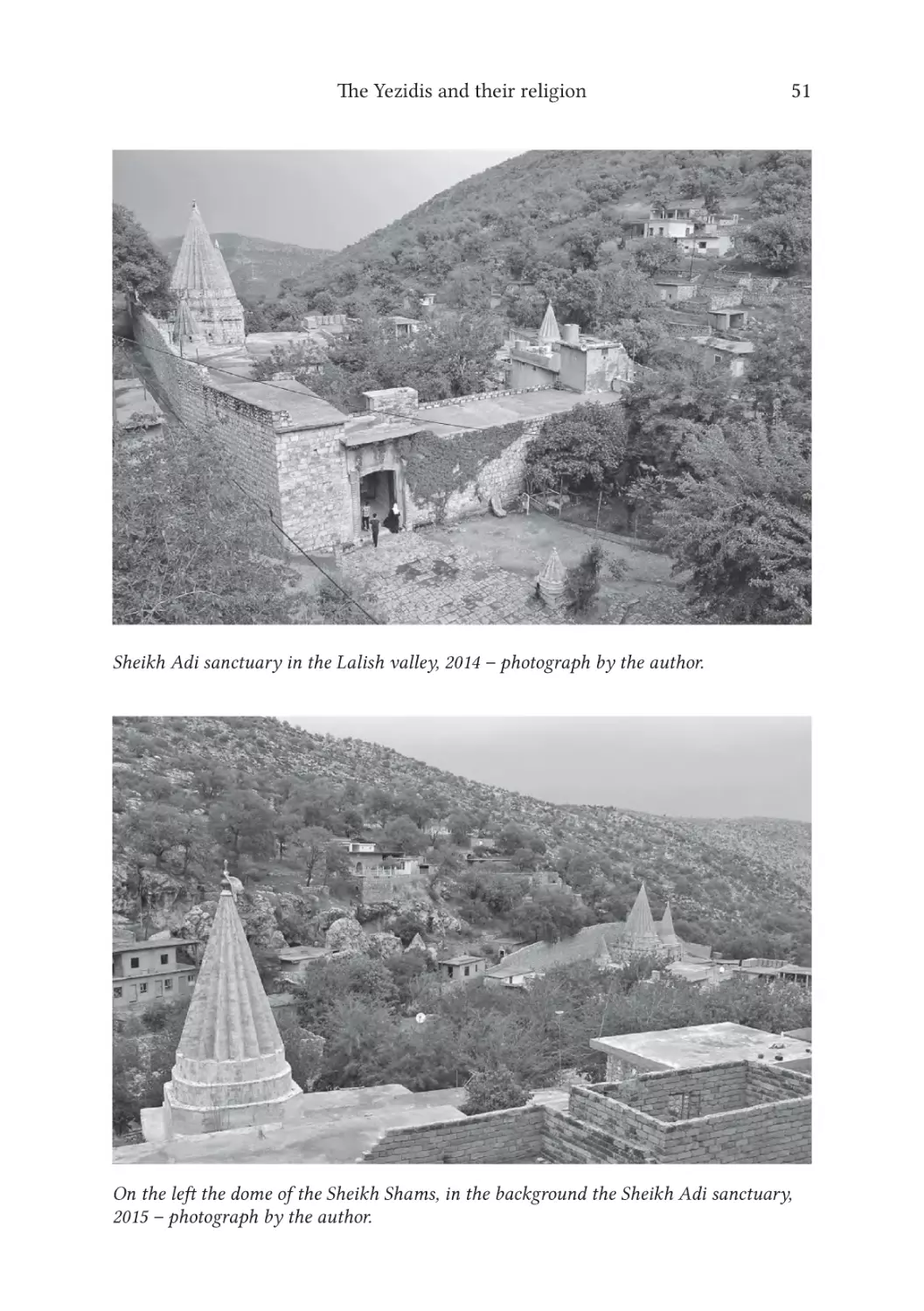
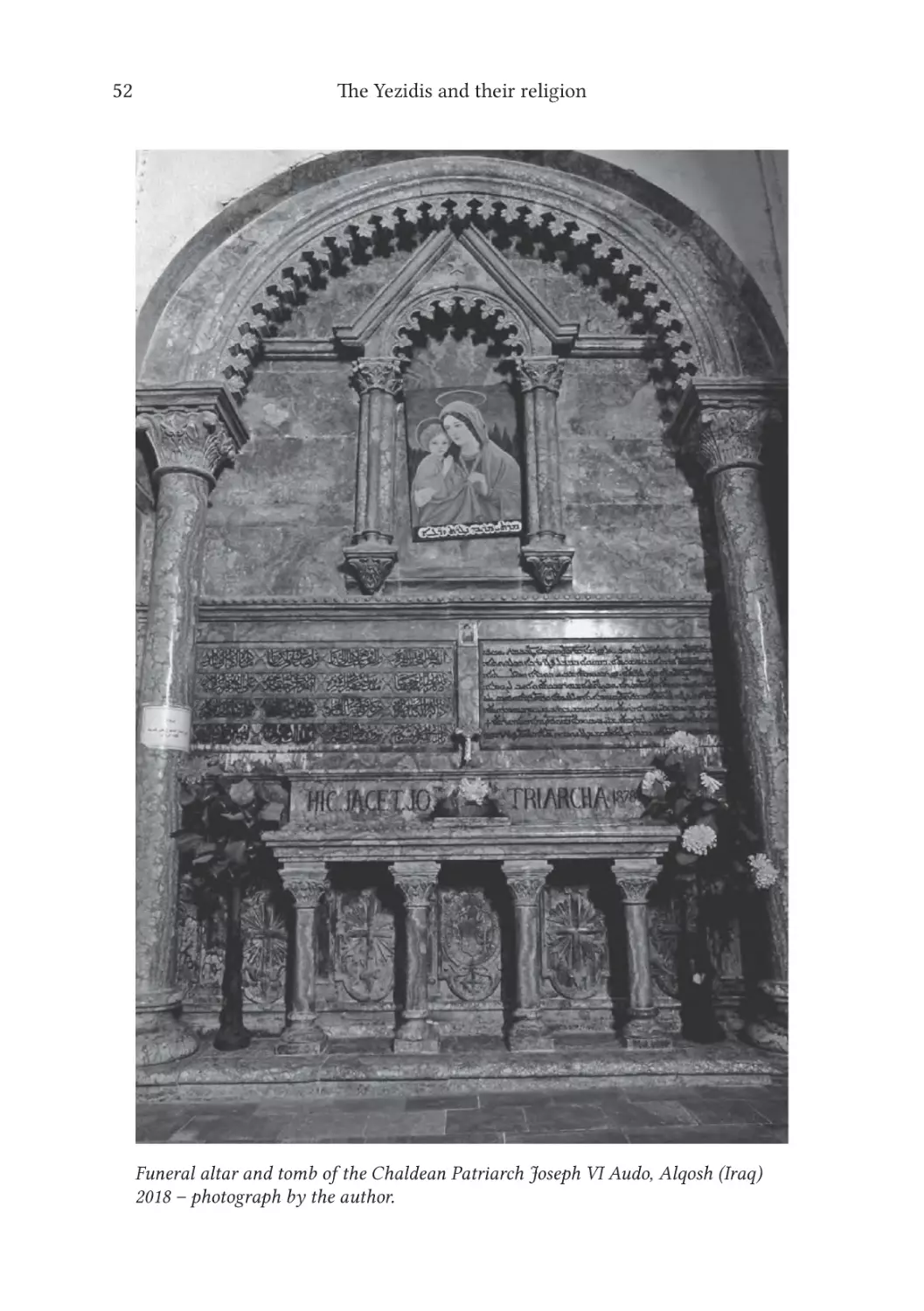

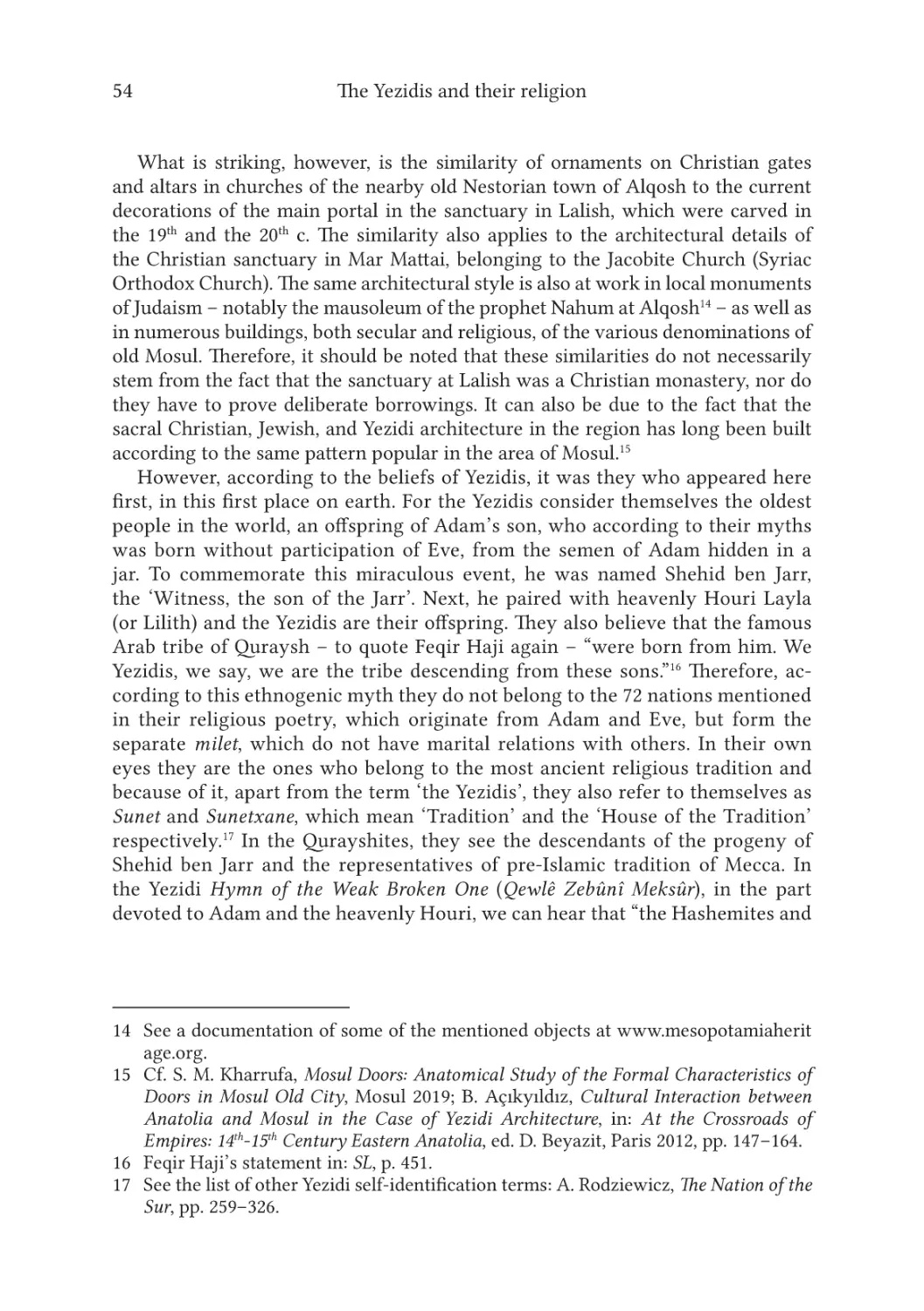

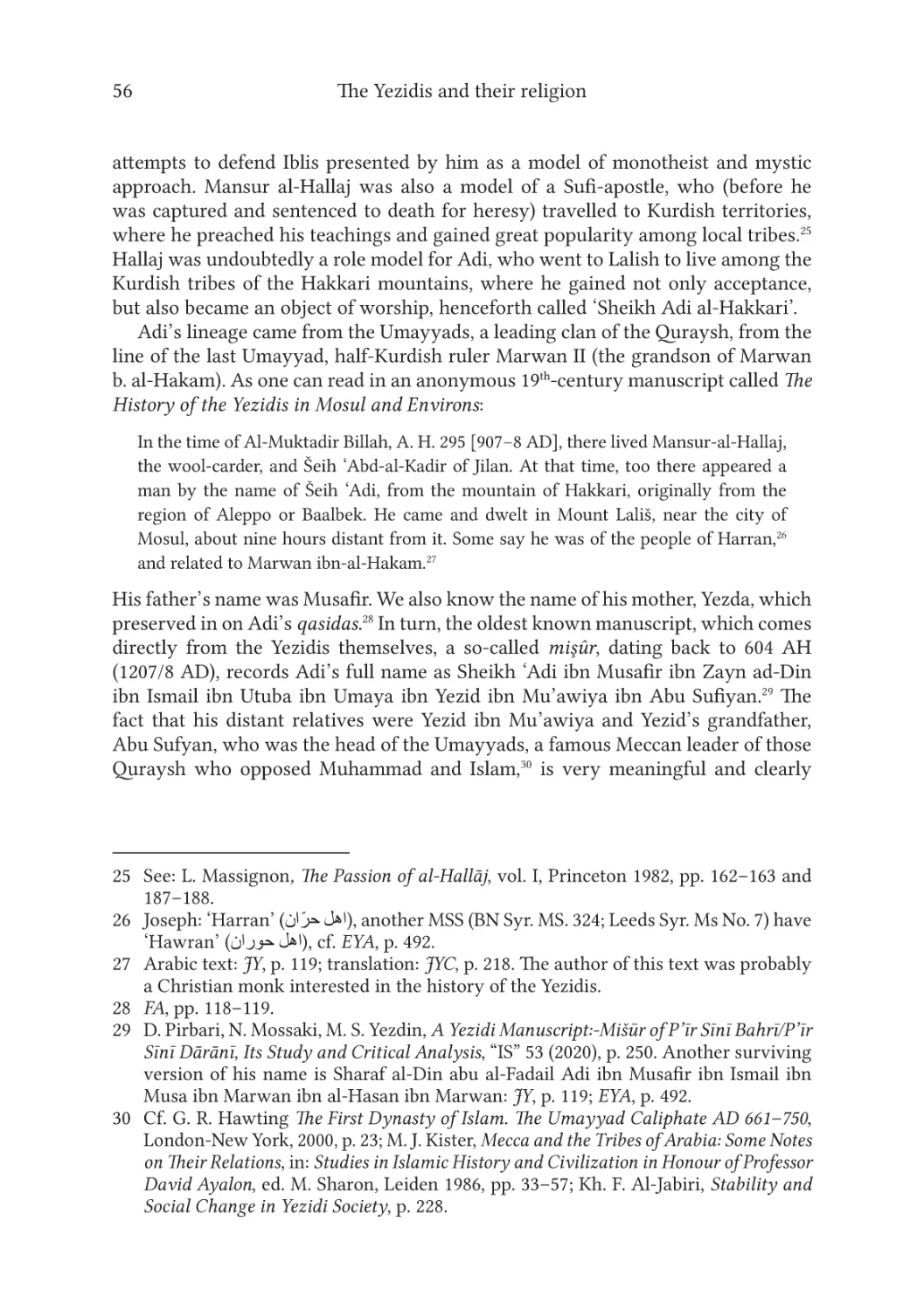












































































































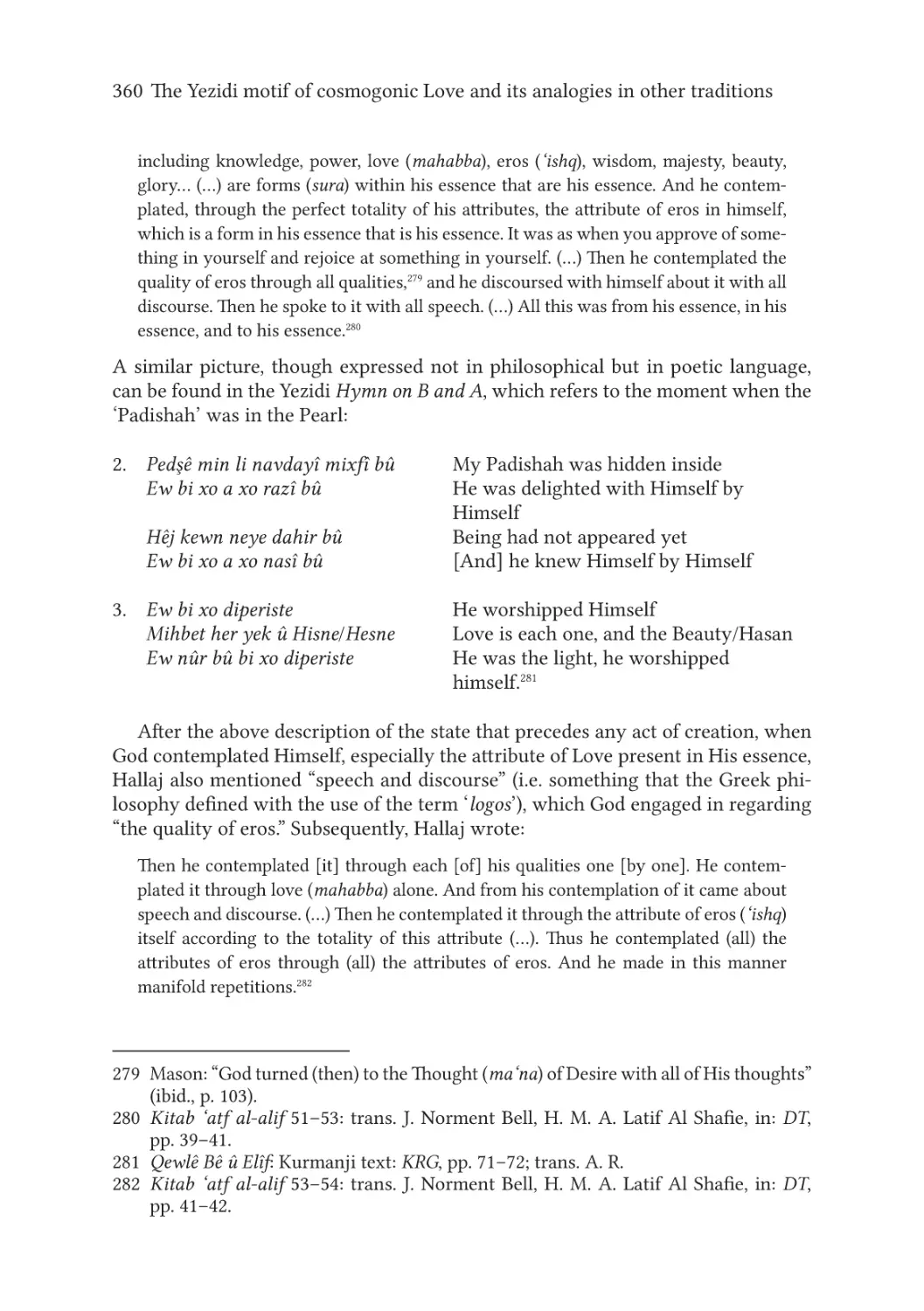
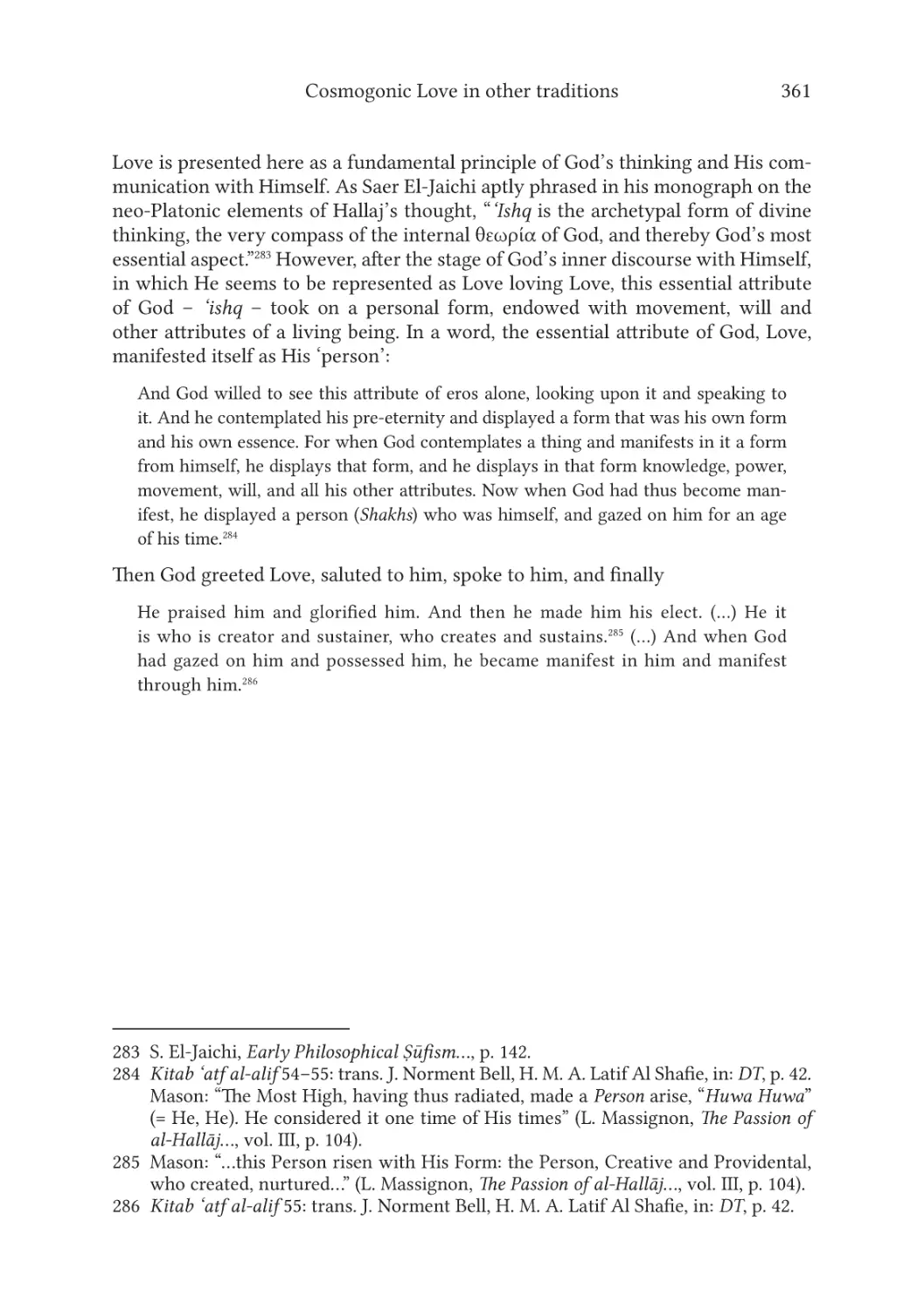
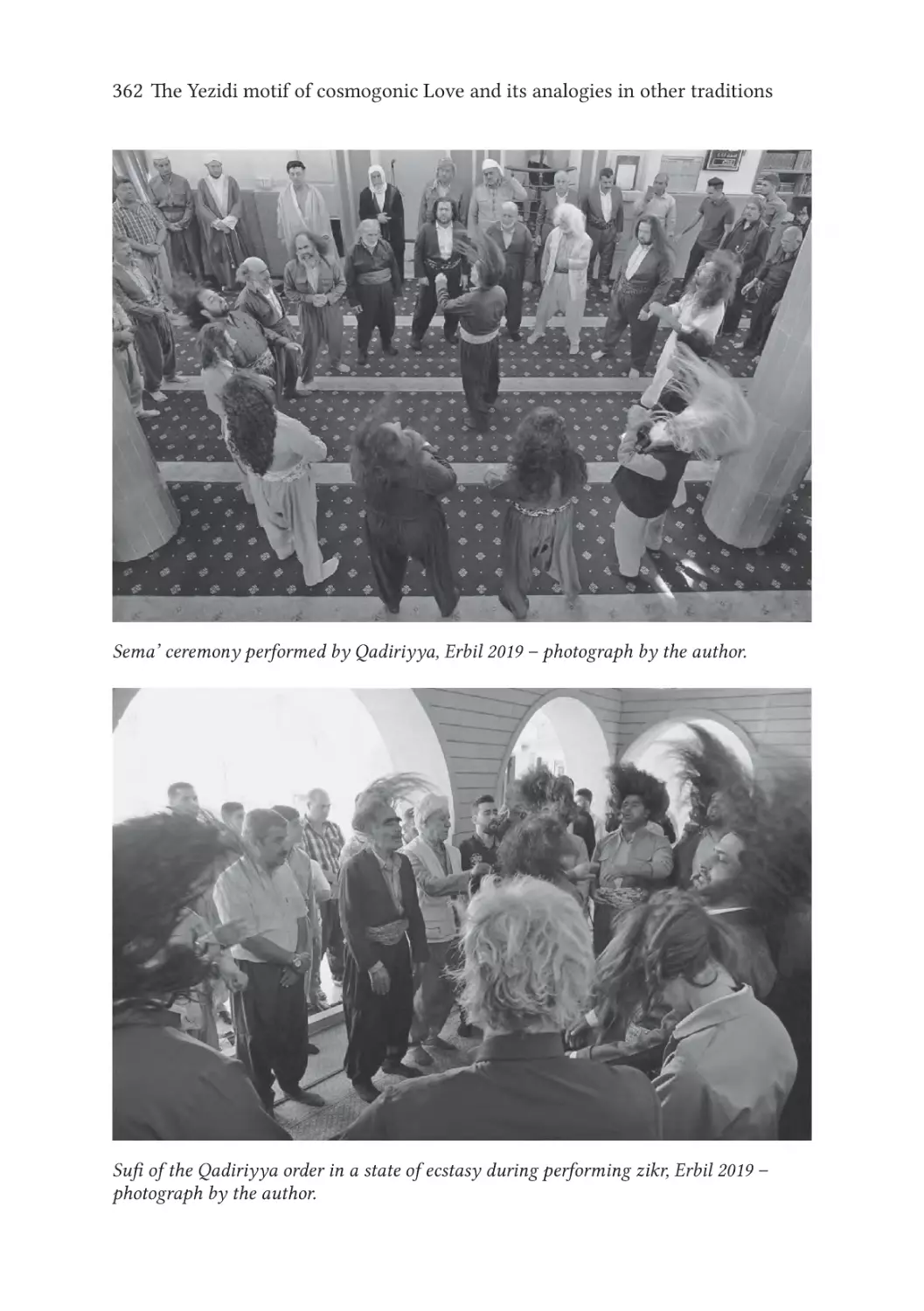
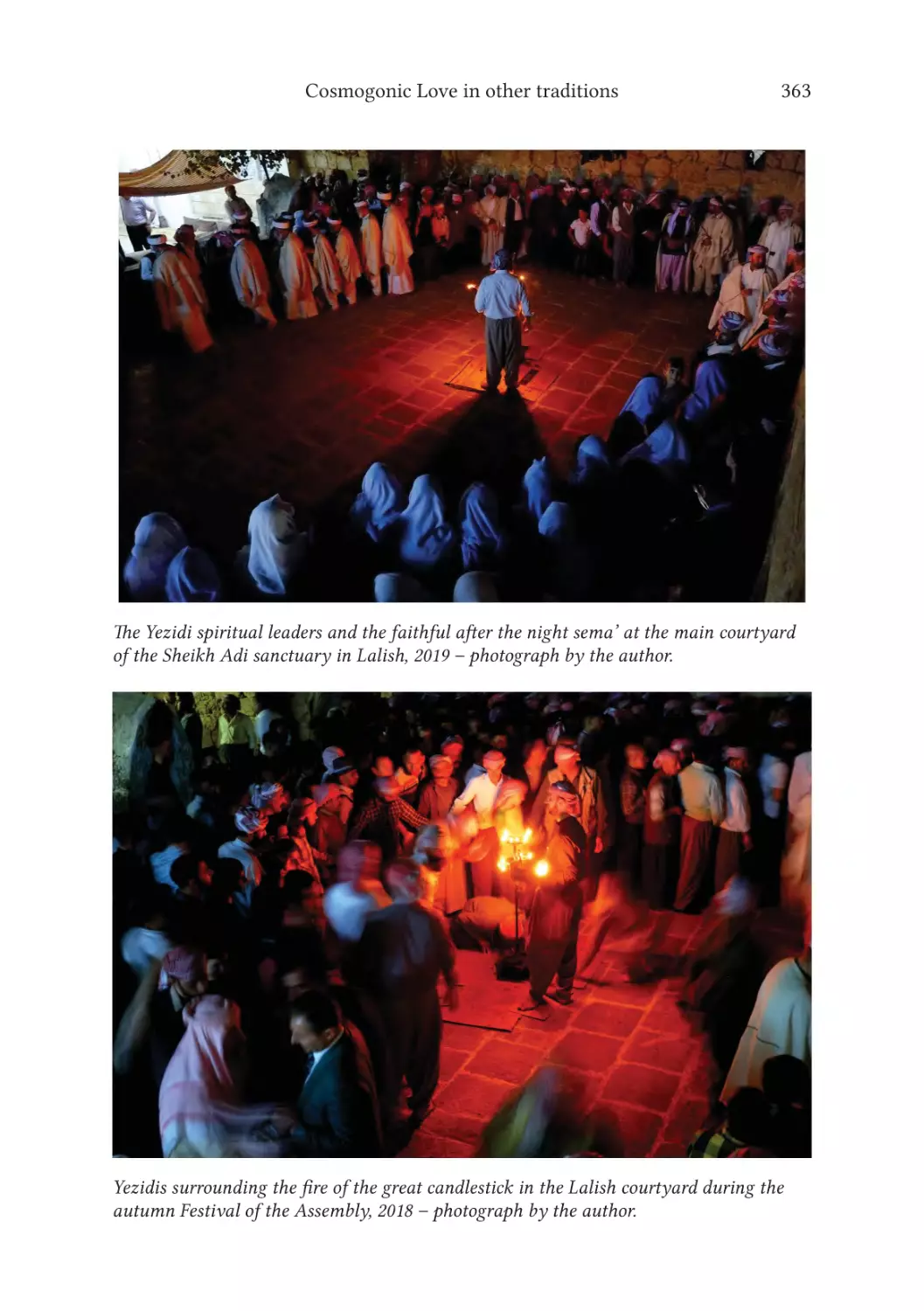




































































































































Автор: Rodziewicz A.
Теги: history mythology culture mysticism traditions enography
ISBN: 978-3-631-88106-4
Год: 2022



Текст
Bibliography
1
2
Bibliography
Eros and the Pearl
Artur Rodziewicz
Eros and the Pearl
The Yezidi Cosmogonic Myth at the Crossroads
of Mystical Traditions
Bibliographic Information published by the Deutsche Nationalbibliothek
The Deutsche Nationalbibliothek lists this publication in the Deutsche
Nationalbibliografie; detailed bibliographic data is available online at
http://dnb.d-nb.de.
Library of Congress Cataloging-in-Publication Data
A CIP catalog record for this book has been applied for at the
Library of Congress.
This publication was financially supported by the University of Warsaw.
The research efforts conducted to produce this book and the preliminary work
to prepare it for publication was supported by the National Science Centre,
Poland (2016/20/S/HS1/00055).
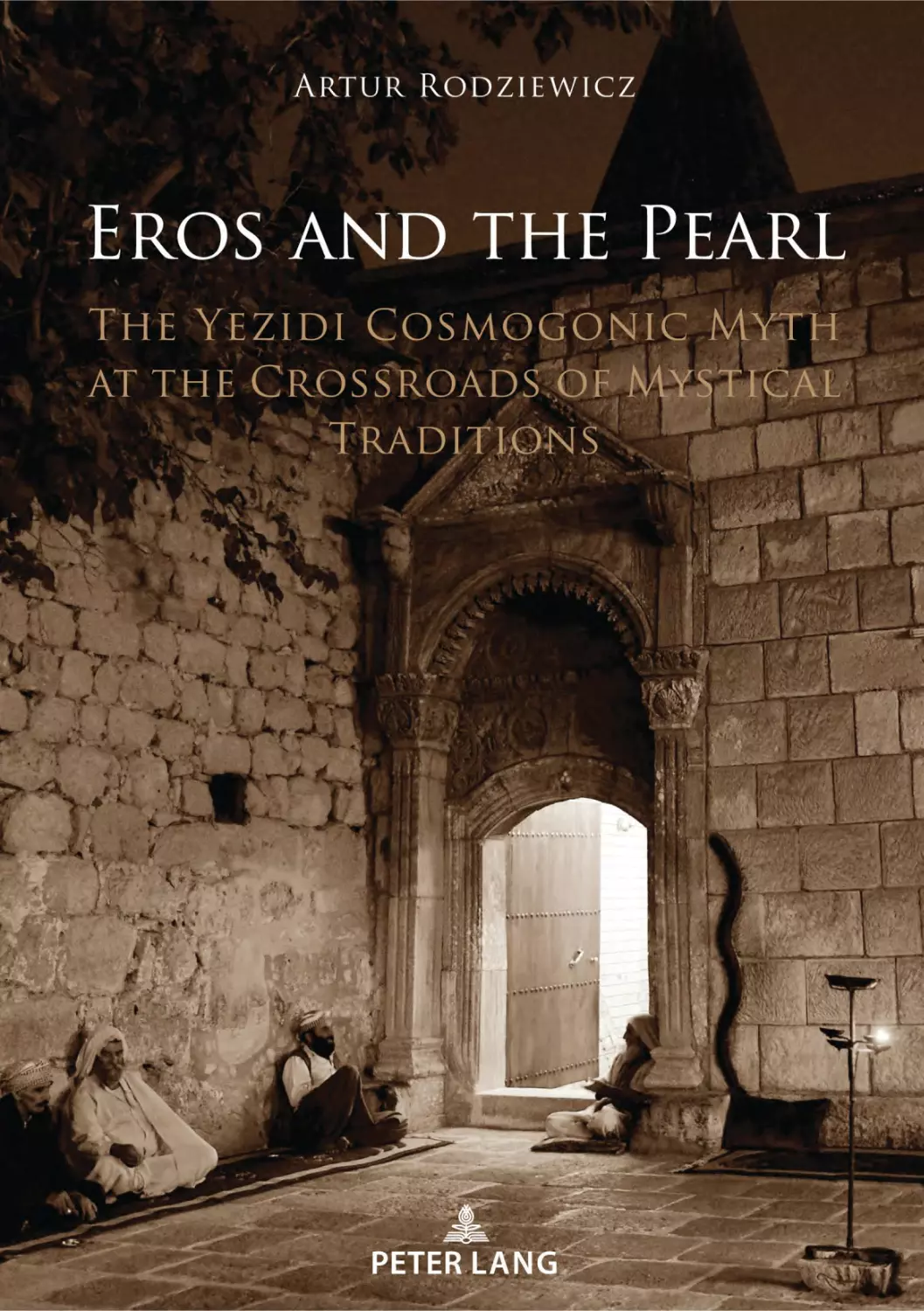
Cover illustration: Courtesy of Artur Rodziewicz.
This work has been reviewed by prof. Peter Nicolaus.
ISSN 2364-7558
ISBN 978-3-631-88043-2 (Print)
E-ISBN 978-3-631-88106-4 (E-PDF)
E-ISBN 978-3-631-88437-9 (EPUB)
DOI 10.3726/b9936
© Peter Lang GmbH
Internationaler Verlag der Wissenschaften
Berlin 2022
All rights reserved.
Peter Lang – Berlin ∙ Lausanne ∙ Bruxelles ∙ New York ∙ Oxford ∙ Warszawa ∙ Wien
All parts of this publication are protected by copyright. Any
utilisation outside the strict limits of the copyright law, without
the permission of the publisher, is forbidden and liable to
prosecution. This applies in particular to reproductions,
translations, microfilming, and storage and processing in
electronic retrieval systems.
This publication has been peer reviewed.
www.peterlang.com
To
pearl divers
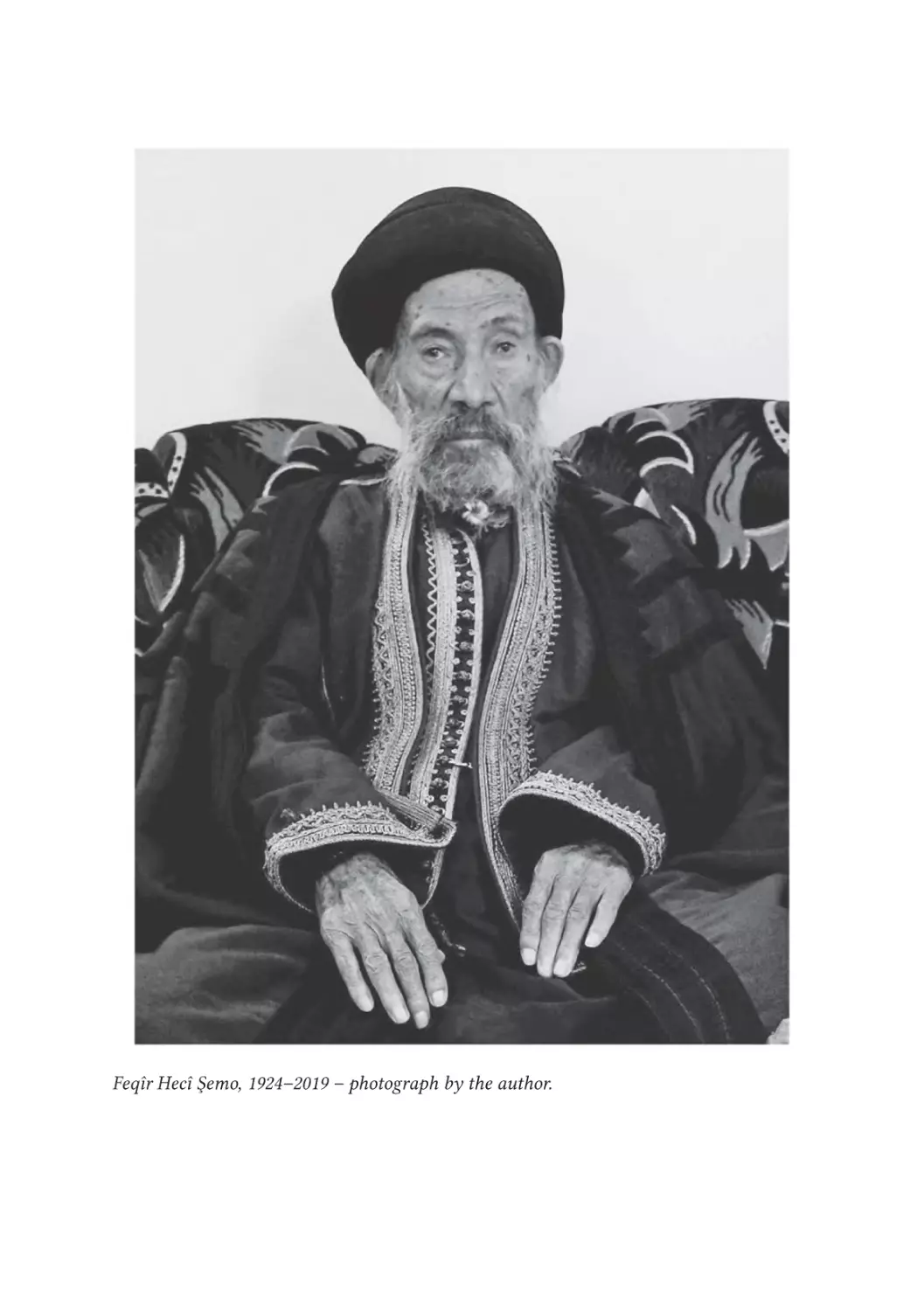
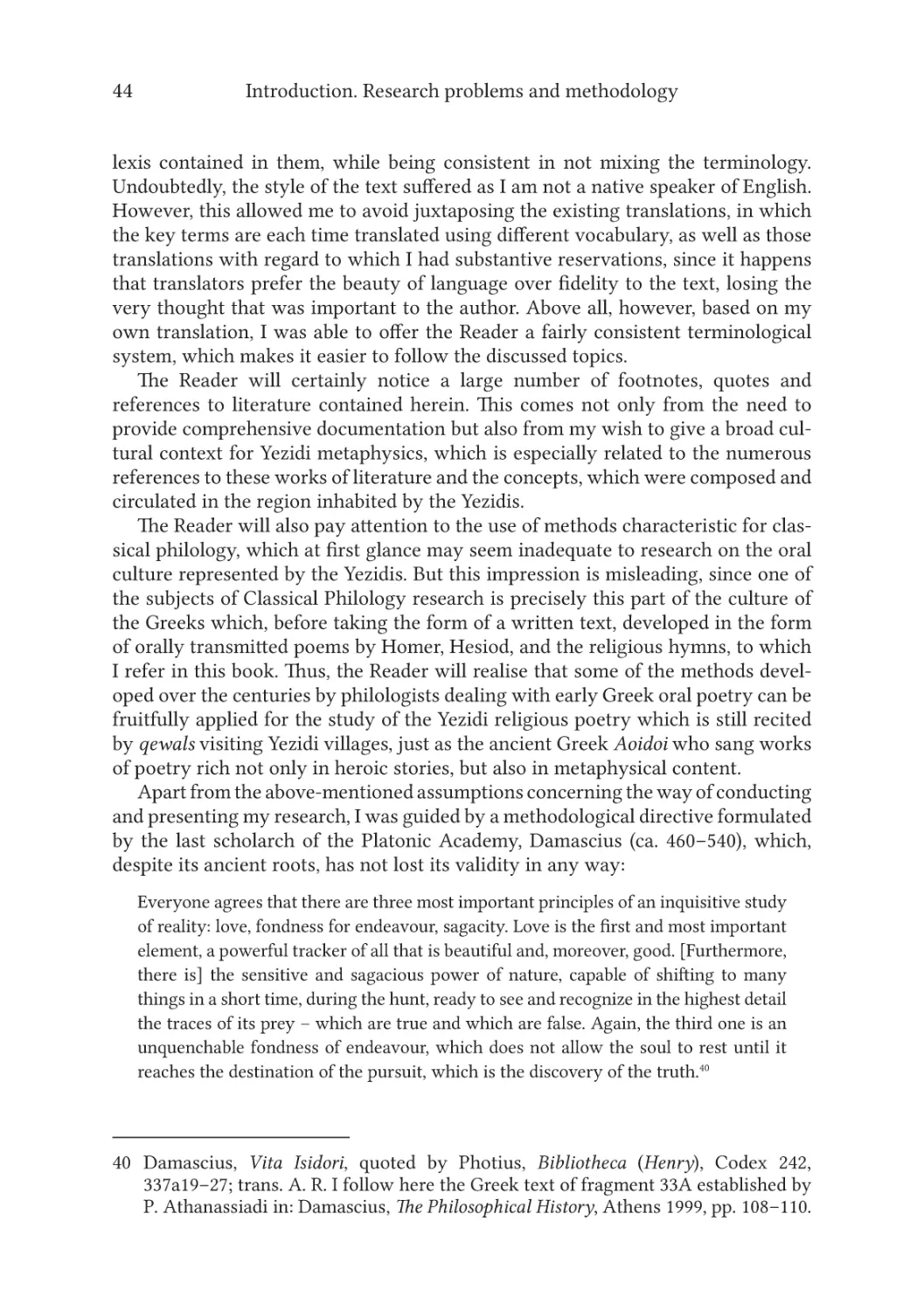
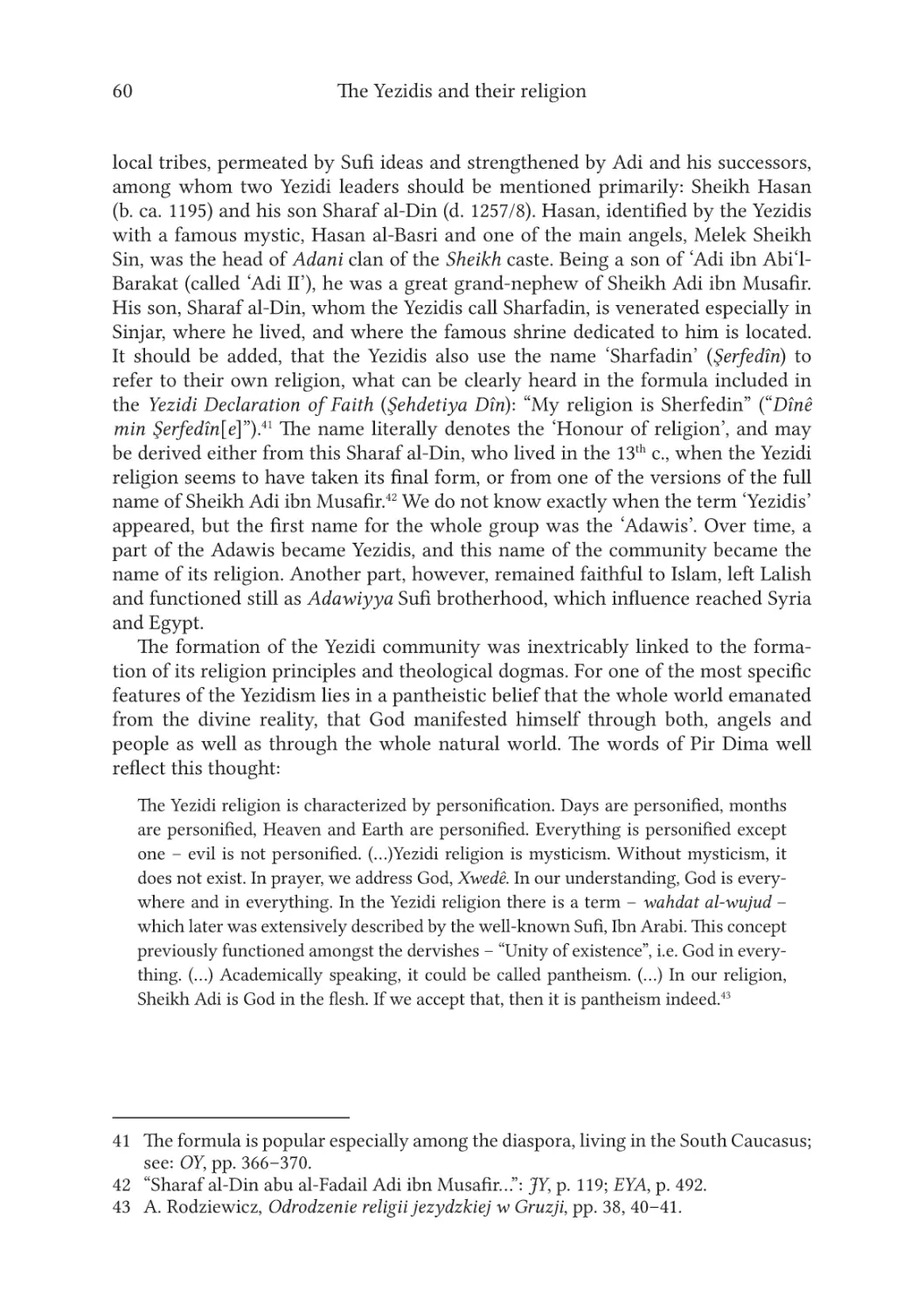
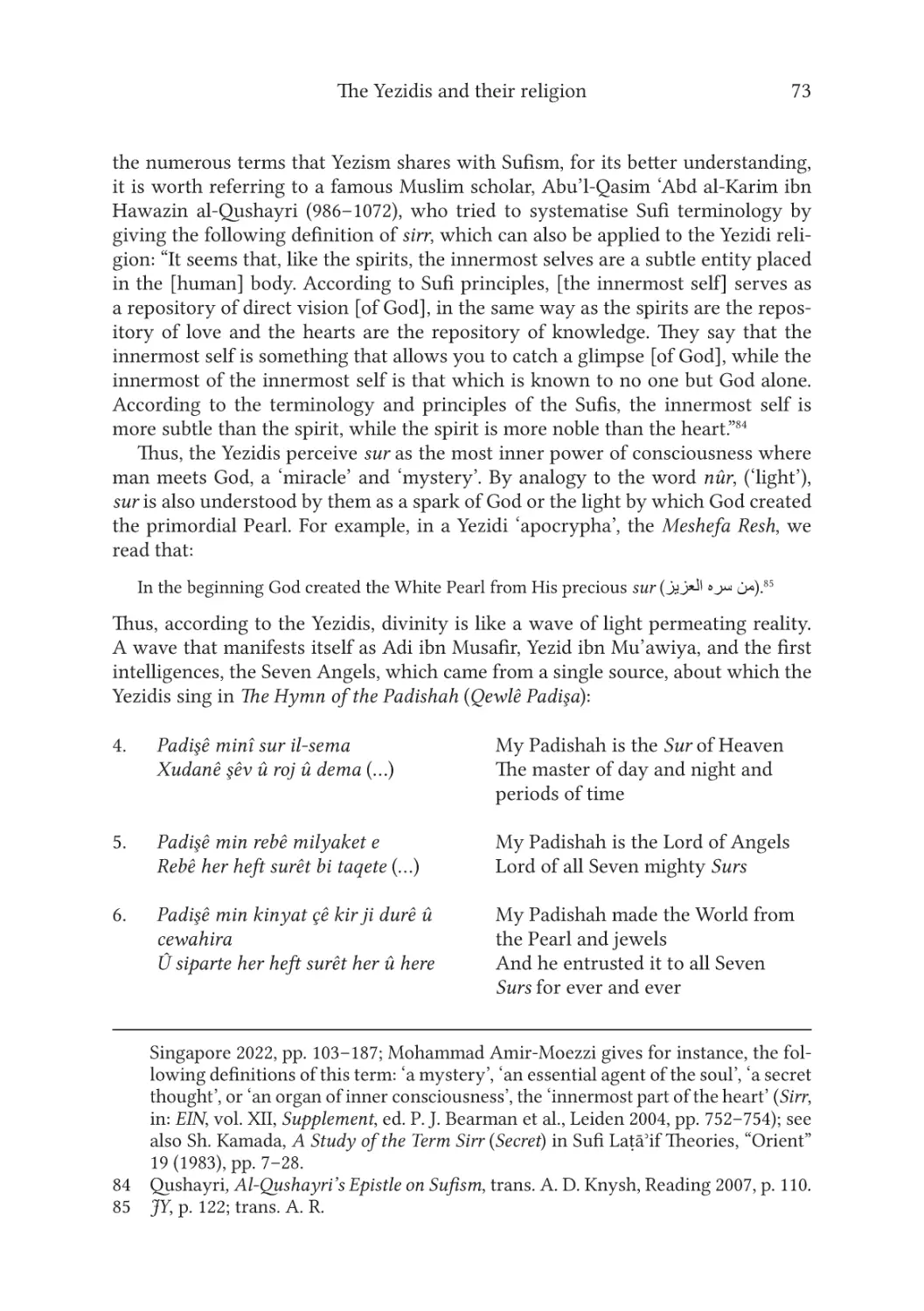
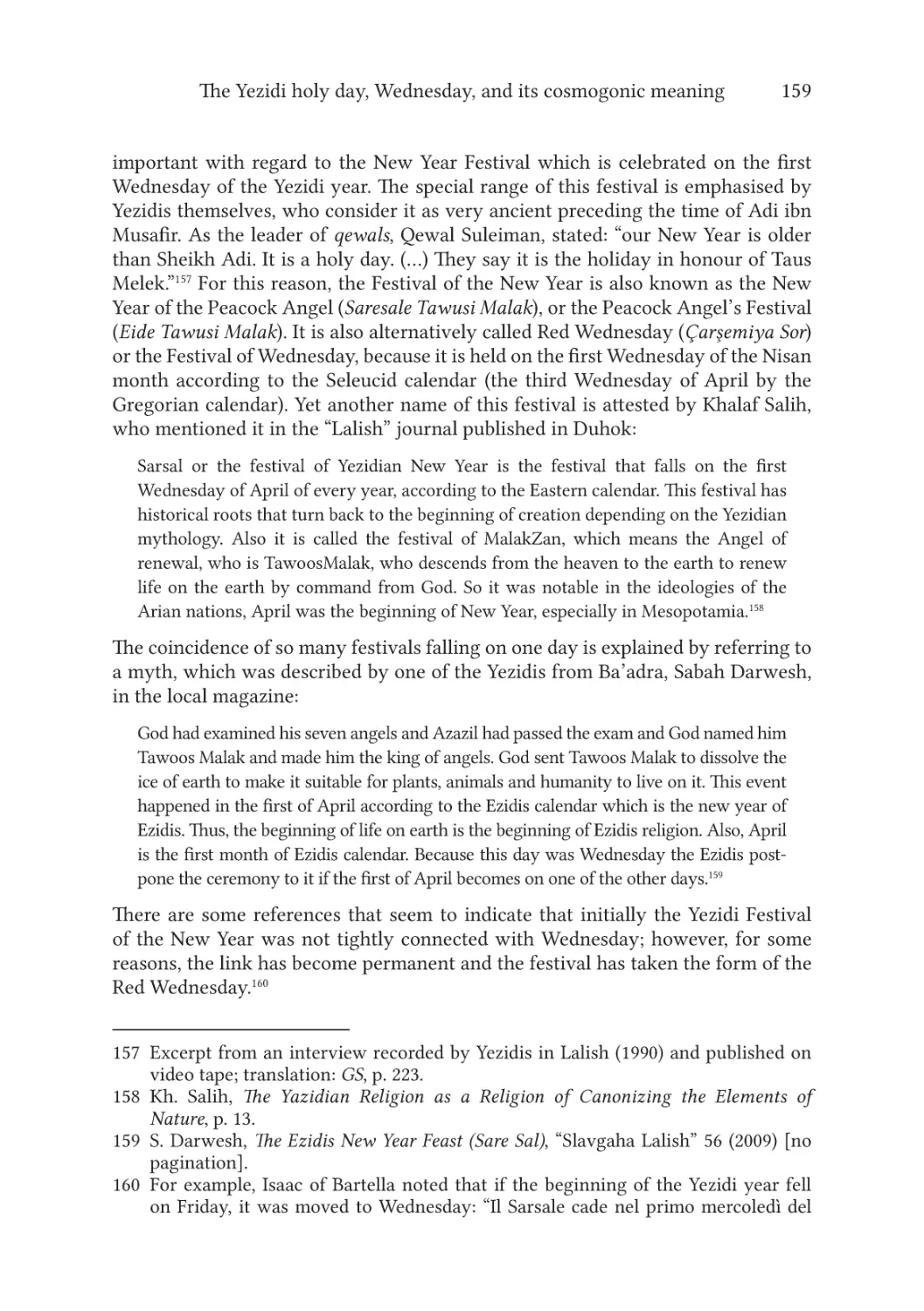
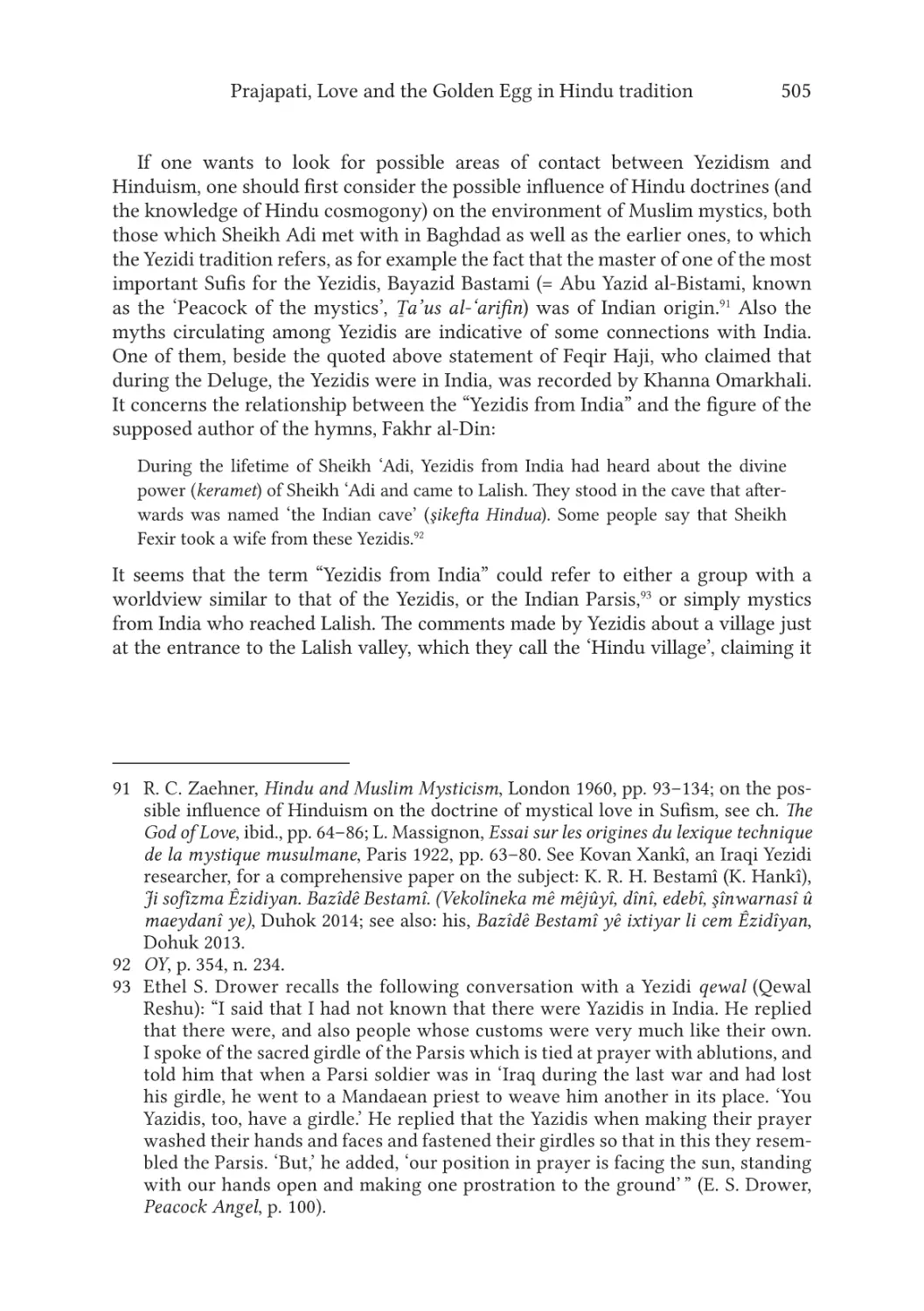
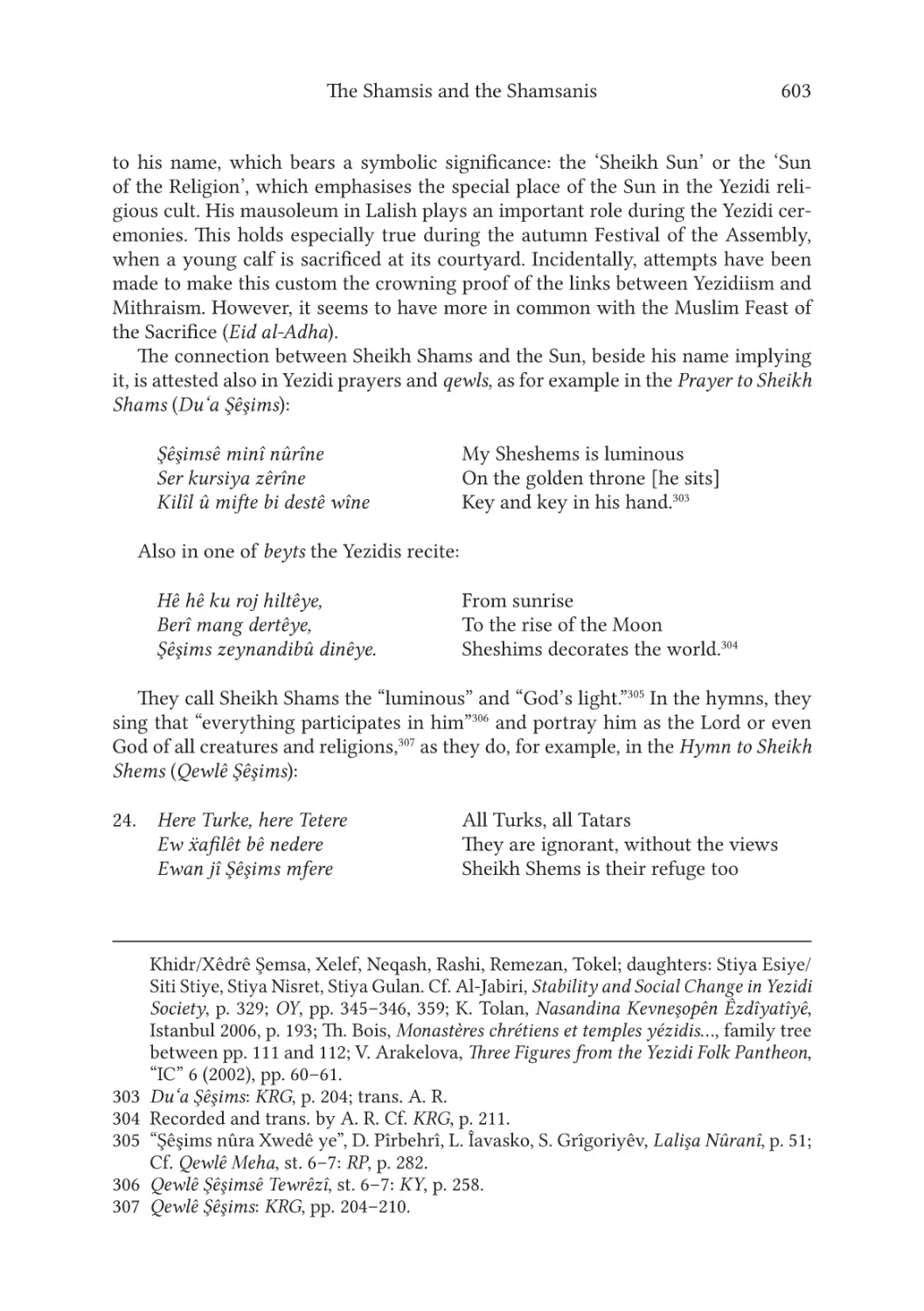
Feqîr Hecî Şemo, 1924–2019 –photograph by the author.
Padşê min ji durê bû
Hisnatek jê çê bû
Şaxa Muhibetê lê bû
Contents
Prologue and acknowledgements ����������������������������������������������������������� 13
List of abbreviations ����������������������������������������������������������������������������������������� 19
Note on transliteration, names, punctuation, quotations
and dates ������������������������������������������������������������������������������������������������������������������� 21
1. Introduction. Research problems and methodology ���������� 23
1.1. Problems with Yezidism ������������������������������������������������������������������������������ 24
1.2. Problems with comparatism ���������������������������������������������������������������������� 33
1.3. The method ���������������������������������������������������������������������������������������������������� 40
2. The Yezidis and their religion �������������������������������������������������������������� 47
3. Sources for research on the Yezidi cosmogony ����������������������� 85
3.1. Oral tradition and taboo on literature ����������������������������������������������������� 85
3.2. Qewls, the Yezidi sacred hymns ����������������������������������������������������������������� 90
3.3. The language of the Qewls and difficulties with its
understanding ����������������������������������������������������������������������������������������������� 99
4. Yezidi cosmogony in oral tradition and ritual ��������������������� 107
4.1. Reconstruction of the Yezidi cosmogony ��������������������������������������������� 108
4.2. The Yezidi holy day, Wednesday, and its cosmogonic meaning �����
4.2.1. Wednesday in the Yezidi tradition and Hermes-Mercury �������
4.2.2. Cosmogonic myth and the festival of the Wednesday ������������
4.2.3. The Yezidi musical instruments and cosmogony ����������������������
139
140
157
173
10
Contents
5. The motif of the Pearl in the Yezidi cosmogony
and its parallels in other traditions ��������������������������������������������� 177
5.1. The Pearl in the Yezidi cosmogony ������������������������������������������������������� 178
5.2. The Pearl and berat ����������������������������������������������������������������������������������� 188
5.3. The Pearl theme in other traditions ������������������������������������������������������
5.3.1. The Christian pearl and the Parable of the Merchant ��������������
5.3.2. The Hymn of the Pearl ��������������������������������������������������������������������
5.3.3. The Manichaean pearl ���������������������������������������������������������������������
5.3.4. The Mandaean pearl ������������������������������������������������������������������������
5.3.5. The Pearl in the Yaresan tradition ������������������������������������������������
5.3.6. The Zoroastrian Sky �������������������������������������������������������������������������
5.3.7. Islam and the pearl of the Sufis �����������������������������������������������������
5.3.8. The One of the Greeks ���������������������������������������������������������������������
5.3.9. The Orphic Egg and some other eggs ������������������������������������������
198
198
214
217
218
222
231
236
258
272
6. The Yezidi motif of cosmogonic Love and its
analogies in other traditions ������������������������������������������������������������� 277
6.1. Two aspects of mystical Love in Yezidism ������������������������������������������ 277
6.1.1. Cosmogonic Love ����������������������������������������������������������������������������� 285
6.2. The branch of Love and Sheikh Sin ������������������������������������������������������� 297
6.3. Cosmogonic Love in other traditions ���������������������������������������������������
6.3.1. God’s Love in Yaresan and Mandaean traditions ����������������������
6.3.2. Love and the mystical branch of Islam ����������������������������������������
6.3.2.1. Sufism and Yezidism ���������������������������������������������������������
6.3.2.2. Muslim mysticism and the Greeks ��������������������������������
6.3.2.3. Love as a way to unity with the One ����������������������������
6.3.2.4. Love, Quran and heresy ���������������������������������������������������
6.3.2.5. Two names of love –‘ishq and mahabba –and
God’s Love for Himself ����������������������������������������������������
6.3.2.6. The Love loving Love –Hallaj and the Greek fire �����
6.3.2.7. Plant metaphors of love in Sufism and the Yezidi
‘branch of Love’ �����������������������������������������������������������������
314
315
329
330
332
338
342
347
357
365
Contents
6.3.3.
6.3.4.
6.3.5.
6.3.6.
6.3.7.
6.3.8.
6.3.9.
6.3.2.8. Fallen lover, fire and Adam ���������������������������������������������
6.3.2.8.1. Iblis, Azazil and Tawusi Melek ���������������������
6.3.2.8.2. Iblis and love to God ���������������������������������������
Cosmogonic Love in Ancient Greek sources and the
Orphic Eros ����������������������������������������������������������������������������������������
6.3.3.1. Eros of poets and Love of philosophers �����������������������
6.3.3.2. Firstborn Love in the Orphic tradition �������������������������
God and Love at the beginning of the Christian tradition �����
The divine name of Eros: the neo-Platonic Christian
tradition ����������������������������������������������������������������������������������������������
Love, Logos and the Alexandrian melting pot ���������������������������
Eros and the religious syncretism of Late
Antiquity: Platonists and Gnostics �����������������������������������������������
Love, Logos and the winged serpent ��������������������������������������������
Eros and the Serpent from the bowl ��������������������������������������������
11
371
372
379
390
391
406
414
422
433
447
459
469
7. Parallels to the motif of Eros and Pearl in the oldest
cosmogonies ������������������������������������������������������������������������������������������������� 483
7.1. Egg, Love and Hermes. Phoenician cosmogony �������������������������������� 486
7.2. Prajapati, Love and the Golden Egg in Hindu tradition ������������������� 492
7.2.1. Hindu elements in the Yezidi tradition and the sanjak ������������ 503
8. Crossroads of traditions –from Harran to Lalish ������������� 517
8.1. Orphic traces in Northern Mesopotamia ��������������������������������������������� 522
8.2. Greek traces in Northern Mesopotamia ����������������������������������������������� 536
8.3. Harranian ‘Sabians’ at the crossroads of traditions �������������������������� 548
8.4. Harranians and the Yezidis ��������������������������������������������������������������������� 567
8.5. The Sun-worshippers in Kurdistan ������������������������������������������������������� 584
8.6. The Shamsis and the Shamsanis ������������������������������������������������������������ 595
12
Contents
9. Epilogue ��������������������������������������������������������������������������������������������������������� 625
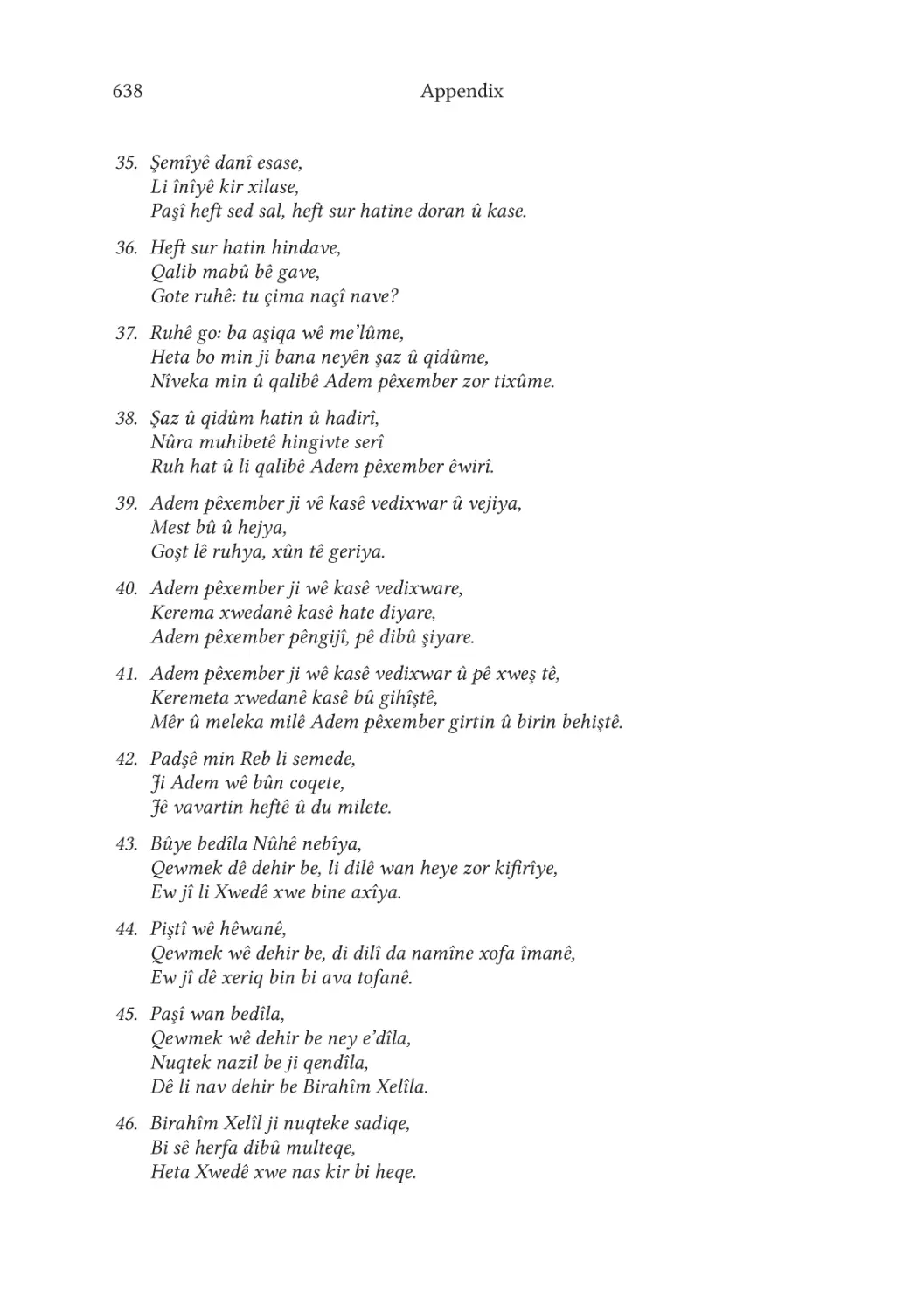
10. Appendix: Kurmanji text of Qewlê Zebûnî Meksûr �������� 635
11. Bibliography ���������������������������������������������������������������������������������������������� 641
12. Index ���������������������������������������������������������������������������������������������������������������� 685
Prologue and acknowledgements
The reason for writing this book was the desire to understand the old myth of Love
hidden in the primordial Pearl. Using the language of metaphor, I must say that
I have fallen under the charm of a pearl glow, which emanated from the bottom of
the sea and which made me put aside everything else and dive into the depths, descending lower and lower, chapter after chapter, to find it and bring it to daylight.
Thus, it is also a report on the search for hidden treasure dedicated primarily to
other pearl divers. In retrospect, I can see that I had been preparing to write it for
about twenty years, which consisted first of study on Greek philosophy, especially
Platonism and Greek cosmogonies and their reception in Late Antiquity, then on
Sufism and Yezidism.
I would like to make special mention here of an incident that took place in the
course of my preliminary work on this book, when I learned that the Yezidis of
Georgia opened the first Yezidi ‘temple’ outside Iraq called Quba Siltan Êzîd, i.e.
‘the Dome[-shaped building] of Sultan Yezid’. I decided to visit it as soon as possible and, at the same time, to get an idea of the specifics of the diaspora, with
which I had no opportunity to get acquainted before. Until then, I only knew the
Yezidi people of Iraq and I had visited their sacred sites there. In August 2015,
I travelled to Tbilisi, and when I finally managed to find and see the building
crowned with a radial dome, characteristic of the Yezidi architecture, I noticed a
young moustached man dressed in a traditional Yezidi costume, with a turban on
his head, who walked barefoot through the courtyard. I felt like I was in Lalish, yet
the post-Soviet blocks and the noise of cars in front of the gate did not allow this
vision to materialise properly. The young man turned out to be a pir and a leader of
the Georgian Yezidis whose vast religious knowledge I had previously heard about
from Yezidis in Iraq and Turkey. Many of them, including the highest spiritual
leaders, knew him very well from the time he served in the Lalish sanctuary as a
volunteer acolyte (xilmetkar).
I introduced myself by saying that I was writing a book about the Yezidi cosmogony and, if he agreed, I would gladly ask him some questions about it. Dimitri
Pirbari accepted my request and, as the sun was shining very strongly, we sat down
in the arcades of the shrine and started to talk. With every word that followed,
I felt that I had encountered the ‘right man’, who not only possessed a deep knowledge, but was also interested in similar issues as me. This is how a friendship was
born, which I could always count on during my research on Yezidism.
In the course of the conversation, Pir Dima, as it is the form he uses among the
Yezidis, admitted that he is also in the process of writing a book. I asked about the
subject and the title, and to my amazement he replied: –Тайна жемчужины, that
is The Mystery of the Pearl. Pir Dima’s book, which contains the description of the
principles of Yezidism, its history and the translation of the Yezidi religious hymns,
14
Prologue and acknowledgements
which were rendered into Russian by Dmitri Shchedrovitskiy, was published in
Russian in 2016, and a year later in the Georgian language.
In the meantime, I continued my work, which was greatly helped by receiving
the Fuga 5 Internship from the National Science Centre of Poland, within the
framework of which I was able to carry out a research project at the Department
of Iranian Studies of the Jagiellonian University entitled Eros and the Pearl in the
Yezidi Cosmogony (2016/20/S/HS1/00055), which the present publication is the
result of. Throughout this post-doc research, I was always able to count on the help
and favour of the academics associated with the university, especially an Iranist,
Anna Krasnowolska, and a Kurdologist, Joanna Bocheńska, for which I would like
to thank them at this point.
The Reader might rightly ask: What was the reason for choosing this particular
topic? The need to write this book arose from a question that emerged during my
research on the philosophy of the ancient Greeks, especially Plato’s cosmology,
to which I have devoted many years of studies and a doctoral dissertation at the
Faculty of Philosophy of the University of Warsaw, and which I have continued
to conduct in parallel with my research on the religion of the Yezidis. Analysing
the scant information on the cosmogony of the Yezidis, I noticed some convergence between Platonism and Yezidism –both in the area of cosmology and in the
theocratic organisation of the political community. My special interest was also
aroused by the theme of Love in the Yezidi cosmogony and its relationship with the
primordial Pearl that was extolled in the Yezidi hymns. At a first glance, the thread
seemed quite original, but I saw its distinct parallels in the ancient Greek cosmogonies, especially the one spread by the Platonists and attributed to the Orphics.
Thus, my question was: Could the Yezidis have assumed the Greek cosmogonic motif?
Do we witness a cultural trace of contact or does it belong to their original religious
thought? This has raised further doubt: Perhaps they both share a motif that was
not invented by them at all, but was taken by the Yezidis, either from Sufism or perhaps from another, earlier source? This, in turn, raised more questions: If we were
witnessing a borrowing, how was it possible for it to take place? Should we accept a
chance that a mere coincidence occurred here, without any connections in the form of
transmission of the cosmogonic motif? After all, the wheel may have been invented
independently by various people working separately, and the mere fact of using it
does not entail that they acquired it from others.
If answers to these questions were to be provided in any way, it was necessary, first, to juxtapose these similarities and, second, to attempt to answer one
more complex question without which it would be difficult to draw any serious
conclusions: Who are the Yezidis, where do they come from and how far back in time
does their tradition go? In a sense, the subject of this book became a pretext for
extensive research and reflection on Yezidism itself and its origins. In this respect,
the book offered to the Reader challenges the paradigms hitherto prevailing in the
Yezidi studies and opens the field to new discussions. In presenting new findings
and hypotheses, which at first glance may look controversial, I have done my best
to justify them both through the source material and the argumentation.
Prologue and acknowledgements
15
Dealing with all these issues necessitated the development of a specific method,
which would combine the sets of tools a historian of philosophy, philosopher, and
cultural anthropologist have at their disposal. While, as regards the Greeks, for
example, there exist critical editions of ancient texts and countless comments on
them that have been made over the course of tens of centuries, in the case of the
Yezidis, we constantly encounter question marks that result from the paucity of
sources. The studies on Yezidism are a much younger discipline than the history of
ancient philosophy and classical philology. It was not until the 1970s that the academic world learned for the first time about the content of the holy Yezidi hymns
(qewls), which are the most important source for Yezidologists. Nor is the research
into the study of Yezidism facilitated by the fact that it still remains a very hermetic religion. For a variety of reasons, even the Yezidis themselves do not know
the answers to many questions about their tradition either.
In short, to compare the Yezidi legends about the beginning of the world with
cosmogonies that appeared in the region inhabited for centuries by the Yezidis, it
was necessary to establish the precise outline of the Yezidi cosmogony. This, in
contrast to research within the scope of the history of philosophy and classical philology, required not only becoming acquainted with the Yezidi cosmogonic hymns,
but also involved field research. This included conversations with the Yezidis themselves and searching for cosmogonic threads also in other sources, especially in
their festivals, which I have had the opportunity to become a witness of in Iraq,
Georgia and Turkey. Particularly important was the New Year’s Serê Sal festival,
celebrated in the most holy Yezidi place, Lalish, which I visited for this occasion
in April 2014, 2015, and 2018. I visited Iraq many times in other years as well.
I could always count on the hospitality of the Yezidis and valuable conversations,
which allowed me to understand better the specifics of their religion. I had already
been prepared for this kind of research, because apart from studying Philosophy,
Classical and Oriental Studies, more than twenty years ago I learnt how to carry
an ethnographic research and undertook my own fieldwork as a student of the
Department of Ethnology and Cultural Anthropology of the University of Warsaw.
Alongside observing religious ceremonies and conducting interviews, I also
confronted my questions, hypotheses, and findings with Yezidi Hymnists, Qewals,
a group of Yezidi people responsible for the transmission of oral tradition, living
for centuries in the Iraqi villages of Bashique and Bahzani (especially Qewal Aryan
Hasan Kochi, Qewal Ali Rasho Hasan Alhakary, Qewal Bahzad Sulaiman Sivo,
Qewal Hameed Khalil Elyas, Qewal Qaid Rizgan), where I stayed in April 2018 and
in October 2021 owing to the kindness of the families of Dalzar Nashwan Salem and
Shwan Fareed Abdullah. I also discussed the issues that I was curious about with
the religious elders and representatives of all the Yezidi castes –Sheikhs, Pirs, and
Murids. I also had the honour of meeting twice with the aged Feqir Haji (d. 2019),
from whose mouth I heard in 2014 one of the most important religious hymns,
Qewlê Zebûnî Meksûr. In November 2018, I was given the honour of living in the
house of a Yezidi religious leader, Extîyarê Mergê Bavê Şêx Xurto Hecî Îsmaîl (d.
16
Prologue and acknowledgements
2020), and spending a whole week in Lalish itself during the autumn Festival of the
Assembly (Cejna Cimayê).
In my attempt to comprehend the Yezidi religious tradition, I received invaluable
help from the aforementioned leader of the Georgian Yezidis –Dimitri Pirbari –
whom I have visited many times in Tbilisi and with whom I have travelled around
Armenia in 2016 in a search for answers to my questions among the local diaspora.
There too, I always met with the hospitality of the Yezidis and their selfless help.
While searching for materials for this book, I conducted field research in
important places for the Yezidis, especially in Iraq (Lalish, Ain Sifni, Ba’adra,
Bashique and Bahzani, Bozan, Alqosh, Sharia, Bartella, Duhok, Sinjar District),
Turkey (Viranşehir and its surroundings, Xirbe Belek/Bozca, Bacin/Güven, Kiwex/
Mağara, Şanlıurfa, Harran and its neighbouring area), Georgia (Tbilisi), Armenia
(Aparan and the villages near Yerevan) and Germany (Oldenburg). The facts and
impressions that I collected in those places during my conversations with the
Yezidi people, while watching their religious life and appreciating their architecture, I also confronted in discussions with academics: Peter Nicolaus in Salzburg,
Birgül Açıkyıldız in Mardin, Garnik Asatrian and Victoria Arakelova in Yerevan,
Philip Kreyenbroek in Göttingen, Mammo Othman in Duhok, Pir Khadir Sulayman
in Ain Sifni, Bedel Feqir Haji in Oldenburg, and the aforementioned Dimitri Pirbari
and Kerim Amoev in Tbilisi. Thanks to funds from the Polish National Science
Centre, I was simultaneously able to conduct library queries in such academic
centres as Oxford, Göttingen, Yerevan, Diyarbakır, Mardin, Warsaw, Cracow,
and especially Tbilisi, where I was able to access the collections of the extensive
library and archive of the House of the Yezidis of Georgia. Recently, the world’s
first International Yezidi Theological Academy (Akadêmiya Teolojiya Êzdîtiyê ya
Navdewletî) and the first Department of Yezidi Studies (at the Giorgi Tsereteli
Institute of Oriental Studies of Ilia State University) have also started operating
there, bringing together researchers and students interested in the principles of
the Yezidi religion.
During my field research, I also tried to take photographic records. I presented
their effects at an exhibition entitled Let there be light! The cosmogonic festival of the
Yezidis from the Iraqi Kurdistan, presented in Cracow and Warsaw, in the Asia and
Pacific Museum. Some of them have also been used to illustrate this book.
While working on translations from Arabic, Persian, and Kurdish texts,
I could always count on the guidance and help of Arabists, Irianists, and
Kurdologists: Dimitri Pirbari, Dalzar Nashwan Salem, Talal Qarah Bolad, Rebaz
Jalal Ahmed, Sholeh Paknejad Sahneh, Majid Hassan Ali, Hediye Yazdan Panah,
Edyta Wolny-Abouelwafa, Mirosław Michalak and, of course, my wife, Magdalena
Rodziewicz. Mention should also be made of Michal Bocian, who at the first stage
of preparing this book provided an initial translation of most of the chapters,
which I later reworked and expanded with new content. I would like to heartily
thank them all, and at the same time apologise if I did not act upon all of their kind
advice. I am solely responsible for any errors in the proposed translations.
Prologue and acknowledgements
17
Finally, I would like to extend sincere thanks to the Yezidis for their help and
hospitality. This book would never have been written if it was not for the kindness
and support of: Farhad Baba Sheikh, Ismet Tahsin Beg, Dalzar Nashwan Salem,
Nashwan Saleem Aswad and Naeema Simo Khider, Nawar Nashwan Saleem,
Minaar Nashwan Saleem, Ghazwan Saleem Aswad and Dalghwaz Hassoun Simo,
Shwan Fareed Abdullah and Maysam Murad Chicho, Faleh Hassan Jumaa, Hassoun
Simo Khider and Hassna Jarrow Ibrahim, Daldar Saleem Aswad, Sheikh Abdel,
Hussein Haji Osman, Sinan Gören, Kovan Khanki, Qewal Aryan Kochi, Jiyan
Hassan Alkhalti, Amira Alfatey, Sheikh Khalet Hasan, Sheikh Nuri Shekhnamati,
Sheikh Nadir Aloyan, Sheikh Rostam Amadov, Pir Maksim Darveshyan, Boris
Murazi, Husein Rasheed Kishtu, Ilyas Yanç, Bedel Feqir Haji, Sheikh Xwededa
Adani, and many others who repeatedly offered me their selfless help. Let me
also thank my friends, dear colleagues, and the esteemed persons for their support and understanding shown to me during recent years, when I was devoted
to the work on this book: Aleksandra Siudek, Włodzimierz Lengauer, Kazimierz
Robak, Ewa Wipszycka, Marek Jankowiak, Mirosław Wylęgała, Magdalena
Zowczak, Maciej Ząbek, Garik Grigoryan, Ziyad Raoof, Maciej Legutko, Katarzyna
Witkowska, Katarzyna Prochenko, Alexander Sarantis, Julia Doroszewska, and
Filip Doroszewski. Last but not least, I would like to express an especially heartfelt
thanks to Peter Nicolaus, whom I met owing to our shared interest in Yezidism,
and then to our joint research on Cejna Cemayê. I am immeasurably obliged to the
Austrian for his friendship, knowledge and unflagging enthusiasm that made me
persevere in the efforts to write this book. He was also its first reader.
Unfortunately, Professor Bogdan Składanek, the co-founder of the Department
of Iranian Studies at the University of Warsaw, whom I was proud to call a friend,
passed away before this book was published. He was very much looking forward
to this moment and even during our last conversation he rushed me to publish it as
soon as possible. He passed away at the age of 91, in May 2022. I had hoped to give
him a copy of the book with a personal dedication thanking him for his hospitality,
sense of humour, and, above all, the opportunity to get to know a real passionate
scholar. Not being able to do this in the material sphere, I hope he will accept it in
the sphere of thought, which by its very essence is not subject to death.
List of abbreviations
AJA
AJISS
AJSL
BN1
BN2
BH
BJMES
BSOS
BSOAS
CCZ1
American Journal of Archaeology
American Journal of Islamic Social Sciences
American Journal of Semitic Languages and Literatures
G. P. Badger, The Nestorians and their Rituals, vol. I (London 1852)
G. P. Badger, The Nestorians and their Rituals, vol. II (London 1852)
M. Bittner, Die heiligen Bücher der Jeziden oder Teufelsanbeter
British Journal of Middle Eastern Studies
Bulletin of the School of Oriental Studies
Bulletin of the School of Oriental and African Studies
O. Celîl, C. Celîl, Zargotina K’urda: Курдский фольклор, vol. I
(Erevan 1978)
CCZ2
O. Celîl, C. Celîl, Zargotina K’urda: Курдский фольклор, vol. II
(Moskva 1978)
ChS1
D. Chwolsohn, Die Ssabier und Der Ssabismus, vol. I
ChS2
D. Chwolsohn, Die Ssabier und Der Ssabismus, vol. II
CSCO
Corpus Scriptorum Christianorum Orientalium
DT Daylami, A Treatise on Mystical Love
EI
Encyclopædia Iranica
EIN
Encyclopaedia of Islam. New Edition
EYA
R. Y. Ebied, M. J. L. Young, An Account of the History and Rituals of
the Yazīdīs of Mosul
FA
R. Frank, Scheich ʿAdî, der grosse Heilige der Jezîdîs
FK
Fritillaria Kurdica. Bulletin of Kurdish Studies
FN
A. Frayha, New Yezīdī Texts from Beled Sinjār, ‘Iraq
GJ
Geographical Journal
GS
J. Guest, Survival Among the Kurds: A History of the Yezidis
HJAS
Harvard Journal of Asiatic Studies
HSCPh
Harvard Studies in Classical Philology
IJCT
International Journal of the Classical Tradition
IC
Iran and the Caucasus
IS
Iranian Studies
IT
W. Ivanow, The Truth-Worshippers of Kurdistan
JA
Journal Asiatique
JAOS
Journal of the American Oriental Society
JEA
Journal of Egyptian Archaeology
JHS
Journal of Hellenic Studies
JIS
Journal of Islamic Studies
JKS
Journal of Kurdish Studies
JRCAS
Journal of the Royal Central Asian Society
JRCI
Journal of the Regional Cultural Institute
20
JRAI
JRASBI
JRAS
JRGS
JSS
JSHS
JThS
JY
JYC
KRG
KY
LN
LE
MPG
NHC
NTR
OY
PO
RHR
RP
SCÊ
SL
SPh
ZKOR
ZDMG
ZPE
List of abbreviations
Journal of the Royal Anthropological Institute of Great Britain and
Ireland
Journal of the Royal Asiatic Society of Great Britain and Ireland
Journal of the Royal Asiatic Society
Journal of the Royal Geographical Society of London
Journal of Semitic Studies
Journal of Social and Human Sciences
Journal of Theological Studies
I. Joseph, Yezidi Texts
I. Joseph, Yezidi Texts (Continued)
Ph. G. Kreyenbroek, K. J. Rashow, God and Sheikh Adi are Perfect
Ph. G. Kreyenbroek, Yezidism –its Background, Observances and
Textual Tradition
A. H. Layard, Nineveh and its Remains, vol. I (London 1849)
R. Lescot, Enquête sur les Yezidis de Syrie et du Djebel Sindjār
J. P. Migne, Patrologiae cursus completus, series Graeca
Nag Hammadi Codices
Abbé F. Nau, J. Tfinkdji, Recueil de textes et de documents sur les
Yézidis
Kh. Omarkhali, The Yezidi Religious Textual Tradition: From Oral to
Written
Patrologia orientalis
Revue de l’histoire des religions
X. C. Reşo, Pern ji Edebê Dînê Êzdiyan (Duhok 2013)
X. Silêman, X. Cindî, Êzdiyatî: liber Roşnaya Hindek Têkstêd Aîniyî
Êzdiyan
E. Spät, Late Antique Motifs in Yezidi Oral Tradition
Suhrawardi, The Philosophical Allegories and Mystical Treatises, ed.
W. M. Thackston
Записки Кавказского отдела императорского Русского
географического общества
Zeitschrift der Deutschen Morgenländischen Gesellschaft
Zeitschrift für Papyrologie und Epigraphik
Note on transliteration, names, punctuation,
quotations and dates
Most often, I use a simplified transliteration of terms. However, there are exceptional situations in which I want the Reader to pay attention to the original transcription. It applies especially to terms and quotations from the Kurmanji (Kurm.)
dialect of Kurdish (Kurd.), which I cite in the Bedirxan script, and Greek (Gr.),
Arabic (Ar.) and Persian (Pers.). As for the transliteration of Arabic and Persian,
I use the system of International Journal of Middle East Studies, but I omit long
vowels and diacritical marks, and in the Greek transliteration, I support myself with
the Library of Congress Transliteration Chart, leaving out accents and aspirations.
The names of the Yezid castes (Sheikhs, Pirs, Murids) and special functions (e.g.
Qewals, Feqirs), I write in italics and in capital letters when they apply to the whole
group, and lowercase (e.g. sheikhs, qewals) when I refer only to its representatives. In both cases I usually use italics, unless those terms are a part of the individual name (Sheikh Adi, Qewal Aryan). Titles of all works and books, regardless
of whether they are considered sacred or not, I write in italics.
I use the double quotation mark “…” when I quote a statement or give the title of
a magazine or journal, and the single one ‘…’ when I refer to a specific term, concept and phrase. In turn, round brackets (…), are used in case of author’s additions
(me or the one, I quote), and square brackets […] in case when the translator or
editor interferes with the original text by supplementing or explaining it.
When quoting Greek and Roman authors, I refer to the critical editions by
giving the name of the editor in round brackets and the pagination of the edition,
e.g. Symposium (Burnet) 192e5–193a1.
Unless specified otherwise, dates refer to the Christian Era (AD).
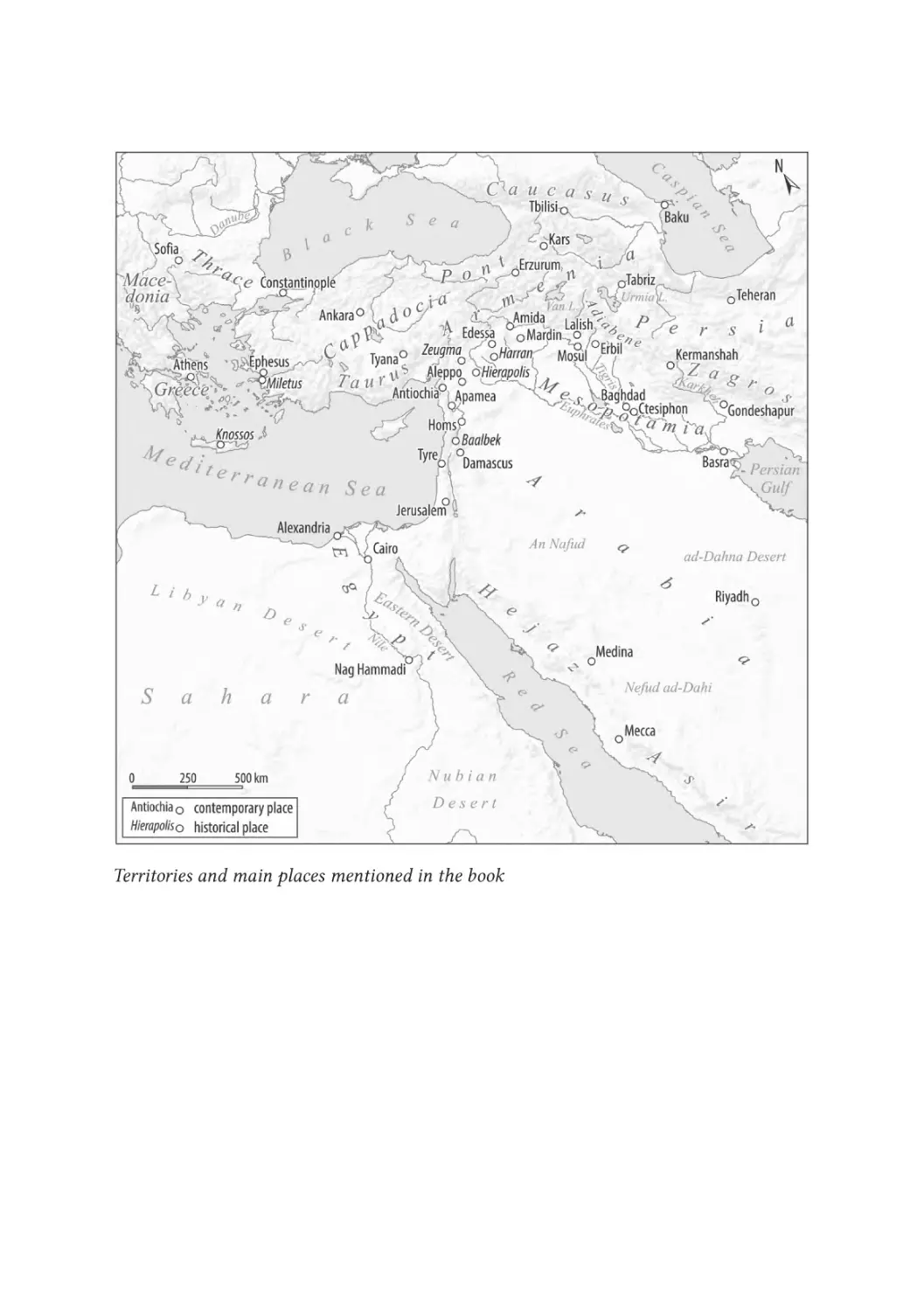
Territories and main places mentioned in the book
1. I ntroduction. Research problems
and methodology
Since this book bears the subtitle The Yezidi Cosmogonic Myth at the Crossroad of
Mystical Traditions, which demarcates its thematic scope, several terms used in it
need to be clarified. Let me first explain what I mean by the adjective ‘mystical’ (Gr.
μυστικός) by which I define the traditions of interest in this book, and why I focused
on their ‘crossroad’. I employ this term in accordance with its Greek etymology and
the sense it has acquired over the centuries, denoting what concerns the initiation (Gr.
μυέω) into the greatest Mystery (Gr. μυστήριον; its Ar. and Kurm. equivalent would
be سرand sur), that is, the process of discovering the Divine (esp. God), seeking direct
experience of It and even union with It. He who follows this mysterious path, called
a ‘mystic’ or an ‘initiate’ (Gr. μύστης), finds it either through theoretical contemplation of the Mystery, through participating in the mysteries (Gr. μυστήρια, ‘secret
rites’) dedicated to It, or by combining these two methods.1 Over the centuries, many
mystics have pioneered this difficult terrain and charted their own paths, the maps
of which they have passed on to others. Some of these ways, most commonly used,
over time have even taken the form of religions. Unfortunately, given the fact that
the Mystery they are looking for “loves to hide itself,”2 to refer to the maxim uttered
by one of them, the routes marked on the maps of their journeys go in different,
even contradictory directions. Nevertheless, if we overlap them, we find the one place
where they cross each other. Their point of intersection is also the only place that
makes one wonder whether they do not in fact form a single radiating outwards path.
The observation of this unique central point, where the mystics’ accounts on cosmogony converge, has constantly accompanied me while writing this book.
By ‘cosmogony’ I mean the origin of the cosmos or a story (Gr. μῦθος) about
the process of the origin of the cosmos. The Greek term ‘κόσμος’, which I use
in accordance with its meaning as it appeared in the oldest sources –that is, a
beautiful arrangement of elements, a decoration –and was later refined by Greek
philosophers to designate the ordering or assembling of various elements, so that
they form a beautiful and independent whole.3 To highlight the unity of its elements, it can also be called the ‘Universe’ (Lat. universum), the ‘World’ and ‘Order’.
1
2
3
A good guide to the topic and terminology of mysteries would be the volume The
Mysteries: Papers from the Eranos Yearbooks, ed. J. Campbell, New York 1955.
“According to Heraclitus Nature loves to hide itself” (Proclus, In Platonis rem publicam
commentarii (Kroll) II 107, 7: “ἡ φύσις κρύπτεσθαι φιλεῖ καθ’ ῾Ηράκλειτον”);
trans. A. R.
See: Hesiod, Theogonia (West) 587; Opera et dies (Solmsen) 76. Cf. A. Finkelberg,
On the history of the Greek ΚΟΣΜΟΣ, “HSCPh” 98 (1998), pp. 103–136; W. Kranz,
Kosmos als philosophischer Begriff frühgriechischer Zeit, “Philologus” 93 (1938–1939),
24
Introduction. Research problems and methodology
Such a world is, for example, the Earth, Man (as Microcosm) as well as the set of all
worlds (Macrocosm). In this book, when I write about ‘cosmogony’, it is the formation and origin of Macrocosm that I refer to by default, and if I make a reference to
the formation of Microcosm, I explicitly state it.
The aim of this book is to describe a cosmogonic motif consisting of two threads,
the Pearl and Love, which appear in the Yezidi cosmogonic myths, and to make an
attempt to interpret them –both within the framework of Yezidism (the religion of
the Yezidis), and by comparison with other cosmogonies that operate with similar
threads. This will bring us closer to answering the question whether the motif can
be deemed original or was borrowed. It will also facilitate formulating hypotheses
about its possible origin. To achieve this goal, two attempts have to be made in
particular: reconstruction of cosmogony of the Yezidis within which the said motif
appears, and tracing the presence of parallel threads in other cosmogonies.
1.1. P
roblems with Yezidism
In 2019, Feqîr Hecî Şemo (b. 1924), one of the greatest authorities on the oral Yezidi
tradition, who belonged to the illiterate generation and the illiterate tradition of
Yezidism, died in Ba’adra. On two occasions, I had the opportunity to visit him in
this Iraqi town, the former seat of the Yezidi Mîr (‘prince’, Ar. emir). Each time I had
the impression that he embodied the dignity and mystery of the Yezidi religion.
For many years, Feqir Haji had been an authority on theological and religious issues. Thanks to him many works of the Yezidi oral tradition have been preserved.
The Yezidis, and especially his son Bedelê Feqîr Hecî, recorded his recitations and
then published them in print.4 During the annual Festival of the Assembly, he was
entrusted to play a key role in the sema’ ceremony, leading a procession of religious hierarchs around the fire that was lit in the courtyard of the main temple.
When in the same year I talked about his death, or rather ‘changing the shirt’
(‘kiras guhorîn’, as say Yezidis who believe in reincarnation) with Dimitri Pirbari,
the pir said: “It is an end to a certain era for the Yezidis.” The current shape of
Yezidism and the knowledge about it are becoming increasingly tied to writing.
The authority of a living person is slowly being taken over by the written word, or
rather the text displayed by an electronic machine.
The multi-ethnic and multicultural origin of the Yezidi community, the caste
system, hundreds of years of persecution, the religious taboo on literacy and
increasing migration from their homeland have made it difficult to conduct
research on Yezidism and answer the question: which elements belong to the original Yezidi tradition and which do not. Even among the Yezidis themselves, no
consensus about it has been reached. In many cases, belonging to a particular tribe
4
pp. 430–448; Ch. H. Kahn, The Usage of the Term ΚΟΣΜΟΣ in Early Greek Philosophy,
in: his, Anaximander and the Origins of Greek Cosmology, New York 1960, pp. 219–230.
B. F. Hecî, Bawerî û Mîtologiya Êzidîyan: Çendeha Têkist û Vekolîn, Duhok 2002.
Problems with Yezidism
25
or caste determines the perception of the whole community and its history. For
example, those of the Yezidis who belong to the very influential Shamsani group
of the Sheikh caste consider themselves the descendants of ancient pre-Islamic
traditions, especially Zoroastrian and Mithraic ones, and have a different attitude
towards the presupposed Yezidi origins than others. In turn, the most numerous
Yezidi caste, the Murids, who make up the vast majority of the entire population
of the Yezidi people, possess less knowledge of the arcana of their own religion
than the representatives of the two remaining castes –Sheikhs and Pirs (their very
names denote ‘the elder’, in the sense of spiritual teachers). But also, many pirs and
sheiks are not aware of some of the principles of their religion. As the author of
the monograph The Yazidis, Their Life and Beliefs, Sami Ahmed wrote, “one must
realize that the Yezidis, even the educated among them, know very little of their
own doctrine, although they claiming otherwise. Their beliefs are in truth known
to a very few men, probably not more than three or four (Baba Sheikh, Baba Gavan,
and Baba Chawish), who are, in turn, not in agreement with each other regarding
the dogma.”5 In this situation, the researcher faces a fundamental problem: –Which
vision of Yezidism is closer to the truth? Is it the one presented by the few, or the one
that is more common and widespread? This provokes even more questions: –Is it at
all possible to speak about one truth and one Yezidism in this matter?
Caste differentiation entails another problem. Especially in recent years, the
majority of Yezidi migrants to the EU countries or Russia, usually recruited from
the caste of Murids. They are also susceptible to indoctrination and political propaganda. It proves to be most evident in the intense agitation carried out by
politicians, who treat the Yezidis as a pawn in their geopolitical game. Furthermore,
many murids, when confronted with various scientific and popular theories about
their religion and culture, often either directly (as university students) or indirectly
(through the media), uncritically accept them as facts and then reproduce them
among members of their own community, granting them with a kind of ‘secondary
identity’.6
An example of such a feedback mechanism can be found in the numerous
attitudes that speak of the Zoroastrian or Mithraistic core of Yezidism, which are
often based not so much on one’s own tradition, as on becoming familiar with the
theories first put forward by Taufiq Wahby7 and later by Philip Kreyenbroek. Such
theories even found support among representatives of the Yezidi aristocracy, as
exemplified by the activities of Yezidi prince Mu’awiyah (the son of Ismail Chol),
5
6
7
S. S. Ahmed, The Yazidis. Their Life and Beliefs, ed. H. Field, Coconut Grove, Miami
1975, p. 4.
Cf. E. Spät, Religious Oral Tradition and Literacy among the Yezidis of Iraq, “Anthropos”
103 (2008), p. 397; her, SL, pp. 125–146.
T. Wahby, The Remnants of Mithraism in Hatra and Iraqi Kurdistan, and its Traces in
Yazidism: the Yazīdīs are not Devil-Worshippers, London 1962.
26
Introduction. Research problems and methodology
an author of To Us Spoke Zarathustra,8 who also founded a Yezidi-Zoroastrian
Religious Society (Koma Ezdiya-Zerdeştiya) in Bonn. It is symptomatic that, for
example, in the Yezidi religion textbooks, published by the Union of Kurdish
Teachers (Yekîtiya Mamosteyên Kurd) in Germany, Zoroaster is presented as a
Yezidi prophet,9 a phenomenon that can be observed especially among the German
diaspora, which, in turn, has an increasing influence on the beliefs of other Yezidis.
Taking place in contemporary Yezidism, these processes cause of numerous
internal conflicts and accusations against the Yezidi intelligentsia. Those concern
mainly falsifying their religion. As Chaukeddin Issa, a Yezidi, wrote in 1997 in the
Yezidi journal Dengê Êzidiyan (The Voice of the Yezidis), “It is sad and at the same
time shameful that some members of the Yezidi religion are still trying to question our identities and origins. With this criticism, I am aiming in particular at
the group of so-called intellectuals. (…) It was the pseudo-intellectuals who provided the outsiders, the non-Yezidis, with the breeding ground for the fruitless
discussions of the last ten years.”10
One should also notice a huge number of false theories circulating among
Yezidis on the Internet. While some are reproduced because of sheer ignorance and
a wish to build one’s own identity (e.g., describing every ancient image of a peacock as a trace of the Yezidi religion), others result from intentional manipulation
(e.g., extreme nationalistic websites that fabricate false anti-Kurdish statements
imputed to the former Yezidi spiritual leader).
Some Yezidis support the theory of the original Kurdish identity of their milet,
while others, on the contrary, reject any connection with the Kurds, pointing to
the Arabic origin of their people, or even make a sign of equality between the
Quraysh and the Yezidis. The fact that there exist such strong and opposing pressure groups among the Yezidis themselves shows that they are not certain –as a
whole community of people defining themselves with the word ‘Yezidis’ –of their
own identity. The Yezidis themselves are well aware of this problem. The issue is
not entirely new, as in the history of this community, disputes between families
of different genealogies have sometimes come to the fore, posing a threat of its
disintegration.
Since I am speaking about this issue, I would also like the Reader to know
my opinion on the ethnicity of the Yezidis. I am convinced that they meet the
conditions to be considered a separate nation (constituted on the basis of a multi-
ethnic community).11 This is particularly evident in: a) the self-declarations from
8
Mu’awwiyyah ben Esma’il, To Us Spoke Zarathustra, Paris 1983; Zarathustra zu uns
sprach, Hamburg 1990.
9 E. Akbaş, Êzdiyatî –1 (waneyên olî ji bo zarokên êzdiyan), Bremen 2009, p. 78.
10 Ch. Issa, Yezid Ibn Mu‘awiya und die Yeziden: Eine religlonswissenschaftliche
Untersuchung, “Dengê Êzidiyan” 6–7 (1997), p. 17; trans. A. R.
11 See: A. Rodziewicz, The Nation of the Sur. The Yezidi Identity between Modern and
Ancient Myth in: Rediscovering Kurdistan’s Cultures and Identities: The Call of
Problems with Yezidism
27
many Yezidis, b) the binding caste structure in the community, c) the strict prohibition of exogamy, d) their own religion, e) their own political (Mîr) and religious
(Bavê Şêx) power, f) their own historical territory and its own name (Êzîdxane/
Êzdîxane),12 g) a coherent vision of parts of their own history, and h) their own
anthropo-and ethnogenic myth that clearly distinguishes their milet from other.
Nevertheless, it is important to be aware that not all Yezidis consider themselves a separate nation, and some strongly identify with the Kurds. By the same
token, it is even hard to say if we are dealing with one Yezidism, a single universal
system of the Yezidis’ beliefs and practices, or rather with a few separate visions
relative to the Diasporas in which they were originated and which are the more
different from one another, the less they have contact with the old religious centre
in Iraq. An example of such discrepancies can be Yezidis’ eschatological beliefs.
Some Yezidis believe in reincarnation, others believe in Hell and Paradise, where
the soul of the deceased is supposed to go, and yet another group do not see a logical problem in accepting both visions simultaneously. Obviously, it is possible to
create a system in which these variants would not be mutually exclusive, but either
this system does not exist at present (which does not exclude the possibility that it
may have existed earlier), or it could be one of the many pieces of evidence that the
Yezidi religion does not constitute a ‘system’ in the sense of the religions that have
codified their principles in the form of some Summa Theologiae or Ihya’ Ulum al-
Din. It is significant that, for example, among the Yezidis of Armenia and Georgia,
there are festivals which are not celebrated in Iraq (e.g. Kuloça Serê Salê) and vice
versa –one of the most important Yezidi festivals, the Çarşemiya Sor, has been forgotten by the South Caucasus diaspora and only recently there have been attempts
to revive it. This diversity makes it necessary for the researcher of Yezidism to
exercise great care towards any received information and to clearly note the place
and the group that the person providing such information belongs to.
One of the factors that contributed to the said lack of unanimity among the
Yezidis was the religious ban on the use of writing (with only one family being
exempt) that used to be in force over the centuries. For ages, writing was considered a sin. Undoubtedly, this allowed the Yezidis to protect their religious secrets
from non-Yezidis, but as a result, they do not have any holy Book that could be a
kind of universal compendium of religious principles, so helpful when many of
them live in diasporas isolated from the Iraqi centre. On a wider scale, the ban on
the use of writing was abolished relatively recently, in the first half of the 20th c.,
when the Yezidis living in the Soviet dependent territories of the South Caucasus
were subjected to the general education system. Apart from the Soviets, the gradual
the Cricket, ed. J. Bocheńska, Cham 2018, pp. 259–326; his, Milete min Êzîd. The
Uniqueness of the Yezidi Concept of the Nation, “Securitologia” 1 (2018), pp. 67–78.
12 See the interpretation of the meaning of this term: Р. Рзгоян, Езидская геральдика
и национальные символы, www.ezidipress.com/ru/2016/09/04/езидская-геральд
ика-и-национальные-с/.
28
Introduction. Research problems and methodology
openness of the Yezidi people to contacts with non-Yezidis also had an impact on
the lifting of this ban, especially the awareness that knowledge of writing allows
not only to increase the level of education and economic advancement, but, above
all, to save one’s own tradition from oblivion. Thus, a significant precedent was
the publication of a book in 1934, which almost ten years earlier (in 1925) had been
dictated by the illiterate prince of the Yezidis, Ismail Beg Chol.13 He had done so
in full awareness and premeditation, in spite of the resistance of the Yezidi elders
(just like when he sent his children to school), in order to “write down the principles of our religion and publish them in all European languages so that our faith
would be known before it dies.”14
It is only in recent decades that the aspirations (answering to the need arising
from the confrontation with other religions) to collect and catalogue in writing
the corpus of religious output of the Yezidi religious poetry have emerged.15 This is
especially true of the sacred hymns (qewls), which play a role comparable to that
of the holy books in other religions. For several decades, Yezidis have been intensively recording and writing down their works of oral tradition. Nevertheless, even
nowadays one can hear voices of disapproval towards the use of written word,
which tells how strongly the ban has been rooted in the community.
A few extensive publications have been published in Iraq so far, including a
transcription of several dozen hymns and prayers, to which Khalil Jindy Rashow
and Pir Khadir Sulayman, who actively collaborate with the Yezidi qewals and the
greatest authorities on the Yezidi oral works, especially Feqir Haji, have greatly contributed. The efforts to commit the Yezidi religious legacy into writing also come to
the fore in the publications of the young generation of Yezidi academics, e.g. Kovan
Khanki (Iraq), Dmitri Pirbari (Georgia), Bedel Feqir Haji and Khanna Omarkhali
(Germany). The book of the latter, The Yezidi Religious Textual Tradition: From Oral
to Written. Categories, Transmission, Scripturalisation and Canonisation of the Yezidi
Oral Religious Texts, can be perceived as laying the foundations for the work on
canonisation of the corpus of Yezidi religious works.
Apart from the lack of sufficiently developed sources, another factor that
hinders the research on Yezidism undoubtedly lies in the hermetic nature of the
community. The Yezidis are an endogamous group (of multi-ethnic roots), which
neither accepts representatives of other ethnic groups in its community, nor does
it allow religious conversion. Moreover, because of the secret nature of their religion, which is considered Satanism by representatives of neighbouring groups, the
Yezidis have been facing hatred and persecution for centuries. Apart from minor
13 Ismail Beg Chol, El Yazidiyya qadiman wa hadithan, Beirut 1934.
14 Words recorded by a German journalist, Paul Schütz, Zwischen Nil und Kaukasus,
München 1930, pp. 135–42.
15 See E. Spät, Religious Oral Tradition…, pp. 393–403; R. Langer, Yezidism between
Scholarly Literature and Actual Practice: From “Heterodox” Islam and “Syncretism” to
the Formation of a Transnational Yezidi “Orthodoxy”, “BJMES” 37 (2010), pp. 393–403.
Problems with Yezidism
29
incidents, they list over seventy (72, 73 or 74) acts of genocide that their community
have suffered from. Incidentally, this number shows the strength of the influence
of the ethnogenic myth among them. The Yezidis believe that they descend from
Adam himself, while the other nations, in the number of 72, are the descendants
of Adam and Eve. The number of genocides is therefore a symbolic assertion of
the suffering experienced from all nations. Yezidis are filled with the greatest
dread towards the Muslims, whom they fear not only because of the accusations
of Satanism hurled by them, but also because of one of the interpretations of their
ethnonym, which derives the Yezidis from the followers of an Umayyad caliph,
Yezid ibn Mu’awiya. Yezid has gained poor reputation among the Muslim community as a man who broke the rules of Islam. Above all, however, he has attracted
much hatred of the Shi’ites, who accuse him of murdering Husayn ibn Ali, considered the third imam by Shi’a people. Taking into consideration the acts of persecution which, for the reasons mentioned above, have been affecting the Yezidis,
a researcher of their religion often encounters resistance from respondents while
attempting to engage in sensitive topics and may not be given answers that they
perceive as potentially threatening to the entire community. And even if he gains
the confidence of his interlocutor and such answers are obtained, he is often bound
by a word of honour that he will not make them public. Thus, the researcher faces
a moral dilemma, whether to be faithful to an academic oath that obliges him to
seek the truth and share it with others, or to be faithful to the word given to the
interlocutors who trusted him.
Afflicted by an almost complete lack of written sources and historical data
about their origins, the Yezidis –relying mainly on the myth of their forefather, Adam’s son –often consider their religion to be primordial and at the same
time constituting the basis of other later religions. This becomes obvious if the
original ‘Yezidism’ is to be simply understood as ‘paganism’ (in the sense of not
belonging to any of the major religions), and if it is stated that the ancestors were
once pagans. As Shivan Bibo wrote in a Yezidi journal “Lalish” published in Iraqi
Kurdistan (original spelling):
The Izidies believe that they existed since ancient times. It is believed that the name
“Izidism” conveys a religious more than an ethnic meaning on the basis of which
they claim that in the past their kings reigned over various parts of the world such
as Rome, France, India, Mongolia, China and Persia. The Izidies think that they had
a great figure named, Peer Bob, who is believed by the Izidies to be Beelzebub. The
Izidies also believe that Ahab –an Israeli king, Nebuchadnezzar, Ahasuerus –a
Persian King, and Agricola of Constantinople and others were all Izidy Kings. Perhaps
Izidies want to say that they belong to the primitive religion of humanity from which
others separated because of schisms.16
16 Sh. Bibo, The Shamsani Izidies and the Worshipping of Natural Phenomena, “Lalish”
39 (2013), pp. 12–13.
30
Introduction. Research problems and methodology
What can be stated about the Yezidi community without any doubt is that it bears
a clear influence of Adi ibn Musafir, called ‘Sheikh Adi’ and ‘Shikhadi’, who as
a Muslim mystic himself, had a significant impact on the Yezidi religion as its
founder or reformer, or at any rate, to whom it owes to a large extent its present
form. When asked if they knew any testimony about their religion prior to Sheikh
Adi’s time, and how they would relate to the hypothesis that he was the actual
founder of Yezidism, my interlocutors usually replied that Adi’s achievement was
to put in order previous beliefs, which generally consisted in worshipping celestial bodies and the forces of nature. As Shivan Bibo writes further in the article
cited above:
By the time Sheikh Adi appeared among the Izidies, Izidism, of course, was already
there but was actually deteriorating because ignorance was descending upon
the followers of this religion. (…) Soon after Sheikh Adi settled down in Lalish, he
gathered the leaders and chief men of this community to enlighten them about their
religion. Some Izidies were and are still known as Shamsanis i.e. the sun worshipers.17
However, there are also contrary positions. Many Yezidi people believe that ‘pure’
Yezidism is the one that has not been tainted by Sheikh Adi,18 and which would
be the indigenous religion of all Kurds. One of the reasons for that may be an attempt to distance oneself from any connections with Islam, and thus from possible
influences of Sufism, which was represented by Adi as the founder of Sufi order,
tariqa al-Adawiyya. On a side note it should be added that Yezidis use the term
‘dervish’, ‘feqir’ and ‘qalandar’ to describe early mystics such as Hasan al-Basri and
Mansur al-Hallaj (who were more concerned with practice than with the theoretical construction of religious doctrine), rather than ‘Sufi’, as they consider Sufism
a purely Islamic movement from which they dissociate themselves. This particular
linguistic sense can also be witnessed in their oldest religious works that belong to
the oral tradition.19 As Pir Dima told me:
17 Ibid., p. 13.
18 Cf. E. Spät, Religious Oral Tradition…, p. 399.
19 Cf. for example Qewlê Mela Abû Bekir (The Hymn of Mullah Abu Bekr), pp. 8–9: KRG,
p. 174. J. Spencer Trimingham describes the difference in the meaning of these
terms as follows: “the distinction between ṣūfi and darwīsh (or faqīr) is the difference between theory and practice. The ṣūfi follows a mystical theory or doctrine,
the darwīsh practises the mystical Way” (his, The Sufi Orders in Islam, Oxford 1971,
p. 264); in the case of Qalandars, he quotes Suhrawardi’s statement that “the term
qalandariyya is applied to people so possessed by the intoxication of ‘tranquility
of heart’ that they respect no custom or usage and reject the regular observances
of society and mutual relationship (…). They concern themselves little with ritual
prayer and fasting except such as are obligatory (…). The qalandari seeks to destroy
accepted custom” (ibid., p. 267).
Problems with Yezidism
31
Until Sufism was forced into the framework of Islam by al-Ghazali, it was a separate
teaching of a gnostic and ascetic nature. They called themselves ascetics –derwesh,
i.e., an ascetic. Later, a term tassawuf appeared. After some time, when some of the
dervishes associated with the term tassawuf –Sufis –were recognised by the Islamic
tarikats, i.e., brotherhoods, the Yezidis did not agree to this. They became dervishes
separately, outside the framework of any religion. (…) The Yezidis (in fact dervishes –
zahed –are ascetics, as they used to be called in the past) have great respect for the
first greatest dervishes, such as Rabia al-Adawiyya, Dhul-Nun al-Misri, Hasan al-
Basri, Bayazid Bastami, Junayd al-Baghdadi.20
During my fieldwork, I have also met with opinions of both Yezidi pirs and murids,
who radically rejected the figure of Adi and everything connected with him,
claiming that Yezidism is not a religion, but a “philosophy” related to practice,
where the central role has been occupied by the cult of natural forces, which,
in turn, dates back to the most ancient Mesopotamian traditions. These voices,
although they contradict the historical state of knowledge, should not be ignored,
as they are one of the contemporary trends shaping Yezidism.
A straightforward resolution to the issue of Adi ibn Musafir’s influence on
Yezidism is also not facilitated by strong Kurdish propaganda, which uses Yezidism
as a tool of cultural policy, presenting it as the original pan-Kurdish religion.
This concept was particularly strongly promoted in the 1930s, as reflected in
the speeches and manifestos of Bedir Khan brothers seeking a factor that would
cement Kurdish identity. Making Yezidism the original Kurdish religion, which
also contains elements of Zoroastrianism, would allow to ideologically bring
together all Kurds and provide them with a distinctive identity and value based
on the belief in their ancient origin. On a side note, the strength of this concept
can be witnessed in the fact that it has met with approval also among the Kurds
who declare themselves to be Muslims (such reactions I have also observed on
numerous occasions in those parts of Turkish Kurdistan that are not inhabited by
the Yezidis). The idea was also raised by the leaders of the political autonomy of
Kurdistan in Iraq –Masoud Barzani and Jalal Talabani, who were seeking political
support in the Yezidi territories. And even though the concept was not entirely fictional, since in the 14th c. some powerful Kurdish tribes indeed declared themselves
to be Yezidis, it completely disregarded the fact that not all Yezidis were of Kurdish
origin. Significantly, in the Yezidi community forming in the 12th and the 13th c.,
Arabs (and representatives of other ethnicities) constituted a considerable group.
This fact, in turn, was emphasised during the rule of the Ba’ath Party in Iraq, when
there were insistent attempts to Arabise the Yezidis by pointing to their connections
20 A. Rodziewicz, Odrodzenie religii jezydzkiej w Gruzji? Rozmowy z Dimitrijem Pirbarim,
głową Duchowej Rady Jezydów w Gruzji [Revival of the Yezidi Religion in Georgia?
Conversations with Dmitri Pirbari –The Head of the Spiritual Council of the Yezidis in
Georgia], “FK” 16 (2017), p. 46.
32
Introduction. Research problems and methodology
with the Umayyads. Both Kurdisation and Arabisation had their advocates among
the Yezidis themselves, which only exacerbated internal divisions in the community.21 Also today, supporters of either position can be equally met. This applies
not only to Yezidis but also to those scholars who sometimes go beyond academic
study to become involved in political propaganda.
The lack of clarity in relation to their own history is increasingly encouraging
Yezidis to seek their roots and origin. And while they still refer to the ethno-and
anthropogenic myth concerning the character of their mythical forefather, Prophet
Shehid ben Jarr, the son of Adam, many are not satisfied with it. A good example of
the quest to find their ‘scientifically proven’ origins can be an article printed in the
already cited Yezidi journal “Lalish”, entitled Izidian Religion. Another Look, which
expresses a very popular attitude among the Yezidis. It attempts to derive Yezidi
roots from the Sumerians by listing “elements of similarity between the Izydian
religion and the Assyrian and Babylonian religions which had the Sumerian
origins”22 and formulating the following directive:
The Izydian religion is a very ancient one and its roots reach the Sumerian and
Babylonian periods. To make sure of that we must study objectively and carefully the
traditions and rites that Izydians are still keeping them and we must compare them
with the rites, traditions and liturgies of other people that alternated the Izydians
living in Mesopotamia.23
At some point, every researcher of Yezidism is confronted with the fact (devastating for a man educated in the Western scientific and academic paradigms)
that the history of the Yezidi community functions simultaneously on several
non-
parallel levels. Mythical and historical themes intertwine here, but they
often get tangled up and intersect to form a peculiar a-linear and a-chronological
grid of connections. This is best seen in the case of the Yezidi holy figures, who
have manifested themselves many times throughout history. As angels, they
form relationships different from those they had as actual persons of this world.
Therefore, obtaining particular information about a certain character from the
Yezidi history is often connected with the vagueness as to which level it concerns.
At the same time, the Yezidis themselves are often unable to indicate whether they
refer to a myth or to specific ancient events, because the myth and the reality have
formed a kind of amalgam, which is difficult to break down. The figures of two
Yezidi saints, Sheikh Shams and Sheikh Fakhradin, can serve as an example here.
They are considered brothers, sons of some Yezdina Mir. At the same time, they are
identified with the two angels created by God at the dawn of time, as well as with
the Sun and the Moon. Likewise, the former is considered to be a Muslim mystic
21 Cf. Ch. Allison, The Yezidi Oral Tradition in Iraqi Kurdistan, Richmond, Surrey 2001,
pp. 37–38.
22 Kh. Kh. Bahzani, Izidian Religion. Another Look, “Lalish” 23 (2005), p. 33.
23 Ibid., p. 38.
Problems with comparatism
33
from Tabriz living 1185–1248, whereas the latter was a Christian monk from the
7th c. Nonetheless, from the perspective of historical research, they are sometimes
considered to be the sons or brothers of Hasan ibn Adi II (one of the then leaders
of the Yezidi community, a relative of Sheikh Adi ibn Musafir) living in the second
half of the 13th c. Such a multidimensionality of the Yezidi history shows the specificity of their thinking and its dominant principle of ‘emanationism’, but at the
same time it hinders research for which the chronological aspect –as understood
and assumed by European science –is important.
1.2. P
roblems with comparatism
The threads of the primordial Pearl and the world-forming Love make up the cosmogonic motif that is characteristic of the Yezidi myth of the creation of the world.
Also, in the cosmogonies described by members of other cultures and religions
connected with the area where Yezidism occurs, we can find parallel threads –
either identical or similar enough to be considered their equivalents. However,
only in a few cases do we notice the simultaneous presence of both elements, and
even less often can we witness a situation where they constitute a single motif.
Most often we encounter one of them –the Pearl, or something that resembles
it, e.g. the Egg, or the Stone, that appears in the descriptions of the beginnings of
the world. It also happens that some tradition refers to both similar threads, but
they do not appear directly in the cosmogony, as is the case with early Christian
literature, which, despite reaching for the symbolism of the Pearl, does not use it
in a cosmogonic context, and despite declaring directly that “God is Love”, in the
cosmogony described in the prologue to the Gospel of St. John, lacks any of the two
themes of interest to us. The thread of the Pearl, or its equivalents, can be found
in the cosmogonies known to other Middle Eastern religions, especially Yarsanism
and Zoroastrianism, but in none of them has it been associated with Love seen as
an active factor in the creation of the world.
This is why I paid special attention to those myths about the origin of the world
in which the resemblance to the Yezidi cosmogony proves to be the greatest, such
as those present in popular Muslim cosmographies, but particularly those written
about by these Muslim mystics, who use both symbols pertaining to our subject,
the Pearl and Love. However, it is important to be aware that their versions of cosmogony have never become the ‘official’ cosmogony of Islam. This is for the simple
reason that neither the Pearl nor Love is mentioned in the cosmogonic context in
the Quran.
Of the cosmogonies that have to some degree earned the title of ‘official’ in
the sense that they are commonly associated with a given culture or religion,
two in particular have a significant similarity to the Yezidi one. First, it is a cosmogony attributed to the Orphics, and second, a Hindu cosmogony (which, in turn,
resembles the ‘Orphic’ one). Although the symbolism of the Pearl is not present
in either of them, there is an element very similar to it –the Golden Egg and the
34
Introduction. Research problems and methodology
Golden Embryo respectively –from which a deity associated explicitly with Love
emerged.
Among the above-mentioned metaphysical traditions and religions –joined by
others which I discuss further in this book –only Yezidism has made the motif of
the Pearl and Love a permanent element of its cosmogony.
While comparing the threads in question, one has to remember about the difficulties that this process poses and the danger of over-interpretation. As the Reader
will see in the course of further discussion, among the cosmogonies in which I will
try to trace the parallel threads to the Yezidi cosmogony, the ones described by the
Greeks and their late antique commentators (to which the Gnostics and the Sufis,
in turn, also referred) occupy a special place. This is especially true of the cosmogony they associate with the Orphics. Such a juxtaposition is far from obvious,
mainly on account of time and territorial distance between the Greeks and the
Yezidis. It also causes complications in terms of methodology. In order to compare
the Yezidi threads and the parallel Greek ones, the fact that the compared content
comes from different eras, different cultural areas as well as different forms of
expression has to be taken into consideration. In the case of the Yezidis, the comparative material is provided especially by their oral work,24 while in the case of
the Greeks we have literature on our hands.
Despite the striking parallel between the elements of the Yezidi cosmogony,
which are relevant to this study, and the cosmogony attributed to the Orphics and
those Greeks, who stressed the role of cosmogonic Love, one must be very careful
in attributing the reproduction of Greek concepts to Yezidis. The main risk in this
case is associated with what one of the pioneers of Yezidi studies, Isya Muksy
Yusef (1872–1916, known in the West under the simplified form of his name as
Isya Joseph), identified as “the apriori assumption that the religion of the devil-
worshippers is the remnant of an ancient cult, and that every phenomenon in it is
to be regarded, therefore a survival of the past system.”25
The indication of the parallel alone, does not allow us to conclude that, generally
speaking, the East copied the ideas of the West. Even if we find explicit references
to Orpheus in the Yezidi tradition, we should still be careful in drawing conclusions
about their origin and meaning. For example, the fact that in Sardis there was a
“Law-giving Zeus” temple26 dedicated to Ahura Mazda and that Artaxerxes III set
24 I avoid using the absurd oxymoron ‘oral literature’. Perhaps, a better term would be
the ‘oralature’ proposed by Bruce Rosenberg; cf. B. A. Rosenberg, The Complexity
of Oral Tradition, “Oral Tradition” 2/1 (1987), pp. 73–90; see also: R. Finnegan, Oral
Literature: Issues of Definition and Terminology, in: African Folklore. An Encyclopedia,
ed. Ph. M. Peek, K. Yankah, New York –London 2004, pp. 621–628.
25 I. Joseph, Devil Worship. The Sacred Books and Traditions of the Yezidiz, Boston 1919,
p. 170.
26 See: A. R. Burn, The Cambridge History of Iran, vol. 2, The Median and Achaemenian
Periods, ed. I. Gershevitch, Cambridge 1985, p. 340 f.
Problems with comparatism
35
up statues of Aphrodite in Persian cities does not in any way entitle us to claim
that the Zoroastrians assumed the Greek religious system, nor that the Greeks worshipped Ahura Mazda. Unfortunately, we still know too little about the beginnings
of Yezidism, and the greater the unknown, the greater the scope for fantasy and
potential error.
Furthermore, we should bear in mind that the cosmogony of the Yezidis is
closely tied to the Yezidi religion, while the cosmogonies of the Greeks, in terms of
philosophy, are not necessarily related to religion as such. Of course, the common
element here is what we can call ‘metaphysics’; still, the Yezidi metaphysics is associated with a religious ritual, something that Greek metaphysics can do without.
What both fields have in common, however, is the way in which the origins of
reality are presented in them. In a word, the subject is common, yet the means of
expression differ.
Despite the above-mentioned difficulties, the juxtaposition of the cosmogony
of the Yezidis with the cosmogonies of other cultures and religions seems valuable not only because it enables to point out the similarity in the way certain
religious-cultural contents have been expressed over the centuries. Comparing
similar themes in different cultures, apart from cataloguing corresponding myths,
has yet another effect: it contributes to a better understanding of the Yezidi vision
of the beginnings of the world. This is because the hermetic religious system of
the Yezidis unfolds for us especially through the analysis of their oral work: religious hymns, prayers and legends. However, these works, with their poetic visions
expressed in symbolic language, do not usually provide an explanation of the
issues they talk about. In turn, parallel descriptions present in the works of Greek
philosophers or in the writings of mystics and theologians of Christianity and
Islam often include both symbolic images as well as their exegesis.
Naturally, this does not mean that the Yezidis did not have a specific philosophy,
understood, especially in the classical sense, as a desire to know the truth about
the world and its first principles. Without doubt, many of their works can be put
among the effects of such a philosophical approach, however, they perform primarily a religious and cult-related role. The cognitive effect is secondary in their
case. Their primary function is not so much to provide an explanation of the world,
as to extol it.
That is not to say that religious works cannot be compared with strictly philosophical ones, as long as, of course, the object to which they relate remains the
same; and in this case, it is the beginnings of the world. On a side note, the comparative ‘problem’ referred to here has been ongoing for a long time. It can be seen
in the writings of Plato, Aristotle, or –in Late Antiquity –in works of the great
Christian historian Eusebius of Caesarea, Platonists Proclus and Damascius, and
then among the authors connected with the Muslim culture, such as Masudi and
Biruni –who compared the descriptions of the beginnings of the world known to
them from Greek or Oriental religious works, with their philosophical exegesis.
In short, the tradition of the Greeks, Christians and Muslims has developed
hermeneutics and theology, i.e., a critical philosophical reflection on the essence
36
Introduction. Research problems and methodology
of one’s own religiousness, which allows one to see a specific system, subject to
logical analysis. This, in turn, led to attempts to formulate one correct (Gr. ὀρθός)
version of the system of beliefs (δόξαι), orthodoxy. Meanwhile, although Yezidi
religion still remains largely within the area of oral tradition, operating with its
own means of expression and its own modes of perception characteristic of oral
cultures,27 this area is changing rapidly. Such a milestone initiative in the history
of Yezidism was the opening of the first ever International Yezidi Theological
Academy (however, it is significant that it was in Georgia, not in Iraq), which has
been openly recruiting students since 2019.28 Talking in Tbilisi with students of the
Academy –Yezidis who came there from Iraq, Armenia, Russia, Germany, France,
and Belgium –many times I have heard how much they hungered for an explanation (and often a clear articulation) of the principles of their own religion. One of
the sheikhs told me:
I comprehended many things I had heard about, but did not understand before.
Here, I have learnt what was behind the various stories I have been told in my childhood. I got a lot of deep answers and deep knowledge. I hope that with this knowledge
I have gained, I can now be a better sheikh and be able to help people more effectively.
This and other initiatives are a response to the strong interest of the young generations of the Yezidis in philosophy and the theology of their religion. These expectations were clearly expressed by one of the Yezidis living in Europe:
In my opinion every religion has its own philosophy. Every religion is based on a way
of thinking, it has a philosophy. Therefore, religion is not only a matter of feeling. The
Yezidi religion has its own philosophy, like the philosophies of other religions, it has
a way of thinking, but as I said earlier I haven’t yet understood correctly and in depth
what the philosophy of the Yezidi religion is, what it is based on.29
This statement, apart from its important content, also shows the level of consciousness of the Yezidis emigrants living in the diaspora in Europe. Being cut off from
the religious centre in Iraq, they are surrounded by followers of other religions and
exposed to ideas typical for Western science. They start to look at their own religion
from an abstract and academic perspective, which differs from the traditional approach they knew from Iraq. The mere language of symbols, or practicing rituals is
not enough for them. In other words, they are no longer satisfied with orthopraxy,
but they want orthodoxy. They search for an explanation, and for that, they wish
it would be given in ‘scientific’ and ‘academic’ language. They want to understand
27 Cf. W. Ong, Orality and Literacy: The Technologizing of the Word, London-New York
1982, pp. 31–77; OY 137–253.
28 A. Rodziewicz, Between Orthopraxy and Orthodoxy: International Yezidi Theological
Academy in Tbilisi, “Kulturní studia” 18 (2022), pp. 81–116.
29 Statement by a 27-year-old man from Syria quoted in: Ph. G. Kreyenbroek, Yezidism
in Europe: Different Generations Speak about their Religion, Wiesbaden 2009, p. 207.
Problems with comparatism
37
the theoretical system, which for an ordinary follower hides itself behind daily
religious practice, and they express this aspiration in scholarly dissertations and
popular articles published in Yezidi journals.30
In the statement quoted above, we encounter a thought that is difficult to disagree with: the religious system (as opposed to the other elements that make up a
religion) is not based on emotions, but on a specific thought that distinguishes it, a
concept that manifests itself in the myths and rituals present in this religion. Just
as different religions accentuate different threads and display different or parallel
visions of reality and its hierarchical order, so the religion of the Yezidis can be
seen as the realisation of a concrete theoretical system (in the quoted statement
called ‘philosophy’). As a system, it has both its distinctive features, which distinguish it from others, as well as parallel features, similar to those it shares with
other systems. The occurrence of similar elements in different religions may or
may not be a result of borrowing. These features can also stem from the original
concept of their author or a revelation.
As an aside, let me point out that comparatism in the study of religious myths
does not only concern juxtaposing and comparing the described threads with each
other, but it is also connected with a comparison or Horizontverschmelzung of the
two types of consciousness –a researcher who makes the juxtaposition, and the
one who is the source of the research material. To illustrate this thought let us
consider the case of ‘revelation’, I have mentioned above. Ignoring it is symptomatic of the approach based on a materialistic ‘paradigm’ (in the meaning that
Thomas Kuhn has given it),31 which is a de facto materialistic dogma of faith often
connected with an atheistic position that uses science as an instrument of ‘evangelisation’. The adoption of such a paradigm excludes the unprejudiced ‘open approach’ in research. With this phrase, I define an approach in which the researcher
allows for the possibility that the vision of reality presented by religious people
(and such an attitude is characteristic of the vast majority of the Yezidis)32 is true,
rather than classifying it in advance according to his own ‘scientific’ belief as a
superstition or illusion. Yet, if we assume the existence of divine reality and the
possibility of revelation, i.e. the direct transmission from divine reality to human
beings, if we allow the possibility that in the history of mankind revelation may
have taken place at least once, we should also allow the possibility of its repetition. So, if an element of a given religion repeats itself in another religion –it can
originate not only from borrowings, but also from such a source. Thus, such an
30 Cf. E. Spät, Changes in the Oral Tradition of the Yezidis of Iraqi Kurdistan, “JKS” 5
(2005), pp. 73–83.
31 Th. S. Kuhn, The Structure of Scientific Revolutions, Chicago 1962.
32 Of course, among the Yezidi people one can also meet agnostics, declared atheists or
opponents of religion, who usually (I refer only to the cases I have dealt with myself)
present these ideas on the basis of the previously encountered criticism of religion,
which has its source in communist ideology.
38
Introduction. Research problems and methodology
‘alignment’ of consciousness, i.e. opening oneself to accept a different paradigm,
instead of rejecting it, can only enrich research, in which similar elements are
juxtaposed with each other. This approach is close to the postulates of phenomenology that the researcher should apply the principle of epoché, derived from
ancient scepticism, i.e. to suspend judgement and assumptions, and allow the phenomenon to reveal itself in such a way as to disturb its appearance as little as possible through one’s own optics and thus grasp its essence.
When two systems have a significant set of parallel features, we can speak of
a significant similarity, which will be the greater the more features the two systems share. Establishing the presence of a significant similarity between the two
systems can be helpful in understanding each of them individually when a given
area of the system X is unclear, whereas it proves better defined in the system
Y. This is precisely the situation we are dealing with in the case of Yezidism
(the religious system of the Yezidis) and the part of the Greek philosophical or
philosophical-religious tradition, which with time took the form of a system called
‘Neo-Platonism’. Its elements found their manifestation in the corpus of Greek religious works (broadly understood here, i.e. from writings through rituals to iconography) and in the philosophical interpretation (also developed in early Christianity
to the creative continuation in the Gnostic systems of Late Antiquity and then in
Muslim philosophy).
Given the above, I believe that in the case of the research on the Yezidi cosmogony, juxtaposing parallel threads should be done both from a historical perspective, which emphasises the cases of borrowings occurring over time, and from
a philosophical one, which, more than in the temporal transmission of data, their
evolution or degradation, is interested in the very fact of the occurrence of similarity and whether the occurrence helps to better explain, and thus understand, a
given theme (in our case –the description of the beginnings of reality). Such an
approach is particularly supportive when we have little ‘historical’ data, but we do
have some that are suitable for a phenomenological or structural analysis, which
allows us to focus on the phenomena themselves and observe structural parallels
rather than genetic outcome.
As far as the Yezidis are concerned, the parallel features of their religious system
with other systems were recognised a relatively long time ago (considering that
references to Yezidi in Western scholarly literature date back to the 17th c.33 and
that studies on Yezidism actually began in the mid-19th c.). This resulted especially
from an attempt to determine their place on the religious map of the Middle East.
As I refer to these attempts in detail later in this book, I would just like to note that
the features Yezidism share with Islam and Christianity were mostly pointed out.
Links with the religious movement created around Bardesanes and the elements
present in the religion of Sabians of Harran (who, in turn, were connected with
33 Esp. in the books by Michele Febvre: Specchio o vero descrizione della Turchia, Firenze
1674; L’état présent de la Turquie, Paris 1675; Teatro della Turchia, Milano 1681.
Problems with comparatism
39
Platonism, Zoroastrianism and Mandaeism), such as the cult of heavenly bodies
and the belief in reincarnation, have also been pointed to. Finally, Yezidism was
connected with the Babylonian and Chaldean cult of the Sun and stars.
As the research progressed, parallels with Yarsanism were added to the catalogue
of the shared features, and the argumentation regarding presumed borrowings
from Zoroastrianism and Mithraism was expanded. This is where Göttingen
scholars’ research comes to the fore –Philip Kreyenbroek, who claims that “the
essentials of the pre-Zoroastrian cosmogony, with an admixture of Zoroastrian
elements similar to that of Mithraism, can still be found in the mythology of two
modern sects, the Yezidis and the Yaresan (also called the Ahl-e Ḥaqq), both of
which may have originated among speakers of Western Iranian languages”34 and
Khanna Omarkhali, who presented her conclusions for example in the article with
the telling title The status and role of the Yezidi legends and myths. To the question
of comparative analysis of Yezidism, Yārisān (Ahl-e Haqq) and Zoroastrianism: a
common substratum?35
Another important stage in the development of comparative research on
Yezidism was the juxtaposition of the threads present in the Yezidi religion, especially the anthropogenic myth, with Gnosticism and the religious-philosophical
systems of Late Antiquity, carried out by a Hungarian researcher, Eszter Spät. In
her book Late Antique Motifs in Yezidi Oral Tradition, she claimed that “Yezidi religion also shows the influence of Late Antique religious thought and literature,
tying Yezidis to the prolific world of late Mediterranean Hellenistic culture.”36
The result of the wide spread of the research –which is largely based on comparing the elements of Yezidism with other religions –apart from the obvious
expansion of knowledge in the field of religious studies, unfortunately, has also
produced a ‘feedback’ that reaches the Yezidis themselves and thereby hinders
field research. As the various hypotheses presented in scholarly publications and
on the Internet become available, successive generations of Yezidis are moving
away from traditional oral communication. More and more frequently, they are
neither gaining knowledge about their religion from their family and the local
34 Ph. Kreyenbroek, Mithra and Ahreman, Binyāmīn and Malak Ṭāwūs. Traces of an
Ancient Myth in the Cosmogonies of Two Modern Sects, in: Recurrent Patterns in Iranian
Religion, ed. Ph. Gignoux, Paris 1992, pp. 57–79. He developed this thought also at
the conference devoted to Yezidis in Cracow (The Diverse Heritage of Yezidi Tradition,
2013) in a paper: The links between Yezidism and Zoroastrianism in the light of new
evidence; see also: KY, pp. 57–58.
35 Kh. Omarkhali, The status and role of the Yezidi legends and myths. To the question of
comparative analysis of Yezidism, Yārisān (Ahl-e Haqq) and Zoroastrianism: a common
substratum?, “Folia Orientalia” 45–46 (2009), pp. 197–219.
36 SL, p. 5; cf. her, The Song of the Commoner: The Gnostic Call in Yezidi Oral Tradition,
in: ‘In Search of Truth’: Augustine, Manichaeism and other Gnosticism, Leiden-Boston
2011, pp. 663–683.
40
Introduction. Research problems and methodology
community, nor drawing it from conversations with sheikhs and pirs, nor from
participating in the Yezidi festivals.
Nowadays, the Internet is taking over the role of an educator and spiritual teacher. In the face of its strength and range of influence, the small group
of Yezidi clergy remain helpless. As a result, ‘online’ perceptions of Yezidism are
being formed, from which many members of the community draw, especially
those living in the diaspora outside of Iraq, who are hungry for knowledge about
their culture and religion. By reproducing this content further, they, in turn,
make it part of a wider academic discourse. The book by Prof. Dr. Kemal Yildrim,
The Pearl of Mesopotamia, Yazidis Unknown and Forgotten. Civilization of Yazidis
in Mesopotamia, published in 2016 in Saarbrücken by LAP Lambert Academic
Publishing, which is almost entirely composed of excerpts from Wikipedia information and texts from websites devoted to Yezidism, proves to be a telling example
of this process of reproduction.
1.3. Th
e method
The conditions discussed above make the researcher of the Yezidi studies face
particular challenges, resulting mainly from the problem of access to source
information and the scarcity of historical data, which usually comes from non-
Yezidi people. Thus, it becomes necessary for him, apart from carrying out desk
research and following the academic literature (which started to emerge relatively recently),37 to acquire first-hand sources, starting from conversations with
the Yezidis themselves, listening to their traditional poetry, which is one of the
oldest sources of Yezidi religious and metaphysical knowledge, participating in
their everyday and festive life, examining their architecture and sacred objects.
How different is this work from the workshop of a researcher of Greek culture
and religion, who has at his disposal perfectly elaborated critical editions of source
texts, monographs by philologists, archaeologists, geographers, or countless commentaries of philosophers that have been created over the course of more than two
thousand years.
The Yezidologist is forced to draw information from all available areas where
the Yezidi religion is manifested. It is only on the basis of what he has observed
that he is able to construct a theoretical model of the ‘religious system’, or the ‘cosmogony of the Yezidis’, which will be the starting point for further deliberations.
It is clear that this model becomes the more complete, the greater the scope of the
research and the deeper the researcher will ‘penetrate’ into the community. It is
important to be aware, however, that we consider here what the Weberian sociological tradition calls the ‘ideal type’, which is a generalised formal picture of the
37 See: Ch. Allison, “Unbelievable Slowness of Mind”: Yezidi Studies, from Nineteenth to
Twenty-First Century, “JKS” 6 (2008), pp. 1–23.
The method
41
beliefs and practices of a described group, not always coinciding with individual
cases.38
As a basis for my research, I have taken a seemingly obvious assumption that
there exists, at the basis of the content included in the Yezidi myths and rituals,
a certain system, within the framework of which there also functions the motif
of the Pearl and Love that is of interest to me. Both of the threads that constitute
this motif do not function in isolation from this system but are closely related to
it. I therefore assume what might look like a form of the hermeneutischer Zirkel –
that a better understanding of the system allows for a better comprehension of
the meaning that the themes carry within its framework; and in turn, extending
knowledge about them, both in the context of the Yezidi culture, and by juxtaposing them with analogous fragments of other systems discussed in the course
of the comparative analysis, gives a better understanding of the whole system, i.e.,
of Yezidism.
Unfortunately, the knowledge resulting from such research is still very much
fragmentary. Its acquisition resembles putting together a jigsaw puzzle –each new
fragment gives a larger image of the whole and at the same time enables one to
see new patterns that force one to look for new elements, which, in turn, shed new
light on that fragment. Although this book deals with a very small fragment of the
Yezidi religion, i.e. the motif of Love and the Pearl present in its cosmogony, it necessarily also refers to the entire Yezidism and its history. Both of these cosmogonic
themes are related to the key elements of the Yezidi religion, and at the same time
allow us to make assumptions about its origin, development and relations with
other religions.
Being aware of the above-mentioned conditions, I took the sacred hymns
(qewls) and religious customs of the Yezidis as the basic source for my research. The
Yezidi hymns are a permanent element of the religious practice –many of them are
recited during festivals and rituals. The religious life of the Yezidi people is concentrated around them, and their content refers to the most important elements of
their faith. Two arguments speak in favour of accepting hymns as the most important source. First, the fact that they refer to an issue that is relevant to my interest,
that is a vision of the emergence of the world in which the motif of the Pearl
and Love is present. Second, there is consensus among the Yezidis with regard to
the exceptional status of the qewls as the oldest and most authoritative source of
religious knowledge. During conversations with the Yezidis, one can often hear
38 Cf. M. R. F. Hamzeh’ee, Methodological Notes on Interdisciplinary Research on Near
Eastern Religious Minorities, in: Syncretistic Religious Communities in the Near East,
ed. K. Kehl-Bodrogi, B. Kellner-Heinkele, A. Otter-Beaujean, Leiden 1997, pp. 101–
117. Referring to the Orientalist symposium in Berlin, he states that “it was easy to
observe the tendency of Oriental historians to specify as opposed to tendency of
sociologists to generalize” (ibid., p. 102).
42
Introduction. Research problems and methodology
that the content of the hymns determines the scope of their religion and the reference to a fragment of a qewl is usually treated as the ultimate argument in the
discussion.
Looking for answers to my questions about the cosmogonic motif of the Pearl
and Love, I first tried to reconstruct the Yezidi vision of cosmogony, the most complete version of which is provided by the sacred hymns. At the same time, I was
conducting research on the celebration of the Serê Sal, a festival that is related to the
Yezidi cosmogony, which I had the opportunity to participate in, in the main Yezidi
sanctuary in Lalish, during springtime in 2014, 2015 and 2018. Starting from 2014,
I have travelled many times to Iraq, Georgia, Armenia and Turkey, where I have
benefited from the hospitality of the Yezidis. Living with their families, I have had
the opportunity to observe their daily life, took part in other holidays and consult
them on the questions and conclusions that emerged during my research.
The material developed in this way has allowed me to carry out further research,
related to establishing the convergence between the cosmogonic threads of the
Pearl and Love and their counterparts in the cosmogonies present in other cultural areas, which may be related to Yezidism. I was particularly interested in the
cosmogonies where both of the threads appear, and then in those which include
each of these elements separately, as long as they appear in a cosmogonic context. Considering the vastness of the comparative material, I tried to narrow down
the area of comparative research and limit my scope to cosmogony only. The
narrowing of the comparison material concerned especially the thread of cosmogonic Love, because love is one of the most common themes present in the work
of various cultures. Naturally, this also applies to the Kurdish poetry that abounds
in love stories woven into the tragic fate of the Kurds, the best example of which is
the 17th-century poem Mem û Zîn by Ahmad Khani (Kurd. Ehmedê Xanî).39
I was particularly interested both in the very fact that the similarity occurs –
this is what can be stated without any doubt –and the context in which it appears.
It was only on the basis of such prepared comparative material that I was able to
present hypotheses concerning potential influences and presumed ways of borrowing the motif of the cosmogony.
From the plan of research outlined above, the scope and layout of the content
present, this book was born. First of all, therefore, I introduce a general outline of
the religion of the Yezidis and the characteristics of their community, which, what
should be emphasised, was established as a community connected by religious
ideas. This allows providing a general context for a proper reconstruction of the
Yezidi cosmogony, the cosmogony which occurs within the framework of religious
39 On the theme of love in Kurdish culture, see: J. Bocheńska, Рассказ и Любовь. Об
источниках этических ценностей в курдской культуре, “FK” 7–8 (2015), pp. 92–
110; some of the Yezidi love songs and poems about romantic love were collected
and commented on by Christine Allison in her The Yezidi Oral Tradition in Iraqi
Kurdistan, Richmond, Surrey 2001, pp. 135–166 and 259–272.
The method
43
works and concerns the content of the Yezidi religion. The reconstruction is preceded by a discussion of the sources of the Yezidi oral tradition which I based my
work on, their specificity, language and the difficulties that are associated with
their interpretation. Apart from the content present in the oral tradition, I also
prop up my reconstruction of the Yezidi cosmogony on the analysis of the Yezidi
holy day, Wednesday, as well as the festival of Serê Sal, which are closely related
to the Yezidi vision of the beginning of the world and the emergence life on earth.
I individually discuss the existence and characteristics of the Pearl thread itself
within the framework of the Yezidi cosmogony and the relationship of the theme
with the selected elements of the Yezidi religious practice. Such an approach
allows me to identify and analyse parallel threads in other traditions: Christianity,
Yarsanism, Zoroastrianism, Manichaeism, Mandaeism, Sufism, the ancient Greek
tradition, and Orphism. I take the second half of the 13th c. as a time caesura, when
the supposed author of the cosmogonic hymns was active and when Yezidism most
likely assumed a fairly established form.
I then proceed discuss the theme of Love: first, I analyse in detail its occurrence
and characteristics in the Yezidi tradition; second, I point out and analyse parallels
in other traditions. The most extensive part of this book concerns the thread of
Love. It is where I demonstrate the links between this motif and such important
elements of Yezidism as the Peacock Angel, Azazil, and the Serpent.
In a separate part, I also discuss two of the oldest cosmogonic traditions, where
parallel threads to Yezidism can be found –first, the Phoenician cosmogony, and
second, the cosmogony known from the oldest sources of Hinduism. Finally, I try
to show a possible way in which the motif of the Pearl and Love was transmitted.
Furthermore, I formulate a hypothesis about the origins of one of the groups that
formed the original Yezidi community, which might have been a link between the
Yezidis and the remnants of the ancient Greek culture.
My comparative approach can be described as interdisciplinary. I based it on
a combination of various research perspectives: field research that is characteristic of cultural anthropology with a phenomenological approach (describing
specific threads as phenomena within the natural environment in which they appear), a structuralist approach (looking for formal relations between the compared
threads), historical (looking for their genetic and temporal links) and philosophical
(looking for the general meaning of the analysed content).
In order to be as close as possible to the source material and at the same time
provide the Reader with its English translation, I often reached for quotations. As
far as my skills allowed, I tried to quote them in my own translation. This was necessary especially in the case of those words that refer to spirit, soul, mind, reason,
love, and desire, which in the literature devoted to the Yezidis are often confused
and treated as if they were synonyms, while for centuries they have had a specific
meaning in Greek, Persian, and Arabic metaphysical discussions and texts that
dealt with metaphysics in general. Considering that the religious language used
by the Yezidis and the works composed in it were not created in a vacuum, but
can be seen to reflect these discussions, I was very anxious to preserve the diverse
44
Introduction. Research problems and methodology
lexis contained in them, while being consistent in not mixing the terminology.
Undoubtedly, the style of the text suffered as I am not a native speaker of English.
However, this allowed me to avoid juxtaposing the existing translations, in which
the key terms are each time translated using different vocabulary, as well as those
translations with regard to which I had substantive reservations, since it happens
that translators prefer the beauty of language over fidelity to the text, losing the
very thought that was important to the author. Above all, however, based on my
own translation, I was able to offer the Reader a fairly consistent terminological
system, which makes it easier to follow the discussed topics.
The Reader will certainly notice a large number of footnotes, quotes and
references to literature contained herein. This comes not only from the need to
provide comprehensive documentation but also from my wish to give a broad cultural context for Yezidi metaphysics, which is especially related to the numerous
references to these works of literature and the concepts, which were composed and
circulated in the region inhabited by the Yezidis.
The Reader will also pay attention to the use of methods characteristic for classical philology, which at first glance may seem inadequate to research on the oral
culture represented by the Yezidis. But this impression is misleading, since one of
the subjects of Classical Philology research is precisely this part of the culture of
the Greeks which, before taking the form of a written text, developed in the form
of orally transmitted poems by Homer, Hesiod, and the religious hymns, to which
I refer in this book. Thus, the Reader will realise that some of the methods developed over the centuries by philologists dealing with early Greek oral poetry can be
fruitfully applied for the study of the Yezidi religious poetry which is still recited
by qewals visiting Yezidi villages, just as the ancient Greek Aoidoi who sang works
of poetry rich not only in heroic stories, but also in metaphysical content.
Apart from the above-mentioned assumptions concerning the way of conducting
and presenting my research, I was guided by a methodological directive formulated
by the last scholarch of the Platonic Academy, Damascius (ca. 460–540), which,
despite its ancient roots, has not lost its validity in any way:
Everyone agrees that there are three most important principles of an inquisitive study
of reality: love, fondness for endeavour, sagacity. Love is the first and most important
element, a powerful tracker of all that is beautiful and, moreover, good. [Furthermore,
there is] the sensitive and sagacious power of nature, capable of shifting to many
things in a short time, during the hunt, ready to see and recognize in the highest detail
the traces of its prey –which are true and which are false. Again, the third one is an
unquenchable fondness of endeavour, which does not allow the soul to rest until it
reaches the destination of the pursuit, which is the discovery of the truth.40
40 Damascius, Vita Isidori, quoted by Photius, Bibliotheca (Henry), Codex 242,
337a19–27; trans. A. R. I follow here the Greek text of fragment 33A established by
P. Athanassiadi in: Damascius, The Philosophical History, Athens 1999, pp. 108–110.
The method
Main portal to the Sheikh Adi sanctuary, Lalish 2018 –photograph by the author.
45
46
Introduction. Research problems and methodology
A Yezidi praying at the tomb of Sheikh Adi, Lalish 2014 –photograph by the author.
2. Th
e Yezidis and their religion
We were the House of Tradition, after that we were Ezdai,
after that we were Qureshi, we were Adawi, we became
Daseni, became Mitanni, became Babylonians, became
Assyrians, became… We Yezidis are the nation of Layla
and Shehid.1
Feqir Haji
First studies and mentions on the Yezidis from the 19 c., such as those by Rev.
George Percy Badger and Ilya Nikolayevitch Berezin, included engravings depicting
the entrance portal to the Yezidi temple in the Lalish valley decorated by a huge
black serpent.2 Before them, Austen Henry Layard, who visited the sanctuary in
1840s, made a note: “On the lintels of the doorway are rudely carved a lion, a snake,
a hatchet, a man, and a comb. The snake is particularly conspicuous. Although it
might be suspected that these figures were emblematic, I could obtain no other
explanation from Sheikh Nasr, than that they had been cut by the Christian mason
who repaired the tomb some years ago, as ornaments suggested by his mere fancy.”3
The serpent is still present there and the Yezidis constantly adore it with kisses.
Photographic documentation starting from the beginning of the 20th c. shows that
it has been modified several times till today; however, it has always been fitted
exactly in the same place, right next to the main door to the sanctuary. It proves
that we are undoubtedly dealing with an element of significant importance to the
Yezidis.4 The black serpent is present in their legends, accompanies their festivals,
to which the snakes are brought by members of Sheikh Mand clan of the Shamsani
sheikhs, and, like a mediator between divine and human reality, suddenly appears
and disappears. When in 2021 I talked in Iraq with the custodian (micêwir) of the
th
1
2
3
4
SL, p. 428: “Em Sunnetxane bûn, paşi bûne Ezdai, paşi bûne Quereşî, bûne Adawi,
bûne Daseni, bûne Mithain, bûne Babîli, bûne Aşûri, û bûne… Em Ezidi milletê Leyle
û Şehîd in.”
BN1, p. 107; И. Н. Березин, Езиды, in: Магазин землеведения и путешествий.
Географический сборник, изд. Н. Фролов, т. III, Москва 1854, p. 433; cf. J. Ussher,
A Journey from London to Persepolis, London 1865, p. 409. See also a description
by Rev. J. P. Fletcher, Narrative of a Two Years’ Residence at Nineveh, and Travels in
Mesopotamia, Assyria, and Syria, vol. I, London 1850, p. 222 (first edition: Philadelphia
1850, p. 123).
LN, p. 282.
See photographs M_048 and M_049 (from the 1909) in the Gertrude Bell Archive
online: gertrudebell.ncl.ac.uk. A similar serpent-motif can be also found at the
entrance to a few other Yezidi shrines in Lalish and other places; cf. E. S. Drower,
Peacock Angel, London 1941, pp. 154, 161–163.
48
The Yezidis and their religion
Treasury of the Most Gracious (Hazina al-Rahmani), where the sacred Yezidi objects
are kept, Mira Salwa Najman Beg told me that from time to time a large black snake
crawls out of a hole in the wall and after a while disappears.
When asked about its origin, the Yezidis usually tell legends about the snake
which saved the Ark from sinking during the Deluge, as it blocked the hole in
the ship with its tail. But one can get an impression that, in fact, they are not
able (or do not want) to answer and that the serpent remains a mystery even for
them.5 And this is merely one of many enigmas that are still standing at the portal
to the knowledge about this hermetic religion and its people living in Northern
Mesopotamia.
Historical territories of the Yezidis’ settlement
For centuries, the Yezidis have inhabited the mountainous territories located in
a region, where the cultural influences of West and East, Christianity and Islam,
Hellenism and oriental cultures crossed. Each of these cultures has jealously
guarded its identity, and each shows traces, smaller or bigger, of the influence of
those it came into contact with.
5
As Peter Nicolaus stated “aside from this secretiveness, it seems that the Yezidis
themselves are not certain why it is they revere the serpent” (P. Nicolaus, The Serpent
Symbolism in the Yezidi Religious Tradition and the Snake in Yerevan, “IC” 15 (2011),
p. 53; cf. his, Noah and the Serpent, “IC” 22 (2018), pp. 257–273).
The Yezidis and their religion
49
This turbulent territory of the old frontier, where the influence of Rome and
Persia clashed, constituted the proscenium on which the dramas of the followers
of various religions who lived here were played out. This is how the area was
described by the eighth-century Arab author, Abu Yusuf Yaqub, quoted by a
modern researcher of the region, Andrew Palmer:
Before Islam, Mesopotamia belonged in part to the Romans and in part to Persia, each
people keeping in its possessions a body of troops and administrators. Ra’s al-‘Ayn
and the territory beyond it as far as the Euphrates belonged to the Romans; Nisibis
and the territory beyond it as far as the Tigris belonged to the Persians. The plain
of Mardin and of Dara as far as Sinjar and the desert was Persian; the mountains of
Mardin, Dara and Tur Abdin were Roman.6
One of the effects of such cultural diversity was the formation of heresies, which
grew on the borderland of empires and religious doctrines. The mountainous and
inaccessible area of Kurdistan allowed many of these heresies to survive longer
than it was the case in places where the guards of orthodoxy had easier access.
Quoting a historian of the pre-modern Middle East, Chase F. Robinson, we can
state that “Northern Mesopotamia appears to have been something of an incubator
for heresy, the Yazīdīs of the inaccessible mountains of Sinjār being only the most
recent example of the predilection of Jaziran schismatics for the region’s remoter
areas.”7
The main abodes of the Yezidis are scattered in the Nineveh Governorate in
northern Iraq, in the territory that in the Greco-Parthian period belonged to the
western part of the Adiabene.8 They have lived especially in two areas. The first
is called Sheikhan, the ‘House of the Sheikhs’ and is located about 40 km north of
Mosul in the territory subordinated to the Kurdistan Regional Government (KRG).
The second one, a traditional seat of the Yezidi Feqirs –Sinjar (ancient Singara,
Kurd. Shingal) which includes the Yezidi villages situated on and around Mount
Sinjar, is located ca. 100 km west of Mosul. But as a result of acts of terror committed by ISIS and the tense political situation, which still constitute a problem and
do not allow all of the survivors to return, Sinjari villages remain almost completely
depopulated.9 However, despite the constant threat, this time from Turkey, the
Yezidis are slowly rebuilding their houses and sanctuaries.
6
7
8
9
Abu Yusuf, Kitab al-Kharaj, Cairo 1352 [1933 AD], p. 22, in: A. Palmer, Monk and
Mason on the Tigris Frontier, Cambridge 1990, p. 7.
Ch. F. Robinson, Empire and Elites after the Muslim Conquest. The Transformation of
Northern Mesopotamia, Cambridge 2000, p. 100.
Cf. H. C. Rawlinson, Memoir on the Site of the Atropatenian Ecbatana, “JRGS” 10
(1840), p. 92.
There were 54 villages inhabited by the Yezidis in the region of Sinjar and 61 near
Mosul and in Sheikhan: G. Furlani, The Yezidi Villages in Northern Iraq, “JRAS” 15
(1937), pp. 483–491.
50
The Yezidis and their religion
In addition to these two main Yezidi centres, one should also mention two
neighbouring towns in the vicinity of Mosul: Bashiqa and Bahzani, the traditional
seat of the Yezidi ‘Hymnists’ (Qewals).10 Small Yezidi communities also live in
northern Syria and southern Turkey, but as a result of the political situation they
are increasingly migrating from these areas. Over the centuries, the Yezidis have
also spread to the South Caucasus (Armenia and Georgia) and, in the recent years
mainly to Russia and Germany.
The most important Yezidi shrines holding the tombs of their saints are located
in the holy Lalish valley situated in the Sheikhan region, at the foothills of the
Hakkari Mountains. According to the Yezidi myths Lalish originally existed as
a non-material ideal model, and then came down to Earth as the first and most
beautiful place. This Paradisus Terrestris is also called by them ‘Sheikh Adi’ and
‘Shikhadi’ because the main sanctuary is above all the mausoleum of the most holy
Yezidi leader of that name. As we can hear in one of their sacred hymns:
44.
Laliş behişteke qewiye
Û meleke ji ‘enzeliye
Û mekanê Siltan Şîxadiye
Lalish is a mighty paradise
And a house from pre-eternity
And the abode of Sultan Shikhadi.11
But before the Yezidis settled there, Lalish may have been an abode of Nestorian
monks who built a church and convent over a spring flowing out of an underground cave.12
However, it is possible that this may also have been a place inhabited by
Muslims13 and believers of even older religions than Christianity and Islam, for
whom the cave served as a sanctuary. Unfortunately, there is no evidence of their
former presence because the Yezidis are gradually removing all signs that link this
place both to Islam and to Christianity.
10 In 2014, the towns were captured and partly destroyed by ISIS, which posed a significant threat to the centuries-old tradition. They were famous for their numerous
shrines and olive groves cultivated there for centuries, places which were burnt down
by ISIS. However, the houses and sanctuaries have already been largely rebuilt.
11 Qewlê Keniya Mara (The Hymn of the Laughter of Snakes), st. 44: KRG, p. 398;
trans. A. R.
12 B. Açıkyıldız, The Sanctuary of Shaykh ʿAdī at Lalish: Centre of Pilgrimage of the
Yezidis, “BSOAS” 72 (2009), pp. 301–333; her, Les Yézidis et le sanctuaire du Šeykh
‘Adī, vol. I–II, Paris 2002; NTR, pp. 142–200; W. Bachmann, Kirchen und Moscheen in
Armenien und Kurdistan, Leipzig 1913, pp. 13–15; Th, Bois, Monastères chrétiens et
temples yézidis dans le Kurdistan irakien, “al-Machriq” 61 (1967), pp. 75–103.
13 J. M. Fiey (O.P.), Assyrie Chrétienne, vol. II, Beyrouth 1968, pp. 796–815.
The Yezidis and their religion
51
Sheikh Adi sanctuary in the Lalish valley, 2014 –photograph by the author.
On the left the dome of the Sheikh Shams, in the background the Sheikh Adi sanctuary,
2015 –photograph by the author.
52
The Yezidis and their religion
Funeral altar and tomb of the Chaldean Patriarch Joseph VI Audo, Alqosh (Iraq)
2018 –photograph by the author.
The Yezidis and their religion
Architectural details of the old house and mosque in Mosul destroyed by ISIS, 2021 –
photograph by the author.
53
54
The Yezidis and their religion
What is striking, however, is the similarity of ornaments on Christian gates
and altars in churches of the nearby old Nestorian town of Alqosh to the current
decorations of the main portal in the sanctuary in Lalish, which were carved in
the 19th and the 20th c. The similarity also applies to the architectural details of
the Christian sanctuary in Mar Mattai, belonging to the Jacobite Church (Syriac
Orthodox Church). The same architectural style is also at work in local monuments
of Judaism –notably the mausoleum of the prophet Nahum at Alqosh14 –as well as
in numerous buildings, both secular and religious, of the various denominations of
old Mosul. Therefore, it should be noted that these similarities do not necessarily
stem from the fact that the sanctuary at Lalish was a Christian monastery, nor do
they have to prove deliberate borrowings. It can also be due to the fact that the
sacral Christian, Jewish, and Yezidi architecture in the region has long been built
according to the same pattern popular in the area of Mosul.15
However, according to the beliefs of Yezidis, it was they who appeared here
first, in this first place on earth. For the Yezidis consider themselves the oldest
people in the world, an offspring of Adam’s son, who according to their myths
was born without participation of Eve, from the semen of Adam hidden in a
jar. To commemorate this miraculous event, he was named Shehid ben Jarr,
the ‘Witness, the son of the Jarr’. Next, he paired with heavenly Houri Layla
(or Lilith) and the Yezidis are their offspring. They also believe that the famous
Arab tribe of Quraysh –to quote Feqir Haji again –“were born from him. We
Yezidis, we say, we are the tribe descending from these sons.”16 Therefore, according to this ethnogenic myth they do not belong to the 72 nations mentioned
in their religious poetry, which originate from Adam and Eve, but form the
separate milet, which do not have marital relations with others. In their own
eyes they are the ones who belong to the most ancient religious tradition and
because of it, apart from the term ‘the Yezidis’, they also refer to themselves as
Sunet and Sunetxane, which mean ‘Tradition’ and the ‘House of the Tradition’
respectively.17 In the Qurayshites, they see the descendants of the progeny of
Shehid ben Jarr and the representatives of pre-Islamic tradition of Mecca. In
the Yezidi Hymn of the Weak Broken One (Qewlê Zebûnî Meksûr), in the part
devoted to Adam and the heavenly Houri, we can hear that “the Hashemites and
14 See a documentation of some of the mentioned objects at www.mesopotamiaherit
age.org.
15 Cf. S. M. Kharrufa, Mosul Doors: Anatomical Study of the Formal Characteristics of
Doors in Mosul Old City, Mosul 2019; B. Açıkyıldız, Cultural Interaction between
Anatolia and Mosul in the Case of Yezidi Architecture, in: At the Crossroads of
Empires: 14th-15th Century Eastern Anatolia, ed. D. Beyazit, Paris 2012, pp. 147–164.
16 Feqir Haji’s statement in: SL, p. 451.
17 See the list of other Yezidi self-identification terms: A. Rodziewicz, The Nation of the
Sur, pp. 259–326.
The Yezidis and their religion
55
Quraysh came from her.”18 One of the traces of these beliefs is that the ‘Quraysh’
became even a name of one of the Yezidi tribes of Sinajr.19 So, it seems no coincidence that the Yezidis call their community ‘Tradition’. Neither is it a matter of
chance that their holiest place –Lalish –is a mapping of the holy site of Mecca
and contains such places as Mount Arafat, the Pira Silat bridge and the Zem-
zem spring, which is believed to have underground connection with the same-
named spring in Mecca.20 The Yezidi myths hold that the water of Zem-zem
broke out in the desert in the place where Mecca was founded, after Abraham
left Harran, and Hagar bore him a son, the prophet Ismail.21 Abraham, whom
they call Ibrahim and Birahim Khalil, is perceived as the great grandfather of
the Qurayshites. Furthermore, the Yezidi myth about the creation of Lalish as
the first place on earth also has its counterpart in Muslim legends about the
origin of Mecca.
Leaving myths aside and directing attention to the reports of the medieval
historiographers, we can conclude that the Yezidis have at least 800 years of
documented history.22 A particularly significant event for their community took
place in the 12th c., when Adi ibn Musafir, called also ‘Adi al-Shami’ (‘Adi the
Syrian’), came to the Lalish valley.23
Born in the 1070s in a Syrian village Bait Far (now Kherbet Qanafar) near
Baalbek (Gr. Heliopolis), he was a Baghdad-
educated mystic, who became
acquainted with the most famous Baghdad Sufis of that period, especially with
Ahmad al-Ghazali. But his closest friend was Abdul Qadir al-Gilani, with whom
he made a pilgrimage to Mecca.24 The environment of mystics in which he studied
was permeated with the ideas of Mansur al-Hallaj (858–922), who preached views
in which his contemporaries heard both the influence of Greek philosophy and
18 Qewlê Zebûnî Meksûr, st. 50: KRG, p. 64.
19 H. Homes, The Sect of Yezidies of Mesopotamia, “The American Biblical Repository”,
vol. VII, no. 14 (1842), pp. 330 and 334–335.
20 Cf. Kh. F. Al-Jabiri, Stability and Social Change in Yezidi Society (PhD diss. at Oxford
University), Oxford 1981 [1982], pp. 388–389.
21 Cf. The Tale of Ibrahim the Friend and the Hymn of Ibrahim the Friend and Nemrud: KRG.,
pp. 225–256.
22 Cf. list of sources in FN, pp. 20–21. The Survival Among the Kurds: A History of the
Yezidis by John S. Guest remanis still the main historical monograph on the Yezidis.
23 On Adi: Ibn Khallikan, Wafayat al a’yan, Ibn Khallikan’s Bibliographical Dictionary,
vol. II, Paris 1843, pp. 197–198; cf. Z. Aloiane, The Reconstruction of Šayh ‘Adi
b. Musafir’s Biography on the Basis of Arabic and Kurdish Sources, in: Proceedings
of the Colloquium on Logos, Ethos, Mythos in the Middle East & North Africa, part 2,
ed. A. Fodor, A. Shivtiel, Budapest 1996, pp. 96–7; most recent/updated version: his,
Religious and Philosophical Ideas of Shaikh ‘Adi b. Musafir, Spånga 2008, pp. 37–50.
24 Cf. a fragment of his biography by Ibn Khallikan (omitted in Paris edition) quoted
in: N. Siouffi, Notice sur le Chéikh ʿAdi et la Secte des Yézidis, “JA” series 8, vol. 5 (1885),
p. 79; and commentary in FA, p. 52.
56
The Yezidis and their religion
attempts to defend Iblis presented by him as a model of monotheist and mystic
approach. Mansur al-Hallaj was also a model of a Sufi-apostle, who (before he
was captured and sentenced to death for heresy) travelled to Kurdish territories,
where he preached his teachings and gained great popularity among local tribes.25
Hallaj was undoubtedly a role model for Adi, who went to Lalish to live among the
Kurdish tribes of the Hakkari mountains, where he gained not only acceptance,
but also became an object of worship, henceforth called ‘Sheikh Adi al-Hakkari’.
Adi’s lineage came from the Umayyads, a leading clan of the Quraysh, from the
line of the last Umayyad, half-Kurdish ruler Marwan II (the grandson of Marwan
b. al-Hakam). As one can read in an anonymous 19th-century manuscript called The
History of the Yezidis in Mosul and Environs:
In the time of Al-Muktadir Billah, A. H. 295 [907–8 AD], there lived Mansur-al-Hallaj,
the wool-carder, and Šeih ‘Abd-al-Kadir of Jilan. At that time, too there appeared a
man by the name of Šeih ‘Adi, from the mountain of Hakkari, originally from the
region of Aleppo or Baalbek. He came and dwelt in Mount Lališ, near the city of
Mosul, about nine hours distant from it. Some say he was of the people of Harran,26
and related to Marwan ibn-al-Hakam.27
His father’s name was Musafir. We also know the name of his mother, Yezda, which
preserved in on Adi’s qasidas.28 In turn, the oldest known manuscript, which comes
directly from the Yezidis themselves, a so-called mişûr, dating back to 604 AH
(1207/8 AD), records Adi’s full name as Sheikh ‘Adi ibn Musafir ibn Zayn ad-Din
ibn Ismail ibn Utuba ibn Umaya ibn Yezid ibn Mu’awiya ibn Abu Sufiyan.29 The
fact that his distant relatives were Yezid ibn Mu’awiya and Yezid’s grandfather,
Abu Sufyan, who was the head of the Umayyads, a famous Meccan leader of those
Quraysh who opposed Muhammad and Islam,30 is very meaningful and clearly
25 See: L. Massignon, The Passion of al-Hallāj, vol. I, Princeton 1982, pp. 162–163 and
187–188.
26 Joseph: ‘Harran’ ()اهل حرّان, another MSS (BN Syr. MS. 324; Leeds Syr. Ms No. 7) have
‘Hawran’ ()اهل حوران, cf. EYA, p. 492.
27 Arabic text: JY, p. 119; translation: JYC, p. 218. The author of this text was probably
a Christian monk interested in the history of the Yezidis.
28 FA, pp. 118–119.
29 D. Pirbari, N. Mossaki, M. S. Yezdin, A Yezidi Manuscript:-Mišūr of P’īr Sīnī Bahrī/P’īr
Sīnī Dārānī, Its Study and Critical Analysis, “IS” 53 (2020), p. 250. Another surviving
version of his name is Sharaf al-Din abu al-Fadail Adi ibn Musafir ibn Ismail ibn
Musa ibn Marwan ibn al-Hasan ibn Marwan: JY, p. 119; EYA, p. 492.
30 Cf. G. R. Hawting The First Dynasty of Islam. The Umayyad Caliphate AD 661–750,
London-New York, 2000, p. 23; M. J. Kister, Mecca and the Tribes of Arabia: Some Notes
on Their Relations, in: Studies in Islamic History and Civilization in Honour of Professor
David Ayalon, ed. M. Sharon, Leiden 1986, pp. 33–57; Kh. F. Al-Jabiri, Stability and
Social Change in Yezidi Society, p. 228.
The Yezidis and their religion
57
underlines Adi’s Umayyad and Qurayshite pedigree that links him to pre-Islamic
Mecca. The brief reference in the quotation linking Adi to the “people of Harran” is
also significant, for, in the words of a medieval chronicler, “the Harranites honour
Yazid, the son of Mu’awiya.”31 Indeed, on the frontiers of Northern Mesopotamia,
the Umayyads had long enjoyed sympathy. Thus, Adi heading north to the Kurdish
mountains, could counted on the favor of the local tribes with a positive attitude
to the Umayyad dynasty, and second, he deliberately referred to the mission that
Mansur al-Hallaj undertook before him.
In Lalish, Adi founded his own mystical brotherhood, tariqa al-Adawiyya, the
‘order of Adawis’. Here he prayed and taught, and here, at the end of his earthly
days in the 1160s, his soul departed from the body. Hence, the most important
place for the Yezidis is still the Lalish valley, and the sanctuary where his body was
buried. Some of the Yezidis explain the name ‘Lalish’ as a la-lesh –the ‘place of
the corpse/body.’32 They also use another term to describe this place, Mergehe or
Marge, which is often used to refer to the whole region, of which Lalish constitutes
the centre. According to some Yezidis, the etymology of the word also points to
the site where the tomb or sanctuary dedicated to it is located.33 It is this name that
became the source of the title given to each successive Baba Sheikh (Kurm. Babê
Şêx, Bavê Şêx, ‘Father of the Sheikhs’), the religious head of the Yezidis: Extiyarê
Mergehê, the ‘Old Man of Marge’.
However, the very term seems to have been adopted from the Nestorians (the
faithful of the Church of the East or its later branches: the Assyrian Church of the
East and the Chaldean Catholic Church), as Yezidism expanded in the old territories
of Eastern Christianity that had a rich monastic tradition. Even today, many Yezidi
villages are either cohabited with Christians or bear distinct traces of the Christian
legacy. The Nestorians, referred to the local diocese of the Church of the East as
Marga.34 The name of this region, attested already in the 7th c., stretching north-east
31 Chronicon anonymum ad annum Christi 1234 pertinens, p. 281 (ed. J.-B. Chabot,
Paris 1920, pp. 252–253), trans. A. Palmer, The Seventh Century in the West-Syrian
Chronicles, Liverpool 1993, p. 187.
32 Pir Kh. S[ulayman] Khadir, An Introduction on Izidians And Lalish, trans. F. H.
Khudeda, Duhok 2009, p. 19; Kh. J. Rashow, Lāliš aus mythologischer, sprachlicher,
sakraler und historischer Perspektive, in: From Daēnā to Dîn…, Ch. Allison, A. Joisten-
Pruschke, A. Wendtland (eds.), Wiesbaden 2009, pp. 367–369.
33 Cf. Kurm. merg and Pers. marg (‘death’). Similar word –marqad –although with
different ortography exists in Pers. for a ‘tomb’, ‘mausoleum’ and ‘shrine’.
34 Cf. Thomas of Marga, The Book of Governors: The Historia Monastica of Thomas Bishop
of Marga A.D. 840, ed. and trans. E. A. Wallis Budge, vol. I–II, London 1893; On the
Nestorian dioceses and the Yezidi territories, see: D. Wilmshurst, The Ecclesiastical
Organisation of the Church of the East, 1318–1913, [CSCO, vol. 582], Lovanii 2000,
pp. 188–274; M. Chevalier, Les Montagnards chrétiens du Hakkâri et du Kurdistan
septentrional, Paris 1985; J. M. Fiey, Assyrie Chrétienne, vol. I–II, Beyrouth 1965–1968,
pp. 225–319 (vol. I), pp. 785–815 (vol. II); G. Hoffmann, Auszüge aus syrischen Akten
persischer Märtyrer, Leipzig 1880.
58
The Yezidis and their religion
of Mosul, to the Great Zab in the East and the foothills of the Hakkari Mountains
in the north, according to Fiey “is a Chaldean name which means ‘meadow’, grassy
and fertile land, naturally well irrigated”35, in Arabic sources directly referred to as
‘the Meadow (Marj) of Mosul’.
It is in the north of Marga, in the valley at the foot of the mountains rising in
the north, where the religious capital of the Yezidis was founded. The mountainous
and inaccessible areas of Northern Mesopotamia were particularly conducive to
the formation of mystical societies, as evidenced by the large number of shrines
and monasteries located there and local names such as Tur Abdin (‘Mountain of
the Servants [of God]’).36
The Adawis community from the Adi’s time consisted of his followers originating from different groups. One of them comprised members of Adi’s family,
who came after him to Lalish. Another group and also the most numerous
was formed by members of the local tribes living in the region, mainly Kurds,
Assyrians, ex-Nestorians and the enigmatic ‘Shamsis’. Among these groups there
were supporters of the Umayyad dynasty, who found shelter from the Abbasids
in the Hakkari mountains, where they devoted themselves to live as Sufi sheikhs
and followed ideas of mystics such as Hassan al-Basri and Mansur al-Hallaj.37 This
original diversity was decisive for the future of the Yezidi community, because it
marked it with the duality that comes to the fore to this day. As an Armenian jurist
Solomon Yegiazarov noted at the end of the 19th c. –there were some Yezidis who
referred themselves to Yezid ibn Mu’awiya and those who claimed that they have
nothing in common with him, because their origins are more ancient.38 Indeed
some of the Yezidis still derive the name of their community from the Umayyad
caliph, and some, in turn, refer to it using the old Iranian word izad signifying
‘deity’ or to the Avestan yazata, i.e. ‘worth of worship’. Over the course the Yezidis’
history, there have been periods of strong tensions caused by this division. It first
came to the fore after Adi’s death, when representatives of the three branches of
the Yezidi Sheikhs –Adani, Qatani and Shamsani –fought for supremacy over the
35 J. M. Fiey, Assyrie Chrétienne, vol. I, p. 225.
36 Cf. A. Palmer, Monk and Mason on the Tigris Frontier, p. 28.
37 According to Kreyenbroek: “Four centuries after the fall of the Umayyad dynasty,
a religious movement was prominent in the Kurdish mountains which taught an
excessive worship for that dynasty (…). Some descendants of the Umayyad dynasty,
moreover, had established themselves there as Sufi Sheykhs. At the time of Sheykh
‘Adi’s arrival, Sufi masters residing in the Kurdish mountains included ‘Uqayi al-
Mambiji and Abu ‘l-Wafa al-Ḥulwani” (KY, p. 28); cf. also LE, p. 21; M. Guidi, Nuove
ricerche sui Yazidi, “Rivista degli studi orientali” 13, fasc. 4 (1933), p. 391; S. S. Ahmed,
The Yazidis. Their Life and Beliefs, pp. 24–25 and 243.
38 С. А. Егиазаров, Краткий этнографическо-юридический очерк езидов Эриванской
губернии, in: ZKOR, vol. 13,2 (1891), pp. 177–178; cf. E. Spät ‘Your Son Will Be the
Scourge of Islam’. Changing Perceptions of Yazīd ibn Muʿāwiya in Yezidi Oral Tradition,
“Numen” 65 (2018), pp. 562–588.
The Yezidis and their religion
59
whole community.39 The first two were Adi’s followers, while the Shamsanis considered (and still consider) themselves to be the heirs of the ancient tradition from
the time before Adi’s arrival and accused him of Islamisation of the community
and eliminating its ‘original’ ancient beliefs.
Although the caste of Sheikhs is the least numerous among the Yezidis, it is the
most respected one, because from the Sheikhs the religious and political leaders are
recruited. They represent one of the three Yezidi endogamous castes, which make
up the entire Yezidi community. The castes were named after a Sufi-originating terminology: Sheikhs (an Arabic word meaning the ‘old men’ and spiritual mentors),
Pirs (same meaning, but of Persian origin) and Murids (Arabic, meaning ‘disciples’). This Arabic-Iranian terminology seems to reflect the ethnic diversity of the
original Yezidi community composed of Arabs and members of Iranian-speaking
tribes. According to some Yezidis, at the time of Sheikh Adi’s arrival in Lalish,
there were only two castes –the Pirs and the Murids, and it was Adi who added the
third one –the Sheikhs.40 According to others, Adi established the Pir caste from
those members of the community living in Lalish who did not belong to the group
of Arab sheikhs who came with him. Both these groups, the Sheikhs and Pirs, are
referred to by the Yezidis as Şêx-û-Pîr and the House of Adi (Mala Adiya), which
distinguishes them as a type of clergy from the Murids. Despite the similarities of
these two castes, the Yezidis attribute to the Sheikhs more administrative functions
and to the Pirs more religious ones. This may be due to the fact that, according to
some Yezidis, their Pirs in the past ran their own zêws, equivalents of Sufi zawiyas,
a kind of religious schools for adepts of the mystical path. Moreover, the Sheikhs
and Pirs are divided into families/clans (mal, ocax), while the Murids into tribes (in
the South Caucasus: qebîl, berek; in Iraq, Syria and Turkey: babik, binemal). These
tribes, in turn, form confederations (êl).
Insofar as the language issue is concerned, we should note that the majority
of the Yezidis speak the Kurmanji dialect of Kurdish, or more precisely, its Yezidi
variant. The exception are those living in two neighboring Iraqi towns –Bashique
and Bahzani –the traditional abode of the Qewals, who are responsible for the
transmission of the sacred Yezidi hymns, qewls, which they recite during religious
ceremonies. The native language of the inhabitants of Bashique and Bahzani is
Arabic, but they like to emphasise that it differs from the Arabic used in the area
and is similar to Arabic spoken in the surroundings of the Turkish cities of Mardin
and Urfa.
Therefore, Yezidism developed as a worldview or rule of life that bound together
the people involved in the movement formed on the basis of pre-Islamic beliefs of
39 The conflict was described by Jabiri in his dissertation Stability and Social Change
in Yezidi Society. Unfortunately, due to lack of contact with the author and his
descendants I did not obtain permission from the Bodleian Library to quote this
valuable work.
40 Pir Kh. S. Khadir, An Introduction on Izidians And Lalish, p. 9.
60
The Yezidis and their religion
local tribes, permeated by Sufi ideas and strengthened by Adi and his successors,
among whom two Yezidi leaders should be mentioned primarily: Sheikh Hasan
(b. ca. 1195) and his son Sharaf al-Din (d. 1257/8). Hasan, identified by the Yezidis
with a famous mystic, Hasan al-Basri and one of the main angels, Melek Sheikh
Sin, was the head of Adani clan of the Sheikh caste. Being a son of ‘Adi ibn Abi‘l-
Barakat (called ‘Adi II’), he was a great grand-nephew of Sheikh Adi ibn Musafir.
His son, Sharaf al-Din, whom the Yezidis call Sharfadin, is venerated especially in
Sinjar, where he lived, and where the famous shrine dedicated to him is located.
It should be added, that the Yezidis also use the name ‘Sharfadin’ (Şerfedîn) to
refer to their own religion, what can be clearly heard in the formula included in
the Yezidi Declaration of Faith (Şehdetiya Dîn): “My religion is Sherfedin” (“Dînê
min Şerfedîn[e]”).41 The name literally denotes the ‘Honour of religion’, and may
be derived either from this Sharaf al-Din, who lived in the 13th c., when the Yezidi
religion seems to have taken its final form, or from one of the versions of the full
name of Sheikh Adi ibn Musafir.42 We do not know exactly when the term ‘Yezidis’
appeared, but the first name for the whole group was the ‘Adawis’. Over time, a
part of the Adawis became Yezidis, and this name of the community became the
name of its religion. Another part, however, remained faithful to Islam, left Lalish
and functioned still as Adawiyya Sufi brotherhood, which influence reached Syria
and Egypt.
The formation of the Yezidi community was inextricably linked to the formation of its religion principles and theological dogmas. For one of the most specific
features of the Yezidism lies in a pantheistic belief that the whole world emanated
from the divine reality, that God manifested himself through both, angels and
people as well as through the whole natural world. The words of Pir Dima well
reflect this thought:
The Yezidi religion is characterized by personification. Days are personified, months
are personified, Heaven and Earth are personified. Everything is personified except
one –evil is not personified. (…)Yezidi religion is mysticism. Without mysticism, it
does not exist. In prayer, we address God, Xwedê. In our understanding, God is everywhere and in everything. In the Yezidi religion there is a term –wahdat al-wujud –
which later was extensively described by the well-known Sufi, Ibn Arabi. This concept
previously functioned amongst the dervishes –“Unity of existence”, i.e. God in everything. (…) Academically speaking, it could be called pantheism. (…) In our religion,
Sheikh Adi is God in the flesh. If we accept that, then it is pantheism indeed.43
41 The formula is popular especially among the diaspora, living in the South Caucasus;
see: OY, pp. 366–370.
42 “Sharaf al-Din abu al-Fadail Adi ibn Musafir…”: JY, p. 119; EYA, p. 492.
43 A. Rodziewicz, Odrodzenie religii jezydzkiej w Gruzji, pp. 38, 40–41.
The Yezidis and their religion
61
Such a pantheistic vision was already outlined by Sheikh Adi himself in his Qasida,
which is attested in the oldest Yezidi documents (mişûrs) dating back to the 13th
c. and is held by in great reverence.44 Let me quote its most significant passages:
8.
13.
25.
49.
50.
57.
58.
59.
60.
I am the ruling power preceding all that exist. (…)
And I am he that spread over the heavens their height. (…)
I am he that caused Adam to dwell in Paradise (…).
And I am he to whom the Lord of heaven hath said,
Thou art the just Judge and Ruler of the earth. (…)
And I am ‘Adi ash-Shami, the son of Musafir.
Verily the All-Merciful has assigned unto me names,
The heavenly throne, and the seat, and the [seven] heavens, and the earth.
In the secret of my knowledge there is no God but me.45
Similar pantheistic motifs also appear in other works attributed to him, found in
Beled Sinjar:
I am my essence; out of my essence existence came with its marvel. (…)
I am the First before whom there was no one in the beginning nor in the end. (…)
I am the ‘Adi of yesterday, of the day before yesterday, of today, of the past,
and of what is to come.46
I am, all in all; (…) you are in my mind and in my sight. (…)
Behold I am you; (…)
I am the light of lights, he knows me by my light; I am a light of your lights,
you love me.
I am the soul of souls, he who knows knows me.47
I existed before both heavens and earth, before Adam; all of these are my
creations.48
Hence, beginning with the pantheistic assumptions about the presence of God in
the world and its components, the Yezidis worship angels and saints, as well as
the elements of the natural world –fire, water and earth (especially the one in the
sacred valley of Lalish, which they are not allowed to spit at or trample on with
their shoes). These elements of the natural world also perform a sacred function
during religious ceremonies.49
44 See the text of the Qasida from the mişûrs published by Kh. Omarkhali, OY, pp. 385–
388 and D. Pirbari, N. Mossaki, M. S. Yezdin, A Yezidi Manuscript:-Mišūr of P’īr Sīnī
Bahrī/P’īr Sīnī Dārānī, pp. 252–255.
45 Arabic text: JY, pp. 147–149; translation: JYC, pp. 241–242.
46 FN, p. 38.
47 Ibid., pp. 39–40.
48 Ibid., p. 40
49 Cf. С. А. Егиазаров, Краткий этнографическо-юридический очерк езидов…,
pp. 184–185.
62
The Yezidis and their religion
The Yezidi religious worship is primarily devoted to the three characters
in which divinity appeared in its fullest form: the first of the angels, called the
Peacock Angel (Tawûsî Melek), and two historical figures perceived as his or God’s
incarnations, that is Adi ibn Musafir (Şîxadî) and Yezid ibn Mu’awiya (Siltan Êzî).
The conviction that God is manifesting himself (or the element of God manifests
itself) in subsequent generations is also connected with the Yezidis’ belief in reincarnation. This element of the Yezidi religion is already attested by a fatwa issued in 1572 (980 AH) by the mufti of Kurdistan, Mala Salih al-Kurdi (also called
Mawlana Salih al-Hakkari), who wrote that:
apparently, the basis on which their religion rests is reincarnation, and because of
this, they are close to the Christians and share some of their beliefs. (…) I think that if
they have been made (to accept Islam) through coercion or by threats then they will
not abandon their beliefs in “ ‘Adi”, “Yazid”, “Lalish”, and other sheikhs, and (similar)
views.50
The name ‘Yezi(d)’ and ‘Sultan Yezid’ is used by Yezidis in reference to their
eponym, the second Umayyad caliph, Yezid ibn Mu’awiya whom they consider
the earthly incarnation either of the supreme God or of the Peacock Angel. They
perceive this angel as the most complete manifestation of God’s essence, which
in turn, through him, became present in Sultan Yezid, and then in his distant relative, Sheikh Adi. In other words, both Adi and Yezid are manifestations of Peacock
Angel and God’s essence.
It is precisely this element of the Yezidi religion that, in the eyes of the
Muslims, brands it a heresy, an attitude which was developed on the basis of the
Sufi brotherhood of Adawiyya, whose members became ‘extremists’ in their attitude to the first angel and to the representatives of the Umayyad dynasty. Two
Muslim theologians, Ibn Taimiya (d. 1328), the author of Risalat al-‘Adawiyya,51
and his contemporary, Abu ‘l-Firas Ubaisallah,52 voiced an opinion that it was one
of Sheikh Adi’s successors, Sheikh Hasan, who deformed the teaching of pious
Sheikh Adi, and introduced his veneration and deification along with the cult of
Yezid ibn Mu’awiya.
In fact, it seems to be Sheikh Hasan who made a revolutionary change in the
Adawis community, which henceforth deserved to be described as the ‘Yezidis’ –
by the term which initially could be used by both themselves and Muslims, who
50 M. Dehqan, The Fatwā of Malā Ṣāliḥ al-Kurdī al-Hakkārī: An Arabic Manuscript on the
Yezidi Religion, “JKS” 6 (2008), pp. 149–151. Cf. commentary on this fatwa by a 16th-c.
Kurdish scholar Muhammad al-Barqal‘i was published and translated by Dehqan: his,
Muhammad al-Barqal‘i: A Yezidi Commentary by Mawlānā Muḥammad al-Barqal’ī,
“Nûbihar Akademî” 3 (2015), pp. 137–151.
51 Ibn Taymiyya, Majmu’at al-Rasa’il al-Kubra, vol. I, Cairo 1323, pp. 262–317; M. Guidi,
Nuove ricerche sui Yazidi, pp. 394–403; KY, pp. 32.
52 Cf. his opinion cited by Lescot: LE, p. 38.
The Yezidis and their religion
63
identified them as worshipers of the hated caliph. However, given Hasan’s impact
on the ‘doctrine’ of Yezidism, there must have been something much deeper in his
idea than merely adding the deification of Adi and Yezid to the previous religious
elements present among the community, which were the local tribes’ cult of nature
and the elements of Sufism that Adi taught.
The radical approach of Sheikh Hasan is evidenced by the numerous legends
that have been preserved in the Yezidi oral tradition, presenting him as the one
that postulated the final break with the orthodox Islam. For example, in the Qesida
devoted to him we hear that he forbade the Yezidis to go on a pilgrimage to Mecca
(“You have blocked the way of the Hajj”)53 and established Lalish as a new place of
the religious cult. Thus, it is no accident that beside such epithets as ‘Sheikh Sin’
(Şêx Sin) and ‘Sheikh Sin of Sheikhan’ (Şêx Sinê Şêxane), the Yezidis also called him
the ‘Sheikh Sin of the Tradition’ (Şêx Sinê Sunete). Moreover, his special place in
Yezidism is evidenced by the fact that he is mentioned in the Yezidi Declaration of
the Faith, in which the statement “Angel Sheikh Sin [is in] Truth the Beloved of
God” (Melek Şêx Sin heqq hebîb Ellah) is contained.54
Given the heterogeneity of the community and the struggle for both political
and religious influence within the Sheikh’s caste, the issue of Adi’s deification
seems to have been the subject of long internal discussion, which is still echoed
today. It is also mentioned in the above fatwa issued in the 16th c. by Mawlana Salih
al-Hakkari:
They tell stories about God, His Prophet, and Sheikh ‘Adi including the objects which
place God and His Prophet lower than Sheikh ‘Adi, and mock them. (…) They believe
that Lalish is superior to the Ka’aba and there is no profit in pilgrimage to the Ka’aba
for a person who can make a pilgrimage to Lalish. (…) I have also heard from more
than one of those who have studied the hidden secrets of their impure hearts that they
are (divided into) three sects: One consists of the Ghulat (Extremists), who say that
‘Adi b. Musafir is God. Secondly, (there are) those who say that he shares divinity with
God. (That is) that the heavens are in the hands of God and the earth is in the hands of
Sheikh ‘Adi. Thirdly, (there are) those who say that he is neither God nor His partner,
but he is the great minister of God and no affair whatever comes from God without
his approval and counsel.55
53 Qesîda Şêx Sin, st. 10: KRG, p. 220.
54 Şehda Dînî: RP, p. 1023; trans. A. R.; cf. KY, pp. 226–227.
55 M. Dehqan, The Fatwā of Malā Ṣāliḥ al-Kurdī al-Hakkārī, pp. 146–148.
64
The Yezidis and their religion
Dusk in front of the Sharfadin shrine at the foot of Mount Sinjar (Iraq), 2021 –
photograph by the author.
Quba Siltan Êzîd in Tbilisi (Georgia), 2021 – photograph by the author.
The Yezidis and their religion
65
The sacred Yezidi site dedicated to the Seven Mysteries, built in 1966, Kiwex (Tur.
Mağaraköy) near Midyat in the Tur Abdin region, 2022 –photograph by the author.
Yezidi shrine dedicated to the Seven Holy Men and the Peacock Angel (Quba Heft Merê
Dîwanê û Tawûsî Melek), opened in 2019 in Aknalich (Armenia), 2022 –photograph by
the author.
66
The Yezidis and their religion
However, from the viewpoint of the Muslim orthodoxy, also other elements of
the Yezidi faith resulted in them being considered as pagans. Besides the cult of the
Peacock Angel, Sheikh Adi and Yezid ibn Mu’awiya, the Yezidis also worship the
Sun, the Moon and the planets. They connect the Sun with their saint, Shams al-
Din/Sheikh Shams/Sheshems (Şêşims), whom they identify with Angel Shemsedin
and a famous Sufi master, Shams Tabrizi (1185–1248). The Moon, in turn, is linked
by them with Fakr al-Din/Sheikh Fakradin/Sheikh Fakhr (Fexr), identified with
Angel Fakhradin and a famous Sufi of Quraysh roots, Fakhr al-Din al-Razi (1150–
1210), as well as with a Nestorian monk, Rabban Hormuzd (7th c.). In the hymn
devoted to Sheikh Shems, one can hear:
30.
Çendî ba û ax û av û agirî
Bi kerema Melik Fexredîn û Şêşims
dişuẍilî
All of them: wind and earth and
water and fire
are miraculously powered by King
Fakhradin and Sheikh Shems56
Also, the fact that the Yezidis chose Wednesday as the holy day can be
interpreted in the context of the cult of the planets, and seems to originate from an
Old-Testament tradition, which recognised this specific day as the moment when
the Sun, the Moon and other luminaries were created.57 The Sun and its element,
fire, play an important role during all of their ceremonies and are present in religious poetry. For example, in the prayer devoted to Sheikh Shams (Du’a Şêşims),
the Yezidis recite:
Şêşimsê minî nûrîne
Ser kursiya zêrîne
My Sheshems is luminous
On the golden throne [he sits].58
In turn, in the Beyt of Sheikh Sheshems (Beyta Şêşims) he is called ‘Şêxê nûrî’, the
‘Sheikh of Light’,59 and in The Hymn of Sheikh Shems (Qewlê Şêşims) he becomes
portrayed as a God’s representative, the Lord of all creatures, all 72 nations and all
religions.60
This perception of the Sun as a manifestation of one of the angels is closely
related to religious worship. The shrine of Sheikh Shems is one of the most
important sanctuaries in the Lalish valley and it is in its courtyard that the bull
is sacrificed during the annual Festival of the Assembly. However, this special attitude to light and the Sun is even more evident in the daily prayer. Until today, the
devout Yezidis get up every morning before sunrise and when the Sun rises, they
56
57
58
59
60
Qewlê Şêşims, st. 30: KRG, p. 205; trans. A. R.
Genesis 1, 14–19.
Du‘a Şêşims: KRG, p. 204; trans. A. R.
Beyta Şêşims: KRG, pp. 210–211.
Qewlê Şêşims: KRG, pp. 204–210.
The Yezidis and their religion
67
begin to pray. This is an important religious duty, as evidenced by the fact that it
was mentioned separately as the Article III of the Yezidis’ petition to the Ottoman
Governement, defining a set of their religious principles:
Every member of our sect must visit the place of the sunrise every day when it
appears, and there should not be Moslem, nor Christian, nor any one else in that
place. If any one do this not, he is an infidel.61
The Yezidis also say the prayers at sunset.62 Therefore, the most important are
the morning and the evening prayer (Du’a Sibê and Du’a Du’a Êvarê). However,
a striking inconsistency can be noticed here: if, as it would seem, the Sun plays a
cardinal role in determining the timing of prayers, why is it not a religious duty to
pray at noon, when the Sun reaches its highest point and is fully visible? I will put
forward my explanation of this phenomenon further on.
Besides the prayers, every evening at sunset a special ceremony of lighting fires
throughout the entire Lalish valley can be observed. The element of light and fire
frequents all religious festivals, especially the spring festival of the New Year and
the autumn Festival of the Assembly. During the first of them, hundreds of Yezidis
gathered in Lalish light the wicks held in their hands, and during the second one,
the evening ceremonies are celebrated around a large candelabrum (qendîl) placed
specifically in the main courtyard of Sheikh Adi.
For this reason, some see them as belonging to the Zoroastrian tradition (perhaps Mazdakism).63 Such a supposition was formulated already in 13th c. by a
Syriac historian and a Jacobite monk from the Mar Mattai Monastery near Mosul,
Grigorios Bar Hebraeus (Ar. Abu’l-Faraj Ibn al-Ibri, d. 1286), in his Chronicon
Syriacum, where he mentioned “Sheikh Adi, whom the Kurds of the country of
Mawsil [Mosul] hold to be a prophet.”64 He noted that
in the year six hundred and two of the Arabs (A.D. 1205) a race of the Kurds who were
in the mountains of Madai, and who are called Tirahaye [Taïrahites], came down
from the mountains, and wrought great destruction in those countries. (…) Now these
mountaineers had not entered the Faith of the Muslims, but they had adopted the
primitive paganism and Magianism [mgwšwt’].65
61 JYC, p. 245; JY, p. 152. The document was prepared in 1872 by the Yezidi religious
leaders to exempt military service. Cf. O. H. Parry, Six Months in a Syrian Monastery,
London 1895, pp. 372–373; M. Lidzbarski, Ein Exposé der Jesîden, “ZDMG” 51 (1897),
pp. 598–599; G. R. Driver, The Religion of the Kurds, “BSOS” 2 (1922), p. 208.
62 Cf. GS, p. 220; KY, p. 70.
63 Cf. J. Jarry, La Yazidiyya: un vernis d’lslam sur une héréresie gnostique, “Annales
lslamologiques” 7 (1967), pp. 1–20.
64 The Chronography of Gregory Abû’l Faraj, the son of Aaron, the Hebrew Physician,
Commonly Known as Bar Hebraeus, vol. I, trans. E. A. Wallis Budge, London 1932,
p. 453.
65 The Chronography of Gregory Abû’l Faraj…, trans. E. A. Wallis Budge, p. 462; cf. NTR,
pp. 188–189. Cf. the biography of Nestorian monk Rabban Bar ‘Idta (ca. 509–612),
68
The Yezidis and their religion
Kurdologists usually focus on the last word of this passage. In fact, Bar Hebraeus
does not identify the group as Zoroastrians, but he attributes to them non-Muslim
and non-Christian beliefs. Similar opinions on the various peoples of the area
where Yezidism originated were formulated earlier by the East Syriac bishop,
Thomas of Marga (9th c.). In his history of the monasticism of the region, Thomas
mentions, among others, the village of Koph (near Akre in Duhok governorate),
whose inhabitants were an amalgam composed of “the Magians and Manicheans
and heathen” which for a very long time “was mad and drunk with the worship of
idols and of trees and other things” such as fire, holy spring, and “the sun which
was held to be a god by those who worshipped it.”66
Apart from Zoroastrianism, the Yezidi religion also reveals some resemblances
to Mithraism, Gnosticism, Platonism and even Hinduism. In addition to the belief
in metempsychosis and reincarnation, the Yezidis have numerous religious prohibitions relating to nutrition (for instance, eating lettuce is forbidden), clothing (they
cannot wear blue) and marrying (neither with non-Yezidis nor with members of
another caste). As for the blue (Kurm. şîn), there are many interpretations of this
prohibition. One of them explains blue as the colour of Christianity, because in the
Ottoman Empire the Christians had to dress in blue. Pir Dima, in turn, explained
this taboo in the following manner:
There is a saying among Yezidis. When our grandparents swore, they said: ‘I swear on
the blue lake’ and it referred to heaven. This is heavenly colour. It was associated with
the heavens and the angelic world. Then it began to be treated as a forbidden color.
Just as the word şîn in our language means ‘mourning’. A conviction has appeared
that the Yezidis should not wear blue, but white or black, like Feqirs. Whoever wears a
blue colour is a stranger –şerî’et67 –he is not a Yezidi. And if someone violated the ban
and got in touch with a non-Yezidi, he or she, then the Yezidis said: ‘You have coloured
yourself blue’: Delinga xwe şîn kiriye [Lit. ‘the pants stained blue’]. The blue colour has
become a symbol of religious apostasy.68
who established a monastery in the region of Marga. The text was composed by a
priest, named Abraham (who based it on a text written by Rabban ‘Idta’s disciple,
Mar John). We find here a certain Yazdadh mentioned, who became a Nestorian
monk, “a convert from Magianism” (The History of Rabban Bar-ʻIdtâ, in: The Histories
of Rabban Hôrmîzd the Persian and Rabban Bar-ʻIdtâ, II, part 1, ed. and trans. E. A.
Wallis Budge, London 1902, p. 219).
66 Thomas of Marga, The Book of Governors: The Historia Monastica of Thomas Bishop
of Marga A.D. 840, ed. and trans. E. A. Wallis Budge, vol. I–II, London 1893, pp. 370
(Syriac text), 634–635.
67 On the term şerî‘et see: A. Rodziewicz, The Nation of the Sur, pp. 283–286.
68 A. Rodziewicz, Odrodzenie religii jezydzkiej w Gruzji?, p. 37; cf. M. Garzoni, Della
Setta delli Jazidj, in: Abate Domenico Sestini, Viaggi e opuscoli diversi, Berlin 1807,
p. 208.
The Yezidis and their religion
69
What the Yezidis share with other religions and religious systems –such as
Gnosticism, Ophitism, and Sethianism in particular (traditionally connected with
each other in heresiological literature) –is a specific attitude to the biblical serpent
and the myth of ethnogenesis. They claim, as I mentioned above, that they cannot
be counted among the progeny of Adam and Eve, as other people, but they are
the offspring of Prophet Shehid ben Jarr (the name also pronounced Sheith and
Sheit). The story has an obvious parallel in the legend of Seth, the son of Adam,
which originated from biblical interpretations popular among the Sethians, who
believed to have come from the “other seed” that gave birth to Seth.69 However,
this belief does not necessarily have to be borrowed directly from Gnosticism,
because the myth of Seth circulated among local Muslims as well Christians living
in the area of the monasteries Rabban Hormuzd, Mar Mattai, and the Tur Abdin
region. Similar stories were also known to Arab and Persian authors interested in
Hermeticism and Greek tradition. In Muslim folk legends, which were included
in numerous cosmographies and lives of saints, it was emphasised, as for example in
the Lives of the Prophets (Qisas al-anbiya’) attributed to a certain Kisa’i living in the
8th or the 11th c., that “the best, the prophets and the pious, were from Seth’s seed.”70
This was also accompanied by a legend that when he was about to marry “Iblis
appeared to him in the form of a beautiful woman. (…) [who said:] “I am a woman
sent to you by your Lord for you to marry. (…) I am not of the children of Adam”.”71
In this context, it is worth noting that that in the capital of the region where the
Yezidis live, in Mosul, was situated the Mausoleum of the Prophet Seth, the son of
Adam, next to which a mosque was later built.72 The conical dome of the mausoleum, like some other religious buildings in Mosul, was fashioned in the same style
as the domes of Yezidi shrines.
According to Christian, Jewish, and gnostic exegesis, the progeny of Seth was
called ‘the Sons of God’ as we read in the apocryphal Cave of Treasures (Me’arath
Gazze), attributed to Saint Ephrem of Nisibis (306–373).73 Incidentally, the best
manuscript of this text that Wallis Budge translated into English “was written
69 Cf. E. Spät, Shahid bin Jarr, Forefather of the Yezidis and the Gnostic seed of Seth,
“IC” 6 (2002), pp. 27–56. Cf. Tabari, The History of al-Tabari, vol. 1, New York 1989,
pp. 324–325.
70 Kisa’i, Tales of the Prophets (Qisas al-anbiya’), trans. W. M. Thackston Jr., Chicago
1997, p. 82.
71 Ibid., pp. 86–87.
72 The mausoleum was erected in 1674. In 2014 was destroyed by ISIS. Cf. J. P. Fletcher,
Narrative of a Two Years’ Residence at Nineveh…, vol. I, pp. 342–343 (in Philadelphia
edition: pp. 185–186).
73 This attribution we find in the MS (British Library MS 25875), although it seems to
be written by another Syrian a bit later. Nevertheless as E. A. Wallis Budge stated,
“that it was written in Mesopotamia by a Syrian, there is no doubt” (The Book of the
Cave of Treasures, trans. E. A. Wallis Budge, London 1927, p. xiv).
70
The Yezidis and their religion
by a Nestorian scribe in the Nestorian village of Alḳôsh.”74 About the progeny of
Seth one can read there that unlike the descendants of Cain, who “remained on
the plain”, they lived in the “mountain in all purity and holiness and in the fear
of God (…), and they had nothing to do except to praise and glorify God, with
the angels.”75
The same myth was later repeated by Bar Hebraeus, who perceived Seth
as the one who, after Adam, continued to pass on the divine element (the
rational soul) to the next generations. 76 Apart from repeating the legend
about Seth’s descendants living like ascetic mystics, he additionally noted
the belief that Seth was identified with a figure known in the Greek tradition
as Agathodaemon:
After Adam [came] Seth his son. In the time of Seth, when his sons remembered the
blessed life in Paradise, they went up into the mountain of Hermon, and there they
led a chaste and holy life, being remote from carnal intercourse (or, marriage); and
for this reason they were called ‘Ire (i.e. ‘Watchers’, and ‘Sons of ’Alohim’ (=Sons
of God)). (…) The ancient Greeks say that (…) that ‘Aghathodahmon was Seth, the
son of ’Adham.77
74 Ibid., p. 74.
75 The Cave of Treasures 7, 1–12: The Book of the Cave of Treasures, trans. E. A. Wallis
Budge, London 1927, p. 74. The whole passage (in Toepel’s translation) reads: “Seth
became leader of his children with him and guided them in purity and saintliness. Because of their purity they received a name which is greater than every
other name, for they were called ‘Sons of God,’ they themselves, their wives and
their children. Thus they stayed upon the mountain in all purity, saintliness and
fear of God. (…) They were in peace, rest and quietness and did not have to care
about any other work or labour than to praise and glorify God together with the
angels because they continuously heard the voice of the angels who glorify in
paradise. (…) They themselves, their wives and children went out early, ascended
to the mountain-top and prayed there in front of God”; trans. A. Toepel, in: Old
Testament Pseudepigrapha: More Noncanonical Scriptures, vol. 1, ed. R. Bauckham
et all., Cambridge 2013, pp. 545–546. A similar vision is also contained in the Book of
the Bee (based largely on the Cave of Treasures) written in the 13th c. by a Nestorian
bishop of Basra, Solomon of Akhlat: The Book of the Bee, trans. E. A. Wallis Budge,
Oxford 1886, p 27.
76 Bar Hebraeus, Scholia on Genesis, folio 6a5–15 and 10b10: Barhebraeus’ Scholia on
the Old Testament, Part I: Genesis–II Samuel, ed. and trans. M. Sprengling, W. C.
Graham, Chicago 1931, pp. 16–19 and 34–35. See: J. Tubach, Seth and the Sethites in
Early Syriac Literature, in: Eve’s Children. The Biblical Stories Retold and Interpreted
in Jewish and Christian Traditions, ed. G. P. Luttikhuizen, Leiden 2003, pp. 187–201.
77 Bar Hebraeus, Chronography III 4–5: The Chronography of Gregory Abû’l Faraj…,
pp. 3–5.
The Yezidis and their religion
The Mausoleum of Prophet Seth on postcards from the 1930s (author’s collection)
71
72
The Yezidis and their religion
It is not my intention to develop this thread; for now, let me just note its presence in areas inhabited by the Yezidis, where references to it can be found in circulating myths.
Significantly, what is evident in the case of their myth about Shehid is the same
element that seems to have prompted them to accept the deification of Yezid ibn
Mu’awiya and Adi ibn Musafir. I mean a concept that was one of the important
notions of Sufism, namely ‘sur’ (Ar. sirr). For the Yezidis believe that, thanks to
Shehid, they participate in the God’s mysterious element, called by them ‘sur’,
which makes them the ‘Nation of the sur’ (Milletê surê), the God’s Nation. To cite
Feqir Haji:
We were apart from all other nations. The children of Adam and Eve (are) Christians,
and Jews, Muslims, and all kind of nations. The children of Shehid are we Yezidis, we
Yezidis alone. We stayed faithful to our ancient roots. (…) Shehid brought a houri from
the sky, from Paradise, married the houri, from her were born Hashim and Qoresh.
Until today we have no prophets, because we are the nation of God (em milletê Xwedê
in). We bear the name of God. When God created Shehid, Shehid said (...) ‘Created me’
(Ez dam). ‘God created me’ (Xweda ez dam). We are the ‘Ezdayi’ nation.78
Unfortunately, it is not easy to guess, what is for the Yezidis the referent of the
term ‘God’, whether they have in mind the supreme God, the Peacock Angel,
Sultan Yezid or Sheikh Adi, perceived by them –to quote Pir Dima once again –
as “God in flesh.”79 But from a Yezidi point of view, this problem does not exist
because, as they sing in one of the hymns “Sheikh Adi, Tawusi Melek, Sultan Yezi
are one” (Şîxadî û Tawusî Melek û Siltan Êzî êkin).80 They are one because they are
connected by ‘sur’:
Sheikh Adi is a sur, he is light [nûr] from light. (…) Sheikh Adi is from the light of Ezi.
Ezi is from the light of Tawusi Melek. Tawusi Melek is from the light of God.81
The notion of the sur is one the most important concepts in the Yezidis’ mystical
thought, a foundation of their vision of cosmogony and anthropogony, which can
be described as the transmission of the ‘Sur of God’ (Sura Xudê)82 from Creator
to the world, to the macro-and micro-cosmos. The word sur can be translated as
‘mystery’, ‘essence’ and ‘innermost self’.83 Taking into account that this is one of
78 SL, pp. 444–445
79 Cf. my interview with the head of the Georgian Yezidis: A. Rodziewicz, Odrodzenie
religii jezydzkiej w Gruzji?, p. 41.
80 Qewlê Keniya Mara, st. 4: KRG, p. 392.
81 SL, p. 445.
82 Qewlê Padişa, st. 26: OY, p. 303.
83 Cf. A. Rodziewicz, The Nation of the Sur; his, The Mystery of Essence and the Essence
of Mystery: Yezidi and Yaresan Cosmogonies in the Light of the Kitab al-Tawasin,
in: Yari Religion of Iran, ed. B. Hosseini,
The Yezidis and their religion
73
the numerous terms that Yezism shares with Sufism, for its better understanding,
it is worth referring to a famous Muslim scholar, Abu’l-Qasim ‘Abd al-Karim ibn
Hawazin al-Qushayri (986–1072), who tried to systematise Sufi terminology by
giving the following definition of sirr, which can also be applied to the Yezidi religion: “It seems that, like the spirits, the innermost selves are a subtle entity placed
in the [human] body. According to Sufi principles, [the innermost self] serves as
a repository of direct vision [of God], in the same way as the spirits are the repository of love and the hearts are the repository of knowledge. They say that the
innermost self is something that allows you to catch a glimpse [of God], while the
innermost of the innermost self is that which is known to no one but God alone.
According to the terminology and principles of the Sufis, the innermost self is
more subtle than the spirit, while the spirit is more noble than the heart.”84
Thus, the Yezidis perceive sur as the most inner power of consciousness where
man meets God, a ‘miracle’ and ‘mystery’. By analogy to the word nûr, (‘light’),
sur is also understood by them as a spark of God or the light by which God created
the primordial Pearl. For example, in a Yezidi ‘apocrypha’, the Meshefa Resh, we
read that:
In the beginning God created the White Pearl from His precious sur ()من سره العزيز.85
Thus, according to the Yezidis, divinity is like a wave of light permeating reality.
A wave that manifests itself as Adi ibn Musafir, Yezid ibn Mu’awiya, and the first
intelligences, the Seven Angels, which came from a single source, about which the
Yezidis sing in The Hymn of the Padishah (Qewlê Padişa):
4.
Padişê minî sur il-sema
Xudanê şêv û roj û dema (…)
My Padishah is the Sur of Heaven
The master of day and night and
periods of time
5.
Padişê min rebê milyaket e
Rebê her heft surêt bi taqete (…)
My Padishah is the Lord of Angels
Lord of all Seven mighty Surs
6.
Padişê min kinyat çê kir ji durê û
cewahira
Û siparte her heft surêt her û here
My Padishah made the World from
the Pearl and jewels
And he entrusted it to all Seven
Surs for ever and ever
Singapore 2022, pp. 103–187; Mohammad Amir-Moezzi gives for instance, the following definitions of this term: ‘a mystery’, ‘an essential agent of the soul’, ‘a secret
thought’, or ‘an organ of inner consciousness’, the ‘innermost part of the heart’ (Sirr,
in: EIN, vol. XII, Supplement, ed. P. J. Bearman et al., Leiden 2004, pp. 752–754); see
also Sh. Kamada, A Study of the Term Sirr (Secret) in Sufi Laṭāʾif Theories, “Orient”
19 (1983), pp. 7–28.
84 Qushayri, Al-Qushayri’s Epistle on Sufism, trans. A. D. Knysh, Reading 2007, p. 110.
85 JY, p. 122; trans. A. R.
74
The Yezidis and their religion
Vê rojê Tawusî Melek kire serwere. (…)
This day He made the Peacock
Angel [their] leader.
14. Û ew xaliqê agir û nûr e (…)
He is the creator of fire and light
22. Padişê min nûr e.
My Padishah is Light.86
The Yezidis believe that God can be described as the creator or co-creator of the
world, who transferred the rule over it to the Angels, and from among them to the
one named Tawûsî Melek, ‘the Peacock Angel’. His name is of Arabic origin. Its first
part comes from the Arabised form of the Greek word ταώς (‘peacock’), perhaps
from Tamil.87 It should be noted that in the medieval Islamic mystical tradition an
almost identical name, ‘the Peacock of the angels’ (Tawus al-malaikah) was given
to the angel Gabriel (Jibril), who was assigned specific demiurgical functions.88 The
name was also present in the popular cosmographies that circulated in the Middle
East in Arabic and Persian versions containing illustrations of angels and mythological creatures, especially in The Wonders of Creation and Oddities of Existence
(ʿAja’ib al-makhluqat wa ghara’ib al-maujudat) by Zakariya Qazvini (1203–1283).89
However, the depiction of angels, in particular Gabriel, with the attributes of
a peacock is already well attested in the 9th-and 10th-century art of the Christian
East, e.g. in Nubia, where Islam could come into contact with it. In turn, the peacock wing motif seems to have evolved from earlier depictions of angels with eyes
on their wings, which has its genesis in biblical descriptions of divine beings.90
Given the fact that Middle Eastern languages were based on the Greek word ταώς,
it can be added that we do not know when the peacock (Pavo cristatus), originating
from South Asia, arrived in Europe, but already in Greco-Roman myths it figured
as the favourite bird of Hera (Juno), which was originally the many-eyed primordial giant Argos Panoptes, the ‘All-seeing’. According to the myth, when he was
slain by Hermes (Mercury), the goddess turned him into a peacock or, as Ovid
wrote in the Metamorphoses, “took these eyes and set them on the feathers of her
bird, filling his tail with star-like jewels.”91
86 Qewlê Padişa: OY, pp. 299–302; trans. A. R.
87 Cf. R. Beekes, Etymological Dictionary of Greek, vol. I, Leiden-Boston 2010, p. 1457.
88 Cf. for example Ilahi-nama-yi Shaikh Farid ‘Attar-i Nishaburi, ed. F. Rouhani,
Teheran 1339 [1960], p. 14.
89 See the folio (F1954.33–114) with the image of Gabriel named “the Peacock of the
angels” from the manuscript of the Qazvini’s book (probably from Diyarbakır) dated
to the early 15th century: Freer Gallery of Art, https://ids.si.edu/ids/deliveryServ
ice/full/id/FS-5110_12.
90 A. Rodziewicz, Heft Sur –The Seven Angels of the Yezidi Tradition and Harran,
in: Inventer les anges de l’Antiquité à Byzance: conception, représentation, perception,
ed. D. Lauritzen, (Travaux et mémoires 25/2), Paris 2021, pp. 943–1029.
91 Ovid, Metamorphoses (I 722–723), vol. I, trans. F. J. Miller, London 1971, p. 53.
The Yezidis and their religion
75
The archangel Gabriel with eyes on his wings, the Faras cathedral, 8th c., National
Museum in Warsaw, inv. no. 234038 MNW –photograph by the author.
Three youths in the fiery furnace and angel with peacock wings, Sudan National
Museum, Khartoum, inv. no. SNM 24364x (Courtesy of the Institute of Mediterranean
and Oriental Cultures of Polish Academy of Sciences, photograph by Tomasz Jakobielski)
76
The Yezidis and their religion
Copperplate illustration of the myth described by Ovid. At the bottom the corpse
of Argos, above Hera with a peacock and Hermes with Eros. Engraved by Cornelis
Bloemaert after Abraham van Diepenbeeck, in: Michel de Marolles, Tableaux du temple
des Muses, Paris 1655 (author’s collection)
In some Yezidi myths, the Peacock Angel is treated interchangeably with the
angel Gabriel, however he is usually mentioned as a separate angel. The Yezidi religious cult is directed to the Seven Angels, called by them the Heft Sur, the ‘Seven
Mysteries’, who are identified with saints and spirits of the heavenly bodies. They
are believed to come into being day by day throughout the first week of creation.
The Yezidis construct even some typologies which can describe these connections.
One of them we can find in the Meshefa Resh:
The Yezidis and their religion
77
on the first day[, Sunday, God] created Melek Azazil [or Azrail], and he is Ta’us-
Melek, the chief of all. On Monday he created Melek Dardael, and he is Sheikh Hasan.
Tuesday he created Melek Israfel, and he is Sheikh Shams [ad-Din]. Wednesday
he created Melek Mikhael, and he is Sheikh Abu Bakr. Thursday he created Melek
Azrael [or Gibrail], and he is Sajad-ad-Din. Friday he created Melek Shemnael, and
he is Nasir-ad-Din. Saturday he created Melek Nurael, and he is Yadin [Fakhr al-Din].
And he made Melek Ta’us ruler over all. After this God made the form of the seven
heavens, the earth, the sun, and the moon.92
The versions of this text and the reconstructed typologies differ to some extent.
Moreover, it is worth adding that Iraqi Yezidis also distribute among themselves a
version of this text (which they also shared with me) mixed with its interpretations
and emendations, in which it is explicitly stated that the consecutive intelligences
(aql instead of melek)93 were created:
هللا المبد االول واجب الوجود النور االول
يوم االحد خلق العقل االول طاووس ملك و كوكب عطارد
يوم االثنين خلق العقل الثاني دردائيل وهو الشيخ حسن وخلق اللوح والقلم
يوم الثالثاء خلق العقل الثالث اسرافيل وهو الشيخ شمس وخلق الشمس
يوم االربعاء خلق العقل الرابع ميكائيل الشيخ ابو بكر وخلق صورة الفلكوالقبة السماوية والمجرات
يوم الخميس خلق العقل الخامس جبرائيل وهو سجادين وخلق النباتات والثمار
يوم الجمعة خلق العقل السادس شمقا ئيل وهو ناسردين وخلق كتب جميع االحياء واال موات
يوم السبت خلق العقل السابع نورائيل وهو فخرالدين وخلق القمر وعالم ما تحت القمر
خلق هللا الكون في سبعة ايام وامر المالئكة باطاعة طاووس ملك في ادارة شؤون هذا الكون لذا يحترم
االيزيديون الرقم سبعة
God is the First Principle, the Necessary Existence, the First Light.
On the first day he created the First Reason [al-Aql al-Awwal], the Peacock Angel, and
the planet Mercury [Utarid]. On Monday he created the Second Reason, Dardael, and
he is Sheikh Hasan, and created the Tablet and the Pen. On Tuesday, he created the
Third Reason, Israfil, and he is Sheikh Shams, and created the Sun. On Wednesday he
created the Fourth Reason, Michael, Sheikh Abu Bakr, and created an astronomical
form of heavens, and galaxies. On Thursday he created the Fifth Reason, Gabriel, and
he is Sijadin, and created plants and fruits. On Friday he created the Sixth Reason,
Shamqail, and he is Nasradin, and created the books of all the living and the dead.
On Saturday he created the Seventh Reason, Nurail, and he is Fakhr al-Din, and created the Moon and the sublunar world. God created the universe in seven days and
commanded the angels to obey the Peacock Angel in governing the affairs of this
universe, so the Yezidis respect the number seven….94
92 JYC, p. 221; cf. JY, pp. 122–123; BH, p. 26.
93 In some versions of Meshefa Resh, the word god (ilah) appears here, which changes
the meaning, for instead of intellects, it speaks about creating successive ‘gods’ one
after another.
94 Trans. A. R. The version of the Arabic text shared with me by Faleh Hassan Jumaa
in Bahzani in 2021 seems to be a mixture of the contents of Meshefa Resh and books
78
The Yezidis and their religion
Modern image of the Peacock Angel in Ba’adra (Iraq) 2014 –photograph by the author.
The same motif on a modern Yezidi grave in Oldenburg (Germany), 2022 –photograph by
the author.
The Yezidis and their religion
79
There has been no codification of Yezidi theology and the texts to which they refer,
which is why the content of such passages may be considered part of their religious
consciousness. It is worth noting that the first of the angels is explicitly named here as
the First Reason, and Mercury is recognised as the planet associated with him. I will
return to this issue in the course of further deliberations.
The Peacock Angel, whom the Yezidis perceive as the ruler of this world, is
depicted in the form of a bird lacking human or angelic features. Its most popular
image was painted only in 1990 by a Yezidi living in Germany, Lauffrey Nabo. It shows
a peacock standing on the Pearl composed of four elements, surrounded by ancient
Mesopotamian symbols. Although this image has received criticism,95 it has become
one of the most favoured elements of Yezidi iconography.
The oldest representation of the Peacock Angel, however, is not a painting, but
the most sacred object of Yezidi worship, which resembles a large candlestick or
the world tree with a bird standing on top. This holiest cult item is called Sanjak
(Kurd. Sencaq) or simply Tawus, a ‘Peacock.’96 The Yezidis claim, that the seven
sanjaks were traditionally stored in Ba’adre, in the palace of the Mîr. Indeed, in
a small modern room of the Treasury of the Most Gracious (Hazina al-Rahmani)
surrounded by the ruins of ancient walls, guarded by a female descendant of the
princely family, Mira Salwa Najman Beg, we find seven empty niches designed for
them. The middle of the room is occupied by a large black candlestick with seven
arms surrounding a central arm for the main fire, but none of the sanjaks can be
seen here. This is due to both security reasons and the fact that, throughout Yezidi
history, several sanjaks have either been stolen or have been the subject of fierce
fights for their possession.
Originally there were seven such objects, which are believed to be very ancient
and not created by a human hand. According to the legends, they were worshipped
in Mecca in the time of the Quraysh and the distant ancestor of Sheikh Adi –Abu
Sufyan. As the Yezidi prince Ba-Yazid al-Amawi (the son of Ismail Beg) stated:
These peacocks, were set up in the Holy Ka’abah side by side with the Quraish’s
gods which were worshipped at that time. After Islam, Abu Sufyan saved the seven
Sanjaqs for being holy for Quraishites and for a memorandum of his great grandfather
Ibrahim Al-Khalil. Those Sanjaqs remained with him until his son Mu’awiya inherited
on the symbolism of the number seven and reason in Islam: B. Mahhasin, Al-Raqm
sabʻah (7): atharuhu wa-iʻjazuhu fi al-Qurʼan al-Karim wa-al-sunnah al-Nabawiyah
al-sharifah, Beyrouth 2013, p. 63; A. Shalaq, Al-ʻAql al-Falsafi fi al-Islam, Beyrouth
1985, pp. 228–232.
95 Cf. H. Q. Berai, A pseudo Ezidianism symbol, based on misunderstanding, https://
ekurd.net/mismas/articles/misc2013/3/state6939.htm.
96 See the first pictures of two Yezidi sanjaks given by Badger and Layard: BN1,
pp. 124–125; A. H. Layard, Discoveries in the Ruins of Nineveh and Babylon, London
1853, p. 48; cf. P. Nicolaus, The Lost Sanjaq, “IC” 12 (2008), pp. 217–251.
80
The Yezidis and their religion
them and transferred them from Holy Mecca to Al-Sham [=Syria] when he was amir
over it in the caliphate of Omar ibn Al-Khattab.97
However, the belief in the Seven Angels associated with the worship of the seven
sanjaks, can have its source in Christianity, especially in the Book of Revelation of
the New Testament, where we read about “the seven spirits in front of His [=God’s]
Throne” and “seven golden lampstands,”98 as well as about “seven lamps of fire are
burning in front of the Throne, which are the seven spirits of God.”99 Saint John
explains this symbol in the same text writing that the “seven golden lampstands
are the seven churches” associated with the “seven stars, which are the angels of
the seven churches.”100 If we take into account that the word ‘sanjak’ is of Turkish
origin where it means ‘banner of flag’ and was used to describe an administrative
unit in the Ottoman Empire, then the analogy with the connection of the seven
sanjaks with the seven regions inhabited by Yezidis becomes even clearer.
Nevertheless, the Yezidis do not refer to the New Testament. Instead, they stress
the myth which links their cult of the Seven Angels with the ancient religion of
the Qurayshites. This allows us to emphasise again the special place of Yezid ibn
Mu’awiya, as well as Sheikh Adi in the Yezidi religion, since they are perceived by
their descent from the Umayyads as heirs to an ancient religious tradition of the
Quraysh. This is especially true with regard to the figure of Yezid ibn Mu’awiya,
who has become fixed in the memory of Muslims as ostentatiously violating the
principles of Islam. For the Yezidis, he is one of the embodiments of divinity. As a
Yezidi mir, Ismail Beg Chol, stated:
After a long time, God decided to send our angel Yazid. At that time, the tribes of
Banu Omayya and Banu Hashem existed. (…) God had promised Tawuse Melek to
send our Yazid.101
Ismail Beg was the first Yezidi leader who, being himself illiterate, decided to dictate and publish a book concerning the doctrines and customs of his people. He
connects the figure of the Umayyad caliph with the Peacock Angel, and although
he does not say so explicitly, in the Yezidi legends, ‘Sultan Yezid’ is seen as the
embodiment of the first of the angels. Here lies the essence of the danger that
concerns the Yezidis, and which makes them reluctant to talk about the etymology
97 Amir Ba-Yazid al-Amawi [Chol], Al-Tavus sanjaq al-Yazid, The Peacock, Sanjaq Yazid,
“Alturath Alsha’bi” 4 (1973), p. 172.
98 Apocalypsis Joannis (Aland et al.) 1, 4–12; trans. A. R.
99 Apocalypsis Joannis (Aland et al.) 4, 5: “ἑπτὰ λαμπάδες πυρὸς καιόμεναι ἐνώπιον
τοῦ θρόνου, ἅ εἰσιν τὰ ἑπτὰ πνεύματα τοῦ θεοῦ”; trans. A. R.; cf. 5, 6.
100 Apocalypsis Joannis (Aland et al.) 1, 20: “τὸ μυστήριον τῶν ἑπτὰ ἀστέρων οὓς εἶδες
ἐπὶ τῆς δεξιᾶς μου, καὶ τὰς ἑπτὰ λυχνίας τὰς χρυσᾶς· οἱ ἑπτὰ ἀστέρες ἄγγελοι τῶν
ἑπτὰ ἐκκλησιῶν εἰσιν, καὶ αἱ λυχνίαι αἱ ἑπτὰ ἑπτὰ ἐκκλησίαι εἰσίν”; trans. A. R.
101 Ismail Beg Chol, El Yazidiyya…, p. 77; trans. A. R. (based on a citation in LE,
pp. 60–61).
The Yezidis and their religion
81
of their name. In passing it is worth noting the opinion of Adi ibn Musafir, who in
his aqidah was supposed to have said the following: “Yazid b. Mu’awiya –May God
bless him –is an imam and son of an imam. He became a caliph and fought the
infidels. He has nothing to do with the death of Husayn –May God bless him –nor
with anything like that. Let it be banished and cursed the one who defames him.”102
Not only is Yezid ibn Mu’awiya viewed negatively in the Muslim tradition,
especially by Shi’ites, who accuse him of murdering Ali’s son, Husain, but also
his identification by the Yezidis with the Peacock Angel means nothing less to
Muslims than the cult of the ‘incarnate Devil’. Because Muslims identify this angel
with Iblis, for centuries the Yezidis have been accused of being Worshippers of
Evil. However, as the Yezidis emphasise very strongly, such a view does not correspond to their faith, because they do not believe in the existence of evil at all. We
can add that this is the element which differs them from the Zoroastrians. As I was
told by a Yezidi Iranist from Tbilisi, Kerim Amoev:
the Yezidis [in terms of worship] are similar to the Zoroastrians, or the Zoroastrians to
the Yezidis –if you wish –for us fire is sacred, water is sacred, and for Zoroastrians,
too. However, the ideology of Zoroastrianism, the postulate of Zoroastrianism, is the
eternal war of two principles –Good with Evil. But there is no such thing for the
Yezidis. Evil is not personified. That is why we belong to different religions –because
we do not accept evil as such. Everything comes from God. We believe in God, the
only one.103
The Yezidi concept of the Peacock Angel is complex and permeated by ideas that
can be identified as originating from Sufism and from Mansur al-Hallaj in particular, who is one of the Yezidi saints. He portrayed Azazil as a passionate lover
who had access to God’s essence (sirr), and whose name –as a result of his refusal
to prostrate before Adam –was changed to ‘Iblis’. Hallaj interpreted this act as a
model of pious monotheism.104
102 Quoted in: F. Meier, Der Name der Yazīdī’s, in: Westöstliche Abhandlungen, ed.
F. Meier, Wiesbaden 1954, p. 254; trans. A. R.
103 A. Rodziewicz, In Sun I See the Image of What is the Highest. Interview with Kerim
Amoev, “FK” 19–20 (2018), p. 35.
104 Cf. Hallaj, Kitab al-Tawasin VI 26–30: M. A. Sells, Early Islamic Mysticism: Sufi, Qurʼan,
Mi‘raj, Poetic and Theological Writings, New York 1996, pp. 278–279. Regarding the
influence of Hallaj ideas on Yezidism, see: L. Massignon, Al Ḥallâj: le phantasme
crucifié des docètes et Satan selon les Yézidis, “RHR” 63 (1911), pp. 195–207; his, La
passion d’al-Hosayn ibn Mansour al-Hallaj, martyr mystique de l’Islam exécuté à
Bagdad le 26 mars 922, étude d’histoire religieuse, vol. II, Paris 1922, pp. 864–877; Дж.
Дж., Джалил [C. C. Celîl], Езидские легенды о первомученике суфизма—мистике
Хусеине Халладже, “Լրաբեր Հասարակական Գիտությունների” 11 (1989), pp. 61–
70; V. Arakelova, Sufi Saints in the Yezidi Tradition I: Qawlē H’usēyīnī H’alāj̆ , IC 5
(2001), pp. 183–192; A. Rodziewicz, The Mystery of Essence and the Essence of Mystery.
82
The Yezidis and their religion
This specific approach towards the first angel of God has brought about a situation in which the Yezidis remain obedient to the centuries-old ban on the use of the
prohibited word ‘Satan’, because its meaning is not in accordance with their vision
and evaluation of this character. They consider it an insult and a curse, although
they sometimes use the word Azazil.
However, the lack of knowledge about the Yezidis’ beliefs still results in them
being called Devil Worshippers and treated as such. In Turkey they are known as
‘Abadat al-Shaitan, and Abede-i-Iblis or Shaitan parast in Persia. Such an approach
to the Yezidis resulted in fatwas, persecutions and even the acts of genocide. The
last one was committed by ISIS in 2014 in Sinjar. This is undoubtedly one of the
factors that made them hide their beliefs. For example, in the fatwa issued by the
mufti of the Ottoman state, Ahmed ibn Mustafa Abu al-Imadi (d. ca. 1571), one can
read that “their killer is a conqueror and the one killed by them is a martyr for their
war and fight in a great holy war and great martyrdom. (…) The reason requiring
their killing is their belief in Adi, the son of Musafir the Omayyad, as being the
great partner to the God of Glory (…). Or the reason is in their complete love of
Satan the cursed and their belief that he is the Peacock of Angels (…). Putting an
end to the corruptions of this group from the face of the earth is a legal duty and
for this I wrote this religious edict.”105 Almost identical phrases could be found
in the official ISIS’ statements on the Yezidis included in its propaganda journal
“Dabiq.”106
Perhaps, the numerous persecutions are one of the reasons why the Yezidis
established a religious ban on literacy, which was in force for centuries. In effect
they do not possess any sacred book and their religious knowledge (Kurm. îlm)
has been passed on from generation to generation only through oral transmission in the form of sacred hymns, which constitute the fundamental source for
the research on the Yezidi religion, ethics and metaphysics. Their original content
was published for the first time only in the late 1970s, but has been known to the
Western world only since 1995, because of the first English translations.
105 Quoted in: S. S. Ahmed, The Yazidis. Their Life and Beliefs, pp. 385–390; cf. another
fatwa issued by Abdullah Al-Ratbaki (d. 1746): S. S. Ahmed, ibid., pp. 391–398.
106 See esp. The Revival of Slavery. Before the Hour, “Dabiq” 4 (1435 [2014]), pp. 14–17.
See also: P. Nicolaus, S. Yuce, Sex-Slavery: One Aspect of the Yezidi Genocide, “IC” 21
(2017), pp. 196–229.
The Yezidis and their religion
83
Gabriel as the “Peacock of the Angels” in the 16th-c. copy of the Qazvini’s Wonders of
Creation, produced in Deccan, South India. British Library (CC Public Domain Mark 1.0).
3. S
ources for research on the Yezidi
cosmogony
3.1. Oral tradition and taboo on literature
The oldest accounts on the Yezidi cosmogony are preserved in works of oral tradition, the most important of which are the sacred hymns (qewls). Apart from
them, or rather along with them, the source of research on Yezidi metaphysics
ale also religious festivals. Not only because during rituals the Yezidis recite religious poetry, but also because one of them, the festival of the New Year (Serê Sal)
is directly dedicated to the beginning of the world. Therefore, in addition to the
hymns and other works of oral tradition, the analysis of the elements and structure of the festival allows us to penetrate deeper into the Yezidi vision of cosmogony. There is also another argument that shows the significance of the content
of hymns and festivals for the research in question. Although in the communities,
which very much rely on oral transmission, changes do take place, both the content of the most revered hymns and the form of the rituals are the least susceptible
elements to undergo transformation and thus preserve the information conveyed
by many generations.
For centuries, orality was one of the determinants of Yezidism. In spite of
numerous legends about the secret scriptures of the Yezidis, they do not possess a
‘holy book’, and the lack of it has long been the cause of many of their problems.
Not only that the faithful are hindered in their access to religious knowledge, but
also that the Muslims, among whom they have lived for ages, denied them the right
to belong to the ‘People of the Book’ (Ahl al-Kitab), which resulted in numerous
persecutions and attempts at converting Yezidis to Islam.
When in the spring of 1909 Gertrude Bell visited Ba’adra, a town in Sheikhan
where the seat of the Yezidi mir was located (the majestic ruins of his castle still rise
on the hill), she noted that Ali Beg’s secretary was a Christian, a Chaldean from
Alqosh, because only “a few Yezîdîs can either read or write, such knowledge being
forbidden to them, and I doubt whether the beg himself had any acquaintance
with letters.”1 The lack of familiarity with writing which was common among the
Yezidis was also pointed out by the prominent Polish botanist, Prince Władysław
Massalski, who at the end of the 19th c. conducted research in the valley of the
Araxes River in the South Caucasus. In a paper devoted to them, he stated:
The religious beliefs and customs of the Yezidis living here appear in the following
light: the Yezidis recognize the sacred books: Towrat (the Bible), Zabur (the Psalms of
David), Quran and Indjil (the Gospels), since, according to their words, these books
1
G. L. Bell, Amurath to Amurath, London 1911, p. 274; cf. p. 280.
86
Sources for research on the Yezidi cosmogony
contain legends of their forefathers and hence provide materials for the formulation
of the foundations of the Yezidi faith. These foundations, or principles of faith, were
written down by sheikhs in Arabic and are kept in Mosul. Our Yezidis do not possess
any books, but they have promised to present one of them to the authorities in due
course, so that the latter might know their faith. This promise still remains only a
promise. There are no literate ones among the Yezidis, and reading is considered a sin.2
Only one Yezidi family, the descendants of Sheikh Hasan, ‘Lord of the Word’, was
excluded from the ban on using the written word.3 When in 1880 the French Vice
Consul in Mosul, Nicolas Siouffi asked the illiterate representative of the Iraqi
Yezidis, Sheikh Nasser, whether the Yezidi religion forbids reading and writing, the
sheikh answered:
Yes, that is right. With the exception of one family that is allowed to read and write.
[…] Whenever we have an important question and need to consult the books, we go to
the members of this family, and they are able to read and translate what is necessary.
The community does not need to know what is in the books. Therefore they are read
only in the presence of only a few of our leaders and a mir. […] There are two ways to
read. One is to decipher the letters in a book. The second is reading what is written in
your heart. And we, the spiritual leaders, in a state of inspiration, read what God has
written in our hearts. And that is why we do not need books.4
Siouffi also mentioned a case that had occurred ten years before this conversation,
in 1869, when a Yezidi leader, Mir Hussein Beg, met the Governor of Iraq, Midhat
Pasha, in Mosul, to persuade him to provide education for his children. However,
when Hussein brought the teacher in, “the act shook up the whole community”,
and the Yezidi sheikhs threatened the mir and forced upon the children to give up
their lessons because of a crime that had taken place.5
The prohibition was violated on a large scale in the first half of the 20th c., when
the Yezidi diaspora living in the South Caucasus was forced by the Bolsheviks
to participate in the system of universal public education. Some of them were
even encouraged by film propaganda. In 1932, a full-length movie entitled Kurds-
Yezidis, directed by Amasi Martirosyan, was produced. It depicts illiterate Yezidis
as victims of sheikhs and pirs who, instilling in them the conviction that knowledge
of writing is a sin against God and prey on their ignorance. The film promoted the
rejection of religious superstitions, the denunciation of obedience to the clergy and
2
3
4
5
Кн. В. И. Массальски, Очеркъ пограничной части Карсской Области, “Известия
Императорскаго Русскаго Географическаго Общества” 23 (1887), p. 32;
trans. A. R.
Cf. V. Cuinet, La Turquie d’Asie, Vol. II, Paris 1891, p. 774.
N. Siouffi, Une courte conversation avec le chef de la secte des les adorateurs du diable,
“JA” 18 (1880), pp. 81–82; trans. A. R.
N. Siouffi, pp. 81–82, n. 3.
Oral tradition and taboo on literature
87
the inclusion of the Yezidis into the brave new world of the Soviets. However, there
were also some the Yezidis who wanted to “get their tribesmen out of the backwardness”, so that they could match the development of literate communities also
pressed for an end to the ban on the use of writing. The case of Ismail Beg, a Yezidi
prince, who, himself illiterate, dictated a book devoted to the history and principles
of Yezidism, The Yezidis: Past and Present is very telling.6 When, as a young man, he
visited the South Caucasian Yezidis, one of his destinations was Etchmiadzin, the
seat of the spiritual head of the Armenian Church, Matthew II. During the talks,
the Armenian Catholicos proposed to allocate funds for the establishment of seven
Yezidi schools, which was received with gratitude.7
Although currently the vast majority of Yezidis use writing on a daily basis, a
negative attitude towards the written word and codification of their poetic legacy
is still evident. Pir Khadir Sulayman, who in 1979 was the first to publish the Yezidi
cosmogonic hymn Qewlê Zebûnî Meksûr in Iraq,8 told me that several years ago,
when he collected the content of religious works in Lalish, the elders did not agree
to their recording, and even took away the materials from him, so he had to record
the hymns secretly. This reserve towards entrusting religious content to writing
can still be observed today. During my research in Bashiqe and Bahzani, I repeatedly found that the qewals with whom I spoke hid the notebooks in which they had
the text of sacred hymns noted down, or asked me not to photograph them with
these texts.
Mention must be made, in passing, of a discovery that initially cast doubt on the
claim that the Yezidis did not possess any sacred books. At the beginning of the
20th c., information about the discovery of two ‘Yezidi books’ written in the Yezidi
alphabet,9 the so-called Book of Revelation (Kiteba Jilwe) and the Black Scripture
(Meshefa Resh)10 spread around the academic world. The content of their other
versions (Arabic and Kurdish) was, however, known to scholars since 1891, when
their first partial translation was published in an encyclopaedic article by the head
of the American Board mission in Mardin, Reverend Alpheus Andrus.11 Their first
full translation, by Cambridge orientalist E. G. Browne, was published in 1895.12
The authorship of the Book of Revelation was attributed to Adi ibn Musafir already
6
7
Ismail Beg Chol, El Yazidiyya…
GS, p. 168. See a note in the local press: Глава езидовъ, “Тифлисский
листок”, 40 (20 February 1909), p. 2.
8 SCÊ, pp. 35–39.
9 Two texts in this alphabet are published in: A. Marie, La découverte récente des deux
livres sacrés des Yézîdis, “Anthropos” 6 (1911), pp. 1–39. See Д. Пирбари, К. Амоев,
Езидская письменность, Тбилиси 2013.
10 Published by A. Marie; cf. BH.
11 Alpheus N. Andrus, The Yezidees, in: The Encyclopaedia of Mission, vol. II, New York
1891, pp. 526–528; cf. GS. 125, 148.
12 As an Appendix to O. H. Parry, Six Months in a Syrian Monastery, pp. 374–387.
88
Sources for research on the Yezidi cosmogony
in the 16th c.,13 whereas the Black Scripture to his great-grandnephew, Sheikh
Hasan.14 Nevertheless, during my fieldwork I have also come across the opinion
of representatives of the Adani sheikhs that Sheikh Hasan is the author of some
Kiteba Jilwe which is kept hidden in Bashiqe. It is hard to say whether this text
exists, and whether it is identical with the two books which have been published
by orientalists.
Authenticity of these texts is questioned by both the Yezidi clergy and the
majority of the scholars, who agree that they are works of forgery composed by
one of the local Iraqi Christian monks.15 Nevertheless, due to the fact that the
majority of the Yezidis (mainly those who belong to the Murid caste) know religious principles very superficially, and as a result of migration are often cut off
from their sheikhs and pirs, some of them treat these texts almost as catechisms.
This approach met a strong reaction from the clergy. In Georgia it even happened
that in 2018 an official Statement of the Spiritual Council of the Yezidis in Georgia
on the so-called Yezidi Holy Books was issued, as a reaction to the publication these
‘books’ by one of the Yezidis as the Holy Books of Yezidis.16 The content of the
Statement well illustrates both the place of religious hymns in the Yezidi religion
and the question of their canon:
The Spiritual Council of the Yezidis in Georgia adheres to the Yezidi tradition, according to which the source of the Yezidi faith are the sacred qewls and beyts. They
are the only authoritative source of Yezidi teaching. Despite the fact that in recent
decades attempts to disseminate distorted and falsified texts were made, both on
internet and in publications, authoritative experts and Yezidi clergy men have sufficient information regarding each qewl that has reached us. They have been collected
and systematised, but the full corpus of the qewls has still not been published. The
Yezidi clergy does not follow any other scriptures and texts, and all falsifications and
distortions are rejected and considered heresy.17
13 In the fatwa issued in 1572 by the mufti of Kurdistan, Mala Salih al-Kurdi, one can
read “…a person whose statement I take on trust informed me that he (himself) saw
this theme in Cilwe, a book which they attributed to Sheikh ‘Adi” (M. Dehqan, The
Fatwā of Malā Ṣāliḥ al-Kurdī al-Hakkārī, p. 145).
14 R. H. W. Empson, The Cult of the Peacock Angel, London 1928, pp. 146–149.
15 This assumption was made by Alphonse Mingana, who attributed the authorship
of these texts to Jeremiah Shamir of Ainkawa, who was said to be a deserter from a
Rabban Hormuzd monastery in Alqosh: A. Mingana, Devil-Worshippers: Their Beliefs
and They Sacred Books, “JRASBI” (1916), pp. 505–526.
16 They were included in the book by K. Amoyev, Езиды и их религия, Тбилиси 2016,
and published earlier separately (in Russian and Georgian) as: Езидские священные
книги, Tbilisi 1999.
17 Заявление Духовного совета езидов в Грузии по поводу т.н. езидских
священных книг:
http://yezidi.ge/home.php?cat=0&sub=.3&id=121&mode=blog&lang=ru#.WrKlCFF7
7b1 [18.03.2018]; trans. A. R.
Oral tradition and taboo on literature
89
Due to the unclear status of these ‘books’, having regard to the fact that they were
undoubtedly written by someone who was acquainted with the Yezidi community
and its beliefs, and that some of the Yezidis refer to their content, I call them the
Yezidi ‘apocrypha’. They can be regarded at best as indirect sources that undoubtedly influence the state of knowledge of contemporary Yezidis. When asked
about the primary sources of Yezidi religious knowledge, Pir Dima responded
emphatically:
Our holy qewls admit that God sent four books to the nations: Injil, Taurat, Quran,
Zabur, that is: the Gospels, the Torah, the Quran and the Psalter. They say they were
sent by the will of God. However –not for us. For us, the qewls were sent. And we
should follow the qewls.18
The question arises as to the source of this belief and at the same time the source
of such a strong taboo on writing. The ban, which had been in force among the
Yezidis until recently, could have resulted from at least several reasons. First of all,
from the revelation in which it was forbidden for the Yezidis to use writing. Its
trace is perhaps preserved in one of the mentioned apocrypha, Book of Revelation
(Kitab al-Jilwah), in which God or one of His manifestations addresses the Yezidis:
I guide without a scripture. I guide invisibly by beloved and chosen ones.19
A similar wording can be found in the document codifying the main principles of
religion drawn up in 1908 by the Yezidis themselves for the needs of their community in Armenia: “The Yezidis have no scripture; God’s Word is handed down from
father to son…”20 The negative attitude towards writing is also emphasised by them
in The Great Hymn (Qewlê Mezin), which collects legends about the distant relative
of Sheikh Adi, Yezid ibn Mu’awiya. The following words are put there in his mouth:
79. …We’de wê hatî, dê li bacêrê
Şamê betal kem
Xet û kitêb û defter û mişûre.
It has been promised that, in the city
of Damascus, I shall abrogate
Writing, books, tracts and scriptures.21
Among the reasons why the Yezidis adopted the ban on writing may have been
considerations similar to those made long ago by Plato in his Phaedrus.22 First,
writing degenerates the soul, and memory in particular, since it makes man sever
himself from direct contact with the truth and rather than reach into his own self,
he trusts writing that comes from outside; second, the written text can fall into
18
19
20
21
22
A. Rodziewicz, Odrodzenie religii jezydzkiej w Gruzji?, p. 48.
Arabic text and English translation: EYA, p. 512.
KY, p. 8
Qewlê Mezin: KRG, p. 167.
Phaedrus (Burnet) 274c–278b.
90
Sources for research on the Yezidi cosmogony
the hands of those who are not entitled to know its content; third, it makes the
living master-student relationship redundant. The ban on writing could also be
caused by the fear of publishing the secrets of the Yezidi faith, which might be
easy misinterpreted or profaned and, as a result, might bring danger to the whole
community. Finally, the ban on preserving oral communication in writing could
be supported by political and pedagogical reasons, i.e. emphasising the role of the
castes of Sheikhs and Pirs as religious teachers and arbitrators, and the Qewals as
the holders of religious knowledge.23
Beyond these practical reasons, however, it is the conviction of presence a divine
essence (sur) in oneself that remains the unquestionable metaphysical core of the
Yezidi attitude to scripture. If God’s light is present within the mystic, it is there
that religious guidance and knowledge must be sought. It is not surprising in this
context that the Yezidis call themselves ‘Truth’ (Heqîqet), ‘the People of Tradition’
(Alê Sunetê) and simply Tradition (Sunet), as opposed to ‘the people of the Book’
(Alê kitave) and ‘Şerî’et’, i.e. those who based their culture, and religion, on the
written word and holy books24 and who rely on indirect transmission, rather than
going to the source itself. The result of such mystical self-immersion are especially
the Yezidi sacred qewls as well as some of the religious poems and prayers, which
were traditionally transmitted orally and orally explained within the framework of
a master-disciple bond.
3.2. Q
ewls, the Yezidi sacred hymns
Yezidis distinguish the following types of their religious poetry: qewls, beyts,
qasidas (qesîde) and prayers or prayer formulas (du’a, diroze).25 Narrative stories
(çîrok) belong to a separate group; they often constitute a supplement or addition
to the hymns, the fragments of which they contain. These works hold a different
rank, also within each category. The highest position in the hierarchy is occupied
by qewls, and among the qewls, by the so-called Qewlê Beranî. They are considered
sacred and are delivered on special religious occasions. Beyts are poems that usually convey a moral message combined with descriptions of holy figures. Beyta
Şêşims that is recited after the sunrise can be given as an example. The next type,
the Yezidi qasidas, are derived from the traditional form of Arabic poetry, are short
23 Cf. Z. Khenchelaoui, The Yezidis, People of the Spoken Word in the midst of People of
the Book, “Diogenes” 187 (1999), pp. 20–37.
24 See The Hymn of Sheikh Erebeg Entush (Qewle Şêx ‘Erebegê Entûşî), where the opposition is present: KY, pp. 274–279. The distinction between shari’a and haqiqa comes
from Sufism and is also present in Yarsanism and Alevism, among others; cf. J. P.
Brown, The Dervishes; or Oriental Spiritualism, London 1868, p. 91; R. Guénon,
Insights into Islamic Esoterism, ed. S. D. Fohr, Hillsdale, NY 2004, pp. 1–13. A similar distinction is also found in Yarsanism.
25 Cf. Kh. Omarkhali, Yezidi Religious Oral Poetic Literature: Status, Formal
Characteristics, and Genre Analysis, “Scrinium” 7–8 (2011), pp. 144–195.
Qewls, the Yezidi sacred hymns
91
works, in fact often delivered in Arabic, some probably dating back to the 12th and
the 13th c., from the times of the beginning of the Yezidi community, and are attributed to its reformer or founder, Sheikh Adi ibn Musafir (as the famous Qasida of
Sheikh Adi), or from his closest companions.
Qewls, as well as beyts and qasidas, are recited in public, unlike the prayer formulas that Yezidis say in private during sunrise and sunset, when they are obliged
to pray in a secluded place. The above division is rather general and not always
precise –it often stems not only from the formal conditions met by a work of
poetry, but also from its traditional classification into one of the groups mentioned
above. For example, the Beyta Şêşims mentioned above shows how flexible the
classification of Yezidi poems is, as it also serves as a morning prayer (Du’a Sibê).
Let us now focus on hymns, as they are the main source of the research in question. They extol the divine reality, the creation of the world and angels, the history
of saints and prophets and the moral principles on which the religion of the Yezidis
is founded. They embody a special treasure of the Middle East wisdom tradition,
a religious, mystical and philosophical one. This is due both to their content and,
which is characteristic for the Yezidis, to the special ontological status assigned to
them. As the Yezidi approach to reality holds, they are not mere poetic works, but
a personified emanation of the divine world. During my conversations with the
Yezidis, I often heard that they spoke about them as if they had their own personality, and trying to understand their meaning they asked: “Qewlê me çi dibêjin?”,
‘What do our Qewls say?’. I have even encountered a collective name of all hymns
as Sharfadin (Şerfedîn), which is at the same time the name of the Yezidi religion.
That the hymns can ‘speak’ also corresponds to the etymology of the name given
to them. For the word qewl used by the Yezidis has an Arabic etymology (q-w-l),
which links it to such a range of meanings as ‘words’, ‘speech’, ‘talk’, ‘statement.’26
Also in Kurmanji, as in other dialects of Kurdish, qewl can mean ‘words’, as well
as ‘agreement’, ‘contract’ and ‘promise’ (in the sense of ‘to give a word’).27 That is
why the Yezidi hymns are “speech” par excellence (the Greeks would say: logoi),
i.e. the embodiment of a rational word in its poetic form. These words were, according to the beliefs of the Yezidis, revealed or sent to them, originally belonging
to the divine reality, what gives them a special status that can even be described as
“words of God.” Such understanding of the qewls can be seen in a fragment of the
Hymn of the Laughter of Snakes (Qewlê Keniya Mara), concerning a legend from
Sheikh Adi’s life connected with a snake, which wanted to show respect to Adi and
two other sheikhs (Sheikh Hasan and Sheikh Shams):
26 Cf. use in Classical Arabic: Arabic-English Dictionary of Qur’anic Usage, ed. E. M.
Badawi, M. A. Haleem, Leiden –Boston 2008, pp. 780–782.
27 Cf. M. L. Chyet, Ferhenga Birûskî: Kurmanji –English Dictionary, vol. II, London
2020, pp. 167–168; К. К. Курдоев, Курдско-русский словарь: Ferhenga kurdî-rûsî,
Москва 1960, p. 474.
92
1.
Sources for research on the Yezidi cosmogony
Şîxadî (…)
Qewl dahir kir berî pênç sed sal,
berî keniya mara. (…)
4.
Sheikh Adi (…)
He revealed the Qewls five hundred
years ago
before the laughter of snakes. (…)
Şîxadî û Tawusî Melek û Siltan Êzî Sheikh Adi, Tawusi Melek, Sultan Ezi
êkin
are one
Hûn me’niya jêk nekin. (…)
Don’t you regard them as separate. (…)
26. Navê Şîxadî yê şîrîn, yê şirîf bi xo The name of Sheikh Adi, the sweet, the
Xudêye.
noble, is verily God.28
The authorship of the hymns is attributed here to Sheikh Adi, who becomes identified with God; however, the narrator states that he had written them 500 years
before the events described in the hymn, what could imply Yezid ibn Mu’awiya
(called Sultan Yezi), who lived half a millennium before Adi.29 At the same time, it
is emphasised that Adi, Yezi and the Angel/the Peacock King are one, i.e. they are
all emanations of God.
As a counterargument against Adi’s authorship of the qewls, it could also be argued
that most of his preserved works are first of all, written, second, they are in Arabic
only, third, they contain no motifs characteristic of Yezidism but of Sunni Islam and,
fourthly, they are not known or considered by the Yezidis at all. The only exception is
the Qesida of Sheikh Adi attributed to him,30 if he was in fact the author and not Sheikh
Hasan. There is one more possibility, namely that the name Adi does not refer here to
Adi ibn Musafir, but to his relative living about a hundred years later Adi ibn Abi‘l-
Barakat (d. ca. 1228). The Yezidis often equate the two Adis by maintaining that they
were one and the same person, because they shared the same essence (sur).
Anyone trying to determine the approximate of the composition of the Yezidi
hymns encounters a similar problem faced by historians of philosophy in the case
of the Pythagorean school, whose representatives over the course of hundreds
of years attributed their own achievements to Pythagoras himself (by using the
famous formula “he himself said”).31 Similarly, Yezidis consider their hymns to be
very old, even the oldest ones in the world, because they come from God Himself
and His successive emanations. On a philosophical or mystical level of thinking,
this is obviously sensible, because every mystic aspires to a state of unity with
God. For example, in the Qasida of Sheikh Adi attributed to him, Adi presents himself as the Truth, Creator and God.
28 KRG, pp. 392–396.
29 Cf. Qewlê Keniya Mara, st. 33–35, where such identification is present.
30 First publication: H. Ewald, Die erste schriftliche Urkunde der Jezidäer, “Nachrichten
von der Georg-Augusts-Universität und der Königl. Gesellschaft der Wissenschaften
zu Göttingen”, 1853, pp. 209–222; 1854, pp. 149–150. Cf. JY, pp. 147–149. Other works
by Adi: FA.
31 Cf. Cicero, De Natura Deorum (Ax, Plasberg) I 10–11.
Qewls, the Yezidi sacred hymns
93
A group of qewals in front of the Sheikh Adi sanctuary, Lalish 2018 –photograph by the
author.
Qewals reciting a religious poem during one of the ceremonies in Lalish, 2018 –
photograph by the author.
94
Sources for research on the Yezidi cosmogony
This way of thinking is well illustrated by numerous sayings of the Sufis, such
as those by Ayn al-Quzat Hamadani (1098–1131), who was to claim that “the Sufi is
God,”32 and when “a disciple asked him, ‘Who is your shaikh?’ He said, ‘God’. The
disciple said, ‘Who are you?’ He answered, ‘God’. The disciple asked, ‘Whence do
you come?’ The shaikh replied, ‘From God.’ ”33 Still, such an answer will not satisfy
a historian. Therefore, another legend circulating among the Yezidis will become
more important for him, that is, the one about the authorship of the most important hymns, including those directly related to cosmogony, being connected with
the figure of Melek Fakhradin.34 This angel is often treated in hymns as an alter
ego of the Peacock Angel,35 whose earthly manifestation was said to be one of the
Yezidi sheikhs from the Shamsani line, called Fakhradin or simply Fakhr.
Such an attribution would also be confirmed by the Muslims, who, as Abd
Allah al-Rabatki, a Kurdish mufti from the 18th c., accused Yezidis of preferring
“the foolery of Sheikh Fakhr ed-Din than beauties of Quran.”36 A similar statement
one can find in a fatwa issued in 1572 (980 AH) by another Kurdish mufti, Mala
Salih al-Kurdi, who stated there that “they deny the Koran, and the Religious Law,
calling them lies; and they believe in absurd statements such as those of Sheikh
Fakhr, and the like.”37
According to the story circulating among the Yezidis, the one who was supposed to have taught Sheikh Fakhradin the hymns was Angel Gabriel (sometimes
identified with the Peacock Angel).38 The trace of such legends has been preserved
in among others in the Hymn on the Black [Book] Furqan (Qewlê Qere Ferqan), in
which Angel Fakhradin’s conversation with god/God described there as Padishah
is extolled. Among the threads related to the creation of the world and the tribe
of Quraysh, so significant for Yezidi identity, a remark is made related to the holy
books and the Yezidi religion:
32 A. J. Arberry, A Sufi Martyr: The Apologia of ‘Ain Al-Qudat Al-Hamadhani, London,
1969, p. 101.
33 Ibid.
34 See Bedel Feqîr Heci article in which he attempted to reconstruct a list of works
attributed to Fakhradin: Çawetiya naskirina têkistên rast û duristên diyaneta Êzdiyan,
in: Şêx Fexrê Adiyan. Fîlosof û xasê ola Êzdiyatiyê, ed. E. Boyîk et all., Oldenburg
2009, pp. 124–153.
35 “ ‘Melek Fakhradin’ is one of the epithets of Tawusi Malak and therefore he can
create” (a statement by Pir Dima: A. Rodziewicz, Odrodzenie religii jezydzkiej w
Gruzji?, p. 44; cf. OY, pp. 86 and 306).
36 Th. Bois, Les Yézidis. Essai historique et sociologique sur leur origine religieuse, “al-
Machriq” 55 (1961), p. 226.
37 M. Dehqan, The Fatwā of Malā Ṣāliḥ al-Kurdī al-Hakkārī, p. 144.
38 See the relation recorded in: OY, pp. 89–90.
Qewls, the Yezidi sacred hymns
36.
Qurêş bi navê Siltan Êzî têt bawerî
û îmane
37.
We dibêjit Pedşayê min xudan
erkane:
Belê Fexro, dê nazilî ‘erda kem qewl
xerqana
Da sunetxane pê bêt şade û bawerî
îmane.
95
The Quraysh came to believe in the
name of Sultan Yezi and adhere to
him;39
Belê ezîzê min te da herfa kafiran û Yes, my dear one, you gave the words
bisilmana
to both unbelievers and Muslims
Te bo wan nazil kir Tewrat, Zebûr,
You revealed to them the Torah, the
Incîl û Qurane
Psalms, the Bible and the Qoran.
Sunetxane dê bi çî înit bawerî û
What shall the House of the Tradition
îmane?
believe in, what shall it adhere to?
Thus speaks my King, the Lord of
Foundations
Indeed, Fekhr, I shall reveal to the
earths the Qewls and the khirqes40
So that the House of Tradition may
adhere to it, rejoice and believe in it.41
In another version of this hymn (recited by Feqir Haji and recorded by Khanna
Omarkhali in Ba’adra in 2008) we hear:
Padişa dibêje: Fexro, ez diçime
ezmana,
Dê bo we dişînim Qewl û xerqene
Dê sunetxane pê dibit bawerî û
îmane
The Lord says: Oh, Fekhr I am going to
Heavens
I shall send to you Qewls and the xerqes
So that the House of Tradition will
believe in it.
(…) Tesmîlî Melik Fexredîn dikire
He entrusted them to the Angel
Fexredîn
The Angel Fexredîn entrusted them to
the Holy Men of Sheikh ‘Adî
The Holy Men of Sheikh ‘Adî adhered
to them and believed in them.42
Melik Fexredîn tesmîlî xasêt Şîxadî
dikire
Xasêt Şîxadî pê hatibû şehde û
bawere.
According to Yezidi myths, the essence (sur) of Angel Fakhradin was manifested
in Sheikh Fakhradin, who was the brother of Sheikh Shams and son of Êzdîna Mîr
and Stiya Zîn. If there is a grain of truth in this legend, it would mean that the
39 Translation amended. Kreyenbrook translates it mistakenly here: “in the name of
Sheikh Adi.”
40 Xerqe is a black coloured garment worn by Yezidi feqirs, to which a special honour
is shown. It also has esoteric significance, as it occurs in cosmogonic myths.
41 KRG, p. 100.
42 OY, pp. 98–99.
96
Sources for research on the Yezidi cosmogony
hymns of Yezidis were created in the environment of the Shamsani sheikhs that
were contemporary to Sheikh Adi. However, the authorship of the hymns is also
associated with some Fakhr, called Şêx Fexrê Adiya(n), considered a son or brother
of Sheikh Hasan (the ancestor of the Adani sheikhs).43 Then the dating of the oldest
hymns should be moved to the 13th c. The Yezidis with whom I spoke on the subject, especially representatives of the Adanis and, for example, Bedel Feqir Haji
and Pir Dima, claimed, though, that we are dealing with one person here. In their
opinion, Fakhradin is referred to as Adiya(n) not as a descendant of the Adani clan,
but as the son of Êzdîna Mîr, whose family was incorporated into the House of Adi
(Mala Adiya) after Adi’s arrival in Lalish.
Still, what we are facing here is perhaps similar to the case of the two Adis: two
people with identical names may have been identified with each other as sharing
the same sur. It is difficult to determine whether the first and the second Fakhradin
are two different people, and if so, which one of them is the author, because according to the Yezidi beliefs, Angel Fakhradin had many incarnations.44 One of
them was also a Nestorian monk, Rabban Hormuzd (7th c.). The difficulty in determining which of the Fakhradins is the one talked about, is mainly due to the fact
that we know very little concerning the initial period of the formation of the Yezidi
community and, moreover, that to many of its members identical sounding names
were given.
When it comes to the authenticity of hymns, the Yezidis understand this issue
in a special way. Those that they consider authentic are the ones preserved by tradition, while any new hymns, even if composed by Yezidis, are not treated with
the same seriousness as the other ones. When I asked the spiritual leader of the
Georgian Yezidis, Pir Dima, whether any hymns have been written in the South
Caucasus diaspora, who have lived there for over a hundred years, I received the
following answer:
No, one should not create hymns anymore. Still, some ideological attempts have been
made in Europe, e.g. they invented the Hymn about Zoroaster – Qewlê Zardeşt –or
some other. Some also do the following: they take old qewls, change something and
43 Cf. M. Guidi, Nuove ricerche sui Yazidi, “Rivista degli studi orientali” 13, fasc. 4
(1933), p. 422. About Fakhradin, see: KRG, p. 4; KY, pp. 38 and 103. See also the
post-conference Yezidi publication: Fexrê Adiyan: Fîlosof û xasê ola Êzdiyatiyê, ed.
E. Boyîk et all., Oldenburg 2009.
44 As Sir Richard Carnac Temple writes in his commentary on Empson’s book, “It
may also be that he is a recollection of Fakhru’ddîn ibn Qurqmas (1572–1635) the
great Druse leader, who with his mother, Sitt Nasîba, created an immense sensation in these regions in his lifetime. One is tempted to conjecture here that Sitt
Nafîsa, already noted as the name of a sacred mulberry tree, arose out of the name
of Fakhru’ddîn’s mother” (R. C. Temple, A Commentary, in: R. H. W. Empson, The
Cult of the Peacock Angel, p. 181).
Qewls, the Yezidi sacred hymns
97
create new compilations. Qewlbêjs,45 Îlmdars,46 we, who deal with this issue are aware
of where the falsification occurs. For example, the situation came to a point when the
word ‘Êzîdxan’ was removed and replaced with ‘Kurdistan’. In the Beyt Sharfadin, for
example – “Ciwabê bidene Êzîdxana, Bila qayîmken Îmanê, Şerfedîn mîre li dîwanê” –
in the last twenty years has been politically modified and rendered as: “Ciwabê bidene
Kurdistanê, Bila qayîmken Îmanê, Şerfedîn mîre li dîwanê.”47
Until the canon of the Yezidi religious works has been finally determined, the question of their authenticity or uniformity of traditions cannot be answered satisfactorily. It is connected not only to the issue of politics that has been creating tensions
among the Yezidis for many years: namely, whether they should be considered
Kurds or not. In the oldest known versions of Yezidi works the words “Kurd” and
“Kurdistan” do not appear at all. Another issue, which Yezidi will have to resolve
sooner or later, is the circulation of many different versions of hymns bearing the
same titles. Sometimes they differ to a small extent, but many times it is a question
of a dozen or so different-sounding stanzas. An additional problem is that some
hymns include content that Yezidi do not want to talk about in the presence of
strangers, and the fact that they are made public would expose them to judgments
within environments that are unfavourable for them. As a result, even versions of
the hymns published by the Yezidis themselves are often incomplete and contain
deliberately altered passages.
The themes of the hymns primarily encompass God and the divine reality, the
beginning of the world, and the most important characters, places, and events
for the Yezidi religion. Their high status transpires from religion and from the
belief that it is God’s revelation bestowed directly on the Yezidis. Although Yezidis,
when asked about individual hymns, usually say that they are all very important,
they have a clear hierarchy in which the group of so-called Rams’ Hymns (Qewlê
Beranî), occupies the highest place. These are believed to be endowed with great
power, which they owe to the subject matter, treating issues of highest metaphysical import. As qewlbêj Merwanê Xelîl briefly put it: “I believe that Qewls that talk
about, for example, the Creation or about philosophy were called Berane Qewl.”48
Their list is not definitively established, although it usually include The Hymn of the
Weak Broken One (Qewlê Zebûnî Meksûr), The Hymn of B and A (Qewlê Bê û Elîf),
The Great Hymn (Qewlê Mezin), the Hymn of the Sheshims (Qewlê Şêşims), the Hymn
of the Shekhubekr (Qewlê Şêxûbekir), the Hymn of the Moment of Death (Qewlê
Seramergê/Sera Mergê), Qewlê Qere Ferqan, mentioned above, or the Hymn on the
Creation of the World (Qewlê Afirîna Dinyayê/Kinyata), although some Yezidis treat
the latter –at least in the version published by Kreyenbroek and Rashow –with reservation, as one which is not authentic and written only recently. My interlocutors
45
46
47
48
Qewlbêj –the one, who performs qewl.
Those, who are learned in sciences (Îlmdar).
A. Rodziewicz, Odrodzenie…, p. 61.
Cf. OY, p. 102.
98
Sources for research on the Yezidi cosmogony
in Iraq and the South Caucasus, when asked about the most important hymns in
their opinion, usually mentioned Qewlê Zebûnî Meksûr in the top three. Its special
position can also be proved by the fact that the Yezidis themselves place its entirety
in the textbooks for religious education of children.49 In the selection of hymns
published by Pirbari and Shchedrovitskiy in Moscow and Tbilisi, it is ranked first,
as is the case in both Kreyenbroek’s editions of 1995 and 2005.
The Yezidi hymns were made public in print relatively late, not counting a few
scattered fragments quoted in the accounts of European researchers and travellers.50
Many of them were not printed for the first time until several hundred years after
they were composed. The first edition of some qewls was published by Ordîxanê
Celîl and Celîlê Celîl, Yerevan-born Kurdologists with Yezidi roots, in their work,
Zargotina K’urda (Kurdish Folklore) in 1978;51 a year later, Khadir Sulayman (Pîr
Xidir Silêman) and Khalil Jindy Rashow (Xelîl Cindî Reşo) published their work
in Baghdad. Particularly noteworthy is an extensive selection of hymns, qesidas,
and Yezidi prayers that contains also some comments by the author, entitled Pern
ji Edebê Dînê Êzdiyan (Fragments of Yezidi Religious Literature) which was prepared
by Rashow alone, published in Duhok in 2004 in two volumes and reprinted several times.52 Individual qewls have also been printed by the Yezidis themselves in
books and local magazines, of which the “Lalish” magazine published in Duhok
should be mentioned in particular. However, all of these editions were addressed to
co-religionists and did not contain translations into Western languages.
Among the Western academic publications, in turn, there appeared three particularly noteworthy works. The first two were prepared by Philip Kreyenbroek
from the George August University in Göttingen. He based it on the aforementioned Yezidi publications as well as the tape-recorded material. They contain the
original Kurmanji text and an English translation of several hymns. The first one,
Yezidism –Its Background, Observances and Textual Tradition, was issued in 1995; the
49 E. Akbaş, Êzdiyatî, pp. 125–128; Perwerda Êzidyatî. Rêza Şeşê Seretayî, ed. Pîr Xidir
Silêman, Duhok 2712 [2013], p. 27–34.
50 A more than four-hundred-page work by Solomon Yegiazarov on Yezidis and Kurds
published by the Caucasian Department of the Imperial Geographical Society
is worth noting (ZKOR, vol. 13,2 (1891)). It contains two of his reports (A Short
Ethnographic Sketch on the Kurds of the Yerevan province and A Short Ethnographic
and Legal Sketch on the Yezidis of the Yerevan province) which deal with the issues of history, beliefs, customs and material culture. Attached thereto (pp. 73–
175) is the original text of some prayers, fairy tales and songs, together with their
translation into Russian. The volume also includes a treatise by Yuri Sergeyevich
Kartsov, a former Russian vice consul in Mosul, entitled Notes on Turkish Yezidis
(ibid., pp. 235–263). In 1892, an English summary of the first of the abovementioned
works by Yegiazarov was published as well: The Russian Kurds, from the Russian of
S.A. Yeghiazarof, “Scottish Geographical Magazine” 8 (1892), pp. 311–322.
51 CCZ1, pp. 5–53 (this work was published the same year in Yerevan and Moscow); SCÊ.
52 Khalil C. Reşo, Pern ji Edebê Dînê Êzdiyan, vol. I–II, Duhok 2004; the second edition
was published in 2013.
The language of the Qewls and difficulties with its understanding
99
second one, from 2005, God and Sheikh Adi Are Perfect. Sacred Poems and Religious
Narratives from the Yezidi Tradition, Kreyenbroek published together with Rashow.
The third, and most recent one, is the fruit of the research of Khanna Omarkhali
(also from the George August University in Göttingen): The Yezidi Religious Textual
Tradition: From Oral to Written. Categories, Transmission, Scripturalisation and
Canonisation of the Yezidi Oral Religious Texts, which was issued in 2017. Her book
contains the original Kurmanji text of the qewls and a translation (often based on
Kreyenbroek and Rashow). The work has a great archival value, as the author has
collected information on most of the known editions and versions of the hymns
and has attached a CD with a recording of their recitation by Yezidi hymnists.53
Moreover, in 2016, a book by Dimitri Pirbari, and a theologian and Bible scholar,
Dmitri Shchedrovitskiy, was published: The Secret of the Pearl. Yezidi theosophy and
Cosmogony.54 It was accompanied by a selection of translations of the most important Yezidi hymns in a Russian translation prepared by Pirbari and poeticised by
Shchedrovitskiy.
3.3. Th
e language of the Qewls and
difficulties with its understanding
With the exception of a few qewls in Arabic, the vast majority of them was composed in the northern dialect of Kurdish, Kurmanji. To be more precise, in its Yezidi
variant, called by the Yezidis, especially those from the South Caucasus: Êzdikî
(‘the Yezidi language’), with its characteristic accumulation of idioms and Arabic
words. This special language in which Yezidi hymns were composed is different
from the commonly used modern Kurmanji. It is full of archaisms, departures
from the rules of syntax and grammar, understatements and ambiguous words and
phrases, which makes it difficult to understand even by its native users who are
familiar with the Yezidi tradition.
Remembering, reciting and passing on qewls is a responsibility of a specialised
group of Yezidis, called qewals, i.e. ‘hymnists’, who are murids belonging to one of
three Yezidi tribes (Hakkari, Dumli, Mamusi) and by tradition live in the Iraqi towns
of Bashike and Bahazani, and whose native language is Arabic. Hymnists sing the
qewls during the main festivals55 and mystical ceremonies such as sema’ and the
53 OY, pp. 409–544.
54 Д. В. Пирбари, Д. В. Щедровицкий, Тайна жемчужины. Езидская теософия и
космогония, Москва, Тбилиси 2016. Also, a Georgian orientalist, Kerim Amoyev,
has published several versions of the five hymns (received from Pirbari) in his latest
book: Езиды и их религия..
55 Only in special circumstances are qewls not recited during the ceremony, as
I witnessed, for example, in 2015 and 2018 in Lalish during the New Year’s festival,
when, due to the genocide in Shingial, qewals neither played instruments nor sang.
During the Festival of the Assembly (Cejna Cimayê) in 2018 and 2019, the ceremonies were held with their accompaniment as the centuries-old tradition dictates.
100
Sources for research on the Yezidi cosmogony
Peacock Parade (Tawûs geran), when they travel with the sanjak around the territories inhabited by the Yezidis.56 However, even this specialised group experiences
difficulty in understanding some of the content of the hymns. During my field
research in Bashike and Bahzani, many times I witnessed qewals discussing particular verses or words with each other because they were not able to comprehend
them. It often resulted from the fact that the mother tongue, in which the qewals
communicate with each other, is not, as it should seem, the language of the qewls,
but Arabic.
The Yezidi hymns consist of rhymed stanzas (sebeq), usually comprising three
lines (mal, rêz) devoid of a strict metre, usually containing seven to ten syllables.
Some of them are sung in a specific melody (kubrî) that is strictly assigned to
them.57 During the ceremony, the hymnists usually accompany each other on two
sacred instruments: the flute and drum/tambourine (şibab/şaz and def/qîdum),58
which are considered to be instruments dedicated to Sheikh Hasan and Sheikh
Shams, and can be connected, probably by analogy to shape, with the Moon and
the Sun.
In the lexical realm, one of the characteristic features of the qewls is the duplication of the same terms derived from Kurmanji and Arabic, as can be witnessed,
for instance, in the already quoted passage from the Hymn of the Black Furqan,
where the two words used to designate faith (bawer and îman) are connected by
a conjunction. Another example can be a verse from the Hymn of Thousand and
One Names (Qewlê Hezar û Yek Nav), where it is said about Sheikh Shems: “Kilîl û
mifte bi destê vîne”,59 literally: “Key and key in his hand.” Both words designate the
same thing, with the first being the Kurdish one, and the other Arabic. One may
suppose that this frequent procedure may be intended to emphasise the original
ethnic diversity of the Yezidi community, to make the keywords reach both of its
constituent groups.
56 See 19th century descriptions of this custom: L. E. Browski, The Yezidees, or
Devil-Worshippers, “The Popular Science Monthly” 34 (1889), p. 479; [Кн.] В.
И. Массальски, Очеркъ пограничной части Карсской Области, “Известия
Императорскаго Русскаго Географическаго Общества” 23 (1887), p. 34; A. H.
Layard, Discoveries in the Ruins of Nineveh…, pp. 47–48. See also Филиппп С.
Янович, Очерки Карсской области, in: “Сборник материалов для описания
местностей и племен Кавказа”, vol. 34 (1904), pp. 25–27; E. Spät: The Role of the
Peacock “Sanjak” in Yezidi Religious Memory; Maintaining Yezidi Oral Tradition,
in: Materializing Memory. Archeological Material Culture and the Semantics of the
Past, ed. I. Barbiera, A. M. Choyke, J. A. Rasson, Oxford 2009, pp. 105–116; her, SL,
pp. 98–101.
57 Cf. KRG, p. 51; OY, p. 93.
58 See: Sch. Q. Hassan, Les Instruments de Musique chez les Yezidi de l’Irak, “Yearbook
of the International Folk Music Council” 8 (1976), pp. 53–72.
59 Qewlê Hezar û Yek Nav, st. 77: KRG, p. 77.
The language of the Qewls and difficulties with its understanding
101
Understanding the content of the hymns is problematic not only because of
the archaic language, but also due to the exceptional use of words, which for the
Yezidis have an idiomatic meaning, as they construe the above-mentioned ‘Sunet’
(lit. ‘Tradition’) as an equivalent of the ethnonym ‘Yezidis’. To comprehend the
meaning of the hymns, it is helpful to refer to other works of the Yezidi oral tradition, in addition to the explanations by the Yezidi experts. For example, the content
of the Great Hymn (Qewlê Mezin) dedicated to Yezid, the son of Mu’awiya, is additionally explained by the poetic Story of the Appearance of the Sur of Yezi (Çîroka
Pêdabûna Sura Êzî), which complements and explains the scant descriptions
contained in the hymn.
However, the understanding of Yezidi qewls becomes particularly hampered
due to the ambiguity of vocabulary and the richness of metaphors that they contain, e.g. the frequent use of colour symbols and terms usually associated with
the Muslim tradition. For example, Qewlê Zebûnî Meksûr, which speaks of God’s
separating Şerî’et from Heqîqet, which can be construed as the separation of the
“Law” from the “Truth”, while the Yezidis hear in these words that there has been
a separation between non-Yezidis and Yezidis, and in this sense use these terms in
other works as well. The complexity of symbolism and its ambiguity is also well
illustrated by a fragment of a statement by a Yezidi hymnist, Merwanê Xelîl, who,
referring to the content of the Hymn of the Bull and the Fish (Qewlê Ga(y) û Masî),
remarked that
according to the Yezidis’ beliefs, the Bull should be understood as earth, and Fish as
water. This hymn comprises fifty-two stanzas and contains many elements that I still
do not understand.60
In a sense, the Yezidis have fallen victim to the ban on the use of writing, a prohibition that has become crucial for their community, and made it impossible to
accumulate the centuries-old exegesis of their works (although, of course, the
advantage of this state of affairs is that they are forced to endeavour to reach
the truth independently, which may have been the intention of the author(s) of
this ban).
It should also be remembered that according to the content of qewls themselves, they are addressed only to the Yezidis, not to the people outside the community, who have their own holy books. Therefore, the specificity of the hymns
also includes the fact that they need explanations from Yezidi spiritual masters,
who bring out their esoteric meaning in line with the religious development of
their murid. It happens, for example, that questions are asked in a hymn, but the
tradition has preserved the answers somehow ‘beyond’ the hymn, which means
that the knowledge about the qewls is connected with entering a higher level of
religious initiation. For example, Qewlê Zebûnî Meksûr mentions the breaking of
the primordial Pearl, from which the world emerged, as a result of God uttering
60 OY, p. 101.
102
Sources for research on the Yezidi cosmogony
certain words. However, what these words were, Yezidis can only learn from their
pirs and experts in oral tradition (îlmdars), as it is highlighted in one of the hymns,
The Hymn of Rare Knowledge (Qewlê Îlmê Nadir).61 They include, in particular: Feqir
Haji from Ba’adra (d. 2019), Feqir Heder Barkate Kaso from Sinjar, and some qewals
from Bashiqe and Bahzani as well as Pir Dima from Tbilisi.
Another particularly important issue, especially for the non-Yezidi researcher of
their religion and cosmogony, is the strictly theological issue connected with the
emanative and pantheistic character of Yezidism as well as with its secrecy. That
is, when in the Yezidi poetry God is mentioned or when one of His manifestations,
for example Sheikh Adi, is once defined as God, and once as someone subordinated
to the Lord of the Heaven.
In Yezidi poetry, Adi is called both ‘God’ and ‘Padishah’:
Şîxadî bi xo Xwadêya
Shikhadi himself is God.62
Şîxadî bi xo Padşaya
Shikhadi himself is the Padishah.63
Pedşa bi xo Şêx Adiye
Sheikh Adi himself is the Padishah.64
Padşa bi xwe Siltan Şîxadîye.
Sultan Shikhadi is the Padishah himself.65
However, Adi is not the only one to whom these terms are applied. Because,
except when the term refers to power relations, in the cosmogonic hymns the
terms ‘Padşe’ (‘Padishah’) and ‘Mîr’ (‘Prince’) are often used to refer to whoever
emerges at the beginning and performs the acts of creation. This raises a fundamental question: Is it one and the same person or are they different? Are these the
names of God? Or rather of Yezid, Sheikh Adi, or some of the angels, for instance,
Sheikh Shems who, in Beyt of Sheikh Sheshems (Beyta Şêşims), is addressed as
follows: “Sheshems! Your name is the ‘Prince’ ” (Şêşimso, navê te mîre).66
61 Kurmanji Text: Qewlê Ilmê Nadir, “Lalish” 23 (2005), pp. 172–178; the Russian translation was published in: Д. В. Пирбари, Д. В. Щедровицкий, Тайна жемчужины…,
pp. 161–167.
62 Qesîda Hey Cana (a part of Qewlê Makê): D. Pirbari, N. Mossaki, M. S. Yezdin, A Yezidi
Manuscript…, p. 238; trans. A. R. Other versions of the same stanza refer to Sultan
Yezid instead of Adi; cf. Qewlê Makê, st. 10: “Siltan Êzîd bi Xudaye”, i.e. “Sultan Yezid
is with God” (RP, p. 378, trans. A.R.).
63 Qewlê Pîr Dawid, st. 8: Д. В. Пирбари, Н. З. Мосаки, Сказание о Пире Дауде,
“Письменные памятники Востока” 17 (2020), p. 120; trans. A. R.
64 Qesîda Şêx Sin, st. 11: RP, p. 696.; trans. A. R.
65 Qewlê Sibekê ji yêt ‘Edewiya: from the version of the qewl recorded by me in Tbilisi.
All of these sentences allow for inversion in translation, e.g: “The Padishah himself
is Sultan Shikhadi.”
66 Beyta Şêşims, st. 22: KRG, p. 213; trans. A. R.
The language of the Qewls and difficulties with its understanding
103
The first of these terms appears in hymns also in other forms: Padşah, Padşe,
Pedşe, Pedişe. As for the origin of the word, it can be stated that it consists of Persian
clusters pad (‘lord’, ‘master’) and shah (‘king’), with a much older, at least Sanskrit
etymology, which presence can also be seen in terms denoting a master wielding
power both in classical Greek (‘des-potes’) and Latin (‘potens’).67 Thus, it would seem
that the term signifies a higher position than Mîr, but the Yezidis seem to use them
interchangeably. The Padishah is extolled by the Yezidis in cosmogonic hymns as
the Creator, and it is also said that the Torah, the Gospel, and the Psalms68 come from
him; however, the Yezidis also refer in such a way to Sultan Yezid when they use
the phrase “Siltan Êzî Pedşê me ye” (‘Siltan Ezi is my Padishah’). This is also what
happens in the Hymn of Thousand and One Names (Qewlê Hezar û Yek Nav), where
the terms ‘Pedşa’ and ‘Siltan Êzî’ are used interchangeably, and where it can be heard:
7.
…Her heft meleke xas û qelenderêt
Pedşayî
All Seven Angels are saints and
qalandars of the Padishah
8.
Padşê minî bêriye
Xasa Mîr dinasiye
Lewa kirine serwerê her heft melekêt
Adiye
My Padishah is holy
The saints knew the Prince
Therefore they made Adi the head
of all the Seven Angels.69
Does ‘Prince’ refer to the same person? And is the ‘Padishah’ and the ‘head’ of the
Seven Angels’ identical to him? For example, in Qewlê Keniya Mara (The Hymn of the
Laughter of Snakes) the identity of Adi, the Peacock Angel and Sultan Yezi with each
other is clearly emphasised, while at the same time Adi is referred to as God and is
attributed the features of Yezid ibn Mu’awiya:
4.
Şîxadî û Tawusî Melek û Siltan Êzî Sheikh Adi, Tawusi Melek and Sultan
êkin (…)
Ezi are one
33.
Şîxadî Şêx il-me’nêye
‘Ewil bi wê elfêye
‘Eyin il-heq, navê Xudêye!
Sheikh Adi is the sheikh of all
His initial is that alif
The very Truth, it is the name of God
34.
Şîxadî Şêx il-‘ame
Usfetêt wî berî Islame
Qedem gûhastine ji Şame.
Sheikh Adi is the sheikh of all
His attributes date from before Islam
(His) footsteps brought him from Syria.
35.
Şama şirîn Siltan Êzîye…
Sweet Syria of Sultan Ezi.70
67 Franz Babinger translates the term as “the lord who is a royalty” (F. Babinger,
Padishah, in: EIN, vol. VIII, ed. P. Bearman et al., Leiden 1995, p. 237).
68 Cf. Qewlê ‘Erd û ‘Ezman, st. 12–14: KRG, pp. 387–388.
69 Qewlê Hezar û Yek Nav, st. 7–8: KRG, p. 75; trans. A.R.
70 Qewlê Keniya Mara, st. 4–35: KRG, pp. 392–397.
104
Sources for research on the Yezidi cosmogony
Also in various versions of the Yezidi Declaration of the Faith, the mentioned
terms are used interchangeably for different people, e.g.: “Sultan Shikhadi is my
Padishah, Sultan Yezi is my Padishah” (“Siltan Şêxadî pedşê mine (…), Siltan Êzî
pedşê mine”).71 It is also stated there that “Yezid is one God and Shihadi is the
friend of God” (“Êzdîd yek ella, Şîxadî hebub ella”),72 or –as in a version I recorded
in Iraq –“My Declaration of the faith: one God, the Peacock Angel [is in] Truth
the Beloved of God” (“Şehda Dînê min êk Allah, Tawus Malak heqq hebîb Allah”).
Looking from the perspective of Western science and philosophy, one can state
that the Yezidis have not yet developed either a precise description of the theological or an exegetic system, and are therefore often unable to provide ‘academic’
answers to questions about the meaning of some qewls. Dimitri Pirbari, who served
for a long time in an Iraqi temple in Lalish before he took over the leadership of the
diaspora in Georgia, told me:
Talking about the theology of Yezidism is a very complex problem, mainly because
we do not have any training and experience in this field. We know our qewls and we
know how to treat them. We can explain them, but we can refrain from doing that.
Islam, in turn, over the centuries has developed tafsir –explaining and commenting
on the Quran. Nevertheless, commenting on the Yezidi qewls survived only among
the Alîms73 and Îlmdars, who were the only ones who were allowed to do that. Their
comments may have spread, but the message was based on oral tradition.74
The case of oral tradition, the codification of which remains in progress, is linked
to the fact that the hymns have been preserved in different versions. This may even
apply to the same hymn recited by the same person: the length and some verses
have changed over the years.75 During my research in Iraq, in Bashiqe and Bahzani
inhabited by qewals it turned out that even inhabitants of the same town had various versions of the same hymn. With regard to Qewlê Zebûnî Meksûr, for instance,
one of them had a 21-verse version, while the other had a 54-verse one.
In order to realise other complications that this situation generates, let us take
a look at the four variants of one of the stanzas of Qewlê Zebûnî Meksûr together
with their translations. The first (fragment I) is stanza 18, coming from the version
of the hymn that I enclose in the Appendix at the end of the book. I received it
from Pir Dima, who obtained it from Yezidis in Iraqi where he consulted the Yezidi
elders on it. In 2018 I published the text together with my Polish translation after
discussing it with the qewals in Bashiqe and Bahzani.76 The stanza from this version
71
72
73
74
75
KY, p. 226; trans. A.R.
OY, p. 369, trans. A.R.
Kurm. alîm –‘scholar’, ‘wise man’.
A. Rodziewicz, Odrodzenie…, p. 39.
See, for example, the list of two versions of Qewlê Zebûnî Meksûr recited by Feqir
Haji in 1977 and 2008: OY, pp. 235–244.
76 A. Rodziewicz, Jezydzkie hymny kosmogoniczne: “Hymn o Nieszczęsnym
Rozbitku” (Qewlê Zebûnî Meksûr) and “Hymn o Be i A” (Qewlê Bê û Elîf), “Przegląd
The language of the Qewls and difficulties with its understanding
105
is largely consistent with the one of the hymn recited by Feqir Haji in 1977, put
in writing by ‘Uzeri Selîm and published by Xidir Silêman and Xelîl Cindî Reşo in
1979.77 The same variant is repeated in the Yezidi religious textbook.78 It roughly
corresponds to stanza 18 (fragment II) reprinted in 1995 by Philip Kreyenbroek79
and stanza 13 (fragment III) of the version of Qewlê Zebûnî Meksûr recited by a
sixty-year-old sheikh from the Syrian Kurd Dagh mountains –Sheikh Hiseyn, the
son of Sheikh Birahim, published by Kreyenbroek and Rashow in 2005.80 The last
fragment (fragment IV) is the 22 stanza of the hymn recited by Feqir Haji, recorded
in 2008 and translated (based on Kreyenbroek-Rashow’s translations) by Khanna
Omarkhali.81
I
Xerzê nûrê bave,
Du cehwer keftine nave,
Yek eyne, yek çave.
The roe of Father’s light
Two pearls fell inside
One is the oculus, one is the eye.
II
ġerzê nûrî babe
dû cewher keftine nave
êk ‘eyne, êk çave.
The direction of light is a doorway
Two jewels were created
One is the eye (‘eyn), and the other the eye (çav).
III Xerqê nûranî babe
Dur û cewher kir nave
Yek ‘eyne û yek çave.
The luminous khirqe of the Gate
He put a pearl and a jewel in it
One is the eye (‘eyn), and the other the eye (çav).
IV Xerzê nûrî babe,
Dû cewher kirine nave
Êk ‘eyn e, êk çav e.
The seed of light is the gate
Two jewels were put in it
One is the eye (‘eyn), the other is the eye (çav).
77
78
79
80
81
Orientalistyczny” 265–266 (2018), pp. 207–222. This version has 51 stanzas. Similarly
to the other version cited by Khanna Omarkhali (pp. 305–316). The variants
quoted by Philip Kreyenbroek include 45 stanzas (KY, pp. 170–179) and 61 (KRG,
pp. 57–65), while the Russian translation contains 48 stanzas (Д. В. Пирбари, Д.
В. Щедровицкий, Тайна жемчужины…, pp. 115–123). Reşo, in turn, quotes two
versions of the hymn (49 and 61 stanzas): RP, pp. 166–176 and 177–186. The list of
publications of various variants of this hymn was compiled by Khanna Omarkhali,
OY, pp. 470–472, see also: ibid., pp. 213–225.
SCÊ, pp. 35–39.
Perwerda Êzidyatî. Rêza Şeşê Seretayî, p. 30.
KY, p. 172.
KRG, p. 59. Rashow also published this version of the hymn in a corpus of Yezisi
songs: RP, p. 179; the second variant of the hymn contained therein does not include
this stanza at all.
OY, p. 238 i 310.
106
Sources for research on the Yezidi cosmogony
Despite typos in the written form of the hymns as well as misrepresentations
(characteristic of the different pronunciation of the Caucasian and Iraqi Yezidis),
e.g. chewer : cewher, which do not change the meaning, there are also other ones,
for instance, bave (bav, bab ‘father’) : babe (bab –if read in Arabic, ‘gate’), or xerzê
(xerz, ‘roe’, ‘seed’) : xerqê (xerqe, black woollen tunic of the Yezidi Feqirs), or du
(‘two’): dur (‘pearl’), which convey a different meaning. To illustrate the problems
with decoding this verse, let me quote a translation, or rather a poetic interpretation of this stanza by Shchedrovitskiy,82 based on a version close to Fragment I:
Две искры от семени Света тогда от Отца изошли,
В Жемчужину искры проникли и зрение в ней произвели:
Они стали глазом и оком, чтоб видеть видеть вблизи и вдали.
Which can be translated into English as follows:
Two sparks from the seed of Light from the Father came out,
The sparks penetrated into the Pearl, causing the awakening of sight
They became an eye and an oculus, to see the near and the far.
As witnessed here, both the Kurmanji text and its translations differ to such an
extent that they carry a much different sense. I would like to add that during my
conversations with Yezidis, I witnessed a discussion on different versions and their
meaning, and even for them it was not clear whether the verse analysed above
mentions ‘gate’ or ‘father’. Therefore, attempting to establish a precise vision of
the Yezidi cosmogony based on the content of their poetic tradition seems to be
an extremely difficult challenge. Indeed, it requires constant confrontation of the
content of qewls with other qewls and their various versions. Still, it is only such
an approach that can lead to the most likely version, or several parallel versions of
the Yezidi cosmogony.
82 Д. В. Пирбари, Д. В. Щедровицкий, Тайна жемчужины…, p. 118.
4. Y
ezidi cosmogony in oral tradition
and ritual
It must be clearly stated that when we talk about the Yezidi cosmogony, what we
have in mind is the interpretation of the motifs concerning the creation of the
world present mainly in Yezidi religious poetry. They are artificially placed in a
certain order by a scholar, since the sequence of events described in the hymns
is not fully linear and chronological. This may result from mixing the original
order of the stanzas (the versions of the qewls differ in their arrangement), but
it may also show a lack of attachment to chronological linearity, characteristic
of oral cultures. In the course of the story, hymns often return to earlier threads
or mention first those that took place ‘later’. In some of them certain themes are
mentioned explicitly, albeit through symbols, in others they are barely hinted at.
As Kreyenbroek put it in the introduction to the edition of qewls prepared together
with Rashow: “the problem with such an ‘academic’ reconstruction is, of course,
that it is ipso facto a distortion. It makes explicit something that is referred to
implicitly, and which even learned Yezidis may only be partly aware.”1
In order to reconstruct the Yezidi cosmogony present in the hymns, I will discuss the thread of the creation of the world in the main religious hymns, with the
discussion being based primarily on the Qewlê Zebûnî Meksûr, however. It is the
basic source for me, which I analyse step by step, also referring to other Yezidi
works. This qewl is considered one of the most important by the Yezidis and it
presents an outline of the structure of the Yezidi cosmogony, as it covers the main
cosmogonic themes, which I will bring out one by one. Below, I quote my translation of the Qewlê Zebûnî Meksûr based on the version which original Kurmanji text
can be found in the Appendix at the end of this book. As the text of this hymn is
the main axis of my analysis, so that the Reader can distinguish it from fragments
of other works, I additionally distinguished it by using a bold script.
However, as I have already mentioned, the Yezidis vision of cosmogony is
manifested not only in poetic work. The cosmogonic threads also appear during
the two main Yezidi festivals, i.e. the spring Festival of the New Year (Serê Sal) and
the autumn Festival of the Assembly (Cejna Cimayê). The former concerns the
beginning of life on earth, its creation and the submitting of it to the authority of
the Peacock Angel. During the latter, which lasts seven days, a ritual procession
sema’ is played out every night by the highest Yezidi spiritual leaders, circling
around a burning candlestick, led by a black-clad feqir, symbolising the Peacock
Angel and Sheikh Adi, which entails many symbolic meanings, including the commemoration of the participation of angels in the history of creation and the spirit
1
KRG, p. 24.
108
Yezidi cosmogony in oral tradition and ritual
or soul entering Adam’s body. During both festivals qewls are recited, accompanied by sacred instruments –the flute and the tambourine.
Therefore, in addition to analysing the content of hymns, I will focus on the
extraction of cosmogonic threads present especially during the first one of these
festivals, which is entirely devoted to the beginning of the world. As for the
Festival of the Assembly, in turn, I shall refer to it only when discussing specific
cosmogonic motifs.
The Yezidi cosmogonic myths belonging to the oral tradition were created in an
environment where legends of various people and traditions were intermingled in
popular narrative tradition. Many of its elements can be found in medieval cosmographies composed by Muslim authors, in which they compilated unnamed
stories, hadiths, and quotations from the Quran. In a sense, these folk legends form
the background of the Yezidi cosmogony and contain some of the elements present
in it. From among these elements, special attention should be given to the story
about the great Fish and Bull, which compiled and mixed legends about Leviathan
and Behemoth narrated in the Islamic milieu, another element is the creation of the
seven heavens and earths, the Throne of God, the Tablet and the Pen, the cosmic
tree, and last but not least, the Pearl. References to some of these are made in this
chapter, but they are discussed more fully in the section on the Pearl thread in
Muslim tradition.
4.1. R
econstruction of the Yezidi cosmogony
Until relatively recently, we had almost no information about the Yezidi vision
of cosmogony, and those records that reached scholars before the publication of
the Yezidi ‘apocrypha’ were very fragmentary and differed significantly from the
content of the qewls. Some of these earliest accounts were reported by Nicolas
Siouffi,2 Solomon Yegiazarov,3 and a certain L. E. Browski. This unknown Austrian
citizen with a Slavic name (who served in the Ottoman army and together with
the Russian vice consul in Mosul, Yuri Kartsov visited Yezidis at the end of 19th
c.), claimed to have access to “the sacred book of the Yezidees, whose place of concealment is known only to the single initiated” which he had the opportunity to
copy “by a most extraordinary accident.”4 He claimed that its authorship is attributed to “Hassan al-Basri, Sheikh Adi’s disciple”, the person called by the Yezidis
‘Sheikh Hasan’, and consists of two parts, the first of which contained a description
of Yezidi cosmogony. The content he reported corresponds to a certain extent to
what one can find in the Meshefa Resh, but differs significantly when it comes to
2
3
4
N. Siouffi, Notice sur la secte des Yézidis, “JA” 20 (1882), pp. 252–256.
С. А. Егиазаров, Краткий этнографическо- юридический очерк езидов...
pp. 185–186; and translation of Siuffi’s article, ibid., pp. 267–271.
L. E. Browski, The Yezidees,or Devil-Worshipers, p. 474 (German text: his, Die Jeziden
und ihre Religion, “Das Ausland” 59 (1886), p. 762).
Reconstruction of the Yezidi cosmogony
109
cosmogony. First of all, both threads known from Yezidi qewls, Pearl and Love, are
missing. Browski noted that
according to this curious book, darkness prevailed before God created the heavens
and the earth. He became tired of hovering over the water, and made a bird (parrot),
with which he amused himself for forty years. Then he became angry with the bird,
and trampled it to death. The mountains and valleys arose out of its plumage, and the
sky from its breath. God then went up, made the dry sky, and hung it to a hair of his
head. In the same way hell was made. God then created six other gods out of his own
essence, in the same way that a fire divides itself into several flames. These six gods
are the sun, Sheikh Shemseddin, the moon, Melek Fekhreddin, morning and evening
twilight, the morning star, the other stars, and the seven planets. Each of them made
himself a mare, with which to travel over the sky. (…) The seven gods together created
the angels. It came to pass that the angel created by the first god rose against his lord,
and was cast into hell for it.5
According to Browski’s version, the Peacock Angel was created only later and not
directly by the supreme God, but by one of the seven gods, being a sort of spirits
or souls of celestial beings. The thread of cosmogonic Love does not occur here,
although it is said that the relationship of love linked God and the Peacock Angel
and led to their unification:
He at once set up a great lamentation, with confessions of his faults, and wept continually for seven thousand years, filling seven great earthen jars with his tears, till
at last the all-good and merciful God had pity on him, and took him again into paradise. This angel afterward so excelled the others in doing good that God loved him
more than all of them. (…) He raised this angel to be first and master of all, called him
Melek-Taus, and united him with his own person and existence, as two flames become
one. (…) The seventh god created the various species of animals, gradually, one out
of the other, and finally Adam and Eve.6 But their posterity could not maintain themselves. After ten thousand years the earth destroyed them all, and then remained desolate for ten thousand years longer. Only the genii survived. The same thing happened
five times again, each god creating a human pair in his turn. Finally the first god, with
Melek-Taus, created the last first pair. Eve a considerable time after Adam, and not till
after he had been expelled from paradise. Adam lived in paradise, and was allowed to
eat of all the fruits growing there except of wheat…7
5
6
7
L. E. Browski, The Yezidees, or Devil-Worshipers, pp. 476–477 (German text: his, Die
Jeziden und ihre Religion, p. 764). I supplemented the English text with fragments
(bold) of the German version, which is more accurate.
According to Meshefa Resh it was Melek Fakhradin, who “created man and the animals, and birds and beasts” (JYC, pp. 221–222).
L. E. Browski, The Yezidees, or Devil-Worshipers, p. 477 (German text: his, Die Jeziden
und ihre Religion, pp. 764–765).
110
Yezidi cosmogony in oral tradition and ritual
Unfortunately, just as little is known about Browski as it is known about the quoted
version of the Yezidi cosmogony. However, what can be stated with certainty is
that the vision of cosmogony that dominates among the Yezidis is contained primarily in their sacred hymns and the hymns determine its ‘orthodox’ form full
of metaphysical concepts represented by language of symbols. The vision of the
emergence of the world, depicted in their poetic language, corresponds to a certain
extent to that which, prior to the publication of the hymns, was known from a few
references as the one by Browski and those present in the Meshefa Resh. Especially
the motif of the Pearl and the symbolism of water is characteristic of it. On the
other hand, the motif of the cosmogonic Love, strongly emphasised in hymns, does
not appear in the ‘apocrypha’ at all.
One can say that there are three groups of the Yezidi myths containing cosmogonic motifs that differ in their origin and content. One comes from the ‘apocrypha’, the other from the hymns, and the third from tradition based on legends
and prayers. While the first group (which origin is unfortunately uncertain)
presents a more ordered picture than the hymns, the legends contain many dispersed threads and motifs that circulate in the Yezidi community, but are very
rarely mentioned in the hymns, or are not even corroborated in their content.
These legends were known not only to the Yezidis, but also to other cultures and
religions of the region.
One of such frequently repeated themes is the already mentioned motif of great
Fish and Bull, to which a separate hymn is dedicated, The Hymn of the Bull and the
Fish (Qewlê Ga(y) û Masî),8 and Throne and the Pen and the Tablet. All of them are
mentioned, among others, in the Yezidi Evening Prayer (Du’a Êvarê):
1. Ya Siwarê rojhilatê, rojavayê (…)
Ya Şêx Şims (…)
Oh, the Rider of sunrise and sunset9
Oh, Sheikh Shems!
2. Hûn bidene xatira ‘Erş û Kursî
Gay û Masî (…)
Remember the Throne and the Seat,10
The Bull and the Fish!
3. Hûn bidene xatira Lewḥ û Qelema…
Remember the Tablet and the Pen!11
The other theme concerns the huge Tree (Dar Herherê/Xewar) growing in the
middle of the endless ocean/sea (behr), where the luminous God-Bird nests.12 It is
mentioned, for example, in The Prayer of Pilgrimage (Du’a Ziyaretbûn):
8
9
10
11
See: RP: 270–276.
or: East and West.
‘erş û kursî: lit. ‘throne and throne’.
Du‘a Êvarê, st. 1–3: RP: 1020; trans. A. R.; cf. Qewlê Rabi‘e il-ʿEdiwiye, st. 14; Du‘a
Nîvro, st. 2: RP: 1018; Qewlê Tawûsî Melek, st. 4: KY, p. 244; Qewlê Hezar û Yek Nav,
st. 5–7: RP: 231 (KRG: 75).
12 See the version recorded by Olyeg Vil’chevskiy: О. Л. Вильчевский, Очерки по
истории езидства, “Атеист” 51 (1930), p. 85; cf. OY, pp. 119–122.
Reconstruction of the Yezidi cosmogony
11.
Xudê dara herherê xuliqand
Cibrayîl kir qasid, virêkir (…)
111
God made the eternal tree
He made Gabriel [his] messenger and
sent him…13
These motifs are the traces of Yezidi visions becoming blended with local
legends also known to other religions. Evidence of such a mixing can also be the
content of the Yezidi prayer of Du’a Bawiriyê (The Prayer of Belief), where the main
cosmogonic threads are briefly summarised, i.e. the presence of God in the Pearl,
the flowing out of the sea/ocean; the prayer moves on to report the creation of
three pearls, which He placed in the sea to grow into the Xewar tree, the Bull and
Fish coming to life, and the formation of the fourteen spheres of heaven and earth.
However, the existence of various metaphors and symbols does not exclude the
existence of a single pattern or structure of the Yezidi cosmogony. Let us not be
deceived by different paintings, whose authors may have looked at the same model.
Dissimilar ways of imagery can simply come as different metaphors describing the
same formal pattern of creation of the world that is present in the main hymns.
Following Yezidi legends, we can state that the creative process itself, or rather
its beginning took place in a particular ‘time’, or it would be better to say perhaps,
in a ‘state’ preceding the proper time, before any changes appear and there was
a transition from darkness, immobility and undifferentiation to light, movement
and diversity. This pre-eternal ‘time’ is called ‘enzel’, by the term which is derived
from the Arabic word ‘azal’. In the Muslim theological and philosophical tradition,
the specific feature of azal is that it is this kind of eternity (Ar. kidam) that has not
been preceded by anything else. Its opposite is ‘post-eternity’ (abad/ebed), constant
duration in the future.14 The term enzel is rarely used in the Yezidi poetry. In the
Qewlê Tawûsî Melek, for example, we hear:
2.
Ya rebbî tu melekê melikê cîhanî (…) Oh Lord, you are the Angel-King of
the world
Tu melekê ‘erşê ‘ezîmî
You are the Angel of the majestic
Throne
Ya rebbî ji ‘enzel da her tuyî qedîmî Oh Lord, you have always been
ancient, from pre-eternity.15
13 Dua Ziyaretbûn: KRG, p. 108; trans. A. R.
14 Cf. R. Arnaldez, Ḳidam, in: EIN, vol. V, Leiden 1986, pp. 95–99.
15 Qewlê Tawûsî Melek, st. 2: KY, p. 244; RP, p. 1025; trans. A.R.
112
Yezidi cosmogony in oral tradition and ritual
Almost same formulas are present in the prayer, The Praising of God (Methê
Xwedê):
Tu rehîmî
Tu qedîmî,
Tu Xudayê her xudayî, (…)
Tu Xudayê ‘erşê ‘ezîmî
Enzel da danî qedîmî,
You are Merciful,
You are ancient,
You are the God of each god,
You are the God of the majestic Throne,
From pre-eternity You are ancient16
and in some of the versions of the Hymn to Sheikh Shams (where Shams seems
to be equated with God):
14.
Ya rebbî, tuyî rehîmî
Oh Lord, you are Merciful!
Xaliqekî minî ji ‘enzeldayî qedîmî… You are my creator from the ancient
pre-eternity…17
The world did not exist at that ‘time’, or rather there stretched an endless sea
and darkness everywhere. A certain group of Yezidi myths, however, relates events
that took place in pre-eternity before the cosmogonic process began. These myths,
which I write about in detail further on, are related to the already mentioned motif
of an endless tree that grows in the midst of the limitless ocean. They concern the
relations taking place within the first trinity, i.e. God and the two angels, Gabriel
and Melek Sheikh Sin, and conclude that
Then god-Xudê, Jibrail and Sheikh Sinn left to create the world.18
The origins of the world are hidden in darkness. As we hear in the first line of The
Hymn of the Creation of the World (Qewlê Afirîna Dinyayê):
1.
Ya Rebî dinya hebû tarî
Oh Lord, the world was dark.19
And in the midst of this darkness, in this sea there was God, indistinguishable
from the white, luminous Pearl. The cosmogonic process described in the Qewlê
16 CCZ1, p. 323; trans. A. R.
17 Qewlê Şêx Şims, st. 14: KRG, p. 203; trans. A.R.; cf. Qewlê Şêx Şims, st. 3: RP, p. 524;
KY, p. 258. In the Qewlê Keniya Mara this term is also refered to Lalish (Qewlê Keniya
Mara, st. 44: KRG, pp. 398; trans. A.R.):
44. Laliş behişteke qewiye Lalish is a mighty paradise
Û meleke ji ‘enzeliye And a house from pre-eternity…
18 О. Л. Вильчевский, Очерки по истории езидства, “Атеист” 51 (1930), p. 85; trans.
A.R. Given the atheist policy of the “Atheist” magazine in which this myth was
published, the word ‘god’ was intentionally written in lower case.
19 Qewlê Afirîna Dinyayê, st. 1: KRG, p. 66; trans. A.R.
Reconstruction of the Yezidi cosmogony
113
Zebûnî Meksûr, is preceded by a request directed to Melek Fakhradin (although,
according to Yezidi experts, it is Tawusi Melek who is hiding here under this name)
for permission to “praise deep oceans”, so as to talk about the ocean/sea in which
there are precious jewels/pearls (cewaher). It should be added here that in Yezidi
works, water symbolism related to the sea or the ocean carries two seemingly
opposite meanings. It may concern either the non-corporeal and formal reality, or
the material and physical one, which in the order of creation reported in hymns,
corresponds to the first ocean/sea, in which was the Pearl containing God, and to
the second ocean/sea that emerged from it. This two-fold symbolism is also present
in Qewlê Zebûnî Meksûr, which begins with the story of the primeval sea/ocean:
4. Dê ji wê behrê bidin tebabe,
Behre û dure û mîr di nave.20
Let us say how perfect the Ocean is
The Ocean and the Pearl and the
Prince within.
Following the Yezidi Prayer of Belief, this Ocean could be called: “behra ‘elm”,
i.e. the ‘Ocean of Knowledge’.21 On a side note, this first Ocean is dedicated to a
separate hymn, The Hymn of the Oceans (Qewlê Behra).22 Thus, one can say that
there was an ocean/sea at the beginning. However, the cosmogonic process proper
begins ‘later’. Its description in Qewlê Zebûnî Meksûr begins with the statement
that “My Padishah was from/of the Pearl” (“Padşê min ji durê bû”), or –as the
versions of this line differ with respect to one word –“My Padishah was in the
Pearl” (“Padşê min li durê bû”).23 Depending on the version, the hymn reports either
on the ‘position’ of God or on His origin. Regardless of the version, it presupposes
a certain original distinction –the Pearl and God:
6.
7.
Şaxa muhibetê24 lê bû
My Padishah was of the Pearl
The Beauty/Goodness comes from
him
The branch of Love was there.
Lê bû şaxa muhbetê…
There was the branch of Love…
Padşê min ji durê bû,
Hisnatek jê çê bû,
20 Other versions: “Behr e û doj e û qîr di nav e”, “It is an ocean, and hell and pitch are
(contained) in it” (KY, pp. 170–171); “Behrêt giran Mîr dinave”, “In the great oceans
the Prince is present” (KRG, p. 58); “Behr e û dur e û mîr di nav e”, “[There] is the
ocean, ther pearl is [in it] and the Prince is [in the pearl]” (OY, p. 307).
21 Du’a Bawiriyê, st. 13: KRG, p. 105.
22 Qewlê Behra: KY, pp. 202–207.
23 Kh. Omarkhali juxtaposed two versions of the hymn from the same person, Fewir
Haji, recited in 1977 (ji durê) and 2008 (li durê): OY, p. 237.
24 In other versions also: muhbetê/mihbetê/mehbetê.
114
Yezidi cosmogony in oral tradition and ritual
In another version of the hymn, instead of ‘Hisnatek’, we encounter ‘Hisyatek’
(translated by Kreyenbroeak and Rashow as “some perceptions”). Rashow argues
that “the word hisyatek is connected with Ar. ḥiss ‘feeling, sensation.’ ”25 However,
according to Yezidis with whom I spoke, the correct version is Hisn and the term
comes from Ar. husn, ‘beauty’ or ‘goodness’.
What also attracts attention in this fragment is the dendrological term “the
branch of Love”, which may be related to the mentioned myths about the primordial tree. Then the Pearl, from which the world emerged, would correspond
to another image, that is, a seed, from which a tree grew in the midst of the ocean
(although, according to some Yezidi myths, this tree was supposed to grow upside
down –with its roots in heaven). In the Qewlê Zebûnî Meksûr it is stated that Love
becomes then separated from Padishah or is given to the “Lovers”, i.e. Angels.
However, if one tries to arrange the successive stages of cosmogony linearly, it
had been preceded by the creation of the Seven Surs, i.e. Seven Mysteries/Angels,
which is mentioned in the hymn only later:
21.
Padşê min Rebile’zete
Efrandibûn milyakete. (…)
My Padishah is a Great Lord
He created the Angels. (…)
22.
Padşaye û her heft sûrêd xwelene My Padishah with the Seven
concealed Mysteries
Wê rayekê li nav xwe dikine
They share advice with each other
Êqîn dê kinyatekê ava kine.
Indeed! To form a world they
have gathered.
In another version of this hymn, the second verse of stanza 21 reads:
Ji ‘ewil ‘efirandibû milyakete
At the beginning he created the
angels.26
The events mentioned in the following verses of Qewlê Zebûnî Meksûr are probably also related to the Angels:
12.
My Padishah –a wonderful
interlocutor
Lê rûniştinibûn muhibete,
In Love [with him] they sat down
Padşê min li wê derecê kir hed û My Padishah established Limit
sede.
and Law there.
Padşê min xweş suhibete,
25 KRG, p. 58. KY, p. 170: ḥisnatek, translated as “some good things.” OY, p. 307 and
237: hisnatek, “a good deed.” RP, pp. 167 and 178 recorded both versions.
26 KRG, p. 62.
Reconstruction of the Yezidi cosmogony
115
God has established “there” (literally, ‘from this stage’, ‘from this level’)27 the
Law and set the borders. This cosmos or order begins to be created in the Yezidi
cosmogony thanks to the establishment of God’s Law –the rules and limits. Yezidis
describe it with the widely known formula ‘hed û sed’. Thus, it can be concluded
that there had been no borders and no laws before. There was only an unlimited
ocean, i.e. there was a state which –to use notions from Greek philosophy –could
be defined by terms such as ‘apeiron’ (literally: ‘limit-less’, ‘in-finite’, ‘bound-less’),
or ‘chaos’, i.e. the state of lack of order.
God, therefore, originally dwelt in the Pearl where He was accompanied by
Love, or a ‘branch of Love’, which was then separated from him:
8.
Aşiqa ew mîr dît û kir nase,
Jê vavartin muhibet û kase…
The Lovers saw the Prince and
recognised him
Love and the Cup were taken
from him.
The verb vavartin can be translated as ‘collected’ or ‘received’ or even ‘separated’.
The Cup (Kas) mentioned here with Love is another of the most important elements of the Yezidi cosmogony. The theme of the Cup (associated with drinking
wine) and Love is by no means unique in the mystical literature of the East, where
the state of closeness with God is compared to intoxication.
Love for the Merciful has made me drunk.
Have you ever seen a lover who was not drunk?28
That is the question asked rhetorically by a famous friend of Mansur al-Hallaj, Abu
Bakr Shibli (861–946). The same motifs, including the symbol of the cup, are also present in the preserved qasidas of Sheikh Adi, where we can find expressions such as “I
have drunk from the love cup”29 or “I will drink pure wine that contains all meaning.”30
Given how this symbolism was used in Sufizm, it can be assumed that the Cup
symbolises here the transmission of power and knowledge (as one of the drinkers
passes the cup with wine to the other) as well as the mystical union of the Padishah
and the Angels. The description of wine drinking as a participation in mysteries is
depicted in detail in the Story of the Appearance of the Sur of Ezi (Çîroka Pêdabûna
Sura Êzî), which contains fragments of The Great Hymn (Qewlê Mezin). They tell the
story of Yezid ibn Mu’awiya, which culminates in him drinking wine together with
27 Cf. KY, pp. 172–173: “Pedşê min li wê derecê kir ḥedd-û-sete”, “At that stage my King
instituted measures and laws.”
28 Fragment of diwan by Abu Bakr Shibli quoted by Abu Hamid al-Ghazali: Al-Ghazālī,
Love, Longing, Intimacy & Contentment. Kitāb al-maḥabba wa’l-shawq wa’l-uns
wa’l-riḍā. Book XXXVI of The Revival of the Religious Sciences, Iḥya’ ulūm al-din,
trans. E. Ormsby, Cambridge 2016 (2nd edition), p. 163.
29 FA, p. 108: شربت بكس الحب.
30 FN, p. 39.
116
Yezidi cosmogony in oral tradition and ritual
friends in a fortress in the middle of the ocean/sea, where Sultan Yezi reveals himself
as God.31 The Hymn of the Thousand and One Names (Qewlê Hezar û Yek Nav) also
refers to Yezid ibn Mu’awiya as the ‘Lord of the Cup’ (“Siltan Êzî xudanê kasê”); there
is also a passage about how the Angels drank from a Cup and then that Siltan Ezi
gave the Cup to Sheikh Adi, Adi to Sheikh Barakat, Sheikh Obekr, Yezdina Mir, to
Shems, and so on, generally the Cup was given to 366 mystics, including for instance
Muhammad, Ali, Hallaj and others sent by God. However, the model of a mystical
union with God is the act of taking the Cup and drinking it by the Seven Angels or
Mysteries. Relying on the account of The Hymn of Thousand and One Names, it can be
assumed that this act was connected with a transfer of power over the world:
10.
A Cup was fetched for me
All seven drink (from it)
Through it they became kings on earth.32
Kasek ji minra di-îna
Her hefta vedixwîne
Pê dibûn melik li zemîne.
Yezidis believe that these Angels rule the world cyclically. For example, in The
Prayer of Belief (Du‘a Bawiriyê) we find a statement about the angels connected
with the time-periods:
18.
Those were the angels of the epochs
From them radiated light, the north
wind and luminosity.33
Ew bûn melekêt ber bedile
Ji wan ço şewq şemal û nûre.
The seven Angels associated with periods of time have their counterpart
in the Aeons known from the Gnostic tradition. It can also be associated with
Zoroastrianism, Mandaenism, and other Middle Eastern religions, where the
Seven play important role. As I refer to these similarities further, here I just point
them out.
The next cosmogonic stage is connected with the differentiation of the previously homogeneous Pearl, which accompanies its growth until it breaks. This
stage is preceded by the establishment of the ‘Limit and Law’, i.e. the determination or structuring of the formal reality by God. In hymns, it is compared to
His establishing the foundations or arcana (Ar. rukn, pl. arkan, Kurm. esas). In the
Qewlê Zebûnî Meksûr we can hear that Padishah
8.
…Kire riknê çendî esase.
established foundations for all pillars
9.
Kire rikin û rikinî,
He laid the base and founded the
foundation
31 Both works: KRG, pp. 131–172.
32 Qewlê Hezar û Yek Nav: KRG, p. 75.
33 Du’a Bawiriyê: KRG, p. 106.
Reconstruction of the Yezidi cosmogony
The Pearl trembled from the greatness
of [God]
Its strength gave out, unable to resist
Dur ji heybetê hincinî,
Taqet nema hilgirî.
10.
11.
117
Dur bi renga xemilî,
Sor bû, sipî bû, sefirî.
Its strength gave out, unable to
withstand
The Pearl adorned itself in colours,
Went red, went white, went yellow34
Dur bi renga geş bû,
Wexta ne erd hebû, ne
ezman hebû, ne ‘erş bû.
The Pearl flashed with colours
There was no Earth, no Heaven/Sky,
no Throne then.
Taqet nema li ber bisebirî,
The ‘Throne’ (Kurm. text, kursî, Ar. ‘erş, kursi) mentioned in the last verse
denotes the seat of God here. Both the Throne and the Earth and Heaven came into
being only after the originally white and bright Pearl became colourful and then
cracked. However, the Throne is not an obvious symbol here, as is well-illustrated
by the fragment of the Hymn of Sheikh Obekr (Qewlê Şêxûbekir) in which the following question is asked:
3. …Durr texte û padşa têgirt
mekane?!
Is the Pearl the Throne, and the Padishah
made it [his] dwelling?
5. Padşê min durr ji xo vavare
My Padishah separated the Pearl from
himself
The Pearl is a wealthy Lamp,
The Lamp of light, is [like] a star.35
durr qendîleke maldare
qendîlê nûr sitare
The ‘Throne’ is sometimes identified with another element of the Yezidi cosmogony, called the ‘Lamp’ (Qendîl). It concerns not only the beginning of the world
but also eschatology, since the Yezidis believe that after separating from the body
the soul gets inside the Lamp, and from there it returns to birth.36 The symbol of
the Lamp can, in turn, denote the entirety of divinity or spirituality, from which
comes God’s Mystery (Sura Xudê), which is compared to light (nûr). According
34 Cf. The Hymn of the Creation of the World (Qewlê Afirîna Dinyayê): KRG, p. 67:
8. Dur ji heybeta êzdan hincinî
The Pearl burst open in its awe of God
Taqet nekir, hilgerî
It could not bear it, it was carried upwards
Ji rengê îsan xemilî
It became adorned with such colours
Sor û spî lê hêwirî
Red and white became visible in it.
35 Qewlê Şêxûbekir, st. 3–5: RP, p. 208; trans. A. R.
36 Cf. Hymn of the Padishah (Qewlê Padişa), st. 26: OY, p. 303; see also: The Hymn of
the Lamps (Qewlê Qendîla): KRG, pp. 90–93.
118
Yezidi cosmogony in oral tradition and ritual
to the Yezidi pir, Pîr Rizayê Kakê: “Qendîl is a place, where the rennet of the first
Yezidi man was kept, it was in the Pearl, the innermost place, from which the
Light originated, which was the first primary source of the Light (Nûr/Nûra Xwedê
‘The Light of God’) from which everything was created.”37 It brings to mind elements of other mystical traditions such as: the universal Spirit or Soul of Platonism,
and Pleroma known from Gnostic cosmogony, i.e. the fullness of God’s world (the
reality already shaped in some way, even formally, perhaps after the ‘Limit and
Law’ had been granted).
Therefore, probably just as the Yezidi cosmogony speaks of two seas or oceans,
so the hymns suggest the existence of two ‘Thrones’ and ‘Lamps’. One is an invisible place of spiritual light, the other a visible one, perhaps symbolising the firmament or the sky (ezman) surrounding luminous celestial bodies, which, in turn, are
thrones or chairs for Angels, as for example this one, mentioned in Du‘a Şêşims,
which belongs to Sheikh Shems:
Şêşimsê minî nûrîne
Ser kursiya zêrîne
My Sheshems is luminous
On the golden throne [he sits].38
A comment by Feqir Haji speaks in favour of such an interpretation: “Qendil
is a heavenly thing. The Qendil came down. Qendil is the light of God. Qendil is
the throne. In it there are the souls of the holy men (khas). There are two Qendils.
The Qendil in the sky…39 (…) The soul of Sheikh Adi, Sheikh Shems was brought
out from the Qendil.”40 The words about “two Qendils” may mean that the non-
corporeal mystical light of God, His very throne, should be distinguished from
His corporeal representation –the heaven encompassing all the luminaries. Such
a picture is provided for example by The Prayer of Wishes (Du‘a Mirazê), where it
is said about Padishah that “its height is at the throne of heaven” (“Serê wê li ‘erşê
‘ezmîne”).41 Quite a similar understanding seems to be implied by the fragments
contained in two other hymns. One of them comes from the Hymn of Yezdina Mir
(Qewlê Êzdîne Mîr) and seems to refer to two ‘thrones’ –one, called the ‘shell’
(sedef), i.e. the one in which the luminous Pearl was supposed to be located, and the
other one, the ‘sky’, on which Padishah placed two sacred instruments –a flute and
a tambourine, which are obvious symbols of the Moon and the Sun.
22. ‘Erşek ‘efirî, me pê kir qeste
Mewcanî sermeste
Lew sedef berqe, venediweste.
23. (…) Wekî Padşê min ezman pîrast
37
38
39
40
41
A throne was created, we went towards it
The waves were intoxicated
In that shell, the ligh never stopped
When my King fashioned the sky
Quoted by Kh. Omarkhali, Yezidi Religious Oral Poetic Literature…, p. 150.
Du‘a Şêşims: KRG, p. 204; trans. A. R.
Unfortunately the recording was interrupted.
SL, p. 446.
Du‘a Mirazê, st. 3: KRG, p. 279.
Reconstruction of the Yezidi cosmogony
119
Şaz û qidûm di navda vediguhast. He placed the def and shibab in it.
24. Here bi şaze, here bi qidûme
Çî ‘erşekî hoyî me‘lûme
Kire imamê ser çendî mûme.
With both def and shibab
Such a well-known throne
I stood like a prayer-leader before many
candles.42
A comparison of the primordial Throne to a shell is also present in The Hymn of
B and A (Qewlê Bê û Elîf):
1.
Bê û elif
Textê nûrî sedef
Padşê min li navdayî bi xef.
B and A
The luminous Throne, shell
My Padishah is in hiding inside.
2.
Pedşê min li navdayî mixfî bû
Ew bi xo a xo razî bû
Hêj kewn neye dahir bû
Ew bi xo a xo nasî bû
My Padishah was hidden inside
He was delighted with Himself by Himself43
Being had not appeared yet
[And] he knew Himself by Himself
3.
Ew bi xo diperiste
Mihbet her yek û heste
Ew nûr bû bi xo diperiste
He worshipped Himself
Each one [is] Love and feeling
He was the Light, he worshipped Himself.44
This short hymn of 14 stanzas (however, I came across the opinion of some
Yezidis that its full and unpublished version is longer) contains a profoundly philosophical content. God’s attention turning to Himself is de facto the beginning of
the beginning of the creation of the world and the appearance of the first distinction within the original One, the distinction between subject and object. In a word,
all subsequent changes and the multiplicity present in the world are derived from
this primordial act, when what was One thought of Himself and thus generated
the first multiplicity.
In the fragment, we also come across references to ‘being’ (or ‘existence’, kewn),45
as something that is not primordial. From the words of the hymn it transpires that
what is mentioned here is –however paradoxical this may sound –a state before
‘being’ came to be. It is possible that this word refers to all that is meant to be created in its entirety, although the term used here brings to mind Plato’s remark from
the Politeia, where the first cause of “being/existence and essence” is mentioned,
42
43
44
45
Qewlê Êzdîne Mîr, st. 22–24: KRG, p. 187.
According to some qewals, this means that God was delighted with Sheikh Adi.
Qewlê Bê û Elîf, st. 1–3: KRG, pp. 71–72; trans. A. R.
Kewn, Pers. kaun, is a word of Arabic etymology (from )كينونة, denoting ‘being’,
‘existence’; cf. S. M. Afnan, Philosophical Terminology in Arabic and Persian, Leiden
1964, p. 89.
120
Yezidi cosmogony in oral tradition and ritual
namely the Good (God), which image is the Sun.46 Could it be that the Yezidi hymn
conveys the same profoundly philosophical idea that God precedes existence and
coming into being?
If the proposed interpretation is correct, the sentence from stanza 11 of Qewlê
Zebûnî Meksûr, describing the time when “there was no Earth, no Heaven, no Throne”
would signify the state before the emergence of the physical world, when God sat on
the first Throne. The second throne will only appear later. The second throne would
stand for the seat of God/god after the emergence of the physical reality, as opposed
to the previous one, connected with the Pearl (or the ‘Lamp’ or the ‘Shell’).
The understanding of the ‘throne’ as comprising heavens and earth is also present in the Muslim theology, which hinges upon the descriptions of God’s throne
drawn from the Judeo-Christian tradition. In the Quran, the throne of God is mentioned in the Surah Hud:
And it is He who created the heavens and the earth in six days –and His Throne had
been upon water.47
There is also the famous Throne Verse (Ayat al-kursi) of the Surah Al-Baqarah; incidentally, the same verse that Layard saw written on the Sheikh Adi’s tomb48 during
his visit to Lalish in the mid-19th c.:
…His Kursi extends over the heavens and the earth…49
In the context of reflections on Yezidi symbols, the copy of an astrological encyclopaedia from the 16th c., Stars of the Sciences (Nujum al-‘Ulum) also deserves a
mention. God’s throne was depicted there, probably under the influence of similar
Christian iconography, as a golden disc or sphere, which may bring to mind the
aforementioned Lamp or the shining Pearl.
46 Plato, Respublica (Burnet) 509b6–10: “Intelligible things are granted not only intelligibility under the influence of the Good, but also existence and essence are bestowed
upon them by it, even though the Good is not essence itself as it transcends essence
with its seniority and power”; trans. A. R.
47 Quran XI 7: trans. Sahih International: quran.com/11:6?font=v1&translations=
131 %2C20.
48 LN, p. 282.
49 Quran II 255: trans. Sahih International: quran.com/
255–
265. As Thomas
J. O’Shaughnessy writes: “The Muslim commentators also expand on this theme,
calling the throne the first and greatest of all bodies which contains all others.
Inspired by neo-Platonic speculations, they conceive the throne and the heavens
as the source of unchanging essences which do not generate and are free from limitations of matter” (God’s Throne and the Biblical Symbolism of the Qur’ān, “Numen”
20 (1973), p. 206).
121
Reconstruction of the Yezidi cosmogony
The four angelic supporters of the celestial Throne, detail, from the Persian
Manuscript 37350
50 Wellcome Collection: wellcomecollection.org/
works/
h593hqy5.
creativecommons.org/licenses/by/4.0/
CC
BY
122
Yezidi cosmogony in oral tradition and ritual
It also seems that just as the shell/Lamp included the Pearl, whose light shone
through it, so the Yezidi perceive the ‘second’ Throne, which can be interpreted
as the firmament, a sphere of heaven encompassing seven planets (and stars),
each of which is also a kind of a single ‘throne’ or ‘lamp’. The Hymn of the Lamps
(Qewlê Qendîla) allows for such an interpretation, where, by enumerating successive Angels/saints and describing their mutual dependence, as a master (Mirebbi) –
pupil relation, a formula is added:
5.
6.
7.
8.
9.
10.
Çî qendîleke bukir
Çî qendîleke zere,
Nazil bû ji ‘erşê li sere
Çî qendîleke nurîne,
Dahir bû ji ‘ezmîne
Çî qendîleke girane
Nazil bû ji ‘ezmane
Çî qendîleke geşe
Nazil bû ji ‘erşe
Çî qendîleke mezine
What a pure Lamp! (…)
What a golden Lamp!
It descended from the Throne above (…)
What a luminous Lamp!
It appeared from heaven (…)
What a large Lamp!
It descended from heaven (…)
What a delightful Lamp!
It descended from the Throne (…)
What a great Lamp!51
This probably corresponds to the theme of the emergence of the seven heavenly spheres and, as can be seen in apocrypha, the Meshefa Resh, the connection
between the creation of the Angels/planets and the seven days of the week. In a
hymn with a very similar structure, The Hymn of the Faith (Qewlê Îmanê), instead of
the Lamp, the passing on of a mystical garment, called ‘khirqe’ is narrated:
11.
Durra wê behrê denare
tê seyran herçar yare (…)
He sent the Pearl of that Ocean
All four Friends are coming to visit it
12.
Çî erkaneke dikir
xerqe hat xelatê Şêxûbekir
What a foundation he made! (…)
The khirqe came to Sheikh Obekr
13.
Çî erkaneke ev hal
xerqe hat xelatê Şêxê Şelal
What a foundation at that time, (…)
The khirqe came to Sheikh Shelal
14.
Çî erkaneke neder
What a visible foundation (…)
xerqe hat xelatê Şemsê Teter The khirqe came to Shems the Tartar
15.
Padşayê min erkan cor kir
ewlide Êzdîdê Sor kir.
My Padishah created a chain of foundations (…)
He created the descendants of Red Yezid.52
51 Qewlê Qendîla, st. 5–10: KRG, pp. 90–91; trans. A. R.
52 CCZ2, pp. 49–51; reprinted and translated by KY, pp. 194–198. Translation slightly
corrected.
Reconstruction of the Yezidi cosmogony
123
In another version of the hymn, in the above verses, instead of ‘khirqe’, the term
‘foundations’/‘pillars’ (erkan) was used, and moreover the chain of succession is
longer.53 In this context we should also mention the stanza of Qewlê Zebûnî Meksûr,
which does not appear in the version I quoted earlier (the one which I attach in the
Appendix):
12
Padşê min dur ji xwe cihê kir
Bi yarekî ra erê kir
Xerqê nûrani çêkir.
My King separated the Pearl from himself
He approved of one Companion
He fashioned a luminous khirqe.54
The khirqe also marks the beginning of one of the Yezidi prayers, The Prayer of
Pilgrimage (Du‘a Ziyaretbûn):
1.
Pedşa dibê weye
‘Erş û kûrsî kefa meye
Ji berî binyana ‘erda û ‘ezmana
Ji berî mêra û meleka
Ji berî çiya û sikana
Ji berî heyv û roja
Me‘bûdê me ziyaret bûna xerqeye.
The King speaks thus:
The Throne and Seat55 are in my hand
Before the foundation of the earths and
the heavens
Before the holy men and the angels
Before the mountains and the
foundations
Before the moon and the sun
What I worshipped was the pilgrimage
to the khirqe.56
It seems that the khirqe has a similar role to that of the Pearl. Particularly, if one
compares these verses with the following fragments of the same prayer:
9.
Hêşta ‘erd û ‘ezman nebû
Pedşa li nava durê xewle bû
Ew muhibê ziyaretiya nûra xo bû.
There was no earth or heaven yet
The Padishah was hidden in the Pearl
He is the Lover of the pilgrimage to
his own light.57
and the Qewlê Bê û Elîf:
53
54
55
56
57
KRG, pp. 83–89.
Qewlê Zebûnî Meksûr, st. 12: KRG, p. 59.
‘Erş û kûrsî –both terms mean ‘throne’.
Du‘a Ziyaretbûn: KRG, pp. 106–107.
Du‘a Ziyaretbûn: KRG, p. 108; trans. A. R.
124
4.
Yezidi cosmogony in oral tradition and ritual
Pedşê min nûr bû, nûr hate bale
Aşiq celîle, me’şûq celale…
My Padishah was the light, the light
came to him
Splendid Lover [to] the Beloved [,
who was] Splendour.58
What does the Pearl, the Shell, the Lamp and the Throne have in common with
the khirqe? A khirqe is a kind of black woollen garment (coloured with leaves from
a walnut variety called ‘zergûz’), which serves as the sacred clothing of the Yezidi
saints and feqirs.
Feqir dressed in khirqe leading the procession circling the candelabra during the sema’
ceremony on the temple courtyard in Lalish, 2018 –photograph by the author.
58 Qewlê Bê û Elîf: KRG, pp. 71–72 (=RP, pp. 252–253); trans. A. R.
Reconstruction of the Yezidi cosmogony
125
The tomb of Sheikh Abu Bekr with his mantle lying on top, Lalish 2021 –photograph by
the author.
The tradition of wearing khirqe originates directly from Sufism, where putting
it on is an element of initiation into the brotherhood, and often also marks a symbolic transfer of succession over the brotherhood to the succeeding sheikh.59 In
Yezidism this object is considered sacred and is held in great reverence, this applies
especially to the khirqe of Sheikh Abu Bekr, a cousin of Sheikh Adi. In the hymns,
a khirqe is referred to as ‘luminous’ and ‘luminous black’. There is a special prayer
(Du‘a Xerqe)60 devoted to it, as well as a hymn (Qewlê Xerqe(y)), which states that
before the creation of the world (“Berî dinya nebû”), the khirqe was a luminous
cloth of God himself (“Xerqe libsê Xwedê bî xwe bû (…) Xerqe libsê nuranî”).61 The
59 According to one of the etymologies of the term ‘Sufi’, the word comes from wool
(suf) from which Muslim mystics’ garments were made. Cf. E. S. Ohlander, Ḵerqa,
in: EI, XVI/3, pp. 330–332, available online at www.iranicaonline.org/articles/kerqa-
the-sufi-frock; J. -L. Michon, Khirḳa, in: EIN, vol. V, ed. C. E. Bosworth at al., Leiden
1986, pp. 17–18; J. J. Elias, The Sufi Robe (Khirqa) as a Vehicle of Spiritual Authority,
in: Robes and Honor: The Medieval World of Investiture, ed. S. Gordon, New York,
2001, pp. 275–289.
60 RP, pp. 1066–1068.
61 B. F. Hecî, Bawerî û Mîtologiya Êzdîyan. Çendeha Têkstin û Vekolîn, Duhok 2002,
pp. 332–334.
126
Yezidi cosmogony in oral tradition and ritual
khirqe was therefore the primordial luminous cover of God, which to some extent
proves to be akin to the concept of the Glory of God, Xwarenah or the Zoroastrian
winged luminous disk.62 It can be said that just as God was originally dressed in
the light (or hidden in the luminous Pearl), which was his khirqe, so the Yezidi feqir
puts on his khirqe, his woollen garment, thus making himself resemble God. And
just as God contemplated Himself, so the Yezidi feqir contemplates God, becoming
like Him in prayer.
Just as in the Sufi brotherhoods, where the khirke was passed on by the master
to the murid, God also passes on the khirqe to his subsequent chosen ones. The
four khirqe were worn by the first four Angels, then other angels, then successively
Adam, and also ‘Yezid the Red’ and Sheikh Adi, who passed them on to the Yezidi
feqirs.63 A khirqe also plays an important role in Yezidi rituals. During the Festival
of the Assembly, the Abu Bekr’s khirqe is worn by the main feqir who plays the
character of Sheikh Adi/Peacock Angel.64
According to Yezidi beliefs, the khirqe has been passed on from a master to an
apprentice since the very beginning of the world. It can therefore be interpreted as
a symbol similar to the sur, which testifies to the essential connection of the Yezidis
with God. The chain of passer-ons also resembles the passing on of nur (‘light’),
which is like a flame that is fired from one lamp to another. A trace of such understanding of the khirqe is attested in the Yezidi hymns. For example, in The Hymn
of the Faith (Qewlê Îmanê), where Sheikh Adi is compared to God-Creator and his
activity to the act of the original creation from the Pearl:
13.
…Hincî kesê bendeyê Xaliqe
Wê qesta damana Siltan Şîxadî
bike.
Anyone who is a servant of the Creator
Will seek the protection of Sultan Sheikh
Adi.
14.
Siltan Şîxadî bi o îmane
Behra wî behreke girane
Ẍewasa dur jê înane. (…)
Sultan Sheikh Adi himself is the faith
His ocean is a mighty ocean
Divers have brought forth pearls from it.
62 From hvar, ‘Sun’ –M. Boyce, A History of Zoroastrianism, vol. I, Leiden 1975, pp. 66–
68; H. W. Bailey, Zoroastrian Problems in the Ninth-Century Books, Oxford 1943,
pp. 1–77; Gh. Gnoli, Farr(ah), in: EI: www.iranicaonline.org/articles/farrah; see also
considerations on xwarenah by M. Mokri, La lumière en Iran ancien et dans l’Islam,
in: Le thème de la lumière dans le Judaïsme, le Christianisme et l’Islam, ed. M-M.
Davy et all., Paris 1976, pp. 325–376.
63 Cf. Qewlê Îmanê, st. 24–35: KRG, pp. 86–88. The subject matter of the khirqe
was extensively explored, also in the context of cosmogony by Eszter Spät, SL,
pp. 183–263.
64 For years, this honour had been held by Feqir Haji and now the old Feqir Dervish
puts on a khirqe. The khirqe used during the ceremony was supposed to belong to
Sheikh Abu Bakr/Obekr and at the end of the ceremony is placed on his grave.
Reconstruction of the Yezidi cosmogony
16.
Jê çêkir tac û hilê,65 xerqê reşî
nûranî. (…)
Sultan Yezi took the Pearl out of the
ocean
Sheikh Adi put it on the palm of his
hand
From it he fashioned the crown and the
cilice, the luminous black khirqe.
Siltan Ezîdê min Xerqe li ber kir
Tacekî reşî qudretî nûranî li ser
kir…
My Sultan Yezid put on the khirqe
He placed a luminous black crown of
power on his head.66
Siltan Ezî dur ji behra deranîn
Şîxadî li ser kefa destê xo danîn
19.
127
The khirqe has a wide range of connotations –from sanctity, through asceticism, to veil. It was mentioned here along with the two most important attributes
of the Yezidi dervish clothing, which the faithful can observe during the sema’ ceremony in Lalish: a kind of black woollen headgear covering the face, called ‘crown’
(tac/tanc),67 and a hair shirt (hilê). In the Yezidi cosmogony the khirqe can symbolise any cover, hiding place or hypostasis of divinity –so the term can denote
both the Pearl, the Shell, the Lamp or the Throne (as the seat of God), as well as
those particles of the pearl used to build lights (planets and stars) floating on the
firmament, which can be perceived as a kind of khirqe too. What is intriguing,
however, is its connection with black colour, also connected with asceticism, death,
and night. Therefore, calling it a “luminous black khirqe” very sensuously brings
to mind the image of a dark sky illuminated by stars. Perhaps also in this case we
should talk about several khirqes –the first, which was the invisible white Pearl
covering God and the second the black sky covering the whole visible world.
In the quoted passage, Sultan Yezid and Sheikh Adi are depicted as cosmogonic
factors. The “luminous black crown” is also mentioned here, an element which has
its parallel in one version of the Qewlê Zebûnî Meksûr, where after the words about
“the branch of Love” we can hear:
7. …Serê Siltan Êzî taca dewletê
On Sultan Ezid’s head is the crown of
sovereignty.68
While in the variant of the hymn on which I argue, the following verse is
present:
7.
…Li destê Siltan Êzîd heye qelema In the hand of Sultan Yezid is the
qudretê
Pen of power.
65 KRG, p. 85: çile; RP, p. 190: hilê.
66 KRG, pp. 85–86; translation corrected by A. R.
67 The Yezidi ‘crown’ is identical to one of the types of headgear of Siberian shamans;
see: M. Hoppál, Shamans and Traditions, Budapest 2007, 42–45.
68 KRG, p. 58.
128
Yezidi cosmogony in oral tradition and ritual
These insignia of royal, mystical, and creative power (the Crown and the Pen)
attributed to Sultan Yezid and placing him in the early stages of the cosmogony
alongside Sheikh Adi, allow us to hypothesise that we are dealing here with the
equivalent of the Christian concept of Holy Trinity. The Peacock Angel is not mentioned, but as we remember, the Yezidis emphasise that “Sheikh Adi, Tawusi Melek,
Sultan Yezi are one.”
Let us return to the beginning of the process in which the world came into
being that is reported in Qewlê Zebûnî Meksûr. It is stated there that the primordial Lamp was supposed to have descended, accompanied by Love and all this was
connected with the breaking-up of the Pearl:
23.
Qendîl ji bana nizilî, muhbet
kete nave,
Padşê min hilanî bû çave,
Ka bêje min, çi gote durê jê
weriya bû ave?
The lamp came down from above,
Love went inside.
My Padishah opened his eye
Tell me, what did He say to the
Pearl that water poured out of it?
24.
Av ji durê diweriya,
The water was pouring from the
Pearl
It became a sea and waved.
Bû behr û pengiya,
The breaking-up of the Pearl is described as being correlated with God’s look
(“opened His eye”) and with the words He said to it. In another hymn, The Hymn of
the Seas (Qewlê Behra), it is mentioned that after that in the Pearl there appeared a
“doorway, during the dhikr of my Sultan Yezid.”69 The expression ‘opened an eye’/
‘looked’ can be understood as the moment of the appearance of the second sea
and the second Lamp/Throne. This, in turn, may indicate the emergence of corporeality/materiality, i.e. the four elements of the future visible world, and among
them the highest element, fire (and perhaps the Sun related to it).70 Let me note,
in passing, that the connection between the motif of the sea and materiality is
evidenced in another hymn, The Hymn of the Moment of Death (Qewlê Seramergê),
where the sea symbolises the corporeality which a deceased leaves.71
The above verses correspond to the following description in The Hymn of the
Creation of the World (Qewlê Afirîna Dinyayê):
69 Qewlê Behra, st. 12: “nav dikrê Sultan Êzdîdê min dergekî durrê ra” (KY, p. 204);
trans. A. R.
70 Pir Khadir Sulayman interpreted the place in a similar way, claiming that “the significance of the line may be that the Lord of this world seized the celestial light and
made the sun” (statement recorded by Kreyenbroek, KY, p. 180, n. 27).
71 Qewlê Seramergê/Sera Mergê, st. 5–8: KRG, p. 342.
Reconstruction of the Yezidi cosmogony
12.
129
Water flowed from the Pearl
It became an ocean without end,
without beginning
Without road and without gate
Our God circled over the water.72
Av ji durê herikî
Bû behra bê serî bê binî
Bê rê û bê derî
Êzdanê me ser behrê gerî
which slightly resembles the beginning of the Book of Genesis. After water
emerged from the Pearl waving, in Qewlê Zebûnî Meksûr it is mentioned that
Padishah prepared a woven boat (merkeb) and sailed on this sea:
25. Padşê min li merkebê dibû
siyare,
Padşayê û her çar yare,
Lê seyrîn çar kinare,
Li Lalişê sekinîn got: «eve heq
ware».
My Padishah found himself on a
boat
Padishah and all Four Friends
Went round the four sides
They stopped in Lalish and
said: “This is the place of Truth.”
26. «Heq war» got û sekinîn,
“The place of Truth” they said and
stopped
My Padishah descended leaven and
the sea coagulated,
The smoke billowed and all seven
heavens were created.
Padşê min havên havête behrê
û behr meynîn,
Duxanek jê duxinî, her heft
ezman pê nijinîn.
The Seven Heavens (heft ezman) are associated with the appearance of visible representations or seats of the Seven Angels. But first the Four Friends or
Companions (çar yare) are mentioned, which can be understood in different ways.
Perhaps, they stand in some connection with the four elements of material world
referred to in further lines of Qewlê Zebûnî Meksûr:
34. Çar qism tê hincinand,
Axe û ave û baye û agire
He mixed four elements together,
Earth and water and wind and fire
The same elements are also listed in a similar context in the Hymn of Sheikh
Obekr (Qewlê Şêxûbekir):
25.
…ji durrê efrand bû çare
axe û ave û baye û nare.
72 Qewlê Afirîna Dinyayê: KRG, p. 67.
73 Qewlê Şêxûbekir: RP, p. 212; trans. A. R.
From the Pearl were created Four:
Earth and Water and Wind and Fire.73
130
Yezidi cosmogony in oral tradition and ritual
They were listed in the same order, which does not seem to be random. It exactly
corresponds to what is known from the Greek philosophical tradition, the arrangement from the heaviest and darkest to the lightest. The earth is the heaviest and
the lowest, the water is on it, air floats above the water and fire shines at the top.
The expression ‘Four Companions’ can be interpreted simply as an allegory
of four elements or perhaps their spiritual principles, as it seems to be suggested
in the apocryphal Book of Revelation (Jilwe): “I will not give my rights to other
gods. I have allowed the creation of four substances, four times, and four corners;
because they are necessary things for creatures.”74 In turn, the journey and leaving
the leaven to the sea by Padishah could be explained as an allegorical description of the process of building the material world from them, which is carried
out by God or one of His emanations. On the other hand, one can connect these
‘companions’, especially considering the motif of travelling on a “boat”, with astronomical metaphors, i.e. comparisons of planets to vessels and ships of light.75
The qewals with whom I talked about these verses, linked the expression ‘çar
yare’ mainly to the Four Angels: Melek Shamsadin, Melek Fahradin, Melek Adi,
Melek Sheikh Sin, and their historical manifestations: Sheikh Adi, Sheikh Hasan
(Sheikh Sin), Sheikh Fakhr or Nasradin and Sheikh Shams or Sijadin. In the Yezidi
prayer, Dirozga Şêxşims, the Four Angels were called ‘guardians’ of the Pearl’s gates:
79. Ya Rebî,
Xatira roja morkebê kî
Xatira roja durê kî
Xatira dergêyê durê kî
Ya Reb,
Xatira her çar dergêyê durê kî
Ya Reb,
Xatira her çar melekê qerewîlê
dergêyê durê kî
O my Lord,
For the sake of the day of the ship
For the sake of the day of the Pearl
For the sake of the gates of the Pearl.
O Lord,
For the sake of all four gates of the Pearl
O Lord,
For the sake of all four angels guardians of the
gates of the Pearl!76
Some, in turn, connected this story with the legend of Noah and those who travelled with him and visited during this journey Mount Sinjar before they reached
Lalish. They did it probably under the influence of the Hymn of the Creation of the
World (Qewlê Afirîna Dinyayê), where a thread of a ship filled with all kinds of
74 Jilwe IV 2: JY, p. 121; JYC, p. 220.
75 Such a metaphor was attributed by Ephrem the Syrian especially to the Manichaeans
and Jews: S. Ephraim’s Prose Refutations of Mani, Marcion, and Bardaisan, trans.
C. W. Mitchell, vol. I, London –Oxford 1912, pp. xxxvi–xliv. About the motif of
heavenly ships in Mandaean tradition, see E. S. Drower, The Mandaeans of Iraq and
Iran, pp. 76–79.
76 Dirozga Şêxşims, st. 80: OY, p. 361.
Reconstruction of the Yezidi cosmogony
131
animals appears in this context.77 The ‘Four Friends’ are also mentioned in another
cosmogonic hymn, the Hymn on the Black [Book] Furqan (Qewlê Qere Ferqan). It
should be added, however, that four, not seven heavens are mentioned there –
probably because of the connection with the number of these Companions:
10. Dahir kirin her çar yarêt zergûne The four wise Friends were manifest
‘Eslzade, Şîxadî û Melik Şêx Sine Born of the Origin: Sheikh Adi and Melik
Sheikh Sin
Nasirdîne û Sicadîne
Nasirdin and Sejadin
Ewan ev dinya bikar tîna
They set this world in motion.
11. Ewan ev dinya tîna bi kare
Dur mewicî, buwe behre (…)
They set this world in motion
The Pearl had waves, it became the Ocean
12. Heq war sekinîn
Pedşayê min hêvên havête behrê,
bekr dimeyînî
Duxanek jê duxuni
Her çar ‘ezman pê nijinî
They halted at the site of Truth
My King threw rennet into the Ocean,
the Ocean coagulated
Smoke rose up from it
The four heavens were created with it.78
As we can read in the earlier fragment of Qewlê Zebûnî Meksûr, the sea that
poured out of the Pearl became soured (meyandin) by putting ‘havên’, that is,
‘leaven’ in it.79
It is worth noting here that a similar description of the beginnings of creation,
in which the symbol of leaven also appears, is contained in the Syriac Book of the
Cave of Treasures, the very famous text among the Eastern Christians, which is also
particularly important for us because it was known in the areas inhabited by the
Yezidis. Its best Syriac manuscript comes from Alqosh, but at least from the 10th
c. there existed also its Arabic translation. The description of creation inspired by
the Book of Genesis begins there as follows:
In the beginning, on the first day, that is, the holy Sunday, chief and firstborn of all days,
the Lord made heaven and earth, water, air, fire and the invisible powers, that is, the
angels, archangels, thrones, (…). On this Sunday the Holy Spirit, one of the persons of
the Trinity, was hovering over the waters and through this hovering upon the surface
of the waters they were blessed and became fertile. The very essence of the waters was
heated and inflamed, and the leaven of creation was united within them: Just as a bird is
warming its offspring by the overshadowing hovering of its wings, and through the fiery
77 Qewlê Afirîna Dinyayê, st. 13–15: KRG, pp. 67–68.
78 Qewlê Qere Ferqan: KRG, p. 96.
79 Cf. a formula “Hey hêvêno ji mihbetê” (‘Oh leaven from Love’) in the Qewlê Êzdîne
Mîr, st. 6 and 15: (KRG, pp. 185–186).
132
Yezidi cosmogony in oral tradition and ritual
heat therefrom the young are fashioned within the eggs, likewise the Spirit, the Paraclete,
too, by hovering over the waters united the spiritual leaven within them through the
working of the Holy Spirit.80
The convergence is evident. Following the plot of the Yezidi cosmogony, it should be
noted that after placing the leaven in the water, the smoke rose and seven heavens,
or spheres of heaven, emerged, which should be connected with the creation of the
seven celestial bodies (especially the Sun and the Moon), which are the manifestations
of the Seven Angels. Presumably, it is also then that the seven earthly spheres were
created, which the hymn does not state explicitly. At any rate, this gives a total of
fourteen spheres to be formed. They are mentioned in other hymns too –for instance,
in The Hymn of Earth and Sky (Qewlê ‘Erd û ‘Ezman), where the information about the
spheres is preceded by a mention that the earth and the sky were created from one
jewel or gem (cewher):
6.
‘Erd dibêjite ‘ezmanî
Eslê min û te ji derek
Em nejrandîne ji cewherek (…).
13. Ewî nijrandibû çarde tebeqe.
The Earth says to the Sky:
My origin and yours are from one place
We were created from one jewel (…).
He created fourteen spheres.81
and the Hymn of the Faith (Qewlê îmanê), where Sheikh Adi is considered the
Creator:
3.
Şêxê ‘Edî xwe siltane
çarde tevek ‘erd û ezman dide
beyane.
Sheykh Adi is truly Sultan
He brought the fourteen spheres of
earth and heaven.82
It seems that, in their vision of the arrangement of the universe, the Yezidis followed
an ancient tradition, which had been developed for centuries by scholars associated
with Platonism, to which Islam also referred, and which was briefly summarised
by, among others, the famous cosmographer of Byzantine Greek ancestry, Yaqut al-
Hamawi (1179–1229) in his Dictionary of Countries (Mu’jam al-Buldan):
Some of the ancients have alleged that the earth is surrounded by water, and the water
is surrounded by air, and the air is surrounded by fire, and the fire is surrounded by
the lowest heaven, which, in turn, is surrounded by the second heaven, then the third,
and so on, to the seven [heaven], and the latter is surrounded by the sphere of the
80 The Cave of Treasures 1, 3–7; trans. A. Toepel, in: Old Testament Pseudepigrapha,
p. 540.
81 Qewlê ‘Erd û ‘Ezman: KRG, pp. 386–387; trans. A. R.
82 KY, pp. 194–195. In one of the prayers there is also said that Padishah “composed
seven heavens and seven hells” (“Heft cinet heft cehenim sewirand”, Du‘a Tifaqê, st.
5: KRG, p. 110); trans. A. R.
Reconstruction of the Yezidi cosmogony
133
fixed stars. Above the sphere of the fixed stars is the equinoctial, above the equinoctial is the world of the soul, above the world of the soul is the world of the mind, and
above the world of the mind is the Creator, exalted be His greatness. Beyond Him
there is nothing.83
The theme of the creation of the seven heavenly spheres from smoke, which is
present in the Yezidi cosmogony, also has a clear parallel in the Qur’an, where God
says that in the beginning “the heavens and the earth were a joined entity, and
then We separated them”84 and that He “directed Himself to the heaven while it
was smoke”85 and “created seven heavens in layers.”86
Further stages of the world-creation process reported in Qewlê Zebûnî Meksûr
are related to the appearance of Lalish. Its descriptions as the first created place
have their counterpart in old Jewish myths concerning Jerusalem, which, in turn,
have parallels in early Muslim legends about the creation of Mecca, as, for example,
the one recalled by Abu Ishaq al-Tha’labi (d. 1035) in his Lives of the Prophets, “the
narrators have told (…) that (…) the first part of the Earth to appear on the face of
the water was Mecca, and God spread out the Earth below it.”87
Similarly to the two seas/oceans and the two thrones (and perhaps two khirqes
as well), God created the ‘luminous Lalish’, which can be interpreted as a formal
model of the animated world, or earthly life:
20.
…Padşê min Lalişek
avakiribû li jore (…)
…my Padishah established Lalish on
high
30.
Erd mabû behitî,
Bi xidûdekê xedîtî,
Go: Ezîzê min, Erd bê wê surê
natebitî.
The earth remained empty,
It cracked from the chip
He said: My dear, without this
Mystery the Earth shall not
coagulate.
31.
Paşî çil salî bi hijmare,
Erdê bi xwe ra negirt heşare,
Heta Laliş navda nedihate
xware.
Though forty years have passed,
The Earth did not become solid
Until Lalish descended on it.
83 [Yaqut al-Hamawi], The Introductory Chapters of Yāqūt’s Muʻjam Al-Buldān, trans.
W. Jwaideh, Leiden 1987, p. 33; cf. Kisa’i, Tales of the Prophets (Qisas al-anbiya’),
trans. W. M. Thackston Jr., pp. 11–15.
84 Quran XXI 30, trans. Sahih International: quran.com/21:30.
85 Ibid. XLI 11, trans. Sahih International: quran.com/41:11.
86 Ibid. LXVII 3, trans. Sahih International: quran.com/67:3; see also Quran XXIII 86;
LXV 12; LXXVIII 12. Cf. Yezidi Qewlê Makê, st. 10–11: RP, p. 378.
87 [Al-Tha’labi], ‘Ara’is al-majalis fi qisas al-anbiya’ or “Lives of the Prophets”, trans.
W. M. Brinner, Leiden 2002, p. 6. See: A. J. Wensinck, The Ideas of the Western Semites
Concerning the Navel of the Earth, Amsterdam 1916.
134
Yezidi cosmogony in oral tradition and ritual
In another version of Qewlê Zebûnî Meksûr (recited by Sheikh Hiseyn, the son of
Sheikh Birahim, from the Kurd Dagh mountains in Syria), in the last line, in place
of ‘Lalish’, there appears ‘Love’:
32.
Heta mihbeta xerza nûranî bi
navda nedihinare.
Until the luminous seed of Love was sent
into it.88
Depending on the version –the Mystery or Essence (sur), thanks to which the
earth is to coagulate –will be either Lalish, or Love, or both at the same time. The
confusion may be resulting from the content of the successive stanzas, where Love
is mentioned:
32.
33.
34.
35.
Laliş ku nizilî,
As soon as Lalish came down
Şaxa muhbetê navda e’dilî, A branch of Love grew inside
Erd şa bû û bi renga xemilî. The earth was joyful and was clad in
colours.
Laliş ku dihate,
When Lalish descended [into the
earthly lowlands]
Li erdê şîn dibû nebate,
On Earth, plants grew
Pê zeynîn çiqas kinyate.
And the world became adorned in
them
Ku kinyat pê zeynand,
As soon as the world became adorned
Çar qism tê hincinand,
Four elements were mixed together,
Axe û ave û baye û agire,
Earth and water and wind and fire
Qalibê Adem pêxember jê
He made out of them the shell of
nijinand.
Prophet Adam.
Şemîyê danî esase,
Li înîyê kir xilase…
He laid the foundation on Saturday
He finished his work on Friday…
The description of cosmogony in the Hymn on the Creation of the World (Qewlê
Afirîna Dinyayê) comes to a similar conclusion:
23.
Xudavandê me rehmanî
Çar qisim ji me ra danî
Pê hebîba Adem nijnî
Xudavandê me rehmanî
Çar qisim li rû dinê danî
Our Lord, you are merciful
You brought four elements for us
With them, you fashioned the beloved of
Adam
Our Lord, you are merciful
You brought four elements into the world
88 KRG, p. 61. trans. A. R. Kreyenbroek and Rashow translate: “Until Love, the luminous, acting as rennet, was sent into it.”
Reconstruction of the Yezidi cosmogony
24.
Yek ave, yek nûre
Yek axe, yek jî agire
Xudavandê me bi rehme
Diyar kir şaz û qidûme
135
One is water, one is light
One is earth, one is fire
Our Lord in (his) mercy
Made visible the def and shibab.89
With the end of the macro-cosmogony, micro-cosmogony begins: a story about
the creation of Adam’s body and its coming to life. As both these phases of creation
are linked, I will briefly refer to the history of Adam’s creation. It is connected with
the theme of a visible flute and a visible tambourine, which looks like a reference to
the Sun and the Moon. Putting life into Adam was connected with the appearance
of these instruments, without which God’s element would not enter into man. As
the content of the Yezidi anthropogenic myth reveals, Seven Mysteries circulated
over Adam’s body for seven hundred years. However, his coming to life, i.e. him
becoming equipped with –depending on the account –either spirit (ruh) or soul
(nefs),90 could not take place. Since the spirit –as we hear in Qewlê Zebûnî Meksûr –
did not want to enter Adam’s body:
37.
…Heta bo min ji bana neyên şaz
û qidûme
Nîveka min û qalibê Adem
pêxember
zor tixûme.
Until tambourine and flute
descend to me from above
Between me and the body of
Prophet Adam
a barrier it [too] great.
38.
Şaz û qidûm hatin û hadirî,
The tambourine and flute
descended, and it is ready!
The light of Love struck the head,
The Spirit came and inhabited
Prophet Adam’s corporeal shell.
Nûra muhibetê hingivte serî
Ruh hat û li qalibê Adem
pêxember êwirî.
39.
Adem pêxember ji vê kasê
vedixwar û vejiya,
Mest bû û hejya,
Goşt lê ruhya, xûn tê geriya.
Prophet Adam drank from this
Cup and became alive
He was drunk and he staggered,
He was covered with flesh, the
blood started circulating in him.
The moment when the body was enlivened by the indwelling of the Spirit was
compared to a stroke by the “light of Love” (nûra Muhibetê), and drinking from the
89 Qewlê Afirîna Dinyayê, st. 23–24: KRG, p. 69.
90 About the terms ruh and nefs, cf. L. Massignon, L’idée de l’esprit dans l’islam, in: his,
Opera minora, ed. Y. Moubarac, vol. II, Paris 1969, pp. 562–565; B. Radtke, J. O’Kane,
The Concept of Sainthood in Early Islamic Mysticism: Two Works by Al-Hakim Al-
Tirmidhi, Richmond 1996, pp. 137–139.
136
Yezidi cosmogony in oral tradition and ritual
Cup, after which Adam came to life and became involved in the mystical Tradition.
In oral stories shared and retold among the Yezidis, it is said at times that it was
Melek Sheikh Sin who entered Adam’s body, or that all Seven Angels entered
there, and still on other occasions that “the Seven Angels came out of the body
before the Spirit himself; the Angels in the form of Surs.”91
The participation of angels in Adam’s creation has a parallel in the Jewish exegetical tradition, which thus explained the presence of the plural form used to
refer to the Creator in the Book of Genesis.92 However, Adam’s coming to life is also
connected with the appearance of two special instruments and drinking from the
Cup. It seems that this is a reference or a repetition of the thread mentioned at the
beginning of cosmogony, when:
8.
Aşiqa ew mîr dît û kir nase,
Jê vavartin muhibet û kase…
The Lovers saw the Prince and
recognised him
Love and the Cup received from
him.
Adam, struck by the “light of Love” and drinking from the Cup, is included
in the mystical tradition and takes part in the mystery play: “was drunk and he
staggered.” All this is accompanied by music. It is evident that the description of the
descending tambourine and flute (Şaz û qidûm, i.e. def and şibab) and their music
are a display of astral symbolism. It seems that both the Seven Mysteries (Heft
Sur) going in circles around Adam’s body and the two instruments are connected
to the seven planets and their Angels-Spirits, especially the Moon and the Sun, to
which these instruments are dedicated in Yezidi tradition. Such interpretation is
confirmed by the previously quoted fragment about the forefather of Shamsani
sheikhs, The Hymn of Yezdina Mir (Qewlê Êzdîne Mîr):
23.
…Wekî Padşê min ezman pîrast
Şaz û qidûm di navda vediguhast.
When my King fashioned the sky
He placed the def and shibab in it.93
Furnishing the body with Soul or Spirit, i.e. bringing it to life, is shown here
as a kind of harmony governing the elements of the body, a harmony derived
91 “Heft Melayêka berê ruhê xo berdane ber qalbî. Melayêka bi rengê Surê…”, fragment
of the legend quoted in OY, pp. 133–134; trans. A. R.
92 As we read in the Book of the Bee by Solomon of Akhlat: “The Jews have interpreted
the expression ‘Come, let us make,’ as referring to the angels; though God (adored
be His glory!) needs not help from His creatures: but the expositors of the Church
indicate the Persons of the adorable Trinity” (The Book of the Bee, trans. E. A. Wallis
Budge, p. 15; cf. The Book of the Cave of Treasures, trans. E. A. Wallis Budge, London
1927, p. 51).
93 Qewlê Êzdîne Mîr: KRG, p. 187.
Reconstruction of the Yezidi cosmogony
137
from some higher harmony. Both harmonies are connected by the ‘light of Love’.
It is hard not to notice here an analogy to an ancient concept of the Harmony of
the Spheres and Musica Universalis,94 proclaimed especially by Pythagoreans and
Platonists, according to which celestial bodies generate sound when they move
and it is also the first music that the soul listens to before the incarnation, as –to
quote the Platonist Iamblichus (ca. 250 –ca. 330) –“the soul, before it gave itself to
the body, heard the divine harmony.”95
Therefore, these two instruments also play a role in the cosmogonic myth; or,
more precisely, in the micro-cosmogonic myth, since what they describe is the
revival of a particular microcosm, Adam. After his body was created, for seven
hundred years the Seven Mysteries circulated around him, which is interpreted
as referring to the Seven Angels, but I see no obstacle in understanding them as
planets here. As in the creation of the world, Adam’s creation took place in stages.
The components of the world according to the Yezidi cosmogony were originally
inanimate, and its coming to life was supposed to have taken place on Wednesday,
when the Peacock Angel was granted the world under his rule.
This idea has a parallel in the Zoroastrian creation myths, in which the transition from a state of invisibility and immateriality to visibility accessible to the
senses is spoken of. According to these myths the heavenly bodies created by
Ahura Mazda for the first three thousand years had no physical representation,
they remained motionless and unconscious (one could say they lack soul).96 The
concept of the two stages of creation has its analogy (and presumably also its
source) in Pythagoreanism and Platonism, which influenced the descriptions of
creation in Zoroastrian texts. The same concept is still present among the Yaresan,
whose religion and the descriptions of cosmogony are very similar to those of
the Yezidis. However, according to Taufiq Wahby, who long before Kreyenbroek
was looking for the Zoroastrian and Mithraic threads in Yezidism, the concept of
the two stages of creation came from Muslims mystics who were familiar with
Greek philosophy.97 In fact, this idea was spread, among others, by the ‘Brethren of
94 Cf. A. Rodziewicz, The Yezidi Wednesday and the Music of the Spheres, “IS” 53 (2020),
pp. 259–293; cf. also the translation of source-fragments dealing with the concept of
the celestial music of the spheres in the Greek and Arabic philosophical literature
gathered in: The Harmony of the Spheres. A Sourcebook of the Pythagorean Tradition
in Music, ed. J. Godwin, Rochester, Vermont 1993.
95 Iamblichus, De mysteriis (Des Places) III 9, 7–9: “ἡ ψυχή, πρὶν καὶ τῷ σώματι δοῦναι
ἑαυτήν, τῆς θείας ἁρμονίας κατήκουεν”; cf. Aristotle, De caelo (Moraux) 290b–291a;
Stobaeus, Anthologium (Wachsmuth, Hense) I 21, 7d, 5–14.
96 Cf. A. Ahmadi, Zoroastrian Doctrine of Formation of Heavenly Bodies in Pahlavi Texts,
“IS” 54 (2021), pp. 453–484.
97 T. Wahby, The Remnants of Mithraism…, pp. 16–17: “The Yazidis who believe that
the universe was not created out of nothing join the Kakayis in admitting two
kinds of manifestation –spiritual and material. They believe that their seven gods
appeared from the light of God by emanation and that the visible universe is made
138
Yezidi cosmogony in oral tradition and ritual
Purity’ (10th or 11th c. AD) in their Rasa’il, where they wrote about God’s creation
of the world:
Hidden from sight by veils of light and far beyond reach of thought and fancy, He
made his works manifest. (…) The forms and shapes, figures and types you see in
the corporeal world, the world of bodies and physical appearances, are but copies,
spectres, idols, imitations of the Forms in the world of spirits. The Forms there are
luminous and clear.98
To sum up: what can be determined, based on the preliminary analysis carried out,
is that the Yezidi cosmogony clearly consists of two interrelated stages. The hymns
in poetic language show the transition from one to another, from formality to materiality, and from incorporeality to corporeality, from statics to movement, from
white to multicolour, and finally, from God to man. Significantly, it is emphasised
many times that Love is active during these changes. At the same time, the two
stages are largely analogous, i.e. the primordial sea/ocean in which the Pearl was
present corresponds to the later sea/ocean that spilled out of it. The Shell, or the
Throne of God, correspond to the sky, the Seven Angels to the bodies of the seven
planets, even Lalish was first “celestial” and then it was materialised on earth.
Therefore, the general reconstruction of the Yezidi cosmogony would be
as follows. In the first formal stage of cosmogony, the following elements are
involved. In the original dark Sea/Ocean, there was a white luminous Pearl, or
rather the state of unity of God/Padishah and the Pearl. Then comes the conceptual or formal division –into Padishah and the Pearl, which is associated with
the appearance of the first “Lovers”, who are united in Love and are one (perhaps
as ‘branches’ of the divine tree), and thus each of them can also be referred to as
“Padishah.” The Pearl can be compared to his Throne and named ‘Shell’, ‘Lamp’ or
‘Khirqe’. The mentioned “branch of Love” may mean further stages of the manifestation of Love in the emerging reality. In addition to Love, there is also a mention
of the Beauty or Goodness, and then the Cup which perhaps also symbolises the
expansion of the original Godness, compared to light. It seems that all these elements precede the proper formation of the world, in the sense of the order of reality,
the first stage of which is the establishment of ‘Law and Limit’. Then from this
from limbs of pearl which Almighty God had made from His light to be bis abode
in the beginning. But they mix this belief with the Platonic Theory of Ideas with
which the Muslim and Sufi philosophers of the time were familiar. (…) Yazidism is
a synthetic religion which appears to have been founded by one, or several successive Sufis, who, being well versed in their mother religion, Islam, and skilful in
esoteric interpretation of the Qur’anic verses were also conversant with Greek and
neo-Platonic philosophies which were popular with the ‘Ulama of the time.” Cf. Ph.
Kreyenbroek, Mithra and Ahreman, Binyāmīn and Malak Ṭāwūs, pp. 57–79.
98 XXII 19; trans. L. E. Goodman, R. McGregor, in: Epistles of the Brethren of Purity, The
Case of the Animals versus Man Before the King of the Jinn, Oxford 2009, pp. 199–200.
The Yezidi holy day, Wednesday, and its cosmogonic meaning
139
excess of Godness, the Pearl bursts and Four Friends appear, who seem to symbolise four more Angels. There are now Seven of them, the Seven Mysteries. At the
end of the first, formal stage of creation, a luminous Lalish is formed, i.e. a formal
model of the world.
The material stage of the creation of the world includes the appearance of the
firmament or the sky (the second Throne), and placing leavenin ‘water’, i.e. in a
mixture of primordial elements that poured out of the Pearl. This causes the elements to condense into bodies. Seven celestial and seven earthly spheres are then
arranged and ordered. Celestial bodies, which are the equivalent or seat of the
Seven Angels, are assigned to the celestial spheres. At the end of the whole process, celestial “luminous Lalish” descends from heaven to earth.99 The formal model
of this world is realised –and life on earth appears.
Macrocosmogony is the starting point for the formation of the microcosm.
Some stages of the making of the macrocosm have their counterparts in the creation of Adam, whose body, also consists of four elements and in the formation of
which Angels/planets and Love are also present.
A careful analysis of the Yezidi myth shows a philosophical concept hidden
behind the many symbols, especially those connected with the Pearl and role of
Love in the process of creation. The activity of Love was compared to leaven, which
thickens the dispersed elements into a solid body, e.g. into the Earth, in a sense it
re-produces the original state of unity symbolised by the Pearl. The progressing
process of multiplication and implementation of the formal reality is preceded by
the fragmentation of the original unity. Creating the world with the participation
of Love acts in a way as restoring this state on another level –both at the level of
material world phenomena and at the level of the microcosm, which is symbolised
by Adam.
4.2. Th
e Yezidi holy day, Wednesday, and its
cosmogonic meaning
The Yezidi concept of cosmogony is present not only in religious hymns, but also
in rituals connected with the Yezidi holiest day of the week, which is Wednesday.
Unlike Jews, Christians and Muslims, who consider Saturday, Sunday and Friday
as their holy days respectively, Yezidis venerate Wednesday (Kurm. Çarşem). The
first and one of the most important of their holidays, the New Year Festival (Cejna
Serê Salê) is also celebrated on a Wednesday, which is called the ‘Red Wednesday’
(Çarşemiya Sor). The following interpretation of the meaning of Wednesday and
its festival in terms of cosmogony is mainly based on my field research during
the Çarşemiya Sor in 2014, 2015, 2018 and the conclusions (presented earlier in
99 Cf. a similar vision of the luminous city of Jerusalem descending from heaven in
the Apocalypsis Joannis (Aland et al.) 21, 2–10.
140
Yezidi cosmogony in oral tradition and ritual
two articles),100 which I support here with additional source material and develop
further.
4.2.1. W
ednesday in the Yezidi tradition and Hermes-Mercury
The process of determining days, weeks, months and years is related to the position
of the Sun and the Moon. In the Yezidi religion they are perceived as manifestations
of two angels, Melek Sheikh Shems and Melek Fakhradin. Therefore, in order to
investigate the meaning of Wednesday, it is necessary to return to the moment of
creation of the celestial bodies and their spirits. However, to speak about a specific day, one must first refer to the very concept of the day in the tradition of
the Yezidis, because according to them a day ends with sunset, when another one
begins. Such an approach to counting down days is attested, for instance, in the
Hymn of the Black Furqan (Qewlê Qere Ferqan), where we hear about establishing
‘night and day’ (şêv û roj):
29.
Padşa dibêjê: Fexro, min xulqandin
şev û roje
Min nav dana behişt û doje
Min Melik Fexredîn dikire heyv
Melik Şemsedîn dikire roje.
Padishah says: O Fakhr, I created
night and day
I gave names to paradise and hell
I, King Fakhradin, made the Moon
King Shemsedin made the Sun.101
Therefore, also the Yezidi holy day, Wednesday, begins with the setting of the
sun; on our Tuesday. Talking about specificity of this very moment, Pir Dima
explained to me that “according to the Yezidi tradition, when the sun begins to
set, another day comes. Therefore, on Tuesday evening, as soon as the sun has
set, Wednesday begins. Prayers start in sanctuaries, paraffin lamps, the so-called
çira, are lit, one can smell fragrances –we call them bkhur –and a ceremony
is conducted. When Wednesday comes, one must not bathe, shave, wash, sew;
spouses should not sleep together –all of this because of the sacred character of
Wednesday. In turn, on Wednesday evening, Thursday commences.”102
The Yezidis’ concept of the day is consistent with their vision of cosmogony.
The Pearl started to glow in the darkness, like the Sun, the Moon, and stars lit up
the dark sky. And so, the world began as the day begins. It will be appropriate to
mention here one of those who drew attention to the coincidence between the
concept of the day used by different cultures and their metaphysics, a Persian
100 A. Rodziewicz, And the Pearl Became an Egg: The Yezidi Red Wednesday and Its
Cosmogonic Background, “IC” 20 (2016), pp. 347–367; his, The Yezidi Wednesday and
the Music of the Spheres.
101 KRG, p. 99; trans. A. R. Cf. [Isaac of Bartella], Monte Singar. Storia di un popolo ignoto.
Edited and Translated by Samuele Giamil, Rome 1900, p. 15.
102 A. Rodziewicz, Odrodzenie religii jezydzkiej w Gruzji?, p. 34; trans. A. R.
The Yezidi holy day, Wednesday, and its cosmogonic meaning
141
scholar Abu Rayhan Biruni (d. 1048). In his Chronology of Ancient Nations (Kitab al-
athar al-baqiyah an al-quran al-khaliyah), apart from filing relations on countless
cultures and religions, the author often provided shrewd philosophical comments,
which allow one to notice the idea manifested in them in the form of social phenomena. His great work begins with the study of the concept of the day. To be
precise, we must add that, in fact, it is the reflection over the period of time comprising 24 hours, the “day-night” ()بليلته اليوم, or, if one refers to Greek terminology,
nychthemeron (‘night-day’):
The Arabs assumed as the beginning of their Nychthemeron the point where the setting sun intersects the circle of the horizon. Therefore their Nychthemeron extends
from the moment when the sun disappears from the horizon till his disappearance
on the following day. They were induced to adopt this system by the fact that their
months are based upon the course of the moon, derived from her various motions,
and that the beginnings of the months were fixed, not by calculation, but by the appearance of the new moons. Now, full moon, the appearance of which is, with them,
the beginning of the month, becomes visible towards sunset. Therefore their night
preceded their day; and, therefore, it is their custom to let the nights precede the
days, when they mention them in connection with the names of the seven days of
the week.103
A philosophical explanation, which he provided is rooted directly in the concept
of cosmogony:
Those who herein agree with them plead for this system, saving that darkness in the
order (of the creation) precedes light, and that light suddenly came forth when darkness existed already; that, therefore, that which was anterior in existence is the most
suitable to be adopted as the beginning. And, therefore, they considered absence of
motion as superior to motion, comparing rest and tranquillity with darkness, and
because of the fact that motion is always produced by some want and necessity.104
Besides the Arabic concept of the day, Biruni also juxtaposes this system with the
Byzantine one, in which the beginning of day and night (as well as a month) is
determined by the moment of sunrise:
Therefore, with them, the day precedes the night; and, in favour of this view, they
argue that light is an Ens, whilst darkness is a Non-ens. Those who think that light was
anterior in existence to darkness consider motion as superior to rest (the absence of
motion), because motion is an Ens, not a Non-ens –is life, not death.105
103 Biruni, The Chronology of Ancient Nations. An English Version of the Arabic Text of
the Athâr-ul-Bâkiya of Albîrûnî, or ‘Vestiges of the past’, trans. and ed. C. E. Sachau,
London 1879, p. 5; cf. Quran XXXVI 37–40; Tabari, The History of al-Ṭabarī, vol. 1,
Albany 1989, pp. 211–212, 228–249.
104 Biruni, The Chronology of Ancient Nations, trans. C. E. Sachau, pp. 5–6.
105 Ibid., p. 6.
142
Yezidi cosmogony in oral tradition and ritual
Similar statements appear in the book by the Maphrian of the Syriac Orthodox
Church, a polymath particularly important for the early history of Yezidism, Bar
Hebraeus (1226–1286). In his astronomical work titled, quite intriguingly, Book of
the Ascension of the Intellect (Ktobo dsuloqo hawnonoya), in which he described the
perception of the day by different peoples, he noted:
The Hebrews, the Tyrians and the Saracens begin the day in the evening, when the
sun arrives on the western horizon, and place night before day because light is a
beginning, and in every beginning, deprivation is before possession. The Greeks,
Egyptians, Hindus, Persians and Armenians begin the day in the morning when the
sun is on the eastern horizon, and place the day before the night for two reasons, the
first is that light prevails over darkness, and the second is that before the creation of
light, darkness was eternal; but a night is not eternal.106
The Yezidi concept of the day has therefore more in common with the ‘Arabic’/
‘Saracen’ one, as well as with the Jewish tradition. In the first book of Torah,
The Book of Genesis, one can read that among the darkness and vastness of waters, light was created, and a day is defined here as the ‘evening and morning’.
Therefore, we can assume that the Yezidi concept of the day is not only in tune
with their cosmogony, but also has parallels in other cultures. It can be assumed
that it was borrowed from Arabic or Jewish traditions, However, for Jews, Saturday
is the special day, not Wednesday, and those Arabs who profess Islam celebrate
their holy day on Friday. The countdown of the day could also have been taken
by Yezidis directly from the descendants of the Nestorians, the Chaldeans, with
whom they live in the same areas. As already noted by Layard with regard to
the Chaldeans: “Their feasts, and fast days, commence at sunset, and terminate at
sunset on the following day.”107
Why is Wednesday of such importance for the Yezidis? If the reason for
choosing that particular day was to distinguish themselves from other religions,
they might as well have chosen Monday, Tuesday, or Thursday. Why is the New
Year’s Festival celebrated on Wednesday? One could assume that the choice of the
most holy day in the week is a consequence of it being adopted as the beginning
of the new cycle of nature, and therefore Wednesday should be counted as a first
day of the week. However, according to the Yezidi system of counting the days
of the week, Wednesday is not the first day. It is rather Saturday or Sunday that
should be regarded as the first one, as it was on those days that God began the
creation of the world. In the Hymn of the Weak Broken One (Qewlê Zebûnî Meksûr)
we hear:
106 Trans. A. R., based on the French translation: [Bar Hebraeus], Le Livre de l’ascension
de l’esprit sur la forme du ciel et de la terre, trans. and ed. F. Nau, Paris 1900, p. 166.
107 LN, p. 266.
The Yezidi holy day, Wednesday, and its cosmogonic meaning
35.
Şemîyê danî esase,
Li înîyê kir xilase.
143
He laid the foundations on
Saturday
On Friday He finished [His work].
Similar formulas are present in the Hymn of Sheikh and Akub (Qewlê Şêx û
Aqûb), where the process of creating the universe by God, presumably with the
assistance of angels, is described as lasting from Saturday to Friday:
18.
19.
…Roja ruk’na dinê danîne,
şem û îne.
Şemîyê danîn esase,
Çarşemê birîn kirase,
Înîyê dinîya pê bû xilase.
The days the foundation of the world
were laid: Saturday and Friday
On Saturday they laid the foundation
On Wednesday they cut out the shirt,
On Friday, the creation of the world
was completed.108
These words indicate that Wednesday is the fourth or fifth day of the week,
and definitely not the first one. In the oral sources of the Yezidis’ tradition, the
numbering of the first day of the week is not obvious, and sometimes even contradictory. This seems to result from the fact that they were dealing with different
systems for counting the days of the week or tried to separate their own system
from earlier Judeo-Christian tradition. Such confusion is exemplified by a stanza of
the Hymn on the Creation of the World (Qewlê Afirîna Dinyayê):
29
Xudavendê me ini kir esase
Şembî birî kerase
Çarşemê kir xilase.
Our Lord laid the foundation on Friday
He cut out the shirt on Saturday
On Wednesday he finished.109
However, this hymn raises serious doubts among the Yezidis, and some of them
consider it to be newly written and falsified.110 I have also encountered different
explanations of the above stanza –that Wednesday was to be understood as the
day the creation of earth only was completed, and not the whole universe. Yet
another example can be found in articles published by the Yezidis, who look for
origin of their customs but tend to mix different historical information with popular astronomy and Big Bang theory. An example of such an approach can be an
article by Ali Alias, in which he states:
The great Creator (God) started the great process of creating the lives and completed
it by Wednesday. So, Wednesday became a glorious day for the ancient Medians and
Zagros Mounts peoples who started celebrating this great event, as a result it was
108 CCZ2, p. 45; trans. A. R.
109 KRG, p. 69; trans. A. R.
110 Cf. OY, pp. 103 and 117.
144
Yezidi cosmogony in oral tradition and ritual
really the first Wednesday of April (according to the Ezidis calendar). God went on his
holy mission in six days and by the seventh day which was Wednesday. His Almighty
declared the breaking success of his very special mission after The Big bang of the
Universe which produced nine planets, and the Sun, the Moon and so many stars and
that is why the Ezidis believed that the Sun is the center of the Universe.111
Still, no matter which day, or moment of the day, the creation started, in the case
of the numbering days by the Yezidis, it is also the etymology of the Kurdish word
which they use to designate Wednesday –çarşem/ çarşemb/ çarşembî –that makes
it the fourth (çar) day starting after Saturday (şemî, şembî). This is well illustrated
by a fragment concerning the creation of the days by ‘Padishah’ in the Hymn of
Months (Qewlê Meha):
Ewî afirandibû dûşembû. (…)
Ewî sêşembû dikire sê ye. (…)
Ewî çarşembû dikire çare.
He created Monday. (…)
He made Tuesday the third day. (…)
He made Wednesday the fourth day.112
The numbering of particular days of the week, in addition to the Yezidi hymns,
can also be found in apocrypha, especially in the Meshefa Resh. According to these
sources, the creation of the world was preceded by a static state, when God resided
in the Pearl (Dur) created out of His Sur. After the Pearl was broken, the Ocean or the
Sea poured out of it, which contained four elements of the universe. They were then
gathered in the presence of Love, which acted as a leaven. The emerging of each of
the days of the week is said to have been accompanied by the creation of the Seven
Mysteries. According to the Yezidi religion, each of them presides over one of the heavenly spheres (perhaps as their spirits) assigned to him, and each rules over a particular
cycle of time. As we read in the Yezidi apocrypha, Meshefa Resh and Kiteba Jilwe:
In every thousand years one of the seven gods descends to establish rules, statutes,
and laws, after which he returns to his abode.”113
Every age has its own manager, who directs affairs according to my decrees. This office is changeable from generation to generation, that the ruler of this world and his
chiefs may discharge the duties of their respective offices every one in his own turn.114
A typology of angels and their connection with particular days is present in the
Meshefa Resh, where we read that after creating the white Pearl:
111 A. Kh. Alias, Wednesday in Ezidism Mythology, “Silavgehalalish” 7 (2010), p. 2.
112 Kurmanji text of the qewl: Kh. Omarkhali, K. Rezania, Some Reflections on Concepts
of Time in Yezidism, in: From Daēnā to Dîn. Religion, Kultur und Sprache in der
iranischen Welt, Ch. Allison, A. Joisten-Pruschke, A. Wendtland (eds.), Wiesbaden
2009, pp. 341–342; trans. A. R.
113 Meshefa Resh: JYC, p. 225.
114 Kiteba Jilwe: JYC, p. 219.
The Yezidi holy day, Wednesday, and its cosmogonic meaning
145
on the first day, Sunday, God created Melek Azazil, and he is Ta’us-Melek, the chief
of all. On Monday he created Melek Dardael, and he is Sheikh Hasan. Tuesday he
created Melek Israfel, and he is Sheikh Shams [ad-Din]. Wednesday he created Melek
Mikhael, and he is Sheikh Abu Bakr…115
The mention that Wednesday is the day when Melek Mikhael was created runs
afoul of the widespread Yezidi belief that Wednesday is first of all a day devoted
to the Peacock Angel. Therefore, we must treat this text with caution. However,
what can be said with certainty is that Wednesday, being the fourth day, is also the
middle day of the week, an intermediate between Sunday, Monday, Tuesday and
Thursday, Friday, Saturday.
Referring to the ancient Greek tradition, one can say that Wednesday is the day
of Hermes, as the intermediary deity, who mediates between the divine and human
world. Such a tradition of connecting Wednesday with this deity, whose Latin
counterpart is Mercury, can be still observed in Romance languages. Nowadays,
the French, Italians or Romanians, although they are unlikely to follow an ancient
religion, still name the planet as an ancient god (Mercure, Mercurio, Mercur) and
call its day ‘the Day of Mercury’: mercredi, mercoledì, and miercuri. Those names
of Wednesday originated from the Latin ‘dies Mercurii’, the ‘Day of Mercury’, the
form which is a calque of the Greek ‘ἡμέρα Ἕρμου’, the ‘Day of Hermes’. A similar
tradition can be found in India as well, where the seven-day division was introduced in the Hellenistic era and where Wednesday is called ‘Budhavāra’, the ‘Day
of Buddha’, who is equated with Mercury.116 Also the English name of the day –
‘Wednesday’ –is derived from the name of a god considered to be the Germanic
counterpart of Hermes, Woden/Odin.117
One can also find similar associations with this particular day in the Yezidi
tradition. In the “Lalish” journal published in Duhok, a Yezidi, Khalaf Salih wrote
about Mercury as follows:
This star represents Wednesday; this day is very important in Yezidism. According to
Yazidian mythology the Lord completed creation of the universe and decorated it with
living objects and then life started on the earth. Thus God created the chief of Angels
(Tawoos Malak). Mercury appears after a short time after sunset and sometimes at
twilight so the Yezidis call it “the morning star.”118
In addition to the above quote, two texts of unknown origin are an exceptional
case. Both appear to be variants or travesties of the Meshefa Resh passage concerning the seven days of creation. The first of these was quoted by Ali Shalaq
115 JYC, p. 221.
116 B. Walker, The Hindu World: An Encyclopedic Survey of Hinduism, Vol. I, New York
1968, pp. 195–196.
117 W. W. Skeat, A Concise Etymological Dictionary of the English Language, Oxford
1911, p. 603.
118 Kh. Salih, The Yazidian Religion as a Religion of Canonizing the Elements of Nature,
“Lalish” 38 (2013), p. 19.
146
Yezidi cosmogony in oral tradition and ritual
in his book on the Philosophical Reason in Islam (Al-ʻAql al-Falsafi fi al-Islam), as
a fragment of Yezidi cosmogony. Different from the well-known versions of the
Meshefa Resh manuscripts, instead of referring to the creation of angels by God on
each successive day, here instead of angels a mention is made of “gods”, and the
fourth day of creation is described as follows:
نجمة الصباح، في اليوم الرابع (األربعاء) خلق اإلله الرابع إسرافيل أو طاووس ملك
On the fourth day (Wednesday) [God] created the fourth god, Israfil or the Peacock
Angel, the Morning Star.119
The second text, which is circulating among Yezidis and which they shared with
me in Bahzani, I have already quoted in the second chapter of this book. Despite
my efforts, I have not been able to establish its origin. In the course of enumerating
the creation of successive days by God, instead of “angels” or “gods”, the Reasons
are mentioned here, and the Angel Peacock has been linked explicitly to the planet
Utarid, that is, to Mercury, which was to be created on the first day:
يوم االحد خلق العقل االول طاووس ملك و كوكب عطارد
On the first day [Sunday, he] created the First Reason, the Peacock Angel, and the
planet Mercury (Utarid).
However, pointing to a specific celestial body as a representation of the Peacock
Angel is very rare among the Yezidis. The religious hierarchs, when asked about
the issue, argue that qewls silent on the matter, and if so, they cannot say anything
certain about it. Some of the Yezidis connect this Angel with Mercury or Venus,
while others with the Sun, although the Sun is generally treated as a manifestation
of Sheikh Shams.
Also in other works of the Yezidi traditional religious poetry, the Peacock Angel,
so rarely mentioned, even if he appears in an astronomical context, there is no reference to his planetary manifestation. An example would be a fragment of one of
the few Yezidi prayers preserved in Arabic:
I call on You, the highest Angel
who lives in the highest sphere of Heaven,
who holds the reins of the Sun and the Moon,
which are decorated with the beauty of Tawûsî Melek…120
We get to a key place for Yezidi religious practice, which brings us closer to solving
the riddle I left unanswered earlier. Why Yezidi religious duties do not include
noon prayer? Why do their main prayers take place at dawn and at dusk? It seems
highly likely that this may be due to the identification of the Peacock Angel with
the Morning and Evening ‘Star’, i.e. Mercury or Venus.
119 A. Shalaq, Al-ʻAql al-Falsafi fi al-Islam, p. 229; trans. A. R.
120 Recorded (from Qewal Sileman in 2008) and translated by Omarkhali: OY, p. 373.
The Yezidi holy day, Wednesday, and its cosmogonic meaning
147
Both of these planets are rich in symbolism in the religious traditions of Greece
and the Middle East. The first one was considered by the Greeks to be the star
of Hermes and Mercury, while in Mesopotamia of Nebo, the gods connected to
the transmission of knowledge and the art of writing. The second, also known in
the Western tradition as Phosphoros (Gr.) and Lucifer (Lat.), was dedicated to the
goddesses of love, to Aphrodite, Venus, and to Ishtar, and as such was considered
the planet of love. However, it should also be noted that already in Antiquity both
these planets were identified as Morning and Evening Star.121
The fundamental question can be formulated as follows: if the Yezidis would
pray to the Sun, they should turn to the Sun especially at noon when it is fully
visible. Furthermore, if the Peacock Angel is the most important of the Seven
Mysteries, why should they pray to the representation of Sheikh Shems during
both of the main prayers? The answer suggests itself: they pray at dawn and at
dusk, because Mercury or Venus are planets that can be seen only just before sunrise or just after sunset. These are the moments of the day when the Morning and
the Evening Star are observable. They are not visible at noon.
It cannot be ruled out that this tradition has disappeared for some reason.
Nowadays, even the Yezidis are convinced that it is the Sun that determines their
prayer times, and not the particular light-bearing ‘star’ that precedes the light of
the Sun and Moon.
In this context, it is worth paying attention to the symbols engraved on the main
entrance portal to the Lalish temple, as well as to the three reliefs carved recently
(in 2017) on the south wall of its main courtyard. These are the symbols of the Sun,
the Moon and the Star(s), which in the Yezidi tradition are referred to by the enigmatic term ‘three letters’ (sê herf).122 Their cult the Yezidis ascribe to Abraham at
the time when he lived in Harran. By the way, an almost identical representation
of these heavenly bodies is well attested in Mesopotamian tradition, and one of its
examples comes precisely from Harran, where in 1956 the basalt steles of the last
king of the Neo-Babylonian Empire, Nabonidus was found in the pavement of the
north entrance to the Great Mosque built by the last Umayyad caliph and a distant ancestor of Sheikh Adi, Marwan II. Nabonidus is depicted on them as praying
under the symbols of the Moon (Sin), Sun (Shamash), and the star of Ishtar.
121 See: M. A. van der Sluijs, Who Are the “Attendants of Helios”?, “JAOS” 129 (2009),
pp. 169–177; his, Multiple Morning Stars in Oral Cosmological Traditions, “Numen”
56 (2009), pp. 459–476; see also a chapter The Cult of Azizos and Monimos and Other
Arab Deities in: H. J. W. Drijvers, Cults and Beliefs at Edessa, Leiden 1980, pp. 146–
174; J. Henninger, Zum Problem der Venussterngottheit bei den Semiten, “Anthropos”
71 (1976), pp. 129–168.
122 Confusingly, the same term is still used among the Yezidis to denote their three
commandments: 1. prohibition of inter-caste marriage, 2. prohibition of marriage
with non-Yezidis, and 3. respect for the clergy.
148
Yezidi cosmogony in oral tradition and ritual
Let me note, in passing, that the old names of the Moon and Sun have their
equivalent in the names of the Yezidi angels: Melek Sheikh Sin and Melek Sheikh
Shams, and their earthly representations: Sheikh Hasan and Sheikh Shams. Such
an attribution seems to be in contradiction with the generally held belief that the
Moon is associated with Melek Fakhradin and Sheikh Fakhr. However, we may
note that, while the shape of the Sun for the observer is always the same, the Moon
has two forms, in fact, full and crescent. Therefore, it seems that sometimes the
full moon can also be associated with the figure of Melek Sheikh Sin, described in
hymns as the White Eye (‘Eyn al-Beyza).123
But whose symbol is the star? The Yezidis, whom I have repeatedly asked about
the meaning of the Star placed next to the Sun and Moon symbols, both in Lalish
and in other places where I have been able to observe it in local sanctuaries, for
example in Bozan and in Bahzani, have answered almost in the same way as one
of the Shamsani sheikhs: “the star symbolises any of the heavenly bodies that give
light, this is a star of Ishtar.”124 This, of course, does not necessarily mean that the
Yezidis are direct followers of the ancient Mesopotamian tradition. However, their
religious practice shows that they consciously refer to it. Does this also apply to
Wednesday too?
We can suppose that the enigmatic verse from the hymn cited above: “On
Wednesday they cut out the shirt” (“Çarşemê birîn kirase”) can just be understood
in this context, as describing a special moment in the creation of the world, when
God finished formal creation and passed into the material stage, i.e. he realised the
static model in a lively, mobile and colourful form.125
It was this very moment when the first rays of ligh became visible, when
Mercury/Hermes, like a messenger of God, appeared in the world bringing it light.
It is worth remembering that the Yezidis often use the term ‘kiras’ as a metaphor
for the bodily form of life or incarnation, hence the process of reincarnation is
called by them as ‘changing the shirt’ (kiras guhorîn).
Such understanding of Wednesday may be correlated with the descriptions of
‘the fourth day’ in the Old Testament. The Jewish tradition proves to be highly relevant in this case, as it connects the cosmogony with the numeration of days, which
together with a specific meaning ascribed to them, has been adopted by many
peoples of the Near East, especially by Christians. If we assume that Wednesday
123 Qewlê Makê, st. 10–11: “Melek Şêxisn ‘Eyn al-Beyza ye (…) Melek Şêxisn Eyn al-Beyza
bû”; RP, p. 378; trans. A. R.
124 Interview conducted with a Mijewir of Bere Shibaqi, Sheikh Khidir Sheikh Jindi
Elyas, Bahzani, October 2021.
125 Kreyenbroek and Rashow translate kiras birîn as “draw up a plan” and note the comment by Pir Khadir Sulayman that it means “to cut out a pattern (for clothes)”: KRG,
p. 69. According to Aloian, “the semantic meaning of the expression is not very
clear: seemingly before Wednesday the world was inactive, ‘chaste’ ” (Z. Aloian,
Religious and Philosophical Ideas of Shaikh ‘Adi b. Musafir, p. 101).
The Yezidi holy day, Wednesday, and its cosmogonic meaning
149
constitutes the fourth day, its particular sacred character in Yezidism may be linked
with the significance given to that specific day in the Book of Genesis:
And God said, “Let there be lights in the expanse of the heavens to separate the day
from the night. And let them be for signs and for seasons, and for days and years, and
let them be lights in the expanse of the heavens to give light upon the earth.” And
it was so. And God made the two great lights –the greater light to rule the day and
the lesser light to rule the night –and the stars. And God set them in the expanse of
the heavens to give light on the earth, to rule over the day and over the night, and to
separate the light from the darkness. And God saw that it was good. And there was
evening and there was morning, the fourth day.126
The symbols of the Sun, Moon and Star on the Lalish temple portal, 2018 –photograph by
the author.
126 Genesis 1, 14–19: Hebrew-English Interlinear ESV Old Testament, Wheaton, Illinois
2014, p. 2.
150
Yezidi cosmogony in oral tradition and ritual
Yezidis sitting under the Sun, the Moon and the Star symbols in Lalish, 2019 –
photograph by the author.
Symbols of the Moon and the Sun combined with a Star on one of the Yezidi nishan near
the mazar of the Shamsani sheikh, Shebil Qasim (Sheikh Abu’l-Qasim), Mount Sinjar
(Iraq) 2021 –photograph by the author.
The Yezidi holy day, Wednesday, and its cosmogonic meaning
151
The Sun and Star symbols in one of the Yezidi shrines in Ba’adra (Iraq), 2021 –
photograph by the author.
The Yezidis could know the description of the fourth day of the world’s creation
directly from the translations of The Book of Genesis, although it seems more likely
that heard about it from local Nestorians of Alqosh with whom they had a good
relationship, and among whom The Book of the Cave of Treasures was popular, in
which the fourth day of creation was explicitly linked with the beginning of life
on earth:
On the fourth day God made the sun, moon and stars. The sun’s heat spread at once
upon the face of the earth, and its softness hardened, because the humidity and wet
were removed. When the dust of the earth burned it brought forth all kinds of trees,
plants, seeds and fruits which had been conceived within it on the third day.127
As Jewish exegetes have already noticed, the fourth day is related to the first day of
creation (similarly, the fifth to the second one, and the sixth to the third one), when
God commanded that there would be light, and then separated it from darkness.
For our purposes, particularly valuable are the comments on the importance of the
fourth day written by an Alexandrian Jew and philosopher, Philo (ca. 15 BC –ca.
127 The Cave of Treasures 1, 19–21. trans. A. Toepel, in: Old Testament Pseudepigrapha,
p. 541.
152
Yezidi cosmogony in oral tradition and ritual
50 AD), who explained it as referring to terminology and concepts taken from
Pythagoreanism and Platonism.128 In his opinion, on the fourth day “the Creator
having a regard to that idea of light perceptible only by the intellect, which has
been spoken of in the mention made of the incorporeal world, created those stars
which are perceptible by the external senses, those divine and superlatively beautiful images, which on many accounts he placed in the purest temple of corporeal
substance, namely in heaven.”129 Having in mind Pythagorean symbolism of the
number four, Philo pointed out that it refers to the material world, “for it was this
number that first displayed the nature of the solid cube, the numbers before four
being assigned only to incorporeal things”,130 “the four elements, out of which this
universe was made, flowed from the number four as from a fountain.”131
Along the lines of this interpretation, one can say that Wednesday, the fourth
day in the order of creation, is the stage of a new beginning. It resembles the repetition of the act of the creation of the universe, albeit on a different level, when that
one abstract light takes a more specific dimension in the form of “the two great
lights […] and the stars” as it is stated in The Book of Genesis. The process of creation is described there (like in the Yezidi hymns) as the progressing concretisation
and differentiation of the elements of the world, which can clearly be seen in the
example of the descriptions of light and darkness. First appears light (“the light
was good. And God separated the light from the darkness”).132 Next, as a result of
a division, day and night come into existence (“God called the light Day, and the
darkness he called Night”),133 and then later, on the fourth day, light undergoes
concretisation in the Lights of the heavenly vault, whose task is to “separate the
day from the night.”
Therefore, Wednesday can be understood in a sense as both the fourth and the
first day. It is only Wednesday onwards that one can really talk about night and
day on earth, as it was on this day that the first movement or life appeared and
the Sun and Moon and other celestial bodies started to shine. Wednesday also
constitutes the end of the first stage of creation, the more abstract one, which
encompasses the first three days. It was only on the fourth day that God started
to give a more concrete shape to His ideas. On Wednesday, the world we know
was created, a world where night and day are governed by the Moon and the Sun,
which light is announced by Mercury and Venus.
This concretisation of the process of creation has its parallel in the Yezidi cosmogony, which begins with darkness, a kind of space or receptacle, where the
luminous Pearl appeared, which then got broken into the pieces. Its remnants can
128 Cf. Philo, De opificio mundi (Cohn) 45–61.
129 De opificio mundi 55 (Cohn); trans. Charles D. Yonge in: The Works of Philo. Complete
and Unabridged New Updated Version, Peabody, Mass. 1993.
130 De opificio mundi 49 (Cohn); trans. Charles D. Yonge.
131 De opificio mundi 52 (Cohn); trans. Charles D. Yonge.
132 Genesis 1, 4: Hebrew-English Interlinear ESV Old Testament.
133 Genesis 1, 5.
The Yezidi holy day, Wednesday, and its cosmogonic meaning
153
be associated with the Sun, the Moon and the stars. If we recall once again the text
of the previously mentioned Yezidi apocrypha, the Meshefa Resh, we will read that
God ordered to be brought
two pieces of the White Pearl; one he placed beneath the earth, the other stayed at the
gate of heaven. He then placed in them the sun and the moon; and from the scattered
pieces of the White Pearl he created the stars which he hung in heaven as ornaments.
(…) He created the throne over the carpet.134
The creation was continued after the breaking of the Pearl. Its halves are used to
put the Sun and the Moon in their places (i.e. to create the material counterparts
of their pure forms), and the stars are made of its shards. At some point, this
whole mechanism is set in motion and the world comes alive. In a sense, therefore, while the Jews celebrate Saturday as the day of God’s rest after the creation
of the world, for the Yezidis, in turn, the most important is Wednesday, as a day of
recollection of the finishing of formal creation and the beginning of the physical
world –the world that was subjected to the planets and the Angels, and especially
their leader, the Peacock Angel, who according to Yezidi beliefs, acts as a mediator
between men and God, with Whom he was in the Pearl. This special character of
Wednesday can be observed especially during the Yezidi Festival of the New Year’s
Fourth-day, as the name of this holiday celebrated in the month of Nisan can be
literally translated.
Taking into account the mutual correspondence of the successive days of creation described in the Book of Genesis, it can be said that starting from Wednesday,
the planets begin to play a role in the material world similar to the one which God
played in the ideal world –they begin “to rule” over day and night. The meaning of
Wednesday can then be explained as symbolising the moment of transition from
the dark state of non-corporeality and death to materiality, life and light. It is at the
same time the day when angels, connected with celestial bodies and manifested
through them, were called into being or “descended”; the day of the creation of
the Sun and the Moon as well as the stars shining like sequins on the mantle of
the firmament. Perhaps in this context the word ‘shirt’ used in the Yezidi religious
poetry should also be understood, as reference to ‘khirqe’, about which I wrote in
the previous chapter.
The connection of Wednesday with angels and planets is also attested in
Christian and Muslim traditions, which refer to the story known from the book of
Genesis. In the former, especially in the area influenced by the concepts of Egyptian
and Ethiopian Church Fathers, we find a very interesting exegesis of this day, as
the day, when one of the angels decided to take God’s place. In the words of Wallis
Budge, “according to them, Satan, or Satnael, was greatly astonished at the beauty
and splendour of the sun and moon, and on the Fourth Day of the week he declared
to himself that he would set his throne above the stars, and make himself equal to
134 JYC, p. 222.
154
Yezidi cosmogony in oral tradition and ritual
God.”135 In the 13th c., Bar Hebraeus also described a similar interpretation in his
Scholia on the Old Testament:
Some say that on the first day Satan was deposed from his degree when light had been
created and he did not praise its Creator; and according to others, on the fourth day,
when the lights were created (…).136
Among the Muslims in turn, the view that “God created the angels on Wednesday”137
was noted for example by a famous Iranian scholar, Tabari (838 –923) in his monumental History of the Prophets and Kings (Tarikh al-Rusul wa al-Muluk), in which
he collected the detailed opinions of Muslim religious authorities about the creation of the universe.138 He quoted there a famous Hadith, and gave its explanation:
God created light on Wednesday –meaning by ‘light’ the sun.139
It seems that we are dealing here with different interpretations of the Biblical myth
about the beginning of the material world being subordinated to the luminous
celestial bodies, which could be interpreted as a usurpation of the rule over the
world by the Sun, which is their leader.
However, while Christianity and Islam strongly reject the cult of planets, for
the Yezidis it is one of the most important elements of their religion, as they hold
that there are Seven Angels, called the Seven Mysteries (Heft Sur), who have
their individual manifestations personalised in the celestial bodies as well as in
the characters of saintly men. We hear about them in the Hymn of Earth and Sky
(Qewlê ‘Erd û ‘Ezman):
25.
‘Ezman dibêjite ‘erdî
Ser min hene nûr û qendîl
‘Ezrayîl û Cibrayîl
Mîkayyîl û Israfîl
‘Ezazîl, Şimxayîl û Derdayîl
Her Heft Melekêt kibîr
The sky says to the earth:
In me dwell light and the lamp
Ezrail and Jibrail
Mikail and Israfil
Ezazil, Shimkhail and Dirdail
All seven great Angels.140
135 The Book of the Cave of Treasures, trans. E. A. Wallis Budge, London 1927, footnote
on pp. 56–57.
136 Barhebraeus’ Scholia on the Old Testament. Part I: Genesis-II Samuel, p. 25 (folio 8a15).
137 Tabari, The History of al-Ṭabarī, vol. 1, p. 253.
138 However, he scrupulously points out that the Muslim tradition is not consistent as
regards this issue, because it is mainly based on the text of the Quran and Hadiths,
which are ambiguous, and often contradict each other. He also records a different
view that “God began the creation of the heavens and the earth on Sunday, and He
finished in the last hour of Friday” (ibid., p. 190).
139 Tabari, The History of al-Ṭabarī, vol. 1, p. 191 (and 230–231); cf. the Quran XXI 33.
140 KRG, p. 389.
The Yezidi holy day, Wednesday, and its cosmogonic meaning
155
and in the Hymn of the Padishah (Qewlê Padişa):
4.
Padişê minî sur il-sema
Xudanê şêv û roj û dema (…)
My Padishah is the Mystery of
Heaven
Master of night and day and time
periods
5.
Padişê min rebê milyaket e
Rebê her heft surêt bi taqete (…)
My Padishah is the Lord of Angels
Lord of all Seven Mighty Mysteries
6.
Padişê min kinyat çê kir ju durê û
cewahira
Û siparte her heft surêt her û here
My Padishah made the World from
the Pearl and jewels
And entrusted [it] to all Seven
Mysteries for ever and ever
This day He made the Peacock Angel
[their] leader.141
Vê rojê Tawusî Melek kire serwere.
And although it is not said exactly which day it was, it can be assumed that
we are talking about the fourth day, Wednesday. These words echo the traces of
ancient tradition, reaching far into the past of Babylonian times, known both in
the East and the West, which connected the number of deities with the number of
planets. In Western cosmogonies, this concept is attested especially in the Plato’s
Timaeus, where we read:
Therefore from God’s reason and through His thought on the conception of time, so
as to allow time to come into being, the Sun and the Moon and five other stars, which
are referred to as “planets” came into existence so that the numbers of time could be
determined and protected.142
After Plato, many philosophers referred to his concepts, which became known
in the Middle East, where it merged with local traditions. A special place where
those ideas met, a kind of melting pot, was the famous town of Abraham, Harran,
situated in the region of Edessa (today’s Şanlıurfa). The people of the area, the so-
called ‘Sabians’, were said to have been characterised by a predilection for Greek
philosophy and a religion based on the cult of the Moon, the Sun and the planets or
rather intellects presiding over them. According to Ibn al-Nadim (d. ca. 995), they
devoted each day of the week to a separate planet and during Wednesday, they
made offerings to Utarid –the planet of Hermes/Mercury.143 Since this is not the
141 OY, pp. 299–300; trans. A. R.
142 Timaeus (Burnet) 38c3–6: “ἐξ οὖν λόγου καὶ διανοίας θεοῦ τοιαύτης πρὸς χρόνου
γένεσιν, ἵνα γεννηθῇ χρόνος, ἥλιος καὶ σελήνη καὶ πέντε ἄλλα ἄστρα, ἐπίκλην
ἔχοντα πλανητά, εἰς διορισμὸν καὶ φυλακὴν ἀριθμῶν χρόνου γέγονεν”; trans. A. R.
143 Nadim, The Fihrist, ed. and trans. B. Dodge, New York 1998, p. 755.
156
Yezidi cosmogony in oral tradition and ritual
only striking similarity between their religion and Yezidism that requires separate
consideration, I return to this issue in the last section of this book.
The belief in “the Seven” who rule over the world was also attributed to
Bardaisan of Edessa (154–222) and the ‘Daisanites’, i.e. his followers, who according to a Mesopotamian monk, Maruta of Maipherkat (4th c.):
proclaim the Seven and the Twelve [signs of the Zodiac and –A. R.] deprive the
Creator of the power ruling the world.144
Similar beliefs can be found in Zoroastrianism (perhaps inspired somehow by
Platonism, too) and Mandaenism. The Mandaeans, whose roots can also be traced
to Harran,145 clearly refer to “the Seven”, but unlike in Yezidism, in Mandaenism
the ‘Seven’ (planets) are identified in Ginza Rba as evil beings, together with the
‘Twelve’ (signs of the Zodiac).146 They are perceived as the sons of the serpent-like
Lord of Darkness (Ur) and the evil Spirit (Ruha). Perhaps we are dealing here with
a tradition going back to the apocryphal Book of Enoch (dated to the 1st or the 2nd
c. BC) in which we read about the seven fallen stars and the fallen angels:
And there I saw seven stars like great burning mountains, concerning which (…) the
angel said to me: ‘This place is the end of the heavens and the earth; this has become
a prison for the stars and the hosts of heaven. And the stars which rotate in the fore,
these are they which transgressed the commandment of the Lord at the beginning of
their rising, because they did not come forth at their proper times. And he was wroth
with them, and he incarcerated them (…). ‘And Uriel said to me: ‘Here the angels
who had intercourse with women will abide (…).’ I saw seven stars of heaven bound
together (…). Then Uriel (…) spoke to me, saying […]: ‘These are those among the stars
of heaven who transgressed the commandment of the Lord (…).’147
In the case of Zoroastrianism, in turn, the ‘Seven’ can also mean the seven planets,
but first of all it denotes seven divine entities called Ameshaspends. Their connection with cosmogony is mentioned in a Middle Persian compilation of Zoroastrian
cosmogony, dated to the 8th–9th c. AD, The Primal Creation (Bundahishn). One
can read there about Ohrmazd, whose residence was Endless Light, that in the
beginning he created the ‘Good Mind’ (Vohuman) and the Sky,148 and after this
144 Trans. H. J. W. Drijvers, Bardaiṣan of Edessa, Assen 1980, p. 106.
145 See: The Haran Gawaita and The Baptism of Hibil-Ziwa, ed. E. S. Drower, Città del
Vaticano 1953; B. Burtea, Haran Gauaita: ein Text zur Geschichte der Mandäer: Edition,
Übersetzung, Kommentar, Wiesbaden 2020.
146 Cf. Ş. Gündüz, The Knowledge of Life: The Origins and Early History of the Mandaeans
and Their Relation to the Sabians of the Qur’an and to the Harranians, Oxford 1994,
pp. 221–222.
147 Book of Enoch 18,13–21,6: The Book of Enoch or I Enoch: A new English Edition; trans.
M. Black, Leiden 1985, pp. 36–37; about the fallen stars, see: Book of Enoch 85–89.
148 Bundahishn I 25: trans. E. W. West, in Pahlavi Texts, Part I, p. 9.
The Yezidi holy day, Wednesday, and its cosmogonic meaning
157
Ameshaspends, who together with Ohrmazd and Vohuman constitute the Good
Heptad connected with the seven stages of creation that occurred later.149 Their
opponents are, in turn, six bad demons, who under the leadership of Ahriman form
the Evil Heptad.
In Zoroastrianism, similarly to the Yezidi cosmogony, the first stages of creation
and the first world are depicted as incorporeal and purely formal.150 Then the first
creatures gained a corporeal dimension, but for the next three thousand years still
remained unmoved. But Ahriman smashed the original unity. The present world
known to us, arose from dismemberment of ideal beings. It hinges on opposites
and its time is counted by the succession of day and night, the Moon and the Sun.
So, the qualification of material world and the Seven planets (and Twelve signs of
Zodiac) coincides with Mandaeism, but is radically opposed to that in Yezidism. In
another Zoroastrian Pahlavi text, Dina-i Mainog-i Khirad we read that
every good and the reverse which happen to mankind and also to other creatures,
happen through the seven planets and the twelve constellations. (…) And those seven
planets are called the seven chieftains who are on the side of Aharman. Those seven
planets pervert every creature and creation and deliver them up to death and every
evil. And as it were, those twelve constellations and seven planets are organizing and
managing the world.151
It is actually a ‘reverse’ Yezidi concept, because for the Yezidis the material world
is beautiful, and its heavenly guardians are saints and the Seven Angels. The Yezidi
festival of the Red Wednesday, which is celebrated simultaneously with the beginning of the New Year, commemorates the moment when they were given the rule
over the world, i.e. the material world gained a physical form, was animated and
subordinated to the movement of the seven planets. It was Wednesday that was
the day when the world became visible thanks to the light that the Morning Star
brings.
4.2.2. C
osmogonic myth and the festival of the Wednesday
The cosmogonic myth plays a role especially during the two Yezidi festivals: the
spring Festival of the New Year/Red Wednesday (Cejna Serê Salê/Çarşemiya Sor)
and the seven-day autumn Festival of the Assembly (Cejna Cimayê). Based on the
cosmogonic background both correspond with each other. The first is related to
macro-cosmogony and the beginning of the life in the world, while in the rituals
accompanying the latter, we can follow references to the micro-cosmogonic myth
about the animation of Adam’s body by the Angels. In other words, the theme of
149 Bundahishn I 52: The Bundahišn: The Zoroastrian Book of Creation, ed. and trans.
D. Agostini, S. Thrope, Oxford 2020, p. 10.
150 Cf. Bundahisn I 12–13 and 52; Dinkard IX 36, 2–4.
151 Dina-i Mainog-i Khirad VIII 8, trans. E. W. West, in: Pahlavi Texts, Part III, Oxford 1885,
p. 34.
158
Yezidi cosmogony in oral tradition and ritual
the New Year festival is the mythical moment of bringing the ‘body’ of the earth
into life and submitting the world to the rule of the Peacock Angel, while during
the Festival of the Assembly –bringing the body of Adam to life by submitting it to
the rule of the spirit is celebrated. Here I would like to focus mainly on the first of
these festivals, which strictly concerns cosmogony in its macrocosmic dimension,
while the second one is more multifaceted, as beside the cosmogonic threads, it is
also related to the events from the history of the Yezidi community.
The literature on the Yezidi festivals is very meagre. Unless one counts the
record of Ethel Drower’s lecture, The Peacock Angel in the Spring,152 and some of the
Yezidis’ articles published in their local journals, religious textbooks and, and one
conference proceeding,153 written information about Serê Sal is basically limited
to cursory remarks in travel reports of missionaries, orientalists and in academic
monographs about the Yezidis.154 We can also come across several pages dedicated
to this festival in a Syriac manuscript written in 1874 by a Chaldean (Catholic)
monk, Isaac of Bartella,155 which resembles a short mention about the Serê Sal in a
Yezidi apocrypha, the Meshefa Resh.156
Regarding the Yezidi festivals, it should be noted that we can divide them into
two groups. Some of them are determined on the basis of the lunar calendar used
by the Muslims, while others are based on the solar one. The latter is especially
152 E. S. Drower, The Peacock Angel in the Spring, JRCAS 27 (1940), pp. 391–403.
153 See: Xidir Silêman, Tiwafên gundên Êzidyan li mergeha Şêxan, “Hawkarî” 482
(09.07.1979), pp. 14–26; his, Cejna Serê Salê, in: his, Gundiyatî, Baghdad 1985, pp. 8–
13; his, Cejna Sersalê, “Mehfel” 14 (2020), pp. 3–7; E. Akbaş, Êzdiyatî, p. 63; Д.
Пирбари, Айда Чаршама Сарсале, “Новый Взгляд” 8 (2012), p. 6; X. M., Cejna serê
salê ya êzidîa (êzidîya), “Dengê Komkar” 131 (1991); Perwerda Êzidyatî. Rêza Şeşê
Seretayî, pp. 46–49; M. Osman, Cejna Sersalê (Serê sala Êzdîyan), in: Cejnên Ezidîyan,
ed. E. Boyîk, B. Feqîr Hecî, K. Xankî, Hewlêr 2013, pp. 68–79.
154 LN, pp. 290–
291; L. E. Browski, The Yezidees, or Devil-
Worshippers, p. 481;
C. Brockelmann, Das Neujahrsfest der Jezîdîs, “ZDMG” 55 (1901), pp. 388–390;
I. Joseph, Devil Worship: The Sacred Books and Traditions of the Yezidiz, op, cit.,
pp. 174–176; L. Krajewski, Le culte de Satan: Les Yezidis, “Mercure de France” 826
(1932), pp. 114–115; G. Furlani, Le Feste dei Yezidi, “Wiener Zeitschrift für die Kunde
des Morgenlandes” 45 (1938), pp. 52–58; Abdul Razzaq Al-Hassani, Al-‘aiad al-dinyat
lada al-tayfat al-Yazidiya [Religious Festivals of the Yezidi Sect], “Alturath Alsha’bi”
7 (1973), pp. 10–11; R. Lescot, Enquête sur les Yezidis de Syrie et du Djebel Sindjār,
pp. 71–72; GS, p. 38; KY, p. 151; B. Açıkyıldız, The Yezidis: The History of a Community,
Culture and Religion, London-New York 2015, pp. 108–109.
155 The manuscript was found in Rabban Hormuzd monastery near Lalish: [Isaac of
Bartella], Monte Singar: Storia di un popolo ignoto. Ed. and Tr. by Samuele Giamil,
Rome 1900.
156 The description contained here largely coincides with the chapter devoted to the
spring festival in the text written by Isaac of Bartella, which may imply that either
he derived it from the Yezidi apocrypha, or that the apocryphal text is an extract
from his text, or that both are based on a third unknown source.
The Yezidi holy day, Wednesday, and its cosmogonic meaning
159
important with regard to the New Year Festival which is celebrated on the first
Wednesday of the Yezidi year. The special range of this festival is emphasised by
Yezidis themselves, who consider it as very ancient preceding the time of Adi ibn
Musafir. As the leader of qewals, Qewal Suleiman, stated: “our New Year is older
than Sheikh Adi. It is a holy day. (…) They say it is the holiday in honour of Taus
Melek.”157 For this reason, the Festival of the New Year is also known as the New
Year of the Peacock Angel (Saresale Tawusi Malak), or the Peacock Angel’s Festival
(Eide Tawusi Malak). It is also alternatively called Red Wednesday (Çarşemiya Sor)
or the Festival of Wednesday, because it is held on the first Wednesday of the Nisan
month according to the Seleucid calendar (the third Wednesday of April by the
Gregorian calendar). Yet another name of this festival is attested by Khalaf Salih,
who mentioned it in the “Lalish” journal published in Duhok:
Sarsal or the festival of Yezidian New Year is the festival that falls on the first
Wednesday of April of every year, according to the Eastern calendar. This festival has
historical roots that turn back to the beginning of creation depending on the Yezidian
mythology. Also it is called the festival of MalakZan, which means the Angel of
renewal, who is TawoosMalak, who descends from the heaven to the earth to renew
life on the earth by command from God. So it was notable in the ideologies of the
Arian nations, April was the beginning of New Year, especially in Mesopotamia.158
The coincidence of so many festivals falling on one day is explained by referring to
a myth, which was described by one of the Yezidis from Ba’adra, Sabah Darwesh,
in the local magazine:
God had examined his seven angels and Azazil had passed the exam and God named him
Tawoos Malak and made him the king of angels. God sent Tawoos Malak to dissolve the
ice of earth to make it suitable for plants, animals and humanity to live on it. This event
happened in the first of April according to the Ezidis calendar which is the new year of
Ezidis. Thus, the beginning of life on earth is the beginning of Ezidis religion. Also, April
is the first month of Ezidis calendar. Because this day was Wednesday the Ezidis postpone the ceremony to it if the first of April becomes on one of the other days.159
There are some references that seem to indicate that initially the Yezidi Festival
of the New Year was not tightly connected with Wednesday; however, for some
reasons, the link has become permanent and the festival has taken the form of the
Red Wednesday.160
157 Excerpt from an interview recorded by Yezidis in Lalish (1990) and published on
video tape; translation: GS, p. 223.
158 Kh. Salih, The Yazidian Religion as a Religion of Canonizing the Elements of
Nature, p. 13.
159 S. Darwesh, The Ezidis New Year Feast (Sare Sal), “Slavgaha Lalish” 56 (2009) [no
pagination].
160 For example, Isaac of Bartella noted that if the beginning of the Yezidi year fell
on Friday, it was moved to Wednesday: “Il Sarsale cade nel primo mercoledì del
160
Yezidi cosmogony in oral tradition and ritual
Nowadays, this special Wednesday of the Çarşemiya Sor is preceded by the festival of the “Black Wednesday” (Çarşema Reş/Karaçarşam), the last of the Şivat/Sibat
month (first in March), which is celebrated especially by the Yezidis in Turkey.161
The Yezidis of Georgia and Armenia, in turn, celebrate the festival of the New
Year’s Kolach (Kuloça Serê Salê), which is also held in March. As Dimitri Pirbari
summed up: “the Yezidis count three holy Wednesdays calling them Oxrçarşam,
Axrçarşam and Karaçarşam. Those three holy Wednesdays are analogous to the
Old-Iranian ones. If Karaçarşam falls in March for the Yezidis of the USSR, for
all the other Yezidis it falls in April. The Yezidis of the USSR, refugees from the
Sarhad region (Van, Kars, Igdir, Mush, Bayazet) were not familiar with the festival
of Çarşama Sor, but its elements were preserved and they merged with the festival
of Kuloça Serê Salê,”162 “we have [in Georgia] a holiday that resembles the New
Year – Kuloça Serê Salê –falling in March when we bake sweet bread –kuloç –with
a cherry inside. A similar festival is held in Iraq, in January, it is called Bêlinde.”163
As it was stated, the main celebrations of Çarşemiya Sor, which falls after the
Spring Equinox in the Lalish valley, fall on the first Wednesday of Nisan. According
to the Yezidi tradition, the whole month is sacred. No new business activity is
permitted, be it agricultural or trade; building houses and entering contracts is
prohibited, too. In the context of our research, it is also worth paying attention to
the special taboo that applies during this month: one must not get married during
this time, as according to the Yezidi myths, it is a month when only angels can
enter into marriage.164 The rules in force during the month when the Festival of
Wednesday is celebrated are analogous to the ones for each Wednesday in each
161
162
163
164
venerable Nisan (Aprile), e nel caso che cadesse nel primo venerdì, si transporta la
festa al mercoledì seguente” [Isaac of Bartella], Monte Singar: Storia di un popolo
ignoto, p. 37. Cf. a similar statement by Baba Qewal concerning the Yezidi New Year,
which “did not have to be on a Wednesday. It was first celebrated on a Wednesday
when that day coincided with the New Year and so it remained” (an interview recorded in Lalish (1990), translation: GS, p. 223).
M. M. Bayazîdî, Adat u rasumatname-ye Akradiye 71b–72b: М. М. Баязиди, Нравы
и обычаи курдов, пер. М. Б. Руденко, pp. 33 and 149. See the comparision of both
festivals: L. Turgut, Ancient Rites and Old Religions in Kurdistan, Erfurt 2013.
Pir Dima, Новый год у езидов: www.ezidipress.com/ru/2014/04/15/чаршама-
сарсале/.
A. Rodziewicz, Odrodzenie religii jezydzkiej w Gruzji?, p. 34. See also: Д. Пирбари,
Езидский праздник «Клоча саре сале», “Новый Взгляд” 7 (2012), p. 7; E. S. Drower,
Peacock Angel, London 1941, p. 112. М. Б., Руденко, Новогодние обрядовые
празднества у курдов, in: Фольклор и этнография: Обряды и обрядовый фольклор,
изд. Б. Н. Путилов, Ленинград 1974, p. 199. Horatio Southgate recalled a similar
custom of the ‘Sun Worshipers’ living in Mardin: his, Narrative of a Tour through
Armenia, Kurdistan, Persia, and Mesopotamia, vol. 2, New York 1840, pp. 284–285.
Kh. F. Al-Jabiri, Stability and Social Change in Yezidi Society, p. 59; L. E. Browski,
The Yezidees, or Devil-Worshippers, p. 470.
The Yezidi holy day, Wednesday, and its cosmogonic meaning
161
subsequent week. In a sense, therefore, every Wednesday of the week reflects the
New Year’s Wednesday festival, because they refer to the same cosmogonic myth.
The Yezidi festival is firmly rooted in the local ancient tradition, because the
spring month of Nisan has played a special role in the Middle Eastern religions from
the times of the Babylonians through Zoroastrianism and Judaism to Christianity
and Mandaenism, just to mention few. In Babylon at that time, the New Year ritual
was performed in honour of Bel, during which the other gods acknowledged him
as leader of the Babylonian pantheon.165 At that time also the poem Enuma Elish
about Bel’s leading role in the creation of the world was recited. The strength of
this cultural tradition is evidenced by the fact that that New Year ritual still existed
during the Seleucid period.166
Nisan also has a special significance for Christians, as it was the month when
Christ was said to have been crucified. It took place on the fourteenth day of the
month, on the preparation day for the Passover, before sunset. If we follow one of
the hypotheses that Passover was celebrated the fifteenth day of the month, which
was Wednesday,167 then Wednesday can be interpreted as the day when Christ was
dead and descended “into Hades”168 (before “he was raised on the third day”169).
Thus, the Yezidi festival, although it has a unique character, is celebrated during
a period which is of particular importance for other religions as well. In addition
to the mentioned analogies, it is worth noting the significance of this month for
the Harranian ‘Sabians’. As Ibn al-Nadim reported, this mysterious people also
celebrated the beginning of the year in Nisan, when they venerated the Moon
and the seven planetary deities.170 On the fifteenth day of Nisan, they were also
reported to have worshipped “with offerings, sun worship, sacrificial slaughter,
burnt offerings, eating and drinking”171 their most important deity that was perceived to be the leader of jinns, called Shamal. In turn, the spring festival Nauruz
Rba/Dihba Rba was celebrated by the Iraqi Mandaeans, who associated it with
commemorating the spirits of the forefathers and the moment when “the Mana
Rabba Kabira or Great Spirit, completed his work of creation on this day.”172
165 T. Boiy, Late Achaemenid and Hellenistic Babylon, Leuven –Paris 2004, p. 277;
see also the Temple Program for the New Year’s Festivals at Babylon in the Ancient
Near Eastern Text Relating to the Old Testament, ed. J. B. Pritchard, Princeton 1969,
pp. 331–334; S. Ahmed, The Yazidis. Their Life and Beliefs, p. 357.
166 T. Boiy, Late Achaemenid and Hellenistic Babylon, p. 278.
167 Cf. A. Jaubert, La Date de la Cène. Calendrier biblique et liturgie chrétienne, Paris 1957.
168 Acta apostolorum (Nestle-Aland) 2, 31; trans. A. R.
169 Epistula Pauli ad Corinthios I (Nestle-Aland) 15, 4; trans. A. R.
170 Nadim, The Fihrist, pp. 755–6; cf. J. Hjärpe, The Holy Year of the Harranians,
“Orientalia Suecana” 23–24 (1974–1975), pp. 68–83; H. J. W. Drijvers, Cults and
Beliefs at Edessa, pp. 58–60.
171 Nadim, The Fihrist, p. 757.
172 E. S. Drower, The Mandaean New Year Festival, “Man” 36 (1936), p. 186. The festival
is currently celebrated in August, but most probably it was celebrated before in
162
Yezidi cosmogony in oral tradition and ritual
Nonetheless, the most important similarities concern the Iranian religious
practices. Under the Samanids, a large fire was lit on the evening preceding the end
of the year, known as the shab-e suri. But the Yezidi Çarşemiya Sor seems to have
even earlier Iranian analogies, since it corresponds to the Chaharshanbe-ye Suri
festival celebrated by Iranians and Kurds, which falls in the month of Farvardin, on
the last Wednesday before the New Year (Nevroz). The festival begins on Tuesday
evening, when fires are lit, and the celebrants jump over them, shouting: “Sorkhi-e
to az man, zardi-e man az to”, i.e. “Your redness mine, my yellow-paleness yours.”173
In Iran, this festival has replaced an older one, Farvardegān, the Festival of All
Souls, dedicated to the veneration of the souls of the dead.174 Biruni characterised
its specificity as follows:
On the 6th day of Farwardin (…) is the Great Naurôz, for the Persians a feast of great
importance. On this day –they say –God finished the creation. For it is the last of the
six days, mentioned before. On this [day –A. R.] God created Saturn.175
However, in spite of the similarity of their names and topics, the dates of the
Yezidi festival and the Iranian one do not overlap due to the changes introduced
to Iranian calendar in the past. Still, among the Yezidis there are those who consider the Kurdish New Year to be identical with the Yezidi one. As Sebastian Maisel
noted in his monograph on the Syrian Yezidis, “many Yezidis in Efrin participate
in the Kurdish New Year (Newroz) celebrations, which falls on the Spring Equinox.
Because of the belief that Zarathustra started this custom, some Yezidis see this as
another sign how the two religions are identical. According to them, Zarathustra
was born on this day.”176 Together with the element of fire which plays a significant
role in the Iranian festival, both the moment and name bring to mind the Yezidi
celebrations. Nonetheless, one cannot ignore the voices of some of the Yezidis
who claim that the name of their own festival, i.e. Çarşemiya Sor, which resembles
the Chaharshanbe-ye Suri, is relatively recent; formerly, it was celebrated under
other names, mainly as a festival dedicated to the Peacock Angel. According to Pir
Dima, “this term has not been used before. Earlier it was Eyda Serê Salê or Çarşema
Serê Salê, or Eyda Serê Nisane. (…) Sor appeared due to the influence of the PKK
173
174
175
176
April. Many of its elements have been inherited by the spring festival of Panja. Cf.
her, The Mandaeans of Iraq and Iran, Oxford 1937, pp. 84–98.
As Mokri observed: “cette fête commence la veille au soir du dernier mercredi de
l’année et tend (…) à exclure les elements néfastes de l’année qui s’achève” (M. Mokri,
Les rites magiques dans les fêtes du “Dernier Mercredi de l’Année” en Iran, in: Mélanges
d’orientalisme offerts à Henri Massé, Teheran 1963, p. 289).
M. Boyce, A Persian Stronghold of Zoroastrianism, Oxford 1977, pp. 212–213.
Biruni, The Chronology of Ancient Nations, trans. C. E. Sachau, p. 201. See also: A.
Krasnowolska, Some Key Figures of Iranian Calendar Mythology (Winter and Spring),
Kraków 1998, p. 67; H. Massé, Croyances et coutumes persanes, Paris 1938, pp. 148–159.
S. Maisel, Yezidis in Syria. Identity Building among a Double Minority, London
2017, p. 60.
The Yezidi holy day, Wednesday, and its cosmogonic meaning
163
ideologists who wanted to stress more connections with the Iranian festival. The
Yezidi festival is the festival of Tawusi Malak.”177
As for the very name Çarşemiya Sor, it can be said that in Kurmanji, the word sor
(Pahlavi sur, suri) can denote both ‘red’ and ‘festival’. Çarşemiya Sor can therefore
be understood as ‘Festival of Wednesday’ or ‘Red Wednesday’.178 It is difficult to
say which of these understandings is more appropriate in case of Yezidism because
both are well justified. The meaning Çarşemiya Sor as ‘Festival of Wednesday’ or
‘Wednesday Festival’ is supported by the argument that this holiday is a special
New Year’s Wednesday, which, in this ‘sacred time’, becomes a Wednesday par
excellence, and just as every week the Yezidis celebrate Wednesday as the most
important day of the week, so this Wednesday in the month of Nisan becomes the
most important Wednesday of the year. Some Yezidis prefer this translation also
because it allows them to emphasise the originality of their holiday by cutting off
linguistic associations with Kurdish and Iranian Chaharshanbe-ye Suri. Supporters
of such a standpoint also claim that, indeed, the Yezidis used to celebrate the New
Year’s Day on Wednesday, so the day was called the New Year’s Wednesday, but
the name Çarşemiya Sor is a borrowing.
In turn, the translation of Çarşemiya Sor as ‘Red Wednesday’ is supported not
only by the argument that this holiday shows many common elements with the
Iranian one. Emphasising red in the context of this festival would also undoubtedly
be associated with the fact that during the rituals taking place at that time, colours
of spring play a significant role, which is manifested especially by the rite of gathering flowers and colouring eggs. In the Hymn of Wednesday (Qewlê Çarşemê) sung
especially on this occasion one can hear that
Hat çarşema sore,
Nîsan xemilandibû bi xore,
Ji batin da ye bi more.
Hat çarşema sor û zere,
Bihar xemilandibû ji kesk û sor û sipî
û zere,
Me pê xemilandin seredere.
The Red Wednesday/Feast of
Wednesday has come
Nisan is adorned with the sun,
Blessed in concealment.
The red and yellow Wednesday has
come
The spring is adorned with green and
red, white and yellow,
And we have decorated our door lintels
with them.
177 A. Rodziewicz, Odrodzenie religii jezydzkiej w Gruzji?, p. 33.
178 A. Dehxodā, Loghatnāmeh, ed. M. Mo’in, J. Shahidi, vol. 8, Tehran 1993–1994.
p. 12197; cf. M. Kasheff, A. A. Saʿīdī Sīrjānī, Čahāršanba-sūrī, in: EI, ed. E. Yar-Shater,
vol. IV, fasc. 6, London 1990, pp. 630–634.
164
Yezidi cosmogony in oral tradition and ritual
The red colour is represented during the celebrations by scarlet flowers (ranunculuses or anemones), but above all by the first of the four elements, fire (which
has a direct parallel in the Iranian festival). It is also worth adding that Yezidi associate red with one of the most important divine manifestations, Sultan Yezid, also
known as ‘Yezid the Red’/‘Red Yezid’ (Êzîde Sor),179 who is also sometimes identified with Malak Tawus and considered to be the ruler of the fourteen spheres of
the universe. Furthermore, in the Hymn of the Pearls (Qewlê Dura), which, however,
is not listed among the oldest qewls, one can also find the following phrase combining the colour red with a pearl, which here seems to symbolise the sun:
7. Dura zer agirê sore
Cî girt li ‘ezmanê jore
Sewq ẍavête durê li dore
The yellow Pearl is the red fire
It took its place on the heights of heaven
It shone in all directions.180
Before I characterise consecutive stages of the Yezidi festival, which I observed
in 2014, 2015, and 2018, I would like to present its oldest known descriptions,
starting from the Black Scripture (Meshefa Resh). In the Arabic versions of this text,
a chapter is attached, which looks as an interpolation, where some Yezidis’ customs are mentioned. About their New Year festival it is stated that:
The first day of our new year is called the Serṣȃlie, i.e. the beginning of year. It falls
on the Wednesday of the first week of April. On that day there must be meat in every
family. (…) [It] should be cooked on the night the morning of which is Wednesday,
New Year’s day. (…) On the first day of the year, alms should be given at tombs where
the souls of the dead lie.181
These customs are still practiced today. In particular, the ceremony of visiting
graves by families accompanied by qewals is worth noting, because it emphasises
the establishment of the bond between the immaterial and material world on that
day. As I tried to show above, both Wednesday and New Year’s Day are associated
with this cosmogonic moment when the ideal reality comes into contact with the
terrestrial one.
179 Cf. Qewlê Îmanê, st. 17, 18 and 27 (KRG, pp. 85–87). In another version of this hymn,
the Yezidis define themselves as the ‘descendants of the Red Yezid’ (KY, pp. 197–
196), as his his flock. In the Hymn of Yezdina Mir they declare: “I worship Yezid the
Red”: “Êzdiyê sor diperistim” (Qewlê Êzdîne Mîr 1: RP, p. 519).
Another, but less important figure also associated by the Yezidis with red colour
is Sheikh Mûsa Sor (“the Red Moses”), who is considered to be the Lord of Air and
Wind (KY, p. 106).
180 Qewlê Dura, st. 7: Qewlê Dura, ed. Adnan Xêravaî, “Lalish” 36 (2012), p. 61; trans.
A. R. I would like to thank Majid Hassan Ali for drawing my attention to this
passage.
181 JYC, p. 228; see also: NTR, pp. 259–262; O. H. Parry, Six Months in a Syrian Monastery,
pp. 382–383; W. B. Heard, Notes on the Yezidis, “JRAI” 41 (1911), p. 213.
The Yezidi holy day, Wednesday, and its cosmogonic meaning
165
Another practice accompanying the holiday concerns red flowers:
Now the girls (…) are to gather from the fields flowers of every kind that have a reddish color. They are to make them into bundles, and after keeping them three days,
they are to hang them on the doors as a sign of the baptism of the people living in the
houses. In the morning all doors will be seen well decorated with red lilies.182
These red spring flowers called ‘Gulilkan Nîsane’ are also used during the festival
to decorate the hair and clothes. However, the function of the main ritual concerns
the mentioned rite of placing them in the morning on the door lintel. Attempts
were made to see in this custom the remnants of rituals dedicated to Tammuz,183
or religious practices of the Mandaeans and the Indian Parsis,184 as noted by the
author of one of its first descriptions, Rev. George Percy Badger, an Anglican missionary who visited Bashiqe and Bahzani in 1850.185 The custom was also mentioned in the (late) 19th c., along with other information about the spring festival
gathered by two researches –a Russian vice consul in Mosul, Yuri Kartsov:
On 4 April the New Year is celebrated with particular solemnity. On the night before
the New Year, lambs and chickens are offered for sacrifice. The youth go into the
field, collect red flowers and decorate the doors of houses with them. Four hours
after sunset the feast begins. The Qewals perform their arias. That day, God in heaven
entrusts the new year to one of the meleks.186
182 JYC, p. 228.
183 H. Frankfort, A Tammuz Ritual in Kurdistan (?), “Iraq” 1 (1934), pp. 144–145; cf. G. L.
Bell, Amurath to Amurath, p. 275.
184 According to Isya Joseph, “similar practice is found among the Parsees of India,
who hang a string of leaves across the entrances to their houses at the beginning
of every New Year” (JYC, p. 253). Drower, in turn, points to the analogy with the
Mandaean New Year: “Mandaean priests visit each house in turn, and hang on the
lintel a wreath of willow and myrtle, a custom which recalls the visit of the Yazidi
kawwāls to the houses of their village at the spring festival to hang garlands over the
doors” (E. S. Drower, The Mandaean New Year Festival, p. 187); see also: E. S. Stevens,
By Tigris and Euphrates, London 1923, p. 185.
185 In a note of 18 April, he wrote: “This being new year’s day with the Yezeedees
we again walked through the villages to witness their festivities, and observed a
number of wild scarlet anemonies stuck over the entrance to several of the houses.
We learned on inquiry that these were intended to propitiate the Evil Principle, and
to ward off calamity during the coming year. The practice reminded me at once of
the blood sprinkled upon the door-posts of the dwellings of the Israelites in Egypt
as a sign for the destroying angel to pass over, and it also recalled to my memory
a custom prevalent among the Hindoos and Parsees of India, who hang a string of
leaves across the entrance to their houses at the beginning of every new year” (BN1,
pp. 119–120).
186 Ю. С. Карцев [Карцов], Заметки о турецких езидах, in: ZKOR, vol. 13,2 (1891),
p. 259; trans. A. R. See also: Lady D. Mills, Beyond the Bosphorus, London 1926,
p. 204.
166
Yezidi cosmogony in oral tradition and ritual
and by “an enigmatic character” (as Kartsov described him)187 –an Austrian,
Dr. L. E. Browski, who in addition narrated the leading myth of the Yezidi festival:
New-year’s-day is a great festival, and is always observed on the first Wednesday
after the vernal equinox. On this day, God collects in paradise all the saints and their
relatives, and sells the world’s coming year at auction. The highest bidder is made
Rejel-el-Senne, the ruler of the year, and has the direction of men’s fates according
to his will, and the distribution of plenty and happiness, want and disease. On the
morning of the previous day the Kochek calls from his house, imploring from Melek-
Taus blessing upon all who are within hearing of his voice. The young people then
go to the mountains and woods to gather red shkek flowers with which to adorn
the doors of their houses; for no house not thus ornamented can be secure from the
afflictions of the year.188
The special significance of this day, as the moment when God entrusts the power
over the world to his representative, is also confirmed in the Meshefa Resh:
On the above-mentioned day of Serṣȃlie no instruments of joy are to be played, because
God is sitting on the throne (arranging decrees for the year), and commanding all the
wise and the neighbours to come to him. And when he tells them that he will come
down to earth with song and praise, all arise and rejoice before him and throw upon
each other the squash of the feast. Then God seals them with his own seal. And the
great God gives a sealed decision to the god who is to come down.189
All of these accounts are a testimony to the belief that on this day the successive
Angels of God take cyclical power over the world. But the Yezidi festival of the
New Year is in fact commemorating its archetypal handover to the first of them,
the Peacock Angel. It is believed to have happened on a first Wednesday, when he
gave life to the earth and decorated it with colours.
Having this in mind, we can now proceed to the description of the elements
constituting the festival. Its main celebrations take place in Lalish, but due to the
complicated geopolitical and epidemiological situation, many of the Yezidis living
outside the Kurdistan Region of northern Iraq resign from visiting Lalish and stay
in their places or go to the nearby towns, as for example to Bashiqe and Bahzani,
where the spring festival is particularly solemnly celebrated.190
187 Ю. Карцов, Семь лет на Ближнем Востоке. 1879–
1886. Воспоминания
политические и личные, Санкт-Петербург 1906, p. 187.
188 L. E. Browski, The Yezidees, or Devil-Worshippers, p. 481.
189 JYC, p. 228.
190 Cf. account of the local celebrations observerd by E. S. Drower, Peacock Angel…,
pp. 97–134.
The Yezidi holy day, Wednesday, and its cosmogonic meaning
167
Baba Sheikh, Sheikh Khurto Hajji Ismail, seated on his throne in the Parlour of
Fakhradin during the New Year Festival, Lalish 2015 –photograph by the author.
The Baba Sheikh’s throne with a symbol of his dignity between the Moon and the Sun,
2014 –photograph by the author.
168
Yezidi cosmogony in oral tradition and ritual
The celebrations begin on the eve of Wednesday, i.e. on Tuesday evening. They
are preceded by the preparation of eggs, which are boiled and then coloured (similarly to the eggs prepared by the Christians for Easter and the Iranians for Nowruz).
Starting from the Tuesday morning, the Yezidis visit the graves, where –assisted
by the qewals playing flute and drum –they bring offerings and fruit for the dead.
The nearby sacred sites are also visited.
Whoever can go to Lalish, does so. There entire families congregate, everyone
clad in festive garments (children wear white robes for this occasion), often decorated with red flowers. They visit local shrines where they offer sacrifices and
receive blessings. The main place of the visit is the sanctuary of Sheikh Adi and
the tombs situated there, as well as the sacred springs, Zem-zem and the ‘White
Spring’ (Kaniya Spî). Many of the visitors climb the Arafat hill and tie colourful
ribbons on the trees there. They burn oil-soaked wicks and exchange gifts. In the
meantime, a great cleaning is carried out by the local ‘acolytes’ khilmatkars (Kurm.
xilmetkar). The yards and roofs are swept clean in the entire complex of the shrine.
Sacrificial animals are killed. The festive sawuk bread is baked. However, these
elements of worship are present during all Yezidi festivals celebrated in the Lalish
valley. What is characteristic of this particular one, is the presence of eggs, which
are used, for instance, for playing a festive game, hekkane, which involves hitting
an egg (Kurm. hêk) against an egg. The person who manages to break the rival’s
egg is the winner.191 The game is enjoyed by everyone, from children to the highest
hierarchs, including Baba Sheikh.
Towards the evening, more and more pilgrims gather in front of Sheikh Adi’s
sanctuary, at the main inner courtyard, where Baba Sheikh has his assigned place
within the so-called Parlour of Fakhradin. The head of the Yezidi religion, the
descendant of the Fakhradin line of Shamsani sheikhs, sits in front of the main
entrance portal, under the roof, on the specially prepared ‘throne’ –a stone pedestal on which the emblems of a wooden stick, the Sun and the Moon are carved
(now covered with rug and pillows). Surrounded by the Yezidi dignitaries and his
relatives, Baba Sheikh receives the symbols of respect and monetary offerings,
chats to the visitors and dispenses blessings.
At sunset, he rises from his throne and begins to pray. Women take their places
at a raised dais beside the courtyard. Everyone is waiting for the feqir (called Feqir
Farash) who is to emerge from the shrine of Sheikh Adi bearing the sacred fire.
From this fire, all of the gathered Yezidis light the specially prepared wicks, which
they place first on stones or bowls held in their hands, and then on the flagstones
of the courtyard. In this way each burning flame has its source in the fire brought
191 Mehmûd Bayazîdî mentioned the same custom among the Kurds living at the
Turkish-Armenian borderland “of the Van, Mush and Bayazid regions, who on the
occasion of the festival of Hêk sorî colour eggs at home for their children to play
this game among themselves and with Armenian children”, M. M. Bayazîdî, Adat u
rasumatname-ye Akradiye 73b–74b: М. М. Баязиди, Нравы и обычаи курдов, pp. 34
and 148; trans. A. R.
The Yezidi holy day, Wednesday, and its cosmogonic meaning
169
from the Sheikh Adi sanctuary. Led by Baba Sheikh, the feqir turns towards the
door of the sanctuary, where they sing a hymn.
Wednesday begins with darkness. As the twilight falls, the entire congregation
goes out into the outer courtyard in front of the shrine. Due to the limited space,
many climb to the roofs of the nearby buildings. The qewals, surrounded by a halo
of a thousand tiny flames and bathed in the light of the Moon, recite hymns to the
tune of their sacred instruments, the def and the shebab. It is worth noting here that
this “set” of instruments claims to come from an ancient tradition, connected, for
instance, with the spring processions worshipping Bel during which a horn and a
tambourine were played.
Crowds surround the dignitaries, especially Baba Chawush, and dance, enthusiastically shouting out the sacred names, especially of the Peacock Angel and
Sultan Yezid: “Hole hola Siltan Êzdî ye, hola Tawisî Melek e!.” After night falls, the
majority of pilgrims depart for their homes, and the remainder stay at Lalish.
Another important element of the festival takes place in the very morning.
Before daybreak, a palm-sized object is prepared –a blend of the colourful shells
of eggs, clay, red flowers and curry leaves. All of these elements are softened with
water from Zem-zem or the White Spring. Then it is affixed over the door lintels
and on sacred places in Lalish and everywhere Yezidis live.
Also, in the morning, the hierarchs (Baba Sheikh, Baba Gawan, Peshimam and a
feqir) gather in the courtyard of Sheikh Adi sanctuary. where among other things
a little basin with water from the Zem-zem spring is located. The Sheikhan sanjak
is brought, unveiled and dismantled, and then it is ritually baptised by each of the
hierarchs. As the tradition dictates, it should then be circulated throughout the
local territories inhabited by the Yezidis, carried by qewals during the so-called
ceremony of the Parade of the Peacock (Tawûs geran),192 and return in the autumn
during the Festival of the Assembly.
The rest of the day is devoted to visiting the closest neighbours, giving and
receiving gifts (especially coloured eggs, bread and sweets), feasting and playing
hekkane. The broken eggshells are thrown into the fields to ensure good harvests.
On this day, people refrain from travelling, however, because this is believed to
be the unluckiest day of the entire year.193 With the onset of dusk, the Wednesday
festival is finished.
192 Cf. B. Acıkyıldız, Les Yézidis et le sanctuaire du Šeykh ‘Adī, vol. I, Paris 2002, pp. 49–
51; vol. II contains numerous photographs showing successive stages of this ritual
(her, Les Yézidis et le sanctuaire du Šeykh ‘Adī, vol. I, Paris 2002, pp. 166–193). In
regard to the Parade of the Peacock, see: L. E. Browski, The Yezidees, or Devil-
Worshippers, p. 479; [Кн.] В. И. Массальски, Очеркъ пограничной части Карсской
Области, p. 34; A. H. Layard, Discoveries in the Ruins of Nineveh…, pp. 47–48; Ф.
С. Янович, Очерки Карсской области, pp. 25–27; E. Spät, The Role of the Peacock
‘Sanjak’…, pp. 105–116.
193 A similar belief is linked with the Chaharshanbe-ye Suri festival in Iran: M. Mokri,
Les rites magiques dans les fêtes du “Dernier Mercredi de l’Année” en Iran, p. 290; about
an analogy in Mandaeism, see: E. S. Drower, The Mandaean New Year…, p. 185.
170
Yezidi cosmogony in oral tradition and ritual
Considering that the Wednesday festival of the New Year concerns the rebirth –
the birth of a new order of nature, the event may be perceived as symbolising the
beginning of the world on a miniature scale, and its elements as connected with
the stages of the cosmogony espoused by the Yezidis. Comparing them step by
step, we will be able to see clear analogies.
The Yezidi cosmogony begins in the darkness with the White Pearl emerged in
it, and next multiplicity originated from the Pearl, first a formal one, then a physical one, which due to the unifying factor, Love, was brought back to the state of
unity. As we read for example in the Meshefa Resh, God
shouted at the Pearl with loud voice. Thereupon the White Pearl broke up into four
pieces, and from its midst came out the water which became an ocean. The world was
round, and was not divided.194
The originally created formal order became apparent in the multi-coloured phenomenal world, which began to live on Wednesday. In other words, we can say
that the formal order was realised as the material world. During Çarşemiya Sor,
the Yezidis, who have special attitude towards the world of Nature,195 envisage the
consecutive moments of the festival as a reflection of the stages that led from the
White Pearl to the creation of this world, whose ruler is the rainbow-tailed Peacock
Angel. The whole festival commemorates the moment of passing from the state of
stable non-corporeality into the moving materiality. The fact that the graves are
visited on this occasion constitutes an eloquent symbol of the interpenetration
taking place between these two states. Also, the instant when Tuesday transforms
into Wednesday is a special example of this transition. Wednesday begins with
darkness, similarly to the initial moment of the darkness, in which the White Pearl
appeared and subsequently broke up into for pieces.
From God’s luminous essence, a Pearl was created, which He turned into his
seat, his Throne. After breaking the Pearl, the Ocean/Sea of four elements appeared,
which can be understood as a metaphor for the beginning of the material world.
Multiplicity and diversity emerged. A cosmogonic motif of dispersion of God’s
light which took place at the beginning of the world, has its clear counterpart in
the ritual of lighting the fires from one source. The key moment of the festival is
the bringing of the holy fire out of the sanctuary of Sheikh Adi, upon which all the
pilgrims who had gathered in Lalish kindle their wicks from this source and at that
moment the holy valley resembles a sky strewn with stars.
Moreover, just as the White Pearl constitutes the fundamental element of
the cosmogony, the egg –initially white, then coloured and next shattered into
pieces –can be considered as another essential element of the festival. This passing
194 JYC, p. 222.
195 In this context it is significant that a Yezidi, Khalaf Salih, in his article The Yazidian
Religion as a Religion of Canonizing the Elements of Nature defined his own religion
in these terms.
The Yezidi holy day, Wednesday, and its cosmogonic meaning
171
from whiteness to the multiplicity of colours is mentioned in Yezidi oral tradition,
for example in the Evening Prayer (Du‘aya Hêvarî):
6.
Hûn bi xatira durrê ken (…)
Bring to mind the Pearl (…)
7.
hûn bidene xatira durra sipiye (…)
Call to mind the White Pearl (…)
8.
hûn bidene xatira durra sore (…)
Call to mind the red Pearl (…)
9.
hûn bidene xatira durra zere
ax û av û agire
‘erd û ‘ezman û bere
Êzdîne Mîr û her çar surre.
Call to mind the yellow Pearl,
Soil, Water, Fire,
Earth, Heaven, and Stone,
Yezdina Mir and all Four Mysteries.196
The breaking of the original Pearl, from which the sea of elements sprung up,
has its equivalent in the breaking of eggs during the hekkane game. In the case of
this analogy, we may be dealing either with an original theme or with a transmission of an ancient myth concerning the cosmic Egg, which was transformed while
moving away –from India for example, with the luminous Egg changing into the
Pearl in the process; or from the Zoroastrianism197 or perhaps other Middle Eastern
religions, as for example from the mystical branch of Islam, which representatives
used a similar metaphor:
…The one Pearl boiled, like and egg, and became the Sea
It foamed, and the foam became Earth, and from its spray arose the Sky.
In truth, a hidden army with a viewless Padishah
Continually makes an onset, and then returns to its home…198
as we read in a passage from Jalaluddin Rumi’s poem. Whichever of these took
place, it remains a fact that the actual Pearl is absent from the celebrations of the
Wednesday New Year festival, but the Egg is very much present and the rituals
196 RP, p. 1021; KY, pp. 220–223.
197 We can indicate the contemporary Zoroastrians’ custom of colouring eggs for the
New Year. See the observations made by M. Boyce in the chapter The spring New Year
and the Hundredth-day feast, in: her, A Persian Stronghold of Zoroastrianism, pp. 164–
185. Boyce points also out that “eggs were used in all observances connected with
the dead, perhaps because of the symbolism of the round egg, new life and immortality” (ibid., p. 42). Also, the breaking of the egg may bring to mind the Iranian
custom of kuza-shekani practised during Chaharshanbe-ye Suri, which consists in
smashing a pot after jumping over fire. It gives some analogy to the egg breaking,
although its aim is to symbolically ward off bad luck; cf. M. Mokri, Les rites magiques
dans les fêtes du “Dernier Mercredi de l’Année” en Iran, pp. 295–296.
198 Selected Poems from the Divani Shamsi Tabriz, ed. and trans. R. A. Nicholson,
Cambridge 1898, pp. 335–336 (F 840 in: Badi-uz-Zaman Furuzanfar, Kulliyat-e
Shams, 8 vols., Tehran 1957–1966). Translation slightly corrected.
172
Yezidi cosmogony in oral tradition and ritual
performed on that day are inseparably linked to it. The Yezidi themselves are also
aware of the Pearl-Egg analogy. I have repeatedly asked them how they interpreted
the symbolism of the eggs used during the festival and, unprompted, they mentioned the analogy to the Pearl. One of the most frequent answers was: “The egg
symbolises the Pearl, and the breaking of the egg symbolises the beginning of the
world.”
Another ritual that has a direct reference to the Yezidi cosmogony is the already
mentioned preparation of a special mixture, which consists of items symbolising
elements of the world: eggshells, red flowers, clay and water from the sacred
spring. It is a visible symbol of the emergence of the material world, life, colours
and elements, which having been separated before, form unity again. Let us note
that according to the Yezidi sacred hymns, the factor that causes this state is called
‘Love’ or ‘leaven’. In the light of this thread, one can also consider the last essential
element of the festival –the ‘baptism’ of the sanjak, which will next be circulated
during the Parade of the Peacock. This ritual has a clear equivalent in the myth
concerning the coming of angels, and especially their leader, who descended to the
earth, and like Anima mundi permeates the whole world giving it life and binding
it in unity. If one were looking for the equivalent of cosmogonic Love in the Yezidi
festival, it seems that it would be the Peacock Angel himself, to whom this festival
is dedicated.
Qewal playing the flute in Lalish, 2018 – photograph by the author.
The Yezidi holy day, Wednesday, and its cosmogonic meaning
173
Qewals playing on sacred instruments in Lalish, 2018 –photograph by the author.
4.2.3. Th
e Yezidi musical instruments and cosmogony
Given the Yezidis’ belief that the whole reality is an emanation of the divine world,
each of its elements should bear a reference to this world. This rule also applies
to the sacred musical instruments, daff/qidum (tambourine) and shebâb/saz (flute),
which are used in all their religious festivals and most important ceremonies.
A similar phenomenon of a special rank attributed to the musical instruments
can be observed, for example, in some branches of Sufism, such as the attitude
towards the reed flute ney in Mawlawiyya, which is treated as symbolising a man
yearning for God, or in the religion closest to Yezidism, that is Yarsanism, where
apart from many similarities in beliefs and social structure, a special role is played
by a plucked string instrument, the tanbur, which music is used by the Yaresan as
an accompaniment during their performances of religious hymns (kalams).199
A holy nature of the Yezidi instruments is testified not only by the fact that tambourine and flute act as accompaniment in religious rituals, but also because they
199 See: P. Hooshmandrad, Performing the Belief: Sacred Musical Practice of the Kurdish
Ahl-i Haqq of Guran (PhD dissertation, Berkeley University 2004); N. Fozi, The
Hallowed Summoning of Tradition: Body Techniques in Construction of the Sacred
Tanbur of Western Iran, “Anthropological Quarterly” 80 (2007), pp. 173–205.
174
Yezidi cosmogony in oral tradition and ritual
are used exclusively by qewals. Other Yezidis touch them and kiss them with reverence. As it was mentioned before, the same set of instruments has a long tradition,
as they were played in antiquity during the processions worshipping Bel at the
time of the great Spring festival held in Nisan. The use of these instruments was
still confirmed in 5th c. by Isaac of Antioch, who described such a ritual performed
in Nisibis (present Nusaybin), a town located near the later Yezidi settlements.200
Considering the special place of these instruments in the Yezidi culture, it is
not surprising that references to them appear in numerous myths, including the
cosmogonic ones. An interesting testimony of their presence in a myth relating
to Wednesday as well as the New Year festival was mentioned by Scheherezade
Q. Hassan in her article from 1976. She recorded a legend told by one Yezidi, who
claimed that he had read in the Yezidi ‘book’, Kiteba Jilwe that one Wednesday
Adam, Eve and their sons slept at the Kania (Kaniya Sipî?), and the Peacock Angel
came there with angels and ordered the angels to play the daf and the shibab and
to dance around them. When they woke up thanks to the music, they were given
orders from God. To commemorate this event, Adam and Eve decided to celebrate
the first Wednesday in the month of Nisan, as the day of the arrival of the Peacock
Angel on earth to care for it and its inhabitants.201 Unfortunately, the myth is not
confirmed by any other source, and thus can be a mere invention of the interlocutor who invented it to satisfy the need of the researcher. Although despite these
doubts the myth seemed worth noting, as it cannot be ruled out that such a legend
circulated among the Yezidi in the 1970s, especially since some of its elements are
present in the Yezidi qewls. The only similar legend in the Yezidi ‘books’ contains
one version of Meshefa Resh, in which the conflict between Adam and Eve was
described. One can read there that
the trouble between the two was settled, however, through some of the righteous men
of our sect, who decreed that at every wedding a drum and a pipe should be played
as a testimony to the fact that such a man and such a woman were married legally.
Then Melek Ta’us came down to earth for our sect, the created ones, and appointed
kings for us…202
What can be seen as the special feature of the Yezidis’ beliefs, is that they associate their two sacred instruments, the tambourine and the flute, with the world of
angels –with the Angel Sheikh Shems and the Angel Sheikh Sin, respectively and
therefore, with the Sun and the Moon, perhaps through the analogy of their shape.
Hence, it is not surprising that these two instruments play a role in the cosmogonic
myth as well, and not only on the macro-scale, but also on the micro-cosmogonic
one, which concerns a specific microcosm coming to life –Adam. A reference
to this mythical moment can be observed especially during the sema’ ceremony
200 H. J. W. Drijvers, Cults and Beliefs at Edessa, p. 181.
201 Sch. Q. Hassan, Les Instruments de Musique chez les Yezidi de l’Irak, pp. 59–69.
202 JYC, pp. 223–224.
The Yezidi holy day, Wednesday, and its cosmogonic meaning
175
performed every night (and three times on the last day) during the Festival of
the Assembly (Cejna Cimayê), when the Yezidi hierarchs, led by a feqir dressed
in black, accompanied by flute and tambourine, play the roles of the angels circulating around Adam.203
In this context, it is worth quoting here the classic definition of sema’ by one
of Sheikh Adi’s masters, Ahmad al-Ghazali, who in his Bawariq al-ilma’ wrote
that “the dancing is a reference to the circling of the spirit round the cycle of
existing things on account of receiving the effects of the unveilings and revelations; and this is the state of the gnostic. The whirling is a reference to the spirit’s
standing with Allah in its inner nature (sirr) and being (wujud), the circling of its
look and thought, and its penetrating the ranks of existing things.”204 Thus, the
Yezidi microcosmogonic myth, in which Adam is animated by his contact with
God’s essence, can also be considered as the archetype of the mystic and his state
achieved during the sema’ ceremony. It can therefore be concluded that through
their rituals the Yezidis imitate the Angels who –as it is stated in a Yezidi prayer,
Du‘a Bawiriyê –“performed sema’ qanuni in the heavens” (“Meleka sema qanûnî li
‘ezmana digêra”).205
According to the Yezidi myths, after the body of Adam had been created, the
Seven Mysteries are said to have hovered around him for seven hundred years,
which is interpreted as referring to Seven Angels, yet it seems we can understand
them as “planets.”206 The creation of Adam progressed in stages, similarly to the
creation of the universe. As it was said, according to the Yezidi cosmogony, the
elements of the world were initially inanimate, and its coming to life was supposed
to have taken place when the Peacock Angel was granted the rule over it. The same
schema can be applied to Adam. He only comes to life sometime after his body
was created. However, in accordance with the myth, equipping the body with the
spirit (ruh) could not happen, because (depending on the account) the Sur, Spirit
or an Angel did not want to enter Adam’s body.207 First, he explained that with an
aversion to the sins which the body was capable of, then he allowed himself to be
persuaded, although he gave one condition, which is mentioned, for instance, in a
Yezidi hymn, Qewlê Zebûnî Meksûr:
203 This is just one interpretation of this ritual given by the Yezidis, which has a much
richer symbolic meaning. The first detailed account of the Yezid sema’ was reported
by Layard, who witnessed it in 1846 and 1849; cf. A. H. Layard, Discoveries in the
Ruins of Nineveh and Babylon, pp. 81–83.
204 Ahmad al-Ghazali, Bawariq al-ilma’: trans. J. Robson, in: Tracts on Listening to Music,
ed. J. Robson, London 1938, pp. 99–100.
205 Du‘a Bawiriyê, st. 16: KRG, p. 106; trans. A. R. Sema’ qanuni is one of the kinds
of sema’.
206 Cf. E. S. Drower, The Mandaeans of Iraq and Iran, p. 257.
207 Perhaps, the myth of the refusal of the first angel to bow before Adam can correspond somehow to that.
176
Yezidi cosmogony in oral tradition and ritual
37.
…Heta bo min ji bana neyên saz
û qidûme
Nîveka min û qalibê Adem
pêxember
zor tixûme.
Until the flute and tambourine
come to me from above
Between me and the body of
Prophet Adam too
great barrier [remains]
38.
Saz û qidûm hatin û hadirî,
Flute and tambourine came down,
[and] it is ready now!
The light of Love flashed upon
[his] head,
The Spirit came and inhabited
Prophet Adam’s shell.
Nûra muhibetê hingivte serî
Ruh hat û li qalibê Adem
pêxember êwirî.
39.
Adem pêxember ji vê kasê
vedixwar û vejiya,
Mest bû û hejya,
Goşt lê ruhya, xûn tê geriya.
Prophet Adam drank from the
Cup and came to life
He staggered, he was inebriated
His body was covered in flesh, his
blood began to circulate.
Only with the accompaniment of the music of the Flute and Drum, symbolising
the activity of the Moon and Sun, did the “light of Love” reach Adam and the Spirit
dwelt within him.
5. Th
e motif of the Pearl in the Yezidi
cosmogony and its parallels in other
traditions
Said the king: “He that found that pearl, did he find it in
the sea of the body or the sea of the soul?”
The pedlar answered: “Such a pearl came only from the
sea of love.
If thou plunge into the sea of love, thou shalt be the sole
owner of that pearl.”
Said the king: “How then, good friend, can one dive into
this sea?” 1
The pearl and its natural source of origin delineates a number of stages that can be
interpreted allegorically, which, indeed, dictate a thinking in terms of cosmogony.2
For centuries, the question of where pearls come from has been pondered. There
was a long-standing belief, for example, that a pearl is actually a petrified raindrop. A view already attested by Pliny, recurred repeatedly also in mystical poetry,
including that of Jalaluddin Rumi, who in one of his poems dedicated to Shams
Tabrizi wrote that
When the drop departed from its native home and returned,
It found a shell and became a pearl.3
However, although the origins of the pearl are hidden by the darkness of the mystical ocean, one can tentatively venture a claim that does not in any way question the current state of scientific knowledge, that a pearl originates from a shell,
and a shell can be found in water. Brought out of water and the shell, it is raised
upwards, and the first thing which offers itself to the eyes is its glow. The extraction of the pearl resembles the process of birth, but it is a very special birth, as it
1
2
3
[Attar], Ilahi-nama-yi Shaikh Farid ‘Attar-i Nishaburi, p. 194; translation: The Ilahi-
Nama or Book of God of Farid al-Din Attar, trans. J. A. Boyle, Manchester 1976, p. 227.
About pearls and their symbolism, see: R. A. Donkin, Beyond the Price, Pearls and
Pearl-Fishing: Origins to the Age of Discoveries, Philadelphia 1998; G. F. Kunz, Ch.
H. Stevenson, The Book of the Pearl. The History, Art, Science, and Insystry of the Queen
of Gems, New York 1908; M. Mokri, Le symbole de la perle dans le folklore persan et
chez les Kurdes fidèles de Vérité (Ahl-e Haqq), JA 248 (1960), pp. 463–481; R. Beylot, Le
thème de la perle dans quelques textes éthiopiens, “Bulletin de l’Association Guillaume
Budé” 1 (1972), pp. 71–87
Poem XXVII 4 in: Selected Poems from the Divani Shamsi Tabriz, trans. R. A.
Nicholson, 108–109.
178
The motif of the Pearl in the Yezidi cosmogony and its parallels
is not preceded by sexual contact between the masculine and the feminine. Hence,
its association with virginity has become prevalent in many cultures. The pearl is
not only a tangible image of oneness, which appears to the eyes after opening the
two halves of the shell, but it also ‘anticipates’ the dichotomous division into what
is male and female, and multiplicity.
To understand the value and deep meaning of the Pearl, let us carefully open
the shell of the Yezidi myth and dive into the sea of religious and philosophical
traditions in search of its origin. Let us look in greater detail than we have done
before at how the primordial Pearl is depicted in the works of the Yezidis, and
then compare its descriptions and meaning with the analogous motifs present in
the religious work of other cultures. In particular, those with whom Yezidis may
have come in contact with, starting with Christianity and Yarsanism, through
Zoroastrianism, Manichaeism, Mandaenism, Islam and some elements related to
Hellenism and Greek culture.
5.1. Th
e Pearl in the Yezidi cosmogony
Why was this particular symbol, the Pearl, rather than a fruit, an egg or an embryo
employed by the Yezidis? It is somewhat puzzling that such a metaphor emerges
among the people who inhabited the lands spreading near mountains, deserts, two
large rivers, in a word, places that are by no means close to the seacoast. The same
motif aroused a similar surprise in Ivanow, who in his study on the tradition of the
Yaresan, who also use the symbol of a Pearl in their cosmogony, noted: “strange
as it may be for a people who lived hundreds of miles away from the nearest sea,
in their idea of creation of the A[hl-e] H[aqq] regarded water, sea, as the basic element –perhaps a relic of Mesopotamian mythology. (…) The choice of the pearl as
the abode of the manifestation is obviously a naive attempt at the reconciliation
of the principle of strict monotheism (tawhid) with the undeniable plurality of the
visible world, created by One God.”4
The presence of pearls and stories about pearls in a mystical and philosophical
context, has however a special tradition in Mesopotamia and Kurdistan. It was
there that the famous Hymn of the Pearl had circulated. Noteworthy is also the
fact that the first founder of Christian monasticism in this area was said to be an
Egyptian pearl-fisher, Mar Awgin (d. 363), who came here from the island Clysma
near Suez, as can be read in his biography written by his disciple Michael who also
recalled the legend that
one day Saint Awgin was preparing to dive for pearls as he did every say. He suddenly
saw a very bright star shining like the sun falling down into the sea in front of him.5
4
5
IT, p. 42.
[Michael, the disciple of Saint Awgin], The Life Story of Saint Augin, ed. M. Stuart,
trans. A. Garıs (Gülten), Saint Augin Monastery 2013, p. 3. See also: D. A. Johnson,
Monks of Mount Izla. Origins of Monasticism in Upper Mesopotamia in the 4th–6th
The Pearl in the Yezidi cosmogony
179
As a result, along with his 72 disciples, he came to Mesopotamia and built a monastery on Mount Izla, north-east of Nisibis. That is why he was also called ‘Eugenios of
Nisibis’. He propagated a lifestyle that later flourished among the Sufi Brotherhoods
and the theocratic Yezidi community.6
Before proceeding, a note on terminology is in order. On the territory where
Yizidism was formed, a pearl was called by different words, mostly Arabic and Persian,
which either pointed directly to it or also covered precious jewels. The Yezidis, too,
when speaking of pearls also use a variety of words. In the Kurmanji dialect of Kurdish
‘a pearl’ is mostly described by such terms as dur, cewahir (which also denotes ‘jewel’
and ‘gem’), mercan and mircan (which can also mean ‘coral’).7 In Yezidis’ poetry, one
can also find the expression dur û cewher (‘pearls and jewels’) used to emphasise a
kind of general splendour. Nevertheless, the original Pearl is almost always referred
to by them by the Kurdish Dur and the Arabic Durra. One may also note here that
the sound of the Kurdish word brings natural associations with two other extremely
important terms for the Yezidi religion: sur (‘mystery’, ‘essence’) and nur (‘light’),
which, in turn, lead to further associations of the Pearl with angels, planets and stars.
An attempt to classify pearl terminology has already been made by Biruni in his
Book on the Sum of Knowledge about Precious Stones (Kitab al-jamaher fi maʿrefat
al-jawaher), in which one can find a comprehensive chapter to pearls. In this work,
he gathered a vocabulary concerning “Lu’lu’, Durra, Marjan, Nutfa, Tuma, Tau’ma,
Latimiyya, Sadafiyya, Safna, Jumann, Waniyya, Haijumana, Kharida, Khusa,
Tha’tha’ and Khasl”8 and the definitions of these particular terms with references
to literature known to him. Among the assembled opinions concerning the term in
question, he provided the following one: “as Abū ‘Ubaisa says: Durr are the large
pearls, Marjān are the small ones and Lu’lu’ comprises both.”9 Marjan, we can add,
is a word of which the Kurdish equivalent is mircan, Persian morvarid ()مروارید,
Latin margarita and Greek margarites (μαργαρίτης).10 Furthermore, Biruni also
mentions “the round ones, which are called ‘Uyun”,11 which means ‘eyes’ (pl. of
‘ayn). He also writes about the Persian terms for pearls, including
Centuries, Washington 2004 (this text was later included into his Forty Days on the
Holy Mountain, 2016).
6 Cf. chapter Muslim Sufism and Syrian Mysticism in: B. E. Colless, The Mysticism of
John Saba [PhD thesis, University of Melbourne], vol. II, John Saba and the Legacy
of Syrian Christian Mysticism, Melbourne 1969, pp. 79–93.
7 Cf. M. L. Chyet, Ferhenga Birûskî: Kurmanji –English Dictionary, vol. II, pp. 37–38,
s.v. mircan.
8 Trans. F. Krenkow: The Chapter on Pearls in the Book on Precious Stones by al-Bērūnī,
“Islamic Culture” 15 (1941), p. 405.
9 Ibid., p. 403.
10 M. Mokri, Le symbole de la perle dans le folklore persan et chez les Kurdes fidèles de
Vérité (Ahl-e Haqq), “JA” 248 (1960), pp. 466–467.
11 Tans. F. Krenkow: The Chapter on Pearls in the Book on Precious Stones by al-Bērūnī
(Continued), “Islamic Culture” 16 (1942), p. 23.
180
The motif of the Pearl in the Yezidi cosmogony and its parallels
Dharam Marwarid (choice pearl),12 which are the largest and may be Arabicised by
Durra. This is because the substance of the stars is not known except to the elect, and
the preciousness of these jewels is evident to common people and the luminous stars
are compared to pearls. For this reason, a star is called Durri in some readings of the
Holy Writ.13
What Biruni had in mind here is the famous ‘Light Verse’ (Ayat al-nur) from the
Quran, where a “pearly” star or planet (kawkab durri)14 is mentioned in the theological context.
Particular symbolism and mystical motifs known among both Christians and
Muslims often appear in the culture of the Yezidis, who have either adopted them,
referred to them or reworked them creatively. This can also be seen in the Yezidi
architecture and its modern modifications, which, on the one hand, resembles very
much the one known from the monastery of Rabban Hormuzd in Alqosh, and on
the other hand, the old Muslim and Christian monuments of Mosul. The thread or
symbol of the cosmogonic Pearl may also be the result of the motif circulating in
the region. However, before I compare it with the parallel motifs and reflect on its
meaning, let us take a closer look at how the Yezidi tell the story about the cosmogonic Pearl.
The first mention known to me about the presence of a Pearl in the Yezidi cosmogony, which was reported by a non-Yezidi, seems to come from the 15th c., if
the manuscript from Alqosh, written allegedly in the 1451 by a Nestorian monk
Ramisho is not a forgery. It contains the following story, which differs significantly
from the descriptions of the Pearl in the Yezidi poetry. The creation of the world is
combined there with the breaking of the Pearl:
Creation. –God existed alone; but one day, when he had in his hand an apple-shaped
pearl with which he was playing, it fell from his hands and split and thus formed this
earth and the sky: 300 gods came from the broken pearl.15
Most of the information about this primordial Pearl is present in the oldest
Yezidis’ qewls, which were supposedly composed around the 13th c. and contain
descriptions of the dark sea or ocean, in which there was a Pearl (Dur) containing
the ‘Padishah’. Apart from the fragments of the hymns I quoted in the previous
chapter, this initial stage is mentioned in Yezidi prayers, e.g. in The Prayer of Belief
(Du‘a Bawiriyê):
12 As Krenkow noted, “derived from ‘Dharma’, meaning ‘virtue or righteousness’ in
Indian languages” (ibid., n. 5, p. 23)
13 Trans. F. Krenkow: The Chapter on Pearls in the Book on Precious Stones by al-
Bērūnī, p. 23.
14 Quran XXIV 35.
15 NTR, p. 198; trans. (from French) by A. R.
The Pearl in the Yezidi cosmogony
1.
Pedşa li nav durê li xewle bû
Ne ‘erd hebû ne ‘ezman bû
Ne çiya ne sikan bû
181
Padishah was in the Pearl in hiding
There was no earth no sky
No mountains no dwellings.16
and in The Prayer of Pilgrimage (Du‘a Ziyaretbûn):
9.
Hêşta ‘erd û ‘ezman nebû
Pedşa li nava durê xewle bû
Ew muhibê ziyaretiya nûra xo bû.
There was no earth no sky yet
Padishah was hidden in the Pearl
He is the Lover of the pilgrimage to
his own light.17
The Pearl is often depicted by Yezidis as luminous and white, which is emphasised
in both Kurdish and Arabic. An example could be a fragment of the Qewlê Bê û Elîf:
6.
7.
Pedşê min bi xo efirandî dura
beyzaye.
Da bideyn medeha dura spiye.
My Padishah by himself created the
White Pearl. (…)
Let us praise the White Pearl.18
It is also compared to a lamp (qendîl) and a star (sitar), as it is in the case in a
fragment of the Hymn of Sheikh Obekr (Qewlê Şêxûbekir):
5
…durr qendîleke maldare
qendîlê nûr sitare
The Pearl is a wealthy lamp,
The Lamp of light, is [like] a star.19
The pearl was also mentioned in in a Yezidi apocrypha, the Meshefa Resh, where
by using the very term ‘Durra’ the author builds an association with the word Sirr
(Kurm. Sur). Depending on the version, Xuda or Allah20 creates a white Pearl:
في البداية هللا خلق درة البيضة من سره العزيز
In the beginning God created the White Pearl from His precious sur.
Its breaking-up gave rise to the emergence of the world:
فصاح على الدرة صيحة عظيمة فانفصلت وصارت اربعة قطع من بطنها خرج الماء وصار بحراً وكانت الدنيا
مدورة بال فراق
He shouted at the Pearl with a powerful voice. This resulted in the appearance of four
pieces, and from its midst came out the water, and so the ocean/sea was created. The
world was round and undivided.21
16
17
18
19
20
21
Du‘a Bawiriyê: KRG, p. 104; trans. A. R.
Du‘a Ziyaretbûn: KRG, p. 108; trans. A. R.
Qewlê Bê û Elîf: KRG, p. 72; trans. A. R.
Qewlê Şêxûbekir: RP, p. 208; trans. A. R.
BH, p. 24.
Arabic text: JY, pp. 122–123; EYA, p. 515; trans. A. R.
182
The motif of the Pearl in the Yezidi cosmogony and its parallels
In the further part of Meshefa Resh, the thread is mentioned once again:
ومن بعد.إنه قبل كون السماء واألرض كان هللا موجوداً على البحار (…) وإنه خلق درة وحكم عليها أربعين سنة
.ذلك غضب على الدرة فرفسها
Before heaven and earth came into being, God was present over the seas. (…)
He created the Pearl and ruled it for forty years, then growing angry with it and
kicked it.22
As we learn from Meshefa Resh, the bright remnants of the shattered Pearl were,
at God’s command, brought to Him by Gabriel, and were used to place in them the
Sun, the Moon and the stars, i.e. the heavenly bodies associated with light, which
hung in the sky like precious jewels.23
It should be added that there is one more thread in this text that is not present
in the ‘maritime’ cosmogony known from the Yezidi hymns. The author of Meshefa
Resh writes that, in addition to the Pearl, God also “created a bird named Angar/
Anfar/Enqer” –spelt differently in different manuscripts –“and placed a Pearl on
the back of the bird”,24 where he dwelt for forty thousand years. Unfortunately,
this thread is not continued in the text. When asked about this enigmatic animal,
Yezidis claim that the bird could be denoting the Peacock Angel or Angel Gabriel.
In fact, a similar theme sometimes appears in local Yezidi legends (from Iraq to the
South Caucasus), but is usually accompanied by a story about a tree. Perhaps, this
bird should be associated with the old Iranian myth about Simorgh, which Persian
mystics often referred to. However, this may also be a trace of the impact of a
popular legend described in Muslim cosmographies, which was also frequently
referred to by Sufis about the ‘Anqa’ bird shaped by God from His own Light,
which was explained by Sufis as an allegory of the prime matter, which received
all forms.
Apart from the term Dur/Durra referring to the primordial Pearl in the Yezidi
cosmogony, in the qewls we also find other terms, such as xerz (‘roe’, ‘seed’),
cehwer/cewher, (‘pearl’/‘little pearl’), ‘eyn/çav (‘eye’), which most often refer to the
later stages of creation and imply smaller pearls. All these three terms were used,
for example, in Qewlê Zebûnî Meksûr:
18.
Xerzê nûrê bave,
Du cehwer keftine nave,
The roe of the Father’s light
Two little pearls fell inside
22 JY, p. 126; EYA, p. 521; trans. A. R. See also: G. S. Gasparro, I miti cosmogonici degli
Yezidi, part I, “Numen” 21 (1974), n. 10, p. 201.
23 “At this time he commanded Gabriel to bring two pieces of the White Pearl; one
he placed beneath the earth, the other stayed at the gate of heaven. He then placed
in them the sun and the moon; and from the scattered pieces of the White Pearl he
created the stars which he hung in heaven as ornaments” (JYC, p. 222).
24 Arabic text: JY, p. 122.
The Pearl in the Yezidi cosmogony
Yek ‘eyne, yek çave.
183
One is the oculus (‘eyn), one is the
eye (çav).
Unlike other terms referring to pearls, dur emphasise primarily the greatness and
majesty of the first Pearl. There are, however, a few exceptions to this ‘rule’. One of
them may be a fragment of the Yezidi Prayer of Belief, where after the descriptions
of the primordial Pearl, the information is added that after the Padishah came out of
it, he circled around it and when water poured out the Pearl, “he made three [more]
pearls,”25 which he placed in that sea/ocean. Perhaps, this narration is somehow
connected with the two pearls/two jewels mentioned above (du cehwer), as cehwer/
ceweher can mean a pearl or a jewel too.26 The same formula –“three pearls” –is
included in the Hymn of the Mother (Qewlê Makê):
10.
Sê dur li min xûya ye,
Melek Şêxisn ‘Eyn al-Beyza ye,
Siltan Êzîd bi Xuda ye.
Three pearls are visible to me
Angel Sheikh Sin is the White Eye27
Sultan Yezid is with God.
11.
Sê dur li min xûya bûn,
Melek Şêxisn Eyn al-Beyza bû,
Siltan Êzîd bi Pedşa bû.
Three pearls appeared to me
Angel Sheikh Sin was the White Eye
Sultan Yezid was with the Padishah.28
In the Yezidi tradition, the meaning of these stanzas is sometimes explained as
related to astronomy. They were referred to, especially by Feqir Haji, speaking of the
three constellations of stars which the Yezidis call Pêrew, Terzû, and Qurax:
There are three stars, which appear and shine one after the other. They are as
follows: the first is the Perew star, which rises in the skies from the north on May 25
every year. The second is the Terzu star, which follows the Perew star, rising in the
skies from the east on the 25th of June. The third and last is the star Qurax, which is
the brightest one, that emerges in the skies from the southeast.29
This allows to understand the image of the sea in the depths of which precious
pearls and jewels are hidden as a metaphor for the sky dotted with planets and
25 Du‘a Bawiriyê, st. 5: “Pedşa sê dur çêkiriye”: KRG, p. 104.
26 Cf. with Persian gouhar/gohar, which can mean ‘essence’. Mokri points out to its
connection with Persian gohr signifying ‘fundamental substance’, ‘metal’ or ‘precious stone’, M. Mokri, Le symbole de la perle dans le folklore persan et chez les Kurdes
fidèles de Vérité (Ahl-e Haqq), “JA” 248 (1960), pp. 467–468.
27 Or: ‘the White Spring’.
28 Qewlê Makê, st. 10–11: RP, p. 378; trans. A. R.
29 Quoted in: A. Bazîdî, Cejna Rojiyên Êzîd, in: Cejnên Ezidîyan, ed. E. Boyîk, B. Feqîr
Hecî, K. Xankî, p. 30: “Sê stêr hene, ku li pey hev hev derdikevin û geş dibin. Ew
184
The motif of the Pearl in the Yezidi cosmogony and its parallels
stars. However, the word ‘dur’ is reserved in the Yezidi cosmologic myths only for
the greatest of them which are believed to emerged from the original Pearl.
Another important term directly related to the pearly and maritime metaphors
is the ‘shell’ (sedef), which is described by the Yezidis as the dwelling place or even
throne of the Pearl. It is mentioned in the Hymn of Yezdina Mir:
22. …Mewcanî sermeste
Lew sedef berqe, venediweste.
The waves were intoxicated
In that shell, the light never
stopped.30
and in The Hymn of B and A:
1.
…Textê nûrî sedef
The luminous Throne –the shell.31
The term sedef primarily denotes ‘pearl oysters’ and ‘conchs’. Here, one can
mention once again the lexical findings by Biruni, who when writing about one
of the names for ‘pearl’, ‘sadafiyya’, derived from Arabic sadaf, provides a fragment from Arabic poetry, where a woman is said to be “shining like the pearl of
an oyster-shell.”32
According to the Yezidi cosmogony, the primordial Pearl was originally white,
but just before it broke open, as we hear for instance in the Qewlê Zebûnî Meksûr,
it took on different colours:
10. Taqet nema li ber bisebirî,
Dur bi renga xemilî,
Sor bû, sipî bû, sefirî.
Its strength gave out, unable to withstand
The Pearl adorned itself in colours
Went red, went white, went yellow.
An interesting exegesis of this symbolism has been provided in the Yezdiki-
Russian Dictionary (Ferhengoke Êzdîkî-Ȓûsî), published on the Internet by one
of the Georgian Yezidis, a murid Teymuraz Avdoev. Although some Yezidis cast
doubt on his knowledge,33 arguably it is worth noting his view as an attempt at
rationalising the elements of one’s own culture:
30
31
32
33
jî ev in: ya yekemîn stêra Pêrew e, ku her sal li asoyan ji bakurr di 25 Gulanê de
derdikeve. Ya didoyan stêra Terzû ye, ku li pey stêra Pêrew re, li asoyan ji rojhilatê
di 25 hezîranê derdikeve. Ya seyemîn û dawî jî stêra Qurax e, ku stêra herî geş û
ron e, di asoyan de ji başûrê rojhilat ve derdikeve”; trans. A. R.
Qewlê Êzdîne Mîr: KRG, p. 187.
Qewlê Bê û Elîf: KRG, p. 71, trans. A. R.
Trans. F. Krenkow: The Chapter on Pearls in the Book on Precious Stones by al-Bērūnī,
p. 406.
See criticism by Rustam Rzgoyan: www.ezidipress.com/ru/2015/01/26/ответ-
теймуразу-авдоеву/
The Pearl in the Yezidi cosmogony
185
diȓa sipî —the white pearl —the religion of Islam («total submission», connection
with the white light).
diȓa sor —the red pearl — ȋrfen (irfan), transcendent knowledge (Gnosis, connection
with red).
diȓa zer —the golden pearl — ȋman (iman), faith, light, conviction; the second, higher
state (middle level) of religiosity in Sufism (faith, creed, connection with yellow).34
Undoubtedly, one can discover a host of various meanings in the symbolism of
colours. At the same time, it is difficult to ascertain whether there exists one correct exegesis of individual elements of the Yezidi cosmogony; or, to be more precise, symbols which allow for different interpretations (albeit within a certain
system of meanings), which is their inherent feature. In any case, this ambiguity or
mystery that envelops the very beginnings of the world is directly underlined in
the content of Yezidi hymns. For example, in the Hymn of Sheikh Obekr, mentioned
above, a question is asked about the relationship between the ‘Padishah’ and the
Pearl, which is in fact a question about the very beginning:
1.
…ka durre ji Padşaye yan Padşa ji
durrê?
Did the Pearl come from the Padishah,
or the Padishah from the Pearl?35
This question can serve to highlight the original state of unity and
undifferentiatedness that only manifests itself when the process of the world
coming into shape has been initiated. The answer to the above question seems to
be coming from a verse in which a statement is made:
6.
…Durre ji kilîma Padşêye.
…The Pearl from the word of the
Padishah.36
Unfortunately, as the verb seems to be intentionally omitted here, there is no
certainty as to how to interpret these words. They may indicate that the Pearl
was created from God’s word, as understood by Pirbari i Shchedrovitskiy (“The
Pearl was created in the beginning by the King’s word”)37 and Kreyenbroek (“The
Pearl comes from the word of the King”).38 This would be a vision that is close to
Christian theological interpretations of the prologue to the Gospel of St. John from
34 Т. Авдоев, Ferhengoke Êzdîkî-Ȓûsî, Езидско-русский словарь, 2017, p. 29:
www.acade m ia.edu/ 3 4595 8 09/ Е зид с ко- р усс к ий_ л екс и чес к ий_ с лов а рь;
trans. A. R.
35 Qewlê Şêxûbekir: RP, pp. 208–213; KY, pp. 208–212; trans. A. R.
36 Ibid.; trans. A. R.
37 Д. В. Пирбари, Д. В. Щедровицкий, Тайна жемчужины…, p. 125; trans. A. R.
38 KY, p. 209.
186
The motif of the Pearl in the Yezidi cosmogony and its parallels
the New Testament. However, I am not certain whether this is indeed how the verse
should be understood. Is breaking (“was broken”) not implicit in the line? That is,
does the sentence not convey that the Pearl broke and it was separated from God
by virtue of His word? Especially, considering the fact that the two previous verses
introduce this very theme of separation:
4.
Padşê min durr ji xo cihê kir (…)
My Padishah severed the Pearl from
himself.
5.
Padşê min durr ji xo vevare.
My Padishah separated the Pearl
from himself.39
In addition, in the Qewlê Zebûnî Meksûr, it is explicitly stated that the Padishah
uttered some words to the Pearl, as a result of which it broke and water poured
out of it:
23. …Ka bêje min, çi gote durê jê
weriya bû ave?
Tell me, what did He say to the
Pearl, so that its water poured
out?
What perhaps appears more likely is that in Yezidi hymns the precedence of
the Pearl over the Padishah, or the Padishah over the Pearl is not presupposed, but
rather their original unity is emphasised. In stanza 13 of the hymn, it is said explicitly that the Padishah “was in the state of oneness” (“Padşê minî li weḥdaniye”),
which may refer to that initial moment. According to The Hymn of the Creation of
the World, it was only when the Padishah brought it to life that the Pearl began
to shine.
4.
…Di behra da tenê hebu dûr
Ne dîmaşiya, ne dîmaşiya
Te xaş rûh anî ber
Nûra xa lê peyda kir. (…)
In the ocean was only a Pearl
It did not progress, it did not progress
You quickly gave it a Spirit
You made your own light manifest
in it.40
Progress appears at the moment when the Pearl is brought to life, when it fills
with colours and then bursts and a sea/ocean pours wavily out of it. The waving
39 Qewlê Şêxûbekir: RP, p. 208; KY, p. 208; trans. A. R.
40 Qewlê Afirîna Dinyayê: KRG, p. 66 (I have slightly corrected the translation by changing ‘soul’ to ‘spirit’).
The Pearl in the Yezidi cosmogony
187
is highlighted many times in various Yezidi works, e.g. in The Hymn of the Black
Furqan:
9. and 11.
Dur mewicî, buwe behre
The Pearl Waved, there was a sea/
ocean.41
and in The Hymn of the Thousand and One Names:
35.
Dur mewicî, bû behre
The Pearl waved, there was a sea/
ocean.42
Consequently, a question arises: what is the relationship between the sea/ocean
that poured out of the pearl and the sea/ocean in which the pearl was initially
located? And, in the context of the sea/ocean, how can we construe statements
such as:
8.
Xudê behre ji nûra wî diçûn co û kanî God is a sea/ocean. From His light
flow streams and springs.43
where, God/god is identified with the sea/ocean, and referred to as such?
Incidentally, these words are used in the context of the remarks made about the
leader of the Angels and the transfer of power over the world to him, so it is difficult to ascertain to whom they refer exactly. As a solution to this problem, we
could perhaps distinguish the first sea, as the ‘sea of light’ from the second sea –
‘the sea of matter’. Or perhaps, the word ‘behr’ should sometimes be interpreted
as referring to infinity? The question proves to be all the more important since
the metaphor of the Pearl chosen by the Yezidis, if we follow Aristotelian logic,
forces the acceptance of an earlier sea, one before the sea, in which the Pearl
had dwelt. And thus, the recognition that God/god, who came out of the Pearl,
was preceded by something else, and if so –if by the term ‘God’ we are to
understand the absolute beginning –then he is not a Supreme God, but just a
god. I will return to this and address the issue later during my analysis of the
thread of Love.
When the sea/ocean pours out of the Pearl, the next stages of cosmogony ensue,
ones that are related to the elements emerging from the Pearl as well as Love,
which was supposed to have been contained in it as well. In this context, plant
metaphors often appear in Yezidi myths. Once a tree that grew in the middle of
the sea/ocean is mentioned, another time “the branch of Love.” It enriches the
41 Qewlê Qere Ferqan: KRG, p. 99; trans. A. R.
42 Qewlê Hezar û Yek Nav: KRG, p. 79; trans. A. R.
43 Du‘a Tifaqê 8: KRG, p. 111; trans. A. R.
188
The motif of the Pearl in the Yezidi cosmogony and its parallels
symbolism of the Pearl and allows us to perceive it as something in the shape of
a seed from which reality germinates. The metaphors connected with the Yezidi
Pearl are much more extensive, what I tried to show in the chapter concerning the
Festival of the New Year, as it also includes the range of metaphors connected with
the symbolism of the egg.
The comparison to seed and egg is not obvious and only comes to mind
when the Pearl is connected with cosmogony. Clearly, the shape is similar, and
in the case of the egg, the colour is as well; however, it is only the cosmogony
that allows us to connect these symbols. Therefore, this theme seems to be
quite unique, as it does not occur for example in Greek or Hindu cosmogonies. It is also worth adding that in the case of India, where pearls were in fact
well-known, the comparison of a pearl to a hen’s egg (and to the Sun) is not
witnessed in the cosmogonic myth, but only appears in one of the Sanskrit
lapidaries.44
5.2. Th
e Pearl and berat
Apart from the egg, there is another object in the Yezidi culture that is even more
reminiscent of the original Pearl. It is a small white pellet called berat which is
used during many religious activities, from daily prayers to funerals45. In Lalish,
one can observe Yezidis taking a berat in their hands, especially while praying at
sunrise and sunset, kissing it, and then wrapping the berat in a white fabric so as
not to defile it. It should not come into contact with dirt, nor should it be touched
by non-Yezidis. Speaking the language of myths, it can be said that just as God’s
sur has not been passed on to other nations and only the Yezidis have received it,
only a Yezidi can own a berat.
44 Navaratnapariksa III 61: “Pareille à un œuf de poule, ronde, pleine, lourde, éclatante
comme le soleil, la perle du nuage est faite pour les dieux, non pour les hommes”
(L. Finot, Les lapidaires indiens, Paris 1896, p. 152). Donkin, who mentioned it, also
claims that the comparison of a pearl to an egg, such as an egg to an oyster, appears
on a wider scale only in the 16th c., “nevertheless, the simple analogy with a hen’s
egg survived until at least the middle of the eighteen century” (R. A. Donkin, Beyond
the Price, Pearls and Pearl-Fishing: Origins to the Age of Discoveries, Philadelphia 1998,
p. 14).
45 Cf. A. Rodziewicz, The Blessed Handful of Light: Genesis and Message of the Yezidi
Berat, “BJMES” 49/4 (2022), DOI: 10.1080/13530194.2022.2108000 (pp. 1–23).
The Pearl and berat
189
Berat –photograph by the author.
In religious practice, berat serves as a proof of having made the pilgrimage to
Lalish, where it is given to the pilgrims by feqirs at the gate to the mausoleum of
Sheikh Adi, at the cave where a shrine of his mother Stiya Es is located or at the
White Spring. The faithful should always carry it with them as it allows them to
maintain a physical bond with their holy homeland. Those who live outside Iraq
can also get it from their pirs and sheikhs who brought it from the pilgrimage. For
the Yezidis living far away from their homeland, berat is a substitute for physical
intimacy with the holy land of their ancestors. Berat also plays the role of a talisman from the Sanctuary of Sheikh Adi, which when held allows one to pray for
help to Tawusi Melek.46 It can also be obtained from clergymen in other situations,
e.g., during the Parade of the Peacock, when qewals and clergymen visit Yezidi
villages in the countryside. The description of the custom of handing out berat
during this holiday is mentioned, for instance, in the Meshefa Resh, in versions
cited by Oswald H. Parry and Isya Joseph:
the contractor takes a load of dust from Seikh ‘Adi’s tomb. He fashions it into small
balls, each about the size of a gall nut, and carries them along with sanjaks to give
them away as blessings.47
46 GS, pp. 223–224; Kh. F. Al-Jabiri, Stability and Social Change in Yezidi Society,
pp. 210–211, 374–375.
47 JYC, p. 227.
190
The motif of the Pearl in the Yezidi cosmogony and its parallels
They dip them [sanjaks] in water, and send with each one a handful of earth from
the tomb of Sheykh ‘Adi. And this earth they make into little pellets like gall-nuts,
which they hawk about and sell for money as amulets for the dead and those newly
married.48
Layard in turn, claimed that the “balls of clay” are
taken from the tomb of the saint. These are sold or distributed to the pilgrims, and
regarded as very sacred relics –useful against diseases and evil spirits. (…) There
are always several Sheikhs residing in the valley of Sheikh Adi. They watch over the
tomb, and receive pilgrims; taking charge in rotation of the offerings that may be
brought, or selling the clay balls and other relics.49
Much more interesting, however, is what the Yezidis themselves had to say about
this in an official document, as one of the earliest Yezidi references to berat comes
from the petition issued in 1872 to the Ottoman authorities to exempt them from
military service:
الزم على كل نفر من طايفتنا يكون: عندنا شيء يسمى بركة الشيخ عادي يعني تراب تربة الشيخ عادي قدس سره
وايضا لما يموت عند: موجود عنده مقدار وموضوع في جيبه ويأكل منه عند كل صباح واذا ما اكل منه تعمدا يكفر
50
قرب الموت اذا لم يكن موجود من ذلك التراب المبارك تعمدا يموت كافرا
We have something called the Blessing (baraka) of Sheikh Adi, namely, the dust
(turab) of Sheikh Adi’s earth/tomb (turba), may his Mystery (Sur) be sanctified!51
Every member of our sect must carry some [of this] and keep it in his pocket, and
eat of it every morning, and if he intentionally skips eating it, it is a blasphemy. And
when he dies, when death approaches, if this blessed dust (al-turab al-mubarak) is not
present [with him], he dies an infidel.52
The information about a custom of eating berat seems to be unlikely. It may be a
reference to the rare practice of using berat for milk fermentation to prepare mast
(curdled milk), or a description of kissing it as a ‘mystical meal’ in the morning.
It must be borne in mind, after all, that this text was not prepared for the use by
the Yezidis themselves, but for Muslims who may have encountered the practice
of eating holy dust, as a similar custom which has also its analogies in Islam as
well as in Buddhism.53 It can also still be observed among local Christians. For
example, south of Mosul, in front of the tomb of the 4th-century Christian saint,
48
49
50
51
O. H. Parry, Six Months in a Syrian Monastery, p. 382.
LN, pp. 283 and 303.
Arabic text: JY, p. 153; M. Lidzbarski, Ein Exposé der Jesîden, p. 595.
Joseph understands the Arabic phrase as follows “…the dust of the tomb of Sheikh
‘Adi –may God sanctify his mystery!” M. Lidzbarski, Ein Exposé der Jesîden,
p. 600: “…Erde aus dem Mausoleum des Scheich Adi heiligen Mysteriums”.
52 Trans. A. R. Cf. G. R. Driver, The Religion of the Kurds, p. 209.
53 C. Niebuhr, Reisebeschreibung nach Arabien und andern umliegenden Ländern, vol.
II, Copenhagen 1778, pp. 380–381; R. H. W. Empson, The Cult of the Peacock Angel,
p. 218.
The Pearl and berat
191
Mar Behnam, venerated by Muslims as well as Yezidis,54 there is a special hole with
sacred dust that pilgrims can take with them. Identical places from which pilgrims
can take the ashes associated with the presence of the holy monks are also located
in the monasteries of Tur Abdin and Marga.55 Until recently, a handful of dust
could also be obtained at Rabban Hormuzd monastery, where numerous monks’
tombs are located. In this context, it is worth noting the following remark by Rev.
Henry Lobdell, who visited Rabban Hormuzd in 1852 in the company of the Yezidi
leader Hussein Bey:
From one of the tombs, Hussein Bey desired to take a little of the sacred dust celebrated
for its febrifuge properties. A tall, gaunt monk handed him some with all the gravity
imaginable. Every sect in those regions venerates the saints of every other sect.56
The custom has been practiced in Eastern Christianity for centuries. It is believed
that the mixture composed of olive oil, water and clay, called in Syriac hnana
(‘mercy’, ‘grace’) is a carrier of miraculous power which heals and protects its
owner, especially while praying or eating its crumbs.57 In the Christian East Hnana
was kept and distributed among pilgrims in special containers, flasks, and in the
form of tokens called in Greek ‘seals’ and ‘imprints’, because they bore impressed
images and inscriptions. All of these objects belonged to the group of ‘blessings’
(Gr. eulogiai, Syr. burkata, which also included the Eucharistic bread).58 As in the
case of the Yezidi berat, tokens were distributed in places of worship, in churches
and monasteries. They were made of lightly baked clay, preferably from the place
where the saint lived.59 In the 6th/7th c., those from Qal’at Sem’an, where Simeon
Stylites (the Elder) was active, were very popular, and dust from the base of his
column was used to produce them.60 Given that the place was visited by numerous
54 By whom he is identified with Khidr. Cf. J. M. Fiey (O.P.), Assyrie Chrétienne, vol. II,
Beyrouth 1968, pp. 565–609. The Yezidis even lived there for a short period (1782–
1784) when the monastery was abandoned (ibid., pp. 587–588).
55 Cf. the lives of Rabban Bar ‘Idta and Rabban Hormuzd: The History of Rabban Bar-
‘Idtâ, verses 1378, 1412–1413, 1584: The Histories of Rabban Hôrmîzd the Persian and
Rabban Bar-‘Idtâ, pp. 260, 262, 274; The History of Rabban Hormuzd, fol. 44b: The
Histories of Rabban Hôrmîzd the Persian and Rabban Bar-‘Idtâ, pp. 82–83.
56 W. S. Tyler, Memoir of Rev. Henry Lobdell, M.D., late Missionary of the American Board
at Mosul, Boston 1859, pp. 215–216.
57 See: Thomas of Marga, The Book of Governors, ed. and trans. E. A. Wallis Budge,
vol. II, pp. 600–601, n. 1; Ch. Jullien, F. Jullien, Du ḥnana ou la bénédiction contestée,
[in:] Sur les pas des Araméens chrétiens: Mélanges offerts à Alain Desreumaux, ed.
F. Briquel Chatonnet, M. Debié, Paris 2010, pp. 333–349.
58 G. Galavaris, Bread and the Liturgy: The Symbolism of Early Christian and Byzantine
Bread Stamps, Madison, 1970, pp. 109–166.
59 M. Ritter, Do ut des: The Function of Eulogiai in the Byzantine Pilgrimage Economy,
in: Pilgrimage and Economy in the Ancient Mediterranean, ed. A. Collar, T. M.
Kristensen, Leiden 2020, pp. 254–284.
60 J.-P. Sodini, P.-M. Blanc, D. Pieri, Nouvelles eulogies de Qal’at Sem’an (fouilles
2007–2010), in: Mélanges Cécile Morrisson (“Travaux et Mémoires” 16), Paris 2010,
pp. 793–812.
192
The motif of the Pearl in the Yezidi cosmogony and its parallels
representatives of various nations and religions (besides Syrians also Europeans,
Armenians, Arabs and Persians were recorded),61 it can be assumed that this tradition was widely spread.
In Shi’a Islam, on the other hand, a similar role is played by a small tablet or
token used during daily prayers, called turba in Arabic and mohr in Persian. It looks
very much like Christian tokens and is made of lightly baked earth, preferably from
Karbala, where Husayn ibn Ali’s mausoleum is located.62 According to Shi’ite hadiths,
it is a source of blessing (baraka) and the prostration on the earth of Hoseyn’s tomb
illuminates the seventh heaven and removes the seven veils. The Persian name of the
object, means ‘seal’ and results from the fact that it usually bears a convex inscription, which is then imprinted on the forehead of the praying person during prostration. The Arabic name, in turn, means ‘dust’, ‘soil’, ‘earth’. In Muslim legends, the
matter from which both the earth and Adam’s body were made and into which the
body turns again after death is called by this very name, turba. Therefore, the term
has also acquired the meaning of the place where the ashes of the dead are held,
‘tomb’, ‘mausoleum’ and also ‘qubba’.63 According to beliefs, in case of illness, turba
crumbs dissolved in water should be consumed, as it has special healing properties
and can cure all ailments (with the exception of a deadly disease). It is also advisable
to place a bit of sacred dust along with the body in the tomb.
Turbas –photograph by the author.
61 Cf. Theodoretus of Cyrrhus, Historia religiosa (Canivet, Leroy-Molinghen) 26, 11.
62 R. Gleave, Prayer and Prostration: Imāmī Shi’i Discussions of al-sujūd Ýalā al-turba
al-Ḥusayniyya, in: The Art and Material Culture of Iranian Shi’ism: Iconography and
Religious Devotion in Shi‘i Islam, ed. P. Khosronejad, London 2012, pp. 233–253.
63 T. Leisten, Turba, in: EIN, vol. X., ed. P. J. Bearman et al., Leiden 2000, pp. 673–675.
The Pearl and berat
193
The tomb of Mar Behnam with a special aperture in the floor from where pilgrims can
take the sacred dust, near Khidr Ilyas (Iraq) 2021 –photograph by the author.
It can be concluded that in the case of the Yezidi berat we are dealing with the
same idea of distributing among pilgrims handfuls of holy dust from a saint’s tomb.
Perhaps the etymology of the word berat preserved a reference to this practice. If
derived from Kurmanji berat or berate, apart from its main meaning as ‘message’,
‘information’, ‘signal’, ‘trace’, ‘letter’, the word berat could also mean ‘corpse’ or
‘dead body’.64 In this context it is worth noting that some Yezidis derive names of
Lalish and Mergehe directly from the term denoting the place where ‘corpses’, that
is tombs of saints, are located. However, the word can be of Arabic origin, from
64 M. L. Chyet, Ferhenga Birûskî: Kurmanji –English Dictionary, vol. I, p. 48; К. К.
Курдоев, Курдско-русский словарь: Ferhenga kurdî-rûsî, p. 75.
194
The motif of the Pearl in the Yezidi cosmogony and its parallels
bara’a(t) and may refer in particular to the state of ‘innocence’ or ‘sinlessness’. The
significance of innocence is also emphasised by the fact that the berat is traditionally made by those Yezidis of both sexes who are not married and live in chastity,
called Shkesti (Kurm. Şkestî, ‘the broken’, ‘the ruined’) belonging to the group of
Khilmatkars and local monks (feqirs and faqras). It seems, however, that the word
berat may be a corrupted form of the Arabic word baraka(t), ‘blessing’, the word by
which this object is defined in the Yezidi petition cited above.
Let us now return to the relationship between this object and the primordial
Pearl. It will become even clearer when we realise that, apart from shape and
colour, the berat, like the Pearl, is composed of four ingredients. It is made in Lalish
from the earth taken from the Cave of Berat (Şikefta Berata) and the water of the
White Spring mixed with salt and –which may surprise –leaven (havên). It does
not seem to be a coincidence that this last ingredient is also mentioned explicitly
in the Yezidi cosmogonic myth. From this mass small pellets are formed and put on
the roof to dry. The whole process is somewhat reminiscent of kneading dough for
bread, which is also reflected in the language, since the Yezidis, do not call the dust
they use ‘earth for berat’ (axa berata), but ‘flour for berat’ (arê berata).
The fourth ingredient of berat, i.e., leaven, resembles mythical Love and Leaven,
both of which played a crucial role during the formation of the world. This role is
also recalled by the Yezidis in contemporary studies about their religion:
God ordered to angels to go down to the sea and create the earth. The angels came
down and sank leaven into the sea and it thickened. […] The place where the leaven
had been sunk is situated in Lalish. The spring in Lalish named Kania Spi (White
Spring, Holy Spring) is considered to be a vestige of the leaven.65
In the Yezidi hymns, Love and Leaven occur interchangeably. Just as Love was
‘stuck’ in the Pearl, and its task was to bind the elements of the world so is Leaven
physically present in berat. This unifying power is underlined in the Yezidi culture
during the ritual of reconciliation, when berat is exchanged between the conflicting
parties. Also, those who decide to become Brothers or Sisters in the Hereafter (birê/
xûşka axiretê) put
berat in a glass of water and both of them drink from that holy water and then they
become herafter brother or sister to each other and consequently their witness at the
doom’s day.66
Berat concentrates the cosmogonic symbolism and references to the beginning
of the world –the Pearl, Water and Love acting as a kind of leaven which unifies
the elements of the world. Moreover, being associated by way of analogy with the
primordial Pearl, berat also plays a role related to the end of the microcosm, the
earthly life of every religious Yezidi. This symbolism is particularly present during
65 S. A. Grigoriev, V. Ivasko, D. Pirbari, Lalişa Nûranî, Ekaterinburg 2018, p. 21.
66 Kh. Salih, The Yazidian Religion…, p. 24; original spelling.
The Pearl and berat
195
the rites preceding the funeral ceremony. The berat is touched to the lips of a
dying person or, while preparing a corpse for burial, the berat is crushed and its
crumbs touched to the eyes and ears of the deceased, and during the burial it is
placed together with the body into the grave. According to religious rules, this rite
concerns only the one who led a pious life.
This ritual can also be interpreted as somehow connected with the symbolic
reversal of the order according to which the microcosm was created, i.e., Adam. In
the Yezidi beliefs, his coming to life was an effect of the soul or spirit descending into
the body, with the accompaniment of def and shibab (instruments devoted to Angel
Sheikh Shems and Angel Sheikh Sin). This process is also sometimes described by
the Yezidi with reference to the concept of sur. According to some myths, it was
Angel Gabriel or the Peacock Angel, by whose agency the sur of Melek Sheikh Sin
reached Adam. As Feqir Haji stated in an interview with Eszter Spät:
this sur, the sur of Angel Sheikh Sin, came from the sky into the forehead of Adam.67
By which the Feqir understands that Adam was equipped with ‘spirit’ (ruh),
because
It was the sur of Angel Sheikh Sin (…). The spirit of an angel had to go into the body.68
Adam’s acquisition of the sur seems to have its counterpart in the account provided by the Yezidi hymns, depicting him drinking from the mystical Cup. “Then
it stayed a hundred years” –added Feqir Haji –“this sur, in the forehead of Adam
in the Paradise.”69 Still, having left Paradise, Tawûsî Melek “took out the sur from
his forehead.”70 And then the ‘sur’ was passed on to Shehid ben Jarr, of whom the
Yezidis are descendants:
It wasn’t Adam who put it in a jar. Jibrail brought the sur from his forehead, put it in a
jar, not Adam. Tawusi Melek brought it out from his forehead, put it in jar, and threw
Adam out of Paradise.71
Eve did not exist yet. He put the sur in a jar. And this sur of his, this has even
reached us. He put the sur in a jar and from it Shehid was created. Prophet Shehid.
Now we are his nation. His nation has no prophet other than Shehid. (…) We have
always been the nation of Tawusi Melek and the nation of the sur.72
I mention this here, as the myth developed in different directions among the
Yezidis. For example, in a story collected by Jasim Elias Murad among the Yezidi
immigrants in Germany, it is stated that
67
68
69
70
71
72
SL, pp. 422–423.
Ibid., p. 438; I have changed ‘soul’ to ‘spirit’.
Ibid., p. 424.
Ibid., p. 425.
Ibid., p. 432.
Ibid., p. 426.
196
The motif of the Pearl in the Yezidi cosmogony and its parallels
Adam endeavored once again to re-enter Paradise and Tawusi Melek halted him (…).
Then Tawusi Melek stripped Adam of the angelic clothes and left him only with the
pearl on his forehead, and then threw him away from the gates of paradise. 73
It seems that the symbolism of the pearl is set in a similar context in one of the
pantheistic poems attributed to Sheikh Adi. Unfortunately, the text is corrupted in
a key passage:
I am truly your God. (…) And I put the soul to destruction and I bring it back to life.
Do ye not remember that covenant of the white pearl long before your father Adam
† in it?74
Therefore, we can assume that the funeral ritual of the Yezidis, in which a white
pellet, the berat, plays a role refers to their cosmogony both at the macro-and
micro-scale and is supposed to symbolically indicate their relationship with God’s
Mystery (Sur) associated with his Light (Nur), which was present in the original
Pearl (Dur).
However, the source of both the Yezidi myth about the sur and its connection
with the berat seems to lie in a legend that is attested quite early in the Sufi milieu.
This legend concerns the primordial Muhammad, which appeared before the creation of the world as a handful of Light, given to Adam and then to his son Seth.
In one of its versions transmitted by ‘Umara ibn Wathima al-Farisi al-Fasawi (d.
902) one can read that:
God commanded the peacock of the angels, Gabriel, to bring him the pure and purifying white handful which is the splendor and the light of the world. Gabriel descended
among the angels of paradise (…) and took the handful of the Messenger of God from
the site of his grave. At that time it was white and pure; it was the cleanest, purest,
most radiant, and most immaculate spot on the face of the earth. It was kneaded with
the waters of Tasnim and Salsabil and swelled until it became like a white pearl (…).75
The parallel to Yezidism is evident and clearly indicates how important comparative analysis is in the process of understanding Yezidi myths and religious practices.
Finally, one more legend and one custom cannot be omitted, which may not
only provide an answer to the question of why the Yezidis use leaven as an ingredient of berat, but also reveals an even deeper metaphysical content hidden behind
it. This custom links the berat, described by the Yezidis as the ‘Blessing of Sheikh
Adi’, with the Christian blessing –the Eucharistic bread, which, in the tradition of
the Jacobite, Chaldean and Nestorian Churches, consists of wheaten flour, water,
73 Jasim Murad Elias, The Sacred Poems of the Yezidis: An Anthropological Approach,
unpublished PhD Thesis, University of California at Los Angeles 1993, p. 291.
74 FN, p. 38.
75 Quoted in: M. H. Katz, The Birth of The Prophet Muhammad: Devotional Piety in Sunni
Islam, London and New York 2007, p. 16.
The Pearl and berat
197
salt and leaven (to which the Nestorians add a few drops of oil). The similarity
concerns both the ingredients of the berat (‘flour for berat’, water, salt, and leaven)
and its function related to the status of Sheikh Adi, considered by the Yezidis to be
God in human flesh.
Of particular importance to note is the sacrament of Holy Leaven, known in
Syriac as Malka (‘the King’).76 Holy Leaven is a dough powder prepared ceremonially once a year, a pinch of which is then added in the process of making the
Eucharistic bread in the Nestorian Church (the Church of the East and its later
branches). It provides the physical link between the Eucharist and the body of God
in human flesh –Jesus Christ. The tradition of this sacrament is said to date back
to the Last Supper, at which Christ established the institution of the Eucharist by
breaking the bread which he called his body and handing it to his disciples. Then,
according to Nestorian legends, Christ gave an extra piece of bread to John (the
Evangelist), who later soaked it in Christ’s blood making it a special leaven creating an unbroken chain of participation in the body of God through successive
generations of the faithful of the Church of the East, to whom it reached through
the “blessed Apostles, Thomas and Bartholomew of the Twelve, and Adai and Mari
of the Seventy”77.
It is during the Rite of the Renewal of the Malka that the dough for the Holy
Leaven is prepared by the priest from white wheat flour, white salt, water from
a spring, olive oil, and a small amount of powdered fermented dough left over
from the previous ceremony. Preparing the flour and bringing it to church, as
observed by Drower in 1944, is the duty of a virgin girl.78 During this ceremony,
just before adding the old Malka to the new one, the priest recites the first lines of
the Prologue of the Gospel of John (1, 1-5) about the cosmogonic Logos who in the
beginning was with God and was God in fact, and in whom there was Life which
was the Light of men, that shines in the darkness.79 The dough prepared this way
76 See: Mar O’Dishoo, The Book of Marganitha (The Pearl): On the Truth of Christianity,
trans. Mar Eshai Shimun XXIII, Chicago 1988, pp. 45–46 and 58–59; G. P. Badger,
The Nestorians and their Rituals, vol. II, pp. 161–162; R. M. Woolley, The Bread of the
Eucharist, London 1913, pp. 58–78; Mar Awa (III) Royel, The Sacrament of the Holy
Leaven (Malkā) in the Assyrian Church of the East, in: The Anaphoral Genesis of the
Institution Narrative in Light of the Anaphora of Addai and Mari, ed. C. Giraudo,
Rome 2013. pp. 363–386.
77 Mar O’Dishoo, The Book of Marganitha…, p. 58; cf. The Book of the Bee, pp. 102–103.
78 E. S. Drower, Water into Wine, London 1956, pp. 57–58.
79 The Logos theme, by the way, is also invoked during the ceremony of preparing
the Eucharistic bread in the Jacobite Church, when the priest over the dough says
the following words: “I am the Bread of Life, said Our Lord, which from the height
came down to the depth, Food Eternal. The Father sent me, the Word (Logos) that
was not flesh, and as an husbandman Gabriel sowed me, and the womb of Mary
received me as good ground. And lo! through them priest carry me upon the altar
after the type of the Angels” (R. M. Woolley, The Bread of the Eucharist, pp. 49–50).
198
The motif of the Pearl in the Yezidi cosmogony and its parallels
is then baked. According to the Nestorian liturgy, the priest taking the Malka with
two fingers says:
This dough is signed and hallowed with the old and holy leaven of our Lord Jesus
Christ which was given and handed down to us by our holy fathers mar Addai and
mar Mari and mar Tuma the apostles, who made disciples of this eastern region: in
the name of the Father and of the Son and of the Holy Ghost. (…) Our King is with us
and our God is with us (…).80
And after taking out the Malka out of the oven, the priest says:
The King of kings [Malka d’Malke] came down to be baptized (…).81
5.3. Th
e Pearl theme in other traditions
In the next part of this chapter, I would like to show similarities to the thread of
the cosmogonic Pearl in other cultures connected to some extent with the Middle
East. First, this will arguably allow a better understanding of the meaning of the
Yezidi cosmogony itself; second, it will facilitate the consideration of possible
relationships and influences between the Yezidi cosmology and cosmologies of
other cultures.
5.3.1. Th
e Christian Pearl and the Parable of the Merchant
Let me begin my further deliberations with the analogy that concerns the recently
discussed topic –the beginnings of the microcosm, that is, Adam, as well as his
son, Shehid ben Jarr, who according to the Yezidi myths was conceived without the
participation of Eve. Given the large number of similarities between this character
and biblical Seth, it should be noted that the above-mentioned thread has a very
interesting analogy in Christian writings. At this point, I will mention only two
such works, from the 13th and the 14th c., respectively.
The author of the first one is Bar Hebraeus, who has been mentioned many
times above. In his commentary on the words of the biblical book of Genesis about
the creation of Adam “in the image of God” and “blowing breath into his nostrils”,
he refers to various authors from northern Mesopotamia and writes that these
words should be understood as referred to rationality:
“In the image of God he created him,” i.e., in regard to his rational soul (…). He (God)
descended and arrived at the little lump of the clay of Adam, and in that clay he
80 Trans. by A. J. Maclean, in: Liturgies Eastern and Western: Being the Texts, Original
or Translated, of the Principle Liturgies of the Church, ed. F. E. Brightman, C. E.
Hammond, vol. I, Eastern Liturgies, Oxford 1896, p. 248.
81 Ibid.
The Pearl theme in other traditions
199
imaged his actual supreme self, says Mar Jacob of Sarugh. (…) “And he blew breath
into his nostrils.” That is, he infused in him a living and rational soul.82
It was this element that was passed down to the descendants of Adam’s son
Seth, who
separated himself from the house of Cain; and he feared God, and by everyone he was
called ‘Aluhim, and his sons, the sons of ’Aluhim. (…) Because by Seth was preserved
the succession, the scripture affirms that he was born in the image of Adam, who was
created in the image of God.83
The second text involves a popular story spread among the followers of the
Ethiopian Orthodox Church. It is attested in the Kebra Nagast (The Glory of the
Kings), a work of Ethiopian Christianity from the 14th c. that contains the genealogy of the Solomonic dynasty. The text constitutes a compilation of many biblical
and local legends expressed in the Ge’ez language, although it also carries traces of
Arabic, Coptic, and Greek influences.
At a first glance, Ethiopia seems to be quite distant from the Yezidi homeland.
Surprisingly, however, in 1934 in Balad Sinjar, Anis Frayha discovered Yezidi
manuscripts containing fragments of a text titled the Book of the Ethiopians,
containing accounts on the Yezidi history, legends, holy men and Sheikh Adi’s
poems.84 It also included the fragment cited above, in which Adam and the Pearl
were mentioned.
In the Kebra Nagast, one can find a few references to the mystical Pearl, which
was believed to have been given to Adam, and from him to Seth, who passed it on
to his descendants, until it reached Abraham, and through him David, and then
Anna (Hanna), Mary’s mother; and
the Pearl was born of them, and of the Pearl again was born the Sun of Righteousness,
who hid Himself in her body.85
The Pearl-Mary was described there as the mystical link between Christ, who was
born of her, and Seth and Adam, who were connected with each other on the rule
of inheritance of the divine element. In the Kebra Nagast, the legend is recounted
to Solomon by Angel Gabriel:
82 Bar Hebraeus, Scholia on Genesis, folio 6a5–6b5: Barhebraeus’ Scholia on the Old
Testament, Part I: Genesis–II Samuel, ed. and trans. M. Sprengling, W. C. Graham,
pp. 17–19.
83 Ibid., folio 10b5–10: Barhebraeus’ Scholia on the Old Testament, Part I: Genesis–II
Samuel, ed. and trans. M. Sprengling, W. C. Graham, p. 35.
84 Fragments of the Book of the Ethiopians: FN, pp. 37–43.
85 Kebra Nagast 95: The Queen of Sheba & Her Only Son Menyelek. (…) A Complete
Translation of the Kebra Nagast with introduction by Sir E. A. Wallis Budge, London,
Liverpool, Boston 1922, p. 167.
200
The motif of the Pearl in the Yezidi cosmogony and its parallels
I am Gabriel the Angel, the protector of those who shall carry the Pearl from the body
of Adam even to the belly of Hanna, so that I may keep from servitude and pollution
you wherein the Pearl shall dwell.86
The Angel tells him about the Pearl:
Your salvation was created in the belly of Adam in the form of a Pearl before Eve.
And when He created Eve out of the rib He brought her to Adam, and said unto them,
‘Multiply you from the belly of Adam.’ The Pearl did not go out into Cain or Abel, but
into the third that went forth from the belly of Adam, and it entered into the belly of
Seth. And then passing from him that Pearl went into those who were the firstborn,
and came to Abraham. And it did not go from Abraham into his firstborn Ishmael, but
it tarried and came into Isaac the pure… (…). And after that it came to (…) David, thy
innocent and humble father. (…) And then the Pearl waited, and it did not go forth
into thy firstborn. For those good men of his country neither denied Him nor crucified
Him, like Israel thy people; when they saw Him Who wrought miracles, Who was to
be born from the Pearl, they believed on Him when they heard the report of Him. (…)
And when the appointed time hath come this Pearl shall be born of thy seed, for it is
exceedingly pure, seven times purer than the sun.87
The analogy to the Yezidi (and Muslim) myth of the sur/pearl passed on by the
angel (Gabriel) to Adam and then to Seth is striking. One can also notice here
an analogy to the Yezidi macro-cosmogonic thread, i.e. the birth of the Padishah
from the Pearl –in a word, the birth out of the Pearl can be interpreted both as an
allegory of the birth of Christ from the Virgin Mary and of the emergence of the
Padishah from the Pearl. At the same time, both Yezidism and Christianity share
a legend about the transfer of the divine element. It should be added that, in the
Ethiopian text, also the Host (sacramental bread), that is, the symbol of the body
and physical presence of Christ, was compared to a pearl:
The spiritual Pearl which is contained in the Tabernacle is like a brilliant gem of great
price. (…) And he who possesseth the Pearl is interpreted as the Word of God, Christ.
And the spiritual Pearl which is grasped is to be interpreted as Mary, the Mother of
the Light, through whom “Akratos”, the “Unmixed”, assumed a body. In her He made
a Temple for Himself of her pure body, and from her was born the Light of Light, God
of God.88
Thus, Christ can also be compared to the ‘spiritual pearl’ and interpreted as
the ‘Logos of God’ (a clear reference to the prologue to the Gospel of St. John).
Interestingly, the Son of God is also referred to in Greek as Akratos, which well
justifies the choice of the pearl as its symbol, because it is ‘unmixed’ in the sense
86 Kebra Nagast 68: ibid., p. 113.
87 Kebra Nagast 68: ibid., pp. 110–112.
88 Kebra Nagast 98: ibid., p. 179
The Pearl theme in other traditions
201
that, for example, unlike an egg, it does not contain any duality. Moreover, beside
the comparison to a pearl, a mention is made of a jewel “of great price.” This phrase
is reminiscent of the Christian Parable of the Merchant and the Pearl, and it is here
where one should look for the origins of that legend, which reached as far as to
Ethiopia.
The Parable, recorded in the Gospel of St. Matthew, is the main source for the
Christian reflection on the symbolism of the pearl. According to St. Matthew, it
was Jesus Christ himself, who told the parable in the following words:
ὁμοία δὲ ἐστὶν ἡ βασιλεία τῶν οὐρανῶν ἀνθρώπῳ ἐμπόρῳ ζητοῦντι καλοὺς
μαργαρίτας· εὑρὼν δὲ δὲ ἕνα πολύτιμον μαργαρίτην ἀπελθὼν πέπρακεν πάντα ὅσα
εἶχεν καὶ καὶ ἠγόρασεν αὐτόν.
The Kingdom of Heaven is like a merchant looking for beautiful pearls. When he
found a pearl of great price, he went, sold everything he had, and bought it.89
Its reverberation echoed off the walls of the local monasteries for centuries,
a good example of which is the fragment of a Syriac poem On the Delights of
the Kingdom, composed in 1856 by Damyanos of Alqosh, a monk from Rabban
Hormizd monastery:
The Kingdom is a pearl
not to be found in this world
and that men cannot buy
with what is held dear in this world.90
References to the Parable are also present in other famous poems written in the
same region. In the 17th c., for instance, the local Christians interpreted the symbolism of the pearl as referring to pure faith, “the pearl of faith,”91 as Joseph of
Telkepe named it. In turn, Israel of Alqosh wrote in his poem On Perfection:
See what a pure faith
He revealed to you, Christians,
that shine like a pearl…92
89 Evangelium secundum Matthæum (Nestle-Aland) 13, 45; trans. A. R.
90 On the Delights of the Kingdom, st. 62: Religious Poetry in Vernacular Syriac from
Northern Iraq (17th-20th Centuries). An Anthology. Translated with Introduction
[CSCO, vol. 627], ed. and trans. A. Mengozzi, Lovanii 2011, p. 77; Syriac text: Religious
Poetry in Vernacular Syriac from Northern Iraq (17th-20th Centuries). An Anthology
[CSCO, vol. 628], ed. A. Mengozzi, Lovanii 2011, p. 65.
91 On Parables, st. 34: Israel of Alqosh and Joseph of Telkepe: A Story in a Truthful
Language: Religious Poems in Vernacular Syriac (North Iraq, 17th century) [CSCO,
vol. 590], ed. and trans. A. Mengozzi, Lovanii 2002, p. 219.
92 On Perfection, st. 54: Israel of Alqosh and Joseph of Telkepe…, p. 148.
202
The motif of the Pearl in the Yezidi cosmogony and its parallels
The Parable described in the Gospel of St. Matthew has no direct reference to
cosmogony. Nevertheless, with the spread of Christianity, it became somewhat
independent, receiving the attention of exegetes and clergymen who, in order to
explain it to the faithful, created their own interpretations, as well as referred to
the already existing ones.
Despite the fact that the above fragment has been commented on innumerable
times, the remarks of Origen of Alexandria (ca. 185–254) are particularly worthy of
note. As he himself recalls, in order to comment competently on its symbolism, he
studied literature on pearls and gave descriptions of the origin of pearls and their
harvesting.93 He claims, for instance, that pearls from India are the most beautiful;
they are round and white in colour and are born in shells. In his exegesis of a passage from the Gospel of St. Matthew, he explains that, in general, the symbolism of
pearls can be interpreted there as logoi aletheias (‘speeches’ or ‘reasons’ of Truth),
and the one and only precious Pearl as the Logos and the Messiah (=Christ) of
God.94
From among the later Christian mystics and theologians who referred to the
motif of the pearl, it is worth mentioning the Byzantine saint, Symeon the New
Theologian (949–1022), who generously draws on its symbolism in his Erotics of
Divine Hymns (Οἱ ἔρωτες τῶν θείων ὕμνων). In one of those hymns he wrote:
540
545
Μαργαρίτην δὲ ἀκούσας
ἆρα τί υπολαμβάνεις;
λίθον είναι λέγεις τοῦτον
ἢ κρατούμενον κἂν ὅλως
ἢ ὁρώμενον ποσῶς δέ;
Ἄπαγε τῆς βλασφημίας·
Νοητὸς καὶ γὰρ ὑπάρχει.
Having heard about the Pearl,
what do you suppose it is?
Do you say this is a stone
or something wholly possessed
or something seen somehow?
Away with [such] blasphemy!
For it exists as an intelligible [being].95
And in another called it
537
θείας φύσεως σπινθῆρα,
ὅν ὡμοίωσεν ὁ κτίστης
πολυτίμῳ μαργαρίτῃ
a spark of Divine Nature
which the Creator compared
to a Pearl of great price.96
93 Origenes, Commentarium in evangelium Matthaei (Girod) X 7–10.
94 Ibid. X 8, 14–16: “ὁ πολυτίμητος μαργαρίτης, ὁ Χριστὸς τοῦ θεοῦ, ὁ ὑπὲρ τὰ τίμια
γράμματα καὶ νοήματα τοῦ νόμου καὶ τῶν προφητῶν λόγος.”
95 Symeon Neos Theologos, Hymn XVII 540–546 (Kambylis): Hymnen, ed. A. Kambylis,
Berlin-New York 1976, p. 131; trans. A. R.
96 His, Hymn XXX 537–539 (Koder): Hymnes, vol. II, ed. J. Koder, Paris 1971, p. 376;
trans. A. R.
The Pearl theme in other traditions
203
The distinction between many pearls and the Pearl, when one considers the
interpretation of these symbols as referring to the logos, brings to mind the concept developed by the Stoics (already visible in Plato’s Phaedrus) concerning the
so-called logoi spermatikoi (‘rationes seminales’) and their relation to the superior
Logos or Reason that governs the world. In different versions, the concept has
returned in various cultures and religions, and also Origen’s exegesis cited above
seems to assume it. This concerns for example the so-called ‘Worshippers of the
Serpent’ –Sethians, Peratai, Ophites, and Naassenes –whose views are described
by the author of a heresiological work from the beginning of 3rd c. AD, Refutatio
omnium haeresium, who wrote that
ζῶντα δὲ λέγουσι καὶ λόγους καὶ νόας καὶ ἀνθρώπους, τοὺς μαργαρίτας ἐκείνου τοῦ
ἀχαρακτηρίστου ἐρ<ρ>ιμμένους εἰς τὸ πλάσμα <ὡς> καρπούς.
they say that living beings are logoi and thoughts and humans –the pearls of the One
who has no distinctive feature, thrown into the body like fruits.97
The theme of the pearl as a symbol of the Logos, the Son of God, was picked up by
many authors in the Christian East.98 It can be found for instance in a popular anonymous Greek text, Physiologus, composed probably in Alexandria between the 2nd
and the 4th c. AD.99 Also in Deprecationes, allegedly authored by John of Damascus
(ca. 675–749), ‘the pearl of great price’ is likened to the Logos-Christ and described
as “the only-begotten Light.”100 In the area of Mesopotamia, in turn, this theme was
taken up by the Syriac Christianity. The link between the Pearl and God-Christ is
present in the East Syrian Daily Offices, which is still used by the Chaldean Church
(the heirs of the Nestorians) and the Assyrian Church of the East.101 The biblical
pearl and its symbolism was also referred to by Ephrem the Syrian (born in Nisibis
ca. 306 –d. 373), who was strongly associated with Edessa, where he spent his last
years. As a Christian mystic, theologian, and hymnist called ‘Harp of the [Holy]
Spirit’ (Kenārâ d-Rûḥâ), he dedicated a few individual hymns to the theme of the
pearl. Ephrem often refers directly to the evangelical parable, but it endows the
pearl with new meanings, for example, by comparing it to Eve or Faith. In one of
his hymns, he says to the pearl:
1. You were blameless in your nakedness,
Oh, pearl. Even the merchant
Who stripped off your robe was drunk with love for you,
97 Refutatio omnium haeresium (Marcovich) V 8, 32; trans. A. R.
98 On the pearl symbolism in the western medieval mystical tradition, see: R.
M. Garrett, The Pearl. An Interpretation, [Seattle 1918].
99 Physiologus (Sbordone) 44–44c.
100 Deprecationes (MPG, vol. XCVI) 816, 20–21: “…τὸν πολύτιμον μαργαρίτην Χριστὸν,
τὸ μονογενὲς φῶς.”
101 See: East Syrian Daily Offices, trans. A. J. Maclean, London 1894, p. 124.
204
The motif of the Pearl in the Yezidi cosmogony and its parallels
Though he did not expose you: your garment is your light,
Your cloak is your brightness, Oh naked one!102
In his descriptions of the pearl, Ephrem uses phrases and images similar to those
found later in the hymns of the Yezidis: the pearl resembles a cloak of light, is
connected with love and contains elements and patterns, moreover –water flows
out of it, and it is compared to God (Son), who is the holy Light:
1. One day, I took up
A pearl, my brothers. I saw symbols in it,
Things of the Kingdom, images and types
Of that Greatness. It became a fountain
And I drank from it symbols of the Son. (…)
2. On every side, [it offered] examination of the Son,
Who is incomprehensible, because he is entirely light.
3. In its beauty, I saw the Pure One,
Who is not moved. In its purity [I saw]
A great mystery: the body of our Lord,
Unsullied, without division.
I saw the truth that is undivided.103
Ephrem also describes it using solar symbolism, emphasising however that its light
exceeds the sun:
1. …you are similar to this manifest
Light that freely shines
Upon all humans: a parable of the hidden [light]
That freely gives hidden brightness.104
He gives a similar account in another hymn:
7. Your light is not like the moon, waxing
And waning. The sun, whose rising
Is greater than all, its type is depicted
In your smallness —a symbol of the Son
Whose single brightness is greater than the sun.
8. Fullness itself, full of light
Is the pearl.105
102 Hymn XLXXXIII: St. Ephrem the Syrian, The Hymns on Faith, trans. J. T. Wickes,
Washington 2015, p. 384.
103 Hymn XLXXXI: Ibid., p. 377.
104 Hymn XLXXXV: Ibid., p. 390.
105 Hymn XLXXXIV: Ibid., p. 388.
The Pearl theme in other traditions
205
Similar comparisons were later used by another Syrian Church theologian, Mar
Yaqub (Jacob of Edessa, ca. 640–708), a translator from Greek and philosopher, who
became appointed Bishop of Edessa. He wrote that
the sun is a sphere, and round on all sides, in the semblance of a pearl clear and round,
so that it may on all quarters equally give light: and indeed all the shining bodies of
heaven are of that semblance.106
In the same period, one of the most famous mystics of the Christian East, Isaac the
Syrian also called Isaac of Nineveh (ca. 613–700), composed his mystical works. In
these writings, he refers to the theme of the pearl, too. In one of them he develops,
for example, complex analogies between a pearl hunter and a monk, identifying
the Pearl with God, Whom the mystic is searching for:
Naked, the swimmer dives into the sea in order to find a pearl. Naked the wise monk
will go through the creation in order to find the pearl, Jesus Christ Himself. When he
has found it, he will not seek to acquire any other thing.107
Almost identical descriptions were used in the 8th c. by a Nestorian monk, John
Saba (John of Dalyatha, called also The Spiritual Sheikh), who lived in monasteries
on Mount Judi, in Qardu (ancient Corduene) region:
These precious pearls are gathered to be stored in the treasuries of his mind by the
merchant who is intimate with prayer. For truly he swims in the sea of life and
cleanses himself in the might floods, to be purified and beautified so as to become a
garment of purple for Christ the eternal King.108
This concept, rooted in the metaphors of the parable from the Gospel of St. Matthew,
has led to the monk and ascetic being seen in the monastic discourse of the Middle
East as a pearler, a pearl-diver or a pearl seeker who is constantly searching for
God.109
The very same metaphor is attested in Yezidi qewls, where the Yezidis, who
follow Sheikh Adi and Sultan Yezid, are compared to divers (ẍewas) and pearl
hunters. For example, in The Hymn of the Faith:
106 Select Works of S. Ephrem the Syrian, trans. Rev. J. B. Morris, Oxford 1847, footnote
b, p. 84.
107 Treatise XLV (Profitable Advice), in: Mystic Treatises by Isaac of Nineveh, trans. A. J.
Wensinck, Amsterdam 1923, p. 218.
108 Discourse 21, trans. B. E. Colless, The Mysticism of John Saba, p. 209; Syriac text: his,
The Mysticism of John Saba, vol. I, The Mystical Discourses of John Saba, Melbourne
1969, p. 77.
109 The title of the anthology of Eastern mysticism texts is meaningful: B. E. Colless, The
Wisdom of the Pearlers: An Anthology of Syriac Christian Mysticism, Kalamazoo 2008.
206
The motif of the Pearl in the Yezidi cosmogony and its parallels
14.
Siltan Şîxadî bi xo îmane
Behra wî behreke girane
Ẍewasa dur jê înane.
Sultan Sheikh Adi himself is the faith
His ocean is a mighty ocean
Divers have brought forth pearls
from it.
15.
Ẍewasa jê înabûn dure
Hincî kesê bi Pedşayê xora hevsure
Divers brought forth pearls from it
Anyone who shares the Secrets of his
Padishah
Has brought forth a pearl from the
oceans.
Ewî ji behra deranîbû dure. (…)
19.
Siltan Ezîdê min Xerqe li ber kir
Tacekî reşî qudretî nûranî li ser kir
Feqîra li pê sefer kir.
My Sultan Yezid put on the khirqe
He placed a luminous black crown of
power on his head
The Feqirs set out on a journey to
reach him.110
In the quoted fragment the pearl is clearly linked with the Yezidi feqirs, who are
in a sense, the equivalents of Christian monks. They wear a black khirqe, which,
according to the Yezidis, similarly to the pearl, constitutes a symbol of primordial unity –the unity of God himself, whom the feqirs search for and whom they
seek to emulate. In this context, the statement recorded by Eszter Spät during her
interview with the Yezidi murid from Bashiqe, Arab Khidir, sounds very significant: “khirqe is a sign of faith, sign of the Oneness of God.”111
Taking into consideration the terminology of Christian monasticism, and especially the Greek etymology of the word ‘monk’ (Gr. μοναχός, Lat. monachus) indicating unity, individuality and completeness, the analogy becomes even stronger.
In the term ‘monk’, one can see traces of an old tradition, already present in the
Pythagorean mystical brotherhood, as it literally means someone who is ‘alone’
or ‘solitary’, in the sense that he is someone ‘single’ (Gr. μόνος), reminiscent of a
complete ‘singularity’/‘unit’, called Monad (Gr. μονάς), thus so to speak, the monk
is an image of an absolutely singular God. In the mystical writings attributed to
Dionysius the Areopagite there is a statement which well reflects the sense of the
above remarks that such a way of life is characteristic of “all single monks who
are obliged to become one for the sake of the One and to focus for the sake of the
holy Monad.”112 Significantly, similar associations accompany the folk etymology
110 KRG, pp. 85–86; translation slightly modified by A. R.
111 “Xirqe nişana imanê ye, nişana yeketiya Xwedê ye”: SL, p. 209.
112 De ecclesiastica hierarchia (Heil, Ritter) 118, 1–3: “…παντὶ τοῖς ἑνιαίοις μοναχοῖς ὡς
πρὸς τὸ ἓν αὐτῶν ὀφειλόντων ἑνοποιεῖσθαι καὶ πρὸς ἱερὰν μονάδα συνάγεσθαι”,
trans. A. R. Similarly wrote Saint Augustinus, In Psalmum CXXXII 6 (Patrologia
Latina (Migne) XXXVII, p. 1733): “For μόνος is the only one himself. So those who
The Pearl theme in other traditions
207
of the word derwish. They sound particularly interesting in the mouth of the leader
of the Yaresan community, a community that also uses the Pearl theme in its cosmogony. In a statement recorded by Kreyenbroek in the village of Howar near the
Iraqi-Iranian border, one can hear that “the word derwish consist of durr, ‘pearl’
and wesh, ‘self’, so it means ‘I myself am the Pearl’.”113
The connection between mysticism and maritime symbolism of the pearl and
the shell is also reflected in Eastern iconography. One can see them for example
on the ex-voto plaque dating back to the 6th c. provided with a Greek inscription,
which comes from northern Syria.114 It contains the depiction of St. Symeon the
Stylite portrayed at the top of a column, between a giant serpent climbing from
below and a shell hovering above him, reminiscent of the sun (or a peacock) from
which a luminous pearl emerges.
It is also worth remarking that the motif of the shell resembles peacock tail
feathers. This similarity can be particularly well observed in case of one of the
Christian tombs at Edessa (Şanlıurfa, Rock Tomb No. M13), where a bas-relief of a
peacock was placed above the tomb niche. A similar impression can also be given
by a pagan relief dating to 165 AD from Sumatar Harabesi (Tur. Soğmatar) near
Harran, placed on a hill dedicated to the Moon god. It depicts someone whose head
appears to be surrounded by rays of light. According to Drijvers “the man seems to
wear a headdress of large peacock’s (?) feathers as also occurs on a tomb relief in a
cave tomb at Kara Köpru north of Urfa.”115
live in unity in such a way that they create one person (…) are rightly called μόνος,
that is, the only one himself”, trans. A. R. Cf. Athanasius of Alexandria, Vita Antonii
865, 19–23.
113 Quoted in: Ph. Kreyenbroek, Y. Kanakis, “God First and Last”: Religious Traditions
and Music of the Yaresan of Guran, vol. 1, Ph. Kreyenbroek, Religious Traditions,
Wiesbaden 2020, p. 145.
114 Found near Ma’aret an-Noman. Currently stored in the Louvre: Département des
Antiquités grecques, étrusques et romaines Bj 2180 (MND 2035): collections.louvre.
fr/en/ark:/53355/cl010256428; see: J. Lassus, Une image de saint Syméon le Jeune
sur un fragment de reliquaire syrien du Musée du Louvre, “Monuments et mémoires
de la Fondation Eugène Piot” 51 (1960), pp. 129–150; cf. A. Shalem, Jewels and
Journeys: The Case of the Medieval Gemstone Called al-Yatima, “Muqarnas” 14 (1997),
pp. 46–47. Cf. F. Lent, The Life of St. Simeon Stylites: A Translation of the Syriac Text
in Bedjan’s Acta Martyrum et Sanctorum, Vol. IV, “JAOS” 35 (1915), p. 114. On the
motif of the serpent and the pearl: N. I. Fredrikson, La perle, entre l’océan et le ciel.
Origines et évolution d’un symbole chrétien, “RHR” 220 (2003), pp. 308–310.
115 H. J. W. Drijvers, Cults and Beliefs at Edessa, pp. 123–124.
208
The motif of the Pearl in the Yezidi cosmogony and its parallels
Ex-voto plaque of Simeon Stylites, Louvre, Bj 2180 (Public domain, Wikimedia Commons)
The Pearl theme in other traditions
209
Peacock motif above the Christian tomb in Edessa (Şanlıurfa), 2022 –photograph by the
author.
Relief at Sumatar Harabesi, 2022 –photograph by the author.
210
The motif of the Pearl in the Yezidi cosmogony and its parallels
Late Antique baptismal font from Harran decorated with shell and pearl motifs,
Şanlıurfa Museum –photograph by the author.
Shell motif in Mor Hananyo Monastery, Tur Abdin region in Turkey 2022 –photograph
by the author.
The Pearl theme in other traditions
211
Shell motifs in the apse of the Church of the Virgin (Yoldath Aloho) in Hah, Tur Abdin
region 2022 –photograph by the author.
Main gate to the Monastery of Our-Lady-of-the-Seeds in Alqosh (Iraq), 2018 –photograph
by the author.
212
The motif of the Pearl in the Yezidi cosmogony and its parallels
The motif of a shell and a pearl can be seen especially in Late Antique architecture. It can be also found, for example, on a baptismal font found in Harran. Shell
reliefs are also present in many Tur Abdin churches as well as in Iraq, for example
in the Monastery of Our-Lady-of-the-Seeds (called also Monastery of the Virgin
Mary) in Alqosh, which architectural details, as well as those of the nearby Rabban
Hormuzd, are clearly similar to the architecture of the main Yezidi sanctuary in
Lalish. In Alqosh, in the portal above the main gate of the monastery, a huge
golden shell was fixed (reminiscent of the sun rays or peacock feathers), which
in place of the pearl has an image of Christ’s face. Furthermore, inside the local
church one can see an image of a huge blue shell above the gates. The motif of a
shell, resembling in its shape one half of a flower, is also used in many places in the
monastery of Rabban Hormuzd. This indicates that in the former Nestorian territories the motif of the sea pearl was recognisable and associated with Christianity,
and especially with the evangelical parable and its allegorical interpretations concerning God (the Son of God) and the search for Him. The Nestorians spread this
motif further to the East and –as the author of the impressive monograph on
pearls, Robin Arthur Donkin noted –“spread through Central Asia and into China,
where a symbolic pearl is thought to be represented on the Nestorian monument
from Ch’ang-an (781 AD).”116
The pearl in the descriptions of Christian authors, shares a good deal of
attributes with the pearl described in the Yezidi cosmogony. Nevertheless, a significant difference should be noted. Christian authors referring to this symbol do not
reach for cosmogony. In other words, they do not make the full use of the allegorical exegetical method they exploit. It seems puzzling because having compared
the pearl from the biblical parable first, to the Son of God and second, to Logos
(which two are identical in Christianity), such a continuation of the thread would
appear to be the natural course of reasoning. Particularly, if we consider the most
important text for the Christian vision of cosmogony, the prologue to the Gospel of
St. John, where it is stated:
‘Εν ἀρχῇ ἦν ὁ λόγος, καὶ ὁ λόγος ἦν πρὸς τὸν θεόν, καὶ θεὸς ἦν ὁ λόγος. οὗτος ἦν
ἐν ἀρχῇ πρὸς τὸν θεόν. πάντα δι’ αὐτοῦ ἐγένετο, καὶ χωρὶς αὐτοῦ ἐγένετο οὐδὲ ἕν
ὃ γέγονεν. ἐν αὐτῷ ζωὴ ἦν, καὶ ἡ ζωὴ ἦν τὸ φῶς τῶν ἀνθρώπων· καὶ τὸ φῶς ἐν τῇ
σκοτίᾳ φαίνει, καὶ ἡ σκοτία αὐτὸ οὐ κατέλαβεν.
In the beginning there was the Logos, and the Logos was with God and the Logos
was God. He was in the beginning with God. All things became through him, and
without him not one thing became that has become. In him was life, and the life
was the light of men. And the light shines in the darkness, and the darkness has not
overcome it.117
116 R. A. Donkin, Beyond the Price…, p. 93.
117 Evangelium secundum Joannem (Nestle-Aland) 1, 1–5; trans. A. R.
The Pearl theme in other traditions
213
If we substituted ‘Pearl’ with Logos in the provided quotation, we would get an
almost exact beginning of the Yezidi cosmogony. There can be no doubt that
interpreting the symbolism of the pearl in the context of the prologue to the Gospel
to St. John must have been pondered by Christians living in Northern Mesopotamia
at the time when the theme of the pearl was popular. However, I cannot point to
any source text that would use this metaphor in the cosmogonic context. One
could try to explain the lack of the cosmogonic theme in the Eastern monastic
literature by the fact that for monks, the considerations in the field of cosmogony
were of secondary importance compared to the search for a direct contact with
God. Still, this does not prove to be a strong argument.
The reference to this particular Gospel and its connection with the metaphor of
the pearl was also present in the writings of the last great Nestorian author, the
Metropolitan of Nisibis and Armenia, Abdisho bar Berika, called ‘Mar Odisho’ (d.
1318). However, he does not refer to the beginning of the cosmogony quoted here –
he makes references to further verses. The Nestorian is worthy of note due to the
fact that he had connections with the areas that the Yezidis consider to be one of
their main centres. Before becoming a metropolitan, he was a bishop of Sinjar.
He officiated there about 50 years after the death of the legendary Yezidi leader
from Sinjar, Sharaf al-Din (d. 1256/7). Abdisho bar Berika’s sphere of interest was
not limited solely to Christianity, as his research was also devoted to Greek philosophy. While listing the titles of his own works, he mentions for example the
Book on the Mysteries of the Philosophy of the Greeks.118 Sadly, this work has not
been preserved. What has survived however, is another work from 1298, named
Marganitha, that means The Pearl, which he himself described as “small in size and
brief, but precious in its subject matter.”119 In the Marganitha, he collected the principles of Christianity and laid them out employing philosophical terminology in
his argumentation. Bar Berika uses the thread of a pearl to write about the union
of the divine with the human nature. Referring to the passage from the Gospel of
John, which states that “the Logos became flesh and dwelt among us”, with the
metaphor of a pearl, he describes the human nature in which God or the Divine
Essence dwells:
For since God is invisible in His nature, and because were it possible for Him to appear to the created as He is, all Creation would be destroyed by the brilliancy of His
brightness; therefore, He took to Himself a man for His Habitation, and made him His
temple, and the place of His abiding, and thus united an offspring of mortal nature to
His Godhead, in an everlasting, indissoluble union, and made it a co-partaker of His
sovereignty, authority, and dominion. –That is, the Divine Essence enlightened the
human nature by its union therewith, as the pure and faultless pearl is enlightened by
the rays of the sun falling upon it causing the nature of that which is enlightened to
118 List quoted in: BN2, p. 379.
119 BN2. p. 381.
214
The motif of the Pearl in the Yezidi cosmogony and its parallels
be like the nature of that which enlightened it, and causing the sight to be affected by
the rays and brightness pertaining to the nature of that which received, as it is by the
nature of that which communicated the light, no change whatever taking place in the
agent by his action on that which was acted upon. And, again, just as speech hidden in
the soul is united to written discourse by the consent of the mind, and is transmitted
from one place to another without itself moving, from its place, —so the Word of the
Father united with the man of us, through the agency of the mind, and came into this
our world, without departing from the Father in his Essence.120
The cosmogonic theme is again absent here. The similarity is reduced to God’s
Essence present in human nature, compared to a pearl. However, it has to be
admitted that in The Pearl Abdisho bar Berika included a short chapter on cosmogony, in which he writes that God “created the world of His goodness and love.
(…) First He created the Angels, the heavens, and the four elements, the light, and
the planets. After that trees and plants; then the different classes of animals, with
their various species…”,121 though he does not comment on anything that would
resemble a pearl.
To conclude, if one were to trace the chain of borrowings, it would seem that
the motif of the cosmogonic Pearl, which is characteristic for Yezidism, either does
not originate from Christianity, or does not originate directly from it –based, for
instance, on a creative development of the Christian comparison of a pearl from
a shell to the birth of Christ (understood as the embodied Logos) by Virgin Mary.
The latter would assume more than a superficial knowledge of Christian theology
among the Yezidis living next to their Christian neighbours. Nevertheless, the symbolism of ‘pearl hunters’ that is used in Yezidi hymns to describe Yezidi feqirs may
have a Christian pedigree.
5.3.2. Th
e Hymn of the Pearl
While searching for an analogy to the Yezidi pearl, one cannot fail to mention
a masterpiece of mystical Syriac poetry originating from Northern Mesopotamia
(probably from the 3rd c. AD), commonly called The Hymn of the Pearl. It combines
various popular legends about a young prince searching for a treasure who
encounters various adventures such as fighting a huge snake. Many of the themes
present in this hymn are very similar to the Manichaean Coptic Psalms of Thomas,122
120 Mar O’Dishoo, The Book of Marganitha (The Pearl). On the Truth of Christianity,
trans. Mar Eshai Shimun XXIII, pp. 24–25 (based on Badger’s translation: BN2,
pp. 393–394).
121 Mar O’Dishoo, The Book of Marganitha…, pp. 12–13 (based on Badger’s translation: BN2, p. 388).
122 The Psalms of Thomas, in: A Manichaean Psalm-Book. Part II, ed. C. R. C. Allberry,
Stuttgart 1938, pp. 203–227.
The Pearl theme in other traditions
215
which, in turn, shares many features with Mandaeaism. However, in the Psalms of
Thomas the motif of the pearl is not present.
The Hymn of the Pearl is contained in the Acts of Judas Thomas the Apostle
(chapters 108–113), most probably composed in the cultural milieu of Edessa or
Nisibis. It was preserved only in the Acts, in the two dominant literary languages of
the Middle East in the 2nd and the 3rd c., in the Syriac and Greek manuscripts (from
the 10th and the 11th c.). In the Syriac version, which is more complete, the story is
preceded by the title The Hymn of Judas Thomas the Apostle in the Country of the
Indians. Some of Syriac manuscripts based on versions found in Rabban Hormuzd
and Mosul were composed in Alqosh.123
It was Eszter Spät who pointed to the similarities between some of the themes
of this hymn and the Yezidi cosmogony.124 The hymn is generally considered to be
‘Gnostic’, although the symbolism present in the hymn is not connected exclusively with Gnosticism, and thus it can also be regarded as a specific product of
Eastern religious syncretism displaying some Christian accents.125 Its author is
unknown; however, an attempt was made to associate the hymn with Bardaisan
of Edessa (154–222),126 who was considered the precursor of Syrian hymnology, or
with his students, as well as with Manichaeans, the Jewish Gnostics, Mandaeans,
etc. Establishing its authorship is of secondary importance to us. What remains
more important is its content related to the motif of the pearl and the fact that it
was known in Mesopotamia.
The content of the hymn appears to be a reference to the Parable of the Merchant
and the Pearl described in the Gospel of St. Matthew and is related to the Kingdom
of Heaven mentioned in it. As promised by his mother and his father, it is to be
granted to the protagonist of the Hymn of the Pearl:
12. If you go down unto Egypt,
and bring the one pearl,127
13. which is in the midst of the sea
around the loud-breathing serpent,
14. you shall put on your glittering robe
and your toga, with (which) you are contented,
123 P-H. Poirier, L’Hymne de la Perle des Actes de Thomas: Introduction, texte, traduction,
commentaire, Turnhout 2021, pp. 176–185. This is a second, revised, and augmented
edition which also includes an extensive summary of the discussions on the hymn
and its autorship.
124 SL, pp. 243–249, 287–290.
125 See the analysis and interpretation of the Hymn of the Pearl by Hans Jonas, who,
however, interpreted the work as purely Gnostic (H. Jonas, The Gnostic Religion: The
Message of the Alien God & the Beginnings of Christianity, Boston 2001, pp. 112–129);
cf. B. E. Colless, The Wisdom of the Pearlers, pp. 5–21.
126 See criticism of this attribution by H. J. W. Drijvers, Bardaiṣan of Edessa, pp. 211–212.
127 In the Greek version: “τὸν ἕνα μαργαρίτην”, which reminds of “ἕνα πολύτιμον
μαργαρίτην” from the Gospel of St. Matthew.
216
The motif of the Pearl in the Yezidi cosmogony and its parallels
15. and with your brother, who is next to us in authority,
you shall be heir in our kingdom.128
The story concerns a young Persian or Parthian prince who is sent from the East
(3: “from the East our home”) from the kingdom of his father, “the King of kings”
(41), in order “to bring one pearl” from Egypt, where, “in the midst of the sea”,
a dragon-like serpent guards it.129 So, he travels through Mesopotamia until he
reaches the south, Egypt, and after many adventures he receives a letter from his
Father’s kingdom reminding him of his mission. He puts the snake to sleep and
finally gets the pearl. Then he begins his return, again through Mesopotamia, to
the East. On his way back, motivated by love, he dresses in his old clothes, bright
robe and toga (95: “And love urged me to run to meet it and receive it”), and when
dressed, he recognises his true identity. He gives the pearl to his father and from
now on he rules the kingdom with his brother.
Some elements of the hymn correspond to the views of various Gnostic sects,
e.g. those that have been spread by the so-called ‘Worshippers of the Serpent’, the
Ophites or the Perates. In the text of the Refutatio omnium haeresium, the treatment of water as a symbol of matter or corporeality is attributed to the Perates,
and the Egyptians are portrayed as devoid of knowledge: “for all ignorants are
the Egyptians. And that departure from Egypt –they say –is the departure from
the body. For they consider Egypt to be the body.”130 Egypt, however, is above all a
symbol of enslavement known in the Judeo-Christian tradition.131
128 I quote The Hymn of Judas Thomas the Apostle in the country of the Indians, from: The
Acts of Thomas. Introduction, Text, and Commentary, Second Revised Edtition by
A. F.J. Klijn, Leiden 2003, pp. 182–198 (which is based on a translation by William
Wright). Editions of the Greek and Syriac texts: P-H. Poirier, L’Hymne de la Perle
des Actes de Thomas: Introduction, texte, traduction, commentaire; The Hymn of the
Pearl: The Syriac and Greek Texts with Introduction, Translations and Notes, ed. and
trans. J. Ferreira, Sydney 2002.
129 Undoubtedly, we are dealing here with an archetype of a jewel guarded by a beast.
One of its variants is, for example, a Persian legend about a terrible shark guarding
the largest and most beautiful pearl in the Persian sea, which is cited by Procopius
of Caesarea in De bellis (Wirth, Haury) I 4, 17–31. Cf. A. F. J. Klijn, The So-Called
Hymn of the Pearl (Acts of Thomas ch. 108–113), “Vigiliae Christianae” 14 (1960),
p. 163; S. Parpola, Mesopotamian Precursors of the Hymn of the Pearl, in: Mythology
and Mythologies, Melammu Symposia II, R. ed. M. Whiting, Helsinki 2001, pp. 181–
193; in his opinion, however, this motif does not appear in the oldest Mesopotamian
myths (ibid., n. 56, p. 190).
130 Refutatio omnium haeresium (Marcovich) V 16, 5: “πάντες γὰρ οἱ ἀγνοοῦντες (…)
εἰσὶν Αἰγύπτιοι. καὶ τοῦτό ἐστι, λέγουσι, τὸ ἐξελθεῖν ἐξ Αἰγύπτου — <τουτέστιν>
ἐκ τοῦ σώματος· Αἴγυπτον γὰρ εἶναι [μικρὰν] τὸ σῶμα νομίζουσι”, trans. A. R.
Concerning possible connections that the Hymn of the Pearl has with the Ophites,
see: T. Rasimus, Paradise Reconsidered in Gnostic Mythmaking. Rethinking Sethianism
in Light of the Ophite Evidence, Leiden 2009, pp. 93–96.
131 In the Book of Ezekiel the King of Egypt was described as a dragon (29, 3).
The Pearl theme in other traditions
217
The hymn can be interpreted in various ways, especially by relating its content
to the description of the path that each mystic has to tread. It is first and foremost
a description of the descent of the soul (or part of it) from the divine world into the
bodily one (going down, south, sea) and of the search for God’s element, a spark of
light, or the logos that will allow it to return to its true homeland, the land of the
Father and the Mother, where it will put on a glittering robe and meet one of its
blood, i.e. its ‘brother’. The story can therefore concern both each mystic and (in
a Christian interpretation) a very special one, i.e. Christ, the embodied the Logos,
who returns to the non-corporeal Logos, the Son of God (which can be interpreted
differently depending on the branch of Christianity or its Gnostic sects). Whereas,
the figures of the Father and the Mother can be interpreted, for example, as allegories of the Mind and the Spirit, in the meaning given to these terms by Plotinus
and Plato, or in the Christian version –as God the Father and the Holy Spirit. The
identification of the Spirit with the Mother has also a grammatical justification in
Mesopotamia, because Spirit (ruh) is of feminine gender in Syriac. That is why in
the early Syriac Christianity the Holy Spirit was described as Mother. It is said that
Bardaisan of Edessa, according to whom the Son was brought for by the Father of
Life and the Mother of Life, also held this view.132
Thus, one can see in The Hymn of the Pearl an allegorical description of a special
Trinity –Father, Mother and Son, whose “brother” descended to earth, i.e. assumed
a body and became a human being to find the pearl and, thanks to finding it, comes
back. Essentially, this theme corresponds to allegorical descriptions of a mystic’s
path –from the world of matter, through particular hypostases, to the unification
with Pneuma or Nous of God –which we find both in Greek as well as in Syriac,
Jewish, Hindu, Persian, and Arabic philosophical and mystical literature. For this
reason, care is advised in attributing it to any particular religious or mystical group
operating in Mesopotamia.
Nonetheless, the Pearl does not play a cosmogonic role in The Hymn of the
Pearl, although the dissemination of the legend has undoubtedly fostered the consolidation of the symbolism of the pearl in the Mesopotamia region as a mystical
element of God’s origin, but also associated with the earthly world, an element that
precedes that world.
5.3.3. Th
e Manichaean pearl
The symbol of the priceless pearl also appears in Manichaeism.133 Mani himself was
supposed to have used the metaphor of a “good pearl” in his work dated to the first
half of the 3rd c. AD, entitled the Treasure of Life:
132 The view is attributed to him by Ephrem in one of the Hymns against heresies (55,
10): Des Heiligen Ephraem des Syrers Hymnen Contra Haereses, ed. E. Beck, (CSCO,
vol. 76–77), Louvain 1957.
133 As for the potential relationship between Manichaeism and The Hymn of the
Pearl, see: P.-H. Poirier, L’Hymne de la Perle et le manichéisme à la lumière du
218
The motif of the Pearl in the Yezidi cosmogony and its parallels
Beho[ld], this is the sign and the archetype of these catechumens who shall not enter
(another) body. Just like the good pearl, about which I have written for you in the
Treasure of Life and which is beyond price.134
In the Manichaean Homilies, in turn, we read about “the pearl of light.”135 Its extensive descriptions include the Kephalaia (late 3rd c.), where it is stated, for example,
that “the Living Spirit (…) brought the First Man up from the contest, the way a
pearl is [brought] up from the sea.”136 We also find an extended parable about pearls
preceded by biological considerations on their formation.137 In Mani’s teaching,
pearls were supposed to symbolise the Church, as well as the souls in the bodies.
There is also a motif of pearl-divers, to which the apostles are compared:
This is also what the holy church is like. It shall be gathered in from the living soul,
gathered up and brought to the heights, raised from the sea and placed in the flesh of
mankind; while the flesh of mankind itself is like the shell and the pearl-shell. [The]
booty that shall be seized is like the dr[op of r]ainwater, while the apostles are like the
divers. (…) You to[o my] b[elo]ved ones, struggle in every way so that you will become
good pearls and be accounted to heaven by the light diver. He will come to you and bring
[you] back to [… the] great chief merchant.138
A reference to a Christian parable of a merchant and the pearl is evident here.
However, let us note that, just as in Christianity, in Manichaeism a pearl is not a cosmogonic symbol. Manichaeism in particular, although territorially close, is far from
Yezidism because of its dualistic cosmogony and cosmology (including the negative
evaluation of Satan as the representative of Darkness), which Yezidism, being an
extreme example of monism, rejects.
5.3.4. Th
e Mandaean pearl
The motif of the pearl is clearly present in Mandaenism as well, but it concerns
almost exclusively the soul. It has no macro-cosmogonic connotations and does
not appear in the descriptions of the original stages of the creation of the world.
In addition, unlike in Yezidism, pearls, similarly to shells, play a role in Mandaean
134
135
136
137
138
Codex manichéen de Cologne, in: Codex Manichaicus Coloniensis: Atti del Simposio
Internazionale (Rende-Amantea 3–7 settembre 1984), ed. L. Cirillo, Cosenza 1986,
pp. 235–248; W. Bousset, Manichäisches in den Thomasakten: Ein Beitrag zur
Frage nach den christlichen Elementen im Manichäismus, “Zeitschrift für die
neutestamentliche Wissenschaft” 18 (1917/18), pp. 1–39.
91 (230, 6–9): The Kephalaia of the Teacher, trans. I. Gardner, Leiden 1995, p. 237.
55, 15, trans. S. Clackson, in: I. Gardner, S. N. C. Lieu, Manichaean Texts from the
Roman Empire, Cambridge 2004, p. 86.
32 (85, 24–25): The Kephalaia of the Teacher, trans. I. Gardner, Leiden 1995, p. 88.
83 (200, 9 –204, 23).
83 (204, 5–23), The Kephalaia of the Teacher, trans. I. Gardner, p. 212.
The Pearl theme in other traditions
219
magic and medicine.139 When distinguishing Mandaenism from Yezidism, one
should also note their opposite attitude to the corporeality and the earthly world,
as well as Mandaeans’ extremely negative attitude to the seven planets that are
the object of worship in Yezidism. It also concerns the relationship to the figure
of the Peacock Angel, well-known in the Mandaean tradition. For instance, in the
Mandaean Book of John (7th/8th c.), the Peacock is presented as a demiurge, the son
of Great Life and his adversary at the same time, whom God, however, pardoned
and granted power over the earthly world (Tibil).140 Despite living in one country,
Iraq, both these communities, the Mandaeans (also known as the Sabeans) and the
Yezidis, do not maintain contact.141
Let us return to the earlier stages of cosmogony, to the time before the emergence of the earthly world. They are described especially in the holy book of the
Mandaeans, the Ginza Rba. The cosmogonic theme begins here with a description
of three elements that somehow coexisted: the Great Fruit (Pira Rba), the Ether and
a Great luminous being, described as the Great Mind or the Reason (Mana Rba)142
or the Great ‘Being of Light’/‘Brilliance’ (Yura Rba), from which an infinite stream
of white living water sprang, the river Jordan (Yardna):
When the fruit was still inside the Fruit, and the ether was still inside Ether, the
glorious Great Mana was there. From him emerged the great big manas, whose radiance is extensive, and whose light is immence. Before these, nothing existed in the
great Fruit, which is endless and extensive, and whose radiance is too extensive to be
described by mouth (…). When the fruit was still inside the Fruit, and the ether was
still inside Ether, and the great Yura, whose brillance is extensive and whose light
is immense, existed, and the great Yardna of living water came forth from it, which
poured out over the surface of the ether.143
139 See the Mandaean Book of the Zodiac (Sfar Malwašia), trans. E. S. Drower, London
1949, pp. 195–197.
140 Drasha d Yahia 75. I return to this thread later in the book.
141 A. Grant (The Nestorians; or the Lost Tribes, London 1841, p. 321) mentioned an attempt to establish relations between the two communities mentioning a remark by
Colonel Taylor, a British resident in Baghdad: “Some years ago I had with me the
Chief Priest of the Sabeans, who said that he daily in Bagdad conversed with some
people he believed to be of his tribe, who came from Hakari and its vicinity, and
invited him with every mark of respect to visit them. The plague entered Bagdad,
killed the Sabean, and put an end to the impending inquiry of the deepest interest.”
On analogies between Yezidism and Mandaeism, see: Ş. Gündüz, Mandaean Parallels
in Yezidī Beliefs and Folklore, “Aram” 16 (2004), pp. 109–126.
142 The equivalent of the Zoroastrian ‘Good Mind’ (Vohu Mana/Bahman), as well as the
Greek terms ‘Mind’ (Nous) and ‘Reason’ (Logos), which, as in Mandaenism, refer to
the supreme power of the soul, which is not prone to death. The fragment quoted
below is very similar to the Stoic cosmogony, especially the motif of the ‘logoi
spermatikoi’ coming from the Logos of the world, which it contains.
143 Right Volume, III: Ginza Rabba, The Great Treasure, trans. Q. M. Al-Saadi, H. M. Al-
Saadi, [place of publication not identified] 2012, p. 27. See the extensive commentary
220
The motif of the Pearl in the Yezidi cosmogony and its parallels
Then the central figure of the Mandaean religion, Hayyi (‘Life’), appeared, who
“formed Himself in the likeness of the Great Mana, from which he emerged”,144
emerged from Himself, and came to reside in His splendor (…) who concealed Himself
and resided inside it, whose light emerged from Himself (…) who is above His splendor
and light, and whose light is accurate and emits from Himself.145
Nevertheless, the further stage of creation, the creation of ‘this world,’ is presented
here as an act of a fallen demiurge, Ptahil, who took off his ‘garments of light’
into the murky waters, which immediately became firm, “so the ground became
firm, and the world came into being.”146 It came to be illuminated by the Seven
sons of ‘Ruha’ (female ‘Spirit’) sitting on “moving thrones and clothed in bright
garments.”147 They are called by seven names: their king Shamish (who is Sun), Sin
(Moon), Kiwan (Saturn), Bil (Jupiter), Libat (Venus), Enbu (Mercury) and Nirgh
(Mars). The seven celestial bodies are also seen as the guardians of the stations that
the soul must conquer in order to free itself from the fetters of the material world.
Almost all the Left Ginza is devoted to this thread.
Apart from creating the earth and the celestial bodies for the Seven, Ptahil is
also the maker of Adam’s body. At the end of times, Ptahil is said to regain his position and become baptised in the Yardna of Hayyi, “and purity and peace will return
to him once again. (…) He will be appointed as king to the Uthri and the Nasurayyi.
He will rule over the assembly of the souls.”148
Despite the striking similarities to the Yezidi cosmogony (the presence of
numerous original elements in one luminous object, the creation of the mental
world, then the earthly world and Adam), the metaphor of the Pearl is not used
here. The pearl (dura) does appear in other parts of the Ginza though, where it
symbolises the soul. Both in the Ginza and Mandaean prayers, the soul is often
referred to as the pearl fetched from the Treasure of Life:
144
145
146
147
148
on this passage: S. Aldihisi, The Story of Creation in the Mandaean Holy Book the
Ginza Rba, unpublished doctoral dissertation, University College London 2009,
pp. 72–104.
Right Volume, III: Ginza Rabba, The Great Treasure, trans. Q. M. Al-Saadi, H. M. Al-
Saadi, pp. 27–28.
Right Volume, XII: ibid., p. 131.
Right Volume V (ibid., p. 82). Right Volume, VII (ibid., pp. 107–108): “The Sun was
formed together with the earth, from the same substance (…) the Moon comes from
the earth….”
Right Volume, V: Ginza Rabba, The Great Treasure, trans. Q. M. Al-Saadi, H. M. Al-
Saadi, p. 81; cf. Right Volume, XIII: “The earth was originally murky water. Ptahil
went to it, accompanied by his angels. He said, ‘I will make this water solid, and it
will become earth’ (…) He took out some of the living flame within him, and part
of the robe (…) and threw them into the murky water, and it became solid” (ibid.,
p. 150).
Right Volume XVII (ibid., p. 183).
The Pearl theme in other traditions
221
The soul hath loosed her chain and broken her bonds;
She hath shed her earthly garment.
She turned round, saw it and was revolted
She uttered an evil curse on the being
Who had clothed her in the body. (…)
Go in peace, pure pearl that was transported
From the treasuries of Life. (…)
Go in peace, radiant one, who illumined
Her dark house…149
Thou art come, Pure Pearl, who hast illumined dark hearts.150
A Pearl that will enlighten darkened hearts.151
Come in peace, fragrant one, who imparted her fragrance to the stinking body!
Come in peace, flawless pearl, who was transported from the Treasuries of Life!152
Incidentally, let us add that the thread of the pearl “from the Treasuries of Life”
has an interesting analogy in the form of a story about a pearl present in the
Ark of the Covenant mentioned in the writings of the Ethiopian Falashas. In
the Apocalypse of Gorgorios, which is widespread among them and presumably
modelled on the Christian apocalypse, a certain Gorgorios (a figure with a Greek
name considered to be the founder of a mystical brotherhood in north-western
Ethiopia in the 14th c.) is presented, who made a mystical journey to Paradise,
where Adam and Eve had lived earlier. He sees there, decorated with jewels and
pearls the
Temple of the Most High. (…) There was in it a white sea pearl which shone brightly
(…). Its light was brighter than the light of the sky. Behold (there were present) four
angels adorned like a rose-colored pearl and like a pearl of sky color set in pure gold
tried in fire. A voice came out of their mouths saying: “Holy is the King who dwells in
the residence of the Holy.” And the wood of the ark was like a white pearl.153
This is just another example illustrating the circulation of the motif of the pearl
in an environment which was in contact with the ideas known from the Old and
New Testaments.
149 The Canonical Prayerbook of the Mandaeans, trans. with notes by E. S. Drower, Leiden
1959, pp. 55–56.
150 Ibid., p. 183.
151 Ibid., p. 209.
152 Left Volume III (Ginza Rabba, The Great Treasure, trans. Q. M. Al-Saadi, H. M. Al-
Saadi, p. 54); Almost the entire Left Volume of Ginza describes the relationship
between soul and body. Cf. Right Ginza XII, 4 in: Ginzā, der Schatz oder das Grosse
buch der Mandäer, übersetzt und erklärt von M. Lidzbarski, Göttingen/Leipzig 1925,
p. 274; cf. ibid., pp. 159, 172, 362–363, 514–517, 590; see also: Das Johannesbuch der
Mandäer, M. Lidzbarski, vol. II, p. 228, 231.
153 Apocalypse of Gorgorios, trans. W. Leslau in: Falasha Anthology, New Haven 1951,
pp. 84–85.
222
The motif of the Pearl in the Yezidi cosmogony and its parallels
5.3.5. Th
e Pearl in the Yaresan tradition
The closest analogy to the Yezidi cosmogony can be pointed out in the myths
of the so-called ‘People of Truth’ or the ‘Friends’ of Truth (Ahl-e Haqq, Yaresan,
Kaka’i). This community, which can be perceived as a kind of federation of associated movements gathered around a common religious tradition,154 lives mainly
in the areas of the Iran-Iraq borderland. The representatives of both religions –
Yezidism and Yarsanism –are aware of the similarities they share, although they
do not seem to develop any special contacts with each other. The religion of the
Yaresan can be considered a secret one, which for centuries has been protected
from outside observers and passed on to its adepts in oral tradition, as it is the
case in Yezidism, in the form of religious hymns (kalams, ‘words’). Its characteristic feature consists in the belief that in the course of progressing cycles, God
manifests Himself in various characters. In the area of cosmogony which is of
interest to us, similarities with Yezidism concern especially the Pearl in which
God resided, the creation of the two worlds (formal and material), and the concept
of Seven Angels.155
It is because of the special attitude towards the angels that Yarsanism along with
Yezidism and Alevism are sometimes classified as fractions of the same religion
for which even the name ‘Yazdanism’, i.e. ‘the cult of Angels’, was invented.156 The
Yezidis call these angels Heft Sur, while the Yaresan use the term Haft Tan (‘Seven
Bodies/Persons’), and they refer to their terrestrial counterparts as Haftawane.
These resemblances go much further, because both of these traditions link those
Seven Angels to the first seven leaders of their respective religious communities
as well to the seven heavenly bodies, seven heavenly spheres and the seven days
of the week. While the Yezidis refer to the first angel as the Peacock Angel, in
the Yaresan tradition it is Jebrail (Gabriel) who is believed to be the first of the
Seven. He is said to have manifested himself during the epoch of Haqiqat in one
of the companions of Soltan Sahak, namely Benyamin (etym. ‘Son of the right
154 V. Minorsky, Ahl-i Ḥaḳḳ, in: EIN, ed. H. A. R. Gibb et al., vol I, Leiden 1986, p. 260.
155 Cf. A. Rodziewicz, The Mystery of Essence and the Essence of Mystery: Yezidi and
Yaresan Cosmogonies…; Ph. G. Kreyenbroek, Orality and Religion in Kurdistan: The
Yezidi and Ahl-e Haqq Traditions, in: Oral Literature of Iranian Languages, ed. Ph.
G. Kreyenbroek, U. Marzolph, London/New York 2010, pp. 70–88; his, The Yezidi
and Yarsan Traditions, in: The Wiley Blackwell Companion to Zoroastrianism,
M. Stausberg, Y. S-D Vevaina, Oxford 2015, pp. 499–504; Kh. Omarkhali, The status
and role of the Yezidi legends and myths. To the question of comparative analysis
of Yezidism, Yārisān (Ahl-e Haqq) and Zoroastrianism: a common substratum?; see
also: Y. Stoyanov, Islamic and Christian Heterodox Water Cosmogonies from the
Ottoman Period: Parallels and Contrasts, “BSOAS” 64 (2009–2010), pp. 19–33.
156 M. R. Izady, The Kurds: A Concise Handbook, Washington/Philadelphia/London 1992,
p. 137.
The Pearl theme in other traditions
223
hand’).157 His importance is evident from the fact that Yarsanism is also called
Shart-i Benyamin, ‘the Covenant of Benyamin’,158 a phrase which refers to the
mythical pact which he is believed to have entered into with God in pre-eternity.
As a result of this they became bound together in a master-disciple (pir-morid)
relationship.159
As already mentioned, the affinity between the two religions is not limited to
cosmology. Both the social structure of the followers of this religion, the relationship ‘pir-moridi’, the institution of Brothers and Sisters of Hereafter, the doctrine of
the transmigration of souls, as well as the description of Adam’s coming into being
and the role of sacred musical instruments (in case of Yarsanism –tanbur), make
Yarsanism the religion closest to Yezidism. Moreover, both communities refer to
the figure of the Peacock Angel and the special relationship to the figure of Satan,
which some of the Yaresan call Malak Tâwûs.160
However, there are also clear differences between them. The religion of the
Yaresan is a dualistic system, accepting the categories of evil and good, God and
His opposites, good and evil angels, whereas Yezidism falls into the category of
radical monism. Furthermore, among the Yaresan, there is no taboo concerning
the word ‘Satan’ or the negative attitude to literacy that can still be observed in
Yezidism. What is emphasised in the beliefs of Yaresan, sometimes also referred to
as Ali-Illahi for that reason, is the apotheosis of Ali ibn Abi Talib, the first Shi’a
imam, as a manifestation of the Divine Essence; that is why modern Yarsanism
can be seen as a part of esoteric Shi’ism, or at least a religion very close to it.
Nonetheless, through the apotheosis of the Caliph ibn Mu’awiya, Yezidism is
rejected by the Shi’a, and Ali and other Shi’a figures play a marginal role in it.161
However, the drift towards Shi’ism, the rejection of some beliefs as ‘heretical’
elements, and the public disclosing of the secrets of the religion is a relatively new
phenomenon in Yarsanism, as it is connected with the reforms from the beginning
157 Cf. M. Moosa, Extremist Shiites. The Ghulat Sects, Syracuse 1988, p. 201.
158 IT, p. 6 and 13.
159 Cf. V. Minorsky, Notes sur la secte des Ahlé-Haqq, part II, “Revue du Monde
Musulman” 44/45 (1921), pp. 223–228.
160 Cf. M. R. Hamzeh’ee, The Yaresan. A Sociological, Historical, and Religio-Historical
Study of a Kurdish Community, Berlin 1990, p. 75; M. van Bruinessen, Veneration of
Satan among the Ahl-e Haqq of the Gûrân region, “FK” 3–4 (2014), p. 17, 20, 23–24;
W. Ivanov, The Truth-Worshippers of Kurdistan, pp. 46–47. At the turn of the 19th
and the 20th c., in Iran there was allegedly an active heterodox sect ‘Tavusiyya’,
connected somehow with the Ahl-e Haqq, cf. B. Nikitine, Ṭāwūsiyya, in: EIN, ed.
P. J. Bearman et al., vol. X, Leiden 2000, pp. 397–398.
161 Cf. G. Asatrian, V. Arakelova, On the Shi‘a Constituent in the Yezidi Religious Lore,
“IC” 20 (2016), pp. 385–395.
224
The motif of the Pearl in the Yezidi cosmogony and its parallels
of the 20th c.162 Therefore, it seems likely that earlier there were many more aspects
that linked it (or its individual groups of its followers) with Yezidism. This should
be taken into account when analysing the cosmogony of the Yaresan, whose contemporary version is the result of attempts to systematise the oldest dispersed
stories and to combine them with newer ideas developed, for instance, as a result
of geopolitical and religious conditions.
Yarsanism is a religion that is younger than Yezidism. Its reputed founder,
Soltan Sahak (believed to be the fourth God’s theophany), was supposed to have
lived in the late 14th or 15th c. AD.163 As far as the descriptions of cosmogony are
concerned, it seems that either the Yaresan could have taken some of its elements
from Yezidsim, or that the followers of both religions relied on a common source,
which was further developed by both communities organised around their spiritual masters. It is valid to speculate that at some stage in the development of both
religions, a group, along with the change of the territory of residence, may have
converted from one religion to another.
The cosmogonic myth of the Yaresan has been preserved in different, slightly
dissimilar versions: for instance, in one of them one can find a motif of the creation of a Bull, a Lion and a Fish, which also resembles some versions of the Yezidi
cosmogony. What remains important is that the thread of the Pearl is present in
all of them, although sometimes it is also called a ‘stone’, which has its analogy
in Zoroastrian cosmogony. Theodor Nöldeke argued that “the Divinity enclosed
in the Pearl is a Manichaean idea,”164 while according to Philip Kreyenbroek “the
essentials of the pre-Zoroastrian cosmogony, with and admixture of Zoroastrian
elements similar to that of Mithraism, can still be found in the mythology of two
modern sects, the Yezidis and the Ahl-e Haqq.”165
The motif of the Pearl is as fundamental in the cosmogony of the Yaresan as it is
in the cosmogony of the Yezidis, and it returns in many of their poetic works.166 It
is the beginning of creation, but also its end –as the fullness or model of unity. To
quote one of the Guran Yaresans’ learned expert Sayyed Fereidoun Hosseini (son
of Sayyed Wali Hosseini):
162 Which at the end of the 20th c. led to a split into two opposing camps. See: Z. Mir-
Hosseini, Breaking the Seal: The New Face of the Ahl-e Haqq, in: Syncretistic Religious
Communities in the Near East, ed. K. Kehl-Bodrogi et al., Leiden 1997, pp. 175–194;
S. B. Hosseini, Yarsan of Iran, Socio-Political Changes and Migration, Singapore 2019.
163 Cf. M. Moosa, Sultan Sahak: Founder of the Ahl-i-Haqq, in: his, Extremist Shiites. The
Ghulat Sects, pp. 214–223.
164 V. Minorsky, Ahl-i Ḥaḳḳ, p. 263.
165 Cf. Ph. Kreyenbroek, Mithra and Ahreman, Binyāmīn and Malak Ṭāwūs, p. 58; see
also: Ph. Kreyenbroek, Y. Kanakis, “God First and Last”…, vol. 1, Ph. Kreyenbroek,
Religious Traditions, p. 81; IT, pp. 33–41; M. R. Hamzeh’ee, The Yaresan, pp. 76–89.
166 See for example Dawra-y Wazawar, pp. 14–19, in: M. Mokri, Le “Secret indicible”
et la “Pierre noire” en Perse dans la tradition des Kurdes et des Lurs Fidèles de Vérité
(Ahl-e Ḥaqq), “JA” 250 (1962), pp. 369–433.
The Pearl theme in other traditions
225
anyone who comes from the Pearl, his refuge is the Pearl. The beginning and the end
is the Pearl.167
The Yaresan and the Yezidi cosmologies contain similar beginnings.168 In pre-eternity
(azal), also called ‘the Age of the Pearl,’169 in the boundless ocean or sea there was
a Shell (sadaf), and in this shell a Pearl (durr), and in this Pearl God was present,
called Ya or Ramz-bar (‘Secret of Ocean’). Ya created Benyamin/Jebrail and the six
other angels,170 and four of them (Chahar Malak or Chahar Tan) manifested their
essence in the four elements.171 According to another version of cosmogony, God,
looking at His reflection in the Pearl, created in a few cycles a huge number of His
own images, and then kept returning to the Pearl again. At the request of the angels,
the Divine Essence came out of the Pearl and manifested itself in the Creator of
the world, called ‘Khavandgar’ (equivalent to the Persian Xoda-vandgar). The world
emerged from the Pearl, which began to burn and boil after Khavandgar looked at
it. From the resulting smoke, seven heavens were formed, and from the flames and
lights that emerged from it the heavenly bodies, and from yet another material the
earth was shaped. On the last day of the creation, a supreme sphere was built, where
the throne of Khavandgar is located. In some variants of their cosmogony, it is also
mentioned that God created saj (a kind of a round pan convex upwards used for
baking bread), called ‘Fiery Saj’ (Saj-e Nar), which led to the boiling of primordial
water, the appearance of smoke and heavenly spheres.
The most important sources for studying the cosmogony of the Yaresan are their
religious hymns, which were transmitted orally in the Gurani dialect of Kurdish,
which for the Yaresan is what Kurmanji is for the Yezidis. Not only their content
but also the vocabulary significantly resembles the Yezidi cosmogonic hymns. God
in the Pearl is called ‘Padishah’, too. Some of the most important Yaresan religious
hymns were authored by Sheikh Amir (b. 1713, d. in the Kermanshah Province).
In one of them, simply called Kalam or The Fifty-Two Verses, he described a cosmogonic theme, which in Mokri’s critical edition and translation of the Gurani text
takes the following form:
1. Dieu Majestueux, Dieu Très Puissant.
Nous glorifions le Dieu Majestueux, le Dieu Très Puissant.
Il n’y avait ni Tablette (Lawh), ni Calame, ni Compagnon (Yar), ni personne d’autre.
Il n’y avait que mon Roi (Padsha) dans une Perle et la Perle (dur) dans la mer.
167 Quoted in: Ph. Kreyenbroek, Y. Kanakis, “God First and Last”…, vol. 1, p. 53
168 See its summary in: M. R. Hamzeh’ee, The Yaresan, pp. 70–73; see also: M. Mokri, La
naissance du monde chez les Kurdes Ahl-e Haqq, in: Труды XXV Международного
Конгрессса Востоковедов, Москва 1963, pp. 159–168.
169 C. J. Edmonds, The Beliefs and Practices of the Ahl-i Ḥaqq of Iraq, “Iran” 7 (1969), p. 91.
170 Cf. J. During, Notes sur l’angélologie Ahl-e haqq, in: Syncrétisme et hérésie dans
l’Orient seljoukide et ottoman (XIVe-XVIIIe siècles), ed. G. Veinstein, Paris 2005,
pp. 12–9151.
171 Cf. Ph. Kreyenbroek, Y. Kanakis, “God First and Last”…, vol. 1, pp. 46, 79, 133.
226
The motif of the Pearl in the Yezidi cosmogony and its parallels
2. II n’y avait pas de bruit.
Il n’y avait pas de tumulte, il n’y avait pas de bruit.
Mon Roi (Padsha) fut quelque temps dans la Perle.
Il prit origine dans une demeure dont nul ne connaissait le secret (sirr).
3. Dans une gemme (gowhar) en forme de coupe.
Mon Roi (Padsha) était dans la Perle, à l’intérieur de la gemme.
Le Dieu Très Grand, par l’éclat de sa puissance, fit miraculeusement surgir Quatre
Personnes.
4. Ils firent alliance.
Alors, ils firent Alliance tous.
Mon Roi (Padsha) inengendré etimmortel était dans la Perle;
Il fît de Pir-Musi son Ministre (vezir) et son Scribe.
5. Ce mystère (serr) appartenait à Dieu (Xawandgar).
Ce mystère demeurait dans le sein de Dieu (Xawandgar).
Il conclut un Pacte (shart) avec Benyam, Il fit de Dawud son ami;
Ramzbar fut investie d’un service pur.
6. Compagnon (Yar) de Sa Majesté.
Le filet du Pacte était dans la main du Compagnon de Sa Majesté.
Alors mon Roi (Padsha) exauça leurs demandes après qu’ils se furent entendus sur le choix
d’un Guide
et Maître (Pir).
7. Le Rythme Royal.
Alors sur le tambour on battit le Rythme Royal.
Tout l’univers exulta depuis le Taureau [sur lequel il repose] jusqu’au Poisson [qui
supporte le Taureau]; et le coeur fut inondé de lumière.
8. Elle se modela sur le ciel.
La Perle se transforma en firmament et elle se modela sur le ciel.
Les Sept Terres jetèrent l’ancre sur le dos du Poisson qui s’installa sur le Taureau dressé
sur la Pierre.
9. Il apporta au monde [la lune et le soleil].
Alors Il apporta au monde la lune et le soleil, et, par une puissance miraculeuse,
Il les fixa au ciel pour éclairer la Terre et le Temps. (…)
11. Le Monde comme miroir. Il fit le Monde, d’un bout à l’autre, comme un miroir, et, à partir
des quatre éléments, Il créa:
les Bases (arkan), les Usages (adab), l’Intellect (‘aql), l’Intelligence (tes) et l’entendement
(fahm)…172
172 M. Mokri, Cinquante-deux versets de Cheikh Amîr en dialecte gurâni, “JA” 244
(1956), pp. 391–422. Gurani text of the Kalam: ibid., pp. 416–417; French translation: pp. 394–395.
The Pearl theme in other traditions
227
Further verses recall figures and concepts characteristic of the religious history of the
Yaresan, such as Ali ibn Abi Talib and the successive earthly incarnations of God and
the angels. The hymn ends with eschatological visions.
Many of the oldest beliefs of the Yaresan were gathered by the mystic and
reformer of this religion, Hajj Nematollah Jeyhunabadi (1871–
1920) born in
Jeyhunabadi, near Kermanshah. He included them in his 11,116-verse Persian
poem Shahnama-ye Haqiqat/Haqq al-Haqayeq (The Book of Kings of Truth/Truth
of Truths),173 which he completed shortly before his death. It is a comprehensive
history of the Yaresan, including, for example, the beginning of the world, the primeval Pearl, the creation of the Angels and Adam, the history of the region, the
beginning and development of Islam and even Greek philosophers.174 The cosmogonic theme is described there as follows:
کز آنوقت دنیا نبودی بپا نه ارض وسما بود نیمسوا
نه کرسی ولوح وقلم در فلک نه جنت نه نار ونه حور وملک
نه سیاره بودی نه خورشید وماه بدی ذات معبود بردون یا
بجر حق نبد خلقتی دروجود که فردالصمد بود حی ودود
مکانش بدر بود و ذاتش نهان که در بود اندر صدف آنزمان
صدف نیز در بحر بودی بکان بدی موج دریا سراسر جهان
582. At that time, the world did not exist.
There was neither earth nor heaven nor any thing (except God)
583. Neither Throne nor Tablet nor Pen on the firmament
Neither Paradise nor Hell, nor houri nor angels
584. There were no planets, neither sun nor moon.
There was the Essence of the Honored One, as Ya
585. Except the Truth there was no creature in Existence
Therefore Individual and Self-Sufficient He was, Living and All Loving
586. His place was in the Pearl and his Essence was hidden.
A Pearl was in the Shell at that time
587. The shell also was in the Sea
There were waves of the sea covering the world.175
173 Published by Mohammad Mokri: Hajj Ne’matollah Mojrem, Haqq-al Haqâyeq ou
Shâh-Nâma-ye Haqîqat, ed. M. Mokri, Teheran 1982 (2nd edition).
174 Haqq-al Haqâyeq, pp. 340–345 (p. 19). The text lists: Solon, Pythagoras, Socrates,
Ptolemy, Diogenes, Plato, Aristotle, Galen, Hippocrates, Thales, Anaxagoras,
Democritus, Euclid. Cf. J. During, Notes sur l’angélologie Ahl-e haqq, in: Syncrétisme
et hérésie dans l’Orient seljoukide et ottoman (XIVe-XVIIIe siècles), ed. G. Veinstein,
Paris 2005, p. 136.
175 Haqq-al Haqâyeq, p. 34; trans. A. R.
228
The motif of the Pearl in the Yezidi cosmogony and its parallels
It can be said that by the device of a frame story, the essence of the world is
described here, which is identical with the essence of God, of the Pearl and of the
Shell. God is characterised by Arabic names from the Muslim catalogue of the 99
names (or attributes) of God. The creation of Gabriel (Benyamin) is narrated in
further verses. At Gabriel’s request, God was supposed to have created six more
angels. In the paraphrasis of Hajj Nematollah’s poetic passages by Mohammad
Reza Fariborz Hamzeh’ee, one can read that
His request was accepted by the Creator. He removed six pearls from the treasury
(out of Himself) and created six beings. (…) Then Jebra’il was made the leader of the
others. (…) Again the Haftan requested the Creator (Khavankar) to create the seven
skies, the moon and the sun as well as the universe. (…) Then the Divine Essence by
the request of the Haftan, emerged out of the pearl as Khavankar. (…) Khavankar
looked at the pearl (treasury) and it gave off a burning flash. As the pearl boiled,
matter (jauhar) was separated from spirit (gauhar). From the pearl flames and smoke
rose. Out of the smoke skies were created, which became nine orbits (heavenly
spheres) and seven heavenly wheels. (…) From the matter (Khelt) that came out of the
pearl, the earth was created. From the burning fire steam rose and became clouds in
the sky. (…) Two of the Haftan, namely Ruchiyar and Ayvat (Yar),176 created from the
eyes, were transformed into forms similar to a cow and a lion. (…) From the fire and
smoke of the burning pearl the devils, demons and djinns were created, as well as the
evil essence out of the smoke.177
It is also at this point that the themes convergent with the Yezidi cosmogony appear: the first of the angels becoming the leader of their seven-person group, or
God coming out of the Pearl and looking at it. The Yezidi hymns refer to God’s
looking as well, although at the same time they mention talking to it or kicking the
Pearl, which caused its breaking. The smoke appears, seven heavens and heavenly
bodies emerge, and the four elements (water, fire, earth) are enumerated one by
one. In addition, two of the Seven Angels are created from the ‘eyes’, which also
has its clear parallel in the Yezidi cosmogony.
A slightly different version of the Yaresan cosmogony than the one cited
above emerges from a Persian manuscript published by Vladimir Ivanow, entitled
Tadkereh-ye A’la. In his view, its original version was composed in the middle of
the 18th c.178 However, some of the Yaresan community consider its content as foreign to the tradition of religious hymns. While tracing the similarities, it should
be noted that similarly to the Yezidi cosmogony, the Pearl is compared there to a
Lamp. A characteristic feature of this version is that it draws contrast between one
and many –one God, who cyclically creates new pearls and multiplies himself in
the people and worlds He creates. In Ivanow’s translation (with the addition of a
paraphrased fragment), we read that at the beginning God created the Pearl:
176 Both names of unknown origin.
177 M. R. Hamzeh’ee, The Yaresan, pp. 263–264.
178 IT, p. 27.
The Pearl theme in other traditions
229
The Creator first created a pearl (durr) in which there were five images (surat) of his
likeness.179
and then the first beings and elements, including the sacrificial animal (which
resembles to some extent the Zoroastrian cosmogony), which throat was ritually
slashed, water and fire, and then a feast ensues.
Thereafter 1001 persons (surat) manifested themselves, and formed an assembly
(jam). (…)
A drop of Light came out on the forehead of one of them, turned into a nut and
came into the assembly. He explained in His mercy that such was (His) decision that
18.000 worlds should be created. He gave an order and from the world of Might a
Charter of the Unutterable Mystery with 1001 seals in the name of the Lord of the
World (…).
Thereafter, in His Perfect Might, He turned into a single person (surat), and that
pearl (durr) also disappeared, so that the Eternal Deity remained One and Alone. (…)
70.000 years passed, and the Lord of the World created a second pearl in which He
saw Himself in the form of seven persons (surat). After this twelve persons appeared,
after this fourteen. Then the pearl also disappeared, and the Lord of the World saw
Himself as One (wahid) in the Spiritual World.
Again 70,000 years passed, He again created a pearl from the Spiritual World. He
saw in it Himself in the form of 17 persons, then 37, later 47 and still later 72. Then
this pearl also disappeared, and He became One and alone.180
We can witness here the multiplication of the act of creation. These cycles of creating successive pearls and successive emanations of God are repeated several
times, although in fact which is brought forth each time is God or the Essence of
God in its images. The pattern is the same every time: creating a pearl, seeing oneself in the form of more and more persons, disappearance of the pearl, return to
the starting point, i.e. staying One and Alone. In a further part of the treatise we
can read that
70,000 more years passed, and the Lord of the World again created a pearl in which He
saw Himself among 999 persons and subsequently 124,000 etc… After this He talked
to Himself for many thousand years, moving about in order to show Himself to all creation, producing from His own pure light a pearl in the form of a lamp (qendil). He, by
His pure substance, in the course of 60.000 years contemplated that which no creation
possesses the power to comprehend and which could not be (generally) understood.
At last, in His perfect generosity, He let fall four drops of His pure light, and they
were Jebra’il, Mika’il, Israfil and ‘Azra’il, while that lamp became water. From that
light He created four drops of light in the form of unperformated (i.e. perfect) jewels,
179 Tadkereh-ye A‘la 5–6: trans. V. Ivanow: IT, p. 102.
180 Tadkereh-ye A’la 6–7: trans. V. Ivanow: IT, pp. 102–103.
230
The motif of the Pearl in the Yezidi cosmogony and its parallels
one of them being water. All that is now the world was then water. For 60.000 years
more the whole world was water, and He moved on that water.181
These words, in turn, are reminiscent of the Yezidi motif of God who sails on the
sea (of matter?) with the ‘four companions’, which is perhaps an allegory of four
elements or their spiritual equivalents.
After this He created “Saj-e Nar” with the help of which He began to boil the water, so
that it turned into foam. He then calmed the foam, vapours rose from the water and
became clouds, floating in the air, awaiting His orders.
From the air of that water He created wind which would drive the clouds, so that
the movement and resting of the clouds depend on it. The wind has the same functions
as the spirit (ruh) in the human body. (…)
Then ordering the foam to remain steady, He created from it the earth. (…) It was
to become covered with flowers. (…)
From a spark of that Saj, mentioned above, He created fire giving it also a place
on earth, so big that it cannot be described, and named it Hell. From other substances
(jawahir) He created the heavens, i.e. the Higher World whose beauty is greater than
that of the earthly world. From a particle of His pure light he created the stars, sun and
moon, adorning each of these with beauty.182
In other versions of the Yaresan cosmogony, instead of the ‘Pearl’ sometimes
there is a ‘Stone’ mentioned, which to some extent resembles the element of
Zoroastrianism. As one can read in the prose introduction to the kalams of the
Yaresan published by M. Suri: “For some time the Pearl was in the water. There
was no (contrast between) ocean and dry land. The King of the Universe (i.e. God)
uttered a command to the Stone, the Stone disintegrated, and from the pieces of
the stone smoke rose up into the air. One piece of that stone flew up into the air
and became the sky; and He fashioned the stars also, and all the servants (He had)
at that time are called angels, and He made the Moon, the Sun, and he made His
own light enter the Stone and hurled it. And He also instituted Night and Day
and the Four Seasons, and He gave supervision of the year to four Angels; sometimes (they are called) the Four Persons and sometimes the Seven Persons.”183 The
fact that the Pearl is sometimes likened to a ‘stone’ may suggest a connection
to Zoroastrian influences, where such a motif is present; however, we are unable
to say whether it may have been a primary influence, or whether the authors of
kalams simply noticed this similarity and ‘enriched’ their works with an additional
symbol embedded in the local pre-Islamic tradition.
181 Tadkereh-ye A’la 8: trans. V. Ivanow: IT, pp. 103–104.
182 Tadkereh-ye A’la 8–11: trans. V. Ivanow: IT, pp. 104–105.
183 M. Suri, Sorudhâ-ye Dini-ye Yâresân, Teheran 1965, pp. 22–29; Kreyenbroek’s translation: Ph. G. Kreyenbroek, Orality and Religion in Kurdistan: The Yezidi and Ahl-e
Haqq Traditions, p. 77.
The Pearl theme in other traditions
231
Still, it is the Pearl and not a stone that dominates in poetic metaphors of the
Friends of Truth, which brings us back to the question whether this motif, the same
as in the case of the Yezidis, is an original invention of some local poets who lived
in Kurdistan before the 17th c., or whether it was adopted from another tradition.
5.3.6. Th
e Zoroastrian Sky
In the Zoroastrian cosmogony, the one which can be reconstructed on the basis
of Middle Persian sources, especially the Bundahishn, the Zadsparam, the Dinkard
or the Dadistan-i Dinik, the motif of the Pearl is not present. Nevertheless, the
descriptions of the Sky (asman) contained therein, created in the beginning by
the Lord of Wisdom (Ahura Mazda/Ohrmazd), can be considered an analogy.
Incidentally, it is not the only motif shared with the Yezidi creation myths. Another
common element is the two-stage creation connected with the transition from the
formal and ideal state of menog into material and tangible state of getig.184 The creation of the first seven deities (or perhaps their seven opponents) should also be
mentioned.
But the fundamental difference between the two religions and their creation
myths is dualism, strongly emphasised from the very beginning of Zoroastrian
cosmogony. In short, Ohrmazd has an opponent, the ‘Evil Spirit’ (Angra Mainyu/
Ahriman), who attacks all his works. Thus, the shape of the existing world to a
great extent stems from the conflict between the two forces. And although the first
one is better and victorious, it is, nevertheless, forced to fight against the opponent,
which is a view absent in the Yezidi cosmogony.
Despite the fact that the original Yezidi community was formed in the region
of influence of Zoroastrianism, and in all likelihood some of the local tribes which
converted to Yezidism were former Zoroastrians, the later connections between
the Yezidi community and Zoroastrianism seem to be very loose. They seem to be
the result of a contemporary search for one’s own identity rather than a religious
tradition in which the figure of Zoroaster did not play any role until recently.185
The beginning of the Zoroastrian cosmogony is connected with the light in
which Ohrmazd, the supreme God, resided. Originally there were three elements
or areas: the region of Light (where God dwelt), the region of darkness (abode
of Ahriman) and the void between them called ‘Ether’. Ohrmazd knew about
Ahriman from the very beginning, but Ahriman did not know about Ohrmazd and
the world he was creating. He learned about it only later and immediately became
filled with hatred for everything connected with Ohrmazd.
184 Cf. S. Shaked, The Notions mēnōg and gētīg in the Pahlavi Texts and Their Relation
to Eschatology, “Acta Orientalia” 33 (1971), 59–107.
185 Until Zoroaster started to be considered the prophet of the Yezidis. This is how
he is presented in contemporary textbooks on the Yezidi religion published in
Germany by the Union of Kurdish Teachers (Yekîtiya Mamosteyên Kurd): E. Akbaş,
Êzdiyatî, p. 78.
232
The motif of the Pearl in the Yezidi cosmogony and its parallels
As it can be read in the Bundahishn (‘Primal Creation’),186 a Middle Persian compilation (ca. 8–9th c. AD) of Zoroastrian cosmogony,
Light is the throne and place of Ohrmazd; some call it “endless light.”187
Among the first things created by Ohrmazd, there were ‘Good Mind’ (Vohu Manah/
Vohuman/ Wahman/ Bahman), which “of all the deities, is closest to the creator,”188
Time and the Sky (asman):
At first, he created the essence of creation, goodness, that spirit through which his
own body was made good when he thought of creation. (…) In order to render the
Adversary powerless, he created time. (…) He fashioned Time of Long Dominion as
the first creation that was infinite. (…) From Way of Long Dominion he first fashioned Wahman, by whom Ohrmazd’s creatures were set in motion. (…) He first fashioned Wahman from goodness and material light (…). Then he fashioned Ardwahišt,
then Šahrewar, then Spandarmad, then Hordād, and then Amurdād. The seventh was
Ohrmazd himself. (…) The first of the material creations was the sky.189
The five Ameshaspends together with Ohrmazd and Vohuman formed the Good
Heptad connected with the seven stages of creation that followed. Whereas their
adversaries, six evil demons under the leadership of Ahriman, formed together the
Evil Heptad.
Just as at the beginning of intellectual creation, “endless light” is mentioned, so
the main element of the physical world in which this light will manifest itself is fire
and the other three elements: air, water, and earth. Interestingly enough, they are
seen (similar to how Heraclitus described them) as modifications of fire, which also
gains a symbolic meaning of the divine element present both in the macro-and in
the microcosm, the mediator between the divine and human worlds:
From endless light, he fashioned fire; from fire, wind; from wind, water; and from
water, earth and everything corporeal in this world. (…) Everything came from water
except for the seed of humans and animals, for that seed is the seed of fire.190
186 Another title: Zand-akasih (Knowledge from the Zand). See M. Boyce, Middle Persian
Literature, Leiden 1968, pp. 40–41.
187 Bundahishn I 2: The Bundahišn: The Zoroastrian Book of Creation, ed. and trans.
D. Agostini, S. Thrope, Oxford 2020, p. 6.
188 Bundahishn XXVI 18: The Bundahišn…, ed. and trans. D. Agostini, S. Thrope, p. 133.
189 Bundahishn I 34, 36, 52–53: The Bundahišn…, ed. and trans. D. Agostini, S. Thrope,
pp. 8–10.
190 Bundahisn IA 2–3: The Bundahišn…, ed. and trans. D. Agostini, S. Thrope, p. 12.
Regarding Heraclitus’ philosophy, Stobaeus attributed to him the following sentence: “Heraclitus: For everything [comes] from fire and in fire everything comes
to an end” (Stobaeus, Anthologium (Wachsmuth, Hense) I, 10, 7: “῾Ηρακλείτου. ᾿Εκ
πυρὸς γὰρ τὰ πάντα καὶ εἰς πῦρ πάντα τελευτᾷ”); trans. A. R.; cf. Diogenes Laertius’
summary of his views: “All things are combined of fire and into it are resolved. […]
Fire is the element and the exchange of fire [are] all things, arising through release
The Pearl theme in other traditions
233
The beginning of the creation of the world was ‘intellectual’ and incorporeal.
Ohrmazd created elements of the world through his intellect. In this context, let me
quote a later text –the 10th-century compendium of Zoroastrianism, the Dinkard:
“I created the creatures in the world, O Zarathushtra! through Vohuman, when they
were produced by me fully and complete species; for three thousand years those
creatures of mine were without old age and death…”191
Ohrmazd created a formal world first, a world that remained in this intangible state
(menog) for three thousand years before it gained a material dimension (getig). The
primordial creatures were luminous and white, as we read in Bundahishn:
Ohrmazd fashioned the forms of his creatures from his own essence, from light existence, in fire-form: bright, white, round, and distinct. 192
These creatures remained motionless for three thousand years.
He fashioned the creatures spiritually (…). For three thousand years, the creatures
were only spiritual; that is, they were unthinking, unmoving, and intangible. (…) He
first created the material creatures spiritually, and then created them again in material form.193
In the Zadsparam, on the other hand, it is written that even after the transition to
the corporeal state (which also was somehow perfect and exemplary), creatures
remained motionless for the next three thousand years:
Three thousand years the creatures were possessed of bodies and not walking on their
navels; and the sun, moon and stars stood still. (…) And in aid of the celestial sphere he
[Auharmazd] produced the creature Time (Zorvan); and Time is unrestricted, so that
he made the creatures of Auharmazd moving.194
A conclusion arises that movement appears only with Time (Zurvan), although its
position in Zoroastrianism has changed over the course of history. This led to the
heresy of Zurvanism, for example. In one of the Pahlavi texts, Zurvan is seen as a
co-creator:
191
192
193
194
and densification. (…) All things come into being through opposites and the universe flows like a river. (…) The universe is limited and the world is one. It comes
from fire…” (Diogenes Laertius, Vitae philosophorum (Long) IX, 7,1–8,5: “ἐκ πυρὸς
τὰ πάντα συνεστάναι καὶ εἰς τοῦτο ἀναλύεσθαι (…). πῦρ εἶναι στοιχεῖον καὶ πυρὸς
ἀμοιβὴν τὰ πάντα, ἀραιώσει καὶ πυκνώσει γινόμενα. (…) γίνεσθαί τε πάντα κατ’
ἐναντιότητα καὶ ῥεῖν τὰ ὅλα ποταμοῦ δίκην, πεπεράνθαι τε τὸ πᾶν καὶ ἕνα εἶναι
κόσμον· γεννᾶσθαί τε αὐτὸν ἐκ πυρὸς…”); trans. A. R.
Dinkard IX 36, 2–4: The Dinkard, ed. and trans. D. D. P. Sanjana, vol. XVIII, Bombay
1926, p. 15.
Bundahishn I 43: The Bundahišn…, ed. and trans. D. Agostini, S. Thrope, p. 9.
Bundahisn I 12–13 and 52: The Bundahišn…, ed. and trans. D. Agostini, S. Thrope,
p. 6 and 10.
Zad Sparam I 22–24: Pahlavi Texts, trans. E. W. West, Part I, pp. 159–160.
234
The motif of the Pearl in the Yezidi cosmogony and its parallels
The creator, Auharmazd, produced these creatures and creation, the archangels and
the spirit of wisdom from that which in his own splendour, and with the blessing of
unlimited time (zorvan).195
In search for an analogy to the Pearl, one can find similarities in the descriptions
of creation of a celestial sphere, i.e. the Sky (asman) that contains everything, compared sometimes to jewel and white crystal.196 In Pahlavi texts it is described as
luminous, round, hard and even metallic. The features attributed to the Sky result
to some extent from the etymology of the word asman, which in Avesta is used in
the sense of ‘stone’, and resembles such words as asen (‘iron’) and asemen’ (‘silver’).
It was described in Bundahishn as follows:
First, he created the sky: bright, visible, distant, in the form of an egg; made of shining
iron, its essence steel; male; joined at the top to the endless light. He created all the
creatures inside the sky, a stronghold, like a fortress in which are stored all the weapons
needed for a battle, or like a house in which things are kept. The root foundation of
the sky is as broad as it is long, as long as it is high, and as high as it is deep, of equal
measure.197
The descriptions of the creation of the Sky provide a basis for a pantheistic interpretation, since the Sky is sometimes pictured as either formed from the head of Ohrmazd
or, as in the Dinkard, his garment:
The sky is my garment which was created first of the visible things of the visible world,
which was made of the stone superior to all stones, that is, it is set within with all jewels.198
An analogy to the descriptions of Uranos in ancient Greek cosmogonies comes to
mind, a god who, as a celestial sphere, embraces all the other ones,199 but also to
the biblical Noah’s Ark, which, like the ideal world embraced the prototypes of all
earthly beings.
Within the Sky, six primordial entities were present: Water, Earth, Tree, Bull or
Cow, the first Man (Gayomard), and Fire, coming from the Endless Light:
Second, he fashioned water from the essence of the sky. (…). Third, he created the
earth from the water. (…) Fourth, he created the plant. (…) Fifth, he fashioned the
195 Dina-i Mainog-i Khirad VIII 8: Pahlavi Texts, trans. E. W. West, Part III, p. 32.
196 See examples gathered in: H. W. Bailey, Zoroastrian Problems in the Ninth-Century
Books, pp. 120–148; M. Boyce, A History of Zoroastrianism, vol. I, p. 74.
197 Bundahisn IA 7: The Bundahišn…, ed. and trans. D. Agostini, S. Thrope, p. 12.
198 Quoted and translated by H. W. Bailey, p. 127 (Dinkard 829, 15); cf. “The sky is my
garment, which was first produced from that substance of the worldly existences
which is created as the stone above all stones, that is, every jewel is set in it”
(Dinkard IX 30, 7, translation: Pahlavi Texts, trans. E. W. West, Part IV, Oxford 1892,
p. 242).
199 Cf. Hesiod, Theogonia (West) 126–127.
The Pearl theme in other traditions
235
sole-created cow (…). It was white and bright like the moon. (…) Sixth, he fashioned
Gayōmard, bright as the sun, (…) his width equal to his height.200
The primordial animal and the man were spherical and shined like the Moon and
the Sun,201 in which they resembled the Sky itself. The Sky embraces, or includes,
the whole world just like a precious stone or an eggshell, to which, in fact, it was
compared in the Dadistan-i Dinik:
The sky is round, wide, and lofty, and its interior is equally extended like an egg, and
it has visible brightness, being stone, of all stones the hardest and most beautiful.202
The motif of an egg had already been pointed out by ancient commentators, such
as Plutarch, who in his summary of the theology of Persians quoted the following
myth to explain the mix of good and evil present in the world: “They proclaim
many tales of the gods, such as that they fought each other, born of the purest light
of Ormazes, and Areimanios, of darkness. (…) [Areimanios] formed twenty-four
gods and placed them in an egg. Whereas [the gods] of Areimanios, in the same
number, having pierced the egg, ***203 and hence, [from this comes] the mixing of
good and evil things.”204
Plutarch refers to the myth connected with the next stage of this cosmogony,
when the spherical Sky was broken and Ahriman got inside. If one were to look
for the analogy to the Yezidi theme of the rupture of the primordial pearl, it would
undoubtedly be connected with the description of Ahriman’s incursion in likeness
of a serpent into the ideal spherical world, which resulted in the appearance of
duality in the world and the mixing of opposites. In the Bundahishn, one can read:
Then the Evil Spirit and all the powerful demons rose up against the lights. He saw
the sky, which had already been shown to them spiritually before it had been corporeally created. He attacked it with jealous desire. (…) He wished that, like a snake, the
sky would fall down and break apart on the earth. He burrowed through at noon on
the day of Ohrmazd in the month of Frawardīn; the sky feared him like cattle fear a
wolf.205
200 Bundahishn IA 8–15: The Bundahišn…, ed. and trans. D. Agostini, S. Thrope, p. 13.
201 Cf. Zad Sparam II 6–8: Pahlavi Texts, trans. E. W. West, part I, pp. 161–162. Cf. Plato,
Symposium (Burkert) 189e, where the myth that the first people were spherical is
recalled.
202 Dadistan-i Dinik XC, trans. and Pahlavi text: H.W. Bailey, Zoroastrian Problems in
the Ninth-Century Books, p. 126.
203 Text broken. Most probably: “they got inside.”
204 De Iside et Osiride 369f4–370b2 (Sieveking) “πολλὰ μυθώδη περὶ τῶν θεῶν λέγουσιν,
οἷα καὶ ταῦτ’ ἐστίν. ὁ μὲν ῾Ωρομάζης ἐκ τοῦ καθαρωτάτου φάους ὁ δ’ ᾿Αρειμάνιος
ἐκ τοῦ ζόφου γεγονὼς πολεμοῦσιν ἀλλήλοις·(…) ἄλλους δὲ ποιήσας τέσσαρας καὶ
εἴκοσι θεοὺς εἰς ᾠὸν ἔθηκεν. οἱ δ’ ἀπὸ τοῦ ᾿Αρειμανίου γενόμενοι καὶ αὐτοὶ τοσοῦτοι
διατρήσαντες τὸ ᾠὸν γαν***, ὅθεν ἀναμέμικται τὰ κακὰ τοῖς ἀγαθοῖς”; trans. A. R.
205 Bundahishn IV 10: The Bundahišn…, ed. and trans. D. Agostini, S. Thrope,
p. 30; cf. Pahlavi text and translation by H. W. Bailey, Zoroastrian Problems in the
236
The motif of the Pearl in the Yezidi cosmogony and its parallels
Ahriman dismembers the original unity, and the later world we know –one that
is diverse, dynamic, and based on opposites and cycles of day and night –is made
up of dismembered original beings. It is preceded by a state of darkness, to which
Ahriman led by darkening the water and the whole area of the sky. In the context
of Yezidism, it is interesting to note the mention of the moment when the Ahriman
invasion began, which took place in the first month of spring (Farvardin), the same
month in which the Yezidi New Year’s Day falls, the holiday commemorating the
power over the world being seized by the Peacock Angel.
5.3.7. I slam and the pearl of the Sufis
Since the Quran constitutes the primary source of Islam, let us first examine its content in terms of the theme of interest. Secondarily, we will review those thinkers,
and movements within Islam, which, in addition to the Quran, had also referred to
pre-Islamic popular legends and traditions.
The word ‘pearl’ appears in the Quran only six times, in the form lu’lu ()لؤلؤ,
although it does not constitute a specific ontological symbol there, nor is it mentioned in the descriptions of cosmogony. It occurs usually in the plural, to denote
precious things.206 Surprisingly, the Arabic noun durra, also denoting ‘pearl’ (for
which the Kurdish equivalent is dur), is not used at all throughout the whole text.
Still, once do we encounter an adjective derived from the same root. It is contained
in a brief mention in the Light Verse (Ayat al-nur) of the Surah Al-Nur (The Light),
in the passage, which has received countless comments issued from the most
prominent Islamic mystics,207 and which seems to be close to the Yezidi vision
of the idea of divinity present in the Pearl. This, however, is not stated explicitly,
nor is the cosmogonic context mentioned here. Moreover, there is no reference to
a pearl, but only a comparison of God’s light to a lamp whose glass resembles a
“pearly” (durri) star or planet (kawkab):
Allah is the Light of the heavens and the earth. The example of His light is like a niche
within which is a lamp, the lamp is within glass, the glass as if it were a pearly star
( ) كوكب دريlit from [the oil of] a blessed olive tree, neither of the east nor of the west,
whose oil would almost glow even if untouched by fire. Light upon light…208
Ninth-Century Books, p. 142: “In likeness of a serpent he darted to the sky below
the earth, he trampled it apart and broke it. In the month of Fravartin (first month),
the day of Ohrmazd (first day) he entered at midday and the sky feared him as does
the sheep the wolf.”
206 Quran XX 23; XXXV 10; LII 24; LV 22; LVI 23; LXXVI 19.
207 Cf. G. Böwering, The Light Verse: Qurʾānic Text and Sūfī Interpretation, “Oriens” 36
(2001), pp. 113–144.
208 Quran XXIV 35, trans. Sahih International: quran.com/24. The additions in brackets
come from the translator.
The Pearl theme in other traditions
237
In search of another analogy to the Yezidi cosmogonic Pearl in the Muslim tradition, we should rather direct our attention to another passage of the Quran, a
fragment of the Surah al-anbiya’ (The Prophets):
Have those who disbelieved not considered that the heavens and the earth were a
joined entity, and We separated them and made from water every living thing? Then
will they not believe?209
Although the word ‘pearl’ does not come up in this fragment either, the description provided here reminds us of the Yezidi Pearl from which the water poured out,
that was the building material of the emerging world. If the authors of the Yezidi
cosmogonic myths referred to these two fragments of the Quran, they could also
rely on the mystical interpretations of these surahs circulating among the Sufis.
Apart from the Quran, another source of Islam, the hadiths, are also important
for understanding the symbolism of the Pearl developed by Sufis (and Yezidis).
Particularly interesting is the hadith, which –as noted by William C. Chittick –“is
found in several early Shi’ite hadith collections, but among Sunnis it is mainly the
Sufis who quote it (for example, Iṣfahānī, Ḥilya 7:318; Rāghib, Dharīʿa 73; Ghazālī,
Mīzān al-’amal 331).”210 It concerns the very beginning of the cosmogony:
The first thing God created was the Reason.211
أول ما خلق هللا العقل
The hadith is preserved in different variants. In some, instead of Reason, appears
for example Light (of Muhammad), Spirit, and Pen. All of them, along with Reason,
were compared to the pearl in both Sufi commentaries and popular stories of oral
tradition. It is this tradition that is particularly important to us, as outside of ‘official’ Islam, Muslim culture abounded with numerous legends that either preceded
the writing down of the Quran or were attempts to explain its ambiguous elements.
The cosmogonic Yezidi myths, because they belonged to the oral tradition, were
created in an environment where legends of various traditions were intermingled
in the popular “narratives of Muslim storytellers”212 as they were called by Yaqut
al-Hamawi (1179–1229). Their elements can be found in medieval Muslim cosmographies and hagiographies of the prophets containing compilations of stories, in
which one can observe not only hadiths, and quotations from the Quran but also
the influence of Hinduism as well as Jewish and Christian traditions. Many of these
legends Muslim authors attributed to one of the Muhammad’s cousins, Ibn Abbas
and a Yemenite Jew converted to Islam, Kaʽb al-Ahbar ‘the Rabbi’ (d. ca. 653).
209 Quran XXI 30, trans. Sahih International: https://quran.com/21.
210 W. C. Chittick, Faith and Practice of Islam: Three Thirteenth-Century Sufi Texts, Albany
1992, p. 211.
211 Muhammad Baqir Majlisi, Biḥār al-Anwār, vol. 1, Beirut 1983, p. 97; trans. A. R.
212 [Yaqut al-Hamawi], The Introductory Chapters of Yāqūt’s Muʻjam Al-Buldān, trans.
W. Jwaideh, p. 34.
238
The motif of the Pearl in the Yezidi cosmogony and its parallels
A few of such compilation popular in the region and period when Yezidism was
being formed can be mentioned: the History of the Prophets and Kings (Tarikh al-
Rusul wa al-Muluk) by Tabari (839–923), the Lives of the Prophets (Qisas al-anbiya
also known as Tafsir al-Thalabi) by Abu Ishaq al-
Tha’labi (d. 1035), another
Lives of the Prophets (Qisas al-anbiya’) attributed to a certain Kisa’i (8th or 11th
c.), the Dictionary of Countries (Mu’jam al-Buldan) by Yaqut, and the Wonders of
Creation and Oddities of Existence (ʿAja’ib al-makhluqat wa ghara’ib al-maujudat)
by Zakariya Qazvini (1203–1283). The latter text in particular enriched the popular imagination, as it provided numerous illustrations of cosmogonic processes,
planets, angels and mythical creatures. Of special interest is its copy probably produced in Mosul, which contains illustrations that may indicate links with local
Yezidis (which I write about in detail below).213
The content of these folk legends was not only a non-Quranic reference point
for Muslims, but also forms, in a sense, the background to the Yezidi cosmogony
and the Pearl motif present in it. The cosmogonies described there basically go
as follows: God desired to create and in the beginning He created the Pen or his
Throne214 or a huge Jewel. He looked at this Jewel and water appeared and then
it began to boil and smoke arose from which the seven heavens were made. The
seven-layered earth was created and the first place on earth was Mecca. God then
sent an angel to carry the earth, but the angel also needed support, so the Bull,
Fish, and symbols of the four elements appeared.
Let us look at one of these earliest descriptions in the work of Tha’labi, an
author strongly associated with the Baghdad Sufi circles centred around Abu’lQasim al-Junayd (830–910).215 Tha’labi, referring among others to Kaʽb al-Ahbar,
puts the matter as follows:
The narrators have told (…) that when God desired to create the heavens and the
Earth, He created a green jewel (…) . Then He looked at it with a look full of dread
and it became water. Then He looked at the water and it boiled, and foam, smoke
and steam arose from it. It trembled with fear of God (…) . And from that smoke
God created the heavens (…) . And from that foam, He created the Earth. The first
part of the Earth to appear on the face of the water was Mecca, and God spread out
the Earth below it. (…) He split it and it became seven. (…) Then God sent an angel
from beneath the Throne, who descended to Earth until he entered beneath the seven
earths and placed them on his shoulder. (…) God sent down from the heights of
Paradise an ox (…) , and made a resting-place for the angel’s feet on its hump. His feet
were still not yet firmly stabilized, so God sent down a green gem from the highest
213 S. Carboni, The Wonders of Creation and the Singularities of Painting: A Study of the
Ilkhanid London Qazvīnī, Edinburgh 2015, p. 14.
214 See a detailed comparison of these different versions collected by Tabari, The History
of al-Tabari, vol. 1, New York 1989, pp. 198–208.
215 W. Saleh, The Formation of the Classical Tafsīr Tradition: The Qurʾān Commentary of
al-Thaʿlabī (d. 427/1035), Leiden 2004, pp. 53–65.
The Pearl theme in other traditions
239
level of Paradise. (…) Now there was no resting place for the feet of the ox, so God
created a green rock. (…) Now there was no resting-place for this rock, so God created a fish, and this was the great whale the name of which was Lutiyah, its nickname
Balhut, and its by-name Bahamut. (…) The whale was on the sea, the sea on the back
of the wind, and the wind rested on (God’s) might.216
Tha’labi also quotes stories according to which the seventh heaven or firmament is
“of white pearl”217 or “consists of white pearl.”218 The Firmament may be compared
either to the Divine Throne or the Seat, of which Ja’far ibn Muhammad al-Sadiq
(9th c.), quoted by him, said
In the Throne there is a likeness of everything that God has created on land and in
the sea.219
Far more significant, however, is the hadith cited in this context:
‘Ali b. Abi Talib quoted the Messenger of Allah:
“The Seat is a pearl whose size is such that even the savants do not know [it]. (…).”220
Tha’labi also quotes a remark by Ibn Abbas, according to whom
Among God’s creations is a Preserved Tablet which is a white pearl…221
This comparison, in turn, was extensively developed in the second of the aforementioned Lives of the Prophets attributed to Kisa’i, which begins precisely with a
reference to Ibn Abbas:
Ibn Abbas said: The first thing created was the Preserved Tablet (…) . It is made of
white pearl. Then from a gem, he created a Pen […]. The Pen was told, “Write!.” Moved
by God, it flowed across the Tablet. (…).
After that, God created in the backbone of the heavens and the earths a white pearl
with seventy tongues to glorify Him.222
And after that one can read a quotation from Kaʽb al-Ahbar:
Kaab said: It has eyes so large that if the towering mountain peaks were cast into
them, they would be like flies on the surface of the Great Sea.
216 [Tha’labi], ‘Ara’is al-majalis fi qisas al-anbiya’ or “Lives of the Prophets”, trans. W. M.
Brinner, pp. 6–7; cf. Tabari, Ta’rikh al-rusul wa’lmuluk I 48–50: The History of al-
Tabari, vol. 1, pp. 218–220; [Yaqut al-Hamawi], The Introductory Chapters of Yāqūt’s
Muʻjam Al-Buldān, p. 34.
217 [Tha’labi], ‘Ara’is al-majalis fi qisas al-anbiya’ or “Lives of the Prophets”, p. 20.
218 Ibid., p. 23.
219 Ibid., p. 25.
220 Ibid., p. 26.
221 Ibid., p. 27.
222 Kisa’i, Tales of the Prophets (Qisas al-anbiya’), trans. W. M. Thackston Jr., p. 5.
240
The motif of the Pearl in the Yezidi cosmogony and its parallels
Then God spoke to the pearl; and, because of the majesty of the proclamation, it
trembled so much that it became moving water, with waves swelling and crashing
against each other. (…) Then, from a green jewel, God created the Canopy223 (…), He
placed on the surface of the waters. (…) Then God created a great serpent to surround the Canopy. Its head is of white pearl and its body is of gold. Its eyes are two
sapphires…224
Based on these few examples, one can see that the pearl theme was directly present
in the cosmogonic context of Muslim popular narratives, which referred to a certain extent to the Quran in a very colourful way, referring to the motifs mentioned
there. The Sufi tradition had a slightly different approach to the same thread,
using it for mystical and philosophical purposes, not shying away from numerous
metaphors. In the texts and concepts coming from this environment, one can find
a trace of the metaphor of the pearl used as a symbol of the soul, what brings to
mind both the Mandaeans’ prayer and even the much older, Orphico-Pythagorean
formula ‘soma-sema’ describing the body (soma) as the prison or tomb (sema) of
the soul. The concept that owes its popularity to Plato’s dialogues: Phaedo devoted
to the idea of the soul in which this formula was invoked, and Phaedrus where
souls were compared to luminous beings imprisoned in oyster shells.
It is worth remembering that Sheikh Adi ibn Musafir, one of the most important
figures in the Yezidi religion, before he settled down in Lalish, studied in Baghdad,
where he had met many learned mystics, particularly Ahmad al-Ghazali (ca.
1061–1126), the younger brother of Abu Hamid al-Ghazali (1058–1111).225 Muslim
tradition has preserved the last words, a kind of mystical message, which was
supposedly written by one of the Ghazali brothers:
Do not believe that this corpse you see is myself. (…)
I am a pearl, which has left its shell deserted,
It was my prison, where I spent my time in grief. (…)
Now, with no veil between, I see God face to face…226
The popularity of the quoted verses is evidenced by the message that the great
Persian mystic and philosopher, Suhrawardi, supposedly recited shortly before his
own death (in 1191).227 Suhrawardi himself used a pearl metaphor to describe the
primordial Reason or Intellect. In his allegorical story, On the Reality of Love (Fi
haqiqat al-ʿishq), the words of the famous hadith:
The first thing God created was the Reason (‘aql)
223
224
225
226
227
Or ‘Throne’, ‘arsh.
Ibid., pp. 5–7.
Z. Aloian, Religious and Philosophical Ideas of Shaikh ‘Adi b. Musafir, pp. 75–76.
Brit. Mus. Add. 76761, trans. in: M. Smith, Al-Ghazālī the Mystic, London 1944, p. 36.
Ibid., n. 1, p. 37.
The Pearl theme in other traditions
241
bear the following commentary:
Know that the first thing God created was a glowing pearl (gouhar) He named Intellect
(‘aql).228
Since right after the Pearl/Intellect Suhrawardi writes about Love, his work
exhibits more traces of potential ties with Yezidism. I will therefore return to his
further remarks in the chapter, which I devoted to the cosmogonic thread of Love
in Sufism. Suffice to say here that in the milieu of Muslim mystics, with whom the
Yezidi leader, Sheikh Adi was in contact, the metaphor, which is also present in the
Yezidi cosmogony, circulated as well.
In this context, one can also mention a treatise attributed to Abu Hamid al-
Ghazali, The Precious Pearl that Unveils the Sciences of the Hereafter (Durra al-
Fakhira fi Kashf‘Ulum al-Akhira), which is an eschatological compendium covering
topics such as the soul being freed from the body and the day of resurrection.229
Although there is no explanation of the title and no reference to pearls other than
a comparison of the stars to a “string of pearls,”230 it is evident from its content that
the title ‘the Pearl’ is for Ghazali a metaphor of the soul –the soul which travels
an after-death way through the seven earths and the seven heavens,231 stretching
between the sea and God’s Throne. However, this metaphor is not related to the
cosmogonic theme.
From among the most influential Sufis, apart from Abu Hamid al-Ghazali, it was
Jalaluddin Rumi (1207–1273) who also used the pearl metaphor, and did so very
generously. His works were written in a period that roughly dates back to the composition of the oldest Yezidi hymns. Rumi’s poetry proves to be especially interesting because it refers not only to the Muslim tradition but also enriches it with
the concepts rooted in Greek philosophy (some of his works even include Greek
philosophical terms). His works show a clear impact of Platonic concepts and their
later interpretations. Reynold Nicholson, who has repeatedly emphasised this convergence, in his edition and translation of Rumi’s poetry quotes verses, which in a
poetic language paint a concept with a distinct Neo-Platonic tinge:
…Tis a long way from soul to body, and yet soul appears in body:
Regard thus the soul of the world, whereby the world is young (quickened). (…)
To the earth and the heavens comes replenishment from the world of Reason (‘aql)
For Reason is a realm lumionous and pure and pearl-scattering (dorafshan)
228 Trans. W. M. Thackston. Edition with Persian text: SPh, pp. 58–59. Supplementing
Arabic terms I based on a critical edition: Shihabaddin Yahya Sohrawardi, Œures
philosophiques et mystiques, vol. II, Œuvres en persan (Opera metaphysica et mystica
III), ed. S. H. Nasr, Paris-Teheran 1970, pp. 268–269.
229 The Precious Pearl. A Translation from the Arabic, trans. J. I. Smith, Missoula 1979.
230 Ibid., p. 44.
231 Ibid., pp. 44–45.
242
The motif of the Pearl in the Yezidi cosmogony and its parallels
To the world of bright Reason come succours from Attribute,
The Attributes of the Essence of the Creator, who is lord of “Be and it was.”…232
This fragment comes from the collection Divan-e Shams-e Tabrizi, named in honour
of the Rumi’s spiritual master Shams of Tabriz (1185–1248). Bearing in mind that
Shams Tabrizi is one of the mystics worshipped also by the Yezidis, one cannot
overestimate the theory about the supposed links between Rumi’s concepts and
the prevailing religious environment and the Yezidi hymns. In his poems, gathered
in the aforementioned collection, he uses the motif of the pearl (gouhar/gohar)
mainly as a metaphor of the soul (or of its essential element), enclosed in the body,
like in a shell:
…Behold the pearl (gouhar) of the soul in the oyster shell of the body,
how it bites its fingers at the hand of affliction…233
…Many days and nights I was guardian of the pearl (gouhar) of my soul;
now in the current of the ocean of pearls I am indifferent to my own pearl…234
…Go, nimble-rising soul go on a strange journey to the sea of
meanings, for you are a precious pearl (gouhar)….235
Particularly noteworthy, however, is a fragment of a Rumi’s poem contained in
the same collection, which explicitly mentions cosmogony, in a way very similar
to the Yezidi version:
…The one Pearl [gouhar] boiled, like and egg, and became the Sea
It foamed, and the foam became Earth, and from its spray arose the Sky.
In truth, a hidden army with a viewless Padishah
Continually makes an onset, and then returns to its home.
Tho’ it be hidden from us, it moves in the world;
Do not call it non-existent, tho’ it be out of sight.
Every instant there is, so to speak, an arrow in the bow of the body:
If it escapes from the bow, it strikes its mark.
Tho’ the shell stole a drop from the shore and vanished,
The diver that is a friend (of God) seeks it in the sea.
Then from the spiritual world the army of Man descended,
Reason (‘aql) was its visier, and the Soul went forth and became padishah…236
232 Selected Poems from the Divani Shamsi Tabriz, ed. and trans. R. A. Nicholson, pp. 333–
334 F 2519 in: Badi-uz-Zaman Furuzanfar, Kulliyat-e Shams.
233 77, 5: Mystical Poems of Rumi, trans. A. J. Arberry, ed. E. Yarshater, Chicago-London
2009, p. 104 (F 621 in: Badi-uz-Zaman Furuzanfar, Kulliyat-e Shams).
234 66, 12: Mystical Poems of Rumi, trans. A. J. Arberry, p. 95 (F 543 in: Badi-uz-Zaman
Furuzanfar, Kulliyat-e Shams).
235 370, 1: Mystical Poems of Rumi, trans. A. J. Arberry, p. 352 (F 2873 in: Badi-uz-Zaman
Furuzanfar, Kulliyat-e Shams).
236 Selected Poems from the Divani Shamsi Tabriz, ed. and trans. R. A. Nicholson, pp. 335–
336 (F 840 in: Badi-uz-Zaman Furuzanfar, Kulliyat-e Shams). Translation slightly
corrected.
The Pearl theme in other traditions
243
But Rumi also uses the symbol of the pearl for the Prophet Muhammad:
…Love (‘eshq) is the ocean of inner meaning, everyone is in it like a fish;
Ahmad is the pearl (gohar) in the ocean –look, that is what I show!237
thereby referring to the tradition present in an earlier Sufi literature, namely to
the concept of the Mohammadan Light (Nur Muhammad),238 which was described,
among other things, by the metaphor of a glowing pearl.
One of the first to interpret the figure of Muhammad as the pre-eternal Light
was a Persian mystic and the erstwhile spiritual teacher of Mansur al-Hallaj, Sahl
al-Tustari (ca. 818 –ca. 896).239 However, this tradition could go back even to an
earlier time, for according to one version of the hadith cited above, Muhammad
himself was credited with the claim that
The first thing God created was my light.240
Tustari described God as dynamic reality, which he compared to the light that
permeates the universe and which the mystic encounters in his innermost being
(sirr). The sirr is actually one of his main technical terms, which he constantly
uses in his Tafsir (‘Exegesis’ of the Quran), where it is described among others as
follows:
Do you not see that in reality the servant only beholds God by means of a subtle ‘substance’ (laṭīfa) from God, through its connection to his heart (bi-wuṣūlihā ilā-qalbihi).
This subtle substance pertains to the attributes of the essence (zat) of his Lord. It is
neither brought into being (mukawwana), nor created (makhlūqa), neither conjunct
[with God] (mawṣūla), nor cut off [from Him] (maqṭūʿa). It is a secret from a secret to a
secret (sir min sir ila sir), an unseen [mystery] (ghayb) from an unseen to an unseen.241
237 A. Schimmel, And Muhammad is His Messenger: The Veneration of the Prophet in
Islamic Piety, Chapel Hill 1985, p. 63 (F 1700 in: Badi-uz-Zaman Furuzanfar, Kulliyat-
e Shams).
238 C. W. Ernst, Muhammad as the Pole of Existence, in: The Cambridge Companion
to Muhammad, ed. J. E. Brockopp, New York 2010, pp. 123–129; U. Rubin, Pre-
existence and light. Aspects of the concept of Nūr Muḥammad, “Israel Oriental Studies”
5 (1975), 62–119; A. Schimmel, Mystical Dimensions of Islam, Chapel Hill 1975,
p. 215; M. Moosa, M. Extremist Shiites. The Ghulat Sects, pp. 52–65; G. F. Haddad, The
Muhammadan Light in the Qur’an, Sunna, and Companion Reports, London 2012.
239 Hallaj abandoned Tustari after two years, cf. G. Böwering, The Mystical Vision of
Existence in Classical Islam: The Qur’ānic Hermeneutics of the Ṣūfī Sahl at-Tustarī (d.
283/896), Berlin 1980, p. 62.
240 A. Schimmel, Nūr Muḥammad, in: Encyclopedia of Religion. Second Edition, ed.
L. Jones, Detroit 2005, p. 6766.
241 Tustarī, Tafsīr al-Tustarī, trans. A. Keeler and A. Keeler, Louisville 2011, p. 20. On
the Tustari’s concept of the ‘sirr of the soul’ see: G. Böwering, The Mystical Vision
of Existence in Classical Islam, pp. 185–202.
244
The motif of the Pearl in the Yezidi cosmogony and its parallels
In Tustari’s interpretation, man is essentially a particle of light that comes from
God, which, as the Light of Muhammad, pre-existed before the birth of Adam and
was mixed with clay. Only from this clay the Prophet was born generations later:
God, Exalted is He, before he created Adam said to the angels I am appointing on earth
a vicegerent, and He created Adam from the clay of might consisting of the light of
Muḥammad.242
The progeny (dhurriyya) comprise three [parts], a first, second and third: the first
is Muḥammad, for when God, Exalted is He, wanted to create Muḥammad He made
appear (aẓhara) a light from His light, and when it reached the veil of divine majesty it
prostrated before God, and from that prostration God created an immense crystal-like
column of light, that was inwardly and outwardly translucent, and within it was the
essence of Muḥammad. (…)
The second among the progeny, is Adam. God created him from the light [of
Muḥammad]. And He created Muḥammad, that is, his body, from the clay of Adam.
The third is the progeny of Adam. God, Mighty and Majestic is He, created the
seekers [of God] (murīdūn) from the light of Adam, and He created the [divinely]-
sought (murādūn) from the light of Muḥammad.243
Abu al-Hasan al-Daylami (d. ca. 1001), who quoted these words in his treatise on
mystical love, added to them a comment by Umar ibn Wasil (10th c.) according to
whom “this view was advanced by Sahl alone” and was alien to other mystics.244
Over time, some of the Sufis combined the concept of Muhammadan Light with
the motifs of the luminous pearl or the handful of Light. These allegories went
beyond the circles of mystics themselves and found their way into popular stories.
Legends o Muhammadan Light have been in circulation among Muslim storytellers
and next were recollected in the popular lives of prophets, as for example the one
by Tha’labi, who writes that God
commanded Gabriel to bring him a handful of the white (soil) which is the heart of the
Earth, its splendor and its light, to create Muhammad from it. So Gabriel descended
[…] and took a handful (of soil) from the place of the Prophet’s tomb, which, at that
time, was white and pure. It was kneaded in the Blessed Water of Paradise, and was
so fresh that it became like a white pearl. Then it was immersed in all the rivers of
the Garden. When it came forth from the rivers, God looked at this pure pearl and it
trembled for fear of God, whereupon one hundred and twenty-four thousand drops
fell from it, and from each drop God created a prophet, and all the prophets –may the
blessings of God be upon our Prophet and upon them –were created from his light.
Then the pearl was shown round the Heavens and the Earth, so the angels came to
know Muhammad at that time, before they knew Adam.245
242
243
244
245
Tustarī, Tafsīr al-Tustarī, trans. A. Keeler and A. Keeler, p. 16.
Ibid., p. 77.
DT, p. 55.
[Tha’labi], ‘Ara’is al-majalis fi qisas al-anbiya’ or “Lives of the Prophets”, trans. W. M.
Brinner, Leiden 2002, p. 44.
The Pearl theme in other traditions
245
Tha’labi notes, furthermore, another legend which links the above story to the
myth of Adam’s coming to life:
When God finished the creation of Adam and breathed the soul into him (…). From
within him a light emanated like the rays of the sun, and a light like that of our
Prophet Muhammad emanated from his forehead like the moon on the night of a full
moon.246
The growing popularity of these myths is evidenced by the fact that it has received
an official fatwa issued by the Muslim theologian Ibn Taymiya (d. 1328), who
recognised this myth as inconsistent with the pure Muslim tradition:
They also transmit that God took a handful of the light of His face and looked at it; it
sweated and tricked. God created a prophet from every drop, and the handful [itself]
was the Prophet [Muhammad]. There remained a pearly star and it was a light that
was transferred from the loins of men to the bellies of women.247
As Annemarie Schimmel writes, “Al-Thaʿlabī (d. 1038), in his ʿAraʾis al-bayan,
written shortly after the year 1000, cites a colorful myth in which the light appears
as a radiant pearl. Najm Dāyā Rāzī, in the early 13th c., offers an elaborate story of
creation using similar imagery; the pearling drops of sweat that emerge from the
primordial Nūr Muḥammad are the substance out of which the 124,000 prophets
sent before Muḥammad were created. ʿAbd al-Karīm al-Jīlī (d. 1408?) elaborates
on this idea by comparing the nūr Muḥammad —also interpreted as the ḥaqīqah
muḥammadīyah, the archetypal “Muḥammadan reality”—to a luminous pearl, or
a white chrysolith, which grows embarrassed when God looks at it lovingly and
thus begins to perspire, finally dissolving into waves and other watery substances
out of which the created world emerges.”248
Although legends linking the concept of Nur Muhammad with the symbolism
of the pearl gain the greatest popularity around the 14th c., their origin was attributed to the time of the Prophet. Particularly noteworthy is a version of this legend
which is associated with a Jewish contemporary of Muhammad, namely Ka’b al-
Ahbar, and which was recorded by ‘Umara ibn Wathima al-Farisi al-Fasawi (d.
902) in his Kitab bad’ al-khalq wa-qisas al-anbiya’. The legend begins with God’s
statement, in which He tells the angels that His intention is to create
a being whom I will honor and exalt over all other beings, whom I will make the
master of the first and the last and the intercessor of the Day of Resurrection. (…)
Then God commanded the peacock of the angels, Gabriel, to bring him the pure and
purifying white handful which is the splendor and the light of the world. Gabriel
descended among the angels of paradise (…) and took the handful of the Messenger of
246 Ibid., p. 47.
247 Majmu‘ fatawa, quoted in: M. H. Katz, The Birth of The Prophet Muhammad, p. 27.
248 A. Schimmel, Nūr Muḥammad, pp. 6766–6767; cf. her, And Muhammad is His
Messenger, p. 127.
246
The motif of the Pearl in the Yezidi cosmogony and its parallels
God (qabada qabdat rasul allah) from the site of his grave. At that time it was white
and pure; it was the cleanest, purest, most radiant, and most immaculate spot on the
face of the earth. It was kneaded with the waters of Tasnim and Salsabil and swelled
until it became like a white pearl.249
We find here motifs that are also present in Yezidism –both the angel called a
peacock and the pearl. Moreover, let us note that the description of its making
resembles the preparation of the Yezidi berat. The analogy is even stronger, because
as we learn from the subsequent part of the myth, Muhammadan Light was passed
to Adam and then to his son Seth (whose role in Yezidi religion is played by Shehid
ben Jarr), which made the next generations part of the mystical pact with God.
Each new generation received this Light and repeated the Pact until the birth of
Prophet Muhammad.
This legend has been preserved in several versions. In some of them, Gabriel
appears, but in others, it is Muhammad who is compared to the peacock, and moreover, he is linked to the story about the cosmic tree, which also has its analogy in
Yezidi myths about the angel-birds and God. The exceptional popularity of this
story is undoubtedly evidenced by the fact that it reached India and the farthest
corners of the Muslim world.250 Arent J. Wensinck, who devoted a separate work
to the symbolism of the peacock and tree in the context of cosmology in Western
Asia, noted that “according to the theosophic conceptions, Muhammad, before the
creation of the world, was a luminary substance in the form of a peacock and the
peacock was on the tree of certainty (yakin). From this substance the world was
created. Similar ideas appear in theological papers having currency in India.”251
In the context of relations with Yezidism, especially valuable is the legend about
the Muhammadan Light cited by the Egyptian mystic Shaykh al-Hurayfish (d.
1399), who attributes the idea to a companion of Muhammad, Jabir ibn ‘Abd Allah
al-Ansari (d. 697):
From Jabir ibn ‘Abd Allah al-Ansari: I asked the Messenger of God about the first
thing God created. He said, “It is the light of your Prophet, Jabir. He created it, then
created every good thing from it, and after that He created everything [else]. When
He created it He made it stand before Him in the station of closeness for twelve
thousand years. Then He divided it into four parts; He created the Throne from part,
the Footstool from part, the bearers of the Throne from part, and the keepers of the
Footstool from part. He made the fourth [part] stand in the station of love for twelve
249 M. H. Katz, The Birth of The Prophet Muhammad, pp. 15–16; cf. A. Schimmel, And
Muhammad is His Messenger, pp. 291–292.
250 Cf. M. van Bruinessen, The Peacock in Sufi Cosmology and Popular Religion
Connections between Indonesia, South India, and the Middle East, “Epistemé” 15
(2020), (forthcoming).
251 A. J. Wensinck, Tree and Bird as Cosmological Symbols in Western Asia, Amsterdam
1921, p. 38.
The Pearl theme in other traditions
247
thousand years, then divided it into four parts. He created the cosmos (al-khalq) from
part, the Tablet from part, and Paradise from part (…). That light worshiped God in
each veil for a thousand years. When the light emerged from the veils, God mounted
it in the earth; it illuminated it from the east to the west like a lamp on a dark night.
Then God created Adam in the earth and installed the light in him, in his forehead.
Then it was transferred from him to Seth and from him to Enoch…”252
Yet another version, in which the angel Gabriel appears again (but not as a peacock), comes from the time of Sheikh Adi, from Abu’l-Faraj ‘Abd al-Rahman Ibn
al-Jawzi (ca. 1115–1200), who reported it in his Al-Wafa’ bi-ahwal al-Mustafa:
From Ka‘b al-Ahbar; he said: When God willed to create Muhammad, He commanded
Gabriel to come to Him. He brought Him the white handful that is the place of the
Prophet’s grave. It was kneaded with the water of Tasnim, then immersed in the
rivers of paradise, and carried around the heavens and the earth. So the angels knew
Muhammad and his merit before they knew Adam. Then the light of Muhammad was
visible in the blaze (ghurra) of Adam’s forehead. He was told, “O Adam, that is the
master of the prophets and messengers of your children.” When Eve conceived Seth,
[the light] was transferred from Adam to Eve; she used to give birth to two children
at a time except for Seth, whom she bore singly in honor of Muhammad. Then [the
light] continued to be transferred from one pure person to another until [the Prophet
Muhammad] was born.253
In another work attributed to Ibn al-Jawzi, Mawlid al-Nabi, the Muhammadan
Light was described almost identically since the Yezidis depicted their primordial
Pearl as breaking into four pieces at the beginning of the cosmogonic process:
[God] took a handful of His light and said to it, “Be My beloved, Muhammad” –and it
was. It circumambulated the Throne for seventy thousand years glorifying God. Then
[God] looked at the handful with the eye of majesty and might; one hundred and
twenty-four thousand drops dripped from it. God created from every drop a prophet;
then God inspired them to circumambulate the Throne (…) Then God commanded that
handful to split into two halves. He looked at the first half with the eye of majesty and
looked at the second half with the eye of compassion. The half which He looked at
with the eye of majesty and might became running water; it is the water of the oceans,
which never sleeps and never subsides out of fear of God. As for the half which He
looked at with the eye of compassion, God created from it four things…254
According to these legends, Muhammad pre-existed before the creation of the
world in the form of the shining pearl or the handful of light and then, thanks to
the transmission of the divine light that passed from Seth to his generation, he
assumed a human shape. In other words, these legends are based on the belief in
252 M. H. Katz, The Birth of The Prophet Muhammad, pp. 24–25.
253 Ibid., p. 20.
254 Ibid., p. 27.
248
The motif of the Pearl in the Yezidi cosmogony and its parallels
incarnation and the transmission of the divine element that is compared to the
light, which is still present in the Yezidi (and Yaresan) religion and which formed
the basis of the Yezidi concept of their community as the ‘Nation of the sur’.
The Yezidis may have come across one of the popular versions of this myth
or were acquainted with its philosophical elaboration proposed by two great
mystics –Ibn Arabi, and before him, the Tustari’s disciple –Mansur al-Hallaj.
Ibn Arabi used the metaphor of the pearl as a central cosmogonic symbol.
Of course, his thought could not be known to Sheikh Adi (who died in 1161/2),
although it may have reached the members of Adi’s mystical brotherhood, from
which the Yezidi community evolved, especially their later leader Sheikh Hasan
and supposed author(s) of cosmogonic hymns.
Ibn Arabi, ‘the Greatest Sheikh’ (al-Shaykh al-Akbar), as he was called, was
born in 1165 in Murcia, and settled in Damascus in 1223, where he died in 1240.
But also Mosul, where, in 1204, he spent the month of Ramadan, played a special
role in his Sufi career. Here, in the Great Mosque of al-Nuri, he prayed and met
other mystics. Even though he stayed in Mosul for only one month, he managed
to compose the Descents of Revelation in Mosul (Tanazzulat al-Mawsiliyya), the
Book of Majesty and Beauty (Kitab al-Jalal wa’l-Jamal) and The Essence of what the
Seeker needs (Kitab Kunh ma la budda lil-murid minhu). Then, he went north, via
Diyarbakır, to Malatya.255
But what particularly stuck in his memory was that during this month of stay
he had received a Sufi khirqe. As he noted in The Meccan Illuminations (Al-Futuhat
al-Makkiyya): “one of my teachers, ‘Ali ibn ‘Abd Allah ibn Jami‘, who was a companion of ‘Ali al-Mutawakkil and Qadib al-Ban, had met Khadir; he used to live in
his garden outside Mosul. Khadir had invested him with the khirqe in the presence
of Qadib al-Ban. He, in turn, transmitted it to me, on the very same spot in his
garden where he had received it from Khadir and in the same way that it had been
performed in his case….”256 Although it was not the first ceremony where he was
invested with a spiritual mantle, he attached great importance to it. During the
previous investiture, which took place two years earlier in Mecca, he had received
a khirqe which once had belonged to Abdul Qadir al-Gilani.
In the context of the connections between Yezidism and Sufism, especially with
regard to Ibn Arabi’s mystical teaching, it should be noted that the aforementioned Qadib al-Ban (=Abu ‘Abd Allah al-Husayn b. Abi al-Qasim b. Al-Husayn,
1078–1177), whose tomb is located in the holy Yezidi valley of Lalish, first joined
the Qadiriyya, then moved on to the Adawiyya order, and finally became one of
the Yezidi pirs, known as Pîr Qedîbilban.257 Furthermore, it was probably during
255 S. Hirtenstein, The Unlimited Mercifier. The spiritual life and thought of Ibn ‘Arabī,
Oxford 1999, pp. 176–177.
256 Translation in: J. J. Elias, The Sufi Robe (Khirqa) as a Vehicle of Spiritual Authority,
p. 275.
257 Cf. Z. B. Aloian, Religious and Philosophical Ideas of Shaikh ‘Adi b. Musafir, pp. 81–
82; OY, p. 380, n. 27; cf. J. W. Meri, The Cult of Saints among Muslims and Jews in
The Pearl theme in other traditions
249
Ibn Arabi’s stay in Mosul that he was met by the leader of the Yezidis, Sheikh
Hasan, during one of his visits to this city.258 As Sadiq al-Damlooji noted in his
monograph on the Yezidis: “it is possible that he contacted Sheikh Ibn al-Arabi
during his frequent visits to Mosul. At that time, Ibn al-Arabi was at the Mosque
of al-Nuri (…). The doctrine of pantheism was passed on to him by Ibn Arabi or
others. (…) Later, based on it, he built his own doctrine for which he was known.
His doctrine found acceptance among his friends who believed in him, raised him
above the status of a human being, placed him among their seven gods, and called
him Dardail.”259
Therefore, we can assume that Ibn Arabi’s ideas could have been known also
to Sheikh Hasan and especially to Fakhr al-Din, who was about one generation
older than Ibn Arabi, and whom the Yezidis consider the author of their most
respected hymns. There is little information on the exact dates of Fakhr al-Din’s
life, although he was still alive in 1276.260 According to the Yezidis, his dates of life
are 1194–1246 or 1212–1290.261
Ibn Arabi used the motif of a pearl both when he wrote about cosmogony and,
like Christians, when he compared the Pearl to a treasure and a mystic to a pearl
hunter. He displayed the richness of the pearl symbolism primarily in the extensive Book of the Fabulous ‘Anqa’ (Kitab ‘Anqa’ Mughrib).262 This theme is also present in several other works: The Tree of the Universe (Shajarat al-Kawn)263 and in a
short treatise, The White Pearl (Durra al-Bayda),264 attributed to him. Furthermore,
Ibn Arabi refers to the symbolism of a pearl in his most famous work, The Meccan
Illuminations, in which he compares the pearl to the First Reason/Intellect (al-‘aql
al-awwal), which emanated from the Soul:
. قلنا هي الهباء الذي فتح فيها صور اجسام العالم المنفضل عن الزمردة الخضراء،وان قلت ما هي السبحة
. الزمردة ما قلت وان،البيضاء الدرة عن المنبعثة النفس قلنا الخضراء
…البيضاء الدرة ما قلت وان، االول العقل قلنا
258
259
260
261
262
263
264
Medieval Syria, Oxford 2002, pp. 97–98. He is also mentioned in a Yezid mishur: D.
Pirbari, N. Mossaki, M. S. Yezdin, A Yezidi Manuscript:-Mišūr of P’īr Sīnī Bahrī…,
p. 249. Representatives of his lineage still live among the Iraqi and Transcaucasian
Yezidis (ibid., n. 40, p. 236).
Th. Bois, Les Yézidis, pp. 212–213.
Sadiq Al Damlooji, The Yezidis/ Al-Yazidiyya, Mosul 1949, p. 84; trans. A. R. Cf. JY,
p. 122.
M. Guidi, Nuove ricerche sui Yazidi, p. 422.
Z. B. Aloian, Serdema Şêx Fexirê Adiyan: Awirek li Rewşa Ramiyarî û Çandî li Rojhilata
Navîn û Cîhanê, in: Şêx Fexrê Adiyan. Fîlosof û xasê ola Êzdiyatiyê, p. 87.
English translation with commentary: G. T. Elmore, Islamic Sainthood in the Fullness
of Time. Ibn al-Arabi’s Book of the Fabulous Gryphon, Leiden 1999.
English translation: A. Jeffery, Ibn Al-‘Arabī’s Shajarat Al-Kawn, “Studia Islamica”
10–11 (1959), pp. 43–77 and 113–160; French translation: M. Gloton, L’arbre du
monde, Paris 1982.
Ibn Arabi, The White Pearl. Names and descriptions of the Single Monad, trans. M. Haj
Yousef, (United Arab Emirates University) Al Ain 2019 [Kindle Edition].
250
The motif of the Pearl in the Yezidi cosmogony and its parallels
If you were to ask: What is the Rosary? We would say that it is the Dust, in which
are initiated the images of the bodies of the world which originated from the Green
Emerald. If you were to ask: What is the Green Emerald? We would say that this is
a Soul which emanated from the White Pearl. If you were to ask: What is the white
Pearl? We would say that it is the First Reason (…).265
In the context of the discussed analogy to the Yezidi cosmogony, it should be noted
that the first of the mentioned works by Ibn Arabi, which belongs to his earlier
writings and came before Futuhat al-Makkiyah, contains the greatest number of
similarities.266 Even the title itself draws instant attention. It refers to a mystical
bird ‘Anqa’ (Ar. عنقاء, Pers. )عنقاknown, among others, from its descriptions in popular cosmographies,267 that also drew the attention of Muslim mystics, who usually
associated it with fire and sun, and sometimes also identified with Simorgh. The
name of ‘Anqa’ (often translated as ‘Phoenix’ or ‘Gryphon’)268 also appears in other
works of Ibn Arabi. It is the protagonist in his parable, the Treatise on Unification
(Risalat al-Ittihad al-kawani).269 For Ibn Arabi, this bird is primarily a symbol of the
primordial ‘dust’, i.e. the materia prima, from which the world originated.270 In a
concise definition included in the Technical Terms of Sufism (Al-Istilahat al-Sufiya),
Ibn Arabi explained its meaning as follows:
The ‘Anqa’ is the Dust in which God reveals/opens (fataha) the bodies of the world.271
It should be noted here that the mythical bird is the reminiscent of another bird,
called Anqar272 or Anfar,273 which is mentioned in one of the variants of the Yezidi
cosmogony contained in the apocryphal book of the Meshefa Resh:
In the beginning God created the White Pearl out of his most precious essence. He
also created a bird named Anġar ()انغر. He placed the White Pearl on the back of the
bird, and dwelt on it for forty thousand years.274
265 Muhyi al-Din ibn ʾArabi, Al-Futuhat al-Makkiyya, vol. II, Cairo 1911, p. 130
(reprinted version online: http://www.noorlib.ir/View/en/Book/BookView/Image/
10851); trans. A. R.
266 Gerald T. Elmore dates it to 1199–1201: G. T. Elmore, Islamic Sainthood in the Fullness
of Time…, p. 49.
267 Cf. S. Carboni, The Wonders of Creation and the Singularities of Painting, pp. 326–327.
268 See: R. Brown, XVIII.—
Remarks on the Gryphon, Heraldic and Mythological,
“Archeologia” 48, pp. 355–378. As Brown noted, “the Gryphon is an emblem of the
sun-guarding, solar light and brightness, which receives into its care the golden
solar egg” (ibid., p. 373); see also: B. B. Lawrence, Shahrastani on the Indian Religions,
Mouton 1976, pp. 127–134.
269 English translation was included in: Ibn ‘Arabi, The Universal Tree and the Four Birds.
Treatise on Unification (al-Ittiḥād al-kawanī), Oxford 2006, pp. 46–47.
270 G. T. Elmore, Islamic Sainthood in the Fullness of Time…, pp. 184–190.
271 Quoted in: A. Jaffray in: Ibn ‘Arabi, The Universal Tree…, p. 91 (on the ‘Anqa’
bird: 91–97).
272 JY, p. 122
273 BH, p. 24; EYA, p. 515.
274 JYC, p. 221.
The Pearl theme in other traditions
251
From where it probably came to the legends preserved among the Transcaucasian
Yezidis, who often identify this bird with the Peacock Angel and link it to the bird
depicted on the Yezidi sanjak. In one of those legends, contained in the Beyt of ‘O
Home’ (Beyta Heyî Malê), the name of the bird is preserved as Enqer:
1. Teyîrekî Enqerî nave
Ser piştê 366 cot silave (…)
The bird’s name is Enqer
There are 366 pairs of greetings on
its back.
2. Teyrê Enqer dure ‘erşê ‘ezmîne
The bird Enqer, [there] is the Pearl,
the Throne of heaven…275
It seems that the Yezidi tradition may refer to the symbol of the same mythical
animal as the one described by Ibn Arabi, whose name has become distorted in
it, however. Also, the way Ibn Arabi uses the motif of a pearl in the Book of the
Fabulous ‘Anqa’ resembles the content of the Yezidi cosmogonic poetry.
His book includes extensive descriptions of the emergence of the world, from
the macrocosm to the formation of the human microcosm, which is a reflection of
the former. The relevant part, devoted to cosmogony, the descriptions of which Ibn
Arabi based on the symbolism of the pearl, is preceded by an extensive introduction containing numerous allegories related to maritime metaphors, and it especially compares a mystic to a “deep-sea diver” (bahri ghatis) and to the “seeker of a
Secret/Mystery” (talibu sirr) travelling through a “Fathomless Sea” and “the Ocean
of the Holiest Essence.”276
I marveled at an Ocean without shore,
and at a Shore that did not have an ocean;
And at a Morning Light without darkness,
and at a Night that was without daybreak;
And then a Sphere with no locality
known to either fool or learned scholar (…)
I courted a Secret which existence did not alter…277
In the ‘Anqa’ Mughrib, the cosmogony section begins with the following note:
This is the Gnosis of (…) Essence which reveals Universal Consciousness and
Comprehensive Knowledge –the “Ruby” in its Pearly-white Shell (yaqut-ha l-ahmar
fi sadafi-hi l-azhar), which the Diver dives to extricate. But he comes forth to us from
275 Beyta Heyî Malê: OY, pp. 322–324; trans. A. R. I quote further fragments of this
work below.
276 Ibn Arabi, ‘Anqa’ Mughrib (Part One, III 1–3): G. T. Elmore, Islamic Sainthood…,
pp. 246–280.
277 Ibn Arabi, ‘Anqa’ Mughrib (Part One, III 10): G. T. Elmore, Islamic Sainthood…, p. 319.
252
The motif of the Pearl in the Yezidi cosmogony and its parallels
the depths –empty-handed, broken-winged, blind, dumbstruck and unable to articulate, bewildered and not able to ratiocinate!278
Ibn Arabi successively describes the emergence of the macrocosm out of the very
special Pearl –from the First Reason called the “Muhammadan Reality” (Haqiqa
al-Muhammadiya), that is the primordial Muhammad. What may surprise in the
case of one of the greatest Muslim theologians is that we are dealing here with
an implicit reference to the Christian concept of Logos.279 Just as in Christianity
the Son of God, Logos, is the one through whom God performs the act of creating
the world and then descends into this world in the form of Jesus Christ, so for
Ibn Arabi, Muhammad is the “Source of Creation” (asl al-insha’) and the “First
Beginning” (Awwal al-ibtida’),”280 becoming later manifested in the Muslim prophet
Muhammad. In the Book of the Fabulous ‘Anqa’, Ibn Arabi combined the concept
of Muhammadan Reality with the metaphor of a pearl. In his opinion, this Reality
was supposed to be the first manifestation of God that had taken place before the
creation of the world. The following excerpts from ‘Anqa’ Mughrib illustrate this
concept:
Muhammadan Reality emerged out of the Everlasting Lights and the Unitary
Presence –that being when He manifested Himself to Himself through Himself in the
Heaven of the Qualities.281
God originated Muhammad as an Ideal-Reality (haqiqah mithliyah), making Him a
Universal Arising where there is no time and no space.282
Muhammad (…) is a Copy of a Real One/Reality (nuskhatu Haqq) with marks of
distinction, and Adam is a Copy from Him in entirety.283
The subsequent stages of the emergence of the world are the successive
emanations, which Ibn Arabi compared to ten pearls. In the order of emerging
from the Muhammadan Reality they are: (1) the Pearl of Water of the Throne,
278 Ibn Arabi, ‘Anqa’ Mughrib (Part Two, I): G. T. Elmore, Islamic Sainthood…,
pp. 328–329.
279 See an Introduction by Arthur Jeffery to his translation of Shajarat al-Kawn, where
he described the concept of creation in Ibn Arabi’s philosophy as the continuation
of the Greek and Christian thread of the cosmogonic Logos: A. Jeffery, Ibn Al-‘Arabī’s
Shajarat Al-Kawn, “Studia Islamica” 10 (1959), pp. 43–62.
280 Ibn Arabi, ‘Anqa’ Mughrib (Part Two, VI): G. T. Elmore, Islamic Sainthood…, p. 396.
281 Ibn Arabi, ‘Anqa’ Mughrib (Part Two, V): G. T. Elmore, Islamic Sainthood…, p. 372.
282 Ibn Arabi, ‘Anqa’ Mughrib (Part Two, VI): G. T. Elmore, Islamic Sainthood…, p. 389.
283 Ibn Arabi, ‘Anqa’ Mughrib (Part Two, V): G. T. Elmore, Islamic Sainthood…, p. 377. As
Ibn Arabi wrote in Shajarat Al-Kawn: “When Adam (…) was created, and the light of
our Master Muhammad (…) shone forth on his forehead, the angels approached and
gave greeting to that Light of Muhammad [Nur-i Muhammad]. (…) Adam (…) was
created by Allah in the shape of the name of Muhammad (…). He created the universe also in the shape of his form” (translation: A. Jeffery, Ibn Al-‘Arabī’s Shajarat
Al-Kawn. (Concluded), “Studia Islamica” 11 (1959), pp. 124 and 128).
The Pearl theme in other traditions
253
(2) the Pearl of the Supernal Host, (3) the Pearl of the Throne (al-‘arsh), (4) the
Pearl of the Footstool (al-kursi), (5) the Pearl of the Seven Spheres and Spiritis
of the seven Heavens, (6) The Pearl of the Four Primary Elements (al-‘anasir al-
uwal), (7) the Pearl of Smoke (al-dukhan) in which the seven Highest Heavens
were opened and the Pearl of the Image of the Vision of the Real (al-Haqq) in the
World of Creation, (8) the Pearl of the close adherence of the Jacynths and the
Ordering of the Times (intizam al-mawagit), (9) the Pearl of the Rebuttal (i‘tirad)
to Him Who Hunts with the Arrow of Obliquity, and (10) the Pearl of the extension of the Subtle-Rays (imidad al-raqa’iq) from the Muhammadan Reality to all
of the Essential Realities.284 Ibn Arabi then goes on to describe the formation of
the microcosms, which he, in turn, compares to the formation of ten small pearl-
gems, which are micro-counterparts of earlier pearls.285 As he indicates, his plan
in the book
was to set next to each Pearl (lu’lu’ah) its “Small Pearl” (marjanah), and with every
beginning its end, but in this chapter, where the elucidation is devoted to that which
proliferated from a single [Divine] Essence and emerged therefrom as discrete genera,
I have decided to set forth its Pearls sequentially, as on a string, placing them stage
after stage (tabaq).286
The individual stages of macrocosmogony are very similar to the elements of the
Yezidi cosmogony. At the same time, the way they were described by Ibn Arabi, i.e.
comparing each of them to a pearl, allows us to suppose that a similar reasoning
might have been used in the Yezidi cosmogony, the traces of which seem to be present in Yezidi hymns, in which, apart from the Pearl, other pearls are mentioned
several times.
However, significant differences between the cosmogony of Ibn Arabi and its
use of the pearl motif, and the Yezidi cosmogony should be noted. First of all, in the
works in which he uses the metaphor of a pearl, ibn Arabi does not mention Love
as a cosmogonic factor. Second, he strongly emphasises the figure of the primordial Muhammad as a demiurge. In his descriptions of the emergence of the world,
Muhammad sometimes takes the place that Love holds in the Yezidi cosmogony.
But, as I have mentioned, the figure of Muhmmad, as clearly associated with Islam,
is of secondary importance for Yezidis. However, it should be noted in this context
that at the end of their most important cosmogonic hymn, The Hymn of the Weak
Broken One (Qewlê Zebûnî Meksûr), a short statement “the New Muhammad is perfect” (“Mihemedê nû kamile”)287 is present. The Yezidis whom I asked about the
meaning of this verse suggested that perhaps it was Sheikh Adi who was named
here by this epithet. Therefore, one can propose the hypothesis that if the Yezidis
284 G. T. Elmore, Islamic Sainthood…, pp. 388–427.
285 Ibid., pp. 428–460.
286 Ibn Arabi, ‘Anqa’ Mughrib (Part Two, VI): G. T. Elmore, Islamic Sainthood…,
pp. 388–389.
287 St. 50 (see: Appendix).
254
The motif of the Pearl in the Yezidi cosmogony and its parallels
adapted Ibn Arabi’s descriptions of the primordial Pearl for their own use, they
also could have taken over his (or generally –Sufi) ideas about the pre-eternal
Muhammad and apply them to their concept of Sheikh Adi, whom they treat as a
manifestation of the Peacock Angel, or to their other saint, as for example, Sheikh
Hasan, who is perceived as the one in whom Angel Sheikh Sin was incarnated.
Let us add that in the ‘Anqa’ Mughrib Muhammad was described by Ibn Arabi not
only as a de facto demiurge of the world, but also as one to whom, as somebody inseparable from God, God entrusted power over the world:
[God] said to Him: “I am the King (al-Malik) and You are the Kingdom (al-mulk); I am the
Helmsman and You the Ship. I will establish You as a Manager and a Leader, forbidding
and commanding, in a Mighty Kingdom and a ‘Great Event’ fashioned out of You. (…) For
there is none other than You, even as You are none other than Me. You are My Attributes
and My Names among them.”288
Thus, Muhammad plays the role of a demiurge, or even one of the perfect Pearls,
a model of the world that reveals itself as successive pearls. Referring again to the
cosmology of Yezidism, one must therefore state that he performs (at least in part)
the function that the Yezidis seem to attribute not only to Sheikh Adi but also to the
Peacock Angel.
The comparison of the Muhammadan Reality to the Pearl is present in another
of the above-mentioned cosmogonic treatises attributed to Ibn Arabi, The Tree of the
Universe (Shajarat al-Kawn), in which he uses a different metaphor this time. Instead
of an association with the sea, he builds allegories based on dendrological motifs,
which, incidentally, also have an analogy in those Yezidi myths about pre-eternity,
where, apart from references to the sea, the motif of the World Tree appears. In The
Tree of the Universe, Ibn Arabi compares the world to a tree that grows from a seed:
the whole Universe (kawn) was a tree, the root of whose light if from the seed “Be!”
(kun). (…) The first things to grow from this tree from the seed of kun were three
shoots. (…) When it became firm and grew taller there came from its upper and lower
branches the world of form (sura) and idea (ma’na).289
Also in this treatise, Muhammad was described as both a demiurge and a prophet,
who “was the first of all who were brought into existence, but was the last of them
to appear by coming forth.”290 God “created the light of our Prophet Muhammad…
Then He made that light the source of every light.”291 What remains of particular
importance to us, however, is that Muhammad is compared to a pearl on two
occasions there. Once as
288 Ibn Arabi, ‘Anqa’ Mughrib (Part Two, VI): G. T. Elmore, Islamic Sainthood…,
pp. 389–390.
289 Ibn Arabi, Shajarat Al-Kawn: A. Jeffery, Ibn Al-‘Arabī’s Shajarat Al-Kawn, p. 63 and 67
290 Ibn Arabi, Shajarat Al-Kawn: A. Jeffery, Ibn Al-
‘Arabī’s Shajarat Al-
Kawn.
(Concluded), p. 138.
291 Ibn Arabi, Shajarat Al-Kawn: A. Jeffery, Ibn Al-‘Arabī’s Shajarat Al-Kawn, p. 74.
The Pearl theme in other traditions
255
the fruit of the Tree of the Universe […] and the pearl of its occurrence,292
and once in the words in which Angel Gabriel addresses him, in which, what is
striking, there appears one more metaphor known from the Yezidi hymns, “the
cup of love”:
Thus it is thou who art the wanted one and art the chosen one in the universe. Thou
art the choice wine of the cup of love. Thou art the pearl of this happenstance.293 Thou
art the fruit of this tree. Thou art the sun of learning. Thou art the full moon of all
agreeable things. […] The cup of love was strained only for thee to drink.294
Similar comparisons appear in the shortest of the mentioned works attributed to
Ibn Arabi, The White Pearl (Durra al-Bayda). A “Single Monad” is briefly described
here, whose emergence from God at the very beginning preceded the world’s
coming into being:
When Allah, the Exalted, created this Intellect, that is a Single Monad, He manifested
to him, thus He emanated on him all the knowable things.295
The author of the treatise points out that this Monad is sometimes called differently by those who discuss cosmogony, e.g.: “the Pen” (al-qalam), “the Universal
Spirit” (al-ruh al-kull), “the Real through whom creation takes place” (al-haqq al-
makhluq bihi), “the Just” (al-adl), “the Clear Register” (al-imam al-mubin), “the
Preserved Tablet” (al-lawh al-mahfuz), but he himself most willingly refers to it
with the term Reason (‘aql), which he associates with the famous hadith:
Some of them called him “the Intellect” (al-‘aql (…) following narration, where) the
Prophet (…) said: “The first of what Allah was created is the Intellect, then He said
unto him: come forth! Thus he came forward, and then He said unto him: turn away!
So he turned away.”296 (…) From this coming forward and turning away, the Paradise
and Hell appeared; the grasping and release, the pain and pleasure, the non-existence
and existence.297
As we see, Ibn Arabi’s thought remained within the field of metaphors that was
determined by the above-mentioned hadith, to which also Suhrawardi and other
292 Ibn Arabi, Shajarat Al-Kawn: A. Jeffery, Ibn Al-
‘Arabī’s Shajarat Al-
Kawn.
(Concluded), p. 145.
293 The pearl of the shell of a manifested being: durrat sadafat al-wujud.
294 Ibn Arabi, Shajarat Al-Kawn: A. Jeffery, Ibn Al-
‘Arabī’s Shajarat Al-
Kawn.
(Concluded), p. 146.
295 Translated by M. Haj Yousef: Ibn Arabi, The White Pearl. Names and descriptions of
the Single Monad, [Kindle location 574].
296 Hadith no. 7058 in: Ali al-Muttaqi al-Hindi, Kanz al-‘ummal, ed. M. ‘Umar al-
Dimyati, Beirut 1998.
297 Translated by M. Haj Yousef: Ibn Arabi, The White Pearl. Names and Descriptions of
the Single Monad, [Kindle location 595–611].
256
The motif of the Pearl in the Yezidi cosmogony and its parallels
Sufis referred. The uniqueness of Ibn Arabi lies rather in the amalgamation of these
many scattered themes, just as they were combined in Yezidi myths. By the same
token, it is not known whether the Yezidis, supposing they drew on the work
of Muslim mystics when creating their descriptions of cosmogony, including
the motif of the Pearl, knew the concepts of Ibn Arabi. Given his famous stay in
Mosul and the surrounding area, and the fame he enjoyed among the local mystics,
including those who joined Adawiyya, this seems very likely. Let us not forget,
however, that Ibn Arabi does not play such an important role in Yezidi religion as
other Islamic mystics such as Hasan al-Basri, Rabia al-Adawiyya, Mansur al-Hallaj
or Qadib al-Ban. Perhaps this is due to the fact that he is not considered a dervish
but a representative of orthodox Islam.
There is no doubt, it would be easier to answer the question about the origins of
the Yezidi vision of cosmogony if we just would know the content of a treatise, The
Pearl (Al-Durra), written by Mansur al-Hallaj, which he was supposed to have dedicated to Nasr al-Qushri. It is possible that Hallaj operated with a similar metaphor,
which could be indicated by a fragment of the twenty-seven Riwayats attributed to
him and referring to the “White Pearl” (Durra al-Bayda):
By the south wind, by the essence of the Mim, by My constellations, by the nebula,
by the lightning flashes, by My ocean, with its shimmering waves, by the glory and
the heart, it is said: “that God descends each night from heaven to the earth (with a
white pearl)…”298
However, there exists some uncertainty as to the authenticity of this text.299
Fortunately, the text of the Kitab al-Tawasin (The Book of Ta-Sins),300 in which Hallaj
described the state of pre-eternity, has survived. And although the word ‘Pearl’ is
not used there, the way he writes about the beginnings of the creation of the world,
and the reference to the figure of Muhammad, shows clear similarities with the
descriptions of the cosmogony by Ibn Arabi and other mystics including Hallaj’s
teacher Tustari. Moreover, when we consider the specific descriptions of Iblis in
this text (and the cosmogonous function of Love, about which Hallaj writes in
other texts), it seems that it was his thought in particular, which influenced the
Yezidis’ vision of cosmogony.
The Kitab al-Tawasin begins with the chapter the Ta-sin of the Lamp (Tasin
al-siraj):
1. A lamp appeared from the Light (siraj min nur) of the Unseen. It appeared and
returned, and it surpassed the other lamps. It was a ruling moon, manifesting itself
298 Riwayat XXII: tr, H. Mason in: L. Massignon, The Passion of al-Hallāj, Mystic and
Martyr of Islam, vol. III, Princeton 1982, p. 332. Regarding the doubts on the authenticity of this collection, see: ibid., p. 277
299 Cf. ibid., p. 277.
300 The chapters in this book are titled ‘Ta-Sin of…’, what refers to the mysterious letters
contained in the Quran: Ta and Sin.
The Pearl theme in other traditions
257
radiantly among the other moons. It was a star whose astrological house is in the
Empyrean. Allah named him ‘unlettered’ in view of the concentration of his aspiration, and also ‘consecrated’ because of his majesty of his blessing, and ‘Makkan’
because of his residence in His vicinity.301
These words bring to mind the term used by Ibn Arabi to describe Muhammad
as “the full moon of all agreeable things.” Hallaj refers here to the metaphor from
the Quranic Surah al-Ahzab in which the Prophet of Islam was compared to a
shining lamp:
O Prophet, indeed We have sent you as a witness and a bringer of good tidings and
a warner.
And one who invites to Allah, by His permission, and an illuminating lamp (sirajan
muniran).302
Although neither the Quran nor Hallaj mention the Pearl, the descriptions of the
‘Lamp’ are very similar to it. From the following words, it becomes apparent that
Hallaj described Muhammad as the demiurge of this world, he calls him the Master
of Creation (Said al-Bariyya) and the herald of the Uncreated Word of God:
3. …He was in the presence of Allah, then he brought others to His Presence. He saw,
then he related what he saw. He was sent forth as a guide (…).
6. The lights of prophecy issued from his light, and his light appeared from the light
(of Mystery)303 (…).
7. …His existence preceded non-existence, his name preceded the Pen because it
existed before. (…) His title is the Master of Creation, and his name is Ahmad, and
his attribute is Muhammad (…).
8. …He is and was, and was known before created things and existences and beings.
He was and still is remembered before ‘before’ and after ‘after’, and before
substances and qualities. His substance is completely light, his speech is prophetic,
(…) his title is ‘unlettered’.
9. …It was Allah who made him articulate His Word (…). It is he who brings the
Uncreated Word that is not touched by what touches it, nor phrased by the tongue,
nor made. It is united to Allah without separation, and it surpasses the conceivable. (…).304
301 Hallaj, Kitab al-Tawasin I 1 (Kitab al Tawasin, ed. L. Massignon, Paris 1913); trans.
‘Aisha ‘Abd al-Rahman Bewley: The Tawasin of Mansur al-Hallaj, trans. Aisha Abd
ar-Rahman at-Tarjumana, Berkeley 1974, p. 19.
302 Quran XXXIII 45–46; trans. Sahih International: quran.com/33/45–46; cf. S. El-Jaichi,
Early Philosophical Ṣūfism. The Neoplatonic Thought of Husayn Ibn Manṣūr al-Ḥallāğ,
Piscataway 2018, pp. 157 and 159.
303 ‘Mystery’ preserved in the Persian text by Ruzbihan Baqli: “…az nur-e geyb”
(Massignon 1913: 11).
304 Kitab al-Tawasin I 3–9; trans. The Tawasin of Mansur al-Hallaj, pp. 20–22.
258
The motif of the Pearl in the Yezidi cosmogony and its parallels
Let us notice that Hallaj does not explain what this Word “united to God without
separation” means, whether it existed ‘earlier’ or ‘later’ than the primordial
Ahmad/Muhammad and in what ontological relationship with him it remains.305
Should it be understood either as the first word of God, the archetype of the Quran,
or, for example, as the divine attribute or Essence of God or even as a reference to
the Christian concept of Logos, son of God, which according to Christians also was
“not created.”306
To conclude, it can be stated that the motif of the primordial luminous Pearl
was present in the popular unorthodox Muslim legends about the miraculous
beginnings of Muhammad and the Light of Muhammad (Nur Muhammad) at the
time when Yezidism and its sacred hymns were formed. These myths, inspired
by the symbolic descriptions of light in the Quran, have over time taken on a
form containing elements of Neo-Platonism and Christian philosophy, seeing in
the pre-existential Muhammad the ‘Aql akbar, i.e. God’s supreme Logos.307 This
concept took a special form in the writings of Ibn Arabi, who tried to systematise Muslim myths and, moreover, consciously combined them with Christian theology. Before him, the writings of Hallaj deserve special attention, which, in turn,
seemed to originate from the concept of Tustari, which he developed in an original
way by writing about another primary element, next to the primordial Ahmad. If
the Yezidis took it from these sources, it seems that they could also have replaced
descriptions of Muhammad, as the world’s demiurge, with a description of a deity
that emerged from the Pearl and initiated the creation of the world.
5.3.8. Th
e One of the Greeks
I have already tried to point out and discuss the analogies of the motif of the cosmogonic pearl in the religious systems of the Middle East, which the Yezidis may
have been in direct contact with. Now I would like to show the similarities this
motif shares with ancient Greek literature, especially the religious-philosophical
305 Cf. L. Massignon, The Passion of al-Hallāj…, Vol. III, pp. 139–146.
306 Cf. the fragment of the Christian Creed adopted during the First Council of Nicaea
in 325: “We believe in one God, the Father All Governing, Maker of all things visible and invisible. And in one Lord Jesus Christ, the Son of God, begotten from the
Father, the only-begotten; that is, from the essence of the Father, God from God,
Light from Light, true God from true God, begotten, not made, being of-same-
essence with the Father; by whom all things came into being…” (“Πιστεύομεν εἰς ἕνα
Θεόν, πατέρα παντοκράτορα, πάντων ὁρατῶν τε καὶ ἀοράτων ποιητήν, και εἰς ἕνα
κύριον ‘Ιησοῦν Χριστόν, τὸν υἱὸν τοῦ θεοῦ, γεννηθέντα ἐκ τοῦ Πατρὸς μονογενῆ,
τουτέστιν ἐκ τῆς ουσίας τοῦ Πατρός, Θεὸν ἐκ Θεοῦ, φως ἐκ φωτός, Θεὸν ἀληθινὸν
ἐκ Θεοῦ ἀληθινοῦ, γεννηθέντα οὐ ποιηθέντα, ὁμοούσιον τῷ πατρί, δι’ οὗ τὰ πάντα
εγένετο…” Acta Conciliorum Oecumenicorum, ed. E. Schwarts, vol. I.1.1., Berolioni
et Lipsiae 1927, pp. 12–13; trans. A. R.).
307 Cf. S. El-Jaichi, Early Philosophical Ṣūfism…, pp. 155–182; L. Massignon, The Passion
of Al-Hallāj…, vol. I, Princeton 1982, pp. 101 and 282–289.
The Pearl theme in other traditions
259
one. The cosmogonic theme is present in literary works ranging from the Archaic
and the Classical epochs to the Hellenistic period. First, it was the case in Greek
poetic works, then in philosophical texts, still expressed in poetic language, which
over time assumed a mature form of dialogue and philosophical treatises. Finally,
in Late Antiquity, when philosophy so often intertwined (not without Eastern
influences) with religious mysticism, the authors referring to cosmogony again
reached for the language of poetry and religious hymns.
It was through various channels that the Greek ideas reached the Middle East,
which, thanks to the translations of Greek works into Syriac and then into Persian
and Arabic, ‘participated’ in the Greek philosophical concepts, while cities such as
Gondishapur, Baghdad, Alexandria, Apamea, Edessa, Harran and Nisibis became
important centres for its dissemination. This was particularly true of two types
of texts –philosophical ones and those related to natural sciences, especially to
medicine, chemistry and astronomy. The former had a significant influence on the
formation of Muslim doctrines and mystical movements that tried to adopt them
on the area of Islam. It is worth mentioning that the works of Greek philosophy,
which were used as a source, were not born in a vacuum, but some of the oldest
concepts present in them could have their source to the east of Athens.308
What may seem surprising, the motif of a Pearl does not appear in Greek cosmogonies. And this is despite the immensity (especially if we compare it with
the literature of the Manichaeans or Mandaeans) and the extent of this literature,
whose time frame stretches from the times of Hesiod and Homer to Late Antiquity.
It is all the more strange because the classical literature of the Greeks was developed by the ‘people of the sea’. Still, a pearl, a sea pearl, does not occur in Greek
descriptions of the shaping of the world –while it does exist in the Yezidi and
Yaresan cosmogonies, among peoples that geographically have little to do with
the sea.
Above all, however, the motif of the sea was associated by the Greeks not
so much with the beginning of the world, as with the birth of the Goddess of
Love, Aphrodite (Lat. Venus), Eros’s companion (or mother). She was described
as Pontogenes (‘born of the sea’),309 because she was said to have emerged from
the sea foam at the coast of Cyprus (which implies her eastern origin and possible connection with the goddess Ishtar).310 Together with the development of
philosophical literature, the sea was understood by Greek philosophers as an
308 Tracing oriental themes in Greek thought and Greek poetry has recently experienced a renaissance. The research of Martin West and Walter Burkert is worth
mentioning here in particular.
309 This is how it is described in one of the Orphic hymns to Aphrodite; cf. Orphei hymni
(Quandt) LV 2.
310 Hesiod, Theogonia (West) 189–201; Homeric Hymn to Aphrodite V, VI and X in: The
Homeric Hymns, ed. T. W. Allen, W. R. Halliday, E. E. Sikes, Oxford 1936.
260
The motif of the Pearl in the Yezidi cosmogony and its parallels
allegory of corporeality: matter and its four elements.311 Thus, for instance, the
association of Aphrodite with the ‘matters of the sea’, i.e. sexuality, which is one
of the main movers of the physical world. By employing the so-called allegoresis
method, the philosophers of Late Antiquity interpreted the oldest Greek poetic
works, containing sea motifs, in this way. As Malchus of Tyre (ca. 233–305), called
‘Porphyrius’, wrote referring to the philosopher of Syrian Apamea:
Numenius and his circles argued that Odysseus was for Homer in the Odyssey the
image of a man who passed through the successive stages of his birth and thus
returned to those [people] who were not reached by any wave and who had not
known the sea. (…) Also in Plato’s [writings], the deep, the sea and waves signify
material composition.312
The sea and salt water, Greek authors who developed, commented and composed
cosmogonic threads argue, is not an absolute beginning, just as the body is not
a beginning, but is preceded by a non-corporeal state. Similarly, the god associated with sea, Poseidon, for the Greeks is neither the first of the gods, nor does
he belong to their first generation. Furthermore, the etymology of his name was
creatively translated as ‘binding legs’ (ποσί-δεσμος) or ‘shaking [the earth]’ (ὁ
σείων), which would indicate the force responsible for binding or imprisoning the
soul in a constantly changing corporeality, symbolised by the sea, the domain of
Poseidon.313 Nevertheless, if we will interpret the Pearl as the symbol of the original
One, then undoubtedly Greek literature –on the basis of structural similarity –has
numerous analogies to the beginning of reality as understood in this way.
It is difficult to say whether the Greeks had a single concept of cosmogony,
which they described with different means of expression, or whether they simply
preached different cosmogonies. It seems, however, that there dominated the view
according to which the multitude that constitutes the world must have been preceded by unity or the One.314
311 The relevant fragments are compared in my Idea i forma. ΙΔΕΑ ΚΑΙ ΕΙΔΟΣ. O
fundamentach filozofii Platona i Presokratyków, Wrocław 2012, pp. 317–318. See
also an article by J. Pépin, A propos du symbolisme de la mer chez Platon et dans le
néo-platonisme, in: Congrès de l’Association Guillaume-Budé, Tours-Poitiers 1953,
pp. 257–259.
312 Porphyry, De antro Nympharum (Seminar Classics 609) 34, 6–35, 1: “…καὶ τοῖς περὶ
Νουμήνιον ἐδόκει ᾿Οδυσσεὺς εἰκόνα φέρειν ῾Ομήρῳ κατὰ τὴν ᾿Οδύσσειαν τοῦ διὰ
τῆς ἐφεξῆς γενέσεως διερχομένου καὶ οὕτως ἀποκαθισταμένου εἰς τοὺς ἔξω παντὸς
κλύδωνος καὶ θαλάσσης ἀπείρους (…). πόντος δὲ καὶ θάλασσα καὶ κλύδων καὶ
παρὰ Πλάτωνι ἡ ὑλικὴ σύστασις”; trans. A. R. Cf. Plutarchus, De genio Socratis
(Sieveking) 593e–f.
313 Cf. Plato, Cratylus (Burnet) 402d–e; Phaedo (Burnet) 110a3–6; 109b–110a; 113a–b;
Politicus (Burnet) 273d–e; Gorgias (Burnet) 511e–512a.
314 Cf. M. C. Stokes, One and Many in Presocratic Philosophy, Cambridge,
Massachusetts 1971.
The Pearl theme in other traditions
261
This One was described in various ways, whether figuratively, as Anaximander
was supposed to do, or –to put it in a more abstract, formal philosophical
language –the characteristic of later philosophers. Anaximander (ca. 610 –ca. 546
BC), whose views unfortunately we know mainly from second hand, was supposed
to claim that from some unspecified infinite or unlimited state, called the apeiron
(ἄπειρον: the ‘In-finite’ or the ‘Bound-less’), some ‘germ’ (γόνιμον) emerged, which
may remind us of the seed of light or the egg, which was capable of generating the
opposites present in this world.315 In the account of Anaximander’s views cited by
Eusebius of Caesarea, we read that:
τὸ ἄπειρον φάναι τὴν πᾶσαν αἰτίαν ἔχειν τῆς τοῦ παντὸς γενέσεώς τε καὶ φθορᾶς,
ἐξ οὗ δή φησι τούς τε οὐρανοὺς ἀποκεκρίσθαι καὶ καθόλου τοὺς ἅπαντας ἀπείρους
ὄντας κόσμους. (…) φησὶ δὲ τὸ ἐκ τοῦ ἀϊδίου γόνιμον θερμοῦ τε καὶ ψυχροῦ κατὰ
τὴν γένεσιν τοῦδε τοῦ κόσμου ἀποκριθῆναι καί τινα ἐκ τούτου φλογὸς σφαῖραν
περιφυῆναι τῷ περὶ τὴν γῆν ἀέρι ὡς τῷ δένδρῳ φλοιόν· ἧστινος ἀπορραγείσης καὶ
εἴς τινας ἀποκλεισθείσης κύκλους ὑποστῆναι τὸν ἥλιον καὶ τὴν σελήνην καὶ τοὺς
ἀστέρας.
He said that the Apeiron contains the whole cause of generation and destruction of
the all; from this –he says –the heavens are separated off, and generally all the
worlds, which are infinite. (…) He says that the germ of Hot and Cold out of the
eternal [Apeiron] was separated off at the genesis of this world, and from this a sphere
of flame [came and] grew around the air encircling the earth, like the bark of a tree.
When this [sphere] was torn off and shut off into certain circles, the Sun and the
Moon and the stars were formed.316
The continuity of the Greek philosophical concept may be evidenced by the fact
that the same thought was repeated, almost a thousand years after Anaximander,
by Proclus (412–485) in his Elements of Theology, a culmination and summary of
Greek philosophical reflection, which consists of short propositions and their
justifications. It begins with the following statements:
I. Πᾶν πλῆθος μετέχει πῃ τοῦ ἑνός. (…)
V. Πᾶν πλῆθος δεύτερόν ἐστι τοῦ ἑνός.
All multitude somehow participates in the One.
All multitude is secondary to the One.317
315 Cf. W. K. C. Guthrie, A History of Greek Philosophy, vol. I, The Earlier Presocratics
and the Pythagoreans, Cambridge 1962, pp. 90–92. See also his, Orpheus and Greek
Religion, Princeton 1993, pp. 222–224; H. C. Baldry, Embryological Analogies in Pre-
Socratic Cosmogony, “Classical Quarterly” 26 (1932), pp. 27–34.
316 Eusebius of Caesarea, Praeparatio evangelica (Mras) I 8, 2, 1–11; trans. A. R. Cf. Ch.
Kahn, Anaximander and the Origins of Greek Cosmology, pp. 57–58 and 85–88; G. S.
Kirk, J. E. Raven, The Presocratic Philosophers, Cambridge 1957, pp. 131–133.
317 Proclus, Stoicheiosis theologike (Dodds) 1, 1 and 5, 1; trans. A. R.
262
The motif of the Pearl in the Yezidi cosmogony and its parallels
The one of the last major Greek philosophers of of Late Antiquity was perfectly
aware of the tradition that preceded him. After all, a similar thought was expressed
by almost all Greek philosophers. It appears, for instance, among Heraclitus’
aphorisms:
ἐκ πάντων ἓν καὶ ἐξ ἑνὸς πάντα
From all things –one, and from one –all things318
or in the writings of Plato:
…σύμπολλα ἐξ ἑνὸς ἢ ἐκ πολλῶν ἕν
Many together –from one, or from many
things –one.319
And later –to give one more example, taken from the treatise On the world320
attributed to Aristotle:
Μία δὲ ἐκ πάντων ἁρμονία συνᾳδόντων καὶ χορευόντων κατὰ τὸν οὐρανὸν ἐξ ἑνός
τε γίνεται καὶ εἰς ἓν ἀπολήγει.
One harmony from all these things singing and dancing together in Heaven/Uranos –
arises from one [source] and in one has its end.321
Many Greek philosophers claimed that the concept of the original unity was the
oldest idea passed on to them by their ancestors. The myth is said to have been
mentioned a thousand years before Proclus by Euripides (ca. 480–406 BC) in his
play, Melanippe the Wise, from which only fragments quoted by Dionysius of
Halicarnassus (ca. 60 –7 BC) and Diodorus of Sicily (ca. 80 BC –20 AD) have
survived:
Καὶ οὐκ ἐμὸς ὁ μῦθος, ἀλλ’ ἐμῆς μητρὸς πάρα,
ὡς οὐρανός <τε> γαῖά τ’ ἦν μορφὴ μία.
And this story is not mine, but from my mother
That Heaven/Uranos and Earth/Gaia were one shape.322
ἐπεὶ δ’ ἐχωρίσθησαν ἀλλήλων δίχα,
τίκτουσι πάντα κἀνέδωκαν εἰς φάος,
δένδρη, πετηνά, θῆρας, οὕς θ’ ἅλμη τρέφει,
γένος τε θνητῶν.
318
319
320
321
322
Quoted in: Aristotle, De mundo (Lorimer) 396b22; trans. A. R.
Plato, Leges (Burnet) 903e6–904a1; trans. A. R.
Proclus, In Platonis Timaeum commentaria (Diehl) V 272, 21; trans. A. R.
Aristotle, De mundo (Lorimer) 399a12–13; trans. A. R.
Dionysius of Halicarnassus, Ars rhetorica (Usener, Radermacher) IX 11, 20–21;
trans. A. R.
The Pearl theme in other traditions
263
But when they were separated from each other into halves
They gave birth to everything, brought out to daylight:
Trees, winged animals and beasts living in the salty sea,
And the mortal race.323
Diodorus quoted the above fragment of Euripides’ work to illustrate the thesis,
which he himself explained in a more technical and philosophical language, writing
that from the beginning the universe had one idea of Heaven/Sky and Earth, when
their natures were mixed then.324 Ancient authors suggested that Euripides took
this concept from his teacher Anaxagoras. Dionysius also pointed to a sentence
attributed to Anaxagoras:
πάντα ἐν πᾶσιν· εἶτα ὕστερον διεκρίθη
The all in all. Then later they were
separated.325
Similar statements are present in the oldest Greek papyrus known to us, the
Orphic Papyrus of Derveni, dating back to the 4th c. BC. As stated in this text, the
beginning of the birth of all things comes from the divine phallus (identified with
“Mind” and called “the King and Lord of all things”, “air”, “Zeus”, “single”, “middle”
and “last”), from which –thanks to the blast or spirit (πνεῦμα)326 –they are carried
down from the air.327 According to the text of the papyrus, the name ‘Zeus’ has to
be used by it
μέχρι εἰς τὸ αὐτὸ εἶ̣δ̣ος τὰ νῦν ἐόντα συνεστάθη,
ἐν ὧιπερ πρόσθεν ἐόντα ἠιωρεῖτο.
until current existing things are put in the same form,
that they were in before.328
The view of original unity was attributed by the Greeks to their oldest theologians,
particularly to Orpheus, the legendary poet, mystic, and companion of the
Argonauts. As Apollonius of Rhodes (ca. 290–215 BC) wrote in the Argonautica,
probably drawing slightly on Empedocles’ concept:
323 Diodorus Siculus, Bibliotheca (Vogel, Fischer) I 7, 7, 5–9; trans. A. R.
324 Diodorus Siculus, Bibliotheca (Vogel, Fischer) I 7, 1, 1–2: “Κατὰ γὰρ τὴν ἐξ ἀρχῆς
τῶν ὅλων σύστασιν μίαν ἔχειν ἰδέαν οὐρανόν τε καὶ γῆν, μεμιγμένης αὐτῶν τῆς
φύσεως”; trans. A. R.
325 Dionysius of Halicarnassus, Ars rhetorica (Usener, Radermacher) IX 11, 15–16; trans.
A. R. Cf. Simplicius, In Aristotelis physicorum libros commentaria (Diels) IX 155,
26–29; 156, 16.
326 See Papyrus Derveni, col. XVIII 3–4.
327 Papyrus Derveni, col. XVI–XIX.
328 Papyrus Derveni, col. XVII 8–9 (The Derveni Papyrus, ed. Th. Kouremenos, G. M.
Parássoglou, K. Tsantsanoglou, Firenze 2006, pp. 94–95; Poetae epici Graeci. Testimonia
et fragmenta, ed. A. Bernabé, pars II, fasc. 3, Berlin 2007, p. 230); trans. A. R.
264
The motif of the Pearl in the Yezidi cosmogony and its parallels
I 494 …᾿Ορφεύς,
λαιῇ ἀνασχόμενος κίθαριν, πείραζεν ἀοιδῆς.
῎Ηειδεν δ’ ὡς γαῖα καὶ οὐρανὸς ἠδὲ θάλασσα,
τὸ πρὶν ἔτ’ ἀλλήλοισι μιῇ συναρηρότα μορφῇ,
νείκεος ἐξ ὀλοοῖο διέκριθεν ἀμφὶς ἕκαστα.
…Orpheus
Having raised the kithar with his left hand, he began his song
And he sang how Earth and Heaven/Sky and the sea
Once combined with each other in one shape
By destructive strife became separated one from another.329
The same view is said to have been assumed by a no less mythical disciple of
Orpheus, Musaeus, when he claimed that:
τε ἐξ ἑνὸς τὰ πάντα γίνεσθαι καὶ εἰς ταὐτὸν ἀναλύεσθαι.
All things arise from one thing and are resolved in the same thing.330
Linus, usually mentioned in sources together with Musaeus and Orpheus (as his
brother and son of Heremes), was considered, just like the two others, the author
of one of the oldest Greek cosmogonies. According to Diogenes Laertius, his cosmogonic poem began with the following words:
ἦν ποτέ τοι χρόνος οὗτος, ἐν ᾧ ἅμα πάντ’ ἐπεφύκει
There was a time when all things grew up at once.331
His work also is supposed to have contained the following statements (resembling
preserved fragments of Empedocles’ poem):
῟Ως κατ’ ἔριν συνάπαντα κυβερνᾶται διὰ παντός·
ἐκ παντὸς δὲ τὰ πάντα καὶ ἐκ πάντων τόπαν ἐστί.
Πάντα δ’ ἕν ἐστιν, ἕκαστον ὅλου μέρος, ἐν δ’ ἑνὶ πάντα,
ἐκ γὰρ ἑνός ποτ’ ἐόντος ὅλου τάδε πάντ’ ἐγένοντο·
ἐκ πάντων δέ ποτ’ αὖθις ἓν ἔσσεται ἐν χρόνου αἴσῃ,
αἰὲν ἓν ὂν καὶ πολλά.
Thus, influenced by strife all things together are steered by everything
They are all from everything and from all of them there is everything
They are all one, each part of a whole, and in one they all are
For from one being the whole, all these have come into being
While again from all there shall be one by the fate of time
Forever being one and many…332
329
330
331
332
Apollonios Rhodius, Argonautica (Fraenkel) I 494–498. Trans. A. R.
Diogenes Laertius, Vitae philosophorum (Long) I 3, 5–6; trans. A. R.
Ibid. I 4; trans. A. R.
Stobaeus, Anthologium (Wachsmuth, Hense) I 10, 5, 2–7; trans. A. R.
The Pearl theme in other traditions
265
Nonetheless, the most ‘classical’ and at the same time fully preserved version of
a cosmogony described in Greek is Hesiod’s work bearing a straightforward title,
Theogonia, as it describes the very beginnings of all things starting with the divine
reality. It is the Theogony (along with some works attributed to Homer) that shaped
the Greek vision of the beginning of the world, held both by ordinary people and
philosophers, who put a lot of effort into commenting on it. The Theogony is also
important for our purposes because Eros, i.e. ‘Love’ is considered one of the first three
cosmogonic factors in it, which, in terms of similarities, places it close to the Yezidi
cosmogony. The actual moment of the beginning of the world was presented in the
following way by Hesiod:
116 ἤτοι μὲν πρώτιστα Χάος γένετ’· αὐτὰρ ἔπειτα
Γαῖ’ εὐρύστερνος (…)
120 ἠδ’ ῎Ερος, ὃς κάλλιστος ἐν ἀθανάτοισι θεοῖσι
Verily at the first became Chaos, but next
wide-bosomed Earth/Gaia (…)
and Love/Eros, the most beautiful among the immortal gods.333
These few verses have been commented on in great numbers, both in ancient and
modern times. As regards the analogy to the cosmogony of the Yezidis, apart from
Love, one more issue should be noted. In the first sentence quoted above, Hesiod
states that at the beginning Chaos “became”, as the verb should be translated here. As
early as in Antiquity it was noted that the author did not use the verb “to be” (εἶναι)
and he does not write that “at the beginning there was Chaos”, instead the verb “to
become/come into being” (γίγνομαι) is used, which may suggest that Chaos was not
primary, but that before Chaos there was something that Hesiod, for some reason,
fails to mention. Thus, Chaos would be secondary to the primary state of which Chaos
is either a product, a modification or a destruction.
What is then the ‘Chaos’ that appeared at the beginning? The analysis of the
Greek word Χάος shows that the -χα root denotes ‘gap’, ‘rupture’ or ‘splitting’.334
Therefore, the beginning of the reality would be the appearance of a rupture, or a
diversification, which may implicitly suggest that it had been preceded by a state
of uniformity, inseparability, unity, or oneness. This vision, after many centuries,
might have been complemented by a concept of Plotinus (3rd c. AD), expressed in
a somewhat technical language, in which the absolute beginning is the One (τὸ
ἕν), which is so primordial that it is the “origin of Mind and of all things”,335 and it
333 Hesiod, Theogonia (West) 116–120; trans. A. R.
334 Cf. P. Chantraine, Dictionaire étymologique de la langue grecque, Paris 1968‒1980,
pp. 1239–1240; In Francis Cornford’s interpretation, Hesiodic “cosmogony begins
with the coming into being of a yawning gap between heaven and earth” (F.
M. Cornford, Principium Sapientiae, Cambridge 1952, p. 195); cf. R. Mondi, ΧΑΟΣ
and Hesiodic cosmogony, “HSCPh” 92 (1989), pp. 1–41; see also the chapter on Chaos
and Eros in my Idea i forma, pp. 59–65.
335 Plotinus, Enneades (Henry, Schwyzer) III 8, 9, 39; trans. A. R.
266
The motif of the Pearl in the Yezidi cosmogony and its parallels
“transcends the nature of the Mind.”336 The One precedes thinking and talking about
it. Hence, the Neo-Platonic philosophers would point to the lack of any mention of
the original state prior to the emergence of Chaos in the Theogony. Incidentally, it
could be added that it was Plotinus thought that the Arabic-speaking Middle East
met in the form of the so-called Theology of Aristotle, which was a compilation of
Plotinus’ writings, and which was mistakenly attributed to Aristotle.337
However, as a term associated with cosmogony, ‘the One’ (τὸ ἕν) appears primarily in the Greek (and Latin) accounts concerning the Pythagoreans. What
other religious systems represented by the language of myth, Pythagoreans (or
Neopythagoreans) rendered in their own specific formal mathematical terminology. In an attempt to describe the cosmogonic sequence of events, they mentioned the primordial One (τὸ ἕν), then Monad (μονάς)338 and the Dyad (δυάς),
which, in turn, as a pair of opposites, generated numbers, while numbers made the
formal world, which emanation was the physical world. This is how Simplicius of
Cilicia (ca. 490–560) summed up this concept:
…Pythagoreans too, not only in the case of physical things, but of all things in general –including the One, which they called the First Principle of all things –assumed
secondary and elementary first principles: opposites. (…) So writes Eudoros on this
issue: “In the highest meaning, it must be stated that Pythagoreans recognize that the
One is the First Principe of all things, and according to the second meaning [they say]
that there are two first principles of things that come to pass: the One and the Nature
opposed to it. (…) These men argue that these are not the first principles of the entirety
as a whole. Because if one of them is the first principle of some things, whereas the
other is the first principle of yet different things, then they are not universal first
principles, like the One. (…) They give these elements many names, as the first one is
called: ‘regular’, ‘definite/limited’, ‘known’, ‘male’, ‘odd’, ‘right’, ‘light’; whereas the
opposite one is referred to as: ‘irregular’, ‘indefinite/unlimited’, ‘unknown’, ‘female’,
‘left’, ‘dark’. Thus, the One (τὸ ἕν) is the First Principle, while the elements are: the
One (τὸ ἕν) and Indefinite/Unlimited Dyad (ἀόριστος δυάς), and both are the first
336 Plotinus, Enneades (Henry, Schwyzer) III 8, 9, 21; trans. A. R.
337 See. Plotiniana Arabica ad codicum fidem anglice vertit Geoffrey Lewis, ed. P. Henry,
H.-R. Schwyzer, Paris 1959; P. S. Adamson, The Arabic Plotinus: A Philosophical Study
of the ‘Theology of Aristotle’, London 2002
338 As for the differences between the Monad and the One, cf. the remark by Syrianus (In
Aristotelis metaphysica commentaria (Kroll) 151, 17–21): “There is quite a difference
between One and Monad, which was discussed by many of the older Pythagoreans,
such as Archytas –who claims that One and Monad, being related, are different from
each other –as well as Moderatus and Nicomachus”; trans. A. R. See also Cohortatio
ad gentiles (Otto), attributed to Justin, where (18b1–d4) an attempt is made to differentiate them according to the principle that Monad belongs to intelligible things
and the One to numbers; cf. Theon of Smyrna, De utilitate mathematicae (Hiller)
20, 19–20.
The Pearl theme in other traditions
267
principles at the same time being one. And it is obvious that the One –the first principle of all things is one thing, and the One opposing Dyad, which they call Monad
(μονάς), is another”.”339
Some Pythagoreans also referred to this primordial unity as ‘even-odd’.340 The above-
mentioned words of Diodorus Siculus on the one idea of Heaven/Sky-Earth, or the
comments of the Orphics, describing the first begotten deity, Phanes Protogonus,
as ‘male-female’, can be considered a structural equivalent of this view. Moreover,
from the primordial number Pythagoreans extracted the first order of the four elements representing the formal world of numbers in the physical world: fire –one,
air –two, water –three and earth –four. These first Four numbers:
which they refer to as Tetractys (a ‘group of four’), is at the same time the original
model of the universe symbolised by their sum (number 10). This is how Aristotle
summarised this view, claiming that the whole Universe, called the ‘Heaven’, originated, according to Pythagoreans, from formal beings:
They seem to regard the number as the first-principle for things […], while the elements of the number are the even and the odd. One of them is limited and the other
is unlimited. Thirdly, the one [comes] from both of these (as it is even and odd); and
the number comes from the One, and the whole Heaven, as it has been mentioned, is
numbers.341
339 Simplicius, In Aristotelis physicorum libros commentaria (Diels) IX 181, 7–30: “Καὶ
οἱ Πυθαγόρειοι δὲ οὐ τῶν φυσικῶν μόνων ἀλλὰ καὶ πάντων ἁπλῶς μετὰ τὸ ἕν, ὃ
πάντων ἀρχὴν ἔλεγον, ἀρχὰς δευτέρας καὶ στοιχειώδεις τὰ ἐναντία ἐτίθεσαν (…).
γράφει δὲ περὶ τούτων ὁ Εὔδωρος τάδε· “κατὰ τὸν ἀνωτάτω λόγον φατέον τοὺς
Πυθαγορικοὺς τὸ ἓν ἀρχὴν τῶν πάντων λέγειν, κατὰ δὲ τὸν δεύτερον λόγον δύο
ἀρχὰς τῶν ἀποτελουμένων εἶναι, τό τε ἓν καὶ τὴν ἐναντίαν τούτῳ φύσιν. (…) διὸ
μηδὲ εἶναι τὸ σύνολον ταύτας ἀρχὰς κατὰ τοὺς ἄνδρας. εἰ γὰρ ἡ μὲν τῶνδε ἡ δὲ
τῶνδέ ἐστιν ἀρχή, οὐκ εἰσὶ κοιναὶ πάντων ἀρχαὶ ὥσπερ τὸ ἕν (…). καλεῖν δὲ τὰ δύο
ταῦτα στοιχεῖα πολλαῖς προσηγορίαις· τὸ μὲν γὰρ αὐτῶν ὀνομάζεσθαι τεταγμένον
ὡρισμένον γνωστὸν ἄρρεν περιττὸν δεξιὸν φῶς, τὸ δὲ ἐναντίον τούτῳ ἄτακτον
ἀόριστον ἄγνωστον θῆλυ ἀριστερὸν ἄρτιον σκότος, ὥστε ὡς μὲν ἀρχὴ τὸ ἕν, ὡς
δὲ στοιχεῖα τὸ ἓν καὶ ἡ ἀόριστος δυάς, ἀρχαὶ ἄμφω ἓν ὄντα πάλιν. καὶ δῆλον ὅτι
ἄλλο μέν ἐστιν ἓν ἡ ἀρχὴ τῶν πάντων, ἄλλο δὲ ἓν τὸ τῇ δυάδι ἀντικείμενον, ὃ καὶ
μονάδα καλοῦσιν”.” Trans. A. R.
340 See: Iamblichus, Theologoumena arithmeticae (de Falco) 1, 12.
341 Metaphysica (Ross) 986a15–21: “οὗτοι τὸν ἀριθμὸν νομίζοντες ἀρχὴν εἶναι (…) τοῖς
οὖσι (…), τοῦ δὲ ἀριθμοῦ στοιχεῖα τό τε ἄρτιον καὶ τὸ περιττόν, τούτων δὲ τὸ μὲν
πεπερασμένον τὸ δὲ ἄπειρον, τὸ δ’ ἓν ἐξ ἀμφοτέρων εἶναι τούτων (καὶ γὰρ ἄρτιον
εἶναι καὶ περιττόν), τὸν δ’ ἀριθμὸν ἐκ τοῦ ἑνός, ἀριθμοὺς δέ, καθάπερ εἴρηται, τὸν
ὅλον οὐρανόν”; trans. A. R.
268
The motif of the Pearl in the Yezidi cosmogony and its parallels
Simplicius claimed that this was the original Pythagorean view, which was imitated by later tradition. It was supposed to have been propagated
among the Greeks first by Pythagoreans, followed by Plato (as confirmed by
Moderatos): for him –in accordance with the Pythagoreans –the Primary One (τὸ
πρῶτον ἓν) manifests itself above being as well as all essence, while when it comes
to the Second One, the one that is truly existing and intelligible, he claims that this is
the Forms, whereas the Third One is connected with the soul and participates in the
[First] One and in forms.342
The original state of unity was also mentioned by Empedocles of Akragas (494–434
BC), initially associated with Pythagoreanism. He was even said to belong to the
Pythagorean brotherhood, from which he was expelled for disclosing its secrets.
His connections with the Pythagoreans were well known among Middle Eastern
philosophers. “Prominent amongst Pythagoras’ disciples (…) was Empedocles” –
one can read in the preserved Arabic summary of Proclus’ commentary on the
Pythagorean Golden Verses from the 11th c.343 Empedocles added to Pythagorean
concept a motif of Love or Friendship/Amity, which can be understood from the
term Φιλότης, he uses. For precision, I translate it mainly as ‘Amity’, to make it distinct from the Greek term ῎Ερως. The semantic scope of both terms is similar, but
for some reason Empedocles does not use the word ῎Ερως, so it is worth bearing
this difference in mind (a difference which most researchers have blurred by translating both terms as ‘Love’). It is worthy of note in passing that the Muslim tradition, when reporting the views of Empedocles, does not use the word ‘Ishq, which
is closer to the Greek ῎Ερως, but use Mahabba instead.
This primordial cosmogonic factor brought the world into unity, which is opposed by a force called Strife, which destroys it. In the preserved fragments of the
philosophical poem by Empedocles, there are repeated phrases to which a later
philosophical tradition will refer:
ἄλλοτε μὲν φιλότητι συνερχόμεν’ εἰς ἓν ἅπαντα,
ἄλλοτε δ’ αὖ δίχ’ ἕκαστα φορεύμενα νείκεος ἔχθει.
Once all things unite by Amity into one,
Then again, each of them separately is carried away by the hatred of the Strife.344
342 Simplicius, In Aristotelis physicorum libros commentaria (Diels) IX 230, 34–231,
2: “…πρῶτοι μὲν τῶν ῾Ελλήνων οἱ Πυθαγόρειοι, μετὰ δ’ ἐκείνους ὁ Πλάτων, ὡς καὶ
Μοδέρατος ἱστορεῖ. οὗτος γὰρ κατὰ τοὺς Πυθαγορείους τὸ μὲν πρῶτον ἓν ὑπὲρ
τὸ εἶναι καὶ πᾶσαν οὐσίαν ἀποφαίνεται, τὸ δὲ δεύτερον ἕν, ὅπερ ἐστὶ τὸ ὄντως ὂν
καὶ νοητὸν, τὰ εἴδη φησὶν εἶναι, τὸ δὲ τρίτον, ὅπερ ἐστὶ τὸ ψυχικόν, μετέχειν τοῦ
ἑνὸς καὶ τῶν εἰδῶν”; trans. A. R.
343 Ibn at-Tayyib, Proclus’ Commentary on the Pythagorean Golden Verses, trans.
N. Linley, New York 1984, pp. 4–5.
344 Stobaeus, Anthologium (Wachsmuth, Hense) I 10, 11b, 13–14; Simplicius, In Aristotelis
physicorum libros commentaria IX 25, 29–30; trans. A. R.
The Pearl theme in other traditions
269
ἄλλοτε μὲν Φιλότητι συνερχόμεν’ εἰς ἕνα κόσμον,
ἄλλοτε δ’ αὖ δίχ’ ἕκαστα φορούμενα Νείκεος ἔχθει.
Once they unite by Amity into one world
Then again, each of them separately is carried away by the hatred of the Strife.345
…ἐν δὲ μέσηι Φιλότης στροφάλιγγι γένηται,
ἐν τῆι δὴ τάδε πάντα συνέρχεται ἓν μόνον εἶναι.
…Amity emerged in the centre of a whirlpool
In it all these things unite to be the only single one.346
…τοτὲ μὲν γὰρ ἓν ηὐξήθη μόνον εἶναι
ἐκ πλεόνων τοτὲ δ’ αὖ διέφυ πλέον’ ἐξ ἑνὸς εἶναι.
…Once grew one –to be single
from many, then it grew apart again –to be many from one.347
This motif can be also found in the so-called Strasbourg Papyrus, which has preserved fragments of Empedocles’ work.348 Moreover, Empedocles used the peculiar term Sphairos, a male form of the feminine noun σφαῖρα (‘sphere’, ‘globe’),
to describe the primordial unity. The perfectly spherical Sphairos is originally an
invisible ‘form of the world’, which afterwards reveals itself. This is how Simplicius
reported this concept:
For he adopted the intelligible and sensible world composed of the same four elements (one probably in an exemplary, the other in an illustrative manner) and creative
causes: for the intelligible one –Friendship/Love making by the unification of the
Sphairos, whom he also calls “god” (…) and for the sensible one –the Strife, whenever
it does not completely dominate, making this world through division. In this world,
too, one can see both unification and separation, the former in Heaven, whom one
could rightly call both ‘Sphairos’ and ‘god’, and the latter –in the sublunary [world].349
He also quotes a fragment about Sphairos from the original poem by Empedocles:
οὕτως ῾Αρμονίης πυκινῷ κρυφῷ ἐστήρικται
So in impenetrable hiding of Harmony
stood
345 Simplicius, In Aristotelis physicorum libros commentaria (Diels) IX 33, 23–24;
trans. A. R.
346 Simplicius, In Aristotelis physicorum libros commentaria (Diels) IX 23, 14–15;
trans. A. R.
347 Simplicius, In Aristotelis physicorum libros commentaria (Diels) IX 158, 15; trans. A. R.
348 See. critical edition by R. Janko: Empedocles, On Nature I 233–
364. A New
Reconstruction of P. Strasb.gr. Inv. 1665–6, “ZPE” 150 (2005), pp. 1–25; cf. verses
233–244; 239–240; 247–248; 267–268; 289–290; 303–305.
349 Simplicius, In Aristotelis physicorum libros commentaria (Diels) X 1123, 26–1124,
6: “ὑπέθετο γὰρ οὗτος τόν τε νοητὸν καὶ τὸν αἰσθητὸν κόσμον ἐκ τῶν αὐτῶν
270
The motif of the Pearl in the Yezidi cosmogony and its parallels
Σφαῖρος κυκλοτερὴς μονίῃ περιγηθέι γαίων
rounded Sphairos, enjoying a joyful
oneness.350
In turn, in the work entitled Refutatio omnium haeresium, Empedcles’ concept
of Spahiros was described as follows:
And about the idea of the world, which is ordered by Friendship, he speaks in this way:
For there are two limbs rising off the back
Neither feet, nor vigorous knees nor any genitals
Yet Sphairos existed, equal to itself.
Such was the beautiful form of the world crafted by Friendship, from the multitude
[of thigns] –one. The Strife, on the other hand, the cause of the orderly division
according to the parts, separates from this the one and performs the multitude [of
things].351
The primordial formal spherical heaven or sky and the power of the ‘Strife’
contrasted with its unity naturally bring to mind the Zoroastrian cosmogony. As
well as the distinction between two worlds that was attributed to Empedocles –
the perfect formal one and the bodily one. While suggesting that one of them is a
‘model’, Simplicius seemed to have in mind a similar concept as the one described
by Plato, who in his Timaeus wrote about the demiurge that created the world
based on a perfect formal model, according to which the sensible world emerged,
also stating that the world took the form of a sphere covering everything, because
it is the most perfect shape.352 As the text of the Timaeus states, the spherical world
στοιχείων τῶν τεττάρων συνεστῶτας, τὸν μὲν παραδειγματικῶς δηλονότι τὸν
δὲ εἰκονικῶς, καὶ ποιητικὰ αἴτια τοῦ μὲν νοητοῦ τὴν Φιλίαν διὰ τῆς ἑνώσεως τὸν
σφαῖρον ποιοῦσαν, ὃν καὶ θεὸν ἐπονομάζει (…), τοῦ δὲ αἰσθητοῦ τὸ Νεῖκος, ὅταν
ἐπικρατῇ μὴ τελέως, διὰ τῆς διακρίσεως τὸν κόσμον τοῦτον ποιοῦν. δυνατὸν δὲ
καὶ ἐν τούτῳ τῷ κόσμῳ τήν τε ἕνωσιν ὁρᾶν καὶ τὴν διάκρισιν, τὴν μὲν κατὰ τὸν
οὐρανόν, ὃν ἄν τις καὶ σφαῖρον καὶ θεὸν εἰκότως καλέσειε, τὴν δὲ κατὰ τὸ ὑπὸ
σελήνην”; trans. A. R.
350 Simplicius, In Aristotelis physicorum libros commentaria (Diels) X 1183, 32–1184,1;
trans. A. R.
351 Cf. Refutatio omnium haeresium (Marcovich) VII 29, 13–14, 63: “καὶ περὶ μὲν τῆς
τοῦ κόσμου ἰδέας, ὁποία τίς ἐστιν ὑπὸ τῆς φιλίας κοσμουμένη, λέγει τοιοῦτόν τινα
τρόπον·
οὐ γὰρ ἀπὸ νώτοιο δύο κλάδοι ἀίσ<σ>ονται,
οὐ πόδες, οὐ θοὰ γοῦν’, οὐ μήδεα γεν<ν>ήεντα,
ἀλλὰ σφαῖρος ἔην <μοῦνός τε> καὶ ἶσος [ἐστὶν] <ἑ>αυτῷ.
τοιοῦτον <οὖν> τι <τέλειον> καὶ κάλλιστον εἶδος τοῦ κόσμου ἡ φιλία ἐκ πολλῶν
ἓν ἀπεργάζεται· τὸ δὲ νεῖκος, τὸ τῆς [τῶν] κατὰ μέρος διακοσμήσεως αἴτιον, ἐξ
ἑνὸς ἐκείνου ἀποσπᾷ καὶ ἀπεργάζεται πολλά”; trans. A. R.
352 Plato, Timaeus (Burkert) 29a; 33b–c.
The Pearl theme in other traditions
271
is considered to be an emerged god formed by the eternal god-demiurge (who
additionally equipped it with a soul).
Plato, on the other hand, apparently remained faithful to the earlier tradition,
which was present especially in the Pythagorean thought stating that the opposition of Monad-Dyad appeared at the beginning of the world, and then the number,
point, line, solid body, body composed of four elements (fire, water, earth and air),
which “transform and turn into one another completely, and what arises from
them is the intelligent, spherical world animated by soul”,353 as Diogenes Laertius
wrote invoking the words of Alexander Polyhistor of Miletus (1st c. BC).
Speaking about Plato, one should note that while treating the cosmogony, he
referred to various images that share a common motif of sphericity. For example,
in the Politeia, he used the image of the sun to describe the original Good (identical
with God, the supreme creator). Plato wrote (as did Plotinus after him) that the
Good, which is symbolised by the sun, appears to be so absolutely primordial that
it precedes existence, essence and intellect:
Knowable things, therefore, are granted not only knowability under the influence of
the Good, but also existence and essence are bestowed upon them by it, although the
Good is not essence as it exceeds essence in seniority and power.354
In the ends of the knowable [world] it is most difficult to see the idea of the Good
(…) –the cause of all that is right and the beauty in all things; in the visible [world] it
gave birth to light and its lord, and in the intelligible [world] she is the lady herself,
who bestowed Truth and Mind.355
However, a particularly interesting use of terms with regard to the analogy with
Yezidism is the fragment of another Plato’s dialogue, Phaedrus, which describes the
original state of souls preceding their incarnation:
The luminous Beauty could be seen when we watched the blessed and divine spectacle with the joyful choir (…) when we were complete and did not experience the
353 Diogenes Laertius, Vitae philosophorum (Long) VIII 25, 7–8: “μεταβάλλειν δὲ καὶ
τρέπεσθαι δι’ ὅλων, καὶ γίνεσθαι ἐξ αὐτῶν κόσμον ἔμψυχον, νοερόν, σφαιροειδῆ”;
trans. A. R.
354 Plato, Respublica (Burnet) 509b6–10: “Καὶ τοῖς γιγνωσκομένοις τοίνυν μὴ μόνον τὸ
γιγνώσκεσθαι φάναι ὑπὸ τοῦ ἀγαθοῦ παρεῖναι, ἀλλὰ καὶ τὸ εἶναί τε καὶ τὴν οὐσίαν
ὑπ’ ἐκείνου αὐτοῖς προσεῖναι, οὐκ οὐσίας ὄντος τοῦ ἀγαθοῦ, ἀλλ’ ἔτι ἐπέκεινα
τῆς οὐσίας πρεσβείᾳ καὶ δυνάμει ὑπερέχοντος”, trans. A. R. Incidentaly, God was
defined almost identically in the work attributed to Athanasius of Alexandria, Liber
de definitionibus (Migne) 536, 24: “Θεὸς μέν ἐστιν οὐσία ἀναίτιος ἀναίτιος καὶ
πάσης οὐσίας αἰτία ὑπερούσιος.”
355 Plato, Respublica (Burnet) 517b8–c4: “ἐν τῷ γνωστῷ τελευταία ἡ τοῦ ἀγαθοῦ ἰδέα
καὶ μόγις ὁρᾶσθαι, (…) πᾶσι πάντων αὕτη ὀρθῶν τε καὶ καλῶν αἰτία, ἔν τε ὁρατῷ
φῶς καὶ τὸν τούτου κύριον τεκοῦσα, ἔν τε νοητῷ αὐτὴ κυρία ἀλήθειαν καὶ νοῦν
παρασχομένη”, trans. A. R.
272
The motif of the Pearl in the Yezidi cosmogony and its parallels
bad things that later troubled us so much. […] We were clear in pure light and not
entombed in what we now call the surrounding body, imprisoned like oysters.356
While it is not the Good that is the theme here, but the Beautiful or the idea of the
Beauty, which was supposed to have shone on the world’s ends, just like the sun in
the earlier fragment, let us, however, note the last comparison –the human body
embracing the soul being compared to the shell of a sea oyster. Thus, arguably
Plato is only a step away from another metaphor, that is, the pearl present in the
oyster. Yet, the word ‘pearl’ did not receive a mentioning here.
To sum up, it can be said that the Greek philosophical tradition, with a fairly
unanimous voice, recognises the beginning of the world as a special state of the
primary One, which precedes the observable multiplicity in the sensible world.
Some philosophers also added that this sensible world, before it emerged from the
One, went through a formal stage or intelligible being which constituted a model
for it. All the terms used above –the One, one shape, one form, one idea, the
Sphairos and the Sun –refer to a single spherical object, which a Yezidi Pearl also
proves to be a perfect example of.
5.3.9. Th
e Orphic Egg and some other eggs
Another example of a resemblance to the Yezidi pearl is the image of the primordial egg present in some ancient cosmogonies.357 The Greeks attributed the concept primarily to the Orphics, and as such it was disseminated by Antique and
Late Antique authors. With time, it even penetrated into alchemy, where a specific
symbolism was formed around the primordial Egg, recognising it as a model of
the world as such, which contains in itself (like the Yezidi Pearl) the seeds of the
four elements. This is the case for instance in a Greek alchemical text entitled The
Naming of an Egg: For It Constitutes the Mystery of the Art, where one can read that:
an egg was called a ‘four-element egg’ because by encompassing four elements in
itself it is an imitation of the world.358
As I indicated in in one of the above chapters, Yezidis themselves do use the
pearl-egg analogy as well –they do in connection with their cosmogonic festival,
356 Plato, Phaedrus (Burnet), 250b5–c6: “κάλλος δὲ τότ’ ἦν ἰδεῖν λαμπρόν, ὅτε σὺν
εὐδαίμονι χορῷ μακαρίαν ὄψιν τε καὶ θέαν, (…) ὁλόκληροι μὲν αὐτοὶ ὄντες καὶ
ἀπαθεῖς κακῶν ὅσα ἡμᾶς ἐν ὑστέρῳ χρόνῳ ὑπέμενεν, (…) καθαροὶ ὄντες καὶ
ἀσήμαντοι τούτου ὃ νῦν δὴ σῶμα περιφέροντες ὀνομάζομεν, ὀστρέου τρόπον
δεδεσμευμένοι” Trans. A. R.
357 As for the analogy between the egg and the Yezidi Pearl, see: G. S. Gasparro, I miti
cosmogonici degli Yezidi, esp. extensive chapter I La perla –uovo cosmico, pp. 201–
227, where a large number of references were collected.
358 Ὀνοματοποΐα τοῦ ὠοῦ· αὐτὸ γάρ ἐστιν τὸ μυστήριον τῆς τέχνης I, IV 1 (Collection des
anciens alchemistes grecs, ed. M. Berthelot, Ch. Ruelle, vol. I, Paris 1887, p. 20): “Τὸ
ὠὸν ἐκάλεσαν τετράστοιχον διὰ τὸ εἶναι αὐτὸ κόσμου μίμησιν, περιέχον τὰ
τέσσαρα στοιχεῖα ἐν ἑαυτῷ”; trans. A. R.
The Pearl theme in other traditions
273
when they paint eggs and symbolically break them. Let us return, however, to
the Orphics and the mythical figure of Orpheus, to whom the view mentioned
above was attributed which stated that all things were “combined with each other
in one shape.” The Greek philosophical tradition holds that the Orphics believed
that, at its beginning, the world resembled an egg and claimed that the “shape of
the world is egg-like.”359 Ancient and Late Antique commentators of Orphic cosmogony held the view that it should be linked with Pythagoreanism. This is what
Plutarch (ca. 46–120) claimed. To provide an example: he argued that, in adopting
the egg as the symbol of the “first principle of generation” (ἀρχὴ γενέσεως), the
Orphics were inspired by the Pythagorean cosmogony.360 Moreover, he added that
the egg “is consecrated during the celebration of Dionysus’ orgies as the emblem
of that which begets everything and contains everything in itself.”361
Although the Orphic association seems the most common, in Greek texts one
also can find information (albeit isolated), which associates the motif of the Egg
with Epicureism. The Palestine-born Christian heresiologist Epiphanius (ca. 315–
403) wrote that Epicurus (341–270 BC) allegedly stated that:
All things are composed of atoms and break up into atoms again. (…) At the beginning everything together was similar to an egg, while the spirit around the egg was
like a snake, like a wreath, or like a belt bound this nature. At some point it craved to
over-squeeze the entire matter or nature of all things –this is how the beings were
divided into two hemispheres and then atoms sorted themselves out. Since lighter
and finer [parts] of the whole nature floated upwards (i.e. light and ether and the
smallest particles of the spirit), while the heaviest [parts] and dregs fell to the bottom
(i.e. earth, something dry and moist about the essence of waters). The wholes362 move
by themselves and through their own momentum within the revolving sky and stars
as if all things were still moved by the serpent-like spirit.363
359 As we can read in the ancient commentary to the astronomical work of
Aratos: Achilles Tatios, Isagoga excerpta (Maass) 4, 42–54 and 6, 1–3: “σχῆμα δὲ
κόσμου ὠιοειδές”; trans. A. R.
360 Plutarch, Quaestiones convivales (Hubert) 635d–f; trans. A. R.
361 Plutarch, Quaestiones convivales (Hubert) 636e7–9; trans. A. R.
362 Or ‘the entireties’, perhaps atoms.
363 Panarion (Holl) I 8, 1,1–1,2: “ἐξ ἀτόμων δὲ συνεστάναι τὰ πάντα ἠδ’ αὖ πάλιν
εἰς ἄτομα χωρεῖν (…). εἶναι δὲ ἐξ ὑπαρχῆς ᾠοῦ δίκην τὸ σύμπαν, τὸ δὲ πνεῦμα
δρακοντοειδῶς περὶ τὸ ᾠὸν ὡς στέφανον ἢ ὡς ζώνην περισφίγγειν τότε τὴν φύσιν.
θελῆσαν δὲ βιασμῷ τινὶ καιρῷ περισσοτέρως σφίγξαι τὴν πᾶσαν ὕλην εἴτ’ οὖν
φύσιν τῶν πάντων οὕτως διχάσαι μὲν τὰ ὄντα εἰς τὰ δύο ἡμισφαίρια καὶ λοιπὸν ἐκ
τούτου τὰ ἄτομα διακεκρίσθαι. τὰ μὲν γὰρ κοῦφα καὶ λεπτότερα τῆς πάσης φύσεως
ἐπιπολάσαι ἄνω τουτέστιν φῶς καὶ αἰθέρα καὶ τὸ λεπτότατον τοῦ πνεύματος, τὰ
δὲ βαρύτατα καὶ σκυβαλώδη κάτω νενευκέναι, τουτέστι γῆν ὅπερ ἐστὶ τὸ ξηρόν
καὶ τὴν ὑγρὰν τῶν ὑδάτων οὐσίαν. τὰ δὲ ὅλα ἀφ’ ἑαυτῶν κινεῖσθαι καὶ δι’ ἑαυτῶν
ἐν τῇ περιδινήσει τοῦ πόλου καὶ τῶν ἄστρων ὡς ἀπὸ τοῦ δρακοντοειδοῦς ἔτι τὰ
πάντα ἐλαύνεσθαι πνεύματος”, trans. A. R.
274
The motif of the Pearl in the Yezidi cosmogony and its parallels
Nevertheless, this fragment, and especially the serpent motif present in it, seems to
be inspired by Orphism, which was supposed to have used this cosmogonic motif.
For the first time among the Greeks, the theme of the cosmogonic Egg was
reported to have been used by Epimenides of Crete (7th–6th c. BC, classified by
them as one of the so-called Seven Sages).364 For scholars who are attached to
the idea of the chain of connections, it could be an argument for the thesis that
this element –via Crete –somehow came to the Greeks from the East, e.g. from
Phoenicia or Egypt.365 The Egg could, of course, be a ‘typical’ Orphic cosmogonic
motif, although it must not be forgotten that it is at the same time a very common
object, known to most people, which could be associated with the beginning of life
in different communities independently of each other.
Interestingly, based on the Greek language, the association of the beginnings
of the world with an egg may also be facilitated by the play of words between the
Greek word ὠόν (‘egg’) and ὂν (‘being’). Proclus, among others, pointed to this
similarity in his commentary to Timaeus stating that “both Plato’s Being and the
Orphic Egg would be in such a case the same thing.”366
The case of the Orphics, or specifically the way Late Antique commentators
perceived and referred to the Orphic cosmogony is also interesting in the context
of the analogy with Yezidism, as the Orphic cosmogony connects the beginning
of the reality with the opening of the egg and the appearance of Love. Thus, the
Orphic cosmogony would be one of the closest parallels to the Yezidi one. I will discuss the theme of Love in Orphism in relation to parallels with Yezidism in the next
part, however. Here I would rather focus on the egg itself. This theme can be found
in the comedy of Aristophanes (ca. 446–385 BC), The Birds. Already in Antiquity,
its cosmogonic fragment was considered as a summary of the Orphic cosmogony,
although unfortunately it is difficult to say whether the original Orphic myth in fact
referred to the Egg, or if this motif results rather from the theme of Aristophanes’
comedy. We read there that:
693 Χάος ἦν καὶ Νὺξ ῎Ερεβός τε μέλαν πρῶτον καὶ Τάρταρος εὐρύς·
γῆ δ’ οὐδ’ ἀὴρ οὐδ’ οὐρανὸς ἦν· ᾿Ερέβους δ’ ἐν ἀπείροσι κόλποις
695 τίκτει πρώτιστον ὑπηνέμιον Νὺξ ἡ μελανόπτερος ᾠόν,
ἐξ οὗ περιτελλομέναις ὥραις ἔβλαστεν ῎Ερως ὁ ποθεινός,
364 Cf. Damascius, De principiis (Ruelle) I 320, 17–321, 2.
365 Encountering parallels between the cult of the Egyptians and Orphism or
Pythagoreism, already Herodotus (II 81) tried to connect somehow these elements.
As Guthrie writes about the temptation to create a ‘chain of borrowers’: “in taking
the Egg as the symbol of the beginning of life, the makers of myths were after all
doing a very simple and natural thing, and if it is common to the stories which
many different peoples have made up about the origins of the world, that is really
not surprising, and there is no need at all to suppose that they handed on the great
thought from one to the other.” (W. K. C. Guthrie, Orpheus and Greek Religion, p. 93).
366 Proclus, In Platonis Timaeum commentaria (Diehl) II 428, 8–9: “εἴη ἂν ταὐτὸν τό τε
Πλάτωνος ὂν καὶ τὸ ᾿Ορφικὸν ὠόν”; trans. A. R.
The Pearl theme in other traditions
275
στίλβων νῶτον πτερύγοιν χρυσαῖν, εἰκὼς ἀνεμώκεσι δίναις.
Οὗτος δὲ Χάει πτερόεντι μιγεὶς νύχιος κατὰ Τάρταρον εὐρὺν
ἐνεόττευσεν γένος ἡμέτερον, καὶ πρῶτον ἀνήγαγεν εἰς φῶς.
693 There was Chaos, and Night and the dark Erebos, at first, and vast Tartarus
But there was no Earth, nor Air, nor Sky/Heaven. And in the infinite valleys of Erebos
695 Blackwinged Night at the very beginning gives birth to the windy Egg
From which, during the cycles of the seasons, sprang the alluring Eros/Love
Shining golden wings on his back, looking like the whirlwinds.
He mixed with winged and gloomy Chaos in vast Tartarus
Hatched our race and first lead up to the light.367
If we consider that this is a credible report of the Orphic cosmogony, though adapted
to the needs of comedy play, then it should first be noted that it would begin with
Chaos and dark Night, and it was in it that the ‘windy Egg’ appeared. The term
seems to mean that it was unfertilised or produced by the wind, without any male-
female intercourse.368 In turn, a proper demiurge of the world –the primeval and
luminous Eros/Love was supposed to have emerged from the Egg. In Greek texts he
is, owing to that, referred to as Protogonos (‘First-born’), Eros Protogonos (‘First-
born Love’) or Phanes (from the Greek verb φαίνω, ‘bring to light’, ‘to appear’).
In the Late Antiquity accounts of the Orphic cosmogony, Phanes receives certain
attributes of a serpent. This association, it seems, was later creatively adapted by
various Gnostic and Hermetic religious movements. Thus, Christian heresiologists
of Late Antiquity often treated Orphism as the mother of heresies. For example,
the author of the so-called Philosophoumena/Refutatio omniu haeresium (which
authorship is attributed to Origen or Hippolytus of Rome) considered the eclectic
continuation of Orphism to be the heresy of the Ophites, the ‘Worshippers of the
Serpent’.369 The same motif of the cosmogonic Egg and Protogonus one can find
for instance in a Gnostic text belonging to the so-called Codex Brucianus (found
by James Bruce in 1769 in Upper Egypt). It contains fragments of an anonymous
work, in which comments on the cosmogonic bird, the egg and the opposition
between One and Multiple are present:
The mother established her first-born son. (…) And she gave to him hosts of angels and
archangels. And she gave to him twelve powers to serve him. And she gave to him a garment in which to accomplish all things. And in it were all bodies: the body of fire, and
the body of water, and the body of air and the body of earth, and the body of wind… (…).
And this is the protogenitor, to whom those within and those without promised all that
he would desire. And this is he who divided all matter. And in the manner in which he
spread himself out over it “like a bird which stretches forth its wings over its eggs,” thus
367 Aristophanes, Aves (Coulon, van Daele) 693–699; trans. A. R.
368 W. K. C. Guthrie, Orpheus and Greek Religion, p. 94.
369 Refutatio omniu haeresium (Marcovich) V 20.
276
The motif of the Pearl in the Yezidi cosmogony and its parallels
he, the protogenitor, did to the matter. And he raised up myriads upon myriads of kinds
or species. When the matter became warm it released the multitude of powers which were
with him. And they grew like vegetation, and they were divided according to species and
according to kinds. And he gave law to them to love one another and to honour God and
to bless him, and to seek him. (…) And he brought them forth from the darkness of the
matter which was mother to them, and be said to them that light existed because they did
not yet know light, whether it existed or not.370
Most of the relevant elements mentioned here coincide with those found in the
cosmogonies quoted above. This, of course, raises the question of supposed mutual
relations, although the metaphor of an egg is so widely known, or even obvious,
that it seems as easy to prove them, as to consider them doubtful.371 It should be
remembered that the Pearl, not the egg, is present in the Yezidi cosmogony. And
although these two symbols share many similar features, the Pearl symbol in cosmogony, rather than the Egg, is a much better tool for the Yezidis to emphasise a
number of issues, such as the relationship with light. A pearl, as opposed to an
egg, shines like the sun in a blue sky or the moon at night. Moreover, the motif
of a Pearl, better than one of an egg, allows to build associations with a water
symbolism, with beauty and, what seems particularly important, with monism,
because unlike an egg, a pearl is not dualistic by nature.
370 The Untitled Text 16–17. English trans. and the Coptic source text: The Books of Jeu
and the Untitled Text in the Bruce Codex, ed. C. Schmidt, trans. V. Macdermot, Leiden
1978, pp. 275–279; words of Greek origin are italicised.
371 Quispel, like many other scholars derived the Gnostic concept of a demiurge and
the motif of the cosmogonic Egg present in Codex Brucianus from Platonism and
Orphism, the background for which he saw in the Egyptian cosmogonies from
Hermopolis. While the first account can actually be proved, there is no equally
strong evidence of the derivation of Orphism from Egyptian cults. Quispel refers
to a thesis of Morenz (Ägypten und die altorphische Kosmogonie, in: Aus Antike
und Orient: Festschrift Wilhelm Schubart zum 75. Geburtstag, ed. S. Morenz, Leipzig
1950, pp. 64–111), “that the Orphic concept of a cosmic egg had been borrowed
from Egypt. He shows that of all the peoples of the Eastern Mediterranean only
the Egyptians, the Phoenicians and the Orphics, not the Sumerians, Babylonians
and Assyrians, knew this mythologeme and the Phoenicians borrowed it from the
Egyptians” and adds: “but that the demiurge springs from this egg, that, as far as
I know, is not common” (G. Quispel, The Demiurge in the Apocryphon of John, in: Nag
Hammadi and Gnosis, ed. R. Wilson, Leiden, 1978, p. 13); cf. Th. M. Dousa, Common
motifs in the “Orphic” B tablets and Egyptian funerary texts, in: The ‘Orphic’ Gold
Tablets and Greek Religion, ed. R. G. Edmonds III, Cambridge 2011, pp. 120–164.
6. Th
e Yezidi motif of cosmogonic Love and
its analogies in other traditions
Having analysed the thread of the Pearl in the Yezidi cosmogony as well as in the
cosmogonies of other traditions, let us look, in turn, at the Yezidi theme of Love
and its parallels in other cultures and religions connected to the region inhabited
by Yezidis. These include Yarsanism, Mandaeism, Islam, Christianity, Gnostic ideas,
and Greek cosmogonic concepts, with a special focus on the Orphic tradition. The
scope of the comparison thus covers a relatively large area both in terms of its culture and timespan.
6.1. Two aspects of mystical Love in Yezidism
The notion of ‘love’ in the Kurmanji dialect of Kurdish is represented by the following words and their variants: dildarî, eşq, evîn (and evinî, evindarî), gir, ḧez
(and ḧezmekarî), ḧub (and ḧebandin, ḧebîb, ḧebîn), mihbet (and muhbet, muhabet,
mehbet, muhibet). Of these, eşq and evîn are most frequently present in contemporary Kurdish literature. In the most important Yezidi hymns, on the other hand,
love is usually described in two words: mihbet and eşq, the Arabic and Persian
equivalents of which are: mahabba(tun) (Ar. محبة, Pers. )محبتand hubb (Ar. )حب,
‘ishq (Ar. )عشقand ‘eshq (Pers. )عشق. It is notable that in the cosmogonic context
only the word mihbet is used by Yezidis to refer to Love, which seems to have been
a conscious procedure by their author or authors. In turn, love described as eşq
is associated by the Yezidis more with ‘longing’ or ‘desire’, which is most often
expressed in hymns by the terms ‘aşiq (‘lover’) and me’şûq (‘beloved’). The term
ḥebîb (and hebûb, hebab), which also means ‘beloved’, is used less frequently here.
This lexical distinction can be clearly seen in The Hymn of the Mill of Love (Qewlê
Aşê Mihbetê), where the Love associated with the Padishah is described as mihbet,
and the mystic who desires it, as ‘aşiq:
17.
18.
19.
1
ʻAşiqê terîqetim
Rêberê heqîqetim (…)
Sed xoziya mine bi wi mêri
Pedşa bixûnte ber dêri
Hevraneki xo li aşê mihbetê bihêri
Ew bû aşê mihbetê
Ava wî ji heqîqetê
Berê wî ji meʻrifetê
I am a lover of the mystical path,
I am a guide to the Truth.
If only I could be that man
Whom Padishah calls to his door
To grind in the mill of Love as his
wheat flour.
That was the mill of Love
Its water is from the Thruth
Its stone is from mystical
knowledge.1
Qewlê Aşê Mihbetê: KRG, pp. 379–385; translation slightly corrected.
278 The Yezidi motif of cosmogonic Love and its analogies in other traditions
During numerous conversations with the Yezidis, who knew both Kurdish and
Arabic, about the vocabulary describing Love in their sacred hymns, I tried to get
an answer to two questions bothering me. First –are they aware that only the word
mihbet (equivalent to Ar. mahabba) was used to describe love in their cosmogonic
hymns, and not ‘eshq (Ar. ‘ishq)? Second –do they consider that the word mihbet
could be replaced there by ‘eshq? The answer to the first question was: “No.” But
the second response was much more significant. Here, all my interlocutors (and
I am talking about conversations that were going on many times over the course of
several years) claimed unequivocally that the term ‘eshq does not suit God, because
it has too sensual connotations and is too closely related to the sphere of human
sexual desires. I mention this because their linguistic sense is very close to the one
which accompanies any discussion on the term ‘ishq in Islam (as well as discussions
on eros in Christianity). This may show one more thing, namely, that the author
or authors of the oldest Yezidi hymns, like modern-day Yezidi, remained within
the framework of concepts that was developed by Muslim orthodoxy, which also
shunned the use of the word ‘ishq in theology. One of the ‘heretics’ who used the
term ‘ishq in the context of cosmogony was Mansur al-Hallaj. Although the Yezidis
seem to be to a large extent the inheritors of the views preached by Hallaj, they
apparently did not adopt his terminology. It seems rather that the author of the
hymns, like Adi ibn Musafir before him, was closer to Muslim orthodoxy in terms
of terminology than one might suppose.
Taking into consideration the use of the above words, one can assume that
love –understood not as regarding the realm of human sensuality, but the area of
mysticism –has two aspects in Yezidism, or two areas of connotation. One of them
is rather connected to mystical practice, the other one is associated with Love as a
cosmogonic factor related to God. The first is love directed to God, as the object of
the aspirations of the mystics and their Yezidi community. The other one is Love
coming from God, Love which was present at the first stages of the creation of
the world, when it took the form of a cosmogonic factor. However, in one particular case, these two types of love coexist. To use the vivid language of the hymns,
we can say that the first love is the desire for a primordial state of unity and completeness, which can be called the ‘love for the Pearl’. The other love, in turn, is
love resulting from fullness and satiety, which can be described as ‘Love from the
Pearl’. Their union, or Love par excellence, would be ‘Love in the Pearl’, i.e. God’s
Love for Himself. The words of The Hymn of B and A refer specifically to this issue:
2.
3.
Hêj kewn neye dahir bû
Ew bi xo a xo nasî bû
My Padishah was hidden inside
He was delighted with Himself by
Himself
Being had not appeared yet
[And] he knew Himself by Himself
Ew bi xo diperiste
Mihbet her yek û heste
He worshipped Himself
Love [is] each one, and feeling
Pedşê min li navdayî mixfî bû
Ew bi xo a xo razî bû
Two aspects of mystical Love in Yezidism
4.
279
Ew nûr bû bi xo diperiste
He was the Light, he worshipped Himself.
Pedşê min nûr bû, nûr hate bale
My Padishah was the Light, the light
came to him
Splendid Lover [to] the Beloved [who
was] Splendour.2
Aşiq celîle, me’şûq celale…
The title of this hymn contains the first two letters of the alphabet; however, B is
placed before A. Thus, the hymn deals with the beginnings, but its title seems to suggest a particular order of the initial elements.
The key verse of the ‘Mihbet her yek û heste’, containing the expressions hest and
her yek (literally ‘every one’, ‘each one’), is difficult to translate and understand, and
gives rise to the suspicion that the transcript of this verse may be corrupted and the
error has been fixed in tradition. If we assume that we are not dealing with an error,
then the stanza can be understood as follows: God remained in a state of love for
himself, which had to be associated with the appearance within the original unity of
primary duality, hence “each one” –by the Yezidis understood as two of the divine
persons. And each of them was in a sense love and affection towards the other.
How do other scholars understand this passage? Kreyenbroek and Rashow in
their edition translate: “Love was always one, and conscious.”3 However, in the
opinion of Rashow and Pirbari, with whom I consulted this verse, heste should
be understood here as ‘feeling’. It is possible, however, that we are dealing here
with an error in the transcription of the verse. Then another possibility would be
the emergence of the form ‘heste’ ( )هه ستهfrom xezne (and xizne, xezîne; Ar. )خزينة
denoting ‘treasury’. The Yezidis use phrases such as Xizîna Qendîle (‘the Treasury
of the Lamp’), Xezîna Xaliqe (‘the Treasury of the Creator’)4 or Xezîna Qudrete
(‘the Treasury of Power’).5 In one of the recorded statements, Feqir Haji also
directly compares the model of the Pearl to ‘the Treasury of God.’6 Eszter Spät, in
turn, noted the expression ‘xazina ruhêd’ (the ‘Treasury of spirits’) that is used to
describe God’s Lamp, the Qendil.7 If it is a spelling error here, then the verse could
in fact mean that ‘each one (the Lover and the Beloved) is Love and Treasure’.
Amr Ahmed, a specialist in Kurdish poetry, also shared his opinion with me.
He argued that ‘hest’ appears to be a relatively new loan from Sorani dialect of
Kurdish, and the word that might have originally been here could be ‘heşt’, ‘eight’.
Considering that the Yezidis recognise this qewl as one of the oldest, it is hard
2
3
4
5
6
7
Qewlê Bê û Elîf: KRG, pp. 71–72 (=RP, pp. 252–253); trans. A. R.
KRG, p. 72.
Both expressions in Çîroka Birahîm Xelîl: KRG, p. 239.
Qewlê Îmanê, st. 45: KRG, p. 89; Bêta Şêx û Pîra, st. 8: KRG, p. 223.
For example, in Feqir Haji’s speech: “…from the Treasury of God, from the model
of the Pearl” (SL, pp. 421).
Ibid., p. 422, n. 1183.
280 The Yezidi motif of cosmogonic Love and its analogies in other traditions
to suppose that it was to contain a unique borrowing from Sorani. If this correction is right, it would also avoid the problematic expression ‘her yek’, which
could have originally been about the symbolism of numbers: one and eight. Then
it should be translated: “Love is every One and Eight”, which would refer to the
symbolism associated with these numbers. This solution, however, causes another
complication –the number eight seems not have any particular significance in
Yezidism. It would be different if it were seven –Kurm. heft. So maybe the original
line was: “Mihbet her yek û hefte”: “Love is each one and seven”, what could be
interpreted as a suggestion of the appearance of the Seven Angels united by love.
All these are, unfortunately, suppositions, which are not facilitated by the fact
that the Yezidis themselves have a problem explaining this key verse for the metaphysical meaning of love. I would add that I see another possibility to solve this
puzzle, but I will share it only in the next chapter, after making the initial analysis
needed for this purpose.
The expression ‘Her yek’ can also be read in connection with the next verse. It
could have been used to emphasise that each one –both the subject of Love (‘the
Lover’) and its object (‘the Beloved’) –are Love and affection/treasure. That is, that
the Padishah worshipped himself because he recognised God in himself. A similar
sense seems to be conveyed by the metaphor of the light used here, “He was the
light, the light came to Him”, which can be imagined by means of a metaphor, often
referred to by the Yezidis,8 as a combination of the flames of two candles, which, in
fact, are one single flame. In this unity of Love, God met as the Loving One (‘aşiq)
with the Loved One (me’şûq). Of course, the distinction between the Loving One
and the Loved One, even in one subject assumes a certain multiplicity, or at least
duality –hence “B and A” –but in mystical Love this duality is abolished and what
was B, or the Lover, becomes identical with A, or the Beloved. It is the culmination
of the path of every mystic, and in the case of the Yezidis, particularly the person
of Sheikh Adi.
In the Yezidi prayer, Du‘a Tifaqê, exactly the same function as Love is attributed
to the notion of tifaq meaning a ‘union’, an ‘agreement’, an ‘alliance’:
1. Pedşayî tifaq çêkir
Navê xoyê şêrîn lêkir (…)
The Padishah established the Union
He clad it in his sweet name
2. Tifaq bawirî ji navê Xudêye (…)
The Union is the belief in the name of
God
With/By this Union God knew himself
in the Pearl
Bi wê tifaqê Xudê xo naskir linav
durêye.
8
Cf. for example Qewlê Behra, st. 13–14: KY, p. 204.
Two aspects of mystical Love in Yezidism
3. Tifaq serê hemû erkane
Meleka girtibûn meclis û dîwane
Bi tifaqê nijyar kirin çarde tebeqêt
‘Erd û ‘Ezmane
4. Her heft Melek ku ‘efirîn
Bi tifaqê û rastiyê lêk êwirîn
Ji mihbetê bi nedera hev debirîn.
281
The Union is at the beginning [of all
the] Foundations
The Angels took [the place at] the
gathering and the court
Through Union they made fourteen
spheres of Earth and Heaven
All Seven Angels, when they were
created
Appeared through the Union and
Truthfulness
They existed out of Love looking at
each other.9
It seems that in the last line, the Union was identified with Love. Both of these
concepts are said to be involved in the fact that God has come to know Himself.
Perhaps, then, the vague ‘hest’ from the previous hymn, The Hymn of B and A, originally had the form heft (‘seven’) and referred to the Seven Angels? The primary
argument against this amendment is that the Yezidis would be unlikely to confuse
the numeral because it holds a key place in their religion.
Another point is that, unfortunately, we do not know who is hidden behind
the term ‘Padishah’ in both hymns, whether it refers to God or to any of His
manifestations or to the Peacock Angel and others of the Seven? Thus, the qewls
concern either the relationship between God and one of his manifestations or
between the manifestations themselves. The verses of both quoted works may, for
instance, concern the moment when God (Xwedê) or the Peacock Angel recognised
H-/himself as Sheikh Adi or Yezid ibn Mu’awiya, whom Yezidis consider to be G-/
god’s incarnations on earth. Despite living later in the history of time, both are
seen as those who had mystical communion with G-/god, and thus de facto become
H-/him. The content of the preserved qasidas of Sheikh Adi as well as the Yezidi
works concerning Adi allows such an interpretation. For example, in the Yezidi
prayer, The Prayer of Pilgrimage (Du‘a Ziyaretbûn), Sultan Yezi is described as a
lover of himself, lover of his own essence:
8.
Xudê li xo kir silave (…)
God bowed down before Himself
9.
…Pedşa li nava durê xewle bu
The Padishah was hidden in the Pearl
Ew muhibê ziyaretiya nûra xo bû. (…) He is the Lover of the pilgrimage to
his own Light.
9
Du‘a Tifaqê: KRG, pp. 109–111; trans. A. R.
282 The Yezidi motif of cosmogonic Love and its analogies in other traditions
12. …Kêşabû ber Pedşê xo sicûde
Ker ewe bi xo me’bûde
He bowed before his Padishah
He Himself was his own object of
prostration
13. Ew me’bûdê meye
Navê Êzî ji nava zêdeye.
He is our object of prostration
The name ‘Yezi’ is greater than
[other] names
He is the Lover of his own Sur.10
Ew muhibê sura xoye.
The metaphysics present in these qewls amazes with its complexity and deep
thought, which seems to be hidden in it. God, worshiping himself, thus worships
something that is somehow ‘later’ than his Self from before this state, because the
original attention of God appeared only after he was looking at himself and distinguishing himself (His and his own Sur) as an object of thinking and worship.
If such a concept is indeed present here, it resembles the thoughts of both the
mystical philosophy of Plotinus and the Neo-Platonists, as well as later Hegel’s
statements on the self-consciousness in his Phenomenology of Spirit. Perhaps that
is why the intriguing Hymn of B and A contains an inversion of the alphabetic
order –because for the Yezidis the object of worship (as well as the object of worship of God himself) is what appeared in Him ‘after’ Him. In a sense, therefore,
they imitate God in his love attitude towards His own Essence, His Sur. In this context, it should be remembered that according to Yezidi beliefs, the first of the Seven
Surs is the Peacock Angel. According to this exegesis, one would have here an
implicit suggestion of the prostration of God before His angel. Such an interpretation, shocking though it may be, nevertheless has its clear parallel in myths of the
Yaresan, which I discuss in detail below. In them, one can find explicit references
to the ‘Pact of Love’ between God and the first angel (called Melek Tawus among
others), as a result of which God, proving his omnipotence, became his murid.
Similar statements as in the cited Yezidi hymns are strongly rooted in the
thought of Sheikh Adi himself, especially in the works in which he carries out an
apotheosis of himself.11 Here we are only a step away from the picture of the Pearl,
in which God meets H-/himself as the Loving One and the Loved One. In one of
his qasidas, Sheikh Adi wrote:
1. I drank from the Cup of Love (hubb) before my birth;
I became drunk with it even before I was born.
Yes, my genesis of Love (hubb) was before Adam;
[Love] was spread on the universes before my birth.
5. I was exalted above the one who claims that he is the highest degree of
Love (hubb).
Lord brought me closer and I won from being close to Him.
10 Du‘a Ziyaretbûn: KRG, p. 108; trans. A. R.
11 JY, pp. 147–149; JYC, pp. 241–242.
Two aspects of mystical Love in Yezidism
283
He offered me to drink, gave me life, and became my drinking companion.
He became my comrade whom I love in my cell.
He gave me authority over all the wine-pitchers and what they contained.
10. Then the armies of Love [hubb] submitted to my will;
And I became Sultan over all worshipers…12
Adi compares here the mystical relationship with God to a state of intoxication that allows the mystic to go beyond the reality of time and to unite with
his Source that precedes his corporeal manifestation. Exactly the same motif of
revival through Love and wine, which at the same time signifies becoming a part
of the communion with God, is present in the Yezidi cosmogonic hymns, that is,
in descriptions of Adam’s creation. For instance, in the Qewlê Zebûnî Meksûr, the
moment of putting life into his body is described as follows:
38. Şaz û qidûm hatin û hadirî,
Nûra muhibetê hingivte serî
Ruh hat û li qalibê Adem
pêxember êwirî.
39. Adem pêxember ji vê kasê
vedixwar û vejiya,
Mest bû û hejya,
Goşt lê ruhya, xûn tê geriya.
The tambourine and flute
descended, and it is ready!
The light of Love struck the head,
The Spirit came and inhabited
Prophet Adam’s corporeal shell.
Prophet Adam drank from this
Cup and became alive
He was drunk and he staggered,
He was covered with flesh, the
blood started circulating in him.
Significantly, apart from Adam coming to life, the consequence of drinking from
the Cup was, as mentioned later in the hymn, being taken by the angels and holy
men to Paradise, and thus, returning to God.
The descriptions of love are accompanied in Yezidi poetry, like in almost all
mystical literature of the Middle East, by an element that brings to mind the old
Dionysiac motif, namely wine. This metaphor and symbolism of wine and wine
inebriation connected with descriptions of ecstatic love is present in many of the
Yezidi legends. A remarkable example is the Story of the Appearance of the Sur
of Yezi (Çîroka Pêdabûna Sura Êzî), which fragments are also present within the
Yezidi Great Hymn (Qewlê Mezin) dedicated to Yezid ibn Mu’awiya. In this work,
Sultan Yezi(d) de facto plays the role of Dionysus, known especially from Euripides’
Bacchae –an unrecognised god who, with time, fills his followers with a mystical
wine-induced frenzy. Followers of Yezi(d) drink wine with him, sing and form dancing pageants. While he speaks of himself:
12 Arabic text: FA, pp. 108–110; trans. A. R.
284 The Yezidi motif of cosmogonic Love and its analogies in other traditions
79. …Ez nûrim, eslê min ji nûre
Kasê digêrim şerab il-tehûre
…I am the Light, my origin is from
the light
I make the cup of pure wine
circulate.13
Such a description is exactly in line with the Muslim tradition in which Yezid is
remembered as a lover of wine and music. Depicted by al-Masudi, “Yezid was passionate about music; he loved hawks, dogs, monkeys and leopards. He was looking
for joyful feasts. (…) It was under his reign that music appeared in Mecca and
Medina; the use of symphonic instruments was established, and wine began to be
drunk in public.”14 Muslim authors remembered him as an author of good poetry,
too. A sample of one of his poems was cited by Ibn Khallikan:
When the wine-cup assembled my companions,
and the musician sung to excite the joys of love,
I bade them take a full share of pleasures and delight,
for even the things which last the longest must have an end.15
However, in the Yezidu tradition which apotheosised Yezid ibn Mu’awiya,
formulations like “Sultan Yezi is the Lord of the Cup” (Siltan Êzî xudanê kasê)16
always appear in the context of a communio mystica. It may be worth adding
that in the Hymn of the Thousand and One Names (Qewlê Hezar û Yek Nav),
in which he is referred to in this way, we find an account of the initiation of
mystics into the community of holy men (involving 366 persons, including
Muhammad and Ali) precisely by means of the allegory of drinking wine. First
Angels and Sultan Yezi were said to have drunk from the cup, which was then
passed on by Yezi to Sheikh Adi, Adi to Sheikh Barakat, to Sheikh Obekr, to
Yezdin and so on.
Let us return, however, to the Yezidi legend of Sultan Yezi and the hymn dedicated to him as one more thing is worth noting. According to the plot of the myth
presented there, the supporters of Sultan Yezi follow him to the tent inside the
fortress or castle (qela) located “in the middle of the sea,”17 where they surround
Sultan Yezi and sing in his honour. In the Story of the Appearance of the Sur of Yezi,
it is said:
13 Qewlê Mezin: KRG, p. 167; trans. A. R.
14 Masudi, Muruj al-Dhahab V 92 (Les prairies d’or, vol. V, Paris 1869, pp. 156–157);
cf. Tabari, Ta’rikh al-rusul wa’l-muluk. The History of al-Tabari, vol. XVIII, Albany
1987, p. 185.
15 Ibn Khallikan, Wafayat al a’yan, Ibn Khallikan’s Biographical Dictionary, trans.
Baron Mac Guckin De Slane, vol. II, p. 230.
16 Qewlê Hezar û Yek Nav, st. 13: KRG, p. 76; trans. A. R.
17 Qewlê Mezin, st. 98: KRG, p. 170; trans. A. R.
Two aspects of mystical Love in Yezidism
Û li nîveka behrê dane
Xîvet vedan, teref kêşane
Şaz û qidûm linav dane. (…)
Û li dîwana Êzî buwe şûşe û
birîqêt zêrî
Ew kas şerab il-tehûr bû, nob
bi nob li êk digêrî.
285
He put them in the middle of the ocean
He set up a tent, pulling the tent-ropes taut
And placed the tambourine and the flute inside
In the assembly of Yezi there were bottles and
golden shining (flasks)
That was the cup of pure wine, it went round
and each took his turn.18
This feature seems to be an intentional reference to the state of the beginning
of the world, when God resided in the middle of the ocean/sea, in the Pearl (and in
other versions –on an infinite tree) that was in the shell. The myth described above
can be interpreted as containing in its essence a description of mystical love, which
I have called above the ‘love for the Pearl’.
6.1.1. C
osmogonic Love
About the role of Love in the creation of the world we learn from the Yezidi oral
tradition, especially from the cosmogonic hymns, while the apocryphal Black
Scripture, despite containing detailed descriptions of cosmogony, is silent on the
original Love, which seems to support the thesis of its non-Yezidi origin. Love is
presented in hymns as connate, coeternal or even identical with God or god, or
at least as present in the Pearl even before its breaking. Its connateness with him
is hinted at in the Hymn of the Black Furqan (Qewlê Qere Ferqan), where Angel
Fakhradin turns to Padishah with a question:
6. …Ilahiyo, tuyî wahidî, qahirî
Ji berî binyana ‘erda, ji berî ‘ezmana
Ji berî mêra, ji berî meleka
Mihbeta bi tera çêbû, te çî jê çêkirî?
O God, You are the only One, the
Dominating!
Before the foundation of earths,
before heavens
Before [holy] men, before angels
Love was fashioned with You, what
did you fashion from it?19
The key verse raises a few questions. Who do these words refer to? Is it to
God or perhaps to one of his manifestations? If Love was fashioned with him,
was God/god also fashioned then? Is he identified here with Love? The use of the
Quranic names of God would suggest that these words relate to the Supreme One.
Kreyenbroek and Rashow translated this passage: “Love was at your disposal: what
did you create with it?” In the opinion of the Yezidis with whom I spoke about this
18 Çîroka Pêdabûna Sura Êzî, KRG, pp. 140–141, 154. Translation slightly corrected by me.
19 Qewlê Qere Ferqan: KRG, p. 95 (=RP, p. 215); trans. A. R.
286 The Yezidi motif of cosmogonic Love and its analogies in other traditions
verse, there may have been a mistake in the process of writing down the hymn,
and these words should rather be understood in the sense that Love was fashioned
‘for’ (bi: bo) God. The simplest way to avoid a theological problem would be to
either recognise that this sentence only concerns the beginning of the existence
of Love and not God/god, or that the author of the hymn was quite awkward in
expressing the thought that Love would be as ‘old’ as God/god, in the sense that
it is coeternal with him. What can be determined with all certainty is that, first, it
is stated here that Love was present with God/god from the very beginning and,
second, that it served him in the creation.
Further verses of this qewl seem to suggest that Love should be associated with
one of God’s Emanations, that is Sultan Yezid. In response to the question asked
by the Angel Fakhradin, the Padishah says that before the creation of the world:
7.
…Mihbeta min diperist xerqeye. (…)
My Love worshipped the khirqe.
19. Ji berî binyana ‘erda, ji berî ‘ezmana
Before the foundation of earths,
before heavens
Ji berî mêra, ji berî milka
Before [holy] men, before angels
Min xerqe bi destê Siltan Êzî çê dikire. I fashioned the khirqe with the help
of Sultan Yezi.20
If logic is preserved here, one should consider that ‘Love’ –however vaguely it
may sound –is one of the names or manifestations of God as Sultan Yezi, who, in
turn, at some stage of the creation of the formal world performs the function of a
demiurge. In the further part of this hymn, Sultan Yezi is also referred to as the ‘Pir
of the khirqe’, which immediately raises the question whether in the background of
the cosmogonic vision of the Yezidis there may perhaps be the concept of a Trinity
(reminiscent of the Christian one), which constitutes also a model of the elementary Yezidi Sheikh-Pir-Murid structure.21 All the more so, as the following verses
describe the collaboration between Sultan Yezi and Sheikh Adi in the process of
making the world:
23. Siltan Êzî pîrê xerqê mine (…)
Sultan Yezi is a Pir of my khirqe
24. Siltan Êzî dest havetê qendîla qudretê, Sultan Yezi put his hand in the Lamp
durek deranî
of Power, he took out the pearl
20 Qewlê Qere Ferqan: KRG, p. 97; trans. A. R.
21 Cf. enigmatic remarks on the ‘Murid’ at the beginning of the world in Qewlê Bê û
Elîf, st. 11–12 (KRG, p. 73).
Two aspects of mystical Love in Yezidism
Siltan Şîxadî ser kefa xo danî
Jê çêkir tanc22 û hil û xerqêt nûranî
287
Sultan Sheikh Adi put it on his palm
From it he fashioned the crown and
the cilice and luminous khirqes.23
If the previously presented exegesis concerning the notion of the khirqe is correct, then both the khirqe and the Lamp (Qendil) poetically describe the luminous
covering of the Pearl, perhaps also compared to the Shell. The motif of collaboration between Sultan Yezi and Sheikh Adi in the formation of the world seems to
be fixed in the Yezidi tradition as the above formula is also repeated in another
important hymn, The Hymn of the Faith (Qewlê Îmanê):
16. Siltan Ezî dur ji behra deranîn
Şîxadî li ser kefa destê xo danîn
Jê çêkir tac û hilê, xerqê reşî
nûranî…
Sultan Yezi took the pearl out of the
Ocean
Sheikh Adi put it on the palm of his
hand
From it he fashioned the crown and the
cilice, the luminous black khirqe.24
The question about the relations of these characters with cosmogonic Love remains open. Qewlê Zebûnî Meksûr, in particular, provides more information on this
subject, presenting a relatively linear order of events, which allows for a step-by-
step scrutiny of the activity of Love. So, let us look briefly at the depicted order
of the creation of the world in it, considering only those stages that are related
to Love.
Love is mentioned immediately after the lines in which the Ocean, the Pearl and
the Padishah or the Prince (Mîr), who sat on the Throne, are enumerated.
4. Behre û dure û mîr di nave. (…)
The Ocean and the Pearl and
inside the Prince.
6. Padşê min ji durê bû,
My Padishah was/came from the
Pearl
The Beauty comes from him
The branch of Love was there.
Hisnatek jê çê bû,
Şaxa muhibetê lê bû.
7. Lê bû şaxa muhbetê…
Li destê Siltan Êzîd heye qelema
qudretê…
There was the branch of Love…
In the hand of Sultan Yezid is the
Pen of power.
22 Or: tac.
23 Qewlê Qere Ferqan: KRG, p. 98; trans. A. R.
24 RP, p. 190; trans. A. R.
288 The Yezidi motif of cosmogonic Love and its analogies in other traditions
First of all, let us note that Sultan Yezid was mentioned again in the context of
the remarks about Love. In addition, the hymn uses the expression “the branch of
love” (şaxa mihbetê25), which gives rise to some ambiguity. Is it a branch growing
out of Love, or a branch of Love growing out of something else, for instance, out of
a tree? This expression could be used to describe the connateness of Love and God/
god, which similarly to a branch has been grafted onto it. If we connect this dendrological term with a Yezidi legend about an ancient tree of the world growing in
the middle of the ocean, its first offshoot would be “the branch of Love.”
Another interpretation of this expression, which is mentioned by the Yezidis
themselves, would concern a special relationship arising between God and one of
his emanations, which grows out of Him and is connected especially with Love.
Perhaps it points to the verbal distinction between the Prince and the Padishah. It
can of course result from poetic requirements, but, given that Sultan Yezid is mentioned in the quoted passage, it can also refer to the relationship between him and
God/god or another person belonging to the Trinity.
At a further stage, after the appearance of the branch of Love, there is also a
mention of “lovers”, which may refer to the Angels as well as to Sheikh Adi or
Sultan Yezid:
8.
Aşiqa ew mîr dît û kir nase,
Jê vavartin muhibet û kase…26
Lovers saw the Prince and knew
Love and the Cup took from him.
Next, Padishah receives a mention:
12. Padşê min xweş suhibete,
Lê rûniştinibûn muhibete,
Padşê min li wê derecê kir hed û
sede.
My Padishah is a great interlocutor,
In love they sat down [with him]
He established the Limit and the
Law from that stage.
Other versions of the Qewlê Zebûnî Meksûr contain one more stanza here:
15. Padşê min xoş kir sihbete
Padşa û kase û mihbete
Ewan çêkiribû hed û sede
Lêk rûniştin mihbete.
My Padishah spoke pleasantly
The Padishah and the Cup and Love
They had created rules and limits
There Love had its place.27
25 In other versions also: muhbetê, mihbetê, mehbetê.
26 Other versions: “Jê vavartin mihbet û kase”, “Love and the Cup became separate”
(KY, pp. 170–171); “Jêk vavartin zembîl û kase”, “The basket and the cup became
distinct” (KRG, p. 58).
27 KRG, p. 59. Translation slightly crorrected.
Two aspects of mystical Love in Yezidism
289
Qewls pose such a difficulty in interpretation, since the vast amount of knowledge they contain refers to the stories that go ‘beyond’ hymns, the knowledge
that is present especially in the religious teaching of pirs, sheikhs and ‘wise men’ –
îlmdars. Hymns only condense the content of the myths in a symbolic language
that is very hermetic for the non-Yezidi audience. One can suppose, for example,
that the ‘Cup’ or ‘Love’ are not only the names of abstract things or philosophical concepts, but also refer to the crucial characters of the Yezidi religion as for
instance the ‘Lord of the Cup’, Sultan Yezid. Then the saying that the Padishah,
the Cup and Love created rules and limits, could somehow refer to God’s first
emanations and ‘persons’, who established rules of the Yezidi religion. Naturally,
this is only a hypothetical exegesis of these verses; however, it provides an indication of how much potential content may be embedded in them.
In further verses of the Qewlê Zebûnî Meksûr, there appears the ‘Tradition’ (Sunet),
which was hanging in the air owing to the power of Sur. At first, it was supposed
to be hidden, yet it became disclosed. Yezidis usually interpret the term ‘Sunet’ as a
collective name referring to their community. These words may also be one of the
descriptions of the Qendil, as a mental gathering of 366 souls of mystics mentioned in
other hymns (or of what in the Meshefa Resh is called the ‘Enqer bird’). The fact that
the Tradition would be hidden can mean that these souls have not yet been incarnated. Then the Padishah turns to the Tradition, which is incorporated into the mystery of Love:
16. …Gotê: Ezîzê min! Me hezret
muhibete. (…)
He told her: –My dear! We desire
Love.
17. …Muhibet û xerzê nûrê dane wan He gave them Love and Roe of
nîşane.
Light as a nîşan.
18. Xerzê nûrê bave,
Du cehwer keftine nave,
Yek ‘eyne, yek çave.
The Roe of the Father’s light
Two little pearls fell inside
One is the oculus, one is the eye.
What I translate as the “Roe of light” (xerzê nûr) can also mean ‘luminous roe’
or ‘semen/seeds of light’. This image resembles a starry sky and the Sun and Moon
present in it. As I mentioned earlier, this is an extremely vague fragment that can be
understood and translated in different ways. One of the issues is that we have to deal
with an oral tradition that (as opposed to literary) does not have clear punctuation
marks. Although the performer of the hymn (qewlbêj) may modulate the intonation,
this particular hymn is sung in a rather flat tone and an even tempo. Thus, it cannot
be established whether we are dealing here with the enumeration of two primary
factors (the Roe, the Father), or with their identification (the Roe –the Father), or
with the determination of their origin (the Father’s Roe), or with other variants,
depending on the understanding of the relationship between the ‘Father’ and the
‘light’.
290 The Yezidi motif of cosmogonic Love and its analogies in other traditions
In this case, it proves to be helpful to refer to the tradition of the Yaresan again,
as one of their religious works, the Tadkereh-ye A‘la, contains a similar description.
It is stated there that before the creation of the world “The King of the World was
with the four highest angels (Jebra’il, Mika’il, Israfil and Azra’il, whom he created
from drops of his Pure Light) sitting on the surface of the water.”28
In the Yezidi hymn, next to the ‘Roe of light’, Love is mentioned again and it is
said that both of these elements (unless they are identical) were given as a ‘nîşan’.
This Persian word means primarily a ‘sign’, but in the religious tradition of the
Yezidis ‘nîşan’ is the name of a small whitewashed structure (smaller than a so-
called mazar, a kind of mausoleum) containing a niche where a fire is lit. They can
be found in every Yezidi village and especially in Lalish. The entire holy valley is
strewn with hosts of nîşan and when in the evening the wicks are ritually lit in
them, the valley resembles a sky dotted with stars.29 Therefore, this verse may also
suggest a niche in which a light appears, which may be related to the next verse.
The ‘two little pearls’ and the two eyes refer probably to the Roe and Love, but they
can also symbolise either placing the Moon and the Sun in the orbits, or equipping them with spirits or surs of the Angels (Melek Sheikh Sin and Meleks Sheikh
Shams). Additionally, the Moon is called the pearl in one of the Yezidi prayers, The
Prayer of the Moon (Du’a Hîve):
Min hîvek diye
Dûreke qîmetî ye…
I have seen the moon
[It] is a precious pearl…30
When asked in Bahzani (the traditional seat of the Yezidi qewals) about the
meaning of the verse on the eye(s): “Yek ‘eyne, yek çave”, Qewal Qaid answered me
that it should be understood as a symbolic reference to the two Yezidi holy sheikhs-
Angels. He noted however that the hymn does not state it directly, and that this
knowledge is not widely available. Unfortunately, he asked me to swear an oath
not to make the details of his response public. The other qewals with whom I talked
about it confirmed such an exegesis as the correct one. In Bashiqe, one of them,
Qewal Ali, even went on to express the opinion that “these two eyes serve God,
understood as Love, to look at the world.”
Then Qewlê Zebûnî Meksûr says about creating Lalish “at heights” and the fact
that the Padishah and the “Seven hidden Surs” gathered together to form the world.
Immediately after that, there appears a mention about the Lamp descending and
the renewed activity of Love. Mention is made of Love entering into a lamp. This
brings to mind the candle, or the symbol of fire in general, as that which emanates
light from within the lamp and makes the surroundings visible to the eye(s):
28 Tadkereh-ye A‘la 9–10: W. Ivanow: IT, p. 43.
29 201 such places in Lalish are known by name, see: S. A. Grigoriev, V. Ivasko,
D. Pirbari, Lalişa Nûranî…, pp. 202–203.
30 Prayer published by Omarkhali (from the collection written down in Armenia): OY,
p. 372.
Two aspects of mystical Love in Yezidism
23. Qendîl ji bana nizilî, muhbet
kete nave,
Padşê min hilanî bû çave,
Ka bêje min, çi gote durê jê
weriya bû ave?
291
The Lamp came down from above,
Love went inside.
My Padishah opened his eye.
Tell me, what he said to the Pearl so
that water poured out of it?
Love is present at every phase of the emergence of the world. In a way, it
initiates every stage and introduces another one. After the Pearl had cracked and
after the beginning of the material world’s formation, in which four elements are
present, Love seems to assume a special form of leaven (havên), which binds them
together.31 In the chronology of the events presented in the hymn, the Padishah
floats on the sea that had poured out of the Pearl along with the Four Friends until
they reach Lalish. The journey comes to an end, and the Padishah puts leaven in
the sea or ocean:
26. …Padşê min havên havête
behrê
û behr meynîn,
Duxanek jê duxinî, her heft
ezman pê nijinîn.
My Padishah lowered leaven into
the ocean,
and the ocean coagulated
Smoke rose from it and all the seven
heavens were formed
An analogical description is contained in The Hymn of the Creation of the World
(Qewlê Afirîna Dinyayê):
9.
…Em avêtin nav sura mihbetê
We were thrown into the Mystery/
Essence of Love
10. Havên avête behrê
Behr pê meyanî
Dexanek jê dexinî
Çarde flebeq ‘erd û ezman nijinî
Êzdanê me dur deranî
He threw rennet into the ocean
The ocean coagulated because of it
Smoke appeared from it
He built heaven and earth, fourteen
spheres Our God brought the Pearl out.
11. Mihbet avête navê
Jê peyda kir dû çavê
He threw Love into it
From it he brought two eyes.32
31 Kreyenbroek and Rashow translate it as ‘leaven’ and ‘yeast’, but they point out that
“since the substance in question causes liquids to coagulate, the translation ‘rennet’
seems preferable here” (KRG, p. 61, n. 23).
32 Qewlê Afirîna Dinyayê: KRG, p. 67.
292 The Yezidi motif of cosmogonic Love and its analogies in other traditions
The similarity of the first lines of stanza 10 and 11 seems to deliberately create an
association between the concepts of Love and rennet, which points to the function
of Love as a creative factor that binds the elements together. Rennet, like Love,
comes from the divine reality. In one of the hymns, it is connected by the Yezidis
with one of the holy springs in Lalish and described as the “Rennet of the White
Spring [which existed] from eternity.”33 Whereas the two eyes can be understood
as referring to the Sun and the Moon, acting as manifestations of Angel Sheikh
Shems and Angel Fakhradin (or Angel Sheikh Sin because both, Fakhr and Sin, are
connected to the Moon).34 The Hymn of the Thousand and One Names (Qewlê Hezar
û Yek Nav) contains such a suggestion in a similar context:
35. …Dur mewicî, bû behre
Siltan Êzî ev dinya di destê Şêşims û
Fexrê mêrava sipare.
The Pearl waved, there was an ocean
Sultan Yezi entrusted this world to
the hands of the prosperous men –
Sheshims and Fakhr.35
and The Hymn of the Black Furqan (Qewlê Qere Ferqan), where the Padishah
reveals himself as the one, who made the planets through his Angels:
29. Min Melik Fexredîn dikire heyv
Melik Şemsedîn dikire roje.
I, Melik Fekhredin, made the Moon,
Melik Shemsedin made the Sun.36
The stages of creation reported in the Qewlê Zebûnî Meksûr are related to Love
and to Lalish. After the ‘luminous Lalish’ was fashioned, which can be understood
either as a formal model of the world, the earthly one in particular, or the form of
life in this world, which after descending to the earth gives it life:
30. Erd mabû behitî,
Bi xidûdekê xedîtî,
Go: Ezîzê min, Erd bê wê surê
natebitî.
The earth remained empty,
It cracked by the crack
He said: My dear, without the sur
the Earth shall not coagulate.
31. Paşî çil salî bi hijmare,
Though forty years have passed,
33 Qewlê Qere Ferqan, st. 16: “Hêvênê Kaniya Spî ji her û here” (KRG, p. 97), trans. A. R.
34 Cf. Qewlê Makê, st. 10–11: “Melek Şêxisn ‘Eyn al-Beyza ye”, “Angel Sheikh Sin is
the White Eye/Spring” (RP, p. 378), trans. A. R. According to the Yezidi saying “the
night for Shaikh Hasan and the day for Shaikh Shams” (Al-Jabiri, Stability and Social
Change in Yezidi Society, p. 373; Cejnên Êzdiyan –“Şevberat”, in: Cejnên Ezidîyan,
ed. E. Boyîk, B. Feqîr Hecî, K. Xankî, Hewlêr 2013, p. 789).
35 Qewlê Hezar û Yek Nav: KRG, p. 79; trans. A. R.
36 KRG, p. 99.
Two aspects of mystical Love in Yezidism
Erdê bi xwe ra negirt heşare,
Heta Laliş navda nedihate xware.
293
The Earth did not become solid
Until Lalish descended on it.
In another version of the Qewlê Zebûnî Meksûr (recited by Sheikh Hiseyn, the
son of Sheikh Birahim, from the Kurd Dagh mountains in Syria), the last verse
contains the term ‘Love’ instead of ‘Lalish’:
32. Heta mihbeta xerza nûranî bi navda
nedihinare.
Until the luminous seed of Love was
sent into it.37
Yet another version (published by Rashow in Iraq) the same verse reads:
29. Heta Laliş û mihbet navda nedihate
xware.
Until Lalish and Love descended on it.38
Finally, in one more hymn, the Qewlê Ȇzdîne Mîr, it is stated that rennet or
leaven came from Love:
6. Hey hêvêno ji mihbetê
Oh leaven from Love!
Hence, as we can see, the Mystery or Essence (Sur), thanks to which the earth is
supposed to coagulate, depending on the version, will either be ‘Lalish’, or ‘Love’,
or both at the same time. Perhaps this confusion results from the content of the
subsequent verses of the Qewlê Zebûnî Meksûr, where Love is spoken of:
32. Laliş ku nizilî,
Şaxa muhbetê navda e’dilî,
Erd şa bû û bi renga xemilî.
As soon as Lalish came down
A branch of Love grew inside
The earth was joyful and was clad
in colours.
In other versions of the second verse of this stanza recited by Sheikh Hiseyn,
like in the one recited by Feqir Haji, the word ‘branch’ was replaced by ‘light’:
Nûra mihbetê hatî qendilî
The light of Love came to the Lamp39
Û nûra muhbetê tê qendilî
And the light of Love came to the
Lamp40
37 KRG p. 61. trans. A. R. Kreyenbroek and Rashow translate: “Until Love, the luminous,
acting as rennet, was sent into it.”
38 RP, p. 172, trans. A. R.
39 KRG, p. 62; cf. RP, p. 172: “Şaxa muhbetê hingifte serî.”
40 OY, p. 312.
294 The Yezidi motif of cosmogonic Love and its analogies in other traditions
It is perhaps a trace of parallel metaphors related to Love, which either grows
like a plant or emanates like light. Thus, Love (or rather the Light or the Branch of
Love) was also involved in the emergence of the earthly Lalish and –depending
on the interpretation and version of the hymn –remained there or returned to the
Lamp, i.e. to the original ‘Shell’, or to the earthly Lamp, which should probably be
associated with the sky or one of the celestial bodies.
In the poem dedicated to Lalish and its creation, the Beyta Heyî Malê popular
among the Armenian Yezidis, a similar picture unfolds. Without doubt it is a later
work than the main Yezidi hymns, but it does contain an explanation of some
of the motifs that must have been known among the Yezidis. It seems that the
oral tradition conveyed in qewls was connected here with the content of an apocrypha, the Meshefa Resh, which talks about the Pearl being created at the beginning together with a bird called Anqar/Angar/Enqer.41 For instance, we hear there:
1. Teyîrekî Enqerî nave
Ser piştê 366 cot silave (…)
The name of the bird is Enqer
There are 366 pairs of greetings on its back.
2. Teyrê Enqer dure ‘erşê ‘ezmîne
Du melek lê xulîqîne
Yek bû nûra ‘ezmîne
Be‘rê giran dimeîne
Yek çira çar qulba ye
Sitûna42 çar dîna ye. (…)
The bird Enqer, the Pearl –the Throne of
heaven
Two Angels were established there
One was the light of the Earth
Makes the great Sea/Ocean coagulate.
One is the Lamp of four directions
A pillar of the four religions.
4. Roj me derket ji ‘erşê girane
Bû çira boyî her çar qulbane
Sitûn boyî her çar dînane.
Our Sun came out from the heavy throne
Became the lamp of all four directions
Became a pillar of all four religions.43
The role of Love in other hymns, described illustratively as the coagulation of
the sea consisting of four elements, is here attributed to one of the Angels and
to the celestial body associated with it. Unfortunately, this work does not state
directly whether it concerns the Sun or the Moon.
Speaking of Meshefa Resh, in the context of considerations regarding the role of
Love in the creation of the world and its comparison to leaven, which condenses
it, one of the final fragments of this text should be mentioned, which contains a
specific description of cosmogony. As the manuscripts differ significantly, let me
quote translations of three of them.
41 This would confirm the reference directly in this beyt to the Resh Belek book, which
Yezidis identify with the Meshefa Resh; cf. OY, p. 322: “… Derê Reşbelekê…”
42 Stûna –‘pillar’, ‘column’.
43 Beyta Heyî Malê: OY, pp. 322–324; trans. A. R.
Two aspects of mystical Love in Yezidism
295
The first (Leeds Syr. MS No. 7) I quote after the edition and translation by Ebied
and Young, the second after Isya Joseph, the third one is the manuscript acquired
by Oswald Parry (now in Bibliothèque Nationale in Paris, BN Syr. MS. 324) in the
translation by E.G. Borwne:
God ascended to heaven and made the heavens solid, and fixed them without pillars. He inclosed the earth. He took a pen in his hand, and began to record the entire
cration. He created six gods from his essence and from his light. Their creation took
place as a man kindles a candle from another candle. The first god said to the second
god, <<I created the heaven only; ascend thou to heaven and create something>>! So
he ascended, and became the sun. And he said to the second, <<Be>>! and he became
the moon. The fourth created the firmament. The fifth created Qaragh, that is the
Morning Star.44
God ascended to heaven, solidified it, established it without pillars. He then spat
upon the ground, and taking a pen in hand, began to write a narrative of all the creation. In the beginning he created six gods from himself and from his light, and their
creation was as one lights a light from another light. And God said, “Now I have created the heavens; let some one of you go up and create something therein.” Thereupon
the second god ascended and created the sun; the third, the moon; the fourth, the
vault of heaven; the fifth, the farġ (i. e. the morning star); the sixth, paradise; the seventh, hell. (…) After this they created Adam and Eve.45
God ascended into heaven, and condensed the heavens, and fixed them [in their
place] without supports, and enclosed the earth. Then He took the pen in His hands,
and began to write down [the names of] all His creatures. From His essence and light
He created six gods, whose creation was as one lighteth a lamp from another lamp.
Then said the first god to the second god, ‘I have created heaven; ascend thou into
it, and create something else.’ And when he ascended, the sun came into being. And
he said to the next, ‘Ascend!’ and the moon came into being. And the third put the
heavens in movement, and the fourth [created] the stars, and the fifth created el-
Kuragh —that is to say, the Morning Star; and so on. (…) The Yezidis say that there are
seven gods, one of whom descended to earth and created hell and paradise. After this
he create Adam and Eve and all animals.46
It seems that the term ‘God’ does not denote Supreme God here, but the leader of
the Seven Angels. He has been given the feature which in the qewls refers to Love.
Moreover, the author of this dubious text recognises him as the demiurge and the
maker of the six other angels (which resembles Zoroastrian cosmogony). Let us
also note the mention of the pen and the fact of writing, which attribute is associated in the hymns less with the Peacock Angel, and more with other figures of
44 EYA, pp. 521–522.
45 JY, p. 126; JYC, p. 224.
46 Translation by E. G. Browne, in: O. H. Parry, Six Months in a Syrian Monastery,
pp. 379–380.
296 The Yezidi motif of cosmogonic Love and its analogies in other traditions
the Yezidi pantheon –especially. with Sultan Yezi and with Sheikh Hasan. We also
notice that the manuscripts differ in terms of the creation of man –whether he
owes his life to all Seven Angels, or rather to one of them.
Let as return to the content of the Qewlê Zebûnî Meksûr. Further stages of the
creation described in the hymn are related to the microcosm and the creation of
the body, not the earthly world anymore, but the body of Adam. After Lalish or
Love has come down to Earth and the branch of Love has grown here, it gets
‘mixed’ or ‘crushed’ by the four elements (literally ‘parts’):
34. Ku kinyat pê zeynand,
Çar qism tê hincinand,
Axe û ave û baye û agire,
Qalibê Adem pêxember jê
nijinand.
As soon as the world became adorned
He mixed four elements together,
Earth and water and wind and fire
Prophet Adam’s shell [he] made out
of them.
Unfortunately, it is not said explicitly who was supposed to have done
it, whether it was the Padishah,47 Love, or perhaps one/all of the Angels. Love
plays a role in the further development of events, as the Spirit descended from
the heavens accompanied by the Tambourine and the Flute, and the light of Love
struck Adam’s head:
38. Şaz û qidûm hatin û hadirî,
Nûra muhibetê hingivte serî
Ruh hat û li qalibê Adem
pêxember êwirî.
The tambourine and the flute
descended, and it is ready!
The light of Love struck the head,
The Spirit came and inhabited Prophet
Adam’s corporeal shell.
Adam “drank from the Cup and came to life” (“Adem pêxember ji vê vê kas kasê
vedixwar û vejiya”), “he was drunk and staggered” (“Mest bû û hejya”). Again, the
Dionysiac motif of music and wine returns –Adam becomes a participant of God’s
mystery and thanks to Love begins to live:
40. Adem pêxember ji wê kasê
vedixware,
Kerema xwedanê kasê hate
diyare,
Mêr û meleka milê Adem
pêxember girtin
û birin behiştê.
Prophet Adam drank from that Cup.
The mercy of the Lord of the Cup
appeared there.
[Holy] men and angels grabbed
Prophet Adam
and they took him to Paradise.
47 In stanza 28, it is said that after the heavens were formed, Padishah went to them.
Stanza 35, in turn, summarises the history of the creation of the world by Padishah.
The branch of Love and Sheikh Sin
297
The theme of Adam’s creation ends with the appearance of the kerem/keremet
(‘Mercy’, ‘Miracle’ or ‘Goodness’) of the Lord of the Cup, which can be a reference
to both Love and Sultan Yezi, who is dubbed the ‘Lord of the Cup’.48 Then Adam is
transferred to Paradise.
Love was connected in the hymn with the metaphor of light and drinking from
a cup. This description brings to mind the myth known from the Çîroka Pêdabûna
Sura Êzî and the Qewlê Mezin, referred to in the previous chapter. There, a mystical
love mystery in honour of the incarnate god takes place in the middle of the ocean/
sea. It is accompanied by the music of two musical instruments, the tambourine
and the flute, and wine is drunk from luminous golden vessels:
…li nîveka behrê
Xîvet vedan, teref kêşane
Şaz û qidûm linav dane. (…)
Û li dîwana Êzî buwe şûşe û
birîqêt zêrî
Ew kas şerab il-tehûr bû, nob bi
nob li êk digêrî.
…in the middle of the ocean
He set up a tent, pulling the tent-ropes taut
And placed the tambourine and the flute inside
In the assembly of Ezi there were bottles and
golden shining (flasks)
That was the cup of pure wine, it went round
and everyone took his turn.49
It seems that the Yezidi myths about Love copy a model that always contains the
same elements, which is most fully visible in the Qewlê Zebûnî Meksûr, where Love
is present at the very beginning of the world, after leaving the Pearl it participates
in its emergence and the bringing to life, and at the end of the creation it is
connected with the return to the starting point, where the Lord of the Cup awaits.
In a word, the cosmogonic role of Love is also repeated at the microcosmic level, as
well as at the level of the relationship of the mystic with God, who through Love
connects himself with the very source of light and life.
6.2. Th
e branch of Love and Sheikh Sin
Does the motif of Love present in the Yezidi cosmogony refer to a specific person
who is hidden behind it, or does it rather describe the loving relationship between
God and His first angels? This question can be approached in a different way, and
instead of seeking the answer in the qewls, we can consider whether any character
in the Yezidi tradition is particularly associated with love?
In the scholarly literature on Yezidism, the so-called Good Angel (Milyaketê
Qenc) in this context is mentioned, who is supposed to play the role of a phallic
deity connected with fertility.50 The scarce number of sources on this subject could
48 Qewlê Hezar û Yek Nav 13: “Siltan Êzî xudanê kasê” (KRG, p. 76); trans. A. R.
49 Çîroka Pêdabûna Sura Êzî, KRG, pp. 140–141, 154; translation slightly corrected.
50 According to Asatrian and Arakelova, “it seems to be that the Yezidi Milyak’ate-
qanj (i.e. the Holy Angel), is the only example of the Deus Phalli in all New Iranian
298 The Yezidi motif of cosmogonic Love and its analogies in other traditions
be explained by the somewhat embarrassing area in question. However, this bold
thesis that asserts the existence of a phallic deity does not stand up to criticism and
rather appears to be a product of contemporary academic creativity, as the only
source of information about such an angel are the references in Amine Avdal’s
book from 1957.51 It seems that if indeed the Yezidis had such a phallic deity in their
pantheon, there would have been more mention of it.
A figure much better attested in the Yezidi sources, which can be seen as a personification of Love, is the Yezidi saint of 12th c., Pîr Sînî Bahrî (or Daranî), who is
called ‘the Man of Love’ and considered an incarnation or manifestation of the son
of a heavenly Houri, who existed before the creation of Adam. His name, Bahrî or
Behrî (‘marine’), refers to legends in which –as Dimitri Pirbari, a descendant of
his lineage, writes –“Pîr Sînî Bahrî appears as the ruler of the sea and the son of
a sea maiden (Ḥūr). In one of the Yezidi legends, it is said that once the holy men
quarrelled, and Pîr Sînî Bahrî began plowing the sea and sowing with one hand. By
this he showed that he sowed love, thereby reconciling the saints. After that, he was
called the Man of Love –Mêrê Muhubetê.”52 However, Pir Sini Bahri does not play
such an important role in the Yezidi religion as in the case of its major saints. It is
undoubtedly associated with the fact that he does not appear at the very beginning
of the creation of the world (although its existence precedes the creation of Adam).
There is at least one more figure present in the Yezidi tradition, who can be particularly connected with the concept of cosmogonic Love. The character in question is Melek Sheikh Sin, an angel whose earthly manifestation is believed to be
a Yezidi sheikh, Sheikh Hasan. There are serious indications that the enigmatic
formula ‘the branch of Love’ appearing in the cosmogonic hymn, is precisely what
he may be referred to. If Love is God, or god as Sultan Yezid/Sheikh Adi, then Angel
Sheikh Sin could be seen as His/his representative. And at that, a double representative –a mythical and a historical one. First of all, as an Angel carrying God’s Sur
that made Adam’s body come to life. Second, as a historical figure, a Yezidi leader,
Sheikh Hasan, to whom the medieval sources consistently attribute breaking with
folk pantheons. Moreover, similar personages have never been attested in Iran,
neither in ancient nor in medieval periods. (…) The Holy Angel is a classic example
of an authentic phallic diety charged with the sphere of Eros and impregnation.
(…) The whole complex of cults devoted to Milyāk’atē-qanǰ has been virtually lost
by now” (G. Asatrian, V. Arakelova, The Yezidi Pantheon, “IC” 8 (2004), pp. 251 and
256; reprinted in their The Religion of the Peacock Angel, Durham 2014, pp. 82–86;
see also: V. Arakelova, Milyāk’atē-qanǰ –The Phallic Diety of the Yezīdīs, in: Religious
Texts in Iranian Languages, ed. F. Vahman, C. V. Pedersen, Copenhagen 2007,
pp. 329–333).
51 A. Avdal, Andrkovkasyan K’rderi Kenc’ałə (Life of the Transcaucasian Kurds), Yerevan
1957; cf. Ph. Kreyenbroek, Kh. Omarkhali, Yezidi Spirits? On the question of Yezidi
beliefs: A review article, “Kurdish Studies” 4 (2016), pp. 203–204.
52 D. Pirbari, N. Mossaki, M. S.Yezdin, A Yezidi Manuscript:-Mišūr of P’īr Sīnī Bahrī/P’īr
Sīnī Dārānī, Its Study and Critical Analysis, p. 240. The article contains an extensive
biography of Pir Sini Bahri.
The branch of Love and Sheikh Sin
299
the tradition of Islam, and the introduction of ‘innovation’ in the form of the deification of Yezid ibn Mu’awiya and Adi ibn Musafir to the principles of the Sufi
community in Lalish.
Nonetheless, before I justify the thesis about the relationship between the
descriptions of Love and Melek Sheikh Sin/Sheikh Hasan, a general picture of this
character should be provided. Melek Sheikh Sin is believed to be one of the Seven
Angels, whose earthly representation was supposed to have been one of the early
Islamic mystics, Hasan al-Basri (642–728). Within the framework of the Yezidi
community, Sheikh Hasan ibn Adi Shams al-Din is believed to have been his incarnation. Sheikh Hasan is the ancestor of one of the main branches of Yezidi Sheikhs,
the Adani sheikhs. His full name was al-Hasan b. Adi b. Adi b. Abi b. ‘l-Barakat
b. Sakhr b. Musafir Shams al-Din Abu Muhammad, but he is commonly named
Sheikh Hasan, Sheikh Sin, Shikhsin and Sheikhsin (Şêx Hesen, Şêx Sin, Şîxisin,
Şêxisn). He was probably born in 1195 or 1197 and died in 1245/6 or 1254 executed
by the atabeg of Mosul, Badr al-Din Lulu (the ‘Pearl’).53 However, inscriptions
engraved recently by Yezidis on the facade of his shrine in Mam Chevan inform
that it is a “dome[-shaped sanctuary] of Sheikh Hasan al-Adani, 1193–1246.”54
Among his pseudonyms one can find ‘Sheikh Sin of the Tradition’ (Şêx Sinê
Sunete), as he belonged to a family of Arab sheikhs shaping the Yezidi community, who referred to their ancient tradition dating back to the times of ancient
Mecca. Like Adi ibn Musafir, he was bound by blood ties to the Quraysh and the
Umayyads. As a son of Adi ibn Abi ‘l-Barakat (known as Adi II), he was the great
grandnephew of Sheikh Adi ibn Musafir. His grandfather and Adi’s successor,
Sahr Abu l-Barakat, was a nephew of Sheikh Adi, and like Adi, he came from the
Syrian town Bait Far.55 The special position of Sheikh Hasan in the Yezidi religion
is evidenced by the fact that his tomb is located in Lalish, right next to the tomb
of Sheikh Adi. One of Hasan’s sons was presumably Sharaf al-Din Muhammad (d.
1256/1257), the eponym of the Yezidi religion, under whose leadership its principles were to be finally established. The instrument devoted to Sheikh Hasan/Melek
Sheikh Sin is the flute, and as His name (Sin) seems to indicate his relationship
with the old name of the Moon, he could be considered the second angel, next
to Melek Fakhradin, also associated with this celestial body. In one of the Yezidi
hymns, the Hymn of the Mother (Qewlê Makê) he is called ‘Eyn al-Beyza:
Melek Şêxisn ‘Eyn al-Beyza ye56
53 D. Patton, Badr al-Dīn Luʼluʼ. Atabeg of Mosul, 1211–1259, Seattle and London
1991, p. 65.
54 www.mesopotamiaheritage.org/wp-content/uploads/2018/10/I12.-Mausolees-yezi
dis-de-Mam-Chevan.jpg
55 Cf. M. Guidi, Nuove ricerche sui Yazidi, pp. 414–418, 422; Th. Bois, Les Yézidis,
pp. 212–213; Sadiq Al Damlooji, The Yezidis, Mosul 1949, pp. 84–99; S. S. Ahmed,
The Yazidis. Their Life and Beliefs, pp. 11–112; R. Lescot, Enquête sur les Yezidis…,
p. 33; B. Açıkyıldız, The Yezidis…, pp. 41–42.
56 Qewlê Makê, st. 10–11: RP, p. 378; trans. A. R.
300 The Yezidi motif of cosmogonic Love and its analogies in other traditions
what can be translated as both “Angel Sheikh Sin is the White Eye” and “Angel Sheikh
Sin is the White Spring.”
Hasan is perceived as a model of mystic and is also credited for his acquaintance
with one of his contemporary Sufis, Ibn Arabi, as I wrote above. Among the epithets
he was given, there are also ‘Sheikh Sin of Sheikhan’ (Şêx Sinê Şêxane), ‘Sheikh of the
Sheikhs’, ‘Feqir’ and ‘Prince of qalandars’, which highlight his connection with the
mystical practice. Particular attention should also be paid to those epithets that define
his specific function as the one who reveals the knowledge of religion, such as the
‘Crown of the Gnostics’ (Taj al-‘Arifin). His special position, both in relation to God/
god as well as in Yezidism itself, is evidenced by the fact that his name is recollected
right after Tawusi Melek, Sultan Yezid and Shekih Adi, and like Yezid and Adi, he is
also referred to as ‘Sultan’, especially in the famous hymn devoted to him, the Qewlê
Şêxê Hesenî Siltan e (also known as Qewlê Bore-borê).57 Moreover, this unique status is
also evidenced by his appearance at the very beginning of the Yezidi Declaration of the
Faith, where he is called “the Beloved of God”:
Şehda dînê min êk Ellah
Melek Şêx Sin heqq hebîb Ellah.58 (…)
Melek Şêx Sin baxoyê mine…
My Declaration of Faith: One God,
Angel Sheikh Sin [is in] Truth the
Beloved of God. (…)
Angel Sheikh Sin is my master…59
Referring to the comparison with the Muslim Shahada –“I bear witness that
there is no god but God, and I bear witness that Muhammad is the Messenger
[rasul] of God” –which this Yezidi formula resembles, it can be said that Sheikh
Sin’s/Hasan’s position in Yezdism corresponds to that which Muhammad has
in Islam, i.e. the one who is the mediator between God/god and man and who
reveals the knowledge of God to the faithful. One can therefore venture to say
that while the Peacock Angel, Sultan Yezid and Sheikh Adi are considered direct
manifestations of God, or even God, the Angel Sheikh Sin is the one who first possessed the knowledge of God, which he then transmitted in his earthly incarnation
as His prophet, Sheikh Hasan. This would explain why he is also referred to by the
57 RP, pp. 487–491; KRG, pp. 355–360.
58 In some versions of the Declaration of Faith, ‘Sheikh Adi’ appears at this point, some
of them omit the line altogether or leave out the word ‘heqq’. Yezidis, I consulted
with, emphasised that a line containing a reference to Sheikh Sin should be considered as the oldest and the ‘orthodox’ one. In Iraq, I have also repeatedly met
with the formula: “Şehda Dînê min êk Allah, Tawus Malak heqq hebîb Allah.” Other
published versions: “Şehda min min min ella, Melek Şêx Sin heq hebîbella…” (Pîr Xidir
Silêman, Perwerda Êzdiyatî, vol. 6, Duhok 2013, p. 16); “Şe‘detiya dînê min yek Ella,
Şêxisin hebûb ella…” (OY, p. 367); “Şe’retiya dînê min mikîn ela, Şîxadî hebab ela…”
(ibid., p. 369); “Şahdeya dînê min yek Ella…” (E. Akbaş, Êzdiyatî, p. 101).
59 Şehda Dînî: RP, p. 1023; trans. A. R.; cf. KY, pp. 226–227.
The branch of Love and Sheikh Sin
301
Yezidis as the ‘Messenger (resûl) of God’.60 Likewise, Hasan is called in the Hymn of
One Day I Travelled (Qewlê ez Rojekê sefer bûm):
15. Û ewî qewat da nebîyê ometê
And his power made him a prophet of the
[Yezidi] community.61
Interestingly, if my exegesis is correct, then one of the final verses of The Hymn
of the Weak Broken One (Qewlê Zebûnî Meksûr) –“Mihemedê nû kamile” (“the New
Muhammad is perfect”)62 –could also be understood as referring to him.
A particular example of this role of Melek Sheikh Sin as a prophet and the
holder of the knowledge about God is the myth about the vivification of Adam
by this Angel, sometimes also called Dardail. In a variant of this myth reported
by Feqir Ali, recorded by Murad Jasmin among the German Yezidis’ diaspora, one
can hear that
Angel Dardail entered the body of Adam and clapped both of his hands saying: “Wake
up Adam and put on your body the attire of angels.” Adam awoke and Dirdail [sic!]
clothed him in the attire of angels and the clothes were a kharqa, white headgear, a
crown and a red belt.63 Then Dirdail taught Adam the science of God and brought him
to Paradise and said unto him: “Now you are an angel, do not leave Paradise for if you
do so, you shall become a man.”64
The source (or reflection) of this identification of Angel Sheikh Sin with Dardail
seems to lie in the Yezidi apocrypha, the Meshefa Resh, where it was stated:
On the first day, Sunday, [God] created Angel Azazil,65 and he is Tawusi Melek, the
leader of all. On Monday he created Angel Dardail, and he is Sheikh Hasan….66
Dardail in the Muslim tradition is considered to be one of the “guardian angels.”
According to hadiths he has two wings, one –made of red yaqut (corundum) –in
the West, and the other in the East made of green emerald, his head reaching the
Throne of God, and his feet deep into the (seventh) earth.67 These descriptions
of the Muslim vision of the Angel, however, do not play any role in the Yezidi
tradition.
The influence of the historical Hasan on the Yezidi community must, indeed,
have been very strong. Depending on opinion, he was seen to have reformed the
60
61
62
63
64
Dirozga Şêşims, p. 27: “Melek Şêxisin resûlê Ella ye” (OY, p. 343; cf. p. 372).
Qewlê ez Rojekê sefer bûm, st. 13–15: RP, p. 553; trans. A. R.
Qewlê Zebûnî Meksûr, st. 50.
Traditional insignia of the Yezidi religious dignitaries.
I quote it after: E. Spät, Late Antique Literary Motifs in Yezidi Oral Tradition: The
Yezidi Myth of Adam, “JAOS” 128 (2008), p. 671.
65 In other versions also ‘Azrail’.
66 JY, p. 122; trans. A. R.
67 Th. P. Hughes, A Dictionary of Islam, London 1885, pp. 15 and 73.
302 The Yezidi motif of cosmogonic Love and its analogies in other traditions
teaching of Sheikh Adi or radically change it. For example, in the oldest known
Yezidi written sources, the so-called mishurs, dating back to the very beginning of
the 13th c., there are no traces of the deification of Sheikh Adi, which later became
a Yezidi dogma, the foundation of which is attributed to Hasan. The memory of
Hasan’s religious innovations has been preserved in Yezidi oral works. In a qasida
devoted to him, he is attributed with breaking with one of the Pillars of Islam and
establishing Lalish as a new place of pilgrimage:
10. …Hey Şêxo Sino bin Adiye
Te Lalişeke xo ava kiriye
Tu rêya hecaca biriye.
Oh Sheikh Sin, son of Adi
You have established your Lalish
You have blocked the way of Hajj.68
Indeed, his activities made him a kind of Yezidi Muhammad. But what had
become for the Yezidis the cornerstone of their religion, for the Muslim theologians
of the 14th c. was evidence of heresy. For instance, Abu Firas ‘Abd Allah ibn Shibl,
in 1324 wrote about a sect living in the “Euphrates district” that was to “adopt the
idea of the ignorant Adawite Yezidis”:
This Yezidis were misled by Satan who whispered to them that they must love Yazid,
to such an extent that they say we are justified in killing and taking the property of
whoever does not love Yazid. […] They ceased to join Friday prayer, but the most
deviant one of them was Ḥasan bin ‘Adī.69
Other Muslim theologians, such as ibn Taimiya (d. 1328), the author of the Risalat
al-‘Adawiyya,70 and his contemporary Abu ‘l-Firas Ubaisallah, blamed Sheikh
Hasan for departing from the rules of Islam.71 According to Ibn Taimiya, Hasan’s
views imprinted themselves on Yezidi religious works:
At the time of Sheykh Hasan, they added to this [respect for Yazid –A. R.] many further errors, in poetry and prose. They devoted to Sheykh Adi and to Yazid an excessive veneration, incompatible with the doctrine of the great Sheykh ‘Adi. In fact the
teaching of the latter was orthodox and did not admit any of these innovations.72
What draws attention here is the phrase “in poetry and prose.” The Yezidi tradition
holds that Sheikh Hasan was an ascetic who, after six years of seclusion, returned
68 Qesîda Şêx Sin: KRG, p. 220; trans. A. R. Similarly, in one of his stories: “Sheikh
Hesen, you have cultivated Lalish in this way, you want to abrogate Islam, turn
the people away from making pilgrimage to Mecca and Medina…” (Çîroka Siltanî
Zeng…: KRG, p. 123).
69 Quoted in: B. Açıkyıldız, The Yezidis…, pp. 37–38.
70 Ibn Taymiyya, Majmu’at al-Rasa’il al-Kubra, vol. I., pp. 262–317; cf. M. Guidi, Nuove
ricerche sui Yazidi, pp. 394–403.
71 R. Lescot, Enquête sur les Yezidis…, p. 38.
72 KY, p. 32.
The branch of Love and Sheikh Sin
303
with the Book of Revelation (Kitab al-Jilwa).73 It seems also very likely that it was
Hasan who may have been the actual author of the famous hymn attributed to
Sheikh Adi.74 Bearing in mind that one of his sons is credited with the authorship
of Yezidi religious hymns, the phrase “in poetry and prose” seems significant, especially given the fact that Yezidism rejected literacy so radically. For centuries, the
lineage of Sheikh Hasan was the only one to be exempt from the ban on writing.
This is connected with one more name of Angel Sheikh Sin, which is the ‘Lord of
the Pen’ (Xudanê qelemê). In one of their hymns, Yezidis recite:
35. Melik Şêx Sin di dest da qelemê îmanê King/Angel Sheikh Sin holds in his
hand the Pen of Faith.75
Sometimes they also add the following verse to their formula of the
Declaration of Faith:
Qelema Melek Şîxisin nivîsîme
I have been written by the Pen of Angel
Shikhisin.76
This, apart from the connection with writing, seems to refer to the aforementioned cosmogonic myth concerning Adam’s creation. According to Yezidi legends,
this what went into Adam, and later into his descendant, was said to have been
either God’s sur or the spirit (or/and soul) of Angel Sheikh Sin. References to this
legend appear in a hymn devoted to him, in the Qewlê Melek Şêx Sin, where Sheikh
Fakhr Adiyan addresses Angel Sheikh Sin in the following way:
1.
3.
5.
…Hey Meleko şirîn-kelav
Şêxê mino ji Adiya (…)
Ya Melek Şêx Sin tu baxo Şêfexrê
Adiya ez xulam (…)
12. Tu elifî ez bê me
22. …Ya Melek Şêx Sin hem tu ruhî
hem nefesî
23. ji nefsa tu surrî (…)
ji sedefa tu durrî
Oh Angel of sweet words
My Sheikh of the Adi [house]
Oh Angel Sheikh Sin, you are master,77I,
Sheikh Fakhr Adiya, am [your] slave
You are A, I am B
Oh Angel Sheikh Sin you are both –the
spirit and the soul.
You are the sur of souls
You are the pearl of shells
73 Kitab al-Jilwa li-Arbab al-Khawa (The Revelation of the Skills of Solitude), probably
different from the apocrypha of a similar title.
74 JY, pp. 147–149; JYC, pp. 241–242. Cf. Th. Bois, Les Yézidis, p. 213.
75 Qewlê Şêşims, st. 35: KRG, p. 206; trans. A. R.
76 OY, p. 368 and 370.
77 Kreyenbroek translates ‘baxo’ as ‘grandfather’ or ‘ancestor’, but the Yezidis with
whom I consulted this term, definitely rejected such a meaning, claiming, that ‘baxo’
304 The Yezidi motif of cosmogonic Love and its analogies in other traditions
24. ji durra tu sedefî
ji Qurana tu elifî (…)
25. behrêd giran dimeyînî…
You are the shell of pearls
You are the A of the Quran
You have soured the large sea/ocean.78
In this hymn, Angel Sheikh Sin is not only called ‘pearl’, but also assigned
exactly the same function as Love in the Yezidi cosmogonic myths –acting as a
leaven. Let us note that also in the creation of the microcosm, i.e. in bringing Adam
to life, he plays the same role as Love in the creation of the macrocosm, planets and
the earth. Thus, one can say that from the Yezidi myths there emerges an image
of Angel Sheikh Sin as a cosmogonic principle, which is shared by the macro and
microcosm –the universe and man. In both cases, it is the cause of life of the world
composed of four elements (fire, air, water, and earth) –of the universe and man
as well.
Angel Sheikh Sin’s bringing Adam to life is also mentioned in a well-known
account published by Nicolas Siouffi. The Angel is presented there as carrying out
a clear command from God/god. First of all, however, he disobeys, together with
other angels, God’s order to incarnate in the body of Adam:
But none of them accepted the proposed role.
“It is you who will incarnate in Adam,” God said to Sheikh Sinn.
The Sheikh refused one more time. He begged God to dispense him from it,
claiming that he did not want to live in a being that would be (he and his descendants)
dedicated to sin and who would commit all kinds of faults! “It must be,” God replied,
insisting. “If it is necessary”, replied Sinn, “I will agree on one condition: that you
will accompany me to the body that will be created, that you will introduce me to it
yourself and that you will give paradise as a dwelling to the first man in whom I shall
live.” –This condition was accepted. –God then made a paste composed of the four
elements: fire, water, air and earth. He formed from this paste a statue of a human
figure. He then led Sheikh Sinn there and introduced him inside it. Adam received life
at that moment and entered paradise.79
These words resemble the anthropogenic myth from the Qewlê Zebûnî Meksûr, but
the narrative there uses slightly different images:
is a synonym to ‘xudan’ (‘master’). The formula “baxo Şêfexrê Adiya” appears three
times in this qewl: st. 1, 4, 5 (KY, p. 250).
78 Qewlê Melek Şêx Sin: KY, pp. 250–254; trans. A. R. The last line in identical wording
also appears in Qewlê Hezar û Yek Nav (KRG, p, 81), where Sultan Yezi is referred to:
45. Ya Siltan Êzî (…) Oh Sultan Yezi (…)
46. Tu behrêt giran dimeyînî You cause the great oceans to coagulate
Tu vê dinyayê bi kar tînî You set this world in motion.
79 N. Siouffi, Notice sur la secte des Yézidis, p. 256; trans. A. R. Cf. OY, pp. 133–134.
The branch of Love and Sheikh Sin
38. …Nûra muhibetê hingivte serî
Ruh hat û li qalibê Adem
pêxember êwirî.
305
The light of Love struck the head,
The Spirit came and inhabited
Prophet Adam’s corporeal shell.
If we connect both Yezidi myths with each other –the one about putting sur in
Adam’s body (or drinking from the Cup of Love), with the one dealing with the
descent of the spirit in the form of an Angel, it turns out that the ‘light of Love’ can
refer to Angel Sheikh Sin. Such a reference proves to be confirmed by one of the
qewls, which authorship is attributed to Fakhradin, namely the Hymn of One Day
I Travelled (Qewlê ez Rojekê sefer bûm):
13. Melik Fexredîn delîlekî çêye,
Û rêberê çendî rêye,
Melik Fexredîn dizanit Ĥesenî ji
hisnê ye.
Angel80 Fexredin is a good guide,
a guide on many roads,
Angel Fakhradin knows that Hasan is
from Beauty
14. Ĥesen ji hisnê peydabû,
Hasan was created/appeared from
Beauty
His light had its place in the Lamp
[He/it] rejoiced of Sheikh Hassan’s
love
Nûra wî li qendîlê rawesta bû,
Bi muhbeta şêxê Ĥesen şa bû.
15. Şa bû ji wê muhbetê,
Û ewî qewat da nebîyê ometê
Ew li e’zmana sura şêxê sinetê.
[He/it] was happy from that love
And his power made him a prophet
of the community
In the heavens he is the sur of the
Sheikh of the Tradition.81
This hymn is very important because it gives the meaning of Sheikh Hasan’s
name, based on its Arabic etymology. In fact, many of the Yezidis I have talked
to, pointed out the meaning of the names of their saints, referring directly to the
etymological inquiry, what is actually helpful. In the case of the name ‘Hasan’, its
Arabic root h-s-n means a state of perfection –‘beauty’, ‘goodness’ or ‘charity’ –
as for example in ’ahsan (‘to do perfectly’, ‘to perfect’), husn (‘beauty’, ‘goodness’)
or hasan (‘good’, ‘gracious’).82 Thus, the phrase “Hasan ji hisnê peyda bû”, can be
80 Lit. ‘king’, but according to the Yezidis with whom I consulted on this term told me,
that in this case it should be translated as ‘angel’.
81 Qewlê ez rojekê sefer bûm, st. 13–15: RP, pp. 553–554; trans. A. R.
82 Arabic-English Dictionary of Qur’anic Usage, pp. 209–211. Note also the Kurmanji
word ‘hez’, which can mean ‘love’ or ‘desire’ as well: M. L. Chyet, Ferhenga
Birûskî: Kurmanji –English Dictionary, vol. I, p. 351.
306 The Yezidi motif of cosmogonic Love and its analogies in other traditions
understood as follows: Hasan was created/came into existence from the Beauty/
Goodness.
Let us also look at a different expression –“prophet of the community” (nebîyê
ometê), which is directed to Hasan, but some of the Yezidis connect it with Adam
as well. For example, in the words of Feqir Haji about Adam’s creation recorded
by Eszter Spät, the old Yezidi after recited the above fragment of the hymn, stated:
Nebîyê Ometê kî? Adam e, ew sure ji ezmana ya Melek Sheikh Sin hate enîya Adamêda.
Here, di çi dibêjit, Qewlê Zebûnî Meksûr.
Who is the prophet of the Ummah? Adam. This sur, the sur of Angel Sheikh Sin came
from the sky to the forehead of Adam. What does the Qewlê Zebûnî Meksûr say.83
Feqir Haji continues to stress that it was the Angel Sheikh Sin, or his Sur or Spirit,
that entered Adam’s body.84 Using these terms interchangeably, he also says that
Adam was thrown out from Paradise by Tawusi Melek and the “spirit of Angel
Sheikh Sin” was taken away from him, which was then placed in the jar from
which the forefather of the Yezidis, Shehid ben Jarr was born. It is as a result
of his actions that the Yezidis are the “nation of the Sur of Angel Sheikh Sin.”85
Incidentally, it can be presumed that these myths, in addition to the description
of the microcosmogony, also contain a reference to the radical breaking of the
Adawite community with Islam and its decision to follow their own religious path
based on the principles introduced by the ‘New Muhammad’.
In the Yezidi legends, the Angel Sheikh Sin appears in the chronology of the
emergence of the world much earlier than Adam’s coming to life, and what may
sound strange, sometimes even earlier than the Peacock Angel himself. Apart from
the previously mentioned Meshefa Resh, which is not a fully reliable source, there
exist Yezidi stories passed down from generation to generation, connected with the
myth of the primordial tree, in which the Angel Sheikh Sin also plays an important role. He is presented there with avian metaphors, as one of the first creatures,
created before Gabriel. He was supposed to have advised Gabriel on how to talk
to God, who also nested on the ‘Endless Tree’ in the form of a bird.86 This myth is
not strictly speaking a cosmogonic myth, but describes what happened in the pre-
eternity, preceding the creation of the world, and therefore what –from the perspective of the myth about the Pearl –should be considered a description of the
events that took place in the Pearl before it was broken.
The oldest publications of this myth, recorded in Iraq and Armenia, date back to
1882 and 1930. The first one was published by Nicolas Siouffi. The second one, based
on interviews with Sheikh Murad and Qewal Hoseyn, by a Soviet Kurdologist and
83 SL, p. 423.
84 “Sura Melek Şêx Sin bû (…). Ruha milyaketekî divêt biçit di wê qalbî” (“the Sur of
Angel Sheikh Sin”, “the Spirit of the Angel had to go into the body”): SL, p. 438.
85 “Em milletê wê sura Melek Şêx Sin in”: SL, p. 443.
86 Cf. OY, pp. 120–122.
The branch of Love and Sheikh Sin
307
ethnographer, Oleg Vil’chevskiy. The Angel Sheikh Sin is depicted here as coming
from God and at the same time as the one holding knowledge about Him:
(1882) In the beginning the world was an ocean in the middle of which there was a
tree created by divine power. God stood on this tree in the form of a bird. No one
knows how many centuries he remained there. In a region far away from where the
tree had grown, there was a rose bush full of flowers, and Sheikh Sinn (or Sheikh
Hassan-el-Bassri) had taken his place in one of its roses. God had brought him out of
himself, to give him existence.
Then God created the Archangel Gabriel from his own splendour, also in the form
of a bird, and placed it on the tree beside him.87
(1930) In the beginning there was a big sea and in the middle of the sea, on a rose
bush sat Sheikh Sinn, i.e. Hasan al Basri, ‘the Lord of the rose’, and Sheikh Sinn had
the form of a bird. A big tree was growing in the same sea. There was god88 –Xudê
and the Angel Jebrail (Gabriel) sitting on the tree; they both also had the appearance
of large white birds.89
What proves to be puzzling is the absence of the Peacock Angel. Considering the
avine metaphors, it is him who should be spoken of here. Perhaps, he should be
identified with one of the three birds, as Vil’chevskiy suggested, claiming that the
alter-ego of the Peacock Angel is Melek Sheikh Sin: “sometimes Sheikh Sinn is
replaced by Melek-Taus and Jibrail by Melek Yezid (Angel Yezid). (…) Sheikh Sinn
and Melek-Yezid take part in the creation of the world together with god. As the
crowning of the whole world, man is created from the soil, and, based on Yezidi
legends, it is very difficult to determine who exactly created man –God or Sheikh
Sinn.”90
However, it seems that, in the case of this myth, we are dealing with the reflexes
of the popular legend spread in the Muslim collections of lives of the prophets and
cosmographies. Its authorship, among others, is attributed there to Kaʽb al-Ahbar:
Ka‘b and others have said (…): “It is a tree in the Seventh Heaven, adjacent to the
Garden; its root is firmly fixed in the Garden, its (branch) roots are beneath the Seat,
and its branches are below the Throne. It is the utmost limit in the knowledge of
created things, each of its leaves sheltering one of the nations, and angels cover it as
87 N. Siouffi, Notice sur la secte des Yézidis, pp. 252–253; trans. A. R. Kh. Omarkhali
(OY, p. 122) mistakenly attributes this story to Yegiazarov (С. А. Егиазаров,
Краткий этнографический очерк курдов Эриванской губерниии and Краткий
этнографическо-юридический очерк езидов Эриванской губерниии, pp. 267–277),
who only added the Russian translation of Siouffi’s article as an appendix.
88 The lowercase spelling may be a result of the nature of the communist journal
“Atheist”, which published an article containing this myth.
89 О. Л. Вильчевский, Очерки по истории езидства, p. 85; trans. A. R.
90 Ibid. pp. 85–87; trans. A. R.
308 The Yezidi motif of cosmogonic Love and its analogies in other traditions
though they were a carpet of gold. Upon it are angels whose number only God knows,
and Gabriel’s Abode is in the midst of it, but God is All-knowing.”91
These legends were probably mixed with Sufi allegories about the pre-eternal
Muhammad, which in some versions was compared to a peacock sitting on the
Tree of Certainty (Shajarat al-yaqin), and in others, it was a peacock, which was
identified with Gabriel as the one who on God’s command brought Muhammadan
Light. This, in turn, was treated as an allegory of the relationship between God and
the first intellect, as evidenced by the hadith quoted by Abu Bakr al-Kalabadhi (d.
990 or 995) in his famous work on Sufism, Kitab al-Ta’arruf:
“When God created the intellect. He said to it, ‘Who am I?’ It was silent: so He
anointed92 it with the light of Oneness; and it opened its eyes, and said, ‘Thou art God;
there is no god except Thee’.” The intellect, then, had not the capacity to know God,
except through God.93
Exactly the same question is asked in the Yezidi myth about the tree and the three
birds, the beginning of which I quoted. Also there the story of an angel (Gabriel),
who could not answer God’s question “Who are you and who am I?”, since he
neither knew God nor recognised himself as God’s creature, is recounted. God got
angry with him and –depending on the version –kicked him or started pecking
him, as a result of which
(1930) Jebrail fell from a tree and flew over the sea for seven years.94
After that, he came back and again outraged God, because he still could not answer
the initial question. Then, God spat in his fontanelle, and the angel flew off the
tree again. Then Gabriel met Melek Sheikh Sin/Hasan sitting on a rose bush, from
whom he learnt that the bird on the tree was God, who is his creator, and who
created him from his light and splendour, and that the right answer was ‘You are
Creator, I am the creature’. Thus, he went back to God and gave the correct answer.
At the end of this story, God turns to Gabriel:
(1882) Oh! –replied god, who had recognized the one [=Sheikh Sin –A. R.] he
[Gabriel –A. R.] was talking about –it is our Lord Al-Warqani.95
(1930) ‘Only our lord –Sheikh Sinn, the Lord of the rose, could teach you this!’ Then
god-Xudê, Jibrail and Sheikh Sinn left to create the world.96
91 [Tha’labi], ‘Ara’is al-majalis fi qisas al-anbiya’ or “Lives of the Prophets”, trans. W. M.
Brinner, p. 28.
92 Lit. “smeared with kohl.”
93 Abu Bakr al-Kalabadhi, The Doctrine of the Sufis (Kitab al-Ta’arruf li madhab ahl
al-tasawwuf), trans. A. J. Arberry, Cambridge 1935, p. 50.
94 О. Л. Вильчевский, Очерки по истории езидства, p. 85; trans. A. R.
95 N. Siouffi, Notice sur la secte des Yézidis, p. 254; trans. A. R.
96 О. Л. Вильчевский, Очерки по истории езидства, p. 85; trans. A. R.
The branch of Love and Sheikh Sin
309
What makes one wonder is the connection between Hasan and the rose bush.
He bears an explicit pseudonym the ‘Lord of the rose’ and al-Warqani ()لورقانىا,
which denotes someone connected with leaves (Ar. )ورق. Perhaps the pseudonym
contains a deliberate ambiguity, because the Arabic urq may denote not only a
leaf of a bush or a tree, but also a folio of a book. This would correspond to the
aforementioned description of the Angel Sheikh Sin as the ‘Lord of the Pen’. But
the rose itself is a well-known symbol of beauty and love, so emphasising the relationship between this particular plant and the Angel Sheikh Sin does not appear to
be random. It also is mentioned in the prayer popular among the Transcaucasian
Yezidis:
79. Ya Rebî, (…)
Xatira roja durê kî (…)
O my Lord,
For the sake of the day of the Pearl
80. …Xatira wê rojê kî dinya be‘r bû,
For the sake of the day the world was
the ocean
Dereke li ser û Padşayî bi textê xwe ser A Tree on it and the King with his
danî
Throne took place upon it.
Xatira wê rojê
For the sake of that day,
Xatira wê darê
For the sake of that tree,
Xatira wê be‘rê
For the sake of that ocean,
Xatira wî textî kî
For the sake of that Throne,
Xatira wê gulê
For the sake of that rose,
Xatira wê derî kî
For the sake of that gate.97
The image of the rose and the rose bush ties perfectly in with the theme of
Love, especially with the expression “the branch of Love” appearing in the Yezidi
descriptions of cosmogony. Let us recall once again the key place in the Qewlê
Zebûnî Meksûr, where both Love and the ‘Pen of power’ are brought up, which
may be an implicit indication of Angel Sheikh Sin’s activity in the early stages of
the emergence of the world:
6.
7.
Hisnatek jê çê bû,
Şaxa muhibetê lê bû.
My Padishah was/came from the
Pearl
The Beauty comes from him
The branch of Love was there.
Lê bû şaxa muhbetê,
Li destê Siltan Êzîd heye qelema
qudretê…
There was a branch of Love,
In the hand of Sultan Yezid is the
Pen of power.
Padşê min ji durê bû,
97 Dirozga Şêxşims: OY, p. 361.
310 The Yezidi motif of cosmogonic Love and its analogies in other traditions
In the light of the aforementioned fragment of the Qewlê ez Rojekê sefer bûm,
one may wonder if the verse “Hisnatek jê çê bû” does not contain in fact a subtle
reference to Hasan, a reference based on the etymology of his name. If that were
the case, a figure of Sheikh Hasan could be understood as the personification of
one of the first God’s attributes or manifestations –the Beauty (hisn). In many
Yezidi myths the creation of the angels is portrayed as a process in which God
separates them from himself as if they were growing out of him. Similarly, in the
myth cited by Siouffi, where he states about Sheikh Sin that “God had brought him
out of himself, to give him existence.”
Perhaps, in this context one should read that stanza of the Qewlê Zebûnî Meksûr,
where “the branch of Love” is mentioned. Is the Beauty a branch of Love, and what
characters from the Yezidi pantheon are hidden under these symbols? In the same
qewl, however, another branch is spoken of, one that the Padishah was supposed
to have developed or pushed out:
27. Padşê min ezman bîraste,
Muhibeta ji qevza raste
Padşê min mikan danî, text
veguhaste.
My Padishah has risen to heavens
Love is from the right hand.
My Padishah has appointed a
place, established a Throne.
28. Padşê min li ezmana kir sefere,
Ew bû cara sexir kiribû ker
bi kere,
Kire riknê çendî menbere.
My Padishah has gone to heavens
And that was when he cracked
rocks asunder
[And] gave foundations to all the
minbars.
29. Aşiqa we jê xeber da
Şaxekî dî jê berda
Lovers talked about it,
[And he] developed/pushed out
the second branch.
He gave foundations to all the
lands.
Kire riknê çendî erda.
Unfortunately, nothing more was said about it in the hymn. Is it another branch
of Love or a completely different branch of something else? It seems that if the
author of the hymn, when composing these verses, remembered the expression
“the branch of Love”, which he had used a few times, he could have assumed that
the listener would also have it in his memory.
In addition, two stanzas earlier the author of the hymn referred to Love, speaking
of the Padishah that Love is connected with his ‘right hand’, as this wording should
probably be understood. Khanna Omarkhali translates “Muhibeta ji qevza raste” as
“Love is from [His] right hand,”98 while Philip Kreyenbroek (with a caveat that he
98 OY, p. 311.
The branch of Love and Sheikh Sin
311
did so at the suggestion of Pîr Khidr Sîleman): “Love (came) from the right side.”99
According to the Yezidis, whom I asked about this verse, the word qevz (or –in
other versions of the qewl – qevd) can mean ‘handle’, ‘side’ or a ‘pen’.100 This set of
connotations might suggest that the verse refers somehow to the ‘Lord of the Pen’,
i.e. Sheikh Sin/Hasan.
In this context, it is also worth quoting the statement by the old Yezidi immigrant recorded in Germany by Jasim Murad, concerning the beginning of the world:
The universe was a total void in which the light of God was shining. God turned from
His right side and prayed to himself and from his shoulder Tawusi Melek, i.e. Angel
Gabrail, was born.101
Do these words refer to the same cosmogonic moment as the one reported in
the qewl? If so, the expression “the second branch” could be associated with the
Peacock Angel, who is identified with Jibrail (Gabriel). Gabriel was also identified
with Tawusi Melek by Feqir Haji. In his account of the myth of Adam’s coming to
life, and then of Shehid b. Jarr, who was supposed to have been created from the
sur placed in a jar, he stated:
It wasn’t Adam who put it in a jar. Jibrail brought the sur from his forehead, put it in a
jar, not Adam. Tawusi Melek brought it out from his forehead, put it in jar, and threw
Adam out of Paradise. (…) Tawusi melek took out the sur from his forehead. Brought
it out and Shehid was born from it, he put this sur in a jar.102
Incidentally, a similar myth is present in a the Yaresan treatise, Tadkereh-ye A‘la,
where it is Gibrail who made a figure of Adam and
fixed the light of Muhammad the Prophet in Adam’s forehead and ordered the spirit
(ruh) to enter his body which it refused to do until it noticed the light of that Saint.103
Let us note that, again in the context of the creation of the world, the figure of
Muhammad appears. This does not seem to be accidental, and what is more, it
allows to see clear parallels in the concept of the Muhammadan Light, to whom
demiurgical functions were attributed by the Sufis. According to a legend circulating among Muslims, this light was said to take physical form as the prophet
Muhammad. Given that the Yezidis clearly attribute to Melek Sheikh Sin and
Sheikh Hasan the features that make them their equivalent of the Muslim Prophet,
99 KY, p. 175.
100 Cf. qeft and qevd in: M. L. Chyet, Ferhenga Birûskî: Kurmanji –English Dictionary,
vol. II, p. 154 and 166; qevd and qevz in: К. К. Курдоев, Курдско-русский
словарь: Ferhenga kurdî-rûsî, p. 473.
101 Jasim Murad Elias, The Sacred Poems of the Yezidis, p. 288.
102 Ibid., p. 432.
103 Tadkereh-ye A‘la 16–
17: trans. V. Ivanow: IT, pp. 107, translation slightly
corrected by me.
312 The Yezidi motif of cosmogonic Love and its analogies in other traditions
it should be assumed that they (and the Yaresan as well) creatively developed a
concept rooted in popular oral Islamic tradition and Sufism (which, in turn, was
based on the Christian vision of God’s Logos who was embodied as Jesus Christ).
Nonetheless, just as it is difficult to answer the question who the term ‘Padishah’
refers to in Yezidi hymns, so it is evaluating here, where there are three angels
who at times seem to be quite different from each other and sometimes are identified with one another. The fundamental question is whether there is a relatively
coherent theological system behind the Yezidi myths, or whether there are various
myths in which the Angels Sheikh Sin (Sheikh Hasan), Jibrail/Gibrail and Tawusi
Melek are mentioned separately without any regard for logic? The easiest answer
would be to admit that we are facing here a problem of the lack of consistency,
which is characteristic of ‘oral cultures’.
Still, such cultures do have a certain concept, before putting ideas into words. All
the more so as there is no talk here of any side threads, but of the very beginnings
of the world and of the high-profile figures of the Yezidi ‘pantheon’. I think there
are serious premises for claiming that this background, or model for the Yezidi
cosmogony, is in this case, the ancient paradigm that, as I have already mentioned,
appeared in both Islam and Christianity.
Based on the material gathered above, it may be surmised that the expression
“the branch of Love” may either mean the branch that grows out of Love (identical with God or god), or it implies Love, which is a branch of God/god.
In the first case, if Love is identical with the highest God, then its ‘branches’
would be the Angel Gabriel and the Angel Sheikh Sin (as God’s Beauty or
Goodness). One problem remains however, namely how the character of Tawusi
Melek relates to it? Perhaps we are dealing here with Gabriel as Tawusi Melek’s
porte-parole. The solution would be then to acknowledge that God is Love, and
one of its ‘branches’ is Angel Sheikh Sin, and the other is Angel Gabriel (who,
in turn, represents features attributed to Tawusi Melek/Sultan Yezid and Sheikh
Adi), or that one of God’s branches is the mentioned ‘Trinity’ and another one
is represented by Sheikh Sin, and only one of them is the ‘branch of Love’, the
second, in turn, would be associated with a different ‘branch’.
Another interpretation, based primarily on the etymology of the name ‘Hasan’,
involves an assumption that the Angel Sheikh Sin/SheikhHasan is identified with
God’s Beauty, to which Love is directed –the Beauty which is the object of Love
represented by some another figure of the Yezidi pantheon, for example by the
Peacock Angel (and his manifestations).
If my exegesis goes in the right direction, it will also allow for a better understanding of the words from The Hymn of the Black Furqan, quoted earlier:
6.
…Ilahiyo, tuyî wahidî, qahirî
O God, You are the only One, the
Dominating!
Ji berî binyana ‘erda, ji berî ‘ezmana Before the foundation of earths, before
heavens
The branch of Love and Sheikh Sin
Ji berî mêra, ji berî meleka
Mihbeta bi tera çêbû, te çî jê çêkirî?
313
Before saints, before angels
Love was fashioned with You, what did
you fashion from it?104
I suppose that the answer to this question lies in the Qewlê Bê û Elîf:
6. Pedşê min bi xo efirandî dura
beyzaye.
Mêr neder pê daye
Jê çêkir şêxê Hesen il-Mustefaye. (…)
By himself my King had created the
White Pearl
The [holy] Man looked at it,105
From it he fashioned Sheikh Hasan, the
Chosen.
8. Berî mişûre, berî xete
Berî qeleme, berî heqîqete
Mêr nasîbû ew mihbete.
Before mishurs, before writing,
Before the Pen, Before the Truth
The [holy] Man got to know this Love.
9. Mihbeta ji wêye
Heqîqeta me ji wê hewdêye
Love is from here,
From this reservoir is our Truth106.107
Given the above findings and hypotheses, one may wonder whether it is not the
Angel Sheikh Sin who is referred to in the following verses of the Qewlê Bê û Elîf,
quoted at the very beginning of this chapter:
3. Ew bi xo diperiste
Mihbet her yek û heste
Ew nûr bû bi xo diperiste
He [=Padishah] worshipped Himself
Love is each one, and feeling
He was the light, he worshipped
Himself.
4. Pedşê min nûr bû, nûr hate bale
My Padishah was the light, the light
came to him
Splendid Lover [to] the Beloved [, who
was] Splendour.108
Aşiq celîle, me’şûq celale…
Especially if one considers he is referred to as the ‘Beloved of God’ in the Yezidi
Declaration of the Faith.109 If my interpretation is correct, Angel Sheikh Sin is what
104 Qewlê Qere Ferqan: KRG: 95 (=RP, p. 215); trans. A. R.
105 Neder is a word of Arabic origin, besides ‘sight’ it can also mean ‘external appearance’ or ‘image’.
106 Truth (Heqîqet), can be understood here as the general name of the Yezidi community.
107 KRG, p. 72–73; trans. A. R.
108 Qewlê Bê û Elîf: KRG, pp. 71–72 (=RP, pp. 252–253); trans. A. R.
109 Although it should be noted that in some versions, this epithet refers to Sheikh Adi;
cf. OY, p. 369.
314 The Yezidi motif of cosmogonic Love and its analogies in other traditions
was at the beginning with God (analogous to the Mohammadan Light in Muslim
myths), and what came out of the Pearl –as God’s Beauty –and in the myths took
on the form of a bird sitting on the branch of a rose bush, and then became present in the world as well as in man, as his guiding principle or the carrier of that
principle (sur).
Returning to the controversy of the key verse about Love in this hymn, about
which I wrote earlier: “Mihbet her yek û heste” and the form “heste”, I suppose that
we are, indeed, dealing with an error, and that the word “Hesne” or “Hisne” could
originally appear in this place. If it is a correct supposition, then the verse and the
entire stanza should be translated as follows:
3.
Ew bi xo diperiste
Mihbet her yek û Hisne/Hesne
Ew nûr bû bi xo diperiste
He worshipped Himself
Love is each one, and Hasan/the
Beauty,
He was the light, he worshipped himself.
What I understand as follows: Love is ‘each one’ of the Three –according to
the Yezidi formula that “Sheikh Adi, Tawusi Melek, Sultan Yezi are one” (Şîxadî û
Tawusî Melek û Siltan Êzî êkin), and they are accompanied by the personification of
Beauty, i.e. by ‘the Chosen’ prophet of this Trinity –Melek Shikh Sin and Sheikh
Hasan. I think the author of Qewlê Zebûnî Meksûr may have included a similar
thought in the following verses, which pose so many interpretive problems:
6.
Padşê min ji durê bû,
Hisnatek jê çê bû,
Şaxa muhibetê lê bû. (…)
My Padishah was/came from the Pearl
The Beauty comes from him
The branch of Love was there. (…)
17.
…Muhibet û xerzê nûrê dane He gave them Love and Roe of Light
wan nîşane.
as a nîşan.
18.
Xerzê nûrê bave,
Du cehwer keftine nave,
Yek ‘eyne, yek çave.
The Roe of the Father’s light
Two little pearls fell inside
One is the oculus, one is the eye.
However, these are only hypotheses. I believe that pointing to parallel threads in
other religious traditions will help to get closer to answering the above questions.
6.3. Cosmogonic Love in other traditions
Pointing out the parallels to the Yezidi descriptions of Love will be helpful not
only to consider the possible origins of this concept, but also to better understand
its meaning within the framework of Yezidism itself. Mystical love, as directed
towards God, was practiced and described both by Christians connected with local
Mesopotamian monasticism, as well as by Muslim dervishes and mystics living in
315
Cosmogonic Love in other traditions
that area. Including those who still showed special respect for the old Umayyad
dynasty, whose few descendants still lived in the Hakkari mountains as political
refugees and Sufi sheikhs.110 And it was this tradition that a descendant of the
Umayyads, Sheikh Adi ibn Musafir, was associated with. What transpires from the
Yezidi accounts is that he was supposed to have taught about love, therefore he is
undoubtedly one of the sources of the understanding of love in Yezidi religion, the
understanding that developed among his disciples. Was his teaching original or
did he pass on the ideas he had learned in Baghdad, where he studied, to name just
one place? Unfortunately, we do not know enough about his views on the subject.
However, a look at the concept of love in ‘Baghdad’ Sufism will allow us to compare it with the concept present in the Yezidi tradition and to draw conclusions. In
addition, taking into account the specific relationships between Yezidis and local
Christians, it seems necessary to draw attention to the similarities between the
Yezidi descriptions of love and its depiction in Christianity. It is also necessary
to pay attention to the tradition that is the closest to the Yezidis –the Yaresan,
as well as other traditions, including those much more distant, which in terms of
descriptions of Love, are very similar to Yezidism, however.
6.3.1. G
od’s Love in Yaresan and Mandaean traditions
My Padishah has risen to heavens
Love is from the right hand…
Qewlê Zebûnî Meksûr
As far as the number of similarities between the elements of different religions is
concerned, the religion of the Yaresan (also called Ahl-e Haqq, Kaka’i, and Ali Ilahi)
is, or rather was, the closest tradition to Yezidism. I make this reservation because
since its reform, which brought Yarsanism closer to Shi’ism, and since its religious
works took on a literary form, its resemblance to Yezidism has diminished. What
is more, it is now a diverse religion –its followers differ in details, what concerns
especially those Yaresan living in the Guran region of Iranian Kurdistan.
Despite the fact that Yarsanism contains elements also known in Yezidism and
Sufism, especially emphasising love for God, whom the Yaresan simply call the
‘Friend’ (Yar), Love in the cosmogonic myths of the People of the Truth does not
seem to play as important a role as it does in the case of Yezidism. Nonetheless,
this observation may be partly due to the hermetic nature of the religion and the
difficulty of accessing written and oral sources of the Yaresan.
A parallel to the Yezidi motif of Love can be found in the descriptions of God
and the creation of the first angel who was present in the Pearl, and then was
110 Cf. M. Guidi, Nuove ricerche sui Yazidi, p. 391; KY, p. 28; R. Lescot, Enquête sur
les Yezidis…, p. 21; S. Ahmed, The Yazidis. Their Life and Beliefs, pp. 24–25, 243;
B. Açıkyıldız, The Yezidis, The History of a Community…, pp. 38 and 85.
316 The Yezidi motif of cosmogonic Love and its analogies in other traditions
thrown into the water. It resembles this moment of the Yezidi cosmogony, when
after leaving the Pearl, Love was thrown into the ocean or the sea, like leaven.
In the passage of the poem Shahnama-ye Haqiqat that I have already quoted,
Hajj Nematollah described God who was in the Pearl at the beginning of the world
in this way:
582. At that time, the world did not exist.
There was neither earth nor heaven nor any thing (…)
585. Except the Truth there was no creature in Existence
Therefore, Individual and Self-Sufficient was, Living and Most Loving
586. His place was in the Pearl and his Essence was hidden.
A Pearl was in the Shell at that time
587. The Shell was also in the Sea
There was a wave of the sea all over the world.111
God is named in Arabic here, al-Wadud, which is one of the Quranic names
of Allah meaning ‘the Most Loving’ or ‘the All Loving’ (from Ar. w-d-d, ‘love’,
‘affection’)112 and may be an effect of the attempts of bringing Yarsanism closer to
Islam. It may be added here that a similar vision, terminology and direct reference
to the Quran is included in the Tadkereh-ye A‘la quoted by Ivanow, at the beginning of which God is described as follows:
On the first day when the All-High conceived the intention to create the world, he
filled His glorifiers with the ardent desire to praise Him. And when He turned His
perfect vision upon His own beauty, He perceived the glory, the gloryfied, and being
gloryfied were all in Himself. Thus it was He who was, He who looked, He who was
speaking, and He who listened to Himself. (…) Himself the seeker and the sought, the
lover and the beloved, because there was nothing to be seen except for Himself, as it
is said in the Coran.113
Here, in turn, God is depicted as both the Lover and the Beloved, which brings to
mind the Yezidi and the Sufi traditions. The delight of God with “His own Beauty”
also has a clear parallel in the Yezidi cosmogony. The above quoted fragment is
followed in the Tadkereh-ye A‘la by a short discussion on the subject of mystical
love preceded by the remark that “until thou knowest thyself, thou wilt not know
thy God.”114 The words of the Yaresan poem are very similar to the previously
quoted fragment of the Yezidi Hymn of B and A, which refers to what was happening in the Pearl at the very beginning of the world:
111 Haqq-al Haqâyeq, p. 34; trans. A. R.
112 Cf. Quran XI 90, LXXXV 14; E. M. Badawi, M. A. Haleem, Arabic-English Dictionary
of Qur’anic Usage, Leiden 2008, pp. 1016–1017.
113 Tadkereh-ye A‘la 2: IT, pp. 100–101.
114 Tadkereh-ye A‘la 3: IT, p. 101.
Cosmogonic Love in other traditions
317
2. Pedşê min li navdayî mixfî bû
Ew bi xo a xo razî bû
Hêj kewn neye dahir bû
Ew bi xo a xo nasî bû
My Padishah was hidden inside
He was delighted with Himself by Himself
Being had not appeared yet
[And] he knew Himself by Himself
3. Ew bi xo diperiste
Mihbet her yek û Hesne/Hisne
Ew nûr bû bi xo diperiste
He worshipped Himself
Love is each one, and the Beauty/Hasan
He was the light, he worshipped himself.
4. Pedşê min nûr bû, nûr hate bale
My Padishah was the light, the light came
to him
Splendid Lover [to] the Beloved [, who
was] Splendour.115
Aşiq celîle, me’şûq celale…
Both the Yaresan poem and the Yezidi hymn carry a very profound philosophical content. They indeed look like a poetic paraphrase of the ancient Greek directive inscribed in the forecourt of the Temple of Apollo at Delphi: “Know thyself,”116
or the words of Aristotle in his Metaphysics –“The most powerful thing thinks
about itself and is a thinking about thinking”117 –by which portrays God as a
motionless mover of the world, the Mind in a state of special bliss, as it is pondering about what is most perfect, i.e. about Itself.
The second similarity to the Yezidi motif of love concerns the creation of an
angel who was called Benyamin118 first, and then was named “Gabriel” by God. By
the Yaresan, he is considered the leader of the Seven Angels, therefore he holds
a place that is analogous to that of the Peacock Angel in Yezidism. The other six
angels were to be created at his request from the six pearls of God’s Treasury, i.e.
from God Himself, including two from the light of His eyes –one from the right
and one from the left.119 I am drawing attention to this detail, as it has a clear parallel in a Yezidi hymn, the Qewlê Zebûnî Meksûr, in which also two little pearl-eyes
are mentioned, which shows a link between both religious traditions.
In the Shahnama-ye Haqiqat, the creation of the first Angel is described as
follows:
600. In a time when the Truth was hidden in the Pearl
There was also a Mystery (serr) residing in the heart of the Pearl
601. There was a sea of water all over the world
The Essence (zat) of Truth was alive because of this
115 Qewlê Bê û Elîf: KRG, pp. 71–72 (=RP, pp. 252–253); trans. A. R.
116 Pausanias, Graeciae descriptio (Spiro) X 24, 1.
117 Metaphysica (Ross) 1074b33–34: “αὑτὸν ἄρα νοεῖ, εἴπερ ἐστὶ τὸ κράτιστον, καὶ ἔστιν
ἡ νόησις νοήσεως νόησις”; trans. A. R.
118 Cf. M. Moosa, Extremist Shiites. The Ghulat Sects, pp. 200–201.
119 Cf. M. R. Hamzeh’ee, The Yaresan, pp. 262–263.
318 The Yezidi motif of cosmogonic Love and its analogies in other traditions
602. So then Karamdar, the Majestic God,
Wanted to create Gabriel
603. In this clothing of the Mystery, then, this Righteous God
Looked at the pearls and the jewels
604. He chose one seed (dane)
The place of this pearl was in a shell
605. He took out a seed [from inside the shell]
And evaluated its value as a human
606. When the Living Essence took this seed/pearl
At that moment he looked at it with kindness
607. He put a cloth on the pearl
Pir Benyamin was created
608. Because the cloth was shining like the Sun (mehr)
In this moment he changed his name
609. He named him ‘Gabriel’
Who became a pir and an imam for both worlds
610. The Judge [=God] threw him into the water
And he immediately spread his wings
611. He started to struck feathers and wings in this endless sea
He did not follow God
612. Bewildered he [=Gabriel] searched in every place
He did not see any trace of anyone else except himself.120
The myth that is told in the subsequent part of Haqq al-Haqayeq is almost identical as the Yezidi one. The creation of Gabriel progressed as follows: God reaches
for one of the pearls or seeds, then dresses it in clothes, and this precious element
begins to shine, and then it is thrown into the sea. We can see here two stages of
creation –first, giving God’s idea a formal shape (dressing the pearl) and then executing it (throwing it into the sea). Let us also note that in an analogous place in the
Qewlê Zebûnî Meksûr, Love or ‘the branch of Love’ is brought up. Furthermore, the
Angel Gabriel (Jebrail) was supposed to have been dressed in a clothing ‘shining
like the Sun’, which also resembles Yezidi cosmogony and references to the shining
khirqe. Yet, the theme of Love as a separate cosmogonic factor in the Shahnama-ye
Haqiqat does not appear. Still, it should be noted that the word ‘mehr’ used here
to describe the Sun can also mean ‘love’ in Persian. The ambiguity concerning this
very word was emphasized, for instance, by Biruni while describing one of the
Zoroastrian holidays, Mihrajan, wrote that “the name of the day (…) means ‘the
love of the spirit’. According to others, Mihr is the name of the sun, who is said to
have for the first time appeared to the world on this day; that therefore this day
was called Mihr.”121 However, I would like to point out that the representatives of
120 Persian text: Haqq-al Haqâyeq, pp. 35–36; trans. A. R.
121 Biruni, The Chronology of Ancient Nations, p. 207. It should also be noted that
mehr/mihr is presumably etymologically associated with the name Mithra, as the
Cosmogonic Love in other traditions
319
the Iranian Yaresan with whom I spoke about the quoted fragment of Shahnama-ye
Haqiqat, assured me that although mehr may denote ‘love’, its meaning refers only
to ‘the Sun’ in cosmogonic paragraphs.
Gabriel was thrown into water, which can be interpreted in different ways: for
example, as assuming a more real form (even an incarnation), or as the placement of some divine principle into a wavy sea of elements, i.e. in the matter from
which the world will be created later. Gabriel also receives an avian and angelic
attribute –wings. In the further part of the work, his conflict with God is described.
Due to this conflict, he ended up deprived of these wings. Ultimately, however, God
forgave him and returned them to him.
The myth presented here can be associated with the legend of Gabriel, conveyed
in the Yezidi oral tradition, about a bird (also called ‘Gabriel’) who could not recognise God and therefore had to seek advice from another bird, the Angel Sheikh Sin.
The further part of the myth of the Yaresan is very similar to that Yezidi legend,
because Gabriel/Benyamin failed to recognise “God’s mystery/essence” (serr-e
Haq) and, when asked about God’s identity responded:
622. I am one (yek tan), who is free in the world
I do not know anything else
623. There is no one higher than me
I cannot see anyone but myself.122
God’s reaction was immediate –from the Treasury of God a flash sprang and
burned his wings. However, ultimately God forgave him, and Gabriel regained his
wings.123 Also Minorsky recorded a very similar myth in 1920, which he heard from
sayyid124 of Kalardasht, about God and Benyamin swimming in the water: “God
was in the Pearl, then he came into the water where Benyamin was swimming.
God asked him ‘Who are you’ Benyamin replied: ‘I am me, you are you’. God
burned Benyamin’s wings. The same thing happened a second time. Then God
came in a new form and taught Benyamin –that is to say, Jebrail –to answer ‘You
are the creator, and I am the servant’.”125
The legend about the first of the Angels, to whom demiurgical functions are
attributed, is not only present in the myths of the Yezidis and the Yaresan, since
a very similar descriptions can also be found in the Book of John (7th/8th c.) of the
Iraqi Mandaeans.126 What is significant, Gabriel is replaced there by the Peacock
122
123
124
125
126
character associated with the sun; cf. M. Boyce, A History of Zoroastrianism, vol. I,
Leiden 1975, p. 69.
Haqq-al Haqâyeq, p. 36; trans. A. R.
Cf. Tadkereh-ye A‘la 12–13: IT, p. 105; M. R. Hamzeh’ee, The Yaresan, p. 121.
A member of a hereditary and endogamous class of ritual specialists, cf. M. van
Bruinessen, Ahl-i Ḥaqq, in: EIN [Third Edition], ed. K. Fleet et all., Leiden 2009, p. 55.
V. Minorsky, Notes sur la secte des Ahlé-Haqq, part I, “Revue du Monde Musulman”
40/41 (1920), p. 25; trans. A. R.
Cf. A. de Jong, The Peacock and the Evil One: Tawusi Melek and the Mandaean Peacock,
in: From Daēnā to Dîn. Religion, Kultur und Sprache in der iranischen Welt, ed. Ch.
Allison, A. Joisten-Pruschke, A. Wendtland, Wiesbaden 2009, pp. 303–320.
320 The Yezidi motif of cosmogonic Love and its analogies in other traditions
(Mandaic Tausa), who is supposed to be both the son of God (called ‘Great Life’)
and the demiurge who is entrusted with the power over the earthly world (Tibil).
As in the case of Gabriel described above, the Book of John presents his conflict
with God. The theme of the sea also appears in this story, although its plot takes
place outside of it. The Peacock laments his predicament and the fact that it is his
brother, Hibil, and not he who has been recognised as God’s beloved son:
1.
Over yonder, by the seashore,
He says,
“Who is like me?
They have set me at the enclosure,
5. until Earth (Tibil) comes to nought.
darkness’ people come to an end,
I am the Peacock;
They made me the enclosure’s guardian.
With doubt, I was filled,
16. When the Great [Life] did this to me,
20.
29.
30.
35.
I said,
‘What sins did I commit against Life’s
house,
unseated me from my place,
[They set me] at the world’s distant end,
When the Great [Life] did this to me,
‘Woe is me, the Peacock,
whose beauty has killed him,
and whose pride has trapped him (…).’
I spoke, saying to the Great [Life],
‘Why was I not meek,
stands and preaches the Peacock.
Is there anyone like me?
and made me the enclosure’s guardian,
Until Earth comes to nought,
and the canals are cut off from them.
Life, my ancestors, have laid me low.
I was filled with doubt,
and my senses failed (…).
the Peacock, my heart sank into my
stomach.
that my own ancestors have dethroned me,
and set me at the worlds’ distant end?
until Earth comes to nought (…).
I said,
whose decency is exceeded by his stupidity,
whose own words have trapped him,
like the water that comes from the
Euphrates’ mouth?
Why was I not wise,
that all the fools before me,
all who rebelled were then brought down?
Why was I not truthful,
without a lie in my mouth?
Why was I not set right,
like a platter set before the starving?
40. They eat their fill from it,
then stand and submit to their lord.
Hibel submitted to his ancestors,
and they called him a beloved son.
The Peacock did not submit,
and they called him a defiant son (…).’ ”127
127 Drasha d Yahia 75, 1–42; Mandaen text with English translation: The Mandaean Book
of John, ed. Ch. G. Häberl, J. F. McGrath, Berlin/Boston 2019, pp. 215–219; cf. Das
Johannesbuch der Mandäer, M. Lidzbarski, vol. II, pp. 240–241.
Cosmogonic Love in other traditions
321
His pride of his “beauty” pushed him into rebellion, however, his sin is to be forgiven, and God-Life, hearing his word of regret, sent him a letter (a thread similar
to that of the Hymn of the Pearl) in which he stated that:
45. When his ancestors heard his voice,
“They put me in my settlement, and said
to me,
When the Peacock heard so,
He started to worship and praise
they wrote him a true letter.
‘The Great [Life] has extended truth’s hand to
you, now put your rage out of your mind.’ ”
he became calm and his heart settled down.
his ancestors from beginning to end.128
We can notice that where Love appears in the course of the narration in the
Yezidi myth, in the myth of the Yaresan religion there is Gabriel present, a reminiscent of the Peacock of the Mandaean myth, which is also set in the cosmological
context. In addition, in another Yezidi myth, the one connected with the cosmic
tree, Gabriel is also presented as a bird, a bird that enters into conflict with God.
In contrast to the other two traditions though, the conflict in the Yezidi myth is
presented as a mild one.
It is without doubt that, in all three cases, we are dealing with the same structure: the original element of God’s splendour/beauty moves away from Him
and then returns to God and finally is rehabilitated. It can be surmised that the
Yezidi tradition, therefore, presents this conflict more softly, perhaps in order
to dismiss the dangerous associations with Satan. We must also remember that
the recorded versions of the Yezidi myth about Gabriel, which we know, were
told to a non-Yezidi person, which undoubtedly softened their narrative edge.
Nevertheless, it is difficult to gloss over the obvious analogy, however inconvenient it may be for the Yezidi people. All the more so because a similar theme
is also present in other religious traditions, where the analogy to Satan is mentioned directly. For example, a parallel myth about a bird floating in the sea, a
duck or a loon, named Satana, Satanail or Sotonail, who meets God and cannot
answer His question “Who are you and who am I?”, is also confirmed among
the Alevis/Kizilbash and the Eastern Christian tradition. It is often accompanied
by the theme of a bird being given demiurgical functions –presented allegorically: from the sea the bird is said to lift a stone, from which the world is then
created.129
The tradition of the Yaresan of the Guran region makes direct references to the
figures of Benyamin and Satan in a similar context. In some of their poetical works,
Satan was described as the one who originally was present in the Pearl, and the
128 Drasha d Yahia 75, 45–49: The Mandaean Book of John, p. 219.
129 Parallels were identified and described by Y. Stoyanov, Islamic and Christian
Heterodox Water Cosmogonies, pp. 19–33; E. Gezik, “Let Me Tell You How it All
Began”— A Creation Story Told by Nesimi Kılagöz from Dersim, “Oral Tradition” 35/2
(2022), pp. 368–388.
322 The Yezidi motif of cosmogonic Love and its analogies in other traditions
one of whose names was Tawûsî Melek.130 An American missionary at Kermanshah
(who arrived there in 1902), F. M. Stead, noted that “one of the branches of the
‘Ali Ilahi cult, known as the Tausi, or Peacock sect, goes still farther afield, and
venerates the devil. While these people do not actually worship Satan, they fear
and placate him, and nobody in their presence ventures to say anything disrespectful of his Satanic majesty.”131
Many of the Yaresan talk directly about the presence of the Peacock Angel in
their religion, whom they also connect with the figure of Benyamin. As it was
emphasised by the leader of the Perdiwari Yaresan community living near the
Iraqi-Iranian border:
Our religion and Yezidism are the same but we have some differences in our customs.
(…) In our religion the Devil was Benyamin. But in Islam he is frowned upon because
he rebelled in the presence of God. (…) The Devil, whom Islam execrates, is part of
God. We call him Melek Tawus, the Yezidis use the same name.132
One of the most important sources describing this character in a cosmogonic context is the Gurani Hymn of Baktor (Kalam-e Baktor),133 from the collection of the
Ganjine-ye Yari, which purports to be Satan’s autobiography:
Baktor maramō
ča deḷī doṛna
esme šayṭānīm ča deḷī doṛna
xōdām jalīlan sar tanem seṛan
šaṛe šayṭānīm parī makarān (…)
Baktor says:
Inside134 the Pearl
My satanic name [was] inside the Pearl
My Lord is full of majesty, I am all135 Mystery
Satan’s evil is attributed to me by doubters/
unbelievers
ča doṛ āmānī
šayṭān nānī ča doṛ āmānī
I come from the Pearl
I am Satan, I come from the Pearl
130 Some works belonging to the traditional oral collection of the Psalms of Truth
(Zabur-e Haqiqat) are dedicated to Iblis; cf. M. van Bruinessen, Veneration of Satan
among the Ahl-e Haqq…, pp. 6–41.
131 F. M. Stead, The Ali-Ilahi sect in Persia, “The Moslem World” 22 (1932), pp. 185–186.
132 Recorded by Kreyenbroek in 2009: Quoted in: Ph. Kreyenbroek, Y. Kanakis, “God First
and Last”: Religious Traditions and Music of the Yaresan…, vol. 1, Ph. Kreyenbroek,
Religious Traditions, pp. 146–147.
133 It was published by Mostafa Dehqan, Qet’ei Gurani dar bare-ye Sheytan, “Name-je
Iran-e Bastan” 1383 [2004], 2, pp. 47–64; the Gurani text I quote in the transliteration contained therein, my translation is based on Dehqan’s Persian translation and
commentary (I wish to thank Renata Rusek-Kowalska for making me acquainted
with this text). See also M. R. Hamzeh’ee, The Yaresan, p. 121.
134 Or ‘from’.
135 ‘From feet to head’.
Cosmogonic Love in other traditions
na gūšmāhī čaniš bayānī
panem muāčān šayṭān dīwānī (…)
I was in the shell with him
They call me Satan of the devils.136
war ča baḥr ū baṛī
ḥāḍer bayānī war ča baḥr ū baṛī
dhātem hāmītan ča girde ḥoṛī
panem muāčān šayṭāne šaṛī (…)
Before the creation of the earth and the sea
I existed before the creation of the earth and
the sea
My essence exists in everything
They call me the Satan of Evil.
bāre nalatī
hā azī kīšān bāre nalatī
The burden of the curse
I still carry the burden of the curse.137
323
The fundamental question is: should these words be connected with the content
of certain Yezidi hymns, for example, of the Qewlê Zebûnî Meksûr?
6. Padşê min ji durê bû,
Hisnatek jê çê bû,
Şaxa muhibetê lê bû.
My Padishah was of the Pearl
The Beauty comes from him
The branch of Love was there.
and if so, do the Yezidis refer to the Padishah exalted in qewls, or to Love/
‘branch of Love’, or to any of the Angels? According to Mostafa Dehqan, the verse
“I was in the shell with him”, should be understood as ‘with Benyamin’. However,
it is not stated in the hymn.
The connection between love and Satan is present in the Yaresan tradition,
but it seems to concern mystical love more than the cosmogonic one. Dehqan,
who published the Hymn of Baktor, quotes, for instance, a statement by one of the
Yaresan, who said that
since God wanted to reveal himself, he first created angels, of which the most dear to
him was Malak Tāvus. Then he created man from the ashes and ordered the angels to
bow down before him. Malak Tāvus did not fulfil the wish of God, because that was
his fate and destiny, and besides, he was in love with God (‘asheq) and therefore he
did not want to bow to man.138
Such an understanding of Satan –as a lover of God –must have a Sufi provenance.139 A similar statement rehabilitating this figure is included in the manuscript of Tafsir (‘Exegesis’) written by the religious leader of the Gurani Yaresan
and the performer of their sacred poetry, Sayyed Wali Hosseini (1910–1998):
136
137
138
139
Lit. ‘Deves’.
M. Dehqan, Qet’ei Gurani dar bare-ye Sheytan, pp. 57–60; trans. A. R.
M. Dehqan, Qet’ei Gurani dar bare-ye Sheytan, p. 54; trans. A. R.
See: A. Rodziewicz, The Mystery of Essence and the Essence of Mystery.
324 The Yezidi motif of cosmogonic Love and its analogies in other traditions
…Satan’s misleading Adam, and Satan’s refusal to obey God’s Command are baseless
fantasies, for Malak Tawus is of Light, and he is an angel who is close to God’s court.
(…) Malak Tawus consists of light, he is obedient and devoted to God, he is pure and
without sin, he is above… and free of any bad actions. (…) In the phase of Shari’at,
Malak Tawus is given the name of Sheytan, in Haqiqat he is called Dawud.140
Still, there is no consensus among the Yaresans as to which of their holy figures
should be considered a manifestation of the Peacock Angel –nowadays some of
them believe that it is Dawud, and others that it is Benyamin (both belonging to the
Haqiqat epoch). However, the latter attribution seems to be much older, as it is present even in the oldest Guran tradition.141 Moreover, the Yaresan tradition strongly
emphasises that Benyamin has entered into a special Pact or Covenant (Shart) with
God, which is even called by them the ‘Pact of Love’. The particular importance of
this myth is evidenced by the fact that the Yaresan initiation ceremony called Sar
Sepordan (‘Submitting one’s head’) refers precisely to this pact. It is believed that
this archetypical Pact, to which another angel/manifestation of God, namely Pir
Dawud was witness, was concluded in pre-eternity. As its result, God became the
murid of Benyamin. This pact is mentioned in the oldest Yaresan kalams belonging
to the Gurani tradition, namely in the Dawra-y Diwan-a-Gawra (presumably 16th
c.), as well as in the Kalam by Sheikh Amir (b. 1713). The fragments of the both
text published by Mokri, devoted to the pact, read as follows (in his translation).
Dawra-y Diwan-a-Gawra:
46. …Binyam au jour preeternel (azal) a conclu un Pacte. (…)
166. Le Roi (Padsha) déclare:
(…) Je m’adresse à toi, Binyamin, ô compagnon a la stature élevée!
Tu es notre Récitant, tu as lu la leçon initiale.142
and Kalam:
3. Dans une gemme (gowhar) en forme de coupe.
Mon Roi (Padsha) était dans la Perle, à l’intérieur de la gemme.
Le Dieu Très Grand, par l’éclat de sa puissance, fit miraculeusement surgir
Quatre Personnes.
140 Quoted in: Ph. Kreyenbroek, Y. Kanakis, “God First and Last”…, vol. 1, Ph.
Kreyenbroek, Religious Traditions, p. 134.
141 As Kreyenbroek noted: “Certain groups of Kaka’is share the Perdiwaris’ identification of Sheytan with Benyamin. This suggests that the identification with Dawud
took place in Iran at a later stage, after Kaka’i communities moved westward, but
further research is needed” (Ph. Kreyenbroek, Y. Kanakis, “God First and Last”…,
vol. 1, Ph. Kreyenbroek, Religious Traditions, p. 61).
142 La grande assemblée des Fidèles de Vérité au tribunal sur le Mont Zagros en Iran
(Dawra-y Dīwāna-Gawra), M. Mokri (ed. and trans.), Paris 1977, pp. 135 and 171
(Gurani text: ibid., pp. 376 and 353).
Cosmogonic Love in other traditions
325
4. Ils firent alliance.
Alors, ils firent Alliance tous. (…)
5. Ce mystère (serr) appartenait à Dieu (Xawandgar).
Ce mystère demeurait dans le sein de Dieu.
Il conclut un Pacte avec Benyam, Il fit de Dawud son ami (…).143
More details about this Pact are provided by another of the oldest Yaresan works,
the Saranjam, where one can read about the search for God, called ‘Shah of the
World’, by Benyamin, who
finally, cast himself into the sea to go to the Shah.144
There, he found God, who agreed to follow him to his companions on condition
that Benyamin becomes his Pir. That may sound blasphemous because, as a result
of this Pact, God will assume the role of a murid. However, God justified this condition by referring to His omnipotence:
0 Benjamin, I will come among you on one condition, viz., that you be my pir and
I follow you. (…) The follower must be ruled by the command of the pir and obey
whatever the pir may say. If I am the pir and you a follower of whatever I say, you will
not be able to perform what (ever) I command. Therefore it is advisable that you be
the pir and I a follower.145
It seems that we are dealing here with a straightforward statement of what is
barely hinted at in the hymns of the Yezidis, such as in the Hymn of B and A (Qewlê
Bê û Elîf) cited above, whose key passages are full of symbolism that is completely
incomprehensible to an outsider unfamiliar with the Yezidi religious principles:
8.
Berî mişûre, berî xete
Berî qeleme, berî heqîqete
Mêr nasîbû ew mihbete.
Before mishurs, before writing,
Before the Pen, Before the Truth
The [holy] Man got to know this Love.
9.
Mihbeta ji wêye
Heqîqeta me ji wê hewdêye
Dayî mirîda, dot û dêye.
Love is from here,
From this reservoir is our Truth
Was given to the Murids, the Daughter
and the Mother.
10. Dayî reda da, dotê reda neda
Nav xasêt Şîxadî bû usfete
The Mother gave her consent,
the Daughter did not
Among the saints Shikhadi was praised.
143 M. Mokri, Cinquante-deux versets de Cheikh Amîr…, p. 394 (Gurani text: ibid.: p. 416).
144 Ch. R. Pittman, The Final Word of the Ahl-i Haqq, “The Muslim World” 27 (1937),
p. 156; cf. IT, pp. 167–168.
145 Ibid.
326 The Yezidi motif of cosmogonic Love and its analogies in other traditions
Day li dotê şehde da.
11. Day mirîde, dot dêye
Bêjine min, kî ji berî kêye?
The Mother gave a testimony about
the Daughter.
The mother is a Murid, the Daughter is
the Mother
Tell me: Who was before who?146
In the Kalam by Sheikh Amir (b. 1713), Benyamin was named as ‘Pir of the Pact’
(Pir-e Shart), and his relationship with God was compared to the mystical love
union, while the Pact itself was called the ‘Pact of Love/Grace’ (Sahib-e Shart-e
naz). Let us turn, once again, to Mokri’s translation of the Kalam:
27. Il se prêtèrent serment.
Pir et mon Roi (Padsha) se prêtèrent serment.
(Pir) a dans sa main le filet du pacte [pour chercher] la trace du Compagnonnage
(Yari).
Il est enivré d’avoir bu à la coupe du vin antahur.147 (…)
32. Maître du Pacte de l’amour.
Par le moyen de l’amour des hommes, Maître du Pacte de l’amour, et non au moyen
du lemps, des longues années, des longs mois, il faut que tu oeuvres afin que Yar soit
glorifié. (…)
34. Ils ne se séparent pas.
Pir et Roi (Padsha) ne se séparent pas.
Si Benyâmin venait au monde, Dieu devrait se manifester. (…)
35. …Son pacte avec Dieu est parfait (tayyar).
Sa main fuvre au service de Dieu (Xawandgar). (…)
37. …Dieu est en lui.
Il est l’homme de Dieu, Dieu est en lui.
Mon Roi (Padsha) est dans la dūn…148
In the last stanza, the term dun (lit. ‘garment’) was used which is an explicit reference to ‘manifestation’ or ‘embodiment’, as the word is understood in the Yaresan
tradition. This allows us to understand the essence of this Pact as the consent given
to the act of in-carnation of the first emanation of the Essence of God.
The Pact, as known from the Yaresan tradition, can be considered to have its
Yezidi equivalent, namely the motif of angels, and then Adam, drinking from the
Cup, accompanied by the presence of Love. Each time, this motif appears in the
146 KRG, pp. 72–73 (=Reşo 2013: 253); trans. A. R.
147 As Mokri noted, antahur is a deformation of the Quranic “pure drink” from the
Surah al-Insan (Quran LXXVI, 21: shaharab-an-tahura).
148 M. Mokri, Cinquante-
deux versets de Cheikh Amîr…, pp. 399–
401 (Gurani
text: ibid.: 419–418).
Cosmogonic Love in other traditions
327
description of the transition to the next stage of the world’s coming to live. This,
in turn, brings to mind the theological concept of Jesus Christ perceived by the
Christians as the incarnate Logos of God. At the same time, it raises the question about the figure of Benyamin or Gabriel, to whom the Yaresan attribute the
features of Satan, and whom at the same time they regard as the one who incarnated as Jesus Christ, which is explicitly mentioned, for example, in Dawra-y
Diwan-a-Gawra:
207. Binyamin déclare:
En ce moment, je suis Binyam (…)
J’ai été Jésus, Jésus fils de Marie.149
This identification was reported in 1932 by the American missionary Francis
M. Stead, who noted: “my host told me that Benjamin, whom his people all worship, is only another name for Christ. He said that the ‘Ali Ilahis in Persia were
originally Christians. At the time of the Mohammedan conquest, they were forced
to change their religion. The name, Benjamin, meaning the Son of the Right Hand,
was substituted for Christ, and in using the name Benjamin, the people mean to
imply the Son of God. (…) They accept readily the doctrine of the Deity of Christ,
and when we speak of Him as the Son of God, will often remark, ‘We say He is
God Himself.’ ”150 This surprising duality concerning the first angel of God is also
present in the thought of the heterodox representatives of Sufism, and is earlier
attested among the Gnostics, so it may testify to the old roots of the ancient elements of the Yaresan religion, as well as Yezidism, with which they share a similar
vision of the first God’s manifestation.
We may note that the act of bowing before Adam (or the refusal to do so) can
be allegorically represented as an act of the incarnation of the angelic principle –
which we might call the spark of God’s Logos or Light, the Fire, the Mystery or
Secret, the Leaven, etc. –in the flesh (or the refusal of angels to come into contact
with carnality). This primordial mythical act, being de facto the act of consenting to
the commencement of microcosmogony (of which the bowing of the head before
Adam may be a symbolic image), relates to the most important initiation ritual
of Yaresan, in which an important role is played by an element which may be
149 La grande assemblée des Fidèles de Vérité au tribunal sur le Mont Zagros en Iran
(Dawra-y Dīwāna-Gawra), M. Mokri (ed. and trans.), pp. 186–187 (Gurani text: ibid.,
p. 345).
150 F. M. Stead, The Ali-Ilahi sect in Persia, p. 185; cf. M. Moosa, Extremist Shiites. The
Ghulat Sects, pp. 200–201: “According to one tradition, he was the essence of God.
Offering a rather peculiar interpretation of the Hebrew name Benyamin (son of
the right hand), the Ahl-i Haqq aver that Ben, a son of Yah or Jah (God), and amin,
meaning “faithful” in Arabic, yield Benyamin the faithful son of Yah. As the son of
God, he becomes the Logos through whom God created the world and on whom
depends the whole creation of God. He is the supreme manifestation of God, to
whom all other manifestations are secondary.”
328 The Yezidi motif of cosmogonic Love and its analogies in other traditions
perceived, to some extent, as a symbolic equivalent of both the cosmogonic Pearl
and the Yezidi sacred object, berat. I mean the ritual of ‘Submitting One’s Head’
(Sar Sepordan), during which the pir-murid relationship is established.151 The object
of exceptional symbolic significance in this ceremony is the nutmeg.
In this ceremony, one can see a reference to the Muslim legend of Iblis refusing
to bow to Adam, which in the Yaresan interpretation ended with the Pact and
God’s bow to Binyamin –i.e., accepting him as His pir. Therefore, in a sense, God
apparently behaved towards Binyamin (identified with Gabriel) in the same way as
he expected his angel to behave towards Adam. In one of the interviews published
by Kreyenbroek, a member of the Yaresan community in Iraqi Kurdistan (called
Kaka’i there), Sayyed Khalil Aghabab Kaka’i, stated directly that
Benyamin is one of the angels who are closest to God, he is Gabriel. God said to
Gabriel, ‘I should “offer my head” to you. I will “offer my head” to you and you shall
be my Pir. But you cannot be a Pir unless you yourself have “offered your head.d.”’ He
said ‘To whom shall I offer my head?’ [God] said, ‘You must offer your head to Sayyed
Mohammad, i.e. to Adam’. The first prophet was Adam. (…) Benyamin refused to offer
his head to Sayyed Mohammad. (…) We still perform the ritual of sar-sepordegi [‘offering one’s head’] for our children even now (…) Sheytan is Benyamin. He eventually
‘offered his head’ to Adam.152
The ritual includes references to the archetypical bow that God performed to
Gabriel/Benyamin. During the ceremony, the Prayer of Nutmeg is recited, among
other texts, which is attributed to Soltan Sahak (the fourth God’s theophany, who
was supposed to have lived in the late 14th or 15th c.) which also makes a reference
to the cosmogonic myth:
…According to the Shart and the vow
of allegiance to the ancient secrets
I have made the Path of Saj-e Nar
visible to the eye
They have become visible to the eye
now, that Banquet and Secret (Sirr)
The Primordial Secret (Sirr-e azali)
that Shart in the Pearl (…)
This nutmeg represents the luminous
Golden Nutmeg…153
151 Cf. V. Minorsky, Notes sur la secte des Ahlé-Haqq, pp. 223–228; IT, pp. 89–92;
M. R. Hamzeh’ee, The Yaresan, pp. 200–204, 210–211, 216–219; Ph. Kreyenbroek,
Y. Kanakis, “God First and Last”…, vol. 1, Ph. Kreyenbroek, Religious Traditions,
pp. 103–109.
152 Ph. Kreyenbroek, Y. Kanakis, “God First and Last”…, vol. 1, Ph. Kreyenbroek, Religious
Traditions, p. 143.
153 Ibid., p. 106.
Cosmogonic Love in other traditions
329
After the prayer is recited, the pir uses, among other phrases, the following words,
to address the initiate:
The King of Truth: Soltan Sohak,
The Pir of Truth: Benyamin,
The Dalil of Truth: Davud. (…)
In the incorporeal world (‘alam-e dezz) the King is Khavankar and the Pir is Jebra’il, who
is in charge of the guide to salvation…154
At the end of the ceremony, nutmeg is cut into pieces and distributed among
the participants, which can also be interpreted as a reference to the myth about
the breaking of the primordial Pearl. When a nutmeg is cut, the five faithful surrounding the pir utter the formula:
We gave the head (sar) but we did not betray the secret (serr).155
6.3.2. L
ove and the mystical branch of Islam
“My Lord… will you not talk to us about love?”
Sheikh ‘Adi was glad and he talked to them about love.156
Looking for parallels to the Yezidi cosmogonic motif, one cannot ignore the reflection on love developed within Islam, especially by its mystics and philosophers
connected with Sufism. This applies above all to those figures and views that may
have influenced the Lalish Yezidi community, formed from the 11th c. onwards
by Adi ibn Musafir and his closest successors along the model of a Sufi brotherhood. It is, indeed, from Sufism that many constitutive elements of Yezidism originate, starting from the organisation of the Yezidi community on the model of Sufi
zawiya, through mystical practice and its ceremonies (e.g. sama’), to the specific
terminology that appears in the names of Yezidi functions. It should be assumed
that the ideas of Sufism concerning the concept of love could also have been reflected in Yezidi hymns.
Let us therefore take a look at how Muslim mystics described love. Due to the
vastness of the material available, this will necessarily be a rather general overview, and moreover, it will be limited to the main representatives of mystical
trends, with particular emphasis on those figures who are (or could be) known
to the Yezidis. The turn of the 13th and the 14th c., when the Yezidi community
radically broke up with Islam, will be the upper limit of the time period that is of
interest to us.
154 M. R. Hamzeh’ee, The Yaresan, p. 202.
155 V. Minorsky, Notes sur la secte des Ahlé-Haqq, p. 31; trans. A. R.
156 FN, pp. 42.
330 The Yezidi motif of cosmogonic Love and its analogies in other traditions
6.3.2.1. S ufism and Yezidism
In the days of Sheikh Adi ibn Musafir, the community he founded in Lalish could
be seen directly as one of the many Sufi brotherhoods. This is how Adi’s activity
was perceived among others by Ibn Khallikan of Erbil (13th c.), who devoted to
him a separate entry in his biographical dictionary the Deaths of Eminent Men and
History of the Sons of the Epoch (Wafayat al-a‘yan wa-anba’ abna’ al-zaman), where
he wrote, among others, that
the shaikh Adī Ibn Musāfir al-Hakkāri was an ascetic, celebrated for the holiness of his
life, and the founder of a religious order called after him al-Adawia.157
However, neither did Adi work in a vacuum and nor did he appear out of nowhere.
First of all, he settled in an area where Sufism was relatively popular. Second,
before he founded his own zawiya in the Hakkari mountains, he joined in Syria
such mystics as the famous Aqil al-Manbiji,158 and then went to Baghdad, where
he studied amongst the most prominent philosophers and Sufis of that time.
According to Ibn Khallikan, before Adi established his mystical brotherhood,
he had followed as a disciple a great number of eminent shaikhs and men remarkable
for their holiness; he then retired from the world and fixed his residence in the mountain of the Hakkari tribe, near Mosul, where he built a cell…159
Among these “eminent shaikhs and men remarkable for their holiness”, the most
famous were undoubtedly Abu Hamid Ghazali (ca. 1058–1111) and his brother
Ahmad (ca. 1061–1123/1126). Even a correspondence has been preserved, in which
Ghazali mentioned Adi by name.160 In addition, among Adi’s friends there was also
his fellow pilgrim to Mecca, Abdul Qadir Gilani (1078–1166).161 Like Adi, Gilani
also was a founder of his own mystical brotherhood, Qadiriyya. The tariqa initiated by Adi and the one established by Gilani are both continued. The former
was transformed into the Yezidi community (or was absorbed into it), the latter is
currently one of the most important mystical orders (together with Naqshbandiya)
in Kurdistan and in the entire Muslim world. Apart from everyday prayer and
practice, ecstatic sama’ ceremonies are still held there, during which Sufis recite
the names of God (zikr), dance and immerse themselves in a mystical state of union
with the Beloved.
157 Ibn Khallikan’s Biographical Dictionary, vol. II, trans. Baron Mac Guckin de Slane,
Paris 1843, p. 197.
158 As mentioned in one edition of Wafayat al-a‘yan by Ibn Khallikan: FA, p. 52. Aqil
is also mentioned in the MS found by Anis Frayha (FN, p. 34).
159 Ibn Khallikan’s Biographical Dictionary, p. 198. cf. FA, p. 51.
160 Berlin MS Pm 8, pp. 120–126: FA, pp. 42–43.
161 On Adi’s relations with Sufism see: Z. B. Aloian, Religious and Philosophical Ideas
of Shaikh ‘Adi b. Musafir, pp. 51–82.
Cosmogonic Love in other traditions
331
The strength of the links between the Adawiya and Qadiriyya, apart from
the friendship between Adi and Gilani, is also evidenced by the fact that in their
beginnings, both brotherhoods were even supposed to ‘compete’ with each other
for members. As an example, one can mention a famous mystic Qadib al-Ban (Kurm.
Qedîbilban) who, hesitating whether to join the brotherhood of Abdul Qadir al-
Gilani or rather Adawiyya, joined first Qadiriyya and then moved to Adawiyya
and to this day is known among the Yezidis as Pir Qadib al-Ban al-Musili.162 On
the other hand, for instance, Sheikh Zeyn al-Din (d. 1297), the son of Sharaf al-
Din, the famous Yezidi leader from Sinjar, after leaving the Yezidi territories at
the end of the 13th c. established a Sufi centre in Cairo called Jami’ al-Qadiriyya.163
This shows that the borders between Yezidism and Islamic mystical movements
were still fluid long after the death of Adi ibn Musafir. The final separation of the
traditions took place around the 13th and the 14th c., which could have been the
result of the Yezidis developing their own separate ideology, or –as it is sometimes
claimed –due to the influence over the community being seized by a group of the
so-called Shamsanis, prior marginalised by Adi and his relatives.164
A meaningful example of the dissolution of these traditions was the fact that
a part of Adawis that grew up in the community founded in Lalish, moved to
Syria and Egypt, where they still functioned in the 16th c. as a Sufi brotherhood
not maintaining any ties with the Yezidis.165 The relations between the two communities (Yezidis and Qadiriyya) are not maintained at present either. I had
the opportunity to observe Sufi ceremonies in Kurdistan and talk to Qadiriyya
sheikhs from Erbil and Baghdad. Significantly, despite the very special friendship
of their founder with Sheikh Adi ibn Musafir, many members of the Qadiriyya
order perceive the Yezidis as unbelievers who, in their opinion, have nothing
to do with Sufism. On the other hand, contemporary Yezidis, although revering
the Islamic mystics of yore, do not show any interest in Qadiriyya. Perhaps this
trend of mutual distrust or lack of interest between the two groups is changing
somewhat, as it may be evidenced by the fact that in May 2022, a delegation of
representatives of the most popular branch of Qadiriyya in Iraq (al-Tariqa al-
Aliyya al-Qadiriyya al-Qasnazaniyya) officially visited the Baba Sheikh at his
residence.
Despite the contacts of Adi ibn Musafir with eminent Sufis of his time, in the
Yezidi tradition he is mainly considered to be a sheikh and at the same time a
162 Cf. OY, p. 380, n. 27; Z. B. Aloian, Religious and Philosophical Ideas of Shaikh ‘Adi,
pp. 81–82.
163 Cf. LE, pp. 104–105; B. Açıkyıldız, The Yezidis…, pp. 43–44; M. Guidi, Nuove ricerche
sui Yazidi, pp. 418–419.
164 This change was described extensively by Al-Jabiri, Stability and Social Change in
Yezidi Society.
165 Cf. R. Lescot, Enquête sur les Yezidis…, pp. 31–32.
332 The Yezidi motif of cosmogonic Love and its analogies in other traditions
murid, whose sheikh and pir were Sheikh Aqil (al-Manbiji), and Pir Jarwan.166 The
list of the spiritual genealogy of Sheikh Adi, a chain (silsila) of his sheikhs is provided to us by the oldest preserved Yezidi mishur dated to 604 AH (1207/8 AD).167
Unfortunately, due to the poor condition of the document the list is stops at the
twelfth master whose name has not been preserved. As the tenth master, a Salman
Darani is mentioned. If his identification with a Syriac Sufi, Abu Sulayman al-
Darani (d. ca. 830)168 is correct, it would show why Hasan al-Basri is one of the
most important Sufis worshipped by the Yezidis, as Abu Sulayman al-Darani was
a student of the ‘Master of the Ascetics’ of Basra –Abd al-Wahid ibn Zayd (d.
793), who, in turn, (together with Rabia al-Adawiya) belonged to the environment
connected with Hasan al-Basri.
In addition to the mentioned considerations, Sufism and the philosophical
reflection associated with it are important to us for one more reason. As the notion
of love occupied a special place in them, in numerous works of Muslim mysticism
one can find extensive terminology and discussion on the meanings of the words
describing love. It is thus highly probable, that the vocabulary concerning Love,
which was chosen by the authors of Yezidi religious hymns, as well as the manner
of describing it, have their very source in Sufism. Considering therefore that many
other theological terms used in Yezidi religious hymns are rooted in it, it seems
natural that this may also apply to the term and concept of Love.
6.3.2.2. M
uslim mysticism and the Greeks
Given the cardinal place that the search for God, called the Beloved, held in Sufi
doctrines, one can go as far as to describe Sufism as a practice of love, and the philosophy (especially if one considers the etymology of this Greek word) associated
with it as a theory of love. As John Walbridge noted, in a sense, Sufism provided
the Muslim philosophical reflection with what Orphism gave the Pythagoreans
and Greek Platonists.169 It offered a particular kind of mysteriousness –a sense
166 OY, p. 380.
167 D. Pirbari, N. Mossaki, M. S.Yezdin, A Yezidi Manuscript:—Mišūr of P’īr Sīnī Bahrī/P’īr
Sīnī Dārānī, p. 250: “And this is the genealogy of Sheikh ‘Adi b. Musafir b. Zayn ad-
din b. Ismail b. Utuba b. Umaya b. Yazid b. Mu’awiya b. Abu Sufiyan. [:]Sheikh ‘Adi
bin Musafir the Murid of Sheikh Aqil, and he is the Murid of Sheikh Salman, and he
is the Murid of Sheikh Muhammad Qalansi and, and he is the Murid of Sheikh Nasr,
and he is the Murid Sheikh Yūsūf Fānī, and they are Murids of Sheikh Omar Sāīdī,
and he is the Murid Sheikh Ali Zārbāwī, and he is the Murid of Sheikh Alāmāīn, and
he is the Murid of Sheikh Jā’qūb, and he is the Murid of Salman Dārānī, and he is the
Murid of Sheikh Ibrahim Shābānī, and he is the Murid of….” Significantly, silsila in
Yezidi mishurs written about a hundred years later no longer appears, which could
be a testimony to the Yezidis’ attempts to obliterate any links with Islam.
168 Ibid., p. 240.
169 J. Walbridge, The Wisdom of the Mystic East: Suhrawardī and Platonic Orientalism,
Albany 2001, p. 11.
Cosmogonic Love in other traditions
333
of mystery and experience, which culminated in the promise of entering into a
direct and loving relationship with God. Although originally Sufism had developed
somewhat on the margins of Islam and was often accused of being prone to heresy,
together with the involvement of widely recognised philosophers and theologians
such as Qushayri (986–1072) or Abu Hamid Ghazali, the achievements of the Sufi
masters became part of the theological discourse of Islam.
What often connected Muslim mystics with philosophers of Islam was balancing or even crossing the boundaries of orthodoxy. The former did it in ‘too bold’
and ecstatic descriptions of love, while the latter derived some of their reflections
on love from the concepts of non-Muslims, especially the Greeks, which they tried
to adopt within the perimeters of Islam. A case in point are the writings of Muslim
Pythagoreans of Basra, who called themselves the ‘Brethren of Purity’ (Ikhwan
al-Safa), and the works of the Persian mystic and philosopher, Suhrawardi (1154–
1191), who combined Islam with both the mystical thought of the Greeks and local
elements rooted in Zoroastrianism.
The influence of Greek philosophy can be clearly seen in the works of the most
eminent thinkers and mystics discussing the love theme.170 A special role was
played here by a conception which can be generally described as ‘Platonic’, deeply
rooted in Plato’s Symposium: desiring the beauty present in many corporeal things
encountered in the world, man, in a state of love, turns to their ultimate and perfect
source, which is manifested in them, i.e. the Beauty per se and its source –God.
He realises that it is He that is the only object of love. This thought was precisely
captured, among others, by Fariduddin Attar (ca. 1145 –ca. 1221) in the Book of
God (Ilahi-Nama):
When carnal desire reaches its culmination, from carnal desire there is born passionate love without limit.
But when passionate love becomes very strong, there arises spiritual love.
When spiritual love reaches its uttermost limit, thy soul becomes annihilated in
the loved one.
Forgo carnal desire, for it is not the goal: the root of everything is the loved one,
the loved one.171
and by Jalaluddin Rumi (1207–1273) in his prose work, the Fihi Ma Fihi:
So it is with all desires and affections, all loves and fondnesses which people have for
every variety of thing –father, mother, heaven, earth, gardens, palaces, branches of
knowledge, acts, things to eat and drink. The man of God realizes all these desires are
the desire for God [Haqq =Truth], and all those things are veils. When men pass out
170 The continuity of the Greek tradition by muslim thinkers is indicated, among others,
by B. Abrahamov, Divine Love in Islamic Mysticism: The Teachings of Al-Ghazâlî and
Al Dabbâgh, London-New York 2003.
171 Ilahi-nama-yi Shaikh Farid ‘Attar-i Nishaburi, p. 39; tr: The Ilahi-Nama or Book of
God of Farid al-Din Attar, trans. J. A. Boyle, p. 47.
334 The Yezidi motif of cosmogonic Love and its analogies in other traditions
of this world and behold that King (Shah) without these veils, then they will realize
that all these things were veils and coverings, their quest being in reality that One
Thing. All difficulties will then be resolved, and they will hear in their hearts the
answer to all questions and all problems, and every thing will be seen face to face.172
At the same time, God also loves Himself, as, according to the famous hadith,
“God is beautiful and loves beauty” (Allah jamil yuhibb al-jamal).173 The Treatise on
Love (Risalah fi’l ‘ishq)174 by Ibn Sina (980–1037) for example, was written in such
a spirit. Describing various kinds of love characteristic of individual parts of the
soul, he regarded the love for the Highest Essence and the Pure Good, i.e. to God,
as the supreme love:
The highest subject of love is identical with the highest object of love, namely, Its
high and sublime Essence.175 (…) The real object of the love of both human and angelic
souls is the Pure Good (…) Every being has a natural love for its perfection. (…) There
is nothing more perfect than the First Cause and nothing prior to It. It follows that It
is loved by all things.176
I mention this fact because, in many ways, the Muslim philosophical reflection
on love can be seen as a continuation of the philosophy of the Greeks, especially
the Pythagoreans, Empedocles, Plato and Aristotle, who paid special attention to
the concepts of philia and eros. This is all the more so since many Muslim mystics
saw themselves as continuators of the Greeks. Detailed references to Greek
philosophers (Empedocles, Heraclitus, Plato, Aristotle) and their concepts can
already be found in one of the earliest extant treatises in Arabic literature, which
systematises reflections on the concept of love, in the Book of the Conjunction of
the Cherished Alif with the Conjoined Lām (Kitab ‘atf al-alif al-ma’luf ‘ala al-lam
al-ma’tuf) by a 10th-century philosopher and mystic, Abu al-Hasan al-Daylami
(d. ca. 1001).177 Daylami begins discussing the oldest considerations on love with
Empedocles, to whom he attributes stating that
172 Fihi Ma Fihi 9: A. J. Arberry, Discourses of Rumi, London 1961, p. 46.
173 Muslim, Ṣaḥīḥ Muslim, Beirut 1992, II 74. See detailed comments: K. Murata, God is
Beautiful and He Loves Beauty: Rūzbihān Baqlī’s Sufi Metaphysics of Beauty, (dissertation) Yale University 2012, pp. 55–67 (http://gradworks.umi.com/3525308.pdf).
174 Arabic text with critical apparatus and Russian translation: С.Б. Серебряков,
Трактат Ибн Сины (Авиценны) о любви, Тбилиси 1976; English translation: E. L. Fackenheim, A Treatise on Love by Ibn Sina, “Mediaeval Studies” 79 (1945),
pp. 208–228.
175 Risalah fi’l ‘ishq 5, trans. E. L. Fackenheim, A Treatise on Love by Ibn Sina, p. 214.
176 Risalah fi’l ‘ishq 22–23, trans. E. L. Fackenheim, A Treatise on Love by Ibn Sina, p. 225.
177 Edition of Daylami’s book: Kitab ‘atf al-alif al-ma’luf ‘ala l-lam al-ma‘tuf, ed. J. C.
Vadet, Cairo 1962. English translation: DT; French: Traité d’amour mystique d’Al-
Daylamî, trans. J-C. Vadet, Genève 1980. As for Greek threads regarding love in
the text, see R. Walzer, Aristotle, Galen, and Palladius on Love, in: Greek into Arabic,
Essays on Islamic Philosophy, Cambridge, Massachusetts 1962, pp. 48–59.
Cosmogonic Love in other traditions
335
the first things178 that the first originator (mubdi’) originated were love (mahabba) and
victory (ghalaba),179 and out of love and victory were originated the simple spiritual
substances, the simple material substances, and the compound corporeal substances.180
Daylami ascribed a similar view to Heraclitus (although he seems to be confusing
it with the views of Empedocles):
Heraclitus of Ephesus said: “The very first thing among those things that first existed
was an intellectual light that cannot be perceived by our intellects because our
intellects were originated from (min) that intellectual light, which is truly God, glorious and sublime. The first things [lit. ‘thing’] that were originated and were the
beginning of these worlds were love and strife (munaza’a). From (min) love came into
being the upper worlds extending down to the sky, which is the sphere of the moon.
What extends from the sphere of the moon down to this earth came into being from
strife.”181
On the other hand, to Plato he attributes views that largely correspond to what can
be found in his two famous dialogues, Timaeus and Symposium:
Plato Said: “God Most High created all spirits together in the shape of a ball. Then he
divided them amongst all creatures, placing them in the body of whomever he chose
in his creation.” (…) Someone said: “God created spirits of lovers originally as one
spirit. He then split this spirit into two halves and places each half in a different body.
So when two persons happen to have the same original spirit, each half yearns for
the other (…).” Plato also said: “Love is possible in reality to God alone. Moreover, all
things celestial and terrestrial move out of longing for their originator and mover and
for the universal love, which is toward God. Indeed, all the movements of the spheres
are the result of their longing for their prime mover and first originator.”182
Although the genuine text of Plato’s Symposium was rather unknown in the
Middle East, the main motif that circulated among Muslim commentators (slightly
deformed) was the creation of the spherical spirit or soul by God and its division into halves, which was placed into the bodies. This explained the nature of
love as the searching for the original state of completeness,183 mentioned also by
Daylami. These fragments, as well as others quoted by him, show the awareness of
178 In MS a singular form
179 This is how this opposition is presented by many Muslim authors, probably due
to the confusion between the Greek word Neikos (‘Strife’), originally used by
Empedocles, and Nikos (‘Victory’).
180 Daylami, Kitab ‘atf al-alif 348–49: trans. J. Norment Bell, H. M. A. Latif Al Shafie,
in: DT, p. 38.
181 Kitab ‘atf al-alif 49: trans. J. Norment Bell, H. M. A. Latif Al Shafie, in: DT, p. 38.
182 Kitab ‘atf al-alif 81–82: trans. J. Norment Bell, H. M. A. Latif Al Shafie, in: DT, p. 65.
183 Cf. D. Gutas, Plato’s Symposion in the Arabic Tradition, “Oriens” 31 (1988), pp. 36–60.
Y. Arzhanov, Plato in Syriac Literature, “Le Muséon” 132 (2019), pp. 1–36.
336 The Yezidi motif of cosmogonic Love and its analogies in other traditions
the concept according to which love is one of the main factors of cosmogony. Thus,
recapitulating a summary of the views of Empedocles and Heraclitus, Daylami
concludes:
The statements of these two philosophers indicate that all the love that is in this world
is among the effects of that original love that was the first thing originated by (min)
God. For from it emanated all that is contained in both the lower and upper worlds,
[including] both divine and natural love. By divine love I mean that which exists
between God and man, and by natural love that which exists between human lovers.184
In the opinion of Daylami, from among the Sufis, it was Hallaj who came closest to
the Greek philosophers’ thought. Daylami even stressed that he did not encounter
“anyone among the Sufi masters who maintains the same position, but countless
people among those who follow this path have adopted his view.”185 Subsequent
authors referred to Greek philosophers too, and although they frequently mentioned Aristotle, they actually referred to Platonism. Indeed, philosophers
and mystics of Islam drew mainly on the theory (a vision of reality) offered by
Platonists such as Plotinus and Proclus, which was characterised by the adoption
of a hypostatic vision of the world emanating from an unnamed and incomprehensible One, who can only be reached through apophatic theology and love ‘ecstasy’
(ἔκστασις, i.e. ‘going beyond/outside’ oneself). The main source of this worldview,
which was popular with educated Muslims, was a work entitled the Theology of
Aristotle (Kitab Utulugiyya Aristutalis), which, in fact, constituted a compilation
of the three Plotinus’ Enneads (IV–VI).186 The theory of love in it referred to God
as the Highest Beauty, which, thanks to the power of love, binds the whole reality
together. The way to Him is to contemplate the non-corporeal forms in which He
manifests Himself. Another work also containing excerpts and paraphrases from
the Enneads was the Letter on Divine Science (Risala fi‘l-ilm al-ilahi);187 yet another
one was the Book of Aristotle’s Exposition of the Pure Good (Kitab al-‘idah fi al-hayr
al-mahd li Aristutalis, known in Europe as the Liber de Causis), which was actually a commentary and an excerpt from the theses contained by Proclus in his the
Elements of Theology. However, references to the Greeks, or the adaptation of their
philosophical concepts, in many cases were not so much a pure copying of ancient
concepts, as a testimony to their perception as universal, because they related to
one common reality.
184 Kitab ‘atf al-alif 49–50: trans. J. Norment Bell, H. M. A. Latif Al Shafie, in: DT, p. 38.
185 Ibid.
186 Cf. Plotiniana Arabica ad codicum fidem anglice vertit Geoffrey Lewis; F. W.
Zimmermann, The Originis of the so-called Theology of Aristotle, in: Pseudo-Aristotle
in the Middle Ages. The Theology and Other Texts, ed. J. Kraye et al., London 1986,
pp. 110–240.
187 P. Adamson, The Arabic Plotinus, p. 7.
Cosmogonic Love in other traditions
337
In this context, and especially in connection with the considerations of love, it
is worth mentioning the article issued by the Brethren of Purity, On the Essence of
Love (Fi Mahiyyat al-‘Ishq), contained in their scientific and philosophical compendium permeated with Greek ideas,188 from which, for example, Abu Hamid al-
Ghazali drew when writing his Book on Love (Kitab al-mahabba).189 The Brethren
of Purity were one of those who adapted a Greek vision of reality on the ground
of Islam. In fact, they believed themselves to be the disciples of Pythagoras and
Pythagoreans. To provide a brief overview of the cosmogonic worldview of those
philosophers of Basra, one can say that the origin of the world and its relationship
to God resembles the formation of numbers and their relation to the One. Therefore,
in the hierarchy of reality first there is God, who is even above all being, then the
Reason (‘Aql), in which the forms of all things are contained, then from this Reason
arises the Universal Soul (al-Nafs al-Kulliyah), then the Primary Matter and the
Secondary Matter. Furthermore still, the Brethren of Purity described the relationship between the world and God by referring to the concept of love: the whole
world, coming from God, feels love (‘ishq) towards Him and desires to return to
Him. As a result, God is actually the only object of love, which the Brethren of
Purity described even as the Law of the Universe.190 In their Letter on the Essence
of Love, apart from describing different kinds of love (which are connected with
the particular parts of the soul) and describing it as a desire for unification with
its object and goal, they also define God as the first object of love. To refer to their
own wording –He is
the first beloved (al-ma’shuq al-awwal), and all the creatures long for him, and
incline towards him. To him return all matters, because he is the source of their existence, their substance, continuity and perfection. He is the pure existence (al-wujud
al-mahḍ).191
188 Rasa’il Ikhwan al-Safa’, Epistle 37: Fī māhiyyat al-‘ishq, in: Rasa’il Ikhwan al-
Safa’, vol. III, Beirut 1957, pp. 269–286. Cf. N. Al-Sha‘ar, Between Love and Social
Aspiration: The Influence of Sufi and Greek Concepts of Love on the Sociopolitical
Thought of the Ikhwan al-Safa, Miskawayh and al-Tawhidi, in: Sources and Approaches
across Disciplines in Near Eastern Studies, ed. V. Klemm, N. al-Sha‘ar, Leuven 2013,
pp. 25–40; edited version available online: https://iis.ac.uk/fr/lifelong-learning-artic
les/between-love-and-social-aspiration-influence-sufi-and-greek-concepts-love;
N. A. Alshaar, Ethics in Islam. Friendship in the Political Thought ofal-Tawḥīdī and
his Contemporaries, London and New York 2015, pp. 196–226.
189 Book 36 of his Revival of the Religious Sciences.
190 Cf. S. H. Nasr, An Introduction to Islamic Cosmogonical Doctrines, Albany 1993,
pp. 51–54.
191 Rasa’il Ikhwan al-Safa, Epistle 37 (III: 286, 2–4); trans. Nuha Al-Shaar: N. A. Alshaar,
Ethics in Islam…, pp. 209–210. Nuha A. Alshaar summed it up in the following
way: “according to the Brethren of Purity, love and all goodness emanate from God
and the illumination of His light on the first intellect, from the first intellect on the
first soul, and from the first soul to prime matter or form” (ibid., p. 210).
338 The Yezidi motif of cosmogonic Love and its analogies in other traditions
6.3.2.3. L
ove as a way to unity with the One
In the mystical literature of Islam, we can find references to love as one of the
central categories. This theme was raised by almost all mystics of this religion. Let
us name three of them at the beginning, those who are important personae for its
development, and who are, incidentally, also holy figures in Yezidism: Hasan al-
Basri (643–728); Rabia al-Adawiyya of Basra (ca. 717–801) and Husayn ibn Mansur
(858–922), known as Hallaj.192
Known for his pious and ascetic way of life, Hasan (identified by the Yezidis as
the incarnation of Melek Sheikh Sin) talked about love to God and was supposed
to claim that “whoever knows his Lord loves Him,”193 and even to attribute to God
a passionate love for a mystically-oriented man. As we read in the ‘sacred report’ –
the so-called hadith qudsi, believed to have been revealed directly to the prophet
Muhammad by God and narrated by him –which he transmitted and which was
later popular among the mystics:
As soon as My dear servant’s first care becomes the remembrance of Me, I make
him find happiness and joy in remembering Me. (…) He desires Me and I desire him
(‘ashiqni wa ‘ashiqtuhu). And when he desires Me and I desire him, I raise the veils
between him and Me.194
Also, Rabia emphasised the ‘erotic’ character of mysticism, making Sufism a path
of love (mahabba) to God understood as the Beloved, about Whom, according to
the tradition, she was supposed to speak in the famous poem:
I have loved Thee with two loves, a selfish love and a love that is worthy of Thee…195
In turn, Mansur al-Hallaj, known for his unique theories, devoted to the issue of
love detailed philosophical considerations, in which he gave it a unique status, the
attribute and essence of God’s Essence. However, the price he paid for crossing the
192 Hasan is credited by the Yezidis with the authorship of the apocrypha Meshefa
Resh, and is also considered to be the author of one of their oldest documents (cf.
fragment of mishur from the 13th c. quoted in OY, p. 379: “it was written down by
Sheikh Hasan al-Basri”). See also Yezidi hymns devoted to Rabia and Hallaj, Qewlê
Rabi’e il-ʿEdiwiye (RP, pp. 455–460; KRG, pp. 196–201), Qewlê Husêyînî Helac (SCÊ,
pp. 135–139) and Qewlê Hellacê Mensûr (CCZ2, pp. 37–40); cf. Дж. Дж. Джалил,
Езидские легенды о первомученике суфизма—мистике Хусеине Халладже, pp. 66–
69; Z. B. Aloian, Religious and Philosophical Ideas…, pp. 105–120.
193 Quoted by Ghazali in: Al-Ghazālī, Love, Longing, Intimacy & Contentment, p. 7.
194 Reported by Hassan’s successor, Abd al-Wahid ibn Zayd of Basra (d. 793/4), quoted
in: L. Massignon, Essay on the Origins of the Technical Language of Islamic Mysticism,
trans. B. Clark, Indiana 1997, p. 135; about transmission of this hadith: ibid., n. 448
on pp. 147–148. The hadith is also quoted on the first pages of Daylami’s book on
mystical love (Kitab ‘atf al-alif 10).
195 Trans. M. Smith, in her Studies in Early Mysticism in the Near and Middle East, London
1931, p. 223. Other Rabia’s fragments: Ch. Upton, Doorkeeper of the Heart: Versions of
Cosmogonic Love in other traditions
339
borders of orthodoxy was the highest one: he became accused of heresy, and after
years spent in prison, died a martyr’s death.
Many later Muslim mystics regarded these three figures as models and
commented on their achievements in their works dedicated to love. Even a lawyer,
Ibn Dawud al-Isfahani (d. 909), who contributed to Hallaj being sentenced, devoted
half of his work, the Kitab al-Zahrah, to the theory of love and love poetry. In
fifty chapters, he presented a Greek-Muslim approach to love, referring to Plato’s
Symposium.196 Mystical love was also the subject for such famous figures as Qushayri
(986–1072), who devoted a whole chapter of his the Al-Risala al-Qushayriyya to
love (mahabba)197 and both Ghazali brothers: Abu Hamid, who wrote a comprehensive book on the subject of love, the Kitāb al-mahabba wa’l-shawq wa’l-uns
wa’l-rida, which was part of his Revival of the Religious Sciences;198 and Ahmad, the
author of the treatise on love –the Sawanih.199 Apart from them Ruzbihan Baqli
(1128–1209),200 Ibn Arabi (1165–1240),201 and finally Rumi (1207–1273), should be
196
197
198
199
200
201
Rabia, Putney 1988; see also: Farid al-Din Attar, Rabe’a al-Adawiya, in: Muslim Saints
and Mystics. Episodes from the Tadhkirat al-Auliya’ (Memorial of the Saints) by Farid
al-Din Attar, trans. A. J. Arberry, London 1966, pp. 39–51; M. Smith, Rābiʻa the Mystic
and Her Fellow-saints in Islām: Being the Life and Teachings of Rābiʻa Al-ʻAdawiyya
Al-Qaysiyya of Bașra Together with Some Account of the Place of the Women Saints in
Islām, Cambridge 1984 (on the theme of love, see pp. 88–110); W. El Sakkakini, First
Among Sufis: The Life and Thought of Rabia Al-Adawiyya, the Woman Saint of Basra,
London 1982. On the authenticity of this poem, see: G. J. H. van Gelder, Rabiʻa’s
Poem on the Two Kinds of Love: A mistyfication? in: Verse and the Fair Sex: Studies
in Arabic Poetry and the Representation of Women in Arabic Literature: a Collection
of Papers Presented at the 15th Congress of the Union Européenne Des Arabisants Et
Islamisants, ed. F. de Jong, Utrecht 1993, pp. 66–76.
See the critical edition of the Arabic text: Kitāb al-Zahrah (The Book of the Flower),
The First Half, ed. A. R. Nykl, I. Ṭūqān, Chicago 1932; see also: W. Raven, Ibn Dāwūd
al–Iṣbahānī and his Kitāb al–Zahra, Amsterdam 1989; his, Ibn Dāwūd al–Iṣbahānī
and Greek Wisdom in: Union Européenne des Arabisants et Islamisants. 10th Congress
Edinburgh 9–16 Sept. 1980, Edinburgh 1982, pp. 68–71; his, The manuscripts and
editions of Ibn Dāwūd’s Kitāb al-Zahra, “Manuscripts of the Middle East” 4 (1989),
pp. 133–137.
Qushayri, Al-Risala 396–
406 (Al-
Risala al-
Qushayriyya fi ‘ilm al-
tasawwuf,
Beirut 1998).
English translation: Al-Ghazālī, Love, Longing, Intimacy & Contentment.
English translation: Ahmad Ghazzali, Sawāniḥ: Inspirations from the World of
Pure Spirits: The Oldest Persian Sufi Treatise on Love by Aḥmad Ghazālī, trans.
N. Pourjavady, London 1986.
See: C. W. Ernst, Rūzbihān Baqlī on Love as Essential Desire, in: God is Beautiful
and He Loves Beauty: Festschrift in Honour of Annemarie Schimmel, ed. A. Giese,
J. C. Burgel, Bern 1994, pp. 181–189; K. Murata, God Is Beautiful and He Loves
Beauty: Rūzbihān Baqlī’s Sufi Metaphysics of Beauty.
See Fi ma’rifat maqam al maḥabba, chapter 178 of his Al-Futūḥāt al-Makkiyya (The
Meccan Revelations).
340 The Yezidi motif of cosmogonic Love and its analogies in other traditions
mentioned. Rumi’s most famous work, the extensive poem Meaningful Masnavi
(Masnavi-ye Ma’navi), begins the theme of love longing for God:
(…) از جداییها شکایت میکندا
(…) باز جوید روزگار وصل خویش
جوشش عشقست کاندر می فتاد
بشنواز نی چون حکایت میکند
هر کس کو دور ماند از اصل خویش
آتش عشقست کاندر نی فتاد
Listen to the reed how it tells a tale, complaining of separations (…)
Every one who is left far from his source wishes back the time when he was united with
it. (…)
‘Tis the fire of Love that is in the reed, ‘tis the fervour of Love that is in the wine.202
The authors mentioned above are just a few of the most famous figures among a
very large number of Muslim mystics and philosophers referring to the concept of
mystical love.203 They all agreed that love, though described in different words, can
be understood as the return journey of man to the union with his Beloved, that is,
God. This journey is possible because love has its source in God Himself. To quote
one of the teachers of Hallaj and a disciple of Abu’l-Qasim al-Junayd, ‘Amr ibn
‘Uthman al-Makki (d. 904 or 910):
Love (mahabba) is the secret of God that he confides to hearts whose faith is firm and
pure.204
The goal of the journey was the attainment of a state known as tawhid (‘union’)
and ittihad (‘unification’) –a full union of the loving one with the Beloved, and so
becoming one with the One. Many Sufis claimed that this state is connected with
the annihilation (fana) of the lover in this absolute communion, and thus with the
elimination of the distinction between the subject and the object of love. The best
illustration of this idea are the poetic verses from Hallaj’s poetry. Their impact
is also evidenced by the fact that they were quoted, among others, by Ahmad
Ghazali, in Sawanih,205 and before him by Daylami, as “an example of his doctrine
of essential union (ittihad)”:206
202 Persian text: The Mathnawi of Jalalu’ddin Rumi, ed. R. A. Nicholson, vol. I, London
1925; translation: Jalalu’ddin Rumi, The Mathnawi of Jalalu’ddin Rumi, trans. R. A.
Nicholson, vol. II, London 1926, p. 5.
203 For general studies on the topic see: L. A. Giffen, Theory of Profane Love Among the
Arabs; The Development of the Genre, New York 1971; J. Norment Bell, Love Theory
in Later Ḥanbalite Islam, New York 1979; J-J. Thibon, L’amour mystique (maḥabba)
dans la voie spirituelle chez les premiers soufis, in: Ishraq. Islamic Philosophy Yearbook,
vol. 2, Moscow 2011, pp. 647–666; C. Ernst, The Stages of Love in Early Persian Sufism,
from Rābi‘a to Ruzbihān, in: Classical Persian Sufism: from its Origins to Rūmī, ed.
L. Lewisohn, London-New York 1993, pp. 435–455.
204 Quoted in: L. Massignon, The Passion of al-Hallāj…, vol. III, p. 107.
205 Sawanih 2.
206 Daylami, Kitab ‘atf al-alif 239: DT, p. 168.
Cosmogonic Love in other traditions
341
I am the one I love, and the one I love is I…207
Is it You or I? That would be two gods in me…208
I wonder at You and me. You annihilated me out of myself into You.
You made me near to Yourself, so that I thought that I was You and You were me…209
Among the Muslim mystics and philosophers, active more or less at the same time
as Hallaj, were the Brethren of Purity also seeing love as a way to ittihad. They
continued the tradition derived from the descriptions of Love (Eros) in Plato’s
Symposium, which was presented as a desire for unity –uniting with Perfection
(the incorporeal Beauty, the traces of which are observed in the visible world). In
their famous encyclopaedia, they wrote:
Now we will return to explaining one of the sages’ sayings: love is the immensity of
longing to be united (shiddat al-shawq ila al-ittihad). We say: Unity is one of the special features of spiritual beings, and states of the soul. There is no potential for unity
in bodily beings. Rather there is proximity, mingling, and touch, nothing more; while
unity occurs in psychological beings, as we will explain in these fusul. (…)210
All this is a practice for the soul, [both] to elevate itself and to ascend from the
corporeal and matters of the body to matters of the rational soul, and from the sensual
to spiritual beauty.211
The considerations of Ibn Sina were embedded in the same tradition. He wrote:
Every single being loves the Absolute Good with an inborn love, and (…) the Absolute
Good manifests Itself to all that love It. (…) The highest degree of approximation to
It is the reception of Its manifestation in its full reality, i.e., in the most perfect way
possible, and this is what the Sufis call unification (ittihad).212
However, the descriptions of love in the mystical literature of Islam, expressed in
both a simple language, albeit very poetic, and the formal philosophical discourse,
mostly concern the relationship between man and God, and human’s endeavour to
return to the Source. In the early texts that systematise practices and terminology
associated with Sufism, such as The Book of Flashes (Kitab al-Luma) by Abu Nasr
al-Sarraj (d. 988), although detailed descriptions of the state of love (mahabba)
207 Le Dīwān d’al-Ḥallāj. Essai de Reconstitution, édition et traduction par L. Massignon,
JA Janvier-Mars 1931, p. 92 (M 57); English translation: DT, p. 168.
208 Le Dīwān d’al-Ḥallāj. Essai de Reconstitution, édition et traduction par L. Massignon,
p. 90 (M 55); English translation: C. W. Ernst, Words of Ecstasy in Sufism, Albany
1985, p. 27.
209 Le Dīwān d’al-Ḥallāj. Essai de Reconstitution, édition et traduction par L. Massignon,
p. 30 (Q 9); English translation: C. W. Ernst, Words of Ecstasy in Sufism, p. 27.
210 Rasa’il Ikhwan al-Safa, Epistle 37 (III: 273, 16–20): trans. Nuha Al-Shaar: N. A. Alshaar,
Ethics in Islam…, p. 200.
211 Ibid. (III: 282.14–16): trans. Nuha Al-Shaar: N. A. Alshaar, Ethics in Islam…, p. 201.
212 Trans. E. L. Fackenheim: A Treatise on Love by Ibn Sina, p. 225.
342 The Yezidi motif of cosmogonic Love and its analogies in other traditions
are provided, Divine Love is barely mentioned.213 Qushayri, in turn, in the comprehensive chapter of his book, devoted to the Sufi concept of love (mahabba), in
which he cites dozens of quotations and standpoints, the macrosmogonic thread
is completely ignored. The cosmogonic theme, if it did appear, most often took the
form of comments about the emergence of the microcosm and man’s coming to
life, which was explained as the effect of God’s love.
These two types or aspects of love, man’s love for God and God’s love for man,
could be called ascending and descending love. An attempt to name the latter
was accompanied by a long discussion about how God could be attributed with
the same feeling as man and, if so, in what term this love could be described. For
instance, one of the most famous hadiths qudsi, in which God answers prophet
David’s question as to why He created the world, the following wording is used:
I was a hidden treasure and I loved to be known, therefore I created creation in order
that I would be known.214
Let us note that within such a dualistic approach to love –the love of man to God
and of God to man –there is no room for attributing individual characteristics to
Love and for giving it a special role in cosmogony, something that we can witness
in Yezidi hymns. Strict Muslim monotheism treated such concepts with distance.
Granting Love a special status would either put one at risk of being branded with
heresy, or would have to lead to the recognition of Love as identical with God, and
therefore as one of his names. This is the way the Christian reflection had previously followed, and the Greek philosophy before it as well. However, Islam was
extremely cautious in this respect, and only a few tried to develop such interpretations of the concept of love, of whom Hallaj should be mentioned first.
6.3.2.4. L
ove, Quran and heresy
The main source for the Muslim theory of love is the Quran and hadiths, such as
the aforementioned “God is beautiful and loves beauty.” It was especially the ways
of describing love in the Quran and the vocabulary used there that marked the
horizon of the discussions devoted to it. That is why many authors writing about
love preceded their arguments with quotations from the Quran. Qushayri did so,
for instance. In his famous work on Sufism, he began the chapter on love with
words contained in the Surah al-Maidah, which allow us to perceive religion as a
community of mutual love for people and God:
213 Sarraj, Kitab al-Luma, ch. XXX: The Kitab Al-Luma Fi L-Tasawwuf of Abu Nasr
Abdallah B. Ali Al-Sarraj Al-Tusi, ed. R. A. Nicholson, London 1914, pp. 58–59
(English abstract on pp. 17–18).
214 Trans. Lumbard, in: his, From Ḥubb to ʿIshq, p. 350.
Cosmogonic Love in other traditions
343
O you who have believed, whoever of you should revert from his religion – Allah
will bring forth [in place of them] a people He will love and who will love Him
(ُ)ي ُِحبُّهُ ْم َوي ُِحبُّونَه.215
This sentence uses verb forms (yuhibbuhum, wayuhibbunahu: lit. ‘whom he loves’,
‘and they love him’), which appear more than sixty times in the Quran. However,
the form of a noun could be more interesting to us, as in it love acquires the status
of an object. In the Quran one can find ten nouns derived from the Arabic verb
habba, which were used to describe love –the word hubb was used nine times, and
the word mahabba,216 coming from the same root, but preceded by the letter mim
(so-called masdar mimi), was used only once. The Kurdish word mihbet, which
is present in Yezidi hymns, describing cosmogonic Love is the equivalent of this
Arabic word, mahabba.
Although the root of both words is the same, appearing in different contexts,
these words carry a slightly different meaning. In nine cases, when the word hubb
is used, it is about the people’s love –for riches, other people, idols and God. The
word mahabba, in turn, was used only once, in the Surah Ta-Ha, where it refers to
God’s love for man, that is, the one that I have called above the ‘descending’ love.
The word mahabba appears in a sentence that God directs to Moses. It describes
the love that comes from God Himself, and in a sense it is ‘two-fold’, because, first
of all, the word is spoken by God Himself, and second, He speaks of the love that
comes from Him:
And I bestowed upon you love from Me ( ) َم َحبَّةً ِّمنِّيthat you would be brought up under
My eye.217
In this particular case, ‘love’ can be interpreted as having a unique, divine status. In
other instances, we are clearly dealing with descriptions of human love. Therefore,
referring to this sentence from the Surah Ta-Ha, some mystics included love as one
of the eternal attributes of God. Others went even further, and, as they discussed
and developed the terminology of love, went as far as to attribute emotional love
to God. Such reading of these words is evidenced, for example, by the commentary
of a Persian mystic, Ruzbihan Baqli (d. 1209):
The gnostic said –God bless his spirit –“Passionate love and ḥusn [Beauty] are two
preeternal attributes, neither of which emerges without the other in the truthful
servant because division does not exist among the attributes.” This meaning is well-
known from God’s speech in which He said concerning His “mouthpiece” Moses.218
215 Qushayri, Al-Risala 396; Quran V 54, trans. Sahih International: https://quran.com/
5/54–64.
216 Hubb: Quran II 165; II 177; III 14; XII 30; XXXVIII 32; LXXVI 8; LXXXIX 20; C 8;
mahabba: XX 39.
217 Quran XX 39, trans. Sahih International: https://quran.com/20.
218 Mashrab al-arwāḥ 133 (trans. K. Murata, in: God Is Beautiful and He Loves
Beauty: Rūzbihān Baqlī’s Sufi Metaphysics of Beauty, p. 184).
344 The Yezidi motif of cosmogonic Love and its analogies in other traditions
As an aside, one might ask whether these ideas not echo in the perplexing verse
of the Yezidi Hymn of B and A (“Mihbet her yek û heste”) discussed above, which
originally might have read “Love is each one, and the Beauty” (“Mihbet her yek û
Hesne”)?
In Islam, the effect of God’s connection with the concept of love is the fact
that the term ‘The Loving’ ()الودود219 was included in the catalogue of 99 names of
God. Muslim tradition also mentions one more secret name to complete the list.
Muslims, however, did not follow the previously trodden path of Christianity and
did not include ‘Love’ among these names, although there, indeed, was a place for
such names as ‘Truth’ (al-Haqq), or ‘Light’ (al-Nur).220
To provide a wider context for the issue of the names of God, let us add that
‘Love’ also does not appear in the Zoroastrian tradition among the (101, 125 or
1001) names of the Ahura Mazda.221 On the other hand, although in Yezidi myths
Love is presented as a cosmogonic factor, in ascribing names to God the Yezidis
followed mainly the Muslim tradition of the 99 names of God. Furthermore,
similarly to Muslims, they also mention the secret name unknown to people.222
However, what is significant, and what shows well the Yezidi religious syncretism,
is that, in the Yezidi prayer called The Prayer of Belief, precisely 99 names appear
and, at the same time, 3003 names that the Padishah gave himself while still in the
Pearl are mentioned.223 In addition, the Yezidis also refer to the number of 1001
names of God, especially in the Hymn of the Thousand and One Names,224 or even
24,000 of them. One of the most important of these names is ‘Truth’.225 However, it
219 Quran XI 90; LXXXV 14. See the explanation of this name by Abu Hamid al-Ghazali
in his Al-Maqsad al-asna fi sharh asma’Allah al-husna (I, 1, 48): Al-Ghazali, The
Ninety-Nine Beautiful Names of God, trans. D. B. Burrell, N. Daher, Cambridge 1992,
pp. 118–119. In another chapter, commenting on the meaning of the name al-Jalil
(the Majestic), Ghazali also refers us to his earlier treatise: “we have removed the
veil from this meaning in the Book of Love in the Revival of the Religious Sciences.
Once it is established that He is beautiful and majestic, then every beautiful thing
will be loved and desired by whomsoever perceives its beauty. For that reason is
God —great and glorious —loved by those who know Him, as external beautiful
forms are loved by those who see, not by those who are blind.” (Al-Maqsad al-asna
I 1, 42: The Ninety-Nine Beautiful Names of God, trans. D. B. Burrell, N. Daher,
p. 113).
220 On the question of naming God in Islam, see: D. Gimaret, Les noms divins en Islam.
Exégèse lexicographique et théologique, Paris 1988, esp. pp. 424–426.
221 Cf. A. Panaino, The Lists of Names of Ahura Mazdā (Yašt I) and Vayu (Yašt XV),
Roma 2002.
222 Cf. Kh. Omarkhali, Names of God and Forms of Address to God in Yezidism with the
Religious Hymn of the Lord, “Manuscripta Orientalia” 15 (2009), pp. 13–24.
223 99 and 3003 names are mentioned in Du‘a Bawiriyê st. 2 and 14: KRG, pp. 104–105;
cf. Du‘a Tifaqê, st. 11: KRG, p. 111.
224 Qewlê Hezar û Yek Nav: KRG, pp. 74–82; cf. Qewlê Mela Abû Bekir, st. 21: KRG, p. 176.
225 Du‘a Bawiriyê, st. 12: KRG p. 105.
Cosmogonic Love in other traditions
345
is worth noting that in the works in which Yezidis list some of God’s names, ‘Love’
does not appear at all, which may be related to the fact that it was understood to
be a separate force with respect to God.
Coming back to the Muslim reflection on the question of love, we can see that
it fascinated especially those authors who tried to describe mystical experiences
with the language of philosophy and to systematise them in some way. Flinching
at the use of the word ‘Love’ towards God was primarily due to the fear of giving
God human qualities and profaning Him by introducing an ‘erotic’ context. In addition, there was a danger that Love itself would be given an exceptional status,
which in extreme cases might have come close to heresy. In short, introducing
love as a theological theme posed a risk of falling into blasphemy and heresy. It is
also possible that Muslim orthodoxy wanted to distinguish itself in this way from
Christianity, which many mystics looked at with sympathy, as evidenced by the
frequent recalling of Jesus as a model lover of God in Sufi parables on the subject
of love.
A key figure in the development of Sufism and the reflection on love within it
was Mansur al-Hallaj, who considered love (‘ishq) to be one of God’s attributes
and –as the first of Muslim mystics –glorified it as the “essence of the Divine
Essence.”226 At the same time, Hallaj entered the tradition of mysticism as the
one who crossed the boundaries drawn by orthodoxy, which resulted in him
being accused of heresy and sentences to death. Abu al-Hasan al-Daylami, who
was strongly influenced by his teachings and passed on many of his statements,
emphasised the uniqueness of Hallaj’s deliberations in comparison with other
thinkers, both Greek and those Sufis, who were contemporary to him. He wrote
that “what distinguishes his view from that of the ancient is that they considered
love to be originated (mubda’), while he held it to be inherent in the essence of
God”, “[he] set himself apart by this opinion from the other Sufi masters. What
distinguishes his doctrine is that in his spiritual allusions he calls eros (‘ishq) one
of the attributes of essence, absolutely and wherever it appears.”227 Hallaj himself
stated in his Diwan, in the fragment devoted to love (‘ishq) that
‘Ishq existed in the preeternity of the preeternities from all eternity, in him, through
him, from him; in it appears the manifestation of being. ‘Ishq is not temporal, it is an
attribute of the attributes, of one, the victims of love for whom still live.228
In the quotation, love is described in a theological context using the Arabic
word ‘ishq, which, unlike mahabba, does not appear in the Quran. The use of the
226 Cf. L. Massignon, The Passion of al-Hallāj…, Vol. III, pp. 100–107.
227 Kitab ‘atf al-alif 55–56 and 91: trans. J. Norment Bell, H. M. A. Latif Al Shafie, in: DT,
pp. 43 and 71.
228 Sa’dī al-Ḍannāwī, Dīwān al-Ḥallāj, Beirut 2008, 25: trans. N. S. Ali, in: To Be Is To
Love: The semantic field of love in the works of al-Ḥallāj, Rūmī, and Miyān Muḥammad
Bakhsh (M.A. Thesis at University of Georgia) Athens 2007, p. 77.
346 The Yezidi motif of cosmogonic Love and its analogies in other traditions
term ‘ishq in the theological discourse was seen as a kind of innovation, or even
obscenity, which made it easier to accuse the mystics, using it, of introducing a
content that did not conform to, or even contradicted, the letter of the holy book
of Islam. One of the first to have used this word to describe the love relationship
with God (though not as His name or the name of His attribute) were believed to be
Hasan al-Basri and a Persian mystic, Ahmed Ibn Abu al-Hussain al-Nuri (ca. 840–
907), the author of the Stations of the Hearts (Maqamat al-qulub). Nuri, like Hallaj,
was considered a ‘heretic’ (zindiq). He was charged with blasphemy and was sentenced to an exile away from Baghdad instead of the death penalty. Tradition
ascribes to him such sayings as: “I am in love with God, and He with me” and “I am
God’s lover (Man bi khudayi ‘ashiqam).”229 Despite using the term ‘ishq to describe
love, Nuri, however, (contrary to Hallaj) put love defined as mahabba much higher
than ‘ishq. According to Louis Massignon, “Nuri is the first to have preached the
notion of pure love (mahabba), the passionate fervour that the faithful must bring
(without hope of recompense) to the practice of worship.”230
Therefore, it is not surprising that according to some Muslim authors, the Sufi
doctrine of love remained secret to some extent, often taking the form of poetic
allegorical descriptions, which made it possible not to state certain issues directly.
This phenomenon was also associated with the development of a specific jargon.
For instance, Abu Bakr al-Kalabadhi (d. 990 or 995) in his Kitab al-Ta’arruf, in the
chapter devoted to the concept of love in Sufism, clearly emphasised that “now the
Sufis have certain peculiar expressions and technical terms which they mutually
understand, but which are scarcely used by any others.”231 In turn, Hujwiri (ca.
1000 –ca. 1077) in his treatise on Sufism, writing about the theory of omnipotence
proclaimed by Sumnun al-Muhibb (‘Sumnun the Lover’, d. 900) pointed out:
Among the Sufi Shaykhs Sumnun al-Muḥibb holds a peculiar doctrine concerning
love. He asserts that love is the foundation and principle of the way to God, that all
“states” and “stations” are stages of love, and that every stage and abode in which the
seeker may be admits of destruction, except the abode of love, which is not destructible in any circumstances so long as the way itself remains in existence. All the other
Shaykhs agree with him in this matter, but since the term “love” (maḥabbah) is current and well known, and they wished the doctrine of Divine love to remain hidden,
instead of calling it love they gave it the name “purity” (ṣafwat), and the lover they call
“Sufi”; or they use “poverty” (faqr) to denote the renunciation of the lover’s personal
will in his affirmation of the Beloved’s will, and they called the lover “poor” (faqīr).232
229 Trans. E. Ormsby, in Introduction to Al-Ghazālī, Love, Longing, Intimacy &
Contentment, p. XXVI. Daylami also quotes his saying: “Love is to love love and to
disavow love” (Kitab ‘atf al-alif 87: trans. J. Norment Bell, H. M. A. Latif Al Shafie,
in: DT, p. 68).
230 L. Massignon, The Passion of Al-Hallāj…, vol. I, trans. H. Mason, p. 81.
231 Abu Bakr al-Kalabadhi, The Doctrone of the Sufis…, p. 104.
232 Hujwiri, The Kashf al-Maḥjūb. The Oldest Persian Treatise on Sufism, trans. R. A.
Nicholson, Leyden-London 1911, pp. 308–309.
Cosmogonic Love in other traditions
347
According to this interpretation, indeed, the whole Sufism appears as a path of
love. This quotation also proves that the terminology of love was treated as ‘sensitive’, especially when used in theological disputes of Islam.
6.3.2.5. T
wo names of love –‘ishq and mahabba –and God’s
Love for Himself
Abu Hamid al-Ghazali in his Book on Love, constituting a part of his monumental
work The Revival of the Religious Sciences, wrote briefly that “by linguistic convention, mahabba denotes soul’s inclination for a thing that befits it whereas
‘ishq is the term for an overmastering and exuberant inclination.”233 This statement reflected the general opinion on the understanding of these words in the
Muslim world.
Arabic forms of the root h-b-b (hubb, mahabba) and the word ‘ishq, as well as their
Persian counterparts mohabbat and ‘eshq, became the basic terms in which Muslim
mystical reflection on love was expressed. The first one comes from the habba core,
which means both ‘to love’ and ‘to produce grain’ (habb –‘seed’, ‘grain’). References
to this etymology often appear in mystical literature. A large number of literary and
philosophical etymologies concerning the forms derived from the core h-b-b was collected especially by Daylami, who wrote, for example, that according to some “love
(hubb) is a name for affection that is pure, because the Bedouin Arabs call the purity
and radiance of white teeth habab. Moreover, habab (froth, bubbles) is something that
floats on water during a hard rain, and habab also means a pure white grain (…). It is
derived from habb (grain, grains). This is the collective of habba (a single grain). The
habba (core, “bottom”) of heart is that by which heart has its being. (…) It is derived
from hibba (…) which means the seeds of plants in the desert. Love was called hubb
because it is the kernel of life, just as seeds (habb) are the kernels of plants.”234
Also the second term, ‘ishq, was associated with floral metaphors and derived
from the word ‘ashaqa that denotes ‘ivy’, which may be related with its meaning
as passionate love or irresistible desire that takes over a person.235 Daylami refers,
for example, to the opinion that
233 Kitab al-mahabba 10: translation: Al-Ghazālī, Love, Longing, Intimacy & Contentment,
p. 100.
234 Daylami, Kitab ‘atf al-alif 32–33: trans. J. Norment Bell, H. M. A. Latif Al Shafie,
in: DT, pp. 24–25. Many of these etymologies are repeated later, among others by
Qushayri (Al-Risala 398–399) adding “that [the word] ‘love’ (hubb) has two letters,
ha’ and ba’, because one who is in love abandons both his spirit (ruh) and his body
(badan)”: Al-Risala 405: Al-Qushayri’s Epistle on Sufism, trans. A. D. Knysh, p. 334.
235 One of the first to try to define the term was al-Djahiz (776–869) in his Risala fi’l-
‘ishq; cf. M. Arkoun, ‘Ishk, in: EIN, vol. IV, Leiden 1997, pp. 118–119; see also: L.
Massignon, Interférences philosophiques et percées métaphysiques dans la mystique
hallagienne: Notion de ‘l’Essentiel Désir’, in: Mélanges Joseph Maréchal, vol. II,
Brussels and Paris 1950, pp. 263–296.
348 The Yezidi motif of cosmogonic Love and its analogies in other traditions
‘ashaqa means bindweed (lablab), the collective term being ‘ashaq, whether it be green
or yellow. The lover is called ‘ashiq after it because of his thinness and weakness.236
It was on this lexical root that Suhrawardi built his beautiful allegorical descriptions
of love, assuming that “the word ‘ishq is derived from ‘ashiqa, a type of garden vine
that grows at the base of trees.”237 I shall return to his allegory below. Meanwhile,
let us note that Suhrawardi, like many other mystics, also distinguished between
mohabbat and ‘eshq, and in his allegorical treatises recognised the latter as a special kind of the former:
‘Eshq consists of mohabbat that has exceeded its limit.238
When mohabbat reaches its limit it is called ‘eshq. “‘Ishq is excessive mahabba”
()العشق محبة مفرطة. ‘Eshq is also more particularized than mohabbat because every ‘eshq
is mohabbat but not all mohabbat is ‘eshq (…) Mohabbat is wanting to be with something suitable and agreeable, corporeal, and spiritual, which is called Pure Good and
Absolute Perfection.239
Prior to Suhrawardi, other authors defined these terms in a similar way, among
whom it is worth recalling the already mentioned Brethren of Purity. According
to them, ‘ishq is the
excess in love (ifraṭ al-mahabba) and strong inclination (shiddat al-mayl) towards a
specific species of existence rather than others (…) and towards a particular thing, and
this by the continuance of the remembrance of and care for the beloved.240
and the famous Sufi of Baghdad, Abu’l-Qasim al-Junayd, who held that
‘Ishq is taken from ‘ashaq, which is the peak and highest point of a mountain.
Therefore love must be called ‘ishq when it waxes and rages, and rises until it reaches
its highest point and attains the fullness of its being.241
Treating ‘ishq/‘eshq as passionate mahabba/mohabbat, or excessive love (al-ifrat fi
‘l-hubb/ ifrat al-mahabba)242 raised obvious questions regarding the evaluation of
both terms, their mutual relations and their applicability to God and man, a mystic
236 Daylami, Kitab ‘atf al-alif 34: trans. J. Norment Bell, H. M. A. Latif Al Shafie,
in: DT, p. 26.
237 Suhrawardi, Fi haqiqat al-ʿishq 25: SPh, p. 72. Critical edition: Shihabaddin Yahya
Sohrawardi, Œuvres philosophiques et mystiques, vol. II, pp. 268–291.
238 Sohrawardi, Safir-e Simorgh 15 (Shihabaddin Yahya Sohrawardi, Œuvres
philosophiques et mystiques, vol. II, p. 329; trans. A. R.).
239 Sohrawardi, Fi haqiqat al-ʿishq 24: SPh, p. 71 (translation slightly corrected).
240 Rasa’il Ikhwan al-Safa, Epistle 37 (III: 271, 9–12); trans. Nuha Al-Shaar: N. A. Alshaar,
Ethics in Islam…, p. 200.
241 Daylami, Kitab ‘atf al-alif 35: trans. J. Norment Bell, H. M. A. Latif Al Shafie,
in: DT, p. 27.
242 Cf. Norment Bell, Love Theory in Later Ḥanbalite Islam, p. 162.
Cosmogonic Love in other traditions
349
in particular. Therefore, Sufi and philosophers built various typologies and hierarchical systems of concepts, in which some put mahabba or hubb first, while others
gave priority to ‘ishq. The attempts to define the meaning of these terms, their
etymology, their mutual relationship and their range appeared within the Islamic
discourse quite early. One of them is described by Masudi, who in his Meadows
of Gold (Muruj al-Dhahab) extensively reported on a meeting, which reminds us
on the plot of Plato’s Symposium, which took place at the beginning of the 9th
c. in the presence of an influential figure, Yahya (d. 806), the son of Khalid ibn
Barmak. During the meeting, thirteen speakers took on the task of defining the
term ‘ishq. Twelve of them represented different Islamic theological schools, one
was a Zoroastrian. Significantly, it was he who first of all combined love with cosmogony and compared it to fire and a force that sets celestial spheres in motion.243
Similar discussions were mentioned by other authors interested in philosophy,
such as Hujwiri and Qushayri. The former noted in his Kashf al-Mahjub that
concerning excessive love (‘ishq) there is much controversy among the Shaykhs. (…)
Such love, they say, is the attribute of one who is debarred from his beloved, and Man
is debarred from God, but God is not debarred from Man: therefore Man may love God
excessively, but the term is not applicable to God.244
On the other hand, Qushayryi quoting various opinions, referred to the standpoint
of his sheikh, Abu Ali al-Daqqaq (d. ca. 1015), who held the view that the term ‘ishq
has no application in mysticism, because it cannot be applied to either God or man:
Loving desire (‘ishq) means to transgress the limit (mujawazat al-hadd), and God (…)
cannot be described as a transgressor of the limit, so loving desire cannot be attributed
to Him. Were the loves of the entire created world brought together in one and the
same person, he would still be unable to love God –praise be to Him –as He deserves.
Therefore one cannot say that someone has transgressed the limit in his love of God.
So, God Himself is not described as possessing loving desire (ya’shaq), nor should the
servant describe Him as such. Thus, loving passion is [totally] negated: neither the
servant nor God –praise be to Him –uses it to describe the other.245
Opponents of this approach claimed, in turn, that the term ‘ishq would be better
to describe the sacred love between God and man. The mentioned hadith al-‘ishq
attributed to Hasan al-Basri, quoted by his successor, Abd al-Wahid ibn Zayd,
could serve as an example here. According to Louis Massignon, “the word ‘ishq,
243 Masudi, Muruj al-Dhahab CXII: Les prairies d’or, vol. VI, Paris 1865, pp. 368–376.
We can add that the mention of this discussion became for Masudi a pretext to present the views on love that were formulated by Hippocrates, Galen, Ptolemy and
Plato: ibid., pp. 376–386.
244 The Kashf al-Maḥjūb, trans. R. A. See also: J. Norment Bell, Love Theory in Later
Ḥanbalite Islam, where on pp. 157–160 the terminology describing love was
compiled.
245 Qushayri, Al-Risala 399–400: Al-Qushayri’s Epistle on Sufism, pp. 328–329.
350 The Yezidi motif of cosmogonic Love and its analogies in other traditions
‘passionate desire’ (…) was the only word allowed by Abd al-Wahid ibn Zayd for
speaking of God. He rejected the word mahabba, ‘favorite love’, as an unworthy
Judeo-
Christian survival showing too much confidence in divine ‘favour.’ ”246
Among the advocates of using the term ‘ishq, were also such famous Sufis as
Abu Yazid al-Bistami (d. 874 or 878), Abu’l-Qasim al-Junayd and a large group
of mystics of Damascus.247 Despite that, it was mainly Mansur al-Hallaj who was
remembered in the Sufi tradition, as the one who dared to use it in relation to God,
and what is more, he considered ‘ishq to be an attribute of God, and even attributed
personality to it.
After him, many other supporters of his concept of love referred to Hallaj, among
them it is worth mentioning the younger brother of Abu Hamid al-Ghazali –Ahmad
(also because of his supposed relationship with Adi ibn Musafir). Ahmad Ghazali is
the author of one of the oldest known Persian treatises on the metaphysics of love,
the Sawanih. This work was written for trusted people, as he himself pointed out
in the introduction –at the request of one of his friends.248 Therefore, it should be
assumed that in this way the author could write more freely than for a wider audience. Quoting abundantly fragments of poetry by Hallaj (whom he does not mention by name, however), he described Love using the same terminology as Hallaj
and, like him, described it as God’s Essence. He also compared it to a seed, the sun,
and above all, to a pearl, which it embraces like a shell or spirit:
Love is the seed and the spirit is earth (…), love is the sun in the sky of the spirit,
shining as it will.249
This Reality is a pearl in the shell, and the shell is in the depths of the ocean. (…)
Spirit is the shell of love.250
Just as Hallaj, Ahmad Ghazali did not shy away from cosmology either. His philosophical argument in the Sawanih begins with a reference to the Quran (V 54) and
a short poem “Our steeds started on the road from non-existence along with
love; Our night was continuously illuminated by the lamp of Union…”251 Then he
explains it by comparing the Love present in spirit to a rider on a horse:
246 L. Massignon, Essay on the Origins of the Technical Language of Islamic Mysticism,
trans. B. Clark, p. 135. Cf. J. Norment Bell, Love Theory in Later Ḥanbalite Islam,
pp. 165–166.
247 Daylami, Kitab ‘atf al-alif 9: trans. J. Norment Bell, H. M. A. Latif Al Shafie,
in: DT, p. 8.
248 Ahmad Ghazzali, Sawāniḥ: Inspirations from the World of Pure Spirits, p. 16.
249 Sawanih 3: Ahmad Ghazzali, Sawāniḥ: Inspirations from The World of Pure
Spirits, p. 2.
250 Sawanih 4, 4 and 53 (cf. 1, 4 and 77): Ahmad Ghazzali, Sawāniḥ: Inspirations from
The World of Pure Spirits, pp. 24 and 66.
251 Sawanih 1,1: Ahmad Ghazzali, Sawāniḥ: Inspirations from the World of Pure
Spirits, p. 17.
Cosmogonic Love in other traditions
351
When the spirit came into existence from non-existence, on the frontier of existence,
love (‘eshq) was awaiting the steed, the spirit. I know not what kind of combining took
place in the beginning of existence –if the spirit was an essence, then the attribute of
that essence was love. Having found the house vacant, it resided therein.252
This shows that some Sufis, especially those following Hallaj, continued his
concepts, which became more and more popular in the mystical-philosophical
discourse. Thus, although some Sufis still refrained from using the term ‘ishq/
‘eshq in theology and preferred the term mahabba, over time, the former became
widespread and gained a highly philosophical meaning. This, in turn, made some
authors use both of these words as the variations denoting one and the same love.
The considerations of famous Persian Sufi, Ruzbihan Baqli (1128–1209) provide
an example of such an approach. In his treatise on love, The Jasmine of the Lovers
(Kitab-e ‘Abhar al-‘Ashiqin), he conveyed the following message:
Know, my Brother (…) that the Lord –who is transcendent and sublime –in pre-and
post-eternity is qualified with His primordial essence, with His primordial attributes.
‘Ishq is one of the attributes of the Real; He Himself is His own lover (‘āshiq). Therefore,
love, lover, and beloved are one. From that love there is a single color, for the Attribute
is He, and He is above the changing of temporality. ‘Ishq is the perfection of maḥabba
and maḥabba is the attribute of the Real. Do not be tricked by words, for ‘ishq and
maḥabba are one.253
The controversy over the use of these two words in Muslim mysticism resembles an
identical discussion by early Christian mystics and philosophers (which I expand
on below) about the appropriateness of using the Greek and Latin terms agape/
caritas and eros/amor in theology, the meaning of which corresponds roughly to
that of the terms mahabba/hubb and ‘ishq/‘eshq. In Christianity, the main dispute
concerned the use of the term eros in relation to God and his relationship with
man, which in the Bible was not used as a term referring to God. It was considered too common a word with vulgar connotations and, as a name of a Greek
divinity, also burdened with pagan history. Similarly, in Islam, the word ‘ishq
evoked special emotions because it was absent from the Quran and too common,
and thus capable of evoking vulgar associations in people unfamiliar with mystical theology. Nevertheless, both in early Christianity and in Muslim reflection,
there were voices advocating that these terms could be treated synonymously, the
caveat being that it is better not to introduce them into the general circulation.
This is how the issue was described by Daylami, who began his work on mystical
love with comments on terminological discussion: “Let us begin” –he says to the
readers –“by discussing the permissibility of applying the word ‘ishq to love for
252 Sawanih 1,2: Ahmad Ghazzali, Sawāniḥ: Inspirations from the World of Pure
Spirits, p. 17.
253 Trans. C. W. Ernst, in: Rūzbihān Baqlī on Love as Essential Desire, p. 187.
352 The Yezidi motif of cosmogonic Love and its analogies in other traditions
and from God, first because the views of our teachers on the question differ.254” His
conclusion was as follows:
‘Ishq is synonymous with the word maḥabba in the meaning ‘love’. But maḥabba is
more widely used and accepted and has unanimous approval.255
Ghazali referred to this issue in a similar way. He claimed that although people generally understand ‘ishq as a desire for a physical union, the term may adequately
describe the special desire towards God, which was has been implanted in man.256
Among later mystics, who considered the terminological question in detail in
their reflection on love, was Ibn Arabi (1165–1240), a particularly important figure.
He devoted an extensive chapter of his work, The Meccan Illuminations (Al-Futuhat
al-Makkiyya), to the issue of love.257 Although ibn Arabi claimed that
love has no definition through which its essence can be known. Rather, it is given
descriptive and verbal definitions, nothing more. He who defines love has not known
it…258
Still, it did not prevent him from presenting the meaning of words that Arabic
language uses to describe love. He distinguished four names of love: a selfless and
passionate love (hubb) characterised by the rejection of one’s own will towards
the will of the Beloved (Mahbub); tenderness or faithful attachment (wudd), as a
divine trait; passionate love (‘ishq, which he also derives from the word ashaqa
denoting ‘convolvulus’); and finally, a sudden desire or an outburst of desire
(hawa). Regarding the use of the term ‘ishq, ibn Arabi took the view that the term
‘ishq cannot be applied to God because it implies a certain ‘overpowering’ or ‘possession’ by love, in which the lover submits himself completely to the Beloved. In
his view, ‘Ishq is, above all, a kind of passionate love, as opposed to the divine love
(hubb), which is in fact God’s love for Himself.
254 Kitab ‘atf al-alif 9: trans. J. Norment Bell, H. M. A. Latif Al Shafie, in: DT, p. 8.
255 Kitab ‘atf al-alif 10: trans. J. Norment Bell, H. M. A. Latif Al Shafie, in: DT, p. 9.
256 According to J. Norment Bell (Love Theory in Later Ḥanbalite Islam, p. 166): “Al-
Ghazali felt it necessary to reassert emphatically the propriety of ‘ishq as a term
denoting man’s love to God. ‘Ishq, he contends, means simply love which is excessive (mahabba mufrita) and firmly implanted (mu‘akkada). Thus when love for God
becomes firmly implanted it is rightly called ‘ishq. Indeed, a man will come to love
one having God’s attributes to such a degree that even this word will not suffice to
express the excess of his attachment. Nevertheless, there are some who understand
from ‘ishq only the desire for (physical) union (talab al-wisal).”
257 Chapter 178. See: Ibn ‘Arabî, Traité de l’amour, trans. M. Gloton, Paris 1986;
J. Wronecka, Le concept d’amour chez Ibn ‘Arabi, “Hemispheres” 13 (1998), pp. 99–
117; G. Grigore, Le concept d’amour chez Ibn ‘Arabi, in: Romano-Arabica II. Discourses
on Love in the Orient, ed. N. Anghelescu, Bucharest 2002, pp. 119–134.
258 Al-Futuhat al-Makkiyya II 111, 2: trans. W. C. Chittick, The Spiritual Path of Love in
Ibn al-‘Arabi and Rumi, “Mystic Quarterly” 19 (1993), p. 6.
Cosmogonic Love in other traditions
353
Such perception of God’s attitude towards Himself, as an act of love, returns
many times in Sufi tradition. According to Abu Hamid al-Ghazali, this is due to a
certain ontological necessity, that “for every living being the first object of love is
its own self”, because “love of oneself signifies that in one’s very nature there exists
an inclination to prolong one’s being and to avoid non-being.”259
This motif is often derived from the famous hadith, “God is beautiful and loves
beauty”, although some mystics extended its philosophical interpretations to such
an extent, that they approached the pantheistic conclusions that made the whole
world an emanation of God and an arena of God’s love at the same time. Therefore,
Ahmad Ghazali, when writing about Love, uses a metaphor, the “waves of the
ocean of love”, and adds:
It is both the sun and heaven, the sky and the earth. It is the lover the beloved, and
love, for the lover and the beloved are derived from love. When derivations, being
accidental, disappear, all returns to the Oneness of its Reality.260
Ibn Arabi, referring to the aforementioned hadith in his Meccan Illuminations wrote:
The Prophet said, ‘God is beautiful and he loves beauty.’ (…) Hence God is described as
one who loves beauty, and he loves the cosmos, because there is nothing more beautiful than the cosmos. At the same time God is beautiful, while beauty is intrinsically
lovable. So the whole cosmos loves God. The beauty of God’s handiwork permeates
his creation, while the cosmos is the place where he becomes manifest. Therefore the
love of the different parts of the cosmos for each other derives from God’s love for
himself.261
Furthermore, in his reflections on love, Ibn Arabi also interpreted man’s mystical
love for God as de facto God’s love (hubb) for Himself through man. Since in his
opinion, “there is no lover and no beloved but God,”262 and to put it even more concisely: “None loves god but God.”263 He was not alone in this concept. To illustrate
the continuity of this thought, let us mention only two of his predecessors, Abu
al-Hasan al-Daylami (active in the 10th c.) and Abu Hamid al-Ghazali. Daylami in
his Book of the Conjunction of the Cherished Alif with the Conjoined Lām, which is
one of the oldest Arabic works on love and a treasury of the statements of earlier
Sufis, including his master, ibn Khafif of Shiraz (ca. 882–982) and Hallaj, mentioned
the following story there:
259 Kitab al-mahabba 2: translation: Al-
Ghazālī, Love, Longing, Intimacy &
Contentment, p. 13.
260 Sawanih 4, 10: Ahmad Ghazzali, Sawāniḥ. Inspirations from the World of Pure
Spirits, p. 27.
261 Ibn Arabi, Futuhat II 114.8: trans. W. C. Chittick, The Spiritual Path of Love…,
pp. 8–9.
262 Ibn Arabi, Futuhat II 114,14: trans. W. C. Chittick, The Spiritual Path of Love…, p. 9.
263 Ibid. II 113.2.
354 The Yezidi motif of cosmogonic Love and its analogies in other traditions
Once a certain philosopher was asked in my presence about the origin of eros (‘ishq).
“The first to love with eros,” he replied, “was the Creator. He loved himself with eros
when he was nothing other than him. He appeared to himself through himself, in his
beauty, his glory, and all his attributes. And thus he loved himself with eros.”264
And while presenting his own position on the issue of love, he wrote:
As for the origin of love, it is that God has eternally been qualified with love, which
is one of his attributes subsisting [in him]. In his pre-eternity he was contemplating
himself through himself and for himself, just as he was conscious of himself through
himself and for himself. And in like manner he loved himself through himself and for
himself, and there (in pre-eternity) lover, beloved and love were one thing without
division.265
Whereas Abu Hamid al-Ghazali, in his Book on Love, wrote about God in the following way:
He only sees His own essence and His own acts exclusively since nothing exists
except His essence and acts. For this reason, the master Abu Sa’id al-Mihani [d. 1049]
said, when God’s statement He loves them and they love Him, “In truth He loves only
Himself,” meaning that God is all and there is nothing in existence other than God.
For he who loves only himself, his own actions and his own creations, does not pass
beyond his own essence in his love.266
Therefore, despite the fact that Muslim mystics differ in terms of terminology, most
of them agreed that the model of ideal love (called differently) is Love in its most
perfect and original form –God’s love for Himself. This, in turn, inevitably led
them to questions about the role of Love in the act of creation and granted a licence
to include it in cosmology. An additional inspiration for these considerations was
the desire to understand the already-mentioned hadith qudsi –“I was a hidden
treasure and I loved to be known, therefore I created creation in order that I would
be known” –which combined the terminology of love with the cosmogonic one.
Therefore, Ibn Arabi, for example, commented on the hadith according to his exegesis of the concept of love, writing about God that:
In accordance with love for the things, He turned his desire toward them while they
were in the state of nonexistence. They were the root [of creation] through the preparedness of their possibility. He said to them, “Be!”, and they came to be, that he
might be known by every sort of knowledge.267
264 Kitab ‘atf al-alif 56: trans. J. Norment Bell, H. M. A. Latif Al Shafie, in: DT, p. 43.
265 Kitab ‘atf al-alif 74: trans. J. Norment Bell, H. M. A. Latif Al Shafie, in: DT, p. 59.
266 Kitab al-mahabba 10 (Iḥyāʾ ʿulūm ad-dīn IV 286): Al-Ghazālī, Love, Longing, Intimacy
& Contentment, pp. 101–102.
267 Ibn Arabi, Futuhat II 167, 12: trans. W. C. Chittick, The Spiritual Path of Love in Ibn
al-‘Arabi and Rumi, p. 6.
Cosmogonic Love in other traditions
355
Another example are the words of Ruzbihan Baqli (1128–1209), a mystic particularly sensitive to vocabulary and aware of the terminological disputes
about love. Ruzbihan wrote in his Commentary on Ecstatic Sayings (Sharh-e
shathiyyat) that
‘Ishq and maḥabba are two streams from the ocean of eternity, which run into the
confluence of the soul. They are the special attributes of the Real, and He is described
by them. When He gazes at ‘ishq, He creates the world with His will; this is universal ‘ishq. When he produces the lover with this ‘ishq, He gazes upon him with
the primordial Essence (dhāt), that is the elite ‘ishq. (…) He became the lover of His
own beauty in eternity. Necessarily, love (‘ishq), lover, and beloved became one. (…)
Since He became His own lover, He wanted to create humanity, so that there should
be a place of love and His glance would be undisturbed, and His own intimacy and
eternality created the spirits of the lovers. He made their eyes see by His beauty. He
thought them that “I was your lover before you were.” “I was a hidden treasure and
I wanted to be known.”268
In a word, the world owes its emergence to God’s Love, ‘ishq and mahabba,
directed at Himself and His beauty, Love which spurts out like “two streams from
the ocean.” This love also made the three primordial elements –Love, the Lover
and the Beloved –became one, which, in turn, initiated the next stage of the emergence of the world.
268 Translation: C. W. Ernst, in: Rūzbihān Baqlī on Love as Essential Desire, p. 188.
356 The Yezidi motif of cosmogonic Love and its analogies in other traditions
Yezidis gathered around the fire at the temple courtyard in Lalish, 2019 –photograph by
the author.
Cosmogonic Love in other traditions
357
6.3.2.6. Th
e Love loving Love –Hallaj and the Greek fire
The question of Love as a cosmogonic thread, and especially the definition of its
relationship towards God in the early stages of the creation of the world, remained
on the margins of the reflection of Muslim mystics and philosophers, who focused
rather on the practice and descriptions of the relation of human love to God.
Among those who were also interested in cosmogony and described Love as a cosmogonic factor, apart from the aforementioned Ruzbihan Baqli, two in particular
should be mentioned, Hallaj and Daylami.
Daylami, who followed Hallaj’s teachings in many respects, in his treatise on
love, the Kitab ‘atf al-alif, repeatedly cites Hallaj’s concepts and quotes extensive
excerpts from Hallaj’s Chapter on Love (Fasl fi’l-‘ishq) containing a complex description of cosmogony.269 In the area pertinent to our discussion, the concepts of both
mystics are largely convergent, although unlike Hallaj, who used the term ‘ishq,
Daylami usually applied mahabba. Both treated love as a special entity, which they
gave an individual identity too. Daylami defined it as something luminous which
(like seminal reasons, logoi spermatikoi, described by Stoics and Plotinus), is spread
in the bodies. According to him, in pre-eternity God loved Himself as the absolute
and perfect Unity of trinity (in which Daylami refers directly to Christianity),270
after that Love emerged from him as the first factor of the coming world:
Lover, beloved and love were one thing without division, for he is pure unity, and in
unity there is no multiplicity. Then God brought from his pre-eternity, for each of his
shared names, effects, which constituted temporal existence alongside the pre-eternal.
From his love he brought love, from his compassion compassion, from his power power
(…). Love, then, which was the first emergence that came forth from among the attributes
was a luminous entity that appeared out of pre-eternity into temporal existence, where
it divided into three: lover, beloved, and love, although they were in the origin one.271
Love in its essence is a luminous entity that appeared among the effects of the
original love in the abode of the intellect. The intellect conveyed it to a “spiritual”
spirit, which received it. Then this spirit conveyed it to subtle bodies (that is, spirits),
and they received it and were adorned with it. Then the spirits conveyed to bodies,
269 Kitab ‘atf al-alif 51–55. Below I quote a translation by J. Norment Bell and H.M.A.
Latif Al Shafie from their English translation of Daylami’s Kitab ‘atf al-alif. Cf. a)
French translation by L. Massignon in his Interférences philosophiques et percées
métaphysiques dans la mystique hallagienne: Notion de “l’Essentiel Désir”, pp. 27–
273; b) English translation by H. Mason contained in: L. Massignon, The Passion of
al-Hallāj…, vol. III, pp. 102–104; c) English parapharse of Mason’s translation (along
with the Arabic text) by S. El-Jaichi in his Early Philosophical Ṣūfism…, pp. 128–148.
270 As he himself added, “the Christians are closer to the true profession of the divine
unity in their doctrine of Trinity than are Zoroastrians in their dualism” (Kitab ‘atf
al-alif 78: trans. J. Norment Bell, H. M. A. Latif Al Shafie, in: DT, p. 62).
271 Kitab ‘atf al-alif 74–75: trans. J. Norment Bell, H. M. A. Latif Al Shafie, in: DT,
pp. 59–60.
358 The Yezidi motif of cosmogonic Love and its analogies in other traditions
together with love… (…). Thus it emerged from pre-eternity into temporal existence,
and its abode was the world of intellect.272
But the luminosity of Love was emphasised earlier by Hallaj, who in his definition
of ‘ishq, connected it with an element of fire. Unfortunately, there is no certainty
as to the precise understanding of this definition, since the preserved Arabic text
allows for different interpretations:
Al-’ishqu narun, nurun, awwalu narin!
Love is fire, light, the first fire!
or
Al-’ishqu narun, nuru awwali narin!
Love is fire, the light of the first fire! /
Love is the fire of the light of the first
fire!273
Thus, he compares –or even identifies –love with ‘fire’. Depending on the
reading, either it is the first fire and light, or their emanation. In order to show the
context in which this definition was used, let me quote a longer passage containing
this sentence, translated by Joseph Norment Bell and Hassan M. A. L. Al Shafie,
in which the term ‘ishq is expressed with Greek eros. Daylami quotes here the following words of Hallaj, in which, apart from the reference to fire, in the context of
the analogy to Yezidism, the reader’s attention can be also drawn to the description
of Love as full of colours, which brings to mind the main attribute of the peacock,
the multicoloured feathers:
Al-Husayn b. Mansur, known as al-Hallaj, said:
“Eros is fire, light, the first fire! In pre-eternity it was colored with every color
and manifest with every attribute. Its essence flamed through its own essence, and
its attributes sparkled through its own attributes; it was something truly realized,
crossing the infinite distances from pre-eternity into the ages of ages. Its source is
he-ness, and its emerges out of I-ness. What is hidden of what is manifest of its essence is the reality of existence, and what is manifest of what is hidden of its attributes
is that form perfected through the concealment that proclaims universality in its
perfection.”274
As an illustration to these sentences saturated with philosophical terminology,
Daylami quotes the following fragment from a poetic work by Hallaj:
Eros existed in the pre-eternity of pre-eternities, from all eternity,
in him, through him, from him; in it appears the manifestation of being.
272 Kitab ‘atf al-alif 93: trans. J. Norment Bell, H. M. A. Latif Al Shafie, in: DT, p. 73.
273 DT, n. 34 on the p. 70.
274 Kitab ‘atf al-alif 90: trans. J. Norment Bell, H.M.A. Latif Al Shafie, in: DT, pp. 70–71.
For comparison, I attach a different translation of this fragment by Joseph E. B.
Cosmogonic Love in other traditions
359
Eros is no temporal being, for it is among the attributes
of one, the victims of (love for) whom still live.
His attributes are from and in himself, uncreated; (…)
When the beginning appeared, he displayed his eros as an attribute
in the one who appeared, and there shone in him a glistening light.
And the lām was in union with the conjoined alif:
the two in pre-eternity were one thing…275
Although Hallaj was not the first Sufi to use the term ‘ishq, he made love not
only an object of ethical and practical considerations, but also ontological ones.
Thanks to a technique employed by the translators who translated the term ‘ishq
using its Greek equivalent, eros, it can be very well seen how the concept of love
in Hallaj’s approach corresponds to the approach of Love in the writings of Greek
philosophers,276 whose concept, according to Daylami, Hallaj was closest to.
“Among our masters” –stated Daylami –“the one whose opinion came close to
that of the ancient philosophers in the response he gave concerning the origin of
eros [‘ishq] was al-Husayn b. Mansur, known as al-Hallaj.”277
Apart from the similarity with the Greek concepts, what is striking here is,
above all, the analogy concerning the Yezidi cosmogony. It becomes even clearer
when we juxtapose Hallaj’s remarks on the creation of the world, contained in
his main text devoted to Love, the Chapter on Love (Fasl fi’l-‘ishq), with an appropriate fragment of the Yezidi cosmogonic hymn. Hallaj first described the state in
which God contemplated Himself in the entirety of His attributes, including the
two kinds of love (note that both the terms mahabba and ‘ishq are used). Through
this fullness of attributes, also called ‘forms’, God was presumed to focus on Love
itself, on His own Essence:
God (al-Haqq) in his preeternity (…) was contemplating himself through himself in
his totality, nothing having yet appeared.278 (…) All the attributes that are known,
275
276
277
278
Lumbard: “‘Ishq is a fire, the light of a first fire. In beginninglessness it was colored
by every color and appearing in every attribute. Its essence flamed through its [own]
essence, and its attributes sparkled through its [own] attributes. It is [fully] verified, crossing not but from beginninglessness to endlessness. Its source is He-ness,
and it is completely beyond I-ness. The non-manifest of what is manifest from its
essence is the reality of existence; and the manifest of what is not manifest from
its attributes is the form that is complete through concealment that proclaims universality through completion” (J. E. B. Lumbard, Aḥmad al-Ghazālī, Remembrance,
and the Metaphysics of Love, Albany 2016, p. 123).
Kitab ‘atf al-alif 90: trans. J. Norment Bell, H. M. A. Latif Al Shafie, in: DT, p. 71.
See a comparison of Hallajian and Greek concepts: S. El-Jaichi, Early Philosophical
Ṣūfism…
Kitab ‘atf al-alif 50–51: trans. J. Norment Bell, H. M. A. Latif Al Shafie, in: DT, p. 39.
Mason (after Massignon) translates: “Thus He contemplated Himself as Himself, in
His pre-eternity (azal), of Himself totally, without manifestation” (L. Massignon,
The Passion of al-Hallāj…, vol. III, pp. 102–103).
360 The Yezidi motif of cosmogonic Love and its analogies in other traditions
including knowledge, power, love (mahabba), eros (‘ishq), wisdom, majesty, beauty,
glory… (…) are forms (sura) within his essence that are his essence. And he contemplated, through the perfect totality of his attributes, the attribute of eros in himself,
which is a form in his essence that is his essence. It was as when you approve of something in yourself and rejoice at something in yourself. (…) Then he contemplated the
quality of eros through all qualities,279 and he discoursed with himself about it with all
discourse. Then he spoke to it with all speech. (…) All this was from his essence, in his
essence, and to his essence.280
A similar picture, though expressed not in philosophical but in poetic language,
can be found in the Yezidi Hymn on B and A, which refers to the moment when the
‘Padishah’ was in the Pearl:
2. Pedşê min li navdayî mixfî bû
Ew bi xo a xo razî bû
Hêj kewn neye dahir bû
Ew bi xo a xo nasî bû
3. Ew bi xo diperiste
Mihbet her yek û Hisne/Hesne
Ew nûr bû bi xo diperiste
My Padishah was hidden inside
He was delighted with Himself by
Himself
Being had not appeared yet
[And] he knew Himself by Himself
He worshipped Himself
Love is each one, and the Beauty/Hasan
He was the light, he worshipped
himself.281
After the above description of the state that precedes any act of creation, when
God contemplated Himself, especially the attribute of Love present in His essence,
Hallaj also mentioned “speech and discourse” (i.e. something that the Greek philosophy defined with the use of the term ‘logos’), which God engaged in regarding
“the quality of eros.” Subsequently, Hallaj wrote:
Then he contemplated [it] through each [of] his qualities one [by one]. He contemplated it through love (mahabba) alone. And from his contemplation of it came about
speech and discourse. (…) Then he contemplated it through the attribute of eros (‘ishq)
itself according to the totality of this attribute (…). Thus he contemplated (all) the
attributes of eros through (all) the attributes of eros. And he made in this manner
manifold repetitions.282
279 Mason: “God turned (then) to the Thought (ma‘na) of Desire with all of His thoughts”
(ibid., p. 103).
280 Kitab ‘atf al-alif 51–53: trans. J. Norment Bell, H. M. A. Latif Al Shafie, in: DT,
pp. 39–41.
281 Qewlê Bê û Elîf: Kurmanji text: KRG, pp. 71–72; trans. A. R.
282 Kitab ‘atf al-alif 53–54: trans. J. Norment Bell, H. M. A. Latif Al Shafie, in: DT,
pp. 41–42.
Cosmogonic Love in other traditions
361
Love is presented here as a fundamental principle of God’s thinking and His communication with Himself. As Saer El-Jaichi aptly phrased in his monograph on the
neo-Platonic elements of Hallaj’s thought, “‘Ishq is the archetypal form of divine
thinking, the very compass of the internal θεωρία of God, and thereby God’s most
essential aspect.”283 However, after the stage of God’s inner discourse with Himself,
in which He seems to be represented as Love loving Love, this essential attribute
of God –‘ishq –took on a personal form, endowed with movement, will and
other attributes of a living being. In a word, the essential attribute of God, Love,
manifested itself as His ‘person’:
And God willed to see this attribute of eros alone, looking upon it and speaking to
it. And he contemplated his pre-eternity and displayed a form that was his own form
and his own essence. For when God contemplates a thing and manifests in it a form
from himself, he displays that form, and he displays in that form knowledge, power,
movement, will, and all his other attributes. Now when God had thus become manifest, he displayed a person (Shakhs) who was himself, and gazed on him for an age
of his time.284
Then God greeted Love, saluted to him, spoke to him, and finally
He praised him and glorified him. And then he made him his elect. (…) He it
is who is creator and sustainer, who creates and sustains.285 (…) And when God
had gazed on him and possessed him, he became manifest in him and manifest
through him.286
283 S. El-Jaichi, Early Philosophical Ṣūfism…, p. 142.
284 Kitab ‘atf al-alif 54–55: trans. J. Norment Bell, H. M. A. Latif Al Shafie, in: DT, p. 42.
Mason: “The Most High, having thus radiated, made a Person arise, “Huwa Huwa”
(=He, He). He considered it one time of His times” (L. Massignon, The Passion of
al-Hallāj…, vol. III, p. 104).
285 Mason: “…this Person risen with His Form: the Person, Creative and Providental,
who created, nurtured…” (L. Massignon, The Passion of al-Hallāj…, vol. III, p. 104).
286 Kitab ‘atf al-alif 55: trans. J. Norment Bell, H. M. A. Latif Al Shafie, in: DT, p. 42.
362 The Yezidi motif of cosmogonic Love and its analogies in other traditions
Sema’ ceremony performed by Qadiriyya, Erbil 2019 –photograph by the author.
Sufi of the Qadiriyya order in a state of ecstasy during performing zikr, Erbil 2019 –
photograph by the author.
Cosmogonic Love in other traditions
363
The Yezidi spiritual leaders and the faithful after the night sema’ at the main courtyard
of the Sheikh Adi sanctuary in Lalish, 2019 –photograph by the author.
Yezidis surrounding the fire of the great candlestick in the Lalish courtyard during the
autumn Festival of the Assembly, 2018 –photograph by the author.
364 The Yezidi motif of cosmogonic Love and its analogies in other traditions
Thus, the act of creating the world begins de facto with the act of separating
Love in God and then through God, and it is Love that is perceived as an active
factor in creating as well as in sustaining the world as a whole. It is also Love that
makes the whole world, which emerged thanks to it, ‘drawn’ to God. To use the
phrase coined by Annemarie Schimmel, Love is a “magnetic force that causes emanation and draws everything back to its source.”287 In a sense, therefore, the process
of Loving which took place on the level of God becomes a macrocosmic one (as
well as a microcosmic one, because in man it finds its culmination, and from man
it begins his return to God). To put it more vividly –Love springs out of its source
and flows through the world, goes around in a circle and returns back.
The description of the activity of Love used by Hallaj brings to mind earlier
traditions. This also is visible in the choice of the vocabulary. He uses for example
the Arabic term ‘shakhs’ (‘person’), which represents a notion that played a cardinal role in the Christian theology of the three God’s ‘Persons’ (Hypostases) of
the Holy Trinity, as well as in the theological reflection of Neo-Platonists writing
about the Hypostases emanating from the primary One. His descriptions on love
also brings to mind the oldest Greek legends about Zeus, who, when starting to
make the world, “turned himself into Eros”, or later Platonic comments about the
absolute One,288 which brought forth the Mind, through which he thinks about
himself, or Christian comments about the Son of God (one of God’s ‘Persons’ called
the Logos, the Light and Love), through which the act of creation is carried out. It
also seems that the interpretations of the Yezidi cosmogonic hymns, which speak
of God in the Pearl admiring Himself as one of the personae of the Yezidi ‘Trinity’,
are embedded in a similar tradition. Pointing out these analogies, one cannot disregard with the words of Abu Hamid al-Ghazali, which sound very eloquent, especially if one recalls the Hallajian definition of love as fire and light. Ghazali in his
Book on Love writes that in the heart
there is an instinct that may be called ‘the divine light’ (al-nur al-ilahi). (…) This may
be called “intellect” (‘aql) (…), the trait that distinguishes a human being from the
beasts.289
287 A. Schimmel, Mystical Dimensions of Islam, p. 138.
288 One of the conclusions of Saer El-Jaichi contained in his book on the relationship
between the thoughts of Hallaj and Neo-Platonism states: “I am implying that
Plotinus and Hallag shared an identical view regarding divine love and its function
in the process of cosmic creation” (Early Philosophical Ṣūfism…, p. 133). It is difficult
not to agree with him, although I believe that a similar parity can also be applied
to other Greek philosophers and to the thoughts prevailing in early Christianity.
However, demonstrating that such a parity exists does not necessarily indicate
borrowings.
289 Kitab al-mahabba 4: translation: Al-Ghazālī, Love, Longing, Intimacy & Contentment,
pp. 42–43.
Cosmogonic Love in other traditions
365
These words are, in turn, a distant echo of Aristotle’s concept of the logos, described
by him in the Politics,290 and of an antique tradition which considered fire to be a
symbol of intellectual power.
The excerpts from the Chapter on Love by Mansur al-Hallaj quoted above are
preceded by Daylami’s remark, that among Sufis, Hallaj was the closest to Greek
philosophers. He summarised by stating that “what distinguishes his view from
that of the ancients is that they considered love to be originated, while he held it to
be inherent in the essence of God.”291 In a nutshell, he stated that for Hallaj, without
Love, one cannot think or speak of God, because it is inseparable from his essence.
It is symptomatic that before these quotations Daylami had mentioned two particular Greek philosophers whose views he refers to –Empedocles and Heraclitus, i.e.
those who were associated with the theory of cosmogonic love (Empedocles) and
a cosmogonic power called the “intellectual light” (Heraclitus), from which human
intellects originate (which should be associated with the remarks of the historical
Heraclitus on the cosmogonic Logos or Fire –as he used both words interchangeably). The selection of these particular philosophers fits perfectly in with the definition of Love, which Hallaj used, and which he described as the Light and Fire.
6.3.2.7. P lant metaphors of love in Sufism and the Yezidi ‘branch of Love’
One of the intriguing expressions of Love that appear in the Yezidi sacred hymns
is the ‘branch of Love’ (şaxa Mihbetê) formula, which poses numerous interpretation problems as qewls do not provide any explanation of it. A similar expression
is also present in the Sufi literature, which, being much richer than the Yezidi one,
situates it within a wider set of metaphors and provides both allegorical and philosophical explanations.
An analogous phrase was used, for instance, in a poem by one of Iraqi Sufis associated with Hallaj, Ibn ‘Ata’ Ahmad (d. 922).292 In this work, quoted by Qushayryi, a
branch coming from passion (gusnan min al-hawa) is mentioned:
I planted a stem of passion for the people of love
For no one before me had ever known what passion is
It covered the stem with leaves and rendered its leaning ripe
Then it yielded to me the bitterness of a sweet fruit
The passion of all the lovers of [the world], if they were to trace it back
Comes from this source [of mine].293
290 See: Politica (Ross) 1253a.
291 Kitab ‘atf al-alif 55–56: trans. J. Norment Bell, H. M. A. Latif Al Shafie, in: DT, p. 43.
292 He paid for defending Hallaj against allegations of heresy with his own life in the
same year the latter paid the highest price himself. About him: L. Massignon, The
Passion of al-Hallāj…, vol. I, pp. 88–97.
293 Qushayri, Al-Risala 401: Al-Qushayri’s Epistle on Sufism, trans. A. D. Knysh, p. 330.
366 The Yezidi motif of cosmogonic Love and its analogies in other traditions
An even clearer analogy is present in one of the poems by Jalaluddin Rumi (1207–
1273) dedicated to Shams Tabrizi. This short text is important for several reasons.
First of all, it uses almost the same phrase as the one in Yezidi hymns, that is, shakh-
e ‘eshq, i.e. “the branch of love”, although Rumi used ‘eshq instead of mohabbat.
Second, Rumi also used the motif of a pearl (gouhar). Other terms and concepts
characteristic of Yezidism, such as mystery/essence (Pers. serr), and criticism of the
written word, are also present here:
1.
نیست عشاق ره ره آن خلق گوی و گفت چه هر
2. (…) نیست ساق و ثری و عرش بر تکیه را شجر این
5.
نیست استغراق جز شد فانی مرد و تخته چونک
6.
نیست خالق سر جز سراسر تو بود زانک
نیست اوراق و دفتر و علم و فضل اندر عشق
ابد اندر عشق بیخ دان ازل اندر عشق شاخ
است رجا و خوف تخته بر دایما بحری مرد
تویی گوهر هم و دریا تویی تبریزی شمس
1. Love resides not in science and learning, scrolls and pages; whatever men chatter
about, that way is not the lovers’ way.
2. Know that the branch of Love is in pre-eternity and its roots in post-eternity; this
tree rests not upon heaven and earth, upon legs. (…)
5. The mariner is always upon the planks of fear and hope; once planks and mariner
have passed away, nothing remains but drowning.
6. Shams-i Tabrizi, you are at once sea and pearl, for your being entirely is naught but
the secret of the Creator.294
The similarities of the motifs, including the mystical and cosmogonic context,
are striking. It is especially interesting to compare Love to a tree which with its
“branch” reaches the pre-eternity (azal) state preceding the creation of the world,
and goes beyond into later time, into post-eternity (abad) permeating the whole
reality created later.
Rumi touches on the cosmogonic theme in many of his other poems, in
fragments that also resemble descriptions of the Yezidi cosmogony. One example is
a fragment of his most famous work, the Meaningful Masnavi (Masnavi-ye Manavi):
2735. Love makes the sea boil like a kettle;
Love crumbles the mountain like sand;
Love cleaves the sky with a hundred clefts;
Love unconscionably makes the earth to tremble.
The pure Love was united with Mohammed:
for Love’s sake God said to him, “But for thee.”
294 F 395 in: Maulana Jalal al-Din Muhammad Mawlavi Rumi, Kulliyat-e Shams-e Tabriz,
ed. Badi’ al-Zaman Furuzanfar, Tehran 1376 [1997], p. 188; English translation: poem
XLVII: Mystical Poems of Rumi, trans. A. J. Arberry, ed. E. Yarshater, Chicago-London
2009, pp. 75–76.
Cosmogonic Love in other traditions
367
Since he alone was the ultimate goal in Love,
therefore God singled him out from the (other) prophets,
(Saying), “Had it not been for pure Love’s sake,
how should I have bestowed an existence on the heavens?
2740. I have raised up the lofty celestial sphere,
that thou mayst apprehend the sublimity of Love.
Other benefits come from the celestial sphere:
it is like the egg, (while) these (benefits) are consequential, like the chick.”295
Could Rumi’s work have influenced the shape of the Yezidi cosmogony, and in particular, could he be the source of the term “the branch of love”? Adi had died almost
fifty years before Rumi was born, so only later members of the Yezidi community
could have had access to his works. This is especially true for Sheikh Hasan, who
played the role of a ‘New Muhammad’ in the Yezidi community and his son, Fakhr
al-Din (active in 13th c.), to whom the Yezidi tradition attributes the authorship of
qewls. However, it does not necessarily mean a direct borrowing, because both
Rumi himself and the potential author of the hymns could have referred to a set
of terms and metaphors that had already circulated in the Sufi community before.
Without doubt, the tradition of describing Love by means of plant allegories arose
before the 13th c. Its elements can be seen for example in the writings of the Ghazali
brothers or those by Suhrawardi (1154–1191), who was developing it in his allegorical treatises. These descriptions and allegories, in turn, were based on even earlier
considerations, especially etymological ones, concerning the origin of the words
mahabba and ‘ishq. The first of these words, from which the word mihbet that is
used in the Yezidi hymns was derived, was connected with the word habb (‘seed’,
‘grain’), while the other was associated with the plant world by deriving it from
‘ashaqa/‘ashiqa (‘ivy’, ‘garden vine’). This set of connotations and metaphors was
additionally enriched with a theological context, which was provided, for instance,
by the interpretation of Surah XIV of the Quran, in which God’s “good word” was
compared to a “good tree”:
Have you not considered how Allah presents an example, [making] a good word
(kalima tayyiba) like a good tree, whose root is firmly fixed and its branches (far’uha)
[high] in the sky?296
Abu Hamid al-Ghazali in his Book on Love (Kitab al-mahabba) referred to the very
same tradition, writing that
Love is a fragrant tree; its root is firmly planted and its branches reach to heaven.297
295 Masnavi-ye Manavi V 2735–2742: The Mathnawi of Jalalu’ddin Rumi, ed. R. A.
Nicholson, vol. V, London 1933; translation: The Mathnawi of Jalalu’ddin Rumi,
trans. R. A. Nicholson, vol. VI, London 1934, p. 164.
296 Quran XIV 24, trans. Sahih International: https://quran.com/14/24–34.
297 Kitab al-mahabba 11: translation: Al-Ghazālī, Love, Longing, Intimacy & Contentment,
p. 107.
368 The Yezidi motif of cosmogonic Love and its analogies in other traditions
So did also his brother, Ahmad, who, reaching for various metaphors of Love, noted:
At times the spirit is like the earth for the tree of love to grow from.298
However, it was Suhrawardi’s work, a treatise named On the Reality of Love or
The Solace of Lovers (Fi haqiqat al-ʿishq ya Munis al-ʻushshaq), where the metaphor
attained one of its fullest shapes. Suhrawardi was one of those Sufis who, like
Hallaj, went far beyond the recognition of Love as a kind of feeling or a mystical
way, but also perceived it as a cosmogonic, even personal, force of God. From the
content of his writings it transpires that Suhrawardi was well-versed in the discussion on the love theme in Sufism. In the Sound of the Simorgh (Safir-e Simorgh),
for example, he summarises the positions of various theological schools on the
terms ‘ishq and mahabba.299 He also was aware of the importance of this issue,
which was an object of reflection in the pre-Muslim philosophy, especially in the
Greek tradition, to the representatives of this philosophy, such as Pythagoras,
Empedocles, and Plato, he referred directly.300 Suhrawardi himself described love
in many ways, with a very technical language too, when he formulated its philosophical definitions:
“Love” is passion for conceiving an essence’s presence (;)عشق ابتهج است بتصورحضور ذاتی
“Desire” ( )شوقis the soul’s movement toward completing that passion. The desiring
subject has partial experience that, when completed, will cause the desire to end.
Therefore, the Necessary Being loves only Its own essence (یشخو ذات عاشقالوجود است
)واجب, and is the object of Its own love as well as object of the love of others.301
as well as when he showed its essence by means of allegorical parables presented
in his treatise On the Reality of Love, in which he compared Love to ivy, which
overgrows the body to such an extent that it loses the remnants of moisture and
becomes a spiritual being:
298 Sawanih 3, 1: Ahmad Ghazzali, Sawāniḥ: Inspirations from the World of Pure
Spirits, p. 20.
299 Sohrawardi, Safir-e Simorgh 14–17 (Shihabaddin Yahya Sohrawardi, Œuvres
philosophiques et mystiques, vol. II, pp. 328–3311); cf. English translation with
Persian text in: Three Treatises on Mysticism, ed. and trans. O. Spies, S. K. Khatak,
Stuttgart 1935, pp. 28–44 and ١٣–٣٨. See also the analysis of the Suhrawardi’s allegory of love within the context of Persian mysticism carried out by Henry Corbin in
the chapter La religion de l’Éros transfiguré, in: H. Corbin, En Islam iranien. Aspects
spirituels et philosophiques, vol. II, Sohrawardî et les Platoniciens de Perse, Paris 1971,
pp. 361–381.
300 Suhrawardi, Hikmat al-ishraq (Walbridge, Ziai) 4: Suhrawardī, The Philosophy
of Illumination, ed. and trans. J. Walbridge, H. Ziai, Provo, Utah 1999, p. 2. See
also: J. Walbridge, The Wisdom of the Mystic East…; his, The Leaven of the Ancients.
Suhrawardī and the Heritage of the Greeks, Albany 2000.
301 Sohrawardi, Partow Nāmeh 84: Sohravardi, The Book of Radiance, ed. and trans.
H. Ziai, California 1998, p. 77.
Cosmogonic Love in other traditions
369
The word ‘ishq is derived from ‘ashiqa, a type of garden vine that grows at the base of
trees. (…) Likewise in the world of humanity, which is a microcosm of creation, there
is a tree that stands erect and is connected to the seed of the heart, which grows in the
ground of the celestial kingdom. (…) The heart-seed is a seed planted by the gardener
of Pre-and Post-Eternity from the storehouse of the “spirits arrayed in ranks” in the
garden of the celestial kingdom of the spirit at my Lord’s command [Quran XVII 85].
(…) The heart-seed, which is called [in the Quran XIV 24] a “good word” and “good
tree” (…) is a reflection in the world of generation and corruption, which is called
“shade” and “body” and “the tree of erect stature.” (…) When this good tree begins to
grow tall and reach perfection, love (‘ishq) pops out from a corner and curls around it
until it reaches the point that none of the moisture of humanity is left. (…) Then the
tree becomes absolute spirit [ravan-e motlaq] and is worthy to take its place in the
divine garden (bagh-e ellahi).302
Building this allegory, however, Suhrawardi became an element of a tradition much
older than the Quranic one. In the background of his allegory, there seems to be an
echo of the Symposium by Plato, who described Love (Eros) as the only “mediator”
and “great demon” who leads the soul to the ideal spiritual Beauty. As Suhrawardi
wrote referring to a hadith, “God is beautiful and loves beauty”: “It is difficult,
however, to reach Beauty [Husn], who is everyone’s object, because union with
him is possible only through intermediary of Love.”303 The above-mentioned ‘divine
garden’ also evokes an association with Plato, since it was in the Symposium that
Plato presented the myth (later passed on and commented by Plotinus and Proclus)
about the conception of Eros by Poverty in the “garden of Zeus.”304
Suhrawardi was clearly aware of both the long, ancient tradition of metaphysical descriptions of love and the universality of the subject matter –so, in his On
the Reality of Love, he made Love (‘Eshq) one of the protagonists of the story, who
says about himself that he comes from Spirit (Ruh) and Beauty (Husn) and is present all over the world, where he is given different names:
“I am from the Sacred Abode, from the quarter of Ruhabad, from the lane of Husn.”
(…) When I am among the Arabs they call me Ishq; among the Persians I am known as
Mihr. In heaven I am called the Mover ( ;)بمحركon earth I am known as the Stabilizer
()بمسکن. Although I am ancient of days, I am still young. Although I am bereft of
possessions, I am from a noble family. My tale is long!305
The Yezidi phrase “the branch of Love” as well as references to the Beauty (a presumed reference to Sheikh Hasan/Melek Sheikh Sin) present in the early stages
302 Suhrawardi, Fi haqiqat al-ʿishq 25–26: Persian text with an English translation: SPh,
pp. 72–74. Translation slightly corrected.
303 Suhrawardi, Fi haqiqat al-
ʿishq 23: Persian text with an English translation: SPh, p. 71.
304 Plato, Symposium (Burnet) 203b6: “ὁ τοῦ Διὸς κῆπος.”
305 Suhrawardi, Fi haqiqat al-ʿishq 7: SPh, p. 63.
370 The Yezidi motif of cosmogonic Love and its analogies in other traditions
of cosmogony clearly belongs to the same tradition as Suhrawardi alludes to his
On the Reality of Love. However, his work is particularly intriguing for one more
reason –apart from the descriptions of cosmogonic love, it also contains another
interesting motif –the Pearl. And it is with the mention of a pearl that this treatise
begins:
Know that the first thing God (Haqq) created was a glowing pearl (gouhar) He named
Intellect (aql).306 (…) This pearl he endowed with three qualities, the ability to know
God, the ability to know itself, and the ability to know that which had not existed
and then did exist. From the ability to know God there appeared husn, who is called
Beauty (Nikuyi);307 and from the ability to know itself there appeared ‘ishq, who is
called Love (Mehr). From the ability to know that which did not exist and then did
exist there appeared huzn, who is called Sorrow. Of these three, who sprang from
one source and are brothers one to the other, Beauty, the eldest gazed upon himself
and saw that he was extremely good. A luminosity appeared in him, and he smiled.
From that smile thousands of cherubim (malak-e moqarrab) appeared. Love (‘Ishq), the
middle brother, was so intimate with Beauty and he could not take his eyes from him
and was constantly at his side. When Beauty’s smile appeared, a consternation befell
Love, who was so agitated that he wanted to move.308
If we juxtapose these words with one of the key fragments of the Yezidi cosmogonic hymn, the Qewlê Zebûnî Meksûr, we will notice a clear similarity of the
threads we are interested in:
6.
Padşê min ji durê bû,
Hisnatek jê çê bû,
Şaxa muhibetê lê bû.
My Padishah was of the Pearl
Beauty comes from him
The branch of Love was there.
Also, further fragments of On the Reality of Love contain the same motifs as
Yezidi hymns, that is, the creation of Adam’s body from four elements and submitting these under the rule of the “seven Wanderers” (haft ravandeh).309
All this taken together allows us to consider Suhrawardi’s treatise as the one
with the greatest convergence with the Yezidi cosmogony among the works known
to me and belonging to the Muslim mystical tradition. The question remains open
306 Cf. Daylami, Kitab ‘atf al-alif 20: “Since the intellect is the thing nearest to God, it
is the most beautiful of all the things he has created” (trans. J. Norment Bell, H. M.
A. Latif Al Shafie, in: DT, p. 16). Daylami ascribed a similar view to Heraclitus,
although he clearly mixes it with the views of Empedocles: “Heraclitus of Ephesus
said: “The very first thing among those things that first existed was an intellectual
light…”” –the whole fragment I quoted above.
307 Pers. ‘Beauty’ or ‘Good’. In the further part of this work Suhrawardii writes: “Known
that of all of Beauty’s names [namha-ye Hosn], one is Jamal [‘Beauty’] and another
Kamal [‘Perfection’]” (Suhrawardi, Fi haqiqat al-ʿishq 23: SPh, p. 70).
308 Suhrawardi, Fi haqiqat al-ʿishq 2: SPh, pp. 58–59.
309 Suhrawardi, Fi haqiqat al-ʿishq 3.
Cosmogonic Love in other traditions
371
whether it could have been the source which the authors of the Yezidi cosmogony
and its descriptions in qewls drew from.
6.3.2.8. F allen lover, Fire and Adam
A subsequent part of Suhrawardi’s allegory of Love mentioned above is related to
the motif of its ‘fall’ connected with the creation of Adam, as Love descended from
the divine reality into the earthly world to see this “amazing thing, both heavenly
and earthly, both corporeal and spiritual.”310 Love and his brother, Sorrow, went to
the earthly world following Beauty, who had already descended to it earlier. Love
gives an account of this event in the following words:
Beauty reached the city of Adam in one stage. He found it a delightful place and
camped there. We followed after him. As we approached we were incapable of tolerating union with him, so we all lost our footing and each of us fell into a corner. (…)
Beauty had become greater than we had known him before. He would not allow us
near, and the more we lamented the more his resistance to us increased. (…) When
we realized that he had no concern for us, each of us set out in a different direction.
Sorrow went towards Canaan, and I took the road to Egypt.311
The descent of Love from the heavenly world and then his heading for Egypt may
bring to mind the thread present in the Hymn of the Pearl, which I have written
about earlier –the description of the descent of a young Prince from the Kingdom
of the Heavens to Egypt. It is also reminiscent of the thread of the ‘first fall’ –
Adam and Eve leaving Paradise, as well as Satan becoming banished from there.
The Quranic tradition holds that this was the result of them listening to Iblis’
advice –“they tasted of the tree,”312 of “the tree of eternity.”313 Another parallel that
comes to mind is the special relationship of Iblis to Adam, which was developed in
the Sufi tradition, since this angel or djinn was supposed to look at him with special attention, trying to discern in the new God’s creature a trace of His essence.
The carrier of this divine element in the narrative of Suhrawardi is Beauty (Husn)
while in the Yezidi tradition it corresponds to Melek Sheikh Sin/Hasan, who was
supposed to precede the Peacock Angel and who deposited sur in Adam.
Speaking of angels descending from heaven into Adam’s earthly world, it is
impossible to omit the figure of Azazil, as it is closely connected to the thread of
Love. However, I have no intention of discussing in detail the theme of Iblis in
Islam. Let me just point out the relationship of this character with the concept
of Love, with which it was connected by Hallaj and some other mystics.314 This
310
311
312
313
314
Suhrawardi, Fi haqiqat al-ʿishq 19: SPh, p. 68.
Suhrawardi, Fi haqiqat al-ʿishq 20–21: SPh, p. 69.
Quran VII 22.
Quran XX 120.
On Satan’s reception in Sufism: P. A. Awn, Satan’s Tragedy and Redemption: Iblīs in
Sufi Psychology, Leiden 1983; see also A. Schimmel, Mystical Dimensions of Islam,
pp. 193–199.
372 The Yezidi motif of cosmogonic Love and its analogies in other traditions
is an important theme inasmuch as it directly concerns cosmogony, at the same
time it touches upon the most sensitive area of the Yezidi theology. Therefore, in
order to comment on it, let us try to look at one of the most obscure threads in the
Yezidi faith.
6.3.2.8.1. Iblis, Azazil and Tawusi Melek
The famous Kurdish scholar and Mullah, Mehmud Bayazidi (d. 1859) at the
very end of his book the Habits and Customs of Kurds (Adat u rasumatname-ye
Akradiye) wrote:
There is also a Yezidi tribe in Kurdistan who does not belong to the Muslims; they are
the Yezidis. And all of the customs, rites and laws among them are different. This tribe
worships Iblis and calls Satan ‘Melek Tawus.’ But they speak Kurdish. If I tell everything about them, the book will be extremely long. It is enough.315
In this passage, he touched upon the most sensitive element of the Yezidi religion,
which has given rise to countless accusations that their religion is a disguised
cult of Satan. Hence, both in the public and the academic discourse they are often
called Devil Worshippers, Adorateurs du diable, Teufelsanbeter, ‘Abadat al-Shaitan,
Abede-i-Iblis, Shaitan parast, etc. In the cultural area of Islam, in addition to this
classification, it has also involved fatwas being issued against the Yezidis over the
centuries. An example of such action is the already quoted fatwa by the mufti of
the Ottoman state, Ahmed ibn Mustafa Abu al-Imadi (d. ca. 1571), in which he
accused them of “their complete love of Satan the cursed and their belief that he
is the Peacock of Angels.”316 This opinion has prevailed to this day, as evidenced
by the almost identical wording concerning Yezidis in the ‘official’ statements
made by the representatives of the so-called ‘Islamic State’. The ground for such
a classification of Yezidis due to their worship of the Peacock Angel was, incidentally, strengthened for centuries by numerous folk legends attested in popular
Muslim collections of Lives of the Prophets, where the peacock was depicted as
the inhabitant of Paradise who, together with the serpent, helped Iblis enter there
in order to tempt Adam and Eve. As punishment, peacock and the serpent were
cursed and expelled from Paradise.317
The hermetic nature of Yezidism and the religious taboo on the use of the word
‘Satan’ only deepens distrust and strengthens the accusers’ belief in the accuracy
of their diagnosis. Thus, instead of looking from the outside, let us take a glance
315 M. M. Bayazîdî, Adat u rasumatname-ye Akradiye 189b–190b: М. М. Баязиди,
Нравы и обычаи курдов, ed. М. Б. Руденко, Москва 1963, pp. 64 and 74; trans. A. R.
316 Cited after: S. S. Ahmed, The Yazidis. Their Life and Beliefs, p. 386.
317 Cf. [Tha’labi], ‘Ara’is al-majalis fi qisas al-anbiya’ or “Lives of the Prophets”, pp. 49–
52; Kisa’i, Tales of the Prophets (Qisas al-anbiya’), trans. W. M. Thackston Jr., pp. 36–
42 and 46.
Cosmogonic Love in other traditions
373
at how the figure identified by the Muslims with Iblis, i.e. the Peacock Angel, is
perceived within the framework of the Yezidi tradition.318 Unfortunately, we are
limited by the small number of sources as Tawûsî Melek is rarely mentioned in
the Yezidi poetry. Although he is described in the apocryphal Meshefa Resh, nevertheless, the main source containing his characteristics should be considered a
prayer, known under various titles: The Du‘a/Qesîda Tawûsî Melek or the Qewlê
Tawûsî Melek. Unfortunately, we do not know when it was composed, nor do we
know whether it actually refers to the Peacock Angel, or rather represents his
prayer to God.319 The dilemma keeps returning, however: who is the referent of
the term ‘God’ for the Yezidis? However, as we will see, the work seems to refer
both to the supreme God and to the Peacock Angel as his emanation. The content
of this prayer is almost identical to the “main Yezidi prayer” to God, three versions
of which (together with the Russian translation) were published by Solomon
Yegiazarov in 1891.320 Another version was published by Pir Khadir Sulayman and
Khalil Jindy Rashow in 1979. In 2005 it was republished and translated by Rashow
and Kreyenbroek. We read there for instance:
2. Ya rebbî tu melekê melikê cîhanî
Oh my Lord, you are the angel who
is the king of the world,
Ya rebbî tu melek ê melikê kerîmî
Oh my Lord, you are the angel who
is a generous king,
Tu melek ê ‘erşê ‘ezîmî
You are the angel of the awesome
Throne.
Ya rebbî ji ‘enzel da her tuyî qedîmî. (…) Oh my Lord, from pre-eternity.
4. Ya Rebbî tu Melekê ‘ins û jinsî
Ya Rebbî tu Melekê ‘Erş û Kursî
Ya Rebbî tu Melekê Gay û Masî
Ya Rebbî tu Melekê ‘alem û qudsî
Oh my Lord, you are the angel of
men and the jinns
Oh my Lord, you are the angel of the
Throne and the Seat
Oh my Lord, you are the angel of
Bull and the Fish
Oh Lord, you are the angel of the
world and what is holy.
318 Cf. LE, pp. 48–66; Jabiri, Stability and Social Change in Yezidi Society…, pp. 404–439;
425–429; G. Asatrian, V. Arakelova, Malak-Tāwūs: The Peacock Angel of the Yezidis,
IC 7 (2003), pp. 1–36. A. al-Azzawi, Notes on the Yezidis [fragments of his Tarikh
al-Yezidiyyeh, Baghdad 1935], trans. J. C. A. Good, in: H. Field, The Anthropology of
Iraq, p. II, no. 1, The Northern Jazira, Cambridge, Massachusetts 1951, pp. 81–85.
319 OY, n. 134, p. 105.
320 С. А. Егиазаров, Краткий этнографическо- юридический очерк езидов...,
pp. 221–227.
374 The Yezidi motif of cosmogonic Love and its analogies in other traditions
5. Tu el-samedî li fitîlê mayî
Tu el-samedî ḥey el-mecîdî
Wahidî ferz el-ḥemîdî
6. Ya rebbî tu xudewandê sepehrî
Ya rebbî tu xudan ê meh û mehrî (…)
You are the eternal one, you dwelt in
the wick [of the lamp],
You are the eternal one, you are the
living one, the glorious.
You are one, praise is due to you.
Oh my Lord, you are the master of
the firmament,
Oh my Lord, you are the master of
the moon and the sun.
20. Ya rebbî her tuyî hay
Û her tu hudayi
Û her tuyî layîqî medḥ û senay
Oh my Lord, you are always aware,
And you are always God,
And you are always worthy of praise
and homage.
21. Ya rebbî tu xaligî em muxliqîn
Oh my Lord, you are the creator, we
are creatures,
You are desired, we are the desire.321
Tu mirazî em daxwazîn
It seems that the same person is also referred to in the fragment of a Yezidi
hymn, the Hymn of Thousand and One Names (Qewlê Hezar û Yek Nav), where a
reference to the Padishah as the Leader (serwer) of the Seven Angels is made:
8. Padşê minî bêriye
Xasa Mîr dinasiye
Lewa kirine serwerê her heft melekêt
Adiye
My Padishah is [in] the first [place]
Holy Men know the Prince
That is why/Therefore they made him
the Leader of all the seven Angels of
Adi.322
If the above passages refer to the Peacock Angel, it must be acknowledged that,
first of all, he is considered to be God, or God’s emanation identical to God on the
basis of participation in God’s sur, figuratively represented here as light. Second,
that he is the leader of the Angels, who “is the king of the world” and the master of
the celestial bodies. These latter characteristics are attributed by Muslim tradition
to Azazil, who was supposed to have refused to obey God and then be condemned
and assume the name of Iblis, after which, with God’s permission, he descended
into the earthly world.
321 Translation and Kurmanji text: KY, pp. 244–247; cf. another version published in
RP, pp. 1025–1027.
322 Qewlê Hezar û Yek Nav, st. 8: KRG, p. 75; trans. A. R.
Cosmogonic Love in other traditions
375
It must be strongly emphasised, however, that the Yezidi clergy distance from
the name Azazil and claim that the name of the angel is Azrail. Indeed, although
the name Azrail appears in many texts of the Yezidi oral tradition, nevertheless the
accompanying characterisation is reminiscent of the Muslim beliefs. An example
can be found in one of the qewls, the Hymn on the Morning of the Adawis (Qewlê
Sibekê ji yêt ‘Edewiya), in which the Quranic epithet of the devil –‘the tempter’ (Ar.
waswas)323 –is used directly in relation to Azrail:
42.
Li erda ‘Ezrayîlim,
Li ezmana Melekê xasim,
Di dilada Melekê waswasim
On earth, I am Azrail,
In the heavens, I am a holy Angel,
In the hearts, I am the Angel Tempter.324
The name Azazil is also attested in the Meshefa Resh. In the passage concerning the
creation of the Seven Angels one can read that
On the first day, Sunday, God created Melek Azazil, and he is Taus-Melek, the chief of all.
On Monday he created Melek Dardael, and he is Sheikh Hasan…325
Nevertheless, in some manuscripts, a version of ‘Azrail’ has been preserved instead of
‘Azazil’, which is considered to be the only recognised version in the declarations of
some Yezidis. However, it is not a widespread view. In the same text, the Yezidis were
also called the people of Azazil equated with the Peacock Angel:
The Great God said: ‘O Angels, I will create Adam and Eve; and from the essence ( )سرof
Adam shall proceed Šehar bn Jebr, and of him a separate community ( )ملةshall appear
upon the earth, that of Azazil, i.e. that of Melek Ta’us, which is the sect of the Yezidis
()ملة يزيدية.’326
Although many of the Yezidis reject the authenticity of this text, it nevertheless
contains a lot of credible information about their religion. At the same time, many of
them accept the identification made above. For example, Pir Khadir Sulayman,327 who
was renowned for the dissemination of knowledge about Yezidism, in his book An
Introduction on Izidians And Lalish wrote that:
Izidies consider Tawoos Malak (Peacock Angel) –the Devil in other religions –the
master of all unifiers (those who sought oneness of God) who did not kneel down to
323
324
325
326
327
Quran CXIV 4.
Qewlê Sibekê ji yêt ‘Edewiya: RP, p. 597; slightly corrected, trans. A. R.
JY, pp. 122–123; translation.: JYC: p. 221.
JY, p. 123; translation.: JYC: p. 222.
He was one of the first to record the sacred hymns of the Yezidis and then publish
their text: SCÊ; he also published one of the Yezidi mishurs: Kh. Sileman, Mišūrat
al-yazīdiyat [Mişûrs of Yezidis], “Lalish” 2–3 (1994), pp. 95–113.
376 The Yezidi motif of cosmogonic Love and its analogies in other traditions
Adam thereby confirming God’s oneness. God created Tawoos Malak from His light
and gave him all His qualities.328
Yet another contemporary Yezidi intellectual, Sabah Darwesh, in his article on the
New Year festival, also used the name Azazil, recalling the following Yezidi legend:
God had examined his seven angels and Azazil had passed the exam and God named
him Tawoos Malak and made him the king of angels. God sent Tawoos Malak to dissolve the ice of earth to make it suitable for plants, animals and humanity to live on
it. This event happened on the first of April according to the Ezidis calendar which is
the new year of Ezidis. Thus, the beginning of life on earth is the beginning of Ezidis
religion.329
Both Yezidis undoubtedly refer to the same character and the same event that
concerns it. In the myth cited by Sabah Darwesh, Tawusi Melek was identified
with Azazil, and Azazil’s descent to earth was described as the result of a test to
which God had subjected him. At the same time, the Angel’s descent to earth was
described as the cause of its warming up and living, and thus implicitly he became
considered to be a cosmogonic factor connected with warmth (that is, implicitly
with fire). The author does not write what kind of test it was supposed to be, but
it is obvious to the reader that it is connected with the legend of the task that God
set before his angel –to bow down before Adam, which was mentioned by both Pir
Khadir Sulayman and the Muslim tradition. Still, according to Muslim orthodoxy,
Azazil did not pass this test, and since then his name has been ‘Iblis’. However,
a different interpretation of this act appeared in the Sufi environment. And here
we are at a key point, as both the Yezidis and some Sufis believed that the angel
‘passed the test’. Such an interpretation is mainly related to the exegesis carried
out by Hallaj, later repeated and developed, for instance, by Ahmad al-Ghazali,
and thus by those mystics whose ideas could have influenced the development of
328 Pir Khadir S. Khalil, An Introduction on Izidians And Lalish, p. 8; cf. similar statement
by Baba Chawush was recorded by A. V. Levinson, The Abu Dhabi Bar Mitzvah: Fear
and Love in the Modern Middle East, New York –London 2018, p. 153: “Baba Chawish
started from the beginning: Tawus Melek is a king at the side of God. He is a deputy
of God, Lord of the Worlds. Before Adam, God said, “Do not worship anyone but me.”
The Angels were worshiping god. After 400 years, God made Adam and said, “Worship
Adam.” God said to the angels, “You must worship Adam.” Six of them knelt to Adam,
but Tawus Melek said “I will not kneel.” So God, Lord of the worlds said to Tawus Melek,
“Why do you not kneel?” He said, “Before 400 years, you said to us ‘Do not worship
anyone but God, Lord of the worlds.’ This is what is in my mind.” He said, “You created
Adam from clay. I do not kneel to that which is from clay—I kneel only to Your Name.
Prostration is but for you, for the Lord of the worlds. I do not prostrate to things made
of Clay.” And Adam was made from clay. And God said, “You are a guide, to be leader
of angels.””
329 Sabah Darwesh, The Ezidis New Year Feast (Sare Sal), “Slavgaha Lalish” (2009), p. 56.
Cosmogonic Love in other traditions
377
the Yezidi doctrine –both by influencing the worldview of Adi ibn Musafir and the
local people living in Kurdistan.
The figure of Hallaj seems to be crucial here. The modern author of the monograph the Religious and Philosophical Ideas of Shaikh ‘Adi b. Musafir, Zorabê Aloian,
goes as far as to call the Yezidis ‘Khallaji Kurds’, who were penetrated by the ideas
of Mansur al-Hallaj at the time when he was travelling around Kurdistan to convert
the local tribes. Aloian also claims that these ‘Khallaji’ settled in the Mardin area.
In his opinion, Adi’s trip to the Kurdish mountains was a kind of a renewal of that
mission, a conscious reference to the missionary activity of Hallaj in Khorasan.330
Before Aloian, similar conjectures were formulated by Louis Massignon, one of the
greatest experts on Hallaj’s thought, who was intrigued by the cult of Hallaj among
the Yezidis. Although he was not aware of the qewls devoted to him, and of the special position of other Sufis in the Yezidi tradition, he formulated the hypothesis
that “it is the Kitab al-Tawasin and more generally the Corpus Hallagiacum of the
Hallajiyah zanadiqah of Baghdad, which is the origin of the ideas of the Yezidis
on Satan.”331 Undoubtedly, he was right, the Tawasin fits in with the ideas of the
Yezidis (even the sound of the title could remind them the sacred name of Tawus),
so it could influence their development, as well as it seems possible that the local
Mesopotamian tribes, which formed Yezidi community, could find their own ideas
reflected in it. The accusations of a positive attitude towards the angel who refused
to bow down before Adam allow us to see Hallaj as one of the precursors of the
Yezidi doctrine which combined Sufism with the cult of the Peacock Angel. On a
side note, in the abovementioned work by Hallaj in which he speaks extensively
about Iblis, there are several lines (probably interpolated) where he presents himself as a disciple of Iblis in his love for God.332
Also, the Yezidis are aware of these connections with Hallaj’s doctrine. Apart
from his attitude to Iblis, one of the doctrines attributed to him is the concept of
incarnationism (hulul) –the belief that God can incarnate in man, which is one of
the foundations of the Yezidi religion. Among the legends passed on among them,
330 L. Massignon, The Passion of al-Hallāj, Mystic and Martyr of Islam, pp. 162–163 and
187–188; Z. B. Aloian, Religious and Philosophical Ideas of Shaikh ‘Adi b. Musafir,
pp. 71–75.
331 L. Massignon, Al-Hallâj: le phantasme crucifié des Docètes…, p. 204; trans. A. R. Cf.
his, Les Yezidis du Mont Sindjar “Adorateurs d’Iblis”, in: Satan (Études Carmelitaines),
Brussels 1948, pp. 175–176.
332 Kitab al-Tawasin VI 23–25: “I am His sign! I am the Truth (ana l-haqq)!” it was
because I never ceased and shall never cease realizing the Truth. –Now, my friend
and my master, they are Satan and Pharaoh; Satan was hurled down into Hell, with
his wings spread, without having recanted; Pharaoh was swallowed up by the Red
Sea without having recanted and without ever having accepted any mediator; and
I, I have been killed, crucified, my hands and feet amputated, and I did not recant!”
(trans. H. Mason: L. Massignon, The Passion of Al-Hallaj…, vol. I, pp. 356–357).
378 The Yezidi motif of cosmogonic Love and its analogies in other traditions
it is mentioned that the blood that flowed from the body of Hallaj during his execution was supposed to form an Arabic inscription ‘God is Tawusi Melek’.333
During my conversation with a Yezidi pir and academic, Dr. Mammo Othman,
in Duhok, he expressed the view that the Yezidi community was formed based
on the models formulated by Hallaj, who, in turn, referred to Plato’s philosophy
and wanted to create a perfect Platonic state in Kurdistan. Whether or not this
was actually the case, other representatives of the Yezidi intellectuals also refer
to the views of Hallaj. For example, in the article by Khalaf Salih (supervised by
Mammo Othman), published in the Yezidi journal “Lalish”, we can read (original
spelling) that
The other name of Tawoos Malak is Azazel. As a concept, Azazel used by Husein al-
Halaj. He interpreted the word Azazel in mystic way (…). In the Old Testament the
name of Azazel is mentioned as the chief of Angels. Many stories of world religions
describe Azazel as the smartest and greatest angel who has common characteristics
with God and the closest one to Him. Among His qualities, He is from God’s light.
And this has been mentioned in our religious texts (Qawels).334
Then, the author narrates a Yezidi myth about the figure of Azazil, which is a de
facto a summary of the concept of Hallaj presented in the Kitab al-Tawasin. Khalaf
Salih writes:
God created the Angels from His light, that is why Azazel refused to kneel down
for Adam because God created Him from His light and Adam from dust. Azazel is
an Arabic word and originally it means (plowman). Azazel was considered as the
smartest and the most powerful Angel, God has given him absolute freedom and
power to do whatever he wishes on the earth. So, Azazel is the only Angel who knows
the greatness of God and appreciates Him. He applies God’s orders and rules through
monotheism, since he is the chief of monotheists. (…) Azazel refused to kneel down to
Adam, only not to break God’s will and fulfill the principles of oneness in the mighty
God.335
Thus, as we can see, at least some of the contemporary Yezidi people, for one thing,
identify the Peacock Angel with Azazil and express this opinion publicly, and for
another, what is particularly important, point directly to the inspiration of Hallaj’s
concepts. The academic language of the statements cited above obviously gives
rise to an assumption that we are dealing here with a phenomenon of ‘feedback’
caused by the universal access to academic literature on Sufism and the application of the concepts learned therein to one’s own religion in a derivative manner.
333 The legend, which was heard in Bashique, was recorded by Petr Kubálek in his MA
dissertation Eschatology of Yezidism, (Charles University in Prague 2009), p. 81.
334 Kh. Salih, The Yazidian Religion as a Religion of Canonizing the Elements of
Nature, p. 26.
335 Ibid.
Cosmogonic Love in other traditions
379
Unfortunately, we do not have any older sources that would allow us to assess with
certainty to what extent references to the concept of Hallaj are a direct source of
the Yezidi doctrine of their Angel. However, given his position in Yezidism and its
presence in the content of religious hymns, it seems highly probable.
6.3.2.8.2. Iblis and love to God
Among the Yezidis of Armenia, one can hear the legend about the angel who did
not want to serve humans but only God, for which he was cast down into Hell
and then summoned back, because God decided to forgive him and make him his
beloved angel. Under the surface of this romantic tale, a very old myth about the
fallen angel is hidden, which previously came to the fore in Christian and Muslim
legends. Let us look at how this myth developed and what it was essentially about.
In his monumental History of Prophets and Kings, a Persian historiographer,
Abu Jafar Mohammad ibn Jarir ibn Yazid al-Tabari begins the chapter on Satan’s
history with the following words:
God created Iblis beautiful. He had ennobled and honored him and reportedly made
him ruler over the lower heaven and the earth.336
The angel or a jinn known as Iblis in the Muslim tradition has many features in
common with the Yezidi Peacock Angel, including the fact that in allegories composed by Muslims, he is portrayed not only as a serpent, but also as a peacock, and
called “the Peacock of Angels” (Tawus al-mala‘ika).337 The extremely harsh judgement he received in Islam stems from his opposition to God’s command to bow
before Adam. In the Quran, this event is described as follows:
And [mention] when We said to the angels, “Prostrate before Adam”; so they prostrated, except for Iblees. He refused and was arrogant and became of the disbelievers.338
Iblis justified his disobedience by referring to the material from which he was
created:
I am better than him. You created me from fire and created him from clay.339
336 Tabari, Ta’rikh al-rusul wa’lmuluk I 78: The History of al-Ṭabarī, vol. I, trans.
F. Rosenthal, p. 249.
337 Cf. LE, pp. 48–66; Kh. F. Al-Jabiri, Stability and Social Change in Yezidi Society,
pp. 404–406, S. S. Ahmed, The Yazidis. Their Life and Beliefs, pp. 222 and 249;
P. Nicolaus, The Serpent Symbolism in the Yezidi Religious Tradition…, pp. 49–72;
P. Thankappan Nair, The Peacock Cult in Asia, “Asian Folklore Studies” 33 (1974),
pp. 164–165; N. Green, Ostrich Eggs and Peacock Feathers: Sacred Objects as Cultural
Exchange between Christianity and Islam; “Al-Masāq” 18 (2006), pp. 56–57.
338 Quran II 34, trans. Sahih International: https://quran.com/2/34. Cf. Quran II 30–36;
VII 11–22; XV 25–43; XVII 61–65; XX 116–121; XXXVIII 71–85.
339 Quran VII 12, trans. Sahih International: https://quran.com/7/12; cf. XXXVIII 76.
380 The Yezidi motif of cosmogonic Love and its analogies in other traditions
For this reason, a part of the Muslim tradition does not recognise him as an
angel, by emphasising that the angels were created from light, not from fire,340
as according to the Quran, it was the jinn who were “created before [man] from
scorching fire.”341
God’s response to Iblis’ act of defiance was to banish him from Paradise:
Descend from Paradise, for it is not for you to be arrogant therein. So get out; indeed,
you are of the debased.342
The background to this legend is undoubtedly the theory of the four elements.
Iblis refused to obey God’s command because he considered himself made of the
highest of them, and thus better than Adam, who seemed to him only a mixture of
two lower elements: earth and water.
Incidentally, the same thread –the creation of an angelic being from fire, his
jealousy of Adam, and disobedience to God, in effect of which he began to be called
‘Satan’ –circled earlier in Northern Mesopotamia in the myth contained in the
Book of the Cave of Treasures composed either by Saint Ephrem of Nisibis (4th c.) or
some other Syrian from his school. As I have mentioned above, this text is particularly important, because it was known in the areas inhabited by the Yezidis. The
story concerning Satan is described in this book as follows:
When the chief of that lowest rank [of angels] saw what greatness had been bestowed
upon Adam he envied him from this day on. He did not want to worship him and
spoke to his army: “Let us not worship and glorify him together with the angels. It is
meet that he worships me who am fire and spirit and not that I worship dust formed
from dirt.” As soon as the rebel conceived this and was disobedient as regards the wish
of his soul and volition he separated himself from God. He was cast down and fell, he
and his whole rank, on Friday, the sixth day, and their fall from heaven lasted for three
hours. The garments of their glory were taken from them and he was called “Satan”
because he set himself apart [Syr. seta], and “Sheda” because his glory had been shed
[Syr. sheda] and he had forfeited the garment of his glory343
One can assume that local Mesopotamian tribes may have known this story in both
the Christian and the Quranic version. The Quranic descriptions have received a
great deal of commentaries, among which there often appears a myth about the
original name of Iblis, not mentioned in the Quran, which he was supposed to have
340 Cf. Kisa’i, Tales of the Prophets (Qisas al-anbiya’), trans. W. M. Thackston Jr., pp. 19–
23; W. C. Chittick, Iblīs: Iblīs and the Jinn in al-Futūhāt al-Makkiyya, in: Classical
Arabic Humanities in Their Own Terms, ed. B. Gruendler, M. Cooperson, Leiden-
Boston 2008, pp. 99–126; P. A. Awn, Satan’s Tragedy and Redemption, pp. 24–33.
341 Quran XV 27, trans. Sahih International: https://quran.com/15/27.
342 Quran VII 13, trans. Sahih International: https://quran.com/7/13.
343 The Cave of Treasures 3, 1–6: trans. A. Toepel, in: Old Testament Pseudepigrapha,
p. 542.
Cosmogonic Love in other traditions
381
borne before he defied God when he was very intimate with Him. One of such a
comment was mentioned by Tabari:
before committing disobedience, Iblis was one of the angels. His name was ‘Azazil.
(…) He was one of the most zealous and knowledgeable of the angels. That led him to
haughtiness. He belonged to a tribal group called jinn.344
It seems that it is the very myth wherein lies the source of the Yezidi tradition,
which (albeit cautiously) allows the name of Azazil to be used, yet strongly rejects
the words Satan and Iblis, as it does not consider the act of Azazil to be contrary
to God’s intention and therefore does not deem it a sin. To put it in another way, it
does not consider Azazil to be Satan.
It can be supposed that this approach was taken by Yezidis from the teachings
of Hallaj, who was probably the first Muslim mystic to have rehabilitated Iblis.
His comments have been preserved in the aforementioned miscellany of his texts
known as the Kitab al-Tawasin, in its sixth chapter entitled The Letters T and S of Pre-
eternity (Ta-Sin al-Azal), where he wrote about the two names mentioned above:
26. The name “Iblis” is derived from his name ‘Azazil: the letter ‘ayn [‘] corresponds to
the height of his inner resolve, the za’ [z]to the compounding of dilation in his dilation; the alif [a] to his views on his “thatness”, the second za’ [z] to his renunciation
in rank (rutba); the ya’ [i] to his seeking refuge in the knowledge of his priority; and
the lam [l] to his disputation over his reddening (lamiyya).345
30. Iblis was called ‘Azazil because he was set apart. He was set apart in walaya
[intimate friendship, share in sovereignty]; and he did not arrive from his beginning
to his nihaya [end]; because he was made to emerge from his end.346
In this chapter, Hallaj presented Iblis as a model of a mystic, even his teacher, who
had access to God’s Essence or Mystery (Sirr). He described his act as an act of love
of a lover who gave proof of his loyalty to God, Who should be the only object of
worship:
6. Among the inhabitants of heaven, there was no affirmer of unity (muwahhid)
like Iblis,
7. When Iblis was veiled by (ulbisa) the ‘ayn, and he fled the glances and gazed into
the secret (sirr), and worshiped his deity stripped of all else,
8. Only to be cursed when he attained individuation and given demands when he
demanded more.
344 Tabari, Ta’rikh al-rusul wa’lmuluk I 83: The History of al-Ṭabarī, vol. I, trans.
F. Rosenthal, p. 254.
345 Hallaj, Kitab al-Tawasin VI 26 (Kitab al Tawasin, ed. L. Massignon, Paris 1913).
I quote the translation by Michael A. Sells, who had access to more manuscripts
than Massignon; M. A. Sells, Early Islamic Mysticism, p. 278.
346 Kitab al-Tawasin VI 30: translation: M. A. Sells, Early Islamic Mysticism, n. 46,
p. 368.
382 The Yezidi motif of cosmogonic Love and its analogies in other traditions
9. He was told: “Bow down!” He said, “[to] no other!” He was asked, “Even if you
receive my curse?” He said, ‘It does not matter. I have no way to another-than-you.
I am an abject lover.’347
Iblis, in Hallaj’s interpretation, was supposed to have refused to bow before Adam,
to perform such a bow as the Muslims make in prayer, involving a touch of the
head to the ground, and thus, is associated not only with showing respect, but also
with religious reverence, as he did not wish to show religious reverence to anyone
except God. Hallaj, and the tradition that followed him, described the whole situation as a test, not a command of God. In a dialogue between Iblis and Musa, which
was narrated in the Kitab al-Tawasin, Moses accuses him of having abandoned
God’s command, and Iblis clearly states referring to this event: “That was a test,
not a command.”348 In Hallaj’s interpretation, Iblis, having passed the test, proved
that he is a pious monotheist who, and this is the most important element for
us, was motivated in his act by love for God. This interpretation has significantly
influenced the emergence of an archetype spread by some of the Sufis –the perception of Satan as a mad lover and the martyr of love.349
In Iblis’s speech, included in a further part of the Ta-Sin al-Azal, Hallaj presented
him as a model of a mystic who is full of love for God, who so explains to Him his
refusal to bow down to Adam and his acceptance of God’s decision to condemn
him and send him into hellfire:
11. A moment with you would be enough to justify my pride and lording-it-over. So
how much more am I justified when I have passed the ages with you. ‘I am better
than him’ because of my priority in service. There is not in the two creations
anyone more knowing of you than I. I have a will in you and you have a will in
me. Your will in me is prior and my will in you is prior. If I bow before another-
than-you or do not bow, I must return to my origin, for ‘you have created me
from fire.’ Fire returns to fire. To you belongs the determination and the choice.350
It is difficult not to read the words describing the situation before the creation of
the world without referring them to the remarks that Hallaj devoted to the primordial Love, about which I wrote in the previous chapter. This applies especially
to the definition of Love as “Al-‘ishqu narun, nurun, awwalu narin”, which links it
347 Kitab al-Tawasin VI 6–9: translation.: M. A. Sells, Early Islamic Mysticism, p. 274.
348 Kitab al-Tawasin VI 14: trans. M. A. Sells, Early Islamic Mysticism, p. 275.
349 Cf. A. S. Gohrab, Satan as the Lover of God in Islamic Mystical Writings, in: The
Beloved in Middle Eastern Literature, ed. A. Korangy, H. Al-Samman, M. C. Beard,
London 2015, pp. 85–101.
350 Kitab al-Tawasin VI 11: trans. M. A. Sells, Early Islamic Mysticism, p. 274. Ruzbihan
Baqli, who quotes extracts from the Hallaj’s work in Persian translation, precedes
this passage with a commentary: “He fell into the ocean of Majesty, he lost his
sight in it” (Kitab al-Tawasin VI 11: trans. H. Mason: L. Massignon, The Passion of
Al-Hallaj…, vol. I, p. 310).
Cosmogonic Love in other traditions
383
closely to the element of fire, as identified with the fire or the light of the first fire
(depending on the acceptance of one of these versions, he is created either from
light or from fire, which determines his ontological status).
These two texts of the same author who, by carefully building allegories, necessarily provokes the question: What is the relationship between Love and Iblis?
Depending on the interpretation of the words of the above definition, it was the
one who would be the primordial Love, or a reflection (in the full sense of the word)
or light of the primordial Love. However, such an interpretation poses another
difficulty, because Hallaj in the Tawasin wrote about another primordial cosmic
being –Ahmad (Muhammad) –who, apart from Iblis, constitutes another model
of a true monotheist. Moreover, Hallaj attributes demiurgical functions to him.
Thus, cosmogonic Love should be associated either with Iblis or Muhammad –“the
treasurer of divine wrath” or “the treasurer of divine grace”, to quote the words of
Annemarie Schimmel.351
The chapter Ta-Sin al-Azal devoted to Iblis begins with such words:
1. Making claims is appropriate for no one but Iblis and Ahmad, except that Iblis fell
from the ‘ayn while Ahmad —God bless him —had revealed to him the ‘ayn of
‘ayn.352
The way Iblis and Ahmad are described reminds us of the Yezidi hymns, especially the fragment of the Qewlê Zebûnî Meksûr, which I have mentioned several
times above:
17. …Muhibet û xerzê nûrê dane wan He gave them Love and Roe of
nîşane.
Light as a nîşan.
18. Xerzê nûrê bave,
Du cehwer keftine nave,
Yek ‘eyne, yek çave.
The Roe of the Father’s light
Two little pearls fell inside
One is the oculus, one is the eye.
19. Yek ‘eyne, yek besere,
Padşê min da durê nedere…
One is the oculus, one is sight
My Padishah looked at the Pearl…
Perhaps, these words should be read in the context of the Muslim mystical
tradition associated with Hallaj, and developed by the Sufi poetry in which Iblis
is referred to as One-Eyed.353 Such an epithet is explained by his attitude to the
Essence or Mystery of God (Sirr) embodied in Adam. The expression was employed
in Muslim legends and poetry, by Attar and Rumi, among others. In the very popular collection of the Tales of the Prophets (Qisas al-anbiya’), dated around the 9th
351 A. Schimmel, Mystical Dimensions of Islam, p. 194.
352 Kitab al-Tawasin VI 1: trans. M. A. Sells, Early Islamic Mysticism…, p. 273.
353 Cf. [Tha’labi], ‘Ara’is al-majalis fi qisas al-anbiya’ or “Lives of the Prophets”, p. 69.
384 The Yezidi motif of cosmogonic Love and its analogies in other traditions
c., a story attributed to Kaʽb al-Ahbar is quoted that Iblis observed Adam very carefully because he suspected that God himself might be hiding in him:
The angels marveled at the strangeness of his form and figure (…). Iblis looked at him
for a long time before saying, “God has created this thing for some great purpose.
Perhaps He himself has gone inside it”354
Attar depicted Iblis as the only one who saw the divine Sirr in Adam, for instead of
falling on his knees before him along with the angels, he gazed at him, as one can
read in The Book of the Camel (Ushturnama):
They all placed their heads on the ground;
lblis the accursed, however, remained standing.
God Most High said, ‘O spy of the Path,
how long will you stare at Adam?
Bow before Adam, O accursed one,
afterwards see in him all the secrets.’ (…)
lblis replied, ‘O God of the universe,
king of the manifest and hidden,
I will never bow to anyone but You.
I never see duality except as the One.’ (…)
After this lblis lay in ambush;
he saw the secret; he attained to the essence of Truth.
He said, ‘This secret, at this very moment, is unveiled.
This hope was the object of all my designs!’355
as well as in his Conference of the Birds (Mantiq al-tayr), where Iblis says:
“I know that Adam is not just clay! I will hold my
head up to see the ‘mystery.’ I have no fear!”
Since Iblis did not bow his head on the ground, he
saw the “mystery” from where he lay in abush.356
Rumi, on the other hand, described Iblis as unable to see the divine Essence in
Adam. In one of the stories contained in the Masnavi-ye ma’navi, he compared it
to a radianced “royal pearl” hidden in the mud, and Iblis to a cow that cannot find
it, which Rumi concluded by saying that “Iblis is blind and deaf to the gist of the
clay,”357 while in another place he stated:
354 Kisa’i, Tales of the Prophets (Qisas al-anbiya’), trans. W. M. Thackston Jr., p. 25.
355 Trans. P. A. Awn, Satan’s Tragedy and Redemption, pp. 170–171.
356 Attar, Mantiq al-tayr, pp. 3256–2257: trans. W. M. Thackston Jr., in: Kisa’i, Tales of
the Prophets (Qisas al-anbiya’), trans. W. M. Thackston Jr., p. xxv.
357 Masnavi-ye ma’navi VI 2920–2940: Jalalu’ddin Rumi, The Mathnawi of Jalalu’ddin
Rumi, trans. R. A. Nicholson, vol. VI, London 1934, p. 420.
Cosmogonic Love in other traditions
385
Lest thou become a man blind of one eye, like Iblis: he, like a person docked (deprived
of perfect sight), sees (the one) half and not (the other) half. He saw the clay (tin) of
Adam but did not see his obedience to God (din): he saw in him this world but did not
see that (spirit) which beholds yonder world.358
According to the Muslim mystical tradition, the one who had a full and not a
half view of reality was the primordial cosmic Muhammad, who forms a special
complementary pair with Iblis, similar to that formed by the Sun and the Moon
reflecting its light. Thus, also Muhammad was referred to as an eye, as is evident in
the passage from the Ta-Sin al-Azal quoted above, or for example in the following
verses of the Book of God (Ilahi-Nama) by Attar:
He is the sun of creation, the moon of the celestial spheres, the all-seeing eye (…).
The seven heavens and the eight gardens of paradise were created for him; he is
both the eye and the light in the light of our eyes.
He was the key of guidance to the two worlds and the lamp that dispelled the
darkness thereof.359
One can assume that we are dealing here with a reference to the legends preserved
in Muslim oral tradition that God created two suns before He created Adam, one
of which, however, was deprived of its original light over time. This very popular
story is quoted, among others, by Tabari (after Kaʽb al-Ahbar):
When God was done with His creation and only Adam remained to be created, He
created two suns from the light of His Throne. His foreknowledge told Him that He
would leave here one sun, so He created it as (large as) this world is from east to west.
His foreknowledge also told Him that He would efface it and change it to a moon. (…)
If God had left the two suns as He created them in the beginning, night would not
have been distinguishable from day.360
In the Tawasin, the two primordial forces are described by Hallaj as ‘Ahmad’
and ‘Azazil’. And although he does not mention the cosmogonic Love in his text,
one can also find other motifs known from the Yezidi hymns there, above all, the
shining Lamp, which Hallaj connected with Ahmad (probably under the influence
358 Masnavi-ye ma’navi IV 1616–1617: Persian text: The Mathnawi of Jalalu’ddin Rumi,
ed. R. A. Nicholson, vol. III, London 1929, p. 373; translation: Jalalu’ddin Rumi,
The Mathnawi of Jalalu’ddin Rumi, trans. R. A. Nicholson, vol. IV, London 1930,
p. 361–362.
359 Ilahi-nama-yi Shaikh Farid ‘Attar-i Nishaburi, pp. 5–6; tr: The Ilahi-Nama or Book of
God of Farid al-Din Attar, trans. J. A. Boyle, p. 6.
360 Tabari, Ta’rikh al-rusul wa’lmuluk I 63: The History of al-Ṭabarī, vol. I, trans.
F. Rosenthal, pp. 232–234; cf. [Tha’labi], ‘Ara’is al-majalis fi qisas al-anbiya’ or “Lives
of the Prophets”, p. 30; cf. D. J. Halperin, G. D. Newby, Two Castrated Bulls: A Study
in the Haggadah of KaʿB Al-Aḥbār, “JAOS” 102 (1982), pp. 631–638.
386 The Yezidi motif of cosmogonic Love and its analogies in other traditions
of Quran XXXIII 46).361 This applies in particular to the first chapter of the Kitab al-
Tawasin, entitled Ta-Sin of the Lamp (Ta-Sin al-Siraj) and beginning with the words:
1. A Lamp (siraj) flashed, lit from the Light of Mystery. It appeared, then it set out
again, transcending the torches, Queen Moon, radiant among all the moons, star
whose zodiacal mansion is set in the highest heaven.362
Unfortunately, just as in the Yezidi hymns, the relation of Love to the first cosmogonic stages in works of Hallaj is not clear. Many issues were passed over or
hidden in a symbolic language unclear to bystanders. As we remember, Hallaj in
his remarks on Love in the Chapter on Love (Fasl fi’l-‘ishq), which I quoted above,
wrote that “God willed to see this attribute of eros alone, looking upon it and
speaking to it. And he contemplated his pre-eternity and displayed a form that was
his own form and his own essence. (…) When God had thus become manifest, he
displayed a person who was himself, and gazed on him for an age of his time.”363
Who do these words refer to? Who is this Person associated with God’s Love? Is
it Ahmad or Azazil/Iblis? Unfortunately, the enigmatic nature of the Hallaj’s text
does not allow us to make certain conclusions. According to many commentators,
he referred here to Muhammad as the first intellect of God, compared to the Lamp,
who is to perform a similar function to the Son of God, the Logos, in Christianity,
i.e. to be the demiurge of the world. It cannot be ruled out, however, that these
words could also refer to Iblis (or to be precise to Azazil), or even to both of them,
as two faces, eyes, or forms, of the same force.
Perhaps these words should be read in the context of the following sentence
concerning Ahmad in the same chapter:
9. …It was Allah who made him articulate His Word (…). It is he who brings the
Uncreated Word that is not touched by what touches it, nor phrased by the tongue,
nor made. It is united to Allah without separation, and it surpasses the conceivable. (…).364
a sentence in which Hallaj wrote directly about the original uncreated Word of
God that was closest to Him and even united with Him. This is apparently another
primordial element that is not identical with Ahmad. The vagueness and ambiguity
of the phrases used by Hallaj allow us to interpret this sentence in various ways,
as in the ‘Word’ of God one can see both a reference to the idea of the uncreated
Quran and an allusion to the notion of the Logos and to the original Love which
was described by Hallaj in another work as the “Person” united with God.
361 Kitab al-Tawasin I 1–17.
362 Kitab al-Tawasin I 1: trans. H. Mason: L. Massignon, The Passion of Al-Hallaj…, vol.
I, p. 285.
363 Kitab ‘atf al-alif 54–55: trans. J. Norment Bell, H. M. A. Latif Al Shafie, in: DT, p. 42.
364 Kitab al-Tawasin I 3–9; trans. ‘Aisha ‘Abd al-Rahman Bewley: The Tawasin of
Mansur al-Hallaj, trans. Aisha Abd ar-Rahman at-Tarjumana, Berkeley 1974,
p. 20–22.
Cosmogonic Love in other traditions
387
In this context, it is also worth mentioning a statement by the Muslim scholar
Mahmud al-Alusi (1802–1854), which was cited by Abbas al-Azzawi in his book
on the Yezidis. It concerns the Sufis, who “state that all created things (…) are
created from the Mohammedan Essence, except that the High Angels are created
from Mohammed in so far as beauty is concerned and from Satan in so far
as glory is concerned. This is explained, the one by the other, in that the Devil
partakes of some of the Majesty of God, but however this may be, the Devil did not
grieve, nor regret, nor ask forgiveness of God because He knew that God would do
as He pleased and that what God desired would be only what the right demanded.
There could be no altering of this, as was shown by His being called ‘The Devil’
which was not His original name, for that was ‘Azaziel’, or ‘The Ploughman’.”365
If the Yezidis drew on the works of Hallaj, they undoubtedly modified his
thought, concerning precisely the figure of Muhammad, who does not play an
important role in their religion. In a word –the character playing the role of the
cosmogonic force identified by Hallaj as Muhammad was replaced in Yezidism by
Melek Sheikh Sin, called by the Yezidis “the White Eye”366 and associated with both
Sheikh Hasan and the Beauty (hisn). We can conclude, moreover, that the mentions
of Love in Yezidi hymns are very similar to the descriptions of Azazil in the works
of Hallaj. Also comparing Love to leaven and throwing it into the sea or ocean367
brings to mind Hallaj’s poetic depiction of Iblis’ fall:
He was thrown in the water, his hands tied to his back,
and He said to him: “Beware lest you become wet.”368
The link between Love, Fire, Azazil and cosmogony is undoubtedly present in both
the writings of the Persian mystic and in the hymns of the Yezidis, which may
show that his teaching influenced the Yezidis, either through the direct knowledge
of his works or through the knowledge of his thoughts through other mystics,
especially Adi ibn Musafir. Adi was educated in a Sufi milieu that developed and
continued Hallaj’s thoughts. Ahmad al-Ghazali and his concept of mystical love
seem particularly important in this context. The fact that the famous Persian Sufi,
Ayn al-Quzat Hamadani (1098–1131), some twenty years younger than Adi ibn
Musafir, was one of Ghazali’s favourite students also sheds some light on the environment associated with this Sufi master. Ayn al-Quzat was a follower of the philosophy of Mansur al-Hallaj, the first who after Hallaj’s death dared to quote the
Kitab al-Tawasin by name, and like Hallaj was accused of heresy and executed. He
continued to reflect on the concept of mystical love, as well as on the particular
365 A. al-Azzawi, Notes on the Yezidis in: H. Field, The Anthropology of Iraq, p. II, no. 1,
The Northern Jazira, pp. 82–83. I have bolded the particularly important fragments.
366 Qewlê Makê, st. 10–11: “Melek Şêxisin ‘Eyn al-Beyza ye” (RP, p. 378), trans. A. R.
367 Cf. Qewlê Qere Ferqan: KRG, p. 96.
368 A. Schimmel, Mystical Dimensions of Islam, p. 194; cf. Hallaj, Kitab al Tawasin, ed.
L. Massignon, n. 2. p. 147.
388 The Yezidi motif of cosmogonic Love and its analogies in other traditions
interpretation of Iblis’ act. In his Preludes (Tamhidat),369 Ayn al-Quzat depicted Iblis
as a mad lover of God, a model of a mystic and monotheist who, because of his love
for God, refused to bow down before Adam. At the same time, he described Iblis as
a kind of complement to Muhammad:
Whiteness could never be without blackness. Heaven would not have been proper
without earth. Substance could not be imagined without accident. Muḥammad could
not have been without Iblis. (…) Muhammad’s happiness would not exist without the
misery of Iblis.370
Ayn al-Quzat depicted Muhammad as coming from the light of God’s power, and
Iblis as originating from its fire, in witness to which he calls upon the words by
Hasan al-Basri:
Truly the light of Iblis springs from the fire of almighty power, according to the
saying of the Most High, ‘You created me from fire!’ If he (Iblis) manifested his light
to creatures, he would surely be worshipped as god.371
About Iblis he wrote, moreover, that:
His agony springs from the fact that at first he was the treasurer of Paradise, and one
of the angels stationed near to God. From that station he came down to the station of
this lower world, and was appointed treasurer of this world and of Hell.372
That mad lover whom you call Iblis in this world —do you not know by what name
he is called in the Divine world? If you know his name, by calling him by that name
you know yourself an unbeliever. (…) This mad one loved God. (…) In love there must
be cruelty, and there must be fidelity, so that the lover may be ripened by the kindness
and oppression of the Beloved; else, he will remain immature, and nothing will come
from him.373
The model of Iblis as a lover motivated by his love for God, in a sense a model to
follow for a Sufi, was perpetuated by successive generations of Muslim mystics.374
One example may be the reference to him that Jalaluddin Rumi makes in the
Masnavi-ye Ma’navi. In Book II, in the extensive story about Mu’awiya (Yezid’s
father) talking to Iblis, also called ‘Azazil’ here, Iblis tells his own story in the following way:
369 ‘Ayn al-Qudat Hamadani, Tamhidat, ed. A. Osseiran, Tehran 1341 [1962].
370 Tamhidat 245: trans. A. J. Arberry, A Sufi Martyr, p. 100; similarly, in another fragment, Tamhidat 175: “Do you know what this sun is? It is the Muhammadan Light
which emerges from the eternal east. And do you know what moonshine is? It is
the black light of Azrael which emerges from the everlasting west” (translation: A.
J. Arberry, A Sufi Martyr, p. 100).
371 Tamhidat 270: trans. [in] P. A. Awn, Satan’s Tragedy and Redemption, p. 138.
372 Tamhidat 290: trans. A. J. Arberry, A Sufi Martyr, p. 101.
373 Tamhidat 283: trans. A. J. Arberry, A Sufi Martyr, p. 100.
374 Cf. P. A. Awn, Satan’s Tragedy and Redemption, pp. 122–183.
Cosmogonic Love in other traditions
389
2617. … At first I was an angel:
I traversed the way of obedience (to God) with (all my) soul.
2618. I was the confidant of them that follow the path (of devotion):
I was familiar with them that dwell by the Throne of God.
2619. How should (one’s) first calling go out of (one’s) mind?
How should (one’s) first love (mehr-e awwal) go forth from (one’s) heart? (…)
2621. I too have been one of those drunken with this wine:
I have been a lover (‘asheq) at His court.
2622.They cut my navel in (predestined me from birth to) love of Him (mehr-e u):
they sowed love of Him (‘eshq-e u) in my heart. (…)
2625. Oh, many is the time I have received kindness from Him
and walked in the rose-garden of (His) approval. (…)
2633. If separation (from Him) is big with His wrath,
’tis for the sake of knowing the worth of union with Him. (…)
2638. During the short while since He drove me from His presence,
mine eye hath remained (fixed) upon His beauteous face. (…)
2642. Grant that my declining to worship (Adam) was from envy;
(yet) that envy arises from love (‘eshq), not from denial [of God’s command].
2643. ’Tis certain, all envy arises from love,
(for fear) lest another become the companion of the beloved.375
Although in the Masnavi Rumi does not portray Iblis as a positive character, but
as the tempter of Mu’awiya, his reference to the love thread illustrates well the
popularity of the Hallajian interpretations and concepts in mystical literature. It
is hard not to see the Yezidi community, this theocratic community of mystics, as
a particular realisation of Hallaj’s idea, which took on a special form in the religious hymns circulating among them. It is in this light, I believe, that we should
read, for instance, the previously quoted fragment of the Yezidi hymn, the Qewlê
Bê û Elîf:
4.
Pedşê min nûr bû, nûr hate bale
Aşiq celîle, me’şûq celale…
My Padishah was the light, the light
came to him
Splendid Lover [to] the Beloved [,
who was] Splendour.376
In conclusion, we can assume that the three cosmogonic elements present
in the works of the mentioned Muslim mystics: God, Azazil/Iblis and Ahmad/
Muhammad apparently found their reflection in the Yezidi religious hymns as
375 Persian text: The Mathnawi of Jalalu’ddin Rumi, ed. R. A. Nicholson, vol. I, London
1925, pp. 392–393; translation: Jalalu’ddin Rumi, The Mathnawi of Jalalu’ddin Rumi,
trans. R. A. Nicholson, vol. II, London 1926, pp. 356–358.
376 Qewlê Bê û Elîf: KRG, pp. 71–72 (=RP, pp. 252–253); trans. A. R.
390 The Yezidi motif of cosmogonic Love and its analogies in other traditions
well as in legends that use a slightly different symbolism than the qewls. In hymns,
the equivalents of these characters would be: God, the ‘Padishah’ (Peacock Angel,
Sultan Yezid, Sheikh Adi) and Melek Sheikh Sin (Sheikh Hasan).In turn, in the
legends of three birds, they would be: God, Gabriel (alter ego of the Pecock Angel),
and Sheikh Hasan (‘Lord of the rose’). Also, in attributing demiurgic functions to
Hasan in the myth about three birds one should see a distant echo of the Sufi
concepts about the original demiurgical Muhammad. At the same time, Hasan
can be understood as the personification of the God’s Beauty (Hisn), and the personification of Love should then be considered none other than the lover-model –
Azazil/Tawusi Melek.
The oldest sources originated on the basis of Islam, which contain these parallels
to Yezidi cosmogony, are works by Mansur al-Hallaj and especially his Book of Ta-
Sins ()كتاب الطواسين. Referring to the play on words, we can suppose that in the two
mysterious Arabic letters, Ta ( )طand Sin ()س, contained in the title of the book,
and especially in its sixth chapter entitled The Letters T and S of Pre-eternity (Ta-Sin
al-Azal) whose main topic is Azazil, the Yezidis would just see not so much the reference to two mysterious Quranic letters as the initials of Tawus ( )طاووسand Sin
(– )سينthe Peacock Angel and Angel Sheikh Sin.
6.3.3. C
osmogonic Love in Ancient Greek sources
and the Orphic Eros
Following the cosmogonic theme of Love that appeared in various places in
the Middle East, one cannot ignore the large number of sources that go back
to Greek antiquity, to which the religions of the Middle East referred. First of
all this is due to the fact that Greek was a language which, since the time of
the conquests of Alexander the Great, had settled in this area, the language in
which the representatives of the local world of culture (and therefore religion)
spoke and expressed their thoughts, but also the language from which philosophical literature was eagerly translated first into Syriac and then into Arabic.
In this way, many elements originating in Greece entered the bloodstream of
the Middle East through academic centres such as Edessa, Nisibis, Gondishapur,
Baghdad and Alexandria. Therefore, in order to grasp the essence of the concept
of Love in the Yezidi cosmogony, and then to consider how much the Yezidis
could draw from other cultures and to what extent they created their myths
in isolation, it may be helpful to reach as far as the Greek sources. They were
making themselves heard, either in the writings of Platonic philosophers living
in the Middle East or Christians or, indeed, Gnostics. All these groups had one
thing in common –unlike the Muslim Persians and Arabs –to a large extent
they knew and used Greek, which to some degree made them participants in
one unbroken tradition.
Cosmogonic Love in other traditions
391
6.3.3.1. E
ros of poets and Love of philosophers
The beginnings of connecting love with the divine world and its cult are hidden in
the darkness of history. They cannot be traced back, although we can assume that
investing love with a particular religious significance can be as old as extracting it as
an abstract concept, which has been given a name that we find in the oldest myths.
For this reason, the Greek word ‘eros’ is at the same time the name of a desire or
affection, as well as the proper name of its personification as a god, Eros. Already
ancient scholars were aware of the archaic nature of his cult. Perfectly oriented in
the Greek tradition, Pausanias (ca. 110 –ca. 180) mentioned for example that
the Thespians, of the gods, from the very beginning worshipped Eros most, and their
oldest statue of him is an unwrought stone. But who among the Thespians established
a special worship of Eros among the gods, I do not know. Eros is also worshipped
to no lesser extent by the people of Parium on the Hellespont, who were originally
colonists from Erythrae in Ionia, but now are subjects to the Romans. Many believe
that Eros is the youngest of the gods and the son of Aphrodite.377
The presentation of Love as a force behind the creation of the world, or even god,
can also be found in the oldest Greek theological works. This applies both to the
texts preserved to our times, such as Hesiod’s Theogony, as well as to ancient accounts regarding the lost sources. Among the works belonging to the latter group,
one should particularly mention the cosmogony composed by Pherecydes of Syros
(or of Syria). We do not know whether he was active before or after the times of
Hesiod, although it is customary to assume that he lived in the 6th c. BC.378 The
ancient Greek philosophical tradition presented him as being keen on Orphism
and books of the Phoenicians, as well as a teacher of Pythagoras. In a Byzantine
lexicon, Suda, under the entry ‘Pherecydes’, one can read that “there is a story
that Pythagoras was taught by him. He himself did not have a master, but practiced himself having obtained the secret books of the Phoenicians.”379 Aristotle also
377 Pausanias, Graeciae descriptio (Spiro) IX 27, 1–2: “θεῶν δὲ οἱ Θεσπιεῖς τιμῶσιν
῎Ερωτα μάλιστα ἐξ ἀρχῆς, καί σφισιν ἄγαλμα παλαιότατόν ἐστιν ἀργὸς λίθος.
ὅστις δὲ ὁ καταστησάμενος Θεσπιεῦσιν ῎Ερωτα θεῶν σέβεσθαι μάλιστα, οὐκ
οἶδα. σέβονται δὲ οὐδέν τι ἧσσον καὶ ῾Ελλησποντίων Παριανοί, τὸ μὲν ἀνέκαθεν ἐξ
᾿Ιωνίας καὶ ᾿Ερυθρῶν ἀπῳκισμένοι, τὰ δὲ ἐφ’ ἡμῶν τελοῦντες ἐς ῾Ρωμαίους. ῎Ερωτα
δὲ ἄνθρωποι μὲν οἱ πολλοὶ νεώτατον θεῶν εἶναι καὶ ᾿Αφροδίτης παῖδα ἥγηνται”;
trans. A. R.
378 Cf. G. S. Kirk, J. E. Raven, The Presocratic Philosophers, pp. 48–71. See also: M.
L. West, Early Greek Philosophy and the Orient, Oxford 1971, p. 3; his, The East Face
of Helicon: West Asiatic Elements in Greek Poetry and Myth, Oxford 1997, pp. 101
and 620.
379 Suda (Adler), s.v. Φερεκύδης: “διδαχθῆναι δὲ ὑπ’ αὐτοῦ Πυθαγόραν λόγος· αὐτὸν
δὲ οὐκ ἐσχηκέναι καθηγητήν, ἀλλ’ ἑαυτὸν ἀσκῆσαι, κτησάμενον τὰ Φοινίκων
ἀπόκρυφα βιβλία”; trans. A. R.
392 The Yezidi motif of cosmogonic Love and its analogies in other traditions
pointed to the links between his thoughts and the East, claiming that Pherecydes,
like the “Magoi” (Zoroastrians), expressed metaphysical motifs in a poetic form.380
Pherecydes included his views in a poem in which he depicted the struggle of the
god Kronos with a serpent called Ophioneus. According to ancient commentators,
it was this thread that he was supposed to have taken from the Phoenicians. The
poem has not survived, so we have to rely only on indirect sources. In the area of
interest to us concerning the thread of Love, Pherecydes is reported to claim that
Love/Eros is one of the avatars of Zeus. In Proclus’s account, one can read that:
ὁ Φερεκύδης ἔλεγεν εἰς ῎Ερωτα μεταβεβλῆσθαι τὸν Δία μέλλοντα δημιουργεῖν, ὅτι δὴ
τὸν κόσμον ἐκ τῶν ἐναντίων συνιστὰς εἰς ὁμολογίαν καὶ φιλίαν ἤγαγε καὶ ταυτότητα
πᾶσιν ἐνέσπειρε καὶ ἕνωσιν τὴν δι’ ὅλων διήκουσαν. ἄλυτος οὖν ὁ κόσμος διὰ ταῦτα
καὶ παρ’ αὐτοῦ τοῦ ποιήσαντος·
Pherecydes claimed that Zeus, for the purpose of demiurgy, transformed himself into
Love/Eros, for having composed the world from the opposites, he led it to agreement
and friendship, sowed in all things identity and unity, which permeates the universe.
Hence thanks to them, and owing to whoever did this, the world is indissoluble.381
In the view of Pherecydes, Love was therefore supposed to be, one of the forms of
the god Zeus as a demiurge of the world. At the same time, he seemed to understand the shaping of the world by Love as spreading into the opposites the factor
that binds them together in mutual friendship or amity (philia) and makes them
build unity (henosis). In short, Zeus was supposed to be the Demiurge of the world
as Love, making the whole world permeated by his seeds.
If Pherecydes was, indeed, interested in Orphism, then the concept of Zeus-
Love expressed here may have been found by him in one of the works attributed to
Orpheus, for instance, in the Hymn to Zeus:
1. Ζεὺς πρῶτος γένετο, Ζεὺς ὕστατος ἀργικέραυνος,
Ζεὺς κεφαλή, Ζεὺς μέσσα, Διὸς δ’ ἐκ πάντα τέτυκται.
Ζεὺς ἄρσην γένετο, Ζεὺς ἄφθιτος ἔπλετο νύμφη.
Ζεὺς πυθμὴν γαίης τε καὶ οὐρανοῦ ἀστερόεντος.
5. Ζεὺς βασιλεύς, Ζεὺς αὐτὸς ἁπάντων ἀρχιγένεθλος.
ἓν κράτος, εἷς δαίμων γένετο, μέγας ἀρχὸς ἁπάντων,
ἓν δὲ δέμας βασίλειον, ἐν ᾧ τάδε πάντα κυκλεῖται,
πῦρ καὶ ὕδωρ καὶ γαῖα καὶ αἰθὴρ νύξ τε καὶ ἦμαρ
καὶ Μῆτις, πρῶτος γενέτωρ καὶ ῎Ερως πολυτερπής·
10. πάντα γὰρ ἐν μεγάλῳ Ζηνὸς τάδε σώματι κεῖται. (…)
16. ὄμματα δ’ ἠέλιός τε καὶ ἀντιόωσα σελήνη.
νοῦς δέ οἱ ἀψευδὴς βασιλήϊος ἄφθιτος αἰθήρ (…).
380 Aristoteles, Metaphysica (Ross) 1091b.
381 Proclus, In Platonis Timaeum commentaria (Diehl) II 54, 28–55, 3; trans. A. R.
Cosmogonic Love in other traditions
393
22. σῶμα δέ οἱ περιφεγγές, ἀπείριτον, ἀστυφέλικτον,
ὄβριμον, ὀβριμόγυιον, ὑπερμενὲς ὧδε τέτυκται·
ὦμοι μὲν καὶ στέρνα καὶ εὐρέα νῶτα θεοῖο
25. ἀὴρ εὐρυβίης, πτέρυγες δέ οἱ ἐξεφύοντο,
τῇς ἐπὶ πάντα ποτᾶθ’…
1. Zeus became382 the first, Zeus with glittering lightning –last,
Zeus –the head, Zeus –the middle, and from Zeus all things were fabricated
Zeus became male, Zeus became an immaculate virgin
Zeus the pillar of the earth and of the starry heaven
5. Zeus the king, Zeus the Author-of-origin of all things
One strength, he became one Deity/Demon, the great Ruler of all things
One kingly frame in which all these things revolve
Fire and water and earth and ether, night and day
And Metis/Counsel,383 the first Parent and much-delighting Eros/Love.
10. For all these things are in the powerful body of Zeus. (…)
16. [His] eyes –the Sun and the opposing Moon,
And his Infallible Mind, royal, indestructible ether. (…)
22. And his radiant body, infinite, undisturbed,
Powerful, strong-limbed, very strong, was fabricated thus:
Shoulders, breast, and the broad back of God
25. [are] powerful air, and his wings grow out
Thanks to which he is flying over everything…384
Do not the elements mentioned here remind us of the Yezidi cosmogony? Many of
them have their clear analogies there: a luminous God, God as a pillar of the world,
God as the great Deity and Ruler of all things, manifested through intellectual
powers, Love and four elements and through the whole world created from them,
whose eyes are the Sun and the Moon.
We do not know to what extent this pantheistic hymn has been preserved in its
original version, and to what extent over the centuries it has ‘grown’ with elements of later doctrines of the philosophers who cited it. In the view of Eusebius of
Caesarea, who quoted this hymn (after Porphyry), “the doctrine is of the Egyptians,
from whom Orpheus took the theology, assuming that the world is a god who is
combined with many gods that are its parts.”385 Contemporary scholars have also
tried to point to the parallels to the pantheistic thought contained here –starting
from Mesopotamia and Persia to India.386 In this way, however, we can go back
382
383
384
385
Or: was born.
According to Hesiod, she was Zeus’ first wife: Theogonia (West) 886–900.
Eusebius, Praeparatio evangelica (Mras) III 9, 2, 1–26 (=Bernabé 243F); trans. A. R.
Eusebius, Praeparatio evangelica (Mras) III 9, 12, 1–4: “Αἰγυπτίων δὲ ὁ λόγος,
παρ’ ὧν καὶ ᾿Ορφεὺς τὴν θεολογίαν ἐκλαβὼν τὸν κόσμον εἶναι τὸν θεὸν ᾤετο, ἐκ
πλειόνων θεῶν τῶν αὐτοῦ μερῶν (…) συνεστῶτα”; trans. A. R.
386 Cf. M. L. West, The Orphic Poems, Oxford 1983, p. 240.
394 The Yezidi motif of cosmogonic Love and its analogies in other traditions
infinitively long, because the idea contained here will be generally in line with the
thought of every pantheist, who gave it a poetic form.
As I mentioned, the Pherecydes’s poem has not been preserved, which seems
to indicate that it was not particularly popular. The case of Hesiod’s Theogony,
which all later Greek philosophical and theological literature refers to, proves to
be different. It was undoubtedly the most important cosmogonic work depicting
Love as present at the very beginning of the emergence of the world. The popularity and scope of the Theogony is also evidenced by the fact that quotations and
references to the descriptions of Chaos and Eros contained here can also be found
outside Greece, that is, in the Middle East. They are present in Hellenistic and Late
Antiquity writings of philosophers, as well as in those of Christians and Gnostics.
In the key fragment of Theogony, which I have quoted earlier, Eros was presented
as one of the first cosmic factors belonging to the oldest divine Trinity:
116. ἤτοι μὲν πρώτιστα Χάος γένετ’· αὐτὰρ ἔπειτα
Γαῖ’ εὐρύστερνος (…)
120. ἠδ’ ῎Ερος, ὃς κάλλιστος ἐν ἀθανάτοισι θεοῖσι
Verily at the first Chaos came into being, but next
wide-bosomed Earth/Gaia (…)
and Love/Eros, the most beautiful among the immortal gods.387
Eros is described as ‘immortal god’, who appeared after Chaos and Earth.
Unfortunately, we do not know who Hesiod was, whether he invented this theme,
or whether he simply expressed in poetry a thought that circulated among the
Greeks.388 The fact remains that it was in his work that Love was given a divine
rank and placed in a cosmogonic context. However, Hesiod does not present any
details, and leaves it to the listeners to conjecture how it really acts.
The motif of Love understood in this way, as a force present at the beginning
of the world, or even its cause, was later picked up by philosophers –we find
it especially in the poems of Parmenides and Empedocles, who, in turn, were
referred to by Plato and Aristotle and their students, and for centuries to come, by
commentators of their respective works.
In fact, it was primarily the philosophical literature originated in Greece, that
somehow ‘brought out’ Love from local beliefs reflected in both worship and
poetry, and vested it with deep metaphysical significance, or rather ‘explained’ its
meaning. And just as, for example, Plato referred to works of earlier authors such
as Hesiod’s Theogony, so was then Plato’s Symposium commented on for centuries
and has become one of the most important sources for the reflection on Love.
387 Hesiod, Theogonia (West) 116–120. Trans. A. R.
388 However, attempts to prove the ancient Eastern origin of the plot and the main
themes of Theogony, have not yielded results, as the Eros’s motif seems to have
no such parallels. General study of the topic: P. Walcot, Hesiod and the Near East,
Cardiff 1966.
Cosmogonic Love in other traditions
395
In the Symposium, the most important Greek text devoted entirely to the question of Love, its main character, Socrates talks about how he gained knowledge
about Eros, who, as it turned out, is not a ‘god’ but a “great deity/demon” (δαίμων
μέγας) conceived and born in the “Garden of Zeus.”389 Let us also note that a similar
expression is present in the above quoted Hymn to Zeus. This Love-deity constantly
desires the Beauty and the Good, and as such incessantly circulates between the
human and divine world. Not being a god, it acts as a mediator between the God’s
and human reality:
– Τί οὖν ἄν, ἔφην, εἴη ὁ ῎Ερως; (…)
– Mεταξὺ θνητοῦ καὶ ἀθανάτου. (…) Δαίμων μέγας, ὦ Σώκρατες· καὶ γὰρ πᾶν
τὸ δαιμόνιον μεταξύ ἐστι θεοῦ τε καὶ θνητοῦ. (…) ἐν μέσῳ δὲ ὂν ἀμφοτέρων
συμπληροῖ, ὥστε τὸ πᾶν αὐτὸ αὑτῷ συνδεδέσθαι.
– So what would Love be? (…)
– [Something] between the mortal and the immortal. (…) A great deity, Socrates, and
every deity is between God and a mortal. (…) Being in the middle, he helps them to complement/complete each other, so that everything becomes united, one with another.390
However, apart from Socrates’ speech, the Symposium also contains other opinions on
Eros, because, as it seems, Plato in his dialogue wanted to present the whole spectrum
of Love, i.e., what it is, as well as the effects of its action –the fact that it permeates
the whole reality, which under its influence becomes one harmonious world. That is
why three quarters of this dialogue are devoted to discussing how Love is perceived
by non-philosophers, especially by poets. As an example, one of the characters in the
dialogue summarises the fragment of Hesiod’s Theogony in this way:
For many reasons, Love/Eros is a great god and a strange one among people and gods,
and especially because of his birth. It is an honour to be the oldest god among the
[oldest]. For that it is, here is the proof: there is no genealogy of Love/Eros, nor is it
mentioned [among people –] whether by an average man or by a poet –but Hesiod
claims that Chaos was created first
but next
wide-bosomed Earth/Gaia, a firm seat for all
and Eros
He says that after Chaos two of them emerged –Earth and Love/Eros. Parmenides, on
the other hand, speaks of the [original] birth
The first of the gods of she devised391 Love/Eros,
389 Plato, Symposium (Burnet) 203b6: “ὁ τοῦ Διὸς κῆπος.”
390 Plato, Symposium (Burnet) 202d8–e7; trans. A. R.
391 Eros was ‘devised’ or ‘conceived’ by Aphrodite, perhaps. However, the verb used
here –μητίομαι –can be connected with the name of the Zeus’ first wife, Metis,
who is mentioned with Eros in the Orphic Hymn to Zeus quoted earlier.
396 The Yezidi motif of cosmogonic Love and its analogies in other traditions
Acusilaus392 also agrees with Hesiod. Thus from many directions [comes an opinion]
that Love/Eros is the oldest among [the gods].393
After Plato, his disciple Aristotle, wrote about this issue in a similar way:
It can be assumed that Hesiod first identified the thread, or someone else who put
Love or desire among beings, as the first-principle, just like Parmenides. Digressing
over the beginning of all things, he claims:
First of all the gods she devised Love/Eros,
Hesiod in turn…394
According to Aristotle, it was a Sicilian, Empedocles of Akragas (ca. 494–434 BC),
who is supposed to have introduced an innovation into this oldest concept, since
he incorporated it into his dualistic system and made Love, called ‘Amity’, one of
the two main principles (which may have some associations with Zoroastrianism):
Therefore, since it was apparent that the opposites of good things are also present in
nature –not only Order and the Beauty, but also Disorder and the Ugliness (and [even]
there are more bad things than good, and vulgar things than beautiful), someone else
introduced Amity and Strife, a cause different from the others. For if someone would
follow the guiding thought of Empedocles captured in [his] vague formulations, he
would discover that Amicity is the cause of good things, while Strife –of the evil
ones. Hence, if someone were to claim that Empedocles argued in a certain way, and
indeed was first to argue, that Evil and Good are the first-principles, he would seem
to be right.395
392 Acusilaus of Argos (6th c. BC) one of the so-called Seven Sages.
393 Plato, Symposium (Robin) 178a6–c2: “ὅτι μέγας θεὸς εἴη ὁ ῎Ερως καὶ θαυμαστὸς ἐν
ἀνθρώποις τε καὶ θεοῖς, πολλαχῇ μὲν καὶ ἄλλῃ, οὐχ ἥκιστα δὲ κατὰ τὴν γένεσιν.
τὸ γὰρ ἐν τοῖς πρεσβύτατον εἶναι τὸν θεὸν τίμιον, ἦ δ’ ὅς, τεκμήριον δὲ τούτου·
γονῆς γὰρ ῎Ερωτος οὔτ’ εἰσὶν οὔτε λέγονται ὑπ’ οὐδενὸς οὔτε ἰδιώτου οὔτε ποιητοῦ,
ἀλλ’ ῾Ησίοδος πρῶτον μὲν Χάος φησὶ γενέσθαι, αὐτὰρ ἔπειτα Γαῖ’ εὐρύστερνος,
πάντων ἕδος ἀσφαλὲς αἰεί, ἠδ’ ῎Ερος… φησὶ δὴ μετὰ τὸ Χάος δύο τούτω γενέσθαι,
Γῆν τε καὶ ῎Ερωτα. Παρμενίδης δὲ τὴν γένεσιν λέγει· πρώτιστον μὲν ῎Ερωτα θεῶν
μητίσατο πάντων…Ησιόδῳ δὲ καὶ ᾿Ακουσίλεως ὁμολογεῖται. Oὕτω πολλαχόθεν
ὁμολογεῖται ὁ ῎Ερως ἐν τοῖς πρεσβύτατος εἶναι”; trans. A. R.
394 Aristoteles, Metaphysica (Ross) 984b23–27: “ὑποπτεύσειε δ’ ἄν τις ῾Ησίοδον πρῶτον
ζητῆσαι τὸ τοιοῦτον, κἂν εἴ τις ἄλλος ἔρωτα ἢ ἐπιθυμίαν ἐν τοῖς οὖσιν ἔθηκεν
ὡς ἀρχήν, οἷον καὶ Παρμενίδης· καὶ γὰρ οὗτος κατασκευάζων τὴν τοῦ παντὸς
γένεσιν “πρώτιστον μέν” φησιν “ἔρωτα θεῶν μητίσατο πάντων”, ῾Ησίοδος δὲ…”;
trans. A. R.
395 Aristoteles, Metaphysica (Ross) 984b32–985a9: “ἐπεὶ δὲ καὶ τἀναντία τοῖς ἀγαθοῖς
ἐνόντα ἐφαίνετο ἐν τῇ φύσει, καὶ οὐ μόνον τάξις καὶ τὸ καλὸν ἀλλὰ καὶ ἀταξία
καὶ τὸ αἰσχρόν, καὶ πλείω τὰ κακὰ τῶν ἀγαθῶν καὶ τὰ φαῦλα τῶν καλῶν, οὕτως
Cosmogonic Love in other traditions
397
Simplicius, to whom we owe the preservation of many fragments of Empedocles’
poem, wrote in this way about him: “he was born not long after Anaxagoras, a
devotee and a close friend to Parmenides and even more so to Pythagoreans. He
describes the four corporeal elements (fire, air, water, earth) which are eternal
thanks to manyness and fewness, which transform themselves owing to combination and separation, and the prevailing principles by which they are moved are
Amicity and Strife.”396 However, given the antique rumour that Empedocles was
removed from the Pythagorean brotherhood for stealing and revealing its secrets,
it is difficult to say to what extent the concept of the world as a unity emerging
thanks to Love or Amity, which Strife destroys, was an original idea of Empedocles,
and to what extent it gained popularity owing to the fact that he presented many
elements of Pythagorean philosophy using poetic language.397 These include, for
instance, the theory of four elements, reincarnation of the soul, or the distinction
between the non-corporeal formal world and the corporeal material one. Although
Aristotle considered Empedocles to be an innovator or even the first to write about
four elements,398 unfortunately Aristotle is not the best source of knowledge about
Pythagoreism, and his opinion is therefore not reliable.
Apart from Pythagoreism, Empedocles also seemed to have drawn in many ways
on Parmenides, whose poetic descriptions of the One or Being resemble very much
what Empedocles wrote about Sphairos and the egg-shaped cosmos. Empedocles
clearly philosophised within a certain tradition, and to what the Pythagoreans
described as Monas and Dyas, he was able to give more poetic names –Amicity
and Strife, nevertheless he was still describing the same two metaphysical principles (of unifying and multiplying).399
396
397
398
399
ἄλλος τις φιλίαν εἰσήνεγκε καὶ νεῖκος, ἑκάτερον ἑκατέρων αἴτιον τούτων. εἰ γάρ
τις ἀκολουθοίη καὶ λαμβάνοι πρὸς τὴν διάνοιαν καὶ μὴ πρὸς ἃ ψελλίζεται λέγων
᾿Εμπεδοκλῆς, εὑρήσει τὴν μὲν φιλίαν αἰτίαν οὖσαν τῶν ἀγαθῶν τὸ δὲ νεῖκος τῶν
κακῶν· ὥστ’ εἴ τις φαίη τρόπον τινὰ καὶ λέγειν καὶ πρῶτον λέγειν τὸ κακὸν καὶ τὸ
ἀγαθὸν ἀρχὰς ᾿Εμπεδοκλέα, τάχ’ ἂν λέγοι καλῶς”; trans. A. R.
Simplicius, In Aristotelis physicorum libros commentaria (Diels, Commentaria in
Aristotelem Graeca, vol. IX) 25, 19–24: “᾿Εμπεδοκλῆς ὁ ᾿Ακραγαντῖνος, οὐ πολὺ
κατόπιν τοῦ ᾿Αναξαγόρου γεγονώς, Παρμενίδου δὲ ζηλωτὴς καὶ πλησιαστὴς καὶ
ἔτι μᾶλλον τῶν Πυθαγορείων. οὗτος δὲ τὰ μὲν σωματικὰ στοιχεῖα ποιεῖ τέτταρα,
πῦρ καὶ ἀέρα καὶ ὕδωρ καὶ γῆν, ἀίδια μὲν ὄντα πλήθει καὶ ὀλιγότητι, μεταβάλλοντα
δὲ κατὰ τὴν σύγκρισιν καὶ διάκρισιν, τὰς δὲ κυρίως ἀρχάς, ὑφ’ ὧν κινεῖται ταῦτα,
φιλίαν καὶ νεῖκος”; trans. A. R.
Cf. Diogenes Laertius, Vitae philosophorum (Long) VIII 2, 54–55. Regardless of
whether or not he committed the act of which he was accused, this legend clearly
shows that Empedocles’ thoughts were clearly parallel with Pythagoreism by philosophical tradition.
Metaphysica (Ross) 985a31.
About the Empedoclean egg shape cosmos see: Aetius (Diels) II 31,4: Doxographi
Graeci, Berolini 1965, p. 363; and P. J. Bicknell, The Shape of the Cosmos in Empedocles,
“Parola del Passato” 23 (1968), pp. 118–119.
398 The Yezidi motif of cosmogonic Love and its analogies in other traditions
I mention these relationships not to undermine the achievements of Empedocles,
but to show that, in his views, and especially in his comments on Love/Amicity, he
undoubtedly followed an earlier tradition, the trace of which can already be seen
in the writings of Pherecydes, Hesiod and Parmenides; a tradition that brought
Love into the area of cosmogonic considerations. This communion of thought
was emphasised by Plutarch when he wrote about the “Desire, which because of
Providence became present in nature, when Amicity, Aphrodite and Eros were
born in it –as Empedocles and Parmenides and Hesiod say –so that (…) harmony
and communion of all things could be fashioned.”400
Undoubtedly, also the Pythagorean school, which turned Friendship/
Love
(Philia) into the basic principle of its political philosophy, saw Friendship as a principle that was harmonising reality. And Empedocles was in line with the message
that this school conveyed. Still, it is also possible that the difference between them
might have been that the Friendship for Pythagoreans was, in a way, a result of
the harmony of elements, whereas for Empedocles it was the cause or principle
preceding any harmony.
This seemed to be how the concept of Pythagoreans was perceived by Plato,
who –although himself wrote in the Symposium about Cosmogonic Eros, in his
‘Pythagorean’ work, even given it the name of the famous Pythagorean, Timaeus –
wrote about the forming of the world by a divine demiurge with such words:
So, God having placed water and air between fire and earth, (…), bound and arranged
Uranos/Heaven [=Universe] visible and tangible. And that is why out of these four in
number the body of the world was born, stable by [their] mutual proportions –and
from these [it] received Friendship (Philia)…401
Plato, perfectly familiar with the old philosophy, wrote about Empedocles in his
dialogue, Sophistes, in which he depicted in a humorous way the place of cosmogonic Love in the views of his predecessors. He observed that Empedocles had
tried to combine the oldest myths (perhaps those by Hesiod and Pherecydes about
the ancient struggle that was replaced by Friendship), with the views of Ionian
School arguing that opposites (humidity and dryness, heat and cold) “live together
and unite in marriage”, and with the main thought of Parmenides and the Eleatics,
“that the so-called all things are one”, which resulted in the theory that
400 Plutarch, De facie in orbe lunae (Pohlenz) 926f5–927a6: “…τὸ ἱμερτὸν ἧκεν ἐπὶ
τὴν φύσιν ἐκ προνοίας, Φιλότητος ἐγγενομένης καὶ ᾿Αφροδίτης καὶ ῎Ερωτος, ὡς
᾿Εμπεδοκλῆς λέγει καὶ Παρμενίδης καὶ ῾Ησίδος, ἵνα (…) ἁρμονίαν καὶ κοινωνίαν
ἀπεργάσηται τοῦ παντός.” Trans. A. R. Cf. Plato, Sophista (Burnet) 242d4–243a2.
401 Plato, Timaeus (Burnet) 32b3–c2: “οὕτω δὴ πυρός τε καὶ γῆς ὕδωρ ἀέρα τε ὁ θεὸς
ἐν μέσῳ θείς (…), συνέδησεν καὶ συνεστήσατο οὐρανὸν ὁρατὸν καὶ ἁπτόν. καὶ διὰ
ταῦτα ἔκ τε δὴ τούτων τοιούτων καὶ τὸν ἀριθμὸν τεττάρων τὸ τοῦ κόσμου σῶμα
ἐγεννήθη δι’ἀναλογίας ὁμολογῆσαν, φιλίαν τε ἔσχεν ἐκ τούτων…”; trans. A. R.
Cosmogonic Love in other traditions
399
by turns/alternately –once everything is one and friendly (philon), under the influence of Aphrodite, and then it is hostile as a result of some Strife.402
As for the innovativeness of the Empedocles concept, it should rather be noted
that, unlike its predecessors, Empedocles apparently did not use the term ‘Eros’,
but described the love power as Philotes (‘Amity’), Philia (‘Friendship’, ‘Love’) and
Aphrodite, at times also as Storge (‘Affection’) and Gethosyne (‘Delight’).403 Its main
function is, as has already been mentioned, to unite the elements that make up the
world. As we read in the preserved fragments of his poem:
ἄλλοτε μὲν φιλότητι συνερχόμεν’ εἰς ἓν ἅπαντα,
ἄλλοτε δ’ αὖ δίχ’ ἕκαστα φορεύμενα νείκεος ἔχθει.
Once all things unite by Amity into one,
Then again, each of them separately is carried away by the hatred of the Strife.404
He described the mechanism behind the workings of Amity referring to the
image of spinning motion, which encompasses elements of reality bringing them
into unity:
ἐν δὲ μέσηι Φιλότης στροφάλιγγι γένηται,
ἐν τῆι δὴ τάδε πάντα συνέρχεται ἓν μόνον εἶναι.
…Amity emerged in the centre of a whirlpool
In it all these things unite to be the only single one.405
We do not know why Empedocles did not use the term ‘Eros’ to describe cosmogonic Love. There must have been a reason for such a choice of vocabulary.
Perhaps he wanted to connect the cosmogonic power with femininity, because all
the terms he used to describe it are feminine, and ‘Eros’ is masculine. In this context, let us note that the Persian and Arabic language tradition, while reporting
the views of Empedocles, to convey his understanding of cosmogonic Love, used
the term Mahabba, rather than Ishq, which range of meaning is close to the Greek
Eros. On a side note, Love was not contrasted with Strife there, but with Victory
(Ghalaba), probably due to the confusion between the Greek word Neikos (‘Strife’)
and Nikos (‘Victory’).
402 Plato, Sophista (Burnet) 242c8–243a2; trans. A. R.
403 Cf. Aristoteles, Metaphysica (Ross) 1000b8; Simplicius, In Aristotelis physicorum
libros commentaria (Diels, Commentaria in Aristotelem Graeca vol. IX) 158, 23; IX 161,
2–3; his, In Aristotelis quattuor libros de caelo commentaria (Heiberg, Commentaria
in Aristotelem Graeca, vol. VII) 530, 2–4.
404 Stobaeus, Anthologium (Wachsmuth, Hense) I 10, 11b, 13–14; Simplicius, In Aristotelis
physicorum libros commentaria IX 25, 29–30; trans. A. R.
405 Simplicius, In Aristotelis physicorum libros commentaria (Diels) IX 23, 14–15;
trans. A. R.
400 The Yezidi motif of cosmogonic Love and its analogies in other traditions
The term mahabba is used, for example, in the above-mentioned Arabic summary of the text by Proclus. The author of the summary, a Christian monk and a
Secretary of the Catholicos in Baghdad, Abu’l-Faraj ‘Abdallah ibn al-Tayyib al-
Iraqi (d. 1043) wrote:
According to the system of Empedocles, rest is the product of Love’s (Mahabba)
binding all nature into a single entity, whereas motion comes about when Victory
(Ghalaba) gains the upper hand by the dissolution of Unity into Multiplicity.406
Reporting on Proclus’s argument, Ibn al-Tayyib also stressed that Love, according
to Empedocles, concerned both macro-and microcosmic levels, because:
according to the doctrine of Empedocles, we have in us Love (Mahabba) and Victory;
through Victory we become dissolved and dissipated, and encounter pain, while
through Love (Mahabba) we are unified and meet with delight. By the agency of Love
(Mahabba) we are elevated, and by that of Victory we are made to sink (…), and our
intellects enter the world of coming-to-be.407
Bearing in mind that we are considering his concept in a broader context, whose
point of reference remains, at all time, the Yezidi cosmogony, especially in the form
known from the Yezidi hymns, we should also pay attention to the way in which
Empedocles was characterised the four elements that Love binds together. First
of all, he described them in his poem collectively with the use of a plant metaphor, as ‘four roots’ (probably of Pythagorean origin, for this is how Pythagoreans
described Tetractys). Second, apart from calling them fire, water, earth and air, he
personified these elements by associating them with the names of gods:
τέσσαρα γὰρ πάντων ῥιζώματα πρῶτον
ἄκουε·
Ζεὺς ἀργὴς ῞Ηρη τε φερέσβιος ἠδ’
᾿Αιδωνεύς
Νῆστίς θ’, ἣ δακρύοις τέγγει κρούνωμα
βρότειον.
Firs, hear of the four roots of all things
shining Zeus, life-bringing Hera and
Aidoneus408
and Nestis, who moistens mortal spring with
tears.409
This effort, in turn, owing to the fact that the names of Zeus and Hera were
also associated with celestial bodies, resulted in giving them an astronomical
dimension. It is a very similar procedure to the one observed in Yezidi cosmogonic
hymns, where four elements are called ‘four friends’ and are connected with divine
406 Ibn at-Tayyib, Proclus’ Commentary on the Pythagorean Golden Verses, trans.
N. Linley, pp. 85–87; translation slightly corrected.
407 Ibid., pp. 92–93; translation slightly corrected.
408 An alternative form for ‘Hades’.
409 Aetius I 3. 20 (Diels): Doxographi Graeci, pp. 286–287. Cf. Refutatio omnium haeresium
(Marcovich) VII 29, 4–5, 22; VII 29, 23, 123–24, 125.
Cosmogonic Love in other traditions
401
beings who have their equivalents in the form of heavenly bodies and manifest
themselves in historical figures.
Thanks to Empedocles’ allegorical approach, the poetic description of Love as
present among gods took on a deeper meaning for the audience of his work –as a
force that not only connects the four elements, but also makes the planets merge
into one system and one world. The strength of this allegory may be witnessed
by fact that his views were later interpreted in the Middle East as well. For
example, a Persian historiographer, Shahrastani (1086–1153) in his Book of Sects
and Creeds wrote:
Empedocles used to connect Love with Jupiter and Venus, and Victory with Saturn
and Mars, as if they were personified in the two beneficial [planets] and the two evil
ones.410
It does not matter to us here whether the accounts of the Arabic-speaking authors
correspond to the truth and to what extent they correctly read his thought. This is
all the more so because they did evidently become confused and, for example, attributed the views of Empedocles to Plato.411 The fact remains that Empedocles’ conception was extended with clearly neo-Platonic elements, and as such disseminated
among thinkers and Sufis of the Middle East, for whom ‘Anbaduqlis’, as the Arabic
form of his name is spelled, was one of the most important Greek philosophers.
Nonetheless, the accounts also contained original elements of Empedocles’ philosophy, which were related to the cosmogonic theory of Love. Therefore, Shahrastani
apart from the views of Muslim sects and Greek philosophers (from Thales to
Porphyry), devoted a lot of space to him in his work. And although he gave him an
evident Plotinian spirit, referring the Empedoclean concept of Love (mahabba), he
states among other things that
it is reported that Empedocles said:
The world is composed of four elements (…). The composition exists in the compounds
only because of Love; the dissolution exists in what dissolves only because of Victory.412
410 I base on the French translation of Kitāb al-Milal wa’l-Niḥal: Shahrastani, Livre
des religions et des sectes, trans. J. Jolivet, G. Monnot, vol. II, Paris 1993, pp. 95–
96: “Empédocle a parfois mis l’Amour en relation avec Jupiter et Vénus, el la
Victoire avec Saturne et Mars, comme s’ils personnifiaient dans les deux [planètes]
bénéfiques et les deux maléfiques”; trans. A. R.
411 Cf. C. M. Bonadeo, ʿAbd al-Laṭīf al-Baġdādī’s Philosophical Journey, Leiden 2013,
p. 249; See also: D. De Smet, Empedocles Arabus. Une lecture neoplatonicienne tardive,
Brussel 1998.
412 Shahrastani, Livre des religions et des sectes, trans. J. Jolivet, G. Monnot, vol. II,
p. 198: “On rapporte qu’Empédocle a dit: le monde est composé de quatre éléments
(…). La composition n’existe dans les composés que du fait de l’Amour; la dissolution n’existe dans ce qui se dissout que du fait de la Victoire”; trans. A. R.
402 The Yezidi motif of cosmogonic Love and its analogies in other traditions
In this context, he also emphasised the Empedoclean distinction between the intelligible and sensible world, with which he connects the theory of Love and Victory:
In its essence, therefore, Matter is composed of Love and Victory, from which were
created simple spiritual substances and composed corporeal substances. Thus Love
and Victory are two attributes, or two forms, of Matter, two principles of all beings: all
spiritual beings bear the imprint of pure Love, all bodily beings that of Victory, and
the composite ones of [spiritual and bodily substances] bear the two imprints of Love
and Victory, of pairing and opposition. (…) The union and love that are in them come
from spiritual beings, the opposite and the victory that are in them come from bodily
beings.413
In the Middle East, just like in the Western tradition, Empedocles’ views were
associated with Pythagoreism. It was accompanied, moreover, by Platonism and
the Hermetic tradition. In the Arabic summary of Proclus’ commentary on the
Pythagorean Golden Verses (11th c. AD) it is underlined that the “prominent amongst
Pythagoras’ disciples (…) was Empedocles.”414 Among Muslim philosophers,
Empedocles was treated as a representative of an ancient mystical tradition, of
which they considered themselves to be a continuation. In this way he was depicted
especially by Suhrawardi (1154–1191), who, writing about illuminationist (ishraqi)
philosophy, mentioned that “I have been assisted by those, who have travelled the
path of God. This science is very intuition of the inspired and the illumined Plato,
the guide and master of philosophy, and of those who came before him from the
time of Hermes, ‘the father of the philosophers’, up to Plato’s time, including such
mighty pillars of philosophy as Empedocles, Pythagoras and others.”415
The popularity of Empedocles’ theory of combining and dispersing primary
elements –fire, air, water and earth –was also connected with the Arabs’ interest
in a more practical aspect of philosophy, namely alchemy and astrology. As a result,
he was placed on equal par with Hermes and Agathodaemon (for example, by
413 Ibid., p. 195: “Dans son essence donc la Matière est composée de l’Amour et de
la Victoire, à partir desquels furent créés les substances simples et spirituelles et
les substances composées et corporelles. Ainsi l’Amour et la Victoire sont deux
attributs, ou deux formes, de la Matière, deux principes de l’ensemble des êtres: tous
les êtres spirituels portent l’empreinte de l’Amour pur, tous les êtres corporels celle
de la Victoire et ceux qui sont composés [de spirituel et de corporel] portent les
deux empreintes de l’Amour et de la Victoire, de l’appariement et de l’opposition.
(…) L’union et l’amour qui sont en eux viennent des êtres spirituels, l’opposition et
la victoire qui sont en eux viennent des êtres corporels”; trans. A. R.
414 Ibn at-Tayyib, Proclus’ Commentary on the Pythagorean Golden Verses, trans.
N. Linley, pp. 4–5.
415 Suhrawardi, Hikmat al-ishraq (Walbridge, Ziai) 4: Suhrawadī, The Philosophy of
Illumination, ed. and trans. J. Walbridge, H. Ziai, p. 2. See also: J. Walbridge, The
Wisdom of the Mystic East…; his, The Leaven of the Ancients…
Cosmogonic Love in other traditions
403
Suhrawardi),416 who were very popular especially among the Muslim philosophers
in Egypt, where information about Empedocles’ philosophy circulated.417 From
Egypt, in turn, his ideas were disseminated further. Suhrawardi contended that
the one who contributed to the interest of the Sufis in ‘the Pythagorean leaven’
was the famous ‘Egyptian’, Dhul-Nun al-Misri (796–859) interested in alchemy and
hermetism.418 This Egyptian-born Muslim mystic, revered also by the Yezidis,419 like
many other Muslims, travelled around the Middle East and aroused interest in the
ancient Greek tradition among his students.
In the context of the relationship between Empedocles’ thoughts and Egypt, it
should be noted that it has planted its roots there much earlier. This is proved by
the fact that it was in Upper Egypt where the extensive fragments of Empedocles’
poem preserved in the papyrus of Panopolis420 were found, which is one of the
greatest discoveries concerning his philosophy. This document probably dates
back to the end of the 1st c. AD,421 and contains both the well-known passages cited
by Simplicius and the new ones. In some parts, the Greek text is damaged and
illegible, so some fragments can be supplemented in different ways.422 In order to
capture the context in which Empedocles talks about Amity/Love, let me quote a
more extensive fragment of this papyrus in Richard Janko’s translation, including
his reconstruction of some of the corrupted words:
233. A double tale I’ll tell. At one time one thing grew to be just one
from many, at another many grew from one to be apart.
235. Double the birth of mortal things, and double their demise.
Union of all begets as well as kills the first;
the second nurtures them but shatters as they grow apart.
And never do they cease from change continual,
at one time all uniting into one from Love,
416 Writing about Plato and Socrates’ predecessors, Suhrawardi enumerates “Hermes
and Agathodaemon and Empedocles”, Hikmat al-ishraq (Walbridge, Ziai) 165.
417 See a chapter From Empedocles to the Sufis in the book by P. Kingsley, Ancient
Philosophy, Mystery, and Magic. Empedocles and Pythagorean Tradition, Oxford 1995,
pp. 371–391.
418 Ibid., pp. 388–389.
419 See a Yezidi hymn dedicated to him, Qewlê Danûnê Misrî: RP, pp. 587–590. Cf. Д.
В. Пирбари, Н. З. Мосаки, Езидское сказание о Дануне Мисри, “Шаги” 2 (2021),
pp. 212–227.
420 Papyrus, although purchased in 1904, was not published until 1999 by A. Martin,
O. Primavesi, L’Empédocle de Strasbourg (P.Strasb.gr.Inv. 1665–1666), Berlin 1999.
421 Ibid., pp. 14–15.
422 See the various proposals for reading these passages: S. Trépanier, Empedocles, On
Nature 1.273–287. Place, the Elements, and Still No ‘We’, “Mnemosyne” 70 (2017),
pp. 562–584; R. Janko, Empedocles, On Nature I 233–364: A New Reconstruction of
P. Strasb. Gr. Inv. 1665–6, pp. 1–26.
404 The Yezidi motif of cosmogonic Love and its analogies in other traditions
240. while at another each is torn apart by hate-filled Strife.
In the way that many arise as the one again dissolves,
in that respect they come to be and have no life eternal;
but in the way that never do they cease from change continual,
in this respect they live forever in a stable cycle. (…)
247. …At one time one thing grew to be just one
from many, at another many grew from one to be apart,
fire, water, earth and the unreached height of air,
250. and cursèd Strife apart from them, their match in every way,
and Love among them, equal in her size and in her breadth.
With mind regard Her, and sit not with eyes bedazed.
Even mortals hold that She’s implanted in their joints;
through Her they think of love and do conjoining deeds,
255. naming Her ‘Delight’ and ‘Aphrodite’ too.
No mortal man has learned that She revolves
among these things; but hear from me this truthful tale. (…)
267. In Love we come together in one world;
in Hatred many grew from one to be apart,
whence all that was, and is, and shall at some time be
270. blossomed as trees, as men, as women too,
as beasts, as birds, as fish that water rears,
as well as gods who ages live and greatest honours have.
In Her they never cease to swirl in constant flux
with frequent whirlings. . . . . . . . . . . . . . .
288. But whensoever Hatred to the vortex’ utmost depths
arrives, and Love arises in the whirlwind’s midst,
290. in Her then all these things unite to be just one.423
It is clear that also later the memory of Empedocles’ thoughts was stored in Egypt
and other regions of the Middle East, in environments interested in philosophy and
religion, be it ‘pagan’, Christian or Muslim. As we have seen, references to it can be
found, for example, in the works of the above-mentioned Arabic-speaking authors
writing in the 11th and the 12th centuries. Moreover, Arabic texts go as far as to
mention the existence of followers of Empedocles and Pythagoras who were well-
versed in alchemical sciences. In his reflections on the reception of Empedocles’
thoughts in the Middle East, Peter Kingsley quotes a fragment from a Persian
author, Abu al-Hassan al-Amiri (d. 992), who, writing about Empedocles, observes
that among Muslims there is a group of ‘esoterics’ or ‘hermetists’ (Batiniyya)424
who are followers of Empedocles:
423 R. Janko, Empedocles, On Nature…, pp. 15–19 (with the Greek text of the papyrus).
424 Ar. batin, Pers. baten: ‘hidden’, ‘esoteric’, ‘secret’.
Cosmogonic Love in other traditions
405
a group of Batiniyya regard themselves as followers of his wisdom and hold him superior to all others, claiming that he has enigmatic allusions which can very rarely be
comprehended.425
Kingsley believes that they were an Ismaili branch of Shi’a Muslims, who were
particularly interested in alchemy and absorbed Graeco-
Egyptian alchemical
traditions.426 This ‘Empedoclean tradition’, after reaching Baghdad, was then
passed on to the local intellectuals and Sufis. It cannot be ruled out that it was also
passed on to Adi ibn Musafir, who took it further north, to the Lalish valley. This
we cannot ascertain, however. Yet, if one assumes that the Yezidi concept of Love
in any way refers to these ‘Emepdoclean roots’, it would have had to radically
modify them and trim what in the Empedoclean system was the opposite of Love,
that is, Strife. The Yezidi system proves to belong to an extreme monism in this
respect. The only thing left is Love and the four elements that are bound together
by it, which constitute the world that emerges owing to that fact. At any rate, such
a modification (if it indeed took place) was also in the spirit of Islam, which ruled
out the possibility of adding any ‘associates’ to the Supreme Rule, and putting it in
tandem with Strife should be considered one of them.
Given that the Arabic and Persian language tradition added certain elements to
the Empedoclean philosophy and at the same time made it an element of a larger
discussion in which the neo-Platonic elements played the dominant role, the question of a possible inspiration for Empedocles’ views should rather be reduced to
the issue of the potential general influence of a certain spirit or set of elements,
including certain threads concerning Love that were generally associated with the
Ancient Greeks. An example of such a syncretic linking of these threads and intertwining them into one’s own poetic works can be, for example, a fragment of the
diwan, by one of the most famous Sufis of Islam, Jalaluddin Rumi, resembling a
poem by Empedocles. However, the name of Empedocles is not mentioned there,
and Love is called in Persian, ‘eshq:
All the four elements are seething in this caldron (the world)
None is at rest, neither earth nor fire nor water nor air.
Now earth takes the form of grass, on account of desire,
Now water becomes air, for the sake of this affinity.
By way of unity water becomes fire,
Fire also becomes air in this expanse, by reason of love (‘eshq).
The elements wander from place to place, like a pawn,
For the sake of the King’s love (‘eshq-e Shah)…427
425 Kitab al-amad ‘ala’l-abad 3, 2: P. Kingsley, Ancient Philosophy, Mystery, and Magic.
Empedocles and Pythagorean Tradition, p. 376.
426 See: P. Kingsley, Ancient Philosophy, Mystery, and Magic, pp. 377–379 and 395.
427 Selected Poems from the Divani Shamsi Tabriz, ed. and trans. by R. A. Nicholson,
pp. 337–338.
406 The Yezidi motif of cosmogonic Love and its analogies in other traditions
6.3.3.2. F irstborn Love in the Orphic tradition
Apart from some similarities to the descriptions of Love in the cosmogonies by
Pherecydes, Hesiod, Parmenides and Empedocles, the cosmogonic myth that can
be reconstructed from ancient sources associated with Orphism constitutes a special parallel to the Yezidi cosmogony. This similarity concerns two elements, since,
just as the appearance of Love in the Yezidi cosmogony is preceded by the Pearl, so
in the myth attributed to the Orphics, an Egg was said to have existed before Love,
an Egg that winged Love emerged from.
The motif of a cosmogonic egg in Orphic cosmogony, except for a fragment of
Aristophanes’ Birds performed in 414 BC, in its fullest version was described relatively late –in works dating from the 2nd to the 4th c. AD. We must be aware that
when talking about the Orphics, we are referring to a movement or tradition that
stretched over a thousand years. This timeframe can be roughly described as the
period between the times of the mythical Orpheus (ca. 7th/6th c. BC), through the times
of the so-called ‘Orphics’ (a relatively newly discovered testimony about them, apart
from golden tablets containing sacred formulas, is the Derveni Papyrus, dating back to
the 5th/4th c. BC), to the extensive commentaries by the last diadochos of the Platonic
Academy, Damascius from Syria (5th–6th c. AD). However, what the philosophers of
Late Antiquity called ‘Orphism’ was already a cluster of Greek mystical traditions
filtered by a Platonic conceptual framework. Therefore, it is difficult to distinguish
between the ‘original’ Orphism and its neo-Platonic interpretations. Nevertheless,
this is not essential for the purposes of this work. Whether the mythical Orpheus
and the oldest ‘Orphism’ referred to the concept of an egg or not is of secondary
importance. What is important, however, is that this attribution was adopted in Late
Antiquity, when the motif of the cosmogonic Egg and Love was strongly associated
with the Orphic tradition.
Undoubtedly, Aristophanes contributed to attributing the myth of Love to the
Orphics, as, first of all, a cosmogonic factor and, second, a factor connected with light
and endowed with avian attributes, as he painted Eros this way in the comedy, Birds.
Presumably, he must have been referring to a myth circulating among the Greeks,
although some elements of the description might have resulted from the theme of his
comedy:
693. Χάος ἦν καὶ Νὺξ ῎Ερεβός τε μέλαν πρῶτον καὶ Τάρταρος εὐρύς·
γῆ δ’ οὐδ’ ἀὴρ οὐδ’ οὐρανὸς ἦν· ᾿Ερέβους δ’ ἐν ἀπείροσι κόλποις
695. τίκτει πρώτιστον ὑπηνέμιον Νὺξ ἡ μελανόπτερος ᾠόν,
ἐξ οὗ περιτελλομέναις ὥραις ἔβλαστεν ῎Ερως ὁ ποθεινός,
στίλβων νῶτον πτερύγοιν χρυσαῖν, εἰκὼς ἀνεμώκεσι δίναις.
Οὗτος δὲ Χάει πτερόεντι μιγεὶς νύχιος κατὰ Τάρταρον εὐρὺν
ἐνεόττευσεν γένος ἡμέτερον, καὶ πρῶτον ἀνήγαγεν εἰς φῶς.
693. There was Chaos, and Night and the dark Erebos, at first, and vast Tartarus
But there was no Earth, nor Air, nor Sky/Heaven. And in the infinite valleys of Erebos
Cosmogonic Love in other traditions
407
695. Blackwinged Night at the very beginning gives birth to the windy Egg
From which, during the cycles of the seasons, sprang the alluring Eros/Love
Shining golden wings on his back, looking like the whirlwinds.
He mixed with winged and gloomy Chaos in vast Tartarus
Hatched our race and first lead up to the light.428
The avian metaphor is enriched here with an element of the primordial egg born
from the Night, the egg from which the golden-winged Love hatched, which later
became the cause of the emergence of the next generations of ‘birds’ (gods, demons,
people?). Its primordiality is further emphasised by the adjective ὑπηνέμιον, literally ‘windy’, used by Aristophanes, which clearly indicates that the egg did not
have a father.429 Incidentally, for example, M. L. West, who followed the oriental
elements of Orphism, drew attention to the parallel between this description and
the image of the Spirit floating above the waters described in Genesis.430
As the egg thread mentioned in this famous passage has already been discussed
in one of the previous chapters, now I would like to focus on the second thread –
Love. From later accounts it transpires that Orpheus’ followers were supposed to
have called this primordial Love ‘Phanes Protogonos’. The first part of this name –
Phanes –comes from the Greek verb phaino (‘appear’, ‘show up’, ‘emerge’), which
can be translated as ‘one, who has appeared/has been made to appear’. As the
Byzantine lexicon from the 12th c. explained: “They call it Phanes –‘…because he
became the first to be visible in the ether’.”431 So does Pseudo-Clement: “Orpheus
calls [him] Phanes, because when he appears, he lights everything up.”432 In turn,
the name Protogonos is meant to emphasise its primordiality in the order of the
world’s creation and can be translated ad ‘First-Born’ or ‘First-begotten’. It brings
to mind an expression used by Philo of Alexandria when he wrote about God’s
“firstborn Divine Logos”,433 as well as the term Logos, recognised as the Son of
God in Christianity, as μονογενής, “the only-begotten”, “the only child.”434 On a
side note, we can add that the latter term was also used by Plato to describe the
428 Aristophanes, Aves (Coulon, van Daele) 693–699; trans. A. R.
429 Cf. W. K. C. Guthrie, Orpheus and Greek Religion, p. 94 n.
430 M. L. West, Orphic Poems, p. 201: “The conjunction of Eros and winds has a strongly
Semitic appearance, since both ideas are united in the word rûah, which is the
divine wind that beats over the waters in Genesis 1:2. In all the available reports of
Phoenician cosmogonies, Desire or wind, or a wind that became Desire, appears in
the initial stages.”
431 Etymologicum magnum (Gaisford), s.v. φάνης: “Τὸν δὴ καλέουσι Φάνητα, …. ὅτι
πρῶτος ἐν αἰθέρι φαντὸς ἔγεντο”; trans. A. R.
432 Homiliae (Rehm, Irmscher, Paschke) VI 5, 4, 3–4: “Φάνητα ᾿Ορφεὺς καλεῖ, ὅτι αὐτοῦ
φανέντος τὸ πᾶν ἐξ αὐτοῦ ἔλαμψεν”; trans. A. R.
433 De somniis (Wendland) I 215, 2–3: “ὁ πρωτόγονος αὐτοῦ θεῖος λόγος”; trans. A. R.
434 Cf. Evangelium secundum Marcum (Aland et al.) 1, 14–18; 3, 16–18.
408 The Yezidi motif of cosmogonic Love and its analogies in other traditions
appearance of the first visible god (who came to life based on an invisible perfect
pattern), “this only-begotten Uranos/Heaven, which came into being, is and will
be one.”435 However, at no point does Plato call this only-begotten Uranos ‘Love’.
More about Orphic Love, which appeared at the beginning of the world, can
be found in a poem attributed to Orpheus himself, titled Argonautica (but dated
to the 5th/6th c. AD and presumably based on the text of another Argonautica, by
Apollonius Rhodius).436 What is eulogised in the beginning of his song is
12. ἀρχαίου μὲν πρῶτα χάους ἀμέγαρτον ἀνάγκην
καὶ Κρόνον/Xρόνον ὃς ἐλόχευσεν ἀπειρεσίοισιν ὑφ’ ὁλκοῖς
Αἰθέρα καὶ διφυῆ περιωπέα κυδρὸν ῎Ερωτα
15. Νυκτὸς ἀειγνήτης πατέρα κλυτόν· ὃν ῥα Φάνητα
ὁπλότεροι καλέουσι βροτοί· πρῶτος γὰρ ἐφάνθη.
12. First, the implacable Necessity of the ancient Chaos
and Kronos/Time,437 who in [his] countless coils brought forth
Ether and the famous around-looking Eros of double nature,
15. the great father of the ever-giving birth Night, who is called ‘Phanes’
by mortals of later [days] –for he appeared first.438
Eros-Phanes was depicted here as a child of Kronos or Chronos (who has been
given the attributes of a serpent –‘countless coils’). The author also returns to
this motif in the further part of the poem, where the recitation of the cosmogonic
hymn is described:
421. Πρῶτα μὲν ἀρχαίου χάεος μελανήφατον ὕμνον,
ὡς ἐπάμειψε φύσεις, ὥς τ’ οὐρανὸς † ἐς πέρας ἦλθε·
γῆς τ’ εὐρυστέρνου γένεσιν, πυθμένας τε θαλάσσης·
πρεσβύτατόν τε καὶ αὐτοτελῆ πολύμητιν ῎Ερωτα,
425. ὅσσα τ’ ἔφυσεν ἅπαντα, διέκρινε δ’ ἄλλον ἀπ’ ἄλλου·
421. First, the dark hymn of the ancient Chaos,
How natures changed and how the Heaven/Uranos reached the limit/rose upwards
And the birth of the wide-bosomed Earth and depths of the Sea
As well as the oldest, self-complementing and thoughtful Eros/Love,
425. Who gave birth to all things, [and] separated one from another.439
435 Plato, Timaeus (Burnet) 31b3: “εἷς ὅδε μονογενὴς οὐρανὸς γεγονὼς ἔστιν καὶ ἔτ’
ἔσται”; trans. A. R.
436 M. L. West, The Orphic Poems, pp. 37–38.
437 Various MSS.
438 Argonautica (Dottin); trans. A. R. See fragment 99T in Bernabé’s edition: Poetae epici
Graeci. Testimonia et fragmenta, pars II, fasc. 1, München, Leipzig 2004, p. 107.
439 Argonautica (Dottin); trans. A. R. See fragment 100T in Bernabé’s edition: Poetae
epici Graeci. Testimonia et fragmenta, pars II, fasc. 1, pp. 108–109.
Cosmogonic Love in other traditions
409
Love/Eros was presented here as the cause of the world, which, as the “oldest”,
was supposed to have “given birth”/“brought to life” all things and given them an
individual identity. He was associated not only with the process of connecting,
but also of separating individual beings. Perhaps this is due to the fact that Eros
was seen in Antiquity as embracing opposites and was depicted as a deity of a
masculine-feminine, ‘double nature’. This is how Love also was presented in the
Orphic Hymn to Eros:
1. Κικλήσκω μέγαν, ἁγνόν, ἐράσμιον, ἡδὺν ῎Ερωτα,
τοξαλκῆ, πτερόεντα, πυρίδρομον, εὔδρομον ὁρμῆι,
συμπαίζοντα θεοῖς ἠδὲ θνητοῖς ἀνθρώποις,
εὐπάλαμον, διφυῆ, πάντων κληῖδας ἔχοντα
1. I call upon the great, holy, grateful, charming Eros
The expert archer, winged, running in flames, impetuous in desire
Playing with gods and mortal men
Ingenious, of double nature, wielding all the keys…440
A more detailed description of Phanes is provided by the Hymn to Protogonos (dated
2nd/3rd c. AD), where a metaphor is also used, which also can be found in Yezidi hymns.
He is called “the branch”, also described as the “all-shining”:
1. Πρωτόγονον καλέω διφυῆ, μέγαν, αἰθερόπλαγκτον,
ὠιογενῆ, χρυσέαισιν ἀγαλλόμενον πτερύγεσσι,
ταυροβόαν, γένεσιν μακάρων θνητῶν τ’ ἀνθρώπων,
σπέρμα πολύμνηστον, πολυόργιον, ᾿Ηρικεπαῖον,
5. ἄρρητον, κρύφιον ῥοιζήτορα, παμφαὲς ἔρνος,
ὄσσων ὃς σκοτόεσσαν ἀπημαύρωσας ὁμίχλην
πάντη δινηθεὶς πτερύγων ῥιπαῖς κατὰ κόσμον
λαμπρὸν ἄγων φάος ἁγνόν, ἀφ’ οὗ σε Φάνητα κικλήσκω
ἠδὲ Πρίηπον ἄνακτα καὶ ᾿Ανταύγην ἑλίκωπον.
10. ἀλλά, μάκαρ, πολύμητι, πολύσπορε, βαῖνε γεγηθὼς
ἐς τελετὴν ἁγίαν πολυποίκιλον ὀργιοφάνταις.
1. I call the First-begotten, of double nature, great, wandering through æther
Egg-born, glorying in golden wings
Roaring like a bull, the origin of blessed [gods?] and mortal men
Memorable seed, worshipped in many festivals Erikepaios441
5. Ineffable, secretly flapping [his wings], the all-shining branch.
Whose eyes were shrouded by darkening fog/smoke.
440 Orphei hymni (Quandt).
441 One of the names of Protogonos, whose etymology has not been established;
presumably of non-Greek origin (Asia Minor?); cf. M. L. West, The Orphic Poems,
pp. 205–206; A. N. Athanassakis, B. M. Wolkow, The Orphic Hymns, Baltimore 2013,
pp. 82–83; W. K. C. Guthrie, Orpheus and Greek Religion, pp. 97–98;
410 The Yezidi motif of cosmogonic Love and its analogies in other traditions
Flapping your wings you turn everywhere around the world
Leading the shining holy light, hence I call you Phanes,
Lord Priapus and the flickering Reflection
10. Ho! Joyful, of many counsels, multiseminiferous, come rejoicing
For the holy colourful orgies to the priests who initiate [into them]!442
The emphasis on the androgyny of the luminous Phanes well illustrates the nature
of love as a perfect model and at the same time as a factor that leads the male
and the female to be united into one androgynous body.443 For this reason, later
commentators saw Phanes as a representation of the fullness of the elements. For
example, Proclus wrote that the “Theologian” –how he calls Orpheus –“gives [the
mental world a shape of] a most complete animal, having given him the head of
a ram and a bull and a lion and a snake/dragon, and in him the first [he connects]
femininity and masculinity, as in the first animal: ‘A female and powerful parent,
god Erikepaios ’ says the Theologian. He is also the first one to receive wings.”444
Such an interpretation undoubtedly stemmed from combining Orphism with
the exegesis of Plato’s Timaeus, in which Plato described the first visible god-world
as “first-begotten”, which (as the universe) encompasses all visible, bodily reality,
“for this world” –wrote Plato –“holding mortal and immortal animals and being
filled with them, is [itself] a visible animal, encompassing visible things, a sensible image of an intelligible god, the greatest and the best and the most beautiful
and perfect became one Heaven/Uranos, being the only-begotten.”445 However, we
must remember that although Plato wrote that the universe was composed of four
elements, and then “from these [it] received Friendship (Philia),”446 he did not call
it Love.
The motif of the androgynous being can be seen as a manifestation of a universal myth about the original unity of the opposites preceding the emergence
of the world in which they are manifested. To give just a few examples: in
442 Frg. 143 (Bernabé): Poetae epici Graeci. Testimonia et fragmenta, p. II, fasc. 1, pp. 141–
142; trans. A. R.
443 Regarding the unifying role of Love in Orphism, cf. C. Calame, Eros initiatique et la
cosmogonie orphique, in: Orphisme et Orphée, ed. Ph. Borgeaud, Genève 1991, p. 244;
cf. his, I Greci e l’Eros, Roma 1992.
444 Proclus, In Platonis Timaeum commentaria (Diehl) I 429, 26–430, 2: “διὸ καὶ
ὁλικώτατον ζῷον ὁ θεολόγος ἀναπλάττει κριοῦ καὶ ταύρου καὶ λέοντος καὶ
δράκοντος αὐτῷ περιτιθεὶς κεφαλάς, καὶ ἐν αὐτῷ πρώτῳ τὸ θῆλυ καὶ τὸ ἄρρεν ὡς
ζῴῳ πρώτῳ· θῆλυς καὶ γενέτωρ κρατερὸς θεὸς ᾿Ηρικεπαῖος, φησὶν ὁ θεολόγος·
αὐτῷ δὲ καὶ αἱ πτέρυγες πρῶτον”; trans. A. R.
445 Plato, Timaeus (Burnet) 92c5–
9: “θνητὰ γὰρ καὶ ἀθάνατα ζῷα λαβὼν καὶ
συμπληρωθεὶς ὅδε ὁ κόσμος οὕτω, ζῷον ὁρατὸν τὰ ὁρατὰ περιέχον, εἰκὼν τοῦ
νοητοῦ θεὸς αἰσθητός, μέγιστος καὶ ἄριστος κάλλιστός τε καὶ τελεώτατος γέγονεν
εἷς οὐρανὸς ὅδε μονογενὴς ὤν”; trans. A. R.
446 Plato, Timaeus (Burnet) 32bc2.
Cosmogonic Love in other traditions
411
Hinduism, Judaism, and Christianity, the first Adam is a masculine-female being,
and femininity emerges from him in the following stages of the creation of the
world and belongs to the world, where duality of sexes is present. Already in the
Brihadaranyaka Upanishad (composed ca. 7th–6th c. BC) one can read about Atman,
who, containing potentially all the creatures, divided himself into halves, which
first took the form of a man and a woman, who joined together and gave birth to
offspring, and so humans were formed, and then changed into a cow and a bull and
other animals came into being:
In the beginning this world was Soul (Atman) alone in the form of a Person. (…) He
was, indeed, as large as a woman and a man closely embraced. He caused that self to
fall into two pieces. Therefrom arose a husband and a wife. (…) She became a cow. He
became a bull. (…) She became a mare, he a stallion…447
The Jewish tradition even says that the first Adam had two faces and was formed
on the one side male, and on the other female.448 Almost the same myth about the
first humans evoked Plato in the Symposium.449 The bisexuality of the primordial
being is also emphasised by the Gnostic systems, in the descriptions of Yaldabaoth.
The old Iranian motif of the male-female Zurvan Akarana (Endless Time) can be
mentioned here as well. Similarly, in Yezidism, which interests us in the first place,
the multi-coloured Peacock can also be perceived as a symbol of the fullness or the
completeness, which consists of a multiplicity of colours, which are visible in the
world of matter.
Therefore, the androgyny of Eros Protogonos can be interpreted in this context
just as the prevailing form of this stage of the creation, when the fullness of the
differences and opposites was manifested, before it began to take a more concrete
form in the emerging world.450
In the writings of later commentators, especially Platonists, this first-born
Orphic Eros gained more and more pantheistic features. This can be seen both in
its interpretations by Proclus, as well as by Damascius (ca. 458 –probably died in
Syria in 538), the last leader of Plato’s Academy. Writing about the Orphic myth
of the Egg and Phanes, almost a thousand years after Aristophanes, he noted,
among other things, that what Orphic theology praises “as ‘Protogonos’ and calls
‘Zeus’, the commander of all things and the whole world, wherefore is also called
447 Brihadaranyaka Upanishad I 4, 1–4: The Thirteen Principal Upanishads, trans. R. E.
Hume, Oxford 1921, p. 81; cf. The Early Upaniṣads: Annotated Text and Translation,
trans. P. Olivelle, New York –Oxford 1998, pp. 44–47.
448 The Book of the Bee, trans. E. A. Wallis Budge, p. 15, n. 5.
449 Plato, Symposium (Burnet) 189d–192e.
450 As for the androgynousness of the deity as an element common for Greek and Eastern
mythologies, see R. Reizenstein, H. H. Schaeder, Studien zum antiken Synkretismus
aus Iran und Griechenland, Leipzig 1926, p. 69 n.; M. Delcourt, Hermaphroditea,
Paris 1966.
412 The Yezidi motif of cosmogonic Love and its analogies in other traditions
‘Pan’ ”,451 by which he also referred to the Greek meaning of the god’s name ‘Pan’
(‘all’). We learn from Damascius that there were several Orphic cosmogonies
circulating in his time. About one of them, coming from the Orphic Rhapsodies
(which by some attempts were dated back even to the 6th c. BC, but seem to come
from the period between the 1st c. BC and the 2nd c. AD),452 which he described as
“the usual Orphic theogony”, he wrote in an elaborate philosophical language:
᾿Εν μὲν τοίνυν ταῖς φερομέναις ταύταις ῥαψῳδίαις ὀρφικαῖς ἡ θεολογία δή τίς ἐστιν
ἡ περὶ τὸν νοητόν, ἣν καὶ οἱ φιλόσοφοι διερμνεύουσιν ἀντὶ μὲν τῆς μιᾶς τῶν ὅλων
ἀρχῆς τὸν Χρόνον τιθέντες, ἀντὶ δὲ τοῖν δυεῖν Αἰθέρα καὶ Χάος, ἀντὶ δὲ τοῦ ὄντος
ἁπλῶς τὸ ὠὸν ἀπολογιζόμενοι, καὶ τριάδα ταύτην πρώτην ποιοῦντες· εἰς δὲ τὴν
δευτέραν τελεῖν ἤτοι τὸ κυούμενον καὶ τὸ κύον ὠὸν τὸν θεόν, ἢ τὸν ἀργῆτα χιτῶνα,
ἢ τὴν νεφέλην, ὅτι ἐκ τούτων ἐκθρώσκει ὁ Φάνης· ἄλλοτε γὰρ ἄλλα περὶ τοῦ μέσου
φιλοσοφοῦσιν. […] Τοιαύτη μὲν ἡ συνήθης ὀρφικὴ θεολογία.
So in these circulated Orphic Rhapsodies, the following is the theology concerning
what is intelligible, which is taught by philosophers, who put Time/Chronos instead
of the one first-principle of the wholes, and instead of two principles –Ether and
Chaos, while instead of Being they simply bring out an Egg, and this is the first Trinity
that they compose. And they include in the second Trinity either an Egg, be it given
birth or giving birth to the god, or, the shiny Chiton453 or the Cloud, since Phanes
is leaping forth from these. It is so since various philosophers perceive the middle
[cause] in different ways. (…)454 Such is the common Orphic theogony.455
The language used by Damascius contains clearly Pythagorean connotations. In
Pythagoreism, terms such as the “One”, “Two”, “Trinity” were used to describe the
first stages of the world’s coming into shape. It is also worthy of notice that after
reporting the above fragment of the Orphic cosmogony, Damascius recalled in his
work the theology of Zoroastrianism (“Magi and the whole Aryan race”), which
is one of the testimonies of the exchange of thoughts and the intermingling of
cultures in the area of the Middle East.456
451 Damascius, De principiis (Ruelle) 123 bis: “…καὶ ἤδη ἡ θεολογία Πρωτόγονον
ἀνυμνεῖκαὶ Δία καλεῖ πάντων διατάκτορα καὶ ὅλου τοῦ κόσμου, διὸ καὶ Πᾶνα
καλεῖσθαι”; trans. A. R.
452 Cf. M. L. West, Orphic Poems, p. 251; A. Bernabé, Hieros logos. Poesía órfica sobre
los dioses, el alma y el más allá, Madrid 2003, p. 109; L. Brisson, La figure du Kronos
orphique chez Proclus. De l’orphisme au néo-platonisme, sur l’origine de l’être humain,
“Revue de l’histoire des religions” 219 (2002), p. 439.
453 A kind of linen or woolen robe.
454 This is where the complicated divagations about the philosophical meaning of the
structure of the egg itself come in.
455 De principiis (Ruelle) I 316, 18–317, 14; trans. A. R.
456 Ibid I 322, 8: “Μάγοι δὲ καὶ καὶ πᾶν τὸ τὸ ἄρειον γένος (…).”
Cosmogonic Love in other traditions
413
In Platonists’ interpretations, Phanes was understood as the Demiurge, the one
who also contains all the gods in him. This is how he was described by the former
leader (before Damascius) of the Academy, Proclus:
πάλαι γὰρ ὁ θεολόγος ἔν τε τῷ Φάνητι τὴν δημιουργικὴν αἰτίαν ἀνύμνησεν· ἐκεῖ γὰρ
ἦν τε καὶ προῆν, ὥσπερ ἔφη καὶ αὐτός, Βρόμιός τε μέγας καὶ Ζεὺς ὁ πανόπτης, ἵνα
δὴ τῆς διττῆς δημιουργίας ἔχῃ τὰς οἱονεὶ πηγάς· καὶ ἐν τῷ Διὶ τὴν παραδειγματικήν·
Μῆτις γὰρ αὖ καὶ οὗτός ἐστιν, ὥς φησι· καὶ Μῆτις πρῶτος γενέτωρ καὶ ῎Ερως
πολυτερπής, αὐτὸς δὲ ὁ Διόνυσος καὶ Φάνης καὶ ᾿Ηρικεπαῖος συνεχῶς ὀνομάζεται.
πάντα ἄρα μετείληχεν ἀλλήλων τὰ αἴτια καὶ ἐν ἀλλήλοις ἐστίν, ὥστε καὶ ὁ τὸν
δημιουργὸν λέγων ἐν αὐτῷ τὸ παράδειγμα περιέχειν ἔστιν ὅπῃ φησὶν ὀρθῶς.
For it is a long time ago when the Theologian457 eulogized the productive cause in
Phanes. Since there existed and pre-existed, as [Orpheus] claimed, great Bromius458
and Zeus the Omni-Sighted, in order to indeed have a kind of source of double
demiurgy –the model-demiurgy in Zeus, since he is also Metis, as he claims:
Also Metis [is] the first parent, and delightful Love/Eros.
He is collectively called ‘Dionysus’ and ‘Phanes’ and ‘Erikepaios’. Therefore, all the
causes participate in each other and are present in each other, so that whoever states
that the Demiurge includes the pattern in himself, he makes the right proposition.459
In this regard, Proclus made references to the already mentioned Orphic Hymn to
Zeus, in which Eros/Love was connected with the first wife of Zeus, Metis (‘Devise’).
The Orphics were attributed with the identification of Phanes with this goddess of
knowledge and intellectual power, whom (according to Hesiod’s Theogony) Zeus
swallowed.460 Ancient commentators read into the description of the swallowing
of the goddess a hidden allegory describing the relationship between power (Zeus)
and god’s wisdom (Metis). Proclus also referred to this thread in another work, in
his commentary on Plato’s dialogue Alcibiades I:461
For in Zeus there is also Love/Eros, since:
Metis is the first parent and the much-delighting Eros.
And Eros comes out from Zeus and works primarily with Zeus among the mental
[things].
For there is the All-Seeing Zeus and the Delicate Eros
457
458
459
460
461
Orpheus.
One of the epithets of god Dionysus.
Proclus, In Platonis Timaeum commentaria (Diehl) I 336, 6–18; trans. A. R.
Theogonia (West) 889.
Proclus attributed this dialogue to Plato, and this is how I treat it here.
414 The Yezidi motif of cosmogonic Love and its analogies in other traditions
as Orpheus says. They are cognate to each other, or rather united with each other, and
each of them is a friend to another.462
In this context, it is worth noting that in Orphic mythology, Phanes was also
identified with a Serpent (hatched from an egg), a Phallus or the Sun, and there
circulated a myth that it was supposed to have been swallowed by Zeus (hence
perhaps the association with the myth about Metis), which resulted in a kind of
self-fertilisation of the god and the next generation of the world. Such a vision is
already conveyed by the oldest preserved Orphic document, the so-called Derveni
Papyrus.463 The existence of the myth about Phanes being absorbed by Zeus would
be one of the explanations why we encounter the identification of Phanes with
Zeus in Orphic works. This association, in turn, dates back to the oldest known
accounts concerning cosmogonic Love, which Pherecydes was supposed to have
written about, claiming that when Zeus was about to create the world, he turned
himself into Eros.
6.3.4. G
od and Love at the beginning of the Christian tradition
The areas inhabited by the Yezidis have overlapped to a large extent with Christian
settlements and the intimacy between the Yezidis and the local Christians has had
a special character. Therefore, when considering the Yezidi thread of cosmogonic
love, it is worth looking at the Christian understanding of love, which could have
had some influence on the Yezidi religion. Let us start by quoting a fragment of a
poem composed in 1855 by a monk of Rabban Hormizd monastery, Damyanos of
Alqosh:
Oh merciful God,
You created us by Your love.
Even though we be dust and mud
You honoured us with Your image.464
462 Proclus, In Platonis Alcibiadem I (Westerink) 233, 15–234, 2: “ἐν γὰρ τῷ τῷ Διῒ καὶ
ὁ ἔρως ἐστί. καὶ γὰρ Μῆτίς ἐστι πρώτως γενέτωρ καὶ ῎Ερως πολυτερπής· καὶ ὁ
ἔρως πρόεισιν ἐκ τοῦ Διὸς καὶ συνυπέστη τῷ Διῒ πρώτως ἐν τοῖς νοητοῖς· ἐκεῖ γὰρ
ὁ Ζεὺς ὁ πανόπτης ἐστὶ καὶ ἁβρὸς ῎Ερως, ὡς ᾿Ορφεύς φησι. συγγενῶς οὖν ἔχουσι
πρὸς ἀλλήλους, μᾶλλον δὲ ἥνωνται ἀλλήλοις, καὶ φίλιος αὐτῶν ἑκάτερός ἐστι”;
trans. A. R.
463 Columns XIII and XVI (Greek text and English translation: The Derveni Papyrus,
Cosmology, Theology and Interpretation, ed. G. Betegh, Cambridge 2004; see also: The
Derveni Papyrus, ed. Th. Kouremenos et al.).
464 On the Torments of Hell, st. 118: Religious Poetry in Vernacular Syriac from Northern
Iraq (17th-20th Centuries). An Anthology. Translated with Introduction, p. 65; Syriac
text: Religious Poetry in Vernacular Syriac from Northern Iraq (17th-20th Centuries).
An Anthology, p. 54.
Cosmogonic Love in other traditions
415
The declaration of love permeates the whole Christianity, which has made Love
its first principle. If Judaism can be described as the Religion of Law, and Islam
as Submission to God, then Christianity in its original form arose as a religion of
Love. This definition, however, needs to be particularised and does not add much
to the discussion until we understand how Christians define ‘love’. It should be
noted here that their reflection on love was developed from the very beginning
in the Greek language, the so-called Koine. It was, therefore, naturally drawing
on the Greek heritage. The terminology which served to express its own concepts
had already come with a load of a centuries-old tradition. Therefore, although it
was used to formulate original thought, this thought was not born in a vacuum,
but within the framework of an existing concept grid. It was in Greek that the
earliest monument of the Christian reflection on love, the New Testament, was
written. Naturally, Christian thought was also based on Jewish tradition. However,
the latter had also been expressed in Greek, especially in the Hellenistic era and
Late Antiquity. Since Hebrew scriptures were translated into Greek between the
mid-3rd c. and the 2nd c. BC in Alexandria, both their Christian and, which is significant, Jewish commentators based their work on the Greek translation of the
Septuagint. It was particularly evident in the case of an Alexandrian Jew, Philo (ca.
15 BC –ca. 50 AD), who not only explained the content of the Book of Genesis and
other Jewish scriptures by using Greek philosophical terminology dating back to
Plato’s time but also did so within the Platonic worldview.
It was not Jews, however, but Christians who made a significant innovation
in the reflection on love. That is, they introduced into the Greek-speaking bloodstream a kind of reflection that we could call the ‘theology of love’. They considered love not only in terms of religious practice, in which God is the object of love,
but they formulated a statement that “God is Love” Himself. A similar concept can
be found in the thoughts of the ancient Greeks, but the Greeks did not express it
so emphatically. The religious, poetic and philosophical tradition of the Greeks
mostly saw love in the theological context as a ‘demon’ lower than the highest god
in the hierarchy. Nevertheless, the similarities between Christian theology and
some Greek concepts that I mentioned in the previous chapter cannot be ignored.
The starting point for the Christian concept of love was undoubtedly the Jewish
tradition, and especially the words of Moses from the fifth book of the Torah, The
Book of Deuteronomy, in which he transmitted to the Israelites the laws and commandments from God, including the commandment of love. In the Septuagint
translation it reads as follows:
῎Ακουε, Ισραηλ· κύριος ὁ θεὸς ἡμῶν κύριος εἷς ἐστιν· καὶ ἀγαπήσεις κύριον τὸν θεόν
σου ἐξ ὅλης τῆς καρδίας σου καὶ ἐξ ὅλης τῆς ψυχῆς σου καὶ ἐξ ὅλης τῆς δυνάμεώς σου.
Hear, O Israel: the Lord our God is one Lord; and you shall love the Lord, your God,
from all your heart and from all your soul and from all your power.465
465 Deuteronomium (Hanhart) 6, 4–5; trans. A. R.
416 The Yezidi motif of cosmogonic Love and its analogies in other traditions
These are the words Jesus Christ was supposed to refer to in his teaching and in
his conversations with educated Jews, who were calling upon the Law of Moses.
He also laid out the Moses’ formula as the ‘First Commandment’ and made it the
main commandment of his teaching, which was later quoted by three of the four
Evangelists, that is, Matthew, Mark, and Luke:
᾿Αγαπήσεις κύριον τὸν θεόν σου ἐν ὅλῃ τῇ καρδίᾳ σου καὶ ἐν ὅλῃ τῇ ψυχῇ σου καὶ ἐν
ὅλῃ τῇ διανοίᾳ σου· αὕτη ἐστὶν ἡ μεγάλη καὶ πρώτη ἐντολή.
You shall love the Lord, your God, in all your heart and in all your soul and in all
your intelligence. This is the great and first Commandment.466
῎Ακουε, ᾿Ισραήλ, κύριος ὁ θεὸς ἡμῶν κύριος εἷς ἐστιν, καὶ ἀγαπήσεις κύριον τὸν θεόν
σου ἐξ ὅλης τῆς καρδίας σου καὶ ἐξ ὅλης τῆς ψυχῆς σου καὶ ἐξ ὅλης τῆς διανοίας σου
καὶ ἐξ ὅλης τῆς ἰσχύος σου.
Hear, O Israel: the Lord our God is one Lord; and you shall love the Lord, your God,
from all your heart and from all your soul and from all your intelligence and from all
your strength.467
᾿Αγαπήσεις κύριον τὸν θεόν σου ἐξ ὅλης [τῆς] καρδίας σου καὶ ἐν ὅλῃ τῇ ψυχῇ σου
καὶ ἐν ὅλῃ τῇ ἰσχύϊ σου καὶ ἐν ὅλῃ τῇ διανοίᾳ σου, καὶ τὸν πλησίον σου ὡς σεαυτόν.
You shall love the Lord, your God, from all your heart and in all your soul and in all
your power and in all your intelligence, and your neighbour as yourself.468
Meanwhile, the fourth Evangelist, John, mentioned an event during which similar words were supposed to have been spoken. At the same time, he strongly
emphasised God’s identity of Christ. So, he wrote about Jesus’ meeting with His
disciples that took place shortly before His crucifixion. It is then that He was supposed to have sent the following message to them:
Νῦν ἐδοξάσθη ὁ υἱὸς τοῦ ἀνθρώπου, καὶ ὁ θεὸς ἐδοξάσθη ἐν αὐτῷ, καὶ ὁ θεὸς
δοξάσει αὐτὸν ἐν αὐτῷ, καὶ εὐθὺς δοξάσει αὐτόν. τεκνία, ἔτι μικρὸν μεθ’ ὑμῶν εἰμι.
(…) ἐντολὴν καινὴν δίδωμι ὑμῖν, ἵνα ἀγαπᾶτε ἀλλήλους, καθὼς ἠγάπησα ὑμᾶς, ἵνα
καὶ ὑμεῖς ἀγαπᾶτε ἀλλήλους. ἐν τούτῳ γνώσονται πάντες ὅτι ἐμοὶ μαθηταί ἐστε, ἐὰν
ἀγάπην ἔχητε ἐν ἀλλήλοις.
Now is the Son of Man glorified, and God is glorified in him; and God will glorify him
in Himself, and will glorify him immediately. Children, for yet a little while I am with
you (…). A new commandment I give to you, that you love one another, as I have
loved you, that you also love one another. In this all will know that you are my
disciples –if you have love for one another.469
466
467
468
469
Evangelium secundum Matthaeum (Aland et al.) 22, 38; trans. A. R.
Evangelium secundum Marcum (Aland et al.) 12, 29–30; trans. A. R.
Evangelium secundum Lucam (Aland et al.) 10, 27; trans. A. R.
Evangelium secundum Joannem (Buttmann) 13, 31–35; trans. A. R.
Cosmogonic Love in other traditions
417
By identifying Christ with God, John added the love of God (Christ) directed at
man to the type of love described above, i.e. the love directed by man towards God.
At the same time, he showed man’s love for another man as modelled on God’s
love for man. However, the Evangelist went much further in his phrasing. In one
of his letters (which are part of the Christian Bible), he identified God directly with
love, stating that:
ὁ θεὸς ἀγάπη ἐστίν
God is love.470
This statement is made in reference to the aforementioned commandment of love,
whose individual elements John discusses in his letter:
᾿Αγαπητοί, ἀγαπῶμεν ἀλλήλους, ὅτι ἡ τὸν ἀγάπη ἐκ τοῦ θεοῦ ἐστιν, καὶ πᾶς ὁ ἀγαπῶν
ἐκ τοῦ θεοῦ γεγέννηται καὶ γινώσκει τὸν θεόν. ὁ μὴ ἀγαπῶν οὐκ ἔγνω τὸν θεόν, ὅτι ὁ
θεὸς ἀγάπη ἐστίν. ἐν τούτῳ ἐφανερώθη ἡ ἀγάπη τοῦ θεοῦ ἐν ἡμῖν, ὅτι τὸν υἱὸν αὐτοῦ
τὸν μονογενῆ ἀπέσταλκεν ὁ θεὸς εἰς τὸν κόσμον ἵνα ζήσωμεν δι’ αὐτοῦ. ἐν τούτῳ
ἐστὶν ἡ ἀγάπη, οὐχ ὅτι ἡμεῖς ἠγαπήκαμεν τὸν θεόν, ἀλλ’ ὅτι αὐτὸς ἠγάπησεν ἡμᾶς καὶ
ἀπέστειλεν τὸν υἱὸν αὐτοῦ (…). ᾿Εν τούτῳ γινώσκομεν ὅτι ἐν αὐτῷ μένομεν καὶ αὐτὸς ἐν
ἡμῖν, ὅτι ἐκ τοῦ πνεύματος αὐτοῦ δέδωκεν ἡμῖν. (…) ὃς ἐὰν ὁμολογήσῃ ὅτι ᾿Ιησοῦς ἐστιν
ὁ υἱὸς τοῦ θεοῦ, ὁ θεὸς ἐν αὐτῷ μένει καὶ αὐτὸς ἐν τῷ θεῷ. (…) ῾Ο θεὸς ἀγάπη ἐστίν, καὶ
ὁ μένων ἐν τῇ ἀγάπῃ ἐν τῷ θεῷ μένει καὶ ὁ θεὸς ἐν αὐτῷ μένει. (…) ἡμεῖς ἀγαπῶμεν, ὅτι
αὐτὸς πρῶτος ἠγάπησεν ἡμᾶς.
Beloved, let us love one another, for love is from God, and every loving is born from
God and knows God. Whoever does not love, does not know God, for God is love. In
this the love of God was manifested in us, that He sent His only-begotten Son into
the world, so that we might live through Him. In this is love, that it was not us who loved
God, but that He loved us and sent His Son (…). In this we know that we abide in him
and He in us, because He has given us of/from His Spirit. (…) Who confess that Jesus is
the son of God, God abides in him, and he in God. (…) God is Love, and he who abides
in love, abides in God, and God abides in him. (…) We love because He first loved us.471
These words go far beyond the description of love as a human pursuit of God. Love
is described here as coming from God Himself, who is Love. All the love for him
is merely an imitation of the original model of God’s love for man. Man in a way
‘possesses’ it through the Son (and Spirit), who came into the world from God.
What seems interesting is that in both the New Testament and the quotation
from the Septuagint, ‘love’ was described by one and the same word: ἀγάπη. Its
Latin equivalent is caritas (Eng. ‘charity’). It seems that, just as the Yezidi authors
of religious hymns, who were able to define love in various terms, decided to use
one specific word –mihbet –and as Muslims preferred the term ‘mahabba’ when
470 Epistula Joannis (Aland et al.) I 4, 8 and I 4, 16; trans. A. R.
471 Epistula Joannis (Aland et al.) I 4, 7–19; trans. A. R.
418 The Yezidi motif of cosmogonic Love and its analogies in other traditions
writing about God’s love, so the authors of the abovementioned texts, having at
their disposal several words designating ‘love’ in Greek, chose the word ἀγάπη for
these purposes. It was not an obvious choice, since the Greek language has also
such terms as ἔρως (Lat. ‘amor’), φιλία (Lat. ‘amicitia’) or φιλότης (Lat. ‘amicitia’,
‘benevolentia’). However, the first one, although it is the name of a feeling or an
emotional state, at the same time has clear connotations with the Greek pantheon,
as it is also the name of Love deity –Eros. Two other words, philia and philotes,
in turn, were loaded with a philosophical tradition (especially Pythagorean,
Empedocelan and Platonic) and, as it seems was slowly coming out of use, at the
time when the New Testament was written.472
The authors of the first Christian texts chose ἀγάπη. Perhaps, they wanted to
cut themselves off from the Greek religion, philosophy and the Hellenistic cultural tradition associated with it. However, if it were so, John would not have used
the name of the Greek deity, ‘Hades’, in the Book of Revelation to give just one
example.473 It is also possible that they simply wished to remain within the lexical tradition of the terminology delineated by the Septuagint. Following Christ’s
recommendations, they may not have wanted to be a cause of offence for the ‘little
ones’,474 who associated the Greek word eros mainly with sexual intercourse.
Origen (ca. 185–254), who in the prologue to his commentary to the Biblical
Song of Songs reflected on the terminology describing love, drew attention to this
fact. The text of his commentary has been preserved only in the Latin translation,
in which we can read:
It seems to me that the Divine Scripture aims to avoid a situation where the use of the
word ‘amor’ could cause a feeling of deprivation among the readers; and because of
the weaker ones, there, where lay scholars speak of ‘Cupid’ or ‘amor’, it uses a more
respectable word: ‘caritas’ or ‘dilectio’.475
In the original Greek text, the terms eros and agape appeared instead of amor and
caritas. Despite the objections that Origen wrote about, in his opinion love as such
is one,
472 Cf. C. J. de Vogel, Greek Cosmic Love and the Christian Love of God, “Vigiliae
Chrisitianae” 35 (1981), p. 60; Cf. R. Joly, Le vocabulaire chrétien de l’amour est-il
original? Φιλεῖν et ‘Αγαπᾶν dans le grec antique, Bruxelles 1968.
473 Cf. Apocalypsis Joannis (Aland et al.) 6, 8; 20, 13–14.
474 Evangelium secundum Marcum (Aland et al.) 9, 42.
475 Origenes, Commentarrium in Canticum canticorum (Baehrens) 68, 3–6: “Videtur
autem mihi quod divina scriptura volens cavere, ne lapsus aliquis legentibus sub
amoris nomine nasceretur, pro infirmi oribus quibusque eum, qui apud sapientes
saeculi cupido seu amor dicitur, bonestiore vocabulo caritatem vel dilectionem
nominasse”; trans. A. R.
Cosmogonic Love in other traditions
419
thus, there is no difference whether the Divine Scripture says ‘amor’, ‘caritas’ or
‘dilectio’, only that ‘caritas’ has a more sublime meaning, that even God himself is
called ‘caritas’, as John says.476
And being one, it has at most various aspects. Hence, Origen distinguished
between “carnal amor, which poets called ‘Cupid’ (…) and a spiritual amor”, called
also “heavenly Cupid and amor”,477 to which the human soul is subjected under the
influence of the Logos of God.
Through the choice of vocabulary, Christians have therefore created an impression that they dissociated themselves from the contents previously attributed to
the concept of ‘eros’. It should be added that sexuality is not the only connotation
associated with this term. In other words, what is important is what makes the
word eros and its derivatives tied to sexuality, not agape. In the writings of the pre-
Christian authors who have carefully used their vocabulary (mainly philosophers),
the word eros was usually used to describe the kind of love that is associated with
the existence of a division or a rupture, that is to say, the presence of at least two
elements that it attracts. This applies both to the macrocosmic scale, where Love
acts as a bonding factor, and to the microcosmic, social one, when it is a factor that
guides individuals towards each other. The term eros was also used, as is the case
in Plato’s Symposium, to describe a factor that connects elements belonging to different levels of hierarchy –i.e. to create bonds between the divine and human realities. In other words, eros is associated with a certain lack of unity that it seeks to
restore or cause. In cosmogonic terms, it is connected with the lack of the original
unity (the one symbolised by the Pearl in Yezidism), which it tries to reconstruct.
This is also the reason why it is linked with sexuality, as it unites the elements into
one. The case proves to be different with the term agape, which rather describes
a kind of love that is associated with the existence of fullness, unity and satisfaction, and is therefore a love that is not driven by desire. It results from a condition
in which there exists no lack and which does not require a search for completion.
Therefore, in the case of the human microcosm, eros will most often be connected
with sexual desire (i.e. the drive to fulfil the desire of unity motivated by the feeling
476 Origenes, Commentarrium in Canticum canticorum (Baehrens) 69, 12–15: “Nihil ergo
interest, in scripturis divinis utrum amor dicatur an caritas an dilectio, nisi quod
in tantum nomen caritatis extollitur, ut etiam Deus ipse >caritas< appelletur, sicut
lohannes dicit…”; trans. A. R.
477 Origenes, Commentarrium in Canticum canticorum (Baehrens) 66, 29–67, 7: “Igitur
si haec ita se habent, sicut dicitur aliquis carnalis amor, quem et Cupidinem poetae
appellarunt, secundum quem qui amat, >in carne seminat<, ita est et quidam
spiritalis amor, secundum quem ille interior homo amans >in spiritu seminat<. Et
ut evidentius dicam, si quis est, qui >portat< adhuc >imaginem terreni< secundum
exteriorem hominem, iste agitur cupidine et amore terreno; qui vero >portat
imaginem caelestis< secundum interiorem hominem, agitur cupidine et amore
caelesti”; trans. A. R.
420 The Yezidi motif of cosmogonic Love and its analogies in other traditions
of incompleteness), while agape will be treated as ‘pure’ love, because it is devoid
of the element of (sexual) desire. As far as the cosmic scale is concerned, one can
also say that agape is love that is above all characteristic of God (or of the mystic
united with Him), a love that ‘descends’, resulting from an overflow, that ‘spills
out’ –like a stream from a spring or rays of light from the sun –into the world, or
even does so in shaping the world, and that eros is the love that ‘ascends’ because
it needs to be complemented.
A similar understanding of Agape is present, for example, in the Erotics of
the Divine Hymns (Οἱ ἔρωτες τῶν θείων ὕμνων)478 composed in Greek by the
Byzantine saint, Symeon the New Theologian (949–
1022). In one of these
hymns, in which he also referred to the Parable of the Pearl and the Merchant,
he described Love (Agape) as the Divine Spirit, which he compared to fire and
sun, whose light penetrates all reality and directs the eyes of the soul to the
invisible world:
236.
240.
323.
325.
397.
Πνεῦμα Θεῖον ἡ ἀγάπη,
παντουργὸν φῶς καὶ φωτίζον,
πλήν οὐκ ἔστιν ἐκ τοῦ κόσμου,
οὐδέ ὅλως τι τοῦ κόσμου,
οὐδέ κτίσμα· ἄκτιστον γάρ
καί κτισμάτων πάντων ἔξω,
ἄκτιστον κτιστῶν ἐν μέσῳ. (…)
Love/Agape is the Divine Spirit
the light that affects and illuminates all
[things],
but it is not from the world,
nor any thing of the world
nor a creature. For it is uncreated
and outside of all creatures,
uncreated amid creatures.
Ἔξω δὲ κτισμάτων πάντων οὖσα
ἔστιν αὖ καὶ µετὰ πάντων,
ἔστι πῦρ, ἔστι καὶ αἴγλη,
γίνεται φωτὸς νεφέλη,
ἤλιος ἀποτελεῖται. (…)
Being outside of all creatures
[Love] is again with all things too,
it is fire, and it is radiance,
it becomes a cloud of light,
[and finally] appears as a sun
ὁρατῶν δ’ἐχώρισέ µε
καὶ συνῆψεν ἀοράτοις (…).
but it separated me from visible things
and connected [me] with invisible ones.
478 See: J. A. McGuckin, Symeon the New Theologian’s Hymns of Divine Eros: A Neglected
Masterpiece of the Christian Mystical Tradition, “Spiritus” 5 (2005), pp. 182–202;
English translation of all 58 hymns: Divine Eros. Hymns of St Symeon the New
Theologian, trans. D. K. Griggs, Crestwood, N.Y. 2010; French translation: Syméon
le Nouveau Théologien, Hymnes, vol. I–III, ed. J. Koder, Paris 1969, 1971, 1973.
Cosmogonic Love in other traditions
495.
Ἦλθεν ἐπὶ γῆς ὁ κτίστης,
ἔλαβε ψυχὴν καὶ σάρκα,
ἔδωκε δὲ Πνεῦμα Θεῖον,
ὅπερ ἔστιν ἡ ἀγάπη.
421
The Creator came to earth
took soul and body
and gave the Divine Spirit
Who is [identical with] Love.479
Perhaps, the choice of a specific term by Christians was motivated by this reasoning based on an earlier tradition, which did not contest it at all, but was a
continuation of it. Nevertheless, the expression of the concept of love through the
term agape and not through eros in the most important Christian texts, encouraged
later commentators to claim that Christianity contrasted altruistic brotherly and
non-sexual love with love understood as ‘eros’, self-love connected primarily to
sexual desire. The works of the Protestant exegetes, as well as the Catholic Papal
Encyclical Deus Caritas est, contributed significantly to the consolidation of this
distinction.480 They were instrumental in consolidating the sharp antithesis: Eros of
the Greeks versus Agape of the Christians. In short, in their opinion, it can be said
of God that He is ‘agape’ but not ‘eros’. However, such an approach, although in
general it is often present in Greek texts, is not a rule, because it does not include
many exceptions, both in Greek writings (e.g. in Phaedrus by Plato) and in early
Christian works (e.g. On the Divine Names by Dionysius the Aeropagite).481 In the
text of one of the earliest Christian writers and the Fathers of the Church, Ignatius
of Antioch (ca. 50 –ca. 107), we find a straightforward statement: “My love (eros)
was crucified”,482 which is quoted by both Origen and Dionysius the Aeropagite,
and which well shows that despite the desire to dissociate from the Greek tradition, it was still present in the background of the Christian reflection.
479 Symeon Neos Theologos, Hymn XVII 236–498 (Koder): Syméon le Nouveau
Théologien, Hymnes, vol. II, ed. J. Koder, Paris 1971, pp. 30–48; trans. A. R.
480 See the classic work by a Swedish Protestant, Anders Nygren, Den kristna
kärlekstanken genom tiderna: Eros och Agape (2 vols, Stockholm 1930, 1936; English
translation: Agape and Eros: A Study of the Christian Idea of Love, trans. Ph. S. Watson,
London 1953). Benedict XVI, Deus Caritas est 1, 3–7 (Vatican 2005).
481 For preliminary research see: J. M. Rist, Eros and Psyche, Studies in Plato, Plotinus,
and Origen, Toronto 1964 as well as the discussion between Cornelia J. de Vogel
and Gilles Quispel: C. J. de Vogel, Amor quo caelum regitur, “Vivarium” 1 (1963),
pp. 2–34; her, Greek Cosmic Love and the Christian Love of God; G. Quispel, God is
Love, in: Gnostica, Judaica, Catholica. Collected Essays of Gilles Quispel, ed. J. van
Oort, Leiden 2008, pp. 715–732. See also: J. M. Rist, A Note on Eros and Agape in
Pseudo-Dionysius, “Vigiliae Christianae” 20 (1966), pp. 235–243.
482 Ignatius, Epistulae vii genuinae (recensio media) (Camelot) IV 7, 2: “Ο ἐμὸς ἔρως
ἐσταύρωται”; trans. A. R. The passage is quoted by Dionysius the Areopagite in De
divinis nominibus (Suchla) IV 12 (709b); cf. J. M. Rist, A Note on Eros and Agape in
Pseudo-Dionysius, p. 243.
422 The Yezidi motif of cosmogonic Love and its analogies in other traditions
6.3.5. Th
e divine name of Eros: the neo-Platonic Christian
tradition
What may be surprising, ancient Christian authors devoted relatively little space
to the description of God as Love in the cosmogonic context. On the occasions,
when they were concerned with the theme of love, they mostly focused on its
ethical aspect, as for example Maximus the Confessor (ca. 580–662) did in his Four
Centuries on Agape.483 Therefore, a special place in Christian literature devoted to
love is occupied by an earlier Greek work, in which Love was presented in all its
fullness, namely the treatise On the Divine Names written by an unknown author,
from which Maximus drew from quite liberally. The text in question belongs to
the Corpus Dionysiacum Areopagiticum, which was well known in the Christian
East, especially among monks living in Northern Mesopotamia, in the areas of
Tur Abdin and Nineveh.484 The first Syriac translation of the writings attributed to
Dionysius was made in 536 by Sergius of Reshaina (in the Jazira region, between
Edessa and Nisibis), a famous philosopher and priest, a translator of Aristotle,
Porphyry and Galen.485 I mention this in detail, because we must be aware that
the translators of Greek-speaking Christian literature were also those who at the
same time worked on non-Christian texts, thus being mentally immersed in both,
Christian thoughts and in Greek philosophy.
Before I briefly present the content of a treatise, On the Divine Names, which had
an extraordinary range of influence, it is, however, necessary to place the writings
of Dionysus the Areopagite into the general philosophical context and to present
their author. He introduces himself as the Greek of Athens mentioned in the New
Testament, Dionysius, who converted to Christianity thanks to the teachings of
St. Paul, whom he met at the Areopagus. That is why he was called Dionysus the
Areopagite. Unfortunately, the fact that the first mention of his writings only dates
back to 533 speaks against such an identification. Also, the language he uses is
characteristic of the literature from this period. This allows us to presume that the
author of On the Divine Names may have been a philosopher active at the turn of
the 5th and the 6th c. near Antioch or Edessa,486 who converted to Christianity and
took the name Dionysus the Areopagite as a literary pseudonym.
483 See English translation in: St. Maximus the Confessor, The Ascetic Life. The Four
Centuries on Charity, London 1955, pp. 136–208.
484 Among the popularisers-commentators of Dionysius’ works one can mention e.g.
Severus of Antioch, John of Apamea, Peter of Callinicus, Phocas of Edessa, John,
Metropolitan of Dara, Theodore bar Zarudi of Edessa and Isaac of Nineveh. On the
reception among the Syriac-speaking Christians of the region: I. Aphram I Barsoum,
The Scattered Pearls. A History of Syriac Literature and Science, New Jersey 2003,
pp. 123–128.
485 Cf. I. Aphram I Barsoum, The Scattered Pearls, pp. 273–274; see also: I. Perczel, The
Earliest Syriac Reception of Dionysius, “Modern Theology” 24 (2008), pp. 557–571.
486 Cf. A. Louth, Denys the Areopagite, London 1989, p. 14.
Cosmogonic Love in other traditions
423
Dionysus, like the two Alexandrian theologians and philosophers, Philo and
Origen, combined the terminology developed by Greek philosophy with a Christian
theological reflection. In one of his letters he even writes that he does not seek a
dispute with the Greeks, but an agreement, because the truth is one; although he
complains that he is being accused by one of the Sophists, that he uses Greek philosophy against the Greeks themselves (i.e. non-Christians).487 What seems interesting is that both the language he speaks in –rich in specific constructions and
complex vocabulary –and the clear ‘Platonic’ feature present in all his texts, is
identical to the language of another Platonist and declared devotee of the ancient
Greek gods, Proclus (412–485). This striking similarity gives the impression that
we are dealing here with a person very close to the philosopher of Athens, perhaps
with his disciple (or even with Proclus himself), who converted to Christianity
and then adopted the pseudonym ‘Dionysus the Areopagite’. Among the various characters who could be hiding under this pseudonym, there is also another
Platonist, the last head of the Athenian Academy, Damascius (ca. 460–540), who,
nota bene, travelled around Edessa and Northern Mesopotamia with other Greek
philosophers after the Platonic Academy at Athens had been closed by Justinian
(in 529).488
However it was, the author of On the Divine Names doubtlessly wanted to be
associated with Greek philosophy as well as with Christianity, and especially with
the passage in the Acts of the Apostles of the New Testament, where Dionysius the
Areopagite, a disciple of St. Paul, is mentioned by name. Taking a closer look at
this reference will allow us to prepare the ground for a better understanding of the
concept of cosmogonic Love laid out in On the Divine Names.
In the Acts of the Apostles, an account is given of St. Paul’s visit to Athens, where
“also some of the Epicureans and Stoic philosophers met him”489 and brought to the
Areopagus for him to publicly express his views. There St. Paul was said to have
started his speech with the following words:
Men of Athens, I perceive you as very religious in every way. Passing by and looking
carefully at the objects of your of worship, I also found an altar with the inscription:
To an unknown God.
487 Letter VII to Polycarpus.
488 See the discussion about this attribution: C. M. Mazzucchi, Damascio, autore
del Corpus Dionysiacum e il dialogo Περὶ Πολιτικῆς ’Επιστήμης, “Aevum” 80
(2006), pp. 299–334; G. Curiello, Pseudo-Dionysius and Damascius: An Impossible
Identification, “Dionysius” 31 (2013), pp. 101–116. See also: Cf. R. Griffith, Neo-
Patonism and Christianity: Pseudo-Dionysius and Damascius, “Studia Patristica”
29 (1997), pp. 238–243; S. K. Wear, J. Dillon, Dionysius the Areopagite and the
Neoplatonist Tradition, Aldershot 2007. About the supposed Damascius’ presence
in the vicinity of Edessa I write below.
489 Acta Apostolorum (Aland et al.) 17, 17–18: “τινὲς δὲ καὶ τῶν ᾿Επικουρείων καὶ
Στοϊκῶν φιλοσόφων συνέβαλλον αὐτῷ”; trans. A. R.
424 The Yezidi motif of cosmogonic Love and its analogies in other traditions
Thus, I announce to you him whom you worship without knowing. The God, who
made the world and all that is in it, He who is the Lord of heaven and earth (…), He
himself gives life and breath and everything to all. (…). And indeed He is not far from
each one of us. For in Him we live, and move and we are,490 as one of your poets
said, Indeed, we are also His offspring. (…)
Some men joined him and believed, among them Dionysius the Areopagite and a
woman named Damaris and others with them.491
Given that Stoics were supposed to be among the audience, the quotation used by
Paul could have come from the Hymn to Zeus composed by the second head of the
Stoa, Cleanthes.492 In this hymn, Cleanthes described the Greek god as the Common
Reason (κοινὸς λόγος) ubiquitous in the world, which he steers like a ship:
Κύδιστ’ ἀθανάτων, πολυώνυμε, παγκρατὲς αἰεί,
Ζεῦ, φύσεως ἀρχηγέ, νόμου μέτα πάντα κυβερνῶν (…)
ἐκ σοῦ γὰρ γένος ἐσμέν (…)
τοῦ γὰρ ὑπὸ πληγῇς φύσεως πάντ’ ἐρρίγα<σιν>·
ᾧ σὺ κατευθύνεις κοινὸν λόγον, ὃς διὰ πάντων
φοιτᾷ, μιγνύμενος μεγάλοις μικροῖς τε φάεσσι…
Most noble of the immortals, the many-named, always omnipotent
Zeus, Leader of Nature, steering everything with law (…)
Indeed, we are Your offspring (…)
For under [Your] thunderbolt’s strike all Nature shudders
By it You guide Common Reason, which permeates all things
mingling great and small lights [in heaven].493
Thus, if the author of On the Divine Names counted on such associations in his
audience –with the New Testament and the Stoic concept of Nature as an area of
the demiurge-Logos and logoi spermatikoi/rationes seminales scattered around the
490 Perhaps a quote from Epimenides of Knossos.
491 Acta Apostolorum (Aland et al.) 17, 22–28: “Σταθεὶς δὲ [ὁ] Παῦλος ἐν μέσῳ τοῦ
᾿Αρείου πάγου ἔφη, ῎Ανδρες ᾿Αθηναῖοι, κατὰ πάντα ὡς δεισιδαιμονεστέρους
ὑμᾶς θεωρῶ· διερχόμενος γὰρ καὶ ἀναθεωρῶν τὰ σεβάσματα ὑμῶν εὗρον καὶ
βωμὸν ἐν ᾧ ἐπεγέγραπτο, ᾿Αγνώστῳ θεῷ. ὃ οὖν ἀγνοοῦντες εὐσεβεῖτε, τοῦτο ἐγὼ
καταγγέλλω ὑμῖν. ὁ θεὸς ὁ ποιήσας τὸν κόσμον καὶ πάντα τὰ ἐν αὐτῷ, οὗτος
οὐρανοῦ καὶ γῆς ὑπάρχων κύριος (…) αὐτὸς διδοὺς πᾶσι ζωὴν καὶ πνοὴν καὶ τὰ
πάντα· (…) καί γε οὐ μακρὰν ἀπὸ ἑνὸς ἑκάστου ἡμῶν ὑπάρχοντα. ᾿Εν αὐτῷ γὰρ
ζῶμεν καὶ κινούμεθα καὶ ἐσμέν, ὡς καί τινες τῶν καθ’ ὑμᾶς ποιητῶν εἰρήκασιν,
Τοῦ γὰρ καὶ γένος ἐσμέν. (…) τινὲς δὲ ἄνδρες κολληθέντες αὐτῷ ἐπίστευσαν, ἐν οἷς
καὶ Διονύσιος ὁ ᾿Αρεοπαγίτης καὶ γυνὴ ὀνόματι Δάμαρις καὶ ἕτεροι σὺν αὐτοῖς”;
trans. A. R.
492 Other possible source could be a work by Aratos, a friend of the founder of the
Stoic school, Zeno of Citium, where a statement is made: “Τοῦ γὰρ καὶ γένος εἰμέν”
(Aratos, Phaenomena (Martin) I 5).
493 Stobaeus, Anthologium (Wachsmuth, Hense) I 1, 12, 2–14; trans. A. R.
Cosmogonic Love in other traditions
425
world –he may have wanted to suggest a connection between the Christian tradition and this area of Greek thought, which emphasised the special importance of
the Logos in the world, so the importance of what in Christian theology was identified with the Son of God and Christ, as well as with Love –what in my opinion
the words of the evangelist John cited in the previous chapter point out.
Dionysius himself claimed that he learned about Love from Hierotheos, another
philosopher, who was also said to have become a disciple of St. Paul. And here,
unfortunately, we stumble upon another enigma. For either Proclus or even the
author himself could be hidden under the pseudonym ‘Hierotheos’. However,
it seems likely that it was someone else –a Syrian mystic of Edessa, Stephen
Bar Sudhaile (5th–6th c.), to whom John of Dara and Bar Hebraeus attributed the
authorship of a mystical treatise entitled The Book of the Holy Hierotheos on the
Hidden Mysteries of the House of God.494 Therefore, before we look at the writings of
Dionysus, we should first examine this text.
The Book of the Holy Hierotheos was popular among Syriac speaking Christians
of Northern Mesopotamia and was translated by Theodosius (d. 896), a monk of
the Mor Gabriel Monastery in Tur Abdin, who became later the head of the Syriac
Orthodox Church. The popularity of this work was undoubtedly related not only
to its theological insight into the mysteries of Christian theology. There also is no
doubt regarding the fact that Christian monks were interested in Greek philosophy
(Theodosius, for example, collected, commented on and translated from Greek into
Syriac many Greek maxims, especially the 112 Pythagorean sentences).495 The text
was also commented on by Bar Hebraeus, who prepared its paraphrase in Mar
Mattai Monastery in 1277/8.496
The Book of the Holy Hierotheos, like On the Divine Names, is full of very Plotinian
and Neo-Platonic terms; moreover, there are also numerous references to Plato’s
Timaeus alongside Biblical ones. If we summarise its content in one sentence, we
can say that the thought from the end of the book is developed here:
All from One and One from all.497
494 See the monograph containing a summary (MS remains unpublished) of The Book
of the holy Hierotheos on the Hidden Mysteries of the Divinity attributed to him: A.
L. Frothingham, Stephen Bar Sudali. The Syrian Mystic and The Book of Hierotheos,
Leiden 1886; see also: I. P. Sheldon-Williams, The Pseudo-Dionysius and the Holy
Hierotheus, “Studia Patristica” 8 (1966), pp. 108–117.
495 I. Aphram I Barsoum, The Scattered Pearls, p. 396.
496 I. Aphram I Barsoum, The Scattered Pearls, p. xvi. On the popularity of Greek-
Christian ideas in the 13th c. among the Christians in the region, see: G. J. Reinink,
“Origenism” in Thirteenth-Century Northern Iraq, in: After Bardaisan. Studies on
Continuity and Change in Syriac Christianity, Leuven 1999, pp. 237–252.
497 Book V: The Book Which is Called the Book of the Holy Hierotheos, with Extracts from
the Prolegomena and Commentary of Theodosios of Antioch and from the “Book of
426 The Yezidi motif of cosmogonic Love and its analogies in other traditions
The Book of the Holy Hierotheos is a description of the emanations of the Arch-
Good, who “as the living and creating Root, put forth the separate branches.”498
The theme of love appears especially in the description of the most important emanation of the Universal Essence, the Great Mind. The Essence “is contemplated
by the mind in mystery and silence, and the latter receives from it complete love
and union.”499 The Mind, when received Reason, became ruler over all minds and
assumed the name of Christ.500 The appearance of reason in minds is related to
their movement, but also to the appearance of music, which is reminiscent of both
the ancient Pythagorean motif and the Yezidi descriptions of the emergence of
the world.
When, therefore, long periods of time had elapsed and immeasurable ages… then the
fountain of Goodness was opened and the sea of Affection also was poured
abundantly upon them; that is to say, Goodness acquired a certain motion to brood
over those who had sprung from it, and the Holy Spirit brooded over the Minds-
without-reason, in order that they might acquire the motion of life and of knowledge.
Then was created in them a new heart and a new spirit to know good and evil, and
they were all moved with one accord to utter harmonious and holy hymns to the
Essence that gave them reason.501
Minds stemming from various essences are destined to be angels or to be born
in human bodies, which descend into the world, and then back again –passing
through planetary spheres –return from it to the Essential and Primal Good creating a mystic union: “The mind approaches and unites itself unto this luminous
Essence, and looks above and below, the length and the breadth, and encloses in
itself everything. It will now no longer ascend or descend, for it is all-containing.”502
Then it rises even above the name of ‘Christ’ and above Love and becomes “all in
498
499
500
501
502
excerpts” and Other Works of Gregory Bar-Hebræus, edited and translated by F. S.
Marsh, London 1927, p. 140.
Book I 1: trans. F. S. Marsh: The Book Which is Called the Book of the Holy
Hierotheos…, p. 3.
Book IV, paraphrasis by A. L. Frothingham, Stephen Bar Sudali. The Syrian Mystic
and The Book of Hierotheos, p. 102.
Cf. the description of Jesus as “The most supremely Divine Mind” and “The most
supremely Divine Reason” in Dionysius’ De ecclesiastica hierarchia (Heil, Ritter) I 1
(372a): “᾿Ιησοῦς, ὁ θεαρχικώτατος νοῦς”; III, 3, 12 (444a): “᾿Ιησοῦς, ὁ θεαρχικώτατος
λόγος”; trans. A. R.
Book I 6: trans. F. S. Marsh: The Book Which is Called the Book of the Holy
Hierotheos…, p. 12.
Book IV, paraphrasis by A. L. Frothingham, Stephen Bar Sudali. The Syrian Mystic
and The Book of Hierotheos, p. 106. In the version cited by Marsh (IV 1, pp. 83–
84): “When, therefore, the Mind reaches this Essence, they (sic) assemble with
a kind of mystical motion and in glorious silence to give it divine greeting; and
it is (…) embraced affectionately by them in the love of their perfection; and the
Mind itself, I suppose, will have a kind of yearing of love to be united with them
Cosmogonic Love in other traditions
427
all” and is absolutely united with God: “The mind has now left the name of Christ,
for it has passed distinction, reason, and word, and it will no longer be said: Father
glorify thy Son that thy Son also may glorify thee (John 17, 1), for all distinction of
the glorifier and the glorified has passed away. Love also (the Spirit) is still a sign
of distinction, for it implies a person loving and one loved; this also do perfect
minds pass beyond, for they go beyond every name that is named.”503 Only the
One –Essence –will remain. Love is connected with the appearance of a division,
but at the same time it is a force that eliminates it. It is present at the beginning
and at the end of the world.
The author of The Book of the Holy Hierotheos devoted a whole separate chapter
to the issue of love, where he wrote, for instance:
Love is the pure and holy communion which binds divinely, and wondrously encircles,
that which loves unification (…). The very name of Love is a sign of distinction, for
Love is not established by one but by two, by the lover and by that which loves; (…)
love is a sign of distinction (…). Unification (…) is the glorious title of Love. (…)
Those Minds, therefore, that have been accounted worthy Perfection no longer
have either affection or love; for they leave behind them every name that is called and
distinct and defining, and now become nameless above name, and speechless above
speech.504
The legend holds that this was not the only work in which the enigmatic Hierotheos
considered the question of love. Dionysius the Areopagite claims that Hierotheos
was also the author of Erotic Hymns from which he himself learned about love.
From the fragments of those hymns, which he quotes in On the Divine Names,
emerges a vision of Love which, being one, is scattered all over the world (like logoi
or Proclean ‘henades’)505 and permeates the whole reality, connecting its constitutive elements:
From the Erotic Hymns of the most holy Hierotheos:
Speaking of Love (whether it is related to god, angel, or mind, or soul, or nature), we
should think of it as a certain uniting and mixing power, which moves higher things to
(…). Now it has been divinely united with them to become one”; “All Things
are destined to be commingled in the Father; nothing perishes and nothing is
destroyed, nothing is anihilated; All returns, All is sanctified, All is made One, All
is commingled (…). Everything becones One Thing: for even God shall pass, and
Christ shall be done away, and the Spirit shall no more be called the Spirit, –for
the names pass away and not Essence; (…) for One neither names nor is named.”
(V 2, p. 133).
503 Book IV, paraphrasis by A. L. Frothingham, Stephen Bar Sudali. The Syrian Mystic
and The Book of Hierotheos…, p. 106.
504 IV 20: trans. F. S. Marsh: The Book Which is Called the Book of the Holy Hierotheos…,
pp. 119–120.
505 Cf. C. J. de Vogel, Amor quo caelum regitur, pp. 23–29.
428 The Yezidi motif of cosmogonic Love and its analogies in other traditions
care for those below them, which restores equal ones to mutual communion, and finally
inclines the inferiors to turn to those which are better and higher.506
Let us now gather all these [erotes] into one complex Love/Eros, the father of them all.507
(…) Well then, let us also collect these powers into one and say that there is one simple
power, self-moving, [inclining] towards a [kind of] uniting mixture, starting from the
Good to the last of beings, and back again one after another –from this through all
[others] to the Good, turning Itself –from Itself and through Itself and upon Itself –and
always the same [way] to Itself returning.508
Such a vision of cosmic Love, as a power coming from God and returning to God,
permeating all levels of the world hierarchy, was described by Dionysius in the
treatise, On the Divine Names, the content of which we can only now move on to.
What immediately strikes its reader is that Dionysius, in the place where the
New Testament and earlier Greek-speaking Christian authors used the term agape,
places the term eros, which is deeply rooted in Greek culture and philosophy. Being
aware of this innovation, however, he does not reject agape, but rather enriches
Christian theology with ancient Greek connotations. His comments are all the
more valuable because, like Origen, he is fully aware of these connotations of both
Greek terms for love, eros and agape.
If one assumes that in their choice of vocabulary the Evangelists could be guided
not only by the fear of depraving readers but also by the desire to dissociate themselves from the Greek pagan tradition, then for Dionysius it is the philosophical
legacy left by the Greeks that is an argument for using the term eros, because it has
an association with theology, and one that had been solidified in philosophy. That
is why Dionysius calls St. Paul, the model of a Christian mystic directed towards
God, simply ‘lover’ (ἐραστὴς) embraced by an ecstatic love for Christ.509 While
Love/Eros itself, he treats as ‘essential’ or ‘real’ Love:
The Divine Love (Eros) is good, [of] Good by510 the Good. For it is Love (…) that is
doing good. (…) One might suppose that for some of our holy writers the word eros
506 De divinis nominibus (Suchla) IV 15 (713a–b): “῾Ιεροθέου τοῦ ἁγιωτατου ἐκ τῶν
ἐρωτικῶν ὕμνῶν. Τὸν ἔρωτα, εἴτε θεῖον εἴτε ἀγγελικὸν εἴτε νοερὸν εἴτε ψυχικὸν
εἴτε φυσικὸν εἴποιμεν, ἑνωτικήν τινα καὶ συγκρατικὴν ἐννοήσωμεν δύναμιν τὰ μὲν
ὑπέρτερα κινοῦσαν ἐπὶ πρόνοιαν τῶν καταδεεστέρων, τὰ δὲ ὁμόστοιχα πάλιν εἰς
κοινωνικὴν ἀλληλουχίαν καὶ ἐπ’ ἐσχάτων τὰ ὑφειμένα πρὸς τὴν τῶν κρειττόνων
καὶ ὑπερκειμένων ἐπιστροφήν”; trans. A. R.
507 De divinis nominibus (Suchla) IV (713c): “Νῦν αὖθις ἀναλαβόντες ἅπαντας εἰς τὸν
ἕνα καὶ συνεπτυγμένον ἔρωτα καὶ πάντων αὐτῶν πατέρα”; trans. A. R.
508 De divinis nominibus (Suchla) IV 17 (713d): “῎Αγε δὴ καὶ ταύτας πάλιν εἰς ἓν
συναγαγόντες εἴπωμεν, ὅτι μία τις ἔστιν ἁπλῆ δύναμις ἡ αὐτοκινητικὴ πρὸς
ἑνωτικήν τινα κρᾶσιν ἐκ τἀγαθοῦ μέχρι τοῦ τῶν ὄντων ἐσχάτου καὶ ἀπ’ ἐκείνου
πάλιν ἑξῆς διὰ πάντων εἰς τἀγαθὸν ἐξ ἑαυτῆς καὶ δι’ ἑαυτῆς καὶ ἐφ’ ἑαυτῆς ἑαυτὴν
ἀνακυκλοῦσα καὶ εἰς ἑαυτὴν ἀεὶ ταὐτῶς ἀνελιττομένη”; trans. A. R.
509 De divinis nominibus (Suchla) IV 13 (712a).
510 Or “because of.”
Cosmogonic Love in other traditions
429
is more appropriate for divine things than the word agape. (…) It seems to me that
theologians consider the words agape and eros to be related, hence they refer essential
Love (eros) rather to theological [things] (…).
While essential Love (Eros) is extolled in a manner appropriate for God not only
by ourselves but also by the Scriptures themselves, the common folk, without understanding the uniformity (τὸ ἑνοειδὲς) of the God’s love name, as they are accustomed
to do, tend to lean towards what is partial, proper to bodily things and divisible, which
is not true love, but its phantom or rather the fall of essential Love (Eros). For the
masses the uniformity of divine and one Love (Eros) is incomprehensible. (…) For
those who listen correctly to theological issues, in [the works of] holy theologians
the names agape and eros are used –in accordance with divine revelations –to refer
to [one and] the same power. And it concerns the power of unifying and conjoining
and clearly commingling together, [a power which] in the Beauty and Good pre-exists
through the Beauty and Good, and [which] bestows/distributes from the Beauty and
Good by the Beauty and Good, and [which] combines things of the same rank by a
mutual conjunction, while it directs/inclines the highest things to take thought for
those below, and puts the lower on the way back to the higher ones.511
This description resembles the quoted fragments from Hierotheus’ work. Love emanates from the excess of God’s goodness and returns to God in the end. One might
even say that it is the way God reveals Himself in the world, while eros and agape are
names that allow us to grasp its holistic aspect:
The Cause of all things Himself, with His beauty and good omnipresent Love/Eros,
due to the excess of amorous goodness (ἐρωτικῆς ἀγαθότης), appears outside Himself
through providential activities towards all beings, and as if enchanted by Goodness
(ἀγαθότης), Affection (ἀγάπησις) and Love (ἔρως). And thanks to the superessential
511 De divinis nominibus (Suchla) IV 10–12 (706b–709d): “ἔστι καὶ ὁ θεῖος ἔρως ἀγαθὸς
ἀγαθοῦ διὰ τὸ ἀγαθόν. Αὐτὸς γὰρ ὁ ἀγαθοεργὸς (…) ἔρως. (…) Καίτοι ἔδοξέ τισι τῶν
καθ’ ἡμᾶς ἱερολόγων καὶ θειότερον εἶναι τὸ τοῦ ἔρωτος ὄνομα τοῦ τῆς ἀγάπης. (…)
᾿Εμοὶ γὰρ δοκοῦσιν οἱ θεολόγοι κοινὸν μὲν ἡγεῖσθαι τὸ τῆς ἀγάπης καὶ τοῦ ἔρωτος
ὄνομα, διὰ τοῦτο δὲ τοῖς θείοις μᾶλλον ἀναθεῖναι τὸν ὄντως ἔρωτα (…). Θεοπρεπῶς
γὰρ τοῦ ὄντως ἔρωτος οὐχ ὑφ’ ἡμῶν μόνον, ἀλλὰ καὶ πρὸς τῶν λογίων αὐτῶν
ὑμνουμένου τὰ πλήθη μὴ χωρήσαντα τὸ ἑνοειδὲς τῆς ἐρωτικῆς θεωνυμίας οἰκείως
ἑαυτοῖς ἐπὶ τὸν μεριστὸν καὶ σωματοπρεπῆ καὶ διῃρημένον ἐξωλίσθησαν, ὃς οὐκ
ἔστιν ἀληθὴς ἔρως, ἀλλ’ εἴδωλον ἢ μᾶλλον ἔκπτωσις τοῦ ὄντως ἔρωτος. ᾿Αχώρητον
γάρ ἐστι τῷ πλήθει τὸ ἑνιαῖον τοῦ θείου καὶ ἑνὸς ἔρωτος. (…) ᾿Επὶ τοῖς ὀρθῶς τῶν
θείων ἀκροωμένοις ἐπὶ τῆς αὐτῆς δυνάμεως τάττεται πρὸς τῶν ἱερῶν θεολόγων
τὸ τῆς ἀγάπης καὶ τοῦ ἔρωτος ὄνομα κατὰ τὰς θείας ἐκφαντορίας. Καὶ ἔστι τοῦτο
δυνάμεως ἑνοποιοῦ καὶ συνδετικῆς καὶ διαφερόντως συγκρατικῆς ἐν τῷ καλῷ
καὶ ἀγαθῷ διὰ τὸ καλὸν καὶ ἀγαθὸν προϋφεστώσης καὶ ἐκ τοῦ καλοῦ καὶ ἀγαθοῦ
διὰ τὸ καλὸν καὶ ἀγαθὸν ἐκδιδομένης καὶ συνεχούσης μὲν τὰ ὁμοταγῆ κατὰ τὴν
κοινωνικὴν ἀλληλουχίαν, κινούσης δὲ τὰ πρῶτα πρὸς τὴν τῶν ὑφειμένων πρόνοιαν
καὶ ἐνιδρυούσης τὰ καταδεέστερα τῇ ἐπιστροφῇ τοῖς ὑπερτέροις”; trans. A. R.
430 The Yezidi motif of cosmogonic Love and its analogies in other traditions
ecstatic power, [He] descends down –from what goes beyond everything and
transcends everything, towards what is in everything, inseparable from Himself. (…)
To sum up, the Affection (τὸ ἐραστὸν) and Love (ἔρως) is [from] the Beauty and Good
and pre-exists in the Beauty and Good and by/thanks to the Beauty and Good exists
and emerges.512
Dionysius argues that God is Love having two, one might say, aspects that are
given corresponding names: agape and eros. Looking at his considerations on the
terms eros and agape, it is hard not to notice that their later counterpart was the
Muslim mystics’ reflections on the use of two terms, ‘ishq and mahabba, in the field
of Islamic theology. As I have shown before, many of them make a clear distinction between these terms, linking the former with lustful love, and the latter with a
kind of love that roughly corresponds to the Greek term agape. Nevertheless, some
of them, like Dionysius, also admitted that at a certain level it is possible to identify these notions as one and even gave priority to the term ‘ishq (which is close
to the meaning of the Greek eros). Given that both Christianity and Islam took
the choice of terminology for love very seriously, in the term mihbet (equivalent
to Ar. mahabba), which was chosen in the sacred Yezidi hymns to denote cosmogonic Love, one can hear a distant echo of both earlier theological discussions and
a certain caution against using a term that might be unnecessarily associated with
sexuality.
Nevertheless, as Dionysius observed, for those who focus primarily on theology,
the term eros is in fact as relevant to describe the divine reality as agape, and the
refusal to use it can only come from the fear of coarseness that the word suffered
from the mouth of the vulgar, who tend to see only the sexual aspect of love:
What do the theologians want [to imply] when they say once that He [=God] is Eros
and Agape and another time that He is Erastos [‘Loved’] and Agapetos [‘Beloved’]?
Once [they mean] the doer, and somehow an initiator and begetter, and another time
they mean what He himself is. And once He is in motion, and another time He is a
mover, indeed –because He makes Himself move and moves by Himself. They, therefore, call Him the Loved and the Beloved , as the beauty and the good one, and then
again [they call Him] Eros and Agape, as being a moving power and at the same time
pulling towards Himself –the only Beauty and Good by Himself, and as if a revelation
of Himself by Himself and a good procession of an emerged unity and a simple love
512 De divinis nominibus (Suchla) IV 13 (712a–712b): “αὐτὸς ὁ πάντων αἴτιος τῷ
καλῷ καὶ ἀγαθῷ τῶν πάντων ἔρωτι δι’ ὑπερβολὴν τῆς ἐρωτικῆς ἀγαθότητος
ἔξω ἑαυτοῦ γίνεται ταῖς εἰς τὰ ὄντα πάντα προνοίαις καὶ οἷον ἀγαθότητι καὶ
ἀγαπήσει καὶ ἔρωτι θέλγεται καὶ ἐκ τοῦ ὑπὲρ πάντα καὶ πάντων ἐξῃρημένου
πρὸς τὸ ἐν πᾶσι κατάγεται κατ’ ἐκστατικὴν ὑπερούσιον δύναμιν ἀνεκφοίτητον
ἑαυτοῦ. (…) Καὶ ὅλως τοῦ καλοῦ καὶ ἀγαθοῦ ἐστι τὸ ἐραστὸν καὶ ὁ ἔρως καὶ ἐν
τῷ καλῷ καὶ ἀγαθῷ προΐδρυται καὶ διὰ τὸ καλὸν καὶ ἀγαθὸν ἔστι καὶ γίνεται”;
trans. A. R.
Cosmogonic Love in other traditions
431
movement, self-moving, self-acting, pre-existing in the Good and pouring out of the
Good for beings and again –to the Good returning.513
Since the object of all love is the Beauty and Good, and the ultimate object of the
Beauty and the Good is God, it is not only that all that comes from Him loves Him,
but also that He is the object of His own love.
In the words of Dionysius, we can constantly hear the echoes of the earlier
Platonic deliberations, especially of Proclus and Plotinus. His reflection on love is
clearly rooted in both the terminology they use and the related conceptual framework. In his work we can witness a constant reference to the pattern: coming out
from the One through Its hypostases (Mind and Soul) to the material world, and
then returning (Gr. ἐπιστροφή, Lat. conversio) through these to the One again.
Apart from an attempt to restore the concept of eros to Christianity, Dionysius
also divided the types or aspects of Love, which also displays a clear similarity to
the earlier neo-Platonic reflection, especially to the Proclus’ comments, who in his
commentary on Plato’s Alcibiades I not only used such terms as eros pronoetikos
and eros epistreptikos but also touched upon love, writing that “the whole erotic
order is for all beings the cause of reversion (ἐπιστροφή) to the divine Beauty.”514
Dionysius, in turn, argues:
So, for all [things], the Beauty and Good is the object of desire, love and charity
(ἐφετὸν καὶ ἐραστὸν καὶ ἀγαπητόν). And through It and for Its sake lower things love
higher under the mode of reversion (ἐπιστρεπτικῶς), and things of the same rank
[love] things of the same order under the mode of communion (κοινωνικῶς), and
higher [love] lower providentially (προνοητικῶς), and everything [loves] itself under
the mode of self-preservation (συνεκτικῶς), and all [those who] desire the Beauty and
Good do and want everything, whatever they do and want. (…) Also the Cause of all
things, himself by excess of His goodness loves all things, makes all things, perfects
513 De divinis nominibus (Suchla) IV 14 (712c): “Τί δὲ ὅλως οἱ θεολόγοι βουλόμενοι
ποτὲ μὲν ἔρωτα καὶ «ἀγάπην» αὐτόν φασι, ποτὲ δὲ ἐραστὸν καὶ ἀγαπητόν; Τοῦ
μὲν γὰρ αἴτιος καὶ ὥσπερ προβολεὺς καὶ ἀπογεννήτωρ, τὸ δὲ αὐτός ἐστι. Καὶ
τῷ μὲν κινεῖται, τῷ δὲ κινεῖ, ἦ ὅτι αὐτὸς ἑαυτοῦ καὶ ἑαυτῷ ἐστι προαγωγικὸς
καὶ κινητικός. Ταύτῃ δὲ ἀγαπητὸν μὲν καὶ ἐραστὸν αὐτὸν καλοῦσιν ὡς καλὸν
καὶ ἀγαθόν, ἔρωτα δὲ αὖθις καὶ ἀγάπην ὡς κινητικὴν ἅμα καὶ ὡς ἀναγωγὸν
δύναμιν ὄντα ἐφ’ ἑαυτόν, τὸ μόνον αὐτὸ δι’ ἑαυτὸ καλὸν καὶ ἀγαθὸν καὶ ὥσπερ
ἔκφανσιν ὄντα ἑαυτοῦ δι’ ἑαυτοῦ καὶ τῆς ἐξῃρημένης ἑνώσεως ἀγαθὴν πρόοδον
καὶ ἐρωτικὴν κίνησιν ἁπλῆν, αὐτοκίνητον, αὐτενέργητον, προοῦσαν ἐν τἀγαθῷ
καὶ ἐκ τἀγαθοῦ τοῖς οὖσιν ἐκβλυζομένην καὶ αὖθις εἰς τἀγαθὸν ἐπιστρεφομένην”;
trans. A. R.
514 Proclus, In Platonis Alcibiadem I (Westerink) 30, 14–15: “οὕτω δὴ καὶ ἡ ἐρωτικὴ πᾶσα
τάξις ἐπιστροφῆς ἐστὶν αἰτία τοῖς οὖσιν ἅπασι πρὸς τὸ θεῖον κάλλος”; trans. A. R.
See also ibid., 31–32.
432 The Yezidi motif of cosmogonic Love and its analogies in other traditions
all things, collects all things, and turns all things [to Himself]. And the Divine Love is
good of good through the Good.515
The above distinctions allow us, indeed, to conclude that for Dionysius the whole
reality is both a product and an emanation of the Divine Love which comes from
perfection (the Beauty and Good). It is manifested by the fact that all things love
the Beauty and Good, lower things love higher things, things of the same rank
love things of the same order, higher things love lower things, every thing loves
itself, and all these things love perfection in deeds and desires. Love occurs at
all levels: between God and the world, between the world and God, between the
world and its components –both horizontally and vertically –and between God
and Himself.
The basic model for this approach, apart from the neo-Platonic one, is of course
Plato’s Symposium, in which Socrates presents to his listeners a hierarchy of
degrees, along which Eros –defined as a “great deity” (δαίμων μέγας) and “all
desire for good things and for being happy”516 –goes towards perfection, moving
from love to bodily things, through spiritual things, laws, deeds, arts and sciences,
until he reaches “the Beauty Itself.”517 At the same time, Plato in his work also
presented the statements of the other participants in the feast, thus showing Eros
in all his fullness –as a force that is present in all degrees of reality: the cosmogonic
power and the “oldest of Gods” (Phaedrus’ speech), as sublime homosexual love
(Pausanias’ speech), as a factor harmonising the nature of the macro and microcosm (Eryximachus’ speech), a deity associated with the sin of the first people who
in their pride wanted to become gods and in effect were cut into halves that look for
each other (Aristophanes’ speech) and the daimon of the lover of divine wisdom,
i.e. philo-sophos, as well as selfish human love (speech of Alcibiades). Paraphrasing
a sentence attributed to one of the oldest Greek philosophers, Thales, one can say
that, according to Plato as well as to Hierotheos and his disciple, Dionysius, “the
whole world is full of erotes.”
It is difficult to answer the question whether the Christian concept, or its distant
echoes resounding in Mesopotamia, influenced Yezidism. Undoubtedly, however,
there is an analogy between them –just as in Yezidism Love comes from God (from
515 De divinis nominibus (Suchla) IV 10 (706a): “Πᾶσιν οὖν ἐστι τὸ καλὸν καὶ ἀγαθὸν
ἐφετὸν καὶ ἐραστὸν καὶ ἀγαπητόν, καὶ δι’ αὐτὸ καὶ αὐτοῦ ἕνεκα καὶ τὰ ἥττω τῶν
κρειττόνων ἐπιστρεπτικῶς ἐρῶσι καὶ κοινωνικῶς τὰ ὁμόστοιχα τῶν ὁμοταγῶν καὶ
τὰ κρείττω τῶν ἡττόνων προνοητικῶς καὶ αὐτὰ ἑαυτῶν ἕκαστα συνεκτικῶς, καὶ
πάντα τοῦ καλοῦ καὶ ἀγαθοῦ ἐφιέμενα ποιεῖ καὶ βούλεται πάντα, ὅσα ποιεῖ καὶ
βούλεται. (…) καὶ αὐτὸς ὁ πάντων αἴτιος δι’ ἀγαθότητος ὑπερβολὴν πάντων ἐρᾷ,
πάντα ποιεῖ, πάντα τελειοῖ, πάντα συνέχει, πάντα ἐπιστρέφει, καὶ ἔστι καὶ ὁ θεῖος
ἔρως ἀγαθὸς ἀγαθοῦ διὰ τὸ ἀγαθόν”; trans. A. R.
516 Plato, Symposium (Burnet) 205d1–2: “Οὕτω τοίνυν καὶ περὶ τὸν ἔρωτα. τὸ μὲν
κεφάλαιόν ἐστι πᾶσα ἡ τῶν ἀγαθῶν ἐπιθυμία καὶ τοῦ εὐδαιμονεῖν”; trans. A. R.
517 Plato, Symposium (Burnet) 210a–211c.
Cosmogonic Love in other traditions
433
the Pearl) and is revealed in the world, and even seems to personify itself as the
Angel and its human manifestations, so in Christianity Love which pre-existed
with God (and as a God), takes on a real form in the world as the incarnated God,
Jesus Christ, whose main ‘good message’ is, in turn, love for ‘a living God’ and
encouragement for conversion (ἐπιστροφή) to Him.518 For this reason, Christianity
can be called the religion of Love, because it approaches it holistically. Love is the
starting point, the cause of the world and, at the same time, it is the thing that
directs this world back to God. To express it using a Yezidi metaphor, one can say
that we see here clearly the same structure or archetype, which in Yezidism took
the form of the descriptions of Love in the Pearl, Love from the Pearl and love for
the Pearl.
6.3.6. L
ove, Logos and the Alexandrian melting pot
When John the Evangelist wrote that “God is love”, did he consider the cosmogonic consequences arising from this statement? Did he realise that the readers
might link the content of his letter with the remarks he made in the Gospel? The
answer to these questions depends to a large extent on the interpretation, but
also on the religious position held, which is well-illustrated by the juxtaposition
of two statements by prominent contemporary scholars, who entered into a fiery
polemic with each other on the question of the status of Eros in Christianity.
Gilles Quispel: “Is it thinkable that the ghostwriter of the Fourth Gospel, who
possibly lived in Ephesus and in any case in the Hellenistic culture, could write
that the Logos is cosmogonic and that God loves the world without any cosmic
implications?”519 Cornelia J. de Vogel: “John is thinking of the God of Israel (…) who
at last sent them His Son. There is nothing Greek and nothing of mythology either
behind or in his words. There is a piece of history behind it: Jesus Christ crucified
and risen. On this ground John could say that God is love.”520
Regardless which answer is right, the fact remains that such associations
appeared, as evidenced by the fiery disputes within the emerging Christianity
and the related appearance of heresy. Undoubtedly, the terminological discussion about love was strongly influenced by the fact of the acceptance by the main
branch of Christianity of the dogma that “Jesus Christ, is the Only-Begotten Son
of God, begotten of the Father before all ages”,521 and that the Son is one of the
518 Cf. Acta apostolorum (Nestle-Aland) 14, 15: “εὐαγγελιζόμενοι ὑμᾶς ἀπὸ τούτων τῶν
ματαίων ἐπιστρέφειν ἐπὶ θεὸν ζῶντα ὃς ἐποίησεν τὸν οὐρανὸν καὶ τὴν γῆν καὶ τὴν
θάλασσαν καὶ πάντα τὰ ἐν αὐτοῖς.”
519 Additional note included at the end of the reprinted article God is Eros (from 1979): G.
Quispel, God is Love, p. 732.
520 C. J. de Vogel, Greek Cosmic Love and the Christian Love of God, p. 74.
521 Fragment of the Creed approved at the Council of Constantinople (381), “…Ἰησοῦν
Χριστόν, τὸν Υἱὸν τοῦ Θεοῦ τὸν μονογενῆ, τὸν ἐκ τοῦ Πατρὸς γεννηθέντα πρὸ
πάντων τῶν αἰώνων” (Acta Conciliorum Oecumenicorum, ed. E. Schwarts, vol.
434 The Yezidi motif of cosmogonic Love and its analogies in other traditions
three Persons of God, which are not hierarchically arranged but are ‘consubstantial’ in relation to each other. But to someone looking from a certain distance (and
Christian heretics, gnosticists and philosophers were such people), this was not
obvious. If such a person agreed that the term agape rightly refers to God (the
Father), he would not see any obstacle in defining the Son of God or Jesus Christ by
the term eros. Since unlike God the Father, Jesus Christ is already associated with
yearning, multiplicity and division –as the one who came from the Father and
(even being God the incarnate) yearns to return to Him. If one wanted to defend
the reference to the term eros in relation to God the Father and, at the same time,
remain faithful to the orthodoxy, without associating Him with multiplicity and
division, he had only one possibility, as Dionysius wrote, to recognise that God is
Love for Himself. Paraphrasing Aristotle’s statement about God’s mind, one can
say that God is Love loving Love. Plotinus, who wrote about the One (=God, the
Good), the First Principle, must have perceived God’s Love in a similar way as he
added that the One is
lovable and Love/Eros itself and love to itself, because [It is]522 not otherwise beautiful
than from Himself and in Himself.523
God, therefore, can be seen as the fullness of Love, of which eros and agape are two
aspects: Love ‘flowing out’ and Love ‘returning’ to itself. This remark also applies
to the Son of God, the Logos. As coming from God the Father, descending to the
world, he can be described as Agape, and returning to Him through the cross –
as Eros.
Is this a justified interpretation? Let us return once again to the Gospel of St.
John, to the words “God is love (agape).” I have not mentioned above the context
in which these words are spoken, but it is extremely important. This statement
was written by John in a letter on the Reason or the Intellect of Life –ὁ λόγος τῆς
ζωῆς –which begins with the following words:
II.1.2., Berolioni et Lipsiae 1933, p. 80); trans. A. R. In a previous version of the
Creed adopted at the Council of Nicea (325), the relevant passage read: “Jesus
Christ, the Son of God –begotten of the Father –the Only-Begotten, that is of
the essence of the Father” (Acta Conciliorum Oecumenicorum, ed. E. Schwarts,
vol. I.1.1., Berolioni et Lipsiae 1927, p. 12 “Ιησοῦν Χριστόν, τὸν υἱὸν τοῦ θεοῦ,
γεννηθέντα ἐκ τοῦ Πατρὸς μονογενῆ, τουτέστιν ἐκ τῆς ουσίας τοῦ Πατρός”;
trans. A. R.).
522 Plotinus does not use the verb ‘be’ in this sentence, because the One is earlier than
existence and being.
523 Plotinus, Enneades (Henry, Schwyzer) VI 8, 15, 1–2: “Καὶ ἐράσμιον καὶ ἔρως ὁ αὐτὸς
καὶ αὐτοῦ ἔρως, ἅτε οὐκ ἄλλως καλὸς ἢ παρ’ αὐτοῦ καὶ ἐν αὐτῷ”; trans. A. R. It
should be noted, however, that the grammar of this sentence gives rise to ambiguity
and allows it to be translated as referring not to God, but to Eros, who is “lovable
and self love….” Cf. Aristoteles, Metaphysica (Ross) XII 7.
Cosmogonic Love in other traditions
435
῝Ο ἦν ἀπ’ ἀρχῆς, ὃ ἀκηκόαμεν, ὃ ἑωράκαμεν τοῖς ὀφθαλμοῖς ἡμῶν, ὃ ἐθεασάμεθα
καὶ αἱ χεῖρες ἡμῶν ἐψηλάφησαν, περὶ τοῦ λόγου τῆς ζωῆς (…) ὃ ἑωράκαμεν καὶ
ἀκηκόαμεν ἀπαγγέλλομεν καὶ ὑμῖν (…). Καὶ ἔστιν αὕτη ἡ ἀγγελία ἣν ἀκηκόαμεν ἀπ’
αὐτοῦ καὶ ἀναγγέλλομεν ὑμῖν, ὅτι ὁ θεὸς φῶς ἐστιν καὶ σκοτία ἐν αὐτῷ οὐκ ἔστιν
οὐδεμία.
That which was from the beginning, that which we have heard, which we have seen
with our eyes, that which we contemplated and have touched with our hands; concerning the Reason of Life […]; that which we have seen and heard we report to you.
(…) And this is the message which we have heard from Him and proclaim to you, that
God is Light and in Him there is no darkness at all.524
The letter concerns the Logos, which was at the beginning of the world. And it is in
this context that John writes about love. Let us cite the key fragments once again:
Beloved, let us love one another, for love is from God, and every loving is born
from God and knows God. Whoever does not love, does not know God, for God is
love. In this the love of God was manifested in us, that He sent His only-begotten
Son into the world, so that we might live through Him. (…) God is Love, and he who
abides in love, abides in God, and God abides in him. (…) We love because He first
loved us.525
John writes about a man who loves God, that he is “born from God” or “became
from God”, as we can also translate the expression “ἐκ τοῦ θεοῦ γεγέννηται.” He
described such a person earlier in the same letter:
Πᾶς ὁ γεγεννημένος ἐκ τοῦ θεοῦ ἁμαρτίαν οὐ ποιεῖ, ὅτι σπέρμα αὐτοῦ ἐν αὐτῷ μένει.
Whoever is born from God, does not commit a sin, for His seed remains in him.526
What kind of seed (Gr. sperma) is brought up here? The words of John’s letter
clearly correspond to the prologue to his Gospel, whereby he laid the foundations
for the Christian cosmogony:
᾿Εν ἀρχῇ ἦν ὁ λόγος, καὶ ὁ λόγος ἦν πρὸς τὸν θεόν, καὶ θεὸς ἦν ὁ λόγος. οὗτος ἦν
ἐν ἀρχῇ πρὸς τὸν θεόν. πάντα δι’ αὐτοῦ ἐγένετο, καὶ χωρὶς αὐτοῦ ἐγένετο οὐδὲ ἕν
ὃ γέγονεν. ἐν αὐτῷ ζωὴ ἦν, καὶ ἡ ζωὴ ἦν τὸ φῶς τῶν ἀνθρώπων· καὶ τὸ φῶς ἐν τῇ
σκοτίᾳ φαίνει, καὶ ἡ σκοτία αὐτὸ οὐ κατέλαβεν. (…) ἐν τῷ κόσμῳ ἦν, καὶ ὁ κόσμος δι’
αὐτοῦ ἐγένετο (…). Καὶ ὁ λόγος σὰρξ ἐγένετο καὶ ἐσκήνωσεν ἐν ἡμῖν…
In the beginning was Reason, and Reason was with God and Reason was God. He was
in the beginning with God. All things became through Him, and without Him not one
thing became that has become. In Him was life, and the life was the light of men. And
the light shines in the darkness, and the darkness has not overcome it. (…) [He] was
524 Epistula Joannis (Aland et al.) I 1, 1–5; trans. A. R.
525 Epistula Joannis (Aland et al.) I 4, 7–19; trans. A. R.
526 Epistula Joannis (Aland et al.) I 3, 9; trans. A. R.
436 The Yezidi motif of cosmogonic Love and its analogies in other traditions
in the world, and the world became through Him (…). And Reason became flesh and
lived in527 us…528
John writes about God’s cosmogonic Logos, the Reason, which is connected with
elements such as light and life, and who in another text of John, in the Book of
Revelation, calls himself: “the first-principle of God’s creation.”529 For Christians,
it is tantamount to the Son of God whose earthly manifestation/incarnation was
Jesus Christ. It is hard to resist the impression that John identifies the Logos with
cosmogonic Love. Both Love and the Reason (Logos) permeate macro-and microcosm as well. But God is also the Light and the Life. Love, Reason, Light, Life come
from Him and reach the material world, where he who comes from God has His
‘seed’ in him. In a similar context can be read the words of another Evangelist,
Luke, who, in describing the Parable of the Sower, which Jesus Christ told to his
disciples, added its explanation that “the seed is the logos of God.”530 It is hard
not to see an analogy here with the philosophical concept of ‘primordial reasons’
(Gr. λόγοι σπερματικοί, Lat. rationes seminales). They are scattered throughout the
physical world like pearls in the sea and make it rational.
The word logos, which played a crucial role in the formation of the Christian
cosmogony, denotes ‘reason’ in Greek (Lat. ratio), and thereby the factor associated with the highest psychological power of rationality (to logistikon),531 or the
rational ‘speech’ or ‘discourse’ (Lat. oratio).532 Despite this, the term Logos, which
was used in the Gospel of St. John, is usually translated from Greek as ‘Word’
(Verbum), perhaps because of the blind faithfulness to the tradition (and to Latin).
However, Greek has different terms for ‘word’ than λόγος, such as ἔπος or ῥῆμα.
In the works of early Christian writers, whose mother tongue was Greek, it is clear
that they understood Logos as ‘Reason’, which makes man and the world logical
527 So literally; however, if we assume that these words refer to Christ, perhaps we
should translate it here as “among us” as almost all Christian translators do. Cf. Ch.
Petterson, From Tomb to Text. The Body of Jesus in the Book of John, London 2017,
pp. xvii–xviii and 53.
528 Evangelium secundum Joannem (Aland et al.) 1, 1–14; trans. A. R.
529 Apocalypsis Joannis (Aland et al.) 3, 14, 4: ἡ ἀρχὴ τῆς κτίσεως τοῦ θεοῦ; trans. A. R.;
cf. Epistula Pauli ad Colossenses (Aland et al.) 1, 15–17: “ὅς ἐστιν εἰκὼν τοῦ θεοῦ
τοῦ ἀοράτου, πρωτότοκος πάσης κτίσεως, ὅτι ἐν αὐτῷ ἐκτίσθη τὰ πάντα ἐν τοῖς
οὐρανοῖς καὶ ἐπὶ τῆς γῆς, τὰ ὁρατὰ καὶ τὰ ἀόρατα (…). τὰ πάντα δι’ αὐτοῦ καὶ εἰς
αὐτὸν ἔκτισται, καὶ αὐτός ἐστιν πρὸ πάντων καὶ τὰ πάντα ἐν αὐτῷ συνέστηκεν.”
530 “ὁ σπόρος ἐστὶν ὁ λόγος τοῦ θεοῦ” (Evangelium secundum Lucam (Aland et al.) 8,
11); trans. A. R.
531 Cf. Aristotle, Metaphysica (Ross) 1139a14–15.
532 And logos understood in this way consists of words, which well shows how incorrect
the translation of ‘logos’ with ‘word’ is. Philo for example writes that “the lips are
a symbol of the logos, while the word is a part of it” (Legum allegoriarum (Cohn) III
176, 4–5: “τὸ μὲν μὲν γὰρ στόμα σύμβολον τοῦ λόγου, τὸ δὲ δὲ ῥῆμα μέρος αὐτοῦ)”;
trans. A. R.
Cosmogonic Love in other traditions
437
rational.533 Moreover, in the ancient Greek literature, which usually considered
the logos to be associated with god Hermes, a distinction was made between two
types of logos: an “internal” and an “uttered”/“expressed” one,534 which a famous
Christian theologian, John of Damascus (ca. 675–749) used in the 8th c. in what was
to become the first work of Christian systematic theology, An Exact Exposition of
the Orthodox Faith, thereby proving the continuity of the ancient tradition.535 The
same distinction is also present in the writings of an Alexandrian Jew, Philo, who
wrote long before him, a fact which indicates that a certain tradition of perceiving
the concept of logos, adapted to a given religious and cultural context, lasted for
hundreds of years:
For reason is double, both in the universe and in the nature of human. The first is present in the universe, and [concerns/is dealing with] the incorporeal and model ideas
from which the mental world was built; the second, in turn, [concerns/is dealing with]
visible things that are imitations and copies of those ideas the effect of which is this
sensible world. Whereas in man, one is internal and the other is uttered. And the first
is like a spring, and the second –loud-sounding –flows from it.536
533 There is no place for a detailed explanation of this misunderstanding. Let the words
of two famous Christians, Father of the Church –Saint Augustine and the modern
Catholic cardinal and Pope Emeritus, Benedict XVI, be used as a commentary.
Augustine: De diversis quaestionibus octoginta tribus 63: “In principio erat Verbum.
Quod graece λόγος dicitur latine et rationem et verbum significat. Sed hoc loco melius
verbum interpretamur, ut significetur non solum ad Patrem respectus, sed ad illa etiam
quae per Verbum facta sunt operativa potentia. Ratio autem, et si nihil per illam fiat,
recte ratio dicitur” (“‘In the beginning was the Word’. The Greek word logos signifies in Latin both ‘reason’ and ‘word’. However, in this verse the better translation
is ‘word’, so that not only the relation to the Father is indicated, but also the efficacious power with respect to those things which are made by the Word. Reason,
however, is correctly called reason even if nothing is made by it”: Saint Augustine,
Eighty-Three Different Questions, D. L. Mosher (trans.), in: The Fathers of the Church.
A New Translation, vol. LXX, Washington 1982, p. 127); Pope Benedict XVI: “Der
Mensch aber kann dem Logos, dem Sinn des Seins, nachdenken, weil sein eigener
Logos, seine eigene Vernunft, Logos des einen Logos, Gedanke des Urgedankens
ist, des Schöpfergeistes, der das Sein durchwaltet” (J. Ratzinger, Einführung in
das Christentum.Vorlesungen über das Apostolische Glaubensbekenntnis, München
1969, p. 35). See also: D. Robertson, Word and Meaning in Ancient Alexandria,
Aldershot 1988.
534 Cf. Aristotle, Analytica posteriora (Ross) 76b; Plutarch, Maxime cum principibus
philosopho esse disserendum (Fowler) 777b–c. See the examples I have collected: A.
Rodziewicz, Prolegomena do teologii retoriki, “Przegląd Filozoficzny” 77 (2011),
pp. 167–185; see also: A. Kamesar, The Logos Endiathetos and the Logos Prophorikos
in Allegorical Interpretation: Philo and the D-Scholia to the Iliad, “Greek, Roman, and
Byzantine Studies” 44 (2004), pp. 163–181.
535 Joannes Damascenus, Expositio fidei (Kotter) 35.
536 Philo, De vita Mosis (Cohn) II, 129, 2–7: “διττὸς γὰρ ὁ λόγος ἔν τε τῷ παντὶ καὶ ἐν
ἀνθρώπου φύσει· κατὰ μὲν τὸ πᾶν ὅ τε περὶ τῶν ἀσωμάτων καὶ παραδειγματικῶν
438 The Yezidi motif of cosmogonic Love and its analogies in other traditions
Referring to the metaphor of Light evoked by John, we can also say that the Logos
resembles another source –the Sun, whose rays spread throughout the whole
reality. Origen of Alexandria (ca. 185–254 AD) referred to the metaphor of light in
his commentary on the Gospel of St. John, when he wrote:
So, the sun is the visible light of the sensible world, and beside it also the moon and
stars can be appropriately defined by the same name. Yet this light belongs to the sensually perceived objects [=stars and planets] that according to Moses’ account came
to being on the fourth day to light up what is on earth. They are not real Light. But
the Saviour who illuminates intelligent and lordly things (ἐλλάμπων τοῖς λογικοῖς
καὶ λογικῶν ἡγεμονικοῖς), so that their mind can see its own visible [things], is the
Light of the intelligible world –I am talking about rational souls (λογικῶν ψυχῶν)
in the sensual world (…). The Saviour, being the “Light of the world”, illuminates not
the bodies, but through incorporeal power [illuminates] the incorporeal mind, so that
each of us, illuminated as if under the influence of the sun, can also see other intelligible things.537
The light observed in the physical world has its equivalent in the non-corporeal
world, which is the Logos. It is the same Logos that John the Evangelist wrote
about. Thus, Origen will continue to say that the Son of God is called
The Reason [λόγος, because He] takes away from us all which is irrational and makes
us rational (λογικοὺς) according to the truth.538
In the background to Origen’s comments, one can always feel the presence of
Plato, particularly his comments on light, fire, the Sun, and the Idea of the Good
ἰδεῶν, ἐξ ὧν ὁ νοητὸς ἐπάγη κόσμος, καὶ ὁ περὶ τῶν ὁρατῶν, ἃ δὴ μιμήματα καὶ
ἀπεικονίσματα τῶν ἰδεῶν ἐκείνων ἐστίν, ἐξ ὧν ὁ αἰσθητὸς οὗτος ἀπετελεῖτο· ἐν
ἀνθρώπῳ δ’ ὁ μέν ἐστιν ἐνδιάθετος, ὁ δὲ προφορικός, <καὶ ὁ μὲν> οἷά τις πηγή, ὁ
δὲ γεγωνὸς ἀπ’ ἐκείνου ῥέων”; trans. A. R. Cf. His, De specialibus legibus (Cohn) IV,
69; De gigantibus (Wendland) 52; see also: Porphyrius, Quaestionum Homericarum
ad Odysseam (Schrader) V, 182, 19–21 (=Scholia ad Odysseam (scholia vetera) V, 182,
33–35).
537 Origenes, Commentarii in evangelium Joannis (Blanc) I 25, 160–164: “Φῶς δὴ κόσμου
αἰσθητὸν ὁ ἥλιός ἐστιν, καὶ μετὰ τοῦτον οὐκ ἀπᾳδόντως ἡ σελήνη καὶ οἱ ἀστέρες
τῷ αὐτῷ ὀνόματι προσαγορευθήσονται. ᾿Αλλὰ φῶς μὲν αἰσθητὸν τυγχάνοντες οἱ
γεγονέναι παρὰ Μωσεῖ λεγόμενοι τῇ τετάρτῃ ἡμέρᾳ, καθὸ φωτίζουσι τὰ ἐπὶ γῆς,
οὐκ εἰσὶ φῶς ἀληθινόν· ὁ δὲ σωτὴρ ἐλλάμπων τοῖς λογικοῖς καὶ ἡγεμονικοῖς, ἵνα
αὐτῶν ὁ νοῦς τὰ ἴδια ὁρατὰ βλέπῃ, τοῦ νοητοῦ κόσμου ἐστὶ φῶς· λέγω δὲ τῶν
λογικῶν ψυχῶν τῶν ἐν τῷ αἰσθητικῷ κόσμῳ (…). ῾Ο δὲ σωτήρ, «φῶς» ὢν «τοῦ
κόσμου», φωτίζει οὐ σώματα ἀλλὰ ἀσωμάτῳ δυνάμει τὸν ἀσώματον νοῦν, ἵνα
ὡς ὑπὸ ἡλίου ἕκαστος ἡμῶν φωτιζόμενος καὶ τὰ ἄλλα δυνηθῇ βλέπειν νοητά”;
trans. A. R.
538 Commentarii in evangelium Joannis (Blanc) I 37, 267: “… λόγος, καὶ πᾶν ἄλογον
ἡμῶν περιαιρῶν καὶ κατὰ ἀλήθειαν λογικοὺς κατασκευάζων”; trans. A. R.
Cosmogonic Love in other traditions
439
described in his Polietia and the reflections on Love from the Symposium, where he
defined Eros as a ‘great deity’, as well as his remarks in Timaeus, where he wrote:
Therefore, from God’s reason (λόγος) and through His thought (διανοία) on the genesis of time, so as to allow time to come into being, the Sun and the Moon and five
other stars, which are referred to as ‘planets’ came into existence so that the numbers
of time could be determined and protected.539
Indeed, Porphyry of Tyre (ca. 233 –ca. 305), who was a philosopher contemporary
to Origen, stressed that Origen “always had Plato at hand”, as well as the writings
of the Pythagoreans and the Stoics, from whom he learned the allegorical method
which he used during the exegesis of the Bible.540 Origen together with Porphyry’s
master, Plotinus (ca. 205–270), were among the best students of Ammonius Saccas,
who in Alexandria lectured on a system based on the common elements of Plato’s
and Aristotle’s philosophy.541 The origin of Ammonius is unknown, although on
the basis of his pseudonym, ‘Saccas’, he is even believed to have been born in India.
Be that as it may, Ammonius was the one who passed onto his students a special
cult of the logos.
Before him, other Alexandrians had also written about the logos, among them
Clement (ca. 150 –ca. 215), who was born in Athens but was active in Alexandria.
He was the leader of the Catechetical School of Alexandria, who tried to combine
Christian theology with his deep knowledge of Greek mystical literature. Similarly
to Origen, he perceived the Logos as God who formed the world of which human
reason is a part, it allows man to organise his own life as long as he follows the particular incarnation of the Logos, i.e. Jesus Christ. To this theory, Clement devoted
a separate treatise, Paedagogus (where, incidentally, he compared the Logos to a
pearl)542. He believed that Greek philosophy was not contrary to the Christian
doctrine but heralded it so to speak. He expressed this eclectic attitude especially
in his Patchwork (Stromata), where he interweaved countless quotations from the
works of the Greeks and the Holy Scriptures. It should be noted, however, that
although he was aware of the philosophical meaning of the term Eros and made
references to Plato, Empedocles, and Parmenides,543 he used the term ‘Agape’ in
relation to Christ.
Still, among the Alexandrian authors writing about the Logos, who like Origen
and Clement, were aware of the Greek cultural heritage, the leading figure became
539 Timaeus (Burnet) 38c3–6: “ἐξ οὖν λόγου καὶ διανοίας θεοῦ τοιαύτης πρὸς χρόνου
γένεσιν, ἵνα γεννηθῇ χρόνος, ἥλιος καὶ σελήνη καὶ πέντε ἄλλα ἄστρα, ἐπίκλην
ἔχοντα πλανητά, εἰς διορισμὸν καὶ φυλακὴν ἀριθμῶν χρόνου γέγονεν”; trans. A. R.
540 Porphyry quoted by Eusebius of Caesarea, Historia ecclesiastica (Bardy) VI 19, 8,
1–8; trans. A. R.
541 Cf. Photius, Bibliotheca (Henry) codex 251 (461a); Eusebius, Historia ecclesiastica
(Bardy) VI 19, 5–11.
542 Clemens Alexandrinus, Paedagogus (Marcovich) II, VIII, 63; II, XII, 118–120.
543 See esp. Clemens Alexandrinus, Stromata (Stählin) V 2–3.
440 The Yezidi motif of cosmogonic Love and its analogies in other traditions
a local Jew, Philo (ca. 15 BC –ca. 50 AD), who made the logos one of the central
concepts of his philosophy, thus joining the links that form the ‘golden chain’ of
the Platonists. What is worth noting is that the authors mentioned above expressed
almost the same ideas about the logos, although they were connected with different
religions: Philo with Judaism, Clement and Origen with Christianity, Plotinus, in
turn, was a follower of the Greek gods. I have not brought up here the religious
affiliation of Ammonius, because there had been too many rumours about him and
we know too little about the facts. Despite these differences, each of them made
the concept of the logos one of the main elements of his deliberations. They saw
in it one of the demiurgical elements of the world that emerged from God. And
although Philo and other mentioned philosophers are separated by almost two
hundred years, and even more time elapsed since the times of the old Athenian
Academy, their thought is very similar in substance, because it is based on a thorough reading of Plato’s writings. Following the statement of Justin Martyr (ca.
100–165), we should recognise them all as Christians, because –as he wrote –
Christianity is the religion of the Logos (which does not exclude its recognition as
a religion of Love at the same time),
and those, who lived with logos/reason (μετὰ λόγου), are Christians –even if they are
considered atheists –as among the Greeks, Socrates and Heraclitus and their like, and
among the barbarians Abraham, Ananias, Azarias, Misael, Elijah and many others.544
Indeed, what Philo, the oldest of these philosophers, wrote is very similar to the
description of the Logos as the Son of God in the New Testament. He was not, in
fact, the only Jew to write about this, as evidenced, for example, by a passage in the
biblical Book of Wisdom composed probably in Alexandria around 50 BC:
Θεὲ πατέρων καὶ κύριε τοῦ ἐλέους
ὁ ποιήσας τὰ πάντα ἐν λόγῳ σου
God of fathers and Lord of mercy
Who have made all things in your reason.545
In his Greek-written commentary on the Genesis, Philo implemented Platonism
into Judaism. Perhaps under the influence of Plato’s Phaedrus and Politicus, Philo
called the Logos a ‘charioteer’ and a ‘shepherd’ and ‘the viceroy of the King’.
Among other terms, the particularly significant are: ‘the elder Son of God’, ‘seminal’ (spermatikos), ‘the reason of God’ and ‘the intelligible world’. Moreover, in the
treatise On the Making of the World, Philo attributed demiurgical functions to the
logos. He wrote, among other things:
544 Apologia (Goodspeed) 46, 3, 1–5: “καὶ οἱ μετὰ λόγου βιώσαντες Χριστιανοί εἰσι, κἂν
ἄθεοι ἐνομίσθησαν, οἷον ἐν ῞Ελλησι μὲν Σωκράτης καὶ ῾Ηράκλειτος καὶ οἱ ὅμοιοι
αὐτοῖς, ἐν βαρβάροις δὲ ᾿Αβραὰμ καὶ ᾿Ανανίας καὶ ᾿Αζαρίας καὶ Μισαὴλ καὶ ᾿Ηλίας
καὶ ἄλλοι πολλοί”; trans. A. R.
545 Sapientia Salomonis (Rahfls) 9, 1; trans. A. R.
Cosmogonic Love in other traditions
441
It can be said that the intelligible world is nothing else but the Reason of God the
world-maker.546
Incorporeal world then was completed in the Divine Reason, and the sensible one
emerged based on this model.547
In another treatise, written in Greek, but preserved only in the Old Armenian translation (which well shows the popularity and range of influence of his thoughts),
Philo described the Logos as follows:
In the first place (there is) He Who is elder than the one and the monad and the
beginning. Then (comes) the Logos of the Existent One, the truly seminal substance of
existing things. And from the divine Logos, as from a spring, there divide and break
forth two powers. One is the creative (power), through which the Artificer placed and
ordered all things; this is named “God.” And (the other is) the royal (power), since
through it the Creator rules over created things this is called “Lord.”548
In a sense, the Logos is the beginning of the world, for –as Philo wrote in
other works
The logos of God is above the whole world, and is the most ancient, and the most principal of all the things that came into being [/were generated].549
The logos is the image of God, by which the whole world was made.550
It is the beginning of both macro-and microcosm, a gift from God who made man
a rational being and thus also a relative of God.551 It is through the logos that one
can say that man was created in the likeness of God.552 Thanks to this ‘genetic’ relationship with God, based on rational contact with Him, man is able to contemplate
the non-corporeal and engage in philosophy –that is, according to the etymology
of the word –the intellectual ‘love of wisdom’ (of God). This concept comes very
close to the descriptions of Eros in Plato’s Symposium, in which Eros was described
as a philosopher and at the same time the Great Deity (daemon), because he loves
546 De opificio mundi (Cohn) 24, 2–3: “οὐδὲν ἂν ἕτερον εἴποι τὸν νοητὸν κόσμον εἶναι
ἢ θεοῦ λόγον ἤδη κοσμοποιοῦντος”; trans. A. R.
547 De opificio mundi (Cohn) 36, 1–2: “῾Ο μὲν οὖν ἀσώματος κόσμος ἤδη πέρας εἶχεν
ἱδρυθεὶς ἐν τῷ θείῳ λόγῳ, ὁ δ’ αἰσθητὸς πρὸς παράδειγμα τούτου ἐτελειογονεῖτο”;
trans. A. R.
548 Quaestiones in Exodum II 68, trans. R. Marcus: Philo, Questions on Exodus, London
1953, p. 116.
549 Legum allegoriarum (Cohn) III 175, 4–5: “καὶ ὁ λόγος δὲ τοῦ θεοῦ ὑπεράνω παντός
ἐστι τοῦ κόσμου καὶ πρεσβύτατος καὶ γενικώτατος τῶν ὅσα γέγονε”; trans. A. R.
550 De specialibus legibus (Cohn) 1, 81, 3–4: “λόγος δ’ ἐστὶν εἰκὼν θεοῦ, δι’ οὗ σύμπας
ὁ κόσμος ἐδημιουργεῖτο”; trans. A. R.
551 Ibid. 77.
552 De plantatione (Wendland) 18.
442 The Yezidi motif of cosmogonic Love and its analogies in other traditions
wisdom and simultaneously mediates between the divine and human worlds. Just
like Plato wrote about Eros, Philo did about the Logos:
The divine Logos, inasmuch as it is appropriately in the middle, leaves nothing in
nature empty, but fills all things and becomes a mediator and arbitrator for the two
sides which seem to be divided from each other, bringing about friendship and concord, for it is always the cause of community and the artisan of peace.553
Therefore, it is not surprising that Philo also compared individual logoses to
daemons and angels, calling them:
the lieutenants of the Commander, like the Great King’s ears and eyes, following
everything and listening. Other philosophers call them ‘deities’ (δαίμονας), but
[our] Sacred Scripture tends to call them by the name ‘angels’, which is more
in keeping with [their] nature. For they both announce the calls of the father to [his]
descendants as well as the necessities of the descendants to the father. And so their
ascending and descending is presented, not because God, who knows all in advance,
needs interpreters, but because we, miserable mortals, astonished and trembling
before the Almighty and the supreme might of his authority, benefit from the use of
mediators and arbiters –logoses.554
Philo describes the logos in the way in which it refers to Eros in other places.
For example, in his mystical treatise, On Drunkenness, he wrote about “a perfect
man” (“τις ὁλόκληρος καὶ παντελὴς”) who is privileged to enter the Tent of the
Congregation (according to Judaism –an earthly dwelling place of God), where he
is overwhelmed by the mystical state which Philo refers to as “sober drunkenness.”
Among all [men], only in him abides the winged and heavenly eros/love of incorporeal and imperishable goods.555
553 Quaestiones in Exodum II 68, trans. R. Marcus: Philo, Questiones on Exodus,
pp. 114–115.
554 De somniis (Wendland) I 140,3–143,1: “ὕπαρχοι δὲ τοῦ πανηγεμόνος, ὥσπερ μεγάλου
βασιλέως ἀκοαὶ καὶ ὄψεις, ἐφορῶσαι πάντα καὶ ἀκούουσαι. ταύτας δαίμονας
μὲν οἱ ἄλλοι φιλόσοφοι, ὁ δὲ ἱερὸς λόγος ἀγγέλους εἴωθε καλεῖν προσφυεστέρῳ
χρώμενος ὀνόματι· καὶ γὰρ τὰς τοῦ πατρὸς ἐπικελεύσεις τοῖς ἐγγόνοις καὶ τὰς
τῶν ἐγγόνων χρείας τῷ πατρὶ διαγγέλλουσι. παρὸ καὶ ἀνερχομένους αὐτοὺς καὶ
κατιόντας εἰσήγαγεν, οὐκ ἐπειδὴ τῶν μηνυσόντων ὁ πάντῃ ἐφθακὼς θεὸς δεῖται,
ἀλλ’ ὅτι τοῖς ἐπικήροις ἡμῖν συνέφερε μεσίταις καὶ διαιτηταῖς λόγοις χρῆσθαι
διὰ τὸ τεθηπέναι καὶ πεφρικέναι τὸν παμπρύτανιν καὶ τὸ μέγιστον ἀρχῆς αὐτοῦ
κράτος”; trans. A. R.
555 Philo, De ebrietate (Wendland) 136, 2–3: “ἐξ ἁπάντων μόνῳ ὁ τῶν ἀσωμάτων καὶ
ἀφθάρτων ἀγαθῶν πτηνὸς καὶ οὐράνιος ἔρως ἐνδιαιτᾶται”; trans. A. R. Cf. the
same expression in De cherubim (Cohn) 20, 5.
Cosmogonic Love in other traditions
443
‘Eros’ is a term that Philo does not avoid but uses very often, writing for example
about “the divine and heavenly eros”,556 “the eros/love of wisdom”557 and “the eros/
love of knowledge”558 that takes the mind away from the corporeal world and leads
to God. Of course, Philo was aware of the tradition of the Platonic Symposium, to
which he referred directly. One fragment of Philo’s work in particular reminds
us very much of the path to the divine world of ideas. The path which is trodden
by the daimon-Eros (described by Plato in the Symposium), and by the soul (in
Phaedrus). At the same time, Philo drew this image referring to famous Platonic
metaphors of wings described in Phaedrus, which allow the logos to rise up to
the sky:
The role that the great Governor, Logos, plays in the whole world seems to have a
human mind in a human. For being invisible, he sees all things itself, and having an
incomprehensible essence he comprehends the essences of other things. Through the
arts and various sciences, he charts out all the busy routes, goes across the earth and
the sea, and researches things present in either nature. And then, having spread
out [his] wings, he also watches the air and its phenomena, and as he rises up into
the air [follows/investigates] the cycles of the sky, the dances of planets and fixed
stars circulating together in accordance with the laws of perfect music; being led
on by love (ἔρως) –the guide of wisdom –he raises his head above any sensible essence, and there he moves towards intelligible [essence]. And when he contemplates
in it the extraordinary beauty patterns and ideas of sensible things that he watched
there, [he becomes] inebriated by sober drunkenness, as if by [divine] enthusiasm of
the participants of the Corybantian festivals, he is filled with another longing and a
higher desire, by which being led to the extremes of the sphere of intelligible things,
he seems to be reaching the Great King himself. And when he wishes to look, pure
and unmixed rays of intense light come out, like a stream, so as to eclipse559 the eyes
of his intelligence by [its] sparks.560
556 “ὁ οὐράνιος καὶ καὶ θεῖος ἔρως”: De plantatione (Wendland) 39; De virtutibus (Cohn)
55; Quis rerum divinarum heres sit (Wendland) 70; De vita Mosis (Cohn) II 67; De
Praemiis et Poenis (Cohn) 84; De vita contemplativa (Cohn) 12.
557 “ὁ σοφίας ἔρως”: Quis rerum divinarum heres sit (Wendland) 14.
558 “ὁ ἐπιστήμης ἔρως”: De ebrietate (Wendland) 159; Legum allegoriarum (Cohn) III 84;
De cherubim (Cohn) 19.
559 Or ‘to bewilder’.
560 De opificio mundi (Cohn) 69, 8–71, 8: “ὃν γὰρ ἔχει λόγον ὁ μέγας ἡγεμὼν ἐν ἅπαντι τῷ
κόσμῳ, τοῦτον ὡς ἔοικε καὶ ὁ ἀνθρώπινος νοῦς ἐν ἀνθρώπῳ· ἀόρατός τε γάρ ἐστιν
αὐτὸς τὰ πάντα ὁρῶν καὶ ἄδηλον ἔχει τὴν οὐσίαν τὰς τῶν ἄλλων καταλαμβάνων·
καὶ τέχναις καὶ ἐπιστήμαις πολυσχιδεῖς ἀνατέμνων ὁδοὺς λεωφόρους ἁπάσας
διὰ γῆς ἔρχεται καὶ θαλάττης τὰ ἐν ἑκατέρᾳ φύσει διερευνώμενος· καὶ πάλιν
πτηνὸς ἀρθεὶς καὶ τὸν ἀέρα καὶ τὰ τούτου παθήματα κατασκεψάμενος ἀνωτέρω
φέρεται πρὸς αἰθέρα καὶ τὰς οὐρανοῦ περιόδους, πλανήτων τε καὶ ἀπλανῶν
χορείαις συμπεριποληθεὶς κατὰ τοὺς μουσικῆς τελείας νόμους, ἑπόμενος ἔρωτι
σοφίας ποδηγετοῦντι, πᾶσαν τὴν αἰσθητὴν οὐσίαν ὑπερκύψας, ἐνταῦθα ἐφίεται
444 The Yezidi motif of cosmogonic Love and its analogies in other traditions
In relation to the Divine Logos, Philo also uses the term ‘protogonos’, that is the
one which the Orphic tradition referred to Eros, called Eros Protogonus, ‘First-born
Love’. He does so, for example, in the treatise On Dreams:
For there are two, it seems, temples of God: one is this world in which the high priest
is His firstborn Divine Logos; the other is the rational soul.561
Philo, however, does not simply call the logos ‘love’, although, as I have shown,
the descriptions of both terms –logos and eros –are very similar in his texts. In all
likelihood, it is so because even if all logoses are mediators, not all can be called in
such a way, just as not every desire of love is a rational desire.
Still, such an identification can be later observed in the notes by another
Alexandrian, Plotinus, who, while writing about the Logos which was “born before
the sensible reality”, states that it “is Love (Eros).”562 He felt connected with neither
the Jewish nor Christian tradition, but with the Old Greek one, therefore the concept of Eros had obvious religious connotations for him. Plotinus devotes a lot of
attention to Eros in his notes collected by Porphyry and published as Enneades. In
the third of them, explaining the myth of the conception and birth of Eros in the
garden of Zeus described by Plato in the Symposium, Plotinus wrote that Eros is
the son of the Logos, and thereby also the Logos itself, but not pure,563 this
Reason is an offspring of the Mind and a later hypostasis after the Mind and no
longer belonging to it, but to another [level of reality], lies –as it is said [in Plato’s
Symposium] –‘in the garden of Zeus’564
Moreover, with reference to the myth that holds that Aphrodite was Eros’ mother,
Plotinus explains that she is the daughter of Kronos (the son of Uranos), whom he
considers to be an allegory of the divine Mind, whereas her as an allegory of the
World Soul.565 In his opinion, there exists therefore, both the universal god (theos)
561
562
563
564
565
τῆς νοητῆς· καὶ ὧν εἶδεν ἐνταῦθα αἰσθητῶν ἐν ἐκείνῃ τὰ παραδείγματα καὶ τὰς
ἰδέας θεασάμενος, ὑπερβάλλοντα κάλλη, μέθῃ νηφαλίῳ κατασχεθεὶς ὥσπερ οἱ
κορυβαντιῶντες ἐνθουσιᾷ, ἑτέρου γεμισθεὶς ἱμέρου καὶ πόθου βελτίονος, ὑφ’ οὗ
πρὸς τὴν ἄκραν ἁψῖδα παραπεμφθεὶς τῶν νοητῶν ἐπ’ αὐτὸν ἰέναι δοκεῖ τὸν μέγαν
βασιλέα· γλιχομένου δ’ ἰδεῖν, ἀθρόου φωτὸς ἄκρατοι καὶ ἀμιγεῖς αὐγαὶ χειμάρρου
τρόπον ἐκχέονται, ὡς ταῖς μαρμαρυγαῖς τὸ τῆς διανοίας ὄμμα σκοτοδινιᾶν”;
trans. A. R.
De somniis (Wendland) I 215, 1–3: “δύο γάρ, ὡς ἔοικεν, ἱερὰ θεοῦ, ἓν μὲν ὅδε ὁ
κόσμος, ἐν ᾧ καὶ ἀρχιερεὺς ὁ πρωτόγονος αὐτοῦ θεῖος λόγος, ἕτερον δὲ λογικὴ
ψυχή…”; trans. A. R.
Cf. Enneades (Henry, Schwyzer) III 5, 7; trans. A. R.
Plotinus, Enneades (Henry, Schwyzer) III 5, 7.
Plotinus, Enneades (Henry, Schwyzer) III 5, 9, 19–21: “῾Ο δὲ λόγος νοῦ γέννημα καὶ
ὑπόστασις μετὰ νοῦν καὶ οὐκέτι αὐτοῦ ὤν, ἀλλ’ ἐν ἄλλῳ, ἐν τῷ τοῦ Διὸς κήπῳ
λέγεται κεῖσθαι”; trans. A. R.
Plotinus, Enneades (Henry, Schwyzer) III 5, 2.
Cosmogonic Love in other traditions
445
Eros and the universal Soul, but there is also Eros, which is present in the soul of
any particular man, Eros who is the inhabiting deity (daimon) being to some extent
a part of the universal Eros.566 The god Eros came to being even before the sensible world, and Eros the deity (who is his emanation) appeared only later. In fact,
however, they are the same, but at different levels of reality, and their distinctive
feature is the desire for the Good to which they are directed. Eros, one might say,
performs the function of a spiritual eye:
It is the eye of the one who yearns, enabling the one who loves to see through it what
he yearns for.567
As we can see, the place of the logos in the philosophy practiced in Alexandria
was well established. Moreover, in accordance with both Greek and Christian
traditions, this concept was connected with the concept of love, not only in an
ethical but also in a cosmogonic dimension. On a side note, one of the most famous
Gnostics, Valentinus (ca. 100 –ca. 160) received his education in Alexandria too. It
was written about his supporters that they used the ancient Greek literary tradition to convey their own views, although
they only changed the names, and presented the same beginning of the birth and
emergence of the universe. In place of Night and Silence they put the names Bythos
[‘Depth’] and Sige [‘Silence’]; in place of Chaos –Nous [‘Mind’]; and in place of Cupid
[‘Love’], “through whom” –as the comedy writer says –“order was given to everything”, Verbum [‘Logos’] was substituted.568
Various interpretations regarding the cosmogonic logos were obviously not limited to Alexandria, but resounded wherever an interest in Greek philosophy and
emerging Christian theology flourished. Due to our area of research, the heresiarch Bardaisan of Edessa (154–222) holds a special place here. According to
Philoxenos of Mabbug (ca. 450–ca. 522), some of his views on the Logos were similar to those of Valentinus.569 In the academic literature Bardaisan is often referred
to as ‘gnostic’, although what we know about his views does not allow to classify him unequivocally as such. He should rather be considered a Christian who,
566 Plotinus, Enneades (Henry, Schwyzer) III 5, 4, 23–25: “῎Αγων τοίνυν ἑκάστην
οὗτος ὁ ἔρως πρὸς τὴν ἀγαθοῦ φύσιν ὁ μὲν τῆς ἄνω θεὸς ἂν εἴη, ὃς ἀεὶ ψυχὴν
ἐκείνῳ συνάπτει, δαίμων δ’ ὁ τῆς μεμιγμένης.” Cf. Proclus, In Platonis Cratylum
commentaria (Pasquali) 180.
567 Plotinus, Enneades (Henry, Schwyzer) III 5, 2, 40–41: “ὀφθαλμὸς ὁ τοῦ ποθοῦντος
παρέχων μὲν τῷ ἐρῶντι δι’ αὐτοῦ τὸ ὁρᾶν τὸ ποθούμενον”; trans. A. R.
568 Irenaeus, Adversus Haereses (Rousseau, Doutreleau) II 14 1: “…solummodo demutantes
eorum nomina, id ipsum autem universorum generationis initium et emissionem
ostendentes, pro Nocte et Silentio, Bythum et Sigen nominantes, pro Chao autem Nun; et
pro Cupidine, per quem, ait Comicus, reliqua omnia disposita, hi Verbum adtraxerunt”;
trans. A. R.
569 H. J. W. Drijvers, Bardaiṣan of Edessa, p. 196.
446 The Yezidi motif of cosmogonic Love and its analogies in other traditions
because of his innovative theological interpretations, fell into heresy and conflict
with orthodoxy embodied by Ephrem of Nisibis.
Unfortunately, cosmogonic writings of Bardaisan have not been preserved.
A few references to his vision of cosmogony come from the writings of the Syriac
Christian authors. For example, according to Barhadbesabba ‘Arbaia of Nisibis
(late 6th c.), Bardaisan was to claim that, at the beginning of the creation of the
world “loud voice descended towards the noise of the movement, that is the Logos,
the Word of Thought,”570 perhaps identical witch Christ. In turn, Iwannis/John of
Dara (first half of 9th c.) noted that, according to Bardaisan, “the Word of Thought
(…) gave each element its place which it occupies in the order. And from the mixture that had come about He formed this world.”571
When confronted with various forms of a similar concept developed by the
Greeks, Jews, Christians and heretics alike, it is hard to disagree with a Greek
Platonist and a priest of Apollo. Plutarch (ca. 46–120), when describing the various
cultures and religions in his treatise On Isis and Osiris, concluded that all of them,
in spite of the diversity of languages and rituals, worship the Reason/Logos, which
put the world in order:
just as the sun and the moon, the heaven and the earth and the sea [are] common to
all, but called by different names by the different peoples; so, various [peoples] have
brought forth, in accordance with the laws, various honours and appellations to name
the one Reason that bestows order on those things and to the one protective providence and the auxiliary powers that are set on all things.572
This hypothesis can also be applied to the Yezidis’ religion, which, although it
appeared much later, contains many common elements with the conclusions
reached by philosophers referring to the legacy of the Greeks. In this case, the
point of contact between Yezidism and the logos theories presented above will
especially be the fragment of the Yezidi cosmogony where there appears the Sur/
Love/Spark of light, coming from God’s Pearl, which was present both in the creation of the universe and the microcosm, that is, Adam.
570 Fragment of the Historia Ecclesiastica; Syriac text and translation: H. J. W. Drijvers,
Bardaiṣan of Edessa, pp. 100–102.
571 Syriac text and translation: H. J. W. Drijvers, Bardaiṣan of Edessa, p. 101.
572 Plutarchus, De Iside et Osiride (Sieveking) 377f3–378a3: “ὥσπερ ἥλιος καὶ σελήνη
καὶ οὐρανὸς καὶ γῆ καὶ θάλασσα κοινὰ πᾶσιν, ὀνομάζεται δ’ ἄλλως ὑπ’ ἄλλων,
οὕτως ἑνὸς λόγου τοῦ ταῦτα κοσμοῦντος καὶ μιᾶς προνοίας ἐπιτροπευούσης |
καὶ δυνάμεων ὑπουργῶν ἐπὶ πάντα τεταγμένων ἕτεραι παρ’ ἑτέροις κατὰ νόμους
γεγόνασι τιμαὶ καὶ προσηγορίαι”; trans. A. R. It is worth noting that in 1453 the
medieval European philosopher Nicolaus Cusanus returned to this idea in the treatise De pace fidei.
Cosmogonic Love in other traditions
447
6.3.7. E
ros and the religious syncretism of Late
Antiquity: Platonists and Gnostics
So far, attempts have been made by scholars to follow similarities to some threads
of the Yezidi religion mainly in the cultures closest to them in terms of time and
territory, from which ‘the furthest’ was Gnosticism. These works, however, were
of different value. Some, such as Alphonse (Hurmiz) Mingana, tried to point to the
fact that there is a connection between the name of the leading Yezidi tribe from
the area between Duhok and Mosul –the Daisanites (Daseni) –and the name of
a sect founded by Bardaisan, called in the Middle East ‘Daisaniyya’.573 However,
this association is hardly convincing. First of all it should be noted that his name,
meaning as much as ‘the Son of Daisan’ (bar Daisan), came from the name of the
river Daisan (Gr. Skirtos, Callirhoe, Tur. Kara Kuyun) which flowed through Edessa.
Therefore, the name Daseni seems rather to indicate their geographical origin than
a religious one. Moreover, the name may derive from a more nearer region than
Edessa, that is, from the name of the Nestorian Diocese of Dasen/Dasin (the mountainous subdistrict above Marga) which existed between the 6th and the 14th c. in
the vicinity of the present Duhok.574 Dasen or Tahsen was also supposed to be the
name of a principality existing there from the 9th to the 11th c., which belonged to
the confederation of Kurdish tribes of the same name described by Sharaf Khan
Bidlisi.575
Nevertheless, the relationship between the Yezidi religion and Gnosticism
should not be underestimated. Eszter Spät, in her book Late Antique Motifs in
Yezidi Oral Tradition, pointed out the existence of Yezidi themes that are parallel
to Gnosticism, or even originating from Gnosticism. They concerned mainly the
myth of Adam’s son, Shehid ben Jarr, which seems like an adaptation of the myth
of Seth, the son of Adam, who was the key figure in the Sethian Gnostic movement. To Spät’s findings, I would like to add parallels concerning the theme of
Love, which appears in Gnostic texts, as well as in the Chaldean Oracles –a work
close to ‘Gnostic spirit’ and associated with the area of Mesopotamia.
Together with the Greek language, the concepts of the logos and eros, coloured with the Greek cultural context and permeated by Platonism and Orphic-
Pythagorean mysticism, reached the Middle East, entering the bloodstream of local
religions and cultures that referred to the Egyptian or Babylonian heritage. The
573 A. Mingana, Devil-Worshippers…, p. 513: “The word Yezidi, a derivative of Yezīd,
is applied to the Yezidis of our day only by Arabic-speaking Muḥammadans; the
vulgar-Syriac speaking Christians in the villages near Mosul call them Daisanites
or followers of Bardesanes.”
574 See: J.-M. Fiey, Proto-histoire chrétienne du Hakkari turc, “L’Orient Syrien” 9 (1964),
443–447; cf. Th. Bois, Les Yézidis, p. 123; G. Hoffmann, Auszüge aus syrischen Akten
persischer Märtyrer…, pp. 202–207.
575 Д. Пирбари, Езиды Сархада, Тбилиси-Москва 2008, p. 193; cf. Ch. Allison, The
Yezidi Oral Tradition in Iraqi Kurdistan, pp. 43–44.
448 The Yezidi motif of cosmogonic Love and its analogies in other traditions
result of this syncretism was the emergence of the Corpus Hermeticum, the Chaldean
Oracles and extensive literature, usually referred to as the ‘Gnostic Library’ of Nag
Hammadi. The last group of texts reached us especially in the form of works discovered in Upper Egypt, which presumably belonged to a local Egyptian sect of
Sethians, referring to their relationship with Adam’s third son, Seth. Significantly,
among the religious texts found there were also Hermetic treatises and a fragment
of Plato’s Politeia.
One can say that what connects the above-mentioned texts is precisely their
reference to the philosophy and the religious cult of the ‘ancients’. Judaism and
Christianity, which, although also had contact with Greek thought and adopted
some of its achievements into their own religious discussions, tried to maintain
autonomy and develop their own theology. On the other hand, the movements
emerging on their margins or in a clear counterpoint to them, referred to the
‘ancient heritage’, which, however, sometimes boiled down to the introduction of
innovation under the guise of the glorified antiquity. Some of these movements
that were emerging and operating on the margins of Judaism and Christianity
can be described as ‘Gnostic’, while others were associated with the neo-Platonic
philosophical schools of Athens, Apamea and Alexandria, which considered
‘Gnosticism’ as godless charlatanism that distorts reality.
The representatives of these movements can be called Gnostics and Platonists,
although both were heirs to the Greek philosophical thought.576 The motif of love
pertinent to our discussion appears in cosmogonic texts connected with both
groups, especially in the works attributed to the Sethians and in the so-called
Chaldean Oracles. As Gilles Quispel stated in the essay God is Eros: “cosmogonic,
demiurgic, divine Love was conceived by the Orphics, received by the Presocratics,
saved by later unknown mystics, perhaps Orphic, in a period of demythologisation
and revitalised by the Gnostics, both pagan (Chaldean Oracles) and Christian
(Origin of the World).”577
Without going into detailed considerations about ‘Gnostics’ and ‘Gnosticism’,578
it should be noted, however, that these terms are very vague. They are used most
often to describe these religious movements of the 2nd to 6th c. that radically
questioned Jewish and Christian Orthodoxy. According to etymology, ‘Gnosticism’
denotes the world view of the ‘Gnostics’, i.e. those who consider ‘acquaintance’
and ‘knowledge’ (Gr. gnosis) to be the focal point of their investigations and
actions –a particular kind of acquaintance, which concerns the true structure of
reality, its origins and the methods of returning to God. The problem with this
name, however, is that the representatives of the ‘Gnostic’ movements referred to
576 Cf. B. A. Pearson, Gnosticism as Platonism: With Special Reference to Marsanes (NHC
10, 1), “Harvard Theological Review” 77 (1984), pp. 55–72.
577 G. Quispel, God is Eros, p. 201.
578 Those interested in the term will find its various definitions in the works by Hans
Jonas, Kurt Rudolph and Gilles Quispel.
Cosmogonic Love in other traditions
449
themselves by means of various different names. Furthermore, the fact of believing
in such ‘knowledge’ was present in many religions and philosophical systems. For
instance, also many Christians considered Christianity as a movement seeking
gnosis, an example of which are the writings of Clement of Alexandria, who
directly described Christians as the ‘Gnostics’.579 Also the time frame is not precise, for example, the Mandaeans, still active in Iraq, directly define themselves as
Gnostics and their world view has clear elements in common with the old ‘Gnostic’
systems. The name ‘Gnostics’ could also be borne by Yezidis then, for whom the
Biblical serpent is a positive figure and is associated with a special knowledge,
although their worship for the material world is alien to what is commonly considered as ‘Gnosticism’.
What linked the two movements mentioned above –the Gnostics and the
Platonists –was the incorporation of philosophy and allegorical interpretations
of ancient myths into religious practice, which took the form of theurgy and rituals designed to enable the soul to escape from material world. At the same time,
however, the two movements had a radically different attitude to this world. For
Platonists, the physical world was the most beautiful of all possible and therefore
good,580 but Gnostics considered it evil, because, as we read in one of their texts,
“Good cannot result from evil.”581 This statement stemmed from the belief that
what is evil is primarily matter. Therefore, neither what arose from it (the world)
nor whoever made it (the demiurge) can be good. According to the ‘Gnostics’, the
one whom Jews and Christians consider to be the creator of the world is in fact
one of the archangels who is not good (in gentle versions) or even evil (in extreme
versions), but he is not the true God.
In turn, the demiurge was considered to be good by Platonists, which resulted
in the conviction that his creation (the world) must be good and beautiful, because
the Good would not create anything that is bad. As we can see, in their reflections,
Gnostics came from below, from the observations concerning ‘matter’, while
Platonists did so from above, from the reflection on the non-corporeal world.
Therefore, although both groups would have subscribed to the ancient view that
“the body is the prison of the soul”, seeing the ultimate happiness in the release of
the soul from that ‘prison’, they used extremely opposite assumptions. Platonists
considered the material world to be burdened with a certain inconvenience
resulting from its natural and physical conditions, while Gnostics considered it the
embodied evil to be fought against by denying the rights of the Ruler of this world
and the search for ‘knowledge’ about freeing oneself from his fetters.
579 His entire Stromata are dedicated to the concept of gnosis.
580 Cf. Plotinus, Enneades (Henry, Schwyzer) II 9, 4. See also his extensive criticism of
Gnostics, ibid., II 9.
581 NHC II 5, 120, 10: On the Origin of the World, trans. H-G. Bethge, B. Layton and
Societa Coptica Hierosolymitana, in: Nag Hammadi Codex II, 2–7, ed. B. Layton, vol.
II (= Nag Hammadi Studies XXI), Leiden 1989, p. 75.
450 The Yezidi motif of cosmogonic Love and its analogies in other traditions
In many respects, then, ‘Gnosticism’ appeared to be not so much a continuation
of Greek thoughts woven into the Middle Eastern tapestry, as a ‘reversal’ of the
Greek traditional system of concepts (which was close to Judaism and Christianity).
Its worldview resulted in a simple conclusion: the Demiurge is bad and his laws are
wrong, therefore his opponents and their rebellion are good. Hence, the position of
antinomianism, proclaimed by some Gnostic sects, i.e. opposing those wrong laws.
In extreme cases, this led to the glorification of the Biblical serpent, who was supposed to have given the first people true knowledge (gnosis) to break free from the
prison of the Demiurge, but it also led to the adoration of Cain (worshipped by the
so-called Cainites), who, by killing Abel, refused obedience to the evil Demiurge.
In their works, both groups referred to the Greek notion of Eros, especially the
Eros thread understood as cosmogonic Love, which was incorporated by them
into the cultural context of the Middle East. Among the Platonists, this thread was
followed especially in the so-called Chaldaean Oracles, a text written in Greek,
probably dating back to the 2nd c. AD. It enjoyed great respect among mysticising
philosophers looking for a common denominator for Platonism and the religious
systems of the East. In terms of rank, such Platonists as Porphyry, Iamblichus,
Proclus or Damascius, placed the Oracles next to the Plato’s Timaeus and treated it
as a direct record of divine revelation.582
The authorship of the text of the Chaldaean Oracles is connected with the enigmatic figure of Julian, a philosopher called ‘the Chaldean’, and his son, Julian ‘the
Teurgist’. Presumably, they were Hellenised Orientals from northern Syria. The
very name of the oracles, “Chaldean”, clearly indicates Eastern associations.583
It may signify their geographical origin in the ‘Chaldean’ territories, however
it should more likely produce an association with the ‘ancient wisdom’ of the
Babylonians, Chaldaeans, and Assyrians. Therefore, in the first European editions
in the Renaissance era, this text was known as the Oracles of Zoroaster or The Magic
Oracles of the Zoroastrian Magi. It is probably because in old Greek texts Zoroaster
was often referred to as “the Chaldean” and Magi as the “Chaldeans.”584
582 Cf. fragments 146, 150, 169 in: R. Majercik, The Chaldean Oracles, Leiden 1989.
583 As a presumed place, where the Oracles could have been composed, is, for instance,
the Syrian Apamea, the famous city where such philosophers as Numenius,
Iamblichus and Posidonius originated from. Polymnia Athanassiadi even suggested
that “Chaldaean” could be the name of the Apamean priestly caste involved with
the cult of Bel (P. Athanassiadi, The Chaldaean Oracles: Theology and Theurgy,
in: Pagan Monotheism in Late Antiquity, ed. P. Athanassiadi, M. Frede, Oxford 1999,
p. 154).
584 Cf. J. Bidez, F. Cumont, Les mages hellénisés, vol. II, Paris 1938, p. 252; Oracles
chaldaïques, ed. É. des Places, Paris 1971, p. 52 n.; see also: D. Burns, The Chaldean
Oracles of Zoroaster, Hekate’s Couch, and Platonic Orientalism in Psellos and Plethon,
“Aries” 6 (2006), pp. 158–179; P. Kingsley, Meetings with Magi: Iranian Themes
among the Greeks, from Xanthus of Lydia to Plato’s Academy, “JRAS” 5 (1995),
pp. 200–202.
Cosmogonic Love in other traditions
451
The full text of the Oracle has not been preserved, but numerous fragments of it
are known. Collected together they present a kind of poetic vision of a pantheistic
system that seems to be a blend of Neo-Platonism, Pythagoreism and Orphism with
mysticism, characteristic of the philosophical literature of Late Antiquity.585 The
beginning of the world was described there as the transcendent One, from which
individual hypostases in triadic order emerged. It was compared (as Heraclitus did
before) to fire:
εἰσὶν πάντα ἑνὸς πυρὸς ἐκγεγαῶτα.
All [things] are offspring of one fire.586
This fire was connected with the intellectual world, or rather with the first of the
mentioned hypostases, which is said to be the Mind of the Father, from which the
original ideas emerged. With regard to Love (Eros), it is written that in the general
structure of the world, it is supposed be a something that binds and unites all the
elements present in it:
… ἁγνὸν ῎Ερωτα,
συνδετικὸν πάντων ἐπιβήτορα σεμνόν
the holy Love –
venerable bond connecting all things.587
The most important excerpts on Love from the Chaldaean Oracles are quoted by
Proclus, for instance, in his Commentary on Plato’s Timaeus. Summing up the views of
the old theologians on Love, which he himself briefly defines as a Demiurge-derived
“factor uniting the wholes”,588 he noticed:
This greatest and most perfect bond, by which the Father embraces the world from
everywhere, as a factor of friendship and harmonious communion of the things present
in it, the Oracles called the bond of Love, heavy-of-fire :
For the Father’s autogenic Mind, having grasped [its] works
Sowed the bond of Love, heavy-of-fire, in all [things]
and [Oracles] gives the cause:
585 Scattered fragments were collected in: De oraculis Chaldaicis, ed. W. Kroll, Breslau
1894; Oracles chaldaïques; R. Majercik, The Chaldean Oracles. See also: H. Lewy,
Chaldaean Oracles and Theurgy, Paris 2011.
586 Psellus, Opuscula psychologica, theologica, daemonologica (O’Meara), p. 142 (=frg.
10 des Places and Majercik). Trans. A. R.
587 Lydus, De mensibus (Wünsch) I 11, 18–19 (=frg. 44 des Places and Majercik);
trans. A. R.
588 In Platonis Timaeum commentaria (Diehl) II 54, 24–25: “῎Ερωτα (…) ἑνοποιὸν ὄντα
τῶν ὅλων. ἔχει δὲ καὶ αὐτὸς [=ὁ δημιουργός] ἐν ἑαυτῷ τὴν τοῦ ῎Ερωτος αἰτίαν”;
trans. A. R. Cf. his, In Platonis Alcibiadem (Westerink) 33, 8 n.
452 The Yezidi motif of cosmogonic Love and its analogies in other traditions
So that everything can last for an infinite time loving
So that the things woven by the Father’s intellectual splendour do not disappear.
For owing to this Love all things are matched to each other:
With love the elements of the world remain on course.589
What draws particular attention is the connection between Love/Eros and the
divine Mind and Fire.590 Similar associations occur in the Oracles several times. In
another of his comments, Proclus, while writing about intelligible forms, pointed
out that:
Intelligible forms are separated and combined:
By a bond of admirable Love –according to the Oracles –
that first jumped out of the Mind
Having wrapped fire around bound fire, to stir
the Source Craters,591 spreading the flower of its fire.592
Do these poetical words not bring to mind the Hallaj’s definition of Love as the
primordial fire or the light of the first fire? Summing up the scattered fragments of
the Chaldean Oracles about love, one can say that it is treated as a thing that came
out of the divine luminous Mind (reminiscent of the Sufi and Yezidi Pearl), who
sowed (ἐνέσπειρεν) it into all things. Its action consists in combining the scattered
elements of the world that came out of the One and return to him again,
589 Ibid., II 54, 5–16 (=frg. 39 des Places and Majercik): τοῦτον δὲ τὸν μέγιστον καὶ
τελεώτατον δεσμόν, ὃν περιβάλλει τῷ κόσμῳ πανταχόθεν ὁ πατὴρ ὡς φιλίας ὄντα
ποιητικὸν καὶ τῆς ἐναρμονίου κοινωνίας τῶν ἐν αὐτῷ, δεσμὸν πυριβριθῆ ἔρωτος
τὰ λόγια προσείρηκεν·
ἔργα νοήσας γὰρ πατρικὸς νόος αὐτογένεθλος
πᾶσιν ἐνέσπειρεν δεσμὸν πυριβριθῆ ἔρωτος.
καὶ τὴν αἰτίαν προσέθηκεν·
ὄφρα τὰ πάντα μένῃ χρόνον ἐς ἀπέραντον ἐρῶντα,
μηδὲ πέσῃ τὰ πατρὸς νοερῷ ὑφασμένα φέγγει.
διὰ γὰρ τοῦτον τὸν ἔρωτα πάντα ἥρμοσται ἀλλήλοις·
ᾧ σὺν ἔρωτι μένει κόσμου στοιχεῖα θέοντα.
590 Which agrees with the symbolism developed by Proclus, who (referring to Plato’s
Politeia) described fire as an “image of mind” (In Platonis Cratylum commentaria
(Pasquali) 170, 4: τὸ πῦρ εἰκών ἐστιν νοῦ).
591 Presumably ‘craters’ containing ideas.
592 In Platonis Parmenidem (Cousin) 769, 4–12 (=frg. 42 des Places and Majercik): τὰ
εἴδη τὰ νοητὰ (…) καὶ διακέκριται ἅμα καὶ συγκέκριται δεσμῷ ῎Ερωτος ἀγητοῦ
κατὰ τὸ Λόγιον·
ὃς ἐκ νόου ἔκθορε πρῶτος
ἑσσάμενος πυρὶ πῦρ συνδέσμιον, ὄφρα κεράσῃ
πηγαίους κρατῆρας, ἑοῦ πυρὸς ἄνθος ἐπισχών.
Cosmogonic Love in other traditions
453
for all things which issue from the One, and, conversely, go back to the One, are
divided so to speak, intelligibly, into many bodies593
as one can read in yet another fragment of the Oracles. If this was indeed what the
divine knowledge of the Chaldeans looked like, it seems to be essentially identical
to the conclusions formulated by Greek philosophers and the content of the religious Orphic texts, especially those included in the Derveni Papyrus.
An example of another work written in the multicultural melting pot of Middle
East that touches on the theme of cosmogonic Love (Eros) is On the Origin of
the World –a text from the Nag Hammadi corpus. The so called ‘Library of Nag
Hammadi’ probably belonged to the Sethians and was defined by Hans-Genhard
Bethge as “an encyclopedic compendium of basic Gnostic ideas.”594 In the preserved
Coptic version dating back to the 4th c. AD, the text does not contain any title,
but due to its content, it was named On the Origin of the World by scholars.595
The original is believed to have been written in Greek around the 2nd c. AD. We
find in it many motifs characteristic of ‘Gnostic’ works, as mixing Old and New
Testament motifs with descriptions of hypostatic hierarchies of particular deities/
archons with oriental-sounding names, an evil demiurge of the universe, as well as
the privileged position of the Serpent, presented as a teacher to whom man owes
his gnosis. Especially the last element also allows for linking the original version
with the environment of one of the Gnostic sects known as the Ophites, who worshipped the Serpent.
The text begins with a note on Chaos (apparently inspired by the Hesiod’s
Theogony), which is not described as an absolute beginning, for it had its source
and roots:
Seeing that everybody, gods of the world and mankind, says that nothing existed
prior to chaos, I, in distinction to them, shall demonstrate that they are all mistaken,
because they are not acquainted with the origin of chaos, nor with its root. Here is
the demonstration.596
593 Fr. 9 in Majercik’s edition and translation, cf. his comments: R. Majercik, The
Chaldean Oracles, pp. 145–146.
594 H-G. Bethge, Introduction, in: Nag Hammadi Codex II, 2–7, ed. B. Layton, vol. II (=
Nag Hammadi Studies XXI), Leiden 1989, p. 12.
595 It is contained in Codex II, 5 (and a fragment in XIII, 2). Critical edition with English
translation: On the Origin of the World, trans. H-G. Bethge, B. Layton and Societa
Coptica Hierosolymitana, pp. 12–134.
596 NHC II 5, 97, 24–30: On the Origin of the World, trans. H-G. Bethge et all., p. 29.
As for the references to Hesiod in Nag Hammadi corpus, see: J. Mansfeld, Hesiod
and Parmenides in Nag Hammadi, “Vigiliae Christianae” 35 (1981), pp. 174–182;
J.D. Turner, R. Majercik, Gnosticism and Later Platonism: Themes, Figures, and
Texts, Atlanta 2000; M. Tardieu, Trois mythes gnostiques. Adam, Éros et les animaux
d’Égypte dans un écrit de Nag Hammadi (II, 5), Paris 1974; G. Quispel, The Demiurge
in the Apocryphon of John, pp. 1–33.
454 The Yezidi motif of cosmogonic Love and its analogies in other traditions
The text goes on to refer to the supreme God, called, among others, the Infinite,
the Unknown and the Unbegotten Father, and describes the appearance of Faith-
Wisdom (Pistis Sophia). It is worth mentioning here that one of the first factors in
the emergence of the world is also called Agape-Sophia597 in other texts from the
corpus of works from Nag Hammadi, which hints at the fact that Love (Agape) was
present at the beginning of the creation.
In addition to Faith-Wisdom, On the Origin of the World also contains detailed
information about other primordial beings and the appearance of a “watery substance” in Chaos –matter, which “did not depart from chaos; rather, matter was in
chaos, being in a part of it.”598 Clearly, as in the Platonic texts, water is treated here
as an allegory of matter. In turn, from the waters emerged the Ruler over matter,
Yaldabaoth, called also Ariel:
there appeared for the first time a ruler, out of the waters, lion-like in appearance,
androgynous, having great authority within him, and ignorant of whence he had
come into being.599
Yaldabaoth (just like the Peacock Angel in Yezidi, Yaresan and Mandaean myths)
did not see anyone but himself first:
When the ruler saw his magnitude –and it was only himself that he saw: he saw
nothing else, except for water and darkness –then he supposed that it was he alone
who existed.600
He was even supposed to say:
I have no need of anyone. (…) It is I who am God, and there is no other one that exists
apart from me.601
Nonetheless, Faith told him that he will be trampled under the foot of man and
will fall into the abyss. The author of the text attributed to Yaldabaoth the function
that the Serpent has in Judaism and Christianity, while the serpent is treated by
him as a positive figure. Yaldabaoth is described in On the Origin of the World
as the one who formed the world out of matter in a sequence similar to that of
the biblical Book of Genesis. He formed heaven and earth from the matter, “from
matter, he made for himself an abode, and he called it ‘heaven’ ”602 and breathed
life into his three sons one by one. In addition to this description, it is also stated
that Seven androgynous beings appeared in Chaos: the feminine counterpart of
597
598
599
600
601
602
Cf. NHC 3, 104, 20; NHC 5, 9, 5.
NHC II 5, 99, 11–22: On the Origin of the World, trans. H-G. Bethge et al., p. 33.
NHC II 5, 100, 6–10: On the Origin of the World, trans. H-G. Bethge et al., p. 35.
NHC II 5, 100, 30–32: On the Origin of the World, trans. H-G. Bethge et al., p. 35.
NHC II 5, 103, 10–13: On the Origin of the World, trans. H-G. Bethge et al., p. 41.
NHC II 5, 101, 5–7: On the Origin of the World, trans. H-G. Bethge et al., p. 35.
Cosmogonic Love in other traditions
455
Yaldabaoth –Forethought (Pronoia) –and his six sons, forces of the seven heavens
sitting on seven thrones, from which they are later knocked down becoming evil
demons.
In the course of the cosmogonic processes, Love/Eros emerged too, who was
also androgynous.603 Love arose from the “luminous blood” spilled by Yaldabaoth’s
Forethought:
Out of that first blood Eros appeared, being androgynous. His masculinity is
Himireris,604 being fire from the light. His femininity that is with him –a soul of
blood –is from the stuff of Pronoia.605 He is very lovely in his beauty, having a charm
beyond all the creatures of chaos. Then all the gods and their angels, when they
beheld Eros, became enamored of him. And appearing in all of them, he set
them afire: just as from a single lamp many lamps are lit, and one and the
same light is there, but the lamp is not diminished. And in this way, Eros became
dispersed in all the created beings of chaos, and was not diminished. Just as from
the midpoint of light and darkness Eros appeared and at the midpoint of the
angels and mankind the sexual union of Eros was consummated, so out of the earth
the primal pleasure blossomed. The woman followed earth. And marriage followed
woman. Birth followed marriage. Dissolution followed birth. After that Eros, the
grapevine sprouted up out of that blood, which had been shed over the earth. Because
of this, those who drink of it conceive the desire of sexual union.606
Referring to Love as male-female may be directly connected with the descriptions
of Eros in the texts associated with the Orphics, where Eros Protogonos was depicted
as androgynous. Perhaps it is also an echo of another myth –that there were two
Eroses, coming from two different Aphrodites, a myth which Plato wrote about in
his Symposium. Moreover, the quoted fragment also emphasises, as it is the case
in Plato’s Symposium, a transitional place of love –between light and darkness,
angels and mankind.607 Again, we are witnessing the association of Love with an
element of fire, and the motif known from many mystical texts –lighting one lamp
from another, which illustrates the transmission of a light element through various
603 Concerning androgynousess of Eros in the context of Gnosticism, cf. M. Tardieu,
Trois mythes gnostiques. Adam Éros et les animaux d’Égypte…, pp. 144–157.
604 Probably a reference to the myth about Himeros (uncontrollable desire), who
together with Eros, was part of Aphrodite’s retinue.
605 Cf. Ph. Perkins, On the Origin of the World (CG II, 5): A Gnostic Physics, “Vigiliae
Christianae” 34 (1980), p. 39.
606 NHC II 5, 109, 2–29: On the Origin of the World, trans. H-G. Bethge et al., pp. 53–55.
607 As M. Tardieu remarked, “en situant Éros «au milieu» de la lumière et des ténèbres,
l’auteur gnostique réunit, en un savant syncrétisme, la généalogie grecque d’Éros né
de la nuit et principe de la lumière, et l’action du démiurge juif qui sépare lumière-
ténèbres, nuit-jour. D’autre part, cette perspective rejoint l’idée grecque d’un Éros
premier de tous les dieux, πρώτιστος ou πρωτόγονος” (Trois mythes gnostiques.
Adam, Éros et les animaux d’Égypte…, p. 164).
456 The Yezidi motif of cosmogonic Love and its analogies in other traditions
degrees of reality while maintaining the very essence of this original light. Let us
also note the presence of plant metaphors that link Eros to the vine.
In another passage of On the Origin of the World, instead of a grapevine, a rose
bush was mentioned. There the author narrated another myth about Love, in which
he included the legend of love of the Soul (Psyche) and Eros:
And the first soul (psyche) loved Eros, who was with her, and poured her blood upon
him and upon the earth. And out of that blood the rose first sprouted up, out of the
earth, out of the thorn bush, to be a source of joy for the light that was to appear in
the bush. Moreover, after this the beautiful, good-smelling flowers sprouted up from
the earth, different kinds, from every single virgin of the daughters of Pronoia. And
they, when they had become enamored of Eros, poured out their blood upon him and
upon the earth…608
All types of plants and animals were supposed to come to life in a similar way.
Their beginning lies in the relationship between Love and Soul. It should be added
that the myth of the love of Eros and Psyche was very widespread in the Middle East
during the Hellenistic period and Late Antiquity, and not only among educated
people. The old Greek myth was refreshed and extensively described by a Platonist
philosopher, Apuleius of Madaura (ca. 124 –ca. 170) in his novel Metamorphoses.609
He depicted the story of a human girl, Psyche, who was in contact with the “god
of all fire”610 and love –Cupid (gr. Eros) –who, however, forbade Psyche to look
at himself. He had the form of a beautiful young man, but unfriendly people
described him to her as a terrible snake.611 When she finally saw him, the rumour
turned out to be a lie and her act resulted in numerous misfortunes, at the end of
which she became his lawful wife, and Mercury (Hermes) raised her to heaven,
where she met other gods and became immortal. The popularity of this myth is
well evidenced not only by the fact that the reference to it has been preserved in
On the Origin of the World, but above all by the iconographic monuments showing
Eros and Psyche as lovers, especially by mosaics, sculptures, frescos and engraved
gems, which were found across the Middle East as far as Afghanistan.
In On the Origin of the World, the motif of Eros does not appear further, although
Love as Agape is indeed mentioned here once as a personification of one of the
good powers.612 In this context, it is worth noting that in other Gnostic texts the
term Agape is also used in relation to Sophia as well as to the incarnated Son of
God –probably under the influence of the New Testament.613
608
609
610
611
612
613
NHC II 5, 111, 10–21: On the Origin of the World, trans. H-G. Bethge et al., p. 57.
Apuleius Madaurensis, Metamorphoses (Helm) IV 28–VI 24.
Ibid., V 23, 18: ignis totius deus.
Ibid., V 17.
NHC II 5, 107, 12–13: On the Origin of the World, p. 57.
“His first-born, and his love, the Son who was incarnate…” (NHC I 5, 14–15: The
Tripartite Tractate, trans. H. W. Attridge, E. H. Pagels, in: Nag Hammadi Codex I
(= Nag Hammadi Studies XXII), ed. H. W. Attridge, Leiden 1985, p. 317).
Cosmogonic Love in other traditions
457
There is little doubt that the author of On the Origin of the World was inspired
by Greek thoughts, as it seems to be stressed in the introduction to this treatise,
in which he wrote about the Greek concept of Chaos. The fact that the Gnostics
reached for Greek cosmogonies was already pointed out by the authors contemporary to them. One of the Fathers of the Church, Irenaeus, who lived in the 2nd c. AD
(ca. 130 –ca. 202), the author of a heresilogical work, Against Heresies, did so in the
chapter devoted to the Gnostic movement of Valentinians. This is what he wrote
about the Greek origin of the Gnostic concept of Love (Cupid):
With much greater probability and grace, an ancient comedy writer, Antiphanes, in
his Theogonia speaks of the birth of the universe. For he claims that from Night and
Silence Chaos was emitted, and then from Chaos and Night –Love (Cupid), and from
this –Light, and then –according to him –the next generation of the first gods. Then
he introduces the second generation of gods and the fabrication of the world…614
Unfortunately, we know relatively little about Antiphanes (active in the 4th c. BC),
and the cosmogony described by him was preserved only in the comments made
by other authors. In any case, it seems that Irenaeus confuses him with Hesiod.
Something else, however, seems to be of much greater importance; that is, a few
hundred years after the Greek Philosophy was born, references to the Greek
notions were still present in Gnostic writings.
Then Irenaeus goes on to write about the Gnostics in the following way (I
already quoted a part of this statement):
Having taken the plot from here, they provided a kind of commentary, as if by
disputes on nature, changed only the names, and presented the same beginning of
the birth and emergence of the universe. In place of Night and Silence they put the
names Bythos [‘Depth’] and Sige [‘Silence’]; in place of Chaos –Nous [‘Mind’]; and in
place of Cupid [‘Love’], “through whom” –as the comedy writer says –“order was
given to everything”, Verbum [‘Logos’] was substituted; and in place of the first and
the greatest gods they moulded Aeons.615
614 Adversus Haereses (Rousseau, Doutreleau) II 14 1: “Multo verisimilius et gratius de
universorum genesi dixit unus de veteribus comicis Antifanus in theogonia. Ille enim
de Nocte et Silentio Chaos emissum dicit, dehinc de Chao et Nocte Cupidinem, et ex
hoc Lumen, dehinc reliquam secundum eum primam deorum genesin; post quos rursus
secundam deorum generationem inducit, et mundi fabricationem”; trans. A. R.
615 Adversus Haereses (Rousseau, Doutreleau) II 14 1: “Unde ipsi assumentes sibi fabulam
quasi naturali disputatione commenti sunt, solummodo demutantes eorum nomina, id
ipsum autem universorum generationis initium et emissionem ostendentes, pro Nocte
et Silentio, Bythum et Sigen nominantes, pro Chao autem Nun; et pro Cupidine, per
quem, ait Comicus, reliqua omnia disposita, hi Verbum adtraxerunt; et pro primis ac
maximis diis, Aeonas formaverunt”; trans. A. R.
458 The Yezidi motif of cosmogonic Love and its analogies in other traditions
They affirm that the emanation of Aeons is born from the Logos, just like the
branches of a tree, because the Logos has his generation from their Father. (…) They
affirm that their Aeons were sent forth, just as the rays from the sun.616
Irenaeus directly stated that Valentinians identified or replaced Greek motifs with
their own concepts. In place of cosmogonic Love, they were also supposed to talk
about the Logos (which he renders in Latin as Verbum) and describe the emergence
of the first emanations using the metaphors of a tree and a branch, as well as of the
sun and its rays. This can make us think of the descriptions of cosmogonic Love in
the Yezidi hymns, and especially the phrases “the branch of Love” and “the light
of Love.”
It is without doubt that this luminous character of Love, present in the cosmogony of the Gnostics (as well as the Yezidis) serves to provide a contrast against
the vision of an infinite night preceding Love. Of course, deriving the world from
night could have appeared in many cultures independently from each other.
Observation of the appearance of the sun, which after the night has passed, makes
the world visible, is so universal that it does not require mutual borrowings.
Identification of Love with the Sun was also attributed to the Orphics. According
to Macrobius, Orpheus “called the Sun ‘Phanes’ from [its] ‘light’ and ‘illumination’.”617 Similar associations were also attributed to the Gnostic Sethians movement, which the author of the Refutatio omnium haeresium, a heresiological work
from the 3rd c. AD, regarded as continuators of Orphism.618 They were supposed
to emphasise the three-fold reality based on the trinity of the ‘roots’ of the Light-
Spirit-Darkness presented in their iconography and rituals.619 While the Light,
616 Adversus Haereses (Rousseau, Doutreleau) II 17, 6–7: “…et si velut ab arbore
ramos dicant a Logo natam esse emissionem Aeonum, cum Logos a Patre ipsorum
generationem habeat. (…) quomodo a sole radios Aeonas ipsorum emissiones habuisse
dicent”; trans. A. R.
617 Macrobius, Saturnalia (Willis) I 18, 13: “Φάνητα dixit solem ἀπὸ τοῦ φωτὸς καί
φανεροῦ id est a lumine atque inluminatione.” Trans. A. R. Cf. with examples
catalogued by M. L. West, Orphic poems, p. 206.
618 I am not quoting a fragment from the Refutatio omnium haeresium because of
its state of preservation and the numerous amendments it requires. See the critical edition by Marcovich and his article Phanes, Phicola and the Sethians (M.
Marcovich, Phanes, Phicola and the Sethians, “Journal of Theological Studies” 25
(1974), p. 448) where the Greek text with the proposed amendments is quoted.
See also Cf. M. J. Edwards, Gnostic Eros and Orphic Themes, “ZPE” 88 (1991),
pp. 25–40.
619 In The Paraphrase of Shem (perhaps identical to the Paraphrasis of Seth attributed to
the Sethians) we read about them: “There was Light and Darkness and there was
Spirit between them. (…) The Light was thought full of hearing and word (λόγος),
they were united into one form (εἶδος). And the Darkness was wind in waters,
[while] possessing the mind (νοῦς) wrapped in a chaotic fire. And the Spirit between
them was a gentle, humble light. These are the three roots.” (NHC VII, 1, 1, 25–2,
Cosmogonic Love in other traditions
459
also associated with rationality, had its counterpart in a winged figure of an old
man with a phallus, resembling Phanes, a character who they were supposed to
describe as “the light that is flowing down.”620
In this context, we can note that Plutarch, an author who was very familiar
with the religious mosaic of the Hellenistic areas of the Middle East, attributed the
comparison of Love with the Sun also to the Egyptians. In his work, the Dialogue
on Love (Ἐρωτικός), he wrote that:
The Egyptians, like the Greeks, know two Loves/Erotes –one vulgar, the other heavenly, whereas the Sun is believed to be the third Love/Eros.621
However, there is probably no need to go that far, because although many Gnostic
movements developed in Egypt, they drew their main inspiration not so much
from the ancient Egyptian culture as from Neo-Platonism, which also flourished
on northern Egyptian soil, especially in Alexandria.
6.3.8. L
ove, Logos and the winged serpent
In discussions on cosmogony that took place during the Hellenistic and Late
Antiquity period in the Middle East, the concept of Love, expressed in Greek by
the words Eros and Agape, was associated, and sometimes even identified, with
another concept, namely the Reason, described, in turn, by the word Logos. Such an
identification was suggested by Christians, and explicitly formulated by Platonists
and Gnostics, to whom Irenaeus attributed the substitution of the word Logos with
Cupid (Gr. Eros) in their cosmogonies. The image of Eros/Cupid as a winged deity
and the awareness of his presence in the oldest cosmogonies of the Greeks perfectly matched the descriptions of Love and Logos as powers coming from the
divine reality, powers that formed the world, that descended to it and raised again
to heaven.
Throughout the Middle East there survived numerous representations of Eros,
most often in the company of Aphrodite, other Erotes or Psyche. In the case of
mosaics, they were also provided with Greek inscriptions and, as Greek gave
way, with Syriac ones. Significantly, despite Greek being replaced by the Syriac
language, the graphic motifs remained unchanged, which is well-illustrated by
7: The Paraphrase of Shem, trans. F. Wisse, in: Nag Hammadi Codex VII, ed. B. A.
Pearson, Leiden 1996, p. 27); cf. The Apocryphon of John (NHC II 1, 2, 25–4, 19).
620 Refutatio omnium haeresium (Marcovich) V 20 7, 1–2: “ἐπιγέγραπται δὲ ἐπὶ τοῦ
πρεσβύτου· Φάος ῥυέτης.” Editor of the text (Hippolytus, Refutatio omnium
haeresium, ed. M. Marcovich, Berlin, New York 1986) proposed amending “light”
with “Phanes”; cf. M. Marcovich, Phanes, Phicola and the Sethians, and J. E. Harrison,
Prolegomena to the Study of Greek Religion, Cambridge 1908, p. 644 n.
621 Plutarchus, Amatorius (Hubert) 764b3–5: “Αἰγύπτιοι δύο μὲν ῞Ελλησι παραπλησίως
῎Ερωτας, τόν τε πάνδημον καὶ τὸν οὐράνιον, ἴσασι, τρίτον δὲ νομίζουσιν ῎Ερωτα
τὸν ἥλιον”; trans. A. R.
460 The Yezidi motif of cosmogonic Love and its analogies in other traditions
the collection of mosaics gathered in the museums of Şanlıurfa and Gaziantep in
southern Turkey.
In the times of the development of the Gnostic movements, these three threads
or concepts, i.e. Love, Reason, and wings were supplemented by another one,
namely the Serpent. As in the case of the Greek deity Eros, this motif seems to have
both a popular justification as well as a deeply philosophical one. First of all, it may
have resulted from the association of Love with the phallus, an association that
already appears in Orphic cosmogonies; second, the association with the serpent
might have been a result of the creation of an analogy between the descriptions
of love as a thing that goes around in an eternal circle and whirls, connecting the
divine reality with the human one. The eternally circulating love was a motif present in writings of both Christians and Platonists. Love was described by them
as going in a circle, because it originates from the One/God/Good and returns to
the One/God/Good. For example, Dionysius the Areopagite described it in the following way:
in Whom the divine Love (ἔρως) clearly shows its infinity and beginninglessness,
like the eternal circle, whirling in regular rotation by the Good, from the Good, in
the Good, and to the Good, and in the same and in accordance with the same, always
advancing and remaining and returning (ἀποκαθιστάμενος).622
In Late Antiquity, these kinds of descriptions could have evoked a picture of a
Gnostic serpent, Ouroboros, which swallows its own tail, which also gave rise to
pantheistic interpretations, seeing it as a symbol of a transforming and eternally
reborn world. It seems that such associations may have been particularly popular
in the area of Alexandria, where Hellenistic culture intermingled with Egyptian
mythology. They made an even stronger imprint on the minds, since Alexandria
was associated with the cult of another serpent-deity: Agathodaimon (Gr. ‘Good
Deity’), identified with Seth, the son of Adam, and in Hermetic writings regarded
as a symbol of the Mind623 or the Reason, the son of Logos-Heremes. For instance,
in the Compendium of Greek Theology composed by a Libya-born Stoic philosopher
Lucius Annaeus Cornutus (1st c. AD) the Good Deity was defined as
either a World that is heavy with fruits, or the Reason which rules over it.624
622 De divinis nominibus (Suchla) IV 14 (712c–713a): “᾿Εν ᾧ καὶ τὸ ἀτελεύτητον ἑαυτοῦ
καὶ ἄναρχον ὁ θεῖος ἔρως ἐνδείκνυται διαφερόντως ὥσπερ τις ἀΐδιος κύκλος
διὰ τἀγαθόν, ἐκ τἀγαθοῦ καὶ ἐν τἀγαθῷ καὶ εἰς τἀγαθὸν ἐν ἀπλανεῖ συνελίξει
περιπορευόμενος καὶ ἐν ταὐτῷ καὶ κατὰ τὸ αὐτὸ καὶ προϊὼν ἀεὶ καὶ μένων καὶ
ἀποκαθιστάμενος”; trans. A. R.
623 He is called the Mind (Nous) in Corpus Hermeticum (X 23): “…δι’ ἑνὸς τοῦ νοῦ· <οὗ>
οὐδέν ἐστι θειότερον καὶ ἐνεργέστερον καὶ ἑνωτικώτερον ἀνθρώπων (…). οὗτός
ἐστιν ὁ ἀγαθὸς δαίμων.”
624 Cornutus, Theologiae Graecae compendium (Lang) 51, 11–13: “᾿Αγαθὸς δὲ Δαίμων
ἤτοι πάλιν ὁ κόσμος ἐστι βρίθων καὶ αὐτὸς τοῖς καρποῖς ἢ ὁ προεστὼς αὐτοῦ
λόγος”; trans. A. R. Cf. Papyri Graecae magicae XII 201–69.
Cosmogonic Love in other traditions
461
These associations, and especially one with the ever-circulating Ouroboros, broadened the context of describing Love to include the notion of infinite rebirth and
immortality. The snake was perfect to play the role of such a symbol as an animal
that changes its skin while still retaining its identity. It is also a very old motif,
used generously as a literary topos over the centuries. Perhaps Plato referred to
similar connotations while describing Socrates’ death in Phaedo, he recalled his
last words about Asclepius (who was linked to snakes and whose symbol was the
Serpent-entwined rod).625 That is why, as it seems, the serpent motif also appeared
during the death of Plotinus, a moment described by his student Porphyry in the
following manner:
When he was dying (…), after saying: “Try to bring back the Divine626 in us to the
Divine in the All” –when a serpent (δράκοντος) slipped under the bed on which he
was lying and slithered into the hole in the wall present there –he gave up a breath/
spirit.627
Based on the content of Plotinus’ writings, it is presumed that what is Divine in
man is indeed the logos, which comes from the higher world. The very same logos,
which Marcus Aurelius called “the inner deity” (ὁ ἔνδον δαίμων) and “the good
deity” (ἀγαθὸς δαίμων)628 in his private notes.
The way in which the motifs of the Serpent, the Logos, and Love intertwined
and overlapped in the Middle East at almost the same time and in one cultural
area is also evidenced by a passage from the Gnostic writings of Nag Hammadi,
reminiscent of the above words of Plotinus. In the (Second) Apocalypse of
James, in the description of a similar situation –the moment of dying –we
find a mention of eros, which means an inner force carrying out “the work of
pleorma”,629 which at the same time allows to overcome the death of the body.
625 Phaedo (Burnet) 118a.
626 In some manuscripts: ‘god’ (θεὸν); I follow the lectio ‘θεῖον’; see: G. W. Most,
Plotinus’ Last Words, “Classical Quarterly” 53 (2003), pp. 576–587.
627 Porphyrius, Vita Plotini (Henry, Schwyzer) 2, 23–29: “Μέλλων δὲ τελευτᾶν (…)
φήσας πειρᾶσθαι τὸν ἐν ἡμῖν θεῖον ἀνάγειν πρὸς τὸ ἐν τῷ παντὶ θεῖον, δράκοντος
ὑπὸ τὴν κλίνην διελθόντος ἐν ᾗ κατέκειτο καὶ εἰς ὀπὴν ἐν τῷ τοίχῳ ὑπάρχουσαν
ὑποδεδυκότος ἀφῆκε τὸ πνεῦμα”; trans. A. R.
628 Marcus Aurelius, Ad se ipsum libri XII (Dalfen) II 13; II 17, 2; X 13; cf. II 10, 2.
629 J. M. Dillon holds that the divine pattern of noetic cosmos described by Plato in
Timaeus, according to which God shaped the world, was the prototype for the
Gnostic Pleroma. Therefore, in his opinion, the notion of pleroma is an “implantation from the Platonist tradition into Gnosticism” (J. M. Dillon, Pleroma and Noetic
Cosmos: A Comparative Study, in: Neoplatonism and Gnosticism, ed. R. T. Wallis,
New York 1992, p. 108).
462 The Yezidi motif of cosmogonic Love and its analogies in other traditions
In the prayer contained there, the Just One, while being stoned, turns to God
the Father:
Bring me from a tomb alive, because your grace –love (eros) –is alive in me to accomplish a work of fullness! Save me from sinful flesh (…). Because I am alive in you, your
grace is alive in me.630
As I have shown earlier, Christians consider the Son of God, Jesus Christ, as
a representation or embodiment of both Love and the Logos. This naturally
raised the question about the relationship of these concepts with the symbolism of the serpent. It was impossible to escape this symbolism because
the Bible itself suggested it. As a side note, about how sensitive this topic is,
I found out in 2007, when I visited a small Byzantine church located in the
monastery of Saint Sarkis and Bacchus in Malula (Syria), I saw a small icon
there, which featured a representation of a snake on a cross, an obvious reference to a passage from the Gospel of St John (which I quote below). When
asked about the interpretation of its symbolism, a local monk replied that
he would not see any snake that the icon was very old and that I was just
looking at a scratch. By the way, the symbolism of snakes in the religious
context of Christianity is also present in the area inhabited by Yezidis, especially in Alqosh, where on the old 19th-century gates (I identified two) one can
see the relief of a peacock in the company of two snakes, wolves and pigeons
along with a Syriac inscription coming from the Gospel of Saint Matthew, in
which Christ addresses the Apostles: “Behold, I send you forth as sheep in the
midst of wolves, therefore become intelligent as serpents, and unblemished
as doves.”631
However, the association of Christ with the specific serpent, the one of
Paradise went too far and must have caused confusion. The early Christian
authors were therefore very appalled by this comparison, which they expressed
in their treatises against the Gnostics, who spoke directly about the connection
630 NHC V, 4, 63, 6–19: Apocalypse of James, trans. Ch. W. Hedrick, in: Nag Hammadi
Codices V, 2–5 and VI (= Nag Hammadi Studies XI), ed. D. M. Parrtott, Leiden 1979,
p. 147.
631 Evangelium secundum Matthaeum (Aland et al.) 10, 16: “᾿Ιδοὺ ἐγὼ ἀποστέλλω ὑμᾶς
ὡς πρόβατα ἐν μέσῳ λύκων· γίνεσθε οὖν φρόνιμοι ὡς οἱ ὄφεις καὶ ἀκέραιοι ὡς αἱ
περιστεραί”; trans. A. R.
Cosmogonic Love in other traditions
463
between the biblical Serpent, as the gnosis teacher, and Jesus, who taught in
Jerusalem. This association was made based on the identification of various
allegorical readings of the terms present in the old Greek literature and in
the Gospel of St. John and the aforementioned Gospel of Saint Matthew at the
same time.
The vindication of the Serpent and its association with the intellect is visible for instance in the treatise, On the Origin of the World, where the account of Adam coming to life appears, and it is mentioned that the seven bad
Rulers have fashioned man with his body, but the body was supposed to lie
forty days without a soul, until he was brought to life and moved to Paradise,
where apart from the Phoenix bird there was a serpent called “the wisest
of all creatures”632 and “the instructor.” It was he who persuaded Adam and
Eve to eat the fruit from a paradise tree, which resulted in them obtaining
gnosis:
Then their intellect became open. For when they had eaten, the light of acquaintance
(gnosis) had shone upon them.633
Thus, the behaviour of the Serpent in Paradise became an archetypical model
that corresponded to the activity of the Christ-Logos teaching in the world
which, like Paradise, was the domain of the Evil Demiurge, as Gnostics believed.
The role of the Logos in the world is defined in On the Origin of the World as
follows:
Now the Logos who is superior to all beings was sent for this purpose alone: that he
might proclaim the unknown.634
It was the Supreme God that was ‘the unknown’ for the Gnostics, the Supreme
one who preceded the creation of Demiurge-Yaldabaoth. However, in order for
the Logos to appear in the world and return from the world to the Supreme God,
he had to be sent to it or –in other words –fall from Heaven to earth. The trace
of such thinking can be seen, for example, in one of the Gnostic texts attributed
to Valentinians, which due to a lacking title is customarily called the Tractatus
Tripartitus. It is estimated to have been composed in the 3rd c. AD. On a side note,
it should be added that its content is closer to Christian teaching than that of other
Gnostic treatises. Also, its attitude towards the Serpent is different, because it is no
longer described as a teacher, but as an “evil power.”635
632
633
634
635
NHC II 5, 118, 25: On the Origin of the World, trans. H-G. Bethge, p. 73.
NHC II 5, 119, 11–14: On the Origin of the World, trans. H-G. Bethge, pp. 73–75.
NHC II 5, 125, 14–15: On the Origin of the World, trans. H-G. Bethge, p. 87.
NHC I 5, 107, 11: The Tripartite Tractate, trans. H. W. Attridge, E. H. Pagels, p. 287.
464 The Yezidi motif of cosmogonic Love and its analogies in other traditions
Old gate from 1881 in Alqosh (Iraq) 2018 –photograph by the author.
Cosmogonic Love in other traditions
465
Serpent motif on the Yezidi shrines in Bashiqe and Ain Sifni (Iraq), 2018 – photographs
by the author.
466 The Yezidi motif of cosmogonic Love and its analogies in other traditions
Tractatus Tripartitus discusses individual Aeons, which are referred to as the
‘Reasons’ (Logoi), of which one, to whom wisdom was given is called ‘the Logos of
unity’. Trying to approach the ineffability of the Father, “he acted, magnanimously,
from an abundant love (agape), and set out toward that which surrounds the perfect glory.”636 Unfortunately, the result of this deed was his fall, which was not the
result of his bad will, because it was provided for in God’s plan. Let us note that
here the notion of love (agape), although it concerns cosmogonic themes, appears
in the context of mystical love –love for the Supreme God.
The identification of the Logos with the Serpent was supposed to take an
extreme form in the doctrine of those Gnostic sects that worshipped the Serpent
as a teacher of gnosis, and who Christian authors describe as the Ophites and the
Naassenes (Gr. ophis, Hebr. nahash, ‘serpent’) and the Perates and the Sethians
whose views were close to them.637 It seems that this particular environment was
where the aforementioned treatise, On the Origin of the World, came from.
In a work (attributed to Tertullian) that was directed at the Gnostics, the
Adversus Omnes Haereses, the Ophites were credited with views consistent with
those unfolded in On the Origin of the World. The author, narrating particular
themes, mentioned Demiurge Yaldabaoth, seven angels, man’s coming into existence and his transfer to Paradise, where he was instructed by the Serpent, whom
he considered to be the “son of god,”638 while the Serpent was in fact the son of
Yaldabaoth. According to the author of Adversus Omnes Haereses, the Ophites
based their worship of the Serpent on the combination of its intellectual symbolism with the words of Christ, who compares himself to a bronze serpent whom
Moses exalted in the desert.639 Therefore, in his opinion, the Ophites unjustifiably
identified the serpent with that Serpent which tempted Eve in Eden.
Indeed, the occasion for such an interpretation was provided by the words of
the Gospel of St John, who identified the Son of God with the Logos and Love
(Agape), and who recorded the following words of Christ:
καὶ οὐδεὶς ἀναβέβηκεν εἰς τὸν οὐρανὸν εἰ μὴ ὁ ἐκ τοῦ οὐρανοῦ καταβάς, ὁ υἱὸς
τοῦ ἀνθρώπου. καὶ καθὼς Μωϋσῆς ὕψωσεν τὸν ὄφιν ἐν τῇ ἐρήμῳ, οὕτως ὑψωθῆναι
δεῖ τὸν υἱὸν τοῦ ἀνθρώπου, ἵνα πᾶς ὁ πιστεύων ἐν αὐτῷ ἔχῃ ζωὴν αἰώνιον. Οὕτως
γὰρ ἠγάπησεν ὁ θεὸς τὸν κόσμον, ὥστε τὸν υἱὸν τὸν μονογενῆ ἔδωκεν, ἵνα πᾶς ὁ
πιστεύων εἰς αὐτὸν μὴ ἀπόληται ἀλλ’ ἔχῃ ζωὴν αἰώνιον.
636 NHC I 5, 76, 20–24: The Tripartite Tractate, trans. H. W. Attridge, E. H. Pagels,
p. 233.
637 Cf. T. Rasimus, Ophite Gnosticism, Sethianism and the Nag Hammadi Library,
“Vigiliae Christianae” 59 (2005), pp. 235–263.
638 Adversus Omnes Haereses (Kroymann) 2: “quasi filio deo crediderat” ([in]: Quinti
Septimi Florentis Tertulliani Opera, ed. Ae. Kroymann, vol. III, Vindobonae 1906,
p. 217).
639 Ibid. See also fragments connecting the snake of Paradise with the Moses’ snake in
the Gnostic Testiomony of Truth (NHC IX, 3, 47–49).
Cosmogonic Love in other traditions
467
And no one has ascended into heaven except he who descended from heaven [as] the
Son of Man. And just as Moses lifted up the serpent in the desert, so must the Son
of Man be lifted up, that whoever believes may have eternal life in Him. For God so
loved the world that [He] gave His only-begotten Son, so that everyone who believes
in Him shall not perish, but have eternal life.640
These words refer to an event reported in the Book of Numbers (21, 4–9). The
Israelites on their way to the Red Sea became angry with God and Moses after
finding themselves in the desert. For this, they were punished with an attack of
fiery serpent-Seraphins. However, after many pleads, God took pity on them and
commanded Moses to make a bronze serpent and put it on a visible place. Every
bitten person who saw that particular serpent stayed alive. It is worth mentioning,
on a side note, that a similar description can be found in the Book of Wisdom
attributed to Solomon, a work written in Greek probably in the environment of
the Alexandrian Jews, where it is said that what healed the Israelis was de facto
God’s logos.641 Christ dying on the cross was thus meant to be a representation of
the archetypal situation related to Moses’ bronze serpent. However, in the Gnostic
interpretation, he was the Serpent who thereby returned to God.
In this very context, one should read the attention devoted to the Gnostic
heresy of some Perates, contained in the aforementioned heresiological work from
the beginning of the 3rd c. AD, known as the Refutatio omnium haeresium or the
Philosophoumena attributed to Hippolytus of Rome. It is mentioned there that the
founder of this heresy was supposed to be Euphrates (a Syrian?) the Peratic. The
same person was, in turn, recognised by Origen as the founder of the Ophite sect,642
which allows us to include them in the general community of Gnostics worshipping the Serpent. Their conception of the Logos, as presented in the work mentioned above, was a radical identification of this notion with the person of the Son
of God and of the Serpent at the same time:
ἔστι κατ’ αὐτοὺς τὸ πᾶν πατήρ, υἱός, ὕλη· τούτων τῶν τριῶν ἕκαστον ἀπείρους ἔχει
δυνάμεις ἐν ἑαυτῷ. καθέζεται οὖν μέσος τῆς ὕλης καὶ τοῦ πατρὸς ὁ υἱός, ὁ λόγος, ὁ
ὄφις ἀεὶ κινούμενος πρὸς ἀκίνητον τὸν πατέρα καὶ κινουμένην τὴν ὕλην· καὶ ποτὲ
μὲν στρέφεται πρὸς τὸν πατέρα καὶ ἀναλαμβάνει τὰς δυνάμεις εἰς τὸ πρόσωπον
ἑαυτοῦ, ἀναλαβὼν δὲ τὰς δυνάμεις στρέφεται πρὸς τὴν ὕλην· καὶ ἡ ὕλη ἄποιος οὖσα
καὶ ἀσχημάτιστος ἐκτυποῦται τὰς ἰδέας ἀπὸ τοῦ υἱοῦ, ἃς ὁ υἱὸς ἀπὸ τοῦ πατρὸς
<ἐξ>ετυπώσατο. (…) οὐδεὶς οὖν (…) δύναται σωθῆναι οὐδ’ ἀνελθεῖν <εἰ μὴ> διὰ τοῦ
υἱοῦ, ὅς ἐστιν ὁ ὄφις.
640 Evangelium secundum Joannem (Buttmann) 3, 13–15; trans. A. R.
641 Sapientia Salomonis (Rahfls) 16, 12: “καὶ γὰρ οὔτε βοτάνη οὔτε μάλαγμα ἐθεράπευσεν
αὐτούς, ἀλλὰ ὁ σός, κύριε, λόγος ὁ πάντας ἰώμενος.”
642 Origenes, Contra Celsum (Borret) VI 28.
468 The Yezidi motif of cosmogonic Love and its analogies in other traditions
According to them, the All [=universe] is Father, Son and Matter. Each of these three
has unlimited powers in itself. Between Matter and the Father there is the Son –the
Logos –the Serpent moving eternally towards the unmoved Father and [towards]
Matter in motion. And at one time he turns himself towards the Father and acquires
the powers into his own person, and at another, [when] he has acquired these powers,
he turns himself towards Matter. And Matter, which is non-qualitative and shapeless,
is marked by the ideas [coming] from the Son, [by] which the Son has been marked
with by the Father. (…) No one, then, can be saved, nor can return up [except] through
the Son who is the Serpent.643
Theodoret of Cyrrhus (ca. 393 –ca. 466), in his heresiological work, offered a similar account of the Perates.644 In addition, they were often accused of not sticking to
the letter of the Bible. According to Christian heresologists, Gnostic sects worshipping the Serpent sought knowledge in mysteries rather than in the study of the
Holy Scriptures.645 Epiphanius of Salamis (ca. 315–403) briefly wrote about such
mysteries, claiming that a living snake was used by them and kept in a basket “a
snake, which they call the King from Heaven.”646 During the ritual they gave it the
opportunity to come out and threw pieces of bread before it calling this ceremony
a perfect sacrifice, then kissed it on the mouth and sang a hymn in honour of the
Father on high.647 Also Theodoret of Cyrrhus mentions this ritual. Born in Antioch,
he spent his life in northern Syria (in the area of the present Turkish-Syrian borderland), where he was in personal contact with Gnostics. He recalled the following
view: “I myself found a serpent in their house, a bronze serpent, whom they keep
in a basket together with ugly objects of their mysteries.”648 In his heresiological
work, he described the Ophites (whom he identified with the Sethians since they
claimed that “Seth is some kind of divine power”) as those who argued that Christ
took the form of a Serpent:
Jesus was born of the Virgin, and Christ descended upon him from Heaven (…). Assuming
the form of the serpent Christ penetrated into the womb of the Virgin. (…) Some of
them say that the Serpent had intercourse with the Wisdom (Sophia), and that in his
struggle with his adversary, God the Maker, deceived Adam and gave [him] the knowledge (gnosis); and for this reason it is said that the serpent is the most intelligent of all
643 Hippolytus, Refutatio omnium haeresium (Marcovich) V 17, 1, 5–17, 3, 1; V 17, 8,
1–2; trans. A. R.
644 Theodoretus of Cyrrhus, Haereticarum fabularum compendium (Migne) 17.
645 Hippolytus, Refutatio omnium haeresium (Marcovich) V 7, 8, 3–4: “ζητοῦσι δὲ οὐκ
ἀπὸ τῶν γραφῶν, ἀλλὰ καὶ τοῦτο ἀπὸ τῶν μυστικῶν.”
646 Epiphanius, Panarion (Holl) 37, 5, 5: “βασιλέα τὸν ὄφιν ἀπ’ οὐρανοῦ λέγουσιν.”
647 Epiphanius, Panarion (Holl) 37, 5, 3–8.
648 Theodoretus, Haereticarum fabularum compendium (Migne) 24: Καὶ εὗρον ἔγωγε
παρ’ αὐτοῖς ὄφιν χαλκοῦν ἔν τινι κιβωτίῳ μετὰ τῶν μυσαρῶν αὐτῶν ἐγκείμενον
μυστηρίων. Trans. A. R.
Cosmogonic Love in other traditions
469
(…). That is why they worship the serpent. They enchant it with some spells, feed it in the
dark, and during their disgusting mysteries take it ceremonially onto the table. And as
soon as it comes out, they give [it] pieces of seemingly sanctified bread.649
Taking into consideration that both Gnosticism and accounts of it come mainly
from areas, whose cultural background was largely shaped by Hellenism, one can
wonder whether the background of these descriptions additionally resonates with
echoes of Orphic-Dionysiac mysteries, which were connected with the legend of
Alexander the Great’s birth. He was considered to be the son conceived from his
mother’s relationship with Zeus-Ammon, as Plutarch wrote, “the god who in the
form of a serpent had intercourse with her.”650 Plutarch claimed that there was an
attempt to explain this legend by the fact that in the area “all women participated
in Orphic and Dionysiac orgies”,651 during which “big snakes creeped out from
the sacred baskets.”652 It cannot be excluded that, also because of such legends, the
Christian authors saw in Ophitism a continuation of Orphism.
6.3.9. E
ros and the Serpent from the bowl
At the end of this chapter, I would like to draw some attention to a certain artefact of material culture commonly known as the ‘Orphic bowl’, which brings to
mind the above-mentioned Gnostic ritual, or at least some kind of cult, in which
many of the above themes have become intertwined. Hence, here we shall go
beyond purely theoretical considerations and come into contact with the material implementation of an idea. The very fact that this object was crafted and the
scenes that it depicts show the power of the myth, which combined the theme
of cosmogonic Love with the motif of light, wings and the symbolism of the
serpent.
649 Theodoretus, Haereticarum fabularum compendium (Migne) 14: “καὶ τὸν μὲν ᾿Ιησοῦν
ἐκ τῆς Παρθένου γεννηθῆναι, τὸν δὲ Χριστὸν οὐρανόθεν εἰς αὐτὸν κατελθεῖν. (…)
εἰς ὄφεως εἶδος ἑαυτὸν ἐκτυπώσαντα τὸν Χριστὸν, εἰς τὴν τῆς Παρθένου μήτραν
εἰσδῦναι. (…) Τινὲς δὲ αὐτὸν τὸν ὄφιν τῇ Σοφίᾳ συνεῖναί φασι, καὶ ὡς ἐναντίῳ
Θεῷ τῷ ποιητῇ πολεμοῦντα, τὸν ᾿Αδὰμ ἐξαπατῆσαι, καὶ δεδωκέναι τὴν γνῶσιν,
καὶ τούτου χάριν εἰρῆσθαι φρονιμώτατον εἶναι πάντων τὸν ὄφιν (…). Διά τοι τοῦτο
καὶ προσκυνοῦσι τὸν ὄφιν. ῝Ον ἐπῳδαῖς τισι καταθέλξαντες, ἐν σκότει τρέφουσι,
καὶ τῇ τελετῇ τῶν μυσαρῶν αὐτῶν μυστηρίων τοῦτον τῇ τραπέζῃ προσφέρουσιν·
ἐπιβάντος δὲ αὐτοῦ, τῶν ἄρτων ὡς ἡγιασμένων μεταλαγχάνουσιν”; trans. A. R.
650 Plutarch, Alexander (Ziegler) 3, 2–3: “…ἐν μορφῇ δράκοντος συνευναζόμενον τῇ
γυναικὶ τὸν θεόν”; trans. A. R.
651 Ibid. 2, 7: “ὡς πᾶσαι μὲν αἱ τῇδε γυναῖκες ἔνοχοι τοῖς ᾿Ορφικοῖς οὖσαι καὶ τοῖς περὶ
τὸν Διόνυσον ὀργιασμοῖς”; trans. A. R.
652 Ibid. 2, 9: “ὄφεις μεγάλους (…) τῶν μυστικῶν λίκνων παραναδυόμενοι”; trans. A. R.
On the cista mistica and the snakes kept in them during the Greek mysteries, see: W.
Burkert, Ancient Mystery Cults, Cambridge 1987, pp. 91 and 94–97.
470 The Yezidi motif of cosmogonic Love and its analogies in other traditions
The artefact I have in mind is an alabaster bowl that was said to have been
brought to Europe from a journey made in the middle of the 19 th c. somewhere in the Eastern Mediterranean region and which then belonged to a
private collector. It was sold at an auction in 1957,653 and its subsequent fate
is unknown. The object was however described in detail in the “Journal of
Hellenic Studies” of 1934, in the article by Delbrueck and Vollgraff which
also contains a very good photographic documentation.654 In the view of the
authors, the bowl should be dated to the period between the 3rd and the 6th
c. AD. Five years after the publication of their research and conclusions, Hans
Leisegang devoted an extensive article to the bowl, in which he presented his
interpretation of its meaning, listed similar objects and included several new
photographs.655
Unfortunately, taking into account the inaccessibility of this object and the
possibility that it may be a 19th-century forgery corresponding to the interest in
Orphism, which was popular at that time, it should be treated with great caution.
Still, whether it is an original Late Antiquity Orphic bowl or a later counterfeit, we
witness here a perfect example of many Orphic ideas, which circulated in the area
of the Middle East, coming together in one piece. Therefore, let us use this object,
first of all, to summarise the previously discussed cosmogony attributed to the
Orphics, as this, among the cosmogonies discussed above, demonstrates particular
similarities to the cosmogony of the Yezidis.
653 See auction catalogue (7th December, Lucerne 1957) of the Jacob Hirsch
Collection: Bedeutende Kunstwerke aus dem Nachlass Dr. Jacob Hirsch, no. 105.
654 R. Delbrueck, W. Vollgraff, An Orphic Bowl, “JHS” 54 (1934), pp. 129–142; H. Lamer,
Eine spätgriechische Schale mit orphischer Aufschrift, “Philologische Wochenschrift”
51 (1931), pp. 653–656.
655 H. Leisegang, Das Mysterium der Schlange. Ein Beitrag zur Erforschung des
griechischen Mysterienkultes und seines Fortlebens in der christlichen Welt, “Eranos
Jahrbuch” 7 (1939), pp. 151–250. Below I refer to the English trans. of his paper: The
Mystery of the Serpent, in: Pagan and Christian Mysteries. Papers from the Eranos
Yearbooks, ed. J. Campbell, trans. R. Manheim, R. F. C. Hull, New York 1963,
pp. 3–69.
Cosmogonic Love in other traditions
471
An ‘Orphic bowl’, after “Journal of Hellenic Studies” 54 (1934), plate III
The bowl is richly decorated on both sides. Inside, there is a depiction of a
group of people gathered around a winged snake or a dragon from which rays
emanate. This scene seems to portray the mysteries devoted to the serpent. On the
outside, seven concentric rings were carved, above which there are columns and
four winged figures, which resemble Erotes or personifications of the four Winds
or the four seasons. Between the highest rim and the columns, Greek inscriptions
of Orphic provenance were crafted, including the name of Zeus “begetter of the
world.” The content of these inscriptions allows us to make an unambiguous connection of this object with Orphism and the cult of the sun, although one cannot
472 The Yezidi motif of cosmogonic Love and its analogies in other traditions
exclude the links of the scene presented here with the Ophites and other Gnostic
movements that worshipped the Serpent and which were perceived by Christian
heresiologists as heirs to Orphism.
In the tradition associated with Orphism, cosmogonic Love, called Eros and
Phanes Protogonus, was also described as having the form of a snake or phallus,
which Zeus was supposed to have swallowed to perform the creation of the world.
As we can read in the oldest surviving Orphic monument, the Derveni Papyrus
(dating from the 4th c. BC), the Orphics also associated it with a solar symbolism.
A slightly corrupted fragment of the papyrus (column XIII) contains a commentary
on the poem attributed to Orpheus:
Zeus when he heard the prophecies from his father
For neither did he hear this time –but it has been made clear in what sense he heard –
nor does Night command (this time). But he makes this clear by saying as follows:
He swallowed the phallus of [. . .], who sprang from the aither first.
Since in his whole poetry he speaks about facts enigmatically, one has to speak about
each word in turn. Seeing that people consider that generation is dependent upon
the genitalia, and that without the genitals there is no becoming, he used this (word),
likening the sun to a phallus. For without the sun the things that are could not have
become such . . . things that are . . . the sun everything . . .656
A similar content is also conveyed in column XVI, which refers to a phallus (‘reverend’) of the First-Born King (πρωτογόνου βασιλέως αἰδοίου), which is also
called the Mind here:
It has been made clear above [that] he called the sun a phallus. Since the beings that
are now come to be from the already subsistent he says:
[with?] the phallus of the first-born king, onto which all
The immortals grew (or: clung fast), blessed gods and goddesses
And rivers and lovely springs and everything else
That had been born then; and he himself became solitary [μοῦ̣νος].
In these (verses) he indicates that the beings always subsisted, and the beings that
are now come to be from (or: out of) subsisting things. And as to (the phrase): ‘and
he himself became solitary’, by saying this, he makes clear that the Mind itself, being
alone, is worth everything, as if the others were nothing. For it would not be possible
656 Trans. G. Betegh: The Derveni Papyrus, Cosmology, Theology and Interpretation,
pp. 28–29; cf. other interpretations: The Derveni Papyrus, ed. Th. Kouremenos et al.
pp. 86–87; 133 (translation); 193–197 (commentary); Studies on the Derveni Papyrus,
ed. A. Laks, G. W. Most, Oxford 1997, pp. 14–15; R. Janko, The Derveni Papyrus
(Diagoras of Melos, Apopyrgizontes Logoi?): A New Translation, “Classical Philology”
96 (2001), p. 24.
Cosmogonic Love in other traditions
473
for the subsisting things to be such without the Mind. And in the following verse after
this he said that the Mind is worth everything:
Now he is king of all and will always be
. . . Mind and . . .657
If the alabaster bowl indeed comes from the period of the 3rd–6th c. AD, it would
perfectly illustrate the vitality and spread of the ancient idea attributed to Orpheus.
As for the association of the Orphic Phanes Protogonos with the snake, such
correlations were present for example among Christians. With reference to the
Orphic myth, one of the Fathers of the Church, Athenagoras of Athens (ca. 133 –
ca. 190), wrote about such a creature:
Who would have considered that Phanes himself, being the First-born god (for he had
hatched from an egg), has the body or shape of a dragon/serpent, or was swallowed
by Zeus, so that Zeus could become unlimited [in his power]?658
It is possible that also the mysteries mentioned previously, during which a snake
creeped out from a cista mystica, were a combination of the cosmogonic Orphic
myth of the winged serpent-like Phanes with threads coming from the Bible.
Although there is disagreement among the scholars as to whether the alabaster
bowl should be associated with Ophitism or only with Orphism,659 given the similarity of the symbols, which have retained a fairly consistent structure over the
centuries, it is difficult to exclude the possibility that some forms of rituals, i.e.
religious practice, were also transmitted and perpetuated together with the idea. It
seems that the alabaster bowl illustrates this kind of situation, some type of ritual
concerning a centrally-located luminous serpent.
657 I quote the translation by Gábor Betegh based his on reconstruction of the text: G.
Betegh, The Derveni Papyrus, pp. 34–35. Cf. other interpretations: The Derveni
Papyrus, Th. Kouremenos et al., pp. 92–93; 134 (translation); 213–217 (commentary); Studies on the Derveni Papyrus, ed. A. Laks, G. W. Most, pp. 16–17; R. Janko,
The Derveni Papyrus, pp. 25–26. See also J. S. Rusten, Phanes-Eros in the Theogony
of “Orpheus” in P.Derveni, in: Atti del XVII Congresso Internazionale de Papirologia,
Napoli, 1983, vol. 2. Naples 1984, pp. 333–5.
658 Athenagoras, Legatio sive Supplicatio pro Christianis (Schoedel) 20, 4, 12–14: “ἢ
αὐτὸν τὸν Φάνητα δέξαιτο, θεὸν ὄντα πρωτόγονον (οὗτος γάρ ἐστιν ὁ ἐκ τοῦ ᾠοῦ
προχυθείς), ἢ σῶμα ἢ σχῆμα ἔχειν δράκοντος ἢ καταποθῆναι ὑπὸ τοῦ Διός, ὅπως
ὁ Ζεὺς ἀχώρητος γένοιτο”; trans. A. R.
659 According to Kurt Rudolph (Gnosis. The Nature and History of Gnosticism, trans.
R. McL. Wilson, San Francisco 1987, p. 23), “A proverb on the outside points to
Orphism, while the ceremony depicted (…) recalls the cult of the Ophites.” Finney
is sceptical as regards connecting the bowl with the Ophites (P. C. Finney, Did
Gnostics Make Pictures?, in: The Rediscovery of Gnosticism, vol. I, ed. B. Layton, Leiden
1980, 441).
474 The Yezidi motif of cosmogonic Love and its analogies in other traditions
To supplement the previous description of the bowl, let us add that the
participants in the scene were presented as sixteen naked figures, women and men
of different ages (both young ones as well as bearded elderly men). Unfortunately,
we know nothing about these characters. Some of them raise their hands or
hold them on their chests. They are naked, and their only distinguishing feature
is the hats resembling egg-shells,660 which, incidentally, are identical to the traditional cover that Sinjari Yezidis and members of some Sufi brotherhoods put on
their heads.
Sixteen characters stand around a serpent or dragon that lies twisted around an
egg-shaped omphalos. The creature has eyes, teeth, ears, and small wings. Leaping
flames reach the feet of people gathered around. Without doubt, by the author’s
design, these rays were supposed to create an association between the winged serpent and the sun. As is it not visible in the preserved photographs of the object,
let me quote the description of the authors of the monograph, who had the
opportunity to thoroughly investigate this artefact. Writing about the omphalos
around which the serpent is wrapped, Delbrueck and Vollgraff point out that “the
omphalos is surrounded by an open flower with four overlapping rings of petals,
the three inner rows of pointed shape. The first lies on the emblema and is double;
between the leaves the tops of a lower row are visible. The second and third rows
encircle the emblema; in the third the leaves have a sunken central rib on the other
rows the centre line may have been indicated by a painted line. The outermost ring,
on the other hand, is composed of long spiky leaves which extend almost to the
edge of the bowl and which are only visible between the figures.”661
Delbrueck and Vollgraff regard this depiction as a reference to the myth of the
emergence of Phanes from the cosmogonic Egg: “in the omphalos we are perhaps
to recognise the Egg from which Phanes sprang. The rayed wreath can be identified with certainty as a representation of the Sun whose light, according to the
Orphics, radiated from Phanes. From earliest times in the Orient and Europe the
Sun-disk has been depicted in the form of an open flower (…). An especially close
parallel is the Sun-flower on the lintel of the Temple of Sîa in the Hauran, dated
between 37 and 32 BC.”662
The scene presented on the bowl becomes clearer thanks to the inscriptions on
it. According to the authors of the monograph devoted to the bowl, the style of
660 According to Vanya Lozanova-Stantcheva, “the naked figures visualise the cyclic
reincarnations of the individual(s) initiated into the mysteries, who had attained
unity with the Divine” (V. Lozanova-Stantcheva, Mystery of Creation: On the
Interpretation of an Orphic Cup, in: Megalithic Monuments and Cult Practices, ed.
V. Markov, Blagoevgrad 2017, p. 90). However, the author remains silent about
the fact that they wear any headgear (unless these are not hats, but symbolic
representations of egg shells).
661 R. Delbrueck, W. Vollgraff, An Orphic Bowl, p. 131.
662 Ibid., pp. 135–136.
Cosmogonic Love in other traditions
475
writing in which the inscriptions were made indicates the period between the 3rd
and 6th c. AD, and points to the Eastern Empire, especially to Syria or inner Asia
Minor.663 They claim that “in Syria or in Asia Minor we perhaps should place the
home of the Orphic community who may have deposited the alabaster bowl, perhaps as a votive offering, in their chapel.”664 The type of material from which the
bowl was made could also indicate to Syria. In their opinion, it is identical to that
used in Syrian Resafa, a city located between Harran and Palmyra, which in the
Byzantine era was known under a Greek name, Sergiopolis.
A similar combination of symbols as on the bowl can also be found on the
famous relief from Modena depicting a radiant Aion or Phanes entwined by a
snake. Presenting the snake in an astronomical context proves to be a very old
motif, attested by Babylonian iconography, including the Babylonian limestones.665
Another relief, most probably from Palmyra, which was found in the Syrian town
of Homs is also worthy of note. It portrays a bust of a figure with the moon’s sickle
sticking out from behind its shoulders and its whole head radiating with sunshine,
next to which a snake heading upwards was carved. Below the figure there are
seven silhouettes (perhaps symbolising planets) and a dedication in Greek, made
in 30–31 AD, says “To Helios, the greatest god.”666
Also, the inscriptions on the ‘Orphic bowl’ indicate the cult of the sun, which is
set in the Orphic context. Four inscriptions are placed on its outer encircling band,
between the four-winged figures. These are quotations from two texts –three of
them come from an Orphic poem (or poems) dedicated to the Sun, fragments of
which have been preserved in quotations from Macrobius; the fourth is a fragment
of Melanippe the Wise by Euripides, already quoted by me earlier, where a fragment
of cosmogony concerning the primeval unity preceding the creation of the world
is recited. The text on the bowl reads as follows (E –the place where the winged
figures were carved):
ΘΕΟΙ ΟΥΝΕΚΑ ΔΙΝΕΙ ΚΑΤ’ ΑΠΕΙΡΟΥΑ ΜΑΚΡΟΝ – E
ΟΛΥΜΠΟΝ ΑΓΛΑΕΖΕVΚΟCΜΟΓΕΝΝΗΤΟ E
ΚΕΚΛΥΘΙ ΤΗΛΕΠΡΟΥΔΙΝΗC ΕΛΙΚΑΥΓΕΑΚΥΚ E
ΟΥΡΑΝΟC ΤΕ ΓΑΙΑΤΕ ΗΝ ΜΟΡΦΗΜΙΑ E667
663 Ibid., p. 136.
664 Ibid.
665 See two Middle Babylonian limestones dated ca. 1125–1100 BC: British Museum
no. 90858 and 102485: www.britishmuseum.org/research/collection_online/collec
tion_object_details.aspx?objectId=369364&partId=1; www.britishmuseum.org/resea
rch/collection_online/collection_object_details.aspx?objectId=369354&partId=1.
666 Documentation and bibliography: J-B. Yon, Inscirpitions grecques et latines
de la Syrie, vol. XVII, fasc. 1, Beyrouth 2012, p. 300; cf. H. Seyrig, Antiquités
syriennes, “Syria” 36 (1959). pp. 58–60; his, Antiquités syriennes, “Syria” 14 (1933),
pp. 255–258.
667 R. Delbrueck, W. Vollgraff, An Orphic Bowl, p. 133.
476 The Yezidi motif of cosmogonic Love and its analogies in other traditions
The text needs slight corrections. We also do not know which line should be considered first. After the additions by Delbrueck and Vollgraff and the adoption of the
layout proposed by Leisegang, it looks this way:
1. κέκλυθι τηλεπ[ό]ρου δίνης ἑλικαυγέα κύκ[λον]
2. οὐρανός τε γᾶιά τε ἦν μορφὴ μία θεοί
3. οὕνεκα δινεῖ[ται] κατ᾽ ἀπείρου[ν]α μακρὸν –῎Ολυμπον
4. ἀγλαὲ Ζεῦ, κόσμο[υ] γεννῆτο[ρ]
Verse 1 and 4 (with modifications) come from an Orphic text that Macrobius quotes
in Saturnalia:
solem esse omnia et Orpheus testatur his versibus:
κέκλυθι τηλεπόρου δίνης ἑλικαύγεα κύκλον
οὐρανίαις στροφάλιγξι περίδρομον αἰὲν ἑλίσσων,
ἀγλαὲ Ζεῦ Διόνυσε, πάτερ πόντου, πάτερ αἴης,
Ἥλιε παγγενέτορ πανταίολε χρυσεοφεγγές668
In the following verses Orpheus, too, bears witness that the sun is all things:
Hear, you who ever make your orb with its circling rays
whirl round in heavenly eddies, traveling far in its circuit,
splendid Zeus, Dionysus, father of sea, father of earth,
Sun who begets all, all radiant, shining like gold.669
Verse 2, in turn, is an excerpt from Euripides’ Melanippe the Wise, to which the
word “gods” (θεοί) was added on the bowl:
Καὶ οὐκ ἐμὸς ὁ μῦθος, ἀλλ’ ἐμῆς μητρὸς πάρα,
ὡς οὐρανός <τε> γαῖά τ’ ἦν μορφὴ μία.
And this story is not mine, but from my mother
That Heaven/Uranos and Earth/Gaia were one shape.670
Verse 3 also comes from an Orphic work that Macrobius quotes in the Saturnalia:
Orpheus quoque solem volens intellegi ait inter cetera:
τήκων αἰθέρα δῖον ἀκίνητον πρὶν ἐόντα
ἐξανέφηνε θεοῖσιν ὁρᾶν κάλλιστον ἰδέσθαι,
ὃν δὴ νῦν καλέουσι φάνητά τε καὶ Διόνυσον
Εὐβουλῆα τ᾿ ἄνακτα καὶ Ἀνταύγην ἀρίδηλον·
668 Macrobius, Saturnalia (Willis) I 23, 22.
669 Macrobius, Saturnalia, Books 1–2, ed. and trans. R. A. Kaster, Cambridge MA 2011,
p. 307.
670 Dionysius of Halicarnassus, Ars rhetorica (Usener, Radermacher) IX 11, 20–21;
trans. A. R.
Cosmogonic Love in other traditions
477
ἄλλοι δ᾿ ἄλλο καλοῦσιν ἐπιχθονίων ἀνθρώπων.
πρῶτος δ᾿ ἐς φάος ἦλθε, Διώνυσος δ᾿ ἐπεκλήθη,
οὕνεκα δινεῖται κατ᾿ ἀπείρονα μακρὸν Ὄλυμπον·
ἀλλαχθεὶς δ᾿ ὄνομ᾿ ἔσχε, προσωνυμίας πρὸς ἑκάστων
παντοδαπάς κατά καιρόν άμειβομένοιο χρόνοιο.
Φάνητα dixit solem ἀπὸ τοῦ φωτὸς καὶ φανεροῦ, id est lumine atque inluminatione,
quia cunctis visitur cuncta conspiciens. Διόνυσος, ut ipse vates ait, ἀπὸ τοῦ
δινεῖσθαι καὶ περιφέρεσθαι, id est quod circumferatur in ambitum. (…) physici
Διόνυσον Διὸς νοῦν, quia solem mundi mentem esse dixerunt. mundus autem
vocatur caelum, quod appellant Iovem.671
Orpheus too, intending a reference to the sun to be understood, says (among other
things),
Melting the bright ether that was before now unmoved,
he revealed to the gods the fairest sight to be seen,
the one they now call both Phanês and Dionysos,
sovereign Euboulês and Antaugês seen from afar:
among men who dwell on earth, some give him one name, others another.
First he came into the light, and was named Dionysos,
because he whirls along the limitless length of Olympos;
but then he changed his name and took on forms of address of every sort
from every source, as suits the alternating seasons.
He called the sun Phanês from “light and illumination,” because in seeing all he is
seen by all, and Dionysus, as the inspired singer himself says, from “whirling about
in a circle.” (…) The physical scientists say Dionysus is “the mind of Zeus”, claiming
that the sun is the mind of the cosmic order, which is called “the heavens,” which,
in turn, is addressed as Jupiter.672
An addition, or travesty, made by the author of the inscription, lies in the last
words of verse 4 –the “begetter of the world” (κόσμου γεννῆτορ), which refers to
Zeus. As we can see, all the words written on the bowl are set in the same context –
whirling and making a world from something that was one. Zeus is supposed to be
the demiurge, who in the fragments of the quoted works is also called Dionysos,
Phanes, and Helios/Sun.
The words of the inscription undoubtedly refer to the winged serpent presented
inside the bowl. We can see here a reference to the aforementioned ancient myths
attributed to Pherecydes of Syros and Orpheus, concerning the cosmogonic Eros
or Phanes Protogonos, and Zeus, who transformed himself into Eros when he felt
the desire to form the world. Zeus acts ‘through’ or ‘as’ Love. At the same time, the
671 Macrobius, Saturnalia (Willis) I 18, 12–15.
672 Macrobius, Saturnalia, Books 1–2, ed. and trans. R. A. Kaster, pp. 251–253.
478 The Yezidi motif of cosmogonic Love and its analogies in other traditions
poetic fragments are clearly connected with a pantheistic motif –Zeus’ activity
manifests itself through various figures from the divine pantheon and resembles
the Sun penetrating everything with its rays. These associations took on a particularly interesting character in Syria and Egypt, where the mentioned symbolism
was combined with a local version of the cult of Agathodaimon, the ‘Good Deity’
presented in the form of a serpent, about which we read especially in the texts
included in the Corpus Hermeticum, as well as in the Greek magical papyri. For
example, one of them contains such a spell directed at Helios/Sun:
This is a rite for all purposes. Formula to the Sun:
I invoke You, the greatest God, eternal Lord, Ruler of the world, who is over the world and
under the world, brave Ruler of the sea, shining at dawn, rising from the east for all the
world, setting in the west. Come to me! Who rises from the four winds, gracious Good
Deity [Agathos Daimon], for whom heaven has become a place of procession. (…) I invoke
you, high in the sky, the shining Sun, shining with your rays throughout all our world.
You are the great Serpent leading the Gods.673
The associations of the Sun with the serpent were also undoubtedly connected with
the observation that the Sun, making a circle, reappears every day and is somehow
‘reborn’, in the fashion of a skin-changing snake, or like the snake Ouroboros known in
the Egyptian tradition, which, as its name suggests, ‘eats [its] tail’. Such an association
is attested, for example, by an alchemical text674 attributed to an Egyptian Platonist
and alchemist, Olympiodorus of Alexandria (ca. 495 –d. after 565), where it is stated:
ὡς καὶ ᾿Αγαθοδαίμων τὴν ἀρχὴν ἐν τῷ τέλει θεὶς, καὶ τὸ τέλος ἐν τῇ ἀρχῇ. Δράκων
γὰρ οὐροβόρος βούλεται εἶναι.
thus, the Good Deity/Agathodaimon put the beginning in the end and the end in the
beginning. For he wants to be the serpent Ouroboros.675
In this way, we have come in a circle to the beginning so to speak, and we can
return to the Yezidis. As it transpires from the preserved fragments of poetic
works, the accounts by Christian heresiologists and the monument of material
673 Papyri Graecae magicae (Preisendanz, Henrichs) IV 1596–1639: “῎Εστιν δὲ ἡ κατὰ
πάντων τελετὴ ἥδε. πρὸς ῞Ηλιον λόγος· ‘ἐπικαλοῦμαί σε, τὸν μέγιστον θεόν,
ἀέναον κύριον, κοσμοκράτορα, τὸν ἐπὶ τὸν κόσμον καὶ ὑπὸ τὸν κόσμον, ἄλκιμον
θαλασσοκράτορα, ὀρθινὸν ἐπιλάμποντα, ἀπὸ τοῦ ἀπηλιώτου ἀνατέλλοντα τῷ
σύμπαντι κόσμῳ, δύνοντα τῷ λιβί. δεῦρό μοι, ὁ ἀνατέλλων ἐκ τῶν τεσσάρων ἀνέμων,
ὁ ἱλαρὸς ᾿Αγαθὸς Δαίμων, ᾧ οὐρανὸς ἐγένετο κωμαστήριον. (…) ἐπικαλοῦμαί σε
τὸν μέγαν ἐν οὐρανῷ (…) ὁ λαμπρὸς ῞Ηλιος, αὐγάζων καθ’ ὅλην τὴν οἰκουμένην·
σὺ εἶ ὁ μέγας ῎Οφις, ἡγούμενος τούτων τῶν θεῶν”; trans. A. R.
674 The text appears under various titles: Commentary on the Book Κατ’ ἐνέργειαν by
Zosimus and on the Sayings of Hermes and the Philosophers or To Petasius, King of
Armenia, on the Divine and Sacred Art of the Philosophical Stone.
675 De arte sacra (Berthelot) 18; trans. A. R.
Cosmogonic Love in other traditions
479
culture (as long as it is authentic and well-dated) described above, the Orphic tradition was known to those who in Late Antiquity were interested in cosmogonic
inquiries. The echo of Orphism can be heard in the traditions of the Gnostics as
well as Christians, especially in Asia Minor, where the latter had moreover adopted
the figure of Orpheus and identified him with Christ as the Good Shepherd and as
the one who returned from the land of the dead.676
Supposedly, a tradition emerged, making references to the figure of Orpheus by
means of various pictures referring to the creation of the world from the One, from
which a luminous figure called by various names emerged: Eros/Love, the Firstborn
Phanes, Zeus, the Mind, Dionysus, Helios/the Sun and the Agathodaemon/Good
Deity, Pan and the Serpent, which were also seen as a manifestation of one cosmogonic force. This was often associated with the pantheistic conviction that
everything that exists, in a sense, is its emanation, the emanation of God, the multifaceted, who can be called each of these names.
This thought finds a special parallel both in the Yezidi cosmogony and in the
Yezidi pantheism. Hence, this is where the fundamental question must be asked.
Can the motif of the Yezidi Pearl and Love have a genetic connection with the
Orphic myth of the Egg and Eros/Phanes Protogonos? Or is it rather a case of accidental similarity? Can the Yezidis serpent, apart from biblical references, also be
associated with solar symbolism?
The alabaster bowl described above provokes reflection on the possible relationship between the Orphic cults and the Yezidis. It is especially tempting to associate
the scene depicted on it with the Yezidi ritual of worshipping the sanjak, which
represents a winged golden Angel as well as with the sema’ ceremony during
which, at night, representatives of the Yezidi clergy at the sanctuary of Lalish in the
central square in front of an image of the snake proceed in circles around a burning
candlestick and raise their hands in characteristic gestures. However, these are
only speculations, as the described object is quite unique, and even the scholars
dealing with the bowl can only enumerate a few similar artifacts, none of which
belong to a region associated with Yezidism.677 For my part, I would like to add to
their list an unidentified object (Inv. No. M.872-1927) somehow connected with
676 See the classic work: R. Eisler, Orpheus the Fisher. Comparative Studies in Orphic and
Early Christian Cult Symbolism, London 1921; Guthrie, Orpheus and Greek Religion,
pp. 261–273; M. Herrero de Jáuregui, Orphism and Christianity in Late Antiquity,
Berlin –New York 2010.
677 Leisegang, draws particular attention to the similarity to the golden bowl from the
Pietroasele Treasure. A slightly similar object dated to 2nd–3rd c. AD, an incense
bowl with four Erotes carrying torches and garlands, albeit without a scene with
a serpent surrounded by people, was found in Kertch, at the territory of the
former Greek colony of Pantikapaion on the eastern shore of Crimea (currently
in Boston: https://collections.mfa.org/objects/153120). As for other similar objects,
see also: A. Mastrocinque, From Jewish Magic to Gnosticism, Tübingen 2005 (esp.
pp. 196–200).
480 The Yezidi motif of cosmogonic Love and its analogies in other traditions
Mosul, from where it seems to have found its way to the collection of the Victoria
and Albert Museum in London. The museum initially described it as “Ring-stand.
[…] Saracenic (Mosul); 12th century”, however, according to Asadullah S. Melikian-
Chirvani, the author of the catalogue of the Islamic metalwork belonging to the
museum, “several other pieces of the same type have occasionally appeared on the
market, none giving a clue to its actual purpose”678. He dates this object to the late
12th–early 13th c. and classifies it as late Khorasan style.
Unidentified object (Inv. No. M.872-1927) from Victoria and Albert Museum, London.
The object in question is a raised brass shaped like a shallow bowl with silver
inlaid Arabic lettering around a “knop moulded with the figures of six birds
projecting outwards. Above this is a thick moulding on which rests a cock, clearly
moulded with an upwards curving tail and flapping wings”679. Around these seven
birds, the bowl also depicts silver-encrusted images of people arranged in an
inscription whose content (“Might, auspicious fate, good fortune, felicity, divine
solicitude, lasting life to its owner”) may indicate that we are dealing with a kind
of amulet. However, the shape of this object is somewhat reminiscent of the upper
part of some of Indian and Khorasan oil lamps, which I write about below.
678 A. S. Melikian-Chirvani, Islamic Metalwork from the Iranian World: Victoria and
Albert Museum Catalogue, London 1982, p. 122.
679 https://collections.vam.ac.uk/item/O76889/ring-stand-ring-stand-unknown/
Cosmogonic Love in other traditions
481
Poisonous snake in the hands of a Yezidi boy from the Sheikh Mand clan, Lalish 2019 –
photograph by the author.
7. P
arallels to the motif of Eros and Pearl
in the oldest cosmogonies
Having discussed the two separate threads of Pearl and Love, I intend to briefly
demonstrate parallels to the whole motif composed by these two threads, present
in cosmogonies originating from Phoenicia and India, which are at the same time
the oldest evidence pointing to the existence of an analogy with the Yezidi motif
of the Love and Pearl.
In previous chapters, I have pointed out parallels to Yezidi cosmogonic themes
present in Greek-language texts and Greek-inspired myths, including those
known in the Middle East. However, following the influence of Greek motifs on
the peoples inhabiting the East of Greece and reflecting on these influences in the
context of Yezidism, it should be borne in mind that much earlier than the cultural contacts of the West with the East, there existed a relation in the opposite
direction. The memory of it has survived in the West in a form of a myth about
Europa. According to ancient accounts, Europa was supposed to be a Phoenician
princess kidnapped by the god Zeus and taken to Crete. After Europe was seized,
Cadmus, her brother (whom the Greeks regarded as the distant ancestor of one of
their first philosophers, Thales), set out from the Phoenician Tyre to look for her.1
According to the legend, Cadmus passed on to the Greeks the sixteen Phoenician
letters that formed the basis for the first European alphabet. The trace of Eastern
cultural influences was, therefore, also preserved at the beginning of the Greek
writing, which was originally written from right to left, without a distinction
between upper and lower case letters, what we still deal with in case of Semitic
scripts.
Besides Phoenician influences, the Greeks also established contacts with the
cultures of the Egyptians, Chaldeans and Persians. The tradition of deriving ancient
Greek thoughts from these Eastern peoples, including Indians, is very old and the
Greeks themselves eagerly referred to it. Under its fantastic surface there may also
remain traces of old migrations of peoples speaking Indo-European languages, as
well as their intercultural contacts. The traces of these contacts, beside the letters
of the Greek alphabet, include words, as for example ‘magoi’ which entered the
1
His name comes from the Semitic root qdm which denotes a man from the East or an
Ancient man; cf. M. L. West, The East Face of Helicon, pp. 448–450. Cadmus’ parents
were supposed to be Phoenicians, and he himself was believed to be a Phoenician
refugee who lived in Milet. See: Herodotus, Historiae (Legrand) I 170; Diogenes
Laertius, Vitae philosophorum (Long) I 22.
Herodotus quotes a Persian myth according to which the guilty of kidnapping were
“a few Greeks, probably Cretans, who having reached the Phoenician Tyros kidnapped the royal daughter Europa” (Historiae (Legrand) I 2, 3–6); trans. A. R.
484
Parallels to the motif of Eros and Pearl in the oldest cosmogonies
Greek vocabulary,2 and even the names of some Greek gods, which resemble their
Indian counterparts (e.g. Uranos –Varuna). Another testimony of such derivation
of elements of Greek culture, and especially their religion from the East is the
beginning of the tragedy of Euripides, the Bacchae, in which the god Dionysus
describes his journey back to Greece:
1. To this land of Thebes I have come,
I Dionysus, son of Zeus: Cadmus’ daughter
Semele, midwifed by the lightning fire, once gave birth to me.
I have exchanged my divine form for a mortal one (…)
Leaving behind the gold-rich lands of the Lydians
and Phrygians, I made my way to the sun-drenched plains of the Persians,
15. the fortifications of Bactria,
the harsh country of the Medes, prosperous Arabia,
and all that part of Asia Minor that lies along
the briny sea and possesses fine-towered cities
full of Greeks and outlanders mingled.3
Today, the search for Eastern roots in the Greek culture is still undergoing a certain renaissance. One of the most committed scholars trying to demonstrate the
origin of some Greek concepts in relation to the Middle East was Martin L. West,
who derived both ancient Greek cosmogonies and Greek philosophical-religious
2
3
In Greek, the word is first confirmed in a fragment of Heraclitus (quoted by Clemens
Alexandrinus, Protrepticus (Mondésert) 2,22,2), who mentioned the Magi alongside
participants of the mysteries; cf. Papyrus Derveni, col. VI; J. R. Russell, The Magi in
the Derveni Papyrus, “Nāme-ye Irān-e Bāastān” 1 (2001), pp. 49–59: www.kavehfarr
okh.com/wp-content/uploads/2010/12/russel.pdf. See also: J. N. Bremmer, The Birth
of the Term ‘Magic’, in: The Metamorphosis of Magic from Late Antiquity to the Early
Modern Period, ed. M. Gosman, Leuven-Paris-Dudley, Ma 2002, pp. 1–11; W. Burkert,
Babylon, Memphis, Persepolis: Eastern Contexts of Greek Culture, Cambridge 2004,
p. 107; A. Panaino, Aspetti della complessità degli influssi interculturali tra Grecia
e Iran, [w:] Grecia Maggiore: Intrecci culturali con l’ Asia nel periodo arcaico, ed.
Ch. Riedweg, Basel 2009, pp. 19–53. For a general view of the Greek perception of
Zoroastrianism, see: Passages in Greek and Latin Literature Relating to Zoroaster and
Zoroastrianism Translated into English by W. Sherwood Fox and R. E. K. Pemberton,
Bombay 1929; P. Vasunia, Zrathushtra and the Religion of Ancient Iran: The Greek
and Latin Sources in Translation, Mumbai 2007; his, The Philosopher’s Zarathushtra,
in: Persian Responses, Political and Cultural Interaction with(in) the Achamenid Empire,
ed. Ch. Tuplin, Swansea 2007; R. M. Afnan, Zoroaster’s Influence on Greek Thought,
New York 1965; A. de Jong, Traditions of the Magi. Zoroastrianism in Greek and Latin
Literature, Leiden-New York-Köln 1997; J. Bidez, F. Cumont, Les mages hellénisés, vol.
I–II, Paris 1938; P. Kingsley, Meetings with Magi…, pp. 173–209.
Euripides, Bacchae 1–19 (Kovacs): Euripides, Bacchae. Iphigenia at Aulis. Rhesus, ed.
and trans. D. Kovacs, Cambridge, MA 2003, p. 13.
Parallels to the motif of Eros and Pearl in the oldest cosmogonies
485
thoughts from these areas with great ease, pointing to the original cult of the
sun, whose echoes were supposed to reverberate in cosmogonies. He wrote, for
example, that “the divine progenitor Time, who emerged between the sixth and the
fourth centuries BC in India, Iran, Sidon, and Greece, developed out of the figure of
the Eternal Sun, whose worship was particularly ancient and important in Egypt.”4
While one should not deny West his knowledge of antique literary sources from
both the Western and the Middle East cultures, a certain dose of caution is advised
with regard to the said ease that he operated with.
Contacts with the East, especially with Egyptians, Phoenicians, Chaldaeans and
Persians, had already been attributed to Thales, Pythagoras and Plato since Antiquity.
Traces of these relations have been preserved in both loanwords and countless
legends. Perhaps the most numerous of those stories concern Pythagoras, whose
father is supposed to have been a Syrian from Tyre, who entrusted the education of
his son to the Chaldaeans. Pythagoras was also said to have learned wisdom from
the Egyptians, Phoenicians, and the Magi (even from a Zoroaster himself),5 and in
his old age supposedly died in Media. According to the legends, he was the first to
proclaim the doctrine of reincarnation to the Greeks, to promote vegetarianism,
and to sign his works as ‘Orpheus’.6 In turn, another eminent philosopher, Plato, is
reported to have travelled to Phoenicia in his youth, where he met with Magoi or
Chaldaeans, who initiated him into Zoroastrianism,7 while in his old age they are said
to have visited him, and after his death even to have brought him offerings.8 In fact,
Plato himself also referred in his writings to Zoroastrianism,9 and his most famous
4
5
6
7
8
9
M. L. West, Orphic Poems, p. 105; see also his Early Greek Philosophy and the Orient.
Called also “Zaratas the Chaldean”: Plutarch, De Animae Procreatione in Timaeo
(Hubert) 1012e; 1026b. The tradition of portraying Pythagoras as a disciple of Zoroaster
(or Zaratas) goes back to the time of the Peripatetic philosopher, Aristoxenus of
Tarentum (Refutatio omnium haeresium (Marcovich) I 2, 12); cf. Porphyrius, Vita
Pythagorae (Nauck) 12. See also: J. A. Philip, Biographical tradition —Pythagoras,
“Transactions and Proceedings of the American Philological Association” 90 (1959),
pp. 185–194.
Porphyrius, Vita Pythagorae (Nauck) 1 and 6; Iamblichus, De vita Pythagorica (Klein)
1–4; Epiphanius, Panarion (Holl) I 7,1–2; Diogenes Laertius, Vitae philosophorum
(Long) VIII 1; 8; 14.
Cf. Prolegomena philosophiae Platonicae 4, 10–11, in: Anonymous Prolegomena to
Platonic Philosophy, ed. L.G. Westerink, Amsterdam 1962.
Philodemos, in: Academicorum philosophorum index herculanensis (Mekler), col. III
36–41; Seneca (Epistulae 58, 31); cf. Pausanias, Graeciae descriptio (Spiro) IV 32, 4.
Plato, Leges (Burnet) 694a n.; Alcibiades I (Burnet) 122a. Cf. J. Bidez, Éos, ou Platon
et l’Orient, Bruxelles 1945; A.-H. Chroust, The influence of Zoroastrian teachings on
Plato, Aristotle, and Greek philosophy in general, “New Scholasticism” 54 (1980),
pp. 342–357; Ph. S. Horky, Persian Cosmos and Greek Philosophy: Plato’s Associates
and the Zoroastrian Magoi, “Oxford Studies in Ancient Philosophy”, 37 (2009),
pp. 47–103.
486
Parallels to the motif of Eros and Pearl in the oldest cosmogonies
student, Aristotle devoted one of his numerous texts entirely to the ideas of the
Magoi.10
It can be assumed that, even if not in their entirety, elements of these legends,
arguably often exaggerated, have their origins in actual Greek contacts with
the eastern world. It is also obvious that some elements of the Greek thoughts
became part of it only because they expressed it in their own language, whereas
the thought itself was taken from other cultures. At the same time, however, the
existence of myths about the travels of the most famous Greek philosophers to the
East shows the desire to find the beginning of their own culture by rooting it in
something ancient and original.
As I have mentioned earlier, exactly the same approach can be observed among
the contemporary Yezidis, who refer to their purported ancient roots, which allegedly go as far back as to the Babylonian times. Many Yezidi publications on the
subject are devoted to attempts to prove direct links between Yezidism and the
oldest civilisations of Mesopotamia. In fact, they serve to justify the religious belief
that the Yezidis are the oldest people in the world and to value their own identity
by embedding it in the achievements of some universally valued civilisation.
One should be very careful when constructing structures concerning mutual
influences and borrowings in the area of what can be described as metaphysics. It
is much safer to point out analogies, because their occurrence is an indisputable
fact. On the other hand, connecting them with each other into a cause-and-effect
relationship is –as David Hume would say –the work of a mind used to creating
the idea of causation.
7.1. E
gg, Love and Hermes. Phoenician cosmogony
Let us, therefore, look at the cosmogony that was attributed to the Phoenicians
only in the area of analogies to the Yezidi motif. Its detailed discussion and comparison with Greek cosmogony can be found in the famous article by Martin
L. West, entitled AB OVO, Orpheus, Sanchuniathon, and the Origins of the Ionian
World Model. West developed in it his earlier reflections on the Eastern inspirations
of the Greeks, included especially in Early Greek Philosophy and the Orient, which
led him to a conclusion about the 6th-century Middle Eastern origin of the Greek
cosmogonies. As he commented in a later text: “In my Early Greek Philosophy and
the Orient I have argued that these accounts have a common Near Eastern source,
to be dated to the 6th c. BC or not long before. I do not mean a literary source but
a newly-evolved cosmogonic myth to the effect that Time was the first god, and
that he generated out of his seed the materials for the world’s creation. He did not
himself fashion the world; that was done by another god, a bright demiurgic figure
who was also born from Time, or else existed from the beginning beside him.”11
10 Diogenes Laertius, Vitae philosophorum (Long) I 1, 5; I 8, 6‒8.
11 Orphic Poems, p. 104.
Egg, Love and Hermes. Phoenician cosmogony
487
The already mentioned article by West, AB OVO…, concerns the cosmogonic
theme of an egg which, in his view, is of oriental origin: “it is well known that
sometime before 700 BC the Greeks took over from the Near East a complex theogonic myth about the succession of rulers in heaven (…), and that this story forms
the framework of Hesiod’s Theogony. (…) It is less well known that at a later epoch,
sometime before the middle of the 6th c. BC, a quite different and no less striking
oriental myth about the beginning of things was introduced to Greece: the myth
of the god Unaging Time (…) and of the cosmic egg out of which heaven and the
earth were formed.”12 In his hypotheses, however, West went much further. Based
on Greek sources, he tried to reconstruct the original Phoenician version of this
myth, which, in his opinion, was supposed to be as follows:
The basic story will look like this:
In the beginning there was no heaven and no earth, but a limitless watery abyss,
cloaked in murky darkness. This existed for long eons. Eventually Unaging Time, who
was both male and female, made love to himself and generated an egg. Out of the egg
came a radiant creator god, who made heaven and earth from it.13
If West were to be right, it would mean that the formula of cosmogony, which we
find especially in Orphism, is rooted east of Greece. The Greeks’ connections with
the Phoenicians and Egypt indeed took place, as indicated, apart from archaeological data and myths, also by ancient biographies of the oldest Greek thinkers. It is
especially true of such important figures for the beginnings of Greek philosophical
reflection as the aforementioned Pherecydes or Thales, about whom Herodotus
wrote: “Thales the Milesian whose line derived from Phoenicia”,14 who was also
credited with studying from Egyptian priests.15 Links with the Phoenicians and
Egypt were also attributed to Pythagoras, who was said to have come into contact with the teachings of a certain Mochus in Phoenicia, about whom Damascius
wrote that in his cosmogony he spoke of the primordial egg from which the sky and
the earth emerged.16 Pythagoras’ biographer, Iamblichus, claimed that Pythagoras
“sailed to Sidon, being convinced that this was his natural fatherland (…). It was
there where he met with the descendants of the physiologist and prophet Mochus,
and other Phoenician hierophants, and was initiated into all the sacred mysteries
in Byblos and Tyre, and the sacred rituals celebrated in many regions of Syria”,17
12 M. L. West, AB OVO, Orpheus, Sanchuniathon, and the Origins of the Ionian World
Model, “Classical Quarterly” 44 (1994), p. 289; cf. his, Early Greek Philosophy and the
Orient, pp. 28–36 and West’s comments to its edition of Orphic Poems, pp. 103–105
and 198–201.
13 M. L. West, AB OVO, p. 305.
14 Herodotus, Historiae (Legrand) I 170, 12–13.
15 Diogenes Laertius, Vitae philosophorum (Long) I 27.
16 Damascius, De principiis (Ruelle) I 323, 6–16.
17 Iamblichus, De vita Pythagorica (Klein) III 13–14. Trans. A. R.
488
Parallels to the motif of Eros and Pearl in the oldest cosmogonies
and having learned that the mysteries of the Phoenicians originated in Egypt, he
travelled there.
Of course, such legends are of different value and come from various epochs
(Herodotus and Damascius are almost a thousand years apart). In many cases, their
value depends on the reliability of the ancient authors and the sources which they
had access to. Their knowledge of the Middle East should not be underestimated
either, which in the case of Iamblichus and Damascius who came from Syria, is not
without relevance.
Let us return to the Phoenician cosmogony thread, however. It should be noted
that what is particularly close to the Yezidi cosmogony and the motif of Pearl
and Love, which are of interest to us, is the cosmogony which Sanchuniathon of
Tyre (or of Beirut) is reported to have written about. Its fragment was quoted by a
Christian writer, Eusebius of Caesarea (ca. 263 –ca. 340). He cited it in Greek after
Philo of Byblos (ca. 65–140), who in his Phoenician History was supposed to have
translated Phoenician writings of Sanchuniathon into Greek. Philo held the view
that it was a fundamental work, and that the Greeks, especially Hesiod, appropriated its content and composed their theogonies on its basis.18
The earliest Phoenician cosmogony was believed to be authored by
Sanchuniathon, who was credited with the authorship of such works as the
Egyptian Theology and On the Physical Doctrine of Hermes.19 Sanchuniathon lived
before the 7th c. BC.20 According to Porphyry of Tyre, “he was the most ancient
man –as it is claimed –older than the times of the Trojan War.”21 Sanchuniathon’s
cosmogony was believed to be the oldest written cosmogony of all, because it was
derived from Taautus, the inventor of the art of writing identified with Hermes.
Taautus, as Philo reported,
was the first who thought of the invention of letters and began to write down memories (…), whom the Egyptians called ‘Thouth’, and the Alexandrians ‘Thoth’, and the
Greeks translated as ‘Hermes’22
18 Quoted in: Eusebius, Praeparatio evangelica (Mras) I 10, 40.
19 Suidae Lexicon (Adler) s.v. Σαγχωνιάθων.
20 Information about him Eusebius derives from Porphyry of Tyre and Philo of Byblos
(Praeparatio evangelica (Mras) I 9 20–24). See: A. I. Baumgarten, The Phoenician
History of Philo of Byblos. A Commentary, Leiden 1981, pp. 42–51. By tradition
Sanchuniathon is said to have read the secret books of “’Αμμουνέων”, Ammouneans –
which may signify Egyptian priests of Ammon or –as West is trying to prove –the
Aramaic tribe of Ammonites (AB OVO, pp. 293–295). See: A.I. Baumgarten, The
Phoenician History of Philo of Byblos, pp. 77–82.
21 Quoted in: Eusebius, Praeparatio evangelica (Mras) I 9, 20; trans. A. R.
22 Quoted in: Eusebius, Praeparatio evangelica (Mras) I 9, 14: “…πρῶτός ἐστι Τάαυτος
Τάαυτος, ὁ τῶν γραμμάτων τὴν εὕρεσιν ἐπινοήσας καὶ τῆς τῶν ὑπομνημάτων
γραφῆς κατάρξας (…), ὃν Αἰγύπτιοι μὲν ἐκάλεσαν Θωύθ, ᾿Αλεξανδρεῖς δὲ Θώθ,
῾Ερμῆν δὲ ῞Ελληνες μετέφρασαν”; trans. A. R.
Egg, Love and Hermes. Phoenician cosmogony
489
at the same time, he was supposed to be, according to Philo, the one who introduced the cult of the snake, because
the nature of the dragon and of serpents Taautus himself regarded as divine, and after
him, again, [did so] the Phoenicians and Egyptians. (…) The Phoenicians called it
‘Good Divinity’/Agathos Daimon.23
This oldest cosmogony coming from Taautus was allegedly written down by
Sanchuniathon and translated into Greek by Philo of Byblos, who, in turn, was
quoted by Eusebius of Caesarea in his Praeparatio evangelica:
Ταῦτα κατὰ τὸ προοίμιον ὁ Φίλων διαστειλάμενος ἑξῆς ἀπάρχεται τῆς τοῦ
Σαγχουνιάθωνος ἑρμηνείας, ὧδέ πως τὴν Φοινικικὴν ἐκτιθέμενος θεολογίαν· Τὴν
τῶν ὅλων ἀρχὴν ὑποτίθεται ἀέρα ζοφώδη καὶ πνευματώδη ἢ πνοὴν ἀέρος ζοφώδους,
καὶ χάος θολερόν, ἐρεβῶδες. ταῦτα δὲ εἶναι ἄπειρα καὶ διὰ πολὺν αἰῶνα μὴ ἔχειν
πέρας. ὅτε δέ, φησίν, ἠράσθη τὸ πνεῦμα τῶν ἰδίων ἀρχῶν καὶ ἐγένετο σύγκρασις, ἡ
πλοκὴ ἐκείνη ἐκλήθη πόθος. αὕτη δ’ ἀρχὴ κτίσεως ἁπάντων. αὐτὸ δὲ οὐκ ἐγίνωσκε
τὴν αὑτοῦ κτίσιν, καὶ ἐκ τῆς αὐτοῦ συμπλοκῆς τοῦ πνεύματος ἐγένετο Μώτ. τοῦτό
τινές φασιν ἰλύν, οἱ δὲ ὑδατώδους μίξεως σῆψιν. καὶ ἐκ ταύτης ἐγένετο πᾶσα σπορὰ
κτίσεως καὶ γένεσις τῶν ὅλων. ἦν δέ τινα ζῷα οὐκ ἔχοντα αἴσθησιν, ἐξ ὧν ἐγένετο
ζῷα νοερά, καὶ ἐκλήθη Ζοφασημίν, τοῦτ’ ἔστιν οὐρανοῦ κατόπται. καὶ ἀνεπλάσθη
ὁμοίως ᾠοῦ σχήματι, καὶ ἐξέλαμψε Μὼτ ἥλιός τε καὶ σελήνη ἀστέρες τε καὶ ἄστρα
μεγάλα. (…) Ταῦθ’ ηὑρέθη ἐν τῇ κοσμογονίᾳ γεγραμμένα Τααύτου καὶ τοῖς ἐκείνου
ὑπομνήμασιν.
Having outlined these issues in the introduction, Philo then goes on to the explanation of Sanchuniathon, setting out the Phoenician theology more or less as follows:
“The first principle of all things he assumes dark and windy air, or a breeze/breath of
dark air, and murky chaos, dark –these were unlimited and for long ages had no limit.
But when –he claims –the Breath loved its own beginnings/first-principles,
became a blending. This plexus was called Desire. It is the very first principle of the
creation of all things. But it24 did not know its own25 creation. And from his blending –
of the Breath –Mot appeared. Some say it is mud, others it is a rot of an aqueous mixture. And from this emerged all seeds of creation and the generation of all things. But
there were26 some animals that did not have sensual cognition, from which intelligent
23 Quoted in: Eusebius, Praeparatio evangelica (Mras) I 10, 46–48: “Τὴν μὲν οὖν τοῦ
δράκοντος φύσιν καὶ τῶν ὄφεων αὐτὸς ἐξεθείασεν ὁ Τάαυτος καὶ μετ’ αὐτὸν
αὖθις Φοίνικές τε καὶ Αἰγύπτιοι·(…) Φοίνικες δὲ αὐτὸ ᾿Αγαθὸν Δαίμονα καλοῦσιν”;
trans. A. R.
24 Breath, because the αὐτὸ present in MSS refers to it. If Baumgarten’s emendation is
to be accepted: αὐτὸς, then the sentence would refer to Desire.
25 ‘Its own’ (αὑτοῦ) is an emendation adopted by Mras (see the critical apparatus), in
MSS: ‘its’ (αὐτοῦ).
26 Or ‘he [Mot] was’ –as identified with animals.
490
Parallels to the motif of Eros and Pearl in the oldest cosmogonies
animals came into being. And they were called Zophasemin, i.e. “Observers of the
Heaven.” And it was made similarly to the shape of an egg and began to shine –Mot27
and the sun and moon, stars and great stars. (…)
These things were found in the cosmogony written by Taautus and in his notes.”28
As many as two times are these words indicating the presence of love in this,
believed to be the oldest, cosmogony. It happens in a sentence about Pneuma,
which can be translated as a ‘Breath’ of air, ‘Wind’, or ‘Spirit’, which came to love
(ἠράσθη) its origins and thus the blending emerged, which was called ‘Desire’
(πόθος) and described as the very first principle of the cosmogonic process.
Therefore, the Breath was likely to be the same as ‘dark air’ and chaos. Both agents
were described as “the first principle of all things.” Breath loved his own ‘first
principles’, which is reminiscent of a circular motion, because it resulted from
the fact that he loved himself. As a consequence of this, Desire emerged, which
is clearly connected with the cosmogonic activity and called “the first principle
of the creation of all things.” These primitive creatures, which probably should
be understood as something non-corporeal, perhaps the formal model of future
animals, are compared to a luminous egg. Depending on the interpretation of the
text, these are all referred to as a whole or each of them individually.29 This motif –
apart from the Yezidi cosmogony –brings to mind especially Zoroastrian myths
and those fragments of Plato’s Timaeus and Symposium where the primordial
spherical world and spherical creatures are mentioned. Sanchuniathon held that
these first creatures were called Zophasemin,30 which Philo translated as οὐρανοῦ
κατόπται: ‘Observers’ or ‘Contemplators’ of the Heaven/Sky. As Baumgarten
suggested, they “may have originally been planetary gods. [Because] the planetary angels or governors are the creators of life in several later Near Eastern
traditions.”31
In the context of our earlier reflections on the first (or one of the first) angel who
did not recognise his Creator, it is also interesting to note that Breath (Pneuma),
or –if we correct the manuscript –Desire “did not know his own creation”, which
means that it was unaware of its own origins. Although, depending on the adopted
version, this phrase may also have a figurative meaning that he was uncreated.
27 I translate the text preserved in manuscripts. Baumgarten (p. 97): “And Mot blazed
forth the sun and the moon…”; West (p. 296): “And there shone out <from> Mot sun
and moon….”
28 Eusebius, Praeparatio evangelica (Mras) I 9, 30–10, 5; trans. A. R.
29 Baumgarten (p. 97): “…they were formed like the shape of an egg”, West (p. 296): “…it
was formed like the shape of an egg.” See Baumgarten’s commentary (The Phoenician
History of Philo…, pp. 115–116).
30 West tried to reconstruct it form as an equivalent of ṣōpê šamīn (AB OVO, p. 301).
31 The Phoenician History of Philo…, p. 120.
Egg, Love and Hermes. Phoenician cosmogony
491
Clearly, many elements of this cosmogony are close to both the Yezidi myth
as well as some of the other cosmogonies mentioned above, which may have a
causal relationship with it. The existence of such a cosmogony in the Middle East,
which included elements parallel to the Yezidi motif of Love and Pearl, is also confirmed by a peripatetic philosopher, Eudemos (second half of the 4th c. BC), who
was reported to have written about the cosmogony of Sydonians. Damascius made
references to it in his work On First Principles, where he presented it as follows:
Σιδώνιοι δὲ κατὰ τὸν αὐτὸν συγγραφέα πρὸ πάντων Χρόνον ὑποτίθενται καὶ Πόθον
καὶ ᾿Ομίχλην, Πόθου δὲ καὶ ῾Ομίχλης μιγέντων ὡς δυεῖν ἀρχῶν ᾿Αέρα γενέσθαι καὶ
Αὔραν. (…) Πάλιν δὲ ἐκ τούτων ἀμφοῖν ῏Ωτον γεννηθῆναι κατὰ τὸν νοῦν, οἶμαι, τὸν
νοητόν.
The Sidonians, according to the same writer, placed Time, Desire and Mist before all
things. And from the blending of Desire and Mist, as two first-principles, Air and
Breeze came to being. (…) And again, of these two, under the influence of the Mind,
the Egg/Otos was begotten, as it seems to me –intelligible.32
The elements present in both fragments (by Eusebius and Damascius) are also reminiscent of the cosmogony attributed to the Orphics. At any rate, such associations
had long since emerged, for example, as one note preserved in the Greek manuscript from the library of Madrid, in which it is stated that
Sanchuniathon of Beirut published a work on Phoenician theology, which Orpheus
translated into Greek language, and [another work on] the mysteries of the Egyptians.33
Naturally, this sentence does not prove the authenticity of the work’s content.
Instead, it shows that the elements present in the cosmogony attributed to the
Phoenician were associated with Orphism. The motif, popular especially in Late
Antiquity, of linking these themes to Egypt and especially to the aforementioned
Thoth identified with Hermes (to which I shall return in the next section) is also
significant here.
To sum up, it should be stated that relatively early there was a trend to derive
cosmogonies and thoughts of the main Greek theologians and philosophers from
the cosmogonic thought of Phoenicia and Egypt. In turn, the concepts contained
in these oldest accounts of the creation of the world, if the relevant accounts are to
be believed, contained elements that we are interested in and whose analogies can
be seen in the cosmogony of the Yezidis.
32 De principiis (Ruelle) I 323, 1–6. Trans. A. R.
33 “Σαγχωνιάθων ὁ βηρύτιος τὴν φοινίκων θεολογίαν ἐξέδωκεν ἣν ὀρφεὺς μετήνεγκεν
εἰς τὴν ἑλλάδα φωνὴν· καὶ τὰς τελετὰς τῶν αἰγυπτίων”: J. Iriarte, Regiae Bibliothecae
Matritensis Codices Graeci, Madrid 1769, p. 346; trans. A. R.
492
Parallels to the motif of Eros and Pearl in the oldest cosmogonies
7.2. P
rajapati, Love and the Golden Egg in Hindu tradition
Analogies to the Yezidi cosmogony can also be found in Hindu religious texts,
which were composed in the environment of Aryan (‘noble’) folk. It cannot be
ruled out that these analogies resulted from the spread of the cosmogonic theme,
which, along with the migrations of Indo-European peoples, was first transmitted
from East to West, until it reached Greece in some form,34 from where it again
moved to the East, with the expansion of Hellenism and the growing interest in
Greek philosophy displayed later by the Syrians, Persians and Arabs. If it was
indeed so, then beside the Phoenician (or Egyptian-Phoenician) cosmogony, it
would be the second potential source of the theme, albeit a distant one, which took
the form of the motif of Love and Pearl in the Yezidi cosmogony.
The similarity which I would like to point out concerns especially cosmogonic
themes contained in the works of the Vedic tradition, developed by the people who
had invaded northern India about 2000 BC.35 The oldest evidence of such motifs can
be found in the Rigveda, and in a classic work of Hindu cosmogony and ethics, the
Manusmṛti/Mānava-Dharmaśāstra, as well as in cosmogonic fragments of other
works, to which I will refer further. When analysing the fragments contained in
these texts, one should remember, however, how diverse and old a tradition they
treasure. What they have in common is the description of the origin of the world
from the ‘golden egg’ or ‘golden embryo’ (Hiraṇyāṇḍa, Hiraṇyagarbha) and the
emphasis of the role of Love in the creation of the world. Nevertheless, despite the
similarity of its descriptions to the Yezidi Pearl, the motif of the cosmogonic pearl
does not appear in these works (although in the Rigveda the term ‘pearl’, kṛśana,
may also mean ‘golden’).36
Let us take a look at the Manusmṛti first. Its origins date roughly from the 2nd
c. BC to the 3rd c. AD, when it is supposed to have taken its final form, which
includes a much older tradition reaching presumably back to 1000 BC. Manusmṛti
contains the principles and laws given by the forefather of mankind, the first man,
the legislator and the king, Manu. The text starts with his account of the origins
of the world which emerged from a luminous golden egg thanks to the primordial god:
5. There was this […]37 –pitch-dark, indiscernible, without distinguishing marks,
unthinkable, incomprehensible, in a kind of deep sleep all over.
34 In the context of the previous remarks about the Phoenicians, see the chapter Five
Questions Concerning the Ancient Near East in: Th. McEvilley, The Shape of Ancient
Thought: Comparative Studies in Greek and Indian Philosophies, New York 2002,
pp. 237–299.
35 Cf. A. Parpola, The Coming of the Aryans to Iran and India…, pp. 195–302.
36 Regarding the descriptions and terminology of pearls in classical Indian texts,
see: R. A. Donkin, Beyond the Price, Pearls and Pearl-Fishing, pp. 58–60.
37 I removed the word ‘world’ from the translation by Olivelle that I quote –it does
not make any sense here, as the world is yet to emerge. Olivelle himself in his
Prajapati, Love and the Golden Egg in Hindu tradition
493
6. Then the Self-existent Lord appeared –the Unmanifest manifesting this world
beginning with the elements, projecting his might, and dispelling the darkness.
7. That One –who is beyond the range of senses; who cannot be grasped; who is
subtle, unmanifest, and eternal; who contains all beings; and who transcends
thought –it is who shone forth on his own.
8. As he focused his thought with the desire of bringing forth diverse creatures from
his own body, it was the waters that he first brought forth; and into them he
poured forth his semen.
9. That became a gold egg, as bright as the sun…38
This description resembles both the elements of the Yezidi cosmogony and the
previously quoted Phoenician one, which mentioned Air or Breath, who “loved his
own beginnings”, as a result of which “all seeds of creation and the generation of
all things emerged” and then something in the fashion of a glowing egg appeared.
Also, subsequent verses of the Manusmṛti, concerning the primordial egg, bring
to mind the Yezidi cosmogony, particularly the descriptions of God/Padishah,
who was supposed to reside in the primordial Pearl. In the Hindu cosmogony,
the ‘Yezidi problem’ of whether God was first outside the Pearl and then inside
the Pearl, or whether He was one with the Pearl, was solved by distinguishing the
Self-existent Lord from His manifestation, as the creator of the world –Brahma,
who was in the egg:
9. That became a gold egg, as bright as the sun; and in it he himself took birth as
Brahmā, the grandfather of all the worlds. (…)
12. After residing in that egg for a full year, that Lord on his own split the egg in two
by brooding on his own body.
13. From those two halves, he formed the sky and the earth, and between them the
mid-space, the eight directions, and the eternal place of the waters.39
14. From his body, moreover, he drew out the mind having the nature both the
existent and the non-existent; and from the mind, the ego –producer of self-
awareness and ruler
15. –as also the great self, all things composed of the three attributes.40
In the following verses, subsequent stages of creation are mentioned, including
the “seven males”, which may be an analogy to both the seven Ameshaspends of
Zoroastrianism and the Seven Mysteries of Yezidism, but due to the ambiguity of
the Sanskrit text, I do not analyse this thread here. It should be noted, however,
commentary points out that this verse more literally reads: “This existed in the shape
of Darkness”: P. Olivelle, Manu’s Code of Law. A Critical Edition and Translation of
the Mānava-Dharmaśāstra, Oxford 2005, pp. 237–238.
38 Manusmṛti I 5–15, translated by P. Olivelle, Manu’s Code of Law…, p. 87.
39 According to Olivelle “the reference is probably to the Milky Way, which is regarded
also as the bright ocean of heaven on vedic cosmology” (ibid., p. 239).
40 Manusmṛti I 5–15, translated by P. Olivelle, Manu’s Code of Law…, p. 87.
494
Parallels to the motif of Eros and Pearl in the oldest cosmogonies
that just as in the case of the Yezidi cosmogony, the Manusmṛti presents several
stages of the generation of the world. In the darkness and water, the primordial
perfect God or the One, driven by desire, created a luminous germ or egg in which
he placed Himself,41 and then emerged as Brahma –a demiurge constituting a
Hindu Trinity (Trimurti, being the manifestation of the Supreme God, Brahman).
After a certain period, the Egg (in the case of the Yezidis: the Pearl) was split
by him and the following emerged respectively from it: a differentiating world
composed of elements; gods; time; and then further proto-castes and also human
beings. The whole reality became his manifestation, because it is he “who contains
all beings.” The God-generator while being fullness is also hermaphroditic:
32. Dividing his body into two, he became a man with one half and a woman with the
other.42
just like the Orphic Eros/Phanes Protogonos. In Vedic tradition this primordial
deity is also called “Prajapati”,43 which indicates its generative character. It means
Lord (pati) of creatures (prajā), the one who rules the area of coming into being
(jā).44 At the same time, as a generator, he is also known as the ruler of the world.45
In Hindu literature, he is depicted as the Supreme Lord, the creator par excellence,
luminous (and thus associated with the sun),46 all-pervading father of gods and
demons,47 who is identified with Brahma in the Brahmans and the Upanishads. In
the Manusmṛti, it is written about him:
28. Prajapati created this whole world as food for lifebreath.48
41 Cf. Th. Proferes, Vedic Ideals of Sovereignty and the Poetics of Power, New Haven 2007,
pp. 137–141; K. af Edholm, Royal Splendour in the Waters, “Indo-Iranian Journal” 60
(2017), pp. 34–38.
42 Translated by P. Olivelle, Manu’s Code of Law…, p. 88.
43 As Martin West wrote: “…a closer parallel [to Phanes-Eros] is the Indian Prajāpati,
the firstborn son of Time, the creator of heaven and earth, who has the same radiant
quality as Phanes and who, in some accounts, is born from an egg. This must be the
primary version, whereas the Phoenician version in which the demiurge works on
the egg from outside, like the Iranian version in which Ohrmazd fashions the celestial
egg out of light, represents an accommodation to older, simpler native mythology
where a capable god (Khushor, Ohrmazd) made heaven and earth, and that was all
there was to it” (AB OVO, p. 304). See also: K. Alsbrook, The Beginning of Time: Vedic
and Orphic Theogonies and Poetics, unpublished M. A. thesis, Florida Stete University
2008: https://diginole.lib.fsu.edu/islandora/object/fsu:168257/datastream/PDF/view
[accessed: 2019, 10, 04].
44 Cf. J. R. Joshi, Prajāpati in Vedic Mythology and Ritual, “Annals of the Bhandarkar
Oriental Research Institute” 53 (1972), pp. 101–125.
45 Cf. J. Gonda, Prajāpati’s Rise to Higher Rank, Leiden 1986, pp. 113–115.
46 See examples of such a comparison catalogued by J. Gonda, ibid., pp. 97–99.
47 Por. np. Chandogya I 2; Pañcaviṃśa Brāhmaṇa XVIII 1.2.
48 Manusmṛti 5 28, translated by P. Olivelle, Manu’s Code of Law…, p. 139. See also
Aitareya V 3; Shvetashvatara IV 2. In other texts he is often identified with Agni.
Prajapati, Love and the Golden Egg in Hindu tradition
495
In the Maitri Upanishad, he was, in turn, presented as someone who, while thinking
about himself, carried out the generation of creatures, first incorporeal and inanimate, and then brought to life owing to his presence:
Verily, in the beginning Prajāpati stood alone. He had no enjoyment, being alone. He
then, by meditating upon himself, created numerous offspring. He saw them inanimate and lifeless, like a stone, standing like a post. He had no enjoyment. He then
thought to himself: ‘Let me enter within, in order to animate them.’49
As we can see, we still revolve around similar themes –the primordial God or deity
focuses attention on himself, as a result what emerges is, depending on the tradition, called either a pearl, a stone or an egg, which is then divided and its numerous
elements animated.
What comes into our focus, however, is the performance of Prajapati in a
much older work, the Rigveda, where this character is linked to the motif of
a golden egg or embryo (hiraṇyagarbha). The Rigveda testifies to the motif
of a cosmogonic luminous spherical being as a permanent element of Hindu
cosmogony. This thread was described especially in two hymns of Book X (dated
1350–1200 BC):
X 121
1. The golden embryo evolved in the beginning. Born the lord of what came to be,
he alone existed. He supports the earth and the heaven here (…).
3. Who became king of the breathing, blinking, moving world—just he alone by his
greatness; who is lord of the two-footed and four-footed creatures here (…).
5. By whom the mighty heaven and earth were made firm; by whom the sun was
steadied, by whom the firmament; who was the one measuring out the airy realm
in the midspace (…).
7. When the lofty waters came, receiving everything as an embryo and giving birth
to the fire, then the life of the gods evolved alone (…).
8. Who by his greatness surveyed the waters receiving (ritual) skill (as an embryo)
and giving birth to the sacrifice; who, the god over gods, alone existed (…).
9. Let him not do us harm—he who is the progenitor of earth or who, with
foundations that are real, engendered heaven, and who engendered the gleaming,
lofty waters (…).
10. O Prajāpati! No one other than you has encompassed all these things that have
been born.50
49 Maitri II 6: The Thirteen Principal Upanishads…, trans. R. E. Hume, pp. 415–416.
50 The Rigveda. The Earliest Religious Poetry of India, trans. S. W. Jamison, J. P. Brereton,
vol. III, New York 2014, pp. 1593–1594.
496
Parallels to the motif of Eros and Pearl in the oldest cosmogonies
A lexical issue concerning the expression “realm in the midspace” contained in
verse 5 proves to be worth noting. The term antarikṣa51 used here has a meaning
analogous to the Greek ‘chaos’, which Hesiod used in his cosmogony, as it literally
means ‘opening’, ‘gap’, thus signifying intermediate space between the sky and
earth. Presumably, it refers to the space that appeared after the separation of the
primordial golden egg or embryo, which has its analogy in the Yezidi cosmogony
in the descriptions of the breaking of the primordial Pearl. As Piotr Balcerowicz, a
Polish specialist in Indian philosophy, writes, “the term antarikṣa (…) means literally ‘a tear, an opening, a crack’. It contains an element (antar-i) connoting an open
space, an ‘opening between’ the two poles, which are the earth and sky. At the
same time, this concept was marked by a trace left by the moment of destruction
of the primordial cosmic state, amorphous, devoid of characteristics, indefinite: the
element -kṣa, usually meaning destruction [from kṣan ‘destroy’], can be such an
‘etymological’ echo of the primordial rupture of the embryo, the rupture of the
primordial state of the world.”52
The above picture may be complemented by one of the most famous hymns
of the Rigveda, which concerns the very beginnings of the world, so elementary
and indefinite that the expressions describing them have the form of negations
and questions rather than positive statements. Of the seven stanzas that form this
hymn, the first four prove crucial for us:
X 129
1. The nonexistent did not exist, nor did the existent exist at that time. There existed
neither the airy space nor heaven beyond. What moved back and forth? From
where and in whose protection? Did water exist, a deep depth?
2. Death did not exist nor deathlessness then. There existed no sign of night nor
of day. That One breathed without wind by its independent will. There existed
nothing else beyond that.
3. Darkness existed, hidden by darkness, in the beginning. All this was a signless
ocean. What existed as a thing coming into being, concealed by emptiness—that
One was born by the power of heat.
4. Then, in the beginning, from Mind53 there evolved desire (kama), which
existed as the primal semen. Searching in their hearts through inspired thought,
poets found the connection of the existent in the nonexistent.54
The primordial state was characterised by the lack of differentiation, the lack of any
properties. There were also no opposites in that state, which could suggest either
51 X 121.05c: yó antárikṣe rájaso vimānaḥ.
52 P. Balcerowicz, Historia klasycznej filozofii indyjskiej [History of Classical Indian
Philosophy], part 1, Warszawa 2003, pp. 49–50; trans. A. R.
53 I changed ‘thought’ into ‘mind’.
54 The Rigveda. The Earliest Religious Poetry of India, trans. S. W. Jamison, J. P. Brereton,
vol. III, pp. 1608–1609.
Prajapati, Love and the Golden Egg in Hindu tradition
497
the absolute homogeneity of this beginning or the mixture of all with all present in
it. At the end of the first stanza, a deep ‘abyss’, ‘chasm’ or ‘depth’ (gahanam)55 was
mentioned. This primordial state is described as the ubiquitous waving (salilam) of
something shapeless that can be imagined as a ‘signless ocean’ or ‘undistinguished
sea’.56 Furthermore, mention is made about the primordial “One” (ekam).
From our perspective, however, it is the introduction of an erotic thread to the
above description of the cosmogony that bears special importance. At the beginning of the world, there appeared Kāma. The term (popularised in the West thanks
to the translations of Kama Sutra) clearly indicates Love. As Ralph Griffith once
pointed out, when commenting on his own translation of this verse, “Desire: Kāma,
Eros, or Love.”57 In the above description this equivalent of the Greek Eros originates
from the Manas of God:
X 129,04b
mánaso rétaḥ prathamáṃ yád āsīt
and can be understood as his Mind or Spirit, or as the firstborn son of God’s
Mind.58 As Jan Gonda noted, this derivation of Love from the Mind (manas) became
55 Cf. W. H. Maurer, A Re-examination of Ṛgveda X.129, The Nāsadīya Hymn, “The
Journal of Indo-European Studies” 3 (1975), pp. 221–223.
56 J. Gonda reads: “(There) was darkness. Hidden by darkness was this universe in
the beginning, indistinguishable, something waving” (J. Gonda, De Kosmogonie van
Rgveda 10, 129, “Tijdschrift voor Filosofie” 28 (1966), p. 695); Maurer: “Darkness
it was, by darkness hidden in the beginning: an undistinguished sea was all this”
(W. H. Maurer, A Re-examination of Ṛgveda X.129, p. 224); Griffith: ‘indiscriminated
chaos’.
57 Hymns of the Rigveda, trans. R. T. H. Griffith, vol. II, Benares 1897, n. 4, p. 575.
Cf. commentary to this fragment in the light of Orphic parallels: K. Alsbrook, The
Beginning of Time…, p. 42.
58 Doniger’s translation: “That was the first seed of mind” (W. Doniger, The Rig Veda: An
anthology, New York 1981); R. T. H. Griffith: “Thereafter rose Desire in the beginning, Desire, the primal seed and germ of Spirit” (Hymns of the Rigveda, trans.
R. T. H. Griffith, vol. II, p. 575); see also: Maurer, A Re-examination of Ṛgveda X.129,
pp. 226–227; Maurer translates 4 stanza as follows: “Upon That in the beginning arose
desire, which was the first offshoot of (that) thought. (This desire) sages found out
(to be) the link between the existent and the non-existent” (ibid., p. 226). J. Gonda
understands this stanza like this: “Desire in the beginning arose (came into being)
on that (viz. on the One), which was the first seed (semen) of manas (the seat of
thought, feeling, will, consciousness, and which may be identical with the One (…).
The sages after having received (it) in their hearts with the inspired thoughts of their
minds, found the bond of the reality of the ‘cosmos’ in (with) the undifferentiated
‘chaos’.” (J. Gonda, De Kosmogonie van Rgveda, p. 696)). Cf. Taittirīya-brāhmaṇa II 2. 9,
1–9: “There was ‘nothing’ before the creation. From that Asat were produced smoke,
Agni, flame, lustre, blaze and huge flame. All this became solidified and constitued
the abode of the creator. The urethra was burst open and it became the ocean. Then
the whole world was created. The Asat again reflected. It created mind, which created
498
Parallels to the motif of Eros and Pearl in the oldest cosmogonies
established in the later tradition of Hinduism in the form of one of the names of the
Goddess of Love, Manobhava (‘born of manas’).59
The primordial Love was called the “primal semen” or the “first seed”, which further emphasises its role in the emergence of the world. Perhaps the descriptions of
Desire/Love should also be read in the context of the “power of heat” mentioned in
the previous phrase, which would somehow link Desire/Love with heat and the element of fire.60 The term for Love used in the Rigveda, the “first seed of the mind”, can
also be found in the Atharva Veda. In one of the hymns contained there, Kama was
personified as a cosmogonic force:
XIX 52, Of and to Desire (Kāma)
1.
Desire here came into being in the beginning, which was the first seed of
mind; O desire, being of one origin with great desire, do thou impart abundance of
wealth to the sacrificer.
2. Thou, O desire, art set firm with power, mighty, shining, companion for him who
seeks a companion; do thou, formidable, overpowering in fights, impart power [and]
force to the sacrificer.
3. To him that desired from afar, that trembled on at the inexhaustible –the places listen
to him; by desire they generated heaven.
4. By desire hath desire come to me, out of heart to heart; the mind that is theirs yonder,
let that come unto me here…61
From the fact that the Atharva Veda prayer formulas are addressed directly to Kama, it
follows that Kama was perceived as a kind of powerful deity to whom special power
and functions were attributed, not necessarily associated with love:
IX 2, To Kāma
1. The rival-slaying bull Kāma do I desire to aid with gee, with oblation, with sacrificial
butter; do thou, praised with great heroism, make my rivals to fall downward. (…)
7. Let Kāma, my valiant formidable overseer, make for me freedom from rivals; let
the all-gods by my refuge; let all the gods come to this call of mine. (…)
19.
Kāma was first born; not the gods, the Fathers, nor mortls attained him; to them
art thou superior, always great; to thee as such, O Kāma, do I pay homage…62
59
60
61
62
Prajāpati, who then produced all creatures.” (trans. J. R. Joshi, in: Prajāpati in Vedic
Mythology and Ritual, p. 112).
J. Gonda, De Kosmogonie van Rgveda 10, 129, p. 686, n. 60.
J. P. Brereton, Edifying Puzzlement: Ṛgveda 10. 129 and the Uses of Enigma, “JAOS”
119 (1999), pp. 254.
Atharva-Veda Samhita, trans. W. D. Whitney, Cambridge, Massachusetts 1905
[Harvard Oriental Series, ed. Ch. R. Lanman, vol. VIII], pp. 986–987.
Atharva-Veda Samhita, trans. W. D. Whitney, pp. 522–524. Whitney does not translate
the word kāma, asserting that “Kāma, lit. ‘desire, love’, is so throughly personified
Prajapati, Love and the Golden Egg in Hindu tradition
499
In works that belong to the post-Vedic epic tradition, kamā/Kamā is already
described as an independent deity (deva) of Love, Kamādeva. This may indicate
that the concept was evolving. Love went beyond a sheer abstract principle of Love
or force of Love and became a separate demigod. As such, it is mentioned particularly in the Mahabharata and Valmiki’s Ramayana. The dissimilarity in the description of Love between the Vedic tradition and the post-Vedic one brings to mind the
difference in the depiction of Love/Eros in Greek literature. In Hesiod’s Theogony,
Eros was presented more abstract than in the later poetic literature, where he is
described as a young man shooting with a bow. But this convergence goes much
further, as the descriptions of attributes of Kamādeva which closely resemble the
ones of the Greek Eros.63 Kamādeva has a bow and arrows and, like Eros, hovers
in the air (sitting on a winged parrot). This minor god of the Hindu pantheon has
no separate temples and is seen primarily as a deity responsible for sexual desire.
The author of the monograph on Kamā, Catherine Benton, suggests that the
perception of Love (both Eros and Kamā) has changed over time. I would argue,
however, that the differences do not result so much from some sort of evolution,
then from the character of the works in which Love makes an appearance. In cosmogonies Love is described simply in a more abstract way, whereas in epic works
and pictorial poetry in a more ‘poetic’ manner. In the later philosophical literature, on the other hand, Love is again perceived on a high level of abstraction.
Therefore, the fact that it is easy to identify works from a later period, in which
Love is described in an abstract philosophical language, does not imply that the
evolution from deity to abstraction took place again. According to Benton, “the
image of Kamā as the charming divine youth armed with sugar-cane bow and
passion-tipped arrows appear in written literature no earlier than the second century BCE. (…) The evidence of extant literature suggests that the deity of desire
was developed by the Greek poets before the figure of Kamā was fleshed out by
those writing in Sanskrit. (…) While it is not possible to say who influenced whom,
the mutual exchanges between the two cultures may indeed account for the similar iconographic images of the two gods.”64 One should remember, however, that
Kamā (not Kamādeva) is associated with arrows; also in the Atharva Veda, where
the statement “the arrow of love (kāma) (…), I pierce thee in the heart” is made (III
25, 1).65
Although we do not know how old the concept of Love as a deity is, the preserved Greek literary testimonies about Eros are older than the Indian ones concerning Kamādeva. Unfortunately, this assertion says nothing about oral tradition.
throughout the hymn that the word is better transferred than translated” (ibid.,
p. 522).
63 See the comparision in: C. Benton, God of Desire. Tales of Kamādeva in Sanskrit Story
Literature, Albany, N.Y 2006, pp. 127–130.
64 C. Benton, God of Desire, pp. 128–129; cf. ibid., p. 111.
65 Atharva-Veda Samhita, trans. W. D. Whitney, p. 130.
500
Parallels to the motif of Eros and Pearl in the oldest cosmogonies
That is why it does not allow us to answer the question whether we are dealing
with a borrowing or an independent formulation of a similar concept. Still, it does
not change the fact that Love being equalled with Kamā in the cosmogonic hymn
in the Rigveda is much older than the Greek evidence, regardless of the fact that it
is not portrayed as a young man with bow and arrows.
Later works have reproduced the motifs known from the Vedic tradition,
including both the cosmogonic egg, Love/
Desire and Prajapati. Shatapatha
Brahmana (8th/6th c. BC) deserves a particular mention. In this work Prajapati was
presented as a complete, total unity, who inclined to procreate under the influence
of kāma, entered into the water he had created, in which an egg was produced. It
is only after this event that gods were born:
XI
1, 6, 1 Verily, in the beginning this (universe) was water, nothing but a sea of water.
The waters desired, ‘How can we be reproduced?’ They toiled and performed
fervid devotions, when they were becoming heated, a golden egg was produced. The year, indeed, was not then in existence: this golden egg floated
about for as long as the space of a year.
1, 6, 2 In a year’s time a man, this Pragâpati, was produced therefrom; and hence a
woman, a cow, or a mare brings forth within the space of a year; for Pragâpati
was born in a year. He broke open this golden egg. There was then, indeed, no
resting-place: only this golden egg, bearing him, floated about for as long as
the space of a year.66
Some of the abovementioned elements were repeated at the Pañcaviṃśa Brāhmaṇa,
which presents Prajapati as a primordial god:
Prajāpati was here at first, neither day was there nor night. In this thick darkness he
moved forward. He wished (for light).67
and as the first mover of the world,68 who performed the act of creation through
speech flowing from him like streams of water.69 What prompted him to create,
however, was the desire to reproduce:
66 The Satapatha Brahmana according to the Text of the Madhyandina School, trans.
J. Eggeling, vol. V, Oxford 1900, p. 12. See also: VI 1, 1, 5–15; XI 1, 6–18.
67 Pañcaviṃśa Brāhmaṇa XVI 1, 1: trans. W. Caland, Pañcaviṃśa Brāhmaṇa, The
Brāhmaṇa of Twenty Five Chapters, Calcutta 1931.
68 Pañcaviṃśa Brāhmaṇa XXV 6, 2.
69 Pañcaviṃśa Brāhmaṇa XX 14, 2: “Prajāpati (at the beginning) was alone this (universe); the Word was his only (possession): the Word was the second (that existed).
He thought: ‘Let me emit this Word, it will pervade this whole (universe)’. He emitted
the Word and it pervaded this whole (universe). It rose upwards as a continuous
stream of water. Speaking (the syllable) a, he cut off a third part of it: this became
the earth. (…) With (the syllable) ka, he cut off a (second) part of it, this became the
Prajapati, Love and the Golden Egg in Hindu tradition
501
Prajāpati (at the beginning) was here alone, he desired: ‘May I multiply, may I beget
progeny’.70
Prajāpati desired: ‘may I be more (than one), may I be reproduced’.71
Prajāpati desired: ‘May I be more (than one), may I be reproduced’: He meditated
silently in his mind; what was in his mind that became the bṛhat (sāman).72 He
bethought himself: ‘This embryo of me is hidden; through the Voice I will bring it
forth’. He released his voice (‘speech’)…73
Prajāpati desired: ‘may I be more (than one), may I be reproduced’. He languished and
out of the head of him who languished the sun was created. This slew off his head.74
The act of creation that started with Prajapati, i.e. the emanation and the multiplication, was then reversed. This description of this process resembles very much the
content of the Greek sentences quoted in the previous chapters, which speak of a
primordial unity, from which everything emerged in order to return to it.
From the multiplicity of elements Prajapati formed a single whole again:
Prajāpati created the creatures. These, being created, went away from him, as they
feared that he would devour them. He said: ‘Return to me, I will devour you in a such
a manner that, although being devoured, ye will be procreated more numerous’.75
Commenting on Prajapati’s activity A. K. Coomaraswamy noted: “And what is the
essential in the Sacrifice? In the first place, to divide, and in the second to reunite.
He being One, becomes or is made into Many, and being Many becomes again or
is put together again as One. (…) God is One as he is in himself, but Many as he is
in his children.”76
70
71
72
73
74
75
76
intermediate region. (…) With the syllable ho, he threw a (third) part upwards; that
became the heaven.” (trans. W. Caland).
Pañcaviṃśa Brāhmaṇa IV 1, 4; trans. W. Caland.
Pañcaviṃśa Brāhmaṇa VI 1, 1; trans. W. Caland.
‘Song,’ ‘hymn,’ ‘tune,’ ‘melody.’
Pañcaviṃśa Brāhmaṇa VII 6, 1–3; trans. W. Caland.
Pañcaviṃśa Brāhmaṇa VI 5, 1, trans. W. Caland.
Pañcaviṃśa Brāhmaṇa XXI 2, 1: trans. W. Caland: Pañcaviṃśa Brāhmaṇa, The
Brāhmaṇa of Twenty Five Chapters.
A. K. Coomaraswamy, Ātmayajña: Self-Sacrifice, “Harvard Journal of Asiatic Studies”
6 (1942), p. 396. Prajapati’s connection to unity is well illustrated by his frequent
identification in Indian texts with a year that is a whole of different months and
seasons. Cf. B. K. Smith, Sacrifice and Being: Prajāpati’s Cosmic Emission and Its
Consequences, “Numen” 32 (1985), pp. 71–87. Connecting Prajāpati with both multiplicity (which it generates) and unity (from which it originates and to which it
returns) is also shown in other of his representations/identifications –macrocosmic
Man, Puruṣa.
502
Parallels to the motif of Eros and Pearl in the oldest cosmogonies
With regard to the parallels to Yezidism, the connection between Prajapati and
the golden cosmogonic embryo or egg, which resembles the Yezidi Pearl, proves
to be the most significant one. Apart from the texts mentioned above, it was also
mentioned in the Upanishads. For example, in the Chandogya Upanishad we read:
III 19.1
The Sun is Brahman, –such is the teaching; and its exposition is this:
In the beginning, this was indeed non-existent;
it became existent; it came into being;
it became an egg; it lay for the period of one year;
it broke open;
then came the two halves of the egg-shell, one silver, one gold.77
The most extensive development of this thread can be found in one of eighteen
Mahāpurāṇas, the purana entitled The Cosmic/Biggest Egg (Brahmāṇḑa Purāņa),
which is dated 700–1000 AD.78 In its first part, the cosmogonic egg was described
in detail as containing in itself the whole reality, the seven worlds79 that emanate
from it. We can read there, for instance:
I 1.1.43–44
The golden Egg and the excellent birth of Brahmā. The Avarana (The covering
‘sheath’) of the Egg (was) the ocean. The (covering) of the waters by the Tejas
(the fiery element). The (enclosure of the Tejas) by the gaseous element. Then the
encircling of the gaseous element by the Ether. Its covering by Bhūtādi (Ego). The
Bhūtādi is encircled by Mahat (The Great Principle) and the Mahat is encircled by
Avyakta (The unmanifest one).80
I 1.5.109
The cosmic egg is termed Avyakta, god Brahma himself is born of the cosmic egg;
the worlds have been created by him.81
However, despite the extensive descriptions of the primordial golden egg, the cosmogonic motif of Love, or Desire, which was included in the previously mentioned
cosmogonies, is omitted here. Perhaps this is due to the fact that Love hides here
under the name of Brahma, with which, as I showed earlier, he can be identified.
In conclusion, it can be stated that, in chronological terms, Rigveda would be
the oldest source, containing descriptions of a cosmogony that comprise threads
77 The Chāndogyopanishad. A treatise on Vedānta Philosophy translated into English with
The Commentary of S’ankara, trans. G. Jha, Poona 1942, p. 172; cf. P. Olivelle, The
Early Upaniṣads, p. 215.
78 With regard to dating, see: The Brahmānda Purāna, trans. G. V. Tagare, vol. I, Delhi
1983, pp. Ixxix–Ixxxi.
79 Ibid., I 1.3.29–31.
80 Trans. G. V. Tagare.
81 Trans. G. V. Tagare.
503
Prajapati, Love and the Golden Egg in Hindu tradition
characteristic of the cosmogony of the Yezidis –the luminous embryo of all things
that appears in the primeval waters and Love linked to it, which is associated with
the emergence of the world. Of course, as I said earlier, the mere indication of an
analogy does not yet allow us to conclude that this thread was taken from India
by the Yezidis. The association of love, embryo/egg and fluids (particularly amniotic fluids) seems to be a universal motif, which observed at the microscale, can be
extrapolated from animal and human cosmogony to a cosmogony of the universe.
Perhaps the question of interconnections cannot be answered. We do not know,
for example, whether the language and concepts displayed in the Rigveda were
an ‘indigenous’ factor or whether they were ‘brought’ by Indo-Aryan peoples
migrating from the West to the North of the Indian subcontinent.82 In other words,
one might well try to derive elements of the Yezidi or Orphic cosmogony from
India, as well as the Indian cosmogony from Thrace or Mesopotamia.83 However,
according Kreyenbroek, “it seems likely that, during the centuries before the
advent of Zoroastrianism, the Western Iranians continued to practice a cult which
derived directly from the Indo-Iranian tradition. (…) It seems very probable that
elements of this older faith survived in the isolation of the Kurdish mountains.”84
7.2.1. H
indu elements in the Yezidi tradition and the sanjak
When the Flood rose we Yezidis were all in India.
The whole world was covered by water, when it reached
India. The Flood did not cover us.85
Feqir Haji
Among the numerous myths told by the Yezidis there is also one that mentions
forty people sailing in the ark together with Noah, who become the ancestors
of the Aryan people. According to this legend, the Yezidi themselves would be
the last representatives of the pure Aryan religion.86 Although this myth seems
to indicate the contemporary search for ancient roots by the Yezidis, when referring to the parallel between India and Kurdistan, it is worth bearing in mind the
82 As Th. McEvilley states (in The Shape of Ancient Thought, p. 261): “It seems, finally,
that significant elements of Near Eastern thought and imagery –primarily from
Mesopotamia but also from Egypt –are embedded throughout the record of Indian
culture, from the Indus Valley on.”
83 Cf. with K. Alsbrook’s remark in the context of research on Orphic-Vedic-European
analogies: “…whether the mythology and language of the Rig Veda were indigenous
to India or brought in by an invading or migrating people. This distinction will
become more crucial in the comparison between the Vedic and Orphic texts” (The
Beginning of Time, p. 7).
84 KY, p. 59.
85 Trans. E. Spät in: SL, p. 430.
86 Cf. E. Spät, Religious Oral Tradition…, p. 401n; SL, pp. 142–143.
504
Parallels to the motif of Eros and Pearl in the oldest cosmogonies
other, obvious link between these cultures, namely the language. The mother
tongue of the majority of the Yezidis, the Kurmanji dialect of Kurdish, belongs to
the Indo-European language group and not to the Semitic or Turkic ones, thus,
as far as language is concerned they live in the transmission belt between India,
Iran, Greece, and Europe. Much earlier, namely from 1750 to 1300 BC, the area
of the present settlement of the Yezidis and Kurds was inhabited by the Mitanni,
whose artistocracy and rulers were Aryan-speaking and who bore names deriving
from Aryan etymology and who worshipped Indo-Aryan deities mentioned in the
Rigveda, including Varuna (the equivalent of the Greek god Uranos).87 As Asko
Parpola writes, “the Mitanni Aryans probably came from Bactria and Margiana and
in any case maintained a close connection with these regions during the Mitanni
period (via Gurgan or Khorasan) is suggested by the presence of the Bactrian camel
and of possible peacocks in the Mitanni seals.”88
Both Mitanni and India are present in the Yezidi stories. For example, Feqir
Haji, quoted above, said in an interview that the ‘House of Tradition’, i. e. the
Yezidis, included among others “Mitanni, Babylonians, Assyrians….”89 However,
although the Yezidis willingly refer to their alleged Indian roots, and tell legends
about searching for the “Indian peacock” (Hindî Tawus),90 it seems that it is a relatively new tradition, which is the result of their own research and the nationalist discourse of the Kurds reaching the Yezidis, as the former wish to see their
ancestors in the Mitanni people.
At present, evidence of this ‘Hindu’ tendency among the Yezidis can also be
observed in the Lalish valley as well as in the cemetery of the nearby town of
Ba’adra, where two large images depicting an Indian girl with a characteristic bindi
dot on her forehead, kneeling in front of a sanjak, were painted in 1997 and 1999 by
a Yezidi from Ba’adra, Kemal Heraqi.
Despite this, testimonies about the relationship between Yezidis and India
should not be underestimated, as evidenced by two examples in particular. One of
them concerns stories about contacts between the pre-Yezidi mystical community
from the time of Adi ibn Musafir, and the other –the most important cult object of
Yezidism, the sanjak.
87 See: P. Thieme, The ‘Aryan’ Gods of the Mitanni Treaties, “JAOS” 80 (1960),
pp. 301–317.
88 A. Parpola, The Coming of the Aryans to Iran and India and the Cultural and Ethnic
identity of the Dāsas, “Studia Orientalia” 64 (1988), p. 233; cf. pp. 198 and 204.
89 SL, p. 428: “Em Sunnetxane bûn, paşi bûne Ezdai, paşi bûne Quereşî, bûne Adawi,
bûne Daseni, bûne Mithain, bûne Babîli, bûne Aşûri, û bûne… Em Ezidi milletê Leyle
û Şehîd in.”
90 Beyta Bilbila, st. 39: KRG, p. 261.
Prajapati, Love and the Golden Egg in Hindu tradition
505
If one wants to look for possible areas of contact between Yezidism and
Hinduism, one should first consider the possible influence of Hindu doctrines (and
the knowledge of Hindu cosmogony) on the environment of Muslim mystics, both
those which Sheikh Adi met with in Baghdad as well as the earlier ones, to which
the Yezidi tradition refers, as for example the fact that the master of one of the most
important Sufis for the Yezidis, Bayazid Bastami (=Abu Yazid al-Bistami, known
as the ‘Peacock of the mystics’, Ṯa’us al-‘arifin) was of Indian origin.91 Also the
myths circulating among Yezidis are indicative of some connections with India.
One of them, beside the quoted above statement of Feqir Haji, who claimed that
during the Deluge, the Yezidis were in India, was recorded by Khanna Omarkhali.
It concerns the relationship between the “Yezidis from India” and the figure of the
supposed author of the hymns, Fakhr al-Din:
During the lifetime of Sheikh ‘Adi, Yezidis from India had heard about the divine
power (keramet) of Sheikh ‘Adi and came to Lalish. They stood in the cave that afterwards was named ‘the Indian cave’ (şikefta Hindua). Some people say that Sheikh
Fexir took a wife from these Yezidis.92
It seems that the term “Yezidis from India” could refer to either a group with a
worldview similar to that of the Yezidis, or the Indian Parsis,93 or simply mystics
from India who reached Lalish. The comments made by Yezidis about a village just
at the entrance to the Lalish valley, which they call the ‘Hindu village’, claiming it
91 R. C. Zaehner, Hindu and Muslim Mysticism, London 1960, pp. 93–134; on the possible influence of Hinduism on the doctrine of mystical love in Sufism, see ch. The
God of Love, ibid., pp. 64–86; L. Massignon, Essai sur les origines du lexique technique
de la mystique musulmane, Paris 1922, pp. 63–80. See Kovan Xankî, an Iraqi Yezidi
researcher, for a comprehensive paper on the subject: K. R. H. Bestamî (K. Hankî),
Ji sofîzma Êzidiyan. Bazîdê Bestamî. (Vekolîneka mê mêjûyî, dînî, edebî, şînwarnasî û
maeydanî ye), Duhok 2014; see also: his, Bazîdê Bestamî yê ixtiyar li cem Êzidîyan,
Dohuk 2013.
92 OY, p. 354, n. 234.
93 Ethel S. Drower recalls the following conversation with a Yezidi qewal (Qewal
Reshu): “I said that I had not known that there were Yazidis in India. He replied
that there were, and also people whose customs were very much like their own.
I spoke of the sacred girdle of the Parsis which is tied at prayer with ablutions, and
told him that when a Parsi soldier was in ‘Iraq during the last war and had lost
his girdle, he went to a Mandaean priest to weave him another in its place. ‘You
Yazidis, too, have a girdle.’ He replied that the Yazidis when making their prayer
washed their hands and faces and fastened their girdles so that in this they resembled the Parsis. ‘But,’ he added, ‘our position in prayer is facing the sun, standing
with our hands open and making one prostration to the ground’ ” (E. S. Drower,
Peacock Angel, p. 100).
506
Parallels to the motif of Eros and Pearl in the oldest cosmogonies
was inhabited by newcomers from India, should probably be interpreted in this context. As Khalid Faraj Al-Jabiri wrote in his still unpublished dissertation, to which
I have referred many times before, there was some Indian influence on the leaders
of the Yezidi community in the initial process of its formation. In his opinion,
they belonged to an environment associated with the Qadiriyya Sufi brotherhood,
whose huge shrine in Baghdad became a shelter for Indian Muslim dervishes. In his
opinion, contacts of the local dervishes with Iraq began together with the Qadiriyya
gaining popularity in India. Jabiri recollects the mentioned village of ‘Hinduan’ too,
where many Hindu dervishes were supposed to have lived.94 If these legends correspond in any way to reality, it cannot be ruled out that along with the dervishes, the
elements of cosmogonic myths commonly known in India also reached the Yezidis.
In turn, a second area of potential cultural influences may be connected to
the Yezidi relations with the Christians. It is worth mentioning that India was
important to local Christians for the sake of St. Thomas (Addai) the Apostle,
whose relics were brought from India to Edessa in 232. In the case of the Yezidis,
their links with Christianity concern the Nestorians in particular, who also had
contacts with India. As I have mentioned earlier, the main Yezidi object of worship
is almost identical to the Hindu ritual lamp. Such an item was already mentioned
by the 19th c. German missionary, Carl Sandreczki, who saw it in the Nestorian
patriarchal church of the village Qudshanis/Konak in Hakkari:95
to my surprise I saw a candleholder which resembled fully the shape of the Yezidi
‘cock’ or peacock-candleholders.96
The sanjak looks exactly like a copy of a Hindu standing oil lamp topped with
an image of the Hamsa bird,97 the bird which in the Hindu mythology plays the
role of the Universal Soul or Spirit and is depicted as the vehicle of the Creator-God
Brahma. Hamsa bird (known in Tamil as Annam) resembles a plump duck, swan,
or goose with a peacock tail, “the noble bird par excellence, and worthy of being
elected king of the feathered tribe”98 –to quote Jean Ph. Vogel, who has devoted a
monograph study to it.
94 Al-Jabiri, Stability and Social Change in Yezidi Society, p. 181.
95 C. Sandreczki, Reise nach Mosul und durch Kurdistan nach Urumia: unternommen im
Auftrage der Church Missionary Society in London, 1850, Stuttgart 1857, p. 247.
96 Ibid., pp. 250–251. I wish to thank Martin van Bruinessen for bringing this passage
to my attention. Cf. GS, pp. 110–111; E. Spät: The Role of the Peacock “Sanjak” in
Yezidi Religious Memory. Maintaining Yezidi Oral Tradition, in: Materializing Memory.
Archeological Material Culture and the Semantics of the Past, ed. I. Barbiera, A. M.
Choyke, J. A. Rasson, Oxford 2009, pp. 110–111.
97 See photographic documentation gathered by D. G. Kelkar, Lamps of India, New
Dehli 2012 (2nd revised edition); O. C. Gangoly, Southern Indian Lamps, “The
Burlington Magazine for Connoisseurs” 160 (1916), pp. 141–148; M. Zebrowski,
Gold, Silver and Bronze from Mughal India, London 1997, pp. 95–102.
98 J. P. Vogel, The Goose in Indian Literature and Art, Leiden 1962, p. 12. In this monograph the Reader will find detailed references to the Hamsa bird in the classical
Hindu and Buddhist literature and iconography.
Prajapati, Love and the Golden Egg in Hindu tradition
The Yezidi sanjak exposed in the Sheikh Adi sanctuary, Lalish 2022 – photograph by
Aliya Yaqdhan Jameel.
507
508
Parallels to the motif of Eros and Pearl in the oldest cosmogonies
Mira Salwa Najman Beg, the mijewra of the Hazina al-Rahmani next to seven niches for
seven sanjaks, Ba’adra 2021 –photograph by the author.
Modern ‘tawus’ from India – photograph by
the author.
Prajapati, Love and the Golden Egg in Hindu tradition
The ‘family sanjak’ belonging to a Tbilisian branch of Sheikh Hasan sheikhs (courtesy
of Şex Şirine Beşit and Şex Bedir Şexsini).
509
510
Parallels to the motif of Eros and Pearl in the oldest cosmogonies
Hindu motif in Lalish, 2021 –photograph by the author.
Hindu motif at the wall in the Yezidi cemetery in Ba’adra, 2015 –photograph by the
author.
Prajapati, Love and the Golden Egg in Hindu tradition
511
This aquatic animal is considered as a bird of passage and is identified among
others with Love (Kama) and the Sun.99 One of his epithets in the Rigveda is
“waking at dawn,”100 in the Upanishads, in turn, it is described as the bird of a
golden hue, which dwells in both the heart and the Sun:
Maitri VI 34
Therefore the fire is to be worshipped, laid, praised and mediated upon. [The
yajamana having taken the oblation, desires to mediate upon the deity of the fire,
thus:] The golden-hued Bird abides in the heart as well as in the sun. He who is
the Diver, the Duck (Hamsa), the Glow, and the Bull. He is in the fire. We worship
him.101
A religious Yezidi leader, Baba Sheikh, had an opportunity to see such Hindu lamps
during his visit to Murugan Temple in Washington DC in 2014.102 However, his
reaction, as well as the reaction of the Yezidis, to whom I had the opportunity to
show the photographs of Hindu lamps, indicates that the awareness of this similarity is a novelty for them and even makes them uncomfortable, because they
cannot explain this uncanny resemblance.
The areas in which Yezidi artists may have become acquainted with Hindu
cosmogony require further research. This also applies to a possible influence of
Hinduism on the Yezidi caste system and the origins of the sanjak. The current state
of knowledge does not allow conclusions to be drawn, but rather raises further
questions. The similarity of the shape of the sanjak with Hindu lamps may have
yet another origin. It should be noted that in the area of Byzantine Empire, very
similar brass olive lamps were used too. The Byzantine lamps also had the shape
of a candelabrum topped with the image of a bird,103 including ones with a peacock
99 Sir Monier Monier-Williams, A Sanskrit-English Dictionary, Oxford 1960, p. 1286;
cf. A. A. MacDonell, A. B. Keith, Vedic Index of Names and Subjects, vol. II, London
1912, p. 497. O. Untracht, Traditional Jewellery of India, London, 2008, p. 266: “Its
name is derived from the exhalation of the Sanskrit sound ‘ham’ and the inhalation of ‘sa’, together constituting the return of the life force to brahman, its cosmic
source.”
100 IV 45, 4: The Rigveda. The Earliest Religious Poetry of India, trans. S. W. Jamison, J. P.
Brereton, vol. I, New York 2014, p. 630.
101 Maitri VI 34: J. A. B. van Buitenen, The Maitrāyaṇīya Upaniṣad, Hague 1962, pp. 49–
50, 117, 149.
102 yezidipost.com/2016/03/24/yezidis-hindus-make-common-cause-peacock-angel-
yezidi-baba-sheikh-washington-dc-murugan-temple/ [accessed 24.10.2019].
103 See three such lamps dated 5/6th c. offered by the Christie’s and Sothebys auction houses: www.christies.com/lotfinder/ancient-art-antiquities/a-byzantine-bro
nze-oil-lamp-and-stand-5443385-details.aspx?from=searchresults&intObjectID=
5443385; www.sothebys.com/en/auctions/ecatalogue/2004/antiquities-n08003/
lot.45.html.
512
Parallels to the motif of Eros and Pearl in the oldest cosmogonies
shape.104 In turn, the origin of these lamps dates back even earlier times: they are a
combination of a terracotta lamp bearing the peacock motif, which were popular
in the Roman period, with a long bronze standard.105 In other words, the pattern
for the Yezidi sanjak could come both from the East and the West –from India or
from the territory of the Byzantine Empire (from where it could have been taken
to India, just to return later to the west again). Standing bronze lamps with a bird
motif on top, very similar to the Byzantine ones, were also used in Khorasan from
about the 11th to the 15th c., which shows well how this motif was catching up
between the West and the East.106 The oldest Hindu Hamsa bird lamps, in turn, date
back to the 16th/17th c.
104 https://www.cb-gallery.com/en/produkt/fruehbyzantinische-oellampe-mit-kandela
ber/; https://www.ma-shops.com/harlanberk/item.php?id=5907&fbclid=IwAR388X
KxxyTVsgpy3SiO5jzTfu2zYzPBSnOJnb25iWDf7DMzSxnVumeTibs
105 See two lamps, from the 1st and the 3rd c. found in Italy and Cyprus, now in the
British Museum: www.britishmuseum.org/collection/object/G_1856-1226-525 (No.
1856,1226.525);
www.britishmuseum.org/collection/object/G_1896-0201-133 (No. 1896,0201.133).
106 See two lamps, from the 12th c.: https://www.bonhams.com/auctions/16639/lot/173/;
https://www.invaluable.com/auction-lot/khorasan-oil-lamp-135-c-dbc4663a6c
Prajapati, Love and the Golden Egg in Hindu tradition
513
Early Byzantine peacock-oil lamp with candelabra, 6th –7th c. AD (Courtesy of
Christoph Bacher Archäologie Ancient Art gallery)107
107 www.cb-gallery.com/en/produkt/fruehbyzantinische-oellampe-mit-kandelaber/ .
514
Parallels to the motif of Eros and Pearl in the oldest cosmogonies
The 18th/19th c. Hamsa bird oil lamp from India (author’s collection)
Prajapati, Love and the Golden Egg in Hindu tradition
515
Oil lamp from Khorasan, 12th c. AD (Courtesy of Ars Historica Archaeology Gallery,
Madrid)
516
Parallels to the motif of Eros and Pearl in the oldest cosmogonies
Roman bronze lamp on the base, beginning of the 2nd c. AD; Museo
Arqueologico Nacional, Madrid, inv. no. 10000 –photograph by the author.
8. C
rossroads of traditions –from Harran
to Lalish
I believe that the mountains you visited contain descendants
of the early Magi of Persia, and the Sabeans of Chaldea.1
Colonel R. Taylor, Resident in Baghdad
The motif of the Pearl and Love may have emerged in the Yezidi cosmogony under
the influence of parallel motifs that reached Kurdistan along with Christianity and
Muslim mysticism. At the time when the main Yezidi hymns were being composed,
both the Pearl and Love had already achieved the rank of religious symbols present
in both Christian and Sufi literature, especially in the works by Ibn Arabi and perhaps also in those by Mansur al-Hallaj.
Given the Sufi milieu with which Adi was associated in Baghdad as well as
Sheikh Hasan’s interest in Ibn Arabi’s concepts, it is hard to imagine that the
Adawis were not aware of the existence of both threads. Apart from literary works,
the symbol of the Pearl was also present in popular legends, especially in the one
about Muhammadan Light and the Angel Gabriel, so it cannot be ruled out that
they reached the Yezidis this way.
We do not know who joined these two symbols and included them in the
Yezidi cosmogony, but it seems likely that it happened thanks to Fakhradin, who
is believed to have composed the main cosmogonic hymns. Nevertheless, it is also
likely that they were present in the oral tradition before, and Fakhradin only gave
them their final poetic character. It cannot be ruled out that these threads may also
have been known among local tribes and were not only derived from Sufism and
Christianity, as they bear a significant resemblance to the concepts present in the
older cultures, especially those, which had been in contact with Greek philosophy.
This, particularly, pertains to its Platonic-Orphic interpretations, which explores
the motif of the winged Eros emerging from the primordial luminous egg, which
was perceived as the demiurge of the world.
If we then assume that the motif of the Pearl and Love, despite the fact that
it was present in Sufism (which, in turn, referred to Christianity and Greek philosophy), can also be perceived as a trace of an older cultural contact, I see three
possible sources of this coincidence in particular. First of all, it may be due to the
presence of Greek concepts in Sufism and Christianity, with which the Yezidis
were confronted with in the areas they inhabited. Second, it may be a trace of
a non-Muslim and a non-Christian tradition, whose heirs were the peoples who
1
A. Grant, The Nestorians…, p. 321.
518
Crossroads of traditions – from Harran to Lalish
had joined the original community of the Adawis. Third, it could stem from both
of these two sources. By this I mean that in the area of the Yezidi culture, two different traditions could have met –the Muslim one (and perhaps also Christian) and
a ‘pagan’ one. The common elements, found in the area of cosmogony, were then
consolidated in religious myths.
It should be remembered that, at the time the Yezidi community was being
shaped, it consisted not only of supporters of Muslim mysticism and the followers
of the Umayyad dynasty that had fled to the mountains of Kurdistan, who saw
in Adi a representative of the old Meccan tribe; the community was also comprised of the tribes which referred to a pre-Muslim tradition, people who did not
give in to Islamisation. Tensions between the two groups have repeatedly occurred
over the centuries in the history of Yezidism. They remain strong even today. In
conversations with the Yezidis in Iraq, one can repeatedly hear the opinion that
Adi Islamised the original religion of the Yezidis, which was supposed to be based
primarily on the cult of natural forces. In the most extreme version, this view was
expressed by one of the prominent pirs, Pir Gohar, in an interview I conducted
with him in Ba’adra in October 2019. According to his opinion, Yezidism was originally rather a philosophical trend that was ruined by Adi and Hasan and their
Arab followers who, in agreement with the Mosul authorities, wanted to ‘convert’ the Yezidis to Islam. Therefore, in his opinion, the present form of the Yezidi
religion should be purged from these destructive influences. This also applies to
the religious hymns, into which Fakhradin was supposed to have woven Arabic
terms that were characteristic for Islam. Unfortunately, in these words one cannot
hear only speculations about the roots of his own religion, but also explicit ethno-
political sympathies, which, as a result of the tense situation in the region, affected
the Yezidis’ perception of their own history. One more thing can be heard here: the
influence of concepts developed among the academics.
The researchers of Yezidi studies, who analyse non-
Muslim themes in
Yezidism, usually identify these, supposedly, ‘original’ elements as originating
from Zoroastrianism, or even Mithraism, thus pointing to the East as the source
of the oldest elements in the Yezidi religion. This is how Yezidism is perceived
especially by Philip Kreyenbroek and Khanna Omarkhali, who write, for example,
that “the analogy to a number of Yezidi legends in the Yārisān and Zoroastrian
traditions, besides other similar features in their religious observances, lead us to
the statement that they have the common substrate, which, probably, goes back
either to the Indo-Iranian tradition(s), or even to some local variants common to
the Kurdish area tradition. Which religious system was the background for them,
we cannot claim with certainty now, but their common substratum is obvious.”2
Unfortunately, due to the lack of historical evidence, it is very difficult to answer
2
Kh. Omarkhali, The status and role of the Yezidi legends and myths. To the question of
comparative analysis of Yezidism, Yārisān (Ahl-e Haqq) and Zoroastrianism: a common
substratum?, p. 216.
Crossroads of traditions – from Harran to Lalish
519
the question to what extent Yezidis are the heirs of the Indo-Iranian tradition, and
to what degree their modern vision of their own religion relies on the hypotheses
put forward by European academics which they became acquainted with. This
seems likely; all the more so, as nowadays many Yezidis have been attracted by
these visions.
But some earlier scholars who also inquired into the origins of Yezidism tried to
point in a different direction, namely the areas of western Kurdistan. For example,
Alphonse (Hurmiz) Mingana suggested, referring to the Yezidis inhabiting the area
of Mosul with the term ‘Daisanites’, that they should be associated with the Bar-
Daisan of Edessa.3 However, in my opinion, this association was made too hastily,
and the fact that the figure of Bar-Daisan is not present in the Yezidi religious
discourse proves such an attribution to be doubtful. Despite that, I would like to
argue that too little attention has so far been paid to the study of possible Western
influences on the development of Yezidism.
In order to prove or disprove my hypothesis about the presence of traces of
ancient Greek thoughts in Yezidism, and especially motifs that can be described
as ‘Orphic’, we must necessarily consider the western route from which potential
influences on Yezidism could have come from. To delineate the timeframe, we will
be interested in the period before the 12th c., preceding Adi’s arrival in Lalish.
As far as the knowledge of Greek thought is concerned, one should first of all
bear in mind the presence of large cultural centres in the West of Lalish, where the
aforementioned thread may have appeared. These centres were mainly Antioch,
Edessa with nearby Harran and Nisibis. It was via them that the philosophy of the
Greeks entered the bloodstream of the Middle East, inspiring the foundation and
activity of such academic centres as the Academy of Gondishapur (Beth Lapat in
Khuzestan region), established in the 6th c. by Chosroes Anushirwan and the House
of Wisdom (Bayt al-Hikma), founded in the 9th c. in Baghdad.
The knowledge of the Greek concepts in Northern Mesopotamia was primarily related to Christianity, which was developing along the turbulent
Roman-Persian border. As a result of political tensions, numerous migrations
took place there, which also inevitably encouraged the spread of theological
and philosophical thoughts that were the basis of the teachings in those areas.
For instance, at the School of Nisibis founded in 350 AD,4 Greek philosophy was
3
4
A. Mingana, Devil-Worshippers…, p. 513: “The word Yezidi, a derivative of Yezīd,
is applied to the Yezidis of our day only by Arabic-speaking Muḥammadans; the
vulgar-Syriac speaking Christians in the villages near Mosul call them Daisanites
or followers of Bardesanes.”
See: A. Vööbus, History of the School of Nisibis, Leuven 1965; A. Izdebski, Cultural
Contacts between the Superpowers of Late Antiquity: the Syriac School of Nisibis and
the transmission of Greek educational experience to the Persian Empire, in: Cultures in
Motion: Studies in the Medieval and Early Modern Periods, eds. A. Izdebski, D. Jasiński,
Kraków 2014, pp. 185–204.
520
Crossroads of traditions – from Harran to Lalish
studied as an introduction to Christian theology. After the Persians took over
Nisibis in 363, the learned Christian scholars moved to the School of Edessa,5
which was headed by St. Ephrem, who was one of those who had left Nisibis. In
turn, after Nestorius was condemned by the Council of Ephesus in 431, and then
after the closure of the academic centre in Edessa (in 489 by Emperor Zeno),
his followers settled in the areas under Persian rule, where they created their
own schools and monastic centres, and where, in addition to their usual activities, Greek writings were also studied and translated. One such centre, apart
from Nisibis, was Beth Lapat, which ‘provided’ the Academy established there
with many translators, who contributed to the dissemination of Greek works.
Interestingly enough, it was from Beth Lapat that Rabban Hormizd (d. mid-7th
c.) came from, who was the founder of the famous Nestorian monastery in the
Marga diocese of the Church of the East, near the town of Alqosh, one of the key
places in the history of the Yezidis. In the 7th c., monks from the Marga region
even planned to build a kind of academy at the monastery “to provide with
all that was necessary, and to bring to it teachers and masters and expositors,
and to gather together many scholars and to provide for them in all things,”6
as noted by Thomas, Bishop of Marga. Despite the failure of this project, in his
Book of Governors, he enumerated as many as 24 schools founded in the mid-8th
c. in the region of Marga by the Nestorian Mar Babai of Gebilta. Thomas added
that “these are the schools which this wise gardener planted and restored in
the country of Marga. Now some say that he had sixty disciples [who were]
teachers, and that he founded sixty schools, and appointed a master to teach
one of them.”7
Let us also add that according to the Arabic tradition, the beginning of the
interest in the Greek writings was associated with the ‘movement of translators’
initiated by the son of Yezid ibn Muawiya, Khalid (d. 704), whom Ibn Khallikan
did not hesitate to name “the most learned of the tribe of Koraish in all the different branches of knowledge.”8 The main area of his interest was alchemical literature, which he studied under the supervision of a Byzantine monk (Maryanos
or Stephanos). Ibn al-Nadim, writing about Khalid ibn Yezid ibn Mu’awiya, noted
that “as the Art [alchemy] attracted his attention, he ordered a group of Greek
philosophers who were living in a city of Egypt to come to him. Because he was
5
6
7
8
See: H. J. W. Drijvers, The School of Edessa: Greek Learning and Local Culture,
in: Centres of Learning. Learning and Location in Pre-Modern Europe and the Near
East, eds. J. W. Drijvers, A. A. MacDonald, Leiden 1995, pp. 49–59.
Thomas of Marga, The Book of Governors, ed. and trans. E. A. Wallis Budge, vol. II,
p. 132. The author of the project was the Nestorian patriarch Ishoyahb (III) educated
at Nisibis, bishop of Nineveh and later a metropolitan of Adiabene.
Thomas of Marga, The Book of Governors, ed. and trans. E. A. Wallis Budge, vol. II,
p. 297.
Ibn Khallikan’s Biographical Dictionary, vol. I, p. 481.
Crossroads of traditions – from Harran to Lalish
521
concerned with literary Arabic, he commanded them to translate the books about
the Art from the Greek and Coptic languages into Arabic. This was the first translation in Islam from one language into another.”9
Given that, due to the scarcity of historical material, we are largely left to speculation, I will in this chapter only make an attempt to substantiate the proposed
hypothesis of the presence of the Greek traces in the Yezidi cosmogony. Therefore,
my goal will be to try to answer a question that I will deliberately formulate in
a radical form: Could the original Yezidi community had been in any contact with
Orphism? In order to answer it, we must first briefly trace the presence of ‘Orphic’
threads in Northern Mesopotamia.
Abandoned Rabban Hormuzd monastery near Alqosh (Iraq), 2018 –photograph by the
author.
9
Nadim, The Fihrist, p. 581. Cf. M. Ullmann, Khalid b. Yazid b. Mu‘Awiya, EIN, vol. IV,
p. 929.
522
Crossroads of traditions – from Harran to Lalish
8.1. Orphic traces in Northern Mesopotamia
In the Derveni Papyrus, the oldest surviving document, dating back to the 4th c. BC,
containing the Orphic cosmogony, we encounter the word magoi, often meaning
Zoroastrian priests, and a description of their rituals.10 About 600 years later, in
the 3rd c. AD, in one Syriac text a mention was made on the local images of deities
venerated in Hierapolis/Mabog (present Manbij/Minbic in the Kurdish region of
Rojava):
all the priests which are in Mabug, know that [Nebo] is the image of Orpheus, a
Thracian Magus. And the Hadran is the image of Zaradusht [Zoroaster], a Persian
Magus.11
Could Orphic traces have been preserved in the Middle East until today? One of
their residues could have survived among the Yezidis in the form of the thread of
the Pearl and Love present in their cosmogony, which draws attention to the parallel motif of the Egg and Eros associated with the Orphic tradition. In spite of the
fact that the original version of the Orphic cosmogony is difficult to reconstruct,
we can note that the one that includes references to the Egg, was known in the
area of Northern Mesopotamia in Late Antiquity. It can be found for instance in
the philosophical writings preserved in Greek and Syriac that circulated there.
Orphic motifs were present in the pagan as well as in the early Christian works,
as for example in the Syriac and the Armenian versions of an anonymous scholia
from the 4th c.,12 written in order to explain mythological allegories in the homilies
of Gregory of Nazianzus, where one can find numerous mentions about Orpheus,
as well as such deities as Phanes and Erikepaios.
But the Orphic myths were present in the region not only in the books of
philosophers and educated Christians. It is significant that at the border of the
present Turkish Kurdistan region, in Şanlıurfa/Urfa (old Edessa), two mosaics
10 Papyrus Derveni, col. VI (The Derveni Papyrus, ed. Th. Kouremenos et al., pp. 72–73;
Poetae epici Graeci. Testimonia et fragmenta, ed. A. Bernabé, pars II, fasc. 3, pp. 195–
200); cf. J. R., Russell, The Magi in the Derveni Papyrus; A. De Jong, Traditions of the
Magi; M. L. West, Hocus-Pocus in East and West: Theogony, Ritual, and the Tradition
of Esoteric Commentary, in: Studies on the Derveni Papyrus, ed. A. Laks, G. W. Most,
Oxford 1997, pp. 81–90.
11 An Oration of Meliton the Philosopher, in: Spicilegium Syriacum: Containing Remains of
Bardesan, Meliton, Ambrose and Mara Bar Serapion, ed. and trans. W. Cureton, London
1855, pp. 44–45. Segal’s translation: “Concerning Nabu that is in Mabbog what I shall
write. That it is the image of Orpheus the Thracian magus all the priests in Mabbog
know” (J. B. Segal, Edessa ‘the Blessed City’, Oxford 1970, p. 51); cf. F. Millar, The
Roman Near East, 31 B.C.-A.D. 337, Cambridge 1993, pp. 242–243.
12 Scholia to Invectives adversus Iulianum homilies; see: S. Brock, The Syriac Version of
the Pseudo-Nonnos Mythological Scholia, Cambridge 1971, pp. 115 and 120–122; cf.
pp. 68 and 138–139.
Orphic traces in Northern Mesopotamia
523
were found bearing inscriptions in Syriac, depicting Orpheus seated upon a rock,
surrounded by animals and playing the lyre. Thanks to this finding, those who
derive the name of Urfa from ‘Orpheus,’ received a new argument. The author
of a monograph on Edessa, Juda B. Segal described this funny coincidence as
follows: “In 1956 a foolish fellow there suggested to me that the name Urfa is
derived from the name Orpheus of Greek mythology. I dismissed the suggestion in
a highhanded manner. The very next day I received my lesson, for we discovered
at Urfa a magnificent mosaic –of Orpheus!”13
Orpheus mosaic in the Şanlıurfa Museum –photograph by the author.
The first one of these mosaics, which can be seen in the museum of Şanlıurfa,
dates from the end of the 2nd c. AD. The other one, from the 3rd c., was discovered
in 1956 by Segal on the floor of a cave tomb near the old Harran Gate. Besides the
animals, two little Erotes were also depicted there.14 Segal noted that “the Orpheus
mosaic of Edessa was set up in AD 228, in the reign of Alexander Severus, who was
13 J. B. Segal, Edessa and Harran, London 1963, p. 22; cf. his, Edessa: ‘the Blessed City’,
p. 3, n. 1.
14 On the mosaic from 194 AD, see: J. F. Healey, A New Syriac Mosaic Inscription,
JSS 51 (2006), pp. 313–327; U. Possekel, Orpheus among the Animals. A new Dated
524
Crossroads of traditions – from Harran to Lalish
Syrian by origin. (…) Busts of Abraham, Jesus, Apollonius of Tyana, and Orpheus
stood together in his private chapel. The cult of Orpheus was evidently acceptable
at Edessa, as it was at Hierapolis, in the syncretistic atmosphere of that time.”15
Placing the mosaic of the Orpheus in the family tomb made sense only for
a community, where he was a well-known figure and, by the funerary context,
associated somehow with religiosity, perhaps with the belief of rebirth or afterlife
peace.16 Mingling the Greek motif with the Syriac text clearly shows a mentality
open to the Greek tradition and cultural syncretism of the area that flourished
even before Osrhoene became a Roman province in 195 AD. As Glen Bowersock
noted: “the mosaic of Orpheus at Edessa therefore belongs to the same general
period as the work of the earliest Syriac Christian writer, Bardaisan. (…) The hint
of Platonism provided by Bardaisan provides some help in understanding why
Syria became such a notorious breeding ground of Late Antique Neoplatonism in
the subsequent centuries.”17
Certainly, acquaintance with the myths about Orpheus in the area of northern
Mesopotamia, does not yet imply knowledge of Orphism itself, nor of the cosmogony attributed to it. Despite this, however, it is worth remembering that one of
the fullest versions of the Orphic cosmogonic myth, which includes the thread of
Love and Egg, was reported by a person with some ties to the area, by Damascius,
Mosaic From Osrhoene, “Oriens christianus” 92 (2008), pp. 1–35. On the mosaic
from 228 AD discovered by J. B. Segal, see: J. B. Segal, New Mosaics from Edessa,
“Archeology” 12 (1959), pp. 150–157; his, Edessa: ‘the Blessed City’, pl. 44; his, Planet
Cult of Ancient Harran, in: Vanished Civilizations of the Ancient World, ed. E. Bacon,
London 1963, p. 209; the text on the mosaic: J. B. Segal, New Syriac Inscriptions
from Edessa, BSOAS 22 (1959), pp. 36–37; H. J. W. Drijvers, Old-Syriac (Edessean)
Inscriptions, Leiden 1972, pp. 40–41, no. 50; H. J. W. Drijvers, J. F. Healey, The Old
Syriac Inscriptions of Edessa and Osrhoene, Leiden 1999, pp. 178–179 (pl. 53). On the
Orpheus among animals portraits, see a Stern catalogue (he omitted those from
Edessa/Şanlıurfa): H. Stern, La mosaïque d’Orphée de Blanzy-lès-Fismes, “Gallia”
13 fasc. 1 (1955), pp. 68–77. See also: I. J. Jesnick, The image of Orpheus in Roman
Mosaic, Oxford 1997, pp. 128–147; Ch. Murray, The Christian Orpheus, “Cahiers
archéologiques” 26 (1977), pp. 19–27.
15 J. B. Segal, Edessa ‘the Blessed City’, p. 53.
16 Perhaps Orpheus was connected by them with the myth of his descending to Hades
and ascending back. Another mosaic found in Edessean tomb shows a Phoenix, a
symbol of rebirth. H. J. W. Drijvers, J. F. Healey, The Old Syriac Inscriptions of Edessa
and Osrhoene, pp. 176–177 (pl. 52). About an Orpheus motif on sarcophagi: H. Stern,
Orphée dans l’art Paléochrétien, “Cahiers archéologiques” 23 (1974), pp. 1–16; cf.
Drijvers, Cults and Beliefs at Edessa, p. 192.
17 G. W. Bowersock, Hellenism in Late Antiquity, Michigan 1990, pp. 31–32; cf. M. Debié,
The Eastern Provinces of the Roman Empire in Late Antiquity, in: The Syriac World, ed.
D. King, London –New York 2019, pp. 11–32.
Orphic traces in Northern Mesopotamia
525
the last diadochos of the Platonic Academy. It was not only by virtue of his name
that he was associated with the Middle East. He had strong ties with the region –
apart from his hometown, Damascus, he also received rhetorical and philosophical
education in Alexandria, from where then he went to Athens.18 After Justinian’s
edict (529 AD), which prohibited teaching of philosophy by the ‘Hellens’,19
Damascius with six other philosophers20 left Athens and crossed the territories
of Northern Mesopotamia on their way to the Persian court, where they hoped
to find peaceful conditions for further development of their activity. They did so
because King Khosrow Anushirwan had a reputation for being deeply interested
in Greek wisdom,21 which he was believed to have become acquainted with thanks
to translations of the Greek texts prepared in the Academy of Gondishapur, among
other places. In addition to research and translation activities, which were a part
of the so-called Dar al-Ilm, ‘House of Knowledge’, the Academy also conducted
educational activities based on the classics of Greek science. Because of this,
Gondishapur was even called ‘the city of Hippocrates,’ whose elite Greek culture
and language were not unknown.22 Besides the Nestorians and Persians, also the
Hindu, Zoroastrians and Buddhists were active there, which made this place one
of the most important intercultural centres.23
18 Cf. P. Janiszewski, K. Stebnicka, E. Szabat, Prosopography of Greek Rhetors and
Sophists of the Roman Empire, Oxford 2015, pp. 81–83.
19 Codex Justinianus I 5, 18, 4; I 11, 10, 2; cf. Malalas, Chronographia XVIII 451.
20 Agathias Scholasticus enumerates “Damascius the Syrian, Simplicius the Cilician,
Eulalius the Phrygian, Priscianus the Lydian, Hermeias and Diogenes from Phoenicia
and Isidore of Gaza” (Agathias Scholasticus, Historiae (Keydell) II 30, 3; trans. A. R.).
21 It has been preserved in the Latin translation of the Priscianus’ book dedicated to
Khosrow I; see: Priscian, Answers to King Khosroes of Persia, London 2016.
22 There is no consensus among researchers about the language of lectures at the
Academy. However, Mehmet Söylemez, among others, believes that “though some of
their books were translated into Syriac and Pahlawi, others remained in their original Greek. This fact raises the possibility that students studied the original Greek
texts. Many people in Jundishapur knew at least some Greek, because it had been
used in the city from the beginning of the Sassanid period. This view is supported
by the fact that Greek was used in inscriptions that had been dated to the time of
Ardashir, the founder of the Sassanid dynasty. The city’s demography shows that
many members of the elite were acquainted with Greek culture and language” (M.
M. Söylemez, The Jundishapur School: Its History, Structure, and Functions, “AJISS”
22,2 (2005), p. 10).
23 M. M. Söylemez mentions, for example, some Mankah who was supposed to
translate Sanskrit texts into Pahlavi: his, The Jundishapur School, pp. 3 and 14. Cf.
M. Mohammadi, The University of Jundishapur in the First Centuries of the Islamic
Period and Its Role in the Transmission of the Intellectual Sciences and Medicine to
the Arab World and Islam, “Journal of the Regional Cultural Institute” 2 (1969),
pp. 154 and 158. See also: A. A. Siassi, L’Université de Gond-i Shâpûr et l’étendue de
526
Crossroads of traditions – from Harran to Lalish
On their way from Athens, the group of philosophers led by Damascius perhaps
stopped for a time in the vicinity of Edessa, in Harran, which lay on their route to
Persia and had a reputation of a non-Christian city interested in the Greek lore.
Some of them may even have settled there after 532 AD.24 When they went back
from Persia after the disappointment they met at the king’s court. It seems likely
that they could even conduct their philosophical investigations here, write books
and teach among the Harranian ‘Sabians’, who, depicted by Procopius as ‘non-
Christians and followers of the ancient faith’25 enjoyed the sympathy of the Persian
king. These are, however, speculations. Regardless of what happened, the leader
of the philosophers, Damascius, did not stay in Harran, but headed for the Syrian
Emesa (modern Homs), where we find his last traces.
Another question arises here. Did Damascius reported the original Orphic
cosmogony? To answer this question, we should at first separate Orphism from
Pythagoreanism and Platonism, which is very difficult in the case of the Late
Antiquity philosophical discourse, because the Platonic-oriented philosophers saw
these doctrines as cells of one tradition with which they identified themselves.
For example, a famous Syrian Platonist, Iamblichus of Apamea, claimed that “the
obvious pattern for Pythagorean arithmetic theology came from Orpheus.”26 Even
son rayonnement, in: Mélanges d’orientalisme offerts à Henri Massé, Téhéran 1963,
pp. 366–374.
24 As M. Tardieu and P. Hadot (supported by P. Athanassiadi) attempted to prove
that. However, there is a lack of sources and convincing arguments to confirm
their suppositions. M. Tardieu, Sabiens Coraniques et Sabiens de Ḥarrān, “JA” 274
(1986), pp. 1–44; his, Les calendriers en usage à Ḥarrān d’après les sources arabes
et le commentaire de Simplicius à la Physique d’Aristote, in: Simplicius. Sa vie, son
oeuvre, sa survie, ed. I. Hadot, “Actes du Colloque international de Paris (28 sept. –
1er oct. 1985) organisé par le Centre de recherche sur les oeuvres et la pensée de
Simplicius”, Berlin-New York 1987, pp. 40–57; I. Hadot, La vie et l’oeuvre de Simplicius
d’après des sources grecques et arabes, in: Simplicius. Sa vie, son oeuvre…, pp. 3–
39; P. Athanassiadi, Persecution and Response in Late Paganism: The Evidence of
Damascius, “JHS” 113 (1993), pp. 25–27; Damascius, The Philosophical History, trans.
and ed. P. Athanassiadi, pp. 49–52; E. Watts, Where to Live the Philosophical Life in
the Sixth Century? Damascius, Simplicius, and the Return from Persia, “Greek, Roman,
and Byzantine Studies” 45 (2005), pp. 285–315. Bibliography of the discussion on
Tardieu’s arguments was collected by Van Bladel, who strongly criticises the thesis
assuming the existence of the institution of the Platonic Academy in Harran: K. van
Bladel, The Arabic Hermes. From Pagan Sage to Prophet of Science, Oxford 2009, n. 30,
p. 71; see also n. 52 p. 75.
25 Procopius, De bellis (Wirth) II 13, 7; trans. A. R.
26 Iamblichus, De vita Pythagorica (Klein) XVIII 154, 14–14; trans. A. R. Already
Herodotus, Historiae (Legrand) II 81, connected Orphism with Pythagoreism.
Orphic traces in Northern Mesopotamia
527
more frustrating are the legends concerning Pythagoras –some of them depicted
him as an author of hymns, which he signed as ‘Orpheus’,27 while others connected
him with the Middle East and claimed that he met his end in Media.28
Thus, Damascius’ accounts should be read not merely as a report of the Orphic
doctrines, but rather as a kind of testimony to the philosophical atmosphere of the
epoch and area, just expressed in the Pythagorean technical terms presented in a
complicated Platonic argument led by the philosophical “Eros/Love –the first and
most important element.”29 As I have already discussed Orphic cosmogonies in
the previous part of the book, here I would like to focus only on the version provided by Damascius. In his most extensive work and a summary of ancient philosophy entitled ᾿Απορίαι καὶ λύσεις περὶ τῶν πρώτων ἀρχῶν, Damascius enumerated
a few versions of Orphic cosmogonies: the ‘usual one’ known from the Rhapsodies,
another one given by Hieronymus (or Hellanicus)30 and notes of Eudemus, who
“brought the first principle from the Night” and then mentioned Eros, i.e. Love,
“which is the word used also by Orpheus in the Rhapsodies.”31
The “usual one” is characterised by a triadic order. The first triad concerns the
creation of the first intelligible principles. The three first are: 1. Time (Chronos/
Kronos/Saturn), 2. Ether and Chaos, 3. the Egg, which gives rise to the second triad:
The second [triad] includes either the conceived Egg and the Egg that gives birth to
the god, or a shining chiton, or a cloud, because Phanes leaps out of them.32
The Egg and Phanes Protogonos are also present in the second version of the Orphic
cosmogony. Damascius described it as starting from the three principles –Water/
27 Diogenes Laertius, Vitae philosophorum (Long) VIII 8; Clement of Alexandria,
Stromata (Stählin) I 131. On the collection of Pythagorean sentences preserved in
Syriac, see: G. Levi della Vida, Sentenze pitagoriche in versione siriaca, in: his, Pitagora,
Bardesane e altri studi siriaci, Roma 1989, pp. 1–16.
28 Epiphanius, Panarion (Holl) I 7, 2.
29 Damascius, Vita Isidori 33A (ed. P. Athanassiadi: Damascius, The Philosophical
History); trans. A. R. Cf. L. Brisson, Damascius et l’Orphisme, in: Orphée et l’Orphisme
dans l’Antiquité gréco-romaine, Aldershot 1995, pp. 157–209.
30 Both connected somehow with Middle East and esp. with Cilicia, cf. M. L. West,
Graeco-Oriental Orphism in the Third Century B.C., in: Assimilation et résistance à la
culture gréco-romaine dans le monde ancien, ed. D. M. Pippidi, Madrid 1974, p. 226.
31 Damascius, De principiis (Ruelle) 123; trans. A. R.
32 Damascius, De principiis 123: “εἰς δὲ τὴν δευτέραν τελεῖν ἤτοι τὸ κυούμενον καὶ τὸ
κύον ὠὸν τὸν θεόν, ἢ τὸν ἀργῆτα χιτῶνα, ἢ τὴν νεφέλην, ὅτι ἐκ τούτων ἐκθρώσκει
ὁ Φάνης.” Cf. the Orphic fragment cited by Damascius (De principiis 55 =fragment 114 (Bernabé) 70 (Kern): “ἔπειτα δ’ ἔτευξε μέγας Κ/Χρόνος Αἰθέρι δίῳ ὠεὸν
ἀργύφεον”): “Then great Kronos/Time made the silver-shining Egg in/with the divine
Ether”; trans. A. R.
528
Crossroads of traditions – from Harran to Lalish
matter, the Earth and the Serpent (called Ageless Time and Heracles), which then
gave birth to an Egg containing a god with golden wings:
There was Water from the beginning (…) and matter, from which Earth coagulated.
(…) The third first principle after these two was born of these, that is from the Water
and the Earth, and it is a Serpent with heads of a bull and a lion grown upon it, and
the countenance of a god in the middle. He has also wings upon his shoulders, and
he is sometimes called Ageless Time and Heracles and is accompanied by Necessity.
(…) This Time-Serpent beget a triple offspring: moist Ether (…) and infinite Chaos,
and third after these, misty Erebus. The second triad is analogous to the first one. (…)
But Time born in them (…) an Egg. (…) The third intelligible triad proceeds from
them. What then is this? The Egg –the dyad of natures contained in it, male and
female, and in the middle a multitude of all sorts of seeds. And the third one after
these – incorporeal/double33 a god with golden wings on his shoulders, which has the
heads of bulls growing over the hips, and on the head a huge serpent resembling manifold shapes of animals. This must be understood as a Mind of the triad. (…) But the
Egg itself is a paternal principle of the third triad, the third god of the third triad. And
it is what theology celebrates as Protogonos and calls Zeus, commander of all things
and the whole world, and wherefore he is also called Pan.34
The last two Orphic cosmogonies, mentioned here, share quite a similar vision: there was the Time/Serpent from whom the Ether and the Chaos came and
then the Egg, from which Phanes or Protogonos appeared, mentioned in the other
sources as Eros Protogonos.
33 Cod.: ἀσώματον (‘incorporeal’), Bernabé: δισώματον (‘of two bodies’).
34 Damascius, De principiis 123 bis (consulted with fragments 75–80 of Bernabé’s
edition): “῞Υδωρ ἦν (…) ἐξ ἀρχῆς, καὶ ὕλη, ἐξ ἧς ἐπάγη ἡ γῆ (…) τὴν δὲ τρίτην
ἀρχὴν μετὰ τὰς δύο γεννηθῆναι μὲν ἐκ τούτων, ὕδατός φημι καὶ γῆς, δράκοντα
δὲ εἶναι κεφαλὰς ἔχοντα προσπεφυκυίας ταύρου καὶ λέοντος, ἐν μέσῳ δὲ θεοῦ
πρόσωπον, ἔχειν δὲ καὶ ἐπὶ τῶν ὤμων πτερά, ὠνομάσθαι δὲ Χρόνον ἀγήραον
καὶ ῾Ηρακλῆα τὸν αὐτόν· συνεῖναι δὲ αὐτῷ τὴν ᾿Ανάγκην (…). ὁ Χρόνος οὗτος ὁ
δράκων γεννᾶται τριπλήγονον Αἰθέρα (…) νοτερὸν καὶ Χάος ἄπειρον, καὶ τρίτον
ἐπὶ τούτοις ῎Ερεβος ὀμιχλῶδες, τὴν δευτέραν ταύτην τριάδα ἀνάλογον τῇ πρώτῃ
(…) ἀλλὰ μὴν ἐν τούτοις (…) ὁ Χρόνος ὠὸν ἐγέννησεν (…). ἀπὸ τούτων ἡ τρίτη
πρόεισι νοητὴ τριάς. Τίς οὖν αὕτη ἐστί; τὸ ὠόν, ἡ δυὰς τῶν ἐν αὐτῷ φύσεων,
ἄρρενος καὶ θηλείας, καὶ τῶν ἐν μέσῳ παντοίων σπερμάτων τὸ πλῆθος· καὶ τρίτον
ἐπὶ τούτοις θεὸν ἀσώματον, πτέρυγας ἐπὶ τῶν ὤμων ἔχοντα χρυσᾶς, ὃς ἐν μὲν
ταῖς λαγόσι προσπεφυκυίας εἶχε ταύρων κεφαλάς, ἐπὶ δὲ τῆς κεφαλῆς δράκοντα
πελώριον παντοδαπαῖς μορφαῖς θηρίων ἰνδαλλόμενον. Τοῦτον μὲν οὖν ὡς νοῦν
τῆς τριάδος ὑποληπτέον (…), αὐτὸ δὲ τὸ ὠὸν ἀρχὴν πατρικὴν τῆς τρίτης τριάδος,
ταύτης δὲ τῆς τρίτης τριάδος τὸν τρίτον θεόν· καὶ ἤδη ἡ θεολογία Πρωτόγονον
ἀνυμνεῖκαὶ Δία καλεῖ πάντων διατάκτορα καὶ ὅλου τοῦ κόσμου, διὸ καὶ Πᾶνα
καλεῖσθαι”; trans. A. R.
Orphic traces in Northern Mesopotamia
529
The above descriptions of this deity bring to mind a well-known relief from the
museum in Modena, depicting a winged youth surrounded by the signs of the zodiac.
We see him as having a shiny head and the horns of a bull or the crescent Moon,
behind his shoulders. He comes out of the halves of a spherical object resembling the
egg of Phanes Protogonos or a stone/rock of Mithras Petrogenes (‘born of the rock’),35
which seems to symbolise hemispheres of the heaven,36 from which rays or flames
are emitted. This unknown person from the relief, identified often by scholars as Eros,
Phanes, Mithraic Kronos/Chronos, Aion, Mithras, or Helios/Sun,37 is encircled by the
spirals of a huge serpent and has bull’s or goat’s feet resembling those of the god
Pan38 and he holds a lightening thunderbolt, like Zeus. Presumably, in the case of the
relief, as well as in the above description of the Orphic god with golden wings, we are
dealing with a syncretism concerning Sun-gods, which would be nothing uncommon,
if we take into consideration, for example, one of the Mithraic inscriptions, published
by Maarten J. Vermaseren, which was dedicated “to Zeus, to Helios/Sun, to Mithras –
to Phanes.”39 Such syncretism has an old tradition in Greek thought. Even in the 6th
c. BC Pherecydes, as we noted before, “claimed that Zeus intending to generate,
transformed himself into Love/Eros.”40
It is also worth taking a closer look at the description of the first curious god,
connected with the shining one by the serpentine symbolism. In Damascius’ account he is called Ageless Time and Heracles. The second name was also attested
by Athenagoras who called him “a sinuous serpent god”41 and added, that
35 Lydus, De mensibus (Constantinopolitanus) IV 30, 44–45: “τὸν πετρογενῆ Μίθραν.”
According to Mithraic tradition, Mithras was born from a stone or a rock. Cf. M. J.
Vermaseren, The Miraculous Birth of Mithras, “Mnemosyne” 4 (1951), pp. 285–301;
M. Clauss, The Roman Cult of Mithras, New York 2001, pp. 62–71.
36 Cf. scholia to the Orphic fragment 114 F in Bernabé’s edition (Poetae epici Graeci.
Testimonia et fragmenta, pars II, fasc. 1, pp. 122–123).
37 Cf. F. Cumont, Mithra et l’Orphisme, “Revue de l’histoire des religions” 109 (1934),
pp. 63–72; his, The Mysteries of Mithra, Chicago 1903, pp. 105–110; M. P. Nilsson, The
Syncretistic Relief at Modena, “Symbolae Osloenses” 24 (1945), pp. 1–7; cf. R. Beck,
Mithraism since Franz Cumont, “Aufstieg und Niedergang der römischen Welt”, II.17.4
(1984), pp. 2086–2089; M. J. Vermaseren, Corpus inscriptionum et monumentorum
religionis mithriacae, Hague 1956, pp. 253–254 (fig. 197). In the Yezidi context, cf.: SL,
pp. 383–388.
38 We know several representations of god Pan within the zodiac: H. Leisegang, Das
Mysterium der Schlange, pp. 18–19.
39 “Διὶ Ἡηλίῳ Μίθρᾳ ǀ Φάνητι…” (M. J. Vermaseren, Corpus inscriptionum…, frg. 475);
cf. the Orphic Hymn to the Sun cited by Macrobius, where the Sun/Helios is equated
with Phanes, Dionysus, Zeus and Hades: Saturnalia (Kaster) I 18, 12–20. In turn,
among the titles of Mithras there were Sol Invictus and Sol Mithras. See also: R. Beck,
The Religion of the Mithras Cult in the Roman Empire. Mysteries of the Unconquered
Sun, Oxford 2006, pp. 197–199.
40 Proclus, In Platonis Timaeum commentaria (ed. Diehl) II 54, 28–30; trans. A. R.
41 Athenagoras, Legatio sive Supplicatio pro Christianis (Schoedel) 20, 2.
530
Crossroads of traditions – from Harran to Lalish
this Heracles begot an exceedingly big egg, which, filled under the power of its parent,
under the influence of friction was broken into two pieces –Heaven (…) and Earth.42
In turn, for example Porphyrius of Tyre, in his work On the images of the gods,
noted that the name ‘Heracles’ (as well as ‘Apollon’) is, in fact, attributed to the
Sun, which “wards off the evils”, and as Heracles completed his twelve labours,
like the sun running through twelve signs of the zodiac.43 Doing this, it sets a Great
Year cycle for the whole world.44
As for the name ‘Ageless Time’, the quotation from Damascius brings to mind
also another deity, that is a lion-headed Archon often connected with the Gnostic
sects of the Sethians or the Ophites, and considered to be the first of the seven
Archons, whom Origen connected with Saturn (Gr. Kronos).45 One could also mention another analogy –to an old Iranian motif (which Damascius writes about
after the mentioned Orphic cosmogonies),46 namely a male-female yazad Zurvan
Akarana (‘Endless Time’) as well as images of a mysterious lion-headed god known
from numerous Mithraea.47 As Mary Boyce stated, the “belief in an individual god
of Time, which (…) has been traced back, perhaps as a local development of one
42
43
44
45
Athenagoras, Legatio sive Supplicatio pro Christianis (Schoedel) 18, 5.
Porphyrius, Περὶ ἀγαλμάτων (Bidez) 8, 15–27.
Cf. Seneca, De beneficiis (Préchac) IV 8, 1.
Origen, Contra Celsum (Borret) VI 30–31. Irenaeus, Adversus haereses (Harvey)
I 28, 1: “οἱ δὲ Σηθιανοὶ οὓς ᾿Οφιανοὺς ἢ ᾿Οφίτας τίνες ὀνομάζουσιν.” According to
Irenaeus, the Serpent is an allegory of the Mind: “Unde natum filium dicunt, hunc
autem ipsum esse Nun, in figura serpentis contortum: dehinc et spiritum et animam
et omnia mundialia” (Adversus haereses I 30, 5 (Rousseau, Doutreleau)). Cf. H. von
Gall, The Lion-headed and the Human-headed God in the Mithraic Mysteries, in: Études
mithriaques. Actes du 2e Congrès International, ed. J. Duchesne-Guillemin, Teheran-
Leiden 1978, pp. 512–525.
46 Damascius, De principiis (Ruelle) 125.
47 L. Brisson, La figure de Chronos dans la théogonie orphique et ses antécédents
iraniens, in: Orphée et l’Orphisme dans l’Antiquité gréco-romaine, Aldershot 1995,
p. 50: “le Chronos orphique serait une transposition –une adaptation –de la
figure de Zurvan, apparaissant sous les traits de du dieu léontocéphale dans
le Mithraicisme”; cf. his, La figure du Kronos orphique chez Proclus…, pp. 435–
458; H. M. Jackson, The Meaning and Function of the Leontocephaline in Roman
Mithraism, “Numen” 32 (1985), pp. 17–45; R. Pettazzoni, La figura mostruosa del
tempo nella religione mitriaca, “L’antiquité classique” 18 (1949), pp. 265–277; M. L.
West, Early Greek Philosophy and the Orient, pp. 30–33; his, The Orphic Poems,
pp. 190–194. W. K. C. Guthrie, Orpheus and Greek Religion, p. 87. Guthrie cites also
a statement by Francis M. Cornford, which is worth repeating: “Whether or not we
accept the hypothesis of direct influence from Persia on the Ionian Greeks in the
sixth century, any student of Orphic and Pythagorean thought cannot fail to see
that the similarities between it and Persian religion are so close as to warrant our
regarding them as expressions of the same view of life, and using the one system
to interpret the other.” (ibid.).
Orphic traces in Northern Mesopotamia
531
aspect of Egyptian sun-worship, to Phoenicia in the seventh or sixth century BC.
This belief, adopted by Pherecydes, had become an element in Orphism, a religious movement which seems also to have owed certain debts in the first place
to Zoroastrianism. There were clearly ample opportunities for contacts between
western magi and Orphic seers, from Asia Minor to Babylon, throughout the
Achaemenian period.”48
I do not intend to discuss the origins of the Orphic cosmogony and how its
elements reached Greece. I am only concerned with its version, popular in Late
Antiquity, insofar as it contains features shared with Yezidi cosmogony. Thus, I put
aside the question of whether we are dealing here with a Hellenised version of
a Babylonian or an Egyptian myth, which reached Pherecydes and Pythagoras
through the Middle East and finally settled among the Orphic poems, or if its
ancient sources lead to India, from where it came to Greece thanks to the mediation of Zoroastrianism and the peoples of Mesopotamia and Anatolia. I merely
wish to conclude that Damascius, a man from the Middle East, who crossed the
territory of later Yezidi settlements, was well educated in the Orphic tradition and
referred to it in his writings. The subsequent elements of the cosmogony attributed
by him to the Orphics have a few elements convergent with Yezidi ones.
The Orphic cosmogony containing these motifs, however, had been circulating
in the area even before the time of Damascius, contained in a popular Pseudo-
Clementine novel.49 The romance written probably in Edessa in the 3rd c. AD50
preserved in two (Greek and Latin) redactions, known as the Homiliae and the
Recognitiones dated to the 4th c., of which several partial translations into Arabic,
Syriac (also in Edessa) and Armenian were made.51 Some versions of the Orphic cosmogony from the Clementines were still being conveyed in the region in the 8/9th c.
48 M. Boyce, A History of Zoroastrianism, vol. II, Leiden 1982, p. 232; see also: ibid.,
pp. 231, 152 and 161–162; cf. M. Boyce, F. Grenet, A History of Zoroastrianism, vol.
III, Leiden 1991, pp. 332–333, 369; M. L. West, Graeco-Oriental Orphism…, p. 224.
According to Martin West, who opted for his vision of “Graeco-Oriental Orphism”,
it came to the Phoenicians, the Greeks, the Persians and even the Indians from Egypt
and Near East not long before the 6th c. BC, M. L. West, Early Greek Philosophy and
the Orient, pp. 28–36; his, AB OVO, p. 289; and comments to his edition: The Orphic
Poems, pp. 103–105, 198–201 and 264.
49 Cf. J. van Amersfoort, Traces of an Alexandrian Orphic Theogony in the Pseudo-
Clementines, in: Studies in Gnosticism and Hellenistic Religions, ed. R. Van Den Broek,
M. J. Vermaseren, Leiden 1981, pp. 13–30; A. Bernabé, La teogonía órfica citada en las
Pseudoclementina, “Adamantius” 14 (2008), pp. 79–99.
50 J. N. Bremmer, Pseudo-
Clementines: Texts, Dates, Places, Authors and Magic,
in: The Pseudo-Clementines, ed. J. N. Bremmer, Leuven 2010, pp. 7–9. See also: J.
Irmscher, G. Strecker, The Pseudo-Clementines, in: New Testament Apocrypha, ed.
W. Schneemelcher, Cambridge 2003, pp. 481–493.
51 One of them, now in British Museum, is dated to 411 AD and was translated by J. G.
Gebhardt: The Syriac Clementine Recognitions and Homilies, Nashville 2014.
532
Crossroads of traditions – from Harran to Lalish
They are included, for example, in the Syriac Book of Scholia (Ktaba d-’eskolion) by
a Nestorian, Theodore bar Konay.52
In the Pseudo-Clementines, we can find, among other things, an exegesis of the
ancient Greek myths about the very beginnings of the world. In a more complete
version, in the Homilies, successive cosmogonic stages are described: Chaos, the
Egg and the hatching of Phanes.53 It is stated that, according to the greatest men,
Homer and Hesiod,
once there was nothing but Chaos and an undifferentiated mixture of incoherent
elements which were not yet separated (…). And Orpheus, in turn, likens chaos to
an egg in which was a mixture of the primordial elements.54 This, what is taken by
Hesiod for Chaos, by Orpheus is called the egg born from the boundless matter. And
it was born in the following way: there was an animated matter of four kinds, some
completely infinite abyss eternally flowing and chaotically carried. (…) It happened
once that this endless sea driven by its own nature, flowed in an orderly manner from
the same [point] to the same [point], like a whirlwind, and mixed beings.55
Then the author adds an explanation of allegorical motifs present in the cosmogonic myth. If we take the Yezidi context into account, what draws attention is the
comparison of the primordial egg to the peacock’s egg:
You should think of Kronos as time, and Rhea [as a] stream of a watery being,
because the whole matter borne by Time, brought forth, like an egg, the spherical
all-encompassing heaven/Uranos. From the beginning it was full of fertile marrow,
52 Liber scholiorum XI 6: Théodore Bar Koni, Livre des Scolies, vol. II, Leuven 1982,
pp. 215–217. See the juxtaposition of Greek and Syriac texts: Th. Nöldeke, Bar Chōnī
über Homer, Hesiod und Orpheus, “ZDMG” 53 (1899), pp. 501–507.
53 Cf. D. Côté, La figure d’Eros dans les Homélies pseudo-clémentines, in: Coptica –
Gnostica –Manichaica: Mélanges offerts à. Wolf-Peter Funk, ed. L. Painchaud, P.-H.
Poirier, Louvain –Paris 2006, pp. 135–165.
54 Regarding the emergence of four elements from the original one, cf. R. Turcan,
L’oeuf orphique et les quatre éléments (Martianus Capella, De Nuptiis, II, 140), “Revue
de l’histoire des religions” 160 (1961), p. 11–23. The association of the egg with the
four elements perpetuates in the Greek alchemical literature, cf. formula “Egg by
nature is four-part” quoted by E. Albrile (L’Uovo della Fenice: aspetti di un sincretismo
orfico-gnostico, “Muséon” 113 (2000), p. 62).
55 Homiliae (Rehm, Irmscher, Paschke) VI 3,1–4,2: “῏Ην ποτε ὅτε οὐδὲν πλὴν χάος
καὶ στοιχείων ἀτάκτων ἔτι συνπεφορημένων μίξις ἀδιάκριτος (…). καὶ ᾿Ορφεὺς
δὲ τὸ χάος ὠῷ παρεικάζει, ἐν ᾧ τῶν πρώτων στοιχείων ἦν ἡ σύγχυσις. τοῦτο
῾Ησίοδος χάος ὑποτίθεται, ὅπερ ᾿Ορφεὺς ὠὸν λέγει γενητόν, ἐξ ἀπείρου τῆς ὕλης
προβεβλημένον, γεγονὸς δὲ οὕτω· τῆς τετραγενοῦς ὕλης ἐμψύχου οὔσης καὶ ὅλου
ἀπείρου τινὸς βυθοῦ ἀεὶ ῥέοντος καὶ ἀκρίτως φερομένου (…). Συνέβη ποτέ, αὐτοῦ
τοῦ ἀπείρου πελάγους ὑπὸ ἰδίας φύσεως περιωθουμένου, κινήσει φυσικῇ εὐτάκτως
ῥυῆναι ἀπὸ τοῦ αὐτοῦ εἰς τὸ αὐτὸ ὥσπερ ἴλιγγα καὶ μῖξαι τὰς οὐσίας”; trans. A. R.
Cf. Recognitiones X 17 and 30.
Orphic traces in Northern Mesopotamia
533
so it was able to give birth to the elements and colours of all kinds, although all kinds
of appearances came from one being and one colour. For, just as in the case of a
peacock’s [egg], this egg seems to have one colour, but potentially has in itself countless colours of what is to be hatched of it, so also [this] living egg born of the infinite
matter, when it acquires motion from the underlying and eternally flowing matter,
manifests all kinds of changes. For within the circumference, a certain male-female
animal is formed by the providence of the divine spirit present in it. This Orpheus
calls ‘Phanes’ because, when he appeared, he illuminated everything from himself,
with the radiance of the most magnificent element, the fire, perfected in moisture. (…)
And so with the great power of this [Phanes] who hatched and showed, the whole
shell acquires harmony and maintains the state of order, while [he] himself ascends
to the top of heaven and –what is ineffable in words –illuminates the infinite age.56
Although the author does not use the term ‘sun’, the description implicitly
suggests perceiving this avian Phanes as its form or symbol. Some philosophers,
as Macrobius (4th–5th c. AD), saw in the Orphic Eros/Phanes an allegory of the sun
and claimed that Orpheus “called the Sun Phanes from ‘light’ and ‘illumination.’ ”57
He also cited a fragment of the hymn attributed to Orpheus, where the Sun is
called “Father of all, all-radiant with a golden glow.”58 An association with the sun
was also claimed by a chronicler from Antioch, Malalas (5th–6th c. AD). According
to his sources, Orpheus learnt through the prayer to the divine “Sun floating on
golden wings”59 the cosmogony in which in the beginning, there was a Night
56 Homiliae (Rehm, Irmscher, Paschke) VI 5,1–6,3: “Κρόνον οὖν τὸν χρόνον μοι νόει, τὴν
δὲ ῾Ρέαν τὸ ῥέον τῆς ὑγρᾶς οὐσίας, ὅτι χρόνῳ φερομένη ἡ ὕλη ἅπασα ὥσπερ ὠὸν τὸν
πάντα περιέχοντα σφαιροειδῆ ἀπεκύησεν οὐρανόν· ὅπερ κατ’ ἀρχὰς τοῦ γονίμου
μυελοῦ πλῆρες ἦν ὡς ἂν στοιχεῖα καὶ χρώματα παντοδαπὰ ἐκτεκεῖν δυνάμενον,
καὶ ὅμως παντοδαπὴν ἐκ μιᾶς οὐσίας τε καὶ χρώματος ἑνὸς ἔφερε τὴν φαντασίαν.
ὥσπερ γὰρ ἐν τῷ τοῦ ταὼ γεννήματι ἓν μὲν τοῦ ὠοῦ χρῶμα δοκεῖ, δυνάμει δὲ μυρία
ἔχει ἐν ἑαυτῷ τοῦ μέλλοντος τελεσφορεῖσθαι χρώματα, οὕτως καὶ τὸ ἐξ ἀπείρου
ὕλης ἀποκυηθὲν ἔμψυχον ὠὸν ἐκ τῆς ὑποκειμένης καὶ ἀεὶ ῥεούσης ὕλης κινούμενον
παντοδαπὰς ἐκφαίνει τροπάς. ἔνδοθεν γὰρ τῆς περιφερείας ζῷόν τι ἀρρενόθηλυ
εἰδοποιεῖται προνοίᾳ τοῦ ἐνόντος ἐν αὐτῷ θείου πνεύματος, ὃν Φάνητα ᾿Ορφεὺς
καλεῖ, ὅτι αὐτοῦ φανέντος τὸ πᾶν ἐξ αὐτοῦ ἔλαμψεν, τῷ φέγγει τοῦ διαπρεπεστάτου
τῶν στοιχείων πυρὸς ἐν τῷ ὑγρῷ τελεσφορουμένου. (…) καὶ οὕτω μεγάλῃ δυνάμει
αὐτοῦ τοῦ προεληλυθότος φανέντος, τὸ μὲν κύτος τὴν ἁρμονίαν λαμβάνει καὶ τὴν
διακόσμησιν ἴσχει, αὐτὸς δὲ ὥσπερ ἐπ’ ἀκρωρείας οὐρανοῦ προκαθέζεται καὶ ἐν
ἀπορρήτοις τὸν ἄπειρον περιλάμπων αἰῶνα”; trans. A. R.
57 Saturnalia (Kaster) I 18, 13: “Φάνητα dixit solem ἀπὸ τοῦ φωτὸς καὶ φανεροῦ, id est
lumine atque inluminatione”; trans. A. R.
58 Saturnalia I 23, 22: “῞Ηλιε παγγενέτορ πανταίολε χρυσεοφεγγές”; trans. A. R.
59 Chronographia (Thurn) IV 73: “᾿Ηέλιε χρυσέαισιν άειρόμενε πτερύγεσσιν”; trans.
A. R. Presumably citation from some Timotheon. Cf. the phrase “χρυσέαισιν
ἀγαλλόμενον πτερύγεσσι” in the Hymn to Protogonus.
534
Crossroads of traditions – from Harran to Lalish
and “something incomprehensible, highest than all things, predecessor and the
demiurge of everything (…), the highest Light, whose name Orpheus heard from
the oracle, declared: Metis, Phanes, Erikepaios,60 which in the common language
means Counsel, Light, Lifegiver”61 –three powers, which are indeed within the one
power of the invisible God, which are the principles of the incorporeal archai, the
Sun, Moon, stars, earth, sea and the whole universe. But the tradition that Orpheus
was in fact a sun-worshipper is older. Eratosthenes, the head of the library of
Alexandria, was supposed to say that Orpheus
considered Sun the greatest of gods, whom he named also ‘Apollon’; and he got up at
night, early each morning and he would go up the mountain called Pangaion and wait
for the rising of the Sun, so that he could see it first.62
Perhaps, it is an echo of the old tradition of attributing contacts with Egypt to
Orpheus (similarly as to Pythagoras or Plato), where he was supposed to have
studied religious knowledge and participated in Dionysiac mysteries, which he
then made known to the Greeks.63
As for the comparison to the peacock’s egg in the Homilies, it seems quite
unique. Its source may lie in the creativity of the author, who wanted to emphasise
the antithesis between a single white beginning and a multicoloured world that
emerges from it. Nevertheless, it can also bear traces of a borrowing. Some scholars
looking for the origin of this symbol pointed to the specific environment of multicultural Alexandria and suggested Jewish or even old-Egyptian influences.64 In
60 Chronographia (Thurn) IV 74: “…οὗ τὸ ὄνομα ὁ αὐτὸς ἀκούσας ἐκ τῆς μαντείας
ἔξειπε, Μῆτιν, Φάνητα, Ἐρικεπαῖον,“ cf. Suda o 660, 12: ὅπερ ὠνόμασε Βουλήν, Φῶς,
Ζωήν; Kedrenos I 102, 19: “οὗ ὄνομα ὁ αὐτὸς ᾿Ορφεὺς ἀκούσας ἐκ τῆς μαντείας
ἐξεῖπε μῆτις, ὅπερ ἑρμηνεύεται βουλή, φῶς, ζωοδοτήρ.”
61 Chronographia (Thurn) IV 74; trans. A. R.
62 Pseudo-Eratosthenes, Catasterismi (Olivieri) I 24, 27–36: “τὸν δὲ ῞Ηλιον μέγιστον
τῶν θεῶν ἐνόμισεν, ὃν καὶ ᾿Απόλλωνα προσηγόρευσεν· ἐπεγειρόμενός τε τὴν
νύκτα κατὰ τὴν ἑωθινὴν ἐπὶ τὸ ὄρος τὸ καλούμενον Πάγγαιον <ἀνιὼν> προσέμενε
τὰς ἀνατολάς, ἵνα ἴδῃ <τὸν ῞Ηλιον> πρῶτον.” Cf. Papyrus Derveni, col. XIII. See
fragments and testimonies concerning the Sun cult in Orphism collected by Bernabé
(Poetae epici Graeci. Testimonia et fragmenta, ed. A. Bernabé, pars II, fasc. 2, München,
Leipzig 2005, pp. 109–120).
63 Diodorus Siculus, Bibliotheca historica (Vogel, Fischer) I 23, I 96, IV 25. In the
opinion of Herodotus, Historiae II 81: “so called Orphic and Bachic customs are in
fact Egyptian and Pythagorean”; cf. W. Burkert, Orpheus and Egypt, in: Babylon,
Memphis, Persepolis: Eastern Contexts of Greek Culture, Cambridge 2004, pp. 71–98.
64 Cf. a mention by J. van Amersfoort: “Since Basilides lived in Alexandria, the image
of the peacock’s egg must belong to the cosmogonic imagery of the Orphics in
Alexandria. It is. However, not incomprehensible, that the image of the origin of
the world and the gods from an egg is well known in Egyptian Alexandria, for we
also encounter this thought elsewhere in Egypt. In the doctrine of Hermopolis the
sun-god Re is born out of an egg, that was laid in the moor by a Nile goose. This
Orphic traces in Northern Mesopotamia
535
fact, in a heresiological work, the Refutatio omnium haeresium, a similar concept
was ascribed to the Gnostic sect of Basilides of Alexandria (2nd c. AD):
They claim that just as an egg of some multicoloured and polychromatic bird, a peacock (ταώς) for instance, or some other [one] more multiform and polychromatic,
being one, contains in itself numerous ideas of multiform and polychromatic and
multi-compounded beings, so –says [Basilides] –the non-existent Seed (which
has multitude of forms and beings) of the world deposited by the non-existent God,
contains [it too].65 (…)
So when the firmament –which is above the sky –came to pass, [then] it began to
pulsate and was born of cosmic Seed and conglomeration of all seeds, the Great Ruler
(ἄρχων), the head of the world and beauty and magnitude and ineffable power. So
he, when begotten, raised himself and lifted up and was carried up to the firmament,
[where] he stood. (…) Considering, then, that he is the Lord and Master, and a ‘wise
architect’, he turns himself to the individual [elements] of the creation of the world.66
There is a temptation to connect the above-mentioned descriptions with the Yezidi
vision of the Peacock Angel, perceived by them as the Ruler of the world. But
when doing this, one should be aware of the differences, because the Yezidi myths
contain neither the peacock’s egg theme, nor even the egg motif, but the Pearl.
Nevertheless, the egg plays a symbolic role of the beginning of the world during
the Yezidi cosmogonic festival of Serê Sal and is often described by the Yezidis as
referring to the primordial Pearl.
sun-god also becomes the creator of this world.” (Traces of an Alexandrian Orphic
Theogony in the Pseudo-Clementines, p. 25).
65 Refutatio omnium haeresium (Marcovich) VII 21, 5, 2–7: “ἐκεῖνοι λέγουσι· καθάπερ
ᾠὸν ὄρνιθος ἐκποικιλλ<ομέν>ου τινὸς καὶ πολυχρωμάτου, οἱονεὶ τοῦ ταῶνος ἢ
ἄλλου τινὸς ἔτι μᾶλλον πολυμόρφου καὶ πολυχρωμάτου, ἓν ὂν [οὕτως] ἔχει ἐν
ἑαυτῷ πολλὰς οὐσιῶν πολυμόρφων καὶ πολυχρωμάτων καὶ πολυσυστάτων ἰδέας,
οὕτως ἔχει τὸ καταβληθέν, φησίν, ὑπὸ τοῦ οὐκ ὄντος θεοῦ οὐκ ὂν σπέρμα τοῦ
κόσμου, πολύμορφον ὁμοῦ καὶ πολυούσιον”; trans. A. R. Cf. ibid. X 14, 1–6.
66 Ibid. VII 23, 3–5: “<γενηθ>έντος οὖν <οὕτως> τοῦ στερεώματος, ὅ ἐστιν ὑπεράνω
τοῦ οὐρανοῦ, διέσφυξεν καὶ ἐγεν<ν>ήθη ἀπὸ τοῦ κοσμικοῦ σπέρματος καὶ τῆς
πανσπερμίας τοῦ σωροῦ ὁ μέγας ἄρχων, ἡ κεφαλὴ τοῦ κόσμου, κάλλος τε καὶ
μέγεθος ἡ δύναμις <λα>ληθῆναι μὴ δυναμένη (…). Οὗτος <οὖν> γεννηθεὶς ἐπῆρεν
ἑαυτὸν καὶ μετεώρισε καὶ ἠνέχθη [ὅλος] ἄνω μέχρι τοῦ στερεώματος [ἔστη] (…).
νομίσας οὖν αὐτὸς εἶναι κύριος καὶ δεσπότης καὶ «σοφὸς ἀρχιτέκτων», τρέπεται
εἰς τὴν καθ’ ἕκαστα κτίσιν τοῦ κόσμου”; trans. A. R.
536
Crossroads of traditions – from Harran to Lalish
8.2. Greek traces in Northern Mesopotamia
The area inhabited by Yezidis has a long history of Greek influence, first pagan and
then Christian, because Greek (along with Syriac) was the language of the original Christian communities. Elements of Greek culture together with philosophical
concepts and motifs of popular myths appeared there particularly with Alexander
the Great, and were passed on during the reigns of his successors, as attested,
for example, by a popularity of the Eros motif in Seleucid, Bactrian, Parthian and
Indo-Greek art.67 At the Kuyundjik hill (the acropolis of Nineveh, in the area near
modern Mosul) we do not only find Greek inscriptions from the Greco-Parthian
period containing Greek names,68 but also evidence for a cult of Hermes and
some other Greek deities.69 A certain trace of the cult of Hermes in the region is
evidenced also by a small temple with his statue that was excavated in 1954 on the
north side of the Mosul-Erbil road. Also spoken Greek was known in the region.
Flavius Philostratus (2–3rd c. AD) wrote that when Apollonius of Tyana desired
to meet the Magi, he “drove out from Antioch (…) and came to ancient Nineveh”
where he met a local, who “had a sufficient practice in Greek” and agreed to be his
guide to Babylon.70 Greek traces can also be found in Hathra, ca. 100 km southwest
of Mosul, a city connected with the cult of divinities such as Helios (Shamash),
Hermes, Heracles, Eros, and Dionysus.71
67 Cf. M. L. Carter, Arts of the Hellenized East, London 2015, pp. 38–39, 176–179, 234–237,
355–376.
68 As for example Apollonios, Apollophanes or Ascelpiades, cf. R. C. Thompson, R. W.
Hutchinson, The Excavations on the Temple of Nabȗ at Nineveh, “Archaeologia” 79
(1929), p. 141.
69 Cf. D. Oates, Studies in the Ancient History of Northern Iraq, Oxford 1968, p. 61;
J. E. Reade, Greco-Parthian Nineveh, “Iraq” 60 (1998), pp. 65–83; his, More about
Adiabene, “Iraq” 63 (2001), pp. 187–199; P. W. Haider, Tradition and change in the
beliefs at Assur, Nineveh and Nisibis between 300 BC and AD 300, in: The Variety of
Local Religious Life in the Near East in the Hellenistic and Roman Periods, ed. T. Kaizer,
Leiden, Boston 2008, pp. 201–204. See also: T. Boiy, Late Achaemenid and Hellenistic
Babylon.
70 Vita Apolloni (Kayser) I 18, 15–19, 25. See also E. Dąbrowa, Greek: a Language of the
Parthian Empire, in: his, Studia Graeco-Parthica, Wiesbaden 2011, pp. 153–163.
71 Iconography: F. Safar, M. A. Mustafa, Hatra. The City of the Sun God, Baghdad 1974.
Regarding the problem of the ‘local’ meaning of the Greek motifs, see: T. Kaizer, The
“Heracles Figure” at Hatra and Palmyra: Problems of Interpretation, “Iraq” 62 (2000),
pp. 219–232.
Greek traces in Northern Mesopotamia
537
A statue of Hermes found in the temple excavated near the Mosul-Erbil road, after
“Sumer” 10 (1954), plate III (between pp. 282–283)
Later, elements of Greek pagan tradition circulated among the Syriac-speaking
Christians in the form of commentaries and reports on a ‘Greek wisdom’. The Greek
philosophers, especially Plato and Socrates, were described almost as Christian
saints. In the Syrian monastic schools, philosophical activity was presented as a
model of ascetic life.72 This adaptation of Greek patterns to the Christian world is
well illustrated by a mosaic found in the ruins of a 6th-century church at Apamea.73
72 Cf. Y. Arzhanov, Greek Philosophers in Monastic Schools: Syriac Forms of Doxography,
in: Received Opinions: Doxography in Antiquity and the Islamic World, ed. A. Lammer,
M. Jas, Leiden-Boston 2022, pp. 207–229.
73 Cf. G. M. A. Hanfmann, Socrates and Christ, “HSCPh” 60 (1951), pp. 205–233.
538
Crossroads of traditions – from Harran to Lalish
It depicts Socrates surrounded by his disciples in exactly the same way as Christ
and the Apostles were often portrayed.
Mosaic depicting Socrates and his disciples, Apamea (Syria) 2007 –photograph by the
author.
Besides general knowledge of the major Greek philosophers, information on
cosmogonic myths were also preserved and transmitted. Commentaries on the
myths, and figures such as Pythagoras, Hesiod, Orpheus and Phanes, were conveyed, for example, in the 6th-c. Syriac version of the anonymous scholia composed in order to explain mythological allegories from the homilies of Gregory
of Nazianzus. In the 7th and the 8th c., John Bar Penkaye and Theodore Bar Konay
also commented on Greek mythological motifs.74 In the Book of Scholia (Ktaba d-
ʾeskoliyon), the latter wrote about the Orphic cosmogony, along with references to
Zoroaster, Hesiod, Pythagoras, Plato and Aristotle, and to Eros and Phanes and the
74 In 9 ch. of his Book of the Main Points, Syriac text with translation: Y. Furman, Zeus,
Artemis, Apollo: John Bar Penkāyē on Ancient Myths and Cults, “Scirinium” 10 (2014),
pp. 47–96.
Greek traces in Northern Mesopotamia
539
primary egg motif (ascribed also to Hesiod). Moreover, interestingly for a Yezidi
context, he compared the latter to the egg of a peacock.75 As we read in a letter of
his contemporary, patriarch Timothy I, the Mar Mattai monastery, located in the
neighbourhood of the old Yezidi towns, Bashique and Bahzani, was also reported
to carry out such studies.76
In the same monastery in the 13th c., Greek philosophical works and doctrines
were still recounted in detail by figures such as Gregory Bar Hebraeus, a polymath
and author of the famous Chronography, containing some of the earliest mentions
of Sheikh Adi and his followers.77 In another work, the Book of the Dove, he wrote
about his admiration for the Greek culture as follows:
I zealously turned to attain the power of Greek wisdom, viz. logic, physics and metaphysics, algebra and geometry, science of the spheres and of the stars. (…) During
my studies in these teachings, I resembled a man who is immersed in the ocean and
stretches forth his hands towards all sides in order to be saved.78
It is worth noting that the Mar Mattai monastery played a role in the history of
research on Yezidism in the modern era too. It was there that Rev. George Percy
Badger worked on his famous book and acquired a manuscript of the Yezidi Hymn
of Sheikh Adi.79
Christian monasteries and villages –such as Rabban Hormuzd, Mar Mattai,
Bartella, or Singara –were not only centres of Christian faith and literature, but
also places where relations with the Yezidi inhabitants living in the area flourished.
Relations between Christians and representatives of other religions were somehow
‘guaranteed’ here by the special geographical location of the monastic communities, who lived not only in areas where cultures met, but where various heresies
sought refuge. In times of danger, the Yezidis found shelter among the Christians,
and were even temporarily converted to Christianity. To this day, the Yezidis and
Christians live in genuine intimacy there.
75 Liber scholiorum V 19, XI 1–13: Théodore Bar Koni, Livre des Scolies, vol. I–II, Leuven
1981–1982, pp. 297–298; 213–222; cf. Th. Nöldeke, Bar Chōnī über Homer, Hesiod und
Orpheus, p. 506.
76 Briefe des Katholikos Timotheos I, ed. and trans. O. Braun, in: Oriens Christianus, vol.
II, Roma 1902, pp. 4–11; S. Brock, From Antagonism to Assimilation: Syriac Attitudes
to Greek Learning, in: East of Byzantium: Syria and Armenia in the Formative Period,
ed. N. Garsoian, Th. Mathews, R. Thompson, Washington D.C. 1982, pp. 23, 32; E. I.
Yousif, Les Philosophes et traducteurs syriaques. D’Athènes à Bagdad, Paris 1997; his,
La floraison des philosophes syriaques, Paris 2003.
77 The Chronography of Gregory Abû’l Faraj…, pp. 425, 453, 456, 462.
78 Bar Hebraeus, Book of the Dove, trans. A. J. Wensinck, Leyden 1919, pp. 60–61.
79 BN1, pp. 113–115; cf. GS, p. 111.
540
Crossroads of traditions – from Harran to Lalish
However, contact with other cultures also affected the Christians themselves
and led to religious conversions on both sides. For example, in the chronicle
from Alqosh we read about the Messalian heresy among the monks who “used
to dwell around Mount Sinjar.”80 According to Epiphanius, this heresy was
influenced by Greek pagan thoughts and was connected with Satanians’ beliefs
and the idea that:
Satan is great and mightier [than us] and does a lot of evil to people. So, why we
rather not take refuge in him and bow to him and honour him and glorify him, to –
thanks to [our] flattering service –he will not to do evil to us, but spare us, because
we became his servants?81
This interpenetration of cultures also affected the relationship between
Yezidi, or rather proto-Yezidis and Christians. Not only did the Yezidis convert to Christianity, but also Christians joined the Yezidi community, bringing
with them their own cultural patterns and myths. Such conversions have led
to many legends. One of them was recorded by Rev. Joseph Wolff during his
journey through Sinjar in 1824, where an old local man narrated to him the following story:
The inhabitants of it [the mountain –A. R.], 150 years ago, were all believers in
the Lord Jesus Christ. (…) But alas, alas! when times of persecution came –when
they were persecuted by the mountaineers of Mahallamia, who were apostates
from Christianity to Muhammadanism, and by the mountaineers of Miana, who
were devil-worshippers, the mountaineers of Sanjaar assembled around their
bishops, priests, and deacons, and (…) exclaimed, ‘Let us, too, become Yezeedi!’
And they pulled down their churches and were thenceforth worshippers of the
devil!82
Looking for the possible influences or connections between the Yezidis and Greek
motifs, we can also point to the fact that Sheikh Adi, before he settled in the Kurdish
mountains, had studied in Baghdad with the most prominent Sufi masters of that
time. The cultural environment of Baghdad was the best environment, in which
Greek thought could penetrate the minds of Muslim mystics, starting from the 9th
and the 10th c., due to the establishment of the House of Wisdom (Bayt al-Hikma),
the most important translation centre of Greek works into Arabic. One of its leading
80 A Short Chronicle on the End of the Sasanian Empire and Early Islam 590–660 A.D,
ed., trans., and commentary Nasir al-Kaʿbi, Piscataway 2016, p. 20.
81 Panarion (Holl) III 3; trans. A. R. On Messalians, see: C. Stewart, ‘Working the Heart
of the Earth’: The Messalian Controversy in History, Texts and Language to AD 431,
Oxford 1991.
82 J. Wolff, Travels and Adventures, vol. I, London 1860, pp. 315–316; cf. his, Missionary
Journal, vol. II, London 1828, pp. 272–273.
Greek traces in Northern Mesopotamia
541
figures was Thabit ibn Qurra al-Harrani al-Sabi’ (826–901), a native of northern
Mesopotamia who was responsible for translating the Pythagorean treatises from
Greek and Syriac into Arabic, including –as Ibn al-Nadim stated –an unfinished
translation of the Platonic commentary on the Golden Verses of Pythagoras.83 He
also developed a special interest in Hermetic philosophy. As we are informed by
two 13th-century sources, a certain ‘Sabian’ of Baghdad (most likely Thabit ibn
Qurra or his son, Sinan) was the author of the Syriac work The Laws of Hermes and
the Prayers that the Sabians Use, translated subsequently into Arabic.84 We know
his biography especially from Ibn al-Nadim, Ibn Abi Usaybia and Qifti, who wrote
of him:
A Sabian from the people of Harran, he moved to the city of Baghdad and made it his
own. With him, it was philosophy that came first.85
Indeed, Ibn Qurra was not a Muslim, but a ‘Sabian,’ a proud representative of
paganism – hanputa, as he called it in Syriac. This “heathen of Harran”86 originated
from the religious and philosophical community living in the vicinity of ancient
Edessa, the “blessed city hath never been defiled with the error of Nazareth,”87
as he himself described it. Its inhabitants were known as ‘star-worshippers’ and
followers of a Greek philosophy permeated by special reverence for Agathodaemon
and Hermes.
Harran (lat. Carrhae), the old centre of the worship of the Moon (Sin), the Sun
(Shamash) and the stars88 is located at the crossroads of ancient caravan trade
routes (which is even indicated by its Akkadian etymology)89 on the border of geographical Kurdistan. Ammianus Marcellinus, who accompanied a neo-Platonist
83 Nadim, The Fihrist, p. 608.
84 K. van Bladel, The Arabic Hermes, p. 93.
85 Trans. R. Rashed, in: Thābit ibn Qurra: Science and Philosophy in Ninth-Century
Baghdad, ed. R. Rashed, Berlin –New York 2009, p. 15. Cf. A. M. Roberts, Being a
Sabian at Court in Tenth-Century Baghdad, “JAOS” 137 (2017), pp. 253–277; ChS1,
pp. 177–178.
86 So Bar Hebraeus called him: The Chronography of Gregory Abû’l Faraj…, p. 152.
87 Ibn Qurra cited by Bar Hebraeus (ibid., p. 153). As far as we know from his biography
by Ibn Khallikan (Wafayat al a’yan, Ibn Khallikan’s Bibliographical Dictionary, vol.
I, Paris 1843, pp. 288–289), this great-grandson of Marinus ibn Meleagros was in a
doctrinal conflict with the rest of community and was forced to leave Harran. The
community of the Baghdadian Sabians came to an end in the 9th c.
88 Cf. J. Tubach, Im Schatten des Sonnengottes: Der Sonnenkult in Edessa, Harran und
Hatra am Vorabend der christlichen Mission, Wiesbaden 1986, pp. 129–209 and
481–487.
89 Cf. Ş. Gündüz, Cultural and Religious Structure of Harrān In 7th-10th Centuries AD,
“Journal of Social and Human Sciences” 2 (2015), p. 8; his, The Knowledge of Life…,
p. 127.
542
Crossroads of traditions – from Harran to Lalish
and Sun-
worshipper, the Roman Emperor Julian, during his march through
Mesopotamia, wrote: “from here two different royal roads lead to Persia –the left
one through Adiabene and Tigris, the right one through Assyria and Euphrates.”90
The first one went through two areas known since the 13th c. as the places connected
with the nearby Yezidi settlement: Singara (present Sinjar), and Nineveh (near to
Mosul).91
Northern Mesopotamia
90 Rerum gestarum libri (Rolfe), XXIII 3.1; trans. A. R. Cf. Zosimus, Historia Nova
III 12.
91 See the maps: D. Oates, Studies in the Ancient…, p. 76, his, The Roman Frontier in
Northern ‘Iraq, “The Geographical Journal” 122 (1956), p. 189; his, Studies in the
Ancient History of Northern Iraq, p. 76; idem and J. Oates, Ain Sinu: A Roman Frontier
Post in Northern Iraq, “Iraq” 21 (1959), p. 209; S. Lloyd and W. Brice draw also a road
leading from Harran to Niniva through the vicinity of Mardin (Harran, “Anatolian
Studies” 1 (1951), p. 81); J. B. Segal, Planet cult of ancient Harran, p. 202. See also a
detailed map of ancient and medieval roads: R. Dussaud, Topographie historique de
la Syrie antique et médiévale, Paris 1927, carte XV (Les routes antiques et médiévales
de la Haute Mésopotamie).
Greek traces in Northern Mesopotamia
543
Long before, the city was the residence of the last king of Babylon, Nabonidus
(reigning 555–539 BC), whose image can be seen in the Şanlıurfa Museum, and at
steles found in Harran, depicting him in the moment of praying under the emblems
of the Moon, the Sun and the star of Venus (Ishtar).
The city, as well as nearby Edessa (named after the ancient Macedonian capital during the rule of Seleucos I Nicator),92 also had an old tradition as a Greek
settlement. Diodorus of Sicily claimed that when Seleucos entered Mesopotamia
in 312 BC, “he persuaded Macedonian colonists in Carae to join his forces.”93 It
must be their descendants, “Karraioi, who are the Macedonian colonists and live
somewhere there”,94 who according to Cassius Dio helped the legatus of Pompey,
Afranius and his troops who lost their way in the vicinity of Carrhae in 65 BC.
Plutarch, in turn, mentioned Hieronymus and Nocomachus, “two Greeks of those
living nearby in Carrhae”95 in 53 BC. Even in the late 10th c. AD, we hear about the
Greek (‘Rums’) settlement around Harran.96 A reference to the ‘Banu Heracles’
tribe among the leaders of the Harranian ‘Sabians’ in text may also refer to this
settlement.97
On coins minted alternately in Greek and Latin by the Romans in Harran, the city
was referred to as Colonial Metropolis Carrhae and Metropolis of Mesopotamia.
Tellingly, they show similar symbolism to that on the Nabonidus stele. The crescent and star of Ishtar with six rays (Venus) is one of the main motifs on coins
dating from the reign of Marcus Aurelius and Lucius Verus to Gordian III and
Tranquillina.98
92 J. B. Segal, Edessa ‘the Blessed City’, p. 6; H. J. W. Drijvers, Cults and Beliefs at Edessa,
pp. 9–10.
93 Diodorus Siculus, Bibliotheca historica (Vogel, Fischer) XIX 91, 1; trans. A. R. On
the Greek and Macedonian settlement in Mesopotamia, see the chapter Northern
Mesopotamia, in: G. Cohen, The Hellenistic Settlements in the East from Armenia
and Mesopotamia to Bactria and India, Berkeley –London 2013, pp. 55–90 (Karrhai/
Harran: pp. 79–81).
94 Cassius Dio, Historiae Romanae XXXVII 5, 5; cf. XL 13, 1.
95 Plutarchus, Crassus 25, 12.
96 Remark by Ibn Hawqal, cf. Ş. Gündüz, Cultural and Religious Structure of Harrān In
7th-10th Centuries AD, p. 9.
97 Nadim in The Fihrist, p. 769; cf. ChS2, pp. 45 and 309.
98 G. F. Hill, Catalogue of the Greek coins of Arabia, Mesopotamia and Persia (Nabataea,
Arabia Provincia, S Arabia, Mesopotamia, Babylonia, Assyria, Persia, Alexandrine
Empire of the East, Persis, Elymais, Characene), London 1922, pp. lxxxvii–xciv;
82–90; Pl. XII–XIII; E. Dandrow, Latin Coins of Caracalla from Edessa in Osrhoene,
“Numismatic Chronicle” 176 (2016), pp. 183–205.
544
Crossroads of traditions – from Harran to Lalish
Reverse of a bronze coin of Gordian III minted in “Colonial Metropolis Carrhae”
(ΜΗΤΡ ΚΟΛ ΚΑΡΡΗΝꞶΝ) between 238–244 AD (Courtesy of Numiscorner.com and
Rarecoinsandtokens.co.uk)
In the Christian era, the city was referred to as “Hellenopolis”,99 “the nest of
paganism”,100 “idol-mad” or “given over to idols”101 because many of its inhabitants
did not accept Christianity and followed the pagan Greek tradition. Thus, during his
military expedition against the Persians in 363 AD, the emperor Julian, a follower
of the Greek gods, did not stop at the already Christianised Edessa, “sacred for
ages as a place of Helios”,102 to cite his own words, and (according to Sozomenus):
running beside Edessa, perhaps due to his hate towards people living there –because
the city had long before adopted Christianity with the whole people –came to Karrae.
Having found the temple of Zeus, he sacrificed and prayed.103
Not much later, in the early 380s, a Christian female pilgrim from Galicia travelling through Harran noted in her dairy that “except for a few clerics and holy
monks, who are residents here, I found not a single Christian in this city, but all
are pagans.”104 A similar testimony is provided by an appeal to the people of Edessa
99 Cf. Concilium universale Chalcedonense anno 451, ed. E. Schwartz, in: Acta
Conciliorum Oecumenicorum, vol. II.1.3, Berlin 1935, p. 25: ῾Ελλήνων πόλις (cf. vol.
II.3.3, Berlin 1937, p. 30).
100 Michael the Syrian, Chronicon XII 8: Chronique de Michel le Syrien, ed. et trans. par
J.-B. Chabot, vol. III, Paris 1905, p. 34.
101 George Syncellus, Chronographica (Mosshammer) 107, 4–30; 112, 10.
102 Julianus, Εἰς τὸν Βασιλέαν Ήλιον (Lacombrade) 34, 3: “τὴν ῎Εδεσσαν (…), ἱερὸν ἐξ
αἰῶνος ῾Ηλίου χωρίον”; trans. A. R.
103 Sozomenus, Historia ecclesiastica (Bidez and Hansen) VI 1, 1–2; trans. A. R. cf.
Libanius, Oratio XVIII 214.
104 Peregrinatio Egeriae 20, 7 (Silviae vel potius Aetheriae peregrinatio, ed. W. Heraeus,
Heidelberg 1908): “In ipsa autem ciuitatem extra paucos clericos et sanctos
monachos, si qui tamen in ciuitate commorantur, penitus nullum Christianum
inueni, sed totum gentes sunt”; trans. A. R.
Greek traces in Northern Mesopotamia
545
attributed to the apostle Addai (Thaddaios/Thaddeus) contained in a Syriac document dated ca. 420, the Doctrine of Addai:
For I saw in this city that it abounded greatly in paganism, which is against God.
Who is this Nebo, an idol made which ye worship, and Bel, which ye honour? Behold,
there are those among you who adore Bath Nical,105 as the inhabitants of Harran your
neighbours, (…) also the sun and the moon, as the rest of the inhabitants of Harran,
who are as yourselves. Be ye not led away captive by the rays of the luminaries and
the Bright Star.106
This period also witnessed the production of a Greek inscription commemorating
some (Christian?), “+Paphnoutios, son of Abraham, [who] built this corner [of/
belonging to the property] of God +” dated to the 5th–6th c. AD. preserved on the
corner of a wall belonging to the citadel of Harran, which is supposed to have originally been the temple of the Moon god.107
Greek inscription inside the Harran citadel, 2022 –photograph by the author.
105 Perhaps an epithet of Venus.
106 The Doctrine of Addai, the Apostle, trans. G. Phillips, London 1876, pp. 23–24.
107 J. F. Healey, P. Liddel, Ö. Mehmet, New Greek Inscriptions from Harran Castle, “ZPE”
216 (2020), pp. 133–146
546
Crossroads of traditions – from Harran to Lalish
The territories of Harran and nearby Edessa (Gr. ‘Antiochia on the Callirhoe’, Ar.
al-Ruha, Orhai, present Şanlıurfa/Urfa), Zeugma and Antiochia had been influenced
by Greek culture for a very long time. We read about pagan rituals taking place even
in the 6th c. AD, such as sacrifices offered to Zeus in Edessa108 or mythology-based
plays in the regional theatres concerning Kronos, Zeus, Apollo, and other Greek gods
and heroes.109 Jacob of Serugh enumerated the places of worship in which Greek
gods were mixed with the local ones, such as Antioch (Apollon), Harran (Sin and
Ba’alshamin) and Hierapolis/Maboug –“the sister of Harran”, “the city of the priests
of the deities” –and Baalbek (Aphrodite). He attested also the ‘holy’ places dedicated
to Hermes and Heracles.110 A huge collection of mosaics from the area presented in
the new halls of museums in Gaziantep and Şanlıurfa contains dozens of motifs taken
from Greek mythology bearing inscriptions in Greek and Syriac alternately demonstrating the mixing of these cultures. As Segal noted in his monograph about Edessa,
“the coins of Edessa carried legends in Greek. This was more than a formal convention.
(…) On the Edessan document of 243 the Inspector signs in Greek. Wealthy Edessan
families under the monarchy had already acquired the habit of sending their sons to
be educated in the Greek-speaking lands to the West of the Euphrates, to Antioch
or Beirut or Alexandria, or to Greece itself”;111 as did, for example, Bardaisan, who,
being himself a bilingual follower of Greek philosophers, sent his son, Harmonius, to
Athens.112
What may be of particular interest in the context of the present study is the
occurrence of the Eros and Psyche motif (both in mosaics and bas-reliefs) in the
area and also the portraits of Orpheus among the animals which I have mentioned above.113 Certainly, this does not prove that Orphism or some religious rites
connected with Orpheus were practiced there, but shows that in the consciousness of the locals, Eros or Orpheus themes were quite common, especially if we
bear in mind that the locals decided to place their images either in their private
apartments or family graves. Indeed, as Han J. W. Drijvers stated, “motifs and ideas
from the Greco-Roman world became part of local culture.”114
108 John of Ephesus, The Third Part of the Ecclesiastical History, Oxford 1860, pp. 210–212
(III 28).
109 Jacob of Serugh living in the area nearby Harran writes about it in his Homilies on
the pagan idols (Abbé Martin, Discours de Jacques de Saroug sur la chute des idoles,
“ZDMG” 29 (1875), pp. 107–147) and on the spectacles (C. Moss, Jacob of Serugh’s
Homilies on the Spectacles of the Theatre, “Le Muséon” 48 (1935), pp. 87–112).
110 Abbé Martin, Discours de Jacques de Saroug sur la chute des idoles, pp. 131–134.
111 J. B. Segal, Edessa ‘the Blessed City’, p. 31.
112 Sozomenus, Historia ecclesiastica (Bidez) III 16; Theodoretus, Haereticarum fabularum
compendium (MPG 83, col. 372).
113 See also mosaic (Cm11), dated to 3rd c. AD, showing the creation of man, Zeus, Hera,
Hermes and a winged boy (Eros?) situated centrally: H. J. W. Drijvers, J. F. Healey,
The Old Syriac Inscriptions of Edessa and Osrhoene, pp. 220–221 (pl. 72).
114 Drijvers, Cults and Beliefs at Edessa, p. 192.
Greek traces in Northern Mesopotamia
547
However, the traces of ancient Greek culture were consequently eliminated in
the region by Christians and Muslims fighting for pagan souls. The Harranians
held out against these influences for a very long time, preserving the religious
amalgam of Greek philosophical elements, the cult of the stars, and local deities.
The Christians, knowing their inclination towards Greek philosophy, tried to convert them. When the persecutions and forced conversions did not have any effect,115
they did it for instance by distributing special compilations of ‘Greek prophecies’,
to persuade the Harranians that the ideas of the Greeks were in fact compatible
with Christianity. One such collections dated to the 6th–8th c. contains cosmogonic
sentences ascribed among others to Orpheus, including the one on Phanes (by
Malalas) cited above.116
The wise Orpheus says: O son of the great king, immaculate, mighty son and lord of
the day, who shoots with a bow at everything from afar with your rays; o immaculate,
mighty, allpowerful, king of mortals and immortals, (who) is also unattainable in any
way, prior to everything and maker of everything, both of the fiery aither and of the
night; of everything that is <in> the air and belongs to the hidden creation. The earth,
he said, was invisible because of the darkness. He said that when the first light split
the upper aither, mentioned before, on hearing its name Orpheus said in an oracle
“lest any light be seen, (giving) life”, saying in his treatise concerning them that the
power of the three divine names is a single power and might of the unique God, whom
no one can see…117
Besides Orpheus, those ‘Greek prophecies’ contained sentences written by figures such as Hermes (and Hermes Trismegistus), Plato, and others.118 It would
have made no sense to choose these authors had the Harranians been indifferent
to them.
115 As it is claimed by an anonymous author of a Syriac Chronicle to the year 1234,
Harranian pagans were strongly persecuted at the end of the 6th c. by Stephen, the
bishop of Harran. See: A. Palmer, The Seventh Century in the West-Syrian Chronicles,
p. 114.
116 Known for the first time from Malalas (Kern 62, 65, Bernabé 97 T), but with the
omission of the words “Μῆτιν, Φάνητα, Ἐρικεπαῖον” as in Suda and Kedrenos.
117 Syriac text and translation: S. Brock, A Syriac collection of Prophecies of the Pagan
Philosophers, “Orientalia Lovaniensia Periodica” 14 (1983), p. 228.
118 The text contains also single sentences ascribed to Pythagoras, Plotinos or
Porphyrios. See also: S. Brock, Some Syriac Excerpts from Greek Collections of Pagan
Prophecies, “Vigiliae Christianae” 38 (1984), pp. 77–90.
548
Crossroads of traditions – from Harran to Lalish
8.3. H
arranian ‘Sabians’ at the crossroads of traditions
It was in Harran where the leading translator of the House of Wisdom, Hunayn ibn
Ishaq found a Greek copy of Galen’s commentary on Timaeus;119 it was in Harran
where Masudi came across a Platonic inscription on the main building of the
‘Sabians’’ gatherings; and it was in Harran where Michel Tardieu tried to track the
last abode of the Platonic Academy –to list only a few cases. Even if only one-third
of all reports and theories concerning the Greek traces in Harran were to be true, it
is enough to state that this melting pot was inhabited by “Christians, pagans, Jews,
Samaritans, worshippers of fire and sun, Magians, as well as Muslims, Harranians
and Manichaeans”,120 –as we read in the Syriac Chronicle of Zuqnīn composed
near Amida (present Diyarbakır) –many Greek ideas must have mingled with
local ones.
In medieval sources, Harran is often mentioned as a place of a pagan cult of
seven spiritual beings connected with the seven celestial ones, whose names show
a Greek-Akkadian-Aramaic origin and the complexity of their religious cult: Ilyus/
Helios/al-Shams (Sun), Sin (Moon), Qarnas/Kronos (Saturn), Bal (Jupiter), Mirrikh/
Aris/Ares (Mars), Baltha/Balti (Venus) and Nabu/Nebo/Utarid/Hermes (Mercury).121
As Ibn al-Nadim mentioned (quoting a Christian manuscript), each day of the
week, the ‘Sabians’ made offerings to one of the planets:
on Sunday to al-Shams, whose name is Ayliyus (Helios); on Monday, to al-Qamar
(the moon), whose name is Sin; [on] Tuesday, to al-Mirrikh (Mars), whose name is
Laris (Ares); [on] Wednesday, to ‘Utarid (Mercury), whose name is Nabiq (Nebo); [on]
Thursday, to al-Mushtari (Jupiter), whose name is Bal (Bel); [on] Friday, to al-Zuhrah
(Venus), whose name is Baltha (Belit); on Saturday, to Zuhal (Saturn), whose name is
Qiris (Cronus).122
119 G. Bergsträsser, Neue Materialien zu Ḥunain ibn Isḥāq’s Galen-Bibliographie, Leipzig
1932, p. 11 and 29.
120 The Chronicle of Zuqnīn. Parts III and IV. A.D. 488–775¸ trans. A. Harrak, p. 273
(IV 316), corrected; cf. ibid., 202–204. See also: Chronique de Denys de Tell-Mahre,
quatrième partie, Paris 1895, pp. 68–70; D. Pingree, The Ṣābians of Ḥarrān and the
Classical Tradition, “IJCT” 9 (2002), p. 18; K. van Bladel, The Arabic Hermes…, n. 8,
p. 66. The two last above-mentioned groups are defined in Nadim’s Fihrist as the
Chaldeans: “the Harnaniyah al-Kaldaniyin, known as the Sabians, and the sects of the
Chaldean Dualists” (The Fihrist, p. 745). The Sabians were not perceived as Dualists.
121 As Segal noted, ‘Arab sources on the Harranian “Sabians” are agreed on the fundamental principles of their religion. They were worshippers of the sun (Helios),
the moon (Sin), and the other five planets, Saturn (Qronos), Jupiter (Bel), Mars
(Ares), Venus (Balti) and Mercury (Nabfuq). Over these was a supreme deity. He
remained, we are told, aloof from the government of the world and exercised his
sway through the inferior order of gods and goddesses who inhabited, or indeed
were, the planets’ (Pagan Syriac Monuments in the Vilayet of Urfa, “Anatolian
Studies” 3 (1953), pp. 111–112).
122 The Fihrist, p. 755.
Harranian ‘Sabians’ at the crossroads of traditions
Astral symbols on the Harran Gate in Şanlıurfa (Turkey), 2022 –photograph by the
author.
Harran Gate in Şanlıurfa, 2022 –photograph by the author.
549
550
Crossroads of traditions – from Harran to Lalish
A special reverence for astrology (‘considerations about the stars’ in the classical meaning of the term) meant that the city of the Harranians was also remembered for the production of the best astrolabes123 and acknowledged as homeland
to outstanding scholars renowned in the fields of mathematics and astronomy,
who worked later in Baghdad or Raqqah, as, for example, Thabit ibn Qurra al-
Harrani al-Sabi’ and al-Battani al-Harrani al-Sabi’ (d. 929), the author of the Sabian
[Astronomical] Tables (Kitab al-Zij al-Sabi’), both already mentioned above. It is
significant that astral symbolism can also be found on the famous Harran Gate
(also called the Gate of the Temple of the Sun) at Şanlıurfa, which opened onto the
main route leading from Edessa to Harran.
The people of Harran are commonly referred to as ‘Sabians’. I put the very
word in quotes, since already medieval authors wrote about two groups of Sabians,
one being the Mandaeans, the other a folk dwelling in Harran. Researchers generally agree that the Mandaeans, i.e. the Gnostics from the south of Iraq, were
the ‘true’ Sabians, whereas those in Harran only assumed this name to avoid persecution. Nevertheless, it is somewhat complicated to get to the bottom of this
distinction, as the Mandaeans themselves point to the north and Harran as the
home of their ancestors, who are revered as a very special group, the possessors
of secret knowledge, whom they call Nasoreans.124 In the Mandaean community,
a text has been preserved, the Haran Gawaita (‘Inner Haran’, dated to around the
4th–6th c. AD), providing an account of a group of ‘Nasoreans’, who were said to
have left Jerusalem and headed to a Haran (perhaps the very Harran in the area
of Edessa) in the highlands of Media: “sixty thousand Nasoreans (…) entered the
Median Hills, a place where we were free from domination by all other races.”125
From there, in turn, they apparently went to Babylonia and Khuzistan. In this context a question was put forward by the most renowned researcher in the field of
Mandaean studies, Ethel Stefana Drower: “this being so, may not ‘Mandaia’ be a
form of ‘Madaia’, “Mede” rather than a derivation from the non-Mandaic word
‘manda’ denoting “gnosis”?”126 This issue proves also to be problematic because
123
124
125
126
The Fihrist, p. 670.
E. S. Drower, The Secret Adam. A Study of Nasoraean Gnosis, Oxford 1960, p. ix.
The Haran Gawaita and The Baptism of Hibil-Ziwa, p. 3.
Ibid., p. ix. Among the stories about the genesis of the Mandaeans, Drower also
recollects one by Bar Khoni that the founder of the sect was “a mendicant named
Ado, who ‘was born in Adiabene’ ” (ibid., p. x). The theory of the presence of the
Mandaeans in Harran was also supported by Edwin M. Yamauchi (Gnostic Ethics
and Mandaean Origins, Cambridge 1970, pp. 87–88), who claimed that “seeking a
region where they could be free ‘from domination by all other races,’ and moving
eastward, they may have stopped at Harran, and then gone on to the region of
Adiabene (the so called “Median Hills” in the text). But becoming dissatisfied with
the growing Christian influence at Edessa and at Arbela, and the Jewish influence
at Nisibis, they may finally have found the refuge they desired in the Marshes of
southern Mesopotamia.“
Harranian ‘Sabians’ at the crossroads of traditions
551
in the holy Mandaean book, the Ginza Rabba, Harran was mentioned only once,
and that was within the phrase the ‘cedars from Harran’. Thus, the assumption
that some other place may been referred to here (e.g. Hauran, Hauraran, or Jebel
Harran mentioned by the Mandaeans), rather than the town near Edessa. The fact
that one of the elements of the Harranians’ faith, i.e. the cult of the seven planets
contradicts Mandaean beliefs also seemingly refutes the connections between
the Harranian ‘Sabians’ and the Mandaeans. Indeed, what the Harranians were
supposed to have worshiped, the Mandaeans refer to as the ‘Seven’ evil beings.
However, as in any legend, there may be a grain of truth in this one; perhaps a
group of the Mandaeans were staying in Harran near Edessa (they did not have to
share the local beliefs in fact), where, in a tolerant atmosphere, they felt safe and
avoided persecution, before, at a later date, moving to the south of Iraq.
Arabic-and Persian-speaking authors used two names interchangeably in order
to describe the locals of Harran who professed neither Christianity, nor Judaism,
nor Islam, nor Zoroastrianism: the ‘Sabians’ or simply the ‘Harranians’. The origin
of the first name is connected with the fact that some “Sabians” were mentioned in
the Quran127 alongside the representatives of the religious communities recognised
by Islam as the so-called Religions of the Book. According to Ibn al-Nadim’s
source, Abu Yusuf Isha’ al-Qatiyi, the Harranians adopted this name to avoid religious persecutions during the reign of Caliph Ma’mun, when he passed by Harran
in 830 AD. At the time they also “changed their style of dress, cut their hair, and
left off wearing short gowns”, because earlier they “had long hair with side bangs
(ringlets)”, which drew the special attention of the caliph.128 Many of them converted to Christianity and Islam, and only “a small number remained in their original state.”129 However three years later,
when news of the death of al-Ma’mun reached them, many of them who had become
Christians returned to the Harnaniyah, letting their hair grow long as it had been before
al-Ma’mun passed by them. They were, however [called] Sabians.130
Thus, the pseudonym –the ‘Sabians’ (Sabi’un) –became a cover for the Harranian
pagans. Indeed, the name ‘Sabians’ is used in the Medieval sources as an equivalent
to ‘pagans’ and ‘heathens’. For this reason, one can find suggestions that even the
emperor Julianus was secretly a ‘Sabian’, as Masudi noted.131 Other examples of such
an understanding of the term ‘Sabians’ could be the opinions recollected by Tabari
in his commentary on the Quran (II 62), as for example those by Qatada ibn Di’ama
al-Sadusi (d. 736):
127
128
129
130
131
Quran II 62, V 69, XXII 17.
The Fihrist, pp. 751–752.
The Fihrist, p. 752.
The Fihrist, p. 752.
In Tanbih, quoted in: J. Pedersen, The Ṣābians, in: A Volume of Oriental Studies
Presented to Edward G. Browne, Cambridge 1922, p. 388.
552
Crossroads of traditions – from Harran to Lalish
The Sabi’un are a people who worship the angels, pray towards the qibla, and recite the
Psalms.132
or by ‘Abd al-Rahman ibn Zayd (d. 798):
The Sabi’un are [the people of] one of the religions who were in Mesopotamia [near]
Mosul. They said ‘there is no god but God’, but they had no cult, no scripture, and no
prophet.133
Masudi (d. 956) and Biruni (d. 1050), in turn, located the origins of the ‘Sabians’ even
further beyond Northern Mesopotamia, for they used this name not only for the
Chaldeans and the non-Christian Greeks but also for the Indians. The latter, in his
Chronology of Ancient Nations, saw the origin of their creed in the East and connected
it with an Indian called ‘Budhasaf’ (an Arabic adaptation of the Sanskrit and Buddhist
term Bodhisattva), who in his opinion “introduced the Persian writing” to India and
“called people to the religion of the Sabians”, a religion based on holding
in great veneration the sun and moon, the planets and the primal elements (…) worshipped as holy beings. (…) The remnants of those Sabians are living in Harran.134
Moreover, Biruni recalled a legend “that the Ka’ba and its images originally
belonged to them”135 and mentioned that those Harranians, who were the teachers
of the Magians, lived before Zoroaster but “belong now either to the Zoroastrians
or to the Shamsiyya sect (sun-worshippers)”, and derived their creed “from the
laws of the sun-worshippers and the ancient people of Harran.”136 Biruni even
quotes Zoroaster as having studied in Harran, where he “took over half (of his
doctrine) from the Harranians.”137
The vast majority of medieval accounts on the Harranian ‘Sabians’, connect
them with Greek and Egyptian cultural trends. Some of these narratives derived
the name ‘Sabians’ from “Sabi, a son of Hermes” (Dimashqi)138 or “Sabi, a son of
132 Ibid.
133 Tabari, The Commentary on the Qur’ān, trans. J. Cooper, vol. I, Oxfrod 1987, p. 358.
134 Biruni, The Chronology of Ancient Nations…, trans. and edited by C. E. Sachau,
p. 186; see also: B. B. Lawrence, Shahrastani on the Indian Religions, The Hague
1976, pp. 63–74. Pingree pointed to a similarity between the descriptions of Harran
temples and the Hindu ones: D. Pingree, Indian Planetary Images and the Tradition
of Astral Magic, “Journal of the Warburg and Courtauld Institutes” 52 (1989),
pp. 9–10.
135 The Chronology of Ancient Nations, p. 187.
136 The Chronology of Ancient Nations, p. 314.
137 Translation by H. Lewy (H. Lewy, Points of Comparison between Zoroastrianism and
the Moon-Cult of Ḥarrān, in: A Locust’s Leg. Studies in honour of S. H. Taqizadeh,
London 1962, p. 139). As for the legend that it was Harran, where “Zardusht”
received inspiration, see: D. Pingree, The Ṣābians of Ḥarrān…, pp. 11–12.
138 Dimashqi, Cosmographie 35, in: ChS2, pp. 409–410. Cf. Shahrastani, Livre des
religions et des sectes, vol. II, p. 154: “On dit, qu’Agathodémon et Hermès ne
Harranian ‘Sabians’ at the crossroads of traditions
553
Shith [=Seth]” (Abu al-Fida)139 and added that according to the ‘Sabians’ themselves, two great pyramids of Giza contain the tomb of Agathodaimon identified
by them with Seth, a son of Adam, and the tomb of Hermes, identified with Idris
(Enoch). Dimashhqi mentioned also a third one, which contains the tomb of “Sabi,
a son of Hermes.”140
In fact, the Harranians were described as related to the Egyptian tradition, perhaps because among the figures honoured by them one can find Agathodaimon
and Hermes –both connected with Egyptian Hermeticism. Masudi, for example,
went as far as to call them the “Egyptian Sabians” and noted that
the Egyptian Sabians, of which there are still remnants in Harran (…) [who] abstain
from many foods (…) regard as their prophets Agathodaemon, Hermes, Homer, Aratus,
Aryasis, Arani, the first and the second of this name.141
Also, Shahrastani (d. 1153) in his monumental work about religious sects and Greek
philosophy treated the Harranians as “a group of the Sabians”142 and described a few
common features that they share with them. Agathodaemon (identified with Set,
the son of Adam) and his disciple Hermes are considered to be their main religious
authorities. These characters are believed to have taught the Sabians that there was
a Creator of the world and the executors of his orders, his spiritual Intermediaries,
whose dwellings and visible bodies are the seven planets.143 Almost all narratives
devoted to the Harranians stress the cult of Agathodaemon and Hermes, described
as gods or deities. Although having Greek names, they were connected with Egypt.
To outline the broader horizon, let us pause for a moment with these two
characters. In the case of the ‘Good Deity’, as we can translate the name
‘Agathodaimon’, it should be stressed that the daimon bearing this name was perceived by the ancient Greeks as a deity of happiness and good fortune, in honour
of whom in Athens a cup of unmixed wine (as a god’s gift) was poured out during
any symposion.144 However, the Greeks also called other deities ‘Agathos Daimon’,
139
140
141
142
143
144
sont autres que Seth et Idrīs.” Cf. A. Fodor, The Origins of the Arabic Legends of
the Pyramids, “Acta Orientalia Academiae Scientiarum Hungaricae” 23 (1970),
pp. 335–363.
Isma’il ibn Ali Abu al-Fida (d. 1310). Gündüz: “In his opinion, they took their religion from Idris (Hermes) and Shīth (ʼAdīmūn) and they have a holy book named
‘The Pages of Shīth’. (…) Finally he points out the Sabians’ claim that they are
descendants of Ṣābī, son of Shīth” (Ş. Gündüz, The Knowledge of Life…, p. 48).
Cf. Shahrastani, Livre des religions et des sectes, vol. II, p. 154: “On dit, qu’Agathodémon
et Hermès ne sont autres que Seth et Idrīs.” Cf. A. Fodor, The Origins of the Arabic
Legends of the Pyramids, pp. 335–363.
Masudi, Kitab al-Tanbih: ChS2, pp. 378–379; trans. A. R.; cf. Shahrastani, Livre des
religions et des sectes, vol. II, Paris 1993, pp. 100–104, 154.
Shahrastani, Livre des religions et des sectes, vol. II, p. 167.
Ibid., p. 100, 104, 159–162.
Athenaeus, Deipnosophistae (Kaibel) XV 47–48 (693); cf. an old but still valuable
monograph in Latin: R. Ganszyniec, De Agathodaemone, Warszawa 1919.
554
Crossroads of traditions – from Harran to Lalish
even non-Greek ones –for example, they interpreted in this way the name ‘Ahura
Mazda’ (᾿Ωρομάσδης).145
Hermes, in turn, was known first of all as a god, who was the messenger of
other gods, and because of this, he was very often interpreted as an allegory
of Reason (Logos) in philosophical exegeses.146 A similar interpretation was applied to Agathodaemon,147 defined e.g. by Lucius Annaeus Cornutus (1st c.) in his
Compendium of Greek Theology as “either a World that is laden with fruits, or the
Reason which rules it.”148 Perhaps this is why he was often linked with Hermes, as
his teacher or son. His connection with Hermes was also emphasised in iconography. On the Alexandrian coins, the daemon was depicted as a serpent holding
the attribute of Hermes, a caduceus.
The Agathodaemon’s cult flourished in the Ptolemaic era, and Alexandria
was a city devoted to him, where he had a temple out of which snakes called
‘Agathodaemones’ came and went into the houses.149 It seems that it was in Egypt,
where religious traditions were syncretised. There was a merging here of Greek
and Jewish beliefs, and the local cult of Agathodaemon, identified as Seth, the son
of Adam, the solar deity and Demiurge, which was strongly emphasised in the
Hermetic literature as well as in the Papyri Graecae magicae. In one of these papyri,
for example, the formula has been preserved:
Come to me, you from the four winds, god, ruler of all, who have breathed spirits into
men for life, master of the good things in the world. (…) Heaven is your head; ether,
body; earth, feet; and the water around you, ocean, [O]Agathos Daimon. You are lord,
the begetter and nourisher and increaser of all.150
Also, Hermes was ‘orientalised’. He was identified with Thoth or Idris as the ‘First
Hermes’ and with Hermes Trismegistus as the ‘Second’ or the ‘Third Hermes’.
145 See: Diogenes Laertius, Vitae philosophorum (Long) I 8; Diodorus Siculus, Bibliotheca
historica (Vogel, Fischer) I 94; cf. Plutarch, De anima procreatione in Timaeo
(Hubert) 1026b.
146 Cornutus, Theologiae Graecae compendium (Lang) 20, 18–20: “Hermes happens to
be Reason which the gods sent to us from heaven”; more sources I gathered in: A.
Rodziewicz, Prolegomena do teologii retoryki, pp. 167–185.
147 In Corpus Hermeticum (X 23) he is also called Mind (Nous): “…δι’ ἑνὸς τοῦ νοῦ· <οὗ>
οὐδέν ἐστι θειότερον καὶ ἐνεργέστερον καὶ ἑνωτικώτερον ἀνθρώπων (…). οὗτός
ἐστιν ὁ ἀγαθὸς δαίμων.”
148 Cornutus, Theologiae Graecae compendium (Lang) 51, 11–13: “᾿Αγαθὸς δὲ Δαίμων
ἤτοι πάλιν ὁ κόσμος ἐστι βρίθων καὶ αὐτὸς τοῖς καρποῖς ἢ ὁ προεστὼς αὐτοῦ
λόγος”; trans. A. R.
149 According to Pseudo-Callisthenes (Historia Alexandri Magni I 32) the temenos was
built in the place, where a great serpent used to appear and was slain by the order
of Alexander the Great; cf. R. Ganszyniec, De Agathodaemone, pp. 48–50.
150 Papyri Graecae magicae (Preisendanz) XII. 239–245: The Greek Magical Papyri in
Translation, ed. H. D. Betz, Chicago-London 1986, p. 162.
Harranian ‘Sabians’ at the crossroads of traditions
555
Hence, when Masudi derived the Harranians from the ‘Egyptian Sabians’, he
seemed to regard them as the residuum of a Hellenistic cult connected with
‘Hermetic’ philosophy.
One should note that the Arabic tradition tried to distinguish three Hermeses.
The first one was Hermes/Enoch/Idris of Hermases, the builder of the pyramids.
The second one –Babylonian Hermes, who lived after the Flood, was the disciple
of Pythagoras, and the third one was Hermes Trismegistus.151 The earliest source
containing this typology, along with a mention of the Harranians was the Book of
the Thousands by the Persian astrologer, Abu Ma’shar (d. 886), who was cited by
Ibn Juljul (d. 994):
Abū Maʿšar al-Balhī the astrologer said in the Book of the Thousands: “The Hermeses
are three. The first of them is Hermes who was before the Flood. The significance
of ‘Hermes’ is a title, like saying ‘Caesar’ (…). He is the one to whose philosophy
the Ḥarrānians adhere. The Persians state that his grandfather was Ǧayūmart, that is
Adam. The Hebrews state that he is Enoch, which, in Arabic, is Idrīs. (…) His home
was Upper Egypt; he chose that [place] and built the pyramids and cities of clay
there. (…) The Second Hermes, of the people of Babylon: He lived in the city of the
Chaldeans, Babylon, after the Flood (…). He was skilled in the knowledge of medicine
and philosophy, knew the natures of numbers, and his student was Pythagoras the
Arithmetician.” (…) The Third Hermes: He lived in the city of Egypt. He was after the
Flood. (…) He had a student who is known, whose name was Asclepius.152
We can also add, that in Harran, Hermes was identified with the god Nebo, with
whom he shared symbolic elements. In the case of iconography, both divinities
were connected with wisdom and writing. As Drijvers noted, “Nebo personifies
Mercurius; even his name, meaning ‘shining’ or ‘brilliant,’ seems to denote this
planet. Iconographically, Nebo is characterized by the stylus, which he often bears
in his left hand.”153 The planet connected with Hermes/Nebo, was Mercury who
was especially honoured with its own day of the week, Wednesday.
151 Cf. M. Plessner, Hirmis, in: EIN, vol. III, ed. B. Lewis et al., Leiden 1986, pp. 463–465.
152 The relation was translated by Kevin van Bladel (The Arabic Hermes From Pagan
Sage to Prophet of Science, Oxford 2009, pp. 125–127), who showed convincingly,
the division into three Hermeses resulted from an invention of Arabic authors, who
to the legend of two Hermeses (ante-and post-diluvian) added a third one. Van
Bladel ends his extensive argumentation with a conclusion that “the legend of the
three Hermeses in Arabic represents the intellectual atmosphere of early classical
Baġdād, where scholars were actively translating and synthesizing all available and
useful knowledge in Arabic (…). But in this case, the traditions received were not
historically true. They were all fabricated in late antiquity to support and explain the
existence of a Greek literature originally from Egypt claiming to relate primordial
wisdom” (ibid., p. 163).
153 J. W. Drijvers, Cults and Beliefs at Edessa, p. 62. Cf. As Nadim noted, “they supposed
that the individual’s nature fitted and resambled the nature of Mercury more than
556
Crossroads of traditions – from Harran to Lalish
According to the Hermetic tradition, Hermes and Agathodaemon were the deities or holy men who gave people religious principles and alimentary taboos.154
They are present also in Sufi literature, as for example in the works by Suhrawardi,
who listed Hermes together with Agathodaemon, Asclepius and Empedocles, and
named him “the father of philosophers.”155 Arabic and Persian authors portrayed
Hermes as a disciple of Agathodaemon and the founder of the religious tradition
(sunna), who preached the ‘Right Religion’ (Dīn al-qayyima)156 among the pagans.
We encounter such characteristics of Hermes, among others, in the famous biographical collection from the 11th c. composed by Mubashshir ibn Fatik:
Hermes of the Hermeses was born in Egypt (…) In Greek he is “Irmis,” and then it was
pronounced “Hirmis.” The meaning of “Irmis” is Mercury (‘Uṭārid). He was also named
(…) “Trismin” [Trismegistus –A. R.] among the Greeks; among the Arabs, “Idris”;
among the Hebrews, “Enoch.” He is the son of Jared, son of Mahala’il, son of Cainan,
son of Enosh, son of Seth, son of Adam (…) He was before the great deluge that
inundated the world, that is, the first deluge. After it there was another deluge that
inundated the people of Egypt only. In the beginning of his career, he was a student of
Agathodaemon the Egyptian. Agathodaemon was one of the prophets of the Greeks
and the Egyptians; he is for them the second Urani, and Idris is the third Urani (…).
Hermes left Egypt and went around the whole earth. He returned to Egypt and
God raised him to Himself there. (…) In seventy-two languages he called the people of
the entire earth’s population to worship the Creator. (…) He built for them a hundred
and eight great cities, the smallest of which is Edessa (ar-Ruha). He was the first who
discovered astrology, and he established for each region (iqlīm) a model of religious
practice (sunna) for them to follow which corresponded to their views. (…) He established many feasts for them at recognized times, and prayers and offerings in them.
One of [these times] is that of the entry of the sun into the beginnings [i.e., the first
degree] of the signs of the zodiac. Another is that of the sighting of the new moon
and that of the times of astrological conjunctions. And whenever the planets arrive
at their houses and exaltations or are aspected with other planets, they make an offering. The offerings for what he prescribed include three things: incense, sacrificial
that of other living creatures, being more closely related to him that to others in
connection with speech, discernment, and other things which they believed him to
possess” (The Fihrist, p. 754).
154 K. van Bladel, The Arabic Hermes From Pagan Sage to Prophet of Science, Oxford
2009, p. 97: “The Nabatean Agriculture has one of its Aramaic sources, Yanbūšād,
claiming that ‘Hermes (Irmīsā) and before him Agathodaemon (Aġātādaymūn)
forbade fish and fava beans to the people of their country, and forbade it very
strongly…’.”
155 Suhrawardi, Hikmat al-ishraq (Walbridge, Ziai) 4: Suhrawardī, The Philosophy of
Illumination, ed. and trans. J. Walbridge, H. Ziai, p. 2; see also p. 3 and 107. Cf.
J. Walbridge, The Wisdom of the Mystic East…, pp. 17–42.
156 Cf. the Quran (98, 2–5), where the religion of the pagans (Ḥanīfī) is called so.
Harranian ‘Sabians’ at the crossroads of traditions
557
animals, and wine. (…) He ordered people into three classes: priests (kahana), kings,
and subjects. (…) His religious law, the ḥanīfī community (al-milla al-ḥanīfīya), also
known as the Right Religion (Dīn al-qayyima), reached the eastern and western ends
of the earth, and the north and the south.157
Incidentally, Arabic authors used the same expression –‘the pagans’ community’
(al-milla al-ḥanīfīya) –to describe the Harranians. Although they were not mentioned here by name, it seems plausible that the author of these words had in mind
the Harranians who lived near al-Ruha (Edessa), the only city of those built by
Hermes which he highlighted by name. Fragments or reflections of the Hermes’
biography by Mubashshir return in various versions in other scholars’ works. One
of them is the passage in the chronicle by Bar Hebraeus. In his monumental work,
whereby he narrated history from the beginning of the world down to his own
epoch, we read:
After Adam [came] Seth his son. In the time of Seth, when his sons remembered the
blessed life in Paradise, they went up into the mountain of Hermon, and there they
led a chaste and holy life, being remote from carnal intercourse (or, marriage); and
for this reason they were called ‘Ire (i.e. ‘Watchers’, and ‘Sons of ’Alohim’ (=Sons of
God)). (…) The ancient Greeks say that Enoch is Harmis Trismaghistos, and it was he
who taught men to build cities (…). And in his days one hundred and eighty cities
were built; of which the smallest is Urhai (Edessa). And he invented the science of
the constellations and the courses of the stars. And he ordained that the children
of men should worship God (…). And he ordered festivals for the entrance of the
sun into each Sign of the Zodiac, and for the New Moon, and for every star when it
entereth its house or when it riseth. (…) And they say that he received all this doctrine
from ‘Aghathodahmon, and they also say that ‘Aghathodahmon was Seth, the son of
‘Adham, that is to say, the priest of the priest of Enoch.158
From both quoted fragments, there emerges a vision of an ancient religious tradition that dates back to Paradise (and therefore to God Himself) and Adam, which
was continued on earth by his son, Seth/Agatodemon, and then by his distant
descendant, Enoch/Hermes. This raises many questions: first of all –was the same
version of the myth which identified Agathodaemon with Seth known among the
Harranians who worshiped Agathodaemon and Hermes? And second, did the
Yezidi myth about their origin from Shehid ben Jarr also refer to the same mythical
background?
Unfortunately, despite the numerous reports on the Harranian followers of
Agathodaemon and Hermes, knowledge about them and their origins is very
157 Cited and translated by K. Van Bladel (The Arabic Hermes, pp. 185–188). In his
opinion, the text is related implicitly to the Harranians.
158 Chronography III 4–5: The Chronography of Gregory Abû’l Faraj, the son of Aaron,
the Hebrew Physician, Commonly Known as Bar Hebraeus, vol. I, trans. E. A. Wallis
Budge, Oxford 1932, pp. 3–5.
558
Crossroads of traditions – from Harran to Lalish
limited. It comes almost exclusively from secondary sources, mostly from Muslims,
and sometimes from Christians, as for example a remark by Theodore Abu Qurra,
a Chalcedonian bishop of Harran from the early 9th c., known from a later debate
with Islam. In the remark, which seems to be related to the local ‘Sabians’, he
stated that
they claimed that they worship the seven planets –the sun, the moon, Saturn, Mars,
Jupiter, Mercury, Venus –and the twelve zodiacal houses, because they are the ones
that create and govern this creation and give good fortune and prosperity in the lower
world, and ill fortune and suffering. They said that their prophet in that is Hermes
the Sage.159
There are almost no preserved Harranian Sabians’ religious writings. Perhaps,
the exception would be the excerpts of prophecies coming from the book called
Revelation, attributed to an enigmatic ‘Baba the Harranian’ and dated to the
Umayyad period.160 However, it cannot be excluded that in this case we are dealing
with a Christian or Gnostic forgery. In fact, we have nothing but mere mentions
and presumptions, such as, for example, Ibn al-Nadim’s remark that “Al-Kindi said
that he saw a book which these people [i.e. the Harranians] authorised. It was the
Discourses of Hermes on Unity [of the God], which he [i.e. Hermes] wrote for his
son.”161 Another example of a text which has been attributed to a Sabian, among
others, is The Aim of the Wise (Kitab Ghayat al-Hakim), known in the West as
Picatrix, dated to the 10th or the 11th c., which contains references to Greek philosophy, Hermeticism, and to the astrological and magical lore of the Harranians.
Leaving aside the question of its authorship, however, this was not a religious text
written for this community.
The absence of Harranian religious literature gives rise to the assumptions that
they either did not publish anything worth remembering, or that they did not consider writing to be the most important medium, just as the “first Sabians”, who –
according to Shahrastani –had no book at all, nevertheless possessed regulations
and religious statutes.162
We do not even know if there was only one group of them in Harran or more.
The lack of clarity stems from the fact that it is not always clear when a medieval
author, writing about the ‘Sabians’, was simply referring to pagans in general, or
when he meant the inhabitants of Harran. Such suggestions about different groups
were made by a Muslim scholar, Abd al-Qahir al-Baghdadi (d. 1037), who stated
159 Trans. K. van Bladel, The Arabic Hermes, 85.
160 F. Rosenthal, The Prophecies of Bābā the Ḥarrānian, in: A Locust’s Leg, Studies in
honour of S. H. Taqizadeh, London 1962, pp. 220–232; cf. Ş. Gündüz, The Knowledge
of Life…, pp. 135–136.
161 Nadim, The Fihrist, p. 750. The ‘son’ refers presumably to Asclepius.
162 Shahrastani, Livre des religions et des sectes, trans. D. Gimaret, G. Monnot, vol. I,
Paris 1986, p. 159.
Harranian ‘Sabians’ at the crossroads of traditions
559
that one of their leading groups was of Greek origin.163 Some scholars suggested
that the difference among the Sabians consists in the approach to their religious
cult. One example is a statement by a Baghdadian theologian, ‘Abd al-Jabbar (d.
1024) coming from his Discourses against Sabians:
There is among them, beside the people of Harran, another group which is characterized by these [metaphysical –A. R.] doctrines (…). They claim to follow the religion of
Seth. According to them, he was sent to them, and they possess his Book, which God
has sent down to him.164
Similar words were used by Dimashqi (d. 1327) who specified that it is a matter of
attitude towards the planets –some of the ‘Sabians’ are the worshippers of idols, and
others are a group
who worship celestial dwellings, i.e. stars which are the dwelling-places of the star spirits
[and] […] acquired the doctrine form Adimun [Agathodaimon] –who is Shith [Seth], a
son of Adam.165
This seems to mean that in the author’s eyes the pagans as a whole, including those
living among the people of Harran, can be either idolaters or the followers of the post-
Greek or Hermetic traditions. If this is the correct interpretation, the group mentioned
by both authors would proclaim an ancient idea, known before to the Babylonians and
the Greeks, that the ‘seven stars’ or ‘planets’ are not ‘gods’, but vehicles for them of
some kind.166 The idea was also ascribed to the Sabians by Shahrastani, who discussed
it in detail, and added that they
have said that the Spiritual beings are in a special relationship with the Dwellings from
above, such as Saturn, Jupiter, Mars, Sun, Venus, Mercury, and Moon. These planets are,
in relation to the Spiritual beings, like [their] bodies and [their] physical forms.167
163 Cf. Ş. Gündüz, The Knowledge of Life…, pp. 40 and 140.
164 French trans. in: G. Monnot, Penseurs musulmans et religions Iraniennes. ‘Abd al-
Jabbār et ses devanciers, Paris 1974, p. 126. The reference can point to the Mandaeans
as well. According to Stroumsa “The group mentioned by ‘Abd al-Jabbar were
apparently a branch of Harranian Sabeans (and not latter-day Gnostics!), since
they upheld the doctrine of the eternity of the world” (G. A. G. Stroumsa, Another
Seed: Studies in Gnostic Mythology, Leiden 1984, p. 116, n. 7).
165 Dimashqi in: ChS2, p. 398.
166 In connection with this distinction, in the case of Babylonia we may encounter the
name of God and its celestial body separately; cf. G. Contenau, La divination chez les
Assyriens et les Babyloniens, Paris 1940, p. 307; D. Brown, Mesopotamian Planetary
Astronomy-Astrology, Groningen 2000, pp. 54–74. In the case of the Greeks, large
parts of Plato’s Phaedrus and Politeia are devoted to this issue. In Greek philosophical texts, planets are called not by the names of gods but as devoted or belonging
to them: ‘the star of Hermes/Mercury’, ‘the star of Cronus/Saturn’ etc. Cf. Plato,
Timaeus 38c–39d, Epinomis 987b1–c7.
167 Shahrastani, Livre des religions et des sectes, trans. J. Jolivet, G. Monnot, vol. II,
pp. 128–129; trans. A. R.
560
Crossroads of traditions – from Harran to Lalish
In the case of the Harranian ‘Sabians’, he also provided a list of temples devoted to
each of them. Before him, a similar list was provided by Masudi, our main informant on the Harranians. Masudi visited Harran in 943 and met the local ‘Sabians’
personally. He reported on the different-shaped temples, each devoted to one of
the seven planets, and to their intellectual essences, whose names show traces of
Greek philosophy, such as the temple of the Prime Cause, Reason, Form, Soul and
others.168 Unfortunately, by the time of his visit, these temples no longer existed.
On a side note, it is worth adding that the ruins resembling the remains of archaic
temples can still be seen on the hills of the Tektek mountains 30 km north-east
from Harran, at Sumatar Harabesi, a place of a special cult of the Moon god Sin.169
Cylindrical building on one of the hills in Sumatar Harabesi (Turkey), 2022 –photograph
by the author.
168 Masudi, Muruj al-Dhahab IV 67 (Les prairies d’or, vol. IV, Paris 1865, pp. 61–62; ChS2,
p. 367). Cf. Kitāb al-Milal wa’l-Niḥal: Shahrastani, Livre des religions et des sectes,
vol. II, p. 171–172.
169 According to Segal, it is possible that they “were intended as miniature ‘temples’ to
the planets” (J. B. Segal, Pagan Syriac Monuments in the Vilayet of Urfa, p. 113; cf. his,
Some Syriac Inscriptions of the 2nd–3rd Century A. D., BSOAS 16 (1954), pp. 13–36).
See also T. A. Sinclair, Eastern Turkey: an architectural and archaeological survey, vol.
IV, London 1990, pp. 186–189. On the Sin worship in Sumatar: H. J. W. Drijvers, Cults
and Beliefs at Edessa, pp. 122–145 (polemic with Segal: pp. 139–140); J. F. Healey,
The Pre-Christian Religions of the Syriac-Speaking Regions, in: The Syriac World, ed.
D. King, London –New York 2019, pp. 54–60.
Harranian ‘Sabians’ at the crossroads of traditions
561
Relief with Syriac inscription from 165 AD on a “blessed mount” dedicated to the Moon
god Sin, Sumatar Harabesi 2022 –photograph by the author.
What particularly drew the attention of Masudi was the presence of elements
of Greek philosophy among the Harranians, although he wrote about them with
reservation (or even with contempt) as the residua of the much older tradition:
The Harranian Sabians, who are the common Greeks and the dregs of the ancient
philosophers.170
The mentioned community called the Harranians and the Sabians consists of
philosophers, but they are eclectic and most of them are far from the doctrine of
the sages. Calling them philosophers, we took into account not the way of wisdom,
but the community of origin, because they are Greeks. Not all of the Greeks are
philosophers and the term applies only to their sages.171
He also made an interesting observation, which would prove the special place that
Greek philosophical thoughts still held among the Harranians in the 10th c.:
170 Masudi, Muruj al-Dhahab I 8 (Ar. text and Fr. translation: Les prairies d’or, vol. I,
Paris 1861, pp. 198–199; ChS2, pp. 375–376).
171 Masudi, Muruj al-Dhahab IV 67 (Ar. text and Fr. translation: Les prairies d’or, vol. IV,
Paris 1865, pp. 64–65; ChS2, pp. 371–373; K. van Bladel, The Arabic Hermes, p. 72);
trans. A. R.
562
Crossroads of traditions – from Harran to Lalish
I saw in Harran, on the door-knocker of the gathering-place (majma’) belonging to
the Sabians an inscription in Syriac script, taken from Plato, and it was explained to
me by Malik ibn ‘Uqbun and others. It was written on it: “One who knows his essence
(zat), becomes divine.”172
The mentioned inscription on the door of the hall of the assembly (perhaps a temple
dedicated to the Moon), may in fact be a travesty of Plato,173 or may additionally
have its origin in the famous Greek maxim “Know thyself!” engraved on the forecourt of the temple in Delphi. Regardless of the origin of this formula, it expresses
an old idea commonly held by all mystical movements (including Yezidism) developed for centuries by philosophers, referring to the ‘pagan’ Pythagorean-Platonic
tradition, especially those connected with Hermeticism and Gnosticism.174
The Harranian ‘Sabians’ were connected with the ideas of Greek philosophers
already by ‘the father of Arab philosophy’, Kindi (d. 873), who wrote about them
extensively in two treatises listed by his biographers: What Transpired between
Socrates and the Harranians (Ma cara baina Suqrat wa-
l-
Harraniyin) and The
Agreement of the Philosophers about the Allegories of Love (Fi xabar ictima’ al-
falasifa ‘ala r-rumuz al-‘ishqiya). Both of them are unfortunately lost, but some of
his opinions were compiled in a work on the love theme from the 9th c., written by
a Syrian physician, Abu Sa’id Ubaidallah ibn Bakhtishu, a descendant of a famous
Nestorian family, who came to Baghdad in the 8th c. from one of the Middle Eastern
centres of the transmission of the Greek thought, Gondishapur. The content of
these statements seems to confirm that the Harranians were familiar even with
Plato’s theory of love:
Certain Sabian scholars believe that when humans were first created they were
connected [with each other] at the place of the navel, and that Zeus commanded that
they be cut apart on account of their strength and power and the deeds they were
committing on earth. (…) Whoever falls in love, falls in love only with the person
172 Ibid., trans. A. R. The last sentence, with a slight difference, he also repeated in Kitab
al-Tanbih.
173 According to Tardieu, it came from Alcibiades I (133 c): M. Tardieu, Sabiens
Coraniques, pp. 13–15.
174 See a similar statement in Poimandres (Nock, Festugière) 18, 5–19, 4: “God said at
once by the holy Logos (…): –Let him who is mindful recognize that he is himself
immortal and that Eros is the cause of death, and [recognize] all existing things. (…)
He, who recognized himself has come to the superior Good” (trans. A. R.). One of
the maxims preserved in Armenian Definitions of Hermes Trismegistus to Asclepius
says: “He, who knows himself, knows the All” (J-P. Mahé, Hermès en Haute-Égypte,
vol. II, Québec 1982, pp. 392–393; cf. The Book of Thomas Contender from the Nag
Hammadi corpus (NHC II 7, 138), The Gospel of Thomas (NHC II 2, 32–33 and 51),
The Testimony of Truth (NHC IX 3, 36 and 45); cf. G. Quispel, Hermes Trismegistus
and the Origins of Gnosticism, “Vigilliae Christianae” 46 (1992), pp. 1–19).
Harranian ‘Sabians’ at the crossroads of traditions
563
to whom he was originally attached and of whose stuff and substance he is. (...) The
import of this [story] was mentioned by al-Kindi in a separate treatise which he composed on this matter.175
The concept presented here is in fact a summary of one of the speeches on Eros from
Plato’s Symposium (190b–191e), in which Love was shown as a desire to return to
the original state of unity. There is no certainty whether the term ‘Sabians’ denotes
here some Harranian Sabians or the Harran-originated Sabian intellectuals from
Baghdad.176 However, it is clear that Kindi attributed to the Harranians views consistent with those of Greek philosophers from his other remarks, which I quote
below. Moreover, another Muslim author, Shahrastani ascribed to the Harranians
a doctrine very similar to the Platonic one (known especially from Plato’s Timaeus
and its later commentators –about the divine Mind and Necessity). He mentioned,
for instance, that the Harranians believe in the Creator, who, being one, is present in the world through his multiple manifestations. He is absolutely good, so
every evil comes not from him but from Necessity (which had a separate temple in
Harran).177 He added moreover that
the Harranians traced back their doctrine from Agathodaemon, Hermes, A’tata178 and
Arani, the four prophets. Some of them refer to Solon, the ancestor of Plato on his
mother’s side, and say that he was a prophet. According to them, Arani forbade them
the onion, the hurbut and the fava bean.179
Regarding the nutrition principles or food taboos, it can be added that in the
Nabatean Culture, which was in the opinion of Maimonides (1138–1204) a Sabian
book, Hermes (Irmisa) and Agathodaemon (Agatadaymun) were mentioned as
those, who strictly forbade eating fish and fava beans.180 In this context, it is also
worth remembering that the ban on eating broad beans was, in the Greek tradition,
commonly associated with the Pythagorean brotherhood.
The connection with the Greeks was also emphasised by Biruni, who draw attention to this when he explained the meaning of the name ‘Sabians’:
The same name is also applied to the Harranians, who are the remains of the followers
of the ancient religion of the West, separated (cut off) from it, since the Ionian Greeks
(i.e. the ancient Greeks, not the Ρωμαῖοι or Byzantine Greeks) adopted Christianity.
They derive their system from Agādhīmūn (Agathodaemon), Hermes, Wālīs [astrologer Vettius Valens], Mābā [Bābā], Sawār [Solon].181
175
176
177
178
179
180
Trans. D. Gutas in his Plato’s Symposion in the Arabic Tradition, pp. 37–38.
On the disscusion, see: D. Gutas, ibid., pp. 41–47.
Shahrastani, Livre des religions et des sectes, vol. II, pp. 167–171.
Corrupted ‘Atargatis’ (Isis)?
Shahrastani, Livre des religions et des sectes, vol. II, p. 170.
Cf. J. Hämeen-Anttila, The Last Pagans of Iraq. Ibn Waḥshiyya and his Nabatean
Agriculture, Leiden 2006, p. 199.
181 The Chronology of Ancient Nations, pp. 314–315. I added the notes in square brackets.
564
Crossroads of traditions – from Harran to Lalish
They have many prophets, most of whom were Greek philosophers, e.g. Hermes the
Egyptian, Agathodaemon, Wālīs, Pythagoras, Bābā, and Sawār the grandfather of Plato
on the mother’s side, and others.182
For a more complete picture, in the context of the putative Greek connections with
the Harranians, let us return once again to Kindi and his remarks which were used
by later compilers.
These people agree that world has a prime cause who is eternal and a unity, rather than
multiple. (…) Their famous and eminent personalities are Arānī, Aghthādhīmūn, and
Harmīs. Some of them also mention Solon, the ancestor of the philosopher Plato on his
mother’s side. (…) They adhere to the four virtues of the spirit.183 (…) They say that Heaven
moves with a motion which is voluntary and in accordance with reason. (…) Their assertion about matter, the elements, form, nonentity, time, place, and motion is in accord with
what Aristotle presented in Hearing of Existences. (…) Their saying that God is unity, to
whom no attribute applies (…)is similar to what is said in the book Metaphysica.184
The enigmatic ‘Arani’ ()ارانى, mentioned as the first of the esteemed sages, is attested
in other sources as “Orafi” ()اورافى. Chwolsohn argued that we are dealing here with
the corrupted version of the name ‘Orpheus’.185 Given the popularity of Greek figures among Harranians, the presence of Orpheus among their holy men would seem
obvious; more so given that the sentences assigned to him and other Greek sages
were circulating in Harran. However, the term could also be a corrupted form of
‘Urani’ which was used as an epithet of Hermes and Agatodemon. As we remember,
both of them were referred to as ‘Urani’ by al-Mubashshir ibn Fatik, so this sentence could also be understood as follows: “Their famous and eminent personalities are ‘Uranis’: Agathodaimon and Hermes.” This, however, does not solve the
puzzle, because we still do not know what the word ‘Urani’ means. In one of the
Arabic manuscripts from the 14th c., we see an attempt to explain it by analogy with
the Arabic ‘nurani’ (‘luminous’).186 Conversely, some scholars suppose that it could
be a remnant of the Greek “uranios” (‘heavenly’, ‘celestial’) or “Uranos” (‘Heaven’,
‘Sky’).187
According to Masudi (and Ibn Hazm), Hermes and Agathodaemon are in fact
two names of Arani/Orafi/Orpheus: “the First and the Second”188 or “the Great
182
183
184
185
186
187
Ibid., p. 187.
Plato’s theory explained in his Politeia.
Kindi quoted by Nadim in The Fihrist (pp. 746–750).
Cf. ChS2, pp. 58–59, 802; ChS1, pp. 800–801.
K. van Bladel, The Arabic Hermes, p. 189.
J. Hjärpe, Analyse critique des traditions arabes sur les Sabéens Ḥarraniens, Uppsala
1972, p. 165; Ş. Gündüz, The Knowledge of Life…, p. 159.
188 Masudi, Muruj al-Dhahab III 52: ’Arānī al-
’awwal wa al-
thānī’. Compare
translations: “Und die Ssabier meinen, das Orpheus der Erste und Orpheus der
Harranian ‘Sabians’ at the crossroads of traditions
565
and the Little.”189 Perhaps, these expressions should be understood as implying
the father-son or teacher-disciple relations. For example, a Byzantine chronicler,
George Syncellus, in his quotation from The Book of Sothis by an Egyptian priest
Manetho of Sebennytos, mentioned “Thoth, the first Hermes” and “Agathodaimon,
the son of the second Hermes” (or, due to the ambiguity in the grammar of the
Greek sentence: “the second Hermes, the son of Agathodaimon”).190
We can add one more element to this genealogical puzzle, for, according to
certain accounts, the mythical eponym of the Harranian Sabians was a certain
Sabi –“a son of Hermes” (Dimashqi)191 or “a son of Shith [Seth]” (Abu al-Fida).192 It
is possible that the Harranian ‘Sabians’ referred to the mystical genealogy derived
from Agathodaimon, identified with Seth the son of Adam, and Hermes, who was
to convey religious principles to their mythical ancestor. According to Momammed
al-Basthami (mid-15th c.) the Sabians are in fact the followers of Seth, and “Orafi”/
“Urani” is identical with “Shith” (Seth) the founder of Ka’abah in Mecca.193 Biruni,
Abu al-Fida and Ibn Hazm also attributed to them the veneration of Ka’abah.194
However, these descriptions may relate simply to the ancient pagans and not to
the Harranians themselves.
189
190
191
192
193
194
Zweite, welche Beide mit Hermes and Agathodamon identisch sind, die verborgen
Dinge kannten” (ChS2, p. 624); “D”après les Sabéens, Ouriaïs premier et Ouriaïs
second, qui tous deux portaient le nom de Hermès et Agatimoun (Agathodœmon),
possédaient la science des choses cachées” (Les prairies d’or, vol. III, trans. C. A.
C. Barbier de Maynard, A. J. B. M. Pavet de Courteille, Paris 1864, p. 348).
Ibn Hazm in: ChS2, p. 527.
Chronographica 72–73 (ed. Mosshammer): “…ἀποτεθέντων ἐν βίβλοις ὑπὸ τοῦ
Ἀγαθοδαίμονος υἱοῦ τοῦ δευτέρου Ἑρμοῦ”; cf. n. 59 in: K. van Bladel, The Arabic
Hermes, p. 134.
Dimashqi, Cosmographie 35, in: ChS2, pp. 409–410.
Isma’il ibn Ali Abu al-Fida (d. 1310). Gündüz: “In his opinion, they took their religion from Idris (Hermes) and Shīth (ʼAdīmūn) and they have a holy book named
‘The Pages of Shīth’. (…) Finally he points out the Sabians’ claim that they are
descendants of Ṣābī, son of Shīth” (Ş. Gündüz, The Knowledge of Life…, p. 48).
ChS2, pp. 634–635; another codex has: اورانى. See also similar statements by Al-
Mubashshir ibn Fatik (cited and discussed by K. van Bladel in The Arabic Hermes,
pp. 184–189 (reads “Urani”)).
Cf. Ş. Gündüz, The Knowledge of Life…, p. 150.
566
Crossroads of traditions – from Harran to Lalish
Sheikh Affan from the Sheikh Mand clan, Lalish 2019 –photograph by the author.
Harranians and the Yezidis
567
8.4. H
arranians and the Yezidis
Medieval accounts on the Sabians’ religion bring to mind the religion of the Yezidis.
This did not go unnoticed to the pioneers of Yezidology such as Grant or Badger.
Layard, in turn, who had enumerated a few similarities between the two groups,
concluded that the Yezidis “have more in common with the Sabeans than with any
other sect.”195 Still, they did not pay much attention to it and sometimes even confused the Harranians with the Mandaeans.
Since research on Yezidism has been dominated by scholars proclaiming the paradigm of their Zoroastrian and Mithraic origins, this research direction has been
abandoned, and if any attention has been paid to the similarities between Yezidism
and the religion of Harranians, it has tended to be by specialists in other fields. For
example, in 2004 Şinasi Gündüz pointed to the analogies between elements of the
Yezidi and supposed Harranian belief system, stating that “the Harranians are important for the history of Yezidism because (…) after the Mongol invasion on Harran
in the 13th century, the last pagan representatives of the city as well as the Muslim
population were deported from the city and forced to inhabit around Mardin, an
area where the followers of Adawiyya lived widespread.”196 Before him, the main
author who wrote a little more about the similarity between the religions was Sir
Richard Carnac Temple. In his Commentary, included in Empson’s book The Cult of
the Peacock Angel, he cited, among other things, the following characteristics of the
Harranian Sabians by a French orientalist Bernard Carra de Vaux: “As-Sahrastani
classes them among those who admit spiritual substances (ar-ruhaniyun), especially the great astral spirits. They recognise as their first teachers two philosopher
prophets, ’Adhimun (Agathodaemon =the Good Spirit) and Hermes, who have been
identified with Seth and Idris respectively. Orpheus was also one of the prophets.
They believe in a creator of the world, wise, holy, not produced and of inaccessible
majesty, who is reached through the intermediary of the spirits. (…) They are our
masters, our gods, our intercessors with the sovereign Lord. (…) Among them are
the administrators of the seven planets, which are like their temples. Each spirit has
195 LN, p. 300; cf. A. Grant, The Nestorians…, pp. 31–32, 321–322; BN1, pp. 126 and 331–
332; W. F. Ainsworth, Travels and Researches in Asia Minor, Mesopotamia, Chaldea,
and Armenia, vol. II, London 1842, p. 187. One of the latest references to the Sabians
appeared after the Sinjar massacre in the central organ of ISIS, the “Dabiq” magazine
published on 11th October 2014, where it was stated that the “apparent origin of the
religion is found in the Magianism of ancient Persia, but reinterpreted with elements
of Sabianism, Judaism, and Christianity, and ultimately expressed in the heretical
vocabulary of extreme Sufism” (The Revival of Slavery, “Dabiq” 4 (1435 AH), p. 15).
An orientalist and archeologist, Wallis Budge noted that “their religion was then
a mixture of paganism (with its worship of springs and fountains) Zoroastrianism,
Sabaism, Manicheeism, Christianity and Islam” (E. A. Wallis Budge, By Nile and
Tigris, vol. II, London 1920, p. 228). Cf. I. Joseph, Devil Worship. The Sacred Books
and Traditions of the Yezidiz, pp. 122–127.
196 Ş. Gündüz, Mandaean Parallels in Yezidī Beliefs and Folklore, pp. 112–113.
568
Crossroads of traditions – from Harran to Lalish
a temple. Each temple has a sphere, and the spirit is to his temple as the soul is to the
body. (…) Their condition is very spiritual and analogous to that of the angels. (…)
The shape of the temples, the number of the degrees, the colour of the ornaments,
the material of the idols and the nature of the sacrifices varied with the planets, and
this is interesting for the history of the liturgy.”197
In what follows, I would like to point out and comment on some of these and
other similarities, however, bearing in mind that, first, our knowledge of the
people of Harran is quite limited, and second, that some of these similarities may
lead us astray. For example, in Ibn al-Nadim’s Fihrist, one can read that among
the Harranians’ deities there was also one called ‘Tā-ūz’.198 The name brings to
mind the main Yezidi deity –‘Tawus’, but most probably is a corrupted version of
‘Tammuz’.199
Undoubtedly one of the main elements in common connecting the Yezidis with
Harran is the person of Abraham. Edessa, Harran and its neighbouring village of
Ain al-Arus are mentioned in the Yezidi oral tradition as the birthplace of Birahîm
Xelîl (‘Ibrahim the Friend’), where he dwelt before moving to Egypt and the Hijaz.
As we hear in the Qewlê Zebûnî Meksûr, he first worshipped ‘three letters’, which
according to the Yezidi exegesis should be understood as referring to the Sun, the
Moon and the Stars. But then he realised that there was one God behind them.
46.
Birahîm Xelîl (…)
Bi sê herfa dibû multeqe,
Heta Xwedê xwe nas kir bi heqe.
Ibrahim the Friend (…)
He was meeting with the Three
Letters
Until he recognized his God in
Truth.200
This tradition is currently also circulated in the Yezidi religious textbook for
children, which provides a chapter on “Abraham Khalil, who was born about
2000 years ago in Harran”201 and in the Hymn of the Prophet Birahim. Although
197 R. C. Temple, A Commentary, in: R. H. W. Empson, The Cult of the Peacock Angel,
pp. 208–209.
198 Nadim, The Fihrist, p. 758; cf. W. W. Grafen Baudissin, Tammūz bei den Ḥarrānern,
“ZDMG” 66 (1912), pp. 171–188.
199 The coincidence between the word ‘Tawus’ and ‘Tammuz’ looks rather like a play
on words. Cf. H. Frankfort, A Tammuz Ritual in Kurdistan (?), pp. 137–145.
200 Qewlê Zebûnî Meksûr, st. 46; trans. A. R. Cf. the story and The Tale of Ibrahim the
Friend and the Hymn of Ibrahim the Friend and Nemrud: KRG, pp. 225–256. Muslim
tradition: Quran II 126; J. Witztum, The Foundations of the House (Q 2:127), BSOAS
72 (2009), pp. 25–40; R. Firestone, Journey to Mecca in Islamic Exegesis: A Form-
Critical Study of a Tradition, “Studia Islamica” 76 (1992), pp. 5–24; Sh. Ben-Ari,
The Stories about Abraham in Islam. A geographical Approach, “Arabica” 54 (2007),
pp. 526–553.
201 E. Akbaş, Êzdiyatî, pp. 84–86 and 122–124.
Harranians and the Yezidis
569
Abraham is a respected figure in Yezidism, his original worship of the planets
seems to still be important for the Yezidis. In this very context one can understand
the statement by Feqir Haji recorded by Eszter Spät, that “we did not join Ibrahim
Khalil. All the time our nation was independent.”202
Significantly, in the main courtyard of the sanctuary in Lalish, on its southern
wall three reliefs were carved, which symbolise the Sun, the Moon, and a star,
under which the Yezidis pray. This seems to be a reference to the myth of Abraham
as well as to the ancient Mesopotamian religious tradition. By speaking of tradition, I mean, among other things, the stelle found in Harran in 1956 depicting the
last king of the Neo-Babylonian Empire, Nabonidus praying under the symbols of
the Moon (Sin), Sun (Shamash), and the star of Ishtar. These symbols have their
representations in Yezidism: the Moon is connected with Melek Fakhradin (sometimes also with Sheikh Sin), the Sun with Sheikh Shams, and the Stars (especially
particular ‘stars’ such as Mercury and Venus) can be linked –as I tried to show
earlier –with the Peacock Angel and Sheikh Sin.
The Yezidis praying under the reliefs of the Sun, the Moon and star, Lalish 2018 –
photograph by the author.
202 SL, p. 430.
570
Crossroads of traditions – from Harran to Lalish
Stele of Nabonidus found in Harran, Şanlıurfa Museum –photograph by the author.
If we compare the elements of the culture attributed to the Harranians with
those of Yezidism, the first thing that sparks associations between the two is a popular depiction of Aghathodaemon as a serpent.203 Although we have no preserved
iconography from Harran, there is no reason to assume that he was portrayed differently than in other areas of the Middle East. On the coins from the reign of Nero
onwards, Agathodaemon is depicted as a serpent crowned by the sun or a double
crown, holding the attribute of Hermes, caduceus, and an ear of wheat. Besides
the serpent symbolism, this brings to mind the Yezidi myth of Tawusi Melek, who
advised Adam in Paradise to eat a grain of wheat.204
203 Cf. D. Ogden, Drakōn. Dragon Myth and Serpent Cult in the Greek and Roman
Worlds, Oxford 2013, pp. 286–308; D. M. Bailey, A Snake-Legged Dionysos from
Egypt, and Other Divine Snakes, “The Journal of Egyptian Archaeology” 93 (2007),
pp. 263–270.
204 JYC 222–223.
571
Harranians and the Yezidis
A
B
C
Agathodaemon on the reverses of the coins of Trajan and Caracalla205
Sometimes, instead of wheat, Agathodaemon was also portrayed holding a
Dionysiac thyrsus, as in the Alexandrian catacombs of Kom el-Shoqafa, where we
see his bas-relief on the wall in which the gate to the tomb is placed.206
We do not know to what extent the religiosity of the Harranians was connected
with the Gnostic-Hermetic doctrine manifested in the Corpus Hermeticum, in
which Hermes and Agathodaemon play a significant role. Taking into account that
almost all sources on the Harranians confirm the special cult of these characters
in Harran, we can assume that their general ‘philosophy’ was indeed close to the
Hermetic ideas, strongly marked by a neo-Platonic spirit. In this case, analogies to
Yezidism are also interesting. As an example, let us use a fragment of one of the
most important Hermetic tractates, namely –Poimander. In this work, the narrator
205 A. Agathodaemon holding caduceus and grain ear on the tetradrachm of Trajan,
Alexandria 113/114 AD (Courtesy of Daniel Zufahl Numis Matic: www.ma-shops.
com/zufahl/item.php?id=3260); B. reverse of the tetradrachm of Trajan, Alexandria
111/112 AD (Courtesy of Apollo Numismatics: www.vcoins.com/en/stores/apo
llo_numismatics/12/product/trajan_billon_tetradrachm_alexandria_egypt__
agathodaemon__excellent_preservation_for_type/391203/Default.aspx); C. reverse
of the coin of Caracalla, Thrace, Pautalia 198–217 AD (Courtesy of Classical
Numismatic Group, LLC: www.cngcoins.com). See also iconography and detailed
description of some coins in: F. Dunand, Les représentations de l’Agathodémon. À
propos de quelques bas-reliefs du musée d’Alexandrie, “Bulletin de l’Institut français
d’archéologie orientale” 67 (1967), pp. 9–48 (coins: pp. 25–33); cf. R. S. Poole,
Catalogue of the Coins of Alexandria and the Nomes, London 1892 (pl. xxx, nos 554,
557); A. Savio, Catalogo completo della collezione Dattari, numi augg. Alexandrini,
Trieste 1999, 21–217; S. Handler, Architecture on the Roman Coins of Alexandria,
“American Journal of Archaeology” 75 (1971), pp. 57–74 (plate 11–12); see also huge
collection of Agathodaimon’s coins gathered at internet site Serpentarium Mundi
by Alexei Alexeev: http://serpentarium.org/3_coins/3_fantastic/agathodaemon/3_
3_aga-001.html. On the serpent cult in nearby Edessa, see: J. B. Segal, Edessa ‘the
Blessed City’, Oxford 1970, p. 106.
206 Cf. F. Dunand, Les représentations de l’Agathodémon…, p. 36.
572
Crossroads of traditions – from Harran to Lalish
describes a revelation which he received from the luminous God –the Mind (Nous),
Poimander, regarding the origins of the world:
the Mind-God, being male-female, subsisting as Life and Light, by the Reason (Logos)
brought forth another Mind-Demiurge, who being god of Fire and of Spirit, fashioned
the Seven Rulers, who enclose sensible world in [their] spheres. (…) The Demiurge-
Mind with the Reason (Logos), surrounds the spheres and whirling [them] hisses.207
The serpent allegory is evident. The text ends with a prayer preceded by a note:
And when it was evening and all rays of the Sun began to set, I ordered them to give
thanks to God.208
The fragments quoted above clearly refer to Plato’s Timaeus, especially to the passage concerning the seven ‘governors’ or ‘protectors’:
from God’s reason and through His thought on the conception of time, so as to allow
time to come into being, the Sun and the Moon and five other stars, which are referred
to as “planets” came into existence so that the numbers of time could be determined
and protected.209
The Hermetic ideas resemble the views attributed to the Harranian ‘Sabians’, for
example by Shahrastani, who perceived their religion as a kind of pantheism.
According to him, they believe in one God who manifests Himself in the world
through the Seven Rulers (al-mudabbirāt al-sab’):
The creator whom they worship is –they say –both one and multiple. He is one who
is regarded as the essence, the beginning, the principle, the eternity without origin.
He is multiple, because he multiplies to the eyes in physical forms: they are the Seven
Governors (and [their] earthly representations), endowed with kindness, knowledge
and excellence: he manifests himself through them and individualises himself in their
physical forms, without losing his unity as to the essence. According to them, he established the spheres and all that is there of bodies and stars. And he made them the
governors of our world. They are “the fathers” (…) living and endowed with reason.210
207 Poimandres (Nock, Festugière) 9, 1–11, 2: “ὁ δὲ Νοῦς ὁ θεός, ἀρρενόθηλυς ὤν, ζωὴ
καὶ φῶς ὑπάρχων, ἀπεκύησε λόγῳ ἕτερον Νοῦν δημιουργόν, ὃς θεὸς τοῦ πυρὸς
καὶ πνεύματος ὤν, ἐδημιούργησε διοικητάς τινας ἑπτά, ἐν κύκλοις περιέχοντας
τὸν αἰσθητὸν κόσμον. […] ὁ δὲ δημιουργὸς Νοῦς σὺν τῷ Λόγῳ, ὁ περιίσχων τοὺς
κύκλους καὶ δινῶν ῥοίζῳ”; trans. A. R.
208 Poimandres (Nock, Festugière) 29, 7–9: “ὀψίας δὲ γενομένης καὶ τῆς τοῦ ἡλίου αὐγῆς
ἀρχομένης δύεσθαι ὅλης, ἐκέλευσα αὐτοῖς εὐχαριστεῖν τῷ θεῷ”; trans. A. R.
209 Timaeus (Burnet) 38c3–6; trans. A. R.
210 Shahrastani, Livre des religions et des sectes, vol. II, pp. 167–168.
Harranians and the Yezidis
573
Entrance to the main tomb of the Catacomb at Kom el-Shoqafa (public domain)211
211 Expedition Ernst von Sieglin: Ausgrabungen in Alexandria (Band 1,2): Die Nekropole
von Kôm-esch-Schukâfa, ed. Th. Schreiber, Leipzig 1908, pl. XXII (Das Hauptgrab.
Vorhalle der Hauptkammer. Rechte Seite der Hauptwand): https://digi.ub.uni-hei
delberg.de/diglit/sieglin1908bd1_2/0041.
574
Crossroads of traditions – from Harran to Lalish
The motif of the ‘Seven Rulers’, present in the Hermetic scriptures has its counterpart in the Harranian cult of the seven planets and the seven intellectual beings
that looks like a residuum of the ancient Assyrian and Babylonian planetary-cult
tradition mingled with Platonism and Hermeticism. The Yezidi cult of the Seven
Mysteries can be considered its counterpart. It is also significant that the Seven are
combined by them with the concept of spirits or reasons appearing in the world.
The best exemplification of this idea may by the passage of the cosmogony I quoted
above, to which many Yezidis in Iraq refer, where it is explicitly stated that God
created Seven Reasons:
On the first day he created the First Reason (al-Aql al-Awwal), the Peacock Angel, and
the planet Mercury (Utarid). On Monday he created the Second Reason, Dardael, and
he is Sheikh Hasan, and created the Tablet and the Pen. On Tuesday, he created the
Third Reason, Israfil, and he is Sheikh Shams, and created the Sun…
The most important feature that the Yezidis and the Harranians have in common
seems to be a special reverence to the Sun, the Moon and the stars. Every year,
until today, during one of the main Yezidi festivals connected with the cult of the
Seven Mysteries, The Festival of the Assembly (Cejna Cimayê), the Yezidis sacrifice
a bull in the courtyard in front of the Sheikh Shems shrine. Therefore, the words
of Moses Maimonides, who perceived the Sabians especially as sun-worshippers
making sacrifices “to the sun, their greatest god”212 could be treated as a description
of the Yezidi faith:
They consider the stars as deities, and the sun as the chief deity. They believe that all
the seven stars are gods, but the two luminaries are greater than all the rest. They say
distinctly that the sun governs the world, both that which is above and that which is
below; these are exactly their expressions.213
Naturally, the worship of the seven divinities and the seven celestial bodies associated with them does not apply to the Harranians and the Yezidis exclusively, as
it reaches far back into the Assyrian and Babylonian eras. The most significant
trace of this cult near the Yezidi settlements comprises two large rock reliefs in
the area of Duhok dating back to the period of the Assyrian Empire. Both of them
depict the seven main planetary deities.214 We can also encounter a similar concept among the Greek philosophers, such as Pythagoras or Plato (and their Late
Antique commentators such as Porphyry, Iamblichus, and Proclus). The concept
can also be related to the Seven Archons of Gnosticism. The belief in “the Seven”
212 Maimonides, Moreh Nevukhim III 29 (The Guide for the Perplexed, trans. M. Friedländer,
London 1910, p. 317).
213 Ibid. III 29 (p. 315).
214 The first one was carved in a rock that towers over the city, the second one was
excavated 14 km south of Duhok, in Faida in 2019 (https://qui.uniud.it/notizieEventi/
ricerca-e-innovazione/italian-and-kurdish-archaeologists-on-the-trail-of-the-assyr
ian-empire [11.06.2020]).
Harranians and the Yezidis
575
who rule over the world was also attributed to Bardaisan (‘the Son of the river
Daisan’) of Edessa and his followers, so called ‘Daisanites’, who –according to the
Mesopotamian monk Maruta of Maipherkat (4th c.) –“proclaim the Seven and the
Twelve [and] deprive the Creator of the power ruling the world.”215 They were also
supposed to claim that the human soul “is produced by the seven planets.”216
Similar statements are present in Zoroastrian literature, where “the Seven” can
also mean the seven planets, but first of all, denote the seven divine entities called
Ameshaspends –the Good Heptad connected with the seven stages of creation. But
the Ameshaspends have opponents –six bad daemons, who under the leadership
of Ahriman form the Evil Heptad, and in this case, it is these who are connected
with the planets.217 This negative approach is associated with an assessment of the
material world, which is seen in Zoroastrianism as a result of the destruction of
the ideal world by Ahriman. The material world as well as the Seven are similarly
valued by the Mandaeans. In the Ginza Rabba we read for example: “Do not praise
the Seven and the Twelve, the leaders of the world, who wander day and night. For
they mislead the tribe of souls who were transferred here from the House of Life.
Do not praise the sun and the moon, the enlighteners of this world, for this glory
does not belong to them.”218
Therefore, in terms of their special attitude towards the seven planets and the
angels associated with them, the Yezidis seem to have much more in common with
the Sabians of Harran (and Bardaisan of Edessa) than with other religions of the
region. In other words –in terms of the worship of the seven deities associated
with the celestial bodies, they seem to have much more in common with the religious tradition of the areas west of Sheikhan and Sinjar than east of them.
Listing other features common to both groups, it can also be noted, that, just
as the ‘Sabians’ attributed special significance to two characters worshipped in
Harran: Agathodaemon and Hermes, so the Yezidis have elevated the Peacock
Angel and Melek Sheikh Sin and their manifestations: Sheikh Adi and Sheikh
215 Translation in: H. J. Drijvers, Bardaiṣan of Edessa, p. 106; cf. ibid., pp. 132–133.
216 Ephrem, Hymni contra Haereses I, 9: translation: I. L. E. Ramelli, Bardaisan of
Edessa: A Reassessment of the Evidence and a New Interpretation, Piscataway 2009,
p. 218. Cf. H. J. W. Drijvers, Bardaiṣan of Edessa, pp. 189–193; cf. Ephrem, Prose
Refutations I, p. xxxii: St. Ephrem, The second (discourse) to Hypatius against Mani
and Marcion and Bardaisan, 8: S. Ephraim’s Prose Refutations of Mani, Marcion, and
Bardaisan, ed. C. W. Mitchell, vol. I, Oxford 1912.
217 Dina-i Mainog-i Khirad VIII 17–21: Pahlavi Texts, Part III, trans. E. W. West,
Oxford 1885.
218 I 163–164, translation based on Lidzbarski’s German edition: Ginzā. Der Schatz
oder das grosse Buch der Mandäer, trans. M. Lidzbarski, pp. 24–25; in the modern
Mandaean English translation, instead of ‘the Seven’ there are just ‘planets’: Ginza
Rabba, The Great Treasure, trans. Q. M. Al-Saadi, H. M. Al-Saadi, p. 16; cf. material
gathered in: Ş. Gündüz, The Knowledge of Life…, pp. 221–222; cf. E. R. Dodds, Pagan
and Christian in an Age of Anxiety, Cambridge 1965, pp. 14–15.
576
Crossroads of traditions – from Harran to Lalish
Hasan, the Master of the Pen, who wrote down the master’s teaching and acted as
a mediator between God and the faithful.
A striking testimony to the interweaving of all these threads is the unique
illustration contained in the cosmography by Qazvini, The Wonders of Creation
and Oddities of Existence, a text to which I have already referred, which contains
many elements in common with the Yezidi cosmogony. The illustration in question
decorates the second earliest known copy of Qazvini’s work, which, according to
the author of the monograph devoted to it, Stefano Carboni, was produced in an
environment associated with both the Sabians of Harran and the Yezidis. The manuscript (British Library, Or. 14140) dated to the very end of the 13th or the beginning
of the 14th c. was most probably written in Mosul, where Qazvini himself spent
about twenty years. Among numerous images of angels and mythical creatures,
one also finds here a diagram of the seven heavenly spheres, under which the
features of the Utarid, the planet of Hermes/Mercury and its conjunction with the
other planets are briefly described.219 The diagram and description are accompanied by a miniature depicting a combination of a man and a peacock. The man has
a black beard, a turban on his head and is clad in a colourful costume, in his right
hand he holds a black tablet or book, and in his left hand a huge black snake.
Given the context in which this illustration appears, it may be read as depicting
two concepts: either it is a symbolic image of the conjunction of Mercury with
another planet (for example, Venus) in which the typical depiction of Mercury as
a young scribe is combined with the symbolism of the other planet, or the whole
illustration depicting Mercury and the male figure is meant to symbolise the spirit
or reason of which this particular planet is the dwelling place.
219 “The astronomers call it “hypocrite” because its nature is lucky if in conjunction
with a[nother] lucky [planet], but it has negative influence when in conjunction
with an evil [planet.] (…) It rotates around the Sun”, translation in: S. Carboni, The
Wonders of Creation and the Singularities of Painting, p. 216.
Harranians and the Yezidis
577
Fragment of an illustration from the Spencer Collection, The New York Public Library.
“Muhammad, mounted on Burâq accompanied by Jibrîl and host angels, rises to
the heavens on his way to al-Masjid al-Aqsâ” (The New York Public Library Digital
Collections. 1594 –1595)220.
220 https://digitalcollections.nypl.org/items/510d47da-61b6-a3d9-e040-e00a18064a99.
578
Crossroads of traditions – from Harran to Lalish
The Planet Mercury. ‘Ajā’ib al-makhlūqāt wa-gharā’ib al-mawjūdāt عجائب المخلوقات
وغرائب الموجوداتQazwīnī, Zakarīyā ibn Muḥammad زكريا بن محمد،[ قزويني8r] (15/270),
British Library: Oriental Manuscripts, Or 14140, in Qatar Digital Library <https://www.
qdl.qa/archive/81055/vdc_100023630151.0x000010> [accessed 20 March 2021] –Public
Domain Mark 1.0
Harranians and the Yezidis
579
The very image of a man riding on a peacock and holding a book (though not
a snake) has a parallel in the Muslim iconographic tradition depicting the Night
Journey of Mohammad from Mecca to Jerusalem, from where he ascended into
heaven (Mi’raj) accompanied by the Archangel Gabriel. In illustrations, he was
often portrayed with a Book in his hand, ascending on Buraq (Gabriel’s alter ego?),
a miraculous being to whom the characteristics of a peacock are attributed,221
which, in turn, may be related to folk legends in which Gabriel was sometimes
referred to as the Peacock of the Angels. If the representation of Mercury/Hermes
(and we should not forget that in the Islamic tradition Hermes was identified with
the prophet Idris) is somehow related to this idea, it is perhaps because of the
status of the two figures as intermediaries between the divine and the earthly
worlds. Confirmation of this supposition may be found in a remark attributed to a
companion of Muhammad, Abdullah ibn Masud (d. ca. 652) concerning Buraq, that
it is a “beast who used to carry prophets before his [Muhammad’s] time.”222
The portrayal of Mercury as a young man with a book who rides a peacock is
attested in Hindu tradition dating back to the 12th c.223 A description of Mercury
explicitly as a ‘scribe’ (Ar. katib) riding a peacock also appears around the 10th–
11th c. in The Aim of the Wise (Kitab Ghayat al-Hakim, known in Latin translation as Picatrix), containing references to the astrological knowledge of Harranian
Sabians.224 The Arabic text below the illustration states that
Mercury is portrayed by others in its sphere as a crowned man riding a peacock,
holding a rod in his right hand and a book/sheet of paper ( )صحيفةin his left hand. His
clothes are multicoloured.225
However, neither in the Arabic nor the Latin version is the serpent mentioned.
The serpent may have appeared through the association of the stylus with one
of Hermes’ attributes, the caduceus, and the wand entwined by two serpents,226
as well as through the association of Hermes with Agathodemon. According to
221 R. Paret, al-Burāḳ, in: EIN, vol. I, ed. H. A. R. Gibb et all., Leiden 1986, pp. 1310–1311;
cf. Tabari, The History of al-Ṭabarī, vol. VI, Albany 1988, pp. 78–79.
222 Transmitted after Ibn Ishaq by Abd al-Malik Ibn Hisham (d. 833) in his Life of
Messenger of God (Kitab Sirat Rasul Allah), quoted and trans. by M. A. Sells, Early
Islamic Mysticism…, p. 54.
223 D. Pingree, Indian Planetary Images and the Tradition of Astral Magic, Journal of
the Warburg and Courtauld Institutes, 52 (1989), p. 7. According to the author, the
Harranian Sabians drew their depiction of the planets and their worship from the
Hindu tradition, ibid., pp. 9–11.
224 Cf. Picatrix: The Latin version of the Ghāyat Al-Hakīm, ed. D. Pingree, London 1986,
p. 67.
225 Ghayat al-Hakim II 10: Pseudo-Mağrīṭī Das Ziel des Weisen, ed. H. Ritter, Leipzig
–Berlin 1933, p. 109; trans. A. R.
226 One version of Ghayat al-Hakim refers to two snakes, above and below the scribe,
see critical apparatus in Pseudo-Mağrīṭī Das Ziel des Weisen, ed. von H. Ritter, p. 109.
580
Crossroads of traditions – from Harran to Lalish
Carboni, however, its source may have been Yezidi influences in the region where
the illustration was painted: “the most intriguing illustration in the London Qazvini,
showing the planet ‘Utarid’, strongly suggests a restricted geographical area for its
production. Its connection to talismanic and astronomical science, to the Sabians
and the Yazidis, seems to limit the area to Mosul and the Tur ‘Abdin, looking north
towards Mardin, Diyarbakr and Van rather than south to Baghdad”,227 “the suggestion of an affluent Yazidi patron for this manuscript is a fascinating one.”228 This attractive hypothesis is, however, difficult to maintain, since a similar representation
of Mercury was already written about in the 11th c. by Biruni –incidentally quoted
by Carboni –in his Book of Instruction in the Elements of the Art of Astrology (dated
1029), which was well known in the Middle East:
‘Utarid: disputants in all sects. Youth seated on a peacock, in his right hand a serpent and in the left a tablet which he keeps reading; another picture: man seated on
a throne, in his hand a book which he is reading, crowned, yellow and green robe.229
Although Biruni’s work was written about two hundred and fifty years earlier
than The Wonders of Creation, according to Carboni, it was the Yezidi cult that may
have inspired the one who depicted Mercury in the aforementioned copy, “through
their association with peacock and snake, it is hard to imagine that the cult of the
Yazidis did not play a role in the origin of the illustration of ‘Utarid in the London
Qazvini.”230 However, Carboni fails to explain exactly why Mercury would be significant to the Yezidis. The mere listing of similarities is not yet an argument for their
origin. Nevertheless, he seems to be very close to solving the puzzle. Strikingly, he
himself suggests that “it is likely that Yazidi belief was influenced in this period by
the Harranian Sabians.”231 It seems very probable that the representation of Mercury
as merged with one of the most important symbols of Yezydism may have its roots
precisely in Harran, where, in turn, various earlier Hindu and Hermetic symbols
may have been combined, and only from there might these symbols have found
their way to both popular cosmographies and astronomical books, such as those
by Biruni and Qazvini, in addition to the Yezidis. Briefly, the cult of a peacock and
a serpent could have its genesis in the cult of both the planet Mercury, and in the
cult of Hermes and Agatodemon connected with it, the centre of which was Harran.
If it is true that the Yezidi taboo on writing had been respected for a long time,
then the Yezidis could de facto only have come into contact with certain external
knowledge in the form of illustrations. However, given that the Yezidis may have
been dealing personally with representatives of the Harranian Sabians by virtue of
their proximity in both time and space, they could, along with these symbols, have
also inherited the knowledge and beliefs they represented.
227
228
229
230
231
S. Carboni, The Wonders of Creation and the Singularities of Painting, p. 7.
Ibid., p. 67.
Ibid., p. 57.
Ibid., p. 63.
Ibid., p. 64.
Harranians and the Yezidis
581
If Biruni’s accounts on the Harranian Sabians are credible, the Yezidis also share
with them an approach to the non-existence of evil and a kind of monotheism,
assuming the transcendence of God, which does not rule out the worship of His
mediators or lower deities:
all we know of them [i.e. Harranians] is that they profess monotheism and describe
God as exempt from anything that is bad (…). E.g. they say “he is indeterminable,
he is invisible, he does not wrong, he is not unjust.” They call him by the Nomina
Pulcherrima, but only metaphorically, since a real description of him is excluded according to them. The rule of the universe they attribute to the celestial globe and its
bodies, which they consider as living, speaking, hearing, and seeing beings. And the
fires they hold in great consideration.232
We find similar descriptions of the Harranians in Ibn al-
Nadim’s quotation
from Kindi:
They have offerings with slaughtering which they offer to the planets. Some of them
say that if the offering is made in the name of the Creator it is an indication that it is
bad, because according to them this is turning to the Great Power, who leaves what
is beneath [Him] to those [whom] He has formed for mediating in the management
of things.233
Moreover, Biruni and others mentioned several alimentary taboos (and an extreme
fondness for wine), their praying practice depending on the position of the Sun234
and their numerous festivals, e.g. “Feast of the New Year”, “Feast of the elements”,
“Feast of the nuptials of the elements” and others, such as those devoted to the Sun,
the Moon, Hermes-Mercury etc.235
Similarly to the Yeizidis, the Harranians were supposed to celebrate the beginning of the year in the month of Nisan. In the Al-Fihrist we read that in the middle
of this month they celebrated the mystery of Shamal “with offerings, sun-worship,
sacrificial slaughter, burnt offerings, eating and drinking”236 by which they venerated this “chief of the jinn, who is the greatest divinity.”237 During their festivals the
232 The Chronology of Ancient Nations, p. 187.
233 Nadim, The Fihrist, p. 748; cf. with Rosenthal’s translation Aḥmad b. aṭ-Ṭayyib as-
Saraḫsī, New Heaven 1943, pp. 41–45. Also Abu Ishaq Ibrahim ibn Hilal in his gazal
addressed to a woman, wrote that Christians believe in the Trinity, Zoroastrians in
Duality, but “The Ṣābians, holding that you are unique in beauty, confess a glorious
single one” (trans. K. van Bladel, The Arabic Hermes, p. 107; ChS2, p. 540).
234 Kindi in: Nadim, The Fihrist, p. 747.
235 The Chronology of Ancient Nations, p. 317; Al-Nadim, The Fihrist, p. 747.
236 Nadim, The Fihrist, p. 757.
237 Nadim, The Fihrist, p. 760. Dodge translates his name, Shamal, as “North” and
suggests that it was probably a local variant of a Semitic deity, Ṣaphōn, Zephon,
and perhaps Typhon. (The Fihrist, p. 918). Gündüz, in turn, sees connection with
Samael of the Jewish tradition. He supposes moreover that the deity is identical with
the ‘prince of Satans’ –Salūghā –mentioned by Biruni as a one of the Harranian’s
582
Crossroads of traditions – from Harran to Lalish
‘Sabians’ also slaughtered sacrificial animals for the seven deities,238 to whom they
devoted different-shaped temples, as reported by Masudi.
The Yezidis, in turn, also celebrate the New Year in Nisan. In the holy Lalish
valley, they have several sanctuaries with characteristic conical domes (with different numbers of ribs)239 devoted to their saints and the personifications of the
Seven Angels connected with the celestial bodies. William Francis Ainsworth, who
visited them in the first half of the 19th c., already noted that these domes appeared
“rather to be a Sabean relic.”240 The Yezidis would share with the Harranian Sabians
also the faith in the transmigration of souls, ascribed to the Harranians, for
example, by Shahrastani.241
Finally, the similarity in appearance should also be emphasized. The Yezidis
from Sinjar are still distinguished by their long hair hanging down in braids.
This convergence has already been pointed out by Drower who noted that “the
Yazidis, who seem to have a sun-cult, affect to-day the long hair, high hat, and
white garments of the ancient Harranians.”242 In the 16th c., this custom even led the
Ottomans to call the areas inhabited by the Yezidis, “Saçla Dagh”, the Mountain of
the Long-haired (saçilu) people.243
238
239
240
241
242
243
gods (Ş. Gündüz, The Knowledge of Life…, pp. 151–152). In the Yezidi religious poetry,
shemal, as the name of north wind, is mentioned, for example, in The Prayer of Belief
(Du‘a Bawiriyê, st. 18: KRG, p. 106):
Ew bûn melekêt ber bedile
Those were the angels of the epochs
Ji wan ço şewq şemal û nûre.
From them radiated light,
the north wind and luminosity.
See also: M. Mokri, Le Kalām gourani sur le Cavalier au coursier gris, le Dompteur
du vent, “JA” 262 (1974), 47–93 (esp. 54–55).
Nadim, The Fihrist, pp. 755–757.
According to Açıkyıldız, who counted all of these ribs, their number is connected
with the status of a person, to whom they are devoted: “they range between 16 and
48”, “it is believed that the ribs of conical dome are the rays of the sun, thus the
style manifests the divinity of the sun, the shams”, “the size of mausoleums as well
the number of ribs on the conical domes which emerge on the tops of monuments
demonstrate the respect that the Yezids show their saints” (The Yezidis…, pp. 154,
165, 202); cf. her, Cultural Interaction between Anatolia and Mosul in the Case of Yezidi
Architecture, p. 154.
W. F. Ainsworth, Travels and Researches in Asia Minor…, vol. II, p. 190.
Shahrastani, Livre des religions et des sectes, trans. J. Jolivet, G. Monnot, vol. II, p. 169.
E. S. Drower, The Mandaeans of Iraq and Iran, p. 166.
N. Fuccaro, Aspects of the social and political history of the Yazidi enclave of Jabal
Sinjar (Iraq) under the British mandate, 1919–1932, Durham 1994, p. 30 (http://ethe
ses.dur.ac.uk/5832/); see a photographic documentary in: H. Field, The Anthropology
of Iraq, p. II, no. 1, The Northern Jazira, Cambridge, Massachusetts 1951; cf. BN1,
p. 106: “I saw at the palace to-day a Yezid from Sinjar. He was dressed just like the
other Yezids, but wore his long black hair in thick locks”; also James Silk Buckingham
reported about the “genuine Yezeedes from Sinjar” (…) who were “very different in
their appearance from those I had before seen at Orfah [Urfa –A. R.]” because of their
“stiff wiry hair” (his, Travels in Mesopotamia, London 1827, p. 161, see also p. 266).
Harranians and the Yezidis
583
A Yezidi from Sinjar with distinctive braids and felt hat, Lalish 2019 –photograph by the
author.
Symbol of the Sun/star on the Yezidi tomb in Riya Taza (Armenia), 2022 –photograph by
the author.
584
Crossroads of traditions – from Harran to Lalish
8.5. Th
e Sun-worshippers in Kurdistan
The end of Sabians’ activity in Harran took place shortly before the appearance of
Sheikh Adi ibn Musafir in the Kurdish mountains.244 However, it should be noted
that over the following centuries we read about incidental cases of the presence
of pagans in the area. For example, in the 19th c., a missionary, Joseph Wolff, who
travelled through Urfa, noted:
Let us delay a little longer at Orpha, which is now inhabited by Turks, Kurds, Jacobite
Christians, Armenians, and Arabs; while around it dwell Sabeans and Shamseea — id
est —worshippers of the sun.245
Arabic sources report that until the 8th and the 9th c. Harran was not only a
famous centre of pagan worship, but also an intellectual one. It is supposed that
after caliph Umar II (d. 720) transferred a school of medicine and philosophy
from Alexandria to Antioch, Mutawakkil (d. 861) moved it next to Harran.246 The
city lay then in an area of special interest to the Umayyads, supported by the
local tribes, especially by the banu Qais, an Arab confederation of tribes who
were settled there by caliph Mu’awiya, and who, having witnessed pre-Islamic
times, were resistant to the new religion of Muhammad.247 Its leaders supported
Mu’awiya in his struggle against the followers of Ali. According to a Syriac
Chronicle to the year 1234 written probably in Edessa, the Harranians honoured
also the caliph’s son –Yezid:
At the time of the civil war between ‘Ali and Mu‘awiya, ‘Ali had sent word to
all Mesopotamians that they should be his allies against Mua‘wiya. When he had
reached Siffin on the Euphrates he had sent word to the people of Harran and they
promised to come and help him against Mu‘awiya. But when Mu‘awiya had arrived
and the battle had begun, the Harranites had fought on his side instead. So when
Mu‘awiya had returned to Damascus, ‘Ali had gone to Harran and put most of
the citizens to the sword. There had actually been blood flowing out at the gate of
244 Cf. R. H. W. Empson, The Cult of the Peacock Angel, pp. 207–208.
245 J. Wolff, Travels and Adventures, vol. I, p. 302.
246 Statements by Masudi, Farabi, Ibn-Gumay and Ibn Ridwan in: D. Gutas, The
‘Alexandria to Baghdad’ Complex of Narratives, “Documenti e studi sulla tradizione
filosofica medievale” 10 (1999), pp. 165–166 and 187–188. However, one must treat
these remarks with caution. As Lameer noted “we do not know a single scholar’s
name to be associated with an academy of any kind at Harran in the period under
consideration and neither do we know the title of a single book to have been written
at that place.” (J. Lameer, From Alexandria to Baghdad. Reflections on the Genesis of a
Problematical Tradition, in: The Ancient Tradition in Christian and Islamic Hellenism,
Leiden 1997, pp. 186); cf. Ş. Gündüz, Cultural and Religious Structure of Harrān
…, p. 18.
247 On the Qais, see M. F. von Oppenheim, Die Beduinen, vol. I, Die Beduinenstämme in
Mesopotamien und Syrien, Leipzig 1939, pp. 222–231.
The Sun-worshippers in Kurdistan
585
the city. For this reason many Harranites marched with Mu‘awiya and fought in
that final battle between Mu‘awiya and the partisans of ‘Ali. And still today the
Harranites honour Yazid, the son of Mu‘awiya, because of his undying enmity
towards the party of ‘Ali.248
The last sentence is intriguing in that the previous passage seems to refer to
Mu’awiya rather than his son. The author noted, however, that it was Yezid
ibn Mu’awiya, with whom a special kind of respect was associated in Harran.
Perhaps, therefore, we are dealing here with a testimony of the worship of
Yezid ibn Mu’awiya (or even of some Yezidiyya) among the Harranian ‘Sabians’
in the 13th c.
The city was also connected with the Umayyads for another reason. Marwan
II (d. 750) the distant ancestor of Adi ibn Musafir, honoured the Qais and Harran
by establishing here the (last) capital of the Umayyad Empire and an administrative centre, from which he set out against the Abbasid army. In Harran he built
his residence, the Great Mosque and transferred his treasure there.249 As one of
the Christians of Edessa, Theophilus, reported, he was a pagan, who “belonged to
the heresy of the Epicureans, that is, Automatists, an impiety he had imbued from
the pagans who dwell at Harran.”250
Until the end of the 11th c., the “Sabians” living in Harran resisted Christianity
and Islam and practiced their cult permeated by elements of Greek philosophy.251
At the end of the 10th c., Edessa and Harran came under the authority of the
Numayrides, who took control over the city for almost a century. During their
reign, the last Sabians’ temple was destroyed in 424 AH (=1032 AD), as Dimashqi
noted.252 The building was transformed into a citadel in 1059/60 by the Numayrid
amir, Mani ibn Shabib.253
248 Chronicon anonymum ad annum Christi 1234 pertinens, p. 281 (ed. J.-B. Chabot,
Paris 1920, pp. 252–253), trans. A. Palmer, The Seventh Century in the West-Syrian
Chronicles, p. 187.
249 Cf. Theophilus of Edessa’s Chronicle, Liverpool 2011, pp. 252–254; The Chronicle of
Zuqnīn, trans. A, Harrak, Toronto 1999, p. 176; Masudi, Muruj al-Dhahab VI 104 (Les
prairies d’or, vol. VI, Paris 1871, p. 46). See also: G. R. Hawting, The First Dynasty
of Islam: The Umayyad Caliphate AD 661–750, p. 98; see also p. 117; J. Wellhausen,
The Arab Kingdom and Its Fall, Calcutta 1927, p. 378; G. Fehérvári: Ḥarrān, in: EIN,
vol. III, Leiden 1986, p. 228; J. B. Segal, Edessa and Harran, p. 20; M. Tardieu, Sabiens
Coraniques et Sabiens de Harran, pp. 24–26; T. A. Sinclair, Eastern Turkey…, vol. IV,
London 1990, pp. 33–35.
250 Theophilus of Edessa’s Chronicle, trans. R. G. Hoyland, p. 281.
251 Cf. D. Pingree, The Ṣābians of Ḥarrān and the Classical Tradition, pp. 8–35.
252 ChS2, pp. 412–413.
253 He dominated Harran 1040–1063; cf. S. Heidemann, The Citadel of al-Raqqa and
Fortifications in the Middle Euphrates Area, in: Muslim Military Architecture in
Greater Syria, ed. H. Kennedy, Leiden 2006, pp. 130–131.
586
Crossroads of traditions – from Harran to Lalish
According to the contemporary historian, Yahya of Antioch (d. ca. 1066),
writing about events around the year 1032, the building in question was formerly a Sabian temple dedicated to the Moon (perhaps the same building
which was mentioned by Masudi as bearing an inscription taken from
Plato):
The banu Numayr had taken possession of all the fortresses of Jazira (…). They put
their hands on a meeting place [magma’] of the Sabians, that was the temple dedicated to the moon, the only one that was left to their ecumene, and they transformed
it into a stronghold. Many of the Sabians who lived in Harran then (…) converted to
Islam by fear.254
Ibn Shaddad (1216–1285), who visited the city in 1242, wrote about the “temple of
the Sabians” converted to a mosque by ‘Iyad ibn Ghanam, who “took it from them
when he conquered Harran and allotted them another locality in Harran where
they built a temple which remained in their hands until its destruction by Yahya
ibn ash-Shatir.”255 This former slave of a Numayrid who, in 1081, was installed as
governor of the city by an Uqailid, Arab allies of the Seljuk Turks.256 Probably
in this period, the Harranian Sabians either definitely abandoned the customs
of their fathers and stopped confessing their own religion or migrated to other
places, because –as the same author wrote –after the destruction of the city by
the Mongols in 1271:
most of the inhabitants had removed to Mardin and Mosul.257
If we assume that any group of people espousing old beliefs had survived among
them, the last pagans from Harran must definitely have left the city in the 13th
c. and migrated to the areas mentioned above. Yet, the main migration must have
taken place in the 11th c., when the pagans lost their places of worship.
254 Author’s translation based on: Histoire de Yaḥyā ibn Sa’īd d’Antioche, ed. I.
Kratchkovsky, E. Vasiliev, trans. F. Micheau and G. Troupeau, in: Patrologia Orientalis
47, fasc. 4, Turnhout 1997, 518–519 [150–151]; Yaḥyā al-Anṭakī, Cronache dell’Egitto
fatimide e dell’impero bizantino (937–1033), trans. B. Pirone, Milano 1998, p. 362.
255 Trans. D. S. Rice, Medieval Ḥarrān: Studies on Its Topography and Monuments, I,
“Anatolian Studies” 2 (1952), p. 38.
256 T. M. Green, The City of the Moon God, Leiden 1992, pp. 96–98, 121.
257 Part of MS cited and trans. D. S. Rice, A Muslim Shrine at Ḥarrān, “BSOAS” 17 (1955),
pp. 445–447.
The Sun-worshippers in Kurdistan
Ruins of the Umayyad Great Mosque and the school of medicine in Harran (Turkey),
2015 –photograph by the author.
Ruins of a citadel in Harran, 2015 –photograph by the author.
587
588
Crossroads of traditions – from Harran to Lalish
Indeed, starting from the 11th c., Armenian sources report the appearance of
an enigmatic group of heretics called Sons of the Sun (Արևորդի, Arevordi) or
Worshippers of the Sun (Արևապաշտ, Arevapasht),258 living on the northern
frontiers of Mesopotamia, in Amida, Mardin, Samosata and Malazgirt. In the eyes
of Christian authors, who wrote about them in the context of their requests for
conversion to Christianity, their distinctive features were the worship of the Sun
and Satan, illiteracy and the lack of scriptures.259 The first mention of the “Sons
of the Sun” came from Grigor Magistros (d. 1058), who, in a letter to the Syriac
Catholicos from Amida, wrote:
Look now at some others, at Persian magi of (the stock of) Zoroaster [lit. ‘Zradasht]
the Magus; nay, rather at the Sun-worshippers envenomed by these, whom they call
the Arevordi. In your district are many of them, and they also openly proclaim themselves to be Christians.260
Another account comes from the Catholicos of Armenia, Nerses Shnorhali (d. 1173),
who in a letter to the clergy of Samosata concerning the possibility of converting
the Arevordis to Christianity wrote about “their satanic heresy” and “fallacy of
their fathers.”261 He recommended to
instruct them not to consider the sun as anything other than the luminary of the universe created by God-Creator and installed by Him in the heavens, like the moon and
the stars, to illuminate the earth.262
According to another Armenian source form the 14th c., a letter of the Armenian
Catholicos Mkhitar, the Sons of the Sun lived also in Malazgirt:
258 Cf. The Chronicle of Matthew of Edessa, trans. A. E. Dostourian, Lanham 1993, III 95
and n. 3, p. 348.
259 The sources mention also a cult of the Poplar tree. There is no consensus among
the Armenian scholars concerning the identification of this group –one of them
indicates the Manichaeans or the Zoroastrians, another –an Armenian Christian
heresy or the Paulicians, others –the Yezidis. Cf. Р. М. Бартикян, Еретики Ареворди
(‘сыны солнца’) в Армении и Месопотамии и послание армянского католикоса
Нереса Благодатного, in: Эллинистический Ближний Восток, Византия и Иран,
Москва 1967, pp. 102–112.
260 The Answer to the letter of the Catholicos of the Syrians, trans. F. C. Conybeare, in:
The Key of Truth, a Manual of the Paulician Church of Armenia, Oxford 1898, p. 148
(according to Conybeare they were Manichaeans: ibid., p. cxxxii).
261 Russian translation of the letter in: Р. М. Бартикян, Ответное послание Григория
Магистра Пахлавуни сирийскому католикосу, “Палестинский сборник” 70
(1962), pp. 108–112.
262 Ibid., pp. 109–110; trans. A. R. cf. С. А. Егиазаров, Краткий этнографический
очерк курдов Эриванской губернии, p. 179.
The Sun-worshippers in Kurdistan
589
They speak Armenian, worship the Sun and are called Arevordi. They have neither
letters nor literacy, and the fathers teach their children according to the traditions that
their ancestors learned from the magus Zradasht, the head of the temple. They worship the sun, turning face to him…263
Additionally, an Armenian chronicler, Tovma Metsobetsi, writing about
Tamerlane’s invasion in Mesopotamia (1395) stated that
he destroyed Baghdad (…) and went to the city of Amida. He took the city. Then came
to Mardin, destroyed the city (…) and four villages of the idolaters, Sons of the Sun –
Shol, Shmrah, Safari, Marashi –were completely destroyed. But they later, to the
satan’s machinations, multiplied again in Mardin and Amida.264
Besides the Arevordis, we come across descriptions of a group of pagans living in
the region in reports of travellers and historians, who refer to them by another
name, ‘Shamsi’/‘Shemsi’, which indicates the ‘Worshipers of the Sun’. The Shamsis
were mentioned for instance in the 17th c. by Michele Febvre,265 and in the 18th c. by
Carsten Niebuhr and by Isaac de Beausobre in his history of Manichaeism, where
he recalled them along with the Yezidis. De Beausobre wrote that “there are still in
the East one or two Christian sects which are accused of adorning the Sun. They
live in the Mountains of Armenia and Syria. The first one is that of the Yezideens,
a word derived from that of Jesus. (…) The second sect is named Chamsi by the
Syrians, and by the Arabs Shemsi, or Shamsi, that is, the Solar Ones. (…) They are
said to have united with the Jacobites of Syria.”266 Niebuhr, in turn, mentioned the
Shamsis from Mardin, who were praying with their faces turned to the Sun and
estimated that “at Mardin about 100 families still live in two separate quarters.”
He classified them as Jacobites, because as they did not have any sacred book,
and they were forced by the sultan to accept Islam or Christianity, “so they submitted to the Jacobite Patriarch at Diarbekr: and since then they call themselves
Christians and dress as such. But in that, and that they baptize their children, there
is almost all their Christianity.”267
263 Р. М. Бартикян, Еретики Ареворди…, p. 103.
264 Фома Мецопский, История Тимур-
Ланка и его преемников, пер. Т. Тер-
Григоряна, А. Баграмяна, Баку 1957: http://www.vostlit.info/Texts/rus/Metz/
frameme1.htm. According to Ter-Mkrttschian the remark refers rather to the Yezids
(K. Ter-Mkrttschian, Die Paulikianer im Byzantinischen Kaiserreiche und verwandte
ketzerische Erscheinungen in Armenien, Leipzig, 1893, p. 103).
265 M. Febvre, Specchio o vero descrizione della Turchia, pp. 168–170; his, L’état présent
de la Turquie, pp. 439–440; his, Teatro della Turchia, pp. 463–464.
266 Isaac de Beausobre, Histoire Critique de Manichée et du Manichéisme, vol. II,
Amsterdam 1739, p. 613; trans. A. R.
267 C. Niebuhr, Reisebeschreibung nach Arabien…, vol. II, pp. 396–397; cf. A. Grant, The
Nestorians…, p. 34.
590
Crossroads of traditions – from Harran to Lalish
At the beginning of the 17th c., Ottoman tax registers listed 22 Shamsis liable for
tax in Mardin and 66 and 82 at the end of the same century, which could mean that
their population was no more than 400 people at that time.268 They still possessed
no books and were in violent conflict with the Muslims, which ceased when local
Jacobites admitted them to their community.269 Simeon, an Armenian who came
from Poland, visited the region in the beginning of the 17th c. and noted that
outside the Mardin Gate (…) we saw a temple. They told us that it was a prayer house
of the sun worshippers.270
However, Simeon added that these ‘Sun worshippers’ were forced by the city governor to stop their infamous rituals and either become Muslims or followers of the
Armenian Church, because they declared themselves as Armenians. As a result,
many of them moved from the city, “some went to Persia, others to Syria, half to
Tokat, Mrazowan and other places. Those who remained would hire Armenians
out of fear and asked them to go to church in their place.”271
Perhaps, Simeon referred to the results of the visit of Sultan Murad’s IV, who
in the first half of the 17th c. was passing through Mardin and compelled the local
pagans to convert to a religion of the Book or die. This forced conversion was mentioned also by Rev. Joseph Wolff in his Missionary Journal, where he noted some
observations about the Shamsis and even mentioned that he managed to conduct
a short interview with two aged representatives of their community, who more
than hundred and fifty years earlier found shelter among the Syriac Christians
after Sultan Murad’s repressions. His interlocutors attested that their ethnonym
is the ‘Shamsis’272 and that now they belong to the Christian church, but in his
opinion, they did not practice sincere Christian worship. Moreover, according to
268 R. Donef, The Shemsi and the Assyrians, Sydney 2010, p. 2: www.atour.com/history/
1900/20101115a.html; cf. L. Turgut, Ancient Rites and Old Religions in Kurdistan,
pp. 21–18.
269 Syrian Orthodox sources suggest that formal conversion of some Shamsis
could have taken place already in the 6th c. AD; R. Donef, The Shemsi and the
Assyrians, p. 6.
270 The Travel Accounts of Simēon of Poland, trans. G. A. Bournoutian, Costa Mesa,
California 2007, p. 184.
271 Ibid., p. 185.
272 A short interview was undertaken in the presence of a Christian hierarch: “Wolff: What did your ancestors believe, in former times, before you came
under the protection of the Syrian nation? Shamsia: (With a kind of enthusiasm)
We believed in God, and were the friends of all men. Wolff: Why are you called
Shamsia? Shamsia. This was our name. (…) The Bishop then desierd them to make
the sign of the Cross; which they did with a kind of grimace and without saying, as
the other Christians do, In the Name of the Father, etc.” (J. Wolff, Missionary Journal,
vol. II, p. 269).
The Sun-worshippers in Kurdistan
591
his informants they did not intermarry with the Christians. In the opinion of Wolff,
they were neither Kurds nor Yezidis,273 but
“The worshippers of the sun.” They outwardly conform to the worship of the Jacobite
Christians, hut have their secret worship, in which they pray to the sun (…) [They said:]
“We worshipped the sun, the moon, and the stars. The sun was our Malech, our king.”274
Supposed pagan temple under the Dayr al-Zafaran monastery, Tur Abdin region
(Turkey) 2022 –photograph by the author.
273 Wolff met the Yezidis on his way from Urfa. They lived a nomadic life in the vicinity
of Mardin and evidently did not consider themselves to be Kurds: “I looked in the face
of the Yezidi, and observed that his countenance and his dress differed from those of
the Kurds, I asked therefore the Christian, whether that man, sitting at my left hand
was a Kurd? The Yezidi, who understood my question, said, I am not a Kurd, I am
a Yezidi, of the order of the Danadia”, which was led by Khalil Agha, “Khalil Agha,
a robber and murderer residing at Akhazyarad [Akziyaret], five hours distant from
Merdeen, is the head of the Yezidi of the order of Danadia. They live in tents, and
are very numerous” (J. Wolff, Missionary Journal, vol. II, pp. 246–247).
274 J. Wolff, Travels and Adventures, vol. I, pp. 312–313.
592
Crossroads of traditions – from Harran to Lalish
Ruins of an unidentified building next to the Mar Yaqub monastery in Salah, Tur Abdin
region 2022 –photograph by the author.
At the beginning of the 19th c., the population of the Shamsis in Mardin was
estimated at 800 people.275 Rev. Horatio Southgate, a missionary of the Protestant
Episcopal Church in the US, who visited Mardin in March of 1838, wrote about a
group of 100 Arabic-speaking people –connected by him with the Yezidis as well
with the Sabians276 –who, to avoid persecutions from Muslims, formally adopted
Jacobite Christianity, but still called themselves “Shemsieh (…), Worshippers of the
Sun.”277 Padre Raffaello Campanile, “the first European to give a first-hand account
of the Sinjar Yezidis,”278 noted similar observations and in Mardin he enumerated
275 French consul Adrien Dupré visiting Mardin at the beginning of the 19th c. writes
about “huit cents idolâtres (…) appelés Chemsi, ou adorateurs du soleil, se disent
descendans d’Ismaël. Ils n’ont ni autels, ni livres: leur culte ne consiste qu’en
génuflexions devant l’astre du jour” (A. Dupré, Voyage en Perse, fait dans les années
1807, 1808 et 1809, vol. I, Paris 1819, p. 80), yet he does not link them with the Yezidis
(ibid., pp. 104–108).
276 H. Southgate, Narrative of a Tour through Armenia, Kurdistan, Persia and Mesopotamia,
vol. II, New York 1840, pp. 309–310.
277 H. Southgate, Narrative of a Tour through Armenia…, pp. 284–285.
278 GS, p. 62.
The Sun-worshippers in Kurdistan
593
50 families of the “Shamsi.”279 Concerning their presupposed origins, he wrote that
some of them say that they had emigrated from India or that they belong to the
area where they live, others that they had come from Arabia Felix.280
It is very likely that the Armenian and Arabic names Arevordi and Shamsi refer
to the same group. In areas of Northern Mesopotamia, terms like ‘Sun-worshippers’
and ‘sun temple’ seem to denote simply ‘ancient’ (non-Christian and non-Muslim)
expressions of religiosity associated with the worship of heavenly bodies, especially
the sun. In the region of Tur Abdin, the local Christian monks are still keen to show
the remains of the supposed pagan sanctuaries, which may testify to the continuity
of religious worship and the passing of the holy places of one religion into the arms
(or hands) of another. In particular, two of them, commonly called the ‘temples of
the sun’ and the places of worship of the Shamsis, deserve to be mentioned. The first
is the crypt under a monastic church, located in the basement of the Mar Hananyo
monastery (also known as Dayr al-Zafaran, ‘Saffron Monastery’) near Mardin, and
the other is the ruins of a building that stands next to the north wall of the Mar Yaqub
monastery in Salah (Tur. Barıştepe, 13 km from Midyat).281
Thus, the Arevordis and the Shamsis, whose activities have been recorded in the
area between Harran and Mosul, did not necessarily form a homogeneous community but seemed to bear the generic name by which all peoples associated with
the ancient Mesopotamian tradition were described. Due to the limited number of
records, which are not always consistent, there is no certainty about their identity and origin. Are we dealing in this case with an independent phenomenon or
with the descendants of the ‘Sabians’, who moved east under the pressure of Islam
and the Mongolian invasion? It seems quite reasonable to adopt the hypothesis
that among them were also those who originated from Harran. If the label ‘Sun-
worshippers’ functioned in northern Mesopotamia, as it does today, as a general
name for pagans, it is likely that the refugees from Harran and their descendants
were also referred to in this way. There is no reason to doubt that this group could
have participated in the formation of the Yezidi community –either at its very
beginning or in the following centuries during which the persecutions by Muslims
intensified.282 In this context, it is worth noting an account of a Polish doctor and
279 P. M. G. Campanile, Storia della regione del Kurdistan e delle sette di religione ivi
esistenti, Napoli 1818, pp. 194–200. Cf. a list of the Yezidi tribes from the vicinity
of Mardin: I. Joseph, Devil Worship. The Sacred Books and Traditions of the Yezidiz,
pp. 203–204.
280 P. M. G. Campanile, Storia della regione del Kurdistan…, pp. 194–195.
281 E. Keser-Kayaalp, Church Architecture of Late Antique Northern Mesopotamia, Oxford
2021, pp. 188, 197–198.
282 As Martin van Bruinessen noted concerning the statements by Carsten Niebuhr,
who met Shemsis at Mardin at the end of the 18th c.: “Niebuhr remarked that many
şemsi converted to Jacobite Christianity; others may have merged with the Yezidi
or with the Alevi. A major tribe among the Yezidi of Armenia is presently named
şemsiki, but nothing is known of their relation to these earlier şemsi” (M. van
594
Crossroads of traditions – from Harran to Lalish
Colonel in the Turkish army, Władysław Jabłonowski, who in his notes from 1869
narrated a conversation with one of the Yezidis in Sinjar, Sheikh Mussa who said
to him that
Sinjar is considered to be the point and centre of their tribe, they settled here after the
invasions of Timurlenk, i.e. Tamerlan.283
Traces of the memories of this migration may also have been preserved in Yezidi
legends, as, for instance, in the myth about the second Deluge (Tofan), the one
which did not concern the descendants of Adam and Eve, but the offspring of
Adam, i.e., the Yezidis only. During this flood, as they gathered on the ship, the
water took them to Mount Sinjar and next to Mount Judie (at the territory of
Qardu, ancient Corduene), where it stopped. One version of this myth is contained
in the Meshefa Resh:
And know that besides the flood of Noah, there was another flood in this world. Now
our sect, the Yezidis, are descended from Na’umi,284 an honored person, king of peace.
We call him Melek Miran. (…) The ship rested at a village called ‘Ain Sifni, distant from
Mosul about five parasangs. The cause of the first flood was the mockery of those who
were without, Jews, Christians, Moslems, and others descended from Adam and Eve.
We, on the other hand, are descended from Adam only (…). This second flood came
upon our sect, the Yezidis. As the water rose and the ship floated, it came above Mount
Sinjar, where it ran aground and was pierced by a rock. The serpent twisted itself like
a cake and stopped the hole. Then the ship moved on and rested on Mount Judie.285
Bruinessen, “Aslını inkar eden haramzadedir!”:The debate on the ethnic identity of the
Kurdish Alevis, in: Syncretistic religious communities in the Near East, ed. K. Kehl-
Bodrogi, B. Kellner-Heinkele, A. Otter-Beaujean, Leiden 1997, n. 18, p. 5; cf. Ibid.,
p. 9). As he assumed in another text (M. van Bruinessen, H. Boeschoten, Evliya
Çelebi in Diyarbekir, Leiden 1988, p. 32) “…all this is insufficient for deciding whether
these Şemsis were related to the older Sabeans of Harran, as some would have it, or
whether the small Yezidi communities still existing in the same area have absorbed
them and preserve elements of their religion.”
283 W. Jabłonowski, Pamiętniki z lat 1851–1893, Wrocław 1967, p. 253; trans. A. R.
284 Perhaps prophet Nahum from Alqosh, a village inhabited by the Chaldean Christians
(Nestorian converts to Catholicism) and the Yezidis. His tomb is now being renovated by an archeological mission; cf. BN1, pp. 104–105. J. P. Fletcher, Narrative of
a Two Years’ Residence at Nineveh…, vol. I, pp. 276–278 (Philadelphia edition: 150–
152); Peter Nicolaus identifies him as Noah: P. Nicolaus, Noah and the Serpent,
pp. 257–273.
285 Arabic text and translation: JY, pp. 126–127; JYC, p. 225. Another MS translated by
Oswald Parry: “… the Ark of Noah rested once in the village of ‘Ayn Sifni, which
is near to Sheykh ‘Adi [i.e. Lalish –A. R.], and distant about seventeen hours from
Nineveh. Men are wicked because they condemn and despise our religion; wherefore God sent against them the second deluge. And when the Ark of Noah rose and
floated on the water, it drifted and passed onwards to the Mountain of Sanjar (…).
The Shamsis and the Shamsanis
595
One more place has been mentioned here, namely Ain Sifni –one of the crucial
Yezidi towns, situated in the Sheikhan region, where a residence of the Yezidi spiritual leader, belonging to the Shamsani sheikhs – Baba Sheikh is located. Perhaps
we are dealing here with the testimony, though narrated in the language of myth,
of a catastrophe that as a result of the Mongol invasions had befallen the group of
‘Shamsis’, whose members in effect went to Sinjar and further east to became one
of the main components of the proto-Yezidi community.
8.6. Th
e Shamsis and the Shamsanis
The mysterious author of the Syria and the Holy Land (London 1844), in the chapter
devoted to the Yezidis, stated concerning their origins:
They are supposed to be the descendants of the ancient Mardians whom Arsaces, king
of Persia, transported into Mesopotamia, and who gave their name to the city now
called Mardin. (…) The Syrians distinguish the Yezidis into several classes, such as
the shemsies (worshippers of the sun), the sheytanies (satanists), and the catheless (cut
throats). The shemsies, they say, are scattered descendants of the ancient Guebres,286
whose deity was the principle of fire, and who worshipped the sun as the great source
of light and heat: they are by no mean numerous in Syria.287
This quote looks like a travestation of remarks made more than a decade earlier
by the Austrian orientalist Joseph von Hammer-Purgstall in the Geschichte des
Osmanischen Reiches, who wrote about the ancient Mards and their similarities to
the Yezidis and then added that
Nowhere in the whole Ottoman Empire live so many and so distant religious sects so
close and so peacefully together as in Mardin: Sunnis, Shi’ites, Catholic and Schismatic
Armenians, Greeks, Jacobites and Christians of Saint John,288 Chaldaeans and Jews,
Shemsis, Guebres and Yezidis, i.e. Sun-, fire-and devil-worshipers.289
Such remarks strongly resemble those about the cultural environment of Harran,
which also was described as a melting pot, where ‘pagan’ residua named collectively
286
287
288
289
Then the Ark halted and stood still over the Mountain of Judi” (O. H. Parry, Six
Months in a Syrian Monastery, p. 381; cf. the version of Syriac manuscript published
by J-B. Chabot, Notice sur les Yézidis, p. 119).
Zoroastrians.
W. K. Kelly, Syria and the Holy Land, Their Scenery and Their People, London 1844,
pp. 47–49. Biography of Kelly is unknown to me. In the book he based on the
travel literature available at the time. In the case of the Yezidis, he rewrites mainly
extensive excerpts from the Ainsworth’s Travels and Researches in Asia Minor,
Mesopotamia, Chaldea, and Armenia.
Mandaeans.
J. von Hammer, Geschichte des Osmanischen Reiches, vol. I, Pesth 1834, p. 738.
Translation by A. R.
596
Crossroads of traditions – from Harran to Lalish
as the ‘Sabians’ survived. The names Shamsis and Yezidis were used in the region
of Mardin in a similar way –as collective terms designating the ‘pagans’. Recalling
the Shemsis along with the Yezidis and Zoroastrians may stem from the author’s
observations as well as constitute a kind of topos, as Tardieu pointed out in the
article Les illusions identitaires: Shamsis, Yézidis, Nestoriens in which he argues that
such a classification is the reflection of the former grouping of heresies and the
reproduction (by missionaries and orientalists) of a “heresiological model” made
by Epiphanius of Salamis in his Panarion.290 Tardieu, however, ignored one significant fact. The Yezidis and the ‘Shamsis’ are connected by much more than the
Epiphanius’ model and the object of worship. We can indicate a more striking coincidence. I have in mind the Yezidi leading group of sheikhs, the Shamsanis (kurd.
Şemsanî) –one of the oldest of groups of which the Yezidi community comprises.
What reminds the Shamsis is not only their name, but also the fact that the worship of the sun, moon and stars is still relevant for them.
This convergence has already been pointed out in the mid-19th c. by one of the
most eminent researchers on the Harranians, Daniel Chwolsohn. Based on Layard’s
reports and recalling the Yezidi Sheikh Shams temple in the Lalish valley, he drew
attention to the relationship between the Yezidis and the Sabians, mentioning also
the Arevordi and the Shamsis. He concluded that “the Schemsîyeh and the Yezîdis,
are nothing more than the remains of the ancient pagans of the country, which
for fear of the Muslims deny their inner and true nature.”291 If one tried to seek
any potential descendants of the Harranians among the Yezidis, one should point
specifically to the ‘Shamsis’ and their possible connections with the Shamsanis.
Fortunately, we know a bit more about the Shamsanis than about the Shamsis, as
they are still active and occupy a high position in the Yezidi community.
The Shamsanis belong to the caste of Sheikhs, which consists of three endogamous clans: the Shamsanis (who are the most numerous), Adanis and Qatanis.
Despite the fact that the last two names bring to mind the ancient Arab tribes of
Adnanites and the Qahtanites, they derive their genealogy from Yezidi leaders: Adani
from Sheikh Hasan (Sheikh Sin) and Qatani from Sheikh Abu Bekir, a cousin of
Sheikh Adi. Moreover, these three branches of Sheikhs, Adani, Qatani, Shamsani,
are also sometimes connected with three Kurdish tribes: Hakkari, Khalti, Khatari.292
290 “Les Shamsis sont un exemple patent d’illusion identitaire fabriquée par application
de procédés mis en oeuvre dès l’ancienne patristique pour classifier les hérésies”,
M. Tardieu, Les illusions identitaires: Shamsis, Yézidis, Nestoriens, in: Hérésies: une
construction d’identités religieuses, ed. Ch. Brouwer, G. Dye, A. Van Rompaey,
Bruxelles 2015, p. 227.
291 ChS1, p. 292, cf. pp. 292–300; cf. B. Açıkyıldız, The Yezidis…, pp. 42–43; cf. S. Ahmed,
The Yazidis. Their Life and Beliefs, pp. 28–31.
292 “The names Qātānī and Ādānī seem to echo the ‘Adnān and Qahtān of the two
separate and rival legendary lines of descent of the Arabs, southern and northern,
but I do not know whether the Yazidis themselves feel any connexion. […] Side
The Shamsis and the Shamsanis
597
Adanis and Qatanis perceive themselves as the continuators of the Umayyad
and Quraysh tradition as well as elements of Sufism.293 Their relationship to the
Shamsanis can be symbolically illustrated by the location of the tombs of their
famous leaders in Lalish. Tombs of Sheikh Hasan and Sheikh Abu Bekir are situated
in the main Yezidi sanctuary of Sheikh Adi (in the chambers to the right and to the
left of Adi’s tomb), while the mausoleum of Sheikh Shams is located on the opposite
side of the valley.
Symbol of the Sun/star on the Yezidi tomb in Jamshlu (Armenia), 2017 –photograph by
the author.
by side with other legends regarding their origins it is sometimes claimed that
tribally the princely family and the Ādānī are Hakārī, the Qātānī are Khāltī, and
the Shamsānī are Khatārī” (C. J. Edmonds, A Pilgrimage to Lalish, London 1967,
p. 31).
293 Cf. S. Ahmed, The Yazidis. Their Life and Beliefs, pp. 26–27; 34–35; 84.
598
Crossroads of traditions – from Harran to Lalish
Yezidi tomb in Jamshlu (Armenia), 2017 –photograph by the author.
The inscription “Oh, Sheshams!” and the sun (or star) and moon symbols on the entrance
gate to the Sheikh Shams sanctuary in Bozan (Iraq), 2018 –photograph by the author.
The Shamsis and the Shamsanis
599
Astronomical symbols on the threshold of the shrine of Pîr Mihemedê Reben in Lalish,
2019 –photograph by the author.
In fact, the Shamsanis are clearly distinct from the two other clans. There is an
agreement among the Yezidis, that the oldest, pre-Islamic elements of Yezidism
come just from them. This religious and cultural diversity within the Yezidi community came to the fore after Sheikh Adi’s passing, and intensified after the death of
his third successor as the Yezidi mir, Sheikh Hasan (head of the Adani clan). At that
time, the mystical brotherhood formed by Adi ibn Musafir witnessed the struggle
for leadership and religious supremacy. In this conflict, the main opponents were
the Adanis and Qatanis against the Shamsanis. The latter considered themselves
older than Sheikh Adi and his family members, whom they accused of interfering
in the ancient pre-Islamic tradition of the Yezidis. Being older, the Shamsanis saw
themselves more empowered to represent the whole community. In turn, Qatanis
and Adanis referred to their Arabic roots and underlined the Muslim elements
in the Yezidi doctrine that reached Lalish thanks to Sheikh Adi. They blamed the
Shamsanis for spreading views which deformed Sheikh Adi’s teachings.
All of these tensions threatened the integrity of the Yezidi community. As a
mechanism for and guarantor of consensus, they developed a complicated system
in which the main forces of the dispute were alleviate by a network of mutual
dependencies. One of its components was a rule according to which the Shamsanis
are Sheikhs to the Adanis, and the Adanis are Sheikhs to the Shamsanis, so both
clans are at the same time –Murids and Sheikhs for each other. Then and most
600
Crossroads of traditions – from Harran to Lalish
importantly they separated the secular and the religious power. The secular
power represented by the Yezidi mir, was entrusted to the Qatanis. In turn, it was
ensured that the highest religious leader Baba Sheikh would always come from the
Shamsanis. The position of the Peshimam, the ‘Chief of Imams’, who presides over
religious ceremonies was entrusted to the Adanis. This system is still valid, as is
the Yezidi endogamy rule, which neither allows Sheikhs to intermarry with other
sheikhly clans nor with members of the other castes (Pirs and Murids). A symbolic
reference to the old conflict and its reconciliation is the ritual accompanying one of
the most important Yezidi holidays, the Festival of the Assembly. On all days of the
festival a special night-sama’ ceremony is performed by the representatives of the
three clans of Sheikhs and other religious leaders. They majestically walk in two
lines around the candlestick (qendîl) situated in the middle of the main courtyard
of the Sheikh Adi temple and at the end of the ceremony they form one line and
give a kiss to each other.
Nevertheless the old controversy, though appeased, still smoulders in the Yezidi
community, which, in the case of Adanis, was manifested in sympathising with the
pro-Arab propaganda of the Iraqi government and the Arab Socialist Ba’ath Party
and in the reluctance towards Kurdish separatism. The present Shamsanis, in turn,
emphasise their old sun-worship as well as their Kurdishness and presupposed
Zoroastrian and Mithraic origins. However, it must be clearly stated that there is
no evidence if indeed such connections took place in the past. The current attitude
to Zoroastrianism and Mithraism very often results from the twentieth-century
theories disseminated among the Yezidis by Kurdish intellectuals. This attitude was
also revived recently and one can perceive it as connected with the political offensive of the Kurds fighting for independence of the territories of the Iraqi Kurdistan
and the disputed areas inhabited, among others, by the Yezidis.
In the context of the problems with unveiling the sources of Yezidism and determining the role that Shamsanis played in its formation, I would like to leave the
main thread for a moment and pay attention to the content of a bizarre manuscript, which Sami Ahmed, published in his monograph The Yazidis, Their Life and
Beliefs. The manuscript which he received in 1969 from his “Yeizid friend” contains
a version of the Yezidi cosmogony, which strongly differs from the one known to
us through the qewls. It looks rather like a mixture of threads taken form Yezidism,
Sufism, Platonism, Gnosticism and Christianity. What is surprising here is the
explicit mention of the name ‘Satan’, which indicates that the text was composed
relatively recently, and second a strong identification of God with Love. It seems,
therefore, that we are either dealing with a forgery created for Ahmed’s needs, or
with a trace of the cosmogonic concepts that have been preserved in the Shamsani
environment from which the manuscript seems to originate, which can be proved
by the frequent emphasis given to the role of this specific group of sheiks as well
as to the Sun and the Moon.
The description of the cosmogony presented in the manuscript begins as follows:
There were no heavens or earth but the Just, the one who is God. There were the
names, the words, the letters, the spirits and the lights (Angels) who wanted to see
The Shamsis and the Shamsanis
601
his unseen glory and requested to see him in order to submit their allegiance and
obedience. He sat among them like a Peacock among pigeons and when they saw his
sublime glory the hearts of some of them hid evil and were headed by Satan.294
Then God tested the angels and told them to prostrate to Adam,
but some refused headed by Satan; thus God imposed his name upon them as a duty.
God called himself Peacock of Angels. The letters of his first name [i.e. Tawus –A. R.]
ta, which stands for obedience, the second is alef which stands for love, waw for
gentleheartedness and sin for peace. Then he took fire from the sun and created earth
and dust from the earth and molded Adam, blew in it from his own spirit and thus
Adam became a man. Then he asked the angels to pray to Adam, but Satan and his
followers refused this. God placed him in the ever-burning sun disc.295
Then two key characters for the Shamsanis are introduced into this cosmogony: Sheikh Shams and his brother Fakhradin:
The fire was separated from the light and the master of time appeared first. And from
that fire the sun originated and those are the spirits which God delivered to Shaikh
Shams, the enlightened. And from these spirits some descended to earth as beings.
And from the earth the moon was formed and from the spirits of the moon the shapes
of animals descended. (…) The sun and the moon are brothers. The earth stands by
itself and their original substance is from these spirits. God appointed Fakhr al-Din to
guard the moon, wherein he imprisoned these spirits which will descend afterward
and assume animal shapes in different grades. The worlds of the spirits, sun, moon
and the earth were originally one and those (spirits) were the Angels whose hearts
hid evil and desired to be God. God assigned them cycles in order that they be purified (…).296
What also draws attention is that in this cosmogony: first, the Peacock Angel was
depicted as a demiurge, and second, he was clearly associated with the concept
of love:
And the most elevated, his second name Taus, he created the heavens and the earth
and all their hosts and created the stars, the seas, rivers, mountains, paradise and fire
(…). Then he created through his name Taus the 72 Adams (…). Then he descended
the spirits, letters and words and finally the last Adam from heaven and symbolised in
the mold of clay in order to know that God is love and loves the kind and the loving
of all his people.297
About the author of these words, the anonymous Yezidi Friend, Ahmed writes
that he lives in Sheikhan and presented himself as a faculty member of Mosul
294
295
296
297
Ibid., p. 466.
Ibid.
Ibid., p. 467.
Ibid., p. 468.
602
Crossroads of traditions – from Harran to Lalish
University. He gave two manuscripts to Ahmad, who treated them with attention
and caution at the same time, because “although the two manuscripts given to
me by the Yazidi are filled with contradictions and false tales, they are the first
writings by a Yezidi who remains to this day firm in his faith. […] His actual name
cannot be given as he is bound by his faith to preserve its secrets. Should his fellow
Yezidis identify him, his life would most likely be in utmost danger.”298 By the same
token, we do not know to which caste his friend belonged, although the frequent
references to Sheikh Shams in both manuscripts seem to suggest that he is one of
the Shamsani sheikhs.
Let us leave the individual person and go back to the whole group. We know
very little about the origins of Shamsanis. From among the scholars, especially
Khalid Faraj Al-Jabiri wrote about them in his unpublished dissertation, in which
he described in more detail the history of the conflict between the clans of Yezidi
Sheikhs.299 But even he had little to say about the Shamsanis’ roots. He just indicated their putative links with the Shamsis, Zoroastrianism and Mithraism.300
Unfortunately, his conclusion does not come so much from historical data which
would confirm such attribution, but from the assumption that if in the areas
inhabited by Yezidi Zoroastrianism and Mithraism were professed, then all pre-
Muslim elements present in their religion should come from these sources. A little
earlier, also a French archaeologist, Jacques Jarry, put forward similar hypotheses,
and suggested that the terms ‘Shamsis’ and ‘Shamsanis’ may refer to the members
of one of the Zoroastrian sects, the Mazdakites –followers of the Zoroastrian
priest Mazdak (d. 524 or 528) –who, in his opinion, can be seen as the origin of the
Yezidi community, which he calls even the “Yazidis-Shemsanayye.”301
Incidentally, it seems that traces of Zoroastrianism could be rather associated
with another influential Yezidi caste, the Pirs, whose Persian name is clearly of
non-Arabic origin. Unfortunately, we do not know when the caste of Pirs came
into being. Some of the Yezidis believe that Pirs preceded the times of Sheikh Adi,
and some –that the caste was created only after the formation of the three clans
of Sheikhs.
What does the Yezidis’ tradition itself say about the origin of the Shamsanis?
First of all, they are connected with the figure called interchangeably Sheikh
Shams, Sheikhshims (Şêşims) and Shams al-Din, which they apply at the same time
to the historical person, to one of God’s angels, as well as to the Sun. The Yezidi tradition preserved the knowledge about the historical Sheikh Shams’ closest family
and even the names of his offspring.302 However, at first, we must pay attention
298 S. S. Ahmed, The Yazidis. Their Life and Beliefs, p. 10.
299 MS. D. Phil. ca. 3842: Kh. F. Al-Jabiri, Stability and Social Change in Yezidi Society,
see esp. pp. 101–107, 132–159, 389–390.
300 Al-Jabiri, Stability and Social Change in Yezidi Society, pp. 115–116.
301 J. Jarry, La Yazidiyya: un vernis d’lslam sur une héréresie gnostique, pp. 1–20.
302 Names of his sons: ‘Abdal/Avdal/’Evdal, Al/Şêxalê Şemsa/Alî Reş (Hewende),
Amadîn, Babadîn, Babik Abdalî Şemsa (Bisk), Havind, Hasan/Hesinê Şemsa (Celî),
The Shamsis and the Shamsanis
603
to his name, which bears a symbolic significance: the ‘Sheikh Sun’ or the ‘Sun
of the Religion’, which emphasises the special place of the Sun in the Yezidi religious cult. His mausoleum in Lalish plays an important role during the Yezidi ceremonies. This holds especially true during the autumn Festival of the Assembly,
when a young calf is sacrificed at its courtyard. Incidentally, attempts have been
made to make this custom the crowning proof of the links between Yezidiism and
Mithraism. However, it seems to have more in common with the Muslim Feast of
the Sacrifice (Eid al-Adha).
The connection between Sheikh Shams and the Sun, beside his name implying
it, is attested also in Yezidi prayers and qewls, as for example in the Prayer to Sheikh
Shams (Du‘a Şêşims):
Şêşimsê minî nûrîne
Ser kursiya zêrîne
Kilîl û mifte bi destê wîne
My Sheshems is luminous
On the golden throne [he sits]
Key and key in his hand.303
Also in one of beyts the Yezidis recite:
Hê hê ku roj hiltêye,
Berî mang dertêye,
Şêşims zeynandibû dinêye.
From sunrise
To the rise of the Moon
Sheshims decorates the world.304
They call Sheikh Shams the “luminous” and “God’s light.”305 In the hymns, they
sing that “everything participates in him”306 and portray him as the Lord or even
God of all creatures and religions,307 as they do, for example, in the Hymn to Sheikh
Shems (Qewlê Şêşims):
24. Here Turke, here Tetere
Ew ẍafilêt bê nedere
Ewan jî Şêşims mfere
303
304
305
306
307
All Turks, all Tatars
They are ignorant, without the views
Sheikh Shems is their refuge too
Khidr/Xêdrê Şemsa, Xelef, Neqash, Rashi, Remezan, Tokel; daughters: Stiya Esiye/
Siti Stiye, Stiya Nisret, Stiya Gulan. Cf. Al-Jabiri, Stability and Social Change in Yezidi
Society, p. 329; OY, pp. 345–346, 359; K. Tolan, Nasandina Kevneşopên Êzdîyatîyê,
Istanbul 2006, p. 193; Th. Bois, Monastères chrétiens et temples yézidis…, family tree
between pp. 111 and 112; V. Arakelova, Three Figures from the Yezidi Folk Pantheon,
“IC” 6 (2002), pp. 60–61.
Du‘a Şêşims: KRG, p. 204; trans. A. R.
Recorded and trans. by A. R. Cf. KRG, p. 211.
“Şêşims nûra Xwedê ye”, D. Pîrbehrî, L. Îavasko, S. Grîgoriyêv, Lalişa Nûranî, p. 51;
Cf. Qewlê Meha, st. 6–7: RP, p. 282.
Qewlê Şêşimsê Tewrêzî, st. 6–7: KY, p. 258.
Qewlê Şêşims: KRG, pp. 204–210.
604
Crossroads of traditions – from Harran to Lalish
25. Here ‘Erebe, here ‘Eceme
Ewin ẍafilêt bê kereme
Ewan jî Şêşims pêşqedeme
All Arabs, all Persians
They are ignorant, without mystical
power
Sheikh Shems is their leader too
26. File ku filene
Bi keşîş û abû nene
Ew jî li dû Şêşims diherine.
The Christians, being Christians
Have priests and monks
They also follow Sheikh Shems.
27. Cihû ku cihûne
Di selefxor û buxtan û nebûne
Ew jî bi Şêşims bi recûne (…)
The Jews, being Jews
Are usurers, slanderers and liars
They also have hopes of Sheikh Shems
28. Heftî û du milete
Heştî û duhezar xulayaqete
Şêşims hemûya mor dikete.
Seventy-two nations
Eighty-two thousand creatures
Sheikh Shems ‘baptises’ them all.308
Besides the identification with the Angel of the Sun, the Yezidis connect him
also with a Sufi master, Shams Tabrizi. In some qewls we can find the formula,
‘Şêşimsê Teter’, which can be related to the famous teacher of Jalaluddin Rumi.309
According to one of the legends recollected by Jabiri, Shams came from Tabriz
and was of Tatar origin.310 But in fact, the meaning of the epithet Tatar ( )ته ته رis
unclear. It seems to be connected with the Mongol (Tartar) presence in Kurdistan
in the 13th c. and can commemorate the role of Sheikh Shams in some event
connected with this.311 According to a manuscript ascribed to a Nestorian monk,
Ramisho from Alqosh, dated from 1452 (recopied in 1588 and 1880), both he and
308 KRG, p. 205. Translation slightly corrected by me.
309 Cf. Qewlê Şêxê Hesenî Siltan e, st. 15: RP, p. 490; Qewlê Qendîla, st. 6 and 19: RP,
pp. 262–263, KRG, pp. 91–92; Qewlê Pîr Şeref, p. 14: KY, p. 266; Qewlê Îmanê, st.
33: RP, p. 193, KRG, p. 87; Qewlê Mela Abû Bekir, st. 14: KRG, p. 175; Qewlê Sibekê ji
yêt ‘Edewiya, st. 38: RP, p. 596; see also Beyta Cindî, p. 15: KY, p. 232.
310 Al-Jabiri, Stability and Social Change in Yezidi Society, p. 152. Also in the opinion
of Kreyenbroek and Rashow, this epithet “presumably derives from identification
of the Yezidi Sheikh with Shams-e Tabrizi” (KRG, p. 91), Arakelova, in turn, argues
that “the title t’atar is, apparently, a corrupted form of the Persian takfūr (which is
attested in the same form in Kurdish dialects) meaning ‘king’, probably ‘lord, god’.
The exceptional phonetic development is explained by the secondary reference of
the word t’atar –‘Tartar’ ” (V. Arakelova, Three Figures from the Yezidi Folk Pantheon,
p. 65; her, On Some Peculiarities of the Yezidi Lore Translation, in: Języki orientalne
w przekładzie III, Oriental Languages in Translation vol 3, ed. A. Zaborski, M. Piela,
Kraków 2008, pp. 101–102).
311 Cf. R. H. W. Empson, The Cult of the Peacock Angel, p. 105.
The Shamsis and the Shamsanis
605
his brother (here: Sharf al-Din Mohammed) “married, like their father, Mongolian-
Tartar women.”312 If the account is credible, then ‘Şêşimsê Teter’ could just mean
the son of a Mongolian woman. Another explanation is offered by the author of
a short dictionary of Yezidi religious terminology, Se’idê Salo, who claims that
“Tatar: means in Kurdish a guardian, so Sheikh Shams Tatar means Sheikh Shams
the Guardian, that is, the Guardian of the People.”313 However, I must admit that
during my research among the Shamsani sheikhs, whom I asked about the epithet,
no one was able to give me an explanation of the meaning of the phrase. I learned
a little more from Pir Dima, who shared with me the supposition that in an old
Kurmanji dialect the word probably meant a ‘disc’ and the expression ‘Şêşimsê
t’et’ere’ “can be understood as ‘Disk-like Sheshams’.”314 If so, this epithet would
simply refer to the Sun.
It can be assumed that before the arrival of Adi, the Sun was one of the main
objects of local worship. This belief is preserved in the oral tradition. Thus, in
the Prayer to Sheikh Shems (Du‘a Şêşims), for example, we come across such
characteristics:
13. Ya Şêşims, tuyî emînî
Behrêt giran dimeyînî
Bo min meseb û dînî (…)
Sheikh Shems, you are faithful
You cause oceans to coagulate
You are religion and faith to me.
14. Ya Rebî, tuyî rehîmî
Lord, you are compassionate
Xaliqekî minî ji ‘enzeldayî qedîmî You are my creator from ancient times.315
(…)
16. Şêşimsê minî mîre
Babê me çenî sunetxane û
derwêşan û qelender û feqîre
Ew kaniya şêxan û pîra.
My Sheikh Shems is the Prince
The father of all of us, the House of the
Tradition,
wandering dervishes and Feqirs
He is the source of Sheikhs and Pirs.316
312 NTR, pp. 189 and 195; cf. [Bar Hebraeus] The Chronography of Gregory Abû’l Faraj…,
pp. 453, 456.
313 S. Salo, Ferhenga me, “Lalish” 22 (2005), p. 147; trans. A. R.
314 The same oppinion was also formulated by him earlier in the local Yezidi news�paper: Вопросы и ответы о езидской религии, “Новый взгляд/Nêrîna Nû” 12
(2013), p. 8. According to Kurdoev there is a Kurmanji word ‘tetik’, which today
means a special type of disc –a ‘shooting target’ (К. К. Курдоев, Курдско-русский
словарь: Ferhenga kurdî-rûsî, p. 747). In turn, Shafiq Qazzaz in his Kurdish-English
dictionary provides as the first meaning of ( ته ته رteter) ‘messenger’ and ‘Tatar’ as
the second (The Sharezoor: Kurdish-English Dictionary, Erbil 2000, p. 163).
Nevertheless, among my Yezidi counterparts I could not find anyone who indicated
the first meaning of the word.
315 Lit. from ancient pre-eternity.
316 KRG, p. 203.
606
Crossroads of traditions – from Harran to Lalish
Being connected with the Sun, he is at the same time a person to whom Yezidis
address during their morning prayer. For instance, in the Beyt of Sheikh Shems
(called also the Beyt of the Morning) one can hear:
1.
Hê hê ji wê hiltêtin roje
Şemsê Êzdîno giyano, ji wê hiltêtin
roje
Şêxê nûrî biskoj e (…)
Hey, hey, the sun is rising
Şemsê Êzdîn, O dear one, the sun is
rising!
The luminous Sheikh is [like a flower] in
bloom (…)
5.
…Şêşim wê ser kursiya zer e
Melkê Mêrano giyano
Sunet kirbû dehere. (…)
Sheikh Şems is at the Golden Throne
O King of the Holy Men, O dear one!
[He] made the Tradition to appear.
7.
Berî aşiqêd momine
Before those in love [with God, who are]
believers
Şemsê Êzdîn, O dear one, before
those in love [with God, who are]
believers
Sheikh Şems is the light of both of my
eyes.317
Şemsê Êzdîno giyano, berî
aşiqêd momin e
Şêşims bînaya herdu çavêd min e
(…)
In this poem, Shams was called ‘Şemsê Êzdîn’, which indicates the name of his
mythical father known from the Yezidi legends. The Yezidis believe that Yezdin
(Êzdîn) had four sons, who are recognised as both Angels and kings as well. In the
Meshefa Resh, three of them were identified with Assyrian kings:
then Melek Ta’us came down to earth for our sect, the created ones, and appointed
kings for us, besides the kings of ancient Assyria, Nisroch, who is Nasir-ad-Din;
Kamush, who is Melek Fahr-ad-Din, and Artamis, who is Melek Shams-[ad-]Din.318
Their names are mentioned in many Yezidi poems, for example in the Dirozga
Şêxşims:
Ewe Melek Şemsedîn e
Ewe Melek Fexredîn e
Ewe Melek Nasirdîn e
Ewe Melek Sicadîn e
Ewe in xelefi Mîr Êzdîne
Û pisên Stiya Zîn e
He is Angel Shamsadin
He is Angel Fakhradin
He is Angel Nasirdin
He is Angel Sijadin
They are offsprings of Prince Yezdin
And sons of Lady Zin.319
317 OY, pp. 324–326.
318 JY, p. 125; translation: JYC, p. 224.
319 Dirozga Şêxşims, st. 18: OY, p. 340, trans. A. R.
The Shamsis and the Shamsanis
607
The name of their mother, Stiya/Sti/Sitiya/Istiya Zîn (different spelling), is also
recalled in the poem devoted to Shems and Fakhradin, Qesida of Sheikh Shems
and Melik Fakhradin.320 In the Yezidi tradition, these two Angels –Shamsadin
and Fakhradin –are often listed together as representing the Sun and the Moon.
They may have indeed resembled these two celestial bodies, which are rarely seen
together, as they were said to be in conflict with one another: Fakhr-al Din was
supposed to force Shams to flee Syria, while he himself was reported to have run
away to Egypt.321 Moreover, among the Shamsanis, one can hear that only those
two were born from Stiya Zîn, and that Sijadin and Nasirdin were in fact the sons
of the second wife of Êzdîna Mîr, Stiya Arab.322
In the aforementioned Qesida, devoted to them as the Angels, they are depicted
as the origin of the Yezidi religion:
7. Ew bûn ser kaniya Sunetê
They became the source of
Tradition.323
Similar statements can be heard in the Beyt of Sheikh Shems:
21. Şems û Fexredîn in
Li dergehê sewtînin324 (…)
Şems and Fexredîn
Are at the court of Sultan
22. Şems û Fexir bira ne
Li dergehê wî rawestane
Şems and Fexir are brothers
They stand at His court…325
as well as in The Hymn of Thousand and One Names, which mentions the Cup (of
power and mystical knowledge) given by Sultan Yezid, called ‘The Lord of the Cup’
to the Angels and Sheikh Adi:
17. Ew kas da Êzdînemîre
Li dinê û axiretêyî xebîre
Li ser milê Şems û Fexrê Mîre.
320
321
322
323
This Cup was given to Yezdinamir
Expert on this world and the
hereafter
On the shoulders of Shams and
Prince Fakhr
KRG, p. 218.
M. Guidi, Nuove ricerche sui Yazidi, p. 422.
Cf. Х. Омархали, Йезидизм. Из глубины тысячелетий, St. Petersburg 2005, p. 94.
Qesîda Şêşims û Melik Fexredîn: KRG, p. 219. According to Kh. J. Rashow, this line
is adressed directly to “the priestly clan of the Shamsanis” (ibid.).
324 Perhaps corrupted form of siltan.
325 OY, p. 328.
608
Crossroads of traditions – from Harran to Lalish
18. Ew kas da Şemsê Êzdîne
Kilîl û mifte bi destê wîne
Çî girtin û berdan bê Şemsê Êzdîna
nîne.
35. …Siltan Êzî ev dinya di destê
Şêşims û Fexrê mêrava sipare.
This Cup was given to Shams, son of
Yezdina
Key and key in his hand
Without Shams, son of Yezdina,
nothing can be closed and opened.
Sultan Yezi entrusted this world to
the hands of
the prosperous men –Sheshims and
Fakhr.326
Taking into consideration that the Yezidi tradition entrusted religious leadership to the Shamsanis, it is worth remembering that Fakhradin is believed to be
the author of the main cosmogonic hymns, and therefore he undoubtedly became
one of the main sources of this religion. Like Shamsaddin, whom the Yezidis identify with Shams Tabrizi, Fakhradin also had various manifestations. However, he
is primarily linked to the Moon. To show this association, the Yezidis even use the
expression ‘the Moon of Angel Fakhradin’ (Manga Melek Fexredîn).327
The Yezidi principles dictate that their religious head, Baba Sheikh, must be a
descendant of the Fakhr al-Din line of the Shamsani sheikhs.328 He also bears the
title of Extiyarê Mergehê, because Fakhradin is believed to be the first Extiyarê
Mergehê. However, it may also refer to the name of an old diocese of the Church of
the East, Marga, administrated by the Nestorian bishop until the 7th or the 8th c.329
The Nestorian thread is not accidental here. Yezidi myths tell us that Fakhradin,
like other angels, appeared in the world in various incarnations, one of them being
the famous Sufi with Quraysh roots, Fakhr al-Din al-Razi (1150–1210),330 but first
326 Qewlê Hezar û Yek Nav: KRG, pp. 76–79; trans. A. R.
327 K. Amoyev, Езиды и их религия, p. 164.
328 Cf. Baba Sheikh’s family trees reaching Êzdîna Mîr composed by the Yezidis: Ş. Îsa,
Serokatiya olê li ba Êzîdiyan: Rola Bavê Şêx [The hierarchy among the Yezidis: The
Importance of Baba Sheikh], “Dengê Êzîdiyan” 5 (1996), p. 29; S. A. Grigoriev,
V. Ivasko, D. Pirbari, Lalişa Nûranî, p. 201.
329 This does not mean, of course, that the Yezidis intentionally refer to the Christian
toponymy, but rather that they applied the terminology which was established in
the region. Cf. A. Grant, The Nestorians…, p. 321. With regard to ‘Marga’, see: Thomas
of Marga, The Book of Governors, vol. II, n. 2, pp. 43–44; G. Hoffmann, Auszüge aus
syrischen Akten persischer Märtyrer…, pp. 222–227.
330 Cf. R. H. W. Empson, The Cult of the Peacock Angel, p. 181; Z. B. Aloian, Religious
and Philosophical Ideas of Shaikh ‘Adi b. Musafir, pp. 52–53. See also: F. Griffel, On
Fakhr al-Dīn al-Rāzī’s Life and the Patronage He Received, “JIS” 18 (2007), pp. 313–
344; A. Shihadeh, The Teological Ethics of Fakhr al-Dīn al-Rāzī, Leiden 2006. See also
a monograph on his interest in the Sabians’ astrology: M-S. Noble, Philosophising
the Occult: Avicennan Psychology and ‘The Hidden Secret’ of Fakhr al-Dīn al-Rāzī,
Berlin-Boston 2020. In the Internet one can find a picture of a book cover of the
edition of the Treaties on Love and Reason attributed to him and information that it
The Shamsis and the Shamsanis
609
of all, he is identified as the Christian monk Rabban Hormuzd (7th c.), born in
Beth Lapat (Gondeshapur), who crossed into the country of Marga and settled near
Alqush, in an monastery built for him and named after him.331 Indeed, even local
Christians perceived him as an angel and declared to him that “thine arrival in our
district is acceptable unto us even as that of an angel of God.”332
Rabban Hormuzd monastery is situated one kilometre away (in a straight line)
from the Yezidi village Bozan. Here, at the local cemetery, all Baba Sheikhs are
buried. The choice of this place does not seem accidental. The Yezidi legend holds
that the monastery was said to have a secret passage connecting it with the tomb
of Fakhradin in Lalish.333 Incidentally, when in 2018 I talked with the Peshimam334
of Baba Sheikh, Peshimam Nu’man, in presence of Baba Sheikih Khurto Hajji
Ismail, the Peshimam said explicitly:
Rabban Hormuzd is Sheikh Fakhr. He is the father of the father of Baba Sheikh’s father.
This legend is a clear testimony to the relationship between the Yezidis (especially
one branch of the Shamsanis) and the local Nestorians. According to an Armenian
priest and traveller, Ghukas Injijian (1758–1833) “the chief of the Sinjar sheikhs,
once a year, loads a horse with gifts, and goes to El Kosh; where, on bended knees,
he receives the blessing of the Nestorian Patriarch.”335
331
332
333
334
335
was published by De Gruyter: A. Korangy, Najm Al-Din Razi’s Philisophical “Treaties
on Love and Reason”, Studien Zur Geschichte Und Kultur Des Islamischen Orients,
[Berlin] 2013 (https://www.amazon.com/Al-Din-Razis-Philosophical-Treaties-Rea
son/dp/3110287706) however this book does not seem to exist.
See the Rabban Hormuzd’s biography by Rabban Mar Simon: The Histories of Rabban
Hôrmîzd the Persian and Rabban Bar-ʻIdtâ, vol. I and II (part 1–2), ed. and trans. E. A.
Wallis Budge, London 1902. See also: Thomas of Marga, The Book of Governors, ed.
and trans. E. A. Wallis Budge, vol. I, pp. clvii–clxxi; C. J. Rich, Narrative of a Residence
in Koordistan, and on the Site of Ancient Nineveh, vol. II, London 1836, pp. 93–94;
BN1, pp. 102–103; J. P. Fletcher, Narrative of a Two Years’ Residence at Nineveh…,
vol. I, pp. 246–275 (Philadelphia edition: 135–150); M. Brière, Histoire du couvent de
Rabban Hormizd de 1808 à 1832, “Revue de l’Orient Chrétien” 15 (1910), pp. 410–426;
16 (1911), pp. 113–27, 249–254, 346–55.
Rabban Mar Simon, The History of Rabban Hormizd the Persian, 43a in: The Histories
of Rabban Hôrmîzd the Persian and Rabban Bar-ʻIdtâ, vol. II (part 1), ed. and trans.
E. A. Wallis Budge, p. 79.
Cf. C. J. Edmonds, A Pilgrimage to Lalish, p. 32.
The dignity held by Adani sheikhs from the lineage of Sharfadin sheikhs belonging
to the clan of Sheikhsin sheikhs.
Աշխարհագրութիւն չորից մասանց աշխարհի, Venice 1806; quoted in: H.
Homes, The Sect of Yezidies of Mesopotamia, p. 351. As mentioned by a Christian
missionary, Rev. James P. Fletcher, who travelled through the villages of the
Nestorians “they spoke in high terms (…) of the kindness which they had always
experienced from the Yezidees”, who “profess generally great love to Christians,
and to Christianity, and I have even heard the opinion expressed, that they would
willingly embrace our religion, were it not that they fear the rapacity of the
Government might make this change of faith apretence for extortion and violence”
610
Crossroads of traditions – from Harran to Lalish
Kochek Khalat before the Sheikh Shams sanctuary in Bahzani (Iraq), 2018 –photograph
by the author.
Baba Sheikh, Sheikh Khurto Hajji Ismail, sitting in front of the Moon and Star symbols in
his residence in Ain Sifni (Iraq), 2018 –photograph by the author.
(J. P. Fletcher, Narrative of a Two Years’ Residence at Nineveh…, vol. I, pp. 221–222 and
226 (Philadelphia edition 1850, p. 122 and 124). He adds moreover that “they have
invariably spared the Christians, and when the masacre of the Nestorians drove
many hundreds of unhappy fugitives to Mosul, they received shelter and protection
at the tomb of Sheikh Adi.” (ibid., pp. 242–243 (Philadelphia edition: p. 133)).
The Shamsis and the Shamsanis
611
We are witnessing the accumulation of many myths dating back to different
times, which makes historical identification of the characters from the Shamsani
group very difficult. However, attempts to establish data about their ancestor,
Êzdîna Mîr, are much more difficult or even impossible.
In one of the legends about Shamsanis evoked by Sami Ahmed, we read the
following description:
At the time of Shaikh Adi’s arrival in the Sheikhan, the Prince of Lalish was Shaikh
Shams, son of Prince Yazdin the Shamsani, an offspring of Prince Quzban. […] This
Quzban, together with his two brothers were called Omayyads. The legend goes that
Shaikh Shams ordered all his people to welcome Shaikh Adi and this was done. Shaikh
Adi entered the holy valley amid Kurdish songs and women’s trilling cries of joy until
he and 144 immigrants who were with him reached the school of Yazid al-Shamsani
(present Khan Yazid located at the entrance to the valley of Lalish).336
However, this legend raises numerous doubts. As Ahmed stressed, he heard the
story form his “Yezidi friend”, who –as is clear from his other accounts –was a
strong supporter of the Shamsanis. His story seems to be relatively new and it
looks as if it was created by the Shamsanis themselves who wanted to emphasise their importance within the Yezidi community. Nevertheless, it provides some
information.
First of all, the story connects the original community, which welcomed Adi
ibn Musafir in Lalish, with the Umayyads, which confirms the information about
the supporters of the Umayyad dynasty looking for a shelter in the mountains
of Kurdistan at that time. In the same book, Ahmed also writes about the Yezdis
“known by the names ‘Shamsis-Shamsanis’ (…) [which] the Yezidis still use in
reference to some of their shaikhs. It is very likely that this strongly-knit group
gathered under one common belief propounding peace and continued live in isolation until the arrival of the Omayyads in northern Iraq. It probably occurred
immediately following the fall of the Omayyad Dynasty in 750 and the Yazidis
still sustain a memory of a certain Hadi and Quzban, Omayyads, who arrived in
the area long before Shaikh Adi. But they were never organised politically or were
known to the outside world until the advent of Shaikh Adi.”337
Second, it attests the name of the father of Sheikh Shams: Yazdin, which also
occurs in oral tradition. Unfortunately, Ahmed’s informant mentioned also “Yazid
al-Shamsani”, thus it is not clear if he meant the same person or not. Similar form
of the name of the enigmatic father of Sheikh Shams is attested in the sacred Yezidi
hymns and prayers, where one can hear about Êzdîna Mîr, also called Êzdinamîr,
Êzdinê Mîr, Êzdanê Mîr, and also Mîr Êzdîn, Êzdi Namir, Yezdiîn Amîr. As
Kreyenbroek noted, the name Êzdîna Mîr “is unusual in Kurdish for a male person.
336 S. Ahmed, The Yazidis, p. 95.
337 S. Ahmed, The Yazidis, p. 58.
612
Crossroads of traditions – from Harran to Lalish
Since the form Êzdîn could have developed from Êzdî (< Êzîd < Yazīd) under the
influence of the many Middle Eastern names ending in ‘-din’.”338 The form in question may be a variant of the Arabic name Izz al-Din/Izza-d-din (‘Power/prestige
of Religion’), the Kurdish equivalent of which is Êzdin. However, the Persian or
Aramaic origin of the name cannot be excluded either, as for example in the case of
the name of the famous well-born Nestorian of Syrian origin, Yazdin (d. 627), from
whose name there were even attempts to derive the ethnonym ‘Yezidis’.339
The sanctuary of Yezdina Mir is situated in the Lalish valley between the Kaniya
Spi (the White Spring) and the one devoted to Sheikh Shems. The fundamental
question that arises here, is whether we are dealing with the historical name of a
specific person, or just with a pseudonym that has a symbolical meaning within
the Yezidi community?
Although many scholars and modern Yezidis take it for granted that Shamsanis’
progenitor was a Kurd, many Yezidi myths indicate that he may well have been
of Arabic descent. In the Hymn of Ezdina Mir, he is shown as presenting himself as the one, who came from Damascus, the follower of Sultan Yezi (Yezid ibn
Mu’awiya) and the Qurayshites:
8.
Min yarek divê Qurêşî be (…)
I need a friend who is a Qurayshi
Ilahiyo, me ne şiblînî ber tû ademiya. Oh God, let us not be like any other
humans.
9.
Sehîme, ney ademîne
Ji nuxta ezî Dimeşqîme
Ji nizane bi esil ez li kûme. (…)
12. Êzdin go, law dibême
Ne ji babim, ne ji dême
Ez ji wê nuxtême
Ji hêrame, ji wê tême.
13. Her wê nuxtê min dikir fitare
Min bi Siltan Êzîra vedixware…
I am true, I am not human
As to points (of my origin), I come
from Damascus
Thought it is unknown where my
true origins are.
Ezdin said: Let me say that I am a
boy
Who is not from a father, nor from a
mother
I am from that point
I am from here, I come from there.
At that point I was breaking my fast
I drank together with Sultan Yezi…340
338 KRG, n. 49, p. 283.
339 M. G. Morony, Iraq After the Muslim Conquest, Princeton 1984, p. 171; GS, p. 32.
340 Qewlê Êzdîna Mîr: KRG, p. 185.
The Shamsis and the Shamsanis
613
These myths point to a southwestern origin of the Shamsanis’ progenitor and
connect him with Syria and the Umayyads and the Qurayshites. I think that such
legends should be analysed by having in mind that there were Arab tribes in and
around Harran who supported Mu’awiya and venerated the memory of his son
Yezid. As Segal noted, Harran “was a centre of Qais, and when we recall the planet
worship of Harran we are not surprised to learn that some members of Qais were
reputed to worship the stars. In the conflict between ‘Ali and Mu’awiya the people
of Harran supported, we are told, the latter.”341 In other words, it can be assumed that
the mythical father of the Shamsanis was not necessarily a Kurd, but a supporter of
the Umayyad dynasty (or even its descendant), who lived among the Hakkari Kurds
before the arrival of Sheikh Adi.
Sami Ahmed’s informant reported that Sheikh Shams was the son of Prince
Yazdin the Shamsani, an offspring of some ‘Prince Quzban’. On the other hand, in
the quoted hymn it was underlined that Êzdîna Mîr (perhaps identical with ‘Prince
Yazdin’) had no parents, which should be explained as a suggestion that he is either
an angel and a mythological being or his genealogy is for some reasons unknown –
it is a secret or just nobody knows anything about his origins. The Yezidis take 595
AH (=1198 AD) as the date of his death.342 During my interviews with Shamsani
sheikhs, the majority of them was not able to say anything about the genealogy of
Êzdîna Mîr, but several claimed that he came to Lalish from the vicinity of Sinjar.
Some of them also recollected the name of his mother, Stiya Hazrat.343 Moreover,
I came across an opinion that the name of Êzdîna Mîr’s father was Melek Salem.
This name might be a distorted form of Solomon, or it could be derived from
Arabic and Greek Salem as well as Hebrew Shalem. In such case, it would denote
ُ ِ َمل: Malik Shalim). Another possibility lies in deriving
the Angel of Peace (ك شَالِي َم
the name from the Canaanite god of the setting sun, Shalim/Salim (‘dusk’), whose
brother in the Ugaritic texts is called Shahar (‘dawn’);344 then, it would have to
be translated as ‘the Angel of the Setting Sun’. In the biblical tradition ‘Melekh/
Malakh Shalem’ (in the Septuagint ‘Basileus Salem’) receives a mention in Genesis
(14, 18). Whereas in The Epistle to the Hebrews (7, 1–2), Melchizedek (Melekh-sedeq)
is called the King of Salem: “the King of Salem, and priest of the Supreme God”, and
it is also stated that he went to meet Abraham. In Yezidi legends too, Melek Salem
is connected with Abraham.
341 Cf. J. B. Segal, Edessa ‘the Blessed City’, Oxford 1970, p. 194; cf. T. M. Green, The City
of the Moon God, pp. 94–95; J. Wellhausen, The Arab Kingdom and Its Fall, Calcutta
1927, pp. 170–171.
342 See: H. Elo, Cejnên Êzdiyan –“Şevberat”, p. 271.
343 The name also confirmed by Edmonds, as Istiya Hazrat: C. J. Edmonds, A Pilgrimage
to Lalish, p. 31.
344 Cf. J. Day, Yahweh and the Gods and Goddesses of Canaan, London 2000, p. 180. Both
etymologies of the word ‘salem’ can lie behind the source of the name ‘Jerusalem’.
614
Crossroads of traditions – from Harran to Lalish
As far as I know, the first written information about Melek Salem come from
Browski, who claimed to have found a mention about him as equated with Noah
in one of the Yeizids books to which he had access and which he managed to copy.
He summarised this mention as follows:
The first son of Shahid ben Jarr was named Yezdani. From him came –together with
many other saints –Shith,345 Anush346 and Noah. From the latter, also called ‘Melek
Salim’, the blessing was passed on to his son, Marge-Meran,347 who became the father
of the Yezidi race. The Muslims descend from Cham, whom his mother conceived in
adultery and who mocked his father.348
Melek Salem is also mentioned by Sami Ahmed and Khalil Jindy Rashow. In 2004,
the latter published a hymn, the Qewlê Melek Salem, which was acquired in 1928
from Baba Chawush Pîr Çerût.349 In the hymn, Melek Salem was depicted as an
angel, who appeared in the time of Abraham. But in the opinion of Omarkhali
“this text is a new composition, and not an authentic one.”350 Presumably she is
right. However, one may have a reservation with regard to the use of the word
‘authentic’, as the qewl was enclosed by Rashow into his corpus of qewls, and that
in that way it has already become a part of the Yezidi religious tradition.
In fact, the only scholar who devoted special attention to Melek Salem was Sami
Ahmed, but even he treated him with suspicion, because his mainly (and perhaps
only) source on this character was his anonymous ‘Yezidi friend’. Ahmed noted
that “the two manuscripts of my Yezidi friend attribute the origin of the faith to
a figure named Malak Salem. It seems very likely that the Yazidis themselves are
totally ignorant about their origin and created a founder in order to make their religion conform more closely to the patterns of other faiths. Malak Salem might well
be identified as the Archangel Gabriel (…). My Yezidi friend boasts that Yezidism
is the mother of all Eastern religions (…): ‘The path begun by God for Salem, the
son of Shamsan, whose mission was expanded through the grace of Taus, king of
the sun.’ ”351 The legend which Ahmad refers to, looks like a mixture of various
345
346
347
348
Seth
Enosh –the first son of Seth.
Perhaps Melek Miran [of Marga].
L. E. Browski: Die Jeziden und ihre Religion, p. 765: “Der erste Sohn des Schehid hieß
Jezdani, von ihm stammen nebst vielen anderen Heiligen Schit, Annusch und Noah.
Von letzterem, auch Melek Salim genannt, ging der Segen auf seinen Sohn, Marge-
Meran über, welcher der Vater des Jeziden-Geschlechtes ward. Die Muselmanen
stammen von Cham ab, den seine Mutter im Ehebruch empfangen und der seinen
Vater verspottete”; trans. A. R. Some parts of this sentence have been removed from
the English version of this article (L. E. Browski, The Yezidees, or Devil-Worshipers,
pp. 477–478)
349 And sent to him in 2001. RP, pp. 345–347.
350 OY, p. 437.
351 S. Ahmed, The Yazidis, pp. 11 and 15.
The Shamsis and the Shamsanis
615
references to the sun-worship in Yazd, Harran and Egypt, whose preacher was reported to be Angel Salem. He quotes his Yezidi friend as follows:
There appeared an angel in Yazd at time where all the Shemsies [sic!] were scattered
in all lands… Salem was known as being emanated from God and he is the most
truthful [person] humanity ever had in calling for belief. He laid down a formidable
foundation when he said (God is one) (God is light, God is the crown of the heads).
The Shamsies believed his mission. He laid the foundation stone for Jerusalem, lived
in Shechem and appeared in Egypt and Yemen and his news reached India, China and
the West, and everyone claimed that he appeared in his land. He is one of God’s names
of mercy, appeared in Yazd… He is Taus Melek appeared on earth. We knew him as
Malik Miran and taught us some of the hidden (things), the son will appear and then
the Holy Spirit… Jesus the Son will appear from Mari, the Holy Spirit…352
In the Yezidi oral tradition, Melek Salem is sometimes equated with Gabriel. For
example, in the legend of Abraham and Melek Salem,353 he was supposed to visit
Abraham in Ur to instruct him in matters of religion, assist him in his circumcision
and become his blood-brother and brother in the hereafter. Then he went with him
and his wife to Egypt, where “Egypt accepted the belief of Malaki Salem, the worship of the Sun.”354
It seems that in the case of Melek Salem, who would be the mythical ancestor
of Sheikh Shams’ father, and thus the ancestor of the Shamsani sheikhs, there have
been rather a combination of local legends about the cult of the sun with reports
about Abraham in the Old Testament, which would strengthen the belief in the
antiquity of both the Shamsanis themselves and the Yezidi religion. It cannot be
ruled out that the legend of Melek Salem may be the result of contacts between
the Yezidis and local Christians, or even a testimony of attempts to evangelise
them (which may also be indicated at the end of the myth quoted above). Among
the legends quoted by Sami Ahmed, which come from his ‘Yezidi friend’, there
is another one, which also mixes many threads and religions and presents local
Christians as those who were converted in Lalish to the religion of Shamsanis, the
religion from which Melek Salem came from:
Shaikh Adi and his followers drank from the White Spring, and paid a visit to the
tomb of Noah. One of the Christian monks, Mar Hannah who accepted the mission of
Shaikh Adi then composed a poem,
352 Ibid., pp. 240–241. Cf. T. Wahby, The Remnants of Mithraism…, pp. 42–43.
353 S. Ahmed, The Yazidis, pp. 268–276.
354 Ibid., p. 276. Melek Salem was also supposed to have sent messengers of the religion
of Abraham to the whole world, led by four leaders: Mam Afiston, Mam Migaton,
Mam Ibran and Mam Iman.
616
Crossroads of traditions – from Harran to Lalish
I am Hanna a Christian of origin (…)
I gave my allegance to the Shaikh in love of my belief
To this Adi without regret
He is calling in the name of Justice the call of the Shamsanis
We follow him and all the monks
The Monastery of all sciences is the enlightened Lalish. (…)
All religions come from Salem the Shamsani
We ride lions like horses
Without wings in virtue of Adi the Qatani
We call you by name Taus the Just (…).
Then Shaikh Abu Bakr355 spoke to the crowd in Kurdish:
Shaikh Adi came to Lalish, his lights and deeds enlightened the place. Know Kurdistan,
be pious in his belief, we are brothers in religion. Shaikh Adi and Shams son of Yazid
gathered all people and we are all one in our worship of Yazid… and we are on the religion of Malaki Salem. We are with the Shamsanis on this way and method.356
A scarce number of references to Malak Salem in both the Yezidi hymns and in the
studies of scholars seems to confirm the hypothesis that he is a mythical figure
implemented in the Yezidi tradition only in the late 19th c. Conceived either by the
Yezidis themselves, by Christians or by the ideologues of the ‘pre-Kurdish religion’ (note that in the legend cited above, the word ‘Kurdistan’ is used, which does
not appear in the oldest Yezidi religious poems and prayers). Nevertheless, as the
Yezidi religion has not yet taken on a ‘canonical’ form, he has become an element
of local beliefs, which are difficult to separate from its ‘original’ elements. Time
will tell if Melek Salem will enter the Yezidi Pantheon as the Shamsanis’ ancestor.
From a historical perspective, the main problem concerning the origins of the
Shamsanis appears when juxtaposing the Yezidi myth of Yezdina Mir and his four
sons with the findings about the actual characters who lived in the 13th c. Apart
from the scant amount of historical information, an additional complication lies
in the fact that not only Fakhr al-Din’s brother was called ‘Shams al-Din’, but
also a famous Yezidi leader, Sheikh Hasan, whose full name has been preserved in
various versions, as Hasan ibn ‘Adi Shams al-Din or Taj al-Arifin (the Crown of
Gnostics) Shams al-Din.357 So far, the most in-depth analysis of the mutual genealogical connections of his family has been carried out by both Michelangelo
Guidi and Thomas Bois. If we put their conclusions together, we get the following
ancestry chart:
355 The head of Qatani sheikhs. The Yezidis call him Sheikh Abu Bekr.
356 S. Ahmed, The Yazidis, n. 20, p. 125.
357 M. Guidi, Nuove ricerche sui Yazidi, p. 421; D. Patton, Badr al-Dīn Luʼluʼ. Atabeg of
Mosul, 1211–1259, p. 65.
617
The Shamsis and the Shamsanis
Musafir
‘Adi (d. c. 1161)
Sahr
Sahr Abu‘l-Barakat
‘Adi ibn Abi‘l-Barakat (Adi II) (d. c. 1228)
Hasan ibn ‘Adi Shams al-Din ([1195 or 1197] – 1246/7 or 1254)
Sharaf al-Din Muhammad (d. 1256/7)
Shams al-Din (d. 1281)
Sharaf al-Din
Fakhr al-Din (1212–1290)
Sheikh Shams (Ale Shemsa?), Sh. Fakhradin, Sh. Mand, Sh. Sajadin, Sh. Nasradin, Sh. Amadin, Sh. Babadin
The Sheikh Adi family according to Guidi and Bois
Unfortunately, there is a lack of certainty in a key place for us. As Guidi pointed
out, “it is not certain that Shams ad-din and Fahr ad-din are brothers of Sharaf
ad-din Muhammad, and children of Hasan, who would have had one son.”358 Too
many elements of this genealogical tree are dubious. Either some of these Yezidi
leaders actually had identical names, or one sheikh Shams and one Fakhradin were
mistakenly broken up into several people.
The Yezidi genealogy is very complicated and unclear. With the slaying of Sheikh
Hasan (in 1245/6 or 1254) and the persecution of the Adawis by the Atabeg of Mosul,
Badr al-
Din Lulu, historical accounts on the community from Lalish break off.
Therefore, the reconstruction of the next generation of Yezidi leaders is hypothetical.
In addition, it is hampered by the fact that in subsequent generations the characters
with identical-sounding names appeared. This also applies to the name Fakhr al-Din,
because it seems to be at the same time the name of one of the Shamsanis, a brother
of Sheikh Shams and the Sheikh Hasan’s son, what would make him an Adani sheikh.
Perhaps, one of the forms of this name –‘Sheikh Fakhr Adiya(n)’ –designates the
latter, while the former was named just Sheikh Fakhr/Fakhradin. But according to
many Yezidis they were in fact one person, and the term ‘Adiyan’ means only that as
one of the Sheikhs he belonged to Mala Adiya, i.e. the House of Adi.
This, in turn, is related to another problem that has already been mentioned
before: if there were two Fakhradins, were they identical physically, or just
connected by the same sur as being two separate emanations of Melek Fakhradin?
In my opinion we have at least two ways to solve the puzzle. First, that Shams and
Fakhr may come from a father whose ancestors we know almost nothing about,
except for the myths of his western (Sinjar?, Damascus?) and angelic origins,
who, for this reason, was given the pseudonym of Êzdîna Mîr. Second, that this
358 M. Guidi, Nuove ricerche sui Yazidi, p. 422. See the extensive family tree of the
Umayyad dynasty and Yezidi sheikhs compiled by Th. Bois and attached to his article
Les Yézidis…, pp. 109–28, 190–242.
618
Crossroads of traditions – from Harran to Lalish
mysterious name may be in fact a pseudonym of Sheikh Hasan, who performed
the function of the Yezidi mir in the 13th c. Such an attribution would correspond to
both Êzdîna Mîr (in the hymn dedicated to him) and Hasan being attributed with a
particular cult of the Umayyads. According to Muslim theologians who were contemporary to him, it was Hasan who supposedly to deified Yezid ibn Mu’awiya. If it
was indeed the case that Shams al-Din was Hasan’s son, then the name Êzdîna Mîr
should be understood as meaning that Hassan was seen as ‘Prince of Yezidi-din/
Yezdin’, i.e. the Leader of the religion devoted to Yezi(d).
The hypothesis which equates mythical Êzdîna Mîr with Hasan Shams al-Din
(Sheikh Hasan) seems likely to me for one reason: if the Shamsanis refer to Shams
al-Din, Fakhr al-Din’s brother, then why do the descendants of Fakhr al-Din belong
to the Shamsanis, too? It would make sense to consider Hasan Shams al-Din (the
first Shams) as their common father.
Unfortunately, these are just speculations. The legend about the mythical
Shamsanis’ father, Êzdîna Mîr, may as well have arisen to clearly distinguish the
clans of the Yezidi Sheikhs, as well as for the opposite reason –their unification.
It may have resulted from the need to bring together different groups that formed
the Yezidi community in the 13th c., for whom a shared element was the cult of the
Sun (personified by Shams al-Din) and the Moon (personified by Fakhr al-Din, as
well as by Hasan, who is also called by the Yezidis ‘Sheikh Sin’)359 and the planets.
The Yezidis are aware of the difficulties faced by historians, but they rely on the
genealogy of their Sheikhs established by religious tradition and metaphysical approach. One reason for the confusion, in addition to the lack of their own written
archival sources, is the different ‘methodology’ adopted here. For the Yezidis, based
on the concept of divine sur, consider, for example, Adi ibn Musafir and Adi ibn
Abi’l-Barakat –as sharing the same essence –to be the same person, which makes
Sheikh Hasan for them simply ‘the son of Shikhadi’. This is the approach many
of them take both in conversations and in articles.360 The historian will not agree
with this conclusion, but this simply results from his adopting different criteria
and basing the genealogy on time and blood criteria rather than on metaphysics.
The Yezidi tradition perceives Hasan’s family, i.e. the family of Adani sheikhs, as
follows:
359 Cf. NTR, p. 153. In the context of the dispute between Shamsani and Adani sheikhs,
Al-Jabiri recollects a Yezidi saying: ‘The night for Shaikh Hasan and the day for
Shaikh Shams’ (Kh. F. Al-Jabiri, Stability and Social Change in Yezidi Society, p. 373).
360 E.g. “Li dora sala 625 [1228 AD] Şîxadî kiras guhurrî, kurrê wî Şêxisn” (H. Elo, Cejnên
Êzdiyan –“Şevberat”, pp. 271).
619
The Shamsis and the Shamsanis
Musafir
Sheikh Sahr
Shikhadi
Sheikh Sahr Abu‘l-Barakat
Shikhadi
Sheikhsin
Sharfadin
Sheikh Braim Khatmi
Sh. Zaydin
Sh. Muse Sor
Sh. Etim
Sti Tawus
Sti Nafis
Lineage of Adani sheikhs according to the Yezidi tradition
Nonetheless, I have encountered two approaches among Yezidis regarding the
origin of Yezdina Mir and the Shamsani sheikhs,. The vast majority of them consider the Shamsanis as a fundamentally different branch of Sheikhs who are not
related to the Adanis.361 The only common element between these two branches
would be one of the Yezdina Mir’s wives, who is said to have come from the family
of Sheikh Hasan. Another genealogy was shared with me by the son of Feqir Haji,
Bedel Feqir Haji, who based it on his own research. According to his view, the
Shamsanis are part of the family of Sheikh Adi, for Yezdina Mir was the son of
some Ismail, son of Musa, who was the brother of Adi II. This would make Ismail
the uncle brother of Hasan and Yezdina Mir a relative of Sharfadin. However, both
of these theories are based solely on oral tradition, which tends to change according to the tendencies and the way in which both the entire Yezidi community
is perceived by its members and the attitude towards it by representatives of the
various branches of the Sheikhs. The theory of a common ancestor of the Adanis
and Shamsanis may stem not only from the need to explain the enigmatic origin
of Yezdina Mir, but may also be an attempt to find a link unifying the branches of
the Sheikhs.
If the Yezidi community, still very much in the process of its formation in the
13th c., incorporated the local groups of the Sun-worshippers called the Shamsis,
including perhaps descendants of the Harranian Sabians, it undoubtedly needed to
unify the genealogical myth. If we continue these hypothetical considerations, we
have to assume that this group was much more interested in worshipping the Sun,
the Moon and the planets than in the cult devoted to Adi and Yezid introduced by
Sheikh Hasan.
361 Cf. Grigoriev, S. A., Ivasko, V, Pirbari, D., Lalişa Nûranî, p. 14; Д. Пирбари, Езиды
Сархада, p. 48.
620
Crossroads of traditions – from Harran to Lalish
Musafir
Sheikh Sahr
Shikhadi
Sheikh Sahr Abu‘l-Barakat
Shikhadi
Musa
Sheikhsin
Ismail
Sharfadin
Yezdina Mir
...
Genealogy of Yezdina Mir according to Bedel Feqir Haji
Yezdina Mir
Sheikh Shams (Shamsadin) Sheikh Fakhr (Fakhradin)
Sheikh Khidir
Sheikh Babik
Sheikh Tokl
Amadin
Babadin
Sheikh Havind
Sheikh Al (Shamsa)
Sheikh Hesn
Sheikh Avdali Bisk
Sti Blkhan
Sti Is
Sti Nisrat
Sheikh Mand
Sheikh Badr
Sijadin
Nasrdin
Sheikh Akub
Khatuna Fakhra
The lineage of the Shamsani sheikhs according to the Yezidi tradition
The special veneration of the Sun in the Yezidi religion shows that the old tradition is still being observed. Among the many testimonies of the Shamsanis’ perception as sun-worshipers, an article from the main Yezidi journal “Lalish” (edited
in the Iraqi Kurdistan) should be mentioned. The Yezidi author, Shivan Bibo, entitled it The Shamsani Izidies and the Worshipping of Natural Phenomena and repeatedly emphasised that “some Izidies were and are still known as the Shamsanis i.e.
the sun-worshippers because they worshipped the sun.”362 The solar symbolism
362 Sh. Bibo, The Shamsani Izidies and the Worshipping of Natural Phenomena,
pp. 12–16.
The Shamsis and the Shamsanis
621
appears in many places inhabited by the Yezidis. This is especially true of the
graveyards in Turkey, Armenia and Georgia, where the motif of the sun is most
often depicted on tombs (both the oldest and the newest ones).
Another interesting testimony to the Yezidis’ understanding of Sheikh Shems
may be the authoritative statement of their religious heads expressed officially in
the Yezidi monthly magazine “New Vision” (“Новый взгляд, Nêrîna Nû”) published
in Georgia. It was the answer to a reader’s question: “Is Shams or Sheshems God?.”
The Spiritual Council of the Yezidis in Georgia responded as follows:
It has been repeatedly said that the Yezidis believe in one God (Xwede), who is the
creator of all things. The Yezidis say that God is light and love, and in the rays of the
Sun they see the light of God. Shams (Shehshams or Sheshams, Malak Shamsadin) –
is, in one instance the Sun, the light emanating from the original source, i.e. God. At
the same time, Malak Shamsadin (who is also Sheshams) is an earthly, Yezidi saint.
Yezidi sacred texts stipulate that God (Xwede) and the angels (malak) came to earth
embodied in the guise of saints. (…) Sheshams is a saint who is considered to be the
embodiment of one of the seven angels. He is considered to be the defender of the
Yezidis and during the prayer the Yezidis look towards the Sun.363
The Shamsani sheikhs still play a crucial role in the Yezidi religion. If we were to
follow the hypothesis that the original Yezidi community consisted, in part, of
the remnants of the non-Muslim and non-Christian people originating from the
vicinity of Harran, it would look reasonable to also assume that the community
inherited some of their beliefs and customs, which could have survived till today.364
Also, the resemblances or (putative) traces of the Greek concepts present in the
Yezidi poetry could have come to the hymns not only through putative influences
of Sufism, but also thanks to them.
As for the sun worshippers called the ‘Shamsi’ and the ‘Arevordi’, they seem to
be the remnants of a local Mesopotamian population, which had not been Islamised
or Christianised, –people who could have contributed to the Yezidi community,
consisting of a few groups of different origin, one of which was established finally
as the ‘Shamsanis’. One should remember, though, that for the Harranians not
only the Sun (or rather its spirit) was an object of worship, but also the Moon (Sin),
Mercury, and the other five planets. The special emphasis placed by the Yezidis on
the Sun may be motivated, especially in the last century, by the popularity of this
363 “Новый взгляд” 1 (2011), p. 8, trans. A. R.
364 There is also a question about the possible connections between the Harranian
‘Sabians’ and the Yezidis with the Mandaeans that preserved many beliefs identified as gnostic that have some similarities to both of these groups. On the putative
connections between the Harranians and the Mandaeans see: Cf. J. B. Segal, Planet
Cult of Ancient Harran, pp. 219–220; E. S. Drower, The Secret Adam. A Study of
Nasoraean Gnosis, pp. 111–113 and Ş. Gündüz, The Knowledge of Life…, who strongly
denies this relationship.
622
Crossroads of traditions – from Harran to Lalish
symbol in Kurdish politics. The oldest Yezidi relics belonging to both material and
spiritual culture, such as architectural elements and poetry, clearly emphasise the
importance of the other luminaries as well.
The issue of relations between the Harranian ‘Sabians’, the Shamsis and the
Yezidis had a surprising epilogue in the 1960s, which –regardless of the difficulty to prove their past relationships –connected them with a strong bond. As a
Turkish researcher of Yezidism, Amed Gökçen, stated:
apparently until very recently, i.e. up to the 60s, in the Mardin-Urfa region there were
Shemsi living. There are newspaper clippings about some members of the congregation. In the 1950s the Yezidi Mîr came to Turkey and visited the community. He
visited his followers in Urfa, Mardin and people came and told him that in this region
that a group existed with similarities to the Yezidis, worshipping the sun, praying
certain prayers very similar to them and that they want to intermarry with them and
establish blood ties. And the Mîr went to the village and accepted them to Yezidism.
Perhaps throughout the history it is the only time the sect accepted members to the
congregation. We can conclude from that that until the 1960s, we might not know but
the congregation had information about people associated with [worshipping] the fire
and the sun. There are certain groups that lived there being very cautious. If I am not
mistaken there were also tribes in Urfa, who until the Yezidi Mîr came, lived as Shemsi
and afterwards became Yezidis.365
A similar account regarding the Yezidis’ relationships with the Urfa area was recorded in May 2019 by Peter Nicolaus in the Yezidi village Efşê (Tur. Kaleli) in the
region of Tur Abdin between Nusaybin and Midyat. During an interview which
Nicolaus conducted with the local Yezid leader, Muzafer Yumusak, he heard:
Yezidis are Syriacs and we were Syriacs long before Christianity came to our land;
actually, we were Syriacs even before Christ was born. We lived in Harran. Most of
the Harran people became later Christians, but a smaller part retained the old religion.
These became the Yezidis. Later they moved south, lost their language, and started
speaking Kurdish.366
In conclusion, we can state unquestionably that the religion of the Yezidis shows
numerous similarities to both the religion attributed to the ‘Sabians’ of Harran and
their supposed descendants known as the Shamsis and the Arevordis. However,
we should bear in mind that all these names of religious groups (not excluding ‘the
Yezidis’) in the mouth of external commentators usually meant little more than
‘pagans’, ‘non-Muslims’ and ‘non-Christians’. These similarities are especially true
of a group described by the Yezidis as Shamsani sheikhs, who occupy a key place
in the development of the Yezidi religious doctrine. However, due to the scarcity
365 Quoted in: R. Donef, The Shemsi and the Assyrians, p. 10.
366 A fragment of an interview, which I publish thanks to the courtesy of Peter Nicolaus,
who has sent it to me.
The Shamsis and the Shamsanis
623
of sources, and especially the fact that the Yezidis did not keep chronicles, we are
not able to determine whether there actually exists any communication between
the groups mentioned, although the numerous similarities between the religious
principles attributed to the ‘Sabians’ and those still followed by the Yezidis do not
seem to be a coincidence.
9. E
pilogue
At the end of this book, let me return to its beginning and once again recall an
anonymous biographical note about Adi ibn Musafir and the Yezidis, which has
been preserved in the 19th-century manuscript containing the text of the Yezidi
‘apocrypha’ – Jilwe and the Meshefa Resh. It is assumed that its author was a
Christian acquainted with the community of the Yezidis and elements of their religion. In the Arabic manuscript published and translated by Isya Joseph we read:
In the time of Al-Muktadir Billah, A. H. 295, there lived Mansur-al-Hallaj, the wool-
carder, and Sheikh ‘Abd-al-Kadir of Jilan. At that time, too there appeared a man by
the name of Sheikh ‘Adi, from the mountain of Hakkari, originally from the region of
Aleppo or Baalbek. He came and dwelt in Mount Lalish, near the city of Mosul, about
nine hours distant from it. Some say he was of the people of Harran, and related to
Marwan ibn-al-Hakam. His full name is Sharaf ad-Din Abu-l-Fadail, ‘Adi bn Mushfir
bn Ismael bn Mousa bn Marwan bn Al-Hasan bn Marwan. He died A. H. 558. His tomb
is still visited; it is near Ba‘adrei, one of the villages of Mosul, distant eleven hours.
The Yezidis are the progeny of those who were the murids of Sheikh ‘Adi. Some trace
their origin to Yezid, others to Hasan-Al-Basri.1
What do these words tell us? First of all, they connect Yezidism with famous
Muslim mystics, such as Hallaj and Abdul Qadir al-Gialni as well as with Hasan
al-Basri, whom the Yezidis identify with Sheikh Hasan (Sheikh Sin). Second, there
is a direct reference to Yezid (ibn Mu’awiya), who – most likely as a result of the
innovations introduced by Sheikh Hasan – is considered to be an object of religious worship. Third, Adi’s origin is mentioned: “some say he was of the people
of Harran, and related to Marwan Ibn al-Hakam.” However, the form ‘Harran is
not certain, since in other manuscripts instead of ‘people of Harran’ ()اهل حرّان,
a version of ‘people of Hawran’ ( )اهل حورانappears. Nevertheless, it seems that
‘Harran’ does not have to be a mistake here. The form may result from associating Adi and his community with the pagan religion of the Harranian Sabians.
Harran may have also been remembered as the last capital of the Umayyads, established by Adi’s ancestor, Marwan II (Marwan ibn Muhammad ibn Marwan,
d. 750), a grandson of Marwan I (Marwan Ibn al-Hakam, d. 685), where still in
the 13th c. – as the chronicler noted – “the Harranites honour Yazid, the son of
Mu’awiya.”2 On a side note, in another manuscript (that comes from the collection
of Sir Ernest A. Wallis Budge), also containing both of the mentioned apocrypha,
1
2
Arabic text and translation: JY, p. 119; JYC, p. 218.
Chronicon anonymum ad annum Christi 1234 pertinens, p. 281 (ed. J.-B. Chabot,
Paris 1920, pp. 252–253), trans. A. Palmer, The Seventh Century in the West-Syrian
Chronicles, p. 187.
626
Epilogue
more information was added (which would appear to be a later addition to the
original text), including the statement that Yezidis adopted a belief in “incarnation
and metempsychosis from the Sabians.”3
The author of the quoted note clearly emphasised the uncertainty of the origin
of the Yezidis and their religion. Although the research on Yezidis is currently
undergoing a renaissance, this uncertainty is still its permanent feature. It also
concerns the area which is the subject of this book. Therefore, instead of a definitive conclusion, we must settle for outlining hypotheses that concern the meaning
and the possible origin of both key threads, i.e. the Pearl and the Love, and which
the comparative material that I have collected allows to formulate.
Showing and discussing parallels to the Yezidi cosmogonic threads allows us to
understand them better and pinpoint them on the ‘cosmogony map’. For a better
grasp of the idea behind the symbolism of the Pearl and the Love, it will be helpful
to juxtapose them in the form of a table showing how to describe the two elements of the cosmogony –the initial state of creation and the factor that makes it
happen –in the Yezidi tradition and the most important religious and philosophical traditions discussed in this book.
TRADITION
1
BEGINNING OF CREATION
DEMIURGIC FACTOR(S)
Love, Padishah (Peacock
Angel), Sheikh Sin
2 Yarsanism
Padishah, Gabriel,
Benyamin, Satan
3 Sufism
God, Pearl, Throne, Lamp Love, Light of Muhammad,
Reason, Azazil
4 Mandaeanism Great Fruit, Great Being Life, Ptahil, Great Reason
of Light
5 Gnosticism
The One, Fire, Mind, Egg Love, Reason
6 Christianity
God, Trinity
Love, Son of God, Reason
7 Zoroastrianism Good Mind, Sky
Zurvan, Ahriman
8 Greeks
The One, Sphairos, Egg Love (Eros), Phanes, Zeus
9 Hinduism
Golden Embryo, Mind
Prajapati, Love
10 Phoenicians
Egg
Desire
Yezidism
God, Pearl, Lamp,
Throne, Tree
God, Pearl, Lamp
In the table, I have also included the most frequently used alternative symbols of
both elements, which are either present in the available sources or result from the
interpretation made in the individual chapters devoted to them. In the case of the
3
EYA, p. 494.
Epilogue
627
Yezidi cosmogony, it seems that such parallel symbols referring to the initial element
of creation, apart from the Pearl, are the Lamp, the Throne and the Tree, and in the
case of the demiurgical factor, apart from Love, it is especially Padishah (which term
most likely refers to Tawusi Melek and Sultan Yezid and Sheikh Adi, as they are considered one) and Sheikh Sin/Hasan. Their equivalents in other cosmogonies are, first
of all, single elements, characterised by brightness, whiteness and luminosity, and
second, the first gods and angels, often perceived as a manifestation or emanation
of God. It is also worth noting that in many of the cosmogonies mentioned above,
the initial stages of the emergence of the world are associated with the appearance
of God’s Mind and then Reason, through which God performed the act of creation.
Both in the Yezidi hymns as well as in other traditions, the creation of the world is
preceded by a state, described as night, ocean, or chaos. However, the actual moment
that initiates the world coming into being begins only later. In the Yezidi cosmogony,
the moment of the appearance of the luminous Pearl corresponds to that. It is the
Pearl that represents the initial state of the emergence of the world, an inceptive
state, which then undergoes modification, described by the Yezidis as breaking or
cracking of the Pearl. Thus, the most general meaning of this process that combines
both elements is the transition from the One to Multiplicity. The One is preceded
by nothingness, a state of vagueness symbolised by the limitless night or ocean. In
other words, the Pearl seems to symbolise the first ‘thing’ which is one and which
precedes even unity, since God was supposed to be inseparable from the Pearl at that
moment. The world that will later arise is in fact the result of the multiplication of
the One, as it consists of elements originating from this One. This process resembles
the splitting of a light beam. What binds, in turn, these elements together is Love,
which somehow restores the state of multiplicity that emerges from the Pearl to the
previous Unity by leading to the creation of the Universum. Therefore, the Pearl
can be described as the primordial One, whereas Love as the Principle of
Unification. The Universum, on the other hand, can be described as a reproduction
of the primordial Pearl, just as in the multitude of elements emerging from the Pearl
one can see the equivalent of the primordial infinity. In turn, taking into consideration that the Yezidis describe the Pearl, first of all, as originally inseparable from
God, and second, containing a whole range of factors and elements that reveal themselves in the world, both the Pearl, Love and the World can be considered as
different manifestations of God Himself, who emanates them like a source of
light. We can present these conclusions in the form of the following diagram:
1. Nothingness/Limitness/Chaos
2. The One/Oneness
3. Multiplicity
4. Unity/Limit/Cosmos
628
Epilogue
Referring to the most significant work of Western culture dedicated to love, we
may state that the function of Love mentioned in the Yezidi hymns is the same
as it was described in two ways in Plato’s Symposium: to create the universum by
restoring the original state of oneness, and to lead that which is imperfect to the
primary and most beautiful ideal:
This was our ancient nature and we were a whole. So, the desire and pursuit of completeness/wholeness has a name ‘Love’.4
If somebody could see the Beauty itself (…) simple, clean, unmixed (…), unique
divine Beauty itself (…), it wouldn’t be easy to find a better helper for human nature
to achieve this treasure than Love.5
The role of Love is, therefore, to bind the elements by reversing the cosmogonic
order as it were, by way of imitating in the world the ideal model of unity, and by
bringing back what has been ‘spilled’ from the Pearl to the state of dynamic unity
(the World).
The model according to which Love is involved in the process of creation is
therefore the state of absolute wholeness and indivisibility, in which God was alone
with Himself. In a sense, therefore, cosmogonic Love is also a reflection or the
externalisation of Love that was in the Pearl, the Love of God to Himself, which,
when externalised, still binds everything together and leads to God. It constitutes
a model for all its manifestations present in the world, a model which is realised
by bonding (hence its comparisons to leaven) and connecting people, animals and
other elements of the world.
In the Yezidi tradition, the best example of Love understood in this way lies in
yet another symbol that is crucial for this religion, i.e., the Peacock, whose coloured feathers symbolise the multiplicity present in the world, gathered together
to make it beautiful. These reflections, insofar as they correctly reconstruct the
thought behind the Yezidi cosmogony, may lead to conclusions similar to those
reached by Christian theology, and which we also find in the writings of some
Islamic mystics, namely the statement that God is Love. It should be assumed that
the Yezidi theology, which is only now taking on an institutionalised form –by
which I mean the establishment of the International Yezidi Theological Academy
in Georgia –will go in this direction. All the more so, as such declarations have
already been made among the people involved in it, as exemplified by the statement of the Spiritual Council of the Georgian Yezidis published in 2011 in the local
Yezidi magazine “Nêrîna Nû”:
4
5
Symposium (Burnet) 192e9–193a1: “ἡ ἀρχαία φύσις ἡμῶν ἦν αὕτη καὶ ἦμεν ὅλοι·
τοῦ ὅλου οὖν τῇ ἐπιθυμίᾳ καὶ διώξει ἔρως ὄνομα”; trans. A. R. Cf. ibid. 210e–212a;
202d–e.
Ibid. 211d8–212b4: “εἴ τῳ γένοιτο αὐτὸ τὸ καλὸν ἰδεῖν εἰλικρινές, καθαρόν,
ἄμεικτον (…) αὐτὸ τὸ θεῖον καλὸν δύναιτο μονοειδὲς κατιδεῖν (…), τούτου τοῦ
κτήματος τῇ ἀνθρωπείᾳ φύσει συνεργὸν ἀμείνω ῎Ερωτος οὐκ ἄν τις ῥᾳδίως
λάβοι”; trans. A. R.
629
Epilogue
The Yezidis believe in one God (Xwede), who is the maker of all things. The Yezidis
say that God is light and love, and in the rays of the Sun they see the light of God.6
as well as the statements of the head of the Georgian Yezidi clergy, pir Dimitri
Pirbari, which he included in his book The Mystery of the Pearl (Тайна жемчужину):
The Yezidis believe in one God, whom they call Xwede, which means the Originator,
Creator. Xwede is Light and Love.7
Another example could be a fragment of a poetic work from the circle of Iraqi
Shamsani sheikhs, quoted by Sami Ahmed:
Taus Melek is the second name of God
The name of God is love in every age…8
After the analysis of the existence and significance of the motifs of Pearl and Love
in the main mystical-religious traditions with which Yezidis may have been in
contact, either directly or indirectly, it is clear that some of them display identical
cosmogonic motifs, although not always both motifs occur simultaneously. Others,
in turn, provide evidence of parallel motifs (e.g. the Egg and Desire), which in
the essence of the symbolic message they carry, roughly correspond to the motifs
of Pearl and Love. The main parallels are shown in the table below. I only took
into account the presence of both motifs in the context of cosmogonic myths,
starting with the Yezidi ones and ending with the most ancient ones in which
these parallels occur.
1
2
3
4
5
6
7
8
9
10
6
7
8
TRADITION
PEARL
LOVE
Yezidism
Yarsanism
Sufism
Mandaeism
Gnosticism
Christianity
Zoroastrianism
Greeks
Hinduism
Phoenicians
X
X
X
X
(X)
X
X
X
X
X
X
Вопросы и ответы по езидской религии [Questions and Answers on the Yezidi
Religion], “Новый Взгляд/Nêrîna Nû” 1 (2011), p. 8. Trans. A. R.
Д. В. Пирбари, Д. В. Щедровицкий, Тайна жемчужины…,p. 13; trans. A. R.
S. Ahmed, The Yazidis, p. 126.
630
Epilogue
The greatest resemblance to the Yezidi motifs emerges in Sufism. Then respectively it is Christianity, which, although it does not directly operate with the symbolism of the Pearl in cosmogonic description, in comparing God (=the Son of
God) to the Pearl, it de facto assumes such an image. Further on, Yarsanism and
the cosmogonies originating in Greece (including the associated concepts of the
Gnostics) as well as Hinduism and the cosmogony attributed to the Phoenicians
show the greatest number of similarities. Other traditions use different symbols,
even if they seem to convey similar cosmogonic concepts.
It is unlikely that the motifs of the Pearl and Love appeared in the Yezidi religion in complete isolation and in the absence of an awareness that similar motifs
are present in the religious discourse in at least two of the traditions closest (also
territorially) to the Yezidis –Sufism and Christianity. It is presumed that their third
source could have been an older tradition, reaching as far back as the ancient ideas
of Greek culture (especially those associated with Orphism and its neo-Platonic
interpretations), elements of which may have reached the original Yezidi community both through Sufism and Christianity as well as through the ‘Sabians’ or the
‘Shamsis’ migrating from Harran and its surroundings towards Mardin and Mosul.
The question of possible influences of Indian and Phoenician cosmogonies remains
open. In any case, it is a query that concerns not so much the relationship between
these traditions and Yezidism, but the origins of these cosmogonic motifs as such.
Given the ethno-cultural diversity of the Yezidi community, it seems likely
that the individual groups that the community comprised of were united by the
affinity for, or even cult of the Umayyad dynasty, as well as the reserve towards
orthodox Islam, which went hand in hand with the sympathy for ‘heretics’. This
was connected with a special attitude towards Mansur al-Hallaj and the ideas
he proclaimed, among which there was an emphasis on the cosmogonic role of
Love and, presumably, the Pearl (unfortunately, his treatise, The Pearl, is not preserved). It cannot be ruled out that this proto-Yezidi community was also fed
by ex-Nestorians, who were able to instil Christian stories into Yezidi myths,
including the theme of the pearl and the theme of God-Love. However, regardless
of the validity of this assumption, these motifs may have been simply the result
of contacts with the local Nestorians, with whom they lived in the same area and
remained in close relations, strengthened by the common fear of Muslims that was
strong in both communities.
As a result of this initial differentiation, many of the threads characteristic of
each group’s beliefs may have merged into two themes of interest. This phenomenon may also have been related to other elements –there could have been a similar fusion of myths related to the primeval Serpent with the myth of the Angel
Azazil, as well as with the beliefs of the ‘Sabians’ concerning Agathodaemon,
which was depicted in Late Antiquity in the form of a snake and was perceived as
a mythical teacher of gnosis. The influence of Zoroastrianism cannot be ruled out
either, although the dualism proclaimed by the Zoroastrians is in contradiction
with the radical Yezidi monism. Moreover, taking into account all the similarities,
Epilogue
631
in Zoroastrian mythology, there is neither a motif of Love nor one of the Pearl
(although a luminous single object –the Sky –is mentioned).
I would like to pay special attention to the myth, which essential form, apart
from the Yezidis religion, is present in two other traditions that could have contributed to Yezidism, namely in Sufism and the religious tradition of Harran. It
concerns the two first attributes or manifestations of God, namely Love and a
person, who fulfils the role of a prophet.
In the oldest of these three traditions, in Harran, these roles were played by
Agathodaemon (Seth) and Hermes. In Sufism, especially in the approach proposed
by Hallaj and Ibn Arabi, their equivalents were Azazil and the primordial Ahmad/
Muhammad (and Muhammadan Light). In Yezidism, in turn, this pair corresponds
to the Peacock Angel (together with his two representations –Sultan Yezid and
Sheikh Adi) and the Angel Sheikh Sin (Sheikh Hasan). Both of these characters
are also present at the very beginning of the Yezidi cosmogony; and, I think, this is
what the enigmatic expression from the Yezidi cosmogonic hymn –“Love and Roe
of Light” (Muhibet û xerzê nûr) –that I have analysed above, applies to.
The oldest trace of this myth goes back to Phoenicia, followed by the Hermetic
tradition of Alexandria and probably of Harran. The key role is played by Taautus
who according of Philo of Byblos “was the first who thought of the invention of
letters and began to write down memories (…), whom the Egyptians called Thouth,
and the Alexandrians Thoth, and the Greeks translated as ‘Hermes’.”9 At the same
time, he was supposed to be the one who introduced the cult of the snake, because
“the nature of the dragon and of serpents Taautus himself regarded as divine, and
after him, again, [did so] the Phoenicians and Egyptians. (…) The Phoenicians
called it Agathos Daimon.”10
Therefore, in the case of Yezidism, we would deal with a form of the ancient
myth about the prophet, who was a founder of the religion of the divine serpent.
A distinctive feature of this prophet is the use of writing. Undoubtedly, Sheikh
Hasan, who became a prophet of Sultan Yezid and Sheikh Adi as the manifestations
of divine reality, is such a figure, even called so. In the Yezidi tradition, it is he
who is associated with literacy, and it is his family which was the only one who
has had the right to be literate. Referring to the poetic language, one can say that
Yezidism is a poem written by Hasan in honour of the Peacock Angel, in whom he
recognised Yezid and Adi.
Moreover, this prophet was included by the Yezidis in their cosmogonic myth,
where he also plays the role of God’s Beauty. Such identification is mainly based on
the etymology of his name. These two characters –Love and Beauty –who were
at the beginning of the world in the original Pearl are related to the interpretation
offered by Sufism in the exegesis of the famous hadith “God is beautiful and loves
9 Eusebius, Praeparatio evangelica (Mras) I 9, 14; trans. A. R.
10 Ibid., I 10, 46–48; trans. A. R.
632
Epilogue
beauty.” Therefore, we are dealing here with a concept that Ruzbihan Baqli referred
to in his writings about the Sufis’ ideas about love:
Passionate love and ḥusn [Beauty] are two preeternal attributes [of God], neither of
which emerges without the other in the truthful servant because division does not
exist among the attributes.11
[God] became the lover of His own beauty in eternity. Necessarily, love, lover, and
beloved became one.12
At the same time, this idea carries clear traces of yet another ancient archetypical myth about God’s mind, from which Logos and Love emerge, like seeds or
rays of light. Its various forms can be found in almost all the traditions I have
been discussed above, including in particular the ancient Greek one, Christianity,
Gnosticism, and even in the ancient tradition of India, which mention that Love,
called ‘the first seed’ appeared from God’s Mind at the beginning of the world.
One of the manifestations of this myth was the legend which in the writings of
Christians and Gnostics first took the form of God’s rationality, or rational soul,
placed in Adam and then passed on to Seth and his descendants. Another version
of it was the Muslim legend about the Muhammadan Light compared to a pearl,
which was given to Adam and after him to Seth and Enoch (identified with Hermes).
It cannot be ruled out that, in the case of Yezidism, these myths were also associated with its specific vision of astronomy. If we consider that the Peacock Angel
would be a manifestation of God’s Love, then his representation would be the
love ‘star’, Venus (Lucifer, the star of Ishtar), and the planet associated with Hasan
would be the star of Hermes/Mercury. Both ‘stars’ precede sunrise and sunset,
which are visible during the two Yezidi main prayers. This attribution is only a
hypothesis because, as I have shown in this book, also Mercury is associated with
the Peacock Angel by the Yezidis.
In conclusion, we can once again state that the origins of the threads of the Pearl
and the Love in the Yezidi cosmogony seem to be rooted, first of all, in the concepts
of Muslim mystics, second, in Christian theology and evangelical parables based on
the motif of the Pearl, and third, in Orphic, Hermetic and Platonic myths that were
popular in Late Antiquity and were circulating in the area of Edessa and Harran.
The content of the Yezidi hymns, and especially the descriptions of the initial
stages of the cosmogony, show clear parallels to the concepts that can be considered ‘ancient’ –this applies mainly to the myth attributed to the Orphics about the
luminous winged Love that emerged from the primordial golden egg, which, in
turn, resembles very much the cosmogony of Hinduism. This does not, of course,
mean direct contact between the Yezidis and the Greeks, Neo-Platonists, or Indians.
However, if we assume that these are not random similarities, their presence raises
11 Mashrab al-arwāḥ 133; trans. K. Murata, in: God Is Beautiful and He Loves
Beauty: Rūzbihān Baqlī’s Sufi Metaphysics of Beauty, p. 184.
12 Translation: C. W. Ernst, in: Rūzbihān Baqlī on Love as Essential Desire, p. 188.
Epilogue
633
the natural question of possible avenues of transmission. Sufism may well have
been the mediating element here, which drew on Greek ideas (which, in turn,
could have taken over some ancient Indo-European myths), as well as Christianity,
which referred to them. Particular attention should be paid here to its Nestorian
branch, which, on the one hand, was aware of the Greek ideas, and on the other –
undoubtedly maintained contacts with India.
Comparative studies on the mutual relations between Nestorians and Yezidis
have unfortunately not yet been carried out. They, probably, could tell a lot about
potential sources of inspiration. Nestorian saints appear in Yezidi legends –it
is especially true of Rabban Hormuzd, whom the Yezidis consider the mythical
ancestor of their Baba Sheikh. Also, the costume of the Yezidi spiritual leaders is
an obvious copy of the robes of the Nestorian and Chaldean clergy (with the difference being that the Yezidis have inversed the colours –where the Christians
wear black, the Yezidis have introduced white). Moreover, the ‘traditional’ dress of
Yezidi girls and women is identical to that of local Christians. The building elements used for the most sacred Yezidi shrines, also draw on Nestorian architecture.
It is also reasonable to suppose that the most sacred object of Yezidism, the sanjak,
may be of Nestorian origin –in the sense that Nestorians may have introduced an
identical looking object, namely an oil lamp used by Kerala’s Thomas Christians
(who, in turn, might have taken it from a local Hindu tradition).
Apart from a few accounts about the Phoenicians’ cosmogony, Hinduism is the
oldest tradition that exemplifies elements close to the Yezidi cosmogonic motif.
At the same time, in the area of interest to us, Hindu cosmogonies, display surprising similarities to Greek ones, especially in their ‘Orphic’ approach. It seems
that it was from the East that these threads could have reached the Yezidis, just
as they had reached the Greeks themselves much earlier. Apart from the even
earlier migration of Indo-European peoples, the interest in Hindu culture and
contacts with India has intensified especially after the campaign of Alexander the
Great. Later, we can see Indians in such cultural exchange centres as Edessa or
Gondishapur (where Indians met Nestorians). Bardaisan of Edessa, also strongly
influenced by Greek philosophy, devoted a special place to the culture of India
in his writings.13 The trade routes linking India to the West (and vice versa) have
for centuries favoured not only trade as such but also intellectual exchange. Ages
before the rise of Yezidism, myths about the Eastern journey of god Dionysus
recorded by Euripides in The Bacchae are a particular testimony for those links.
Having established their headquarters at the ‘crossroads’ of the route connecting
the East and the West, a place where various traditions intermingled, the Yezidis
became their participants and continuators. Elements of all these traditions shine
in their myths as reflections which display fragments of the world on the surface
of a precious round object sparkling with light –the pearl.
13 H. J. W. Drijvers, Bardaiṣan of Edessa, pp. 173–175; cf. the chapter Diffusion
Channels in the Hellenistic and Roman Periods in: Th. McEvilley, The Shape of Ancient
Thought: Comparative Studies in Greek and Indian Philosophies, pp. 349–402.
10. Appendix
Qewlê Zebûnî Meksûr
Bi destûrî Xwedê
1. Zebûnekî minî dilmeksûre,
Heke ji ba Ezîz Melek Fexredîn bihata destûre,
Me medeh bidana behrêd kûre.
2. Zebûnekî minî kêmtaqete,
Heke ji ba Ezîz Melek Fexredîn bihata îcazete,
Me behrêd kûr bidana usfete.
3. Li min cema dibûn bavzere,
Dê ji wê behrê bidin xebere,
Tê hene durêd cewahere.
4. Li min cema dibûn zerbabe,
Dê ji wê behrê bidin tebabe,
Behre û dure û mîr di nave.
5. Medeha bidin ji kitîr,
Textê lê dibû emîr,
Ya Rebî, Tu agahî, Tu besîr.
6. Padşê min ji durê bû,
Hisnatek jê çê bû,
Şaxa muhibetê lê bû.
7. Lê bû şaxa muhbetê,
Li destê Siltan Êzîd heye qelema qudretê,
Ya Rebî şikir, ez dame ser pişka sunetê.
8. Aşiqa ew mîr dît û kir nase,
Jê vavartin muhibet û kase,
Kire riknê çendî esase.
9. Kire rikin û rikinî,
Dur ji heybetê hincinî,
Taqet nema hilgirî.
10. Taqet nema li ber bisebirî,
Dur bi renga xemilî,
Sor bû, sipî bû, sefirî.
636
Appendix
11. Dur bi renga geş bû,
Wexta ne erd hebû, ne ezman hebû, ne erş bû,
Ka bêje min: Padşê min kê ra kêfxweş bû?
12. Padşê min xweş suhibete,
Lê rûniştinibûn muhibete,
Padşê min li wê derecê kir hed û sede.
13. Padşê min hed û sed li wê çêkirin,
Şerî’et û heqîqet ji hev cihê kirin,
Sunete mixfî bû hingê dehir kirin.
14. Sunete mixfî bû hingî kirin dehare,
Padşê min heqîqet navda dihinare,
Gotê: Ezîzê min! Sunet li ku bû, li ku girtibû ware?
15. Çi mewlekî minî hukim rewa,
Mersûm şandibû ji cewa,
Bi qudretê sura sunetê maliq westabû li hewa.
16. Bi qudretê maliq westabû sunete,
Û bire ber padşê xwe îcazete,
Gotê: Ezîzê min! Me hezret muhibete.
17. Çi mewlekî hukim girane,
Li nav wan danî zor erkane,
Muhibet û xerzê nûrê dane wan nîşane.
18. Xerzê nûrê bave,
Du cehwer keftine nave,
Yek ‘eyne, yek çave.
19. Yek ‘eyne, yek besere,
Padşê min da durê nedere,
Padşa dizane kî li sere, kî li bere.
20. Dilê min nemabû çu core
Padşê min Lalişek avakiribû li jore
Dergeh lêda, nav lê dana Qubetilbidore.
21. Padşê min Rebile’zete
Efrandibûn milyakete
Pê avakiribûn doje û cinete.
22. Padşaye û her heft sûrêd xwelene
Wê rayekê li nav xwe dikine
Êqîn dê kinyatekê ava kine.
Appendix
23. Qendîl ji bana nizilî, muhbet kete nave,
Padşê min hilanî bû çave,
Ka bêje min, çi gote durê jê weriya bû ave?
24. Av ji durê diweriya,
Bû behr û pengiya,
Padşê min merkeb dibest û li nav geriya.
25. Padşê min li merkebê dibû siyare,
Padşayê û her çar yare,
Lê seyrîn çar kinare,
Li Lalişê sekinîn got: «eve heq ware».
26. «Heq war» got û sekinîn,
Padşê min havên havête behrê û behr meynîn,
Duxanek jê duxinî, her heft ezman pê nijinîn.
27. Padşê min ezman bîraste,
Muhibeta ji qevza raste,
Padşê min mikan danî, text veguhaste.
28. Padşê min li ezmana kir sefere,
Ew bû cara sexir kiribû ker bi kere,
Kire riknê çendî menbere.
29. Aşiqa we jê xeber da,
Şaxekî dî jê berda,
Kire riknê çendî erda.
30. Erd mabû behitî,
Bi xidûdekê xedîtî,
Go: Ezîzê min, Erd bê wê surê natebitî.
31. Paşî çil salî bi hijmare,
Erdê bi xwe ra negirt heşare,
Heta Laliş navda nedihate xware.
32. Laliş ku nizilî,
Şaxa muhbetê navda e’dilî,
Erd şa bû û bi renga xemilî.
33. Laliş ku dihate,
Li erdê şîn dibû nebate,
Pê zeynîn çiqas kinyate.
34. Ku kinyat pê zeynand,
Çar qism tê hincinand,
Axe û ave û baye û agire,
Qalibê Adem pêxember jê nijinand.
637
638
Appendix
35. Şemîyê danî esase,
Li înîyê kir xilase,
Paşî heft sed sal, heft sur hatine doran û kase.
36. Heft sur hatin hindave,
Qalib mabû bê gave,
Gote ruhê: tu çima naçî nave?
37. Ruhê go: ba aşiqa wê me’lûme,
Heta bo min ji bana neyên şaz û qidûme,
Nîveka min û qalibê Adem pêxember zor tixûme.
38. Şaz û qidûm hatin û hadirî,
Nûra muhibetê hingivte serî
Ruh hat û li qalibê Adem pêxember êwirî.
39. Adem pêxember ji vê kasê vedixwar û vejiya,
Mest bû û hejya,
Goşt lê ruhya, xûn tê geriya.
40. Adem pêxember ji wê kasê vedixware,
Kerema xwedanê kasê hate diyare,
Adem pêxember pêngijî, pê dibû şiyare.
41. Adem pêxember ji wê kasê vedixwar û pê xweş tê,
Keremeta xwedanê kasê bû gihîştê,
Mêr û meleka milê Adem pêxember girtin û birin behiştê.
42. Padşê min Reb li semede,
Ji Adem wê bûn coqete,
Jê vavartin heftê û du milete.
43. Bûye bedîla Nûhê nebîya,
Qewmek dê dehir be, li dilê wan heye zor kifirîye,
Ew jî li Xwedê xwe bine axîya.
44. Piştî wê hêwanê,
Qewmek wê dehir be, di dilî da namîne xofa îmanê,
Ew jî dê xeriq bin bi ava tofanê.
45. Paşî wan bedîla,
Qewmek wê dehir be ney e’dîla,
Nuqtek nazil be ji qendîla,
Dê li nav dehir be Birahîm Xelîla.
46. Birahîm Xelîl ji nuqteke sadiqe,
Bi sê herfa dibû multeqe,
Heta Xwedê xwe nas kir bi heqe.
Appendix
47. Heta Xwedê xwe bi heq naskir,
Azir û Nemrûd ra û senema behs kir,
Giyanê xwe ji kifiriyê xilas kir.
48. Birahîm Xelîl giyanê xwe ji xiraba, fênîya vavarî.
Kafira luqme dan agirî.
Axî Cibraîl lê bû mişterî.
49. Paşî wan xelîl li Elaye
Îsaye û Mûsaye,
Mihemedê mistefaye.
50. Mihemedê nû kamile
Muhiba wî hingivte hindek dila,
Xitmê mîra seyidê mursile.
51. Ya seyid el-mursilî,
Çend bedîl hatin û bihurî,
Çend xas hatin min hijmirî,
Ew Siltan Şîxadîye, Tacê ji ewil heta bi axirî.
Em kêmin û Şîxadîye temame.
639
11. Bibliography
Information about the editors and pagination of critical editions of Greek and Latin
texts is given in the footnotes.
Yezidi oral texts (hymns, prayers, poems and stories)
referred to in the present book
Beyta Cindî (The Beyt of the Noble Man): KY, pp. 230–240.
Beyta Heyî Malê (The Beyt of ‘O Home’): OY, pp. 321–324.
Beyta Şêşims (The Beyt of Sheshims): KRG, pp. 210–216.
Bêta Şêx û Pîra (The Beyt of Sheikhs and Pirs): KRG, pp. 216–224.
Çîroka Birahîm Xelîl (The Story of Ibrahim the Friend): KRG, pp. 226–236.
Çîroka Pêdabûna Sura Êzî (The Story of the Appearance of the Sur of Yezi): KRG,
pp. 131–142.
Çîroka Siltanî Zeng û Şîxadî, Bedredîn, Şêx Hesen û Şêx Mend (The Story of the
Zangid Sultan and Shikhadi, Bedredin, Sheikh Hasan and Sheikh Mend): KRG,
pp. 112–118.
Dirozga Şêşims (The Dirozge of Sheshims): OY, pp. 335–366.
Du‘a Bawiriyê (The Prayer of Belief): KRG, pp. 104–106.
Du‘a Mirazê (The Prayer of Wishes): KRG, pp. 279–281.
Du‘a Êvarê (The Evening Prayer): RP, 1020–1022; KY, pp. 220–223.
Du‘aya Hêvarî, see: Du‘a Êvarê
Du‘a Hîve (The Prayer of the Moon): OY, p. 372.
Du‘a Şêşims (The Prayer of Sheshims): KRG, pp. 202–204.
Du‘a Tawûsî Melek (The Prayer of the Peacock Angel): RP, pp. 1025–1027.
Du‘a Tifaqê (The Prayer of Agreement): KRG, pp. 109–111.
Du‘a Ziyaretbûn (The Prayer of Pilgrimage): KRG, pp. 106–109.
Du‘a Xerqe (The Prayer of Khirqe): RP, pp. 1066–1068.
Qesîda Şêx Sin (The Qeside of Sheikh Sin): RP, pp. 695–696; KRG, pp. 219–221.
Qewlê Afirîna Dinyayê (The Hymn of the Creation of the World): KRG, pp. 66–71.
Qewlê Aşê Mihbetê (The Hymn of the Mill of Love): KRG, pp. 379–385.
Qewlê Bê û Elîf (The Hymn of B and A): RP, pp. 252–255; KRG, pp. 71–73.
Qewlê Behra (The Hymn of the Seas/Oceans): CCZ2, pp. 51053; KY, pp. 202–207.
Qewlê Bore-borê, see: Qewlê Şêxê Hesenî Siltan e
642
Bibliography
Qewlê Danûnê Misrî (The Hymn of Dhul-Nun al-Misri): RP, pp. 587–590 ; Д. В.
Пирбари, Н. З. Мосаки, Езидское сказание о Дануне Мисри, “Шаги” 2 (2021),
pp. 212–227.
Qewlê Dura (The Hymn of the Pearls): Qewlê Dura, ed. A. Xêravaî, “Lalish” 36 (2012),
pp. 60–63.
Qewlê ‘Erd û ‘Ezman (The Hymn of Earth and Sky): KRG, pp. 386–391.
Qewlê Ez Rojekê Sefer Bûm (The Hymn of One Day I Travelled) RP, pp. 552–558.
Qewlê Êzdîne Mîr (The Hymn of Yezdina Mir): RP, pp. 519–523; KRG, pp. 184–188.
Qewlê Ga(y) û Masî (The Hymn of the Bull and the Fish): RP, pp. 270–276.
Qewlê Hezar û Yek Nav (The Hymn of the Thousand and One Names): KRG, pp. 74–82.
Qewlê Hellacê Mensûr (The Hymn of Hallaj ‘Mensur’): CCZ2, pp. 37–40.
Qewlê Husêyînî Helac (The Hymn of Huseyn Hallaj): SCÊ, pp. 135–139.
Qewlê Ilmê Nadir (The Hymn of Rare Knowledge): Qewlê Ilmê Nadir, “Lalish” 23
(2005), pp. 172–178.
Qewlê Îmanê (The Hymn of the Faith): KY, pp. 194–200; KRG, pp. 83–89.
Qewlê Keniya Mara (The Hymn of the Laughter of Snakes): KRG, pp. 392–398.
Qewlê Makê (The Hymn of the Mother): RP, pp. 377–381.
Qewlê Meha (The Hymn of the Months): RP, pp. 281–290.
Qewlê Mela Abû Bekir (The Hymn of Mullah Abu Bekir): KRG, pp. 173–178.
Qewlê Melek Salem (The Hymn of the Angel Salem): RP, pp. 341–347.
Qewlê Melek Şêx Sin (The Hymn of the Angel Sheikh Sin): KY, pp. 250–254.
Qewlê Mezin (The Great Hymn): RP, pp. 353–370; KRG, pp. 157–172.
Qewlê Padişa (The Hymn of the Padishah), OY, pp. 299–304.
Qewlê Pîr Dawid (The Hymn of Pir Dawud): SCÊ, pp. 110–115; KRG: pp. 127–130; Д.
В. Пирбари, Н. З. Мосаки, Сказание о Пире Дауде, “Письменные памятники
Востока” 17 (2020), pp. 119–123.
Qewlê Pîr Şeref (The Hymn of the Pir Sheref): KY, pp. 264–270.
Qewlê Qendîla (The Hymn of the Lamps): KRG, pp. 90–93.
Qewlê Qere Ferqan (The Hymn of the Black Furqan): RP, pp. 214–223; KRG, pp. 94–103.
Qewlê Rabi’e il-ʿEdiwiye (The Hymn of Rabia al-Adawiyya): RP, pp. 455–460; KRG,
pp. 196–201.
Qewlê Seramergê/Qewlê Sera Mergê (The Hymn of the Moment of the Death): KRG,
pp. 341–349.
Qewlê Sibekê ji yêt ‘Edewiya (The Hymn on the Morning of the Adawis): RP,
pp. 591–598.
Qewlê Şêşims (The Hymn of Sheshims): KRG, pp. 204–210.
Bibliography
643
Qewlê Şêşimsê Tewrêzî (The Hymn of Sheikh Shems Tabrizi): KY, pp. 258–260; RP,
pp. 524–532.
Qewle Şêx ‘Erebegê Entûşî (The Hymn of Sheikh Erebeg Entush): KY, pp. 274–278.
Qewlê Şêxê Hesenî Siltan e (The Hymn of Sheikh Hesen the Sultan): RP, pp. 487–491;
KRG, pp. 355–360.
Qewlê Şêxûbekir (The Hymn of Shehubekr): RP, pp. 208–213.
Qewlê Tawûsî Melek (The Hymn of the Peacock Angel): KY, pp. 244–246.
Qewlê Xerqe(y) (The Hymn of Khirqe): B. F. Hecî, Bawerî û Mîtologiya Êzdîyan.
Çendeha Têkstin û Vekolîn, Duhok 2002, pp. 332–334.
Qewlê Zebûnî Meksûr (The Hymn of the Weak Broken One): Appendix; pp. …; SCÊ,
pp. 35–39 (= KY, pp. 170–178); RP, pp. 166–176 and 177–186 ; KRG, pp. 57–65;
OY, pp. 213–223 and 236–244.
Methê Xwedê (The Praising of God): CCZ1, pp. 323–324.
Şehda Dînî (The Declaration of Faith): KY, p. 226; RP, pp. 1023–1024.
Texts in Cyrillic
Авдоев, Т., Ferhengoke Êzdîkî-Ȓûsî, Езидско-русский словарь, 2017, www.acade
mia.edu/34595809/Езидско-русский_лексический_словарь.
Амоев К., Езиды и их религия, Тбилиси 2016.
—, Езидские священные книги, Тбилиси 1999.
Баязиди [Bayazîdî], Мела Махмуд, Нравы и обычаи курдов, пер. М. Б. Руденко,
Москва 1963.
Бартикян, Р. М., Еретики Ареворди (‘сыны солнца’) в Армении и Месопотамии и
послание армянского католикоса Нереса Благодатного, in: Эллинистический
Ближний Восток, Византия и Иран, Москва 1967, pp. 102–112.
—, Ответное послание Григория Магистра Пахлавуни сирийскому католикосу,
“Палестинский сборник” 70 (1962), p. 130–145.
Березин, И. Н., Езиды, in: Магазин землеведения и путешествий. Географический
сборник, изд. Н. Фролов, т. III, Москва 1854, pp. 428–454.
Вильчевский, О. Л. Очерки по истории езидства, “Атеист” 51 (1930), pp. 81–113.
[Бохеньска] Bocheńska, J., Рассказ и Любовь. Об источниках этических
ценностей в курдской культуре, “FK” 7–8 (2015), pp. 92–110.
Вопросы и ответы по езидской религии, “Новый Взгляд” 1 (2011), p. 8.
Вопросы и ответы о езидской религии, “Новый Взгляд” 12 (2013), p. 8.
Глава езидовъ, “Тифлисский листок”, 40 (20 February 1909), p. 2.
Джалил, Дж. Дж., Езидские легенды о первомученике суфизма—
мистике
Хусеине Халладже, “Լրաբեր Հասարակական Գիտությունների” 11
(1989), pp. 61–70.
644
Bibliography
Егиазаров, С. А., Краткий этнографическо-
юридический очерк езидов
Эриванской губернии, in: ZKOR, vol. 13, 2 (1891), pp. 171–234.
—, Краткий этнографический очерк курдов Эриванской губернии, in: ZKOR, 13,2
(1891), pp. 1–60.
Заявление Духовного совета езидов в Грузии по поводу т.н. езидских священных
книг,
yezidi.ge/home.php?cat=0&sub=.3&id=121&mode=blog&lang=ru#.
WrKlCFF77b1 [18.03.2018].
[Карцов] Карцев, Ю. С., Заметки о турецких езидах, in: ZKOR, vol. 13,2 (1891),
pp. 235–263.
—, Семь лет на Ближнем Востоке. 1879–1886. Воспоминания политические и
личные, Санкт-Петербург 1906.
Курдоев, К. К., Курдско-русский словарь: Ferhenga kurdî-rûsî, Москва 1960.
Массальски, Кн. В. И., Очеркъ пограничной части Карсской Области, “Известия
Императорскаго Русскаго Географическаго Общества” 23 (1887), pp. 1–35.
Омархали, Х., Йезидизм. Из глубины тысячелетий, Санкт-Петербург 2005.
Пирбари, Д., Айда Чаршама Сарсале, “Новый Взгляд” 8 (2012), p. 6.
—, Езиды Сархада, Тбилиси –Москва 2008.
—, Езидский праздник «Клоча саре сале», “Новый Взгляд” 7 (2012), p. 7.
—, Новый год у езидов: www.ezidipress.com/ru/2014/04/15/чаршама-сарсале/.
—, Амоев К., Езидская письменность,Тбилиси 2013.
—, Мосаки, Н. З., Сказание о Пире Дауде, “Письменные памятники Востока”
17 (2020), pp. 115–126.
—, Мосаки, Н. З., Езидское сказание о Дануне Мисри, “Шаги” 2 (2021), pp. 212–227.
—, Щедровицкий, Д. В., Тайна жемчужины: Езидская теософия и космогония,
Москва –Тбилиси 2016.
Рзгоян, Р., Езидская геральдика и национальные символы, www.ezidipress.com/
ru/2016/09/04/езидская-геральдика-и-национальные-с/.
Руденко, М. Б., Новогодние обрядовые празднества у курдов, in: Фольклор и
этнография: Обряды и обрядовый фольклор, изд. Б. Н. Путилов, Ленинград
1974, pp. 118–124.
Серебряков, С. Б., Трактат Ибн Сины (Авиценны) о любви, Тбилиси 1976.
Фома Мецопский, История Тимур-
Ланка и его преемников, пер. Т. Тер-
Григоряна, А. Баграмяна, Баку 1957, http://www.vostlit.info/Texts/rus/Metz/
frameme1.htm.
Янович, Ф. С., Очерки Карсской области, in: Сборник материалов для описания
местностей и племен Кавказа, vol. 34 (1904), pp. 1–181.
Bibliography
645
All other
Acts of Thomas: A. F. J. Klijn (ed. and trans.), The Acts of Thomas, Leiden 2003 (2nd
edition).
Al-Hassani, A. R., Al-‘aiad al-dinyat lada al-tayfat al-Yazidiya, “Alturath Alsha’bi”
7 (1973), pp. 9–22.
Abrahamov, B., Divine Love in Islamic Mysticism: The Teachings of Al-Ghazâlî and
Al Dabbâgh, London –New York 2003.
Açıkyıldız, B., Cultural Interaction between Anatolia and Mosul in the Case of Yezidi
Architecture, in: At the Crossroads of Empires: 14th-15th Century Eastern Anatolia,
ed. D. Beyazit, Paris 2012, pp. 147–164.
—, The Sanctuary of Shaykh ʿAdī at Lalish: Centre of Pilgrimage of the Yezidis,
“BSOAS” 72 (2009), pp. 301–333.
—, Les Yézidis et le sanctuaire du Šeykh ‘Adī, vol. I-II, Paris 2002.
—, The Yezidis: The History of a Community, Culture and Religion, London –
New York 2015.
Acta Conciliorum Oecumenicorum, ed. E. Schwarts, vol. I.1.1., Berolioni et
Lipsiae 1927.
—, vol. II.1.2., Berolioni et Lipsiae 1933
—, vol. II.1.3, Berlin 1935.
Adamson, P. S., The Arabic Plotinus: A Philosophical Study of the ‘Theology of
Aristotle’, London 2002.
Edholm, K. af, Royal Splendour in the Waters, “Indo-Iranian Journal” 60 (2017),
pp. 17–73.
Afnan, S. M., Philosophical Terminology in Arabic and Persian, Leiden 1964.
—, Zoroaster’s Influence on Greek Thought, New York 1965.
Ahmadi, A., Zoroastrian Doctrine of Formation of Heavenly Bodies in Pahlavi Texts,
“Iranian Studies” 54 (2021), pp. 453–484.
Ahmed, S. S., The Yazidis. Their Life and Beliefs, ed. H. Field, Coconut Grove,
Miami 1975.
Ainsworth, W. F., Travels and Researches in Asia Minor, Mesopotamia, Chaldea, and
Armenia, vol. II, London 1842.
Akbaş, E., Êzdiyatî –1 (waneyên olî ji bo zarokên êzdiyan), Bremen 2009.
Albrile, E., L’Uovo della Fenice: aspetti di un sincretismo orfico-gnostico, “Muséon”
113 (2000), pp. 55–85.
Aldihisi, S., The Story of Creation in the Mandaean Holy Book the Ginza Rba, [PhD
dissertation], University College London 2009.
Ali, N. S., To Be Is to Love: The semantic field of love in the works of al-Ḥallāj, Rūmī, and
Miyān Muḥammad Bakhsh, [M.A. Thesis], University of Georgia, Athens 2007.
646
Bibliography
Alias, A. Kh., Wednesday in Ezidism Mythology, “Silavgehalalish” 7 (2010), p. 2.
Al-Jabiri, Kh. F., Stability and Social Change in Yezidi Society, [PhD dissertation],
Oxford University, Oxford 1981 [1982].
Allberry, C. R. C., Manichaean Manuscripts in the Chester Beatty Collection, A
Manichaean Psalm-Book, Part II, Stuttgart, 1938.
Allison, Ch., “Unbelievable Slowness of Mind”: Yezidi Studies, from Nineteenth to
Twenty-First Century, “JKS” 6 (2008), pp. 1–23.
—, The Yezidi Oral Tradition in Iraqi Kurdistan, Richmond, Surrey 2001.
Ali al-Muttaqi al-Hindi, Kanz al-‘Ummal fi Sunan al-Aqwal wa al-Af’al, ed. M.
‘Umar al-Dimyati, 16 vols., Beirut 1998.
Aloiane, Z., The Reconstruction of Šayh ‘Adi b. Musafir’s Biography on the Basis of
Arabic and Kurdish Sources, in: Proceedings of the Colloquium on Logos, Ethos,
Mythos in the Middle East & North Africa, part 2, ed. A. Fodor, A. Shivtiel,
Budapest 1996, pp. 95–104.
—, Religious and Philosophical Ideas of Shaikh ‘Adi b. Musafir, Spånga 2008.
—, Serdema Şêx Fexirê Adiyan: Awirek li Rewşa Ramiyarî û Çandî li Rojhilata Navîn
û Cîhanê, in: Şêx Fexrê Adiyan. Fîlosof û xasê ola Êzdiyatiyê, ed. E. Boyîk et all.,
Oldenburg 2009, pp. 86–93.
Alsbrook, K., The Beginning of Time: Vedic and Orphic Theogonies and Poetics,
unpublished M. A. thesis, Florida Stete University 2008, https://diginole.lib.fsu.
edu/islandora/object/fsu:168257/datastream/PDF/view [accessed: 2019, 10, 04].
Al-Sha‘ar, N., Between Love and Social Aspiration: The Influence of Sufi and Greek
Concepts of Love on the Sociopolitical Thought of the Ikhwan al-Safa, Miskawayh
and al-Tawhidi, in: Sources and Approaches across Disciplines in Near Eastern
Studies, ed. V. Klemm, N. al-Sha‘ar, Leuven 2013, pp. 25–40, https://iis.ac.uk/
fr/lifelong-learning-articles/between-love-and-social-aspiration-influence-sufi-
and-greek-concepts-love.
Alshaar [Al-Sha‘ar], N. A., Ethics in Islam. Friendship in the Political Thought ofal-
Tawḥīdī and his Contemporaries, London –New York 2015.
Amersfoort, J. van, Traces of an Alexandrian Orphic Theogony in the Pseudo-
Clementines, in: Studies in Gnosticism and Hellenistic Religions: Presented to
Gilles Quispel on the Occasion of His 65th Birthday, ed. R. Van Den Broek, M. J.
Vermaseren, Leiden 1981, pp. 13–30.
Ancient Near Eastern Text Relating to the Old Testament, ed. J. B. Pritchard, Princeton
1969 (3rd ed.).
Andrus, A. N., The Yezidees, in: The Encyclopaedia of Mission, vol. II, New York 1891,
pp. 526–528.
Anonymous Prolegomena to Platonic Philosophy, ed. L.G. Westerink, Amsterdam 1962.
Bibliography
647
Apocalypse of Gorgorios, in: Falasha Anthology, trans. W. Leslau, New Haven 1951,
pp. 77–91.
Apocalypse of James, trans. Ch. W. Hedrick, in: Nag Hammadi Codices V, 2–5 and
VI [= Nag Hammadi Studies XI], ed. D. M. Parrtott, Leiden 1979, pp. 105–149.
Arakelova, V., On Some Peculiarities of the Yezidi Lore Translation, in: Języki
orientalne w przekładzie III: Oriental Languages in Translation, vol. III, ed. A.
Zaborski, M. Piela, Kraków 2008, pp. 97–104.
—, Milyāk’atē-qanǰ –The Phallic Diety of the Yezīdīs, in: Religious Texts in Iranian
Languages, ed. F. Vahman, C. V. Pedersen, Copenhagen 2007, pp. 329–333.
—, Sufi Saints in the Yezidi Tradition I: Qawlē H’usēyīnī H’alāj̆ , “IC” 5 (2001),
pp. 183–192.
—, Three Figures from the Yezidi Folk Pantheon, “IC” 6 (2002), pp. 57–73.
Arberry, A. J., Discourses of Rumi, London 1961.
—, A Sufi Martyr: The Apologia of ‘Ain Al-Qudat Al-Hamadhani, London 1969.
Arkoun, M., ‘Ishk, in: EIN, vol. IV, ed. E. van Donzel, B. Lewis, Ch. Pellat, Leiden
1997, pp. 118–119.
Arnaldez, R., Ḳidam, in: EIN, vol. V, ed. C. E. Bosworth et al., Leiden 1986, pp. 95–99.
Arzhanov, Y. Plato in Syriac Literature, “Le Muséon” 132 (2019), pp. 1–36.
—, Greek Philosophers in Monastic Schools: Syriac Forms of Doxography, in: Received
Opinions: Doxography in Antiquity and the Islamic World, ed. A. Lammer, M. Jas,
Leiden-Boston 2022, pp. 207–229.
Asatrian, G., Arakelova, V., On the Shi‘a Constituent in the Yezidi Religious Lore,
“IC” 20 (2016), pp. 385–395
—, The Religion of the Peacock Angel, Durham 2014.
—, The Yezidi Pantheon, “IC” 8 (2004), pp. 231–278.
Athanassiadi, P., The Chaldaean Oracles: Theology and Theurgy, in: Pagan Monotheism
in Late Antiquity, ed. P. Athanassiadi, M. Frede, Oxford 1999, pp. 149–183.
—, Persecution and Response in Late Paganism: The Evidence of Damascius, “JHS” 113
(1993), pp. 1–29.
Atharva-Veda Samhita, trans. W. D. Whitney, Cambridge, Massachusetts 1905.
[Attar, Fariduddin], Muslim Saints and Mystics. Episodes from the Tadhkirat al-
Auliya’ (“Memorial of the Saints”) by Farid al-Din Attar, trans. A. J. Arberry,
London 1966.
—, Ilahi-nama-yi Shaikh Farid ‘Attar-i Nishaburi, ed. F. Rouhani, Tehran, 1339
[1960].
—, The Ilahi-
Nama or Book of God of Farid al-
Din Attar, trans. J. A. Boyle,
Manchester 1976.
648
Bibliography
Augustine, St, De diversis quaestionibus octoginta tribus: Saint Augustine, Eighty-
Three Different Questions, trans. D. L. Mosher, in: The Fathers of the Church.
A New Translation, ed. H. Dressler, vol. LXX, Washington 1982.
Avdal, A., Andrkovkasyan K’rderi Kenc’ałə, Yerevan 1957.
Awn, P. A., Satan’s Tragedy and Redemption: Iblīs in Sufi Psychology, Leiden 1983.
‘Ayn al-Qudat Hamadani, Tamhidat, ed. A. Osseiran, Tehran 1341 [1962].
Azzawi, A. al-
, Notes on the Yezidis, trans. J. C. A. Good, in: H. Field, The
Anthropology of Iraq, p. II, no. 1, The Northern Jazira, Cambridge, Massachusetts
1951, pp. 81–85.
—, Tarikh al-Yezidiyyeh, Baghdad 1935.
Babinger, F., Padishah, in: EIN, vol. VIII, ed. P. Bearman et al., Leiden 1995, p. 237.
Bachmann, W., Kirchen und Moscheen in Armenien und Kurdistan, Leipzig 1913.
Badawi, E. M., Haleem, M. A., Arabic-English Dictionary of Qur’anic Usage, Leiden –
Boston 2008.
Badger, G. P., The Nestorians and their Rituals: with the Narrative of a Mission to
Mesopotamia and Coordistan in 1842–1844, vol. I., London 1852.
—, Travels in Mesopotamia, London 1827.
Bahzani, Kh. Kh., Izidian Religion. Another Look, “Lalish” 23 (2005), pp. 26–39.
Bailey, D. M., A Snake-Legged Dionysos from Egypt, and Other Divine Snakes, “The
Journal of Egyptian Archaeology” 93 (2007), pp. 263–270.
Bailey, H. W., Zoroastrian Problems in the Ninth-Century Books, Oxford 1943.
Balcerowicz, P., Historia klasycznej filozofii indyjskiej, vol. I, Warszawa 2003.
Baldry, H. C., Embryological Analogies in Pre-
Socratic Cosmogony, “Classical
Quarterly” 26 (1932), pp. 27–34.
Bar Hebraeus, Gregory abu l-Faraj, Bar Hebraeus’s Book of the Dove together with
Some Chapters from His Ethikon, trans. A. J. Wensinck, Leyden 1919.
—, Barhebraeus’ Scholia on the Old Testament. Part I: Genesis–II Samuel, ed. and
trans. M. Sprengling, W. C. Graham, Chicago, Illinois 1931.
—, The Chronography of Gregory Abû’l Faraj, the son of Aaron, the Hebrew Physician,
Commonly Known as Bar Hebraeus, vol. I, trans. E. A. Wallis Budge, Oxford 1932.
—, Le Livre de l’ascension de l’esprit sur la forme du ciel et de la terre, ed. and trans.
F. Nau, Paris 1900.
Baumgarten, A. I., The Phoenician History of Philo of Byblos: A Commentary,
Leiden 1981.
Bazîdî, A., Cejna Rojiyên Êzîd, in: Cejnên Ezidîyan, ed. E. Boyîk, B. Feqîr Hecî, K.
Xankî, Hewlêr 2013, pp. 30–37.
Beausobre, Isaac de, Histoire Critique de Manichée et du Manichéisme, vol. II,
Amsterdam 1739.
Bibliography
649
Beck, R., Mithraism since Franz Cumont, “Aufstieg und Niedergang der römischen
Welt”, II.17.4 (1984), pp. 2086–2089.
—, The Religion of the Mithras Cult in the Roman Empire: Mysteries of the Unconquered
Sun, Oxford 2006.
Bedeutende Kunstwerke aus dem Nachlass Dr. Jacob Hirsch [Jacob Hirsch Collection
auction catalogue] 7th December, Lucerne 1957.
Beekes, R., Etymological Dictionary of Greek, vol. I, Leiden-Boston 2010.
Bell, G. L., Amurath to Amurath, London 1911.
Bell, J. N., Love Theory in Later Ḥanbalite Islam, New York 1979.
Ben-Ari, Sh., The Stories about Abraham in Islam: A geographical Approach,
“Arabica” 54 (2007), pp. 526–553.
Benedict XVI, Deus Caritas est, Vatican 2005.
Benton, C., God of Desire. Tales of Kamādeva in Sanskrit Story Literature, Albany,
N.Y 2006.
Berai, H. Q., A pseudo Ezidianism symbol, based on misunderstanding, https://ekurd.
net/mismas/articles/misc2013/3/state6939.htm.
Bergsträsser, G., Neue Materialien zu Ḥunain ibn Isḥāq’s Galen-
Bibliographie,
Leipzig 1932.
Bernabé, A., Hieros logos: Poesía órfica sobre los dioses, el alma y el más allá,
Madrid 2003.
—, La teogonía órfica citada en las Pseudoclementina, “Adamantius” 14 (2008),
pp. 79–99.
Bestamî, K. R. H. [K. Khanki], Bazîdê Bestamî yê ixtiyar li cem Êzidîyan, Dohuk 2013.
—, Ji sofîzma Êzidiyan: Bazîdê Bestamî. (Vekolîneka mê mêjûyî, dînî, edebî, şînwarnasî
û maeydanî ye), Duhok 2014.
Betz, H. D., The Greek Magical Papyri in Translation, Chicago-London 1986.
Beylot, R., Le thème de la perle dans quelques textes éthiopiens, “Bulletin de
l’Association Guillaume Budé” 1 (1972), pp. 71–87.
Bibo, Sh., The Shamsani Izidies and the Worshipping of Natural Phenomena, “Lalish”
39 (2013), pp. 12–16.
Bicknell, P. J., The Shape of the Cosmos in Empedocles, “Parola del Passato” 23 (1968),
pp. 118–119.
Bidez, J., Éos, ou Platon et l’Orient, Bruxelles 1945.
—, Cumont, F., Les mages hellénisés, vol. I-II, Paris 1938.
Biruni, al-, The Chronology of Ancient Nations: An English Version of the Arabic Text
of the Athâr-ul-Bâkiya of Albîrûnî, or ‘Vestiges of the past’, ed. and trans. C. E.
Sachau, London 1879.
650
Bibliography
Bittner, M., Die heiligen Bücher der Jeziden oder Teufelsanbeter (Kurdisch und
Arabisch), Vienna 1913.
Bladel, K. van, The Arabic Hermes: From Pagan Sage to Prophet of Science, Oxford 2009.
Bois, Th., Les Yézidis. Essai historique et sociologique sur leur origine religieuse, “al-
Machriq” 55 (1961), pp. 109–128, 190–242.
—, Monastères chrétiens et temples yézidis dans le Kurdistan irakien, “al-Machriq” 61
(1967), pp. 75–103.
Boiy, T., Late Achaemenid and Hellenistic Babylon, Leuven –Paris 2004.
Bonadeo, C. M., ʿAbd al-Laṭīf al-Baġdādī’s Philosophical Journey, Leiden 2013.
Book of the Bee, trans. E. A. Wallis Budge, Oxford 1886.
Book of the Cave of Treasures, trans. E. A. Wallis Budge London 1927.
Book of Enoch or I Enoch: A new English Edition; ed. and trans. M. Black, Leiden 1985.
[Book of the Holy Hierotheos on the Hidden Mysteries of the House of God] The
Book Which is Called the Book of the Holy Hierotheos, with Extracts from the
Prolegomena and Commentary of Theodosios of Antioch and from the “Book of
excerpts” and Other Works of Gregory Bar-Hebræus, ed. and trans. F. S. Marsh,
London 1927.
[Book of John] The Mandaean Book of John, ed. and trans. Ch. G. Häberl, J. F.
McGrath, Berlin –Boston 2019.
Book of the Zodiac (Sfar Malwašia), trans. E. S. Drower, London 1949.
Books of Jeu and the Untitled Text in the Bruce Codex, ed. C. Schmidt, trans. V.
Macdermot, Leiden 1978.
Bousset, W., Manichäisches in den Thomasakten: Ein Beitrag zur Frage nach den
christlichen Elementen im Manichäismus, “Zeitschrift für die neutestamentliche
Wissenschaft” 18 (1917/18), pp. 1–39.
Bowersock, G. W., Hellenism in Late Antiquity, Michigan 1990.
Boyce, M., A History of Zoroastrianism, vol. I, Leiden 1975.
—, A History of Zoroastrianism, vol. II, Leiden 1982.
—, Middle Persian Literature, Leiden 1968.
—, A Persian Stronghold of Zoroastrianism, Oxford 1977.
—, Grenet, F., A History of Zoroastrianism, vol. III, Leiden 1991.
Böwering, G., The Light Verse: Qurʾānic Text and Sūfī Interpretation, “Oriens” 36
(2001), pp. 113–144.
—, The Mystical Vision of Existence in Classical Islam: The Qur’ānic Hermeneutics of
the Ṣūfī Sahl at-Tustarī (d. 283/896), Berlin 1980.
The Brahmānda Purāna, trans. G. V. Tagare, vol. I, Delhi 1983.
Bibliography
651
Bremmer, J. N., The Birth of the Term ‘Magic’, in: The Metamorphosis of Magic from
Late Antiquity to the Early Modern Period, ed. M. Gosman, Leuven –Paris –
Dudley, Ma 2002, pp. 1–11
Bremmer, J. N., Pseudo-Clementines: Texts, Dates, Places, Authors and Magic, in: The
Pseudo-Clementines, ed. J. N. Bremmer, Leuven 2010, pp. 1–23.
Brereton, J. P., Edifying Puzzlement: Ṛgveda 10. 129 and the Uses of Enigma, “JAOS”
119 (1999), pp. 248–260.
Briefe des Katholikos Timotheos I, ed. and trans. O. Braun, in: Oriens Christianus,
vol. II, Roma 1902, pp. 4–11.
Brière, M., Histoire du couvent de Rabban Hormizd de 1808 à 1832, “Revue de l‘Orient
Chrétien” 15 (1910), pp. 410–426; 16 (1911), pp. 113–27, 249–254, 346–55.
Brisson, L., Damascius et l’Orphisme, in: Orphée et l’Orphisme dans l’Antiquité
gréco-romaine, Aldershot 1995, pp. 157–209.
—, La figure de Chronos dans la théogonie orphique et ses antécédents iraniens,
in: Orphée et l’Orphisme dans l’Antiquité gréco-
romaine, Aldershot 1995,
pp. 37–55.
—, La figure du Kronos orphique chez Proclus: De l’orphisme au néo-platonisme,
sur l’origine de l’être humain, “Revue de l’histoire des religions” 219 (2002),
pp. 435–458.
Brock, S., From Antagonism to Assimilation: Syriac Attitudes to Greek Learning,
in: East of Byzantium: Syria and Armenia in the Formative Period, ed. N. Garsoian,
Th. Mathews, R. Thompson, Washington D.C. 1982, pp. 17–34.
—, Some Syriac Excerpts from Greek Collections of Pagan Prophecies, “Vigiliae
Christianae” 38 (1984), pp. 77–90.
—, A Syriac Collection of Prophecies of the Pagan Philosophers, “Orientalia
Lovaniensia Periodica” 14 (1983), pp. 203–246.
—, The Syriac Version of the Pseudo-Nonnos Mythological Scholia, Cambridge 1971.
Brockelmann, C., Das Neujahrsfest der Jezîdîs, “ZDMG” 55 (1901), pp. 388–390.
Brown, D., Mesopotamian Planetary Astronomy-Astrology, Groningen 2000.
Brown, J. P., The Dervishes; or Oriental Spiritualism, London 1868.
Brown, R., XVIII.—Remarks on the Gryphon, Heraldic and Mythological, “Archeologia”
48, pp. 355–378.
Browski, L. E., Die Jeziden und ihre Religion, “Das Ausland” 59 (1886), pp. 761–767,
785–790.
—, The Yezidees, or Devil-Worshipers, “The Popular Science Monthly” 34 (1889),
pp. 474–482.
Bruinessen, M. van, Ahl-i Ḥaqq, in: EIN [Third Edition], ed. K. Fleet et all., Leiden
2009, pp. 51–58.
652
Bibliography
—, “Aslını inkar eden haramzadedir!”:The debate on the ethnic identity of the Kurdish
Alevis, in: Syncretistic religious communities in the Near East, ed. K. Kehl-Bodrogi,
B. Kellner-Heinkele, A. Otter-Beaujean, Leiden 1997, pp. 1–23.
—, The Peacock in Sufi Cosmology and Popular Religion Connections between
Indonesia, South India, and the Middle East, “Epistemé” 15 (2020), (forthcoming).
—, Veneration of Satan among the Ahl-e Haqq of the Gûrân Region, “FK” 3–4 (2014),
pp. 6–41.
—, Boeschoten, H., Evliya Çelebi in Diyarbekir, Leiden, 1988.
Budge, Sir E. A. Wallis, By Nile and Tigris, vol. II, London 1920.
Bundahišn: The Zoroastrian Book of Creation, ed. and trans. D. Agostini, S. Thrope,
Oxford 2020.
Burkert, W., Babylon, Memphis, Persepolis: Eastern Contexts of Greek Culture,
Cambridge 2004.
—, Orpheus and Egypt, in: his, Babylon, Memphis, Persepolis: Eastern Contexts of
Greek Culture, Cambridge 2004, pp. 71–98.
Burn, A. R., The Cambridge History of Iran, vol. 2, The Median and Achaemenian
Periods, ed. I. Gershevitch, Cambridge 1985.
Burns, D., The Chaldean Oracles of Zoroaster, Hekate’s Couch, and Platonic
Orientalism in Psellos and Plethon, “Aries” 6 (2006), pp. 158–179.
Calame, C., Eros initiatique et la cosmogonie orphique, in: Orphisme et Orphée, ed.
Ph. Borgeaud, Genève 1991, pp. 227–247.
—, I Greci e l’Eros, Roma 1992.
Campanile, P. M. G., Storia della regione del Kurdistan e delle sette di religione ivi
esistenti, Napoli 1818.
Canonical Prayerbook of the Mandaeans, trans. E. S. Drower, Leiden 1959.
Carboni, S., The Wonders of Creation and the Singularities of Painting: A Study of the
Ilkhanid London Qazvīnī, Edinburgh 2015.
Carter, M. L., Arts of the Hellenized East, London 2015.
Celîl, O., Celîl, C., Zargotina K’urda: Курдский фольклор, vol. I, Erevan 1978.
Celîl, O. , Celîl, C., Zargotina K’urda: Курдский фольклор, vol. II, Moskva 1978.
Chabot, J-B., Notice sur les Yézidis, “JA” 7 (1896), pp. 100–132.
The Chaldean Oracles, ed. and trans. R. Majercik, Leiden 1989.
The Chāndogyopanishad: A treatise on Vedānta Philosophy translated into English
with The Commentary of S’ankara, trans. G. Jha, Poona 1942.
Chantraine, P., Dictionaire étymologique de la langue grecque, vol. I-
IV, Paris
1968‒1980.
Chevalier, M., Les Montagnards chrétiens du Hakkâri et du Kurdistan septentrional,
Paris 1985.
Bibliography
653
Chittick, W. C., Faith and Practice of Islam: Three Thirteenth-Century Sufi Texts,
Albany 1992.
—, The Spiritual Path of Love in Ibn al-‘Arabi and Rumi, “Mystic Quarterly” 19
(1993), pp. 4–16.
—, Iblīs: Iblīs and the Jinn in al-Futūhāt al-Makkiyya, in: Classical Arabic Humanities in
Their Own Terms, ed. B. Gruendler, M. Cooperson, Leiden-Boston 2008, pp. 99–126.
[Chol], Amir Ba-Yazid al-Amawi, Al-Tavus sanjaq al-Yazid, The Peacock, Sanjaq
Yazid, “Alturath Alsha’bi” 4 (1973), pp. 55–58, 182–183.
[Chol], Emir Mu’awwiyyah ben Esma’il Yazidi, To Us Spoke Zarathustra, Paris 1983.
—, Zarathustra zu uns sprach, Hamburg 1990.
Chol, Ismail Beg, El Yazidiyya qadiman wa hadithan, ed. C. K. Zurayk, Beirut 1934.
Chronicle of Zuqnīn, trans. A, Harrak, Toronto 1999.
Chronicon anonymum ad annum Christi 1234 pertinens, ed. J.-B. Chabot, Paris 1920.
Chronique de Denys de Tell-Mahre, quatrième partie, ed. and trans. J.-B. Chabot,
Paris 1895.
Chroust, A.-H., The influence of Zoroastrian teachings on Plato, Aristotle, and Greek
philosophy in general, “New Scholasticism” 54 (1980), pp. 342–357.
Chwolsohn, D., Die Ssabier und Der Ssabismus, vol. I–II, St. Petersburg 1856.
Chyet, M. L., Ferhenga Birûskî: Kurmanji –English Dictionary, vol. I–II, London 2020.
Clauss, M., The Roman Cult of Mithras, New York 2001.
Cohen, G., The Hellenistic Settlements in the East from Armenia and Mesopotamia to
Bactria and India, Berkeley –London 2013.
Collection des anciens alchemistes grecs, ed. M. Berthelot, Ch. Ruelle, vol. I, Paris 1887.
Colless, B. E., The Mysticism of John Saba [PhD thesis, University of Melbourne],
vol. II, John Saba and the Legacy of Syrian Christian Mysticism, Melbourne 1969.
—, The Wisdom of the Pearlers: An Anthology of Syriac Christian Mysticism,
Kalamazoo 2008.
Contenau, G., La divination chez les Assyriens et les Babyloniens, Paris 1940.
Conybeare, F. C., The Key of Truth, a Manual of the Paulician Church of Armenia,
Oxford 1898.
Coomaraswamy, A. K., Ātmayajña: Self-Sacrifice, “Harvard Journal of Asiatic
Studies” 6 (1942), pp. 358–398.
Corbin, H., En Islam iranien: Aspects spirituels et philosophiques, vol. II, Sohrawardî
et les Platoniciens de Perse, Paris 1971.
Cornford, F. M. Principium Sapientiae, Cambridge 1952.
Côté, D., La figure d’Eros dans les Homélies pseudo-
clémentines, in: Coptica –
Gnostica –Manichaica: Mélanges offerts à. Wolf-Peter Funk, ed. L. Painchaud,
P.-H. Poirier, Louvain –Paris 2006, pp. 135–165.
654
Bibliography
Cuinet, V., La Turquie d’Asie, Vol. II, Paris 1891.
Cumont, F., Mithra et l’Orphisme, “Revue de l’histoire des religions” 109 (1934),
pp. 63–72.
—, The Mysteries of Mithra, Chicago 1903.
Curiello, G., Pseudo-
Dionysius and Damascius: An Impossible Identification,
“Dionysius” 31 (2013), pp. 101–116.
Dąbrowa, E., Greek: A Language of the Parthian Empire, in: his, Studia Graeco-
Parthica, Wiesbaden 2011, pp. 153–163.
Damascius, The Philosophical History, ed. and trans. P. Athanassiadi, Athens 1999.
Damlooji, Sadiq al-, Al-Yazidiyya, Mosul 1949.
Dandrow, e. Latin Coins of Caracalla from Edessa in Osrhoene, “Numismatic
Chronicle” 176 (2016), pp. 183–205.
Darwesh, S., The Ezidis New Year Feast (Sare Sal), “Slavgaha Lalish” 56 (2009) [no
pagination].
Das Johannesbuch der Mandäer, M. Lidzbarski, vol. II, Giessen 1915.
[Dawra-y Dīwāna-Gawra]: La grande assemblée des Fidèles de Vérité au tribunal
sur le Mont Zagros en Iran (Dawra-y Dīwāna-Gawra), ed. and trans. M. Mokri,
Paris 1977.
Day, J., Yahweh and the Gods and Goddesses of Canaan, London 2000.
Daylami, Abu al-Hasan Ali ibn Muhhammad al-, Kitab ‘atf al-alif al-ma’luf ‘ala
l-lam al-ma‘tuf, ed. J.-C. Vadet, Cairo 1962.
—, Traité d’amour mystique d’Al-Daylamî, trans. J.-C. Vadet, Genève 1980.
—, A Treatise on Mystical Love, trans. J. Norment Bell, H. M. A. Latif Al Shafie,
Edinburgh 2005.
Debié, M., The Eastern Provinces of the Roman Empire in Late Antiquity, in: The
Syriac World, ed. D. King, London –New York 2019, pp. 11–32.
Derveni Papyrus, ed. Th. Kouremenos, G. M. Parássoglou, K. Tsantsanoglou,
Firenze 2006.
Derveni Papyrus: Cosmology, Theology and Interpretation, ed. G. Betegh,
Cambridge 2004.
De Smet, D., Empedocles Arabus: Une lecture neoplatonicienne tardive, Brussel 1998.
Dehqan, M., Muhammad al-Barqal‘i: A Yezidi Commentary by Mawlānā Muḥammad
al-Barqal’ī, “Nûbihar Akademî” 3 (2015), pp. 137–151.
—, The Fatwā of Malā Ṣāliḥ al-Kurdī al-Hakkārī: An Arabic Manuscript on the Yezidi
Religion, “JKS” 6 (2008), pp. 149–151.
—, Qet’ei Gurani dar bare-ye Sheytan, “Name-je Iran-e Bastan” 2 (1383 [2004]),
pp. 47–64.
Dehxodā, A., Loghatnāmeh, ed. M. Mo’in, J. Shahidi, vol. 8, Tehran 1993–1994.
Bibliography
655
Delbrueck, R., Vollgraff, W., An Orphic Bowl, “JHS” 54 (1934), pp. 129–142.
Delcourt, M., Hermaphroditea, Paris 1966.
Diels, H., Doxographi Graeci, Berolini 1965 (4th edition).
Dillon, J. M., Pleroma and Noetic Cosmos: A Comparative Study, in: Neoplatonism
and Gnosticism, ed. R. T. Wallis, New York 1992, pp. 99110.
Dinkard, ed. and trans. D. D. P. Sanjana, vol. XVIII, Bombay 1926.
Doctrine of Addai, the Apostle, trans. G. Phillips, London 1876.
Dodds, E. R., Pagan and Christian in an Age of Anxiety, Cambridge 1965.
Donef, R., The Shemsi and the Assyrians, Sydney 2010, www.atour.com/history/
1900/20101115a.html [10, 05, 2019].
Doniger, W., The Rig Veda: An anthology, New York 1981.
Donkin, R. A., Beyond the Price, Pearls and Pearl-Fishing: Origins to the Age of
Discoveries, Philadelphia 1998.
Dousa, Th. M., Common motifs in the “Orphic” B tablets and Egyptian funerary
texts: Continuity or convergence?, in: The ‘Orphic’ Gold Tablets and Greek Religion,
ed. R. G. Edmonds III, Cambridge 2011, pp. 120–164.
Drijvers, H. J. W., Bardaiṣan of Edessa, Assen 1980.
—, Cults and Beliefs at Edessa, Leiden 1980.
—, Old-Syriac (Edessean) Inscriptions, Leiden 1972.
—, The School of Edessa: Greek Learning and Local Culture, in: Centres of Learning.
Learning and Location in Pre-Modern Europe and the Near East, ed. J. W. Drijvers,
A. A. MacDonald, Leiden 1995, pp. 49–59.
—, Healey, J. F., The Old Syriac Inscriptions of Edessa and Osrhoene, Leiden 1999.
Driver, G. R., The Religion of the Kurds, “BSOS” 2 (1922), pp. 197–213.
Drower, E. S., The Mandaean New Year Festival, “Man” 36 (1936), pp. 185–188.
—, The Mandaeans of Iraq and Iran, Oxford 1937.
—, Peacock Angel: Being some Account of Votaries of a Secret Cult and their
Sanctuaries, London 1941.
—, The Peacock Angel in the Spring, JRCAS 27 (1940), pp. 391–403.
—, Water into Wine, London 1956.
—, The Secret Adam: A Study of Nasoraean Gnosis, Oxford 1960.
Dunand, F., Les représentations de l’Agathodémon: À propos de quelques bas-reliefs
du musée d’Alexandrie, “Bulletin de l’Institut français d’archéologie orientale”
67 (1967), pp. 9–48.
Dupré, A., Voyage en Perse, fait dans les années 1807, 1808 et 1809, vol. I, Paris 1819.
During, J., Notes sur l’angélologie Ahl-
e haqq, in: Syncrétisme et hérésie dans
l’Orient seljoukide et ottoman (XIVe-XVIIIe siècles), ed. G. Veinstein, Paris 2005,
pp. 129–151.
656
Bibliography
Dussaud, R., Topographie historique de la Syrie antique et médiévale, Paris 1927.
East Syrian Daily Offices, trans. A. J. Maclean, London 1894.
Ebied, R. Y., Young, M. J. L., An Account of the History and Rituals of the Yazīdīs of
Mosul, “Le Muséon” 85 (1972), pp. 481–522.
Edmonds, C. J., The Beliefs and Practices of the Ahl-i Ḥaqq of Iraq, “Iran” 7 (1969),
pp. 89–101.
—, A Pilgrimage to Lalish, London 1967.
Edwards, M. J., Gnostic Eros and Orphic Themes, “ZPE” 88 (1991), pp. 25–40.
[Egeria], Silviae vel potius Aetheriae peregrinatio, ed. W. Heraeus, Heidelberg 1908.
Eisler, R., Orpheus the Fisher. Comparative Studies in Orphic and Early Christian Cult
Symbolism, London 1921.
El Sakkakini, W., First Among Sufis: The Life and Thought of Rabia Al-Adawiyya, the
Woman Saint of Basra, London 1982.
Elias, J. J., The Sufi Robe (Khirqa) as a Vehicle of Spiritual Authority, in: Robes
and Honor: The Medieval World of Investiture, ed. S. Gordon, New York, 2001,
pp. 275–289.
Elias, J. M., The Sacred Poems of the Yezidis: An Anthropological Approach, [unpublished PhD Thesis], University of California at Los Angeles 1993.
El-Jaichi, S., Early Philosophical Ṣūfism: The Neoplatonic Thought of Husayn Ibn
Manṣūr al-Ḥallāğ, Piscataway 2018.
Elmore, G. T., Islamic Sainthood in the Fullness of Time: Ibn al-Arabi’s Book of the
Fabulous Gryphon, Leiden 1999.
Elo, H., Cejnên Êzdiyan –“Şevberat”, in: Cejnên Ezidîyan, ed. E. Boyîk, B. Feqîr Hecî,
K. Xankî, Hewlêr 2013, pp. 267–274.
Empson, R. H. W., The Cult of the Peacock Angel, London 1928.
[Ephrem Syrus], S. Ephraim’s Prose Refutations of Mani, Marcion, and Bardaisan,
trans. C. W. Mitchell, vol. I, London –Oxford 1912.
—, The Hymns on Faith, trans. J. T. Wickes, Washington 2015.
—, Des Heiligen Ephraem des Syrers Hymnen Contra Haereses, ed. E. Beck, [CSCO,
vol. 169–170, Scriptores Syri, vol. 76–77], Louvain 1957.
—, Select Works of S. Ephrem the Syrian, trans. Rev. J. B. Morris, Oxford 1847.
Ernst, C. W., Muhammad as the Pole of Existence, in: The Cambridge Companion to
Muhammad, ed. J. E. Brockopp, New York 2010, pp. 123–138.
—, Rūzbihān Baqlī on Love as Essential Desire, in: God is Beautiful and He Loves
Beauty: Festschrift in Honour of Annemarie Schimmel, ed. A. Giese, J. C. Burgel,
Bern 1994, pp. 181–189.
—, The Stages of Love in Early Persian Sufism, from Rābi‘a to Ruzbihān, in: Classical
Persian Sufism: from its Origins to Rūmī, ed. L. Lewisohn, London-New York,
1993, pp. 435–455.
Bibliography
657
—, Words of Ecstasy in Sufism, Albany 1985.
Euripides, Bacchae. Iphigenia at Aulis. Rhesus, ed. and trans. D. Kovacs, Cambridge,
MA 2003.
Ewald, H., Die erste schriftliche Urkunde der Jezidäer, “Nachrichten von der Georg-
Augusts-
Universität und der Königl. Gesellschaft der Wissenschaften zu
Göttingen”, 1853, pp. 209–222; 1854, pp. 149–150.
Expedition Ernst von Sieglin: Ausgrabungen in Alexandria (Band 1,2): Die Nekropole
von Kôm-esch-Schukâfa, ed. Th. Schreiber Th., Leipzig 1908.
Fackenheim, E. L., A Treatise on Love by Ibn Sina, “Mediaeval Studies” 79 (1945),
pp. 208–228.
Febvre, M., L’état présent de la Turquie, Paris 1675.
—, Specchio o vero descrizione della Turchia, Firenze 1674.
—, Teatro della Turchia, Milano 1681.
Fehérvári, G., Ḥarrān, in: EIN, vol. III, ed. B. Lewis et al., Leiden 1986, pp. 227–230.
Feqîr Heci B., Çawetiya naskirina têkistên rast û duristên diyaneta Êzdiyan, in: Şêx
Fexrê Adiyan. Fîlosof û xasê ola Êzdiyatiyê, ed. E. Boyîk et all., Oldenburg 2009,
pp. 124–153.
Field, H., The Anthropology of Iraq, part II, no. 1, The Northern Jazira, Cambridge,
Massachusetts 1951.
Fiey, J. M. (O.P.), Assyrie Chrétienne, vol. I–II, Beyrouth 1965–1968.
—, Proto-histoire chrétienne du Hakkari turc, “L’Orient Syrien” 9 (1964), 443–472.
Finkelberg, A., On the history of the Greek ΚΟΣΜΟΣ, “HSCPh” 98 (1998), pp. 103–136.
Finnegan, R., Oral Literature: Issues of Definition and Terminology, in: African
Folklore: An Encyclopedia, ed. Ph. M. Peek, K. Yankah, New York –London 2004,
pp. 621–628.
Finney, P. C., Did Gnostics Make Pictures?, in: The Rediscovery of Gnosticism, vol. I,
ed. B. Layton, Leiden 1980, 434–454.
Firestone, R., Journey to Mecca in Islamic Exegesis: A Form-Critical Study of a
Tradition, “Studia Islamica” 76 (1992), pp. 5–24.
Fletcher, J. P., Narrative of a Two Years’ Residence at Nineveh, and Travels in
Mesopotamia, Assyria, and Syria, Philadelphia 1850 (first edition).
—, Narrative of a Two Years’ Residence at Nineveh, and Travels in Mesopotamia,
Assyria, and Syria, vol. I, London 1850.
Fodor, A., The Origins of the Arabic Legends of the Pyramids, “Acta Orientalia
Academiae Scientiarum Hungaricae” 23 (1970), pp. 335–363.
Fozi, N., The Hallowed Summoning of Tradition: Body Techniques in Construction
of the Sacred Tanbur of Western Iran, “Anthropological Quarterly” 80 (2007),
pp. 173–205.
Frankfort, H., A Tammuz Ritual in Kurdistan (?), “Iraq” 1 (1934), pp. 137–145.
658
Bibliography
Frayha, A., New Yezīdī Texts from Beled Sinjār, ‘Iraq, “JAOS” 66 (1946), pp. 18–43.
Frank, R., Scheich ʿAdî, der grosse Heilige der Jezîdîs, Kirchhain N.-L. 1911.
Fredrikson, N. I., La perle, entre l’océan et le ciel. Origines et évolution d’un symbole
chrétien, “RHR” 220 (2003), pp. 283–317.
Frothingham, A. L., Stephen Bar Sudali. The Syrian Mystic and The Book of Hierotheos,
Leiden 1886.
Fuccaro, N., Aspects of the social and political history of the Yazidi enclave of Jabal
Sinjar (Iraq) under the British mandate, 1919–1932, Durham 1994.
Furlani, G., Le Feste dei Yezidi, “Wiener Zeitschrift für die Kunde des Morgenlandes”
45 (1938), pp. 49–84.
—, The Yezidi Villages in Northern Iraq, “JRAS” 15 (1937), pp. 483–491.
Furman, Y., Zeus, Artemis, Apollo: John Bar Penkāyē on Ancient Myths and Cults,
“Scirinium” 10 (2014), pp. 47–96.
Galavaris, G., Bread and the Liturgy: The Symbolism of Early Christian and Byzantine
Bread Stamps, Madison, 1970.
Gall, H. von, The Lion-headed and the Human-headed God in the Mithraic Mysteries,
in: Études mithriaques. Actes du 2e Congrès International, ed. J. Duchesne-
Guillemin, Teheran-Leiden 1978, pp. 512–525.
Gangoly, O. C., Southern Indian Lamps, “The Burlington Magazine for Connoisseurs”
160 (1916), pp. 141–148.
Gardner, I., Lieu, S. N. C., Manichaean Texts from the Roman Empire, Cambridge 2004.
Garzoni, M., Della Setta delli Jazidj, in: Abate Domenico Sestini, Viaggi e opuscoli
diversi, Berlin 1807, pp. 203–212.
Gasparro, G. S., I miti cosmogonici degli Yezidi, part I, “Numen” 21 (1974), pp. 197–227.
Gebhardt, J. G., The Syriac Clementine Recognitions and Homilies, Nashville 2014.
Gelder, G. J. H. van, Rabiʻa’s Poem on the Two Kinds of Love: A mistyfication? in: Verse
and the Fair Sex: Studies in Arabic Poetry and the Representation of Women in
Arabic Literature: a Collection of Papers Presented at the 15th Congress of the
Union Européenne Des Arabisants Et Islamisants, ed. F. de Jong, Utrecht 1993,
pp. 66–76.
Gezik, E., “Let Me Tell You How it All Began”— A Creation Story Told by Nesimi
Kılagöz from Dersim, “Oral Tradition” 35/2 (2022), pp. 368–388.
[Ghayat al-Hakim]: Pseudo-Mağrīṭī Das Ziel des Weisen, ed. H. Ritter, Leipzig –
Berlin 1933.
Ghazali, Abu Hamid al-, Love, Longing, Intimacy & Contentment. Kitāb al-maḥabba
wa’l-shawq wa’l-uns wa’l-riḍā. Book XXXVI of The Revival of the Religious
Sciences, Iḥya’ ulūm al-din, trans. E. Ormsby, Cambridge 2016 (2nd edition).
—, The Ninety-
Nine Beautiful Names of God, trans. D. B. Burrell, N. Daher,
Cambridge 1992.
Bibliography
659
—, The Precious Pearl, trans. J. I. Smith, Missoula 1979.
Ghazali, Ahmad al-, Bawariq al-ilma’, in: Tracts on Listening to Music, ed. and trans.
J. Robson, London 1938, pp. 63–184.
—, Sawāniḥ: Inspirations from The World of Pure Spirits: The Oldest Persian Sufi
Treatise On Love, trans. N. Pourjavady, London-New York 1986.
Giffen, L. A., Theory of Profane Love Among the Arabs: The Development of the Genre,
New York 1971.
Gimaret, D., Les noms divins en Islam: Exégèse lexicographique et théologique,
Paris 1988.
Ginza Rabba, The Great Treasure, trans. Q. M. Al-Saadi, H. M. Al-Saadi, [place of
publication not identified] 2012.
Ginzā, der Schatz oder das Grosse buch der Mandäer, ed. and trans. M. Lidzbarski,
Göttingen –Leipzig 1925.
Gleave, R., Prayer and Prostration: Imāmī Shi’i Discussions of al-sujūd Ýalā al-turba
al-Ḥusayniyya, in: The Art and Material Culture of Iranian Shi’ism: Iconography
and Religious Devotion in Shi‘i Islam, ed. P. Khosronejad, London 2012,
pp. 233–253.
Gloton, M., L’arbre du monde, Paris 1982.
Gnoli, Gh., Farr(ah), in: EI: http://www.iranicaonline.org/articles/Farrah [3,
03, 2018].
Gnosticism and Later Platonism: Themes, Figures, and Texts, ed. J. D. Turner, R.
Majercik, Atlanta 2000.
Gohrab, A. S., Satan as the Lover of God in Islamic Mystical Writings, in: The Beloved
in Middle Eastern Literature, ed. A. Korangy, H. Al-Samman, M. C. Beard, London
2015, pp. 85–101.
Garrett, R. M., The Pearl. An Interpretation, [Seattle 1918].
Gonda, J., De Kosmogonie van Rgveda 10, 129, “Tijdschrift voor Filosofie” 28 (1966),
pp. 670–696.
—, Prajāpati’s Rise to Higher Rank, Leiden 1986.
Grafen Baudissin, W. W., Tammūz bei den Ḥarrānern, “ZDMG” 66 (1912),
pp. 171–188.
Grant, A. The Nestorians; or The Lost Tribes, London 1841.
Green, N., Ostrich Eggs and Peacock Feathers: Sacred Objects as Cultural Exchange
between Christianity and Islam; “Al-Masāq” 18 (2006), pp. 27–78.
Green, T. M., The City of the Moon God, Leiden 1992.
Griffel, F., On Fakhr al-Dīn al-Rāzī’s Life and the Patronage He Received, “JIS” 18
(2007), pp. 313–344.
Griffith, R., Neo-
Patonism and Christianity: Pseudo-
Dionysius and Damascius,
“Studia Patristica” 29 (1997), pp. 238–243.
660
Bibliography
Grigore, G., Le concept d’amour chez Ibn ‘Arabi, in: Romano-Arabica II. Discourses on
Love in the Orient, ed. N. Anghelescu, Bucharest 2002, pp. 119–134.
Grigoriev, S. A., Ivasko, V, Pirbari, D., Lalişa Nûranî: Святой Лалыш: Holy Lalish,
Ekaterinburg 2018.
Guénon, R., Insights into Islamic Esoterism, ed. S. D. Fohr, Hillsdale, New York 2004.
Guest, J. S., Survival Among the Kurds: A History of the Yezidis, London –New York
1993 (2nd, revised edition).
Guidi, M., Nuove ricerche sui Yazidi, “Rivista degli studi orientali” 13, fasc. 4 (1933),
pp. 377–427.
Gündüz, Ş., Cultural and Religious Structure of Harrān In 7th-10th Centuries AD,
“Journal of Social and Human Sciences” 2 (2015), pp. 5–22.
—, Mandaean Parallels in Yezidī Beliefs and Folklore, “Aram” 16 (2004), pp. 109–126.
—, The Knowledge of Life. The Origins and Early History of the Mandaeans and Their
Relation to the Sabians of the Qur’ān and to the Harranians, Oxford 1994.
Gutas, D., The ‘Alexandria to Baghdad’ Complex of Narratives: A Contribution to the
Study of Philosophical and Medical Historiography Among the Arabs, “Documenti
e studi sulla tradizione filosofica medievale” 10 (1999), pp. 155–193.
—, Plato’s Symposion in the Arabic Tradition, “Oriens” 31 (1988), pp. 36–60.
Guthrie, W. K. C., A History of Greek Philosophy, vol. I, The Earlier Presocratics and
the Pythagoreans, Cambridge 1962.
—, Orpheus and Greek Religion, Princeton 1993.
Haddad, G. F., The Muhammadan Light in the Qur’an, Sunna, and Companion
Reports, London 2012.
Hadot, I., La vie et l’oeuvre de Simplicius d’après des sources grecques et arabes,
in: Simplicius. Sa vie, son oeuvre, sa survie, ed. I. Hadot, “Actes du Colloque international de Paris (28 sept. –1er oct. 1985) organisé par le Centre de recherche
sur les oeuvres et la pensée de Simplicius”, Berlin –New York 1987, pp. 3–39.
Haider, P. W., Tradition and change in the beliefs at Assur, Nineveh and Nisibis
between 300 BC and AD 300, in: The Variety of Local Religious Life in the Near
East in the Hellenistic and Roman Periods, ed. T. Kaizer, Leiden –Boston 2008,
pp. 193–208.
Halperin, D. J., Newby, G. D., Two Castrated Bulls: A Study in the Haggadah of KaʿB
Al-Aḥbār, “JAOS” 102 (1982), pp. 631–638.
Hammer, J. von, Geschichte des Osmanischen Reiches, vol. I, Pesth 1834.
Hamzeh’ee, M. R. F., Methodological Notes on Interdisciplinary Research on Near
Eastern Religious Minorities, in: Syncretistic Religious Communities in the Near
East, ed. K. Kehl-Bodrogi, B. Kellner-Heinkele, A. Otter-Beaujean, Leiden 1997,
pp. 101–117.
Bibliography
661
—, The Yaresan. A Sociological, Historical, and Religio-Historical Study of a Kurdish
Community, Berlin 1990.
Handler, S., Architecture on the Roman Coins of Alexandria, “American Journal of
Archaeology” 75 (1971), pp. 57–74.
Hanfmann, G. M. A., Socrates and Christ, “HSCPh” 60 (1951), pp. 205–233.
Hallaj, Husayn ibn Mansur al-, Kitab al Tawasin, ed. L. Massignon, Paris 1913.
—, Dīwān al-Ḥallāj, ed. S. al-Ḍannāwī, Beirut 2008.
—, Le Dīwān d’al-Ḥallāj, ed. and trans. L. Massignon, “JA” Janvier-Mars 1931.
—, The Tawasin of Mansur al-Hallaj, trans. Aisha Abd ar-Rahman at-Tarjumana
[‘Aisha ‘Abd al-Rahman Bewley], Berkeley 1974.
Haran Gauaita: ein Text zur Geschichte der Mandäer, ed. and trans. B. Burtea,
Wiesbaden 2020.
Haran Gawaita and The Baptism of Hibil-
Ziwa, trans. E. S. Drower Città del
Vaticano 1953.
The Harmony of the Spheres: A Sourcebook of the Pythagorean Tradition in Music, ed.
J. Godwin, Rochester, Vermont 1993.
Harrison, J. E., Prolegomena to the Study of Greek Religion, Cambridge 1908.
Hassan, Q., Les Instruments de Musique chez les Yezidi de l’Irak, “Yearbook of the
International Folk Music Council” 8 (1976), pp. 53–72.
Hawting, G. R., The First Dynasty of Islam: The Umayyad Caliphate AD 661–750,
London-New York 2000.
Hämeen-Anttila, J., The Last Pagans of Iraq. Ibn Waḥshiyya and his Nabatean
Agriculture, Leiden 2006.
Healey, J. F., A New Syriac Mosaic Inscription, “JSS” 51 (2006), pp. 313–327.
—, The Pre-Christian Religions of the Syriac-Speaking Regions, in: The Syriac World,
ed. D. King, London –New York 2019, pp. 47–67.
—, P. Liddel, Ö. Mehmet, New Greek Inscriptions from Harran Castle, “ZPE” 216
(2020), pp. 133–146.
Heard, W. B., Notes on the Yezidis, “JRAI” 41 (1911), p. 213.
Hebrew-English Interlinear ESV Old Testament: Biblia Hebraica Stuttgartensia (BHS)
and English Standard Version (ESV), ed. Th. Blair, Wheaton, Illinois 2014.
Hecî, B. F., Bawerî û Mîtologiya Êzidîyan: Çendeha Têkist û Vekolîn, Duhok 2002.
Heidemann, S., The Citadel of al-Raqqa and Fortifications in the Middle Euphrates
Area, in: Muslim Military Architecture in Greater Syria, ed. H. Kennedy, Leiden
2006, pp. 122–150.
Henninger, J., Zum Problem der Venussterngottheit bei den Semiten, “Anthropos” 71
(1976), pp. 129–168.
662
Bibliography
Herrero de Jáuregui, M., Orphism and Christianity in Late Antiquity, Berlin and
New York 2010.
Hill, G. F., Catalogue of the Greek coins of Arabia, Mesopotamia and Persia (Nabataea,
Arabia Provincia, S Arabia, Mesopotamia, Babylonia, Assyria, Persia, Alexandrine
Empire of the East, Persis, Elymais, Characene), London 1922
Hirtenstein, S., The Unlimited Mercifier. The spiritual life and thought of Ibn ‘Arabī,
Oxford 1999.
Histories of Rabban Hôrmîzd the Persian and Rabban Bar-ʻIdtâ, vol. I–II (part 1–2),
ed. and trans. E. A. Wallis Budge, London 1902.
Hjärpe, J., Analyse critique des traditions arabes sur les Sabéens Ḥarraniens,
Uppsala 1972.
—, The Holy Year of the Harranians, “Orientalia Suecana” 23–
24 (1974–
1975),
pp. 68–83.
Hoffmann, G., Auszüge aus syrischen Akten persischer Märtyrer übs. und durch
Untersuchungen zur historischen Topographie, Leipzig 1880.
Homeric Hymns, ed. T. W. Allen, W. R. Halliday, E. E. Sikes, Oxford 1936.
Homes, H., The Sect of Yezidies of Mesopotamia, “The American Biblical Repository”
vol. VII, no.14 (1842), pp. 329–351.
Hooshmandrad, P., Performing the Belief: Sacred Musical Practice of the Kurdish
Ahl-i Haqq of Guran, [PhD dissertation], Berkeley University 2004.
Hoppál, M., Shamans and Traditions, Budapest 2007.
Horky, Ph. S., Persian Cosmos and Greek Philosophy: Plato’s Associates and the
Zoroastrian Magoi, “Oxford Studies in Ancient Philosophy”, 37 (2009), pp. 47–103.
Hosseini, S. B., Yarsan of Iran, Socio-Political Changes and Migration, Singapore 2019.
Hujwiri, ‘Ali ibn ‘Uthman al-, The Kashf al-Maḥjūb: The Oldest Persian Treatise on
Sufism, trans. R. A. Nicholson, Leyden –London 1911.
The Hymn of the Pearl: The Syriac and Greek Texts with Introduction, Translations
and Notes, ed. and trans. J. Ferreira, Sydney 2002.
Hymns of the Rigveda, trans. R. T. H. Griffith, vol. II, Benares 1897.
Ibn Arabi, Muhyiuddin, Al-Futuhat al-Makkiyya, vol. II, Cairo 1911, (reprinted
version: http://www.noorlib.ir/View/en/Book/BookView/Image/10851).
—, Traité de l’amour, trans. M. Gloton, Paris 1986.
—, The Universal Tree and the Four Birds: Treatise on Unification (al-Ittiḥād al-
kawanī), trans. A. Jaffray, Oxford 2006.
—, The White Pearl. Names and descriptions of the Single Monad, trans. M. Haj
Yousef, (United Arab Emirates University) Al Ain 2019 [Kindle Edition].
Ibn al-Nadim, Abū ’l-Faraj Muḥammad ibn Isḥāq Ibn al-, The Fihrist, ed. and trans.
B. Dodge, New York 1998.
Bibliography
663
Ibn al-Tayyib, Proclus’ Commentary on the Pythagorean Golden Verses, trans. N.
Linley, New York 1984.
Ibn Dawud al-Isfahani, Kitāb al-Zahrah (The Book of the Flower): The First Half, ed.
A. R. Nykl, I. Ṭūqān, Chicago 1932.
Ibn Khallikan, Wafayat al a’yan, Ibn Khallikan’s Bibliographical Dictionary, trans.
Baron Mac Guckin de Slane [William McGuckin] vol. I–II, Paris 1843.
Ibn Taymiyya, Majmu’at al-Rasa’il al-Kubra, vol. I, Cairo 1323.
Ignatius Aphram I Barsoum, The Scattered Pearls: A History of Syriac Literature and
Science, New Jersey 2003.
Ikhwan al-Safa’, Rasa’il Ikhwan al-Safa’, ed. M. Ghalib, vol. III, Beirut 1957.
—, Epistles of the Brethren of Purity, The Case of the Animals versus Man Before The
King of the Jinn, ed. and trans. L. E. Goodman, R. McGregor, Oxford 2009.
Iriarte, J., Regiae Bibliothecae Matritensis Codices Graeci, Madrid 1769.
Irmscher, J., Strecker, G., The Pseudo-Clementines, in: New Testament Apocrypha, ed.
W. Schneemelcher, Cambridge 2003, pp. 481–493.
[Ishak of Bartella], Monte Singar: Storia di un popolo ignoto. Ed. and Tr. by Samuele
Giamil, Rome 1900.
Israel of Alqosh and Joseph of Telkepe: A Story in a Truthful Language: Religious
Poems in Vernacular Syriac (North Iraq, 17th century) [CSCO, vol. 590], ed. and
trans. A. Mengozzi, Lovanii 2002.
Ivanow, W., The Truth-Worshippers of Kurdistan, Leiden 1953.
Izady, M. R., The Kurds: A Concise Handbook, Washington –Philadelphia –
London 1992.
Izdebski, A., Cultural Contacts between the Superpowers of Late Antiquity: the Syriac
School of Nisibis and the transmission of Greek educational experience to the
Persian Empire, in: Cultures in Motion: Studies in the Medieval and Early Modern
Periods, ed. A. Izdebski, D. Jasiński, Kraków 2014, pp. 185–204.
Îsa, Ş. [Issa Chaukeddin], Serokatiya olê li ba Êzîdiyan: Rola Bavê Şêx, “Dengê
Êzîdiyan” 5 (1996), pp. 28–29.
—, Yezid Ibn Mu‘awiya und die Yeziden: Eine religlonswissenschaftliche Untersuchung,
“Dengê Êzidiyan” 6–7 (1997), pp. 17–22.
Jabłonowski, W., Pamiętniki z lat 1851–1893, Wrocław 1967.
Jackson, H. M., The Meaning and Function of the Leontocephaline in Roman
Mithraism, “Numen” 32 (1985), pp. 17–45.
Janiszewski, P., Stebnicka, K., Szabat, E., Prosopography of Greek Rhetors and
Sophists of the Roman Empire, Oxford 2015.
Janko, R., The Derveni Papyrus (Diagoras of Melos, Apopyrgizontes Logoi?): A New
Translation, “Classical Philology” 96 (2001), pp. 1–32.
664
Bibliography
—, Empedocles, On Nature I 233–364: A New Reconstruction of P. Strasb. Gr. Inv. 1665–
6, “ZPE” 150 (2005), pp. 1–26.
Jarry, J., La Yazidiyya: un vernis d’lslam sur une héréresie gnostique, “Annales
lslamologiques” 7 (1967), pp. 1–20.
Jaubert, A., La Date de la Cène: Calendrier biblique et liturgie chrétienne, Paris 1957.
Jeffery, A., Ibn Al-‘Arabī’s Shajarat Al-Kawn, “Studia Islamica” 10 (1959), pp. 43–62.
—, Ibn Al-‘Arabī’s Shajarat Al-Kawn. (Concluded), “Studia Islamica” 11 (1959),
pp. 113–160.
Jesnick, I. J., The image of Orpheus in Roman Mosaic, Oxford 1997.
[Jeyhunabadi], Hajj Ne’matollah Mojrem, Haqq-al Haqâyeq ou Shâh-Nâma-ye
Haqîqat, ed. M. Mokri, Teheran 1982 (2nd edition).
John of Ephesus, The Third Part of the Ecclesiastical History, trans. R. Payne Smith,
Oxford 1860.
Johnson, D. A., Forty Days on the Holy Mountain, [place of publication not identified] 2016.
—, Monks of Mount Izla. Origins of Monasticism in Upper Mesopotamia in the 4th–
6th Centuries, Washington 2004.
Joly, R., Le vocabulaire chrétien de l’amour est-il original? Φιλεῖν et ‘Αγαπᾶν dans le
grec antique, Bruxelles 1968.
Jonas, H., The Gnostic Religion: The Message of the Alien God & the Beginnings of
Christianity, Boston 2001.
Jong, A. de, Traditions of the Magi: Zoroastrianism in Greek and Latin Literature,
Leiden –New York 1997.
—, The Peacock and the Evil One: Tawusi Melek and the Mandaean Peacock, in: From
Daēnā to Dîn. Religion, Kultur und Sprache in der iranischen Welt, Ch. Allison, A.
Joisten-Pruschke, A. Wendtland (eds.), Wiesbaden 2009, pp. 303–320.
Joseph, I., Devil Worship: The Sacred Books and Traditions of the Yezidiz, Boston 1919.
—, Yezidi Texts, “AJSL” 1909 (25), pp. 111–156.
—, Yezidi Texts (Continued), “AJSL” 1909 (25), pp. 218–254.
Joshi, J. R., Prajāpati in Vedic Mythology and Ritual, “Annals of the Bhandarkar
Oriental Research Institute” 53 (1972), pp. 101–125.
Jullien, Ch., Jullien, F. Du ḥnana ou la bénédiction contestée, in: Sur les pas des
Araméens chrétiens: Mélanges offerts à Alain Desreumaux, ed. F. Briquel
Chatonnet, M. Debié, Paris 2010, pp. 333–349.
Kahn, Ch. H., The Usage of the Term ΚΟΣΜΟΣ in Early Greek Philosophy, in: his,
Anaximander and the Origins of Greek Cosmology, New York 1960, pp. 219–230.
Kaizer, T., The “Heracles Figure” at Hatra and Palmyra: Problems of Interpretation,
“Iraq” 62 (2000), pp. 219–232.
Bibliography
665
Kalabadhi, Abu Bakr Muhammad al-, The Doctrine of the Sufis (Kitan al-Ta’arruf li
madhab ahl al-tasawwuf), trans. A. J. Arberry, Cambridge 1935.
Kamada, Sh., A Study of the Term Sirr (Secret) in Sufi Laṭāʾif Theories, “Orient” 19
(1983), pp. 7–28.
Kamesar, A., The Logos Endiathetos and the Logos Prophorikos in Allegorical
Interpretation: Philo and the D-Scholia to the Iliad, “Greek, Roman, and Byzantine
Studies” 44 (2004), pp. 163–181.
Kasheff, M., Saʿīdī Sīrjānī, A. A., Čahāršanba-sūrī, in: EI, ed. E. Yar-Shater, vol. IV,
fasc. 6, London 1990, pp. 630–634.
Katz, M. H., The Birth of The Prophet Muhammad: Devotional Piety in Sunni Islam,
London and New York 2007.
[Kebra Nagast]: The Queen of Sheba & Her Only Son Menyelek (…): A Complete
Translation of the Kebra Nagast, trans. E. A. Wallis Budge, London –Liverpool –
Boston 1922.
Kelkar, D. G., Lamps of India, New Dehli 2012 (2nd revised edition).
Kelly, W. K., Syria and the Holy Land, Their Scenery and Their People, London 1844.
The Kephalaia of the Teacher, ed. and trans. I. Gardner, Leiden 1995.
Keser-Kayaalp, E., Church Architecture of Late Antique Northern Mesopotamia,
Oxford 2021,
Kharrufa, S. M., Mosul Doors: Anatomical Study of the Formal Characteristics of
Doors in Mosul Old City, Mosul 2019.
Khenchelaoui, Z., The Yezidis, People of the Spoken Word in the midst of People of the
Book, “Diogenes” 187 (1999), pp. 20–37.
Kingsley, P., Ancient Philosophy, Mystery, and Magic: Empedocles and Pythagorean
Tradition, Oxford 1995.
—, Meetings with Magi: Iranian Themes among the Greeks, from Xantus of Lydia to
Plato’s Academy, “JRAS” 5 (1995), pp. 173–209.
Kirk, G. S., Raven, J. E., The Presocratic Philosophers, Cambridge 1957.
Kisa’i, Muhammad ibn ‘Abd Allah al-, Tales of the Prophets (Qisas al-anbiya’), trans.
W. M. Thackston Jr., Chicago 1997.
Kister, M. J., Mecca and the Tribes of Arabia: Some Notes on Their Relations, in: Studies
in Islamic History and Civilization in Honour of Professor David Ayalon, ed. M.
Sharon, Leiden 1986, pp. 33–57.
Klijn, A. F. J., The So-Called Hymn of the Pearl (Acts of Thomas ch. 108–113), “Vigiliae
Christianae” 14 (1960), pp. 154–164.
Krajewski, L., Le culte de Satan: Les Yezidis, “Mercure de France” 826 (15 November
1932), pp. 87–123;
Kranz, W., Kosmos als philosophischer Begriff frühgriechischer Zeit, “Philologus” 93
(1938–1939), pp. 430–448.
666
Bibliography
Krasnowolska, A., Some Key Figures of Iranian Calendar Mythology (Winter and
Spring), Kraków 1998.
Krenkow, F., The Chapter on Pearls in the Book on Precious Stones by al-Bērūnī,
“Islamic Culture” 15 (1941), pp. 399–421.
—, The Chapter on Pearls in the Book on Precious Stones by al-Bērūnī (Continued),
“Islamic Culture” 16 (1942), pp. 21–36.
Kreyenbroek, Ph. G., Mithra and Ahreman, Binyāmīn and Malak Ṭāwūs. Traces of
an Ancient Myth in the Cosmogonies of Two Modern Sects, in: Recurrent Patterns
in Iranian Religion, ed. Ph. Gignoux, Paris 1992, pp. 57–79.
—, Orality and Religion in Kurdistan: The Yezidi and Ahl-e Haqq Traditions, in: Oral
Literature of Iranian Languages, ed. Ph. G. Kreyenbroek, U. Marzolph, London –
New York 2010, pp. 70–88.
—, The Yezidi and Yarsan Traditions, in: The Wiley Blackwell Companion to
Zoroastrianism, ed. M. Stausberg, Y. S-D Vevaina, Oxford 2015, pp. 499–504.
—, Yezidism in Europe: Different Generations Speak about their Religion,
Wiesbaden 2009.
—, Yezidism –its Background, Observances and Textual Tradition, Lewiston 1995.
—, Kanakis, Y., “God First and Last”: Religious Traditions and Music of the Yaresan of
Guran, vol. 1, Ph. Kreyenbroek, Religious Traditions, Wiesbaden 2020.
—, Omarkhali, Kh., Yezidi Spirits? On the question of Yezidi beliefs: A review article,
“Kurdish Studies” 4 (2016), pp. 197–207.
—, Rashow, Kh. J., God and Sheikh Adi are Perfect, Wiesbaden 2005.
Kubálek, P., Eschatology of Yezidism, [MA dissertation] Charles University in
Prague 2009.
Kuhn, Th. S., The Structure of Scientific Revolutions, Chicago 1962.
Kunz, G. F., Stevenson, Ch. H., The Book of the Pearl. The History, Art, Science, and
Insystry of the Queen of Gems, New York 1908.
L’Abbé Martin [Martin, J.-P. P.], Discours de Jacques de Saroug sur la chute des
idoles, “ZDMG” 29 (1875), pp. 107–147.
Lameer, J., From Alexandria to Baghdad. Reflections on the Genesis of a Problematical
Tradition, in: The Ancient Tradition in Christian and Islamic Hellenism, ed. G.
Endress, R. Kruk, Leiden 1997, pp. 181–191.
Lamer, H., Eine spätgriechische Schale mit orphischer Aufschrift, “Philologische
Wochenschrift” 51 (1931), pp. 653–656.
Langer, R., Yezidism between Scholarly Literature and Actual Practice: From
“Heterodox” Islam and “Syncretism” to the Formation of a Transnational Yezidi
“Orthodoxy”, “BJMES” 37 (2010), pp. 393–403.
Lassus, J., Une image de saint Syméon le Jeune sur un fragment de reliquaire syrien
du Musée du Louvre, “Monuments et mémoires de la Fondation Eugène Piot” 51
(1960), pp. 129–150.
Bibliography
667
Lawrence, B. B., Shahrastani on the Indian Religions, Mouton 1976.
Layard, A. H., Discoveries among the Ruins of Nineveh and Babylon; with Travels in
Armenia, Kurdistan, and the Desert, New York 1853.
—, Discoveries in the Ruins of Nineveh and Babylon; with Travels in Armenia,
Kurdistan, and the Desert, London 1853.
—, Nineveh and its Remains, vol. I, London 1849.
Leisegang, H., Das Mysterium der Schlange. Ein Beitrag zur Erforschung des
griechischen Mysterienkultes und seines Fortlebens in der christlichen Welt,
“Eranos Jahrbuch” 7 (1939), pp. 151–250.
—, The Mystery of the Serpent, in: Pagan and Christian Mysteries. Papers from the
Eranos Yearbooks, ed. J. Campbell, trans. R. Manheim, R. F. C. Hull, New York
1963, pp. 3–69.
Leisten, T., Turba, in: EIN, vol. X., ed. P. J. Bearman et al., Leiden 2000, pp. 673–675.
Lent, F., The Life of St. Simeon Stylites: A Translation of the Syriac Text in Bedjan’s
Acta Martyrum et Sanctorum, Vol. IV, “JAOS” 35 (1915), pp. 103–198.
Lescot, R., Enquête sur les Yezidis de Syrie et du Djebel Sindjār, Beirut 1938.
Levi della Vida, G., Sentenze pitagoriche in versione siriaca, in: his, Pitagora,
Bardesane e altri studi siriaci, Roma 1989, pp. 1–16.
Levinson, A. V., The Abu Dhabi Bar Mitzvah: Fear and Love in the Modern Middle
East, New York –London 2018
Lewy, H., Chaldaean Oracles and Theurgy, Paris 2011.
—, Points of Comparison between Zoroastrianism and the Moon-Cult of Ḥarrān, in: A
Locust’s Leg. Studies in honour of S. H. Taqizadeh, London 1962, pp. 139–161.
Lidzbarski, M., Ein Exposé der Jesîden, “ZDMG” 51 (1897), pp. 592–604.
Liturgies Eastern and Western: Being the Texts, Original or Translated, of the Principle
Liturgies of the Church, ed. F. E. Brightman, C. E. Hammond, vol. I, Eastern
Liturgies, Oxford 1896.
Lloyd, S., Brice, W., Harran, “Anatolian Studies” 1 (1951), pp. 77–111.
Louth, A., Denys the Areopagite, London 1989.
Lozanova-Stantcheva, V., Mystery of Creation: On the Interpretation of an Orphic
Cup, in: Megalithic Monuments and Cult Practices, ed. V. Markov, Blagoevgrad
2017, pp. 84–97.
Lumbard, J. E. B., Aḥmad al-Ghazālī, Remembrance, and the Metaphysics of Love,
Albany 2016.
MacDonell, A. A., Keith, A. B., Vedic Index of Names and Subjects, vol. II, London 1912.
Macrobius, Saturnalia, Books 1–2, ed. and trans. R. A. Kaster, Cambridge MA 2011.
Mahhasin, B., Al-Raqm sabʻah (7): atharuhu wa-iʻjazuhu fi al-Qurʼan al-Karim wa-
al-sunnah al-Nabawiyah al-sharifah, Beyrouth 2013.
668
Bibliography
Mahé, J-P., Hermès en Haute-Égypte, vol. II, Québec 1982.
Maisel, S., Yezidis in Syria. Identity Building among a Double Minority, London 2017.
Maitrāyaṇīya Upaniṣad, trans. J. A. B. van Buitenen, Hague 1962.
Majlisi, Muhammad Baqir, Biḥār al-Anwār, vol. 1, Beirut 1983.
Mansfeld, J., Hesiod and Parmenides in Nag Hammadi, “Vigiliae Christianae” 35
(1981), pp. 174–182.
[Manusmriti/Mānava-Dharmaśāstra]: Manu’s Code of Law: A Critical Edition
and Translation of the Mānava-
Dharmaśāstra, ed. and trans. P. Olivelle,
Oxford 2005.
Mar Awa Royel, The Sacrament of the Holy Leaven (Malkā) in the Assyrian Church
of the East, in: The Anaphoral Genesis of the Institution Narrative in Light of the
Anaphora of Addai and Mari, ed. C. Giraudo, Rome 2013. pp. 363–386.
Mar O’Dishoo, The Book of Marganitha (The Pearl). On the Truth of Christianity,
trans. Mar Eshai Shimun XXIII, Chicago 1988 (repr. of 1965 edition).
Marcovich, M., Phanes, Phicola and the Sethians, “Journal of Theological Studies”
25 (1974), pp. 447–451
—, Phanes, Phicola and the Sethians, in: his, Studies in Graeco-Roman Religions and
Gnosticism, Leiden 1988, pp. 89–92.
Marie, A., La découverte récente des deux livres sacrés des Yézîdis, “Anthropos” 6
(1911), pp. 1–39.
Martin, A., Primavesi, O., L’Empédocle de Strasbourg (P.Strasb.gr.Inv. 1665–1666),
Berlin 1999.
Masudi, Ali ibn al-Husayn al-, Les prairies d’or, vol. I–III ed. and trans. C. A. C.
Barbier de Maynard, A. J. B. M. Pavet de Courteille, Paris 1861, 1863, 1864.
—, Les prairies d’or, vol. IV–VI, ed. and trans. C. A. C. Barbier de Maynard, Paris
1865, 1869, 1871.
Massé, H., Croyances et coutumes persanes, Paris 1938.
Massignon, L., Essai sur les origines du lexique technique de la mystique musulmane,
Paris 1922.
—, Essay on the Origins of the Technical Language of Islamic Mysticism, trans. B.
Clark, Indiana 1997.
—, Al Ḥallâj: le phantasme crucifié des docètes et Satan selon les Yézidis, “RHR” 63
(1911), pp. 195–207.
—, The Idea of the Spirit in Islam, in: The Mystic Vision: Papers from the Eranos
Yearbook, ed. J. Campbell, Princeton –New York 1986, pp. 319–323.
—, L’idée de l’esprit dans l’islam, in: his, Opera minora, ed. Y. Moubarac, vol. II, Paris
1969, pp. 562–565.
Bibliography
669
—, Interférences philosophiques et percées métaphysiques dans la mystique
hallagienne: Notion de ‘l’Essentiel Désir’, in: Mélanges Joseph Maréchal, vol. II,
Brussels –Paris 1950, pp. 263–296.
—, La passion d’al-Hosayn ibn Mansour al-Hallaj, martyr mystique de l’Islam exécuté
à Bagdad le 26 mars 922, étude d’histoire religieuse, vol. II, Paris 1922.
—, The Passion of Al-Hallāj, Mystic and Martyr of Islam, vol. I–IV, trans. H. Mason,
Princeton 1982.
—, Les Yezidis du Mont Sindjar “Adorateurs d’Iblis”, in: Satan (Études Carmelitaines),
Brussels 1948, pp. 175–176.
Mastrocinque, A., From Jewish Magic to Gnosticism, Tübingen 2005.
[Matthew of Edessa], The Chronicle of Matthew of Edessa, trans. A. E. Dostourian,
Lanham 1993.
Maurer, W. H., A Re-examination of Ṛgveda X.129, The Nāsadīya Hymn, “The Journal
of Indo-European Studies” 3 (1975), pp. 217–238.
Mazzucchi, C. M., Damascio, autore del Corpus Dionysiacum e il dialogo Περὶ
Πολιτικῆς ’Επιστήμης, “Aevum” 80 (2006), pp. 299–334.
McEvilley, Th., The Shape of Ancient Thought: Comparative Studies in Greek and
Indian Philosophies, New York 2002.
McGuckin, J. A., Symeon the New Theologian’s Hymns of Divine Eros: A Neglected
Masterpiece of the Christian Mystical Tradition, “Spiritus” 5 (2005), pp. 182–202.
Meier, F., Der Name der Yazīdī’s, in: Westöstliche Abhandlungen, ed. F. Meier,
Wiesbaden 1954, pp. 244–257.
Melikian-Chirvani, A. S., Islamic Metalwork from the Iranian World: Victoria and
Albert Museum Catalogue, London 1982.
[Ps. Meliton], An Oration of Meliton the Philosopher, in: Spicilegium
Syriacum: Containing Remains of Bardesan, Meliton, Ambrose and Mara Bar
Serapion, ed. and trans. W. Cureton, London 1855, pp. 41–51.
Meri, J. W., The Cult of Saints among Muslims and Jews in Medieval Syria,
Oxford 2002.
[Michael, the disciple of Saint Awgin], The Life Story of Saint Augin, ed. M. Stuart,
trans. A. Garıs (Gülten), Saint Augin Monastery 2013.
[Michael the Syrian], Chronique de Michel le Syrien, ed. et trans. J.-B. Chabot, vol.
III, Paris 1905.
Michon, J. -L., Khirḳa, in: EIN, vol. V, ed. C. E. Bosworth at al., Leiden 1986, pp. 17–18.
Millar, F., The Roman Near East, 31 B.C.-A.D. 337, Cambridge 1993.
Mills, Lady Dorothy, Beyond the Bosphorus, London 1926.
Mingana, A., Devil-Worshippers: Their Beliefs and They Sacred Books, “JRASBI”
(1916), pp. 505–526.
670
Bibliography
Minorsky, V., Ahl-i Ḥaḳḳ, in: EIN, vol. I., ed. H. A. R. Gibb et al., Leiden 1986,
pp. 260–263.
—, Notes sur la secte des Ahlé-Haqq, “Revue du Monde Musulman” 40/41 (1920),
pp. 19–97.
—, Notes sur la secte des Ahlé-Haqq II, “Revue du Monde Musulman” 44/45 (1921),
pp. 205–302.
Mir-Hosseini, Z., Breaking the Seal: The New Face of the Ahl-e Haqq, in: Syncretistic
Religious Communities in the Near East, ed. K. Kehl-Bodrogi et al., Leiden 1997,
pp. 175–194.
Amir-Moezzi, M., Sirr, in: EIN, vol. XII. Supplement, ed. P. J. Bearman et al., Leiden
2004, pp. 752–754.
Mohammadi, M., The University of Jundishapur in the First Centuries of the Islamic
Period and Its Role in the Transmission of the Intellectual Sciences and Medicine to
the Arab World and Islam, “Journal of the Regional Cultural Institute” 2 (1969),
pp. 152–166.
Mokri, M., Cinquante-deux versets de Cheikh Amîr en dialecte gurâni, “JA” 244
(1956), pp. 391–422.
—, La lumière en Iran ancien et dans l’Islam, in: Le thème de la lumière dans le
Judaïsme, le Christianisme et l’Islam, ed. M-
M. Davy et all., Paris 1976,
pp. 323–428.
—, La naissance du monde chez les Kurdes Ahl-
e Haqq, in: Труды XXV
Международного Конгрессса Востоковедов, Москва 1963, pp. 159–168.
—, Le Kalām gourani sur le Cavalier au coursier gris, le Dompteur du vent, “JA” 262
(1974), pp. 47–93.
—, Le “Secret indicible” et la “Pierre noire” en Perse dans la tradition des Kurdes et des
Lurs Fidèles de Vérité (Ahl-e Ḥaqq), “JA” 250 (1962), pp. 369–433.
—, Le symbole de la perle dans le folklore persan et chez les Kurdes fidèles de Vérité
(Ahl-e Haqq), “JA” 248 (1960), pp. 463–481.
—, Les rites magiques dans les fêtes du “Dernier Mercredi de l’Année” en Iran,
in: Mélanges d’orientalisme offerts à Henri Massé, Teheran 1963, pp. 288–302.
Mondi R., ΧΑΟΣ and Hesiodic cosmogony, “HSCPh” 92 (1989), pp. 1–41.
Monier-Williams, Sir M., A Sanskrit-English Dictionary, Oxford 1960.
Monnot, G., Penseurs musulmans et religions Iraniennes: ‘Abd al-Jabbār et ses
devanciers, Paris 1974.
Moosa, M., Extremist Shiites: The Ghulat Sects, Syracuse 1988.
Morenz, S., Ägypten und die altorphische Kosmogonie, in: Aus Antike und
Orient: Festschrift Wilhelm Schubart zum 75. Geburtstag, ed. S. Morenz, Leipzig
1950, pp. 64–111.
Morony, M. G., Iraq After the Muslim Conquest, Princeton 1984.
Bibliography
671
Moses Maimonides, The Guide for the Perplexed, trans. M. Friedländer, London 1910.
Moss, C., Jacob of Serugh’s Homilies on the Spectacles of the Theatre, “Le Muséon”
48 (1935), pp. 87–112.
Most, G. W., Plotinus’ Last Words, “Classical Quarterly” 53 (2003), pp. 576–587.
Murata, K., God is Beautiful and He Loves Beauty: Rūzbihān Baqlī’s Sufi Metaphysics
of Beauty, [PhD dissertation] Yale University 2012, pp. 55–67 (http://gradworks.
umi.com/3525308.pdf).
Murray, Ch., The Christian Orpheus, “Cahiers archéologiques” 26 (1977), pp. 19–27.
Muslim, Ibn al-Hajjaj, Ṣaḥīḥ Muslim, Beirut 1992
Mystic Treatises by Isaac of Nineveh, trans. A. J. Wensinck, Amsterdam 1923.
Mystical Poems of Rumi, ed. E. Yarshater, trans. A. J. Arberry, Chicago-London 2009
Nasr, S. H., An Introduction to Islamic Cosmogonical Doctrines, Albany 1993.
Nau, Abbé F., Tfinkdji, J., Recueil de textes et de documents sur les Yézidis, “Revue de
L’Orient Chretien” 10 (1915–1917), pp. 142–200 and 225–275.
Nicolaus, P., The Lost Sanjaq, “IC” 12 (2008), pp. 217–251.
—, Noah and the Serpent, “IC” 22 (2018), pp. 257–273.
—, The Serpent Symbolism in the Yezidi Religious Tradition and the Snake in Yerevan,
“IC” 15 (2011), pp. 49–72.
—, Yuce, S., Sex-Slavery: One Aspect of the Yezidi Genocide, “IC” 21 (2017), pp. 196–229.
Niebuhr, C., Reisebeschreibung nach Arabien und andern umliegenden Ländern, vol.
II, Copenhagen 1778.
Nikitine, B., Ṭāwūsiyya, in: EIN, vol. X., ed. P. J. Bearman et al., Leiden 2000,
pp. 397–398.
Nilsson, M. P., The Syncretistic Relief at Modena, “Symbolae Osloenses” 24 (1945),
pp. 1–7.
Nöldeke, Th., Bar Chōnī über Homer, Hesiod und Orpheus, “ZDMG” 53 (1899),
p. 501–507.
Nygren, A., Agape and Eros: A Study of the Christian Idea of Love, trans. Ph. S.
Watson, London 1953.
—, Den kristna kärlekstanken genom tiderna: Eros och Agape, vol. I–II, Stockholm
1930, 1936.
O’Shaughnessy, Th. J., God’s Throne and the Biblical Symbolism of the Qur’ān,
“Numen” 20 (1973), pp. 202–221.
Oates, D., The Roman Frontier in Northern ‘Iraq, “The Geographical Journal” 122
(1956), pp. 189–199.
—, Studies in the Ancient History of Northern Iraq, Oxford 1968.
—, Oates, J., Ain Sinu: A Roman Frontier Post in Northern Iraq, “Iraq” 21 (1959),
pp. 207–242.
672
Bibliography
Ogden, D., Drakōn. Dragon Myth and Serpent Cult in the Greek and Roman Worlds,
Oxford 2013.
Ohlander, E. S., Ḵerqa, in: EI, XVI/3, pp. 330–332 (www.iranicaonline.org/articles/
kerqa-the-sufi-frock).
Old Testament Pseudepigrapha: More Noncanonical Scriptures, vol. I, ed. R.
Bauckham, J. R. Davila, A. Panayotov, Cambridge 2013.
Omarkhali, Kh., Names of God and Forms of Address to God in Yezidism with the
Religious Hymn of the Lord, “Manuscripta Orientalia” 15 (2009), pp. 13–24.
—, Yezidi Religious Oral Poetic Literature: Status, Formal Characteristics, and Genre
Analysis, “Scrinium” 7–8 (2011), pp. 144–195.
—, The Yezidi Religious Textual Tradition: From Oral to Written: Categories,
Transmission, Scripturalisation and Canonisation of the Yezidi Oral Religious
Texts, Wiesbaden 2017.
—, The status and role of the Yezidi legends and myths. To the question of comparative
analysis of Yezidism, Yārisān (Ahl-e Haqq) and Zoroastrianism: a common substratum?, “Folia Orientalia” 45–46 (2009), pp. 197–219.
—, K. Rezania, Some Reflections on Concepts of Time in Yezidism, in: From Daēnā to
Dîn. Religion, Kultur und Sprache in der iranischen Welt, Ch. Allison, A. Joisten-
Pruschke, A. Wendtland (eds.), Wiesbaden 2009, pp. 337–352.
On the Origin of the World, trans. H-G. Bethge, B. Layton and Societa Coptica
Hierosolymitana, in: Nag Hammadi Codex II, 2–7, ed. B. Layton, vol. II (=Nag
Hammadi Studies XXI), Leiden 1989, pp. 12–134.
Ong, W., Orality and Literacy: The Technologizing of the Word, London-
New York 1982.
Oppenheim, M. F. von, Die Beduinen, vol. I, Die Beduinenstämme in Mesopotamien
und Syrien, Leipzig 1939.
Oracles chaldaïques, ed. and trans. É. des Places, Paris 1971.
De oraculis Chaldaicis, ed. W. Kroll, Breslau 1894.
The Orphic Hymns, trans. A. N. Athanassakis, B. M. Wolkow, Baltimore 2013.
Osman, M., Cejna Sersalê (Serê sala Êzdîyan), in: Cejnên Ezidîyan, ed. E. Boyîk, B.
Feqîr Hecî, K. Xankî, Hewlêr 2013, pp. 68–79.
Pahlavi Texts, Part I: The Bundahis, Bahman Yast, and Shayast La-Shayast, trans. E.
W. West, Oxford 1880.
—, Part III: Dina-I Mainogi-I Khirad, Sikand-Gumanik Vigar, Sad Dar, trans. E. W.
West, Oxford 1885.
—, Part IV: Content of the Nasks, trans. E. W. West, Oxford 1892.
Palmer, A., The Seventh Century in the West-Syrian Chronicles, Liverpool 1993.
—, Monk and Mason on the Tigris Frontier, Cambridge 1990.
Bibliography
673
Panaino, A., Aspetti della complessità degli influssi interculturali tra Grecia e Iran,
[w:] Grecia Maggiore: Intrecci culturali con l’ Asia nel periodo arcaico, ed. Ch.
Riedweg, Basel 2009, pp. 19–53.
—, The Lists of Names of Ahura Mazdā (Yašt I) and Vayu (Yašt XV), Roma 2002.
Pañcaviṃśa Brāhmaṇa, The Brāhmaṇa of Twenty Five Chapters, trans. W. Caland,
Calcutta 1931.
Paraphrase of Shem, ed. and trans. F. Wisse, in: Nag Hammadi Codex VII, ed. B. A.
Pearson, Leiden 1996, pp. 15–127.
Paret, R., al-Burāḳ, in: EIN, vol. I, ed. H. A. R. Gibb et all., Leiden 1986, pp. 1310–1311.
Parpola, A., The Coming of the Aryans to Iran and India and the Cultural and Ethnic
identity of the Dāsas, “Studia Orientalia” 64 (1988), pp. 195–302.
Parpola, S., Mesopotamian Precursors of the Hymn of the Pearl, in: Mythology
and Mythologies, Melammu Symposia II, ed. R. M. Whiting, Helsinki 2001,
pp. 181–193.
Parry, O. H., Six Months in a Syrian Monastery, London 1895.
Passages in Greek and Latin Literature Relating to Zoroaster and Zoroastrianism,
trans. W. Sherwood Fox and R. E. K. Pemberton, Bombay 1929.
Patton, D., Badr al-Dīn Luʼluʼ. Atabeg of Mosul, 1211–1259, Seattle –London 1991.
Pearson, B. A., Gnosticism as Platonism: With Special Reference to Marsanes (NHC
10, 1), “Harvard Theological Review” 77 (1984), pp. 55–72.
Pedersen, J., The Ṣābians, in: A Volume of Oriental Studies Presented to Edward
G. Browne, ed. T. W. Arnold, R. A. Nicholson, Cambridge 1922, pp. 383–391.
Pépin, J., A propos du symbolisme de la mer chez Platon et dans le néo-platonisme,
in: Congrès de l’Association Guillaume-Budé, Tours-Poitiers 1953, pp. 257–259.
Perczel, I., The Earliest Syriac Reception of Dionysius, “Modern Theology” 24 (2008),
pp. 557–571.
Perkins, Ph., On the Origin of the World (CG II, 5): A Gnostic Physics, “Vigiliae
Christianae” 34 (1980), pp. 36–46.
Perwerda Êzidyatî. Rêza Şeşê Seretayî, ed. Pîr Xidir Silêman, Duhok 2712 [2013].
Pettazzoni, R., La figura mostruosa del tempo nella religione mitriaca, “L’antiquité
classique” 18 (1949), pp. 265–277.
Petterson, Ch., From Tomb to Text. The Body of Jesus in the Book of John, London 2017.
[Philo of Alexandria], The Works of Philo: Complete and Unabridged New Updated
Version, trans. C. D. Yonge, Peabody, Mass. 1993.
—, Questions on Exodus, trans. R. Marcus, London 1953.
Philip, J. A., Biographical tradition —Pythagoras, “Transactions and Proceedings of
the American Philological Association” 90 (1959), pp. 185–194.
Picatrix: The Latin version of the Ghāyat Al-Hakīm, ed. D. Pingree, London 1986.
674
Bibliography
Pingree, D., Indian Planetary Images and the Tradition of Astral Magic, “Journal of
the Warburg and Courtauld Institutes” 52 (1989), pp. 1–13.
—, The Ṣābians of Ḥarrān and the Classical Tradition, “IJCT” 9 (2002), pp. 8–35.
Pirbari, D., Mossaki, N., Yezdin, M. S., A Yezidi Manuscript: –Mišūr of P’īr Sīnī Bahrī/
P’īr Sīnī Dārānī, Its Study and Critical Analysis, “IS” 53 (2020), pp. 223–257.
Pittman, Ch. R., The Final Word of the Ahl-i Haqq, “The Muslim World” 27 (1937),
pp. 147–163.
Plessner, M., Hirmis, in: EIN, vol. III, ed. B. Lewis et al., Leiden 1986, pp. 463–465.
Plotiniana Arabica ad codicum fidem anglice vertit Geoffrey Lewis, ed. P. Henry, H.-
R. Schwyzer, Paris 1959
Poetae epici Graeci: Testimonia et fragmenta, ed. A. Bernabé, pars II, fasc. 1,
München –Leipzig 2004.
—, ed. A. Bernabé, pars II, fasc. 2, München –Leipzig 2005.
—, ed. A. Bernabé, pars II, fasc. 3, Berlin 2007.
Poirier, P.-H., L’Hymne de la Perle des Actes de Thomas: Introduction, texte, traduction,
commentaire, Turnhout 2021.
—, L’Hymne de la Perle et le manichéisme à la lumière du Codex manichéen de
Cologne, in: Codex Manichaicus Coloniensis: Atti del Simposio Internazionale
(Rende-Amantea 3–7 settembre 1984), ed. L. Cirillo, Cosenza 1986, pp. 235–248.
Poole, R. S., Catalogue of the Coins of Alexandria and the Nomes, London 1892.
Possekel, U., Orpheus among the Animals. A new Dated Mosaic from Osrhoene,
“Oriens christianus” 92 (2008), pp. 1–35.
Priscian, Answers to King Khosroes of Persia, London 2016.
Proferes, Th., Vedic Ideals of Sovereignty and the Poetics of Power, New Haven 2007.
Qazzaz, Sh. The Sharezoor: Kurdish-English Dictionary, Erbil 2000.
Quispel, G., The Demiurge in the Apocryphon of John, in: Nag Hammadi and Gnosis,
ed. R. Wilson, Leiden 1978, pp. 1–33.
—, God is Eros, in: Early Christian Literature and the Classical Intellectual Tradition,
ed. W. R. Schoedel, R. L. Wilken, Paris 1979, pp. 189–205.
—, God is Love, in: Gnostica, Judaica, Catholica. Collected Essays of Gilles Quispel, ed.
J. van Oort, Leiden 2008, pp. 715–732.
—, Hermes Trismegistus and the Origins of Gnosticism, “Vigilliae Christianae” 46
(1992), pp. 1–19.
[Quran], trans. Sahih International, www.quran.com
Qushayri, Abu‘l-Qasim al-, Al-
Risala al-
Qushayriyya fi ‘ilm al-
tasawwuf,
Beirut 1998.
—, Al-Qushayri’s Epistle on Sufism, trans. A. D. Knysh, Reading 2007.
Radtke, B., O’Kane, J., The Concept of Sainthood in Early Islamic Mysticism: Two
Works by Al-Hakim Al-Tirmidhi, Richmond 1996.
Bibliography
675
Ramelli, I. L. E., Bardaisan of Edessa: A Reassessment of the Evidence and a New
Interpretation, Piscataway 2009.
Rashow, Kh. J., Lāliš aus mythologischer, sprachlicher, sakraler und historischer
Perspektive, in: From Daēnā to Dîn. Religion, Kultur und Sprache in der iranischen
Welt, Ch. Allison, A. Joisten-Pruschke, A. Wendtland (eds.), Wiesbaden 2009,
pp. 357–374.
Rasimus, T., Ophite Gnosticism, Sethianism and the Nag Hammadi Library, “Vigiliae
Christianae” 59 (2005), pp. 235–263.
—, Paradise Reconsidered in Gnostic Mythmaking: Rethinking Sethianism in Light of
the Ophite Evidence, Leiden 2009.
Ratzinger, J., Einführung in das Christentum.Vorlesungen über das Apostolische
Glaubensbekenntnis, München 1969.
Raven, W., Ibn Dāwūd al–Iṣbahānī and Greek Wisdom in: Union Européenne des
Arabisants et Islamisants. 10th Congress Edinburgh 9–16 Sept. 1980, Edinburgh
1982, pp. 68–71.
—, Ibn Dāwūd al–Iṣbahānī and his Kitāb al–Zahra, Amsterdam 1989.
—, The manuscripts and editions of Ibn Dāwūd’s Kitāb al-Zahra, “Manuscripts of the
Middle East” 4 (1989), pp. 133–137.
Rawlinson, H. C., Memoir on the Site of the Atropatenian Ecbatana, “JRGS” 10 (1840),
pp. 65–158.
Reade, J. E., Greco-Parthian Nineveh, “Iraq” 60 (1998), pp. 65–83.
—, More about Adiabene, “Iraq” 63 (2001), pp. 187–199.
Reinink, G. J., “Origenism” in Thirteenth-Century Northern Iraq, in: After Bardaisan.
Studies on Continuity and Change in Syriac Christianity, ed. G. J. Reinink, A. C.
Klugkist, Leuven 1999, pp. 237–252.
Reizenstein, R., Schaeder, H. H., Studien zum antiken Synkretismus aus Iran und
Griechenland, Leipzig 1926.
Religious Poetry in Vernacular Syriac from Northern Iraq (17th-20th Centuries): An
Anthology [CSCO, vol. 627, Scriptores Syri, vol. 240], ed. A. Mengozzi, Lovanii 2011.
Religious Poetry in Vernacular Syriac from Northern Iraq (17th-20th Centuries): An
Anthology: Translated with Introduction [CSCO, vol. 628, Scriptores Syri, vol. 241],
ed. and trans. A. Mengozzi, Lovanii 2011.
Reşo [Rashow], X. C., Pern ji Edebê Dînê Êzdiyan, vol. I–II, Duhok 2004.
—, Pern ji Edebê Dînê Êzdiyan, Duhok 2013.
The Revival of Slavery: Before the Hour, “Dabiq” 4 (1435 [2014]), pp. 14–17.
Rice, D. S., Medieval Ḥarrān: Studies on Its Topography and Monuments, I, “Anatolian
Studies” 2 (1952), pp. 36–84
—, A Muslim Shrine at Ḥarrān, “BSOAS” 17 (1955), pp. 436–448.
676
Bibliography
Rich, C. J., Narrative of a Residence in Koordistan, and on the Site of Ancient Nineveh,
vol. II, London 1836.
The Rigveda. The Earliest Religious Poetry of India, S. W. Jamison, J. P. Brereton, vol.
I–III, New York 2014.
Rist, J. M., Eros and Psyche, Studies in Plato, Plotinus, and Origen, Toronto 1964.
—, A Note on Eros and Agape in Pseudo-Dionysius, “Vigiliae Christianae” 20 (1966),
pp. 235–243.
Ritter, M., Do ut des: The Function of Eulogiai in the Byzantine Pilgrimage Economy,
in: Pilgrimage and Economy in the Ancient Mediterranean, ed. A. Collar, T. M.
Kristensen, Leiden 2020, pp. 254–284.
Roberts, A. M., Being a Sabian at Court in Tenth-Century Baghdad, “JAOS” 137
(2017), pp. 253–277.
Robertson, D., Word and Meaning in Ancient Alexandria, Aldershot 1988.
Robinson, F., Empire and Elites after the Muslim Conquest. The Transformation of
Northern Mesopotamia, Cambridge 2000.
Rodziewicz, A., And the Pearl Became an Egg: The Yezidi Red Wednesday and Its
Cosmogonic Background, “IC” 20 (2016), pp. 347–367.
— ,The Blessed Handful of Light: Genesis and Message of the Yezidi Berat, “BJMES”
49/4 (2022), DOI: 10.1080/13530194.2022.2108000 (pp. 1-23).
—, Between Orthopraxy and Orthodoxy: International Yezidi Theological Academy in
Tbilisi, “Kulturní studia” 18 (2022), pp. 81–116.
—, Heft Sur –The Seven Angels of the Yezidi Tradition and Harran, in: Inventer les
anges de l’Antiquité à Byzance: conception, représentation, perception (“Travaux
et Mémoires” 25/2), ed. D. Lauritzen, Paris 2021, pp. 943–1029.
—, Idea i forma. ΙΔΕΑ ΚΑΙ ΕΙΔΟΣ. O fundamentach filozofii Platona i Presokratyków.
[Idea and Form. ΙΔΕΑ ΚΑΙ ΕΙΔΟΣ. On the Fundamentals of the Philosopy of Plato
and the Presocratics], Wrocław 2012.
—, In Sun I See the Image of What is the Highest. Interview with Kerim Amoev, “FK”
19–20 (2018), pp. 31–49.
—, Jezydzkie hymny kosmogoniczne: “Hymn o Nieszczęsnym Rozbitku” (Qewlê Zebûnî
Meksûr) and “Hymn o Be i A” (Qewlê Bê û Elîf), “Przegląd Orientalistyczny”
265–266 (2018), pp. 207–222.
—, Milete min Êzîd. The Uniqueness of the Yezidi Concept of the Nation, “Securitologia”
1 (2018), pp. 67–78.
—, The Mystery of Essence and the Essence of Mystery: Yezidi and Yaresan Cosmogonies
in the Light of the Kitab al-Tawasin, in: Yari Religion of Iran, ed. B. Hosseini,
Singapore 2022, pp. 103–187.
—, The Nation of the Sur. The Yezidi Identity between Modern and Ancient Myth
in: Rediscovering Kurdistan’s Cultures and Identities: The Call of The Cricket, ed. J.
Bocheńska, Cham 2018, pp. 259–326.
Bibliography
677
—, Odrodzenie religii jezydzkiej w Gruzji? Rozmowy z Dimitrijem Pirbarim, głową
Duchowej Rady Jezydów w Gruzji [Revival of the Yezidi Religion in Georgia?
Conversations with Dmitri Pirbari –The Head of the Spiritual Council of the
Yezidis in Georgia], “FK” 16 (2017), pp. 4–67.
—, Prolegomena do teologii retoryki [Prolegomena to the Theology of Rhetoric],
“Przegląd Filozoficzny” 77 (2011), pp. 167–185.
—, The Yezidi Wednesday and the Music of the Spheres, “IS” 53 (2020), pp. 259–293.
Rosenberg, B. A., The Complexity of Oral Tradition, “Oral Tradition” 2/1 (1987),
pp. 73–90.
Rosenthal, F., The Prophecies of Bābā the Ḥarrānian, in: A Locust’s Leg, Studies in
honour of S. H. Taqizadeh, London 1962, pp. 220–232.
Rubin, U., Pre-existence and light. Aspects of the concept of Nūr Muḥammad, “Israel
Oriental Studies” 5 (1975), pp. 62–119.
Rudolph, K., Gnosis: The Nature and History of Gnosticism, trans. R. McL. Wilson,
San Francisco 1987.
Rumi, Maulana Jalaluddin, Kulliyat-e Shams-e Tabriz, ed. Badi’ al-
Zaman
Furuzanfar, Tehran 1376 [1997].
—, The Mathnawi of Jalalu’ddin Rumi, ed. R. A. Nicholson, vol. I, London 1925.
—, The Mathnawi of Jalalu’ddin Rumi, trans. R. A. Nicholson, vol. II, London 1926.
—, The Mathnawi of Jalalu’ddin Rumi, trans. R. A. Nicholson, vol. IV, London 1930.
—, The Mathnawi of Jalalu’ddin Rumi, ed. R. A. Nicholson, vol. V, London 1933.
—, The Mathnawi of Jalalu’ddin Rumi, trans. R. A. Nicholson, vol. VI, London 1934.
—, Selected Poems from the Divani Shamsi Tabriz, ed. and trans. R. A. Nicholson,
Cambridge 1898.
Russell, J. R., The Magi in the Derveni Papyrus, “Nāme-ye Irān-e Bāastān” 1 (2001),
pp. 49–59, www.kavehfarrokh.com/wp-content/uploads/2010/12/russel.pdf
Rusten, J. S., Phanes-Eros in the Theogony of “Orpheus” in P.Derveni, in: Atti del
XVII Congresso Internazionale de Papirologia, Napoli, 1983, vol. 2. Naples 1984,
pp. 333–335.
Sabah Darwesh, The Ezidis New Year Feast (Sare Sal), “Slavgaha Lalish” (2009), p. 56.
Safar, F., Mustafa, M. A., Hatra: The City of the Sun God, Baghdad 1974.
Saleh, W., The Formation of the Classical Tafsīr Tradition: The Qurʾān Commentary
of al-Thaʿlabī (d. 427/1035), Leiden 2004.
Salih, Kh., The Yazidian Religion as a Religion of Canonizing the Elements of Nature,
“Lalish” 38 (2013), pp. 8–29.
Salo, S., Ferhenga me, “Lalish” 22 (2005), pp. 142–157.
Sandreczki, C., Reise nach Mosul und durch Kurdistan nach Urumia: unternommen
im Auftrage der Church Missionary Society in London, 1850, Stuttgart 1857.
678
Bibliography
Sarraj, Abu Nasr al-, The Kitab Al-Luma Fi L-Tasawwuf of Abu Nasr Abdallah B. Ali
Al-Sarraj Al-Tusi, ed. R. A. Nicholson, London 1914.
The Satapatha Brahmana according to the Text of the Madhyandina School, vol. V,
trans. J. Eggeling, Oxford 1900.
Savio, A., Catalogo completo della collezione Dattari, numi augg. Alexandrini,
Trieste 1999.
Schimmel, A., And Muhammad is His Messenger: The Veneration of the Prophet in
Islamic Piety, Chapel Hill 1985.
—, Mystical Dimensions of Islam, Chapel Hill 1975.
—, Nūr Muḥammad, in: Encyclopedia of Religion. Second Edition, ed. L. Jones, vol. X,
Detroit 2005, pp. 6766–6768.
Schütz, P., Zwischen Nil und Kaukasus, München 1930.
Segal, J. B., Edessa and Harran, London 1963.
—, Edessa ‘the Blessed City’, Oxford 1970.
—, New Mosaics from Edessa, “Archeology” 12 (1959), pp. 150–157.
—, New Syriac Inscriptions from Edessa, “BSOAS” 22 (1959), pp. 36–37.
—, Pagan Syriac Monuments in the Vilayet of Urfa, “Anatolian Studies” 3 (1953),
pp. 97–119.
—, Planet Cult of Ancient Harran, in: Vanished Civilizations of the Ancient World, ed.
E. Bacon, London 1963, pp. 201–220.
—, Some Syriac Inscriptions of the 2nd–3rd Century A. D., “BSOAS” 16 (1954),
pp. 13–36.
Sells, M. A., Early Islamic Mysticism: Sufi, Qurʼan, Mi‘raj, Poetic and Theological
Writings, New York 1996.
Şêx Fexrê Adiyan: Fîlosof û xasê ola Êzdiyatiyê, ed. E. Boyîk et. all., Oldenburg 2009.
Seyrig, H., Antiquités syriennes, “Syria” 14, 3 (1933), pp. 253–282.
—, Antiquités syriennes, “Syria” 36, 1–2 (1959), pp. 38–89.
Shahrastani, Muhammad ibn Abd al-Karim, Livre des religions et des sectes, trans. D.
Gimaret, G. Monnot, vol. I, Paris 1986.
—, Livre des religions et des sectes, trans. J. Jolivet, G. Monnot, vol. II, Paris 1993.
Shaked, S.. The Notions mēnōg and gētīg in the Pahlavi Texts and Their Relation to
Eschatology, “Acta Orientalia” 33 (1971), pp. 59–107.
Shalaq, A., Al-ʻAql al-Falsafi fi al-Islam, Beyrouth 1985.
Shalem, A., Jewels and Journeys: The Case of the Medieval Gemstone Called al-
Yatima, “Muqarnas” 14 (1997), pp. 42–56.
A Short Chronicle on the End of the Sasanian Empire and Early Islam 590–660 A.D,
ed. and trans. N. al-Kaʿbi, Piscataway 2016.
Bibliography
679
Sheldon-Williams, I. P., The Pseudo-Dionysius and the Holy Hierotheus, “Studia
Patristica” 8 (1966), pp. 108–117.
Shihadeh, A., The Teological Ethics of Fakhr al-Dīn al-Rāzī, Leiden 2006.
Siassi, A. A., L’Université de Gond-
i Shâpûr et l’étendue de son rayonnement,
in: Mélanges d’orientalisme offerts à Henri Massé, Téhéran 1963, pp. 366–374.
Silêman, [Pîr] Xidir, Cejna Serê Salê, in: his, Gundiyatî, Baghdad 1985, pp. 8–13.
—, Cejna Sersalê, “Mehfel” 14 (2020), pp. 3–7.
—, An Introduction on Izidians And Lalish, Duhok 2009.
—, Mišūrat al-yazīdiyat [Mişûrs of Yezidis], “Lalish” 2–3 (1994), pp. 95–113.
—, On Izidians And Lalish: An Introduction, trans. F. H. Khudeda, Duhok 2009.
—, Perwerda Êzdiyatî, vol. 6, Duhok 2013.
—, Tiwafên gundên Êzidyan li mergeha Şêxan, “Hawkarî” 482 (09.07.1979), pp. 14–26.
—, Cindî, X., Êzdiyatî: Liber Roşnaya Hindek Têkstêd Aîniyî Êzdiyan, Baghdad 1979.
[Simeon of Poland/Simeon Lehats‘i], The Travel Accounts of Simēon of Poland,
trans. G. A. Bournoutian, Costa Mesa, California 2007.
Sinclair, T. A., Eastern Turkey: an architectural and archaeological survey, vol. IV,
London 1990.
Siouffi, N., Notice sur la secte des Yézidis, “JA” series 7, vol. 20 (1882), pp. 252–268.
—, Notice sur le Chéikh ʿAdi et la Secte des Yézidis, “JA” series 8, vol. 5 (1885),
pp. 78–98.
—, Une courte conversation avec le chef de la secte des les adorateurs du diable, “JA”
series 7, vol. 18 (1880), pp. 78–83.
Skeat, W. W., A Concise Etymological Dictionary of the English Language,
Oxford 1911.
Sluijs, M. A. van der, Multiple Morning Stars in Oral Cosmological Traditions,
“Numen” 56 (2009), pp. 459–476.
Smith, B. K., Sacrifice and Being: Prajāpati’s Cosmic Emission and Its Consequences,
“Numen” 32 (1985), pp. 71–87.
Smith, M., Al-Ghazālī the Mystic, London 1944.
—, Rābiʻa the Mystic and Her Fellow-saints in Islām: Being the Life and Teachings of
Rābiʻa Al-ʻAdawiyya Al-Qaysiyya of Bașra Together with Some Account of the
Place of the Women Saints in Islām, Cambridge 1984.
—, Studies in Early Mysticism in the Near and Middle East, London 1931.
Southgate, H., Narrative of a Tour through Armenia, Kurdistan, Persia, and
Mesopotamia, vol. II, New York 1840.
Söylemez, M. M., The Jundishapur School: Its History, Structure, and Functions,
“AJISS” 22,2 (2005), pp. 1–27.
680
Bibliography
Spät, E., Changes in the Oral Tradition of the Yezidis of Iraqi Kurdistan, “JKS” 5
(2005), pp. 73–83.
Spät, E., Late Antique Literary Motifs in Yezidi Oral Tradition: The Yezidi Myth of
Adam, “JAOS” 128 (2008), pp. 663–379.
—, Late Antique Motifs in Yezidi Oral Tradition, Piscataway 2010.
—, Religious Oral Tradition and Literacy among the Yezidis of Iraq, “Anthropos” 103
(2008), pp. 393–403.
—, The Role of the Peacock “Sanjak” in Yezidi Religious Memory; Maintaining Yezidi
Oral Tradition, in: Materializing Memory: Archeological Material Culture and the
Semantics of the Past, ed. I. Barbiera, A. M. Choyke, J. A. Rasson, Oxford 2009,
pp. 105–116.
—, Shahid bin Jarr, Forefather of the Yezidis and the Gnostic seed of Seth, “IC” 6
(2002), pp. 27–56.
—, The Song of the Commoner: The Gnostic Call in Yezidi Oral Tradition, in: ‘In Search
of Truth’: Augustine, Manichaeism and other Gnosticism, ed. J. A. van den Berg,
Leiden –Boston 2011, pp. 663–683.
—, ‘Your Son Will Be the Scourge of Islam’. Changing Perceptions of Yazīd ibn
Muʿāwiya in Yezidi Oral Tradition, “Numen” 65 (2018), pp. 562–588.
Maximus the Confessor, St., The Ascetic Life, The Four Centuries on Charity, trans.
P. Sherwood, London 1955.
Stead, F. M., The Ali-Ilahi sect in Persia, “The Moslem World” 22 (1932), pp. 184–189.
Stern, H., La mosaïque d’Orphée de Blanzy-lès-Fismes, “Gallia” 13, 1 (1955), pp. 68–77.
—, Orphée dans l’art Paléochrétien, “Cahiers archéologiques” 23 (1974), pp. 1–16.
Stevens, E. S., By Tigris and Euphrates, London 1923.
Stewart, C., ‘Working the Heart of the Earth’ : The Messalian Controversy in History,
Texts and Language to AD 431, Oxford 1991.
Stokes, M. C., One and Many in Presocratic Philosophy, Cambridge,
Massachusetts 1971.
Stoyanov, Y., Islamic and Christian Heterodox Water Cosmogonies from the Ottoman
Period: Parallels and Contrasts, “BSOAS” 64 (2009–2010), pp. 19–33.
Stroumsa, G. A. G., Another Seed: Studies in Gnostic Mythology, Leiden 1984.
Studies on the Derveni Papyrus, ed. A. Laks, G. W. Most, Oxford 1997.
Suhrawardi, Shihab al-Din Yahya, The Book of Radiance, ed. and trans. H. Ziai,
California 1998.
—, Œuvres philosophiques et mystiques, vol. II, Œuvres en persan (Opera metaphysica
et mystica III), ed. S. H. Nasr, Paris-Teheran 1970.
—, The Philosophical Allegories and Mystical Treatises, Costa Mesa 1999.
Bibliography
681
—, The Philosophy of Illumination, ed. and trans. J. Walbridge, H. Ziai, Provo,
Utah 1999.
—, Three Treatises on Mysticism, ed. and trans. O. Spies, S. K. Khatak, Stuttgart 1935.
Suri, M., Sorudhâ-ye Dini-ye Yâresân, Teheran 1965.
Symeon Neos Theologos, Divine Eros. Hymns of St Symeon the New Theologian,
trans. D. K. Griggs, Crestwood, N.Y. 2010.
—, Hymnen, ed. A. Kambylis, Berlin –New York 1976.
—, vol. I–III, ed. J. Koder, Paris 1969, 1971, 1973.
Tabari, al-, The Commentary on the Qur’ān: Being an Abridged Translation of
Jami‘al-bayan ‘an ta’wil ay al-Qur’an, ed. W. F. Madelung, A. Jones, trans. J.
Cooper, vol. I, Oxfrod 1987.
—, The History of al-Ṭabarī (Ta’rikh al-rusul wa’l-muluk), vol. I, trans. F. Rosenthal,
Albany 1989.
—, The History of al-Ṭabarī (Ta’rikh al-rusul wa’l-muluk), vol. XVIII, trans. M. G.
Morony, Albany 1987.
Tardieu, M., Les calendriers en usage à Ḥarrān d’après les sources arabes et le
commentaire de Simplicius à la Physique d’Aristote, in: Simplicius. Sa vie, son
oeuvre, sa survie, ed. I. Hadot, “Actes du Colloque international de Paris (28 sept.
-1er oct. 1985) organisé par le Centre de recherche sur les oeuvres et la pensée
de Simplicius”, Berlin –New York 1987, pp. 40–57.
—, Les illusions identitaires: Shamsis, Yézidis, Nestoriens, in: Hérésies: une construction d’identités religieuses, ed. Ch. Brouwer, G. Dye, A. Van Rompaey, Bruxelles
2015, pp. 221–238.
—, Sabiens Coraniques et Sabiens de Ḥarrān, “Journal Asiatique” 274 (1986), pp. 1–44.
—, Trois mythes gnostiques. Adam, Éros et les animaux d’Égypte dans un écrit de Nag
Hammadi (II, 5), Paris 1974.
Temple, R. C., A Commentary, in: R. H. W. Empson, The Cult of the Peacock Angel,
London 1928, pp. 161–221.
Ter-Mkrttschian, K., Die Paulikianer im Byzantinischen Kaiserreiche und verwandte
ketzerische Erscheinungen in Armenien, Leipzig, 1893.
Tertullianus, Quintus Septimius Florens, Adversus Omnes Haereses, [in]: Quinti
Septimi Florentis Tertulliani Opera, ed. Ae. Kroymann, vol. III, Vindobonae 1906,
pp. 213–226.
Thābit ibn Qurra: Science and Philosophy in Ninth-Century Baghdad, ed. R. Rashed,
Berlin –New York 2009.
[Tha’labi, al-], ‘Ara’is al-majalis fi qisas al-anbiya’ or “Lives of the Prophets”, trans.
W. M. Brinner, Leiden 2002.
Thankappan Nair, P., The Peacock Cult in Asia, “Asian Folklore Studies” 33 (1974),
pp. 93–170.
682
Bibliography
[Theophilus of Edessa], Theophilus of Edessa’s Chronicle, trans. R. G. Hoyland,
Liverpool 2011.
Théodore Bar Koni, Livre des Scolies (recension de Séert): Mimrè I–V, [CSCO, vol.
431, Scriptores Syri, vol. 187] vol. I, trans. R. Hespel, R. Draguet, Leuven 1981.
—, Livre des Scolies (recension de Séert): Mimrè VI–XI, [CSCO, vol. 432, Scriptores
Syri, vol. 188] vol. II, trans. R. Hespel, R. Draguet, Leuven 1982.
Thibon, J-J., L’amour mystique (maḥabba) dans la voie spirituelle chez les premiers
soufis, in: Ishraq. Islamic Philosophy Yearbook, vol. II, ed. Y. Eshots, Moscow 2011,
pp. 647–666.
Thieme, P., The ‘Aryan’ Gods of the Mitanni Treaties, “JAOS” 80 (1960), pp. 301–317.
Thomas of Marga, The Book of Governors: The Historia Monastica of Thomas Bishop
of Marga A.D. 840, ed. and trans. E. A. Wallis Budge, vol. I–II, London 1893.
Thompson, R. C., Hutchinson, R. W., The Excavations on the Temple of Nabȗ at
Nineveh, “Archaeologia” 79 (1929), pp. 103–148.
Tirmidhi, Al-Hakim al-, Kitab Sirat al-awliya, in: The Concept of Sainthood in Early
Islamic Mysticism: Two Works by Al-Hakim Al-Tirmidhi, trans. B. Radtke, J.
O’Kane, Richmond 1996, pp. 38–211.
Tolan, K., Nasandina Kevneşopên Êzdîyatîyê, Istanbul 2006.
Trépanier, S., Empedocles, On Nature 1.273–287. Place, the Elements, and Still No
‘We’, “Mnemosyne” 70 (2017), pp. 562–584.
Trimingham, J. Spencer, The Sufi Orders in Islam, Oxford 1971.
The Tripartite Tractate, ed. and trans. H. W. Attridge, E. H. Pagels, in: Nag Hammadi
Codex I (The Jung Codex), ed. H. W. Attridge, Leiden 1985, pp. 159–337.
Tubach, J., Seth and the Sethites in Early Syriac Literature, in: Eve’s Children. The
Biblical Stories Retold and Interpreted in Jewish and Christian Traditions, ed. G. P.
Luttikhuizen, Leiden 2003, pp. 187–201.
—, Im Schatten des Sonnengottes: Der Sonnenkult in Edessa, Harran und Hatra am
Vorabend der christlichen Mission, Wiesbaden 1986.
Turcan, R., L’oeuf orphique et les quatre éléments (Martianus Capella, De Nuptiis, II,
140), “Revue de l’histoire des religions” 160 (1961), p. 11–23.
Turgut, L., Ancient Rites and Old Religions in Kurdistan, Erfurt 2013.
Tustari, Sahl b. ʿAbd Allah al-
, Tafsīr al-Tustarī, trans. A. Keeler, A. Keeler,
Louisville 2011.
Tyler, W. S., Memoir of Rev. Henry Lobdell, M.D., late Missionary of the American
Board at Mosul, Boston 1859.
Ullmann, M., Khalid b. Yazid b. Mu‘Awiya, in: EIN, vol. IV, ed. E. van Donzel, B.
Lewis, Ch. Pellat, pp. 929–930.
Untracht, O., Traditional Jewellery of India, London 2008.
Bibliography
683
[Upanishads]: The Early Upaniṣads: Annotated Text and Translation, trans. P.
Olivelle, New York –Oxford 1998.
—, The Thirteen Principal Upanishads, trans. R. E. Hume, Oxford 1921.
Upton, Ch., Doorkeeper of the Heart: Versions of Rabia, Putney 1988.
Ussher, J., A Journey from London to Persepolis, London 1865.
Vasunia, P., The Philosopher’s Zarathushtra, in: Persian Responses, Political and
Cultural Interaction with(in) the Achamenid Empire, ed. Ch. Tuplin, Swansea
2007, pp. 237–266.
—, Zrathushtra and the Religion of Ancient Iran: The Greek and Latin Sources in
Translation, Mumbai 2007.
Vermaseren, M. J., Corpus inscriptionum et monumentorum religionis mithriacae,
Hague 1956.
—, The Miraculous Birth of Mithras, “Mnemosyne” 4 (1951), pp. 285–301.
Vogel, C. J. de, Amor quo caelum regitur, “Vivarium” 1 (1963), pp. 2–34.
—, Greek Cosmic Love and the Christian Love of God, “Vigiliae Chrisitianae” 35
(1981), pp. 57–81.
Vogel, J. P., The Goose in Indian Literature and Art, Leiden 1962.
Vööbus, A., History of the School of Nisibis, Leuven 1965.
Wahby, T., The Remnants of Mithraism in Hatra and Iraqi Kurdistan, and its Traces
in Yazidism: the Yazīdīs are not Devil-Worshippers, London 1962.
Walbridge, J., The Leaven of the Ancients. Suhrawardī and the Heritage of the Greeks,
Albany 2000.
—, The Wisdom of the Mystic East. Suhrawardī and Platonic Orientalism, Albany 2001.
Walcot, P., Hesiod and the Near East, Cardiff 1966.
Walker, B., The Hindu World: An Encyclopedic Survey of Hinduism, Vol. I,
New York 1968.
Walzer, R., Aristotle, Galen, and Palladius on Love, in: Greek into Arabic, Essays on
Islamic Philosophy, Cambridge, Massachusetts 1962, pp. 48–59.
Watts, E., Where to Live the Philosophical Life in the Sixth Century? Damascius,
Simplicius, and the Return from Persia, “Greek, Roman, and Byzantine Studies”
45 (2005), pp. 285–315.
Wear, S. K., Dillon, J., Dionysius the Areopagite and the Neoplatonist Tradition,
Aldershot 2007.
Wellhausen, J., The Arab Kingdom and Its Fall, Calcutta 1927.
Wensinck, A. J., The Ideas of the Western Semites Concerning the Navel of the Earth,
Amsterdam 1916.
—, Tree and Bird as Cosmological Symbols in Western Asia, Amsterdam 1921.
West, M. L., Early Greek Philosophy and the Orient, Oxford 1971.
684
Bibliography
—, Graeco-Oriental Orphism in the Third Century B.C., in: Assimilation et résistance
à la culture gréco-romaine dans le monde ancien, ed. D. M. Pippidi, Madrid 1974,
pp. 221–226.
—, Hocus-Pocus in East and West: Theogony, Ritual, and the Tradition of Esoteric
Commentary, in: Studies on the Derveni Papyrus, ed. A. Laks, G. W. Most, Oxford
1997, pp. 81–90.
—, The East Face of Helicon: West Asiatic Elements in Greek Poetry and Myth,
Oxford 1997.
—, The Orphic Poems, Oxford 1983.
Wilmshurst, D., The Ecclesiastical Organisation of the Church of the East, 1318–1913,
[CSCO, vol. 582], Lovanii 2000.
Witztum, J., The Foundations of the House (Q 2:127), “BSOAS” 72 (2009), pp. 25–40.
Wolff, J., Missionary Journal, vol. II, London 1828.
—, Travels and Adventures, vol. I, London 1860.
Woolley, R. M., The Bread of the Eucharist, London 1913.
Wronecka, J., Le concept d’amour chez Ibn ‘Arabi, “Hemispheres” 13 (1998),
pp. 99117.
[Yahya of Antioch], Histoire de Yaḥyā ibn Sa’īd d’Antioche continuateur de Sa‘id-
ibn-Bitriq, ed. I. Kratchkovsky, A. Vasiliev, trans. F. Micheau, G. Troupeau,
in: Patrologia Orientalis 47, fasc. 4, Turnhout 1997, pp. 373–559.
—, Cronache dell’Egitto fatimide e dell’impero bizantino (937–1033), trans. B. Pirone,
Milano 1998.
Yamauchi, E. M., Gnostic Ethics and Mandaean Origins, Cambridge 1970.
[Yaqut al-Hamawi], The Introductory Chapters of Yāqūt’s Muʻjam Al-Buldān, trans.
W. Jwaideh, Leiden 1987.
Yeghiazarof, S. A., The Russian Kurds, from the Russian of S. A. Yeghiazarof, “Scottish
Geographical Magazine” 8 (1892), pp. 311–322.
Yon, J-B., Inscirpitions grecques et latines de la Syrie, vol. XVII, fasc. 1, Beyrouth 2012.
Yousif, E. I., La floraison des philosophes syriaques, Paris 2003.
—, Les Philosophes et traducteurs syriaques. D’Athènes à Bagdad, Paris 1997.
Zaehner, R. C., Hindu and Muslim Mysticism, London 1960.
Zebrowski, M., Gold, Silver and Bronze from Mughal India, London 1997.
Zimmermann, F. W., The Originis of the so-called Theology of Aristotle, in: Pseudo-
Aristotle in the Middle Ages. The Theology and Other Texts, ed. J. Kraye et al.,
London 1986, pp. 110–240.
12. Index
A
Abd al-Jabbar 559
Abd al-Karim al-Jili 73, 245
Abd Allah al-Rabatki 94
Abd al-Qahir al-Baghdadi 558
Abd al-Rahman ibn Zayd 247, 552
Abd al-Wahid ibn Zayd 332, 338,
349, 350
Abdisho bar Berika 213, 214
Abdul Qadir al-Gilani 55, 248, 330,
331, 625
Abdullah ibn Masud 579
Abraham (Birahîm Xelîl) 17, 55, 68,
76, 79, 147, 155, 199, 200, 279, 332,
440, 524, 545, 568, 569, 581, 613–
615, 638, 641
Abu al-Fida 553, 565
Abu al-Hassan al-Amiri 404
Abu Bakr Shibli 115
Abu Bekr, Sheikh (Şêx Abu Bekir/
Şêxûbekir) 77, 117, 122, 125, 126,
129, 145, 181, 185, 616
Abu Firas Abd Allah ibn
Shibl 302
Abu Ishaq al-Tha’labi 133, 238
Abu l-Faraj Abdallah ibn al-Tayyib
al-Iraqi 286, 400, 402
Abu Ma’shar 555
Abu Nasr al-Sarraj 341
Abu Qurra, Theodore 558
Abu Said Ubaidallah ibn
Bakhtishu 562
Abu Sufyan 56, 79
Abu Sulayman al-Darani 332
Abu Yazid al-Bistami 350, 505
Abu Yusuf Yaqub 49
Abu‘l-Firas Ubaisallah 62, 302
Abu’l-Faraj Abd al-Rahman Ibn
al-Jawzi 247
Acusilaus of Argos 396
Adam 29, 32, 54, 61, 69, 70, 72, 81,
108, 109, 126, 134–137, 139, 157,
158, 174–176, 192, 195, 196, 198–
200, 220, 221, 223, 227, 244–247,
252, 282, 283, 295–298, 301, 303–
306, 311, 324, 326–328, 370–372,
375–380, 382–385, 388, 389, 411,
446–448, 453, 455, 460, 463, 469,
550, 553–557, 559, 565, 570, 594,
601, 621, 632
Adanis (Adanî), Sheikhs 58, 60, 88,
96, 299, 596, 599, 600, 619
Adawis (Adawiyya) 47, 57, 58, 60, 62,
331, 375, 504, 517, 518, 618
Addai (Thaddaios/Thaddeus),
the apostle 197, 214–216, 506,
520, 545
Adi ibn Abi‘l-Barakat (Adi II),
Sheikh 299, 617, 619
Adi ibn Musafir, Sheikh (Şêx Adî/
Şîxadî) 30, 31, 33, 45, 46, 50, 51, 55,
56, 59–62, 66, 67, 72, 73, 79, 80, 81,
87, 89, 91–93, 95, 96, 99, 102, 103,
104, 107, 108, 115, 116, 118–120,
125–128, 130–132, 147, 159, 168–
170, 175, 189, 190, 196, 197, 199,
205, 206, 240, 241, 247, 248, 253,
254, 278, 280, 281, 282, 284, 286–
288, 298–300, 302, 303, 312–315,
325, 329–332, 350, 363, 377, 387,
390, 405, 504, 505, 507, 539, 540,
575, 584, 585, 596, 597, 599, 602,
607, 611–613, 617, 619, 620, 627,
631
Adiabene 49
Agape 351, 418–422, 428–430, 434,
439, 454, 456, 459, 466, 467
Agathodaemon 70, 402, 403, 460, 478
479, 541, 553, 554, 556, 557, 563,
564, 565, 567, 570, 571, 575, 630, 631
686
Agathodaimon, see Agathodaemon
Ahmed Ibn Abu al-Hussain
al-Nuri 346
Ahmed ibn Mustafa Abu al-Imadi
82, 372
Ahmed, Sami 25, 58, 82, 161, 299, 315,
372, 379, 596, 597, 600, 602, 611,
613–616, 629
Ahriman 157, 231, 232, 235,
236, 575
Ahura Mazda 34, 35, 137, 231, 344,
554; see also Ohrmazd
Ain Sifni 16, 465, 594, 595, 611
Ainsworth, William Francis 567,
582, 595
Alevis 90, 222, 321, 593, 594
Alexander Polyhistor 271
Alexandria 202, 203, 207, 259, 271,
390, 407, 415, 437–440, 445, 448,
449, 459, 460, 478, 525, 527, 534,
535, 546, 554, 571, 573, 584, 631
Ali al-Mutawakkil 248
Ali Beg, Mir 85
Ali ibn Abd Allah ibn Jami 248
Ali ibn Abi Talib 223, 227
Alias, Ali 143, 144
Al-Jabiri, Khalid Faraj 55, 56, 160,
189, 379, 506, 602, 603, 618
Aloian, Zorabê 148, 240, 248, 249,
330, 331, 338, 377, 608
Alqosh 16, 52, 54, 85, 88, 131, 151,
180, 201, 211, 212, 215, 414, 462,
464, 520, 521, 540, 594, 604, 609
Alusi, Mahmud al- 387
Ameshaspends 156, 157, 232,
493, 575
Amida 548, 588, 589; see also
Diyarbakır
Amir, Sheikh 225, 324, 326
Ammianus Marcellinus 541
Amoev, Kerim 16, 81
Amr ibn Uthman al-Makki 340
Anaxagoras 227, 263, 397
Anaximander 24, 261
Index
Andrus, Alpheus 87
Angel Sheikh Sin (Melek Şêx Sin) 50,
63, 112, 130, 136, 148, 174, 183, 195,
254, 290, 292, 298, 299, 300, 301,
303–307, 308, 309, 311, 312, 313,
314, 319, 338, 369, 371, 387, 390,
631, 575
Anqa, bird 182, 249–254
Ansari, Jabir ibn ‘Abd Allah al- 246
Antiphanes 457
Apamea 259, 260, 422, 448, 450, 526,
537, 538
apeiron 115, 261
Aphrodite 35, 147, 259, 260, 391, 395,
398, 399, 404, 444, 455, 459, 546
Apollo 317, 446, 538, 546, 571
Apollonius of Rhodes 263
Apollonius of Tyana 524, 536
Apuleius of Madaura 456
aql 77, 79, 146, 226, 240–242, 249,
255, 258, 337, 364, 370, 574
Arevordis (Arevordi) 588, 589, 593,
596, 621
Argos Panoptes 74
Aristophanes 274, 275, 406, 407,
411, 432
Aristotle 35, 137, 227, 262, 266, 267,
317, 334, 336, 365, 391, 394, 396,
397, 422, 434, 436, 437, 439, 485,
486, 538, 564
Athenagoras of Athens 473
atman 411
Attar, Fariduddin 333
Augustine, saint 39, 437
Avdal, Amine 298
Avdoev, Teymuraz 184
Awgin, Mar 178, 179
Ayn al-Quzat Hamadani 94, 387,
388
Azazil 11, 43, 77, 81, 82, 145, 159, 301,
371, 372, 374–376, 378, 381, 385–
390, 626, 630, 631
Azrail 301, 375
Azzawi, Abbas al- 373, 387
Index
B
Ba’adra 16, 24, 78, 85, 95, 102, 151,
159, 504, 508, 510, 518
Baalbek 55, 56, 546, 625
Baba Chawush (Babê/Bavê
Çawûş) 169, 376, 614
Baba Gavan 25
Baba Sheikh (Babê/Bavê Şêx) 17, 57,
167–169, 331, 511, 595, 600, 608,
609, 611, 633
Babai of Gebilta, Mar 520
Badger, George Percy 47, 165, 539
Badr al-Din Lulu 299, 617
Baghdad 55, 98, 158, 219, 238, 240,
259, 315, 330, 331, 346, 348, 373,
377, 390, 400, 405, 505, 506, 517,
519, 536, 540, 541, 550, 562, 563,
580, 584, 589
Bahzani 15, 16, 32, 50, 59, 77, 87, 100,
102, 104, 146, 148, 165, 166, 290,
539, 610
Bait Far 55, 299
Balad Sinjar 199
Baqli, Ruzbihan 257, 339, 343, 351,
355, 357, 382, 632
Bar Hebraeus (Grigorios Abu’l-Faraj
Ibn al-Ibri) 67, 68, 70, 142, 154,
198, 199, 425, 539, 541, 557
Bar Konay, Theodore 532, 538
Bar Sudhaile, Stephen 425
Bardesanes (Bardaisan) 38, 447, 519
Barhadbesabba Arbaia of Nisibis 446
Bartella 16, 158, 159, 539
Barzani, Masoud 31
Bashiqe 87, 88, 102, 104, 165, 166,
206, 290, 465
Basilides of Alexandria 535
Ba-Yazid al-Amawi, Chol 79, 80
Bayazid Bastami 31, 505
Bayazidi, Mehmud 372
Behnam, Mar 191, 193
Bêlinde, festival 160
Bell, Gertrude 47, 85
Benedict XVI, pope 421, 437
687
Benyamin 222, 223, 225, 228, 318,
319, 321–329, 626
berat 10, 188–191, 193–197, 246, 328
Berezin, Ilya Nikolayevitch 47
Bibo, Shivan 29, 30, 621
Bidlisi, Sharaf Khan 447
Biruni, Abu Rayhan 141
Bois, Thomas 616, 617
Bowersock, Glen 524
Boyce, Mary 126, 162, 171, 232, 234,
319, 530, 531
Bozan 16, 148, 598, 609
Brahma 493, 494, 502, 506
Brahman 494, 502, 511
Brethren of Purity (Ikhwan al-
Safa) 138, 333, 337, 341, 348
Browski, L. E. 100, 108–110, 158, 160,
166, 169, 614
Budge, Sir Ernest A. Wallis 57, 67–
70, 136, 153, 154, 191, 199, 411, 520,
557, 567, 609, 625
Budha 145
bull 66, 101, 108, 110, 111, 224, 234,
238, 373, 409–411, 498, 511, 528,
529, 574
Buraq, mythical creature 579
C
caduceus 554, 570, 571, 579
Campanile, Raffaello 592
Caracalla 543, 571
Carboni, Stefano 238, 250, 576, 580
caritas 351, 417–419, 421
Carrhae, see Harran
Çarşemiya Sor, festival, see Festival of
the New Year
Cejna Cimayê, see Festival of the
Assembly
Celîl, Celîlê 98
Celîl, Ordîxanê
Ch’ang-an 98
chaos 115, 265, 266, 275, 394, 395,
406–408, 412, 445, 453–455, 457,
489, 490, 496, 497, 527, 528, 532, 627
688
Chittick, William C. 237, 352–
354, 380
Christ, see Jesus Christ
Chronos 408, 412, 527, 529, 530
Chwolsohn, Daniel 596
Cleanthes of Assos 424
Clement of Alexandria 449, 527
D
Daisanites 156, 447, 519, 575
Damascius 35, 44, 274, 406, 411–413,
423, 450, 487, 488, 491, 525–531
Damlooji, Sadiq al- 249, 299
Damyanos of Alqosh 201, 414
Dardael, see Dardail
Dardail 77, 15, 249, 301, 375, 574
Darwesh, Sabah 159, 376
Dawud 226, 324, 325, 339
Daylami, Abu al-Hasan Ali ibn
Muhhammad al- 244, 334, 345, 353
Dayr al-Zafaran 591, 593
Dehqan, Mostafa 62, 63, 88, 94,
322, 323
Delbrueck, Richard 470, 474–476
Dimashqi, Shams al-Din al-Ansari al-
299, 602, 617, 618
Diodorus Siculus 263, 267, 534,
543, 554
Diogenes Laertius 232, 233, 264, 271,
397, 483, 485–487, 527
Dionysius of Halicarnassus 262,
263, 476
Dionysius the Areopagite 206, 421,
423, 424, 427, 460
Dionysus 273, 283, 413, 476, 477, 479,
484, 529, 536, 633
Diyarbakır 16, 74, 248, 548; see
also Amida
Dohuk, see Duhok
Donkin, Robert Arthur 177, 188,
212, 492
Drijvers, Han J. W. 147, 156, 161, 174,
207, 215, 445, 446, 520, 524, 543,
546, 555, 560, 575, 633
Index
Drower, Ethel Stefana 47, 130,
156, 158, 160, 161, 165, 166,
169, 175, 197, 219, 221, 505, 550,
582, 621
Duhok 16, 20, 24, 57, 68, 98, 125, 145,
159, 300, 378, 447, 505, 574
Dumli, tribe 99
Dyad 266, 267, 271, 528
E
Edessa, see Urfa
egg 33, 140, 168, 170–172, 178, 188,
201, 234, 235, 242, 250, 261, 272–
276, 367, 397, 406, 407, 409, 411,
412, 414, 473, 474, 479, 486, 487,
489–497, 499–503, 505, 507, 509,
511, 513, 515, 517, 522, 525, 527–
530, 532–535, 539, 626, 629
El Kosh, see Alqosh
El-Jaichi, Saer 257, 258, 357, 359,
361, 364
Empedocles of Akragas 263, 264, 269,
268, 270, 334–336, 365, 368, 370,
394, 396–399, 400–406, 439, 556
Empson, Ralph H. W. 88, 96, 190, 567,
568, 584, 604, 608
Enoch 156, 247, 553, 555–557, 632
Enqer (Angar/Anqar/Anfar),
bird 182, 250, 251, 289, 294
Ephrem of Nisibis 69, 130, 203–205,
217, 380, 446, 520, 575
Ephrem Syrus, see Ephrem of
Nisibis
Epicureans 423, 585
Epimenides of Crete 274, 424
Epiphanius of Salamis 468, 596
Eratosthenes of Cyrene 534
Erbil 330, 331, 362, 536, 537, 605
Etchmiadzin 87
Eugenios of Nisibis, see Mar Awgin
Euripides 262, 263, 283, 475, 476,
484, 633
Eusebius of Caesarea 35, 261, 393,
439, 488, 489, 491, 631
689
Index
Eve 29, 54, 69, 70, 72, 109, 129, 168,
174, 195, 198, 200, 203, 221, 247,
295, 371, 372, 375, 463, 467, 594
Êzî, see Sultan Yezid
F
Fakhr (Fexr), see Fakhradin
Fakhr al-Din, Sheikh, see Fakhradin
Fakhradin, Sheikh (Fexredîn/Şêx
Fexrê Adiya(n)) 32, 66, 77, 94–96,
109, 113, 130, 140, 148, 167, 168,
249, 285, 286, 292, 299, 303, 305,
367, 505, 517, 518, 569, 601, 606–
609, 617, 618, 620
Faras 75
Febvre, Michele 38, 589
Feqir Haji (Feqîr Hecî Şemo) 15–17,
24, 28, 47, 54, 72, 95, 96, 102, 104,
105, 118, 126, 183, 195, 279, 293,
306, 311, 503–505, 569, 619, 620
Feqir Haji, Bedel 16, 17, 28, 96, 620
Festival of the Assembly (Cejna
Cimayê) 16, 24, 66, 67, 99, 107, 108,
126, 157, 158, 169, 175, 363, 574,
600, 603
Festival of the New Year (Cejna Serê
Salê) 27, 42, 43, 67, 85, 99, 107, 139,
140, 142, 153, 157–162, 163–167,
170, 171, 174, 188, 376, 535
Fiey, Jean Maurice 50, 57, 58,
191, 447
fire 10, 11, 24, 61, 66–68, 74, 79–
81, 109, 128–132, 134, 135, 162,
164, 168, 170, 171, 221, 228–230,
232–234, 236, 250, 267, 271, 275,
290, 296, 304, 327, 340, 349, 356,
358, 359, 363–365, 371, 376, 379,
380, 382, 383, 387, 388, 393, 397,
398, 400, 402, 404, 405, 420, 438,
451, 452, 455, 456, 458, 484, 495,
498, 511, 533, 548, 572, 595, 601,
622, 626
fish 101, 108, 110, 111, 224, 238, 239,
243, 373, 404, 556, 563
Flavius Philostratus 536
four elements 79, 128–130, 134,
139, 144, 152, 164, 170, 214,
225, 228, 230, 238, 260, 267,
269, 271, 272, 291, 294, 296, 304,
370, 380, 393, 397, 400, 401, 405,
410, 532
Frayha, Anis 199, 330
G
Gabriel (Cibraîl/Jibril/Jibrail/Jibrael),
angel 74–77, 83, 94, 111, 112, 154,
182, 195–197, 199, 200, 222, 228,
244–247, 255, 306–308, 311, 312,
317–321, 327, 328, 390, 425, 517,
577, 579, 614, 626, 639
Gaia 262, 265, 394, 395, 476
Gayomard 234
Gaziantep 460, 546
Ghazali, Abu Hamid al- 115, 240, 241,
330, 333, 337, 339, 344, 347, 350,
353, 354, 364, 367
Ghazali, Ahmad al- 55, 175, 240, 339,
340, 350, 351, 353, 368, 376, 387
Gökçen, Amed 622
Gonda, Jan 494, 497, 498
Gondishapur 259, 390, 519, 525, 562
Gregory of Nazianzus 523, 538
Grigor Magistros 588
Guest, John S. 55
Guidi, Michelangelo 58, 62, 96, 249,
299, 302, 315, 331, 607, 617
Gündüz, Şinasi 156, 219, 541, 543,
553, 558, 559, 564, 565, 567, 575,
581, 582, 584, 621
Guran 173, 207, 224, 315, 321, 324
H
Hades 161, 400, 418, 524, 529
Hagar 55
Hah 211
Hakkari, mountains 50, 56, 58,
315, 330
Hakkari, tribe 99, 330
690
Hallaj, Husayn ibn Mansur al- 30,
55–58, 81, 115, 116, 243, 248, 256,
257, 258, 278, 336, 338, 339, 340,
341, 342, 345, 346, 350, 351, 353,
356, 357, 358, 359, 360, 361, 364,
365, 368, 371, 376, 377, 378, 379,
381, 382, 383, 385, 386, 387, 389,
390, 452, 517, 625, 630, 631
Hammer-Purgstall, Joseph von 595
Hamsa, bird 506–512, 514
Harran 11, 16, 38, 55–57, 74, 147, 155,
156, 207, 210, 212, 259, 475, 517–
524, 526, 528, 530, 532, 534, 536,
538, 540–556, 558–560, 562–564,
566–572, 574–576, 578, 580, 582,
584–588, 590, 592–596, 598, 600,
602, 604, 606, 608, 610, 612–616,
618, 620–623, 625, 630–632
Hasan al-Basri 30, 60, 256, 299, 332,
338, 346, 349, 388
Hasan, Sheikh (Şêx Hesen/Şêx Sin/
Şêxisin) 17, 60, 62, 63, 77, 86, 88,
91, 92, 96, 100, 108, 112, 130, 131,
136, 145, 148, 174, 183, 195, 248,
249, 254, 290, 292, 296–314, 319,
338, 367, 369, 375, 387, 390, 509,
517, 574, 596, 597, 599, 616–620,
625, 631
Hassan, Scheherezade Q. 174
Hawran 56, 625
Hayyi 220
Helios 147, 475, 477–479, 529, 536,
544, 548
Hera 74, 76, 400, 546
Heracles 528–530, 536, 543, 546
Heraclitus of Ephesus 23, 232, 262,
334, 335, 336, 365, 370, 440, 451,
484
Hermes 74, 76, 140, 145, 147, 148,
155, 402, 403, 437, 456, 478, 486–
489, 491, 526, 536, 537, 541, 546–
548, 552–559, 561–565, 567, 570,
571, 575, 576, 579–581, 631, 632
Hermes Trismegistus 555, 562
Index
Hesiod 23, 44, 234, 259, 265, 391,
393–396, 398, 406, 413, 453, 457,
487, 488, 496, 499, 532, 538, 539
Hierapolis 522, 524, 546
Hierotheos 425–427, 432
Hippolytus of Rome 275, 467
hnana 191
Homer 44, 259, 260, 265, 532, 539, 553
Hosseini, Sayyed Fereidoun 224
Hosseini, Sayyed Wali 224, 323
Hujwiri, Ali ibn Uthman al- 340
Hussein Beg, Mir 86, 191
I
Iamblichus 137, 267, 450, 485, 487,
488, 526, 574
Iblis 56, 69, 81, 82, 256, 322, 328, 371–
374, 376, 377, 379–389
Ibn Abbas 237, 239
Ibn Arabi, Muhyiuddin 60, 248–258,
300, 339, 352–354, 517, 631
Ibn Ata Ahmad 365
Ibn Dawud al-Isfahani 339
Ibn Hazm 564, 565
Ibn Juljul 555
Ibn Khallikan 55, 284, 330, 520, 541
Ibn Shaddad 586
Ibn Taimiya 62, 302
Ibrahim, see Abraham
Idris 553–556, 565, 567, 579
Injijian, Ghukas 609
Isaac de Beausobre 589
Isaac of Antioch 174
Isaac of Bartella 158, 159
Isaac of Nineveh 205, 422
Isaac the Syrian, see Isaac of Nineveh
Ishtar 147, 148, 259, 543, 569, 632
Ismail Beg Chol 28, 80, 87
Israel of Alqosh 201
Israfil (Israfîl), angel 77, 146, 154, 229,
290, 574
Issa, Chaukeddin 26
Ivanow, Vladimir 228–230, 311
Izla, Mount 178, 179
Index
J
Ja’far ibn Muhammad al-Sadiq 239
Jabłonowski, Władysław 594
Jacobites 589, 590, 595
Janko, Richard 269, 403, 404, 472, 473
Jarry, Jacques 67, 602
Jesus Christ 161, 197–203, 205, 212,
214, 217, 252, 258, 312, 327, 416–418,
425–428, 433, 434, 436, 439, 446, 462,
463, 466, 468, 479, 537, 538, 540, 622
Jeyhunabadi, Hajj Ne’matollah 227,
228, 316
John Bar Penkaye 538
John of Damascus 203, 437
John of Dara 425, 446
John Saba (John of Dalyatha) 179, 205
John, the Evangelist 197, 416, 417,
425, 433, 438
Joseph of Telkepe 201
Joseph VI Audo 52
Joseph, Isya 34, 165, 189, 295, 625
Judi, Mount 205, 595
Julian ‘the Teurgist’ 450
Julian, emperor 542, 544, 551
Julianus, emperor, see Julian
Junayd, Abu’l-Qasim al- 238, 340,
348, 350
Juno 74
Jupiter 220, 401, 477, 548, 558, 559
Justin Martyr 440
K
Ka‘b al-Ahbar 247
Kalabadhi, Abu Bakr Muhammad al-
308, 346
Kaleli (Efşê) 622
Kartsov, Yuri 98, 108, 165, 166
Kermanshah 225, 227, 322
Khalaf, Salih 145, 159, 170, 378
Khalid ibn Yezid ibn Muʽawiya 521
Khani, Ahmad (Ehmedê Xanî) 42
Khavandgar 225
Khidir, Arab 206
Khilmatkars 194
691
khirqe (xerqe) 95, 105, 106, 122–127,
138, 153, 206, 248, 286, 287, 318
Khorasan 377, 480, 481, 504, 512, 515
Khurto Hajji Ismail, Baba Sheikh 167,
609, 611
Kindi, al- 558, 563
Kom el-Shoqafa 571, 573
Kreyenbroek, Philip G. 25, 36, 39,
98, 105, 138, 207, 222, 224, 225, 230,
298, 310, 322, 324, 328, 518
Kronos 392, 408, 412, 444, 527, 529,
530, 532, 546, 548
Kuhn, Thomas 37
Kuloça Serê Salê, festival 27, 160
Kurds 19, 26, 27, 30, 31, 42, 55, 58, 67,
97, 98, 162, 168, 190, 222, 298, 372,
377, 504, 584, 591, 600, 613
L
lamp 74, 83, 117, 118, 120, 122, 124,
126–128, 138, 154, 181, 228, 229,
236, 247, 256, 257, 279, 286, 287,
289, 290, 291, 294, 295, 305, 350,
385, 386, 455, 506, 510–516, 576,
580, 600, 626, 627, 633
Layard, Sir Austen Henry 47, 79, 100,
169, 175
Layla 47, 54
leaven (havên) 129–132, 139, 144,
172, 194, 196–198, 291, 293, 294,
304, 316, 327, 368, 387, 402, 403, 628
Leisegang, Hans 470, 476, 479, 529
Light of Muhammad, see
Muhammadan Light
Lobdell, Henry 191
logos 55, 197, 200, 202, 203, 212–214,
217, 219, 252, 258, 312, 327, 360,
364, 365, 386, 407, 412, 419, 424,
425, 433–447, 457–463, 466–468,
554, 562, 572, 632
Lucifer 147; see also morning star
Lucius Annaeus Cornutus 460, 554
Luke, the Evangelist 197, 416, 417,
425, 433, 436, 438
692
M
Ma’mun, Caliph 551
Macrobius 458, 475–477, 529, 533
macrocosm 24, 139, 251, 252, 304
Mağaraköy (Kiwex) 65
Maimonides, Moses 563, 574
Mala Salih al-Kurdi (Mawlana Salih
al-Hakkari) 62, 88, 94
Malalas, John 525, 533, 547
Malatya 248
Malazgirt 588
Malka 197, 198
Mam Chevan 299
Mamusi, tribe 99
Mana Rba 219
Mand, Sheikh (Şêx Mend) 47, 156,
221, 320, 481, 566, 575, 617, 620
Manetho of Sebennytos 565
Mani ibn Shabib 585
Mar Mattai monastery 67, 425, 539
Mar Yaqub monastery 592
Marcus Aurelius 461, 543
Mardin 16, 49, 59, 87, 160, 377, 542,
567, 580, 588–593, 595, 596, 622, 630
Marga 57, 58, 68, 191, 520, 608, 609
Marge 57
Mars 81, 220, 341, 401, 548, 558, 559
Martirosyan, Amasi 86
Maruta of Maipherkat 156, 575
Marwan I ibn al-Hakam, Caliph
56, 625
Marwan II, Caliph 56, 147, 585, 625
Massalski, Władysław 85
Massignon, Louis 56, 81, 135, 256–
258, 338, 340, 341, 345–347, 349,
350, 357, 359, 361, 365, 377, 381,
382, 386, 387, 505
Matthew, the Evangelist 416
Mawlawiyya, Sufi order 173
Maximus the Confessor 422
Mecca 54–57, 63, 79, 80, 133, 238,
248, 284, 299, 302, 330, 565, 568, 579
Melek Salem 613–616
Index
Mercury 74, 77, 79, 140, 145–148, 152,
155, 220, 456, 548, 555, 556, 558,
559, 569, 574, 576, 578–581, 622,
632; see also morning star
Michael, the disciple of Mar
Awgin 178
microcosm 24, 137, 139, 174, 194, 195,
198, 232, 251, 296, 304, 342, 369,
419, 432, 436
Midhat Pasha 86
Midyat 65, 593, 622
Mikhael, angel 77, 145
Mingana, Alphonse (Hurmiz) 88,
447, 519
Minorsky, Vladimir 222–224, 319,
328, 329
Salwa Najman Beg, Mira 48, 79, 508
Misri, Dhul-Nun al- 31, 403
Mithras 529
mohr 192
Mokri, Mohammad 126, 162, 169,
171, 177, 179, 183, 224–227, 324–
327, 582
Monad 206, 249, 255, 266, 267,
271, 441
Mongols 586
Moon 32, 66, 77, 100, 109, 118, 123,
132, 135, 136, 140, 141, 144, 146–
153, 155, 157, 161, 167–169, 174,
176, 182, 204, 207, 220, 227, 228,
230, 233, 235, 245, 255–257, 261,
276, 289, 290, 292, 294, 295, 299,
335, 374, 385, 386, 393, 438, 439,
446, 475, 490, 529, 534, 541, 543,
545, 548, 552, 556–562, 568, 569,
572, 574, 575, 581, 586, 589, 591,
596, 598, 600, 601, 603, 607, 608,
611, 613, 618, 620, 622
Mor Gabriel monastery 425
Mor Hananyo monastery 210
morning star 109, 145–147 157, 295
Moses 164, 343, 382, 415, 416, 438,
467, 574
Index
Mosul 49, 50, 53, 54, 56, 58, 67, 69, 86,
98, 108, 165, 180, 190, 191, 215, 238,
248, 249, 256, 299, 330, 447, 480,
506, 518, 519, 536, 537, 542, 552,
576, 580, 582, 588, 593, 594, 601,
610, 617, 618, 625, 630
Mubashshir ibn Fatik, al- 556, 564
Muhammad, prophet 196, 243, 245,
246, 247, 252, 254, 311, 338
Muhammadan Light 243, 244, 246,
247, 252, 258, 308, 311, 388, 517,
626, 631, 632
Muhammadan Reality 252–254
Murad, Jasim 195, 196, 301, 311
Musaeus 264
N
Naassenes 203, 466
Nabo, Lauffrey 79
Nabonidus 147, 543, 569, 570
Nadim, Abu’l-Faraj Muhammad ibn
Ishaq Ibn al- 155, 161, 520, 541,
543, 548, 551, 558, 564, 568, 581, 582
Nag Hammadi 276, 448, 449, 453, 454,
456, 459, 461, 462, 466, 562
Nahum, prophet 54, 594
Najm Daya Razi 245
Nasradin (Nasirdîn), angel 77,
130, 617
Nebo 147, 545, 548, 555
Nerses Shnorhali 588
Nestorians 57, 58, 142, 151, 197, 203,
212, 219, 506, 517, 525, 567, 590,
608–610, 630, 633
New Year (Nevroz) 157, 159–165, 169,
171, 236, 376, 581, 582
New Year (Serê Sal), see Festival of the
New Year
Nicholson, Reynold 171, 177, 241,
242, 340, 342, 346, 367, 384, 385,
389, 405
Nicolaus, Peter 48, 79, 82, 379,
594, 622
693
Niebuhr, Carsten 190, 589, 590, 593
Nineveh 47, 49, 69, 79, 100, 169, 175,
205, 422, 520, 536, 542, 594, 609, 610
Nisan, month 153, 159, 161, 163,
174, 581
Nisibis 49, 69, 174, 179, 203, 213, 215,
259, 380, 390, 422, 446, 519, 520,
536, 550
Noah 48, 130, 234, 503, 594, 614, 615
Nöldeke, Theodor 224, 532, 539
Nubia 74
Numayrides 585
Nurael, see Nurail
Nurail (Nuraîl), angel 77
O
Odin 145
Ohrmazd 156, 157, 231–236, 494; see
also Ahura Mazda
Oldenburg 78, 94, 96
Olympiodorus of Alexandria 478
Omarkhali, Khanna 28, 39, 61, 90, 95,
99, 105, 113, 118, 144, 222, 298, 307,
310, 344, 505, 518, 614
Ophites 203, 216, 275, 453, 466–469,
472, 473
Origen of Alexandria 202, 275, 418,
419, 421, 423, 438, 439, 440, 467, 530
Orpheus 34, 261, 263, 264, 273–275,
392, 393, 406–410, 413, 414, 458,
472, 473, 476, 477, 479, 485–487,
491, 522–524, 526, 527, 530, 532–
534, 538, 539, 546, 547, 564, 567
Orphics 33, 34, 267, 272–274, 276,
406, 413, 448, 455, 458, 469–472,
474, 491, 531, 534, 632
Othman, Pir Mammo 378
Ovid 74, 76
P
Palmer, Andrew 49, 57, 58, 547, 585,
625
Palmyra 475, 536
694
Parade of the Peacock (Tawûs
geran) 100, 169, 172, 189
Parmenides of Elea 394–398, 406, 439
Parpola, Asko 492, 504
Parry, Oswald H. 67, 87, 164, 189,
190, 295, 594, 595
Passover 161
Paul, the Apostle 28, 422–425, 428
Pausanias, geographer 317, 391,
432, 485
Peacock Angel (Tawûsî Melek) 43,
47, 62, 64, 65, 66, 72, 74, 76–81, 88,
94, 96, 103, 104, 107, 109, 110, 111,
126, 128, 137, 145–147, 153, 155,
158–160, 162, 166, 169, 170, 172,
174, 175, 182, 190, 195, 219, 222,
223, 236, 251, 254, 281, 282, 295,
298, 300, 306, 307, 311, 312, 317,
322, 324, 371–375, 377–379, 390,
454, 505, 535, 567–569, 574, 575,
584, 601, 604, 608, 626, 631, 632
Pen (qelem) 77, 108, 110, 127, 128,
227, 237–239, 255, 257, 287, 295,
303, 309, 311, 313, 325, 574, 576
Perates 216, 466–468
Peshimam (Pêşîmam) 169, 600, 609
Phanes 267, 275, 407–414, 458, 459,
472–475, 477, 479, 494, 523, 527–
529, 532–534, 538, 547, 626
Pherecydes of Syros 391, 392, 398,
406, 414, 477, 487, 529, 531
Philo of Alexandria 151, 152, 407,
415, 423, 436, 437, 440–444
Philo of Byblos 488, 489, 631
Philoxenos of Mabbug 445
Phoenix, bird 250, 463, 524
Pirbari, Dimitri (Pir Dima) 24, 28,
31, 56, 61, 98, 99, 102, 104, 160, 194,
249, 279, 290, 298, 332, 608, 319, 629
Plato 35, 89, 119, 120, 155, 203, 217,
227, 235, 240, 260, 262, 268, 270–272,
274, 333–335, 339, 341, 349, 368, 369,
378, 394–396, 398, 399, 401–403,
407, 408, 410, 411, 413, 415, 419, 421,
Index
425, 431, 432, 438–444, 448, 450–452,
455, 461, 485, 490, 534, 537, 538, 547,
559, 562–564, 572, 574, 586, 628
Platonic Academy 44, 406, 423, 525,
526, 548
Platonists 35, 137, 282, 332, 336, 364,
411, 413, 440, 447–450, 459, 460
Pliny the Elder 177
Plotinus 217, 265, 266, 271, 282, 336,
357, 364, 369, 421, 431, 434, 439,
440, 444, 445, 449, 461
Plutarch 235, 273, 398, 437, 446, 459,
469, 485, 554
Poimander 571, 572
Porphyrius of Tyre 260, 461, 530
Poseidon 260
Prajapati 492–495, 497, 499–503, 505,
507, 509, 511, 513, 515
Proclus 23, 35, 261, 262, 268, 274, 336,
369, 392, 400, 402, 410–414, 423,
425, 431, 445, 450–452, 529, 530, 574
Ptahil 220
Pythagoras 92, 227, 268, 337, 368,
391, 402, 404, 485, 487, 527, 531,
534, 538, 541, 547, 555, 564, 574
Pythagorean brotherhood 268, 397, 563
Pythagoreans 137, 261, 266–268,
332–334, 337, 397, 398, 400, 439
Q
Qadib al-Ban (Pîr Qedîbilban) 248,
256, 331
Qadiriyya, Sufi order 331, 362
Qais, tribe 584, 585, 613
Qatanis (Qatanî), Sheikhs 58, 596,
597, 599, 600, 616
Qazvini, Zakariya 74, 83, 238, 576, 580
qendîl see lamp
Quispel, Gilles 276, 421, 433, 448,
453, 562
Qurayshites (Quraysh) 54, 55, 80,
612, 613
Qushayri, Abu‘l-Qasim al- 73, 150,
340, 348, 350
Index
R
Rabban Hormuzd 66, 88, 96, 158, 180,
191, 212, 215, 521, 539, 609, 633
Rabban Hormuzd monastery 88, 158,
191, 521, 609
Rabia al-Adawiyya 31, 256, 338, 339
Rashow, Khalil Jindy (Xelîl Cindî
Reşo) 57, 97, 98, 105, 107, 114, 279,
285, 293, 373, 604, 607, 614
Ratzinger, Joseph 437
Razi, Fakhr al-Din al- 66, 608
Red Wednesday (Çarşemiya Sor),
festival, see Festival of the
New Year
Robinson, Chase F. 49
rose bush 307–309, 314, 456
Ruha, al-, see Urfa
Rumi, Jalaluddin 171, 177, 241–243,
333, 334, 339, 340, 366, 367, 384,
385, 388, 389, 405, 604
S
Sabians 38, 155, 156, 161, 526, 541,
543, 548–553, 555, 557–563, 565–
567, 572, 574–576, 579–582, 584–
586, 593, 596, 608, 620–623, 625, 626,
630
Sahr Abu‘l-Barakat, Sheikh 617,
619, 620
Salih, Khalaf 145, 159, 170, 378
Samosata 588
Sanchuniathon 486–491
Sandreczki, Carl 506
sanjak (sencaq) 79, 80, 100, 169, 172,
251, 479, 503, 504, 506, 507, 509–
512, 633
Şanlıurfa, see Urfa
Sarraj, Abu Nasr al- 341
Satan 81, 82, 153, 154, 158, 218, 223,
302, 321–324, 327, 371, 372, 377,
379–382, 384, 387, 388, 540, 588,
589, 600, 601, 626
Saturn 162, 220, 401, 527, 530, 548,
558, 559
695
Schimmel, Annemarie 243, 245, 246,
339, 364, 371, 383, 387
Segal, Juda B. 522–524, 542, 543, 546,
548, 560, 571, 585, 613, 621
sema’ 24, 99, 107, 124, 127, 174, 175,
240, 362, 363, 479
Serê Sal, see Festival of the New Year
Sergius of Reshaina 422
serpent 43, 47, 48, 69, 156, 203, 207,
215, 216, 235, 236, 240, 273–275,
372, 379, 392, 408, 414, 449, 450,
453, 454, 459–463, 465–474, 477–
479, 528–530, 554, 570–572, 579,
580, 594, 630, 631
Seth 69–71, 196, 198–200, 246,
247, 447, 448, 458, 460, 468, 553,
554, 556, 557, 559, 565, 567, 614,
631, 632
Sethians 69, 203, 448, 453, 458, 459,
466, 469, 530
Seven Angels 73, 74, 76, 80, 103, 116,
129, 132, 136–139, 154, 157, 159,
175, 222, 228, 280, 281, 295, 296,
299, 317
Seven Mysteries (Heft Sur) 65, 76,
114, 135–137, 139, 144, 147, 154,
155, 175, 493
Shahrastani, Muhammad ibn Abd al-
Karim 401, 552, 553, 558–560, 563,
572, 582
Shamal 161, 581
Shams al-Din, Sheikh (Şêx Şems/
Şêşims) 32, 51, 66, 77, 91, 95, 97,
100, 112, 130, 145, 146, 148, 290,
292, 299, 569, 574, 596–598, 601–
605, 608, 610, 612, 613, 616–618,
620, 641, 642
Shams of Tabriz (Shams Tabrizi) 242
Shamsanis (Şemsanî), Sheikhs 30, 59,
331, 595–597, 599–603, 605, 607–
609, 611–613, 615–623
Shamsis (Shamsi) 58, 589, 590, 592,
593, 595–597, 599, 601–603, 605, 607,
609, 611–613, 615, 617, 619–623, 630
696
Sharaf al-Din, Sheikh (Şerfedîn) 56,
60, 64, 91, 97, 213, 299, 609, 617,
619, 620
Sharfadin, see Sharaf al-Din
Shchedrovitskiy, Dimitri 98, 99,
106, 185
Shebil Qasim, Sheikh (Sheikh
Abu’l-Qasim) 150
Shehid ben Jarr 32, 54, 69, 195, 198,
246, 306, 447, 557, 614
Sheikh Adi, see Adi ibn Musafir
Sheikh Fakhr, see Fakhradin
Sheikh Hasan, see Hasan
Sheikh Obekr, see Abu Bekr
Sheikh Shams, see Shams al-Din
Sheikh Sin, see Hasan
Sheikhan 49, 50, 63, 85, 169, 300, 575,
595, 601, 611
Sheikhsin (Şêxisin/Şîxisin), see Hasan
Sheshims (Şêşims), see Shams al-Din
Shikhadi (Şîxadî), see Adi ibn
Musafir
Shingal, see Sinjar
Shith, see Seth
Sijadin (Sicadîn), angel 77, 606,
607, 620
Sijadin (Sicadîn), Sheikh 130
Sileman, Pir Khidir (Pîr Xidir
Silêman) 98, 105, 146, 311, 375
Simeon of Poland (Simeon
Lehats‘i) 590
Simeon Stylites, the Elder 191,
207, 208
Simorgh, bird 348, 368
Simplicius of Cilicia 266–270, 397,
399, 403, 525
Singara, see Sinjar
Sini Bahri, Pir (Pîr Sînî Bahrî) 298
Sinjar 49, 60, 61, 64, 82, 102, 130, 150,
199, 213, 331, 539, 540, 542, 567,
575, 582, 583, 592, 594, 595, 609,
614, 618
Siouffi, Nicolas 55, 86, 108, 304, 306–
308, 310
Index
Socrates 227, 395, 403, 432, 440, 461,
537, 538, 562
Solon 227, 563, 564
Soltan Sahak 222, 224, 328
Southgate, Horatio 160, 592
Spät, Eszter 39, 126, 195, 206, 215,
279, 306, 447, 569
Sphairos 269, 270, 272, 397, 626
Stead, Francis M. 322, 327
Stiya Arab 607
Stiya Es 603
Stiya Hazrat 613
Stiya Zîn 95, 606, 607
Suhrawardi, Shihab al-Din Yahya 30,
240, 241, 255, 333, 348, 349, 367–
371, 402, 403, 556
Sultan Yezid (Siltan Êzîd/Êzî) 62, 72,
80, 92, 95, 101, 102, 103, 104, 115,
116, 127, 128, 164, 169, 183, 205,
206, 281–289, 292, 296, 297, 298,
299, 300, 304, 309, 312, 314, 390,
607, 608, 612, 613, 618, 627, 631
Sumatar Harabesi (Soğmatar) 207,
209, 560, 561
Sumnun al-Muhibb 346
Sun 30, 32, 39, 66–68, 77, 81, 100, 109,
118, 120, 123, 126, 128, 132, 135,
136, 140–142, 144, 146–155, 157,
160, 161, 163, 164, 167, 168, 174,
176, 178, 182, 188, 199, 200, 204,
205, 207, 212, 213, 220, 227, 228,
230, 233, 235, 245, 250, 255, 261,
271, 272, 276, 289, 290, 292, 294,
295, 318, 319, 350, 353, 374, 385,
388, 393, 414, 420, 438, 439, 446,
458, 459, 471, 472, 474–479, 484,
485, 490, 493, 494, 495, 501, 502,
505, 511, 529–531, 533–536, 541–
543, 545, 548, 550, 552, 556–559,
568–570, 572, 574–576, 581–585,
587–593, 595–598, 600–607, 614–
616, 618, 620–622, 629
sur 23, 26, 54, 55, 67, 68, 72–74, 76,
90, 92, 94–96, 101, 108, 115, 126,
697
Index
133, 134, 136, 142, 144, 154, 155,
158, 163, 175, 179, 181, 188, 190,
191, 195, 196, 200, 207, 222, 223,
225–227, 248, 282–284, 289, 292,
293, 298, 299, 302–308, 311, 314,
315, 319, 324, 327–329, 331, 371,
374, 412, 446, 505, 526, 546, 564,
582, 595, 602, 618, 619, 637, 638
Symeon the New Theologian 202, 420
T
Taautus 488, 631
Tabari, Abu Jafar Muhammad ibn
Jarir al- 379
Tablet 77, 108, 110, 192, 227, 239, 247,
255, 574, 576, 580
Tabriz 33, 171, 177, 242, 366,
405, 604
Talabani, Jalal 31
Tammuz 165, 568
Tardieu, Michel 453, 455, 526, 548,
562, 585, 596
Tartarus 275, 407
Tawûs geran, see Parade of the
Peacock
Tawûsî Melek, see Peacock Angel
Tbilisi 36, 81, 88, 98, 102
Temple, Sir Richard Carnac 96, 567
Tha’labi Abu Ishaq al- 133, 238
Thabit ibn Qurra 541, 550
Thales of Miletus 483, 487
Theodoret of Cyrrhus 468
Thomas of Marga 57, 68, 191, 520,
608, 609
Thomas, the Apostle, see Addai
Thoth 488, 491, 554, 565, 631
throne 61, 66, 80, 108, 110–112,
117–124, 127, 128, 138, 139, 153,
166–168, 170, 184, 225, 227, 232,
238–241, 246, 247, 251–253, 287,
294, 301, 307, 309, 310, 373, 385,
389, 580, 603, 606, 626, 627
Tovma Metsobetsi 589
tree see World Tree
Tur Abdin 49, 58, 65, 69, 191, 210–
212, 422, 425, 591–593, 622
turba 190, 192
U
Umayyads 32, 56, 57, 80, 299, 315,
584, 585, 612, 613, 618, 625
Uranos 262, 408, 410, 444, 476, 484,
532, 564
Urfa 59, 147, 155, 156, 161, 174, 203,
205, 207–210, 215, 217, 220, 259, 306,
390, 422, 423, 425, 445–447, 460, 506,
519, 520, 522–524, 526, 531, 541, 543,
544, 546, 548–550, 551, 555–557,
560, 568, 570, 571, 575, 584, 585, 588,
591, 613, 622, 632, 633
Utarid, see Mercury
V
Valentinians 457, 458, 463
Valentinus 445
Venus 146, 147, 152, 220, 259, 401,
543, 545, 548, 558, 559, 569, 576,
632; see also morning star
Vettius Valens 563
Vil’chevskiy, Oleg 307
Vogel, Cornelia J. de 418, 421,
427, 433
Vohuman 156, 157, 232, 233
Vollgraff, Carl W. 470, 474, 475
W
Wahby, Taufiq 25, 137, 615
Wednesday 43, 66, 77, 137, 139–149,
151–155, 157, 159–171, 173–175,
548, 555
Wensinck, Arent J. 133, 205, 246, 539
West, Martin L. 259, 484, 486,
494, 531
Wolff, Joseph 540, 584, 590, 591
World Tree 79, 108, 110–112, 114,
138, 182, 188, 234, 246, 249, 254,
255, 261, 285, 288, 306–309, 321,
366–369, 371, 458, 626, 627
698
Index
X
xerqe, see khirqe
Yildrim, Kemal 40
Yumusak, Muzafer 622
Y
Yahya of Antioch 586
Yaldabaoth 411, 454, 455, 463
Yaqub, Mar (Jacob of Edessa) 205
Yaqut al-Hamawi 237
Yegiazarov, Solomon 58, 98, 108,
307, 373
Yezdina Mir (Êzdîna Mîr) 32, 116,
118, 136, 164, 171, 184, 611, 617,
619, 620
Yezi (Êzî) see Sultan Yezid
Yezid ibn Mu’awiya, Caliph 29, 56,
58, 62, 66, 72, 73, 80, 81, 89, 92, 103,
115, 116, 281, 283, 284, 299, 520,
585, 612, 618
Z
Zeugma 546
Zeus 34, 263, 364, 369, 392, 393, 395,
400, 411, 413, 414, 424, 444, 469,
471–473, 476–479, 483, 484, 528,
529, 538, 544, 546, 562, 626
Zeyn al-Din, Sheikh 331
Zodiac 156, 157, 219, 529, 530,
556, 557
Zoroaster 26, 96, 231, 450, 484, 485,
538, 552, 588
Zurvan 233, 411, 530, 626